Category: Americas

  • MIL-OSI USA: SASC Passes FY 2026 NDAA, Advances Major Victories for North Dakota and the Nation

    US Senate News:

    Source: United States Senator Kevin Cramer (R-ND)
    ***Click here for audio.***
    BISMARCK, N.D. – The Senate Armed Services Committee (SASC) advanced the Fiscal Year (FY) 2026 National Defense Authorization Act (NDAA). The legislation, which makes major investments in North Dakota’s contribution to national security and military readiness, will now head to the Senate floor for consideration.
    Among other provisions, this year’s NDAA codifies support for President Trump’s Golden Dome architecture, recognizes the importance of robust and timely mental health care for military personnel and their families by addressing staffing shortfalls at military medical treatment facilities, and improves the process for service members transitioning to civilian life.
    “Well, advancing the [National] Defense Authorization Act out of the Armed Services Committee really is an important first step to fulfilling our Constitutional duty by providing for the common defense,” said Cramer, chair of the SASC Airland Subcommittee and co-chair of the Senate Defense Modernization Caucus. “Whether it’s investing in Grand Forks’ intelligence, surveillance, and reconnaissance capabilities, modernizing our nuclear triad in Minot, or really upgrading the radar at Cavalier Space Force Station, the bill solidifies the crucial role that North Dakota plays in protecting our homeland. I really appreciate Chairman Wicker and Ranking Member Reed for their leadership, and I look forward to working with my colleagues to pass the bill on the Senate floor, hopefully very soon.”
    Cramer has consistently used his seat on SASC to strengthen North Dakota-based defense missions and military communities. The SASC FY26 NDAA authorizes multiple projects across North Dakota:
    Cavalier Space Force Station (SFS)
    This year’s NDAA provides $22 million for the modernization of the Perimeter Acquisition Radar Attack Characterization System (PARCS) at Cavalier SFS. The single-faced, multi-function, UHF-Band, and phased-array radar system tracks over half of all earth-orbiting objects. Modernizing PARCS improves detection of intercontinental and sea-launched missile threats, while improving space domain awareness capabilities.
    Cavalier SFS will play a central role in the Golden Dome initiative. President Trump’s vision for a layered missile defense shield for America calls for the modernization and expansion of U.S. missile defense capabilities across all domains to protect the homeland against ballistic, cruise and hypersonic missiles, and drone threats. Cramer and U.S. Senator Dan Sullivan (R-AK) introduced the bicameral Ground and Orbital Launched Defeat of Emergent Nuclear Destruction and Other Missile Engagements (GOLDEN DOME) Act, a sweeping legislative initiative which complements President Trump’s executive order directing the implementation of a next-generation missile defense shield for the nation.
    Grand Forks
    The bill includes investments in intelligence, surveillance, and reconnaissance (ISR) capabilities at Grand Forks Air Force Base and maintains the base’s inventory requirements of RQ-4 Global Hawks. Further, the FY26 NDAA will provide: 
    $277 million for Tranche 3 of the Space Development Agency’s (SDA) Proliferated Warfighter Space Architecture. According to SDA, Tranche 3 satellites will “accelerate the capability to provide global, persistent indications, detection, warning, tracking, and identification of conventional and advanced missile threats, including hypersonic missile systems.” 
    $17 million for the development of corrosion resistant coatings produced by Technology Applications Group (TAG) in Grand Forks. TAG is a leader in magnesium surface protection and inventor of the Tanite anodize coating.
    Minot
    The year’s NDAA secures $2 billion for the Sentinel intercontinental ballistic missile (ICBM) program. The Sentinel ICBM, which will replace 50-year-old Minuteman IIIs, is a key component of the nation’s nuclear deterrence. This is in addition to the $2.5 billion investment included in the One Big Beautiful Bill Act which was signed into law on July 4. The NDAA requires the ICBM count to be no less than 400 to adequately deter nuclear aggression abroad. 
    Additionally, the legislation encourages the U.S. Air Force to establish wing-level additive manufacturing facilities to better support conventional and nuclear long-range strike platforms. The initiative improves readiness while decreasing cost and time of repair. 
    Fargo
    North Dakota’s “Happy Hooligans” in Fargo operate MQ-9 Reapers, which are central to the state’s growing role in operating Remotely Piloted Aircraft (RPA). The NDAA establishes a formal combat identifier to recognize the participation of RPA crew members who conduct operations in direct support of combat missions. This identification would enable the U.S. Department of Veterans Affairs to administer benefits and services which account for combat-related service.
    Cramer and U.S. Senator Jacky Rosen (D-NV) introduced the Combat Action Recognition and Evaluation (CARE) for Remotely Piloted Aircraft (RPA) Crews Act which ensures provides RPA crew members with the recognition and access to services they deserve.
    North Dakota National Guard (NDNG)
    The SASC-passed version of the legislation authorizes $5 million for the planning and design of an Armory in Jamestown. The planned project is a top priority of the NDNG.
    MIL OSI USA News

  • MIL-OSI USA: Energy Department Authorizes Strategic Petroleum Reserve Exchange to Support Fuel Supply in Gulf Coast

    Source: US Department of Energy

    WASHINGTON—The U.S. Department of Energy (DOE) today announced the authorization of an exchange from the Strategic Petroleum Reserve (SPR) with ExxonMobil Corporation to address logistical challenges impacting crude oil deliveries to the company’s Baton Rouge refinery. U.S. Secretary of Energy Chris Wright authorized this action to help maintain stable regional supply of transportation fuels across Louisiana and the broader Gulf Coast. This action preserves the SPR’s operational flexibility and will not impact or delay the Department’s ongoing efforts to refill the reserve.

    Under the exchange agreement, DOE will provide up to 1 million barrels of crude oil from the SPR. The exchange will support ExxonMobil’s restoration of refinery operations that were reduced due to an offshore supply disruption. ExxonMobil will return the borrowed crude along with additional barrels of crude oil for the SPR at no cost to the taxpayer.

    The Department remains in close coordination with industry partners to ensure stability in the fuel supply chain during the peak demand season. DOE continues to encourage refiners to prioritize efficient production and delivery of refined fuels, stands ready to support the nation’s energy security through the responsible use of strategic resources, and will continue to deliver on President Trump’s commitment to protect American energy security by refilling the SPR.

    Background:

    Sections 159 and 160 of the Energy Policy and Conservation Act (EPCA), 42 U.S.C.A. §§ 6239 and 6240, authorize the Secretary of Energy to exchange SPR petroleum products and to acquire petroleum products by exchange for storage in the SPR. The Secretary of Energy has previously exercised this legal authority to conduct emergency exchanges in response to supply disruptions, including Keystone Pipeline in 2022, and the Calcasieu Ship Channel closures in 2006 and 2000.

    An oil supply disruption has led to reduced operations at the Baton Rouge refinery, limiting production of transportation fuels. The exchange is intended to ensure the maximum supply of refined fuel products in the Gulf Coast region while ExxonMobil resolves logistical challenges.

    MIL OSI USA News

  • MIL-OSI USA: SBA Relief Still Available to Missouri Private Nonprofits Affected by April Storms

    Source: United States Small Business Administration

    SACRAMENTO, Calif. – The U.S. Small Business Administration (SBA) is reminding private nonprofit (PNP) organizations in Missouri of the Aug. 11, deadline to apply for low interest federal disaster loans to offset physical damage caused by severe storms, straight-line winds, tornadoes and flooding occurring April 29.

    The disaster declaration covers the Missouri counties of Barry, Greene, Lawrence, McDonald, Newton and Washington.

    Under this declaration, PNPs providing services of a governmental nature are eligible to apply for business physical damage loans. Eligible PNPs may borrow up to $2 million to repair or replace disaster-damaged or destroyed real estate, machinery and equipment, inventory, and other business assets.

    Applicants may be eligible for a loan amount increase of up to 20% of their physical damage, as verified by the SBA, for mitigation purposes. Eligible mitigation improvements might include insulating pipes, walls and attics, weather stripping doors and windows, and installing storm windows to help protect property and occupants from future damage caused by any disaster. 

    “SBA loans help eligible private nonprofits cover both physical damage as well as economic injury after a disaster, which is crucial for their recovery,” said Chris Stallings, associate administrator of the Office of Disaster Recovery and Resilience at the SBA. “These loans not only help private nonprofits get back on their feet but help them rebuild.”

    PNPs are also eligible to apply for Economic Injury Disaster Loans (EIDLs) to help meet working capital needs. The loans may be used to pay fixed debts, payroll, accounts payable, and other bills not paid due to the disaster. EIDL assistance is available regardless of whether the PNP suffered any physical property damage. 

    Interest rates can be as low as 3.625% with terms up to 30 years. Interest does not accrue, and payments are not due until 12 months from the date of the first loan disbursement. The SBA sets loan amounts and terms based on each applicant’s financial condition.

    The SBA encourages applicants to submit their loan applications promptly. Applications will be prioritized in the order they are received, and the SBA remains committed to processing them as efficiently as possible. 

    To apply online, visit sba.gov/disaster. Applicants may also call SBA’s Customer Service Center at (800) 659-2955 or email disastercustomerservice@sba.gov for more information on SBA disaster assistance. For people who are deaf, hard of hearing, or have a speech disability, please dial 7-1-1 to access telecommunications relay services.

    The deadline to return applications for physical property damage is Aug. 11, 2025. The deadline to return economic injury applications is March 9, 2026.

    ###

    About the U.S. Small Business Administration

    The U.S. Small Business Administration helps power the American dream of business ownership. As the only go-to resource and voice for small businesses backed by the strength of the federal government, the SBA empowers entrepreneurs and small business owners with the resources and support they need to start, grow, expand their businesses, or recover from a declared disaster. It delivers services through an extensive network of SBA field offices and partnerships with public and private organizations. To learn more, visit www.sba.gov.

    MIL OSI USA News

  • MIL-OSI USA: SBA Relief Still Available to Missouri Private Nonprofits Affected by April Storms

    Source: United States Small Business Administration

    SACRAMENTO, Calif. – The U.S. Small Business Administration (SBA) is reminding private nonprofit (PNP) organizations in Missouri of the Aug. 11, deadline to apply for low interest federal disaster loans to offset physical damage caused by severe storms, straight-line winds, tornadoes and flooding occurring April 29.

    The disaster declaration covers the Missouri counties of Barry, Greene, Lawrence, McDonald, Newton and Washington.

    Under this declaration, PNPs providing services of a governmental nature are eligible to apply for business physical damage loans. Eligible PNPs may borrow up to $2 million to repair or replace disaster-damaged or destroyed real estate, machinery and equipment, inventory, and other business assets.

    Applicants may be eligible for a loan amount increase of up to 20% of their physical damage, as verified by the SBA, for mitigation purposes. Eligible mitigation improvements might include insulating pipes, walls and attics, weather stripping doors and windows, and installing storm windows to help protect property and occupants from future damage caused by any disaster. 

    “SBA loans help eligible private nonprofits cover both physical damage as well as economic injury after a disaster, which is crucial for their recovery,” said Chris Stallings, associate administrator of the Office of Disaster Recovery and Resilience at the SBA. “These loans not only help private nonprofits get back on their feet but help them rebuild.”

    PNPs are also eligible to apply for Economic Injury Disaster Loans (EIDLs) to help meet working capital needs. The loans may be used to pay fixed debts, payroll, accounts payable, and other bills not paid due to the disaster. EIDL assistance is available regardless of whether the PNP suffered any physical property damage. 

    Interest rates can be as low as 3.625% with terms up to 30 years. Interest does not accrue, and payments are not due until 12 months from the date of the first loan disbursement. The SBA sets loan amounts and terms based on each applicant’s financial condition.

    The SBA encourages applicants to submit their loan applications promptly. Applications will be prioritized in the order they are received, and the SBA remains committed to processing them as efficiently as possible. 

    To apply online, visit sba.gov/disaster. Applicants may also call SBA’s Customer Service Center at (800) 659-2955 or email disastercustomerservice@sba.gov for more information on SBA disaster assistance. For people who are deaf, hard of hearing, or have a speech disability, please dial 7-1-1 to access telecommunications relay services.

    The deadline to return applications for physical property damage is Aug. 11, 2025. The deadline to return economic injury applications is March 9, 2026.

    ###

    About the U.S. Small Business Administration

    The U.S. Small Business Administration helps power the American dream of business ownership. As the only go-to resource and voice for small businesses backed by the strength of the federal government, the SBA empowers entrepreneurs and small business owners with the resources and support they need to start, grow, expand their businesses, or recover from a declared disaster. It delivers services through an extensive network of SBA field offices and partnerships with public and private organizations. To learn more, visit www.sba.gov.

    MIL OSI USA News

  • MIL-OSI USA: SBA Relief Still Available to Missouri Private Nonprofits Affected by April Storms

    Source: United States Small Business Administration

    SACRAMENTO, Calif. – The U.S. Small Business Administration (SBA) is reminding private nonprofit (PNP) organizations in Missouri of the Aug. 11, deadline to apply for low interest federal disaster loans to offset physical damage caused by severe storms, straight-line winds, tornadoes and flooding occurring April 29.

    The disaster declaration covers the Missouri counties of Barry, Greene, Lawrence, McDonald, Newton and Washington.

    Under this declaration, PNPs providing services of a governmental nature are eligible to apply for business physical damage loans. Eligible PNPs may borrow up to $2 million to repair or replace disaster-damaged or destroyed real estate, machinery and equipment, inventory, and other business assets.

    Applicants may be eligible for a loan amount increase of up to 20% of their physical damage, as verified by the SBA, for mitigation purposes. Eligible mitigation improvements might include insulating pipes, walls and attics, weather stripping doors and windows, and installing storm windows to help protect property and occupants from future damage caused by any disaster. 

    “SBA loans help eligible private nonprofits cover both physical damage as well as economic injury after a disaster, which is crucial for their recovery,” said Chris Stallings, associate administrator of the Office of Disaster Recovery and Resilience at the SBA. “These loans not only help private nonprofits get back on their feet but help them rebuild.”

    PNPs are also eligible to apply for Economic Injury Disaster Loans (EIDLs) to help meet working capital needs. The loans may be used to pay fixed debts, payroll, accounts payable, and other bills not paid due to the disaster. EIDL assistance is available regardless of whether the PNP suffered any physical property damage. 

    Interest rates can be as low as 3.625% with terms up to 30 years. Interest does not accrue, and payments are not due until 12 months from the date of the first loan disbursement. The SBA sets loan amounts and terms based on each applicant’s financial condition.

    The SBA encourages applicants to submit their loan applications promptly. Applications will be prioritized in the order they are received, and the SBA remains committed to processing them as efficiently as possible. 

    To apply online, visit sba.gov/disaster. Applicants may also call SBA’s Customer Service Center at (800) 659-2955 or email disastercustomerservice@sba.gov for more information on SBA disaster assistance. For people who are deaf, hard of hearing, or have a speech disability, please dial 7-1-1 to access telecommunications relay services.

    The deadline to return applications for physical property damage is Aug. 11, 2025. The deadline to return economic injury applications is March 9, 2026.

    ###

    About the U.S. Small Business Administration

    The U.S. Small Business Administration helps power the American dream of business ownership. As the only go-to resource and voice for small businesses backed by the strength of the federal government, the SBA empowers entrepreneurs and small business owners with the resources and support they need to start, grow, expand their businesses, or recover from a declared disaster. It delivers services through an extensive network of SBA field offices and partnerships with public and private organizations. To learn more, visit www.sba.gov.

    MIL OSI USA News

  • MIL-OSI USA: SBA Relief Still Available to Missouri Private Nonprofits Affected by April Storms

    Source: United States Small Business Administration

    SACRAMENTO, Calif. – The U.S. Small Business Administration (SBA) is reminding private nonprofit (PNP) organizations in Missouri of the Aug. 11, deadline to apply for low interest federal disaster loans to offset physical damage caused by severe storms, straight-line winds, tornadoes and flooding occurring April 29.

    The disaster declaration covers the Missouri counties of Barry, Greene, Lawrence, McDonald, Newton and Washington.

    Under this declaration, PNPs providing services of a governmental nature are eligible to apply for business physical damage loans. Eligible PNPs may borrow up to $2 million to repair or replace disaster-damaged or destroyed real estate, machinery and equipment, inventory, and other business assets.

    Applicants may be eligible for a loan amount increase of up to 20% of their physical damage, as verified by the SBA, for mitigation purposes. Eligible mitigation improvements might include insulating pipes, walls and attics, weather stripping doors and windows, and installing storm windows to help protect property and occupants from future damage caused by any disaster. 

    “SBA loans help eligible private nonprofits cover both physical damage as well as economic injury after a disaster, which is crucial for their recovery,” said Chris Stallings, associate administrator of the Office of Disaster Recovery and Resilience at the SBA. “These loans not only help private nonprofits get back on their feet but help them rebuild.”

    PNPs are also eligible to apply for Economic Injury Disaster Loans (EIDLs) to help meet working capital needs. The loans may be used to pay fixed debts, payroll, accounts payable, and other bills not paid due to the disaster. EIDL assistance is available regardless of whether the PNP suffered any physical property damage. 

    Interest rates can be as low as 3.625% with terms up to 30 years. Interest does not accrue, and payments are not due until 12 months from the date of the first loan disbursement. The SBA sets loan amounts and terms based on each applicant’s financial condition.

    The SBA encourages applicants to submit their loan applications promptly. Applications will be prioritized in the order they are received, and the SBA remains committed to processing them as efficiently as possible. 

    To apply online, visit sba.gov/disaster. Applicants may also call SBA’s Customer Service Center at (800) 659-2955 or email disastercustomerservice@sba.gov for more information on SBA disaster assistance. For people who are deaf, hard of hearing, or have a speech disability, please dial 7-1-1 to access telecommunications relay services.

    The deadline to return applications for physical property damage is Aug. 11, 2025. The deadline to return economic injury applications is March 9, 2026.

    ###

    About the U.S. Small Business Administration

    The U.S. Small Business Administration helps power the American dream of business ownership. As the only go-to resource and voice for small businesses backed by the strength of the federal government, the SBA empowers entrepreneurs and small business owners with the resources and support they need to start, grow, expand their businesses, or recover from a declared disaster. It delivers services through an extensive network of SBA field offices and partnerships with public and private organizations. To learn more, visit www.sba.gov.

    MIL OSI USA News

  • MIL-OSI USA: SBA Opens Disaster Loan Outreach Centers in Rio Grande City and Sebastian

    Source: United States Small Business Administration

    SACRAMENTO, Calif. – The U.S. Small Business Administration (SBA) announced today the opening of Disaster Loan Outreach Centers (DLOCs) in Starr and Willacy counties to assist small businesses, private nonprofit (PNP) organizations and residents affected by severe storms and flooding occurring March 26‑28.

    Beginning Monday, July 14, SBA customer service representatives will be on hand at the DLOCs in Rio Grande City and Sebastian to answer questions and assist with the disaster loan application process. No appointment is necessary, walk-ins are welcome. Those who prefer to schedule an in-person appointment in advance can do so at appointment.sba.gov.

    The centers’ hours of operation are as follows:

    STARR COUNTY

    WILLACY COUNTY

    Disaster Loan Outreach Center
    Starr County Courthouse Annex
    100 N. FM 3167
    Rio Grande City, TX  78582

    Opens at 8 a.m., Monday, July 14
    Mondays – Fridays, 8 a.m. – 5 p.m.

    Disaster Loan Outreach Center
    Sebastian Community Center
    434 W. Eighth St.
    Sebastian, TX  78594

    Opens at 8 a.m. Monday July 14
    Mondays – Fridays, 8 a.m. – 5 p.m.

    The following BRC locations are open and continue to serve survivors:

    CAMERON COUNTY

    HIDALGO COUNTY

    Business Recovery Center
    Harlingen Chamber of Commerce
    311 E. Tyler Ave.
    Harlingen, TX  78550

    Mondays – Thursdays, 8 a.m. – 5 p.m.
    Fridays, 8 a.m. – 4 p.m.

    Business Recovery Center
    Valley Metro Transit Center
    Boardroom
    510 S. Pleasantview Dr.
    Weslaco, TX  78596

    Mondays – Fridays, 8 a.m. – 5 p.m.

    “When disasters strike, SBA’s Disaster Loan Outreach Centers perform an important role by assisting small businesses and their communities,” said Chris Stallings, associate administrator of the Office of Disaster Recovery and Resilience at the U.S. Small Business Administration. “At these centers, our SBA specialists help business owners and residents apply for disaster loans and learn about the full range of programs available to support their recovery.”

    Businesses and nonprofits are eligible to apply for business physical disaster loans and may borrow up to $2 million to repair or replace disaster-damaged or destroyed real estate, machinery and equipment, inventory, and other business assets.

    Homeowners and renters are eligible to apply for home and personal property loans and may borrow up to $100,000 to replace or repair personal property, such as clothing, furniture, cars, and appliances. Homeowners may apply for up to $500,000 to replace or repair their primary residence.

    Applicants may be eligible for a loan increase of up to 20% of their physical damages, as verified by the SBA, for mitigation purposes. Eligible mitigation improvements include insulating pipes, walls and attics, weather stripping doors and windows, and installing storm windows to help protect property and occupants from future disasters.

    The SBA’s Economic Injury Disaster Loan (EIDL) program is available to small businesses, small agricultural cooperatives, nurseries, and private nonprofit organizations impacted by financial losses directly related to these disasters. The SBA is unable to provide disaster loans to agricultural producers, farmers, or ranchers, except for small aquaculture enterprises.

    EIDLs are available for working capital needs caused by the disaster and are available even if the business or PNP did not suffer any physical damage. The loans may be used to pay fixed debts, payroll, accounts payable, and other bills not paid due to the disaster.

    Interest rates are as low as 4% for small businesses, 3.625% for nonprofits, and 2.75% for homeowners and renters with terms up to 30 years. Interest does not begin to accrue, and payments are not due until 12 months from the date of the first loan disbursement. The SBA determines eligibility and sets loan amounts and terms based on each applicant’s financial condition.

    To apply online, visit sba.gov/disaster. Applicants may also call SBA’s Customer Service Center at (800) 659-2955 or email disastercustomerservice@sba.gov for more information on SBA disaster assistance. For people who are deaf, hard of hearing, or have a speech disability, please dial 7-1-1 to access telecommunications relay services.

    The deadline to return applications for physical property damage is July 22, 2025. The deadline to return economic injury applications is Feb. 23, 2026.

    ###

    About the U.S. Small Business Administration

    The U.S. Small Business Administration helps power the American dream of business ownership. As the only go-to resource and voice for small businesses backed by the strength of the federal government, the SBA empowers entrepreneurs and small business owners with the resources and support they need to start, grow, expand their businesses, or recover from a declared disaster. It delivers services through an extensive network of SBA field offices and partnerships with public and private organizations. To learn more, visit www.sba.gov.

    MIL OSI USA News

  • MIL-OSI USA: SBA Opens Disaster Loan Outreach Centers in Rio Grande City and Sebastian

    Source: United States Small Business Administration

    SACRAMENTO, Calif. – The U.S. Small Business Administration (SBA) announced today the opening of Disaster Loan Outreach Centers (DLOCs) in Starr and Willacy counties to assist small businesses, private nonprofit (PNP) organizations and residents affected by severe storms and flooding occurring March 26‑28.

    Beginning Monday, July 14, SBA customer service representatives will be on hand at the DLOCs in Rio Grande City and Sebastian to answer questions and assist with the disaster loan application process. No appointment is necessary, walk-ins are welcome. Those who prefer to schedule an in-person appointment in advance can do so at appointment.sba.gov.

    The centers’ hours of operation are as follows:

    STARR COUNTY

    WILLACY COUNTY

    Disaster Loan Outreach Center
    Starr County Courthouse Annex
    100 N. FM 3167
    Rio Grande City, TX  78582

    Opens at 8 a.m., Monday, July 14
    Mondays – Fridays, 8 a.m. – 5 p.m.

    Disaster Loan Outreach Center
    Sebastian Community Center
    434 W. Eighth St.
    Sebastian, TX  78594

    Opens at 8 a.m. Monday July 14
    Mondays – Fridays, 8 a.m. – 5 p.m.

    The following BRC locations are open and continue to serve survivors:

    CAMERON COUNTY

    HIDALGO COUNTY

    Business Recovery Center
    Harlingen Chamber of Commerce
    311 E. Tyler Ave.
    Harlingen, TX  78550

    Mondays – Thursdays, 8 a.m. – 5 p.m.
    Fridays, 8 a.m. – 4 p.m.

    Business Recovery Center
    Valley Metro Transit Center
    Boardroom
    510 S. Pleasantview Dr.
    Weslaco, TX  78596

    Mondays – Fridays, 8 a.m. – 5 p.m.

    “When disasters strike, SBA’s Disaster Loan Outreach Centers perform an important role by assisting small businesses and their communities,” said Chris Stallings, associate administrator of the Office of Disaster Recovery and Resilience at the U.S. Small Business Administration. “At these centers, our SBA specialists help business owners and residents apply for disaster loans and learn about the full range of programs available to support their recovery.”

    Businesses and nonprofits are eligible to apply for business physical disaster loans and may borrow up to $2 million to repair or replace disaster-damaged or destroyed real estate, machinery and equipment, inventory, and other business assets.

    Homeowners and renters are eligible to apply for home and personal property loans and may borrow up to $100,000 to replace or repair personal property, such as clothing, furniture, cars, and appliances. Homeowners may apply for up to $500,000 to replace or repair their primary residence.

    Applicants may be eligible for a loan increase of up to 20% of their physical damages, as verified by the SBA, for mitigation purposes. Eligible mitigation improvements include insulating pipes, walls and attics, weather stripping doors and windows, and installing storm windows to help protect property and occupants from future disasters.

    The SBA’s Economic Injury Disaster Loan (EIDL) program is available to small businesses, small agricultural cooperatives, nurseries, and private nonprofit organizations impacted by financial losses directly related to these disasters. The SBA is unable to provide disaster loans to agricultural producers, farmers, or ranchers, except for small aquaculture enterprises.

    EIDLs are available for working capital needs caused by the disaster and are available even if the business or PNP did not suffer any physical damage. The loans may be used to pay fixed debts, payroll, accounts payable, and other bills not paid due to the disaster.

    Interest rates are as low as 4% for small businesses, 3.625% for nonprofits, and 2.75% for homeowners and renters with terms up to 30 years. Interest does not begin to accrue, and payments are not due until 12 months from the date of the first loan disbursement. The SBA determines eligibility and sets loan amounts and terms based on each applicant’s financial condition.

    To apply online, visit sba.gov/disaster. Applicants may also call SBA’s Customer Service Center at (800) 659-2955 or email disastercustomerservice@sba.gov for more information on SBA disaster assistance. For people who are deaf, hard of hearing, or have a speech disability, please dial 7-1-1 to access telecommunications relay services.

    The deadline to return applications for physical property damage is July 22, 2025. The deadline to return economic injury applications is Feb. 23, 2026.

    ###

    About the U.S. Small Business Administration

    The U.S. Small Business Administration helps power the American dream of business ownership. As the only go-to resource and voice for small businesses backed by the strength of the federal government, the SBA empowers entrepreneurs and small business owners with the resources and support they need to start, grow, expand their businesses, or recover from a declared disaster. It delivers services through an extensive network of SBA field offices and partnerships with public and private organizations. To learn more, visit www.sba.gov.

    MIL OSI USA News

  • MIL-OSI USA: SBA Opens Disaster Loan Outreach Centers in Rio Grande City and Sebastian

    Source: United States Small Business Administration

    SACRAMENTO, Calif. – The U.S. Small Business Administration (SBA) announced today the opening of Disaster Loan Outreach Centers (DLOCs) in Starr and Willacy counties to assist small businesses, private nonprofit (PNP) organizations and residents affected by severe storms and flooding occurring March 26‑28.

    Beginning Monday, July 14, SBA customer service representatives will be on hand at the DLOCs in Rio Grande City and Sebastian to answer questions and assist with the disaster loan application process. No appointment is necessary, walk-ins are welcome. Those who prefer to schedule an in-person appointment in advance can do so at appointment.sba.gov.

    The centers’ hours of operation are as follows:

    STARR COUNTY

    WILLACY COUNTY

    Disaster Loan Outreach Center
    Starr County Courthouse Annex
    100 N. FM 3167
    Rio Grande City, TX  78582

    Opens at 8 a.m., Monday, July 14
    Mondays – Fridays, 8 a.m. – 5 p.m.

    Disaster Loan Outreach Center
    Sebastian Community Center
    434 W. Eighth St.
    Sebastian, TX  78594

    Opens at 8 a.m. Monday July 14
    Mondays – Fridays, 8 a.m. – 5 p.m.

    The following BRC locations are open and continue to serve survivors:

    CAMERON COUNTY

    HIDALGO COUNTY

    Business Recovery Center
    Harlingen Chamber of Commerce
    311 E. Tyler Ave.
    Harlingen, TX  78550

    Mondays – Thursdays, 8 a.m. – 5 p.m.
    Fridays, 8 a.m. – 4 p.m.

    Business Recovery Center
    Valley Metro Transit Center
    Boardroom
    510 S. Pleasantview Dr.
    Weslaco, TX  78596

    Mondays – Fridays, 8 a.m. – 5 p.m.

    “When disasters strike, SBA’s Disaster Loan Outreach Centers perform an important role by assisting small businesses and their communities,” said Chris Stallings, associate administrator of the Office of Disaster Recovery and Resilience at the U.S. Small Business Administration. “At these centers, our SBA specialists help business owners and residents apply for disaster loans and learn about the full range of programs available to support their recovery.”

    Businesses and nonprofits are eligible to apply for business physical disaster loans and may borrow up to $2 million to repair or replace disaster-damaged or destroyed real estate, machinery and equipment, inventory, and other business assets.

    Homeowners and renters are eligible to apply for home and personal property loans and may borrow up to $100,000 to replace or repair personal property, such as clothing, furniture, cars, and appliances. Homeowners may apply for up to $500,000 to replace or repair their primary residence.

    Applicants may be eligible for a loan increase of up to 20% of their physical damages, as verified by the SBA, for mitigation purposes. Eligible mitigation improvements include insulating pipes, walls and attics, weather stripping doors and windows, and installing storm windows to help protect property and occupants from future disasters.

    The SBA’s Economic Injury Disaster Loan (EIDL) program is available to small businesses, small agricultural cooperatives, nurseries, and private nonprofit organizations impacted by financial losses directly related to these disasters. The SBA is unable to provide disaster loans to agricultural producers, farmers, or ranchers, except for small aquaculture enterprises.

    EIDLs are available for working capital needs caused by the disaster and are available even if the business or PNP did not suffer any physical damage. The loans may be used to pay fixed debts, payroll, accounts payable, and other bills not paid due to the disaster.

    Interest rates are as low as 4% for small businesses, 3.625% for nonprofits, and 2.75% for homeowners and renters with terms up to 30 years. Interest does not begin to accrue, and payments are not due until 12 months from the date of the first loan disbursement. The SBA determines eligibility and sets loan amounts and terms based on each applicant’s financial condition.

    To apply online, visit sba.gov/disaster. Applicants may also call SBA’s Customer Service Center at (800) 659-2955 or email disastercustomerservice@sba.gov for more information on SBA disaster assistance. For people who are deaf, hard of hearing, or have a speech disability, please dial 7-1-1 to access telecommunications relay services.

    The deadline to return applications for physical property damage is July 22, 2025. The deadline to return economic injury applications is Feb. 23, 2026.

    ###

    About the U.S. Small Business Administration

    The U.S. Small Business Administration helps power the American dream of business ownership. As the only go-to resource and voice for small businesses backed by the strength of the federal government, the SBA empowers entrepreneurs and small business owners with the resources and support they need to start, grow, expand their businesses, or recover from a declared disaster. It delivers services through an extensive network of SBA field offices and partnerships with public and private organizations. To learn more, visit www.sba.gov.

    MIL OSI USA News

  • MIL-OSI USA: SBA Opens Disaster Loan Outreach Centers in Rio Grande City and Sebastian

    Source: United States Small Business Administration

    SACRAMENTO, Calif. – The U.S. Small Business Administration (SBA) announced today the opening of Disaster Loan Outreach Centers (DLOCs) in Starr and Willacy counties to assist small businesses, private nonprofit (PNP) organizations and residents affected by severe storms and flooding occurring March 26‑28.

    Beginning Monday, July 14, SBA customer service representatives will be on hand at the DLOCs in Rio Grande City and Sebastian to answer questions and assist with the disaster loan application process. No appointment is necessary, walk-ins are welcome. Those who prefer to schedule an in-person appointment in advance can do so at appointment.sba.gov.

    The centers’ hours of operation are as follows:

    STARR COUNTY

    WILLACY COUNTY

    Disaster Loan Outreach Center
    Starr County Courthouse Annex
    100 N. FM 3167
    Rio Grande City, TX  78582

    Opens at 8 a.m., Monday, July 14
    Mondays – Fridays, 8 a.m. – 5 p.m.

    Disaster Loan Outreach Center
    Sebastian Community Center
    434 W. Eighth St.
    Sebastian, TX  78594

    Opens at 8 a.m. Monday July 14
    Mondays – Fridays, 8 a.m. – 5 p.m.

    The following BRC locations are open and continue to serve survivors:

    CAMERON COUNTY

    HIDALGO COUNTY

    Business Recovery Center
    Harlingen Chamber of Commerce
    311 E. Tyler Ave.
    Harlingen, TX  78550

    Mondays – Thursdays, 8 a.m. – 5 p.m.
    Fridays, 8 a.m. – 4 p.m.

    Business Recovery Center
    Valley Metro Transit Center
    Boardroom
    510 S. Pleasantview Dr.
    Weslaco, TX  78596

    Mondays – Fridays, 8 a.m. – 5 p.m.

    “When disasters strike, SBA’s Disaster Loan Outreach Centers perform an important role by assisting small businesses and their communities,” said Chris Stallings, associate administrator of the Office of Disaster Recovery and Resilience at the U.S. Small Business Administration. “At these centers, our SBA specialists help business owners and residents apply for disaster loans and learn about the full range of programs available to support their recovery.”

    Businesses and nonprofits are eligible to apply for business physical disaster loans and may borrow up to $2 million to repair or replace disaster-damaged or destroyed real estate, machinery and equipment, inventory, and other business assets.

    Homeowners and renters are eligible to apply for home and personal property loans and may borrow up to $100,000 to replace or repair personal property, such as clothing, furniture, cars, and appliances. Homeowners may apply for up to $500,000 to replace or repair their primary residence.

    Applicants may be eligible for a loan increase of up to 20% of their physical damages, as verified by the SBA, for mitigation purposes. Eligible mitigation improvements include insulating pipes, walls and attics, weather stripping doors and windows, and installing storm windows to help protect property and occupants from future disasters.

    The SBA’s Economic Injury Disaster Loan (EIDL) program is available to small businesses, small agricultural cooperatives, nurseries, and private nonprofit organizations impacted by financial losses directly related to these disasters. The SBA is unable to provide disaster loans to agricultural producers, farmers, or ranchers, except for small aquaculture enterprises.

    EIDLs are available for working capital needs caused by the disaster and are available even if the business or PNP did not suffer any physical damage. The loans may be used to pay fixed debts, payroll, accounts payable, and other bills not paid due to the disaster.

    Interest rates are as low as 4% for small businesses, 3.625% for nonprofits, and 2.75% for homeowners and renters with terms up to 30 years. Interest does not begin to accrue, and payments are not due until 12 months from the date of the first loan disbursement. The SBA determines eligibility and sets loan amounts and terms based on each applicant’s financial condition.

    To apply online, visit sba.gov/disaster. Applicants may also call SBA’s Customer Service Center at (800) 659-2955 or email disastercustomerservice@sba.gov for more information on SBA disaster assistance. For people who are deaf, hard of hearing, or have a speech disability, please dial 7-1-1 to access telecommunications relay services.

    The deadline to return applications for physical property damage is July 22, 2025. The deadline to return economic injury applications is Feb. 23, 2026.

    ###

    About the U.S. Small Business Administration

    The U.S. Small Business Administration helps power the American dream of business ownership. As the only go-to resource and voice for small businesses backed by the strength of the federal government, the SBA empowers entrepreneurs and small business owners with the resources and support they need to start, grow, expand their businesses, or recover from a declared disaster. It delivers services through an extensive network of SBA field offices and partnerships with public and private organizations. To learn more, visit www.sba.gov.

    MIL OSI USA News

  • MIL-OSI: MultiBank opens waitlist for MBG token bridging Web3 and global finance

    Source: GlobeNewswire (MIL-OSI)

    HONG KONG, July 11, 2025 (GLOBE NEWSWIRE) — MultiBank Group, the world’s largest financial derivatives institution, has officially opened the waitlist for early access to its highly anticipated utility token, MBG. This marks a significant step in the company’s strategy to merge traditional finance with the Web3 ecosystem.

    All waitlist participants will receive early access to the token presale and automatically enter a raffle for a pool of 27,000 MBG tokens. Registration is now available on the official token website with a simplified process requiring no KYC procedures or financial commitments at this stage.

    Waitlist benefits

    The MBG token waitlist presents a unique opportunity to reserve early access before the public sale begins. By joining the waitlist, participants secure their place among the first invited to purchase the token.

    The early access program is designed to give the community time to study the project and make informed decisions about participating in the tokenized ecosystem of one of the world’s leading financial groups.

    Token built on MultiBank’s solid financial heritage

    The MBG token stands out in the volatile crypto market with its unique foundation—it is backed by real assets and revenues of MultiBank Group, a company with an impeccable 20-year reputation in the financial industry.

    MultiBank Group, established in 2005, today holds 17 regulatory licenses across five jurisdictions and serves over 2 million clients in more than 100 countries. With daily trading volume exceeding $35 billion and net profit of $275.9 million in 2024, the company demonstrates financial stability that is rare in the Web3 world.

    Notably, the token launch comes on the heels of MultiBank’s recent landmark $3 billion deal with MAG Lifestyle Development and Mavryk—the world’s largest real estate tokenization initiative. This deal, featuring premium properties like The Ritz-Carlton Residences, Dubai, Creekside at Keturah Resort, and Keturah Reserve, positions MBG as the next anticipated milestone in the company’s strategy, attracting attention from both institutional and retail investors.

    Four pillars of the MBG ecosystem

    The MBG token is integrated into MultiBank Group’s four-pillar ecosystem to maximize its utility:

    1. MultiBank FX (TradFi Platform)

    • Current daily volume: $35 billion
    • 2024 EBITDA: $284.9 million
    • Trading in Forex, metals, shares, indices, and commodities

    2. MEX Exchange (Institutional ECN)

    • Independent valuation: $23.7 billion
    • First institutional ECN for emerging markets
    • Projected volume: $460 billion per day by year five

    3. MultiBank.io (Crypto platform)

    • Regulated in UAE, Australia, India, and more
    • Spot and derivatives trading
    • Projected revenue by 2030: $1.4 billion

    4. MultiBank.io RWA (Real-World Assets marketplace)

    • Premium real estate tokenization
    • Initial portfolio: $3 billion
    • Expansion to $10 billion in assets

    MBG holders gain access to benefits across the entire ecosystem: from trading discounts and priority execution to staking rewards and exclusive access to tokenized real estate assets.

    MBG token benefits

    The token offers an 11-tier loyalty system where holders of 1,000 to 550,000+ tokens receive progressive benefits: spot trading discounts up to 23%, fixed staking yields up to 45% annually, and substantial FX/CFD trading discounts up to 22.5%.

    The staking program includes both fixed and variable APY options. Fixed programs offer predictable returns from 3% (30 days) to 29% (365 days), depending on the holder’s tier. The variable model is tied to ecosystem trading fees, creating a sustainable source of rewards.

    Holders also receive priority trade execution, access to exclusive trading pairs including tokenized RWA assets, and early access to IEO listings on the platform. For social traders, the token unlocks advanced portfolio copying capabilities and trading signals from top traders.

    At the institutional level, MBG provides on-chain trade recording for full transparency, simplified auditing for compliance requirements, and the ability to use tokenized assets as collateral for derivatives trading—creating a unique bridge between TradFi and DeFi.

    MBG token: A window to the future

    “MultiBank has extensive experience and an excellent reputation in the market, which allows us to proudly present a new promising project that will ensure seamless interaction between Web3 and traditional finance,” notes Zak Taher, founder and CEO of MultiBank.io.

    The token also includes a deflationary buyback and burn model tied to platform revenues. The program envisions cumulative burning of up to $440 million over the first four years, potentially removing up to 50% of the total token supply.

    Development prospects

    The official launch of the MBG token is scheduled for July 2025 with listings on leading centralized and decentralized exchanges. Waitlist participants will receive notifications about all key dates and early participation opportunities.

    To join the waitlist and get additional information about the MBG token, visit the project’s official website.

    About MultiBank Group

    MultiBank Group, established in California, USA in 2005, is a global leader in financial derivatives. With over 2 million clients in 100+ countries and a daily trading volume exceeding $35 billion, it offers a broad range of brokerage and asset management services. Renowned for innovative trading solutions, robust regulatory compliance, and exceptional customer service, the Group is regulated by 17+ top-tier financial authorities across five continents. Its award-winning platforms provide up to 500:1 leverage across Forex, Metals, Shares, Commodities, Indices, and Cryptocurrencies. MultiBank Group has received over 80 international awards for trading excellence and regulatory compliance.

    Contact:
    Mr. Nikolas Neofytou
    nikolas.neofytou@multibankfx.com

    Disclaimer: This content is provided by MultiBank Group. The statements, views, and opinions expressed in this content are solely those of the content provider and do not necessarily reflect the views of this media platform or its publisher. We do not endorse, verify, or guarantee the accuracy, completeness, or reliability of any information presented. We do not guarantee any claims, statements, or promises made in this article. This content is for informational purposes only and should not be considered financial, investment, or trading advice. Investing in crypto and mining-related opportunities involves significant risks, including the potential loss of capital. It is possible to lose all your capital. These products may not be suitable for everyone, and you should ensure that you understand the risks involved. Seek independent advice if necessary. Speculate only with funds that you can afford to lose. Readers are strongly encouraged to conduct their own research and consult with a qualified financial advisor before making any investment decisions. However, due to the inherently speculative nature of the blockchain sector—including cryptocurrency, NFTs, and mining—complete accuracy cannot always be guaranteed.Neither the media platform nor the publisher shall be held responsible for any fraudulent activities, misrepresentations, or financial losses arising from the content of this press release. In the event of any legal claims or charges against this article, we accept no liability or responsibility. Globenewswire does not endorse any content on this page.

    Legal Disclaimer: This media platform provides the content of this article on an “as-is” basis, without any warranties or representations of any kind, express or implied. We assume no responsibility for any inaccuracies, errors, or omissions. We do not assume any responsibility or liability for the accuracy, content, images, videos, licenses, completeness, legality, or reliability of the information presented herein. Any concerns, complaints, or copyright issues related to this article should be directed to the content provider mentioned above.

    A photo accompanying this announcement is available at https://www.globenewswire.com/NewsRoom/AttachmentNg/09786dbe-1896-4eb5-b58d-b83902a2009f

    The MIL Network

  • MIL-OSI Canada: Minister Champagne concludes visit to Italy and reiterates Canada’s unshakable support for Ukraine

    Source: Government of Canada News (2)

    July 11, 2025 – Rome, Italy – Department of Finance Canada

    In an increasingly dangerous and divided world, co-operation with reliable partners is more important than ever. Canada is building a new era of collaboration – one rooted in mutual support and resilient partnerships.

    The Honourable François-Philippe Champagne, Minister of Finance and National Revenue, today concluded a productive visit to Rome, Italy, where he took part in the fourth Ukraine Recovery Conference and bilateral Canada-Italy discussions.

    The Conference unites world leaders behind the Ukrainian cause, and the shared imperative of guaranteeing a lasting support and reconstruction of Ukraine. To that end, Minister Champagne participated in the Ukraine Donor Platform ministerial meeting and met with several international partners to discuss Ukraine’s financing and recovery needs. The Minister chaired a major, high-level panel of global experts on ways to privately finance Ukraine’s reconstruction, in which he seized the occasion to announce the disbursement of a $200 million contribution to support Ukraine through the World Bank’s Facilitation of Resources to Invest in Strengthening (F.O.R.T.I.S.) Ukraine Financial Intermediary Fund. This disbursement fulfills Canada’s $5 billion total contribution under the G7 Extraordinary Revenue Allocation (ERA) loans mechanism.

    The forum was also an opportunity to advance shared priorities with international partners, particularly in energy production and security partnerships. Minister Champagne met with leading partners, namely the Deputy Prime Minister of the United Kingdom, the Italian and Ukrainian ministers of Finance, the President of the European Bank for Reconstruction and Development, the Governor of the Bank of Italy, and Chief Executive Officers of major Italian and Canadian financial and energy firms.

    The Minister and his Italian counterpart, Giancarlo Giorgetti, together visited Italy’s preeminent financial crime unit to learn best practices, in support of the G7 Financial Crime Call to Action agreed at the G7 Finance Ministers and Central Bank Governors Meeting in Banff, Alberta.

    Finally, the Minister will be meeting with the Vatican’s Secretary for Relations with States, His Excellency Archbishop Paul Gallagher, on Saturday.

    MIL OSI Canada News

  • MIL-OSI Analysis: Why it can be hard to warn people about dangers like floods – communication researchers explain the role of human behavior

    Source: The Conversation – USA – By Keri K. Stephens, Professor & Co-Director, Technology & Information Policy Institute, The University of Texas at Austin

    How emergency alerts convey risks matters. AP Photo/Eric Gay

    Flash floods like the one that swept down the Guadalupe River in Texas on July 4, 2025, can be highly unpredictable. While there are sophisticated flood prediction models and different types of warning systems in some places, effective flood protection requires extensive preparedness and awareness.

    It also requires an understanding of how people receive, interpret and act on risk information and warnings. Technology can be part of the solution, but ultimately people are the critical element in any response.

    As researchers who study emergency communications, we have found that simply providing people with technical information and data is often not enough to effectively communicate the danger and prompt them to act.

    The human element

    One of us, Keri Stephens, has led teams studying flood risk communication. They found that people who have experienced a flood are more aware of the risks. Conversely, groups that have not lived through floods typically don’t understanding various flood risks such as storm surges and flash floods. And while first responders often engage in table-top exercises and drills – very important for their readiness to respond – there are only a few examples of entire communities actively participating in warning drills.

    Messages used to communicate flood risk also matter, but people need to receive them. To that end, Keri’s teams have worked with the Texas Water Development Board to develop resources that help local flood officials sort through and prioritize information about a flood hazard so they can share what is most valuable with their local communities.

    The commonly used “Turn Around Don’t Drown” message, while valuable, may not resonate equally with all groups. Newly developed and tested messages such as “Keep Your Car High and Dry” appeal specifically to young adults who typically feel invincible but don’t want their prized vehicles damaged. While more research is needed, this is an example of progress in understanding an important aspect of flood communication: how recipients of the information make decisions.

    Interviews conducted by researchers often include responses along these lines: “Another flash flood warning. We get these all the time. It’s never about flooding where I am.” This common refrain reveals a fundamental challenge in flood communication. When people hear “flood warning,” they often think of different things, and interpretations can vary depending on a person’s proximity to the flooding event.

    Some people equate flood warnings with streamflow gauges and sensors that monitor water levels – the technical infrastructure that triggers alerts when rivers exceed certain thresholds. Others think of mobile phone alerts, county- or geographic-specific notification systems, or even sirens.

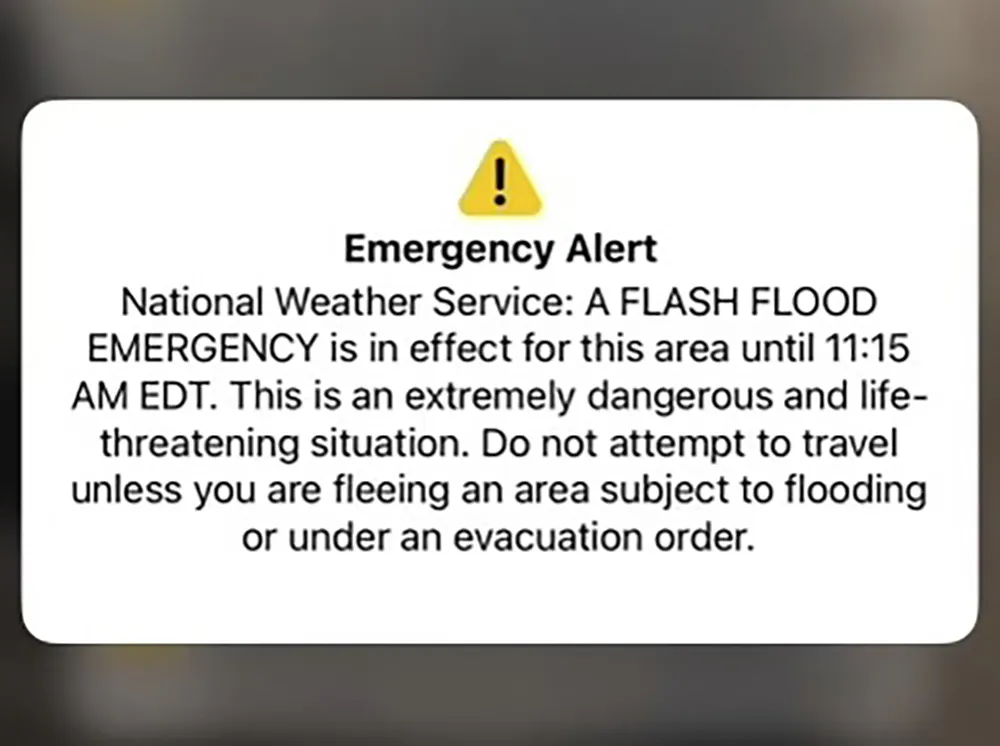
    A typical alert from the National Weather Service.
    AP Photo/Lisa Rathke

    Beyond technologies and digital communication, warnings still come through informal networks in many communities. Emergency managers directly coordinate with and share information with major businesses and organizations, saying, “Hey, John, be sure you have somebody up tonight watching the National Weather Service alerts and rivers.”

    This human-centered approach, similar to neighborhood-level systems we have studied in Japan, can provide direct confirmation that warnings have been received. This is something mass media and mobile systems cannot guarantee, especially during infrastructure failures such as power and cell tower outages.

    Effective messages

    Research shows that effective warning messages need to include five critical components: a clear hazard description, location-specific information, actionable guidance, timing cues and a credible source. The Federal Emergency Management Agency’s integrated public alert and warning system message design dashboard assists authorities in rapidly drafting effective messages.

    This warning system, known as IPAWS, provides nationwide infrastructure for wireless emergency alerts and Emergency Alert System messages. While powerful, IPAWS has limitations − not all emergency managers are trained to use it, and messages may extend beyond intended geographic areas. Also, many older mobile devices lack the latest capabilities, so they may not receive the most complete messages when they are sent.

    Hyperlocal community opt-in systems can complement IPAWS by allowing residents to register for targeted notifications. These systems, which can be run by communities or local agencies, face their own challenges. People must know they exist, be willing to share phone numbers, and remember to update their information. Social media platforms add another communication channel, with emergency managers increasingly using social media to share updates, though these primarily reach only certain demographics, and not everyone checks social media regularly.

    The key is redundancy through multiple communication channels. Research has found that multiple warnings are needed for people to develop a sense of urgency, and the most effective strategy is simple: Tell another person what’s going on. Interpersonal networks help ensure the message is delivered and can prompt actions. As former Natural Hazards Center Director Dennis Mileti observed: The wireless emergency alerts system “is fast. Mama is faster.”

    A Colorado news report explains why emergency alerts have to be tailored for local needs and conditions and use multiple communication channels.

    Warning fatigue

    Professionals from the National Weather Service, FEMA and the Federal Communications Commission, along with researchers, are increasingly concerned about warning fatigue – when people tune out warnings because they receive too many of them.

    However, there is limited empirical data about how and when people experience warning fatigue – or about its impact.

    This creates a double bind: Officials have an obligation to warn people at risk, yet frequent warnings can desensitize recipients. More research is needed to determine the behavioral implications of and differences between warnings that people perceive as irrelevant to their immediate geographic area versus those that genuinely don’t apply to them. This distinction becomes especially critical when people might drive into flooded areas outside their immediate vicinity.

    The key to effective emergency communication is to develop messages that resonate with specific audiences and build community networks that complement technological systems. We are now studying how to do this effectively in the United States and internationally. It’s also important to apply behavioral insights to the design of every level of communication warning systems. And it’s important to remember to test not just the technology but the entire end-to-end system, from threat identification to community response.

    Finally, maintaining true redundancy across multiple communication channels is an important strategy when trying to reach as many people as possible. Technology supports human decision-making, but it doesn’t replace it.

    Keri K. Stephens’ research reported here has been externally funded by the Texas Water Development Board, Texas General Land Office, and the National Science Foundation. Results published are peer-reviewed, and opinions reflect those of the author, not the funder.

    Hamilton Bean has earned research funding from U.S. Department of Homeland Security and the National Oceanic and Atmospheric Administration. Results published are peer-reviewed, and opinions reflect those of the author, not the funder.

    ref. Why it can be hard to warn people about dangers like floods – communication researchers explain the role of human behavior – https://theconversation.com/why-it-can-be-hard-to-warn-people-about-dangers-like-floods-communication-researchers-explain-the-role-of-human-behavior-260780

    MIL OSI Analysis

  • MIL-OSI USA: Congressman McGarvey Slams Donald Trump’s Plan to Cut $1.1 Billion From Public Broadcasting, Which Provides Emergency Weather Alerts in Kentucky

    Source: United States House of Representatives – Congressman Morgan McGarvey (Kentucky-03)

    June 04, 2025

    oday, Congressman Morgan McGarvey responded to the news that Donald Trump plans to cut $1.1 billion from the Corporation for Public Broadcasting, which provides funding to NPR and PBS. Public broadcastingprovides many services for Kentuckians, including emergency weather alerts that have saved lives during the recent deadly storms.

    “Kentuckians rely on public broadcasting for disaster and extreme weather alerts, especially in rural parts of the Commonwealth. Donald Trump’s plan to cut these services by $1.1 billion makes us all less safe.”

    ###

    MIL OSI USA News

  • MIL-OSI USA: CMS Announces Resources, Flexibilities to Assist with Public Health Emergency in State of Texas

    Source: US Department of Health and Human Services

    The Centers for Medicare & Medicaid Services (CMS) today announced resources and flexibilities to support individuals and health care providers affected by the severe storms, straight-line winds, and flooding in Texas. 

    Following a Major Disaster Declaration by President Donald J. Trump on July 6 and a Public Health Emergency (PHE)  declaration by Department of Health and Human Services (HHS) Secretary Robert F. Kennedy, Jr. on July 8, CMS is working with Texas and federal partners to ensure continued access to care. 

    Key Resources and Flexibilities: 

    MIL OSI USA News

  • MIL-OSI USA: Sen. Mallow to Attend Fifth Annual Nolan Smith Jr. ‘Pups Day Out’ Youth Football Camp

    Source: US State of Georgia

    ATLANTA (July 11, 2025) — On July 13, 2025, Sen. Derek Mallow (D–Savannah) will attend the closing ceremony of the Fifth Annual Pups Day Out Youth Football Camp, organized by Super Bowl champion Nolan Smith Jr. All participants will receive football guidance, back-to-school backpacks and supplies, while Sen. Mallow will present Nolan Smith Jr. with an Outstanding Georgia Citizen Award.

    EVENT DETAILS:                      

    • Date: Sunday, July 13, 2025
    • Time: 12:00–4:30 p.m.
    • Where: Floyd E. Morris Field, 1500 E. Victory Drive, Savannah, GA 31404
    • Participant Registration is Required: Please contact Darrin Hood at dhood@btmanagement.com for more information.
    • Event Viewing is Open to the Public.

    MEDIA OPPORTUNITIES:

    We kindly request that members of the media confirm their attendance in advance by contacting Zach Pishock at SenatePressInquiries@senate.ga.gov.

    # # # #

    Sen. Derek Mallow represents the 2nd Senate District, which includes a portion of Chatham County. He may be reached by phone at (404) 656-7586 or by email at Derek.Mallow@senate.ga.gov.

    MIL OSI USA News

  • MIL-OSI USA: COLUMN: Ginn: Investing in Families, Veterans and the Future of Georgia

    Source: US State of Georgia

    By: Sen. Frank Ginn (R–Danielsville)

    Georgia is following through on its promise to support hardworking families and our nation’s heroes in its newest budget. I’m proud to highlight two key bills I supported this session, House Bill 68 and House Bill 266, that ensure Georgia’s gratitude isn’t just spoken, but written into law.

    House Bill 68 is our balanced Fiscal Year 2025-2026 Budget, which began July 1 this year. Passing the state budget is our most important job in the General Assembly. It’s how we decide what matters most to Georgia families while making sure our tax dollars are put to good use.

    Keeping a balanced budget has always been a priority at work and at home. When I served as Franklin County’s manager and city manager for the cities of Royston and Sugar Hill, I made sure that every dollar going out was accounted for and covered by a dollar coming in. This precise budgeting helped me continue delivering essential services to the communities I served while cutting unnecessary areas of spending. That experience taught me a simple truth: you can’t print money at the local level, and you certainly can’t spend what you don’t have. I bring that same mindset to the Capitol. In the Georgia Legislature, we make smart, responsible daily decisions that keep our state financially strong.

    Our budget invests in the core services our state depends on, including education, public safety and economic development, while keeping spending in check. This year’s budget contains $37.7 billion in state funding and supports our state’s infrastructure, correctional facilities and mental health policy while also focusing on retirees, educators, first responders and many more.

    Our legislative body has prioritized conservative thinking in building this budget, ensuring we can still invest in our priorities without raising taxes and placing new burdens on hardworking people.

    These investments mean more support for our local schools, more tools for law enforcement in Barrow, Jackson, Madison, and Clarke counties, and more opportunities for families who call northeast Georgia home. Whether it’s upgrading public safety infrastructure or creating pathways for student success, this budget delivers resources that will have a real impact from Braselton to Danielsville to Athens.

    We’re showing gratitude to our nation’s heroes this Independence Day by delivering financial relief. With House Bill 266, we’ve eliminated the state income tax on military retirement pay. That’s a big win for Georgia, especially in Northeast Georgia, where many veterans already work in businesses across the district, invest in fellow businesses with their hard-earned pay, and serve in their communities. We want those veterans to stay in Georgia and continue to build their lives with the confidence that the state will support them.

    This bill also helps bring more veterans and their families to our state, which is good for business and our growing communities. Lastly, this legislation offers a new tax incentive for those who donate to law enforcement foundations. These organizations support officer training, equipment upgrades, mental health services, and family assistance programs. This legislation and our state budget endorse our veterans and first responders. Georgia backs the blue, supports our veterans, and is leading by example.

    As always, it’s an honor to serve the people of the 47th Senate District. As the legislative interim continues, I’ll keep listening to your concerns, working hard on your behalf, and doing my part to keep Georgia the best place to live, work and raise a family.

    # # # #

    Sen. Frank Ginn represents the 47th Senate District, which includes Madison County and portions of Barrow, Clarke, and Jackson County. He can be reached at (404) 656-4700 or by email at Frank.Ginn@senate.ga.gov.

    For all media inquiries, please reach out to SenatePressInquiries@senate.ga.gov.

    MIL OSI USA News

  • MIL-OSI USA: COLUMN: Ginn: Investing in Families, Veterans and the Future of Georgia

    Source: US State of Georgia

    By: Sen. Frank Ginn (R–Danielsville)

    Georgia is following through on its promise to support hardworking families and our nation’s heroes in its newest budget. I’m proud to highlight two key bills I supported this session, House Bill 68 and House Bill 266, that ensure Georgia’s gratitude isn’t just spoken, but written into law.

    House Bill 68 is our balanced Fiscal Year 2025-2026 Budget, which began July 1 this year. Passing the state budget is our most important job in the General Assembly. It’s how we decide what matters most to Georgia families while making sure our tax dollars are put to good use.

    Keeping a balanced budget has always been a priority at work and at home. When I served as Franklin County’s manager and city manager for the cities of Royston and Sugar Hill, I made sure that every dollar going out was accounted for and covered by a dollar coming in. This precise budgeting helped me continue delivering essential services to the communities I served while cutting unnecessary areas of spending. That experience taught me a simple truth: you can’t print money at the local level, and you certainly can’t spend what you don’t have. I bring that same mindset to the Capitol. In the Georgia Legislature, we make smart, responsible daily decisions that keep our state financially strong.

    Our budget invests in the core services our state depends on, including education, public safety and economic development, while keeping spending in check. This year’s budget contains $37.7 billion in state funding and supports our state’s infrastructure, correctional facilities and mental health policy while also focusing on retirees, educators, first responders and many more.

    Our legislative body has prioritized conservative thinking in building this budget, ensuring we can still invest in our priorities without raising taxes and placing new burdens on hardworking people.

    These investments mean more support for our local schools, more tools for law enforcement in Barrow, Jackson, Madison, and Clarke counties, and more opportunities for families who call northeast Georgia home. Whether it’s upgrading public safety infrastructure or creating pathways for student success, this budget delivers resources that will have a real impact from Braselton to Danielsville to Athens.

    We’re showing gratitude to our nation’s heroes this Independence Day by delivering financial relief. With House Bill 266, we’ve eliminated the state income tax on military retirement pay. That’s a big win for Georgia, especially in Northeast Georgia, where many veterans already work in businesses across the district, invest in fellow businesses with their hard-earned pay, and serve in their communities. We want those veterans to stay in Georgia and continue to build their lives with the confidence that the state will support them.

    This bill also helps bring more veterans and their families to our state, which is good for business and our growing communities. Lastly, this legislation offers a new tax incentive for those who donate to law enforcement foundations. These organizations support officer training, equipment upgrades, mental health services, and family assistance programs. This legislation and our state budget endorse our veterans and first responders. Georgia backs the blue, supports our veterans, and is leading by example.

    As always, it’s an honor to serve the people of the 47th Senate District. As the legislative interim continues, I’ll keep listening to your concerns, working hard on your behalf, and doing my part to keep Georgia the best place to live, work and raise a family.

    # # # #

    Sen. Frank Ginn represents the 47th Senate District, which includes Madison County and portions of Barrow, Clarke, and Jackson County. He can be reached at (404) 656-4700 or by email at Frank.Ginn@senate.ga.gov.

    For all media inquiries, please reach out to SenatePressInquiries@senate.ga.gov.

    MIL OSI USA News

  • MIL-OSI Canada: New program encourages growth for Prince Edward Island’s horticulture industry

    Source: Government of Canada News (2)

    July 11, 2025 – Charlottetown, Prince Edward Island – Agriculture and Agri-Food Canada

    A new Sustainable Canadian Agricultural Partnership (Sustainable CAP) program is now available to Prince Edward Island horticulture producers to help diversify crops, adapt to changing climates, and increase the supply of Island food products in markets across Canada.

    The Horticulture Diversification Program supports a variety of growth and capacity opportunities, including expanding greenhouses and controlled environment agriculture production, adopting technologies and processes to increase efficiency and productivity, as well as expanding and improving crop storage to extend the marketing season.

    The program will support producers through 4 streams of eligible activities:

    • Season Extension and Controlled Environment Agriculture (CEA) Expansion
    • Efficiency and Productivity
    • Post-Harvest Cooling, Freezing, and Storage
    • Agronomic Support

    This program is part of a suite of Sustainable CAP initiatives available to Prince Edward Island producers. To learn more about the Horticulture Diversification Program eligibility and guidelines, visit: Horticulture Diversification Program – Prince Edward Island

    MIL OSI Canada News

  • MIL-OSI USA: Rep. Gabe Vasquez Demands Immediate Release of Withheld Education Funds, Including $12 Million for Albuquerque Public Schools

    Source: US Representative Gabe Vasquez’s (NM-02)

    WASHINGTON, D.C. – Today, U.S. Representative Gabe Vasquez (NM-02) sent a letter to the Department of Education and the Office of Management and Budget (OMB) urging the administration to release $6.9 billion in congressionally approved federal education funds currently being unlawfully withheld from states and local school districts. 

    The freeze, announced by the Department of Education on June 30, 2025, will hit low-income students, English learners, and rural communities hardest. New Mexico’s public schools are projected to lose more than $44 million in total withheld funding, with New Mexico’s second Congressional district expected to lose over $21.6 million alone. Albuquerque Public Schools, the largest school district in the state, could lose up to $12 million in critical federal funding.

    “This funding was already approved by Congress, period. There’s no excuse for it to be sitting on the sidelines,” said Vasquez. “Every day of delay means fewer teachers, fewer resources, and more stress on students, particularly those who need the most support: our rural kids, English language learners, and children from low-income families. As someone who got a lot of help learning English at public school as a kid, I know firsthand that New Mexican students and schools will suffer from this kind of funding uncertainty.” 

    The letter calls on the Administration to comply with the law and disburse the funding allocated for:

    • Supporting Effective Instruction: These funds help schools recruit, train, and retain strong teachers and principals, especially in low-income and underserved areas. It also supports smaller class sizes and teacher mentorship — tools proven to boost student achievement.
    • English Language Acquisition: These funds help schools teach English to students who are still learning the language, while supporting their success in all subjects. It also helps schools expand evidence-based language instruction.
    • Student Support and Academic Enrichment Program: These funds provide programs that give students access to a well-rounded education, safe and healthy learning environments, and technology that boosts academic achievement and digital skills.
    • Nita M. Lowey 21st Century Community Learning Centers: These funds support after-school and summer programs that help students in high-poverty, low-performing schools catch up in reading and math, explore hands-on learning activities, and access support outside the classroom.
    • Migrant Education: These funds support migratory children in reaching challenging academic standards and graduating from high school.
    • Adult Basic and Literacy Education State Grants: This funding helps adults earn a diploma, improve workplace skills, and prepare for high-demand careers.

    “This affects Albuquerque Public Schools and the services we can provide to our students who need it most. APS receives close to $11.8 million in Title II, Title III and Title IV funding and uses that money for everything from providing services to English language learners and newcomer students to paying for a number of positions, including resource teachers and some counselors and nurses. The decision to withhold that funding is forcing us to put a hold on all expenditures and notify employees while we look for reserves to help us as we plan for the upcoming school year,” said Daniel Manzano, Executive Director of Board Services and Government Affairs for Albuquerque Public Schools.

    “We also use these funds to provide high-quality, standards-aligned training that strengthens instructional practices in literacy, mathematics, and other core content areas,” he added, “… all of which is vital as we work to improve academic outcomes for all our students.”

    Vasquez is committed to holding the administration accountable and ensuring New Mexico schools receive the investments they are owed. He recently cosponsored the Secure Rural Schools Reauthorization Act, which would restore over $9 million in funding for schools near federal forests that do not have access to the same amount of property tax revenue to support education that urban schools do. He also previously joined a letter opposing efforts to dismantle the Department of Education — all moves that would disproportionately harm students in rural, Tribal and underserved areas. 

    You can find the full text of the letter below or at the link here:

    Secretary McMahon and Director Vought,

    We write to request more information about your decision to illegally withhold nearly $7 billion dollars of funding for K-12 schools and adult education from states and local school districts around the country and to insist that this funding be immediately released. Without these funds, schools are facing difficult and unnecessary decisions on programs for students and teachers.

    On June 30, 2025, just one day before these funds become available for obligation, the Department notified states that they would not receive these funds by July 1 and that “[g]iventhe change in Administrations, the Department is reviewing the FY 2025 funding … and decisions have not yet been made concerning submissions and awards for this upcoming academic year.” This late-breaking decision, which provided no timeline for which states can expect a final decision, is leaving states financially vulnerable and forcing many to make last minute decisions about how to proceed with K12 education in this upcoming school year. The education funding withheld by the Administration reflects resources provided by Congress that are designed to help schools with a variety of issues, including student learning and achievement, after-school programs, and teacher training. Additionally, education funding provided by Congress to help with adult education and literacy is also being withheld.  

    This unnecessary delay of education funding, which accounts for at least 10 percent of federal K-12 funding in every state, is alarming parents, local elected officials, and education agencies. It is disrupting school and district planning, jeopardizing the education of millions of students, and is already resulting in layoffs as well as program delays and cancellations. Further, it is causing concern to adult education programs that are faced with similar decisions without immediate access to expected funding.

    Accordingly, please provide responses to the following questions no later than July 15, 2025.

    1. When will the Administration finish its review and release the funding provided by Congress to states to use for the school year beginning next month? 
    2. Has the Administration done any outreach or offered any sort of support for state and local education agencies to assist them and their partners in navigating this period of uncertainty?
    3. If the Administration knew it wanted to review these funds, why didn’t this review start earlier in the year? Was the review or the timely release of funds affected by the lack of staff at the Department, which is a direct result of the reductions in force (RIFs) executed by the Administration?

    There is no legitimate reason why any review of these programs should prevent the Administration from fulfilling its responsibility to the American people on time. No more excuses – follow the law and release the funding meant for our schools, teachers, and families.

    We look forward to hearing from you and seeing these dollars allocated immediately.

    ###

    MIL OSI USA News

  • MIL-OSI USA: Cat from Coventry Tests Positive for Rabies

    Source: US State of Rhode Island

    The Rhode Island Department of Health (RIDOH) is alerting the public that a stray cat found in the area of Newell Court in Coventry tested positive for rabies on July 10. The cat was tested after scratching a person in that area on July 7.

    Rabies is a fatal disease if it is not treated before the onset of symptoms. Anyone who may have had direct contact with the cat should immediately call RIDOH’s Center for Acute Infectious Disease Epidemiology at 401-222-2577 (Monday to Friday, 8:30 a.m.to 4:30 p.m.) or 401-276-8046 after hours so a nurse can assess your exposure and determine if you should receive treatment. If you think your pet may have come in contact with this cat, call RIDOH, your local Animal Control Officer, and your pet’s veterinarian.

    The person who was initially scratched by the cat and a second person who had contact with the cat have started treatment with post-exposure prophylaxis.

    The rabies virus infects the central nervous system. If a person does not receive the appropriate medical care after a rabies exposure, the virus can cause disease in the brain, ultimately resulting in death. Rabies treatment must be started as soon as possible after exposure and before symptoms appear.

    All dogs, cats, and ferrets are required by State law to have current vaccination against rabies. Vaccinating pets prevents them from getting rabies and prevents people from becoming exposed to rabies through their pets.

    RIDOH makes the following recommendations to prevent rabies:

    – Make sure all dogs, cats, and ferrets are up to date on rabies vaccination.

    – Avoid all contact with and do not feed stray or free-roaming domestic animals.

    – Avoid all contact with and do not feed wild animals.

    – Do not feed your animals outdoors, as this will attract other animals. This is especially dangerous when feeding large numbers of free-roaming cats.

    – Protect your pets by always maintaining control; walk dogs on a leash or let them play in a fenced yard, and do not let pets wander unsupervised.

    – Report all animal bites to your city/town’s animal control officer.

    – Securely cover all garbage cans so wild animals cannot scavenge for food.

    For more information, visit health.ri.gov/rabies.

    MIL OSI USA News

  • MIL-OSI USA: Cat from Coventry Tests Positive for Rabies

    Source: US State of Rhode Island

    The Rhode Island Department of Health (RIDOH) is alerting the public that a stray cat found in the area of Newell Court in Coventry tested positive for rabies on July 10. The cat was tested after scratching a person in that area on July 7.

    Rabies is a fatal disease if it is not treated before the onset of symptoms. Anyone who may have had direct contact with the cat should immediately call RIDOH’s Center for Acute Infectious Disease Epidemiology at 401-222-2577 (Monday to Friday, 8:30 a.m.to 4:30 p.m.) or 401-276-8046 after hours so a nurse can assess your exposure and determine if you should receive treatment. If you think your pet may have come in contact with this cat, call RIDOH, your local Animal Control Officer, and your pet’s veterinarian.

    The person who was initially scratched by the cat and a second person who had contact with the cat have started treatment with post-exposure prophylaxis.

    The rabies virus infects the central nervous system. If a person does not receive the appropriate medical care after a rabies exposure, the virus can cause disease in the brain, ultimately resulting in death. Rabies treatment must be started as soon as possible after exposure and before symptoms appear.

    All dogs, cats, and ferrets are required by State law to have current vaccination against rabies. Vaccinating pets prevents them from getting rabies and prevents people from becoming exposed to rabies through their pets.

    RIDOH makes the following recommendations to prevent rabies:

    – Make sure all dogs, cats, and ferrets are up to date on rabies vaccination.

    – Avoid all contact with and do not feed stray or free-roaming domestic animals.

    – Avoid all contact with and do not feed wild animals.

    – Do not feed your animals outdoors, as this will attract other animals. This is especially dangerous when feeding large numbers of free-roaming cats.

    – Protect your pets by always maintaining control; walk dogs on a leash or let them play in a fenced yard, and do not let pets wander unsupervised.

    – Report all animal bites to your city/town’s animal control officer.

    – Securely cover all garbage cans so wild animals cannot scavenge for food.

    For more information, visit health.ri.gov/rabies.

    MIL OSI USA News

  • MIL-OSI USA: Cat from Coventry Tests Positive for Rabies

    Source: US State of Rhode Island

    The Rhode Island Department of Health (RIDOH) is alerting the public that a stray cat found in the area of Newell Court in Coventry tested positive for rabies on July 10. The cat was tested after scratching a person in that area on July 7.

    Rabies is a fatal disease if it is not treated before the onset of symptoms. Anyone who may have had direct contact with the cat should immediately call RIDOH’s Center for Acute Infectious Disease Epidemiology at 401-222-2577 (Monday to Friday, 8:30 a.m.to 4:30 p.m.) or 401-276-8046 after hours so a nurse can assess your exposure and determine if you should receive treatment. If you think your pet may have come in contact with this cat, call RIDOH, your local Animal Control Officer, and your pet’s veterinarian.

    The person who was initially scratched by the cat and a second person who had contact with the cat have started treatment with post-exposure prophylaxis.

    The rabies virus infects the central nervous system. If a person does not receive the appropriate medical care after a rabies exposure, the virus can cause disease in the brain, ultimately resulting in death. Rabies treatment must be started as soon as possible after exposure and before symptoms appear.

    All dogs, cats, and ferrets are required by State law to have current vaccination against rabies. Vaccinating pets prevents them from getting rabies and prevents people from becoming exposed to rabies through their pets.

    RIDOH makes the following recommendations to prevent rabies:

    – Make sure all dogs, cats, and ferrets are up to date on rabies vaccination.

    – Avoid all contact with and do not feed stray or free-roaming domestic animals.

    – Avoid all contact with and do not feed wild animals.

    – Do not feed your animals outdoors, as this will attract other animals. This is especially dangerous when feeding large numbers of free-roaming cats.

    – Protect your pets by always maintaining control; walk dogs on a leash or let them play in a fenced yard, and do not let pets wander unsupervised.

    – Report all animal bites to your city/town’s animal control officer.

    – Securely cover all garbage cans so wild animals cannot scavenge for food.

    For more information, visit health.ri.gov/rabies.

    MIL OSI USA News

  • MIL-OSI USA: Chairman Lawler Introduces Bipartisan Bill Enhancing Abraham Accords Security Ties

    Source: US Congressman Mike Lawler (R, NY-17)

    Washington, D.C. – 7/10/25… Today, Congressman Mike Lawler (NY-17), Chairman of the House Foreign Affairs Subcommittee on the Middle East and North Africa, introduced the Abraham Accords Defense Against Terror Act, bipartisan legislation that will expedite arms sales to U.S. partners that have normalized relations with Israel and are actively working with the United States to counter Iran and its terrorist proxies. 

    Specifically, it would narrow the timeline for congressional consideration after arms sales are accepted, while maintaining existing eligibility criteria for arms sales themselves. This is the same preferential treatment that our NATO allies receive. 

    Chairman Lawler is joined in introducing the bill by Representatives Jared Moskowitz (FL-23), Ryan Zinke (MT-01), Donald G. Davis (NC-01), Bryan Steil (WI-01), Don Bacon (NE-02), Michael Baumgartner (WA-05), Buddy Carter (GA-01), Jeff Crank (CO-05), Chuck Edwards (NC-11), Brian Fitzpatrick (PA-01), Brad Finstad (MN-01), Chuck Fleischmann (TN-03), Andrew Garbarino (NY-02), Josh Gottheimer (NJ-05), Abraham Hamadeh (AZ-08), David Kustoff (TN-08), Anna Paulina Luna (FL-13), Michael McCaul (TX-10), Mark Messmer (IN-08), Zach Nunn (IA-03), John Rose (TN-06), Maria Salazar (FL-27), Pete Stauber (MN-08), Elise Stefanik (NY-21), and Joe Wilson (SC-02).

    “As Chairman of the Middle East and North Africa Subcommittee, I am committed to strengthening our relationships with regional partners and putting our ally Israel in the best position possible to do the same. There is no question that fostering deeper security relationships is key here,” said Chairman Lawler. “This legislation will do just that by providing greater benefits to our Abraham Accords and counterterrorism partners. It represents a key step toward implementation of the Abraham Accords and turning shared diplomatic commitments into real-world cooperation. Lastly, it sends a strong message to adversaries: the United States and its allies will not allow Iran’s proxies to destabilize the region unchecked.”

    “The Abraham Accords have been a historic model for peace between Israel and its neighbors, and we should be doing everything we can to expand it and bring more states into the fold,” said Congressman Moskowitz. “This commonsense bill builds on the progress of the Abraham Accords to incentivize others to normalize relations with Israel and cooperate against the threat of Iran and Iranian proxies, safeguarding our ally Israel’s very right to exist in the process,” said Congressman Moskowitz.

    “There are too many bureaucratic barriers that prevent us from assisting our closest allies in global security. This bill strengthens the ties forged by the Abraham Accords by ensuring our partners have expedited access to the tools they need to stand against Iran and its terrorist proxies. Israel is one of our closest and most vital allies, and peace through strength is the only way to secure the region and protect American interests. I’m proud to support this bipartisan effort to build on the success of the Abraham Accords and combat terrorism abroad,”  said Chairman Ryan Zinke of the House Foreign Affairs Foreign Military Sales Taskforce.

    “The Abraham Accords Defense Against Terror Act strengthens Israel’s qualitative military edge and ensures that our allies have the tools they need to confront shared threats head-on,” said Congressman Davis. “Congress must send a clear message to Iran and its proxies: America stands firmly with Israel and with those who choose peace and stability over terror. Israel’s security is non-negotiable and the United States will never waver in defending our closest ally in the Middle East.”

    “The Abraham Accords marked a major step toward peace in the Middle East, countering Iran’s influence and supporting our most important regional ally, Israel. The Abraham Accords Defense Against Terror Act builds on this historic agreement by encouraging the normalization of relations with Israel, combating Iran and its terrorist proxies, and strengthening the U.S. defense industrial base,” said Congressman Steil.

    Congressman Lawler is one of the most bipartisan members of Congress and represents New York’s 17th Congressional District, which is just north of New York City and contains all or parts of Rockland, Putnam, Dutchess, and Westchester Counties. He was rated the most effective freshman lawmaker in the 118th Congress, 8th overall, surpassing dozens of committee chairs.

    ###

    Full text of the bill can be found HERE.

    MIL OSI USA News

  • MIL-OSI USA: Lawler Urges President Trump to Restore Key Funding for After-School Programs in the Hudson Valley

    Source: US Congressman Mike Lawler (R, NY-17)

    Washington, D.C. – 7/11/25… Congressman Mike Lawler (NY-17) is urging President Trump to release federal funding for 21st Century Community Learning Centers, which provide vital before- and after-school programs across the Hudson Valley.

    These programs are particularly impactful for low-income students in low-performing schools. Local recipients of this funding include the New Square Community Improvement Council, Peekskill City School District, United Way of Westchester and Putnam, Westchester Jewish Community Services and so many great organizations in our community.

    “This program deeply aligns with [the] Administration’s goals to return power to the state, instead of Washington, D.C., bureaucrats. State Education Agencies are fully responsible for administering the grant, providing each community with the opportunity to distribute funding where it is most needed,” wrote Congressman Lawler.

    “21st Century Community Learning Centers are a perfect example of what happens when we take the federal government out of education – outcomes are better. Students that participate in these programs have been found to have better attendance records, are more engaged in their classes, and see improvements in their academic performance, including in reading and math” concluded Congressman Lawler in his letter. 

    Congressman Lawler is one of the most bipartisan members of Congress and represents New York’s 17th Congressional District, which is just north of New York City and contains all or parts of Rockland, Putnam, Dutchess, and Westchester Counties. He was rated the most effective freshman lawmaker in the 118th Congress, 8th overall, surpassing dozens of committee chairs.

    ###

    The full letter can be found HERE.

    MIL OSI USA News

  • Industry must be a force for inclusion by promoting gender and caste diversity in leadership-VP

    Source: Government of India

    Source: Government of India (2)

    lign=”center”>The private sector must embrace its role not just as an economic actor but as a co-architect of India’s future-VP
    India is on the right path of becoming a trusted economy, a reliable partner in the global value chain, a stable anchor in a volatile world-VP
    Global 2030 agenda for sustainable development cannot succeed without India’s participation; India has embraced this responsibility with clarity and conviction-VP
    Let us not treat sustainability as a compliance, but as a source of competitive advantage-VP
    Bharat seek prosperity with purpose, growth with inclusion, innovation with integrity, says VP to Industry Leaders
    Build “Brand India” on four pillars — quality, trust, innovation, and ancient wisdom reimagined for modern relevance, exhorts VP
    Government’s role is only of an enabler, it is industry that drives innovation, creates livelihoods-VP

    The Vice-President, Shri Jagdeep Dhankhar today said that, “ Industry, friends, must be a force for inclusion by supporting MSMEs, promoting gender and caste diversity in leadership. It’s easier said than done. Gender and caste diversity has to be appreciated in the right sense. When it comes to gender, we champion affirmative action but the real problem is when gender discrimination is subtle. When gender discrimination cannot be imparted in words by the normal desire to dominate.”

    https://twitter.com/VPIndia/status/1943284979305451811


    Speaking as Chief Guest at the 19th Edition of the CII-ITC Sustainability Awards at Bharat Mandapam in New Delhi today, Shri Dhnakhar underlined, “The private sector must embrace its role not just as an economic actor but as a co-architect of India’s future……. We are not mercenaries, we don’t stand for exploitation. We believe in the positive unleashing of our energy to realise our dreams for the benefit of society at large.  A truly developed nation is one where opportunity is not the privilege of the few but the right of all.”


    https://twitter.com/VPIndia/status/1943294295043379250


    Underlining the sustainable development credentials of Bharat, Shri Dhnakhar said, “Bharat is home to one-sixth of humanity. We are the world’s largest economy at number four and we are the torchbearers of a development paradigm that seeks to harmonize  the economy, the ecological and the ethical…..the global 2030 agenda for sustainable development cannot succeed on the planet without India’s participation, without India’s contribution, without India’s proactive affirmative stance and fortunately, with the vision of its leadership,  India has embraced this responsibility both with clarity and conviction……In this country, we seek prosperity with purpose, growth with inclusion,  innovation with integrity……Let Indian industry become the torchbearer of this green revolution. Let us invest in renewable energy, green hydrogen, circular economy models, and carbon markets. Let us not treat sustainability as a compliance, but as a source of competitive advantage. The moment we take it in the compliance groove; the battle is lost.”


    https://twitter.com/VPIndia/status/1943294318409863232


    Exhorting the industry leaders present there, he stated, “ Indian industry must now expand its global presence — not just in markets, but in ideas, standards, and solutions. Let us build “Brand India” on four pillars — quality, trust, innovation, and ancient wisdom reimagined for modern relevance…..Let us go for Greenfield projects. Increasing the health sector, increasing the education sector, increasing facilities around metros is fine, but it does not lead to equitable balance and equitable balance is fundamental to cut into inequitable conduct. Therefore….if CSR funds of corporates are dealt with by corporates and conglomerates, then the areas that have been left out so far will get world-class institutions in health, education, and the like.”


    https://twitter.com/VPIndia/status/1943287925640433673


    “There was a time when the health and education sectors were means to give back to the society by businesses. Now there is a trend that health and education are turning out to be lucrative businesses.  Commercialization and commodification of these vital segments that are essentially passages only to serve the society at large, to give back to the society, is an aspect on which the corporate India will have to reflect, devise a mechanism. Therefore, I urge the CII must lead by example by fostering a business culture that prioritizes equity, transparency and long-term value creation”, he added.


    Highlighting the role of the private sector in taking the nation forward, Shri Dhankhar emphasized, “ Government’s role is only of an enabler. Heavy obligations are on the corporate world …. The government alone cannot,  if I may say so, score the penalty goal. Government by itself cannot take  those corners  and corner kicks  that result in goals. The private sector has a vital role to play because  at the end of the day it is industry that drives innovation, creates livelihoods and builds the architecture of national development…….When I look at corporate India from a global perspective, I find it is an unparalleled reservoir of talent and exemplifies commitment and giving back to society. It has huge potential. Its synergetic exploitation with the government and government actors can lead to a quantum leap and geometric outcomes.”


    “The Government of India has moved beyond a government-centric approach to a whole-of-society framework. Sub-national and local governments, civil society,  private sector players and communities, all are vital cogs in this engine of progress. But friends,  this engine has to fire on all cylinders  if we have to achieve tangible success”, he further added.


    Referring to the Indian economy’s potential, he stated, “ India is not merely aspiring to become a five trillion-dollar economy…..India is on the right path of becoming a trusted economy, a reliable partner in the global value chain, a stable anchor in a volatile world. The world at the moment is in turmoil and turbulence. Global configurations show no signs of abating. Supply chain disruption is taking place. In this disturbed scenario, Bharat is a prominent voice.”


    https://twitter.com/VPIndia/status/1943295896957173809


    Encouraging the industry to focus on research and development, Shri Dhankhar stated, “Industry must take the lead in research and development, invest in indigenous design. I would reflect for a moment on this, this is an area where there needs to be more attention, greater convergence of corporate world…research can’t be for the self,  research can’t be for the shelf. Research cannot be just assimilation or surface scratching. Research has to correlate to making change on the ground”.


    Drawing attention to the skill requirements of youth, he stated, “ Nearly two thirds of our population is below the age of 35. Demographic youth dividend. The median age being 28, we are 10 years younger than China and USA……duty of the corporates in particular is that, this[demographic dividend] our biggest asset has to be channelized in the right direction  and therefore focus on youth and skilling is fundamental. The government is doing its bit by a number of innovative steps but major part has to be done for effective transformation by the industry. It is our  biggest asset. but an asset is biggest only if we harness it with vision and urgency. I urge industry to work very closely with academia, training institutes,  and the government to design future-ready curricula.”

  • MIL-OSI USA: CBO’s Recent Publications and Work in Progress as of June 30, 2025

    Source: US Congressional Budget Office

    To provide the Congress with a comprehensive review of its work, the Congressional Budget Office publishes quarterly reports that highlight the agency’s recent publications and summarize its work in progress. Over the past three months, CBO has produced a variety of budget and economic analyses, fulfilling the agency’s core mission of supporting the Congress during each stage of the legislative process. The agency’s work takes many forms, including technical assistance to committees and Members when they are crafting legislation, cost estimates of legislation, testimonies, reports, and other analytical products.

    MIL OSI USA News

  • MIL-OSI USA: SBA Relief Still Available to Missouri Small Businesses and Private Nonprofits Affected by Adverse Weather Conditions from

    Source: United States Small Business Administration

    SACRAMENTO, Calif. – The U.S. Small Business Administration (SBA) is reminding eligible small businesses and private nonprofit (PNP) organizations in Missouri counties of the Aug. 11, 2025 deadline to apply for low interest federal disaster loans to offset economic losses caused by the excessive rain and high winds from Hurricane Helene occurring Sept. 28‑29, 2024.

    The disaster declaration covers the Missouri counties of Bollinger, Butler, Cape Girardeau, Carter, Dunklin, Madison, Mississippi, New Madrid, Oregon, Pemiscot, Perry, Ripley, Scott, Stoddard and Wayne, as well as the Arkansas counties of Clay, Craighead, Greene, Mississippi and Randolph, the Illinois counties of Alexander and Union, the Kentucky counties of Ballard, Carlisle, Fulton and Hickman, and the Tennessee counties of Dyer and Lake.

    Under this declaration, SBA’s Economic Injury Disaster Loan (EIDL) program is available to small businesses, small agricultural cooperatives, nurseries, and PNPs impacted by financial losses directly related to the disaster. The SBA is unable to provide disaster loans to agricultural producers, farmers, or ranchers, except for small aquaculture enterprises.

    EIDLs are available for working capital needs caused by the disaster and are available even if the small business or PNP did not suffer any physical damage. The loans may be used to pay fixed debts, payroll, accounts payable and other bills not paid due to the disaster.

    “SBA loans help eligible small businesses and private nonprofits cover operating expenses after a disaster, which is crucial for their recovery,” said Chris Stallings, associate administrator of the Office of Disaster Recovery and Resilience at the SBA. “These loans not only help business owners get back on their feet but also play a key role in sustaining local economies in the aftermath of a disaster.”

    The loan amount can be up to $2 million with interest rates as low as 4% for small businesses and 3.25% for PNPs with terms up to 30 years. Interest does not accrue, and payments are not due until 12 months from the date of the first loan disbursement. The SBA sets loan amounts and terms based on each applicant’s financial condition.

    To apply online, visit sba.gov/disaster. Applicants may also call SBA’s Customer Service Center at (800) 659-2955 or email disastercustomerservice@sba.gov for more information on SBA disaster assistance. For people who are deaf, hard of hearing, or have a speech disability, please dial 7-1-1 to access telecommunications relay services.

    Submit completed loan applications to the SBA no later than Aug. 11.

    ###

    About the U.S. Small Business Administration

    The U.S. Small Business Administration helps power the American dream of business ownership. As the only go-to resource and voice for small businesses backed by the strength of the federal government, the SBA empowers entrepreneurs and small business owners with the resources and support they need to start, grow, expand their businesses, or recover from a declared disaster. It delivers services through an extensive network of SBA field offices and partnerships with public and private organizations. To learn more, visit www.sba.gov.

    MIL OSI USA News

  • MIL-OSI USA: Governor Ivey Announces 58 New First Class Pre-K Classrooms for the 2025-2026 School Year

    Source: US State of Alabama

    MONTGOMERY — Governor Kay Ivey on Friday announced 58 new first class Pre-K classrooms for the 2025-2026 school year. The continued expansion of the state’s nationally recognized program in partnership with the Alabama Department of Early Childhood Education (ADECE) will bring the total number of First Class Pre-K classrooms to 1,528 and expand access to high-quality early learning opportunities for children across the state.

    “The early years of a child’s life are the most critical for laying the foundation for all future learning, behavior and health. High-quality prekindergarten programs like Alabama’s First Class Pre-K don’t just prepare our children for kindergarten, they lay the foundation for lifelong achievement,” said Governor Ivey. “By adding these new classrooms, we are not only investing in our children, we are investing in the future of Alabama.”

    Over the last two years, the ADECE has placed a renewed focus on strengthening program quality while increasing grant awards to better support classrooms. The percentage of First Class Pre-K teachers on a waiver has dropped from 14% for the 2022-2023 school year to just under 7% in 2024-2025. This significant progress reflects the state’s strong commitment to quality education.

    To support rising program costs and ensure every classroom meets high-quality standards, the ADECE has increased individual grant amounts by 30% since 2022-2023 helping programs attract and retain qualified teachers, improve classroom resources and expand access in high-need areas.

    “Our commitment to quality is unwavering,” said ADECE Secretary Ami Brooks. “We know that access alone is not enough. By holding the line on credentialing and increasing the financial resources available to support classrooms, we are making sure that every child, regardless of zip code, has access to a high-quality pre-k experience that truly prepares them for success.”

    Alabama’s First Class Pre-K program has been recognized by the National Institute for Early Education Research (NIEER) as the top state-funded pre-kindergarten program in the country for 19 consecutive years. Research shows that children who participate in the program are more likely to succeed academically, demonstrate stronger school readiness and maintain that advantage throughout their education. These long-term gains underscore the value of expanding access to high-quality early learning for all Alabama children.

    For more information about First Class Pre-K, visit children.alabama.gov/adece/first-class-pre-k.

    ###

    MIL OSI USA News

  • MIL-OSI Canada: Government of Canada grants nearly $1.8M to promote Festival d’été de Québec

    Source: Government of Canada News (2)

    Marketing outside Quebec

    Québec, Quebec, July 11, 2025 Canada Economic Development for Quebec Regions and Canadian Heritage (PCH)

    The Government of Canada is granting a total of $1,750,000 in financial support to the Festival d’été de Québec (FEQ). This must-attend multi-genre musical event taking place on the Plains of Abraham and at other locations across downtown Québec attracts numerous tourists every year thanks to performances by local and international groups and artists. The aim of this funding is to market the FEQ so as to attract visitors from outside Quebec, maintain the summer event’s relevance and appeal by enhancing the tourism experience, and provide better access to works by professional artists.

    The Honourable Mélanie Joly, Minister of Industry and Minister responsible for Canada Economic Development for Quebec Regions (CED), and the Honourable Steven Guilbeault, Minister of Canadian Identity and Culture and Minister responsible for Official Languages, made the announcement today.

    The Government of Canada is providing the following financial assistance:

    • A non-repayable contribution of $1.2 million under CED’s Quebec Economic Development Program (QEDP). This funding enables the FEQ to engage in promotional activities internationally, to renew its brand image and to develop new products to enhance festivalgoers’ experience at the 2025 and 2026 editions.
    • A $550,000 grant for the FEQ’s 2025 edition through Canadian Heritage’s Canada Arts Presentation Fund. This funding enables the organization to launch a rich program including internationally renowned artists, in addition to providing an exceptional showcase for the next generation of artists.

    Quotes

    “The CED support announced today attests to our government’s willingness to support the tourism industry and to reaffirm its assistance for flagship organizations across Quebec’s different regions. The funding provided to the FEQ represents an important lever to increase the region’s appeal. Through our investments in cultural, musical and tourism experiences, we reaffirm our commitment to welcoming visitors from home and abroad to the beautiful city of Québec.”

    The Honourable Mélanie Joly, Minister of Industry and Minister responsible for CED

    “The Festival d’été de Québec is a flagship summer event that brings to life the Plains of Abraham and a multitude of other locations at the heart of the magnificent city of Québec. This major musical gathering, which shines the spotlight on both recognized and emerging artists, offers varied programming that attracts over one million festivalgoers every year. Our government is proud to support this artistic effervescence and to contribute to the success of an event that really brings people together. I wish everyone a great festival!”

    The Honourable Steven Guilbeault, Minister of Canadian Identity and Culture and Minister responsible for Official Languages

    “The Government of Canada has long been an ally of the Festival d’été de Québec, and its support makes all the difference to us. Thanks to its valuable financial contribution, we can promote the event well beyond our borders, showcase a range of wonderfully diverse Canadian artists, and provide the community with programming that is both rich and inclusive.”

    Nicolas Racine, President and CEO, FEQ

    Quick facts

    • CED is the key federal player in Quebec to promote economic development in the regions and among small and medium-sized enterprises (SMEs).
    • CED’s Quebec Economic Development Program (QEDP) aims to help communities seize economic development and diversification opportunities that are promising for the future.
    • The Canada Arts Presentation Fund provides financial assistance to organizations that professionally present arts festivals or performing arts series (arts presenters) and organizations that offer support to arts presenters.

    Stay connected

    Follow CED on social media
    Consult CED’s news

    Follow PCH on social media

    Sources

    Isabella Orozco-Madison
    Director of Communications
    Office of the Minister of Industry and Minister responsible for Canada Economic Development for Quebec Regions
    Email: isabella.orozco-madison@ised-isde.gc.ca
    Tel.: 613-222-1387

    Hermine Landry          
    Press Secretary
    Office of the Minister of Canadian Identity and Culture and Minister responsible for Official Languages
    Email: hermine.landry@pch.gc.ca

    Information

    Media Relations
    Canada Economic Development for Quebec Regions
    media@dec-ced.gc.ca

    Canadian Heritage
    media@pch.gc.ca

    MIL OSI Canada News