Source: United States House of Representatives – Congresswoman Norma Torres (35th District of California)
June 27, 2025
Republicans Reject Rep. Torres’ Amendment to Protect the Government Accountability Office, Instead Choosing to Fund Trump’s $400 Million Luxury Jetliner Gift from Qatar
Washington, D.C. — Today, Congresswoman Norma J. Torres condemned the Fiscal Year 2026 Legislative Branch Appropriations bill during a full committee markup and led an amendment to prevent Republicans from cutting $400 million from the Government Accountability Office (GAO), an independent watchdog that roots out waste, fraud, and abuse in the federal government. Every dollar invested in the GAO results in $123 in savings, making GAO Congress’ most effective watchdog for protecting taxpayer dollars. Since 2002, the GAO’s work has led to $1.45 trillion in savings. Congresswoman Torres’ amendment would have increased funding for this important agency by $400 million, paid for by rescinded taxpayer dollars that will be used to convert Trump’s luxury jetliner gifted from Qatar earlier this year. Republicans voted to reject this amendment.
“Republicans say they care about waste, fraud, and abuse, but support $400 million of taxpayer dollars to give President Trump a luxury jetliner. At the same time, they say “responsible spending” is why they are cutting that same amount, $400 million, from the Government Accountability Office, which is Congress’ most effective watchdog at rooting out waste, fraud, and abuse. This comes as the GAO is conducting nearly 40 investigations into the Trump Administration for illegally freezing or holding Congressional funding,” said Congresswoman Torres (CA-35). “I’m disappointed, but not surprised that Republicans rejected my amendment to stop Americans from paying for a private jet for Trump while ensuring Congress’ watchdog has the resources it needs to investigate violations of the law.”
At the markup, Rep. Torres joined Democrats in successfully fighting to allow Deferred Action for Childhood Arrivals (DACA) recipients to work in the Legislative Branch through an amendment from Congressman Pete Aguilar (CA-33).
The Republican FY2026 Legislative Branch Appropriations bill:
Aids and abets President Trump in continuing to steal money promised to the American taxpayer by gutting and politicizing the nonpartisan Government Accountability Office, slashing its budget by half (nearly $400 million) and undermines the rule of law across the federal government by restricting the GAO from bringing civil actions against any department, agency, officer, or employee of the United States for failing to comply with the Congressional Budget and Impoundment Control Act of 1974.
Threatens the preservation of our nation’s history and culture by slashing resources for the Library of Congress.
Shows House Republicans are continuing to ignore the sacrifices of the United States Capitol Police by failing to call for the immediate installation of the completed January 6 plaque honoring law enforcement.
For More Information on the bill, please click here.
Source: United States House of Representatives – Congresswoman Norma Torres (35th District of California)
June 30, 2025
Bill Seeks to help Homeowners and Renters Get Transparent Asbestos Hazard Disclosure in Residential Sales and Leases
Washington, D.C. – During National Homeownership Month, Congresswoman Norma Torres, a member of the House Appropriations Subcommittee on Transportation, and Housing and Urban Development, and Related Agencies, reintroduced the Asbestos Exposure in Housing Reduction Act of 2025. This legislation would protect renters and homeowners nationwide by requiring full disclosure of asbestos hazards during the sale or lease of residential properties, with civil and criminal penalties for non-disclosure.
“As we celebrate National Homeownership Month, it’s critical to prioritize the safety and health of those investing in their homes,” said Congresswoman Norma Torres. “Every renter and homeowner deserve transparency about environmental risks like asbestos before signing a lease or purchase agreement. This bill empowers families with the knowledge they need to protect their health and secure a safe home environment. No one should have to worry about hidden dangers in their home.”
The Environmental Protection Agency announced a historic ban on ongoing asbestos uses, yet disclosure requirements vary widely across states. Notably, California landlords are currently not mandated to disclose asbestos risks.
Key provisions of the Asbestos Exposure in Housing Reduction Act include:
Mandatory disclosure to buyers and renters of any known asbestos or asbestos-based hazards in the dwelling.
Provision of any available asbestos hazard evaluation reports from sellers or lessors to potential occupants.
A significant 10-day period for buyers or renters to conduct risk assessments or inspections for asbestos, ensuring informed decisions and peace of mind.
Inclusion of an Asbestos Warning Statement in every contract for purchase, sale, or lease, accompanied by a signed acknowledgment from the buyer or lessee confirming they understand the risks and had the opportunity to inspect.
This legislation directs the Housing and Urban Development Secretary and the EPA Administrator to issue regulations ensuring these protections become standard practice.
New York City, NY, June 30, 2025 (GLOBE NEWSWIRE) —
Now Personal Loan, a pioneer in the fast and flexible payday lending industry, is delighted to announce its official entry into Florida. With its expansion, Florida residents can now enjoy payday loans Florida with instant approval, guaranteed approval, and a streamlined, secure online loan process. Now Personal Loan is introducing its groundbreaking fintech platform to the Sunshine State with a vision to empower borrowers in meeting unanticipated expenses.
Whether it is rent, utility charges, or unexpected repairs, Floridians can count on Now Personal Loan for instant and easy assistance, including payday loans Florida no credit check and direct access to a payday loan Florida direct lender. The move is in keeping with the company’s goal of providing transparent, ethical, and fast loan products at all income levels.
Through the launch, Now Personal Loan will also initiate community outreach and financial education activities with a view of assisting Florida consumers in terms of borrowing alternatives and debt traps. The company mission further entails increasing financial inclusion in Florida’s underserved markets.
Now Personal Loan Offers Fast Access to Payday Loans in Florida
With Now Personal Loan now open for business in Florida, residents can look forward to a higher level of payday lending services. The key advantages are:
Instant approval for payday loans with little paperwork
Florida no credit check payday loan options for individuals with less-than-perfect credit histories
Immediate access to cash with our 100% internet-based procedure
Same day financing for approved borrowers
Payday loan Florida direct lender service – no agents, no delays
Clear terms and no hidden charges
24/7 access on mobile and desktop
Secure encryption of personal and banking information
Personalized loan amounts to meet various needs
While other payday lenders prioritize complexity, speed, and borrower exploitation, Now Personal Loan focuses on simplicity, quick disbursement, and borrower safeguarding. It’s payday lending for the digital-first generation. Floridians can now apply anywhere—no more waiting in long lines or suffering through tedious paperwork.
About Now Personal Loan
Now Personal Loan is an online lending platform committed to making short-term borrowing easier. Having established a strong market presence in multiple states, the company now provides payday loans in Florida that are convenient and flexible. The platform’s fair lending commitment involves:
Immediate loan application decisions
Clear terms with no hidden charges
Flexible loan amounts and repayment periods
Responsible borrowing tips and tools
Committed customer service and educational assistance
Multilingual support and ADA-compliant interfaces
As a reputable payday loan Florida direct lender, Now Personal Loan empowers consumers based on income and stability instead of credit scores. The company harnesses data-driven technology to build greater access for underserved segments, such as gig workers, retirees, and part-time workers.
How Now Personal Loan Provides Payday Loans in Florida with No Credit Check
Traditional lenders tend to exclude low-credit applicants. Personal Loan is not like that anymore. Here’s why it includes more Floridians:
Does soft credit checks only, which won’t affect your score
Based on job and income for approval
No standard credit history is needed
Alternative forms of verifying income are accepted
Accelerated approval for freelance workers and gig economy employees
Recent pay stubs, bank statements, and tax returns can be considered
Non-citizen residents who have lawful U.S. work are included in the process
Borrowers who have had money problems in the past are now able to get cash when they most need it, without worrying about being judged by outdated credit metrics. This enables more Floridians to manage emergencies, increase cash flow, or cover financial gaps responsibly.
Borrowers Eligible for a Payday Loan from Now Personal Loan in Florida
Today Personal Loan is dedicated to providing easy and affordable financial products to a wide variety of consumers. Unlike other lenders that have high credit score requirements, Today Personal Loan considers the larger picture—making it simpler for more Floridians to be approved. Here’s who qualifies:
Age Requirement: You must be 18 or older.
Residency: You need to be a legitimate Florida resident with a current U.S. address.
Income: Steady income is necessary from work, self-employment, Social Security, disability payments, pensions, or other documented sources.
Bank Account: A valid checking account in good standing to deposit funds and make payments.
Identification: A government-issued photo ID (like a driver’s license or state ID) is necessary for identification verification.
Employment or Alternative Income Verification: Gig workers, freelancers, and part-time workers are accepted. Recent pay stubs, tax statements, or bank statements can be utilized to verify income.
Contact Details: A functional email address and mobile phone number are needed for account updates and notifications.
Not Currently in Bankruptcy: Borrowers who are presently facing bankruptcy proceedings may not qualify.
Now Personal Loan also provides extra flexibility for:
First-time borrowers who need to borrow small loan amounts
Repeat borrowers with good repayment history
Active military personnel or veterans with regular government pay
Retirees with pension or Social Security payments
Aliens with lawful work authorization and regular income
This open-door policy allows even those with poor credit scores, unusual work arrangements, or previous financial difficulties to qualify. It’s credit made to fit today’s realities—rather than old credit principles.
Now Personal Loan Operates as a Direct Lender for Payday Loans in Florida
Now Personal Loan is not an intermediary broker. It is a genuine direct lender, i.e.:
You transact directly with the lender throughout the loan lifecycle
Decisions are made internally for quick processing
Funds are credited directly from the source
Your personal information is kept confidential and secure
No additional charges from intermediaries
Complete accountability and customer service under one roof
Clear communication payment schedule given upfront
By eliminating middlemen, Now Personal Loan increases trust and hastens approvals, lowers costs and hassles. Florida borrowers can trust they are dealing with a compliant, state-licensed lender that cares about their needs.
Now Personal Loan Promises Instant Approval for Florida Applicants
Need money in a pinch? Now Personal Loan provides instant approval options for Florida residents:
Application is less than five minutes
Pre-approval in seconds after applying
Money usually released the same day
Available on any device, 24/7
Transparent status updates and reminders
No faxing or hard paperwork involved
Perfect for urgent situations such as medical expenses, auto repairs, or pending rent
Now Personal Loan is now your trusted financial ally in times of crisis, providing speed and transparency when you need it the most.
Now Personal Loan Launches Guaranteed Approval Option for Eligible Borrowers
To enable more individuals to qualify for funding, Now Personal Loan now offers guaranteed approval options for qualified Florida applicants. This entails:
Repeated borrowers with good payment history
Borrowers with stable employment and income
Individuals who qualify through auto-qualification
Active duty military personnel and retirees with pension income
Social Security or government benefit recipients
Address verified in Florida
Good standing bank account
The aim is to offer regular access to credit without any kind of delay. With inclusiveness as the priority, Now Personal Loan keeps deserving borrowers from being left behind and can depend on assistance when required.
Now Personal Loan Highlights Responsible Lending and Transparency in Florida
Now Personal Loan promotes safe borrowing habits and transparency throughout Florida. Their framework comprises:
Transparent interest rates and fee structures
No bait-and-switch pricing or concealed provisions
Borrowing constraints that correlate with your earnings
Committed Florida-based support staff
Resources and articles to enhance financial literacy
On-time repayment incentivization through loyalty benefits
Freedom to repay and extension policies when necessary
The organization strives to make every borrower make smart, confident financial decisions, and build a robust financial foundation. Borrowers are incentivized to borrow only what they can afford to repay.
Now Personal Loan’s Easy Online Application Process for Florida Borrowers
Now Personal Loan’s process is speedy and hassle-free:
Go to the website and initiate the application
Fill in simple details – name, income, employment
Upload a digital version of ID and income proof
Get an instant go-ahead or no-go decision
Get money credited to your account, usually within hours
Repay easily through the online dashboard
No long lines, no complicated paperwork – just a convenient, contemporary lending process tailored for busy Floridians. Prospective applicants can even save their application and come back later, providing utmost convenience.
Now Personal Loan to Lead Florida Payday Loan Industry with Smarter Approval Tech
Now Personal Loan introduces fintech innovation to Florida’s payday lending industry. Here’s how:
Advanced AI and automation facilitate quicker decisions
Algorithms evaluate risk more accurately than conventional processes
Increased access for non-traditional borrowers
Live data analytics lower default rates
Efficient process from application to funding in less than an hour
Ongoing platform enhancements for better user experience
Secure cloud platform for secure transactions
Now Personal Loan is revolutionizing payday lending with this technology—capturing speed, fairness, and flexibility. It’s the lending future brought to Florida’s doorstep.
Final Words: Why Florida Residents Choose Now Personal Loan Over Traditional Payday Lenders
Floridians are relying more and more on Now Personal Loan for a wiser, more understanding borrowing experience. Differing from the conventional payday lenders, the platform provides an efficient digital process, assured approval for qualified borrowers, and no credit check payday loans—all intended to provide people with the assistance they deserve without criticism or delay. Whether you’re a full-time worker, gig worker, or retiree, the platform accommodates your case with fairness, speed, and transparency.
What really sets Now Personal Loan apart is its commitment to putting the borrower first. From instant funding and direct lender access to intuitive dashboards and best-in-class customer service, every element of the experience is designed to take stress out and put finances in order. The application of cutting-edge technology by the platform ensures quicker approvals while following strict security measures that protect user information. Coupled with its learning resources and welcoming underwriting, Now Personal Loan doesn’t simply provide loans—it provides a bridge to temporary financial assurance.
In a market dominated by payday lenders, Now Personal Loan stands out from the pack by blending responsible lending, quick access, and customer-first mentality. It’s not only a loan company—it’s a respectful financial ally for Floridians dealing with life’s unexpected expenses. Whether you’re dealing with an emergency or just need a short-term infusion, Now Personal Loan is the name Florida can rely on.
Media Details: Company: Now Personal Loan Full Company Address: Customer Acquisition LLC, Springates Building, Lower Government Road, Charlestown, Saint Kitts and Nevis Company Website: https://www.nowpersonalloan.com Official Email ID: support@NowPersonalLoan.com
New York City, NY, June 30, 2025 (GLOBE NEWSWIRE) —
Now Personal Loan, a pioneer in the fast and flexible payday lending industry, is delighted to announce its official entry into Florida. With its expansion, Florida residents can now enjoy payday loans Florida with instant approval, guaranteed approval, and a streamlined, secure online loan process. Now Personal Loan is introducing its groundbreaking fintech platform to the Sunshine State with a vision to empower borrowers in meeting unanticipated expenses.
Whether it is rent, utility charges, or unexpected repairs, Floridians can count on Now Personal Loan for instant and easy assistance, including payday loans Florida no credit check and direct access to a payday loan Florida direct lender. The move is in keeping with the company’s goal of providing transparent, ethical, and fast loan products at all income levels.
Through the launch, Now Personal Loan will also initiate community outreach and financial education activities with a view of assisting Florida consumers in terms of borrowing alternatives and debt traps. The company mission further entails increasing financial inclusion in Florida’s underserved markets.
Now Personal Loan Offers Fast Access to Payday Loans in Florida
With Now Personal Loan now open for business in Florida, residents can look forward to a higher level of payday lending services. The key advantages are:
Instant approval for payday loans with little paperwork
Florida no credit check payday loan options for individuals with less-than-perfect credit histories
Immediate access to cash with our 100% internet-based procedure
Same day financing for approved borrowers
Payday loan Florida direct lender service – no agents, no delays
Clear terms and no hidden charges
24/7 access on mobile and desktop
Secure encryption of personal and banking information
Personalized loan amounts to meet various needs
While other payday lenders prioritize complexity, speed, and borrower exploitation, Now Personal Loan focuses on simplicity, quick disbursement, and borrower safeguarding. It’s payday lending for the digital-first generation. Floridians can now apply anywhere—no more waiting in long lines or suffering through tedious paperwork.
About Now Personal Loan
Now Personal Loan is an online lending platform committed to making short-term borrowing easier. Having established a strong market presence in multiple states, the company now provides payday loans in Florida that are convenient and flexible. The platform’s fair lending commitment involves:
Immediate loan application decisions
Clear terms with no hidden charges
Flexible loan amounts and repayment periods
Responsible borrowing tips and tools
Committed customer service and educational assistance
Multilingual support and ADA-compliant interfaces
As a reputable payday loan Florida direct lender, Now Personal Loan empowers consumers based on income and stability instead of credit scores. The company harnesses data-driven technology to build greater access for underserved segments, such as gig workers, retirees, and part-time workers.
How Now Personal Loan Provides Payday Loans in Florida with No Credit Check
Traditional lenders tend to exclude low-credit applicants. Personal Loan is not like that anymore. Here’s why it includes more Floridians:
Does soft credit checks only, which won’t affect your score
Based on job and income for approval
No standard credit history is needed
Alternative forms of verifying income are accepted
Accelerated approval for freelance workers and gig economy employees
Recent pay stubs, bank statements, and tax returns can be considered
Non-citizen residents who have lawful U.S. work are included in the process
Borrowers who have had money problems in the past are now able to get cash when they most need it, without worrying about being judged by outdated credit metrics. This enables more Floridians to manage emergencies, increase cash flow, or cover financial gaps responsibly.
Borrowers Eligible for a Payday Loan from Now Personal Loan in Florida
Today Personal Loan is dedicated to providing easy and affordable financial products to a wide variety of consumers. Unlike other lenders that have high credit score requirements, Today Personal Loan considers the larger picture—making it simpler for more Floridians to be approved. Here’s who qualifies:
Age Requirement: You must be 18 or older.
Residency: You need to be a legitimate Florida resident with a current U.S. address.
Income: Steady income is necessary from work, self-employment, Social Security, disability payments, pensions, or other documented sources.
Bank Account: A valid checking account in good standing to deposit funds and make payments.
Identification: A government-issued photo ID (like a driver’s license or state ID) is necessary for identification verification.
Employment or Alternative Income Verification: Gig workers, freelancers, and part-time workers are accepted. Recent pay stubs, tax statements, or bank statements can be utilized to verify income.
Contact Details: A functional email address and mobile phone number are needed for account updates and notifications.
Not Currently in Bankruptcy: Borrowers who are presently facing bankruptcy proceedings may not qualify.
Now Personal Loan also provides extra flexibility for:
First-time borrowers who need to borrow small loan amounts
Repeat borrowers with good repayment history
Active military personnel or veterans with regular government pay
Retirees with pension or Social Security payments
Aliens with lawful work authorization and regular income
This open-door policy allows even those with poor credit scores, unusual work arrangements, or previous financial difficulties to qualify. It’s credit made to fit today’s realities—rather than old credit principles.
Now Personal Loan Operates as a Direct Lender for Payday Loans in Florida
Now Personal Loan is not an intermediary broker. It is a genuine direct lender, i.e.:
You transact directly with the lender throughout the loan lifecycle
Decisions are made internally for quick processing
Funds are credited directly from the source
Your personal information is kept confidential and secure
No additional charges from intermediaries
Complete accountability and customer service under one roof
Clear communication payment schedule given upfront
By eliminating middlemen, Now Personal Loan increases trust and hastens approvals, lowers costs and hassles. Florida borrowers can trust they are dealing with a compliant, state-licensed lender that cares about their needs.
Now Personal Loan Promises Instant Approval for Florida Applicants
Need money in a pinch? Now Personal Loan provides instant approval options for Florida residents:
Application is less than five minutes
Pre-approval in seconds after applying
Money usually released the same day
Available on any device, 24/7
Transparent status updates and reminders
No faxing or hard paperwork involved
Perfect for urgent situations such as medical expenses, auto repairs, or pending rent
Now Personal Loan is now your trusted financial ally in times of crisis, providing speed and transparency when you need it the most.
Now Personal Loan Launches Guaranteed Approval Option for Eligible Borrowers
To enable more individuals to qualify for funding, Now Personal Loan now offers guaranteed approval options for qualified Florida applicants. This entails:
Repeated borrowers with good payment history
Borrowers with stable employment and income
Individuals who qualify through auto-qualification
Active duty military personnel and retirees with pension income
Social Security or government benefit recipients
Address verified in Florida
Good standing bank account
The aim is to offer regular access to credit without any kind of delay. With inclusiveness as the priority, Now Personal Loan keeps deserving borrowers from being left behind and can depend on assistance when required.
Now Personal Loan Highlights Responsible Lending and Transparency in Florida
Now Personal Loan promotes safe borrowing habits and transparency throughout Florida. Their framework comprises:
Transparent interest rates and fee structures
No bait-and-switch pricing or concealed provisions
Borrowing constraints that correlate with your earnings
Committed Florida-based support staff
Resources and articles to enhance financial literacy
On-time repayment incentivization through loyalty benefits
Freedom to repay and extension policies when necessary
The organization strives to make every borrower make smart, confident financial decisions, and build a robust financial foundation. Borrowers are incentivized to borrow only what they can afford to repay.
Now Personal Loan’s Easy Online Application Process for Florida Borrowers
Now Personal Loan’s process is speedy and hassle-free:
Go to the website and initiate the application
Fill in simple details – name, income, employment
Upload a digital version of ID and income proof
Get an instant go-ahead or no-go decision
Get money credited to your account, usually within hours
Repay easily through the online dashboard
No long lines, no complicated paperwork – just a convenient, contemporary lending process tailored for busy Floridians. Prospective applicants can even save their application and come back later, providing utmost convenience.
Now Personal Loan to Lead Florida Payday Loan Industry with Smarter Approval Tech
Now Personal Loan introduces fintech innovation to Florida’s payday lending industry. Here’s how:
Advanced AI and automation facilitate quicker decisions
Algorithms evaluate risk more accurately than conventional processes
Increased access for non-traditional borrowers
Live data analytics lower default rates
Efficient process from application to funding in less than an hour
Ongoing platform enhancements for better user experience
Secure cloud platform for secure transactions
Now Personal Loan is revolutionizing payday lending with this technology—capturing speed, fairness, and flexibility. It’s the lending future brought to Florida’s doorstep.
Final Words: Why Florida Residents Choose Now Personal Loan Over Traditional Payday Lenders
Floridians are relying more and more on Now Personal Loan for a wiser, more understanding borrowing experience. Differing from the conventional payday lenders, the platform provides an efficient digital process, assured approval for qualified borrowers, and no credit check payday loans—all intended to provide people with the assistance they deserve without criticism or delay. Whether you’re a full-time worker, gig worker, or retiree, the platform accommodates your case with fairness, speed, and transparency.
What really sets Now Personal Loan apart is its commitment to putting the borrower first. From instant funding and direct lender access to intuitive dashboards and best-in-class customer service, every element of the experience is designed to take stress out and put finances in order. The application of cutting-edge technology by the platform ensures quicker approvals while following strict security measures that protect user information. Coupled with its learning resources and welcoming underwriting, Now Personal Loan doesn’t simply provide loans—it provides a bridge to temporary financial assurance.
In a market dominated by payday lenders, Now Personal Loan stands out from the pack by blending responsible lending, quick access, and customer-first mentality. It’s not only a loan company—it’s a respectful financial ally for Floridians dealing with life’s unexpected expenses. Whether you’re dealing with an emergency or just need a short-term infusion, Now Personal Loan is the name Florida can rely on.
Media Details: Company: Now Personal Loan Full Company Address: Customer Acquisition LLC, Springates Building, Lower Government Road, Charlestown, Saint Kitts and Nevis Company Website: https://www.nowpersonalloan.com Official Email ID: support@NowPersonalLoan.com
New York City, NY, June 30, 2025 (GLOBE NEWSWIRE) —
Now Personal Loan, a pioneer in the fast and flexible payday lending industry, is delighted to announce its official entry into Florida. With its expansion, Florida residents can now enjoy payday loans Florida with instant approval, guaranteed approval, and a streamlined, secure online loan process. Now Personal Loan is introducing its groundbreaking fintech platform to the Sunshine State with a vision to empower borrowers in meeting unanticipated expenses.
Whether it is rent, utility charges, or unexpected repairs, Floridians can count on Now Personal Loan for instant and easy assistance, including payday loans Florida no credit check and direct access to a payday loan Florida direct lender. The move is in keeping with the company’s goal of providing transparent, ethical, and fast loan products at all income levels.
Through the launch, Now Personal Loan will also initiate community outreach and financial education activities with a view of assisting Florida consumers in terms of borrowing alternatives and debt traps. The company mission further entails increasing financial inclusion in Florida’s underserved markets.
Now Personal Loan Offers Fast Access to Payday Loans in Florida
With Now Personal Loan now open for business in Florida, residents can look forward to a higher level of payday lending services. The key advantages are:
Instant approval for payday loans with little paperwork
Florida no credit check payday loan options for individuals with less-than-perfect credit histories
Immediate access to cash with our 100% internet-based procedure
Same day financing for approved borrowers
Payday loan Florida direct lender service – no agents, no delays
Clear terms and no hidden charges
24/7 access on mobile and desktop
Secure encryption of personal and banking information
Personalized loan amounts to meet various needs
While other payday lenders prioritize complexity, speed, and borrower exploitation, Now Personal Loan focuses on simplicity, quick disbursement, and borrower safeguarding. It’s payday lending for the digital-first generation. Floridians can now apply anywhere—no more waiting in long lines or suffering through tedious paperwork.
About Now Personal Loan
Now Personal Loan is an online lending platform committed to making short-term borrowing easier. Having established a strong market presence in multiple states, the company now provides payday loans in Florida that are convenient and flexible. The platform’s fair lending commitment involves:
Immediate loan application decisions
Clear terms with no hidden charges
Flexible loan amounts and repayment periods
Responsible borrowing tips and tools
Committed customer service and educational assistance
Multilingual support and ADA-compliant interfaces
As a reputable payday loan Florida direct lender, Now Personal Loan empowers consumers based on income and stability instead of credit scores. The company harnesses data-driven technology to build greater access for underserved segments, such as gig workers, retirees, and part-time workers.
How Now Personal Loan Provides Payday Loans in Florida with No Credit Check
Traditional lenders tend to exclude low-credit applicants. Personal Loan is not like that anymore. Here’s why it includes more Floridians:
Does soft credit checks only, which won’t affect your score
Based on job and income for approval
No standard credit history is needed
Alternative forms of verifying income are accepted
Accelerated approval for freelance workers and gig economy employees
Recent pay stubs, bank statements, and tax returns can be considered
Non-citizen residents who have lawful U.S. work are included in the process
Borrowers who have had money problems in the past are now able to get cash when they most need it, without worrying about being judged by outdated credit metrics. This enables more Floridians to manage emergencies, increase cash flow, or cover financial gaps responsibly.
Borrowers Eligible for a Payday Loan from Now Personal Loan in Florida
Today Personal Loan is dedicated to providing easy and affordable financial products to a wide variety of consumers. Unlike other lenders that have high credit score requirements, Today Personal Loan considers the larger picture—making it simpler for more Floridians to be approved. Here’s who qualifies:
Age Requirement: You must be 18 or older.
Residency: You need to be a legitimate Florida resident with a current U.S. address.
Income: Steady income is necessary from work, self-employment, Social Security, disability payments, pensions, or other documented sources.
Bank Account: A valid checking account in good standing to deposit funds and make payments.
Identification: A government-issued photo ID (like a driver’s license or state ID) is necessary for identification verification.
Employment or Alternative Income Verification: Gig workers, freelancers, and part-time workers are accepted. Recent pay stubs, tax statements, or bank statements can be utilized to verify income.
Contact Details: A functional email address and mobile phone number are needed for account updates and notifications.
Not Currently in Bankruptcy: Borrowers who are presently facing bankruptcy proceedings may not qualify.
Now Personal Loan also provides extra flexibility for:
First-time borrowers who need to borrow small loan amounts
Repeat borrowers with good repayment history
Active military personnel or veterans with regular government pay
Retirees with pension or Social Security payments
Aliens with lawful work authorization and regular income
This open-door policy allows even those with poor credit scores, unusual work arrangements, or previous financial difficulties to qualify. It’s credit made to fit today’s realities—rather than old credit principles.
Now Personal Loan Operates as a Direct Lender for Payday Loans in Florida
Now Personal Loan is not an intermediary broker. It is a genuine direct lender, i.e.:
You transact directly with the lender throughout the loan lifecycle
Decisions are made internally for quick processing
Funds are credited directly from the source
Your personal information is kept confidential and secure
No additional charges from intermediaries
Complete accountability and customer service under one roof
Clear communication payment schedule given upfront
By eliminating middlemen, Now Personal Loan increases trust and hastens approvals, lowers costs and hassles. Florida borrowers can trust they are dealing with a compliant, state-licensed lender that cares about their needs.
Now Personal Loan Promises Instant Approval for Florida Applicants
Need money in a pinch? Now Personal Loan provides instant approval options for Florida residents:
Application is less than five minutes
Pre-approval in seconds after applying
Money usually released the same day
Available on any device, 24/7
Transparent status updates and reminders
No faxing or hard paperwork involved
Perfect for urgent situations such as medical expenses, auto repairs, or pending rent
Now Personal Loan is now your trusted financial ally in times of crisis, providing speed and transparency when you need it the most.
Now Personal Loan Launches Guaranteed Approval Option for Eligible Borrowers
To enable more individuals to qualify for funding, Now Personal Loan now offers guaranteed approval options for qualified Florida applicants. This entails:
Repeated borrowers with good payment history
Borrowers with stable employment and income
Individuals who qualify through auto-qualification
Active duty military personnel and retirees with pension income
Social Security or government benefit recipients
Address verified in Florida
Good standing bank account
The aim is to offer regular access to credit without any kind of delay. With inclusiveness as the priority, Now Personal Loan keeps deserving borrowers from being left behind and can depend on assistance when required.
Now Personal Loan Highlights Responsible Lending and Transparency in Florida
Now Personal Loan promotes safe borrowing habits and transparency throughout Florida. Their framework comprises:
Transparent interest rates and fee structures
No bait-and-switch pricing or concealed provisions
Borrowing constraints that correlate with your earnings
Committed Florida-based support staff
Resources and articles to enhance financial literacy
On-time repayment incentivization through loyalty benefits
Freedom to repay and extension policies when necessary
The organization strives to make every borrower make smart, confident financial decisions, and build a robust financial foundation. Borrowers are incentivized to borrow only what they can afford to repay.
Now Personal Loan’s Easy Online Application Process for Florida Borrowers
Now Personal Loan’s process is speedy and hassle-free:
Go to the website and initiate the application
Fill in simple details – name, income, employment
Upload a digital version of ID and income proof
Get an instant go-ahead or no-go decision
Get money credited to your account, usually within hours
Repay easily through the online dashboard
No long lines, no complicated paperwork – just a convenient, contemporary lending process tailored for busy Floridians. Prospective applicants can even save their application and come back later, providing utmost convenience.
Now Personal Loan to Lead Florida Payday Loan Industry with Smarter Approval Tech
Now Personal Loan introduces fintech innovation to Florida’s payday lending industry. Here’s how:
Advanced AI and automation facilitate quicker decisions
Algorithms evaluate risk more accurately than conventional processes
Increased access for non-traditional borrowers
Live data analytics lower default rates
Efficient process from application to funding in less than an hour
Ongoing platform enhancements for better user experience
Secure cloud platform for secure transactions
Now Personal Loan is revolutionizing payday lending with this technology—capturing speed, fairness, and flexibility. It’s the lending future brought to Florida’s doorstep.
Final Words: Why Florida Residents Choose Now Personal Loan Over Traditional Payday Lenders
Floridians are relying more and more on Now Personal Loan for a wiser, more understanding borrowing experience. Differing from the conventional payday lenders, the platform provides an efficient digital process, assured approval for qualified borrowers, and no credit check payday loans—all intended to provide people with the assistance they deserve without criticism or delay. Whether you’re a full-time worker, gig worker, or retiree, the platform accommodates your case with fairness, speed, and transparency.
What really sets Now Personal Loan apart is its commitment to putting the borrower first. From instant funding and direct lender access to intuitive dashboards and best-in-class customer service, every element of the experience is designed to take stress out and put finances in order. The application of cutting-edge technology by the platform ensures quicker approvals while following strict security measures that protect user information. Coupled with its learning resources and welcoming underwriting, Now Personal Loan doesn’t simply provide loans—it provides a bridge to temporary financial assurance.
In a market dominated by payday lenders, Now Personal Loan stands out from the pack by blending responsible lending, quick access, and customer-first mentality. It’s not only a loan company—it’s a respectful financial ally for Floridians dealing with life’s unexpected expenses. Whether you’re dealing with an emergency or just need a short-term infusion, Now Personal Loan is the name Florida can rely on.
Media Details: Company: Now Personal Loan Full Company Address: Customer Acquisition LLC, Springates Building, Lower Government Road, Charlestown, Saint Kitts and Nevis Company Website: https://www.nowpersonalloan.com Official Email ID: support@NowPersonalLoan.com
PHOENIX, Ariz. — A federal grand jury returned an indictment June 24 against Iranian national, Mehrzad Asadi Eidivand, 40, of Tempe, Arizona for alien in possession of a firearm, and against his wife, Linet Vartanniavartanians, 37, a U.S. citizen from Tempe, Arizona, for threatening to assault a federal officer. U.S. Immigration and Customs Enforcement and the FBI are conducting the investigation in this case.
Documents filed in the case allege that ICE Enforcement and Removal Operations officers went to Eidivand and Vartanniavartanians’ Tempe residence on Saturday, June 21, to administratively arrest Eidivand for failing to comply with a 2013 removal order. Eidivand had challenged the removal order on several occasions, but the Board of Immigration Appeals denied those motions repeatedly. Despite the court order to return to his home country, Eidivand remained in the U.S. over a decade.
When ICE ERO officers arrived at the couple’s residence, they announced themselves and were answered by Vartanniavartanians, who refused to open the door and told the officers to return with a warrant. Shortly thereafter, Tempe Police officers arrived on the scene and told ICE ERO that Vartanniavartanians had called the police and threatened to shoot the federal officers. She claimed that she had a loaded gun and that she would shoot anyone who tried to come inside the house. She also threatened to go outside and shoot ICE officers in the head. When the police dispatcher spoke with Eidivand, he confirmed that there were guns in the home.
The following day, June 22, special agents with ICE Homeland Security Investigations and officers from ICE ERO executed a federal search warrant on the residence. Inside the home, agents found a loaded firearm on the kitchen counter and a second loaded firearm on a nightstand. Both Vartanniavartanians and Eidivand were arrested at the scene and taken into custody without further incident.
A conviction for alien in possession of a firearm carries a maximum penalty of 15 years in prison, a maximum fine of $250,000, or both. A conviction for threatening to assault a federal officer carries a maximum sentence of 10 years in prison, a maximum fine of $250,000, or both.
This case is part of Operation Take Back America, a nationwide initiative that marshals the full resources of the Department of Justice to repel the invasion of illegal immigration, achieve the total elimination of cartels and transnational criminal organizations, and protect our communities from the perpetrators of violent crime. Operation Take Back America streamlines efforts and resources from the Department’s Organized Crime Drug Enforcement Task Forces and Project Safe Neighborhood.
An indictment is simply a method by which a person is charged with criminal activity and raises no inference of guilt. An individual is presumed innocent until evidence is presented to a jury that establishes guilt beyond a reasonable doubt.
Assistant U.S. Attorney Addison Owen, District of Arizona, Phoenix, is handling the prosecution.
Kumar Venkitanarayanan, professor of animal science, has been named interim dean for the College of Agriculture, Health and Natural Resources (CAHNR).
“Dr. Venkitanarayanan is deeply committed to the success of CAHNR, its people, and the communities it serves,” said UConn Provost Anne D’Alleva in a message to the College announcing Venkitanarayanan’s appointment. “I am grateful to him for stepping into this role and for the continuity and leadership he will provide during this period of transition.”
Venkitanarayanan is a leader in the field of egg and poultry meat safety. Venkitanarayanan’s research focuses on developing novel, organic antimicrobials to combat foodborne pathogens in an age of antibiotic resistance. Venkitanarayanan is currently leading a $10 million USDA-NIFA grant focused on sustainable poultry production with objectives to improve bird, human, and environmental health.
Venkitanarayanan previously served as CAHNR senior associate dean for research and graduate studies. Venkitanarayanan played a key role in establishing formal connections with Indian universities creating opportunities for student and faculty in both countries. In 2021, Venkitanarayanan was named a fellow of the Institute of Food Technologists (IFT).
Venkitanarayanan will serve in this position while the College completes a national search to fill the position permanently. This transition follows former Dean Indrajeet Chaubey’s departure from the University. Chaubey served as dean for six years and is now Provost at the University of Arkansas. Ock Chun, professor in the Department of Nutritional Science, will serve as interim associate dean for research and graduate studies during Venkitanarayanan’s term as interim dean. Her term begins August 24, 2025.
“I am honored to support the teaching, research, and extension mission at CAHNR,” says Venkitanarayanan. “I am excited to continue to seek creative strategies to elevate CAHNR’s unique strengths and amplify our impactful programs that reach all of Connecticut’s cities and towns, as well as communities around the world.”
By the end of the year, Erin Leigh Boughamer will have attended more the 50 weddings – 31 of them in 2025 and all of them since 2022.
It’s not that a tribe of friends are spontaneously making trips down the aisle, or even children of friends or friends of her children. It’s not that she’s stuck in a loop of invite after invite, caught in some practical joke or on a list of reception seat fillers.
Boughamer ’94 (SFA) is an event painter, a wedding artist who now makes a living by focusing on flowers and gowns, first dances and first looks. The artwork she produces for each couple is the gift of a lifetime, keepsakes meant to endure until death do they part.
At least one time, though, she was the gift, when a groom-to-be arranged for her to live-paint their first private dance as a token of affection for his bride.
Erin Leigh Boughamer ’94 (SFA) is a live event painter who has 31 weddings booked this year. (Contributed art)
“She started crying,” Boughamer says of the reveal. “The bride was walking through the reception room before the guests came in to look around at everything she had chosen for their decorations. She walked up to me thinking I was with the venue, when he looked at her and said, ‘This is my gift to you.’ Witnessing that beautiful little moment between the two of them was precious, and one I won’t soon forget.”
When Boughamer left UConn three decades ago with a degree in graphic design from the School of Fine Arts, event painting hadn’t yet become part of bridal vocabulary. People talked about videographers and photographers to document the day, not painters to encapsulate a single moment.
To ask her back then if she foresaw herself with a wardrobe of dressy pantsuits, each with at least a little dollop of acrylic paint on them, she’d have said no way. Then again, she might have said no way to some of the other professions she’s held along the way.
House stager. Interior designer. Children’s clothing designer. Private art teacher. Crafter on the green. Marketer. Public school teacher. Business owner. Entrepreneur. Gallery artist.
There might even be more, as she dabbled in small creative outlets through the years while staying home to raise her children. The last few, however, have been the most influential on her work today, all coming over the last 12 years as she set out on an unintentional quest to find her spark.
Reigniting That Flame
“Every time I go in the studio, whether I’m cleaning and organizing it, drawing and painting, or simply making sketches that aren’t a beautiful end product, just doing something, anything, I come out happy every single time,” Boughamer says. “I think we’re all like that. We all need to have some form of expression. We’ve gotten to the point where life is all work, family, house chores, go to bed, and do it again. We don’t allow ourselves the time or the space to express ourselves or be creative. I think even the simplest act of creating can keep us sane.”
Around 2013, Boughamer moved into the workforce full time when her two kids were older and took a job in network marketing selling health and wellness products, a job that was far from the world of art but nonetheless important to her future.
It’s where she learned branding, public speaking, and sales pitching. She learned how to approach people and how to talk to them. She learned how to sell someone something by sharing her story and building relationships. These were business skills that hadn’t been offered before, and it was a job that inadvertently gave her a business education.
So, when she came across the then-burgeoning paint-and-sip industry – those popular paint nights that usually involve a group of people noshing on hors d’oeurves and sipping beverages while being guided through a painting project – she’d gained the business know-how to move ahead with her own.
Paint Sip Fun became a near overnight success, Boughamer says, with she and 30 part-timers teaching sometimes two to three classes a day at restaurants, banquet halls, private residences, bars, and other places all around Connecticut and Massachusetts.
One class drew 198 students and required 10 assistants – and was the best time ever, she says.
What really makes my heart sing is that person coming in, saying, ‘I can’t even draw a straight line,’ and walking out two hours later saying, ‘I did that.’ That’s what really makes me happy, helping others to reignite that creative flame that lies dormant inside most of us. — Erin Leigh Boughamer ’94 (SFA)
“What really makes my heart sing is that person coming in, saying, ‘I can’t even draw a straight line,’ and walking out two hours later saying, ‘I did that.’ That’s what really makes me happy, helping others to reignite that creative flame that lies dormant inside most of us,” she says.
Back when she was selling health products, there was a point when Boughamer asked herself why that job. Was it to just to make money? Was it just to pay the bills? Was it to sharpen a business acumen? The answer boiled down to something pretty simple.
She found fulfillment in empowering others, whether to transform their bodies or draw a straight line.
“If you don’t have that drive, that passion, that fire, you’re going to fizzle out. I want to make an impact on other people’s lives,” she says of her impulse. “I want the woman who hasn’t done art since the third grade be amazed by what she’s created at the end of a class.”
Even as the pandemic put a temporary end to in-person group classes, each night for three months Boughamer got on social media at 6 p.m. to talk people through an art project with supplies they had at home.
This is how you can draw with a crayon. Here’s what a marker can do. Do you have a pencil? It’s a dream tool for blending and shading.
That maintained her clientele, who when they left their houses as pandemic restrictions lifted, clamored for her to open a physical studio, and while she did in Somers for about 18 months, Boughamer’s own life had taken a turn.
She’d gone back to school to earn a teaching degree and by now was working with school-aged children. Running a physical location while working full time proved incompatible, so she returned to the flexibility of a mobile paint-and-sip model.
And then, lightning struck while leading a class for a bridal party.
Taking It Seriously
“’Can you live paint my wedding?’” Boughamer says the bride-to-be asked her. “I was confused. ‘What are you talking about?’ She explained it to me, showed me pictures, and I agreed. Then, a couple people randomly found me in 2023, probably from a social post, and last year I decided to give it a go. 2024 was really my first year in the event painting business, as that’s when I created a website and started marketing at bridal shows.”
Last year brought her to 18 weddings, earning enough to outpace what she made as a public school teacher. This year has her at 31 weddings – three over Memorial Day weekend alone – and now contemplating whether to shift her professional efforts solely to Paint Sip Fun and Event Painting by Erin, along with some gallery work.
Erin Leigh Boughamer ’94 (SFA) is a live event painter who has 31 weddings booked this year. (Contributed art)
She also paints live at fundraisers and charity auctions, with her first on Nantucket last summer for the Great Harbor Yacht Club Foundation to help with its efforts to preserve Nantucket Harbor.
“It’s not that I don’t like teaching in schools, I do, I just want to build the businesses properly. I want to really set the foundation and proper business structure,” she says, adding that she’s on the hunt for a business coach to help.
Art was something gifted to Boughamer in part through genetics. Her grandmother: artist. Aunt: artist. Mom: crafty. Dad: encouraging, with a side of business savvy.
She started at UConn as a psychology major, earning a D and D- in those first two intro classes, mostly because she wasn’t interested in the subject matter. But her GPA was bolstered by the A+ in the elective art class she took.
“When I got home after freshman year, my dad sat me down and asked me why I wasn’t doing something with art. ‘Clearly, you’re good at it. You got an A+ in your elective drawing class. Why don’t you take it seriously?’ I looked at him and said, ‘I can do that?’ I didn’t know I could. From then on, it never stopped,” she says.
A couple years ago, Boughamer says she started to get restless and sought to find her art, the work that would show the world the contradictory bohemian and reserved parts of her personality, born of the free spirit side of her dad and the pearls-and-heels influence of her mom.
Erin Leigh Boughamer ’94 (SFA) exhibited her painting series, “Calming Chaos,” at The Jorgensen Gallery in March. (Courtesy of Molly Mia Photography & Film LLC)
The series that developed, “Calming Chaos,” puts on canvas her love for architectural, geometric shapes alongside a freeform, almost carefree style of painting. After hours, in her studio at home in Hampden, Massachusetts, she says one could find her literally throwing paint one minute and the next sitting with a ruler and compass.
“I had this series almost done, and I thought how poignant it would be if I could show it at the place where my whole art career began,” she says, explaining she called Emily Murray, alumni relations director at the UConn Foundation, with whom she’d worked before, to ask if UConn had a place.
The Jorgensen Gallery agreed, and in March, Boughamer, as Fine Art by Erin, returned to her alma mater as a gallery artist, having created several canvas pieces as large as 5-by-6-feet as showstoppers. She sold four artworks from the show to collectors in New York City.
The opening fed her soul, and now she’s in the thick of wedding season.
Capturing a Moment
“It’s kind of a throwback to the old days,” she says of live wedding painting. “Before the camera was invented, all couples had to remember their day was a painting. It’s almost full circle that way. Brides these days want an heirloom keepsake and instead of having a photo like we had, it’s a painting.”
Live wedding painting, while somewhat a new add-on to weddings in the Northeast, started to migrate from California about a decade ago, Boughamer says, working its way through the country, artist by artist, who now talk shop on social media about things like contract language and technique.
With her couples, though, Boughamer talks about what moment they want to preserve, but the answer to that oftentimes comes only after answering the second question.
Is it important to include the bride’s bouquet in the painting? If so, then the first dance in which the couple would be holding each other and not likely the bouquet, probably is out of contention. Is grandma’s pearl necklace an important detail? If so, the back of the couple’s heads or even a side view at the altar probably wouldn’t work so well.
Is there a visible tattoo that ought not be overlooked? Should the dogs somehow be set in the scene? How much of the architecture and décor of the barn, ballroom, reception hall, church, outdoor garden should be in the background? The bride has on a cape not a veil. Yes, the cape should be included, how can that be best emphasized?
“I ask these things for two reasons. First, this is something the couple is going to stare at the rest of their lives. Second, the very first bride was very particular and knew she wanted the dipping kiss pose because she was wearing Christian Louboutin red-bottom shoes and wanted them in the painting,” Boughamer says. “The painting has to be really tailored to exactly what the couple is looking for.”
Erin Leigh Boughamer ’94 (SFA) is a live event painter who has 26 weddings booked this year. She not only paints the wedding couple but also can sketch guest portraits. (Contributed art)
The betrothed also must decide if they want any of the other painting options Boughamer offers – guest paintings, 5-by-7-inch watercolor illustrations of each guest often given as favors, and collaborative paintings that engage the artistic efforts of guests in a sort of paint by number kind of way.
In one instance, the couple had restored an old truck together and mentioned to Boughamer there’s a special dirt road where they like to take it. So, she grabbed photos of the road and the truck and painted the focal point of the truck in the piece, sectioning off the rest of the canvas into little blocks for each guest to contribute.
One by one, she gives each guest an art lesson, handing them a palette of paint and instructing them exactly how to layer it on. Nervous guests who can’t even draw a straight line are reassured: it’s a very small area; no, they can’t mess it up. She won’t put red paint on the palette for a guest who’s painting the water in a beach scene.
An added bonus is a photograph of each guest in the act, pictures added to a guest-autographed book and given to the couple.
Boughamer relies on photographs for much of her live event work, taking pictures of the dogs to add in later, or the gardens, or the mountains in the distance, because most of the canvases get finished back in her studio – another 20 to 40 hours of work ahead.
“Some weddings are more quiet and more subdued, while some are just a flat-out party,” she says. “I enjoy all of them because I like being with people and interacting with guests. I have yet to be at a wedding where someone didn’t come talk to me and express amazement by what I do.”
Usually, guests remark that they can’t wait to see the final product, and since that’ll likely happen back in the studio, she gives blank note cards depicting the piece to each couple for use as thank yous.
People have an intrinsic desire to be creative, she says. Just watching a painting being done in real-time can be invigorating; it’s like watching the birth of something from nothing.
“We are creative creatures whether you’re creating dinner, creating a garden, creating a spreadsheet, or creating an outfit for the day. Everyone creates something, it doesn’t matter what. It’s our human nature to create,” she says.
Wilmington, DE, June 30, 2025 (GLOBE NEWSWIRE) — Aimfinity Investment Corp. I (the “AIMA”) (Nasdaq: AIMTF), a special purpose acquisition company incorporated as a Cayman Islands exempted company, today announced that, in order to extend the date by which the Company mush complete its initial business combination from June 28, 2025 to July 28, 2025, on JUne 28, 2025, I-Fa Chang, manager of the sponsor of the Company, has deposited into its trust account (the “Trust Account”) an aggregate of $55,823.8, or for $0.05 per Class A ordinary share held by public shareholders (the “Monthly Extension Payment”).
Pursuant to the Company’s fourth amended & restated memorandum and articles of association (“Current Charter”), effectively January 9, 2025, the Company may extend on a monthly basis from January 28, 2025 until October 28, 2025 or such an earlier date as may be determined by its board to complete a business combination by depositing the Monthly Extension Payment for each month into the Trust Account. This is the sixth of nine monthly extensions sought under the Current Charter of the Company.
About Aimfinity Investment Corp. I
Aimfinity Investment Corp. I is a special purpose acquisition company (SPAC) focused on merging with high-growth potential businesses and facilitating their entry into the capital markets.
Additional Information and Where to Find It
As previously disclosed, on October 13, 2023, AIMA entered into that certain Agreement and Plan of Merger (as may be amended, supplemented or otherwise modified from time to time, the “Merger Agreement”), by and between AIMA, Docter, Aimfinity Investment Merger Sub I, a Cayman Islands exempted company and wholly-owned subsidiary of AIMA (“Purchaser”), and Aimfinity Investment Merger Sub II, Inc., a Delaware corporation and wholly-owned subsidiary of Purchaser (“Merger Sub”), pursuant to which AIMA is proposing to enter into a business combination with Docter involving an reincorporation merger and an acquisition merger. This press release does not contain all the information that should be considered concerning the proposed business combination and is not intended to form the basis of any investment decision or any other decision in respect of the business combination. AIMA’s shareholders and other interested persons are advised to read, when available, the proxy statement/prospectus and the amendments thereto and other documents filed in connection with the proposed business combination, as these materials will contain important information about AIMA, Purchaser or Docter, and the proposed business combination. The proxy statement/prospectus and other relevant materials for the proposed business combination have been mailed to shareholders of AIMA as of the record date of February 25, 2025, established for voting on the proposed business combination. Such shareholders will also be able to obtain copies of the proxy statement/prospectus and other documents filed with the SEC, without charge, once available, at the SEC’s website at www.sec.gov, or by directing a request to AIMA’s principal office at 221 W 9th St, PMB 235 Wilmington, Delaware 19801.
Forward-Looking Statements
This press release contains certain “forward-looking statements” within the meaning of the Securities Act of 1933, as amended (the “Securities Act”) and the Securities Exchange Act of 1934, as amended. Statements that are not historical facts, including statements about the proposed transactions described herein, and the parties’ perspectives and expectations, are forward-looking statements. Such statements include, but are not limited to, statements regarding the proposed transaction, including the anticipated initial enterprise value and post-closing equity value, the benefits of the proposed transaction, integration plans, expected synergies and revenue opportunities, anticipated future financial and operating performance and results, including estimates for growth, the expected management and governance of the combined company, and the expected timing of the proposed transactions. The words “expect,” “believe,” “estimate,” “intend,” “plan” and similar expressions indicate forward-looking statements. These forward-looking statements are not guarantees of future performance and are subject to various risks and uncertainties, assumptions (including assumptions about general economic, market, industry and operational factors), known or unknown, which could cause the actual results to vary materially from those indicated or anticipated.
Such risks and uncertainties include, but are not limited to: (i) risks related to the expected timing and likelihood of completion of the proposed business combination, including the risk that the transaction may not close due to one or more closing conditions to the transaction not being satisfied or waived, such as regulatory approvals not being obtained, on a timely basis or otherwise, or that a governmental entity prohibited, delayed or refused to grant approval for the consummation of the transaction or required certain conditions, limitations or restrictions in connection with such approvals; (ii) risks related to the ability of AIMA and Docter to successfully integrate the businesses; (iii) the occurrence of any event, change or other circumstances that could give rise to the termination of the applicable transaction agreements; (iv) the risk that there may be a material adverse change with respect to the financial position, performance, operations or prospects of AIMA or Docter; (v) risks related to disruption of management time from ongoing business operations due to the proposed transaction; (vi) the risk that any announcements relating to the proposed transaction could have adverse effects on the market price of AIMA’s securities; (vii) the risk that the proposed transaction and its announcement could have an adverse effect on the ability of Docter to retain customers and retain and hire key personnel and maintain relationships with their suppliers and customers and on their operating results and businesses generally; (viii) risks relating to the medical device industry, including but not limited to governmental regulatory and enforcement changes, market competitions, competitive product and pricing activity; and (ix) risks relating to the combined company’s ability to enhance its products and services, execute its business strategy, expand its customer base and maintain stable relationship with its business partners.
A further list and description of risks and uncertainties can be found in the prospectus filed with the Securities and Exchange Commission (the “SEC”) on April 26, 2022 relating to AIMA’s initial public offering (File No. 333-263874), the annual report of AIMA on Form 10-K for the fiscal year ended on December 31, 2024, filed with the SEC on April 15, 2025, and in the final prospectus/proxy statement filed with the SEC on March 6, 2025 relating to the proposed transactions (File No. 333-284658) (the “Final Prospectus”), and other documents that the parties may file or furnish with the SEC, which you are encouraged to read. Should one or more of these risks or uncertainties materialize, or should underlying assumptions prove incorrect, actual results may vary materially from those indicated or anticipated by such forward-looking statements. Accordingly, you are cautioned not to place undue reliance on these forward-looking statements. Forward-looking statements relate only to the date they were made, and AIMA, Docter, and their subsidiaries or affiliates undertake no obligation to update forward-looking statements to reflect events or circumstances after the date they were made except as required by law or applicable regulation.
Additional Information and Where to Find It
In connection with the proposed transactions described herein, Purchaser filed the Final Prospectus with the SEC on March 6, 2025. The proxy statement and a proxy card has been mailed to AIMA’s shareholders of record as of February 25, 2025. Shareholders of AIMA will also be able to obtain a copy of the Final Prospectus without charge from AIMA. The Final Prospectus may also be obtained without charge at the SEC’s website at www.sec.gov. INVESTORS AND SECURITY HOLDERS OF AIMA ARE URGED TO READ THESE MATERIALS (INCLUDING ANY AMENDMENTS OR SUPPLEMENTS THERETO) AND ANY OTHER RELEVANT DOCUMENTS IN CONNECTION WITH THE PROPOSED TRANSACTIONS THAT AIMA WILL FILE WITH THE SEC WHEN THEY BECOME AVAILABLE BECAUSE THEY WILL CONTAIN IMPORTANT INFORMATION ABOUT AIMA, DOCTER AND THE PROPOSED TRANSACTIONS.
Participants in the Solicitation
AIMA, Docter, and their respective directors, executive officers, other members of management, and employees, under SEC rules, may be deemed to be participants in the solicitation of proxies of AIMA’s shareholders in connection with the proposed transactions described herein. Information regarding the persons who may, under SEC rules, be deemed participants in the solicitation of AIMA’s shareholders in connection with the proposed business combination is set forth in the Final Prospectus.
No Offer or Solicitation
This press release is not a proxy statement or solicitation of a proxy, consent or authorization with respect to any securities or in respect of any potential transaction and does not constitute an offer to sell or a solicitation of an offer to buy any securities of AIMA, Purchaser or Docter, nor shall there be any sale of any such securities in any state or jurisdiction in which such offer, solicitation or sale would be unlawful prior to registration or qualification under the securities laws of such state or jurisdiction. No offer of securities shall be made except by means of a prospectus meeting the requirements of Section 10 of the Securities Act or an exemption therefrom.
Even bivalves looked different during the time of the dinosaurs, as these fossils of an ultra-fortified oyster, left, and armored cockle show.Smithsonian Institution
The fallout was immediate and severe. Evidence shows that about 70% of species went extinct in a geological instant, and not just those famous dinosaurs that once stalked the land. Masters of the Mesozoic oceans were also wiped out, from mosasaurs – a group of aquatic reptiles topping the food chain – to exquisitely shelled squid relatives known as ammonites.
But bubbling away on the seafloor was a stolid group of animals that has left a fantastic fossil record and continues to thrive today: bivalves – clams, cockles, mussels, oysters and more.
What happened to these creatures during the extinction event and how they rebounded tells an important story, both about the past and the future of biodiversity.
Surprising discoveries on the seafloor
Marine bivalves lost around three-quarters of their species during this mass extinction, which marked the end of the Cretaceous Period. My colleagues and I – each of us paleobiologists studying biodiversity – expected that losing so many species would have severely cut down the variety of roles that bivalves play within their environments, what we call their “modes of life.”
But, as we explain in a study published in the journal Sciences Advances, that wasn’t the case. In assessing the fossils of thousands of bivalve species, we found that at least one species from nearly all their modes of life, no matter how rare or specialized, squeaked through the extinction event.
Statistically, that shouldn’t have happened. Kill 70% of bivalve species, even at random, and some modes of life should disappear.
Bivalves had an amazing array of life modes just before the end-Cretaceous mass extinction 66 million years ago. Incredibly, despite the loss of 70% of their species, all but two modes of life survived – Nos. 2 and 10. Adapted from Edie et al. 2025, Science Advances
Most bivalves happily burrow into the sand and mud, feeding on phytoplankton they strain from the water. But others have adopted chemosymbionts and photosymbionts – bacteria and algae that produce nutrients for the bivalves from chemicals or sunlight in exchange for housing. A few have even become carnivorous. Some groups, including the oysters, can lay down a tough cement that hardens underwater, and mussels hold onto rocks by spinning silken threads.
We thought surely these more specialized modes of life would have been snuffed out by the effects of the asteroid’s impact, including dust and debris likely blocking sunlight and disrupting a huge part of the bivalves’ food chain: photosynthetic algae and bacteria. Instead, most persisted, although biodiversity was forever scrambled as a new ecological landscape emerged. Species that were once dominant struggled, while evolutionary newcomers rose in their place.
The reasons some species survived and others didn’t leave many questions to explore. Those that filtered phytoplankton from the water column suffered some of the highest species losses, but so did species that fed on organic scraps and didn’t rely as much on the Sun’s energy. Narrow geographic distributions and different metabolisms may have contributed to these extinction patterns.
Biodiversity bounces back
Life rebounded from each of the Big Five mass extinctions throughout Earth’s history, eventually punching through past diversity highs. The rich fossil record and spectacular ecological diversity of bivalves gives us a terrific opportunity to study these rebounds to understand how ecosystems and global biodiversity rebuild in the wake of extinctions.
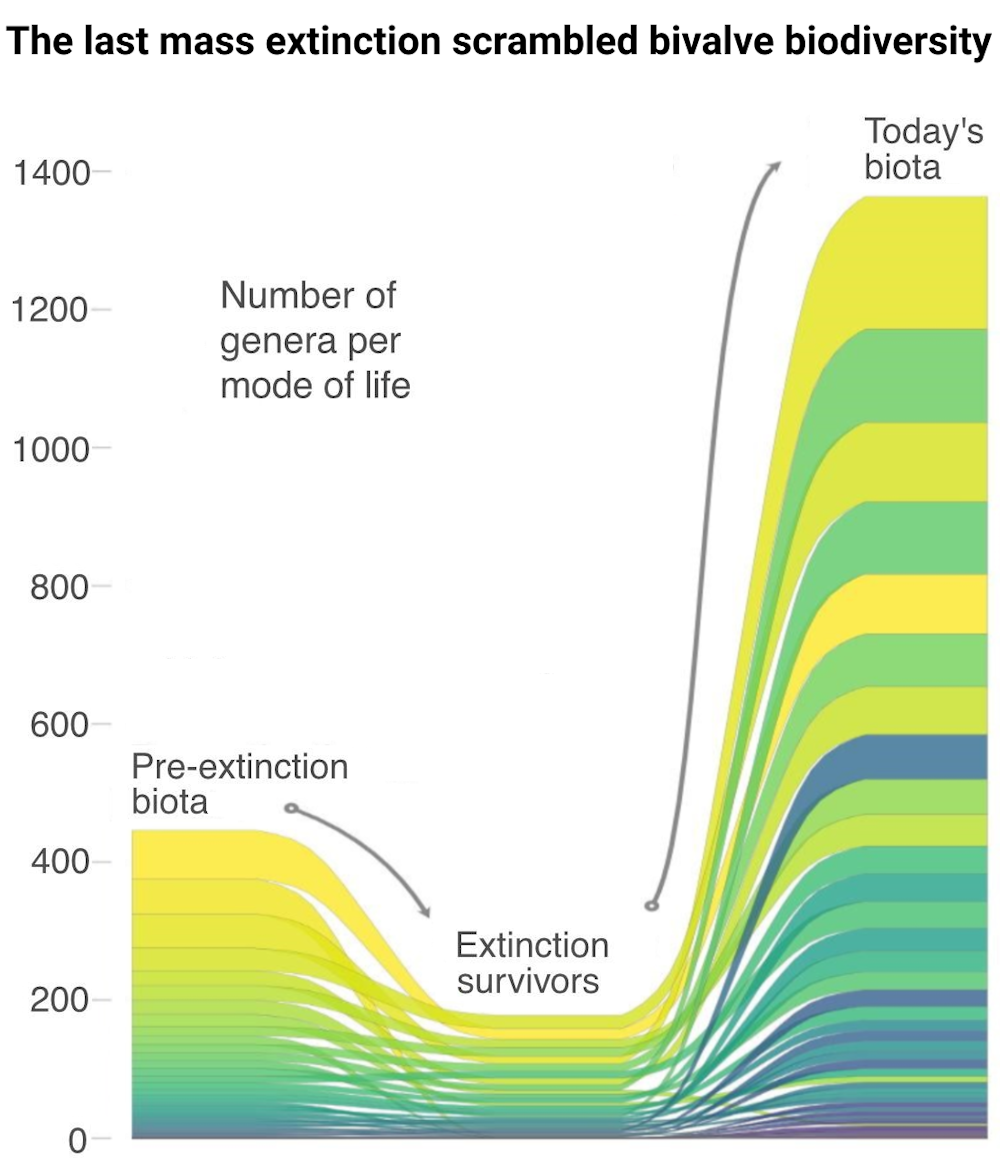
The extinction caused by the asteroid strike knocked down some thriving modes of life and opened the door for others to dominate the new landscape.
The rebound from the extinction wasn’t so straightforward. Some modes of life lost nearly all their species, never to recover their past diversity. Others rose to take the top ranks. Genera is the plural of genus. Adapted from Edie et al. 2025, Science Advances
While many people lament the loss of the dinosaurs, we malacologists miss the rudists.
These bizarrely shaped bivalves resembled giant ice cream cones, sometimes reaching more than 3 feet (1 meter) in size, and they dominated the shallow, tropical Mesozoic seas as massive aggregations of contorted individuals, similar to today’s coral reefs. At least a few harbored photosymbiotic algae, which provided them with nutrients and spurred their growth, much like modern corals.
An ancient fossil of a rudist from before the last mass extinction. These bivalves could grow to a meter high. Smithsonian Institution
Today, giant clams (Tridacna) and their relatives fill parts of these unique photosymbiotic lifestyles once occupied by the rudists, but they lack the rudists’ astonishing species diversity.
Mass extinctions clearly upend the status quo. Now, our ocean floors are dominated by clams burrowed into sand and mud, the quahogs, cockles and their relatives – a scene far different from that of the seafloor 66 million years ago.
New winners in a scrambled ecosystem
Ecological traits alone didn’t fully predict extinction patterns, nor do they entirely explain the rebound. We also see that simply surviving a mass extinction didn’t necessarily provide a leg up as species diversified within their old and sometimes new modes of life – and few of those new modes dominate the ecological landscape today.
Like the rudists, trigoniid bivalves had lots of different species prior to the extinction event. These highly ornamented clams built parts of their shells with a super strong biomaterial called nacre – think iridescent pearls – and had fractally interlocking hinges holding their two valves together.
An ancient fossil of a pearly but tough trigoniid bivalve from the last mass extinction. The two matching shells show their elaborate hinge. Smithsonian Institution
But despite surviving the extinction, which should have placed them in a prime position to accumulate species again, their diversification sputtered. Other types of bivalves that made a living in the same way proliferated instead, relegating this once mighty and global group to a handful of species now found only off the coast of Australia.
Lessons for today’s oceans
These unexpected patterns of extinction and survival may offer lessons for the future.
The fossil record shows us that biodiversity has definite breaking points, usually during a perfect storm of climatic and environmental upheaval. It’s not just that species are lost, but the ecological landscape is overturned.
Many scientists believe the current biodiversity crisis may cascade into a sixth mass extinction, this one driven by human activities that are changing ecosystems and the global climate. Corals, whose reefs are home to nearly a quarter of known marine species, have faced mass bleaching events as warming ocean water puts their future at risk. Acidification as the oceans absorb more carbon dioxide can also weaken the shells of organisms crucial to the ocean food web.
Findings like ours suggest that, in the future, the rebound from extinction events will likely result in very different mixes of species and their modes of life in the oceans. And the result may not align with human needs if species providing the bulk of ecosystem services are driven genetically or functionally extinct.
The global oceans and their inhabitants are complex, and, as our team’s latest research shows, it is difficult to predict the trajectory of biodiversity as it rebounds – even when extinction pressures are reduced.
Billions of people depend on the ocean for food. As the history recorded by the world’s bivalves shows, the upending of the pecking order – the number of species in each mode of life – won’t necessarily settle into an arrangement that can feed as many people the next time around.
Stewart Edie receives funding from the Smithsonian Institution.
Even bivalves looked different during the time of the dinosaurs, as these fossils of an ultra-fortified oyster, left, and armored cockle show.Smithsonian Institution
The fallout was immediate and severe. Evidence shows that about 70% of species went extinct in a geological instant, and not just those famous dinosaurs that once stalked the land. Masters of the Mesozoic oceans were also wiped out, from mosasaurs – a group of aquatic reptiles topping the food chain – to exquisitely shelled squid relatives known as ammonites.
But bubbling away on the seafloor was a stolid group of animals that has left a fantastic fossil record and continues to thrive today: bivalves – clams, cockles, mussels, oysters and more.
What happened to these creatures during the extinction event and how they rebounded tells an important story, both about the past and the future of biodiversity.
Surprising discoveries on the seafloor
Marine bivalves lost around three-quarters of their species during this mass extinction, which marked the end of the Cretaceous Period. My colleagues and I – each of us paleobiologists studying biodiversity – expected that losing so many species would have severely cut down the variety of roles that bivalves play within their environments, what we call their “modes of life.”
But, as we explain in a study published in the journal Sciences Advances, that wasn’t the case. In assessing the fossils of thousands of bivalve species, we found that at least one species from nearly all their modes of life, no matter how rare or specialized, squeaked through the extinction event.
Statistically, that shouldn’t have happened. Kill 70% of bivalve species, even at random, and some modes of life should disappear.
Bivalves had an amazing array of life modes just before the end-Cretaceous mass extinction 66 million years ago. Incredibly, despite the loss of 70% of their species, all but two modes of life survived – Nos. 2 and 10. Adapted from Edie et al. 2025, Science Advances
Most bivalves happily burrow into the sand and mud, feeding on phytoplankton they strain from the water. But others have adopted chemosymbionts and photosymbionts – bacteria and algae that produce nutrients for the bivalves from chemicals or sunlight in exchange for housing. A few have even become carnivorous. Some groups, including the oysters, can lay down a tough cement that hardens underwater, and mussels hold onto rocks by spinning silken threads.
We thought surely these more specialized modes of life would have been snuffed out by the effects of the asteroid’s impact, including dust and debris likely blocking sunlight and disrupting a huge part of the bivalves’ food chain: photosynthetic algae and bacteria. Instead, most persisted, although biodiversity was forever scrambled as a new ecological landscape emerged. Species that were once dominant struggled, while evolutionary newcomers rose in their place.
The reasons some species survived and others didn’t leave many questions to explore. Those that filtered phytoplankton from the water column suffered some of the highest species losses, but so did species that fed on organic scraps and didn’t rely as much on the Sun’s energy. Narrow geographic distributions and different metabolisms may have contributed to these extinction patterns.
Biodiversity bounces back
Life rebounded from each of the Big Five mass extinctions throughout Earth’s history, eventually punching through past diversity highs. The rich fossil record and spectacular ecological diversity of bivalves gives us a terrific opportunity to study these rebounds to understand how ecosystems and global biodiversity rebuild in the wake of extinctions.
The extinction caused by the asteroid strike knocked down some thriving modes of life and opened the door for others to dominate the new landscape.
The rebound from the extinction wasn’t so straightforward. Some modes of life lost nearly all their species, never to recover their past diversity. Others rose to take the top ranks. Genera is the plural of genus. Adapted from Edie et al. 2025, Science Advances
While many people lament the loss of the dinosaurs, we malacologists miss the rudists.
These bizarrely shaped bivalves resembled giant ice cream cones, sometimes reaching more than 3 feet (1 meter) in size, and they dominated the shallow, tropical Mesozoic seas as massive aggregations of contorted individuals, similar to today’s coral reefs. At least a few harbored photosymbiotic algae, which provided them with nutrients and spurred their growth, much like modern corals.
An ancient fossil of a rudist from before the last mass extinction. These bivalves could grow to a meter high. Smithsonian Institution
Today, giant clams (Tridacna) and their relatives fill parts of these unique photosymbiotic lifestyles once occupied by the rudists, but they lack the rudists’ astonishing species diversity.
Mass extinctions clearly upend the status quo. Now, our ocean floors are dominated by clams burrowed into sand and mud, the quahogs, cockles and their relatives – a scene far different from that of the seafloor 66 million years ago.
New winners in a scrambled ecosystem
Ecological traits alone didn’t fully predict extinction patterns, nor do they entirely explain the rebound. We also see that simply surviving a mass extinction didn’t necessarily provide a leg up as species diversified within their old and sometimes new modes of life – and few of those new modes dominate the ecological landscape today.
Like the rudists, trigoniid bivalves had lots of different species prior to the extinction event. These highly ornamented clams built parts of their shells with a super strong biomaterial called nacre – think iridescent pearls – and had fractally interlocking hinges holding their two valves together.
An ancient fossil of a pearly but tough trigoniid bivalve from the last mass extinction. The two matching shells show their elaborate hinge. Smithsonian Institution
But despite surviving the extinction, which should have placed them in a prime position to accumulate species again, their diversification sputtered. Other types of bivalves that made a living in the same way proliferated instead, relegating this once mighty and global group to a handful of species now found only off the coast of Australia.
Lessons for today’s oceans
These unexpected patterns of extinction and survival may offer lessons for the future.
The fossil record shows us that biodiversity has definite breaking points, usually during a perfect storm of climatic and environmental upheaval. It’s not just that species are lost, but the ecological landscape is overturned.
Many scientists believe the current biodiversity crisis may cascade into a sixth mass extinction, this one driven by human activities that are changing ecosystems and the global climate. Corals, whose reefs are home to nearly a quarter of known marine species, have faced mass bleaching events as warming ocean water puts their future at risk. Acidification as the oceans absorb more carbon dioxide can also weaken the shells of organisms crucial to the ocean food web.
Findings like ours suggest that, in the future, the rebound from extinction events will likely result in very different mixes of species and their modes of life in the oceans. And the result may not align with human needs if species providing the bulk of ecosystem services are driven genetically or functionally extinct.
The global oceans and their inhabitants are complex, and, as our team’s latest research shows, it is difficult to predict the trajectory of biodiversity as it rebounds – even when extinction pressures are reduced.
Billions of people depend on the ocean for food. As the history recorded by the world’s bivalves shows, the upending of the pecking order – the number of species in each mode of life – won’t necessarily settle into an arrangement that can feed as many people the next time around.
Stewart Edie receives funding from the Smithsonian Institution.
Even bivalves looked different during the time of the dinosaurs, as these fossils of an ultra-fortified oyster, left, and armored cockle show.Smithsonian Institution
The fallout was immediate and severe. Evidence shows that about 70% of species went extinct in a geological instant, and not just those famous dinosaurs that once stalked the land. Masters of the Mesozoic oceans were also wiped out, from mosasaurs – a group of aquatic reptiles topping the food chain – to exquisitely shelled squid relatives known as ammonites.
But bubbling away on the seafloor was a stolid group of animals that has left a fantastic fossil record and continues to thrive today: bivalves – clams, cockles, mussels, oysters and more.
What happened to these creatures during the extinction event and how they rebounded tells an important story, both about the past and the future of biodiversity.
Surprising discoveries on the seafloor
Marine bivalves lost around three-quarters of their species during this mass extinction, which marked the end of the Cretaceous Period. My colleagues and I – each of us paleobiologists studying biodiversity – expected that losing so many species would have severely cut down the variety of roles that bivalves play within their environments, what we call their “modes of life.”
But, as we explain in a study published in the journal Sciences Advances, that wasn’t the case. In assessing the fossils of thousands of bivalve species, we found that at least one species from nearly all their modes of life, no matter how rare or specialized, squeaked through the extinction event.
Statistically, that shouldn’t have happened. Kill 70% of bivalve species, even at random, and some modes of life should disappear.
Bivalves had an amazing array of life modes just before the end-Cretaceous mass extinction 66 million years ago. Incredibly, despite the loss of 70% of their species, all but two modes of life survived – Nos. 2 and 10. Adapted from Edie et al. 2025, Science Advances
Most bivalves happily burrow into the sand and mud, feeding on phytoplankton they strain from the water. But others have adopted chemosymbionts and photosymbionts – bacteria and algae that produce nutrients for the bivalves from chemicals or sunlight in exchange for housing. A few have even become carnivorous. Some groups, including the oysters, can lay down a tough cement that hardens underwater, and mussels hold onto rocks by spinning silken threads.
We thought surely these more specialized modes of life would have been snuffed out by the effects of the asteroid’s impact, including dust and debris likely blocking sunlight and disrupting a huge part of the bivalves’ food chain: photosynthetic algae and bacteria. Instead, most persisted, although biodiversity was forever scrambled as a new ecological landscape emerged. Species that were once dominant struggled, while evolutionary newcomers rose in their place.
The reasons some species survived and others didn’t leave many questions to explore. Those that filtered phytoplankton from the water column suffered some of the highest species losses, but so did species that fed on organic scraps and didn’t rely as much on the Sun’s energy. Narrow geographic distributions and different metabolisms may have contributed to these extinction patterns.
Biodiversity bounces back
Life rebounded from each of the Big Five mass extinctions throughout Earth’s history, eventually punching through past diversity highs. The rich fossil record and spectacular ecological diversity of bivalves gives us a terrific opportunity to study these rebounds to understand how ecosystems and global biodiversity rebuild in the wake of extinctions.
The extinction caused by the asteroid strike knocked down some thriving modes of life and opened the door for others to dominate the new landscape.
The rebound from the extinction wasn’t so straightforward. Some modes of life lost nearly all their species, never to recover their past diversity. Others rose to take the top ranks. Genera is the plural of genus. Adapted from Edie et al. 2025, Science Advances
While many people lament the loss of the dinosaurs, we malacologists miss the rudists.
These bizarrely shaped bivalves resembled giant ice cream cones, sometimes reaching more than 3 feet (1 meter) in size, and they dominated the shallow, tropical Mesozoic seas as massive aggregations of contorted individuals, similar to today’s coral reefs. At least a few harbored photosymbiotic algae, which provided them with nutrients and spurred their growth, much like modern corals.
An ancient fossil of a rudist from before the last mass extinction. These bivalves could grow to a meter high. Smithsonian Institution
Today, giant clams (Tridacna) and their relatives fill parts of these unique photosymbiotic lifestyles once occupied by the rudists, but they lack the rudists’ astonishing species diversity.
Mass extinctions clearly upend the status quo. Now, our ocean floors are dominated by clams burrowed into sand and mud, the quahogs, cockles and their relatives – a scene far different from that of the seafloor 66 million years ago.
New winners in a scrambled ecosystem
Ecological traits alone didn’t fully predict extinction patterns, nor do they entirely explain the rebound. We also see that simply surviving a mass extinction didn’t necessarily provide a leg up as species diversified within their old and sometimes new modes of life – and few of those new modes dominate the ecological landscape today.
Like the rudists, trigoniid bivalves had lots of different species prior to the extinction event. These highly ornamented clams built parts of their shells with a super strong biomaterial called nacre – think iridescent pearls – and had fractally interlocking hinges holding their two valves together.
An ancient fossil of a pearly but tough trigoniid bivalve from the last mass extinction. The two matching shells show their elaborate hinge. Smithsonian Institution
But despite surviving the extinction, which should have placed them in a prime position to accumulate species again, their diversification sputtered. Other types of bivalves that made a living in the same way proliferated instead, relegating this once mighty and global group to a handful of species now found only off the coast of Australia.
Lessons for today’s oceans
These unexpected patterns of extinction and survival may offer lessons for the future.
The fossil record shows us that biodiversity has definite breaking points, usually during a perfect storm of climatic and environmental upheaval. It’s not just that species are lost, but the ecological landscape is overturned.
Many scientists believe the current biodiversity crisis may cascade into a sixth mass extinction, this one driven by human activities that are changing ecosystems and the global climate. Corals, whose reefs are home to nearly a quarter of known marine species, have faced mass bleaching events as warming ocean water puts their future at risk. Acidification as the oceans absorb more carbon dioxide can also weaken the shells of organisms crucial to the ocean food web.
Findings like ours suggest that, in the future, the rebound from extinction events will likely result in very different mixes of species and their modes of life in the oceans. And the result may not align with human needs if species providing the bulk of ecosystem services are driven genetically or functionally extinct.
The global oceans and their inhabitants are complex, and, as our team’s latest research shows, it is difficult to predict the trajectory of biodiversity as it rebounds – even when extinction pressures are reduced.
Billions of people depend on the ocean for food. As the history recorded by the world’s bivalves shows, the upending of the pecking order – the number of species in each mode of life – won’t necessarily settle into an arrangement that can feed as many people the next time around.
Stewart Edie receives funding from the Smithsonian Institution.
Even bivalves looked different during the time of the dinosaurs, as these fossils of an ultra-fortified oyster, left, and armored cockle show.Smithsonian Institution
The fallout was immediate and severe. Evidence shows that about 70% of species went extinct in a geological instant, and not just those famous dinosaurs that once stalked the land. Masters of the Mesozoic oceans were also wiped out, from mosasaurs – a group of aquatic reptiles topping the food chain – to exquisitely shelled squid relatives known as ammonites.
But bubbling away on the seafloor was a stolid group of animals that has left a fantastic fossil record and continues to thrive today: bivalves – clams, cockles, mussels, oysters and more.
What happened to these creatures during the extinction event and how they rebounded tells an important story, both about the past and the future of biodiversity.
Surprising discoveries on the seafloor
Marine bivalves lost around three-quarters of their species during this mass extinction, which marked the end of the Cretaceous Period. My colleagues and I – each of us paleobiologists studying biodiversity – expected that losing so many species would have severely cut down the variety of roles that bivalves play within their environments, what we call their “modes of life.”
But, as we explain in a study published in the journal Sciences Advances, that wasn’t the case. In assessing the fossils of thousands of bivalve species, we found that at least one species from nearly all their modes of life, no matter how rare or specialized, squeaked through the extinction event.
Statistically, that shouldn’t have happened. Kill 70% of bivalve species, even at random, and some modes of life should disappear.
Bivalves had an amazing array of life modes just before the end-Cretaceous mass extinction 66 million years ago. Incredibly, despite the loss of 70% of their species, all but two modes of life survived – Nos. 2 and 10. Adapted from Edie et al. 2025, Science Advances
Most bivalves happily burrow into the sand and mud, feeding on phytoplankton they strain from the water. But others have adopted chemosymbionts and photosymbionts – bacteria and algae that produce nutrients for the bivalves from chemicals or sunlight in exchange for housing. A few have even become carnivorous. Some groups, including the oysters, can lay down a tough cement that hardens underwater, and mussels hold onto rocks by spinning silken threads.
We thought surely these more specialized modes of life would have been snuffed out by the effects of the asteroid’s impact, including dust and debris likely blocking sunlight and disrupting a huge part of the bivalves’ food chain: photosynthetic algae and bacteria. Instead, most persisted, although biodiversity was forever scrambled as a new ecological landscape emerged. Species that were once dominant struggled, while evolutionary newcomers rose in their place.
The reasons some species survived and others didn’t leave many questions to explore. Those that filtered phytoplankton from the water column suffered some of the highest species losses, but so did species that fed on organic scraps and didn’t rely as much on the Sun’s energy. Narrow geographic distributions and different metabolisms may have contributed to these extinction patterns.
Biodiversity bounces back
Life rebounded from each of the Big Five mass extinctions throughout Earth’s history, eventually punching through past diversity highs. The rich fossil record and spectacular ecological diversity of bivalves gives us a terrific opportunity to study these rebounds to understand how ecosystems and global biodiversity rebuild in the wake of extinctions.
The extinction caused by the asteroid strike knocked down some thriving modes of life and opened the door for others to dominate the new landscape.
The rebound from the extinction wasn’t so straightforward. Some modes of life lost nearly all their species, never to recover their past diversity. Others rose to take the top ranks. Genera is the plural of genus. Adapted from Edie et al. 2025, Science Advances
While many people lament the loss of the dinosaurs, we malacologists miss the rudists.
These bizarrely shaped bivalves resembled giant ice cream cones, sometimes reaching more than 3 feet (1 meter) in size, and they dominated the shallow, tropical Mesozoic seas as massive aggregations of contorted individuals, similar to today’s coral reefs. At least a few harbored photosymbiotic algae, which provided them with nutrients and spurred their growth, much like modern corals.
An ancient fossil of a rudist from before the last mass extinction. These bivalves could grow to a meter high. Smithsonian Institution
Today, giant clams (Tridacna) and their relatives fill parts of these unique photosymbiotic lifestyles once occupied by the rudists, but they lack the rudists’ astonishing species diversity.
Mass extinctions clearly upend the status quo. Now, our ocean floors are dominated by clams burrowed into sand and mud, the quahogs, cockles and their relatives – a scene far different from that of the seafloor 66 million years ago.
New winners in a scrambled ecosystem
Ecological traits alone didn’t fully predict extinction patterns, nor do they entirely explain the rebound. We also see that simply surviving a mass extinction didn’t necessarily provide a leg up as species diversified within their old and sometimes new modes of life – and few of those new modes dominate the ecological landscape today.
Like the rudists, trigoniid bivalves had lots of different species prior to the extinction event. These highly ornamented clams built parts of their shells with a super strong biomaterial called nacre – think iridescent pearls – and had fractally interlocking hinges holding their two valves together.
An ancient fossil of a pearly but tough trigoniid bivalve from the last mass extinction. The two matching shells show their elaborate hinge. Smithsonian Institution
But despite surviving the extinction, which should have placed them in a prime position to accumulate species again, their diversification sputtered. Other types of bivalves that made a living in the same way proliferated instead, relegating this once mighty and global group to a handful of species now found only off the coast of Australia.
Lessons for today’s oceans
These unexpected patterns of extinction and survival may offer lessons for the future.
The fossil record shows us that biodiversity has definite breaking points, usually during a perfect storm of climatic and environmental upheaval. It’s not just that species are lost, but the ecological landscape is overturned.
Many scientists believe the current biodiversity crisis may cascade into a sixth mass extinction, this one driven by human activities that are changing ecosystems and the global climate. Corals, whose reefs are home to nearly a quarter of known marine species, have faced mass bleaching events as warming ocean water puts their future at risk. Acidification as the oceans absorb more carbon dioxide can also weaken the shells of organisms crucial to the ocean food web.
Findings like ours suggest that, in the future, the rebound from extinction events will likely result in very different mixes of species and their modes of life in the oceans. And the result may not align with human needs if species providing the bulk of ecosystem services are driven genetically or functionally extinct.
The global oceans and their inhabitants are complex, and, as our team’s latest research shows, it is difficult to predict the trajectory of biodiversity as it rebounds – even when extinction pressures are reduced.
Billions of people depend on the ocean for food. As the history recorded by the world’s bivalves shows, the upending of the pecking order – the number of species in each mode of life – won’t necessarily settle into an arrangement that can feed as many people the next time around.
Stewart Edie receives funding from the Smithsonian Institution.
The 1,100-page bill would slash incentives for green technologies such as solar, wind, batteries, electric cars and heat pumps while subsidizing existing nuclear power plants and biofuels. That would leave the country and its people burning more fossil fuels despite strong popular and scientific support for a rapid shift to renewable energy.
The bill may still be revised by the Senate before it moves to a final vote. But it is a picture of how President Donald Trump and congressional Republicans want to reshape U.S. energy policy.
As an environmental engineering professor who studies ways to confront climate change, I think it is important to distinguish which technologies could rapidly cut emissions or are on the verge of becoming viable from those that do little to fight climate change. Unfortunately, the House bill favors the latter while nixing support for the former.
However, the House bill rescinds billions of dollars that the Inflation Reduction Act, enacted in 2022, devoted to boosting domestic manufacturing and deployments of renewable energy and batteries.
Deployments would be hit even harder. Wind, solar, geothermal and battery projects would need to commence construction within 60 days of passage of the bill to receive tax credits.
In addition, the bill would deny tax credits to projects that use Chinese-made components. Financial analysts have called those provisions “unworkable,” since some Chinese materials may be necessary even for projects built with as much domestic content as possible.
Wind turbines and solar panels generate renewable energy side by side near Palm Springs, Calif. Mario Tama/Getty Images
Efficiency and electric cars
Cuts fall even harder on Americans who are trying to reduce their carbon footprints and energy costs. The bill repeals aid for home efficiency improvements such as heat pumps, efficient windows and energy audits. Homeowners would also lose tax credits for installing solar panels and batteries.
For vehicles, the bill would not only repeal tax credits for electric cars, trucks and chargers, but it also would impose a federal $250 annual fee on vehicles, on top of fees that some states charge electric-car owners. The federal fee is more than the gas taxes paid by other drivers to fund highways and ignores air-quality and climate effects.
For new nuclear plants, the bill would move up the deadline to 2028 to begin construction. That deadline is too soon for some new reactor designs and would rush the vetting of others. Nuclear safety regulators are awaiting a study from the National Academies on the weapons proliferation risks of the type of uranium fuel that some developers hope to use in newer designs.
The House-passed bill would protect government subsidies for existing nuclear power plants, like the one in the background, while limiting support for wind turbines. Scott Olson/Getty Images
The bill would end tax credits for hydrogen production. Without that support, companies will be unlikely to invest in the seven so-called “hydrogen hubs” that were allocated a combined $8 billion under the Bipartisan Infrastructure Law in 2021. Those hubs aim to attract $40 billion in private investments and create tens of thousands of jobs while developing cleaner ways to make hydrogen.
The repealed tax credits would have subsidized hydrogen made emissions-free by using renewable or nuclear electricity to split water molecules. They also would have subsidized hydrogen made from natural gas with carbon capture, whose benefits are impaired by methane emissions from natural gas systems and incomplete carbon capture.
As Congress deliberates on the One Big Beautiful Bill Act, the nation’s energy agenda is one of many issues being hotly debated. Kevin Carter/Getty Images
Summing it up
The conservative Tax Foundation estimates that the House bill would cut the Inflation Reduction Act’s clean energy tax credits by about half, saving the government $50 billion a year. But with fewer efficiency improvements, fewer electric vehicles and less clean power on the grid, Princeton’s Jenkins projects American households would pay up to $415 more per year for energy by 2035 than if the bill’s provisions were not enacted. If the bill’s provisions make it into law, the extra fossil fuel-burning would leave annual U.S. greenhouse gas emissions 1 billion tons higher by then.
No one expected former President Joe Biden’s Inflation Reduction Act to escape unscathed with Republicans in the White House and dominating both houses of Congress. Still, the proposed cuts target the technologies Americans count on to protect the climate and save consumers money.
Daniel Cohan receives funding from the Carbon Hub at Rice University.
The 1,100-page bill would slash incentives for green technologies such as solar, wind, batteries, electric cars and heat pumps while subsidizing existing nuclear power plants and biofuels. That would leave the country and its people burning more fossil fuels despite strong popular and scientific support for a rapid shift to renewable energy.
The bill may still be revised by the Senate before it moves to a final vote. But it is a picture of how President Donald Trump and congressional Republicans want to reshape U.S. energy policy.
As an environmental engineering professor who studies ways to confront climate change, I think it is important to distinguish which technologies could rapidly cut emissions or are on the verge of becoming viable from those that do little to fight climate change. Unfortunately, the House bill favors the latter while nixing support for the former.
However, the House bill rescinds billions of dollars that the Inflation Reduction Act, enacted in 2022, devoted to boosting domestic manufacturing and deployments of renewable energy and batteries.
Deployments would be hit even harder. Wind, solar, geothermal and battery projects would need to commence construction within 60 days of passage of the bill to receive tax credits.
In addition, the bill would deny tax credits to projects that use Chinese-made components. Financial analysts have called those provisions “unworkable,” since some Chinese materials may be necessary even for projects built with as much domestic content as possible.
Wind turbines and solar panels generate renewable energy side by side near Palm Springs, Calif. Mario Tama/Getty Images
Efficiency and electric cars
Cuts fall even harder on Americans who are trying to reduce their carbon footprints and energy costs. The bill repeals aid for home efficiency improvements such as heat pumps, efficient windows and energy audits. Homeowners would also lose tax credits for installing solar panels and batteries.
For vehicles, the bill would not only repeal tax credits for electric cars, trucks and chargers, but it also would impose a federal $250 annual fee on vehicles, on top of fees that some states charge electric-car owners. The federal fee is more than the gas taxes paid by other drivers to fund highways and ignores air-quality and climate effects.
For new nuclear plants, the bill would move up the deadline to 2028 to begin construction. That deadline is too soon for some new reactor designs and would rush the vetting of others. Nuclear safety regulators are awaiting a study from the National Academies on the weapons proliferation risks of the type of uranium fuel that some developers hope to use in newer designs.
The House-passed bill would protect government subsidies for existing nuclear power plants, like the one in the background, while limiting support for wind turbines. Scott Olson/Getty Images
The bill would end tax credits for hydrogen production. Without that support, companies will be unlikely to invest in the seven so-called “hydrogen hubs” that were allocated a combined $8 billion under the Bipartisan Infrastructure Law in 2021. Those hubs aim to attract $40 billion in private investments and create tens of thousands of jobs while developing cleaner ways to make hydrogen.
The repealed tax credits would have subsidized hydrogen made emissions-free by using renewable or nuclear electricity to split water molecules. They also would have subsidized hydrogen made from natural gas with carbon capture, whose benefits are impaired by methane emissions from natural gas systems and incomplete carbon capture.
As Congress deliberates on the One Big Beautiful Bill Act, the nation’s energy agenda is one of many issues being hotly debated. Kevin Carter/Getty Images
Summing it up
The conservative Tax Foundation estimates that the House bill would cut the Inflation Reduction Act’s clean energy tax credits by about half, saving the government $50 billion a year. But with fewer efficiency improvements, fewer electric vehicles and less clean power on the grid, Princeton’s Jenkins projects American households would pay up to $415 more per year for energy by 2035 than if the bill’s provisions were not enacted. If the bill’s provisions make it into law, the extra fossil fuel-burning would leave annual U.S. greenhouse gas emissions 1 billion tons higher by then.
No one expected former President Joe Biden’s Inflation Reduction Act to escape unscathed with Republicans in the White House and dominating both houses of Congress. Still, the proposed cuts target the technologies Americans count on to protect the climate and save consumers money.
Daniel Cohan receives funding from the Carbon Hub at Rice University.
The 1,100-page bill would slash incentives for green technologies such as solar, wind, batteries, electric cars and heat pumps while subsidizing existing nuclear power plants and biofuels. That would leave the country and its people burning more fossil fuels despite strong popular and scientific support for a rapid shift to renewable energy.
The bill may still be revised by the Senate before it moves to a final vote. But it is a picture of how President Donald Trump and congressional Republicans want to reshape U.S. energy policy.
As an environmental engineering professor who studies ways to confront climate change, I think it is important to distinguish which technologies could rapidly cut emissions or are on the verge of becoming viable from those that do little to fight climate change. Unfortunately, the House bill favors the latter while nixing support for the former.
However, the House bill rescinds billions of dollars that the Inflation Reduction Act, enacted in 2022, devoted to boosting domestic manufacturing and deployments of renewable energy and batteries.
Deployments would be hit even harder. Wind, solar, geothermal and battery projects would need to commence construction within 60 days of passage of the bill to receive tax credits.
In addition, the bill would deny tax credits to projects that use Chinese-made components. Financial analysts have called those provisions “unworkable,” since some Chinese materials may be necessary even for projects built with as much domestic content as possible.
Wind turbines and solar panels generate renewable energy side by side near Palm Springs, Calif. Mario Tama/Getty Images
Efficiency and electric cars
Cuts fall even harder on Americans who are trying to reduce their carbon footprints and energy costs. The bill repeals aid for home efficiency improvements such as heat pumps, efficient windows and energy audits. Homeowners would also lose tax credits for installing solar panels and batteries.
For vehicles, the bill would not only repeal tax credits for electric cars, trucks and chargers, but it also would impose a federal $250 annual fee on vehicles, on top of fees that some states charge electric-car owners. The federal fee is more than the gas taxes paid by other drivers to fund highways and ignores air-quality and climate effects.
For new nuclear plants, the bill would move up the deadline to 2028 to begin construction. That deadline is too soon for some new reactor designs and would rush the vetting of others. Nuclear safety regulators are awaiting a study from the National Academies on the weapons proliferation risks of the type of uranium fuel that some developers hope to use in newer designs.
The House-passed bill would protect government subsidies for existing nuclear power plants, like the one in the background, while limiting support for wind turbines. Scott Olson/Getty Images
The bill would end tax credits for hydrogen production. Without that support, companies will be unlikely to invest in the seven so-called “hydrogen hubs” that were allocated a combined $8 billion under the Bipartisan Infrastructure Law in 2021. Those hubs aim to attract $40 billion in private investments and create tens of thousands of jobs while developing cleaner ways to make hydrogen.
The repealed tax credits would have subsidized hydrogen made emissions-free by using renewable or nuclear electricity to split water molecules. They also would have subsidized hydrogen made from natural gas with carbon capture, whose benefits are impaired by methane emissions from natural gas systems and incomplete carbon capture.
As Congress deliberates on the One Big Beautiful Bill Act, the nation’s energy agenda is one of many issues being hotly debated. Kevin Carter/Getty Images
Summing it up
The conservative Tax Foundation estimates that the House bill would cut the Inflation Reduction Act’s clean energy tax credits by about half, saving the government $50 billion a year. But with fewer efficiency improvements, fewer electric vehicles and less clean power on the grid, Princeton’s Jenkins projects American households would pay up to $415 more per year for energy by 2035 than if the bill’s provisions were not enacted. If the bill’s provisions make it into law, the extra fossil fuel-burning would leave annual U.S. greenhouse gas emissions 1 billion tons higher by then.
No one expected former President Joe Biden’s Inflation Reduction Act to escape unscathed with Republicans in the White House and dominating both houses of Congress. Still, the proposed cuts target the technologies Americans count on to protect the climate and save consumers money.
Daniel Cohan receives funding from the Carbon Hub at Rice University.
The 1,100-page bill would slash incentives for green technologies such as solar, wind, batteries, electric cars and heat pumps while subsidizing existing nuclear power plants and biofuels. That would leave the country and its people burning more fossil fuels despite strong popular and scientific support for a rapid shift to renewable energy.
The bill may still be revised by the Senate before it moves to a final vote. But it is a picture of how President Donald Trump and congressional Republicans want to reshape U.S. energy policy.
As an environmental engineering professor who studies ways to confront climate change, I think it is important to distinguish which technologies could rapidly cut emissions or are on the verge of becoming viable from those that do little to fight climate change. Unfortunately, the House bill favors the latter while nixing support for the former.
However, the House bill rescinds billions of dollars that the Inflation Reduction Act, enacted in 2022, devoted to boosting domestic manufacturing and deployments of renewable energy and batteries.
Deployments would be hit even harder. Wind, solar, geothermal and battery projects would need to commence construction within 60 days of passage of the bill to receive tax credits.
In addition, the bill would deny tax credits to projects that use Chinese-made components. Financial analysts have called those provisions “unworkable,” since some Chinese materials may be necessary even for projects built with as much domestic content as possible.
Wind turbines and solar panels generate renewable energy side by side near Palm Springs, Calif. Mario Tama/Getty Images
Efficiency and electric cars
Cuts fall even harder on Americans who are trying to reduce their carbon footprints and energy costs. The bill repeals aid for home efficiency improvements such as heat pumps, efficient windows and energy audits. Homeowners would also lose tax credits for installing solar panels and batteries.
For vehicles, the bill would not only repeal tax credits for electric cars, trucks and chargers, but it also would impose a federal $250 annual fee on vehicles, on top of fees that some states charge electric-car owners. The federal fee is more than the gas taxes paid by other drivers to fund highways and ignores air-quality and climate effects.
For new nuclear plants, the bill would move up the deadline to 2028 to begin construction. That deadline is too soon for some new reactor designs and would rush the vetting of others. Nuclear safety regulators are awaiting a study from the National Academies on the weapons proliferation risks of the type of uranium fuel that some developers hope to use in newer designs.
The House-passed bill would protect government subsidies for existing nuclear power plants, like the one in the background, while limiting support for wind turbines. Scott Olson/Getty Images
The bill would end tax credits for hydrogen production. Without that support, companies will be unlikely to invest in the seven so-called “hydrogen hubs” that were allocated a combined $8 billion under the Bipartisan Infrastructure Law in 2021. Those hubs aim to attract $40 billion in private investments and create tens of thousands of jobs while developing cleaner ways to make hydrogen.
The repealed tax credits would have subsidized hydrogen made emissions-free by using renewable or nuclear electricity to split water molecules. They also would have subsidized hydrogen made from natural gas with carbon capture, whose benefits are impaired by methane emissions from natural gas systems and incomplete carbon capture.
As Congress deliberates on the One Big Beautiful Bill Act, the nation’s energy agenda is one of many issues being hotly debated. Kevin Carter/Getty Images
Summing it up
The conservative Tax Foundation estimates that the House bill would cut the Inflation Reduction Act’s clean energy tax credits by about half, saving the government $50 billion a year. But with fewer efficiency improvements, fewer electric vehicles and less clean power on the grid, Princeton’s Jenkins projects American households would pay up to $415 more per year for energy by 2035 than if the bill’s provisions were not enacted. If the bill’s provisions make it into law, the extra fossil fuel-burning would leave annual U.S. greenhouse gas emissions 1 billion tons higher by then.
No one expected former President Joe Biden’s Inflation Reduction Act to escape unscathed with Republicans in the White House and dominating both houses of Congress. Still, the proposed cuts target the technologies Americans count on to protect the climate and save consumers money.
Daniel Cohan receives funding from the Carbon Hub at Rice University.
As summer arrives, people are turning on air conditioners in most of the U.S. But if you’re like me, you always feel a little guilty about that. Past generations managed without air conditioning – do I really need it? And how bad is it to use all this electricity for cooling in a warming world?
If I leave my air conditioner off, I get too hot. But if everyone turns on their air conditioner at the same time, electricity demand spikes, which can force power grid operators to activate some of the most expensive, and dirtiest, power plants. Sometimes those spikes can ask too much of the grid and lead to brownouts or blackouts.
Research I recently published with a team of scholars makes me feel a little better, though. We have found that it is possible to coordinate the operation of large numbers of home air-conditioning units, balancing supply and demand on the power grid – and without making people endure high temperatures inside their homes.
Studies along these lines, using remote control of air conditioners to support the grid, have for many years explored theoretical possibilities like this. However, few approaches have been demonstrated in practice and never for such a high-value application and at this scale. The system we developed not only demonstrated the ability to balance the grid on timescales of seconds, but also proved it was possible to do so without affecting residents’ comfort.
The benefits include increasing the reliability of the power grid, which makes it easier for the grid to accept more renewable energy. Our goal is to turn air conditioners from a challenge for the power grid into an asset, supporting a shift away from fossil fuels toward cleaner energy.
Originally, the U.S. electric grid was built to transport electricity from large power plants to customers’ homes and businesses. And originally, power plants were large, centralized operations that burned coal or natural gas, or harvested energy from nuclear reactions. These plants were typically always available and could adjust how much power they generated in response to customer demand, so the grid would be balanced between power coming in from producers and being used by consumers.
But the grid has changed. There are more renewable energy sources, from which power isn’t always available – like solar panels at night or wind turbines on calm days. And there are the devices and equipment I study. These newer options, called “distributed energy resources,” generate or store energy near where consumers need it – or adjust how much energy they’re using in real time.
One aspect of the grid hasn’t changed, though: There’s not much storage built into the system. So every time you turn on a light, for a moment there’s not enough electricity to supply everything that wants it right then: The grid needs a power producer to generate a little more power. And when you turn off a light, there’s a little too much: A power producer needs to ramp down.
The way power plants know what real-time power adjustments are needed is by closely monitoring the grid frequency. The goal is to provide electricity at a constant frequency – 60 hertz – at all times. If more power is needed than is being produced, the frequency drops and a power plant boosts output. If there’s too much power being produced, the frequency rises and a power plant slows production a little. These actions, a process called “frequency regulation,” happen in a matter of seconds to keep the grid balanced.
This output flexibility, primarily from power plants, is key to keeping the lights on for everyone.
I’m interested in how distributed energy resources can improve flexibility in the grid. They can release more energy, or consume less, to respond to the changing supply or demand, and help balance the grid, ensuring the frequency remains near 60 hertz.
Some people fear that doing so might be invasive, giving someone outside your home the ability to control your battery or air conditioner. Therefore, we wanted to see if we could help balance the grid with frequency regulation using home air-conditioning units rather than power plants – without affecting how residents use their appliances or how comfortable they are in their homes.
From 2019 to 2023, my group at the University of Michigan tried this approach, in collaboration with researchers at Pecan Street Inc., Los Alamos National Laboratory and the University of California, Berkeley, with funding from the U.S. Department of Energy Advanced Research Projects Agency-Energy.
We recruited 100 homeowners in Austin, Texas, to do a real-world test of our system. All the homes had whole-house forced-air cooling systems, which we connected to custom control boards and sensors the owners allowed us to install in their homes. This equipment let us send instructions to the air-conditioning units based on the frequency of the grid.
Before I explain how the system worked, I first need to explain how thermostats work. When people set thermostats, they pick a temperature, and the thermostat switches the air-conditioning compressor on and off to maintain the air temperature within a small range around that set point. If the temperature is set at 68 degrees, the thermostat turns the AC on when the temperature is, say, 70, and turns it off when it’s cooled down to, say, 66.
Every few seconds, our system slightly changed the timing of air-conditioning compressor switching for some of the 100 air conditioners, causing the units’ aggregate power consumption to change. In this way, our small group of home air conditioners reacted to grid changes the way a power plant would – using more or less energy to balance the grid and keep the frequency near 60 hertz.
Moreover, our system was designed to keep home temperatures within the same small temperature range around the set point.
Smart thermostats could have frequency regulation capabilities available to interested consumers, to help balance the electricity grid. Danielle Mead/iStock/Getty Images Plus
Testing the approach
We ran our system in four tests, each lasting one hour. We found two encouraging results.
First, the air conditioners were able to provide frequency regulation at least as accurately as a traditional power plant. Therefore, we showed that air conditioners could play a significant role in increasing grid flexibility. But perhaps more importantly – at least in terms of encouraging people to participate in these types of systems – we found that we were able to do so without affecting people’s comfort in their homes.
We found that home temperatures did not deviate more than 1.6 Fahrenheit from their set point. Homeowners were allowed to override the controls if they got uncomfortable, but most didn’t. For most tests, we received zero override requests. In the worst case, we received override requests from two of the 100 homes in our test.
In practice, this sort of technology could be added to commercially available internet-connected thermostats. In exchange for credits on their energy bills, users could choose to join a service run by the thermostat company, their utility provider or some other third party.
Then people could turn on the air conditioning in the summer heat without that pang of guilt, knowing they were helping to make the grid more reliable and more capable of accommodating renewable energy sources – without sacrificing their own comfort in the process.
Johanna Mathieu works for the University of Michigan. She has received funding from the National Science Foundation, Department of Energy, ARPA-E, and the Alfred P. Sloan Foundation. She is affiliated with the IEEE.
Source: The Conversation – USA (2) – By Magali A. Delmas, Professor of Management, Institute of the Environment and Sustainability, Anderson School of Management, University of California, Los Angeles
Since the early 1990s, the small blue Energy Star label has appeared on millions of household appliances, electronics and even buildings across the United States. But as the Trump administration considers terminating some or all of the program, it is worth a look at what exactly this government-backed label means, and why it has become one of the most recognizable environmental certifications in the country.
Energy Star was launched by the U.S. Environmental Protection Agency in 1992 and later expanded in partnership with the Department of Energy with a simple goal: making it easier for consumers and businesses to choose energy-efficient products, helping them reduce energy use and save money, without sacrificing quality or performance.
As a scholar of energy conservation, I have studied the Energy Star program’s development and public impact, including how it has shaped consumer behavior and environmental outcomes.
Products that earn the Energy Star certification typically use significantly less energy than standard models, often between 10% and 50% less. The energy – and financial – savings can add up quickly, especially when homes or buildings have multiple Energy Star appliances and systems.
Energy Star itself does not manufacture or sell products. Instead, it acts as a trusted third-party certifier, providing consumers and businesses with reliable information and clear labeling. It also offers information to help people estimate energy savings and compare long-term costs, making it easier to identify high-performing, cost-effective options. Manufacturers participating in Energy Star seek to improve their environmental reputation and increase their market share, giving them a strong incentive to meet the program’s efficiency criteria.
Today, the label appears on refrigerators, dishwashers, laptops, commercial buildings and even newly built homes. The government says people in more than 90% of American households recognize the label.
Energy Star-certified appliances include upright freezers, clothes washers and many other types of home equipment, which use between 10% and 50% less energy than uncertified items. AP Photo/Joshua A. Bickel
People don’t always choose efficient products
Energy Star seeks to tackle a wide range of problems that can result in people deciding not to buy energy-efficient products.
One problem is that efficient models often come with higher up-front costs. While efficient models save money over time, that higher purchase price can discourage buyers. Energy Star helps counter this problem by clearly showing how much money can be saved on energy costs over the lifetime of the product – as compared with noncertified products – and by offering rebates that reduce the initial expense.
Another problem involves what economists call “split incentives.” A landlord might not want to pay a higher price up front for energy-efficient appliances if the tenants are the ones who will save money on the utility bills. And renters may not want to spend a lot of money on appliances or equipment in a place they do not own. Energy Star tries to bridge this divide by promoting whole-building certifications, which encourage landlords to invest in their buildings’ energy efficiency with the goal of making their properties more attractive to tenants.
The countless varieties of refrigerators, dishwashers, air conditioners and other items on the market can also create confusion. Consumers who just look at manufacturers’ promotional material may find it very hard to determine which appliances truly deliver better energy efficiency. The Energy Star label makes this comparison easier: If the label is there, it is among the most efficient choices available.
And consumers are often skeptical of manufacturers’ claims – especially when it comes to new technologies or environmental promises. Energy Star’s status as a program backed by the government, rather than a private company, gives it a level of independence and credibility that many other labels lack. People know the certification is based on science, not sales tactics.
Lastly, Energy Star helps overcome the problem that many people are not aware of how much energy their appliances consume, or how those choices contribute to climate change. By connecting everyday products to larger environmental outcomes, Energy Star helps consumers understand the effects of their decisions, without needing to become energy experts.
The program delivers real results
Since its inception, more than 800,000 appliance models have earned Energy Star certification based on the criteria for their type of product.
The same principles that make the label valuable for consumer appliances – independent certification, clear metrics and a focus on results – have proved equally effective in real estate. Nearly 45,000 commercial buildings and industrial plants have earned certification. And there have been more than 2.5 million Energy Star-certified homes and apartments built in the U.S.
Energy Star-certified homes are designed to be at least 10% more energy efficient than those built to standard building codes, with more insulation and windows and lights that are energy-efficient, as well as appliances. These enhancements can translate to better quality, comfort and long-term cost savings for homeowners.
Commercial buildings, which account for about 18% of total U.S. energy use, have also benefited substantially. Research I was involved in found that certified commercial buildings use an average of 19% less energy than their noncertified counterparts.
Energy Star’s status as a government-led label contributes to its credibility as a more neutral and science-based source of information than commercial labels.
Energy Star’s government connections also bring scale: By requiring federal purchases to have Energy Star certifications, the federal government can influence manufacturers. For example, a federal executive order in 1993 required government agencies to purchase only computers that had been Energy Star-certified, which required them to have energy-saving sleep functions.
In response, manufacturers began including the feature so they could sell their products to the government. Consumers soon came to expect the sleep feature on all computers.
A quiet success story in energy and climate
Energy Star does not grab headlines. It does not rely on regulation or mandates. Yet it has quietly become one of the most effective tools the U.S. has for improving energy efficiency across homes, offices and public buildings.
That said, the program is not without its limitations. Some critics have pointed out that not all certified products consistently perform at the highest efficiency levels. Other critics note that the benefits of Energy Star are more accessible to wealthier consumers who can afford up-front investments, even with available rebates. And the EPA itself has, at times, struggled to manage the certification process and update standards in line with the latest technological advances.
At a time when energy costs and climate concerns are rising, Energy Star stands out as a rare example of a practical, nonpartisan program that delivers real benefits. It helps individuals, businesses and communities save money, lower emissions and take part in a more sustainable future – one smart decision at a time.
Magali Delmas received funding from the US EPA in 2002 for research on Environmental Management Strategies and Corporate Performance.
Source: The Conversation – USA (2) – By Magali A. Delmas, Professor of Management, Institute of the Environment and Sustainability, Anderson School of Management, University of California, Los Angeles
Since the early 1990s, the small blue Energy Star label has appeared on millions of household appliances, electronics and even buildings across the United States. But as the Trump administration considers terminating some or all of the program, it is worth a look at what exactly this government-backed label means, and why it has become one of the most recognizable environmental certifications in the country.
Energy Star was launched by the U.S. Environmental Protection Agency in 1992 and later expanded in partnership with the Department of Energy with a simple goal: making it easier for consumers and businesses to choose energy-efficient products, helping them reduce energy use and save money, without sacrificing quality or performance.
As a scholar of energy conservation, I have studied the Energy Star program’s development and public impact, including how it has shaped consumer behavior and environmental outcomes.
Products that earn the Energy Star certification typically use significantly less energy than standard models, often between 10% and 50% less. The energy – and financial – savings can add up quickly, especially when homes or buildings have multiple Energy Star appliances and systems.
Energy Star itself does not manufacture or sell products. Instead, it acts as a trusted third-party certifier, providing consumers and businesses with reliable information and clear labeling. It also offers information to help people estimate energy savings and compare long-term costs, making it easier to identify high-performing, cost-effective options. Manufacturers participating in Energy Star seek to improve their environmental reputation and increase their market share, giving them a strong incentive to meet the program’s efficiency criteria.
Today, the label appears on refrigerators, dishwashers, laptops, commercial buildings and even newly built homes. The government says people in more than 90% of American households recognize the label.
Energy Star-certified appliances include upright freezers, clothes washers and many other types of home equipment, which use between 10% and 50% less energy than uncertified items. AP Photo/Joshua A. Bickel
People don’t always choose efficient products
Energy Star seeks to tackle a wide range of problems that can result in people deciding not to buy energy-efficient products.
One problem is that efficient models often come with higher up-front costs. While efficient models save money over time, that higher purchase price can discourage buyers. Energy Star helps counter this problem by clearly showing how much money can be saved on energy costs over the lifetime of the product – as compared with noncertified products – and by offering rebates that reduce the initial expense.
Another problem involves what economists call “split incentives.” A landlord might not want to pay a higher price up front for energy-efficient appliances if the tenants are the ones who will save money on the utility bills. And renters may not want to spend a lot of money on appliances or equipment in a place they do not own. Energy Star tries to bridge this divide by promoting whole-building certifications, which encourage landlords to invest in their buildings’ energy efficiency with the goal of making their properties more attractive to tenants.
The countless varieties of refrigerators, dishwashers, air conditioners and other items on the market can also create confusion. Consumers who just look at manufacturers’ promotional material may find it very hard to determine which appliances truly deliver better energy efficiency. The Energy Star label makes this comparison easier: If the label is there, it is among the most efficient choices available.
And consumers are often skeptical of manufacturers’ claims – especially when it comes to new technologies or environmental promises. Energy Star’s status as a program backed by the government, rather than a private company, gives it a level of independence and credibility that many other labels lack. People know the certification is based on science, not sales tactics.
Lastly, Energy Star helps overcome the problem that many people are not aware of how much energy their appliances consume, or how those choices contribute to climate change. By connecting everyday products to larger environmental outcomes, Energy Star helps consumers understand the effects of their decisions, without needing to become energy experts.
The program delivers real results
Since its inception, more than 800,000 appliance models have earned Energy Star certification based on the criteria for their type of product.
The same principles that make the label valuable for consumer appliances – independent certification, clear metrics and a focus on results – have proved equally effective in real estate. Nearly 45,000 commercial buildings and industrial plants have earned certification. And there have been more than 2.5 million Energy Star-certified homes and apartments built in the U.S.
Energy Star-certified homes are designed to be at least 10% more energy efficient than those built to standard building codes, with more insulation and windows and lights that are energy-efficient, as well as appliances. These enhancements can translate to better quality, comfort and long-term cost savings for homeowners.
Commercial buildings, which account for about 18% of total U.S. energy use, have also benefited substantially. Research I was involved in found that certified commercial buildings use an average of 19% less energy than their noncertified counterparts.
Energy Star’s status as a government-led label contributes to its credibility as a more neutral and science-based source of information than commercial labels.
Energy Star’s government connections also bring scale: By requiring federal purchases to have Energy Star certifications, the federal government can influence manufacturers. For example, a federal executive order in 1993 required government agencies to purchase only computers that had been Energy Star-certified, which required them to have energy-saving sleep functions.
In response, manufacturers began including the feature so they could sell their products to the government. Consumers soon came to expect the sleep feature on all computers.
A quiet success story in energy and climate
Energy Star does not grab headlines. It does not rely on regulation or mandates. Yet it has quietly become one of the most effective tools the U.S. has for improving energy efficiency across homes, offices and public buildings.
That said, the program is not without its limitations. Some critics have pointed out that not all certified products consistently perform at the highest efficiency levels. Other critics note that the benefits of Energy Star are more accessible to wealthier consumers who can afford up-front investments, even with available rebates. And the EPA itself has, at times, struggled to manage the certification process and update standards in line with the latest technological advances.
At a time when energy costs and climate concerns are rising, Energy Star stands out as a rare example of a practical, nonpartisan program that delivers real benefits. It helps individuals, businesses and communities save money, lower emissions and take part in a more sustainable future – one smart decision at a time.
Magali Delmas received funding from the US EPA in 2002 for research on Environmental Management Strategies and Corporate Performance.
Source: The Conversation – USA (2) – By Magali A. Delmas, Professor of Management, Institute of the Environment and Sustainability, Anderson School of Management, University of California, Los Angeles
Since the early 1990s, the small blue Energy Star label has appeared on millions of household appliances, electronics and even buildings across the United States. But as the Trump administration considers terminating some or all of the program, it is worth a look at what exactly this government-backed label means, and why it has become one of the most recognizable environmental certifications in the country.
Energy Star was launched by the U.S. Environmental Protection Agency in 1992 and later expanded in partnership with the Department of Energy with a simple goal: making it easier for consumers and businesses to choose energy-efficient products, helping them reduce energy use and save money, without sacrificing quality or performance.
As a scholar of energy conservation, I have studied the Energy Star program’s development and public impact, including how it has shaped consumer behavior and environmental outcomes.
Products that earn the Energy Star certification typically use significantly less energy than standard models, often between 10% and 50% less. The energy – and financial – savings can add up quickly, especially when homes or buildings have multiple Energy Star appliances and systems.
Energy Star itself does not manufacture or sell products. Instead, it acts as a trusted third-party certifier, providing consumers and businesses with reliable information and clear labeling. It also offers information to help people estimate energy savings and compare long-term costs, making it easier to identify high-performing, cost-effective options. Manufacturers participating in Energy Star seek to improve their environmental reputation and increase their market share, giving them a strong incentive to meet the program’s efficiency criteria.
Today, the label appears on refrigerators, dishwashers, laptops, commercial buildings and even newly built homes. The government says people in more than 90% of American households recognize the label.
Energy Star-certified appliances include upright freezers, clothes washers and many other types of home equipment, which use between 10% and 50% less energy than uncertified items. AP Photo/Joshua A. Bickel
People don’t always choose efficient products
Energy Star seeks to tackle a wide range of problems that can result in people deciding not to buy energy-efficient products.
One problem is that efficient models often come with higher up-front costs. While efficient models save money over time, that higher purchase price can discourage buyers. Energy Star helps counter this problem by clearly showing how much money can be saved on energy costs over the lifetime of the product – as compared with noncertified products – and by offering rebates that reduce the initial expense.
Another problem involves what economists call “split incentives.” A landlord might not want to pay a higher price up front for energy-efficient appliances if the tenants are the ones who will save money on the utility bills. And renters may not want to spend a lot of money on appliances or equipment in a place they do not own. Energy Star tries to bridge this divide by promoting whole-building certifications, which encourage landlords to invest in their buildings’ energy efficiency with the goal of making their properties more attractive to tenants.
The countless varieties of refrigerators, dishwashers, air conditioners and other items on the market can also create confusion. Consumers who just look at manufacturers’ promotional material may find it very hard to determine which appliances truly deliver better energy efficiency. The Energy Star label makes this comparison easier: If the label is there, it is among the most efficient choices available.
And consumers are often skeptical of manufacturers’ claims – especially when it comes to new technologies or environmental promises. Energy Star’s status as a program backed by the government, rather than a private company, gives it a level of independence and credibility that many other labels lack. People know the certification is based on science, not sales tactics.
Lastly, Energy Star helps overcome the problem that many people are not aware of how much energy their appliances consume, or how those choices contribute to climate change. By connecting everyday products to larger environmental outcomes, Energy Star helps consumers understand the effects of their decisions, without needing to become energy experts.
The program delivers real results
Since its inception, more than 800,000 appliance models have earned Energy Star certification based on the criteria for their type of product.
The same principles that make the label valuable for consumer appliances – independent certification, clear metrics and a focus on results – have proved equally effective in real estate. Nearly 45,000 commercial buildings and industrial plants have earned certification. And there have been more than 2.5 million Energy Star-certified homes and apartments built in the U.S.
Energy Star-certified homes are designed to be at least 10% more energy efficient than those built to standard building codes, with more insulation and windows and lights that are energy-efficient, as well as appliances. These enhancements can translate to better quality, comfort and long-term cost savings for homeowners.
Commercial buildings, which account for about 18% of total U.S. energy use, have also benefited substantially. Research I was involved in found that certified commercial buildings use an average of 19% less energy than their noncertified counterparts.
Energy Star’s status as a government-led label contributes to its credibility as a more neutral and science-based source of information than commercial labels.
Energy Star’s government connections also bring scale: By requiring federal purchases to have Energy Star certifications, the federal government can influence manufacturers. For example, a federal executive order in 1993 required government agencies to purchase only computers that had been Energy Star-certified, which required them to have energy-saving sleep functions.
In response, manufacturers began including the feature so they could sell their products to the government. Consumers soon came to expect the sleep feature on all computers.
A quiet success story in energy and climate
Energy Star does not grab headlines. It does not rely on regulation or mandates. Yet it has quietly become one of the most effective tools the U.S. has for improving energy efficiency across homes, offices and public buildings.
That said, the program is not without its limitations. Some critics have pointed out that not all certified products consistently perform at the highest efficiency levels. Other critics note that the benefits of Energy Star are more accessible to wealthier consumers who can afford up-front investments, even with available rebates. And the EPA itself has, at times, struggled to manage the certification process and update standards in line with the latest technological advances.
At a time when energy costs and climate concerns are rising, Energy Star stands out as a rare example of a practical, nonpartisan program that delivers real benefits. It helps individuals, businesses and communities save money, lower emissions and take part in a more sustainable future – one smart decision at a time.
Magali Delmas received funding from the US EPA in 2002 for research on Environmental Management Strategies and Corporate Performance.
Source: The Conversation – UK – By Andrew Gawthorpe, Lecturer in History and International Studies, Leiden University
Donald Trump is a difficult figure to deal with, both for foreign leaders and figures closer to home who find themselves in his crosshairs. The US president is unpredictable, sensitive and willing to break the rules to get his way.
But in Trump’s second term, a variety of different leaders and institutions seem to have settled on a way to handle him. The key, they seem to think, is flattery. The most obvious example came at the recently concluded Nato summit in The Hague, Netherlands, where world leaders got together to discuss the future of the alliance.
Previous summits with Trump have descended into recrimination and backbiting. The organisers were determined to avoid a repeat – and decided the best way to do it was to make Trump feel really, really good about himself.
Even before the summit began, Nato secretary-general Mark Rutte had texted Trump to thank him for his “decisive action” in bombing Iran. This, he said, was something “no one else dared to do”.
Then, when discussing Trump’s role in ending the war between Israel and Iran, Rutte referred to Trump as “daddy” – a name the White House has already transformed into a meme.
The summit itself was light on the sort of contentious and detailed policy discussions that have historically bored and angered Trump.
Instead, it was reduced to a series of photo opportunities and speeches in which other leaders lavished praise on Trump. Lithuania’s president, Gitanas Nausėda, even suggested the alliance ought to copy Trump’s political movement by adopting the phrase “make Nato great again”.
Nato leaders aren’t the only ones trying this trick. British prime minister Keir Starmer has had a go at it too. Starmer has made sure that Trump will be the first US president to make a second state visit to the UK. He described the honour in Trump-like terms: “This has never happened before. It’s so incredible. It will be historic.”
After Trump announced global trade tariffs earlier in the year, Starmer was the first leader to give Trump a much-needed victory by reaching a framework trade agreement. But it worked both ways, with Starmer able to land a political victory too.
In his first term, flattery was also seen as a tool to be used to get Trump onside. Ukraine’s Volodymyr Zelensky tried it in phone conversations with the US president, calling him a “great teacher” from whom he learned “skills and knowledge”.
Flattery and compliance clearly have their uses. Trump is extremely sensitive to criticism and susceptible to praise, however hyperbolic and transparent it might be. Buttering him up may be an effective way to get him to back off.
But it doesn’t achieve much else. At the Nato summit, an opportunity was missed to make progress on issues of real importance, such as how to better support Ukraine in its war against Russia or to better coordinate European defence spending.
A summit dedicated to the sole aim of making Trump feel good is one with very limited aims indeed. All it does is push the difficult decisions forward for another day.
A missed opportunity
Individual decisions to bow down to Trump also mean missing the opportunity to mount collective resistance. One country might not be able to stand up to the president, but the odds of doing so would be greatly improved if leaders banded together.
For example, Trump’s trade tariffs will damage the US economy as well as those of its trading partners. That is especially the case if those partners impose tariffs of their own on US goods.
If each country instead follows Britain’s lead in the hope of getting the best deal for itself, they will have missed the opportunity to force the president to feel some discomfort of his own – and possibly change course.
But perhaps the greatest danger of flattering Trump is that it teaches him that he can get away with doing pretty much whatever he likes. For a president who has threatened to annex the territory of Nato allies Denmark and Canada to nevertheless be feted at a Nato summit sends a message of impunity.
That’s a dangerous lesson for Trump to learn. He has spent much of his second term undermining democratic and liberal norms at home and key tenets of US foreign policy abroad, such as hostility to Russia. He is attempting to undermine all traditional sources of authority and expertise and instead make the world dance to his own tune.
Given the expansive scope of his aims, which many experts already think is leading to a constitutional crisis that threatens democracy, the willingness to suck up to Trump normalises him in a menacing way.
When his targets roll over, it sends a message to others that Trump is unstoppable and resistance is futile. It encourages not just the next presidential abuse of power, but also the next surrender from those he chooses to attack.
Perhaps the best that can be said for this strategy is that maybe it will appease Trump enough to prevent him from doing too much actual harm. But when dealing with such an unpredictable and vindictive president, that is a thin reed of hope.
It is much more likely to encourage him to press on – until the harm becomes too severe to ignore.
Andrew Gawthorpe does not work for, consult, own shares in or receive funding from any company or organisation that would benefit from this article, and has disclosed no relevant affiliations beyond their academic appointment.
This article was first published in The Conversation UK’s World Affairs Briefing email newsletter. Sign up to receive weekly analysis of the latest developments in international relations, direct to your inbox.
Once again Donald Trump and his senior team are unhappy with their press coverage. Here’s the US president, fresh from his triumph in The Hague, having persuaded Nato’s leaders to open their wallets and agree to up their defence spending to 5% of GDP (apart from Spain, that is, which can expect to hear of triple-digit tariffs coming its way in the near future) – and do the media focus on Trump’s tour de force? Do they hell. Instead they focus on whether his strikes against Iran had been as successful as he claimed.
As you can imagine, this would have been irksome in the extreme for the president, who might reasonably have expected that the story of the day would be his victory in getting pledges from virtually all Nato’s members to pull their weight in terms of their own defence. Certainly the Nato secretary-general, Mark Rutte, could appreciate the scale of his achievement. Even before the summit, Rutte was talking it up.
“Donald, you have driven us to a really, really important moment for America and Europe, and the world,” he wrote in a message to Trump as the US president prepared to fly to The Netherlands. “You will achieve something NO American president in decades could get done.”
The fact that Trump promptly posted this message to his TruthSocial website suggests how important praise is to the the US president. It’s something that many world leaders (including Benjamin Netanyahu and Vladimir Putin who have become past-masters at pouring honey in the president’s ear) have recognised and are willing to use as a diplomatic tool when dealing with the man Rutte calls “Daddy”.
Sign up to receive our weekly World Affairs Briefing newsletter from The Conversation UK. Every Thursday we’ll bring you expert analysis of the big stories in international relations.
But while flattery as a tactic seems to be effective with the US president, Andrew Gawthorpe, a political historian from Leiden University, cautions that flattery, appeasement and compliance are a flawed approach when dealing with a man like Trump. For a start, he writes it means that not much actually gets done and that problems are often merely avoided rather than solved.
But more worryingly, simply capitulating in the face of Trumpian pressure or ire risks giving this US president the idea that he can do anything he wants. “When his targets roll over, it sends a message to others that Trump is unstoppable and resistance is futile,” writes Gawthorpe. It encourages not just the next presidential abuse of power, but also the next surrender from its victims.
We got a taste of what the US president’s anger at being defied sounds like as he prepared to fly to The Netherlands for the Nato summit. Asked about the ceasefire he had negotiated between Israel and Iran, he lashed out at both countries who had breached the peace within hours of agreeing to stop firing missiles at each other. “We basically have two countries that have been fighting so long and so hard that they don’t know what the fuck they’re doing,” he told reporters as he walked to the presidential helicopter.
Psychologist Geoff Beattie, of Edge Hill University, believes this was no accidental verbal slip. Trump wanted to let the world know how angry he was and chose to use the “f-bomb” as a way of showing it. Beattie looks at what this can tell us about the character of the US president – and how it might reflect a tendency to make rapid decisions based on emotional reactions.
What was remarkable about the Nato summit was that it was condensed to one fairly short session which focused solely on the issue of Nato members’ defence budgets. Usually there’s a much broader agenda. Over the past couple of years the issue of Ukraine has been fairly high on the list, but this time – perhaps to avoid any potential divisions – it was relegated to a side issue.
Perhaps the biggest success for Nato, writes Stefan Wolff, is that they managed to get Trump to the summit and keep him in the room. After all, less than a fortnight previously he walked out of the G7 leaders’ meeting in Canada a day early before authorising the bombing raids on Iran’s nuclear installations (of which more later).
Wolff, an expert in international security from the University of Birmingham (and a regular contributor to this newsletter) believes that the non-US members realised they had little choice but to comply – or at least to be seen to be complying. There’s a significant capability deficit: “European states also lack most of the so-called critical enablers, the military hardware and technology required to prevail in a potential war with Russia.”
So keeping the US president onside – and inside Nato with a remaining commitment to America’s article 5 mutual defence pledge – was top of the list this year and something they appear to have pulled off.
The fact is, writes Andrew Corbett, a defence expert at King’s College London, that Europe and the US have different enemies these days. Europe is still focused on the foe it faced across the Iron Curtain after 1945, against which Nato was designed as a defensive bulwark.
The US is now far more focused on the threat from China. This means it will increasingly shift the bulk of its naval assets to the Pacific (although the Middle East seems to be delaying this shift at present). This inevitably means downgrading its presence in Europe, something of which European leaders are all-too aware.
The importance of continuing US involvement in European defence via Nato was underlined, as Corbett highlights, by a frisson of unease when it appeared that the US president might be preparing to reinterpret article 5, which requires that members come to the aid of another member if they are attacked.
So there was relief all round when the US president reaffirmed America’s commitment to the principle of collective defence. But one feels Rutte will need to use all his diplomatic wiles to keep things that way.
Rutte, who has the nickname “Trump whisperer”, is clever enough to know that emollient words will have been just what the US president was looking for given the stress of the past couple of weeks. The decision to launch strikes against Iran was controversial even within his own base as we noted last week.
But by directly engaging in hostility against Iran, Trump risked embroiling the US in the “forever war” that he always promised his supporters he would avoid. The move was freighted with risk. Nobody knew how Iran might retaliate or how the situation could escalate. There was (and remains) the chance that an angry Iran could try to shut down the Strait of Hormuz. This is one of the world’s most important waterways though which 20% of the world’s oil transits. This would have huge ramifications for the global economy, seriously damaging Iran’s Gulf neighbours and angering China, which gets much of its oil from the region.
For now it appears that Iran has contented itself with performative strikes against US bases in Iraq and Qatar, having given advance warning. This token retaliation was made shortly before the ceasefire was negotiated. Despite a defiant message from Iran’s supreme leader, Ayatollah Ali Khamenei, Iran is reported to be making noises about coming to the negotiating table. A deal to restore calm to the region would be an achievement indeed.
But legal questions remain about the US decision to launch strikes. For a start, Article 2(4) of the UN charter strictly forbids the use of force against the territorial integrity or political independence of another state, or “in any other manner inconsistent with the purposes of the United Nations”.
But, as Caleb Wheeler, an expert in international law from the University of Cardiff writes, it’s a rule that has rarely been either observed or enforced. He points out that the Korean War, when following a resolution of the UN security council, a number of countries went to war with North Korea to defend its southern neighbour which had been attacked in violation of article 2(4), was the high watermark of compliance with the UN on conflict.
In most other international conflicts since, the use of vetoes by one or another of the permanent members of the security council has effectively prevented the UN acting the way it was supposed to.
Now, writes Wheeler, there can be little doubt the US has violated article 2(4) by bombing Iran, particularly as Trump expressed his opinion that a regime change might be appropriate. Given that the US is one of the leading lights of the UN, Wheeler thinks you could reasonably expect a degree of condemnation from other world leaders. He worries that the absence of criticism could seriously lower the bar for aggression in the future.
And if, as remains unclear at present, Iran’s nuclear programme was not set back by years, as the US claims, but merely by months, then you could expect Tehran to redouble its efforts to acquire a bomb. The Islamic Republic will be mindful of the fact that there has been little talk of bombing North Korea in recent years, for example. Possession of a nuclear deterrent means exactly what it says.
So, conclude David Dunn and Nicholas Wheeler, these strikes which were conducted on what they feel was the false premise of defence against an “imminent” threat from a nuclear Iran, could actually have the opposite effect of encouraging Iran to rapidly develop its own bomb.
After Israel began its latest campaign of airstrikes against Iran earlier this month, the government moved to restrict internet access around the country to discourage criticism of the regime and make it difficult for protesters to organise. But in June 14 in response to a plea over social media, Elon Musk announced, appropriately on X, that he would open up access to his Starlink satellite system.
Joscha Abels, a political scientist at the University of Tübingen, recalls that Starlink became very popular in Iran during the protests that followed the killing of Mahsa Amini in 2022, and which really rocked the regime to its core. He also points to the use of Starlink by Ukraine as a vital communications tool in its defence against Russia over the past three years.
But Abels warns that what is given is also too easily switched off, as Musk did in Ukraine in 2023. At the time a senior Starlink executive warned that the tool was “never intended to be weaponized”. The concern is that such an important tool, which can make or break a regime or cripple a country’s defence, could be a risk in the hands of a private individual.
Source: The Conversation – UK – By Professor Manda Banerji, Professor of Astrophysics, School of Physics & Astronomy, University of Southampton
We are entering a new era of cosmic exploration. The new Vera C Rubin Observatory in Chile will transform astronomy with its extraordinary ability to map the universe in breathtaking detail. It is set to reveal secrets previously beyond our grasp. Here, we delve into the first images taken by Rubin’s telescope and what they are already showing us.
These images vividly showcase the unprecedented power that Rubin will use to
revolutionise astronomy and our understanding of the Universe. Rubin is truly transformative, thanks to its unique combination of sensitivity, vast sky area coverage and exceptional image quality.
These pictures powerfully demonstrate those attributes. They reveal not only bright objects in exquisite detail but also faint structures, both near and far, across a large area of sky.
Cosmic nurseries – nebulae in detail
The stunning pink and blue clouds in this image are the Lagoon (lower left) and Trifid (upper right) nebulae. The word nebula comes from the Latin for cloud, and these giant clouds are truly enormous – so vast it takes light decades to travel across them. They are stellar nurseries, the very birth sites for the next generation of stars and planets in our Milky Way galaxy.
The intense radiation from hot, young stars energises the gas particles, causing
them to glow pink. Further from these nascent stars, colder regions consist of
microscopic dust grains. These reflect starlight (a process known in astronomy as
“scattering”), much like our atmosphere, creating the beautiful blue hues. Darker filaments within are much denser regions of dust, obscuring all but the brightest background stars.
To detect these colours, astronomers use filters over their instruments, allowing only certain wavelengths of light onto the detectors. Rubin has six such filters, spanning from short ultraviolet (UV) wavelengths through the visible spectrum to longer near-infrared light. Combining information from these different filters enables detailed measurements of the properties of stars and gas, such as their temperature and size.
Rubin’s speed – its ability to take an image with one filter and then quickly move to the next – combined with the sheer area of sky it can see at any one time, is what makes it so unique and so exciting. The level of detail, revealing the finest and faintest structures, will enable it to map the substructure and satellite galaxies of the Milky Way like never before.
Mapping galaxies across billions of light years
This image captures a small section of NSF–DOE Vera C. Rubin Observatory’s view of the Virgo Cluster, offering a vivid glimpse of the variety in the cosmos. Credit: NSF–DOE Vera C. Rubin Observatory
The images of galaxies powerfully demonstrate the scale at which the Rubin
observatory will map the universe beyond our own Milky Way. The large galaxies
visible here (such as the two bright spiral shaped galaxies visible in the lower right quarter of the picture) belong to the Virgo cluster, a giant structure containing more than 1,000 galaxies, each holding billions to trillions of stars.
This image beautifully showcases the huge diversity of shapes, sizes and colours of galaxies in our universe revealed by Rubin in their full technicolour glory. Inside these galaxies, bright dots are visible – these are star-forming regions, just like the Lagoon and Trifid nebulae, but remarkably, these are millions of light years away from us.
The still image captures just 2% of the area of a full Rubin image revealing a universe that is teeming with celestial bodies. The full image, which contains around ten million galaxies, would need several hundred ultra high-definition TV screens to display in all its detail. By the end of its ten-year survey, Rubin will catalogue the properties of some 20 billion galaxies, their colours and locations on the sky containing information about even more mysterious components of our universe such as dark matter and dark energy. Dark matter makes up most of the matter in the cosmos, but does not reflect or emit light. Dark energy seems to be responsible for the accelerating expansion of the universe.
The UK’s role
These unfathomable numbers demand data processing on a whole new scale.
Uncovering new discoveries from this data requires a giant collaborative effort, in which UK astronomy is playing a major role. The UK will process around 1.5 million Rubin images and hosts one of three international data access centres for the project, providing scientists across the globe with access to the vast Rubin data. Here at the University of Southampton, we are leading two critical software
development contributions to Rubin.
First of these is the capability to combine the Rubin images with those at longer infrared wavelengths. This extends the colours that Rubin sees, providing key diagnostic information about the properties of stars and galaxies. Second is the software that will link Rubin observations to another new instrument called 4MOST, soon to be installed at the Vista telescope in Chile.
Part of 4MOST’s job will be to snap up and classify rapidly changing “sources”, or objects, in the sky that have been discovered by Rubin. One such type of rapidly changing source is a stellar explosion known as a supernova. We expect to have catalogued more supernova explosions within just two years than have ever been made previously. Our contributions to the Rubin project will therefore lead to a totally new understanding of how the stars and galaxies in our universe live and die, offering an unprecedented glimpse into the grand cosmic cycle.
The Rubin observatory isn’t just a new telescope – it’s a new pair of eyes on the
universe, revealing the cosmos in unprecedented detail. A treasure trove of
discoveries await, but most interesting among them will be the hidden secrets of the universe that we are yet to contemplate. The first images from Rubin have been a spectacular demonstration of the vastness of the universe. What might we find in
this gargantuan dataset of the cosmos as the ultimate timelapse movie of our
universe unfolds?
Professor Manda Banerji receives funding from the Royal Society and the Science and Technology Facilities Council.
Dr Philip Wiseman receives funding from the Science and Technology Facilities Council
Source: The Conversation – Africa – By Gabrielle Wills, Senior researcher at Research on Socio-Economic Policy, Stellenbosch University
Matric exams are a crucial moment in a young person’s educational journey.Fani Mahuntsi/Gallo Images via Getty Images
At the dawn of democracy in 1994, South Africa faced a sobering reality. Fewer than a third of 25- to 34-year-olds had achieved at least a matric (12 years of schooling completed) or equivalent qualification.
Thirty years on, the proportion of individuals in this age group that had completed their schooling had almost doubled to 57%. This figure will be further bolstered by the record-breaking results in the National Senior Certificate (matric) examinations in recent years. South Africa’s school completion rates are now high and comparable to other middle-income countries.
But this good news is tempered by very high youth unemployment and a faltering economy. What are the prospects for young South Africans once they’ve matriculated?
I have aimed to answer this question in my new study. By using the Quarterly Labour Force Survey – a nationally representative, household-based sample survey – and other data sources, I have developed six insights that tell us what the post-matric landscape is like today. For the purposes of the study I defined recent matriculants as 15-24-year-olds with 12 years of completed schooling.
This study highlights how increasingly larger proportions of recent matriculants find they have limited opportunities. The rising number of youth leaving school with a matric, especially in recent years, is not being met with enough opportunities beyond school, whether in work or in post-school education and training.
Conditions in South Africa’s labour market must improve and further expansion in quality post-school education and training is required for the country to realise the benefits of rising educational attainment and progress for national development.
1. Less chance of employment
The graph below illustrates a brutal truth: ten years ago finding a job was easier for matriculants than it will be for the matric class who finished school in 2024. Between 2014 and 2018 about 4 of every 10 recent matriculants who were economically active (including discouraged work seekers) were employed. By the start of 2024 this figure was closer to 3 of every 10.
Percent of South African youth employed by qualification level. Dr Gabrielle Wills, CC BY-NC-ND
The likelihood of youth with a matric having a job at the start of 2024 roughly resembled the chances of youth without a matric having a job eight to ten years ago.
With more learners progressing to matric, especially due to more lenient progression policy during and just after the COVID-19 pandemic, changes in the composition of the matric group could be driving some of the declines in this group’s employment prospects. But there has been a deterioration in the labour market for all youth over the past decade. Employment prospects have even declined for youth with a post-school qualification.
2. Not in employment, education or training
Proportionally fewer recent matriculants are going on to work or further study.
Before the COVID-19 pandemic (2014-2019), around 44%-45% of recent matriculants were classified as “not in employment, education or training” (NEET). The NEET rate among recent matriculants peaked at 55% in early 2022 and remained high at 49.8% at the start of 2024.
Stated differently, one of every two recent matriculants was not engaged in work or studies in the first quarter of last year. That’s 1.78 million individuals. Coupled with the rising numbers of youth getting a matric, this implies that the number of recent matriculants who were not working or studying rose by half a million from the start of 2015 to the start of 2024.
Among all 15-24-year-olds, the NEET rate rose from 32% in the first quarter of 2014 to 35% in the first quarter of 2024. Even larger increases in the NEET rate occurred among 25-34-year-olds, rising from 45% to 52% over the same period.
This is a worry. But it doesn’t mean the matric qualification has no value.
3. A matric still provides an advantage
In early 2024, nearly half of matriculants aged 15-24 were classified as not in employment, education or training. Almost 8 out of 10 of their peers who had dropped out of school were NEET. In short, you’re still more likely to get a job or further your studies with a matric certificate than without one.
4. A hard road
The road to opportunity beyond school is harder than it was a decade ago.
Among NEET matriculants aged 15-24 at the start of 2014, 27% searched for work for more than a year. By early 2024, this figure had risen to 32%.
It’s even worse for 25-34-year-old NEETs who hold a matric qualification. The percentage searching for work for over a year rose from 37% at the start of 2014 to 50% in early 2024.
The longer young people remain disconnected from employment, education or training, the greater the toll on their mental health. NEET status is associated with worse mental health, particularly among young men.
5. Post-school education and training
The government has made ambitious plans to expand opportunities for young people to study further. But enrolments in post-school education and training are not growing sufficiently to match the rising tide in school completion or to absorb youth who cannot find jobs. And, with projected declines in real per student spending on post-school education as South Africa tries to address escalating national debt servicing costs, this situation is unlikely to improve anytime soon.
The country is not keeping pace with tertiary enrolment rates in other developing nations like Brazil, Indonesia or China. For instance, 2021 estimates from the World Bank identify South Africa’s tertiary enrolment rate at 25%, compared to 41% in Indonesia, 57% in Brazil and 67% in China.
6. Location matters
Where someone lives in South Africa influences their chances for upward mobility. These inequalities are reflected in varying youth NEET rates across provinces. For instance, a third of recent matriculants in the Western Cape were not in employment, education or training in 2023/2024. That figure more than doubles in the North West province to 67%.
How to help
Two things are needed: improving labour market conditions and expanding post-school education and training opportunities.
This is unlikely without improved economic growth.
All of this may sound hopeless. But there are things that ordinary South Africans can do, too:
keep encouraging young people in your orbit to complete their schooling
where possible, spur them on to obtain a post-school qualification
use your social networks to connect youth to work experience opportunities, and help with CVs, referral letters and references.
Young people must also adopt a practical, pragmatic and entrepreneurial mindset. They need to seize every opportunity available to them, whether in the labour market or post-school education.
Gabrielle Wills is a senior researcher with Research on Socio-Economic Policy at Stellenbosch University. This research for the COVID-Generation project was made possible by financial support from Allan and Gill Gray Philanthropies. The findings and conclusions contained within are those of the authors and do not necessarily reflect positions or policies of Allan & Gill Gray Philanthropies.
School mathematics in South Africa is often seen as a sign of the health of the education system more generally. Under the racial laws of apartheid, until 1994, African people were severely restricted from learning maths. Tracking the changes in maths performance is a measure of how far the country has travelled in overcoming past injustices. Maths is also an essential foundation for meeting the challenges of the future, like artificial intelligence, climate change, energy and sustainable development.
Here, education researcher Vijay Reddy takes stock of South Africa’s mathematical capabilities. She reports on South African maths performance at grades 5 (primary school) and 9 (secondary school) in the Trends in International Mathematics and Science Study (TIMSS) and examines the gender gaps in mathematics achievement.
What was unusual about the latest TIMSS study?
The study is conducted every four years. South Africa has participated in it at the secondary phase since 1995 and at the primary phase since 2015. The period between the 2019 and 2023 cycles was characterised by the onset of the COVID-19 pandemic, social distancing and school closures.
Some academics measured the extent of learning losses for 2020 and 2021 school closures, but there were no models to estimate subsequent learning losses. We can get some clues of the effects on learning over four years, by comparing patterns within South Africa against the other countries.
How did South African learners (and others) perform in the maths study?
The South African grade 9 mathematics achievement improved by 8 points from 389 in TIMSS 2019 to 397 in 2023. From the trends to TIMSS 2019, we had predicted a mathematics score of 403 in 2023.
For the 33 countries that participated in both the 2019 and 2023 secondary school TIMSS cycles, the average achievement decreased by 9 points from 491 in 2019 to 482 to 2023. Only three countries showed significant increases (United Arab Emirates, Romania and Sweden). There were no significant changes in 16 countries (including South Africa). There were significant decreases in 14 countries.
However, the primary school result patterns were different. For South African children, there was a significant drop in mathematics achievement by 12 points, from 374 in 2019 to 362 in 2023. As expected, the highest decreases were in the poorer, no-fee schools.
Of the 51 countries that participated in both TIMSS 2019 and 2023, the average mathematics achievement score over the two cycles was similar. There were no significant achievement changes in 22 countries, a significant increase in 15 countries, and a significant decrease in 14 countries (including South Africa).
So, it seems that South African primary school learners suffered adverse learning effects over the two cycles.
The increase in achievement in secondary school and decrease in primary school was unexpected. These reasons for the results may be that secondary school learners experienced more school support compared with primary schools, or were more mature and resilient, enabling them to recover from the learning losses experienced during COVID-19. Learners in primary schools, especially poorer schools, may have been more affected by the loss of school contact time and had less support to fully recover during this time.
This pattern may also be due to poor reading and language skills as well as lack of familiarity with this type of test.
Does gender make a difference?
There is an extant literature indicating that globally boys are more likely to outperform girls in maths performance.
But in South African primary schools, girls outscore boys in both mathematics and reading. Girls significantly outscored boys by an average of 29 points for mathematics (TIMSS) and by 49 points for reading in the 2021 Progress in International Reading Study, PIRLS.
These patterns need further exploration. Of the 58 countries participating in TIMSS at primary schools, boys significantly outscored girls in 40 countries, and there were no achievement differences in 17 countries. South Africa was the only country where the girls significantly outscored boys. In Kenya, Zimbabwe, Zambia and Mozambique, the Southern and Eastern Africa Consortium for Monitoring Educational Quality (SEACMEQ) reading scores are similar for girls and boys, while the boys outscore girls in mathematics. In Botswana, girls outscore boys in reading and mathematics, but the gender difference is much smaller.
In secondary schools, girls continue to outscore boys, but the gap drops to 8 points. Of the 42 TIMSS countries, boys significantly outscored girls in maths in 21 countries; there were no significant difference in 17 countries; and girls significantly outscored boys in only four countries (South Africa, Palestine, Oman, Bahrain).
In summary, the South African primary school achievement trend relative to secondary school is unexpected and requires further investigation. It seems that as South African learners get older, they acquire better skills in how to learn, read and take tests to achieve better results. Results from lower grades should be used cautiously to predict subsequent educational outcomes.
Unusually, in primary schools, there is a big gender difference for mathematics achievement favouring girls. The gender difference persists to grade 9, but the extent of the difference decreases. As learners, especially boys, progress through their education system they seem to make up their learning shortcomings and catch up.
The national mathematics picture would look much better if boys and girls performed at the same level from primary school, suggesting the importance of interventions in primary schools, especially focusing on boys.
Vijay Reddy received funding from the Department of Science, Technology and Innovation and Department of Basic Education.
Source: United Kingdom – Executive Government & Departments
News story
Change of British High Commissioner to the Bahamas: Smita Rossetti
Mrs Smita Rossetti has been appointed British High Commissioner to the Commonwealth of The Bahamas. Mrs Rossetti will take up her appointment during August 2025.
Smita Rossetti
Mrs Smita Rossetti has been appointed British High Commissioner to the Commonwealth of The Bahamas in succession to Mr Tom Hartley, who will be transferring to another Diplomatic Service appointment.
Mrs Rossetti will take up her appointment during August 2025.
Curriculum vitae
Full name: Smita Rossetti
Year
Role
2023 to 2025
Language training, Arabic
2021 to 2023
Cabinet Office, Head of Conflict, Stability and Security Fund (CSSF), responsible for tackling threats to UK national security
2018 to 2020
FCO, Deputy Head, Pakistan and Afghanistan Department
2014 to 2018
Rabat, Deputy Ambassador
2013 to 2022
Thomson House School, London, Co-founder and Chair of Governors
UN Human Rights Council 59: Joint Statement on the Promotion and Protection of Human Rights in the Context of Climate Change
Joint Statement for the Interactive Dialogue with the Special Rapporteur on the Promotion and Protection of Human Rights in the Context of Climate Change. Delivered at the 59th HRC in Geneva.
Thank you Mr President.
Austria, Canada, Colombia, Cyprus, Finland, France, Germany, the Marshall Islands, the Netherlands, Panama, and the United Kingdom thank the Special Rapporteur for her report.
Climate change and environmental degradation pose a risk to the lives and wellbeing of individuals and communities across the world, especially the most marginalised. This is compounded by the impacts of the fossil fuel life cycle.
3.5 billion people now live in contexts highly vulnerable to climate change. Rapid and enduring action must be taken to safeguard the full enjoyment of human rights for individuals both now and in the future.
As per the first Global Stocktake of the Paris Agreement adopted at COP28, advancing the transition away from fossil fuels is crucial.
It deserves mention in this session’s human rights and climate change resolution.
We will continue to demonstrate leadership, including through the Global Clean Power Alliance Initiative, and our ambitious and credible 2035 NDC targets.
Environmental defenders and Indigenous Peoples are vital stewards of nature. We support their meaningful participation and leadership in climate action.
Special Rapporteur, what more can states do to build global consensus and advance the transition away from fossil fuels?
The final meeting of this academic year took place on June 25. Academic Council of the National Research University Higher School of Economics. And if at previous meetings issues of technological development, international cooperation and financial stability of the university were considered, now the emphasis was placed on social issues.
“Today, the Academic Council is about people,” said HSE Rector Nikita Anisimov, opening the meeting. Before discussing the main agenda, he reported that the day before, on June 24, in accordance with the decree of the President of Russia, several university employees became recipients of state awards.
The Order of Friendship was awarded to full professors Viktor Bolotov and Anton Ivanov, and the medal of the Order of Merit for the Fatherland, 2nd degree, was awarded to research professor FSN Leonid Polyakov. The honorary title “Honored Worker of Higher Education of the Russian Federation” was awarded to full professor Andrei Klimenko, “Honored Scientist of the Russian Federation” – to full professor Vladislav Podinovsky.
Nikita Anisimov also recalled that in the recent elections to the Russian Academy of Sciences, four HSE employees elected academicians, seven – corresponding members. “This is evidence of the good potential and power of our university, the dynamics of its development and the attitude towards it,” the rector emphasized.
The first item on the agenda was the traditional summer competition for filling positions of professorial and teaching staff (PTS). Its preliminary results were reported by HSE Vice-Rector Alexey Koshel and Head of the Commission on Personnel and Awards of the Academic Council Marina Oleshek.
Alexey Koshel noted that the number of recommended candidates for three- and four-year contracts in Moscow has increased compared to the winter competition. The vice-rector noted that the St. Petersburg campus demonstrated high activity in terms of staff renewal: there are almost as many external candidates for professor vacancies there as internal ones.
All this speaks to the effectiveness of the chosen vector of development of personnel policy: the university attracts talented teachers and scientists to the positions of teaching staff, with whom it is ready to enter into long-term cooperation. At the same time, the status of a professor at the National Research University Higher School of Economics is highly attractive on the market, ensuring serious competition and stable renewal of the academic environment.
The second issue on the agenda is the system of material motivation of HSE employees. The key element of this system is the Regulation on Remuneration, adopted back in 2015. At that time, it represented a set of the most modern solutions in the education system. Since then, many changes have occurred at the university, in legislation and in the labor market, the requirements and basic expectations of employees have been transformed, the range of best practices for working with material motivation has expanded, so there was a need to develop a new version of the document.
“A high level of guaranteed wages for full-time employees and a system of academic bonuses have been and remain a serious factor and incentive for the development of the university. The revision of the Regulation on wages has become a logical and necessary step to maintain leadership and motivation of the team, which today works on global projects in science and education, and faces serious professional challenges,” said Alexey Koshel.
The new regulation includes a support system for young professionals: financial support for the period of adaptation to professional activity, a paid mentoring system, and an allowance for defending dissertations for the degree of candidate of science. The regulation revises and supplements the list of incentive payments and social measures. The model for remuneration of external part-time workers has been changed, and business processes for concluding civil law contracts have been simplified. In addition, digital tools are being developed that allow employees to see all the financial incentives available at the university.
Vice-Rector of the National Research University Higher School of Economics Alexander Balyshev also noted the importance of maintaining the volume of the university’s investments in academic allowances taking into account inflation. Changes in their structure are possible, but they will remain an incentive tool.
The proposed innovations were approved by the relevant commissions of the Academic Council, as well as Trade Union of HSE Employees, as its chairman, ordinary professor Dmitry Kuznetsov, spoke about.
The Academic Council supported the changes: they will come into force in 2026. As Nikita Anisimov emphasized, the material motivation system is a framework that is designed to streamline wages and make people’s lives easier. The new system will become more balanced, transparent and fair, aimed at a systematic increase in the salaries of university employees.
The meeting also focused on non-material motivation. The Academic Council approved the Regulation on the system of awards and incentives at the National Research University Higher School of Economics. This system exists at the university, but, like the remuneration system, it needs to be modernized. “Its principles should also be clear to the team,” Nikita Anisimov noted. Alexey Koshel spoke in more detail about the innovations in this matter.
He noted that professional recognition as a tool of non-material motivation does not lose its relevance. “Today, it is important to focus efforts on ensuring that managers at all levels have complete and up-to-date information about the award system and actively use the available tools. The University plans to develop the practice of presenting awards in a solemn atmosphere and make professional recognition a significant event for colleagues and the University as a whole,” said Alexey Koshel.
The incentive system includes a letter of gratitude and a thank-you note, which will be available to any employee from the first days of work (according to the previously effective rules – with at least one year of experience). The award system includes a certificate of honor from HSE, medals from HSE, honorary badges from HSE and honorary titles (statuses). Two new statuses are “Honorary Worker of HSE” and “Honorary Professor of HSE”, and the latter can be assigned to external colleagues – partners, trustees of the university.
He stated that it was possible to preserve all the advantages of the scientific conference: a stable brand, an interdisciplinary program, the involvement of different scientific schools, and the attraction of young scientists, including those from Russian regions. The top 10 countries by the number of foreign speakers included China, India, Qatar, the USA, Belarus, Brazil, Kazakhstan, the UK, South Africa, and Kyrgyzstan.
The Academic Council decided to rename the conference. Now it will be called the April International Scientific Conference named after E.G. Yasin.
Concluding the meeting, Nikita Anisimov thanked his colleagues for the involved discussion and for their effective work in the past academic year. He recalled that the admissions campaign had begun at the Higher School of Economics, which would continue after the vacation period.
“It is important that the university has formed a united and diverse team, which is well represented in the Academic Council. In this unity and diversity lies our strength and our future,” the HSE rector concluded.
Please note: This information is raw content directly from the source of the information. It is exactly what the source states and does not reflect the position of MIL-OSI or its clients.
Thousands of IAM members across Boeing facilities in St. Louis and St. Charles, Mo., and Mascoutah, Ill., are rising in unity and now, IAM District 837 members in St. Louis are making it clear they’re ready to join the fight for the fair contract they’ve earned. With negotiations underway, members are standing strong and prepared to take action if Boeing Defense fails to deliver a contract that honors their skills, sacrifices, and value.
In a powerful show of solidarity, IAM members overwhelmingly voted 99% to authorize a strike should negotiations with Boeing fall short. Their vote sends a signal that IAM members across Boeing Defense are united and ready.
A strike sanction vote is when union members vote to give their leaders the power to call a strike if needed. It doesn’t mean a strike will definitely happen, it just means the members are united and ready to strike if the company doesn’t offer a fair contract. This vote also helps ensure that if a strike does happen, union members can get strike benefits, such as financial support, without delay.
“We’re not just demanding a fair contract for ourselves, we’re standing up for the future of aerospace jobs in St. Louis,” said IAM District 837 President and Directing Business Representative Tom Boelling. “Our message to Boeing is simple we’re ready to negotiate, but we’re also ready to act if necessary.”
Just as members in Seattle and Portland filled stadiums and halls with chants of solidarity, the spirit of unity is alive in St. Louis. With momentum growing, the pressure is on Boeing to come to the table and deliver a deal that respects those who make its success possible.
“Our members in St. Louis build the world’s most advanced military aircraft and missiles and they deserve a contract that reflects their role in protecting our country,” said IAM Midwest Territory General Vice President Sam Cicinelli. “Boeing Defense makes billions from the hands-on talent of our members. It’s time those same hands are rewarded with respect, dignity, and a strong agreement.”
District 837 members play a critical role in building key defense platforms, including the F-15 and F/A-18 fighter jets, the T-7A Red Hawk trainer, and the MQ-25 Stingray unmanned refueler. Their craftsmanship and dedication are vital to Boeing’s ability to meet national security needs and lead in aerospace innovation.
The post IAM Union Boeing Defense Workers in St. Louis Send Strong Message With Overwhelming Strike Sanction Approval appeared first on IAM Union.