Prime Minister Narendra Modi on Wednesday departed for Croatia after concluding his visit to Canada, where he participated in the 51st Group of Seven (G7) Summit in Kananaskis.
This marks the first-ever visit by an Indian Prime Minister to Croatia, a significant milestone in the bilateral relationship between the two countries.
India and Croatia share a cordial and steadily growing relationship underpinned by shared values, democratic institutions, and a common commitment to international cooperation. Since Croatia’s independence in the early 1990s, India has consistently supported the European nation’s sovereignty and development, with diplomatic relations evolving into a multi-dimensional partnership encompassing political dialogue, trade, culture, education, and people-to-people exchanges.
Croatia, which joined the European Union in 2013, has in recent years emerged as an important partner for India in the Central European region. Its accession to the Schengen Area and adoption of the Euro in January 2023 have further aligned the country with key European institutions, creating fresh avenues for collaboration.
Trade and investment trajectory
Economic engagement between the two countries, while modest in scale, has shown incremental progress. In 2024, India’s exports to Croatia stood at USD 251.6 million, comprising a diverse basket of goods including ceramic and pharmaceutical products, engineering items, chemicals, and agricultural commodities such as oilseeds and tobacco. Croatia’s exports to India totalled USD 54.4 million, largely in the form of machinery, wood and paper products, rubber, and refined vegetable oils, including soybean oil.
Between 2001 and 2023, Indian investments in Croatia reached €44.5 million, whereas Croatian investments in India stood at approximately €5.5 million over the same period.
People-to-people connect
An important pillar of the bilateral relationship is the growing Indian diaspora in Croatia. As of March 2025, over 17,000 Indian nationals were residing in the country, including a small number of permanent residents and Overseas Citizens of India. Bilateral mobility has been aided by reciprocal arrangements such as visa-free travel for diplomatic and official passport holders for up to 30 days, facilitating greater high-level exchanges and official visits.
Educational and cultural cooperation has also grown in recent years, with increased academic mobility, interest in Indian languages and traditions among Croatians, and rising Indian student enrolments in Croatian institutions.
PM Modi’s visit is expected to lend new momentum to bilateral ties and provide an opportunity for both sides to chart a course for deeper engagement across political, economic, and cultural domains.
In the largest global investigation ever, The Open Wing Alliance reveals never-before-seen footage of systemic animal abuse and public health risks in cage egg factory farming. Alongside footage from 36 other countries, the exposé includes footage from a colony cage factory farm in New Zealand.
New Zealand – June 17 2025 – “The sound of thousands of trapped chickens, the industrial fans cranking and the stench of waste is beyond words”, says a volunteer investigator from Grassroots Campaigns NZ. “It’s hell inside.”
This is the description animal welfare investigators gave about what they captured at an Auckland colony cage factory farm. Their footage was given to the Open Wing Alliance, a global coalition of nearly 100 organisations established by The Humane League, in collaboration with We Animals and Reporters for Animals International. Together with Animals Aotearoa, the united group has just released the largest ever investigation into industrialised egg farms in 37 countries. In never-before-seen footage, including from New Zealand, supported by an open letter backed by 100 celebrities.
“The shocking footage exposes widespread abuse of egg-laying hens trapped in filthy, overcrowded cages, with evidence of injured birds, rotting carcasses, disease-ridden conditions, and more. This investigation comes as bird flu sweeps across every continent, jumping from farmed birds to wild animals and even humans”, says Jennifer Dutton, Corporate Relations Specialist at Animals Aotearoa.
Footage from 37 countries, including:
Argentina, Australia, Brazil, Bulgaria, Canada, Chile, Colombia, Estonia, Finland, France, Georgia, Hong Kong, India, Indonesia, Israel, Italy, Japan, Malaysia, Mexico, New Zealand, Nigeria, Norway, Peru, Philippines, Poland, Portugal, Romania, Russia, Slovenia, South Africa, Spain, Taiwan, Thailand, Turkey, United States, Vietnam and Zimbabwe.
Key findings from the global exposé include:
Hens confined in battery and enriched/colony cages, giving each chicken only the space of an iPad, or less, to live their entire life;
Automated systems leave dead bird carcasses trapped in cages with living hens;
Live hens abandoned in manure and waste pits, and eggs found in manure before sent to shelves;
Birds unable to stand upright or spread their wings;
Unsanitary conditions that promote disease spread, like avian influenza.
This massive coordinated worldwide campaign is focused on spotlighting multinational brands dragging their heels on fulfilling corporate policy to transition away from cage eggs in their supply chains. The vast majority of food corporations around the world publicly committed, a decade ago, to remove cages from their egg supply chains, with global companies like The Hershey Company, Hormel Foods, Famous Brands, and Barilla already fully cage-free. However, food companies like Walmart, Zensho Holdings and Inspire Brands (parent company of Dunkin’ and Baskin-Robbins) continue to profit from sourcing eggs from hens raised in outdated, cruel cages. In New Zealand, hospitality giant Best Western Hotel chain was recently targeted by protestors highlighting the multinational’s lack of transparent reporting on its global cage-free progress, supported by a petition.
Since 2023, when battery cages were outlawed in Aotearoa, there has been a disinformation campaign by the factory farm lobby to mislead caring New Zealanders about the continued domestic production of cage eggs. While battery cages are no longer in use, colony cages are. Eggs sold at retail level from these colony cage systems don’t contain the word ‘cage’ anywhere on the packaging. Following a number of complaints, the Commerce Commission is currently conducting a compliance project to assess whether colony eggs are a breach of the Fair Trading Act.
In addition to cage eggs being sold under misleading labelling, the import of liquid eggs from battery cages is a significant problem. Over 80% of New Zealand’s liquid eggs, used largely in food manufacture, are imported from China and Australia where egg-laying hens are kept in battery cages. Produced using methods illegal here, they are added into Kiwi foods and quietly sold to the caring public who are unaware.
Consumers around the world are increasingly demanding transparency and ethical treatment of animals in food production, and they won’t stand for further risks to our global public health. Over 100 celebrity figures signed an open letter urging food corporations to end the use of cages in their global supply chains. This investigation s
Earlier today, Iranian officials urged the country’s citizens to remove the messaging platform WhatsApp from their smartphones. Without providing any supporting evidence, they alleged the app gathers user information to send to Israel.
WhatsApp has rejected the allegations. In a statement to Associated Press, the Meta-owned messaging platform said it was concerned “these false reports will be an excuse for our services to be blocked at a time when people need them most”. It added that it does not track users’ location nor the personal messages people are sending one another.
It is impossible to independently assess the allegations, given Iran provided no publicly accessible supporting evidence.
But we do know that even though WhatsApp has strong privacy and security features, it isn’t impenetrable. And there is at least one country that has previously been able to penetrate it: Israel.
3 billion users
WhatsApp is a free messaging app owned by Meta. With around 3 billion users worldwide and growing fast, it can send text messages, calls and media over the internet.
It uses strong end-to-end encryption meaning only the sender and recipient can read messages; not even WhatsApp can access their content. This ensures strong privacy and security.
Advanced cyber capability
The United States is the world leader in cyber capability. This term describes the skills, technologies and resources that enable nations to defend, attack, or exploit digital systems and networks as a powerful instrument of national power.
But Israel also has advanced cyber capability, ranking alongside the United Kingdom, China, Russia, France and Canada.
Israel has a documented history of conducting sophisticated cyber operations. This includes the widely cited Stuxnet attack that targeted Iran’s nuclear program more than 15 years ago. Israeli cyber units, such as Unit 8200, are renowned for their technical expertise and innovation in both offensive and defensive operations.
Seven of the top 10 global cybersecurity firms maintain R&D centers in Israel, and Israeli startups frequently lead in developing novel offensive and defensive cyber tools.
A historical precedent
Israeli firms have repeatedly been linked to hacking WhatsApp accounts, most notably through the Pegasus spyware developed by Israeli-based cyber intelligence company NSO Group. In 2019, it exploited WhatsApp vulnerabilities to compromise 1,400 users, including journalists, activists and politicians.
Another Israeli company, Paragon Solutions, also recently targeted nearly 100 WhatsApp accounts. The company used advanced spyware to access private communications after they had been de-encrypted.
These kinds of attacks often use “spearphishing”. This is distinct from regular phishing attacks, which generally involve an attacker sending malicious links to thousands of people.
Instead, spearphishing involves sending targeted, deceptive messages or files to trick specific individuals into installing spyware. This grants attackers full access to their devices – including de-encrypted WhatsApp messages.
A spearphishing email might appear to come from a trusted colleague or organisation. It might ask the recipient to urgently review a document or reset a password, leading them to a fake login page or triggering a malware download.
Protecting yourself from ‘spearphishing’
To avoid spearphishing, people should scrutinise unexpected emails or messages, especially those conveying a sense of urgency, and never click suspicious links or download unknown attachments.
Hovering the mouse cursor over a link will reveal the name of the destination. Suspicious links are those with strange domain names and garbled text that has nothing to do with the purported sender. Simply hovering without clicking is not dangerous.
Enable two-factor authentication, keep your software updated, and verify requests coming through trusted channels. Regular cybersecurity training also helps users spot and resist these targeted attacks.
David Tuffley does not work for, consult, own shares in or receive funding from any company or organisation that would benefit from this article, and has disclosed no relevant affiliations beyond their academic appointment.
Prime Minister Narendra Modi on Tuesday concluded what he described as a “productive visit” to Canada, where he participated in the G7 Summit at Kananaskis and held several high-level bilateral meetings with global leaders. He has now departed for Croatia, the final stop of his three-nation tour.
“Concluding a productive Canada visit. Thankful to the Canadian people and Government for hosting a successful G7 Summit, which witnessed fruitful discussions on diverse global issues. We remain committed to furthering global peace, prosperity and sustainability,” PM Modi posted on X.
In a separate post on X, Ministry of External affairs (MEA) Spokesperson Randhir Jaiswal said:
“PM @narendramodi concludes a very productive visit to Canada! Held fruitful dialogue on key issues in the global context on energy security, technology, and innovation at the @G7 Summit. Met with several leaders and discussed bilateral ties. Next stop — Croatia.”
During the G7 outreach session on energy security, PM Modi underscored the need for universal access to clean and sustainable energy.
He also highlighted India’s global initiatives, including the International Solar Alliance, Coalition for Disaster Resilient Infrastructure (CDRI), and the Global Biofuels Alliance.
PM Modi reiterated India’s zero-tolerance policy on terrorism, thanking leaders for their condemnation of the Pahalgam terror attack. He called for unified global action against terrorism and emphasized the need to hold those who support or sponsor terrorism accountable.
Highlighting India’s digital transformation, the Prime Minister emphasised India’s success in democratizing technology and adopting a human-centric approach.
“PM Modi also highlighted India’s experience in democratising use of technology and its human-centric approach in deploying it. He called for addressing global governance issues to tackle concerns of AI and to promote innovation in the field. He called for addressing global governance issues to tackle concerns of AI and to promote innovation in the field,” Jaiswal said in a post on X
On the sidelines of the summit, PM Modi held bilateral meetings with several global leaders, including Ursula von der Leyen, President of the European Commission; Charles Michel, President of the European Council; Canadian Prime Minister Mark Carney; South African President Cyril Ramaphosa; UK Prime Minister Keir Starmer; French President Emmanuel Macron; Brazilian President Luiz Inácio Lula da Silva; Australian Prime Minister Anthony Albanese.
Before departing for the three-nation tour, PM Modi had said the visit aimed to thank key partner nations for their unwavering support in India’s fight against cross-border terrorism and to rally international consensus on combating terrorism in all its forms.
Prime Minister Narendra Modi on Tuesday concluded what he described as a “productive visit” to Canada, where he participated in the G7 Summit at Kananaskis and held several high-level bilateral meetings with global leaders. He has now departed for Croatia, the final stop of his three-nation tour.
“Concluding a productive Canada visit. Thankful to the Canadian people and Government for hosting a successful G7 Summit, which witnessed fruitful discussions on diverse global issues. We remain committed to furthering global peace, prosperity and sustainability,” PM Modi posted on X.
In a separate post on X, Ministry of External affairs (MEA) Spokesperson Randhir Jaiswal said:
“PM @narendramodi concludes a very productive visit to Canada! Held fruitful dialogue on key issues in the global context on energy security, technology, and innovation at the @G7 Summit. Met with several leaders and discussed bilateral ties. Next stop — Croatia.”
During the G7 outreach session on energy security, PM Modi underscored the need for universal access to clean and sustainable energy.
He also highlighted India’s global initiatives, including the International Solar Alliance, Coalition for Disaster Resilient Infrastructure (CDRI), and the Global Biofuels Alliance.
PM Modi reiterated India’s zero-tolerance policy on terrorism, thanking leaders for their condemnation of the Pahalgam terror attack. He called for unified global action against terrorism and emphasized the need to hold those who support or sponsor terrorism accountable.
Highlighting India’s digital transformation, the Prime Minister emphasised India’s success in democratizing technology and adopting a human-centric approach.
“PM Modi also highlighted India’s experience in democratising use of technology and its human-centric approach in deploying it. He called for addressing global governance issues to tackle concerns of AI and to promote innovation in the field. He called for addressing global governance issues to tackle concerns of AI and to promote innovation in the field,” Jaiswal said in a post on X
On the sidelines of the summit, PM Modi held bilateral meetings with several global leaders, including Ursula von der Leyen, President of the European Commission; Charles Michel, President of the European Council; Canadian Prime Minister Mark Carney; South African President Cyril Ramaphosa; UK Prime Minister Keir Starmer; French President Emmanuel Macron; Brazilian President Luiz Inácio Lula da Silva; Australian Prime Minister Anthony Albanese.
Before departing for the three-nation tour, PM Modi had said the visit aimed to thank key partner nations for their unwavering support in India’s fight against cross-border terrorism and to rally international consensus on combating terrorism in all its forms.
Prime Minister Narendra Modi on Tuesday met the Chancellor of the Federal Republic of Germany, Friedrich Merz, on the sidelines of the G7 Summit in Kananaskis, Canada. This marked the first interaction between the two leaders since Chancellor Merz assumed office in May 2025.
Prime Minister Modi congratulated Chancellor Merz on his recent electoral victory and his appointment as Chancellor. He also expressed heartfelt appreciation for the condolences extended by the German Government on the tragic plane crash in Ahmedabad last week.
Both leaders reviewed the progress in bilateral relations and welcomed the sustained momentum in India-Germany ties. They reaffirmed their commitment to strengthening cooperation in key areas including trade and investment, defence and security, green and sustainable development, green energy, technology, innovation, education, and mobility.
The leaders agreed to further deepen and diversify the India-Germany Strategic Partnership, especially as the two countries commemorate 25 years of this important bilateral framework.
Condemning terrorism in all its forms, the two sides reiterated that it remains a serious threat to global peace and stability. Prime Minister Modi thanked Chancellor Merz for Germany’s strong support and solidarity with India’s counter-terrorism efforts.
The leaders also exchanged views on regional and global developments of mutual interest. Prime Minister Modi said that he looks forward to welcoming Chancellor Merz to India at a mutually convenient time.
In a key bilateral meeting on the sidelines of the G7 Summit on Tuesday, Prime Minister Narendra Modi and his Canadian counterpart, Mark Carney, agreed to take “calibrated steps” to stabilise and rebuild the strained ties between India and Canada.
Foreign Secretary Vikram Misri described the meeting as “very positive and constructive,” adding that both leaders underlined the importance of the relationship, grounded in “shared values, democracy, the rule of law, and people-to-people contact.”
“The Prime Ministers agreed to take calibrated steps to restore stability to this very important relationship,” Misri told reporters in Kananaskis, Alberta, where the G7 Summit is underway. “The first of these steps will be the early restoration of High Commissioners to each other’s capitals.”
Further, the foreign secretary said that the discussions explored a wide array of potential areas for collaboration, including clean energy, digital infrastructure, artificial intelligence, food security, critical minerals, LNG, higher education, mobility, and supply chain resilience. The two leaders reaffirmed their shared interest in promoting a free and open Indo-Pacific region.
Trade negotiations, which had stalled amid diplomatic tensions, were another major agenda item. The leaders agreed on the importance of restarting negotiations on the Early Progress Trade Agreement (EPTA), with a view to paving the way for a Comprehensive Economic Partnership Agreement (CEPA).
“The leaders have agreed to remain in touch and meet again at the earliest opportunity,” Misri said.
Carney, attending his first G7 Summit as prime minister, described India’s participation as a reflection of its rising global stature. “India’s presence here underscores its importance on the world stage and Prime Minister Modi’s leadership,” he said, also acknowledging New Delhi’s contributions to global counter-terrorism efforts.
PM Modi thanked Carney for the G7 invitation and recalled his last visit to Canada in 2015. He noted that India’s G20 presidency had laid a strong foundation for initiatives now gaining traction at the G7.
“It is my honour to visit Canada once again. The strong foundation India laid during the G20 Summit has taken a new shape and given new direction at the G7,” the Prime Minister said.
The meeting marked the first in-person interaction between the two leaders since Carney assumed office following Canada’s recent general elections. It came amid efforts to restore stability and momentum to bilateral ties, which had been strained in recent times.
Source: People’s Republic of China in Russian – People’s Republic of China in Russian –
Source: People’s Republic of China – State Council News
NEW YORK, June 17 (Xinhua) — The United States has full control over Iranian airspace, US President Donald Trump said on Tuesday.
“We now have complete and total control over the Iranian skies,” he said.
“Iran had good tracking and other defense equipment, and plenty of it, but it doesn’t compare to what was made, designed, and manufactured in America. No one does it better than the good ol’ USA,” Trump wrote on Truth Social.
D. Trump left the Group of Seven (G7) summit in Canada late Monday, a day earlier than expected, amid an exchange of missile strikes between Israel and Iran.
Earlier on Tuesday, Trump said he wanted a “real end” to the conflict, not just a truce. He also told the Truth Social website that the United States knows where Iran’s Supreme Leader Ayatollah Ali Khamenei is hiding, calling him an “easy target” and calling for Iran’s “unconditional surrender.”
“I think they know not to touch our troops,” Trump said of Iran, warning that the United States would not hold back if it had to respond.
In an interview with ABC News on Sunday, the White House chief said the United States was not involved in Israel’s military strikes on Iran, but did not rule out the possibility.
Israel has called on the United States to join the conflict with Iran to dismantle its nuclear program, local media reported. –0–
Prime Minister Narendra Modi held a bilateral meeting with Canadian Prime Minister Mark Carney on the sidelines of the G7 Summit in Kananaskis, Alberta, on Tuesday.
This was the first in-person interaction between the two leaders since Prime Minister Carney assumed office following Canada’s recent general elections. The meeting provided an opportunity for both sides to hold frank and forward-looking discussions on the state of India-Canada relations and the way ahead.
The leaders reaffirmed the importance of India-Canada ties, based on shared democratic values, respect for the rule of law. and commitment to upholding the principles of sovereignty and territorial integrity. They underlined the need to pursue a constructive and balanced partnership grounded in mutual respect for concerns and sensitivities, strong people-to-people ties, and growing economic complementarities. In this regard, both sides agreed to take calibrated and constructive steps to restore stability in the relationship, beginning with the early return of High Commissioners to each other’s capitals.
They also emphasized the importance of restarting senior ministerial and working-level engagements across various domains to rebuild trust and inject momentum into the bilateral relationship.
During their talks, the leaders discussed potential areas of future collaboration, including clean energy, digital transformation, artificial intelligence, liquefied natural gas (LNG), food security, critical minerals, higher education, mobility, and supply chain resilience. They reiterated their shared interest in promoting a free and open Indo-Pacific.
The two leaders also stressed the importance of restarting negotiations on the stalled Early Progress Trade Agreement (EPTA), with a view to eventually concluding a Comprehensive Economic Partnership Agreement (CEPA). To that end, they agreed to instruct their respective officials to intensify engagement.
Both sides acknowledged the significant progress made at the G7 Summit and expressed their shared commitment to working together constructively on global priorities such as climate action, inclusive growth, and sustainable development.
They further underlined the strength of the deep-rooted people-to-people ties between India and Canada, agreeing to leverage this living bridge for the benefit of both nations.
The leaders concluded their meeting with a commitment to remain in touch and expressed hope to meet again at the earliest opportunity.
Prime Minister Narendra Modi held a bilateral meeting with Canadian Prime Minister Mark Carney on the sidelines of the G7 Summit in Kananaskis, Alberta, on Tuesday.
This was the first in-person interaction between the two leaders since Prime Minister Carney assumed office following Canada’s recent general elections. The meeting provided an opportunity for both sides to hold frank and forward-looking discussions on the state of India-Canada relations and the way ahead.
The leaders reaffirmed the importance of India-Canada ties, based on shared democratic values, respect for the rule of law. and commitment to upholding the principles of sovereignty and territorial integrity. They underlined the need to pursue a constructive and balanced partnership grounded in mutual respect for concerns and sensitivities, strong people-to-people ties, and growing economic complementarities. In this regard, both sides agreed to take calibrated and constructive steps to restore stability in the relationship, beginning with the early return of High Commissioners to each other’s capitals.
They also emphasized the importance of restarting senior ministerial and working-level engagements across various domains to rebuild trust and inject momentum into the bilateral relationship.
During their talks, the leaders discussed potential areas of future collaboration, including clean energy, digital transformation, artificial intelligence, liquefied natural gas (LNG), food security, critical minerals, higher education, mobility, and supply chain resilience. They reiterated their shared interest in promoting a free and open Indo-Pacific.
The two leaders also stressed the importance of restarting negotiations on the stalled Early Progress Trade Agreement (EPTA), with a view to eventually concluding a Comprehensive Economic Partnership Agreement (CEPA). To that end, they agreed to instruct their respective officials to intensify engagement.
Both sides acknowledged the significant progress made at the G7 Summit and expressed their shared commitment to working together constructively on global priorities such as climate action, inclusive growth, and sustainable development.
They further underlined the strength of the deep-rooted people-to-people ties between India and Canada, agreeing to leverage this living bridge for the benefit of both nations.
The leaders concluded their meeting with a commitment to remain in touch and expressed hope to meet again at the earliest opportunity.
Source: United States Senator for New Jersey Cory Booker
WASHINGTON, D.C. – Today, U.S. Senator Cory Booker (D-NJ) issued the following statement following the passage of the bipartisan GENIUS Act:
“As new technologies and payment systems emerge, it is essential that Congress moves quickly to establish regulatory frameworks that protect consumers from predatory practices, keep our markets safe, and prevent bad actors from exploiting regulatory gaps. Stablecoins, which millions of consumers already use to facilitate digital asset trading, are undeniably a part of the future of the global financial system, but are largely operating outside of the regulatory system or relying on a patchwork of inconsistent state regulations, posing serious risks to businesses and consumers alike. The U.S. should be a leader in setting standards for consumer protection and responsible innovation in the space.
“This bill is the result of months of bipartisan negotiations and offers robust guardrails for consumers in the U.S. It offers an important starting point for protecting financial security and our broader economy, closing loopholes on foreign-issued stablecoins that pose risks to national security, strengthening federal oversight over stablecoin issuers, and expanding consumer protections in the event of a stablecoin collapse. The bill also expands ethics requirements on government employees, ensuring special government employees like Elon Musk cannot enrich themselves while serving in government.
“This bill is the beginning. There is still a significant amount of work to do to ensure that digital assets are operating in a way that protects and benefits consumers and holds industry accountable. I am also deeply concerned by the ongoing corruption by the Trump administration, as President Trump, his family, and other administration officials seek to exploit their roles in order to cut big real estate deals and enrich themselves on memecoin schemes. I urge my colleagues to continue to work in a bipartisan manner to craft legislation that evolves alongside our changing financial system, and to hold the Trump family accountable.”
SAN SALVADOR, El Salvador, June 18, 2025 (GLOBE NEWSWIRE) — Bitget Wallet, the leading non-custodial crypto wallet, has launched national QR payment support as part of its global PayFi initiative, with Vietnam becoming the first market to go live. The new feature allows users to pay with crypto by scanning VietQR, the country’s national QR code standard, widely adopted by local merchants. It marks a broader push to integrate crypto payments into national payment infrastructures across global markets, enabling direct payments from the self-custodial wallet with minimal fees and eliminating the need for fiat conversion.
Users can now scan VietQR at local merchants and pay with stablecoins like USDT and USDC on Ethereum, Tron, Solana, Base, TON, and BNB Chain, with more chains to be added in the future. Upcoming auto-swap support will also allow payments in any token without manual conversion. Everyday transactions such as dining at street vendors and restaurants or buying groceries can be completed through a single scan, streamlined with automatic conversion and low fees.
Through a strategic partnership with its licensed partner AEON, the next-generation crypto payment framework, Bitget Wallet now enables crypto payments across all 55+ banks and payment institutions that support VietQR. Over 2 million merchants nationwide accept the standard, offering stablecoin spending at both large retailers and small businesses. Vietnam marks the first phase of a broader rollout, with similar integrations planned across Southeast Asia, Latin America, and other regions.
Bitget Wallet is the first self-custodial wallet to natively integrate a national QR system. Its scan function automatically detects whether a QR code is national or blockchain-based, such as Solana Pay, and processes transactions with real-time conversion. This eliminates reliance on third-party DApps and delivers a faster, more seamless payment experience.
“We’re turning crypto from an investment asset into a usable currency,” said Jamie Elkaleh, CMO of Bitget Wallet.“By embedding local payment rails directly into the wallet via our partnership with AEON, we’re helping users spend their assets as easily as they store them — starting in Southeast Asia, and soon expanding to other regions.”
Bitget Wallet also supports crypto card payments for both online and in-store use, as well as purchases from over 300 brands through its in-app marketplace. This unified payment experience gives users complete control—whether scanning, tapping, or shopping in-app—with a secure, intuitive interface.
From June 16 to July 30, Bitget Wallet is offering 50% cashback on the first national QR payment made in Vietnam.
About Bitget Wallet Bitget Wallet is a non-custodial crypto wallet designed to make crypto simple and secure for everyone. With over 80 million users, it brings together a full suite of crypto services, including swaps, market insights, staking, rewards, DApp exploration, and payment solutions. Supporting 130+ blockchains and millions of tokens, Bitget Wallet enables seamless multi-chain trading across hundreds of DEXs and cross-chain bridges. Backed by a $300+ million user protection fund, it ensures the highest level of security for users’ assets. Its vision is Crypto for Everyone — to make crypto simpler, safer, and part of everyday life for a billion people. For more information, visit: X | Telegram | Instagram | YouTube | LinkedIn | TikTok | Discord | Facebook For media inquiries, contact media.web3@bitget.com
About AEON AEON is the next-generation crypto payment framework, built for AI to drive intelligent, automated payments across Web3 and simplify how crypto works in real life. With omni-chain support, AEON’s AI Payments system allows intelligent agents to manage and automate transactions, payments, subscriptions, and remittances for users. With offerings like Web3 Mobile Payment that allows users to pay with crypto across 10,000 brands at 20+ million retail merchants in SEA, Africa and Latin America, Online Web3 Payment, Swap Pay, and a growing suite of AI-integrated payment services, AEON aims to create a future of crypto finance that’s intelligent, scalable, and borderless, where AI meets real life through seamless, scalable payments for next billion of users.
Israel’s military has confirmed the killing of Ali Shadmani, Iran’s wartime Chief of Staff and a close adviser to Supreme Leader Ayatollah Ali Khamenei, in an airstrike on a command center in Tehran. Shadmani had recently assumed leadership of Iran’s Khatam-al Anbiya Central Headquarters following the death of his predecessor during Israel’s initial offensive on Friday.
Iran’s Cyber Security Command has accused Israel of launching a widespread cyber war targeting its digital infrastructure, reportedly disrupting essential services, according to the state-run IRIB news agency.
Israel’s air force has struck deep within Tehran, killing one of Iran’s top military officers, Ali Shadmani — a high-ranking adviser to Supreme Leader Ayatollah Khamenei.
Continuous and intense explosions are being heard in west Tehran, according to Iranian state news agency IRNA, as the conflict enters its sixth day with no signs of abating.
Iran’s newly appointed army chief has issued a stark warning, saying the strikes carried out against Israel so far were merely a deterrent message.
In a televised address, the new army chief General Abdolrahim Mousavi declared that punitive action will be carried out soon, signaling further escalation.
Meanwhile, United States President Donald Trump made a social media call for Iran to surrender unconditionally.
As tensions rise, the Pentagon announced it is speeding up the deployment of the USS Nimitz and other naval hardware to the Middle East, the second carrier strike group to be deployed to the area.
Calls for restraint are growing louder. Egypt has urged both Iran and Israel to pull back, warning that continued escalation could destabilize the entire region.
Speaking in Brussels, Jordan’s King Abdullah II addressed the European Parliament, cautioning that Israeli strikes on Iran risk igniting a far wider war.
The G7 summit in Canada issued a collective call for a de-escalation of hostilities across the Middle East, including a ceasefire in Gaza. However, the group stopped short of directly calling for a ceasefire between Israel and Iran.
Egyptian Foreign Minister Badr Abdelatty urged an immediate cessation of hostilities in phone calls with Iranian Foreign Minister Abbas Araghchi and US Middle East envoy Steve Witkoff. Egypt warned the conflict risked igniting broader regional upheaval, a message echoed by Jordan’s King Abdullah II, who, in an address to the European Parliament, stressed the potential for wider instability triggered by continued Israeli strikes on Iran.
French President Emmanuel Macron revealed that a US-backed ceasefire proposal is on the table, though its contents remain undisclosed. Tehran, however, has reportedly maintained a hardline stance on nuclear negotiations, with some sources indicating Iran may only consider compromise after retaliatory action against Israel is complete.
Israeli Prime Minister Benjamin Netanyahu claimed that ongoing operations have dealt a major blow to Iran’s nuclear program, saying, “I estimate we are sending them back a very, very long time.” Israel has reportedly targeted multiple nuclear facilities and eliminated several senior Iranian military commanders in a tightly coordinated campaign.
Source: United States Senator for Nevada Cortez Masto
Washington, D.C. – Today, U.S. Senators Catherine Cortez Masto (D-Nev.) and Jacky Rosen (D-Nev.) sent a letter to Acting U.S. Postmaster General Doug Tulino and the Board of Governors demanding that the U.S. Postal Service (USPS) recommit to keeping local letter mail processing in Nevada. Despite announcing last year that local first-class letter mail would continue to be processed in Reno, the USPS has removed the press release containing the announcement from their website, and Nevadans have reported seeing local, first-class letter mail being processed out of state.
“On April 23, 2024, USPS officially announced its decision to proceed with its misguided plan to downsize and relocate outgoing mail processing operations from Reno, Nevada to Sacramento, California. After immense pushback from members of Congress, local officials, and the public, USPS agreed to keep local, first-class letter mail processing operations in Reno rather than moving forward with its plan to send local letter mail out of state to Sacramento and back again,” wrote the Senators. “In an August 2024 press release that has since been taken down from the USPS website, USPS officials announced that ‘[t]here will be no change to the location for canceling certain origination mail in Reno. In simpler terms, outgoing single piece mail will continue to be processed at its current location.’”
“We are therefore alarmed to hear concerns from Nevadans that local, first-class letter mail processing operations may indeed move out of state,” they continued. “As such, we would like for the Postal Service to reaffirm its commitment to the public to not proceed with its original misguided plan, and provide us with the official USPS policy at the Reno facility with respect to local, first-class letter mail processing.”
The full text of the letter can be foundhere.
Senator Cortez Masto has consistently pushed to ensure first-class letter mail is processed in Nevada. She fought alongside bipartisan members of the Nevada delegation in an ultimately successful push to ensure former USPS Postmaster General Louis DeJoy abandon his ill-advised plan to relocate outgoing mail processing operations from Reno to Sacramento. She repeatedly called on DeJoy provide detailed information about the impact of his misguided plan, and she joined a group of over 20 Senators in a letter urging DeJoy to stop any changes or relocations to USPS processing facilities that could hurt mail delivery and kill jobs nationwide.
Source: United States Senator for Nevada Cortez Masto
Washington, D.C. – Today, U.S. Senator Catherine Cortez Masto (D-Nev.) released the following statement after voting to pass the GENIUS Act, which would create a new regulatory framework for payment stablecoins and incentivize stablecoin issuers to be headquartered in the U.S., while providing a roadmap for more robust regulations and consumer protections. This iteration of the bill includes hard-fought changes negotiated by Democrats to strengthen national security and encourage domestic industry growth.
“We need to do more to regulate cryptocurrencies and support American businesses, consumers, and our national security,” said Senator Cortez Masto. “If Congress doesn’t act, we risk sidelining ourselves in favor of foreign countries who would gladly take our place in helping shape this growing sector. This bill is the first step to ensure stablecoins issued in the United States are not used to scam or defraud people or facilitate illicit finance, while also providing regulatory clarity our domestic industry needs to innovate here at home.”
The updated GENIUS Act includes Senator Cortez Masto’s language to ensure payment stablecoin issuers can only issue, redeem, and manage reserves to back up their stablecoins. This change bans issuers from engaging in speculative and high-risk ventures that could increase the likelihood of a failure.
The negotiated legislation also increases scrutiny for foreign stablecoin issuers, giving Treasury the power to ban shady offshore actors from trading in the U.S. on centralized exchanges. It cracks down on deceptive marketing, allows for the suspension of an issuer’s registration after reckless and willful noncompliance, and prohibits stablecoin issuers from automatically accessing Federal Reserve Master accounts.
Senator Cortez Masto has consistently supported measures to rein in big corporations and crack down on fraud and money laundering. She is also pushing for additional legislation to crack down on crypto corruption by banning the President, Vice President, Senior Executive Branch Officials, Members of Congress, and their immediate families from financially benefiting from issuing, endorsing, or sponsoring crypto assets, such as meme coins and stablecoins.
Source: United States Small Business Administration
Click Here to View the Original U.S. Department of Justice (DOJ) Press Release
A former Small Business Administration (SBA) employee who fraudulently obtained COVID-19 relief money to spend on luxury items was sentenced on June 13.
United States District Judge Rodolfo A. Ruiz II sentenced Malaina Chapman, 38, to 54 months imprisonment, followed by three years of supervised release. Judge Ruiz further ordered Chapman to pay $1,297,178 in restitution.
According to court documents and statements made in court, Chapman was employed as a Disaster Relief Specialist with the SBA from September 28, 2020 through March 18, 2021. While employed by the SBA, Chapman became involved in multiple schemes to defraud the Paycheck Protection Program (PPP) and Economic Injury Disaster Loan program, as well as local credit unions and local and state programs designed to assist those affected by the COVID-19 pandemic.
On February 10, 2021, Chapman submitted an online loan application in the name of Upscale Credit Lounge, LLC to a lender. In support of her application, Chapman submitted a false and fraudulent Schedule C (Form 1040) that reported gross revenues of $103,674 and a tentative profit of $81,860 for 2020. The lender relied upon the representations in Chapman’s application to approve a loan in the amount of $17,052.50.
On February 19, 2021, Chapman submitted an online PPP loan application with the lender on behalf of DA TRAP, LLC. In her application, Chapman claimed that she had four employees and an average monthly payroll of $14,191. In support of her application, Chapman submitted a false and fraudulent Employers Quarterly Tax Return (Form 941), which purportedly documented the wages paid by DA TRAP. Relying on the representations in the application, the lender approved a loan in the amount of $35,477.50.
In total, Chapman received $230,246 for the loan applications she submitted on her own behalf.
Chapman also conspired with others to submit false and fraudulent PPP loan applications on their behalf. Six defendants were charged under case number 24-cr-20079. For that conspiracy, Chapman was held accountable for losses of $837,716.
In addition to defrauding the PPP program, Chapman also took advantage of the State of Florida and the City of Miami’s COVID-19 Emergency Rental Assistance Programs.
Chapman spent the money on luxury items from Louis Vuitton, Nordstrom, Goyard, Chanel, Fendi, as well as a designer teacup puppy. Chapman also spent over $7,500 on a stay at a Key Largo luxury resort.
U.S. Attorney Hayden P. O’Byrne for the Southern District of Florida; Special Agent in Charge Jonathan Ulrich, U.S. Postal Service Office of Inspector General (USPS OIG); Special Agent in Charge Amaleka McCall-Brathwaite, U.S. Small Business Administration Office of Inspector General (SBA OIG), Investigations Division’s Eastern Region; and Special Agent in Charge Mathew Broadhurst of the U.S. Department of Labor Office of Inspector General (DOL-OIG), Southeast Region, made the announcement.
This case was investigated by USPS-OIG, SBA-OIG, and DOL-OIG.
Assistant U.S. Attorney Daniel Bernstein prosecuted the case.
Assistant U.S. Attorney Gabrielle Charest-Turken is handling asset forfeiture.
In March 2020, the Coronavirus Aid, Relief, and Economic Security (“CARES”) Act was enacted. It was designed to provide emergency financial assistance to the millions of Americans suffering the economic effects caused by the COVID-19 pandemic. Among other sources of relief, the CARES Act authorized and provided funding to the SBA to provide EIDLs to eligible small businesses, including sole proprietorships and independent contractors, experiencing substantial financial disruptions due to the COVID-19 pandemic to allow them to meet financial obligations and operating expenses that could otherwise have been met had the disaster not occurred. EIDL applications were submitted directly to the SBA via the SBA’s on-line application website, and the applications were processed and the loans funded for qualifying applicants directly by the SBA.
On May 17, 2021, the Attorney General established the COVID-19 Fraud Enforcement Task Force to marshal the resources of the Department of Justice in partnership with agencies across government to enhance efforts to combat and prevent pandemic-related fraud. The Task Force bolsters efforts to investigate and prosecute the most culpable domestic and international criminal actors and assists agencies tasked with administering relief programs to prevent fraud by, among other methods, augmenting and incorporating existing coordination mechanisms, identifying resources and techniques to uncover fraudulent actors and their schemes, and sharing and harnessing information and insights gained from prior enforcement efforts. For more information on the Department’s response to the pandemic, please visit https://www.justice.gov/coronavirus.
On September 15, 2022, the Attorney General selected the Southern District of Florida’s U.S. Attorney’s Office to head one of three national COVID-19 Fraud Strike Force Teams. The Department of Justice established the Strike Force to enhance existing efforts to combat and prevent COVID-19 related financial fraud. For more information on the department’s response to the pandemic, please click here.
Related court documents and information may be found on the website of the District Court for the Southern District of Florida at www.flsd.uscourts.gov or at http://pacer.flsd.uscourts.gov, under case number 24-cr-20321.
NOT FOR DISTRIBUTION TO U.S. NEWSWIRE SERVICES OR FOR DISSEMINATION IN THE UNITED STATES. ANY FAILURE TO COMPLY WITH THIS RESTRICTION MAY CONSTITUTE A VIOLATION OF U.S. SECURITIES LAW
CALGARY, Alberta, June 17, 2025 (GLOBE NEWSWIRE) — High Arctic Overseas Holdings Corp. (TSXV: HOH) (“High Arctic Overseas” or the “Corporation”) announced today that the TSX Venture Exchange (the “Exchange”) has accepted a notice filed by the Corporation of its intention to make a Normal Course Issuer Bid (the “Bid”) to be transacted through the facilities of the Exchange.
The notice provides that the Corporation may, during the 12-month period commencing June 20, 2025 and ending June 19, 2026 purchase up to 622,408 Common Shares (“Shares”) in total, being approximately 5% of the total number of Shares outstanding as at June 17, 2025. The price which the Corporation will pay for any such Shares will be the prevailing market price at the time of acquisition. The actual number of Shares which may be purchased pursuant to the Bid and the timing of any such purchases will be determined by management of the Corporation. Purchases under the Bid will be made from time to time by ATB Capital Markets on behalf of the Corporation. The Corporation may enter into a pre-defined automatic securities purchase plan with ATB Financial to allow for the repurchase of Shares at times when the Corporation ordinarily would not be active in the market due to its own internal trading blackout periods, insider trading rules or otherwise. Any such plans entered into will be adopted in accordance with applicable Canadian securities laws. Outside of the restricted periods, the timing of purchases will be determined by management of the Corporation.
All Share purchases will be made on the open market through the facilities of the Exchange and will be purchased for cancellation. The funding for any purchase pursuant to the Bid will be financed out of the working capital of the Corporation.
The Board of Directors believes the underlying value of the Corporation may not be reflected in the current market price of its Shares. As a result, depending upon future price movements and other factors, the Board believes that the purchase of the Shares would be an appropriate use of corporate funds and in the best interests of the Corporation and its shareholders. Furthermore, the purchases are expected to benefit all persons who continue to hold Shares by increasing their equity interest in the Corporation if the repurchased Shares are cancelled.
A copy of the Corporation’s notice filed with the Exchange may be obtained, by any shareholder without charge, by contacting the Corporation’s Chief Executive Officer.
About High Arctic Overseas Holdings Corp.
High Arctic Overseas is a market leader in Papua New Guinea providing drilling and specialized well completion services, manpower solutions and supplies rental equipment including rig matting, camps, material handling and drilling support equipment.
For further information, please contact:
Mike Maguire Chief Executive Officer 1.587.320.1301
This press release contains forward-looking information within the meaning of Canadian securities legislation. Forward-looking information relates to future events or the anticipated performance of the Corporation and reflects management’s expectations or beliefs regarding such future events. In certain cases, statements that contain forward-looking information can be identified by the use of words such as “plans”, “expects”, “is expected”, “budget”, “scheduled”, “estimates”, “forecasts”, “intends”, “anticipates”, “believes” or variations of such words and phrases or statements that certain actions, events or results “may”, “could”, “would”, “might”, or “will be taken”, “occur” or “be achieved” or the negative of these words or comparable terminology. Forward-looking information in this press release includes statements with respect to the anticipated benefits of the Bid, the entering into of an automatic securities purchase plan, and the number of Shares that may be purchased under the Bid. By its very nature forward-looking information involves known and unknown risks, uncertainties and other factors that may cause actual performance of the Corporation to be materially different from any anticipated performance expressed or implied by such forward-looking information.
Forward-looking information is subject to a variety of risks and uncertainties, which could cause actual events or results to differ from those reflected in the forward-looking information, including, without limitation, the risks described in the Corporation’s public disclosure documents which are filed on the Corporation’s profile on SEDAR+ at www.sedarplus.ca.
The risk factors referred to above are not an exhaustive list of the factors that may affect any of the Corporation’s forward-looking information. Forward-looking information includes statements about the future and is inherently uncertain, and the Corporation’s actual achievements or other future events or conditions may differ materially from those reflected in the forward-looking information due to a variety of risks, uncertainties and other factors. The Corporation’s statements containing forward-looking information are based on the beliefs, expectations, and opinions of management on the date the statements are made, and the Corporation does not assume any obligation to update such forward-looking information if circumstances or management’s beliefs, expectations or opinions should change, other than as required by applicable law. For the reasons set forth above, one should not place undue reliance on forward-looking information.
Neither the TSX Venture Exchange nor its Regulation Services Provider (as that term is defined in the policies of the TSX Venture Exchange) accepts responsibility for the adequacy or accuracy of this release.
NOT FOR DISTRIBUTION TO U.S. NEWSWIRE SERVICES OR FOR DISSEMINATION IN THE UNITED STATES. ANY FAILURE TO COMPLY WITH THIS RESTRICTION MAY CONSTITUTE A VIOLATION OF U.S. SECURITIES LAW
CALGARY, Alberta, June 17, 2025 (GLOBE NEWSWIRE) — High Arctic Overseas Holdings Corp. (TSXV: HOH) (“High Arctic Overseas” or the “Corporation”) announced today that the TSX Venture Exchange (the “Exchange”) has accepted a notice filed by the Corporation of its intention to make a Normal Course Issuer Bid (the “Bid”) to be transacted through the facilities of the Exchange.
The notice provides that the Corporation may, during the 12-month period commencing June 20, 2025 and ending June 19, 2026 purchase up to 622,408 Common Shares (“Shares”) in total, being approximately 5% of the total number of Shares outstanding as at June 17, 2025. The price which the Corporation will pay for any such Shares will be the prevailing market price at the time of acquisition. The actual number of Shares which may be purchased pursuant to the Bid and the timing of any such purchases will be determined by management of the Corporation. Purchases under the Bid will be made from time to time by ATB Capital Markets on behalf of the Corporation. The Corporation may enter into a pre-defined automatic securities purchase plan with ATB Financial to allow for the repurchase of Shares at times when the Corporation ordinarily would not be active in the market due to its own internal trading blackout periods, insider trading rules or otherwise. Any such plans entered into will be adopted in accordance with applicable Canadian securities laws. Outside of the restricted periods, the timing of purchases will be determined by management of the Corporation.
All Share purchases will be made on the open market through the facilities of the Exchange and will be purchased for cancellation. The funding for any purchase pursuant to the Bid will be financed out of the working capital of the Corporation.
The Board of Directors believes the underlying value of the Corporation may not be reflected in the current market price of its Shares. As a result, depending upon future price movements and other factors, the Board believes that the purchase of the Shares would be an appropriate use of corporate funds and in the best interests of the Corporation and its shareholders. Furthermore, the purchases are expected to benefit all persons who continue to hold Shares by increasing their equity interest in the Corporation if the repurchased Shares are cancelled.
A copy of the Corporation’s notice filed with the Exchange may be obtained, by any shareholder without charge, by contacting the Corporation’s Chief Executive Officer.
About High Arctic Overseas Holdings Corp.
High Arctic Overseas is a market leader in Papua New Guinea providing drilling and specialized well completion services, manpower solutions and supplies rental equipment including rig matting, camps, material handling and drilling support equipment.
For further information, please contact:
Mike Maguire Chief Executive Officer 1.587.320.1301
This press release contains forward-looking information within the meaning of Canadian securities legislation. Forward-looking information relates to future events or the anticipated performance of the Corporation and reflects management’s expectations or beliefs regarding such future events. In certain cases, statements that contain forward-looking information can be identified by the use of words such as “plans”, “expects”, “is expected”, “budget”, “scheduled”, “estimates”, “forecasts”, “intends”, “anticipates”, “believes” or variations of such words and phrases or statements that certain actions, events or results “may”, “could”, “would”, “might”, or “will be taken”, “occur” or “be achieved” or the negative of these words or comparable terminology. Forward-looking information in this press release includes statements with respect to the anticipated benefits of the Bid, the entering into of an automatic securities purchase plan, and the number of Shares that may be purchased under the Bid. By its very nature forward-looking information involves known and unknown risks, uncertainties and other factors that may cause actual performance of the Corporation to be materially different from any anticipated performance expressed or implied by such forward-looking information.
Forward-looking information is subject to a variety of risks and uncertainties, which could cause actual events or results to differ from those reflected in the forward-looking information, including, without limitation, the risks described in the Corporation’s public disclosure documents which are filed on the Corporation’s profile on SEDAR+ at www.sedarplus.ca.
The risk factors referred to above are not an exhaustive list of the factors that may affect any of the Corporation’s forward-looking information. Forward-looking information includes statements about the future and is inherently uncertain, and the Corporation’s actual achievements or other future events or conditions may differ materially from those reflected in the forward-looking information due to a variety of risks, uncertainties and other factors. The Corporation’s statements containing forward-looking information are based on the beliefs, expectations, and opinions of management on the date the statements are made, and the Corporation does not assume any obligation to update such forward-looking information if circumstances or management’s beliefs, expectations or opinions should change, other than as required by applicable law. For the reasons set forth above, one should not place undue reliance on forward-looking information.
Neither the TSX Venture Exchange nor its Regulation Services Provider (as that term is defined in the policies of the TSX Venture Exchange) accepts responsibility for the adequacy or accuracy of this release.
Source: The Conversation – USA – By Jeffrey Fields, Professor of the Practice of International Relations, USC Dornsife College of Letters, Arts and Sciences
People observe fire and smoke from an Israeli airstrike on an oil depot in Tehran, Iran, on June 15, 2025. Stringer/Getty Images
The two countries have been particularly hostile to each other since Iranian students took over the U.S. Embassy in Tehran in November 1979, resulting in economic sanctions and the severing of formal diplomatic relations between the nations.
Some of the major events in U.S.-Iran relations highlight the differences between the nations’ views, but others arguably presented real opportunities for reconciliation.
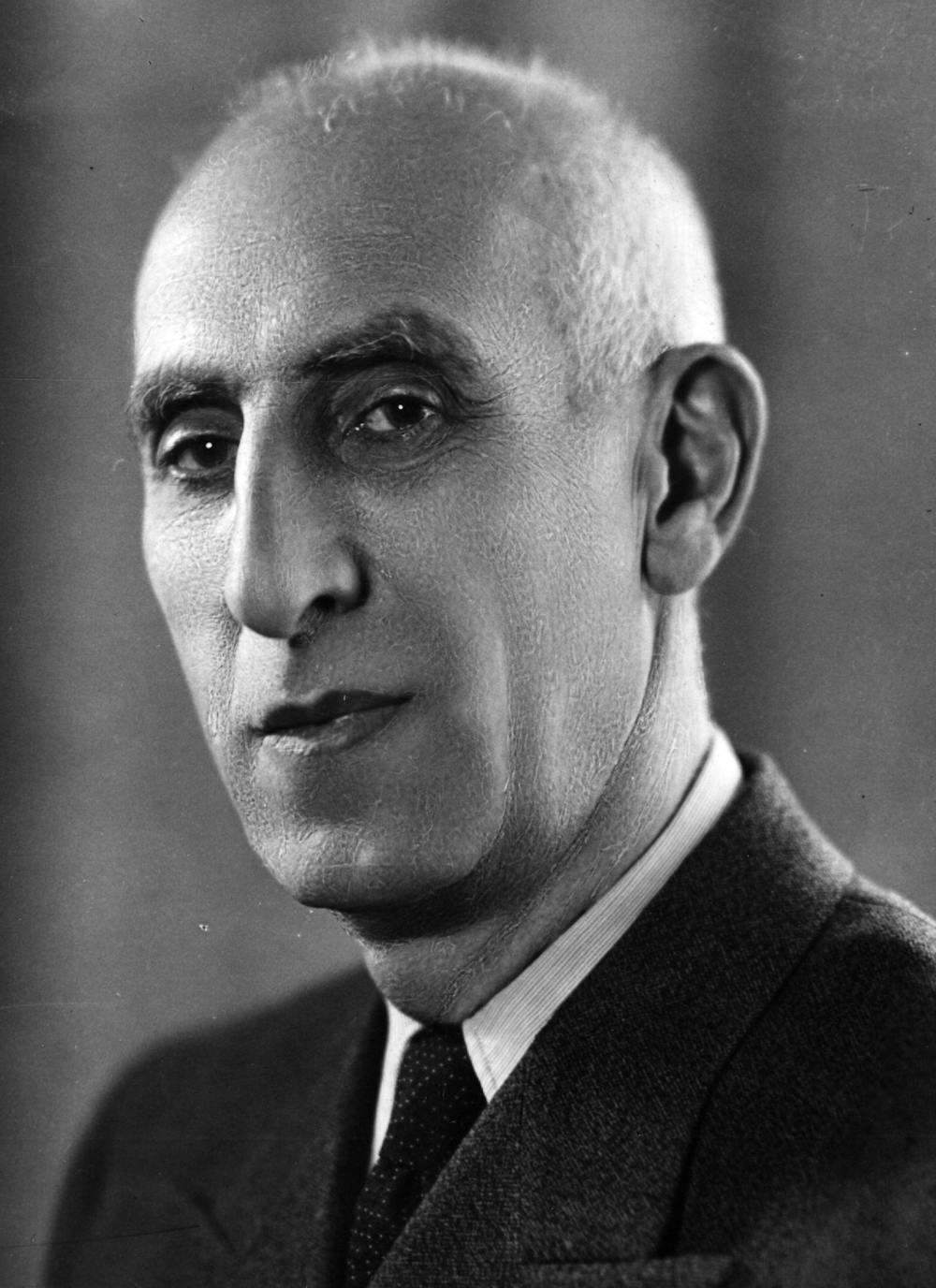
In 1951, the Iranian Parliament chose a new prime minister, Mossadegh, who then led lawmakers to vote in favor of taking over the Anglo-Iranian Oil Company, expelling the company’s British owners and saying they wanted to turn oil profits into investments in the Iranian people. The U.S. feared disruption in the global oil supply and worried about Iran falling prey to Soviet influence. The British feared the loss of cheap Iranian oil.
President Dwight Eisenhower decided it was best for the U.S. and the U.K. to get rid of Mossadegh. Operation Ajax, a joint CIA-British operation, convinced the Shah of Iran, the country’s monarch, to dismiss Mossadegh and drive him from office by force. Mossadegh was replaced by a much more Western-friendly prime minister, handpicked by the CIA.
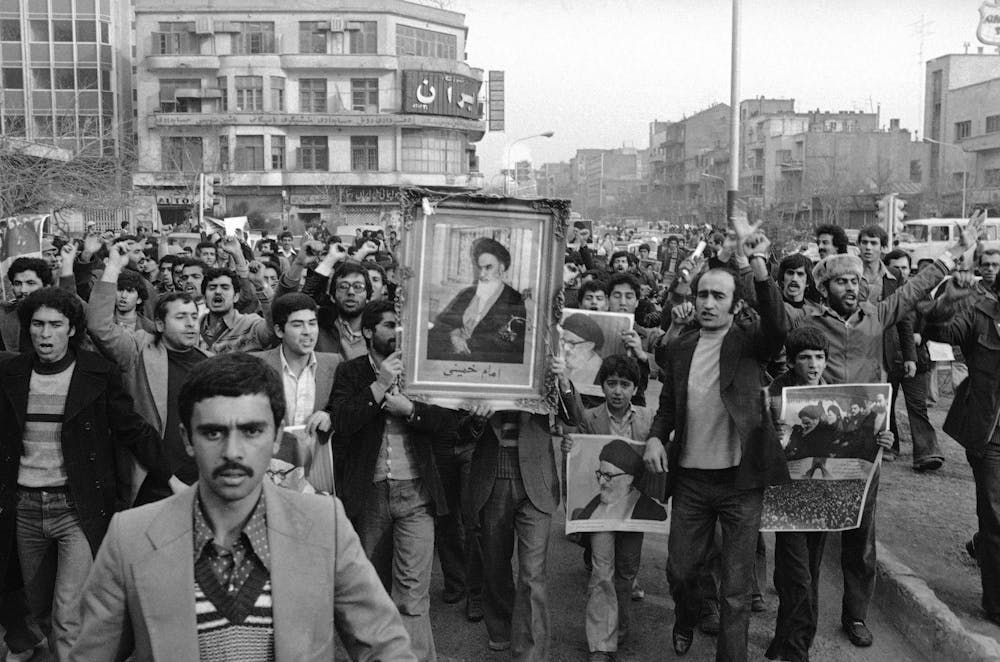
Demonstrators in Tehran demand the establishment of an Islamic republic. AP Photo/Saris
1979: Revolutionaries oust the shah, take hostages
After more than 25 years of relative stability in U.S.-Iran relations, the Iranian public had grown unhappy with the social and economic conditions that developed under the dictatorial rule of Shah Mohammad Reza Pahlavi.
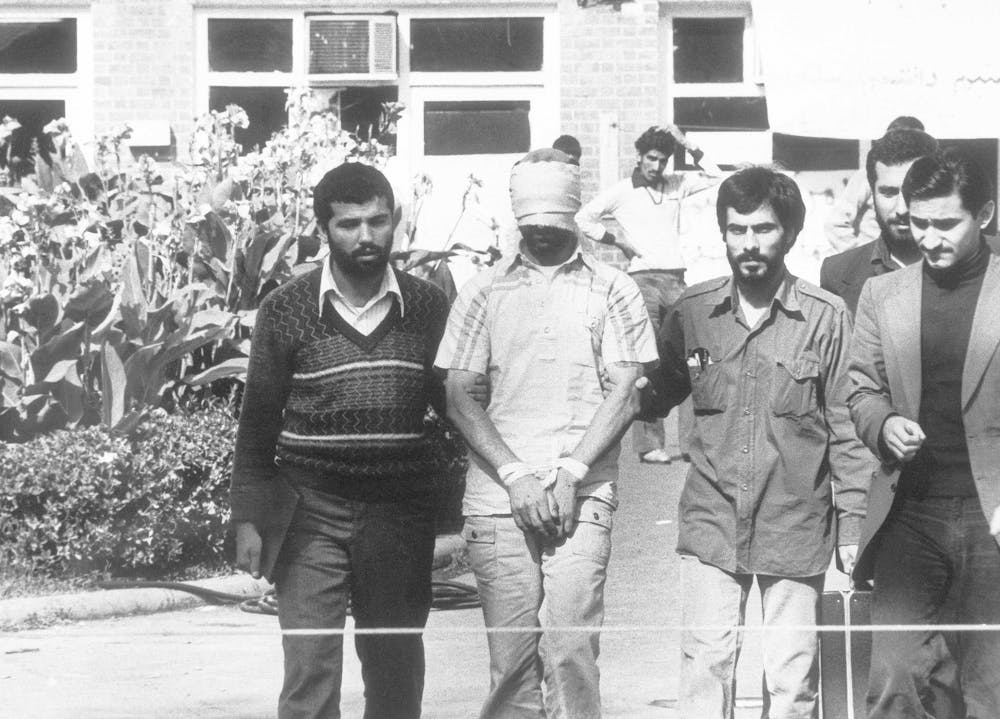
Iranian students at the U.S. Embassy in Tehran show a blindfolded American hostage to the crowd in November 1979. AP Photo
In October 1979, President Jimmy Carter agreed to allow the shah to come to the U.S. to seek advanced medical treatment. Outraged Iranian students stormed the U.S. Embassy in Tehran on Nov. 4, taking 52 Americans hostage. That convinced Carter to sever U.S. diplomatic relations with Iran on April 7, 1980.
Two weeks later, the U.S. military launched a mission to rescue the hostages, but it failed, with aircraft crashes killing eight U.S. servicemembers.
The shah died in Egypt in July 1980, but the hostages weren’t released until Jan. 20, 1981, after 444 days of captivity.
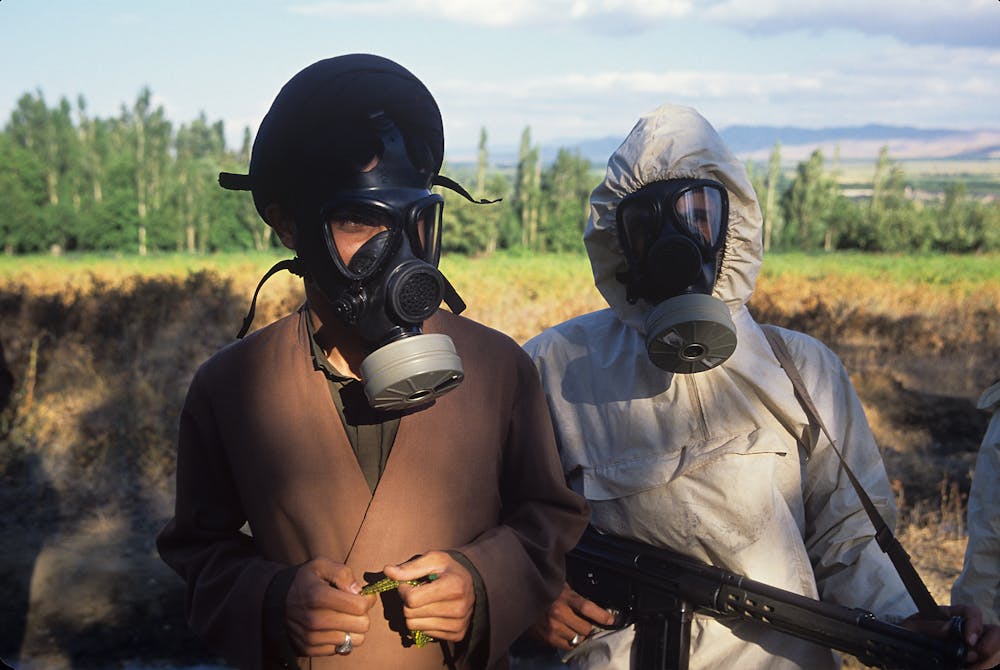
An Iranian cleric, left, and an Iranian soldier wear gas masks to protect themselves against Iraqi chemical-weapons attacks in May 1988. Kaveh Kazemi/Getty Images
The U.S. was concerned that the conflict would limit the flow of Middle Eastern oil and wanted to ensure the conflict didn’t affect its close ally, Saudi Arabia.
U.S. officials moderated their usual opposition to those illegal and inhumane weapons because the U.S. State Department did not “wish to play into Iran’s hands by fueling its propaganda against Iraq.” In 1988, the war ended in a stalemate. More than 500,000 military and 100,000 civilians died.
1981-1986: US secretly sells weapons to Iran
The U.S. imposed an arms embargo after Iran was designated a state sponsor of terrorism in 1984. That left the Iranian military, in the middle of its war with Iraq, desperate for weapons and aircraft and vehicle parts to keep fighting.
The last shipment, of anti-tank missiles, was in October 1986. In November 1986, a Lebanese magazine exposed the deal. That revelation sparked the Iran-Contra scandal in the U.S., with Reagan’s officials found to have collected money from Iran for the weapons and illegally sent those funds to anti-socialist rebels – the Contras – in Nicaragua.
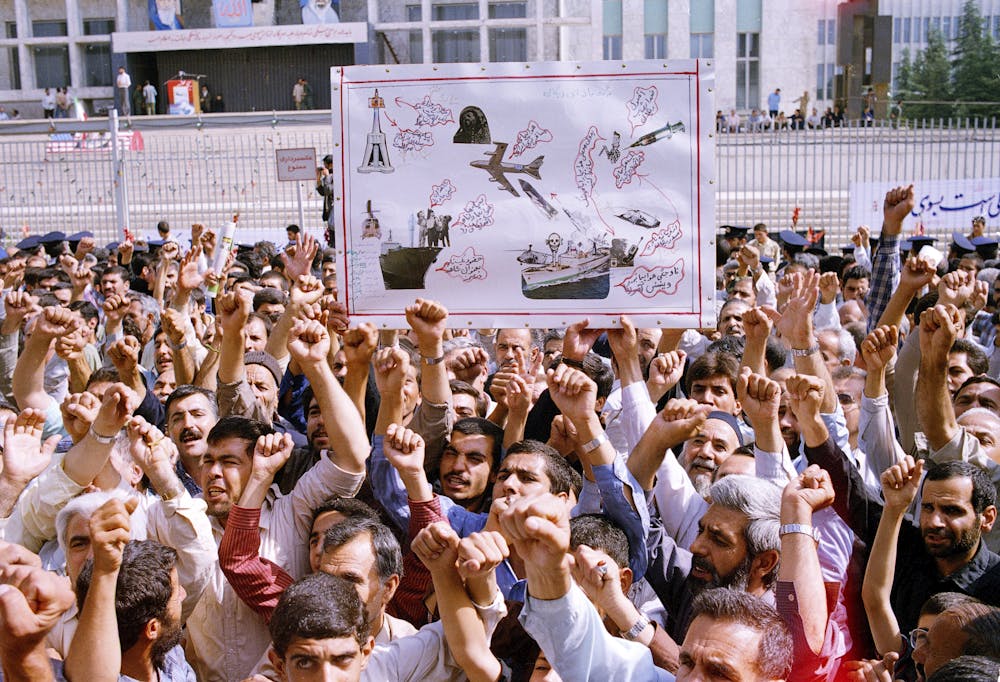
At a mass funeral for 76 of the 290 people killed in the shootdown of Iran Air 655, mourners hold up a sign depicting the incident. AP Photo/CP/Mohammad Sayyad
Either during or just after that exchange of gunfire, the Vincennes crew mistook a passing civilian Airbus passenger jet for an Iranian F-14 fighter. They shot it down, killing all 290 people aboard.
The U.S. called it a “tragic and regrettable accident,” but Iran believed the plane’s downing was intentional. In 1996, the U.S. agreed to pay US$131.8 million in compensation to Iran.
1997-1998: The US seeks contact
In August 1997, a moderate reformer, Mohammad Khatami, won Iran’s presidential election.
U.S. President Bill Clinton sensed an opportunity. He sent a message to Tehran through the Swiss ambassador there, proposing direct government-to-government talks.
Shortly thereafter, in early January 1998, Khatami gave an interview to CNN in which he expressed “respect for the great American people,” denounced terrorism and recommended an “exchange of professors, writers, scholars, artists, journalists and tourists” between the United States and Iran.
However, Supreme Leader Ayatollah Ali Khamenei didn’t agree, so not much came of the mutual overtures as Clinton’s time in office came to an end.
In his 2002 State of the Union address, President George W. Bush characterized Iran, Iraq and North Korea as constituting an “Axis of Evil” supporting terrorism and pursuing weapons of mass destruction, straining relations even further.
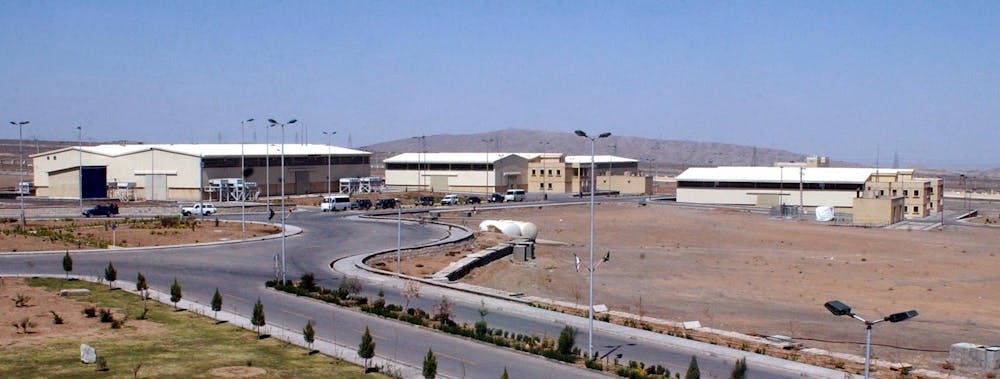
Inside these buildings at the Natanz nuclear facility in Iran, technicians enrich uranium. AP Photo/Vahid Salemi
That was a violation of the terms of the Nuclear Nonproliferation Treaty, which Iran had signed, requiring countries to disclose their nuclear-related facilities to international inspectors.
One of those formerly secret locations, Natanz, housed centrifuges for enriching uranium, which could be used in civilian nuclear reactors or enriched further for weapons.
Starting in roughly 2005, U.S. and Israeli government cyberattackers together reportedly targeted the Natanz centrifuges with a custom-made piece of malicious software that became known as Stuxnet.
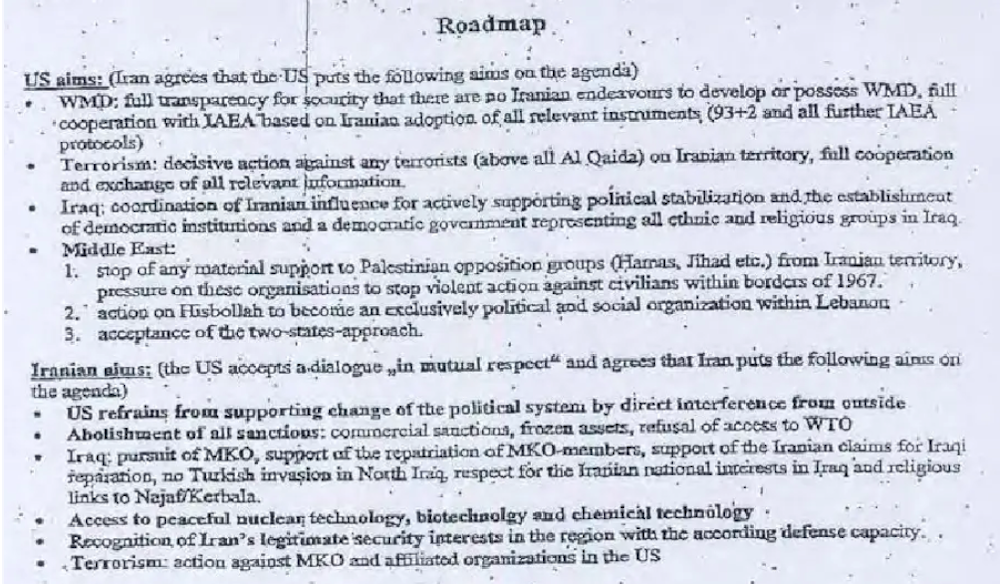
An excerpt of the document sent from Iran, via the Swiss government, to the U.S. State Department in 2003, appears to seek talks between the U.S. and Iran. Washington Post via Scribd
In May 2003, senior Iranian officials quietly contacted the State Department through the Swiss embassy in Iran, seeking “a dialogue ‘in mutual respect,’” addressing four big issues: nuclear weapons, terrorism, Palestinian resistance and stability in Iraq.
Hardliners in the Bush administration weren’t interested in any major reconciliation, though Secretary of State Colin Powell favored dialogue and other officials had met with Iran about al-Qaida.
When Iranian hardliner Mahmoud Ahmadinejad was elected president of Iran in 2005, the opportunity died. The following year, Ahmadinejad made his own overture to Washington in an 18-page letter to President Bush. The letter was widely dismissed; a senior State Department official told me in profane terms that it amounted to nothing.
After a decade of unsuccessful attempts to rein in Iran’s nuclear ambitions, the Obama administration undertook a direct diplomatic approach beginning in 2013.
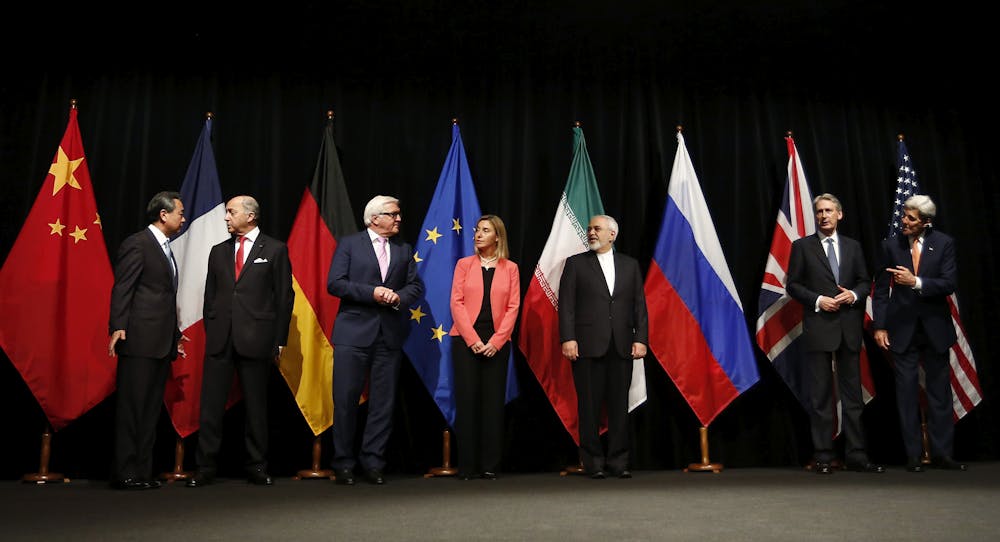
Iran, the U.S., China, France, Germany, Russia and the United Kingdom signed the deal in 2015. It severely limited Iran’s capacity to enrich uranium and mandated that international inspectors monitor and enforce Iran’s compliance with the agreement.
In return, Iran was granted relief from international and U.S. economic sanctions. Though the inspectors regularly certified that Iran was abiding by the agreement’s terms, President Donald Trump withdrew from the agreement in May 2018.
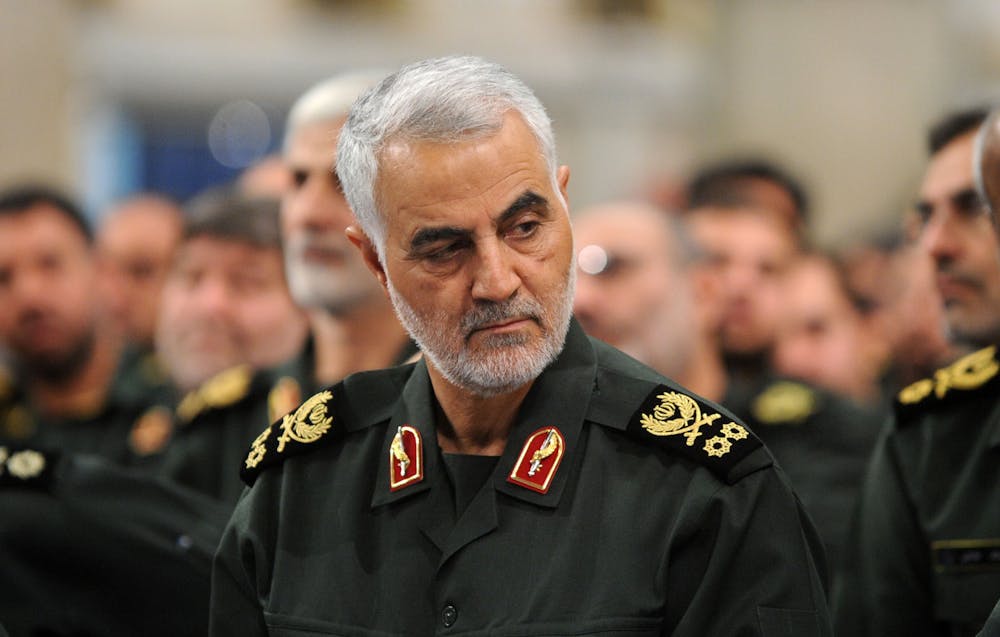
2020: US drones kill Iranian Maj. Gen. Qassem Soleimani
At the time, the Trump administration asserted that Soleimani was directing an imminent attack against U.S. assets in the region, but officials have not provided clear evidence to support that claim.
Hamas’ brazen attack on Israel on Oct. 7, 2023, provoked a fearsome militarized response from Israel that continues today and served to severely weaken Iran’s proxies in the region, especially Hamas – the perpetrator of the attacks – and Hezbollah in Lebanon.
2025: Trump 2.0 and Iran
Trump saw an opportunity to forge a new nuclear deal with Iran and to pursue other business deals with Tehran. Once inaugurated for his second term, Trump appointed Steve Witkoff, a real estate investor who is the president’s friend, to serve as special envoy for the Middle East and to lead negotiations.
Negotiations for a nuclear deal between Washington and Tehran began in April, but the countries did not reach a deal. They were planning a new round of talks when Israel struck Iran with a series of airstrikes on June 13, forcing the White House to reconsider is position.
Jeffrey Fields receives funding from the Carnegie Corporation of New York and Schmidt Futures.
Source: United States Senator for Virginia Tim Kaine
VIDEO OF KAINE’S REMARKS IS AVAILABLE HERE.
WASHINGTON, D.C. – Today, U.S. Senator Tim Kaine (D-VA), a member of the Senate Health, Education, Labor and Pensions (HELP) Committee, hosted a spotlight forum with Senator Chris Murphy (D-CT) to highlight how President Donald Trump and Republicans’ bill would make major cuts to vital programs that families rely on, including Medicaid and SNAP, in order to pay for massive tax breaks for the wealthy.
“We’re here because of the reconciliation bill … which we call the ‘Big Beautiful Betrayal.’ And my Republican colleagues are trying to pass it by a party-line vote without including us in any of the discussions about what’s in the bill. But it would be disastrous for this country,” said Kaine as he began the forum. “We’ll do everything we can to try and defeat it.”
Kaine continued, “President Trump and congressional Republicans are championing this BBB and it reflects choices – affirmative, calculated decisions about who to help and who to harm … But we don’t have to make a choice to harm middle-class and working people. We don’t have to do that. We can cut taxes for working- and middle-class families without cutting crucial programs that these families rely on. We can choose not to give additional tax breaks to those who have already been so benefitted in the past by tax breaks.
“The top 20 percent of households will receive nearly 70 percent of the tax cuts in the House bill. That is an upside-down priority,” Kaine continued. “According to the nonpartisan Congressional Budget Office … 16 million Americans nationwide will lose health care coverage under the House bill, and that includes more than 300,000 Virginians.
“According to our Joint Economic Committee, the House bill … would cut SNAP, the Supplemental Nutrition Assistance Program, by 20 percent, slashing away a crucial safety net for about 200,000 Virginians – 800,000 get SNAP benefits [in total in Virginia]. The benefits are modest – $4.70 per day – but 200,000 of those 800,000 will either have their $4.70 benefit reduced or completely eliminated,” said Kaine. “SNAP fights hunger fast. When it’s slashed, families will feel hunger a lot faster.”
Kaine continued, “If we take a second and just tally things up: the tax plan would boot millions off health care, take food from the mouths of hungry children and families, cut taxes for millionaires and billionaires, and drive up the deficit by 3 trillion, although I saw the Senate version actually knocks it up even further, maybe as high as $5 trillion. This is before you start factoring in historic and illegal tariffs that the administration is levying on the same everyday people who are suffering by these cuts,” Kaine said.
“The Yale Budget Lab found that when you factor in both the reconciliation bill and the President’s tariff actions, the bottom 80 percent of American households are going to be worse off. So I truly hope my Republican colleagues will have a change of heart and rework this product, and we’re sure going to give them an opportunity to do it with all the amendments that we’re going to offer—very targeted amendments that will pose some really important choices for them. They could take out all of the SNAP and Medicaid cuts by scaling back the tax cuts for the wealthy, and still have a bill that costs the same as it is. This legislation is going to harm Virginians and harm Americans,” Kaine concluded.
Source: United States Senator for Virginia Tim Kaine
VIDEO OF KAINE’S FLOOR SPEECH IS AVAILABLE HERE.
WASHINGTON, D.C.—Today, U.S. Senator Tim Kaine (D-VA), a member of the Senate Armed Services and Foreign Relations Committees, spoke on the Senate floor about a war powers resolution he filed this week to express concern about the escalating violence in the Middle East and its potential to pull the U.S. into conflict. The resolution requires that any U.S. participation in offensive hostilities against Iran be explicitly authorized by Congress through a declaration of war or specific authorization for use of military force. It does not prevent the U.S. from defending itself from an imminent attack. The resolution is privileged, meaning that the Senate will be required to promptly consider and vote upon the resolution.
“There’s no part of the Constitution that’s more important than the Article One provision making plain that the United States should not be at war without a vote of Congress,” said Kaine. “Yet the news of the day suggests that we are potentially on the verge of a war with Iran.”
“I was elected to the Senate in 2012, having served as a Governor from 2006 to 2010 during a tremendous upsurge in the two wars in Iraq and Afghanistan. I visited our troops multiple times in the green zones in Baghdad and in Afghanistan. I went to the deployments and the homecomings. I went to the wakes and the funerals,” Kaine continued. “And I told myself when I came to the Senate that if I ever had the chance to stop this nation from getting into an unnecessary war, I would do everything I could to stop us.”
“I happen to believe that the United States engaging in a war against Iran – a third war in the Middle East since 2001 – would be a catastrophic blunder for this country,” Kaine said. “I think there are some in this body who have a different point of view than me on that point, but I think we should all be able to agree in the fundamental constitutional principle that says we shouldn’t be in a war if Congress doesn’t have the guts to debate it and vote on it. We should all – having taken an oath to the Constitution – at least support the principle that war is something that should be for Congress to declare.”
“Our Constitution has, accordingly, with studied care, vested the question of war with the legislature,” said Kaine. “Other countries don’t do this, but the Framers of our Constitution in 1787 decided we’re going to be different. Before we send troops in harm’s way where they could be killed, where they could be injured, where they could see people that they love – their colleagues killed and injured – before we’re going to send troops in harm’s way in war, we want to see the people’s elected bodies – both houses – have a debate about what the stakes are and whether we should force our troops into harm’s way and potentially lose their lives. And that debate will be in full view of the American public, so the American public can understand what’s at stake and then they can call their representatives or write them a letter and tell them what they think about whether war is necessary and whether the sacrifice we ask of our troops should be the ultimate sacrifice that we are often asking of them in war.”
“The question for this body that we will grapple with over the course of the next couple of weeks is whether the United States should be in another war in the Middle East – in particular, whether we should allow war to start without us, whether we should hide in the tall grass, rather than exercise our constitutional responsibility under Article One. This is fundamentally a debate about Congress being true to its oath of office and actually also being true to the obligations we have to our public,” Kaine said. “The Framers put this in the Constitution so that we wouldn’t be at war without a debate in front of the public.”
“If we have that debate and we decide that war is in the national interest, then the troops go into war knowing that the civilian leadership of this country have had the hard debate in view of the American public and decided that the stakes are sufficient to ask people to make the ultimate sacrifice,” Kaine said. “How dare we ask people to make the ultimate sacrifice if we don’t have the guts to have a debate and decide whether a war is in the interest of this country?”
“We need to have this debate in front of the American public,” Kaine said. “Let them watch us debate the stakes of this – and it might be that colleagues in this body or in the House think a war with Iran is a good idea. Let them put a war authorization on the table. Let’s debate that. Let’s debate that in front of Virginians and Kansans and Californians and hear what our constituents have to say. Let’s debate that in the full view of people whose spouses are in the military or whose kids are in the military. Let’s have that debate in front of them and hear what they think before we cast a vote that would be one of the most serious votes that you ever cast on the floor of a body like this. But we should not allow a war of the magnitude of this to begin with Congress hiding.”
“I will be asking my colleagues to support my simple resolution as early as next week. No war without a vote of Congress. I’ll be asking my colleagues to support it and uphold the oath we’ve all taken to support the Constitution that established that most unusual principle, most unique principle, that is part of what makes this nation special,” Kaine concluded.
For years, Kaine has been a leading voice in Congress raising concerns over presidents’ efforts to expand the use of military force without congressional authorization. In 2017, Kaine wrote a piece in TIME warning of the consequences if President Donald Trump pulled out of the nuclear deal with Iran. In 2018, Kaine wrote a piece in The Atlantic warning that Trump was blundering toward war with Iran. In March 2020, Congress passed Kaine’s bipartisan war powers resolution to prevent further escalation of hostilities with Iran without congressional authorization. In 2023, the Senate passed bipartisan legislation led by Kaine to repeal the 1991 and 2002 Authorizations for Use of Military Force (AUMFs) and formally end the Gulf and Iraq wars.
Source: United States Senator for Commonwealth of Virginia Mark R Warner
WASHINGTON – U.S. Sen. Mark R. Warner (D-VA) today applauded the Senate passage of the Guiding and Establishing National Innovation for U.S. Stablecoins (GENIUS) Act, bipartisan legislation to bring much-needed oversight and standards to the $250 billion stablecoin market, and released the following statement:
“For too long, stablecoins have operated in a regulatory gray area, putting consumers, markets, and national security at risk. The GENIUS Act changes that by creating guardrails for responsible innovation, setting high standards for issuers, and reining in potential abuses by big tech and bad actors.
“Many of us have deep concerns about how members of the Trump family have used crypto technologies to evade scrutiny, conceal financial entanglements, and profit off the public trust. We must remain vigilant in exposing and stopping these abuses. But our outrage over that corruption cannot prevent us from building a foundation for responsible innovation in this space. If we don’t lead, others will, and not in ways that reflect our interests or democratic values. With the GENIUS Act, the U.S. will finally begin to set the rules of the road to support innovation while protecting consumers and our national security.”
BROOKLYN, N.Y., June 17, 2025 (GLOBE NEWSWIRE) — Pioneer Acquisition I Corp (Nasdaq: PACHU) (the “Company”) announced today the pricing of its initial public offering of 22,000,000 units at $10.00 per unit. The units are expected to be listed on the Nasdaq Global Market (“Nasdaq”) and trade under the ticker symbol “PACHU” beginning June 18, 2025. Each unit consists of one Class A ordinary share and one-half of one redeemable warrant. Once the securities comprising the units begin separate trading, the Class A ordinary shares and warrants are expected to be listed on Nasdaq under the symbols “PACH” and “PACHW”, respectively. The underwriter has been granted a 45-day option to purchase up to an additional 3,300,000 units offered by the Company to cover over-allotments, if any. The offering is expected to close on June 20, 2025, subject to customary closing conditions.
The Company is a blank check company incorporated as an exempted company under the laws of the Cayman Islands, which will seek to effect a merger, share exchange, asset acquisition, share purchase, reorganization or similar business combination with one or more businesses or entities.
Cantor Fitzgerald & Co. acted as the sole book-running manager of the offering. Odeon Capital Group LLC acted as co-manager of the offering.
Winston & Strawn LLP is serving as legal counsel to the Company. Ellenoff Grossman & Schole LLP is serving as legal counsel to Cantor Fitzgerald & Co.
A registration statement on Form S-1 (333-287656) relating to these securities has been filed with the Securities and Exchange Commission (“SEC”), and was declared effective on June 17, 2025. The offering is being made only by means of a prospectus. When available, copies of the prospectus may be obtained from: Cantor Fitzgerald & Co., Attention: Capital Markets, 499 Park Avenue, 5th Floor New York, New York 10022; Email: prospectus@cantor.com., or from the SEC website at www.sec.gov.
This press release shall not constitute an offer to sell or a solicitation of an offer to buy, nor shall there be any sale of these securities in any state or jurisdiction in which such offer, solicitation or sale would be unlawful prior to registration or qualification under the securities laws of any such state or jurisdiction.
Forward-Looking Statements
This press release includes forward-looking statements that involve risks and uncertainties. Forward-looking statements are statements that are not historical facts. Such forward-looking statements are subject to risks and uncertainties, which could cause actual results to differ from the forward-looking statements. The Company expressly disclaims any obligations or undertaking to release publicly any updates or revisions to any forward-looking statements contained herein to reflect any change in the Company’s expectations with respect thereto or any change in events, conditions or circumstances on which any statement is based. No assurance can be given that the offering discussed above will be completed on the terms described, or at all. Forward-looking statements are subject to numerous conditions, many of which are beyond the control of the Company, including those set forth in the Risk Factors section of the Registration Statement and related preliminary prospectus filed in connection with the initial public offering with the SEC. Copies are available on the SEC’s website, www.sec.gov.
Contacts
Pioneer Acquisition I Corp Mr. Mitchell Creem Chief Executive Officer and Director 131 Concord Street Brooklyn, NY 11201 Email: creem@pioneeracquisition.com
BROOKLYN, N.Y., June 17, 2025 (GLOBE NEWSWIRE) — Pioneer Acquisition I Corp (Nasdaq: PACHU) (the “Company”) announced today the pricing of its initial public offering of 22,000,000 units at $10.00 per unit. The units are expected to be listed on the Nasdaq Global Market (“Nasdaq”) and trade under the ticker symbol “PACHU” beginning June 18, 2025. Each unit consists of one Class A ordinary share and one-half of one redeemable warrant. Once the securities comprising the units begin separate trading, the Class A ordinary shares and warrants are expected to be listed on Nasdaq under the symbols “PACH” and “PACHW”, respectively. The underwriter has been granted a 45-day option to purchase up to an additional 3,300,000 units offered by the Company to cover over-allotments, if any. The offering is expected to close on June 20, 2025, subject to customary closing conditions.
The Company is a blank check company incorporated as an exempted company under the laws of the Cayman Islands, which will seek to effect a merger, share exchange, asset acquisition, share purchase, reorganization or similar business combination with one or more businesses or entities.
Cantor Fitzgerald & Co. acted as the sole book-running manager of the offering. Odeon Capital Group LLC acted as co-manager of the offering.
Winston & Strawn LLP is serving as legal counsel to the Company. Ellenoff Grossman & Schole LLP is serving as legal counsel to Cantor Fitzgerald & Co.
A registration statement on Form S-1 (333-287656) relating to these securities has been filed with the Securities and Exchange Commission (“SEC”), and was declared effective on June 17, 2025. The offering is being made only by means of a prospectus. When available, copies of the prospectus may be obtained from: Cantor Fitzgerald & Co., Attention: Capital Markets, 499 Park Avenue, 5th Floor New York, New York 10022; Email: prospectus@cantor.com., or from the SEC website at www.sec.gov.
This press release shall not constitute an offer to sell or a solicitation of an offer to buy, nor shall there be any sale of these securities in any state or jurisdiction in which such offer, solicitation or sale would be unlawful prior to registration or qualification under the securities laws of any such state or jurisdiction.
Forward-Looking Statements
This press release includes forward-looking statements that involve risks and uncertainties. Forward-looking statements are statements that are not historical facts. Such forward-looking statements are subject to risks and uncertainties, which could cause actual results to differ from the forward-looking statements. The Company expressly disclaims any obligations or undertaking to release publicly any updates or revisions to any forward-looking statements contained herein to reflect any change in the Company’s expectations with respect thereto or any change in events, conditions or circumstances on which any statement is based. No assurance can be given that the offering discussed above will be completed on the terms described, or at all. Forward-looking statements are subject to numerous conditions, many of which are beyond the control of the Company, including those set forth in the Risk Factors section of the Registration Statement and related preliminary prospectus filed in connection with the initial public offering with the SEC. Copies are available on the SEC’s website, www.sec.gov.
Contacts
Pioneer Acquisition I Corp Mr. Mitchell Creem Chief Executive Officer and Director 131 Concord Street Brooklyn, NY 11201 Email: creem@pioneeracquisition.com
The Fifth Circuit Court of Appeals recently limited a nationwide injunction to only Texas, giving the Administration the greenlight to resume processing initial DACA applications for all other states
WASHINGTON, D.C. — U.S. Senators Alex Padilla, Ranking Member of the Senate Judiciary Immigration Subcommittee, and Adam Schiff (both D-Calif.) joined U.S. Senate Democratic Whip Dick Durbin (D-Ill.), Ranking Member of the Senate Judiciary Committee and lead author of the Dream Act, and Senate Democrats in urging U.S. Citizenship and Immigration Services to resume processing initial applications for the Deferred Action for Childhood Arrivals (DACA) program, following a ruling in the Fifth Circuit Court of Appeals that narrowed an earlier injunction to just Texas and allowed USCIS to start processing initial DACA applications from all other states.
The Senators began by highlighting thepopularsupportfor providing Dreamers a pathway to citizenship, writing: “Noncitizens brought to the United States as children, often known as Dreamers, are American in every way but their immigration status. Many only know this country as their home, and they contribute every day to this great nation by paying taxes and serving in critical roles, such as police officers, teachers, and nurses. Americans overwhelmingly support providing Dreamers a path to citizenship, and in December 2024, President Trump stated that he supported protections for Dreamers to remain in the United States.”
“Consistent with this statement, we implore you to use your authority at United States Citizenship and Immigration Services (USCIS) to resume processing initial applications for Deferred Action for Childhood Arrivals (DACA) and provide such protections for Dreamers immediately,” continuedthe Senators.
Sunday, June 15, marked the thirteenth anniversary of the DACA program via policy memorandum in 2012. Since then, more than 825,000 people have received deferred action pursuant to DACA, empowering recipients to bolster their careers and contribute an estimated $140 billion to the U.S. economy in spending power and $40 billion in combined federal, payroll, state, and local taxes.
In 2021, U.S. District Court Judge Andrew Hanen halted the DACA program and enjoined USCIS from approving any new DACA applications nationwide. While the program was enjoined, USCIS has continued to accept and hold initial applications, and in 2022, the Department of Homeland Security published the DACA Final Rule, codifying the 2012 memorandum establishing DACA into regulation. More than 100,000 initial DACA applications are pending with USCIS.
On January 17, 2025, the Fifth Circuit Court of Appeals issued a decision limiting Judge Hanen’s injunction to just Texas.
“Pursuant to the order, in Texas, DACA must resume as a limited program providing protection from deportation for current DACA recipients, but without access to work authorization or driver’s licenses as part of those renewals. This order went into effect on March 11, giving USCIS the authority to start processing initial DACA applications from states other than Texas. However, nearly three months later, USCIS has not made any public announcement on whether new DACA applications will be processed; nor has the agency begun processing initial applications that have been pending with the agency for years,” added the Senators.
“We urge you to begin processing these DACA applications immediately, consistent with the Fifth Circuit decision and existing regulations, and to ensure Dreamers eligible to file initial DACA applications can do so as soon as possible,” concluded the Senators.
In addition to Padilla, Schiff, and Durbin, the letter is signed by U.S. Senators Tammy Baldwin (D-Wis.), Michael Bennet (D-Colo.), Richard Blumenthal (D-Conn.), Cory Booker (D-N.J.), Chris Coons (D-Del.), Catherine Cortez Masto (D-Nev.), Tammy Duckworth (D-Ill.), John Fetterman (D-Pa.), Ruben Gallego (D-Ariz.), Kirsten Gillibrand (D-N.Y.), Maggie Hassan (D-N.H.), Martin Heinrich (D-N.M.), John Hickenlooper (D-Colo.), Mazie Hirono (D-Hawai’i), Tim Kaine (D-Va.), Mark Kelly (D-Ariz.), Andy Kim (D-N.J.), Angus King (I-Maine), Amy Klobuchar (D-Minn.), Ben Ray Luján (D-N.M.), Edward Markey (D-Mass.), Jeff Merkley (D-Ore.), Patty Murray (D-Wash.), Gary Peters (D-Mich.), Jack Reed (D-R.I.), Jacky Rosen (D-Nev.), Bernie Sanders (I-Vt.), Brian Schatz (D-Hawai’i), Jeanne Shaheen (D-N.H.), Elissa Slotkin (D-Mich.), Tina Smith (D-Minn.), Chris Van Hollen (D-Md.), Mark Warner (D-Va.), Raphael Warnock (D-Ga.), Elizabeth Warren (D-Mass.), Peter Welch (D-Vt.), Sheldon Whitehouse (D-R.I.), and Ron Wyden (D-Ore.).
Full text of the letter to USCIS is available here.
Source: United States Senator Alex Padilla (D-Calif.)
WATCH: Padilla Delivers Floor Speech Following His Forcible Removal From DHS Press Conference
WATCH: Padilla: “If this Administration is this afraid of just one Senator with a question, colleagues, imagine what the voices of tens of millions of Americans peacefully protesting can do.”
“If that is what the Administration is willing to do to a United States Senator for having the [audacity] to simply ask a question, imagine what they’ll do to any American who dares to speak up. If what you saw happen can happen when the cameras are on, imagine not only what can happen — but what is happening — in so many places where there are no cameras.”
Video of Senator Padilla’s full speech can be viewed here and downloaded here.
WASHINGTON, D.C. — Today, U.S. Senator Alex Padilla (D-Calif.), Ranking Member of the Senate Judiciary Immigration Subcommittee, spoke on the Senate floor following his forcible removal from Secretary of Homeland Security Kristi Noem’s press conference, where he was thrown to the ground and handcuffed after attempting to ask a question. Padilla delivered a strong rebuke to the Trump Administration’s unprecedented militarization of Los Angeles and called for his colleagues on both sides of the aisle, as well as the American people, to speak up against Trump’s abuse of power.
Last week, Trump deployed approximately 4,000 National Guard troops and 700 active-duty Marines to Los Angeles amid unrest caused by his indiscriminate immigration raids across the region. Padilla flew to Los Angeles to conduct oversight over the Trump Administration’s unprecedented military deployment to California — without Governor Newsom’s consent — and was in the high-security Los Angeles Federal Building for a scheduled oversight meeting with the commanding general in charge of the military presence in the region before law enforcement escorted him into Secretary Noem’s briefing room.
“The Trump Administration has done everything in their power but to provide transparency to the American people about their mission in Los Angeles. And so last week, I chose to go home to try to get answers from the Administration as they are literally militarizing our city.”
“I want to share what I learned. I want to share what I heard because it should shock the conscience of our country.”
In the hopes of learning new information after having his requests ignored for months, Padilla tried to ask a question in response to Noem’s demonizing rhetoric toward immigrants and Los Angeles’ democratically elected leadership.
“At one point, the United States Secretary of Homeland Security said that the purpose of federal law enforcement and the purpose of the United States military was to ‘liberate’ Los Angeles from our governor and our mayor. To somehow liberate us from the very people that we democratically elected to lead our city and our state.”
“Colleagues, let that fundamentally un-American mission statement sink in. That is not a mission focused on public safety. And that simply is not, and cannot be, the mission of federal law enforcement and the United States military.”
“To my colleagues on both sides of the aisle, are we truly prepared to live in a country where the President can deploy the Armed Forces to decide which duly elected governors and mayors should be allowed to lead their constituents? Is that really the precedent that we’re okay with setting?”
“Throughout the country’s history, we’ve had conflict, we’ve had tumult, but we’ve never had a tyrant as a commander-in-chief.”
Padilla detailed his own background as the proud son of immigrants from Mexico who left behind his MIT engineering degree to protest against the vile anti-immigrant rhetoric in the 1990s that a Republican governor up for reelection spread across California. He said he felt he had to speak out against the Trump Administration’s “un-American” scapegoating of immigrants and California, and detailed the violent reaction to his question.
“So last week, when I heard something so blatantly un-American from the Secretary of Homeland Security, a cabinet official — of course I was compelled, both as a Senator and as an American, to speak up.”
“But before I could even get out my question, I was physically and aggressively forced out of the room — even as I repeatedly announced I was a United States Senator, and I had a question for the Secretary. And even as the National Guardsman and the FBI agent who served as my escorts and brought me into that press briefing room stood by, silently, knowing full well who I was.”
“You’ve seen the video. I was pushed and pulled, struggled to maintain my balance. I was forced to the ground — first on my knees and then flat on my chest. And as I was handcuffed and marched down a hallway, repeatedly asking why am I being detained, not once did they tell me why.”
Padilla expressed his gratitude for the immense support for him and his family that poured in since his forcible removal. However, he emphasized that this fight was not about him but about the fundamental democratic rights of all Americans across the country.
“If you watched what unfolded last week and thought what happened is just about one politician and one press conference, you’re missing the point.”
“If that is what the Administration is willing to do to a United States Senator for having the [audacity] to simply ask a question, imagine what they’ll do to any American who dares to speak up. If what you saw happen can happen when the cameras are on, imagine not only what can happen — but what is happening — in so many places where there are no cameras.”
“Colleagues, this isn’t about me. In fact, it’s not just about immigrant communities or even just the State of California. It’s about every single American who values their Constitutional rights. It’s about anyone who’s ever exercised their First Amendment rights, or anyone who’s ever disagreed with a president, or anyone who simply values our democracy and wants to keep it.”
Padilla set the record straight on Republican misinformation on undocumented immigrants as Trump has used the same playbook when the headlines turn against him: scapegoat immigrants and manufacture a crisis. Public reporting shows that the majority of immigrants currently in ICE custody have no prior criminal conviction, and under 10 percent of immigrants taken into ICE custody since October have serious criminal convictions. Yet, President Trump has blamed immigrants to distract from his failed policies, including Republicans’ billionaire-first budget reconciliation bill that would cut critical services like health care and nutrition for millions of working families across the country.
As President Trump takes unprecedented action to militarize Los Angeles without justification or the Governor’s request, Padilla warned of the stakes for cities across the United States and American democracy.
“Donald Trump is continuing to test the boundaries of his power. And he’s surrounded himself with yes-men and underqualified attack dogs — from the DHS Secretary to the FBI Director to the Secretary of Defense — who will rubberstamp every anti-democratic step he takes.”
“This Administration’s officials and maybe not all, but many Republicans in Congress may choose not to do their job, but they cannot stop me from doing mine.”
“Again, if you really think this is just about immigrants and immigration, it’s time to wake up. What’s happening is not just a threat to California; it’s a threat to everyone in every state. If Donald Trump can bypass the Governor and activate the National Guard to put down protests on immigrant rights, he can do it to suppress your rights, too. If he can deploy the Marines to Los Angeles without justification, he can deploy them to your state, too. And if he can ignore due process, strip away First Amendment rights, and disappear people to foreign prisons without their day in court, he can do it to you too.”
“California is just the test case for the rest of the country. Last week for many was a warning shot. But I pray that it also serves as a wakeup call.”
Padilla concluded his speech with a call to action for Angelenos and millions of Americans to stand up and keep peacefully protesting against the Trump Administration’s attack on fundamental rights.
“It doesn’t matter if you’re a Republican, or a Democrat, or an Independent — we all have a responsibility to speak up and to push back, before it’s too late. So I do encourage people to keep peacefully protesting. There’s nothing more patriotic than to peacefully protest for your rights.”
“Because no one will liberate Los Angeles but Angelenos. No one will redeem America but Americans. No one is coming to save us but us.”
“And we know that the cameras are not on in every corner of the country. But if this Administration is this afraid of just one Senator with a question, colleagues, imagine what the voices of tens of millions of Americans peacefully protesting can do.”
Senator Padilla has been outspoken in calling out the Immigration and Customs Enforcement (ICE) raids in Los Angeles and Trump’s misguided deployment of the National Guard and U.S. Marine Corps. This weekend, Padilla led the entire Senate Democratic Caucus in demanding that President Trump immediately withdraw all military forces from Los Angeles and cease all threats to deploy the National Guard or active-duty servicemembers to American cities. Last week, Padilla and Senator Adam Schiff (D-Calif.) demanded answers regarding the Trump Administration’s decision to deploy approximately 700 Marines to Los Angeles. Padilla has spoken at a spotlight hearing and on the Senate floor multiple times to blast President Trump for manufacturing a crisis by launching indiscriminate ICE raids across Los Angeles and deploying the National Guard and active-duty servicemembers to the region. He also joined all Senate Judiciary Committee Democrats today in calling on Chairman Grassley to schedule Department of Homeland Security Secretary Noem for a broad oversight hearing for testimony before the committee.
Padilla’s full remarks as prepared for delivery are available below:
[Mr./Madam] President,
Over the last two weeks in Los Angeles – my hometown – we’ve seen masked federal agents in tactical gear ordered into our communities . . .
We’ve seen a disturbing pattern of extreme and cruel immigration enforcement operations, targeting non-violent people at places of worship, schools, and courthouses.
All to meet an arbitrary quota.
Now, we’re seeing President Trump federalize and deploy the National Guard without the Governor’s consent . . .
Active-duty Marines have been deployed, escalating tensions in our city . . .
All without coordination with the state and local law enforcement.
Despite repeated requests for justification for these extreme actions…and after months of little to no response from the Administration on their aggressive and theatrical immigration raids…
The Trump administration has done everything in their power BUT provide transparency to the American people about their mission in Los Angeles.
So last week, I went home to try to get answers from the administration as they militarize our city.
What I heard should shock the conscience of our country.
One of the first items on my schedule last Thursday was a meeting with General Guillot, the four-star general in charge of U.S. Northern Command at the Federal Building in west Los Angeles, where they are overseeing these military operations.
When the United States military is deployed domestically…
When our own troops are deployed against the wishes of the Governor for the first time since 1965, against the wishes of the mayor, against even the wishes of local law enforcement — then we’re in uncharted territory.
So in an effort to do my duty to conduct congressional oversight — and to try to get answers from the Department of Defense that state and local officials were not receiving— I went to the federal building in West LA.
I was met at the entrance by a National Guardsman and an FBI agent, who escorted me through the security screening and up to a conference room for my scheduled briefing.
While waiting for my scheduled briefing with General Guillot, I learned that Homeland Security Secretary Kristi Noem was holding a press conference just down the hall and that the press conference was causing my briefing to be delayed.
The thought occurred to me that maybe I could attend and listen in, in the hopes of hearing Secretary Noem provide some new information that could help us make sense of what was happening.
I asked and was escorted by my National Guard and FBI escorts into the press conference. They opened the door for me. They accompanied me into the press briefing room.
It was there that I listened as the United States Secretary of Homeland Security said that the purpose of federal law enforcement and the United States military was to “liberate” Los Angeles from our governor and our mayor . . .
. . . To somehow liberate us from the very people we democratically elected to lead our city and our state.
Colleagues, let that fundamentally un-American mission statement sink in.
That’s not a mission focused on public safety.
That simply is not, and cannot be, the mission of federal law enforcement and the United States military.
To my colleagues on the other side of the aisle, are you truly prepared to live in a country where the President can deploy the armed forces to decide which duly elected governors and mayors should be allowed to lead their constituents?
Is that really the precedent you’re okay with setting?
As Secretary Noem herself said last year when serving as Governor of South Dakota, “If Joe Biden federalizes the National Guard, that would be a direct attack on states’ rights.”
Throughout the country’s history, we’ve had conflict, and we’ve had tumult. But we have never had a tyrant as a commander-in-chief.
That’s not by coincidence!
It’s because the American people have always been willing to speak up and exercise their First Amendment right to protest – especially when our fundamental rights have been threatened.
As the proud son of immigrants from Mexico, it’s that same right I came to revere when marching through the streets of Los Angeles in 1994 alongside friends and family protesting against the vile anti-immigrant rhetoric that was growing in California.
It was that year that a Republican Governor up for reelection and down in the polls, turned to scapegoating immigrants to try to improve his political standing.
That fight is what got me to leave an engineering career behind and dedicate myself to influencing government and politics. So, I’ve seen this before. Californians have seen this before.
So last week, when I heard something so blatantly un-American from the Secretary of Homeland Security — I was compelled, both as a Senator AND as an American, to speak up.
But before I could even get out my question, I was physically and aggressively forced out of the room — even as I announced I was a United States Senator, and I had a question for the Secretary.
And even as the National Guardsman and FBI agent who escorted me into the press conference stood by, silently, knowing full well who I was.
You’ve seen the video.
I was pushed and pulled, struggling to maintain my balance.
I was forced to the ground — first to my knees and then flat on my chest.
As I was handcuffed and marched down a hallway, I repeatedly asked why I was being detained. Not once did they tell me why.
In that moment, a lot of questions run through your head.
Where are they taking me?
Am I being arrested?
What will a city already on edge from being militarized think when they see their Senator has been handcuffed just for trying to ask a question? Or . . .
What will my wife and our three boys think?
I also remember asking myself: if this aggressive escalation is the result of speaking up against the abuses and overreach of the Trump administration, was it really worth it?
But colleagues, how many Americans in our nation’s history have marched, have protested, have shed blood and lost their lives to protect our rights?
How many Americans have served in wars overseas to protect our freedoms here at home?
And how many Americans in the year 2025 see a vindictive president on a tour of retribution, unrestrained by the majority of this separate but co-equal branch of government in this building, and wonder if it’s worth it to stand up or to speak out?
If a United States Senator is too afraid to speak up, how can we expect any other American to do the same?
Colleagues, you know me.
I’m not aware of anyone who would describe me as a flamethrower. I try to be respectful and considerate to every member of this body— regardless of your politics.
So I want to thank all of my colleagues on both sides of the aisle who reached out to share messages of support — whether it was public or in private.
In means a great deal to me and my family.
But if you watched what unfolded last week and thought this was about one politician or one press conference, you’re missing the point.
If that’s what this Administration will do to a United States Senator for having the audacity to simply ask a question, imagine what they’ll do to any American who dares to speak up.
If that’s what can happen when the cameras are on, imagine not only what can happen — but what is happening — when the cameras are off.
This isn’t about me. In fact, it’s not even just about immigrant communities or about Californians.
It’s about every single American who values their constitutional rights. It’s about anyone who’s ever exercised their First Amendment rights, or ever disagreed with a president, or who simply values living in a democracy and wants to keep it.
The President will tell you this is about undocumented immigrants, and about law and order and about targeting dangerous, violent criminals.
But we know differently.
Public data released by the administration shows that the majority of immigrants currently in ICE custody do not have a prior criminal conviction.
And new reporting shows that less than 10 percent of immigrants taken into ICE custody since October have serious criminal convictions.
Less than 10 percent!
Two weeks ago, Donald Trump was at the lowest point in his presidency so far.
He was drowning in a week of terrible headlines.
The American people were finally waking up to the realities of the budget reconciliation bill that will cut health care, nutrition assistance, and good paying clean energy jobs in order to cut taxes for billionaires.
He was losing his tariff wars as the costs of everyday goods were continuing to rise.
His promises to end Russia’s invasion of Ukraine were falling flat.
He’d been handed loss after loss in federal court.
And maybe the most embarrassing part was his public breakup with Elon Musk.
But we know what happens when the headlines turn on Donald Trump. Donald Trump turns to the same tired playbook he always has: when in doubt, scapegoat immigrants. And manufacture a crisis to distract the media from your failures.
That’s the reason he ramped up ICE raids in California.
And when Californians took to the streets to peacefully protest, that’s the reason he bypassed the Governor and federalized the National Guard. And as things began to settle in Los Angeles, he escalated even further by sending in the Marines.
He wants the spectacle — not just to distract, but to justify his undemocratic crackdowns and his authoritarian power grabs.
That’s the reason why even while the vast majority of protests have remained peaceful, the President, the Vice President, and their allies have called protestors insurrectionists!
Yes, this is the same man who provoked an actual insurrection on our Capitol on January 6th.
The same man who incited a violent mob, carrying confederate flags, against Congress.
The same man who then pardoned the convicted felons who assaulted our brave Capitol Police officers.
Trump is testing the boundaries of his power. And he’s surrounded himself with yes-men and underqualified attack dogs — from the DHS Secretary to the FBI Director to the Secretary of Defense — who will rubberstamp every anti-democratic step he takes.
This Administration’s officials and Congressional Republicans may choose not to do their job, but they cannot stop me from doing mine.
And I refuse to let immigrants be pawns on the path to fascism.
Again, if you really think this is just about immigrants, it’s time to wake up.
What’s happening isn’t just a threat to California, it’s a threat to everyone in every state.
If Donald Trump can bypass the Governor and activate the National Guard to put down protests for immigrant rights, he can do it to suppress your rights, too.
If he can deploy Marines to Los Angeles without justification, he can deploy them to your city, too.
If he can ignore due process, strip away First Amendment rights, and disappear people to foreign prisons without their day in court, he can do it to you too.
California is just Trump’s test case for the rest of the country.
Last week was a warning shot.
But I pray that it can be our wakeup call, too.
We’ve now seen Trump threaten to do the same in other cities run by elected Democrats.
It doesn’t matter if you’re a Republican, a Democrat, or an independent — we all have a responsibility to speak up and to push back, before it’s too late.
So I encourage people to keep peacefully protesting. There’s nothing more patriotic than peacefully protesting for your rights.
No one will liberate Los Angeles but Angelenos.
No one will redeem America but Americans.
No one is coming to save us but us.
The cameras won’t always be on.
But if this Administration is this scared of just one Senator with a question, imagine what the voices of tens of millions of Americans in the streets can do.
Thank you, [Mr./Madam] President, I yield the floor.
Source: United States Senator Alex Padilla (D-Calif.)
Padilla, Schiff Condemn Trump Administration Decision to Terminate $3.7 Billion in Clean Energy Grants, Urge DOE to Reinstate Them
SenatorsPadilla and Schiff: “These unlawful terminations represent a significant setback for American energy independence, and they undermine California and America’s leadership in the globally competitive clean energy industry.”
“These grants were provided through legally binding contract agreements between recipients and the federal government and, therefore, cannot be canceled on a political whim.”
WASHINGTON, D.C — Today, U.S. Senators Alex Padilla and Adam Schiff (both D-Calif.) condemned the Trump Administration’s decision to terminate $3.7 billion in federal funding for clean energy projects across the country, including $845 million in California, and called on the Administration to reinstate them. In the letter to U.S. Department of Energy (DOE) Chris Wright, the Senators note that these grants were previously awarded through legally binding contract agreements between recipients and the federal government and cannot be canceled on a political whim.
The projects targeted include the National Cement Company of California which lost $500 million for their Lebec Net-Zero Project to focus on carbon capture and the development of carbon-neutral cement, a manufacturing process that is notoriously emissions-intensive, $270 million for implementing carbon capture at a natural gas power plant in Yuba City, and $75 million for a project focused on testing new technology at Gallo Glass Company furnaces in Modesto.
“These grants were provided through legally binding contract agreements between recipients and the federal government and, therefore, cannot be canceled on a political whim. DOE claims that the agency evaluated the investments “on a case-by-case basis to identify waste of taxpayer dollars,” and yet your agency has not provided any information to Congress detailing waste of any kind,” wrote the Senators.
“DOE’s attacks on cutting-edge clean energy projects run counter to our shared interest in boosting energy production, innovation, and economic vitality. The United States cannot afford to halt our progress and hinder American companies’ efforts to move beyond outdated technologies if we hope to remain competitive and truly energy dominant around the globe. These irrational cancellations will increase energy prices, hamper innovation, and set us backwards as we strive toward a clean energy future. We ask that you reinstate the $3.7 billion in canceled OCED funding so that we may bolster American energy production and maintain our competitive edge,” concluded the Senators.
A list of DOE awards terminated is available here.
Full text of the letter is available here and below:
Dear Secretary Wright:
We write with deep concern regarding the U.S. Department of Energy’s (DOE) terminations of energy projects in California that were supported by the Office of Clean Energy Demonstrations (OCED). These unlawful terminations represent a significant setback for American energy independence, and they undermine California and America’s leadership in the globally competitive clean energy industry. We urge you to work with recipients to reinstate their grant awards.
On May 30, DOE canceled $3.7 billion in funding for 24 clean energy projects around the country, including in Alabama, Arizona, California, Illinois, Kentucky, Louisiana, Massachusetts, Michigan, Nevada, New York, Ohio, Texas, Washington, and Wyoming. In California alone, DOE terminated $845 million in project funding. These terminations are unnecessarily harmful to California’s industries, who often push the cutting edge of innovation forward.
One of the largest cancellations targeted the National Cement Company of California Inc., which lost $500 million for their Lebec Net-Zero Project to focus on carbon capture and the development of carbon-neutral cement, a manufacturing process that is notoriously emissions-intensive. Not only would this project have accelerated decarbonization efforts, but it would have also created hundreds of local jobs in construction and plant operations. Another canceled project in California was $270 million for implementing carbon capture at a natural gas power plant in Yuba City. This project, which supported the same traditional sources of energy that the Trump DOE claims to support, would have helped reduce 95 percent of CO2 emissions from the plant and provided Northern California with more low-carbon electricity. DOE canceled another $75 million for a project focused on testing new technology at Gallo Glass Company furnaces in Modesto. This project would have reduced natural gas use by 70 percent and would have used union labor to produce glass for California’s wine industry.
These grants were provided through legally binding contract agreements between recipients and the federal government and, therefore, cannot be canceled on a political whim. DOE claims that the agency evaluated the investments “on a case-by-case basis to identify waste of taxpayer dollars,” and yet your agency has not provided any information to Congress detailing waste of any kind. These terminations follow your agency’s May 15 announcement that DOE would review 179 awards totaling over $15 billion for projects dedicated to updating power grids and supporting the domestic manufacture of batteries, which has created significant chaos and uncertainty in America’s energy and manufacturing sectors.
Additionally, it has been reported that DOE may be planning to close OCED, which has contributed to more than 70 percent of staff in that office departing the agency. In 2021, Congress directed the establishment of OCED in the bipartisan Infrastructure Investment and Jobs Act. OCED’s mission is to advance large-scale demonstration projects to accelerate the deployment and market adoption of energy technologies like clean hydrogen, carbon management, advanced nuclear reactors, and long-duration energy storage. Until recently, these were bipartisan initiatives.
DOE’s attacks on cutting-edge clean energy projects run counter to our shared interest in boosting energy production, innovation, and economic vitality. The United States cannot afford to halt our progress and hinder American companies’ efforts to move beyond outdated technologies if we hope to remain competitive and truly energy dominant around the globe. These irrational cancellations will increase energy prices, hamper innovation, and set us backwards as we strive toward a clean energy future. We ask that you reinstate the $3.7 billion in canceled OCED funding so that we may bolster American energy production and maintain our competitive edge.
Source: People’s Republic of China – State Council News
Fluminense and Borussia Dortmund drew their opening Group F match in the FIFA Club World Cup 0-0 in the MetLife Stadium in New Jersey.
Brazilian side Fluminense had the better of the game, but a good performance from Borussia goalkeeper Gregor Kobel and some solid defending limited the clear chances they were able to create.
The game was just two minutes old when Borussia defender Ramy Bensebaini saw the first yellow card and a minute later Fluminense striker Jhon Arias fired over after a swift exchange of passes.
Fluminense had the best of the opening exchanges with Rene firing well over from a decent position as the Brazilian side looked sharper than a Borussia side that had not played a competitive game for a month.
Karim Adeyemi created a decent chance for the Germans as he found space on the left and drilled a pass across the face of goal, with Serhou Guirassy colliding with Fluminense goalkeeper Fabio, as he stretched for the ball.
Nonato and Arias (again) fired just wide from outside of the penalty area as Fluminense continued to threaten and yet another Arias shot needed to be pushed wide by Kobel.
Borussia tried to keep hold of the ball at the start of the second half, but continued to struggle against the energy of a rival that was able to frustrate attempts to play out from defense, with Hercules going close before Kobel stayed down after a collision.
The goalkeeper was able to continue after several minutes of treatment, with his side looking to interrupt Fluminense’s rhythm with a series of niggling fouls.
Agustin Canobbio was guilty of a weak finish when he should have scored, before Everaldo and Nonato produced a double save from Kobel.
Meanwhile, Jobe Bellingham made his Borussia debut as the German side continued striving to get some control, although the German side’s best players continued to be central defenders Niklas Sule and Waldemar Anton, with Sule almost winning the game at the end for Borussia with a shot from distance following a corner.
Today, the Prime Minister, Mark Carney, met with the President of the Republic of Korea, Lee Jae Myung, at the 2025 G7 Leaders’ Summit in Kananaskis, Alberta.
Canada and Korea hold a dynamic trade and investment relationship. As Canada diversifies its trade and defence relationships, and rearms its armed forces, the relationship between Canada and Korea has immense potential to prosper further. To that end, Prime Minister Carney and President Lee agreed to deepen co-operation between the two nations.
The Prime Minister underscored Canada’s role as a stable and reliable Pacific nation and its support for a free and open Indo-Pacific region.
Prime Minister Carney and President Lee agreed to remain in close contact.
The Middle East is a region of intense beauty and ancient kingdoms. It has also repeatedly endured periods of geopolitical instability over many centuries.
Today, geopolitical, socio-political and religious tensions persist. The world is currently watching as longstanding regional tensions come to a head in the shocking and escalating conflict between Israel and Iran.
The global airline industry takes a special interest in how such tensions play out. This airspace is a crucial corridor linking Europe, Asia and Africa.
The Middle East is now home to several of the world’s largest international airlines: Emirates, Qatar Airways and Etihad Airways. These airlines’ home bases – Dubai, Doha and Abu Dhabi, respectively – have become pivotal hubs in international aviation.
Keeping passengers safe will be all airlines’ highest priority. What could an escalating conflict mean for both the airlines and the travelling public?
Safety first
History shows that the civil airline industry and military conflict do not mix. On July 3 1988, the USS Vincennes, a US navy warship, fired two surface-to-air missiles and shot down Iran Air Flight 655, an international passenger service over the Persian Gulf.
More recently, on July 17 2014, Malaysian Airlines Flight MH17 was shot down over eastern Ukraine as the battle between Ukrainian forces and pro-Russian separatists continued.
Understandably, global airlines are very risk-averse when it comes to military conflict. The International Civil Aviation Organization requires airlines to implement and maintain a Safety Management System (SMS).
One of the main concerns – known as “pillars” – of the SMS is “safety risk management”. This includes the processes to identify hazards, assess risks and implement risk mitigation strategies.
The risk-management departments of airlines transiting the Middle East region will have been working hard on these strategies.
Headquartered in Montreal, Canada, the International Civil Aviation Organization has strict requirements and protocols to keep passengers safe. meunierd/Shutterstock
Route recalculation
The most immediate and obvious evidence of such strategies being put in place are changes to aircraft routing, either by cancelling or suspending flights or making changes to the flight plans. This is to ensure aircraft avoid the airspace where military conflicts are flaring.
At the time of writing, a quick look at flight tracking website Flightradar24 shows global aircraft traffic avoiding the airspace of Iran, Iraq, Syria, Israel, Jordan, Palestine and Lebanon. The airspace over Ukraine is also devoid of air traffic.
Rerouting, however, creates its own challenges. Condensing the path of the traffic into smaller, more congested areas can push aircraft into and over areas that are not necessarily equipped to deal with such a large increase in traffic.
Having more aircraft in a smaller amount of available safe airspace creates challenges for air traffic control services and the pilots operating the aircraft.
More time and fuel
Avoiding areas of conflict is one of the most visible forms of airline risk management. This may add time to the length of a planned flight, leading to higher fuel consumption and other logistical challenges. This will add to the airlines’ operating costs.
There will be no impact on the cost of tickets already purchased. But if the instability in the region continues, we may see airline ticket prices increase.
It is not just the avoidance of airspace in the region that could place upward pressure on the cost of flying. Airliners run on Jet-A1 fuel, produced from oil.
If Iran closes the Strait of Hormuz, the “world’s most important oil transit chokepoint”, this could see the cost of oil, and in turn Jet-A1, significantly increase. Increasing fuel costs will be passed on the paying passenger. However, some experts believe such a move is unlikely.
A major hub
The major aviation hubs in the Middle East provide increased global connectivity, enabling passengers to travel seamlessly between continents.
Increased regional instability has the potential to disrupt this global connectivity. In the event of a prolonged conflict, airlines operating in and around the region may find they have increased insurance costs. Such costs would eventually find their way passed on to consumers through higher ticket prices.
Across the globe, airlines and governments are issuing travel advisories and warnings. The onus is on the travelling public to stay informed about changes to flight status, and potential delays.
Such warnings and advisories can lead to a drop in passenger confidence, which may then lead to a drop in bookings both into and onwards from the region.
Until the increase in instability in the Middle East, global airline passenger traffic numbers were larger than pre-pandemic figures. Strong growth had been predicted in the coming decades.
Anything that results in falling passenger confidence could negatively impact these figures, leading to slowed growth and affecting airline profitability.
Despite high-profile disasters, aviation remains the safest form of transport. As airlines deal with these challenges they will constantly work to keep flights safe and to win back passenger confidence in this unpredictable situation.
Natasha Heap does not work for, consult, own shares in or receive funding from any company or organisation that would benefit from this article, and has disclosed no relevant affiliations beyond their academic appointment.