Category: Americas

  • MIL-OSI USA: The Ugly Truth About the “Big Beautiful Bill”

    US Senate News:

    Source: United States Senator for Wisconsin Ron Johnson
    Originally appeared in The Wall Street Journal 
    The “One Big Beautiful Bill” that Congress is working on is certainly big, but beauty is in the eye of the beholder. Too often the reality of these budget debates gets obscured in details, politically charged issues and demagoguery. Let me attempt to clarify the current discussion by focusing on the most important facts and numbers. 
    In fiscal 2019, federal outlays totaled $4.45 trillion, or 20.6% of gross domestic product. This year, according to the Congressional Budget Office’s January 2025 projection, total outlays will be $7.03 trillion, or 23.3% of GDP. That’s a 58% increase over six years. The CBO projects federal outlays will total $89.3 trillion across fiscal 2026-35. Much of the blame goes to pandemic spending, but lockdowns are long over. There’s nothing now to justify this abnormal level of government spending. Pathetically, Congress is having a hard time agreeing on a reduction of even $1.5 trillion from that 10-year amount. That’s a 1.68% cut—a little more than a rounding error. My guess is that much of that minuscule decrease will be backloaded to the end of the 10 years for which Congress is now budgeting, increasing the probability those savings will never be realized.
    Other than during World War II, the increase in spending we’ve experienced over the past six years is unprecedented. After the war, Congress and President Truman understood the importance of returning spending to normal levels. In 1941, total outlays were $13.7 billion, or 11.7% of GDP. They peaked in 1945 at $92.7 billion, or 41% of GDP. That was a 577% increase, 10 times as large as what we experienced with the pandemic. Yet by 1948, federal outlays were $29.8 billion and back to a little over 11% of GDP.
    Since 1948, government has steadily grown, and spending as a percentage of GDP has more than doubled. That level far exceeds the size and scope of government the Founders envisioned. In 1930, prior to President Franklin Roosevelt’s New Deal, federal outlays were 3.5% of GDP, while state and local expenditures were 9.1%. That was the foundational premise of America and the 10th Amendment—a limited federal government with most governing occurring close to the governed at the state and local level. 
    That vision of limited federal government is now unattainable, but returning to a reasonable pre-pandemic level of spending is doable. The economy is no longer forcibly shut down. Congress should at least be able to bring spending back to its 2019 share of GDP, which would total $6.47 trillion next fiscal year. This would be $838 billion below the CBO’s current fiscal 2026 spending projection of $7.29 trillion. Returning federal outlays to 20.6% of GDP would save $8.4 trillion over 10 years. That’s a lot better than the current paltry goal of $1.5 trillion.
    It’s essential that Congress deviate from its current path. Under every scenario now being considered, federal debt continues to skyrocket from its current level of almost $37 trillion. The CBO’s current projection adds around $22 trillion over the next 10 years, resulting in total debt of approximately $59 trillion—134% of GDP—in 2035. That projection assumes an automatic tax increase will occur in 2026 when provisions of the 2017 tax cuts expire, increasing revenue from 17.1% of GDP in fiscal 2025 to an average of 18.1% over the next 10 years. With the CBO projecting 10-year GDP at $373 trillion, that 1% increase represents $3.7 trillion of additional revenue and lower debt. 
    No one can accurately predict the dynamic economic effects of changes in tax law, tariffs and the current trade war. But by repealing the automatic tax increase, adding $1.5 trillion in additional tax cuts, pumping around $340 billion into additional border and defense spending, and reducing other spending by at most $1.5 trillion, the One Big Beautiful Bill will almost certainly add to our deficits and debt. I doubt Mr. Trump’s voters expect us to continue spending at President Biden’s levels, which led to the inflation they elected Republicans last year to stop. I doubt, too, that Trump voters will be elated to see the GOP embrace Democratic policies and priorities—including ObamaCare, which seems to have found new life under the name “Medicaid expansion.” And I can’t imagine that they want Republicans to increase annual deficits. That’s why I can’t support this bill as it’s currently being discussed and doubt that it will pass the Senate.
    It’s also why I’m asking the president and congressional leaders to reconsider a multistep strategy on budget reconciliation. By immediately passing a bill based on the Senate’s original budget resolution, we can fund border security and defense priorities and bank $850 billion in real spending reductions. The next step would be to pass a bill that extends current tax law to prevent the automatic 2026 tax increase, and avoids default by including a smaller increase in the debt ceiling that maintains the pressure and leverage to achieve future spending reductions. 
    With those goals achieved, sufficient incentive would remain to address President Trump’s tax proposals focusing on working men and women and the already-expired business tax provisions of his 2017 tax law. It would also give us the time to simplify and rationalize the tax code, and go line by line through the entire federal budget to uncover, expose, and eliminate the hundreds of billions of dollars of waste, fraud, and abuse that the DOGE effort has shown exists. If we don’t, America is headed off a cliff.
    Mr. Johnson, a Republican, is a U.S. senator from Wisconsin.

    MIL OSI USA News

  • MIL-OSI USA: Sen. Johnson Joins Sen. Lankford in Introducing Regulatory Accountability Act to Rein in Unelected Bureaucrats

    US Senate News:

    Source: United States Senator for Wisconsin Ron Johnson
    WASHINGTON – Today, U.S. Sen. Ron Johnson (R-Wis.) joined U.S. Sen. James Lankford (R-OK) in introducing the Regulatory Accountability Act (RAA) to reform federal rulemaking by curbing agency overreach, restoring congressional authority, and ensuring that regulations are transparent and lawful while preventing agencies from bypassing Congress and the Constitution.  
    “This bill restores accountability to a regulatory process that has become overly complex and burdensome, especially for small businesses and workers. It reins in unelected bureaucrats by ensuring major regulations receive proper scrutiny and cost analysis before taking effect. Increasing transparency and simplifying the regulatory process will further economic growth for all Americans,” said Sen. Johnson. 
    Full text of the Regulatory Accountability Act can be found here.

    MIL OSI USA News

  • MIL-OSI USA: Washington state joins coalition suing Trump administration over illegal conditions placed on billions in federal funding

    Source: Washington State News

    SEATTLE — Today Washington state and 19 other attorneys general filed two separate lawsuits against the Trump administration for threatening to withhold federal funding to states that do not assist the federal government’s immigration enforcement.

    One lawsuit is against the Federal Emergency Management Agency (FEMA), the Department of Homeland Security (DHS), and DHS Secretary Kristi Noem. The second is against the Department of Transportation (DOT) and DOT Secretary Sean Duffy. Each agency has imposed sweeping new conditions that would require the states and state agencies to cooperate with federal immigration enforcement efforts or lose out on billions of federal dollars that states use to keep the public safe and their transportation infrastructure secure.

    Washington law does not interfere with the ability of federal officials to enforce federal immigration law but recognizes that doing so is not the job of state agencies, including law enforcement agencies. Under the Keep Washington Working Act, state and local law enforcement are prohibited from using their scarce resources to assist with federal civil immigration enforcement. The attorneys general emphasize that these federal conditions will also damage the carefully built trust between law enforcement and immigrant communities that is critical to promoting public safety.

    “The President is once again acting illegally, threatening federal funding cuts without authority,” Washington Attorney General Nick Brown said. “But the Trump administration cannot retaliate against our state for protecting the rights and dignity of all residents. Our state joined these two lawsuits because the federal funding threats present real and direct harms to our state.”

    Last year, Washington state spent more than $500 million in DHS funding, and more than $1.1 billion in federal transportation funding. This money has supported:

    • Fighting wildfires on public land;
    • Enhancing cybersecurity for local cities, including improving technology at a wastewater treatment plant in Everett to prevent hackers from gaining access;
    • Ensuring adequate security during large events, including the 2026 World Cup games in Washington; and
    • Funding programs to increase preparedness for earthquakes.

    In February, Secretary Noem directed DHS and its sub-agencies, including FEMA, to cease federal funding to jurisdictions that do not assist the federal government in the enforcement of federal immigration law. In March, DHS amended the terms and conditions it places on federal funds to require recipients to certify that they will assist in enforcing federal immigration law.

    Soon after Noem’s decision, DOT Secretary Duffy issued a letter to grant recipients informing them of his expectation that all state and local governments assist in federal immigration enforcement as a condition of receiving DOT funds. Those funds include grants for highway construction, public transportation maintenance, and competitive funds for airport and railway improvement.

    Joining the Washington state Attorney General’s Office in filing the lawsuits are attorneys general from California, Colorado, Connecticut, Delaware, Hawai‘i, Illinois, Maine, Maryland, Massachusetts, Michigan, Minnesota, Nevada, New Jersey, New Mexico, New York, Oregon, Rhode Island, Wisconsin, and Vermont.

    The complaint against DHS is available here.

    The complaint against DOT is available here.

    -30-

    Washington’s Attorney General serves the people and the state of Washington. As the state’s largest law firm, the Attorney General’s Office provides legal representation to every state agency, board, and commission in Washington. Additionally, the Office serves the people directly by enforcing consumer protection, civil rights, and environmental protection laws. The Office also prosecutes elder abuse, Medicaid fraud, and handles sexually violent predator cases in 38 of Washington’s 39 counties. Visit www.atg.wa.gov to learn more.

    Media Contact:

    Email: press@atg.wa.gov

    Phone: (360) 753-2727

    General contacts: Click here

    Media Resource Guide & Attorney General’s Office FAQ

    MIL OSI USA News

  • MIL-OSI USA: Sen. Randy Robertson Ranked Among Georgia’s Most Effective Lawmakers During 2023-2024 Biennium

    Source: US State of Georgia

    ATLANTA (May 13, 2025) — Majority Whip Sen. Randy Robertson (R–Cataula) was recently recognized as one of the most effective legislators in the Georgia General Assembly during the 2023-2024 Legislative Biennium, according to a nonpartisan evaluation conducted by the Center for Legislative Accountability (CLA). The report assigned Sen. Robertson an effectiveness score of 3.11, more than three times the legislative average of 1.0.

    Sen. Robertson reflected on the recognition and reaffirmed his dedication to the constituents of Senate District 29, “I’m proud to see our work acknowledged. But more than just a number, this rating represents my continued commitment to delivering real results for the people I serve. I’m especially proud of the passage and signing of Senate Bill 159, which prohibits wireless communications and stand-alone electronic devices behind guard lines in our correctional institutions. I’m also pleased to have successfully advanced SB 37, SB 63, SB 92, SB 95, SB 332, SB 342, SB 424, and SB 517. Fighting for Georgians and producing tangible outcomes remains my top priority, and I’m honored to work alongside my colleagues in the Senate to make that happen.”

    The CLA’s annual effectiveness report assesses all state lawmakers based on key indicators that measure their ability to sponsor, advance and pass legislation through the General Assembly. Criteria include the number of bills a legislator sponsors, how far those bills progress through the legislative process and how many ultimately become law.

    More information on the CLA can be found here.

    # # # #

    Sen. Randy Robertson serves as Majority Whip of Senate Majority Caucus. He represents Senate District 29, which includes Harris, Meriwether, and Troup Counties and a portion of Muscogee County. He can be reached at 404.656.0045 or at randy.robertson@senate.ga.gov

    For all media inquiries, please reach out to SenatePressInquiries@senate.ga.gov.

    MIL OSI USA News

  • MIL-OSI Security: Justice Department Announces Results of Operation Restore Justice: 205 Child Sex Abuse Offenders Arrested in FBI-Led Nationwide Crackdown, Including Two in Eastern District of Wisconsin

    Source: Federal Bureau of Investigation (FBI) State Crime Alerts (c)

    The Department of Justice announced the results of Operation Restore Justice, a coordinated enforcement effort to identify, track and arrest child sex predators. The operation resulted in the rescue of 115 children and the arrests of 205 child sexual abuse offenders in the nationwide crackdown.  The coordinated effort was executed over the course of five days by all 55 FBI field offices, the Child Exploitation and Obscenity Section in the Department’s Criminal Division, and United States Attorney’s Offices around the country.

    “The Department of Justice will never stop fighting to protect victims — especially child victims — and we will not rest until we hunt down, arrest, and prosecute every child predator who preys on the most vulnerable among us,” said Attorney General Pamela Bondi. “I am grateful to the FBI and their state and local partners for their incredible work in Operation Restore Justice and have directed my prosecutors not to negotiate.”

    “Every child deserves to grow up free from fear and exploitation, and the FBI will continue to be relentless in our pursuit of those who exploit the most vulnerable among us,” said FBI Director Kash Patel. “Operation Restore Justice proves that no predator is out of reach and no child will be forgotten. By leveraging the strength of all our field offices and our federal, state and local partners, we’re sending a clear message: there is no place to hide for those who prey on children.”

    Richard G. Frohling, Acting United States Attorney for the Eastern District of Wisconsin, announced that two individuals were arrested and charged as part of Operation Restore Justice in the Eastern District of Wisconsin.

    First, on April 25, 2025, Troy Schaden (age 44) was charged via criminal complaint with receipt, distribution, and possession of child pornography, in violation of 18 U.S.C. §§ 2252A(a)(2) and 2252A(a)(5)(B). He appeared in federal court on May 2, 2025. According to court records, when a search warrant was executed at Schaden’s home on March 5, 2025, law enforcement seized multiple electronic devices. The investigation revealed that the devices contain CSAM that Schaden had purchased from an individual in the United Kingdom via the Telegram application and then distributed to others.

    Second, on April 28, 2025, Victor Vega Rojo (age 49) was charged via criminal complaint with distribution and possession of child pornography, in violation of 18 U.S.C. §§ 2252A(a)(2) and 2252A(a)(5)(B). He appeared in federal court on May 2, 2025. Court records indicate that Vega Rojo does not have legal status in the country, and he is now in the custody of the U.S. Immigration and Customs Enforcement (ICE). According to court records, when a search warrant was executed at Vega Rojo’s home, law enforcement seized multiple electronic devices, which through forensic review were determined to contain CSAM.  The investigation revealed that the defendant distributed CSAM via the BitTorrent network and possessed hundreds of images of CSAM.

    “The United States Attorney’s Office remains committed to working with the FBI and all federal, state, local, and tribal partners to zealously prosecute individuals who produce or distribute child sexual abuse material, engage in online enticement, and further child sex trafficking,” stated Acting U.S. Attorney Frohling. “I commend the efforts of all involved in seeking to hold these offenders accountable and to pursue justice for victims of these devastating offenses.”

    “The message is clear, the FBI has an unwavering commitment to protecting children against sexual abuse,” said FBI Milwaukee Special Agent in Charge Michael Hensle. “Through ‘Operation Restore Justice’ and day-to-day operations alongside our local, state and federal law enforcement partners we’re dedicated to keeping kids safe in our Wisconsin communities.”

    If convicted of receipt or distribution of child pornography, each defendant would face a minimum mandatory sentence of 5 years’ imprisonment and up to a maximum sentence of 20 years. If convicted of possession of child pornography, each defendant would face up to 20 years’ imprisonment. At this stage, the public is cautioned that a criminal complaint is merely a charge, and the defendants are presumed innocent until and unless proven guilty.

    Others arrested around the country are alleged to have committed various crimes including the production, distribution, and possession of child sexual abuse material, online enticement and transportation of minors, and child sex trafficking. In Minneapolis, for example, a state trooper and Army Reservist was arrested for allegedly producing child sexual abuse material while wearing his uniforms.

    In Norfolk, VA, an illegal alien from Mexico is accused of transporting a minor across state lines for sex. In Washington, D.C., a former Metropolitan Police Department Police Officer was arrested for allegedly trafficking minor victims.

    In many cases, parental vigilance and community outreach efforts played a critical role in bringing these offenders to justice. For example, a California man was arrested about eight hours after a young victim bravely came forward and disclosed their abuse to FBI agents after an online safety presentation at a school near Albany, N.Y.

    This effort follows the Department’s observance of National Child Abuse Prevention Month in April and underscores the Department’s unwavering commitment to protecting children and raising awareness about the dangers they face. While the Department, including the FBI, investigates and prosecutes these crimes every day, April serves as a powerful reminder of the importance of preventing these crimes, seeking justice for victims, and raising awareness through community education.

    The Justice Department is committed to combating child sexual exploitation. These cases were brought as part of Project Safe Childhood, a nationwide initiative to combat the epidemic of child sexual exploitation and abuse launched in May 2006 by the Department of Justice. Led by U.S. Attorneys’ Offices and CEOS, Project Safe Childhood marshals federal, state, and local resources to better locate, apprehend, and prosecute individuals who exploit children via the internet, as well as to identify and rescue victims. For more information about Project Safe Childhood, visit www.justice.gov/psc.

    The Department partners with and oversees funding grants for the National Center for Missing and Exploited Children (NCMEC), which receives and shares tips about possible child sexual exploitation received through its 24/7 hotline at 1-800-THE-LOST and on missingkids.org.

    The Department urges the public to remain vigilant and report suspected exploitation of a child through the FBI’s tipline at 1-800-CALL-FBI (225-5324), tips.fbi.gov, or by calling your local FBI field office.

    Other online resources:

    Electronic Press Kit

    Violent Crimes Against Children

    How we can help you: Parents and caregivers protecting your kids

    # #  #

    For Additional Information Contact:

    Public Information Officer

    Kenneth.Gales@usdoj.gov

    414-297-1700

    Follow us on Twitter

    MIL Security OSI

  • MIL-OSI Russia: Chinese Premier Meets Brazilian President

    Translation. Region: Russian Federal

    Source: People’s Republic of China in Russian –

    Source: People’s Republic of China – State Council News

    BEIJING, May 13 (Xinhua) — Chinese Premier Li Qiang met with Brazilian President Luiz Inacio Lula da Silva in Beijing on Tuesday.

    Li Qiang pointed out that under the strategic guidance of the two heads of state, China-Brazil relations have entered a golden period of development. He said that China is willing to work with Brazil to maintain high-level exchanges, deepen political mutual trust, continuously enrich the strategic content of bilateral relations, comprehensively expand mutually beneficial cooperation, move forward shoulder to shoulder, and promote mutual achievements on the path of modernization.

    According to the head of the Chinese government, in the current complex and volatile international situation, China and Brazil, as large developing countries and important growing economies, should strengthen solidarity and cooperation, and jointly cope with risks and challenges.

    China, Li Qiang continued, hopes to strengthen the alignment of development strategies with Brazil, tap into the complementary advantages of industrial structures, identify more areas of common interest, deepen cooperation in areas such as finance, trade, investment, infrastructure, industrial chains and green transformation, and create more flagship projects.

    The Premier also called on the two sides to step up cooperation in areas such as artificial intelligence, digital economy, advanced manufacturing and biomedicine, constantly enhancing the innovative momentum in practical cooperation.

    China is willing to strengthen multilateral communication and coordination with Brazil, continue to firmly safeguard the central role of the UN, adhere to genuine multilateralism, promote the building of an equal and orderly multipolar world and an inclusive economic globalization that benefits everyone, promote the building of a community with a shared future for mankind, and contribute important energy to safeguarding world peace and stability, Li added.

    L. I. Lula da Silva, for his part, assured that Brazil attaches great importance to the development of relations with China, expects to further expand high-level exchanges with China, strengthen the alignment of Brazil’s development strategy with the Belt and Road initiative, and deepen mutually beneficial cooperation.

    Brazil is willing to strengthen multilateral communication and cooperation with China, uphold multilateralism, jointly resist unilateralism and protectionism, defend national sovereignty and promote the common development of the Global South, the Brazilian leader added. –0–

    MIL OSI Russia News

  • MIL-OSI Security: Justice Department Announces Results of Operation Restore Justice: 205 Child Sex Abuse Offenders Arrested in FBI-Led Nationwide Crackdown, Including Two in the Middle District of Pennsylvania

    Source: Federal Bureau of Investigation (FBI) State Crime News

    Harrisburg – Today, the Department of Justice announced the results of Operation Restore Justice, a coordinated enforcement effort to identify, track and arrest child sex predators.  The operation resulted in the rescue of 115 children and the arrests of 205 child sexual abuse offenders in the nationwide crackdown.  The coordinated effort was executed over the course of five days by all 55 FBI field offices, the Child Exploitation and Obscenity Section in the Department’s Criminal Division, and United States Attorney’s Offices around the country.

    “The Department of Justice will never stop fighting to protect victims — especially child victims — and we will not rest until we hunt down, arrest, and prosecute every child predator who preys on the most vulnerable among us,” said Attorney General Pamela Bondi. “I am grateful to the FBI and their state and local partners for their incredible work in Operation Restore Justice and have directed my prosecutors not to negotiate.”

    “Every child deserves to grow up free from fear and exploitation, and the FBI will continue to be relentless in our pursuit of those who exploit the most vulnerable among us,” said FBI Director Kash Patel. “Operation Restore Justice proves that no predator is out of reach and no child will be forgotten. By leveraging the strength of all our field offices and our federal, state and local partners, we’re sending a clear message: there is no place to hide for those who prey on children.”

    “Operation Restore Justice illustrates our longstanding commitment and partnership with the FBI to vigorously prosecute crimes against children,” said Acting United States Attorney John C. Gurganus. “It’s through these partnerships that we are able to hold child predators accountable for these crimes.”

    “The men and women of FBI Philadelphia work every day to protect and support children across all the communities we serve,” said Wayne A. Jacobs, Special Agent in Charge of FBI Philadelphia. “Operation Restore Justice underscores our unwavering commitment to combatting crimes against children—among the most heinous offenses we investigate. Together with our partners, the FBI will continue to pursue those who prey on the vulnerable and work tirelessly to educate the public on how to prevent, recognize, and report child abuse.”

    Cases charged in the Middle District of Pennsylvania:

    • Robert Haley, 41, of York County, Pennsylvania, was charged on April 23, 2025, with producing and possessing child pornography.  The indictment alleges that Haley enticed an 11-year-old minor to engage in sexually explicit conduct for the purpose of producing four videos.  It is further alleged that Haley possessed a SanDisk 64 GB micro-SD card that contained images of child pornography involving a minor who had not attained 12-years of age.
    • Charles Edward Slate, 60, of Harrisburg, Pennsylvania, was indicted on April 23, 2025, for allegedly distributing child pornography and possessing material that contained child pornography.

    Others arrested around the country are alleged to have committed various crimes including the production, distribution, and possession of child sexual abuse material, online enticement and transportation of minors, and child sex trafficking. In Minneapolis, for example, a state trooper and Army Reservist was arrested for allegedly producing child sexual abuse material while wearing his uniforms. In Norfolk, VA, an illegal alien from Mexico is accused of transporting a minor across state lines for sex. In Washington, D.C., a former Metropolitan Police Department Police Officer was arrested for allegedly trafficking minor victims.

    In many cases, parental vigilance and community outreach efforts played a critical role in bringing these offenders to justice. For example, a California man was arrested about eight hours after a young victim bravely came forward and disclosed their abuse to FBI agents after an online safety presentation at a school near Albany, N.Y.

    This effort follows the Department’s observance of National Child Abuse Prevention Month in April and underscores the Department’s unwavering commitment to protecting children and raising awareness about the dangers they face. While the Department, including the FBI, investigates and prosecutes these crimes every day, April serves as a powerful reminder of the importance of preventing these crimes, seeking justice for victims, and raising awareness through community education.

    The Justice Department is committed to combating child sexual exploitation. These cases were brought as part of Project Safe Childhood, a nationwide initiative to combat the epidemic of child sexual exploitation and abuse launched in May 2006 by the Department of Justice. Led by U.S. Attorneys’ Offices and CEOS, Project Safe Childhood marshals federal, state, and local resources to better locate, apprehend, and prosecute individuals who exploit children via the internet, as well as to identify and rescue victims. For more information about Project Safe Childhood, visit www.justice.gov/psc.

    The Department partners with and oversees funding grants for the National Center for Missing and Exploited Children (NCMEC), which receives and shares tips about possible child sexual exploitation received through its 24/7 hotline at 1-800-THE-LOST and on missingkids.org.

    The Department urges the public to remain vigilant and report suspected exploitation of a child through the FBI’s tipline at 1-800-CALL-FBI (225-5324), tips.fbi.gov, or by calling your local FBI field office.

    Other online resources:

    Electronic Press Kit

    Violent Crimes Against Children

    How we can help you: Parents and caregivers protecting your kids

    An indictment is merely an allegation. The defendants are presumed innocent until proven guilty beyond a reasonable doubt in a court of law.


    ###

    MIL Security OSI

  • MIL-OSI Asia-Pac: CE begins Kuwait visit

    Source: Hong Kong Information Services

    Chief Executive John Lee met Kuwait’s local leaders and business representatives, as well as visited cultural facilities on the first day of his visit to the country.
     
    While leading a business delegation comprising representatives from Hong Kong and Mainland enterprises, Mr Lee met the Amir, head of state of Kuwait Meshal Al-Ahmad Al-Jaber Al-Sabah, Kuwait Crown Prince Sabah Al-Khaled Al-Hamad Al-Mubarak Al-Sabah and Kuwait Acting Prime Minister Fahad Yousuf Saud Al-Sabah in the morning to exchange views on strengthening co-operation between Hong Kong and Kuwait.
         
    Mr Lee then attended a roundtable meeting chaired by the Acting Prime Minister, engaging in in-depth discussions with senior officials of the Kuwait government on areas such as finance, trade, and innovation and technology (I&T).
     
    Mr Lee and the Acting Prime Minister witnessed the signing of Memoranda of Understanding by Invest Hong Kong and the Hong Kong Trade Development Council with the Kuwait Direct Investment Promotion Authority respectively. He and the delegation also participated in a luncheon hosted by the Acting Prime Minister.
     
    The Chief Executive noted that Kuwait is the first member of the Cooperation Council for the Arab States of the Gulf (GCC) to sign both an Investment Promotion & Protection Agreement and a Comprehensive Avoidance of Double Taxation Agreement with Hong Kong, establishing a robust framework and foundation for economic and trade co-operation between the two places.
     
    He pointed out that Kuwait has been actively developing a diversified economy in recent years, proposing Kuwait Vision 2035 to promote digital transformation and develop the country into a regional and international financial and trade centre.
     
    He highlighted that Hong Kong, as an international financial, shipping and trade centre with world-class professional services, has vast opportunities for co-operation with Kuwait in areas such as finance, investment, digital economy, and I&T, and can assist Kuwait in advancing its Vision 2035.
     
    Underscoring that Kuwait is the rotating President of the GCC currently, Mr Lee expressed his anticipation to strengthen co-operation between Hong Kong and Kuwait, adding that he looks forward to establishing closer economic, trade and cultural exchanges with more GCC member states.
     
    Additionally, Mr Lee emphasised that Hong Kong enjoys the advantage of connecting the country with the world under the “one country, two systems” principle. Hong Kong will fully leverage its role as a bridge to serve enterprises in going global and attracting external investment, complementing the strengths of Mainland enterprises while deepening international exchanges and co-operation.
     
    He welcomed the Kuwaiti Government and enterprises to utilise Hong Kong’s role as a super connector and super value-adder to explore new opportunities under the Belt & Road Initiative for mutual benefit.
     
    Later, Mr Lee and the delegation met representatives of a local corporation, Bukhamseen Group Holding Company, to learn about the latest developments in the company’s businesses in construction, real estate, financial services, and culture and tourism.
     
    Apart from introducing Hong Kong’s development opportunities and its highly internationalised and market-oriented business environment with its pool of professional services talent, Mr Lee also welcomed the company to use Hong Kong as a springboard to develop diversified businesses and tap into the Mainland market, better grasping the immense opportunities brought by the Belt & Road Initiative and the development of the Guangdong-Hong Kong-Macao Greater Bay Area.
     
    Afterwards, Mr Lee visited the Sheikh Abdullah Al Salem Cultural Centre to learn about Kuwait’s arts and culture projects and developments.
     
    Mr Lee made it clear that the Hong Kong Special Administrative Region Government is committed to developing Hong Kong into an East-meets-West centre for international cultural exchanges, with the West Kowloon Cultural District as one of the world’s largest arts and culture projects.
     
    He noted that both Hong Kong and Kuwait place importance on arts and culture development, and he looks forward to further deepening connections and co-operation in cultural exchanges between the two places.
     
    The delegation led by Mr Lee attended a dinner hosted by the Ambassador Extraordinary & Plenipotentiary of the People’s Republic of China to the State of Kuwait Zhang Jianwei.
     
    Mr Lee thanked the embassy for making meticulous arrangements for the visit and for its continued support to the Hong Kong SAR Government and the Hong Kong Economic & Trade Office in Dubai.
     
    The Hong Kong SAR Government will continue to promote economic, trade, and cultural exchanges between Hong Kong and Kuwait.

    MIL OSI Asia Pacific News

  • MIL-OSI Global: Arctic ice is vanishing – our bold experiment is trying to protect it

    Source: The Conversation – UK – By Shaun Fitzgerald, Director, Centre for Climate Repair, University of Cambridge

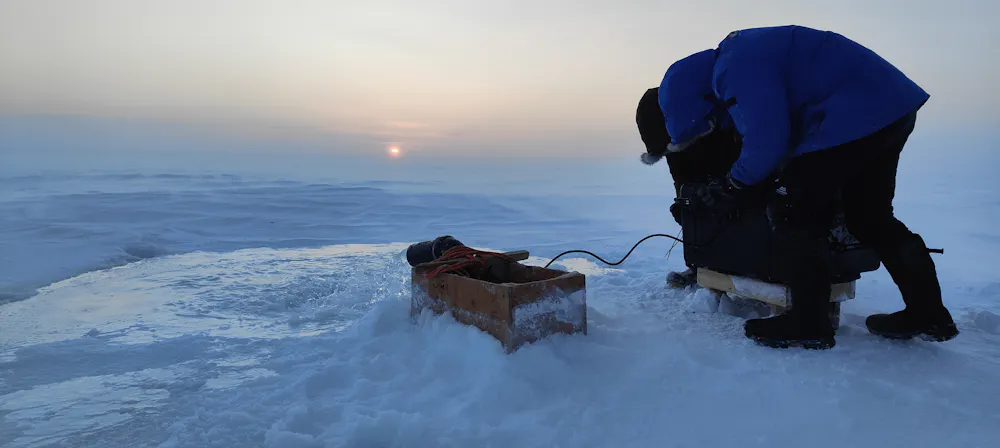
    The author and colleagues exploring in the Canadian Arctic. Real Ice

    Like ice in a drink, Arctic sea ice keeps things cold – until it melts. Using the same principle, some scientists are investigating whether they can make sea ice thicker and better able to cool the planet. I recently returned from Cambridge Bay in the far north of Canada, where I saw some early experiments in practice.

    Over the winter months, the build-up of sea ice around Cambridge Bay and across the Arctic helps keep the sea water underneath close to the freezing temperature, which for saltwater is around -1.8°C.

    These conditions are broadly maintained even through the early summer until the ice begins to melt and break up. The white ice cover, which reflects a large portion of the sun’s energy, is then replaced by dark blue water, which has the opposite effect. Now absorbing more sunlight, the water warms up.

    Such has been the balanced perennial cycle of sea ice in the Arctic, but recent decades of global warming might be putting it in jeopardy.


    Get your news from actual experts, straight to your inbox. Sign up to our daily newsletter to receive all The Conversation UK’s latest coverage of news and research, from politics and business to the arts and sciences.


    Over the past 30 years, sea ice in the Arctic has decreased. Rising air temperatures coupled with warmer water flowing in from further south have meant the ice starts to form later in the year and melt earlier.

    With less sea ice, there are longer periods in summer where more of the sun’s energy is absorbed rather than reflected into space. This creates a feedback loop – the warmer the water, the less sea ice is formed; the less sea ice there is, the warmer it gets.

    The author (in blue) and colleagues on the ice near Cambridge Bay in March 2025.
    Real Ice

    My trip to Cambridge Bay was as part of a team of scientists and engineers who have gathered together with local communities in the Arctic and two umbrella projects: Real Ice and Arctic Reflections. These groups want to research whether anything can be done to temporarily slow down or even reverse the loss of sea ice.

    The ultimate solution is, undoubtedly, deep and rapid reductions in greenhouse gas emissions. But with slow progress over the past few decades, additional measures may buy us time.

    Buying time

    Several big ideas are currently being explored. The first involves pumping seawater on top of existing ice to try and promote ice growth on top of the sea ice.

    Usually, any new sea ice that forms naturally does so on the underside of the ice. The process of freezing gives off some energy, which must escape through the ice above – a good insulator.

    The idea of pumping on top of the ice is that by bypassing the insulating effect, more sea ice might form – and the heat it gives off can be transferred to the cold winter Arctic air or directly radiated out to space.

    The author, pumping water onto ice.
    Real Ice

    The second idea stems from the realisation that snow is an even better insulator than ice. The proposal is therefore to pump just enough water onto the snow to flood it.

    As it freezes and turns into solid ice, it becomes much more conductive than snow. In turn, this will enable more sea ice to form naturally on the underside of sea ice.

    A third idea is derived from the observation that as sea ice melts in the early summer, melt ponds form on the surface. These melt ponds are much darker and absorb more heat than the original ice.

    So the idea is to explore whether it might be possible to drill small holes in the ice to drain them, exposing reflective ice and slowing the melt.

    These ideas might sound fanciful, but the dramatic changes in the Arctic warrant investigation into interventions that could have an impact sooner than cutting emissions or removing greenhouse gases.

    Can we really save sea ice?

    Crucially, the research is focused on developing our understanding of these potential ideas. The research could show that they are impractical, unfeasible or would potentially make things worse.

    For example, if pumping sea water onto sea ice leads to thicker ice at the end of the winter, that may not be much use if the ice is so much saltier that it melts more quickly.

    Therefore, researchers are using a combination of mathematical modelling, laboratory experiments, and limited-scale field experiments to address fundamental questions. A research project funded by the UK government has just been launched which includes modelling of thickening of sea ice.

    A further one including additional outdoor experiments will be starting soon funded by the UK’s Advanced Research and Invention Agency (Aria) as part of its Exploring Climate Cooling programme.

    These experiments will be conducted in close collaboration with local communities and under Aria’s stringent governance framework, prioritising safety and environmental monitoring. The goal is to gather essential real-world data to rigorously assess if this intervention warrants further consideration.

    The initial results and observations from preliminary field experiments are inconclusive but encouraging. For example, the ice formed by pumping sea water onto sea ice appears to become less salty (and therefore less prone to melting) over a few weeks.

    The brine which forms as seawater freezes on the surface is more dense than the ice and appears to migrate downwards through the ice. This seems theoretically plausible, but it is too early in the experiments to be confident in the results.

    If this research suggests that thickening sea ice works, then the next step will be to engage with more Arctic locals and various policymakers, and determine whether scaled-up testing of some of these approaches would be appropriate.


    Don’t have time to read about climate change as much as you’d like?

    Get a weekly roundup in your inbox instead. Every Wednesday, The Conversation’s environment editor writes Imagine, a short email that goes a little deeper into just one climate issue. Join the 45,000+ readers who’ve subscribed so far.


    Shaun Fitzgerald currently receives funding from NERC on a project which includes modelling of Rethickening of Arctic Sea Ice. Shaun will also shortly be receiving funding from ARIA on a further project on Rethickening of Arctic Sea Ice.

    ref. Arctic ice is vanishing – our bold experiment is trying to protect it – https://theconversation.com/arctic-ice-is-vanishing-our-bold-experiment-is-trying-to-protect-it-254534

    MIL OSI – Global Reports

  • MIL-OSI USA: Murphy, Blumenthal, 36 Colleagues Reintroduce Legislation To Ban Conversion Therapy

    US Senate News:

    Source: United States Senator for Connecticut – Chris Murphy

    May 13, 2025

    WASHINGTON—U.S. Senators Chris Murphy (D-Conn.) and Richard Blumenthal (D-Conn.) joined 36 of their Senate colleagues in reintroducing the Therapeutic Fraud Prevention Act, legislation that would ban so-called “conversion therapy,” a practice fraudulently claiming to change an individual’s sexual orientation or gender identity. The practice has been recognized by the national community of professionals in health, education, social work, and counseling as being both dangerous and useless.
    “Conversion therapy isn’t just junk science—it’s a cruel, phony practice that tells gay and transgender kids there’s something wrong with them. This bill would shut down the predators peddling these abusive treatments and finally call this scam what it is: dangerous, hateful fraud,” said Murphy.
    “The dangerous and debunked practice of so-called conversion therapy is seriously damaging to the LGBTQ+ community and most especially to children,” said Blumenthal. “Everyone, regardless of who they are and who they love, deserves to be protected from the discrimination and hate that fuels this harmful procedure. I am proud to sponsor the Therapeutic Fraud Prevention Act and stand with LGBTQ+ Americans in the fight against this discredited therapy.”
    U.S. Senators Patty Murray (D-Wash.), Cory Booker (D-N.J.), Tammy Baldwin (D-Wis.), Michael Bennet (D-Colo.), Maria Cantwell (D-Wash.), Chris Coons (D-Del.), Catherine Cortez Masto (D-Nev.), Tammy Duckworth (D-Ill.), Dick Durbin (D-Ill.), John Fetterman (D-Pa.), Kirsten Gillibrand (D-N.Y.), Maggie Hassan (D-N.H.), Martin Heinrich (D-N.M.), John Hickenlooper (D-Colo.), Mazie Hirono (D-Hawaii), Tim Kaine (D-Va.), Mark Kelly (D-Ariz.), Andy Kim (D-N.J.), Angus King (I-Maine), Amy Klobuchar (D-Minn.), Ben Ray Luján (D-N.M.), Ed Markey (D-Mass.), Jeff Merkley (D-Ore.), Alex Padilla (D-Calif.), Jack Reed (D-R.I.), Jacky Rosen (D-Nev.), Bernie Sanders (I-Vt.), Adam Schiff (D-Calif.), Jeanne Shaheen (D-N.H.), Elissa Slotkin (D-Mich.), Tina Smith (D-Minn.), Chris Van Hollen (D-Md.), Elizabeth Warren (D-Mass.), Peter Welch (D-Vt.), Sheldon Whitehouse (D-R.I.) and Ron Wyden (D-Ore.) also cosponsored the legislation. The bill was introduced in the House with 70 original cosponsors.
    The Therapeutic Fraud Prevention Act is endorsed by the Congressional Equality Caucus, Human Rights Campaign, PFLAG, American Academy of Pediatrics, Equality California, National Association of School Psychologists, Christopher Street Project, and Advocates for Trans Equality.
    Full text of the legislation is available HERE. 

    MIL OSI USA News

  • MIL-OSI Canada: Cranes Arrive for Halifax Infirmary Expansion Project

    Source: Government of Canada regional news

    A major milestone in the construction of the new, modern acute care tower will be reached this week as the first two of four tower cranes arrive at the Halifax Infirmary site of the QEII Health Sciences Centre.

    “These crane structures are a clear sign that transformation is underway,” said Michelle Thompson, Minister of Health and Wellness. “This new tower will meet the healthcare needs of our growing and aging population, an investment that will ensure generations of Nova Scotians get the cutting-edge care they deserve.”

    It will take about a week to erect these first two cranes, depending on the weather. Their delivery does not require lane closures or detours around the construction site.

    The other two cranes will arrive in July. Four are required because of the size of the construction site, and they will range from 93 to 105 metres high when fully assembled.

    Further updates on construction of the $7.4-billion acute care tower will be provided in the coming weeks, including information on pouring the concrete foundation, blasting and rock work, and phased paving and restoration work on Robie Street and Jubilee Road.

    The QEII Halifax Infirmary Expansion Project will serve residents of Halifax Regional Municipality, Nova Scotians and Atlantic Canadians. It will feature:

    • a new inpatient tower with 216 acute care beds, 16 operating rooms and specialized inpatient care units, including a 48-bed intensive care unit
    • diagnostic and treatment facilities
      • a satellite diagnostic imaging department in the emergency department
      • new and upgraded lab spaces including a pathology lab next to the new operating rooms
      • additional treatment spaces, including hyperbaric medicine
    • a new, expanded emergency department that will be more efficient and handle increased patient volumes.

    Construction of the acute care tower is expected to be complete in 2030 with the tower open and fully operational in the fall of 2031.


    Quotes:

    “The arrival of the cranes is a powerful sign to Nova Scotians that this long-envisioned project is becoming a reality. It will improve access to the care people need, reduce wait times and reflects our focus on delivering timely, high-quality care.”
    Karen Oldfield, interim President and CEO, Nova Scotia Health

    “While site preparation work and blasting have being going on for months, these towering cranes signal to the public the beginning of construction of the 14-storey acute care tower, the largest and most ambitious healthcare infrastructure project ever undertaken in Atlantic Canada.”
    Jonathan Veale, Vice-President, Strategic Infrastructure, Build Nova Scotia

    “Installing these first two tower cranes is a significant milestone for the Halifax Infirmary Expansion Project. They reflect the hard work and dedication of the teams working on this project. They also serve as a visible reminder that we are steadily progressing towards making this crucial piece of healthcare infrastructure a cornerstone for Nova Scotia. Seeing these cranes join the Halifax skyline is a proud moment for the Plenary PCL Health team.”
    Paul Knowles, Senior Vice-President and District Manager, PCL Construction


    MIL OSI Canada News

  • MIL-OSI Canada: Statement: New interim minister

    Source: Government of Canada regional news (2)

    MIL OSI Canada News

  • MIL-OSI Canada: Vice Chairperson Appointed to the Labour Relations Board

    Source: Government of Canada regional news

    Released on May 13, 2025

    Linda Zarzeczny, K.C. has been appointed to the Labour Relations Board as vice chairperson.  

    Ms. Zarzeczny joins Kyle McCreary, Chairperson and Carol Kraft, Vice-Chairperson on the Labour Relations Board. Her appointment is for five years, beginning April 30, 2025.

    “Ms. Zarzeczny’s background in private law and her time spent in the Ministry of Justice make her an excellent addition to the board,” Deputy Premier and Labour Relations and Workplace Safety Minister Jim Reiter said. “Ms. Zarzeczny’s appointment will ensure timely service and continuity for hearings before the board.”

    Zarzeczny received her Bachelor of Laws at the University of Saskatchewan and spent time in private practice in Alberta before returning to Saskatchewan where she served in the Ministry of Justice as the Senior Crown Counsel, executive Director of the Civil Law Division, the first assistant Deputy Attorney General of the Legal Services Division and most recently as the Deputy Minister and Deputy Attorney General for Saskatchewan. 

    The Saskatchewan Labour Relations Board is a quasi-judicial tribunal that adjudicates disputes under The Saskatchewan Employment Act and deals with applications for union certification or decertification. The board operates independently of government and is comprised of equal numbers of employee and employer representatives. 

    -30-

    For more information, contact:

    MIL OSI Canada News

  • MIL-OSI Canada: Prime Minister announces new Ministry

    Source: Government of Canada – Prime Minister

    Today, the Prime Minister, Mark Carney, announced the members of Canada’s new Ministry.

    Canadians elected this new government with a strong mandate to define a new economic and security relationship with the United States, to build a stronger economy, to reduce the cost of living, and to keep our communities safe. This focused team will act on this mandate for change with urgency and determination.

    The new government will act to catalyze investment and build a new Canadian economy – one that creates higher-paying careers, raises incomes, and can withstand future shocks. They will work in collaboration with provinces, territories, and Indigenous Peoples to advance the nation-building investments that will support the government’s core mission of building one strong, united economy – the strongest economy in the G7.

    The new Cabinet is appointed as follows:

    • Shafqat Ali, President of the Treasury Board
    • Rebecca Alty, Minister of Crown-Indigenous Relations
    • Anita Anand, Minister of Foreign Affairs
    • Gary Anandasangaree, Minister of Public Safety
    • François-Philippe Champagne, Minister of Finance and National Revenue
    • Rebecca Chartrand, Minister of Northern and Arctic Affairs and Minister responsible for the Canadian Northern Economic Development Agency
    • Julie Dabrusin, Minister of Environment and Climate Change
    • Sean Fraser, Minister of Justice and Attorney General of Canada and Minister responsible for the Atlantic Canada Opportunities Agency
    • Chrystia Freeland, Minister of Transport and Internal Trade
    • Steven Guilbeault, Minister of Canadian Identity and Culture and Minister responsible for Official Languages
    • Mandy Gull-Masty, Minister of Indigenous Services
    • Patty Hajdu, Minister of Jobs and Families and Minister responsible for the Federal Economic Development Agency for Northern Ontario
    • Tim Hodgson, Minister of Energy and Natural Resources
    • Mélanie Joly, Minister of Industry and Minister responsible for Canada Economic Development for Quebec Regions
    • Dominic LeBlanc, President of the King’s Privy Council for Canada and Minister responsible for Canada-U.S. Trade, Intergovernmental Affairs and One Canadian Economy
    • Joël Lightbound, Minister of Government Transformation, Public Works and Procurement
    • Heath MacDonald, Minister of Agriculture and Agri-Food
    • Steven MacKinnon, Leader of the Government in the House of Commons
    • David J. McGuinty, Minister of National Defence
    • Jill McKnight, Minister of Veterans Affairs and Associate Minister of National Defence
    • Lena Metlege Diab, Minister of Immigration, Refugees and Citizenship
    • Marjorie Michel, Minister of Health
    • Eleanor Olszewski, Minister of Emergency Management and Community Resilience and Minister responsible for Prairies Economic Development Canada
    • Gregor Robertson, Minister of Housing and Infrastructure and Minister responsible for Pacific Economic Development Canada
    • Maninder Sidhu, Minister of International Trade
    • Evan Solomon, Minister of Artificial Intelligence and Digital Innovation and Minister responsible for the Federal Economic Development Agency for Southern Ontario
    • Joanne Thompson, Minister of Fisheries
    • Rechie Valdez, Minister of Women and Gender Equality and Secretary of State (Small Business and Tourism)

    The Cabinet will be supported by 10 secretaries of State who will provide dedicated leadership on key issues and priorities within their minister’s portfolio.

    The new secretaries of State are appointed as follows:

    • Buckley Belanger, Secretary of State (Rural Development)
    • Stephen Fuhr, Secretary of State (Defence Procurement)
    • Anna Gainey, Secretary of State (Children and Youth)
    • Wayne Long, Secretary of State (Canada Revenue Agency and Financial Institutions)
    • Stephanie McLean, Secretary of State (Seniors)
    • Nathalie Provost, Secretary of State (Nature)
    • Ruby Sahota, Secretary of State (Combatting Crime)
    • Randeep Sarai, Secretary of State (International Development)
    • Adam van Koeverden, Secretary of State (Sport)
    • John Zerucelli, Secretary of State (Labour)

    Quote

    “Canada’s new Ministry is built to deliver the change Canadians want and deserve. Everyone is expected and empowered to show leadership – to bring new ideas, a clear focus, and decisive action to their work.”

    Associated Links

    MIL OSI Canada News

  • MIL-OSI Canada: Government of Saskatchewan Invests in Social Housing Units

    Source: Government of Canada regional news

    Released on May 13, 2025

    The 2025-26 Provincial Budget is providing more Saskatchewan families with access to safe and appropriate housing with an investment of $9.2 million in new funding to start multi-year repair and renovation projects for 285 Saskatchewan Housing Corporation (SHC)-owned units in Saskatoon, Regina and Prince Albert.

    “Making rent-ready social housing units available across the province is a top priority,” Social Services Minister Terry Jenson said. “This year’s investment will increase the number of rentable units, reduce vacancies and meet the needs of larger families.”

    Plans are underway to begin bringing vacant units back into service and help to better meet housing needs in the three major cities. This includes:

    • $4.3 million to commence major repairs to 154 units at Prairie Place in Regina and bring vacant units into service. 
    • $3.4 million to begin the first phase of major repairs and renovations for 44 units at Westview Place in Saskatoon to better serve large families. 
    • $1.5 million to replace and repair major building components for 87 units at Bryant Place in Prince Albert.  

    Overall, SHC is investing a total of $88.4 million this year to ensure rent-ready units are available across the province. This will support the repair of up to 1,600 provincially owned housing units with capital investments and provide 350 more households with affordable housing this year compared to last year.

    -30-

    For more information, contact:

    MIL OSI Canada News

  • MIL-OSI Canada: Saskatchewan Recognizes May 11-17 as National Police Week

    Source: Government of Canada regional news

    Released on May 13, 2025

    Recognizing Police Officers and Agencies in Saskatchewan

    The Government of Saskatchewan has proclaimed May 11 to 17, 2025 as National Police Week.

    This year’s national theme, “Committed to Serve Together,” highlights the collaborative efforts of police services and community organizations working together to ensure community safety and wellbeing across the province. 

    “It is very fitting that this year’s Police Week theme is ‘Committed to Serve Together’ because that is exactly how we approach public safety in Saskatchewan,” Corrections, Policing and Public Safety Minister Tim McLeod, K.C. said. “The RCMP, municipal police services and law enforcement agencies work in close partnership every day, whether it is by conducting traffic safety services together to keep our roadways safe or through several provincially-funded specialized enforcement teams working in tandem to address complex crimes, partnerships between Saskatchewan police and law enforcement agencies remain strong. With the Saskatchewan Marshals Service set to be operational this summer, we will have another layer of support to further strengthen that network and contribute to delivering safer communities across the province.”

    National Police Week began in 1970 as a public awareness campaign to encourage connections between police and the communities they serve. 

    “This week, we take the opportunity to thank all the policing agencies in Saskatchewan and their hardworking officers for the work they do to keep our communities safe,” McLeod said. 

    In 2025-26, the Government of Saskatchewan is investing $260 million to fund RCMP operations in the province, including $23.7 million for the First Nations Policing Program. The 2025-26 budget also includes $23.5 million to fund 160 municipal police positions, including 17 Combined Traffic Services positions and additional public safety initiatives, through the Municipal Police Grants program.

    “We are celebrating National Police Week, but I want to emphasize that I’m proud of the police officers throughout this province year-round,” Saskatchewan Association of Chiefs of Police President Rhonda Blackmore said. “They work hard every day to maintain the safety of our communities. A police officer’s day is never the same, but whether it’s investigating a crime, searching for a missing person, conducting traffic patrols, or overseeing a bike rodeo – all their actions contribute to safety. Thank you for your service. We are also grateful for the continued partnership between police and other public safety-related agencies in this province – that commitment to serve together helps ensure Saskatchewan is a safe and great place to live, work and play.”

    Over the past year, the province has funded 21 new police officer positions in Saskatoon, Regina, Moose Jaw, Estevan and Weyburn, as part of government’s $11.9 million commitment to hire approximately 100 new municipal police officers through the Safer Communities and Neighbourhoods initiative.

    In 2024-25 and 2025-26, the Government of Saskatchewan invested $2 billion in public safety to support policing and community safety in the province and enhance access to justice services. 

    -30-

    For more information, contact:

    MIL OSI Canada News

  • MIL-OSI Canada: Saskatchewan Launches New Program to Boost Oil Production and Generate Investment

    Source: Government of Canada regional news

    Released on May 13, 2025

    The Government of Saskatchewan has launched the Low Productivity and Reactivation Oil Well Program (LPRP) to create new incremental oil production and revenue from low-producing or inactive wells. 

    The LPRP promotes industry investment in low-producing or inactive horizontal oil wells through a new royalty structure for eligible wells. In the final year of the four-year LPRP program, it is projected to add 30,000 barrels per day of oil production and generate $21 million in additional royalty revenue for the province.

    “Growing Saskatchewan’s oil and gas industry is a priority for our government,” Energy and Resources Minister Colleen Young said. “This new program will encourage companies to make new investments in existing assets and increase oil production in our province. With our abundant resources, competitive regulatory environment, and targeted incentives, Saskatchewan is one of the best places in the world to develop oil and gas projects.”

    The LPRP can extend the life of wells that have already been drilled and allow access to oil that would otherwise have been left in place. The incremental oil production generated through the program will contribute to reaching Saskatchewan’s Growth Plan goal of increasing oil production to 600,000 barrels per day.

    “Not only does the LPRP support the government’s goal of increasing oil production, it has the added benefits of reducing inactive asset retirement obligations, improving environmental performance and enabling companies to convert liabilities into assets,” Saturn Oil and Gas CEO John Jeffrey said. “Saturn recently completed a successful Frobisher re-entry and is excited to identify further candidates, as we believe the LPRP will spur increased production, activity and revenue for the province; reduce the inactive well count and create additional employment and investment opportunities. Ultimately, the new LPRP represents a win-win for all stakeholders.”

    Last year, the value of Saskatchewan oil and gas production reached $13.5 billion, with the sector employing more than 26,000 people. Saskatchewan is the second-largest oil producer in Canada and sixth largest onshore oil producer in North America.

    For more details about LPRP, including information about how to apply for the program, visit: link.

    -30-

    For more information, contact:

    MIL OSI Canada News

  • MIL-OSI Canada: Be Bear Aware

    Source: Government of Canada regional news

    Released on May 13, 2025

    Warmer weather attracts nature-lovers and our wildlife neighbors – bears! These foragers are out of hibernation and are busy searching for food. As you enjoy the outdoors, be mindful of your surroundings.

    Black bears are common in Saskatchewan, with most found in the northern forest region. However, their range stretches southward into the aspen parkland and other areas including the Touchwood Hills, the Qu’Appelle Valley and the South Saskatchewan River Valley. 

    Bears are intelligent and curious animals. Their excellent sense of smell makes it easy for them to find food, even from miles away. When attractants like food waste, pet food, or bird seed are left out, bears may be attracted to the area and become habituated. Black bears are food motivated and will return to areas where they have found easy meals in the past. Managing attractants helps to keep both bears and people safe.

    Here are some helpful tips to follow if you encounter a bear:

    • Never feed or approach a bear or cubs.
    • Hike in groups and make noise by talking loudly or singing.
    • Stay calm – don’t run! 
    • Make a wide detour, calmly back away, speak in a firm deep voice and avoid direct eye contact with the bear.
    • Move towards a vehicle, building, tree, rock, or other cover.
    • Do not climb a tree, black bears are excellent climbers.
    • If the bear continues to follow, drop articles of clothing such as a jacket or hat to distract the bear.
    • Get out your bear spray and prepare to use it. 
    • In most cases, black bears will threaten but not attack.  If attacked – defend yourself – do not play dead. 

    And remember: keep bears at a distance by managing attractants and being bear aware – your safety starts with smart choices!

    If a bear or any other wildlife poses an immediate risk to people’s safety, call 911. To report an encounter with aggressive wildlife, call the Turn in Poachers and Polluters (TIPP) line at 1-800-667-7561. Concerns regarding bears or other nuisance wildlife can be reported to the Ministry of Environment by calling 1-800-567-4224 or email center.inquiry@gov.sk.ca. 

    -30-

    For more information, contact:

    MIL OSI Canada News

  • MIL-OSI Canada: Statement: Congratulating Speaker McIver

    Source: Government of Canada regional news (2)

    MIL OSI Canada News

  • MIL-OSI Canada: Alberta takes action: Ending gender-based violence

    [. It often goes unnoticed or unreported and whether directly or indirectly, all Albertans are affected by it. A made-in-Alberta strategy is required to end the violence and create a safer home for every Albertan. 

    Building on our Strengths: Alberta’s 10-year Strategy to End Gender-Based Violence is a bold, provincewide plan that addresses all forms of gender-based violence. The strategy implements clear, immediate, short- and long-term actions that strengthen the work already underway. This foundational strategy outlines initiatives that ensure efforts across government and community partners are coordinated, so that Alberta can put an end to gender-based violence. Central to the strategy are commitments to engage men and boys as partners, enhance women’s economic empowerment and ensure targeted programs are Indigenous-led.

    Alberta’s 10-year strategy is focused on building an understanding around what appropriate behavior is, raising awareness on every form of gender-based violence and increasing coordination across all sectors. The strategy builds on the excellent work of dedicated organizations across the province and outlines a reasonable and responsible approach to grow programs that work, address service gaps and ensure prevention, early intervention, crisis response and long-term supports are available in all corners of the province, when and where they are needed.

    “Our government is proud to release Building on our Strengths: Alberta’s 10-year Strategy to End Gender-Based Violence, the most comprehensive strategy of its kind in Canada. Through this strategy, our government will lay the groundwork for lasting change while addressing the root causes of gender-based violence and supporting survivors.”

    Tanya Fir, Minister of Arts, Culture and Status of Women

    “Our commitment to public safety is reflected in Alberta’s approach to preventing and responding to gender-based violence by supporting victims, preventing violence and ensuring high-risk offenders are held accountable. This strategy is a bold step forward – one that brings together government, community partners and front-line professionals. United, we are proud to unveil Alberta’s decade-long commitment to ending gender-based violence, a crucial step towards a safer future for all.”

    Mike Ellis, Minister of Public Safety and Emergency Services

    “By releasing Alberta’s 10-year Strategy to End Gender Based Violence, our government is leading the charge to eradicate domestic and family violence in our communities. This will empower and support the important work of women’s shelters and sexual assault centres to ensure that every woman and child is protected and able to receive the supports they need.”

    Searle Turton, Minister of Children and Family Services

    “Our justice system must be a place where survivors of gender-based violence feel heard, protected and supported. This strategy is a critical step towards building a safer Alberta where accountability and compassion go hand in hand.”

    Mickey Amery, Minister of Justice

    “Indigenous women, girls and two-spirit plus people disproportionately face gender-based violence. This must stop. The strategy announced today is a beacon of hope and includes tangible actions for everyone working to end gender-based violence. It builds on other work already underway to address the root causes of gender-based violence and prevent it before it occurs, such as work done by the Premier’s Council on Missing and Murdered Indigenous Women, Girls and Two Spirit Plus People, and the First Nations and Métis Women’s Councils on Economic Security, and work done under the Human Trafficking Action Plan. I am honoured to continue this important work.”

    Rick Wilson, Minister of Indigenous Relations

    Alberta’s 10-year Strategy to End Gender-Based Violence complements and enhances existing initiatives such as the Premier’s Council on Missing and Murdered Indigenous Women, Girls and Two Spirit Plus People and the Human Trafficking Action Plan to address the root causes of gender-based violence and prevent it before it occurs.

    Alberta’s strategy is the most comprehensive of its kind in the country, with actions that will:

    • Increase awareness of what gender-based violence is and what Albertans should do when they see it.
    • Prevent gender-based violence before it begins by addressing its underlying causes and implementing early-intervention strategies.
    • Empower women to be economically independent, supporting them with financial and social resources to achieve true financial independence, enabling them to live safely and build strong, independent lives.
    • Support Indigenous-led solutions and incorporate Indigenous ways of knowing and being into programs that address the unique needs, lived experiences and practices of Indigenous people, families and communities.
    • Support those affected how, where and when they need it, with timely, culturally informed, accessible and responsive support for survivors, families, those at risk, perpetrators and potential perpetrators, ensuring they receive the help they need in their own communities.

    “As Chair of the Premier’s Council on Missing and Murdered Indigenous Women, Girls and Two Spirit Plus People, I am pleased that the Government of Alberta is taking a comprehensive and coordinated approach to ending gender-based violence. The Premier’s Council looks forward to working with the Government of Alberta to implement Building on Our Strengths: Alberta’s 10-year Strategy to End Gender-Based Violence, especially in areas that intersect with factors related to missing and murdered Indigenous women, girls and two spirit plus people and the Alberta Missing and Murdered Indigenous Women and Girls Roadmap. We are stronger when we work together.”

    Rachelle Venne, chair, Premier’s Council on Missing and Murdered Indigenous Women, Girls and Two Spirit Plus People

    “By prioritizing financial empowerment and Indigenous-led solutions, this strategy will help more Alberta women avoid or leave high-risk situations. Women Building Futures applauds the Government of Alberta for this farsighted, whole-of-government approach to the pervasive and complex problem of gender-based violence.”

    Carol Moen, president and CEO, Women Building Futures

    “This strategy signals a shift: to end gender-based violence, we must engage men and boys as part of the solution. By investing in prevention and including men in efforts to shift norms and behaviours, Alberta is paving the way for a safer, more just future.”

    Lana Wells, associate professor, Faculty of Social Work, University of Calgary, and founder of Shift2Learn

    Budget 2025 invests $19.8 million to support Alberta’s 10-year Strategy to End Gender-based Violence. This funding will be used to make targeted investments to ensure provincial programs are coordinated, collaborative, effective and sustainable. In total, Alberta’s government invests more than $188 million in related programming and services across government.

    The strategy was informed by extensive engagement with more than 500 Albertans and organizations, including survivors, community organizations working on the front lines, Indigenous communities and academics.

    Quick facts

    • From fall 2023 to spring 2024, Arts, Culture and Status of Women conducted extensive engagement with the public and key stakeholders, including an online survey for Albertans, specific engagement with Indigenous groups and meetings with more than 500 stakeholders in 11 communities across the province.
    • Gender-based violence refers to harmful acts directed at an individual based on their gender. It can take many forms, including physical assault, sexual assault, murder, femicide, family violence, intimate partner violence, human trafficking, stalking, financial control, threats, hate speech, cyber-bullying, cyber-stalking, pornography and coercive control.
    • Alberta’s government invests more than $188 million annually in gender-based violence related programming across several ministries, including:
      • Expanding voluntary and court-ordered programming for perpetrators and those at risk of causing harm.
      • Implementing electronic monitoring technology to monitor offenders under court ordered supervision.
      • Supporting women’s shelter programming to focus on access to safety and inclusive services.
      • Improving the reporting and prevention efforts at post-secondary institutions and First Nations colleges to address campus sexual violence.
      • Increasing service provider access to education and resources related to elder abuse.
      • Supporting academic research on gender-related injury and illness in the workplace.
      • Strengthening support for Albertans navigating the justice system, including developing more survivor-centered, culturally sensitive, trauma-informed services.
      • Implementing Indigenous-led initiatives that advance the Missing and Murdered Indigenous Women and Girls Roadmap.
      • Strengthening safe, accessible and reliable transportation options for victims, survivors and their families seeking GBV support and services.
      • Specialized 24-7 support to patients experiencing domestic and family violence.
      • Working with professionals to help seniors who are experiencing GBV.
      • Raising awareness of Clare’s Law to allow people to make informed choices about potentially harmful intimate partners and how it is an important tool in protecting Albertans from domestic violence.

    Related information

    • Ending Gender-Based Violence

    Multimedia

    • Watch the news conference
    • Ending Gender-Based Violence Video

    MIL OSI Canada News

  • MIL-OSI USA: Reconciliation Recommendations of the House Committee on Oversight and Government Reform

    Source: US Congressional Budget Office

    Legislation Summary

    H. Con. Res. 14, the Concurrent Resolution on the Budget for Fiscal Year 2025, instructed the House Committee on Oversight and Government Reform to recommend legislative changes that would decrease deficits by a specified amount over the 2025-2034 period. As part of the reconciliation process, the House Committee on Oversight and Government Reform approved legislation on April 30, 2025, that would decrease deficits.

    Estimated Federal Cost

    In CBO’s estimation, the reconciliation recommendations of the House Committee on Oversight and Government Reform would, on net, decrease deficits by $51.0 billion over the 2025‑2034 period. The estimated budgetary effects of the legislation are shown in Table 1. The costs of the legislation mainly fall within budget functions 550 (health), 600 (income security), 800 (general government), and 950 (undistributed offsetting receipts).

    Return to Reference

    Table 1.

    Estimated Budgetary Effects of Reconciliation Recommendations Title IX, House Committee on Oversight and Government Reform, as Ordered Reported on April 30, 2025


    By Fiscal Year, Millions of Dollars


    2025

    2026

    2027

    2028

    2029

    2030

    2031

    2032

    2033

    2034

    2025-2029

    2025-2034


    Increases or Decreases (-) in Direct Spending


    Budget Authority

    -22

    -116

    -11

    -575

    -1,007

    -1,418

    -1,784

    -2,046

    -2,277

    -2,491

    -1,731

    -11,747

    Estimated Outlays

    -22

    -189

    4

    -560

    -992

    -1,403

    -1,771

    -2,046

    -2,277

    -2,491

    -1,759

    -11,747


    On-Budget

    -22

    -3

    -182

    -560

    -992

    -1403

    -1771

    -2046

    -2277

    -2491

    -1,759

    -11,747


    Off-Budget a

    0

    -186

    186

    0

    0

    0

    0

    0

    0

    0

    0

    0


    Increases in Revenues


    Estimated Revenues

    9

    1,839

    4,229

    4,811

    4,802

    4,779

    4,747

    4,707

    4,664

    4,617

    15,690

    39,204


    Net Decreases in the Deficit

    From Changes in Direct Spending and Revenues


    Effect on the Deficit

    -31

    -2,028

    -4,225

    -5,371

    -5,794

    -6,182

    -6,518

    -6,753

    -6,941

    -7,108

    -17,449

    -50,951


    On-Budget Deficit

    -31

    -1,842

    -4,411

    -5,371

    -5,794

    -6,182

    -6,518

    -6,753

    -6,941

    -7,108

    -17,449

    -50,951


    Off-Budget Deficit a

    0

    -186

    186

    0

    0

    0

    0

    0

    0

    0

    0

    0

    a.Cash flows for USPS are recorded in the federal budget in the Postal Service Fund and are classified as off-budget direct spending.

    Basis of Estimate

    For this estimate, CBO assumes that the legislation will be enacted in summer 2025. CBO’s estimates are relative to its January 2025 baseline and cover the period from 2025 through 2034.

    Direct Spending and Revenues

    CBO estimates that enacting the legislation would decrease direct spending by $11.7 billion and increase revenues by $39.2 billion over the 2025-2034 period; the deficit would be reduced $51.0 billion over the 2025-2034 period (see

    The rate for most federal employees, Members of Congress, and Congressional staff who entered the system in 2013 would increase from 3.1 percent to 4.4 percent over the phase-in period. Contributions would remain constant at 3.6 percent for employees who entered in 2013 who are eligible for enhanced benefits and also subject to mandatory retirement. The contributions for FERS Further Revised Annuity Employees (those who entered after 2013) would remain constant at 4.4 percent of their annual salary over the phase-in period for most federal employees, Members of Congress, and Congressional staff and at 4.9 percent for employees who are eligible to receive enhanced benefits.

    Contributions paid by federal employees toward their retirement are recorded as revenues in the federal budget. CBO estimates that the proposed increases in employee contributions would increase revenues by $34.5 billion over the 2025-2034 period.

    Federal agencies also contribute to their employees’ retirement. For each increase proposed for employees, there would be a corresponding reduction for employing agencies. Reducing employers’ contributions for FERS employees (other than employees of the Postal Service, USPS) would reduce spending subject to appropriation by $31.8 billion over the 2025‑2034 period, CBO estimates. That, in turn, would reduce the intragovernmental offsetting receipts paid into the Civil Service Retirement and Disability Fund (CSRDF) by an equal amount. Because that budgetary action is contingent on future appropriations, the increase in the deficit from the decline in estimated offsetting receipts is not attributed to this legislation.

    By contrast, outlays by USPS are classified as off-budget direct spending. Reducing that agency’s contributions to employee retirement would result in smaller intragovernmental offsetting receipts being paid into the CSRDF, therefore increasing on-budget direct spending by that same amount.

    Under section 90001, the total amount of retirement contributions (employee plus agency shares) paid into the CSRDF would remain the same as under current law. That is, the legislation would replace some of the payments by agencies with payments by federal employees. CBO attributes budgetary savings to the proposal because employees’ contributions are classified in the budget as revenues, whereas agency payments are classified as intragovernmental transfers that are subject to future appropriation. If the reduction in intragovernmental transfers makes possible an offsetting increase in other appropriations, the net effect would be an increase in outlays—because an intragovernmental payment would be replaced by spending that goes outside the government.

    CBO estimates that reducing the USPS contribution rate for affected employees would reduce that agency’s required payments to the CSRDF by nearly $2.7 billion over the 
    2025-2034 period. That reduction of receipts into the fund would result in a nearly $2.7 billion increase in on-budget direct spending over the period. Because CBO projects that USPS will exhaust both its borrowing authority and its reserve funds in 2027, any savings to the Postal Service Fund from lower retirement contributions would be fully offset beginning in that year. As a result, CBO estimates that enacting the provision would result in a reduction in off-budget outlays in 2026 that would be offset by increased off-budget direct spending beginning in 2027 as USPS would spend the amount it saved from lower accrual payments to fund its operations.

    Elimination of FERS Annuity Supplement

    Under current law, certain FERS employees who retire before age 62 receive a supplement to their annuity that is intended to equal the amount they would receive from the Social Security Administration if they were eligible for Social Security benefits at the time of retirement.The annuity supplement ends when the retiree turns 62 or becomes eligible to receive Social Security benefits.

    Section 90002 would eliminate the annuity supplement for most newly retired people under FERS. Employees who retire under a mandatory authority would continue to receive the supplement as under current law. Current FERS annuitants and those who retire before enactment also would continue to receive the supplement.

    Using data from the Office of Personnel Management (OPM), CBO estimates that about 21,000 new FERS retirees who do not retire under a mandatory authority are added to the annuity supplement rolls each year. In fiscal year 2025, the average annual supplement for affected annuitants would be about $18,000, CBO estimates. Those annuitants begin to receive the supplement, on average, at age 59 and would therefore receive the supplement for about three years. On that basis, CBO estimates that eliminating the supplement for new annuitants would reduce direct spending by $10.0 billion over the 2025-2034 period.

    High-5 Average Pay for Calculating CSRS and FERS Pension

    Most federal employees hired before 1987 are part of the Civil Service Retirement System (CSRS), the defined benefit pension plan that was replaced by FERS. Under current law, retirement annuities under both systems are based on a participant’s average salary over the three consecutive years with their highest earnings.

    Section 90003 would change the annuity calculation to use a five-year average for most CSRS and FERS employees who retire on or after January 1, 2027. The annuity calculation for employees who are subject to mandatory retirement would remain at the three-year average, as under current law.

    Using data from OPM, CBO estimates that about 90,000 employees who are not subject to mandatory retirement are added to the CSRS and FERS retirement rolls each year. Under current law, the average monthly benefit for CSRS annuitants was about $5,700 in fiscal year 2024; for FERS the average was about $2,300. Using the five-year average, rather than the three-year average, would reduce an affected retiree’s annuity by about 3 percent. CBO estimates that enacting section 90003 would reduce direct spending by $3.1 billion over the 2025-2034 period.

    Election for At-Will Employment and Lower FERS Contributions for New Federal Civil Service Hires

    Section 90004 would require most new federal civilian hires to choose either to serve as at-will employees or to contribute an additional five percent of their salary toward their retirement. The change would apply to employees hired or appointed after enactment. It would not apply to employees who cannot appeal adverse actions to the Merit Systems Protection Board, including most USPS employees. It also would exclude certain other employees, including positions excepted from the competitive service due to the confidential, policy focused nature of their work.

    At-will employees can have their employment terminated at any time without cause. Those employees retain protection under antidiscrimination laws, however, including laws that prohibit termination on the basis of race, sex, or religion. Under this provision, new hires who choose not to become at-will employees would retain civil service protections that require employers to show cause for any adverse personnel action and would retain the right to appeal employment termination.

    Based on data from OPM, CBO estimates that roughly 124,000 affected federal hires will enter FERS in fiscal year 2026 with an annual salary of about $71,000, on average. Using data about employees’ perceptions of job security and willingness to forgo current compensation for future benefits, CBO estimates that roughly one quarter of affected federal hires would choose to contribute an additional 5 percent of their salary toward retirement rather than enter into at-will employment. On that basis, CBO estimates that the larger retirement contributions of those who reject at-will employment would increase revenues by $4.7 billion over the 2025-2034 period.

    Federal agencies also are required to contribute toward employees’ retirement. Under section 90004, agencies’ contributions would decrease by the same percentage that employees’ contributions rise. CBO estimates that reduced employer contributions for FERS employees in agencies other than USPS would decrease spending subject to appropriation by $4.5 billion over the 2025-2034 period.

    CBO estimates that section 90004 would apply to roughly 10 percent of USPS employees. A reduction in USPS’s contributions for affected hires who do not choose at-will employment would reduce that agency’s required payments to the CSRDF (as well as receipts into the fund) by $112 million over the 2025‑2034 period, CBO estimates, thereby boosting on-budget direct spending by that amount. Because CBO projects that USPS will exhaust both its borrowing authority and its reserve funds in 2027, any savings to the Postal Service Fund would be fully offset beginning in that year. Thus, CBO estimates no net change in off-budget outlays by USPS over the 2025-2034 period.

    Filing Fee for Merit Systems Protection Board Claims and Appeals

    Section 90005 would direct the Merit Systems Protection Board (MSPB) to impose fees for employees, former employees, or applicants for employment to file certain types of claims against federal agencies. Fees collected from claimants whose appeals are denied would be deposited into the Treasury as miscellaneous receipts. CBO expects that under this provision fewer claims would be filed than the 4,000 that are filed annually, on average, under current law. Using information from the MSPB, CBO estimates that enacting the provision would increase revenues by $3 million over the 2025‑2034 period.

    FEHB Protection

    Section 90006 would require federal agencies to verify the eligibility of enrollees’ dependents to participate in the FEHB program. That program provides health insurance to about 8 million federal workers and annuitants, including current and retired USPS employees, and coverage for their dependents and survivors. Verification would occur when the employee or annuitant starts or changes a dependent’s enrollment—for example, during open season, because of a change in employment, or in response to a qualifying life event, such as a marriage or the birth or adoption of a child. Within six years of enactment, the legislation would require OPM to conduct a verification audit of all dependents enrolled in the program. Dependents found to be ineligible would be denied enrollment or disenrolled. The legislation also would expand OPM’s annual assessment of fraud risk to include a risk assessment for enrollment by ineligible dependents.

    Agencies currently verify dependents’ eligibility at initial enrollment or when employees change their coverage at the time of a qualifying life event. OPM requires federal agencies to verify 10 percent of enrollment elections during open season. However, the Government Accountability Office has indicated that some ineligible dependents have been enrolled and that additional measures could be taken to reduce fraud in the program.

    Over the 2026-2034 period, the legislation would authorize OPM to spend $604 million from the FEHB trust fund to expand that agency’s oversight of the program, increasing outlays by the same amount. Authorized amounts would be for the following activities:

    • $474 million to develop, maintain, and conduct ongoing verifications for and oversight of the FEHB program’s enrollment and eligibility systems;
    • $80 million to audit enrollment of dependents; and
    • $50 million for program oversight by OPM’s Office of the Inspector General.

    Those amounts would be used in part for activities that would reduce enrollment in FEHB and result in smaller government contributions to premiums. CBO anticipates that OPM would implement the section’s auditing requirements using contracts with private-sector entities. Given the likely duration and complexity of such an undertaking, CBO expects that the audit would begin later in fiscal year 2026 and continue through 2031.

    Using data on the composition of enrollment in the FEHB program, along with information about the share of dependents removed as a result of other verification audits, CBO expects that implementing the section would cause enrollment to decline by about 100,000 people, on average, in each year over the 2026-2034 period, of which about 10,000 would be removed as a result of open-season verifications.

    Government contributions to premiums for federal annuitants and USPS employees are classified in the budget as direct spending. Therefore, a decline in FEHB enrollment among those groups would reduce direct spending. CBO estimates that about 35 percent of the people disenrolled would be ineligible dependents of federal annuitants and USPS employees, at an average annual cost of about $6,900 per dependent, for a total reduction in direct spending of $2.1 billion over the 2026-2034 period.

    In total, CBO estimates enacting the section would reduce direct spending by about $1.5 billion over the 2026‑2034 period.

    Uncertainty

    CBO’s estimates for the budgetary effects of enacting title IX are subject to uncertainty. Several areas in particular are difficult to estimate:

    • Anticipating federal employees’ responses to changes in FERS contributions and benefits is uncertain because decisions related to employment and retirement depend on a wide variety of individual circumstances.
    • Estimating new federal employees’ responses to a requirement to contribute a larger percentage of their salary toward their retirement or accept at-will employment is subject to significant uncertainty due to limited data and historical experience related to how workers have responded in similar situations.
    • Estimating the budgetary effects of section 90006 is subject to significant uncertainty because no similar verification audit of the FEHB program has been undertaken. CBO projected the cost of an audit, length of time required to complete an audit, the number of dependents who could be found ineligible, and the number disenrolled, but actual amounts could be larger or smaller than estimated. Moreover, given the inherent uncertainty concerning patterns of health care use by people who would be newly found ineligible, the reductions in spending that would be generated by an audit also could be larger or smaller than estimated here.

    Pay-As-You-Go Considerations

    The Statutory Pay-As-You-Go Act of 2010 establishes budget-reporting and enforcement procedures for legislation affecting direct spending or revenues. The net changes in outlays and revenues that are subject to those pay-as-you-go procedures are shown in Chief, Projections Unit

    Ann E. Futrell
    Acting Chief, Natural and Physical Resources Cost Estimates Unit

    Sarah Masi
    Senior Adviser, Budget Analysis Division

    Kathleen FitzGerald 
    Chief, Public and Private Mandates Unit

    Christina Hawley Anthony
    Deputy Director of Budget Analysis

    H. Samuel Papenfuss 
    Deputy Director of Budget Analysis

    Chad Chirico 
    Director of Budget Analysis

    Phillip L. Swagel

    Director, Congressional Budget Office

    Table 2.

    Estimated Changes in Direct Spending and Revenues Under Reconciliation Recommendations Title IX, House Committee on Oversight and Government Reform, as Ordered Reported on April 30, 2025


    By Fiscal Year, Millions of Dollars


    2025

    2026

    2027

    2028

    2029

    2030

    2031

    2032

    2033

    2034

    2025-2029

    2025-2034


    Increases or Decreases (-) in Direct Spending


    Sec. 90001, Increase in FERS Employee Contribution Requirements


    Budget Authority

    0

    0

    578

    415

    378

    341

    306

    273

    242

    214

    1,371

    2,747

    Estimated Outlays

    0

    0

    578

    415

    378

    341

    306

    273

    242

    214

    1,371

    2,747


    On-Budgeta

    0

    183

    395

    415

    378

    341

    306

    273

    242

    214

    1,371

    2,747


    Off-Budgetb

    0

    -183

    183

    0

    0

    0

    0

    0

    0

    0

    0

    0

    Sec. 90002, Elimination of FERS Annuity Supplement


    Budget Authority

    -22

    -229

    -530

    -781

    -1,013

    -1,219

    -1,387

    -1,521

    -1,623

    -1,709

    -2,575

    -10,034

    Estimated Outlays

    -22

    -229

    -530

    -781

    -1,013

    -1,219

    -1,387

    -1,521

    -1,623

    -1,709

    -2,575

    -10,034

    Sec. 90003, High-5 Average Pay for Calculating CSRS and FERS Pension


    Budget Authority

    0

    0

    -38

    -122

    -224

    -329

    -435

    -541

    -650

    -761

    -384

    -3,100

    Estimated Outlays

    0

    0

    -38

    -122

    -224

    -329

    -435

    -541

    -650

    -761

    -384

    -3,100

    Sec. 90004, Election for At-Will Employment and Lower FERS Contributions for New Federal Civil Service Hires


    Budget Authority

    0

    0

    6

    7

    10

    13

    15

    18

    20

    23

    23

    112

    Estimated Outlays

    0

    0

    6

    7

    10

    13

    15

    18

    20

    23

    23

    112


    On-Budgeta

    0

    2

    4

    7

    10

    13

    15

    18

    20

    23

    23

    112


    OffBudgetb

    0

    -2

    2

    0

    0

    0

    0

    0

    0

    0

    0

    0

    Sec. 90006, FEHB Protection


    Budget Authority

    0

    113

    -27

    -94

    -158

    -224

    -283

    -275

    -266

    -258

    -166

    -1,472

    Estimated Outlays

    0

    40

    -12

    -79

    -143

    -209

    -270

    -275

    -266

    -258

    -194

    -1,472


    On-Budgetc

    0

    41

    -13

    -79

    -143

    -209

    -270

    -275

    -266

    -258

    -194

    -1,472


    Off-Budgetd

    0

    -1

    1

    0

    0

    0

    0

    0

    0

    0

    0

    0

    Total Changes


    Budget Authority

    -22

    -116

    -11

    -575

    -1,007

    -1,418

    -1,784

    -2,046

    -2,277

    -2,491

    -1,731

    -11,747

    Estimated Outlays

    -22

    -189

    4

    -560

    -992

    -1,403

    -1,771

    -2,046

    -2,277

    -2,491

    -1,759

    -11,747


    On-Budget

    -22

    -3

    -182

    -560

    -992

    -1403

    -1771

    -2046

    -2277

    -2491

    -1,759

    -11,747


    Off-Budget

    0

    -186

    186

    0

    0

    0

    0

    0

    0

    0

    0

    0

    (Continued)

    Table 2.

    Estimated Changes in Direct Spending and Revenues Under Reconciliation Recommendations Title IX, House Committee on Oversight and Government Reform, as Ordered Reported on April 30, 2025

    (Continued)


    By Fiscal Year, Millions of Dollars


    2025

    2026

    2027

    2028

    2029

    2030

    2031

    2032

    2033

    2034

    2025-2029

    2025-2034


    Increases in Revenues


    Sec. 90001, Increase in FERS Employee Contribution Requirements


    Estimated Revenues

    0

    1,768

    4,052

    4,525

    4,404

    4,270

    4,123

    3,967

    3,805

    3,634

    14,749

    34,548

    Sec. 90004, Election for At-Will Employment and Lower FERS Contributions for New Federal Civil Service Hires


    Estimated Revenues

    9

    71

    177

    286

    397

    509

    624

    740

    859

    981

    940

    4,653

    Sec. 90005, Filing Fee for Merit Systems Protection Board Claims and Appeals


    Estimated Revenues

    *

    *

    *

    *

    1

    *

    *

    *

    *

    2

    1

    3

    Total Changes


    Estimated Revenues

    9

    1,839

    4,229

    4,811

    4,802

    4,779

    4,747

    4,707

    4,664

    4,617

    15,690

    39,204


    Net Decrease in the Deficit

    From Changes in Direct Spending and Revenues


    Effect on the Deficit

    -31

    -2,028

    -4,225

    -5,371

    -5,794

    -6,182

    -6,518

    -6,753

    -6,941

    -7,108

    -17,449

    -50,951

    On-Budget Deficitta,c

    -31

    -1,842

    -4,411

    -5,371

    -5,794

    -6,182

    -6,518

    -6,753

    -6,941

    -7,108

    -17,449

    -50,951

    Off-Budget Deficitb,d

    0

    -186

    186

    0

    0

    0

    0

    0

    0

    0

    0

    0

    a. The on-budget effect arises from reduced contributions by the Postal Service for FERS employees’ retirement, resulting in smaller deposits of offsetting receipts into the Civil Service Retirement and Disability Fund.

    b. The off-budget effect arises from reduced contributions by the Postal Service for FERS employees’ retirement. Under current law, CBO expects that the Postal Service will exhaust both its borrowing authority and its reserve funds in 2027. As a result, CBO expects that the savings to the Postal Service Fund under the legislation would be fully offset beginning in that year.

    c. The on-budget effect arises from reductions in enrollment in the FEHB program of dependents of federal annuitants.

    d. The off-budget effect comes from reduced Postal Service contributions for postal employees’ health benefits. Under current law, CBO expects that the Postal Service will exhaust both its borrowing authority and its reserve funds in 2027. As a result, CBO expects that the savings to the Postal Service Fund under the legislation would be fully offset beginning in that year.

    MIL OSI USA News

  • MIL-OSI USA: H.R. 1286, Simplifying Forms for Veterans Claims Act

    Source: US Congressional Budget Office

    H.R. 1286 would require the Department of Veterans Affairs (VA) to enter into an agreement with a federally funded research and development center (FFRDC) to assess the forms that the department sends to people who have applied for VA benefits. The bill also would reduce the amount of VA pensions the department pays to certain veterans and survivors who reside in nursing homes.

    Spending Subject to Appropriation

    Section 2 would require VA to enter into an agreement with an FFRDC to assess forms sent to claimants for benefits administered by VA. (FFRDCs are public-private partnerships between the federal government and universities or corporations that conduct research and development for the federal government.) The FFRDC would consult with organizations and individuals who assist veterans to determine if such forms could be better organized and clearer to claimants. The bill would require VA to submit the assessment to the Congress and implement any such recommendations within two years of receipt of the assessment. Using information on the cost of similar studies, CBO estimates that the assessment would cost $1 million in fiscal year 2026. Based on information from VA, CBO estimates that it would cost the department $1 million to analyze and implement the assessment’s recommendations. In total, implementing section 2 would cost $2 million over the 2025-2035 period. Such spending would be subject to the availability of appropriations (See Table 1).

    Table 1. 
    Estimated Budgetary Effects of H.R. 1286


    By Fiscal Year, Millions of Dollars


    2025

    2026

    2027

    2028

    2029

    2030

    2031

    2032

    2033

    2034

    2035

    2025-2030

    2025-2035


    Increases in Spending Subject to Appropriation


    Estimated Authorization

    *

    1

    *

    1

    0

    0

    0

    0

    0

    0

    0

    2

    2

    Estimated Outlays

    *

    1

    *

    1

    0

    0

    0

    0

    0

    0

    0

    2

    2


    Decreases (-) in Direct Spending


    Budget Authority

    0

    0

    0

    0

    0

    0

    0

    -4

    0

    0

    0

    0

    -4

    Estimated Outlays

    0

    0

    0

    0

    0

    0

    0

    -4

    0

    0

    0

    0

    -4

    * = between zero and $500,000.

    Direct Spending

    Section 3 would extend through December 31, 2031, the reduction of pension payments for veterans and survivors who reside in a Medicaid nursing home. Under current law, VA reduces payments to those beneficiaries to $90 per month. The requirement to reduce pension payments expires on November 30, 2031. CBO estimates that extending that requirement by one month would reduce VA benefits by $10 million. (Those benefits are paid from mandatory appropriations and are therefore considered direct spending.) As a result of that reduction in beneficiaries’ income, Medicaid would pay more of the cost of their care, increasing spending in that program by $6 million. On net, capping pensions for the approximately 4,000 veterans and survivors in Medicaid nursing homes would reduce outlays by $4 million over the 2025-2035 period.

    The CBO staff contact for this estimate is Logan Smith. The estimate was reviewed by Christina Hawley Anthony, Deputy Director of Budget Analysis.

    Phillip L. Swagel

    Director, Congressional Budget Office

    MIL OSI USA News

  • MIL-OSI USA: C is for Commencement

    Source: US State of Connecticut

    The University of Connecticut awarded 524 doctoral degrees on Monday, May 12 at the Jorgensen Center for the Performing Arts in the conclusion to three days of commencement ceremonies at Storrs. The doctorate recipients might have been well past their Sesame Street phase, but the letter of the day was unquestionably C.

    “Commencement. That’s why we’re here,” said the Honorable Sethuraman Panchanathan, former director of the U.S. National Science Foundation, the keynote speaker for the ceremony who was also awarded an honorary doctorate.

    Sethuraman Panchanathan, former director of the National Science Foundation, accepts an honorary degree from UConn President Radenka Maric during the doctoral graduate Commencement ceremony in the Jorgensen Center for the Performing Arts on Monday, May 12, 2025. (Sydney Herdle/UConn Photo)

    Panchanathan went on to list nine attributes beginning with the letter C that the doctoral recipients should hold as fundamental values to uphold, including curiosity, creativity, convergence, collaboration, change, courage, can-do spirit, communication, and commitment. And then he gave them an additional challenge.

    “There is so much potential across all this great nation,” he said. “Each of you take 25 people to mentor, make the difference to 25 people who would otherwise not have had the opportunities” you have had, Panchanathan said. “This is your quest.”

    The letter C re-emerged later in the ceremony when the nominator for UConn linguistics professor Željko Bošković, who won the Edward C. Marth mentorship award, said Boskovic exhibited “complete commitment” to his graduate students.

    UConn President Radenka Maric added a few more Cs when she spoke of the challenge of fostering innovation, and remarked on all the children in the room. To all the parents, and to the graduates, she gave one final C.

    “Congratulations!”

    [embedded content]

    MIL OSI USA News

  • MIL-OSI USA: CREA Foundation Creates Two Scholarships, Bonus Opportunities for Real Estate Students

    Source: US State of Connecticut

    CREA Foundation, Inc. has created two, renewable scholarships for UConn students interested in studying commercial real estate, and they include bonus opportunities to set them up for success.

    “We’re excited and eager to partner with CREA to introduce more students to the real estate industry,’’ said David Wharmby, director of the Center for Real Estate and Urban Economic Studies at UConn. “This gift will ensure that they are not just career-ready but have solid work experience in the industry.’’

    Open to rising juniors, CREA Foundation will award a $10,000 renewable scholarship for two students majoring or minoring in real estate. CREA Scholars will also have the opportunity to have an internship with CREA, LLC or local partners, and will have a CREA mentor to answer questions and offer guidance. Scholarship applications are now open and will be awarded in late summer.

    CREA has created similar programs with Indiana University, Indianapolis, and California State University, Northridge, and they are going exceptionally well, said UConn alumnus and CREA CEO Tony Bertoldi ’89. He said he and his team are excited to welcome a new generation of industry experts, engage with them, and help them find their career path.

    “We want to improve the pipeline of talent coming into our business,’’ he said. “When we’re in the interview process, I look for applicable experience. It’s a great advantage to have that exposure beyond the classroom.’’

    CREA is a national tax-credit syndicator, working with developer and investor partners to create affordable housing. Its Foundation supports access to higher education and introductory work experiences.

    “Tony has hired lots of our graduates and knows they have the skills to succeed and contribute right away,’’ Wharmby said.

    “I had a great experience at UConn,’’ said Bertoldi, who has served as a guest speaker in real estate courses and is a serial UConn donor. A recent trip back to campus reignited his enthusiasm. “I saw the opportunity to do something meaningful for UConn.’’

    “It’s a fantastic gift,’’ Wharmby said. “I think real estate offers a really exciting, broad, diverse career opportunity. Not a lot of students know about it until they get to college. With these scholarships, we’re exposing the industry to a broader set of students.’’

    MIL OSI USA News

  • MIL-OSI Global: From blood clots to rare cancers, a plastic surgeon explains the risks to consider before going under the knife – or the needle

    Source: The Conversation – UK – By James D. Frame, Professor of Aesthetic Plastic Surgery, Anglia Ruskin University

    RomarioIen/Shutterstock

    A series of ads for Brazilian butt lifts (BBL) on social media platforms like Instagram and Facebook were recently banned by the UK’s Advertising Standards Authority (ASA). These ads were found to be misleading and irresponsible, often downplaying serious health risks and pressuring consumers with time-limited offers.

    This move highlights growing concerns over how cosmetic surgery is marketed online and the safety of BBL procedures. But BBLs are not the only cosmetic surgeries under scrutiny.

    Liposuction has a high rate of post-operative complications, and even non-surgical procedures like lip fillers and liquid BBLs have raised health concerns among experts.


    Get your news from actual experts, straight to your inbox. Sign up to our daily newsletter to receive all The Conversation UK’s latest coverage of news and research, from politics and business to the arts and sciences.


    According to recent data from the British Association of Aesthetic Plastic Surgeons (BAAPS), there were 27,462 cosmetic procedures performed in 2024 – a 5% rise from 2023. More than nine out of ten (93.5%) of these procedures were performed on women.

    Body contouring – including liposuction, abdominoplasty and thigh lifts – are the most popular surgeries, while facial rejuvenation procedures, particularly face and neck lifts, brow lifts and eyelid surgery have all increased in popularity since 2023.


    Get your news from actual experts, straight to your inbox. Sign up to our daily newsletter to receive all The Conversation UK’s latest coverage of news and research, from politics and business to the arts and sciences. Join The Conversation for free today.


    Risk factors

    Many of these popular procedures are also among the riskiest. Body contouring surgeries like liposuction, tummy tucks and fat grafting, for example, are major operations that typically take hours and involve general anesthesia.

    And the aesthetic outcomes are not always as expected either. Fat removal can sometimes lead to uneven body contours, lumps, or skin irregularities, which may worsen as the body continues to age.

    All surgeries carry risks, but complications from cosmetic procedures are often downplayed or misunderstood. These risks can manifest immediately after surgery or even weeks later, ranging from minor issues like infection and scarring to life-threatening conditions such as blood clots or organ failure.

    One of the most dangerous risks is pulmonary embolism, which occurs when a blood clot travels to the lungs. In the US, around 18,000 cases of venous thromboembolism (VTE) occur annually among plastic surgery patients, with about 10% resulting in death within just one hour of symptoms appearing.

    This already serious threat has become even more pressing in the post-COVID era, as VTE cases are rising. COVID is known to increase the body’s tendency to form blood clots – even in those with mild or no symptoms.

    These lingering effects can persist for weeks or months and, when combined with the usual surgical risks like immobility, tissue trauma and inflammation, they significantly increase the likelihood of a life-threatening event like a pulmonary embolism. As a result, people undergoing plastic surgery today may face a higher baseline risk than before the pandemic.

    Fat embolism is another potentially deadly complication, often associated with procedures like liposuction or BBLs. This occurs when fat particles enter the bloodstream and travel to vital organs, leading to serious medical emergencies.


    Read more:
    Brazilian butt lifts are the deadliest of all aesthetic procedures – the risks explained


    After surgery, some patients may wake up disoriented, confused, or with lingering neurological symptoms – signs of a serious medical emergency. Fat embolism can have immediate, life-threatening effects and, in severe cases, can cause permanent brain damage, organ failure, or sudden death.

    Procedures like rhinoplasty (nose reshaping) or breast augmentation can come with relatively high rates of dissatisfaction. Implants, in particular, can cause issues like rupture, deflation, capsular contracture (hardening around the implant), or asymmetry. There is also some concern about a rare form of cancer – breast implant-associated anaplastic large cell lymphoma (BIA-ALCL) – linked to certain types of implants.

    Even if surgery doesn’t result in major complications, many patients still walk away unhappy. A common issue is that procedures don’t account for how the body continues to age. A facelift or tummy tuck might look great initially, but the natural ageing process can quickly undo or distort those results.

    The problem is that many cosmetic procedures fail to account for the inevitable changes our bodies undergo with age. Our bodies change over time – skin loses elasticity, fat distribution shifts and trends evolve. What feels like a good decision in your 20s might look very different in your 40s.

    Non-surgical treatments

    One of the most troubling issues in the cosmetic industry is the lack of consistent regulation. This is particularly true for non-surgical treatments, where injectable products can be administered by anyone, from trained doctors to self-taught beauty influencers. Cosmetic tourism adds another layer of complexity. Many people travel abroad for cheaper procedures, only to face complications once they return home – with limited recourse or support.

    Non-surgical treatments like dermal fillers and Botox have become increasingly popular due to their quick results and minimal downtime. However, they are not without risk.


    Read more:
    The hidden health risks of lip fillers


    Modern fillers like hyaluronic acid are generally safer than older materials such as silicone. They’re less likely to cause issues like granulomas – as long as they don’t become infected – and they can even be reversed if needed. However, when injected incorrectly, especially into a blood vessel, fillers can cause serious complications like tissue death, permanent scarring, or even blindness.

    Botox injections also carry risks, including muscle paralysis, nerve damage, and uneven facial results – particularly when performed by unqualified practitioners.

    Before undergoing any cosmetic procedure – whether surgical or non-surgical – it’s essential to research a qualified practitioner, understand the risks and set realistic expectations.

    Cosmetic surgery can be empowering for many people, helping them feel more confident in their own skin. But the decision to alter your appearance permanently should never be taken lightly. Behind the glamour and glossy Instagram stories lies a more serious picture – one where the risks are real and the consequences, sometimes irreversible.

    James D. Frame does not work for, consult, own shares in or receive funding from any company or organisation that would benefit from this article, and has disclosed no relevant affiliations beyond their academic appointment.

    ref. From blood clots to rare cancers, a plastic surgeon explains the risks to consider before going under the knife – or the needle – https://theconversation.com/from-blood-clots-to-rare-cancers-a-plastic-surgeon-explains-the-risks-to-consider-before-going-under-the-knife-or-the-needle-229093

    MIL OSI – Global Reports

  • MIL-OSI Europe: Minister for Enterprise, Tourism and Employment Peter Burke leads a four-day US Midwest trade and investment mission

    Source: Government of Ireland – Department of Jobs Enterprise and Innovation

    • Minister for Enterprise embarks on ambitious US Trade Mission to the Midwest
    • The trip will also see him lead the largest ever delegation of Irish companies to Select USA, the US government-backed FDI summit

    Minister Peter Burke is embarking on a trade and investment mission to the Midwest of the US this week. Minister Burke will be accompanied by IDA Ireland CEO Michael Lohan and Department of Enterprise officials.

    IDA Ireland operates three offices in the region – Chicago, Atlanta and Austin. In 2024, the US Midwest and South Territory supported 313 headquartered companies operating in Ireland, employing a total of 67,879 people with 80% of the jobs located in regional locations.

    Ireland and the US enjoy a significant and mutually beneficial economic relationship. The economic benefits flow both ways, creating prosperity and jobs for large numbers of people on both sides of the Atlantic. The US continues to be Ireland’s largest trading and investment partner, and Ireland is the sixth largest source of foreign direct investment into the US, with more than 200,000 people employed directly by 770 Irish companies across all 50 States.

    Over the course of the week, the Minister will meet with some of IDA’s clients in Minneapolis and Chicago, highlighting the unique advantages of locating in Ireland to service a European marketplace of 450 million people.

    The Minister will also visit Washington DC where he will meet with a number of Enterprise Ireland client companies and attend the Select USA Investment summit. This year marks the biggest ever Irish delegation to Select USA by Irish companies, with over 25 companies travelling to partake. Strengthening and diversifying trade links in this context means working at the federal level, the State level and at regional levels, to promote and advocate the value of two-way trade.

    Minister Burke said:

    “During this trade mission I will be working to strengthen our trade links, promoting and advocating the value of our two-way trade relationship with some of our most important transatlantic businesses.  US companies employ over 210,000 people in Ireland and our value proposition to companies looking to do business here or expand continues to be strong, with companies based here having access to the European market of 450 million customers. It is important we invest in these partnerships with business leadership, and that we promote and encourage new business relationships into the future”.

    List of Enterprise Ireland Companies attending Select USA Summit:

    3C Global

    Kerry Group

    Amesto Global

    Konversational

    Bard Global

    MCS Tech

    Clark Hill

    Net Feasa

    Core Optimisation

    Nomad Analytics

    DAA International

    Nua Surgical

    FuturFaith

    OptaHaul

    Gasgon Medical

    Prodigy Learning

    iTARRA

    PRONAV Clinical

    Relate Care

    Reddy Architecture + Urbanism

    Sonolake

    VRAI

    Sisk

    Suretank

    ENDS

    MIL OSI Europe News

  • MIL-OSI USA: ICYMI: President Trump Signs Rep. Clyde’s Bill to Overturn Burdensome Biden-Era Regulations Into Law

    Source: United States House of Representatives – Representative Andrew S. Clyde (R-GA)

    WASHINGTON, D.C. — Last week, President Donald J. Trump signed Congressman Andrew Clyde’s (GA-09) Congressional Review Act (CRA) joint resolution of disapproval, H.J.Res. 42, into law. The measure rescinds burdensome Biden-era regulations on household appliances and consumer products.


    “I’m deeply thankful to President Trump for signing my commonsense legislation into law,” said Clyde. “By overturning these burdensome Biden-era regulations, we are protecting both consumer choice and industry innovation — marking an exciting legislative victory for the American people. I remain committed to working with the Trump Administration to continue removing red tape on manufacturers and lowering costs for hardworking Americans.”


    Background


    On October 9th, 2024, the Biden-Harris Department of Energy finalized certification, labeling, and enforcement provisions for various consumer products and commercial equipment. The rule, entitled “Energy Conservation Program for Appliance Standards: Certification Requirements, Labeling Requirements, and Enforcement Provisions for Certain Consumer Products and Commercial Equipment,” amended or created new requirements for 20 different products, including dishwashers, central AC and heat pumps, clothes washers, and more.


    On March 3rd, 2025, the Office of Management and Budget issued a Statement of Administration Policy in support of H.J.Res. 42.


    On May 9th, 2025, President Trump signed H.J. Res. 20, H.J. Res. 24, H.J. Res. 42, and H.J. Res.75 into law, rolling back harmful regulations that the Biden-Harris Administration placed on small businesses, manufacturers, and American families.


    H.J.Res. 42 marks Rep. Clyde’s first bill signed into law in the 119th Congress and his second piece of legislation to become law during his time in Congress.

    Text of H.J.Res. 42 is available HERE.


    Related


    Rep. Clyde’s CRA to Overturn Costly Biden-Era Energy Standards Passes Senate


    Rep. Clyde’s CRA to Overturn Costly Biden-Era Energy Standards Passes House


    Rep. Clyde Leads Fight to Overturn More Than a Dozen Biden-Era Rules, Saving +$100 Billion

    MIL OSI USA News

  • MIL-OSI USA: Congressman Jonathan L. Jackson Issues Statement on Illinois Senate Race

    Source: United States House of Representatives – Representative Jonathan Jackson – Illinois (1st District)

    May 12, 2025

    Congressman Jonathan L. Jackson Issues Statement on Illinois Senate Race

    Chicago, IL – Congressman Jonathan L. Jackson (IL-01) released the following statement regarding the upcoming race to fill the U.S. Senate seat being vacated by Senator Dick Durbin:

    “As candidates begin to announce their intentions to run for the open U.S. Senate seat in Illinois, I want to be clear: I am currently neutral in this race and have made no endorsements. I am proud to call many of the prospective candidates friends, colleagues, and longtime allies in the fight for justice and equity.

    What matters most to me—and to the people of Illinois—is that Democrats unite to win this seat, retain the White House, and take back the U.S. House and Senate in 2026. The stakes could not be higher. We are confronting an extreme MAGA agenda that threatens the very core of our democracy, our rights, and the progress we’ve fought so hard to achieve.

    I believe our state deserves a Senator who will carry forward the legacy of leadership that Senator Durbin has exemplified—fighting for working families, protecting civil rights, defending reproductive freedom, and expanding access to affordable healthcare and quality education.

    My commitment remains, first and foremost, to the people of Illinois. That’s why I have focused my work in Congress on bringing federal investments back to our communities, creating jobs through green infrastructure and technology, increasing funding for public schools, and championing economic justice across the South Side of Chicago and beyond.

    In my time in Congress, I’ve secured millions in federal funding for workforce development, transportation upgrades, and violence prevention initiatives. I’ve worked to strengthen protections for workers, hold powerful corporations accountable, and address the housing crisis that impacts families across our state.

    As the Senate race unfolds, I will continue to listen closely to the people I serve, and I look forward to supporting the Democratic nominee who emerges from this process. But let us be clear: our ultimate focus must remain on defeating Donald Trump and his allies who continue to push a dangerous and divisive agenda.

    Illinois has always been a beacon of hope, fairness, and progress. With unity, purpose, and a clear vision for the future, we can and will defend our values, restore our democracy, and deliver for every hardworking family in this state.

    MIL OSI USA News

  • MIL-OSI USA: CTI Chairman Pfluger Responds to House Democrats Storming ICE Facility

    Source: United States House of Representatives – Congressman August Pfluger (TX-11)

    CTI Chairman Pfluger Responds to House Democrats Storming ICE Facility

    Washington, May 9, 2025

    WASHINGTON, DC — Congressman August Pfluger (TX-11), Chairman of the House Committee on Homeland Security’s Subcommittee on Counterterrorism and Intelligence, released the following statement after several House Democrats stormed U.S. Immigration and Customs Enforcement’s (ICE) Delaney Hall detention facility in New Jersey:

    “Members of Congress have an obligation and responsibility to uphold the rule of law, yet today’s reckless and frankly absurd publicity stunt by several House Democrats undermined that duty. The dangerous actions we witnessed today double down on Democrats’ support of illegal entry, criminals, and lawlessness over American interest, and were woefully disrespectful to the men and women who risk their lives every day to secure our borders. These facilities are not political props – they are operational site visits vital to our national security and immigration enforcement.”

    MIL OSI USA News

  • MIL-OSI USA: Rep. Pfluger Hosts the 2025 Pfluger Student Leadership Conference

    Source: United States House of Representatives – Congressman August Pfluger (TX-11)

    Rep. Pfluger Hosts the 2025 Pfluger Student Leadership Conference

    Killeen, May 13, 2025

    KILEEN, TX — Congressman August Pfluger (TX-11) hosted 8th-grade students from Killeen ISD at Texas A&M University-Central Texas for the 2025 Pfluger Student Leadership Conference in Killeen last week. The conference featured personnel from NASA and Fort Cavazos. It also included a static display tour, a NASA space suit presentation, a leadership dialogue between Rep. Pfluger and Lt. General Kevin Admiral, comments from Glenn Hegar, the incoming Chancellor of the Texas A&M University System, and more.

    “It was wonderful spending the day with so many young and inspiring leaders who want to make a difference in our communities. Our students are the future of this nation, and it is incredibly important to facilitate experiences like this for them. I sincerely appreciate everyone who took the time to speak at the conference, and those who helped make the day possible,” said Rep. Pfluger.

    Pictures from the day are available for broadcast and distribution HERE

    Check out this story highlighting the Conference:

    Hundreds of eighth graders from across Killeen middle schools attended a student leadership conference Friday hosted by U.S. Rep. August Pfluger at Texas A&M University-Central Texas.

    Pfluger, who represents a House district stretching from Killeen to Midland, sat down with III Corps commander Lt. Gen. Kevin Admiral for a dialogue about leadership and to answer questions from students.

    Middle school student leaders also took the stage to participate with their own presentations.

    Also included in the event was a static display of military vehicles by the Army’s III Armored Corps, a presentation on space travel by personnel from NASA.

    Read the full story HERE.

    Check out Rep. Pfluger’s interview on KWTX:


    MIL OSI USA News