Category: Analysis Assessment

  • MIL-Evening Report: Donald Trump cannot make the Epstein files go away. Will this be the story that brings him down?

    Source: The Conversation (Au and NZ) – By Emma Shortis, Adjunct Senior Fellow, School of Global, Urban and Social Studies, RMIT University

    Conspiracy theories are funny things.

    The most enduring ones usually take hold for two reasons: first, because there’s some grain of truth to them, and second, because they speak to foundational historical divisions.

    The theories morph and change, distorting the grain of truth at their centre beyond reality. In the process, they reinforce and deepen existing divisions, encouraging hateful blindness.

    US President Donald Trump is perhaps the most successful conspiracy trafficker in modern American history.

    Trump built his political career by trading on conspiracy. These have included a combination of racist birther conspiracies about former president Barack Obama, nebulous ideas about the “Deep State” that conspired against the interests of regular Americans, and nods to a more recent online universe centered on QAnon that alleged a Satanist ring of “elite” pedophiles involving Hillary Clinton was trafficking children.

    These theories all had their own grain of truth and tapped into deep-seated historical fears. For example, Obama does have Kenyan heritage, and his Blackness threatened many white Americans’ sense of their own power.

    Revelations about disgraced financier Jeffery Epstein’s trafficking in children and the way in which that implicated the “elite” of New York seemed to confirm at least parts of the final theory. It tapped into the belief – one that does have some basis in reality – that America’s elite play by rules of their own, above justice and accountability.

    In the lead-up to the 2024 presidential election, Trump increasingly engaged with this online universe. He seemed to quietly enjoy suggestions that he might be “Q” – the anonymous leader who, according to the theory, was going to break the paedophile ring wide open in a “day of reckoning”.

    Many of Trump’s perennially online supporters based their championing of him around these conspiracy theories. QAnon believers were among those who stormed the Capitol on January 6 2021. A core section of Trump’s base continues to believe his promises that he would at last reveal the truth – about John F. Kennedy’s assassination, the Deep State, and Epstein.

    That it has long been public knowledge that Trump and Epstein had a longstanding friendship did not impinge on these beliefs.

    Conspiracy theories have swirled around Epstein since at least his first arrest nearly two decades ago, in 2006. After allegations of unlawful sex with a minor, Epstein was charged with soliciting prostitution. This elicited suggestions he was receiving special treatment because of his elite status as a New York financier and philanthropist.

    That pattern continued over the next decade as accusations multiplied, culminating in his arrest in 2019 on federal charges of sex trafficking, including to a private island. The allegations touched the global elite, including former president Bill Clinton, the United Kingdom’s Prince Andrew, and Trump. In August 2019, Epstein was found dead in his cell, allegedly by suicide – adding further fuel to the already intense conspiracy fire.

    Epstein’s arrest and death occurred during the first Trump administration. Since then, there has been a steady trickle of accusations and revelations that have increased pressure on the administration to declassify and release material relating to the case. Many of Trump’s most loyal supporters, including a set of influential podcasters and influencers, have built their audiences around Epstein and the insistence that the truth be revealed.

    Early in the life of the current administration, Attorney-General Pam Bondi – whom Trump is wont to treat as his personal lawyer – said she was reviewing the Epstein “client list”.

    In the past few weeks, however, the administration has indicated it will not release the list or other materials relating to the case. At the same time, more information about Trump’s relationship with Epstein has trickled out, including more photos of the two together. It’s hard to deny the sense there is more to come.

    Trump’s posting about the issue, despite his apparent wish to divert from it, seems only to compel more interest. Sections of his online conspiracy base, including vocal supporters such as Tucker Carlson, are outraged at what they see as a betrayal. Reports suggest a significant rift developing between Trump and key backer Rupert Murdoch over the issue. Democrats, rightly, sense weakness.


    Read more:
    Could Rupert Murdoch bring down Donald Trump? A court case threatens more than just their relationship


    Loyal Republicans seem rattled enough that Speaker of the House Mike Johnson called an early summer recess, sending congresspeople home in an apparent effort to avoid any forced vote on the issue.

    The obvious inference – though it is inference only – is that Trump and Republicans are so worried about what is in the Epstein material they would rather cop strong backlash from the base, looking scared and weak, than release the information. If nothing else, that is a guaranteed way to fuel an already raging fire.

    Trump’s tanking approval rating and the salience of this issue lead to an obvious question: is this going to be the thing that finally scratches the Teflon president? Will his base turn on him at last?

    If history is anything to go by, that seems unlikely. Trump is remarkably resilient, using crises like this to consolidate his power. Trump commands loyalty, and he has it from Bondi, Johnson and others in this weakened and increasingly ideologically driven federal government. And his conspiracy-fuelled base is in so deep that turning on the president now is not just a question of admitting error, but one of core identity.

    US mainstream media has long pursued a “gotcha” approach to Trump, driven by a model of journalism that still seeks out smoking guns and dreams of Watergate. Not unlike the conspiracy theories it reports on, this framing hopes for a neat, clear resolution to the story of US politics. But politics doesn’t work like that – especially not for Trump.

    From the outside, Trump’s attempts to pivot on the issue and build on his existing conspiracies around Obama and Hillary Clinton might look feeble, but they are tried and true. Trump is now focused on fanning theories around Obama and Clinton, broadening them to include accusations of “treason”. Trump’s Director of National Intelligence Tulsi Gabbard went so far as to claim Obama had “manufactured […] a years-long coup against President Trump”. Even reporting on these claims with rightful incredulity adds fuel to the raging fire.

    In the personality cult of an authoritarian leader, conspiracy is easily weaponised against enemies, perceived and real. In the febrile environment of US politics, these conspiracy theories tap into and encourage a long vein of white supremacy and racial revanchism that has shaped American politics since even before the nation’s founding.

    Trump can morph and change conspiracy theories like no one else, building on fears and deepening existing divisions. He understands the power of pointing to “enemies from within”, and just how well that reinforces the narrative he has already so successfully ingrained in US political culture. We underestimate him, and the power of conspiracy theory, at our peril.

    Emma Shortis is Director of International and Security Affairs at The Australia Institute, an independent think tank.

    ref. Donald Trump cannot make the Epstein files go away. Will this be the story that brings him down? – https://theconversation.com/donald-trump-cannot-make-the-epstein-files-go-away-will-this-be-the-story-that-brings-him-down-261843

    MIL OSI AnalysisEveningReport.nz

  • MIL-Evening Report: Gaza condemns Israeli ‘piracy’ over storming of Handala aid ship

    Asia Pacific Report

    The Gaza Government Media Office has condemned “in the strongest terms” Israel’s storming of the Handala aid ship, calling it an act of “maritime piracy”, reports Al Jazeera.

    “This blatant aggression represents a flagrant violation of international law and maritime navigation rules,” the office said in a statement.

    “It reaffirms once again that the [illegal Israeli] occupation acts as a thuggish force outside the law, targeting every humanitarian initiative seeking to rescue more than 2.4 million besieged and starving Palestinians in the Gaza Strip.”

    The office also called on the international community, including the United Nations and rights groups, “to take an urgent and firm stance against this aggression and to work to secure international protection for the convoys”.

    Israel’s Foreign Ministry confirmed in a statement today that the Israeli navy had intercepted the Gaza-bound Handala, and it was now heading towards Israel.

    “The Israeli navy has stopped the vessel Navarn from illegally entering the maritime zone of the coast of Gaza,” said the statement, using the aid ship’s original name.

    “The vessel is safely making its way to the shores of Israel,” it added. “All passengers are safe.”

    Freedom Flotilla slams ‘abductions’
    A statement by the Freedom Flotilla Coalition accused Israel military of “abducting” the 21 crew members of the Handala, saying the ship had been “violently intercepted by the Israeli military in international waters about 40 nautical miles from Gaza.

    “At 23:43 EEST Palestine time, the Occupation cut the cameras on board Handala and we have lost all communication with our ship.

    “The unarmed boat was carrying life-saving supplies when it was boarded by Israeli forces, its passengers abducted, and its cargo seized.

    “The interception occurred in international waters outside Palestinian territorial waters off Gaza, in violation of international maritime law.”

    The Handala carried a shipment of critical humanitarian aid for Palestinians in Gaza, including baby formula, diapers, food, and medicine, the statement said.

    “All cargo was non-military, civilian, and intended for direct distribution to a population facing deliberate starvation and medical collapse under Israel’s illegal blockade.”

    The Handala carried 21 civilians representing 12 countries, including parliamentarians, lawyers, journalists, labour organisers, environmentalists, and other human rights defenders.

    Seized crew members, journalists
    The seized crew includes:

    United States: Christian Smalls — Amazon Labor Union founder; Huwaida Arraf — Human rights attorney (Palestine/US); Jacob Berger — Jewish-American activist; Bob Suberi — Jewish US war veteran; Braedon Peluso — sailor and direct action activist; Dr Frank Romano — International lawyer and actor (France/US).

    France: Emma Fourreau — MEP and activist (France/Sweden); Gabrielle Cathala — Parliamentarian and former humanitarian worker; Justine Kempf — nurse, Médecins du Monde; Ange Sahuquet — engineer and human rights activist.

    Italy: Antonio Mazzeo — teacher, peace researcher, journalist; Antonio “Tony” La Picirella — climate and social justice organiser.

    Spain: Santiago González Vallejo — economist and activist; Sergio Toribio — engineer and environmentalist.

    Australia: Robert Martin — human rights activist; Tania “Tan” Safi — Journalist and organiser of Lebanese descent.

    Norway: Vigdis Bjorvand — 70-year-old lifelong justice activist.

    United Kingdom/France: Chloé Fiona Ludden — former UN staff and scientist.

    Tunisia: Hatem Aouini — Trade unionist and internationalist activist.

    The two journalists on board:

    Morocco: Mohamed El Bakkali — senior journalist with Al Jazeera (based in Paris).

    Iraq/United States: Waad Al Musa — cameraman and field reporter with Al Jazeera.

    The attack on Handala is the third violent act by Israeli forces against Freedom Flotilla missions this year alone, said the statement.

    “It follows the drone bombing of the civilian aid ship Conscience in European waters in May, which injured four people and disabled the vessel, and the illegal seizure of the Madleen in June, where Israeli forces abducted 12 civilians, including a Member of the European Parliament.

    “Shortly before their abduction, the Handala‘s crew affirmed that they would be hunger-striking if detained by Israeli forces and not accepting any food from the Israeli Occupation Forces.”

    Israeli officials have ignored the International Court of Justice’s binding orders that require the facilitation of humanitarian access to Gaza.

    The continued attacks on peaceful civilian missions represent a grave violation of international law, said the Freedom Flotilla Coalition.

    Kia Ora Gaza support for Handala
    In Auckland, Kia Ora Gaza spokesperson Roger Fowler, who is recovering from cancer treatment, said in a statement:

    “Kia Ora Gaza is a longtime member of the Freedom Flotilla Coalition and supports the current Handala civil mission to break Israel’s illegal siege of Gaza and end Israel’s campaign to wipe out the Palestinian population.

    “All governments must urgently take strong effective action to stop the genocide and occupation and end all complicity with Israel. There are no Kiwis on the Handala which was intercepted under an enforced communications blackout today.”

    Activists on board the Handala aid ship before leaving Italy’s Gallipoli Port on July 20, 2025. Image: Valeria Ferraro/Anadolu

    MIL OSI AnalysisEveningReport.nz

  • MIL-Evening Report: ER Report: A Roundup of Significant Articles on EveningReport.nz for July 27, 2025

    ER Report: Here is a summary of significant articles published on EveningReport.nz on July 27, 2025.

    Handala freedom ship loaded with Gaza aid bracing for Israeli forces
    Asia Pacific Report An activist on board the Handala, a Gaza Freedom Flotilla ship carrying aid to the besieged enclave in a bid to break Israel’s blockade, says the crew are preparing themselves for the possibility of Israeli forces storming the vessel. Jacob Berger, an actor from the US, made the comments to Al Jazeera

    MIL OSI AnalysisEveningReport.nz

  • MIL-Evening Report: ER Report: A Roundup of Significant Articles on EveningReport.nz for July 26, 2025

    ER Report: Here is a summary of significant articles published on EveningReport.nz on July 26, 2025.

    Gaza: Global community must act amid reports of starvation of journalists, says IPI
    By Jamie Wiseman The International Press Institute (IPI) has joined calls for urgent action to halt the unfolding humanitarian crisis in Gaza as global news organisations warn that their journalists there are experiencing starvation. Israel must immediately allow life-saving food aid to reach journalists and other civilians in Gaza, IPI said in a statement today.

    Caitlin Johnstone: It’s a genocide, but it’s also so much more than that
    Report by Dr David Robie – Café Pacific. – COMMENTARY: By Caitlin Johnstone The mass atrocity in Gaza is a genocide, obviously, and is an undisguised ethnic cleansing operation. But it’s also a lot more than that. It’s an experiment  —  to see what kinds of abuses the public will accept without causing significant disruption

    Leaked document reveals proposed law revisions in NZ, as Western defence of Zionist genocide threatens Pacific
    SPECIAL REPORT: By Mick Hall A leaked document has revealed secretive plans to revise terror laws in New Zealand so that people can be charged over statements deemed to constitute material support for a proscribed organisation. It shows the government also wants to widen the criteria for proscribing organisations to include groups that are judged

    Ceasefire talks collapse – what does that mean for the humanitarian catastrophe in Gaza?
    Source: The Conversation (Au and NZ) – By Ali Mamouri, Research Fellow, Middle East Studies, Deakin University Efforts to end the relentless siege of Gaza have been set back by the abrupt end to peace talks in Qatar. Both the United States and Israel have withdrawn their negotiating teams, accusing Hamas of a “lack of

    As oceans warm, tropical fish are moving south. New friendships may be helping them survive
    Source: The Conversation (Au and NZ) – By Angus Mitchell, Postdoctoral Researcher in Marine Ecology, University of Adelaide Angus Mitchell When you think about climate change in our oceans, you may picture coral bleaching, melting sea ice, or extreme weather events. But beneath the ocean’s surface, another quiet shift is underway. Australia’s tropical fish are

    As oceans warm, tropical fish are moving south. New friendships may be helping them survive
    Source: The Conversation (Au and NZ) – By Angus Mitchell, Postdoctoral Researcher in Marine Ecology, University of Adelaide Angus Mitchell When you think about climate change in our oceans, you may picture coral bleaching, melting sea ice, or extreme weather events. But beneath the ocean’s surface, another quiet shift is underway. Australia’s tropical fish are

    What is chikungunya virus, and should we be worried about it in Australia?
    Source: The Conversation (Au and NZ) – By Jacqueline Stephens, Associate Professor in Public Health, Flinders University Noppharat05081977/Getty Images This week, the World Health Organization (WHO) raised concerns about a surge in the number of cases of a mosquito-borne viral infection called chikungunya. Diana Rojas Alvarez, a medical officer at the WHO, highlighted an outbreak

    What makes a song ‘Australian’? Triple J’s Hottest 100 reignites a bigger question of national identity
    Source: The Conversation (Au and NZ) – By Catherine Strong, Associate Professor, Music Industry, RMIT University On July 26, Triple J will broadcast the Hottest 100 Australian Songs, as voted by the public. While predictions for winners and even preemptive complaining about the shortlist are taking up column space and social media posts, there is

    ER Report: A Roundup of Significant Articles on EveningReport.nz for July 25, 2025
    ER Report: Here is a summary of significant articles published on EveningReport.nz on July 25, 2025.

    MIL OSI AnalysisEveningReport.nz

  • MIL-Evening Report: ER Report: A Roundup of Significant Articles on EveningReport.nz for July 26, 2025

    ER Report: Here is a summary of significant articles published on EveningReport.nz on July 26, 2025.

    Gaza: Global community must act amid reports of starvation of journalists, says IPI
    By Jamie Wiseman The International Press Institute (IPI) has joined calls for urgent action to halt the unfolding humanitarian crisis in Gaza as global news organisations warn that their journalists there are experiencing starvation. Israel must immediately allow life-saving food aid to reach journalists and other civilians in Gaza, IPI said in a statement today.

    Caitlin Johnstone: It’s a genocide, but it’s also so much more than that
    Report by Dr David Robie – Café Pacific. – COMMENTARY: By Caitlin Johnstone The mass atrocity in Gaza is a genocide, obviously, and is an undisguised ethnic cleansing operation. But it’s also a lot more than that. It’s an experiment  —  to see what kinds of abuses the public will accept without causing significant disruption

    Leaked document reveals proposed law revisions in NZ, as Western defence of Zionist genocide threatens Pacific
    SPECIAL REPORT: By Mick Hall A leaked document has revealed secretive plans to revise terror laws in New Zealand so that people can be charged over statements deemed to constitute material support for a proscribed organisation. It shows the government also wants to widen the criteria for proscribing organisations to include groups that are judged

    Ceasefire talks collapse – what does that mean for the humanitarian catastrophe in Gaza?
    Source: The Conversation (Au and NZ) – By Ali Mamouri, Research Fellow, Middle East Studies, Deakin University Efforts to end the relentless siege of Gaza have been set back by the abrupt end to peace talks in Qatar. Both the United States and Israel have withdrawn their negotiating teams, accusing Hamas of a “lack of

    As oceans warm, tropical fish are moving south. New friendships may be helping them survive
    Source: The Conversation (Au and NZ) – By Angus Mitchell, Postdoctoral Researcher in Marine Ecology, University of Adelaide Angus Mitchell When you think about climate change in our oceans, you may picture coral bleaching, melting sea ice, or extreme weather events. But beneath the ocean’s surface, another quiet shift is underway. Australia’s tropical fish are

    As oceans warm, tropical fish are moving south. New friendships may be helping them survive
    Source: The Conversation (Au and NZ) – By Angus Mitchell, Postdoctoral Researcher in Marine Ecology, University of Adelaide Angus Mitchell When you think about climate change in our oceans, you may picture coral bleaching, melting sea ice, or extreme weather events. But beneath the ocean’s surface, another quiet shift is underway. Australia’s tropical fish are

    What is chikungunya virus, and should we be worried about it in Australia?
    Source: The Conversation (Au and NZ) – By Jacqueline Stephens, Associate Professor in Public Health, Flinders University Noppharat05081977/Getty Images This week, the World Health Organization (WHO) raised concerns about a surge in the number of cases of a mosquito-borne viral infection called chikungunya. Diana Rojas Alvarez, a medical officer at the WHO, highlighted an outbreak

    What makes a song ‘Australian’? Triple J’s Hottest 100 reignites a bigger question of national identity
    Source: The Conversation (Au and NZ) – By Catherine Strong, Associate Professor, Music Industry, RMIT University On July 26, Triple J will broadcast the Hottest 100 Australian Songs, as voted by the public. While predictions for winners and even preemptive complaining about the shortlist are taking up column space and social media posts, there is

    ER Report: A Roundup of Significant Articles on EveningReport.nz for July 25, 2025
    ER Report: Here is a summary of significant articles published on EveningReport.nz on July 25, 2025.

    MIL OSI AnalysisEveningReport.nz

  • MIL-Evening Report: Gaza: Global community must act amid reports of starvation of journalists, says IPI

    By Jamie Wiseman

    The International Press Institute (IPI) has joined calls for urgent action to halt the unfolding humanitarian crisis in Gaza as global news organisations warn that their journalists there are experiencing starvation.

    Israel must immediately allow life-saving food aid to reach journalists and other civilians in Gaza, IPI said in a statement today.

    “The international community must also put effective pressure on Israel to allow all journalists to enter and exit the territory and to document the ongoing catastrophe,”it said.

    In an unprecedented joint statement this week, the Associated Press, Agence France-Presse, BBC News, and Reuters — four of the world’s leading news agencies — said their journalists on the ground “are increasingly unable to feed themselves and their families”.

    The news outlets added: “Journalists endure many deprivations and hardships in warzones. We are deeply alarmed that the threat of starvation is now one of them.”

    Separately, Al Jazeera Media Network said in a statement that journalists on the ground “now find themselves fighting for their own survival” due to mass starvation.

    Harrowing accounts
    AFP and Al Jazeera journalists shared harrowing accounts of conditions on the ground.

    One AFP photographer was quoted as saying, “I no longer have the strength to work for the media. My body is thin and I can’t work anymore.”

    Al Jazeera Arabic’s Gaza correspondent said he was “drowning in hunger”.

    In an interview with NPR, AFP global news director Phil Chetwynd said that the news agency had been working to evacuate its remaining contributors from Gaza, which requires Israeli permission.

    The dramatic warnings come as more than 100 international humanitarian organisations said that mass starvation in Gaza was now threatening the lives of humanitarian aid workers themselves, while the civilian death toll continues to rise.


    Gaza under siege — a journalist reports on daily survival   Video: Al Jazeera

    Meanwhile, Israel continues to refuse to allow international reporters into Gaza to report and cover the war and humanitarian situation independently, obstructing the free flow of news and limiting coverage of the humanitarian crisis.

    The ongoing conflict has taken a devastating toll on journalists and media outlets in Gaza.

    Highest media death toll
    Since October 2023, at least 186 journalists and media workers have been killed in Gaza — Al Jazeera puts the figure as at least 230 — the West Bank, Israel, and Lebanon, according to monitoring by the Committee to Protect Journalists (CPJ).

    This is the largest number of journalists to be killed in any armed conflict in this span of time.

    Independent investigations such as those conducted by Forbidden Stories have found more than a dozen cases in which journalists were intentionally targeted and killed by the Israeli military — which constitutes a war crime under international law.

    IPI has made repeated calls, in conjunction with its partners, urging the international community to take immediate measures to protect journalists and allow unimpeded access to the strip from international media.

    Today, IPI has strongly and urgently reiterated these calls, as humanitarian conditions in Gaza rapidly deteriorate and as journalists and other civilians face man-made starvation.

    The international community must use all diplomatic means at its disposal to pressure Israel to ensure the safe flow of food aid to journalists and other civilians, said IPI in a statement.

    “The response by the international community in this critical moment could be the difference between life and death. There is no more time to lose,” IPI said.

    Jamie Wiseman is a journalist of the Vienna-based International Press Institute.

    MIL OSI AnalysisEveningReport.nz

  • MIL-Evening Report: Gaza: Global community must act amid reports of starvation of journalists, says IPI

    By Jamie Wiseman

    The International Press Institute (IPI) has joined calls for urgent action to halt the unfolding humanitarian crisis in Gaza as global news organisations warn that their journalists there are experiencing starvation.

    Israel must immediately allow life-saving food aid to reach journalists and other civilians in Gaza, IPI said in a statement today.

    “The international community must also put effective pressure on Israel to allow all journalists to enter and exit the territory and to document the ongoing catastrophe,”it said.

    In an unprecedented joint statement this week, the Associated Press, Agence France-Presse, BBC News, and Reuters — four of the world’s leading news agencies — said their journalists on the ground “are increasingly unable to feed themselves and their families”.

    The news outlets added: “Journalists endure many deprivations and hardships in warzones. We are deeply alarmed that the threat of starvation is now one of them.”

    Separately, Al Jazeera Media Network said in a statement that journalists on the ground “now find themselves fighting for their own survival” due to mass starvation.

    Harrowing accounts
    AFP and Al Jazeera journalists shared harrowing accounts of conditions on the ground.

    One AFP photographer was quoted as saying, “I no longer have the strength to work for the media. My body is thin and I can’t work anymore.”

    Al Jazeera Arabic’s Gaza correspondent said he was “drowning in hunger”.

    In an interview with NPR, AFP global news director Phil Chetwynd said that the news agency had been working to evacuate its remaining contributors from Gaza, which requires Israeli permission.

    The dramatic warnings come as more than 100 international humanitarian organisations said that mass starvation in Gaza was now threatening the lives of humanitarian aid workers themselves, while the civilian death toll continues to rise.


    Gaza under siege — a journalist reports on daily survival   Video: Al Jazeera

    Meanwhile, Israel continues to refuse to allow international reporters into Gaza to report and cover the war and humanitarian situation independently, obstructing the free flow of news and limiting coverage of the humanitarian crisis.

    The ongoing conflict has taken a devastating toll on journalists and media outlets in Gaza.

    Highest media death toll
    Since October 2023, at least 186 journalists and media workers have been killed in Gaza — Al Jazeera puts the figure as at least 230 — the West Bank, Israel, and Lebanon, according to monitoring by the Committee to Protect Journalists (CPJ).

    This is the largest number of journalists to be killed in any armed conflict in this span of time.

    Independent investigations such as those conducted by Forbidden Stories have found more than a dozen cases in which journalists were intentionally targeted and killed by the Israeli military — which constitutes a war crime under international law.

    IPI has made repeated calls, in conjunction with its partners, urging the international community to take immediate measures to protect journalists and allow unimpeded access to the strip from international media.

    Today, IPI has strongly and urgently reiterated these calls, as humanitarian conditions in Gaza rapidly deteriorate and as journalists and other civilians face man-made starvation.

    The international community must use all diplomatic means at its disposal to pressure Israel to ensure the safe flow of food aid to journalists and other civilians, said IPI in a statement.

    “The response by the international community in this critical moment could be the difference between life and death. There is no more time to lose,” IPI said.

    Jamie Wiseman is a journalist of the Vienna-based International Press Institute.

    MIL OSI AnalysisEveningReport.nz

  • MIL-OSI Analysis: Using cosmetics on babies and children could disrupt hormones and trigger allergies

    Source: The Conversation – UK – By Adam Taylor, Professor of Anatomy, Lancaster University

    Evgeniya Yantseva/Shutterstock

    Would you dab perfume on a six-month-old? Paint their tiny nails with polish that contains formaldehyde? Dust bronzer onto their cheeks?

    An investigation by the Times has found that babies and toddlers are routinely exposed to adult cosmetic products, including fragranced sprays, nail polish and even black henna tattoos.

    While these may sound harmless – or even Instagram-friendly – the science tells a more concerning story. Infant skin is biologically different from adult skin: it’s thinner, more absorbent and still developing. Exposure to certain products can lead to immediate problems like irritation or allergic reactions, and in some cases, may carry longer term health-risks such as hormone disruption.

    This isn’t a new concern. A 2019 study found that every two hours in the US, a child was taken to hospital because of accidental exposure to cosmetic products.

    Newborn skin has the same number of layers as adult skin but those layers are up to 30% thinner. That thinner barrier makes it easier for substances, including chemicals, to penetrate through to deeper tissues and the bloodstream.

    Young skin also has a higher water content and produces less sebum (the natural oil that protects and moisturises the skin). This makes it more prone to water loss, dryness and irritation, particularly when exposed to fragrances or creams not formulated for infants.

    The skin’s microbiome – its protective layer of beneficial microbes – also takes time to develop. By age three, a child’s skin finishes establishing its first microbiome. Before then, products applied to the skin can disrupt this delicate balance. At puberty, the skin’s structure and microbiome change again, altering how it responds to products.

    The investigation found that bronzers and nail polish were being used on young children. These products often contain harmful or even carcinogenic chemicals, such as formaldehyde, toluene and dibutyl phthalate.

    Toluene is a known neurotoxin, and dibutyl phthalate is an endocrine disruptor – a chemical that can interfere with hormone function, potentially affecting growth, development and fertility. Both substances can more easily pass through infants’ thinner, more permeable skin.

    Even low-level exposure to formaldehyde, such as from furniture or air pollution, has been linked to higher rates of lower respiratory infections in children (that’s infections affecting the lungs, airways and windpipe).

    Irritating ingredients

    In the US, one in three adults experiences skin or respiratory symptoms after exposure to fragranced products. If adults are reacting, it’s no surprise that newborns and children with their developing immune systems are at even greater risk.

    Perfumes often contain alcohol and volatile compounds that dry out the skin, leading to redness, itching and discomfort.

    Certain skincare ingredients have also been studied for their potential to affect hormones, trigger allergies or pose long-term health concerns:

    While many of these ingredients are permitted in regulated concentrations, some researchers warn of a “cocktail effect”: the cumulative impact of daily exposure to multiple chemicals, especially in young, developing bodies.


    Read more:
    Scroll, watch, burn: sunscreen misinformation and its real‑world damage


    Temporary tattoos

    Temporary tattoos, particularly black henna, are popular on holidays but they aren’t always safe. Black henna is a common cause of contact dermatitis in children and may contain para-phenylenediamine (PPD), a chemical approved for use in hair dyes but not for direct application to skin.

    PPD exposure can cause severe allergic reactions and, in rare cases, cancer. Children may develop hypopigmentation – pale patches where colour is lost – or, in adults, hyperpigmentation that can last for months or become permanent.

    Worryingly, children exposed to PPD may experience more severe reactions later in life if they use hair dyes containing the same compound. This can sometimes lead to hospitalisation or even fatal anaphylaxis. Because of these risks, European legislation prohibits PPD from being applied directly to the skin, eyebrows, or eyelashes.

    ‘Natural’ doesn’t mean harmless

    Products marketed as “natural” or “clean” can also cause allergic reactions. Propolis (bee glue), for instance, is found in many natural skincare products but causes contact dermatitis in up to 16% of children.

    A study found an average of 4.5 contact allergens per product in “natural” skincare ranges. Out of 1,651 “natural” personal care products on the US market, only 96 (5.8%) were free from contact allergens. Even claims like “dermatologically tested” don’t guarantee safety; they simply mean the product was tested on skin, not that it’s free from allergens.

    Babies and young children aren’t just miniature adults. Their skin is still developing and is more vulnerable to irritation, chemical absorption and systemic effects: substances that penetrate the skin can enter the bloodstream and potentially affect organs or biological systems throughout the body. Applying adult-targeted products, or even well-meaning “natural” alternatives, can therefore carry real risks.

    Adverse reactions can appear as rashes, scaling or itchiness and, in severe cases, blistering or crusting. Respiratory symptoms like coughing or wheezing should always be investigated by a medical professional.

    When in doubt, keep it simple. Limit what goes on your child’s skin, especially in the early years.


    Get your news from actual experts, straight to your inbox. Sign up to our daily newsletter to receive all The Conversation UK’s latest coverage of news and research, from politics and business to the arts and sciences.

    Adam Taylor does not work for, consult, own shares in or receive funding from any company or organisation that would benefit from this article, and has disclosed no relevant affiliations beyond their academic appointment.

    ref. Using cosmetics on babies and children could disrupt hormones and trigger allergies – https://theconversation.com/using-cosmetics-on-babies-and-children-could-disrupt-hormones-and-trigger-allergies-261204

    MIL OSI Analysis

  • MIL-OSI Analysis: As Spotify moves to video, the environmental footprint of music streaming hits the high notes

    Source: The Conversation – UK – By Hussein Boon, Principal Lecturer – Music, University of Westminster

    CarlosBarquero/Shutterstock

    Spotify currently has 675 million active users. Now, as it expands into video for music streaming and as more people use Spotify, the app’s environmental footprint is set to increase.

    In-video advertisements that aim to increase ad revenue involve AI to tap into a users’ preferences. This means lots of individual videos with minor differences requiring additional processing scaled to the user’s streaming resolution.

    But while Spotify used to publish data on its environmental costs, its reports have been incomplete since 2021. As American author and scholar, Shoshanna Zuboff points out in her book The Age of Surveillance Capitalism, many tech companies lack environmental accountability.


    Read more:
    Music streaming has a far worse carbon footprint than the heyday of records and CDs – new findings


    The Carbon Trust, a consultancy that helps businesses reduce their carbon footprints, works to globally promote a sustainable future and has calculated the European average carbon footprint for video streaming as producing 55g of CO₂e per hour. This CO₂e or carbon dioxide equivalent is a comparable measure of the potential effect of different greenhouse gases on the climate: 55g of CO₂e is 50 times more than audio streaming and the equivalent of microwaving four bags of popcorn.

    Online music videos are becoming the default – but at what environmental cost?
    Song_about_summer/Shutterstock

    As a music technology and AI researcher, I’m aware of the shift in responsibility that comes with Spotify’s video innovations. While companies’ significant role in generating emissions should not be diminished, the shift of responsibility fromt he platform to users and content creators means that better informed choices about their streaming devices and streaming quality settings larger screens need to be made. Streaming at higher resolutions becomes significant factors in increasing video’s carbon footprint.

    This increased responsibility means that end users needs to make better informed choices about their streaming devices and streaming quality settings.

    While companies’ significant role in generating emissions should not be diminished, this shift of responsibility to the end user means that larger screens and streaming at higher resolutions become significant factors in increasing video’s carbon footprint.

    Location also affects how carbon emissions are managed. Germany has the largest carbon footprint for video streaming at 76g CO₂e per hour of streaming, reflecting its continued reliance on coal and fossil fuels. In the UK, this figure is 48g CO₂e per hour, because its energy mix includes renewables and natural gas, increasingly with nuclear as central to the UK’s low-carbon future. France, with a reliance on nuclear is the lowest, at 10g CO₂e per hour.

    There is an absolute burden of responsibility on tech and media companies to reduce their carbon emissions and to be transparent about their efforts to do so. In fact, net zero cannot be achieved without commitments from the major technology companies, many of which are based in the US whose government has not ratified the Kyoto protocol and withdrew from the Paris agreement in 2020 which are both significant global efforts to combat climate change.

    Eco-conscious music streaming

    A French thinktank called the Shift Project advocates for people and companies to adopt “digital sobriety” (the mindful use of digital tech) to ensure efficiency and sustainability. For example, research shows that the UK could reduce its carbon output by more 16,433 tonnes if each adult sent one less thank you email a day.

    Certainly aimless streaming should be avoided because video decoding can account for 35-50% of playback energy on user devices. However, music video is more than mere music. As I have argued in my own work, video “provides a layer of meaning making not present in lyrics or audio alone”.

    Video can bring marginalised music makers, cultures and ideas to the foreground by tackling difficult subjects. Like the work of Syrian-American rapper, poet, activist and chaplain Mona Haydar’s Wrap My Hijab or UK grime rapper Drillminister and his critique of neo-liberalism and trickle-down economics Nouveau Riche.

    To minimise the environmental footprint of your own music streaming, use Wi-Fi rather than 4G or 5G. If you listen to a song repeatedly, purchase a download to play. Use localised storage rather than cloud-based systems for all of your music and video files. Reduce auto-play, aimless background streaming or using streaming as a sleep aid by changing the default settings on your device including reducing streaming resolution. And turn your camera off for video calls, as carbon emissions are 25 times more than for audio only.


    Don’t have time to read about climate change as much as you’d like?

    Get a weekly roundup in your inbox instead. Every Wednesday, The Conversation’s environment editor writes Imagine, a short email that goes a little deeper into just one climate issue. Join the 45,000+ readers who’ve subscribed so far.


    Hussein Boon does not work for, consult, own shares in or receive funding from any company or organisation that would benefit from this article, and has disclosed no relevant affiliations beyond their academic appointment.

    ref. As Spotify moves to video, the environmental footprint of music streaming hits the high notes – https://theconversation.com/as-spotify-moves-to-video-the-environmental-footprint-of-music-streaming-hits-the-high-notes-259939

    MIL OSI Analysis

  • MIL-OSI Analysis: How to reduce the hidden environmental costs of supply chains

    Source: The Conversation – UK – By Benjamin Selwyn, Professor of International Relations and International Development, Department of International Relations, University of Sussex

    Me dia/Shutterstock

    Global supply chains account for 70% of world trade. They are the arteries of global capitalism, moving goods and services across borders multiple times before reaching consumers.

    Since the early 1990s — as part of economic globalisation — these networks have enabled mass consumption by delivering cheap goods made using cheap labour and shipped globally at minimal cost. But this convenience comes at a catastrophic environmental price.

    The infrastructure that supports global supply chains — ports, highways, railways, data servers — has expanded dramatically, increasing the distance goods travel from production to consumption to disposal. These “supply chain miles” are a major contributor to ecological degradation.

    Worse still, managing these sprawling networks depends on energy-intensive digital technologies, produced and distributed through global supply chains. Electronic waste is soaring, reaching 62 million tonnes in 2022 and projected to increase to 82 million tonnes by 2030.

    Global supply chains have also driven the expansion of global markets. Argentina’s soy industry is a case in point: production surged from under 30,000 tonnes in 1970 to over 60 million tonnes in 2015, largely to feed the world’s growing livestock population.

    Consequently, much of the Argentinian pampas region – previously renowned for its rich biodiversity – has been decimated by soy monocultures.

    As an expert on global supply chains, I study what can be done to remedy this environmentally damaging situation. My research shows that this problem runs deeper than logistics.

    Global supply chains are a key part of the capitalist system that thrives on endless economic growth. Competitive capital accumulation (where profits are reinvested to generate more profits) drives this cycle.

    The global economy is forecast to more than double by 2050. This entails an accelerated use of resources and waste generation, in a world that has already transcended an increasing number of planetary boundaries or safe limits of consumption.


    Read more:
    Society needs a systems update to cope with climate crisis – my new film explains why


    While green technologies can hypothetically make supply chains more efficient, enhanced efficiency under capitalism often leads to more production, not less. Efficiency gains can reduce costs, make goods more profitable and stimulate greater investment. Energy-saving lightbulbs and digital tools, for example, have led to broader adoption and higher overall energy use, rather than a decrease in energy demand.

    Better tech alone won’t reduce environmental harm. We need a shift toward a low-energy economy that prioritises human and ecological wellbeing over profit.

    Public transport, healthcare, open-source software and urban food systems are examples of social provision that are often cheaper, more inclusive and more environmentally sustainable than their profit-orientated alternatives.

    Greening supply chains

    I’ve identified five practical steps that can reduce the environmental footprint of supply chains.

    First, accelerating the transition from fossil fuels to renewables is essential. The Danish Island of Samsø went from fossil fuel dependence to 100% renewable energy by the early 2000s in the space of a decade by constructing and deploying on- and off-shore wind-power and biomass boilers. Scaling up such transitions could power cleaner supply chain infrastructure.

    Second, the electrification of shipping means that battery-powered shipping is no longer science fiction. The Yara Birkeland, the world’s first fully electric cargo ship, recently launched with a 100-container capacity. One study suggests that 40% of container traffic could be electrified this decade using existing technology.

    Third, by designing for durability and repair, digital and electronic products can be built to last and easy to repair. The “right to repair” movement advocates for consumer rights to fix and repair products rather than having to buy new ones and is gaining traction.

    It is challenging corporate control over who can fix what. Six US states have passed laws giving consumers the right to repair their own devices. In the UK, a community initiative called the Restart Project is pushing for stronger regulations and promoting community-based repair initiatives and digital technology sharing.

    Designing products that last and can easily be repaired helps create a more circular and less wasteful economy.
    Natali Ximich/Shutterstock

    Fourth, urban transport needs a rethink. Road transport accounts for about 12% of global greenhouse gas emissions. That sector could be streamlined by shifting supply chains from manufacturing millions of cars to investing in efficient and affordable bus, train and bike networks. Car-free cities and expanded electric public transport networks could slash emissions from road transport. This is already happening in places like Ghent in Belgium, Amsterdam in the Netherlands, Lamu Island in Kenya and Fes el Bali in Morocco.

    Fifth, supply chains can be shortened by shifting diets. Reducing meat consumption could shrink the global feed-livestock chain the vast complex of animal feed production (such as soy) underpinning the burgeoning world cattle population and its associated transport emissions.

    Countries such as Germany, the Netherlands and Denmark have already seen declines in meat consumption over the past decade as plant-based diets have gained popularity. The UK is also experiencing a fall in per capita meat consumption

    These strategies are all tiny steps in the right direction. But, as the US author and environmentalist Bill McKibben says, “winning slowly is the same as losing”. We need much greater and more rapid transformations.

    So, while parts of supply chains can become more sustainable, any efforts will be counterproductive as long as governments and firms continue chasing endless economic growth. What’s needed now is the political and cultural will to prioritise people and the planet over profit.


    Don’t have time to read about climate change as much as you’d like?

    Get a weekly roundup in your inbox instead. Every Wednesday, The Conversation’s environment editor writes Imagine, a short email that goes a little deeper into just one climate issue. Join the 45,000+ readers who’ve subscribed so far.


    Benjamin Selwyn does not work for, consult, own shares in or receive funding from any company or organisation that would benefit from this article, and has disclosed no relevant affiliations beyond their academic appointment.

    ref. How to reduce the hidden environmental costs of supply chains – https://theconversation.com/how-to-reduce-the-hidden-environmental-costs-of-supply-chains-259595

    MIL OSI Analysis

  • MIL-OSI Analysis: Using cosmetics on babies and children could disrupt horomones and trigger allergies

    Source: The Conversation – UK – By Adam Taylor, Professor of Anatomy, Lancaster University

    Evgeniya Yantseva/Shutterstock

    Would you dab perfume on a six-month-old? Paint their tiny nails with polish that contains formaldehyde? Dust bronzer onto their cheeks?

    An investigation by the Times has found that babies and toddlers are routinely exposed to adult cosmetic products, including fragranced sprays, nail polish and even black henna tattoos.

    While these may sound harmless – or even Instagram-friendly – the science tells a more concerning story. Infant skin is biologically different from adult skin: it’s thinner, more absorbent and still developing. Exposure to certain products can lead to immediate problems like irritation or allergic reactions, and in some cases, may carry longer term health-risks such as hormone disruption.

    This isn’t a new concern. A 2019 study found that every two hours in the US, a child was taken to hospital because of accidental exposure to cosmetic products.

    Newborn skin has the same number of layers as adult skin but those layers are up to 30% thinner. That thinner barrier makes it easier for substances, including chemicals, to penetrate through to deeper tissues and the bloodstream.

    Young skin also has a higher water content and produces less sebum (the natural oil that protects and moisturises the skin). This makes it more prone to water loss, dryness and irritation, particularly when exposed to fragrances or creams not formulated for infants.

    The skin’s microbiome – its protective layer of beneficial microbes – also takes time to develop. By age three, a child’s skin finishes establishing its first microbiome. Before then, products applied to the skin can disrupt this delicate balance. At puberty, the skin’s structure and microbiome change again, altering how it responds to products.

    The investigation found that bronzers and nail polish were being used on young children. These products often contain harmful or even carcinogenic chemicals, such as formaldehyde, toluene and dibutyl phthalate.

    Toluene is a known neurotoxin, and dibutyl phthalate is an endocrine disruptor – a chemical that can interfere with hormone function, potentially affecting growth, development and fertility. Both substances can more easily pass through infants’ thinner, more permeable skin.

    Even low-level exposure to formaldehyde, such as from furniture or air pollution, has been linked to higher rates of lower respiratory infections in children (that’s infections affecting the lungs, airways and windpipe).

    Irritating ingredients

    In the US, one in three adults experiences skin or respiratory symptoms after exposure to fragranced products. If adults are reacting, it’s no surprise that newborns and children with their developing immune systems are at even greater risk.

    Perfumes often contain alcohol and volatile compounds that dry out the skin, leading to redness, itching and discomfort.

    Certain skincare ingredients have also been studied for their potential to affect hormones, trigger allergies or pose long-term health concerns:

    While many of these ingredients are permitted in regulated concentrations, some researchers warn of a “cocktail effect”: the cumulative impact of daily exposure to multiple chemicals, especially in young, developing bodies.


    Read more:
    Scroll, watch, burn: sunscreen misinformation and its real‑world damage


    Temporary tattoos

    Temporary tattoos, particularly black henna, are popular on holidays but they aren’t always safe. Black henna is a common cause of contact dermatitis in children and may contain para-phenylenediamine (PPD), a chemical approved for use in hair dyes but not for direct application to skin.

    PPD exposure can cause severe allergic reactions and, in rare cases, cancer. Children may develop hypopigmentation – pale patches where colour is lost – or, in adults, hyperpigmentation that can last for months or become permanent.

    Worryingly, children exposed to PPD may experience more severe reactions later in life if they use hair dyes containing the same compound. This can sometimes lead to hospitalisation or even fatal anaphylaxis. Because of these risks, European legislation prohibits PPD from being applied directly to the skin, eyebrows, or eyelashes.

    ‘Natural’ doesn’t mean harmless

    Products marketed as “natural” or “clean” can also cause allergic reactions. Propolis (bee glue), for instance, is found in many natural skincare products but causes contact dermatitis in up to 16% of children.

    A study found an average of 4.5 contact allergens per product in “natural” skincare ranges. Out of 1,651 “natural” personal care products on the US market, only 96 (5.8%) were free from contact allergens. Even claims like “dermatologically tested” don’t guarantee safety; they simply mean the product was tested on skin, not that it’s free from allergens.

    Babies and young children aren’t just miniature adults. Their skin is still developing and is more vulnerable to irritation, chemical absorption and systemic effects: substances that penetrate the skin can enter the bloodstream and potentially affect organs or biological systems throughout the body. Applying adult-targeted products, or even well-meaning “natural” alternatives, can therefore carry real risks.

    Adverse reactions can appear as rashes, scaling or itchiness and, in severe cases, blistering or crusting. Respiratory symptoms like coughing or wheezing should always be investigated by a medical professional.

    When in doubt, keep it simple. Limit what goes on your child’s skin, especially in the early years.


    Get your news from actual experts, straight to your inbox. Sign up to our daily newsletter to receive all The Conversation UK’s latest coverage of news and research, from politics and business to the arts and sciences.

    Adam Taylor does not work for, consult, own shares in or receive funding from any company or organisation that would benefit from this article, and has disclosed no relevant affiliations beyond their academic appointment.

    ref. Using cosmetics on babies and children could disrupt horomones and trigger allergies – https://theconversation.com/using-cosmetics-on-babies-and-children-could-disrupt-horomones-and-trigger-allergies-261204

    MIL OSI Analysis

  • MIL-OSI Analysis: Unlocking nature’s toolkit: how plant compounds may support cancer therapy

    Source: The Conversation – UK – By Ahmed Elbediwy, Senior Lecturer in Clinical Biochemistry / Cancer Biology, Kingston University

    Michel Arnaud/Shutterstock.com

    Green tea and red wine may seem like simple dietary choices – but beneath the surface, they harbour compounds with remarkable medical potential. Scientists are uncovering how these everyday drinks might support cancer treatment, not by replacing conventional therapies like chemotherapy or radiotherapy, but by enhancing their effectiveness and reducing their side-effects.

    The humble cup of green tea, first enjoyed in first-century China, has long been valued for its cultural significance and traditional health benefits. Tea has historically been used to combat ageing, protect the brain and heart, and aid weight loss. Today, researchers are uncovering a more profound capability – its potential to fight cancer.

    The key lies in epigallocatechin gallate (EGCG), a potent antioxidant found in this kind of tea. Antioxidants are protective molecules that help shield cells from damage caused by free radicals and environmental stress, but EGCG appears to do much more.

    Cancer cells are notoriously disruptive, hijacking the body’s normal energy-systems to fuel their rapid growth. EGCG targets this very process, disrupting how cancer cells generate energy, and attacking the proteins that help tumours grow and divide. By targeting these proteins, it prevents cancer from multiplying, ultimately leading to cell death.

    Even more promising is EGCG’s ability to enhance conventional treatments. Early studies suggest it could make cancer cells more vulnerable to chemotherapy and radiation therapy, potentially reducing the need for high doses and their severe side-effects.

    For those who prefer their green tea in powdered form, matcha offers even greater protection, as it’s made from whole ground tea leaves and contains significantly more EGCG than regular green tea.

    Red wine’s protective power

    Red wine, too, offers compelling potential, thanks to a substance called resveratrol. This compound is found in red grapes, blueberries and peanuts, and has been shown to support the heart, liver and brain. Interestingly, resveratrol works through mechanisms distinct from EGCG.

    Rather than targeting cancer cells directly, resveratrol focuses on the tumour’s environment. Cancer cells cleverly surround themselves with blood vessels and supportive tissue, creating a protective fortress that aids growth and spread. Resveratrol disrupts this structure, making tumours vulnerable to conventional treatments.

    The compound also enhances the immune system’s ability to recognise and attack cancer cells more effectively. Perhaps most significantly, resveratrol prevents tumours from forming new blood vessels – the lifelines they need to obtain nutrients for growth. Without this blood supply, tumours become starved and eventually die.

    The cancer-fighting compound resveratrol can be found in red wine. It is especially high in tannat wines.
    Nikolaj Sribyanik/Shutterstock.com

    Beyond the glass

    The potential of natural cancer-fighting compounds extends far beyond our favourite beverages. Apigenin, found in parsley, can slow tumour growth, while turmeric contains curcumin, which disrupts cancer-cell survival. And emodin, found in aloe vera and rhubarb, reduces inflammation and inhibits cancer growth.

    However, scientists face a significant challenge: many of these natural substances are poorly absorbed by the body. Research in this area is currently focused on developing enhanced delivery systems, such as wrapping the compounds in tiny lipids called nanoparticles. This approach protects the substances and increases their effectiveness against tumours.

    The absorption of natural substances are further improved by mixing compounds with each other such as piperine with curcumin. Piperine is found in black pepper and helps curcumin based nanoparticles to have better bioavailabilty in cancer therapy.

    While the research remains in its early stages, the possibility that everyday foods and drinks could one day support cancer treatment represents a fascinating frontier in medical science.

    So the next time you reach for a cup of green tea or a glass of red wine, consider this: you may be doing more than relaxing – you could be reinforcing your body’s natural defences against cancer.


    Get your news from actual experts, straight to your inbox. Sign up to our daily newsletter to receive all The Conversation UK’s latest coverage of news and research, from politics and business to the arts and sciences.

    Ahmed Elbediwy does not work for, consult, own shares in or receive funding from any company or organisation that would benefit from this article, and have disclosed no relevant affiliations beyond their academic appointment.

    Nadine Wehida does not work for, consult, own shares in or receive funding from any company or organisation that would benefit from this article, and has disclosed no relevant affiliations beyond their academic appointment.

    ref. Unlocking nature’s toolkit: how plant compounds may support cancer therapy – https://theconversation.com/unlocking-natures-toolkit-how-plant-compounds-may-support-cancer-therapy-260225

    MIL OSI Analysis

  • MIL-OSI Analysis: The anatomy of a lie-in: why you sleep more on holiday

    Source: The Conversation – UK – By Michelle Spear, Professor of Anatomy, University of Bristol

    Gladskikh Tatiana/Shutterstock.com

    There’s something oddly luxurious about a lie-in. The sun filters through the curtains, the alarm clock is blissfully silent, and your body stays at rest. Yet lie-ins are often treated as indulgences, sometimes framed as laziness or a slippery slope to soft living.

    When the holidays arrive and alarm clocks are switched off, or are set later, something else emerges: your body reclaims sleep. Not just more of it, but deeper, richer and more restorative sleep. Anatomically and neurologically, a lie-in might be exactly what your body needs to recover and recalibrate.

    Throughout the working year, it’s common to accumulate a chronic sleep debt – a shortfall in the sleep the body biologically needs, night after night. And the body keeps score.

    On holiday, freed from early starts and late-night emails, our internal systems seize the opportunity to rebalance. It’s not uncommon to sleep an hour or two longer per night in the first few days away. That’s not laziness; it’s recovery.

    Importantly, holiday sleep doesn’t just extend in duration. It shifts in structure. With fewer disturbances and less external pressure, sleep cycles become more regular, and we often experience more slow-wave sleep – the deepest phase, linked to physical healing and immune support.

    The body uses this window not only to repair tissue but also to regulate metabolism, dial down inflammation and restore energy reserves.

    Our sleep-wake cycle is governed by circadian rhythms, which are controlled by the brain’s master clock – the suprachiasmatic nucleus in the hypothalamus. These rhythms respond to light, temperature and routine. And when we’re overworked or overstimulated, they can drift out of sync with our environment.

    A lie-in allows your circadian system to recalibrate, aligning internal time with actual daylight. This re-training leads to more coherent sleep cycles and better daytime alertness.

    Holiday lie-ins also owe something to the drop in stress hormones. Cortisol, released by the adrenal glands, follows a diurnal pattern, peaking in the early morning to get us going.

    Chronic stress – from work demands, commuting or constant notifications – can raise cortisol levels and disrupt this rhythm. When you take time off, cortisol production normalises. Waking up without a jolt of adrenaline allows the sleep architecture (the pattern of sleep stages) to stabilise, leading to fewer interruptions and more restful nights.

    One of the more striking features of holiday sleep is a surge in vivid dreaming – sometimes unsettlingly so. This is because of a phenomenon called REM rebound. When we’re sleep-deprived, the brain suppresses REM (rapid eye movement) sleep to prioritise deep, restorative phases.

    Once the pressure lifts – say, during a lazy week in the sun – the brain makes up for lost REM, leading to longer and more intense dream episodes. Far from frivolous, REM sleep is crucial for memory consolidation, mood regulation and cognitive flexibility.

    Sleep also affects your body’s structure. When you lie down, your spine gets a break from the constant pressure of gravity. During the day, as you stand and move around, the intervertebral discs – soft, cushion-like pads between the vertebrae – slowly lose fluid and become slightly flatter. A lie-in gives these discs more time to rehydrate and return to their normal shape. That’s why you’re a little taller in the morning – and even more so after a long sleep.

    Meanwhile, microtears in muscles, strained ligaments and overworked joints benefit from prolonged periods of cellular repair, especially during deep sleep stages.

    Should we all be sleeping in every weekend? Not necessarily. While occasional lie-ins can help with recovery from acute sleep deprivation, habitual oversleeping –especially beyond nine hours a night – can be a red flag. It’s associated in some studies with higher rates of depression, heart disease and early death. Although long sleep might be a symptom, not a cause.

    A lie-in helps the discs between your vertebrae to rehydrate.
    SORASIT SRIKHAM-ON/Shutterstock.com

    Larks and owls

    That said, the occasional lie-in remains anatomically restorative, especially when aligned with your body’s natural chronotype – a biological predisposition that determines when you feel most alert and when you feel naturally inclined to sleep.

    Some people are naturally “larks”, who rise early and function best in the morning. Others are “owls”, who tend to feel sleepy late and wake later, with their peak cognitive and physical performance occurring in the afternoon or evening. Many fall somewhere in between.

    Chronotype is governed by the same internal circadian system that regulates sleep-wake cycles, and it appears to be strongly influenced by genetics, age and light exposure. Adolescents typically have later chronotypes, while older adults often revert to earlier ones.

    Crucially, chronotype doesn’t just affect sleep. It also plays a role in hormone release, body temperature, digestive timing and mental alertness throughout the day.

    Conflict arises when social expectations, such as early work or school start times, force people, especially night owls, to adopt sleep-wake schedules that are out of sync with their biology. This mismatch, known as social jetlag, can lead to persistent tiredness, mood changes and even long-term health risks.

    So if you find yourself sleeping in until 9 or 10am on the third day of your holiday, don’t berate yourself. Your body is taking the opportunity to repair, replenish and rebalance. The anatomical systems involved – from your brainstem to your adrenal glands, your intervertebral discs to your dream-rich REM phases – are doing what they’re designed to do when finally given the time.


    Get your news from actual experts, straight to your inbox. Sign up to our daily newsletter to receive all The Conversation UK’s latest coverage of news and research, from politics and business to the arts and sciences.

    Michelle Spear does not work for, consult, own shares in or receive funding from any company or organisation that would benefit from this article, and has disclosed no relevant affiliations beyond their academic appointment.

    ref. The anatomy of a lie-in: why you sleep more on holiday – https://theconversation.com/the-anatomy-of-a-lie-in-why-you-sleep-more-on-holiday-260149

    MIL OSI Analysis

  • MIL-OSI Analysis: A company says it could turn mercury into gold using nuclear fusion. Can we take this claim seriously?

    Source: The Conversation – UK – By Adrian Bevan, Professor of Physics, School of Physical and Chemical Sciences, Queen Mary University of London

    RHJPhotos / Shutterstock

    The alchemist’s dream is to make gold from common metals, but can this be done?
    The physics needed to explain how to change one element into another is well
    understood and has been used for decades in accelerators and colliders, which smash sub-atomic particles together.

    The most notable present-day example is the Large Hadron Collider at Cern, based in Geneva. But the costs of making gold this way are vast, and the quantities generated are minuscule.

    For example, Cern’s Alice experiment estimated it produced only 29 picogrammes of gold while operating over four years. At that rate, it would take hundreds of times the lifetime of the universe to make a troy ounce of gold.

    The Californian startup company Marathon Fusion has proposed a very different approach: to use the radioactivity from neutron particles in a nuclear fusion reactor to transform one form of mercury into another, called mercury-197.

    This then decays into a stable form of gold: gold-197. This process of particle decay is where one subatomic particle spontaneously transforms into two or more lighter particles. The team from Marathon Fusion estimates that a fusion power plant could produce several tonnes of gold per gigawatt of thermal power in a single year of operation.

    Bombarding the isotope mercury-198 with neutrons leads to the creation of the
    radioactive isotope mercury-197 – which subsequently decays to the only stable
    isotope of gold.

    The key is to have energetic enough neutrons to trigger the mercury decay sequence. If this could be made to work, then it is an interesting idea. But whether it could make a tidy profit is another matter.

    To do this, a large neutron flux (a measure of the intensity of neutron radiation) is required. This can be generated using a standard fuel mix for fusion reactors, deuterium and tritium (both of which are forms of hydrogen), to create energy in the plasma of a fusion reactor.

    Neutrons penetrate material easily and scatter off the nuclei (cores) in atoms, slowing down as they do so. Neutrons with energies above 6 million electron volts are required to transform mercury-198 into gold.

    To come up with its estimates, Marathon Fusion has been using a fusion reactor’s “digital twin” – a computer model that simulates the physics of the fusion reaction and the resulting radioactive processes. A limitation of this type of work is that the digital twin needs to be validated against a real commercial fusion reactor – but none currently exist.

    There are many challenges to overcome before scientists can realise a commercial fusion reactor. These include the creation of new materials for its construction, and understanding the science required both to operate the system to continuously extract power, and to develop AI systems that can help keep the plasma fusion reaction running.

    Even some of the most advanced fusion experiments, such as the UK-based JET (Joint European Torus) project, could only generate relatively small amounts of energy. However, researchers in the UK have devised a new way to shrink the size of fusion reactors by changing the way the exhaust plasma is controlled. A prototype of this novel fusion reactor concept, called Spherical Tokomak for Energy Production (Step), aims to be ready by 2040.

    Radioactive waste

    On paper, it is possible to make gold from mercury in a fusion reactor. However, until commercial fusion reactors are realised, the assumptions used by Marathon Fusion in its digital twin studies will remain untested.

    Furthermore, any gold produced at a fusion reactor would initially be radioactive, meaning it would be classified as radioactive waste – and thus need to be managed for quite some time after production.

    As nuclear and particle physicists know well, it is very easy to forget to include important physical effects and critical details when creating a digital twin of an experiment. But while the processing of that waste into usable forms of pure gold would be a further challenge to address, it will not necessarily deter long-term investors.

    For now, this remains an attractive proposition on paper – but we’re still some way off from kickstarting a new kind of Californian gold rush.

    Adrian Bevan does not work for, consult, own shares in or receive funding from any company or organisation that would benefit from this article, and has disclosed no relevant affiliations beyond their academic appointment.

    ref. A company says it could turn mercury into gold using nuclear fusion. Can we take this claim seriously? – https://theconversation.com/a-company-says-it-could-turn-mercury-into-gold-using-nuclear-fusion-can-we-take-this-claim-seriously-261891

    MIL OSI Analysis

  • MIL-OSI Analysis: How poetry can help to fight polarisation and misinformation

    Source: The Conversation – UK – By Alex Hubbard, Associate lecturer in English Literature and Creative Writing, Aberystwyth University

    Drazen Zigic/Shutterstock

    People are becoming more divided and ill informed. In January 2024, a report by the World Economic Forum identified misinformation and disinformation as “the most severe global risk anticipated over the next two years”.

    As a result, it predicted “perceptions of reality are likely to also become polarised” – and that unrest resulting from unreliable information may cause “violent protests … hate crimes … civil confrontation and terrorism”. Many people would agree that something is needed to bridge the ever-widening gaps between ourselves.

    In my view, this is not just a problem of alternative sets of facts, but a failure to perceive and empathise with that which is outside of our own experiences.

    While the smartphone, with its capacity to provide users with sources from across the world, can provide endless opportunity to learn about other perspectives and experiences, research suggests social media increasingly cocoons users within their own interests.

    This algorithmically encouraged self-importance means we are stuck in a feedback loop – the echo chamber – where our own experiences, values and desires are seen as the norm.

    In contrast, by encouraging people to imagine beyond their own experience, reading poetry can serve as an exercise in seeing things from a different perspective.


    Looking for something good? Cut through the noise with a carefully curated selection of the latest releases, live events and exhibitions, straight to your inbox every fortnight, on Fridays. Sign up here.


    Poetry has always been political. The writer and civil-rights activist Audre Lorde argued it produces “a revelatory distillation of experience”. In other words, by distilling aspects of an experience, poetry can reveal powerful truths about reality.

    Lorde’s poem Afterimages (1981) records her memory of turning 21 in the same year that 14-year-old Emmett Till was lynched in Mississippi. The poem’s revelation is a simple one. For black Americans, coming of age means coming to terms with the constant threat of extreme racial violence.

    Poetry’s success often relies upon showing people aspects of the world which they might otherwise have ignored, repressed or simply missed.

    Some poetry experiments with form itself to produce this revelatory effect. Estate Fragments (2014) is a long poem written by Gavin Goodwin, exploring the Bettws council estate in Newport. It juxtaposes quotations from academic writing alongside interviews with residents – a practice referred to as “found poetry”.

    Goodwin attempts to consider the effect that seemingly abstract political decision-making and discussions have on a particular place and community. Take this stanza:

    Increased inequality

    ups the stakes

    ‘People that were younger than you

    were more dangerous.’

    The first two lines quote Common Culture by Paul Willis (1990), a sociological study in the cultures of young people. The latter are from an interview with a resident of the Bettws estate. Together, they tell a story: national economic inequality causes people in a working-class community to fear each other.

    Looking closer and looking deeper

    More conventional lyric poetry can still reveal sociopolitical realities. Canadian Métis Nation writer katherena vermette’s collection North End Love Songs (2012) explores the North End in Winnipeg, Canada. In a CBC interview, vermette discussed how the local community are:

    The people that get picked on [and] blamed … but what I’m trying to do in my work is to go into looking closer and looking deeper … and seeing that they’re not what they seem.

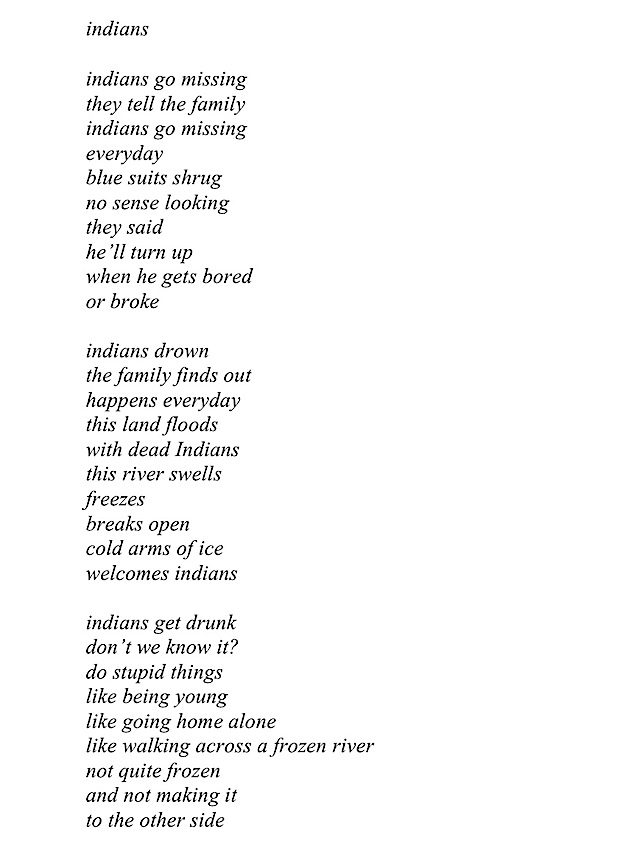
    Misinformation and polarisation cause social tension, as particular groups are generalised and blamed. Vermette’s poem indians explicitly explores the devastation caused by preconceptions of peoples and places.

    Red River in Winnipeg.
    Teng Guan/Shutterstock

    The poem recalls vermette’s brother going missing, before being found in the Red River, a powerful body of water that moves through Winnipeg. It focuses on the apathy of Winnipeg’s police service, who tell the family that there is “no sense looking”, as the man will return when “he gets bored/or broke”. The authorities come to this conclusion not through investigation, but by reducing the speaker’s brother to racist stereotypes.

    This is then contrasted with what the family “finds out”. Not only has the brother drowned, but the “land floods/with dead indians”. The speaker discovers the fate of her brother is also the fate of many other Métis people in Winnipeg. This personal experience of loss comes to speak for many other loses:

    indians get drunk

    don’t we know it?

    do stupid things

    like being young

    like going home alone

    like walking across a frozen river

    not quite frozen

    Vermette links grief to struggles against systematic apathy and oppression. The poem’s sense of politics, people and place are a central part of its poetics.

    Audre Lorde in 1980.
    Wiki Commons, CC BY

    Such explicitness means the poem meaningfully connects to important political issues – drawing attention to the startlingly high number of missing people found and suspected to be in the Red River. As such, it can also link to important grassroots initiatives like Drag the Red, which aims to “find answers about missing loved ones” which might lie in the river.

    While North End Love Songs was published two years before Drag the Red’s formation, the poem and initiative are clearly formed by the same kind of traumatic, sociopolitical events.

    Newsfeeds increasingly silo us into comfortable ways of thinking and perceiving. Forty years on, Lorde’s declaration that poetry “is not a luxury” takes on a whole new meaning. Now, it might be a political necessity.


    Get your news from actual experts, straight to your inbox. Sign up to our daily newsletter to receive all The Conversation UK’s latest coverage of news and research, from politics and business to the arts and sciences.

    Alex Hubbard is formerly affiliated with the Labour Party, and Aber Food Surplus, a community hub.

    ref. How poetry can help to fight polarisation and misinformation – https://theconversation.com/how-poetry-can-help-to-fight-polarisation-and-misinformation-255567

    MIL OSI Analysis

  • MIL-OSI Analysis: Why you can’t judge health by weight alone

    Source: The Conversation – UK – By Rachel Woods, Senior Lecturer in Physiology, University of Lincoln

    Pratchaya.Lee/Shutterstock

    How much does your weight really say about your health? Probably less than you think. You could eat your five-a-day, hit the gym regularly, have textbook blood pressure and cholesterol levels – and still be dismissed as “unhealthy” based on the number on the scale. Meanwhile, someone with a so-called “healthy” weight might be skipping meals, running on stress and caffeine, and rarely moving their body.

    We’ve been taught to equate thinness with wellness and excess weight with illness. But the science tells a more nuanced story – one where weight is just a single data point in a far more complex picture. So if weight alone doesn’t reflect how healthy we really are, what does?

    Body weight is one of the most measured aspects of health. Society places huge emphasis on it, and criticism of a person’s weight is often framed as a health concern. So how much meaningful health information does weight actually offer?

    Simply put, body weight measures exactly that – the total weight of a body. Changes in weight over time can give an indication of a person’s calorie intake. If they are gaining weight, they are eating more calories than they burn. If they are losing weight, they are burning more than they eat.


    Read more:
    The body mass index can’t tell us if we’re healthy. Here’s what we should use instead


    It is perhaps more useful to consider the health information weight doesn’t give us. Important health indicators, such as cholesterol, blood sugar, blood pressure and heart rate are not visible on the scales.

    Neither does weight reflect the quality of someone’s diet. A person could be eating plenty of fruit, vegetables and whole foods, getting the vitamins and minerals needed for good energy, bone strength and immune function. Or they might not. They might be eating mostly healthy fats, like those found in olive oil, nuts and fish, which are linked to better heart health. Or they may get their fat from processed foods, high in saturated and trans fats, which increase the risk of heart disease. They may be getting plenty of fibre to support digestion, regulate their blood sugar and maintain healthy cholesterol, or they may be getting very little. Weight alone reveals none of these important dietary details.

    Weight also doesn’t accurately reflect how much body fat someone carries, or more importantly, where that fat is located. Visceral fat (which surrounds the internal organs) is linked to a higher risk of heart disease, type 2 diabetes and some types of cancer, whereas subcutaneous fat, found just beneath the skin, poses fewer health risks .

    Weight doesn’t give details about how much exercise someone does, which improves health even if it doesn’t lead to weight loss. Nor does weight reflect other major influences on health, like sleep quality or stress.

    All of these factors are harder to measure than body weight, and far less visible at first glance, but they provide a much more meaningful picture of someone’s health.

    This is not to say that there is no association between weight and these factors, but the link is not clear cut. Details such as someone’s diet quality or their activity patterns cannot be found by simply looking at their weight.

    At a population level, there is a clear association between higher body weight and increased risk of disease. For instance, studies show that people classified as overweight or obese using body mass index (BMI), which is a measure of weight relative to height, tend to have higher rates of cardiovascular disease, type 2 diabetes and certain types of cancer.

    Some people who are classified as overweight or obese have healthy blood pressure, cholesterol and blood sugar levels. This is often referred to as “metabolically healthy obesity”. On the other hand, someone with a “healthy” body weight might have high visceral fat, poor diet quality, or a sedentary lifestyle – increasing their health risks, despite appearing thin. Terms like “Tofi” (thin outside, fat inside) or “skinny-fat” have emerged to describe this.

    These examples highlight how health cannot be judged accurately by weight alone. Someone eating a fibre-rich diet, high in vegetables, whole grains and healthy fats – all of which are linked to better health outcomes, might still fall into the “overweight” category, and be perceived as unhealthy simply because they eat more calories than they burn.

    Conversely, a person eating a diet low in nutrients but not exceeding their calorie requirements may be considered a “healthy” weight. Which of these people would be viewed as healthy by society, and which by a doctor?

    Why we think weight matters

    So, why is so much emphasis put on a person’s weight? In truth, it probably shouldn’t be. However, it is a cheap and easy thing to measure, unlike blood tests, dietary assessments or body scans, which require more time, money and expertise. It’s not to say that more detailed tests are never carried out, but cost is usually a consideration.

    Weight is also very visible. It is one of the few aspects of health that’s apparent to others at a glance. This makes it easy for society to pass judgement. But what is visible isn’t always what matters most. Societal ideas about what a “healthy” body looks like are deeply ingrained and not necessarily evidence based.

    While losing weight as a result of healthy lifestyle modifications improves health, these modifications, such as increasing exercise and improving diet, have been shown to benefit health even if weight is not lost.

    It has also been shown that the societal stigma surrounding obesity is not helpful in achieving weight loss, and can actually undermine it.

    Therefore, if health really is the main concern, attention should shift away from weight as the primary focus and towards factors such as diet quality, physical activity, sleep and stress. Improvements in these areas can offer health benefits to people of all sizes.


    Get your news from actual experts, straight to your inbox. Sign up to our daily newsletter to receive all The Conversation UK’s latest coverage of news and research, from politics and business to the arts and sciences.

    Rachel Woods does not work for, consult, own shares in or receive funding from any company or organisation that would benefit from this article, and has disclosed no relevant affiliations beyond their academic appointment.

    ref. Why you can’t judge health by weight alone – https://theconversation.com/why-you-cant-judge-health-by-weight-alone-260659

    MIL OSI Analysis

  • MIL-OSI Analysis: Armenia and Azerbaijan are trying to mend fences – what does this mean for Russia?

    Source: The Conversation – UK – By Anna Matveeva, Visiting Senior Research Fellow, King’s Russia Institute, King’s College London

    At a time when Vladimir Putin needs friends in his neighbourhood, he appears instead to be losing them in the South Caucasus. After two centuries of Russian involvement in the region, balancing the historical rivalry and at times acting as mediator between Armenia and Azerbaijan, there is growing speculation that the two countries are preparing a major reset in relations.

    When Armenia’s prime minister, Nikol Pashinyan, met the Azerbaijani president, Ilham Aliyev, in Abu Dhabi on July 10, they reportedly came close to agreeing a peace treaty. The big question is whether, if these two countries can iron out mistrust and violence born of the territorial conflict, there will still be a role for Russia in the South Caucasus.

    To understand the complex geopolitics of the region, you need to go back to the early 19th century, when Azerbaijan and what is now the Republic of Armenia) were ceded to Russia following the Russo-Persian wars. After the Russian revolution, the two countries achieved brief independence between 1918 and 1920 (though not in their present borders) before being incorporated into the Soviet Union.

    During the Soviet era, the union republics of Armenia and Azerbaijan both felt that Moscow favoured the other. Armenia was unhappy that the Soviet leadership allocated Nagorno-Karabakh, a majority-Armenian exclave surrounded by Azeri-populated lands, to Azerbaijan. Azerbaijan was dissatisfied that its borders denied it a land connection to its population in Nakhchivan, an exclave of ethnic Azeris that could only be reached via southern Armenia.

    In the final years of the Soviet Union, as Armenian nationalism began to assert itself during the period of perestroika (restructuring), Nagorno-Karabakh’s legislature passed a law declaring its intention to join Armenia. This move eventually led to armed clashes in the region.

    The first Karabakh war, which raged between 1988 and 1994, began before the Soviet break-up but continued after the two countries gained their independence. In 1994, after more than 30,000 casualties, Russia brokered a ceasefire. The settlement favoured Armenia, leaving it in control of Nagorno-Karabakh and another six surrounding Azerbaijani districts.

    Things began to change when Putin took power in Russia in 2000. Russia’s relations with Azerbaijan improved, partly due to his personal rapport with the then-president, Heydar Aliyev, and his son Ilham, who would succeed him in 2003. After 9/11, when combating international terrorism became a global priority, Azerbaijan put measures in place to prevent transfer of fighters and weapons through its territory to the war in Chechnya, which further improved relations with Moscow.

    At this stage, Azerbaijan was pursuing what it described as a “multi-vector” foreign policy. This allowed it to develop ties with a variety of countries, including the US, Russia and others to whom it sold oil. While remaining in the Commonwealth of Independent States, it did not sign up to the Russia-led Collective Security Treaty Organisation (CSTO).

    Nagorno-Karabakh

    Armenia, by contrast, was a fully participating member of the CSTO. Having signed an Eternal Friendship Treaty with Russia in 1997, this was a clear strategic choice for Armenia – partly motivated by historical ties.

    Russia had traditionally been seen as a defender of Christianity in the days of the Ottomon empire. Many people had fled massacres in Western Armenia (modern-day Turkey) in 1915 to come under the protection of the Russian Tsar. But Armenia also saw Moscow as a vital security guarantor against an increasingly militarised Azerbaijan, which was determined to recover control of Nagorno-Karabakh and other areas occupied by Armenia.

    Map showing the concept of the ‘Zanzegur corridor’, which would cut across southernmost Armenia to connect Azerbaijan with Nakhchivan.
    Mapeh/Wikimedia Commons, CC BY-NC

    Indeed, it was Nagorno-Karabakh which really soured relations between Armenia and Moscow. In 2020, when – aided by Turkey – Azerbaijan launched its offensive to retake the territory, Russia failed to come to the aid of its CSTO ally. This was expected, given that relations had begun to deteriorate in 2018 when Pashinyan came to power in Armenia.

    In hindsight, most commentators believe Russia had become tired of Armenia’s intransigence over the plan, agreed in Madrid in 2007, for it to cede back the six districts surrounding Nagorno-Karabakh to Azerbaijan.

    Instead, Moscow brokered a ceasefire agreement and deployed 2,000 peacekeepers along the Lachin corridor, a strip of land connecting Armenia and Nagorno-Karabakh. But these troops also failed to intervene when an Azeri offensive retook the whole of Nagorno-Karabakh in September 2023, forcing the population of about 100,000 ethnic Armenians to flee.


    Read more:
    Nagorno-Karabakh: the world should have seen this crisis coming – and it’s not over yet


    Things sour between Moscow and Baku

    Relations between Russia and Azerbaijan, meanwhile, have gone downhill rapidly. In December 2024, an Azeri civilian airliner was shot down in Russian airspace. Putin apologised, but Azerbaijan insisted on Moscow disclosing the results of the investigation and paying compensation to the victims.

    Things got worse at the end of June, when Russian authorities arrested a group of ethnic Azerbaijanis as part of a decades-old murder case. Two of the men died while being detained. Azerbaijan retaliated by raiding the Baku offices of Russia’s Sputnik news agency and detaining the staff as well as a group of Russian IT workers. When they appeared in court, some of the men appeared to have been beaten in custody.

    Azerbaijan also denounced Russia in state media and Russia House, the state-funded Russian cultural agency in Baku, was closed down, with several cultural events cancelled. Security agencies began to enforce documentation checks on all Russian nationals in the country.

    At the same time, Azerbaijan and Armenia were already talking about concluding a peace treaty independently, without intermediaries. All this has prompted speculation of a serious loss of influence in the region for Moscow.

    However, a complete shutout of Russia in the South Caucasus is unlikely. Both Armenia and Azerbaijan depend on remittance income from their nationals in Russia. Both countries also remain close trading partners with Russia. While Armenia suspended its membership in CSTO, it has not quit the organisation altogether.

    Far more likely is that the two countries, mindful of the growing influence of Turkey in the region and the shifts created by Donald Trump in world affairs, are manoeuvring while weighing their options. Geography matters, as Georgia’s example demonstrates – efforts to cut ties with Russia by its former president, Mikheil Saakashvili, have been partially reversed by the current government, which increasingly leans towards Moscow.

    In the cases of Armenia and Azerbaijan, economic ties, transport links and human connections still favour a relationship with Russia. So, a temporary breakdown in political relations can be mended – if all three leaders demonstrate enough statesmanship to sail through the troubled waters.


    Get your news from actual experts, straight to your inbox. Sign up to our daily newsletter to receive all The Conversation UK’s latest coverage of news and research, from politics and business to the arts and sciences.

    Anna Matveeva does not work for, consult, own shares in or receive funding from any company or organisation that would benefit from this article, and has disclosed no relevant affiliations beyond their academic appointment.

    ref. Armenia and Azerbaijan are trying to mend fences – what does this mean for Russia? – https://theconversation.com/armenia-and-azerbaijan-are-trying-to-mend-fences-what-does-this-mean-for-russia-261384

    MIL OSI Analysis

  • MIL-OSI Analysis: Cuban government scrambling to deal with outrage about country’s economic crisis

    Source: The Conversation – UK – By Emily Morris, Research Associate, Institute of the Americas, UCL

    Cuba doesn’t have any beggars, according to the country’s minister of labour, Marta Elena Feitó Cabrera. In a speech to the national assembly on July 15, she denied the existence of destitution in the communist country, claiming the problem was actually people “disguised as beggars”.

    Her words were greeted by public outcry on social media. They also prompted a swift rebuke from her peers and the president, Miguel Díaz-Canel, who said leadership could not “act with condescension”. The next day, the Cuban government published an official note saying Feitó Cabrera had resigned.

    The political vulnerability of the Cuban government explains the urgent need to respond to missteps such as Feitó Cabrera’s. The country is enduring an acute economic crisis, which has seen living standards plummet and over 1 million Cubans leave the country since 2020.

    Cubans are leaving en masse:

    A severe economic crisis in Cuba has prompted a mass exodus from the island.
    Oficina Nacional de Estadísticas e Información

    The recession has severely strained the system of social protection that the government points to as one of its main achievements since taking power more than 60 years ago. Despite food subsidies and the efforts of welfare services, a growing number of people are now going hungry.

    Public confidence in the government has been severely weakened as a result, particularly among young Cubans. The risk of escalating popular protest is magnified by the proliferation of social media channels, emanating from inside and outside the country.

    These channels air the many complaints about daily frustrations in Cuba and highlight any failings or signs of hypocrisy on the part of officials. So when Feitó Cabrera’s speech went viral, it was met with inevitable public outrage.

    Díaz-Canel’s reaction can be seen as urgent damage limitation. But it is also consistent with his broader approach to managing the crisis facing his country. He has worked tirelessly to try and defuse anger through engagement, touring Cuba for local meetings to search for solutions.

    In his comments after Feitó Cabrera’s speech, he insisted that officials should acknowledge the scale of hardship being suffered, and “help, support and show solidarity” with the disadvantaged and most vulnerable.

    This need to reach out was all the more important given the grim tone of the national assembly meeting where Feitó Cabrera made her remarks. Ministers appeared one after the other to present dismal reports on the state of almost all sectors of the Cuban economy.

    The electricity system remains plagued by breakdowns caused by chronic underinvestment as well as difficulties in obtaining fuel and spare parts. The resulting daily power outages ensure that the sense of crisis is ever-present and frustrate all efforts to boost production.

    Doubting official data

    While full official national income data for 2024 has not yet been released, Cuba’s economy ministry estimates that real national income contracted by 1.1% in 2024. This leaves it more than 10% below its pre-pandemic level, and 2025 is not expected to show much improvement.

    The decline in real disposable income for Cuban households since 2021 has, in reality, been far greater. The official inflation rate indicates that consumer prices have risen fourfold over the past five years. At this rate, living costs would have increased broadly in line with salaries.

    Consumer prices have risen fourfold since 2020:

    Official inflation data for Cuba. The spike in early 2021 was the result of a monetary reform, which involved a big jump in wages in December 2020 followed by a currency reform in January 2021.
    Oficina Nacional de Estadísticas e Información

    But official figures systematically understate the actual increase in prices faced by Cuban households, due to the weightings used. In 2021, for example, research estimated the inflation rate to be between 174% and 700% – well above the government’s estimate (77.3%).

    The rising market prices have put many essential goods beyond the reach of most people who depend on state incomes. This has forced many households to depend on remittances or the informal economy to survive.

    Thanks to tight fiscal restraint, the official annual rate of inflation eased to 15% in June. But the wide gap between the increase in the actual cost of living and official inflation index continues to compound distrust of the government and the perception that the country’s leaders are out of touch.

    A lack of transparency and long delays in the publication of economic data, together with restrictions on the scope for private enterprise, are widely attributed to the government’s incompetence and reluctance to enact liberalising reforms.

    Recovery blocked by US sanctions

    For these reasons, the government’s insistence that US sanctions are to blame for limiting the possibilities for economic recovery is increasingly regarded with scepticism. However, the constraint on economic growth imposed by US measures is real and severe.

    It is also the deliberate aim of US policy. The unilateral sanctions not only block trade, as well as financial and international travel between the US and Cuba. They also severely hamper all kinds of transactions between Cuba and the rest of the world.

    Every branch of the Cuban economy has been affected, including the health service, social safety nets, agriculture and industry. And the lack of hard currency has, in turn, limited the scope for the investments and reforms needed for economic recovery.

    The easing inflation rate, together with some new investments in renewable energy, an improved fiscal balance and a recent small increase in pensions, may signal that the end of the economic downturn may be approaching. But neither the government nor the population have any confidence that the crisis will come to an end this year.

    No one is expecting US sanctions to be lifted while Donald Trump is president. Before Trump first stood for the presidency he hadn’t given Cuba his attention, but as president he has aligned himself firmly with hardliners.

    In his first term, Trump reversed the opening with Cuba initiated by Barack Obama. And his current secretary of state, Marco Rubio, is one of the architects and leading proponents of economic sanctions against Cuba. Trade and investment will thus remain depressed, while shortages, power cuts, a lack of transport and crumbling public services will persist.

    But by demanding the resignation of the minister of labour, perhaps Díaz-Canel hopes to demonstrate that his government understands what that the economic asphyxiation means for a majority of Cubans struggling to survive.


    Get your news from actual experts, straight to your inbox. Sign up to our daily newsletter to receive all The Conversation UK’s latest coverage of news and research, from politics and business to the arts and sciences.

    Emily Morris does not work for, consult, own shares in or receive funding from any company or organisation that would benefit from this article, and has disclosed no relevant affiliations beyond their academic appointment.

    ref. Cuban government scrambling to deal with outrage about country’s economic crisis – https://theconversation.com/cuban-government-scrambling-to-deal-with-outrage-about-countrys-economic-crisis-261702

    MIL OSI Analysis

  • MIL-OSI Analysis: As the UK reviews the pension age again, could more time off when you’re young compensate for later retirement?

    Source: The Conversation – UK – By Malte Jauch, Lecturer in Management and Marketing, University of Essex

    The retirement age keeps creeping up. In the UK, the state pension is currently paid to people at 66, but that’s set to rise to 67 in the next couple of years, and a move to 68 might come sooner than previously planned after the government launched a review.

    Gradually increasing the working lifespan is never going to be popular. But one way of making this policy more palatable could be to give people early access to some of the free time that retirement promises.

    After all, sometimes that promise fails to deliver, because many people die before they reach retirement age.

    Globally, about 27% of men and 18% women die before the age of 65 (although this proportion also includes deaths before working age). In wealthy countries, the number of people who die prematurely is lower than the global average, but still significant. In the EU, 16% of men and 8% of women die before 65.

    For these people, the promise of free time and leisure in old age never materialises. There will also be many whose physical and mental health will have deteriorated by the time they retire, so that they are less capable of enjoying their free time.

    So perhaps slogging away until retirement is not an ideal arrangement.

    But what if you could transfer some of the time off that retirement promises to an earlier stage of your life, when everything is a rush, crammed with the demands of work and domestic responsibilities?

    Luckily, the stark contrast between a time-poor middle age and a time-rich old age is not unavoidable. Governments can choose different approaches that directly affect how free time is distributed across our life stages.

    Japan, for example, is a country which has opted to focus on delaying leisure time, and encourages workers to postpone that enjoyment of free time until old age. It does this in part by rewarding workers with wage increases – known as “seniority-based pay” – if they don’t take career breaks.

    Japanese employment law also permits companies to force employees to retire at the age 60. As a result, on average, Japanese workers work 1,680 hours per year and retire at 63.

    In the Netherlands by contrast, people work less (1,433 hours per year) and retire later – at 67. Labour laws make it easier for employees to decrease their hours, by going part time, for example.

    Discrimination between workers based on work hours is prohibited, so that those who opt for part-time work are guaranteed equal treatment with regard to wages and other benefits. But the high legal age of retirement discourages Dutch workers from early retirement.

    So how should we assess these different approaches?

    Time on your side?

    One way to look at retirement is that it compensates us for our previous hard work. The prospect of compensation might lead us to adopt a relaxed attitude toward long work hours. Once we’ve stopped work, we’ll be rewarded with a large chunk of leisure.

    But for those who don’t make it to retirement, this promise of a life of leisure turns out to be a cruel joke. Early deaths are also more prominent among those who have already suffered from poverty and other disadvantages.

    The right time for time off?
    Monkey Business Images/Shutterstock

    The same is true for ill health. The disadvantaged are much more likely to suffer from a variety of conditions that prevent them from being able to fully enjoy retirement.

    Another risk for those who are healthy when they retire is that relatives or friends may have died. This reduces the value of the retirees’ free time because the loved ones they hoped to share that time with are no longer around.

    So perhaps some of that free time could be better used when workers are younger. Raising a family, for example, is extremely time consuming, and there can’t be many parents of young children who don’t wish for a few extra hours a week to call their own.

    Even devoting time to hobbies when we’re younger might be considered more efficient than waiting until we have retired. After all, if you learn a new language or how to paint when you’re in your 40s, you may have much more time to enjoy your new skill over the ensuing decades.

    My research suggests that for all these reasons, the state should help people take some of their retirement early.

    None of us knows how long we will live, or how healthy we will be in the future. Faced with this uncertainty, it makes sense not to gamble with our opportunities for free time and leave it until it may be too late.

    Even those who enjoy their work have strong reasons not to postpone a large proportion of their time off, and governments should help us access more of it while we’re younger.


    Get your news from actual experts, straight to your inbox. Sign up to our daily newsletter to receive all The Conversation UK’s latest coverage of news and research, from politics and business to the arts and sciences.

    Malte Jauch does not work for, consult, own shares in or receive funding from any company or organisation that would benefit from this article, and has disclosed no relevant affiliations beyond their academic appointment.

    ref. As the UK reviews the pension age again, could more time off when you’re young compensate for later retirement? – https://theconversation.com/as-the-uk-reviews-the-pension-age-again-could-more-time-off-when-youre-young-compensate-for-later-retirement-259464

    MIL OSI Analysis

  • MIL-OSI Analysis: Channel crossings: life in ‘microcamps’ on the French border, and how they are changing crossing attempts

    Source: The Conversation – UK – By Sophie Watt, Lecturer, School of Languages and Cultures, University of Sheffield

    I have spent the past two years examining the living conditions in informal refugee camps along the northern coast of France as part of an ongoing research project on borders. These sites are where people gather before attempting to cross the Channel to the UK.

    The UK government recently announced a returns agreement to discourage people from making the crossing and economic sanctions
    against people smugglers, following an increase in funding for border control and a decision to use counter-terrorism tactics in an effort to “smash the gangs”.

    But from what I have observed, such policies appear to do little to stop people from making the journey. Quite the opposite – the more police crack down, the more the smuggling networks take risks to get around difficulties.

    My fieldwork has been primarily conducted through volunteer work with Salam, a grassroots organisation that provides hot meals and clothing to the main informal camps in Calais and Dunkirk. I have also collaborated with other groups such as Alors on Aide and Opal Exil.

    In the past few years, smuggling networks have adjusted their tactics to evade police. While smugglers used to inflate boats on the beaches between Calais and Dunkirk, they are now mostly using “taxi boats”. These leave further north or south on the coast, as far as Le Touquet. They then pick up groups of refugees waiting in the water along the coast, avoiding police intervention.

    A microcamp in Ecault Forest.
    Sophie Watt

    In response, and in order to intensify the crossings, “microcamps” have emerged – smaller temporary settlements closer to the beach, along the coast between Hardelot and Calais. These microcamps act as connecting points between the larger camps and the coastal departure locations where taxi boats pick them up. They allow for people to make several attempts at crossing without having to return to the large camps, where living conditions are more difficult.

    The larger camps (such as Loon Plage and Calais) are the epicentre of the smuggling operations. The camps are evicted at least once a week (every 24 hours in Calais) due to France’s official “zero fixation point” policy. This policy, which bars people from forming long-term settlements, was implemented after the dismantling of the Calais “Jungle” refugee camp in October 2016.

    Camp conditions

    Police efforts to uphold the zero fixation point policy entail frequent evacuations, restrictions of humanitarian aid and physical site disruption. At Loon Plage, I saw that the sole access to water is a livestock trough.

    Official guidance from the UN’s refugee agency states that, irrespective of the informality of these camps, their residents should have access to water, sanitation and shelter.

    Access to water is limited to troughs.
    Sophie Watt

    The non-profit watchdog group Human Rights Observers has documented instances of police violence and seizures of people’s belongings and tents at the camps.

    In addition to regular evictions of the larger camps, the microcamps have recently seen more brutal police action. There have been reports of police using teargas, puncturing life jackets and tents, contributing to untenable living conditions. Violence and shootings between smuggling groups have also been reported in Loon Plage camp.

    While working with Alors On Aide and photographer Laurent Prum we met around 50 people, including seven children (ages one-17), in a microcamp on the edge of the Ecault forest near Boulogne-sur-Mer. We immediately noted a tension between the group and the gendarmes who were standing watch.

    Most of this group had spent a few years in Germany before being refused asylum. They told me they felt they had been forced to come back to France, because of the deportation measures currently being implemented by the German government.

    A few confided that this was their fifth and final try at crossing the Channel. This is a new tactic the smuggling organisations use to make more money more rapidly: while refugees used to be able to try as many times as they needed, they now have to pay again after five failed attempts.

    The previous day, this group told us they had been chased out of another part of the forest. There, we had found several empty canisters of tear gas – consistent with reports that French police have deployed tear gas in operations against informal camps.

    This group had wanted to stay there because they could use a dilapidated shed to shelter themselves and their children from the rain. Eventually, the gendarmes evicted them, forcing them to spend the night in the rain – the field in question was privately owned. Following the eviction, we witnessed that the landowner had covered the area with manure to stop them returning.

    A young Sudanese man showed us videos of the altercation. The exchange, during which five people were arrested, was violent. The children were terrified and the video showed the gendarmes using teargas against the group. A Palestinian mother was arrested and taken into custody, forced to leave her two young daughters. Her husband asked me: “Why did they arrest her when they could see she had two children with her?”

    Alors on Aide mobilised several of its members to bring clothes, blankets and food for the group, and got the Palestinian woman released from custody, as she had not been charged with any offence.


    Read more:
    I’ve spent time with refugees in French coastal camps and they told me the government’s Rwanda plan is not putting them off coming to the UK


    Slashing boats

    While living conditions in camps and the capacity of the French asylum system make staying in France difficult, police are also taking firmer action against boats attempting the crossing.

    As part of a coastal patrol (helping refugees after a failed crossing attempt), we arrived on the beach in Équihen at around 7am on July 4 to find that French police had just punctured a boat in the water.

    The UK government praised French police for this action, performed in front of international media. The UK and France have also discussed allowing coastguards to intercept taxi boats up to 300 metres off the coast.

    This would be a marked change from current regulations, which prohibit French police from intervening offshore except when responding to passengers in distress. Even the border police have doubts about the legal basis for this measure and its practical implications at sea, particularly given the heightened risk of accident.

    Trapped between hounding by police on the beaches and constant evacuations from the informal settlements, the refugees have no choice but to try to cross the Channel at any cost. A record number of 89 refugees died at the Franco-British border in 2024. Thirteen deaths at sea have already been recorded in 2025.

    In my view, the recently announced French-British measures to intensify policing and border enforcement are unlikely to deter people from attempting dangerous crossings. Instead, they will create an incentive for more dangerous tactics by smugglers, putting more lives at risk and violating human rights. Any agreement to return asylum seekers, restrict their access to asylum or force people back across borders will exacerbate the dangers already experienced by those seeking refuge.

    Sophie Watt receives funding from the University of Sheffield and the British Academy / Leverhulme Small Research Grants.

    ref. Channel crossings: life in ‘microcamps’ on the French border, and how they are changing crossing attempts – https://theconversation.com/channel-crossings-life-in-microcamps-on-the-french-border-and-how-they-are-changing-crossing-attempts-260843

    MIL OSI Analysis

  • MIL-OSI Analysis: New polling: Reform is winning over Britain’s Christian support

    Source: The Conversation – UK – By Stuart Fox, Senior Lecturer in Politics, University of Exeter

    When we look at how people vote in elections and why they choose certain parties, analysis often focuses on age, education, location or socioeconomic status. Less discussed in Britain is religion. But close to two-thirds of its adults are still religious – expressing either a religious identity, holding religious beliefs, or taking part in religious activities.

    For the one-in-three adults in Britain who are Christian, this identity remains an important influence on their political behaviour. New polling, published here for the first time, shows how Reform UK is disrupting our previous understanding of how Christians vote in British elections.


    Want more politics coverage from academic experts? Every week, we bring you informed analysis of developments in government and fact check the claims being made.

    Sign up for our weekly politics newsletter, delivered every Friday.


    The relationship between Britain’s Christian communities and the major political parties goes back centuries. The Conservative party has been very close to English Anglicanism since its emergence in the mid-19th century. Catholics and free-church Protestants (such as Baptists and Methodists) have tended towards the Labour and Liberal/Liberal Democrat parties. Even as Britain has become more secular, these relationships have persisted.

    Anglicans, for example, have tended to vote Conservative even when the party was in dire straits. In the 2024 election, 39% of Anglicans voted Tory even as the party’s national vote share fell to 24%.

    Since the 1980s and particularly in elections since 2015, however, we have started to see changes to the Christian vote. The traditional Catholic attachment to Labour has deteriorated, as has Labour’s appeal to other Christian communities such as Baptists, Methodists and Presbyterians.


    Read more:
    Britain’s changing religious vote: why Catholics are leaving Labour and Conservatives are hoovering up Christian support


    Instead, driven by the rising salience of social values (attitudes towards immigration, social change and national identity) as a determinant of political support, the socially conservative leanings of some Christians of all stripes has led to increased support for the Conservatives. And those who traditionally did so – the Anglicans – have become even more supportive. The result has been a steady coalescing of the Christian vote behind the Conservatives.

    But now, new polling by YouGov (on June 23-24 2025) for the University of Exeter reveals that this realignment is being disrupted by the growing popularity of Reform UK.

    Instead of asking who people would vote for tomorrow, a nationally representative sample of 2,284 adults was asked how likely they were to ever vote for each major party, on a scale from zero (very unlikely) to ten (very likely).

    While not the same as a direct question about how someone would vote in an election, the likelihood question provides a much richer measure of the strength of their support for all of the major parties.


    Stuart Fox, data by YouGov for the University of Exeter

    Among Anglicans, Labour remains deeply unpopular: over half gave the party a 0. In contrast, the Conservatives still enjoy strong support among Anglicans, with 35% giving them a vote likelihood of seven or higher – the kind of support associated with voting for the party in an election.

    Reform, however, has caught up. Despite only 15% of Anglicans voting Reform in 2024, 38% now rate their likelihood of voting for the party as high. That’s the same as the proportion who are strongly opposed to Reform – showing that while the party polarises Anglicans more than the Conservatives, Reform could win as much Anglican support as the Tories in an election.

    Catholics show a similar trend. Labour’s traditional support is eroding: 40% of Catholics said they had zero likelihood of voting Labour, while 29% are strong supporters. As with Conservatives for the Anglican vote, Reform is almost level-pegging with Labour for the Catholic vote at 28%. It has even supplanted the Conservatives, of whom 22% of Catholics are strong supporters.

    It is not yet clear why this is happening. The distinction of Christian (and non-Christian) voting patterns is not an artefact of age – there are many studies that prove this is the case.

    It may be that Reform’s stances on issues such as immigration resonate with Christians’ concerns to the extent that they are willing to set aside their historic party loyalties. Or it may be that Christians are as prone as other British voters to turn to Reform out of frustration with the performances of Labour and the Conservatives in office.

    Swing voters and party competition

    This data also shows the extent to which voters’ support for parties overlaps or is exclusive. In other words, which voters have a high vote likelihood for only one party (and so are likely committed to backing that party in an election), which do not have such high likelihoods for any party (and so will probably not vote at all), and which have similarly high likelihoods for more than one party (effectively swing voters, persuadable one way or the other).

    Among the religiously unaffiliated, 29% aren’t strong supporters of any party. For Catholics, it’s 26%. Anglicans are more politically anchored, however, with only 20% in this category.

    While traditionally, we would have expected this to reflect Anglicans’ greater tendency to support the Tories, only 17% of Anglicans are strong supporters of only that party, compared with 21% who are firmly behind Reform. These aren’t swing voters; they’ve switched sides.

    A further 12% of Anglicans have high vote likelihoods for both the Tories and Reform. These are swing voters that the two parties could realistically expect to win over.


    Stuart Fox, data by YouGov for the University of Exeter

    Catholics are even more fragmented. Only 13% are strong supporters of Labour alone, along with 12% and 17% who are strong supporters of the Conservatives and Reform alone, respectively.

    Few Catholics are torn between Labour and the other parties, but 5% are swing voters between the Conservatives and Reform: the Tories’ gradual winning over of Catholics over the last 50 years is also being challenged by the appeal of Reform.

    The party has provided a socially conservative alternative to the Conservatives, with the result that the Christian vote has become more fragmented. The Tories are no longer the main beneficiaries of Labour’s loss of its traditional Catholic vote.

    In addition, Reform is as popular as the Conservatives among Anglicans, and as popular as Labour among Catholics. This suggests it is appealing across the traditional denominational divide more successfully than either of the major parties.

    If there is to be a single party that attracts the bulk of Britain’s Christian support, at this point it is far more likely to be Reform than anyone else.

    This article was based on analysis by Dr Stuart Fox (University of Exeter), Dr Ekaterina Kolpinskaya (University of Exeter), Dr Steven Pickering (University of Amsterdam) and Prof Dan Stevens (University of Exeter), connected to the research project Investigating the individual and contextual role of religion in British electoral politics, funded by the Economic and Social Research Council. Stuart Fox also receives funding from the British Academy.

    ref. New polling: Reform is winning over Britain’s Christian support – https://theconversation.com/new-polling-reform-is-winning-over-britains-christian-support-260751

    MIL OSI Analysis

  • MIL-OSI Analysis: Fear of crime is a useful political tool, even if the data doesn’t back it up

    Source: The Conversation – UK – By Emily Gray, Assistant Professor of Criminology, University of Warwick

    “We’re actually facing, in many parts of our country, nothing short of societal collapse.” This was the dire warning from Reform UK leader Nigel Farage, in setting out his party’s goal of halving crime.

    In an op-ed in the Daily Mail and a press conference, Farage framed Britain as a nation in crisis from rising crime and lawlessness. But, he said, Reform had the solution: mass deportation of foreign offenders, the construction of prefabricated “Nightingale” prisons, and a wholesale crackdown on offending.

    He insisted that British streets were out of control (although recent rises in crime come mainly from online fraud and shoplifting, according to the latest data), pledged to simultaneously increase prison sentences and reduce overcrowding, and vowed to restore order with a “higher and physically tougher standard of police officer”.

    Speaking after a weekend of violent anti-immigration protests in Epping, Farage also tied Britain’s supposed lawlessness to migration: “Many break the law just by entering the UK, then commit further crimes once here – disrespecting our laws, culture and civility. The only acceptable response is deportation.”

    Invoking crime as a threat, and the politician as its solution, is a tried-and-tested political manoeuvre. We’ve seen it deployed from both left and right, in many parts of the world, for decades. Stuart Hall and colleagues famously examined this phenomenon in the 1970s in their seminal book Policing the Crisis.

    Our own analysis suggests that the accuracy of crime statistics often matters less than how politicians frame public anxieties – through media, public rhetoric and policy initiatives. In short: the public often responds to emotion as much as evidence.

    One tension in England and Wales is that there are two major sources of crime data. The first – on which Farage leans heavily – is police-recorded crime. But, as is widely understood, that data provides only a partial picture of the true extent of crime. Many people, especially those from marginalised or vulnerable groups, choose not to report their experiences of crime.


    Read more:
    Most crime has fallen by 90% in 30 years – so why does the public think it’s increased?


    Moreover, the consistency and accuracy with which police forces record these offences has been questioned over time. Indeed, police-recorded crime statistics are not designated as official national statistics.

    The other (and more robust) source is the Crime Survey for England and Wales (CSEW), which asks a representative sample of the public about their experiences of crime over the past 12 months. Notably, it includes those incidents that were not reported to the police.

    Running since the early 1980s, the CSEW has demonstrated long-term declines in incidents of theft, criminal damage and violence (with or without injury) since the mid-to-late 1990s. Curiously, Farage told reporters that the CSEW was “based on completely false data”, without providing any evidence.

    The Office for National Statistics (ONS), and most criminologists, regard the CSEW as the more accurate metric of long-term crime trends. (The Conversation asked the CSEW to comment but hadn’t received a response when this article was published.)

    The political weight of crime

    Crime has electoral value. It allows parties and political campaigners to project strength, decisiveness and control. Farage’s rhetoric is designed to provoke urgency and anxiety. It’s a well-worn script. Margaret Thatcher’s government leveraged fears of law and order. New Labour made “anti-social behaviour” a central point of focus at a time when crime was, in fact, falling.

    In research conducted with colleagues, we examined how people’s fears about specific crimes are shaped not just by actual crime rates, or by the person’s age, gender or ethnicity, but also by the political context in which they grew up.

    Using data from the CSEW and a method called age-period-cohort analysis, we explored how different “political generations” developed and retained distinct concerns about crime.

    We found clear patterns. Those who grew up during the James Callaghan era in the mid-to-late 1970s – when politicians repeatedly warned of “muggings” – were more likely to report anxieties about street robbery over time.

    Thatcher’s generation, who came of age during a sharp rise in property crime, were more likely than other groups to express long-term fears about burglary. And those who grew up under New Labour – during the height of the “anti-social behaviour” agenda – reported persistent concerns about neighbourhood disorder, even as recorded incidents declined.

    Is crime on the rise? Depends who you ask.
    Loch Earn/Shutterstock

    In other words, the political rhetoric people are exposed to during their formative years leaves a lasting impression on their relationship to crime. Debates about crime become embedded in personal and generational memory.

    Crime is real and victims suffer. But distorting its nature and prevalence can erode public trust in the institutions tasked with protecting us. It can foster punitive and ineffective policy responses. And it can leave whole communities feeling targeted, criminalised or unsafe, based on selective and often sensational narratives.

    We absolutely need to talk about crime. But we also need to talk about how we talk about crime. Who frames the debate, which statistics are used, who and how many are left out of the official records, whose fears are being amplified, and who is looking to exploit crime?

    Emily Gray has received funding from the Economic and Social Research Council.

    Stephen Farrall has received funding from the Economic and Social Research Council.

    ref. Fear of crime is a useful political tool, even if the data doesn’t back it up – https://theconversation.com/fear-of-crime-is-a-useful-political-tool-even-if-the-data-doesnt-back-it-up-261777

    MIL OSI Analysis

  • MIL-OSI Analysis: Fear of crime is a useful political tool, even if the data doesn’t back it up

    Source: The Conversation – UK – By Emily Gray, Assistant Professor of Criminology, University of Warwick

    “We’re actually facing, in many parts of our country, nothing short of societal collapse.” This was the dire warning from Reform UK leader Nigel Farage, in setting out his party’s goal of halving crime.

    In an op-ed in the Daily Mail and a press conference, Farage framed Britain as a nation in crisis from rising crime and lawlessness. But, he said, Reform had the solution: mass deportation of foreign offenders, the construction of prefabricated “Nightingale” prisons, and a wholesale crackdown on offending.

    He insisted that British streets were out of control (although recent rises in crime come mainly from online fraud and shoplifting, according to the latest data), pledged to simultaneously increase prison sentences and reduce overcrowding, and vowed to restore order with a “higher and physically tougher standard of police officer”.

    Speaking after a weekend of violent anti-immigration protests in Epping, Farage also tied Britain’s supposed lawlessness to migration: “Many break the law just by entering the UK, then commit further crimes once here – disrespecting our laws, culture and civility. The only acceptable response is deportation.”

    Invoking crime as a threat, and the politician as its solution, is a tried-and-tested political manoeuvre. We’ve seen it deployed from both left and right, in many parts of the world, for decades. Stuart Hall and colleagues famously examined this phenomenon in the 1970s in their seminal book Policing the Crisis.

    Our own analysis suggests that the accuracy of crime statistics often matters less than how politicians frame public anxieties – through media, public rhetoric and policy initiatives. In short: the public often responds to emotion as much as evidence.

    One tension in England and Wales is that there are two major sources of crime data. The first – on which Farage leans heavily – is police-recorded crime. But, as is widely understood, that data provides only a partial picture of the true extent of crime. Many people, especially those from marginalised or vulnerable groups, choose not to report their experiences of crime.


    Read more:
    Most crime has fallen by 90% in 30 years – so why does the public think it’s increased?


    Moreover, the consistency and accuracy with which police forces record these offences has been questioned over time. Indeed, police-recorded crime statistics are not designated as official national statistics.

    The other (and more robust) source is the Crime Survey for England and Wales (CSEW), which asks a representative sample of the public about their experiences of crime over the past 12 months. Notably, it includes those incidents that were not reported to the police.

    Running since the early 1980s, the CSEW has demonstrated long-term declines in incidents of theft, criminal damage and violence (with or without injury) since the mid-to-late 1990s. Curiously, Farage told reporters that the CSEW was “based on completely false data”, without providing any evidence.

    The Office for National Statistics (ONS), and most criminologists, regard the CSEW as the more accurate metric of long-term crime trends. (The Conversation asked the CSEW to comment but hadn’t received a response when this article was published.)

    The political weight of crime

    Crime has electoral value. It allows parties and political campaigners to project strength, decisiveness and control. Farage’s rhetoric is designed to provoke urgency and anxiety. It’s a well-worn script. Margaret Thatcher’s government leveraged fears of law and order. New Labour made “anti-social behaviour” a central point of focus at a time when crime was, in fact, falling.

    In research conducted with colleagues, we examined how people’s fears about specific crimes are shaped not just by actual crime rates, or by the person’s age, gender or ethnicity, but also by the political context in which they grew up.

    Using data from the CSEW and a method called age-period-cohort analysis, we explored how different “political generations” developed and retained distinct concerns about crime.

    We found clear patterns. Those who grew up during the James Callaghan era in the mid-to-late 1970s – when politicians repeatedly warned of “muggings” – were more likely to report anxieties about street robbery over time.

    Thatcher’s generation, who came of age during a sharp rise in property crime, were more likely than other groups to express long-term fears about burglary. And those who grew up under New Labour – during the height of the “anti-social behaviour” agenda – reported persistent concerns about neighbourhood disorder, even as recorded incidents declined.

    Is crime on the rise? Depends who you ask.
    Loch Earn/Shutterstock

    In other words, the political rhetoric people are exposed to during their formative years leaves a lasting impression on their relationship to crime. Debates about crime become embedded in personal and generational memory.

    Crime is real and victims suffer. But distorting its nature and prevalence can erode public trust in the institutions tasked with protecting us. It can foster punitive and ineffective policy responses. And it can leave whole communities feeling targeted, criminalised or unsafe, based on selective and often sensational narratives.

    We absolutely need to talk about crime. But we also need to talk about how we talk about crime. Who frames the debate, which statistics are used, who and how many are left out of the official records, whose fears are being amplified, and who is looking to exploit crime?

    Emily Gray has received funding from the Economic and Social Research Council.

    Stephen Farrall has received funding from the Economic and Social Research Council.

    ref. Fear of crime is a useful political tool, even if the data doesn’t back it up – https://theconversation.com/fear-of-crime-is-a-useful-political-tool-even-if-the-data-doesnt-back-it-up-261777

    MIL OSI Analysis

  • MIL-OSI Analysis: Deportation tactics from 4 US presidents have done little to reduce the undocumented immigrant population

    Source: The Conversation – USA – By Kevin Johnson, Dean and Professor of Public Interest Law and Chicana/o Studies, University of California, Davis

    Immigration and Customs Enforcement agents escort a detained immigrant into an elevator on June 17, 2025, in New York. AP Photo/Olga Fedorova

    All modern U.S. presidents, both Republican and Democratic, have attempted to reduce the population of millions of undocumented immigrants. But their various strategies have not had significant results, with the population hovering around 11 million from 2005 to 2022.

    President Donald Trump seeks to change that.

    With harsh rhetoric that has sowed fear in immigrant communities, and policies that ignore immigrants’ due process rights, Trump has pursued deportation tactics that differ dramatically from those of any other modern U.S. president.

    As a scholar who examines the history of U.S. immigration law and enforcement, I believe that it remains far from clear whether the Trump White House will significantly reduce the undocumented population. But even if the administration’s efforts fail, the fear and damage to the U.S. immigrant community will remain.

    Presidents Bush and Obama

    To increase deportations, in 2006 President George W. Bush began using workplace raids. Among these sweeps was the then-largest immigration workplace operation in U.S. history at a meat processing plant in Postville, Iowa in 2008.

    U.S. Immigration and Customs Enforcement deployed 900 agents in Postville and arrested 398 employees, 98% of whom were Latino. They were chained together and arraigned in groups of 10 for felony criminal charges of aggravated identity theft, document fraud and use of stolen Social Security numbers. Some 300 were convicted, and 297 of them served jail sentences before being deported.

    Men wait in a holding cell on June 21, 2006, in Nogales, Arizona.
    Spencer Platt/Getty Images

    In 2008, Bush also initiated Secure Communities, a policy that sought to deport noncitizens – both lawful permanent residents as well as undocumented immigrants – who had been arrested for crimes. Some 2 million immigrants were deported during Bush’s two terms in office.

    The Obama administration limited Secure Communities to focus on the removal of noncitizens convicted of felonies. It deported a record 400,000 noncitizens in fiscal year 2013, which led detractors to refer to President Barack Obama as the “Deporter in Chief.”

    Obama also targeted recent entrants and national security threats and pursued criminal prosecutions for illegal reentry to the U.S. Almost all of these policies built on Bush’s, although Obama virtually abandoned workplace raids.

    Despite these enforcement measures, Obama also initiated Deferred Action for Childhood Arrivals, or DACA, in 2012. The policy provided relief from deportation and gave work authorization to more than 500,000 undocumented immigrants who came to the United States as children.

    Obama deported about 3 million noncitizens, but the size of the undocumented population did not decrease dramatically.

    The first Trump administration and Biden

    Trump’s first administration broke new immigration enforcement ground in several ways.

    He began his presidency by issuing what was called a “Muslim ban” to restrict the entry into the U.S. of noncitizens from predominantly Muslim nations.

    Early in Trump’s first administration, federal agents expanded immigration operations to include raids at courthouses, which previously had been off-limits.

    In 2017, Trump tried to rescind DACA, but the Supreme Court rejected Trump’s effort in 2020.

    In 2019, Trump implemented the Remain in Mexico policy that for the first time forced noncitizens who came to the U.S. border seeking asylum to wait in Mexico while their claims were being decided. He also invoked Title 42 in 2020 to close U.S. borders during the COVID-19 pandemic.

    Trump succeeded in reducing legal immigration numbers during his first term. However, there is no evidence that his enforcement policies reduced the size of the overall undocumented population.

    President Joe Biden sought to relax – although not abandon – some immigration enforcement measures implemented during Trump’s first term.

    His administration slowed construction of the border wall championed by Trump. Biden also stopped workplace raids in 2021, and in 2023, he ended Title 42.

    In 2023, Biden sought to respond to migration surges in a measured fashion, by temporarily closing ports of entry and increasing arrests.

    In attempting to enforce the borders, his administration at times pursued tough measures. Biden continued deportation efforts directed at criminal noncitizens. Immigrant rights groups criticized his administration when armed Border Patrol officers on horseback were videotaped chasing Haitian migrants on the U.S.-Mexico border.

    As of 2022, the middle of the Biden’s term, an estimated 11 million undocumented immigrants lived in the U.S.

    Immigration-rights activists stage a rally outside President Barack Obama’s Democratic Congressional Campaign Committee fundraiser in Los Angeles, after the president signed a bill that tightened security at the Mexico border in August 2010.
    Mark Ralston/AFP via Getty Images

    A second chance

    Since his second inauguration, Trump has pursued a mass deportation campaign through executive orders that are unprecedented in their scope.

    In January 2025, he announced an expanded, expedited removal process for any noncitizen apprehended anywhere in the country – not just the border region, as had been U.S. practice since 1996.

    In March, Trump issued a presidential proclamation to deport Venezuelan nationals who were members of the Tren de Aragua gang, designated a foreign terrorist organization by the State Department. In doing so, he invoked the Alien Enemies Act of 1798 – an act used three times in U.S. history during declared wars that empowers presidents to remove foreign nationals from countries at war with the U.S.

    Declaring an “invasion” of migrants into the U.S. in June, Trump deployed the military to assist in immigration enforcement in Los Angeles.

    Trump also sought to dramatically upend birthright citizenship, the Constitutional provision that guarantees citizenship to any person born in the U.S. He issued an executive order in January that would bar citizenship to people born in the U.S. to undocumented parents.

    California National Guard members stand in formation during a protest in Los Angeles on June 14, 2025.
    David Pashaee/Middle East Images/AFP via Getty Images

    The birthright executive order has been challenged in federal court and is mostly likely working its way up to the Supreme Court.

    Under the second Trump administration, immigration arrests are up, but actual deportation numbers are in flux.

    ICE in June arrested the most people in a month in at least five years, roughly 30,000 immigrants. But deportations of noncitizens – roughly 18,000 – lagged behind those during the Obama administration’s record-setting year of 2013 in which more than 400,000 noncitizens were deported.

    The gap between arrests and deportations shows the challenges the Trump administration faces in making good on his promised mass deportation campaign.

    Undocumented immigrants often come to the U.S. to work or seek safety from natural disasters and mass violence.

    These issues have not been seriously addressed by any modern U.S. president. Until it is, we can expect the undocumented population to remain in the millions.

    Kevin Johnson does not work for, consult, own shares in or receive funding from any company or organization that would benefit from this article, and has disclosed no relevant affiliations beyond their academic appointment.

    ref. Deportation tactics from 4 US presidents have done little to reduce the undocumented immigrant population – https://theconversation.com/deportation-tactics-from-4-us-presidents-have-done-little-to-reduce-the-undocumented-immigrant-population-261640

    MIL OSI Analysis

  • MIL-OSI Analysis: Beijing’s ‘plausible deniability’ on arms supply is quickly becoming implausible – and could soon extend to Iran

    Source: The Conversation – Global Perspectives – By Linggong Kong, Ph.D. Candidate in Political Science, Auburn University

    Could longtime allies have a closer relationship than meets the eye? Thomas Peter/Pool Photo via AP

    China has long maintained that it does not supply arms to any party at war – a central tenet of its “noninterference” foreign policy. But in recent years, Beijing has repeatedly faced accusations of doing the opposite: providing direct military assistance to nations engaged in conflict, while publicly denying doing so and even adopting a position of diplomatic neutrality.

    That has seemingly been the case for two of China’s closest allies: Russia in its war against Ukraine and Pakistan during its recent armed standoff with India in May.

    Now, Beijing is facing scrutiny over alleged military links to Iran – a country engaged in a long-running shadow conflict with Israel that recently tipped into a short-lived hot war.

    After the ceasefire that followed the 12-day war in the Middle East, China reportedly supplied batteries for surface-to-air missiles to Iran in exchange for oil. Such parts are a critical military need for Tehran after its air defense network was severely damaged by Israeli missiles.

    The Chinese Embassy in Israel denied the reports, stating that China firmly opposes the proliferation of weapons of mass destruction and does not export arms to countries at war. But China’s Ministry of Foreign Affairs has yet to issue an official statement on the alleged transfer.

    As an expert specializing in China’s grand strategy, I think it is highly possible that China would offer Iran military support while denying it publicly. Such plausible deniability would allow Beijing to assert military influence and showcase some of its hardware, while deflecting international criticism and preserving diplomatic flexibility.

    But the tactic works only so far. As indirect evidence accumulates, as many suggest it is, such covert action may gradually develop into an open secret – leading to what scholars term “implausible deniability,” where denial is no longer credible even if it is still officially maintained.

    An air-to-air missile on display at the 15th China International Aviation and Aerospace Exhibition in November 2024.
    Shen Ling/VCG via Getty Images

    China’s support for Russia’s war

    Although Beijing has consistently said it is neutral in the Russia-Ukraine war that broke out in 2022, China has, in practice, quietly supported Russia. In part, that is because China shares the same strategic goal of challenging the Western-led international order.

    Recently, Chinese Foreign Minister Wang Yi reportedly told European Union foreign policy chief Kaja Kallas that Beijing cannot afford to see Russia lose the war in Ukraine. He was said to have warned that a Russian defeat would likely bring the full force of U.S. strategic pressure to bear on China.

    From Beijing’s perspective, Moscow plays a vital role in keeping the West preoccupied, offering China valuable strategic breathing room by diverting American attention and resources away from the Asia-Pacific region.

    Beyond deepening trade relations that have become a lifeline for Moscow’s economy under Western sanctions, China has reportedly supplied Russia with large quantities of dual-use goods – goods that can be used for civilian and military purposes – to enhance both Moscow’s offensive and defensive capabilities, as well as to boost China’s military-industrial production. Beijing has also allegedly provided satellite imagery to assist Russia on the battlefield.

    While the U.S. and Europe have repeatedly tried to call out China for aiding Russia militarily, Beijing has consistently denied such claims.

    Most recently, on April 18, 2025, Ukraine formally accused China of directly supporting Russia and slapped sanctions on three Chinese-based firms that Kyiv said was involved in weapons production for the Russian war effort.

    In what has become a common refrain, China’s Foreign Ministry rejected the Ukrainian accusation, reaffirming that China has never provided lethal weapons to any party in the conflict and reiterating its official stance of promoting a ceasefire and peace negotiations.

    A Chinese Foreign Ministry spokesperson gestures for questions during a daily briefing in Beijing in 2020.
    AP Photo/Ng Han Guan

    China’s quiet backing of Pakistan

    Beijing has long presented itself as a neutral party in the India-Pakistan conflict, too, and has called for restraint on both sides and urged peaceful dialogue.

    But in practice, China is allied with Pakistan. And the direct military support it has provided to Lahore appears driven by China’s desire to curb India’s regional influence, counterbalance the growing U.S.–India strategic partnership and protect the China–Pakistan Economic Corridor, a massive bilateral infrastructure project.

    In the latest flare-up between India and Pakistan in May, Pakistan deployed Chinese-made J-10C fighter jets in combat for the first time, reportedly downing five Indian aircraft.

    Pakistan’s air defense relied heavily on Chinese equipment during the short conflict, deploying Chinese-made surface-to-air missile systems, air-to-air missiles, advanced radar systems and drones for reconnaissance and strike operations. Overall, more than 80% of Pakistan’s military imports have come from China in the past five years.

    In what would be a far more stark example of military support if proven true, the deputy chief of India’s army alleged that China had provided Pakistan with real-time intelligence on Indian troop movements during the conflict.

    When asked to respond, a spokesperson for China’s Ministry of Foreign Affairs said they had no knowledge of the matter. They reaffirmed that China’s ties with Pakistan are not directed against any third party and reiterated Beijing’s long-standing position in favor of a peaceful resolution to any India–Pakistan dispute.

    Extending ‘deniability’ to Iran?

    Like with Russia and Pakistan, Iran has increasingly been seen as a partner to China.

    In 2021, China and Iran signed a 25-year, US$400 billion comprehensive cooperation agreement that covered trade, energy and security, signaling the depth of their strategic relationship.

    The accord was indicative of the strategic value Beijing places on Iran. From Beijing’s perspective, Tehran presents a counterbalance to the influence of the U.S. and its allies – especially Israel and Saudi Arabia – in the region and helps divert Western resources and attention away from China.

    But recently, Tehran’s position in the region has become far weaker. Not only has its air defense infrastructure suffered badly in the confrontations with Israel, but its regional proxies and allies – Hamas, Hezbollah and the Assad regime in Syria – have either been devastated by Israel or collapsed altogether.

    Smoke rises over Tehran, Iran, following an Israeli strike on June 23, 2025.
    Nikan/Middle East Images/AFP via Getty Images

    Under these circumstances, it is strategically compelling for Beijing to provide support to Tehran in order to maintain regime stability.

    Indeed, Beijing has frequently circumvented sanctions on Iranian energy, with an estimated 90% of Iran’s oil exports still going to China.

    Although Beijing did not extend any substantive support to Iran during the 12-day war, reports have abounded since that Iran is looking to China as an alternative supplier of its defense needs. The thinking here is that Russia, Tehran’s traditional military partner, is no longer able to provide sufficient, quality defense equipment to Iran. Some influential social media posters in China have gone as far as advocating for direct military sales by Beijing.

    If China does do this, I believe it is likely to follow the same playbook it has used elsewhere by denying involvement publicly while covertly providing assistance.

    Doing so allows China to maintain diplomatic ties with Iran’s regional rivals, such as Israel and Saudi Arabia, while simultaneously benefiting from a turbulent Middle East that distracts Washington and grants Beijing strategic breathing room.

    China’s use of plausible deniability reflects a broader strategic ambition. Namely, it wants to assert influence in key regional conflicts without triggering open backlash. By quietly supporting partners while maintaining a facade of neutrality, Beijing aims to undermine Western dominance, stretch U.S. strategic focus and secure its own interests – and all while avoiding the risks and responsibilities of open military alignment.

    Linggong Kong does not work for, consult, own shares in or receive funding from any company or organization that would benefit from this article, and has disclosed no relevant affiliations beyond their academic appointment.

    ref. Beijing’s ‘plausible deniability’ on arms supply is quickly becoming implausible – and could soon extend to Iran – https://theconversation.com/beijings-plausible-deniability-on-arms-supply-is-quickly-becoming-implausible-and-could-soon-extend-to-iran-261148

    MIL OSI Analysis

  • MIL-Evening Report: Caitlin Johnstone: It’s a genocide, but it’s also so much more than that

    Report by Dr David Robie – Café Pacific.

    COMMENTARY: By Caitlin Johnstone

    The mass atrocity in Gaza is a genocide, obviously, and is an undisguised ethnic cleansing operation.

    But it’s also a lot more than that.

    It’s an experiment  —  to see what kinds of abuses the public will accept without causing significant disruption to the imperial status quo.

    It’s a psychological operation  –  to push out the boundaries of what’s normal and acceptable in our minds so that we will consent to even more horrific abuses in the future.

    It’s a symptom  —  of Zionism, of colonialism, of militarism, of capitalism, of Western supremacism, of empire-building, of propaganda, of ignorance, of apathy, of delusion, of ego.

    It’s a manifestation  —  of violent racist, supremacist and xenophobic belief systems that have always been there but were previously restrained, meeting with the unwholesome nature of alliances that have long been in place but have been aggressively normalised.

    It’s a mirror  —– showing us accurately and impartially who we currently are as a civilisation.


    It’s a genocide …                                                Video: Caitlin Johnstone

    It’s a disclosure  —  showing us what the Western empire we live under really is underneath its fake plastic mask of liberal democracy and righteous humanitarianism.

    It’s a revelation  –  showing us who among us really stands for truth and justice and who has been deceiving us about themselves and their motives this entire time.

    It’s a catalyst  –  a galvanising force and a rallying cry for all who realise that the murderous power structures we live under can no longer be allowed to stand, and a blaring alarm clock opening more and more snoozing eyes to the need for revolutionary change.

    It’s a test  –  of who we are as a species and what we are made of, and of whether we can transcend the destructive patterning that is driving humanity to its doom.

    It’s a question  — asking us what kind of world we want to live in going forward, and what kind of people we want to be.

    It’s an invitation  —  to become something better than what we are now.

    Caitlin Johnstone is an Australian independent journalist and poet. Her articles include The UN Torture Report On Assange Is An Indictment Of Our Entire Society. She publishes a website and Caitlin’s Newsletter. This article is republished with permission.

    This article was first published on Café Pacific.

    MIL OSI AnalysisEveningReport.nz

  • MIL-Evening Report: Caitlin Johnstone: It’s a genocide, but it’s also so much more than that

    Report by Dr David Robie – Café Pacific.

    COMMENTARY: By Caitlin Johnstone

    The mass atrocity in Gaza is a genocide, obviously, and is an undisguised ethnic cleansing operation.

    But it’s also a lot more than that.

    It’s an experiment  —  to see what kinds of abuses the public will accept without causing significant disruption to the imperial status quo.

    It’s a psychological operation  –  to push out the boundaries of what’s normal and acceptable in our minds so that we will consent to even more horrific abuses in the future.

    It’s a symptom  —  of Zionism, of colonialism, of militarism, of capitalism, of Western supremacism, of empire-building, of propaganda, of ignorance, of apathy, of delusion, of ego.

    It’s a manifestation  —  of violent racist, supremacist and xenophobic belief systems that have always been there but were previously restrained, meeting with the unwholesome nature of alliances that have long been in place but have been aggressively normalised.

    It’s a mirror  —– showing us accurately and impartially who we currently are as a civilisation.


    It’s a genocide …                                                Video: Caitlin Johnstone

    It’s a disclosure  —  showing us what the Western empire we live under really is underneath its fake plastic mask of liberal democracy and righteous humanitarianism.

    It’s a revelation  –  showing us who among us really stands for truth and justice and who has been deceiving us about themselves and their motives this entire time.

    It’s a catalyst  –  a galvanising force and a rallying cry for all who realise that the murderous power structures we live under can no longer be allowed to stand, and a blaring alarm clock opening more and more snoozing eyes to the need for revolutionary change.

    It’s a test  –  of who we are as a species and what we are made of, and of whether we can transcend the destructive patterning that is driving humanity to its doom.

    It’s a question  — asking us what kind of world we want to live in going forward, and what kind of people we want to be.

    It’s an invitation  —  to become something better than what we are now.

    Caitlin Johnstone is an Australian independent journalist and poet. Her articles include The UN Torture Report On Assange Is An Indictment Of Our Entire Society. She publishes a website and Caitlin’s Newsletter. This article is republished with permission.

    This article was first published on Café Pacific.

    MIL OSI AnalysisEveningReport.nz

  • MIL-Evening Report: Leaked document reveals proposed law revisions in NZ, as Western defence of Zionist genocide threatens Pacific

    SPECIAL REPORT: By Mick Hall

    A leaked document has revealed secretive plans to revise terror laws in New Zealand so that people can be charged over statements deemed to constitute material support for a proscribed organisation.

    It shows the government also wants to widen the criteria for proscribing organisations to include groups that are judged to “facilitate” or “promote and encourage” terrorist acts.

    The changes would see the South Pacific nation falling in line with increasingly repressive Western countries like the UK, where scores of independent journalists and anti-genocide protesters have been arrested and charged under terrorism laws in recent months.

    The consultation document, handed over to the New Zealand Council for Civil Liberties (NZCCL), reveals the government has been in contact with a small number of unnamed groups this year over plans to legally redefine what material support involves, so that public statements or gestures involving insignia like flags can lead to charges if construed as support for proscribed groups.

    As part of a proposal to revise the Terrorism Suppression Act, the document suggests the process for designating organisations as terror groups should be changed by “expanding the threshold to enable more modern types of entities to be designated, such as those that ‘facilitate’ or ‘promote and encourage’ terrorist acts”.

    The Ministry of Justice has been contacted in an attempt to ascertain which groups it has been consulting with and why it believed the changes were necessary.

    NZCCL chairman Thomas Beagle told Mick Hall In Context his group was concerned the proposed changes were a further attempt to limit the rights of New Zealanders to engage in political protest.

    ‘What’s going on?’
    “When you look at the proposal to expand the Terrorism Suppression Act, alongside the Police and IPCA conspiring to propose a law change to ban political protest without government permission, you really have to wonder what’s going on,” he said.

    A report by the Independent Police Conduct Authority (IPCA) in February proposed to give police the right to ban protests if they believed there was a high chance of public disorder and threats to public safety.

    That would potentially mean bans on Palestinian solidarity protests if far right counter protestErs posed a threat of violent confrontation.

    The stand-alone legislation would put New Zealand in line with other Five Eyes and NATO-aligned security jurisdictions such as Australia, the United Kingdom, and Canada.

    Beagle points out proposed changes to terror laws would suppress freedom of speech and further undermine freedom of assembly and the right to protest.

    “We’ve seen what’s happening with the state’s abuse of terrorism suppression laws in the UK and are horrified that they have sunk so far and so quickly,” he said.

    More than 100 people were arrested across the UK on suspicion of supporting Palestine Action, a non-violent protest group proscribed as a terrorist organisation by the British government earlier this month.

    Arrests in social media clips
    Social media clips showed pensioners aggressively arrested while attending rallies in Liverpool, London, Manchester, Edinburgh, Bristol and Truro over the weekend.

    Independent journalists and academics have also faced state repression under the UK’s Terrorism Act.

    Among those targeted was Electronic Intifada journalist Asa Winstanley, who had his home raided and devices seized in October last year as part of the opaque counter-terror drive “Operation Incessantness”.

    Independent journalist Asa Winstanley . . . his home was raided and devices seized in October last year as part of “Operation Incessantness”. Image: R Witts Photography/mickhall.substack.com

    In May, the country’s Central Criminal Court ruled the raid was unlawful.

    Journalist Richard Medhurst has had a terror investigation hanging over his head since being detained at Heathrow Airport in August last year and charged under section 8 of the Terrorism Act. Activist and independent journalist Sarah Wilkinson had her house raided in the same month.

    Others have faced similar intimidation and threats of jail. In November 2024, Jewish academic Haim Bresheeth was charged after police alleged he had expressed support for a “proscribed organisation” during a speech outside the London residence of the Israeli ambassador to the UK.

    Meanwhile, dozens of members of Palestine Action are in jail facing terror charges. The vast majority are being held on remand where they may wait two years before going to trial — a common state tactic to take activists off the street and incarcerate them, knowing the chances of conviction are slim when they eventually go to court.

    ‘Targeted amendments’
    The document says the New Zealand government wants to progress “targeted amendments” to the Act, creating or amending offences “to capture contemporary behaviours and activities of concern” like “public expressions of support for a terrorist act or designated entities, for example by showing insignia or distributing propaganda or instructional material.”

    Protesters highlight the proscription of Palestine Action outside the British Embassy at The Hague on July 20. No arrests were made following 80 arrests by Dutch police the week before. Image: Defend Our Juries/mickhall.substack.com

    It proposes to improve “the timeliness of the process, by considering changes to who the decision-maker is” and extending the renewal period from three to five years.

    The document suggests consulting the Attorney-General over designation-related decisions to ensure legal requirements are met may not be required and questions whether the designation process requiring the Prime Minister to review decisions twice is necessary. It asks whether others, like the Foreign Minister, should be involved in the decision-making process.

    Beagle believes the secretive proposals pose a threat to New Zealand’s liberal democracy.

    “Political protest is an important part of New Zealand’s history,” he said.

    “Whether it’s the environment, worker’s rights, feminism, Māori issues, homosexual law reform or any number of other issues, political protest has had a big part in forming what Aotearoa New Zealand is today.

    Protected under Bill of Rights
    “It’s a right protected by New Zealand’s Bill of Rights and is a critical part of being a functioning democracy.”

    The terror laws revision forms part of a wider trend of legislating to close down dissent over New Zealand’s foreign policy, now closely aligned with NATO and US interests.

    The government is also widening the definition of foreign interference in a way that could see people who “should have known” that they were being used by a foreign state to undermine New Zealand’s interests prosecuted.

    The Crimes (Countering Foreign Interference) Amendment Bill, which passed its first reading in Parliament on November 19, would criminalise the act of foreign interference, while also increasing powers of unwarranted searches by authorities.

    The Bill is effectively a reintroduction of the country’s old colonial sedition laws inherited from Britain, the broadness of the law having allowed it to be used against communists, trade unionists and indigenous rights activists.

    Republished from Mick Hall in Context on Substack with permisson.

    MIL OSI AnalysisEveningReport.nz

  • MIL-Evening Report: Leaked document reveals proposed law revisions in NZ, as Western defence of Zionist genocide threatens Pacific

    SPECIAL REPORT: By Mick Hall

    A leaked document has revealed secretive plans to revise terror laws in New Zealand so that people can be charged over statements deemed to constitute material support for a proscribed organisation.

    It shows the government also wants to widen the criteria for proscribing organisations to include groups that are judged to “facilitate” or “promote and encourage” terrorist acts.

    The changes would see the South Pacific nation falling in line with increasingly repressive Western countries like the UK, where scores of independent journalists and anti-genocide protesters have been arrested and charged under terrorism laws in recent months.

    The consultation document, handed over to the New Zealand Council for Civil Liberties (NZCCL), reveals the government has been in contact with a small number of unnamed groups this year over plans to legally redefine what material support involves, so that public statements or gestures involving insignia like flags can lead to charges if construed as support for proscribed groups.

    As part of a proposal to revise the Terrorism Suppression Act, the document suggests the process for designating organisations as terror groups should be changed by “expanding the threshold to enable more modern types of entities to be designated, such as those that ‘facilitate’ or ‘promote and encourage’ terrorist acts”.

    The Ministry of Justice has been contacted in an attempt to ascertain which groups it has been consulting with and why it believed the changes were necessary.

    NZCCL chairman Thomas Beagle told Mick Hall In Context his group was concerned the proposed changes were a further attempt to limit the rights of New Zealanders to engage in political protest.

    ‘What’s going on?’
    “When you look at the proposal to expand the Terrorism Suppression Act, alongside the Police and IPCA conspiring to propose a law change to ban political protest without government permission, you really have to wonder what’s going on,” he said.

    A report by the Independent Police Conduct Authority (IPCA) in February proposed to give police the right to ban protests if they believed there was a high chance of public disorder and threats to public safety.

    That would potentially mean bans on Palestinian solidarity protests if far right counter protestErs posed a threat of violent confrontation.

    The stand-alone legislation would put New Zealand in line with other Five Eyes and NATO-aligned security jurisdictions such as Australia, the United Kingdom, and Canada.

    Beagle points out proposed changes to terror laws would suppress freedom of speech and further undermine freedom of assembly and the right to protest.

    “We’ve seen what’s happening with the state’s abuse of terrorism suppression laws in the UK and are horrified that they have sunk so far and so quickly,” he said.

    More than 100 people were arrested across the UK on suspicion of supporting Palestine Action, a non-violent protest group proscribed as a terrorist organisation by the British government earlier this month.

    Arrests in social media clips
    Social media clips showed pensioners aggressively arrested while attending rallies in Liverpool, London, Manchester, Edinburgh, Bristol and Truro over the weekend.

    Independent journalists and academics have also faced state repression under the UK’s Terrorism Act.

    Among those targeted was Electronic Intifada journalist Asa Winstanley, who had his home raided and devices seized in October last year as part of the opaque counter-terror drive “Operation Incessantness”.

    Independent journalist Asa Winstanley . . . his home was raided and devices seized in October last year as part of “Operation Incessantness”. Image: R Witts Photography/mickhall.substack.com

    In May, the country’s Central Criminal Court ruled the raid was unlawful.

    Journalist Richard Medhurst has had a terror investigation hanging over his head since being detained at Heathrow Airport in August last year and charged under section 8 of the Terrorism Act. Activist and independent journalist Sarah Wilkinson had her house raided in the same month.

    Others have faced similar intimidation and threats of jail. In November 2024, Jewish academic Haim Bresheeth was charged after police alleged he had expressed support for a “proscribed organisation” during a speech outside the London residence of the Israeli ambassador to the UK.

    Meanwhile, dozens of members of Palestine Action are in jail facing terror charges. The vast majority are being held on remand where they may wait two years before going to trial — a common state tactic to take activists off the street and incarcerate them, knowing the chances of conviction are slim when they eventually go to court.

    ‘Targeted amendments’
    The document says the New Zealand government wants to progress “targeted amendments” to the Act, creating or amending offences “to capture contemporary behaviours and activities of concern” like “public expressions of support for a terrorist act or designated entities, for example by showing insignia or distributing propaganda or instructional material.”

    Protesters highlight the proscription of Palestine Action outside the British Embassy at The Hague on July 20. No arrests were made following 80 arrests by Dutch police the week before. Image: Defend Our Juries/mickhall.substack.com

    It proposes to improve “the timeliness of the process, by considering changes to who the decision-maker is” and extending the renewal period from three to five years.

    The document suggests consulting the Attorney-General over designation-related decisions to ensure legal requirements are met may not be required and questions whether the designation process requiring the Prime Minister to review decisions twice is necessary. It asks whether others, like the Foreign Minister, should be involved in the decision-making process.

    Beagle believes the secretive proposals pose a threat to New Zealand’s liberal democracy.

    “Political protest is an important part of New Zealand’s history,” he said.

    “Whether it’s the environment, worker’s rights, feminism, Māori issues, homosexual law reform or any number of other issues, political protest has had a big part in forming what Aotearoa New Zealand is today.

    Protected under Bill of Rights
    “It’s a right protected by New Zealand’s Bill of Rights and is a critical part of being a functioning democracy.”

    The terror laws revision forms part of a wider trend of legislating to close down dissent over New Zealand’s foreign policy, now closely aligned with NATO and US interests.

    The government is also widening the definition of foreign interference in a way that could see people who “should have known” that they were being used by a foreign state to undermine New Zealand’s interests prosecuted.

    The Crimes (Countering Foreign Interference) Amendment Bill, which passed its first reading in Parliament on November 19, would criminalise the act of foreign interference, while also increasing powers of unwarranted searches by authorities.

    The Bill is effectively a reintroduction of the country’s old colonial sedition laws inherited from Britain, the broadness of the law having allowed it to be used against communists, trade unionists and indigenous rights activists.

    Republished from Mick Hall in Context on Substack with permisson.

    MIL OSI AnalysisEveningReport.nz

  • MIL-Evening Report: Leaked document reveals proposed law revisions in NZ, as Western defence of Zionist genocide threatens Pacific

    SPECIAL REPORT: By Mick Hall

    A leaked document has revealed secretive plans to revise terror laws in New Zealand so that people can be charged over statements deemed to constitute material support for a proscribed organisation.

    It shows the government also wants to widen the criteria for proscribing organisations to include groups that are judged to “facilitate” or “promote and encourage” terrorist acts.

    The changes would see the South Pacific nation falling in line with increasingly repressive Western countries like the UK, where scores of independent journalists and anti-genocide protesters have been arrested and charged under terrorism laws in recent months.

    The consultation document, handed over to the New Zealand Council for Civil Liberties (NZCCL), reveals the government has been in contact with a small number of unnamed groups this year over plans to legally redefine what material support involves, so that public statements or gestures involving insignia like flags can lead to charges if construed as support for proscribed groups.

    As part of a proposal to revise the Terrorism Suppression Act, the document suggests the process for designating organisations as terror groups should be changed by “expanding the threshold to enable more modern types of entities to be designated, such as those that ‘facilitate’ or ‘promote and encourage’ terrorist acts”.

    The Ministry of Justice has been contacted in an attempt to ascertain which groups it has been consulting with and why it believed the changes were necessary.

    NZCCL chairman Thomas Beagle told Mick Hall In Context his group was concerned the proposed changes were a further attempt to limit the rights of New Zealanders to engage in political protest.

    ‘What’s going on?’
    “When you look at the proposal to expand the Terrorism Suppression Act, alongside the Police and IPCA conspiring to propose a law change to ban political protest without government permission, you really have to wonder what’s going on,” he said.

    A report by the Independent Police Conduct Authority (IPCA) in February proposed to give police the right to ban protests if they believed there was a high chance of public disorder and threats to public safety.

    That would potentially mean bans on Palestinian solidarity protests if far right counter protestErs posed a threat of violent confrontation.

    The stand-alone legislation would put New Zealand in line with other Five Eyes and NATO-aligned security jurisdictions such as Australia, the United Kingdom, and Canada.

    Beagle points out proposed changes to terror laws would suppress freedom of speech and further undermine freedom of assembly and the right to protest.

    “We’ve seen what’s happening with the state’s abuse of terrorism suppression laws in the UK and are horrified that they have sunk so far and so quickly,” he said.

    More than 100 people were arrested across the UK on suspicion of supporting Palestine Action, a non-violent protest group proscribed as a terrorist organisation by the British government earlier this month.

    Arrests in social media clips
    Social media clips showed pensioners aggressively arrested while attending rallies in Liverpool, London, Manchester, Edinburgh, Bristol and Truro over the weekend.

    Independent journalists and academics have also faced state repression under the UK’s Terrorism Act.

    Among those targeted was Electronic Intifada journalist Asa Winstanley, who had his home raided and devices seized in October last year as part of the opaque counter-terror drive “Operation Incessantness”.

    Independent journalist Asa Winstanley . . . his home was raided and devices seized in October last year as part of “Operation Incessantness”. Image: R Witts Photography/mickhall.substack.com

    In May, the country’s Central Criminal Court ruled the raid was unlawful.

    Journalist Richard Medhurst has had a terror investigation hanging over his head since being detained at Heathrow Airport in August last year and charged under section 8 of the Terrorism Act. Activist and independent journalist Sarah Wilkinson had her house raided in the same month.

    Others have faced similar intimidation and threats of jail. In November 2024, Jewish academic Haim Bresheeth was charged after police alleged he had expressed support for a “proscribed organisation” during a speech outside the London residence of the Israeli ambassador to the UK.

    Meanwhile, dozens of members of Palestine Action are in jail facing terror charges. The vast majority are being held on remand where they may wait two years before going to trial — a common state tactic to take activists off the street and incarcerate them, knowing the chances of conviction are slim when they eventually go to court.

    ‘Targeted amendments’
    The document says the New Zealand government wants to progress “targeted amendments” to the Act, creating or amending offences “to capture contemporary behaviours and activities of concern” like “public expressions of support for a terrorist act or designated entities, for example by showing insignia or distributing propaganda or instructional material.”

    Protesters highlight the proscription of Palestine Action outside the British Embassy at The Hague on July 20. No arrests were made following 80 arrests by Dutch police the week before. Image: Defend Our Juries/mickhall.substack.com

    It proposes to improve “the timeliness of the process, by considering changes to who the decision-maker is” and extending the renewal period from three to five years.

    The document suggests consulting the Attorney-General over designation-related decisions to ensure legal requirements are met may not be required and questions whether the designation process requiring the Prime Minister to review decisions twice is necessary. It asks whether others, like the Foreign Minister, should be involved in the decision-making process.

    Beagle believes the secretive proposals pose a threat to New Zealand’s liberal democracy.

    “Political protest is an important part of New Zealand’s history,” he said.

    “Whether it’s the environment, worker’s rights, feminism, Māori issues, homosexual law reform or any number of other issues, political protest has had a big part in forming what Aotearoa New Zealand is today.

    Protected under Bill of Rights
    “It’s a right protected by New Zealand’s Bill of Rights and is a critical part of being a functioning democracy.”

    The terror laws revision forms part of a wider trend of legislating to close down dissent over New Zealand’s foreign policy, now closely aligned with NATO and US interests.

    The government is also widening the definition of foreign interference in a way that could see people who “should have known” that they were being used by a foreign state to undermine New Zealand’s interests prosecuted.

    The Crimes (Countering Foreign Interference) Amendment Bill, which passed its first reading in Parliament on November 19, would criminalise the act of foreign interference, while also increasing powers of unwarranted searches by authorities.

    The Bill is effectively a reintroduction of the country’s old colonial sedition laws inherited from Britain, the broadness of the law having allowed it to be used against communists, trade unionists and indigenous rights activists.

    Republished from Mick Hall in Context on Substack with permisson.

    MIL OSI AnalysisEveningReport.nz