Category: Analysis Assessment

  • MIL-OSI Analysis: Self-censorship and the ‘spiral of silence’: Why Americans are less likely to publicly voice their opinions on political issues

    Source: The Conversation – USA – By James L. Gibson, Sidney W. Souers Professor of Government, Washington University in St. Louis

    Polarization has led many people to feel they’re being silenced. AP Photo/Andrew Harnik

    For decades, Americans’ trust in one another has been on the decline, according to the most recent General Social Survey.

    A major factor in that downshift has been the concurrent rise in the polarization between the two major political parties. Supporters of Republicans and Democrats are far more likely than in the past to view the opposite side with distrust.

    That political polarization is so stark that many Americans are now unlikely to have friendly social interactions, live nearby or congregate with people from opposing camps, according to one recent study.

    Social scientists often refer to this sort of animosity as “affective polarization,” meaning that people not only hold conflicting views on many or most political issues but also disdain fellow citizens who hold different opinions. Over the past few decades, such affective polarization in the U.S. has become commonplace.

    Polarization undermines democracy by making the essential processes of democratic deliberation – discussion, negotiation, compromise and bargaining over public policies – difficult, if not impossible. Because polarization extends so broadly and deeply, some people have become unwilling to express their views until they’ve confirmed they’re speaking with someone who’s like-minded.

    I’m a political scientist, and I found that Americans were far less likely to publicly voice their opinions than even during the height of the McCarthy-era Red Scare.

    A supporter of Donald Trump tries to push past demonstrators in Philadelphia on June 30, 2023.
    AP Photo/Nathan Howard

    The muting of the American voice

    According to a 2022 book written by political scientists Taylor Carlson and Jaime E. Settle, fears about speaking out are grounded in concerns about social sanctions for expressing unwelcome views.

    And this withholding of views extends across a broad range of social circumstances. In 2022, for instance, I conducted a survey of a representative sample of about 1,500 residents of the U.S. I found that while 45% of the respondents were worried about expressing their views to members of their immediate family, this percentage ballooned to 62% when it came to speaking out publicly in one’s community. Nearly half of those surveyed said they felt less free to speak their minds than they used to.

    About three to four times more Americans said they did not feel free to express themselves, compared with the number of those who said so during the McCarthy era.

    Censorship in the US and globally

    Since that survey, attacks on free speech have increased markedly, especially under the Trump administration.

    Issues such as the Israeli war in Gaza, activist campaigns against “wokeism,” and the ever-increasing attempts to penalize people for expressing certain ideas have made it more difficult for people to speak out.

    The breadth of self-censorship in the U.S. in recent times is not unprecedented or unique to the U.S. Indeed, research in Germany, Sweden and elsewhere have reported similar increases in self-censorship in the past several years.

    How the ‘spiral of a silence’ explains self-censorship

    In the 1970s, Elisabeth Noelle-Neumann, a distinguished German political scientist, coined the term the “spiral of silence” to describe how self-censorship arises and what its consequences can be. Informed by research she conducted on the 1965 West German federal election, Noelle-Neumann observed that an individual’s willingness to publicly give their opinion was tied to their perceptions of public opinion on an issue.

    The so-called spiral happens when someone expresses a view on a controversial issue and then encounters vigorous criticism from an aggressive minority – perhaps even sharp attacks.

    People rally at the University of California, Berkeley, to protest the Trump administration on March 19, 2025.
    AP Photo/Godofredo A. Vásquez

    A listener can impose costs on the speaker for expressing the view in a number of ways, including criticism, direct personal attacks and even attempts to “cancel” the speaker through ending friendships or refusing to attend social events such as Thanksgiving or holiday dinners.

    This kind of sanction isn’t limited to just social interactions but also when someone is threatened by far bigger institutions, from corporations to the government. The speaker learns from this encounter and decides to keep their mouth shut in the future because the costs of expressing the view are simply too high.

    This self-censorship has knock-on effects, as views become less commonly expressed and people are less likely to encounter support from those who hold similar views. People come to believe that they are in the minority, even if they are, in fact, in the majority. This belief then also contributes to the unwillingness to express one’s views.

    The opinions of the aggressive minority then become dominant. True public opinion and expressed public opinion diverge. Most importantly, the free-ranging debate so necessary to democratic politics is stifled.

    Not all issues are like this, of course – only issues for which a committed and determined minority exists that can impose costs on a particular viewpoint are subject to this spiral.

    The consequences for democratic deliberation

    The tendency toward self-censorship means listeners are deprived of hearing the withheld views. The marketplace of ideas becomes skewed; the choices of buyers in that marketplace are circumscribed. The robust debate so necessary to deliberations in a democracy is squelched as the views of a minority come to be seen as the only “acceptable” political views.

    No better example of this can be found than in the absence of debate in the contemporary U.S. about the treatment of the Palestinians by the Israelis, whatever outcome such vigorous discussion might produce. Fearful of consequences, many people are withholding their views on Israel – whether Israel has committed war crimes, for instance, or whether Israeli members of government should be sanctioned – because they fear being branded as antisemitic.

    Many Americans are also biting their tongues when it comes to DEI, affirmative action and even whether political tolerance is essential for democracy.

    But the dominant views are also penalized by this spiral. By not having to face their competitors, they lose the opportunity to check their beliefs and, if confirmed, bolster and strengthen their arguments. Good ideas lose the chance to become better, while bad ideas – such as something as extreme as Holocaust denial – are given space to flourish.

    The spiral of silence therefore becomes inimical to pluralistic debate, discussion and, ultimately, to democracy itself.

    James L. Gibson does not work for, consult, own shares in or receive funding from any company or organization that would benefit from this article, and has disclosed no relevant affiliations beyond their academic appointment.

    ref. Self-censorship and the ‘spiral of silence’: Why Americans are less likely to publicly voice their opinions on political issues – https://theconversation.com/self-censorship-and-the-spiral-of-silence-why-americans-are-less-likely-to-publicly-voice-their-opinions-on-political-issues-251979


    MIL OSI Analysis

  • MIL-OSI Analysis: I’m a physician who has looked at hundreds of studies of vaccine safety, and here’s some of what RFK Jr. gets wrong

    Source: The Conversation – USA – By Jake Scott, Clinical Associate Professor of Infectious Diseases, Stanford University

    Public health experts worry that factually inaccurate statements by Robert F. Kennedy Jr. threaten the public’s confidence in vaccines. Andrew HarnikGetty Images

    In the four months since he began serving as secretary of the Department of Health and Human Services, Robert F. Kennedy Jr. has made many public statements about vaccines that have cast doubt on their safety and on the objectivity of long-standing processes established to evaluate them.

    Many of these statements are factually incorrect. For example, in a newscast aired on June 12, 2025, Kennedy told Fox News viewers that 97% of federal vaccine advisers are on the take. In the same interview, he also claimed that children receive 92 mandatory shots. He has also widely claimed that only COVID-19 vaccines, not other vaccines in use by both children and adults, were ever tested against placebos and that “nobody has any idea” how safe routine immunizations are.

    As an infectious disease physician who curates an open database of hundreds of controlled vaccine trials involving over 6 million participants, I am intimately familiar with the decades of research on vaccine safety. I believe it is important to correct the record – especially because these statements come from the official who now oversees the agencies charged with protecting Americans’ health.

    Do children really receive 92 mandatory shots?

    In 1986, the childhood vaccine schedule contained about 11 doses protecting against seven diseases. Today, it includes roughly 50 injections covering 16 diseases. State school entry laws typically require 30 to 32 shots across 10 to 12 diseases. No state mandates COVID-19 vaccination. Where Kennedy’s “92 mandatory shots” figure comes from is unclear, but the actual number is significantly lower.

    From a safety standpoint, the more important question is whether today’s schedule with additional vaccines might be too taxing for children’s immune systems. It isn’t, because as vaccine technology improved over the past several decades, the number of antigens in each vaccine dose is much lower than before.

    Antigens are the molecules in vaccines that trigger a response from the immune system, training it to identify the specific pathogen. Some vaccines contain a minute amount of aluminum salt that serves as an adjuvant – a helper ingredient that improves the quality and staying power of the immune response, so each dose can protect with less antigen.

    Those 11 doses in 1986 delivered more than 3,000 antigens and 1.5 milligrams of aluminum over 18 years. Today’s complete schedule delivers roughly 165 antigens – which is a 95% reduction – and 5-6 milligrams of aluminum in the same time frame. A single smallpox inoculation in 1900 exposed a child to more antigens than today’s complete series.

    Jonas Salk, the inventor of the polio vaccine, administers a dose to a boy in 1954.
    Underwood Archives via Getty Images

    Since 1986, the United States has introduced vaccines against Haemophilus influenzae type b, hepatitis A and B, chickenpox, pneumococcal disease, rotavirus and human papillomavirus. Each addition represents a life-saving advance.

    The incidence of Haemophilus influenzae type b, a bacterial infection that can cause pneumonia, meningitis and other severe diseases, has dropped by 99% in infants. Pediatric hepatitis infections are down more than 90%, and chickenpox hospitalizations are down about 90%. The Centers for Disease Control and Prevention estimates that vaccinating children born from 1994 to 2023 will avert 508 million illnesses and 1,129,000 premature deaths.

    Placebo testing for vaccines

    Kennedy has asserted that only COVID-19 vaccines have undergone rigorous safety trials in which they were tested against placebos. This is categorically wrong.

    Of the 378 controlled trials in our database, 195 compared volunteers’ response to a vaccine with their response to a placebo. Of those, 159 gave volunteers only a salt water solution or another inert substance. Another 36 gave them just the adjuvant without any viral or bacterial material, as a way to see whether there were side effects from the antigen itself or the injection. Every routine childhood vaccine antigen appears in at least one such study.

    The 1954 Salk polio trial, one of the largest clinical trials in medical history, enrolled more than 600,000 children and tested the vaccine by comparing it with a salt water control. Similar trials, which used a substance that has no biological effect as a control, were used to test Haemophilus influenzae type b, pneumococcal, rotavirus, influenza and HPV vaccines.

    Once an effective vaccine exists, ethics boards require new versions be compared against that licensed standard because withholding proven protection from children would be unethical.

    How unknown is the safety of widely used vaccines?

    Kennedy has insisted on multiple occasions that “nobody has any idea” about vaccine safety profiles. Of the 378 trials in our database, the vast majority published detailed safety outcomes.

    Beyond trials, the U.S. operates the Vaccine Adverse Event Reporting System, the Vaccine Safety Datalink and the PRISM network to monitor hundreds of millions of doses for rare problems. The Vaccine Adverse Event Reporting System works like an open mailbox where anyone – patients, parents, clinicians – can report a post-shot problem; the Vaccine Safety Datalink analyzes anonymized electronic health records from large health care systems to spot patterns; and PRISM scans billions of insurance claims in near-real time to confirm or rule out rare safety signals.

    These systems led health officials to pull the first rotavirus vaccine in 1999 after it was linked to bowel obstruction, and to restrict the Johnson & Johnson COVID-19 vaccine in 2021 after rare clotting events. Few drug classes undergo such continuous surveillance and are subject to such swift corrective action when genuine risks emerge.

    The conflicts of interest claim

    On June 9, Kennedy took the unprecedented step of dissolving vetted members of the Advisory Committee on Immunization Practices, the expert body that advises the CDC on national vaccine policy. He has claimed repeatedly that the vast majority of serving members of the committee – 97% – had extensive conflicts of interest because of their entanglements with the pharmaceutical industry. Kennedy bases that number on a 2009 federal audit of conflict-of-interest paperwork, but that report looked at 17 CDC advisory committees, not specifically this vaccine committee. And it found no pervasive wrongdoing – 97% of disclosure forms only contained routine paperwork mistakes, such as information in the wrong box or a missing initial, and not hidden financial ties.

    Reuters examined data from Open Payments, a government website that discloses health care providers’ relationships with industry, for all 17 voting members of the committee who were dismissed. Six received no more than US$80 from drugmakers over seven years, and four had no payments at all.

    The remaining seven members accepted between $4,000 and $55,000 over seven years, mostly for modest consulting or travel. In other words, just 41% of the committee received anything more than pocket change from drugmakers. Committee members must divest vaccine company stock and recuse themselves from votes involving conflicts.

    A term without a meaning

    Kennedy has warned that vaccines cause “immune deregulation,” a term that has no basis in immunology. Vaccines train the immune system, and the diseases they prevent are the real threats to immune function.

    Measles can wipe immune memory, leaving children vulnerable to other infections for years. COVID-19 can trigger multisystem inflammatory syndrome in children. Chronic hepatitis B can cause immune-mediated organ damage. Preventing these conditions protects people from immune system damage.

    Today’s vaccine panel doesn’t just prevent infections; it deters doctor visits and thereby reduces unnecessary prescriptions for “just-in-case” antibiotics. It’s one of the rare places in medicine where physicians like me now do more good with less biological burden than we did 40 years ago.

    The evidence is clear and publicly available: Vaccines have dramatically reduced childhood illness, disability and death on a historic scale.

    Jake Scott does not work for, consult, own shares in or receive funding from any company or organization that would benefit from this article, and has disclosed no relevant affiliations beyond their academic appointment.

    ref. I’m a physician who has looked at hundreds of studies of vaccine safety, and here’s some of what RFK Jr. gets wrong – https://theconversation.com/im-a-physician-who-has-looked-at-hundreds-of-studies-of-vaccine-safety-and-heres-some-of-what-rfk-jr-gets-wrong-259659

    MIL OSI Analysis

  • MIL-OSI Analysis: I’m a physician who has looked at hundreds of studies of vaccine safety, and here’s some of what RFK Jr. gets wrong

    Source: The Conversation – USA – By Jake Scott, Clinical Associate Professor of Infectious Diseases, Stanford University

    Public health experts worry that factually inaccurate statements by Robert F. Kennedy Jr. threaten the public’s confidence in vaccines. Andrew HarnikGetty Images

    In the four months since he began serving as secretary of the Department of Health and Human Services, Robert F. Kennedy Jr. has made many public statements about vaccines that have cast doubt on their safety and on the objectivity of long-standing processes established to evaluate them.

    Many of these statements are factually incorrect. For example, in a newscast aired on June 12, 2025, Kennedy told Fox News viewers that 97% of federal vaccine advisers are on the take. In the same interview, he also claimed that children receive 92 mandatory shots. He has also widely claimed that only COVID-19 vaccines, not other vaccines in use by both children and adults, were ever tested against placebos and that “nobody has any idea” how safe routine immunizations are.

    As an infectious disease physician who curates an open database of hundreds of controlled vaccine trials involving over 6 million participants, I am intimately familiar with the decades of research on vaccine safety. I believe it is important to correct the record – especially because these statements come from the official who now oversees the agencies charged with protecting Americans’ health.

    Do children really receive 92 mandatory shots?

    In 1986, the childhood vaccine schedule contained about 11 doses protecting against seven diseases. Today, it includes roughly 50 injections covering 16 diseases. State school entry laws typically require 30 to 32 shots across 10 to 12 diseases. No state mandates COVID-19 vaccination. Where Kennedy’s “92 mandatory shots” figure comes from is unclear, but the actual number is significantly lower.

    From a safety standpoint, the more important question is whether today’s schedule with additional vaccines might be too taxing for children’s immune systems. It isn’t, because as vaccine technology improved over the past several decades, the number of antigens in each vaccine dose is much lower than before.

    Antigens are the molecules in vaccines that trigger a response from the immune system, training it to identify the specific pathogen. Some vaccines contain a minute amount of aluminum salt that serves as an adjuvant – a helper ingredient that improves the quality and staying power of the immune response, so each dose can protect with less antigen.

    Those 11 doses in 1986 delivered more than 3,000 antigens and 1.5 milligrams of aluminum over 18 years. Today’s complete schedule delivers roughly 165 antigens – which is a 95% reduction – and 5-6 milligrams of aluminum in the same time frame. A single smallpox inoculation in 1900 exposed a child to more antigens than today’s complete series.

    Jonas Salk, the inventor of the polio vaccine, administers a dose to a boy in 1954.
    Underwood Archives via Getty Images

    Since 1986, the United States has introduced vaccines against Haemophilus influenzae type b, hepatitis A and B, chickenpox, pneumococcal disease, rotavirus and human papillomavirus. Each addition represents a life-saving advance.

    The incidence of Haemophilus influenzae type b, a bacterial infection that can cause pneumonia, meningitis and other severe diseases, has dropped by 99% in infants. Pediatric hepatitis infections are down more than 90%, and chickenpox hospitalizations are down about 90%. The Centers for Disease Control and Prevention estimates that vaccinating children born from 1994 to 2023 will avert 508 million illnesses and 1,129,000 premature deaths.

    Placebo testing for vaccines

    Kennedy has asserted that only COVID-19 vaccines have undergone rigorous safety trials in which they were tested against placebos. This is categorically wrong.

    Of the 378 controlled trials in our database, 195 compared volunteers’ response to a vaccine with their response to a placebo. Of those, 159 gave volunteers only a salt water solution or another inert substance. Another 36 gave them just the adjuvant without any viral or bacterial material, as a way to see whether there were side effects from the antigen itself or the injection. Every routine childhood vaccine antigen appears in at least one such study.

    The 1954 Salk polio trial, one of the largest clinical trials in medical history, enrolled more than 600,000 children and tested the vaccine by comparing it with a salt water control. Similar trials, which used a substance that has no biological effect as a control, were used to test Haemophilus influenzae type b, pneumococcal, rotavirus, influenza and HPV vaccines.

    Once an effective vaccine exists, ethics boards require new versions be compared against that licensed standard because withholding proven protection from children would be unethical.

    How unknown is the safety of widely used vaccines?

    Kennedy has insisted on multiple occasions that “nobody has any idea” about vaccine safety profiles. Of the 378 trials in our database, the vast majority published detailed safety outcomes.

    Beyond trials, the U.S. operates the Vaccine Adverse Event Reporting System, the Vaccine Safety Datalink and the PRISM network to monitor hundreds of millions of doses for rare problems. The Vaccine Adverse Event Reporting System works like an open mailbox where anyone – patients, parents, clinicians – can report a post-shot problem; the Vaccine Safety Datalink analyzes anonymized electronic health records from large health care systems to spot patterns; and PRISM scans billions of insurance claims in near-real time to confirm or rule out rare safety signals.

    These systems led health officials to pull the first rotavirus vaccine in 1999 after it was linked to bowel obstruction, and to restrict the Johnson & Johnson COVID-19 vaccine in 2021 after rare clotting events. Few drug classes undergo such continuous surveillance and are subject to such swift corrective action when genuine risks emerge.

    The conflicts of interest claim

    On June 9, Kennedy took the unprecedented step of dissolving vetted members of the Advisory Committee on Immunization Practices, the expert body that advises the CDC on national vaccine policy. He has claimed repeatedly that the vast majority of serving members of the committee – 97% – had extensive conflicts of interest because of their entanglements with the pharmaceutical industry. Kennedy bases that number on a 2009 federal audit of conflict-of-interest paperwork, but that report looked at 17 CDC advisory committees, not specifically this vaccine committee. And it found no pervasive wrongdoing – 97% of disclosure forms only contained routine paperwork mistakes, such as information in the wrong box or a missing initial, and not hidden financial ties.

    Reuters examined data from Open Payments, a government website that discloses health care providers’ relationships with industry, for all 17 voting members of the committee who were dismissed. Six received no more than US$80 from drugmakers over seven years, and four had no payments at all.

    The remaining seven members accepted between $4,000 and $55,000 over seven years, mostly for modest consulting or travel. In other words, just 41% of the committee received anything more than pocket change from drugmakers. Committee members must divest vaccine company stock and recuse themselves from votes involving conflicts.

    A term without a meaning

    Kennedy has warned that vaccines cause “immune deregulation,” a term that has no basis in immunology. Vaccines train the immune system, and the diseases they prevent are the real threats to immune function.

    Measles can wipe immune memory, leaving children vulnerable to other infections for years. COVID-19 can trigger multisystem inflammatory syndrome in children. Chronic hepatitis B can cause immune-mediated organ damage. Preventing these conditions protects people from immune system damage.

    Today’s vaccine panel doesn’t just prevent infections; it deters doctor visits and thereby reduces unnecessary prescriptions for “just-in-case” antibiotics. It’s one of the rare places in medicine where physicians like me now do more good with less biological burden than we did 40 years ago.

    The evidence is clear and publicly available: Vaccines have dramatically reduced childhood illness, disability and death on a historic scale.

    Jake Scott does not work for, consult, own shares in or receive funding from any company or organization that would benefit from this article, and has disclosed no relevant affiliations beyond their academic appointment.

    ref. I’m a physician who has looked at hundreds of studies of vaccine safety, and here’s some of what RFK Jr. gets wrong – https://theconversation.com/im-a-physician-who-has-looked-at-hundreds-of-studies-of-vaccine-safety-and-heres-some-of-what-rfk-jr-gets-wrong-259659

    MIL OSI Analysis

  • MIL-OSI Analysis: Israel-Iran war recalls the 2003 US invasion of Iraq – a war my undergraduate students see as a relic of the past

    Source: The Conversation – USA – By Andrea Stanton, Associate Professor of Islamic Studies & Faculty Affiliate, Center for Middle East Studies, University of Denver

    American troops topple a statue of Saddam Hussein on April 9, 2003, in Baghdad. Gilles Bassignac/Gamma-Rapho via Getty Images

    After 12 days of trading deadly airstrikes, Israel and Iran confirmed on June 24, 2025, that a ceasefire is in effect, one day after President Donald Trump proclaimed the countries reached a deal to end fighting. Experts are wondering how long the ceasefire, which does not contain any specific conditions, will hold.

    Meanwhile, Republicans and Democrats alike have debated whether the Trump administration’s decision to bomb Iran’s three nuclear facilities on June 22 constituted an unofficial declaration of war – since Trump has not asked Congress to formally declare war against Iran.

    The United States’ involvement in the fighting between Iran and Israel, which Israel started on June 12, has also sparked concerned comparisons with the eight-year war the U.S. waged in Iraq, another Middle Eastern country.

    The U.S. invaded Iraq more than 20 years ago in March 2003, claiming it had to disarm the Iraqi government of weapons of mass destruction and end the dictatorial rule of President Saddam Hussein. U.S. soldiers captured Saddam in December 2003, but the war dragged on through 2011.

    A 15-month search by U.S. and United Nations inspectors revealed in 2004 that Iraq had no weapons of mass destruction to seize.

    The Trump administration, bolstered by the Israeli government, has claimed that Iran’s development of nuclear weapons represents an imminent, dangerous threat to Western countries and the rest of the world. Iran says that its nuclear development program is for civilian use. While the International Atomic Energy Agency, an independent organization that is part of the United Nations, monitors Iran and other countries’ nuclear development work, Iran has not complied with recent IAEA requests for information about its nuclear program.

    Trump has also called for regime change in Iran, writing on his Truth Social media platform on June 22 that he wants to “Make Iran Great Again”, though he has since walked back that plan. The case of U.S. involvement in Iraq might offer some lessons in this current moment.

    The start and cost of the Iraq War

    The conflict between Western powers and Iraq dragged on until 2011. More than 4,600 American soldiers died in combat – and thousands more died by suicide after they returned home.

    More than 288,000 Iraqis, including fighters and civilians, have died from war-related violence since the invasion.

    The war cost the U.S. over $2 trillion.

    And Iraq is still dealing with widespread political violence between rival religious-political groups and an unstable government.

    Most of these problems stem directly or indirectly from the war. The 2003 U.S. invasion of Iraq and the war that followed are defining events in the histories of both countries – and the region. Yet, for many young people in the United States, drawing a connection between the war and its present-day impact is becoming more difficult. For them, the war is an artifact of the past.

    I am a Middle East historian and an Islamic studies scholar who teaches two undergraduate courses that cover the 2003 invasion and the Iraq War. My courses attract students who hope to work in politics, law, government and nonprofit groups, and whose personal backgrounds include a range of religious traditions, immigration histories and racial identities.

    The stories of the invasion and subsequent war resonate with them in the same way that stories of other past events do – they’re eager to learn from them, but don’t see them as directly connected to their lives.

    Former President George W. Bush formally declared war on Iraq in a televised address on March 19, 2003.
    Brooks Kraft LLC/Corbis via Getty Images

    A generational shift

    Since I started teaching courses related to the Iraq War in 2010, my students have shifted from millennials to Generation Z. The latter were born between the mid-1990s and early 2010s. There has also been a change in how these students understand major early 21st-century events, including the U.S. invasion of Iraq.

    I teach this event by showing things like former President George W. Bush’s March 19, 2003, televised announcement of the invasion.

    I also teach it through the flow of my lived experience. That includes remembering the Feb. 15, 2003, anti-war protests that took place in over 600 cities around the world as an effort to prevent what appeared to be an inevitable war. And I show students aspects of material culture, like the “Iraqi most wanted” deck of playing cards, distributed to deployed U.S. military personnel in Iraq, who used the cards for games and to help them identify key figures in the Iraq government.

    The millennial students I taught around 2010 recalled the U.S. invasion of Iraq from their early teen years – a confusing but foundational moment in their personal timelines.

    But for the Gen-Z students I teach today, the invasion sits firmly in the past, as a part of history.

    Why this matters

    Since the mid-2010s, I have not been able to expect students to enroll in my course with personal prior knowledge about the invasion and war that followed. In 2013, my students would tell me that their childhoods had been defined by a United States at war – even if those wars happened far from U.S. soil.

    Millennial students considered the trifecta of 9/11, the war in Afghanistan and the war in Iraq to be defining events in their lives. The U.S. and its allies launched airstrikes against al-Qaida and Taliban targets in Afghanistan on Oct. 7, 2001, less than a month after the Sept. 11 terrorist attacks. This followed the Taliban refusing to hand over Osama bin Laden, the architect of 9/11.

    By 2021, my students considered Bush’s actions with the same level of abstract curiosity that they had brought to the class’s earlier examination of the 1957 Eisenhower Doctrine, which said that a country could request help from U.S. military forces if it was being threatened by another country, and was used to justify U.S. military involvement in Lebanon in 1958.

    On an educational level, this means that I now provide much more background information on the first the Gulf War, the 2000 presidential elections, the Bush presidency, the immediate U.S. responses to 9/11 and the Afghanistan invasion than I had to do before. All of these events help students better understand why the U.S. invaded Iraq and why Americans felt so strongly about the military action – whether they were for or against the invasion.

    The Iraq invasion lost popularity among Americans within two years. In March 2003, 71% of Americans said that the U.S. made the right decision to use military force in Iraq.

    That percentage dropped to 47% in 2005, following the revelation that there were no weapons of mass destruction. Yet those supporters continued to strongly endorse the invasion in later polls.

    In 2018, just over half of Americans believed that the U.S. failed to achieve its goals, however those goals might have been defined in Iraq.

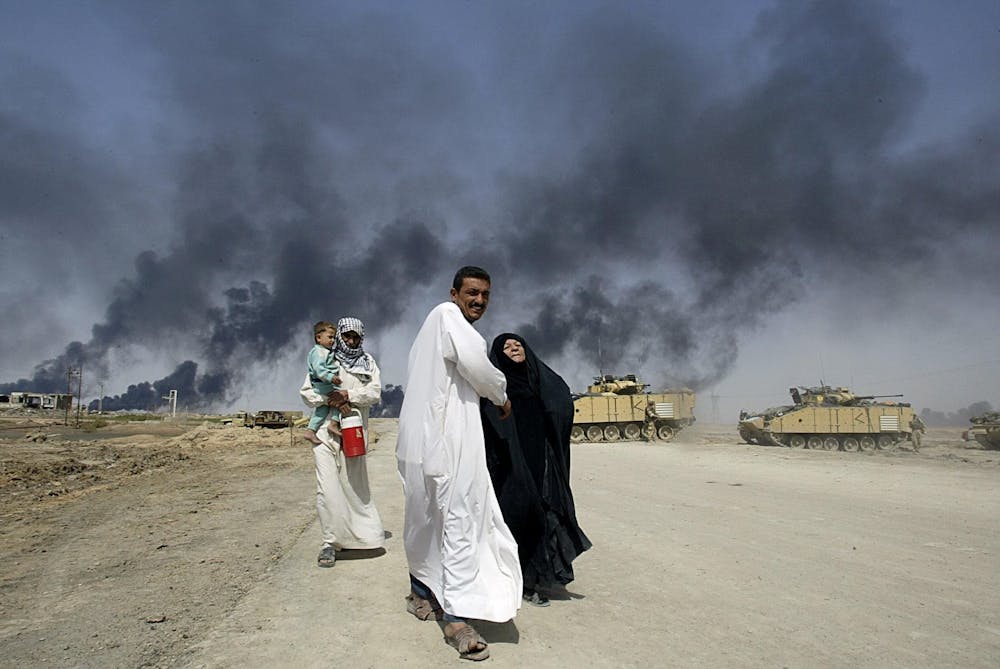
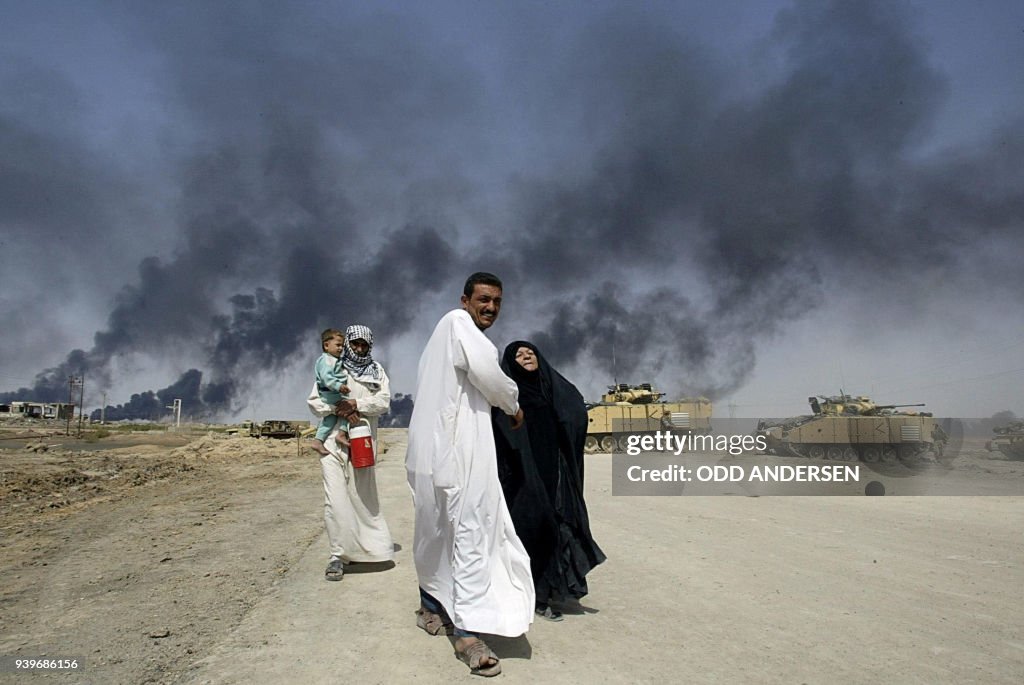
    An Iraqi family flees past British tanks from the city of Basra in March 2003.
    Odd Andersen/AFP via Getty Images

    A new set of priorities

    Older Americans age 65 and up are more likely than young people to prioritize foreign policy issues, including maintaining a U.S. military advantage.

    Younger Americans – age 18 to 39 – say the top issues that require urgency are providing support to refugees and limiting U.S. military commitments abroad, according to a 2021 Pew research survey.

    Generation Z members are also less likely than older Americans to think that the U.S. should act by itself in defending or protecting democracy around the world, according to a 2019 poll by the think tank Center for American Progress.

    They also agree with the statement that the United States’ “wars in the Middle East and Afghanistan were a waste of time, lives, and taxpayer money and they did nothing to make us safer at home.” They prefer that the U.S. use economic and diplomatic means, rather than military intervention, to advance American interests around the world.

    Israel’s conflict with Iran may not flare again and give way to more airstrikes and violence. If the countries resume fighting, however, their conflict threatens to draw in Lebanon, Qatar and other countries in the Middle East, as well as likely the U.S. – and to drag on for a long time.

    This is an update from a story originally published on March 15, 2023.

    Andrea Stanton does not work for, consult, own shares in or receive funding from any company or organization that would benefit from this article, and has disclosed no relevant affiliations beyond their academic appointment.

    ref. Israel-Iran war recalls the 2003 US invasion of Iraq – a war my undergraduate students see as a relic of the past – https://theconversation.com/israel-iran-war-recalls-the-2003-us-invasion-of-iraq-a-war-my-undergraduate-students-see-as-a-relic-of-the-past-259652

    MIL OSI Analysis

  • MIL-OSI Analysis: Using TikTok could be making you more politically polarized, new study finds

    Source: The Conversation – USA – By Zicheng Cheng, Assistant Professor of Mass Communications, University of Arizona

    Are you in an echo chamber on TikTok? LeoPatrizi/E+ via Getty Images

    People on TikTok tend to follow accounts that align with their own political beliefs, meaning the platform is creating political echo chambers among its users. These findings, from a study my collaborators, Yanlin Li and Homero Gil de Zúñiga, and I published in the academic journal New Media & Society, show that people mostly hear from voices they already agree with.

    We analyzed the structure of different political networks on TikTok and found that right-leaning communities are more isolated from other political groups and from mainstream news outlets. Looking at their internal structures, the right-leaning communities are more tightly connected than their left-leaning counterparts. In other words, conservative TikTok users tend to stick together. They rarely follow accounts with opposing views or mainstream media accounts. Liberal users, on the other hand, are more likely to follow a mix of accounts, including those they might disagree with.

    Our study is based on a massive dataset of over 16 million TikTok videos from more than 160,000 public accounts between 2019 and 2023. We saw a spike of political TikTok videos during the 2020 U.S. presidential election. More importantly, people aren’t just passively watching political content; they’re actively creating political content themselves.

    Some people are more outspoken about politics than others. We found that users with stronger political leanings and those who get more likes and comments on their videos are more motivated to keep posting. This shows the power of partisanship, but also the power of TikTok’s social rewards system. Engagement signals – likes, shares, comments – are like a fuel, encouraging users to create even more.

    Why it matters

    People are turning to TikTok not just for a good laugh. A recent Pew Research Center survey shows that almost 40% of U.S. adults under 30 regularly get news on TikTok. The question becomes what kind of news are they watching, and what does that mean for how they engage with politics.

    The content on TikTok often comes from creators and influencers or digital-native media sources. The quality of this news content remains uncertain. Without access to balanced, fact-based information, people may struggle to make informed political decisions.

    TikTok is not unique; social media generally fosters polarization.

    Amid the debates over banning TikTok, our study highlights how TikTok can be a double-edged sword in political communication. It’s encouraging to see people participate in politics through TikTok when that’s their medium of choice. However, if a user’s network is closed and homogeneous and their expression serves as in-group validation, it may further solidify the political echo chamber.

    When people are exposed to one-sided messages, it can increase hostility toward outgroups. In the long run, relying on TikTok as a source for political information might deepen people’s political views and contribute to greater polarization.

    What other research is being done

    Echo chambers have been widely studied on platforms like Twitter and Facebook, but similar research on TikTok is in its infancy. TikTok is drawing scrutiny, particularly its role in news production, political messaging and social movements.

    TikTok has its unique format, algorithmic curation and entertainment-driven design. I believe that its function as a tool for political communication calls for closer examination.

    What’s next

    In 2024, the Biden/Harris and Trump campaigns joined TikTok to reach young voters. My research team is now analyzing how these political communication dynamics may have shifted during the 2024 election. Future research could use experiments to explore whether these campaign videos significantly influence voters’ perceptions and behaviors.

    The Research Brief is a short take on interesting academic work.

    Zicheng Cheng does not work for, consult, own shares in or receive funding from any company or organization that would benefit from this article, and has disclosed no relevant affiliations beyond their academic appointment.

    ref. Using TikTok could be making you more politically polarized, new study finds – https://theconversation.com/using-tiktok-could-be-making-you-more-politically-polarized-new-study-finds-258791

    MIL OSI Analysis

  • MIL-OSI Analysis: Uranium enrichment: A chemist explains how the surprisingly common element is processed to power reactors and weapons

    Source: The Conversation – USA – By André O. Hudson, Dean of the College of Science, Professor of Biochemistry, Rochester Institute of Technology

    Yellowcake is a concentrated form of mined and processed uranium. Nuclear Regulatory Commission, CC BY

    When most people hear the word uranium, they think of mushroom clouds, Cold War standoffs or the glowing green rods from science fiction. But uranium isn’t just fuel for apocalyptic fears. It’s also a surprisingly common element that plays a crucial role in modern energy, medicine and geopolitics.

    Uranium reentered the global spotlight in June 2025, when the U.S. launched military strikes on sites in Iran believed to be housing highly enriched uranium, a move that reignited urgent conversations around nuclear proliferation. Many headlines have mentioned Iran’s 60% enrichment of uranium, but what does that really mean?

    As a biochemist, I’m interested in demystifying this often misunderstood element.

    What is uranium?

    Uranium holds the 92nd position on the periodic table, and it is a radioactive, metallic element. Radioactivity is a natural process where some atoms – like uranium, thorium and radium – break down on their own, releasing energy.

    The German chemist Martin Heinrich Klaproth initially identified uranium in 1789, and he named it after the newly discovered planet Uranus. However, its power was not unlocked until the 20th century, when scientists discovered that uranium atoms could split via a process known as nuclear fission. In fission, the nucleus of the atom splits into two or more nuclei, which releases large amounts of energy.

    Uranium is found almost everywhere. It is in rocks, soil and water. There are even traces of uranium in plants and animals – albeit tiny amounts. Most of it is found in the Earth’s crust, where it is mined and concentrated to increase the amount of its most useful radioactive form, uranium-235.

    The enrichment dilemma

    Uranium-235 is an isotope of uranium, which is a version of an element that has the same basic identity but weighs a little more or less. Think about apples from the same tree. Some are big and some are small, but they are all apples – even though they have slightly different weights. Basically, an isotope is the same element but with a different mass.

    Unprocessed uranium is mostly uranium-238. It only contains approximately 0.7% uranium-235, the isotope that allows the most nuclear fission to occur. So, the enrichment process concentrates uranium-235.

    Enrichment can make uranium more useful for the development of nuclear weapons, since natural uranium doesn’t have enough uranium-235 to work well in reactors or weapons. The process usually contains three steps.

    Centrifuges spin the uranium to separate out its isotopes.

    The first step is to convert the uranium into a gas, called uranium hexafluoride. In the second step, the gas gets funneled into a machine called a centrifuge that spins very fast. Because uranium-235 is a little lighter than uranium-238, it moves outward more slowly when spun, and the two isotopes separate.

    It’s sort of like how a salad spinner separates water from lettuce. One spin doesn’t make much of a difference, so the gas is spun through many centrifuges in a row until the uranium-235 is concentrated.

    Uranium can typically power nuclear plants and generate electricity when it is 3%-5% enriched, meaning 3%-5% of the uranium is uranium-235. At 20% enriched, uranium-235 is considered highly enriched uranium, and 90% or higher is known as weapons-grade uranium.

    The enrichment level depends on the proportion of uranium-235 to uranium-238.
    Wikimedia Commons

    This high grade works in nuclear weapons because it can sustain a fast, uncontrolled chain reaction, which releases a large amount of energy compared with the other isotopes.

    Uranium’s varied powers

    While many headlines focus on uranium’s military potential, this element also plays a vital role in modern life. At low enrichment levels, uranium powers nearly 10% of the world’s electricity.

    In the U.S., many nuclear power plants run on uranium fuel, producing carbon-free energy. In addition, some cancer therapies and diagnostic imaging technologies harness uranium to treat diseases.

    Enriched uranium is used for nuclear power.
    Raimond Spekking/Wikimedia Commons, CC BY-SA

    In naval technology, nuclear-powered submarines and aircraft carriers rely on enriched uranium to operate silently and efficiently for years.

    Uranium is a story of duality. It is a mineral pulled from ancient rocks that can light up a city or wipe one off the map. It’s not just a relic of the Cold War or science fiction. It’s real, it’s powerful, and it’s shaping our world – from global conflicts to cancer clinics, from the energy grid to international diplomacy.

    In the end, the real power is not just in the energy released from the element. It is in how people choose to use it.

    André O. Hudson receives funding from the National Institutes of Health.

    ref. Uranium enrichment: A chemist explains how the surprisingly common element is processed to power reactors and weapons – https://theconversation.com/uranium-enrichment-a-chemist-explains-how-the-surprisingly-common-element-is-processed-to-power-reactors-and-weapons-259646

    MIL OSI Analysis

  • MIL-OSI Analysis: Uranium enrichment: A chemist explains how the surprisingly common element is processed to power reactors and weapons

    Source: The Conversation – USA – By André O. Hudson, Dean of the College of Science, Professor of Biochemistry, Rochester Institute of Technology

    Yellowcake is a concentrated form of mined and processed uranium. Nuclear Regulatory Commission, CC BY

    When most people hear the word uranium, they think of mushroom clouds, Cold War standoffs or the glowing green rods from science fiction. But uranium isn’t just fuel for apocalyptic fears. It’s also a surprisingly common element that plays a crucial role in modern energy, medicine and geopolitics.

    Uranium reentered the global spotlight in June 2025, when the U.S. launched military strikes on sites in Iran believed to be housing highly enriched uranium, a move that reignited urgent conversations around nuclear proliferation. Many headlines have mentioned Iran’s 60% enrichment of uranium, but what does that really mean?

    As a biochemist, I’m interested in demystifying this often misunderstood element.

    What is uranium?

    Uranium holds the 92nd position on the periodic table, and it is a radioactive, metallic element. Radioactivity is a natural process where some atoms – like uranium, thorium and radium – break down on their own, releasing energy.

    The German chemist Martin Heinrich Klaproth initially identified uranium in 1789, and he named it after the newly discovered planet Uranus. However, its power was not unlocked until the 20th century, when scientists discovered that uranium atoms could split via a process known as nuclear fission. In fission, the nucleus of the atom splits into two or more nuclei, which releases large amounts of energy.

    Uranium is found almost everywhere. It is in rocks, soil and water. There are even traces of uranium in plants and animals – albeit tiny amounts. Most of it is found in the Earth’s crust, where it is mined and concentrated to increase the amount of its most useful radioactive form, uranium-235.

    The enrichment dilemma

    Uranium-235 is an isotope of uranium, which is a version of an element that has the same basic identity but weighs a little more or less. Think about apples from the same tree. Some are big and some are small, but they are all apples – even though they have slightly different weights. Basically, an isotope is the same element but with a different mass.

    Unprocessed uranium is mostly uranium-238. It only contains approximately 0.7% uranium-235, the isotope that allows the most nuclear fission to occur. So, the enrichment process concentrates uranium-235.

    Enrichment can make uranium more useful for the development of nuclear weapons, since natural uranium doesn’t have enough uranium-235 to work well in reactors or weapons. The process usually contains three steps.

    Centrifuges spin the uranium to separate out its isotopes.

    The first step is to convert the uranium into a gas, called uranium hexafluoride. In the second step, the gas gets funneled into a machine called a centrifuge that spins very fast. Because uranium-235 is a little lighter than uranium-238, it moves outward more slowly when spun, and the two isotopes separate.

    It’s sort of like how a salad spinner separates water from lettuce. One spin doesn’t make much of a difference, so the gas is spun through many centrifuges in a row until the uranium-235 is concentrated.

    Uranium can typically power nuclear plants and generate electricity when it is 3%-5% enriched, meaning 3%-5% of the uranium is uranium-235. At 20% enriched, uranium-235 is considered highly enriched uranium, and 90% or higher is known as weapons-grade uranium.

    The enrichment level depends on the proportion of uranium-235 to uranium-238.
    Wikimedia Commons

    This high grade works in nuclear weapons because it can sustain a fast, uncontrolled chain reaction, which releases a large amount of energy compared with the other isotopes.

    Uranium’s varied powers

    While many headlines focus on uranium’s military potential, this element also plays a vital role in modern life. At low enrichment levels, uranium powers nearly 10% of the world’s electricity.

    In the U.S., many nuclear power plants run on uranium fuel, producing carbon-free energy. In addition, some cancer therapies and diagnostic imaging technologies harness uranium to treat diseases.

    Enriched uranium is used for nuclear power.
    Raimond Spekking/Wikimedia Commons, CC BY-SA

    In naval technology, nuclear-powered submarines and aircraft carriers rely on enriched uranium to operate silently and efficiently for years.

    Uranium is a story of duality. It is a mineral pulled from ancient rocks that can light up a city or wipe one off the map. It’s not just a relic of the Cold War or science fiction. It’s real, it’s powerful, and it’s shaping our world – from global conflicts to cancer clinics, from the energy grid to international diplomacy.

    In the end, the real power is not just in the energy released from the element. It is in how people choose to use it.

    André O. Hudson receives funding from the National Institutes of Health.

    ref. Uranium enrichment: A chemist explains how the surprisingly common element is processed to power reactors and weapons – https://theconversation.com/uranium-enrichment-a-chemist-explains-how-the-surprisingly-common-element-is-processed-to-power-reactors-and-weapons-259646

    MIL OSI Analysis

  • MIL-OSI Analysis: Israel bombed an Iraqi nuclear reactor in 1981 − it pushed program underground and spurred Saddam Hussein’s desire for nukes

    Source: The Conversation – Global Perspectives – By Jeffrey Fields, Professor of the Practice of International Relations, USC Dornsife College of Letters, Arts and Sciences

    The Osirak nuclear power research station in 1981. Jacques Pavlovsky/Sygma via Getty Images

    Israel, with the assistance of U.S. military hardware, bombs an adversary’s nuclear facility to set back the perceived pursuit of the ultimate weapon. We have been here before, about 44 years ago.

    In 1981, Israeli fighter jets supplied by Washington attacked an Iraqi nuclear research reactor being built near Baghdad by the French government.

    The reactor, which the French called Osirak and Iraqis called Tammuz, was destroyed. Much of the international community initially condemned the attack. But Israel claimed the raid set Iraqi nuclear ambitions back at least a decade. In time, many Western observers and government officials, too, chalked up the attack as a win for nonproliferation, hailing the strike as an audacious but necessary step to prevent Iraqi dictator Saddam Hussein from building a nuclear arsenal.

    But the reality is more complicated. As nuclear proliferation experts assess the extent of damage to Iran’s nuclear facilities following the recent U.S. and Israeli raids, it is worth reassessing the longer-term implications of that earlier Iraqi strike.

    The Osirak reactor

    Iraq joined the landmark Nuclear Non-Proliferation Treaty in 1970, committing the country to refrain from the pursuit of nuclear weapons. But in exchange, signatories are entitled to engage in civilian nuclear activities, including having research or power reactors and access to the enriched uranium that drives them.

    The International Atomic Energy Agency is responsible through safeguards agreements for monitoring countries’ civilian use of nuclear technology, with on-the-ground inspections to ensure that civilian nuclear programs do not divert materials for nuclear weapons.

    But to Israel, the Iraqi reactor was provocative and an escalation in the Arab-Israeli conflict.

    Israel believed that Iraq would use the French reactor – Iraq said it was for research purposes – to generate plutonium for a nuclear weapon. After diplomacy with France and the United States failed to persuade the two countries to halt construction of the reactor, Prime Minister Menachem Begin concluded that attacking the reactor was Israel’s best option. That decision gave birth to the “Begin Doctrine,” which has committing Israel to preventing its regional adversaries from becoming nuclear powers ever since.

    Israeli Prime Minister Menachem Begin addresses the press after the 1981 attack on the Osarik nuclear reactor.
    Israel Press and Photo Agency/Wikimedia Commons

    In spring 1979, Israel attempted to sabotage the project, bombing the reactor core destined for Iraq while it sat awaiting shipment in the French town of La Seyne-sur-Mer. The mission was only a partial success, damaging but not destroying the reactor.

    France and Iraq persisted with the project, and in July 1980 – with the reactor having been delivered – Iraq received the first shipment of highly enriched uranium fuel at the Tuwaitha Nuclear Research Center near Baghdad.

    Then in September 1980, during the initial days of the Iran-Iraq war, Iranian jets struck the nuclear research center. The raid also targeted a power station, knocking out electricity in Baghdad for several days. But a Central Intelligence Agency situation report assessed that “only secondary buildings” were hit at the nuclear site itself.

    It was then Israel’s turn. The reactor was still unfinished and not in operation when on June 7, 1981, eight U.S.-supplied F-16s flew over Jordanian and Saudi airspace and bombed the reactor in Iraq. The attack killed 10 Iraqi soldiers and a French civilian.

    Revisiting the ‘success’ of Israeli raid

    Many years later, U.S. President Bill Clinton commented: “Everybody talks about what the Israelis did at Osirak in 1981, which I think, in retrospect, was a really good thing. You know, it kept Saddam from developing nuclear power.”

    But nonproliferation experts have contended for years that while Saddam may have had nuclear weapons ambitions, the French-built research reactor would not have been the route to go. Iraq would either have had to divert the reactor’s highly enriched uranium fuel for a few weapons or shut the reactor down to extract plutonium from the fuel rods – all while hiding these operations from the International Atomic Energy Agency.

    As an additional safeguard, the French government, too, had pledged to shut down the reactor if it detected efforts to use the reactor for weapons purposes.

    In any event, Iraq’s desire for a nuclear weapon was more aspirational than operational. A 2011 article in the journal International Security included interviews with several scientists who worked on Iraq’s nuclear program and characterized the country’s pursuit of a nuclear weapons capability as “both directionless and disorganized” before the attack.

    Iraq’s program begins in earnest

    So what happened after the strike? Many analysts have argued that the Israeli attack, rather than diminish Iraqi desire for a nuclear weapon, actually catalyzed it.

    Nuclear proliferation expert Målfrid Braut-Hegghammer, the author of the 2011 study, concluded that the Israeli attack “triggered a nuclear weapons program where one did not previously exist.”

    In the aftermath of the attack, Saddam decided to formally, if secretively, establish a nuclear weapons program, with scientists deciding that a uranium-based weapon was the best route. He tasked his scientists with pursuing multiple methods to enrich uranium to weapons grade to ensure success, much the way the Manhattan Project scientists approached the same problem in the U.S.

    In other words, the Israeli attack, rather than set back an existing nuclear weapons program, turned an incoherent and exploratory nuclear endeavor into a drive to get the bomb personally overseen by Saddam and sparing little expense even as Iraq’s war with Iran substantially taxed Iraqi resources.

    From 1981 to 1987, the nuclear program progressed fitfully, facing both organizational and scientific challenges.

    As those challenges were beginning to be addressed, Iraq invaded Kuwait in 1990, provoking a military response from the United States. In the aftermath of what would become Operation Desert Storm, U.N. weapons inspectors discovered and dismantled the clandestine Iraqi nuclear weapons program.

    The Tammuz nuclear reactor was hit again during the 1991 Gulf War.
    Ramzi Haidar/AFP via Getty Images

    Had Saddam not invaded Kuwait over a matter not related to security, it is very possible that Baghdad would have had a nuclear weapon capability by the mid-to-late 1990s.

    Similarly to Iraq in 1980, Iran today is a party to the Nuclear Non-Proliferation Treaty. At the time President Donald Trump withdrew U.S. support in 2018 for the Joint Comprehensive Plan of Action, colloquially known as the Iran nuclear deal, the International Atomic Energy Agency certified that Tehran was complying with the requirements of the agreement.

    In the case of Iraq, military action on its nascent nuclear program merely pushed it underground – to Saddam, the Israeli strikes made acquiring the ultimate weapon more rather than less attractive as a deterrent. Almost a half-century on, some analysts and observers are warning the same about Iran.

    Jeffrey Fields receives funding from the Carnegie Corporation of New York and Schmidt Futures.

    ref. Israel bombed an Iraqi nuclear reactor in 1981 − it pushed program underground and spurred Saddam Hussein’s desire for nukes – https://theconversation.com/israel-bombed-an-iraqi-nuclear-reactor-in-1981-it-pushed-program-underground-and-spurred-saddam-husseins-desire-for-nukes-259618

    MIL OSI Analysis

  • MIL-OSI Analysis: Japanese prime minister’s abrupt no-show at NATO summit reveals a strained alliance with the US

    Source: The Conversation – Global Perspectives – By Craig Mark, Adjunct Lecturer, Faculty of Economics, Hosei University

    Japanese Prime Minister Shigeru Ishiba has sent a clear signal to the Trump administration: the Japan–US relationship is in a dire state.

    After saying just days ago he would be attending this week’s NATO summit at The Hague, Ishiba abruptly pulled out at the last minute.

    He joins two other leaders from the Indo-Pacific region, Australian Prime Minister Anthony Albanese and South Korean President Lee Jae-myung, in skipping the summit.

    The Japanese media reported Ishiba cancelled the trip because a bilateral meeting with US President Donald Trump was unlikely, as was a meeting of the Indo-Pacific Four (IP4) NATO partners (Australia, New Zealand, South Korea and Japan).

    Japan will still be represented by Foreign Minister Takeshi Iwaya, showing its desire to strengthen its security relationship with NATO.

    However, Ishiba’s no-show reveals how Japan views its relationship with the Trump administration, following the severe tariffs Washington imposed on Japan and Trump’s mixed messages on the countries’ decades-long military alliance.

    Tariffs and diplomatic disagreements

    Trump’s tariff policy is at the core of the divide between the US and Japan.

    Ishiba attempted to get relations with the Trump administration off to a good start. He was the second world leader to visit Trump at the White House, after Israeli Prime Minister Benjamin Netanyahu.

    However, Trump’s “Liberation Day” tariffs imposed a punitive rate of 25% on Japanese cars and 24% on all other Japanese imports. They are already having an adverse impact on Japan’s economy: exports of automobiles to the US dropped in May by 25% compared to a year ago.

    Six rounds of negotiations have made little progress, as Ishiba’s government insists on full tariff exemptions.

    Japan has been under pressure from the Trump administration to increase its defence spending, as well. According to the Financial Times, Tokyo cancelled a summit between US and Japanese defence and foreign ministers over the demand. (A Japanese official denied the report.)

    Japan also did not offer its full support to the US bombings of Iran’s nuclear facilities earlier this week. The foreign minister instead said Japan “understands” the US’s determination to prevent Iran from acquiring nuclear weapons.

    Japan has traditionally had fairly good relations with Iran, often acting as an indirect bridge with the West. Former Prime Minister Shinzo Abe even made a visit there in 2019.

    Japan also remains heavily dependent on oil from the Middle East. It would have been adversely affected if the Strait of Hormuz had been blocked, as Iran was threatening to do.

    Unlike the response from the UK and Australia, which both supported the strikes, the Ishiba government prioritised its commitment to upholding international law and the rules-based global order. In doing so, Japan seeks to deny China, Russia and North Korea any leeway to similarly erode global norms on the use of force and territorial aggression.

    Strategic dilemma of the Japan–US military alliance

    In addition, Japan is facing the same dilemma as other American allies – how to manage relations with the “America first” Trump administration, which has made the US an unreliable ally.

    Earlier this year, Trump criticised the decades-old security alliance between the US and Japan, calling it “one-sided”.

    “If we’re ever attacked, they don’t have to do a thing to protect us,” he said of Japan.

    Lower-level security cooperation is ongoing between the two allies and their regional partners. The US, Japanese and Philippine Coast Guards conducted drills in Japanese waters this week. The US military may also assist with upgrading Japan’s counterstrike missile capabilities.

    But Japan is still likely to continue expanding its security ties with partners beyond the US, such as NATO, the European Union, India, the Philippines, Vietnam and other ASEAN members, while maintaining its fragile rapprochement with South Korea.

    Australia is now arguably Japan’s most reliable security partner. Canberra is considering buying Japan’s Mogami-class frigates for the Royal Australian Navy. And if the AUKUS agreement with the US and UK collapses, Japanese submarines could be a replacement.

    Ishiba under domestic political pressure

    There are also intensifying domestic political pressures on Ishiba to hold firm against Trump, who is deeply unpopular among the Japanese public.

    After replacing former prime minister Fumio Kishida as leader of the Liberal Democratic Party (LDP) last September, the party lost its majority in the lower house of parliament in snap elections. This made it dependent on minor parties for legislative support.

    Ishiba’s minority government has struggled ever since with poor opinion polling. There has been widespread discontent with inflation, the high cost of living and stagnant wages, the legacy of LDP political scandals, and ever-worsening geopolitical uncertainty.

    On Sunday, the party suffered its worst-ever result in elections for the Tokyo Metropolitan Assembly, winning its lowest number of seats.

    The party could face a similar drubbing in the election for half of the upper house of the Diet (Japan’s parliament) on July 20. Ishiba has pledged to maintain the LDP’s majority in the house with its junior coalition partner Komeito. But if the government falls into minority status in both houses, Ishiba will face heavy pressure to step down.

    Craig Mark does not work for, consult, own shares in or receive funding from any company or organisation that would benefit from this article, and has disclosed no relevant affiliations beyond their academic appointment.

    ref. Japanese prime minister’s abrupt no-show at NATO summit reveals a strained alliance with the US – https://theconversation.com/japanese-prime-ministers-abrupt-no-show-at-nato-summit-reveals-a-strained-alliance-with-the-us-259694

    MIL OSI Analysis

  • MIL-OSI Analysis: Oil shocks in the 1970s drove rapid changes in transport. It could happen again if Middle East tensions continue

    Source: The Conversation – Global Perspectives – By Hussein Dia, Professor of Future Urban Mobility, Swinburne University of Technology

    The Image Bank/Getty

    As the world watches the US–Iran situation with concern, the ripple effect from these events are reaching global oil supply chains – and exposing their fragility.

    If Iran closes the Strait of Hormuz as it is considering, it would restrict the global oil trade and trigger energy chaos.

    Petrol in some Australian cities could hit A$2.50 a litre according to some economists. As global instability worsens, other experts warn price spikes are increasingly likely.

    What would happen next? There is a precedent: the oil shocks of the 1970s, when oil prices quadrupled. The shock drove rapid change, from more efficient cars to sudden interest in alternative energy sources. This time, motorists would likely switch to electric vehicles.

    If this crisis continues or if another one flares up, it could mark a turning point in Australia’s long dependence on foreign oil.

    What would an oil shock mean?

    Australia currently imports 80% of its liquid fuels, the highest level on record. If the flow of oil stopped, we would have about 50 days worth in storage before we ran out.

    Our cars, buses, trucks and planes run overwhelmingly on petrol and diesel. Almost three-quarters (74%) of these liquid fuels are used in transport, with road transport accounting for more than half (54%) of all liquid fuels. Australia is highly exposed to global supply shocks.

    The best available option to reduce dependence on oil imports is to electrify transport.

    How does Australia compare on EVs?

    EV uptake in Australia continues to lag behind global leaders. In 2024, EVs accounted for 9.65% of new car sales in Australia, up from 8.45% in 2023.

    In the first quarter of 2025, EVs were 6.3% of new car sales, a decline from 7.4% in the final quarter of 2024.

    Norway remains the global leader, with battery-electric passenger cars making up 88.9% of sales in 2024. The United Kingdom also saw significant growth – EVs hit almost 20% of new car registrations in 2024.

    In China, EVs made up 40.9% of new car sales in 2024. The 12.87 million cars sold represent three-quarters of total EV sales worldwide.

    One reason for Australia’s sluggishness is a lack of reliable public chargers. While charging infrastructure is expanding, large parts of regional Australia still lack reliable access to EV charging.

    Until recently, Australia’s fuel efficiency standards were among the weakest in the OECD. Earlier this year, the government’s new standards came into force. These are expected to boost EV uptake.

    Could global tensions trigger faster action?

    If history is any guide, oil shocks lead to long-term change.

    The 1970s oil shocks triggered waves of energy reform.

    When global oil prices quadrupled in 1973–74, many nations were forced to reconsider where they got their energy. A few years later, the 1979 Iranian Revolution caused another major supply disruption, sending oil prices soaring and pushing much of the world into recession.

    Huge increases in oil prices drove people to look for alternatives during the 1970s oil shocks.
    Everett Collection/Shutterstock

    These shocks drove the formation of the International Energy Agency in 1974, spurred alternative energy investment and led to advances in fuel-efficiency standards.

    Much more recently, Russia’s invasion of Ukraine pushed the European Union to face up to its reliance on Russian gas and find alternatives by importing gas from different countries and accelerating the clean energy shift.

    Clearly, energy shocks can be catalysts for long-term structural change in how we produce and consume energy.

    The new crisis could do the same, but only if policy catches up.

    If fuel prices shot up and stayed there, consumer behaviour would begin to shift. People would drive less and seek alternate forms of transport. Over time, more would look for better ways to get around.

    But without stronger support such as incentives, infrastructure and fuel security planning, shifting consumer preferences could be too slow to matter.

    A clean-energy future is more secure

    Cutting oil dependency through electrification isn’t just good for the climate. It’s also a hedge against future price shocks and supply disruptions.

    Transport is now Australia’s third-largest source of greenhouse gas emissions. Now that emissions are falling in the electricity sector, transport will be the highest emitting sector emissions source as soon as 2030.

    Building a cleaner transport system also means building a more resilient one. Charging EVs on locally produced renewable power cuts our exposure to global oil markets. So do biofuels, better public transport and smarter urban planning.

    Improving domestic energy resilience isn’t just about climate targets. It’s about economic stability and national security. Clean local energy sources reduce vulnerability to events beyond our control.

    What can we learn from China?

    China offers a compelling case study. The nation of 1.4 billion faces real oil security challenges. In response, Beijing has spent the past decade building a domestic clean energy ecosystem to reduce oil dependency and cut emissions.

    This is now bearing fruit. Last year, China’s oil imports had the first sustained fall in nearly two decades. Crude oil imports fell 1.5%, while oil refinery activity also fell due to lower demand.

    China’s rapid uptake of EVs has clear energy security benefits.
    pim pic/Shutterstock

    China’s green energy transition was driven by coordinated policy, industrial investment and public support for clean transport.

    China’s rapid shift to EVs and clean energy shows how long-term planning and targeted investment can pay off on climate and energy security.

    What we do next matters

    The rolling crises of 2025 present Australian policymakers a rare alignment of interests. What’s good for the climate, for consumers and for national security may now be the same thing.

    Real change will require more than sustained high petrol prices. It demands political will, targeted investment and a long-term vision for clean, resilient transport.

    Doing nothing has a real cost – not just in what we pay at the service station, but in how vulnerable we remain to events a long way away.

    Hussein Dia receives funding from the Australian Research Council, the iMOVE Australia Cooperative Research Centre, Transport for New South Wales, Queensland Department of Transport and Main Roads, Victorian Department of Transport and Planning, and Department of Infrastructure, Transport, Regional Development, Communications and the Arts.

    ref. Oil shocks in the 1970s drove rapid changes in transport. It could happen again if Middle East tensions continue – https://theconversation.com/oil-shocks-in-the-1970s-drove-rapid-changes-in-transport-it-could-happen-again-if-middle-east-tensions-continue-259670

    MIL OSI Analysis

  • MIL-Evening Report: ‘Don’t surrender’ to Indonesian pressure over West Papua, Bomanak warns MSG

    Asia Pacific Report

    A West Papuan independence movement leader has warned the Melanesian Spearhead Group after its 23rd leaders summit in Suva, Fiji, to not give in to a “neocolonial trade in betrayal and abandonment” over West Papua.

    While endorsing and acknowledging the “unconditional support” of Melanesian people to the West Papuan cause for decolonisation, OPM chair and commander Jeffrey P Bomanak
    spoke against “surrendering” to Indonesia which was carrying out a policy of “bank cheque diplomacy” in a bid to destroy solidarity.

    Fiji Prime Minister Sitiveni Rabuka took over the chairmanship of the MSG this week from his Vanuatu counterpart Jotham Napat and vowed to build on the hard work and success that had been laid before it.

    He said he would not take the responsibility of chairmanship lightly, especially as they were confronted with an increasingly fragmented global landscape that demanded more from them.

    PNG Prime Minister James Marape called on MSG member states to put West Papua and Kanaky New Caledonia back on the agenda for full MSG membership.

    Marape said that while high-level dialogue with Indonesia over West Papua and France about New Caledonia must continue, it was culturally “un-Melanesian” not to give them a seat at the table.

    West Papua currently holds observer status in the MSG, which includes Papua New Guinea, Solomon Islands, Vanuatu, and Fiji — and Indonesia as an associate member.

    PNG ‘subtle shift’
    PNG recognises the West Papuan region as five provinces of Indonesia, making Marape’s remarks in Suva a “subtle shift that may unsettle Jakarta”, reports Gorethy Kenneth in the PNG Post-Courier.

    West Papuans have waged a long-standing Melanesian struggle for independence from Indonesia since 1969.

    The MSG resolved to send separate letters of concern to the French and Indonesian presidents.

    The OPM letter warning the MSG. Image: Screenshot APR

    In a statement, Bomanak thanked the Melanesians of Fiji, Papua New Guinea, Solomon Islands, Vanuatu and the Kanak and Socialist National Liberation Front (FLNKS) of Kanaky New Caledonia for “unconditionally support[ing] your West Papuan brothers and sisters, subjected to dispossession, enslavement, genocide, ethnocide, infanticide, and ethnic cleansing, [as] the noblest of acts.”

    “We will never forget these Melanesian brothers and sisters who remain faithfully loyal to our cultural identity no matter how many decades is our war of liberation and no matter how many bags of gold and silver Indonesia offers for the betrayal of ancestral kinship.

    “When the late [Vanuatu Prime Minister] Father Walter Lini declared, ‘Melanesia is not free unless West Papua is free,”’ he was setting the benchmark for leadership and loyalty across the entire group of Melanesian nations.

    “Father Lini was not talking about a timeframe of five months, or five years, or five decades.

    “Father Lini was talking about an illegal invasion and military occupation of West Papua by a barbaric nation wanting West Papua’s gold and forests and willing to exterminate all of us for this wealth.

    ‘Noble declaration’
    “That this noble declaration of kinship and loyalty now has a commercial value that can be bought and sold like a commodity by those without Father Lini’s courage and leadership, and betrayed for cheap materialism, is an act of historic infamy that will be recorded by Melanesian historians and taught in all our nations’ universities long after West Papua is liberated.”

    OPM leader Jeffrey Bomanak . . . his letter warns against surrendering to Indonesian control. Image: OPM

    Bomanak was condemning the decision of the MSG to regard the “West Papua problem” as an internal issue for Indonesia.

    “The illegal occupation of West Papua and the genocide of West Papuans is not an internal issue to be solved by the barbaric occupier.

    “Indonesia’s position as an associate member of MSG is a form of colonial corruption of the Melanesian people.

    “We will continue to fight without MSG because the struggle for independence and sovereignty is our fundamental right of the Papuan people’s granted by God.

    “Every member of MSG can recommend to the United Nations that West Papua deserves the same right of liberation and nation-state sovereignty that was achieved without compromise by Timor-Leste — the other nation illegally invaded by Indonesia and also subjected to genocide.”

    Bomanak said the MSG’s remarks stood in stark contrast to Father Lini’s solidarity with West Papua and were “tantamount to sharing in the destruction of West Papua”.

    ‘Blood money’
    It was also collaborating in the “extermination of West Papuans for economic benefit, for Batik Largesse. Blood money!”

    The Papua ‘problem’ was not a human rights problem but a problem of the Papuan people’s political right for independence and sovereignty based on international law and the right to self-determination.

    It was an international problem that had not been resolved.

    “In fact, to say it is simply a ‘problem’ ignores the fate of the genocide of 500,000 victims.”

    Bomanak said MSG leaders should make clear recommendations to the Indonesian government to resolve the “Papua problem” at the international level based on UN procedures and involving the demilitarisation of West Papua with all Indonesian defence and security forces “leaving the land they invaded and unlawfully occupied.”

    Indonesia’s position as an associate member in the MSG was a systematic new colonialisation by Indonesia in the home of the Melanesian people.

    Indonesia well understood the weaknesses of each Melanesian leader and “carries out bank cheque diplomacy accordingly to destroy the solidarity so profoundly declared by the late Father Walter Lini.”

    “No surrender!”

    MSG leaders in Suva . . . Jeremy Manele (Solomon Islands, from left), James Marape (PNG), Sitiveni Rabuka (Fiji), Jotham Napat (Vanuatu), and Roch Wamytan (FLNKS spokesperson). Image: PNG Post-Courier

    MIL OSI AnalysisEveningReport.nz

  • MIL-Evening Report: Grattan on Friday: Jim Chalmers juggles expectations and ambition in pursuing tax reform

    Source: The Conversation (Au and NZ) – By Michelle Grattan, Professorial Fellow, University of Canberra

    Next week will be the 40th anniversary of the Hawke government’s tax summit. Dominated by then treasurer Paul Keating’s unsuccessful bid to win support for a consumption tax, it was the public centrepiece of an extraordinary political and policy story.

    That story was about the possibilities for, but constraints on, bold reform; how a determined treasurer can muster a formidable department to push for change, and the way the ambitions of a minister can clash with the pragmatism of a prime minister.

    Ken Henry, later secretary of the treasury, was then part of what they dubbed the “treasury tax reform bunker”. He kept a timesheet, averaging 100 hours work a week for a three-month period. Officials brought sleeping bags and their small children (Henry’s were aged three and five) into the office.

    Before the summit, the government produced a comprehensive draft white paper. Keating battled to keep the conflicting interests “in the cart” for his blueprint. But the four-day summit, attended by business, unions, premiers and community groups, was inevitably divided by stakeholders’ self-interests. In particular, the unions couldn’t wear Keating’s consumption tax, and Bob Hawke kyboshed it unceremoniously. Keating, who had to settle for a more limited but still very significant set of reforms, was furious with Hawke, and it left a fracture in their relationship.

    Jim Chalmers was aged seven in 1985. But he’s a student of Keating (he did his PhD on his prime ministership) and you can be sure he’s boned up on what went right and wrong in that tax reform exercise. Now he is preparing for the government’s August 19-21 “roundtable” and his own bid at major tax reform.

    The roundtable, as first announced, focused on “productivity”, and that will be central. But Chalmers has taken to calling it an “economic reform” roundtable – its brief also includes budget sustainability and resilience – and he is effectively putting tax reform close to its heart, or at least letting others do so. After all, a fit-for-purpose tax system is one key to improving productivity.

    The roundtable (for which invitations to business and the union movement are now going out, with more to follow) is nothing like on the scale, in size (the 1985 summit had about 160 attendees, the roundtable will have about 25) or preparation, of the elaborate 1985 conference.

    And crucially, while that summit was the culmination of a process, Chalmers is using the roundtable to kick off a process.

    Chalmers is lowering expectations in regard to specific outcomes from the summit on tax. While those might be obtainable on some productivity issues, on tax he is likely to look for broad support for a direction of reform. For instance, is there a general appetite for reshaping the tax system towards lower personal and company tax, offset by higher taxes on certain investments and savings? `

    Most tax experts argue Australia’s system is too skewed towards taxing income rather than spending. This leads to calls to increase or broaden the GST, financing cuts to personal income tax.

    Chalmers has been a long-term opponent of changing the GST, but he says he is not ruling the GST out for discussion at the roundtable. (That’s a contrast to when Prime Minister Kevin Rudd, commissioning Henry to lead a major tax review, excluded the GST from its terms of reference.)

    Almost certainly, however, it would not be possible to get “consensus” from business and unions for GST changes. Not least of the constraints is that compensating the losers in such a change is very expensive and there is not the money to do so these days.

    That immediately limits the extent of reform.

    Henry tells The Conversation’s podcast that if he were designing a tax reform package “I’d be looking at opportunities to broaden the GST and maybe to increase the rate as well”.

    But “I do think it is possible to achieve major tax reform […] without necessarily increasing the [GST] rate or extending the base”.

    Henry’s (non-GST) wish list includes getting rid of the remaining state transaction taxes, such as stamp duty on property conveyancing.

    Notably, he argues for extracting more revenue from taxing natural resources and land, and also from taxing pollution from various sources. “We’re going to need to tax those things more heavily if we’re going to relieve the tax burden on young workers through lower personal income tax and introducing tax indexation.”

    Henry is particularly focused on the unfair burden at present put on these younger taxpayers. He has come around to the idea of income tax indexation as one means of assisting them.

    A system more geared to younger workers raises immediate questions about the present generous treatment of superannuants. Chalmers is already caught in that hornets’ nest with his proposed changes for those with balances more than $3 million.

    To what extent will the roundtable tax debate revive the issues of negative gearing and the capital gains tax discount? The government hosed down before the election the prospect of any changes to negative gearing this term. Chalmers, however, had work done on this last term and he would likely favour reining it in. But would this be a bridge too far for the prime minister?

    Indeed, where will Anthony Albanese’s limits be when it comes to reform? Would he only support changes that had strong consensus? And how far would he feel constrained in going beyond what he considers he has a mandate for?

    If Chalmers stays serious about the tax push, it is going to take many months of intense work. It can’t be rushed, but nor can it be delayed. If it ran for much over a year it would likely find the government’s political capital had been eroded. The size of its capital store can appear deceptive because so much of it is thanks to Peter Dutton and Donald Trump.

    In 2022, the Liberals boycotted Labor’s jobs and skills summit (although Nationals leader David Littlepround attended). This time, shadow treasurer Ted O’Brien has accepted Chalmers’ invitation and will participate in the roundtable.

    It will be a tricky gig for O’Brien, new to this shadow portfolio. He has to avoid being too negative, but nor can he endorse things the opposition might later reject. The Coalition will not have a tax policy against which to judge what’s said.

    The occasion will be a chance for O’Brien to make contacts and get more insight into stakeholders’ views on the key economic debates, much wider than just tax.

    Importantly, however, O’Brien will need to remember judgements will be being made about him by other participants in the room. Business in particular will be seeking to get a fix on whether opposition leader Sussan Ley’s declarations about wanting to be constructive where possible are fair dinkum.

    Michelle Grattan does not work for, consult, own shares in or receive funding from any company or organisation that would benefit from this article, and has disclosed no relevant affiliations beyond their academic appointment.

    ref. Grattan on Friday: Jim Chalmers juggles expectations and ambition in pursuing tax reform – https://theconversation.com/grattan-on-friday-jim-chalmers-juggles-expectations-and-ambition-in-pursuing-tax-reform-258971

    MIL OSI AnalysisEveningReport.nz

  • MIL-Evening Report: Grattan on Friday: Jim Chalmers juggles expectations and ambition in pursuing tax reform

    Source: The Conversation (Au and NZ) – By Michelle Grattan, Professorial Fellow, University of Canberra

    Next week will be the 40th anniversary of the Hawke government’s tax summit. Dominated by then treasurer Paul Keating’s unsuccessful bid to win support for a consumption tax, it was the public centrepiece of an extraordinary political and policy story.

    That story was about the possibilities for, but constraints on, bold reform; how a determined treasurer can muster a formidable department to push for change, and the way the ambitions of a minister can clash with the pragmatism of a prime minister.

    Ken Henry, later secretary of the treasury, was then part of what they dubbed the “treasury tax reform bunker”. He kept a timesheet, averaging 100 hours work a week for a three-month period. Officials brought sleeping bags and their small children (Henry’s were aged three and five) into the office.

    Before the summit, the government produced a comprehensive draft white paper. Keating battled to keep the conflicting interests “in the cart” for his blueprint. But the four-day summit, attended by business, unions, premiers and community groups, was inevitably divided by stakeholders’ self-interests. In particular, the unions couldn’t wear Keating’s consumption tax, and Bob Hawke kyboshed it unceremoniously. Keating, who had to settle for a more limited but still very significant set of reforms, was furious with Hawke, and it left a fracture in their relationship.

    Jim Chalmers was aged seven in 1985. But he’s a student of Keating (he did his PhD on his prime ministership) and you can be sure he’s boned up on what went right and wrong in that tax reform exercise. Now he is preparing for the government’s August 19-21 “roundtable” and his own bid at major tax reform.

    The roundtable, as first announced, focused on “productivity”, and that will be central. But Chalmers has taken to calling it an “economic reform” roundtable – its brief also includes budget sustainability and resilience – and he is effectively putting tax reform close to its heart, or at least letting others do so. After all, a fit-for-purpose tax system is one key to improving productivity.

    The roundtable (for which invitations to business and the union movement are now going out, with more to follow) is nothing like on the scale, in size (the 1985 summit had about 160 attendees, the roundtable will have about 25) or preparation, of the elaborate 1985 conference.

    And crucially, while that summit was the culmination of a process, Chalmers is using the roundtable to kick off a process.

    Chalmers is lowering expectations in regard to specific outcomes from the summit on tax. While those might be obtainable on some productivity issues, on tax he is likely to look for broad support for a direction of reform. For instance, is there a general appetite for reshaping the tax system towards lower personal and company tax, offset by higher taxes on certain investments and savings? `

    Most tax experts argue Australia’s system is too skewed towards taxing income rather than spending. This leads to calls to increase or broaden the GST, financing cuts to personal income tax.

    Chalmers has been a long-term opponent of changing the GST, but he says he is not ruling the GST out for discussion at the roundtable. (That’s a contrast to when Prime Minister Kevin Rudd, commissioning Henry to lead a major tax review, excluded the GST from its terms of reference.)

    Almost certainly, however, it would not be possible to get “consensus” from business and unions for GST changes. Not least of the constraints is that compensating the losers in such a change is very expensive and there is not the money to do so these days.

    That immediately limits the extent of reform.

    Henry tells The Conversation’s podcast that if he were designing a tax reform package “I’d be looking at opportunities to broaden the GST and maybe to increase the rate as well”.

    But “I do think it is possible to achieve major tax reform […] without necessarily increasing the [GST] rate or extending the base”.

    Henry’s (non-GST) wish list includes getting rid of the remaining state transaction taxes, such as stamp duty on property conveyancing.

    Notably, he argues for extracting more revenue from taxing natural resources and land, and also from taxing pollution from various sources. “We’re going to need to tax those things more heavily if we’re going to relieve the tax burden on young workers through lower personal income tax and introducing tax indexation.”

    Henry is particularly focused on the unfair burden at present put on these younger taxpayers. He has come around to the idea of income tax indexation as one means of assisting them.

    A system more geared to younger workers raises immediate questions about the present generous treatment of superannuants. Chalmers is already caught in that hornets’ nest with his proposed changes for those with balances more than $3 million.

    To what extent will the roundtable tax debate revive the issues of negative gearing and the capital gains tax discount? The government hosed down before the election the prospect of any changes to negative gearing this term. Chalmers, however, had work done on this last term and he would likely favour reining it in. But would this be a bridge too far for the prime minister?

    Indeed, where will Anthony Albanese’s limits be when it comes to reform? Would he only support changes that had strong consensus? And how far would he feel constrained in going beyond what he considers he has a mandate for?

    If Chalmers stays serious about the tax push, it is going to take many months of intense work. It can’t be rushed, but nor can it be delayed. If it ran for much over a year it would likely find the government’s political capital had been eroded. The size of its capital store can appear deceptive because so much of it is thanks to Peter Dutton and Donald Trump.

    In 2022, the Liberals boycotted Labor’s jobs and skills summit (although Nationals leader David Littlepround attended). This time, shadow treasurer Ted O’Brien has accepted Chalmers’ invitation and will participate in the roundtable.

    It will be a tricky gig for O’Brien, new to this shadow portfolio. He has to avoid being too negative, but nor can he endorse things the opposition might later reject. The Coalition will not have a tax policy against which to judge what’s said.

    The occasion will be a chance for O’Brien to make contacts and get more insight into stakeholders’ views on the key economic debates, much wider than just tax.

    Importantly, however, O’Brien will need to remember judgements will be being made about him by other participants in the room. Business in particular will be seeking to get a fix on whether opposition leader Sussan Ley’s declarations about wanting to be constructive where possible are fair dinkum.

    Michelle Grattan does not work for, consult, own shares in or receive funding from any company or organisation that would benefit from this article, and has disclosed no relevant affiliations beyond their academic appointment.

    ref. Grattan on Friday: Jim Chalmers juggles expectations and ambition in pursuing tax reform – https://theconversation.com/grattan-on-friday-jim-chalmers-juggles-expectations-and-ambition-in-pursuing-tax-reform-258971

    MIL OSI AnalysisEveningReport.nz

  • MIL-OSI Analysis: How Nato summit shows Europe and US no longer have a common enemy

    Source: The Conversation – UK – By Andrew Corbett, Senior Lecturer in Defence Studies, King’s College London

    Mark Rutte had an unenviable task at the Hague summit this week. The Nato secretary-general had to work with diverging American and European views of current security threats. After Rutte made extraordinary efforts at highly deferential, overt flattery of Donald Trump to secure crucial outcomes for the alliance, he seems to have succeeded for now.

    But what this meeting and the run-up has made increasingly clear is that the US and Europe no longer perceive themselves as having a single common enemy. Nato was established in 1949 as a defensive alliance against the acknowledged threat from the USSR. This defined the alliance through the cold war until the dissolution of the Soviet Union in 1991. Since Russia invaded Ukraine and annexed Crimea in 2014, Nato has focused on Moscow as the major threat to international peace. But the increasingly bellicose China is demanding more attention from the US.

    There are some symbolic moves that signal how things are changing. Every Nato summit declaration since the Russian invasion of Ukraine in 2022 has used the same form of words: “We adhere to international law and to the purposes and principles of the Charter of the United Nations and are committed to upholding the rules-based international order.”

    The declaration published during the Hague summit on June 25 conspicuously does not mention either. Indeed, in a departure from recent declarations, the five paragraphs of the Hague summit declaration are brutally short and focused entirely on portraying the alliance solely in terms of military capability and economic investment to sustain that. No mention of international law and order this time.

    This appears to be a carefully orchestrated output of a deliberately shortened summit designed to contain Trump’s unpredictable interventions. This also seems symptomatic of a widening division between the American strategic trajectory and the security interests perceived by Canada and the European members of Nato.

    That this declaration was so short, and so focused on such a narrow range of issues suggests there were unusually entrenched differences that could not be surmounted.

    Since the onslaught of the full Russian invasion of Ukraine in February 2022, the Nato allies have been united in their criticism of Russia and support for Ukraine; until now.

    Since January, the Trump administration has not authorised any military aid to Ukraine and significantly reduced material support to Ukraine and criticism of Russia. Trump has sought to end the war rapidly on terms effectively capitulating to Russian aggression; his proposal suggests recognising Russia’s control over Crimea and de facto control over some other occupied territories (Luhansk, parts of Zaporizhzhia, Donetsk, and Kherson) He has also suggested Ukraine would not join Nato but might receive security guarantees and the right to join the EU.

    Meanwhile, European allies have sought to fund and support Ukraine’s defensive efforts, increasing aid and military support, and continuing to ramp up sanctions.

    Another sign of the differing priorities of Europe and Canada v the US, was the decision by Pete Hegseth, US secretary of defense, to step back from leadership of the Ukraine defence contact group, an ad-hoc coalition of states across the world providing military support to Ukraine. Hegseth also symbolically failed to attend the group’s pre-summit meeting in June.

    Trump has long been adamant that Nato members should meet their 2014 commitment to spend 2% of their GDP on defence, and Rutte recognised that. In 2018, Trump suggested that this should be increased to 4 or 5% but this was dismissed as unreasonable. Now, in a decision which indicates increasing concern about both Russia as a threat and US support, Nato members (except for Spain) have agreed to increase spending to 5% of GDP on defence over the next 10 years.

    Donald Trump gives a press conference after the Nato summit.

    Nato’s article 3 requires states to maintain and develop their capacity to resist attack. However, since 2022, it has become increasingly apparent that many Nato members are unprepared for any major military engagement. At the same time, they are increasingly feeling that Russia is more of a threat on their doorsteps. There has been recognition, particularly among the Baltic states, Germany, France and the UK that they need to increase their military spending and preparedness.

    For the US to focus more on China, US forces will shift a greater percentage of the US Navy to the Pacific. It will also assign its most capable new ships and aircraft to the region and increase general presence operations, training and developmental exercises, and engagement and cooperation with allied and other navies in the western Pacific. To do this US forces will need to reduce commitments in Europe, and European allies must replace those capabilities in order to sustain deterrence against Russia.

    The bedrock of the Nato treaty, article 5, is commonly paraphrased as “an attack on one is an attack on all”. On his way to the Hague summit, Trump seemed unsure about the US commitment to Nato. Asked to clarify this at the summit, he stated: “I stand with it [Article 5]. That’s why I’m here. If I didn’t stand with it, I wouldn’t be here.”

    Lord Ismay, the first secretary-general of Nato, famously (if apocryphally) suggested that the purpose of the alliance was to keep the Russians out, the Americans in and the Germans down. Germany is now an integral part of Nato, and the Americans are in, if distracted. But there are cracks, and Rutte will have his hands full managing Trump’s declining interest in protecting Europe if he is to keep the Russians at bay.

    Andrew Corbett does not work for, consult, own shares in or receive funding from any company or organisation that would benefit from this article, and has disclosed no relevant affiliations beyond their academic appointment.

    ref. How Nato summit shows Europe and US no longer have a common enemy – https://theconversation.com/how-nato-summit-shows-europe-and-us-no-longer-have-a-common-enemy-259842

    MIL OSI Analysis

  • MIL-OSI Analysis: How Nato summit shows Europe and US no longer have a common enemy

    Source: The Conversation – UK – By Andrew Corbett, Senior Lecturer in Defence Studies, King’s College London

    Mark Rutte had an unenviable task at the Hague summit this week. The Nato secretary-general had to work with diverging American and European views of current security threats. After Rutte made extraordinary efforts at highly deferential, overt flattery of Donald Trump to secure crucial outcomes for the alliance, he seems to have succeeded for now.

    But what this meeting and the run-up has made increasingly clear is that the US and Europe no longer perceive themselves as having a single common enemy. Nato was established in 1949 as a defensive alliance against the acknowledged threat from the USSR. This defined the alliance through the cold war until the dissolution of the Soviet Union in 1991. Since Russia invaded Ukraine and annexed Crimea in 2014, Nato has focused on Moscow as the major threat to international peace. But the increasingly bellicose China is demanding more attention from the US.

    There are some symbolic moves that signal how things are changing. Every Nato summit declaration since the Russian invasion of Ukraine in 2022 has used the same form of words: “We adhere to international law and to the purposes and principles of the Charter of the United Nations and are committed to upholding the rules-based international order.”

    The declaration published during the Hague summit on June 25 conspicuously does not mention either. Indeed, in a departure from recent declarations, the five paragraphs of the Hague summit declaration are brutally short and focused entirely on portraying the alliance solely in terms of military capability and economic investment to sustain that. No mention of international law and order this time.

    This appears to be a carefully orchestrated output of a deliberately shortened summit designed to contain Trump’s unpredictable interventions. This also seems symptomatic of a widening division between the American strategic trajectory and the security interests perceived by Canada and the European members of Nato.

    That this declaration was so short, and so focused on such a narrow range of issues suggests there were unusually entrenched differences that could not be surmounted.

    Since the onslaught of the full Russian invasion of Ukraine in February 2022, the Nato allies have been united in their criticism of Russia and support for Ukraine; until now.

    Since January, the Trump administration has not authorised any military aid to Ukraine and significantly reduced material support to Ukraine and criticism of Russia. Trump has sought to end the war rapidly on terms effectively capitulating to Russian aggression; his proposal suggests recognising Russia’s control over Crimea and de facto control over some other occupied territories (Luhansk, parts of Zaporizhzhia, Donetsk, and Kherson) He has also suggested Ukraine would not join Nato but might receive security guarantees and the right to join the EU.

    Meanwhile, European allies have sought to fund and support Ukraine’s defensive efforts, increasing aid and military support, and continuing to ramp up sanctions.

    Another sign of the differing priorities of Europe and Canada v the US, was the decision by Pete Hegseth, US secretary of defense, to step back from leadership of the Ukraine defence contact group, an ad-hoc coalition of states across the world providing military support to Ukraine. Hegseth also symbolically failed to attend the group’s pre-summit meeting in June.

    Trump has long been adamant that Nato members should meet their 2014 commitment to spend 2% of their GDP on defence, and Rutte recognised that. In 2018, Trump suggested that this should be increased to 4 or 5% but this was dismissed as unreasonable. Now, in a decision which indicates increasing concern about both Russia as a threat and US support, Nato members (except for Spain) have agreed to increase spending to 5% of GDP on defence over the next 10 years.

    Donald Trump gives a press conference after the Nato summit.

    Nato’s article 3 requires states to maintain and develop their capacity to resist attack. However, since 2022, it has become increasingly apparent that many Nato members are unprepared for any major military engagement. At the same time, they are increasingly feeling that Russia is more of a threat on their doorsteps. There has been recognition, particularly among the Baltic states, Germany, France and the UK that they need to increase their military spending and preparedness.

    For the US to focus more on China, US forces will shift a greater percentage of the US Navy to the Pacific. It will also assign its most capable new ships and aircraft to the region and increase general presence operations, training and developmental exercises, and engagement and cooperation with allied and other navies in the western Pacific. To do this US forces will need to reduce commitments in Europe, and European allies must replace those capabilities in order to sustain deterrence against Russia.

    The bedrock of the Nato treaty, article 5, is commonly paraphrased as “an attack on one is an attack on all”. On his way to the Hague summit, Trump seemed unsure about the US commitment to Nato. Asked to clarify this at the summit, he stated: “I stand with it [Article 5]. That’s why I’m here. If I didn’t stand with it, I wouldn’t be here.”

    Lord Ismay, the first secretary-general of Nato, famously (if apocryphally) suggested that the purpose of the alliance was to keep the Russians out, the Americans in and the Germans down. Germany is now an integral part of Nato, and the Americans are in, if distracted. But there are cracks, and Rutte will have his hands full managing Trump’s declining interest in protecting Europe if he is to keep the Russians at bay.

    Andrew Corbett does not work for, consult, own shares in or receive funding from any company or organisation that would benefit from this article, and has disclosed no relevant affiliations beyond their academic appointment.

    ref. How Nato summit shows Europe and US no longer have a common enemy – https://theconversation.com/how-nato-summit-shows-europe-and-us-no-longer-have-a-common-enemy-259842

    MIL OSI Analysis

  • MIL-OSI Analysis: UK’s F-35A fighter jet deal problem: the RAF has no aircraft to refuel them in mid-air

    Source: The Conversation – UK – By Arun Dawson, PhD Candidate, Department of War Studies, King’s College London

    A1C Jake Welty

    The UK has decided to acquire at least 12 F-35A stealth fighters. These fighter jets should be able to carry out nuclear and conventional strikes from the air, a capability the Royal Air Force (RAF) has lacked since the 1990s. The deal also marks a significant move for the UK’s participation in Nato operations amid rising nuclear rhetoric from adversaries.

    The F-35A brings notable advantages over the F-35B variant already in RAF service. It’s less expensive to buy and operate, has greater range – 679 miles (1093km) vs 517 miles (833km) – and supports a broader variety of weapons, including the nuclear-capable B61 bomb (with US agreement). Because it can spend longer in the air, it may also allow prospective RAF pilots to get through their pilot training quicker.

    Yet while the F-35A offers greater range than many comparable fighter jets, it still requires in-flight refuelling to operate effectively over extended distances and to return home from such missions. This exposes a critical vulnerability that has been largely overlooked in public commentary: the RAF has no tanker aircraft capable of supporting the F-35A in this way. As a result, these fighter jets – carrying nuclear ordnance or otherwise – are limited in the types of operations they can carry out.

    Unlike the F-35B which is compatible with the UK’s current fleet of tankers, the A-model depends exclusively on “flying boom” refuelling. Flying boom is one of two aerial refuelling methods. Favoured by the United States Air Force, it uses a rigid, extendable tube to deliver fuel at a high transfer rate and is generally easier for receiving pilots to operate.

    The alternative is probe-and-drogue which relies on a flexible hose and basket, connected to a probe on the receiving aircraft. While slower and more demanding to operate, it allows multiple fighters to refuel simultaneously, offers redundancy (backup options) and is simpler to integrate.

    The RAF’s refuelling predicament stems from an exclusive leasing deal negotiated under the last Labour government, which supplied only probe-and-drogue Voyager tankers. Although the aircraft were designed to support both systems, the UK opted not to include booms due to cost constraints and limited demand at the time.

    Since then, however, the UK has steadily acquired more American-made aircraft that can only use the flying boom method to refuel: the C-17 Globemaster (air transport), RC-135W Rivet Joint (intelligence), E-7 Wedgetail (airborne command and control) and P-8A Poseidon (maritime patrol).

    The F-35A announcement continues this trend but with greater implications. While the aircraft can carry external fuel tanks to extend its range, this degrades its stealth capability. Stealth means it is less easy for enemy sensors – like radar – to detect. The F-35A needs this stealth capability for nuclear missions that require penetration of contested airspace to deliver unguided B61 bombs.

    The outcome is that Britain’s F-35As, along with alternative and otherwise highly capable aircraft, will not be ablew to operate independently during critical military operations. London to Eastern Europe, for instance, is roughly 1,150 miles (1,852km): nearly double the distance the F-35A can fly without refuelling. Without flying boom tankers or bases in foreign countries for refuelling, tactical flexibility is compromised.

    This shortfall imposes a growing reliance on allied tanker support. In crisis conditions, UK aircraft could be confined to American-led operations where such tankers exist.

    This risk was manageable in previous decades; the possibility of operating without the Americans considered remote. But as the 2025 Strategic Defence Review concedes, the United States is clear that the “security of Europe is no longer its primary international focus”.

    And while some Nato allies in Europe as well as Australia are increasing their flying boom capacity through a multinational fleet, the UK is not as yet part of those arrangements. Retrofitting the existing Voyager fleet remains an option, but it would require an extensive – and expensive – structural overhaul, prompting the question of whether acquiring new, compatible tankers might now be a more viable path.

    Either way, until Britain invests in flying boom capability or secures assured access from allies, it will have to accept constraints to its military power. Buying frontline jets is only part of the equation. Without the means to sustain them in the air, the UK risks fielding a force that can’t reach its target, leaving it a spectator when it matters most.

    Arun Dawson does not work for, consult, own shares in or receive funding from any company or organisation that would benefit from this article, and has disclosed no relevant affiliations beyond their academic appointment.

    ref. UK’s F-35A fighter jet deal problem: the RAF has no aircraft to refuel them in mid-air – https://theconversation.com/uks-f-35a-fighter-jet-deal-problem-the-raf-has-no-aircraft-to-refuel-them-in-mid-air-259821

    MIL OSI Analysis

  • MIL-OSI Analysis: UK’s F-35A fighter jet deal problem: the RAF has no aircraft to refuel them in mid-air

    Source: The Conversation – UK – By Arun Dawson, PhD Candidate, Department of War Studies, King’s College London

    A1C Jake Welty

    The UK has decided to acquire at least 12 F-35A stealth fighters. These fighter jets should be able to carry out nuclear and conventional strikes from the air, a capability the Royal Air Force (RAF) has lacked since the 1990s. The deal also marks a significant move for the UK’s participation in Nato operations amid rising nuclear rhetoric from adversaries.

    The F-35A brings notable advantages over the F-35B variant already in RAF service. It’s less expensive to buy and operate, has greater range – 679 miles (1093km) vs 517 miles (833km) – and supports a broader variety of weapons, including the nuclear-capable B61 bomb (with US agreement). Because it can spend longer in the air, it may also allow prospective RAF pilots to get through their pilot training quicker.

    Yet while the F-35A offers greater range than many comparable fighter jets, it still requires in-flight refuelling to operate effectively over extended distances and to return home from such missions. This exposes a critical vulnerability that has been largely overlooked in public commentary: the RAF has no tanker aircraft capable of supporting the F-35A in this way. As a result, these fighter jets – carrying nuclear ordnance or otherwise – are limited in the types of operations they can carry out.

    Unlike the F-35B which is compatible with the UK’s current fleet of tankers, the A-model depends exclusively on “flying boom” refuelling. Flying boom is one of two aerial refuelling methods. Favoured by the United States Air Force, it uses a rigid, extendable tube to deliver fuel at a high transfer rate and is generally easier for receiving pilots to operate.

    The alternative is probe-and-drogue which relies on a flexible hose and basket, connected to a probe on the receiving aircraft. While slower and more demanding to operate, it allows multiple fighters to refuel simultaneously, offers redundancy (backup options) and is simpler to integrate.

    The RAF’s refuelling predicament stems from an exclusive leasing deal negotiated under the last Labour government, which supplied only probe-and-drogue Voyager tankers. Although the aircraft were designed to support both systems, the UK opted not to include booms due to cost constraints and limited demand at the time.

    Since then, however, the UK has steadily acquired more American-made aircraft that can only use the flying boom method to refuel: the C-17 Globemaster (air transport), RC-135W Rivet Joint (intelligence), E-7 Wedgetail (airborne command and control) and P-8A Poseidon (maritime patrol).

    The F-35A announcement continues this trend but with greater implications. While the aircraft can carry external fuel tanks to extend its range, this degrades its stealth capability. Stealth means it is less easy for enemy sensors – like radar – to detect. The F-35A needs this stealth capability for nuclear missions that require penetration of contested airspace to deliver unguided B61 bombs.

    The outcome is that Britain’s F-35As, along with alternative and otherwise highly capable aircraft, will not be ablew to operate independently during critical military operations. London to Eastern Europe, for instance, is roughly 1,150 miles (1,852km): nearly double the distance the F-35A can fly without refuelling. Without flying boom tankers or bases in foreign countries for refuelling, tactical flexibility is compromised.

    This shortfall imposes a growing reliance on allied tanker support. In crisis conditions, UK aircraft could be confined to American-led operations where such tankers exist.

    This risk was manageable in previous decades; the possibility of operating without the Americans considered remote. But as the 2025 Strategic Defence Review concedes, the United States is clear that the “security of Europe is no longer its primary international focus”.

    And while some Nato allies in Europe as well as Australia are increasing their flying boom capacity through a multinational fleet, the UK is not as yet part of those arrangements. Retrofitting the existing Voyager fleet remains an option, but it would require an extensive – and expensive – structural overhaul, prompting the question of whether acquiring new, compatible tankers might now be a more viable path.

    Either way, until Britain invests in flying boom capability or secures assured access from allies, it will have to accept constraints to its military power. Buying frontline jets is only part of the equation. Without the means to sustain them in the air, the UK risks fielding a force that can’t reach its target, leaving it a spectator when it matters most.

    Arun Dawson does not work for, consult, own shares in or receive funding from any company or organisation that would benefit from this article, and has disclosed no relevant affiliations beyond their academic appointment.

    ref. UK’s F-35A fighter jet deal problem: the RAF has no aircraft to refuel them in mid-air – https://theconversation.com/uks-f-35a-fighter-jet-deal-problem-the-raf-has-no-aircraft-to-refuel-them-in-mid-air-259821

    MIL OSI Analysis

  • MIL-OSI Analysis: Amid alarm over a US ‘autism registry’, people are using these tactics to avoid disability surveillance – podcast

    Source: The Conversation – UK – By Gemma Ware, Host, The Conversation Weekly Podcast, The Conversation

    Robert F. Kennedy Jr. caused controversy in April by promising to find the cause for autism by September. Claims by the new US secretary for health and human services that autism is a “preventable disease” with an environmental cause,  contradict a body of research that suggests autism is caused by a combination of genetic and external factors.

    The US government announced that to support the research effort into autism, the National Institutes of Health (NIH), would partner with Medicare and Medicaid to build a “data platform” involving data on claims, medical records and consumer wearables.

    When first announced this plan was dubbed an autism registry, though the government later denied that’s what it was creating, instead calling it a “ real-world platform” to allow researchers to study comprehensive data on people with autism.

    While the NIH defended the decision as “fully compliant with privacy and security laws”, autistic people and disability advocates are alarmed at the potential violations such a data platform could enable.

     In this episode of The Conversation Weekly podcast, we speak to Amy Gaeta, a  research associate at the University of Cambridge in the UK who studies disability surveillance.

    Gaeta, who is American, explains that for over a century, disabled people have often been denied the right to privacy and been subjected to a sinister history of forced medical testing, forced sterilisation and various laws that criminalise mental illness. She says:

     I think this is why a lot of these everyday actions that disabled people do to resist surveillance don’t even come across as anti-surveillance. To them it just comes across as this is how I exist in the world.

    Gaeta talks us through some of the strategies people are using to avoid potential surveillance, from self-diagnosis, to withholding information or being careful with the language they use to describe themselves. Listen to our conversation with Gaeta on The Conversation Weekly podcast.

    This episode of The Conversation Weekly was written and produced by Katie Flood with assistance from Mend Mariwany. Gemma Ware is the executive producer. Mixing and sound design by Eloise Stevens and theme music by Neeta Sarl.

    Newsclips in this episode from ABC News.

    Listen to The Conversation Weekly via any of the apps listed above, download it directly via our RSS feed or find out how else to listen here. A transcript of this episode is available on Apple Podcasts or Spotify.

    Amy Gaeta receives research funding from UKRI, a grant that is hosted at the Leverhulme Centre for the Future of Intelligence.

    ref. Amid alarm over a US ‘autism registry’, people are using these tactics to avoid disability surveillance – podcast – https://theconversation.com/amid-alarm-over-a-us-autism-registry-people-are-using-these-tactics-to-avoid-disability-surveillance-podcast-259818

    MIL OSI Analysis

  • MIL-Evening Report: There’s gold trapped in your iPhone – and chemists have found a safe new way to extract it

    Source: The Conversation (Au and NZ) – By Justin M. Chalker, Professor of Chemistry, Flinders University

    A sample of refined gold recovered from mining and e-waste recycling trials. Justin Chalker

    In 2022, humans produced an estimated 62 million tonnes of electronic waste – enough to fill more than 1.5 million garbage trucks. This was up 82% from 2010 and is expected to rise to 82 million tonnes in 2030.

    This e-waste includes old laptops and phones, which contain precious materials such as gold. Less than one quarter of it is properly collected and recycled. But a new technique colleagues and I have developed to safely and sustainably extract gold from e-waste could help change that.

    Our new gold-extraction technique, which we describe in a new paper published today in Nature Sustainability, could also make small-scale gold mining less poisonous for people – and the planet.

    Soaring global demand

    Gold has long played a crucial role in human life. It has been a form of currency and a medium for art and fashion for centuries. Gold is also essential in modern industries including the electronics, chemical manufacture and aerospace sectors.

    But while global demand for this precious metal is soaring, mining it is harmful to the environment.

    Deforestation and use of toxic chemicals are two such problems. In formal, large-scale mining, highly toxic cyanide is widely used to extract gold from ore. While cyanide can be degraded, its use can cause harm to wildlife, and tailings dams which store the toxic byproducts of mining operations pose a risk to the wider environment.

    In small-scale and artisanal mining, mercury is used extensively to extract gold. In this practice, the gold reacts with mercury to form a dense amalgam that can be easily isolated. The gold is then recovered by heating the amalgam to vaporise the mercury.

    Small-scale and artisanal mining is the largest source of mercury pollution on Earth, and the mercury emissions are dangerous to the miners and pollute the environment. New methods are required to reduce the impacts of gold mining.

    In 2022, humans produced an estimated 62 million tonnes of electronic waste.
    DAMRONG RATTANAPONG/Shutterstock

    A safer alternative

    Our interdisciplinary team of scientists and engineers has developed a new technique to extract gold from ore and e-waste. The aim was to provide a safer alternative to mercury and cyanide and reduce the health and environmental impacts of gold mining.

    Many techniques have previously been reported for extracting gold from ore or e-waste, including mercury- and cyanide-free methods. However, many of these methods are limited in rate, yield, scale and cost. Often these methods also consider only one step in the entire gold recovery process, and recycling and waste management is often neglected.

    In contrast, our approach considered sustainability throughout the whole process of gold extraction, recovery and refining. Our new leaching technology uses a chemical commonly used in water sanitation and pool chlorination: trichloroisocyanuric acid.

    When this widely available and low-cost chemical is activated with salt water, it can react with gold and convert it into a water-soluble form.

    To recover the gold from the solution, we invented a sulphur-rich polymer sorbent. Polymer sorbents isolate a certain substance from a liquid or gas, and ours is made by joining a key building block (a monomer) together through a chain reaction.

    Our polymer sorbent is interesting because it is derived from elemental sulphur: a low-cost and highly abundant feedstock. The petroleum sector generates more sulphur than it can use or sell, so our polymer synthesis is a new use for this underused resource.

    Our polymer could selectively bind and remove gold from the solution, even when many other types of metals were present in the mixture.

    The simple leaching and recovery methods were demonstrated on ore, circuit boards from obsolete computers and scientific waste. Importantly, we also developed methods to regenerate and recycle both the leaching chemical and the polymer sorbent. We also established methods to purify and recycle the water used in the process.

    In developing the recyclable polymer sorbent, we invented some exciting new chemistry to make the polymer using light, and then “un-make” the sorbent after it bound gold. This recycling method converted the polymer back to its original monomer building block and separated it from the gold.

    The recovered monomer could then be re-made into the gold-binding polymer: an important demonstration of how the process is aligned with a circular economy.

    A long and complex road ahead

    In future work, we plan to collaborate with industry, government and not-for-profit groups to test our method in small-scale mining operations. Our long-term aim is to provide a robust and safe method for extracting gold, eliminating the need for highly toxic chemicals such as cyanide and mercury.

    There will be many challenges to overcome including scaling up the production of the polymer sorbent and the chemical recycling processes. For uptake, we also need to ensure that the rate, yield and cost are competitive with more traditional methods of gold mining. Our preliminary results are encouraging. But there is still a long and complex road ahead before our new techniques replace cyanide and mercury.

    Our broader motivation is to support the livelihood of the millions of artisanal and small-scale miners that rely on mercury to recover gold.

    They typically operate in remote and rural regions with few other economic opportunities. Our goal is to support these miners economically while offering safer alternatives to mercury. Likewise, the rise of “urban mining” and e-waste recycling would benefit from safer and operationally simple methods for precious metal recovery.

    Success in recovering gold from e-waste will also reduce the need for primary mining and therefore lessen its environmental impact.

    Justin M. Chalker is an inventor on patents associated with the gold leaching and recovery technology. Both patents are wholly owned by Flinders University. This research was supported financially by the Australian Research Council and Flinders University. He has an ongoing collaboration with Mercury Free Mining and Adelaide Control Engineering: organisations that supported the developments and trials reported in this study.

    ref. There’s gold trapped in your iPhone – and chemists have found a safe new way to extract it – https://theconversation.com/theres-gold-trapped-in-your-iphone-and-chemists-have-found-a-safe-new-way-to-extract-it-259817

    MIL OSI AnalysisEveningReport.nz

  • MIL-OSI Analysis: How Bordeaux wine estates price their bottles

    Source: The Conversation – France – By Jean-Marc Figuet, Professeur d’économie, Université de Bordeaux

    On wine-rating platforms, amateur ratings better explain the price differences of bottles than professional scores. JuanGarciaHinojosa/Shutterstock

    Research in economics has unravelled the workings of the complex market for Bordeaux wines, in which perceived quality, historical reputation and critical reviews are intertwined. The question of how bottles are priced is all the more relevant amid a crisis for the Bordeaux industry, which is facing the threat of higher US tariffs on EU exports.

    Reputation, ranking, vintage and climate

    A document pertaining to the ranking of Bordeaux wines in the 19th century.
    Wikimediacommons

    To assess the relationship between the quality and price of Bordeaux wines, Jean-Marie Cardebat and I applied the “hedonic” method. The analysis links price to the observable characteristics of a wine: its ranking, vintage, designation of origin, alcohol content, flavour, etc.

    The results are striking: the reputation of the wine estate and its official ranking, in particular that of 1855, are more powerful factors in explaining price than taste and sensory characteristics. In other words, a ranked wine, because of the prestige of its label, sells for significantly more than an unranked wine of equivalent taste and sensory appeal.


    À lire aussi :
    Our perception of wine has more to do with its commercial history than we think


    The economist Orley Ashenfelter has shown that the weather conditions of a vintage – temperature, sunshine, rainfall – are predictors of its quality and therefore its price. A simple model, based solely on climatic data.

    Robert Parker and the golden age of experts

    For more than 30 years, the critic Robert Parker stirred up the Bordeaux wine market. His famous scores out of 100, published in The Wine Advocate, made and broke the value of wines. The economist Robert H. Ashton measured the scores’ impact: an extra point could boost a price by 10-20%.

    Parker was the originator of a tribe of “gurus”, whose scores structured the entire early season for wines. The estates adjusted prices according to their assessments, and wine buyers followed suit, convinced of the accuracy of the scores.


    A weekly e-mail in English featuring expertise from scholars and researchers. It provides an introduction to the diversity of research coming out of the continent and considers some of the key issues facing European countries. Get the newsletter!

    Fragmented influence

    The Bordeaux wine landscape has changed since Parker’s retirement in 2019. The critics are still around but their influence has fragmented. No one has taken over Parker’s leadership. Consensus is now less clear and rating discrepancies are more frequent.

    An even deeper turning point is evident when we compare the impact of expert and consumer ratings – notably from the Vivino platform – on the price of French red wines.

    The result is clear: in the majority of cases, the scores of amateurs surpass those of professionals when it comes to explaining price differences. The market has therefore moved from a “guru” logic to a “geek” logic, in which the collective intelligence of connected consumers now carries as much weight, if not more, than expert opinions.


    À lire aussi :
    Appearance, aroma and mouthfeel: all you need to know to give wine tasting a go


    ‘Bordeaux bashing’

    During the “primeurs” or early harvest campaign, the most prestigious Bordeaux wines are offered 18 months before bottling, often at a price that is supposed to be lower than the future market price. It’s a great opportunity for a bargain. Philippe Masset’s research shows that most wine estates overestimate the price of early harvest wines.

    For example, for the 2021 vintage, over 80% of the wines analysed were priced above their “fair value” as estimated by an econometric model. The more a wine is overpriced on its release, the worse it performs on the secondary market. This discrepancy between asking price and perceived value feeds what is known as “Bordeaux bashing”. There is disaffection with these wines that are considered too expensive, too complex, too austere and totally out of step with today’s expectations – young people’s in particular.

    A changing market

    While the price of Bordeaux wine is still based on its quality, origin, weather and ranking, it also depends on criticism not just by experts, but by consumers. This shift is redefining the balance of power in the world of wine.

    Reputation still pays, but prestige is no longer enough. Nonelite wine consumers are gradually taking over, gaining a new form of power over prices. If the Bordeaux market wants to emerge from crisis and reclaim its place, it will undoubtedly have to rethink the way its prices are set and perceived.

    Jean-Marc Figuet has received public funding for his research.

    ref. How Bordeaux wine estates price their bottles – https://theconversation.com/how-bordeaux-wine-estates-price-their-bottles-259830

    MIL OSI Analysis

  • MIL-Evening Report: Politics with Michelle Grattan: Ken Henry on changing the tax system to give struggling workers a fairer go

    Source: The Conversation (Au and NZ) – By Michelle Grattan, Professorial Fellow, University of Canberra

    In August, the Albanese government will hold an economic “roundtable” that will discuss productivity, budget sustainability and resilience. Australia’s tax system will be one of the central issues, and stakeholders are gearing up with their varying arguments for changes.

    Ken Henry, a former secretary of the Treasury, has been part of the tax debates of the past 40 years. He was a treasury official working on tax at the time of the Hawke government’s 1985 tax summit and led the major review of the tax system commissioned by the Rudd government.

    Henry is a passionate advocate of bold tax reform, especially reform that tackled intergenerational inequity, and he joins the podcast to discuss the issues.

    Looking forward to the roundtable, Henry outlines some of the many changes that he thinks should be considered,

    Firstly we’ve got to get rid of the remaining transactions taxes like stamp duty on property conveyancing and so on […] that alone means there has to be a commonwealth-state exercise.

    Secondly, we’ve got to extract more revenue from the taxation of natural resources and also land.

    Thirdly, we’ve got to get more revenue from the taxation of environmental externalities. In the tax review published in 2010, we were developing that at the same time as the Treasury and other departments were developing the Rudd government’s carbon pollution reduction scheme. We thought that there was going to be quite a significant carbon price in Australia. We don’t have it today – we should.

    Henry wants a tax system that does not disadvantage younger people who are in the workforce; he says the present “lazy” reliance on bracket creep to “bring the budget back to anything approaching balance is doing enormous damage to younger people in particular”.

    On reform generally, Henry says he’s “disappointed” that more hasn’t been done on the recommendations from his review.

    I’m very disappointed, but I guess one would expect me to be very disappointed. And he laments Australia’s “abysmal” productivity performance over the last quarter century.

    When I then reflect on what’s happened to Australia’s productivity performance, I mean we were saying in 2002 that we really should aim to get the productivity growth rate up from 1.75% to 2.25% a year and in fact if you look back now over the first 25 years of this century right what we actually achieved was only three quarters of one percent a year. That productivity performance is just abysmal.

    To put it in terms that everybody will understand, had we achieved the two and a quarter percent a year rather than three quarters of a percent a year, the average wage and salary earner in Australia, their income would be 45% higher today than it is. This is not small stuff, this is huge stuff.

    Despite backing significant reform, Chalmers has been a long-term opponent of GST reform, although not ruling it out completely. Henry says all options should be left on the table,

    It would be better not to constrain the reform process by ruling the GST out and that was a shame for those of us who worked on the Rudd government’s tax review  […] that the terms of reference that we were given said that you’re not to make any recommendations concerning the GST.

    Those who are having a good hard look at how to restructure the Australian taxation system should not have one hand tied behind their backs. Having said that, I do think it’s possible to achieve major reform of the Australian taxation system without necessarily increasing the rate or extending the base of the GST.

    On Chalmers’ plan to tax unrealised capital gains on big superannuation balances, while not directly opposed, Henry says there are other ways to make the system fairer,

    I’m not opposed to it. It’s just that I think there are other ways of increasing the taxation that applies to high superannuation balances and improving the intergenerational equity of the superannuation system. In the tax review that the Rudd government Commissioned, which I led, which was published in 2010, we spent quite a lot of time detailing how we thought the taxation arrangements applying to superannuation could be improved.

    The thing that stands out is this big difference between the taxation of superannuation fund earnings in the so-called accumulation phase and the treatment that they get in the so-called pension phase, So […] these poor young workers, struggling, see the earnings on their accumulating superannuation balance as being taxed at 15%, whilst those who have big superannuation balances and are in the retirement, the earnings in their superannuation funds are completely tax-exempt, And that just seems rather weird.

    Michelle Grattan does not work for, consult, own shares in or receive funding from any company or organisation that would benefit from this article, and has disclosed no relevant affiliations beyond their academic appointment.

    ref. Politics with Michelle Grattan: Ken Henry on changing the tax system to give struggling workers a fairer go – https://theconversation.com/politics-with-michelle-grattan-ken-henry-on-changing-the-tax-system-to-give-struggling-workers-a-fairer-go-259887

    MIL OSI AnalysisEveningReport.nz

  • MIL-Evening Report: As one of Shakespeare’s least performed plays, Coriolanus is startlingly relevant under Trump 2.0

    Source: The Conversation (Au and NZ) – By Kirk Dodd, Lecturer in English and Writing, University of Sydney

    Brett Boardman/Bell Shakespeare

    Coriolanus is one of Shakespeare’s least performed plays; perhaps because the hero is so pugnacious and classist, impressive in his strident vehemence, but lacking the vulnerability of a Macbeth or Othello.

    Set in the turbulent early Roman Republic (490s BC) – about 450 years before Caesar’s death – the play follows the glorious rise of Gnaeus Marcius Coriolanus, a terrifying war machine on the battlefield who could carve his way through enemy regiments.

    According to one site, the play has not been professionally staged outside the United Kingdom since 2000. This is only the second time Bell Shakespeare has performed Coriolanus, with their other production staged 29 years ago, in 1996.

    Directed by Peter Evans and starring Hazem Shammas, this Coriolanus delivers Shakespeare’s most consciously political play with an explosive energy that charts the hero’s psychological downfall.

    Published as a tragedy in the 1623 First Folio, Coriolanus can loosely be described as a history play. But it is more commonly recognised as one of Shakespeare’s Roman plays, alongside Julius Caesar, Antony and Cleopatra, and Titus Andronicus.

    War and exile

    Renamed “Coriolanus” after the town he most recently conquered (Corioli), occupied by the arch enemies of Rome (the Volsci), Coriolanus is a devoted son to his fiercely ambitious “tiger mum” Volumnia (Brigid Zengeni).

    Shakespeare was never shy about the feats of his warrior protagonists, describing Coriolanus’ ability as a war machine most memorably as:

    His sword, Death’s stamp,
    Where it did mark, it took; from face to foot
    He was a thing of blood, whose every motion
    Was timed with dying cries. Alone he entered
    The mortal gate o’ th’ city, which he painted
    With shunless destiny; aidless came off
    And with a sudden reinforcement struck
    Corioles like a planet.

    But Coriolanus, who was brought up to win every contest, is also an upper-class patrician, dismissively scornful of the common people’s plebeian rights in the burgeoning Roman Republic.

    Hazem Shammas as Coriolanus is a force to be reckoned with.
    Brett Boardman/Bell Shakespeare

    Coriolanus’s absolute refusal to flatter the plebeians – and so refusing their political influence – ignites a brutal conflict between populism and elitism that results in the people’s sway.

    Coriolanus is exiled from Rome, the very homeland he fought so valiantly to protect.

    Incensed, Coriolanus joins forces with Rome’s greatest enemy, the Volscian Aufidius (Anthony Taufa) and marches against Rome. This forces Coriolanus to confront his own loyalties to his formidable mother and to doting wife Virgilia (Suzannah McDonald), with tragic consequences.

    Wonderful performances

    Evans has loosely set this production in Europe in the mid-1990s, following the fall of the Berlin Wall, though this creates a vibe more than a direct correlation to events.

    Evans also designed the set, making dynamic use of a traverse stage that forces audiences to see each other across the divide. This enhances the sense of a sprawling populous while prompting reflections on our own political milieu. Audiences are told as they enter whether they will sit on the “plebeian” or “patrician” side: a fun ploy, but perhaps unnecessary.

    Stealing the show is a wonderful performance by Peter Carroll as Menenius, a sagely Roman senator who uses his charm and political tact to mediate between the patricians and the plebeians. Carroll brings great irony to the role, using eye-rolls and tutting even as he attends dutifully to the new political expectations of the tribunes.

    Peter Carroll as Menenius steals the show in a wonderful performance.
    Brett Boardman/Bell Shakespeare

    The tribunes Sicinius (Matilda Ridgway) and Brutus (Marco Chiappi) are performed as shabbier left-wing agitators pitched against the conservative patricians in formal dark suits (costumes by Ella Butler). This makes familiar the political and class tensions, and the layers and dramatic dimensions explored by Shakespeare.

    Zengeni brings tremendous heart to Coriolanus’s mother, Volumnia. She is especially good at applying a tiger mother’s pressure of unrelenting standards. There is no doubt that the shining elitism of her son was roughly forged by her sharp expectations.

    Shammas as Coriolanus is a force to be reckoned with. His rigid athleticism perfectly suits the superman heroics of this Roman warrior. His unabashed gesticulations are a welcome contribution to the sense of the lines he delivers.

    The shabby dress of the tribunes pitches them against the conservative patricians in formal dark suits.
    Brett Boardman/Bell Shakespeare

    Following a scene that ends with one of Coriolanus’s unleashed tirades against the plebeians, Shammas’ performance is so dynamic, and his invective so rigorously conveyed, it seems to remain on stage after he exits.

    A timeless tale

    There is some reluctance to physically depict the pitched battle of Corioli, which falls a bit flat and misses an opportunity to heighten the dramatic stakes. But this production does very well to animate the complex political and familial drivers that compel Coriolanus toward his inevitable end.

    As President Trump drops f-bombs because his real bombs did not make people do his bidding, this rare Shakespeare play becomes timeless.

    There has always been need to explore the tragic consequences of leaders who subjectively refuse the offers of diplomacy. Bell Shakespeare’s choice of scheduling war plays this season offers countless ways to reflect on our own world, and the populations of real people connected to the decisions of those in power.

    Coriolanus is at the The Neilson Nutshell, Sydney, until July 19, then touring to Melbourne.

    Kirk Dodd does not work for, consult, own shares in or receive funding from any company or organisation that would benefit from this article, and has disclosed no relevant affiliations beyond their academic appointment.

    ref. As one of Shakespeare’s least performed plays, Coriolanus is startlingly relevant under Trump 2.0 – https://theconversation.com/as-one-of-shakespeares-least-performed-plays-coriolanus-is-startlingly-relevant-under-trump-2-0-257548

    MIL OSI AnalysisEveningReport.nz

  • MIL-Evening Report: The ARIA charts are about to undergo a big change. It could be a boost for local artists

    Source: The Conversation (Au and NZ) – By Catherine Strong, Associate Professor, Music Industry, RMIT University

    The Australian Recording Industry Association (ARIA), the organisation responsible for collating and publishing Australia’s music charts, has just announced the biggest overhaul of its methods in more than a decade.

    From September, the ARIA charts will be divided according to the release date of entries. Anything older than two years will be moved into a new “ARIA on replay” chart, with the exception of some music re-entering the charts after more than a decade.

    The stated aim of the reforms is to better connect Australian audiences with new, and particularly Australian, music. They are part of a series of interventions from different groups aimed at solving the nation’s ongoing music “crisis”.

    Why is this happening?

    ARIA is responding to two related trends through implementing this new chart system.

    The first is that the charts are increasingly dominated by old “catalogue” music. Creative Australia reports the ARIA’s Top 100 charts went from having almost 100% new singles (less than two years old) in 2018, to 70% new singles in 2024.

    This is related to a fundamental change in what is being counted.

    In 2014, ARIA expanded its sources from point-of-sale data (such as CD sales and iTunes downloads) to include plays on streaming services (such as Spotify and YouTube), which are now the most popular means of music consumption.

    People will typically buy a physical/iTunes single or album once. But they might listen to a song on Spotify hundreds of times, and each of these listens count as far as the ARIA charts are concerned.

    This explains the resurgence of old releases that find new audiences through media (such as Stranger Things boosting Kate Bush’s Running Up That Hill), as well as perennial favourites that never seem to be dislodged (Fleetwood Mac’s Rumours album has been in the ARIA Top 50 albums chart for more than 400 weeks).

    The second trend is the decline of Australian music in the charts. Research shows the ARIA’s singles and albums charts have become more homogeneous in recent decades, rather than more diversified.

    Artists from North America and the United Kingdom are dominating Australian charts more than ever. Many of them sit in the charts for extended periods, at the expense of homegrown talent.

    How streaming platforms changed the game

    A major challenge for artists on streaming platforms is discoverability, or visibility.

    Decisions made by platform-employed playlist curators and AI algorithms aren’t well understood, and are hard to influence. Yet they make a huge difference to how many people will encounter a piece of music.

    The inclusion of streaming data in the ARIA charts back in 2014 was presented as a way to more accurately assess what people were listening to.

    This new plan to separate old and new releases has a more interventionist agenda, attempting to “remove barriers for new Australian music”.

    It can be seen as a response to the overarching narrative of a “crisis” plaguing the Australian music industry – one which extends to existential challenges for live music, and the careers of musicians and other industry workers.

    The ARIA’s decision to put their finger on the scales of chart success shows how pressing this crisis narrative has become.

    What difference will it make?

    Even if Australian artists are better represented in future ARIA charts, material challenges will remain.

    Actual sales and streams may remain relatively low. Even with millions of streams, the value returned to artists is often too small to maintain a living.

    For most artists, a sustainable music career requires that visibility be translated into other revenue sources, such as live performances, merchandise sales, and media licensing deals.

    That said, ARIA’s aim of increasing discoverability for local acts seems likely to have some pay-off. Acts with their names in the new charts will enjoy extra visibility and prestige. If even a small number of opportunities arise from this, it could make a big difference to them, the local industries surrounding them, and the local audiences that will discover them.

    ARIA’s intervention is part of a patchwork of responses from industry, government, and communities to Australia’s music woes. Another recent response came from a New South Wales government scheme which will reward overseas headliners (through reduced venue fees) for including an Australian opening act in their show.

    State and federal governments are also investing in local music development and export. The surprising exception to this is previous trailblazer Victoria, which recently cut almost all contemporary music funding.

    ARIA’s new approach is emphasising the message that Australian music should be valued. Tracking how this approach plays out – as well as which Australian artists benefit – will help ensure a healthy music ecosystem in the future.

    Catherine Strong has received funding from the Victorian Music Development Office.

    Ben Green receives funding from the Australian Research Council and the Australasian Performing Right Association.

    ref. The ARIA charts are about to undergo a big change. It could be a boost for local artists – https://theconversation.com/the-aria-charts-are-about-to-undergo-a-big-change-it-could-be-a-boost-for-local-artists-259788

    MIL OSI AnalysisEveningReport.nz

  • MIL-Evening Report: Magpies may not be a pesky Australian import – new research finds their ancestors thrived in NZ a long time ago

    Source: The Conversation (Au and NZ) – By Vanesa De Pietri, Senior Research Fellow in Palaeontology, University of Canterbury

    Shutterstock/Russ Jenkins

    For many New Zealanders, the Australian magpie is a familiar, if sometimes vexing, sight. Introduced from Australia in the 1860s, magpies are known for their territorial dive-bombing during nesting season, which has cemented their reputation as an unwelcome import.

    But our new research reveals a fascinating twist in this narrative.

    For more than two decades, we have been unearthing fossils from sites near St Bathans in Central Otago. These sites, once at the bottom of a large prehistoric lake, offer the only significant insight into Aotearoa New Zealand’s land vertebrates from about 16 to 19 million years ago.

    This unique window into the past has recently revealed fossils belonging to an ancient relative of the Australian magpie. This discovery suggests magpies have a much deeper connection to Aotearoa than previously thought, challenging common perceptions about their “Aussie immigrant” status.

    Together with fossils of other songbirds from St Bathans, these discoveries reshape our understanding of what it means for a species to be “native”. They paint a picture of a dynamic, ever-changing land, rather than a static pre-human ecosystem.

    An ancient relative

    We named the species we describe in our research the St Bathans currawong (Miostrepera canora). It lived in New Zealand about 19 to 16 million years ago during the Early Miocene.

    This bird, roughly the same size as today’s Australian magpie, was a cracticine – a group of songbirds that includes modern currawongs, magpies and butcherbirds. Its discovery challenges the very notion of what is “native” or “introduced” on a geological timescale.

    We often regard magpies as an undesirable Australian species that lacks a place in the New Zealand ecosystem. However, its close relatives did live here in the past, and likely did so until a cooling climate limited their habitat near the end of the Miocene, about five million years ago.

    The pied currawong is native to eastern Australia and Lord Howe Island. It is one of three currawong species in the genus Strepera and closely related to butcherbirds and Australian magpies.
    D. Gordon E. Robertson, CC BY-SA

    The presence of this ancient magpie ancestor strongly suggests an over-water dispersal event from Australia to Zealandia early in the evolution of the magpie-currawong group.

    We propose this colonisation was likely helped by a diverse subtropical or warm-temperate flora then present in New Zealand. This vegetation created a hospitable environment for species arriving from across the Tasman.

    Currawongs eat a wide variety of fruits, insects and small animals. New Zealand’s Miocene flora included many fruit-bearing trees, of which puriri and taraire are two survivors, and offered abundant food.

    New Zealand’s ever-shifting ecosystems

    Our research at the St Bathans fossil sites reveals a past far from a static, unchanging paradise prior to human arrival.

    We know from numerous pollen studies that New Zealand’s forests were changing continuously for millions of years. This continual reworking of the composition and distribution of forests challenges the common conservation aim to return New Zealand to a pre-human ecological state.

    Indeed, during the Miocene, New Zealand’s forests would have been unrecognisable to modern eyes. They boasted numerous eucalypts, laurels and casuarinas – plants more typical of Australian forests in Queensland today. This rich floral diversity supported a broader range of fauna, including the newly described currawong, illustrating how different ancient Aotearoa was.

    Authors Vanesa De Pietri and Trevor Worthy excavating fossils at the St Bathans site in Central Otago.
    Paul Scofield, CC BY-SA

    A symphony of ancient songbirds

    Further research by our team on other fossil songbirds (of the bird order passeriformes) from St Bathans paints an even richer picture of ancient avian life.

    Our analysis of the diversity of tiny leg bones indicates the Early Miocene New Zealand bush had significantly more kinds of songbirds than it did just before human arrival.

    Our studies demonstrate the presence of potentially up to 17 different songbirds in the Early Miocene fauna. This ancient choir included species varying in size from a large honeyeater (of the bird family Meliphagidae), which was bigger than today’s tūī, to a tiny New Zealand wren. Several different families are also represented.

    These findings suggest Zealandia had a far greater diversity of songbirds during the Early Miocene than in the Holocene (past 11,000 years).

    The legacy of Miocene climate cooling

    Why did these diverse ancient songbirds, including the St Bathans currawong, disappear?

    Research points to a dramatic global climate shift. Starting around 13 million years ago, during the later part of the Middle Miocene, New Zealand experienced a period of rapid cooling. This profound climatic change triggered a drastic loss in floral diversity throughout the Middle and Late Miocene.

    Many plants that thrived in warmer climates went extinct. This loss of plant life had devastating cascading effects on birds. The disappearance of numerous fruiting trees meant the decline and eventual local extinction of birds such as currawongs and certain pigeons that relied on these food sources.

    Lower habitat complexity and fewer kinds of food led to a significant decrease in the number of songbird species.

    The story of the St Bathans currawong and the rich songbird diversity of ancient New Zealand serves as a powerful reminder that ecosystems are not static. They are constantly evolving, shaped by climatic shifts, geological events and dispersal across the ocean.

    Understanding this deep history allows us to view concepts such as “native” and “introduced” with more nuance. We then appreciate that the biodiversity we have today is but one snapshot in a long, dynamic and ever-unfolding story.

    Change is to be expected and ongoing, as seen in the newest of New Zealand’s native birds – the barn owl and Australian wood duck – which self-introduced in the past decade.

    Vanesa De Pietri receives funding from the the Royal Society Te Apārangi Marsden Fund.

    Paul Scofield receives funding from the Royal Society of New Zealand.

    Trevor H. Worthy received funding from the ARC for this project several years ago.

    ref. Magpies may not be a pesky Australian import – new research finds their ancestors thrived in NZ a long time ago – https://theconversation.com/magpies-may-not-be-a-pesky-australian-import-new-research-finds-their-ancestors-thrived-in-nz-a-long-time-ago-258795

    MIL OSI AnalysisEveningReport.nz

  • MIL-Evening Report: Oil shocks in the 1970s drove rapid changes in transport. It could happen again if Middle East tensions continue

    Source: The Conversation (Au and NZ) – By Hussein Dia, Professor of Future Urban Mobility, Swinburne University of Technology

    The Image Bank/Getty

    As the world watches the US–Iran situation with concern, the ripple effect from these events are reaching global oil supply chains – and exposing their fragility.

    If Iran closes the Strait of Hormuz as it is considering, it would restrict the global oil trade and trigger energy chaos.

    Petrol in some Australian cities could hit A$2.50 a litre according to some economists. As global instability worsens, other experts warn price spikes are increasingly likely.

    What would happen next? There is a precedent: the oil shocks of the 1970s, when oil prices quadrupled. The shock drove rapid change, from more efficient cars to sudden interest in alternative energy sources. This time, motorists would likely switch to electric vehicles.

    If this crisis continues or if another one flares up, it could mark a turning point in Australia’s long dependence on foreign oil.

    What would an oil shock mean?

    Australia currently imports 80% of its liquid fuels, the highest level on record. If the flow of oil stopped, we would have about 50 days worth in storage before we ran out.

    Our cars, buses, trucks and planes run overwhelmingly on petrol and diesel. Almost three-quarters (74%) of these liquid fuels are used in transport, with road transport accounting for more than half (54%) of all liquid fuels. Australia is highly exposed to global supply shocks.

    The best available option to reduce dependence on oil imports is to electrify transport.

    How does Australia compare on EVs?

    EV uptake in Australia continues to lag behind global leaders. In 2024, EVs accounted for 9.65% of new car sales in Australia, up from 8.45% in 2023.

    In the first quarter of 2025, EVs were 6.3% of new car sales, a decline from 7.4% in the final quarter of 2024.

    Norway remains the global leader, with battery-electric passenger cars making up 88.9% of sales in 2024. The United Kingdom also saw significant growth – EVs hit almost 20% of new car registrations in 2024.

    In China, EVs made up 40.9% of new car sales in 2024. The 12.87 million cars sold represent three-quarters of total EV sales worldwide.

    One reason for Australia’s sluggishness is a lack of reliable public chargers. While charging infrastructure is expanding, large parts of regional Australia still lack reliable access to EV charging.

    Until recently, Australia’s fuel efficiency standards were among the weakest in the OECD. Earlier this year, the government’s new standards came into force. These are expected to boost EV uptake.

    Could global tensions trigger faster action?

    If history is any guide, oil shocks lead to long-term change.

    The 1970s oil shocks triggered waves of energy reform.

    When global oil prices quadrupled in 1973–74, many nations were forced to reconsider where they got their energy. A few years later, the 1979 Iranian Revolution caused another major supply disruption, sending oil prices soaring and pushing much of the world into recession.

    Huge increases in oil prices drove people to look for alternatives during the 1970s oil shocks.
    Everett Collection/Shutterstock

    These shocks drove the formation of the International Energy Agency in 1974, spurred alternative energy investment and led to advances in fuel-efficiency standards.

    Much more recently, Russia’s invasion of Ukraine pushed the European Union to face up to its reliance on Russian gas and find alternatives by importing gas from different countries and accelerating the clean energy shift.

    Clearly, energy shocks can be catalysts for long-term structural change in how we produce and consume energy.

    The new crisis could do the same, but only if policy catches up.

    If fuel prices shot up and stayed there, consumer behaviour would begin to shift. People would drive less and seek alternate forms of transport. Over time, more would look for better ways to get around.

    But without stronger support such as incentives, infrastructure and fuel security planning, shifting consumer preferences could be too slow to matter.

    A clean-energy future is more secure

    Cutting oil dependency through electrification isn’t just good for the climate. It’s also a hedge against future price shocks and supply disruptions.

    Transport is now Australia’s third-largest source of greenhouse gas emissions. Now that emissions are falling in the electricity sector, transport will be the highest emitting sector emissions source as soon as 2030.

    Building a cleaner transport system also means building a more resilient one. Charging EVs on locally produced renewable power cuts our exposure to global oil markets. So do biofuels, better public transport and smarter urban planning.

    Improving domestic energy resilience isn’t just about climate targets. It’s about economic stability and national security. Clean local energy sources reduce vulnerability to events beyond our control.

    What can we learn from China?

    China offers a compelling case study. The nation of 1.4 billion faces real oil security challenges. In response, Beijing has spent the past decade building a domestic clean energy ecosystem to reduce oil dependency and cut emissions.

    This is now bearing fruit. Last year, China’s oil imports had the first sustained fall in nearly two decades. Crude oil imports fell 1.5%, while oil refinery activity also fell due to lower demand.

    China’s rapid uptake of EVs has clear energy security benefits.
    pim pic/Shutterstock

    China’s green energy transition was driven by coordinated policy, industrial investment and public support for clean transport.

    China’s rapid shift to EVs and clean energy shows how long-term planning and targeted investment can pay off on climate and energy security.

    What we do next matters

    The rolling crises of 2025 present Australian policymakers a rare alignment of interests. What’s good for the climate, for consumers and for national security may now be the same thing.

    Real change will require more than sustained high petrol prices. It demands political will, targeted investment and a long-term vision for clean, resilient transport.

    Doing nothing has a real cost – not just in what we pay at the service station, but in how vulnerable we remain to events a long way away.

    Hussein Dia receives funding from the Australian Research Council, the iMOVE Australia Cooperative Research Centre, Transport for New South Wales, Queensland Department of Transport and Main Roads, Victorian Department of Transport and Planning, and Department of Infrastructure, Transport, Regional Development, Communications and the Arts.

    ref. Oil shocks in the 1970s drove rapid changes in transport. It could happen again if Middle East tensions continue – https://theconversation.com/oil-shocks-in-the-1970s-drove-rapid-changes-in-transport-it-could-happen-again-if-middle-east-tensions-continue-259670

    MIL OSI AnalysisEveningReport.nz

  • MIL-Evening Report: ER Report: A Roundup of Significant Articles on EveningReport.nz for June 26, 2025

    ER Report: Here is a summary of significant articles published on EveningReport.nz on June 26, 2025.

    ‘Do not eat’: what’s in those little desiccant sachets and how do they work?
    Source: The Conversation (Au and NZ) – By Kamil Zuber, Senior Industry Research Fellow, Future Industries Institute, University of South Australia towfiqu ahamed/Getty Images When you buy a new electronic appliance, shoes, medicines or even some food items, you often find a small paper sachet with the warning: “silica gel, do not eat”. What exactly

    ‘I’m dreading birthing in such a system’: what Indigenous women globally think of birth care and what they’d like to see instead
    Source: The Conversation (Au and NZ) – By Nina Sivertsen, Associate Professor, College of Nursing and Health Sciences, Flinders University Pregnancy and having a baby can be a special time. And families want to feel safe and trust their maternity care. But when we reviewed the evidence, we found many Indigenous families globally face unfair

    Iran accuses US over ‘torpedoed diplomacy’ – passes bill to halt UN nuclear watchdog cooperation
    BEARING WITNESS: By Cole Martin in occupied Bethlehem Kia ora koutou, I’m a Kiwi journo in occupied Bethlehem, here’s a brief summary of today’s events across the Palestinian and Israeli territories from on the ground. At least 79 killed and 391 injured by Israeli forces in Gaza over the last 24 hours, including 33 killed

    Parenthood or podium? It’s time Australian athletes had the support to choose both
    Source: The Conversation (Au and NZ) – By Jasmine Titova, PhD Candidate, CQUniversity Australia When tennis legend Serena Williams retired in 2022, she stated: If I were a guy, I wouldn’t be writing this because I’d be out there playing and winning while my wife was doing the physical labour of expanding our family. Many

    Papua New Guinea police blame overrun system for prison breakouts
    By Margot Staunton, RNZ Pacific senior journalist Police in Papua New Guinea say the country’s overrun courts and prisons are behind mass breakouts from police custody. Chief Superintendent Clement Dala made the comment after 13 detainees escaped on Tuesday in Simbu Province, including eight who were facing murder charges. Dala said an auxiliary policeman who

    Stable public housing in the first year of life boosts children’s wellbeing years down the track – new research
    Source: The Conversation (Au and NZ) – By Jaimie Monk, Research Fellow, Motu Economic and Public Policy Research Phil Walter/Getty Images New Zealand’s unaffordable housing market means low-income families face big constraints on their accommodation options. This involves often accepting housing that is insecure, cold, damp or in unsuitable neighbourhoods. But little is known about

    From HAL 9000 to M3GAN: what film’s evil robots tell us about contemporary tech fears
    Source: The Conversation (Au and NZ) – By Adam Daniel, Associate Lecturer in Communication, Western Sydney University © 2025 Universal Studios. All Rights Reserved. Filmgoers have long been captivated by stories about robots. We are fascinated by their utopian promise, their superhuman intelligence and, in the case of the cyborg, their often uncanny resemblance to

    Yes, Victoria’s efforts to wean households off gas have been dialled back. But it’s still real progress
    Source: The Conversation (Au and NZ) – By Trivess Moore, Associate Professor in Property, Construction and Project Management, RMIT University MirageC/Getty On the question of gas, Victoria’s government faces pressure from many directions. The Bass Strait wells supplying Australia’s most gas-dependent state are running dry. Gas prices shot up in 2020 and have stayed high.

    From HAL 9000 to ME3AN: what film’s evil robots tell us about contemporary tech fears
    Source: The Conversation (Au and NZ) – By Adam Daniel, Associate Lecturer in Communication, Western Sydney University © 2025 Universal Studios. All Rights Reserved. Filmgoers have long been captivated by stories about robots. We are fascinated by their utopian promise, their superhuman intelligence and, in the case of the cyborg, their often uncanny resemblance to

    Remote cave discovery shows ancient voyagers brought rice across 2,300km of Pacific Ocean
    Source: The Conversation (Au and NZ) – By Hsiao-chun Hung, Senior Research Fellow, School of Culture, History & Language, Australian National University Ritidian beach, Guam. Hsiao-chun Hung In a new study published today in Science Advances, my colleagues and I have uncovered the earliest evidence of rice in the Pacific Islands – at an ancient

    500,000 Australians live with mental illness but don’t qualify for the NDIS. A damning new report says they need more support
    Source: The Conversation (Au and NZ) – By Sebastian Rosenberg, Associate Professor, Health Research Institute, University of Canberra, and Brain and Mind Centre, University of Sydney stellalevi/Getty Half a million Australians are living with moderate to severe mental illness, but they don’t qualify for the National Disability Insurance Scheme (NDIS) and cannot access the support

    ‘I’m not going to give up’: how to help more disadvantaged young people go to uni and TAFE
    Source: The Conversation (Au and NZ) – By Lucas Walsh, Professor and Director of the Centre for Youth Policy and Education Practice, Monash University Oliver Rossi/ Getty Images On Wednesday, Education Minister Jason Clare hailed an increase in the numbers of Australians starting a university degree. In 2024, there was a 3.7% increase in Australian

    New climate reporting rules start on July 1. Many companies are not ready for the change
    Source: The Conversation (Au and NZ) – By Rachel Baird, Senior Lecturer , University of Tasmania PaeGAG/Shutterstock A new financial year starts on July 1. For Australia’s large companies, that means new rules on climate-related disclosures come into force. These requirements are the culmination of years of planning to ensure companies disclose climate-related risks and

    Whose story is being told — and why? 4 questions museum visitors should ask themselves this school holidays
    Source: The Conversation (Au and NZ) – By Olli Hellmann, Associate Professor of Political Science, University of Waikato The winter school holidays will mean families across Aotearoa New Zealand will be looking for indoor activities to entertain children. With millions of visitors each year, museums focused on the country’s history will inevitably play host to

    Philly psychology students map out local landmarks and hidden destinations where they feel happiest
    Source: The Conversation (Au and NZ) – By Eric Zillmer, Professor of Neuropsychology, Drexel University Rittenhouse Square Park in Center City made it onto the Philly Happiness Map. Matthew Lovette/Jumping Rocks/Universal Images Group via Getty Images What makes you happy? Perhaps a good night’s sleep, or a wonderful meal with friends? I am the director

    Macron invites all New Caledonia stakeholders for Paris talks
    By Patrick Decloitre, RNZ Pacific correspondent French Pacific desk French President Emmanuel Macron has sent a formal invitation to “all New Caledonia stakeholders” for talks in Paris on the French Pacific territory’s political and economic future to be held on July 2. The confirmation came on Thursday in the form of a letter sent individually

    Opposition starts on challenge of crafting (yet another) energy policy
    Source: The Conversation (Au and NZ) – By Michelle Grattan, Professorial Fellow, University of Canberra The opposition is commencing the challenging task of framing a new energy policy, including deciding whether to stick by its commitment to net zero emissions by 2050. Liberal leader Sussan Ley, appearing at the National Press Club, announced a Coalition

    Election flows reveal nearly 90% of Greens preferenced Labor ahead of Coalition
    Source: The Conversation (Au and NZ) – By Adrian Beaumont, Election Analyst (Psephologist) at The Conversation; and Honorary Associate, School of Mathematics and Statistics, The University of Melbourne Minor party preference flows for the federal election have been released, with Labor winning Greens preferences by 88.2–11.8, while the Coalition won One Nation preferences by 74.5–24.5.

    Australia’s native bees struggled after the Black Summer fires – but a world-first solution brought them buzzing back
    Source: The Conversation (Au and NZ) – By Kit Prendergast, Postdoctoral Researcher, Pollination Ecology, University of Southern Queensland Kit Prendergast (@bee.babette_performer) After a devastating bushfire, efforts to help nature recover typically focus on vertebrates and plants. Yet extreme fires can threaten insects, too. After the Black Summer fires of 2019–20, I embarked on world-first research

    Wild swings in the oil price make the Reserve Bank’s job harder
    Source: The Conversation (Au and NZ) – By John Hawkins, Head, Canberra School of Government, University of Canberra It looks, at least for now, as though tensions in the Middle East are easing somewhat. It appears much less likely Iran will try to close the Strait of Hormuz, through which flows about a fifth of

    MIL OSI AnalysisEveningReport.nz

  • MIL-Evening Report: ER Report: A Roundup of Significant Articles on EveningReport.nz for June 26, 2025

    ER Report: Here is a summary of significant articles published on EveningReport.nz on June 26, 2025.

    ‘Do not eat’: what’s in those little desiccant sachets and how do they work?
    Source: The Conversation (Au and NZ) – By Kamil Zuber, Senior Industry Research Fellow, Future Industries Institute, University of South Australia towfiqu ahamed/Getty Images When you buy a new electronic appliance, shoes, medicines or even some food items, you often find a small paper sachet with the warning: “silica gel, do not eat”. What exactly

    ‘I’m dreading birthing in such a system’: what Indigenous women globally think of birth care and what they’d like to see instead
    Source: The Conversation (Au and NZ) – By Nina Sivertsen, Associate Professor, College of Nursing and Health Sciences, Flinders University Pregnancy and having a baby can be a special time. And families want to feel safe and trust their maternity care. But when we reviewed the evidence, we found many Indigenous families globally face unfair

    Iran accuses US over ‘torpedoed diplomacy’ – passes bill to halt UN nuclear watchdog cooperation
    BEARING WITNESS: By Cole Martin in occupied Bethlehem Kia ora koutou, I’m a Kiwi journo in occupied Bethlehem, here’s a brief summary of today’s events across the Palestinian and Israeli territories from on the ground. At least 79 killed and 391 injured by Israeli forces in Gaza over the last 24 hours, including 33 killed

    Parenthood or podium? It’s time Australian athletes had the support to choose both
    Source: The Conversation (Au and NZ) – By Jasmine Titova, PhD Candidate, CQUniversity Australia When tennis legend Serena Williams retired in 2022, she stated: If I were a guy, I wouldn’t be writing this because I’d be out there playing and winning while my wife was doing the physical labour of expanding our family. Many

    Papua New Guinea police blame overrun system for prison breakouts
    By Margot Staunton, RNZ Pacific senior journalist Police in Papua New Guinea say the country’s overrun courts and prisons are behind mass breakouts from police custody. Chief Superintendent Clement Dala made the comment after 13 detainees escaped on Tuesday in Simbu Province, including eight who were facing murder charges. Dala said an auxiliary policeman who

    Stable public housing in the first year of life boosts children’s wellbeing years down the track – new research
    Source: The Conversation (Au and NZ) – By Jaimie Monk, Research Fellow, Motu Economic and Public Policy Research Phil Walter/Getty Images New Zealand’s unaffordable housing market means low-income families face big constraints on their accommodation options. This involves often accepting housing that is insecure, cold, damp or in unsuitable neighbourhoods. But little is known about

    From HAL 9000 to M3GAN: what film’s evil robots tell us about contemporary tech fears
    Source: The Conversation (Au and NZ) – By Adam Daniel, Associate Lecturer in Communication, Western Sydney University © 2025 Universal Studios. All Rights Reserved. Filmgoers have long been captivated by stories about robots. We are fascinated by their utopian promise, their superhuman intelligence and, in the case of the cyborg, their often uncanny resemblance to

    Yes, Victoria’s efforts to wean households off gas have been dialled back. But it’s still real progress
    Source: The Conversation (Au and NZ) – By Trivess Moore, Associate Professor in Property, Construction and Project Management, RMIT University MirageC/Getty On the question of gas, Victoria’s government faces pressure from many directions. The Bass Strait wells supplying Australia’s most gas-dependent state are running dry. Gas prices shot up in 2020 and have stayed high.

    From HAL 9000 to ME3AN: what film’s evil robots tell us about contemporary tech fears
    Source: The Conversation (Au and NZ) – By Adam Daniel, Associate Lecturer in Communication, Western Sydney University © 2025 Universal Studios. All Rights Reserved. Filmgoers have long been captivated by stories about robots. We are fascinated by their utopian promise, their superhuman intelligence and, in the case of the cyborg, their often uncanny resemblance to

    Remote cave discovery shows ancient voyagers brought rice across 2,300km of Pacific Ocean
    Source: The Conversation (Au and NZ) – By Hsiao-chun Hung, Senior Research Fellow, School of Culture, History & Language, Australian National University Ritidian beach, Guam. Hsiao-chun Hung In a new study published today in Science Advances, my colleagues and I have uncovered the earliest evidence of rice in the Pacific Islands – at an ancient

    500,000 Australians live with mental illness but don’t qualify for the NDIS. A damning new report says they need more support
    Source: The Conversation (Au and NZ) – By Sebastian Rosenberg, Associate Professor, Health Research Institute, University of Canberra, and Brain and Mind Centre, University of Sydney stellalevi/Getty Half a million Australians are living with moderate to severe mental illness, but they don’t qualify for the National Disability Insurance Scheme (NDIS) and cannot access the support

    ‘I’m not going to give up’: how to help more disadvantaged young people go to uni and TAFE
    Source: The Conversation (Au and NZ) – By Lucas Walsh, Professor and Director of the Centre for Youth Policy and Education Practice, Monash University Oliver Rossi/ Getty Images On Wednesday, Education Minister Jason Clare hailed an increase in the numbers of Australians starting a university degree. In 2024, there was a 3.7% increase in Australian

    New climate reporting rules start on July 1. Many companies are not ready for the change
    Source: The Conversation (Au and NZ) – By Rachel Baird, Senior Lecturer , University of Tasmania PaeGAG/Shutterstock A new financial year starts on July 1. For Australia’s large companies, that means new rules on climate-related disclosures come into force. These requirements are the culmination of years of planning to ensure companies disclose climate-related risks and

    Whose story is being told — and why? 4 questions museum visitors should ask themselves this school holidays
    Source: The Conversation (Au and NZ) – By Olli Hellmann, Associate Professor of Political Science, University of Waikato The winter school holidays will mean families across Aotearoa New Zealand will be looking for indoor activities to entertain children. With millions of visitors each year, museums focused on the country’s history will inevitably play host to

    Philly psychology students map out local landmarks and hidden destinations where they feel happiest
    Source: The Conversation (Au and NZ) – By Eric Zillmer, Professor of Neuropsychology, Drexel University Rittenhouse Square Park in Center City made it onto the Philly Happiness Map. Matthew Lovette/Jumping Rocks/Universal Images Group via Getty Images What makes you happy? Perhaps a good night’s sleep, or a wonderful meal with friends? I am the director

    Macron invites all New Caledonia stakeholders for Paris talks
    By Patrick Decloitre, RNZ Pacific correspondent French Pacific desk French President Emmanuel Macron has sent a formal invitation to “all New Caledonia stakeholders” for talks in Paris on the French Pacific territory’s political and economic future to be held on July 2. The confirmation came on Thursday in the form of a letter sent individually

    Opposition starts on challenge of crafting (yet another) energy policy
    Source: The Conversation (Au and NZ) – By Michelle Grattan, Professorial Fellow, University of Canberra The opposition is commencing the challenging task of framing a new energy policy, including deciding whether to stick by its commitment to net zero emissions by 2050. Liberal leader Sussan Ley, appearing at the National Press Club, announced a Coalition

    Election flows reveal nearly 90% of Greens preferenced Labor ahead of Coalition
    Source: The Conversation (Au and NZ) – By Adrian Beaumont, Election Analyst (Psephologist) at The Conversation; and Honorary Associate, School of Mathematics and Statistics, The University of Melbourne Minor party preference flows for the federal election have been released, with Labor winning Greens preferences by 88.2–11.8, while the Coalition won One Nation preferences by 74.5–24.5.

    Australia’s native bees struggled after the Black Summer fires – but a world-first solution brought them buzzing back
    Source: The Conversation (Au and NZ) – By Kit Prendergast, Postdoctoral Researcher, Pollination Ecology, University of Southern Queensland Kit Prendergast (@bee.babette_performer) After a devastating bushfire, efforts to help nature recover typically focus on vertebrates and plants. Yet extreme fires can threaten insects, too. After the Black Summer fires of 2019–20, I embarked on world-first research

    Wild swings in the oil price make the Reserve Bank’s job harder
    Source: The Conversation (Au and NZ) – By John Hawkins, Head, Canberra School of Government, University of Canberra It looks, at least for now, as though tensions in the Middle East are easing somewhat. It appears much less likely Iran will try to close the Strait of Hormuz, through which flows about a fifth of

    MIL OSI AnalysisEveningReport.nz

  • MIL-Evening Report: ‘I’m dreading birthing in such a system’: what Indigenous women globally think of birth care and what they’d like to see instead

    Source: The Conversation (Au and NZ) – By Nina Sivertsen, Associate Professor, College of Nursing and Health Sciences, Flinders University

    Pregnancy and having a baby can be a special time. And families want to feel safe and trust their maternity care.

    But when we reviewed the evidence, we found many Indigenous families globally face unfair treatment during pregnancy and birth. This can include racism, neglecting cultural aspects of their care, or using health care poorly designed to accommodate their needs.

    We found similar themes in research involving more than 1,400 Indigenous women, Elders, fathers, family members and health workers from locations including Australia, New Zealand, Canada, the United States, Greenland and Sápmi (parts of Norway, Sweden, Finland and Russia).

    Many Indigenous families felt disrespected. They said hospital staff often didn’t understand their cultures or give them basic rights during their maternity care, such as being listened to, included in decision-making, or giving informed consent.

    As a result, some families felt hesitant to seek care in mainstream hospitals. As one Indigenous woman told us during recent Australian research submitted for publication:

    I’m dreading birthing in such a system.

    But there are alternatives.

    What can hospitals do?

    There is a clear need to improve birthing services and cultural safety in mainstream hospitals with a focus on respecting the beliefs, practices and traditions of all families, including Indigenous ones.

    For example, many Indigenous families view childbirth as a communal event with extended family support. But hospital policies that limit the number of support people often disregard these important cultural practices.

    Indigenous families also need to get the type of health care they trust and feel comfortable with. Ideally this might involve staff with sound cultural knowledge and who can support families clinically in a culturally safe way.

    Aboriginal patient liaison officers are sometimes available in hospitals or health services. But there are not often enough, they have to service entire facilities, and they provide cultural support not clinical patient care.

    Indigenous families may also want to access a specific type of care. One example is “continuity of care”, where the same midwife or a small team of midwives, supports the family through the whole pregnancy. Ideally, these midwives should be Indigenous or, if not, be trained in supporting Indigenous families with respect and understanding.

    What is ‘birthing on Country’?

    For Indigenous women living in rural and remote areas, being sent away from home to give birth in a city hospital can be really hard.

    Sometimes women and families are evacuated from their home communities and have to stay for weeks or months in temporary accommodation in the city, both before and after birth, or if their baby is born pre-term and needs extra care. This temporary accommodation can be far from the hospital.

    All this takes place in unknown cities and towns, without family support, and sometimes away from their other children cared for by the community back home.

    This makes it harder for mums who need extra support, and can get in the way of starting breastfeeding and bonding with their baby.

    Again, there is an alternative. For many Indigenous families, giving birth is not just about having a baby. It’s also a spiritual and cultural event that strengthens their identity and connection to Country. A “birthing on Country” model of care, which respects Indigenous traditions and knowledge, reinforces that.

    This is midwife-led care designed for and with Indigenous communities. It doesn’t mean you have to birth in rural and remote spaces, but it is a model of care that focuses on culture, and can also be implemented in the city.

    Ideally, families would see the same midwife or team of midwives and use the “birthing on Country” model.

    What else can we do?

    Maternity services can be led by Indigenous people, which many women prefer. But Indigenous staff make up about 3.1% of the Australian health workforce.

    So it is crucial to engage non-Indigenous staff in building relationships and to support Indigenous families in their right to receive culturally safe care.

    This can start with better training for staff, not only to understand and respond to an Indigenous person’s individual needs, but to know when and how to speak up, call out or report racist or disrespectful behaviour.

    This is everyone’s problem

    A health system you can trust should be safe for everyone. If some people feel unsafe or face discrimination when getting care, this not only affects them, it affects everyone.

    For instance, when Indigenous women avoid or delay going to the hospital because of past bad experiences or discrimination, it can lead to health problems that could have been prevented.

    This not only harms the women, it puts more pressure on the public health system, which affects us all.

    By talking about these issues, we hope all Australians begin to care about the safety of all women during pregnancy and birth.

    The authors do not work for, consult, own shares in or receive funding from any company or organisation that would benefit from this article, and have disclosed no relevant affiliations beyond their academic appointment.

    ref. ‘I’m dreading birthing in such a system’: what Indigenous women globally think of birth care and what they’d like to see instead – https://theconversation.com/im-dreading-birthing-in-such-a-system-what-indigenous-women-globally-think-of-birth-care-and-what-theyd-like-to-see-instead-256877

    MIL OSI AnalysisEveningReport.nz

  • MIL-Evening Report: ‘Do not eat’: what’s in those little desiccant sachets and how do they work?

    Source: The Conversation (Au and NZ) – By Kamil Zuber, Senior Industry Research Fellow, Future Industries Institute, University of South Australia

    towfiqu ahamed/Getty Images

    When you buy a new electronic appliance, shoes, medicines or even some food items, you often find a small paper sachet with the warning: “silica gel, do not eat”.

    What exactly is it, is it toxic, and can you use it for anything?

    The importance of desiccants

    That little sachet is a desiccant – a type of material that removes excess moisture from the air.

    It’s important during the transport and storage of a wide range of products because we can’t always control the environment. Humid conditions can cause damage through corrosion, decay, the growth of mould and microorganisms.

    This is why manufacturers include sachets with desiccants to make sure you receive the goods in pristine condition.

    The most common desiccant is silica gel. The small, hard and translucent beads are made of silicon dioxide (like most sands or quartz) – a hydrophilic or water-loving material. Importantly, the beads are porous on the nano-scale, with pore sizes only 15 times larger than the radius of their atoms.

    Silica gel looks somewhat like a sponge when viewed with scanning electron microscopy.
    Trabelsi et al. (2009), CC BY-NC-ND

    These pores have a capillary effect, meaning they condense and draw moisture into the bead similar to how trees transport water through the channelled structures in wood.

    In addition, sponge-like porosity makes their surface area very large. A single gram of silica gel can have an area of up to 700 square metres – almost four tennis courts – making them exceptionally efficient at capturing and storing water.

    Is silica gel toxic?

    The “do not eat” warning is easily the most prominent text on silica gel sachets.

    According to health professionals, most silica beads found in these sachets are non-toxic and don’t present the same risk as silica dust, for example. They mainly pose a choking hazard, which is good enough reason to keep them away from children and pets.

    However, if silica gel is accidentally ingested, it’s still recommended to contact health professionals to determine the best course of action.

    Some variants of silica gel contain a moisture-sensitive dye. One particular variant, based on cobalt chloride, is blue when the desiccant is dry and turns pink when saturated with moisture. While the dye is toxic, in desiccant pellets it is present only in a small amount – approximately 1% of the total weight.

    Indicating silica gel with cobalt chloride – ‘fresh’ on the left, ‘used’ on the right.
    Reza Rio/Shutterstock

    Desiccants come in other forms, too

    Apart from silica gel, a number of other materials are used as moisture absorbers and desiccants. These are zeolites, activated alumina and activated carbon – materials engineered to be highly porous.

    Another desiccant type you’ll often see in moisture absorbers for larger areas like pantries or wardrobes is calcium chloride. It typically comes in a box filled with powder or crystals found in most hardware stores, and is a type of salt.

    Kitchen salt – sodium chloride – attracts water and easily becomes lumpy. Calcium chloride works in the same way, but has an even stronger hygroscopic effect and “traps” the water through a hydration reaction. Once the salt is saturated, you’ll see liquid separating in the container.

    Closet and pantry dehumidifiers like this one typically contain calcium chloride which binds water.
    Healthy Happy/Shutterstock

    I found something that doesn’t seem to be silica gel – what is it?

    Some food items such as tortilla wraps, noodles, beef jerky, and some medicines and vitamins contain slightly different sachets, labelled “oxygen absorbers”.

    These small packets don’t contain desiccants. Instead, they have chemical compounds that “scavenge” or bond oxygen.

    Their purpose is similar to desiccants – they extend the shelf life of food products and sensitive chemicals such as medicines. But they do so by directly preventing oxidation. When some foods are exposed to oxygen, their chemical composition changes and can lead to decay (apples turning brown when cut is an example of oxidation).

    There is a whole range of compounds used as oxygen absorbers. These chemicals have a stronger affinity to oxygen than the protected substance. They range from simple compounds such as iron which “rusts” by using up oxygen, to more complex such as plastic films that work when exposed to light.

    Some of the sachets in your products are oxygen absorbers, not desiccants – but they may look similar.
    Sergio Yoneda/Shutterstock

    Can I reuse a desiccant?

    Although desiccants and dehumidifiers are considered disposable, you can relatively easily reuse them.

    To “recharge” or dehydrate silica gel, you can place it in an oven at approximately 115–125°C for 2–3 hours, although you shouldn’t do this if it’s in a plastic sachet that could melt in the heat.

    Interestingly, due to how they bind water, some desiccants require temperatures well above the boiling point of water to dehydrate (for example, calcium chloride hydrates completely dehydrate at 200°C).

    After dehydration, silica gel sachets may be useful for drying small electronic items (like your phone after you accidentally dropped it into water), keeping your camera dry, or preventing your family photos and old films from sticking to each other.

    This is a good alternative to the questionable method of using uncooked rice, as silica gel doesn’t decompose and won’t leave starch residues on your things.

    Kamil Zuber does not work for, consult, own shares in or receive funding from any company or organisation that would benefit from this article, and has disclosed no relevant affiliations beyond their academic appointment.

    ref. ‘Do not eat’: what’s in those little desiccant sachets and how do they work? – https://theconversation.com/do-not-eat-whats-in-those-little-desiccant-sachets-and-how-do-they-work-258398

    MIL OSI AnalysisEveningReport.nz

  • MIL-Evening Report: Iran accuses US over ‘torpedoed diplomacy’ – passes bill to halt UN nuclear watchdog cooperation

    BEARING WITNESS: By Cole Martin in occupied Bethlehem

    Kia ora koutou,

    I’m a Kiwi journo in occupied Bethlehem, here’s a brief summary of today’s events across the Palestinian and Israeli territories from on the ground.

    At least 79 killed and 391 injured by Israeli forces in Gaza over the last 24 hours, including 33 killed and 267 injured while seeking aid at the US-Israel “humanitarian” centres.

    *

    Three killed and 7 injured by settler pogrom on the town of Kafr Malik, northeast of Ramallah; setting fire to houses and cars, and protected by soldiers. Israeli forces shot and killed 15-year-old Rayan Houshia west of Jenin as they retreated from resistance fighters, after using a civilian home as military barracks; also invading several towns across the West Bank, firing teargas into al-Fawar refugee camp south of Hebron, sound-bombs near the Jenin Grand Mosque in the north, and arresting several Palestinians.

    Al Quds/Jerusalem’s old city faced low visitor numbers even after restrictions were lifted by the Israeli occupation. Jerusalem Governate reported 623 homes and facilities demolished by Israel since October 2023.

    *

    Palestinian political prisoner Amar Yasser Al-Amour was released after 2.5 years without charge or trial in Israeli prisons. Thousands remain detained illegally in this way. Another freed prisoner Fares Bassam Hanani mourned his mother who passed away while he was imprisoned. Mohammad al-Ghushi, also freed, was taken to hospital to have his kidney removed due to torture and medical neglect he faced in Israeli prisons.

    *

    The unexpected ceasefire between Israel, America, and Iran appears to be holding for now. Iranian officials say the US “torpedoed diplomacy” and have passed a bill to halt cooperation with the UN nuclear watchdog IAEA.

    Cole Martin is an independent New Zealand photojournalist based in the Middle East and a contributor to Asia Pacific Report.

    MIL OSI AnalysisEveningReport.nz