Category: Analysis

  • MIL-OSI Global: ‘I will not eat the bugs’: examining a right-wing narrative about scarcity and insect consumption

    Source: The Conversation – France – By D. D. Moore, Visiting Fellow, Max Weber Programme for Postdoctoral Studies, European University Institute

    Noor Bin Ladin, a right-wing influencer, stridently declares “I don’t want to eat the bugs” on a talk show hosted by a former adviser to US President Donald Trump. Laurent Duplomb, a senator from the conservative Les Républicains party in France, informs his colleagues that the French would be eating “insects without their knowledge”. Bartosz Kownacki, an MP from the nationalist Law and Justice party in Poland, suggests that opposition politicians write “instead of chicken, eat a worm” on their election materials, arguing that “this is their real election programme”. Thierry Baudet, a leader of the far-right Forum for Democracy party in the Netherlands, shouts “No way! No way!” while holding up a bag of mealworms in front of protesting farmers. Politicians in Lega, a far-right party in Italy, warn that the European Union is planning to “impose” the eating of insects on citizens in the bloc – and a Lega electoral campaign includes a billboard-sized image of a person popping an enormous cricket into their mouth, next to the caption, “Let’s change Europe before it changes us.”


    A weekly e-mail in English featuring expertise from scholars and researchers. It provides an introduction to the diversity of research coming out of the continent and considers some of the key issues facing European countries. Get the newsletter!

    During the 2020s, commentators and politicians across the right-wing political spectrum have amplified an Internet-based conspiracy theory that elite forces are conspiring to make us all eat insects. Often rallying under the slogan “I will not eat the bugs,” right-wing and far-right figures have come out in force against human consumption of insects. Many of these people assert that the EU is planning to force bug-eating on the general public while devastating traditional agriculture and meat consumption under the guise of the European Green Deal, the bloc’s plan to eliminate greenhouse gases by 2050 and decouple economic growth from resource use. Opposing insect-eating has become a symbolic way to protest EU environmental policies, express scepticism of and hostility toward Brussels, and villainize political opponents. Closer inspection reveals that the conspiracy theory underlying such opposition has much older and more sinister resonances.

    “Spreading disinformation”

    Insect eating (entomophagy) remains a minor practice in Europe and North America, although alternative protein sources do play a role in the EU’s move toward a sustainable future. So far, the European Commission has approved frozen, dried and powdered forms of Tenebrio molitor (yellow mealworm larva), Locusta migratoria (migratory locust), Acheta domesticus (house cricket) and Alphitobius diaperinus (the lesser mealworm larva) for human consumption. But the market for insect powder in foods like bread, pasta and sports bars remains small. Although insects are common food in many parts of the world, consumers in the West, where insects are more commonly used to provide protein in animal feed, are reluctant to eat bugs for historical reasons based in ideas of uncleanliness and primitiveness. So, based on the facts, there seems to be little to no reason for statements such as those made by Rumen Petkov of Bulgaria’s ABV party, who said that EU approval of insect consumption is a “crime against Europe” and that the European Commission is “prepared to kill our European children”.

    What led to the rapid spread of this conspiracy theory? Noor Bin Ladin’s remarks give us a clue. During her talk show appearance, Bin Ladin described her words as a message for Klaus Schwab to take to his “masters”. Schwab is the founder and executive chair of the World Economic Forum. Early in the Covid pandemic, Schwab and the WEF produced a set of proposals titled “the Great Reset”, which called for an overhaul of various world systems to produce a stakeholder-driven capitalism that would lead to a more socially and environmentally responsible future. Conspiracists seized on and branded “the Great Reset” as a new iteration of a conspiracy theory known as the New World Order – an imagined global governance system meant to control the lives of everyone. Both the Great Reset and the New World Order lead back to much older and broader antisemitic conspiracy theories that hold that elite Jewish financiers run the world with their hands on invisible levers of power. All these narratives tap into feelings of futility and hopelessness about the future.

    US right-wing media personality Tucker Carlson called a 2023 episode of his show, which included a heavy focus on Schwab and the WEF, “Let Them Eat Bugs”, a title that gestures at the remark allegedly made by Marie Antoinette, the last queen of France, when she heard about people suffering from a lack of bread before the French Revolution: “Let them eat cake”. With this title, Carlson is aiming to emphasize that the elite are hopelessly out of touch and have contempt for farmers and the average man, whom they want to force to eat bugs. Like the French bedbug scare in late 2023, right-wing alarm around insect-eating has connections to the spread of anti-EU Russian propaganda. Russian news outlets have suggested that Europeans are so poor and food deprived as a result of sanctions connected to the war in Ukraine that they have been reduced to eating insects. As the European Digital Media Observatory (EDMO) writes, insects are “delicious treats for actors with interest in spreading disinformation against the EU”.

    Symbols for dehumanization

    The desire to stir up fear about the minor level of European and US insect consumption is not based on the risk of rapid growth in the insect market, but on the power to arouse disgust and fear itself. Insects have long been used as symbols to stir revulsion and paint opponents as objects of physical and moral disgust. During times of political extremism, insects have featured repeatedly in efforts to distance, devalue and dehumanize minorities. Armenians were called locusts during the Armenian genocide, and Jews were compared to lice in Nazi Germany. In the period prior to the ethnic genocide of Tutsis in Rwanda, some Hutus repeatedly called Tutsis “cockroaches” on public radio. The right wing’s current fetishization of insect-eating serves as a narrative to cast political opponents as morally repulsive, even if not labelling them as bugs themselves.

    For some figures on the right, insect consumption symbolizes the worst of Eurocentric liberalism – seen as a movement so void of a positive political vision that the only possible future it offers is one of impoverishment and bug-eating. They point to an elite who they claim will go on feasting on meat while forcing mealworms and fly larvae on the rest of us. It’s a potent image. At a moment in which people on the right and the left seem unable to imagine a better political future together, it becomes easier to demonize climate policy-minded leaders as a group of disgusting hypocrites plotting to create a society of contrived scarcity where the general population is reduced to eating bugs.

    Meanwhile, since 2015, scientists have been releasing papers warning that the global food system shows risks of genuine structural problems. In a future of environmental disruption, trade wars and real risks of food shortages and famine, we may need all the calories we can get – insect-based or otherwise.


    À lire aussi :
    ‘A healthy earth may be ugly’: How literary art can help us value insect conservation


    Out of curiosity, I bought a bag of cricket flour last fall. The crickets resulted in a delicious, nutty-flavoured cecina, well… crickcina. So far, none of my friends will try it. They’re missing out.

    D. D. Moore ne travaille pas, ne conseille pas, ne possède pas de parts, ne reçoit pas de fonds d’une organisation qui pourrait tirer profit de cet article, et n’a déclaré aucune autre affiliation que son organisme de recherche.

    ref. ‘I will not eat the bugs’: examining a right-wing narrative about scarcity and insect consumption – https://theconversation.com/i-will-not-eat-the-bugs-examining-a-right-wing-narrative-about-scarcity-and-insect-consumption-254112

    MIL OSI – Global Reports

  • MIL-Evening Report: The new leader of the Greens sits in the Senate. Why is that so unusual in Australian politics?

    Source: The Conversation (Au and NZ) – By Anne Twomey, Professor Emerita in Constitutional Law, University of Sydney

    The 2025 federal election resulted in some unexpected outcomes, including the loss by the Greens Leader, Adam Bandt, of his seat in the House of Representatives. The new Greens leader is Senator Larissa Waters.

    Does it matter that a party leader sits in the Senate, and why do the leaders of major parties almost always come from the lower House?

    The answer is that by convention, rather than an express constitutional requirement, the prime minister sits in the lower house of parliament. Parties with aspirations to form government therefore choose leaders from among their members in the lower house.

    Prime ministers in the House of Lords

    Historically, in the United Kingdom, prime ministers could sit in either house. In the 19th century, most prime ministers sat in the House of Lords, and two started in the House of Commons and ended their prime ministership in the Lords.

    But in the 20th century, the convention developed of the prime minister holding a seat in the House of Commons.

    This was for three reasons. First, as a matter of practicality, the House of Commons is where the main work of government occurs, and the prime minister’s involvement is needed.

    Second, according to convention, the monarch appoints as prime minister the person who commands the confidence of the lower house, which is hard to do from outside it.

    Third, the House of Lords is not elected, and therefore does not have a democratic mandate. It ceased to be acceptable in the United Kingdom for an unelected person to govern as prime minister.

    When the Conservative prime minister, Harold Macmillan, resigned suddenly for health reasons in 1963, Lord Home was appointed as Conservative Party leader and prime minister. He renounced his earldom and then ran successfully in a byelection for a seat in the House of Commons.

    A prime minister in the Senate?

    In Australia, the position is different because the Senate is elected by the people. A senator can therefore be regarded as having a democratic mandate, although he or she represents a state, rather than being elected by a particular electorate.

    Section 64 of the Commonwealth Constitution requires ministers to be either a member of the House of Representatives or the Senate, with a three month leeway period to become elected. But it does not require that the prime minister sit in the House of Representatives. It is instead a matter of custom, practicality and convention.

    When the prime minister, Harold Holt, went missing while swimming in the ocean in December 1967, the Liberal Party chose Senator John Gorton as its new leader.

    Gorton was appointed prime minister on January 10 1968, despite being a Senator, but resigned from the Senate on February 1 1968 and was elected to fill the vacancy in Holt’s lower House seat on February 24.

    Gorton was therefore prime minister while being a Senator for three weeks, and prime minister without a seat in parliament at all for just over three weeks. It was generally accepted that as prime minister, he should sit in the lower house.

    Premiers in state upper houses

    At the state level, premiers have sometimes sat in the upper house, at least for a short period.

    One notable example is that of Hal Colebatch in Western Australia. In 1919, Colebatch, who was a member of the Western Australian Legislative Council, was acting premier, while the premier, Henry Lefroy, was at a conference in Melbourne. There was an outbreak of Spanish flu in the eastern states. In scenes reminiscent of the COVID pandemic, Colebatch gained immense popularity by slamming shut the state border. His own premier was even prevented from returning home.

    Lefroy eventually resigned as premier, and Colebatch replaced him, despite sitting in the Legislative Council. But Colebatch did not last long in the job. He tried, but failed, to find a lower house seat to move to. In addition, his health was failing, as was his popularity after rioting during a wharf strike led to the death of a worker. So Colebatch resigned as premier, having spent his entire premiership as a member of the Legislative Council.

    In New South Wales, when the Labor premier, Neville Wran, surprised his colleagues by resigning in May 1986, the party elected Barrie Unsworth as its leader.

    Unsworth was a member of the Legislative Council. He was nonetheless appointed as premier. A Labor backbencher in the Legislative Assembly resigned to allow Unsworth to contest his safe Labor seat. Despite a large swing against him, Unsworth narrowly won the seat by 54 votes and continued as premier until 1988.

    Leaders of major and minor parties

    The main problem with a prime minister or premier sitting in the upper house is that the government is formed from the lower house, and the prime minister or Premier must be the person who holds its confidence. This is difficult when there is no direct accountability to the lower house, as it cannot question a prime minister or premier who sits in the other house.

    For this reason, parties that could potentially win government will ordinarily choose a leader from among their members in the lower House, and politicians with leadership ambition will often seek to transfer from the upper to the lower house to enhance their chances to lead.

    Due to the Senate’s proportional voting system, minor parties are more likely to have greater numbers in the Senate than the House of Representatives. It is therefore logical that their leadership should come from the Senate, especially when they are unlikely to have the numbers in the lower House to form a government. But for major parties, their leader is ordinarily chosen from among the members of the House of Representatives, in case government beckons.

    Anne Twomey has received funding from the ARC and sometimes does consultancy work for Parliaments, governments and inter-governmental bodies.

    ref. The new leader of the Greens sits in the Senate. Why is that so unusual in Australian politics? – https://theconversation.com/the-new-leader-of-the-greens-sits-in-the-senate-why-is-that-so-unusual-in-australian-politics-256578

    MIL OSI AnalysisEveningReport.nz

  • MIL-Evening Report: Fresh start for the Greens, with new leader Larissa Waters

    Source: The Conversation (Au and NZ) – By Nathan Fioritti, Lecturer in Politics, School of Social Sciences, Monash University

    Queensland Senator Larissa Waters is the new leader of the Australian Greens, following a two-hour partyroom meeting held in the wake of the party’s lacklustre performance in the May 3 election.

    Waters was elected unopposed.

    New South Wales Senator Mehreen Faruqi will continue as Greens deputy, while South Australian Senator Sarah Hanson-Young will be the Greens Manager of Business.

    Besides having an apt surname for an ecological party leader, what do we know about Waters?

    And as Australia’s 48th parliament prepares to sit, what might we expect from her leadership of the country’s largest minor party?

    Who is Larissa Waters?

    Waters first entered parliament in 2011, following a career as an environmental lawyer.

    She was the first Greens senator to be elected in Queensland and is now the second-longest serving Green in parliament after Hanson-Young.

    Born in Canada, Waters’ tenure was briefly interrupted in 2017–2018 when she discovered she had breached section 44 of the Constitution by failing to renounce her dual citizenship.

    Waters is the second woman after Christine Milne to lead the party. She has leadership experience, serving as Senate leader since 2020 and co-deputy leader prior to that.

    Waters’ re-election on May 3 for another six-year term will ensure leadership stability following the unexpected departure of her predecessor, Adam Bandt.

    Beyond her clear passion for environmental protection, Waters has dedicated her time in parliament to advancing gender equity, ending gender-based violence, and addressing corporate donations and influence in politics.

    She made international news in 2017 when she became the first politician to breastfeed in federal parliament.

    New direction?

    So what does new leadership mean for the direction of the Greens and the role the party will play in the new parliament?

    Will it opt for pragmatism or hold firm on principle?

    Will it continue to campaign hard on a diverse set of policy issues, or choose to focus more on its core environmental offering?

    Waters is viewed by many in the party as a compromise candidate between Faruqi and Hanson-Young, who according to speculation, were also considering a tilt at the leadership. Faruqi represents the more radical wing of the Greens, while Hanson-Young is a prominent moderate figure who would likely have pushed the party closer to the political centre and faced resistance from elements of the membership.

    Given this, Waters is expected to play a unifying role, much like Bandt did during his tenure.

    While the Greens held all their seats up for re-election in the Senate, they were close to a wipe-out in the lower house, where they lost three of their four members from the previous parliament.

    The party will likely concentrate in future elections on expanding and then retaining their presence in the Senate.

    In the lower house, Queensland will be a major focus for the Greens as they try to win back seats they lost at the election – Griffith and Brisbane. Waters’ leadership should help with this aim.

    Senate power

    Waters will conceivably command more power than Bandt, given the Greens will hold the sole balance of power in the new Senate.

    She’s pledged to keep Labor accountable, while urging the government to “be brave” and “actually do what the country needs them to do”.

    There’s now no excuse for the Labor Party not to take the climate crisis seriously, to take real action on the housing crisis, to genuinely tackle the cost of living. People deserve more than just tinkering. They deserve real reform that will help them in their daily lives, and nature cannot be put last like it has been for so long.

    This, together with the presentation of Waters as a leader who represents continuity, suggests any changes to the party’s approach will likely focus on presentation rather than policy.

    Waters is now tasked with reframing the 2025 election result as a moment of short-term pain and setting the party on a path of long-term gain.

    Whether or not this will be achieved, and how important Waters’ leadership will be to achieving this, remains to be seen.

    How was Waters selected?

    The Greens’ leadership selection relies entirely on the federal party room. Unlike the Labor Party, where members have a say on who becomes leader, grassroots Greens are excluded from the process.

    Like Waters, all previous leaders – Adam Bandt, Richard Di Natale, Christine Milne and party founder Bob Brown – were elected unopposed, reflecting the party’s consensus style of decision making.

    In 2020, there was an unsuccessful push to include the membership base in the leadership process. A “one member, one vote” option received majority support in a party-wide plebiscite. But it failed to meet the two-thirds majority required to force a change.

    Nathan Fioritti does not work for, consult, own shares in or receive funding from any company or organisation that would benefit from this article, and has disclosed no relevant affiliations beyond their academic appointment.

    ref. Fresh start for the Greens, with new leader Larissa Waters – https://theconversation.com/fresh-start-for-the-greens-with-new-leader-larissa-waters-256453

    MIL OSI AnalysisEveningReport.nz

  • MIL-Evening Report: Trump signed plenty of contracts in the Middle East, but he’s no closer to the two ‘deals’ he really wants

    Source: The Conversation (Au and NZ) – By Shahram Akbarzadeh, Convenor, Middle East Studies Forum (MESF), and Deputy Director (International), Alfred Deakin Institute for Citizenship and Globalisation, Deakin University

    US President Donald Trump’s visit to Arab states in the Middle East this week generated plenty of multibillion-dollar deals. He said more than US$1 trillion (A$1.5 trillion) worth of deals had been signed with Saudi Arabia alone, though the real total is likely much lower than that.

    Qatar also placed an order for 210 Boeing aircraft, a deal worth a reported US$96 billion (A$149 billion). Trump will no doubt present these transactions as a major success for US industry.

    The trip also helped counter concerns about US disengagement from the Middle East. For more than a decade, local elites have viewed Washington’s attention as shifting away from the region.

    This trip was a reaffirmation of the importance of the Middle East – in particular the Gulf region – to US foreign policy. This is an important signal to send to Middle Eastern leaders who are dealing with competing interests from China and, to a lesser extent, Russia.

    And from a political standpoint, Trump’s lifting of sanctions on Syria and meeting with the former rebel, now president, Ahmed al-Sharaa was very significant – both symbolically and practically.

    Until recently, al-Sharaa was listed by the United States as a terrorist with a US$10 million (A$15 million) bounty on his head. However, when his forces removed dictator Bashar al-Assad from power in December, he was cautiously welcomed by many in the international community.

    The US had invested considerable resources in removing Assad from power, so his fall was cause for celebration, even if it came at the hands of forces the US had deemed terrorists.

    This rapid turn-around is dizzying. In practice, the removal of sanctions on Syria opens the doors to foreign investment in the reconstruction of the country following a long civil war.

    It also offers an opportunity for Saudi Arabia and Qatar, as well as Turkey, to expand their influence in Syria at the expense of Iran.

    For a leader who styles himself a deal-maker, these can all be considered successful outcomes from a three-day trip.

    However, Trump avoided wading into the far more delicate diplomatic and political negotiations needed to end Israel’s war against Hamas in Gaza and find common ground with Iran on its nuclear program.

    No solution in sight for the Palestinians

    Trump skirted the ongoing tragedy in Gaza and offered no plans for a diplomatic solution to the war, which drags on with no end in sight.

    The president did note his desire to see a normalisation of relations between Arab states and Israel, without acknowledging the key stumbling block.

    While Saudi Arabia and United Arab Emirates have no love for Hamas, the Gaza war and the misery inflicted on the Palestinians have made it impossible for them to overlook the issue. They cannot simply leapfrog Gaza to normalise relations with Israel.

    In his first term, Trump hoped the Palestinian issue could be pushed aside to achieve normalisation of relations between Arab states and Israel. This was partially achieved with the Abraham Accords, which saw the UAE and three other Muslim-majority nations normalise relations with Israel.

    Trump no doubt believed the Israel-Hamas ceasefire agreed to just before his inauguration would stick – he promised as much during the US election campaign.

    But after Israel unilaterally broke the ceasefire in March, vowing to press on with its indiscriminate bombing of Gaza, he’s learned the hard way the Palestinian question cannot easily be solved or brushed under the carpet.

    The Palestinian aspiration for statehood needs to be addressed as an indispensable step towards a lasting peace and regional stability.

    It was telling that Trump did not stop in Israel this week. One former Israeli diplomat says it’s a sign Israeli Prime Minister Benjamin Netanyahu has lost his leverage with Trump.

    There’s nothing that Netanyahu has that Trump wants, needs or [that he] can give him, as opposed to, say, the Saudis, the Qataris, [or] the Emiratis.

    More harsh rhetoric for Iran

    Trump also had no new details or initiatives to announce on the Iran nuclear talks, beyond his desire to “make a deal” and his repeat of past threats.

    At least four rounds of talks have been held between Iran and the United States since early April. While both sides are positive about the prospects, the US administration seems divided on the intended outcome.

    The US Middle East special envoy Steve Witkoff and Secretary of State Marco Rubio have called for the complete dismantling of Iran’s capacity to enrich uranium as a sure safeguard against the potential weaponisation of the nuclear program.

    Trump himself, however, has been less categorical. Though he has called for the “total dismantlement” of Iran’s nuclear program, he has also said he’s undecided if Iran should be allowed to continue a civilian enrichment program.

    Iran’s capacity to enrich uranium, albeit under international monitoring, is a red line for the authorities in Tehran – they won’t give this up.

    The gap between Iran and the US appears to have widened this week following Trump’s attack on Iran as the “most destructive force” in the Middle East. The Iranian foreign minister, Abbas Araghchi called Trump’s remarks “pure deception”, and pointed to US support for Israel as the source of instability in the region.

    None of this has advanced the prospects of a nuclear deal. And though his visit to Saudi Arabia, Qatar and the UAE was marked by pomp and ceremony, he’ll leave no closer to solving two protracted challenges than when he arrived.

    Shahram Akbarzadeh receives funding from Australian Research Council. He is affiliated with the Middle East Council on Global Affairs, a non-profit research centre in Doha, Qatar.

    ref. Trump signed plenty of contracts in the Middle East, but he’s no closer to the two ‘deals’ he really wants – https://theconversation.com/trump-signed-plenty-of-contracts-in-the-middle-east-but-hes-no-closer-to-the-two-deals-he-really-wants-256778

    MIL OSI AnalysisEveningReport.nz

  • MIL-Evening Report: As the Latrobe Valley moves away from coal jobs, could a green worker’s cooperative offer a solution?

    Source: The Conversation (Au and NZ) – By Gregory Patmore, Emeritus Professor of Business and Labour History, University of Sydney

    Workers at Earthworker Energy Manufacturing Co-op

    Worker cooperatives may sound like something out of the 19th century, but they still exist in the age of global capitalism.

    In Spain, for instance, the Mondragon Corporation is a huge worker-run cooperative based around 95 collectives – the largest cooperative in the world.

    Worker cooperatives produce products or services. But they are run very differently. Workers can become members of the cooperative they work for by buying a share of the business. This gives them a vote in how the business is run and a share of net income, after costs have come out.

    Co-ops do not have external shareholders – the profits stay with workers. Rather than bosses deciding and workers carrying out the tasks, worker cooperatives are based on democratic principles. Big decisions are discussed and then voted on, and each member gets one vote. They offer a direct way for workers to control their production and shape the economy.

    In Australia, these models peaked in the 1980s. Most are gone, though a few older cooperatives are still running, such as Tasmanian recycling cooperative Resource Work Collective, founded in 1993.

    In recent years, there’s been renewed interest in the model. The Earthworker cooperative network focused on Victoria’s Latrobe Valley. The goal: find new types of employment and products in a coal area undergoing transition.

    Coal plants in the Latrobe Valley provided jobs for generations of workers. Their closure poses real challenges. Pictured: worker hardhats left on the fence at Hazelwood Power Station after it closed in 2017.
    Dorothy Chiron/Shutterstock

    How well does the model work?

    Mondragon is the most well-known example. Founded in 1956 in the Basque region of northern Spain, Mondragon grew and became self-sustaining. It has developed supporting institutions such as research and development companies and even a university. It also established a credit union, which attracted capital and provided loans to cooperatives.

    While Mondragon is a successful example, these organisations face a number of barriers to their survival.

    Critics have argued worker cooperatives tend to fail as workers do not understand the market for their products, but Mondragon undercuts this criticism.

    Worker cooperatives can have difficulties raising capital. Some banks can be reluctant to invest as they may lack familiarity or sympathy with the model.

    Instead, workers may put some or all of their savings into the organisation to get it started. Taking these kinds of risks means some workers may be focused on getting immediate rewards, rather than investing surplus funds or building up cash reserves.

    Workers can sometimes choose to transform a successful cooperative into a capitalist enterprise to achieve greater capital gains.

    Surprisingly, trade unions are generally hostile and suspicious of worker cooperatives. Union organisers may fear worker-owners could see little need for trade unions in representing their interests, or that cooperatives could undercut union wages and conditions to remain competitive.

    To date, worker cooperatives have had a limited impact in Australia, despite the relatively strong historical position of workers.

    Compared to member cooperatives and other types, worker’s cooperatives tend to be short lived in Australia. That’s because most were formed by workers after an industrial dispute or to maintain employment during economic downturns.

    In 1987, for instance, workers retrenched by a major communications company decided to form a co-op which became the Electronic Service Centre in Fairfield, New South Wales. A later example is Abrasiflex, a NSW company bought by workers facing retrenchment in 1993. Both cooperatives failed by the early 2000s.

    Their popularity peaked in the 1980s, when the model was promoted by state Labor governments. Policymakers saw them as a short term means to resolve unemployment, rather than a long term means to secure economic democracy.

    The model lost traction in the early 1990s due to an economic downturn, capital shortfalls and changing political circumstances.

    New energy

    The idea for Earthworker came from discussions between unionists and environmentalists over job creation and the environment. Earthworker founders were influenced by the Green Bans.

    As the project’s website states:

    Conflict can occur between environmentalists who want to shut down certain industries, and unionists who want to protect jobs […] we should work together for a “just transition” and create jobs that aren’t just better for the earth, but for workers too.

    In this respect, Earthworker has much in common with the Cleveland Model in the United States, which links green business, local economic development and fair labour practices.

    Earthworker only formally became a cooperative in 2011, though discussions date back to the late 1990s. In 2016, the network bought a hot water tank manufacturer in Morwell and began making their own tanks and solar hot water systems as the Earthworker Energy Manufacturing Co-operative. The cooperative is aimed at helping the Latrobe Valley’s transition away from coal power jobs.

    Morwell and other Latrobe Valley towns are losing coal jobs. But new industries and business models are emerging.
    AustralianCamera/Shutterstock

    Earthworker promotes the payment of trade union wage rates and conditions. The goal is to build a network of cooperatives supporting each other to build economies of scale.

    Their other cooperatives include Earthworker Construction (residential construction, landscaping and maintenance) and Earthworker Smart Energy (improving thermal efficiency and comfort in homes). These cooperatives are generally small, with 10 members or fewer.

    Another cooperative, Redgum Cleaning, closed down in 2023. It was not viable due to staff shortages, increased costs and work cancellations during the pandemic. Paying union rates in a competitive industry also assisted its demise.

    By contrast, the Earthworker Energy Manufacturing Co-operative has found a way to survive in a competitive market.

    Niche or mainstream?

    Australian worker cooperatives ensure manufacturing and services remain locally owned and controlled. Could they expand? It’s possible.

    Capital remains a major issue for Australian worker cooperatives such as Earthworker. Without capital, it’s hard to scale. Government efforts to expand domestic manufacturing often overlook this model.

    The Earthworker network points to one future for Australian worker cooperatives. Despite the failures of the past, Earthworker’s focus on building a network of sustainable businesses rather than a single cooperative is a promising path.

    Gregory Patmore has received funding from the Australian Research Council and the Business Council of Co-operatives and Mutuals.

    ref. As the Latrobe Valley moves away from coal jobs, could a green worker’s cooperative offer a solution? – https://theconversation.com/as-the-latrobe-valley-moves-away-from-coal-jobs-could-a-green-workers-cooperative-offer-a-solution-245850

    MIL OSI AnalysisEveningReport.nz

  • MIL-Evening Report: It’s wild mushroom season in Australia. Here’s how to stay safe and avoid poisoning

    Source: The Conversation (Au and NZ) – By Darren Roberts, Conjoint Associate Professor in Clinical Pharmacology and Toxicology, St Vincent’s Healthcare Clinical Campus, UNSW Sydney

    dannersjb/Shutterstock

    A number of Australian states including New South Wales, Victoria and South Australia have issued warnings in recent weeks about the risks of eating wild mushrooms.

    Mushrooms generally grow in cooler and wetter times. Although these conditions are present in some parts of Australia for much of the year, in many parts of the country, mushroom growth is seen around this time (autumn and early winter).

    Wild mushrooms can be easily accessible in public spaces, including parks, nature strips and forests. They’re also found in people’s gardens.

    Wild mushrooms attract attention for many reasons, including a new or unexpected location, their interesting colours and shapes, or sometimes because they look similar to edible varieties.

    So what do you need to know about the risks of eating wild mushrooms? And what’s the best way to stay safe?

    The health risks of eating wild mushrooms

    Eating toxic wild mushrooms can have varied effects on people. The reaction can depend on the person, but mostly depends on the type of mushroom.

    The most common consequences are gastrointestinal, for example nausea, abdominal pain, vomiting and diarrhoea. Less commonly, people can experience sleepiness, confusion or vision changes including hallucinations.

    Fortunately, most people experiencing these reactions will fully recover as their body eliminates the toxins.

    But some people suffer severe poisoning requiring admission to hospital. And eating certain high-risk mushrooms can result in permanent damage to vital organs such as the liver or kidneys, or even death.

    These effects have occurred from eating wild mushrooms in Australia, and consuming even a single death cap mushroom (Amanita phalloides) can be fatal.

    Amanita phalloides has increasingly been detected in Victoria and the Australian Capital Territory in recent years. It’s also known to exist in Tasmania and SA, and has recently been found in NSW.

    It’s possible death cap mushrooms are found elsewhere in Australia, but we just haven’t seen them yet.

    Incidents are increasing

    Recent alerts from NSW and SA show the annual number of calls to poisons information centres about mushroom poisoning is increasing.

    In NSW for example, the Poisons Information Centre responded to 363 calls in 2024 regarding exposures to wild mushrooms in NSW and the ACT, an increase of 26% compared to 2023.

    What’s more, a higher proportion of cases are requiring referral to hospital.

    Roughly half of calls to poisons information centres relate to exposures among young children under the age of five. While most children didn’t have any symptoms, this volume of calls pertaining to young kids is still worrying. A number of these children required assessment and monitoring in hospital.

    Death cap mushrooms are notoriously dangerous.
    Janny2/Shutterstock

    Many calls to poisons information centres also involve adolescents and adults who forage and eat wild mushrooms. Some consume mushrooms as a food, while others seek their hallucinogenic effects. This group is usually symptomatic when the poisons information centre is contacted, and many require treatment in hospital.

    Adults tend to have more severe symptoms because they consume more than children. Most adults who contact poisons information centres with symptoms have eaten wild mushrooms that were foraged outside of a guided tour with an expert.

    Not all cases of mushroom poisoning are notified to a poisons information centre, so it’s very likely these case counts represent a significant underestimation of the actual number of exposures and poisonings.

    All this suggests we may need more public health messaging around the dangers of wild mushrooms.

    Some tips for avoiding poisoning

    There’s no easy way to know if a wild mushroom is edible or poisonous, so we advise people against foraging for, and eating, wild mushrooms.

    Outside perhaps of an organised tour with an expert, the only mushrooms people should eat are those purchased from a reputable supermarket, grocer or market.

    Wild mushrooms can pop up in your garden overnight and toddlers learn about their environment by touching and putting things in their mouths. So it’s worth pre-emptively removing any wild mushrooms from areas where young children play. Wear gloves and discard mushrooms in rubbish bins for landfill.

    Some websites, such as iNaturalist, allow people to upload pictures of wild mushrooms so experts may be able to help identify them. However, the quality of the photos can affect an expert’s ability to identify the mushroom species correctly.

    If you’re going to use a platform like this, consider taking pictures from multiple angles, showing the top of the cap, under the cap, the stem, the size of the mushroom and the trees that it was found close to.

    Research has suggested certain apps may not be reliable on their own for identifying mushrooms.

    If you decide to eat wild mushrooms, as well as taking lots of photos, keep samples. In the event you or someone else gets sick, it may be possible for a mycologist (mushroom expert) to identify the mushroom consumed. Knowing the mushroom species can help determine which treatments are required, if any.

    Finally, note it’s not possible to detoxify mushrooms. Washing, peeling, cooking or drying a mushroom does not deactivate or remove the toxins.

    Who to call if you’re worried

    If you or someone you know develops any symptoms from eating a wild mushroom, immediately contact the Poisons Information Centre on 13 11 26 for advice. This is a national phone number that will direct you to the nearest poisons information centre, 24 hours a day.

    Even if a child or someone else has no symptoms after eating a potentially poisonous mushroom, call before symptoms develop. Symptoms can take many hours to present with Amanita phalloides, so being asymptomatic is not necessarily reassuring.

    In a medical emergency, for example seizures, collapse or unconsciousness, call 000.

    Darren Roberts is the Medical Director of the NSW Poisons Information Centre and a clinical toxicologist at Royal Prince Alfred Hospital, Sydney, NSW.

    ref. It’s wild mushroom season in Australia. Here’s how to stay safe and avoid poisoning – https://theconversation.com/its-wild-mushroom-season-in-australia-heres-how-to-stay-safe-and-avoid-poisoning-256561

    MIL OSI AnalysisEveningReport.nz

  • MIL-OSI Global: Dishevelled, dehydrated delirium: new Aussie film The Surfer, starring Nicolas Cage, is an absolute blast

    Source: The Conversation – Global Perspectives – By Grace Russell, Lecturer, School of Media, Film and Journalism, Monash University

    Madman Entertainment

    Nicolas Cage has made a career from his highly entertaining scenery chewing. He follows a performance style he calls “Nouveau Shamanic” – an exaggerated form of method acting where he acts according to the character’s impulses. This allows for the wild, unpredictable outbursts his characters are known for.

    Cage films are also usually about masculinity: its worst excesses, the parameters restricting it, and what ennobling versions of it might look like.

    The Surfer, a new Australian feature film from Irish director Lorcan Finnegan, leans right into masculinity as a theme.

    Our unnamed protagonist (Cage) is returning to his former Australian home from the United States. He is newly divorced, and trying to buy a beachside property to win back his family.

    He takes his teenage son (Finn Little) for a surf near the property, but they are run off by an unfriendly pack of locals.

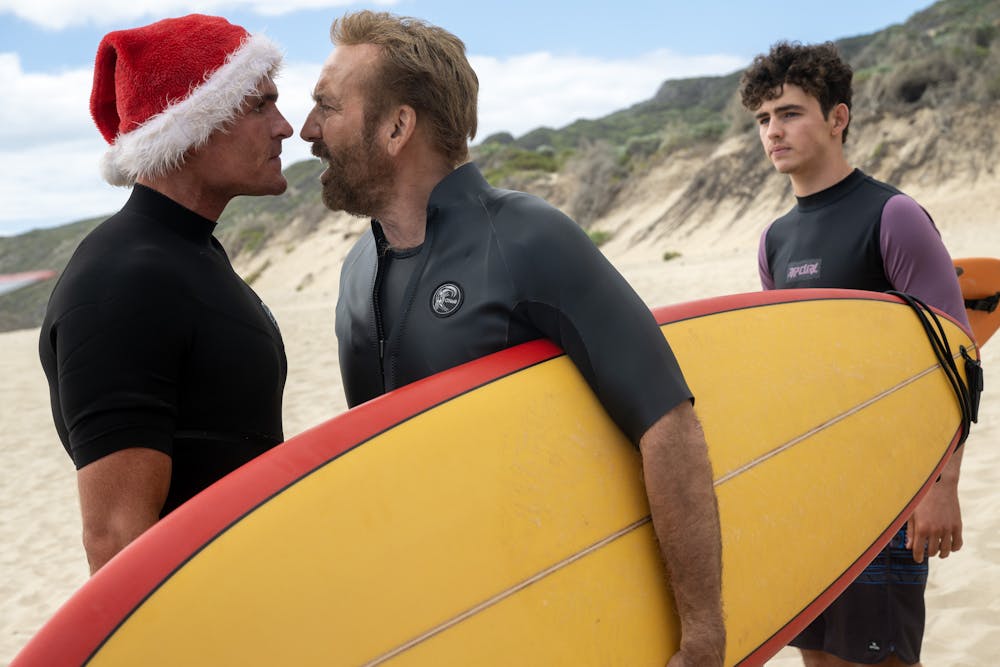
    Returning alone to the beachside car park to make some calls, he is besieged there over the next several days by the same gang. They are led by a terrifying middle-aged Andrew Tate-esque influencer, Scally (Julian McMahon), who runs the beach like a combination of a frat bro party and wellness retreat.

    The protagonist’s fast descent into dishevelled, dehydrated delirium as the group’s hazing escalates, fuels much of the first two acts.

    Fish out of water

    It is impossible to think of an actor other than Cage who could make a character like this so enjoyable to watch.

    From the first moments, he seems pathetic: giving his uninterested teenage son metaphorical speeches about surfing, losing arguments on the phone with his broker and real estate agent, reeking of pomposity and desperation.

    The sense of a man out of his depth is compounded by his Americanness contrasting with the particular brand of Australian masculinity the locals display. Both types are brash and entitled, but with entirely different ways of expressing it.

    This is a man out of his depth.
    Madman Entertainment

    Cage’s distinctively American confidence has no resistance to the terrifying switches of Australian masculinity from friendly to teasing to violent.

    “Don’t live here, don’t surf here,” they hiss at him on first meeting, forcing him to retreat, cowed, to the car park, where he remains for most of the rest of the film.

    The wide-open and the claustrophobic

    What a stroke of genius it is to use this single location.

    Filmed in Yallingup, Western Australia, The Surfer beautifully captures the natural surroundings, stunning views and shimmering heat of Australian coastal summer.

    At the same time, a confined, interstitial semi-urban feature like a beachside car park feels so bleak and uninviting. The only amenities are an overpriced coffee cart, ancient payphone and a dingy toilet block.

    The beachside car park feels so bleak and uninviting.
    Madman Entertainment

    As a film setting, it is both a spectacular wide-open vista and stiflingly claustrophobic – a perfect mechanism for The Surfer’s psychological horror.

    It must have been attractive in getting the script funded as well. With such an affordable location, more of the budget would have been freed up for a big name like Cage.

    A modern Wake in Fright

    With its oppressive setting, overexposed orange and yellow light and grade, and a sweaty spiral into madness, The Surfer invites comparisons to Wake in Fright, Ted Kotcheff’s 1971 brutal depiction of Australian men and their drinking culture.

    Both take place at Christmas and feature an antagonist who enjoys confidently explaining their dubious moral worldview to everyone. However, Wake in Fright’s horror lingers because we know the culture remains even after the hero escapes it. The Surfer struggles a little more in landing the ending.

    The film’s depiction of masculinity echoes Wake In Fright.
    Madman Entertainment

    For the mean, violent, misogynistic villains to be defeated, it would be unsatisfying for Cage to stoop to their level. This means – without spoiling too much – Cage remains an oddly passive character throughout the film, while others perform the avenging actions.

    The only way the protagonist’s masculinity can be resurrected as upright, ethical and empowering is for the character to literally turn his back on the vengeance we’ve been waiting for him to deliver.

    It’s not that the film has an inarticulate grasp of its own politics, but more that the otherwise terrific script by Thomas Martin feels written into a difficult corner.

    A blast along the way

    I don’t want to imply that this ending means The Surfer isn’t an absolute blast along the way. A lot of the fun is in anticipating each dreadful humiliation – and it somehow turning out worse than you could have expected.

    A spilled coffee leads to drinking recycled wastewater which leads to chewing on a dead rat, and we still haven’t reached the lowest rung on the ladder of indignities that Cage’s character suffers.

    In less skilled hands this could feel nasty or gross, but the hallucinatory quality of Finnegan’s direction makes it feel almost sublime. And Cage’s pleading, groaning, sobbing and gibbering feel believable and relatable.

    The pathos works – and it’s pretty funny too.

    The Surfer is in cinemas from today and streaming on Stan from June 15.

    Grace Russell does not work for, consult, own shares in or receive funding from any company or organisation that would benefit from this article, and has disclosed no relevant affiliations beyond their academic appointment.

    ref. Dishevelled, dehydrated delirium: new Aussie film The Surfer, starring Nicolas Cage, is an absolute blast – https://theconversation.com/dishevelled-dehydrated-delirium-new-aussie-film-the-surfer-starring-nicolas-cage-is-an-absolute-blast-254580

    MIL OSI – Global Reports

  • MIL-Evening Report: Dishevelled, dehydrated delirium: new Aussie film The Surfer, starring Nicolas Cage, is an absolute blast

    Source: The Conversation (Au and NZ) – By Grace Russell, Lecturer, School of Media, Film and Journalism, Monash University

    Madman Entertainment

    Nicolas Cage has made a career from his highly entertaining scenery chewing. He follows a performance style he calls “Nouveau Shamanic” – an exaggerated form of method acting where he acts according to the character’s impulses. This allows for the wild, unpredictable outbursts his characters are known for.

    Cage films are also usually about masculinity: its worst excesses, the parameters restricting it, and what ennobling versions of it might look like.

    The Surfer, a new Australian feature film from Irish director Lorcan Finnegan, leans right into masculinity as a theme.

    Our unnamed protagonist (Cage) is returning to his former Australian home from the United States. He is newly divorced, and trying to buy a beachside property to win back his family.

    He takes his teenage son (Finn Little) for a surf near the property, but they are run off by an unfriendly pack of locals.

    Returning alone to the beachside car park to make some calls, he is besieged there over the next several days by the same gang. They are led by a terrifying middle-aged Andrew Tate-esque influencer, Scally (Julian McMahon), who runs the beach like a combination of a frat bro party and wellness retreat.

    The protagonist’s fast descent into dishevelled, dehydrated delirium as the group’s hazing escalates, fuels much of the first two acts.

    Fish out of water

    It is impossible to think of an actor other than Cage who could make a character like this so enjoyable to watch.

    From the first moments, he seems pathetic: giving his uninterested teenage son metaphorical speeches about surfing, losing arguments on the phone with his broker and real estate agent, reeking of pomposity and desperation.

    The sense of a man out of his depth is compounded by his Americanness contrasting with the particular brand of Australian masculinity the locals display. Both types are brash and entitled, but with entirely different ways of expressing it.

    This is a man out of his depth.
    Madman Entertainment

    Cage’s distinctively American confidence has no resistance to the terrifying switches of Australian masculinity from friendly to teasing to violent.

    “Don’t live here, don’t surf here,” they hiss at him on first meeting, forcing him to retreat, cowed, to the car park, where he remains for most of the rest of the film.

    The wide-open and the claustrophobic

    What a stroke of genius it is to use this single location.

    Filmed in Yallingup, Western Australia, The Surfer beautifully captures the natural surroundings, stunning views and shimmering heat of Australian coastal summer.

    At the same time, a confined, interstitial semi-urban feature like a beachside car park feels so bleak and uninviting. The only amenities are an overpriced coffee cart, ancient payphone and a dingy toilet block.

    The beachside car park feels so bleak and uninviting.
    Madman Entertainment

    As a film setting, it is both a spectacular wide-open vista and stiflingly claustrophobic – a perfect mechanism for The Surfer’s psychological horror.

    It must have been attractive in getting the script funded as well. With such an affordable location, more of the budget would have been freed up for a big name like Cage.

    A modern Wake in Fright

    With its oppressive setting, overexposed orange and yellow light and grade, and a sweaty spiral into madness, The Surfer invites comparisons to Wake in Fright, Ted Kotcheff’s 1971 brutal depiction of Australian men and their drinking culture.

    Both take place at Christmas and feature an antagonist who enjoys confidently explaining their dubious moral worldview to everyone. However, Wake in Fright’s horror lingers because we know the culture remains even after the hero escapes it. The Surfer struggles a little more in landing the ending.

    The film’s depiction of masculinity echoes Wake In Fright.
    Madman Entertainment

    For the mean, violent, misogynistic villains to be defeated, it would be unsatisfying for Cage to stoop to their level. This means – without spoiling too much – Cage remains an oddly passive character throughout the film, while others perform the avenging actions.

    The only way the protagonist’s masculinity can be resurrected as upright, ethical and empowering is for the character to literally turn his back on the vengeance we’ve been waiting for him to deliver.

    It’s not that the film has an inarticulate grasp of its own politics, but more that the otherwise terrific script by Thomas Martin feels written into a difficult corner.

    A blast along the way

    I don’t want to imply that this ending means The Surfer isn’t an absolute blast along the way. A lot of the fun is in anticipating each dreadful humiliation – and it somehow turning out worse than you could have expected.

    A spilled coffee leads to drinking recycled wastewater which leads to chewing on a dead rat, and we still haven’t reached the lowest rung on the ladder of indignities that Cage’s character suffers.

    In less skilled hands this could feel nasty or gross, but the hallucinatory quality of Finnegan’s direction makes it feel almost sublime. And Cage’s pleading, groaning, sobbing and gibbering feel believable and relatable.

    The pathos works – and it’s pretty funny too.

    The Surfer is in cinemas from today and streaming on Stan from June 15.

    Grace Russell does not work for, consult, own shares in or receive funding from any company or organisation that would benefit from this article, and has disclosed no relevant affiliations beyond their academic appointment.

    ref. Dishevelled, dehydrated delirium: new Aussie film The Surfer, starring Nicolas Cage, is an absolute blast – https://theconversation.com/dishevelled-dehydrated-delirium-new-aussie-film-the-surfer-starring-nicolas-cage-is-an-absolute-blast-254580

    MIL OSI AnalysisEveningReport.nz

  • MIL-Evening Report: Disheveled, dehydrated delirium: new Aussie film The Surfer, staring Nicolas Cage, is an absolute blast

    Source: The Conversation (Au and NZ) – By Grace Russell, Lecturer, School of Media, Film and Journalism, Monash University

    Madman Entertainment

    Nicolas Cage has made a career from his highly entertaining scenery chewing. He follows a performance style he calls “Nouveau Shamanic” – an exaggerated form of method acting where he acts according to the character’s impulses. This allows for the wild, unpredictable outbursts his characters are known for.

    Cage films are also usually about masculinity: its worst excesses, the parameters restricting it, and what ennobling versions of it might look like.

    The Surfer, a new Australian feature film from Irish director Lorcan Finnegan, leans right into masculinity as a theme.

    Our unnamed protagonist (Cage) is returning to his former Australian home from the United States. He is newly divorced, and trying to buy a beachside property to win back his family.

    He takes his teenage son (Finn Little) for a surf near the property, but they are run off by an unfriendly pack of locals.

    Returning alone to the beachside car park to make some calls, he is besieged there over the next several days by the same gang. They are led by a terrifying middle-aged Andrew Tate-esque influencer, Scally (Julian McMahon), who runs the beach like a combination of a frat bro party and wellness retreat.

    The protagonist’s fast descent into disheveled, dehydrated delirium as the group’s hazing escalates, fuels much of the first two acts.

    Fish out of water

    It is impossible to think of an actor other than Cage who could make a character like this so enjoyable to watch.

    From the first moments, he seems pathetic: giving his uninterested teenage son metaphorical speeches about surfing, losing arguments on the phone with his broker and real estate agent, reeking of pomposity and desperation.

    The sense of a man out of his depth is compounded by his Americanness contrasting with the particular brand of Australian masculinity the locals display. Both types are brash and entitled, but with entirely different ways of expressing it.

    This is a man out of his depth.
    Madman Entertainment

    Cage’s distinctively American confidence has no resistance to the terrifying switches of Australian masculinity from friendly to teasing to violent.

    “Don’t live here, don’t surf here,” they hiss at him on first meeting, forcing him to retreat, cowed, to the car park, where he remains for most of the rest of the film.

    The wide-open and the claustrophobic

    What a stroke of genius it is to use this single location.

    Filmed in Yallingup, Western Australia, The Surfer beautifully captures the natural surroundings, stunning views and shimmering heat of Australian coastal summer.

    At the same time, a confined, interstitial semi-urban feature like a beachside car park feels so bleak and uninviting. The only amenities are an overpriced coffee cart, ancient payphone and a dingy toilet block.

    The beachside car park feels so bleak and uninviting.
    Madman Entertainment

    As a film setting, it is both a spectacular wide-open vista and stiflingly claustrophobic – a perfect mechanism for The Surfer’s psychological horror.

    It must have been attractive in getting the script funded as well. With such an affordable location, more of the budget would have been freed up for a big name like Cage.

    A modern Wake in Fright

    With its oppressive setting, overexposed orange and yellow light and grade, and a sweaty spiral into madness, The Surfer invites comparisons to Wake in Fright, Ted Kotcheff’s 1971 brutal depiction of Australian men and their drinking culture.

    Both take place at Christmas and feature an antagonist who enjoys confidently explaining their dubious moral worldview to everyone. However, Wake in Fright’s horror lingers because we know the culture remains even after the hero escapes it. The Surfer struggles a little more in landing the ending.

    The film’s depiction of masculinity echoes Wake In Fright.
    Madman Entertainment

    For the mean, violent, misogynistic villains to be defeated, it would be unsatisfying for Cage to stoop to their level. This means – without spoiling too much – Cage remains an oddly passive character throughout the film, while others perform the avenging actions.

    The only way the protagonist’s masculinity can be resurrected as upright, ethical and empowering is for the character to literally turn his back on the vengeance we’ve been waiting for him to deliver.

    It’s not that the film has an inarticulate grasp of its own politics, but more that the otherwise terrific script by Thomas Martin feels written into a difficult corner.

    A blast along the way

    I don’t want to imply that this ending means The Surfer isn’t an absolute blast along the way. A lot of the fun is in anticipating each dreadful humiliation – and it somehow turning out worse than you could have expected.

    A spilled coffee leads to drinking recycled wastewater which leads to chewing on a dead rat, and we still haven’t reached the lowest rung on the ladder of indignities that Cage’s character suffers.

    In less skilled hands this could feel nasty or gross, but the hallucinatory quality of Finnegan’s direction makes it feel almost sublime. And Cage’s pleading, groaning, sobbing and gibbering feel believable and relatable.

    The pathos works – and it’s pretty funny too.

    The Surfer is in cinemas from today and streaming on Stan from June 15.

    Grace Russell does not work for, consult, own shares in or receive funding from any company or organisation that would benefit from this article, and has disclosed no relevant affiliations beyond their academic appointment.

    ref. Disheveled, dehydrated delirium: new Aussie film The Surfer, staring Nicolas Cage, is an absolute blast – https://theconversation.com/disheveled-dehydrated-delirium-new-aussie-film-the-surfer-staring-nicolas-cage-is-an-absolute-blast-254580

    MIL OSI AnalysisEveningReport.nz

  • MIL-Evening Report: Ferocity, fitness and fast bowling: how Virat Kohli revolutionised Indian cricket

    Source: The Conversation (Au and NZ) – By Vaughan Cruickshank, Senior Lecturer in Health and Physical Education, University of Tasmania

    Virat Kohli announced his retirement from Test cricket on Monday.

    While his Instagram message just said this was the “right time”, his poor recent Test form, mental fatigue and desire to spend more time with his family, charity foundation and expanding business empire have been suggested as other influential factors.

    During his 14-year Test career “King Kohli” has been the backbone of the Indian batting line-up, and his absence is a huge blow as the Indians prepare to tour England next month.

    The megastar scored 9,230 runs in 123 Tests at an average of 46.85, including 30 centuries.

    These numbers put him in the top five Indian test batsmen of all time, but his legacy extends far beyond his batting achievements.

    Kohli, 36, quit Twenty20 Internationals last year (after India won its second world title). He may continue to play one-day internationals.

    Rising to the top of Test cricket

    Kohli has been the greatest Indian batsman of his generation.

    He made his Test debut in 2011 against the West Indies and played his final match against Australia in January.

    He scored centuries against every country he played against, with more than half of these coming overseas.

    His seven Test centuries in Australia is the second most by an overseas batsman.

    He was at his peak between 2014 and 2019, when he averaged more than 60 in Test cricket and became one of the “fab four” (the world’s best Test batsmen) alongside Steve Smith, Kane Williamson and Joe Root.


    Read more:
    Is Steve Smith set to become the best? What data says about Test cricket’s elite 10,000+ run club


    This period also included six double-hundreds in 18 months, and 13 months as the number one ranked Test batsman in the world.

    Kohli the leader

    Kohli is India’s greatest ever Test captain.

    His tenure from 2014 to 2022 was a golden age for Indian Test cricket.

    India won 40 of 68 Tests (59%) in this period and did not lose a Test series at home. India was the number one ranked Test team in the world from 2016–20 and won its first Test series in Australia in 2018–19.

    These statistics make Kohli one of the most successful Test captains of all time.

    Beyond these numbers, he was a charismatic and aggressive captain who redefined India’s approach to Test cricket by bringing a more competitive edge to the team.

    He drove higher expectations around fitness, training intensity and fast bowling that continue to shape Indian cricket.

    Mandatory fitness testing and improved dieting and recovery practices, which redefined the team’s standards, are attributed to Kohli’s leadership.

    Similarly, Indian success was strongly contributed to by Kohli encouraging the development of a world-class pace bowling attack, which marked a significant shift from the spin-heavy approach of Indian cricket.

    Controversies

    While Kohli’s energy, passion and intensity contributed to his success as batsman and captain, they also led to numerous confrontations with opposition players, which some believed to be disrespectful and arrogant.

    His intense celebrations and assertive body language also drew criticism from conservative cricketing audiences.

    Kohli’s collision with Sam Konstas during the Boxing Day Test versus Australia.

    Many of these controversies have occurred in Australia, where Kohli enjoyed a love-hate relationship with Australian players and crowds.

    Examples include flipping the bird to the crowd, making sandpaper gestures (in reference to the 2018 Australian ball tampering scandal, also known as Sandpapergate) and shoulder-barging young Australian batsman Sam Konstas.

    What will his Test legacy be?

    For more than a decade, Kohli has been the heartbeat of the Indian Test team, and his retirement marks the end of an era.

    He reshaped the mindset of Indian cricket and cultivated a faster, fitter, fiercer, more successful team.

    Kohli was also one of the greatest ambassadors of Test cricket, and has played a significant role in ensuring the game remains relevant in an era increasingly dominated by T20 cricket.

    He made Test cricket aspirational again because he wanted it to thrive. He knew India needed to dominate the hardest format to be respected.

    His social media reach (272 million followers on Instagram and 67.8 million on X) is more than Tiger Woods, LeBron James and Tom Brady combined, and was even referred to by LA2028 Olympics organisers when they announced cricket’s entry into the games.

    In recent days, Kohli has been described as “a modern-day giant”, a “provocateur in chief”, and “his generation’s most profound figure”.

    Love him or hate him, he elevated the spectacle of Test cricket. His electric energy brought the best out of India and its opponents and made him impossible to ignore when batting or fielding.

    As respected cricket writer Peter Lalor noted recently:

    Nobody is irreplaceable, but nobody can replace Virat.

    The Conversation

    The authors do not work for, consult, own shares in or receive funding from any company or organisation that would benefit from this article, and have disclosed no relevant affiliations beyond their academic appointment.

    ref. Ferocity, fitness and fast bowling: how Virat Kohli revolutionised Indian cricket – https://theconversation.com/ferocity-fitness-and-fast-bowling-how-virat-kohli-revolutionised-indian-cricket-256560

    MIL OSI AnalysisEveningReport.nz

  • MIL-Evening Report: ER Report: A Roundup of Significant Articles on EveningReport.nz for May 15, 2025

    ER Report: Here is a summary of significant articles published on EveningReport.nz on May 15, 2025.

    Ferocity, fitness and fast bowling: how Virat Kohli revolutionised Indian cricket
    Source: The Conversation (Au and NZ) – By Vaughan Cruickshank, Senior Lecturer in Health and Physical Education, University of Tasmania Virat Kohli announced his retirement from Test cricket on Monday. While his Instagram message just said this was the “right time”, his poor recent Test form, mental fatigue and desire to spend more time with

    Curious Kids: if our eyes see upside down, how does the brain flip the picture?
    Source: The Conversation (Au and NZ) – By Daniel Joyce, Senior Lecturer in Psychology, University of Southern Queensland I heard that we see upside down, but our brain flips the image. How does it do that? –Jasmine, Mount Evelyn, Victoria Our eyes work thanks to light. Objects we can see are either sources of light

    Return of the huia? Why Māori worldviews must be part of the ‘de-extinction’ debate
    Source: The Conversation (Au and NZ) – By Nic Rawlence, Associate Professor in Ancient DNA, University of Otago A museum specimen of the extinct huia. Wikimedia Commons/Auckland Museum collection, CC BY-SA The recent announcement of the resurrection of the dire wolf generated considerable global media attention and widespread scientific criticism. But beyond the research questions,

    After an autocratic leader was toppled in Bangladesh, democratic renewal remains a work in progress
    Source: The Conversation (Au and NZ) – By Intifar Chowdhury, Lecturer in Government, Flinders University Last July, a powerful student-led uprising in Bangladesh toppled the authoritarian, corrupt government led for 15 years by Prime Minister Sheikh Hasina. Bangladesh now shows modest signs of democratic recovery. Months into its tenure, a transitional government has reopened political

    Greenpeace flagship Rainbow Warrior to return for 40th anniversary of French bombing
    By Russel Norman The iconic Greenpeace flagship Rainbow Warrior will return to Aotearoa this year to mark the 40th anniversary of the bombing of the original campaign ship at Marsden Wharf in Auckland by French secret agents on 10 July 1985. The return to Aotearoa comes at a pivotal moment — when the fight to

    Can we confront cancel culture by finding common ground between moderate leftists and ‘wokists’?
    Source: The Conversation (Au and NZ) – By Hugh Breakey, Deputy Director, Institute for Ethics, Governance & Law, Griffith University A.C. Grayling’s new book Discriminations: Making Peace in the Culture Wars sees the renowned philosopher wading into the ethical minefields of “woke” activism, cancellation, and conservative backlash. Filled with thoughtful analysis, deep reflection, and fascinating

    Justice on demand? The true crime podcasts serving up Erin Patterson’s mushroom murder trial
    Source: The Conversation (Au and NZ) – By Kate Cantrell, Senior Lecturer – Writing, Editing, and Publishing, University of Southern Queensland The trial of the so-called “mushroom cook” Erin Patterson, currently underway in the Victorian town of Morwell, continues to generate global attention. The mother of two is charged with three counts of murder and

    This 6-point plan can ease Australia’s gambling problems – if our government has the guts
    Source: The Conversation (Au and NZ) – By Charles Livingstone, Associate Professor, School of Public Health and Preventive Medicine, Monash University WHYFRAME/Shutterstock We have a refreshed and revitalised Australian government, enriched with great political capital. During the last term of parliament before the election, opportunities to address Australia’s raging gambling habit were neglected. Could this

    Whatever happened to Barbie’s feet? Podiatrists studied 2,750 dolls to find out
    Source: The Conversation (Au and NZ) – By Cylie Williams, Professor, School of Primary and Allied Health Care, Monash University elinaxx1v/Shutterstock What do you get when a group of podiatrists (and shoe lovers) team up with a Barbie doll collector? A huge opportunity to explore how Barbie reflects changes in the types of shoes women

    Economic pessimism is behind the drift of voters to minor parties and independents
    Source: The Conversation (Au and NZ) – By Viet Nguyen, Principal Research Fellow, Macroeconomics Research Program, Melbourne Institute of Applied Economic and Social Research, The University of Melbourne Growing economic pessimism appears to have pushed many voters away from Australia’s two major parties, Labor and the Coalition. Support for minor parties and independents has doubled

    A law change will expand who we remember on Anzac Day – the New Zealand Wars should be included too
    Source: The Conversation (Au and NZ) – By Alexander Gillespie, Professor of Law, University of Waikato The New Zealand Wars memorial in new Plymouth. Wikimedia Commons, CC BY-SA Anzac Day has come and gone again. But – lest we forget – war and its consequences are not confined to single days in the calendar. Nor

    Newly discovered frog species from 55 million years ago challenges evolutionary tree
    Source: The Conversation (Au and NZ) – By Roy M. Farman, Adjunct Associate Lecturer, School of Biological, Earth and Environmental Sciences, UNSW Sydney Australian Green Tree Frog (_Litoria caerulea_). indrabone/iNaturalist, CC BY-NC Australian tree frogs today make up over one third of all known frog species on the continent. Among this group, iconic species such

    Two lizard-like creatures crossed tracks 355 million years ago. Today, their footprints yield a major discovery
    Source: The Conversation (Au and NZ) – By John Long, Strategic Professor in Palaeontology, Flinders University Marcin Ambrozik The emergence of four-legged animals known as tetrapods was a key step in the evolution of many species today – including humans. Our new discovery, published today in Nature, details ancient fossil footprints found in Australia that

    Politics with Michelle Grattan: Andrew Leigh on more productive work in the age of AI
    Source: The Conversation (Au and NZ) – By Michelle Grattan, Professorial Fellow, University of Canberra Australia’s productivity performance has stagnated for years, and Treasurer Jim Chalmers has declared addressing this is a second term priority. “Productivity” is now an added part of the remit of Assistant Minister Andrew Leigh, along with his responsibility for competition,

    Caitlin Johnstone: Israel admits it bombed a hospital to kill a journalist for doing journalism
    Report by Dr David Robie – Café Pacific. – COMMENTARY: By Caitlin Johnstone The IDF has admitted to bombing a hospital in order to assassinate a prominent Palestinian journalist in Gaza, Hassan Aslih, explicitly stating that they assassinated him for engaging in journalistic activities. The official Israel Defense Forces account made the following post on

    Men are shaving off their eyelashes on TikTok. Here’s why that might be a bad idea
    Source: The Conversation (Au and NZ) – By Amanda Meyer, Senior Lecturer, Anatomy and Pathology, James Cook University Bhatakta Manav/Shutterstock Videos of men removing their eyelashes, by trimming or shaving, have been circulating on social media in recent weeks. This trend is based on the idea short eyelashes look more masculine. Hair can tell us

    Soon, your boss will have to pay your wages and super at the same time. Here’s how everyone could benefit
    Source: The Conversation (Au and NZ) – By Helen Hodgson, Professor, Curtin Law School and Curtin Business School, Curtin University Dragon Images/Shutterstock If you have a job in Australia, you’ve probably noticed each of your payslips has a section telling you how much superannuation will be paid alongside your wages. But while your wages are

    What is the ‘glass cliff’ phenomenon – and why do women often find themselves on the precipice?
    Source: The Conversation (Au and NZ) – By Kerrie-Anne Hammermeister, PhD Candidate in the School of Humanities and Communication, University of Southern Queensland GoodStudio/Shutterstock Speaking to the media after being named leader of the Liberal Party, Sussan Ley was asked if this appointment was an example of the “glass cliff effect”. Ley said “I don’t

    Fiji Indians in NZ ‘not giving up’ on Pasifika classification struggle
    By Susana Suisuiki, RNZ Pacific Waves presenter/producer, and Christina Persico, RNZ Pacific bulletin editor The co-founder of Auckland’s Fiji Centre is concerned that Indo-Fijians are not classified as Pacific Islanders in Aotearoa. This week marks the 146th anniversary of the arrival of the first indentured labourers from British India to Fiji, who departed from Calcutta.

    MIL OSI AnalysisEveningReport.nz

  • MIL-Evening Report: Return of the huia? Why Māori worldviews must be part of the ‘de-extinction’ debate

    Source: The Conversation (Au and NZ) – By Nic Rawlence, Associate Professor in Ancient DNA, University of Otago

    A museum specimen of the extinct huia. Wikimedia Commons/Auckland Museum collection, CC BY-SA

    The recent announcement of the resurrection of the dire wolf generated considerable global media attention and widespread scientific criticism.

    But beyond the research questions, there are other issues we must consider – in particular, the lack of Indigenous voices in discussions about de-extinction.

    It is undeniable that biotechnology company Colossal Biosciences achieved a major scientific breakthrough. It has successfully changed the genome of a vertebrate species, introduced desired traits, and created apparently healthy hybrid wolf pups.

    The main scientific criticisms were that genetically engineering gray wolves with dire wolf traits doesn’t constitute de-extinction. And regardless of the achievement, we still have to ask whether we should bring back extinct species in the first place.

    But given the company’s goals of resurrecting species significant to Indigenous groups, including the thylacine (Tasmanian tiger) and the moa, it is vital Indigenous views contribute to decisions.

    Gene technologies in conservation

    Colossal Biosciences’ achievement shows the potential of new gene-editing technologies to contribute to conservation efforts. This could include introducing desirable traits into threatened species or removing harmful ones.

    It could even mean creating ecological equivalents of extinct species, as the company has suggested.

    In Aotearoa New Zealand, hapori Māori (tribal groups) are the kaitiaki (guardians) of many threatened taonga (treasured) species. There is growing international interest in the resurrection of some of New Zealand’s extinct birds, including the moa, Haast’s eagle and huia, despite Māori concerns.

    Their voices in this debate are crucial, as are those of other Indigenous groups when biotech proposals are relevant to them.

    Colossal Biosciences has an Indigenous Council (made up of North American Indian Nations) and has established an advisory committee for the thylacine de-extinction project with Indigenous representation.

    New Zealand has lost several bird species, including the moa, Haast’s eagle and huia.
    Paul Martinson, CC BY-SA

    But in our engagements with Māori from around the country over the past decade, we’ve found virtually no Māori support for the de-extinction of taonga species.

    Lost ecosystems and opportunity costs

    One reason we have heard involves a lack of suitable habitats for de-extinct species. Most of Aotearoa New Zealand is highly modified, with only 25% of native forest remaining. This requires ongoing predator control.

    That means there are very few suitable sites to release de-extinct species. For some lost ecosystems, there is no suitable analogue at all. The effort required to establish and manage sites would be substantial.

    There would also need to be ongoing financial resourcing to support kaitiaki responsibilities, which would be expected of Māori communities within whose rohe (traditional boundaries) de-extinct species might be released.

    In our view, kaitiaki prefer gene technology funding to be spent on applications that support their guardianship role, such as environmental DNA. Or they would like it expanded for the management of remaining and often threatened taonga species.

    Without new funding, there is a real opportunity-cost risk of money being pulled from other areas, potentially resulting in further extinctions of endangered taonga species.

    In all likelihood, maintaining a genetically diverse population of a de-extinct species (with at least 500 individuals) would be a challenging exercise, given how slowly New Zealand’s taonga species breed.

    Treaty breaches and tikanga

    Without meaningful Māori support and involvement, the release of a de-extinct species would effectively constitute a breach of Article Two of te Tiriti o Waitangi (the Treaty of Waitangi). The te reo Māori version states Māori have exclusive rights to taonga.

    This is also the essence of the Waitangi Tribunal WAI262 claim that Māori have intellectual property rights over flora and fauna. Māori have whakapapa (genealogy) relationships with taonga species and a moral obligation to look after their welfare and the taiao (environment) they are in.

    This has led to concerns that altering the whakapapa of an existing species to resemble another species is unnatural and disrespectful (compared to natural hybridisation). This could have negative consequences for hybrid species as well as other organisms and the taiao.

    Hybrids may not be sufficiently adapted to existing threats (such as introduced mammalian predators) or the new environments they find themselves in. Conversely, they could be so well adapted they disrupt the ecosystem and become a pest.

    There are long-held concerns that Māori have been excluded from conversations about applying gene technologies. This is despite the successful use of tikanga-based frameworks (customs) for evaluating specific uses of the technologies in individual cases.

    These concerns include potential biopiracy, bioprospecting and trademarking of taonga species by overseas companies. They are echoed in submissions to the draft Gene Technology Bill, which all but eliminates Māori consultation on the release of genetically modified organisms into the environment.

    Looking to the future

    Without substantive Māori involvement, internationally led and resourced de-extinction of a taonga species could well become yet another negative colonisation experience.

    Such conversations need to involve a wide range of Māori, and employ tikanga-based protocols, to ensure sufficiently thorough and holistic evaluation of potential de-extinction projects.

    There is currently nothing to stop biotechnology companies utilising specimens of taonga species housed in museums worldwide.

    We argue that addressing these issues and reaching a national consensus should be a prerequisite for any application of gene-editing technology in conservation, whether it is to suppress pest species or support struggling taonga species.

    Many of the concerns raised by Māori will no doubt be shared by Indigenous people around the world. They need to be part of the conversation and critical commentary around de-extinction and potential reintroduction of organisms into the wild. Their knowledge of environmental management, which dates back hundreds to tens of thousands of years, is something we must learn from.

    Phillip Wilcox receives research funding from various NZ government sources. He is co-chair of Te Ira Tātai Whakaeke Trust, a Māori-owned charitable trust aimed at promoting ethically appropriate use of genomic technologies for the benefit of Māori communities, particularly Māori health.

    Nic Rawlence does not work for, consult, own shares in or receive funding from any company or organisation that would benefit from this article, and has disclosed no relevant affiliations beyond their academic appointment.

    ref. Return of the huia? Why Māori worldviews must be part of the ‘de-extinction’ debate – https://theconversation.com/return-of-the-huia-why-maori-worldviews-must-be-part-of-the-de-extinction-debate-255605

    MIL OSI AnalysisEveningReport.nz

  • MIL-Evening Report: Curious Kids: if our eyes see upside down, how does the brain flip the picture?

    Source: The Conversation (Au and NZ) – By Daniel Joyce, Senior Lecturer in Psychology, University of Southern Queensland

    I heard that we see upside down, but our brain flips the image. How does it do that?

    –Jasmine, Mount Evelyn, Victoria

    Our eyes work thanks to light. Objects we can see are either sources of light themselves – like a candle or a phone screen – or light bounces off them and makes its way to our eyes.

    First, light passes through the optical components of the eyes such as the cornea, pupil and lens.

    Together, they help focus the light onto the retina that senses light, while also controlling the intensity of light to help us see well while avoiding damage to the eye.

    The function of the lens is to correctly focus light that comes from objects at different distances. This process is known as accommodation.


    Marochkina Anastasiia/Shutterstock

    While performing this important task, light passing through the lens becomes inverted. This means that light from the top of the object falls lower on the retina than light from the bottom, which falls higher on the retina.

    So, light exiting the lens to land on the retina is indeed flipped upside down. But that doesn’t mean the brain is actually flipping the picture “back”. Here’s why.

    The orientation doesn’t actually matter

    While the light being interpreted by the brain is “upside down” compared to the real world, the question is: is that actually a problem for us?

    From your own experience you can tell the answer is probably no. We seem to navigate and interact with the world just fine.

    So, where in the brain is the image flipped or rotated 180 degrees to be the “right way up” again?

    You may be surprised to learn that vision scientists reject the idea a flipping or rotation needs to happen at all. This is because of how our brains process visual information.

    The object you perceive is “encoded” by the firing of various neurons – brain cells that process information – in various locations in the brain. This pattern of firing is what encodes the information about the object you’re focusing on. That info takes into account the object’s relation to everything else in the scene, your body in the world, and your movements.

    As long as the relative encodings of these are all consistent with one another, as well as stable, there’s no need for a flip to happen at all.

    We can function with ‘upside down’ goggles!

    Several studies have looked at how we adapt to large changes in visual input by asking people to wear goggles that flip the image coming in.

    This means the image lands on the retina the “right way up”, so to speak, but upside down from what the brain has learned it should be.

    In the 1930s, two scientists in Austria performed the Innsbruck Goggle Experiments. For weeks or even months at a time, participants in these studies wore goggles that altered the way the world around them looked. This included goggles that turn the incoming image upside down.

    A person blinks while wearing an ‘invertoscope’ – goggles that turn the incoming image upside down.
    Dmitry Hoh/Wikimedia Commons, CC BY-SA

    As you can imagine, people wearing these goggles at first found it really difficult to get by in their day-to-day activities. They would stumble and bump into things.

    But this was temporary.

    Participants reported seeing the world upside-down for the first few days, with difficulties navigating the environment, including trying to step over ceiling lights that appeared to them as on the floor.

    Around the fifth day, however, performance seemed to improve. Things that were at first seen upside down now appeared the right way up, and this tended to improve with more time.

    In other words, with continued exposure to the upside-down world, the brain adapted to the changed input.

    More recent studies are beginning to identify which areas of the brain are involved in being able to adapt to changes in visual input, and what the limits of our ability to adapt might be.

    Adaptation may even allow “colour blind” people to see colour better than is predicted from their condition.

    Daniel Joyce does not work for, consult, own shares in or receive funding from any company or organisation that would benefit from this article, and has disclosed no relevant affiliations beyond their academic appointment.

    ref. Curious Kids: if our eyes see upside down, how does the brain flip the picture? – https://theconversation.com/curious-kids-if-our-eyes-see-upside-down-how-does-the-brain-flip-the-picture-254303

    MIL OSI AnalysisEveningReport.nz

  • MIL-OSI Global: Two lizard-like creatures crossed tracks 355 million years ago. Today, their footprints yield a major discovery

    Source: The Conversation – Global Perspectives – By John Long, Strategic Professor in Palaeontology, Flinders University

    Marcin Ambrozik

    The emergence of four-legged animals known as tetrapods was a key step in the evolution of many species today – including humans.

    Our new discovery, published today in Nature, details ancient fossil footprints found in Australia that upend the early evolution timeline of all tetrapods. It also suggests major parts of the story could have played out in the southern supercontinent of Gondwana.

    This fossil trackway whispers that we have been looking for the origin of modern tetrapods in the wrong time, and perhaps the wrong place.

    The first feet on land

    Tetrapods originated a long time ago in the Devonian period, when strange lobe-finned fishes began to haul themselves out of the water, probably around 390 million years ago.

    This ancestral stock later split into two main evolutionary lines. One led to modern amphibians, such as frogs and salamanders. The other led to amniotes, whose eggs contain amniotic membranes protecting the developing foetus.

    Today, amniotes include all reptiles, birds and mammals. They are by far the most successful tetrapod group, numbering more than 27,000 species of reptiles, birds and mammals.

    They have occupied every environment on land, have conquered the air, and many returned to the water in spectacularly successful fashion. But the fossil record shows the earliest members of this amniote group were small and looked rather like lizards. How did they emerge?

    The oldest known tetrapods have always been thought to be primitive fish-like forms like Acanthostega, barely capable of moving on land.

    Acanthostega, an early tetrapod that lived about 365 million years ago, was a member of the ancestral stock that gave rise to amphibians and amniotes.
    The authors

    Most scientists agree amphibians and amniotes separated at the start of the Carboniferous period, about 355 million years ago. Later in the period, the amniote lineage split further into the ancestors of mammals and reptiles-plus-birds.

    Now, this tidy picture falls apart.

    A curious trackway

    Key to our discovery is a 35 centimetre wide sandstone slab from Taungurung country, near Mansfield in eastern Victoria.

    The slab is covered with the footprints of clawed feet that can only belong to early amniotes, most probably reptiles. It pushes back the origin of the amniotes by at least 35 million years.

    Mansfield slab, dated between 359-350 million years old, showing positions of early reptile tracks.
    The authors

    Despite huge variations in size and shape, all amniotes have certain features in common. For one, if we have limbs with fingers and toes, these are almost always tipped with claws – or nails, in the case of humans.

    In other tetrapod groups, real claws don’t occur. Even claw-like, hardened toe tips seen in some amphibians are extremely rare.

    Claws usually leave obvious marks in footprints, providing a clue to whether a fossil footprint was made by an amniote.

    Close up showing the oldest known tracks with hooked claws from Mansfield, Victoria. Left, photo; right, optical scan.
    The authors

    The oldest clawed tracks

    The previous oldest fossil record of reptiles is based on footprints and bones from North America and Europe around 318 million years ago.

    The oldest record of reptile-like tracks in Europe is from Silesia in Poland, a new discovery also revealed in our paper. They are around 328 million years old.

    However, the Australian slab is much older than that, dated to between 359 and 350 million years old. It comes from the earliest part of the Carboniferous rock outcropping along the Broken River (Berrepit in the Taungurung language of the local First Nations people).

    This area has long been known for yielding many kinds of spectacular fossil fishes that lived in lakes and large rivers. Now, for the first time, we catch a glimpse of life on the riverbank.

    Fossil hunters search the Carboniferous red sandstone in the Mansfield area of Victoria. Such outcrops recently yielded the trackways of the world’s oldest reptile.
    John Long

    Two trackways of fossil footprints cross the slab’s upper surface, one of them overstepping an isolated footprint facing the opposite direction. The surface is covered with dimples made by raindrops, recording a brief shower just before the footprints were made. This proves the creatures were moving about on dry land.

    All the footprints show claw marks, some in the form of long scratches where the foot has been dragged along.

    The shape of the feet matches that of known early reptile tracks, so we are confident the footprints belong to an amniote. Our short animation below gives a reconstruction of the ancient environment around Mansfield 355 million years ago, and shows how the tracks were made.

    A short animation showing the creature making the tracks and its scientific significance. By Flinders University and Monkeystack Productions.

    Rewriting the timeline

    This find has a massive impact on the origin timeline of all tetrapods.

    If amniotes had already evolved by the earliest Carboniferous, as our fossil shows, the last common ancestor of amniotes and amphibians has to lie much further back in time, in the Devonian period.

    We can estimate the timing of the split by comparing the relative lengths of different branches in DNA-based family trees of living tetrapods. It suggests the split took place in the late Devonian, maybe as far back as 380 million years ago.

    This implies the late Devonian world was populated not just by primitive fish-like tetrapods, and intermediate “fishapods” like the famous Tiktaalik, but also by advanced forms including close relatives of the living lineages. So why haven’t we found their bones?

    The location of our slab provides a clue.

    Big evolutionary questions

    All other records of Carboniferous amniotes have come from the northern hemisphere ancient landmass called Euramerica that incorporated present-day North America and Europe. Euramerica also produced the great majority of Devonian tetrapod fossils.

    The new Australian fossils come from Gondwana, a gigantic southern continent that also contained Africa, South America, Antarctica and India.

    In all of this vast landmass, which stretched from the southern tropics down across the South Pole, our little slab is currently the only tetrapod fossil from the earliest part of the Carboniferous.

    The Devonian record is scarcely much better. The Gondwana fossil record of early tetrapods is shockingly incomplete, with enormous gaps that could conceal – well, just about anything.

    This find now raises a big evolutionary question. Did the first modern tetrapods, our own distant ancestors, emerge in the temperate Devonian landscapes of southern Gondwana, long before they spread to the sun-baked semi-deserts and steaming swamps of equatorial Euramerica?

    It’s quite possible. Only more fieldwork, bringing to light new discoveries of Devonian and Carboniferous fossils from the old Gondwana continents, might one day answer that question.


    We acknowledge the Taungurung people of Mansfield area where this scientific work has taken place.

    John Long receives funding from the Australian Research Council.

    Grzegorz Niedzwiedzki receives funding from the Swedish Research Council and the European Research Council.

    Per Ahlberg receives funding from the European Research Council and the Knut & Alice Wallenberg Foundation.

    ref. Two lizard-like creatures crossed tracks 355 million years ago. Today, their footprints yield a major discovery – https://theconversation.com/two-lizard-like-creatures-crossed-tracks-355-million-years-ago-today-their-footprints-yield-a-major-discovery-254301

    MIL OSI – Global Reports

  • MIL-OSI Global: Curious Kids: if our eyes see upside down, how does the brain flip the picture?

    Source: The Conversation – Global Perspectives – By Daniel Joyce, Senior Lecturer in Psychology, University of Southern Queensland

    I heard that we see upside down, but our brain flips the image. How does it do that?

    –Jasmine, Mount Evelyn, Victoria

    Our eyes work thanks to light. Objects we can see are either sources of light themselves – like a candle or a phone screen – or light bounces off them and makes its way to our eyes.

    First, light passes through the optical components of the eyes such as the cornea, pupil and lens.

    Together, they help focus the light onto the retina that senses light, while also controlling the intensity of light to help us see well while avoiding damage to the eye.

    The function of the lens is to correctly focus light that comes from objects at different distances. This process is known as accommodation.


    Marochkina Anastasiia/Shutterstock

    While performing this important task, light passing through the lens becomes inverted. This means that light from the top of the object falls lower on the retina than light from the bottom, which falls higher on the retina.

    So, light exiting the lens to land on the retina is indeed flipped upside down. But that doesn’t mean the brain is actually flipping the picture “back”. Here’s why.

    The orientation doesn’t actually matter

    While the light being interpreted by the brain is “upside down” compared to the real world, the question is: is that actually a problem for us?

    From your own experience you can tell the answer is probably no. We seem to navigate and interact with the world just fine.

    So, where in the brain is the image flipped or rotated 180 degrees to be the “right way up” again?

    You may be surprised to learn that vision scientists reject the idea a flipping or rotation needs to happen at all. This is because of how our brains process visual information.

    The object you perceive is “encoded” by the firing of various neurons – brain cells that process information – in various locations in the brain. This pattern of firing is what encodes the information about the object you’re focusing on. That info takes into account the object’s relation to everything else in the scene, your body in the world, and your movements.

    As long as the relative encodings of these are all consistent with one another, as well as stable, there’s no need for a flip to happen at all.

    We can function with ‘upside down’ goggles!

    Several studies have looked at how we adapt to large changes in visual input by asking people to wear goggles that flip the image coming in.

    This means the image lands on the retina the “right way up”, so to speak, but upside down from what the brain has learned it should be.

    In the 1930s, two scientists in Austria performed the Innsbruck Goggle Experiments. For weeks or even months at a time, participants in these studies wore goggles that altered the way the world around them looked. This included goggles that turn the incoming image upside down.

    A person blinks while wearing an ‘invertoscope’ – goggles that turn the incoming image upside down.
    Dmitry Hoh/Wikimedia Commons, CC BY-SA

    As you can imagine, people wearing these goggles at first found it really difficult to get by in their day-to-day activities. They would stumble and bump into things.

    But this was temporary.

    Participants reported seeing the world upside-down for the first few days, with difficulties navigating the environment, including trying to step over ceiling lights that appeared to them as on the floor.

    Around the fifth day, however, performance seemed to improve. Things that were at first seen upside down now appeared the right way up, and this tended to improve with more time.

    In other words, with continued exposure to the upside-down world, the brain adapted to the changed input.

    More recent studies are beginning to identify which areas of the brain are involved in being able to adapt to changes in visual input, and what the limits of our ability to adapt might be.

    Adaptation may even allow “colour blind” people to see colour better than is predicted from their condition.

    Daniel Joyce does not work for, consult, own shares in or receive funding from any company or organisation that would benefit from this article, and has disclosed no relevant affiliations beyond their academic appointment.

    ref. Curious Kids: if our eyes see upside down, how does the brain flip the picture? – https://theconversation.com/curious-kids-if-our-eyes-see-upside-down-how-does-the-brain-flip-the-picture-254303

    MIL OSI – Global Reports

  • MIL-Evening Report: After an autocratic leader was toppled in Bangladesh, democratic renewal remains a work in progress

    Source: The Conversation (Au and NZ) – By Intifar Chowdhury, Lecturer in Government, Flinders University

    Last July, a powerful student-led uprising in Bangladesh toppled the authoritarian, corrupt government led for 15 years by Prime Minister Sheikh Hasina.

    Bangladesh now shows modest signs of democratic recovery. Months into its tenure, a transitional government has reopened political and civic space, especially at universities, and begun reforming key state bodies.

    Yet, violence and political retribution persist. This week, the interim government banned Hasina’s former party, the Awami League, under the country’s Anti-Terrorism Act while a tribunal investigates its role in the deaths of hundreds of protesters last year.

    Elections have also been delayed and may not happen until 2026.

    Amid this fragile transition, interim leader Muhammad Yunus, the 84-year-old Nobel-prize winning economist, has emerged as a rare figure of trust and calm. His popularity is so high, in fact, many are calling for him to remain at the helm for another five years.

    Given the uncertainty, Bangladesh faces some uncomfortable questions: can it afford electoral democracy right now? Or must stability come first, with democracy postponed until institutions can catch up?

    And what happens if emergency governance becomes the new normal?

    Fraught road to democratic renewal

    According to a global democracy report, Bangladesh is still classified as an “electoral autocracy” — one of the few in the category that actually got worse in 2024.

    The opposition, chiefly the Bangladesh National Party (BNP), has mounted a fierce challenge to the interim government’s legitimacy, arguing it lacks a democratic mandate to implement meaningful reforms.

    While the BNP and its former ally, the Islamist party Jamaat-e-Islami, may appeal to segments of Bangladesh’s Muslim majority, their support is undermined by reputational baggage and limited resonance with younger voters.

    At the same time, radical, right-wing, Islamist forces are exploiting the vacuum to reassert themselves, exacerbating tensions between Muslims and the Hindu minority.

    Economically, the country is also still reeling from the damage done under Hasina’s regime.

    Corruption hollowed out the banking system, leaving key institutions almost bankrupt. Although Yunus has taken steps to stabilise the economy by bringing in competent officials, uncertainty continues to dampen investor confidence.

    Inflation remains high. And unless job creation accelerates, especially for the youth, the seeds of further unrest are already planted.

    In addition, law and order has deteriorated sharply. The country’s police force has been tainted by its association with the Alami League, and the former police chief is facing charges of crimes against humanity.

    Street crime is rising and minorities are experiencing growing harassment. Women feel deeply unsafe — both online and on the streets. Some parties are also seen as a threat to countering violence against women.

    Despite strong laws on paper, weak law enforcement and victim-blaming are allowing violence to flourish. It’s very difficult to hold perpetrators of crimes to account.

    Bangladesh is also increasingly isolated on the global stage.

    India, long allied to Hasina’s government, has turned its back on the interim government. The United States is disengaging, as well. USAID had committed nearly US$1 billion (A$1.6 billion) from 2021–26 to help improve the lives of Bangladeshis, but this funding has now been suspended.

    Some gains on civil liberties

    This year, Bangladesh improved slightly in Freedom House’s index on political freedoms and civil liberties, from a score of 40 points out of 100 last year to 45. This is a step in the right direction.

    Among the improvements in the past year, the government has:

    The appointment of new election commissioners and the creation of advisory commissions for judicial and anti-corruption reform also signal an institutional reset in motion.

    But gains remain fragile. While politically motivated cases against opposition figures have been dropped, new ones have emerged against former ruling elites. The military’s policing role has expanded and harassment of Awami League supporters by protesters persists.

    In addition, media freedom remains heavily constrained, with a human rights group reporting the interim government had targeted hundreds of journalists in the past eight months.

    In this fractured environment, urgent reforms are needed. But these need to be sustainable, as well. Whether the interim government has the time, authority or support to deliver them remains in doubt. The government also needs to deliver on its promise to hold free and fair elections.

    A new party on the rise

    The country’s politically engaged youth have not been dissuaded by these issues. Rather, they are trying to reshape the political landscape.

    The new National Citizen Party (NCP) was formed in early 2025 by leaders of last year’s student uprising. It has positioned itself as the party to bring a “second republic” to Bangladesh. Drawing from historical models from France and the US, the party envisions a new elected, constituent assembly and constitution.

    With organisational support and tacit backing from the interim government, the NCP has rapidly grown into a viable political force.

    Still, the party faces a steep, uphill climb. Its broad, ideological umbrella risks diluting its message, blurring its distinctions with the BNP.

    For the NCP to turn protests into policy, it must sharpen its identity, consolidate its base, and avoid being co-opted or outflanked.

    Whether this moment of political flux leads to real transformation or yet another cycle of disillusionment will depend on how boldly — and how sustainably— the interim government and new actors like the NCP act. And they must not draw out the process of transition for too long.

    Intifar Chowdhury does not work for, consult, own shares in or receive funding from any company or organisation that would benefit from this article, and has disclosed no relevant affiliations beyond their academic appointment.

    ref. After an autocratic leader was toppled in Bangladesh, democratic renewal remains a work in progress – https://theconversation.com/after-an-autocratic-leader-was-toppled-in-bangladesh-democratic-renewal-remains-a-work-in-progress-253846

    MIL OSI AnalysisEveningReport.nz

  • MIL-Evening Report: Greenpeace flagship Rainbow Warrior to return for 40th anniversary of French bombing

    By Russel Norman

    The iconic Greenpeace flagship Rainbow Warrior will return to Aotearoa this year to mark the 40th anniversary of the bombing of the original campaign ship at Marsden Wharf in Auckland by French secret agents on 10 July 1985.

    The return to Aotearoa comes at a pivotal moment — when the fight to protect our planet’s fragile life-support systems has never been as urgent, or more critical.

    Here in Aotearoa, the Luxon government is waging an all-out war on nature, and on a planetary scale, climate change, ecosystem collapse, and accelerating species extinction pose an existential threat.

    Greenpeace Aotearoa’s Dr Russel Norman . . . “Our ship was targeted because Greenpeace and the campaign to stop nuclear weapons testing in the Pacific were so effective.” Image: Greenpeace

    As we remember the bombing and the murder of our crew member, Fernando Pereira, it’s important to remember why the French government was compelled to commit such a cowardly act of violence.

    Our ship was targeted because Greenpeace and the campaign to stop nuclear weapons testing in the Pacific were so effective. We posed a very real threat to the French government’s military programme and colonial power.

    It’s also critical to remember that they failed to stop us. They failed to intimidate us, and they failed to silence us. Greenpeace only grew stronger and continued the successful campaign against nuclear weapons testing in the Pacific.

    Forty years later, it’s the oil industry that’s trying to stop us. This time, not with bombs but with a legal attack that threatens the existence of Greenpeace in the US and beyond.

    We will not be intimidated
    But just like in 1985 when the French bombed our ship, now too in 2025, we will not be intimidated, we will not back down, and we will not be silenced.

    We cannot be silenced because we are a movement of people committed to peace and to protecting Earth’s ability to sustain life, protecting the blue oceans, the forests and the life we share this planet with,” says Norman.

    In the 40 years since, the Rainbow Warrior has sailed on the front lines of our campaigns around the world to protect nature and promote peace. In the fight to end oil exploration, turn the tide of plastic production, stop the destruction of ancient forests and protect the ocean, the Rainbow Warrior has been there to this day.

    Right now the Rainbow Warrior is preparing to sail through the Tasman Sea to expose the damage being done to ocean life, continuing a decades-long tradition of defending ocean health.

    This follows the Rainbow Warrior spending six weeks in the Marshall Islands where the original ship carried out Operation Exodus, in which the Greenpeace crew evacuated the people of Rongelap from their home island that had been made uninhabitable by nuclear weapons testing by the US government.

    In Auckland this year, several events will be held on and around the ship to mark the anniversary, including open days with tours of the ship for the public.

    Dr Russel Norman is executive director of Greenpeace Aotearoa.

    MIL OSI AnalysisEveningReport.nz

  • MIL-Evening Report: Can we confront cancel culture by finding common ground between moderate leftists and ‘wokists’?

    Source: The Conversation (Au and NZ) – By Hugh Breakey, Deputy Director, Institute for Ethics, Governance & Law, Griffith University

    A.C. Grayling’s new book Discriminations: Making Peace in the Culture Wars sees the renowned philosopher wading into the ethical minefields of “woke” activism, cancellation, and conservative backlash.

    Filled with thoughtful analysis, deep reflection, and fascinating historical detail, Discriminations argues the differences between leftist moderates and “woke activists” centrally concern means rather than ends.


    Review: Discriminations: Making Peace in the Culture Wars (Oneworld Publications)


    The book’s core contribution lies in Grayling’s searching examination of “othering”. This allows him to explain the core ethical concern about racism and sexism while simultaneously providing a principled basis to resist the more intolerant strategies that might be used in the struggle against such evils.

    Defining ‘woke’

    “Woke” and “wokist” now have pejorative implications and are terms used mainly by critics of progressive views. Grayling defines “wokism” in terms of the passionate advocacy of things like:

    • Critical Race Theory in history classes

    • Campaigning for same-sex marriage

    • Educating about diversity in sexuality

    • Supporting medical gender transition

    • Advocating changes in language use, such as with non-gendered pronouns

    • Encouraging Me Too avowals.

    A significant number of identity politics activists, he adds, “promote no-platforming and cancellation as weapons in the struggle”.

    This last point is critical in the way Grayling pictures the differences between moderate leftists like himself and “woke activists”. After all, the bulleted list above – apart perhaps from the reference to Critical Race Theory – includes many concerns broadly shared across the political left.


    Goodreads

    For Grayling, the differences between moderates and activists are mainly ones of strategies they employ to achieve their shared social justice goals.

    Through their justifiable anger at systemic injustice, he argues, some “woke activists” have been drawn into employing weapons like no-platforming and cancellation. These tactics can sometimes be morally mistaken, especially when driven by online mobs.

    Grayling worries that the use of these practices can “other” their targets, without any attempt at due process and constraints of proportionality.

    A contrasting view?

    Discriminations stands in stark contrast to another recent work on wokism: Yascha Mounk’s The Identity Trap. Like Grayling, Mounk is a moderate leftist. Like Grayling, he is critical of woke activism. But that is where their similarities end.

    For Mounk, wokism is not a continuation of traditional leftist civil rights struggles but a sharp deviation from them. On this view, wokism (which Mounk calls “the identity synthesis”) differs from liberal progressivism not merely in means but fundamentally in ends.

    Mounk sees wokism as committed to three foundational claims: the world must be understood through the prism of identities like sex, race and gender; supposedly universal rules merely serve to obscure how privileged groups dominate marginalised groups; and a just society requires norms and laws that explicitly treat (and require citizens to treat) different identity groups differently.

    None of these are claims about means; they concern fundamental values and goals. For Mounk, woke intolerance – in the form of cancellation and no-platforming – is a feature, not a bug. In contrast, Grayling sees online cancellations (when they go wrong) as a betrayal of the traditional leftist values he shares with the woke activists.

    Cancelling

    Grayling understands cancelling as efforts to “deprive opponents not only of a platform to state their views, but to deprive the persons and groups themselves of a presence.” This can include social ostracism and getting people fired.

    Discriminations contains no detailed discussions of contemporary cases of cancellation and their impacts. This is deliberate. Grayling worries that discussing current cases might invite an automatic identification with the cancelled target. Alternatively, it might counter-productively draw attention to victims who have already been excessively targeted.

    Granting these points, the absence of any case studies carries costs. For one thing, it’s never shown in the book that these objectionable practices are widespread enough to warrant a movement against them.

    Equally, there is no appeal to the reader’s sympathies by examining cases of cancellation through social media pile-ons and the human costs involved. Unless the reader already believes these practices to be widespread and harmful, they are unlikely to see what all the fuss is about.

    Without examination of actual cases, it also can be hard to know exactly what Grayling is recommending. Grayling believes cancelling is often justified. However, he wants to make clear the serious problems it creates in the cases where it is not justified.

    The problem is that different readers, interpreting some of his terms differently, might be led to see an act of cancellation as justified accountability where another reader would see objectionable mob justice.

    ‘Othering’

    Grayling defines “othering” as

    the practice of treating individuals and groups, typically on the basis of stereotyping and prejudice, as a ground for discriminating against them; and discrimination involves exclusion.

    Othering occurs any time one group of people decides they are different to another group (which they see as the “other”), thus treating that group in a morally different and worse way.

    Racism and sexism are examples of othering and “exclusion”. Grayling argues the goal of social justice is necessarily opposed to all such othering, especially if the exclusion is done without proportionality and safeguards, like due process. (Grayling allows that criminal punishment can be a type of justified othering.)

    Crucially, Grayling argues that acts of cancellation and no-platforming are instances of othering. These practices explicitly involve attempted punishment, shaming and ostracism and often occur without due process.

    Suppose you are a progressive activist concerned about the injustices of systemic racism and sexism. You might have strategic reasons that constrain the methods you use in fighting those injustices. However, your concerns with racism and sexism will generally not themselves restrain the methods you use.

    But suppose now you accept Grayling’s argument that the root social justice concern is not with racism or sexism specifically, but rather with the more fundamental injustices of othering and exclusion. Because cancelling and no-platforming are themselves instances of such things, you now have a deeply held reason not to cancel others (except perhaps in the most compelling cases). You do not want to become the very thing you are fighting against.

    Should we accept Grayling’s argument? There are some worries his notions of othering and exclusion are over-broad, given they capture commonplace practices like national borders and criminal justice punishments.

    Overall though, Grayling shows through his historical discussions that political othering for ideological or doctrinal reasons has caused enormous injustices and even horrifying slaughters.

    It turns out that political and ideological intolerance – Grayling recounts religious massacres and China’s Cultural Revolution – has a history every bit as awful as racially motivated massacres like the Holocaust. As he sombrely concludes: “tragedy attends entrenched positions that make mutual comprehension impossible”.

    Grayling stresses it is right to feel anger at the world’s injustices. But a wariness of being drawn into othering should incline us towards what he terms “Aristotle’s Principle”: to be “angry with the right person, in the right degree, at the right time, for the right purpose”.

    Rights versus interests

    Grayling adopts a human-rights-based approach as his moral compass, seeing it as a system that can transcend different cultures and parochial outlooks. He endorses the provisions of the Universal Declaration of Human Rights – importantly including the right to free speech.

    Cancelling can impinge on people’s free speech rights. As well as being wrong in itself, Grayling emphasises it’s also a strategic mistake. Activism itself requires free speech and it is unwise to “gift the high moral ground on free speech” to one’s political opponents. (That said, the political right in the United States is currently showing itself to be no friend of free speech either.)

    Grayling distinguishes rights and interests. He argues, “no exercise of any right can deny the fundamental rights of others.” Too often, he insists, figures on both sides of politics interpret their opponents as violating their rights when the opponents are just impacting on their interests.

    Grayling is surely correct that all sides of politics could benefit from seriously thinking through the differences between rights and interests. Setting back someone’s interests is not the same as violating their rights. Interests are inevitably in conflict and always require negotiation and compromise.

    Still, there remains something of an elephant in the room. What if an opponent’s words or actions don’t violate anyone’s rights, but nevertheless plausibly contribute to a world where such violations are more likely?

    Arguably, the problem of political intolerance isn’t driven by a conflation of rights with interests, but instead the ease with which any attack on a group’s interests can be represented as an indirect attack on their rights.

    Does Grayling get ‘woke’ right?

    It is a hard task to define an amorphous, contested and evolving concept like “wokism”. Grayling’s definition seems to map reasonably onto the original idea of being “woke to” (that is, newly aware of) structural racism and other inequities.

    John McWhorter.
    Columbia University

    But as Grayling himself observes, “woke” is now more commonly used as a pejorative term. The linguist John McWhorter argues the term has evolved from describing those with a leftist political awareness to referring to “those who believe anyone who lacks that enlightenment should be punished, shunned or ridiculed.”

    This is very different from Grayling’s understanding of the term. Most of the attributes Grayling ascribes to “the woke” are standard leftist positions. Worryingly, this sometimes seems to prevent him from engaging seriously with what many of the “woke” actually say and believe.

    For example, Grayling reflects on those who say that wokist social justice has been strongly influenced by postmodernism. Postmodernism includes the denial of things like “objective truth” and “factual knowledge” on the basis that these are constructs of power and discourse.

    But Grayling finds this confusing. After all, postmodernism seems to undercut the objective values of equality and social justice. He concludes:

    What this suggests is that those who begin with the postmodern analysis of objectivity and knowledge are not actually saying that there are no such things, but that how they have been constituted in the past should be replaced by new and better conceptions of them.

    This is simply not what the postmodernists are saying. The worry here is that Grayling takes it upon himself to stipulate what another school of thought is “actually” saying, rather than listening carefully to their ideas and arguments, and being open to the possibility that these may differ profoundly from his own.

    Given the book aims to persuade the woke activists he thinks are going too far in cancelling others, the possibility Grayling is misreading their actual position is a concerning one.

    Throughout, he appeals to the importance of democracy, free speech, human rights, the rule of law and due process, and the Enlightenment. He argues from what he sees as empirical evidence and “common knowledge”. But all these notions are wide open for criticism (from the woke perspective) that they are inventions of racist, patriarchal, and colonialist systems of oppression.

    As such, Grayling’s arguments may fall flat for the very group he is trying to persuade because he does not take their beliefs seriously enough to engage directly and critically with them.

    So who is right? Is Grayling correct that woke activists are just like him, except they have been led by their shared passions for social justice to indulge in often counter-productive and mistaken strategies of cancellation? Or is Yascha Mounk correct? Is wokism a profound departure from traditional leftist social justice goals?

    Perhaps time will tell.

    Hugh Breakey does not work for, consult, own shares in or receive funding from any company or organisation that would benefit from this article, and has disclosed no relevant affiliations beyond their academic appointment.

    ref. Can we confront cancel culture by finding common ground between moderate leftists and ‘wokists’? – https://theconversation.com/can-we-confront-cancel-culture-by-finding-common-ground-between-moderate-leftists-and-wokists-254571

    MIL OSI AnalysisEveningReport.nz

  • MIL-Evening Report: Justice on demand? The true crime podcasts serving up Erin Patterson’s mushroom murder trial

    Source: The Conversation (Au and NZ) – By Kate Cantrell, Senior Lecturer – Writing, Editing, and Publishing, University of Southern Queensland

    The trial of the so-called “mushroom cook” Erin Patterson, currently underway in the Victorian town of Morwell, continues to generate global attention.

    The mother of two is charged with three counts of murder and one count of attempted murder, all of which she denies.

    Due to the regional location of the hearing and Australia’s conservative attitude toward the use of cameras in the courtroom, many people are following the case via podcast. This is not surprising, given Australia has among the world’s highest percentage of podcast consumers.

    Currently Apple Australia’s Top 10 True Crime podcast chart includes three network-backed podcasts dedicated to the mushroom case. They essentially present the same information, but through different formats and structures, and to varying degrees of success.

    Unlike cold case investigations, which are retrospectives that focus on breakdowns in the legal system, real-time true crime podcasts unpack complex issues and provide information to listeners while a case is under judgement.

    Death cap dinner claims recapped

    Prosecutors allege in July 2023 Erin Patterson laced four beef wellingtons with death cap mushrooms and served the deadly lunch to her parents-in-law, Don and Gail Patterson; Gail’s sister, Heather Wilkinson; and her husband, Ian Wilkinson. But the defence has raised doubts about those claims.

    The trial, now in its third week, has captured the nation. The jury has heard from Erin’s children, along with Facebook friends and the sole surviving guest Ian Wilkinson, a pastor who spent almost two months in hospital following the lunch.

    Justice on demand

    In Australia, the principle of open justice – that justice should not only be done, but be seen to be done – is a cornerstone of the legal system. This includes making fair and accurate reports of judicial proceedings, and ensuring court information is accessible to the media and public.

    New media forms, such as podcasts, also depend on democracy and accessibility. Anyone can speak and anyone can listen, anywhere, at any time. So true crime podcasts have naturally (and sometimes problematically) converged with the process of open justice.

    Take The Australian’s 2018 podcast The Teacher’s Pet, which followed the controversial investigation of the disappearance of Lynette Dawson from the northern beaches of Sydney in 1982. It marked the first time in Australian legal history that a serialised podcast was cited as the primary reason for an application for a permanent stay of proceedings.

    While the permanent stay was denied, the court did grant a temporary stay for nine months. At the hearing, Justice Elizabeth Fullerton called the podcast “the most egregious example of media interference with a criminal trial process”. She described it as “overzealous”, “uncensored” and “imbued with hubris”.

    But there are some key differences between The Teacher’s Pet and the new mushroom case podcasts.

    The Teacher’s Pet resurrected a cold case, and uses investigative journalism to propel interest in the real-time solving of the case, with listeners’ help. This process, known as jurification, positions the podcast host as a journalist-turned-investigator, and the listeners as jurors weighing up the evidence.

    In contrast, the podcasts on the Patterson case largely rely on objective reporting to build on listeners’ understanding of the context that led to the tragic deaths of three people. These podcasts include no explicit judgement of evidence. And this allows them to skirt the potential for “trial by media”.

    The Mushroom Case Daily

    One of the most popular podcasts tracking the Patterson case is the ABC’s Mushroom Case Daily.

    As the top-ranked podcast in Australia’s Apple charts at the time of writing, the Daily provides digestible summaries of key moments in the trial, with court reporter Kristian Silva and producer Stephen Stockwell (Stocky) recording daily from a makeshift studio in Morwell.

    As the first podcast of its kind in the market (starting in March 2024), the Daily is informative and engaging, but not sensationalist or self-serving. It reports on the facts, but does not shy away from empathetic identification with the victims – helping the audience feel involved in the story.

    Interestingly, the Daily even builds empathy for Patterson herself. It humanises the accused by reporting on her emotional displays, and by seeking to understand her actions and reactions, rather than merely vilifying her.

    The Daily also refuses to speculate about whether Patterson is guilty or not, as do its competitors. In doing so, it upholds the legal and ethical obligation of court reporters to maintain impartiality and not misinterpret or misrepresent information.

    At the same time, it is one of the more intimate accounts of the trial, with a relaxed and conversational style. It’s also more interactive than its rivals, as listeners are encouraged to write in with questions.

    The Mushroom Cook and Say Grace

    The Mushroom Cook: The Trial and The Mushroom Trial: Say Grace are also popular with listeners.

    Both are uploaded regularly, with a goal to summarise the events of the day’s trial and highlight the most significant revelations.

    The Mushroom Cook is presented by Herald Sun journalists Brooke Grebert-Craig and Laura Placella. It began in April 2024 with a detailed explanation of the case, in anticipation of the criminal proceedings, and has continued to report on developments over the past year via short episodes of 15 minutes or less.

    Say Grace, a 9Podcast presented by Penelope Liersch (Nine) and Erin Pearson (The Age), started on April 20 of this year, the day of jury selection. It provides more detailed episodes of about 30 minutes in length.

    Unlike the Daily, both of these podcasts use reenactments with voice actors performing the witness testimony. This provides a sense of authenticity and immediacy; listeners feel like they themselves are in the courtroom, privy to the evidence. However, the ethics of reenactments in video and audio documentary are murky. While some people say they aid understanding, others may see them as introducing bias or distorting reality.

    Like the Daily, both The Mushroom Cook and Say Grace are acutely aware of the potential ethical and legal risks of reporting on the case. They take care to avoid conjecture and misrepresentation, such as by using explicit disclaimers before reenactments.

    Although both podcasts are presented in a casual and conversational style, Say Grace offers more in-depth commentary on the case, using descriptive language to paint a vivid picture of courtroom proceedings.

    Ultimately, each of these three podcasts is serving more than listeners’ suspicions; they are providing an important public service by reporting the truth and preserving open justice.

    The authors do not work for, consult, own shares in or receive funding from any company or organisation that would benefit from this article, and have disclosed no relevant affiliations beyond their academic appointment.

    ref. Justice on demand? The true crime podcasts serving up Erin Patterson’s mushroom murder trial – https://theconversation.com/justice-on-demand-the-true-crime-podcasts-serving-up-erin-pattersons-mushroom-murder-trial-256209

    MIL OSI AnalysisEveningReport.nz

  • MIL-Evening Report: Economic pessimism is behind the drift of voters to minor parties and independents

    Source: The Conversation (Au and NZ) – By Viet Nguyen, Principal Research Fellow, Macroeconomics Research Program, Melbourne Institute of Applied Economic and Social Research, The University of Melbourne

    Growing economic pessimism appears to have pushed many voters away from Australia’s two major parties, Labor and the Coalition. Support for minor parties and independents has doubled since the Global Financial Crisis in 2008.

    In the latest federal election, minor parties and independents are on track to gain a record share of the vote, at 33.4%. Although Labor won just 34.6% and the Coalition 32% of first preferences, Labor secured a majority after preference flows, reflecting a broader shift away from the major parties.

    Commentary in both Australian media and in the United States framed the result as a reaction against US President Donald Trump’s return to politics. That echoed analysis of Canada’s surprise centre-left Liberal party win a week earlier.

    But a more straightforward explanation lies in Australian voters’ dissatisfaction with economic conditions.

    In a new study, we used three decades of data from the leading monthly consumer sentiment survey, the Consumer Attitudes, Sentiments and Expectations in Australia (CASiE) Survey, to study how shifts in economic expectations align with changes in voting behaviour.

    Support for minor parties and independents has been rising

    In the 2007 federal election, minor parties and independents won just 15% of first‑preference votes and two seats in the House of Representatives. By 2022 their primary vote had doubled to 31.7%, delivering a record 16 seats.

    In the latest federal election, their first‑preference share rose further to 33.4% (as of May 14). But because of preference flows, they secured fewer lower house seats than in 2022. The underlying shift away from the major parties therefore continues, even though it is not reflected in seat numbers.

    This realignment has unfolded alongside a sustained slide in political trust. Surveys such as the Australian Election Study show satisfaction with democracy is at its lowest level on record.

    The decline is often linked to perceptions of poor economic management, leadership instability, and unresponsive government. Voters repeatedly cite housing affordability, cost‑of‑living pressures and difficulty accessing health care as unmet concerns.

    Minor party support differs across demographic groups

    The shift away from the political mainstream is broadly distributed across demographic groups, indicating widespread economic disaffection rather than isolated grievances.

    Younger Australians, facing acute economic challenges, have increasingly supported the Greens. Older voters have turned to One Nation and Teals amid broader dissatisfaction with economic management.

    Support for minor parties and independents has climbed among both men and women, though the pattern differs. Women lean more toward the Greens; men more toward other minors and independents.

    Economic pessimism matters at the ballot box

    Rising economic pessimism, along with other social and cultural factors, has been a driving force behind the collapse in support for the political mainstream.

    Since 2010, the average share of Australians saying their finances have improved over the past 12 months fell from 27% to 20%. The share reporting deterioration increased from 34% to 37%. That means a net shift of 10 percentage points toward pessimism.

    Looking ahead, more Australians expect their household finances and the national economy to worsen over the next year than to improve.

    The charts below show support for minor parties has climbed across the board since the mid‑2010s. It is consistently highest among voters who expect their household finances and the national economy to get worse.

    Voters who feel worse off have consistently been more inclined to back minor parties or independents. The gap between pessimists and optimists has widened under both Coalition and Labor administrations.

    The divergence is most pronounced for expectations about national economic conditions. This suggests political disaffection is increasingly linked to pessimism about Australia’s economic outlook.

    Growing economic pessimism is consistent with a broader picture of weaker economic growth, lower living standards, a fall in productivity and slower wage growth over the past decade.

    For example, economic growth (gross domestic product or GDP after inflation) slowed from an average of 3.5% between 1995 and 2009 to 2.4% between 2010 and 2024. Growth in GDP per person, a more direct measure of living standards, slowed even more, from an average of 2.1% to just 0.9%.

    Since both actual and perceived economic conditions influence voting choices, collapsing support for mainstream political parties is perhaps no surprise.

    Voters are increasingly drifting towards the minor parties.
    Ymgerman/Shutterstock

    Implications for the future

    Because of the complex flow of voting preferences, a smaller vote share going to major parties does not always translate into fewer seats in parliament. However, vote shares and seat counts tend to be highly correlated over time.

    Sustained declines in primary vote shares going to the major parties will eventually translate into reduced legislative power.

    The trends in Australia’s voting patterns are consistent with voters’ growing dissatisfaction with the performance of successive governments.

    While the rise of non-mainstream parties may signal political renewal, it also carries risks. In the absence of credible responses to persistent social and economic challenges, political resentment is likely to deepen.

    Decades of policy responses have failed to address the scale or structural nature of the country’s economic problems. This has contributed to mounting pressures.

    Without meaningful reform, Australia risks following the trajectory seen in parts of Europe and the US, where the weakening of mainstream parties has created space for more radical and anti-democratic political movements.

    Ferdi Botha receives funding from ARC Centre of Excellence for Children and Families over the Life Course.

    Kyle Peyton and Viet Nguyen do not work for, consult, own shares in or receive funding from any company or organisation that would benefit from this article, and have disclosed no relevant affiliations beyond their academic appointment.

    ref. Economic pessimism is behind the drift of voters to minor parties and independents – https://theconversation.com/economic-pessimism-is-behind-the-drift-of-voters-to-minor-parties-and-independents-256322

    MIL OSI AnalysisEveningReport.nz

  • MIL-Evening Report: Whatever happened to Barbie’s feet? Podiatrists studied 2,750 dolls to find out

    Source: The Conversation (Au and NZ) – By Cylie Williams, Professor, School of Primary and Allied Health Care, Monash University

    elinaxx1v/Shutterstock

    What do you get when a group of podiatrists (and shoe lovers) team up with a Barbie doll collector? A huge opportunity to explore how Barbie reflects changes in the types of shoes women wear.

    It all started with the blockbuster Barbie movie in 2023. In particular, we discussed a scene when Barbie was distressed to find she didn’t have to walk on tip-toes. She could walk on flat feet.

    Soon, we had designed a research project to study the feet of Barbie dolls on the market from her launch in 1959 to June 2024. That’s 2,750 Barbies in all.

    How this scene from the Barbie movie inspired our research project.

    In our study published today, we found a general shift away from Barbie’s iconic feet – on tip-toes, ready to slip on high-heeled shoes – to flat feet for flat shoes.

    We found, like many women today, Barbie “chooses” her footwear depending on what she has to do – flats for skateboarding or working as an astronaut but heels when dressing up for a night out.

    We also question whether high heels that Barbie and some women choose to wear are really as bad for your health as we’ve been led to believe.

    The movie that sparked the #barbiefootchallenge

    Barbie’s feet – in particular her tip-toe posture – triggered TikTok’s #barbiefoottrend and #barbiefootchallenge. When the movie was released, fans made videos to re-create how Barbie stepped out of her high-heeled shoes, yet stayed on tip-toes. Margot Robbie, the Australian actor who played Barbie in the movie, was even interviewed about it.

    Despite the obvious interest in Barbie’s iconic foot stance, there had been no specific research on her feet or choice of footwear.

    So our research team decided to look at how Barbie’s feet had changed over the years to reflect the kinds of shoes she’s worn, and how that ties in with her different jobs and growing diversity.

    What we did

    One of our research team has an extensive Barbie doll collection. This guided our search through online catalogues to examine the foot positions of 2,750 Barbie dolls.

    Our custom-made audit tool allowed us to classify Barbie’s foot posture as tip-toe (known as equinus) or flat.

    We also looked at when the dolls were made, whether they were diverse or inclusive (for instance, represented people with disabilities), and whether Barbie was employed.

    Our device allowed us to classify Barbie’s feet as (a) tip-toe (equinus) or (b) flat.
    Cylie Williams, CC BY-NC-ND

    What we found

    We were surprised that Barbie’s high-heel wearing foot posture was no longer the norm. Barbie does, however, still wear high heels when dressed for fun.

    We found, just like Barbie in the movie, she’s made a transition from high heels (equinus foot posture) to flat shoes (flat foot posture), especially when employed.

    We suggest this mirrors broader societal changes. This includes how women choose footwear according to how much they have to move in the day, and away from only wearing high heels in some workplaces.

    Barbie ditched her high-heel wearing foot posture as she climbed the career ladder. In the 1960s, all Barbies tip-toed around, but by the 2020s, only 40% did.

    Meanwhile, her resume expanded, going from not being represented as having a job to 33% representing real-world jobs.

    Barbie’s been an astronaut since before the Moon landing.
    8th.creator/Shutterstock

    She was an astronaut in 1965, before the Moon landing, and a surgeon when the vast majority of doctors in the United States were men.

    US laws changed in the late 80s, supporting women to own businesses without a man’s permission. And Barbie mirrored this.

    She started trading stilettos for flats and strutting into male-dominated fields. Barbie didn’t just break the mould, she kicked it off with low-heeled shoes.

    Barbie also evolved to better reflect the population. We found a moderate link between her having flat feet and representing diversity or disability.

    For example, she chooses a stable flat shoe when using a prosthetic limb. But it was also great to see her break footwear stereotypes by wearing high heels when using a wheelchair.

    Are high heels so bad?

    Some celebrities, the media and public health advice warn against wearing high heels. But we know women (and Barbie) choose to wear them from time to time. In fact it’s discussions about women’s shoe choices that also gave us the idea for this fun research.

    For instance, health professionals often link high-heeled shoes with developing bunions, knee osteoarthritis, back pain or being injured.

    However bunions, and knee and back pain are just as common in people who don’t wear high heels.

    Studies exploring the risk of high heels are also often performed with people who don’t usually wear high heels, or during competitive sports.

    We couldn’t find any investigations exploring the long-term effect of wearing high heels.

    Research does show that high-heeled shoes make you walk slower and make it harder to balance.

    But high heels have different features, such as heel height or shape. So different types of high heels probably present a different risk. That risk also probably differs from person to person, including how often they walk in heels.

    Lessons for all shoe lovers

    But back to Barbie and lessons we learned. We know Barbie is a social construct that reflects some aspects of the real world. She chooses heels when fashion is the goal and flat shoes when needing speed and stability.

    Rather than demonise high heels, messages about footwear need to evolve to acknowledge choice, and trust women can balance their own priorities and needs.

    As Barbie’s journey shows, women already make thoughtful shoe choices based on comfort, function and identity.

    Cylie Williams receives funding from the Medical Research Future Foundation. In the past five years, she has previously received research funding from the National Health and Medical Research Council, Department of Health and Aged Care (Australia), Bobux International Limited, Department of Health (Victoria) and Sports and Exercise Podiatry Australia.

    Helen Banwell is a practitioner member of the Podiatry Board of Australia.

    ref. Whatever happened to Barbie’s feet? Podiatrists studied 2,750 dolls to find out – https://theconversation.com/whatever-happened-to-barbies-feet-podiatrists-studied-2-750-dolls-to-find-out-256211

    MIL OSI AnalysisEveningReport.nz

  • MIL-Evening Report: This 6-point plan can ease Australia’s gambling problems – if our government has the guts

    Source: The Conversation (Au and NZ) – By Charles Livingstone, Associate Professor, School of Public Health and Preventive Medicine, Monash University

    WHYFRAME/Shutterstock

    We have a refreshed and revitalised Australian government, enriched with great political capital.

    During the last term of parliament before the election, opportunities to address Australia’s raging gambling habit were neglected.

    Could this government now have enough authority and courage to take on the gambling ecosystem?

    A massive issue

    Australians are the world’s biggest gambling losers.

    Many attribute this to some inherent Australian trait. But what it really comes down to is the proliferation of gambling operators and their products.

    They’re everywhere, along with their marketing and promotion.

    Half of the gambling problems in Australia are associated with poker machines, ubiquitous in all states and territories other than Western Australia (WA).

    Consequently, and unsurprisingly, WA has the lowest rate of gambling harms. The state has 2,500 pokies at a single Perth casino and none in clubs or pubs.

    New South Wales boasts nearly 90,000 pokies, the highest pokie “density” in Australia, and its clubs and pubs make $8.1 billion a year.

    Overall, pokie losses in Australia total $15.8 billion per year.

    Wagering (betting on sport, racing and even elections), is now mainly online, and reaps another $8.4 billion in Australia. This is the fastest growing gambling sector, with growth, adjusted for inflation, of more than 45% between 2018-19 and 2022-23.

    Pokies grew by a more modest 7.6% during the same period. Only casinos went backwards.

    Overall, gambling costs Australians more than $32 billion annually.

    This has been fuelled by relentless promotion and marketing and the expansion of the gambling ecosystem: the network of commercial actors who reap a major dividend from gambling losses.

    It includes the bookies, pub and club chains as well as sporting leagues, financial services providers, software and game developers, charitable organisations, broadcasters, and state and territory governments.

    Of course, gambling comes at a cost: it is strongly linked to broken relationships, loss of assets, employment and educational opportunities, and crime rates.

    Intimate partner violence and neglect of children, along with poor mental and physical health, are also connected to gambling accessibility. As, unfortunately, is suicide.

    However, there are ways to reduce gambling harm.

    Six ways to tackle the problem

    1. First up, we need a national gambling regulator. This was an important recommendation in the 2023 report of the all-party parliamentary committee chaired by the late Peta Murphy.

    Currently, gambling is regulated by each state and territory. Some have reasonably robust systems in place. Others, somewhat less so. None are best practice.

    A national system is long overdue, as many gambling businesses operate across multiple Australian jurisdictions.

    In the absence of national regulation, the Northern Territory has become the de facto national regulator for online wagering. It offers a low-tax and arguably low intervention regulatory system.

    Yet the vast majority of losses from punters come in other jurisdictions.

    National regulation would also assist in standardising tax rates and maintaining reasonable uniform standards of regulation and enforcement.

    2. Poker machines are Australia’s biggest gambling problem, but a national precommitment scheme would provide a tool for people to manage their gambling.

    This proposal has been frequently mooted in Australia since the Productivity Commission recommended it in 2010.

    It has worked well in Europe: forms of it now operate in 27 European countries.

    Both Victoria and Tasmania have proposed it, as did the Perrottet government in the lead into the last NSW election.

    Unfortunately, the power of the pokie lobby, supercharged by the addiction surplus it reaps from punters, has slowed or stopped its implementation.

    But it’s eminently feasible and is highly likely to significantly reduce the harm of pokies.

    The technical challenges are far from insurmountable, despite what industry interests argue.


    Read more:
    Pokies line the coffers of governments and venues – but there are ways to tame this gambling gorilla


    3. Limiting accessibility to pokies is an important way to reduce harm.

    Nothing good happens in a pokie room after midnight, yet they are often open until 4am, with reopening time only a little later.

    Closing down venues after midnight and not opening until 10am would help a lot of people.

    4. We can’t talk about political access without considering some key tools of the gambling ecosystem.

    Pokie operators have enormous ability to influence politicians. Donations are a typical method to ensure access, backed up by the “revolving door” of post-politics jobs.

    Politicians also enjoy a stream of freebies from the gambling ecosystem, which allow these businesses to bend the ear of a guest for hours at a time, at lunch, over drinks, or during an event.

    To address this, we need better rules around acceptance of hospitality and gifts. Some states have moved towards such arrangements but there has been little action on the national front.

    5. Another major recommendation from the Murphy committee was the banning of online gambling ads.

    The majority of Australians want it to happen, and gambling ads are banned for almost all other forms of gambling.

    The special treatment for this rapidly growing, highly harmful gambling product makes no sense.

    6. Finally, we need to properly resource research into gambling harm and its prevention.

    Much gambling research (and its conferences) are funded by the gambling ecosystem, either directly or via representative organisations.

    This raises massive conflicts and has lead to a poor evidence base for policy making.

    The time is now

    Anything that stops people getting into trouble with gambling will be opposed by the gambling ecosystem because their best customers are those with the biggest losses.

    But nobody is saying we should do away with gambling.

    The evidence-based ideas above would help people with existing problems, and stop many more from ending up in trouble.

    Gambling is a problem we can solve.

    It does need political effort – but the Albanese government has the political capital to solve this problem.

    Charles Livingstone has received funding from the Victorian Responsible Gambling Foundation, the (former) Victorian Gambling Research Panel, and the South Australian Independent Gambling Authority (the funds for which were derived from hypothecation of gambling tax revenue to research purposes), from the Australian and New Zealand School of Government and the Foundation for Alcohol Research and Education, and from non-government organisations for research into multiple aspects of poker machine gambling, including regulatory reform, existing harm minimisation practices, and technical characteristics of gambling forms. He has received travel and co-operation grants from the Alberta Problem Gambling Research Institute, the Finnish Institute for Public Health, the Finnish Alcohol Research Foundation, the Ontario Problem Gambling Research Committee, the Turkish Red Crescent Society, and the Problem Gambling Foundation of New Zealand. He was a Chief Investigator on an Australian Research Council funded project researching mechanisms of influence on government by the tobacco, alcohol and gambling industries. He has undertaken consultancy research for local governments and non-government organisations in Australia and the UK seeking to restrict or reduce the concentration of poker machines and gambling impacts, and was a member of the Australian government’s Ministerial Expert Advisory Group on Gambling in 2010-11. He is a member of the Lancet Public Health Commission into gambling, and of the World Health Organisation expert group on gambling and gambling harm. He made a submission to and appeared before the HoR Standing Committee on Social Policy and Legal Affairs inquiry into online gambling and its impacts on those experiencing gambling harm.

    Angela Rintoul holds a postdoctoral fellowship funded by Suicide Prevention Australia. In the past she has received funding from the Victoria Responsible Gambling Foundation, which was supported by allocations from the Community Support Fund, a government administered trust fund constituted from direct taxes on EGMs in hotels. She has also received funding from the Winston Churchill Memorial Trust and ANROWS. She is a member of the WHO meeting on gambling and received travel funding from the Turkish Green Crescent Society and consultancy funding from WHO. She has been paid to review grants by the British Academic Forum for the Study of Gambling, which administered via Gambling Research Exchange Ontario, funded by regulatory settlements from gambling companies who have breached the law.

    ref. This 6-point plan can ease Australia’s gambling problems – if our government has the guts – https://theconversation.com/this-6-point-plan-can-ease-australias-gambling-problems-if-our-government-has-the-guts-256442

    MIL OSI AnalysisEveningReport.nz

  • MIL-OSI Global: Should AD stand for Alzheimer’s disease, or for Auguste Deter, the patient whose case was first described?

    Source: The Conversation – Canada – By Donald Weaver, Professor of Chemistry and Senior Scientist of the Krembil Research Institute, University Health Network, University of Toronto

    Alzheimer’s disease is named for Alois Alheimer (left), but his patient, Auguste Deter (right), should not be overlooked. (Wikimedia Commons)

    Auguste Deter was born 175 years ago on May 16, 1850. Though the story of her life is not widely known, it should be. Through her suffering and dignity, Deter puts a much-needed human face on the tragedy of Alzheimer’s disease (AD), one of the most important medical problems currently confronting humankind. Auguste Deter reminds us that AD is a disease of people, not proteins.

    Often, scientists reduce AD to a disorder of shrunken brain cells or misfolded proteins. However, AD is so much more.

    It is a disease that impairs thought processes and personal memories — the very essence of what makes each one of us an individual capable of hopes, dreams, love and being loved. AD is a very human disease and a very human struggle for individuals, their families and society as a whole. Deter is a crucial reminder of the human aspects of this devastating disease.

    ‘I have lost myself’

    Although dementia had been recognized for centuries, Deter was the first person officially diagnosed with the type of dementia now recognized as Alzheimer’s disease.

    Auguste Deter was a patient of Alois Alzheimer. His report on her case was the first description of what is now Alzheimer’s disease.
    (Wikimedia Commons)

    Born Auguste Hochmann into a working-class family, the financial hardships imposed by her father’s early death forced Deter into full-time employment as a seamstress at age 14. She continued this work until marrying Karl Deter, a railway clerk. The couple moved to Frankfurt, Germany where they lived as a happy and harmonious family with their daughter, Thekla.

    Tragically in the spring of 1901, this loving and caring 51-year-old woman began to be incapable of routine household activities. Soon, due to her progressive memory loss and intellectual impairment, she was no longer able to function on her own. She was admitted to the Frankfurt Psychiatric Hospital under the care of Dr. Alois Alzheimer.

    Alzheimer asked her many questions to which she would sometimes quietly reply “Ich habe mich verloren.” (“I have lost myself.”) Sadly, her relentless cognitive decline continued. On July 12, 1905, Alzheimer recorded that Deter’s deterioration had progressed such that she was lying on her side in a pool of urine, knees drawn up, unable to communicate. She died on April 8, 1906 from pneumonia and infected bed sores.

    Definitive features

    Alois Alzheimer.
    (Provided by U.S. National Library of Medicine)

    During the subsequent autopsy, Alzheimer identified not only Deter’s marked brain shrinkage but also localized clumps (“plaques”) of an unknown deposited substance as well as dense bundles of tangled fibres in what were once healthy brain cells.

    These latter two observations — now recognized as amyloid plaques and tau tangles — have become the diagnostic features that define the pathology of AD. In 1907, Alzheimer published a scientific paper in which he described Deter’s brain and her “new” type of dementia.

    Unfortunately, Alzheimer was unable to dedicate a long career to a more comprehensive understanding of this disease. He contracted rheumatic fever in 1912, dying of its complications three years later at age 51. Nonetheless, the Deter case report was sufficient to establish his legacy as the discoverer of Alzheimer’s disease.

    As an inquisitive psychiatrist and pathologist, Alzheimer had been interested in medicine and science, not fame. He was not seeking to name a disease after himself. In 1910, Alzheimer’s boss, the renowned German psychiatrist Emil Kraepelin, wrote the influential Handbook of Psychiatry – a textbook in which he named this newly identified type of dementia “Alzheimer’s Disease.” In doing so, Kraepelin’s textbook ultimately transformed Alzheimer’s name into a household word.

    Meanwhile, in Prague

    But does Alzheimer’s disease truly deserve to be called Alzheimer’s disease? There are other people who can claim contributions to the discovery of Alzheimer’s disease.

    In 1907, the same year that Alzheimer published his single case description of Deter, a Czech psychiatrist named Oskar Fischer independently published a thorough structural analysis of plaques in the brains of 12 people with dementia. Between 1910-1912, he went on to analyze plaques and pathological brain changes in another 58 cases of dementia.

    Oskar Fischer.
    (Wikimedia Commons)

    Arguably, Fischer made more important contributions than Alzheimer to the comprehensive description of the disease. Yet it is called Alzheimer’s disease, not Fischer’s disease.

    There are many reasons for this. Fischer was Jewish and subject to antisemitism. He was not at a prominent German university and did not have a powerful ally like Emil Kraepelin promoting his career. And science is, after all, a very human activity.

    Unfortunately, Fischer later became trapped in occupied Prague under the oppression of authoritarian Nazi rule. Fischer was arrested in 1941 and died in the Gestapo’s notorious Small Fortress prison on Feb. 28, 1942.

    It seemed likely that Fischer’s seminal contributions to our understanding of dementia would be lost. Thankfully in 2008, Michel Goedert of Cambridge University rediscovered Fischer’s significant contributions stored in the archives of Charles University in Prague. This has restored Fischer to his rightful position as one of the discoverers of AD and retrospectively raises questions about the correct naming attribution of AD.

    However, when considering the naming of AD, we must not forget Patient No. 1: Auguste Deter. Interestingly and fortuitously, her initials are AD. So, should AD signify Auguste Deter disease rather than Alzheimer’s disease? Should the Alzheimer-Fischer controversy be resolved by simply reassigning the AD abbreviation to Auguste Deter? Should the disease be named after its “first patient,” rather than the physician(s) who discovered it?

    Medicine has a penchant for naming signs, symptoms and diseases after the physicians who first described them. We typically tend not to name them after the afflicted person. Perhaps this is done to preserve patient confidentiality; perhaps not.

    But AD is a disease like no other. It’s very personal. It affects the memories, thoughts and emotions that define us as human beings. We must never forget that AD is a disease of people and families, not just proteins and fibrils. Deter tragically yet courageously embodies the human heartbreak of this dreadful disease.

    Deter’s contribution to the 1907 single case report study by Alzheimer was immense: Deter’s life, illness and death are the story of AD. Deter should be remembered. It was and is her disease.

    Donald Weaver does not work for, consult, own shares in or receive funding from any company or organisation that would benefit from this article, and has disclosed no relevant affiliations beyond their academic appointment.

    ref. Should AD stand for Alzheimer’s disease, or for Auguste Deter, the patient whose case was first described? – https://theconversation.com/should-ad-stand-for-alzheimers-disease-or-for-auguste-deter-the-patient-whose-case-was-first-described-255942

    MIL OSI – Global Reports

  • MIL-OSI Global: Decades of neglect: Migrant farm worker housing needs national regulatory standards

    Source: The Conversation – Canada – By C. Susana Caxaj, Associate Professor, Nursing, Western University

    Housing for migrant workers in Western Canada. Many workers live in poorly maintained housing and face surveillance and harassment from employers. (Elise Hjalmarson/RAMA Okanagan)

    In today’s political climate, temporary migrants in Canada are being scapegoated for everything from rising grocery bills to the affordable housing crisis. Yet migrant workers, particularly farm workers, face a hidden housing crisis that needs urgent attention.

    Much of Canada’s ability to produce food hinges on hiring migrant agricultural workers from countries like Mexico, Guatemala, Jamaica and elsewhere. Yet, housing for migrant agricultural workers in Canada is often overcrowded, dangerous and undignified.

    Amid government inaction, our group of 29 researchers, clinicians and advocates with the Coalition for National Housing Standards for Migrant Agricultural Workers (CoNaMi), have developed a proposal for national housing standards. This work is backed by clinical experience, hundreds of interviews and surveys and migrant agricultural workers’ own advocacy.

    Inadequate housing

    When two of us — Anelyse and Susana — interviewed 151 migrants in Ontario and British Columbia as part of our research, workers described conditions of isolation, crowding, inadequate ventilation, poor maintenance and close proximity to hazards such as agrochemicals.

    Both during and after the COVID-19 pandemic, many workers struggled to access health care, groceries and social services. In addition, their phone and internet access was often unreliable.

    Some workers reported employer-imposed restrictions on leaving the property, and bans on visitors. These living conditions pose serious risks to workers.

    Similarly to research led by the Centre for Climate Justice in British Columbia, we also encountered several workers who endured significant hardships as a result of extreme weather events.

    Consistent with recent research in Nova Scotia, we found that a lack of meaningful union representation, precarious status and low wages created coercive conditions in which workers felt forced to accept poor living conditions.

    Marginalization and exploitation

    As migrant workers typically live on the farms where they work, the lines between work and home can be blurred. This living arrangement often contributes to isolation and surveillance by employers. It may also enable harassment and abuse.

    Furthermore, migrants are geographically separated from their families for months or years at a time. Research that Adam has conducted in Atlantic Canada and Ontario, Jill in Québec and Susana in Ontario and British Columbia, outlines how poor housing conditions not only threaten workers’ health and well-being, but also contribute to their marginalization and exploitation.

    Workers often describe feeling demeaned and controlled, and they wonder why Canada, a country so willing to accept their labour, is so reluctant to accept their common humanity.

    In 2024, the United Nations Special Rapporteur on contemporary forms of slavery has described Canada’s temporary foreign worker program, accessed by migrant agricultural workers to come to Canada, as “a breeding ground for contemporary forms of slavery,” a statement echoed by international human rights watchdog Amnesty International.

    Yet the federal government has failed to meaningfully improve housing conditions or establish clear, enforceable and mandatory standards. This inaction persists despite years of reviews, consultations and recommendations.

    In fact, a study commissioned by the federal government to review the possibility of a national housing standard for migrant agricultural workers in 2018 called for greater consistency in housing quality assessments.

    Academic experts have long called for a national housing standard, as well as proactive and unannounced housing inspections. Other professional and labour organizations have identified the need for greater inter-jurisdictional co-ordination and attention to issues of safety, pandemic preparedness, privacy and dignity.

    Furthermore, safeguarding housing quality requires policy changes that provide meaningful status and adequate collective bargaining representation to migrant workers, as these conditions underlie their vulnerability in housing.

    In the 2020 Auditor General of Canada report, the need for national minimum accommodation requirements for migrant agricultural workers was identified. However, housing remains a key concern for these workers who have not yet benefited from such proposed recommendations.

    National housing standard

    A national housing standard for migrant agricultural workers is a crucial step towards protecting their rights and mitigating their vulnerability. These standards must include:

    1. Appropriate and enforced housing standards: Ensure robust and proactive enforcement of housing standard. Living quarters must be well-constructed, safe and dignified.

    2. Privacy, security, access and freedom: Guarantee workers’ rights to privacy, movement, access to health and social services and freedom from surveillance. Workers must have access to transportation and be able to enjoy rest, leisure and a social life.

    3. Dignified living conditions: Safeguard basic rights to comfort, storage and personal care by prescribing minimum standards and ratios for private bedrooms, common areas, laundry and cooking facilities. Workers should have private bedrooms and reliable internet access.

    4. Health and safety in housing: Protect workers from the spread of illness, extreme weather events and other hazards through proper air conditioning, ventilation and reduced occupancy ratios for bathrooms and kitchens.

    5. Co-ordinated government leadership: Prevent different jurisdictions passing the buck by mandating co-ordination, data-sharing and training among federal, provincial and municipal governments. For example, inspectors should be trauma-informed and armed with strategies to mitigate implicit bias and to anticipate barriers this group faces because of their precarious status. The federal government must lead with adequate funding and policy reform to address barriers that prevent workers from advocating for decent housing.

    The evidence is clear. Canadian governments must raise the bar from the floor, and create national standards for migrant agricultural workers’ housing.

    C. Susana Caxaj has received Social Sciences and Humanities Research Council of Canada to carry out this research. Previously, her work has been funded by the Canadian Institute of Health Research, Vancouver Foundation and Western University. She is a co-founder and member of the Migrant Worker Health Expert Working Group.

    Anelyse Weiler receives funding from SSHRC and the Hari Sharma Foundation. She is a board member with the B.C. Employment Standards Coalition and is involved with the Worker Solidarity Network.

    J. Adam Perry receives funding from the Social Sciences and Humanities Research Council of Canada.

    Jill Hanley receives funding from SSHRC and CIHR for her research on farmworkers. She is affiliated with the Immigrant Workers Centre and the SHERPA University Institute.

    ref. Decades of neglect: Migrant farm worker housing needs national regulatory standards – https://theconversation.com/decades-of-neglect-migrant-farm-worker-housing-needs-national-regulatory-standards-255709

    MIL OSI – Global Reports

  • MIL-Evening Report: A law change will expand who we remember on Anzac Day – the New Zealand Wars should be included too

    Source: The Conversation (Au and NZ) – By Alexander Gillespie, Professor of Law, University of Waikato

    The New Zealand Wars memorial in new Plymouth. Wikimedia Commons, CC BY-SA

    Anzac Day has come and gone again. But – lest we forget – war and its consequences are not confined to single days in the calendar. Nor do we only remember those who fought at Gallipoli more than a century ago.

    This gradual expansion of the scope and meaning of April 25 is now about to grow further, with the Anzac Day Amendment Bill currently before parliament. Its goal is to make the commemoration “broader and more inclusive than it currently is”.

    Remembrance will soon include “other conflicts and persons who have served New Zealand in time of war or in warlike conflicts in the past and in the future that are not currently covered”.

    New Zealand personnel who served in United Nations missions, and who fought or died in training, will be recognised, as will civilians who served in war or warlike conflicts. Without doubt, it is an excellent initiative.

    The question is, does it go far enough? The obvious omission, if the new law is intended to be “broader” and include past wars, is the conflict that helped shape (and still shapes) the country we are today: the New Zealand Wars.

    Of course, including this pivotal period from 1843 to 1872 plays into the politics of today, given the land confiscations and other injustices the New Zealand Wars also represent. The question is whether their inclusion can avoid becoming a culture war in the process.

    How Anzac Day has grown

    The case for explicitly including the New Zealand Wars is strong. It is thought about 500 British and colonial troops, 250 of their Māori allies (sometimes known as kūpapa), and 2,000 Māori fighting against the Crown died in these conflicts.

    It was also during these wars that Australian and New Zealand military cooperation (the earliest form of Anzacs, in a sense) actually began. Around 2,500 Australian men enlisted for irregular New Zealand militia units, many encouraged by the offer of land grants in return for serving.

    Furthermore, Anzac Day has gradually grown over time to include wars and military conflicts beyond the tragedy in Turkey, first observed in 1916 when the government gazetted a half-day holiday (later made into a full public holiday in 1921) .

    The government again changed the law governing Anzac Day in 1949 to include World War II and the 11,500 New Zealand citizens who died in it. Significantly, it also added the South African/Boer War (which killed 59 New Zealanders), setting a precedent for bringing pre-first world war events into the frame.

    In 1966, Anzac Day’s scope grew again to recognise those “who at any time have given their lives for New Zealand and the British Empire or Commonwealth of Nations”. This allowed commemorations to cover the Cold War period, during which New Zealanders were killed in the Malayan Emergency (15), Korea (38) and Vietnam (37).

    Remembering without prejudice

    The counterargument to including the New Zealand Wars in an expanded Anzac Day might be that we already have a dedicated day of observance: Te Pūtake o te Riri on October 28, the date the Declaration of Independence of the United Tribes of New Zealand (precursor to the Treaty of Waitangi) was signed in 1835.

    First observed in 2018, the commemorations take place in different locations each year. And perhaps one day, young New Zealanders will talk about the events at Rangiriri, Gate Pā, Matawhero and Ngātapa in the same way they now talk about Gallipoli, Passchendaele, Crete and Monte Cassino.

    But the problem is that a two-tier system seems to have been created. Te Pūtake o te Riri was not made an official holiday and has struggled for wider recognition. While there is some public funding available, it is not on the scale of Anzac Day.

    Te Pūtake o te Riri can and will continue to evolve, and it’s focus on the causes and injustices of these conflicts should not be diminished.

    But an expanded and more inclusive Anzac Day, which recognises those who fought and died, would add another layer of meaning to a date long enshrined in the national calendar, similar to the way National Memorial Day in the United States encompasses their Civil War.

    We are now at a point in history when the injustices of the early colonial government have at least been acknowledged through the Treaty settlement process. It would make sense for the New Zealand Wars to be folded into the Anzac Day Amendment Bill.

    The words “lest we forget” should also apply to those who fell in the nation’s third most costly military conflict. That way we can remember all of the fallen, without prejudice.


    Public submissions on the Anzac Day Amendment Bill close on Thursday May 22.

    Alexander Gillespie does not work for, consult, own shares in or receive funding from any company or organisation that would benefit from this article, and has disclosed no relevant affiliations beyond their academic appointment.

    ref. A law change will expand who we remember on Anzac Day – the New Zealand Wars should be included too – https://theconversation.com/a-law-change-will-expand-who-we-remember-on-anzac-day-the-new-zealand-wars-should-be-included-too-256682

    MIL OSI AnalysisEveningReport.nz

  • MIL-OSI Global: Andor showcases the power of music to oppose tyranny – an homage to the French Resistance

    Source: The Conversation – UK – By Clare V. Church, Fellow of the Institute of Historical Research, School of Advanced Study, University of London

    Warning: this article contains spoilers for Andor season two, up to episode nine.

    This week, many fans are diving into the final episodes of Andor season two on Disney+. Meanwhile, others are still reeling from last week’s powerful episode.

    Episodes seven through nine of the Star Wars spin-off show depicted the tragedy of the fictional Ghorman massacre and its political fallout. Set chronologically two years before Star Wars: Episode IV – A New Hope, the episodes present the peaks of the Galactic Empire’s oppressive rule over the planet Ghorman, which culminates in a mass slaughter of peaceful Ghor protesters in the capital city’s main plaza.

    Episode eight, Who Are You?, is a poignant portrayal of propaganda, collective resistance and military force.

    A particularly emotive scene comes when Lezine (Thierry Godard) – a member of a local rebel group called the Ghorman Front – begins to sing in the midst of the Ghor’s demonstration. Soon, all members of the peaceful protest join Lezine’s chorus in an act that signals not aggression, but community.


    Looking for something good? Cut through the noise with a carefully curated selection of the latest releases, live events and exhibitions, straight to your inbox every fortnight, on Fridays. Sign up here.


    The moment echoes the French Resistance’s use of music to defy Nazi rule throughout the second world war. The French Resistance was a movement of civilians and combatants who opposed the German occupation of France.

    While the episode’s parallels to Earth-side conflicts throughout historical and modern eras do not start and stop with the French Resistance, it is worth unpacking these similarities further. Doing so reveals insights into the power of art — and specifically music – in fighting tyranny.

    The political parallels between Star Wars and Andor

    The Star Wars franchise has long been analysed for its political storytelling. The original trilogy, for instance, makes connections to the French Revolution, the second world war and the Vietnam war. There are overarching themes of colonialism, fascist dictatorship and guerrilla warfare.

    Andor is no exception. Showrunner Tony Gilroy uses two 12-episode seasons to narrate the birth of a rebellion and subsequent revolution. Critics and Star Wars pundits alike have commented on the show’s parallels to historical and contemporary conflicts, with think-pieces and social-media threads comparing season two’s plot points to the America’s 2003 invasion of Iraq, the Russo-Ukrainian war and even the conflict in Gaza.

    The Ghor sing their anthem as an act of defiance in Andor season two, episode eight.

    The Ghorman massacre has become an especially explosive talking point given its significance to the overall series. At the start of season two, it becomes clear that the Galactic empire requires a mineral – kalkite – that is unique to Ghorman to supply its “energy initiative” (the Death Star).

    The empire subsequently launches a devastating propaganda campaign to turn the galaxy against the Ghor. This is done in anticipation of eventually carrying out a genocide against the planet’s people to clear the path for unimpeded mineral extraction. In turn, it is the Ghorman massacre that prompts Senator Mon Mothma (Genevieve O’Reilly) to publicly declare her opposition to the “monstrous” Emperor Palpatine (Ian McDiarmid) and lead the Rebel Alliance – as seen in the films Rogue One (2016) and Episode IV – A New Hope (1977).

    In the lead-up to the Ghorman massacre, some of the Ghor initiate an underground resistance against the empire’s forces – often haphazard and disjointed, but resilient all the same. Several storytelling devices are used to evoke the spirit of the French Resistance.

    For one, Gilroy casts French actors to play many of the Ghorman Front leaders, including Ewens Abid, Thierry Godard and Caroline Vanier. Second, the Ghor language is based on a combination of French phonetics and Italian grammar. Combined with the accents of the Ghor actors, it conjures the feeling of the French language, without directly using its vocabulary.

    The costuming of the Ghor is also suggestive of second world war France, as they don trench coats and berets.

    Music as a tool against tyranny

    In the episode, the protesters sing the Ghor national anthem: We Are The Ghor! Its lyrics yield imagery of the “valley” and “highland”, as well as call upon its nationals to “raise your eyes to homeland skies”, “call your kin to come and sing”, and “tight the weave and roll the sleeve”.

    Describing the creation of the anthem, composer Nicholas Britell remarked that his and Gilroy’s goal was to “create something that felt timeless and authentic, but which could also feel like an emotional rallying cry”.

    The French national anthem, La Marseillaise, has served a similar mandate since its adoption in 1795. It was used as a political tool of resistance throughout the second world war.

    French soldiers are shown singing La Marseillaise in a scene from Casablanca (1942).

    Upon Germany’s defeat of France in 1940, the Nazi occupiers swiftly banned French citizens from singing La Marseillaise. In November 1940, however, thousands of French students and civilians marched around the Arc de Triomphe while chanting the anthem in a show of defiance. To end the display of unity, occupying forces violently dispersed the demonstration, injuring and arresting many.

    Members of the French Resistance also gained a second anthem throughout the war, titled Le Chant des Partisans, which was composed and performed by Anna Marly. Like We Are The Ghor!, the tune evokes rural landscapes, hard workers and kin, as well as issues demands to its listeners-in-arms to “sing” as one.

    There are many accounts of Le Chant being used to oppose Nazi rule. It was played, for instance, over the radio to signal an incoming message for the French Resistance. It was also reportedly hummed between members of the Maquis during sabotage operations. One account even relays the story of French fighters who whistled the song while they were forced by the Germans to dig their own graves.

    The trailer for season two of Andor.

    These examples from history and fantasy demonstrate the power of music to oppose tyranny. While in itself an act of nonviolence, singing in a group is a tool of community building – an indispensable component of overcoming authoritarianism. Tellingly, in an interview with DECIDER, Andor creator Gilroy explained that authoritarianism is always “about the destruction of community”.

    When you sing along with the crowd at a beloved artist’s concert or belt the anthem ahead of a heated sports match, it is the joy of community that is felt – a feeling of oneness among a swath of strangers. It is therefore in this musical moment – reminiscent of not just the French Resistance but of all movements that have deployed music in defiance – that the fictional realm of Andor’s Who Are You? tragically tells the truth.

    For fans, it aptly brings to bear the unshakeable capacity of singing to combat oppression, be it here on Earth, or in a galaxy, far, far away.

    Clare V. Church does not work for, consult, own shares in or receive funding from any company or organisation that would benefit from this article, and has disclosed no relevant affiliations beyond their academic appointment.

    ref. Andor showcases the power of music to oppose tyranny – an homage to the French Resistance – https://theconversation.com/andor-showcases-the-power-of-music-to-oppose-tyranny-an-homage-to-the-french-resistance-256522

    MIL OSI – Global Reports

  • MIL-OSI Global: Looking for mental health or wellness advice in a book? Check the author’s credentials first

    Source: The Conversation – Canada – By Joanna Pozzulo, Chancellor’s Professor, Psychology, Carleton University

    Not all the suggestions provided in self-help books are evidence-based or written by professionals with advanced training in psychology or have a medical degree. (Shutterstock)

    Self-help books are a mainstay of the non-fiction market. According to a 2022 study by BookNet Canada, self-help titles account for 17 per cent of non-fiction book sales.

    Some of these books can go on to sell millions of copies, but popularity doesn’t always equal credibility. Achieving bestseller status can reflect effective marketing campaigns, a large social media following or the appeal of personal storytelling rather than academic or clinical credentials.

    To better understand the current self-help landscape, my graduate student and I are reviewing New York Times bestsellers under the “Advice, How-To & Miscellaneous” category, which includes self-help books.

    Our preliminary analysis for April 2025 identified 22 relevant books, with only three written by authors with advanced training in psychology or medicine:

    This isn’t a new issue. A 2008 study examining 50 top-selling books directed at anxiety, depression and trauma found that more than half contained strategies that were not supported by evidence.

    Can self-help books help? It depends

    The effectiveness of a self-help book depends largely on the quality of its content and how it is used by readers.

    Books that draw on peer-reviewed research are more likely to offer reliable, evidence-based strategies for improving well-being.

    Peer review is a process in academic publishing where experts in a given field vet a research study’s quality before it’s published. This process helps ensure the research is of high quality and adheres to the standards of the discipline.


    Read more:
    Explainer: what is peer review?


    Evidence-based books are ones that rely on peer-reviewed research to support their claims and suggestions for improved well-being. Having psychological science make its way to the general public via self-help books can provide a useful resource to support well-being and self-improvement.

    In contrast, books that are based on someone’s opinion or their lived experiences have not had their ideas tested or verified. Although these books can contain useful information that were helpful to the author, they can also be problematic, as the ideas have not been empirically examined.

    Risks of non-evidence-based self-help books

    Relying on untested self-help strategies can delay people from seeking appropriate support for the challenges they face. When they turn to self-help books instead of seeking professional care, it can lead to worsening symptoms and missed opportunities for effective treatment.

    This can have serious consequences, particularly for those dealing with complex mental health challenges like anxiety, depression or trauma.

    Relying on untested self-help strategies can delay individuals from seeking appropriate support for the challenges they face.
    (Shutterstock)

    In addition, exposure to misinformation or disinformation can make matters worse. When such content circulates widely, like through best-selling books, it can reinforce harmful stereotypes or downplay the seriousness of psychological distress.

    This can perpetuate stigma and make people feel ashamed or reluctant to seek therapy, medical treatment or other professional help.


    Read more:
    Why do we fall for wellness scams? Our cultural biases and myths are often to blame


    At the same time, the booming global wellness industry has created new risks for consumers. In 2023, the wellness industry was valued at an estimated US$6.3 trillion.

    The size and growth of the industry has created fertile ground for wellness grifters to financially exploit people’s desire for better health and happiness.

    Community for science-based self-help readers

    If you’re interested in more evidence-based books for well-being and self-improvement, consider joining my Reading for Well-Being Community Book Club.

    Each month, members receive a newsletter announcing “Professor Pozzulo’s Pick” — an evidence-based book chosen by me that is focused on some dimension of well-being or self-improvement.

    The newsletter also provides access to a digital platform where my review will be posted, along with a discussion board where club members can share their thoughts about the book.

    Membership is free and sign-up is located here. You can also hear directly from the authors of the selected books through the Reading for Well-Being Podcast, which provides deeper insight into the evidence and ideas behind each book.

    Summer reading recommendations

    For readers seeking self-help books supported by research, here are four accessible and evidence-based suggestions:

    The Positive Shift: Mastering Mindset to Improve Happiness, Health, and Longevity by Psychologist Catherine A. Sanderson (2019, Published by BenBella Books).

    ‘The Positive Shift: Mastering Mindset to Improve Happiness, Health, and Longevity’ by Catherine A. Sanderson.
    (BenBella Books)

    Sanderson explains that our level of happiness, physical health and even our longevity is connected to how “we think about ourselves and our world around us.” In other words, our mindset.

    By making small changes, Sanderson shows how we can improve our happiness and physical and mental health. The book is full of straightforward, science-backed strategies to “shift your mindset.”

    One study Sanderson highlights found that people who read for more than 3.5 hours per week tended to live longer.


    Chatter: The Voice in our Head, Why it Matters, and How to Harness It by Ethan Kross (2021, Published by Crown Publishing Group).

    ‘Chatter: The Voice in Our Head’ by Ethan Kross.
    (Crown Publishing Group)

    Anyone who has found themselves lying awake in the middle of the night with endless thoughts of potential doom can likely relate to this book. In Chatter, psychologist Ethan Kross examines this inner voice.

    According to Kross, by changing the dialogue we have with ourselves, we can potentially change our lives and ultimately improve our health and well-being.

    The last section of the book, titled “The Tools,” includes several evidence-based strategies to reduce the negative loops that can run in our minds.


    Happier Hour: How to Beat Distraction, Expand Your Time, and Focus on What Matters Most by Cassie Holmes (2022, published by Gallery Books).

    ‘Happier Hour: How to Beat Distraction, Expand Your Time, and Focus on What Matters Most’ by Cassie Holmes.
    (Gallery Books)

    Do you ever feel like you never have the time for the things you want or need to do? Management professor Cassie Holmes writes that people who are “time poor” can “feel less happy and less satisfied with life.”

    Several studies have found that when people make time to do the things they want, they feel they have more time to do the things they need.

    Holmes encourages readers to reflect on how they spend their time. Although we can’t change the amount of time we have, we can re-prioritize how we spend it, and by doing so, improve our sense of well-being and life satisfaction.


    How to Change: The Science of Getting from Where You Are to Where You Want to Be by Katy Milkman (2021, published by Portfolio).

    ‘How to Change: The Science of Getting from Where You Are to Where You Want to Be’ by Katy Milkman.
    (Portfolio)

    If you feel like you need a change or find it hard to make a change last, you might be using an ineffective strategy or approach.

    Economist Katy Milkman reviews the science of how to make behaviour change last with several evidence-based strategies to help you reach your goals.

    Each chapter examines an internal obstacle that stands between people and their goals. By the end of the book, you’ll learn how to recognize these obstacles and what you can do to overcome them.

    Joanna Pozzulo receives funding from the Social Sciences and Research Council of Canada.

    ref. Looking for mental health or wellness advice in a book? Check the author’s credentials first – https://theconversation.com/looking-for-mental-health-or-wellness-advice-in-a-book-check-the-authors-credentials-first-256082

    MIL OSI – Global Reports

  • MIL-OSI Global: Trump administration moves to undo appliance efficiency standards that save consumers billions, reduce pollution and fight climate change

    Source: The Conversation – USA – By David J. Vogel, Professor Emeritus of Business Ethics and Political Science, University of California, Berkeley

    Refrigerators were the target of the very first energy efficiency standards for appliances, back in 1974. Justin Sullivan/Getty Images

    The Trump administration has begun the process of undoing decades of regulations that improved energy efficiency in American household appliances. In a statement announcing the move, the U.S. Department of Energy said those regulations are “driving up costs and lowering quality of life for the American people.”

    The legality of this effort is problematic, however, as federal law prohibits the Department of Energy from reversing already approved appliance efficiency standards.

    And as a scholar of environmental regulations, I know those regulations were created to save energy and lower utility bills for consumers. I also know that many companies and consumers have supported federal regulation to strengthen energy efficiency standards and generally have opposed weakening them.

    The first government-set energy efficiency standards for appliances were issued by California in 1974. They were initially for refrigerators, the household appliance that used the most energy. Subsequently, several other household appliances were added. During the next decade, more states issued standards, as saving energy would help avoid the costs of constructing new power plants.

    The proliferation of state standards led the federal government to prohibit states from issuing appliance efficiency standards once the federal government had done so. The first federal standards, in 1987, applied to 13 household products, including refrigerators.

    Since then, the federal government has created standards for additional products and tightened existing ones. Those changes have progressively made home appliances and business and industrial equipment more efficient, saving consumers billions of dollars, decreasing air pollution from power plants and reducing carbon dioxide emissions that contribute to climate change.

    Electric meters like these at a Mississippi apartment complex keep track of how much – or how little – electricity residents use.
    AP Photo/Rogelio V. Solis

    Broad application

    Federal data indicates that 40% of total U.S. energy consumption – and 28% of U.S. carbon dioxide emissions – is attributable to household and industrial appliances, such as heating and cooling systems, refrigerators, lighting and various kinds of equipment, such as computers, printers and electric motors.

    At present, the U.S. Department of Energy’s Appliance and Equipment Standards Program covers more than 70 products that the government estimates consume about 90% of energy used in homes, 70% of energy in commercial buildings and 30% of energy used in industry. The government estimates the standards saved American consumers $105 billion just in 2024 – with a typical household saving about $576 over the expenses if there were no efficiency standards.

    Appliance energy efficiency standards now in place are cumulatively expected by the Department of Energy to reduce U.S. greenhouse gas emissions by approximately 2 billion metric tons over 30 years. That’s as much carbon dioxide as 15 million gas-powered cars would emit in that same period.

    Many federal standards, including on light bulbs, electric motors and commercial heating and cooling equipment, have been based on those previously adopted by one or more states. Federal law permits states to issue standards for products that the federal government has not yet regulated: As of 2024, 18 states had set efficiency rules for a total of 22 types of appliances, including computers and televisions.

    Additional benefits

    These appliance standards have reduced American energy use, including electricity. The existing national standards are projected to reduce overall national energy consumption by 10% between 2025 and 2035.

    Those standards also improve public health, because there is less need to build new fossil-fuel power plants or operate existing ones. As a result, power generators have been able to reduce their emissions of dangerous pollutants such as nitrogen oxides, sulfur dioxide and mercury.

    Energy efficiency standards reduce the need for fossil fuel-powered electric plants, like this one in Ohio.
    Jim West/UCG/Universal Images Group via Getty Images

    A popular policy

    Making appliances more energy efficient has proved popular. A national survey released by the Consumer Federation of America in 2018 found that 71% of Americans “support the idea that the government should set and update energy efficiency standards for appliances.” Significantly, 72% of those surveyed named lowering electrical bills and 57% stated that avoiding construction of new power plants to keep electricity rates from rising were important reasons to increase appliance efficiency.

    Support remains strong: A June 2024 YouGov poll found that 60% of Americans support tougher appliance efficiency standards.

    From 1987 through 2007, more than three-quarters of national appliance energy efficiency standards were passed into law by Congress, with the rest created by administrative processes under existing laws. These legal standards received bipartisan support and were signed into law by Republican Presidents Ronald Reagan, George H.W. Bush and George W. Bush.

    But more recently, partisanship has affected the setting of standards. Since 2008, whether standards improve or remain unchanged has depended on whether Democrats or Republicans occupied the White House.

    Political back-and-forth

    The Obama administration enacted among the most ambitious energy efficiency standards for appliances and equipment to date. New standards for commercial air conditioners and furnaces affected heating and cooling equipment for half of the square footage used by the nation’s businesses. The rules were projected to reduce energy costs to businesses by $167 billion over the life of the regulated products.

    But during the first Trump administration, improvements in existing standards came to a halt.

    When Joe Biden became president, his administration resumed issuing new standards, most notably phasing out incandescent light bulbs. The Biden administration also issued new standards for furnaces, residential water heaters, stoves, washing machines and refigerators.

    Electric induction stoves, like this one, are more energy efficient than gas stoves.
    Hans Gutknecht/MediaNews Group/Los Angeles Daily News via Getty Images

    Controversy continues

    A new Biden rule for electric motors, which are widely used in manufacturing and processing equipment, incorporated recommendations from businesses and advocacy organizations. The rule was slated to take effect in 2028 and was expected to save businesses and consumers up to $8.8 billion over a 30-year period.

    But the Trump administration has withdrawn this standard, along with others issued by the Biden administration, including for ceiling fans, dehumidifers and external power supplies. The administration has postponed the effective dates of other standards that had been finalized before Trump took office. The administration said the reversals would “slash unnecessary red tape and regulations that raise prices, reduce consumer choice, and frustrate the American people.”

    Another set of politically controversial standards Biden introduced sought to encourage consumers to switch from stoves, furnaces and water heaters that use natural gas or propane to electric ones. The electric versions of those appliances are more energy efficient, while gas cooking emits toxic chemicals into the home. Switching can be expensive, and many consumers prefer gas-powered appliances, as of course does the natural gas industry, which has opposed these federal efforts.

    And in early April 2025, Republicans in Congress used their legislative authority to overturn the regulations for natural gas water heaters. But most of the federal standards – and all of the state ones – remain in effect, at least for now.

    This article, originally published April 17, 2025, was updated on May 14, 2025, to reflect the Trump administration’s latest move on efficiency standards.

    David J. Vogel does not work for, consult, own shares in or receive funding from any company or organization that would benefit from this article, and has disclosed no relevant affiliations beyond their academic appointment.

    ref. Trump administration moves to undo appliance efficiency standards that save consumers billions, reduce pollution and fight climate change – https://theconversation.com/trump-administration-moves-to-undo-appliance-efficiency-standards-that-save-consumers-billions-reduce-pollution-and-fight-climate-change-253673

    MIL OSI – Global Reports

  • MIL-OSI Global: China-US trade war: the next 90 days are a big deal for Beijing as it seeks long-term solutions

    Source: The Conversation – UK – By Chee Meng Tan, Assistant Professor of Business Economics, University of Nottingham

    Washington and Beijing have finally agreed a pause in their escalating trade war. US and Chinese officials announced in Geneva this week that US tariffs on Chinese goods would fall to 30%, while Chinese tariffs on US products would drop back to 10%.

    But the real battle to determine the fate of future US-Sino relations will be in negotiations that take place in the next 90 days. As both sides jostle to protect respective national interests, a win is possible for China. But that probably hinges on whether Donald Trump sees what’s on offer as a win for him as well.

    The 90-day deal to deescalate tariffs, which begins on May 14, includes significant concessions, and shows a willingness from both sides to negotiate.

    In early April, US tariffs on Chinese products had soared to 145%, while Beijing imposed a 125% tariff on US imports. US supermarkets had begun to warn of imminent stock shortages.


    Get your news from actual experts, straight to your inbox. Sign up to our daily newsletter to receive all The Conversation UK’s latest coverage of news and research, from politics and business to the arts and sciences.


    Donald Trump was quick to claim a significant win from Monday’s deal, but so did China.

    Was this really a win for either side? So far the only progress is the roll back of tariffs to levels before the trade war intensified in April 2025.

    But for China, the latest tariff reduction has provided much needed, if short term, economic relief, even if no one knows what will happen after 90 days. The Chinese stock market rallied immediately after the announcement. China is attempting to repair its ailing economy fuelled by a real estate crisis that began in 2021. So, Beijing needs more triumphs of this sort, as it realises that fiscal stimulus may be ineffective in the face of overwhelming tariffs.

    So, what measures should Beijing take to ensure that US tariffs remain low, if not lower?

    Before the trade war between the US and China began in July 2018, tariffs imposed by Washington on Beijing and vice versa were relatively low. In January 2018, US tariffs on Chinese exports stood at 3.1%, while Chinese tariffs on US exports were at 8%. While the current 10% Chinese tariffs on US goods isn’t far from the pre-trade war level, the same cannot be said of US tariffs on Chinese goods, which stand at 30%.

    What’s a big win for China?

    For Beijing, a big win would be a return of the pre-trade war tariffs or the absence of tariffs entirely. But either outcome is highly unlikely.

    A major obstacle is Trump’s need for a political win. In early April this year, the US president has harshly criticised foreign nations for having “looted, pillaged, raped, and plundered” the US. To address this problem, the US has imposed a minimum tariff of 10% on all nations sending exports to the US. And if Washington were to reduce tariffs on Chinese products to under 10%, then he would be expected to do the same with the rest of the world.

    Even this 90-day deal with China could be seen as capitulation by Trump, who was already under pressure from the US stock market and business leaders to roll back the high tariffs on Chinese goods. But revising baseline tariffs downwards to below 10% for the rest of the world would be seen as an even greater cop out.

    This could eat into Trump’s political capital and harm the Republican party’s chances at midterm elections scheduled for 2026. All of which seems unlikely.

    Details of the US and China trade war pause start to be revealed.

    What China hopes is for future US tariffs to get back to around 10%. This represents a massive improvement from the previous 145% imposed by the White House in April this year. But for Washington to save face and claim a believable victory of its own to reduce tariffs, Beijing needs to offer something in return.

    Sticking points

    One significant issue affecting US-Sino relations is the drug fentanyl. According to the US Drug Enforcement Agency (DEA), fentanyl, which is responsible for tens of thousands of US deaths each year, comes primarily from China and Mexico.

    Washington expects Beijing to do more to stem the flow of the drug and chemicals used to make the drug from flowing into the US. To push China to take action on this, the US imposed a 30% tariff on China instead of the baseline 10% it has put on all other nations.

    Beijing sees things differently and claimed that Washington is engaging in a “smear campaign” and aims to “shift blame” on China for not doing enough when the country has some of the strictest drug laws in the world.

    Trump sees the fentanyl problem as a national security issue, and says China needs to provide sufficient concessions in stemming the outflow of the drug so that the White House can justify the lowering of tariffs below the existing 30%.

    But China can do more to secure lower tariffs. As part of the present trade deal, China has agreed to lift its export ban of critical minerals to the US. This is a crucial for the US as these items are essential in manufacturing advanced weaponry.

    If Beijing can guarantee the flow of critical minerals to the US, and assure its support for US agriculture, an important political support base for Trump, then it is likely that a Trump administration would lower, and more importantly, maintain these tariffs in the foreseeable future.

    China probably will want to hedge its bets. It needs to engage with the US and lower US tariffs as much as possible, but will want to look at other options, rather than relying on an unpredictable Trump. It will look to increase its trade with other significant regional players such as the Association of Southeast Asian Nations, an economic bloc that promotes economic growth among its member nations.

    Ultimately, China needs policy continuity from Washington. Without it, any plans that it has in recovering its sluggish economy won’t work.

    But like any good trader, Trump will likely find it difficult to pass up a good deal, especially when the US has to deal with its own economic problems. So if Beijing can find a way to make a deal that works and brings a symbolic win for both sides, it is likely to get Trump’s attention.

    Chee Meng Tan does not work for, consult, own shares in or receive funding from any company or organisation that would benefit from this article, and has disclosed no relevant affiliations beyond their academic appointment.

    ref. China-US trade war: the next 90 days are a big deal for Beijing as it seeks long-term solutions – https://theconversation.com/china-us-trade-war-the-next-90-days-are-a-big-deal-for-beijing-as-it-seeks-long-term-solutions-256535

    MIL OSI – Global Reports

  • MIL-OSI Global: Peter Sullivan murder conviction quashed after 38 years in jail – it would be a mistake to see his case as a bizarre, one-off

    Source: The Conversation – UK – By Brian Thornton, Senior Lecturer in Journalism, University of Winchester

    Peter Sullivan has had his conviction for the murder of Diane Sindall quashed. He is not the Beast of Birkenhead. He is an innocent man who got ensnared in a malfunctioning system that then took 38 years to admit its mistake.

    He was wrongly convicted in 1987 for the brutal attack on the part-time pub worker. The 21-year-old was beaten to death and sexually assaulted as she walked home after a shift in Bebington, Merseyside.

    Sullivan is now 68 and has lost the best years of his life. Remarkably, in a statement read by his lawyer after his conviction was overturned he said he was “not angry, not bitter”. He said he had experienced horrors but would not dwell on them: “I’ve got to make the most of what is left of the existence I am granted in this world.”

    Given he’s the victim of the longest miscarriage of justice experienced by a living inmate in the UK, no one would begrudge Sullivan that.


    Get your news from actual experts, straight to your inbox. Sign up to our daily newsletter to receive all The Conversation UK’s latest coverage of news and research, from politics and business to the arts and sciences.


    But it would be a mistake to see his case as a bizarre, one-off. In March I wrote in detail about how the English criminal justice system continually betrays victims of injustice – from cases like the Birmingham six and the Guildford four to the hundreds of victims of the Post Office scandal.

    There are also immediate parallels to be made with two other miscarriage of justice cases – Victor Nealon and Andrew Malkinson.


    Read more:
    Convicting the innocent: how a rotten system ensures miscarriages of justice will continue


    The Sullivan, Malkinson, Nealon cases were all exposed as miscarriages of justice thanks to new DNA evidence, but only after a reluctant and incurious appeal system was dragged kicking and screaming into agreeing to new forensic testing.

    Malkinson was wrongly convicted of rape and spent 17 years in prison. The Criminal Cases Review Commission (CCRC) twice rejected his submissions that he was innocent, and he was only cleared when his own lawyers tracked down DNA evidence that proved his innocence.

    Nealon who was wrongfully convicted of attempted rape spent an additional ten years in prison because the CCRC refused to carry out DNA tests that would have proved his innocence. He applied to the CCRC twice but was rejected both times.

    In the Sullivan case, the CCRC feels it deserves credit for ordering the retesting that led to his exoneration, and it does. But it’s worth noting that he applied to the CCRC in 2021 and it took until now for him to be freed.

    No compensation

    Justice delayed is justice denied and all three men spent unnecessary years of their lives behind bars thanks to a sluggish and often inept appeals system.

    It took decades, but Sullivan is now a free man. He leaves prison with £89 in his pocket, and that’s it. There will be no automatic compensation, no system that eases him back into ordinary life.

    When Victor Nealon was released after 17 years in prison, he would have been homeless if it were not for the kindness of a journalist who allowed him to sleep on his couch. Nealon has never received compensation. After multiple rejections he and Sam Hallam, another miscarriage of justice victim who was accused of murder, took their claims for compensation all the way to the European Court of Human Rights (ECHR). They lost.

    The judges at the ECHR concluded that it was virtually impossible for victims of miscarriage of justice to receive compensation in the UK, noting that 93% of people who applied for compensation were rejected. The two men have never seen a penny of compensation.

    But it appears that Malkinson may be one of the lucky 7% who do. It has been reported that the Ministry of Justice is to pay him “a significant sum” and no one in their right mind would object to Malkinson receiving compensation. He is an innocent man who spent 17 wasted years in prison.

    Hallam, Nealon and so many more are also innocent but have been refused compensation. Why?

    It is difficult to come to any other conclusion than Malkinson is being compensated because of the media coverage his case attracted. Malkinson is a very impressive person – erudite, thoughtful and reasonable – someone capable of guest editing the Today programme. His case, along with his criticisms, threw the CCRC into crisis and led to the resignation of its chair. But not everyone can be Andrew Malkinson, and they shouldn’t have to be.

    Sullivan is a very different person. “He’s a very quiet, private man,” his lawyer told the BBC. He has so far shunned the media and it’s clear that he will not have the same high profile as Malkinson. His story will fade as the news agenda moves on and there will be a danger that the lessons from this case will be ignored or forgotten.

    For example, Sullivan’s case is a reminder that there are still people in prison who were jailed based on false confessions, and these cases should be reviewed urgently.

    And the project announced by the CCRC to identify cases where new forensic testing could provide fresh evidence needs to happen urgently. As Chris Henley KC, the lawyer who led a review into the CCRC’s handling of the Malkinson case, said, more miscarriages of justice cases are “inevitable” and so it is better to identify them as quickly as possible. No need for more innocent people to languish unnecessarily in prison.

    Ultimately, the main lesson for the criminal justice system to learn is humility.
    If a plane crashes, accident investigators will painstakingly piece the wreckage back together to identify what went wrong. If there is an infectious outbreak, medical experts will urgently seek out the source. They do this so that they can find out what went wrong and avoid future tragedies.

    But somehow the criminal justice system appears to feel it is above this approach, despite the fact that Peter Sullivan was failed by the police, by the legal system, courts and the Court of Appeal. As Henley said: “I think that there is a fundamental problem in relation to our appeal system generally, that it just won’t face up to the fact that mistakes can be made. It stubbornly wants to stick to the original flawed conviction.”

    But first and foremost, Peter Sullivan must receive the compensation he deserves. He was wronged and the state should swiftly and fairly do what it can to make that right.

    Brian Thornton does not work for, consult, own shares in or receive funding from any company or organisation that would benefit from this article, and has disclosed no relevant affiliations beyond their academic appointment.

    ref. Peter Sullivan murder conviction quashed after 38 years in jail – it would be a mistake to see his case as a bizarre, one-off – https://theconversation.com/peter-sullivan-murder-conviction-quashed-after-38-years-in-jail-it-would-be-a-mistake-to-see-his-case-as-a-bizarre-one-off-256723

    MIL OSI – Global Reports