Category: Analysis

  • MIL-Evening Report: Defence spending: our research shows how Australia can stop buying weapons for the wars of the past

    Source: The Conversation (Au and NZ) – By Pi-Shen Seet, Professor of Entrepreneurship and Innovation, Edith Cowan University

    Department of Defence

    Australia’s defence spending is on the rise. The future defence budget has already been increased to 2.4% of GDP. There is pressure from the new Trump administration in the United States to raise this further to at least 3%.

    The Albanese government has brought forward A$1 billion in defence spending for the 2025 federal budget. The Coalition in turn has promised to spend even more if elected.

    However, it is unclear whether the money will be spent wisely. Our recent research found that current defence planning may leave the Australian Defence Force (ADF) poorly prepared for future conflicts.

    To keep up, Australia must develop capabilities for contemporary “grey zone” operations (coercive statecraft activities that blur the line between peace and war, or fall short of war), as well as future 21st-century conflicts. Priority areas are cyber, information and space technologies.

    Positive signs and missteps

    In the past two years, we have seen a slew of announcements about the current and future capabilities of the ADF.

    Some have been positive. A new Defence Space Command has been set up. The 2023 Defence Strategic Review and 2024 Defence Industry Development Strategy were both promising.

    There have also been missteps. The MRH90 helicopters have been stood down. A $7 billion military satellite project was cancelled. And the Collins class submarines face ongoing problems.

    Defence experts have complained of “a lack of clear purpose and intent, a lack of direct connection between strategic objectives and industry policy, and a continuing project-by-project approach”.

    The ADF acknowledges the need for advanced technological capabilities. However, in practice it is still too focused on platforms and hardware suited more for the conflicts of the past.

    The current context and challenges

    Several Defence reviews over the past 50 years have found that the ADF procurement and acquisition system lacks the agility and resources to adapt to changes in the strategic environment.

    Defence spending as a share of GDP has been declining in Australia since the end of the Vietnam War. Notably, the ADF has focused on reducing costs, lowering errors in defence procurement, outsourcing to industry, and speeding up acquisition.


    Read more:
    FactCheck: is Defence spending down to 1938 levels?


    Despite the recent plans to increase defence budgets, critics argue the strategy is too little, too late. It delays the acquisition of most new capabilities to beyond five years from now.

    On October 30 2024, Defence Industry Minister Pat Conroy announced a major acquisition of missiles, other guided weapons and explosive ordnance. Many of these acquisitions were simply plugging existing gaps, and would not be ready until at least 2029.

    Many of the acquisitions (such as missiles, 155mm ammunition and submarines) did not quite align with the government’s Defence Innovation, Science and Technology Strategy (DISTS) launched the previous month.

    The hard task of planning ahead

    Making plans for defence procurement is a difficult task. The strategic environment changes quickly, and technology can move even faster. As a result, planned acquisitions may be irrelevant by the time they arrive.

    However, there are ways to get better at forecasting. These include horizon scanning, to spot potentially important developments early, and systemic design for a big-picture approach. These approaches can also be combined with AI-supported analysis tools including scientometrics (which analyses the amount of research in different areas and how it is all linked) and natural language processing.

    We used these tools in recent research funded by the Australian Defence Department to explore the impact of emerging technologies on ADF capabilities.

    Scanning the horizon

    In our first project, we conducted a comprehensive horizon scan of emerging technologies, focusing on cyber, internet of things (or networked smart devices), AI, and autonomous systems.

    We used scientometric research methods, which provide a bird’s-eye view of research into disruptive and converging technologies.

    This was supplemented by a survey asking industry professionals and experts to evaluate emerging technologies. In particular, we asked about their potential impact, likelihood of deployment or utilisation, extensiveness of use, and novelty of use in future conflicts.

    The survey data was analysed using a qualitative, machine-driven, AI-based, data analysis tool. We used it for text mining, thematic and content analyses.

    We found the likelihood of deployment and utilisation of cyber technologies in conflict is very high in the near term, reflecting the growing challenges in this area. Similarly, AI technologies were also singled out for their immediate potential and urgency.

    We concluded that to maintain a competitive edge, the ADF must invest significantly in these priority areas, particularly cyber, network communications, AI and smart sensors.

    Designing better systems

    Our second project was a systemic design study evaluating Australia’s opportunities and barriers for achieving a technological advantage in light of regional military technological advancement.

    The study highlighted ten specific technologies or trends as potential force multipliers for the ADF. We found three areas with immediate potential and urgency: cybersecurity of critical infrastructure, optimisation and other algorithmic technologies, followed by space technologies.

    These findings were reinforced in further research supported by the Army Research Scheme. It found the ADF’s capabilities for operating effectively in the “grey zone” will be strongly facilitated by ensuring it is maintaining its technological edge in the integration of its cyber capabilities and information operations.

    A widespread challenge

    The ADF is not alone in these challenges. For example, successive UK governments have also identified persistent challenges in defence acquisition. These have included issues with budgetary planning due to limited competition, significant barriers to entry for new enterprises, and the constantly evolving geopolitical landscape.

    However, this should not be an excuse. Instead, in line with the Defence Innovation, Science and Technology Strategy, and as our research has found, it should serve as a catalyst for action.

    The ADF should focus on fostering emerging technologies and enabling the development of disruptive military capabilities to deliver asymmetric advantage for the ADF. As Australia’s Chief Defence Scientist notes, this will help get emerging technologies into the hands of our war fighters faster.


    The authors would like to acknowledge the following people from Edith Cowan University who contributed to the research: Helen Cripps, Jalleh Sharafizad, Stephanie Meek, Summer O’Brien, David Suter and Tony Marceddo.

    Pi-Shen Seet received funding from the Australian Department of Defence’s Strategic Policy Grant Program and the Australian Army Research Scheme.

    Anton Klarin receives funding from the Australian Department of Defence’s Strategic Policy Grant Program and the Australian Army Research Scheme.

    Janice Jones receives funding from the Australian Department of Defence’s Strategic Policy Grant Program and the Australian Army Research Scheme

    Mike Johnstone receives funding from the Australian Department of Defence’s Strategic Policy Grant Program and the Australian Army Research Scheme.

    Violetta Wilk receives funding from the Australian Department of Defence’s Strategic Policy Grant Program and the Australian Army Research Scheme.

    ref. Defence spending: our research shows how Australia can stop buying weapons for the wars of the past – https://theconversation.com/defence-spending-our-research-shows-how-australia-can-stop-buying-weapons-for-the-wars-of-the-past-242788

    MIL OSI AnalysisEveningReport.nz

  • MIL-OSI Global: Humans are bad at reading dogs’ emotions – but we can learn to do better

    Source: The Conversation – UK – By Juliane Kaminski, Associate professor of comparative Psychology, University of Portsmouth

    Seregraff/Shutterstock

    A lot of dog owners believe that they can tell what their dogs are feeling. They believe that they can assess their dog’s emotions no matter the context.

    Yet newspapers frequently publish stories about dogs who attack “out of nowhere”, where owners claim there were “no signs” prior to the attack. A recent US study has found the answer may lie with humans – as it turns out, we’re not very good at interpreting dogs’ emotions.

    Previous research has shown that experience with dogs affects how successful people are in assessing a dog’s emotional state. As a psychologist, the more I know about dogs and the more I study and observe them, the better I become in assessing their behaviour. However, even experts can struggle to get it right.

    In the recent US study, researchers looked at how successful people are at assessing dogs’ emotions from looking at pictures. The images showed the dogs in different postures such as submissive or anxious. Sometimes the context around the dog was positive (for example, the owner approaching the dog with a lead) and sometimes the context around was negative (a person about to scold the dog).

    The study found that the context influenced whether people assessed the dog’s behavioural response as positive or negative even though the posture and other signals didn’t change.

    Research also suggests we have the tendency to misinterpret some facial expressions of dogs. A 2018 University of Lincoln study examined how children aged three to five years old and their parents interpret dogs’ facial expressions.

    Participants were shown pictures of dogs, for example showing bare teeth, which signals high levels of distress. The children especially misinterpreted that as a smiling and happy dog. The study also showed that interventions, which educated participants on how to interpret dogs’ behavioural signals, increased their understanding of dogs’ stress signals (though this was mostly true in the adults).

    We tend to anthropomorphise and attribute human emotions to our dogs. A good example of this is the so-called guilty look. You often see videos on social media in which a dog avoids eye contact with humans, for example turning its head slightly to the side.

    If this happens after the dog has done something they shouldn’t have, the owner may classify this as indicative of shame or guilt. In reality, dogs avoid eye contact as a kind of deescalation behaviour.
    It indicates that they do not want a confrontation. Perhaps the owner has already reacted to the mishap. Or the dog has learned to expect a reaction from the owner in certain situations. Insecure or fearful dogs also often avoid eye contact because they feel threatened or intimidated. However, this behaviour has little to do with shame.

    Another classic misconception is that a dog that wags its tail is a happy and friendly dog. In reality, a wagging tail only means that the dog is aroused. To assess the dog’s emotional state, you also have to consider the position of the tail. If it is standing upright, then this is more a sign of a tense dog. If it is positioned lower and the movement of the tail is relaxed and wide from left to right, then it is probably a friendly signal.

    We anthropomorphise dogs because we have evolved a human-specific way to interpret others’ emotions. If we see a person who pulls up the corners of their mouth and smiles, then we understand them to be happy or at least cheerful. That leads to problems if we apply that system to interpret other species’ emotional expressions.

    So how can we analyse dogs’ emotional expression in an objective way? One approach that scientists use is a technical method called DogFACS. In this method, each facial muscle is assigned a movement on the surface of the face. Facial movements are documented by numbers and analysed separately from each other.

    In 2013 University of Portsmouth researchers went to dog shelters across the UK and filmed dogs for two minutes each. They then analysed the dogs’ behaviour, including their facial expressions.

    The animal shelter told the researchers how long it took for the filmed dogs to be adopted by new owners. Neither barking nor wagging tails influenced the adoption rate, but only a specific eyebrow movement: the so-called puppy dog eyes look. The more often the dogs raised their eyebrows and produced the puppy dog eyes, the quicker they were rehomed. Nothing else had an effect. This could be because the puppy dog eyes resemble a facial movement that we produce when we are sad and makes us want to care for the dog.

    Could you resist those puppy dog eyes?
    SakSa/Shutterstock

    In fact my 2019 study showed that the facial muscle anatomy of dogs has evolved for facial communication with humans. My team compared the facial muscle anatomy of dogs and wolves and demonstrated that the facial muscles of dogs and wolves are identical – except for one muscle, the levator anguli oculi medialis. This muscle is responsible for the lifting of the inner eyebrow in dogs.

    We may not be much good at reading dogs’ emotions but as the University of Lincoln study shows, we can learn to be.

    Juliane Kaminski receives funding from ASAB.

    ref. Humans are bad at reading dogs’ emotions – but we can learn to do better – https://theconversation.com/humans-are-bad-at-reading-dogs-emotions-but-we-can-learn-to-do-better-252773

    MIL OSI – Global Reports

  • MIL-Evening Report: New sentencing laws will drive NZ’s already high imprisonment rates – and budgets – even higher

    Source: The Conversation (Au and NZ) – By Linda Mussell, Senior Lecturer, Political Science and International Relations, University of Canterbury

    Paremoremo Maximum Security Prison near Auckland. Getty Images

    With the government’s Sentencing (Reform) Amendment Bill about to become law within days, New Zealand’s already high incarceration rate will almost certainly climb even higher.

    The new legislation essentially limits how much judges can reduce a prison sentence for mitigating factors (such as a guilty plea, young age or mental ability). A regulatory impact statement from the Ministry of Justice estimated it would result in 1,350 more people in prison.

    This and other law changes are effectively putting more people in prison for longer. By 2035, imprisonment numbers are expected to increase by 40% from their current levels, with significant cost implications. Last year, the Corrections budget was NZ$1.94 billion, up $150 million from the previous year.

    In sheer numbers, the Ministry of Justice projects the prison population will increase from 9,900 to 11,500 prisoners over the next decade. But Minister of Corrections Mark Mitchell recently said government policies could see a peak of 13,900 prisoners over that period.

    New Zealand’s imprisonment rate is already high at 187 per 100,000 people. That’s double the rate of Canada (90 per 100,000), and well above Australia (163 per 100,000) and England (141 per 100,000).

    Accounting for imprisonment and population projections, New Zealand’s prisoner ratio could be between 238 and 263 per 100,000 by 2035. That is higher than the current imprisonment rate in Iran (228 per 100,000).

    The role of remand

    Much of this increase is driven by the number of people awaiting trial or sentencing on remand. This has risen substantially in the past ten years and is expected to keep rising.

    Remand prisoner numbers are projected to nearly equal sentenced prisoners in 2034. Among women and young people, remand numbers are already higher than for sentenced prisoners.

    In October 2024, 89% of imprisoned youth were on remand, a 15% increase in seven years. In December 2024, 53% of women prisoners were on remand, more than double the 24% rate a decade ago. Men on remand comprise 41% of prisoners, nearly double the 21% rate a decade ago.

    Māori are affected most by these increases, making up 81% of imprisoned youth, 67% of imprisoned women and 53% of imprisoned men.

    Some 30% of those on remand are not convicted. Of those who are, data released to RNZ last year showed 2,138 people (15% of remand prisoners) were not convicted of their most serious change, almost double the 2014 figure of 1,075 people.

    Significant court delays can mean people are remanded for a long time. By 2034, it is projected the average remand time will be 99 days, compared with 83 days in February 2024. As well as being a human rights concern, this is very expensive.

    Minister of Corrections Mark Mitchell: prisoner numbers could reach 13,900 over the next decade.
    Getty Images

    Putting more people away for longer

    Crime and imprisonment rates fluctuate independently of each other, as the former Chief Science Advisor acknowledged in a 2018 report. Increasing imprisonment rates are the result of political decisions, not simple arithmetic.

    The Bail Amendment Act 2013 reversed the onus of proof in certain cases, meaning the default rule is that an accused person will not be granted bail. This results in more people being sent to prison while awaiting a hearing, trial or sentencing.

    When this week’s changes to the Sentencing Act come into effect, they will further constrain judges’ discretion, capping sentence reductions for mitigating factors at 40% (unless it would be “manifestly unjust”).

    At the same time, it has become more difficult for prisoners to return to the community. For example, some are kept in prison or recalled because they do not have stable housing. (Dean Wickliffe, currently on a hunger strike over an alleged assault by prison staff, was arrested for breaching parole by living in his car.)

    Last year, Corrections received $1.94 billion in operating and capital budget, a $150 million increase to account for rising imprisonment numbers and prison expansion. There was no meaningful increase in funding for rehabilitation programmes or investment in legal aid.

    Imprisoning people is expensive. The cost of a person on custodial remand has almost doubled since 2015, from $239 a day to $437. For sentenced prisoners, it is $562 per day. This comes to between $159,505 and $205,130 per year to confine one person.

    The Waikeria expansion and beyond

    Corrections has developed a Long-Term Network Configuration Plan to meet anticipated prison population growth. This year’s budget in May will fund 240 high-security beds and 52 health centre beds at Christchurch men’s prison, at a cost of approximately $700-800 million.

    Those 240 beds will fit within 160 cells, meaning “double-bunking”. This is known to have a significant impact to prisoner health and rehabilitation, and can also add to staffing costs.

    Former corrections minister Kelvin Davis acknowledged this before the first 600-bed expansion of Waikeria prison, costed at $750 million in 2018. By June 2023, that had increased by 22% to $916 million.

    The second Waikeria expansion will deliver another 810 beds for an estimated $890 million, although the exact budget has been unclear. These projects will involve public private partnership, a model known for not always delivering the cost savings and service quality initially promised.

    There will be other costs for facilities maintenance, asset management services and financing. And there can be unanticipated costs, too. For example, the government’s partner in the Waikeria expansion, Cornerstone, claimed $430 million against Corrections in 2022 for “time and productivity losses” due to COVID-19.

    These overall trends are happening while the government is also cutting funding for important social services. Shifting resources to improve social supports would be a better option – and one that has worked in Finland – than pouring more money into expanding prisons.

    Linda Mussell does not work for, consult, own shares in or receive funding from any company or organisation that would benefit from this article, and has disclosed no relevant affiliations beyond their academic appointment.

    ref. New sentencing laws will drive NZ’s already high imprisonment rates – and budgets – even higher – https://theconversation.com/new-sentencing-laws-will-drive-nzs-already-high-imprisonment-rates-and-budgets-even-higher-253119

    MIL OSI AnalysisEveningReport.nz

  • MIL-Evening Report: Australia may no longer be a ‘deputy sheriff’, but its reliance on the US has only grown deeper since 2000

    Source: The Conversation (Au and NZ) – By David Andrews, Senior Manager, Policy & Engagement, Australian National University

    The year 2000 marked an inflection point for many Western countries, including Australia, in their outlook towards the world.

    The focus began to shift away from the peacekeeping interventions that had dominated the previous decade to one shaped by counter-terrorism operations and deployments to the Middle East.

    The threat of terrorism hasn’t gone away. But Australia is much more preoccupied by threats of a different nature 25 years later, largely emanating from China. These include cyber attacks, economic coercion, political interference, and the harassment of Australian Defence Force (ADF) ships, aircraft and personnel.

    Though our international outlook has changed a lot over the past quarter century, Australia’s alliance with the US has remained a constant throughout.

    However, as our militaries have grown closer, the US-China competition has also intensified. Combined with the array of unpredictable and destabilising decisions coming from the second Trump administration, this closeness has caused some unease in Australia.

    Evolving threats and challenges

    In December 2000, the Howard government released its first Defence White Paper. This marked the beginning of a period of major change in Australia’s international outlook and presence.

    It emphasised that “two interrelated trends seem likely to shape our strategic environment most strongly – globalisation and US strategic primacy”. It also noted that “military operations other than conventional war [were] becoming more common.”

    The paper was prescient in respect to China’s rise, as well. It said:

    The United States is central to the Asia-Pacific security system […] It will be in Asia that the United States is likely to face the toughest issues in shaping its future strategic role – especially in its relationship with China.

    There is a small but still significant possibility of growing and sustained confrontation between the major powers in Asia, and even of outright conflict. Australia’s interests could be deeply engaged in such a conflict, especially if it involved the United States.

    Yet, nine months after that document’s release, the terrorist attacks of September 11 2001, followed by the Bali bombings of 2002, began to dramatically reshape the global security outlook.

    A few days after the September 11 attack, Howard invoked the ANZUS Treaty for the first and only time, joinging US President George W. Bush’s “war on terror”. Australian forces then deployed to Afghanistan as part of the US-led invasion in October 2001.

    By the time the 2003 Foreign Policy White Paper was released, it highlighted “terrorism, the proliferation of weapons of mass destruction, regional disorder and transnational crimes such as people smuggling” as the key features of Australia’s “more complex security environment”.

    A month later, Australia joined the US-led “coalition of the willing” to invade Iraq to overthrow the regime of Saddam Hussein and locate and destroy stockpiles of weapons of mass destruction believed to be there. (It later emerged that evidence of the existence of these weapons was erroneous.)

    Australia contributed 2,000 troops to the mission. Our soldiers remained actively engaged in training, reconstruction and rehabilitation work in Iraq until July 2009.

    Both of these events tied Australia’s foreign policy interests to the US to a greater degree than any time since the Vietnam War.

    Although the relationship with the US had been critical to Australian defence and foreign policy for decades, it had become less prominent in Australia’s strategic planning in the years following the end of the Cold War.

    US support – and diplomatic pressure on Indonesia – had been vital in securing the post-referendum presence of Australian peacekeepers in East Timor in 1999. However, it was the “war on terror” that really re-centred the relationship as core to Australian foreign policy.

    In fact, Australia was even referred to as the US’ “deputy sheriff” in the Asia-Pacific – a nickname used by Bush in 2003 that caused some unease at home and in the region.

    This image has since gone on to have significant staying power, and it’s proved difficult for Australia to dislodge.

    History repeating?

    Though the accusations of war crimes levelled against Australian special forces in Afghanistan continue to reverberate, our foreign policy focus has shifted firmly back to our own region.

    This change was driven in large part by the perceived threat posed by a rising China. While the need to focus more on China was acknowledged as early as the 2009 Defence White Paper, this emphasis became most pronounced under Scott Morrison’s leadership.

    The 2024 National Defence Strategy portrayed Australia as facing “its most challenging strategic environment since the Second World War”.

    It advocated for a significant change in the ADF’s strategic objectives and structure, noting the optimism of the 1990s had been “replaced by the uncertainty and tensions of entrenched and increasing strategic competition between the US and China”.

    Today, the military ties between the US and Australia are arguably as close as they have ever been.

    The ADF operates top-tier US platforms like the F-35 combat aircraft, P-8 maritime patrol aircraft, M1 Abrams tanks, and AH-64 Apache helicopters. Defence Minister Richard Marles has gone so far as to say the ADF should not only interoperable with the US, but interchangeable.

    If all goes to plan, Australia will also build and operate its own fleet of nuclear-powered submarines under the AUKUS partnership in the coming decades.

    At the same time, US President Donald Trump’s “America First” positioning has made the US’ closest allies nervous.

    His early moves have put paid to the notion that globalisation is the goal all major states are pursuing. In fact, some argue that deglobalisation may be taking hold as the US aggressively enacts tariffs against its allies, pursues economic onshoring and withdraws from key international bodies.

    These actions have led to many to question whether Australia has become too dependent on its major ally and if we need to emphasise a more self-reliant defence posture. However, this is much easier said than done.

    Looking back, the year 2000 represented the beginning of a period of major change for Australian foreign policy. Such is the pace of change now, we may view 2025 in the same light in another quarter century.

    Whether Australia’s alliance with the US will face long-term harm is yet to be seen. No matter how the bilateral relationship may change, the Indo-Pacific region will continue to be at the core of Australia’s foreign policy outlook, much as it was at the turn of the century.


    This piece is part of a series on how Australia has changed since the year 2000. You can read other pieces in the series here.

    David Andrews has not personally received funding from any relevant external bodies, but he has previously worked on projects funded by the Departments of Foreign Affairs and Trade, Home Affairs, and Defence. David is a member of the Australian Labor Party and Australian Institute of International Affairs, and previously worked for the Department of Defence.

    ref. Australia may no longer be a ‘deputy sheriff’, but its reliance on the US has only grown deeper since 2000 – https://theconversation.com/australia-may-no-longer-be-a-deputy-sheriff-but-its-reliance-on-the-us-has-only-grown-deeper-since-2000-252501

    MIL OSI AnalysisEveningReport.nz

  • MIL-Evening Report: Happy dogs make happy humans, and 9 other reasons science says dogs need to chew

    Source: The Conversation (Au and NZ) – By Paul McGreevy, Professor, School of Veterinary Science, University of Sydney

    Chernika 888/Shutterstock

    In the wild, dogs spend a lot of their time chewing on bones, carcasses, sticks and kernels. For example, Australian dingoes can feed for up to 108 minutes in a single session.

    But most domestic dogs chew far less than their free-roaming counterparts. This is largely because of the introduction of easy-to-eat, processed pet foods such as kibble, which now comprises the majority of domestic dogs’ diet.

    This is a problem because although chewing carries some risks, overall it has significant benefits for dogs.

    As our new review, published in Frontiers in Veterinary Science, demonstrates, it enriches the physical, psychological and emotional health of dogs in many interconnected ways.

    1. Food acquisition and nourishment

    Dogs chew primarily to nourish themselves.

    Their large canine, premolar and molar teeth and wide gape help them to capture and dismember prey. Chewing whole carcasses provides them access to marrow, fibre and minerals that would otherwise be inaccessible.

    When they are not chowing down on body parts, free-ranging dogs forage on nuts, berries, and insects – a portion of which are also hidden in kernels, shells or exoskeletons and require chewing.

    Wild dogs such as dingoes can feed for up to 108 minutes in a single session.
    Cynthia A Jackson/Shutterstock

    2. Clean teeth and oral hygiene

    Dental disease is one of the most common health issues in companion and kennelled dogs. It is more common in smaller and older dogs.

    The abrasive action of chewing on hard and fibrous materials helps to remove and prevent the formation of plaque.

    This reduces bad breath, gum disease, tooth loss and therefore the requirement for dental procedures at the vet clinic.

    Of course, dogs with existing dental issues might find it impossible to chew. And it is recognised that some dental fractures may arise from chewing.

    3. Gastrointestinal health

    Chewing between meals can help facilitate digestion in all mammals.

    It can also prevent stomach inflammation and stimulate peristalsis (waves of contractions) in the gastrointestinal tract.

    This helps maintain regular bowel movements and stool consistency.

    4. Healthy microbiome

    The action of chewing promotes resident bugs that comprise a healthy microbiome and reduces harmful microbes, both in the oral cavity and in the lower intestine.

    The microbes of the microbiome work for their own survival and also for that of their dog host, for whom they help maintain healthy oral hygiene and gut health.

    5. Stress management

    Chewing stimulates the rest-and-digest elements of a dog’s life and can reduce acute stress.

    This gives dogs a potential mechanism to manage some of the challenges of both boredom and over-arousal.

    In this way, providing long-lasting chewables can help to alleviate anxiety associated with challenging situations such as being home alone.

    6. Bone density

    Stress is common to all mammals. It causes a release of cortisol, a hormone that can reduce bone density and, over time, lead to osteoporosis.

    Because chewing makes dogs less stressed, it can help to prevent some forms of osteoporosis by reducing corticosteroid concentrations in the blood.

    Chewing helps dogs destress and relax – especially when they’re at home alone.
    Olga Popko/Shutterstock

    7. Performance and focus

    Dogs can moderate their own arousal levels if they have the opportunity to chew.

    This appears to be bidirectional in that chewing can be stimulating for a bored dog or calming for an unsettled dog.

    As such, chewing may be a unique means of bringing dogs into the Goldilocks zone of arousal, also known as “eustress”. This zone improves a dog’s ability to focus, learn and perform complex tasks.

    8. Ageing well

    Dogs are living longer than they have in the past. Because of this, more are experiencing cognitive decline.

    Chewing on a bone or even a stick can help facilitate digestion in dogs and other mammals.
    Drew Rooke, CC BY-NC

    Research has shown that in other mammals, such as humans and rodents, chewing can protect cognitive function.

    For dogs already suffering some loss of cognitive function, chewing, with its variety and manipulative challenges, may be a valuable management tool to help sustain quality of life.

    9. Positive welfare

    The pet industry supplies myriad chewable products ranging from toys, dried or fresh animal products and commercially made chews.

    They are meeting the market populated by carers who’ve noticed their dogs relish chewing.

    Dogs usually become enlivened when offered chews, seeking them out and playing with them.

    Some even find a chew so highly valuable that they risk breaking bonds with dog or human family members by exhibiting resource-guarding behaviours.

    When we fail to provide chewables, dogs will instead select other less appropriate articles to serve their purpose. In the smorgasbord of potential targets in our homes, leather shoes are often toward the top of the menu.

    Providing dogs with healthy chewables will help stop them chewing on our shoes instead.
    Reddogs/Shutterstock

    10. Happy dogs make happy humans

    The very latest study on dog-human relationships has revealed a correlation between dogs’ cardiac responses to positive interactions and those of their human guardians.

    Although this study focussed on co-operative breed types, such as herding dogs, known to be highly responsive to humans, it demonstrated that cardiac activity of dogs and their owners mirrored each other. It also indicated cross-species connections comparable to those found in attachment relationships between humans.

    So, providing your dog with a way to de-stress can have the same benefits for your own emotional and physiological state.

    Incorporating chewing into the daily lives of our dogs may be one simple yet important way to ensure they are living happy and healthy lives. Note that chewing ability is individual and advice on the type of chew and its suitability for your dog should be sought from your veterinarian.


    We would like to acknowledge the enormous contribution of Rimini Quinn to this article.

    Paul McGreevy has received funding from the Australian Research Council, RSPCA Australia and animal welfare focussed philanthropy. He is a member of the British Veterinary Association and currently sits on the NSW Veterinary Practitioners Board.

    Kathryn Mills is affiliated with University of Sydney School of Veterinary Science

    ref. Happy dogs make happy humans, and 9 other reasons science says dogs need to chew – https://theconversation.com/happy-dogs-make-happy-humans-and-9-other-reasons-science-says-dogs-need-to-chew-244028

    MIL OSI AnalysisEveningReport.nz

  • MIL-Evening Report: 60-day scripts were supposed to save time and money. So why are we still waiting for cheaper medicines?

    Source: The Conversation (Au and NZ) – By Peter Breadon, Program Director, Health and Aged Care, Grattan Institute

    adriaticfoto/Shutterstock

    Labor has committed A$690 million over four years to cut the maximum cost of medicines on the Pharmaceutical Benefits Scheme (PBS) to $25. The Coalition has matched the promise, which is estimated to save Australians $200 million a year.

    But consumers could save even more if an existing policy met its potential.

    In 2023, the federal government introduced 60-day prescribing. This meant consumers could get twice as many pills per script, with fewer trips to the pharmacist (and to the doctor for a script).

    The government announced that consumers would save up to $190 a year for a single medicine, and up to $46 for a concession card holder, compared to the costs of a 30-day script.

    But after a tough fight to get this policy, it isn’t living up to its promise.

    A hard-won policy

    It took political courage, and government spending, to get this change.

    Data on political donations show pharmaceutical interests make up the vast bulk of donations from the health sector. The Pharmacy Guild, which represents pharmacy owners, spent the most by far. These donations are an attempt to wield influence behind the scenes. When that fails, the guild isn’t afraid to attack governments in public.

    The federal government stared down a histrionic scare campaign against 60-day prescribing. The guild claimed pharmacies would close due to reduced dispensing fees. It also claimed medicines would run out, and children would overdose due to pill hoarding.

    The government pushed through the policy, but directly compensated rural pharmacies with ongoing payments worth $20 million a year.

    The government also brought forward negotiation of the eighth Community Pharmacy Agreement, which sets how much the government pays pharmacists for dispensing, medication management, and other services. The agreement was signed last year and added $3 billion in new spending.

    A long wait for longer scripts

    After all that conflict and cost, our analysis of PBS data shows the uptake of longer scripts has been painfully slow.

    About 300 drugs for chronic health conditions have been added to the eligibility list in three stages.

    For the first stage of medicines, the 60-day option became available in late 2023. This included common medications such as statins for high cholesterol, perindopril for high blood pressure, and alendronate for osteoporosis.

    More than a year later, in November 2024, only 30% of eligible stage one medicines dispensed were from a 60-day script.

    That’s well short of expectations. The Department of Health and Aged Care predicted 60-day uptake would reach 45% in 2023–24, 58% in 2024–25, and 63% in 2026–27, if fully implemented.

    Across all medicines eligible for 60-day prescribing, including those added in the second and third stages, just 21% of medicines dispensed were from a 60-day script.

    Even at these low rates, we estimate the policy has saved consumers more than $110 million so far. Higher uptake, closer to the rates the department predicted, would mean even more savings.

    Millions of people are missing out. In 2024, there were about 28 million 30-day scripts for statins, compared to about 5 million 60-day scripts. If half of these patients had a 60-day script, they would have saved an extra $27 million a year.

    If half of all eligible medicines were dispensed for 60 days, we estimate patients would have saved an extra $310 million a year. That’s more than the $200 million in expected savings from the $25 medicines promise.

    And while the government spends money on the $25 medicines policy, it saves money from 60-day scripts, by paying pharmacists fewer dispensing fees.

    We estimate the government has already saved $141 million from 60-day prescribing. It could save an extra $297 million a year if uptake increased to 50%.

    So why aren’t more GPs writing longer scripts?

    Despite the Pharmacy Guild’s efforts to undermine the reform, low uptake is more about doctors than pharmacists: the GP who writes the script determines its duration, not the pharmacist.

    Risks for patients aren’t the problem. While 60-day prescribing won’t be right for all patients, experts selected the eligible drugs because prescribing them for 60 days is usually appropriate and safe.

    While there’s some variation in 60-day prescribing rates for different medicines, it’s low across the board. That suggests the problem isn’t about GPs being much more cautious with some drugs than with others.

    The GP determines the duration of the script, not the pharmacist.
    Stephen Barnes/Shutterstock

    The culprit is probably inertia. GP practice software generates default prescriptions when a patient has had a drug before. With most people still getting 30-day prescriptions, that will be the default for most repeat scripts. And many patients might not be aware the new 60-day option is available.

    It’s time to get results

    With cost-of-living and health system pressures never far from the headlines, making progress on 60-day prescribing should be a priority.

    The benefits for patient and government budgets are obvious. But the benefits of freeing up time for busy clinicians shouldn’t be overlooked. Longer scripts means less GP time to write them, and less pharmacist time to fill them.

    As Australia gets older and sicker, the need for GP and pharmacist care grows, and there are severe primary care shortages in many parts of the country.

    Every second of GP time that can be freed up for diagnosis, treatment, and to help patients manage their conditions is precious.

    There is also good evidence pharmacists can provide cost-effective medication reviews, chronic disease management advice and other services. Shifting their time from retail to services is a great way to take pressure off the health system.

    So what can be done?

    Fortunately, there are some easy shortcuts to longer scripts.

    Providers of GP software should make 60-day prescribing the default for relevant medicines.

    The Royal Australian College of General Practitioners, the professional body for GPs, should continue to encourage GPs to write longer scripts.

    Primary Health Networks, the regional bodies responsible for improving primary care, should tell GPs how they compare with their peers, giving a nudge to GPs with low rates of 60-day prescribing.

    Finally, the federal government and consumer groups should run campaigns to inform patients about their options.

    Longer scripts are a triple win: savings on medicines for patients, budget savings for the government, and more time for GPs and pharmacists. Few reforms tick all those boxes, so it’s important this one makes its way from good policy to standard practice.

    Grattan Institute has been supported in its work by government, corporates, and philanthropic gifts. A full list of supporting organisations is published at www.grattan.edu.au.

    ref. 60-day scripts were supposed to save time and money. So why are we still waiting for cheaper medicines? – https://theconversation.com/60-day-scripts-were-supposed-to-save-time-and-money-so-why-are-we-still-waiting-for-cheaper-medicines-250061

    MIL OSI AnalysisEveningReport.nz

  • MIL-Evening Report: Early exposure to air pollution could affect brain development and mental health later in life: new research

    Source: The Conversation (Au and NZ) – By Matthew Hobbs, Associate Professor and Transforming Lives Fellow in Spatial Data Science and Planetary Health, Sheffield Hallam University

    Getty Images

    Exposure to air pollution in early life could have lasting effects on child development and mental health in adolescence, according to our recent study.

    We integrated air pollution data with existing longitudinal data from the Christchurch Health and Development Study (CHDS). The CHDS has followed more than 1,200 children born in the city in 1977, with a strong focus on developmental and mental health outcomes.

    Our aim was to examine how exposure to air pollution shapes development and mental health in later childhood and adolescence. We found an increased risk of attention problems, conduct issues, lower educational attainment and substance abuse in adolescence associated with higher exposure.

    Existing evidence often focuses on adulthood. However, by tracking air pollution exposure from the prenatal period to the age of ten, and linking this data to subsequent cognitive and mental health outcomes, we were able to highlight the long-term consequences of growing up in polluted environments.

    Air pollution is one of the leading environmental contributors to disease, especially respiratory and cardiovascular conditions. Children are especially vulnerable to air pollution because their brains and bodies are developing.

    A growing body of evidence suggests air pollution could affect brain development, educational attainment and mental health, contributing to depression, anxiety and conduct or attention problems. Despite this, few studies have tracked long-term exposure to air pollution from early childhood.

    Patterns of exposure

    We chose to conduct this research in Christchurch because the city is a historical air-pollution hotspot, with a documented history of measurements, and because of its long-running birth cohort study.

    The CHDS collects detailed information on participants’ health, development, education and family backgrounds from prenatal into adulthood.

    The city of Christchurch now enjoys much better air quality, but it was an air-pollution hotspot in the past.
    Flickr/Larry Koester, CC BY-SA

    For this study, we linked historical air-pollution data, measured as the concentration of black smoke from 1977 to 1987, to residential locations of birth cohort members. This allowed researchers to estimate each child’s annual exposure to air pollution during key developmental periods.

    We found four distinct patterns of air-pollution exposure across childhood (see graph below):

    • consistently low (these children had the lowest levels of air pollution throughout childhood)

    • consistently high (this groups had the highest levels of air pollution from birth to the age of ten)

    • elevated preschool (exposure peaked between ages three to six and then declined)

    • high prenatal and postnatal (high exposure before and immediately after birth, but declining later).

    We then examined whether children in the higher exposure groups were more likely to experience adverse impacts on cognition, educational achievement and mental health in later childhood and adolescence.

    We adjusted for a range potential confounders such as socioeconomic status, neighbourhood disadvantage and parental characteristics.

    We found children with elevated pre-school exposure had poorer educational attainment and a higher likelihood of conduct disorders and substance abuse problems. High prenatal and postnatal exposure was linked to a greater risk of attention problems as well as substance abuse in adolescence.

    Children with persistently high air-pollution exposure were more likely to develop attention problems and had higher odds of substance abuse issues in adolescence.

    Researchers identified four different trajectory patterns of exposure to air pollution from the prenatal period through to the age of ten.
    Author provided, CC BY-SA

    What these findings mean

    The effects of air pollution on several outcomes were small at an individual level, but they could be highly important at a population level.

    This is because even small shifts in cognitive and mental health outcomes, when applied to entire populations of children exposed to poor air quality, could have major consequences affecting future educational achievement, workforce productivity and public health burdens.

    These findings support previous research suggesting air pollution could affect brain function by causing inflammation, oxidative stress and affecting neurodevelopmental pathways. Importantly, they reinforce the idea that certain developmental periods, such as the prenatal period and early childhood, may be especially sensitive to pollution exposure.

    We need further research to confirm our findings but potential considerations include reducing children’s exposure to air pollution and improving urban air quality by cutting emissions from vehicles, industry and residential heating.

    We should also promote cleaner energy sources to decrease exposure to harmful pollutants such as nitrogen dioxide and fine particulate matter. Providing better access to green spaces may mitigate the impact of air pollution.

    To strengthen public health and policy measures, we need stricter air quality regulations, particularly around schools and childcare centres. We should also implement air-quality monitoring in urban areas to identify high-risk zones for children.

    Better public information is crucial to minimise indoor and outdoor pollution exposure. This could include the use of air purifiers for indoor activies or limiting outdoor exposure during peak pollution periods.

    Further research and action

    Our study highlights the need for more research on air pollution’s effects on children’s mental health and cognition, particularly in different environmental and socioeconomic contexts.

    Policymakers, educators and healthcare professionals must consider air pollution as a potential risk factor for developmental challenges, not just a physical health concern.

    Air pollution may not be visible in the same way as poor housing or inaccessible healthcare, but its impact on child development could be important at a population level.

    Given the rising prevalence of mental ill health in young people and adults, tackling air pollution could be an overlooked but essential public health strategy for protecting future generations.

    Associate Professor Matthew Hobbs receives funding from Health Research Council of New Zealand and the Clare Foundation, New Zealand.

    Joseph Boden receives funding from the New Zealand Ministry of Business, Innovation and Enterprise, and the Health Research Council of New Zealand.

    Lianne Jane Woodward and Susie (Bingyu) Deng do not work for, consult, own shares in or receive funding from any company or organisation that would benefit from this article, and have disclosed no relevant affiliations beyond their academic appointment.

    ref. Early exposure to air pollution could affect brain development and mental health later in life: new research – https://theconversation.com/early-exposure-to-air-pollution-could-affect-brain-development-and-mental-health-later-in-life-new-research-252644

    MIL OSI AnalysisEveningReport.nz

  • MIL-Evening Report: Tiny robot tools powered by magnets could one day do brain surgery without cutting open the skull

    Source: The Conversation (Au and NZ) – By Changyan He, Lecturer, School of Engineering, University of Newcastle

    Photo supplied.

    Most brain surgery requires doctors to remove part of the skull to access hard-to-reach areas or tumours. It’s invasive, risky, and it takes a long time for the patient to recover.

    We have developed new, tiny robotic surgical tools that may let surgeons perform “keyhole surgery” on the brain. Despite their small size, our tools can mimic the full range of motion of a surgeon’s wrist, creating new possibilities for less-invasive brain surgery.

    Tiny tools for brain surgery

    Robotic surgical tools (around 8 millimetres in diameter) have been used for decades in keyhole surgery for other parts of the body. The challenge has been making a tool small enough (3mm in diameter) for neurosurgery.

    In a project led by the University of Toronto, where I was a postdoctoral fellow, we collaborated with The Hospital for Sick Children (SickKids) in Canada to develop a set of very small neurosurgery tools.

    The tools are only about 3mm in diameter. In a paper published in Science Robotics, we demonstrated these tools could grip, pull and cut tissue.

    Their extremely small size is possible as they are powered not by motors but by external magnetic fields.

    Three magnetic tools: a cutter, a gripper and forceps.
    Changyan He

    Current robotic surgical tools are typically driven by cables connected to electric motors. They work in much the same way as human fingers, which are manipulated by tendons in the hand connected to muscles in the wrist.

    However, pulleys smaller than several millimetres wide to control the instruments are weak and prone to friction, stretch and fracture. This creates challenges in scaling down the instruments, because of difficulties in making the parts of the system, assembling the mechanisms and managing friction in the cables.

    Magnetic controls

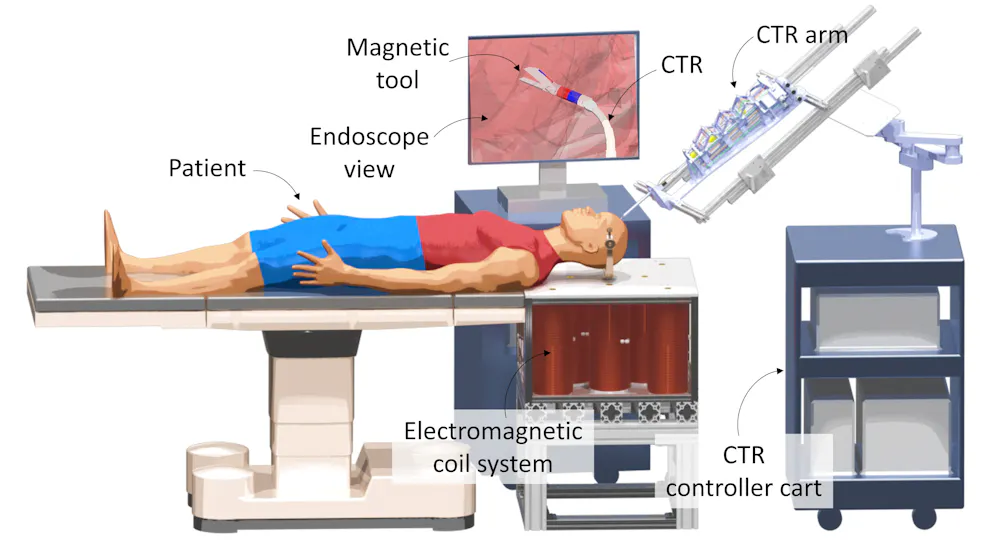
    The new robotic system consists of two parts. The first is the tiny tools themselves: a gripper, a scalpel and a set of forceps. The second part is what we call a “coil table”, which is a surgical table with several electromagnetic coils embedded inside.

    In this design, the patient would be positioned with their head on top of the embedded coils, and the robotic tools would be inserted into the brain via a small incision.

    Patients would lie on a ‘coil table’ containing magnets which are used to control the surgical tools.
    Changyan He

    By altering the amount of electricity flowing into the coils, we can manipulate the magnetic fields, causing the tools to grip, pull or cut tissue as desired.

    In open brain surgery, the surgeon relies on their own dexterous wrist to pivot the tools and tilt their tips to access hard-to-reach areas, such as removing a tumour inside the central cavity of the brain. Unlike other tools, our robotic neurosurgical tools can mimic this with “wristed” movements.

    Surprising precision

    We tested the tools in pre-clinical trials where we simulated the mechanical properties of the brain tissue they would need to work with. In some tests, we used pieces of tofu and raspberry placed inside a model of the brain.

    We compared the performance of these magnetically operated tools with that of standard tools handled by trained surgeons.

    We found the cuts made with the magnetic scalpel were consistent and narrow, with an average width of 0.3–0.4mm. That was even more precise than those from traditional hand tools, which ranged from 0.6 to 2.1mm.

    The magnetic scalpel, shown slicing some tofu inside a model of the brain, can make cuts more precise than those done with traditional tools.
    Changyan He

    As for the grippers, they could pick up the target 76% of the time.

    The magnetic grippers (shown here picking up some raspberry) were successful 76% of the time.
    Changyan He

    From the lab to the operating room

    We were surprised by how well the robotic tools performed. However, there is still a long way to go until this technology could help patients. It can take years, even decades, to develop medical devices, especially surgical robots.

    This study is part of a broader project based on years of work led by Eric Diller from the University of Toronto, an expert on magnet-driven micro-robots.

    Now, the team wants to make sure the robotic arm and magnetic system can fit comfortably in a hospital operating room. The team also wants to make it compatible with imaging systems such as fluoroscopy, which uses x-rays.
    After that, the tools may be ready for clinical trials.

    We’re excited about the potential for a new era of minimally invasive neurosurgical tools.

    Changyan He does not work for, consult, own shares in or receive funding from any company or organisation that would benefit from this article, and has disclosed no relevant affiliations beyond their academic appointment.

    ref. Tiny robot tools powered by magnets could one day do brain surgery without cutting open the skull – https://theconversation.com/tiny-robot-tools-powered-by-magnets-could-one-day-do-brain-surgery-without-cutting-open-the-skull-253042

    MIL OSI AnalysisEveningReport.nz

  • MIL-Evening Report: Every 3 years, we play the election date waiting game. Are fixed terms the solution?

    Source: The Conversation (Au and NZ) – By Jill Sheppard, Senior Lecturer, School of Politics and International Relations, Australian National University

    With another election campaign unofficially underway, voters may feel it hasn’t been long since they were last at the voting booth.

    Australia’s Constitution dictates:

    every House of Representatives shall continue for three years from the first meeting of the House, and no longer, but may be sooner dissolved by the Governor-General.

    This allows the sitting government to call an election sooner than three years after taking office, but recent norms are for governments to use the full term length available to them.

    But how do politicians and the public feel about this format, and could this change anytime soon?

    Early elections

    In 1998, the John Howard Liberal government called an early election seeking voters’ support for its ambitious plans to introduce a goods and service tax. It came very close to defeat, but clawed its way to victory and nine more years of power.

    In 2016, the Malcolm Turnbull Liberal government took a similar punt, calling an early double dissolution election ostensibly on the issue of union corruption. Again, it came very close to defeat but clawed its way to victory (and six more years of power).

    Despite their reasons for calling early elections, both Howard and Turnbull faced declining global economic conditions and arguably moved tactically to avoid campaigning in the worst of the headwinds.

    Most governments have less appetite for capitalising on external events – like interest rate cuts – when calling an election. Voters already largely distrust politicians, and cynical early elections will only confirm their beliefs.

    Fixed versus non-fixed parliamentary terms

    The ability of a government to unilaterally decide the election date is unusual.

    The political systems most similar to Australia – New Zealand, Canada, the United Kingdom, the United States – all have fixed election dates. Australian states and territories have also increasingly moved to fixed dates, where the government of the day has no discretion over election timing.

    As prime minister, Julia Gillard effectively relinquished her right to manipulate the 2013 election date in her favour. She announced it more than seven months ahead of time. Her government lost the subsequent election.

    Unsurprisingly, there is little political will to move to fixed dates for federal elections. Only current Special Minister of State Don Farrell has expressed even passing support for the idea (and then, only if voters were clearly in favour).

    Fixed terms would undoubtedly benefit voters, who could plan their calendars well in advance. They would also benefit non-government parties and independent candidates, who could budget and plan campaigns around a known election date.

    Who wants longer terms?

    Prime Minister Anthony Albanese supports four-year terms, reflecting long-term Labor Party policy.

    The Liberal Party has generally been more ambivalent. Howard was supportive but “not mad keen” in 2005 and supportive, but resigned to failure in 2024.

    Current leader Peter Dutton also backs longer terms, but observes that, among voters, “generally, there is a reluctance to do anything that makes the life of a politician easier”.

    Beyond voters’ reluctance to grant a one-year extension to politicians’ tenure, the issue of senate term lengths is an obstacle to reform.

    Current tradition sets senate terms twice the length of House of Representatives terms, however, Penny Wong has argued that eight-year terms are too long.

    Both New South Wales and South Australia have experience with eight-year terms in their upper houses, but no other states have yet followed.

    How could (and will) terms be changed?

    Any change to federal parliamentary terms would require a successful referendum. The question has been put to Australians once before, in 1988. Only 33% of voters supported the proposal, and no state achieved majority support.

    Polling from April 2024 finds only 38% support, with 18% unsure. Independent and minor party voters – the fastest growing group in Australian politics – were also the most strongly opposed to longer terms.

    As Dutton noted, voters have been reluctant to support “politician-friendly” referendums in the past. There seems almost no chance the 48th parliament would consider a referendum on the issue.

    Would 4-year terms make politics better?

    David Coleman, recently promoted to the Liberal Party’s frontbench, has confidently declared “businesses and consumers tend to hold off on investment during election periods and the phoney war that precedes them”, and so longer terms would improve the domestic economy.

    The business sector seems to agree.

    Are they right? And what about non-economic outcomes?

    Academic research backs up the assumption governments are less likely to announce major tax reforms in the months leading into an election. Shorter terms might also make governments less likely to introduce austerity (strict cost-cutting) measures.

    The weight of academic evidence suggests that whichever party is in power matters far more than the length of the electoral cycle.

    Researchers have struggled to find differences in how politicians with longer terms (usually four years) behave from those with shorter terms (usually two years). Activity levels for the shorter-term politicians appear slightly more frenetic – more fundraising and expenditure, more campaigning – but the outcomes are similar.

    Longer terms do not seem destined to fix Australia’s political malaise.

    Jill Sheppard receives funding from the Australian Research Council.

    ref. Every 3 years, we play the election date waiting game. Are fixed terms the solution? – https://theconversation.com/every-3-years-we-play-the-election-date-waiting-game-are-fixed-terms-the-solution-250273

    MIL OSI AnalysisEveningReport.nz

  • MIL-OSI Global: Electric cars are going mainstream – Elon Musk won’t change that

    Source: The Conversation – UK – By Jack Marley, Environment + Energy Editor, UK edition

    “When you ride Tesla, you ride with Hitler” according to a reworked second world war propaganda poster that was discovered in Oakland, California last month.

    When did an electric car brand supposedly become associated with the far right? Perhaps when its CEO, Elon Musk, embraced Donald Trump and the Maga movement that propelled him to a second term as US president. Tesla dealerships have been targets for protests and vandalism, while the company’s sales and stock price have fallen recently.

    “But those same political controversies may ironically help broaden the mass market appeal of electric vehicles,” says Hannah Budnitz, a research associate at the Transport Studies Unit of Oxford University.

    “This is an industry that needs to go beyond the early adopter tech bros – and now might be the moment.”


    This roundup of The Conversation’s climate coverage comes from our award-winning weekly climate action newsletter. Every Wednesday, The Conversation’s environment editor writes Imagine, a short email that goes a little deeper into just one climate issue. Join the 40,000+ readers who’ve subscribed.


    But first, a disclaimer

    Around a fifth of the greenhouse gas emissions heating Earth can be traced to a vehicle exhaust pipe. The more combustion engines that can be replaced with electric batteries, the less getting from A to B will exacerbate climate change.

    However, electric cars, like those sold by Tesla, are an imperfect solution to the climate crisis.

    “Huge amounts of land which could otherwise be used to house people or be dedicated to nature are still reserved for roads and car parks,” says Vera O’Riordan, an energy policy researcher at University College Cork.


    Read more:
    Electric cars aren’t enough to hit climate targets: we need to develop better public transport too


    And while driving an EV doesn’t emit CO₂, it does emit stuff you wouldn’t want to breathe in. Electric cars, which contain heavy batteries, wear down their tyres faster than conventional cars and generate more microplastic particles in the process, according to Henry Obanya, an ecotoxicologist at the University of Portsmouth.

    Obanya estimates that as much as a quarter of all microplastics in the environment could have come from car tyres.


    Read more:
    Car tyres shed a quarter of all microplastics in the environment – urgent action is needed


    So, the strategy of putting an EV in every garage has its limits (not least the fact that not everyone has a garage, or the space to charge an electric car).

    A more efficient way to decarbonise the second-largest emission source by sector (power generation is first) would be to follow the advice of the Intergovernmental Panel on Climate Change. The IPCC, which is made up of scientists and other experts convened by the UN, recommends that countries plan their transport systems according to the maxim “avoid, shift, improve”.

    This involves, O’Riordan explains, avoiding unnecessary journeys by designing towns and cities with amenities in walking distance, shifting passengers onto higher-occupancy vehicles like buses by expanding public transport and improving all travel options by switching from fossil fuels to electric propulsion.

    Let’s assume that decades of car-first urban planning have boxed us in and we don’t have time to undo it before the climate is cooked. How can more motorists be persuaded to turn in their gas-guzzler for a battery-powered model?

    It’s the price, stupid

    Back to Budnitz – and the waning influence of the EV industry’s tech-bro boosters.

    “In 2010, when Tesla became the first American carmaker to go public since Ford in 1956, fully electric cars were still a niche technology,” she says.


    Read more:
    Why the Tesla backlash could help electric cars finally go mainstream


    Back then, Tesla adverts targeted the customers it thought would be early adopters: overwhelmingly, wealthy men like Musk. It worked. Survey after survey in North America and Europe showed that EV ownership in the early 2010s was skewed towards men and those on higher incomes.

    This is in stark contrast to electric car marketing at the dawn of motoring. In 1900, petroleum-powered cars were in the minority (22% of all cars) and were widely considered temperamental “adventure machines” that were prone to breaking down. Electric cars were pitched as a safer, cleaner alternative that was perfect for city travel.


    Read more:
    Electric cars were once marketed as ‘women’s cars’. Did this hold back their development over the next century?


    Perfect, in fact, for wealthy women. During the 1910s, when Victorian attitudes towards gender roles reigned and women were presumed to have limited mobility needs (no need to worry about your battery running flat if you’re not going far), 77% of EVs directly appealed to female consumers.

    “In the short term, this was a successful strategy: car manufacturers that advertised to female consumers survived much longer,” says economic historian Josef Taalbi (Lund University). The only major electric car producer in the US to survive into the 1920s advertised to women, he adds.

    In 2013, there were still less than 60,000 EVs on the road globally. A decade later, almost the same number are sold every day.

    “The transition to electric personal mobility is well underway around the world,” says Budnitz. “Tesla’s troubles won’t stop this – but they can give the car industry an opportunity to make the messaging around electric vehicles more diverse, equitable and inclusive for the mass market.”

    EV manufacturers can make their case to all drivers because they now offer a mass-market product, Budnitz argues. Nowhere is this more true than in Norway, which may become the first country to sell only zero-emission vehicles this year (88.9% of all vehicles sold in Norway in 2024 were fully-electric).

    What’s Norway’s secret?

    “Generous, comprehensive subsidies”, say Agnieszka Stefaniec and Keyvan Hosseini, transport researchers at the University of Southampton.


    Read more:
    How smaller, more affordable electric cars can accelerate the green transition


    “Our recent research shows that affordability is a tool to get everyone on board. When lower-income households face affordability barriers, it’s not just their problem – it’s the missing link to achieving 100%. Smaller, more affordable electric cars could be the game changer needed to bridge this gap.”

    ref. Electric cars are going mainstream – Elon Musk won’t change that – https://theconversation.com/electric-cars-are-going-mainstream-elon-musk-wont-change-that-253060

    MIL OSI – Global Reports

  • MIL-OSI Global: Donald Trump’s ‘chilling effect’ on free speech and dissent is threatening US democracy

    Source: The Conversation – UK – By Dafydd Townley, Teaching Fellow in US politics and international security, University of Portsmouth

    The second Donald Trump administration has already sent shockwaves through the political establishment on both sides of the Atlantic. Overseas, the focus has been on the administration’s apparent dismantling of the post-war international order and Trump’s apparent pivot away from America’s traditional allies towards a warmer relationship with Russia and Vladimir Putin. But within the United States itself, the greatest concerns are associated with administration actions that, for many, suggest a deliberate destruction of American democracy.

    Such fears in the US are not isolated to the political elites, but are shared by citizens across the entire nation. But what is also emerging is a concerted assault on people’s ability to push back – or even complain – about some of the measures being introduced by Trump 2.0. This will inevitably result in what is often called a “chilling effect”, where it becomes too hard – or too dangerous – to voice dissent.

    Many of Trump’s policies – the mass deportations, the wholesale sacking of public servants by Elon Musk and his Department of Government Efficiency (Doge), the decision to revoke birthright citizenship for the children of undocumented immigrants – have been challenged in the courts. The Trump administration is now embroiled in a range of legal challenges. It is here that Trump’s disdain for a legal system that has temporarily blocked the wishes of the president has emerged.

    Chilling effect

    Judicial decisions calling for the administration to reverse or pause some of these policies have been greeted by Trump and some of his senior colleagues (including Musk and the vice-president J.D.Vance), with noisy complaints at judicial interference in government. Even, in some cases, calls for the impeachment of judges who rule against the government.

    Not only did the administration ignore the court’s ruling that suspended the forced expulsion of Venezuelans to El Salvador, some of whom were in the US legally, but Trump attacked the judge on social media calling him a corrupt “radical left lunatic” and called for his impeachment.

    This stirred the chief justice of the Supreme Court, John Glover Roberts Jr., to intervene. He reminded the president that America doesn’t settle its disputes, saying that the “normal appellate review process exists for that purpose”. Later, Tom Homan, Trump’s chief adviser on immigration issues, told ABC News that the administration would abide by court rulings on the matter.

    The pressure being brought to bear on America’s legal system has not stopped at the judiciary. Trump has recently targeted some of America’s biggest and most powerful law firms, seemingly for no other reason than their acting for clients who have opposed his administration.

    On March 25, Trump signed an executive order targeting Jenner & Block, one of whose partners, Andrew Weissmann, worked with special prosecutor Robert Mueller on the investigation into Russian meddling in the 2016 presidential election. The executive order calls for the firms to be blacklisted from government work and for their employees to have any security clearances removed, for them to be barred from any federal government contracts and refused access to federal government buildings. A death warrant for the firm in other words.


    Sign up to receive our weekly World Affairs Briefing newsletter from The Conversation UK. Every Thursday we’ll bring you expert analysis of the big stories in international relations.


    This follows the news that the head of the prestigious law firm Paul Weiss, Brad Karp, had signed a deal with the White House committing to providing millions of dollars worth of pro-bono legal work for causes nominated by the president. He’s also agreed to stop using diversity, equity and inclusion (DEI) policies, which had been faced with a similar fate.

    Silencing dissent

    This administration’s chilling effect has also extended to an attack on press freedom. Trump has expelled established news organisations from the Pentagon, curtailed access to press events for the esteemed Associated Press, and taken control of the White House press pool, sidelining major media outlets.

    These actions mark a significant downgrading of press freedom in America. They are undermining the role of independent journalism in their key function of holding power to account. By restricting access and silencing critical voices, his administration has raised concerns over transparency and the free flow of information in the domestic media landscapes.

    Universities have traditionally been bastions of independent thought. We saw that with the massive protests against US policy towards Israel and Palestine which have roiled campuses during the conflict in Gaza. But universities are also seen by many in the administration as a hotbed of “woke” activism. Accordingly Trump 2.0 has fixed its sights on one of the most prominent US universities: Columbia.

    Citing what it says is a repeated failure to protect students from antisemitic harassment, the administration cancelled US$400m (£310 million) of federal contracts with the university. Columbia caved in to the pressure moments before the administration’s deadline passed. It agreed to overhaul its disciplinary procedures and “review” its regional studies programmes, starting with those covering the Middle East.

    Columbia’s academic staff are horrified. They are launching legal action against the government, alleging that “the Trump administration is coercing Columbia University to do its bidding and regulate speech and expression on campus”.

    Democracy in peril

    Why is this all so worrying? The legal system, the media and universities are the pillars of US democratic freedoms. The Trump administration’s undermining of these institutions is a blatant attempt to impose an authoritarian rule by bypassing any counterbalance to executive power. And the US Supreme Court has ruled that he is almost entirely immune from prosecution while doing it.

    The checks and balances system of government in the US was designed to ensure that no single branch could dominate the political process. But partisan loyalty, and loyalty to Trump over the party, now outweighs constitutional responsibility for the majority of those within the Republican Party.

    American democracy is under threat. Not from the external existential threats it faced over the past century such as communism and Islamic fundamentalism, but from within its own system. Those Americans who are terrified about this threat are trying to fight back, but Trump’s assault on dissent is so chilling that this is becoming increasingly dangerous.

    Dafydd Townley does not work for, consult, own shares in or receive funding from any company or organisation that would benefit from this article, and has disclosed no relevant affiliations beyond their academic appointment.

    ref. Donald Trump’s ‘chilling effect’ on free speech and dissent is threatening US democracy – https://theconversation.com/donald-trumps-chilling-effect-on-free-speech-and-dissent-is-threatening-us-democracy-253139

    MIL OSI – Global Reports

  • MIL-OSI Global: How two recent productions of Oedipus offer different meanings through the role of the chorus

    Source: The Conversation – UK – By Will Shüler, Vice-Dean of Education and Senior Lecturer, School of Performing and Digital Arts, Royal Holloway University of London

    The London theatre scene was all abuzz in January 2024 when two different star-studded West End productions of the ancient Greek tragedy Oedipus were announced within minutes of each other.

    The first production of the Sophocles tragedy, adapted and directed by Robert Icke and starring Mark Strong and Leslie Manville, ran from October 2024 to January 2025, with a Broadway transfer to New York’s Roundabout Theatre Company planned for this autumn.

    The second – which closes at the end of this month – opened weeks later at the Old Vic in a version by Ella Hickson, co-directed by Hofesh Shechter and Matthew Warchus, and starring Rami Malek and Indira Varma.

    Historically, ancient Greek tragedies were retellings of ancient myths, performed in ways that encouraged the audience to reflect upon an old story in a new way. Two London productions of Oedipus might seem like overkill, but they actually demonstrate the versatility of the tragic form.


    Looking for something good? Cut through the noise with a carefully curated selection of the latest releases, live events and exhibitions, straight to your inbox every fortnight, on Fridays. Sign up here.


    Both productions rework the myth, allowing contemporary audiences to consider different perspectives on the play’s themes of power and knowledge.

    One of the defining aspects of the ancient Greek tragedy is the chorus. Originally they performed in the orchestra of an ancient theatre – the space between the actors and the audience. Their performance of odes was in song and dance form, and the content might reflect upon the play’s events from their perspective, provide background that was either directly or indirectly related to the plot, or spur on the action of the play.

    In Oedipus, the chorus is comprised of citizens of Thebes. The city is suffering from a terrible curse and Oedipus, the king, takes it upon himself to rectify this by following the advice of the gods to discover and punish the murderer of the previous king, Laius.

    The chorus first enters singing – and dancing – about the disasters the people have been facing and prays for their end. For the rest of the play, from the foot of the palace, the chorus observes Oedipus’s investigation, horrific discovery and the piteous aftermath for his family.

    The treatment of the role of the chorus in these two West End productions are essential to the different meanings they make and how they invite audiences to reflect upon the myth in relation to our own world.

    In the Icke adaptation, Oedipus is with his family (wife Jocasta, mother Merope, brother-in-law Creon and three adult children Antigone, Polynices and Eteocles) at his campaign headquarters on the evening of the election.

    In this version the challenge the city faces is governmental corruption. Icke has included more family members than are in Sophocles’s original text and cut the role of the chorus entirely. Its exclusion means the governmental corruption is seen almost entirely from the point of view of this political family.

    The only perspective we get from the citizens is an opening video sequence as Oedipus is interviewed by the press, and the frequent election result updates. The people elect Oedipus. They want what he promises – an end of governmental corruption.

    Icke’s Oedipus strives to do the right thing and break from the string of corrupt, deceitful, narcissistic politicians who have been plaguing the city. The play thereby draws contemporary connections to “draining the swamp” and the “fake news” accusations of Donald Trump.

    Without reflections from the people (the chorus), the play becomes a personal drama about the family’s interests and public image. Oedipus and Jocasta’s grisly ends are entirely about their personal horror at the discovery they have made – that she is actually his mother.

    There is no reflection on how the play’s ending relates to the ongoing trouble faced by the citizens. In this version of events the final impression feels pessimistic – even when leaders try to do the right thing, the system ensures that they will fail.

    In the Old Vic production, the play is set in a Thebes that is suffering from extreme drought (likely alluding to the climate crisis). In Hickson’s adaptation, the chorus remains, but their words have been removed. Only their dance is performed between the scenes of the actors.

    This is not to say that the Sophocles text has been “translated” into movement by Shechter, but rather that the historic function of the chorus (to contemplate, to reflect, to spur on) remains by means of what is communicated in dance – which, according to the Guardian’s theatre critic David Jays becomes “the irresistible core of the tragedy”.

    In the play’s script, each scene ends with the deceptively simple word: “dance”. In performance, Oedipus’ investigation into what is causing the drought, contemplation of prophecies and public speeches to the people of Thebes are all interspersed with Shechter’s evocative choreography. We see their suffering, we see their prayers, we see their perseverance. Their needs never fade into the background but remain the consistent pulse of the play.

    In this version, when Oedipus has his moment of revelation, the rain comes and the people dance in it. This moment imparts impressions of renewed faith, solidarity, fruitfulness, pride, rebirth and life continuing.

    Oedipus enters having blinded himself, not out of personal horror, but in order to cleanse the city and ensure its continued godly favour. In contrast to the Icke production, Schechter and Warchus’s version – though still tragic – is ultimately hopeful.

    The leader has taken responsibility for what they have done and put the needs of the people over his own ambitions and desires. The last moment is not Oedipus’s. It is the chorus’s – and we watch them dance.

    Will Shüler does not work for, consult, own shares in or receive funding from any company or organisation that would benefit from this article, and has disclosed no relevant affiliations beyond their academic appointment.

    ref. How two recent productions of Oedipus offer different meanings through the role of the chorus – https://theconversation.com/how-two-recent-productions-of-oedipus-offer-different-meanings-through-the-role-of-the-chorus-252862

    MIL OSI – Global Reports

  • MIL-OSI Global: Global population data is in crisis – here’s why that matters

    Source: The Conversation – UK – By Andrew J Tatem, WorldPop Director, Professor of Spatial Demography and Epidemiology, University of Southampton

    Arthimedes/Shutterstock

    Every day, decisions that affect our lives depend on knowing how many people live where. For example, how many vaccines are needed in a community, where polling stations should be placed for elections or who might be in danger as a hurricane approaches. The answers rely on population data.

    But counting people is getting harder.

    For centuries, census and household surveys have been the backbone of population knowledge. But we’ve just returned from the UN’s statistical commission meetings in New York, where experts reported that something alarming is happening to population data systems globally.

    Census response rates are declining in many countries, resulting in large margins of error. The 2020 US census undercounted America’s Latino population by more than three times the rate of the 2010 census. In Paraguay, the latest census revealed a population one-fifth smaller than previously thought.

    South Africa’s 2022 census post-enumeration survey revealed a likely undercount of more than 30%. According to the UN Economic Commission for Africa, undercounts and census delays due to COVID-19, conflict or financial limitations have resulted in an estimated one in three Africans not being counted in the 2020 census round.

    When people vanish from data, they vanish from policy. When certain groups are systematically undercounted – often minorities, rural communities or poorer people – they become invisible to policymakers. This translates directly into political underrepresentation and inadequate resource allocation.

    As the Brookings Institution, a US research organisation, has highlighted, undercounts have “cost communities of colour political representation over the next decade”.

    This is happening because several factors have converged. Trust in government institutions is eroding worldwide, with the Organisation for Economic Co-operation and Development (OECD) reporting that by late 2023, 44% of people across member countries had low or no trust in their national governments. Research shows a clear trend of declining trust specifically in representative institutions like parliaments and governments. This makes people less likely to respond to government-issued census requests.

    The COVID-19 pandemic created logistical nightmares for census takers. Many countries had to postpone their censuses. Budget cuts to statistical offices reduced capacity, while countries struggled with recruiting field staff.

    International funding for population data is also disappearing. The US-funded Demographic and Health Surveys program, which provided vital survey data across 90 countries for four decades, was terminated in February 2025. Unicef’s Multi-Indicator Cluster program, which carries out household surveys, faces an uncertain future amid shrinking global aid budgets. US government cuts to support for UN agencies and development banks undertaking census support will likely have further impacts.

    This is incredibly worrying to us as geography academics, because gathering accurate population data is fundamentally about making everyone visible. As population scientists Sabrina Juran and Arona Pistiner wrote, this information allows governments to plan for the future of a country and its people.

    The US census directly impacts the allocation of more than US$1.5 trillion (£1.2 trillion) in public resources each year. How can governments distribute healthcare funding without knowing who lives where? How can disaster response be effective if vulnerable populations are invisible in official population counts?

    Solutions that count

    Countries are adapting. The COVID-19 pandemic accelerated the transition to alternative census methodologies. Many countries turned to online questionnaires, telephone interviews and administrative data sources to reduce face-to-face interactions.

    The UN Economic Commission for Africa recommends that countries move from using paper forms for census data collection and embrace new digital technologies that can be cheaper and more reliable. Turkey’s switch in 2011 reduced census costs from US$48.3 million to US$13.9 million while improving data quality and timeliness, and nearly 80% of countries used tablets or smartphones for data collection in the 2020 round of censuses.

    Collecting census data digitally in Pakistan in 2023.
    Abdul Rauf Khan/Shutterstock

    At WorldPop, our research group at the University of Southampton, we’re also helping governments to develop solutions using new technologies. Buildings mapped from satellite imagery using AI, together with counts of populations from small areas, can help create detailed population estimates to support census implementation or provide estimates for undersurveyed areas.

    As we face growing challenges, from climate change to economic inequality, having accurate, reliable and robust population data isn’t a luxury. It’s essential for a functioning society. National statistical offices, UN agencies, academics, the private sector and donors must urgently focus on how to build cost-effective solutions to provide reliable and robust population data, especially in resource-poor settings where recent cuts will be felt hardest.

    When people disappear from the data, they risk disappearing from public policy too. Making everyone count starts with counting everyone.


    Don’t have time to read about climate change as much as you’d like?

    Get a weekly roundup in your inbox instead. Every Wednesday, The Conversation’s environment editor writes Imagine, a short email that goes a little deeper into just one climate issue. Join the 40,000+ readers who’ve subscribed so far.


    Andrew J Tatem works for the University of Southampton, and is Director of WorldPop. His research on mapping populations has been funded by donors such as the Gates Foundation, Wellcome Trust, GAVI.

    Jessica Espey works for the University of Southampton. Her research on data, statistics and evidence use has previously been funded by the William and Flora Hewlett Foundation, Gates Foundation and others.

    ref. Global population data is in crisis – here’s why that matters – https://theconversation.com/global-population-data-is-in-crisis-heres-why-that-matters-251751

    MIL OSI – Global Reports

  • MIL-OSI Global: Humans are bad at reading dogs’ emotions – but we can do learn to do better

    Source: The Conversation – UK – By Juliane Kaminski, Associate professor of comparative Psychology, University of Portsmouth

    Seregraff/Shutterstock

    A lot of dog owners believe that they can tell what their dogs are feeling. They believe that they can assess their dog’s emotions no matter the context.

    Yet newspapers frequently publish stories about dogs who attack “out of nowhere”, where owners claim there were “no signs” prior to the attack. A recent US study has found the answer may lie with humans – as it turns out, we’re not very good at interpreting dogs’ emotions.

    Previous research has shown that experience with dogs affects how successful people are in assessing a dog’s emotional state. As a psychologist, the more I know about dogs and the more I study and observe them, the better I become in assessing their behaviour. However, even experts can struggle to get it right.

    In the recent US study, researchers looked at how successful people are at assessing dogs’ emotions from looking at pictures. The images showed the dogs in different postures such as submissive or anxious. Sometimes the context around the dog was positive (for example, the owner approaching the dog with a lead) and sometimes the context around was negative (a person about to scold the dog).

    The study found that the context influenced whether people assessed the dog’s behavioural response as positive or negative even though the posture and other signals didn’t change.

    Research also suggests we have the tendency to misinterpret some facial expressions of dogs. A 2018 University of Lincoln study examined how children aged three to five years old and their parents interpret dogs’ facial expressions.

    Participants were shown pictures of dogs, for example showing bare teeth, which signals high levels of distress. The children especially misinterpreted that as a smiling and happy dog. The study also showed that interventions, which educated participants on how to interpret dogs’ behavioural signals, increased their understanding of dogs’ stress signals (though this was mostly true in the adults).

    We tend to anthropomorphise and attribute human emotions to our dogs. A good example of this is the so-called guilty look. You often see videos on social media in which a dog avoids eye contact with humans, for example turning its head slightly to the side.

    If this happens after the dog has done something they shouldn’t have, the owner may classify this as indicative of shame or guilt. In reality, dogs avoid eye contact as a kind of deescalation behaviour.
    It indicates that they do not want a confrontation. Perhaps the owner has already reacted to the mishap. Or the dog has learned to expect a reaction from the owner in certain situations. Insecure or fearful dogs also often avoid eye contact because they feel threatened or intimidated. However, this behaviour has little to do with shame.

    Another classic misconception is that a dog that wags its tail is a happy and friendly dog. In reality, a wagging tail only means that the dog is aroused. To assess the dog’s emotional state, you also have to consider the position of the tail. If it is standing upright, then this is more a sign of a tense dog. If it is positioned lower and the movement of the tail is relaxed and wide from left to right, then it is probably a friendly signal.

    We anthropomorphise dogs because we have evolved a human-specific way to interpret others’ emotions. If we see a person who pulls up the corners of their mouth and smiles, then we understand them to be happy or at least cheerful. That leads to problems if we apply that system to interpret other species’ emotional expressions.

    Could do with adding subhead here

    So how can we analyse dogs’ emotional expression in an objective way? One approach that scientists use is a technical method called DogFACS. In this method, each facial muscle is assigned a movement on the surface of the face. Facial movements are documented by numbers and analysed separately from each other.

    In 2013 University of Portsmouth researchers went to dog shelters across the UK and filmed dogs for two minutes each. They then analysed the dogs’ behaviour, including their facial expressions.

    The animal shelter told the researchers how long it took for the filmed dogs to be adopted by new owners. Neither barking nor wagging tails influenced the adoption rate, but only a specific eyebrow movement: the so-called puppy dog eyes look. The more often the dogs raised their eyebrows and produced the puppy dog eyes, the quicker they were rehomed. Nothing else had an effect. This could be because the puppy dog eyes resemble a facial movement that we produce when we are sad and makes us want to care for the dog.

    Could you resist those puppy dog eyes?
    SakSa/Shutterstock

    In fact my 2019 study showed that the facial muscle anatomy of dogs has evolved for facial communication with humans. My team compared the facial muscle anatomy of dogs and wolves and demonstrated that the facial muscles of dogs and wolves are identical – except for one muscle, the levator anguli oculi medialis. This muscle is responsible for the lifting of the inner eyebrow in dogs.

    We may not be much good at reading dogs’ emotions but as the University of Lincoln study shows, we can learn to be.

    Juliane Kaminski receives funding from ASAB.

    ref. Humans are bad at reading dogs’ emotions – but we can do learn to do better – https://theconversation.com/humans-are-bad-at-reading-dogs-emotions-but-we-can-do-learn-to-do-better-252773

    MIL OSI – Global Reports

  • MIL-OSI Global: Britons increasingly trust each other – but trust in politicians has slumped since the pandemic

    Source: The Conversation – UK – By Ben Seyd, Senior Lecturer in Politics, University of Kent

    ITS/Shutterstock

    One surprise in the early days of the pandemic was people’s increased willingness to trust political authorities. According to the British Social Attitudes survey (BSA), the proportion of people trusting government ministers rose from 15% in 2019 to 23% in 2020. Data from Ipsos MORI showed a similar bounce for trust in government ministers and politicians in 2021. Trust in government was also a significant factor in whether people complied with lockdown rules and other restrictions.

    Since then, however, people’s trust in government has plummeted. The latest BSA survey finds that, in 2023, just 14% of the population said they trust government “always” or “most of the time”. Fully 45% of the population trust government “almost never”. These are the most negative set of figures since the BSA began asking questions on trust almost four decades ago.

    This collapse in trust is perhaps unsurprising given the various government shenanigans over the past few years, notably Boris Johnson’s Downing Street lockdown parties and Liz Truss’s disastrous prime ministerial tenure. However, there is also evidence that Britons have become less trusting as a result of dashed expectations over the benefits of Brexit, negative views of government performance in areas like health, and cost of living pressures.

    Yet while Britons are less trusting of those with political authority, they appear to be more trusting in each other. Back in 1999, 29% of the population believed that “most people [in Britain] can be trusted”. Four decades on, that proportion has increased to 46%, topping the previous high of 43% in 1981. This might partly reflect the sense of collective endeavour and neighbourliness that was instilled during the pandemic, when we were encouraged to look out for, and help, other people. There is also evidence that, while people see the country as a whole as becoming more divided, at the local level perceptions of unity outweigh perceptions of division.

    This is a welcome shift, particularly since trust in other people is associated with a range of positive outcomes, including support for international cooperation and international organisations. In an uncertain and dangerous world, social trust may be an important factor shaping the willingness of states to work together.

    Wellbeing of politicians

    The decline of popular trust in government and politicians is concerning. Low trust is associated with support for populist politicians such as Donald Trump and upheavals like Brexit. Low trust could also significantly compromise public acceptance of, and compliance with, official messages and rules in a future pandemic.

    Distrust can also cause direct harm to public figures. As one of us (James) has shown, politicians are generally poor estimators of public trust in themselves. But where they do perceive widespread distrust, often because of repeated experiences of physical or online abuse and intimidation, this has a significant negative effect on their mental health and wellbeing.

    Messages of kindness and community around London during lockdown.
    Alex Yeung/Shutterstock

    Increased security around MPs – the cost of which jumped from £77,234.67 to £4,381,733.40 between 2014 and 2022 – is likely to protect them from the worst excesses of public distrust where it trickles over into extreme behaviour. Yet given the importance of contact for people’s trust, it could also inadvertently fuel more cynicism by increasing the physical distance between politicians and the public.

    The public’s declining regard for politicians and government should be a source of concern. We are hardly likely to recruit the calibre of politician we expect (and need), or indeed encourage a more diverse population of aspiring representatives, if the personal costs of holding elected office are so high.

    At the same time, a look at the bigger picture offers some reassurance. As one of us (Ben) has recently shown, there is little evidence that low trust induces popular scepticism towards democracy itself, or that it weakens public support for state spending or government programmes in key areas like healthcare.

    Trust on the frontline

    The nature and strength of Britain’s civic ties are revealed not only in our trust of politicians and institutions, but also in how we treat the people who provide public services, such as police officers and health workers.

    On the face of it, the picture is not pretty. Over the past few years, rates of public abuse towards frontline service providers have increased. In 2021, 18% of teachers reported having experienced verbal abuse from a parent or carer in the past year. In 2023, that figure had risen to 30%.

    A survey of police officers in 2022 found that 37% had experienced verbal insults at least once a week over the past year. This was an increase from the 29% of officers who reported a similar level of insults in 2020, although the figure dropped slightly in 2023 to 34%.

    Rates of physical abuse of London ambulance staff have more than doubled in four years, with 346 incidents recorded in 2019, increasing to 728 incidents in 2023. A similar picture of public abuse is found for frontline workers in the health service. Polling in 2023 found that 85% of GPs across the UK had received verbal abuse from members of the public during the past year. A 2021 survey by the British Medical Association found more than half of GPs, and one in five hospital doctors, had experienced verbal abuse in the past month.

    While majorities of the British public express trust in many frontline workers such as nurses and doctors (who currently attract 94% and 88% trust ratings), others appear to take a more negative view, extending even to abusive behaviour.

    Given the range of service providers facing such rising antipathy, it seems unlikely that the trigger for this was the pandemic. A better clue is provided by longer-term data on public treatment of doctors.

    Responses are to a survey question reading ‘In the last 12 months, have you personally experienced harassment, bullying or abuse at work from patients, their relatives or members of the public?’.
    Author provided, data from NHS Staff Survey

    NHS survey figures show that rates of abuse towards doctors declined between 2003 and 2011. (The wording of the relevant survey question changed in 2012, which restricts our ability to compare the more recent data). This was precisely the period when resources were pumped into the health service and public satisfaction with the NHS increased. This suggests that public interactions with frontline service workers like doctors are strongly shaped by the quality of the service they face.

    Indeed, GPs themselves ascribe the verbal abuse they and their staff experience to people’s dissatisfaction with the service, including discontent with access to health services. One underappreciated effect of austerity might thus be an increased public frustration with healthcare workers, which on occasion appears to extend to outright abuse.

    More accessible (read: better funded) public services might reduce some negativity towards frontline service workers. However, the important task of rebuilding people’s trust in politicians is – particularly given the negative coverage by much of Britain’s media – likely to be a trickier task.

    James Weinberg receives funding from the Economic and Social Research Council.

    Ben Seyd does not work for, consult, own shares in or receive funding from any company or organisation that would benefit from this article, and has disclosed no relevant affiliations beyond their academic appointment.

    ref. Britons increasingly trust each other – but trust in politicians has slumped since the pandemic – https://theconversation.com/britons-increasingly-trust-each-other-but-trust-in-politicians-has-slumped-since-the-pandemic-252762

    MIL OSI – Global Reports

  • MIL-OSI Global: Why eating yoghurt regularly could lower your risk of bowel cancer

    Source: The Conversation – UK – By Justin Stebbing, Professor of Biomedical Sciences, Anglia Ruskin University

    Josep Suria/Shutterstock

    Hard on the heels of impressive research findings that a glass of milk is good for reducing cancer risk, another recent study has highlighted the potential benefits of yoghurt consumption in lowering the risk of certain types of cancer – particularly colorectal cancer.

    The number of new colorectal cancer cases among people under 55 has doubled globally in recent years, with diagnoses increasing by nearly 20%. As a consultant oncologist, many people have asked me how their risk can be reduced.

    The emerging evidence suggests that regular yoghurt consumption may have a protective effect against certain aggressive forms of colorectal cancer by modifying the gut microbiome, the natural bacteria that live in the gut.

    The gut microbiome plays a crucial role in overall health, influencing digestion, immune function and even cancer risk. The gut bacteria can live inside cancer itself, and in general a healthy balance of these bacteria is thought to be essential for maintaining a strong immune system and preventing inflammation, which can contribute to cancer development.


    Read more:
    Gut bacteria nurture the immune system – for cancer patients, a diverse microbiome can protect against dangerous treatment complications


    Yoghurt contains live cultures of beneficial bacteria, such as lactobacillus bulgaricus and streptococcus thermophilus, which can help maintain this balance.

    The study found that consuming two or more servings of yoghurt per week was associated with a lower risk of a specific type of aggressive colorectal cancer, which occurs on the right side of the colon and is associated with poorer survival outcomes compared with cancers on the left side.

    The study analysed data from over 150,000 participants followed for several decades, indicating that long-term yoghurt consumption may alter the gut microbiome in ways that protect against certain cancers. Researchers surveyed the participants every two years about their yoghurt intake, and measured the amount of Bifidobacterium (a type of bacteria found in yoghurt) in the tumour tissue of 3,079 people within the sample who were diagnosed with colorectal cancer.

    While yoghurt did not directly lower the risk for all types of colorectal cancer, those who ate two or more servings of yoghurt per week had a lower risk of developing Bifidobacterium-positive proximal colon cancer”, a type of colorectal cancer that occurs in the right side of the colon and has one of the lowest survival rates. This new work also validates and builds on previous studies showing similar findings.

    Several mechanisms have been proposed to explain how yoghurt might reduce cancer risk. One key mechanism is the modulation of the gut microbiome. Yoghurt’s probiotics can enhance the diversity and balance of gut bacteria, potentially reducing inflammation and levels of cancer-causing chemicals (carcinogens).

    Additionally, yoghurt may exert anti-inflammatory effects on the colon lining cells, called the mucosa, which could help prevent cancer development. Improving gut barrier function is another potential mechanism, as yoghurt may reduce gut permeability, which is linked to increased cancer risk.

    Choose wisely

    Beyond its potential anti-cancer effects, yoghurt offers several other health benefits. Like milk, it is rich in calcium, which supports bone density and may reduce the risk of brittle bones, known as osteoporosis.

    Regular yoghurt consumption has also been associated with lower blood pressure and reduced risk of cardiovascular disease. Some studies suggest that yoghurt intake may help prevent type 2 diabetes and other diseases too.

    But when incorporating yoghurt into your diet, it’s important to choose wisely. Opt for plain, unflavoured yoghurt to avoid added sugars, which can negate health benefits – for example by causing weight gain, which is a risk factor for obesity and cancer.

    Different fermentation processes can result in varying levels of beneficial bacteria, so look for yoghurts with live cultures. Plain, unsweetened Greek yoghurt is generally higher in protein and lower in sugar, while full-fat yoghurt often has fewer processed ingredients than reduced-fat or non-fat variations.

    Yoghurt contains all nine essential amino acids, and aside from improving gut health, a serving of plain Greek yoghurt contains 15 to 20 grams of protein.

    There are nearly 45,000 cases of bowel cancer every year in the UK, making it the nation’s fourth most common cancer, and third worldwide – but many of these are preventable.

    According to Cancer Research UK data, 54% of all bowel cancers could be prevented by having a healthier lifestyle. Smoking, lack of exercise, alcohol, eating processed meat, and poor diet are all significant factors in the development of bowel cancer.

    The emerging evidence suggests that yoghurt, particularly when consumed regularly, may play a role in reducing the risk of certain aggressive forms of colorectal cancer. While more research is needed to fully understand these effects, incorporating yoghurt into a balanced diet could be a beneficial choice for overall health.

    But as with any dietary recommendation, it’s crucial to consider the broader context of a healthy lifestyle, including a diverse diet rich in fruits, vegetables and whole grains, along with regular physical activity. While yoghurt is not a magic bullet against cancer, it is a nutritious food that can contribute to a healthy diet and potentially offer protective effects against certain cancers.

    As research continues to uncover the complex relationships between diet, gut health and cancer risk, incorporating yoghurt into your daily routine may be a simple yet beneficial step towards a healthier life.

    Justin Stebbing does not work for, consult, own shares in or receive funding from any company or organisation that would benefit from this article, and has disclosed no relevant affiliations beyond their academic appointment.

    ref. Why eating yoghurt regularly could lower your risk of bowel cancer – https://theconversation.com/why-eating-yoghurt-regularly-could-lower-your-risk-of-bowel-cancer-251942

    MIL OSI – Global Reports

  • MIL-OSI Global: Trump’s America is facing an Andrew Jackson moment – and it’s bad news for the constitution

    Source: The Conversation – UK – By Sean Lang, Visiting Fellow in History, Anglia Ruskin University

    Statue of Andrew Jackson in Layfayette Square, Washington DC. Flickr

    How do you deal with an American president who does not obey the US constitution? The question has arisen because the recent episode where deportation flights carrying Venezuelans were dispatched to El Salvador, despite a court ruling that those flights must not proceed, suggests Donald Trump’s administration has a limited understanding of the separation of powers in the US. A president has no power to defy a court order.

    Similarly, a Brown University medical professor, Rasha Alawieh, was deported to Lebanon because of a perceived sympathy for Hezbollah, despite the fact she had a valid US work visa and despite a judge’s order blocking her removal from the US.

    This administration’s seemingly blatant disregarding of constitutional procedure is not the first time such a problem has arisen. Early in the life of the new republic it was posed by the election to the presidency in 1828 of Andrew Jackson. Jackson, an unashamed populist, harboured deep suspicion of all federal institutions. His belief in states’ rights sometimes trumped his commitment to the union.

    Trump echoes Jackson in many ways. Just as Trump reviles Joe Biden, so Jackson scorned his predecessor, John Quincy Adams. Trump’s attacks on institutions such as USAid and the Department of Education, is echoed by Jackson’s extraordinary war on the Bank of the United States, which he thought too big and grand for a democratic people.

    But the parallels come closest in relation to forced expulsion, whether of individuals in Trump’s case, or of whole peoples in Jackson’s.

    When Europeans established their colonies in the Americas, they justified their presence by asserting the philosopher John Locke’s principle that legal title to land belonged to those who farmed it. Since the native peoples were mostly nomadic hunters, this legal fiction enabled the Europeans and their American successors to seize land while claiming it was theirs “by right”.

    But the peoples of the American southeast – the Chickasaw, Choctaw, Creek, Seminole and Cherokee – took the Europeans at their word. They adopted a much more European lifestyle, establishing towns, wearing European clothing, even converting to Christianity. But above all, they started farming the land, even to the point of owning slaves to work on it. They were known, rather patronisingly, as the “five civilised tribes”.

    None of this adoption of western culture would save them, however, when Georgian cotton planters realised, first, that the tribes were sitting on prime cotton-growing land and, subsequently, that there was gold in Cherokee territory. In 1828 the state of Georgia claimed jurisdiction over all the land of the five tribes. Jackson, an old “Indian fighter” and a staunch states-rights southerner who was about to begin his stint as seventh US president, clearly sympathised.

    Jackson’s first State of the Union address made it clear that he intended to remove all the “Indian” tribes to the desert lands west of the Mississippi. In Congress, Jackson’s opponents accused him of betraying the very principles on which the republic had been founded. What had these people done that required their removal – and since they were indeed farmers, why was their right to their own land not to be respected in law?

    Despite these good reasons for these people to be allowed to stay, the 1830 Removal Act passed and the Chickasaw, Choctaw and Creek peoples packed up and left. The Seminole attempted armed resistance but were defeated.

    Supreme Court versus the US president

    The Cherokee took their case to the Supreme Court. The US Supreme Court had originally been intended merely as a final court of appeal, but under its long-sitting chief justice, John Marshall, it had established itself as the ultimate arbiter of what was and was not lawful according to the constitution. And this included acts of the president.

    The court’s new-found constitutional role was deeply resented in the White House as an unacceptable incursion on the rights of the president, even when it ruled in the president’s favour. Now Marshall was being asked to rule on the constitutional legality of Georgia’s claim to the land of the Cherokee people.

    The Cherokee had tried to declare they were a fully independent state, but the court ruled against that. It did, however, find that they constituted a dependent nation within the United States and that, therefore, the State of Georgia had no jurisdiction over them.

    ‘Trail of Tears’: a dark moment in US history.
    Wolfgang Sauber/Wikimedia Commons, CC BY-SA

    Georgia, however, simply ignored the Supreme Court and in 1838 sent in troops to round up and expel the Cherokee people. Some 13,000 people set off on what became known as the “Trail of Tears” – about one-third of them died of weakness, disease and hunger.

    One American officer commented later that: “I fought through the civil war and have seen men shot to pieces and slaughtered by thousands, but the Cherokee removal was the cruellest I ever knew.”

    Jackson was exultant, taunting Marshall that his judgement “has fell still born” and sneering that Marshall had no means of enforcing it. The Cherokee chief, the half-Scottish John Ross, summed up the situation: “We have a country which others covet. This is the only offence we have ever yet been charged with.”

    The Cherokee had found that, if the president chose to ignore it, the US constitution offered no protection to the innocent. It’s a history lesson Greenlanders, Mexicans and Canadians – and indeed many Americans who may fall foul of this administration and seek recourse to the law – would do well to study.

    Sean Lang does not work for, consult, own shares in or receive funding from any company or organisation that would benefit from this article, and has disclosed no relevant affiliations beyond their academic appointment.

    ref. Trump’s America is facing an Andrew Jackson moment – and it’s bad news for the constitution – https://theconversation.com/trumps-america-is-facing-an-andrew-jackson-moment-and-its-bad-news-for-the-constitution-253047

    MIL OSI – Global Reports

  • MIL-OSI Global: Signal chat group affair: unprecedented security breach will seriously damage US international relations

    Source: The Conversation – UK – By Robert Dover, Professor of Intelligence and National Security & Dean of Faculty, University of Hull

    Plans for an attack against an enemy target are classified in America. But the private views of high-ranking officials about allies, communicated within government, must also count as intelligence to be protected.

    The recent communication of this category of information over the Signal messaging app has been dismissed by the US president, Donald Trump as a mere “glitch”. It is definitely that. But it also raises the prospect that in his first two months of office, key parts of the administration might have inadvertently been leaving sensitive information vulnerable to enemy interception. That would be one of the most serious intelligence breaches in modern history.

    National security advisor, Mike Waltz, has subsequently “taken responsibility” for the episode – but, so far at least, remains in post. Instead, the administration has decided to launch bitter ad hominem attacks against the journalist that revealed this breach of security, the editor-in-chief of The Atlantic, Jeffrey Goldberg.

    Storied national security reporter: The Atlantic’s editor-in-chief Jeffrey Goldberg.
    US Secretary of Defense

    Trump called Goldberg a “total sleazebag”, defense secretary Pete Hegseth referred to him as “deceitful and highly discredited”. Walz called him “the bottom scum of journalists”.

    The recent chat group reported exchange involved the adminstration’s most senior national security officials: Waltz, Hegseth, Vice-President J.D. Vance, secretary of state Marco Rubio and director of national intelligence Tulsi Gabbard, among others.

    As we know now, it also, accidentally, included Goldberg, himself a storied national security reporter before he took up the editorship of the Atlantic. It’s a national security blunder almost without parallel.

    Interestingly, some of the people on this chat were among those who savaged Hilary Clinton’s use of a personal email address during her time as secretary of state. This was controversial, but did not meet the standard for prosecution. Most of her work-related emails were archived into federal records by their recipients on government email. It was poor practice, and regulations were significantly tightened after.

    If an inquiry is set up about this most recent incident, it will be interesting to see whether these messages are treated as federal records. This would be signficant because the messages would need to be handed over to officials to classify and archive as part of the public record. That would certainly clear up whether this was indeed a “glitch” or whether classified information was indeed shared – something the administration still denies.


    Sign up to receive our weekly World Affairs Briefing newsletter from The Conversation UK. Every Thursday we’ll bring you expert analysis of the big stories in international relations.


    For such an elevated group of US government officials to use a consumer messaging app to talk business invites an easy win for enemy intelligence agencies. America’s key intelligence competitors invest billions of dollars in techniques and technologies to break the toughest encryption. For phone-based communications, we know that apps such as NSO Group’s Pegasus can be used to bypass the encryption on phones.

    The Guardian newspaper’s investigative work has highlighted how journalists and activists were targeted by countries using this technology and the interception capability of capable intelligence nations is far stronger. So the standard security induction to officials would cover communications, devices and protocols.

    It is not clear whether the protocols cover the use of emojis. Waltz’s use of a fist, fire and flag emoji is certainly unusual in diplomatic cables that have been aired publicly.

    Even worse, the communication between these officials was prior to a deployment of US military assets against an enemy target, the Houthi rebels in Yemen. This potentially placed the success of the operation and those assets at risk.

    That the Yemenis did not move assets that had been targeted does not conclusively prove that the communications remained safe. It has long been a practice to pick and choose when to risk revealing that communications are being intercepted.

    Zero accountability

    An ordinary intelligence officer who communicated about highly sensitive and classified deployments through a platform with security that is not accredited or controlled by the intelligence community, would certainly face disciplinary action. An officer who accidentally invited a journalist into this chat would be likely to face even stiffer sanctions. Trump seems to have rallied around his officials, however.

    The US has recent form in vigorously pursuing journalists who publish classified materials. The Edward Snowden leaks caused considerable damage to transatlantic intelligence and Snowden was forced to take up residence in Moscow to avoid prosecution.

    The newspapers who published his papers were subject to strong action from the governments in their countries. The publication of Chelsea Manning’s leaked cables – known as Cablegate – by Julian Assange and Wikileaks resulted in a lengthy process to try and prosecute Assange (Manning herself was prosecuted and was sentenced to 35 years in jail, serving seven).

    But instead, Trump has chosen to spearhead a backlash against The Atlantic – the “messenger”. It fits in with Trump’s antipathy towards the mainstream media and his strong preference for some social media outlets. It might also signal a more serious turn towards intolerance to investigative journalism.

    Diplomatic disaster

    What the Signal messages also reveal is a contempt for European allies among Trump’s most senior people. That will be difficult to repair. Describing allies who have lost thousands of soldiers supporting American foreign policy aims as “pathetic” and “freeloaders” will make it very difficult for those governments to underplay the significance of the comments.

    What we have seen in the Signal messages might herald a new era of diplomacy and policy making, by officials who are not afraid to break established patterns. What we can definitely say is that it is radically different to the diplomacy the rest of the west is used to, and it will be nearly impossible to unsee.

    The western allies will be accelerating their plans to be less dependent on the US – and this will be to America’s detriment.

    Robert Dover does not work for, consult, own shares in or receive funding from any company or organisation that would benefit from this article, and has disclosed no relevant affiliations beyond their academic appointment.

    ref. Signal chat group affair: unprecedented security breach will seriously damage US international relations – https://theconversation.com/signal-chat-group-affair-unprecedented-security-breach-will-seriously-damage-us-international-relations-253090

    MIL OSI – Global Reports

  • MIL-OSI Global: Spring statement: defence spending boosted as further disability benefit cuts announced – experts react

    Source: The Conversation – UK – By Shampa Roy-Mukherjee, Vice Dean and Professor in Economics, University of East London

    Not even six months on from Labour’s first budget, and the world is a much-changed place. Geopolitical tensions and uncertainties, already high last year, have risen further, and with them the cost of the UK’s debt, while economic growth has stalled. As such, Chancellor Rachel Reeves has confronted an array of unpalatable choices – notably cutting disability benefits – to enable her to increase defence spending and stabilise the public finances. Here’s what our panel of experts made of the statement:

    Falling inflation wasn’t enough to prevent further disability cuts

    Shampa Roy-Mukherjee, Vice Dean and Professor in Economics, University of East London

    The independent Office for Budget Responsibility (OBR) has halved the UK’s 2025 growth forecast to 1%, down from the previously projected 2%. This sluggish growth, coupled with increased borrowing costs, has effectively eliminated the government’s £9.9 billion “fiscal headroom” – its financial buffer – resulting in a £4.1 billion shortfall by 2029-30.

    There was some short-term relief in the latest inflation figures. These showed a slowdown in price rises in February (2.8% against 3% in January). The dip was caused by discounting of items like clothing. But given around half of businesses are considering price rises to combat tax hikes and the national living wage increase coming in April, this relief is likely to be short-lived. The OBR forecasts that inflation will climb back up to 3.2% this year.

    The government had previously set out its controversial plans for £5 billion in welfare cuts. But the OBR rejected the claim that the reforms would save that much, estimating the savings at £3.4 billion, leaving Reeves with a £1.6 billion shortfall. As such, she has had to announce additional welfare reforms.

    These include freezing the universal credit health element until 2030 and reducing it to £50 a week for new claimants. This is aimed at saving an additional £500 million by 2030 – and combined with other planned welfare reforms could affect more than 3 million people. But the standard allowance for universal credit will see an above-inflation increase from 2026-27 and the incomes of those with the most severe lifelong conditions will be protected.

    Civil service administrative budgets are also to be reduced – by 15% by 2029-30. This, along with other efficiency and productivity improvements, will lead to annual savings of £3.5 billion. These cuts will focus on areas like human resources, policy advice, and office management, rather than frontline services.

    Reeves resorted to tricks and ‘efficiency savings’

    Steve Schifferes, Honorary Research Fellow, City St George’s, University of London

    Reeves has announced a series of tweaks to her spending plans to address the economic situation which has meant that she is in danger of breaking her self-imposed fiscal rules. The chancellor was at pains to say that these rules are “non-negotiable”.

    But these are unlikely to tackle the deeper problem – that in the short term she cannot rely on economic growth to square the circle of Labour’s three contradictory election pledges. These were more spending on public services, lower taxes and strict fiscal rules.

    The UK, in fact, is particularly vulnerable to the disruption of global trade that is likely to result from US president Donald Trump’s tariff wars. And the productivity gains from her long-term infrastructure plans will take years – if not a decade – to translate into higher growth.

    Like many chancellors, Reeves has resorted to various tricks – such as counting money moved to the defence budget to build tanks and aircraft as capital spending (and therefore exempt from the borrowing rules). And she has called for “efficiency savings” in the civil service and government departments that are unlikely to be realised.

    But the biggest savings are coming from deeper than expected cuts in disability payments and other welfare payments, reducing the income of more than 3 million people. This is upsetting many Labour MPs. Her big sweetener – £2 billion for social housing next year – is actually less than that already allocated by the previous Conservative government.

    Crucially, the further savings likely to be demanded in the spending review (announced on June 11) from unprotected departments including local government, justice and environment, will certainly look a lot like a return to austerity.

    In the end – and possibly as soon as the autumn budget – the chancellor will have to accept that as well as spending cuts, she will have to consider tax increases and possibly even a revision of the fiscal rules.

    Otherwise, she will remain at the mercy of the markets and the forecasters. Any long-term strategy will be strangled by the need to continually adjust policy to meet the fiscal “headroom” target she has set which leaves little room for manoeuvre. This requires an implausibly accurate prediction of the state of the economy in five years’ time by the OBR.

    The Civil Service could see 10,000 jobs axed.
    pxl.store/Shutterstock

    Commitment to financial stability is actually increasing uncertainty

    Linda Yueh, Fellow and Adjunct Professor of Economics, University of Oxford

    The chancellor’s self-imposed fiscal rules are intended to provide stability – one of the foundations of economic growth. One of those rules, which Rachel Reeves has said she will not bend, is that government day-to-day spending must be balanced by tax receipts by the end of this parliament.

    This is intended to provide transparency on fiscal policy. And Reeves clearly understands the importance of how international financial markets react to the UK’s level of spending – and its public debt (currently about 100% of GDP).

    But the world is not a stable place. And with the OBR halving its 2025 GDP growth forecast from 2% to 1%, unplanned cuts to public spending followed.

    Consistency in fiscal policy helps households and business to plan for the future. But during times of heightened uncertainty with global tariffs looming, GDP is likely to remain volatile. This makes not changing the government’s fiscal stance particularly challenging.

    It is also challenging for chancellor personally, as she would prefer to have one “fiscal event” a year, rather than two. But the OBR is obliged to provide economic forecasts twice a year, and when it slashes expected growth, she is duty bound to respond.

    Somewhat ironically then, the government’s stability rule is having the unintended consequence of adding policy uncertainty to an already uncertain overall economic environment – and more frequent changes to fiscal policy.

    ‘Let’s shake on increasing defence spending, bigly.’
    Joshua Sukoff/Shutterstock

    Modest defence spending boost will struggle to reverse years of decline

    Jamie Gaskarth, Professor of Foreign Policy and International Relations, the Open University

    In two months, the UK defence sector has been turned upside down – primarily by Donald Trump. His administration has made implied threats to invade a NATO ally (Denmark), challenged the sovereignty of another (Canada) and pulled support for Ukraine, openly siding with Russia in ceasefire negotiations. There is a real chance the US will draw down its security presence in Europe.

    If European countries are to meet the full cost of their own security, this will have to mean a dramatic increase in defence budgets. So far, the UK has redistributed aid money to help fund an increase in defence spending to 2.5% of GDP (from 2.3%) by 2027, with the ambition to raise it to 3% in the next parliament.

    It has also offered an extra £2 billion to underwrite defence exports. But this is small beer.

    As with many areas of public spending, dramatic cuts to the defence budget during the years of austerity (22% in real terms) have meant delays to procurement, crumbling estates and a chronic lack of investment.

    This will take a substantial uplift to redress. Recent increases under the Conservatives were eaten up by capital costs and inflation.

    And while ideas such as the £400 million ringfenced to support innovation in AI and new technology are welcome, these are tiny amounts in the grand scheme of things. The UK is not going to be a “defence industrial superpower” any time soon if budget announcements are this small, and increases so modest.

    Promise to disabled people in tatters

    William E. Donald, Associate Professor of Sustainable Careers and Human Resource Management, University of Southampton

    In November, social security and disability minister Sir Stephen Timms spoke passionately at the Shaw Trust Disability Power 100 awards, vowing to undo past injustices and declaring: “We now want to put that right.” As a disabled person, I cheered. That promise now lies in ruins.

    Despite government claims there will be no return to austerity, sick and disabled people face a real-terms cut to their incomes and the criteria for claiming personal independence payment (Pip) will become stricter than ever. This isn’t just a policy to save £5 billion, it’s cruelty and a devastating attack on disabled people.

    Pip isn’t means-tested and is paid regardless of whether you work. It exists because, according to disability charity Scope, disabled households need an additional £1,010 a month to achieve the same standard of living as others. Stripping this support away while NHS mental health waiting lists grow, energy and food prices rise, and the disability pay gap sits at 12.7% won’t push people into work. It will push them into crisis.

    Last year, Labour promised to break barriers for disabled people. Instead, they are building new ones. These cuts come at the expense of society’s most vulnerable. The consequences will be catastrophic.

    Building a future?
    Ian Dyball/Shutterstock

    Social housing boost – but homes could be improved now

    Nicky Shaw, Senior Lecturer in Operations Management, Leeds University Business School, and Simon Williams, Associate Faculty, Leeds University Business School

    The chancellor’s £2 billion investment in new homes will certainly help to increase the availability of affordable social housing. Everyone agrees that access to decent, affordable homes is important, but the quality and maintenance of existing social houses remains critical. Replacing cladding, for example, is stubbornly challenging.

    But beyond just building more social housing, our research has explored key measures of tenant satisfaction. The potential ways for digital tools such as AI to improve the efficiency of tasks like repairs and maintenance in future are numerous.

    But social housing’s tenant demographic includes many people who are more vulnerable, some of whom prefer not to – or simply cannot – engage with digital services. This means that sustaining face-to-face contact with tenants is critical. Investing in tenants’ experience now could really deliver tangible benefits for some of Britain’s most vulnerable people.

    The authors do not work for, consult, own shares in or receive funding from any company or organisation that would benefit from this article, and have disclosed no relevant affiliations beyond their academic appointment.

    ref. Spring statement: defence spending boosted as further disability benefit cuts announced – experts react – https://theconversation.com/spring-statement-defence-spending-boosted-as-further-disability-benefit-cuts-announced-experts-react-253149

    MIL OSI – Global Reports

  • MIL-OSI Global: Spring statement: defence spending boosted as further disability benefit cuts announced

    Source: The Conversation – UK – By Shampa Roy-Mukherjee, Vice Dean and Professor in Economics, University of East London

    Not even six months on from Labour’s first budget, and the world is a much-changed place. Geopolitical tensions and uncertainties, already high last year, have risen further, and with them the cost of the UK’s debt, while economic growth has stalled. As such, Chancellor Rachel Reeves has confronted an array of unpalatable choices – notably cutting disability benefits – to enable her to increase defence spending and stabilise the public finances. Here’s what our panel of experts made of the statement:

    Falling inflation wasn’t enough to prevent further disability cuts

    Shampa Roy-Mukherjee, Vice Dean and Professor in Economics, University of East London

    The independent Office for Budget Responsibility (OBR) has halved the UK’s 2025 growth forecast to 1%, down from the previously projected 2%. This sluggish growth, coupled with increased borrowing costs, has effectively eliminated the government’s £9.9 billion “fiscal headroom” – its financial buffer – resulting in a £4.1 billion shortfall by 2029-30.

    There was some short-term relief in the latest inflation figures. These showed a slowdown in price rises in February (2.8% against 3% in January). The dip was caused by discounting of items like clothing. But given around half of businesses are considering price rises to combat tax hikes and the national living wage increase coming in April, this relief is likely to be short-lived. The OBR forecasts that inflation will climb back up to 3.2% this year.

    The government had previously set out its controversial plans for £5 billion in welfare cuts. But the OBR rejected the claim that the reforms would save that much, estimating the savings at £3.4 billion, leaving Reeves with a £1.6 billion shortfall. As such, she has had to announce additional welfare reforms.

    These include freezing the universal credit health element until 2030 and reducing it to £50 a week for new claimants. This is aimed at saving an additional £500 million by 2030 – and combined with other planned welfare reforms could affect more than 3 million people. But the standard allowance for universal credit will see an above-inflation increase from 2026-27 and the incomes of those with the most severe lifelong conditions will be protected.

    Civil service administrative budgets are also to be reduced – by 15% by 2029-30. This, along with other efficiency and productivity improvements, will lead to annual savings of £3.5 billion. These cuts will focus on areas like human resources, policy advice, and office management, rather than frontline services.

    The Civil Service could see 10,000 jobs axed.
    pxl.store/Shutterstock

    Reeves resorted to tricks and ‘efficiency savings’

    Steve Schifferes, Honorary Research Fellow, City St George’s, University of London

    Reeves has announced a series of tweaks to her spending plans to address the economic situation which has meant that she is in danger of breaking her self-imposed fiscal rules. The chancellor was at pains to say that these rules are “non-negotiable”.

    But these are unlikely to tackle the deeper problem – that in the short term she cannot rely on economic growth to square the circle of Labour’s three contradictory election pledges. These were more spending on public services, lower taxes and strict fiscal rules.

    The UK, in fact, is particularly vulnerable to the disruption of global trade that is likely to result from US president Donald Trump’s tariff wars. And the productivity gains from her long-term infrastructure plans will take years – if not a decade – to translate into higher growth.

    Like many chancellors, Reeves has resorted to various tricks – such as counting money moved to the defence budget to build tanks and aircraft as capital spending (and therefore exempt from the borrowing rules). And she has called for “efficiency savings” in the civil service and government departments that are unlikely to be realised.

    But the biggest savings are coming from deeper than expected cuts in disability payments and other welfare payments, reducing the income of more than 3 million people. This is upsetting many Labour MPs. Her big sweetener – £2 billion for social housing next year – is actually less than that already allocated by the previous Conservative government.

    Crucially, the further savings likely to be demanded in the spending review (announced on June 11) from unprotected departments including local government, justice and environment, will certainly look a lot like a return to austerity.

    In the end – and possibly as soon as the autumn budget – the chancellor will have to accept that as well as spending cuts, she will have to consider tax increases and possibly even a revision of the fiscal rules.

    Otherwise, she will remain at the mercy of the markets and the forecasters. Any long-term strategy will be strangled by the need to continually adjust policy to meet the fiscal “headroom” target she has set which leaves little room for manoeuvre. This requires an implausibly accurate prediction of the state of the economy in five years’ time by the OBR.

    More reaction to follow shortly.

    The authors do not work for, consult, own shares in or receive funding from any company or organisation that would benefit from this article, and have disclosed no relevant affiliations beyond their academic appointment.

    ref. Spring statement: defence spending boosted as further disability benefit cuts announced – https://theconversation.com/spring-statement-defence-spending-boosted-as-further-disability-benefit-cuts-announced-253149

    MIL OSI – Global Reports

  • MIL-OSI Global: When Canadian snowbirds don’t flock south, the costs are more than financial

    Source: The Conversation – Canada – By Valorie A. Crooks, Professor, Department of Geography, Simon Fraser University

    Every winter, hundreds of thousands of older Canadians spend the winter in the United States. But in recent weeks, we’ve seen many Canadian snowbirds shifting their attention to other matters.

    First, stories started to emerge from those who said they would no longer participate in this seasonal migration because of political events in the U.S. Another related concern was the weakened Canadian dollar. This trend has prompted some to consider selling their winter properties in the U.S.

    More recently, attention has shifted to the potential for changed border rules to lessen snowbirds’ access to the U.S. for long stays. Snowbirds are concerned about administrative and procedural requirements that may ultimately make cross-border travel less convenient.

    During the COVID-19 pandemic, some Canadian snowbirds experienced challenges crossing into the U.S. for the winter or returning to Canada. Closures of borders to non-essential travel did not dissuade some from planning to winter in the U.S.

    Drawing on research in snowbird communities, we found out that affordability and ease of movement are two important enablers of long-stay seasonal travel.

    Because of this, it’s not surprising that we’re hearing from snowbirds again in light of recent developments.

    CBC News reports on Québec snowbirds reaction to the Donald Trump administration’s new measures for travellers to the U.S.

    Economic and political disruptions

    While COVID-era travel disruptions didn’t stop some snowbirds from going south for the winter, the current economic and political disruptions are another story. Florida is a popular destination for Canadian snowbirds. In fact, a 2023 survey named eight of the 10 best American destination communities as being in Florida.

    If Canadian snowbirds are talking about cancelling travel plans and selling properties, people in Florida should be paying attention.

    Instead, in early March, Florida Gov. Ron DeSantis downplayed what it would mean for Canadians to avoid travel to the state. Citing a recent tourism industry report, he noted that only 3.3 million of the 142.9 million visitors to Florida in 2024 were from Canada.

    DeSantis went on to say “that’s not much of a boycott, in my book.” But 91.5 per cent of Florida’s annual visitors were from the U.S. This means that the 2.3 per cent of visitors who were Canadian were actually a substantial portion of the states’s international visitors.

    DeSantis’s recent comments were also not in line with concerns raised during the COVID-19 pandemic that signalled substantial negative economic impacts for the state if Canadian snowbirds did not arrive for the winter.

    Community members

    Aside from these economic impacts, something we’ve learned through our years of research with Canadians who winter in the U.S. is that many become vital members of destination communities. From participating in public health outreach programs to volunteering at local hospitals, our research has shown that many embrace opportunities to be active in the places they reside for the winter.

    Any drop in the numbers of seasonal travellers going to U.S. destinations will have social costs for communities beyond the quantifiable economic losses.

    Many popular U.S. destination communities for snowbirds have health systems that are designed to expand and retract with dramatically different seasonal populations. Our research has observed this most closely in Yuma, Ariz., where entire areas of the main local hospital are closed in the summer and staffed seasonally in the winter.

    Additionally, some of the seasonal nursing staff who arrive for the winter are from Canada. Any retreat from these destinations by Canadian snowbirds may have significant implications for health systems and allied sectors. This can ultimately impact the quality of care they can provide to a more limited local patient base.

    Intangible impacts

    While the economic impacts of the seeming loss of long-stay older Canadians in these communities are important to consider, there will be other — less measurable but no less important — impacts. Just as the long friendship between the U.S. and Canada is now being tested, blended snowbird communities of older North Americans are at risk of diminishing.

    Business owners in U.S. destinations spoke up about losses when fewer Canadian snowbirds went south during the COVID-19 pandemic. Some Canadian business sectors and communities discovered opportunities emerging from these shifts in consumer’ movements.

    As snowbirds debate whether to navigate new border complexities and return to the U.S. next winter, we must be attentive to the stories behind the numbers to understand the true impacts of their decisions. And as comments made by DeSantis and other politicians have made clear, Canadian snowbirds are now faced with new economic and emotional considerations.

    Valorie A. receives funding from the Canadian Institutes of Health Research, Social Science and Humanities Research Council of Canada, BC Women’s Health Research Institute and MITACS.

    Jeremy Snyder receives funding from the Social Sciences and Humanities Research Council of Canada and the Canadian Institutes of Health Research.

    ref. When Canadian snowbirds don’t flock south, the costs are more than financial – https://theconversation.com/when-canadian-snowbirds-dont-flock-south-the-costs-are-more-than-financial-252125

    MIL OSI – Global Reports

  • MIL-OSI Global: More than just an animal: Losing a pet deserves more attention and compassion

    Source: The Conversation – Canada – By Renata Roma, Postdoctoral fellow, Center of Behavioural Sciences and Justice Studies/Pawsitive Connections Lab, University of Saskatchewan

    Losing a pet can be an isolating experience and perceptions of judgment may exacerbate the pain of loss. (Shutterstock)

    When my dog passed away four years ago, coping with the loss was challenging. I know I am not alone. People turn to their pets when they need comfort and a non-judgmental presence. However, pets have a short life span, and losing a companion animal is a common experience.

    Research shows that losing a pet can be as devastating as losing a family member, yet the grief over a companion animal is often overlooked in society. As a result, losing a pet can be an isolating experience.

    Perceptions of judgment may exacerbate the pain of loss, affect mental health and lead to social isolation. Some may think: “It’s just an animal.” However, words like these dismiss the pain and make an already difficult experience even lonelier.

    As a researcher who has studied the human-animal bond for more than a decade, and as someone who has shared her life with pets, I understand that while having a pet is deeply fulfilling, the grieving process can be profoundly difficult.

    Having support makes a huge difference in these moments. Rituals, comforting words, the space to talk about what happened, and primarily, validation — these things help us process loss. But the reality is that when someone loses a pet, finding that support is harder.

    Offering non-judgmental support and developing inclusive strategies, such as pet bereavement leave, can be valuable initiatives to help. Raising awareness of ways to provide effective and compassionate support to those grieving a pet can help us challenge the idea that the loss of a companion animal is less significant than losing a beloved human.

    People turn to their pets when they need comfort and a non-judgmental presence. However, pets have a short life span, and losing a companion animal is a common experience.
    (Shutterstock)

    Navigating pet loss

    Several studies show that living with a pet can have a positive impact on people’s physical, psychological and social health. These bonds run deep, and 95 per cent of Canadians consider their companion animals family.

    The journey through pet loss is unique for each individual, but it usually involves complex feelings like relief and guilt, besides physical and intellectual symptoms like aches, headache and rumination.

    One of the most important barriers to finding support is the lack of social recognition and validation regarding pet grief. People often feel judged when they express their feelings of grief over a pet. These perceptions of judgment exacerbate the pain and increase social isolation. This, in turn, can increase the risk of mental health issues, particularly among those with a history of childhood trauma.

    Factors shaping pet grief

    Several factors can shape how people grieve, including the way people lose their pets. Even when a pet dies by natural causes or old age, people may experience intense feelings of loss. Situations involving euthanasia can lead to uncertainty regarding the best moment to do it and self-blame. When a pet dies, people may feel guilty and left with a feeling that they failed to care for the pet.

    Attachment styles also play a role. This refers to the type of bond between people and their pets and the feelings involved in this relationship. For instance, perceiving pets as good friends leads to less intense grief than seeing them as children. If the person lived alone and the pet was their only company, it may be more challenging, too.

    At the same time, having social support provides a sense of belonging. Those who have room to voice their feelings and share their pain tend to navigate the stages of grief better. A more compassionate and pet-inclusive approach can be valuable in the pet grief journey. This type of support can help to prevent depression, stress and social isolation.

    One of the most important barriers to finding support is the lack of social recognition and validation regarding pet grief.
    (Shutterstock)

    Support in workplaces

    Regardless of differences in pet attachment and how a person lost their pet, initiatives to increase social support during these difficult experiences can have a significant impact on people’s ability to cope.

    Take workplaces, for instance. People are often expected to show up and function as if nothing happened, carrying their grief in silence. However, some companies have adjusted their policies to a more pet-inclusive approach, and the result is promising.

    Companies that offer more pet-inclusive policies, including pet bereavement leave, can help reduce employee stress while also increasing job satisfaction, building a sense of connectedness and leading to higher retention rates.

    Considering that among younger people, there is a preference for pets over kids, this type of policy can not only offers a concrete demonstration of empathy but could also attract some employees and increase productivity. By providing the necessary time to heal, the company can have more loyal and productive employees.

    As pets increasingly become integral to our emotional lives, acknowledging the relevance of this relationship is fundamental. This includes providing support for people facing the difficult experience of losing a pet after a life of sharing daily moments with them.

    Each person’s grief is personal and should be respected, without comparison or judgment. We cannot take away each other’s grief but we can stand beside one another in it. That, in itself, makes all the difference.

    Validation and emotional support from family and friends and pet-inclusive policies such as pet bereavement leave can also make a real difference. They send a powerful message: We care about your pain. You are not alone.

    Renata Roma does not work for, consult, own shares in or receive funding from any company or organisation that would benefit from this article, and has disclosed no relevant affiliations beyond their academic appointment.

    ref. More than just an animal: Losing a pet deserves more attention and compassion – https://theconversation.com/more-than-just-an-animal-losing-a-pet-deserves-more-attention-and-compassion-251889

    MIL OSI – Global Reports

  • MIL-OSI Global: Trump’s push for AI deregulation could put financial markets at risk

    Source: The Conversation – Canada – By Sana Ramzan, Assistant Professor in Business, University Canada West

    As Canada moves toward stronger AI regulation with the proposed Artificial Intelligence and Data Act (AIDA), its southern neighbour appears to be taking the opposite approach.

    AIDA, part of Bill C-27, aims to establish a regulatory framework to improve AI transparency, accountability and oversight in Canada, although some experts have argued it doesn’t go far enough.

    Meanwhile, United States President Donald Trump’s is pushing for AI deregulation. In January, Trump signed an executive order aimed at eliminating any perceived regulatory barriers to “American AI innovation.” The executive order replaced former president Joe Biden’s prior executive order on AI.


    Read more:
    How the US threw out any concerns about AI safety within days of Donald Trump coming to office


    Notably, the U.S. was also one of two countries — along with the U.K. — that didn’t sign a global declaration in February to ensure AI is “open, inclusive, transparent, ethical, safe, secure and trustworthy.”

    Eliminating AI safeguards leaves financial institutions vulnerable. This vulnerability can increase uncertainty and, in a worst-case scenario, increase the risk of systemic collapse.


    Read more:
    The Paris summit marks a tipping point on AI’s safety and sustainability


    The power of AI in financial markets

    AI’s potential in financial markets is undeniable. It can improve operational efficiency, perform real-time risk assessments, generate higher income and forecast predictive economic change.

    My research has found that AI-driven machine learning models not only outperform conventional approaches in identifying financial statement fraud, but also in detecting abnormalities quickly and effectively. In other words, AI can catch signs of financial mismanagement before they spiral into a disaster.

    In another study, my co-researcher and I found that AI models like artificial neural networks and classification and regression trees can predict financial distress with remarkable accuracy.

    Artificial neural networks are brain-inspired algorithms. Similar to how our brain sends messages through neurons to perform actions, these neural networks process information through layers of interconnected “artificial neurons,” learning patterns from data to make predictions.

    Similarly, classification and regression trees are decision-making models that divide data into branches based on important features to identify outcomes.

    Our artificial neural networks models predicted financial distress among Toronto Stock Exchange-listed companies with a staggering 98 per cent accuracy. This suggests suggests AI’s immense potential in providing early warning signals that could help avert financial downturns before they start.

    However, while AI can simplify manual processes and lower financial risks, it can also introduce vulnerabilities that, if left unchecked, could pose significant threats to economic stability.

    The risks of deregulation

    Trump’s push for deregulation could result in Wall Street and other major financial institutions gaining significant power over AI-driven decision-making tools with little to no oversight.

    When profit-driven AI models operate without the appropriate ethical boundaries, the consequences could be severe. Unchecked algorithms, especially in credit evaluation and trading, could worsen economic inequality and generate systematic financial risks that traditional regulatory frameworks cannot detect.

    Algorithms trained on biased or incomplete data may reinforce discriminatory lending practices. In lending, for instance, biased AI algorithms can deny loans to marginalized groups, widening wealth and inequality gaps.

    In addition, AI-powered trading bots, which are capable of executing rapid transactions, could trigger flash crashes in seconds, disrupting financial markets before regulators have time to respond. The flash crash of 2010 is a prime example where high-frequency trading algorithms aggressively reacted to market signals causing the Dow Jones Industrial Average to drop by 998.5 points in a matter of minutes.

    Furthermore, unregulated AI-driven risk models might overlook economic warning signals, resulting in substantial errors in monetary control and fiscal policy.

    Striking a balance between innovation and safety depends on the ability for regulators and policymakers to reduce AI hazards. While considering financial crisis of 2008, many risk models — earlier forms of AI — were wrong to anticipate a national housing market crash, which led regulators and financial institutions astray and exacerbated the crisis.

    A blueprint for financial stability

    My research underscores the importance of integrating machine learning methods within strong regulatory systems to improve financial oversight, fraud detection and prevention.

    Durable and reasonable regulatory frameworks are required to turn AI from a potential disruptor into a stabilizing force. By implementing policies that prioritize transparency and accountability, policymakers can maximize the advantages of AI while lowering the risks associated with it.

    A federally regulated AI oversight body in the U.S. could serve as an arbitrator, just like Canada’s Digital Charter Implementation Act of 2022 proposes the establishment of an AI and Data Commissioner. Operating with checks and balances inherent to democratic structures would ensure fairness in financial algorithms and stop biased lending policies and concealed market manipulation.

    Financial institutions would be required to open the “black box” of AI-driven alternatives by mandating transparency through explainable AI standards — guidelines that are aimed at making AI systems’ outputs more understandable and transparent to humans.

    Machine learning’s predictive capabilities could help regulators identify financial crises in real-time using early warning signs — similar to the model developed by my co-researcher and me in our study.

    However, this vision doesn’t end at national borders. Globally, the International Monetary Fund and the Financial Stability Board could establish AI ethical standards to curb cross-border financial misconduct.

    Crisis prevention or catalyst?

    Will AI still be the key to foresee and stop the next economic crisis, or will the lack of regulatory oversight cause a financial disaster? As financial institutions continue adopt AI-driven models, the absence of strong regulatory guardrails raises pressing concerns.

    Without proper safeguards in place, AI is not just a tool for economic prediction — it could become an unpredictable force capable of accelerating the next financial crisis.

    The stakes are high. Policymakers must act swiftly to regulate the increasing impact of AI before deregulation opens the path for an economic disaster.

    Without decisive action, the rapid adoption of AI in finance could outpace regulatory efforts, leaving economies vulnerable to unforeseen risks and potentially setting the stage for another global financial crisis.

    Sana Ramzan does not work for, consult, own shares in or receive funding from any company or organisation that would benefit from this article, and has disclosed no relevant affiliations beyond their academic appointment.

    ref. Trump’s push for AI deregulation could put financial markets at risk – https://theconversation.com/trumps-push-for-ai-deregulation-could-put-financial-markets-at-risk-251208

    MIL OSI – Global Reports

  • MIL-OSI Global: Trump’s purported ‘Art of the Deal’ negotiating skills aren’t likely to end the Russia-Ukraine war

    Source: The Conversation – Canada – By Anton Oleinik, Professor of Sociology, Memorial University of Newfoundland

    The White House says Russia and Ukraine have agreed to a ceasefire in the Black Sea, with Ukrainian President Volodymyr Zelenskyy asserting the truce was effective immediately while also accusing Russia of lying about the deal’s terms.

    Needless to say, it’s far from clear that United States President Donald Trump’s supposed “Art of the Deal” negotiating skills are enough to broker sustainable peace between Russia and Ukraine given the protagonists’ unwillingness to make concessions and the volatile nature of attempts to broker a peace agreement.

    The war waged by Russia has reached the stage where both Russian and Ukrainian officials fear losing face if they make concessions.

    Both view their enemy as an existential threat. Russian President Vladimir Putin has argued Russian defeat would spell “the end of the 1,000-year history of the Russian state,” while Zelenskyy says Russia’s protracted assault is an overt existential threat and the absence of U.S. support threatens the very survival of his country.

    Both sides have seemed prepared to fight until the bitter end. The involvement of a mediator in the form of the United States, therefore, could potentially change the deadly dynamics of the conflict.

    ‘Love to beat them’

    Trump declares being up to this formidable task. He positions himself as a mediator occupying a middle ground between the protagonists, unlike his predecessor in the Oval Office who supported Ukraine.

    In his ghost-written book The Art of the Deal, Trump claimed to enjoy these sorts of challenges:

    “In New York real estate… you are dealing with some of the sharpest, toughest, and most vicious people in the world… I happen to love to go up against these guys, and I love to beat them.”

    But if mediators, including Trump, are to successfully persuade opposing sides to make a deal, they need to properly understand each side’s motives. To what extent is each side malleable so some common ground can be found? Making a deal always requires compromises and concessions.

    Trump is well aware of this, saying recently of any prospective Russia-Ukraine agreement: “You’re going to have to always make compromises. You can’t do any deals without compromises.”

    Understanding motivations

    David McClelland’s theory of human motivation may be relevant in terms of attempts to broker peace between Ukraine and Russia. The social psychologist argued that three motives — the need for achievement, the need for affiliation and the need for power — explains most human behaviour:

    1. The need for achievement explains the desire to be productive and get results;
    2. Concern about establishing, maintaining or restoring a positive relationship with another person or people underpins the need for affiliation;
    3. The will to dominate, to have an impact on another person or people, is the essence of the need for power.

    McClelland predicted that when the need for power significantly exceeds the need for affiliation, conflicts and wars are likely. He viewed a high “power-minus-affiliation” gap as indicative of what he called the “imperial power motive syndrome.”


    Read more:
    Too much power can do very odd things to a leader’s head


    The metaphor of an empire lies at its origin. The empire’s declared mission is to enlighten, civilize and bring order to its subjects. Leaders with the imperial power motive syndrome show reformist zeal to save others, whether they like it or not.

    The social psychologist Robert Hogenraad subsequently adapted McClelland’s theory for computer-assisted content analysis by developing dictionaries of the three needs.

    If the words associated with the need for power — control, domination, victory, for example — occur more often in a text, speech or news reports than words associated with the need for affiliation — like love, family, friends — then the speaker has the imperial power motive syndrome.

    Hawks vs. doves

    My recently published analysis of war-related speeches delivered by Russian, Ukrainian, American, British and French leaders during the three years of Russia’s full-scale invasion of Ukraine gives some clues about the motivations of the parties involved.

    Compared with their western counterparts, Putin and Zelenskyy exhibit the strongest imperial power motive syndrome and are “hawks.” Their need for power, as expressed through their public speeches, significantly exceeds their need for affiliation. Trump, however, appears similar to that of his arch-rival, former president Joe Biden. Both are closer to the “dovish” end of the scale.

    The preliminary outcomes of talks on a potential ceasefire reveal the challenges faced by mediators.

    First, the talks being held in Saudi Arabia were bilateral, with American officials meeting separately with Russian and Ukrainian delegations, as opposed to trilteral.

    Second, no joint statement followed the talks, although it was widely expected.

    Third, the White House issued two separate statements, one on talks with Ukraine’s representatives and the other on discussions with Russia’s representatives.

    The Ukraine statement includes the commitment to continue the exchange of prisoners of war, the release of civilian detainees and the return of forcibly transferred Ukrainian children, whereas the statement on the talks with Russia does not mention any of this.

    This is despite the fact that the International Criminal Court has accused Putin of committing war crimes via the unlawful deportation of children.

    Trump’s antipathy toward Zelenskyy

    The prospects of a peace agreement is further complicated by the history of Trump’s attempts to broker deals in Ukraine.

    The war in Ukraine actually began in 2014 with the annexation of Crimea and a proxy war in Donbas. Trump was elected president two years later.

    His discourse about Ukraine did not differ significantly from Obama’s and Biden’s until his first impeachment in 2020 for soliciting “the interference of a foreign government, Ukraine, to benefit his re-election.”

    His call to Zelenskyy in July 2019 triggered the impeachment. He pushed for two investigations aimed at helping his re-election bid — one into Hunter Biden’s business dealings in Ukraine and another into the hack of Democratic National Committee servers in 2016 — in exchange for releasing about $400 million of military assistance already approved by Congress and inviting Zelenskyy to the White House at that time.

    During and after the first impeachment, Trump’s language on Ukraine significantly diverged from Obama’s and Biden’s. He began using words like “corruption,” “lies” and “hoax” in relation to Ukraine.

    Moving forward

    All this suggests that Trump’s first impeachment has had a lasting impact on his perception of Ukraine and its leader.

    And so in addition to dealing with two protagonists who are unwilling to make concessions, Trump as a mediator faces challenges related to his past.

    One protagonist, Zelenskyy, may unwittingly remind him of one of the darkest moments in his political career — his first impeachment. This fact should be kept in mind when trying to make sense of the treatment received by Zelenskyy during his most recent visit to the White House and Trump’s references to him as a “dictator.”

    To truly succeed in mediation, Trump must move forward, leaving biases and prejudices related to Ukraine and its leader in the past. But can he?

    Anton Oleinik does not work for, consult, own shares in or receive funding from any company or organisation that would benefit from this article, and has disclosed no relevant affiliations beyond their academic appointment.

    ref. Trump’s purported ‘Art of the Deal’ negotiating skills aren’t likely to end the Russia-Ukraine war – https://theconversation.com/trumps-purported-art-of-the-deal-negotiating-skills-arent-likely-to-end-the-russia-ukraine-war-252666

    MIL OSI – Global Reports

  • MIL-OSI Global: To address the environmental polycrisis, the first step is to demand more honesty

    Source: The Conversation – UK – By Mike Berners-Lee, Professor of Sustainability, Lancaster University

    Minerva Studio/Shutterstock

    Climate breakdown is major threat to life as we know it, but it is just one element of a much wider environmental polycrisis that includes biodiversity loss, energy and pollution, food security, population growth and disease outbreaks. That can feel overwhelming and make people feel helpless, especially when we see that global emissions are higher than ever – even after three decades of UN climate summits.

    The good news is that, despite our failure so far, it is possible for us to do better. And the sticking point has not been lack of technology. To look for the point of maximum leverage that all of us can have, we need to look deeply into the reasons behind our frustrating lack of progress to date.

    In my new book, A Climate of Truth, I argue that society radically needs to become more honest. In politics, media and business. The worst failure in our attempts to tackle the world’s environmental and societal problems have deceit at their core.

    By holding power to account, insisting on transparency and shining a light on any greenwash, we can start to build the conditions under which the quality of decision-making and action that we so desperately need can become possible at last.

    Dishonesty, to be clear, isn’t just about clearcut lies. These are just the tip of the iceberg. Just as dangerous are such techniques as subtle twists, misdirections of attention, biased selection of evidence, using loopholes and failing to call out deceitful colleagues.

    Bullshit, as defined by American professor of philosophy Harry Frankfurt, is a blend of fact and fiction concocted to persuade. The craft of misleading the public has been refined over decades by corporate interests, advertising executives, media moguls and the worst politicians for their own financial gain, social standing or power.

    Many people in the west have become careless in their requirement for this basic standard from their leaders. We have allowed a growing a false narrative, propagated by the most dishonest among us, that lies are a normal and inevitable part of everyday life. And the results of our post-truth experiment are now starting to come in, with, sadly, plenty more consequences yet to come.

    It is now high time not just for a reset on honesty, but to raise the bar beyond anything the global community has ever known. Why do we need a higher standard than ever? Because deceit throws a spanner into any decision-making process and our complex, urgent polycrisis demands the highest quality, wisest decision-making that we can possibly attain.

    How can we achieve a culture of basic honesty when that very complexity makes deceit easier than ever? The answer is to create a high enough price for being caught. We need to treat deliberate deception as a form of abuse.

    Just one incident tells us that a politician does not have our best interests at heart and is unfit for office – although we might have to vote for the least un-fit politician to gradually raise the bar – plus that their colleagues who stayed quiet in the knowledge of their deceit are also unfit for office. The same goes for businesses and media. This is something we can collectively and consistently insist upon.

    The push for integrity

    In practice, the starting point is to ask the most careful and discerning questions that we can. We need to look at the track record of people, and the ownership and track records of media empires and companies.

    We need to switch wherever we can to the most honest alternatives. We can achieve that by disowning unfit politicians, starving out bad media, supporting the best media that we find, and spending our money on companies that act with integrity for a better world. We need to challenge those around us who are not so discerning and initiate conversations with friends, relatives and colleagues to encourage the quest for more truthful leadership.

    These actions are so simple yet so important because we cannot even begin to make progress without raising this standard. Whichever aspect of environmental or social change you care about most, this is your point of maximum leverage – and your route to maximum agency.


    Don’t have time to read about climate change as much as you’d like?

    Get a weekly roundup in your inbox instead. Every Wednesday, The Conversation’s environment editor writes Imagine, a short email that goes a little deeper into just one climate issue. Join the 40,000+ readers who’ve subscribed so far.


    Mike Berners-Lee does not work for, consult, own shares in or receive funding from any company or organisation that would benefit from this article, and has disclosed no relevant affiliations beyond their academic appointment.

    ref. To address the environmental polycrisis, the first step is to demand more honesty – https://theconversation.com/to-address-the-environmental-polycrisis-the-first-step-is-to-demand-more-honesty-251742

    MIL OSI – Global Reports

  • MIL-OSI Global: Blaming absent dads for the crisis of masculinity is too simplistic – many men want to be more involved

    Source: The Conversation – UK – By Anna Tarrant, Professor of Sociology, University of Lincoln

    imtmphoto/Shutterstock

    Fatherlessness and a lack of male role models are often cited as causes of an apparent crisis of masculinity among boys. This is not new. These arguments have been made for nearly half a century, both in the UK and the US, as the root of a multitude of social issues.

    These are key ideas in the Lost Boys report from thinktank the Centre for Social Justice, cited recently by Gareth Southgate in his Richard Dimbleby lecture on the issues facing boys. In this report, concerns about fatherlessness and a lack of male role models for boys in their homes and schools loom large as part of an explanation about why boys today are “lost” and struggling.

    I am a researcher who works with boys and fathers, especially with those in low-income communities. I have long feared that these explanations fall short. In the report, boys are presented as passive victims of inequalities. Men, as fathers and educators, are considered to be to blame when they are deemed absent, or seen as a way to solve the societal ills that influence and shape the nation’s boys.

    But simply asking fathers to step up and do better isn’t enough. In my research with men as caregivers, including young fathers aged 25 and under, I’ve found they want to be involved in their children’s lives but face numerous challenges that can make this more difficult.

    Whether struggling to secure qualifications and find employment or family-suitable housing that is near to or safe for their children, they come up against serious barriers to support with their parenting.

    The UK remains woefully ill-equipped to support fathers to be involved and present in the lives of their children. Not only do we have among the worst parental leave offers in Europe, but family and public health services do not routinely engage with fathers as effectively as they should.

    Diverse family life

    Lost Boys also presents a bleak picture of family life in Britain. It highlights what is referred to, rather sensationally, as an epidemic of family breakdown.

    The report notes there are “just shy of half of young Britons growing up with only one biological parent … with close to nine out of ten of these being single mothers”. If absent fathers are the problem, then this concern over fatherlessness also presents single mothers bringing up boys as lacking.


    Read more:
    Having a single parent doesn’t determine your life chances – the data shows poverty is far more important


    Further, in the emphasis on the absence of biological fathers from households, it is assumed that the diverse ways we now live family life are also a problem. This obscures the very meaningful family connections that are forged through co-habiting, step-parenting, single-sex parenting and other forms of care – which men also engage in.

    Including fathers

    Working-class communities often bear the brunt of concerns about a gender crisis. Men in these communities, through labels like feckless and absent dads, are portrayed as failing fathers. This often happens despite limited engagement with them to understand their experiences.

    Fathers may face barriers, such as access to nearby work and housing, that prevent them from spending as much time with their children as they want.
    Alex Linch/Shutterstock

    My research with boys and fathers over the last decade has shown there are greater benefits when fathers are directly involved in addressing the systemic challenges shaping their parenting experiences. We have therefore involved fathers in creating dads’ groups and online parenting support, where they challenge negative views and advocate for progressive societal support for boys and men.

    Shifting away from the concept of “fatherless families”, this work promotes the idea of creating societies that are father-inclusive and better at supporting men as fathers. This might be by advocating for increased time to bond with their children through well-funded and affordable parental leave, or through more effective public health and community-based support for fathers through pregnancy and parenthood.

    Focusing on including fathers means we can explore ways that societies can better support men to be involved in caregiving – and role modelling.

    To do this requires collective and collaborative efforts. Building partnerships and fostering dialogues across diverse sectors including education, health, social services, local government and charities – as well as with parents and communities – we are better able to respond to the complexities of the issues boys and men navigate. My work demonstrates the value of developing systemic solutions that are rooted in lived experience and professional insight.

    The issues boys and men navigate are diverse, messy and reflective of the complex machinery of our social world. They’re linked to socioeconomic inequalities, geography and social history.

    Meaningfully addressing the problems boys and young men encounter that play out in our homes, schools and online means broadening the scope of change beyond individuals and families. It means creating the social conditions for happier, healthier journeys into and through adulthood and fatherhood.

    Anna Tarrant receives funding from UK Research & Innovation.

    ref. Blaming absent dads for the crisis of masculinity is too simplistic – many men want to be more involved – https://theconversation.com/blaming-absent-dads-for-the-crisis-of-masculinity-is-too-simplistic-many-men-want-to-be-more-involved-252408

    MIL OSI – Global Reports

  • MIL-OSI Global: How scratching monkeys can help us understand emotions and consciousness

    Source: The Conversation – UK – By Bonaventura Majolo, Professor of Social Evolution, University of Lincoln

    A recent study tested Japanese macaque self scratching Tathoms/Shutterstock

    Scientists Sakumi Iki and Ikuma Adachi recently spent a lot of time watching monkeys scratch themselves.

    Self-scratching among non-human primates is known to indicate social tension and anxiety. The two researchers from Kyoto University, Japan, wanted to use this link to work out whether being anxious (and so scratching a lot) made their monkey subjects more pessimistic, or whether their pessimism was what drove their anxiety (and their scratching).

    Their findings suggest the former is true, as the primates were more likely to make a pessimistic choice if they had scratched their body. This not only provides evidence for an important theory about how physiological changes are linked to emotional states, but also shows that monkeys’ body language can reveal some interesting cues about how animal consciousness may differ from that of humans.

    Several studies have previously shown that self-scratching in primates is linked to social tension and emotional state. For instance, a 1991 study found monkeys who were given an anxiety relief drug seemed to scratch themselves less, whereas monkeys who received an anxiety-inducing drug increased self-scratching.

    Research has also shown subordinate capuchin monkeys self-scratch more when they are approached by a dominant individual, perhaps due to the increased risk of aggression. Japanese macaques with a high tendency to scratch themselves are less likely to make peace after a conflict with their group companions.

    Researchers of animal and human behaviour often use self-scratching as a measure of short-term changes in anxiety, social tension and emotional state. Self-scratching is also linked to social tension in humans: people often scratch more during a short period of high anxiety.

    Self-scratching is an example of what behavioural scientists call displacement behaviour, which includes yawning, lip-biting, fumbling and face-touching.

    Research has shown it can also allow us to better cope with anxiety. For example in 2012, UK researchers asked participants to do difficult (and in some cases unsolvable) arithmetic calculations in front of an audience, and found that participants who displayed higher rates of self-scratching during the test also reported a lower level of anxiety after the test.

    Japanese macaques are well known for bathing in hot springs.
    mapman/Shutterstock

    The researchers at Kyoto University found that macaques seem to have a different relationship to displacement behaviour than humans.

    Iki and Adachi worked with six adult Japanese macaques (Macaca fuscata). They used videos of a macaque scratching themselves to induce self-scratching in their study subjects, since this behaviour is contagious, similar to yawning.

    They trained the monkeys to choose between different options on a greyscale touchscreen. The darker the shade of grey, the more likely the monkeys were to get a food reward.

    When they chose the lightest shade of grey, the touchscreen temporarily blanked out. The darkest shade of grey always rewarded the monkeys with food and the three shades in the middle had inconsistent outcomes.

    These stimuli tested whether the monkeys were biased towards optimism or pessimism. The monkeys who self-scratched were more likely to be pessimistic about the outcome of the inconsistent stimuli. The researchers measured pessimism in terms of reaction time.

    The longer it took a monkey to choose the ambiguous shades, the more pessimistic the researchers believed the monkeys to be. Monkeys didn’t seem to hesitate if they didn’t scratch. The researchers argue that scratching was a sign the monkeys were anxious and being anxious made the monkeys more pessimistic about the future.

    Their study was one of the first to test what’s known as the James-Lange theory in non-human animals. The theory argues there is a sequential connection between behavioural and physiological components of emotions and our experience of these emotions. According to this idea, behavioural and physiological responses happen first. This means, for example, that having an irregular heartbeat would make us anxious.

    The new results support the James–Lange theory. Negative emotions (measured by self-scratching) induce pessimism, and not vice-versa. The areas of the brain linked to basic emotions, such as fear, are similar in mammals. However, it is unclear whether the way we experience these emotions is comparable to other species.

    For example, two human subjects who have similar physiological responses in relation to anxiety may perceive it differently. One subject may be OK with anxiety, another subject may struggle to handle such situation. We know non-human primates have individual responses to anxiety, but we don’t fully know why and we can’t ask them.

    This study highlights interesting similarities, but also differences between humans and other species. A possible difference is related to consciousness. Humans have a conscious experience of their bodily responses which affects how we respond to them.

    An irregular heartbeat can make us anxious. This isn’t just because it causes a physiological response that induces stress, but also since we know that something is wrong when we feel that our heartbeat is irregular, which can make us even more anxious.

    I say this is “possibly” a difference because some researchers argue that other animals, like chimpanzees or elephants, may have some form of consciousness.

    Humans, unlike the Japanese macaques of this study, can also have the opposite temporal pattern predicted by the James-Lange theory. If I know that I have an exam tomorrow, this thought may make my heartbeat become irregular.

    The short-term link between emotional responses and the perception of these responses could be shared by many primates (the group of animals that include humans, other apes, monkeys and lemurs) and other mammals too. But research is yet to demonstrate this conclusively.

    Research like the one by Iki and Adachi demonstrates the importance of studying a wide range of species, and not just the ones closest to humans, such as chimpanzees and bonobos, to better understand what factors shape behavioural and cognitive skills in the animal kingdom.

    Bonaventura Majolo does not work for, consult, own shares in or receive funding from any company or organisation that would benefit from this article, and has disclosed no relevant affiliations beyond their academic appointment.

    ref. How scratching monkeys can help us understand emotions and consciousness – https://theconversation.com/how-scratching-monkeys-can-help-us-understand-emotions-and-consciousness-250694

    MIL OSI – Global Reports

  • MIL-OSI Global: Why your medical condition might be named after a food

    Source: The Conversation – UK – By Adam Taylor, Professor of Anatomy, Lancaster University

    “Strawberry nose” can refer to a skin disorder called rhinophyma or large pores or blackheads on the nose Roman Samborskyi/Shutterstock

    From watermelon stomach to chocolate cysts, you might wonder why doctors decided to name some ailments after foods – after all, it’s enough to put you off your dinner.

    When early physicians and surgeons were studying the body to understand normal function or disease, they lacked modern microscopic and molecular imaging and diagnostic techniques. Instead, they had to rely on basic observational skills and often used easily recognised descriptors to explain the appearance of organs and diseases.

    Food, then, became a convenient way to communicate the appearance of the body – in health and in sickness. This practice is known as eponymophilia and it continues today, particularly in pathology – the study of disease.

    There are lots of eponyms to describe the female reproductive system. Many healthcare workers describe healthy ovaries, for instance, as almond shape and size, while the shape of a typical uterus is often likened to an upside-down pear.

    Different shapes can be down to normal anatomical variation but can also be a sign of disease. Knowing these shapes and sizes allows for rapid identification during imaging assessments or medical examinations.

    Following childbirth and the cutting of the umbilical cord, the mother must deliver the afterbirth. According to 16th century anatomist, Matteo Realdo Colombo, the afterbirth looked like a “flat-cake”, and so he named it “placenta”, which comes from the Latin word for a type of cake.


    Read more:
    How a 16th century Italian anatomist came up with the word ‘placenta’: it reminded him of a cake


    Doctors examine the placenta carefully post-delivery to make sure none is left inside the mother – a condition known as retained placenta – which happens in 0.1-3% of births. Retained placenta can cause post-partum haemorrhage and and even the death of the mother, so checking the placenta looks like a “flat-cake” can save lives.

    While some eponyms, like the flat-cake placenta, seem straightforward, others can seem rather unkind. Take the common descriptions of Cushing’s syndrome for instance.

    People with Cushing’s often have a larger than average abdomen and lean legs, known as “lemon on matchstick” and can develop a “moon face” and a “buffalo hump”.

    Cushing’s disease is caused by long-term exposure to high levels of cortisol, a hormone the body makes to regulate its response to stress. It can develop naturally from tumours forming in the adrenal or pituitary glands, which produce cortisol.

    More commonly, however, it’s caused by some medicines, such as steroids – which contain a synthetic version of cortisol.

    Some eponyms can also function as euphemisms – making a serious, even threatening condition sound less worrying. Take “milky leg syndrome” or “milk leg”, for instance – deep vein thrombosis (DVT) in the iliac veins in the pelvis or the femoral veins at the top of your legs.

    The blockage prevents venous drainage – when veins drain deoxygenated blood and return it to the heart – from the legs, which causes painful, pale and swollen legs.

    Research suggests that 75% of cases of milk leg occur in the left leg and men are more likely to develop the condition than women. There are a number of risk factors, including previous vein blockage, obesity and pregnancy.

    If not treated promptly, the condition can progress to phlegmasia cerulea dolens – a rare but serious complication of DVT causing fluid build-up that prevents arteries from delivering blood into the tissues – which can lead to tissue death and venous gangrene. Sadly, once venous gangrene has set in, amputation and death are common outcomes.

    While this all sounds grim, spare a thought for those who suffer from “hot potato voice”, which describes the sound of someone who has an obstruction somewhere in the upper part of their airway. This blockage prevents the person from forming sounds properly and can be caused by an abscess in or around the tonsils, or a stone lodged in the throat.

    Before I go on, it’s only fair to warn you that if you’re eating or drinking or you haven’t got the stomach for more graphic descriptions, you might not want to read any further.

    Not for the faint-hearted

    Pea soup diarrhoea is an apt description of a deeply unpleasant infection: salmonella. Salmonella – or food poisoning – is an infection with salmonella bacteria that causes diarrhoea, high temperature and stomach pains. It can be transmitted from person to person through contaminated food or water or from touching infected animals, their faeces, or their environment.

    Thankfully, most healthy people recover fully by drinking plenty of fluids and resting. Younger or older people are at greater risk of more severe illness, as are immunocompromised people, and they may be prescribed antibiotics to help them recover from the infection.

    While diarrhoea can look like pea-soup, some STIs can look like cauliflower. Yes, sexually transmitted warts caused by the human papilloma virus can have a “cauliflower-like appearance”.

    They are typically seen on the external genitalia, around the anus and may be present internally too. Certain types of cancers, such as squamous cell carcinomas, also have a cauliflower-like appearance as they develop.

    The thick, white odourless discharge that can be a symptom of thrush is often likened to cottage cheese.

    The vagina usually self-cleans by producing a white or clear discharge. The white colour is most common at the beginning or end of the menstrual cycle; however, if the consistency becomes clumpy or curd-like, this is often a sign of infection.

    Most commonly, it’s a yeast infection but could also be a sexually transmitted disease, such as chlamydia. If there is a problem, this discharge is usually associated with other symptoms such as discomfort, pain, itching or an unpleasant smell.

    While some of these descriptions may seem unpleasant, they can be helpful to identify abnormalities and medical conditions. Food eponyms can help avoid confusion so doctors know what they’re looking for during examinations or surgery.

    Adam Taylor does not work for, consult, own shares in or receive funding from any company or organisation that would benefit from this article, and has disclosed no relevant affiliations beyond their academic appointment.

    ref. Why your medical condition might be named after a food – https://theconversation.com/why-your-medical-condition-might-be-named-after-a-food-247543

    MIL OSI – Global Reports

  • MIL-OSI Global: Snow White: this opportunity to empower Disney’s first princess falls short at every turn

    Source: The Conversation – UK – By Laura O’Flanagan, PhD Candidate, School of English, Dublin City University

    Snow White and the Seven Dwarfs was a wonder of animation and cinema when it was first released by Disney in 1937. Based on the 1812 German fairy tale by the Brothers Grimm, it tells the story of a princess whose wicked step mother is intimidated by her youthful beauty. Desperate to be the “fairest of them all” the evil queen tries to have Snow White killed. Evading death, she is forced into hiding with seven dwarves.

    It was Disney’s first animated feature-length film and a critical and commercial success. Snow White was also the first Disney princess.

    In the decades since, Disney’s pantheon of princesses has grown. Alongside newer princess, Snow White seems pretty antiquated and uninspiring. She is a passive, innocent character who doesn’t do very much but wait around for her prince with whom she travels into the sunset at the film’s conclusion. In contrast, Moana (2016) and Elsa from Frozen (2013) are strong and independent characters who develop into thoughtful and careful leaders by the end of their stories.

    So, in an age of live-action remakes of some of Disney’s most iconic films it seemed fitting to give the character who started it all an update for modern audiences. However, the production was mired in controversy before it was even released, raising questions about whether Snow White is a story that can ever really be retold in a more empowering way.

    Looking for something good? Cut through the noise with a carefully curated selection of the latest releases, live events and exhibitions, straight to your inbox every fortnight, on Fridays. Sign up here.


    Changing the story to move with the times is in keeping with traditions of oral folk tales. But, controversy has followed the film since it was announced. As a result, Disney scaled back their usual red carpet premieres and it has been critically panned upon release.

    To many, the prospect of an updated, less romantically inclined Snow White was unthinkable. Some online commenters dubbed a Snow White story where the princess is not dreaming of true love “woke”.

    There was also backlash against the choice of Rachel Zegler as Snow White because of her Colombian background. The live-action Snow White isn’t the first remake to be the source of such racism. The ire echoes the hatred which accompanied 2023’s The Little Mermaid, when black actress Halle Bailey was cast as Ariel.

    There were also those who had concerns about the story, particularly the titular seven dwarves. Actor Peter Dinklage, who has a form of dwarfism, has condemned the production’s use of CGI, rather than casting dwarf actors to play Snow White’s mining companions. The story’s representation of people with dwarfism, has led some to say that the story shouldn’t be retold altogether.


    Read more:
    Why the changing representation of dwarfism in Disney’s live action Snow White remake is so important


    However, there are some aspects of the story that could have provided interesting opportunities to explore modern issues.

    For instance, it could have thoughtfully explored female ageing through the character of the evil queen. It could also, perhaps, have commented on the politics of beauty and the pressure for consumers in their teens and twenties, who have started buying beauty products at younger ages than ever before.

    Like Frozen’s tale of sisters saving each other, it could have subverted the trope of the damsel in distress saved by her prince charming. Snow White could have been a strong heroine who can overcome evil on her own terms.

    The story could have revised mistakes of the past and depicted different body types and people of different sizes and statures. It could also have portrayed consensual kisses by updating the kiss Snow White receives while asleep, turning it into a moment she chooses to participate in.

    Unfortunately, the new Snow White does not achieve any of these, or really anything much at all. The result is a dull, pointless story with poorly rendered visuals, cheap-looking costumes and lacklustre musical numbers.

    Falling short

    The 1937 film was a technical marvel and remains one of Disney’s visual masterpieces. Snow White of 2025 looks like she is gallivanting through a theme park ride as she moves through the forest, bathed in permanent evening light among computer-generated woodland creatures in her garish costume.

    The miners are introduced as 274-year-old magical creatures. Their appearance is neither human nor magical creature, landing somewhere uncanny in between. This is the crux of the film’s entire problem. The opportunity to update Snow White fails on every level because it does not go far enough.

    The story largely remains intact, with some expansion in terms of backstory and some additional characters. The evil queen remains a one-dimensional villain obsessed with beauty.

    The script plays with the word “fair”, with it taking on a confused double-meaning in the story. To the queen “fair” is beautiful, in keeping with the 1937 film, but to Snow White, “fair” means just. This is an interesting idea but it becomes muddled as the film progresses, and loses its way.

    Snow White is portrayed with an expanded backstory and is certainly given more motivation than in the 1937 film. For instance, she wants to reinstate “fairness” in the kingdom, which has been under the tyrannical rule of the evil queen since Snow White’s father’s death. But as more characters are introduced to aid Snow White on her journey, these serve as distraction and buffer, preventing her from showing any real development or growth.

    Prince Charming has been replaced by Jonathan, a Robin Hood-style bandit who condescendingly explains to Snow White why she has “princess problems”. He ultimately saves her by giving her true love’s kiss when she is under the queen’s spell. The issue of consent still swirls around this scene and underscores the question: is this an update at all?

    In the end, the queen is ultimately defeated by collective action, compared with a lightning bolt like in 1937. This is a significant development and perhaps the clearest update in the film. In 2025, the defeat of a vain autocrat by collective action is an appealing thought. Perhaps the filmmakers could have leaned into this idea, allowed Snow White to truly become one of the people and a clear democracy could have been established. But, like every other of the film’s updates, it falls short and she remains an unelected autocrat – albeit “the fairest one of all”.

    Laura O’Flanagan does not work for, consult, own shares in or receive funding from any company or organisation that would benefit from this article, and has disclosed no relevant affiliations beyond their academic appointment.

    ref. Snow White: this opportunity to empower Disney’s first princess falls short at every turn – https://theconversation.com/snow-white-this-opportunity-to-empower-disneys-first-princess-falls-short-at-every-turn-253064

    MIL OSI – Global Reports

  • MIL-OSI Global: Signal chat group affair: unprecedented security breach will seriously damage US international relations – expert view

    Source: The Conversation – UK – By Robert Dover, Professor of Intelligence and National Security & Dean of Faculty, University of Hull

    Plans for an attack against an enemy target are classified in America. But the private views of high-ranking officials about allies, communicated within government, must also count as intelligence to be protected.

    The recent communication of this category of information over the Signal messaging app has been dismissed by the US president, Donald Trump as a mere “glitch”. It is definitely that. But it also raises the prospect that in his first two months of office, key parts of the administration might have inadvertently been leaving sensitive information vulnerable to enemy interception. That would be one of the most serious intelligence breaches in modern history.

    National security advisor, Mike Waltz, has subsequently “taken responsibility” for the episode – but, so far at least, remains in post. Instead, the administration has decided to launch bitter ad hominem attacks against the journalist that revealed this breach of security, the editor-in-chief of The Atlantic, Jeffrey Goldberg.

    Storied national security reporter: The Atlantic’s editor-in-chief Jeffrey Goldberg.
    US Secretary of Defense

    Trump called Goldberg a “total sleazebag”, defense secretary Pete Hegseth referred to him as “deceitful and highly discredited”. Walz called him “the bottom scum of journalists”.

    The recent chat group reported exchange involved the adminstration’s most senior national security officials: Waltz, Hegseth, Vice-President J.D. Vance, secretary of state Marco Rubio and director of national intelligence Tulsi Gabbard, among others.

    As we know now, it also, accidentally, included Goldberg, himself a storied national security reporter before he took up the editorship of the Atlantic. It’s a national security blunder almost without parallel.

    Interestingly, some of the people on this chat were among those who savaged Hilary Clinton’s use of a personal email address during her time as secretary of state. This was controversial, but did not meet the standard for prosecution. Most of her work-related emails were archived into federal records by their recipients on government email. It was poor practice, and regulations were significantly tightened after.

    If an inquiry is set up about this most recent incident, it will be interesting to see whether these messages are treated as federal records. This would be signficant because the messages would need to be handed over to officials to classify and archive as part of the public record. That would certainly clear up whether this was indeed a “glitch” or whether classified information was indeed shared – something the administration still denies.


    Sign up to receive our weekly World Affairs Briefing newsletter from The Conversation UK. Every Thursday we’ll bring you expert analysis of the big stories in international relations.


    For such an elevated group of US government officials to use a consumer messaging app to talk business invites an easy win for enemy intelligence agencies. America’s key intelligence competitors invest billions of dollars in techniques and technologies to break the toughest encryption. For phone-based communications, we know that apps such as NSO Group’s Pegasus can be used to bypass the encryption on phones.

    The Guardian newspaper’s investigative work has highlighted how journalists and activists were targeted by countries using this technology and the interception capability of capable intelligence nations is far stronger. So the standard security induction to officials would cover communications, devices and protocols.

    It is not clear whether the protocols cover the use of emojis. Waltz’s use of a fist, fire and flag emoji is certainly unusual in diplomatic cables that have been aired publicly.

    Even worse, the communication between these officials was prior to a deployment of US military assets against an enemy target, the Houthi rebels in Yemen. This potentially placed the success of the operation and those assets at risk.

    That the Yemenis did not move assets that had been targeted does not conclusively prove that the communications remained safe. It has long been a practice to pick and choose when to risk revealing that communications are being intercepted.

    Zero accountability

    An ordinary intelligence officer who communicated about highly sensitive and classified deployments through a platform with security that is not accredited or controlled by the intelligence community, would certainly face disciplinary action. An officer who accidentally invited a journalist into this chat would be likely to face even stiffer sanctions. Trump seems to have rallied around his officials, however.

    The US has recent form in vigorously pursuing journalists who publish classified materials. The Edward Snowden leaks caused considerable damage to transatlantic intelligence and Snowden was forced to take up residence in Moscow to avoid prosecution.

    The newspapers who published his papers were subject to strong action from the governments in their countries. The publication of Chelsea Manning’s leaked cables – known as Cablegate – by Julian Assange and Wikileaks resulted in a lengthy process to try and prosecute Assange (Manning herself was prosecuted and was sentenced to 35 years in jail, serving seven).

    But instead, Trump has chosen to spearhead a backlash against The Atlantic – the “messenger”. It fits in with Trump’s antipathy towards the mainstream media and his strong preference for some social media outlets. It might also signal a more serious turn towards intolerance to investigative journalism.

    Diplomatic disaster

    What the Signal messages also reveal is a contempt for European allies among Trump’s most senior people. That will be difficult to repair. Describing allies who have lost thousands of soldiers supporting American foreign policy aims as “pathetic” and “freeloaders” will make it very difficult for those governments to underplay the significance of the comments.

    What we have seen in the Signal messages might herald a new era of diplomacy and policy making, by officials who are not afraid to break established patterns. What we can definitely say is that it is radically different to the diplomacy the rest of the west is used to, and it will be nearly impossible to unsee.

    The western allies will be accelerating their plans to be less dependent on the US – and this will be to America’s detriment.

    Robert Dover does not work for, consult, own shares in or receive funding from any company or organisation that would benefit from this article, and has disclosed no relevant affiliations beyond their academic appointment.

    ref. Signal chat group affair: unprecedented security breach will seriously damage US international relations – expert view – https://theconversation.com/signal-chat-group-affair-unprecedented-security-breach-will-seriously-damage-us-international-relations-expert-view-253090

    MIL OSI – Global Reports