Category: Analysis

  • MIL-OSI Global: South Africa’s food poisoning crisis: the government’s response isn’t dealing with the real issues

    Source: The Conversation – Africa – By Mamokete Modiba, Researcher, Gauteng City-Region Observatory

    The South African government declared a national disaster towards the end of 2024 in response to an outbreak of food-borne illnesses. The outbreak had led to the tragic deaths of over 20 children and hospitalisation of hundreds.

    Investigations by the National Institute for Communicable Diseases attributed the outbreak to hazardous pesticides such as Terbufos and Aldicarb. The pesticides, used in agriculture, have infiltrated the informal market as unregulated “street pesticides” for rat control, resulting in food contamination.

    In response, the government announced several measures. One was that all food handling outlets, including informal retailers known as spaza shops, had to register with their respective municipalities. It also introduced widespread inspection of these outlets for compliance with regulations and health standards.

    The measures are a step in the right direction. However, based on our research work at the Gauteng City-Region Observatory (GCRO) over the past decades, they fall short of what is required. In addition, certain aspects, such as mandatory registration and mass inspection of food outlets, may prove difficult to implement effectively.

    The Gauteng City Region is a cluster of cities, towns and urban nodes that make up the economic heartland of South Africa. The Gauteng City-Region Observatory is a partnership between the Gauteng provincial government, the University of the Witwatersrand, the University of Johannesburg and Gauteng South African Local Government Association. It has been researching the development dynamics of the region since 2008, providing data-driven insights and strategic guidance to support sustainable development.

    The government response to the outbreak of food-borne illnesses addresses the immediate crisis but does not address underlying factors affecting low-income settlements.

    Research by GCRO has identified the underlying factors as poor infrastructure and services. Rat infestations stem from poor waste management. This is caused by inadequate public services, failing infrastructure and irregular waste collection.

    Dumping, littering and burning waste worsen the public health and environmental risks, including disease transmission and pest infestations.

    Based on this evidence, we conclude that the government’s response does not adequately address some of the root causes of the outbreak, due to insufficient understanding of the context. Addressing these systemic failures is not just a public health matter. It also highlights the challenges faced by these communities and emphasises the importance of supporting local economies.

    Survey findings

    The GCRO’s flagship Quality of Life Survey, conducted every two years since 2009, is one of South Africa’s largest social surveys. It measures various aspects such as Gauteng residents’ socio-economic dynamics, service delivery experiences, and satisfaction with government. It provides longitudinally comparable data to inform decision-making.

    The survey covers various topics that have a bearing on the food-borne illnesses outbreak, like basic services, income sources and food security. According to the latest survey (2023/24), access to refuse removal and satisfaction with service delivery has declined in Gauteng.

    In the 2023/24 survey, 74% of respondents reported weekly refuse removal, down from 83% in the 2020/21 period. Satisfaction with services dropped from 75% to 64% over the same period – a worrying trend since 2017/18. The survey also shows that over half (57%) of businesses in Gauteng are informal.

    Household hunger has increased across ten years of the survey. More than one in ten households experience severe food insecurity: hunger, poor access to food and insufficient spending on nutritious food.

    Measures to address the crisis

    We now turn to the three government interventions:

    Registration of spaza shops

    All food handling outlets, including spaza shops, are required to register with their municipalities between November 2024 and February 2025. This is a step in the right direction, towards regulatory compliance and monitoring of the safety of goods being sold to the public. However, it might not be achievable, especially within the specified period.

    There are minimum requirements for the registration of spaza shops. These include (re)zoning certificates or consent use, certificates of acceptability (health standards), approved building plans, registration with the Companies and Intellectual Property Commission, and tax clearance. However, many of these businesses operate informally and therefore lack the required documentation.

    Any spaza shop that fails to register in time will be closed. This will affect livelihoods and food security, especially in low-income communities where these shops play a vital role.

    Spaza shops are a way for many people to make an income, and they supply essential food items to local communities. Households buy from them for a variety of reasons: they are nearby and affordable, open for long hours and offer credit.

    Inspection of food outlets

    A campaign to inspect all food handling outlets, focusing on spaza shops and informal traders, is underway. Law enforcement is important to remove contaminated food from the market and prevent future outbreaks. But municipalities have limited capacity to conduct such widespread inspections and ensure compliance with health regulations and standards.

    The outbreak was partly a result of municipalities’ inability to enforce the rules. If inspections had been regular and thorough, food contamination issues would have been picked up before the current crisis.

    The focus on punitive measures, such as closing businesses and prosecuting owners, does not help them to register, reopen and comply. It might harm the informal economy, reflecting a broader trend of criminalising the poor.

    Joint fund to support township and rural businesses

    Government has set aside R500 million (US$26 million) to support township and rural enterprises, including spaza shops. The fund is intended to improve business infrastructure and build capacity.

    But in our view, its eligibility criteria require reconsideration. To qualify, a business owner must be a South African citizen, their business must be registered in the municipality and they must have have valid tax registration. The majority of businesses in these settlements are informal and would not meet the requirements, so the criteria exclude many that need support.

    Next steps

    The government’s response to the food-borne illness outbreak focuses on the immediate crisis and related symptoms. It overlooks underlying structural factors. The formalisation and compliance of informal businesses may contribute to the solution but will not tackle the root causes.

    These include essential infrastructure and services such as water, sanitation and waste management facilities.

    The authors do not work for, consult, own shares in or receive funding from any company or organisation that would benefit from this article, and have disclosed no relevant affiliations beyond their academic appointment.

    ref. South Africa’s food poisoning crisis: the government’s response isn’t dealing with the real issues – https://theconversation.com/south-africas-food-poisoning-crisis-the-governments-response-isnt-dealing-with-the-real-issues-245951

    MIL OSI – Global Reports

  • MIL-OSI Global: Bacteria in your mouth may hold clues to your brain health and dementia risk – new study

    Source: The Conversation – UK – By Joanna L’Heureux, Postdoctoral Researcher, Public Health and Sport Sciences, University of Exeter

    Could the bacteria in your mouth predict whether you are at risk of dementia? Emerging research suggests that the bacteria living on your tongue and gums may affect how the brain works and how it changes as we age. In turn, this could affect whether someone ages normally or develops dementia.

    Scientists are uncovering surprising connections between the oral microbiome, which is the bustling ecosystem of bacteria in our mouths, and brain health. A new study my colleagues and I conducted suggests that certain bacteria may help memory and thinking skills, while others could be early warning signs of a decline in brain function.

    This raises the possibility that diet and treatments that change our oral bacteria could one day play a role in helping to preserve brain health as we age.

    For our investigation, we analysed saliva samples from 115 adults over 50 years old. Among these people, 52% had healthy brain function, and the other 48% had early signs of decline in memory and other brain functions.

    We examined the bacteria in these samples and showed that people who had large numbers of two groups of bacteria called Neisseria and Haemophilus performed better in brain health tests. In particular, people with these bacteria had better memory, and better ability to pay attention and perform complex tasks.

    These people also had higher levels of the ion nitrite in their mouths. Nitrite is made by bacteria when they break down nitrate, which is a natural part of a vegetable-rich diet.

    Bacteria can also break down nitrite to produce nitric oxide, which improves circulation, including blood flow to the brain. This suggests that eating lots of nitrate-rich vegetables, such as leafy green spinach and rocket, could boost levels of healthy bacteria and help improve brain health, which might be especially important as people age.

    We are now investigating whether nitrate-rich beetroot juice can improve brain function in older adults by hijacking bacteria in the mouth.

    On the other hand, a different group of bacteria may be causing more harm than good. Our study found two groups of bacteria that are potentially linked to worse brain health.

    One group called Porphyromonas, which is often associated with gum disease, was more common in people with memory problems than people who were healthy.

    A second group called Prevotella was linked to low nitrite, which in turn could mean poorer brain health. Prevotella was also more common in people who carry the gene APOE4, which is associated with an increased risk of Alzheimer’s.

    These findings suggest that some bacteria might play a detrimental role in changes in brain health as people age. It also raises the question of whether routine tests to measure levels of these bacteria could be used to detect very early signs of declining brain health as part of dental checkups in the future.

    Profound implications

    The implications of this research are profound. If certain bacteria support brain health while others contribute to decline, then treatments to change the balance of bacteria in the mouth could be part of a solution to prevent dementia.

    Encouraging the growth of nitrite-producing bacteria like Neisseria, while reducing Prevotella and Porphyromonas, could help maintain brain function as we age. This could be achieved through dietary changes, probiotics, oral hygiene routines, or even targeted treatments that reshape the microbiome.

    While we’re still in the early stages of understanding the intricate links between the mouth bacteria and the brain, our findings provide a strong rationale for further research.

    If future studies confirm that the oral microbiome plays a role in maintaining a healthy brain, then by paying closer attention to the bacteria in our mouths we may unlock new possibilities for detecting and potentially delaying dementia.

    In the meantime, the best advice is to keep your teeth clean, see the dentist regularly and eat food with lots of nitrate, like leafy green vegetables, to keep feeding the good bacteria in your mouth.

    Dr L’Heureux’s PhD scholarship was supported by the Wellcome Trust’s Institutional Strategic Support Fund.

    This paper represents independent research part-funded by the National Institute for Health and Care Research Exeter
    Biomedical Research Centre, UK. The views expressed are those of the authors and not necessarily those of the NIHR
    (UK) or the Department of Health and Social Care, UK. It was also supported by the NIHR Collaboration for Leadership in Applied Health Research and Care South-West Peninsula, UK. Genotyping was performed at deCODE Genetics. This work was funded in part through the MRC Proximity to Discovery: Industry Engagement Fund (External Collaboration, Innovation and Entrepreneurism: Translational Medicine in Exeter 2 (EXCITEME2, ref. MC_PC_17189) awarded to Dr Creese. This project utilized equipment funded by the Wellcome Trust Institutional Strategic Support Fund (WT097835MF), Wellcome Trust Multi User Equipment Award (WT101650MA) and BBSRC LOLA award (BB/K003240/1).

    ref. Bacteria in your mouth may hold clues to your brain health and dementia risk – new study – https://theconversation.com/bacteria-in-your-mouth-may-hold-clues-to-your-brain-health-and-dementia-risk-new-study-248625

    MIL OSI – Global Reports

  • MIL-Evening Report: Trump wants the US to ‘take over’ Gaza and relocate the people. Is this legal?

    Source: The Conversation (Au and NZ) – By Tamer Morris, Senior lecturer, international law, University of Sydney

    In an astonishing news conference in Washington, US President Donald Trump proposed the United States “take over” the Gaza Strip and permanently relocate the nearly two million Palestinians living there to neighbouring countries.

    Trump has previously called on Egypt and Jordan to resettle Palestinians from Gaza, which both countries firmly rejected.

    His new comments – and the possibility of a US takeover of a sovereign territory – were immediately met with criticism and questions about the legality of such a move.

    When asked what authority would allow the US to do this, Trump did not have an answer. He only noted it would be a “long-term ownership position”. He also did not rule out using US troops.

    So, what does international law say about this idea?

    Can the US take over a sovereign territory?

    The quick answer is no – Trump can’t just take over someone else’s territory.

    Since the end of the second world war in 1945, the use of force has been prohibited in international law. This is one of the foundations of international law since the creation of the United Nations.

    The US could only take control of Gaza with the consent of the sovereign authority of the territory. Israel can’t cede Gaza to the US. The International Court of Justice has ruled that Gaza is an occupied territory – and that this occupation is illegal under international law.

    So, for this to happen legally, Trump would require the consent of Palestine and the Palestinian people to take control of Gaza.

    And what about removing a population?

    One of the biggest obligations of an occupying power comes under Article 49 of the Geneva Conventions. This prohibits an occupying power from forcibly transferring or removing people from a territory.

    All other states also have an obligation not to assist an occupying power in violating international humanitarian law. So that means if the US wanted to move the population of Gaza by force, Israel could not assist in this action. And likewise, the US cannot assist Israel in violating the rules.

    Occupying powers are allowed to remove a population for the reason of safety.

    Trump and his Middle East envoy who visited Gaza last week have repeatedly referenced how dangerous it is. Trump questioned how people could “want to stay” there, saying they have “no alternative” but to leave.

    However, removing people for this reason has to only be temporary. Once it’s fine for someone to return, they must be returned.

    What if people voluntarily leave?

    Transferring a population has to be consensual. But in this specific case, it would mean the consent of all Palestinians in Gaza. The US could not force anyone to move who does not want to.

    Further to this, a government, such as the Palestinian Authority, cannot give this consent on behalf of a people. People have a right to self-determination – the right to determine their own future.

    A perfect example is migration – if a person migrates from one state to another, that is their right. It’s not displacement. But forcefully displacing them is not permitted.

    And using what sounds like a threat would arguably not be consensual, either. This could be saying, for instance, “If you stay, you’ll die because there’s only going to be more war. But if you leave, there’s peace.” This is the threat of force.

    Would forcing people to leave be ethnic cleansing?

    Ethnic cleansing has not been defined in any treaty or convention.

    However, most international law experts rely on the definition in the Commission of Experts report on the former state of Yugoslavia to the UN Security Council in 1994. It defined ethnic cleansing as:

    rendering an area ethnically homogeneous by using force or intimidation to remove persons of given groups from the area.

    So, under that definition, what is being suggested by Trump could be classified as ethnic cleansing – removing the Palestinian people from a certain geographical area through force or intimidation.

    What can be done if Trump follows through?

    If Trump follows through with this plan, it would be a violation of what is known as jus cogens, or the paramount, foundational rules that underpin international law.

    And international law dictates that no country is allowed to cooperate with another in violating these rules and all countries must try to stop or prevent any potential violations. This could include placing sanctions on a country or not providing support to that country, for example, by selling it weapons.

    A perfect example of this is when Russia illegally annexed Crimea in 2014, very few countries recognised the move. Russia’s full-scale invasion of Ukraine in 2022 was then followed by sanctions and the freezing of Russian assets, among other actions.

    If Trump pursued this course of action, he too could be personally liable under international criminal law if he’s the one instigating the forcible transfer of a population.

    The International Criminal Court has already issued arrest warrants for Israeli Prime Minister Benjamin Netanyahu, the former Israeli defence minister and a Hamas commander in relation to the conflict.

    The risk of this kind of language

    One of the dangers of this kind of rhetoric is the potential to dehumanise the enemy, or the other side.

    Trump does this through statements such as, “You look over the decades, it’s all death in Gaza”, and resettling people in “nice homes where they can be happy” instead of being “knifed to death”. This language implies the situation in Gaza is due to the “uncivilised” nature of the population.

    The risk at the moment, even if Trump doesn’t do what he says, is that the mere vocalisation of his proposal is dehumanising to the Palestinian people. And this, in turn, could lead to more violations of the rules of war and international humanitarian law.

    The nonchalant way Trump is discussing things such as taking over a territory and moving a population gives the impression these rules can easily be broken, even if he doesn’t break them himself.

    Tamer Morris does not work for, consult, own shares in or receive funding from any company or organisation that would benefit from this article, and has disclosed no relevant affiliations beyond their academic appointment.

    ref. Trump wants the US to ‘take over’ Gaza and relocate the people. Is this legal? – https://theconversation.com/trump-wants-the-us-to-take-over-gaza-and-relocate-the-people-is-this-legal-249143

    MIL OSI AnalysisEveningReport.nz

  • MIL-Evening Report: To keep your cool in a heatwave, it may help to water your trees

    Source: The Conversation (Au and NZ) – By Gregory Moore, Senior Research Associate, School of Agriculture, Food and Ecosystem Sciences, The University of Melbourne

    Gena Melendrez/Shutterstock

    Heatwaves are among the world’s deadliest weather hazards. Every year, vast numbers of people are killed by heat stress and it can worsen health problems such as diabetes, asthma and heart disease.

    Unfortunately, the bitumen roads, brick and concrete structures and roofing tiles in cities can absorb and retain vast amounts of heat, much of which is released after the sun has set. This creates what’s known as the urban heat island effect. In fact, temperatures can be significantly higher in cities than in surrounding or rural areas.

    Trees and greenspace can drive down urban temperatures – but they must be able to draw water from the soil to achieve these massive cooling effects.

    In other words, it can sometimes be helpful to water your trees during a heatwave.

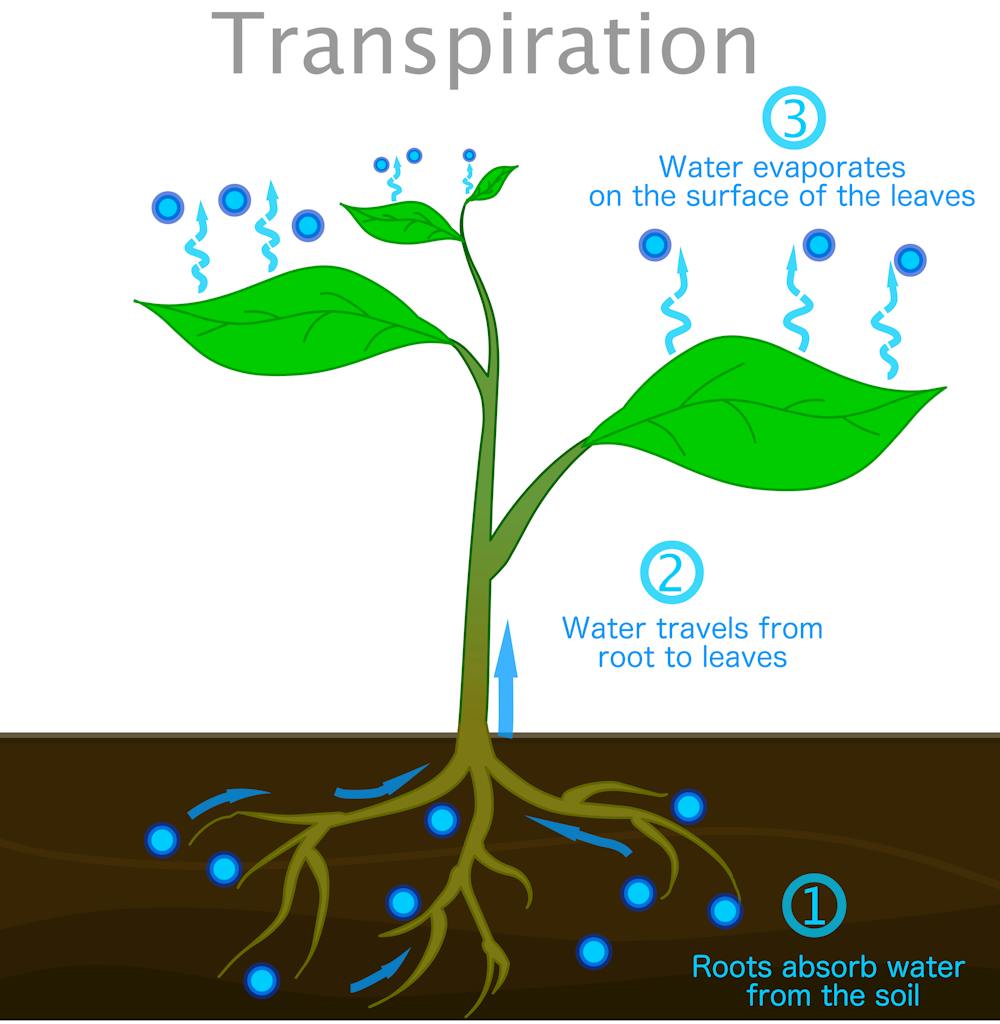
    Trees need to be able to access water in the soil to achieve transpiration.
    Tirachard Kumtanom/Shutterstock

    How trees keep us cool (and no, it’s not just about shade)

    Trees reduce urban temperatures in two significant ways. One is by the shade they provides and the other is through their cooling effect – and no, they’re not the same thing.

    Water is taken up via a plant’s roots, moves through the stems or trunks and is then misted into the air from the leaves through little holes called stomata. This is called transpiration, and it helps cool the air around leaves.

    Transpiration helps cools the air around a plant’s leaves.
    grayjay/Shutterstock

    Water can also evaporate from soil and other surfaces. The combined loss of water from plants and soil is called evapotranspiration.

    The cooling effects of evapotranspiration vary but are up to 4°C, depending on other environmental factors.

    Watering your trees

    If heatwaves occur in generally hot, dry weather, then trees will provide shade – but some may struggle with transpiration if the soil is too dry.

    This can reduce the cooling effect of trees. Keeping soil moist and plants irrigated, however, can change that.

    The best time to irrigate is early in the morning, as the water is less likely to evaporate quickly before transpiration can occur.

    You don’t need to do a deep water; most absorbing roots are close to the surface, so a bit of brief irrigation will often do the trick. You could also recycle water from your shower. Using mulch helps trap the water in the soil, giving the roots time to absorb it before it evaporates.

    All transpiring plants have a cooling effect on the air surrounding them, so you might wonder if trees have anything special to offer in terms of the urban heat island effect and heatwaves.

    Their great size means that they provide much larger areas of shade than other plants and if they are transpiring then there are greater cooling effects.

    The surface area of tree leaves, which is crucial to the evaporative cooling that takes place on their surfaces, is also much greater than many other plants.

    Another advantage is that trees can be very long lived. They provide shade, cooling and other benefits over a very long time and at relatively low cost.

    Not all trees

    All that said, I don’t want to overstate the role of urban trees in heatwaves when soils are dry.

    Some trees cease transpiring early as soils dry, but others will persist until they wilt.

    Careful tree selection can help maximise the cooling effects of the urban forest. Trees that suit the local soil and can cope with some drying while maintaining transpiration can provide greater cooling

    And, of course, it is important to follow any water restriction rules or guidelines that may be operating in your area at the time.

    Trees keep us cool

    Despite the clear benefits trees can provide in curbing heat, tree numbers and canopy cover are declining annually in many Australian cities and towns.

    Housing development still occurs without proper consideration of how trees and greenspace improve residents’ quality of life.

    It is not an either/or argument. With proper planning, you can have both new housing and good tree canopy cover.

    We should also be cautious of over-pruning urban trees.

    Trees help us when we help them.
    maxim ibragimov/Shutterstock

    Trees cannot eliminate the effects of a heatwave but can mitigate some of them.

    Anything that we can do to mitigate the urban heat island effect and keep our cities and towns cooler will reduce heat-related illness and associated medical costs.

    Gregory Moore is affiliated with Make Victoria Greener, which campaigns to preserve trees in Victoria.

    ref. To keep your cool in a heatwave, it may help to water your trees – https://theconversation.com/to-keep-your-cool-in-a-heatwave-it-may-help-to-water-your-trees-246486

    MIL OSI AnalysisEveningReport.nz

  • MIL-Evening Report: Returning home after a flood? Prioritise your health and take it one step at a time

    Source: The Conversation (Au and NZ) – By Kazi Mizanur Rahman, Associate Professor of Healthcare Innovations, Faculty of Health Sciences and Medicine, Bond University

    Parts of North Queensland have received almost two metres of rain since the weekend, causing flash and riverine flooding that claimed the lives of two women around Ingham.

    While some North Queensland residents are on alert for more flooding, others are returning home to assess the damage.

    This can be very confronting. You may have left in a rush when the evacuation order was issued, taking only a few valuables and necessary items, and maybe your pet. You may have been scared and unsure of what would happen.

    Coming back and seeing the damage to the place you lived in and loved can be painful. You might also be worried about the financial consequences.

    First, focus on safety

    Make sure it’s safe to return home. Check with your energy provider whether power has been restored in your area and, if so, whether it’s safe to turn the main switch back on. Do not use appliances that got wet, as electrical hazards can be deadly.

    Look for any structural damages to your property and any hazards such as asbestos exposure. Watch out for sharp objects, broken glass, or slippery areas.

    The hardest part is cleaning up. You will need to be patient, and prioritise your health and safety.

    What risks are involved with flood clean ups?

    Floodwater carries mud and bugs. It can also be contaminated with sewage.

    Contaminated flood water can cause gastroenteritis, skin infections, conjunctivitis, or ear, nose and throat infections.

    Mud can make you sick by transmitting germs through broken skin, causing nasty diseases such as the bacterial infection melioidosis.

    Your house may also have rodents, snakes, or insects that can bite. Rats can also carry diseases that contaminate water and enter your body through broken skin.

    Be careful about mould, as it can affect the air quality in your home and make asthma and allergies worse.

    Stagnant water in and around your home can become a place where mosquitoes breed and spread disease.

    How can you reduce these risks?

    When you first enter your flood-damaged home, open windows to let fresh air in. If you have breathing problems, wear a face mask to protect yourself from any possible air pollution resulting from the damage, and any mould due to your home being closed up.

    Cleaning your home is a long, frustrating and exhausting process. In this hot and humid weather, drink plenty of water and take frequent breaks. Identify any covered part of your home with sufficient ventilation which is high and dry, and where flood water did not enter. Use that as your resting space.

    While assessing and cleaning, wear protective clothing, boots and gloves. Covering your skin will reduce the chance of bites and infection.

    Wash your hands with soap and water as often as possible. And don’t forget to apply sunscreen and mosquito repellent.

    Throw away items that were soaked in floodwater. These could have germs that can make you ill.

    Empty your fridge and freezer because the food inside is no longer safe.

    If there is standing water, avoid touching it.

    When you can, empty outdoor containers with stagnant water to prevent mosquitoes breeding.

    Don’t overlook your mental health

    When cleaning up after a flood, you may feel sad, anxious, or stressed. It’s hard to see your home in this condition.

    But know you are not alone. Stay connected with others, talk to your friends and families, and accept support. If you feel too overwhelmed, seek help from mental health support services in your area or contact Lifeline on 13 11 14.

    On top of everything, be mindful about those who are vulnerable, such as older people and those with disabilities, as they may be more affected and find the clean up process harder.

    Recovering from a flood takes time. Focus on what needs to be fixed first and take it step by step.

    Kazi Mizanur Rahman does not work for, consult, own shares in or receive funding from any company or organisation that would benefit from this article, and has disclosed no relevant affiliations beyond their academic appointment.

    ref. Returning home after a flood? Prioritise your health and take it one step at a time – https://theconversation.com/returning-home-after-a-flood-prioritise-your-health-and-take-it-one-step-at-a-time-248902

    MIL OSI AnalysisEveningReport.nz

  • MIL-Evening Report: In freezing foreign aid, the US leaves people to die – and allows China to come to the rescue

    Source: The Conversation (Au and NZ) – By Melissa Conley Tyler, Honorary Fellow, Asia Institute, The University of Melbourne

    One of the executive orders US President Donald Trump signed the day he was inaugurated was a 90-day pause in US foreign development assistance.

    The US Agency for International Development, USAID, was ordered to halt funding. Programs worldwide were issued with stop-work orders.

    All of a sudden, more than US$60 billion (around A$95 billion) of programs for the world’s most vulnerable people just stopped.

    So what happened? The world became less fair, and US soft power fizzled.

    What’s happened so far?

    We know this decision will cause deaths.

    Stop-work orders were delivered to programs that provide AIDS medication to patients. If you stop this, people die.

    Charities, many of which work on a shoestring, had no choice but immediately to lay off staff.

    Food and vaccines already in warehouses couldn’t be distributed.

    Programs providing landmine clearing and counterterrorism training ceased.

    Belatedly, the US walked this back to some extent by saying life-saving humanitarian programs would be exempted.

    But it doesn’t appear to have slowed the pace of layoffs, partly because of confusion.

    With USAID staff now either sacked, placed on forced leave or told to stay home – and the agency’s website taken down – USAID is essentially no longer operational.

    Agents from Elon Musk’s Department of Government Efficiency have raided the offices of USAID and assumed control, with Musk posting on his X social network that “USAID is a criminal organization” and “it’s time for it to die”.

    Some of the people affected have gone public, including Australian organisations on behalf of their partners.

    But most in the sector can’t speak up if they hope for funding in the future. So the true extent of the impacts, including their knock-on effects, is likely much larger than has been publicly reported so far.

    A more unequal and unstable world

    With the halt in aid for the poorest, the world just became more unequal.

    Before this week, the US was the world’s largest aid donor.

    USAID was established by then-US president John F. Kennedy in 1961. Its programs focused on improving global health, alleviating poverty and providing emergency relief in response to natural disasters or conflict, as well as enhancing education and strengthening democratic institutions abroad.

    The countries that were receiving the most USAID assistance in 2023 were Ukraine, Ethiopia, Jordan, Afghanistan and Somalia.

    In the Indo-Pacific, the Lowy Institute’s aid maps show that the Pacific received US$249 million (about A$470 million) and SouthEast Asia received US$1 billion (almost A$1.6 billion) in US overseas development assistance annually in the most recent data.

    This funded 2,352 projects, including peacebuilding in Papua New Guinea, malaria control in Myanmar, early childhood development in Laos, and programs to improve the education, food security and health of school-age children across the region.

    All of these programs are now being reviewed to ensure they are “fully aligned with the foreign policy of the President of the United States”.

    Based on the first Trump administration, there seems no chance that programs on climate, gender equality, abortion and equity inclusion will be reinstated after the 90-day assessment period. Losing funds for climate adaptation and mitigation is a huge issue for the Pacific Islands.

    Assistance for survivors of gender-based violence, employment for people with disabilities and support for LGBTQIA+ youth will likely lose funding.

    In communities that received significant USAID funding, the sudden cut in programs and loss of community organisations will damage the fabric of society.

    An unequal world is a less stable one. Australia’s peak body for the non-government aid sector, the Australian Council for International Development, says the suspension of USAID programs “will work against efforts to build peace, safety, and economic stability for the world”.

    A power that’s no longer super

    Thinking of the impact on the US interests, there has been an enormous hit to US soft power from an entire pillar of US foreign policy suddenly disappearing.

    This is underlined by the fact the cuts apply equally to ally, partner and adversary nations alike.

    In the Pacific, the Biden Administration made a real effort to increase US presence, opening embassies and announcing USAID programs.

    All of this has now been squandered by withdrawing from this space. I am aware of a project for which China has come in to provide funding where US funding has gone. It is a spectacular setback for the US.

    What is most extraordinary is that this is self-inflicted damage. There were alternatives, such as continuing business as usual during a 90-day period of review, then giving notice to some programs that they would be discontinued.

    The performative and haphazard way in which the policy has been implemented suggests an administration that doesn’t care much about the world outside its borders and is more concerned about ideological battles within.

    Researcher Cameron Hill describes Trump as linking foreign aid “to the symbols and slogans of his domestic political coalition”. This is likely to continue beyond the demise of USAID to other agencies involved in foreign assistance, such as development finance.

    Australia needs to help fill the gap

    What does this mean for Australia? As a middle power, it has an opportunity to step up – and work with other development partners such as Japan, Korea, India, Indonesia, Canada and European donors in the face of a genuine emergency.

    For the Australian government this might mean an emergency increase in development funding or freeing up existing funding to keep the lights on.

    Australia will undoubtedly now need to step up on climate programs in the Pacific if US funding doesn’t return. Australia could seek to convene an urgent meeting through the Pacific Islands Forum to discuss.

    The first fortnight of the Trump administration has had global impact well beyond US politics. On the most important issue for the majority of the world – development – the US decided to withdraw, destroying in a few days what have taken decades to build.

    Melissa Conley Tyler is Executive Director at the Asia-Pacific Development, Diplomacy & Defence Dialogue (AP4D), an initiative funded by the foreign affairs and defence portfolios and hosted by the Australian Council for International Development.

    ref. In freezing foreign aid, the US leaves people to die – and allows China to come to the rescue – https://theconversation.com/in-freezing-foreign-aid-the-us-leaves-people-to-die-and-allows-china-to-come-to-the-rescue-249024

    MIL OSI AnalysisEveningReport.nz

  • MIL-Evening Report: Beyoncé is right – music genres can force artists into conformity. But ditching them isn’t an option

    Source: The Conversation (Au and NZ) – By Timothy McKenry, Professor of Music, Australian Catholic University

    Beyoncé appeared visibly astonished to hear her album Cowboy Carter had won best country album at this year’s Grammy Awards. Onstage, the singer offered a heartfelt reflection on musical genre:

    I think sometimes genre is a code word to keep us in our place as artists and I just want to encourage people to do what they’re passionate about and stay persistent.

    Beyoncé’s speech built on a more pointed critique of genre found in one of the tracks from her album, SPAGHETTII.

    The track opens with a soundbite from Linda Martell, a pioneering Black country music singer who enjoyed commercial success in the 1960s, but whose career was marred by both overt racial abuse and accusations she didn’t “sound black”. In the soundbite, Martell says:

    Genres are a funny little concept, aren’t they? […] In theory, they have a simple definition that’s easy to understand, but in practice, well, some may feel confined.

    This description of confinement was echoed in 2024, when the Country Music Association Awards controversially excluded Cowboy Carter from the nomination process due to insufficient radio airplay, as per the award rules.

    Media reports claimed some country radio stations refused to play, or were slow to play, Beyoncé’s new album because they didn’t recognise her as a country artist.

    Debates about the usefulness of genre have been around for a while, and won’t disappear anytime soon. Beyoncé’s Grammy win presses us to consider the relevance of genre in the modern music world – and the extent to which these rigid definitions can be justified.

    Is ‘genre’ useful in music?

    On one level, genre is a simple and necessary mechanism for categorising different types of music. Genre encodes various aspects of music, including instrumentation, the time period it originates from, its emotional character, and the melodic, rhythmic and harmonic conventions it employs.

    Terms such as jazz, rock, country, R&B, metal, hip-hop, folk and EDM are rich in meaning, and are routinely used as identity markers for performers – and for award categories at events like the Grammys. They also help us discuss our musical preferences, and teach and learn about music in educational settings.

    At the same time, these terms remain fluid and contested. Research tracking the rise and fall of musical genres highlights the power genres have in shaping our understanding and experience of music.

    Consider rock as an example. In the early 1950s, radio disc jockeys popularised the term rock’n’roll to describe a distinct style that drew from genres including rhythm and blues, gospel and country music, but which differed from each of these in character and function.

    The societal adoption of rock’n’roll as a “new” genre wasn’t just driven by the features present in the music, but by its resonance with a teenage audience for whom it signalled rebellion, associations with sexuality and a merging of different American music cultures.

    Just as Elvis Presley came to embody the genre, divergent practices gave rise to new and adapted terminology. “Rockabilly” (a style that combines elements of country and rock’n’roll) entered the lexicon. Rock’n’roll simply became “rock” and numerous adjectives such as “folk”, “psychedelic”, “progressive”, “punk”, “classic” and “hard” were attached to make sense of the continually evolving style.

    I’d argue the music of Elvis Presley has little in common with the stoner rock band Kyuss, yet we group them in the same broad musical taxonomy.

    Research has revealed significant inconsistencies in how people use and understand music genre terminology. Nonetheless, genre labels have historically been considered useful tools to communicate meaningful information about musical experiences.

    So, what’s Beyoncé’s problem with genre?

    Problems can arise for musicians when genres don’t simply describe musical practices, but work to control or distort them. Record labels have a profit imperative that incentivises artists to create music that’s easily categorised into well-established genres.

    The risk this incentive poses to creativity has traditionally been offset by audiences demanding new and diverse music – alongside a flourishing independent musical culture that either ignores or is overtly antagonistic towards the generic preferences of large record labels.

    That said, musicians are also pushed to adhere to narrow definitions of genre due to search functions in streaming services and methodologies used by music charts.

    For example, the ARIA (Australian Recording Industry Association) charts’ code of practice lists six genre charts: core classical, country, crossover/classical, dance, hip hop/R&B, and jazz and blues. And while the ARIAs have a range of mechanisms to track record sales, the codification of these genres inevitably influences Australian musicians who wish to make a living from their music.

    Beyond this, powerful cultural associations with certain genres can make their boundaries difficult to cross. Sometimes genre boundaries are rightly inflexible – particularly those associated with regional music-making or First Peoples’ cultures.

    Cowboy Carter however, represents a rediscovery and celebration of Black country musicians. It draws attention to how these musicians were neglected because they didn’t align with prevailing assumptions about the genre.

    The fact that Beyoncé’s choice to explore country music was in any way contentious emphasises this point. The foray by The Beatles’ drummer Ringo Starr into country music was, by contrast, uncontroversial.

    Genre as a framework is, ultimately, necessary. It’s impossible to discuss music without some way of making sense of it all. Listeners, however, should recognise that rigid genre definition can distort creativity. They should also reflect on whether it may be distorting their listening habits, too.

    Timothy McKenry does not work for, consult, own shares in or receive funding from any company or organisation that would benefit from this article, and has disclosed no relevant affiliations beyond their academic appointment.

    ref. Beyoncé is right – music genres can force artists into conformity. But ditching them isn’t an option – https://theconversation.com/beyonce-is-right-music-genres-can-force-artists-into-conformity-but-ditching-them-isnt-an-option-249016

    MIL OSI AnalysisEveningReport.nz

  • MIL-Evening Report: Bold statement, or a product of misogyny? What Bianca Censori’s ‘naked dress’ says about fashion on the red carpet

    Source: The Conversation (Au and NZ) – By Harriette Richards, Senior Lecturer, School of Fashion and Textiles, RMIT University

    Despite the many musical achievements celebrated at this year’s Grammy Awards, it was Bianca Censori’s red carpet appearance that won the award for most headlines.

    Walking the red carpet with her husband Ye (Kanye West), nominated for best rap song, Censori first appeared wrapped in an oversized black fur coat. As the couple stood to be photographed, she dropped the coat to reveal her outfit: a transparent mini dress with no underwear.

    In contrast to Ye, dressed head to toe in black, Censori’s nudity was shocking – yet somewhat unsurprising. Censori has become well known for her revealing outfits.

    In September 2023, Censori was photographed in Florence wearing sheer stockings and clutching a purple throw pillow to her chest in lieu of a top. Later that year, she was spotted in Miami wearing a skimpy metal mesh bikini and hugging onto a large fluffy cat soft toy. In 2024 she was seen in Los Angeles in a clear raincoat with nothing underneath and at a dinner in Italy wearing a sheer poncho, again with nothing underneath.

    And so-called “naked dresses”, like the one Censori wore to the Grammys, have pushed the boundaries of red carpet attire since 1974, when Cher famously wore a barely-there Bob Mackie gown to the Met Gala.

    Changing winds of fashion

    Since then, many models and actresses have embraced revealing clothing choices. Rose McGowan famously attended the MTV Video Music Awards with Marilyn Manson in 1998 wearing a chain mail dress by designer Maja Hanson that bared all.

    In 2014, Rihanna wore a daring sparkling gown at the CFDA Awards encrusted with 230,000 Swarovski crystals.

    At the 2017 Met Gala, both Kendall Jenner and Bella Hadid wore transparent garments, Jenner in a La Perla slip and Hadid in a glittering Alexander Wang catsuit.

    In 2022, when Florence Pugh wore a magnificent pink dress at a Valentino couture show in Rome, she garnered international attention for the way the outfit revealed her nipples.

    For many commentators, these sheer, transparent or minimal garments have been bold fashion statements. They have also prompted conversations about misogyny and the policing of women’s bodies.

    Some previous instances of naked dressing have been cause for celebration. They seem to have symbolised a feminist victory, indicating the power of women to take control of their appearance and their bodies. This has perhaps been why they have remained so popular.

    However, as Donald Trump begins his second term as president with a new agenda for discriminatory gender politics, the trend now seems to be falling out of favour. Indeed, directly contrasting Censori’s look, the big names at Sunday’s event were wearing gowns that were all about design – not exposure.

    Charli XCX wore a voluminous grey corseted dress straight from the Jean Paul Gaultier Spring/Summer 2025 couture show by Ludovic de Saint Sernin. Sabrina Carpenter lent into old Hollywood glamour in a custom baby blue, low backed gown by JW Anderson. And Beyoncé wore a custom glittering gold Schiaparelli gown and opera gloves designed by Daniel Roseberry.

    Far from the positive responses some recent examples of naked dressing have garnered, commentary about Ye and Censori’s stunt – apparently an attempt to replicate Ye’s Vultures I album cover – bristled with concern, pity and accusations of abuse.

    But is it art?

    In large part, this response is because Censori has no voice. She does not give interviews or speak to the media. Her only form of communication is her body. That she frequently appears like a deer in headlights, her eyes wide and empty, provokes assumptions about her lack of autonomy in the choice to wear such daring outfits.

    Ye’s reputation for controlling behaviour merely exacerbates these assumptions.

    Some have argued the outfits Censori wears are a form of “performance art”. Whether or not she is complicit in their choreographed production is a source of much speculation.

    Regardless of who orchestrates these stunts or what their purpose is (beyond mere attention seeking), they are undoubtedly gendered. It is Censori’s body on display; Ye’s body remains concealed beneath layers of oversized black garments.

    They also call into question the very purpose of clothes as a practical protective layer between a vulnerable body and the world.

    It must be remembered that Censori was not wearing nothing. She was wearing a dress that exposed everything. But protective layer it was not. She eschewed protection – from the elements and the gaze of the world – in favour of risk, revelation and shock.

    For a pair who have capitalised on the attention received by wearing outlandishly revealing outfits, this new iteration seems to be a logical conclusion. But where does Censori go from here? There is nothing more to reveal.

    Harriette Richards does not work for, consult, own shares in or receive funding from any company or organisation that would benefit from this article, and has disclosed no relevant affiliations beyond their academic appointment.

    ref. Bold statement, or a product of misogyny? What Bianca Censori’s ‘naked dress’ says about fashion on the red carpet – https://theconversation.com/bold-statement-or-a-product-of-misogyny-what-bianca-censoris-naked-dress-says-about-fashion-on-the-red-carpet-249001

    MIL OSI AnalysisEveningReport.nz

  • MIL-Evening Report: Milo Hartill’s Black, Fat and F**gy is rough around the edges – and all the more beautiful for it

    Source: The Conversation (Au and NZ) – By Jonathan Graffam-O’Meara, PhD Candidate in Theatre, Monash University

    Matto Lucas/UMAC/Midsumma

    Milo Hartill is “Black, fat and f**gy”, according to the title of her new cabaret work.

    Actor, model, influencer and one helluva singer, 24-year-old Hartill shines. Black, Fat and F**gy is an autobiographical show, tracing defining moments of Hartill’s life as a Black, fat and queer person who grew up in Western Australia and now works in show biz.

    Centred in its name, the performance wades through aspects of her intersectional identity. This itself serves as a loose structure for the production: Blackness to fatness to queerness, with clear overlaps.

    The unapologetic self

    Hartill leans into stereotypes and tropes so hard she ultimately upends them.

    An early moment has her teasing an audience member – importantly, a white audience member – with an invitation to touch her hair. It’s a stunning moment within the work as it plays out, an image potentially loaded with racism interjected into performance with subversive, tongue-in-cheek humour and support for the chosen audience member.

    It leads immediately into a rendition of Solange’s Don’t Touch My Hair. Other featured songs include Chaka Khan’s I’m Every Woman, Frank Sinatra’s Something Stupid (performed with puppetry) and Whitney Houston’s I Have Nothing, with notable changes to the lyrics to fit the themes and tone of the show.

    Hartill is supported onstage by Lucy O’Brien on piano, who regularly chimes in with commentary and humour. The duo share a strong bond, their rapport is apparent and endearing. Within the first minute of the show we are eating from the palm of their hands.

    The duo read out examples of real, fat-phobic hate mail sent to Hartill’s social media inboxes.

    As an artist and researcher in fat-centred performance, for me, this is one of the more interesting moments in the show. It unapologetically adopts a didactic mode of delivery, revealing to audiences the kinds of despicable, violent language directed at fat people.

    Black, Fat and F**gy is an entirely unique, memorable and vital performance work.
    Matto Lucas/UMAC/Midsumma

    Theatre audiences (and makers, especially) tend to despise these kinds of didactic moments, especially pertaining to identity politics, as it marks a shift from “showing” (with metaphor) to “telling” in its messaging.

    But how else can performance give contextual significance to something without this kind of direct telling, especially when most audiences will not have an embodied experience of fatness to draw on and make inferences?

    Unless you have directly seen or heard the unrelenting, unmitigated hate speech directed at fat bodies, it is difficult to capture or convey. The “unique” aspect of this language, laid bare by Hartill in performance, is that it is delivered with a sense of righteousness: that this person is in a way helping the fat person by shaming them.

    Moments like this serve a vital function in how performance can, broadly, capture both actual experiences and associated feelings related to a topic, while aiming to impart some new knowledge or finding for its audience to take away, to sit with, to talk about and maybe go on to learn more on.

    A beautiful mixed bag

    This didactic mode of delivery is only fleeting within the show. Adopting a cabaret-style delivery (but with standard theatre seated rows), Black, Fat and F**gy weaves together aspects of musical theatre (songs), stand-up (humour) and drag performance (aesthetic): it is a queerly hybrid form.

    The show is rough around the edges. The performance allows for a high level of improvisation and audience engagement, which can lead to stalled moments and interruptions of laughter. Performance scholar T.L. Cowan writes the improvisatory nature of cabaret informs a “cabaret consciousness” that “allows an audience to enjoy a show not in spite of the mixed-bag-ness of cabaret, but because of it”.

    The mixed-bag-ness of Black, Fat and F**gy is its charm, and Hartill complements this style with a mixed-bag delivery of tricks from her deep repertoire of skills.

    The show weaves together songs, stand-up and drag: it is a queerly hybrid form.
    Matto Lucas/UMAC/Midsumma

    Black, Fat and F**gy is an entirely unique, memorable and vital performance work you should move to the top of your list of must-see Midsumma events. The production is a 70-minute-plus romp which will leave you crying, both from laughter and by acknowledging the current climate against Black, fat f*gs everywhere.

    Black Fat and F**gy is at the Guild Theatre, University of Melbourne, for Midsumma Festival until February 6.

    Jonathan Graffam-O’Meara does not work for, consult, own shares in or receive funding from any company or organisation that would benefit from this article, and has disclosed no relevant affiliations beyond their academic appointment.

    ref. Milo Hartill’s Black, Fat and F**gy is rough around the edges – and all the more beautiful for it – https://theconversation.com/milo-hartills-black-fat-and-f-gy-is-rough-around-the-edges-and-all-the-more-beautiful-for-it-248998

    MIL OSI AnalysisEveningReport.nz

  • MIL-Evening Report: Watching the doom loop: Sydney Festival artists witness climate change, and imagine our post-apocalyptic future

    Source: The Conversation (Au and NZ) – By Blake Lawrence, PhD Candidate (Design) and Performance Artist, University of Technology Sydney

    Re-Stor(y)ing Oceania. Giacomo Cosua/Sydney Festival

    The first weeks of 2025 have seen catastrophic wildfires locally and internationally, record global ocean temperatures, and unprecedented coral bleaching events.

    Trump has signed executive orders to exit from the Paris Agreement, and locally, the Coalition continues its decades-long campaign of climate denial

    Species fall swiftly and silently to extinction. The language of bird-song collapses. For many peoples, and for many species, apocalypse is past tense.

    For climate risk researchers Laurie Laybourn and James Dyke, politics illustrates a doom loop, a political diving-towards apocalypse.

    Artists in this year’s Sydney Festival imagine exit strategies from this doom loop – and dream of taking root in its post-apocalyptic rubble.

    Anito

    Phasmahammer is the alter-ego and ongoing creative project of artist Justin Talplacido Shoulder. Anito is the latest in a series of their theatre-scale works that blend live performance with mythology, story-telling, costume and ceremony.

    We begin in the cavernous Carriageworks foyer with a living miniature fig tree.

    Damun (as it is known in the Gadigal language), Ficus rubingosa (Latin), the Port Jackson fig, is known for establishing itself insurgently in the pavements and gutters of the city’s colonial (apocalyptic) architecture.

    Here, the bonsai sits like a welcome party, stifled and vibrant in its little pot.

    In an introductory speech, Shoulder’s collaborator Matthew Stegh acknowledges the city of Sydney as “a theatre and a prison” – tripling in reference to both the experience of producing theatre for institutions, and the stunted experience of our little fig.

    Anito blends live performance with mythology, story-telling, costume and ceremony.
    Sarah Walker/Sydney Festival

    He pays homage to the ecological and cosmological traditions of Gadigal Country, and to the ancestral Philippines of Shoulder. In the next breath Stegh shifts his homage to Sydney’s histories of queer and counter-cultural performance, to sex workers, strippers, clowns, club kids and drag queens.

    He offers reflections on apocalypse and ruin, referring to the “cultish suicide pact” of white supremacy, capitalism, imperialism and colonialism – to doom loops.

    We are led into the auditorium, where Shoulder and fellow performer Eugene Choi animate a series of hallucinatory images.

    Using their bodies, costume pieces, puppetry and inflatable set design, they work with immaculate sound (Corin Ileto) and lighting (Fausto Brusamolino).

    A ghostly hologram of the buttress of a great tree fills the stage. Metallic roots writhe at its foundation. Shoulder and Choi emerge, and from there, eruptions: the first man and woman, a pair of thunder-lizards, bickering, a quadruped. A scale-bending colonial ghost smothered in lace searches tragically for something among planetary ruins. A stony reef of polyps and anemones blooms and dances. A single clap by three pairs of hands. The Big Bang.

    It is often hard to discern exactly how the images are performed. They are both magic and bewildering.
    Liz Ham/Sydney Festival

    By design, it is often hard to discern exactly how these images are performed. They are both magic and bewildering.

    For philosopher Ben Ware, thinking about the horizon of the extinction of all biological life on Earth poses a paradoxical opportunity. The only thing that can thwart the end of this world – “a world of converging and multiplying catastrophes” – is the recognition that the politics of this time have one outcome: “the slow unravelling of intimately entangled forms of life”.

    The fantasy theatre of Anito makes those intimate entanglements visual. We must begin from understanding that the way the world is organised produces its own end.

    Like Shoulder, artist communities of the Pacific know this intimately.

    Re-Stor(y)ing Oceania

    Re-Stor(y)ing Oceania is an exhibition led by artists of the South Pacific Ocean.

    Originally conceived for the Venice Biennale, and curated by Taloi Havini, the exhibition comprises two commissions by Elisapeta Hinemoa Heta and Latai Taumoepeau.

    This is a space for conversation, performance, song and activism.
    Giacomo Cosua/Sydney Festival

    The rooms of a freshly-renovated Artspace in Woolloomooloo are transformed by Heta’s architectural interventions. In one, a mass of bricks creates an altar-like structure, on which bowls of coconut milk sit in concentric circles. In another, pavers form a platform for a circle of seats. They function as stages or gathering places for conversation, performance, song and activism.

    Within these happenings, Havini and her artists speak to the narrative and politics that have produced and compounded catastrophe in the South Pacific.

    Taumoepeau’s interactive installation Deep Communion sung in minor (ArchipelaGO, THIS IS NOT A DRILL) requires visitors to row on standing-paddle-board-like treadmills, which activate immersive songs sung by Taumoepeau and her collaborators.

    The physical exacerbation and the ecological trauma on the screens coalesce in our bodies.
    Giacomo Cosua/Sydney Festival

    In conversation with Heta’s installation, these songs rise and fall, the edges of the artworks and activations become blurry. Visitors paddle towards projections visualising the rubble of marine-ecological wastelands produced by regional deep-sea extraction.

    The physical exacerbation and the ecological trauma on the screens coalesce in our bodies. To drop the oar enacts the fading of the song from the speakers. We are left with reflections of the connections between bodies and calamity, and the labour of working towards futures beyond ruin.

    Plant a Promise

    Henrietta Baird’s Plant a Promise, like Anito and Re-Stor(y)ing Oceania, is a performance with blurry edges. Its roots spread out of Bangarra’s Studio Theatre to incorporate installation, in-situ yarns (storytelling and conversation) and tree-planting projects across the city.

    Inside the theatre, three contemporary dancers animate recorded stories of Indigenous experiences of bushfires beside frustrations with the surrounding political footballing. The sentiment is clear: less talk, more action.

    Plant a Promise beckons audiences into attentiveness to the lives of trees, fire and people.
    Stephen Wilson Barker/Sydney Festival

    At its finale, audience members are invited to the stage to collaborate in the transformation of the set. We are led to take handfuls of verdant eucalyptus and acacia leaves and implant them into large woven columns that have functioned theatrically as abstracted tree-forms. The stage is transformed into a forest of our making together.

    Through its many stories, Plant a Promise beckons audiences into attentiveness to the lives of trees, fire and people.

    In the shadows of catastrophe, the roots of Indigenous knowledge systems and environmental science cross-pollinate to share and enact care for Country.

    The stage is transformed into a forest of our making together.
    Stephen Wilson Barker/Sydney Festival

    Generously, we receive a gift as we exit the theatre. The exchange of a native sapling invites us into casual conversation – into reflections on Country, and how we might, all of us, commit to it.

    Again, we begin, from the recognition of an end. More rubble. More roots.

    Putricia

    At the time of writing, Sydneysiders are enamoured with the life of another plant, gathered around livestreams and making excited trips to the city’s Botanic Gardens.

    Putricia, the resident titan arum, or corpse flower (Amorphophallus titanium), has thrown her immense flower spike into the air. She has commenced her slow strip-tease after a week of tantalising her admirers.

    In a few weeks we have become attentive to her story of life and renewal. She will likely have bloomed, wilted and returned to the soil before this text goes live.

    Performances like Putricia’s blooming, Anito, Re-Stor(y)ing Oceania and Plant a Promise offer new vantage points from which to understand ourselves in relation to the natural world, and to glimpse myriad alternatives to what feels like a diving towards our own demise.

    Performances of aliveness beside and within the ecologies we inhabit move us beyond what Ben Ware sees as a naïve sense of “hope”. Instead, these stories make material, make cultural, make real, the impossible task of imagining what comes next.

    Amid the smell of rotting corpses, the pillowy puppetry of a theatrical coral spawning event, the planting of a forest or the singing of invocations for the protection of the planet’s oceans, we might yet find ourselves. This is not a drill.

    Blake Lawrence does not work for, consult, own shares in or receive funding from any company or organisation that would benefit from this article, and has disclosed no relevant affiliations beyond their academic appointment.

    ref. Watching the doom loop: Sydney Festival artists witness climate change, and imagine our post-apocalyptic future – https://theconversation.com/watching-the-doom-loop-sydney-festival-artists-witness-climate-change-and-imagine-our-post-apocalyptic-future-249017

    MIL OSI AnalysisEveningReport.nz

  • MIL-Evening Report: Some vegetables are pretty low in fibre. So which veggies are high-fibre heroes?

    Source: The Conversation (Au and NZ) – By Lauren Ball, Professor of Community Health and Wellbeing, The University of Queensland

    Valentina_G/Shutterstock

    Many people looking to improve their health try to boost fibre intake by eating more vegetables.

    But while all veggies offer health benefits, not all are particularly high in fibre. You can eat loads of salads and vegetables and still fall short of your recommended daily fibre intake.

    So, which vegetables pack the biggest fibre punch? Here’s what you need to know.

    What is fibre and how much am I supposed to be getting?

    Fibre, or dietary fibre, refers to the parts of plant foods that our bodies cannot digest or absorb.

    It passes mostly unchanged through our stomach and intestines, then gets removed from the body through our stool.

    There are two types of fibre which have different functions and health benefits: soluble and insoluble.

    Soluble fibre dissolves in water and can help lower blood cholesterol levels. Food sources include fruit, vegetables and legumes.

    Insoluble fibre adds bulk to the stool which helps move food through the bowels. Food sources include nuts, seeds and wholegrains.

    Both types are beneficial.

    Australia’s healthy eating guidelines recommend women consume 25 grams of fibre a day and men consume 30 grams a day.

    However, research shows most people do not eat enough fibre. Most adults get about 21 grams a day.

    4 big reasons to increase fibre

    Boosting fibre intake is a manageable and effective way to improve your overall health.

    Making small changes to eat more fibrous vegetables can lead to:

    1. Better digestion

    Fibre helps maintain regular bowel movements and can alleviate constipation.

    2. Better heart health

    Increasing soluble fibre (by eating foods such as fruit and vegetables) can help lower cholesterol levels, which can reduce your risk of heart disease.

    3. Weight management

    High-fibre foods are filling, which can help people feel fuller for longer and prevent overeating.

    4. Reducing diabetes risk and boosting wellbeing

    Fibre-rich diets are linked to a reduced risk of chronic conditions such as type 2 diabetes and colorectal cancer.

    Recent research published in prestigious medical journal The Lancet provided some eye-opening stats on why fibre matters.

    The researchers, who combined evidence from clinical trials, found people who ate 25–29 grams of fibre per day had a 15–30% lower risk of life-threatening conditions like heart disease, stroke, high blood pressure, and type 2 diabetes compared to those who consumed fewer than 15 grams of fibre per day.

    Getting plenty of fibre can help us as we age.
    Iryna Inshyna/Shutterstock

    So which vegetables are highest in fibre?

    Vegetables are excellent sources of both soluble and insoluble fibre, along with essential vitamins, minerals, and antioxidants.

    The following veggies are some of the highest in fibre:

    • green peas
    • avocado
    • artichokes
    • parsnips
    • brussels sprouts
    • kale
    • sweet potatoes
    • beetroot
    • carrots
    • broccoli
    • pumpkin

    Which vegetables are low in fibre?

    Comparatively lower fibre veggies include:

    • asparagus
    • spinach (raw)
    • cauliflower
    • mushrooms
    • capsicum
    • tomato
    • lettuce
    • cucumber

    These vegetables have lots of health benefits. But if meeting a fibre goal is your aim then don’t forget to complement these veggies with other higher-fibre ones, too.

    Vegetables are excellent sources of both soluble and insoluble fibre – but some have more fibre than others.
    anna.q/Shutterstock

    Does it matter how I prepare or cook the vegetables?

    Yes.

    The way we prepare vegetables can impact their fibre content, as cooking can cause structural changes in the dietary fibre components.

    Some research has shown pressure cooking reduces fibre levels more greatly than roasting or microwave cooking.

    For optimal health, it’s important to include a mix of both cooked and raw vegetables in your diet.

    It’s worth noting that juicing removes most of the fibre from vegetables, leaving mostly sugars and water.

    For improved fibre intake, it’s better to eat whole vegetables rather than relying on juices.

    What about other, non-vegetable sources of fibre?

    To meet your fibre recommendations each day, you can chose from a variety of fibre-rich foods (not only vegetables) including:

    • legumes and pulses (such as kidney beans and chickpeas)
    • wholegrain flour and bread
    • fruits
    • wholegrains (such oats, brown rice, quinoa, barley)
    • nuts and seeds (such as flaxseeds and chia seeds)

    A fibre-rich day that meets a recommended 30 grams would include:

    • breakfast: 1⁄2 cup of rolled oats with milk and 1⁄2 cup of berries = about 6 grams of fibre
    • snack: one banana = about 2 grams
    • lunch: two cups of salad vegetables, 1⁄2 cup of four-bean mix, and canned tuna = about 9 grams
    • snack: 30 grams of almonds = about 3 grams
    • dinner: 1.5 cups of stir-fried vegetables with tofu or chicken, one cup of cooked brown rice = about 10 grams
    • supper: 1⁄2 a punnet of strawberries with some yoghurt = about 3 grams.

    Bringing it all together

    Vegetables are a key part of a healthy, balanced diet, packed with fibre that supports digestion, blood glucose control, weight management, and reduces risk of chronic disease.

    However, the nutritional value of them can vary depending on the type and the cooking method used.

    By understanding the fibre content in different veggies and how preparation methods affect it, we can make informed dietary choices to improve our overall health.

    Lauren Ball receives funding from the National Health and Medical Research Council, Queensland Health and Mater Misericordia. She is a Director of Dietitians Australia, a Director of Food Standards Australia and New Zealand, a Director of the Darling Downs and West Moreton Primary Health Network and an Associate Member of the Australian Academy of Health and Medical Sciences.

    Emily Burch does not work for, consult, own shares in or receive funding from any company or organisation that would benefit from this article, and has disclosed no relevant affiliations beyond their academic appointment.

    ref. Some vegetables are pretty low in fibre. So which veggies are high-fibre heroes? – https://theconversation.com/some-vegetables-are-pretty-low-in-fibre-so-which-veggies-are-high-fibre-heroes-246238

    MIL OSI AnalysisEveningReport.nz

  • MIL-Evening Report: It’s the most American of sports, so why is the NFL looking to Melbourne for international games?

    Source: The Conversation (Au and NZ) – By Tim Harcourt, Industry Professor and Chief Economist, University of Technology Sydney

    Melbourne’s status as the sporting capital of Australia is well-established: the Victorian city hosts annual events such as the Australian Open tennis tournament, the Formula 1 Grand Prix, Melbourne Cup horseracing carnival, Boxing Day cricket Test and more.

    Now the United States’ National Football League (NFL) is set to join the party.

    In May last year, the NFL earmarked Australia as a future host for an international game.

    Now it has been reported the NFL is set to lock-in three regular season games in Melbourne at the MCG, starting in October 2026, just after the Australian Football League (AFL) Grand Final.

    The teams set to feature in the first game are 2022 Super Bowl winners the Los Angeles Rams and the Philadelphia Eagles. The Eagles will play in next week’s Super Bowl and feature an Australian, Jordan Mailata, on their team.

    The Rams and the Eagles both have international marketing rights to Australia – giving the clubs an opportunity to build brand awareness and fandom beyond the US through fan engagement, events and commercial opportunities.

    What’s in it for Victoria?

    The NFL contests would pour millions of dollars into the Victorian economy; each team would travel with hundreds of staff, while thousands of fans would likely travel from interstate and overseas.

    The Victorian government has not revealed any revenue estimates but last year’s Super Bowl week in Las Vegas generated more than $US1 billion ($A1.61 billion) in economic impact.

    Given the NFL’s love of razzmatazz, it would likely host a week-long procession of activities and fan zones across the city before almost certainly filling the MCG with 100,000 spectators.

    However, the choice of the MCG as a venue was not without controversy.

    The MCG boasts the biggest capacity of any stadium in Australia, but it is an oval shape, not rectangular, which makes the viewing experience more difficult when it hosts sports such as soccer, rugby – or NFL.

    Critics have suggested Accor Stadium in Sydney’s west or Suncorp Stadium in Brisbane (both rectangular venues) would be better for these games.

    What’s in it for the NFL?

    The NFL has broadened its international presence during the past decade or so, and now hosts eight games internationally each season.

    But why did NFL decide on Australia to join the likes of England, Germany, Spain, Brazil and Mexico?

    It chose places with strong sports consumer marketplaces, where streaming is popular and destinations where US fans are likely to travel to.

    Australia, while not as popular as in the days of Paul Hogan, is still a popular destination for many Americans, especially those who like sports.

    American football is far from a dominant sports code in Australia but is still a significant global market for the NFL, with an estimated fan base of more than six million supporters across the country.

    But principally, it’s about the money.

    The NFL’s media broadcast deal is one of, if not the, most lucrative in world sports: the TV and streaming media rights are said to be worth more than $US100 billion ($A161 billion).

    Analysts estimate the NFL’s international games will collectively add $US1 billion ($A1.61 billion) to the league’s TV rights.

    This has helped the NFL build a huge global audience, which Commissioner Roger Goodell has said is a key strategy:

    The media platforms are essential – we want to reach the most people we can through our media partners, because that’s how most people experience football. But when we bring games (to international markets), it is […] the spark that lights the flame. Playing the games is a big part of making our game global.

    The NFL is also looking to Australia for future athletic talent.

    In recent years, NFL and college football teams have regularly recruited Australian athletes as punters (specialist kickers), who grew up kicking balls and can transfer their skills to the American game.

    The NFL also recently set up a talent academy on the Gold Coast to encourage talented youngsters from Australia, New Zealand and the Pacific to pursue their NFL dream.

    What fans can expect

    Melbourne is not Las Vegas, but even so, if confirmed, the games will deliver some old-fashioned American showbiz to the state.

    The MCG will likely be packed with fans (both hardcore and casual) for the contest, and of course the sport’s famous half-time shows.

    And then there’s the athletic brilliance of the players: the game is considered by some to be as intellectual as chess but with enormous physical prowess required. The chance to see these massive athletes up close will no doubt be a huge drawcard.

    NFL fans in Australia – and very likely New Zealand, the Pacific and even further abroad – will no doubt be waiting with bated breath for the league to confirm the games, and then try to find a way to secure sought-after tickets.

    Tim Harcourt supports both the Green Bay Packers to keep his Wisconsin in laws happy and the Minnesota Vikings as he once lived in Minneapolis.

    ref. It’s the most American of sports, so why is the NFL looking to Melbourne for international games? – https://theconversation.com/its-the-most-american-of-sports-so-why-is-the-nfl-looking-to-melbourne-for-international-games-248870

    MIL OSI AnalysisEveningReport.nz

  • MIL-Evening Report: Rare, almost mythical Australian tree kangaroos can finally be studied, thanks to new tech

    Source: The Conversation (Au and NZ) – By Emmeline Norris, PhD Candidate, Conservation Biology, James Cook University

    Tree kangaroos are easily spotted with thermal drones. Emmeline Norris

    Bennett’s tree kangaroos, one of Australia’s most mysterious marsupials, have long eluded researchers. Our new study, published in Australian Mammalogy today, has achieved a breakthrough: using thermal drones to detect these rare animals with unprecedented efficiency.

    Tree kangaroos are found only in the tropical rainforests of Australia and New Guinea. Unlike their ground-dwelling relatives, they spend their lives in treetops, feeding on leaves and vines. Their dependence on rainforest trees makes them vulnerable to deforestation and climate change.

    Alarmingly, 12 of the 14 species of tree kangaroos are listed as threatened. Yet we know little about their numbers or habits due to difficulties studying them in dense rainforest.

    Our new findings mark a significant step forward, offering hope for improved conservation of these elusive, near-mythical creatures. Thermal drones, which detect animals by their body heat, may help to unravel the mysteries of tree kangaroos and guide efforts to protect them.

    Rugged, dense rainforests

    Bennett’s tree kangaroos inhabit Australia’s most rugged and densely vegetated rainforests north of the Daintree River in Far North Queensland. They rarely descend from their vine-covered treetop roosts, which can be up to 40 metres high.

    Traditional survey methods like spotlighting (that is, methodically using flashlights) or handheld thermal cameras (using infrared sensors to detect warm bodies) often fail to detect tree kangaroos, as these tools are limited to what can be seen from the ground.

    As a result, there have been no systematic surveys of Bennett’s tree kangaroos. Population estimates rely on outdated observations and anecdotal evidence, leaving their conservation status unclear.

    We need robust population estimates to detect shifting population trends and prevent population declines. This requires new monitoring methods to help us find these elusive animals.

    Hotspots in the treetops

    Thermal drones are just what they sound like – drones equipped with infrared cameras that detect heat signatures from the air.

    Warm-blooded animals like tree kangaroos stand out against the cooler rainforest background, even when partially hidden by foliage. This technology offers a powerful advantage over traditional methods, allowing researchers to scan large areas from above and see past vegetation.

    In our study, we conducted three drone flights at the Daintree Rainforest Observatory, Cape Tribulation, during the morning and evening.

    To our surprise, we detected six Bennett’s tree kangaroos in under an hour of flight time – an unprecedented result. These included a solitary animal, a pair, and a group of three, all consistent with known home range sizes for the species.

    By comparison, traditional ground surveys often require several nights of survey effort to spot a single animal. The drones not only made detection easier but also allowed us to closely observe the animals’ behaviour, such as feeding on specific plant species, without disturbing them.

    Side-by-side comparison of the same image in colour and in thermal view, with three tree kangaroos clearly visible (circled in yellow) in the thermal image.
    Emmeline Norris

    Shedding light on a hidden species

    Our findings suggest Bennett’s tree kangaroos are thriving in Cape Tribulation’s lowland rainforest.

    While this is encouraging, further systematic surveys are needed to assess how population density varies with forest type, elevation and other factors.

    Another intriguing discovery was the tree kangaroos’ diet. Using the drone’s colour zoom camera, we identified the vines and leaves they were eating. Mile-a-minute vine (Decalobanthus peltatus) and fire vine (Tetracera daemeliana) were popular choices on the menu.

    These observations deepen our understanding of the species’ habitat needs and could inform future conservation efforts.

    Conservation research methods must prioritise minimising stress on wildlife. The tree kangaroos showed no signs of disturbance, continuing to forage after briefly pausing to look at the drone.

    This non-invasive approach is a promising alternative to traditional methods, like radio tracking (where a tag is attached to the animal), which can disrupt natural behaviours.

    A Bennett’s tree kangaroo peeks at the thermal drone through the vines.
    Emmeline Norris

    Craning for a better view

    Despite showing promise, drone-based wildlife monitoring has its challenges. Regulations require drone operators to maintain visual line of sight with their drone. This can be difficult in a rainforest due to the height and density of the canopy.

    To overcome this, we remotely operated our drone from a 47-metre-high canopy crane designed for research. This extra height allowed us to maintain a clear view while surveying a larger area.

    The 47-metre high canopy crane at the Daintree Rainforest Observatory, Cape Tribulation.
    Emmeline Norris

    However, canopy cranes are rare – there’s only one in tropical Australia. Expanding this approach will require alternative strategies, such as using mountaintops or canopy walkways as vantage points.

    Our study is just the beginning. The next step is designing methods to estimate population densities more accurately – not only for Bennett’s tree kangaroos but also other tree kangaroo species in the remote mountains of New Guinea. By identifying individual tree kangaroos based on their unique fur markings, we aim to also study their social structure and sex ratios.

    Thermal drones have the potential to revolutionise conservation efforts for hard-to-study wildlife. They offer a powerful tool to monitor populations and guide management decisions.

    For the rare and remarkable Bennett’s tree kangaroo, this technology could make the difference between obscurity and security.

    The study authors flying drones from the upper platform of the canopy crane.
    Emmeline Norris

    Emmeline Norris does not work for, consult, own shares in or receive funding from any company or organisation that would benefit from this article, and has disclosed no relevant affiliations beyond their academic appointment.

    ref. Rare, almost mythical Australian tree kangaroos can finally be studied, thanks to new tech – https://theconversation.com/rare-almost-mythical-australian-tree-kangaroos-can-finally-be-studied-thanks-to-new-tech-246334

    MIL OSI AnalysisEveningReport.nz

  • MIL-Evening Report: 24 years of life lost: people placed in state care have died earlier, more violent deaths – new study

    Source: The Conversation (Au and NZ) – By Belinda Borell, Kairangahau/Researcher, Te Kunenga ki Pūrehuroa – Massey University

    Lake Alice Hospital, one of many institutions investigated by the abuse-in-state-care inquiry. Wikimedia Commons, CC BY

    A new study using a large collection of demographic data has revealed the lasting and damaging consequences for children placed in state care between 1950 and 1999 – including huge disparities in life expectancy compared with the general population.

    The study utilised the Stats NZ Integrated Data Infrastructure – a large collection of linked data sets about people and households from across many government agencies, Stats NZ surveys, and non-government organisations.

    From a substantial sample of approximately 20,000 children placed in care between 1950–1999, the study also found about 11% of this group had subsequently died, on average much younger than the rest of the population.

    The causes of death were also generally more violent, though self-harm, motor vehicle accidents and assaults, at rates greater than the general population.

    These findings support the conclusions of the Royal Commission of Inquiry into Abuse in State Care, which exposed significant harms experienced by Māori tamariki (children) and whānau (families), revealing systemic failures and breaches of te Tiriti o Waitangi/Treaty of Waitangi.

    Inside the demographic data

    The Integrated Data Infrastructure (IDI) allows researchers to conduct cross-sector research, to track a broad range of outcomes, compare them with the general population, and potentially explore links across generations.

    We examined a range of social and health outcomes for a group of children in state care between 1950–1999. Information about these children was collected from handwritten records of state care institutions.

    These lists were matched by officials in the Ministry of Health and the Department of Corrections. All identifiable information (names, birth dates, addresses, etc.) were removed or encrypted and made available to our research team from Stats NZ.

    We linked this initial group to the IDI and retrieved records of available socio-demographic, health and life-event data. We were left with a list of just over 20,000 children, a substantial sample of the many hundreds of thousands of children placed in care during this time.

    Life expectancy and cause of death

    Basic demographic information reflects what is already widely known about children placed in state care: they are overwhelmingly male and Māori.

    The birth years of the children are also significant. We see an increase in placement into state care of children who were born between 1960 and 1989. The Royal Commission’s final report records that the disproportional representation of Māori children in state care begins at this point, as shown in the graph below.


    The government approach of the times, as espoused in the 1961 Hunn report into the Department of Māori Affairs, was to assimilate Māori into the European way of life. The effects of state action to deal with Māori perceived to have fallen short of these expectations can clearly be seen in these data.

    By 2018, the sample group of children in our study were in their late 40s. Using mortality data, we know that approximately 11% of this group have died. Astonishingly, they have an average age at death of 46 years, compared to an average age of 70 for people in the general population born at the same time.

    This corresponds to an average 24 years of life lost for those in state care. We can extrapolate this further when we examine the primary causes of death in this group and compare them with the general population.

    Cancer, heart disease and strokes are the primary causes in the general population. These causes tend to increase with age; you are more likely to be affected the longer you live. As those in state care are less likely to reach old age, they have lower rates of death from these conditions.

    Rather, we see they are subject to much more violent deaths through self-harm, motor vehicle accidents and assaults, at rates many times greater than the population at large.


    Historical context and modern policy

    As the Royal Commission of Inquiry documented so thoroughly, tamariki Māori were placed in environments where tikanga Māori was disregarded, their whakapapa and whenua were disconnected, and their identity as Māori denied.

    Many faced neglect, abuse, and the loss of connection to mātauranga and wairua, leaving trauma that continues to affect whānau today.

    The royal commission’s report coincided with the National-led government’s reintroduction of military-style youth training academies for young offenders, colloquially known as “boot camps”.

    In mid-2024, Prime Minister Christopher Luxton dismissed concerns from the chief commissioner for children about the policy:

    I don’t care what you say about whether it does or doesn’t work. We can have that intellectual conversation all day long, but we are […] going to try something different because we cannot carry on getting the results that we’ve been getting.

    Based on our research findings – together with the royal commission’s report and significant international and local evidence about the real risks of such policies – we would argue the current approach in New Zealand needs to be revisited.

    More broadly, extensive international scholarship demonstrates Indigenous people are particularly and uniquely affected by longstanding trauma through colonisation. Specific acts of oppression that remain unaddressed often result in the inter-generational transfer of trauma and trauma responses.

    In Aotearoa New Zealand, as with many other colonised Indigenous territories, the forced removal of Māori children from their families to be placed in a range of state and church institutions was a key plank of colonial policy and practice.

    We must accept that poor outcomes across a range of areas in health, welfare, education and justice exist within a historical and contemporary context. Those impacts are linked across generations and affect whānau to this day.

    A paper based on these findings will be submitted for publication shortly. Research is continuing to expand the analyses explored here and to link outcomes across affected generations.


    We would like to acknowledge Tui Barrett, Professor Tim McCreanor and Professor Helen Moewaka Barnes for their input and guidance.


    If this article has raised issues for you, or if you’re concerned about someone you know, call Lifeline on 0800 543 354 (0800 LIFELINE) or free text 4357 (HELP)


    Belinda Borell receives funding from Nga Pae o Te Maramatanga, Centre for Research Excellence at the University of Auckland, and the Health Research Council of New Zealand.

    Jose S. Romeo receives funding from Nga Pae o Te Maramatanga, Centre for Research Excellence at the University of Auckland and the Health Research Council of New Zealand.

    ref. 24 years of life lost: people placed in state care have died earlier, more violent deaths – new study – https://theconversation.com/24-years-of-life-lost-people-placed-in-state-care-have-died-earlier-more-violent-deaths-new-study-248540

    MIL OSI AnalysisEveningReport.nz

  • MIL-OSI Global: Trump’s tariff gambit: As allies prepare to strike back, a costly trade war looms

    Source: The Conversation – USA – By Bedassa Tadesse, Professor of Economics, University of Minnesota Duluth

    On Saturday, Feb. 1, 2025, U.S. President Donald Trump announced a plan to slap steep tariffs on imports from key American trading partners – 25% on goods from Mexico and Canada and 10% on imports from China. His stated reason? To curb illegal immigration and drug trafficking.

    Both Mexico and Canada managed to buy some time. After urgent phone calls with Trump on Feb. 3, their leaders each secured a one-month reprieve. But Mexico’s Claudia Sheinbaum and Canada’s Justin Trudeau also made it clear to their U.S. counterpart: If these tariffs go through, they’ll hit back with their own trade restrictions. The world is watching the opening moves of what could become another costly trade war.

    As a professor of economics, I can explain why this poses significant risks to the U.S. economy and American consumers. Economic theory suggests that tariffs distort market efficiency, raising production costs while limiting consumer choice and increasing prices.

    Who really pays for tariffs?

    While politicians often frame tariffs as a way to punish other countries, they actually hit domestic consumers and businesses hardest. Whether they’re facing higher grocery bills or disruptions in manufacturing, Americans will feel the strain.

    When tariffs are imposed, companies must either absorb the additional costs – cutting into profits and potentially threatening jobs – or pass these costs to consumers through higher prices. Small businesses operating on thin profit margins are particularly vulnerable, as many lack the resources to quickly switch suppliers.

    Tariffs trigger costly retaliation

    Worse yet, such measures commonly set off a cycle of retaliation. During past trade disputes involving the U.S., affected nations have responded with counter-tariffs on American products, including textiles, steel and agricultural goods. Such retaliatory efforts have led to sharp declines in U.S. exports.

    During the first Trump administration, for example, China imposed retaliatory tariffs on U.S. agricultural exports. As a result, the U.S. farmers lost billions of dollars, and the U.S. spent billions in government aid to offset those losses. China has already issued new tariffs on imports of U.S. goods and export controls on some of its exports to the U.S. to retaliate for Trump’s current move.

    History also shows that trade wars are self-defeating. The Smoot-Hawley Tariff Act of 1930, which imposed tariffs on over 20,000 imported goods, prompted swift retaliation from trading partners and contributed to deepening the Great Depression.

    Modern trade wars have other consequences

    Modern trade wars hit closer to home than most Americans realize. The recent tariff threat against Colombia reveals why. In 2023, Colombian farmers supplied US$1.14 billion worth of fresh-cut flowers to U.S. florists. In a near-crisis that lasted a weekend, Trump threatened to slap steep tariffs on the South American nation, right when flower shops across America were stocking up for one of their busiest seasons: Valentine’s Day.

    The same tariffs would have hit Colombian coffee too, affecting everything from neighborhood cafes to grocery store prices. This shows how modern trade disputes can instantly disrupt the everyday purchases Americans make.

    Other key trading partners, including the European Union, have also come into the crosshairs. On Jan. 30, 2025, the president issued a stark warning to Brazil, Russia, India, China and South Africa – the so-called BRICS nations – threatening 100% tariffs if they continued efforts to reduce reliance on the U.S. dollar as their reserve currency.

    These threats can do more than alienate strategic partners; they risk accelerating dedollarization – pushing nations to develop alternative financial systems that weaken U.S. influence in global trade.

    A more effective approach

    Beyond causing immediate economic pain, constant tariff threats risk damaging America’s credibility as a reliable trading partner. The U.S. helped establish the rules-based international trading system, but regular tariff threats erode global trust and push trading partners to seek alternatives to the U.S. market.

    The reality is clear: No country in the modern era has successfully used tariffs to grow its economy or improve the well-being of its people. The countries that are most dependent on tariff revenues for their national budgets are among the world’s poorest and least developed economies.

    I believe the path to maintaining America’s economic leadership lies in embracing a smarter, more strategic trade policy – one that builds alliances instead of breaking them. A strategy that prioritizes negotiation, fosters innovation and enhances competitiveness – and that doesn’t rely on protectionist tactics more often used by developing nations – would strengthen cooperation and stability, ensuring long-term economic prosperity.

    Bedassa Tadesse does not work for, consult, own shares in or receive funding from any company or organization that would benefit from this article, and has disclosed no relevant affiliations beyond their academic appointment.

    ref. Trump’s tariff gambit: As allies prepare to strike back, a costly trade war looms – https://theconversation.com/trumps-tariff-gambit-as-allies-prepare-to-strike-back-a-costly-trade-war-looms-248980

    MIL OSI – Global Reports

  • MIL-OSI Global: Trump’s opening tariff salvo will hurt US consumers − following through on Canada, Mexico threats will increase the price pain

    Source: The Conversation – USA – By Jason Reed, Associate Teaching Professor of Finance, University of Notre Dame

    If U.S. voters reelected Donald Trump hoping for relief from higher prices, his recent threats to impose tariffs on America’s three largest trade partners might make them think again.

    On Saturday, Feb. 1, Trump announced 25% tariffs on Canada and Mexico and 10% tariffs on China, which he said would take effect on Tuesday, Feb. 4. While markets braced for the news to some degree, they still saw a steep premarket sell-off on Monday, Feb. 3, followed by morning volatility.

    While Canada and Mexico negotiated monthlong reprieves on Monday, the new tariffs on China went into effect as expected Tuesday, Feb. 4. And while the ultimate shape of Trump’s tariff policy remains to be seen, the president warned that American consumers could feel “some pain” as a result.

    Given my training as an economist and finance professor, I think Trump could be right on that score. In fact, if the tariffs go into effect, they could spell disaster for the Federal Reserve’s inflation reduction efforts.

    From grocery stores to homes

    U.S. consumers might be surprised to find out that almost every economic sector could be affected by this opening salvo of tariffs, should they go ahead in March. Imports from Mexico and Canada reached close to US$1 trillion in 2024, almost double the amount the U.S. imports from China.

    The U.S. is particularly reliant on Mexico for fresh fruits and vegetables, and on Canada for lumber. So if the tariffs go into effect, Americans who have been waiting for home prices to ease may have to continue waiting, as tariffs on lumber and other building materials could worsen the affordable-housing crunch. And let’s not even talk about avocado prices.

    Meanwhile, the 10% tariffs on Chinese goods will likely boost the price of electronics, and China has already imposed retaliatory measures. Trump has also proposed 25% tariffs on Taiwan and its semiconductor industry, in an attempt to push Taiwanese companies to invest more in U.S. manufacturing. If that tariff were to go into effect, prices for U.S. consumers would be even higher.

    A tax by any other name …

    Tariffs are an import tax. They’re passed through the supply chain in the form of higher prices and are eventually paid by consumers. Traditionally, governments have used tariffs as a fiscal tool to encourage businesses and consumers to move away from foreign-made products and support domestic businesses instead.

    In theory, new tariffs could encourage foreign businesses to invest in the U.S. and make more stuff on American soil. Unfortunately, domestic manufacturing has seen a systemic decline since the 1980s, resulting in lower prices for consumers but severely limiting U.S.-produced products. In the short term, at least, import taxes on Canadian, Mexican and Chinese products would ultimately be paid by U.S. consumers.

    Although this round of tariff threats may seem arbitrary to some, the Trump administration says it considers tariffs deeply intertwined with national security concerns. Stephen Miran, Trump’s pick to chair the president’s Council of Economic Advisers, has laid out a path for Trump’s tariff plan, which he says is aimed at putting American industry on fairer ground against the rest of the world.

    In the long term, it’s unclear whether Trump’s threatened trade war will bring domestic manufacturing back to the U.S. and start a new industrial renaissance. In the meantime, American consumers will likely be stuck holding the bag.

    Jason Reed does not work for, consult, own shares in or receive funding from any company or organization that would benefit from this article, and has disclosed no relevant affiliations beyond their academic appointment.

    ref. Trump’s opening tariff salvo will hurt US consumers − following through on Canada, Mexico threats will increase the price pain – https://theconversation.com/trumps-opening-tariff-salvo-will-hurt-us-consumers-following-through-on-canada-mexico-threats-will-increase-the-price-pain-248991

    MIL OSI – Global Reports

  • MIL-OSI Global: Who are immigrants to the US, where do they come from and where do they live?

    Source: The Conversation – USA – By Jennifer Van Hook, Distinguished Professor of Sociology and Demography, Penn State

    Immigrants to the U.S. increasingly arrive like these people, seeking asylum at a formal border crossing, rather than trying to sneak across the border. Carlos Moreno/NurPhoto via Getty Images

    Undocumented immigration is a key issue in American politics, but it can be hard to nail down the basic facts about who these immigrants are, where they live and how their numbers have changed in the past few decades.

    I study the demographics of the U.S. immigrant population and have seen how the data has changed over time. Here are some basics to set the stage as President Donald Trump begins his second term in office vowing to crack down hard on immigrants, including by conducting mass deportations.

    Immigration status

    My analysis of the Census Bureau’s 2023 American Community Survey data, in collaboration with the Migration Policy Institute, a nonpartisan nonprofit immigration research group, finds that as of the middle of 2023, approximately 51 million foreign-born people lived in the United States.

    Most immigrants are in the U.S. legally. About 49% have become U.S. citizens by a process known as naturalization. Another 19% hold lawful permanent resident status and are eligible to become U.S. citizens through naturalization. Still another 5% are in the country on temporary visas, like those for international students, diplomats and their families, and seasonal or temporary workers.

    The remaining 27% – around 13.7 million people – are outside those categories and therefore generally considered to be undocumented.

    My analysis shows that the number of undocumented immigrants held steady at around 11 million between 2007 and 2019. In the next four years, the numbers increased by nearly 3 million. This recent growth is mostly attributable to large increases in border crossings by migrants from Central and South America who were seeking asylum or other forms of humanitarian relief. Starting in June 2024, however, the number of people entering across the U.S.-Mexico border fell back to normal levels when the Biden administration implemented the Secure the Border rule, which suspends asylum applications at the border when crossings reach a seven-day average of 2,500.

    These changes were accompanied by changes in the undocumented migration process itself. In the past, undocumented immigrants often entered the country by slipping undetected across the U.S. border with Mexico. But increased border enforcement made the journey more dangerous and expensive.

    Instead of paying smugglers or risking their lives in the desert, growing numbers of undocumented immigrants now either directly approach immigration officials at airports or land-border crossings and seek asylum in the U.S. Others are initially admitted to the country legally on a temporary tourist, student or work visa – but then overstay the time period for which they have permission.

    Additionally, growing numbers of undocumented immigrants occupy what might be called a “liminal” or “in-between” status. The Migration Policy Institute analysis estimates this encompasses a range of groups as of the middle of 2023, including:

    • About 2.1 million people awaiting a decision on their asylum claims.
    • 521,000 parolees, allowed into the U.S. for humanitarian or national security reasons, like those paroled recently from Afghanistan and Ukraine.
    • 654,000 people who hold temporary protected status because it would be unsafe for them to return home due to armed conflict, natural disasters and other emergencies.
    • 562,000 who are protected by the Deferred Action for Childhood Arrivals program because they were brought to the United States as children by their parents.

    The report estimates that just over one-quarter of undocumented immigrants currently occupy this type of “in-between” status. These immigrants are protected from deportation. Some even have a legal right to work in the U.S. Yet they do not possess a durable legal immigration status, and their rights could be threatened by policy changes.

    While Trump says he wants to deport as many as 11 million immigrants, analyses published by The New York Times and The Washington Post indicate that it may be difficult to remove many of them under existing U.S. law. The one group that is easy to remove – those with a criminal record – is relatively small, numbering about 650,000.

    Shifting countries of origin

    Since 1980, Mexicans have been the largest single national origin group in the United States. I found that 10.9 million Mexican-born individuals were living in the country in 2023, making up 23% of all immigrants. The second-largest group, immigrants from India, numbered just 2.9 million, or 6% of all immigrants living in the U.S.

    However, immigrants’ origins have been shifting away from Mexico.

    With the onset of the Great Recession of 2007-2009, work opportunities in U.S. construction and manufacturing evaporated. Many Mexican laborers had been working in construction at the time but went back to Mexico when the U.S. housing market collapsed.

    At that same time, Mexico’s economic conditions improved, its population growth slowed, and many would-be migrants opted to stay home. For the first time in decades, from 2007 to 2022 the number of Mexicans who returned home exceeded the number coming to the United States.

    This trend was especially pronounced among undocumented immigrants. I found that Mexicans made up about 51% of the undocumented immigrants who arrived in the country 10 or more years ago. Central Americans made up 20%, and the remaining originated from other regions.

    However, undocumented migrants now come from across the globe. Among undocumented immigrants who arrived within the past 10 years, 19% came from Mexico. Larger shares came from Central America and South America. While some of these new migrants seek work, others flee crime, economic and ecological disasters, and political persecution in their home countries.

    Duration of residence

    Most immigrants, whether they are in the U.S. legally or illegally, have lived in the United States for many years. Just under half of foreign-born individuals have lived in the country for two decades or more, and more than two-thirds have lived in the country for at least 10 years. Only 20% arrived within the past five years.

    This is a dramatic change from the early 2000s, when less than 10% of immigrants had been in the U.S. for more than two decades, and more than one-third had arrived within the previous five years.

    That means many of the people who are likely to be targeted for deportation in the coming months are settled, long-term members of American society.

    Place of residence

    As of 2023, 6.6 million immigrants reported on the Census Bureau’s American Community Survey that they moved to the United States in the past five years.

    However, the effects of these new immigrants on American communities has been uneven. Although most communities are more racially and ethnically diverse now than in the past, the numbers of newly arrived immigrants are relatively low in most places.

    Fifteen states host fewer than 20,000 immigrants, and 33 states are home to fewer than 100,000. In contrast, over half of new arrivals live in just five states: California, Florida, Illinois, New York and Texas are the home of over half of new arrivals yet have only 37% of the U.S. population. Other states such as Georgia, Michigan, New Jersey, North Carolina, Pennsylvania and Washington also are home to large and growing immigrant populations.

    The U.S. immigrant population is changing rapidly. In the early years of the 21st century, Mexican immigrants dominated undocumented immigration flows to the United States. Decades later, many of these people continue to live in the country.

    In the past four years, however, the flow of undocumented people increased dramatically. These new arrivals tend to come from troubled nations in Central and South America, many of whom are protected from deportation and have a legal right to work in the U.S. Altogether, most undocumented immigrants either have lived in the country for decades or have legal protections.

    Neither of these groups fit the profile of undocumented immigrants who are typically targeted for deportation.

    Jennifer Van Hook receives funding from the National Institutes of Health. She is a nonresident fellow of the Migration Policy Institute.

    ref. Who are immigrants to the US, where do they come from and where do they live? – https://theconversation.com/who-are-immigrants-to-the-us-where-do-they-come-from-and-where-do-they-live-247430

    MIL OSI – Global Reports

  • MIL-Evening Report: Graffiti removal isn’t the enemy of art. It’s part of a vibrant dialogue on life in the big city

    Source: The Conversation (Au and NZ) – By Sabina Andron, Postdoctoral Research Fellow in Cities and Urbanism, The University of Melbourne

    Thanks Radical Graffiti for informing me where my next job is!

    This is the message I woke up to on January 26, as one of my research participants saw some anti-colonial graffiti in Melbourne posted on the popular Instagram page. The “job” he refers to is that of removing graffiti – a costly, relentless and largely overlooked maintenance operation in modern cities.

    Graffiti removal is an ongoing practice in big cities such as Sydney and Melbourne.
    Sabina Andron

    You may have heard of various statues being defaced across the country to protest Australia Day. And if you live in Melbourne, you’ve probably come across the city’s iconic “Pam the Bird” graffiti. Pam’s creator was arrested on January 30, about a week after a massive image of the bird appeared on the Novotel hotel in South Wharf.

    What you don’t see, however, are the groups of workers standing by to evaluate and repair the damage done by graffiti artists. These graffiti removal technicians, or “buffers”, often posses a more detailed knowledge of the urban fabric than many architects and planners.

    With millions invested in graffiti removal in Australia, as part of a visual policing of surfaces, I argue “buff” deserves recognition as a cultural and aesthetic practice of its own.

    Buff commonly appears as mismatched rectangular shapes.
    Sabina Andron

    What is “buff” and how does it work?

    Graffiti removal is the practice of removing, erasing or obliterating unauthorised displays from publicly visible urban surfaces.

    In graffiti culture, this removal is colloquially known as “buff”. The name comes from a chemical train washing facility deployed by the Municipal Transit Authority in New York City in the 1970s, when graffiti clean-up efforts first started.

    Buff is typically conducted by authorised municipal officers or private contractors and businesses. It involves the chemical and mechanical treatment of urban surfaces, often underpinned by zero tolerance policies that have turned it into a global billion dollar industry.

    Greg Ireland demonstrating his products inside his Graffiti Removal Chemicals training facility in Melbourne.
    Sabina Andron

    Whether they work for local councils through apps such as Snap Send Solve, run private businesses, or operate independently as anti-graffiti vigilantes, buffers either remove unwanted marks, or paint over them to obstruct them from view.

    And with the removal of one image, comes the creation of another.

    In this example chemicals are used to destroy the surface paint, leaving behind a ‘ghost’ image.
    Sabina Andron

    A symbiotic relationship

    It’s a common misconception that buff is strictly an image removal process – a zero sum game aimed at returning public surfaces to a pristine material state. This assumption is the main reason it has been afforded little attention as a creative practice.

    In fact, buff produces some of the most interesting visual forms within contemporary cities. It contributes to the visual cultures of cities worldwide, not just through maintaining visual order, but through delivering easily overlooked painterly compositions.

    The visual forms of buff done by vigilantes can be even more jarring than the graffiti they cover.
    Sabina Andron

    Much like graffiti, buff is a widespread visual and symbolic feature of contemporary cities. These two practices need each other, and engage with cities in symmetrical and symbiotic ways.

    Buff will sometimes closely follow the contours of the graffiti it obstructs.
    Sabina Andron

    Also, although they operate on different mandates, graffiti writers and buffers largely respect each others’ resourcefulness and creativity. As one buffer has repeatedly told me, “tagging and buffing are more related than people are prepared to see.”

    Buffers and writers use walls collaboratively. Here, a graffiti writer acknowledges the abater with a message: ‘legendary buff’.
    Sabina Andron

    Graffiti removal as aesthetic practice

    Keen urban enthusiasts have been documenting buff in many forms, from the early photographs of Avalon Kalin in the United States, to artist Lorenzo Servi’s The City Is Ours bookzine on graffiti removal, to Hans Leo Maes’ photographic collection of buff from the 2019 Hong Kong protests.

    Most famously, buff made the object of a 2001 experimental documentary by Matt McCormick. This cult favourite popularised the idea of graffiti removal as a subconsciously creative act with aesthetics that resemble the works of abstract expressionists such as Mark Rothko or Agnes Martin.

    The abstract expressionist aesthetics of repeated buff interventions.
    Sabina Andron

    A suite of other contemporary artists and photographers, many of who come from a graffiti background, also engage with buff in their practice. Mobstr, Germain Prévost (Ipin), Thierry Furger, Nelio Riga and Svetlana Feoktistova provide just some examples of buff-generated creativity.

    Three different buff treatments of the same wall.
    Sabina Andron

    Others such as activist Kyle Magee have served prison sentences for buffing public ads, raising questions about not only the legitimacy of public images, but the legitimacy of their obstruction.

    An example of activist buff on street posters.
    Sabina Andron

    Beyond visual order mandates

    Involuntarily perhaps, creativity is everywhere. Urban surfaces are prized visual and material assets in cities, with the potential to generate huge symbolic and economic capital.

    No matter how many millions of dollars are invested in removing graffiti, or pursuing criminal cases against its creators, public surfaces will always be contentious forums of visual production, obstruction and collaboration.

    Textured surfaces resulting from visual dialogues between graffiti and buff.
    Sabina Andron

    Alongside graffiti, posters, stickers and myriad other inscriptions, buff adds new textures to the surfaces of our cities. Its aesthetic and cultural value should be celebrated.

    Sabina Andron does not work for, consult, own shares in or receive funding from any company or organisation that would benefit from this article, and has disclosed no relevant affiliations beyond their academic appointment.

    ref. Graffiti removal isn’t the enemy of art. It’s part of a vibrant dialogue on life in the big city – https://theconversation.com/graffiti-removal-isnt-the-enemy-of-art-its-part-of-a-vibrant-dialogue-on-life-in-the-big-city-248668

    MIL OSI AnalysisEveningReport.nz

  • MIL-Evening Report: Climate-affected produce is here to stay. Here’s what it takes for consumers to embrace it

    Source: The Conversation (Au and NZ) – By Liudmila Tarabashkina, Senior Lecturer, The University of Western Australia

    Joanna Dorota/Shutterstock, Zoom Team/Shutterstock, The Conversation

    The economic cost of food waste in Australia is staggering. It’s estimated $36.6 billion is lost to the economy every year. Much of our fresh produce never even makes it to stores, rejected at the farm gate due to cosmetic reasons, such as its appearance, size or ripeness.

    We’ve known about this problem for a long time, which has given rise to the “ugly” food movement. Once-rejected produce has been rebranded as “wonky” in the UK, “inglorious” in France, “naturally imperfect” in Canada or an “odd bunch” in Australia.

    While the existence of these campaigns is commendable, there’s another major marketing challenge if we want to reduce food waste – acceptance of climate-affected produce.

    Broadly speaking, this refers to produce affected by extreme or moderate weather events. Droughts are an example of such climate events, predicted to become more intense and frequent as a result of global climate change.

    Climate-affected produce resembles “ugly” food as it is often smaller, misshapen or has surface imperfections.

    Climate-affected produce often has a lot in common with ‘ugly’ fruit, but may also differ in taste and texture.
    Alexey Borodin/Shutterstock

    But in contrast to “ugly food”, the taste and texture of climate-affected produce can be quite different.

    Under the effects of drought, apples may become sweeter and more granular, chillies hotter and onions more pungent. In the case of mild or moderate droughts, such produce is still edible.

    Our recent research points to some uncomfortable truths. Many consumers prefer to avoid climate-affected produce altogether. And when price is a factor, they won’t choose it without a discount.

    But our research also offers suggestions on how purchases of such produce could be encouraged – including marketing messages that highlight the “resilience” of climate-affected produce.

    Our research

    We carried out two discrete choice experiments with consumers who buy fresh fruit and vegetables. One sample was drawn from among Australian students, the other from members of the wider Australian population.

    Participants were shown eight different apple options simulating a shopping environment, which were described with a range of different attributes including firmness, sweetness, appearance and size.

    The apples were also labelled with a price tag and information on whether they were sold at a supermarket or farmers’ market. All climate-affected apples were presented with a “resilience” message: “resilient apple – survived the drought”.

    We sought to examine how produce’s “organoleptic” properties – the way it impacts our different senses – as well as levels of empathy toward the farmers impact consumers’ willingness to choose climate-affected produce, and how much they’d pay for it.

    Drought can make apples sweeter, smaller, and less firm.
    The Conversation, Natthapol Siridech/Shutterstock, PickPik

    A preference for perfect

    We found when an apple’s firmness, size and aesthetics were important and empathy towards farmers was low, consumers tended to avoid climate-affected produce. They instead chose unaffected alternatives at higher prices (no such effect was observed for sweetness).

    This finding might not be surprising, but it’s still cause for concern. If farmers cannot repurpose climate-affected produce into spreads, jams, smoothies or animal feed, it can’t enter supply chains and may end up as waste.

    Previous campaigns for “ugly” fruit and vegetables may not offer much help with this problem, either. These campaigns emphasise the unaffected taste and texture of the produce. Marketing climate-affected produce needs a different approach.

    Otherwise, we expect a discount

    When price was important to consumers, they chose climate-affected produce, regardless of their levels of empathy toward farmers. But they were only willing to pay discounted prices for it.

    That might seem like a more positive outcome. But consumer expectations that climate-affected produce will always be discounted may disadvantage farmers with lower profit margins and diminish its value as a still-usable resource.

    Getting climate-affected (but still edible) produce into supply chains can help reduce food waste.
    Ekaterina Pokrovsky/Shutterstock

    The power of “resilience” messaging

    Importantly, we found when the “resilience” message resonated with consumers, they were more inclined to consider climate-affected apples. This was true even when their empathy towards farmers was low.

    This suggests that when empathy fails, leveraging marketing messages that highlight “resilience” could be another avenue worth exploring.

    Our research team is now exploring what types of “resilience” messages can encourage purchases of climate-affected produce.

    Australians have been conditioned for many years to expect only aesthetically pleasing fruit and vegetables.

    Given extreme weather events are unlikely to become less frequent in the future, climate-affected produce is likely here to stay. If we want consumers to embrace it, we need to have uncomfortable conversations around its different taste and texture, and rethink what we’re willing to accept.

    This research was supported by the University of Western Australia Business School Future Fund Research Grant.

    ref. Climate-affected produce is here to stay. Here’s what it takes for consumers to embrace it – https://theconversation.com/climate-affected-produce-is-here-to-stay-heres-what-it-takes-for-consumers-to-embrace-it-248776

    MIL OSI AnalysisEveningReport.nz

  • MIL-Evening Report: Emergency response beacons can cut drownings at the beach – but 72% of people haven’t heard of them

    Source: The Conversation (Au and NZ) – By Rob Brander, Professor, UNSW Beach Safety Research Group, School of Biological, Earth & Environmental Sciences, UNSW Sydney

    Rob Brander

    Do you know what an emergency response beacon or “ERB” is? Do you know what it does? Do you know which beaches have one? If you answered “nope!” to any of those questions, you’re not alone – and that’s a problem.

    In short, an emergency response beacon basically consists of a telephone and camera that sits on a pole on a beach. These can be triggered with a button press by anybody who sees someone in trouble in the water or on the sand.

    In New South Wales, where emergency response beacons are located on some beaches, pressing the button puts you in immediate contact with a 24/7 duty officer at the Surf Life Saving New South Wales state operations centre.

    This duty officer can then talk with the person, give instructions and dispatch the nearest suitable emergency resources to that location. The beacons are solar powered and 4G/5G enabled.

    But our new research, recently published in the journal Ocean & Coastal Management, found only 28% of surveyed beachgoers have heard of emergency response beacons – and only half of those actually knew what they were for.

    Our findings show a clear need to better communicate with and educate the public about the purpose and location of emergency response beacons. Otherwise, these potential lifesaving devices might not be as effective as authorities assume.

    Why NSW installed ERBs

    In 2023-24 there were 61 coastal drowning deaths in NSW, representing a 27% increase from the previous year and a 33% increase above the ten-year average.

    Most of these coastal drowning deaths occurred at beaches (56%) and along rocky coastal locations (25%).

    All of them occurred away from patrolled areas or outside of patrol hours.

    The traditional response to keeping people safe in unpatrolled coastal locations has been to install various signs warning visitors about potential hazards such as rip currents.

    However, previous studies have highlighted these signs don’t always work – many people look past them or don’t understand them.

    In 2018, the NSW state government committed A$16 million over four years to install emergency response beacons at identified drowning hotspots.

    At least 53 have now been installed along the NSW coast, including at both unpatrolled and patrolled beaches, with additional funding available to install more units from 2024 to 2028.

    All will eventually have rescue tubes attached (a rescue tube is a flotation device often used in lifesaving efforts).

    This all sounds great, but how effective have emergency response beacons actually been in reducing drowning?

    Our new research, conducted by the UNSW Beach Safety Research Group on public awareness and understanding of emergency response beacons, has shown there is significant work to do.

    What we did and what we found

    Our study involved surveying 301 people at beaches along the NSW coast, both beaches with and without emergency response beacons, and both unpatrolled and patrolled.

    Only 28% of the surveyed beachgoers had actually heard of emergency response beacons.

    Of those, only half (54%) actually knew what they were for and 50% were not aware if the beach they were visiting had one installed.

    Most people who were aware of the beacons (82%) lived within ten kilometres from the coast and had learned about them from direct experience visiting a beach with a beacon. In other words, they were locals.

    Given that between 2014 and 2024, 73% of coastal drowning deaths were associated with visitors who lived more than ten kilometres from the location where they drowned, this finding suggests that knowledge of emergency response beacons may not be getting through to the people who need it most.

    Our results also showed that, after being briefed about their purpose, most people (72%) surveyed thought that emergency response beacons were a great idea.

    At least 53 ERBs have now been installed along the NSW coast.
    Rob Brander

    Concerningly, though, people with lower swimming abilities said they’d feel safer and more likely to go in the water if they knew an emergency response beacon was there. This is definitely not the intended outcome at an unpatrolled beach, and suggests the presence of beacons may give some people an unjustified sense of safety and confidence.

    Collectively, our results suggest there is an urgent need for vastly improved communication to enhance public awareness and understanding of emergency response beacons to all types of visitors to beaches in NSW.

    People are using ERBs but more detail required

    Nevertheless, emergency response beacons are clearly being used. Earlier this summer, Surf Life Saving NSW CEO Steven Pearce said there had been more than “100 documented rescues and activations as a direct result of the ERBs being installed”. You can also find examples on social media of people using the beacons.

    Much like beach safety messaging in general, we need more evidence-based research to assist in the strategic placement of future emergency response beacons, including in other Australian states apart from NSW.

    The response times to emergency response beacon activations should also be examined in further detail; in areas with full mobile phone reception, it might be faster, easier and cheaper to alert emergency services by phoning 000.

    Ultimately, the best way to stay safe at a beach is to swim between the red and yellow flags on patrolled beaches.

    On unpatrolled beaches it really comes down to always thinking about beach safety, understanding and being aware of hazards like rip currents, knowing your own abilities and sticking to the mantra: “if in doubt, don’t go out”.

    If you want to learn more about emergency response beacons and their locations before venturing out to a beach in New South Wales, please visit the Surf Life Saving NSW website.

    Rob Brander receives funding from the Australian Research Council (ARC), the NSW State government, the NSW National Parks and Wildlife Service (NPWS), Surf Life Saving Australia (SLSA) and Surfing NSW.

    ref. Emergency response beacons can cut drownings at the beach – but 72% of people haven’t heard of them – https://theconversation.com/emergency-response-beacons-can-cut-drownings-at-the-beach-but-72-of-people-havent-heard-of-them-248676

    MIL OSI AnalysisEveningReport.nz

  • MIL-Evening Report: Peter Dutton is promising to slash the public service. Voters won’t know how many jobs are lost until after the election

    Source: The Conversation (Au and NZ) – By Andrew Podger, Honorary Professor of Public Policy, Australian National University

    Oakland Images/Shutterstock

    Opposition Leader Peter Dutton has doubled down on his commitment to sack thousands of public servants if he’s elected prime minister.

    Dutton has again highlighted the “wasteful” 36,000 increase in public service jobs under Labor, which he says has made the Australian Public service “bloated and inefficient”.

    While there is considerable political hyperbole and Trumpian allusions in Dutton’s statements, there are areas where legitimate savings could be made by whoever wins the coming election. That includes a second-term Albanese government, which would need to find efficiencies to offset promised wage increases.

    Dutton’s commitment

    Dutton unrealistically mentioned A$24 billion in potential savings over four years by reversing the growth in the number of new public service jobs since the last election.

    Dutton’s claim of 36,000 extra bureaucrats under the Albanese government is broadly correct. The latest State of the Service Report shows the ongoing workforce increased from 133,976 in June 2021 to 170,186 in June last year. This was offset by a reduction of around 4,000 non-ongoing employees.

    Labor has reduced the use of consultants and contractors, though at best those savings only partially offset the costs of the public service expansion.

    Reversing the net increase in costs in the next term of Parliament, however, will not be easy and could not be done immediately.

    In turn, Labor is hiring fewer consultants and contractors. Those numbers could rise again if permanent positions are axed under a Coalition government.

    Dutton is careful not to make any specific commitments regarding the number of jobs that would go nor the dollar savings involved. However, he and his shadow ministers have repeatedly referred to the 36,000 new positions under Labor.

    While the Coalition won’t be detailing any spending cuts until after the election, Dutton has alluded to US President Donald Trump’s playbook by targeting “culture, diversity and inclusion advisers”.

    Dutton contends these roles add to costs while providing little public service:

    Such positions, as I say, do nothing to improve the lives of everyday Australians.

    Putting the public service growth into context

    Despite Dutton’s combative language, the growth of the Australian Public Service is not nearly as dramatic as he claims, nor is it concentrated in Canberra.

    The State of the Service Report shows the Australian Public Service headcount is lower now (0.68%) as a percentage of the Australian population than it was in 2008 (0.75%). It is also a smaller share of the overall Australian workforce (1.36% compared to 1.52%).

    Despite Dutton’s often repeated claim that all of the additional public servants are based in Canberra, the proportion of the public service working in the capital has decreased to just 36.9%.

    The numbers back up the government’s claim that the expanded bureaucracy has delivered improvements to critical public services such as the National Disability Insurance Scheme, Veterans’ Affairs and Centrelink outside of Canberra.

    Labor has also committed to savings

    Despite its defence of the public service, a re-elected Labor government would also need to find efficiencies.

    The Australian Financial Review has drawn attention to the mid-year budget update, which forecast no growth in the public service wages bill from 2025–26 to 2027–28. This is despite an enterprise bargaining agreement to increase wages by 11.2% over the three years to March 2026.

    Finance and Public Service Minister Katy Gallagher has dismissed the Coalition’s claims of a $7.4 billion black hole. She says Labor’s forecasting method is the same as the one the Liberals used in government

    And the minister has restated Labor’s commitment to finding its own savings through the 1% efficiency dividend, which she says is “largely a good thing”.

    In other words, the Albanese government is assuming pay increases will be offset by efficiency measures over the next three years. That will require some effort.

    Where savings could actually be made

    Regardless of who forms the next government, there are savings to be made across the public service, which has become too top heavy.

    Remuneration is a mess, with extraordinary variations in pay, particularly among the senior executive level.

    A wholesale change in the membership of the Remuneration Tribunal, which sets public service pay levels, and a review of its methodology are much needed.

    There should also be more emphasis on skills and capability, and less on diversity. A strong business case exists to maximise the talent pool the public service draws on, but care is needed to not compromise the merit principle in the pursuit of equity.

    Dutton’s plan raises legitimate concerns

    Dutton’s populist rhetoric about the public service raises legitimate concerns beyond the potential job cuts.

    There’s a real risk the Coalition will resurrect its ideological preference for the private sector, with its associated extra costs and conflicts of interest.

    Nor is there any clear commitment to avoiding a return to the politicisation of the bureaucracy evident under former prime minister Scott Morrison, which contributed to the Robodebt scandal.

    The Albanese government has sadly dropped the ball by failing to legislate to promote merit-based appointments, leaving open opportunities for politically based hirings and firings.

    With election day fast approaching, voters may reasonably be wary of both sides of politics when it comes to the independence and performance of the public service.

    Andrew Podger does not work for, consult, own shares in or receive funding from any company or organisation that would benefit from this article, and has disclosed no relevant affiliations beyond their academic appointment.

    ref. Peter Dutton is promising to slash the public service. Voters won’t know how many jobs are lost until after the election – https://theconversation.com/peter-dutton-is-promising-to-slash-the-public-service-voters-wont-know-how-many-jobs-are-lost-until-after-the-election-248897

    MIL OSI AnalysisEveningReport.nz

  • MIL-Evening Report: OpenAI says DeepSeek ‘inappropriately’ copied ChatGPT – but it’s facing copyright claims too

    Source: The Conversation (Au and NZ) – By Lea Frermann, Senior Lecturer in Natural Language Processing, The University of Melbourne, The University of Melbourne

    TA Design/Shutterstock

    Until a few weeks ago, few people in the Western world had heard of a small Chinese artificial intelligence (AI) company known as DeepSeek. But on January 20, it captured global attention when it released a new AI model called R1.

    R1 is a “reasoning” model, meaning it works through tasks step by step and details its working process to a user. It is a more advanced version of DeepSeek’s V3 model, which was released in December. DeepSeek’s new offering is almost as powerful as rival company OpenAI’s most advanced AI model o1, but at a fraction of the cost.

    Within days, DeepSeek’s app surpassed ChatGPT in new downloads and set stock prices of tech companies in the United States tumbling. It also led OpenAI to claim that its Chinese rival had effectively pilfered some of the crown jewels from OpenAI’s models to build its own.

    In a statement to the New York Times, the company said:

    We are aware of and reviewing indications that DeepSeek may have inappropriately distilled our models, and will share information as we know more. We take aggressive, proactive countermeasures to protect our technology and will continue working closely with the US government to protect the most capable models being built here.

    The Conversation approached DeepSeek for comment, but it did not respond.

    But even if DeepSeek copied – or, in scientific parlance, “distilled” – at least some of ChatGPT to build R1, it’s worth remembering that OpenAI also stands accused of disrespecting intellectual property while developing its models.

    What is distillation?

    Model distillation is a common machine learning technique in which a smaller “student model” is trained on predictions of a larger and more complex “teacher model”.

    When completed, the student may be nearly as good as the teacher but will represent the teacher’s knowledge more effectively and compactly.

    To do so, it is not necessary to access the inner workings of the teacher. All one needs to pull off this trick is to ask the teacher model enough questions to train the student.

    This is what OpenAI claims DeepSeek has done: queried OpenAI’s o1 at a massive scale and used the observed outputs to train DeepSeek’s own, more efficient models.

    A fraction of the resources

    DeepSeek claims that both the training and usage of R1 required only a fraction of the resources needed to develop their competitors’ best models.

    There are reasons to be sceptical of some of the company’s marketing hype – for example, a new independent report suggests the hardware spend on R1 was as high as US$500 million. But even so, DeepSeek was still built very quickly and efficiently compared with rival models.

    This might be because DeepSeek distilled OpenAI’s output. However, there is currently no method to prove this conclusively. One method that is in the early stages of development is watermarking AI outputs. This adds invisible patterns to the outputs, similar to those applied to copyrighted images. There are various ways to do this in theory, but none is effective or efficient enough to have made it into practice.

    There are other reasons that help explain DeepSeek’s success, such as the company’s deep and challenging technical work.

    The technical advances made by DeepSeek included taking advantage of less powerful but cheaper AI chips (also called graphical processing units, or GPUs).

    DeepSeek had no choice but to adapt after the US has banned firms from exporting the most powerful AI chips to China.

    While Western AI companies can buy these powerful units, the export ban forced Chinese companies to innovate to make the best use of cheaper alternatives.

    The US has banned the export of the most powerful computer chips to China.
    Nor Gal/Shutterstock

    A series of lawsuits

    OpenAI’s terms of use explicitly state nobody may use its AI models to develop competing products. However, its own models are trained on massive datasets scraped from the web. These datasets contained a substantial amount of copyrighted material, which OpenAI says it is entitled to use on the basis of “fair use”:

    Training AI models using publicly available internet materials is fair use, as supported by long-standing and widely accepted precedents. We view this principle as fair to creators, necessary for innovators, and critical for US competitiveness.

    This argument will be tested in court. Newspapers, musicians, authors and other creatives have filed a series of lawsuits against OpenAI on the grounds of copyright infringement.

    Of course, this is quite distinct to what OpenAI accuses DeepSeek of doing. Nevertheless OpenAI isn’t attracting much sympathy for its claim that DeepSeek illegitimately harvested its model output.

    The war of words and lawsuits is an artefact of how the rapid advance of AI has outpaced the development of clear legal rules for the industry. And while these recent events might reduce the power of AI incumbents, much hinges on the outcome of the various ongoing legal disputes.

    Shaking up the global conversation

    DeepSeek has shown it is possible to develop state-of-the-art models cheaply and efficiently. Whether they can compete with OpenAI on a level playing field remains to be seen.

    Over the weekend, OpenAI attempted to demonstrate its supremacy by publicly releasing its most advanced consumer model, o3-mini.

    OpenAI claims this model substantially outperforms even its own previous market-leading version, o1, and is the “most cost-efficient model in our reasoning series”.

    These developments herald an era of increased choice for consumers, with a diversity of AI models on the market. This is good news for users: competitive pressures will make models cheaper to use.

    And the benefits extend further.

    Training and using these models places a massive strain on global energy consumption. As these models become more ubiquitous, we all benefit from improvements to their efficiency.

    DeepSeek’s rise certainly marks new territory for building models more cheaply and efficiently. Perhaps it will also shake up the global conversation on how AI companies should collect and use their training data.

    The authors do not work for, consult, own shares in or receive funding from any company or organisation that would benefit from this article, and have disclosed no relevant affiliations beyond their academic appointment.

    ref. OpenAI says DeepSeek ‘inappropriately’ copied ChatGPT – but it’s facing copyright claims too – https://theconversation.com/openai-says-deepseek-inappropriately-copied-chatgpt-but-its-facing-copyright-claims-too-248863

    MIL OSI AnalysisEveningReport.nz

  • MIL-OSI Global: Dementia: why prescription drugs like antibiotics and vaccines have been linked to lower risk of the disease

    Source: The Conversation – UK – By Rahul Sidhu, PhD Candidate, Neuroscience, University of Sheffield

    Antibiotics, antivirals and anti-inflammatory drugs were all associated with reduced dementia risk Slladkaya/ Shutterstock

    There’s currently no cure for dementia. Although some recently developed drugs show promise in slowing the progress of the disease, these are both costly and may have limited benefit for many patients.

    However, a recent Cambridge-led study has found a link between commonly used prescription drugs – including antibiotics, antivirals and vaccines – and a lower risk of dementia.

    Given these drugs are already licensed and their safety profiles well established, this could enable faster and more cost-effective clinical trials in the search for a cure.

    The study analysed health data from 130 million people, including one million people who had been diagnosed with dementia. Having identified possible links with prescription drugs and dementia risk, the researchers conducted a systematic review of 14 studies to explore these links further and understand which prescription drugs might affect dementia outcomes.

    This led them to the conclusion that antibiotics, antivirals and anti-inflammatory drugs were all associated with reduced dementia risk. The researchers also found a link between the hepatitis A, typhoid and diphtheria vaccines and lower dementia risk.

    It’s unknown how long participants had been taking any of these prescription drugs or how many times they’d been prescribed them during their lifetime, so it will be important for future studies to investigate these factors.

    Immune reponse and brain health

    Based on their findings, the researchers suggest that the protective effects that these prescription drugs appear to have may be because they reduce inflammation, control infections and improve overall brain health.

    This supports the theory that common types of dementia could be triggered by viral or bacterial infections. We know that infections that last a few days to several weeks, whether bacterial or viral, can cause great damage to the brain. This is because infections cause an enhanced immune response from the body, which can damage brain cells – disrupting brain connections and accelerating memory decline.

    Antibiotics and antivirals help to combat infections.

    Antivirals and antibiotics help combat infections, which in turn may dampen this excessive immune response. Meanwhile, vaccines can prevent these infections from occurring in the first place. In both cases, this can significantly reduce the risk of prolonged infections and their potentially devastating consequences for brain health.

    It’s also worth noting that other studies have also shown an association between the BCG vaccine, which protects against tuberculosis, and a decreased risk of Alzheimer’s (a type of dementia).


    Read more:
    My work investigating the links between viruses and Alzheimer’s disease was dismissed for years – but now the evidence is building


    Inflammation and dementia risk

    Regarding the new study’s finding of a link between the use of anti-inflammatory medications and a reduced risk of dementia, notably non-steroidal anti-inflammatory drugs (NSAIDs) such as ibuprofen were identified as potentially protecting against memory decline.

    Again, this is another piece of evidence suggesting that inflammation plays a central role in dementia.Inflammation is the body’s natural way of defending itself against injury or infection. But when inflammation lasts too long, it can cause harm – particularly to the brain. Long-lasting inflammation releases chemicals that can damage healthy tissue. These chemicals can damage brain cells and disrupt communication between them, which leads to memory loss.

    Anti-inflammatory drugs work by blocking the production of certain molecules that cause inflammation. By doing this, they might help protect brain cells from damage caused by long-term inflammation.

    Next steps

    The evidence for the benefits of other types of drugs on dementia risk was less consistent. The study found that certain blood-pressure drugs, antidepressants and diabetes drugs were linked to both a lower and higher risk of dementia.

    One possible reason is that these prescription drugs affect different biological processes. Even drugs designed to treat the same condition may target different biological mechanisms, which might explain the varying results.

    For example, some blood pressure medications – such as ACE inhibitors and angiotensin II receptor blockers (ARBs) – improve brain health by enhancing blood flow and reducing inflammation. On the other hand, beta-blockers primarily lower heart rate and may not provide the same neuroprotective benefits.

    Diabetes drugs also had mixed associations with dementia risk. But as people with diabetes are already at a higher risk of developing dementia, this makes it difficult to determine whether this association was due to the effects of the drugs themselves, or if diabetes is the main factor at play.

    Overall, more research is needed to confirm this study’s findings and better understand how all these drugs appear to influence dementia risk. Randomised controlled trials will be crucial to see if these prescription drugs really can be repurposed to prevent dementia effectively. At the same time, looking into the biological mechanisms that are potentially affected by these drugs could shed light on the causes of dementia.

    This research highlights the importance of addressing inflammation and infections as part of a broader strategy for maintaining brain health. And by finding new uses for existing drugs, scientists could deliver treatments to patients more quickly – offering hope in the fight against dementia.

    Rahul Sidhu does not work for, consult, own shares in or receive funding from any company or organisation that would benefit from this article, and has disclosed no relevant affiliations beyond their academic appointment.

    ref. Dementia: why prescription drugs like antibiotics and vaccines have been linked to lower risk of the disease – https://theconversation.com/dementia-why-prescription-drugs-like-antibiotics-and-vaccines-have-been-linked-to-lower-risk-of-the-disease-248041

    MIL OSI – Global Reports

  • MIL-Evening Report: Electric vehicle batteries can last almost 40% longer in the real world than in lab tests

    Source: The Conversation (Au and NZ) – By Hussein Dia, Professor of Future Urban Mobility, Swinburne University of Technology

    AU USAnakul/Shutterstock

    When we see “tested under laboratory conditions”, we often assume real-world conditions will lead to faster degradation of a product.

    But experts from Stanford University have found the opposite is true for electric vehicle (EV) batteries. Their new research shows traditional laboratory testing leads to faster degradation, while real-world use gives substantially more battery life, extending the lifespan of the entire EV. Researchers found the stop-start way we drive and the variable rate the battery discharges power actually prolongs battery life by up to 38% compared to traditional tests.

    This is good news for EV drivers – and for efforts to electrify transport. This extra battery life would translate to more than 300,000 more kilometres an EV could drive before needing battery replacement, the researchers say.

    Longer-lasting batteries would reduce the total cost of EV ownership – and benefit the environment by getting more use out of each battery.

    How do we usually test battery degradation?

    Common battery chemistries such as lithium-ion will degrade over time. As lithium ions shuttle back and forth across the electrode, some will be diverted or trapped. As batteries age, they don’t hold as much charge.

    So how do you measure this?

    When you make an EV battery, you don’t want to spend 20 years testing its longevity before release. To test batteries more quickly, researchers have tended to estimate battery degradation rates by using a constant rate of battery discharge. Studies of EV battery degradation are normally done in a laboratory environment under controlled conditions.

    In the lab, researchers subject the battery to rapidly repeated charge-discharge cycles. Power is discharged at a constant rate. Observing the gradual drop in capacity gives us the degradation levels over time. This is how we get estimates such as “retains 80% capacity in ten years time”.

    But while this method is widely used, it has limitations. Discharging power at a constant rate is not how we really drive. We might accelerate fast to get onto the freeway, spend lots of time accelerating and braking in stop-start traffic, or do a quick run to several shops. Plus, much of the time the battery is not being used. Instead of a constant drain on the battery, it’s a mix.

    What the Stanford researchers have done is test EV batteries in realistic ways, imitating the way we actually drive. This is known as “dynamic cycle testing”.

    Mimicking real world use

    To replicate real-world usage and driving patterns, the Stanford team designed different discharge patterns for EV batteries, some based on real driving data. The researchers then tested 92 commercial lithium-ion batteries for more than two years across the different profiles.

    The results showed batteries tested using real life scenarios degraded substantially slower than expected and had higher battery expectancy than those tested under lab conditions. Even better, the more realistic the battery use, the slower the battery degraded.

    Battery researchers have long assumed rapid acceleration is bad for battery life. But this isn’t the case. Short acceleration and regenerative braking – where EVs charge their batteries during braking – were actually associated with slower battery degradation rates.

    Is this backed up in practice?

    A number of other recent studies have looked at how batteries perform in practice using data from EVs in operation, including commercial vehicles. These studies also found correlations between real-world use and lower battery degradation rates.

    A 2024 report by GEOTAB researchers used telematic remote monitoring to get data from 10,000 EVs. The study found improved battery technology is leading to slower degradation. Newer EVs lose about 1.8% of their health per year – a sharp drop compared to the 2.3% degradation rate in 2019.

    Several factors influenced battery longevity other than use patterns. One of these is worth noting – frequent use of DC fast chargers by high-use vehicles is linked to faster battery degradation. The effect is more notable in hot climates. By contrast, slower “level 2” charging is better for battery longevity. Overall, the researchers found the best way to prolong battery life was to keep charge between 20% and 80%, reduce exposure to extreme temperatures and limit fast charging.

    You can prolong battery life still further by avoiding overuse of DC fast chargers and extreme temperatures.
    Halfpoint/Shutterstock

    Another 2024 report analysed the batteries of 7,000 EVs used intensively over 3-5 years. The report found lower degradation rates than expected.

    This report found most batteries still had had good capacity (more than 80%) even after propelling vehicles more than 200,000 km. Factors such as use patterns, advances in cell chemistry and optimised battery management were also found to influence battery ageing.

    What does this mean for the EV transition?

    These results suggest EV owners may not need to replace expensive battery packs for several additional years. Over the lifetime of an EV, this means lower operating costs.

    The findings are also encouraging for fleet operators. Batteries in high-mileage commercial EVs should remain reliable even after heavy use.

    Car manufacturers and technology providers can benefit by updating their EV battery management software to take these findings into account. This would help to increase battery longevity under real-world conditions.

    Fewer battery replacements will mean fewer batteries to recycle. Once removed from the vehicle, EV batteries can be used to store energy for homes or businesses for years. These findings suggest a longer and more reliable second life for the batteries.

    In recent years, the electric vehicle transition has hit a couple of speedbumps. Cost-of-living pressures and uncertainty about charging have seen more Australians take up hybrids than pure electric vehicles.

    These findings may help reassure drivers interested in electric vehicles but unsure about battery lifespan.

    Hussein Dia receives funding from the Australian Research Council, the iMOVE Australia Cooperative Research Centre, Transport for New South Wales, Queensland Department of Transport and Main Roads, Victorian Department of Transport and Planning, and Department of Infrastructure, Transport, Regional Development, Communications and the Arts.

    ref. Electric vehicle batteries can last almost 40% longer in the real world than in lab tests – https://theconversation.com/electric-vehicle-batteries-can-last-almost-40-longer-in-the-real-world-than-in-lab-tests-248557

    MIL OSI AnalysisEveningReport.nz

  • MIL-OSI Global: USAid shutdown isn’t just a humanitarian issue – it’s a threat to American interests

    Source: The Conversation – UK – By Natasha Lindstaedt, Professor in the Department of Government, University of Essex

    The website for the United States Agency for International Development (USAid), the world’s biggest aid donor, has gone dark.

    Donald Trump’s new administration plans to place the autonomous agency under the control of the state department. The secretary of state, Marco Rubio, has now declared himself as head of the agency to “align” it with Trump’s priorities.

    Several days ago, on January 26, Rubio said: “Every dollar we spend, every programme we fund, and every policy we pursue must be justified with the answer to three simple questions: Does it make America safer? Does it make America stronger? Does it make America more prosperous?”

    But the decision to freeze USAid, which is part of Trump’s policy to put “America first”, places everyone at risk. Organisations that provide vital care for vulnerable people around the world are being forced to halt operations. The boss of one such organisation said: “People will die.”

    Elon Musk, the world’s richest man and a close adviser to Trump, is playing an active role in the destruction of USAid. He has claimed – without providing any evidence – that the agency is “beyond repair”. “It needs to die,” Musk wrote on X.

    Musk, who leads the newly formed Department of Government Efficiency (Doge), is gearing to cut trillions of dollars from the US budget. However, by seeing cuts to USAid as a solution, Trump and Musk are catering to an audience that has a fundamental misunderstanding about US foreign aid more generally.

    Surveys demonstrate that Americans believe 25% of the federal budget is spent on foreign aid. In reality, the US gives about 0.2% of its gross national product (GNP), the total value of goods and services produced by a country, to foreign aid – or less than 1% of its federal budget. This is far below the UN target of 0.7% of GNP.

    But, despite this, USAid provided 42% of all humanitarian aid globally in 2024. This included about US$72 billion (£58 billion) in aid in a wide range of areas, from helping people access clean water, sanitation, healthcare and energy, to providing disaster relief, shelter and food.

    USAid also delivered programmes aimed at supporting democracy, civil society, economic development and landmine clearance in war zones, as well as working to prevent organised crime, terrorism and conflict. The gutting of USAid will have a profound impact on human security.

    The Trump administration has granted a waiver for the continuation of “life-saving humanitarian assistance”. This includes a programme that helps 20 million people living with HIV/Aids access anti-retroviral drugs. But there are questions about the future of US Aids organisation, the President’s Emergency Plan for Aids Relief (Pepfar).

    To date, over 43 million people worldwide have died from Aids. But one of the biggest success stories of the George W. Bush administration was its launch of Pepfar in 2003. The World Health Organization says that Pepfar, working in partnership with USAid, has saved 26 million lives.

    Pepfar employs more than 250,000 doctors, nurses and other staff across 55 countries. One of the functions that USAid performs is ordering and procuring the drugs used by Pepfar to keep the millions infected with HIV alive. It remains to be seen whether federal payments to USAid’s locally run partner organisations will be stopped.

    We are, in any case, likely to see an uptick in other infectious diseases. USAid had been working to prevent current outbreaks of mpox and Marburg virus from spreading beyond Africa. It is not clear what the future is for these programmes.

    And USAid’s work with malaria, a disease that kills about 450,000 children under the age of five each year, is facing uncertainty. From 2000 to 2021, USAid’s work helped to prevent 7.6 million deaths from malaria. Also in doubt is USAid’s work to develop and implement the malaria vaccine, which was considered a gamechanger for combating the disease.

    At the same time, USAid responds to an average of 65 natural disasters each year. In 2024 alone, it responded to 84 separate crises across 66 different countries. The government is letting go all of the staff important for implementing these types of programmes.

    Dozens of senior USAid officials have been placed on leave, while contractors working on the agency’s programmes have been furloughed. Up to 3,000 aid workers in Washington DC could reportedly be laid off this week.

    What Trump’s team misunderstand is that the work of USAid is also vital for preserving American interests. China, which has poured more than US$1 trillion of assistance into infrastructure projects in Asia, Africa, Europe and Latin America since 2013, will now be given an opportunity to exert more influence around the world. The void in US aid is a gift for China in the battle for soft power.

    White House press secretary, Karoline Leavitt, lists some of what she calls the ‘insane priorities’ that USAid has been spending money on.

    Global aid sector in disarray

    Foreign aid relies on certainty and transparency about the future of aid programmes. But the Trump administration has offered little clarity while US foreign aid programmes are all being reviewed. One aid organisation referred to the situation as an “absolute dumpster fire” due to the uncertainty.

    There have already been reports of total confusion in health clinics previously supported by USAid, which were shut down without warning. Africa will probably be the region most negatively affected. Local workers in healthcare-related projects on the continent will lose their jobs, while nurses, doctors and healthcare workers across clinics will be unable to continue their vital work.

    The Democrats have claimed that Trump does not have the legal authority to eradicate a congressionally funded independent agency. They have said court challenges are already in motion and have pledged to try to block approval of Trump’s state department nominations until the shutdown is reversed.

    Trump did try to cut US foreign aid during his first term, but Congress refused. He then tried – and ultimately failed – to freeze the flow of aid appropriated by Congress. This time, Trump is not bothering to play by the rules.

    Natasha Lindstaedt does not work for, consult, own shares in or receive funding from any company or organisation that would benefit from this article, and has disclosed no relevant affiliations beyond their academic appointment.

    ref. USAid shutdown isn’t just a humanitarian issue – it’s a threat to American interests – https://theconversation.com/usaid-shutdown-isnt-just-a-humanitarian-issue-its-a-threat-to-american-interests-248939

    MIL OSI – Global Reports

  • MIL-OSI Global: Ofsted report cards are a superficial change – the inspectorate needs a culture shift

    Source: The Conversation – UK – By Andrew Clapham, Associate Professor of Education Policy, Nottingham Trent University

    Ofsted, England’s education inspectorate, has released proposals for a new approach to inspecting schools and other education providers. The proposals are now under consultation, with parents, teachers, education professionals and learners invited to share their views.

    These proposals mark the latest changes to Ofsted after the public outcry following the suicide of headteacher Ruth Perry in January 2023. The coroner’s report in December 2023 ruled that the Ofsted inspection had contributed to Perry’s suicide. But the proposals neglect key areas that we, having researched people’s experiences of Ofsted, believe should change. These include the behaviour of inspectors and the process of inspecting schools.

    Crucially, the proposal document emphasises the continuing importance and authority of Ofsted in raising achievement in the school system. And in a recent speech on the proposals, education secretary Bridget Phillipson said: “The improvements in inspection and accountability starting in the 90s have been instrumental for raising standards in our schools. With Ofsted’s role right at its heart. And to those who call for the abolition of a strong, independent, effective inspectorate, I have said before and I will say again: never.”

    Our current research work, analysing written submissions of experiences of Ofsted to the education select committee, has found a stark picture of the inherently unfair and unhealthy nature of Ofsted inspections and the toll they take on teachers.

    Ofsted’s chief inspector Martyn Oliver explains the proposed report cards.

    Anticipating an Ofsted inspection informs almost everything teachers do, and under these proposals, this will not change. If Ofsted’s position of power and authority over schools remains and these problems stay unaddressed, it will continue to cause risk and harm to those working in the state education sector in England.

    Report cards

    Central to the proposed changes is the introduction of report cards, which will replace a system which gave schools a headline judgement of “inadequate”, “requires improvement”, “good” or “outstanding”. Instead, a range of aspects of a school’s remit – including leadership and governance, achievement, inclusion, attendance and personal development and wellbeing – will each be assessed on a five-point scale.

    These range from “causing concern” (red on the report card) to “attention needed” (amber), “secure” (light green), “strong” (green) and “exemplary” (dark green).

    These grading scales will also focus on how schools support disadvantaged and vulnerable pupils, and there will be more emphasis on the local circumstances which schools operate in. Whether a school meets its safeguarding responsibilities will be assessed not on a scale but as either “met” or “not met”.

    Ofsted will also publish contextual data on the school. These data will include categories such as the number of children with special educational needs and disabilities, performance data, attendance and absence data along with socio-economic indicators for the area the school serves.

    But concerns are already being raised. Paul Whiteman, general secretary of the school leaders’ union the NAHT, has argued that the new system will repeat the high stakes of the previous single-word judgements.

    Inspector behaviour and accountability

    There are two specific areas where we believe the new proposals have particularly failed. The first concerns inspectors’ conduct.

    Ofsted’s chief inspector Martyn Oliver has maintained that Ofsted needs to become more empathic and respectful, emphasising the moral and professional duty of inspectors.

    The consultation document states that “professional dialogue between inspectors and leaders will be a priority”. But the appalling behaviour that has been alleged of some inspectors is not acknowledged, and there is no indication as to how this culture of harm is being addressed.

    The second concerns the inspection process. There is no mention of Ofsted becoming more accountable. In her independent learning review for Ofsted, former chief inspector Dame Christine Gilbert recommended the institution of an improved complaints system for when a school believes an inspection outcome is unfair. But this is not mentioned in the proposals.

    Neither is there any consideration of sharing the evidence base – the information gathered by Ofsted inspectors during their visit to a school – on which an inspection judgement is made. Presumably this would be too time consuming, as suggested by Amanda Spielman, another previous chief inspector of Ofsted.

    It is perhaps unsurprising that Ruth Perry’s sister, Julia Waters, has commented that the risk of harm from Ofsted remains.

    We would therefore seek far more than a simple rebrand of the previous Ofsted model. Only a root and branch reform of the inspectorate would address the fundamental issues affecting teachers and schools.

    The authors do not work for, consult, own shares in or receive funding from any company or organisation that would benefit from this article, and have disclosed no relevant affiliations beyond their academic appointment.

    ref. Ofsted report cards are a superficial change – the inspectorate needs a culture shift – https://theconversation.com/ofsted-report-cards-are-a-superficial-change-the-inspectorate-needs-a-culture-shift-249037

    MIL OSI – Global Reports

  • MIL-OSI Global: The UK would be lucky to avoid US tariffs – but a global trade war would hurt everyone

    Source: The Conversation – UK – By Renaud Foucart, Senior Lecturer in Economics, Lancaster University Management School, Lancaster University

    Below the Sky/Shutterstock

    The first weeks of the Donald Trump’s administration have been marked by a flurry of announcements and U-turns on US trade policy.

    One of the first decrees centred on Trump’s favourite word: tariffs. He announced that US consumers and businesses would be taxed an extra 25% when they bought Canadian or Mexican products. (Canadian oil got off more lightly, with a 10% tariff.)

    But because this is Donald Trump we’re talking about, it later emerged that none of this was actually happening, for now. It might be next month, or later, or maybe not at all.

    However, US residents definitely face an additional 10% on the cost of products from China. There is also a plan for a 100% tax on semiconductors from Taiwan.

    And President Trump announced new import taxes will “definitely happen” on products from the European Union. If these do ever come to pass, it’s possible there may be a better deal for the UK.

    The reason for the possible Great British exemption from new US import taxes is that the stated goal of these taxes is to reduce the US trade deficit. This deficit refers to the fact that the US buys much more from the rest of the world than the rest of the world buys from it.

    And, depending on how we measure the financial flows coming in and out of tax havens such as the British Virgin Islands, the UK is one of the few countries in a position to make the case that it actually has a trade deficit with the US (the UK buys more from the US than the US buys from it).

    What about consumers?

    Being able to avoid new US tariffs would be very good news for the UK. If the US imposed import taxes on UK products and services, it would be bad for their consumers, who end up paying more. But it would also be bad for UK industry. Moreover, the UK would likely retaliate and tax US products, ultimately hurting British consumers as well.

    In theory, the UK miraculously escaping new US import taxes might even mean it indirectly benefits from a trade war between the US and the EU. If the UK can sell and buy more cheaply to both sides while they tax each other, it becomes more competitive. The UK would also get its imports more cheaply, and international businesses may want to establish subsidiaries in the UK.

    It is interesting to imagine a world in which a medium-sized, free trade supporting country like the UK ends up the winner of a global commercial war between its two most important trading partners.

    Things are not that simple however. Research shows that a major impact of tariffs is changes in global supply chains.

    As the UK has learned the hard way with Brexit, modern supply chains are increasingly interconnected. British exports are typically made with components from the European continent, which are themselves made with Chinese inputs.

    Additional costs anywhere in the chain result in more expensive products. Moreover, it is not clear that UK products made with EU and Chinese components would be exempt from US import tax.

    Disruption to supply chains could force up the cost of UK exports.
    Peter Titmuss/Shutterstock

    This is a global problem. For every final product a UK consumer ends up buying, there are many firms trying to source the best possible components and materials to make it with. If the US levies a 100% tax on chips and semiconductors from Taiwan, this means that products from the US tech industry will become more expensive for UK firms to use. This is even more pertinent given that China has retaliated to the new 10% US tax on its products by limiting the export of metals the US uses to produce its own chips.

    In this way it is easy to underestimate how sensitive supply chains are to small shocks, and what the butterfly effect of a trade war between two other countries might be on products bought and sold in the UK. So, while the UK would definitely be better off not being subject to US taxes, the main focus should be on helping to avoid global trade wars.

    How to do this is not clear, because no one seems to understand what Trump really wants from his tariffs. One theory is that he wants to pass for a madman and bully other countries into committing to buy more US-manufactured products.

    Or, in the case of Europe, to increase military spending by buying more US military equipment. In that case, tariffs would be short-lived and the impact limited. It will simply increase the incentives for international firms not to depend too much on the US.

    Or perhaps Trump really has no idea what he is doing, seemingly pursuing the two opposing goals of keeping domestic prices low while attempting to reduce its trade imbalance with ever-increasing import taxes. In that case, the consequences for consumers all over the world would be very bad. This is in part because of the effect on supply chains, but also because when the US economy is in bad shape the entire world suffers.

    Renaud Foucart does not work for, consult, own shares in or receive funding from any company or organisation that would benefit from this article, and has disclosed no relevant affiliations beyond their academic appointment.

    ref. The UK would be lucky to avoid US tariffs – but a global trade war would hurt everyone – https://theconversation.com/the-uk-would-be-lucky-to-avoid-us-tariffs-but-a-global-trade-war-would-hurt-everyone-248963

    MIL OSI – Global Reports

  • MIL-OSI Global: The 30-plants-a-week challenge: you’ll still see gut health benefits even if you don’t meet this goal

    Source: The Conversation – UK – By Aisling Pigott, Lecturer, Dietetics, Cardiff Metropolitan University

    Plant foods can have many benefits for our health. marilyn barbone/ Shutterstock

    The more plants you include in your diet, the more health benefits you’ll notice. This is why public health guidelines have long encouraged people to eat at least five servings of fruits and vegetables per day.

    But the 30-plants-a-week challenge circulating online suggests that, instead of only aiming to eat five servings a day, we should instead aim to eat 30 different plant foods per week to improve our health. Fruits, vegetables, legumes, nuts, seeds, wholegrains, herbs and spices would all count as a plant serving.

    Some advocates of the approach have even created some ground rules and have generated a points system that gives a point to each different type of plant you consume. However, not every plant counts as a full point. For instance, herbs and spices only count as one-quarter of a plant point. Refined plant products, such as fruit juices or processed wholegrains (such as white bread), don’t count at all.

    Current NHS dietary recommendations around fruits and vegetables (such as the five-a-day message) place the emphasis on quantity – ensuring people eat enough fruit, vegetables and wholegrains to get all the essential nutrients and fibre their body needs. But, the 30 plants approach shifts the focus to diversity – arguing that eating a wide variety of plant foods provides greater health benefits than eating the recommended amount of only a few select fruits and vegetables.

    So does eating 30 plants a week offer any additional health benefits over eating five servings a day?

    Exploring the science

    The 30 plants a week challenge is based on the American Gut Project – a citizen science study of 10,000 participants from across the US, UK and Australia. The findings suggest that people who eat a greater variety of plant-based foods each week have a more diverse gut microbiome compared to those who eat fewer plants. The gut microbiome refers to the trillions of bacteria, viruses, fungi and microorganisms that live in our digestive tract.

    Research shows a more diverse microbiome is associated with a lower risk of chronic disease, better immune function and even improved mental health.

    So in simple terms, it looks like the more plant diversity we eat, the more diverse the population of microbes living in our gut are. This leads to better overall health.

    But does eating 30 plants really provide a greater number of benefits compared to current public health messages? These recommend we eat at least five portions of fruit and veg daily, choose wholegrain carbohydrates and limit refined sugar, processed meats and foods as much as possible.

    Incidentally, research shows that following these recommendations also leads to a more diverse gut microbiome and better health outcomes compared to those who do not meet recommendations.

    So, it looks like following either current public health recommendations or the 30 plants diet will improve microbial diversity and have benefits for health. While 30 is a meaningful and realistic target, it’s important to recognise that small, sustainable changes can also have a lasting health impact.

    Diet changes

    Like any trend, the 30 plants message isn’t without its drawbacks. One major concern is accessibility. Buying 30 different plant foods each week can be expensive – which could exacerbate existing health inequalities.

    The 30-plants-a-week challenge has benefits and limitations.
    Kulkova Daria/ Shutterstock

    There are ways around these limitations, such as buying in bulk and freezing portions, using canned and frozen fruits, veggies, pulses and lentils and meal planning to reduce food waste.

    However, these solutions often require extra resources such as storage, cooking space and time – which may not be possible for everyone.

    There’s also a risk that the message could oversimplify the complexity of public health guidance – potentially overlooking the importance of individual nutrients and overall dietary balance.

    On the other hand, there’s a strong argument that the 30 plants per week challenge is simply the same, old public health advice packaged in a slightly different, more engaging way. As a dietitian, I quite like that.

    Current public health messages around food, nutrition and lifestyle are not landing. Despite the evidence for these guidelines, rates of lifestyle-related health problems are increasing. It’s not that these recommendations don’t work – it’s that as a population we struggle to follow them.

    The 30-plants-a-week challenge is a positive message that encourages adding more variety – rather than restricting foods. If people are encouraged to eat more plant-based foods, they may naturally displace less nutritious choices – which is a win for health.

    If you’re thinking of trying the 30-plants-a-week challenge, here are some easy ways to increase variety in your diet:

    1. Swap your carbs: Swap white bread, rice or pasta for wholegrain bread, rice or pasta. You can also consider alternative wholegrain carbohydrates such as quinoa or wholegrain couscous.
    2. Include nuts and seeds: Easily overlooked, but an effortless way to add diversity. A small handful is a portion.
    3. Add pulses and lentils: Add lentils to a meat dish (such as spaghetti bolognese) for extra protein and more plant points.
    4. Buy tinned and frozen foods: Stock up on frozen berries, mixed vegetables, canned beans and chickpeas to make plant variety easier to achieve and more affordable.

    The challenge to eat 30 different plants is an exciting and positive way to potentially encourage nutritious choices. However, we don’t yet fully understand its acceptability or impact on food choices in real-world settings. While the scientific evidence strongly supports the benefits of plant diversity for health, it would be valuable to gather more research on its practical effectiveness before incorporating it into public health messaging.

    Aisling Pigott receives a research award from RCBC Wales/Health Care Research Wales
    Aisling Pigott is a non-executive director for the British Dietetic Association

    ref. The 30-plants-a-week challenge: you’ll still see gut health benefits even if you don’t meet this goal – https://theconversation.com/the-30-plants-a-week-challenge-youll-still-see-gut-health-benefits-even-if-you-dont-meet-this-goal-248491

    MIL OSI – Global Reports

  • MIL-OSI Global: How AI imagery could be used to develop fake archaeology

    Source: The Conversation – UK – By Colleen Morgan, Senior Lecturer in Digital Archaeology and Heritage, University of York

    Generative AI is often seen as the epitome of our times, and sometimes even as futuristic. We can use it to invent new art or technology, analyse emerging data, or simulate people, places and things. But interestingly, it is also having an impact on how we view the past.

    AI imagery has already been used to illustrate popular articles, such as covering scientific discoveries about Neanderthals. It was employed to animate the Mesolithic period (from about 9,000 to 4,300 years ago) in a museum. TikTok users have adopted it to make realistic short videos about archaeology and history. It’s even been used in a TV documentary about Stonehenge.

    Yet there are many issues with using AI imagery in archaeology – some of which are also found more broadly within generative AI use. These include its environmental impact and the violation of intellectual property (using training data created by humans).

    But others are more specific to archaeology. As an academic who has worked extensively on “resurrecting” the past through digital technology, generative AI has both fascinating potential and enormous risk for archaeological misrepresentation.

    Even before the use of AI, it was widely accepted within archaeology that visualisations of the past are highly fraught and should be treated with extreme caution. For example, archaeologist Stephanie Moser examined 550 reconstructions published in academic and popular texts on human evolution. Her review found highly biased depictions, such as only males hunting, making art and tools and performing rituals, while women were in more passive roles.

    A similar study by Diane Gifford-Gonzalez revealed that “not one of 231 depictions of prehistoric males shows a man touching a child, woman, or an older person of either sex … no child is ever shown doing useful work.” These reconstructions do not reflect scientists’ nuanced understanding of the past. We know humans organised themselves in an incredible array of variety, with a multitude of gender roles and self-expression.

    A recent DNA-based study, for example, showed that women were actually at the centre of societies in the iron age.

    The stakes of representation in archaeology are high. For example, the hotly-debated, dark-skinned reconstruction of “Cheddar Man”, originally found in south-west England, was based on ancient DNA analysis. It made headlines for disrupting the perception that all human ancestors in the north were light-skinned.

    Reconstructed head of the Cheddar Man based on the shape of his skull and DNA analysis, shown at the Natural History Museum in London.
    wikipedia, CC BY-SA

    This and similar controversies reveal the iconic power of reconstructions, their political implications, and their ability to shape our understanding of the past.

    While the Cheddar Man reconstruction demonstrates that research is iterative, such reconstructions are sticky. They have profound visual legacies and are not easily supplanted when new data becomes available.

    This is exacerbated as they are incorporated into generative AI data sets.
    Beyond the use of outmoded data, generative AI visualisations of the past can be extremely poor.

    Even when more plausible details are included, they can be seamlessly integrated with other highly inaccurate elements. For example, it is impossible for viewers to disentangle the data-led from the so-called hallucinations (mistakes) produced by AI.

    Highlighting uncertainty is of central importance and concern among archaeologists. Archaeological illustrator Simon James noted that reconstruction artists have used strategically placed clouds of smoke to obscure unknown elements.

    As a digital archaeologist, I have made virtual reconstructions of many different sites and subjects. I know there is often estimation and guesswork involved in making holistic representations.

    Indeed, photo-realistic accuracy is not always the paramount consideration in visualisation – particularly when exploring different hypotheses or addressing young audiences. But knowing what is backed by archaeological data and what is more speculative is key for authentic visual communication.

    Pseudoarchaeology

    This is particularly important at a time when pseudoarchaeology is increasingly prevalent in popular media, such as the Ancient Apocalypse show on Netflix. The celebrity host and author Graham Hancock asserts there was a lost ice age civilisation of Atlantis, with advanced technology. But this claim has been thoroughly repudiated by archaeologists.

    Arguably, hoaxes will be much easier to perpetuate using generative AI.
    Beyond the high potential for misinformation about archaeology, the use of generative AI for archaeological visualisations can actually be harmful for archaeological knowledge production.

    My research has shown that crafting reconstructions and illustrations in archaeology is incredibly important for understanding and interpreting the past. Creating visualisations based on science – and indeed soundscapes, smellscapes and other interpretations based on multiple senses – is very helpful for generating new questions.

    Drawing allows archaeologists to create more detailed mental models and therefore a better understanding of archaeological remains. By delegating this creation to AI, archaeologists lose a powerful tool for knowledge generation. Moreover, my collaborative work with artists has demonstrated the intriguing possibilities that creative approaches open up to tell new stories about the past.

    Even with all of these problems, I encourage an engaged, critical, applied approach to understanding the impact of digital technologies on our investigation of the past. And this includes exploring the uses of generative AI for archaeological visualisation.

    Archaeologists and non-specialists are able to leverage generative AI to creatively produce interpretive media. Indeed, some archaeologists are already exploring AI to generate hypotheses about ancient life. And we are teaching critical uses of AI to our archaeology students.

    But what remains imperative is that archaeologists engage with and critique all visualisations – both those created by generative AI and using other media.

    Colleen Morgan does not work for, consult, own shares in or receive funding from any company or organisation that would benefit from this article, and has disclosed no relevant affiliations beyond their academic appointment.

    ref. How AI imagery could be used to develop fake archaeology – https://theconversation.com/how-ai-imagery-could-be-used-to-develop-fake-archaeology-247838

    MIL OSI – Global Reports

  • MIL-OSI Global: Go Back to Where You Came From: Channel 4’s social experiment makes a spectacle of empathy for refugees

    Source: The Conversation – UK – By Fiona Murphy, Assistant Professor in Refugee and Intercultural Studies, Dublin City University

    The White Cliffs of Dover have become associated with irregular migration via small boat. DaisyKDesigns/Shutterstock

    The new Channel 4 programme Go Back to Where You Came From is unsettling viewing, almost unbearable at times. It takes six British citizens – some staunchly anti-immigration, others more open – and drops them into lives shaped by conflict and displacement.

    The premise is to cultivate understanding of the refugee experience, to make the unimaginable tangible. But in doing so, the show risks turning forced displacement into spectacle, reducing suffering to an immersive learning experience for those with the privilege of ignorance.

    The show opens with participants offering their views – filmed in their homes or standing at the cliffs of Dover, where one man declares: “What I’d do is, I’d set landmines up, and then any boat that comes within 50m of this beach, they’d get blown up.”

    Then, two teams, two journeys. One is sent to Somalia, the other to Syria.

    In Mogadishu, Nathan, Jess and Matilda navigate a city carved up by checkpoints, escorted by an American security team. Nathan surveys the streets like a man assessing a lost cause: a “shithole”, he mutters. Jess, fiercely anti-immigration, feels exposed – her fear magnified by the weight of unfamiliar eyes, the choreography of a life not her own. She wants to leave.

    At a camp for internally displaced people, women speak of gender-based violence, of female genital mutilation, of lives spent in spaces never built for them. Jess listens, nods and files their words neatly into the folder of convictions she brought with her. She does not question; she confirms. The mindsets of Somalian men, she concludes, are the problem.

    In Raqqa, Bushra, Chloe and Dave pick their way through streets reduced to rubble. Chloe complains about the rubbish, as if it were neglect rather than obliteration. “They should stay and clean it up,” she says. The children sifting through debris do not register. In a bombed-out home, a father speaks of safety, the only thing he wants for his children. The children do not speak.

    The violence of ‘refuge’

    Watching the show, I thought of the conversations I’ve had with asylum seekers and refugees on the island of Ireland as part of my research. Many speak of the quiet violence of exclusion – how “welcome” is so often a hollow gesture, how refuge can feel like another form of exile.

    Many recount racial hatred in the streets, the fear woven into daily movements, the gnawing sense that they are barely tolerated, not wanted. Some have told me, with devastating clarity, that had they known what awaited them here – homelessness, suspicion, a life in bureaucratic limbo – they might never have fled at all. Not because home was safe, but because this isn’t living either.

    These experiences are not anomalies. They are built into the asylum systems in the UK and Ireland, where deterrence is policy. As of mid-2024, 122.6 million people have been forcibly displaced worldwide, yet the UK hosts just 1% of them.

    And “hosting” often takes the form of offshore detention, indefinite waiting and policies designed to make seeking refuge as inhospitable as possible. In Ireland, the failure is just as insidious: asylum seekers sleeping rough, vulnerability assessments in name only, the quiet withdrawal of care until people simply disappear from view.


    Read more:
    ‘When you get status the struggle doesn’t end’: what it’s like to be a new refugee in the UK


    After the first episode of the Channel 4 show, I am left wondering: what is the point of each participant’s journey? The documentary trades in empathy – tracking transformation by how much the participants feel, learn and change. But empathy, when it stops at the self, is just another performance. It asks: how have I been altered? Instead of: what must I do with what I now know?

    This is the trap of a genre that packages suffering into something neatly consumable. As film researcher Pooja Rangan argues, humanitarian documentaries often render asylum seekers passive, their worth measured by how much sympathy they can elicit. Go Back to Where You Came From follows this script, focusing not on the agency of the displaced, but on the moral awakenings of those who continue to look away.

    The real question is not whether the participants feel something, but whether feeling will ever translate into action – by them, or by us as viewers. To hold governments to account. To insist that refuge is a right, not a privilege. To refuse the quiet, grinding violence of neglect.

    “Go back to where you came from” is a phrase hurled not just at refugees, but at anyone deemed out of place. The programme inverts it, sending its wielders on a reckoning. But in the end, they return. To safety, to comfort, to homes untouched by war or exile. Or, as one put it, back to the pub.

    And yet, for those seeking refuge, the journey drags on – through border camps, detention centres, doorways, the freezing cold and the bureaucracy of the asylum system – while the world watches, then turns off their televisions.

    Fiona Murphy receives funding from British Academy and the Irish Research Council

    ref. Go Back to Where You Came From: Channel 4’s social experiment makes a spectacle of empathy for refugees – https://theconversation.com/go-back-to-where-you-came-from-channel-4s-social-experiment-makes-a-spectacle-of-empathy-for-refugees-248803

    MIL OSI – Global Reports