Category: Analysis

  • MIL-OSI Global: US dodged a bird flu pandemic in 1957 thanks to eggs and dumb luck – with a new strain spreading fast, will Americans get lucky again?

    Source: The Conversation – USA – By Alexandra M. Lord, Chair and Curator of Medicine and Science, Smithsonian Institution

    Eggs have been crucial to vaccine production for decades. Bettmann/Getty Images

    In recent months, Americans looking for eggs have faced empty shelves in their grocery stores. The escalating threat of avian flu has forced farmers to kill millions of chickens to prevent its spread.

    Nearly 70 years ago, Maurice Hilleman, an expert in influenza, also worried about finding eggs. Hilleman, however, needed eggs not for his breakfast, but to make the vaccines that were key to stopping a potential influenza pandemic.

    Hilleman was born a year after the notorious 1918 influenza pandemic swept the world, killing 20 million to 100 million people. By 1957, when Hilleman began worrying about the egg supply, scientists had a significantly more sophisticated understanding of influenza than they had previously. This knowledge led them to fear that a pandemic similar to that of 1918 could easily erupt, killing millions again.

    As a historian of medicine, I have always been fascinated by the key moments that halt an epidemic. Studying these moments provides some insight into how and why one outbreak may become a deadly pandemic, while another does not.

    Anticipating a pandemic

    Influenza is one of the most unpredictable of diseases. Each year, the virus mutates slightly in a process called antigenic drift. The greater the mutation, the less likely that your immune system will recognize and fight back against the disease.

    Every now and then, the virus changes dramatically in a process called antigenic shift. When this occurs, people become even less immune, and the likelihood of disease spread dramatically increases. Hilleman knew that it was just a matter of time before the influenza virus shifted and caused a pandemic similar to the one in 1918. Exactly when that shift would occur was anyone’s guess.

    In April 1957, Hilleman opened his newspaper and saw an article about “glassy-eyed” patients overwhelming clinics in Hong Kong.

    The article was just eight sentences long. But Hilleman needed only the four words of the headline to become alarmed: “Hong Kong Battling Influenza.”

    Within a month of learning about Hong Kong’s influenza epidemic, Hilleman had requested, obtained and tested a sample of the virus from colleagues in Asia. By May, Hilleman and his colleagues knew that Americans lacked immunity against this new version of the virus. A potential pandemic loomed.

    The U.S. prioritized vaccinating military personnel over the public in 1957. Here, members of a West German Navy vessel hand over a jar of vaccine to the U.S. transport ship General Patch for 134 people sick with flu.
    Henry Brueggemann/AP Photo

    Getting to know influenza

    During the 1920s and 1930s, the American government had poured millions of dollars into influenza research. By 1944, scientists not only understood that influenza was caused by a shape-shifting virus – something they had not known in 1918 – but they had also developed a vaccine.

    Antigenic drift rendered this vaccine ineffective in the 1946 flu season. Unlike the polio or smallpox vaccine, which could be administered once for lifelong protection, the influenza vaccine needed to be continually updated to be effective against an ever-changing virus.

    However, Americans were not accustomed to the idea of signing up for a yearly flu shot. In fact, they were not accustomed to signing up for a flu shot, period. After seeing the devastating impact of the 1918 pandemic on the nation’s soldiers and sailors, officials prioritized protecting the military from influenza. During and after World War II, the government used the influenza vaccine for the military, not the general public.

    Stopping a pandemic

    In the spring of 1957, the government called for vaccine manufacturers to accelerate production of a new influenza vaccine for all Americans.

    Traditionally, farmers have often culled roosters and unwanted chickens to keep their costs low. Hilleman, however, asked farmers to not cull their roosters, because vaccine manufacturers would need a huge supply of eggs to produce the vaccine before the virus fully hit the United States.

    But in early June, the virus was already circulating in the U.S. The good news was that the new virus was not the killer its 1918 predecessor had been.

    Hoping to create an “alert but not an alarmed public,” Surgeon General Leroy Burney and other experts discussed influenza and the need for vaccination in a widely distributed television show. The government also created short public service announcements and worked with local health organizations to encourage vaccination.

    A 1957 film informing Americans how the U.S. was responding to an influenza outbreak.

    Vaccination rates were, however, only “moderate” – not because Americans saw vaccination as problematic, but because they did not see influenza as a threat. Nearly 40 years had dulled memories of the 1918 pandemic, while the development of antibiotics had lessened the threat of the deadly pneumonia that can accompany influenza.

    Learning from a lucky reprieve

    If death and devastation defined the 1918 pandemic, luck defined the 1957 pandemic.

    It was luck that Hilleman saw an article about rising rates of influenza in Asia in the popular press. It was luck that Hilleman made an early call to increase production of fertilized eggs. And it was luck that the 1957 virus did not mirror its 1918 relative’s ability to kill.

    Recognizing that they had dodged a bullet in 1957, public health experts intensified their monitoring of the influenza virus during the 1960s. They also worked to improve influenza vaccines and to promote yearly vaccination. Multiple factors, such as the development of the polio vaccine as well as a growing recognition of the role vaccines played in controlling diseases, shaped the creation of an immunization-focused bureaucracy in the federal government during the 1960s.

    Inoculating eggs with live virus was the first step to producing a vaccine.
    AP Photo

    Over the past 60 years, the influenza virus has continued to drift and shift. In 1968, a shift once again caused a pandemic. In 1976 and 2009, concerns that the virus had shifted led to [fears that a new pandemic loomed]. But Americans were lucky once again.

    Today, few Americans remember the 1957 pandemic – the one that sputtered out before it did real damage. Yet that event left a lasting legacy in how public health experts think about and plan for future outbreaks. Assuming that the U.S. uses the medical and public health advances at its disposal, Americans are now more prepared for an influenza pandemic than our ancestors were in 1918 and in 1957.

    But the virus’s unpredictability makes it impossible to know even today how it will mutate and when a pandemic will emerge.

    Alexandra M. Lord does not work for, consult, own shares in or receive funding from any company or organization that would benefit from this article, and has disclosed no relevant affiliations beyond their academic appointment.

    ref. US dodged a bird flu pandemic in 1957 thanks to eggs and dumb luck – with a new strain spreading fast, will Americans get lucky again? – https://theconversation.com/us-dodged-a-bird-flu-pandemic-in-1957-thanks-to-eggs-and-dumb-luck-with-a-new-strain-spreading-fast-will-americans-get-lucky-again-247157

    MIL OSI – Global Reports

  • MIL-OSI Global: How populist leaders like Trump use ‘common sense’ as an ideological weapon to undermine facts

    Source: The Conversation – USA – By Dannagal G. Young, Professor of Communication and Political Science, University of Delaware

    Secretary of Defense Pete Hegseth, left, is part of a ‘revolution of common sense’ led by President Donald Trump. Chip Somodevilla/Getty Images

    It’s “the revolution of common sense,” President Donald Trump announced in his second inaugural address.

    And so it is. The latest installment of that assertion came in his Jan. 30, 2025, press conference about the Potomac plane crash. When asked how he had concluded that diversity policies were responsible for a crash that was still under investigation, Trump responded, “Because I have common sense, OK?”

    “Common sense” is what’s known to scholars as a “lay epistemology,” or how regular people make sense of the world. We don’t rely on statistical evidence or expert research while we’re buying lettuce or driving in traffic. Instead, we’re guided by direct experience, emotions and intuition.

    Because it comes from regular people and not institutions that some people deem to be “corrupt,” champions of common sense suggest it leads to a purer form of truth.

    President Donald Trump is asked how he could conclude that DEI policies caused the Potomac plane crash.

    Yet it is precisely because it comes from personal observations and intuition that research shows common sense is steeped in bias and often leads us astray.

    Populist leaders like Trump commonly celebrate common sense and attack expertise and evidence. Populism is less about being liberal or conservative than it is a way of appealing to the public. These appeals are based on a moral separation between the corrupt, bad people with cultural power and the good, pure people who hold the right values – like faith in common sense over expertise and evidence.

    And with the new Trump administration, the elevation of common sense as a virtue has been quick and broad.

    Dusty boots vs. elite credentials

    In his confirmation hearing for the position of secretary of defense, Pete Hegseth pointed to “dust on his boots” as evidence of his qualifications, in contrast to the elite credentials of past defense secretaries, who have often been Washington insiders.

    Hegseth couldn’t name members of the Association of Southeast Asian Nations, an alliance of countries playing a crucial role in global security. But he did show that he knew the diameter of the rounds that fit in the magazine of an M4 rifle.

    That was evidence that he was, in his words, “a change agent. Someone with no vested interest in certain companies or specific programs or approved narratives.”

    Even Meta’s announcement that it would roll back expert fact-checking on its U.S. social media platforms reflects a “lay epistemic” shift.

    Meta explained that fact-checkers, “like everyone else, have their own biases and perspectives” and that these biases had made fact-checking “a tool to censor.”

    Instead, the company would embrace a community notes model where users could provide additional information on posts, which Meta argued would be “less prone to bias.”

    We’ve seen this approach work on X,” wrote Meta’s Chief Global Affairs Officer Joel Kaplan, “where they empower their community to decide when posts are potentially misleading and need more context, and people across a diverse range of perspectives decide what sort of context is helpful for other users to see.”

    This policy change is probably less of a shift in Facebook founder and CEO Mark Zuckerberg’s principles than a change made out of necessity. Given Trump’s penchant for falsehoods, I imagine Meta’s previous policy would soon have proved financially and politically inconvenient.

    Regardless, the result is a populist’s dream: the demotion of formal expertise in favor of “common sense.”

    When asked whether he knew the members of a regional security alliance, defense secretary nominee Pete Hegseth was stumped.

    Common sense is ideological

    For the past two decades, the rise in social media, combined with declining trust in formal news organizations, has democratized knowledge: the sense that no one person or institution has special access to truth – not scholars with many degrees, not experts armed with scientific evidence or data, and definitely not journalists.

    In a 2020 study of public sentiment across 20 countries, Pew Research Center found that the overwhelming majority of those surveyed, 66%, reported trusting people with “practical experience” to solve problems over experts. Only 28% trusted the experts to solve problems.

    If institutions and experts are perceived as corrupt and ideological, the only truth that we can trust is what comes from our own eyes and our own minds.

    But does common sense bring us to truth? Sometimes, yes. It’s also appealing: Since our observations of the world are informed by our values and beliefs, we often see what we want – such as diversity-hiring initiatives known as “DEI” causing a plane crash, for example.

    And our intuition rarely tells us we’re wrong. This helps account for the existence of confirmation bias, which is our tendency to see and remember things that tell us we’re right. This is also why, even in those rare instances when facts change minds, they rarely change hearts. If we do update our knowledge with correct information, research has shown that our gut will still tell us our overall view of the world was right.

    Ironically, studies also show that the more a person trusts common sense, the more likely they are to be wrong.

    My research has shown that the people most likely to believe misinformation about COVID-19 and the 2020 election were those who placed more trust in intuition and emotion, and less trust in evidence and data. In addition, the more people liked Donald Trump, the more they valued intuition and emotion – and rejected evidence and data.

    So, common sense is ideological.

    When our pathway to knowledge is limited by our experiences and intuition, we’re not actually looking for truth. We’re happy with whatever answers are available, including conspiracy theories or explanations that make us feel good and right.

    We blame individuals – especially people we don’t like or identify with – for their own misfortune. We tend to think “those people should be better and try harder” instead of looking for public policy solutions to problems such as poverty or drug addiction. Without evidence and data summarizing large trends – such as cancer rates tracked through National Institutes of Health funding or ocean temperatures tracked by National Science Foundation funding – we are limited to what we can see through our own eyes and biases.

    And our limited observations merely reinforce our underlying beliefs: “My neighbor probably has breast cancer from taking that medicine I don’t like” or “Today is probably just a randomly hot day.” We’ll either overgeneralize from or downplay these limited examples depending on what our “common sense” says.

    So, when populists elevate common sense as a virtue, it’s not just to celebrate how regular people understand the world. It’s to promote a worldview that rejects verifiable facts, exaggerates our biases, and paves the way for even more propaganda to come.

    Dannagal G. Young was a co-investigator on an NIH grant that provided funding for one of the studies referenced in this piece.

    ref. How populist leaders like Trump use ‘common sense’ as an ideological weapon to undermine facts – https://theconversation.com/how-populist-leaders-like-trump-use-common-sense-as-an-ideological-weapon-to-undermine-facts-248608

    MIL OSI – Global Reports

  • MIL-OSI Global: Reducing air pollution could increase methane emissions from wetlands – here’s what needs to be done

    Source: The Conversation – UK – By Vincent Gauci, Professorial Fellow, School of Geography, Earth and Environmental Science, University of Birmingham

    Sampling in a Pantanal lake, Brazil. Vincent Gauci, CC BY-NC-ND

    What if well-meaning policies that reduce one atmospheric pollutant could also increase natural emissions of powerful greenhouse gases?

    Our findings, just published in the journal Science Advances, advance an earlier discovery of one such unfortunate interaction. This means that we need to work much harder than we thought to stay within the safe climate limits of the Paris agreement.

    The atmospheric pollutant in question is sulphur. Its current and projected decline from clean air policies aimed at reducing acid rain and fine particles, coupled with direct effects of increasing atmospheric CO₂ and warming, will lead to larger natural wetland methane emissions than expected.

    This is because sulphur has a very specific effect in natural wetlands that reduces methane emissions. On the other hand, CO₂ boosts methane production by increasing growth in plants that make the food for methane-producing microbes.

    Put simply, sulphur provides the conditions for one set of bacteria to outmuscle another set of microbes that produce methane over limited available food in wetlands. Under the conditions of acid rain sulphur pollution during the past century, this was enough to reduce wetland methane emissions by up to 8%.

    If we lift this sulphur “lid” on wetland methane production and increase CO₂, we have a double whammy effect that pushes wetland emissions much higher.

    We first discovered this effect in the early 2000s with field experiments that simulated acid rain sulphur pollution in the peatlands of North America, Scotland and Scandinavia. Further similar experiments took place on methane-emitting rice.

    Now, more than 20 years on, we have better modelling approaches that allow us to use improved estimates of the future of sulphur pollution and CO₂ for a range of scenarios. This allows us to link these back to methane emissions.

    A water hyacinth meadow in the Pantanal, Brazil.
    Vincent Gauci, CC BY-NC-ND

    The effect is substantial and we estimate that these different factors, in combination, will mean that policy instruments like the global methane pledge, which addresses anthropogenic emissions of methane, may need to work much harder.

    More than 150 nations signed up to the global methane pledge at the UN climate summit, Cop26, in Glasgow. The pledge seeks to reduce emissions of anthropogenic methane by 30% on a 2020 baseline by 2030.

    If successful, the climate benefit can be substantial (methane is around 30-80 times more potent than CO₂ as a greenhouse gas) and fast-acting. This is because methane only lasts in the atmosphere for around 10 years, leading to a rapid 0.2°C climate dividend by 2050.


    Read more:
    Methane is pitched as a climate villain – could changing how we think about it make it a saviour?


    However, our findings show that between 8% and 15% of the allowable space for these human-made emissions is disappearing. This is due to the climate, CO₂ fertilisation, and sulphur unmasking effects. So, larger cuts are needed to achieve the same Paris climate targets.

    This isn’t the first time that the loss of an apparent broad climate-cooling action of atmospheric sulphur has been implicated in driving warming at a faster rate than anticipated.

    Drainage canal in the Kampar peat swamp forest, Sumatra, Indonesia.
    Vincent Gauci, CC BY-NC-ND

    In 2020, shipping pollution controls were introduced globally to reduce emissions of sulphur dioxide and fine particles that are harmful to human health. This reduction in atmospheric sulphur over the oceans has been implicated in larger warming effects than expected in what has come to be known as “termination shock”.

    Part of the warming effect of emitted CO₂ is effectively masked by cooling sulphate particles in the atmosphere. If the source of the sulphate is stopped, the remaining sulphur in the atmosphere drops out rapidly, unmasking the warming effect of the CO₂ which lasts over 100 years in the atmosphere. For natural wetlands the unmasking effect on methane emissions can take a little longer, more a “termination rebound” than shock – but it soon catches up.

    Intentional interventions?

    So what can be done? In another paper recently published in Global Change Biology, scientists propose direct intervention in natural wetland methane emissions through adding sulphate to these ecosystems, essentially – and this time deliberately – replacing the sulphate lid on the wetland methane source. This raises questions about what a natural wetland actually is.

    Acacia plantation on former peat swamp forest after harvest, Sumatra, Indonesia.
    Vincent Gauci, CC BY-NC-ND

    What are the environmental ethics of deliberately intervening in this manner for ecosystems that are only just recovering from past incidental pollution effects? In emitting methane, they are, ultimately, just performing their natural function and should be protected for the vast carbon stores they contain and the valuable biodiversity that makes these ecosystems their home.

    So, we need to go back to the framework set up by the global methane pledge which is prompting much innovation to reduce human emissions from fossil fuel industries, waste and agriculture. We need to work harder on emissions first and foremost while also considering technologies to actively remove methane from the atmosphere.

    Atmospheric methane removal technologies are a new and under-investigated approach to managing atmospheric methane and they could be as simple as growing more trees.


    Don’t have time to read about climate change as much as you’d like?

    Get a weekly roundup in your inbox instead. Every Wednesday, The Conversation’s environment editor writes Imagine, a short email that goes a little deeper into just one climate issue. Join the 40,000+ readers who’ve subscribed so far.


    Vincent Gauci receives funding from or has received funding from the Natural Environment Research Council, The Royal Society, Spark Climate Solutions, Axa Research Fund, Defra.

    Lu Shen receives funding from National Natural Science Foundation of China.

    ref. Reducing air pollution could increase methane emissions from wetlands – here’s what needs to be done – https://theconversation.com/reducing-air-pollution-could-increase-methane-emissions-from-wetlands-heres-what-needs-to-be-done-246723

    MIL OSI – Global Reports

  • MIL-OSI Global: These maps of support for Germany’s far-right AfD lay bare the depth of the urban-rural divide

    Source: The Conversation – UK – By Rolf Frankenberger, Managing Director Research, Institute for Research on Right-Wing Extremism (IRex), University of Tübingen

    The process of industrialisation, globalisation and urbanisation – spreading out from urban centres into the countryside – is one of the core developments of modern society. It has changed people’s lives in almost every part of the world. This is a process that has been going on for more than a century. New lifestyles have developed and traditional ones have been challenged.

    A new division has emerged as a result between the urban and the rural. The two are more than just forms of settlements – they reflect ideals, values and lifestyles. Those who live in towns and cities lead almost entirely different lives to those who live in the countryside.

    Where the two meet, there is potential for tension. And that tension can be politicised. In Germany, the Alternative für Deutschland (AfD), a far-right nationalist and völkisch party, is using the “urban-rural divide” to polarise and mobilise an electorate that is attracted by romanticised notions of purity, tradition, nation and rurality.

    Using spatial and data analysis, we can illustrate the patterns of this politicisation.

    Imagine you are living in a small village in the countryside. You strongly believe in traditions and family life. You regard the landscape around you as home – as heimat, as it would be called in German. But people from abroad are moving into your village, because they can afford land there. They are different in the way they think and live. They might, for example, be digital nomads in search of a picturesque location for their home office.

    These newcomers bring the city with them, changing the rural community they join. City, to you, is a cipher for urbanity, globalism and individualism.

    But this is just one side of the coin. The other is that people from the countryside also move to cities, be it for education, work or just because there is nothing left in their village. And they bring their lifestyles to the city, too, trying to keep up traditional ideals of how the world should look.

    Diversity, ambiguity and, sometimes, incompatibility become the norm under these conditions. Urban lifestyles and designs – such as shared flats, alternative family forms, non-binary identity or digital mobility at work – collide with rural norms such as the traditional family and “rootedness” across generations.

    This can happen both in cities and in rural areas. As a result, a pluralism of ideas, styles and values arises – ranging from progressive, liberal and leftist, inclusive, modernist values to traditional, conservative and rightist, exclusive and nationalist beliefs. They coexist but are unevenly distributed over urban and rural areas.

    The AfD and other far-right parties introduce a political meaning to the urban-rural divide. The AfD pushes a narrative of the city as a negative force that is fundamentally incompatible with the rural. It claims that an elite cartel has usurped power in Germany and is trying to destroy the “culturally determined German identity”. It instead advocates for the protection of a leitkultur – of customs and traditions (brauchtum) that it believes create identity. It asserts heteronormativity as a biological fact, emphasises a strong traditional family, traditional farming and rural identity.

    What might be called cultural landscapes (kulturlandschaften) have become a particular battleground of late, with opposition to the construction of wind turbines, especially in forests, now a policy position. The AfD’s candidate for chancellor, Alice Weidel, described these as “windmills of shame” (“Windmühlen der Schande”) and called for their dismantling at the recent party congress. Wind turbines can be understood here as expressions of urban leitmotifs in a rural cultural landscape – they disrupt the countryside to provide energy for unseen urban consumers.

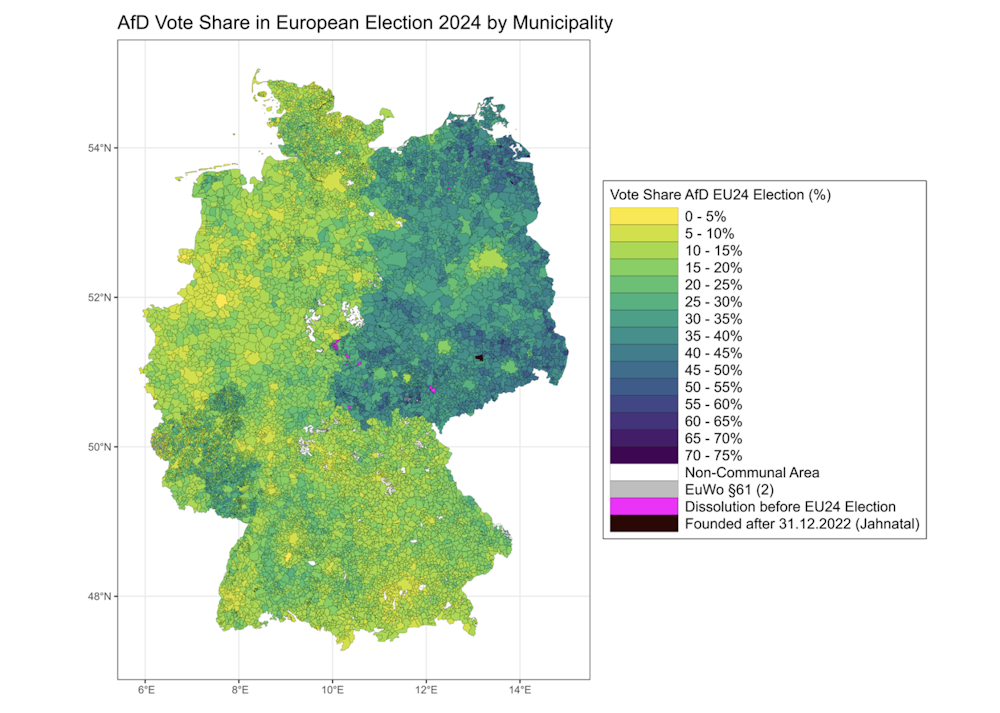
    And ultimately, this politicisation translates into electoral outcomes. In the European parliament elections of June 2024, the AfD took 15.9% of German votes. If we look at the spatial distribution of the AfD’s vote, a pattern showing the salience of the urban-rural divide emerges.

    East and west, town and country

    It’s clear by looking at the map that most (though not all) of the AfD’s strongholds are in eastern Germany – the region which used to be the German Democratic Republic (GDR). Fascism and Nazism were outlawed by decree when this anti-fascist state was established but, in reality, far-right ideologies don’t die off that easily. The result was that extremist views survived in an environment where there was also a lack of education on the National Socialism of the past – and a lack of education about democracy.

    When the socialist authoritarian GDR regime fell in 1989, Germany was reunified under western conditions. This had various effects, including a sense that the experiences of the east were not valued. The inequalities between the two sides of the reunified nation have left some in the east feeling distant from the state. The AfD’s version of nationalism finds fertile ground here.

    Another pattern is also clear across the whole country: the AfD is stronger in remote and rural areas and weaker in urban centres. There is less support in cities such as Berlin, Cologne, Dresden, Hamburg, Leipzig, Munich and Stuttgart. Places with more globalised cultures, international business and diverse populations remain comparably resilient to the spread of the far right.

    AfD support in different municipalities. The darker the colours, the higher the AfD vote share.
    R Frankenberger, CC BY-ND

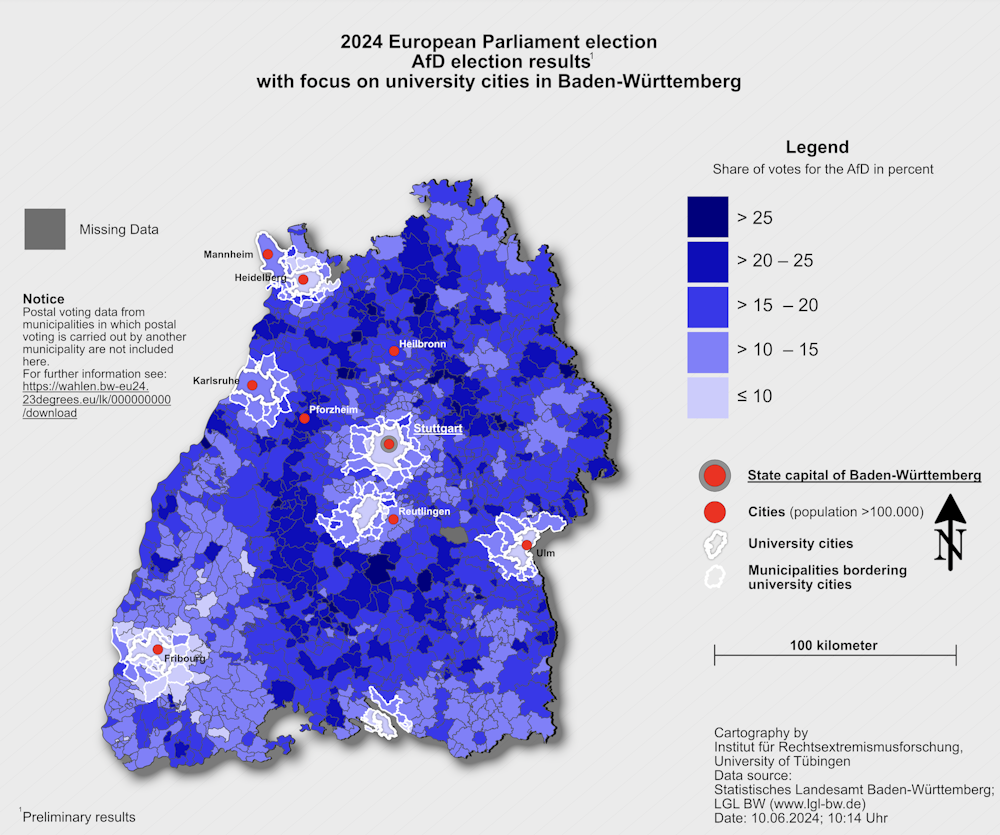
    These patterns become more visible if you take the European election results in the state of Baden-Württemberg as an example.

    The AfD performs significantly worse in the more globalised, cosmopolitan and university-oriented urban areas and their suburbs than in the more remote and rural areas of Baden-Württemberg. On the map, university cities are marked out with a white outline.

    AfD support mapped, with university cities highlighted.
    University of Tübingen, CC BY-ND

    The AfD is particularly strong in the northern and eastern Black Forest, on the Baar, in the Swabian Alb, in the Rems-Murr district, in the Swabian Forest and in Hohenlohe. Most of these areas are remote, with many small towns and villages. They have slightly lower income levels and lower levels of migration than average. They are much more traditional in terms of culture and religion than urban areas.

    The Black Forest, the Swabian Forest, and Hohenlohe also have quite strong protestant and evangelical communities, which are strongholds of traditional family life, customs and traditions.

    We should expect to see these trends continue. The AfD looks set to make further gains in the February 23 election being held in Germany, retaining its strongholds in the east but also spreading into the west in rural areas. The urban-rural divide will therefore become all the more apparent and entrenched when German voters head to the polls.

    Rolf Frankenberger does not work for, consult, own shares in or receive funding from any company or organisation that would benefit from this article, and has disclosed no relevant affiliations beyond their academic appointment.

    ref. These maps of support for Germany’s far-right AfD lay bare the depth of the urban-rural divide – https://theconversation.com/these-maps-of-support-for-germanys-far-right-afd-lay-bare-the-depth-of-the-urban-rural-divide-248405

    MIL OSI – Global Reports

  • MIL-Evening Report: Grattan on Friday: we don’t need an inquiry into the caravan affair but we do need some answers

    Source: The Conversation (Au and NZ) – By Michelle Grattan, Professorial Fellow, University of Canberra

    The battle to contain antisemitism in Australia finds both sides of politics embracing measures they’d otherwise abhor.

    Spectacularly, the government capitulated this week to include mandatory minimum sentences of between one and six years in its hate speech legislation that passed the parliament on Thursday.

    That flip flop was done in a day. You need a longer memory to recall the Coalition’s insistence that free speech had to be preeminent over dealing with hate speech.

    Way back, when Tony Abbott was prime minister, there was a big (ultimately unsuccessful) push against Section 18C of the Racial Discrimination Act. This civil law prohibits acts “likely to offend, insult, humiliate or intimidate someone because of their race or ethnicity”. At the very least, libertarian Liberals wanted it reworded to remove “offend” and “insult”.

    Before entering parliament, James Paterson worked for the right wing Institute of Public Affairs, which spearheaded attacks on 18C. Even after becoming a senator in 2016, Paterson remained a strong critic of 18C (although he says he always supported laws against incitement to violence).

    Now as home affairs spokesman Paterson has been at the forefront of the opposition efforts to make the new hate speech law as strong as possible.

    Until mid week the government firmly ruled out giving in to opposition’s demands for mandatory sentences for hate crimes. The government’s resistance was unsurprising. The Labor party platform rules out mandatory sentences.

    But then late on Wednesday, leader of the house Tony Burke went into parliament with amendments including mandatory minimum sentences of between one and six years for various crimes under the anti-hate legislation.

    Teal MP Zoe Daniel, from the Victorian seat of Goldstein, was among several crossbenchers who voted against that amendment.

    She said later she supported the legislation but described the mandatory sentencing as “overreach”. “Community safety is paramount, and so is good policy-making. Mandatory minimum sentences do not reflect good parliamentary practice or good governance. Nor do they respect the sanctity of Australia’s constitution and separation of powers, and the importance of judicial independence.”

    The antisemitism crisis is, on a number of fronts, leading to the actual or advocated curtailment of civil liberties. The federal government has outlawed the Nazi salute and hate symbols. The NSW government is to bring in more anti-hate provisions.

    There is constant debate about the desirability of curbs of one sort or another on demonstrations. The antisemitism envoy, Jillian Segal, has said, “There should be places designated away from where the Jewish community might venture where people can demonstrate”.

    In our history we repeatedly see how government actions to confront perceived emergencies collide with civil liberties.

    For example, strong security laws introduced in the wake of September 11 2001 triggered arguments about the extent to which they struck down people’s rights. Going back to the Menzies era, the Communist threat prompted the government to try (and fail) to carry a referendum to ban the Communist Party.

    People of good intent will differ about the extent to which particular responses to a crisis are necessary and appropriate, or go too far, either being bad policy or an unjustified curb on civil liberties. Historical judgements may also differ from those made at the time.

    This is not to dispute that we should be taking the strongest action against antisemitism. It’s merely to point out that with each particular measure, it’s important to be confident the end justifies the means, taking into account possible unintended or adverse consequences as well as what is to be achieved.

    Having had a victory over mandatory minimum sentences, the opposition is pushing for an inquiry into when Prime Minister Anthony Albanese was told about the caravan found at Dural, NSW filled with explosives and containing indications Sydney’s Great Synagogue and a Jewish museum could be targets.

    The caravan was parked for several weeks on a street before it came to police attention. NSW police alerted Premier Chris Minns the following day. But it is unclear when the prime minister found out.

    Albanese has steadfastly refused to say, citing operational reasons. Opposition Leader Peter Dutton suggested (without producing any evidence) the NSW police might have made a deliberate decision not to advise the Commonwealth “so that the prime minister wasn’t advised because they were worried he would leak the information”.

    Dutton is calling for an “independent inquiry” into the circumstances by “an eminent Australian from the criminal intelligence and law enforcement intelligence community”.

    The inquiry call is politically driven. The government is right in arguing it would have the downside of diverting resources. But nevertheless there are questions that need answering.

    There seems no logical reason why the PM cannot reveal when he was first briefed on the caravan, other than to avoid disclosing some embarrassing timing gap. Any explanation around operational reasons would surely not explain why Minns was briefed but Albanese was not. Alternatively, if Albanese was briefed promptly, why doesn’t he say so?

    When pressed at a parliamentary committee on Thursday, Australian Federal Police Force Commissioner Reece Kershaw would not be drawn, saying it was not appropriate to provide information about an ongoing investigation at a public hearing.

    Later Greens member of the committee, senator David Shoebridge, said: “The AFP telling us when they informed the PM could in no way prejudice any ongoing police investigation. We had half a dozen senior AFP officials [before the committee] including the Commissioner and zero serious answers.

    “This whole circus would be shut down by any half competent government by telling us when the PM knew with a simple explanation for any delay. Instead we get these bizarre performances from both the PM and the AFP.”

    One question that should be answered by the authorities is why Jewish leaders, including those connected with the synagogue and the museum, were not informed. Though operational reasons might be relevant, surely safety considerations suggest the Jewish leaders should have been told.

    The authorities believe the antisemitic attacks are not simply unconnected incidents. They say people are being paid to make them, suggesting some master minding behind them.

    Of course that justifies secrecy while investigations proceed, but operational needs should not be a cover for refusing to provide enough information to give the public confidence the various authorities are working effectively together.

    Michelle Grattan does not work for, consult, own shares in or receive funding from any company or organisation that would benefit from this article, and has disclosed no relevant affiliations beyond their academic appointment.

    ref. Grattan on Friday: we don’t need an inquiry into the caravan affair but we do need some answers – https://theconversation.com/grattan-on-friday-we-dont-need-an-inquiry-into-the-caravan-affair-but-we-do-need-some-answers-249275

    MIL OSI AnalysisEveningReport.nz

  • MIL-OSI Global: The ‘degrowth’ movement envisions global climate justice, but must adapt to global south realities

    Source: The Conversation – France – By Claudius Gräbner-Radkowitsch, Junior Professor of Pluralist Economics, Europa-Universität Flensburg

    It is widely accepted that human activities are the primary drivers of global warming and environmental crises, including the rapid loss of biodiversity. However, the debate over how best to address these issues is far from settled. In political circles, “green growth” – the concept of making economic activities more sustainable – has emerged as the most popular solution.

    Is green growth enough?

    The idea behind green growth is to continue expanding economies while minimising environmental harm. However, critics argue that this approach has failed to significantly curb climate change and biodiversity loss.

    Despite international efforts since the 1970s, carbon emissions have continued to rise. As the World Inequality Report reveals, nearly half of historical emissions occurred after 1990. Incremental policy changes, technological innovations and shifts in consumer behaviour have not been enough to reverse this trend. This failure has led to the growing appeal of “degrowth” – a more radical alternative that challenges the current global economic system.

    What is ‘degrowth’?

    “Degrowth” emerged in Europe, particularly in France, in the late 2000s. Philosophers such as André Gorz and economists such as Serge Latouche were among its early proponents, with researchers such as Tim Jackson later popularising the concept in the English-speaking world. They argue that the root cause of environmental destruction lies not only in human activity but also in a global economic model that has prioritised growth and profit since the Industrial Revolution.

    Initially, degrowth was a critique of Western lifestyles and notions of progress. Environmental concerns were just one part of the movement’s broader agenda. Over time, however, environmentalism has become central to the movement’s goals.

    A stenciled message in favour of degrowth.
    Paul Sableman, CC BY


    À lire aussi :
    Idea of green growth losing traction among climate policy researchers, survey of nearly 800 academics reveals


    What about the global south?

    Today, many degrowth advocates assert that the richer countries of the global north, being largely responsible for environmental degradation, should be the ones to scale back economic activity to avert ecological catastrophe. But what about the poorer countries of the global south? Should they adopt degrowth strategies? Some argue this would impose a neocolonial agenda, with wealthier countries once again dictating the terms of global development. Others note that many poorer countries need economic growth to combat poverty. And even if degrowth were limited to the north, it could still have significant effects on the south – both positive and negative.

    A review of academic literature on degrowth and the global south reveals two main perspectives: those who see degrowth as incompatible with the south’s development needs, and those who believe it could offer synergies with sustainable development goals.

    Supporters of degrowth often point out that many of its core ideas originate in the global south. Anthropologist Jason Hickel cites figures such as Sri Lankan philosopher Ananda Coomaraswamy, Indian economist J.C. Kumarappa and Bengali poet Rabindranath Tagore as inspirations. While these thinkers may not use the term “degrowth”, they promote ideas aligned with it, such as the Latin American Sumak kawsay (or “Buen vivir”) or the South African Ubuntu. These non-Western perspectives have been instrumental in shaping the degrowth discourse in the global north.

    Degrowth as decolonisation

    Degrowth advocates argue that scaling back economic activity in the north could help dismantle the unequal global division of labour, in which raw materials are extracted from the south and processed into consumer goods in the north. This system disproportionately benefits wealthier nations while leaving poorer countries with the social and environmental costs. Federico Demaria, a researcher in political ecology, argues that northern countries must “pay for past and present colonial exploitation in the south” – a central theme in contemporary degrowth discourse.

    An aerial view of a gold mine in Brazil.
    Tarcisio Schnaider/Shutterstock

    Some researchers suggest that dependence on economic growth is problematic for both the north and south. They argue that growth alone does not guarantee poverty reduction – wealth distribution and institutional reforms are just as crucial. Degrowth could help both regions avoid unsustainable development models by focusing more on social well-being than perpetual economic expansion.

    Challenges for degrowth in the global south

    However, many scholars believe degrowth is unattractive for the global south. Critics argue that the concept is too Eurocentric and fails to resonate amid the specific challenges faced by poorer nations. Interviews with academics and activists in the south show that while they may agree with some of the ideas behind degrowth, they reject its language, which they see as rooted in Western thinking. Economist Beatriz Rodríguez Labajos and her co-authors suggest that researchers from the north and south should look at “strengthening potential synergies, through an assertive recognition of the barriers to doing so”.

    There is also concern that promoting degrowth in the south could be perceived as a new form of colonialism. Imposing Western notions of degrowth could prevent poorer countries from following the same path to prosperity that the north took, which often involved exploiting the resources of the south. The degrowth movement’s failure to fully address the colonial roots of economic development poses a challenge to its decolonization-oriented ambitions.

    The problem of global dependencies

    Finally, global dependencies further complicate the degrowth debate. Many people in the south rely on export-driven economies that serve Western markets. A reduction in economic activity in the north could harm populations in the south who depend on those exports.

    This interdependence presents a dilemma for the degrowth movement. Proponents argue that degrowth is not about abandoning economic activity but reforming the global trade, finance and governance systems to prevent negative impacts on the south. For degrowth to succeed, its advocates must formulate concrete proposals that address these global dependencies without exacerbating inequalities or harming the most vulnerable.


    This article is part of a project involving The Conversation France and AFP audio. It has received financial support from the European Journalism Centre, as part of the Solutions Journalism Accelerator programme supported by the Bill and Melinda Gates Foundation. AFP and The Conversation France have retained their editorial independence at every stage of the project.


    We offer this article as part of the Normandy World Forum for Peace, organised by the Normandy region of France on September 26-27, 2024. The Conversation France is a partner of the forum. For more information, visit the Normandy World Forum for Peace’s website.

    Claudius Gräbner-Radkowitsch is a member of the Bündnis90/Die Grünen (The Greens) party. He has received research grants, notably from the Austrian FWF and the German DFG.

    Birte Strunk ne travaille pas, ne conseille pas, ne possède pas de parts, ne reçoit pas de fonds d’une organisation qui pourrait tirer profit de cet article, et n’a déclaré aucune autre affiliation que son organisme de recherche.

    ref. The ‘degrowth’ movement envisions global climate justice, but must adapt to global south realities – https://theconversation.com/the-degrowth-movement-envisions-global-climate-justice-but-must-adapt-to-global-south-realities-238276

    MIL OSI – Global Reports

  • MIL-OSI Global: Female genital mutilation is a leading cause of death for girls where it’s practised – new study

    Source: The Conversation – Africa – By Heather D. Flowe, Professor of Psychology, University of Birmingham

    Female genital mutilation or cutting (FGM/C) is a deeply entrenched cultural practice that affects around 200 million women and girls. It’s practised in at least 25 African countries, as well as parts of the Middle East and Asia and among immigrant populations globally.

    It is a harmful traditional practice that involves removing or damaging female genital tissue. Often it’s “justified” by cultural beliefs about controlling female sexuality and marriageability. FGM/C causes immediate and lifelong physical and psychological harm to girls and women, including severe pain, complications during childbirth, infections and trauma.

    We brought together our expertise in economics and gender based violence to examine excess mortality (avoidable deaths) due to FGM/C. Our new research now reveals a devastating reality: FGM/C is one of the leading causes of death for girls and young women in countries where it’s practised. FGM/C can result in death from severe bleeding, infection, shock, or obstructed labour.

    Our study estimates that it causes approximately 44,000 deaths each year across the 15 countries we examined. That is equivalent to a young woman or girl every 12 minutes.

    This makes it a more significant cause of death in the countries studied than any other excluding infection, malaria and respiratory infections or tuberculosis. Put differently, it is a bigger cause of death than HIV/Aids, measles, meningitis and many other well-known health threats for young women and girls in these countries.

    Prior research has shown that FGM/C leads to severe pain, bleeding and infection. But tracking deaths directly caused by the practice has been nearly impossible. This is partly because FGM/C is illegal in many countries where it occurs, and it typically takes place in non-clinical settings without medical supervision.

    Where the crisis is most severe

    The practice is particularly prevalent in several African nations.
    In Guinea, our data show 97% of women and girls have undergone FGM/C, while in Mali the figure stands at 83%, and in Sierra Leone, 90%. The high prevalence rates in Egypt, with 87% of women and girls affected, are a reminder that FGM/C is not confined to sub-Saharan Africa.

    For our study, we analysed data from the 15 African countries for which comprehensive “gold standard” FGM/C incidence information is available. Meaning, the data is comprehensive, reliable and widely accepted for research, policymaking and advocacy efforts to combat FGM/C.

    We developed a new approach to help overcome previous gaps in data. We matched data on the proportion of girls subjected to FGM/C at different ages with age-specific mortality rates across 15 countries between 1990 and 2020. The age at which FGM occurs varies significantly by country. In Nigeria, 93% of procedures are performed on girls younger than five years old. In contrast, in Sierra Leone, most girls undergo the procedure between the ages of 10 and 14.

    Since health conditions vary from place to place and over time, and vary in the same place from one year to the next, we made sure to consider these differences. This helped us figure out if more girls were dying at the ages when FGM/C usually happens in each country.

    For example, in Chad, 11.2% of girls undergo FGM/C aged 0-4, 57.2% at 5-9 and 30% at 10-14. We could see how mortality rates changed between these age groups compared to countries with different FGM patterns.

    This careful statistical approach helped us identify the excess deaths associated with the practice while accounting for other factors that might affect child mortality.

    Striking findings

    Our analysis revealed that when the proportion of girls subjected to FGM in a particular age group increases by 50 percentage points, their mortality rate rises by 0.1 percentage points. While this may sound small, when applied across the population of affected countries, it translates to tens of thousands of preventable deaths annually.

    The scale is staggering: while armed conflicts in Africa caused approximately 48,000 combat deaths per year between 1995 and 2015, our research suggests FGM/C leads to about 44,000 deaths annually. This places FGM among the most serious public health challenges facing these nations.

    Beyond the numbers

    These statistics represent real lives cut short. Most FGM/C procedures are performed without anaesthesia, proper medical supervision, or sterile equipment. The resulting complications can include severe bleeding, infection and shock. Even when not immediately fatal, the practice can lead to long-term health problems and increased risks during childbirth.

    The impact extends beyond physical health. Survivors often face psychological trauma and social challenges. In many communities, FGM/C is deeply embedded in cultural practices and tied to marriage prospects, making it difficult for families to resist the pressure to continue the tradition.

    Urgent crisis

    FGM/C is not just a human rights violation – it’s a public health crisis demanding urgent attention. While progress has been made in some areas, with some communities abandoning the practice, our research suggests that current efforts to combat FGM/C need to be dramatically scaled up.

    The COVID-19 pandemic has potentially worsened the situation, owing to broader impacts of the pandemic on societies, economies and healthcare systems. The UN estimates that the pandemic may have led to 2 million additional cases of FGM/C that could have been prevented. Based on our mortality estimates, this could result in approximately 4,000 additional deaths in the 15 countries we studied.

    The way forward

    Ending FGM/C requires a multi-faceted approach. Legal reforms are crucial – the practice remains legal in five of the 28 countries where it’s most commonly practised. However, laws alone aren’t enough. Community engagement, education, and support for grassroots organisations are essential for changing deeply held cultural beliefs and practices.

    Previous research has shown that information campaigns and community-led initiatives can be effective. For instance, studies have documented reductions in FGM/C rates following increased social media reach in Egypt and the use of educational films showing different views on FGM/C.

    Most importantly, any solution must involve the communities where FGM/C is practised. Our research underscores that this isn’t just about changing traditions – it’s about saving lives. Every year of delay means tens of thousands more preventable deaths.

    Our findings suggest that ending FGM/C should be considered as urgent a priority as combating major infectious diseases. The lives of millions of girls and young women depend on it.

    The authors do not work for, consult, own shares in or receive funding from any company or organisation that would benefit from this article, and have disclosed no relevant affiliations beyond their academic appointment.

    ref. Female genital mutilation is a leading cause of death for girls where it’s practised – new study – https://theconversation.com/female-genital-mutilation-is-a-leading-cause-of-death-for-girls-where-its-practised-new-study-249171

    MIL OSI – Global Reports

  • MIL-Evening Report: Hospitals will get $1.7 billion more federal funding. Will this reduce waiting times?

    Source: The Conversation (Au and NZ) – By Henry Cutler, Professor and Director, Macquarie University Centre for the Health Economy, Macquarie University

    This week, the federal government announced it will pay states and territories an extra, one-off, A$1.7 billion for public hospitals.

    This has been billed as a way to fix some ailing hospitals, and shorten waits for care in emergency departments and for elective surgery. But will it really make a difference?

    How are hospitals funded?

    Australian public hospitals are funded through a collaborative arrangement involving state, territory and federal governments. The federal government provides 37% of public hospital funding annually, primarily through the National Health Reform Agreement. States and territories fund nearly all the rest.

    Most federal government funding for public hospitals is determined by an “activity based funding” formula. Funding is based on the number of patients treated and the price of treatment, the latter calculated from average public hospital costs.

    State and territory governments manage public hospitals. The federal government has little say on how public hospital money is spent. The exception is when funding relates to something specific, like a new hospital ward.

    How the extra funding compares

    The federal government will spend $30.19 billion on public hospitals this financial year. The extra funding will grow its public hospital spending by 12% in 2025–26.

    Extra funding will likely impact Northern Territory hospitals the most. It will receive $51 million more, a 30% increase.

    While larger states will receive additional funding, they have more public hospitals and patients. For example, New South Wales will receive $407 million, but this equates to only an 11% increase from the federal government.

    The extra funding is less impressive when compared to total public hospital spending. That was $86 billion in 2022–23, suggesting the extra $1.7 billion will represent less than 2% in additional total funding to public hospitals in 2025–26.

    But this extra spending is not in isolation. The federal government has already committed nearly $600 million to establish 87 urgent care clinics around Australia. Their primary purpose is to alleviate pressure on emergency departments and fill gaps in access to after-hours primary care.

    Public hospitals are funded mostly by the states and territories, but receive some funding from the federal government.
    khuncho24/Shutterstock

    Pressure in public hospitals

    Public hospital pressure has been building for over a decade. Emergency departments are often clogged, leading to long wait times, mostly because of staff shortages. Around 10% of patients wait more than two hours. There is little slack in the system to counter unpredictable surges in demand for care.

    The proportion of emergency department patients seen on time has declined since COVID. The proportion of patients requiring urgent emergency department care seen on-time, for example, has decreased from 67% to 61%. More non-urgent and semi-urgent patients are also not receiving care on time.

    Patients are also waiting longer for elective public hospital surgery since COVID, despite an increase in the number of admissions from elective surgery waiting lists.

    Proportion of patients seen on time in public hospital emergency departments


    Australian Institute of Health and Welfare

    Waiting times vary by state and territories. Queensland has the lowest proportion of patients waiting more than 365 days for public hospital elective surgery at 3.9% in 2023–24, while the ACT had the highest at 8.9%.

    Encouragingly, waiting times decreased for nearly all elective surgeries compared to 2022–23, suggesting public hospitals may be making inroads into the post-COVID load.

    Proportion of patients waiting more than 365 days for public hospital elective surgery

    Note: Data for the NT was unavailable.
    Australian Institute of Health and Welfare

    Will the money help?

    While additional funding will help, there is no magic wand. Public hospitals need to substantially reorganise their staff, workflows, beds and buildings. This in an environment that has workforce shortages, burnout, and wage pressures, making major health system changes particularly difficult.

    Some hospitals may reduce their waiting times substantially, if states and territories allocate their extra funding to poor performers.

    However, poor performance can be related to systemic issues out of the hospital’s control, such as workforce shortages. Without an increase in total health-care workforce size, these poor performing hospitals may look for additional staff from other public hospitals, worsening their performance.

    Whether any improvements last is another question.

    Public hospitals face increased demand for emergency department care, only mitigated by the potential success of urgent care clinics.


    Read more:
    Labor’s urgent care centres are a step in the right direction – but not a panacea


    Public hospitals also face an increase in demand for elective surgery, as the population ages and chronic disease prevalence increases.

    The extra $1.7 billion is only a one off. Funds to reduce waiting times will mostly be spent on more staff, such as nurses, clinicians and administration staff.

    Public hospitals will need additional, ongoing funding to keep up with demand, otherwise any initial improvement will dissipate.

    Funds to reduce waiting times will mostly be spent on more staff.
    Gorodenkoff/Shutterstock

    What else needs to happen?

    All governments need to invest more in prevention programs to slow the growth in public hospital demand.

    More Australians are obese, as a proportion of the population, compared to other OECD countries. This has created a heavy burden.

    Reducing financial waste in the health-care system is of huge importance. Savings could be used for long-term improvements in waiting times once the extra funding runs out.

    Around 40% of health care is of low value or causes harm. Reducing unnecessary medical tests, speeding up discharges, and reducing avoidable admissions is a good start.

    Other changes that could help include:

    • setting national performance targets for states and territories to reduce their waiting lists
    • stronger monitoring of performance
    • holding public hospital managers more accountable for achieving their waiting time targets.

    A new National Health Reform Agreement is due to take effect in 2026. Whoever wins this year’s federal election will have to finalise this agreement with the states and territories.

    The Commonwealth and states are yet to commit to all of the recommendations from the mid-term review of the current agreement released in October 2023. The extent to which governments accept these recommendations has the potential to create a much greater, long-term impact on waiting times than this extra, one-off payment.

    Henry Cutler has previously received funding from Northern Territory Health.

    ref. Hospitals will get $1.7 billion more federal funding. Will this reduce waiting times? – https://theconversation.com/hospitals-will-get-1-7-billion-more-federal-funding-will-this-reduce-waiting-times-249170

    MIL OSI AnalysisEveningReport.nz

  • MIL-OSI Global: Where support for Germany’s far-right AFD is growing and why – podcast

    Source: The Conversation – UK – By Laura Hood, Host, Know Your Place podcast, The Conversation

    Germany is holding an election on February 23 and the contest is attracting an unusual amount of attention. That’s because the far-right Alternative for Germany (AFD) is polling in second place on 20% of the national vote.

    Should the party end up with a vote share on this scale, it would be its best ever result in a national election. It would change the face of the German parliament and force mainstream parties into difficult questions about their longstanding refusal to work with extreme parties.

    The AFD’s roots are in nationalistic and racist movements. It continues to take an ultra anti-immigration stance and, in this election, is calling for “demigration” – effectively the deportation of migrants.

    In this episode of The Conversation Weekly podcast, Rolf Frankenberger, an expert on right-wing extremism at the University of Tübingen in Germany, explains where the AFD draws its support from and what type of Germany it wants to return to.

    Frankenburger has found two clear trends in the geographical distribution of AfD voting. The first is common among far-right parties around the world:

    “ There are always exceptions, of course, but the main pattern is that around the big cities like Berlin, like Hamburg, Bremen, Hanover, Münster, Stuttgart, Munich, Frankfurt in these cities and their direct environment and suburbs, the AFD is less important. Whereas in the specific rural areas, like in Saxonia, in the Erzgebirge, in Baden-Württemberg, in the Black Forest, in Rhineland Palatinate, in the more rural areas, they have their strongholds.”

    The second, however, is unique to Germany. Support for the AFD is far more concentrated in the east of Germany. This region was the part of the country that made up the communist German Democratic Republic between 1949 and 1990, before German reunification.

    “Reunification in Germany produced winners and losers. And in the view of many East German people – and much of it is true – there are inequalities that were produced by reunification.”

    These divisions are being exploited to push what Frankenburger terms a form of white supremacist, traditionalist “Völkisch nationalism” – not a term that is well understood outside of Germany but which resonates heavily in domestic politics.

    “And so the AFD comes in and says ‘hey, there’s something wrong with the state, there’s something wrong with democracy, and there’s something wrong with our heritage. So we have a strong German heritage. We have an identity, we have an idea and all the others are trying to destroy it’. So it’s a kind of protest.”

    To find out more about narratives pushed by the AFD, listen to the interview with Rolf Frankenberger on The Conversation Weekly podcast.


    This episode of The Conversation Weekly was written and produced by Mend Mariwany and Gemma Ware. Sound design was by Michelle Macklem, and theme music by Neeta Sarl.

    Clips in this episode from AFP News, AfD in English, DW News and Al Jazeera English.

    Listen to The Conversation Weekly via any of the apps listed above, download it directly via our RSS feed or find out how else to listen here.

    Rolf Frankenberger does not work for, consult, own shares in or receive funding from any company or organisation that would benefit from this article, and has disclosed no relevant affiliations beyond their academic appointment.

    ref. Where support for Germany’s far-right AFD is growing and why – podcast – https://theconversation.com/where-support-for-germanys-far-right-afd-is-growing-and-why-podcast-249045

    MIL OSI – Global Reports

  • MIL-Evening Report: We know how hard it is for young people to buy a home – so how are some still doing it anyway?

    Source: The Conversation (Au and NZ) – By Rachel Ong ViforJ, John Curtin Distinguished Professor & ARC Future Fellow, Curtin University

    PrasitRodphan/Shutterstock

    For young Australians, breaking into the housing market feels tougher than ever. Many now fear they’ll never be able to own a home.

    Despite public debates on whether it’s truly harder to buy a house than it was decades ago, falling homeownership rates across generations suggest the market has indeed shifted significantly against those just starting out.

    But if it’s so difficult, how are some young people still managing to buy homes? Our newly published study set out to investigate the major barriers – and the factors – that might tip the scales in favour of ownership.

    Despite the challenges imposed by high home prices relative to incomes, some young Australians are still finding a way onto the property ladder.

    While being a good saver helps, a boost from the “bank of mum and dad” can be a game changer.

    A fading dream

    Using 14 years of data from the 2006-2020 government-funded Household, Income and Labour Dynamics in Australia (HILDA) survey, we tracked independent adults aged 25-44 who were not homeowners.

    Our calculations from the HILDA survey show for those aged 25-44 , average house prices across major cities in 2006 were 4.5 times the average household income.

    In Sydney, for example, the average price of properties faced by these young people was about A$600,000 in 2006 while the average household income was $102,000.

    Across major cities, this ratio rose steadily to 6 times income in 2018, before dropping slightly to 5.4 times income at the start of the pandemic.

    For young people in cities, house prices are spiralling upward at faster rates than their incomes.

    A generous ‘bank’ available to some

    As property markets have become more unaffordable, the share of non-homeowning young people receiving help from the “bank of mum and dad” has climbed.

    We estimated from the HILDA survey that in 2006, 3.1% of this group received more than $5,000 in transfers or inheritance from their parents, rising to 5.3% by 2020.

    Young people are good savers

    Contrary to popular some commentary that young people are unable to purchase a house because they are spending their money on “smashed avocados”, young people are actually saving more.

    In 2006, around two-thirds of non-homeowning adults aged 25-44 saved regularly by putting money aside each month, saved non-regular income, or saved money left over after they met their spending needs. This proportion increased to four in five of young non-homeowning adults in 2020.

    In general, young non-homeowners are also financially planning further ahead. In 2006, 47% were planning more than a year ahead. By 2020, this share had risen to 55%.

    How are some young people buying houses?

    We looked at how the personal saving habits of young people influence their homeownership chances, taking each person’s finances and living situation into account.

    Not surprisingly, saving regularly does improve the likelihood of eventually buying a house. However, being a regular saver is much less likely to offset the impact of rising prices than parental help.

    Our research found that once prices exceed three times an individual’s income, their odds of becoming a homeowner are halved.

    No, brunch is not to blame for the state of Australia’s housing market.
    Tatiana Volgutova/Shutterstock

    In much of Australia, prices are already well above that mark. In all state capitals, they’ve gone beyond six times annual household income – a line where the odds of homeownership fall to about a third.

    However, we found having access to the “bank of mum and dad” can shift these odds dramatically.

    We found receiving financial assistance of more than $5,000 quadruples the odds of becoming a homeowner.

    Parents also help in indirect ways. Young people living in rent-free dwellings provided by family or friends had more than double the odds of private renters.

    This puts those from well-off families at a distinct advantage. Those without parental assistance face steeper deposit hurdles and risk missing out on access to areas with better job prospects.

    How governments can help

    For those without parental assistance, governments have an important role to play. Property prices will continue to soar faster than incomes grow, unless policies are implemented to address both supply and demand challenges.

    Loosening restrictions on mortgage borrowing could help some first homebuyers overcome the hurdle to homeownership. But there’s a worrying trade-off between making it easier to borrow and exposing young people to more financial risk.

    Government grants that place more cash into the hands of first-time homebuyers will likely push house prices up further, unless supply of entry-level properties can keep up.

    Such grants should also be carefully targeted to those without access to personal or family resources to help buy a home.

    Finally, tax reforms could be used to increase the supply of dwellings in first homeowner entry markets, and hold back demand from multi-property owners who can crowd out first-time home buyers.


    Read more:
    Our housing system is broken and the poorest Australians are being hardest hit


    Rachel Ong ViforJ is the recipient of an Australian Research Council Future Fellowship (project FT200100422). She also receives funding from the Australian Housing and Urban Research Institute.

    Christopher Phelps and Jack Hewton do not work for, consult, own shares in or receive funding from any company or organisation that would benefit from this article, and have disclosed no relevant affiliations beyond their academic appointment.

    ref. We know how hard it is for young people to buy a home – so how are some still doing it anyway? – https://theconversation.com/we-know-how-hard-it-is-for-young-people-to-buy-a-home-so-how-are-some-still-doing-it-anyway-248666

    MIL OSI AnalysisEveningReport.nz

  • MIL-Evening Report: It’s official: Australia’s ocean surface was the hottest on record in 2024

    Source: The Conversation (Au and NZ) – By Moninya Roughan, Professor in Oceanography, UNSW Sydney

    Australia’s sea surface temperatures were the warmest on record last year, according to a snapshot of the nation’s climate which underscores the perilous state of the world’s oceans.

    The Bureau of Meteorology on Thursday released its annual climate statement for 2024 – the official record of temperature, rainfall, water resources, oceans, atmosphere and notable weather.

    Among its many alarming findings were that sea surface temperatures were hotter than ever around the continent last year: a whopping 0.89°C above average.

    Oceans cover more than 70% of Earth’s surface, and their warming is gravely concerning. It causes sea levels to rise, coral to bleach and Earth’s ice sheets to melt faster. Hotter oceans also makes weather on land more extreme and damages the marine life which underpins vital ocean ecosystems.

    What the snapshot showed

    Australia’s climate varies from year to year. That’s due to natural phenomena such as the El Niño and La Niña climate drivers, as well as human-induced climate change.

    The bureau confirmed 2024 was Australia’s second-warmest year since national records began in 1910. The national annual average temperature was 1.46°C warmer than the long-term average (1961–90). Heatwaves struck large parts of Australia early in the year, and from September to December.

    Average rainfall in Australia was 596 millimetres, 28% above the 30-year average, making last year the eighth-wettest since records began.

    And annual sea surface temperatures for the Australian region were the warmest on record. Global sea surface temperatures in 2024 were also the warmest on record.

    According to the bureau, Antarctic sea-ice extent was far below average, or close to record-lows, for much of the year but returned to average in December.

    What caused the hot oceans?

    It’s too early to officially attribute the ocean warming to climate change. But we do know greenhouse gas emissions are heating the Earth’s atmosphere, and oceans absorb 90% of this heat.

    So we can expect human-induced climate change played a big role in warming the oceans last year. But shorter-term forces are at play, too.

    The rare triple-dip La Niña Australia experienced from 2020 to 2023 brought cooler water from deep in the ocean up to the surface. It was like turning on the ocean’s air-conditioner.

    But that pattern ended and Australia entered an El Niño in September 2023. It lasted about seven months, when the oscillation between El Niño and La Niña entered a neutral phase.

    The absence of a La Niña meant cool water was no longer being churned up from the deep. Once that masking effect disappeared, the long-term warming trend of the oceans became apparent once more.

    Water can store a lot more heat than air. In fact, just the top few metres of the ocean store as much heat as Earth’s entire atmosphere. Oceans take a long time to heat up and a long time to cool.

    Heat at the ocean’s surface eventually gets pushed deeper into the water column and spreads across Earth’s surface in currents. The below chart shows how the world’s oceans have heated over the past 70 years.

    Changes in the world’s ocean heat content since 1955.
    NOAA/NCEI World Ocean Database

    Why should we care about ocean warming?

    Rapid warming of Earth’s oceans is setting off a raft of worrying changes.

    It can lead to less nutrients in surface waters, which in turn leads to fewer fish. Warmer water can also cause species to move elsewhere. This threatens the food security and livelihoods of millions of people around the world.

    Just last week, it was reported that tens of thousands of fish died off northwestern Australia due to a large and prolonged marine heatwave.

    Warm water causes coral bleaching, as experienced on the Great Barrier Reef in recent decades. It also makes oceans more acidic, reducing the amount of calcium carbonate available for organisms to build shells and skeletons.

    Warming oceans trigger sea level rise – both due to melt water from glaciers and ice sheets, and the fact seawater expands as it warms.

    Hotter oceans are also linked to weather extremes, such as more intense cyclones and heavier rainfall. It’s likely the high annual rainfall Australia experienced in 2024 was in part due to warmer ocean temperatures.

    What now?

    As long as humans keep burning fossil fuels and pumping greenhouse gases into the atmosphere, the oceans will keep warming.

    Unfortunately, the world is not doing a good job of shifting its emissions trajectory. As the bureau pointed out in its statement, concentrations of all major long-lived greenhouse gases in the atmosphere increased last year, including carbon dioxide and methane.

    Prolonged ocean warming is driving changes in weather patterns and more frequent and intense marine heatwaves. This threatens ecosystems and human livelihoods. To protect our oceans and our way of life, we must transition to clean energy sources and cut carbon emissions.

    At the same time, we must urgently expand ocean observing below the ocean’s surface, especially in under-studied regions, to establish crucial baseline data for measuring climate change impacts.

    The time to act is now: to reduce emissions, support ocean research and help safeguard the future of our blue planet.

    Moninya Roughan receives funding from the Australian Research Council.

    ref. It’s official: Australia’s ocean surface was the hottest on record in 2024 – https://theconversation.com/its-official-australias-ocean-surface-was-the-hottest-on-record-in-2024-249277

    MIL OSI AnalysisEveningReport.nz

  • MIL-Evening Report: Mandatory minimum sentencing is proven to be bad policy. It won’t stop hate crimes

    Source: The Conversation (Au and NZ) – By Lorana Bartels, Professor of Criminology, Australian National University

    Shutterstock

    Weeks after Opposition Leader Peter Dutton announced his support for mandatory minimum jail terms for antisemitic offences, the government has legislated such laws. Minister for Home Affairs Tony Burke stated the federal parliament would now be “putting in place the toughest laws against hate speech that Australia has ever had”.

    It follows a concerning recent spate of antisemitic attacks in Australia, including on Jewish places of worship, schools, businesses and homes.

    Last week, a caravan was found on the outskirts of Sydney, filled with explosives and a list of Jewish targets.

    Understandably, there is fear in the Jewish community.

    The government’s decision to pursue mandatory minimum sentencing is contrary the 2023 ALP National Policy Platform stating:

    Labor opposes mandatory sentencing. This practice does not reduce crime but does undermine the independence of the judiciary, leads to unjust outcomes, and is often discriminatory in practice.

    The evidence shows that Labor’s official policy platform is correct. Mandatory minimum sentencing is unlikely to help solve this issue – or any other issue for that matter. It has a poor track record of reducing crime.

    What is mandatory sentencing?

    Australian criminal laws usually set a maximum penalty for an offence. It is then the role of the courts (a judge or magistrate) to set the sentence, up to the maximum penalty.

    This allows the judiciary to exercise discretion in sentencing. It means the courts can take into account a range of relevant factors when determining an appropriate sentence, guided by the sentencing laws in each jurisdiction.

    However, laws that demand a mandatory sentence set a minimum penalty for an offence, thereby significantly reducing the role of judicial discretion.

    Sentencing decisions are made by judges in Australian courts.
    Shutterstock

    Let’s imagine two people are appearing in court, to be sentenced for exactly the same offence.

    Defendant A (Kate) is 18 years old and has pleaded guilty. It is her first offence. She is Aboriginal, a victim of childhood domestic violence and lives on the streets. She has recently started to get help for her mental health problems.

    Defendant B (Jim) is 35. He has a long criminal history, including breaches of bail and parole. He has never been out of prison for more than six months at a time. He has pleaded not guilty and doesn’t think he has done anything wrong.

    The maximum penalty for this offence is five years. Under standard sentencing laws, a judge would usually give different sentences to Kate and Jim, based on their personal circumstances and future prospects. Jim would generally get a more severe sentence than Kate.

    Now, let’s imagine parliament decides to set a mandatory minimum sentence of two years in prison. This means the judge has to send both Kate and Jim to prison for at least two years, despite the differences between them, even if a community-based sentence might be more appropriate for Kate.

    So do mandatory minimum sentences work?

    The main arguments for mandatory sentences are that they:

    • reflect community standards

    • provide consistency

    • avoid judicial leniency, and

    • reduce crime.

    The evidence for each of these is weak.

    A study with members of the Victorian public who had served on juries found strong support for sentencing discretion.

    This is confirmed by recent research from the Queensland Law Reform Commission. It found general support from the public for individualised responses, not an inflexible approach to sentencing.

    Mandatory sentencing yields more consistent outcomes, but denies flexibility in cases where defendants should be treated differently.

    The argument that mandatory sentencing reduces crime is also contested.

    Study after study has shown that harsher penalties do not reduce crime.

    It is uncontested, however, that certainty of detection (whether you’ll get caught) is the primary deterrent factor, not the severity of the sentence (assuming that the perpetrator is aware of it).

    Mandatory sentencing also brings risks

    Let’s review the arguments against mandatory sentencing.

    Firstly, it undermines judicial independence, the separation of powers (between the courts and executive government) and the rule of law: a concept based on fairness in the judicial system.

    Mandatory sentencing also shifts discretion to other, less transparent, parts of the criminal justice system (for example, police and prosecution services), as they frame the charges that will bring defendants to court in the first place.

    Secondly, a guilty plea is a mitigating factor the court considers when sentencing. Mandatory sentencing means there is little incentive for defendants to plead guilty. This increases workloads, delays, costs, and has consequent negative effects for victims.

    In addition, juries may be reluctant to convict if they know the minimum sentence will insist upon a prison term. This can lead to inappropriate not guilty verdicts.

    Undermining the right to a fair trial

    Australia has previously come under fire from the United Nations for its mandatory sentencing laws.

    These requirements are found in the International Covenant on Civil and Political Rights, which entered into force for Australia in 1980.

    Indeed, the Law Council of Australia has suggested mandatory sentencing is inconsistent with the international prohibition against arbitrary detention, and undermines the right to a fair trial, given that such sentences have been somewhat predetermined.

    These laws can also lead to injustice. As the example above shows, mandatory sentencing can impact disproportionately on vulnerable people, such as Indigenous people, and women with disabilities.

    These cohorts are already far more vulnerable than non-Indigenous men (who account for most people who offend).

    Adverse effects on imprisonment rates

    The High Court recently stated that the mandatory minimum sentence will have the effect of lifting sentencing levels generally.

    But the research shows longer prison sentences are much more expensive and less effective than community-based sentencing options in reducing crime.

    Let’s leave the final word on this subject with the Law Council of Australia:

    achieving a just outcome in the particular circumstances of a case, while maintaining consistency across similar cases and with Australia’s human rights obligations, is […] paramount.

    We need effective responses to all forms of racial and religious hatred, including antisemitic hate crimes, but populist, knee-jerk reactions are highly unlikely to make the community safer. Clear-headed thinking will best stand the test of time, not policy developed in anger or fear.

    Lorana Bartels is a Director of the Justice Reform Initiative. She is a supporter of the Jewish Council of Australia. She has received research funding from the ACT, Commonwealth, Queensland, Tasmanian and Victorian governments. She recently undertook a project for the Queensland government, which examined the use of mandatory minimum sentences for murder. She is a member of the Tasmanian Sentencing Advisory Council, which recently completed a project on hate crimes.

    Rick Sarre does not work for, consult, own shares in or receive funding from any company or organisation that would benefit from this article, and has disclosed no relevant affiliations beyond their academic appointment.

    ref. Mandatory minimum sentencing is proven to be bad policy. It won’t stop hate crimes – https://theconversation.com/mandatory-minimum-sentencing-is-proven-to-be-bad-policy-it-wont-stop-hate-crimes-249266

    MIL OSI AnalysisEveningReport.nz

  • MIL-Evening Report: Sweeping reform of the electoral laws puts democracy at risk. They shouldn’t be changed on a whim

    Source: The Conversation (Au and NZ) – By Joshua Black, Visitor, School of History, Australian National University

    The Albanese government is trying once more to legislate wide-ranging changes to the way federal elections are administered.

    The 200-page Electoral Reform Bill, if passed, would transform the electoral donation rules by imposing donation and spending caps, increasing public funding, and improving transparency.

    As noble as it sounds, the bill in its current form would undermine Australian democracy by favouring established parties over independent candidates and other new players.

    Competitive disadvantage

    The proposed donation caps are a case in point.

    Donors could give A$20,000 per year, per recipient, to a branch of a party or candidate for electioneering purposes. In practice, that means donors could give no more than $20,000 per year to an independent but could contribute $180,000 to the Labor Party via each of its state and federal branches, or $160,000 to the Liberal Party (which has one less branch than the ALP).

    The donation cap would reset annually and after each federal election, allowing a single donor to give $720,000 to the Labor Party in one election cycle or $640,000 to the Liberals, but no more than $20,000 to an independent who declares their candidacy in the year of an election.

    Avoiding the American road

    There are welcome components in the bill. Faster disclosure and lower donation thresholds would make the system more transparent. Given the large amount of undisclosed funding – “dark money ” – currently propping up political parties, this would be a significant improvement.

    But democracy is not cheap.

    Last year, the Financial Times reported Donald Trump and Kamala Harris spent a combined US$3.5 billion (A$5.6 billion) on their presidential races. This kind of money helps to sustain an American two-party system largely immune to challengers.

    Australian campaigns look nothing like this, but there has been increased interest in the money spent in particular seats in recent years.

    Former Labor minister Kim Carr revealed in his recent book Labor spent $1 million to defeat the Greens in the Melbourne electorate of Batman in 2018, while the LNP reportedly spent $600,000 campaigning to retain the affluent electorate of Fadden in 2023.

    The bill before Parliament would cap election spending at $800,000 in each lower house seat. But the major parties could promote their generic party brand or a frontbench MP (in a seat other than their own) without affecting their capped spending.

    These unfair discrepancies would reward the major parties while kneecapping independents whose first hurdle is to get their name “out there”.

    Haunted by billionaires

    The government argues its bill limits the influence of “big money” in politics, namely mining boss Clive Palmer, who spent $117 million at the last election.

    For the Coalition, it is the community independents and their Climate 200 supporters who represent a kind of money “without precedent in the Australian political system” according to departing MP Paul Fletcher.

    Rather than getting big money out of politics, this bill would make the major parties’ own funding pipelines the only money that matters.

    The bill recognises “nominated entities” whose payments to associated political parties would not be limited by donation caps. Independents would not have this privilege.

    Meanwhile, the long delay before the commencement of the bill in 2026 would give wealthy donors time to get their ducks in order. They could amass their own war chests before the new laws are due to come in to force and then register them as nominated entities at a later date.

    Who pays? The taxpayer, of course!

    Parties and candidates with more than 4% of the primary vote currently receive public election funding. The Hawke government introduced this measure as a “small insurance” against corruption.

    The bill would raise the return to $5 per vote, which would mean an extra $41 million in funding, on top of the $71 million handed over after the 2022 election. Most of this money would go to the major parties.

    The windfall would come with no extra guardrails or guidelines about how those funds could be spent. There are no laws to guarantee truth in political advertising at the federal level. Voters may well be paying for more political advertising that lies to them.

    Closed consultations

    Labor’s current strategy is to seek Coalition support for these changes to the rules of democracy.

    Special Minister of State Don Farrell claims to have consulted widely on the design of the bill, but that came as news to independents David Pocock and Kate Chaney when asked about it last week.

    The government’s haste and secrecy suggest it wants neither the bill nor its motives closely scrutinised.

    Australians care about the quality of their democracy. Polling research by the Australia Institute last November showed four in five Australians expect electoral changes to be reviewed by a multi-party committee.

    That’s what is needed for this bill. To do otherwise would threaten the integrity of Australian elections – or invite a High Court challenge that may overturn the entire system if the court rules freedom of political expression is at stake.

    Democracy matters. The rules must not be changed on a whim.

    Joshua Black is a Postdoctoral Research Fellow at The Australia Institute, and formerly a Palace Letters Fellow at the Whitlam Institute within Western Sydney University.

    ref. Sweeping reform of the electoral laws puts democracy at risk. They shouldn’t be changed on a whim – https://theconversation.com/sweeping-reform-of-the-electoral-laws-puts-democracy-at-risk-they-shouldnt-be-changed-on-a-whim-249144

    MIL OSI AnalysisEveningReport.nz

  • MIL-Evening Report: Actor David Tennant has an extra toe. Two anatomists explain what’s so fascinating about polydactyly

    Source: The Conversation (Au and NZ) – By Amanda Meyer, Senior Lecturer, Anatomy and Pathology, James Cook University

    A common anatomical variation is being born with more than ten fingers or more than ten toes.

    Former Doctor Who actor David Tennant this week confirmed he has 11 toes. He says he was born with an extra toe on his right foot, meaning he has polydactyly.

    Here’s how this anatomical variation occurs, and how common it really is.

    Let’s start in the womb

    The term polydactyly is derived from the Greek poly (meaning many) and dactyly (referring to fingers or toes or digits). To understand it, we need to start with how an embryo develops in the womb.

    Developing hands and feet start as limb buds, which look like little flat paddles. But with polydactyly, an extra finger or toe grows from the limb bud.

    Based on the research literature, about one in 700–1,000 people born have polydactyly. Having an extra finger on the side of your little finger or having an extra toe on the side of your little toe is the most common form.

    If the extra digit doesn’t have bone, or has poor muscle connections to the hand or foot, it won’t work. So it is usually cut off or tied off with a suture (specialised medical string) straight after you are born.

    This newborn baby has one of the most common form of polydactyly – an extra little finger.
    Sergey Novikov/Shutterstock

    Less commonly, people are born with double thumb tips or an extra thumb. Seeing as we use our thumbs so often, an orthopaedic surgeon may need to remove the extra bones to improve use of the thumb.

    The rarest type of polydactyly affects the fourth finger (ring finger) or the second toe (next to your big toe).

    Does it run in families?

    Ten known syndromes (groups of associated symptoms) are linked to polydactyly: Bardet-Biedl, McKusick-Kaufman, Carpenter, Saethre-Chotzen, Poland, Greig cephalosyndactyly, short-rib, Pallister-Hall, Triphalangeal thumb and Smith-Lemli-Opitz. Many of these are rare syndromes people are born with, usually affect the head and upper limbs, and will have been diagnosed by a paediatrician early in life.

    If you have polydactyly and you don’t have one of those syndromes, it means you inherited a dominant mutated gene from your ancestors. In other words, one of your parents would have passed this on to you when you were conceived.

    Tennant does not appear to have any of these syndromes. So we can probably presume he inherited a mutated copy of a gene related to his polydactyly from one of his parents.

    How about webbed fingers and toes?

    Another common anatomical variation is when people have fused or “webbed” fingers or toes, known as syndactyly. This term comes from syn (meaning together with) and dactyly (referring to fingers or toes).

    Syndactyly also arises in the womb. When individual fingers and toes develop from the paddle-like limb buds, cells in between the growing fingers and toes have to die and disappear. But if the cells don’t die and disappear, they can cause webbing or fusing.

    This child has webbed or fused fingers, known as syndactyly.
    JorgeMRodrigues/Shutterstock

    Based on the medical literature, about one in 2,000–3,000 people born have syndactyly. So it’s about three times less common than polydactyly.

    There are nine different types of syndactyly, and 11 syndromes associated with it. Eight of the syndromes are also associated with polydactyly. The other three are Apert and Pfeiffer syndromes, and acrocephalosyndactyly.

    For most types of syndactyly you only have to inherit one mutated copy of the gene from one parent to get the variation.

    American actor Ashton Kutcher looks to have syndactyly, with his skin fused to the first joint between his second and third toes.

    In a nutshell

    You might be surprised how common anatomical variations are in your fingers and toes, whether that’s having an extra digit, like Tennant, or fused ones, like Kutcher.

    But these are just a few examples of the rich diversity of variation in our anatomy, some of which are visible, some not.


    Read more:
    A man lived to old age without knowing he may have had 3 penises


    Amanda Meyer is affiliated with the Australian and New Zealand Association of Clinical Anatomists, the American Association for Anatomy, and the Global Neuroanatomy Network.

    Alexandra Trollope does not work for, consult, own shares in or receive funding from any company or organisation that would benefit from this article, and has disclosed no relevant affiliations beyond their academic appointment.

    ref. Actor David Tennant has an extra toe. Two anatomists explain what’s so fascinating about polydactyly – https://theconversation.com/actor-david-tennant-has-an-extra-toe-two-anatomists-explain-whats-so-fascinating-about-polydactyly-249139

    MIL OSI AnalysisEveningReport.nz

  • MIL-Evening Report: Unambitious and undermined: why NZ’s latest climate pledge lacks the crucial ‘good faith’ factor

    Source: The Conversation (Au and NZ) – By Nathan Cooper, Associate Professor of Law, University of Waikato

    New Zealand’s Climate Change Minister Simon Watts speaking during the the recent climate summit in Azerbaijan. Sean Gallup/Getty Images

    The announcement of New Zealand’s new climate pledge under the Paris Agreement was met with sharp criticism last week.

    The agreement commits nations to provide a new pledge, known as a Nationally Determined Contribution (NDC) every five years. But it also requires each pledge to be a “progression beyond” the previous one.

    Climate Change Minister Simon Watts announced New Zealand would commit to reducing emissions by 51-55% below 2005 levels by 2035, which is only 1-5% above the current NDC of a 50% cut by 2030.

    Technically, the new NDC represents a progression, albeit the smallest possible one. It was criticised as underwhelming and unambitious to combat climate change, raising the question whether the coalition government has done enough to comply with its international obligations.

    The commitments of each member nation should align with the Paris Agreement’s purpose to hold global average temperature rise well below 2°C above pre-industrial levels and to pursue efforts to keep it at 1.5°C.

    But the agreement also requires that each country’s NDC reflects its “highest possible ambition, reflecting its common but differentiated responsibilities and respective capabilities, in light of different national circumstances”.

    Does the government’s announcement to step up emissions cuts by as little as 1% really represent New Zealand’s highest possible ambition in present circumstances?

    In October last year, looking specifically at New Zealand’s potential domestic contribution to the new NDC, the Climate Change Commission advised that emissions cuts of 66% could be achieved without shrinking the economy.

    This excludes potential additional cuts achieved through offshore mitigation – paying for overseas carbon credits or funding other countries to reduce their greenhouse emissions.

    Clearly, deeper cuts are possible and there is room for significantly greater ambition.

    The goal of the Paris Agreement is to limit climate change impacts by holding temperature rise well below 2°C.
    Fiona Goodall/Getty Images

    Bare minimum commitment

    Even if the new NDC meets a minimal requirement for compliance, it is difficult to see how it adheres to the purpose of the Paris Agreement and the level of ambition required.

    New Zealand’s NDC falls short of the commitments offered by other comparable countries and even some developing nations, including the oil and gas producer Brazil, which pledged to cut its emissions by 59-67% by 2035.

    International law has long been guided by the principle of pacta sunt servanda, which translates to “agreements must be kept”. The principle reminds parties to any agreement or convention that all international obligations should be fulfilled in good faith.

    Viewing New Zealand’s new NDC in the context of other recent decisions, it seems the coalition government may be pursuing policies that could undermine climate action while pledging the bare minimum internationally. This would be difficult to characterise as a party acting in good faith.

    Immediately following the new NDC announcement, Resources Minister Shane Jones unveiled New Zealand’s national minerals strategy, along with a list of critical minerals.
    These documents support the government’s goal to double exports from the mineral sector by 2035.

    Despite reassurance in the strategy that minerals production will not come at the expense of our environment, it includes plans to scale up exports of metallurgical coal. But mining more of this coal, then burning it (usually in the process of steelmaking), will add to greenhouse gas emissions.

    Wider concerns about the likely environmental damage and biodiversity loss linked with fast-tracked mining operations continue to be raised.

    Meeting trade obligations

    Last year’s decision to postpone the entry of agriculture into New Zealand’s Emissions Trading Scheme without a robust alternative means that agricultural emissions continue to avoid effective regulation.

    Even recent measures to allow increased road speed limits have been criticised for increasing greenhouse gas emissions as well as worsening air quality and reducing road safety.

    Despite Prime Minister Christopher Luxon’s claim to be “all about yes” even on climate change, such decisions are difficult to square with a responsible party to the Paris Agreement acting in good faith.

    The Paris Agreement is clear that emissions pledges are not imposed but are to be determined nationally. The agreement itself lacks an enforcement mechanism, but recently agreed trade deals with the European Union and with the United Kingdom both contain binding and enforceable commitments to the agreement.

    This is a reminder that trading partners are already monitoring New Zealand’s climate actions. Consumer attitudes and trade obligations might become a more powerful lever for climate action in the future. No government should ignore this.

    As the US administration begins to withdraw from the Paris Agreement, now more than ever is the time for other countries to stay focused on its purpose and to match national commitments accordingly.

    Without an NDC in line with the Paris goal, New Zealand’s government is not sending the right message to New Zealanders or to our trading partners and neighbours. It is failing to show international and regional leadership at a time when many Pacific nations are on the frontline of climate-related risk and damage.

    Nathan Cooper does not work for, consult, own shares in or receive funding from any company or organisation that would benefit from this article, and has disclosed no relevant affiliations beyond their academic appointment.

    ref. Unambitious and undermined: why NZ’s latest climate pledge lacks the crucial ‘good faith’ factor – https://theconversation.com/unambitious-and-undermined-why-nzs-latest-climate-pledge-lacks-the-crucial-good-faith-factor-248877

    MIL OSI AnalysisEveningReport.nz

  • MIL-Evening Report: ‘Do I have to get it in writing?’ Even with compulsory lessons, some teens are confused about how consent works

    Source: The Conversation (Au and NZ) – By Giselle Woodley, Researcher and PhD Candidate, School of Arts and Humanities, Edith Cowan University

    Tirachard Kumtanom/Pexels, CC BY

    Consent education has been mandatory in Australian schools since 2023.

    Amid growing public understanding we need to reduce sexual violence and teach young people about healthy relationships, consent is now part of the national curriculum until Year 10.

    But is this education working?

    Our research with teens suggest some young people are not coming away with an adequate understanding of consent or how to use it in their relationships.

    What is consent education supposed to involve?

    Before 2023, consent was taught at the discretion of each school as part of relationships and sexuality education classes. The Morrison government announced age-appropriate consent lessons in 2022, to start in the first year of school.

    The aim is to teach students about the importance of consent, ensuring they understand it is an ongoing agreement between individuals. This means consent needs to be actively sought and freely given.

    It is still largely up to individual schools to work out how they teach the material.

    Consent education is now a compulsory part of Australia’s National Curriculum.
    Wendy Wei/Pexels, CC BY


    Read more:
    Wondering how to teach your kids about consent? Here’s an age-based guide to get you started


    Our research

    This research is part of a broader study of young people’s perceptions of online sexual content and experiences of relationships and sexuality education.

    For our research, we have spoken to 46 Australian teens (aged 11-17) through a mix of interviews and focus groups. The interviews were done between 2021-2023 and the focus groups were held in December 2023.

    As part of this, we asked interviewees what they learned about consent at school. The comments in this article were made after consent education became compulsory.

    ‘Nothing’ about how to speak to peers

    While some young people told us their schools had over-emphasised consent – “like they’ve gone through everything” – other interviewees found the lessons difficult to apply in their lives. As one focus group participant (in a group of mixed genders, aged 14-16) explained:

    [Young people are] taught in a basic stereotypical movie way like ‘no’, ‘stop that’, but they don’t actually teach, like, real-life situations.

    Lauren* (14) added young people were only taught “if you didn’t want to have sex, then just say no”. As she explained, teens need more practical advice on how to respond to potential partners. This includes:

    more focus on examples of other people asking for sex and what [to] do if you were asked to have sex with someone [or] on how to say ‘no’.

    Another participant (from a focus group of mixed-genders, aged 14-16) noted how saying “no” was more complex than what school lessons suggested and teens could be taught how to advocate for themselves:

    Especially for non-confrontational people ‘cause my friend, [a] creepy guy was being really weird to her, and she wouldn’t say anything about it ‘cause she’s so nice and other people had to step up for her because she wouldn’t tell him that she didn’t want it.

    Interviewees said they wanted more advice on how to handle real-life situations around consent.
    ArtHouse Studio/Pexels, CC BY

    ‘We don’t want to get in trouble’

    Interviewees told us how consent is often discussed within the context of unwanted sex and sexual assault, or as Tiffany (15) explained “all the negative things”. This may contribute to fears about sexual activity.

    Young people also saw consent as a means to avoid “getting into trouble”, rather than checking the comfort and willingness of their sexual partners.
    As Warren (17) told us:

    My friend group that I hang out with, we’re very big on consent. That’s because we’ve heard of cases where people might not have got consent, then they’ve got in trouble because of it […] we don’t want to get in trouble for doing the wrong thing […]

    In response to discussions about affirmative consent laws, and the need to demonstrate consent has been sought and given, Warren continued:

    I don’t know how I’d go about getting it every time, like, if I just invited a girl over [do] I have to get it in writing or something?

    He added he and his friends were thinking about having partners sign a form during their end-of-school celebrations:

    if we bring girls back, we want them to sign a consent form or something like that. That’s an idea we had.

    There are several issues with teens thinking they need a written form for sex. Not only is it transactional and impractical, it could create an idea someone is not “allowed” to withdraw consent at any time. It also presents consent as a simple box-ticking exercise for “yes” or “no”, when it should be based on mutual respect and care, as part of an evolving discussion.

    Going beyond consent

    We only interviewed a modest sample of students from Perth. But our study feeds into other research suggesting “consent” in itself may not stop or prevent sexual violence. That is, even if one partner says “yes” it does not mean the sex is free from coercion or is pleasurable.

    Other Australian studies have found young people can demonstrate high levels of knowledge about consent but may not know how to apply it.

    This suggests young people need more skills and knowledge than simply being told to “seek consent” – a low bar for ethical sex. Consent education also needs to explore communication skills, self-confidence, pleasure, love and relationship dynamics: all topics teens tell us they want to learn about.

    This should not be taken as a criticism of passionate, hardworking teachers and schools. But it suggests they need more support and training to provide consent education in ways young people can actually use.

    *names have been changed.

    Imogen Senior from Body Safety Australia, Gracie Cayley from the Kids Research Institute, Associate Professor Debra Dudek and Dr Harrison W. See from Edith Cowan University contributed to the research on which this article is based.

    This study was funded by the Australian Research Council (ARC) Discovery Project Adolescents’ perceptions of harm from accessing online sexual content (DP 190102435). Primary funding was received from the ARC. The focus groups, were part-funded by Edith Cowan University’s School of Arts and Humanities: School research investment fund as part of the Love Studies’ Teenagers, Consent, and Sex Education project. Giselle Woodley is a member of Bloom-Ed, a relationships and sexuality education advocacy group, whose views are not expressed here. Giselle is also an expert advisor for ‘On your terms’ a consent study run by the Australian Human Rights Commission and funded by the Commonwealth Department of Education.

    Lelia Green is part of the Australian Research Council’s Discovery Project funding scheme (project DP190102435). The views expressed here are those of the authors and not necessarily of the Australian government or the ARC.

    ref. ‘Do I have to get it in writing?’ Even with compulsory lessons, some teens are confused about how consent works – https://theconversation.com/do-i-have-to-get-it-in-writing-even-with-compulsory-lessons-some-teens-are-confused-about-how-consent-works-248771

    MIL OSI AnalysisEveningReport.nz

  • MIL-OSI Global: Palestinians have long resisted resettlement – Trump’s plan to ‘clean out’ Gaza won’t change that

    Source: The Conversation – USA – By Maha Nassar, Associate Professor in the School of Middle Eastern and North African Studies, University of Arizona

    U.S. President Donald Trump and Israeli Prime Minister Benjamin Netanyahu hold a news conference in the White House on Feb. 4, 2025. Andrew Caballero-Reynolds/AFP via Getty Images

    President Donald Trump’s suggestion that the U.S. should “take over” Gaza, displace its current population and turn the enclave into “the Riviera of the Middle East” is unsettling – in both a literal and, to Palestinians, a very personal sense.

    The remarks, which followed earlier comments in which the president expressed a desire to “clean out” Gaza, have been taken by some Middle East experts as a call to “ethnically cleanse” the strip of its 2.2 million Palestinian inhabitants. They worry that such talk will bolster the hopes of Israel’s far-right settlers and their supporters in government, who want to remove Palestinians from Gaza and build Jewish-only settlements on the enclave’s beachfront property.

    Following Trump’s remarks, Riyad Mansour, Palestinian envoy to the United Nations, stated: “Our homeland is our homeland.” He added, “I think that leaders and people should respect the wishes of the Palestinian people.”

    As a scholar of modern Palestinian history, I know that calls to remove the Palestinians from Gaza are not new – but neither is Palestinians’ determination to remain in their homeland. For almost 80 years, Palestinians in Gaza have resisted various proposals to displace them from the enclave. In fact, those plans have often spurred resistance to occupation and removal.

    A people already uprooted

    Most people in Gaza are the product of displacement in the first place.

    In 1948, over 700,000 Palestinians fled or were expelled from their homes when the state of Israel was established and a war between the new country and its Arab neighbors erupted.

    These Palestinians became nationless refugees, placed under the care of the U.N. Relief and Works Agency. In the Gaza Strip, the agency set up eight refugee camps to care for over 200,000 Palestinians who had been forced out of over 190 towns and villages.

    Palestinian refugees are seen fleeing violence in 1948.
    Bettman/Getty Images

    In December 1948, the U.N. General Assembly adopted Resolution 194 stipulating that “the refugees wishing to return to their homes and live at peace with their neighbors should be permitted to do so at the earliest practicable date.”

    While Israeli leaders initially expressed a willingness to allow some refugees back, they rejected the refugees’ wholesale return. They argued that doing so would undermine Israel’s security and dilute its character as a “Jewish state.”

    As such, Israel’s first prime minister, David Ben-Gurion, looked for ways to “motivate the refugees to move eastward” toward Jordan. He hoped that by moving refugees further away from Israel, they would be less likely to return.

    At first, the United States called upon Israel to repatriate a substantial number of refugees. But with Israel consistently refusing to do so, leaders in Washington started turning to the idea of resettlement. They hoped that the promise of economic prosperity could induce large numbers of refugees to move to other Arab countries – and give up on the idea of returning home. For example, in 1953, Secretary of State John Foster Dulles drew up plans to resettle Palestinian refugees in Syria as part of a large water management project there.

    Likewise in 1961, the recently formed U.S. Agency for International Development began funding an irrigation project in Jordan, bringing in Palestinian refugees to work as farmers. U.S. officials hoped that the refugees would start to identify as Jordanians, rather than as Palestinians, and agree to permanently resettle in Jordan.

    But it did not work. A survey taken five years later found that the refugees still identified as Palestinians and wished to return to their homeland.

    Rejecting resettlement

    A further war between Israel and neighboring countries in 1967 resulted in Israel’s occupation of the West Bank and East Jerusalem, which had been under Jordanian rule, as well as the Gaza Strip, which had been previously administered by Egypt.

    It also sparked a renewed sense of Palestinian national identity, especially among younger generations who increasingly took up guerrilla-style tactics in a bid to force Israel, and the international community, to recognize their right to return.

    In response, Israel looked to resettlement as a way to reduce the Palestinian population in territories it now occupied. In 1969, the Israeli government drew up secret plans to permanently transfer up to 60,000 Palestinians from Gaza to Paraguay. The scheme came to an abrupt halt when two Palestinians confronted the Israeli ambassador in Asunción about being brought to Paraguay under false pretenses.

    Meanwhile, between 1967 and 1979, far-right Israeli Jewish settlers established seven settlements in Gaza. They hoped to see Palestinians removed from the strip so the land could be incorporated into their vision of a “greater Israel.”

    Throughout the 1970s and 1980s, Israeli officials proposed various plans to remove refugees from the camps and resettle them elsewhere. This included a 1983 plan to dismantle refugee camps in the occupied Palestinian territories and resettle their inhabitants in better housing in towns and cities.

    But Palestinian refugees firmly rejected the offer because it would have required them to give up their refugee status and relinquish their right of return.

    The Oslo negotiations of the 1990s rejected the notion of removing Palestinians from Gaza. In fact, keeping the refugees in Gaza was central to the premise of a two-state solution. At the same time, questions over the right of refugees to return to their original homelands in what is now Israel were shelved.

    No money can ‘replace your homeland’

    But with hopes of a two-state solution long since faded, resettlement plans have reemerged.

    Shortly after the Oct. 7, 2023, attack by Hamas gunmen in Israel that sparked the widespread bombing and siege of Gaza, the Biden administration asked Congress to fund “the potential needs of Gazans fleeing to neighboring countries.” The news outraged many Palestinians, who saw it as giving Israel a green light to carry out what many viewed as an attempt to ethnically cleanse Gaza.

    In October 2024, far-right Jewish settlers gathered on the border of Gaza and called for the reestablishment of Jewish settlements in Gaza that had been dismantled in 2005. National Security Minister Itamar Ben-Gvir called upon Israel to “encourage emigration” of Palestinians from Gaza. He proposed telling the Palestinians there: “We’re giving you the option, leave to other countries, the Land of Israel is ours.”

    Palestinians have responded with their feet. As soon the ceasefire went into effect on Jan. 19, 2025, hundreds of thousands of Palestinians who had been displaced to southern Gaza walked for hours to reach their homes in northern Gaza. Hundreds posted videos of cleaning out their damaged homes so they can live there once again.

    The road to recovery in Gaza will be long. The U.N. estimates that rebuilding Gaza will cost US$50 billion and take at least 10 years.

    I believe Palestinians want help rebuilding, not resettlement. Many of them have already vehemently rejected Trump’s call to move out. As one Palestinian told The Guardian newspaper: “We would rather die here than leave this land.” He insisted, “No amount of money in the world can replace your homeland.”

    Resettlement schemes have a long history, yet Palestinians have thwarted them at every turn. There is no reason to think that this time will be any different.

    Maha Nassar is affiliated with the Foundation for Middle East Peace.

    ref. Palestinians have long resisted resettlement – Trump’s plan to ‘clean out’ Gaza won’t change that – https://theconversation.com/palestinians-have-long-resisted-resettlement-trumps-plan-to-clean-out-gaza-wont-change-that-249193

    MIL OSI – Global Reports

  • MIL-Evening Report: What is callisthenics? And how does it compare to running or lifting weights?

    Source: The Conversation (Au and NZ) – By Mandy Hagstrom, Senior Lecturer, Exercise Physiology. School of Health Sciences, UNSW Sydney

    Sokirlov/Shutterstock

    Callisthenics is a type of training where you do bodyweight exercises to build strength. It’s versatile, low cost, and easy to start.

    Classic callisthenics moves include:

    • push ups
    • bodyweight squats
    • chin ups
    • burpees
    • lunges using only your bodyweight.

    Advanced callisthenics includes movements like muscle-ups (where you pull yourself above a bar) and flagpole holds (where you hold yourself perpendicular to a pole).

    In callisthenics, you often do a lot of repetitions (or “reps”) of these sorts of moves, which is what can make it a hybrid strength and cardio workout. In the gym, by contrast, many people take the approach of “lifting heavy” but doing fewer reps to build serious strength.

    Traditionally, callisthenics was more of a muscle sculpting, strength-based work out. It is reportedly based on techniques used by ancient Greek soldiers.

    The Oxford Dictionary says the term callisthenics – which is said to be based on the Greek word κάλλος or kállos (meaning beauty) and σθένος or sthenos (meaning strength) – first started showing up in popular discourse the early 1800s.

    Callisthenics is often associated with high intensity interval training (HIIT) routines, where jumping, skipping or burpees are combined with bodyweight strength-building exercises such as push ups and body weight squats (often for many reps).

    Callisthenics exercises draw on your natural movement; when children climb on monkey bars and jump between pieces of play equipment, they’re basically doing callisthenics.

    When children climb on monkey bars, they’re doing callisthenics exercises.
    wavebreakmedia/Shutterstock

    What are the benefits of callisthenics?

    It all depends on how you do callisthenics; what you put in will dictate what you get out.

    When exercise programs combine resistance training (such as lifting weights or doing bodyweight exercises) and aerobic exercise, the result is better health and a reduced likelihood of death from a variety of different causes.

    Callisthenics provide a low cost, time efficient way of exercising this way.

    With improvements in body composition, muscular strength, and posture, it’s easy to see why it’s become a popular way to train.

    Research has also shown callisthenics is better at reducing body fat and controlling blood sugar for people with diabetes when compared to pilates.

    Research has also shown doing callisthenics can reduce body fat and increase lean muscle mass in soccer players, although this research does not compare the benefits between different exercise program types.

    That means we don’t know if callisthenics is better than other traditional forms of exercise – just that it does more than nothing.

    Callisthenics provide a low cost, time efficient way of exercising.
    pedro7merino/Shutterstock

    What are the potential drawbacks?

    With callisthenics, it can be hard to progress past a certain point. If your goal is to get really big muscles, it may be hard to get there with callisthenics alone. It would likely be simpler for most people to gain muscle in a gym using traditional methods such as machine and free weights with a combination of various sets and reps.

    If you want to progress in the gym, you can increase your dumbbells by small increments, such as 1kg. In callisthenics, however, you may find the jump from one exercise to the next too big to achieve. You risk a plateau in your training without some challenging work-arounds.

    Another advantage of traditional strength training with bands, machines, or free weights is that it also increases flexibility and range of motion.

    However, 2023 research found “no significant range of motion improvement with resistance training using only body mass.” So, given its focus on bodyweight exercises, it seems unlikely callisthenics alone would significantly improve your flexibility and range of motion.

    Unfortunately, there is no long-term research examining the benefits of callisthenics in direct comparison to traditional aerobic training or resistance training.

    Is callisthenics for me?

    Well, that depends on your goal.

    If you want to get really strong, lift heavy.

    If you want to increase your muscle mass, try lifting near to the point of “failure”. That means lifting a weight to the point where you feel that you are close to fatigue, or close to the point that you may need to stop. The key here is that you don’t have to get to the point of failure to achieve muscle growth – but you do have to put in sufficient effort.

    If you want to get lean, focus first on nutrition, and then understand that either cardio, lifting or both can help.

    What if you’re time poor, or don’t have a gym membership? Well, callisthenics exercises offer some of the cardio benefits of a run, and some of the muscular benefits of a lifting session, all tied up in one neat package.

    It can be a great holiday workout at a local park or playground, on public outdoor exercise equipment, or even on the deck of a holiday rental.

    But, as with all exercise, there are potential benefits and limitations of callisthenics.

    Callisthenics has its place, but, for most, it’s likely best used as just one part of a well-rounded training routine.

    Mandy Hagstrom is affiliated with Sports Oracle, a company that delivers the IOC diploma in Strength and Conditioning.

    Justin Keogh does not work for, consult, own shares in or receive funding from any company or organisation that would benefit from this article, and has disclosed no relevant affiliations beyond their academic appointment.

    ref. What is callisthenics? And how does it compare to running or lifting weights? – https://theconversation.com/what-is-callisthenics-and-how-does-it-compare-to-running-or-lifting-weights-246326

    MIL OSI AnalysisEveningReport.nz

  • MIL-Evening Report: What’s the difference between climate and weather models? It all comes down to chaos

    Source: The Conversation (Au and NZ) – By Andy Hogg, Professor and Director of ACCESS-NRI, Australian National University

    Nadia Piet/AIxDESIGN & Archival Images of AI / Better Images of AI , CC BY-SA

    Weather forecasts help you decide whether to go for a picnic, hang out your washing or ride your bike to work. They also provide warnings for extreme events, and predictions to optimise our power grid.

    To achieve this, services such as the Australian Bureau of Meteorology use complex mathematical representations of Earth and its atmosphere – weather and climate models.

    The same software is also used by scientists to predict our future climate in the coming decades or even centuries. These predictions allow us to plan for, or avoid, the impacts of future climate change.

    Weather and climate models are highly complex. The Australian Community Climate and Earth System Simulator, for example, is comprised of millions of lines of computer code.

    Without climate and weather models we would be flying blind, both for short-term weather events and for our long-term future. But how do they work – and how are they different?

    The same physical principles

    Weather is the short-term behaviour of the atmosphere – the temperature on a given day, the wind, whether it’s raining and how much. Climate is about long-term statistics of weather events – the typical temperature in summer, or how often thunderstorms or floods happen each decade.

    The reason we can use the same modelling tools for both weather and climate is because they are both based on the same physical principles.

    These models compile a range of factors – the Sun’s radiation, air and water flow, land surface, clouds – into mathematical equations. These equations are solved on a bunch of tiny three-dimensional grid boxes and pieced together to predict the future state.

    These boxes are sort of like pixels that come together to make the big picture.

    These solutions are calculated on a computer – where using more grid boxes (finer resolution) gives better answers, but takes more computing resources. This is why the best predictions need a supercomputer, such as the National Computational Infrastructure’s Gadi, located in Canberra.

    Because weather and climate are governed by the same physical processes, we can use the same software to predict the behaviour of both.

    But there most of the similarities end.

    Climate and weather models are made up of thousands of 3-dimensional grid cells which are represented by mathematical equations that describe physical processes.
    NOAA

    The starting point

    The main differences between weather and climate come down to a single concept: “initialisation”, or the starting point of a model.

    In many cases, the simplest prediction for tomorrow’s weather is the “persistence” forecast: tomorrow’s weather will be similar to today. It means that, irrespective of how good your model is, if you start from the wrong conditions for today, you have no hope of predicting tomorrow.

    Persistence forecasts are often quite good for temperature, but they’re less effective for other aspects of weather such as rainfall or wind. Since these are often the most important aspects of weather to predict, meteorologists need more sophisticated methods.

    So, weather models use complex mathematics to create models that include weather information (from yesterday and today) and then make a good prediction of tomorrow. These predictions are a big improvement on persistence forecasts, but they won’t be perfect.

    In addition, the further ahead you try to predict, the more information you forget about the initial state and the worse your forecast performs. So you need to regularly update and rerun (or, to use modelling parlance, “initialise”) the model to get the best prediction.

    Weather services today can reliably predict three to seven days ahead, depending on the region, the season and the type of weather systems involved.

    Chaos reigns

    If we can only accurately predict weather systems about a week ahead before chaos takes over, climate models have no hope of predicting a specific storm next century.

    Instead, climate models use a completely different philosophy. They aim to produce the right type and frequency of weather events, but not a specific forecast of the actual weather.

    The cumulative effect of these weather events produces the climate state. This includes factors such as the average temperature and the likelihood of extreme weather events.

    So, a climate model doesn’t give us an answer based on weather information from yesterday or today – it is run for centuries to produce its own equilibrium for a simulated Earth.

    Because it is run for so long, a climate (also known as Earth system) model will need to account for additional, longer-term processes not factored into weather models, such as ocean circulation, the cryosphere (the frozen portions of the planet), the natural carbon cycle and carbon emissions from human activities.

    The additional complexity of these extra processes, combined with the need for century-long simulations, means these models use a lot of computing power. Constraints on computing means that we often include fewer grid boxes (that is, lower resolution) in climate models than weather models.

    A machine learning revolution?

    Is there a faster way?

    Enormous strides have been made in the past couple of years to predict the weather with machine learning. In fact, machine learning-based models can now outperform physics-based models.

    But these models need to be trained. And right now, we have insufficient weather observations to train them. This means their training still needs to be supplemented by the output of traditional models.

    And despite some encouraging recent attempts, it’s not clear that machine learning models will be able to simulate future climate change. The reason again comes down to training – in particular, global warming will shift the climate system to a different state for which we have no observational data whatsoever to train or verify a predictive machine learning model.

    Now more than ever, climate and weather models are crucial digital infrastructure. They are powerful tools for decision makers, as well as research scientists. They provide essential support for agriculture, resource management and disaster response, so understanding how they work is vital.

    Andy Hogg works for ACCESS-NRI, Australia’s Climate Simulator, based at the Australian National University. He receives funding for ACCESS-NRI from the Department of Education through the National Collaborative Research Infrastructure Strategy, and receives research funding from the Australian Research Council. He is a member of the Australian Meteorological and Oceanographic Society.

    Aidan Heerdegen works for ACCESS-NRI, Australia’s Climate Simulator, based at the Australian National University.

    ACCESS-NRI receives funding from the Federal Department of Education through the National Collaborative Infrastructure Strategy.

    Kelsey Druken works for ACCESS-NRI, Australia’s Climate Simulator, based at the Australian National University. ACCESS-NRI receives funding from the Australian federal government through the National Collaborative Research Infrastructure Strategy (NCRIS). She is a member of the American and European Geophysical Unions (AGU, EGU).

    ref. What’s the difference between climate and weather models? It all comes down to chaos – https://theconversation.com/whats-the-difference-between-climate-and-weather-models-it-all-comes-down-to-chaos-244914

    MIL OSI AnalysisEveningReport.nz

  • MIL-Evening Report: What is sexsomnia? And how can it be used as a defence in court?

    Source: The Conversation (Au and NZ) – By Christopher Rudge, Law lecturer, University of Sydney

    Canvan-Images/Shutterstock

    Over the past decade, “sexsomnia” has been used as a defence in a number of Australian sexual assault trials.

    This sleep disorder – sometimes known as “sleep sex” – causes people to engage in sexual behaviour while asleep.

    Last week, a Sydney man with sexsomnia was acquitted of rape charges. The dispute was not whether he had sex with the woman, nor whether she consented.

    The question was whether the man’s actions were voluntary. This turned on whether he was asleep or awake when he performed the acts.

    The apparent increase in the use of the sexsomnia defence has raised concerns, both in Australia and overseas. Some claim the defence may be a way for people accused of sex crimes to evade justice.

    In this latest case, the trial judge explained a well-established rule of criminal law to the jury. The rule is that a person cannot be held criminally responsible for involuntary acts. After deliberating, the jury found the man not guilty.

    But how can sexsomnia be proved in court? Here’s what we know about this rare condition, and how it is used as a criminal defence.

    What is sexsomnia?

    Sexsomnia is not the same as having sex dreams. It is a parasomnia, or sleep disorder. It can cause the person to engage in sexual behaviour while unconscious, including sexual touching, intercourse or masturbation.

    Sexsomnia was only added to the Diagnostic Statistical Manual of Mental Disorders (DSM-5) in 2013. It sits alongside sleepwalking and night terrors.

    People may not be aware they have sexsomnia. There are some potential triggers, including alcohol and stress. But there are also effective treatments, including the drug clonazepam, which has sedative affects, as well as some antidepressants.

    It’s unclear how common sexsomnia is, but it’s thought to be rare. A 2020 study found only 116 clinical cases had been recorded in the medical literature.

    But it may also be underreported due to embarrassment and a lack of awareness.

    How is it used in court?

    Sexsomnia is a recent version of an older legal defence known as automatism, which can be traced to the 1840s.

    Automatism describes actions without conscious volition (meaning without using your will). Those with automatism have no memory or knowledge of their acts.

    The law has recognised automatism in sleep walking, in reflexes, spasms, or convulsions, and in acts of those with hypoglycaemia (low blood sugar) and epilepsy.

    But an important debate in the legal cases, as well as among psychiatrists and sleep experts, is about how to classify the condition.

    Essentially, is sexsomnia a mental health impairment caused by an underlying mental illness? Or is it a temporary “malfunction” that occurs in an otherwise “healthy mind”?

    Australian law has recognised sexsomnia as the latter (a kind of “sane automatism”) meaning it is characterised by episodes that don’t necessarily recur.

    Sexsomnia may be underreported due to shame and lack of knowledge about the condition.
    NoemiEscribano/Shutterstock

    How can sexsomnia be proved?

    Detailed medical evidence is usually required for this defence. However, the defendant only needs to prove there was a “reasonable possibility” their acts were involuntary.

    By contrast, the prosecution must prove “beyond a reasonable doubt” that the sexual acts were voluntary or “willed” – a higher standard of proof.

    This means it can be challenging to rule out sexsomnia once the defendant has presented evidence of the condition.

    Is sexsomnia a mental illness?

    Some important Australian cases have considered whether the law should treat sexsomnia as an ongoing mental disorder instead of a transitory “malfunction of the mind”.

    In a 2022 case, prosecutors accepted that a New South Wales man accused of sexual offences against his daughter had sexsomnia. What they contested was that his condition arose from a “sound mind”.

    They argued sexsomnia should now be considered a mental illness. This argument capitalised on new laws that had commenced that year in NSW.

    In defining mental health impairments, the new laws included a disturbance of volition.

    Why is this significant?

    The 2022 case was understood to have legal implications – not only for NSW but for all state jurisdictions in Australia.

    If the prosecution could establish sexsomnia was a mental health impairment, then an outright acquittal would be unlikely.

    Instead, the court would be required to reach a “special verdict” and might then refer the defendant to a mental health tribunal. As a result, the defendant could be detained in a secure psychiatric facility, such as the Long Bay Hospital.

    However, the prosecution in the 2022 case failed to establish sexsomnia was the result of a mental health impairment under the new laws. A two-judge majority said sexsomnia was not a “disturbance of volition” because no one has volition when they are asleep.

    The dissenting judge found that sexsomnia was a mental health impairment under the new definition. Her reasons highlighted that one purpose of the new laws was to “protect the safety of members of the public”.

    Why are these definitions controversial?

    As long ago as 1966, legal scholars criticised how the law treats different kinds of automatism.

    While sleepwalkers and sexsomniacs are viewed as “perfectly harmless,” those with other conditions, such as schizophrenia, are viewed as “criminally demented” and detained in facilities under law.

    Whether sexsomnia is a sleep disorder with non-recurring episodes or a more permanent mental disorder continues to be debated.

    However the way it is addressed clinically may reinforce its status as a sleep disorder. As there are no formal practice guidelines for treatments, it has tended to be sleep clinics, rather than psychiatrists, who respond to the condition.

    The increasing use of this rare condition as a defence in serious, violent cases of sexual assault is concerning and warrants further research and attention.

    Christopher Rudge was a research officer at the Medical Council of NSW in 2018.

    ref. What is sexsomnia? And how can it be used as a defence in court? – https://theconversation.com/what-is-sexsomnia-and-how-can-it-be-used-as-a-defence-in-court-248756

    MIL OSI AnalysisEveningReport.nz

  • MIL-OSI Global: This Valentine’s Day, try loving-kindness meditation

    Source: The Conversation – USA – By Jeremy David Engels, Liberal Arts Endowed Professor of Communication, Penn State

    Love is one of the most diverse emotions, and it can be experienced in countless ways. fizkes/iStock via Getty Images Plus

    Most people love love, but not everyone loves Valentine’s Day.

    When it was first invented in the 1300s in medieval Europe, this holiday was a celebration of romantic love, the coming of spring and the freedom to choose a partner, rather than having one chosen for you.

    Today that ancient and optimistic message remains but is often buried under a pile of consumer goods – chocolates, cards, stuffed animals, plastic toys, expensive dinners and roses that cost so much more than you think.

    The archetypical image of this holiday is Cupid shooting a person with an arrow that makes them go mad with physical desire.

    Yet love is one of the richest and most diverse human emotions. There are many ways to experience love – so this holiday, as a scholar of mindfulness and communication, I encourage you to try out a practice of “metta,” or loving-kindness.

    What is loving-kindness?

    Loving-kindness, or metta, is the type of love praised and practiced by Buddhists around the world, and it is very different from romantic love. It is described as “limitless” and “unbounded” love.

    In the ancient Pali language, the word “metta” has two root meanings. The first is “gentle,” in the sense of a gentle spring rain that falls on young plants without discrimination. The second is “friend.” A metta friend is a true friend – someone who is always there for you without fail and without demanding anything in exchange, or someone who supports you when you’re in pain and who is happy for you when you’re happy, without a tinge of jealousy.

    Metta is a kind of love that is offered without any expectation of return. It is not reciprocal or conditional. It does not discriminate between us and them, or worthy and unworthy. To practice metta meditation is to give the rarest gift: a gift that does not demand a return.

    The Buddha describes how to practice this love in an early discourse called the “Karaniya Metta Sutta.”

    A group of monks approach the Buddha complaining about the spirits living in the forest causing nearby villagers to suffer. The Buddha advises against fighting or driving them away. Instead, he encourages practicing boundless love toward them, wishing them happiness, peace and ease.

    The monks do as recommended, practicing loving-kindness meditation for several weeks. Over time, noticing how happy the monks became, the spirits began to practice loving-kindness, too, because they also wanted to be happy. The practice changed the spirits’ behavior, and they stopped harassing the villagers.

    How to practice loving-kindness

    In the fifth century, a Sri Lankan monk named Buddhaghosa composed an important meditation text called the Visuddhimagga, or “The Path of Purification.” This text is sacred to Theravada Buddhists.

    Buddhaghosa provides instructions for how to practice loving-kindness meditation. Contemporary teachers adapt and modify these instructions. However, the general format of this meditation tends to be consistent.

    Loving-kindness meditation begins with a practice of mindfulness in order to calm the mind and body and to remember to come back to the now.

    A guided loving-kindness meditation practice.

    Next, this meditation involves softly reciting several traditional phrases and visualizing an audience who will receive loving-kindness as these words are spoken. The phrases are:

    • May I/you/they/we be filled by loving-kindness

    • May I/you/they/we be safe from inner and outer dangers.

    • May I/you/they/we be well in body and mind.

    • May I/you/they/we be at ease and happy.

    Traditionally, the meditation starts with yourself – the pronoun will be “I.” Then, the meditation involves picturing a beloved person – and it does not even have to be a person; it can be a pet or an animal – and directing loving-kindness to them. The pronoun in the meditation will change to “you.”

    After this, the meditation involves directing loving-kindness to a wider circle of friends and loved ones – the pronoun will change to “they.” Finally, the meditation involves gradually including more and more people in your well wishes: the folks in your community and town, people everywhere, animals and all living beings, and the whole Earth, and the pronoun will change to “we.”

    Many versions of this meditation invite practitioners to express metta for people who have caused them difficulty, including to someone seen to be an “opponent.”

    However, teachers including the Zen master, poet and peace activist Thich Nhat Hanh recommend practicing this type of metta meditation only once you are well established in directing loving-kindness at yourself and those you are close to.

    Why practice loving-kindness meditation?

    Clinical research shows that loving-kindness meditation has a positive effect on mental health. It could help lessen anxiety and depression, increase life satisfaction and improve self-acceptance; it could also reduce self-criticism.

    There is also evidence that loving-kindness meditation increases a sense of connection. Practicing loving-kindness could increase happiness while strengthening feelings of kinship with all living beings, a few of the benefits of metta meditation described by the Buddha in the Karaniya Metta Sutta.

    So if you’re feeling disconnected from others, ill at ease or just disenchanted with a holiday that has become overrun by capitalism on this Valentine’s Day, you might consider trying loving-kindness meditation.

    Jeremy David Engels does not work for, consult, own shares in or receive funding from any company or organization that would benefit from this article, and has disclosed no relevant affiliations beyond their academic appointment.

    ref. This Valentine’s Day, try loving-kindness meditation – https://theconversation.com/this-valentines-day-try-loving-kindness-meditation-246001

    MIL OSI – Global Reports

  • MIL-OSI Global: After he reached the Super Bowl, Colin Kaepernick’s racial justice protests helped expose US views toward sports activism

    Source: The Conversation – USA – By Betina Cutaia Wilkinson, Associate Professor & Associate Chair of Political Science, Wake Forest University

    San Francisco 49ers players Eric Reid, left, and Colin Kaepernick take a knee during the national anthem before a game against the Los Angeles Rams on Sept. 12, 2016. Daniel Gluskoter/AP Images for Panini

    Back in 2012, quarterback Colin Kaepernick was one of the NFL’s most popular stars. He led the San Francisco 49ers to the Super Bowl and was just a few plays away from winning the title and lifting the Lombardi Trophy.

    But America’s focus on Kaepernick’s athletic success waned in 2016. That’s when he began to kneel before games during the playing of “The Star-Spangled Banner” to protest the deaths of young Black men at the hands of white police officers.

    They included Alton Sterling and Philando Castile, two unarmed Black men killed by police in the summer of 2016.

    “To me, this is bigger than football, and it would be selfish on my part to look the other way,” Kaepernick said in The Guardian newspaper. “There are bodies in the street and people getting paid leave and getting away with murder.”

    Kaepernick’s activism, coinciding with the reemergence of the Black Lives Matter movement, received varied responses.

    Some NFL players, like Kaepernick’s then-teammate Eric Reid, imitated Kaepernick’s actions, generating a wave of anti-racist activism – not just in football but in other sports, too, like women’s basketball. Others, including several NFL executives, responded with vitriol and hate.

    A recent study I conducted with colleagues Lisa Kiang and Elizabeth Seagroves examines American attitudes toward sports activism, providing insight into the stark responses to Kaepernick’s advocacy and those of other athletes.

    Making sense of the varied responses

    We surveyed 207 college students and 33 residents in Winston-Salem, North Carolina, where I teach, to examine their views on racial justice activism among professional athletes.

    We found there were three general perspectives.

    One group supported the sports activism and tied it to changing the status quo. People in this group back athletes’ ability to serve as activists and role models, and they hope the protests generate meaningful sociopolitical change.

    “I thought it was very necessary and good,” said one participant in the study, referring to athletes’ activism. “I think that if they can use their platform for something good, they should.”

    When we asked about Kaepernick’s activism in 2016, these participants lauded him for his courage.

    They felt Kaepernick’s protests, along with the Black Lives Matter movement, helped raise awareness of racial injustices in the United States.

    Activists supporting players’ right to protest appear outside a hotel where NFL meetings were being held on Oct. 17, 2017, in New York.
    Spencer Platt/Getty Images

    Participants reject racial justice advocacy

    Other participants in our study expressed support for athletes’ right to protest, but they rejected their racial justice advocacy.

    They said athletes have the freedom to say what they think. And they tied the protests to the United States’ commitment to freedom of speech. But they disapproved of kneeling during the playing of the national anthem, labeling it as disrespectful.

    “I think most of it is good. If you have a platform, you should use it,” one participant told us. “However, when misinformation is spread, it becomes bad.”

    Several participants felt the conflation of the national anthem with protesting racial injustices was misleading and wrong, and this participant considered Kaepernick’s protest “misinformation.”

    Kaepernick’s activism elicited similarly mixed feelings at the time. A majority of the public viewed Kaepernick’s refusal to stand as unpatriotic. Most, however, also supported his right to free speech.

    In May 2018, NFL Commissioner Roger Goodell barred athletes from protesting on the sidelines during the national anthem, but he gave them the option to remain in the locker room during the playing of “The Star-Spangled Banner” if they preferred. The move came after players had protested racial inequality and police brutality for two seasons.

    “We want people to be respectful of the national anthem,” Goodell said, according to ESPN. “We want people to stand – that’s all personnel – and make sure they treat this moment in a respectful fashion. That’s something we think we owe. But we were also very sensitive to give players choices.”

    In June 2020, in the wake of George Floyd’s death and years into Kaepernick’s activism, Goodell apologized to players and reversed the policy, saying, “We were wrong for not listening to NFL players earlier.”

    Dontari Poe of the Dallas Cowboys kneels during the playing of the national anthem on Sept. 13, 2020, in Inglewood, Calif.
    AP Photo/Ashley Landis

    But team protests varied throughout the league.

    Some teams such as the Green Bay Packers and Jacksonville Jaguars, at least on one occasion, remained in their locker rooms during the playing of “The Star-Spangled Banner.”

    Some teams acted uniformly with the exception of one or two players. Dallas Cowboys player Dontari Poe was the only person on his team to kneel during the playing of the national anthem.

    The fact that not all players protested, and that teams had distinct approaches to protesting, is not surprising given the public’s varied responses to athlete activism.

    Complete disapproval

    A third group of participants in our study disapproved of sports activism entirely. And these participants often accompanied their criticism by saying that athletes strayed from their role as entertainers.

    “I don’t think it’s good because it’s giving people a reason not to like a professional athlete when their job is to play a sport. They are not politicians and haven’t been able to prove they can make a change,” said one participant.

    For example, when responding to WNBA player Skylar Diggins-Smith’s call for the imprisonment of the police officers in Louisville, Kentucky, involved in the 2020 shooting death of Breonna Taylor during a nighttime apartment raid, one participant said: “It’s not for the average citizen to call for police officers to be investigated. It’s just not OK for a professional athlete to push their agenda like that.”

    Our study, much like other studies, found that people who are white, older and politically conservative are more opposed to racial justice activism in sports than their counterparts.

    What does this mean?

    As seen in our study, U.S. views toward sports protests are tied to the role people believe athletes should play in society.

    For some, athletes can and should be role models; that includes by raising awareness of racial injustices. For others, athletes should only express their perspectives under certain conditions.

    And yet other Americans believe athletes are performers whose only role should be to entertain.

    Still, there’s no doubt Kaepernick’s activism changed the playing field, even if his NFL career suffered. After the 2016 season, he was never picked up by another team.

    Kaepernick’s activism inspired people to attend protests and donate to political causes.

    The NAACP has asked college athletes to avoid attending schools that are dismantling their diversity, equity and inclusion, or DEI, initiatives.

    Coach Steve Kerr and All- Star Steph Curry of the Golden State Warriors regularly voice their political views and draw attention to injustices.

    Several sports associations – the NFL, NBA, WNBA and NWSL – have implemented social justice initiatives and councils that strive to mobilize voters and educate the electorate on political issues.

    Colin Kaepernick’s activism may have ended his Super Bowl dreams, but his legacy extends far beyond the game of football.

    Betina Cutaia Wilkinson previously received funding from the Latino Center for Leadership Development.
    Lisa Kiang works with Betina Wilkinson at Wake Forest University. Elizabeth Seagroves was Betina Wilkinson’s student during her time at Wake Forest University

    ref. After he reached the Super Bowl, Colin Kaepernick’s racial justice protests helped expose US views toward sports activism – https://theconversation.com/after-he-reached-the-super-bowl-colin-kaepernicks-racial-justice-protests-helped-expose-us-views-toward-sports-activism-242672

    MIL OSI – Global Reports

  • MIL-Evening Report: Mark Zuckerberg wants business to ‘man up’, but what it really needs is more women entrepreneurs

    Source: The Conversation (Au and NZ) – By Rod McNaughton, Professor of Entrepreneurship, University of Auckland, Waipapa Taumata Rau

    Sergey Nivens/Getty Images

    By claiming workplaces need to “man up”, Meta CEO Mark Zuckerberg is ignoring one of the biggest untapped opportunities for economic growth – women entrepreneurs.

    A 2024 study found promoting female entrepreneurship can greatly enhance women’s workforce participation and drive significant economic growth. And in 2015, the McKinsey Global Institute found advancing women’s workforce equality could add US$12 trillion to global growth.

    Yet, women remain significantly underrepresented as startup founders, particularly in high-growth industries.

    According to Startup Genome, which analyses global startup ecosystems, just 26% of founders in New Zealand are women (still one of the higher rates globally). But only about 4% of Australia’s venture capital investment goes to startups founded solely by women, and about 7% in New Zealand.

    Encouraging women to develop entrepreneurial mindsets could help address both countries’ stagnating productivity. So what stops women from pursuing this path?

    Our latest research explores why fewer women undergraduate students at the University of Auckland pursue entrepreneurship and how universities can help close the gap.

    Lagging behind

    We used data from the 2021 Global University Entrepreneurial Spirit Students’ Survey (GUESSS) of more than 267,000 students in 57 countries to assess the gender gap. Among them, 1,050 were undergraduate students from the University of Auckland.

    During the early stages of their undergraduate degrees, male and female students at the university showed similar interest in founding a business at the beginning of their careers – 8% versus 6%. However, both genders significantly lagged behind the 21% and 15% global averages.

    Asked about what they hope to be doing five years later, 28% of men and 18% of women at the University of Auckland said they wished to run their own business. While interest in entrepreneurship increases, the gender gap widens. And both genders still lagged the global averages of 37% for men and 30% for women.

    While university experience influences career ambitions, external factors after graduation can also discourage women from entrepreneurship.

    Societal expectations, industry norms, and lack of access to funding all play a role. Confidence is also a factor. In the survey, women reported lower confidence in their ability to start a business.

    Recent global research has found female entrepreneurship can greatly enhance women’s workforce participation, but women are still lagging behind men when it comes to founding businesses.
    loreanto/Shutterstocl

    The link between STEM and entrepreneurship

    The subjects students choose to study also shape their exposure to entrepreneurship.

    Women at the University of Auckland are underrepresented in STEM (science, technology, engineering and mathematics) and business disciplines.

    This matters because these fields of study are associated with higher interest in business formation. Students in business and STEM programmes are more likely to encounter entrepreneurial concepts, role models and develop relevant industry networks.

    Without efforts to introduce entrepreneurship into a broader range of disciplines, many women may miss out on these vital opportunities and networks.

    Closing the gender gap

    Female participation in the University of Auckland’s Centre for Innovation and Entrepreneurship (CIE) programmes has increased from 23% in 2015 to 44% in 2024. Last year, two of the centre’s alumni were named Cartier Women’s Initiative Fellows.

    Yet our research shows women still enrol in entrepreneurship courses and extracurricular activities less often than men. These experiences matter. Women who engage in them are more likely to see themselves as future entrepreneurs.

    To close the gap, universities must embed entrepreneurship across disciplines. In addition to STEM and business students, those in health, law and social sciences can also benefit from early exposure to entrepreneurial thinking. Tailored programs that show how entrepreneurship applies in these fields can make a difference.

    Role models and mentorship are also essential. Women students need to see successful female entrepreneurs to believe they can follow the same path. Universities should actively recruit women founders as speakers, mentors, and industry partners.

    Hands-on experience is a game-changer. Universities must ensure their startup incubators, pitch competitions and funding programs are accessible to female students. Special funding streams for women-led ventures can help level the playing field.

    Finally, the way entrepreneurship is framed matters.

    Many women are drawn to careers that create social impact. Universities should highlight how startups can drive change in sustainability, healthcare and community development. A broader definition of entrepreneurship will make it more appealing.

    By integrating entrepreneurship into all disciplines, increasing the visibility of female founders, and fostering inclusive networks, universities can help break down the barriers that hold women back.

    If universities take action now, they can unlock untapped potential and drive future economic and social impact.

    The authors do not work for, consult, own shares in or receive funding from any company or organisation that would benefit from this article, and have disclosed no relevant affiliations beyond their academic appointment.

    ref. Mark Zuckerberg wants business to ‘man up’, but what it really needs is more women entrepreneurs – https://theconversation.com/mark-zuckerberg-wants-business-to-man-up-but-what-it-really-needs-is-more-women-entrepreneurs-248440

    MIL OSI AnalysisEveningReport.nz

  • MIL-Evening Report: ‘Serious concerns’: national assessment reveals rivers flowing into the Great Barrier Reef are getting more polluted

    Source: The Conversation (Au and NZ) – By Anna Lintern, Senior Lecturer in Civil Engineering, specialising in water quality, Monash University

    Polluted runoff is still smothering the Great Barrier Reef, our first national assessment of water quality trends in Australian rivers has revealed. The problem on the reef is getting worse, not better, despite efforts to improve farming practices and billions of dollars committed by governments to water-quality improvements.

    But in good news, there are signs of improvement in the Murray-Darling Basin, where less salt, sediment and phosphorous were detected in the water.

    Our latest research quantifies, for the first time, how water quality in Australian rivers has changed over the past two decades. Around half our 287 monitoring sites experienced significant changes in water quality between 2000 and 2019 on every measure we analysed. But the results for the reef and the basin stood out.

    In particular, freshwater flows into the Great Barrier Reef lagoon contained increasing levels of sediment and phosphorous. If the trend continues, we have serious concerns for the health of the Great Barrier Reef and the tourist industry it supports.

    Understanding river water quality

    We studied water quality monitoring data from 287 river sites across Australia. The relevant agency in each state and territory collects this information and makes it available online. The data covers the following:

    • salinity: too much makes water unsuitable for drinking or irrigation
    • dissolved oxygen: when the level is too low it can kill aquatic life
    • nitrogen and phosphorous: high levels of either can cause excessive algae growth and consumes oxygen
    • sediment: too much reduces light penetration and disrupts ecosystems

    We focused on sites with records of all five water quality indicators from 2000 to 2019.

    River flows can vary enormously from year to year and this affects water quality. So we used statistics to account for this and identify underlying long-term trends.

    In the catchments that exhibited significant changes between 2000 and 2019, about half showed improvements in dissolved oxygen, salinity and phosphorus, while the other half deteriorated. Sediment levels mostly improved (86% of catchments) over time. The story was not so good when it came to nitrogen levels, which went up in 60% of catchments.

    Two regions experienced the greatest large-scale changes in water quality over that time: the North East Coast basin and the Murray-Darling Basin.

    The research analysed two decades of water quality monitoring data from 287 sites dotted across Australia.
    Danlu Guo, CC BY-ND

    More polluted water flowing to the reef

    In the North East Coast basin, many rivers capture water from inland areas, including farming regions, and carry it to the ocean near the Great Barrier Reef. So, any pollution in these rivers are carried to the reef.

    Suspended sediments make the water cloudy or “turbid”. This can reduce the growth of seagrass and disrupt the growth and reproductive cycles of coral and some fish.

    Phosphorous and nitrogen are essential minerals or nutrients, which is why they are used on farms as fertiliser. But too much of either can lower coral diversity, and reduce resilience of coral to bleaching and disease.

    We found water quality in rivers flowing to the reef – one of the world’s seven natural wonders – had declined over the past two decades. In particular, levels of phosphorus and sediments had increased at around 5% per year on average across catchments.

    This may be a hangover from intensifying land use and clearing in the 1960s and ‘70s. Land clearing can lead to more erosion of sediment and phosphorus attached to soils. Similarly, intensive agriculture can lead to increased phosphorus in rivers, due to fertiliser use.

    Substantial investment has been made to improve water quality over many years. This includes almost A$1.8 billion committed by the federal and Queensland governments between 2014 and 2030. But it appears greater effort is needed to turn things around.

    It can take a long time for management strategies to start having an effect on water quality. So efforts to date may not yet be showing up. Or perhaps the scale of these changes has not been enough to shift the long-term trend in water quality.

    Regardless, declining water quality over the past two decades has direct implications for the future of the world heritage listed site.

    Cleaning up the basin

    In contrast, we found water quality in the Murray-Darling Basin was improving. Salinity levels declined, along with phosphorus and suspended sediment.

    Managing salinity in the basin is a long-term issue. Much of the basin’s groundwater is naturally saline to begin with. Land clearing and agricultural activities since European colonisation have further exacerbated the problem.

    But our results suggest salinity levels in the Murray-Darling Basin rivers are improving. This may be due to large-scale management actions such as improving irrigation efficiency, reducing drainage, installing salt interception, and drainage diversion schemes to divert saline groundwater away from entering the Murray River.

    These changes in water quality could also be due to declines in rainfall during the Millennium drought period over the late 1990s and early 2000s. The dry conditions might have altered processes controlling flushing of salt, sediments and phosphorus into waterways. As such, the drought has likely had more complicated and long-lasting impacts on water quality than the year-to-year variation in river flow.

    While our research shows water quality in the Murray-Darling Basin has improved, this does not mean funding in this area should reduce or cease. Scientists and policymakers must continue monitoring and working towards a healthy basin for future generations.

    Salt interception schemes divert about 400,000 tonnes of salt away from the river every year.
    Photo by Zac Edmonds on Unsplash, CC BY

    Keeping watch over water quality

    Unfortunately, insufficient long-term water quality monitoring limits our understanding of water quality trends across large parts of the country.

    This includes a large proportion of the western, northern and central parts of Australia. Filling these data gaps will require new and ongoing investment into water quality monitoring.

    Australian water authorities need to keep checking the health of our rivers.

    A national program to harness this data from states and territories, to monitor and track river water quality, is needed to continue similar Australia-wide assessments of water quality.

    Such assessments are vital for providing an evidence base for federal policy and identifying future needs in river water quality protection.

    Anna Lintern has previously received funding from the Australian Research Council and the Victorian State Government. She is an unpaid volunteer for her federal Independent MP’s office.

    Danlu Guo does not work for, consult, own shares in or receive funding from any company or organisation that would benefit from this article, and has disclosed no relevant affiliations beyond their academic appointment.

    ref. ‘Serious concerns’: national assessment reveals rivers flowing into the Great Barrier Reef are getting more polluted – https://theconversation.com/serious-concerns-national-assessment-reveals-rivers-flowing-into-the-great-barrier-reef-are-getting-more-polluted-248903

    MIL OSI AnalysisEveningReport.nz

  • MIL-Evening Report: Elections mean more misinformation. Here’s what we know about how it spreads in migrant communities

    Source: The Conversation (Au and NZ) – By Fan Yang, Research fellow at Melbourne Law School, the University of Melbourne and the ARC Centre of Excellence for Automated Decision-Making and Society., The University of Melbourne

    Shutterstock

    Migrants in Australia often encounter disinformation targeting their communities. However, disinformation circulated in non-English languages and within private chat groups often falls beyond the reach of Australian public agencies, national media and platform algorithms.

    This regulatory gap means migrant communities are disproportionately targeted during crises, elections and referendums when misinformation and disinformation are amplified.

    With a federal election just around the corner, we wanted to understand how migrants come across disinformation, how they respond to it, and importantly, what can be done to help.


    Read more:
    Misinformation, disinformation and hoaxes: What’s the difference?


    Our research

    Our research finds political disinformation circulates both online and in person among friends and family.

    Between 2023 and 2024, we carried out a survey with 192 respondents. We then conducted seven focus groups with 14 participants who identify as having Chinese or South Asian cultural heritage.

    We wanted to understand their experiences of political engagement and media consumption in Australia.

    An important challenge faced by research participants is online disinformation. This issue was already long-standing and inadequately addressed by Australian public agencies and technology companies, even before Meta ended its fact-checking program.

    Lack of diversity in news

    Our study finds participants read news and information from a diverse array of traditional and digital media services with heightened sense of caution.

    They encounter disinformation in two ways.

    The first is information misrepresenting their identity, culture, and countries of origin, particularly found in English-language Australian national media.

    The second is targeted disinformation distributed across non-English social media services, including in private social media channels.

    Misinformation is often spread on Chinese social media platforms to target their users.
    Shutterstock

    From zero (no trust) to five (most trusted), we asked our survey participants to rank their trust towards Australian national media sources. This included the ABC, SBS, The Age, Sydney Morning Herald, 9 News and the 7 Network.

    Participants reported a medium level of trust (three).

    Our focus groups explained the mistrust participants have towards both traditional and social media news sources. Their thoughts echoed other research with migrants. For instance, a second-generation South Asian migrant said:

    it feels like a lot of marketing with traditional media […] they use marketing language to persuade people in a certain way.

    Several participants of Chinese and South Asian cultural backgrounds reported that Australian national media misrepresent their culture and identity due to a lack of genuine diversity within news organisations. One said:

    the moment you’re a person of colour, everyone thinks that you’re Chinese. And we do get painted with the same paintbrush. It is very frustrating […]

    Another added:

    Sri Lanka usually gets in the media for cricket mainly, travel and tourism. So apart from that, there’s not a lot of deep insight.

    For migrants, the lack of genuine engagement with their communities and countries of origin distorts public understanding, reducing migrants to a one-dimensional, often stereotypical, portrayal. This oversimplification undermines migrants’ trust in Australian national media.

    Participants also expressed minimal trust in news and information on social media. They often avoid clicking on headline links, including those shared by Australian national media outlets. According to a politically active male participant of Chinese-Malaysian origin:

    I don’t really like reading Chinese social media even though I’m very active on WeChat and subscribe to some news just to see what’s going on. I don’t rely on them because I usually don’t trust them and can often spot mistakes and opinionated editorials rather than actual news.

    Consuming news from multiple sources to understand a range of political leanings is a strategy many participants employed to counteract biased or partial news coverage. This was particularly the case on issues of personal interest, such as human rights and climate change.


    Read more:
    About half the Asian migrants we surveyed said they didn’t fully understand how our voting systems work. It’s bad for our democracy


    What can be done?

    Currently, Australia lacks effective mechanisms to combat online disinformation targeting migrant communities, especially those whose first language is not English.

    Generalised counter-disinformation approaches (such as awareness camapaigns) fail to be effective even when translated into multiple languages.

    This is because the disinformation circulating in these communities is often highly targeted and tailored. Scaremongering around geopolitical, economic and immigration policies is a common theme. These narratives are too specific for a population-level approach to work.

    Our focus groups revealed that the burden of addressing disinformation often falls on family members or close friends. This responsibility is particularly carried by community-minded individuals with higher levels of media and digital knowledge. Women and younger family members play a key role.

    Women and younger family members play a key role in debunking misinformation in migrant families.
    Shutterstock

    Focus group members told us how they explained Australian political events to their families in terms they were more familiar with.

    During the Voice to Parliament referendum, one participant referenced China’s history of resistance against Japanese Imperialism to help a Chinese-Australian friend better understand the consequences of colonialism and its impacts on Australia’s First Nations communities.

    Younger women participants shared that combating online disinformation is an emotionally taxing process. This is especially so when it occurs within the family, often leading to conflicts. One said:

    I’m so tired of intervening to be honest, and mostly it’s family […] my parents and close friends and alike. There is so much misinformation passed around on WhatsApp or socials. When I do see someone take a very strong stand, usually my father or my mother, I step in.

    Intervening in an informal way doesn’t always work. Family dynamics, gender hierarchies and generational differences can impede these efforts.

    Countering disinformation requires us to confront deeper societal issues related to race, ethnicity, gender, power and the environment.

    International research suggests community-based approaches work better for combating misinformation in specific cohorts, like migrants. This sort of work could take place in settings people trust, be that community centres or public libraries.

    This means not relying exclusively on changes in the law or the practices of online platforms.

    Instead, the evidence suggests developing community-based interventions that are culturally resonant and attuned to historical disadvantage would help.

    Our recently-released toolkit makes a suite of recommendations for Australian public services and institutions, including the national media, to avoid alienating and inadvertently misinforming Asian-Australians as we approach a crucial election campaign.

    Sukhmani Khorana receives funding from the Australia Research Council and has previously conducted commissioned research for migrant and refugee-focused organisations.

    Fan Yang does not work for, consult, own shares in or receive funding from any company or organisation that would benefit from this article, and has disclosed no relevant affiliations beyond their academic appointment.

    ref. Elections mean more misinformation. Here’s what we know about how it spreads in migrant communities – https://theconversation.com/elections-mean-more-misinformation-heres-what-we-know-about-how-it-spreads-in-migrant-communities-247685

    MIL OSI AnalysisEveningReport.nz

  • MIL-Evening Report: The butterfly effect: this obscure mathematical concept has become an everyday idea, but do we have it all wrong?

    Source: The Conversation (Au and NZ) – By Milad Haghani, Associate Professor & Principal Fellow in Urban Risk & Resilience, The University of Melbourne

    Edward Lorenz’s mathematical weather model showed solutions with a butterfly-like shape. Wikimol

    In 1972, the US meteorologist Edward Lorenz asked a now-famous question:

    Does the flap of a butterfly’s wings in Brazil set off a tornado in Texas?

    Over the next 50 years, the so-called “butterfly effect” captivated the public imagination. It has appeared in movies, books, motivational and inspirational speeches, and even casual conversation.

    The image of the tiny flapping butterfly has come to stand for the outsized impact of small actions, or even the inherent unpredictability of life itself. But what was Lorenz – who is now remembered as the founder of the branch of mathematics called chaos theory – really getting at?

    A simulation goes wrong

    Our story begins in the 1960s, when Lorenz was trying to use early computers to predict the weather. He had built a basic weather simulation that used a simplified model, designed to calculate future weather patterns.

    One day, while re-running a simulation, Lorenz decided to save time by restarting the calculations from partway through. He manually inputted the numbers from halfway through a previous printout.

    But instead of inputting, let’s say, 0.506127, he entered 0.506 as the starting point of the calculations. He thought the small difference would be insignificant.

    He was wrong. As he later told the story:

    I started the computer again and went out for a cup of coffee. When I returned about an hour later, after the computer had generated about two months of data, I found that the new solution did not agree with the original one. […] I realized that if the real atmosphere behaved in the same manner as the model, long-range weather prediction would be impossible, since most real weather elements were certainly not measured accurately to three decimal places.

    There was no randomness in Lorenz’s equations. The different outcome was caused by the tiny change in the input numbers.

    Lorenz realised his weather model – and by extension, the real atmosphere – was extremely sensitive to initial conditions. Even the smallest difference at the start – even something as small as the flap of a butterfly’s wings – could amplify over time and make accurate long-term predictions impossible.

    The ‘Lorenz Attractor’ found in models of a chaotic weather system has a characteristic butterfly shape.
    Milad Haghani, CC BY

    Lorenz initially used “the flap of a seagull’s wings” to describe his findings, but switched to “butterfly” after noticing a remarkable feature of the solutions to his equations.

    In his weather model, when he plotted the solutions, they formed a swirling, three-dimensional shape that never repeated itself. This shape — called the Lorenz attractor — looked strikingly like a butterfly with two looping wings.

    Welcome to chaos

    Lorenz’s efforts to understand weather led him to develop chaos theory, which deals with systems that follow fixed rules but behave in ways that seem unpredictable.

    These systems are deterministic, which means the outcome is entirely governed by initial conditions. If you know the starting point and the rules of the system, you should be able to predict the future outcome.

    There is no randomness involved. For example, a pendulum swinging back and forth is deterministic — it operates based on the laws of physics.

    Systems governed by the laws of nature, where human actions don’t play a central role, are often deterministic. In contrast, systems involving humans, such as financial markets, are not typically considered deterministic due to the unpredictable nature of human behaviour.

    A chaotic system is a system that is deterministic but nevertheless behaves unpredictably. The unpredictability happens because chaotic systems are extremely sensitive to initial conditions. Even the tiniest differences at the start can grow over time and lead to wildly different outcomes.

    Chaos is not the same as randomness. In a random system, outcomes have no definitive underlying order. In a chaotic system, however, there is order, but it’s so complex it appears disordered.

    A misunderstood meme

    Like many scientific ideas in popular culture, the butterfly effect has often been misunderstood and oversimplified.

    One common misconception is that the butterfly effect implies every small action leads to massive consequences. In reality, not all systems are chaotic, and for systems that aren’t, small changes usually result in small effects.

    Another is that the butterfly effect carries a sense of inevitability, as though every butterfly in the Amazon is triggering tornadoes in Texas with each flap of its wings.

    This is not at all correct. It’s simply a metaphor pointing out that small changes in chaotic systems can amplify over time, making long-term outcomes impossible to predict with precision.

    Taming butterflies

    Systems that are very sensitive to initial conditions are very hard to predict. Weather systems are still tricky, for example.

    Forecasts have improved a lot since Lorenz’s early efforts, but they are still only reliable for a week or so. After that, small errors or imprecisions in the starting data grow larger and larger, eventually making the forecast inaccurate.

    To deal with the butterfly effect, meteorologists use a method called ensemble forecasting. They run many simulations, each starting with slightly different initial conditions.

    By comparing the results, they can estimate the range of possible outcomes and their likelihoods. For example, if most simulations predict rain but a few predict sunshine, forecasters can report a high probability of rain.

    However, even this approach works only up to a point. As time goes on, the predictions from the models diverge rapidly. Eventually, the differences between the simulations become so large that even their average no longer provides useful information about what will happen on a given day at a given location.

    A butterfly effect for the butterfly effect?

    The journey of the butterfly effect from a rigorous scientific concept to a widely popular metaphor highlights how ideas can evolve as they move beyond their academic roots.

    While this has helped bring attention to a complex scientific concept, it has also led to oversimplifications and misconceptions about what it really means.

    Attaching a metaphor to a scientific phenomenon and releasing it into popular culture can lead to its gradual distortion.

    Any tiny inaccuracies or imprecision in the initial description can be amplified over time, until the final outcome is a long way from reality. Sound familiar?

    Milad Haghani does not work for, consult, own shares in or receive funding from any company or organisation that would benefit from this article, and has disclosed no relevant affiliations beyond their academic appointment.

    ref. The butterfly effect: this obscure mathematical concept has become an everyday idea, but do we have it all wrong? – https://theconversation.com/the-butterfly-effect-this-obscure-mathematical-concept-has-become-an-everyday-idea-but-do-we-have-it-all-wrong-246577

    MIL OSI AnalysisEveningReport.nz

  • MIL-OSI Global: Trump’s reversal of climate policies risks undermining U.S. manufacturing — and could cost people jobs

    Source: The Conversation – Canada – By Thomas Stuart, Lecturer in Communications, Gustavson School of Business, University of Victoria

    United States President Donald Trump’s early executive actions have set American manufacturing on a collision course with his administration’s fossil-fuel-driven agenda. It’s clear that climate change policies run counter to his vision of American primacy.

    Trump wasted no time reversing the green initiatives of his predecessor, former president Joe Biden. He withdrew the U.S. from the Paris Climate Agreement for a second time, rolled back environmental regulations and froze green energy funding.


    Read more:
    The impact of Donald Trump’s anti-climate measures on our heating planet


    However, these reversals have exposed complications in Trump’s economic platform. For all his promises to revive American industry and reduce reliance on foreign production, Trump’s opposition to clean energy threatens green technology investments and other incentives that drive U.S. manufacturing development.

    Trump’s Strategic National Manufacturing Initiative promised to “stop outsourcing” and turn the U.S. into a “manufacturing superpower.” Yet his plans to cancel the electric vehicle mandate and reduce regulations promoting clean energy undermine the manufacturing sector’s shift toward green technology.

    In the long run, Trump’s own actions may undermine his vision of an American manufacturing renaissance by cutting crucial investments, putting the U.S. at odds with a global economy increasingly focused on clean technologies.

    The green manufacturing boom

    Republican congressman John James recently applauded Trump’s reversal of green policies during a congressional hearing. Yet, in the same breath, James called for the administration to continue “onshoring the future of automotive jobs and manufacturing,” a policy he linked to Biden’s Inflation Reduction Act (IRA).

    Other Republican representatives from Michigan, Georgia and North Carolina increasingly find themselves walking along the same rhetorical tight-rope.

    While Biden’s IRA has been widely criticized by the Trump administration, the act has brought Republican districts significant green investments and manufacturing jobs.

    As James acknowledged:

    “While the bulk of the IRA is damaging policy, we must not neglect the sector-wide energy tax provisions that manufacturers and job creators rely on in my district and around the country.”

    The green manufacturing boom is not an abstract concept, but a tangible economic engine, particularly in districts with established fossil fuel industries like Chatham County, N.C. Here, manufacturer Wolfspeed’s new US$5 billion dollar semiconductor plant sits in the heart of traditional coal country.

    Since 2022, the private sector has invested US$133 billion in clean energy and electric vehicle (EV) technology. Manufacturing investments alone have jumped by three times over the previous two years, totalling US$89 billion.

    The impact of the IRA on ‘red states’

    Biden-era policy has largely driven the America’s green energy economic development. The IRA provided a staggering US$312 billion in planned investments in EV and battery manufacturing.

    Eighty-five per cent of this funding flows into Republican-voting districts — areas that have historically voted against climate-focused legislation like the IRA. Yet the rewards of these green tech policies have been a boon for local economies.

    Georgia, for instance, has become a model for the American green energy transformation. In the first two years of the IRA, about US$15 billion dollars flowed into the state. Since then, Georgia has added a projected 43,000 new green jobs.

    Meanwhile, North Carolina’s Randolph County has seen the largest investment in green technology in U.S. history. Under the previous administration, it received about US$14 billion in funding, allowing Toyota to build a manufacturing megasite.

    By 2030, the site is expected to create 5,000 jobs in the area, with wages averaging 80 per cent more than the county median salary. Once fully operational, the site will manufacture enough batteries annually to power and maintain up to 500,000 EVs.

    What comes next?

    As Trump continues to roll back environmental protections and withdraw from climate agreements, whether he can still deliver the manufacturing revival he promised remains to be seen.

    In one respect, his policies may lead to a consolidation in the green technology sector. Despite his administration’s retreat from broader green energy policies, Trump says he will continue securing the U.S. supply of critical minerals for EV batteries.

    This could reflect the influence of Tesla CEO Elon Musk, who is serving under Trump as a “special government employee.” Tesla, which relies on these critical minerals for its EV production, would benefit from a stable supply.

    Musk resents regulatory interventions, particularly those that encourage competition. On a call with investors, Musk said Tesla might feel a slight impact from lost subsidies. However, he suggested the real damage would be to competitors who are scrambling to catch up in an industry where raw materials are king. Musk predicted that “long term, it probably actually helps Tesla.”

    In another respect, Trump’s policy reversal could also weaken Republican unity. Republican politicians like Georgia’s Buddy Carter, Tennessee’s Chuck Fleischmann and Georgia Gov. Brian Kemp have highlighted the short-sighted nature of Trump’s economic plan.

    Trump’s decision to turn his back on climate change policy is more than a blow to environmentalists; it’s a direct challenge to his own economic agenda. He risks not just the environment, but also the green investments essential to American industry’s competitive revival.

    Thomas Stuart does not work for, consult, own shares in or receive funding from any company or organisation that would benefit from this article, and has disclosed no relevant affiliations beyond their academic appointment.

    ref. Trump’s reversal of climate policies risks undermining U.S. manufacturing — and could cost people jobs – https://theconversation.com/trumps-reversal-of-climate-policies-risks-undermining-u-s-manufacturing-and-could-cost-people-jobs-248399

    MIL OSI – Global Reports

  • MIL-OSI Global: Why there’s an ethnic pension gap in the UK – and how the government could close it

    Source: The Conversation – UK – By Athina Vlachantoni, Professor of Gerontology and Social Policy, University of Southampton

    Opting out of workplace pension schemes is more common among some minority communities than the white British population. Pranithan Chorruangsak/Shutterstock

    There’s an ethnic pension gap in the UK that leaves people from particular minority ethnic communities worse off in retirement than their white British counterparts. The gap can be measured in several ways – for example, by comparing the pension amount between ethnic communities or measuring the proportion of working-age people from different ethnic groups who are signed up to a workplace pension scheme.

    But whichever indicator you use, the evidence shows that people from minority ethnic communities, whether they were born in the UK or not, fare worse than white British people.

    Unfortunately, that’s not all. Within the minority ethnic population, it is the Bangladeshi and Pakistani communities who are faring worse than people from other minority ethnic communities. And women are struggling more than men.

    The government’s most recent analysis based on the Family Resources Survey shows that Asian pensioner families (that is, either a single pensioner or a couple that includes at least one pensioner) had the lowest gross income at £500 a week). This compared with £731 a week among pensioner families from the “white other” ethnic group.

    Unpicking the causes

    But why is there an ethnic pension gap? To understand why it persists, it’s helpful to take a few steps back and examine the accumulation of disadvantage. Our research in the Centre for Research on Ageing and the ESRC Centre for Population Change has done just that – unravelling the factors that lead to the gap.

    We found that working-age people from Bangladeshi and Pakistani communities were less likely than their white British counterparts to be in paid work. And once in paid work, they were less likely to work as employees and more likely to be self-employed.

    This is important because, over the last 15 years, the UK government has introduced auto-enrolment in workplace pensions, which means that all workers aged 22 or above and earning at least £10,000 per year are automatically enrolled in their workplace scheme.

    Even among employees, we found that workers from Bangladeshi and Pakistani communities were less likely to be members of their workplace pension scheme. That is, they were more likely to opt out. Among pensioners, we found that those from Bangladeshi and Pakistani communities were less likely to be receiving a state or workplace pension, and more likely to be receiving pension credit (a means-tested benefit for those on low incomes).

    Differences between minority ethnic communities in their employment trends then lead to ethnic gaps in pension protection. There are a number of factors at play, including cultural reasons that might affect employment choices and opportunities (particularly among women) and structural reasons affecting the types of jobs and earnings where people from Bangladeshi and Pakistani communities find work.


    Read more:
    How the gender pay gap evolves into a gender pension gap


    Religious reasons can also affect people’s choices about the kinds of investments they make. Under Islamic finance guidelines, investing in profit-making ventures – commonly part of workplace pensions – is not permitted.

    Recent research by the Institute for Fiscal Studies showed that 16% of Pakistani and 24% of eligible Bangladeshi employees opt out of a workplace pension, compared to 10% of eligible white employees.

    All these reasons are important factors in understanding the ethnic pension gap and are vital issues for the government to address.

    The ethnic pension gap leaves some communities more than £200 worse off per week on average than their white British peers.
    Rawpixel.com/Shutterstock

    So where does this leave government policies to close the gap? Encouraging younger people from Pakistani and Bangladeshi communities to enter (and crucially, to stay) in the labour market can be the first step.

    According to the most recent government data, on average 75% of people aged 16-64 are employed. But this breaks down to 76% for white people, and 57% for Pakistani and 63% for Bangladeshi people.

    Meanwhile, another useful step the government could take would be reducing the £10,000 eligibility threshold for auto-enrolment. This would allow more low earners to start saving for retirement.

    But if more people from minority ethnic communities are going to stick with their workplace pension (or rather if fewer people are going to opt out), the government needs to consider the design and promotion of more sharia-compliant investments. These make workplace pension plans acceptable to Muslim communities. This could be a crucial step in closing the pension gap for future cohorts, and a feasible way forward. These products already exist, after all.

    Closing the ethnic pension gap (and the gender gap within it) is vital because the UK’s population is both ageing and becoming more ethnically diverse. About 18% of the population of England and Wales are from a non-white background (in Scotland it’s 4% and in Northern Ireland 3.4%).

    Addressing the ethnic pension gap is vital. It could take the UK a step closer to a society where people from all ethnic communities have the opportunity to reach later life with greater financial security and dignity.

    Athina Vlachantoni receives funding from the UKRI.

    Jane Falkingham receives funding from UKRI (Economic & Social Research Council)

    Maria Evandrou receives funding from UKRI.

    ref. Why there’s an ethnic pension gap in the UK – and how the government could close it – https://theconversation.com/why-theres-an-ethnic-pension-gap-in-the-uk-and-how-the-government-could-close-it-248822

    MIL OSI – Global Reports

  • MIL-OSI Global: First new non-opioid painkiller approved in the US for decades – here’s how it works

    Source: The Conversation – UK – By Alistair Mathie, Professor of Pharmacology and Head of Life Sciences, University of Westminster

    S L/Shutterstock

    A new non-opioid painkiller, suzetrigine, has just been approved by the US drug regulator, the FDA. It is the first non-opioid painkiller the agency has approved in over two decades.

    Because of their addictive nature, medical professionals have done a lot in recent years to minimise the use of opioids, especially the length of time they are taken for following surgery. Patients receiving opioids for longer than a week post-surgery were found to double their risk of using these drugs for more than a year.

    In the US, a study showed that around 6% of all patients who underwent surgery became persistent opioid users, even if they had never taken opioids before. So the arrival of a relatively safe and effective non-opioid drug to treat acute pain without the risk of addiction is a huge deal.

    Suzetrigine works by blocking the activity of proteins called sodium channels in nerve cells that send pain signals. This stops the pain signal in its tracks, before it reaches your brain and therefore before you experience it.

    This is exactly how existing local anaesthetic drugs, such as lidocaine, work. Unfortunately, these drugs block all sodium channels throughout your body, including those that control the activity of your heart, your brain and your breathing. This is why, as their name implies, they can only be applied locally.

    In dentistry, this is usually done using a syringe and accompanied by another drug (called a “vasoconstrictor”) to stop the anaesthetic from escaping into the bloodstream.

    Targeting sodium channels to alleviate pain is a wonderful idea in principle. However, it is hampered by the widespread presence of these proteins – which initiate electrical signalling in almost all the cells of your body – and the consequent risks associated with blocking them. Not least the very real risk of sudden death.

    In Japan, fugu, a dish made from puffer fish, is an exotic delicacy. At least part of its attraction is the slight tingle in the tongue that can be experienced when eating it. This tingling is caused by a poison, tetrodotoxin, that is a potent blocker of sodium channels. Too much tetrodotoxin is fatal. In Japanese restaurants, only qualified fugu handlers are permitted to prepare the dish.

    So why is the discovery and development of suzetrigine so important? We have nine different genes that code for sodium channels (they run from Nav1.1 to Nav1.9). Each of these channels is present at different levels in the different cells and organs of your body. But only one of these channels, Nav1.8, is present in peripheral pain-sensing neurons and not in other parts of the body.

    There is no evidence of Nav1.8 expression in either your heart or your brain. This selective expression suggests that this particular sodium channel might be a good target to alleviate pain.

    This idea received further credence following the discovery that people with genetic mutations that increase the activity of this channel suffered nerve pain despite there being no obvious cause of the pain.

    Highly selective

    Over several years, Vertex Pharmaceuticals, the company that makes suzetrigine (brand name Journavx), screened many potential drugs to try to identify a safe, selective blocker of these channels that could be taken orally. Suzetrigine was found to be both a potent and very selective blocker of these channels. It is, staggeringly, at least 30,000 times more potent at blocking Nav1.8 channels than all the other types of sodium channels that we have.

    In two clinical trials with over 1,000 patients in each, suzetrigine was found to be equally as effective as opioids at blocking acute pain following moderately painful surgery – either removal of bunions or a tummy-tuck.

    Suzetrigine also produced far fewer side-effects than opioid treatment and had no risk of addiction. So far, however, there is no convincing evidence that suzetrigine is effective in chronic, long-term pain relief.

    The discovery and approval for the use of suzetrigine opens up the possibility of treating acute pain by selectively blocking specific sodium channels, without the risk of addiction. More generally, selective targeting of the many different ion channels that underlie pain signalling may pave the way for new, non-addictive treatments for all forms of acute and chronic pain.

    Alistair Mathie has previously received funding from the Royal Society, BBSRC and LifeArc to study the role of ion channels in pain

    Emma Veale has previous received funding from BBSRC and LifeArc to study the role of ion channels in pain. Also from NIHR to deliver a feasibility study in primary care aimed at managing post-surgical opioid use.

    ref. First new non-opioid painkiller approved in the US for decades – here’s how it works – https://theconversation.com/first-new-non-opioid-painkiller-approved-in-the-us-for-decades-heres-how-it-works-248858

    MIL OSI – Global Reports

  • MIL-OSI Global: Millions of animals die on roads – does this make driving morally wrong?

    Source: The Conversation – UK – By Diego Exposito, PhD researcher in Politics, University of Sheffield

    A dead European hare. MMCez/Shutterstock

    Imagine one morning, you are deciding whether to drive to work or catch the train. Eventually, you decide to drive. On your way to the office, a squirrel crosses the road leaving you no time to react, and you run it over. Did you do anything wrong by deciding to drive instead of taking the train?

    Ethical debates about the morality of driving tend to stop at the possible harm to humans. This is surprising, considering the decades of work in animal ethics and the fact that around 223 million birds and mammals are killed on Europe’s roads each year.

    Researchers in moral philosophy like myself analyse the extent to which our actions are right or wrong. One way to evaluate actions like driving is to ask whether it is morally justified to subject others to a certain risk. Driving fits this kind of reasoning because when we decide to drive, we are not certain that we will kill someone (human or non-human), but we know our action will put others at some risk of harm.

    So, how much risk is permissible? There are two factors moral philosophers often use to assess this. The first is the extent to which the action that puts others at risk is part of a fair social system of risk-taking – in other words, a social arrangement in which people exchange risks but also benefits that everyone can access. The second concerns whether such a system works to the advantage of all those who participate in it.

    Driving can be considered a social system of risk-taking, and it would be considered morally acceptable if everyone can drive or be driven by other people, and if the system of driving ultimately benefits those who are put at risk by it.

    Some philosophers believe that in the case of humans, this line of reasoning makes driving morally acceptable. But what if we extend it to include animals?

    A car through a deer’s eyes

    Cats, dogs and other domestic animals may ride in cars but most wild animals will not, so they do not meet the first factor. The sheer number of animals that end their lives as roadkill indicates that driving does not work to their advantage. For most animals, cars are a threat rather than a benefit.

    Driving, in this case, would not be morally acceptable according to the ethical test we set for our fellow humans.

    Car travel has contributed to the decline of some species.
    Natalya Ugryumova/Shutterstock

    This may lead us to consider our risk of killing animals before we drive – including the road we will use, the season, or the speed we will drive at. It may even tell us that driving is morally impermissible.

    One way to deny this would be to say that to forgo driving is too costly. For many people, driving is not an activity they can choose to do or not, but a basic need on which people depend for going to (or finding) a job, buying groceries, or visiting friends and family.

    But even if we think these costs are important, what about the serious costs to animals? When we consider both of these factors, some tentative conclusions emerge.

    Situations in which driving imposes a high risk of harm to animals, while not driving causes little cost to humans, probably make driving unacceptable. Take this scenario: your route to work during summer crosses congregations of house sparrows during the season in which they breed. Luckily, there is a convenient alternative.

    Then there are situations in which driving imposes almost no risk to animals, but not being able to drive deeply affects people – such as a drive to the other side of a city to buy food, during which few wild animals are likely to cross your path. In such cases, driving is probably permissible.

    But what about the various situations that sit between these two scenarios? In a lot of cases, driving is not necessary but may be more convenient than using public transport. Also, much of our driving is not done for essential activities but for things we generally enjoy.

    Finding clear criteria that determine when it is morally acceptable to drive is the matter that ethicists should try to elucidate. All I can say is that all sets of costs and risks need assessing, and driving must be viewed as an activity subject to ethical reflection.

    Drivers will need to decide, balancing the risk of harm they might impose on others by driving with the disadvantages of choosing not to drive. It should not come as a surprise, however, if we find that much of our driving is morally unjustified.


    Don’t have time to read about climate change as much as you’d like?

    Get a weekly roundup in your inbox instead. Every Wednesday, The Conversation’s environment editor writes Imagine, a short email that goes a little deeper into just one climate issue. Join the 40,000+ readers who’ve subscribed so far.


    Diego Exposito receives funding from the White Rose College of the Arts and Humanities. He is affiliated with Screwworm Free Future.

    ref. Millions of animals die on roads – does this make driving morally wrong? – https://theconversation.com/millions-of-animals-die-on-roads-does-this-make-driving-morally-wrong-248178

    MIL OSI – Global Reports