Category: Analysis

  • MIL-Evening Report: Do IUDs cause breast cancer? Here’s what the evidence says

    Source: The Conversation (Au and NZ) – By Brett Montgomery, Senior Lecturer in General Practice, The University of Western Australia

    PeopleImages.com – Yuri A/Shutterstock

    A new study has found a link between hormonal intrauterine devices (IUDs) and breast cancer.

    The research is important, but media reports of a large increase in risk may be causing unnecessary worry.

    Let’s put the findings in perspective for people who use IUDs.

    What are IUDs?

    IUDs are commonly used contraceptive devices. They sit inside the uterus (womb) to prevent pregnancy.

    Older versions contain copper as their active ingredient. Newer “hormonal” IUDs slowly release a synthetic progesterone called levonorgestrel. This mimics the body’s natural progesterone hormone.

    Both the copper and hormonal types of IUD are highly effective at preventing pregnancy over many years. Fertility is readily restored when they’re removed.

    But the hormonal IUDs have the extra advantage of making periods lighter and less painful. Some people have one inserted for these reasons, even if they don’t need contraception.

    Many women experience pain on insertion or spotting in the first few months of use. But compared to other contraceptives, women generally find IUDs very acceptable and continue to use them.

    What did the new study find?

    The new study, by researchers from Denmark, used data from national health registries to look for links between hormonal IUD use and breast cancer.

    They tracked nearly 80,000 people who started hormonal IUDs across two decades. They compared these people to an equal number of people born at the same time who did not use hormonal IUDs.

    On their raw numbers, you might think hormonal IUDs prevented breast cancer, because there were 720 cases of breast cancer in the hormonal IUD group, and nearly 900 in the other group. But that’s not the full story.

    Ideally, when researchers study the effects of medicines, they do a “randomised controlled trial”, where researchers use chance to decide whether people get one treatment or another. This ensures the two groups are very similar apart from the treatment being studied. That’s not what happened here.


    Read more:
    Randomised control trials: what makes them the gold standard in medical research?


    Instead, they simply studied people who had decided to have a hormonal IUD, and compared them to people who didn’t. This means the groups were different in many other ways.

    So, the hormonal IUD group and the other group might appear to have a different risk of breast cancer – not because of the IUDs, but because of their other differences. For example, more highly educated women might be more likely to choose IUDs, and also more likely to attend breast cancer screening, where their breast cancer would be discovered.

    The researchers “adjusted” their results to account for many differences between the two groups (including education, age, number of children, and some other medicines and medical conditions). After this “adjustment”, the numbers pointed in a different direction: towards a higher risk of breast cancer among people who used a hormonal IUD.

    However, there are many other important risk factors for breast cancer the authors seem not to have adjusted for, such as body weight, alcohol use, smoking and physical activity. If there were differences between the two groups in these things, then the study’s results may still be biased. This makes me quite uncertain about the results.

    Ultimately, we can’t say the IUDs caused the breast cancer – just that there’s an “association” or “link”.


    Read more:
    Clearing up confusion between correlation and causation


    How big are the risks?

    There are two different ways researchers express risk: “relative” and “absolute” risks. Here, the “relative” risk increase was about 30% for women using the IUDs for up to five years, 40% after 5–10 years, and 80% after 10–15 years of use.

    These sound like massive risks. But though these statistics compare the risk of breast cancer in IUD users to the risk in non-users, they do not tell us the proportion of women who will get breast cancer. For that, we need to look at “absolute” risk increases.

    These are much smaller. For every 10,000 women, this study suggests we might see an extra 14 cases of breast cancer after up to five years of use, 29 cases after 5–10 years use, and 71 cases after 10–15 years use. In “absolute” terms – as a proportion of all the IUD users – all of these risk increases are comfortably under 1%.

    Absolute risk increases are much smaller.
    Frame Stock Footage/Shtterstock

    Reporting the dramatic relative risks, and not the much smaller absolute risks, is a common flaw in stories about health risk, and goes against science reporting recommendations.

    What does other research say?

    There are other studies on this topic, including a much larger recent study from Sweden based on data from more than half a million users of hormonal IUDs.

    This suggested only a 13% relative risk increase in breast cancer – much smaller than the risk increases in the Danish study. This would mean an additional 1.46 cases of breast cancer for every 10,000 women per year.

    This is in keeping with a recent large review of studies on this topic, which also found a much smaller risk than the new Danish paper.

    The Swedish study also looked at other cancers. The results suggested a decreased risk of cancers of the cervix, ovaries and endometrium (womb lining). This mixed picture of some cancer risk and some cancer protection is also seen for traditional contraceptive pills.

    And of course, all contraception protects women from the risks of pregnancy.

    What does it mean for me?

    The link between hormonal IUDs and breast cancer is probably very small, and might be a statistical illusion rather than a real thing.

    Even if it’s a real risk, it may be offset by protection against other cancers.

    And it may be dwarfed by other risks for breast cancer, such as high body weight, physical inactivity, alcohol use, and smoking. Online resources can help you visualise these risks.

    Hormonal IUDs aren’t the right contraceptive choice for every woman. However, they deserve to stay high up on the menu of options.

    Brett Montgomery is a GP who works academically and clinically. In his clinical work he sometimes discusses contraception with patients, including IUDs, but he does not insert IUDs himself. He has no commercial relationship with any IUD manufacturer.

    ref. Do IUDs cause breast cancer? Here’s what the evidence says – https://theconversation.com/do-iuds-cause-breast-cancer-heres-what-the-evidence-says-241663

    MIL OSI AnalysisEveningReport.nz

  • MIL-Evening Report: A giant biotechnology company might be about to go bust. What will happen to the millions of people’s DNA it holds?

    Source: The Conversation (Au and NZ) – By Megan Prictor, Senior Lecturer in Law, The University of Melbourne

    isak55/Shutterstock

    Since it was founded nearly two decades ago, 23andMe has grown into one of the largest biotechnology companies in the world. Millions of people have used its simple genetic testing service, which involves ordering a saliva test, spitting into a tube, and sending it back to the company for a detailed DNA analysis.

    But now the company is on the brink of bankruptcy. This has raised concerns about what will happen to the troves of genetic data it has in its possession.

    The company’s chief executive, Anne Wojcicki, has said she is committed to customer privacy and will “maintain our current privacy policy”.

    But what can customers of 23andMe themselves do to make sure their highly personal genetic data is protected? And should we be concerned about other companies that also collect our DNA?

    What is 23andMe?

    23andMe is one of the largest companies in the crowded marketplace for direct-to-consumer genetic testing. It was founded in 2006 in California, launching its spit test and Personal Genome Service the following year, at an initial cost of US$999. This test won Time magazine’s Invention of the Year in 2008.

    Customers eagerly took up the opportunity to order a saliva collection kit online, spit in the tube and mail it back. In a few weeks when the results were ready they could find out about their health, ancestry, and other things like food preferences, fear of public speaking and cheek dimples.

    The price of testing kits dropped rapidly (it’s now US$79). The company expanded globally and by 2015 had 1 million customers. The firm went public in 2021 and initially the stock price soared. As of 2024, the company claims 14 million people have taken a 23andMe DNA test.

    23andMe is one of the world’s largest biotechnology companies.
    T. Schneider/Shutterstock

    23andMe rode the wave of popular excitement and investor interest in genetics. It wasn’t alone. By 2022 the direct-to-consumer genetic testing market was valued at US$3 billion. The three largest players – 23andMe, AncestryDNA and MyHeritage – together hold the genetic data of almost 50 million people globally.

    There are dozens of smaller players too, with some focusing on emerging markets such as MapMyGenome in India and 23mofang and WeGene in China.

    What happened to 23andMe?

    23andMe has had a rapid downfall after the 2021 high of its public listing.

    Its value has dropped more than 97%. In 2023 it suffered a major data breach affecting almost seven million users, and settled a class action lawsuit for US$30 million.

    Last month its seven independent directors resigned amid news the original founder is planning to take the company private once more. The company has never made a profit and is reportedly on the verge of bankruptcy.

    What this might mean for its vast stores of genetic data is unclear.

    When people sign up for a 23andMe test the company assures them: “your privacy comes first”. It promises it will never share people’s DNA data with employers, insurance companies or public databases without consent. It puts choice in the hands of consumers about whether their spit sample is kept by the company, and whether their de-identified genetic and other data is used in research. Four in five people who bought a 23andMe test have agreed to their data being used in research.

    However, if you dig a bit deeper, it’s clear that 23andMe uses people’s data in many different ways, such as sharing it with service providers. Perhaps most importantly, if the company goes bankrupt or is sold, people’s information might be “accessed, sold or transferred” as well.

    In a statement to The Conversation, a 23andMe spokesperson said Wojcicki is “not open to considering third-party takeover proposals”, and that in the event of any future ownership change, the company’s existing data privacy agreements with customers “would remain in place unless and until customers are presented with, and agree to, new terms and statements – and only after receiving appropriate notice of any new terms, under applicable data protection laws”.

    Tips for people to protect their genetic data

    With 23andMe in the spotlight, people might want to take steps to protect their genetic data (although experts say there’s not really any more risk now than there has always been).

    The simplest thing is to delete your account, which opts you out of any future research and discards your saliva sample. But if your data has already been de-identified and used in research, it can’t be retrieved. And even if you delete your account, 23andMe says it will keep hold of information including your genetic data, date of birth and sex, to comply with its own legal obligations.

    Buying a DNA test online might feel fun and rewarding and it’s certainly been marketed that way. There are plenty of good news stories about how getting those test results has helped people to connect with lost family or understand more about their health risks. People just need to buy tests with their eyes open about what this might mean.

    First, the results might not be all positive. Finding out about health risks without guidance from a health professional can be scary. Learning that the person you thought was your mum or dad actually isn’t, is an outcome for as many as 1 in 20 people who’ve bought a DNA test online.

    Second, every company selling DNA tests does so with lots of legal conditions attached. People click through these without a second thought but researchers have shown it is worth taking a closer look. Consider what the company says about what it will do with your data and your sample, how long they will keep it, who else can access it, and how easy it will be to delete later.

    There are guidelines from organisations like Australian Genomics that can help. And bear in mind that if a company holding your DNA profile is sold, it might be hard to make sure that data is protected.

    So maybe reconsider giving a DNA test as a Christmas gift.

    Megan Prictor is a member of the International Association of Privacy Professionals and the Australasian Association of Bioethics and Health Law.

    ref. A giant biotechnology company might be about to go bust. What will happen to the millions of people’s DNA it holds? – https://theconversation.com/a-giant-biotechnology-company-might-be-about-to-go-bust-what-will-happen-to-the-millions-of-peoples-dna-it-holds-241557

    MIL OSI AnalysisEveningReport.nz

  • MIL-Evening Report: When does the love of the game outweigh the cost? ABC’s Plum brings rugby league’s concussion crisis to the fore

    Source: The Conversation (Au and NZ) – By Michelle O’Shea, Senior Lecturer, School of Business, Western Sydney University

    ABC

    Brendan Cowell’s 2021 novel Plum has expertly wed two seemingly unnatural partners: rugby league and poetry. Cowell’s story is both an ode of love to rugby league, and a powerful exploration of the catastrophic effects of sport-induced brain injury.

    This story has now been brought to life in an ABC drama of the same name. It brilliantly reflects the experience of many players who are left to suffer – often in silence – with the long-term costs of the game.

    A theatre of damage revealed

    Our introduction to the main character, Peter “The Plum” Lum (played by Cowell), is jarring. Plum’s body lies motionless in a darkened changing room, enveloped by the distant sounds of a roaring stadium full of fans, a sharp referee’s whistle and the commentator’s pitched voice: “this poor bloke, he has had his head absolutely battered”.

    We watch the doctor’s light worryingly cast to and fro across Plum’s dazed gaze, while his heavily pregnant wife’s concerned face looms large. Much larger, however, is the coach’s demand: “get the salts doc” – and his insistence that “the only way he (Plum) isn’t going back out there (on the field) is if he is fucking dead”.

    And so the act proceeds, with Plum, like many athletes before and after him, returning heroically to the field. Though his team is victorious – another trophy retained – we’re forced to consider the unspoken costs of his love for the game.

    These costs are amplified once the adoration from Plum’s fans and teammates, and his mantle as Cronulla’s king, are no more. We come to know a shell of a man who is desperate to deny, despite the advice of his doctor, the cognitive and other effects of the “little jolts” and “hard head knocks” experienced throughout his career.

    The intensity with which Plum keeps his health condition a secret, and the ongoing abuse he levels on his body, provide a window into the lived experiences of many rugby league players. While this game gives, it also takes more than its fair share.

    Asher Keddie stars as Plum’s former wife, Renee.
    ABC

    Masculinity and collision sports

    The series highlights the emerging scientific link between collision sports such as rugby league and degenerative brain conditions including CTE-induced dementia – as well as attempts to discredit this science and silence the voices of athletes and families seeking redress from league administrators.

    Contact and collision sports have often required athletes to sacrifice their brains and bodies in the pursuit of glory and success.

    While a diagnosis of the degenerative brain disease Chronic Traumatic Encephalopathy (CTE) can only be made posthumously, Plum displays many of the hallmark symptoms: impaired judgement, impulse control issues, aggression, depression and anxiety.

    Viewers are taken into the deep fog of this existence. As a 1990s playmaker, Plum had fame but not fortune. Nearing 50, working at an airport, we see a traumatic near-miss as he experiences an epileptic seizure.

    His forgetfulness leaves him unable to remember his favourite player’s name at a Cronulla Sharks corporate event. He suffers confusion and anxiety. Aggressive acts, including punching holes in bedroom walls, become his daily pain and shame.

    Plum’s absent father’s advice to “never take a backwards step” also echoes throughout the series, reflecting the deeply embedded view of rugby league as a hard sport played by equally hard men.

    This hard man veneer is grounded in stoicism – and for Plum and his former teammates, in unhealthy addictions to gambling, drugs and grog. Plum repels his family and friends, making his world intentionally small for fear he might forget something or someone. The series brings to the fore the raw and visceral effects of hypermasculinity and not speaking out.

    Cowell himself hails from the Sydney suburb of Cronulla, where the show is set.
    ABC

    Rugby league and poetry

    The series also features poetry and the presence of past literary figures (conjured in Plum’s mind) such as Charles Bukowski and Sylvia Plath. As viewers, we see Plum’s internal dialogues with these apparitions, but his family and friends can’t.

    Plum also joins a local poetry group, where his decaying brain finds purpose and connection. This unlikely outlet becomes his therapy. It comforts him and provides him a space to communicate his experiences with the outside world. Through his ode to rugby league, we witness him come closer to clarity.


    Read more:
    Why a portrait of a former NRL great could spark greater concussion awareness in Australia


    All the while, Plum’s son is a talented player on the verge of a professional rugby league contract. And although Plum doesn’t regret a minute of his playing career, his prognosis leaves him urging his son away from the sport’s theatre of damage. This is a decision echoed by many parents in real life.

    The future of collision sports

    Reflecting on the potential impact of his book and the ABC series, Cowell imagines a space where the competitive commercial rivalries between football codes such as AFL, rugby union and soccer are suspended.

    Instead of competing for a greater share of the market via trivial one-upmanship, sport leagues could pool their resources to invest in science that helps us understand and prevent sport-induced brain trauma.

    Considering how many rugby players conceal and/or fail to report concussive episodes, we’ll need a major cultural shakeup at all levels of the game – because a love for the game should never come at the expense of oneself.

    The authors do not work for, consult, own shares in or receive funding from any company or organisation that would benefit from this article, and have disclosed no relevant affiliations beyond their academic appointment.

    ref. When does the love of the game outweigh the cost? ABC’s Plum brings rugby league’s concussion crisis to the fore – https://theconversation.com/when-does-the-love-of-the-game-outweigh-the-cost-abcs-plum-brings-rugby-leagues-concussion-crisis-to-the-fore-240550

    MIL OSI AnalysisEveningReport.nz

  • MIL-Evening Report: Sex dolls and ‘Diddy’ costumes: the latest AFL drama shows Australian sport still can’t eradicate misogyny

    Source: The Conversation (Au and NZ) – By Stephanie Wescott, Lecturer in Humanities and Social Sciences, Monash University

    Disturbing details emerged this week about AFL men’s football team GWS’ end-of-year event, themed “controversial couples”.

    The AFL handed down a range of sanctions to the players involved, including fines and suspensions.

    While those defending the players have suggested their actions were lighthearted and in the spirit of the season-end celebration, research has established a connection between rape jokes and sexual assault.

    The AFL has a tarnished history when it comes to players perpetrating violence against women.

    Despite pledging support for ending gender-based violence in Australia, this incident proves problematic cultural problems persist within AFL clubs.

    What happened?

    Following an anonymous tip-off to GWS management, it was revealed a number of players engaged in sexist, racist and degrading acts during an end-of-season event.

    Player Josh Fahey dressed up as former NRL player Jarryd Hayne and “simulated inappropriate acts on a sex doll.”

    Hayne was sentenced to four years and nine months prison for raping a woman on the night of the 2018 NRL grand final but was released earlier this year after his convictions were overturned.

    Players Connor Idun and Lachie Whitfield performed a skit involving slavery, while another pair simulated the September 11 terrorist attack on the Twin Towers.

    It has also been reported a sketch involving Sean “Diddy” Combs — an American rapper currently jailed on charges of racketeering, sex trafficking and transportation — was performed.

    Scholars and activists are working tirelessly to change public perceptions around violence against women. Jokes and skits themed around violence and sexual assault are harmful because they trivialise the immense harm gendered violence causes women and children.

    The AFL’s woman problem

    There are many historic examples of AFL players and athletes of other codes acting violently and disrespectfully towards women.

    Numerous current and former players, who have faced criminal charges for assaults and sexual violence towards women, have been allowed to continue playing or retain their status as celebrated players.

    Current AFL player Jordan De Goey has faced sexual assault allegations, and was briefly stood down by his club in 2021 after being charged with assault in the United States.

    He pleaded guilty to harassment and in 2022, Collingwood extended De Goey’s contract for five years.

    Recently, one of the AFL’s greatest former players, Wayne Carey, was set to be inducted as a legend in the New South Wales Football Hall of Fame, despite having a number of charges for assaulting women. However, the AFL did eventually block the move after public outcry.

    The AFL, and parts of the media, often distinguish players’ violence against women from their achievements on the field. This allows men to continue playing or repair their public image.

    It also sends a message that misogyny and violence against women are tolerated as long as the perpetrator’s talent provides value to the sport.

    The impact of athletes

    In the case of the GWS players, the AFL’s sanctions indicate the code’s willingness to take a stance on breaches of conduct.

    However, that the players believed their costumes and skits were acceptable in the first place indicates deep-seated issues in attitudes towards women.

    In each of the costume examples, sexual and racial violence formed key elements of the “joke”, indicating the AFL’s education and training on equity and diversity is not working.

    The general public tends to have high expectations of athletes’ behaviour due to their position as role models.

    It is often suggested that boys and young men require positive role models and that AFL players fit the bill, although research is not clear on whether the gender of supportive adults is relevant.

    At the moment, there is significant concern within the community about the influence of dangerous misogynist influencers on boys’ attitudes and behaviour towards women.

    Research suggests that while some young men have the skills to be critical about the messages they receive about violence and sexism, they still experience pressure to live up to restrictive rules on what it means to be a “real man.”

    Many Australians highly value AFL players’ skills and abilities on the field. This admiration and respect can also extend to their off-field lives.

    But it doesn’t mean AFL players are beyond reproach.

    More needs to be done

    The impacts of men’s violence on their victims are horrific and myriad.

    This year, the AFL partnered with Our Watch – a national leader in the primary prevention of violence against women and their children – to provide training to players and clubs and help them understand:

    • the link between gender inequality and violence against women
    • the role of sport in promoting gender equality
    • and what players can do to be active allies including taking action when they see or hear disrespect.

    While this is promising, this education must result in changed behaviour, attitudes and accountability.

    The Australian government has recently labelled violence against women a “national emergency”. Major sporting codes need to take a leading role in addressing it.

    It’s time for the AFL to honestly confront their problems with misogyny and violence against women.

    Stephanie Wescott receives funding from Australia’s National Research Organisation for Women’s Safety (ANROWS)

    ref. Sex dolls and ‘Diddy’ costumes: the latest AFL drama shows Australian sport still can’t eradicate misogyny – https://theconversation.com/sex-dolls-and-diddy-costumes-the-latest-afl-drama-shows-australian-sport-still-cant-eradicate-misogyny-241562

    MIL OSI AnalysisEveningReport.nz

  • MIL-Evening Report: Hamas leader Yahya Sinwar’s death is a defining moment, but it will not end the war

    Source: The Conversation (Au and NZ) – By Ian Parmeter, Research scholar, Middle East studies, Australian National University

    The death of Hamas leader Yahya Sinwar, one of the masterminds behind the group’s horrific October 7 2023 attack on southern Israel, is no doubt a consequential moment in Israel’s year-long war against Hamas.

    But is it a turning point?

    Israeli Prime Minister Benjamin Netanyahu said Sinwar’s killing – long a major objective of the Israel Defense Forces (IDF) – would signal the “beginning of the end” of the war. But he made clear the war is not over.

    In fact, Benny Gantz, a former defence minister and member of the war cabinet, said the IDF would continue to operate in Gaza “for years to come”.

    So, what exactly will be the impact of Sinwar’s death?

    Does this change anything?

    Sinwar’s death does change at least one aspect of the war. He was an iconic figure, for better or worse, for Palestinians. He was seen as someone who was taking the fight to Israel.

    With Sinwar still alive and Hamas hitting back at Israel’s war in Gaza, the group was actually increasing in popularity.

    Opinion polling in late May showed support for Hamas among Palestinians in the Occupied Territories had reached 40%, a six-point increase from three months earlier. Support for the Palestinian Authority, which controls the West Bank, was about half that.

    Sinwar’s demise changes the face of Hamas. It could be a major turning point if Hamas is unable to replace him with a leader as strong as he was.

    One of the names being discussed is Khaled Mashal, the former head of Hamas’ political office who still remains influential in the organisation.

    This moment offers an opportunity for a new Hamas leader to seek a ceasefire with Israel and an end to the horrific conditions in which Gazans are living. But there’s still the question of whether Sinwar’s death achieves Israel’s war objectives.

    What would constitute a victory for Netanyahu?

    The main issue is that Netanyahu’s war aims have not yet been achieved:

    • the elimination of Hamas as a fighting force and a danger to Israel

    • the freeing of the roughly 100 Israeli hostages still believed to be held in Gaza, as many as half of whom may now be dead

    • the re-establishment of deterrence with Hezbollah in Lebanon to allow the 60,000 Israelis who have been evacuated from northern Israel to return home.

    Although the killing of Sinwar is a major step towards restricting Hamas’ ability to maintain its war against the IDF in Gaza, Israeli soldiers still face some very significant problems there.

    Over the past year, Hamas has morphed from an organised fighting force into guerrilla mode, which makes its fighters much more difficult to eliminate completely.

    The classic methodology for dealing with a guerrilla force is “clear, hold and build”. This means you clear an area of the enemy, put troops in to hold the area, and then build an environment in which the enemy can’t re-establish itself.

    Israel can certainly do the “clearing” and “holding”, but has not been able to build an environment in which Hamas can no longer operate.

    Israeli journalists who have been embedded with Israeli forces have made the point that Hamas operatives are returning to areas that were previously cleared by the IDF, in part due to the group’s extensive tunnel network.

    Other complications for Netanyahu

    Another issue for Netanyahu is that right-wing members of his cabinet have threatened to resign from his governing coalition if he agrees to a ceasefire before Hamas is destroyed as a fighting force. They believe Hamas could use a ceasefire to regroup and re-establish itself as a serious threat to Israel.

    At the same time, Netanyahu is also facing increasing pressure over the fate of the hostages. If there isn’t a ceasefire and negotiations to release them, their families and supporters will continue the large demonstrations they have been staging in Israel in recent months. They are desperate to get back any hostages who may still be alive and the remains of those who have died.

    Netanyahu is also still weighing Israel’s promised retaliation against Iran for its missile attack against the Jewish state in early October.

    If Israel does launch a major strike, what does Iran do in response? Iran’s problem is that it had always relied on a strong Hezbollah in Lebanon to be able to respond to Israel militarily on its behalf. And now it seems to have lost that as Hezbollah has been significantly weakened in recent weeks.

    The US sees a potential off-ramp

    Another aspect, of course, is where the United States stands on this. The US has made clear it sees Sinwar’s death as being an off-ramp for Israel in Gaza – it can claim a major strategic victory and essentially agree to a ceasefire.

    In recent weeks, the US has also given Israel an ultimatum, saying if there isn’t an improvement in the amount of humanitarian aid going into Gaza by the end of November, it will cut off some military aid to Israel.

    The Democrats want the war to end as soon as possible, because while it’s on the front pages of US newspapers, it divides the party and could encourage some voters not to come out and vote in the presidential election.

    So it’s very important for the Democratic candidate, Vice President Kamala Harris, that there be a ceasefire as soon as possible. She said as much in her remarks today:

    Hamas is decimated and its leadership is eliminated. This moment gives us an opportunity to finally end the war in Gaza.

    The problem, however, is that Netanyahu has shown in the past he is prepared to go against US wishes whenever it suits him. And a ceasefire does not suit his purposes at this point.

    Given Republican nominee Donald Trump’s steadfast support for Netanyahu, the Israeli leader would also be more than happy to see him return to the White House.

    What’s most likely to happen

    Taking all of these factors into account, Netanyahu is likely to prioritise keeping his government together.

    As such, he will be more guided by its very right-wing members – Finance Minister Bezalel Smotrich and National Security Minister Itamar Ben Gvir – than by the US or the families of the hostages.

    AFter Sinwar’s death, Smotrich said the IDF “must increase intense military pressure in the Strip”, while Ben Gvir called on Israel to “continue with all our strength until absolute victory”.

    So at this stage, it seems likely the war will continue until Netanyahu can say Hamas has been destroyed as a fighting force. That is what his cabinet is demanding to achieve the government’s war aims.

    Ian Parmeter does not work for, consult, own shares in or receive funding from any company or organisation that would benefit from this article, and has disclosed no relevant affiliations beyond their academic appointment.

    ref. Hamas leader Yahya Sinwar’s death is a defining moment, but it will not end the war – https://theconversation.com/hamas-leader-yahya-sinwars-death-is-a-defining-moment-but-it-will-not-end-the-war-241666

    MIL OSI AnalysisEveningReport.nz

  • MIL-Evening Report: Could a recent ruling change the game for scam victims? Here’s why the banks will be watching closely

    Source: The Conversation (Au and NZ) – By Jeannie Marie Paterson, Professor of Law, The University of Melbourne

    Meteoritka/Shutterstock

    In Australia, it’s scam victims who foot the bill for the overwhelming majority of the money lost to scams each year.

    A 2023 review by the Australian Securities and Investment Commission (ASIC) found banks detected and stopped only a small proportion of scams. The total amount banks paid in compensation paled in comparison to total losses.

    So, it was a strong statement this week when it was revealed the Australian Financial Conduct Authority (AFCA) had ordered a bank – HSBC – to compensate a customer who lost more than $47,000 through a sophisticated bank impersonation or “spoofing” scam.

    This decision was significant. An AFCA determination is binding on the relevant bank or other financial institution, which has no direct right of appeal. It could have implications for the way similar cases are treated in future.

    The ruling comes amid a broader push for sector-wide reforms to give banks more responsibility for detecting, deterring and responding to scams, as opposed to simply telling customers to be “more careful”.

    Here’s what you should know about this landmark ruling, and what it might mean for consumers.


    Read more:
    Australia’s new scam prevention draft is welcome – but it needs to be broader in scope


    A highly sophisticated ‘spoofing’ scam

    You might be familiar with “push payment” scams that trick the victim into paying money to a dummy account. These include the “mum I’ve lost my phone” scam and some romance scams.

    The recent case concerned an equally noxious “bank impersonation” or “spoofing” scam. The complainant – referred to as “Mr T” – was tricked into giving the scammer access to his HSBC account, from which an unauthorised payment was made.

    The victim was duped into providing passcodes to access his online banking account.
    tsingha25/Shutterstock

    The scammer sent Mr T a text message, purportedly asking him to investigate an attempted Amazon transaction.

    In an effort to respond to the (fake) unauthorised Amazon purchase, Mr T revealed security passcodes to the scammer, enabling them to transfer $47,178.54 from his account and disappear with it.

    The fact Mr T was dealing with scammers was far from obvious – scammers had information about him one might reasonably expect only a bank would know, such as his bank username.

    On top of this, the scam text message appeared in a thread of other legitimate text messages that had previously been sent by the real HSBC.

    AFCA’s ruling

    HSBC argued to AFCA that having to pay compensation should be ruled out under the ePayments Code, a voluntary code of practice administered by ASIC.

    Under this code, a bank is not required to compensate a customer for an unauthorised payment if that customer has disclosed their passcode. The bank argued the complainant had voluntarily disclosed these codes to the scammer, meaning the bank didn’t need to pay.

    AFCA disagreed. It noted the very way the scam had worked was by creating a sense of urgency and crisis. AFCA considered that the complainant had been manipulated into disclosing the passcodes and had not acted voluntarily.

    AFCA awarded compensation covering the vast majority of the disputed transaction amount, lost interest charged to a home loan account, and $5,000 towards Mr T’s legal costs.

    It also ordered the bank to pay compensation of $1,000 for poor customer service in dealing with the matter, including communication delays.

    Other cases may be more complex

    In this case, the determination was relatively straightforward. It found Mr T had not voluntarily disclosed his account information, so was not excluded from being compensated under the ePayments Code.

    However, many payment scams fall outside the ePayments Code because they involve the customer directly sending money to the scammer (as opposed to the scammer accessing the customer’s account). That means there is no code to direct compensation.

    Still, AFCA’s jurisdiction is broader than merely applying a code. In considering compensation for scam losses, AFCA must consider what is “fair in all the circumstances”. This means taking into account:

    • legal principles
    • applicable industry codes
    • good industry practice
    • previous AFCA decisions.

    Relevant factors might well include whether the bank was proactive in responding to known scams, as well as the challenges for individual customers in identifying scams.

    Broader reforms are on the way

    At the heart of this determination by AFCA is a recognition that, increasingly, detecting sophisticated scams can be next to impossible for customers, which can mean they don’t act voluntarily in making payments to scammers.

    Similar reasoning has informed a range of recent reform initiatives that put more responsibility for detecting and responding to scams on the banks, rather than their customers.

    In 2023, Australia’s banking sector committed to a new “Scam-Safe Accord”. This is a commitment to implement new measures to protect customers, including a confirmation of payee service, delays for new payments, and biometric identity checks for new accounts.

    Tech platforms – including social media giants – would have to take more proactive steps against scams under proposed new legislation.
    Primakov/Shutterstock

    Changes on the horizon could be more ambitious and significant.

    The proposed Scams Prevention Framework legislation would require Australian banks, telcos and digital platforms to take reasonable steps to prevent, detect, report, disrupt and respond to scams.

    It would also include a compulsory external dispute resolution process, like AFCA’s, for consumers seeking compensation for when any of these institutions fail to comply.

    Addressing scams is not just an Australian issue. In the United Kingdom, newly introduced rules make paying and receiving banks responsible for compensating customers, for scam losses up to £85,000 (A$165,136), unless the customer is grossly negligent.

    Jeannie Marie Paterson has previously received funding from the Australian Research Council and conducted research for ASIC and AFCA. She is currently working on a project on AFCA determinations with Dr Nicola Howell and Evgenia Bourova. The scams research has been assisted by Andrew Lim.

    Nicola Howell has previously conducted funded research for ASIC and is currently working on a project on AFCA determinations with Professor Jeannie Paterson and Evgenia Bourova. Nicola is affiliated with the Consumers’ Federation of Australia, as a member of the CFA Executive.

    ref. Could a recent ruling change the game for scam victims? Here’s why the banks will be watching closely – https://theconversation.com/could-a-recent-ruling-change-the-game-for-scam-victims-heres-why-the-banks-will-be-watching-closely-241558

    MIL OSI AnalysisEveningReport.nz

  • MIL-Evening Report: How extreme weather and costs of housing and insurance trap some households in a vicious cycle

    Source: The Conversation (Au and NZ) – By Jens O. Zinn, T.R. Ashworth Associate Professor in Sociology, The University of Melbourne

    Climate change is increasing the risk of extreme weather events for Australian households. Floods and bushfires are becoming more likely and severe. As a result, household insurance costs are soaring – tripling in some cases. High-risk areas might even become uninsurable.

    The national housing crisis is pushing low-income households in particular to seek affordable housing in areas at risk of flooding. There they can become trapped in a vicious cycle. Unable to pay soaring insurance premiums in these areas, they also can’t afford housing elsewhere.

    The regulation of housing in Australia traditionally relies on well-informed buyers being responsible for managing the risks. But our new study found home buyers are often not aware of the long-term risks.

    Only after they’ve bought the home do they start thinking about these risks. When faced with unexpected high insurance costs, many opt to take the risk of being underinsured or even uninsured. This leaves them highly vulnerable.

    The National Strategy for Disaster Resilience promotes a shared-responsibility concept. However, we found the main responsibility still lies with households. And they are not equipped to cope with the increasing complexity, impacts and costs of extreme weather events.

    What’s wrong with the current approach?

    The uncertain knowledge about future extreme weather events is challenging the traditional prioritising of individual responsibility. It’s becoming even harder for households to make informed decisions based on past experiences.

    Government efforts to regulate increasing flooding events might not be effective when households do not want to relocate or cannot afford housing elsewhere.

    Governments are also under pressure to jump in to compensate households for the costs of extreme weather damage.

    Our research found a number of issues prevent efficient regulation:

    • stakeholders such as the insurance industry and home lenders face legal hurdles to sharing data and giving financial advice for housing in high-risk areas

    • well-intended measures such as buybacks and planned relocations can fail when they do not relate to people’s experiences and life situation, such as limited financial resources and deep connections to a place and community

    • households’ motivation to insure themselves might decrease if they can expect government to provide compensation as a de facto last insurer.

    Who is responsible for what?

    In Australia, responsibility for managing extreme weather events is roughly divided among three main stakeholders: the three levels of government, businesses and households.

    Within the three levels of government, states and territories bear the main responsibility for managing extreme weather events. They do so through disaster risk management plans and policies, hazard prevention and land-use planning.

    Yet housing is still built in flood-prone regions. It happens where commercial interests conflict with regional planning, and governments are under pressure to deliver housing for growing populations.

    After extreme weather hits, house and contents insurance cover is key for a household to recover. But insurance costs are based on the risk of events such as flooding. As these risks rise, premiums may also increase and become unaffordable. The Climate Council estimates one out of 25 properties will even become uninsurable by 2030.

    When housing is built in at-risk areas, under the current system home buyers are largely responsible for informing themselves about the risks of floods, bushfires and other natural disasters. Our research suggests many are struggling to estimate what insurance is likely to cost them.

    To prepare for these costs before they invest in a home, they must assess their own risk, know the value of their house and contents and calculate the costs of rebuilding after a disaster. They must also take into account increasing costs for builders and materials after an extreme weather event.

    Climate change is making these already complex calculations even more difficult.

    Our study is based on interviews with 26 insurance, legal, financial, policy and urban planning experts. Despite the National Strategy for Disaster Resilience’s concept of shared responsibility, we found most of the burden still falls on households.

    Yet households often lack the knowledge to assess the risks. The data and information are either unavailable, or hard to access and understand.

    These difficulties, coupled with the complex language of insurance contracts, contribute to high numbers of underinsured and uninsured households.

    The Australian government responded in 2022 by setting up a cyclone reinsurance pool. Its aim is to keep premiums for households and businesses affordable.

    There are also government buyback programs or relocation plans to move people out of high-risk regions. As noted above, though, these don’t always suit households when offered away from their communities or full costs aren’t adequately covered.

    Governments must take on more responsibility

    According to the experts we interviewed, households are no longer able to carry the main responsibilities for managing the risks of climate change. Government must take on more responsibility.

    At the local level, councils need to better educate their staff on climate change risks. They should ban housing development in at-risk areas.

    Better information and data sharing among stakeholders such as insurers and governments will also be crucial. Such data and information also need to be made more accessible and easier for households to understand.

    In a climate change world, increasing extreme weather events result in new complexities. Households are not able to assess these new risks and complexities to make well-informed decisions.

    Australia needs stronger sharing of responsibilities between different stakeholders such as insurers, governments and households. This includes changes to laws on information and data sharing between insurers, governments and households, bans on building in high-risk areas, and better advice about the costs of buying in high-risk regions.

    Jens Zinn received funding from the Hanse Wissenschaftskolleg/Institute for Advanced Study, Delmenhorst/Germany (10/2023-05/2024).

    Julia Plass has received funding for the data collection in the study mentioned in the article from the German Academic Exchange Service (DAAD).

    ref. How extreme weather and costs of housing and insurance trap some households in a vicious cycle – https://theconversation.com/how-extreme-weather-and-costs-of-housing-and-insurance-trap-some-households-in-a-vicious-cycle-241572

    MIL OSI AnalysisEveningReport.nz

  • MIL-Evening Report: 1 in 5 Australians admit they don’t wash their hands every time they use the toilet

    Source: The Conversation (Au and NZ) – By Christine Carson, Senior Research Fellow, School of Medicine, The University of Western Australia

    Do you wash your hands every time you use the toilet? How about before you handle food? Be honest.

    Australia’s Food Safety Information Council has released its latest report card on the country’s hand washing habits. It found 19% of Australians don’t wash their hands every time they use the toilet. Close to half (42%) admit they don’t always wash hands before handling food.

    So who’s doing well when it comes to hand hygiene, who’s not – and why does it matter?

    What did the report find?

    The new report surveyed hand washing practices of 1,229 people. Results were consistent with what we’ve learned from similar surveys.

    Once again, women do better than men at washing their hands after using the toilet, although only slightly (80% of men say they do every time, versus 83% of women). Just 55% of men wash their hands before touching food, compared to 62% of women.

    Age also seemed to make a difference. Under 34 years old, 69% of people washed their hands every time they used the toilet. Over age 65, that jumped to 86%.

    Although some of these differences aren’t completely unexpected – such as the gap between men’s and women’s hand washing habits – the reasons remain unclear.

    People over 65 were much more likely than younger people to wash their hands after using the toilet.
    Mélissa Jeanty/Unsplash

    Why don’t people wash their hands?

    Public health messaging often focuses on how to wash hands well. But there’s less research that follows up on how widely people actually adopt these practices. And to understand why – if they are skipping the soap and water – those messages might not be getting through effectively.

    One study that looked at this question in India asked school children about barriers to hand washing. The vast majority (91%) had low “illness threat perception”. In other words, they simply didn’t perceive a risk of getting sick form not washing their hands after going to the toilet.

    Interestingly, the inability to see germs with their own eyes was one of the biggest barriers, cited by 46% of the children. But 72% said they would wash their hands if their friends did.

    It’s tempting to speculate these reasons may also apply to other age groups, but we simply haven’t done enough research to know. People’s reasons for hand washing, or not, likely vary across their lifetime and with their circumstances.

    What are the risks?

    Urine and faeces contain millions of germs, especially faeces, which has more than 100 billion germs per gram.

    When you use the toilet and touch surfaces in the bathroom, you will pick up germs. People who skip the hand washing step on the way out take those germs with them when they leave, depositing them on each surface they touch afterwards.

    You may not get sick yourself, but you’re increasing the spread of bacteria. This can increase the risk of infection and illness for other people, including those with compromised immune systems such as older people and those undergoing common forms of treatment for cancer.

    Hand washing before cooking and eating is also important. The risk here goes both ways. If you have disease-causing germs on your hands (maybe because you didn’t wash them after the toilet) you may transfer them to the food where they can multiply and even produce toxins. People who eat the food may then get sick, often involving vomiting and diarrhoea.

    Washing hands before eating and preparing food can stop germs spreading from the food to hands, and vice versa.
    CDC/Unsplash

    In the other direction, some foods naturally carry germs before cooking – such as salmonella and campylobacter bacteria in raw poultry. If you don’t wash your hands after handling these foods you may transfer them to other surfaces and risk spreading infection.

    How should I wash my hands?

    Follow these three simple tips for hand washing correctly:

    1. wet your hands and rub them together well to build up a good lather with soap for at least 20 seconds and don’t forget to wash between your fingers and under your nails. You might have to use a nail brush

    2. rinse well under running water to remove the bugs from your hands

    3. dry your hands thoroughly on a clean towel for at least 20 seconds. Touching surfaces with moist hands encourages bugs to spread from the surface to your hands.

    What about hand sanitiser?

    If no running water is available, use an alcohol-based hand sanitiser. These rapidly inactivate a wide range of germs, rendering them non-infectious. Hand sanitisers are effective against a wide range of bacteria and viruses that can cause many common gastrointesintal and respiratory infections.

    However if your hands are soiled with organic matter – such as blood, faeces, meat, sand or soil – they won’t be effective. In that case you should clean your hands with soap and water.

    The bottom line

    Hand washing is a bit like wearing a seat belt — you do that every time you get in a car, not just on the days you “plan” to be involved in an accident. The bottom line is hand washing is a simple, quick intervention that benefits you and those around you — but only if you do it.

    Christine Carson does not work for, consult, own shares in or receive funding from any company or organisation that would benefit from this article, and has disclosed no relevant affiliations beyond their academic appointment.

    ref. 1 in 5 Australians admit they don’t wash their hands every time they use the toilet – https://theconversation.com/1-in-5-australians-admit-they-dont-wash-their-hands-every-time-they-use-the-toilet-241481

    MIL OSI AnalysisEveningReport.nz

  • MIL-OSI Global: Kenya’s presidents have a long history of falling out with their deputies – Rigathi Gachagua’s impeachment is no surprise

    Source: The Conversation – Africa – By Gabrielle Lynch, Professor of Comparative Politics, University of Warwick

    The removal of Kenya’s deputy president Rigathi Gachagua is part of a long history, dating back to independence, of fallouts between the president and his deputy. The difference this time around is the process.

    Historically, presidents have fired their deputies. But the adoption of a new constitution in 2010, saw the introduction of a process for impeachment – for both the president and the deputy – that’s run by the legislature. This is the first time it’s been used.

    On 8 October 2024, members of Kenya’s national assembly voted to impeach Gachagua on grounds that included corruption, insubordination and ethnically divisive politics. The case moved to the senate, which also voted to impeach Gachagua on 17 October.

    Gachagua has made history as Kenya’s first deputy leader to be impeached. While President William Ruto stayed silent on the matter, the process would not have proceeded without his blessing.

    Amid the novelty of the impeachment process, it’s easy to forget that it is the norm for Kenyan presidents to fall out with their deputies. As a political scientist interested in Kenya’s ethnic politics and democratisation, I argue that this is because of how deputies are selected in the first place.

    Deputies are initially selected largely on pragmatic grounds as people who bring something useful to a political alliance. This could be resources, a support base or a reputation for being a good technocrat or administrator.

    They’re not usually people with whom the president has a strong and continuous personal relationship or someone with whom they share a clear political ideology. Neither are they usually someone who has made their way up through a political party.

    This has brought about a long history of tensions and fallout between Kenya’s presidents and their deputies.

    History of fallouts

    Independent Kenya’s first vice president, Oginga Odinga, saw his ministerial portfolio gradually reduced by President Jomo Kenyatta. Kenyatta then replaced Odinga as vice president of the ruling Kenya African National Union (Kanu) in 1966 further undermining his powers. Soon after, Odinga joined the opposition Kenya’s People’s Union.

    His successor, Joseph Murumbi, resigned within months. The official reason given was ill health, but it is widely believed that Murumbi was troubled by corruption and authoritarianism within the Kenyatta regime.

    Kenya’s second president, Daniel arap Moi, elected Mwai Kibaki as his first deputy. Kibaki was dropped after a decade. He went on to form an opposition party as soon as Kenya shifted to multi-party politics in 1992.

    Moi’s second vice president, Josephat Karanja, resigned after a year to avoid a vote of no confidence for allegedly plotting to overthrow the government.

    Moi’s third deputy, George Saitoti was sidelined to pave way for Uhuru Kenyatta’s nomination as the party flagbearer in 2002. Moi’s final deputy, Musalia Mudavadi, fell with the rest of the Kanu government in the 2002 elections.

    As Kenya’s third president, Kibaki similarly oversaw a regular change of guard. His first deputy, Michael Wamalwa, died after a few months in office. His second, Moody Awori, lost his seat in the 2007 election.

    Kibaki’s third deputy, Kalonzo Musyoka, joined the president during Kenya’s post-election violence of 2007-08. He left at the end of his term in 2013 to run with Raila Odinga in the 2013, 2017 and 2022 presidential elections.

    Kenya’s fourth president, Uhuru Kenyatta, was the only leader to have the same deputy, William Ruto, for his full term as president – from 2013 to 2022. However, relations between Kenyatta and Ruto were hardly rosy. The two fell out after the 2017 elections as Kenyatta teamed up with long-standing opposition leader, Raila Odinga. Ruto beat Odinga, Kenyatta’s favoured candidate in the 2022 elections.

    Lessons to learn

    Because deputies are selected for their practical value, the person who made a good deputy at one point in time can come to be seen as a liability or threat as the political context changes.

    For example, at independence, Oginga Odinga made an excellent ally for Jomo Kenyatta. He had some resources and was a proven mobiliser. He brought a support base. However, within a few years, Odinga became a problem for the president as a more radical faction within the ruling party coalesced around him.

    Similarly, Ruto made an excellent ally for Uhuru Kenyatta when they both faced charges for crimes against humanity at the International Criminal Court. The two fell out once Kenyatta had won his second and final term, and Kenyatta turned to his succession.

    Gachagua was useful to Ruto in 2022. He had personal wealth, was an effective mobiliser and hailed from central Kenya where the election looked to be won or lost. However, once elected, Gachagua’s populist statements and reputation for ethnic bias became more of a liability.

    Second, as contexts change, someone else can soon come to be seen as more useful as second in command.

    For Jomo Kenyatta, Moi had shown his utility and loyalty during the “little general elections” of 1966, which effectively sidelined the Kenya People’s Union and Oginga Odinga.

    Ruto nominated Kithure Kindiki, Kenya’s interior cabinet secretary, to replace Gachagua. He is seen as better able to negotiate with the international community, especially during a critical economic period for Kenya as it seeks new International Monetary Fund loans.

    Third, being the country’s vice or deputy president comes with a lot of opportunities to network. These interactions have often led individuals to be seen as a growing threat, or as actively plotting against the president. They may also be seen as a future challenger.

    History has shown that there is no ideal way of dealing with such a potential challenger, leading subsequent presidents to try different approaches.

    Current context

    Ruto and Gachagua have clearly fallen out. Their differences became apparent soon after the 2022 elections. However, they came into sharp relief in the face of anti-tax protests in June 2024. There were subsequent allegations that Gachagua and some of his allies had helped to finance the protests.

    The question, therefore, isn’t why they have fallen out but why Gachagua is being impeached now.

    Ultimately the answer to this can only be known by a few individuals. But perhaps an indication of the answer lies in the emotions the fallout has stirred: a desire to distract the public and show that the government is taking action to deal with Kenya’s ongoing economic crisis. There may also be a desire to undercut Gachagua before he can build national networks.

    Ruto had the numbers in the senate to see the impeachment process through. But this is a dangerous game. Those sidelined have a habit of coming back to haunt their former allies.

    At the moment, most Kenyans are supportive of the impeachment process, but many also feel that Gachagua is being unfairly targeted especially in central Kenya, where a majority oppose the process.

    While a successful impeachment might see Gachagua barred from holding public office, this wouldn’t necessarily mean an end to his career as an effective political mobiliser.

    The next few months – and the narratives that emerge about why Ruto and Gachagua fell out – will be critical in determining both their futures.

    This article has been updated to reflect the 17 October 2024 senate decision to impeach Rigathi Gachagua.*

    Gabrielle Lynch does not work for, consult, own shares in or receive funding from any company or organisation that would benefit from this article, and has disclosed no relevant affiliations beyond their academic appointment.

    ref. Kenya’s presidents have a long history of falling out with their deputies – Rigathi Gachagua’s impeachment is no surprise – https://theconversation.com/kenyas-presidents-have-a-long-history-of-falling-out-with-their-deputies-rigathi-gachaguas-impeachment-is-no-surprise-241139

    MIL OSI – Global Reports

  • MIL-OSI Global: What does China want from the next US president?

    Source: The Conversation – UK – By Chee Meng Tan, Assistant Professor of Business Economics, University of Nottingham

    During a Taiwan National Day speech on October 10, Taiwanese president Lai Ching-te said that Taipei was determined to defend Taiwan’s sovereignty against “annexation and encroachment”, and emphasised that “China has no right to represent Taiwan”.

    China’s response was swift. Less than a week after Lai’s provocative speech, a record 153 Chinese war planes swarmed and surrounded Taiwan during a Chinese military exercise over 24 hours. Beijing’s intention was simple: issue Taipei a “stern warning” for what China considers a “separatist act”.

    Beijing sees the island as a “sacred and inseparable part of China’s territory” that must return to the fold. The Taiwanese president sees things differently. Currently, the self-governing island has a different political system, and few Taiwanese are in favour of reunification with China.

    Though Washington doesn’t have diplomatic relations with Taipei officially, it does have regular communication through back channels and a strong economic relationship. The island is a key US trading partner and is a major supplier of semiconductors which are critical to the production of computers and other technologies. It also sells arms to Taiwan, although this has reduced significantly under Joe Biden.

    China has not ruled out taking Taiwan by force, and if it does, the US might come to the self-ruling island’s defence as indicated by Washington in the past.

    China holds extensive military exercises around the island of Taiwan in October 2024.

    But Xi will be hoping the outcome of the 2024 US presidential election might bring a leader that would have a different attitude to Taiwan as well as helping China resolve its economic storm, which has resulted in a rising number of protests. So, between an outspoken Donald Trump and a seemingly even-tempered Kamala Harris, does Beijing have a favourite? And do either of them offer Xi anything new?

    Taiwan and Xi’s legitimacy

    Aside from Mao Zedong, the founder of the People’s Republic of China, Xi is the only sitting Chinese head of state without term limits and whose political ideology is enshrined in the Chinese constitution.

    Xi could potentially prove his place in history by resolving China’s economic crisis. However, Beijing’s increasing isolation from the west due to its support of Russia’s Ukraine conquest makes this doubly hard.


    Read more:
    Biden on Taiwan: Did he really commit US forces to stopping any invasion by China? An expert explains why, on balance, probably not


    Like it or not, Xi might have to ramp up whatever agenda Beijing has for Taiwan. If he could make sufficient progress towards unification, he may be hailed as one of the greats of the Chinese Communist Party, which would consolidate his status within the party, and distract from the nation’s economic woes.

    Unlike Harris, who appears to take take alliances and partnerships seriously, Trump questions the benefits of many alliances forged by the US. In fact, the few times that he spoke about Taiwan centres on how the island state has taken America’s semiconductor business, and should pay more to the US for its defence.

    So, would Trump come to Taiwan’s aid if China does invade Taiwan? Given the importance of semiconductors to electronics and AI, he just might. But Trump also has a reputation as a “dealmaker-in-chief”, so he might just cut a deal with Beijing, which erodes Taiwan’s independence. And that is likely to worry Taipei.

    The Russia dilemma

    As Russia’s “partner of no limits”, China has been supplying Russia with technology that fuels Russia’s war machinery against Ukraine. But this has strained Sino-western relations and earned Beijing trade and import restrictions, which hampers China’s economic recovery.

    China could halt its aid to Russia to avoid western scrutiny, but that is not likely. Beijing needs a strong Russia to be a viable ally in its battle against a US-led world order, and to avoid being the focus of the west if Russia falters amid its conquest in Ukraine.

    While Harris backs Kyiv and sees the war as a strategic and moral issue, Trump has criticised US aid to Ukraine. He also believes that Kyiv should provide concessions to Russia to end the war that Putin started in February 2022.

    A future Trump administration might strengthen Russia by withdrawing support for Ukraine and lifting sanctions against Russia. And a more robust Russia is good news for Beijing.

    US economic hostility

    So, at first glance, Trump and Harris’s approaches towards China are different. Trump’s return to the White House could also intensify the trade war that he started in 2018, as tariffs on Chinese goods could go to as high as 60%. This might hasten the economic decoupling between the US and China.

    Harris, on the other hand, wishes to “de-risk” China. This approach seeks to maintain US global interest while engaging with the east Asian economic behemoth. In such a scenario, Beijing might prefer a Harris presidency as it leaves room for negotiation.

    However, Harris has relatively little foreign policy experience, and is expected to pick up where Joe Biden left off. This means the tariffs and technological restrictions that China faced under a Biden administration could stay under her presidency.

    Another factor is Tesla founder Elon Musk, who is an ardent supporter of Trump, and may take a top job within a Trump administration.

    How much influence the tech multi-billionaire actually has over Trump is uncertain. However, it’s worth noting that Musk has substantial business dealings in China, and might seek to lean on Trump if the former president’s policies harms Tesla’s interests.

    With many of these factors unclear at the moment, Beijing will be hoping for a US leader who is more interested in economic wins than protecting Taiwan, and one that Xi can negotiate with to warm up relations between the two countries.

    Chee Meng Tan does not work for, consult, own shares in or receive funding from any company or organisation that would benefit from this article, and has disclosed no relevant affiliations beyond their academic appointment.

    ref. What does China want from the next US president? – https://theconversation.com/what-does-china-want-from-the-next-us-president-240516

    MIL OSI – Global Reports

  • MIL-OSI Global: Why the Tories may be wasting their time trying to compete with Reform

    Source: The Conversation – UK – By Paul Whiteley, Professor, Department of Government, University of Essex

    The spectre of the Reform party has been haunting the Tories since the general election. There is a general consensus that Reform split the vote on the right of the ideological spectrum, and this significantly contributed to the Tory defeat.

    And now that the more centrist candidate James Cleverly has been eliminated from the leadership contest, the party is heading in a rightward direction. Both of the two finalists, Robert Jenrick and Kemi Badenock are on the right of the party and appear to think the next election will hinge on winning votes back from Reform.

    But are they right to see Reform as their main threat? The results of the last election are still being analysed but it already looks like our perception of how the rightwing vote played out may be wrong. The perception is that in many constituencies, Reform ate into votes that would have otherwise gone to the Conservatives, costing them parliamentary seats. But that isn’t quite right.

    The chart below shows the relationship between the vote shares for the Conservatives and Reform in Britain in the general election, with each dot representing a constituency. The summary line shows that the correlation between the Reform vote and the Conservative vote is positive (+0.21). This means that the two parties were in effect electoral allies rather than rivals. Their vote shares increased in tandem. To be fair, the correlation is modest, so they were rather weak allies, but who can ask for more than that in this electoral climate?

    It’s interesting to contrast this with the relationship between Labour and Conservative voting in the election. Their correlation was strong and negative (-0.54), indicating that they were clearly rivals. When Labour did well, the Conservatives did badly and vice versa. If Reform was a strong rival to the Conservatives, we would see the same pattern.

    Rivals or allies? Constituency level votes

    The Relationship between Conservative and Reform Vote Shares in 2024.
    P Whiteley, CC BY-ND

    Why does the positive correlation show that Reform was an ally of the Conservatives in the election rather than a rival taking votes that would have gone to the Conservatives? The answer lies in the detail. The two parties did well in the same constituencies but appealed to different demographic groups within those constituencies. If they were campaigning for support in the same group of voters they would be rivals, but for the most part they relied on support from different groups.

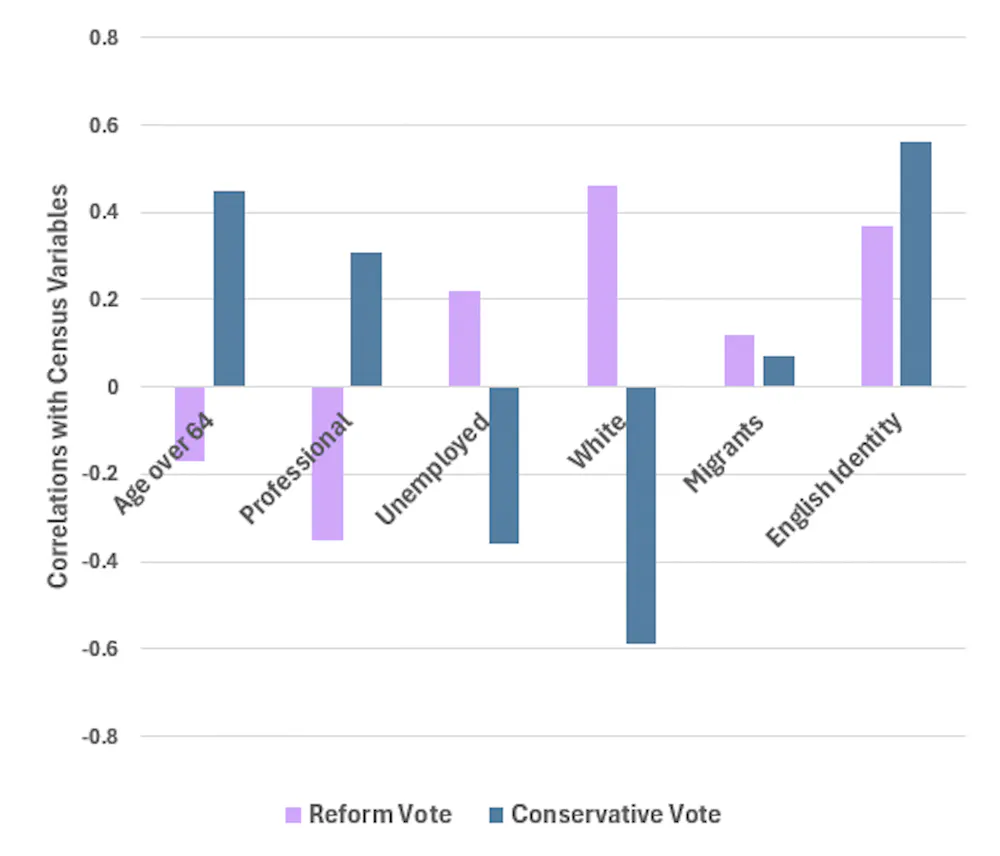
    This is illustrated in the chart below which looks at the social characteristics of constituencies using data from the 2021 census. It shows how different groups supported the two parties in the election.

    The chart shows the correlations between the size of a particular group and voting for Reform and the Conservatives in the election. It looks at the 575 parliamentary constituencies in England and Wales, since the Scottish data is not yet available.

    The relationships between constituency characteristics and voting in 2024

    Less in common than you might think.
    P Whiteley, CC BY-NC-ND

    We observe large differences between support for the two parties among the different groups. For example, looking at the percentage of people in constituencies over the age of 64, most of whom were retired, we see a big difference. There is a strong positive correlation between this measure and voting Conservative (0.45), indicating that the Tories did well among older people. The opposite is true for Reform, since the relationship is negative (although relatively weak at -0.17). Reform did not rely on older people’s support in the same way as the Conservatives.


    Want more politics coverage from academic experts? Every week, we bring you informed analysis of developments in government and fact check the claims being made.

    Sign up for our weekly politics newsletter, delivered every Friday.


    A similar point can be made about the percentages who worked in professional and higher management occupations. The Tories did well in this group, whereas Reform did badly. Among constituencies with high levels of unemployment, the reverse was true. A high proportion of unemployed people boosted the Reform vote and undermined the Conservative vote.

    If we look at ethnicity, a high proportion of ethnically white people in constituencies helped Reform, but it weakened support for the Conservatives. This seems surprising at first sight until one remembers that many of them voted for Labour, the Liberal Democrats and Greens. The Tories lost a good proportion of the white vote in the election.

    The census provided information about the numbers of people who had moved into constituencies from abroad in the previous year. Not surprisingly, given their anti-immigration positioning, large numbers of newly arrived migrants helped both parties, with Reform doing better in these areas than the Conservatives. That said, the correlations were modest and so did not play a large part in explaining the overall results.


    Read more:
    When did class stop predicting who people vote for in Britain? Know Your Place podcast


    Finally, the 2021 census asked people about their national identities and in this case there was an interesting difference between respondents who claimed they were exclusively “English” rather than ‘British’ or some other identity. Englishness helped both parties, but it helped the Conservatives more than Reform. It appears that the Tories are more of an English National Party than Reform.

    The next general election is a long way off, but these results mean that if the Labour government fails to deliver growth and curb illegal immigration, it will face a pincer movement from the Conservative and Reform. The Tories will pick up votes in constituencies with a high proportion of prosperous, middle class, retired people and Reform will pick up votes from deprived areas with high levels of young unemployed people.

    Paul Whiteley has received funding from the British Academy and the ESRC.

    ref. Why the Tories may be wasting their time trying to compete with Reform – https://theconversation.com/why-the-tories-may-be-wasting-their-time-trying-to-compete-with-reform-241106

    MIL OSI – Global Reports

  • MIL-OSI Global: How farmers can use solar power without damaging the rest of their operation

    Source: The Conversation – UK – By Austin Kay, Researcher in Sustainable Advanced Materials, Centre for Integrative Semiconductor Materials, Swansea University

    Snapshot freddy/Shutterstock

    As the world races to meet net-zero targets, emissions from all industrial sectors must be reduced more urgently than ever. Agriculture is an important area of focus as it contributes up to 22% of global greenhouse gas emissions – almost as much as the energy sector.

    One approach to decarbonising the agricultural sector is agrivoltaics. It involves integrating solar panels – or photovoltaics (PVs) – into fields of crops, greenhouses and livestock areas, which can help farmers reduce their carbon footprint while continuing to produce food.

    Agrivoltaics can also mitigate one of the main criticisms often made of solar power – that solar farms “waste” vast tracts of agricultural land that could otherwise be used for food production. In reality, solar farms currently occupy only 0.15% of the UK’s total land – not much compared to its 70% agricultural land.

    The simplest example of an agrivoltaic system would be conventional, crystalline silicon PVs (the market-leading type of solar panels), installed in fields alongside livestock. This method of farm diversification has become increasingly popular in recent years for three main reasons.

    First, it enhances biodiversity as the fields are not seeing a regular crop rotation, being monocultured, or being harvested for silage. Second, it increases production as livestock benefit from the shade and the healthier pasture growth.

    Finally, the solar farm has reduced maintenance costs because livestock can keep the grass short. All this is achieved while the solar panels provide locally-generated, clean energy.

    But if they’re not set up properly, agrivoltaics may cause problems. One of the most important challenges is balancing the need for sunlight between crops and solar panels. Crops need light to grow, and if solar panels block too much sunlight, they can negatively impact crop yields.

    This issue varies from place to place. In countries with fewer sunny days like the UK, the panels need to let more sunlight through. But in places like Spain or Italy, some shade can actually help crops by reducing the stress of intense heat during summer months. Finding the right balance is tricky, as it depends on local conditions, the type of crop, and even the needs of pollinators like bees.

    An agrivoltaic canopy installed in France.
    Jacopo Landi/Shutterstock

    The complexity deepens when we consider the type of PV material used. Traditional solar panels aren’t always suitable because they often block the wavelengths (colours) of light needed by plants.

    This is where newer materials, like organic semiconductors and perovskites, are ideal as they can be customised to let crops get the light they need while still generating energy. Unlike traditional inorganic semiconductors, which are essentially crystals of metal and metalloid atoms, organic semiconductors are molecules mainly made of carbon and hydrogen. Perovskites, meanwhile, are like a hybrid of the two.

    But there are thousands of combinations of these materials to choose from, with scientific literature containing a plethora of options. Figuring out which one works best can be a daunting task.

    This is where computational tools can make a big difference. Instead of testing each material in real-world conditions – which would take years and be incredibly expensive – researchers can use simulations to predict their performance. These models can help identify the best materials for specific crops and climates, saving both time and resources.

    The tool

    We have developed an open-source tool that helps compare various PV materials, making it easier to identify the best options for agrivoltaics. Our tool uses geographical data and realistic simulations of how different PV materials perform.

    It considers how light travels through these materials and reflects off them, as well as other important performance measures like voltage and power output. The tool can also take lab-based measurements of PV materials and apply them to real-world scenarios.

    Using this tool, we simulated how much power different PV materials could generate per square metre over the course of a year, across various regions. And we calculated how much light passed through these materials to ensure it was enough for crops to thrive.

    An agrivoltaic installation over raspberry crops in the Netherlands.
    Jacopo Landi/Shutterstock

    By running these simulations for multiple materials, we could identify the most suitable options for specific crops and climates.

    Tools like ours could play a critical role in decarbonising the agricultural sector by guiding the design of agrivoltaic systems. Future research could combine these simulations with economic and environmental impact analyses. This would help us understand how much energy we can expect from a solar panel over its lifetime compared to the resources and costs involved in producing it.

    Ultimately, our tool could help researchers and policymakers in selecting the most efficient, cost-effective and eco-friendly ways to decarbonise agriculture and move us closer to achieving global net-zero emissions.


    Don’t have time to read about climate change as much as you’d like?

    Get our award-winning weekly roundup in your inbox instead. Every Wednesday, The Conversation’s environment editor writes Imagine, a short email that goes a little deeper into just one climate issue. Join the 35,000+ readers who’ve subscribed so far.


    Austin Kay is a Postgraduate Student at Swansea University and receives funding from the Engineering and Physical Sciences Research Council (EPSRC) through program grant EP/T028513/1 Application Targeted and Integrated Photovoltaics.

    ref. How farmers can use solar power without damaging the rest of their operation – https://theconversation.com/how-farmers-can-use-solar-power-without-damaging-the-rest-of-their-operation-239625

    MIL OSI – Global Reports

  • MIL-OSI Global: Who is Tundu Lissu? Tanzania’s opposition leader is fighting for change in the face of fresh attacks on political freedoms

    Source: The Conversation – Africa – By Nicodemus Minde, Researcher, United States International University

    Tundu Lissu has become the face of opposition in Tanzania following his defiant and unrelenting criticism of the government. Since he came into the national limelight in 1995 when running for a parliamentary seat, Lissu has been a champion of democracy and human rights. He has taken on the ruling elite, exposing corruption and demanding accountability. This almost cost him his life in 2017.

    In September 2024, new evidence presented at a London tribunal revealed that the telecommunications company Tigo had shared Lissu’s mobile phone data – including his location – with the Tanzanian government. The implication was that the company was assisting the government in its harassment of the politician. Tigo’s owners have distanced themselves from these reports.

    The revelations coincided with a resurgence in government crackdowns on opposition figures.

    In the most recent developments, leaders of the country’s main opposition party Chadema (Chama cha Demokrasia na Maendeleo) – including Lissu, who is the party’s vice-chairperson, and chairman Freeman Mbowe – were arrested in September 2024. This followed their attempt to organise mass protests, which were foiled by the police. The protests had been organised to demand government accountability after the killing of a senior Chadema official and the disappearance of other party members believed to have been abducted by state operatives.

    I have studied Tanzania’s political party dynamics for a decade and interviewed Lissu as part of my PhD research on the country’s democracy. Lissu’s persistence in tackling democratic backsliding in Tanzania has made him a formidable force, challenging the ruling Chama Cha Mapinduzi party.

    Lissu spent about three years in exile in Belgium after the 2017 shooting. He staged a comeback as a presidential candidate in the 2020 elections. He lost to John Magufuli in a poll marred by violence and allegations of rigging.

    There have been changes in the country since Magufuli’s death in March 2021 and a string of political reforms under President Samia Suluhu. This has created the space for Lissu and his party Chadema to establish an opposition that now threatens the ruling party’s six-decade hold on power. Presidential elections are due to be held in 2025.

    So who is Lissu? What’s his history and how did he became involved in politics?

    Early years

    Lissu’s political activism began during his university years in the early 1990s. This marked the start of a career that would later shape Tanzania’s political landscape. Lissu studied law at the University of Dar es Salaam before going to the UK for a master’s degree in law.

    His first foray into national politics came in 1995, when he vied for a parliamentary seat. He was 27. The election was Tanzania’s first under a multiparty system. It introduced Lissu to the arena of opposition politics following his defeat.

    A year later, Lissu was one of the lead investigative lawyers for a public interest environmental law organisation investigating abuses and irregularities at a World Bank-backed gold mine in northern Tanzania. His early work focused on environmental and human rights.

    Lissu and his colleague Rugemeleza Nshala were investigating the killing of 62 small-scale miners and the evictions of thousands at the mine in 1996. They were charged with sedition over these investigations. The government eventually stopped following up on the case.

    Lissu thereafter worked on community land rights at the World Resources Institute, a global organisation focusing on policy research.

    Parliamentary years

    In 2010, Lissu won the parliamentary seat for Singida East under the opposition party Chadema. As a first-term member of parliament, he gained prominence by exposing significant state corruption scandals, particularly in the energy sector.

    Lissu and other Chadema opposition figures became a formidable force, openly naming corrupt government officials and exposing grand theft.

    They also began making calls for constitutional reform. These were aimed at addressing excessive presidential powers and the power imbalances of the union between Tanganyika and Zanzibar. This push culminated in then president Jakaya Kikwete initiating a constitutional review process in 2010.

    Lissu’s legal acumen played out in the constituent assembly, the body convened to deliberate on constitutional reforms. However, the assembly, dominated by members of the ruling party Chama Cha Mapinduzi, rejected many of the key provisions of the draft constitution. It had been widely regarded as the “people’s draft” because it included citizen participation. Its key provisions included reduced presidential powers and the establishment of independent state institutions.

    The process was to culminate in a referendum in 2014. This prematurely aborted and Tanzania went into the 2015 election without a new constitution.

    In these elections, Lissu successfully defended his parliamentary seat. As a second-term legislator, he focused on strengthening Chadema’s presence. This included door-to-door conversations with the public and grassroots mobilisation to build the party.

    The party’s momentum, however, was halted by a repressive regime under Magufuli, who became president in 2015. He cracked down on critics and instituted a partial ban on political rallies.

    Lissu became very critical of Magufuli’s economic policies. In a public address in 2017, Magufuli admitted to the government’s tapping of Lissu’s phone and described those who opposed his own economic reforms as traitors. Soon after this, Lissu was shot 16 times after leaving parliament buildings in the capital, Dodoma.

    Exile

    Lissu officially went into exile in Belgium after the shooting. In 2020, he published Remaining in the Shadows: Parliament and Accountability in East Africa, a critical examination of the presidentialist systems in Uganda, Kenya and Tanzania, which he argued had undermined democratic consolidation in the region.

    Through this publication, Lissu continued his activism, challenging political structures.

    His brief return to Tanzania to contest the presidency in 2020 was marked by repeated arrests and intimidation during the electoral campaign. After his loss to Magufuli, Lissu went back to Belgium.

    He announced his return home in 2023.

    Tanzania today

    It’s important to understand why Lissu and Chadema are viewed as a current threat in Tanzania.

    The country is entering an election period. Local government elections are scheduled for November 2024 ahead of general elections in 2025.

    The ruling party, Chama Cha Mapinduzi, has in the recent past relied on state violence to secure electoral victories. The last general election in 2020 was marred by violence, as well as intimidation of the opposition and censorship.

    It looks likely that Chadema will once again nominate Lissu to contest the presidency in the 2025 general election against president Samia. Lissu’s fearlessness and defiance make him the best candidate to take on the ruling party. Samia has already described Lissu as a troublesome character.

    With the ongoing opposition clampdown, it looks clear that the ruling party is once again willing to do whatever it will take to hold on to power. Even if Tanzania’s democracy suffers.

    Nicodemus Minde is affiliated with the Institute for Security Studies.

    ref. Who is Tundu Lissu? Tanzania’s opposition leader is fighting for change in the face of fresh attacks on political freedoms – https://theconversation.com/who-is-tundu-lissu-tanzanias-opposition-leader-is-fighting-for-change-in-the-face-of-fresh-attacks-on-political-freedoms-240821

    MIL OSI – Global Reports

  • MIL-OSI Global: To make nuclear fusion a reliable energy source one day, scientists will first need to design heat- and radiation-resilient materials

    Source: The Conversation – USA – By Sophie Blondel, Research Assistant Professor of Nuclear Engineering, University of Tennessee

    A fusion experiment ran so hot that the wall materials facing the plasma retained defects. Christophe Roux/CEA IRFM, CC BY

    Fusion energy has the potential to be an effective clean energy source, as its reactions generate incredibly large amounts of energy. Fusion reactors aim to reproduce on Earth what happens in the core of the Sun, where very light elements merge and release energy in the process. Engineers can harness this energy to heat water and generate electricity through a steam turbine, but the path to fusion isn’t completely straightforward.

    Controlled nuclear fusion has several advantages over other power sources for generating electricity. For one, the fusion reaction itself doesn’t produce any carbon dioxide. There is no risk of meltdown, and the reaction doesn’t generate any long-lived radioactive waste.

    I’m a nuclear engineer who studies materials that scientists could use in fusion reactors. Fusion takes place at incredibly high temperatures. So to one day make fusion a feasible energy source, reactors will need to be built with materials that can survive the heat and irradiation generated by fusion reactions.

    Fusion material challenges

    Several types of elements can merge during a fusion reaction. The one most scientists prefer is deuterium plus tritium. These two elements have the highest likelihood of fusing at temperatures that a reactor can maintain. This reaction generates a helium atom and a neutron, which carries most of the energy from the reaction.

    Humans have successfully generated fusion reactions on Earth since 1952 – some even in their garage. But the trick now is to make it worth it. You need to get more energy out of the process than you put in to initiate the reaction.

    Fusion reactions happen in a very hot plasma, which is a state of matter similar to gas but made of charged particles. The plasma needs to stay extremely hot – over 100 million degrees Celsius – and condensed for the duration of the reaction.

    To keep the plasma hot and condensed and create a reaction that can keep going, you need special materials making up the reactor walls. You also need a cheap and reliable source of fuel.

    While deuterium is very common and obtained from water, tritium is very rare. A 1-gigawatt fusion reactor is expected to burn 56 kilograms of tritium annually. But the world has only about 25 kilograms of tritium commercially available.

    Researchers need to find alternative sources for tritium before fusion energy can get off the ground. One option is to have each reactor generating its own tritium through a system called the breeding blanket.

    The breeding blanket makes up the first layer of the plasma chamber walls and contains lithium that reacts with the neutrons generated in the fusion reaction to produce tritium. The blanket also converts the energy carried by these neutrons to heat.

    The fusion reaction chamber at ITER will electrify the plasma.

    Fusion devices also need a divertor, which extracts the heat and ash produced in the reaction. The divertor helps keep the reactions going for longer.

    These materials will be exposed to unprecedented levels of heat and particle bombardment. And there aren’t currently any experimental facilities to reproduce these conditions and test materials in a real-world scenario. So, the focus of my research is to bridge this gap using models and computer simulations.

    From the atom to full device

    My colleagues and I work on producing tools that can predict how the materials in a fusion reactor erode, and how their properties change when they are exposed to extreme heat and lots of particle radiation.

    As they get irradiated, defects can form and grow in these materials, which affect how well they react to heat and stress. In the future, we hope that government agencies and private companies can use these tools to design fusion power plants.

    Our approach, called multiscale modeling, consists of looking at the physics in these materials over different time and length scales with a range of computational models.

    We first study the phenomena happening in these materials at the atomic scale through accurate but expensive simulations. For instance, one simulation might examine how hydrogen moves within a material during irradiation.

    From these simulations, we look at properties such as diffusivity, which tells us how much the hydrogen can spread throughout the material.

    We can integrate the information from these atomic level simulations into less expensive simulations, which look at how the materials react at a larger scale. These larger-scale simulations are less expensive because they model the materials as a continuum instead of considering every single atom.

    The atomic-scale simulations could take weeks to run on a supercomputer, while the continuum one will take only a few hours.

    All this modeling work happening on computers is then compared with experimental results obtained in laboratories.

    For example, if one side of the material has hydrogen gas, we want to know how much hydrogen leaks to the other side of the material. If the model and the experimental results match, we can have confidence in the model and use it to predict the behavior of the same material under the conditions we would expect in a fusion device.

    If they don’t match, we go back to the atomic-scale simulations to investigate what we missed.

    Additionally, we can couple the larger-scale material model to plasma models. These models can tell us which parts of a fusion reactor will be the hottest or have the most particle bombardment. From there, we can evaluate more scenarios.

    For instance, if too much hydrogen leaks through the material during the operation of the fusion reactor, we could recommend making the material thicker in certain places, or adding something to trap the hydrogen.

    Designing new materials

    As the quest for commercial fusion energy continues, scientists will need to engineer more resilient materials. The field of possibilities is daunting – engineers can manufacture multiple elements together in many ways.

    You could combine two elements to create a new material, but how do you know what the right proportion is of each element? And what if you want to try mixing five or more elements together? It would take way too long to try to run our simulations for all of these possibilities.

    Thankfully, artificial intelligence is here to assist. By combining experimental and simulation results, analytical AI can recommend combinations that are most likely to have the properties we’re looking for, such as heat and stress resistance.

    The aim is to reduce the number of materials that an engineer would have to produce and test experimentally to save time and money.

    Sophie Blondel receives funding from the US Department of Energy.

    ref. To make nuclear fusion a reliable energy source one day, scientists will first need to design heat- and radiation-resilient materials – https://theconversation.com/to-make-nuclear-fusion-a-reliable-energy-source-one-day-scientists-will-first-need-to-design-heat-and-radiation-resilient-materials-238489

    MIL OSI – Global Reports

  • MIL-OSI Global: AI, cryptocurrencies and data privacy: Comparing the Trump and Harris records on technology regulation

    Source: The Conversation – USA – By Anjana Susarla, Professor of Information Systems, Michigan State University

    The Federal Trade Commission is one of the main venues for government regulation of big tech and its wares. Alpha Photo/Flickr, CC BY-NC

    It’s not surprising that technology regulation is an important issue in the 2024 U.S. presidential campaign.

    The past decade has seen advanced technologies, from social media algorithms to large language model artificial intelligence systems, profoundly affect society. These changes, which spanned the Trump and Biden-Harris administrations, spurred calls for the federal government to regulate the technologies and the powerful corporations that wield them.

    As a researcher of information systems and AI, I examined both candidates’ records on technology regulation. Here are the important differences.

    Algorithmic harms

    With artificial intelligence now widespread, governments worldwide are grappling with how to regulate various aspects of the technology. The candidates offer different visions for U.S. AI policy. One area where there is a stark difference is in recognizing and addressing algorithmic harms from the widespread use of AI technology.

    AI affects your life in ways that might escape your notice. Biases in algorithms used for lending and hiring decisions could end up reinforcing a vicious cycle of discrimination. For example, a student who can’t get a loan for college would then be less likely to get the education needed to pull herself out of poverty.

    At the AI Safety Summit in the U.K. in November 2023, Harris spoke of the promise of AI but also the perils from algorithmic bias, deepfakes and wrongful arrests. Biden signed an executive order on AI on Oct. 30, 2023, that recognized AI systems can pose unacceptable risks of harm to civil and human rights and individual well-being. In parallel, federal agencies such as the Federal Trade Commission have carried out enforcement actions to guard against algorithmic harms.

    President Joe Biden signs an executive order addressing the risks of artificial intelligence on Oct. 30, 2023, with Vice President Kamala Harris at his side.
    AP Photo/Evan Vucci

    By contrast, the Trump administration did not take a public stance on mitigation of algorithmic harms. Trump has said he wants to repeal President Biden’s AI executive order. In recent interviews, however, Trump noted the dangers from technologies such as deepfakes and challenges posed to security from AI systems, suggesting a willingness to engage with the growing risks from AI.

    Technological standards

    The Trump administration signed the American AI Initiative executive order on Feb. 11, 2019. The order pledged to double AI research investment and established the first set of national AI research institutes. The order also included a plan for AI technical standards and established guidance for the federal government’s use of AI. Trump also signed an executive order on Dec. 3, 2020, promoting the use of trustworthy AI in the federal government.

    The Biden-Harris administration has tried to go further. Harris convened the heads of Google, Microsoft and other tech companies at the White House on May 4, 2023, to undertake a set of voluntary commitments to safeguard individual rights. The Biden administration’s executive order contains an important initiative to probe the vulnerablity of very large-scale, general-purpose AI models trained on massive amounts of data. The goal is to determine the risks hackers pose to these models, including the ones that power OpenAI’s popular ChatGPT and DALL-E.

    Donald Trump departs from Washington D.C., on Feb. 11, 2019, shortly after signing an executive order on artificial intelligence that included setting technical standards.
    Nicholas Kamm/AFP via Getty Images

    Antitrust

    Antitrust law enforcement – restricting or conditioning mergers and acquisitions – is another way the federal government regulates the technology industry.

    The Trump administration’s antitrust dossier includes its attempt to block AT&T’s acquisition of Time Warner. The merger was eventually allowed by a federal judge after the FTC under the Trump administration filed a suit to block the deal. The Trump administration also filed an antitrust case against Google focused on its dominance in internet search.

    Biden signed an executive order on July 9, 2021, to enforce antitrust laws arising from the anticompetitive effects of dominant internet platforms. The order also targeted the acquisition of nascent competitors, the aggregation of data, unfair competition in attention markets and the surveillance of users. The Biden-Harris administration has filed antitrust cases against Apple and Google.

    The Biden-Harris administration’s merger guidelines in 2023 outlined rules to determine when mergers can be considered anticompetitive. While both administrations filed antitrust cases, the Biden administration’s antitrust push appears stronger in terms of its impact in potentially reorganizing or even orchestrating a breakup of dominant companies such as Google.

    Cryptocurrency

    The candidates have different approaches to cryptocurrency regulation. Late in his administration, Trump tweeted in support of cryptocurrency regulation. Also late in Trump’s administration, the federal Financial Crimes Enforcement Network proposed regulations that would have required financial firms to collect the identity of any cryptocurrency wallet to which a user sent funds. The regulations were not enacted.

    Trump has since shifted his position on cryptocurrencies. He has criticized existing U.S. laws and called for the United States to be a Bitcoin superpower. The Trump campaign is the first presidential campaign to accept payments in cryptocurrencies.

    The Biden-Harris administration, by contrast, has laid out regulatory restrictions on cryptocurrencies with the Securities and Exchange Commission, which brought about a series of enforcement actions. The White House vetoed the Financial Innovation and Technology for the 21st Century Act that aimed to clarify accounting for cryptocurrencies, a bill favored by the cryptocurrency industry.

    Data privacy

    Biden’s AI executive order calls on Congress to adopt privacy legislation, but it does not provide a legislative framework to do so. The Trump White House’s American AI Initiative executive order mentions privacy only in broad terms, calling for AI technologies to uphold “civil liberties, privacy, and American values.” The order did not mention how existing privacy protections would be enforced.

    Across the U.S., several states have tried to pass legislation addressing aspects of data privacy. At present, there is a patchwork of statewide initiatives and a lack of comprehensive data privacy legislation at the federal level.

    The paucity of federal data privacy protections is a stark reminder that while the candidates are addressing some of the challenges posed by developments in AI and technology more broadly, a lot still remains to be done to regulate technology in the public interest.

    Overall, the Biden administration’s efforts at antitrust and technology regulation seem broadly aligned with the goal of reining in technology companies and protecting consumers. It’s also reimagining monopoly protections for the 21st century. This seems to be the chief difference between the two administrations.

    Anjana Susarla receives funding from the National Institute of Health

    ref. AI, cryptocurrencies and data privacy: Comparing the Trump and Harris records on technology regulation – https://theconversation.com/ai-cryptocurrencies-and-data-privacy-comparing-the-trump-and-harris-records-on-technology-regulation-239676

    MIL OSI – Global Reports

  • MIL-OSI Global: During the American Revolution, Brits weren’t just facing off against white Protestant Christians − US patriots are diverse and have been since Day 1

    Source: The Conversation – USA – By Adam Jortner, Goodwin Philpott Eminent Professor of Religion, Auburn University

    A detail from the Washington Monument in Philadelphia, sculpted by Rudolf Siemering. PHAS/Universal Images Group via Getty Images

    In 1770, Barnard Gratz of Philadelphia wrote to a friend complaining about a recent speech by King George III. Gratz, an American patriot, wrote that the speech “was such narishkeit” that it was “not worth the postage.”

    Narishkeit is Yiddish for “nonsense.”

    Gratz was one of hundreds of Jews who joined the American Revolution as soldiers and leaders: Gershom Seixas led his synagogue out of New York when the British invaded and led what was probably the first Jewish prayer group in Connecticut. Solomon Bush earned the rank of lieutenant colonel in the American army; at the time, no Jew in Europe could serve as a military officer. At the battle of Beaufort, one of the patriot militias was nicknamed “the Jew Company” because 28 of its 40 members were Jewish.

    Yet belief persists that the American Revolution was somehow a Christian event – and that the country it created is therefore a Christian nation. This is a position usually defended with vague statements about what the Founding Fathers wanted. The general idea is that back in the day, everyone was Christian and so, of course, the founding was Christian. Yet neither the Declaration of Independence nor the Constitution refer to a “Christian nation” or a church. They don’t even mention Jesus Christ.

    Gershom Mendes Seixas, painted around 1784.
    Secret Egypt/Wikimedia Commons, CC BY-SA

    But as a historian, I didn’t want to get caught up in these kinds of arguments. I wanted to know something about the people who actually did the fighting in the war.

    What I discovered is that when it came to fighting Britain, there were plenty of Jewish patriots signing up. America’s revolutionaries were not a uniform bunch of Christian white guys. The Revolution was a religiously diverse place, from Jews and religious skeptics to Catholics and Christian dissenters. And that matters for how the U.S. defines itself and its freedom today.

    Jews join the cause

    When the war started in 1775, the roughly 2,500 Jews in the Colonies did not have religious freedom. British law allowed them to practice, but they were classified as “residents” rather than subjects. They could live there, but they had no say in the laws under which they lived. For the most part, only property-owning Protestant men could elect or be elected to their legislature. Jews were simply not considered people the way Protestant Christians were.

    So when the break with Britain arrived, American Jews flocked to the standard of liberty. Here at last was a chance to become citizens.

    Under British rule, anyone who exercised political authority had to take an oath affirming their Christian faith. The pro-independence groups and militias that sprung up amid the war had no such rules. Mordecai Sheftall, who lived in Georgia, was one of the few people there who had pledged to resist the Coercive Acts: Britain’s efforts to blockade Boston and place Massachusetts under military rule after the Boston Tea Party. When the war broke out, Sheftall became chairman of Georgia’s de facto government, in defiance of British rule.

    Jewish residents took up arms for independence, too. A South Carolina writer praised American Jews fighting for liberty, saying they were “as staunch as any other citizens of this state.” One signer of the Declaration of Independence, Benjamin Rush, believed “the Jews in all the states” were patriots. So did royalist Gov. James Wright of Georgia. When the British seized Savannah, Wright banned Jews from the province, calling them “violent rebels and persecutors of the King’s loyal subjects.”

    When the war ended, Philadelphia hosted a parade and all the clergy of the city were invited, including Jewish leaders. There was even a kosher table set out for them after the celebration.

    ‘Second-status’ Christians

    Nor were Jews the only marginalized group to join the cause. Roman Catholics also signed up. Like Jews, Catholics were barred under the British from serving in public office. As a Catholic, Charles Carroll could not have served in the royal government of Maryland, but he went on to sign both the Declaration of Independence and the Constitution.

    Charles Carroll, painted in the 1760s by Joshua Reynolds.
    Yale Center for British Art via Wikimedia Commons

    The Baptists of Virginia were also held in second-class status. The Colony’s state church did not recognize the Baptists, and they had to pay fines for preaching and even for holding Baptist weddings without state sanction. Virginia Baptists promised their support to the Revolution only if Virginia would offer them religious freedom. The Virginia Legislature complained but suspended its state church to build whatever support it could find. Virginia Baptists joined the fight in droves.

    Baptists, Catholics and Jews were not put off by any of the Revolution’s radical deists: a mostly unorganized group of religious thinkers who believed in God and reason, but not revelation or miracles. Their ranks included military officer Ethan Allen of Vermont, who later wrote a book denying the divinity of the Bible. The Revolution did not ask its members how they prayed.

    The urge for liberty spread beyond questions of religious differences. Although George Washington did not originally want to enlist Black men in the army, he realized the Revolution was doomed without them, and thousands of Black Americans joined the cause in the hope that liberty would mean the end of slavery. Women such as Deborah Sampson wore men’s clothing to take up arms against the British. The revolutionaries even had a Muslim ally in the form of Hyder Ali and his armies. The Muslim ruler of the kingdom of Mysore, in southern India, Ali fought with France against Britain in the 1780s, and American revolutionaries named a ship after him.

    Retired Marine Corps Col. Jonathan de Sola Mendes commemorates members of Shearith Israel, the congregation led by Gershom Seixas, who served in the American Revolution.
    Akiva123/Wikimedia Commons, CC BY-SA

    Here from the start

    In recent years, violence and anger have risen against minority groups, including Jewish and Muslim Americans. Part of the false rhetoric about these groups has been that they are “new”: that they appeared after America was created and are not really part of the American experiment. In fact, they were here from the beginning. They also fought for the Revolution. Their patriotism is as old as anyone else’s.

    Not only were the people who founded the nation not all Christian, but after independence was secured, religious freedom actually increased.

    States with synagogues all lost the Christian requirement for public office by 1792. Virginia created full religious freedom in 1786. And Washington wrote, “It is our boast, that a man’s religious tenets will not forfeit the protection of the laws, nor deprive him of the right of attaining and holding the highest offices that are known in the United States.”

    Calls for a Christian nation are historically false. They are not a reversion to something old; they are something new. Religious diversity in America, and the freedom of different religions to be full Americans? That’s old. As old as the Revolution.

    Adam Jortner does not work for, consult, own shares in or receive funding from any company or organization that would benefit from this article, and has disclosed no relevant affiliations beyond their academic appointment.

    ref. During the American Revolution, Brits weren’t just facing off against white Protestant Christians − US patriots are diverse and have been since Day 1 – https://theconversation.com/during-the-american-revolution-brits-werent-just-facing-off-against-white-protestant-christians-us-patriots-are-diverse-and-have-been-since-day-1-238482

    MIL OSI – Global Reports

  • MIL-OSI Global: What the history of blasphemy laws in the US and the fight for religious freedom can teach us today

    Source: The Conversation – USA – By Kristina M. Lee, Assistant Professor, University of South Dakota

    U.S. blasphemy laws reflect a complex fight for the freedom of religion and speech Getty Images

    Some 79 countries around the world continue to enforce blasphemy laws. And in places such as Afghanistan, Brunei, Iran, Nigeria, Pakistan and Saudi Arabia, violation of these measures can result in a death penalty.

    While the U.S. is not among those countries, it also has a long history of blasphemy laws. Many of the U.S. colonies established blasphemy laws, which became state laws. The U.S. Supreme Court did not rule that blasphemy was a form of protected speech until 1952. Even then, it has not always been protected.

    As a scholar of religious and political rhetoric, I believe the history of U.S. blasphemy laws reflects a complex fight for the freedom of religion and speech.

    Early US blasphemy laws

    U.S. colonies often developed legal protections for Christians to practice their religion. These safeguards often did not extend to non-Christians.

    Maryland’s Toleration Act of 1649, for example, was the first Colonial act to refer to the “free exercise” of religion and was designed to protect Christians from religious persecution from state officials. It did not, however, extend that “free exercise” of religion to non-Christians, instead declaring that anyone who blasphemes against God by cursing him or denying the existence of Jesus can be punished by death or the forfeiture of their lands to the state.

    In 1811, the U.S. witnessed one of its most infamous blasphemy trials, People v. Ruggles, at the New York Supreme Court. New York resident John Ruggles received a three-month prison sentence and a US$500 fine — about $12,000 in today’s money — for stating in public that “Jesus Christ was a bastard, and his mother must be a whore.”

    Chief Justice James Kent argued that people have freedom of religious opinion, but opinions that were malicious toward the majority stance of Christianity were an abuse of that right. He claimed similar attacks on other religions, such as Islam and Buddhism, would not be punishable by law, because “we are a Christian people” whose country does not draw on the doctrines of “those imposters.”

    Several years later, in 1824, a member of a debating society was convicted of blasphemy by the Pennsylvania Supreme Court after saying during a debate: “The Holy Scriptures were a mere fable, that they were a contradiction, and that although they contained a number of good things, yet they contained a great many lies.” In this case — Updegraph v. Commonwealth — the court argued that it was a “vulgarly shocking and insulting” statement that reflected “the highest offence” against public morals and was a disturbance to “public peace.”

    By the end of the 19th century, a prominent free thought movement that rejected religion as a guide for reason had begun to emerge. Movement leaders embraced the public critiquing of Christianity and challenged laws that favored Christians, such as blasphemy laws and mandatory Bible readings in public schools.

    Unsurprisingly, as historian Leigh Eric Schmidt has noted, speakers and writers in the movement regularly faced threats of blasphemy charges.

    By this time, however, even in cases where freethinkers were convicted of blasphemy, judges appeared to offer leniency.

    In 1887, C.B. Reynolds, an ex-preacher who became a prominent free thought speaker, was convicted of blasphemy in New Jersey after he publicly doubted the existence of God. He faced a $200 fine and up to a year in prison. The judge, however, only fined Reynolds $25, plus court costs.

    While it is unclear why Reynolds was offered leniency, historian Leonard Levy suggests that it may have been to avoid making Reynolds a martyr of the free thought movement by imprisoning him.

    Protecting blaspheme as free speech

    Growing calls for religious equality and freedom of speech increasingly swayed blasphemy cases in the 1900s.

    In 1917, for example, Michael X. Mockus, who had previously been convicted of blasphemy in Connecticut for his free thought lectures, was acquitted in a similar case in Illinois.

    While expressing dislike for blasphemy, Judge Perry L. Persons argued that the court’s job is not to determine which religion is right. He said “the Protestant, Catholic, Mormon, Mahammedan, the Jew, the Freethinker, the Atheist” must “all stand equal before the law.”

    Then, in 1952, the U.S. Supreme Court heard the case of Joseph Burstyn, Inc. v. Wilson after New York rescinded the license for the film “The Miracle.” The film was deemed sacrilegious because of its supposed mockery of the Catholic faith.

    The high court ruled that states could not ban sacrilegious films. That would be a violation of the separation of church and state, it ruled, and an unconstitutional restriction on freedom of religion and speech.

    Even after the Supreme Court decision, Americans continued to occasionally face blasphemy charges. But courts shot the charges down.

    In 1968, when Irving West, a 20-year-old veteran, told a policeman to “Get your goddam hands off me” after getting in a fight, he was charged with disorderly conduct and violating Maryland’s blasphemy law. When West appealed, a circuit court judge ruled the law was an unconstitutional violation of the First Amendment.

    Despite these rulings, in 1977, Pennsylvania enacted a blasphemy statute banning businesses from having blasphemous names after a local businessman tried to name his gun store “The God Damn Gun Shop.” It was not until 2010 that the Pennsylvania Supreme Court deemed this statute unconstitutional.

    The decision followed a case in which the owner of a film production company sued the state after his request to register his company under the name “I Choose Hell Productions, LLC” was denied on the grounds that it was blasphemous. Citing the 1952 Joseph Burstyn, Inc. v. Wilson case, the judge ruled that the statute was a violation of First Amendment rights.

    A sign of democratic freedom

    As historian David Sehat highlights in his book “The Myth of American Religious Freedom”, since America was founded there have been strong disagreements over what religious freedom should look like. Blasphemy laws have been a key part of this clash.

    Historically, many Americans have viewed the laws as justifiable. Some believed Christianity deserved special protection and reverence. Others, including some Founding Fathers such as John Adams and Thomas Jefferson, have viewed the same laws as unconstitutional restrictions of free speech and religious expression.

    There has recently been growing attention to the rise of Christian nationalism, the belief that the United States is or should be a Christian nation. Amid this rise, there have been attacks on free speech, such as the increase in book bans and restrictions on public protests. I believe it’s important that we, as Americans, learn from this history of the fight for the freedom of religion and speech.

    Kristina M. Lee is a board member for the Secular Student Alliance

    ref. What the history of blasphemy laws in the US and the fight for religious freedom can teach us today – https://theconversation.com/what-the-history-of-blasphemy-laws-in-the-us-and-the-fight-for-religious-freedom-can-teach-us-today-238173

    MIL OSI – Global Reports

  • MIL-OSI Global: Hemingway, after the hurricane

    Source: The Conversation – USA – By Verna Kale, Associate Editor, The Letters of Ernest Hemingway and Associate Research Professor of English, Penn State

    Rescue workers search debris for victims of the Labor Day hurricane of 1935, a Category 5 storm that devastated parts of the Florida Keys. Bettman/Getty Images

    The 2024 hurricane season has been especially disastrous, and the casualties and widespread damage from flooding and high winds in towns like Cedar Key, Florida, call to mind another historic hurricane, the Labor Day hurricane of 1935.

    As one of the editors of “The Letters of Ernest Hemingway Volume 6 (1934-1936),” with Sandra Spanier and Miriam B. Mandel, I am reminded of the eyewitness account that the writer, then a resident of Key West, Florida, gave of the catastrophic storm that leveled Upper Matecumbe Key and Lower Matecumbe Key and took the lives of more than 400 people, many of them World War I veterans.

    Then, as now, the aftermath of a natural disaster included political finger-pointing.

    Today the debates center around how resources from the Federal Emergency Management Agency are allocated or how climate change contributes to the intensity of the storms.

    Back then, Hemingway had a different beef with the government, blaming the deaths of hundreds of World War I veterans on the failure to evacuate Upper Matecumbe Key and Lower Matecumbe Key ahead of the storm.

    The calm before the storm

    Hemingway was no stranger to hurricanes.

    A serious deep-sea angler who fished the waters off Florida, he kept an eye on weather patterns. Hurricane season was an anticipated, if dreaded, annual event.

    “Now the lousy hurricanes are starting,” he wrote his friends Jane and Grant Mason in June 1934. “Wish we would get lots of east wind and current … and then have a fine july and august without hurricanes.” Knowing that these conditions were unlikely, he jokingly asked the Masons “and what do you want for xmas Mr. and Mrs. Mason yourselves?”

    Ernest Hemingway was an avid fisherman. Here he poses with a marlin in Havana Harbor, Cuba.
    Ernest Hemingway Collection. John F. Kennedy Presidential Library and Museum, Boston.

    In a Sept. 30, 1934, letter, he wrote friends Gerald and Sara Murphy with hopes that he would get through the rest of hurricane season without incident: “no hurricanes yet […] if we get through the next 20 [days] are all right,” and he was glad that he “can fish without having to tie [the boat] up somewhere up some creek.”

    The next day, he wrote to fellow novelist John Dos Passos, “Hurricane months if you dont get a hurricane are fine.”

    ‘Not a building of any sort standing’

    But the following year, when the hurricanes did come, it was not fine.

    Over Sept. 2-3, 1935, a hurricane made landfall in the Florida Keys. Occurring in the days before storms were given names, the Labor Day hurricane, as it is commonly known, was the first recorded Category 5 hurricane in the U.S.

    It remains the third-most intense storm on record in the Atlantic basin, with a barometric pressure drop to 892 millibars and wind gusts exceeding 200 mph. Much of its damage was caused by the storm surge, and the Overseas Railroad, which had been completed in 1912 and connected the Florida Keys to the mainland, was destroyed and would not be rebuilt.

    After the storm, Hemingway wrote to his editor, Maxwell Perkins, describing its aftermath.

    Though communications were down and the island was cut off from the mainland, Key West had sustained relatively little damage.

    Upper Matecumbe Key and Lower Matecumbe Key, however, were a different story.

    “Imagine you have read about it in the papers but nothing could give an idea of the destruction,” Hemingway writes. “The foliage absolutely stripped as though by fire for forty miles and the land looking like the abandoned bed of a river. Not a building of any sort standing. Over thirty miles of railway washed and blown away.”

    Worse yet were the human casualties: He notes that the last time he witnessed so many dead in one place was in Europe during World War I as a Red Cross ambulance driver, adding, “We made five trips with provisions for survivors to different places and nothing but dead men to eat the grub.”

    A corpse floats in the aftermath of the hurricane.
    Ernest Hemingway Collection. John F. Kennedy Presidential Library and Museum, Boston.

    Many of the victims were veterans, employed by the Federal Emergency Relief Administration to work on the Overseas Highway construction project. Outraged by the federal government’s failure to send a train to evacuate the workers in time, Hemingway tells Perkins that the veterans “were practically murdered.”

    Federal administrators, he adds, “had all day Sunday and all day monday to get those vets out and never did it. If they had taken half the precautions with them that we took with our boat not a one would have been lost.”

    The letter contains graphic descriptions of the hundreds of dead bodies, rapidly decomposing in the Florida sun as they awaited transport to Arlington, Virginia, to be buried.

    ‘That smell you thought you’d never smell again’

    Hemingway would repeat many of these same details in an article published in the Sept. 17, 1935, issue of the leftist magazine The New Masses.

    The article, which Hemingway titled “Who Killed These Men?,” and which was re-titled by the editors as “Who Murdered the Vets?,” criticized the federal government for not evacuating the workers.

    “Who sent nearly a thousand war veterans … to live in frame shacks on the Florida Keys in hurricane months?” Hemingway asks.

    Hemingway, no stranger to the sight and smell of the dead from his experiences during World War I, was disgusted not merely by the bodies “swollen and stinking” but by what brought the veterans to the work camps to begin with.

    Skeptical of the various government programs of Franklin D. Roosevelt’s New Deal, Hemingway saw the Federal Emergency Relief Administration work camps as a way for Washington to conveniently rid itself of hundreds of down-on-their-luck veterans, many of whom were experiencing what we would now call post-traumatic stress disorder.

    “I would like to make whoever sent them there carry just one out through the mangroves, or turn one over that lay in the sun along the fill, or tie five together so they won’t float out, or smell that smell you thought you’d never smell again, with luck,” Hemingway writes.

    This impassioned response to the disaster in 1935 still resonates. Hemingway recognized that while storms are inevitable, mass casualties do not have to be. The government can’t control the weather, but it can fulfill an obligation to protect the most vulnerable in the path of the storm.

    Verna Kale works for the Hemingway Letters Project, which has been made possible in part by a major grant from the National Endowment for the Humanities: Democracy demands wisdom.

    ref. Hemingway, after the hurricane – https://theconversation.com/hemingway-after-the-hurricane-241103

    MIL OSI – Global Reports

  • MIL-OSI Global: What the killing of Hamas leader Yahya Sinwar could mean for the Middle East – expert Q&A

    Source: The Conversation – UK – By Scott Lucas, Professor of International Politics, Clinton Institute, University College Dublin

    Israel has announced it has killed Hamas military leader Yahya Sinwar in Gaza. Sinwar was apparently killed in a chance encounter on October 16 after a tank unit opened fire on a group of Palestinian men running into a building in Rafah in the southern Gaza Strip. His body was found in the rubble and later identified as the Hamas leader.

    It’s an important moment in the conflict between Israel and Hamas. Sinwar’s death follows a campaign of assassination of top Hamas leaders by Israel since the latest round of hostilities began after the Hamas attack on Israel of October 7 2023.

    Middle East analyst Scott Lucas of University College Dublin addresses some of the key issues raised by Sinwar’s killing.

    How badly Sinwar’s death hit Hamas’s command structure?

    Just over a year after its mass October 7 killings inside Israel, overseen by Yahya Sinwar, Hamas as an organisation is in disarray. It is not just the killing of Sinwar in the chance encounter with Israeli forces in Rafah. Sinwar’s death adds to a lengthy roll call of top Hamas leaders during the past year.

    Principally, this includes Mohammed Deif, who planned the October 7 attacks, and Hamas’s political leader Ismail Haniyeh, who was killed in Beirut on July 31. These three are just the most prominent identities among a host of other senior officials and military commanders killed by Israel in Gaza or Lebanon.

    Sinwar’s younger brother, Mohammed, 49, is likely to take over military command. And veteran figures such as Khaled Meshaal – who led Hamas’s political bureau from 1996 to 2017 – remain. But they will struggle to sustain the organisation, particularly if the Israeli government presses its military advantage and continues to identify and assassinate Hamas’s high command.

    But that does not mean that Hamas as a movement is finished. Mass killing, even of its leaders, could galvanise it in the longer run. Those who survive will move up through the ranks, and the spirit of resistance and resentment could bring in more recruits.

    Israel’s prime minister, Benjamin Netanyahu, can claim “victory” over Sinwar, Haniyeh and Deif. But victory over Hamas, particularly if Israel pursues an open-ended occupation in Gaza, may not be assured.

    What did Sinwar represent as a symbol of Palestinian resistance?

    For many in Palestine and beyond, Sinwar will be hailed as a martyr and icon of resistance. He was with Hamas from its first years, spent 22 years in an Israeli prison, and took command in Gaza from 2017. He never wavered in his belief that Hamas would prevail over Israel’s blockade, detentions, and military operations.

    But for others, Sinwar may be remembered as a divisive, even cruel figure. He built his career in Hamas on the killing of supposed “collaborators” with Israel. He was suspected of the torture and execution of rivals. And his leadership of the October 7 mass killings may be recalled as “resistance” which needlessly sacrificed the lives of tens of thousands and displaced almost 2 million of those whom he was supposedly representing.

    Does his death clear the way for a younger generation more amenable to a ceasefire deal and the return of the hostages?

    It will take months, perhaps years before we see where that “younger generation” will take Hamas. In the meantime, the interim political and military command of the battered organisation will face their immediate challenge. Can they still get some return, such as the freeing of Palestinians from Israeli prisons and the continued presence of Hamas in Gaza, in exchange for the release of the hostages? Or do they have to accept capitulation, possible expulsion, and Israeli occupation?

    Barring an unexpected change in the US position, putting pressure on Netanyahu, all the cards are in Israel’s hand for now.

    What’s Israel’s next move?

    Ask Netanyahu. He has the option of proclaiming “mission accomplished”. However, that will not be true for many Israelis as long as the hostages are not returned. Without that resolution, Netanyahu will run the risk of losing power if forced to an election and even the resumption of court proceedings over bribery charges if he halts military operations.

    Israel’s expansion of the war into Lebanon has improved his position to an extent. It has reconciled him with the defense minister, Yoav Gallant, who was privately saying Israel had no “endgame” in Gaza. And it has improved his approval ratings.

    So it remains in his interest to continue hostilities in both Gaza and Lebanon. And indeed Netanyahu has signalled his intention to press on. But he has also said that while it is not the end, it is “the beginning of the end”.

    While Netanyahu may pay lip service to the resumption of ceasefire talks, that will likely be conditional on the expulsion of Hamas from Gaza. And with no clear alternative for governance in the Strip, that points – as with the West Bank – to indefinite Israeli occupation.


    Read more:
    Israel: what hardliners in Netanyahu’s government want from the war


    How will Iran respond?

    With the decimation of its Hamas and Hezbollah allies, Iran’s regime appears to have no good options at present. Amid economic and political problems at home and outmatched by Israel in military capabilities, the regime has avoided direct confrontation.

    Iran could continue to pursue “indirect” war through militias in Iraq and Syria attacking US personnel with rockets and drones, or with Yemen’s Houthis lobbing missiles at Israel and again threatening Red Sea shipping. It could expand cyber-attacks and its own attempted assassinations abroad.

    But those options would have little immediate effect, and would risk retaliation from the US and further isolation in the international community. The US is already using B-2 stealth bombers to attack Houthi bases in Yemen.

    So for now, Iran’s leaders and their spokespeople are likely to take the political route, condemning Israel and proclaiming that the “axis of resistance” will be strengthened through its losses.


    Read more:
    As its conflict with Israel escalates, could Iran now acquire a nuclear bomb?


    Can Washington now pressure Israel to do a deal with the Palestinians?

    This is perhaps the easiest question to answer. Unless the US cuts military aid to Israel or comes out for an unconditional ceasefire, it has little if any leverage with Netanyahu.

    How does this affect the US election campaign?

    Foreign policy is rarely a priority for most US voters, and even the mass killing of the past year is unlikely to change that. But on the margins of the US presidential election, the escalating toll in Gaza and Lebanon could alienate Arab American voters from the Democrats in Michigan, one of the seven states that will decide the contest.

    More broadly, the impression of Netanyahu pushing around a “weak” Biden administration could take hold. And in a toss-up election, those margins could be decisive.


    Read more:
    How the Middle East conflict could influence the US election – and why Arab Americans in swing states might vote for Trump


    Scott Lucas does not work for, consult, own shares in or receive funding from any company or organisation that would benefit from this article, and has disclosed no relevant affiliations beyond their academic appointment.

    ref. What the killing of Hamas leader Yahya Sinwar could mean for the Middle East – expert Q&A – https://theconversation.com/what-the-killing-of-hamas-leader-yahya-sinwar-could-mean-for-the-middle-east-expert-qanda-241699

    MIL OSI – Global Reports

  • MIL-OSI Global: What the killing of Hamas leader Yahya Sinwar could mean for the Middle East – expert Q&A

    Source: The Conversation – UK – By Scott Lucas, Professor of International Politics, Clinton Institute, University College Dublin

    Israel has announced it has killed Hamas military leader Yahya Sinwar in Gaza. Sinwar was apparently killed in a chance encounter on October 16 after a tank unit opened fire on a group of Palestinian men running into a building in Rafah in the southern Gaza Strip. His body was found in the rubble and later identified as the Hamas leader.

    It’s an important moment in the conflict between Israel and Hamas. Sinwar’s death follows a campaign of assassination of top Hamas leaders by Israel since the latest round of hostilities began after the Hamas attack on Israel of October 7 2023.

    Middle East analyst Scott Lucas of University College Dublin addresses some of the key issues raised by Sinwar’s killing.

    How badly Sinwar’s death hit Hamas’s command structure?

    Just over a year after its mass October 7 killings inside Israel, overseen by Yahya Sinwar, Hamas as an organisation is in disarray. It is not just the killing of Sinwar in the chance encounter with Israeli forces in Rafah. Sinwar’s death adds to a lengthy roll call of top Hamas leaders during the past year.

    Principally, this includes Mohammed Deif, who planned the October 7 attacks, and Hamas’s political leader Ismail Haniyeh, who was killed in Beirut on July 31. These three are just the most prominent identities among a host of other senior officials and military commanders killed by Israel in Gaza or Lebanon.

    Sinwar’s younger brother, Mohammed, 49, is likely to take over military command. And veteran figures such as Khaled Meshaal – who led Hamas’s political bureau from 1996 to 2017 – remain. But they will struggle to sustain the organisation, particularly if the Israeli government presses its military advantage and continues to identify and assassinate Hamas’s high command.

    But that does not mean that Hamas as a movement is finished. Mass killing, even of its leaders, could galvanise it in the longer run. Those who survive will move up through the ranks, and the spirit of resistance and resentment could bring in more recruits.

    Israel’s prime minister, Benjamin Netanyahu, can claim “victory” over Sinwar, Haniyeh and Deif. But victory over Hamas, particularly if Israel pursues an open-ended occupation in Gaza, may not be assured.

    What did Sinwar represent as a symbol of Palestinian resistance?

    For many in Palestine and beyond, Sinwar will be hailed as a martyr and icon of resistance. He was with Hamas from its first years, spent 22 years in an Israeli prison, and took command in Gaza from 2017. He never wavered in his belief that Hamas would prevail over Israel’s blockade, detentions, and military operations.

    But for others, Sinwar may be remembered as a divisive, even cruel figure. He built his career in Hamas on the killing of supposed “collaborators” with Israel. He was suspected of the torture and execution of rivals. And his leadership of the October 7 mass killings may be recalled as “resistance” which needlessly sacrificed the lives of tens of thousands and displaced almost 2 million of those whom he was supposedly representing.

    Does his death clear the way for a younger generation more amenable to a ceasefire deal and the return of the hostages?

    It will take months, perhaps years before we see where that “younger generation” will take Hamas. In the meantime, the interim political and military command of the battered organisation will face their immediate challenge. Can they still get some return, such as the freeing of Palestinians from Israeli prisons and the continued presence of Hamas in Gaza, in exchange for the release of the hostages? Or do they have to accept capitulation, possible expulsion, and Israeli occupation?

    Barring an unexpected change in the US position, putting pressure on Netanyahu, all the cards are in Israel’s hand for now.

    What’s Israel’s next move?

    Ask Netanyahu. He has the option of proclaiming “mission accomplished”. However, that will not be true for many Israelis as long as the hostages are not returned. Without that resolution, Netanyahu will run the risk of losing power if forced to an election and even the resumption of court proceedings over bribery charges if he halts military operations.

    Israel’s expansion of the war into Lebanon has improved his position to an extent. It has reconciled him with the defense minister, Yoav Gallant, who was privately saying Israel had no “endgame” in Gaza. And it has improved his approval ratings.

    So it remains in his interest to continue hostilities in both Gaza and Lebanon. And indeed Netanyahu has signalled his intention to press on. But he has also said that while it is not the end, it is “the beginning of the end”.

    While Netanyahu may pay lip service to the resumption of ceasefire talks, that will likely be conditional on the expulsion of Hamas from Gaza. And with no clear alternative for governance in the Strip, that points – as with the West Bank – to indefinite Israeli occupation.


    Read more:
    Israel: what hardliners in Netanyahu’s government want from the war


    How will Iran respond?

    With the decimation of its Hamas and Hezbollah allies, Iran’s regime appears to have no good options at present. Amid economic and political problems at home and outmatched by Israel in military capabilities, the regime has avoided direct confrontation.

    Iran could continue to pursue “indirect” war through militias in Iraq and Syria attacking US personnel with rockets and drones, or with Yemen’s Houthis lobbing missiles at Israel and again threatening Red Sea shipping. It could expand cyber-attacks and its own attempted assassinations abroad.

    But those options would have little immediate effect, and would risk retaliation from the US and further isolation in the international community. The US is already using B-2 stealth bombers to attack Houthi bases in Yemen.

    So for now, Iran’s leaders and their spokespeople are likely to take the political route, condemning Israel and proclaiming that the “axis of resistance” will be strengthened through its losses.


    Read more:
    As its conflict with Israel escalates, could Iran now acquire a nuclear bomb?


    Can Washington now pressure Israel to do a deal with the Palestinians?

    This is perhaps the easiest question to answer. Unless the US cuts military aid to Israel or comes out for an unconditional ceasefire, it has little if any leverage with Netanyahu.

    How does this affect the US election campaign?

    Foreign policy is rarely a priority for most US voters, and even the mass killing of the past year is unlikely to change that. But on the margins of the US presidential election, the escalating toll in Gaza and Lebanon could alienate Arab American voters from the Democrats in Michigan, one of the seven states that will decide the contest.

    More broadly, the impression of Netanyahu pushing around a “weak” Biden administration could take hold. And in a toss-up election, those margins could be decisive.


    Read more:
    How the Middle East conflict could influence the US election – and why Arab Americans in swing states might vote for Trump


    Scott Lucas does not work for, consult, own shares in or receive funding from any company or organisation that would benefit from this article, and has disclosed no relevant affiliations beyond their academic appointment.

    ref. What the killing of Hamas leader Yahya Sinwar could mean for the Middle East – expert Q&A – https://theconversation.com/what-the-killing-of-hamas-leader-yahya-sinwar-could-mean-for-the-middle-east-expert-qanda-241699

    MIL OSI – Global Reports

  • MIL-OSI Global: Some people love to scare themselves in an already scary world − here’s the psychology of why

    Source: The Conversation – USA – By Sarah Kollat, Teaching Professor of Psychology, Penn State

    A controlled scary experience can leave you exhilarated and relaxed afterward. gremlin/E+ via Getty Images

    Fall for me as a teenager meant football games, homecoming dresses – and haunted houses. My friends organized group trips to the local fairground, where barn sheds were turned into halls of horror, and masked men nipped at our ankles with (chainless) chain saws as we waited in line, anticipating deeper frights to come once we were inside.

    I’m not the only one who loves a good scare. Halloween attractions company America Haunts estimates Americans are spending upward of US$500 million annually on haunted house entrance fees simply for the privilege of being frightened. And lots of fright fans don’t limit their horror entertainment to spooky season, gorging horror movies, shows and books all year long.

    To some people, this preoccupation with horror can seem tone deaf. School shootings, child abuse, war – the list of real-life horrors is endless. Why seek manufactured fear for entertainment when the world offers real terror in such large quantities?

    As a developmental psychologist who writes dark thrillers on the side, I find the intersection of psychology and fear intriguing. To explain what drives this fascination with fear, I point to the theory that emotions evolved as a universal experience in humans because they help us survive. Creating fear in otherwise safe lives can be enjoyable – and is a way for people to practice and prepare for real-life dangers.

    Fear can feel good

    Controlled fear experiences – where you can click your remote, close the book, or walk out of the haunted house whenever you want – offer the physiological high that fear triggers, without any real risk.

    When you perceive yourself under threat, adrenaline surges in your body and the evolutionary fight-or-flight response is activated. Your heart rate increases, you breathe deeper and faster, and your blood pressure goes up. Your body is preparing to defend itself against the danger or get away as fast as possible.

    This physical reaction is crucial when facing a real threat. When experiencing controlled fear – like jump scares in a zombie TV show – you get to enjoy this energized sensation, similar to a runner’s high, without any risks. And then, once the threat is dealt with, your body releases the neurotransmitter dopamine, which provides sensations of pleasure and relief.

    In one study, researchers found that people who visited a high-intensity haunted house as a controlled fear experience displayed less brain activity in response to stimuli and less anxiety post-exposure. This finding suggests that exposing yourself to horror films, scary stories or suspenseful video games can actually calm you afterward. The effect might also explain why my husband and I choose to relax by watching zombie shows after a busy day at work.

    Going through something frightening together – like a haunted house attraction – can be a bonding experience.
    AP Photo/John Locher

    The ties that bind

    An essential motivation for human beings is the sense of belonging to a social group. According to the surgeon general, Americans who miss those connections are caught up in an epidemic of loneliness, which leaves people at risk for mental and physical health issues.

    Going through intense fear experiences together strengthens the bonds between individuals. Good examples include veterans who served together in combat, survivors of natural disasters, and the “families” created in groups of first responders.

    I’m a volunteer firefighter, and the unique connection created through sharing intense threats, such as entering a burning building together, manifests in deep emotional bonds with my colleagues. After a significant fire call, we often note the improved morale and camaraderie of the firehouse. I feel a flood of positive emotions anytime I think of my firefighting partners, even when the events occurred months or years ago.

    Controlled fear experiences artificially create similar opportunities for bonding. Exposure to stress triggers not only the fight-or-flight response, but in many situations it also initiates what psychologists call the “tend-and-befriend” system. A perceived threat prompts humans to tend to offspring and create social-emotional bonds for protection and comfort. This system is largely regulated by the so-called “love hormone” oxytocin.

    The tend-and-befriend reaction is particularly likely when you experience stress around others with whom you have already established positive social connections. When you encounter stressors within your social network, your oxytocin levels rise to initiate social coping strategies. As a result, when you navigate a recreational fear experience like a haunted house with friends, you are setting the emotional stage to feel bonded with the people beside you.

    Sitting in the dark with friends while you watch a scary movie or navigating a haunted corn maze with a date is good for your health, in that it helps you strengthen those social connections.

    Consuming lots of horror as entertainment may make some people more resilient in real life.
    Edwin Tan/E+ via Getty Images

    An ounce of prevention = a pound of cure

    Controlled fear experiences can also be a way for you to prepare for the worst. Think of the early days of the COVID-19 pandemic, when the films “Contagion” and “Outbreaktrended on streaming platforms as people around the world sheltered at home. By watching threat scenarios play out in controlled ways through media, you can learn about your fears and emotionally prepare for future threats.

    For example, researchers at Aarhus University’s Recreational Fear Lab in Denmark demonstrated in one study that people who regularly consumed horror media were more psychologically resilient during the COVID-19 pandemic than nonhorror fans. The scientists suggest that this resilience might be a result of a kind of training these fans went through – they practiced coping with the fear and anxiety provoked by their preferred form of entertainment. As a result, they were better prepared to manage the real fear triggered by the pandemic.

    When I’m not teaching, I’m an avid reader of crime fiction. I also write psychological thrillers under the pen name Sarah K. Stephens. As both a reader and writer, I notice similar themes in the books I am drawn to, all of which tie into my own deep-rooted fears: mothers who fail their children somehow, women manipulated into subservience, lots of misogynist antagonists.

    I enjoy writing and reading about my fears – and seeing the bad guys get their just desserts in the end – because it offers a way for me to control the story. Consuming these narratives lets me mentally rehearse how I would handle these kinds of circumstances if any were to manifest in my real life.

    Survive and thrive

    In the case of controlled fear experiences, scaring yourself is a pivotal technique to help you survive and adapt in a frightening world. By eliciting powerful, positive emotions, strengthening social networks and preparing you for your worst fears, you’re better able to embrace each day to its fullest.

    So the next time you’re choosing between an upbeat comedy and a creepy thriller for your movie night, pick the dark side – it’s good for your health.

    Sarah Kollat does not work for, consult, own shares in or receive funding from any company or organization that would benefit from this article, and has disclosed no relevant affiliations beyond their academic appointment.

    ref. Some people love to scare themselves in an already scary world − here’s the psychology of why – https://theconversation.com/some-people-love-to-scare-themselves-in-an-already-scary-world-heres-the-psychology-of-why-240292

    MIL OSI – Global Reports

  • MIL-OSI Global: Robot developers keep making it seem like housebots are imminent when they’re decades away

    Source: The Conversation – UK – By Carl Strathearn, Research Fellow, Computing, Edinburgh Napier University

    Threepio schmeepio. Tesla

    The walking, talking, dancing Optimus robots at the recent Tesla demonstration generated huge excitement. But this turned to disappointment as it became apparent that much of what was happening was actually being controlled remotely by humans.

    As much as this might still be a fascinating glimpse of the future, it’s not the first time that robots have turned out to be a little too good to be true.

    Take Sophia, for instance, the robot created by Texas-based Hanson Robotics back in 2016. She was presented by the company as essentially an intelligent being, prompting numerous tech specialists to call this out as well beyond our capabilities at the time.

    Similarly we’ve seen carefully choreographed videos of pre-scripted action sequences like Boston Dynamics’ Atlas gymnastics, the English-made Ameca robot “waking up”, and most recently Tesla’s Optimus in the factory. Obviously these are still impressive in different ways, but they’re nowhere near the complete sentient package. Let Optimus or Atlas loose in a random home and you’d see something very different.

    A humanoid robot capable of working in our homes needs to be capable of doing many different tasks, using our tools, navigating our environments and communicating with us like a human. If you thought this was just a year or two away, you’re going to be disappointed.

    Building robots able to interact and carry out complex tasks in our homes and streets is still a huge challenge. Designing them even to do one specific task well, such as opening a door, is phenomenally difficult.

    There are so many door handles with different shapes, weights and materials, not to mention the complexity of dealing with unforeseen circumstances such as a locked door or objects blocking the way. Developers have actually now created a door-opening robot, but robots that can deal with hundreds of everyday tasks are still some way off.

    Behind the curtain

    The Tesla demonstration’s “Wizard of Oz” remote operation technique is a commonly used control method in this field, giving researchers a benchmark against which to test their real advances. Known as telemetric control, this has been around for some time, and is becoming more advanced.

    One of the authors of this article, Carl Strathearn, was at a conference in Japan earlier this year, where a keynote speaker from one of the top robotics labs demonstrated an advanced telemetrics system. It allowed a single human to simultaneously operate many humanoid robots semi-autonomously, using pre-scripted movements, conversation prompts and computerised speech.

    Clearly, this is very useful technology. Telemetric systems are used to control robots working in dangerous environments, disability healthcare and even in outer space. But the reason why a human is still at the helm is because even the most advanced humanoid robots, such as Atlas, are not yet reliable enough to operate completely independently in the real world.

    Another major problem is what we can call social AI. Leading generative AI programs such as DeepMind’s Gemini and OpenAI’s GPT-4 Vision may be a foundation for creative autonomous AI systems for humanoid robots in the future. But we should not be misled into believing that such models mean that a robot is now capable of functioning well in the real world.

    Interpreting information and problem solving like a human requires much more than just recognising words, classifying objects and generating speech. It requires a deeper contextual understanding of people, objects and environments – in other words, common sense.

    To explore what is currently possible, we recently completed a research project called Common Sense Enhanced Language and Vision (CiViL). We equipped a robot called Euclid with commonsense knowledge as part of a generative AI vision and language system to assist people in preparing recipes. To do this, we had to create commonsense knowledge databases using real-world problem-solving examples enacted by students.

    Euclid could explain complicated steps in recipes, give suggestions when things went wrong, and even point people to locations in the kitchen where utensils and tools might typically be found. Yet there were still issues, such as what to do if someone has a bad allergic reaction while cooking. The problem is that it’s almost impossible to handle every possible scenario, yet that’s what true common sense entails.

    This fundamental aspect of AI has got somewhat lost in humanoid robots over the years. Generated speech, realistic facial expressions, telemetric controls, even the ability to play games such as “rock paper scissors” are all impressive. But the novelty soon wears off if the robots are not actually capable of doing anything useful on their own.

    This isn’t to say that significant progress isn’t being made toward autonomous humanoid robots. There’s impressive work going on into robotic nervous systems to give robots more senses for learning, for instance. It’s just not usually given the same amount of press attention as the big unveilings.

    The data deficit

    Another key challenge is the lack of real-world data to train AI systems, since online data doesn’t always accurately represent the real-world conditions necessary for training our robots well enough. We have yet to find an effective way of collecting this real-world data in large enough quantities to get good results. However, this may change soon if we can access it from technologies such as Alexa and Meta Ray-Bans.

    Nonetheless, the reality is that we’re still perhaps decades away from developing multimodal humanoid robots with advanced social AI that are capable of helping around the house. Maybe in the meantime we’ll be offered robots controlled remotely from a command centre. Will we want them, though?

    In the meantime, it’s also more important that we focus our efforts on creating robots for roles that can support people who urgently need help now. Examples would include healthcare, where there are long waiting lists and understaffed hospitals; and education, to offer a way for overanxious or severely ill children to participate in classrooms remotely. We also need better transparency, legislation and publicly available testing, so that everyone can tell fact from fiction and help build public trust for when the robots eventually do arrive.

    Dimitra Gkatzia receives funding from EPSRC.

    Carl Strathearn does not work for, consult, own shares in or receive funding from any company or organisation that would benefit from this article, and has disclosed no relevant affiliations beyond their academic appointment.

    ref. Robot developers keep making it seem like housebots are imminent when they’re decades away – https://theconversation.com/robot-developers-keep-making-it-seem-like-housebots-are-imminent-when-theyre-decades-away-241638

    MIL OSI – Global Reports

  • MIL-OSI Global: Vaccinating care home residents reduced deaths, but the effect was small – new study

    Source: The Conversation – UK – By David Paton, Chair of Industrial Economics, Nottingham University Business School, University of Nottingham

    Vaccinating older people probably did avert some deaths in 2021, but the effects were small. And even those small effects on mortality seem to have dissipated during the booster programme. That’s the conclusion of our new study, published in the European Economic Review.

    COVID-related deaths decreased significantly in most of Europe and the US from the middle of 2021. Although this reduction coincided with the rollout of COVID vaccines, it has proved surprisingly difficult to identify the extent to which vaccination contributed to the drop in deaths.

    Randomised controlled trials (the gold standard for testing new treatments) suggest COVID vaccination can provide significant protection against serious illness and death relative to unvaccinated people who have not previously been infected with COVID. But there are reasons the effect of vaccination on mortality may be lower when viewed outside of trials.

    Early in the programme, there were hopes that vaccination would also prove highly effective in preventing the spread of COVID but it has since become clear that vaccination provides only limited and short-term protection against infection and transmission.

    It is also well established that a previous infection provides protection both against reinfection and against serious illness and death in the event of reinfection that is at least as effective as vaccination. Having a previous infection significantly reduces the likelihood of being vaccinated meaning the vaccinated population will include a relatively high proportion of people without protection from prior infection. So even if vaccination provides protection at an individual level, we may still observe population-level mortality rates that are similar for vaccinated and unvaccinated groups.

    The effectiveness of vaccination programmes may also be limited by people’s behaviour. For example, there is evidence that vaccinated people who get infected are more likely to have mild symptoms and this may cause them to take fewer precautions than others against spreading infection. As a result, vaccination may sometimes be associated with more rather than less transmission.

    Taken together, even if vaccination reduces the risk on an individual basis, it does not necessarily follow that it will reduce deaths at a population level. Existing research reflects this ambiguity with some research finding very significant effects of vaccination on death while other findings conclude there was little or no effect at all.

    Our new study attempts to improve our knowledge about the effect of COVID vaccination programmes by estimating the effect of vaccination take up on deaths in care homes. This is a particularly important group to examine. Given that the vast majority of COVID-related deaths occur in the elderly, any effect on deaths is highly likely to be seen in care homes.

    Machine learning used to analyse the data

    We examined deaths from COVID in care homes across nearly 150 local authorities in England from the start of the vaccine rollout in December 2020 until after the second booster dose in summer 2022. We tested whether higher rates of vaccination of staff and elderly residents led to fewer deaths both in total and from COVID.

    One feature of our research is the use of machine learning (a type of artificial intelligence) to isolate the effect of vaccination from other factors that may also have affected mortality including levels of prior infection as well as demographic, economic and health differences among local authorities.

    Machine learning is particularly adept at separating out the effects of a high number of potential explanatory variables, providing much better evidence of when associations represent true causal relationships. In contrast to some other research, we also use a measure of vaccination that takes account of the fact that effectiveness wanes over time.

    We found that higher vaccination rates of residents (but not of staff) did indeed lead to fewer deaths, but the effect was relatively small. For example, an increase in the resident vaccination take-up rate of 10% in a local authority caused, on average, a reduction of 1% in the total care home mortality rate. That is equivalent to about 22 fewer deaths per week nationwide.

    Of course, any reduction in deaths is welcome. But vaccination does not appear to be the key factor in reducing care home deaths from COVID. We also found that the reduction in deaths was restricted to the initial vaccination rollout.

    From September 2021, when the booster vaccination programme started in England, higher vaccination rates of elderly residents do not seem to have led to any reduction in deaths. Based on these results, vaccination is unlikely to have been responsible for the sustained fall in COVID-related deaths.

    Why then did Europe and the US experience large reductions in COVID deaths since 2021, even during times when infection rates have soared?

    There are two explanations. The first is the growth of variants such as omicron that, although highly infectious, are less deadly than variants responsible for the early waves.

    Second, is the rise in the cumulative number of people who gained protection from having had previous infections.

    These explanations are consistent with the experience of places such as Hong Kong, New Zealand and Taiwan. All saw relatively low COVID infections and deaths in 2020, meaning only limited levels of natural immunity had been built up. All then experienced high mortality rates during 2022, well after most people in those places had been vaccinated.

    For example, the seven-day average mortality rate in Hong Kong reached 40 deaths per million in March 2022, a rate far above the highest peak seen in the US during the whole pandemic despite cumulative vaccination rates at that time being similar.

    Even though vaccination probably reduced care home deaths by a small amount in the early rollout period, there is little evidence that the booster programme had any significant effect on COVID-related deaths.

    David Paton is a member of HART (Health Advisory and Recovery Team).

    Sourafel Girma does not work for, consult, own shares in or receive funding from any company or organisation that would benefit from this article, and has disclosed no relevant affiliations beyond their academic appointment.

    ref. Vaccinating care home residents reduced deaths, but the effect was small – new study – https://theconversation.com/vaccinating-care-home-residents-reduced-deaths-but-the-effect-was-small-new-study-241300

    MIL OSI – Global Reports

  • MIL-OSI Global: A brief history of the muses: the Greek goddesses who provided divine inspiration for ancient poets

    Source: The Conversation – UK – By Alison Habens, Head of Creative Writing, University of Portsmouth

    The muses in The Parnassus, a fresco by Raphael (1511). Vatican Museums, CC BY-SA

    In the beginning, there was just one, unnamed, muse. The blind bard Homer (a poet born around around 850BC) invoked her with the words “Sing, daughter of Zeus” in the first lines of his epic poem, the Odyssey.

    Then there were said to be three: Melete (practice), Mneme (memory) and Aoede (song), perhaps embodying the basic creative process of early humanity. Eventually, nine muses were identified, covering every branch of the arts, in the ancient Greek poet Hesiod’s introduction to Theogony, his epic poem about mythical stories and characters (circa 730–700BC). Hesiod, formerly an illiterate shepherd, claimed that he was inspired to write the poem when a beautiful goddess whispered the story in his ear.

    There were muses specifically for comedy, tragedy and even erotica. The oldest was Calliope, mother of the legendary musician Orpheus. Euterpe was the muse of music. Urania guided the scientists. Terpsichore taught dance.

    The muses promised fame and fortune to artists who followed them, but are rarely mentioned by name in the prologues and prefaces of artworks today.

    A timeline of the muses

    Originally characterised as singing and dancing goddesses guarding a sacred spring, evidence for the muses is found in writing by some of the earliest known authors.

    Hesiod and the Muse by Gustave Moreau (1891).
    Musée d’Orsay

    Yet, the muses existed long before reading and writing. It was only later that they were conscripted as the mascots of writers, with some ancient mosaics showing pens and parchment superimposed on their original images. Following their assimilation from the oral tradition into cheerleaders of literacy, the muses are seen waving pens and quills, scrolls and manuscripts in ancient artworks.

    Written storytelling about the muses started in the matriarchal period of prehistory, shifting to patriarchy in approximately 3,000BC, in Ovid’s story of the god Apollo fashioning himself the first laurel wreath. This crown of leaves, which supposedly signified his genius, is seen in the myth of Daphne, who turned into a laurel tree to escape Apollo’s unwanted advances.

    Written by Ovid in Metamorphoses, this picturesque tale may have been a metaphor for the switch from female to male authority. Legend has it that Apollo prevented his muse priestess from brewing, imbibing or smoking laurel leaves, which have a mild narcotic property.

    It wasn’t just fanciful poets in the muse’s congregation – philosophers kept the faith too. In approximately 370BC, Socrates classed “possession” by the muses as a form of divine madness like drunkenness, eroticism or dreaming: “He who, having no touch of the muses’ madness in his soul, thinks that he will get into the temple by the help of art – he, I say, and his poetry are not admitted.”

    Clio, Euterpe and Thalia, by Eustache Le Sueur (1652–1655).
    Louvre Museum

    English poet and soldier Robert Graves (1895-1985) agreed, writing in 1948 that his:

    ‘Inspiration’ was the breathing-in by the poet of fumes from an intoxicating cauldron, the Awen of the cauldron of Cerridwen, containing probably a mash of barley, acorns, honey, bull’s blood and such sacred herbs as ivy, hellebore and laurel as at Delphi.

    Changing times

    These original practices of using drink or drugs to inspire art are still in use around the world today. The muses may hold a pen in one hand and a smoke, or steaming mug, in the other – herbal remedies continue to be efficacious for writer’s block.

    In the Elizabethan period, when a poet’s relationship with the muses was perceived as directly proportionate to their success in romance, loving attention was paid to their invocation in rhythm and rhyme. But post-Enlightenment, it was no longer considered right for writers to invoke a supernatural mentor for literary endeavours. Modern men were influenced by reason and rationality, rather than a deity. Then it was more likely that a dead bard or scene from nature was deemed an appropriate source of inspiration.

    The nine muses on a Roman sarcophagus (second century AD).
    Louvre Museum, CC BY-SA

    Though writing remained a ritualistic practice, and its mechanisms sometimes mystical, the desk no longer doubled as an altar at which the author worshipped.

    Yet writers still often claim “the muse is with me” at moments when the words flow magically. Her voice can be heard in the modern Interval with Erato by Scott Cairns (2015), which name checks the ancient overseer of love poetry:

    That’s what I like best about you, Erato sighed in bed, that’s why you’ve become one of my favourites and why you will always be so.

    For the most part, the muses are missed off the agenda by both the microscope-gazers and the navel-gazers, these days. However, Plato did insist in his dialogue Phaedrus (370BC) that most people are eu amousoi (εὖ ἄμουσοι) an ancient Greek expression that means “happily without the muses”.

    Contemporary theories of creativity do not often mention divine inspiration. We no longer like the idea that the best stories are given to a few fated writers by God, that great plots and characters are bestowed on favoured authors by goddesses. But the answer to that common question all writers are asked – “where do you get your ideas from?” – still seems more mystic, less mathematic and as much supernatural as subconscious.


    Looking for something good? Cut through the noise with a carefully curated selection of the latest releases, live events and exhibitions, straight to your inbox every fortnight, on Fridays. Sign up here.


    Alison Habens does not work for, consult, own shares in or receive funding from any company or organisation that would benefit from this article, and has disclosed no relevant affiliations beyond their academic appointment.

    ref. A brief history of the muses: the Greek goddesses who provided divine inspiration for ancient poets – https://theconversation.com/a-brief-history-of-the-muses-the-greek-goddesses-who-provided-divine-inspiration-for-ancient-poets-239330

    MIL OSI – Global Reports

  • MIL-OSI Global: Rivals: the highs and lows of adapting a 1980s ‘bonkbuster’ for a 21st-century TV audience

    Source: The Conversation – UK – By Amy Burge, Associate Professor in Popular Fiction, University of Birmingham

    To much media fanfare and growing public anticipation, the Disney+ adaptation of Jilly Cooper’s Rivals (1988) begins on October 18. Cooper’s novel, first published in 1988, is a key “bonkbuster” text – a largely forgotten genre of women’s writing from the 1980s.

    Bonkbusters have three key components: they’re full of sex (the bonking) and wildly over the top in terms of storylines and characters, and they were extraordinarily popular (the buster part).

    However, like its televisual sister genre, the soap opera, the bonkbuster receded into the background of popular culture in the 21st century. So why is the bonkbuster having a cultural moment in 2024? What is the appeal of adapting a text like Rivals?

    We have been researching the bonkbuster genre for a couple of years, looking at its authors, themes and publishing history and talking to readers about their experiences with the genre, both at the time and now.

    Also known as the “sex-and-shopping” novel, the bonkbuster was a phenomenally popular genre of women’s writing in the 1980s and 1990s. Besides Cooper, authors like Jackie Collins, Shirley Conran, and Judith Krantz wrote about sex, marriage, friendship and scandal, against a luxurious backdrop of 1980s commercial excess.

    ‘A Milky Way when you’ve got a fridge full of posh chocolate’

    Cooper’s Rivals is fairly typical of the genre – one of the readers in our study, Samantha, aptly described it as: “a full-fat, fun, frothy novel set around class, privilege and horses”. It’s the second in Cooper’s Rutshire Chronicles, following Riders (1985).

    Rivals follows two competing television consortiums: Corinium, run by the villainous Tony Baddingham (played by David Tennant); and Venturer, set up by handsome Irish TV star Declan O’Hara (Aidan Turner), plucky Cockney businessman Freddie Jones (Danny Dyer), and notorious lothario Rupert Campbell-Black (Alex Hassell), as they bid for the local TV franchise.

    They are helped (and hindered) along the way by American TV executive Cameron Cook (Nafessa Williams), Declan’s actress-wife Maud (Victoria Smurfitt) and unhappily married author Lizzie Vereker (Katherine Parkinson).

    This might sound like fairly dry fare, but amid all the clandestine meetings and boardroom bust-ups, the characters fall in and out of love, have gleeful, adulterous affairs, and host lavish dinner parties, balls and naked tennis matches. Tory Rupert even finds time to be minister for sport – until Labour win the election.

    Great fun and very funny, Cooper’s books are famously tongue-in-cheek. However, the bonkbuster is also a product of its time – its references and values are, as study participant Samantha observed, “so 1980s”. What, then, is the appeal of books (and now TV shows) like Rivals?

    For some readers, the attraction is familiarity. Another reader, Hazel, said: “I don’t have that sense of ‘I cannot put this book down’ because I know exactly what’s coming. They’re so well thumbed, and all wrinkled at the edges because they’ve all fallen in the bath a few times.”

    Readers love the fantasy and escapism offered by the genre. As Hazel remarked, “It’s like still wanting a Milky Way when you’ve got a fridge full of Godiva chocolate … Sometimes you just want the sugary fluff.”

    There are much-loved characters: Declan O’Hara remains a firm reader favourite, and there is still a lot of affection for Freddie, the rough-diamond industrialist who has lots of money and a terrible wife. Readers also remember the romance between Rupert and Declan’s daughter Taggie (Bella Maclean) fondly, even as they raise an eyebrow at their age gap (Rupert is 37, Taggie 19).

    There’s also pleasure to be found in the setting. Cooper sets her novels in the cheekily named county of Rutshire, a fictionalised version of the Cotswolds, with vivid descriptions of stately homes and lush rural landscapes.

    The problematic 1980s

    But there are some aspects of the text that readers feel differently about, reading now, decades later. Some are simple: fashions have definitely changed, for instance, and the golden era of regional TV franchises has long passed.

    More complex, though, are some of the attitudes. While many readers still dearly love these books, they also note some elements that have not aged well: “The class issues … the sexism, racism, homophobia”, says Samantha. Cooper herself once noted that serial womaniser Rupert would probably be “locked up in prison”, post #MeToo.

    Readers in our study have particularly commented on the role of Cameron Cook in Rivals, a ruthlessly ambitious and occasionally unlikeable female American TV executive who is “caricatured as this ball-breaking go-getter,” according to Hazel. They wondered if the book were to be published today, whether Cameron would be written as a softer, more relatable character – and, perhaps, treated better by the men around her.

    Our readers were also acutely aware of the domestic violence in the book, which they found uncomfortable on rereading. Rivals has several instances of male violence against women, including one so severe the victim requires stitches afterwards – but still defends her attacker.

    While readers still find great pleasure in Rivals and other bonkbusters, they simultaneously negotiate some of these more problematic elements as they read the book again, trying to hold the 1980s and the 2020s in their minds at the same time.

    It seems likely that the Rivals adaptation will be a commercial success: not only does it build on an audience of loyal readers, but it is also receiving lots of positive early reviews as a hilarious escapist romp.

    Directed by Ted Lasso director Elliot Hegarty, and produced by soap director Dominic Treadwell-Collins, the series seems to be aiming for a blend of high-drama soap and quality production values. This is bolstered by the ensemble cast, including many well-known British actors.

    Yet, the novel remains inescapably a product of the 1980s, from its second-wave feminist values to characters’ concerns about Aids. As can be seen from the trailer – joyfully belting out Robert Palmer’s 1986 hit Addicted to Love – the adaptation is proudly retaining the 1980s setting. It will be interesting to see just how much of its 1980s values and attitudes remain.


    Looking for something good? Cut through the noise with a carefully curated selection of the latest releases, live events and exhibitions, straight to your inbox every fortnight, on Fridays. Sign up here.


    The authors do not work for, consult, own shares in or receive funding from any company or organisation that would benefit from this article, and have disclosed no relevant affiliations beyond their academic appointment.

    ref. Rivals: the highs and lows of adapting a 1980s ‘bonkbuster’ for a 21st-century TV audience – https://theconversation.com/rivals-the-highs-and-lows-of-adapting-a-1980s-bonkbuster-for-a-21st-century-tv-audience-241536

    MIL OSI – Global Reports

  • MIL-OSI Global: Black Myth: Wukong – how China’s gaming revolution is fueling its tech power

    Source: The Conversation – USA – By Shaoyu Yuan, Dean’s Fellow at the Division of Global Affairs, Rutgers University – Newark

    Black Myth: Wukong has enthralled gamers around the world with its rich visuals and vigorous fight sequences. Courtesy Game Science

    It may sound far-fetched, but the future of global technology supremacy could hinge on a video game.

    Black Myth: Wukong, China’s latest blockbuster, isn’t just breaking gaming records – it could be driving a critical shift in the global balance of technological power. What seems like just another action-packed video game is, in reality, a vital component in Beijing’s larger strategy to challenge Western dominance in the tech industry.

    The game, released by Chinese company Game Science on Aug. 19, 2024, is based on the legendary 16th century Chinese novel “Journey to the West.” The novel tells the story of a monk, Xuanzang, who journeys to India in search of Buddhist scrolls. The monkey Sun Wukong protects the monk by confronting and battling various demons and spirits.

    Black Myth: Wukong has captivated millions with its stunning visuals and storytelling. It quickly became a cultural sensation in China and abroad, attracting widespread attention and praise for its graphic fidelity and technological sophistication.

    As global affairs scholars, we see that the game’s success goes beyond the number of downloads or accolades. It’s what this success is driving within China’s technology sector that has far-reaching consequences.

    Video games and global power

    For years, China has been playing catch-up in the tech race, particularly in the production of semiconductors – the tiny microchips that power everything from smartphones to advanced artificial intelligence systems. The United States has maintained its dominance in this field by limiting China’s access to the most advanced chip-making technology.

    As of 2024, China has shifted away from its aggressive “wolf warrior” diplomacy to a more cooperative approach in order to rebuild international ties. The government has also issued mandates for companies like Huawei to develop domestic chips. However, China’s success in boosting semiconductor development and production using these approaches has been limited.

    Historically, video games have played a significant role in driving technological innovation in the semiconductor industry. From the early days of the 8-bit Nintendo Entertainment System to the modern PlayStation 5, gaming has always pushed chipmakers to develop faster, more efficient processors and graphics processing units, or GPUs. The intense graphical requirements of modern games – high resolutions, faster frame rates and real-time rendering – demand the most advanced semiconductor technology. The development of advanced GPUs by companies like NVIDIA was directly influenced by the gaming industry’s needs.

    Gamers require advanced processors to enjoy Black Myth: Wukong’s high-end visual and gameplay experience. Built using the state-of-the-art Unreal Engine 5 video game development tool, the game is a visual spectacle featuring lifelike graphics, seamless open-world environments and complex combat systems. The game is available for PlayStation 5 and PCs, and Game Science plans to release an Xbox version.

    Black Myth: Wukong features rich visuals and intricate gameplay.
    Courtesy of Sony Interactive Entertainment LLC

    As Black Myth: Wukong sweeps across gaming platforms, it not only puts pressure on China’s semiconductor makers to build more and better chips, but it also reveals the vast market potential for high-performance hardware, especially for gaming PCs equipped with powerful GPUs. The game’s success showcases just how big the demand is.

    Market analysts expect the Chinese video game industry to reach revenues of US$66.13 billion in 2024, compared with $78.01 billion in the U.S. Analysts predict the game will have annual sales of 30 million to 40 million copies in 2024.

    China’s gaming industry has surged into a global powerhouse, yet it remains dependent on foreign-made chips. Coupled with the West’s restrictions on chip exports, Wukong has become a key catalyst for China’s semiconductor development, and domestic companies now face growing pressure to innovate.

    This pressure aligns with Beijing’s broader technological ambitions. The government’s “Made in China 2025” plan calls for technological self-reliance, particularly in sectors like semiconductors, where China lags behind. And advanced GPUs haven’t been confined to the entertainment industry. They have become integral to advances in AI, including deep learning and autonomous systems.

    Flexing China’s cultural muscle

    While it might seem strange to link video games with geopolitics, Black Myth: Wukong is more than just entertainment. It’s a tool in China’s soft power arsenal. Soft power is nations influencing each other through cultural exports. For decades, the West, particularly the U.S., dominated global culture through Hollywood, music and video games.

    Now, China is flexing its cultural muscle. The success of Black Myth: Wukong abroad, where it has been hailed as a game-changing title, is part of Beijing’s strategy to export its culture and technological prowess. Millions of gamers around the world are now being exposed to Chinese mythology, art and storytelling through a highly sophisticated digital medium.

    ‘China Stay Winning’ American YouTubers react enthusiastically to Black Myth: Wukong. (Audio NSFW)

    But Black Myth: Wukong isn’t just a cultural triumph for China; it’s a warning shot. The country is taking advantage of its booming gaming industry to drive advances in a field that will define the future of technology. This game not only exports Chinese culture but also strengthens its tech base by accelerating the demand for domestic semiconductors.

    While Black Myth: Wukong entertains millions, it also shows China’s growing influence in the digital realm. In the future, we might not look back at Black Myth: Wukong as just a successful video game, but as a catalyst that helped China close the technological gap with the West. Beijing is playing a long game, and video games like Black Myth: Wukong are turning out to be effective weapons.

    The authors do not work for, consult, own shares in or receive funding from any company or organization that would benefit from this article, and have disclosed no relevant affiliations beyond their academic appointment.

    ref. Black Myth: Wukong – how China’s gaming revolution is fueling its tech power – https://theconversation.com/black-myth-wukong-how-chinas-gaming-revolution-is-fueling-its-tech-power-239998

    MIL OSI – Global Reports

  • MIL-OSI Global: Bouncing between war-torn countries: Displacement in Lebanon and Syria highlights cyclical nature of cross-border refuge

    Source: The Conversation – USA – By Jasmin Lilian Diab, Assistant Professor of Migration Studies; Director of the Institute for Migration Studies, Lebanese American University

    Displaced people crossing a hole on the road caused by an Israeli airstrike near the Masnaa crossing. Bilal Jawich/Xinhua via Getty Images

    The escalation of hostilities between Israel and Hezbollah since September 2024, and Israel’s bombing of civilian areas across Lebanon, have unleashed a profound humanitarian disaster.

    The mass displacement of over 1 million people, including Lebanese citizens, migrant workers and Syrian and Palestinian refugees, has created a crisis within Lebanon. Yet an equally significant phenomenon is occurring away from Lebanon’s southern border with Israel: the movement of people who have been displaced within Lebanon into Syria.

    An estimated 400,000 Lebanese and Syrians have reportedly fled into Syria through overcrowded border crossings.

    Not to be confused with return, this movement represents a reversal of the refugee flow that followed the descent of Syria into civil war in 2011. It is also emblematic of a broader pattern of cyclical displacement crises in the region.

    The complex and intertwined histories of Lebanon and Syria – where each has at various points been a refuge for citizens of the other – challenge the simple binaries often associated with the refugee experience.

    The exchange of roles between Lebanon and Syria highlights not only the fragility of regional stability but the fluidity of displacement – and the deeper implications that cross-border movement has on the sociopolitical dynamics of both countries.

    A history of reciprocal refuge

    The relationship between Lebanon and Syria has long been complex, oscillating between cooperation and tension. Despite Syria’s official withdrawal from Lebanon in 2005 after decades as an occupying force, the two countries remain connected due to shared borders, economic ties and security concerns. Cooperation exists in areas such as trade, but there is significant tension, especially over the presence of over 1 million Syrian refugees in Lebanon.

    Yet, throughout their modern histories, one of the most enduring bonds has been the shared experiences of displacement and refuge, dating back to Lebanon’s civil war. From 1975 to 1990, thousands of Lebanese fled to Syria to escape the sectarian-driven conflict that engulfed their homeland.

    The post-war period, however, was marked by a shift in the dynamics between the two countries. The 2005 withdrawal of Syrian troops from Lebanon marked a new chapter in their relations.

    Tensions rose as Lebanon sought to rebuild and assert its sovereignty after nearly 30 years of Syrian occupation. Yet, the region’s tendency for upheaval soon saw the roles reversed again decades later, when an estimated 180,000 Lebanese took refuge in Syria during the 2006 July war.

    With the onset of the Syrian civil war in 2011, it was Lebanon’s turn to serve as a refuge. By 2015, 1 million Syrians fleeing violence made the journey into Lebanon.

    Despite being one of the 44 countries never to have signed the 1951 Refugee Convention, Lebanon is the country hosting the largest number of refugees per capita globally.

    Because Lebanon didn’t sign the convention, it doesn’t formally recognize refugee status, which gives the country what it views as more control over its refugee policies. While Lebanon receives humanitarian support from the United Nations’ refugee agency, refugees remain in a precarious legal status, with limited rights.

    For many Lebanese, this most recent influx of fleeing Syrian refugees has rekindled memories of their own displacement, while for others, it has fueled anti-refugee sentiments.

    Bouncing between 2 war-torn countries

    With the latest escalation of the Israel-Hezbollah conflict, history is again repeating itself. Lebanese citizens, primarily from Hezbollah strongholds in South Lebanon and the Beqaa Valley, are seeking refuge in Syria, a country still grappling with its own economic collapse, violence and internal strife.

    While the conflict on Lebanese territory has gone on for more than a year, movements into Syria only picked up in late September 2024 as people have become more desperate to flee.

    As one displaced person forced to flee from Beirut explained to me: “Syria was certainly not a ‘better’ option than Lebanon six months ago, but in the last week, since the attacks on Beirut and political assassinations, Syria is safer – despite everything it is going through. That’s how unsafe we feel in Beirut – we are bouncing between one war-torn country and another.”

    Implications for refugee-host dynamics

    The cyclical nature of displacement between Lebanon and Syria overturns the prevailing political narrative of host-refugee dynamics being fixed and unidirectional.

    Syrian displacement to Lebanon has been portrayed by some Lebanese politicians as one-directional. This appears to be in order to frame Syrian refugees as the sole recipients of aid – as opposed to Lebanese citizens – as well as burdens on Lebanon.

    When displacement occurs in both directions, however, this narrative begins to break down.

    Syrian refugees who once sought safety in Lebanon now see their home country as a safer haven – albeit a fragile and temporary one. Meanwhile, Lebanese citizens face the same kinds of vulnerability and desperation that their Syrian counterparts experienced over the past decade.

    Importantly, testimonies from those who are making the trip from their ‘temporary’ home in Lebanon back to Syria highlight that these movements should not be mistaken for return. Rather, they are in themselves a temporary solution.

    As one Syrian who had fled his Lebanese home explained to me: “No, I am not returning. I am rather leaving one foot in Lebanon and one in Syria. Syria is in no way a safe place. As men, we are at risk of arrest and forced conscription. However, Lebanon is momentarily, at this point in history, much less safe. We do this assessment week by week. I sent my wife and my children first. I will follow.”

    For their part, internally displaced Lebanese entering into Syria insist that these movements are “absolutely temporary.” One told me: “Syria is not foreign to us. It feels close and familiar. But most importantly, it feels temporary and is the right proximity to Lebanon. As soon as things calm down we will come back to our homes. Many of us have nothing to go back to, but even in this case, we will not remain in Syria.”

    The strain of displacement

    Both Lebanon and Syria are, in many ways, ill-equipped to handle the new wave of displacement.

    Syrian children at a refugee camp in Lebanon’s frontier town of Arsal on Feb. 18, 2014.
    Ratib Al Safadi/Anadolu Agency via Getty Images

    By 2023, Lebanon’s economic collapse had driven 80% of its population into poverty, making it nearly impossible to absorb the additional strain of mass internal displacement.

    Government paralysis, compounded by political deadlock, leaves internally displaced people with little to no state support, mostly relying on aid and community networks to survive.

    Syria, though in the position of “host” in this current migratory flow, is similarly constrained. The country’s infrastructure remains devastated from more than a decade of civil war. Basic services are stretched thin, and the economy has not recovered. Humanitarian organizations coordinating the response are working amid overextended resources and dwindling support.

    A region in perpetual chaos

    As the armed conflict between Israel and Hezbollah escalates, the displacement crisis in Lebanon and Syria will, I fear, likely worsen.

    The recent wave of Syrian refugees and Lebanese into Syria reveals the cyclical nature of refuge in the region. Ultimately, the ongoing displacement crisis in Lebanon and Syria serves as a reminder that refuge is often temporary, contingent on the shifting geopolitics of the region.

    The histories of these two countries, where both have served as havens for the other’s displaced populations, underscore the complexity of displacement in the Middle East.

    The fact that Lebanese citizens are now seeking shelter in Syria, a country from which over 1 million refugees fled just over a decade ago, underscores the volatility of regional displacement patterns. It also raises critical questions about the sustainability of international refugee systems that too often rely on static, one-directional models of migration and don’t account for the fluid and often reversible nature of displacement.

    Jasmin Lilian Diab does not work for, consult, own shares in or receive funding from any company or organization that would benefit from this article, and has disclosed no relevant affiliations beyond their academic appointment.

    ref. Bouncing between war-torn countries: Displacement in Lebanon and Syria highlights cyclical nature of cross-border refuge – https://theconversation.com/bouncing-between-war-torn-countries-displacement-in-lebanon-and-syria-highlights-cyclical-nature-of-cross-border-refuge-241168

    MIL OSI – Global Reports

  • MIL-OSI Global: Overseas US voters get ignored by political campaigns − but could be crucial supporters

    Source: The Conversation – USA – By Amanda Klekowski von Koppenfels, Honorary Reader in MIgration and Politics, University of Kent

    Election workers prepare to mail absentee ballots to Americans, including those living overseas. Allison Joyce/Getty Images

    One group of American voters is being largely ignored in the closely watched polling leading up to the Nov. 5 elections: U.S. citizens living abroad, whether as civilians or as members of the military. We know from governmental data that the number of ballots cast by overseas Americans has been greater than the margin of victory in races in the past – and may be again in 2024.

    But that one potentially crucial group of American voters – U.S. citizens living abroad – does not get much attention, from pollsters or campaigns.

    We are scholars of political science whose research shows that overseas voters can make a difference in elections – and that there is potential for campaigns to mobilize these voters, despite a more complex process of voting than for domestic voters.

    Who are overseas Americans?

    Though there is not an exact count of American citizens living abroad, we do know they number in the millions. Estimates from the Federal Voter Assistance Program and the Association of Americans Resident Overseas placed this number between 4.4 million and 5.3 million in 2023.

    But those are likely undercounts. It’s almost impossible to account fully for dual citizens, naturalized U.S. citizens who have returned to the country of their birth or people who split their time between the U.S. and other countries.

    Research that we and others have conducted indicates that Mexico and Canada are home to the largest numbers of Americans outside the U.S., followed by the U.K., France, Israel and Germany. The three most common reasons Americans move abroad are family connections, employment and quality of life, although there are others.

    Overseas Americans tend to be highly educated: More than three-quarters have a college degree, double the percentage within the U.S. Most overseas Americans do not move from country to country but rather stay in one country, often for a decade or more. But our surveys have found they remain interested in U.S. politics – not least because they pay U.S. income taxes, whether they work for a U.S. or foreign employer. IRS data shows that the vast majority are not ultra-wealthy.

    Voting from abroad

    Military members and U.S. citizens living abroad have had the right to vote in federal elections since 1976. This right was further consolidated in the 1986 Uniformed and Overseas Citizens Absentee Voting Act, while the right for Americans living abroad to vote in local and state elections depends on state law.

    Some people have recently expressed concern that overseas voting could be used to cast fraudulent ballots, but there is no evidence of illegal voting by noncitizens abroad.

    Overseas voters’ absentee ballot requests and their returned ballots are carefully scrutinized by local officials in the state where they last lived in the U.S., making abuse very unlikely. But it is complex for overseas voters to vote: The paperwork is complicated, and there is comparatively little outreach from political parties and candidates.

    Barriers to voting from overseas

    In 2020, the Federal Voting Assistance Program, which is supposed to help overseas voters exercise their voting rights, estimated that just shy of 8% of eligible American voters overseas cast ballots in that year’s presidential election. Using program numbers to calculate a percentage another way finds that no more than 20% of overseas Americans cast ballots in the 2020 election.

    That’s far lower than the 67% national turnout rate that year.

    Federal law requires local election officials in the U.S. to mail absentee ballots 45 days before an election to overseas Americans who request them. Poor mail service in the U.S. and elsewhere can mean that voters don’t always get the ballots in time, and the ballots mailed back to election officials face similar delays.

    Some states allow voters to receive or return their ballots electronically, which is faster; an overseas voter casting a ballot in Massachusetts can request a ballot, receive a blank ballot and return it all by email, while an overseas voter from Pennsylvania must return it by mail or courier, following exact procedures for enclosing their ballot in multiple envelopes.

    In 2023, the Federal Voting Assistance Program estimated that as many as 150,000 U.S. citizens overseas did not cast ballots in the 2022 elections because of administrative hurdles, such as slow or irregular mail service and difficulties in communicating procedural changes to prospective voters abroad.

    Interest in US politics

    Another possible reason Americans abroad don’t vote is that they have lost interest in U.S. politics. But our own research, and the work of others, finds that not to be true.

    Even given the logistical challenges, U.S. citizens living in Canada, as one example, have very similar levels of interest in American politics compared with citizens back home.

    During the 2020 and 2022 campaign seasons, two of us surveyed American citizens who had moved north of the border. In 2020, 55% indicated they were very interested in American politics, as did 44% in the midterm year of 2022. This is comparable with levels of attention to politics within the U.S. during those campaigns, as gauged by the Cooperative Election Study.

    So although Americans in Canada indicated interest levels as high as those in the U.S. during the past two national election cycles, the vast majority of them did not cast a vote. Administrative barriers play a role, but they’re not enough to explain such low turnout among citizens overseas.

    Ignored by campaigns

    Another key factor driving low turnout from abroad is a lack of communication from campaigns and parties. Research demonstrates that contacts by campaigns and parties significantly increase a person’s likelihood of voting.

    In the U.S., parties and campaign organizations can help streamline the voter registration process, reinforce the stakes of an election and bolster a sense of camaraderie among citizens.

    U.S. citizens living abroad are unlikely to hear from campaigns, even in nearby Canada. When asked in 2020 or 2022 whether they had been contacted by American political campaigns, most potential voters in the U.S. had. But our surveys of Americans living in Canada show less than one-third reported contact from parties or candidates.

    Because overseas citizens vote in their last state of residence in the U.S. but are not physically resident there, campaigns find it harder to identify them as swing-state residents or members of favorable demographic groups.

    Overall, Americans living overseas are as eligible to vote as citizens in the U.S. They are as attentive to politics as Americans living in the U.S. On the other hand, they face major administrative hurdles and are generally not contacted by American parties or campaigns.

    James A. McCann has received support for his research on migration from Purdue University, the US Fulbright Program, the Russell Sage Foundation, and the Carnegie Corporation of New York.

    Amanda Klekowski von Koppenfels and Ronald Rapoport do not work for, consult, own shares in or receive funding from any company or organization that would benefit from this article, and have disclosed no relevant affiliations beyond their academic appointment.

    ref. Overseas US voters get ignored by political campaigns − but could be crucial supporters – https://theconversation.com/overseas-us-voters-get-ignored-by-political-campaigns-but-could-be-crucial-supporters-240184

    MIL OSI – Global Reports

  • MIL-OSI Global: 4 ways AI can be used and abused in the 2024 election, from deepfakes to foreign interference

    Source: The Conversation – USA – By Barbara A. Trish, Professor of Political Science, Grinnell College

    The American public is on alert about artificial intelligence and the 2024 election.

    A September 2024 poll by the Pew Research Center found that well over half of Americans worry that artificial intelligence – or AI, computer technology mimicking the processes and products of human intelligence – will be used to generate and spread false and misleading information in the campaign.

    My academic research on AI may help quell some concerns. While this innovative technology certainly has the potential to manipulate voters or spread lies at scale, most uses of AI in the current election cycle are, so far, not novel at all.

    I’ve identified four roles AI is playing or could play in the 2024 campaign – all arguably updated versions of familiar election activities.

    1. Voter information

    The 2022 launch of ChatGPT brought the promise and peril of generative AI into public consciousness. This technology is called “generative” because it produces text responses to user prompts: It can write poetry, answer history questions – and provide information about the 2024 election.

    Rather than search Google for voting information, people may instead ask generative AI a question. “How much has inflation changed since 2020?” for example. Or, “Who’s running for U.S. Senate in Texas?”

    Some generative AI platforms such as Google’s AI chatbot Gemini, decline to answer questions about candidates and voting. Some, such as Facebook’s AI tool Llama, respond – and respond accurately.

    AI’s response to an election query on Facebook.
    Screenshot from Facebook, CC BY-SA

    But generative AI can also produce misinformation. In the most extreme cases, AI can have “hallucinations,” offering up wildly inaccurate results.

    A CBS news account from June 2024 reported that ChatGPT had given incorrect or incomplete responses to some prompts asking how to vote in battleground states. And ChatGPT didn’t consistently follow the policy of its owner, OpenAI, and refer users to CanIVote.org, a respected site for voting information.

    As with the web, people should verify the results of AI searches. And beware: Google’s Gemini now automatically returns answers to Google search queries at the top of every results page. You might inadvertently stumble into AI tools when you think you’re searching the internet.

    2. Deepfakes

    Deepfakes are fabricated images, audio and video produced by generative AI and designed to replicate reality. Essentially, these are highly convincing versions of what are now called “cheapfakes” – altered images made using basic tools such as Photoshop and video-editing software.

    The potential of deepfakes to deceive voters became clear when an AI-generated robocall impersonating Joe Biden before the January 2024 New Hampshire primary advised Democrats to save their votes for November.

    After that, the Federal Communication Commission ruled that AI-generated robocalls are subject to the same regulations as all robocalls. They cannot be auto-dialed or delivered to cellphones or landlines without prior consent.

    The agency also slapped a US$6 million fine on the consultant who created the fake Biden call – but not for tricking voters. He was fined for transmitting inaccurate caller-ID information.

    While synthetic media can be used to spread disinformation, deepfakes are now part of the creative toolbox of political advertisers.

    One early deepfake aimed more at persuasion than overt deception was an AI-generated ad from a 2022 mayoral race contest portraying the then-incumbent mayor of Shreveport, Louisiana, as a failing student summoned to the principal’s office.

    Blink and you’ll miss the disclaimer that this campaign ad is a deepfake.

    The ad included a quick disclaimer that it was a deepfake, a warning not required by the federal government, but it was easy to miss.

    Wired magazine’s AI Elections Project, which is tracking uses of AI in the 2024 cycle, shows that deepfakes haven’t overwhelmed the ads voters see. But they have been used by candidates across the political spectrum, up and down the ballot, for many purposes – including deception.

    Former President Donald Trump hints at a Democratic deepfake when he questions the crowd size at Vice President Kamala Harris’ campaign events. In lobbing such allegations, Trump is attempting to reap the “liar’s dividend” – the opportunity to plant the idea that truthful content is fake.

    Discrediting a political opponent this way is nothing new. Trump has been claiming that the truth is really just “fake news” since at least the “birther” conspiracy of 2008, when he helped to spread rumors that presidential candidate Barack Obama’s birth certificate was fake.

    3. Strategic distraction

    Some are concerned that AI might be used by election deniers in this cycle to distract election administrators by burying them in frivolous public records requests.

    For example, the group True the Vote has lodged hundreds of thousands of voter challenges over the past decade working with just volunteers and a web-based app. Imagine its reach if armed with AI to automate their work.

    Such widespread, rapid-fire challenges to the voter rolls could divert election administrators from other critical tasks, disenfranchise legitimate voters and disrupt the election.

    As of now, there’s no evidence that this is happening.

    4. Foreign election interference

    Confirmed Russian interference in the 2016 election underscored that the threat of foreign meddling in U.S. politics, whether by Russia or another country invested in discrediting Western democracy, remains a pressing concern.

    Special counsel Robert Mueller’s investigation into the 2016 U.S. election concluded that Russia had worked to get President Donald Trump elected.
    Jonathan Ernst/Pool via AP

    In July, the Department of Justice seized two domain names and searched close to 1,000 accounts that Russian actors had used for what it called a “social media bot farm,” similar to those Russia used to influence the opinions of hundreds of millions of Facebook users in the 2020 campaign. Artificial intelligence could give these efforts a real boost.

    There’s also evidence that China is using AI this cycle to spread malicious information about the U.S. One such social media post transcribed a Biden speech inaccurately to suggest he made sexual references.

    AI may help election interferers do their dirty work, but new technology is hardly necessary for foreign meddling in U.S. politics.

    In 1940, the United Kingdom – an American ally – was so focused on getting the U.S. to enter World War II that British intelligence officers worked to help congressional candidates committed to intervention and to discredit isolationists.

    One target was the prominent Republican isolationist U.S. Rep. Hamilton Fish. Circulating a photo of Fish and the leader of an American pro-Nazi group taken out of context, the British sought to falsely paint Fish as a supporter of Nazi elements abroad and in the U.S.

    Can AI be controlled?

    Acknowledging that it doesn’t take new technology to do harm, bad actors can leverage the efficiencies embedded in AI to create a formidable challenge to election operations and integrity.

    Federal efforts to regulate AI’s use in electoral politics face the same uphill battle as most proposals to regulate political campaigns. States have been more active: 19 now ban or restrict deepfakes in political campaigns.

    Some platforms engage in light self-moderation. Google’s Gemini responds to prompts asking for basic election information by saying, “I can’t help with responses on elections and political figures right now.”

    Campaign professionals may employ a little self-regulation, too. Several speakers at a May 2024 conference on campaign tech expressed concern about pushback from voters if they learn that a campaign is using AI technology. In this sense, the public concern over AI might be productive, creating a guardrail of sorts.

    But the flip side of that public concern – what Stanford University’s Nate Persily calls “AI panic” – is that it can further erode trust in elections.

    Barbara A. Trish does not work for, consult, own shares in or receive funding from any company or organization that would benefit from this article, and has disclosed no relevant affiliations beyond their academic appointment.

    ref. 4 ways AI can be used and abused in the 2024 election, from deepfakes to foreign interference – https://theconversation.com/4-ways-ai-can-be-used-and-abused-in-the-2024-election-from-deepfakes-to-foreign-interference-239878

    MIL OSI – Global Reports