Category: Analysis

  • MIL-OSI Global: Why might people believe in human-made hurricanes? Two conspiracy theory psychologists explain

    Source: The Conversation – UK – By Iwan Dinnick, Research Fellow, Psychology, University of Nottingham

    Hurricane Milton slammed into the west coast of Florida on October 9, becoming the second powerful hurricane to hit the state in just two weeks.

    While most people turned to meteorologists for explanations, a vocal minority remained sceptical, proposing that the hurricanes were engineered, that Florida’s weather was being manipulated, or even that it was targeted at Republican voters.

    These ideas aren’t new. As psychologists, we research the roots of conspiracy theories, and have found they often emerge in the wake of natural disasters. Investigating these theories is especially crucial as extreme weather events are projected to become more severe and frequent.

    Conspiracy theories explain important events by attributing them to the secret actions of a small, powerful group. Yet, if we take a step back from this psychological definition, something striking becomes apparent.

    If conspiracy theories explain events as the actions of a small group, then conspiracy theories should only apply to events where such a group’s influence is plausible.

    For example, faking the moon landing would have required Nasa to create an elaborate set, costumes, actors, and maintain secrecy. While unlikely, it is conceivable because humans can design sets, make costumes, and act. However, climate-based conspiracy theories don’t fit this mould as easily.

    Unlike movie sets or staged events, humans don’t control the climate in the same direct way. While we can seed individual clouds to encourage rain, for instance, a whole hurricane is simply far too big and too powerful for human technology to have any impact. This makes climate conspiracy theories seem less plausible, as the climate is beyond the direct manipulation that other conspiracy theories depend on.

    Why people turn to weather conspiracies

    People have a fundamental need to feel safe and secure in their environment. If climate change is real, it poses an existential threat, leading some to reject it in favour of conspiracy theories that preserve their sense of safety.

    Additionally, individuals desire a sense of control and agency over their environment. When faced with the uncontrollable nature of climate change, people often embrace conspiracy theories to regain that sense of control. Notably, recent psychological research has shifted focus from macro-level conspiracy beliefs, like climate change, to micro-level beliefs concerning local natural disasters.

    The first psychological study of this kind looked at a major tornado outbreak in the US midwest in 2019. Researchers found that people more affected by the outbreak were more likely to believe the tornadoes were controlled by the government. Importantly, this belief was explained by the fact that those affected by the tornadoes felt like they had no control over their own life.

    Tornado aftermath in Dayton, Ohio, May 2019. Tornadoes killed 42 in the US that year.
    CiEll / shutterstock

    Building on these initial findings, another study asked participants to imagine living in a fictional country called Nebuloria. Half were told that natural disasters might occur soon, prompting them to take precautions for their safety, while the others were told that such disasters were rare and that there was no need to worry.

    Participants were then asked about various conspiracy beliefs, such as whether the contrails left by planes Nebuloria were “evidence of weather manipulation”. Results showed those in the high-risk scenario were more likely to endorse conspiracy beliefs.

    Notably, what explained this increase in conspiracy beliefs was the fact that high-risk participants felt a sense of existential threat. This suggests that when people feel vulnerable due to environmental risks, they turn to conspiracies to regain control, even if the threats are beyond their reach.

    A self-perpetuating cycle

    It might seem intuitive that if you don’t believe in something, you won’t act as though it were true. Thus, if you don’t believe that climate change is true you are not going to act as if it is. Indeed, a large and growing amount of psychological research bares this out.

    The more that people ascribe to climate-related conspiracy beliefs the less likely they are to believe in the scientific consensus of human-made climate change, the less likely they are to have any pro-environmental concern, and the less likely they are to trust in the scientists that produce the evidence.

    These beliefs do not remain abstract. The more that people believe in climate conspiracy theories, the less likely they are to take action to mitigate climate change. Research has shown that merely exposing people to climate change conspiracies is sufficient to decrease their desire to sign a petition to support pro-environmental policies.

    This has serious implications. First, if people don’t believe in climate change, they won’t take action, accelerating its progression. Second, the more that climate change accelerates, the more frequent natural disasters become. As we’ve seen, an increase in natural disasters leads to a rise in conspiracy beliefs, creating a harmful and self-perpetuating cycle.

    Research shows that natural disasters can fuel conspiratorial thinking about unrelated events, which harms democratic engagement, public health and social cohesion. In short, climate-based conspiracy theories can have wide-ranging negative effects beyond climate-related matters.

    What can be done?

    There are reasons to be hopeful that certain interventions that foster analytical thinking or a critical mindset can reduce conspiracy beliefs. For example, exposing people to scientific reasoning that challenged the assumptions behind COVID-19 conspiracies significantly reduced their belief in those conspiracy theories. Also, a better use of resources and skills to cope with natural disasters can reduce conspiracy theories.

    If we don’t act on climate change, the rise in natural disasters will likely lead to more conspiracy theories. The stakes are high, but with thoughtful interventions, we can break this harmful cycle.


    Don’t have time to read about climate change as much as you’d like?

    Get our award-winning weekly roundup in your inbox instead. Every Wednesday, The Conversation’s environment editor writes Imagine, a short email that goes a little deeper into just one climate issue. Join the 35,000+ readers who’ve subscribed so far.


    Iwan Dinnick is employed as a Research Fellow at the University of Nottingham through a Leverhulme funded Research Project.

    Daniel Jolley has received funding from the Leverhulme Trust, the British Academy, and the Engineering and Physical Sciences Research Council (EPSRC).

    ref. Why might people believe in human-made hurricanes? Two conspiracy theory psychologists explain – https://theconversation.com/why-might-people-believe-in-human-made-hurricanes-two-conspiracy-theory-psychologists-explain-241098

    MIL OSI – Global Reports

  • MIL-OSI Global: Universities all want higher fees and funding – but the government may prefer a more targeted approach

    Source: The Conversation – UK – By Chris Millward, Professor of Practice in Education Policy, University of Birmingham

    Chay_Tee/Shutterstock

    Like most of the UK, universities were surprised by the timing of July’s general election. They had no time to influence the incoming Labour government’s policy commitments.

    Labour’s manifesto acknowledged the financial problems suffered by England’s universities, which are caused by a real-terms decline in the maximum fee they are allowed to charge UK undergraduates. But it did not explain how they would be resolved.

    However, universities have used the summer to sharpen their case. This is detailed in a new report, which is timed to influence the new government’s first budget at the end of October. It calls for a rise in tuition fees, increased research funding and grants for students from poorer backgrounds.

    Many of the report’s authors have served as senior ministers and public officials. They have direct experience of the difficult choices made in government.

    But the report has been put together by Universities UK, which represents all types of universities. So it seeks more funding for all university activities, and does not help the government make choices between potential investments. The government could, for example, increase student numbers and research funding throughout higher education or concentrate on particular subjects and places.

    This is quite different to the new government’s approach. It wants to provide confidence in university finances. Then set priorities for investment and identify how to address them.

    The higher education regulator, the Office for Students, has a new chair – senior public servant Sir David Behan – and a new remit. The regulator will switch resources previously devoted to culture wars issues, such as campus debate, towards closer engagement with universities on their financial health.

    In parallel, the government is establishing a new agency called Skills England to set priorities throughout tertiary education. This embraces learning in universities, further education colleges and private training providers, both in the classroom and the workplace. These priorities will be part of a broader industrial strategy, which will be finalised early next year.

    In its green paper on the industrial strategy, the government highlights the importance of place. By supporting the clustering of industries in specific locations, it wants not only to stimulate economic growth but also to create education and job opportunities in those places. Different regions have strengths in life sciences, advanced manufacturing, digital industries and clean energy, and different types of cultural industries.

    This strategy will require alignment of the diverse influences shaping tertiary education. That includes the choices made by students about what and where to study, employers about the use of a growth and skills levy, and local mayors who already fund adult learning and have been promised more powers. The strategy will also include visas for graduate and other migrant workers, which will become increasingly tied to the government’s priorities.

    Suggestions and requests

    Some aspects of Universities UK’s report are consistent with this approach. It advocates closer collaboration between universities, colleges and employers in local areas, and joined up funding and regulation to encourage this.

    It sets an ambition for 70% of all young people to take part in tertiary education. This contrasts with the last Labour government’s target for 50% in higher education alone.

    The report also shows how universities and government could share evidence to set joint objectives. That could enable a more common understanding of the costs and benefits of international students, and the impact of universities in their local areas.

    Crucially, the Universities UK report asks the government for more money. The most substantial changes involve raising UK undergraduate fees alongside inflation, reintroducing government maintenance grants for the poorest students, and increasing funding for research.

    This injection of funds would be accompanied by a transformation scheme to improve efficiency. But the report does not identify whether that should lead universities and subjects in some places to grow, while others reconfigure and consolidate.

    Universities have successfully argued for higher fees on three occasions during the 21st century to date. In 2004, 2010 and 2016, Labour, the coalition and then Conservative governments agreed to raise the maximum fee for UK undergraduates to £3,000, £9,000 and £9,250 respectively.

    These changes were backed by income-contingent student loans and supplemented by increasing research funding. On each occasion, governments were persuaded about the benefits of a financially sustainable, globally competitive and expanding university sector. These changes allowed all universities to increase their income and grow.

    However, there is now sharper recognition that increasing the supply of graduates and research can yield unequal opportunities and growth.

    Analysis of student migration patterns shows the inequalities arising from unfocused growth, including an increasing concentration of highly skilled jobs in particular areas, such as London.

    Labour’s manifesto stated that “the country remains too centralised, with the economic potential of too many regions and communities ignored”. So the government may prefer not to invest more in higher education unless it is focused on specific activities and places.

    Since July, universities have enjoyed a more engaged and supportive government. The minister responsible for research has announced that the war on universities is over. And his counterpart in education is welcoming international students to the UK. Any increase to fees and funding will, though, incur political and financial costs. That will require ministers to set priorities and make choices.

    Chris Millward is employed by the University of Birmingham, which is directly affected by the issues addressed in this article. He is also a Trustee of the Academy of Social Sciences and the Society for Research into Higher Education, and a member of MEDR, which is the Commission for Tertiary Education and Research in Wales.

    ref. Universities all want higher fees and funding – but the government may prefer a more targeted approach – https://theconversation.com/universities-all-want-higher-fees-and-funding-but-the-government-may-prefer-a-more-targeted-approach-240142

    MIL OSI – Global Reports

  • MIL-OSI Global: Decline of X is an opportunity to do social media differently – but combining ‘safe’ and ‘profitable’ will still be a challenge

    Source: The Conversation – UK – By Andy Tattersall, Information Specialist, University of Sheffield

    BongkarnGraphic / Shutterstock

    It’s now almost two years since Elon Musk concluded his takeover of Twitter (now called X) on 27 October 2022. Since then, the platform has become an increasingly polarised and divisive space.

    Musk promised to deal with some of the issues which had already frustrated users, particularly bots, abuse and misinformation. In 2023, he said there was less misinformation on the platform because of his efforts to tackle the bots. But others disagree, claiming that misinformation is still rife there.

    A potential reaction to this may be apparent in recent data highlighted by the Financial Times, which showed the number of UK users of the platform had fallen by one-third, while US users had dropped by one-fifth. The the data used to reach these conclusions may be open to question, as it is hard to find out user numbers directly from X.

    The figures also come out against the background of a disagreement over whether X’s traffic is waning or not. But there has been a notable trend in academia for individuals and some organisations to leave for alternative platforms such as Bluesky and Threads, or to quit social media altogether.

    Elon Musk has claimed that X is hitting record highs in user-seconds, a measure of how long users are spending on the site. But advertising revenue is reported to have dropped sharply amid Musk’s controversial changes, such as his “free speech” approach on the platform. If so, it will be reflected in the platform’s financial performance which has been dire. The platform currently has no clear pathway to profitability.

    X’s loss has naturally been a gain for its competitors. Despite a rather slow start due to its “invite only” model, Bluesky recently announced that it had topped 10 million users. This is still quite small compared to X’s 550 million users and Threads’ 200 million users.

    But there are questions with all platforms over how active users are and the proportion of bots versus human users. Threads also benefits by being connected to Instagram.

    The world’s richest man can afford to let X devalue from his purchase price of US$44 billion (£33.7 billion). Likewise, Meta can probably afford to prop up Threads. But Bluesky will have to find inventive ways to remain viable as a platform. So is it the right time for users to try something completely different on social media?

    Alternatives to X have to be mindful of striking the right balance between being a viable social media platform and not developing the same issues that have turned X toxic for many users.

    Elon Musk bought Twitter in 2022.
    Frederic Legrand – Comeo / Shutterstock

    The approach taken by Bluesky and Mastodon is to engage with their community more to deal with issues such as abuse and fake information. Moderating content is tricky, as it requires a lot of resources and support for those using the platform.

    But the contrast with Elon Musk’s approach to ownership is stark.

    The problem for Bluesky, and to a lesser extent Mastodon, is that once a platform gains traction it also attracts those with bad intent. Think of it as the one nice, cool bar in town that suddenly becomes popular. Once everyone hears about the bar, the troublemakers start to arrive.

    When that happens, the good people have to find a bar elsewhere. Once an alternative platform becomes a means to reach many millions, the people that drove users away from X may head there like moths to a light.

    Alternative approaches

    One possible solution is a subscription model for social media alongside paid advertisements. For growing platforms, such as Bluesky, sponsored posts and adverts will come as the user base grows in numbers.

    But as was evident with X, that is unlikely to be enough. X’s annual revenue peaked at US$5 billion (£3.8 billion) in 2021 and has been in decline ever since. This also takes into account how the platform has culled thousands of jobs in the past two years.

    The subscription model is not new to social media. X has its own paid-for blue checkmark and LinkedIn has a premium subscription. This alone still does not guarantee a profitable or functioning social media platform.

    Having a subscription-based social media platform is not exactly equitable either, as not everyone can afford to pay. The question is how much people would be willing to pay for a social media subscription that guarantees no adverts and bots, as well as proper moderation to remove abusive and fake information accounts.

    The trade off is that free users would have to deal with the inconvenience of adverts on their timelines. There could be other models floated where non-profit and student accounts are cheaper, but this again excludes other users. It also may not sit well with shareholders focused on profitability.

    As it stands, if all 10 million Bluesky users paid £5 a month to the platform, it would generate £60 million a year. That is not even close to X’s revenue of US$300 million (£230 million) back in 2012.

    Real change

    People moving to a new social media platform will want assurances that it won’t turn into another X. Organisations and individuals with large followings may also be reluctant to invest time in new platforms when they still get something out of the old. There are big, mainstream alternatives of course: Instagram, Facebook and TikTok, but Twitter offered something different.

    Real change could happen when the organisations leaving X due to how it has been run reaches a critical mass, though what that threshold represents is open to question. Those in the world of academia are cautious and at best hedging their bets, as I have found with my own search.

    Just as X increasingly fails to deal with misinformation, it is leaning further into the same headwind as right-wing platforms such as Truth Social. The newer platforms might find themselves a safer haven for now, but that is likely to change if lessons around ownership, funding and moderation are not learned.

    Andy Tattersall does not work for, consult, own shares in or receive funding from any company or organisation that would benefit from this article, and has disclosed no relevant affiliations beyond their academic appointment.

    ref. Decline of X is an opportunity to do social media differently – but combining ‘safe’ and ‘profitable’ will still be a challenge – https://theconversation.com/decline-of-x-is-an-opportunity-to-do-social-media-differently-but-combining-safe-and-profitable-will-still-be-a-challenge-241228

    MIL OSI – Global Reports

  • MIL-OSI Global: Trying to lose weight? Here’s why your genetics could be just as important as your exercise regime

    Source: The Conversation – UK – By Henry Chung, Lecturer in Sport and Exercise Science, University of Essex

    The more genes associated with weight loss a participant had, the more they responded to exercise. Chalermpon Poungpeth/ Shutterstock

    Weight loss is a complicated process. There are so many factors involved including your diet, how much sleep you get each night and the kind of exercise you do. Our recent study shows that your specific genetic profile may also have a dominant effect on how well you lose weight through exercise. This might explain why two people who do an identical workout will see very different results.

    We identified 14 genes that appeared to significantly contribute to how much weight a person lost through running. This suggests that some of us have a natural talent when it comes to burning fat and losing weight through exercise.

    To conduct our study, we recruited 38 men and women born in the UK aged between 20 and 40. None of the participants regularly exercised at the start of the study. The group was randomly divided, with one half following a strict eight-week endurance programme that consisted of three weekly runs of 20-30 minutes.

    The other group acted as a control. They were instructed to refrain from exercise and continue their daily routines as normal over this study period, including diet and lifestyle habits.

    All participants conducted a running test to see how far they could run in 12 minutes, and were weighed before and after the study period. This was to gauge their initial fitness level and see how much they changed over the duration of the study. Body mass index (BMI) was also calculated.

    Additionally, a saliva sample was collected from each person with a DNA test kit at the end of the study to assess their unique genetic profile.

    It’s important to note that everyone who participated in the study had a similar body weight, BMI and aerobic fitness level at the start of the study. This is beneficial for multiple reasons. It meant everyone was at the same starting point, and some confounding variables were already controlled for such as fitness level. This ultimately improves accuracy in interpreting the results.

    Exercise genes

    Everyone in the exercise group managed to lose weight – around 2kg on average. The control group, on the other hand, put on a little bit of weight.

    While a 2kg weight loss may not sound like a lot, it’s significant considering the exercise regime only lasted eight weeks and participants made no changes to their diet.

    More significant, however, was the large variation in results among those that exercised – with an up to 10kg difference in weight loss between some of the participants. In fact, everyone within the exercise group improved at different rates.

    Since we controlled for factors such as the intensity, duration and frequency of the exercises and used participants who’d had a similar body weight and fitness level at the start of the study, this suggests that some people naturally benefited more than others from endurance training.

    When we looked at the genetic profiles of our participants, we found that differences in each person’s response to the exercise was strongly associated with their specific genetics.

    We showed there was a strong linear correlation between the amount of weight participants lost and 14 genes that have previously been shown to be associated with body weight, metabolism or psychological conditions that affect BMI. The greater number of these genes a participant had, the more weight they lost. Our results also revealed that around 63% of the variance in weight lost among participants were explained by the genes identified.

    For example, research has shown the PPARGC1A gene plays a role in metabolism and the use of fats for energy while exercising. Our study found that all participants who lost more than 1.5kg from exercise had this gene. Those who lost less than this did not have this gene.

    Genes are only one part of the equation, however.
    EvMedvedeva/ Shutterstock

    Our findings align with what previous studies have shown. But while previous papers have only looked at the link between individual genes and weight loss, ours is the first to show that 14 different genes appear to work in combination to affect whether a person loses weight from endurance exercise.

    Piece of the puzzle

    Our study also suggests that while some people possess genes that make it easier for them to get fit and lose weight, people with these favourable genetics can only flourish if they actually exercise. In fact, our control group also had a number of these listed genes, but without exercise these genes could not activate, and so the participants did not lose any weight.

    While our study provides compelling findings, it’s not without limitations. Since we only looked at endurance-based exercise, it will be important for future studies to investigate whether there are similar links between weight loss, genetics and combinations of different types of training (such as a mixture of endurance and strength sessions into a training plan).

    It’s also worth mentioning that exercise is only one piece of the puzzle when it comes to weight loss. So even if you have all 14 of these genes, you won’t lose any weight or get fit if you don’t exercise and maintain a healthy diet and sleep pattern.

    On the flip side, someone that only has a few of these favourable genes can still benefit if they exercise and are mindful of other aspects of their lifestyle.

    Henry Chung receives funding from Innovate UK, the Biotechnology and Biological Sciences Research Council (BBSRC), and UK Research and Innovation (UKRI). No funding from this organisations was received for the study described in this article.

    Chris McManus receives funding from Innovate UK, the Biotechnology and Biological Sciences Research Council (BBSRC), and UK Research and Innovation (UKRI). No funding from these organisations was received for the study described in this article.

    Sally Waterworth receives funding from receives funding from Innovate UK, the Biotechnology and Biological Sciences Research Council (BBSRC), and UK Research and Innovation (UKRI). No funding from these organisations was received for the study described in this article.

    ref. Trying to lose weight? Here’s why your genetics could be just as important as your exercise regime – https://theconversation.com/trying-to-lose-weight-heres-why-your-genetics-could-be-just-as-important-as-your-exercise-regime-240506

    MIL OSI – Global Reports

  • MIL-OSI Global: In the age of supposed anti-ambition, is Kamala Harris’s pro-work message resonating?

    Source: The Conversation – Canada – By Scott Schieman, Professor of Sociology and Canada Research Chair, University of Toronto

    “Our ambition and aspiration should be baseline, and we should aspire and have the ambition and plan to do more … I want Americans and families to not just get by but to be able to get ahead.” United States Vice President Kamala Harris, outlining her plan to build an “opportunity economy” in a recent speech.

    As a sociologist who studies how people think and talk about getting ahead in life, I’ve been struck by the tsunami of anti-ambition rhetoric in recent years that seems at odds with Harris’s messaging.

    A prominent 2022 feature in The New York Times Magazine’s Future of Work issue, for example, proclaimed a new “Age of Anti-Ambition.”

    While many joined the “ambition is out” chorus, a softer refrain suggested that ambition had merely become quiet as Fortune magazine reported people were “no longer chasing achievement for achievements’ sake.”

    Given all the anti-ambition rhetoric, it’s reasonable to ask: is Harris’s message about ambition resonating with voters with less than a month until the presidential election? Does anyone still believe ambition is important for getting ahead?

    Shifts in sentiment

    Let’s look at some data. The General Social Survey (GSS) — the gold standard for tracking American attitudes and beliefs since the 1970s — asks a set of questions about the importance that people give to different ways of getting ahead in life.

    The list includes “ambition,” “hard work,” “a good education,” “coming from a wealthy family,” “knowing the right people,” etc. For each, respondents select from these response options: “essential,” “very important,” “fairly important,” “not very important” and “not at all important.”

    In 1987, the first time the GSS presented these questions, 43 per cent of American workers said that ambition was “essential” to getting ahead; 44 per cent said it was “very important;” 11 per cent said it was “fairly important;” and only two per cent said “not very/not at all important.”

    Most respondents to the GSS say ambition is important or very important to success, both years ago and more recently.
    (Mimi Thian/Unsplash)

    I didn’t believe that Americans had ditched ambition since then, but I needed data to test my hunch, so I solicited the research firm YouGov in 2023 and 2024 for two national surveys of 7,500 American workers. I call my study the MESSI (Measuring Employment Sentiments and Social Inequality).

    My 2024 survey finds that most American workers still believe in the importance of ambition, but sentiments have shifted.

    The share who now say ambition is “essential” dropped nine percentage points from 1987 to 34 per cent. While the share who said ambition was “very important” dipped by two points (now 42 per cent), the percentage who felt ambition was “fairly important” or “unimportant” increased by 11 points.

    This softening is noteworthy. But, then again, if we are truly in an anti-ambition era, would three-quarters of American workers still see ambition as very important or essential?

    Message falling flat?

    In her stump speeches, Harris often mentions the “dignity of work” and the power of “hard work.” But after years of anti-work rhetoric mixed with new anti-ambition language like “quiet quitting,” a message celebrating the importance of hard work to get ahead might fall flat.


    Read more:
    If companies want to stop quiet quitting they need to take burnout seriously


    Let’s return to the 1987 GSS. Back then, 91 per cent of working Americans said hard work was “very important” or “essential” to getting ahead.

    That dipped slightly to 89 per cent in 2021 and then dropped to 77 per cent by 2024.

    On one hand, an 11-point plunge might be seen as a concern. On the other hand, we could interpret the fact that almost eight in 10 American workers say that they still value hard work as a sign of its resilience — especially given the cultural onslaught against work’s reputation and the persistent narrative about employees being miserable in their jobs since 2021.


    Read more:
    New research debunks the ‘unhappy worker’ narrative, but finds most still believe it


    Willing to work harder

    According to a viral video on TikTok, quiet quitting is when you “quit the idea of going above and beyond.”

    Given quiet quitting’s popularity among anti-ambition/anti-work narratives, I wondered how Americans would respond to a GSS question that asks the extent of agreement or disagreement with the following: “I am willing to work harder than I have to in order to help the firm or organization I work for succeed.”

    If quiet quitting has truly reached astronomical levels, wouldn’t it make sense that most Americans would strongly disagree with that statement?

    Two GSS data points in 2006 and 2016, well before the COVID-19 pandemic, show that eight in 10 American workers said they were willing to work harder than necessary. In my 2023 and 2024 MESSI surveys, I found that dropped to six in 10. Now, a greater share neither endorses nor rejects giving a little extra. Ambivalence is a bit more of a standard response.

    ‘Hard work is good work’

    What’s the takeaway? Sweeping sociological claims that we’re living in an age of anti-ambition and that most people are quiet quitting simply aren’t justified.

    Yes, sentiments about the importance of ambition and hard work — and going above and beyond — have shifted. And even though that shift is quieter than media discourse would have you believe, economic pessimism remains entrenched despite objective evidence to the contrary.

    Harris may therefore have her work cut out for her in selling an “opportunity economy” message as election day draws closer. But as she has said: “Hard work is good work.”

    Scott Schieman receives funding from Social Science and Humanities Research Council.

    ref. In the age of supposed anti-ambition, is Kamala Harris’s pro-work message resonating? – https://theconversation.com/in-the-age-of-supposed-anti-ambition-is-kamala-harriss-pro-work-message-resonating-240427

    MIL OSI – Global Reports

  • MIL-Evening Report: Austerity and recession: 3 simple graphs that explain New Zealand’s economic crisis

    Source: The Conversation (Au and NZ) – By Geoff Bertram, Visiting Scholar, School of History, Philosophy, Political Science and International Relations, Te Herenga Waka — Victoria University of Wellington

    Getty Images

    Economists working on macroeconomic policy – things like taxes and spending, interest rates and border controls on flows of trade and money – often refer to a set of key relationships governments can influence. In the textbooks, each of those relationships is drawn as a curve in a graph.

    First is the IS (“investment–saving”) curve. This says that if everything else stays the same, the Reserve Bank can increase economic output and employment by lowering the interest rate. Or it can cause a recession by raising the interest rate. (For simplicity’s sake, the curves here are depicted as straight lines.)


    Second comes the Phillips Curve, which is usually drawn sloping upwards to suggest that if everything else stays the same, inflation will rise during economic booms and fall in recessions. In other words, the Reserve Bank or the government can apparently bring inflation down by causing a recession.


    Third comes the trade balance – the current account of the balance of payments (investment income and traded goods and services between New Zealand and the rest of the world).

    If everything else stays the same here, as the exchange rate of the dollar falls, the current account strengthens by moving towards or expanding a surplus. If the exchange rate rises, the current account weakens: exports fall and imports increase.


    However, it’s a mistake to suppose each of these relationships will stay where it is while the government and Reserve Bank each tinker with their own policy settings. So, what could go wrong?

    The effect of austerity

    Start with the IS curve – the way output and employment are affected by interest rates, assuming the government makes no big budgetary changes. But what if the government embarks on an austerity program, slashing its spending and cancelling projects, which shrinks the economy?


    At any given interest rate, output and employment will be lower, shifting the whole curve “leftwards” towards lower economic activity (see above).

    Even if the Reserve Bank lowers the interest rate, that won’t expand the economy because the government’s fiscal policy is killing off its expansionary effect. The recession created by the austerity program rolls on.

    Along the way, it increases costs to government from unemployment, paying other benefits, and lower tax revenue. If the government responds with further austerity, we enter a downward self-reinforcing spiral.

    Wages and inflation

    Second, take the Phillips Curve and ask what happens if inflation isn’t, in fact, sensitive to how the economy is doing.


    In this case, driving the economy into recession has no effect on the inflation rate. When the Reserve Bank changes the interest rate, inflation just stays where it is because the Phillips Curve is flat, not upward-sloping. Reducing inflation requires completely different policy interventions.

    Back when the Phillips Curve was invented, it was reasonable to think inflation fell during recessions because workers could get higher wage increases in booms than in slumps.

    Bringing on a recession would reduce the bargaining power of workers, result in slower wage growth, and thereby tame inflation (given that wages are an important part of the costs of production).

    But workers today have lost the bargaining power they used to have when unions were strong and welfare-state thinking prevailed.

    In a paper fellow economist Bill Rosenberg and I published this year, we show the bargaining power of labour was killed off in 1991 by the Employment Contracts Act and has not recovered since. Wages no longer drive inflation in contemporary New Zealand.

    Interest rates and inflation

    Could the Phillips Curve work because producers of goods and services push up prices and profits faster in booms and cut their margins in recessions?

    It’s possible: there’s plenty of evidence of big companies using their market power to price-gouge consumers. But it’s not clear this exercise of market power is greater in booms and lesser in slumps.

    In fact, the opposite could be true. Small businesses are most likely to be driven out of the market in recessions, leaving big companies with increased market share and less competitive pressure on their margins.

    Forces both locally and in international markets have clearly been pushing the Phillips Curve down, producing lower inflation. Local forces include the current government’s abrupt cancellation of major construction activities, dismissal of public servants, the constant negative messaging on the state of the economy, and rising outward migration as a consequence of all these.

    International markets, including falling prices for imports such as oil, have also clearly been pushing the Phillips Curve down. While the Reserve Bank will claim credit, it’s not at all clear the bank’s interest rate policy has made that much difference.

    Finally, what about the international balance of payments? One thing the Reserve Bank can do by changing the interest rate is change the exchange rate between the New Zealand dollar and other currencies.

    If New Zealand’s interest rates increase relative to elsewhere in the world, short-term money flows in to take advantage of the higher rates. This raises the exchange rate, and in turn weakens the external balance by cutting the return on exports and increasing the volume of cheaper imports.

    Producers of goods and services that face international competition are squeezed. Meanwhile, what used to be called the “sheltered” or “non-tradeable” industries – including the big banks, insurance companies, electricity suppliers, supermarkets, consultancies – are unscathed.

    Deeper recession

    The Reserve Bank may not have much effect on inflation, but it can certainly affect the structure of the economy. Using the interest rate as the weapon against inflation squeezes manufacturers, tourism and farmers, but leaves non-tradables largely untouched.

    Right now in New Zealand, the IS curve is remorselessly shifting left as the economy plunges into a deeper recession exacerbated by government austerity – an ideologically driven quest for instant fiscal surpluses, low public debt and a shrinking public sector relative to GDP.

    Falling interest rates will struggle to make expansionary headway against that austerity.

    Meanwhile, corporate profiteering and rising government charges continue to put upward pressure on the Phillips Curve, and the balance of payments is weakening. This means the country as a whole is piling up increasing debts to the rest of the world (largely through the Australian-owned banks).

    The question is, does the current government understand where its policies are taking us?

    Geoff Bertram does not work for, consult, own shares in or receive funding from any company or organisation that would benefit from this article, and has disclosed no relevant affiliations beyond their academic appointment.

    ref. Austerity and recession: 3 simple graphs that explain New Zealand’s economic crisis – https://theconversation.com/austerity-and-recession-3-simple-graphs-that-explain-new-zealands-economic-crisis-241259

    MIL OSI AnalysisEveningReport.nz

  • MIL-OSI Global: Who cares? How virtual health is changing in-home caregiving

    Source: The Conversation – Canada – By Alexandra Beukens, Research Assistant, Faculty of Health Sciences, Simon Fraser University

    Some patients who have limited knowledge of digital technology rely on a caregiver to facilitate virtual appointments. (Shutterstock)

    Seventy-five per cent of health care in Canada is provided at home by unpaid family caregivers. Not only is this essential health-care work often unrecognized and under-supported, it is rapidly changing.

    Since the COVID-19 pandemic, many health-care appointments have shifted to telephone and videoconferencing. This change in the mode of health-care delivery has now become more fully integrated into the Canadian health-care system.

    While a lot of policy and research has focused on the impact of this transition on doctors and patients, these changes also have important implications for caregivers.

    With a growing portion of Canadians opting to age in place at home, family members will increasingly be relied upon to provide care. However, unlike professional health-care workers, family caregivers are generally not compensated for their labour.

    With a growing portion of Canadians opting to age in place at home, family members will increasingly be relied upon to provide care.
    (Shutterstock)

    In fact, the act of caregiving is associated with personal costs. Caregivers often must take time away from paid work to provide care, which in turn affects their financial security. Notably, women make up the major share of caregivers in Canada.

    To better understand the needs of caregivers, our research team reviewed existing studies, and conducted interviews and workshops with caregivers and others taking part in virtual health. Our findings shed light on how virtual care has so far interacted with existing inequities to create opportunities and challenges for caregivers.

    The impact of virtual care

    For example, virtual care has reduced the economic costs of attending appointments by lessening the need for caregivers to take time off work. It has also expanded caregiver networks, allowing those living at a distance to be involved in a loved one’s care, and opened new avenues for caregivers to find supportive communities and services online.

    However, caregivers also report encountering challenges with virtual care. Among these are experiences overcoming the “digital divide,” which acknowledges differences in access to technology (such as limited internet access) and/or a lack of operational knowledge of digital devices.

    Establishing rapport with health-care professionals during virtual health consultations can be a challenge.
    (Shutterstock)

    Although technology and internet usage have become increasingly ingrained in the day-to-day lives of Canadians, individuals living with limited incomes, or who live in remote areas, still face barriers to reliable internet.

    Our research suggests this limits options for accessing virtual forms of health care. Meanwhile, some patients who have more limited knowledge of digital technology rely on a caregiver to facilitate virtual appointments.

    Other challenges with virtual care identified by caregivers include difficulty establishing rapport with a clinician during virtual meetings. This can be especially true for those without a designated family physician, who instead regularly meet with virtual walk-in doctors.

    For Indigenous communities, this lack of a consistent point of care undermine efforts to access care that is free from racism, stigma and discrimination — something that is largely achieved through the long-term establishment of trusting relationships with patients and their caregivers in a community setting.

    For caregivers of diverse languages, we found that virtual appointments outside of formal health-care spaces where interpretation services are more readily available often mean that they are called upon to translate language and cultural nuances with clinicians, adding to their responsibilities as caregivers.

    Barriers and stressors

    Many caregivers are seniors themselves, who are taking care of a spouse or an elderly parent.
    (Shutterstock)

    Navigating new virtual health-care tools can also create new stressors for caregivers. For instance, uncertainty as to where and how to follow up with a clinician, or concerns related to privacy and confidentiality. These concerns, amidst other barriers, can compound feelings of anxiety for caregivers already grappling with the stress of their loved one’s care.

    One community support worker we interviewed for our study noted that most caregivers in their program were seniors themselves, who were taking care of a spouse or an elderly parent. “So, they are seniors, too … they may not have the technology skills to access to the virtual care.” This includes hardware. The support worker noted that older caregivers may not have smartphones, tablets, laptops or even internet. This can create a financial barrier as well as a technological one: “For some low-income seniors, it’s very difficult,” they said.

    These experiences make clear that, although virtual health care brings new opportunities that can alleviate access barriers for caregivers, there is also a risk of new challenges being introduced.

    Health policymakers and clinicians must be attentive to caregivers’ unique needs if we are to have truly equitable models for virtual care. Meaningful engagement with caregivers of diverse socioeconomic and cultural backgrounds is a necessary first step.

    Alexandra Selinger receives funding from the Canadian Institutes of Health Research.

    Julia Smith receives funding from the Canadian Institutes of Health Research, Social Sciences and Humanities Research Council of Canada and Health Research BC

    Lindsay Hedden receives funding from the Canadian Institutes of Health Research, Social Sciences and Health Research BC.

    Muhammad Haaris Tiwana receives funding from the Canadian Institutes of Health Research, and Social Sciences and Humanities Research Council of Canada.

    ref. Who cares? How virtual health is changing in-home caregiving – https://theconversation.com/who-cares-how-virtual-health-is-changing-in-home-caregiving-232023

    MIL OSI – Global Reports

  • MIL-Evening Report: China’s government is about to spend big on stimulus – can it turn around the country’s sluggish economy?

    Source: The Conversation (Au and NZ) – By Wenting He, PhD candidate of International Relations, Australian National University

    Sanga Park/Shutterstock

    China’s relentless economic growth used to be the marvel of the world. Oh, what a memory.

    The past couple of years have seen China contend with an economic slowdown amid colliding crises, many of which make it internationally unique. Consumer prices have been approaching deflationary territory, there’s an oversupply of housing, and youth unemployment has soared.

    Mounting pressure has forced the Chinese government to step in. Over the past month, Beijing has put forward a set of significant economic stimulus measures aimed at reviving China’s faltering economy.

    According to a research note by Deutsche Bank, this stimulus could potentially become “the largest in history” in nominal terms. But there’s still a lot we don’t know. So what kinds of measures that are in this package so far, and has China been here before?

    What’s in the package?

    On September 24, Pan Gongsheng, governor of China’s central bank, unveiled the country’s boldest intervention to boost its economy since the pandemic.

    The initiatives included reducing mortgage rates for existing homes and reducing the amount of cash commercial banks are required to hold in reserves. The latter is expected to inject about 1 trillion yuan (A$210 billion) into the financial market by letting the banks lend out more.

    China has been grappling with an oversupply of housing and a property sector crisis.
    Charles Bowman/Shutterstock

    On top of this, 800 billion yuan (A$168 billion) was announced to strengthen China’s capital market.

    This comprised a new 500 billion yuan (A$105 billion) monetary policy facility to help institutions more easily access funds to buy stocks, and a 300 billion yuan (A$63 billion) re-lending facility to help speed up sales of unsold housing.

    Further signs of economic revitalisation became evident at a Politburo meeting of China’s top government officials, two days after this announcement.

    Chinese President Xi Jinping stressed the urgency of economic revival. Xi even encouraged officials to “go bold in helping the economy” without having to fear the consequences.

    That same day, seven government departments released a joint policy package to stabilise China’s 500 billion yuan (A$105 billion) dairy industry, which has been severely impacted by declining milk and beef prices since 2023.

    A market rollercoaster

    Initially, the market’s response was overwhelmingly positive. Perhaps too positive. In the last week of September, stock markets in Shanghai, Shenzhen, and Hong Kong saw their biggest weekly rise in 16 years.

    On October 8, following China’s National Day holiday, turnover on the Shanghai and Shenzhen stock exchanges hit an unprecedented 3.43 trillion yuan (A$718 billion). However, expectations for further stimulus measures were met with disappointment.

    China’s National Development and Reform Commission brought forward 100 billion yuan (A$21 billion) in spending from the 2025 budget. That wasn’t enough to sustain market optimism. On October 9, Chinese stocks saw their most severe drop in 27 years.

    This downturn only worsened a few days later, when China’s Ministry of Finance hinted there was “ample room” to raise debts but did not specify any new stimulus measures.

    Still thin on the details

    The market remains deeply uncertain about the future direction of China’s economic policies and what they might mean for the world. Hopes that more details might be released over the weekend were largely dashed.

    Back in July, Chinese authorities asserted in their Third Plenary Session communique that China “must remain firmly committed” to achieving this year’s economic growth target of 5%. Compared to the country’s reform-era economic performance, that’s a modest goal.

    But facing a persistently sluggish economic outlook, Xi later seemed to subtly shift the tone, changing the language from “remain firmly committed” to “strive to fulfill” in September.

    Over the past decades, China has frequently employed massive-scale stimulus measures to revive its economy during downturns. These policies have been able to significantly rejuvenate the economy, though occasionally with some worrying side effects.

    In response to the 2008 global financial crisis, China’s State Council released a 4 trillion yuan (A$837 billion) stimulus package. This successfully helped China stand firm through the crisis and was credited as a key stabiliser of the global economy.

    But it also accumulated trillions of yuan in debt through local government financing and accelerated the rise of “shadow banking” – unregulated financial activities.

    China also spent big on stimulating its economy in 2015, following stock market turbulence, and then again in the wake of the pandemic.

    What should we expect?

    What should we expect this time? How balanced or sustainable will any ensuing growth be?

    We are still waiting on many of the details about the size and scope of the package, but any big increase in Chinese economic demand will likely have “spillover” effects.

    As we’ve discussed, many of the measures announced to date will have their most immediate effect on borrowing, lending and liquidity in China’s stock markets.

    That suggests we should watch for what’s called the “wealth effect” in economics. This is the theory that rising asset prices – such as for housing or shares – make people feel wealthier and therefore spend more.

    If China’s big stimulus spend causes sustained increases in asset values, it could give rise to economic optimism. Chinese consumers – and investors – may become less anxious about the future.

    From Australia’s point of view, that could see increases in demand in areas where our economies are interlinked – iron ore, tourism, education and manufactured food exports.

    More broadly, Chinese demand could contribute to growth in other global economies, with a self-reinforcing effect on the world as a whole.

    Beware financialisation

    On the other hand, China’s shift to depending more on volatile asset price rises in its capital markets to sustain growth could have destabilising effects. Where asset price increases benefit those at the “top end of town,” they can breed inequities and imbalances of their own.

    China’s “Black Monday” stock market crash in 2015 raised alarm in Beijing. Partly reflecting a wariness of excess financialisation, Xi cautioned at the time that “housing is for living in, not for speculation”.

    So far, China is still navigating its path towards a more sustainable development model, striving to strike a balance between sustaining economic growth and stabilising its domestic markets and political landscape. As for the outcome, it remains a profound uncertainty for us all – perhaps China itself included.

    Wesley Widmaier receives funding from the Australian Research Council.

    Wenting He does not work for, consult, own shares in or receive funding from any company or organisation that would benefit from this article, and has disclosed no relevant affiliations beyond their academic appointment.

    ref. China’s government is about to spend big on stimulus – can it turn around the country’s sluggish economy? – https://theconversation.com/chinas-government-is-about-to-spend-big-on-stimulus-can-it-turn-around-the-countrys-sluggish-economy-241260

    MIL OSI AnalysisEveningReport.nz

  • MIL-Evening Report: AI is creeping into the visual effects industry – and it could take the human touch out of film and TV

    Source: The Conversation (Au and NZ) – By AD Narayan, Visual Effects Artist and Lecturer in Digital Communication, Auckland University of Technology

    IMDB

    From the mind-bending reality warps of Doctor Strange in the Multiverse of Madness (2022) to the breathtaking alien vistas of Avatar: The Way of Water (2022), visual effects have transported us to worlds beyond imagination. Yet the future of visual effects (VFX) could hang in the balance as artificial intelligence is subsumed into screen production processes.

    Lionsgate’s recent partnership with AI startup Runway has sparked controversy in the visual effects industry.

    By allowing Runway to train AI on Lionsgate’s vast film and TV catalogue, the collaboration promises increased efficiency and financial savings – but at what cost?

    Growing apprehension among workers

    According to a research report published in January, 75% of 300 entertainment industry leaders surveyed said generative AI tools, software and models had contributed to the elimination, reduction or consolidation of jobs within their business divisions.

    The report highlighted the visual effects sector as being particularly vulnerable, as AI techniques are often applied in post-production processes. This vulnerability was typified in our own research published today.

    Our work reveals visual effects artists have serious concerns about generative AI’s integration into screen production. These include worries over job insecurity, creative devaluation, and the potential for AI to produce derivative content that fails to meet audience expectations.

    Challenges of AI in the VFX industry

    Our findings reflect growing concerns that AI’s use in filmmaking could magnify existing industry problems. It could, for instance, exacerbate unfair working conditions. Or it could undermine creativity if artists are expected to “clean up” AI-generated work rather than create their own.

    Visual effects artists, who have typically been early adopters of new technologies, acknowledge AI could bring both opportunities and challenges. While it could help streamline certain tasks, it could equally impact on the overall quality of their work.

    The artists we spoke to were worried a reliance on AI might stifle creativity and skill development, by making the work “more mechanical and less creative”. In a recent example, the AI-generated title sequence for Marvel’s Secret Invasion series was widely criticised for lacking artistic merit.

    There were also questions about how artists would be compensated if their work is used to train AI models.

    Some senior supervisors were particularly concerned about the ethical and legal considerations of using AI on commercial projects. They were uncertain around intellectual property rights for AI-generated content, as well as the potential for copyright infringement.

    On the creative and technical front, artists recognised AI’s value in generating ideas and automating repetitive tasks. However, nearly all of them said AI tools weren’t yet production-ready, and highlighted difficulties with integrating said tools into existing pipelines.

    The next steps

    The VFX industry was already struggling with profits and sustainability before the AI boom. Visual effects companies often face bankruptcy – even Oscar-winning ones. In many cases, artists will get laid off once a project is complete.

    Life of Pi (2012) won an Oscar for its visual effects work – but the company responsible for it went bankrupt.
    IMDB

    The partnership between Lionsgate and Runway represents the industry’s collective failure to address concerns over AI. But there’s still time to fix things.

    The first step is developing clear industry guidelines for AI’s use in visual effects. Above all else, AI should help augment human creativity, rather than replace it. And artists should be fairly compensated if their work is used to train AI models.

    Investment in training programs could also help artists adapt to new AI tools without compromising their creativity. As one interviewee told us, human expertise and creativity remain important in visual effects.

    “Understanding the why behind certain choices, the creative decision making, that’s something I haven’t really seen AI effectively do,” they said.

    As the industry stands at a technological crossroads, it must balance the pursuit of efficiency with genuine creativity. Otherwise, we risk losing the human touch that brings our favourite films to life.

    The authors do not work for, consult, own shares in or receive funding from any company or organisation that would benefit from this article, and have disclosed no relevant affiliations beyond their academic appointment.

    ref. AI is creeping into the visual effects industry – and it could take the human touch out of film and TV – https://theconversation.com/ai-is-creeping-into-the-visual-effects-industry-and-it-could-take-the-human-touch-out-of-film-and-tv-240112

    MIL OSI AnalysisEveningReport.nz

  • MIL-Evening Report: Three letters, one number, a knife and a stone bridge: how a graffitied equation changed mathematical history

    Source: The Conversation (Au and NZ) – By Robyn Arianrhod, Affiliate, School of Mathematics, Monash University

    William Murphy / Flickr, CC BY

    On October 16 1843, the Irish mathematician William Rowan Hamilton had an epiphany during a walk alongside Dublin’s Royal Canal. He was so excited he took out his penknife and carved his discovery right then and there on Broome Bridge.

    It is the most famous graffiti in mathematical history, but it looks rather unassuming:

    ²

     = j 

    ²

     = k 

    ²

     = ijk = 

    –1

    Yet Hamilton’s revelation changed the way mathematicians represent information. And this, in turn, made myriad technical applications simpler – from calculating forces when designing a bridge, an MRI machine or a wind turbine, to programming search engines and orienting a rover on Mars. So, what does this famous graffiti mean?

    Rotating objects

    The mathematical problem Hamilton was trying to solve was how to represent the relationship between different directions in three-dimensional space. Direction is important in describing forces and velocities, but Hamilton was also interested in 3D rotations.

    Mathematicians already knew how to represent the position of an object with coordinates such as x, y and z, but figuring out what happened to these coordinates when you rotated the object required complicated spherical geometry. Hamilton wanted a simpler method.

    He was inspired by a remarkable way of representing two-dimensional rotations.
    The trick was to use what are called “complex numbers”, which have a “real” part and an “imaginary” part. The imaginary part is a multiple of the number i, “the square root of minus one”, which is defined by the equation i ² = –1.

    By the early 1800s several mathematicians, including Jean Argand and John Warren, had discovered that a complex number can be represented by a point on a plane. Warren had also shown it was mathematically quite simple to rotate a line through 90° in this new complex plane, like turning a clock hand back from 12.15pm to 12 noon. For this is what happens when you multiply a number by i.

    When a complex number is represented as a point on a plane, multiplying the number by i amounts to rotating the corresponding line by 90° anticlockwise.
    The Conversation, CC BY

    Hamilton was mightily impressed by this connection between complex numbers and geometry, and set about trying to do it in three dimensions. He imagined a 3D complex plane, with a second imaginary axis in the direction of a second imaginary number j, perpendicular to the other two axes.

    It took him many arduous months to realise that if he wanted to extend the 2D rotational wizardry of multiplication by i he needed four-dimensional complex numbers, with a third imaginary number, k.

    In this 4D mathematical space, the k-axis would be perpendicular to the other three. Not only would k be defined by k ² = –1, its definition also needed k = ij = –ji. (Combining these two equations for k gives ijk = –1.)

    Putting all this together gives i ² = j ² = k ² = ijk = –1, the revelation that hit Hamilton like a bolt of lightning at Broome Bridge.

    Quaternions and vectors

    Hamilton called his 4D numbers “quaternions”, and he used them to calculate geometrical rotations in 3D space. This is the kind of rotation used today to move a robot, say, or orient a satellite.

    But most of the practical magic comes into it when you consider just the imaginary part of a quaternion. For this is what Hamilton named a “vector”.

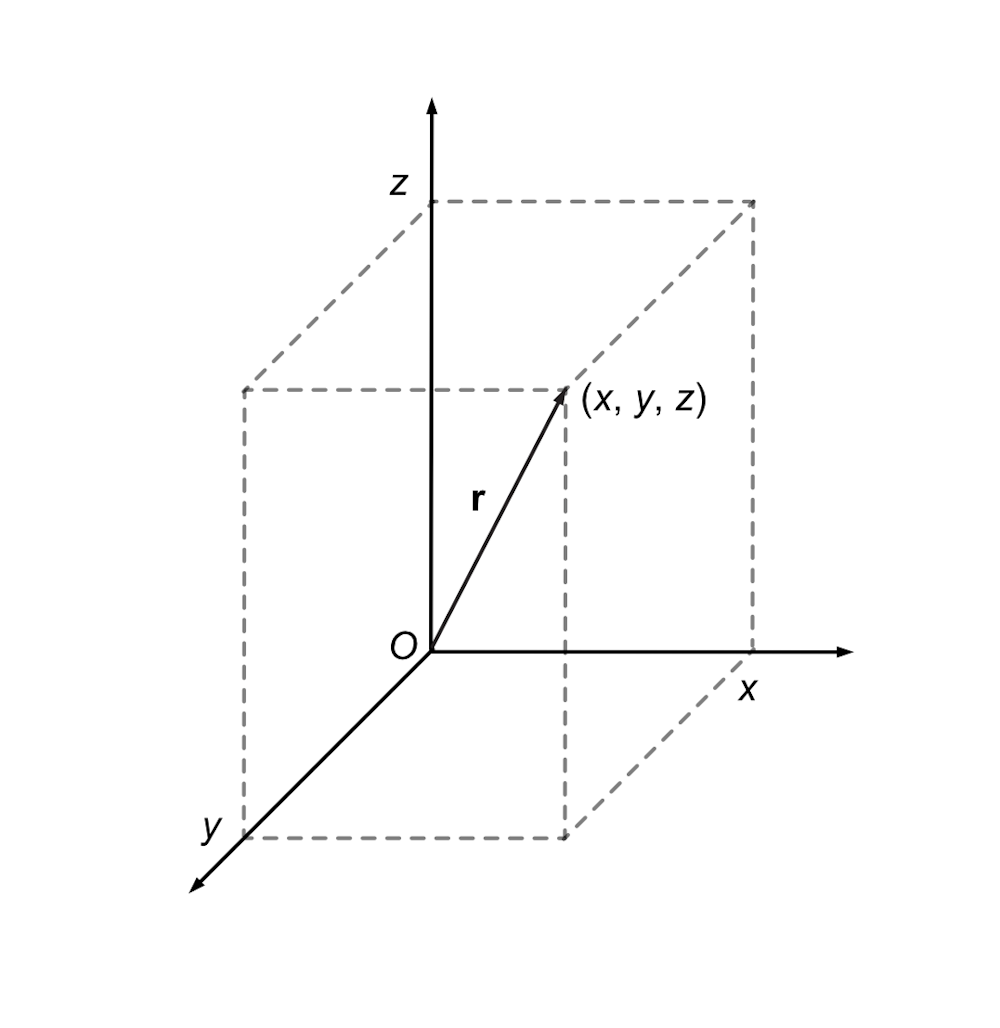
    A vector encodes two kinds of information at once, most famously the magnitude and direction of a spatial quantity such as force, velocity or relative position. For instance, to represent an object’s position (xyz) relative to the “origin” (the zero point of the position axes), Hamilton visualised an arrow pointing from the origin to the object’s location. The arrow represents the “position vector” x i + y j + z k.

    This vector’s “components” are the numbers x, y and z – the distance the arrow extends along each of the three axes. (Other vectors would have different components, depending on their magnitudes and units.)

    A vector (r) is like an arrow from the point O to the point with coordinates (x, y, z).
    The Conversation, CC BY

    Half a century later, the eccentric English telegrapher Oliver Heaviside helped inaugurate modern vector analysis by replacing Hamilton’s imaginary framework i, j, k with real unit vectors, i, j, k. But either way, the vector’s components stay the same – and therefore the arrow, and the basic rules for multiplying vectors, remain the same, too.

    Hamilton defined two ways to multiply vectors together. One produces a number (this is today called the scalar or dot product), and the other produces a vector (known as the vector or cross product). These multiplications crop up today in a multitude of applications, such as the formula for the electromagnetic force that underpins all our electronic devices.

    A single mathematical object

    Unbeknown to Hamilton, the French mathematician Olinde Rodrigues had come up with a version of these products just three years earlier, in his own work on rotations. But to call Rodrigues’ multiplications the products of vectors is hindsight. It is Hamilton who linked the separate components into a single quantity, the vector.

    Everyone else, from Isaac Newton to Rodrigues, had no concept of a single mathematical object unifying the components of a position or a force. (Actually, there was one person who had a similar idea: a self-taught German mathematician named Hermann Grassmann, who independently invented a less transparent vectorial system at the same time as Hamilton.)

    Hamilton also developed a compact notation to make his equations concise and elegant. He used a Greek letter to denote a quaternion or vector, but today, following Heaviside, it is common to use a boldface Latin letter.

    This compact notation changed the way mathematicians represent physical quantities in 3D space.

    Take, for example, one of Maxwell’s equations relating the electric and magnetic fields:


    ×


    E


    = –∂
    B
    /∂

    t

    With just a handful of symbols (we won’t get into the physical meanings of ∂/∂t and ∇ ×), this shows how an electric field vector (E) spreads through space in response to changes in a magnetic field vector (B).

    Without vector notation, this would be written as three separate equations (one for each component of B and E) – each one a tangle of coordinates, multiplications and subtractions.

    The expanded form of the equation. As you can see, vector notation makes life much simpler.
    The Conversation, CC BY

    The power of perseverance

    I chose one of Maxwell’s equations as an example because the quirky Scot James Clerk Maxwell was the first major physicist to recognise the power of compact vector symbolism. Unfortunately, Hamilton didn’t live to see Maxwell’s endorsement. But he never gave up his belief in his new way of representing physical quantities.

    Hamilton’s perseverance in the face of mainstream rejection really moved me, when I was researching my book on vectors. He hoped that one day – “never mind when” – he might be thanked for his discovery, but this was not vanity. It was excitement at the possible applications he envisaged.

    A plaque on Dublin’s Broome Bridge commemorate’s Hamilton’s flash of insight.
    Cone83 / Wikimedia, CC BY-SA

    He would be over the moon that vectors are so widely used today, and that they can represent digital as well as physical information. But he’d be especially pleased that in programming rotations, quaternions are still often the best choice – as NASA and computer graphics programmers know.

    In recognition of Hamilton’s achievements, maths buffs retrace his famous walk every October 16 to celebrate Hamilton Day. But we all use the technological fruits of that unassuming graffiti every single day.

    Robyn Arianrhod does not work for, consult, own shares in or receive funding from any company or organisation that would benefit from this article, and has disclosed no relevant affiliations beyond their academic appointment.

    ref. Three letters, one number, a knife and a stone bridge: how a graffitied equation changed mathematical history – https://theconversation.com/three-letters-one-number-a-knife-and-a-stone-bridge-how-a-graffitied-equation-changed-mathematical-history-241034

    MIL OSI AnalysisEveningReport.nz

  • MIL-Evening Report: Has Kamala Harris reached the ceiling of her ability to make gains against Trump?

    Source: The Conversation (Au and NZ) – By Jared Mondschein, Director of Research, US Studies Centre, University of Sydney

    With less than three weeks to go before Election Day, the polling at this point is clear: Kamala Harris and Donald Trump are effectively tied.

    Harris has led the Democratic ticket for less than three months, but in that short time she has galvanised Democratic voters and significantly increased the popularity of the Democratic ticket. Yet, current levels of US political polarisation and, perhaps more notably, calcification, make one wonder just how much more support she could win.

    In other words, few Americans are undecided in their views of Donald Trump – he galvanises both his base and his opponents alike – so there are simply not many American voters remaining for Harris to try to win over.

    Initial momentum has plateaued

    When 81-year-old Joe Biden led the Democratic ticket in early 2024, only 55% of Democrats and Democratic-leaning voters were enthusiastic about the election.

    While the 2020 presidential election between Biden and Trump broke records for US voter turnout, the 2024 redux was looking like it would break the opposite sort of records – for voter disinterest.

    That is, at least, until Harris assumed the top of the Democratic ticket on 21 July 2024. Within a month of Biden stepping down as the party’s nominee, Democratic enthusiasm for their significantly younger candidate jumped 23 points to 78%. This eclipsed not only levels of enthusiasm that Democrats had for Barack Obama in 2008, but also the levels of enthusiasm that Republicans currently have for Donald Trump.

    Harris’ momentum saw the race quickly move on from deep analysis of the “double haters” – the record 25% US voters who disliked both Trump and Biden and were simply deciding which they hated less. With a much closer contest now likely, attention shifted to key swing states such as Pennsylvania, where Harris closed Trump’s five-point lead over Biden to now be around even.

    Small changes can make a big difference

    Harris’ ability to make the Democratic ticket competitive should not be undervalued. After all, as recently as June 2024, she was one of the few Democratic politicians who actually had a lower national approval rating than Joe Biden.

    With that said, the momentum for Harris should not be seen as a sea change across the country. As much as she energised a previously lacklustre Democratic ticket, approval of Harris among self-described Independent voters only increased from 36% to 43% in the same timeframe. Republican approval of Harris decreased slightly from 6% to 4% over the same period.

    Ultimately, even the slightest of changes can completely shift the nature of the race, particularly given how slim the margins have been in the last two presidential elections. In the 2016 presidential election, for example, Trump’s margin of victory was some 75,000 votes across three swing states. In 2020, Biden’s margin of victory was about 45,000 votes across three swing states.

    Harris or Trump’s 2024 margin of victory very well may be less than 0.03% of the US electorate, making this potentially the closest US election in decades.

    Has support for Harris peaked?

    For the first half of 2024, Trump polled considerably ahead of Biden in the key swing states that will most likely decide the US election. Then, within weeks of Harris becoming the presidential nominee in July, the difference in the swing states between Trump and his opponent shrank to around 1-2 percentage points.

    Now, nearly three months later, the polling is essentially unchanged – remaining well within the standard margin of error of around ±3%.

    As much as Harris has eclipsed Biden in the race against Trump, there is no denying the statistical reality that Harris is no longer gaining ground on Trump in the way that she was in the early weeks of her candidacy.

    Some have argued that Harris’ liabilities – and perhaps the reason she has stalled in the polls – are that Americans remain fairly negative on the economy, she is in the incumbent administration instead of on an outsider ticket, and that many view her as simply too progressive.

    Yet judging by the fact that Harris appears to be polling better than “a generic Democrat” – who generally are more popular than any other Democrats because they are not real people with real positions – it’s perhaps more likely that in these polarised and calcified times, Harris very well may have simply peaked as high as any other Democratic candidate possibly could.

    With American voter intentions barely shifting after an insurrection, pandemic and assassination attempts, it’s hard to imagine Harris can do much better than she already is doing.

    Harris’ best strategy for success on November 5 may therefore need to be less focused on winning over more of the very few undecided voters remaining, and instead more focused on simply getting her energised supporters to turn up on Election Day.

    Jared Mondschein does not work for, consult, own shares in or receive funding from any company or organisation that would benefit from this article, and has disclosed no relevant affiliations beyond their academic appointment.

    ref. Has Kamala Harris reached the ceiling of her ability to make gains against Trump? – https://theconversation.com/has-kamala-harris-reached-the-ceiling-of-her-ability-to-make-gains-against-trump-240902

    MIL OSI AnalysisEveningReport.nz

  • MIL-Evening Report: An immediate ban has been issued for the herbicide dacthal. What are the health risks?

    Source: The Conversation (Au and NZ) – By Ian Musgrave, Senior lecturer in Pharmacology, University of Adelaide

    Last week the Australian government cancelled the registration of all products containing chlorthal dimethyl, a weedkiller commonly known as dacthal.

    No phase out period applies. The cancellation is immediate, due to the risks it poses to human health – primarily unborn babies.

    This means using dacthal as a chemical agricultural product “is now illegal”, according the Australian Pesticides and Veterinary Medicines Authority.

    So what has changed? What are the health risks of being exposed to dacthal – and how long have we known about them?

    What is dacthal?

    Dacthal and chlorthal dimethyl are alternative names for dimethyl tetrachloroterephthalate, or DCPA. This is a herbicide registered to control weeds in both agricultural and non-agricultural settings.

    Dacthal works by inhibiting auxin, a growth hormone in plants which promotes the development of buds, roots and lengthening cells.

    It is used to selectively kill annual grasses and many other common weeds, without killing turf grasses, flowers, fruits and vegetables. Dacthal is applied before weeds emerge, often when still in their seed stage.

    In Australia it is used in twelve herbicide products. All have been cancelled as of October 10 2024.

    Farmers and retailers are allowed to hold products until they’re recalled, but must not use them. The government says it will provide information about product recall shortly.

    What are the health risks?

    As dacthal targets a hormone found only in plants, for adult humans and mammals the chemical has limited acute and subchronic toxicity. This means brief exposure to high levels of dacthal, or longer-term exposure to modestly high levels, have no effect.

    However there is a health risk for unborn babies whose mothers have been directly exposed. This could be through mixing the chemical, loading and applying it, or from residue on treated crops – for up to five days after first applied.

    The chemical has been linked to low birth weight, and life-long impacts, which can include impaired brain development and motor skills.

    The government has advised pregnant agricultural workers who are concerned to speak to their clinician.

    What changed?

    Safety data for chemicals such as pesticides are periodically reevaluated. This is to see if any new risks have become apparent with advances in technology and our understanding of biology.

    In 2013, the United States Environmental Protection Agency called for fresh safety data to look at effects of dacthal on thyroid hormones.

    Fast forward to 2022. In that time, the company producing dacthal had failed to produce the required study. So the US Environmental Protection Agency issued a notice it would suspend technical-grade products containing dacthal.

    In response, the company submitted a thyroid study performed in rats. This study showed dacthal could affect thyroid function at doses lower than previously known.

    The US government determined this did not change recommendations for adults. However dacthal may affect thyroid function of a fetus at lower doses than those those that harm adults.

    What did the study in rats find?

    Dacthal was found to inhibit two thyroid hormones in rat pups whose mother had been exposed while pregnant.

    There was a 35-53% decrease in the hormone triiodothyronine, known as T3. And for thyroxine (T4), rat pups experienced a 29-66% decrease after their mother’s exposure.

    Decreases in these two hormones are associated with risks to unborn children including low birth weight and impaired brain development, IQ and motor skills.

    Of particular concern was the effects occurred at much lower levels than previously thought. The decreases in T3 and T4 occurred in rat pups exposed to levels of dacthal ten times lower than the safe threshold for their mothers. This means pregnant rats exposed to dacthal at those levels had no adverse effects, but their unborn babies did.

    Exactly how the chemical caused decreases in T3 and T4 in rat pups is not clear.

    However the Australian Pesticides and Veterinary Medicines Authority considers this study relevant to humans. The changes in regulation are based on the potential harms if unborn babies are exposed via their mothers.

    The health risk is to the development of an unborn baby exposed to dachtal via their mother.
    Fox_Ana/Shutterstock

    What exposure is safe?

    The rat study was used to calculate maximum levels of exposure for pregnant workers. This maximum – 0.001 mg dachtal/kg body weight/day – was considered appropriate to reduce risk to the unborn child (and was not expected to harm adults).

    However, the maximum acceptable level was exceeded in all estimates of exposure to dachtal. This was the case even when the person was wearing protective clothing, gloves, and using a respirator.

    Even under stringent safety conditions, potential harms to an unborn child could not be ruled out. For this reason the US stopped sale of dacthal via an Emergency Order on 6 August 2024. Australia has since followed suit with its own ban.

    How long have we known about this?

    The US government only received the thyroid information in 2022. It then had to determine whether the levels of exposure under real world conditions would equate to risk in humans.

    This is not straightforward, as the pesticide is used under a variety of conditions, including:

    • mixing and preparing the pesticide using personal protective equipment
    • downstream spay drift
    • treatment of lawns and exposure to the lawn after treatment.

    Each of these scenarios requires careful analysis of potential risks.

    In addition, exposure can be through inhalation and/or skin contact. All this must be taken into account and these calculations take time.

    Should I be worried?

    If you were not pregnant and using personal protective clothing while using or applying dacthal herbicides, this is little cause for worry. Your exposure is below the maximum limit.

    But if you were pregnant when using dacthal pesticides, please consider consulting your child’s paediatrician.

    Ian Musgrave has received funding from the National health and Medical Research Council to study contaminants in herbal medicines. He has received ARC funding for studying Alzheimer’s disease in the recent past. He is a member of the Science Communicators South Australian Branch.

    ref. An immediate ban has been issued for the herbicide dacthal. What are the health risks? – https://theconversation.com/an-immediate-ban-has-been-issued-for-the-herbicide-dacthal-what-are-the-health-risks-241257

    MIL OSI AnalysisEveningReport.nz

  • MIL-Evening Report: Australian schools need to address racism. Here are 4 ways they can do this

    Source: The Conversation (Au and NZ) – By Aaron Teo, Lecturer in Curriculum and Pedagogy, University of Southern Queensland

    The Australian Human Rights Commission wants to see schools address racism, as part of a broader push to address the problem across Australian society.

    As it says in a recent report,

    People are not born with racist attitudes or beliefs […] Addressing racism in schools is crucial to ensure that victims do not leave education facing lifelong disadvantage, and perpetrators do not enter adulthood believing racist behaviours are acceptable […].

    But racism is hardly mentioned in the Australian Curriculum – for example, it is noted in passing in the health and physical education curriculum for years 5 to 8. However, there is no consistent approach across subject areas, or at the state level.

    This means teaching about racism is largely left up to individual schools and teachers.

    Yet research shows they can be reluctant to speak about these issues with students. This is for a range of reasons, such as worrying they will say the wrong thing.

    How should school systems, schools and teachers address racism? Here are four ways.

    1. Teach racial literacy

    We know children demonstrate stereotyping and prejudice from an early age and students from racial minorities are frequently targets of racism and discrimination at school.

    In Australia, racism debates can also involve dangerous and ill-informed opinions.

    So we need to start teaching children and young people about racial literacy skills from the first year of schooling. This means they grow up to have the knowledge and language to talk about and confront racism.

    Some of these skills include:

    • being able to identify how racism appears in everyday interactions, the media and society more broadly

    • debunking common myths about racism, such as it is a “thing of the past”. Or “everyone has equal access to the same opportunities and outcomes if they work hard enough”

    • understanding the impacts of racism, including on people’s opportunities, education and their health and wellbeing

    • understanding how our own backgrounds, privilege and bias can influence how we confront or don’t confront racism.

    Students also need to learn how racism can be structural, systemic and institutional. This means racism is not just about an individuals’ beliefs or actions. Laws, policies, the way organisations are run and cultural norms can all result in inequitable treatment, opportunities and outcomes.

    2. Teach students how to react

    We also need to teach children how to react when they witness racism with age-appropriate tools.

    For both primary and secondary students, the first question should always be, “Is it safe for me to act?”, followed by “Am I the best person to act in this situation?”. Depending on their answers, they could:

    • report the incident to an appropriate adult or person in authority

    • show solidarity with the victim by comforting them and letting them know what happened was not OK

    • interrupt, distract or redirect the perpetrator

    • seek help from friends, a passerby or teacher.

    3. Create safe classrooms and playgrounds

    Teachers need to ensure classrooms and schools are safe spaces to discuss racism.

    This can include:

    • acknowledging how our own experiences, biases and privileges shape our world views

    • clearly defining the purpose of a discussion and the ground rules

    • using inclusive language.

    In particular, schools have a unique duty of care for minority students, who need to know they can talk openly about these issues with their peers and teachers without fear or judgement.

    This includes addressing sensitive topics like how they might experience or witness racism, the effect it can have on their health and wellbeing and those around them, and the consequences of talking about or reporting racism.

    4. Develop teachers’ skills

    As part of creating safe classrooms, teachers need to be able to confidently discuss tricky topics in an age-appropriate way.

    Our work has shown some teachers deny racism or perpetuate racist stereotypes. Others may avoid the topic, worrying they will say or do the wrong thing.

    Our current (as yet unpublished) research on anti-racism training with classroom teachers suggests they can increase their confidence to talk and teach about racism if given appropriate, and sustained training.

    What needs to happen now?

    We need anti-racism education to be an official part of school curricula. To accompany this, we need genuine commitments and modelling from policymakers, school leaders, teachers, parents and carers to address racism in schools.

    We need to talk openly about racism in schools. That means explicitly naming it, calling it out, and not getting defensive when it is identified and action is required.

    Aaron Teo is Convenor for the Australian Association for Research in Education Social Justice Special Interest Group, Queensland Convenor for the Asian Australian Alliance, member of the Challenging Racism Project, and member of the Advisory Committee for the Australian Human Rights Commission’s study into racism in Australian universities

    Rachel Sharples has received funding from the Australian Research Council and the NSW Department of Education. She is a member of the Challenging Racism Project (CRP) and the Centre for Resilient and Inclusive Communities (CRIS).

    ref. Australian schools need to address racism. Here are 4 ways they can do this – https://theconversation.com/australian-schools-need-to-address-racism-here-are-4-ways-they-can-do-this-239823

    MIL OSI AnalysisEveningReport.nz

  • MIL-OSI Global: Latest Canada-India diplomatic tensions are another serious obstacle to an improved relationship

    Source: The Conversation – Canada – By Saira Bano, Assistant Professor in Political Science, Thompson Rivers University

    Canada-India relations have suffered a major setback after Canadian law enforcement authorities accused Indian agents of involvement in “homicides, extortion, and violent acts” on Canadian soil.

    In response, Canada expelled six Indian diplomats, including High Commissioner Sanjay Kumar Verma.

    In a tit-for-tat move, India expelled six Canadian diplomats, rejecting Canada’s allegations as “preposterous” and politically motivated, particularly given the Sikh diaspora’s political significance as a key voting bloc for Justin Trudeau’s Liberal government.

    India has consistently denied the accusations and refused to co-operate with the Canadian investigation, which ultimately compelled the federal government to make these allegations public.

    Trudeau has acknowledged the importance of maintaining strong relations with India, but condemned India’s actions targeting pro-Khalistan leaders as “unacceptable.”

    But without a shared understanding of the pro-Khalistan issue, the relationship between the two countries is likely to remain strained. Both nations continue to approach the situation from fundamentally different perspectives.


    Read more:
    The fraught history of India and the Khalistan movement


    Nijjar’s assassination fallout

    Canada-India relations have been strained since Trudeau’s bombshell statement in September 2023, when he accused India of being involved in the assassination of Hardeep Singh Nijjar, a pro-Khalistan leader based in Canada.

    The Khalistan movement is a separatist movement that aims to establish an independent Sikh state in northern India.

    The assassination led to the expulsion of a senior Indian diplomat linked to the case and a rapid deterioration of bilateral ties, with India expelling Canadian diplomats and suspending visa services. India later demanded the repatriation of 41 Canadian diplomats, citing the principle of diplomatic parity.


    Read more:
    Alleged assassination plots in the U.S. and Canada signal a more assertive Indian foreign policy


    India has long accused Canada of being too lenient on the Khalistan movement, which it views as a serious threat to its national security and territorial integrity.

    The Sikh diaspora in Canada, the largest in the world, includes elements that have supported the pro-Khalistan cause, fuelling India’s concerns. Canada, however, emphasizes the right to freedom of expression, including peaceful protests, as a core tenet of its democratic values.

    In a related incident, the United States revealed in November 2023 that it had thwarted an alleged Indian plot to assassinate a Sikh separatist leader in New York. This development, coupled with Trudeau’s statement in 2023 that there was “credible evidence” linking India to Nijjar’s slaying, has further substantiated concerns over India’s alleged covert actions targeting pro-Khalistan activists.

    India’s strategic calculations

    India’s strategic significance, particularly in counterbalancing China’s growing assertiveness in the Indo-Pacific region, adds complexity to its diplomatic relations.


    Read more:
    Justin Trudeau’s India accusation complicates western efforts to rein in China


    India views its alliance with the United States as essential for safeguarding its interests, given the power imbalance with China. The U.S., in turn, sees India as a cornerstone of its Indo-Pacific strategy, with initiatives like the Quadrilateral Security Dialogue (Quad). It includes the U.S., India, Japan and Australia and is designed to promote the region as an “arc of democracy.”

    Bipartisan support in the U.S. for deepening ties with India has led to expanding defence and economic partnerships, with a growing emphasis on technology transfer as a critical pillar of this relationship.

    During Indian Prime Minister Narendra Modi’s state visit to Washington, D.C. in June 2023, President Joe Biden’s administration finalized an agreement for the joint production of General Electric (GE) F-414 jet engines.

    At present, only four nations — the U.S., U.K., Russia and France — have the capability to manufacture jet engines, with China still lacking this advanced technology. The GE F-414 collaboration is intended to strengthen U.S.-India defence co-operation and improve their collective ability to counter China’s advancements in defence technology.

    India also plays a central role in Canada’s Indo-Pacific strategy, unveiled in 2022. In the official document outlining the strategy, Ottawa described China as a “disruptive power” and emphasized the need to strengthen ties with Indo-Pacific nations, particularly India.

    The strategy highlights “India’s growing strategic, economic, and demographic importance” as key to achieving Canada’s geo-strategic objectives. As part of this approach, Canada committed to negotiating a Comprehensive Economic Partnership Agreement with India. But due to the diplomatic tensions sparked by Canada’s allegations, these negotiations have been suspended.

    The West’s disapproval

    The Modi government may have calculated that India’s strategic value to the West would shield it from criticism over its handling of pro-Khalistani activists abroad. However, the unequivocal response from both the U.S. and Canada suggests otherwise, with the West making it clear that such actions are unacceptable, regardless of India’s strategic significance.

    India will probably continue to deny Canada’s accusations and further sever diplomatic ties in an enduring dispute that will affect all aspects of the bilateral relationship.

    From Canada’s perspective, Indian actions on Canadian soil represent a blatant violation of sovereignty. Ottawa expects co-operation and assurances from India that such transnational repression will not occur in the future. From India’s point of view, it’s a matter of national security issue as Canada appeases pro-Khalistan elements.

    While the Indian diaspora has generally been an asset for the Modi government in fostering relations with western countries, the Sikh diaspora in Canada has been a significant hurdle in improving ties.

    Without a common denominator to reconcile these differing perspectives, the relationship between the two countries is likely to remain strained, despite broader strategic factors that would otherwise encourage closer ties.

    Saira Bano does not work for, consult, own shares in or receive funding from any company or organisation that would benefit from this article, and has disclosed no relevant affiliations beyond their academic appointment.

    ref. Latest Canada-India diplomatic tensions are another serious obstacle to an improved relationship – https://theconversation.com/latest-canada-india-diplomatic-tensions-are-another-serious-obstacle-to-an-improved-relationship-241406

    MIL OSI – Global Reports

  • MIL-OSI Global: As automation showdowns with workers continue, India’s Kerala state offers an important lesson

    Source: The Conversation – Canada – By Sanjith Gopalakrishnan, Assistant Professor of Operations Management, McGill University

    Nearly 50,000 dockworkers from the International Longshoremen’s Association went on strike across the United States Eastern Seaboard in October. The strike, which lasted three days, ended on Oct. 3 after a tentative wage agreement was reached between the union and the United States Maritime Alliance.

    Yet the agreement doesn’t resolve the union’s concerns over automation. For dockworkers, machines like automated stacking cranes pose a direct threat to job security. The union is still aiming to prohibit the operators of U.S. marine terminals from automating cargo handling.

    However, this trend is not isolated to the shipping industry. In retail, frictionless stores are reducing the need for cashiers, while self-driving trucks are poised to replace drivers, at least on some routes.

    The dockworker strike may have been resolved for now, but it was neither the first, nor will it be the last, showdown between labour and automation.

    Indian communism

    May 1 saw rallies take place all over the world, celebrating the labour movement and commemorating American workers who, in 1886, marched in Chicago for an eight-hour workday.

    May Day holds particular significance in the southern Indian state of Kerala, a heartland of Indian communism. It had one of the earliest democratically elected communist governments in the world. In 1957, the Communist Party of India won the Assembly election in Kerala, setting a precedent for parliamentary communism in the country.


    Read more:
    May Day 2024: Workers on a warming planet deserve stronger labour protections


    But, on May 1, 2018, the state government in Kerala led by the Communist Party of India (Marxist) abolished a practice that even it deemed far too proletarian — the nokku kooli.

    Commonplace until recently, nokku kooli literally translates to “wages for looking on.” It was a practice where private individuals and businesses were forced to compensate worker unions for using industrial equipment towards productive ends, even if no labour was done.

    For instance, a construction company moving material using cranes was still expected to pay wages at negotiated or union mandated rates to the workers who would have otherwise been needed to load and unload goods.

    Describing this extortionary practice, Keralan writer Paul Zacharia once wrote:

    “The revolution in Kerala says the worker must be paid even if he doesn’t work. That is a kind of workers’ paradise even Marx did not anticipate.”

    Widespread opposition to this practice eventually led to its 2018 abolition. In 2022, the High Court declared it “illegal and unconstitutional.”

    A cautionary tale

    The origins of nokku kooli stem from opposition to automation. As India’s economy liberalized and rapidly industrialized in the late 20th century, Kerala’s labour unions correctly identified mechanization as a threat to their jobs.

    In response, powerful unions backed the nokku kooli system, with the government turning a blind eye. The system ensured workers would still receive a share of the economic pie, even as technology rendered their labour increasingly unnecessary.

    Kerala’s nokku kooli practice, however, serves as a cautionary tale. What may have started as a natural immediate response of organized labour facing a rapid industrial transition eventually became increasingly extortionary, with predictable and damaging economic consequences.

    In the decades that followed, the state’s reputation for militant trade unionism hindered its ability to attract private investment. Kerala experienced labour shortages in several sectors, while workers in automated roles, such as loading and unloading, continued to expect compensatory wages for little effort.

    Same old fears

    Today, fears of automation causing job losses are still prompting calls for policy fixes. Bill Gates and others have called for a “robot tax” — a tax on automation.

    The revenue from such a tax would offset reduced income tax collections. Proponents argue it could be invested in worker retraining programs or for income replacement. These proposals mirror the spirit of nokku kooli: businesses should compensate workers, directly or indirectly, when machines replace their jobs.

    This speaks to a tension between short- and long-term approaches in addressing the impacts of technological disruption. Short-term fixes, like a robot tax, may mitigate immediate job losses and give workers a safety net.

    However, some economists argue this is a misguided response to a “techno-panic” and risks stifling innovation, which could reduce productivity and hinder companies that rely on efficiency to stay viable in a global market.

    Moreover, safety nets such as replacement incomes for displaced workers can also have unintended consequences in the long run, as seen in Kerala. While easing the transition, these measures risk creating a dependent workforce disincentivized to adapt to new economic realities.

    Short-term fixes better than none

    Still, perhaps short-term fixes — even ones that may eventually need undoing — are better than entirely ignoring the immediate and real impacts on workers, or offering glib solutions such as asking displaced industrial workers to learn to code.

    Globalization’s benefits were unevenly distributed across the world, and widening inequality is argued to be a driver of sociopolitical polarization. As automation advances, the same risk looms large.

    We still lack mechanisms to adequately redistribute economic gains due to technological innovation. Ignoring the disruptive impacts, however transitory, could still leave entire segments of the workforce behind, compounding inequality and social unrest.

    In the end, the lesson from Kerala might not just be about avoiding excess. It is also a reminder that policies that no longer work can, and should, be undone. As we embrace technological progress, we must not risk losing sight of the real people whose livelihoods are at stake in the here and now.

    Sanjith Gopalakrishnan does not work for, consult, own shares in or receive funding from any company or organisation that would benefit from this article, and has disclosed no relevant affiliations beyond their academic appointment.

    ref. As automation showdowns with workers continue, India’s Kerala state offers an important lesson – https://theconversation.com/as-automation-showdowns-with-workers-continue-indias-kerala-state-offers-an-important-lesson-240304

    MIL OSI – Global Reports

  • MIL-OSI Global: The lasting scars of war: How conflict shapes children’s lives long after the fighting ends

    Source: The Conversation – Canada – By Kerry McCuaig, Fellow in Early Childhood Policy, Atkinson Centre, Ontario Institute for Studies in Education, University of Toronto

    The world is witnessing some of the highest levels of conflict in decades, with more than 110 armed conflicts occurring across Africa, the Middle East, Asia, Latin America and Europe.

    The impact of these wars on children is vast and multifaceted. The trauma inflicted is enduring and will shape the rest of their lives — and by extension, the societies in which they, and we live.

    As researchers who study how public policies can intervene to reduce adverse outcomes for children, we contend that wars are not bound by geography. Airstrikes terrorize children in conflict zones, while those living in the nations involved in these conflicts also experience trauma in the form of poverty, neglect, and discrimination.

    Children as collateral — and targets

    In the first decade of the 21st century, civilians accounted for 90 per cent of deaths in armed conflicts. Of these casualties, a significant number were children.

    Modern conflicts are markedly lop-sided where often only one combatant has fighter jets, tanks, and explosives. Entire cities become war zones where children are not just caught in the crossfire, but are deliberately targeted.

    War is the ultimate abuse of children’s rights. According to the United Nations there were a record 32,990 grave violations against 22,557 children in 26 conflict zones, in 2023. “The highest numbers of grave violations occurred in Israel and the Occupied Palestinian Territories, the Democratic Republic of the Congo, Myanmar, Somalia, Nigeria and Sudan.”

    The United Nations Children’s Fund and other global humanitarian organizations have raised the alarm, saying women and children “are disproportionately bearing the burden” of the violence.

    Beyond direct violence, children are subjected to the toxic stress of war. Suspended supply chains and agricultural production leave besieged populations vulnerable to acute and chronic malnutrition, with devastating consequences for children’s growth, immune and metabolic systems, and cognitive development. The destruction of schools, hospitals, and homes compounds the trauma, while attacks on humanitarian assistance eliminate any respite.

    The disruption of vaccination programs allows preventable diseases to proliferate. Polio, once on the verge of global eradication, is spreading in Gaza. The direct targeting of sanitation and water treatment facilities creates conditions ripe for cholera outbreaks. Mpox, a deadly virus that causes painful blistering rashes, kills children at a far higher rate than adults and is prevalent in the Democratic Republic of Congo.

    The situation is particularly dire for infant and maternal health. Pregnancy in war zones is associated with fewer live births, increased preterm delivery, and low birth weight. War-generated pollution has been linked to birth defects. The fallout reaches beyond the war zone. A study found greater incidents of pregnancy complications and birth defects in the children of U.S. war veterans.

    The psychological toll of war

    Witnessing constant violence, death and destruction can permanently change how a child’s brain develops. Research has shown that trauma in early childhood particularly affects the areas of the brain responsible for stress responses. This means that children who experience war are more likely to suffer from anxiety, depression, and stress disorders.

    As they grow into adulthood, these mental health issues can manifest in more profound ways, increasing the likelihood of depression and even neurodegenerative diseases such as Alzheimer’s.

    Extreme stress also affects parenting, putting children at risk for maltreatment and neglect. Even when the fighting stops or families leave combat zones, parental substance abuse or deteriorating mental health can leave children vulnerable. Studies have documented increased physical and emotional mistreatment among the children of returning U.S. military personnel.

    The experiences of trauma are cumulative and far-reaching, not only affecting children’s immediate mental health, but also their ability to form relationships, learn, and thrive later in life.

    Impact on education

    Armed conflicts devastate the critical infrastructure needed to support healthy child development. Children can spend months fleeing war zones or sheltering against bombardment disrupting their education. Schools are often destroyed or repurposed. Teachers are displaced or killed. For many, attending school is simply too dangerous, leaving millions of children without basic education, significantly reducing their future opportunities.

    Girls are more likely to be kept out of school to fill in for absent or deceased adults. Those separated from their family are at increased risk for gender violence, exploitation, and teen pregnancy, further entrenching cycles of poverty and inequality that are difficult to break even after the conflict ends.

    A BBC news report about a school in Yemen destroyed during the war.

    Children in other countries also suffer, as public revenues are diverted from schools, health care, and other poverty-reduction measures to finance the machinery of war.

    The long-term societal impact is profound. Education is one of the strongest tools for reducing violence and rebuilding societies. Yet tragically, less than three per cent of humanitarian aid funding goes towards education in war zones.


    Read more:
    The war in Gaza is wiping out Palestine’s education and knowledge systems


    Breaking the cycle of violence

    Despite the enormous challenges, there are pathways to reduce the harm inflicted on children. Humanitarian organizations work to provide safe spaces for children to play, learn, and heal.

    These interventions, while often simple, are crucial for giving children a sense of normalcy during chaos. Supporting caregivers is another essential element, as the mental health of parents and guardians directly affects their children’s well-being.

    While invaluable, these efforts are only band-aid solutions. The international community must increase funding for child protection and education in humanitarian responses and undertake serious action to eliminate the causes of war.

    Kerry McCuaig receives funding from the Margaret and Wallace McCain Family Foundation, the Atkinson Foundation and the Lawson Foundation.

    Emis Akbari receives funding from The Margaret and Wallace McCain Family Foundation, The Lawson Foundation and The Atkinson Foundation.

    ref. The lasting scars of war: How conflict shapes children’s lives long after the fighting ends – https://theconversation.com/the-lasting-scars-of-war-how-conflict-shapes-childrens-lives-long-after-the-fighting-ends-240640

    MIL OSI – Global Reports

  • MIL-Evening Report: Albanese government promises to ban ‘dodgy’ trading practices

    Source: The Conversation (Au and NZ) – By Michelle Grattan, Professorial Fellow, University of Canberra

    Hard on the heels of pledging a crackdown on excessive surcharges, the Albanese government has promised legislation to ban unfair trading practices.

    The government said this would include specific prohibitions on various “dodgy” practices.

    “From concert tickets to hotel rooms to gym memberships, Australians are fed up with businesses using tricky tactics that make it difficult to end subscriptions or add hidden fees to purchases,” the prime minister, treasurer and assistant treasurer said in a statement.

    “These practices can distort purchasing decisions, or result in additional costs, putting more pressure on the cost of living.”

    They said the government would deal with

    • “subscription traps” that make it difficult to cancel a subscription

    • “drip pricing” characterised by hidden fees or fees added during the purchase

    • deceptive and manipulative online practices. These aim to confuse consumers, such as for example by creating a false sense of urgency, warning there is only a limited time to purchase

    • dynamic pricing, where a price changes during the transaction

    • requiring a consumer to set up an account and provide unnecessary information for an online purchase

    • a business making it difficult for a consumer to contact it when they have a problem with the product.

    Earlier this week Arts Minister Tony Burke said on the ABC the government was not looking at “dynamic pricing” in the music industry.

    Asked on Four Corners whether dynamic pricing should be allowed in Australia, Burke said: “Surge pricing is something that, as consumers, people have always dealt with.

    “I don’t love it, but I think we have to be realistic, it’s always been there. It’s not something we’re looking at, at the moment.”

    Asked about the discrepancy, a government spokesperson said the Four Corners interview “was recorded a month ago, before this policy existed”.

    Treasury will consult on the design of the planned changes. The government on Wednesday will put out a consultation paper on reforms for greater protections for consumers and small businesses under the consumer guarantees and supplier indemnification in the Australian Consumer Law.

    The government says it will work with the states to have a final reform proposal in the first half of next year.

    There will be penalties for suppliers that refuse to give consumers a remedy such as a replacement product or a refund when legally required.

    “Currently, it can be difficult for consumers to obtain a remedy, especially when engaging in the digital economy,” the government statement said.

    The reforms would empower the Australian Competition and Consumer Commission and state and territory agencies to pursue breaches of consumer guarantees and supplier indemnification provisions.

    Prime Minister Anthony Albanese said “hidden fees and traps are putting even more pressure on the cost of living and it needs to stop”.

    Michelle Grattan does not work for, consult, own shares in or receive funding from any company or organisation that would benefit from this article, and has disclosed no relevant affiliations beyond their academic appointment.

    ref. Albanese government promises to ban ‘dodgy’ trading practices – https://theconversation.com/albanese-government-promises-to-ban-dodgy-trading-practices-234142

    MIL OSI AnalysisEveningReport.nz

  • MIL-OSI Global: Rain may have helped form the first cells, kick-starting life as we know it

    Source: The Conversation – USA – By Aman Agrawal, Postdoctoral Scholar in Chemical Engineering, University of Chicago Pritzker School of Molecular Engineering

    How did early cells keep themselves distinct while allowing for some amount of exchange? UChicago Pritzker School of Molecular Engineering/Peter Allen, Second Bay Studios, CC BY-ND

    Billions of years of evolution have made modern cells incredibly complex. Inside cells are small compartments called organelles that perform specific functions essential for the cell’s survival and operation. For instance, the nucleus stores genetic material, and mitochondria produce energy.

    Another essential part of a cell is the membrane that encloses it. Proteins embedded on the surface of the membrane control the movement of substances in and out of the cell. This sophisticated membrane structure allowed for the complexity of life as we know it. But how did the earliest, simplest cells hold it all together before elaborate membrane structures evolved?

    In our recently published research in the journal Science Advances, my colleagues from the University of Chicago and the University of Houston and I explored a fascinating possibility that rainwater played a crucial role in stabilizing early cells, paving the way for life’s complexity.

    The origin of life

    One of the most intriguing questions in science is how life began on Earth. Scientists have long wondered how nonliving matter like water, gases and mineral deposits transformed into living cells capable of replication, metabolism and evolution.

    Chemists Stanley Miller and Harold Urey at the University of Chicago conducted an experiment in 1953 demonstrating that complex organic compounds – meaning carbon-based molecules – could be synthesized from simpler organic and inorganic ones. Using water, methane, ammonia, hydrogen gases and electric sparks, these chemists formed amino acids.

    The Miller-Urey experiment showed that complex organic compounds can be made from simpler organic and inorganic materials.
    Yoshua Rameli Adan Perez/Wikimedia Commons, CC BY-SA

    Scientists believe the earliest forms of life, called protocells, spontaneously emerged from organic molecules present on the early Earth. These primitive, cell-like structures were likely made of two fundamental components: a matrix material that provided a structural framework and a genetic material that carried instructions for protocells to function.

    Over time, these protocells would have gradually evolved the ability to replicate and execute metabolic processes. Certain conditions are necessary for essential chemical reactions to occur, such as a steady energy source, organic compounds and water. The compartments formed by a matrix and a membrane crucially provide a stable environment that can concentrate reactants and protect them from the external environment, allowing the necessary chemical reactions to take place.

    Thus, two crucial questions arise: What materials were the matrix and membrane of protocells made of? And how did they enable early cells to maintain the stability and function they needed to transform into the sophisticated cells that constitute all living organisms today?

    Bubbles vs droplets

    Scientists propose that two distinct models of protocells – vesicles and coacervates – may have played a pivotal role in the early stages of life.

    Miniature compartments, such as lipid bilayers configured into capsules like liposomes and micelles, are important for cellular organization and function.
    Mariana Ruiz Villarreal, LadyofHats/Wikimedia Commons

    Vesicles are tiny bubbles, like soap in water. They are made of fatty molecules called lipids that naturally form thin sheets. Vesicles form when these sheets curl into a sphere that can encapsulate chemicals and safeguard crucial reactions from harsh surroundings and potential degradation.

    Like miniature pockets of life, vesicles resemble the structure and function of modern cells. However, unlike the membranes of modern cells, vesicle protocells would have lacked specialized proteins that selectively allow molecules in and out of a cell and enable communication between cells. Without these proteins, vesicle protocells would have limited ability to interact effectively with their surroundings, constraining their potential for life.

    Coacervates, on the other hand, are droplets formed from an accumulation of organic molecules like peptides and nucleic acids. They form when organic molecules stick together due to chemical properties that attract them to each other, such as electrostatic forces between oppositely charged molecules. These are the same forces that cause balloons to stick to hair.

    One can picture coacervates as droplets of cooking oil suspended in water. Similar to oil droplets, coacervate protocells lack a membrane. Without a membrane, surrounding water can easily exchange materials with protocells. This structural feature helps coacervates concentrate chemicals and speed up chemical reactions, creating a bustling environment for the building blocks of life.

    Thus, the absence of a membrane appears to make coacervates a better protocell candidate than vesicles. However, lacking a membrane also presents a significant drawback: the potential for genetic material to leak out.

    Unstable and leaky protocells

    A few years after Dutch chemists discovered coacervate droplets in 1929, Russian biochemist Alexander Oparin proposed that coacervates were the earliest model of protocells. He argued that coacervate droplets provided a primitive form of compartmentalization crucial for early metabolic processes and self-replication.

    Subsequently, scientists discovered that coacervates can sometimes be composed of oppositely charged polymers: long, chainlike molecules that resemble spaghetti at the molecular scale, carrying opposite electrical charges. When polymers of opposite electrical charges are mixed, they tend to attract each other and stick together to form droplets without a membrane.

    Coacervate droplets resemble oil suspended in water.
    Aman Agrawal, CC BY-SA

    The absence of a membrane presented a challenge: The droplets rapidly fuse with each other, akin to individual oil droplets in water joining into a large blob. Furthermore, the lack of a membrane allowed RNA – a type of genetic material thought to be the earliest form of self-replicating molecule, crucial for the early stages of life – to rapidly exchange between protocells.

    My colleague Jack Szostak showed in 2017 that rapid fusion and exchange of materials can lead to uncontrolled mixing of RNA, making it difficult for stable and distinct genetic sequences to evolve. This limitation suggested that coacervates might not be able to maintain the compartmentalization necessary for early life.

    Compartmentalization is a strict requirement for natural selection and evolution. If coacervate protocells fused incessantly, and their genes continuously mixed and exchanged with each other, all of them would resemble each other without any genetic variation. Without genetic variation, no single protocell would have a higher probability of survival, reproduction and passing on its genes to future generations.

    But life today thrives with a variety of genetic material, suggesting that nature somehow solved this problem. Thus, a solution to this problem had to exist, possibly hiding in plain sight.

    Rainwater and RNA

    A study I conducted in 2022 demonstrated that coacervate droplets can be stabilized and avoid fusion if immersed in deionized water – water that is free of dissolved ions and minerals. The droplets eject small ions into the water, likely allowing oppositely charged polymers on the periphery to come closer to each other and form a meshy skin layer. This meshy “wall” effectively hinders the fusion of droplets.

    Next, with my colleagues and collaborators, including Matthew Tirrell and Jack Szostak, I studied the exchange of genetic material between protocells. We placed two separate protocell populations, treated with deionized water, in test tubes. One of these populations contained RNA. When the two populations were mixed, RNA remained confined in their respective protocells for days. The meshy “walls” of the protocells impeded RNA from leaking.

    In contrast, when we mixed protocells that weren’t treated with deionized water, RNA diffused from one protocell to the other within seconds.

    Inspired by these results, my colleague Alamgir Karim wondered if rainwater, which is a natural source of ion-free water, could have done the same thing in the prebiotic world. With another colleague, Anusha Vonteddu, I found that rainwater indeed stabilizes protocells against fusion.

    Rain, we believe, may have paved the way for the first cells.

    Droplets with meshy walls resist fusion and prevent leakage of their RNA. In this image, each color represents a different type of RNA.
    Aman Agrawal, CC BY-SA

    Working across disciplines

    Studying the origins of life addresses both scientific curiosity about the mechanisms that led to life on Earth and philosophical questions about our place in the universe and the nature of existence.

    Currently, my research delves into the very beginning of gene replication in protocells. In the absence of the modern proteins that make copies of genes inside cells, the prebiotic world would have relied on simple chemical reactions between nucleotides – the building blocks of genetic material – to make copies of RNA. Understanding how nucleotides came together to form a long chain of RNA is a crucial step in deciphering prebiotic evolution.

    To address the profound question of life’s origin, it is crucial to understand the geological, chemical and environmental conditions on early Earth approximately 3.8 billion years ago. Thus, uncovering the beginnings of life isn’t limited to biologists. Chemical engineers like me, and researchers from various scientific fields, are exploring this captivating existential question.

    Aman Agrawal does not work for, consult, own shares in or receive funding from any company or organization that would benefit from this article, and has disclosed no relevant affiliations beyond their academic appointment.

    ref. Rain may have helped form the first cells, kick-starting life as we know it – https://theconversation.com/rain-may-have-helped-form-the-first-cells-kick-starting-life-as-we-know-it-238291

    MIL OSI – Global Reports

  • MIL-OSI Global: This course explores the history of contested presidential elections

    Source: The Conversation – USA – By Sarah J. Purcell, Professor of History, Grinnell College

    The 2000 election featuring George W. Bush and Al Gore was ultimately decided by the Supreme Court. Tannen Maury via Getty Images

    Uncommon Courses is an occasional series from The Conversation U.S. highlighting unconventional approaches to teaching.

    Title of course:

    Contested U.S. Presidential Elections

    What prompted the idea for the course?

    I was looking for a way to make history relevant to students. Since I research and teach a lot about U.S. politics, I decided to focus on presidential elections that had contested results. Contested elections have happened when candidates failed to win a majority of electoral votes, meaning the House of Representatives had to decide the election; when electoral votes themselves were contested; when problems with vote counts necessitated courts intervening in an election; or when states or candidates refused to accept the results.

    Coming out of 2020, I saw a lot of anxiety among students – and in society in general – about gearing up for the 2024 election. Offering historical context seemed like a good way to enrich students’ current civic engagement.

    What does the course explore?

    We are studying the most-contested U.S. presidential elections: 1800, 1824, 1860, 1876, 2000 and 2020.

    Candidates failed to win a majority of electoral votes in 1800 and 1824. Sectional rancor over slavery caused states to reject the results in 1860. Disputed electoral votes in 1876 led to a political compromise that resolved the electoral votes in favor of Rutherford B. Hayes in exchange for ending Reconstruction.

    Problems with vote counting in Florida in 2000 led the Supreme Court to essentially decide the election in Bush v. Gore. And most recently in 2020, then-President Donald Trump disputed the results unsuccessfully.

    We are covering a wide swath of U.S. political history in just eight weeks. Students are also writing a blog for public audiences and submitting other public writing, like op-ed pieces, to stretch their own historical thinking and communication skills and help the public contextualize the present election.

    Why is this course relevant now?

    People are asking whether U.S. democracy can survive the 2024 election. Students are learning how the system has been shaped by previous crises in legitimacy.

    One example is when the electoral tie between Thomas Jefferson and Aaron Burr in 1800 led to the ratification of the 12th Amendment that established separate electoral votes for the president and vice president. The worst crisis came when Southern states rejected Abraham Lincoln’s election in 1860 and decided to secede from the United States, leading to the Civil War.

    What’s a critical lesson from the course?

    History can’t predict the future, but it can provide key context to understand the present. The U.S. electoral system has weaknesses, such as the Electoral College, built in by the Constitution, but the acceptance of the results by losers has been a key to U.S. political stability through many different contested elections over time. Before 2020, no presidential candidate had ever contested the final election results.

    For instance, Andrew Jackson won both the popular vote and a plurality of the Electoral College vote in 1824, but Jackson accepted John Quincy Adams as the legitimate president when the House of Representatives decided the winner. Jackson, however, accused Speaker of the House Henry Clay of a “corrupt bargain” to hand Adams the presidency in return for appointing Clay as secretary of state. Jackson still recognized Adams as the legitimate president but beat him badly in the next election in 1828.

    What materials does the course feature?

    The students have analyzed scholarly articles and many primary sources, mostly collected by the Library of Congress. Several important books have also shaped their thinking: Jim Downs’ 2024 “January 6 and the Politics of History”; E. J. Dionne and William Kristol’s 2001 “Bush v. Gore: The Court Cases and the Commentary”; and Kate Cote Gillin’s 2014 “Shrill Hurrahs: Women, Gender, and Racial Violence in South Carolina, 1865-1900.”

    What will the course prepare students to do?

    Students in the class are using historical skills and ways of thinking to help themselves, their friends and anyone else to put the current election into perspective. They are all doing final projects that use what they’ve learned in class to communicate with the public through op-eds, social media projects, websites and other creative projects in the lead-up to the 2024 election. They are prepared for their own civic engagement and with skills in journalism and public communication.

    Sarah J. Purcell does not work for, consult, own shares in or receive funding from any company or organization that would benefit from this article, and has disclosed no relevant affiliations beyond their academic appointment.

    ref. This course explores the history of contested presidential elections – https://theconversation.com/this-course-explores-the-history-of-contested-presidential-elections-240420

    MIL OSI – Global Reports

  • MIL-OSI Global: South Africa’s 36.1% electricity price hike for 2025: why the power utility Eskom’s request is unrealistic

    Source: The Conversation – Africa – By Steven Matome Mathetsa, Senior Lecturer at the African Energy Leadership Centre, Wits Business School, University of the Witwatersrand

    South Africa’s state-owned electricity company, Eskom, has applied to the National Energy Regulator of South Africa to approve a 36.1% electricity price hike from April 2025, a 11.8% price increase in 2026 and an 9.1% increase in 2027. Steven Mathetsa teaches and researches sustainable energy systems at the University of the Witwatersrand’s African Energy Leadership Centre. He explains some of the problems with the planned tariff increase.

    Why such a big hike?

    Eskom says the multi-year price increase is because of the need to move closer a cost-reflective tariff that reflects the actual costs of supplying electricity.

    However, Eskom’s electricity tariff increases have been exorbitant for several years – an 18% increase in 2023 and a 13% increase in 2024. This is a price increase far above inflation, which is currently at 4.4%.

    Some companies have installed their own generation capacity, and individuals have moved to rooftop solar systems. As a result electricity sales have fallen by about 2% , resulting in a drop in revenue.

    There’s a knock on effect for municipalities, the biggest distributors of electricity, which have also been forced to hike tariffs in line with Eskom’s increases.

    All these costs are passed onto the consumers.

    What will the impact be on South Africans?

    If the hike is approved it will certainly worsen the economic difficulties facing
    South Africa. One of the most unequal countries in the world, South Africa has an extremely high unemployment rate – 33.5%at the last count.

    Economic growth is also very slow, at a mere 0.6% in 2023. The cost of living is high.

    Exorbitant increases in electricity costs aggravate these problems.

    South Africans and businesses in the country have little choice about where they source their energy. Eskom is still the sole supplier for nearly all the country’s electricity needs. This means that ordinary citizens are likely to continue relying on electricity supplied by Eskom, irrespective of the costs.

    The high costs affect businesses negatively. Large industrial and small, medium, and micro enterprises have all highlighted that costs associated with utilities, mainly electricity, are affecting their sustainability.


    Read more:
    Competition in South Africa’s electricity market: new law paves the way, but it won’t be a smooth ride


    The Electricity Regulation Amendment Act implementation will make major changes to Eskom. The reforms establish an independent Transmission Systems Operator tasked with connecting renewable energy providers to the grid. This will allow the creation of a competitive market where renewable energy providers can sell power to the grid.

    But it’s not yet clear if these changes will address the issue of exorbitant electricity price rises.

    What are the problems?

    The country’s energy frameworks are drafted on the basis of the World Energy Trilemma Index. The index promotes a balanced approach between energy security, affordability, and sustainability. In other words, countries must be able to provide environmentally friendly and reliable electricity that their residents can afford.

    South Africa is currently unable to meet these goals because of different energy policies that do not align, a lack of investment in electricity and dependency on coal-fired power. Electricity is increasingly becoming unaffordable in the country. Although there’s been a recent reprieve from power cuts, security of supply is still uncertain.


    Read more:
    South Africa’s new energy plan needs a mix of nuclear, gas, renewables and coal – expert


    Furthermore, over 78% of the country’s electricity is produced by burning coal. This means South Africa is also far from attaining its 2015 Paris Agreement greenhouse gas reduction goals.

    Compounding this problem is that Eskom is financially unstable – it needed R78 billion from the government in debt relief in 2024. For years, there was a lack of effective maintenance on the aging infrastructure.

    The country has made some inroads into improving security of supply. To date, recent interventions have resulted in over 200 days without power cuts. This should be commended. The same focus must be placed on ensuring that electricity remains affordable while giving attention to meeting the goals of the Paris Agreement.

    What needs to change?

    South Africa’s 1998 Energy Policy White Paper and the new Electricity Regulation Amendment Act promote access to affordable electricity. However, they’ve been implemented very slowly. Affordable electricity needs to be taken seriously.

    The question is whether the country’s electricity tariff methodology is flexible enough to accommodate poor South Africans, especially during these challenging economic times.

    In my view, it is not. In its current form, vulnerable communities continue to foot the bill for various challenges confronting Eskom, including financial mismanagement, operational inefficiencies, municipal non-payment, and corruption.

    I believe the following steps should be taken.

    Firstly, South Africa should revise its tariff application methodologies so that consumers, especially unemployed and impoverished people, are protected against exorbitant increases.

    Secondly, the National Energy Regulator of South Africa should strengthen its regulations to ensure its compliance and enforcement systems are effective. For example, Eskom should be held accountable when it does not deliver efficient services or mismanages funds, and be transparent about costs associated with its processes. Municipalities should also be held accountable for non-payment and other technical issues they regularly struggle with. Both affect the revenue of the power utility.


    Read more:
    South Africa’s economic growth affected by mismatch of electricity supply and demand


    Thirdly, the government must make sure that price increases are affordable and don’t hurt the broader economy. It can do this by adjusting its policies to make sure that increases in electricity tariffs are in line with the rate of inflation.

    Fourthly, communities can play a vital role in saving electricity at a household level. This will reduce the country’s overall energy consumption. Furthermore, both small and large businesses should continue to consider alternative energy technologies while implementing energy saving technologies.

    Lastly, the level of free-basic electricity is not sufficient for poor households. Subsidy policies should also be reviewed to allow users access to affordable electricity as their financial situation changes negatively.

    Steven Matome Mathetsa does not work for, consult, own shares in or receive funding from any company or organisation that would benefit from this article, and has disclosed no relevant affiliations beyond their academic appointment.

    ref. South Africa’s 36.1% electricity price hike for 2025: why the power utility Eskom’s request is unrealistic – https://theconversation.com/south-africas-36-1-electricity-price-hike-for-2025-why-the-power-utility-eskoms-request-is-unrealistic-240941

    MIL OSI – Global Reports

  • MIL-OSI Global: 9 million Mozambicans live below the poverty line – what’s wrong with the national budget and how to fix it

    Source: The Conversation – Africa – By Felix Mambo, Country Economist, London School of Economics and Political Science

    Mozambique ranks in the bottom 20 of the human development index. This measures a country’s progress based on key dimensions such as a long and healthy life and a decent standard of living. Nearly two-thirds of Mozambicans – 18.9 million people – live below the national poverty line of US$0.70-a-day.

    The country also struggles to finance public spending, consistently running state budget deficits . At the same time it also fails to spend all the money that’s been budgeted.

    Mozambique’s frequent budget deficits are no surprise. The country has a rapidly growing population, increasing needs of the poor populations, dilapidated infrastructure, and very limited revenue generation.

    In a recent study on budget credibility in Mozambique we explored how the government’s challenges in meeting its revenue and expenditure targets harm the overall economy. And we suggest solutions.

    Our study focused on public expenditures on the social sector. This included education, health, social protection and public works (which includes water and sanitation). All are vital for human capital generation and poverty reduction. The social sector accounts for 40% of budgeted expenditure. Education is the largest at about 20% of the overall pie.

    Our study introduces – and successfully tests – a simple method that can be easily applied by budget oversight entities. This includes the parliament budget oversight unit and the accounts court. It can also be applied by planning units within ministries, especially the ministry of finance. Finally, it can be used by civil society budget watchdogs, as it relies on public information.

    Adopting it will provide tools to improve budget management in turn leading to more credible budget execution.

    Assessing public financial management

    The Public Expenditure and Financial Accountability programme was initiated in 2001 by the European Commission, International Monetary Fund, World Bank, and the governments of France, Norway, Switzerland and the UK. The aim was is to improve fiscal outcomes. It has conducted 533 assessments in 155 countries, including 47 countries in sub-Saharan Africa. Ten assessments have been completed in Mozambique.

    The programme defines budget credibility as the extent to which the government’s budget is realistic and implemented as intended. A credible budget reassures a range of stakeholders on the predictability of public expenditure and services. This includes taxpayers, donors and lenders, the firms that supply the government, public workers and the recipients of public services.

    The credibility question

    To measure the credibility of the budget in Mozambique, we used publicly available state budget data. We looked at both planned spending and actual execution.

    In its previous assessments, the Public Expenditure and Financial Accountability programme had identified several weaknesses. These included deviations, sector-specific variability, revenue shortfalls and mid-year budget adjustments.

    However, these insights didn’t explore the origins of the underlying budget discrepancies. The assessments therefore didn’t allow for in-depth insights.

    In our study, we further analysed the credibility of the budget measured along expenditure types and the fiscal year.

    Our findings revealed consistent under-execution of budgeted expenditures. This was the case even in years with sufficient revenue. Significant disparities existed along sectors. For example, education and health showed relatively credible budgets compared to public works, social protection and overall non-social expenditures.

    A comparison between types of expenditure showed interesting patterns. An example is the investment expenditures in social sectors (such as schools, health facilities, water, and sanitation). These were primarily externally funded, showed higher volatility and lower credibility than current expenditures. Current expenditures include teachers’ payments and, more generally, overall salaries.

    We also found a strong indication of resource reallocation outside of regular budgetary rules. For example, we found a suggestion that resources initially allocated for investments were redirected to fund current expenditures.

    Finally, we found no strong evidence that mid-fiscal year budget adjustments improved reliability. This was in line with Public Expenditure and Financial Accountability reports.

    Causes and potential solutions

    The Government of Mozambique’s State Budget Account attributes budget inconsistencies to two main factors.

    On one hand, slower economic growth and inefficient tax collection lead to revenue shortfalls. On the other, there were expenditure overruns due to a range of developments. These included natural disasters, health shocks (such as COVID-19), inflation, exchange rate fluctuations and delays in donor disbursements. Administrative and logistical issues that delayed projects also played a role.

    The government has taken steps to mitigate these vulnerabilities. These include:

    • establishing a reserve fund under the new sovereign fund

    • increasing tax collection

    • it has initiated VAT reform. This was suggested by the IMF.

    These efforts are coupled with measures to address expenditure overruns. These include improving transparency and accountability in public budgets. They also include efforts to limit the overall public sector wage expenditure.

    Our study recommends additional strategies to boost budget credibility:

    Sectoral focus: enhance expenditure targeting in social sectors. This includes education, health, social protection and social work. And improve related budgeting processes

    Enhanced investment management: strengthen oversight mechanisms for externally financed projects. The aim would be to reduce fund diversion to unplanned purposes. And better alignment with long term development goals

    Budget adjustments reassessment: focus mid-fiscal-year budget adjustments on strategic reallocation rather than ad-hoc adjustments

    Improved monitoring: implement a system that enables the Ministry of Economy and Finance to identify areas for improvement, potential quick wins and best practices

    Budget credibility is crucial for Mozambique’s economic development and public trust. Effective budget management ensures transparency, predictability, and accountability. All are essential for sustainable growth.

    This is an modified version of a blog, Budget credibility in Mozambique – challenges and solutions, originally published by UNU-WIDER.

    An extended discussion of the topics covered in the blog, Understanding Mozambique’s budget credibility issues and solutions, was published by the International Growth Centre (IGC).

    The authors do not work for, consult, own shares in or receive funding from any company or organisation that would benefit from this article, and have disclosed no relevant affiliations beyond their academic appointment.

    ref. 9 million Mozambicans live below the poverty line – what’s wrong with the national budget and how to fix it – https://theconversation.com/9-million-mozambicans-live-below-the-poverty-line-whats-wrong-with-the-national-budget-and-how-to-fix-it-240027

    MIL OSI – Global Reports

  • MIL-OSI Global: ‘Childless cat ladies’ is a political catchphrase that doesn’t match reality − Democrats and Republicans have similar demographics and experiences when it comes to parenthood

    Source: The Conversation – USA – By Laurel Elder, Professor of Political Science, Hartwick College

    Republicans and Democrats tend to have children at around the same rates and ages and to view parenthood in a similar way. iStock / Getty Images Plus

    Republican vice presidential candidate JD Vance infamously said in 2021 that the Democratic Party is run by “a bunch of childless cat ladies who are miserable at their own lives and the choices they’ve made” – and do not have a “direct stake” in the future of the United States.

    Three years later, after Vance’s selection as Trump’s vice presidential pick, these comments resurfaced and quickly became a cultural touchstone.

    In July 2024, Vance clarified his controversial comments, saying that what he meant was that the Democratic Party has become anti-family and anti-child.

    At a September 2024 campaign event alongside Donald Trump, Arkansas Gov. Sarah Huckabee Sanders echoed Vance’s sentiments about Democrats being anti-family. “My kids keep me humble. Unfortunately, Kamala Harris doesn’t have anything keeping her humble,” she said.

    The single cat lady theme was amplified further when singer Taylor Swift used it to sign off on her Instagram endorsement of Harris.

    While the cat lady framing is new, politicians making parenthood and family a centerpiece in their appeals to the American public has a long history.

    As we show in our 2012 book, “The Politics of Parenthood,” and subsequent research, politicians have been using messages about parenthood as a way to appeal to voters since the 1980s. eg: link wouldn’t work for me

    Content analysis of party platforms and speeches by presidential candidates reveals that both parties have devoted more and more time and space to making the case that they are the true pro-family party. Republicans argue that lower taxes and smaller government strengthen American families, while Democrats argue that strengthening social welfare programs represents the best way to support families.

    Despite the parties’ contrasting pro-family messages and the image conjured by Vance’s childless cat lady comments, Republicans and Democrats are not really that different when it comes to their actual experiences having and raising children.

    Our analysis shows that the age at which Americans have children, how many children they have and whether parents work outside the home are surprisingly similar across partisan lines.

    A woman attends a CatCon event in Pasadena, Calif., in August 2024 and wears a ‘Childless cat ladies for Kamala’ shirt.
    Genaro Molina/Los Angeles Times via Getty Images

    Democrats and Republicans find parenting rewarding

    To explore whether there are differences between Republicans and Democrats in terms of their families, we analyzed data from the 2022 General Social Survey, which had 4,149 respondents. GSS is a nationally representative and well recognized survey of American adults that has been conducted since 1972. We also analyzed data from a 2022 Pew survey of 3,757 mothers and fathers focused on parenting in America.

    This data shows that both Republicans and Democrats deeply value their roles as parents. In the Pew survey, 87% of parents said that their role as a parent is the most important or one of the most important aspects of their identity. Our analysis shows this is true for parents in both parties – 86% of Democrats and 88% of Republicans said they value their role as parents as the most or one of the most important aspects of their identity.

    Similarly, our analysis of the Pew data reveals that Democrats and Republicans both enjoy being parents – 84% of Republicans say they find parenting enjoyable most or all of the time, compared with 81% of Democrats.

    That said, contemporary parenting is also challenging.

    The 2022 Pew survey showed that 29% of parents describe raising children as stressful most or all of the time. And 42% of parents report that raising children is tiring all or most of the time. Our analysis shows that this is equally true for Republicans and Democrats.

    Indeed, the stresses of modern parenthood led the U.S. surgeon general in August 2024 to issue a public health advisory about parents’ declining mental well-being.

    One of the reasons for this stress is that most parents today are balancing parenthood with work. The Republican Party has long embraced “traditional marriage,” meaning a marriage between a man and a woman, where the mother stays home to raise the children. Yet the reality is that most moms have jobs outside the home. In our analysis of the 2022 Pew data, we find that about the same portion of Republican moms – 67% – work outside the home as Democratic moms, who totaled 69%.

    Both Republican and Democratic moms do more parenting

    Another way that the experience of parenthood is similar across partisan lines is that moms spend more time parenting than dads. Pew asked parents with partners and spouses about the division of labor around a variety of child care tasks in 2022.

    In our analysis of the full set of this data, which Pew provided us, we found that 77% of Democratic mothers and 80% of Republican mothers report doing more than their spouse or partner when it comes to managing their children’s activities. And 60% of Democratic mothers and 58% of Republican mothers report providing more comfort and emotional support to their children than their spouses or partners do.

    This may account for why the Pew data reveals that mothers, more so than fathers, report parenting being tiring most or all of the time – 47% for moms, compared with 34% for dads. Once again, our analysis shows that mothers’ higher levels of fatigue hold true for both Republican and Democratic mothers compared with Republican and Democratic dads.

    To assess the demographics of parenthood, we analyzed the 2022 General Social Survey data and found that Republicans and Democrats start their families at a similar age, just as they did a decade ago.

    On average, male and female Democrats are 26 when they have their first kid, while Republicans are 25. Higher levels of education are associated with starting families later, but this is true for those in both parties.

    Looking at women specifically, we find that Democratic women have their first child at 25 years old, and Republican women at 24. There is no evidence that Democratic women – more so than Republican women – are delaying having children so that they can pursue their careers, as suggested by Vance and Sanders in their critiques of the Democratic Party and Harris specifically.

    It is true that Americans are having fewer children compared with a few decades ago. But this drop in having children is nearly universal in high-income democracies, even despite some government policies that seek to increase the birth rate in the U.S.

    Our analysis reveals that the gap between Republicans and Democrats on this issue is modest. On average, Democrats are having 1.53 children, compared with 1.86 for Republicans.

    And the 2022 General Social Survey data shows that Democrats do report having no children at a modestly higher rate than Republicans, but it is men – more than women – who report being childless at higher rates. Among Americans over 40, 22% of Democratic men and 16% of Republican men have no kids, compared with 17% of Democratic women and 10% of Republican women.

    Despite political rhetoric suggesting there is a deep partisan divide among Americans on issues of families and child-rearing, the data tells a different story. It paints a picture of Americans, whether Democrats or Republicans, as remarkably similar in the basic demographics of parenting, as well as in their views about the joys and challenges of parenthood.

    The authors do not work for, consult, own shares in or receive funding from any company or organization that would benefit from this article, and have disclosed no relevant affiliations beyond their academic appointment.

    ref. ‘Childless cat ladies’ is a political catchphrase that doesn’t match reality − Democrats and Republicans have similar demographics and experiences when it comes to parenthood – https://theconversation.com/childless-cat-ladies-is-a-political-catchphrase-that-doesnt-match-reality-democrats-and-republicans-have-similar-demographics-and-experiences-when-it-comes-to-parenthood-238960

    MIL OSI – Global Reports

  • MIL-OSI Global: On crime and justice, Trump and Harris records differ widely

    Source: The Conversation – USA – By Austin Sarat, William Nelson Cromwell Professor of Jurisprudence and Political Science, Amherst College

    Though crime and criminal justice policy are central issues in many elections, that’s not true in 2024. Surveys show that relatively few American voters rank crime as their most important concern.

    Yet both former President Donald Trump and Vice President Kamala Harris say they take those problems seriously. Trump and the Republicans have focused attention on the problem of illegal immigration and the crimes that he says immigrants commit.

    Harris, as The Economist noted, “is using her history as a prosecutor in San Francisco to burnish her tough-on-crime bona fides.” She has mentioned that background in connection with immigration, drug policy and corporate wrongdoing.

    As someone who studies crime and justice in the United States, it is clear to me that there are substantial differences between the two candidates, though each of their records contains some interesting twists and turns.

    Kamala Harris gives her first news conference as attorney general of California in November 2010.
    AP Photo/Damian Dovarganes

    Kamala Harris, the prosecutor

    Harris has a long record of working in the criminal justice system. She worked in the Alameda County district attorney’s office in California, starting in 1990, where she specialized in child sexual assault cases. She then served as district attorney in San Francisco from 2004 to 2010 and as attorney general of California from 2010 to 2017, when she was elected to the U.S. Senate.

    Axios reported that during her term as district attorney, “the number of violent crimes rose steadily in the city of San Francisco during her first five years in office then fell 15% in her last two years.” And when she served as the state’s attorney general, “the violent crime rate in the state was 439.6 per 100,000 residents the year before she took office and fell to 396.4 by 2014. … However, violent crime surged to 444.8 in 2016 during her last year in office to a six-year high,” Axios reported.

    In both offices, Harris undertook a number of reforms in criminal justice policy.

    For example, in San Francisco she developed a “Back on Track” initiative“ that aimed to help nonviolent drug offenders between the ages of 18 and 30. According to The New York Times, its key promise was that ”after a full year of employment, education, community service, regular meetings with a supervising judge and crime-free behavior, the charge would be expunged from the offender’s record.“ It was generally well received, especially among progressives.

    When Harris became the state’s attorney general, she reformed California’s approach to school truancy by focusing on the parents of truant children. As The New York Times reported, she threatened them ”with fines or even imprisonment if they did not ensure that their children attended class.“ FactCheck.org found that as a result of her policy, ”district attorneys reported prosecuting 3 to 6 … cases per year,“ on average.

    Considering Harris’ record in California, The Desert Sun (Palm Springs, California) said Harris ”earned a reputation as tough on sexual abuse, human trafficking and organized crime, and did not shy away from pursuing incarceration.“

    Throughout her career, Harris has been an opponent of the death penalty. During her first campaign for San Francisco district attorney, she promised that she would never seek a death sentence no matter how heinous the crime. She stuck to that promise, but as attorney general she went to court to defend death sentences that had been imposed under prior administrations.

    The Los Angeles Times said her decision to do so was an appropriate one for the attorney general, ”putting professional responsibility over personal politics.“

    CNN summarized her record on capital punishment by saying it ”broke hearts on both sides.“

    Donald Trump speaks at a meeting about prison reform in 2018.
    AP Photo/Carolyn Kaster

    Donald Trump’s record as president

    Trump, by contrast, was a strong proponent of the death penalty during his time in the Oval Office. In March 2018, he directed the Department of Justice to seek the death penalty in cases involving drug traffickers. The department also vigorously pursued new death penalty prosecutions in other areas and defended existing death sentences in court.

    After a long time without any federal executions, the Trump administration carried out 13 of them in the last seven months of his term. ProPublica said Trump’s administration ”executed more federal prisoners than any presidency since Franklin Delano Roosevelt’s” and more than the prior 10 presidents combined.

    In other areas, the Trump administration stepped in to stop some criminal justice reform initiatives. For example, according to ABC News, Trump’s first attorney general, Jeff Sessions, stopped former President Barack Obama’s effort to end prison privatization, and then began distributing contracts for new privately run detention centers.

    But during his presidency, Trump was not consistent in being tough on crime. For instance, in March 2018, he signed an executive order creating the Federal Interagency Crime Prevention and Improving Reentry Council. He charged it with identifying ways “to provide those who have engaged in criminal activity with greater opportunities to lead productive lives” and to develop “a comprehensive strategy that addresses a range of issues, including mental health, vocational training, job creation, after-school programming, substance abuse, and mentoring.”

    The Biden administration built on and extended those efforts.

    And in December 2018, Trump supported the so-called “First Step Act,” which passed Congress with bipartisan support. It funded efforts to reduce the likelihood that inmates would be convicted again after their release, including by providing addiction treatment, mental health care, education and job training.

    Trump also commuted the sentences of more than 90 people and pardoned more than 140 others. His use of clemency power was quite controversial, as some of its beneficiaries were Trump associates, such as Steve Bannon and Paul Manafort, who led Trump’s 2016 presidential campaign and had committed financial fraud.

    As far as the crime rate during Trump’s presidency, the Dallas Morning News reported that “During the first three years of Trump’s presidency, the violent crime rate per 100,000 population … fell each year. But, the Morning News – citing Politifact – said that in 2020, “the violent crime rate spiked,” though it was slightly lower than it had been in Obama’s final year in office.

    Crime and criminal justice in the next administration

    The next president will have choices to make about the crime and justice policies that the federal government will pursue and about whether to emphasize reform or harsh punishment. He or she will also have to decide whether, and how, the federal government should use grants and other funding, guidelines and enforcement to further those goals.

    Their records suggest that Harris and Trump would make very different choices about those and other crime and criminal justice issues.

    Austin Sarat does not work for, consult, own shares in or receive funding from any company or organization that would benefit from this article, and has disclosed no relevant affiliations beyond their academic appointment.

    ref. On crime and justice, Trump and Harris records differ widely – https://theconversation.com/on-crime-and-justice-trump-and-harris-records-differ-widely-240004

    MIL OSI – Global Reports

  • MIL-OSI Global: Candidate experience matters in elections, but not the way you think

    Source: The Conversation – USA – By Charlie Hunt, Assistant Professor of Political Science, Boise State University

    Previously holding political office is an obvious advantage for candidates seeking votes. SDI Productions/E+/Getty Images

    Ever since he was chosen as Donald Trump’s running mate back in July, U.S. Sen. JD Vance, a Republican from Ohio, has come under a level of scrutiny typical for a vice presidential candidate, including for some of his eyebrow-raising public statements made in the past or during the campaign.

    One line of critique has persisted through the news cycles: that his lack of political experience may make Vance less qualified than others, including his opponent, Gov. Tim Walz of Minnesota, to be vice president.

    Do more politically experienced politicians have advantages in elections? And if they enjoyed such advantages in the past, do they still in such a polarized political moment?

    The answers are complicated, but political science offers some clues.

    Why experience should matter

    Previously holding political office, and for a longer period of time, is in some ways an obvious advantage for candidates making the case to potential voters. If you were applying for a job as an attorney, previous legal experience would be favorably looked upon by an employer. The same is true in elections: If you want to run for office, experience as an officeholder could help you perform better at the job you’re asking for.

    This approach has been taken by a number of high-profile politicians over the years. For example, in Hillary Clinton’s first campaign for president in 2008, the U.S. senator from New York and future secretary of state made “strength and experience” the centerpiece of her argument to the voters.

    Experience also might matter for the same reasons as incumbency – that is, when a candidate is currently holding the office they are seeking in an election. Incumbents typically have much higher name recognition than their challenger opponents, distinct fundraising advantages and, at least in theory, a record of policy achievement on which to base their campaigns. Even for nonincumbents, these advantages are more prevalent for previous officeholders rather than someone who is a newcomer to politics.

    Barack Obama and his family on Nov. 4, 2008, the day he won the presidential election, showing that a lack of political experience can be used as a benefit.
    Emmanuel Dunand/AFP via Getty Images

    Inexperienced, or an ‘outsider’?

    But Hillary Clinton was, of course, unsuccessful in her first bid for the Democratic presidential nomination in 2008. She was beaten by a relatively inexperienced candidate named Barack Obama; like Vance, Obama had served less than a full term in the Senate before running for higher office.

    Obama’s 2008 win shows that a lack of political experience can be leveraged as a benefit.

    One of the few things Obama and Donald Trump have in common is that both benefited from an appeal to voters as a political “outsider” in elections in which Americans were frustrated with the political status quo. As outsiders, they appeared uniquely positioned to fix what voters believed was wrong with politics.

    Does experience equal ‘quality’?

    The “outsider” label isn’t always a ticket to victory.

    In 2020, for example, voters were frustrated with the chaos of having a political outsider in the White House and turned to Joe Biden – possibly the most experienced presidential candidate in modern history at that point, with eight years as vice president and several decades in the Senate under his belt. Voters were hungry for political normalcy in the White House and made that choice for Biden.

    Does U.S. Sen. JD Vance’s lack of political experience make him less qualified than his opponent, Gov. Tim Walz of Minnesota, to be vice president?
    Scott Olson/Getty Images

    Political science has other important lessons about when experience matters and when it doesn’t. In Congress, electoral challengers – those running against incumbents – enjoy more of a boost from prior experience in places such as the state legislature. In fact, the typical indicator for challenger “quality” used in political science research is a simple marker of whether the challenger has prior political experience.

    But even this finding is more complicated than it seems: Political scientists such as Jeffrey Lazarus have found that high-quality – that is, politically experienced – challengers do better in part because they are more strategic in waiting for better opportunities to run in winnable races.

    Experience matters only sometimes – and maybe less than ever

    The usefulness of a lengthy political resume also depends on which stage of the election candidates are in.

    Research has found, for example, that a candidate’s experience matters much more in settings such as party primaries, where differences between the candidates on policy issues are typically much narrower. That leaves nonpolicy differences such as experience to play a bigger role.

    In the general election, voters supportive of one party are unlikely to factor candidate experience in that heavily, even, or especially, when the candidate they support lacks it.

    The political science phenomenon known as negative partisanship means that, more and more, voters are motivated not by positive attributes of their own party’s candidates but rather by the fear of losing to the other side. This has only been exacerbated as the two parties have polarized further.

    Voters are therefore more willing than ever to lower the standards they might have for their favored candidates’ resumes if it means beating the other side. Even if a Democrat is clearly more qualified than a Republican in terms of political experience, that advantage is unlikely to sway many Republican voters, and vice versa.

    What about 2024?

    In 2024, the experience factor is complicated. Trump, of course, has been president before – the ultimate prior experience for someone running for exactly that office.

    But he has continued to run as an outsider from the political establishment, casting Kamala Harris – who, as vice president, has little actual institutional power – as an incumbent who is responsible for the current state of the country. Since polls show consistently that a majority of Americans believe the country is not headed in the right direction, we can see why Trump might try to frame the race in this way.

    Whether Trump’s strategy ends up working will be more apparent after the election is over. For now, Trump and Harris can rest assured that most of their supporters don’t appear to care how much – or how little – experience they have.

    Charlie Hunt does not work for, consult, own shares in or receive funding from any company or organization that would benefit from this article, and has disclosed no relevant affiliations beyond their academic appointment.

    ref. Candidate experience matters in elections, but not the way you think – https://theconversation.com/candidate-experience-matters-in-elections-but-not-the-way-you-think-240191

    MIL OSI – Global Reports

  • MIL-OSI Global: Color complexity in social media posts leads to more engagement, new research shows

    Source: The Conversation – USA – By Vamsi Kanuri, Associate Professor of Marketing, University of Notre Dame

    If you work in digital marketing, you don’t need to be told a picture’s worth a thousand words. More than half of content marketers say images are crucial for achieving their social media goals, and a staggering 70% of users prefer image-based posts over text, surveys have found.

    But which types of visuals work best? While anecdotal evidence abounds, systematic research on this topic is scarce.

    As a professor of business who knows the issues social media managers face while picking images for their posts – and who collected thousands of Facebook posts from two organizations in different industries – I saw an opportunity.

    Pigments and pixels

    Together with my colleagues Christian Hughes and Brady Hodges, I looked at what researchers call “color complexity.”

    Color complexity is similar to colorfulness, but it’s not quite the same: It’s measured as color variation across pixels in an image, and our brains process it subliminally. The more the brain has to decipher color variations across neighboring pixels, the harder it has to work.

    Fortunately, advanced computer vision technology makes it easier than ever to measure color complexity, and biometric eye-tracking makes it possible to see what images grab people’s attention in real time.

    We conducted four studies, looking at both real-world Facebook posts from two firms and experimental data using biometric eye-tracking. On the whole, we found that more complex images in social media posts tended to capture greater attention.

    However, there were some caveats.

    For instance, posts made later in the day and those with images that took up more screen space tended to benefit more from color complexity. This suggests that the timing and visual prominence of posts play a role in maximizing engagement.

    In addition, when images were paired with negative, feel-bad text, color complexity made less of a difference.

    We also found that pairing images with complex texts can actually strengthen the link between color complexity and user engagement. This surprising finding suggests that more intricate language might encourage people to pay more attention to the images.

    The complexities of color

    The importance of color in marketing, and its influence on everything from brand perception to purchase intentions, has long been well documented. Much less is known, however, about the role of color complexity in social media engagement. Our research is beginning to fill that gap.

    Overall, our findings underscore the importance of strategic image design in social media marketing. They suggest that a nuanced approach to image design, incorporating high color complexity where appropriate, can significantly enhance user engagement.

    For marketers and content creators, the implications are clear: Investing in the careful curation of social media images, especially those with high color complexity, can lead to better user engagement. Just be mindful of the timing and context, too.

    Vamsi Kanuri works for the University of Notre Dame.

    ref. Color complexity in social media posts leads to more engagement, new research shows – https://theconversation.com/color-complexity-in-social-media-posts-leads-to-more-engagement-new-research-shows-240980

    MIL OSI – Global Reports

  • MIL-OSI Global: How dogs were implicated during the Salem witch trials

    Source: The Conversation – USA – By Bridget Marshall, Professor of English, UMass Lowell

    An illustration of a court scene during the late-17th century witch trials in Salem, Mass. Christine_Kohler/iStock via Getty Images Plus

    I teach a course on New England witchcraft trials, and students always arrive with varying degrees of knowledge of what happened in Salem, Massachusetts, in 1692.

    Nineteen people accused of witchcraft were executed by hanging, another was pressed to death and at least 150 were imprisoned in conditions that caused the death of at least five more innocents.

    Each semester, a few students ask me about stories they have heard about dogs.

    In 17th century Salem, dogs were part of everyday life: People kept dogs to protect themselves, their homes and their livestock, to help with hunting, and to provide companionship.

    However, a variety of folklore traditions also associated dogs with the devil – beliefs that long predated what happened in Salem. Perhaps the most famous example of such belief is the case of a poodle named Boy who belonged to Prince Rupert, an English-German cavalry commander on the Royalist side during the English Civil War. Between 1643 and 1644, stories spread across Europe that Boy the poodle had supernatural powers, including shape-shifting and prophecy, that he used to aid his master on the battlefield.

    There is no mention in the official records of Salem’s trials of any dogs being tried or killed for witchcraft. However, dogs appear several times in the testimony, typically because an accused witch was believed to have had a dog as a “familiar” who would do her bidding, or because the devil appeared in the form of a dog.

    Numerous testimonies in the Salem trial records claim that dogs were in league with the devil, adding to the paranoia of this community that was spinning out of control.

    Associating the devil with the dog

    On May 16, 1692, a 45-year-old Amesbury, Massachusetts, man named John Kimball testified against Susanna Martin, a 71-year-old widow, saying, among other things, that she had caused a “black puppy” to appear before him when he was alone in the woods. Kimball testified that he was terrified by the dog, which he thought would tear out his throat. The dog disappeared when he began to pray.

    This, among other testimony, would contribute to Martin’s conviction for witchcraft in June 1692; she was hanged on July 19, 1692.

    In several instances recorded by the courts, accused witches confessed that the devil had appeared to them in the form of a dog. In September 1692, 19-year-old Mercy Wardwell testified that she had been conversing with the devil, and that he had appeared to her in the shape of a dog. Her confession caused her to be jailed, although she was later released when the hysteria died down.

    During the same proceedings that September, 14-year-old William Barker Jr. testified that the “shape of a black dog” appeared to him and provoked anxiety; soon after this, the devil appeared. It’s hard to know if he was suggesting that the dog was the devil himself or his companion.

    Barker confessed that he had “signed the devil’s book,” meaning that he had made a covenant with the devil and was a witch. Barker was jailed, though he would later be acquitted.

    Tituba, a woman of color enslaved in the Rev. Samuel Parris’ household, also testified about a dog. When she was examined by magistrates on March 1, 1692, Tituba recounted how the devil had appeared to her at least four times, “like a great dog” and as “a black dog.” She also said she saw cats, hogs and birds, an entire menagerie of animals working for the devil.

    An accused witch was believed to have a dog or another animal as a ‘familiar’ who would do her bidding,
    © The Trustees of the British Museum, CC BY-NC-SA

    Kimball’s, Wardwell’s, Barker’s and Tituba’s testimonies certainly may have contributed to the ongoing alarm that the residents of Salem were being led astray by a devil who might appear to them in the shape of a dog.

    Sketchy evidence

    Some popular accounts of the trials also suggest that at least two dogs were killed during the trials, but there is no evidence supporting this in the official legal testimony of the time. There is certainly some local legend that supports the claim, and many accounts of Salem have included these two dog deaths as a part of the story.

    According to local historical researcher Marilynne K. Roach’s 2002 book, “The Salem Witch Trials: A Day-by-day Chronicle of a Community Under Siege,” some of the afflicted girls claimed that a man named John Bradstreet had bewitched a dog. Although the dog was a victim, it was killed. Roach’s history also notes that another dog was shot to death when a girl claimed that the dog’s specter had afflicted her.

    Witchcraft belief at the time held that witches could send their “spectres,” or spirits, out to do their bidding.

    While these are compelling stories, neither of these events can be verified in any existing official trial documents. The source that Roach cites for the Bradstreet case is Robert Calef’s book “More Wonders of the Invisible World,” which was published in 1700. Calef, who was a Boston merchant, objected to how the trials were conducted. However, he was not present at the trials, and it is not clear what his source was for the dog stories. Such stories – and Calef’s uncited retelling of it – do not have the same authority as the legal documents in the case.

    The earliest account of a dog being shot for being a witch appears in a commentary on the Salem trials, “Cases of Conscience Concerning Evil Spirits,” published in 1693, in which the clergyman Increase Mather claims that “I am told by credible persons” that a dog was shot for bewitching a person.

    But significantly, Mather did not name the human victim or the person who told him the story. Surprisingly, Mather actually defended the dog, saying that the fact that they had successfully killed it meant that “this dog was no Devil.”

    Nearly every history of Salem recounts how when Samuel Parris’ daughters were having terrible fits that led people to believe they were bewitched, Tituba, the enslaved woman who lived in the household, baked a “witch cake” using urine from the afflicted girls and fed it to the family’s dog.

    Somehow, this was supposed to cause the dog to reveal the identity of the witch. Indeed, Reverend Parris condemned the ritual, which itself seemed to be its own kind of witchcraft.

    Fear and distrust

    All around, Salem’s witch trials seem to have been bad for dogs. Although there is no official legal evidence that dogs were killed for being witches, it’s clear that there were strong associations between dogs and the devil, and that dogs were sometimes treated poorly because of superstition.

    The Salem trials are a horrifying example of what happens when people use terrible logic and leap to indefensible conclusions with shoddy evidence. In an environment of fear and distrust, even man’s best friend could be suspected of dealings with the devil.

    Bridget Marshall does not work for, consult, own shares in or receive funding from any company or organization that would benefit from this article, and has disclosed no relevant affiliations beyond their academic appointment.

    ref. How dogs were implicated during the Salem witch trials – https://theconversation.com/how-dogs-were-implicated-during-the-salem-witch-trials-239802

    MIL OSI – Global Reports

  • MIL-OSI Global: Farms to fame: How China’s rural influencers are redefining country life

    Source: The Conversation – USA – By Mitchell Gallagher, Ph.D Candidate in Political Science, Wayne State University

    In the quiet backwaters of Yunnan, Dong Meihua – though her followers know her by the public alias Dianxi Xiaoge – has done something remarkable: She’s taken the pastoral simplicity of rural China and made it irresistible to millions. In her hands, a village kitchen becomes a stage, and the rhythms of farm life become a story as compelling as any novel. She is one of many rural influencers returning to their roots.

    In a digital revolution turning established narratives on their head, China’s countryside is emerging as an unlikely epicenter of viral content. Xiaoge is one of thousands of influencers redefining through social media how the countryside is perceived.

    Upending preconceptions of rural China as a hinterland of poverty and stagnation, this new breed of social media mavens is serving up a feast of bucolic bliss to millions of urbanites. It is a narrative shift encouraged by authorities; the Chinese government has given its blessing to influencers promoting picturesque rural images. Doing so helps downplay urban-rural chasms and stoke national pride. It also fits nicely with Beijing’s rural revitalization strategy.

    Hardship to revival

    To fully appreciate any phenomenon, it’s necessary to first consider the historical context. For decades, China’s countryside was synonymous with hardship and backwardness. The Great Leap Forward of the late 1950s and early 1960s – Communist China’s revered founder Mao Zedong’s disastrous attempt to industrialize a largely agrarian country – devastated rural communities and led to widespread famine that saw tens of millions die.

    The subsequent Cultural Revolution, in which Mao strengthened his grip on power through a broad purge of the nation’s intelligentsia, further disrupted customary rural life as educated youth were sent to the countryside for “reeducation.” These traumatic events inflicted deep scars on the rural psyche and economy.

    Meanwhile, the “hukou” system, which since the late 1950s has tied social benefits to a person’s birthplace and divided citizens into “agricultural ” and “nonagricultural” residency status, has created a stark divide between urban and rural citizens.

    The reform era of Mao’s successor, Deng Xiaoping, beginning in 1978, brought new challenges. As China’s cities boomed, the countryside lagged behind.

    Millions of rural Chinese have migrated to cities for better opportunities, abandoning aging populations and hollowed-out communities. In 1980, 19% of China’s population lived in urban areas. By 2023, that figure had risen to 66%.

    Government policies have since developed extensively toward rural areas. The abolition of agricultural taxes in 2006 heralded a major milestone, demonstrating a renewed commitment to rural prosperity. Most recently, President Xi Jinping’s “rural revitalization” has put countryside development at the forefront of national policy. The launch of the Internet Plus Agriculture initiative and investment in rural e-commerce platforms such as Taobao Villages allow isolated farming communities to connect to urban markets.

    Notwithstanding these efforts, China’s urban-rural income gap remains substantial, with the average annual per capita disposable income of rural households standing at 21,691 yuan (about US$3,100), approximately 40% of the amount for urban households.

    Enter the ‘new farmer’

    Digital-savvy farmers and countryside dwellers have used nostalgia and authenticity to win over Chinese social media. Stars such as Li Ziqi and Dianxi Xiaoge have racked up huge numbers of followers as they paint rural China as both an idyllic escape and a thriving cultural hub.

    The Chinese term for this social media phenomenon is “new farmer.” This encapsulates the rise of rural celebrities who use platforms such as Douyin and Weibo to document and commercialize their way of life. Take Sister Yu: With over 23 million followers, she showcases the rustic charm of northeast China as she pickles vegetables and cooks hearty meals. Or Peng Chuanming: a farmer in Fujian whose videos on crafting traditional teas and restoring his home have captivated millions.

    Since 2016, these platforms have turned rural life into digital gold. What began as simple documentation has evolved into a phenomenon commanding enormous audiences, fueled not just by nostalgia but also economic necessity. China’s post-COVID-19 economic downturn, marked by soaring youth unemployment and diminishing urban opportunities, has driven some to seek livelihoods in the countryside.

    In China’s megacities, where the air is thick with pollution and opportunity, there’s clearly a hunger for something real – something that doesn’t come shrink-wrapped or with a QR code. And rural influencers serve slices of a life many thought lost to China’s breakneck development.

    Compared with their urban counterparts, rural influencers carve out a unique niche in China’s vast social media landscape. Although fashion bloggers, gaming streamers and lifestyle gurus dominate platforms such as Weibo and Douyin, the Chinese TikTok, rural content creators tap into a different cultural romanticism and a yearning for connection to nature. In addition, their content capitalizes on the rising popularity of short video platforms such as Kuaishou and Pinduoduo, augmenting their reach across a wide demographic, from nostalgic retirees to eco-conscious millennials.

    But this is not simply digital escapism for the masses. Tourism is booming in once-forgotten villages. Traditional crafts are finding new markets. In 2020 alone, Taobao Villages reported a staggering 1.2 trillion yuan (around $169.36 billion) in sales.

    The Chinese government, never one to miss a PR opportunity, has spotted potential. Rural revitalization is now the buzzword among government officials. It’s a win-win: Villagers net economic opportunities, and the state polishes its reputation as a champion of traditional values. Government officials have leveraged platforms such as X to showcase China’s rural revitalization efforts to international audiences.

    Authenticity or illusion?

    As with all algorithms, there’s a catch to the new farmer movement. The more popular rural influencers become, the more pressure they face to perform “authenticity.” Or put another way: The more real it looks, the less real it might actually be.

    It raises another question: Who truly benefits? Are we witnessing rural empowerment or a commodification of rural life for urban consumption? With corporate sponsors and government initiatives piling in, the line between genuine representation and curated fantasy blurs.

    Local governments, recognizing the economic potential, have begun offering subsidies to rural content creators, causing skepticism about whether this content is truly grassroots or part of a bigger, state-led campaign to sanitize the countryside’s image.

    Yet, for all the conceivable pitfalls, the new farmer trend is an opportunity to challenge the urban-centric narrative that has dominated China’s development story for decades and rethink whether progress always means high-rises and highways, or if there’s value in preserving ways of life that have sustained communities for centuries.

    More importantly, it’s narrowing the cultural disconnect that has long separated China’s rural and urban populations. In a country where your hukou can determine your destiny, these viral videos foster understanding in ways that no government program ever could.

    Mitchell Gallagher does not work for, consult, own shares in or receive funding from any company or organization that would benefit from this article, and has disclosed no relevant affiliations beyond their academic appointment.

    ref. Farms to fame: How China’s rural influencers are redefining country life – https://theconversation.com/farms-to-fame-how-chinas-rural-influencers-are-redefining-country-life-239540

    MIL OSI – Global Reports

  • MIL-OSI Global: Religious hate crimes in England and Wales are at a record high – but many still go unreported

    Source: The Conversation – UK – By Peter Hopkins, Professor of Social Geography, Newcastle University

    Shutterstock

    Religious hate crimes in England and Wales are at record levels. New Home Office statistics reveal that although hate crime overall saw an annual decrease of 5% in the year to March 2024, there was a 25% increase in religious hate crimes.

    Hate crimes against Jewish people more than doubled from the previous year, making up 33% of religion-based hate crime in the new figures. Those against Muslims rose by 13%, making up 38% of the total.

    There was a sharp increase in reported incidents against both Jewish and Muslim people after the Israel-Hamas conflict began in October 2023. While the total number of offences has since declined, it is still higher than before the conflict began.

    These figures reflect police-recorded hate crime, but other organisations also track these incidents. The organisation Tell Mama, which tracks anti-Muslim hate, recorded a 335% increase in cases in the months after October 7 2023 compared to the year before. And the Community Security Trust tracked a 147% rise in anti-Jewish hate in 2023 compared to 2022. Of these incidents, 66% were on or after October 7.

    The October 7 attacks are an example of a trigger event that usually precedes a spike in hate crime. These events can “galvanise tensions and sentiments against the suspected perpetrators and groups associated with them”.

    Trigger events can be one-off events or last only a short period of time, but the continuing high levels of hate crime that the UK has seen over the past year is still likely due to the ongoing situation in the Middle East.

    These trends had been increasing worldwide, and not only since the latest conflict. A UN report in 2021 found that Islamophobia had reached “epidemic proportions”. Additionally, as my colleagues and I have found in our research, such racism is also experienced by a diverse range of ethnic groups and not only Muslims. A rise in antisemitism has been recorded around the world too.

    Unreported hate

    Not only are the latest statistics in the UK alarming, they are only the tip of the iceberg. As my work on the inquiry into Islamophobia in Scotland found, many incidents go unreported.

    We found that many did not report incidents due to concerns about institutional racism in the police and a lack of confidence in policing and in the criminal justice system. Added to this were worries about not having enough evidence, the incident not being “serious enough”, and fear of reprisal. Some even felt that it happened so often that there was “no point” in reporting it.

    Anti-Jewish hatred has risen in the UK since October 7 2023.
    Shutterstock

    The long-term impacts of hate crime are deeply concerning. Victims who experience constant discrimination are likely to experience poor health outcomes and premature ageing.

    The rising numbers also promote a culture of fear that can discourage members of ethnic or religious minority groups from participating fully in society.
    My colleagues and I have found in our research that Islamophobia and prejudice has stopped some Muslims from participating in politics and going out to socialise.

    Encouragingly, however, others chose to become more active in their communities in order to challenge stereotypes about Muslims.

    Making prejudice mainstream

    In addition to the trigger event of the Israel-Hamas war, there are a number of factors that contribute to rising hate crime, particularly against Muslims.

    First is the prevalence of organisations and individuals, including media outlets, online influencers, far-right think-tanks and political figures who promote anti-Muslim messaging and hatred.

    The rise of far-right politics around the world plays a role. The election of Donald Trump, as well as
    recent electoral gains by Marine Le Pen in France, the Freedom Party in Austria and Reform UK show how such politics are seeping into the mainstream.

    But even supposedly centrist politicians spread narratives that contribute to Islamophobia and racism. For example, former prime minister David Cameron decried the failure of multiculturalism and this message was repeated by Suella Braverman when she was home secretary.

    This perpetuates the idea that it is not possible for different ethnic and religious groups to live in harmony. I would argue this provides an ideal platform for the promotion of Islamophobia.

    Mainstream media outlets and social media also shape the narratives that contribute to a culture of fear around Muslims. High profile acts of religious hatred, such as the atrocities committed by Anders Breivik in Oslo in 2011 or by Brenton Tarrant in Christchurch in 2019, tend to be put down to a “lone wolf” or to be regarded as “fringe incidents”, rather than part of a wider problem to be addressed. Both Breivik and Tarrant promoted white supremacy and were explicitly anti-Muslim.

    The spread of inaccurate information on social media has stirred up Islamophobia, antisemitism and racism, and led to violence against migrants. This was seen in the far-right riots in summer 2024 following the fatal stabbing of three young girls in Southport, near Liverpool.

    According to a report by the Center for Countering Digital Hate, a false name and disinformation suggesting the attacker was Muslim reached around 1.7 billion people across several platforms.

    The long history of Islamophobia in Britain can be traced back to the response to the 9/11 terror attacks and the “war on terror”. The UK’s counter-terrorism programme Prevent has made life intolerable for Muslims by promoting the idea that all Muslims are potential terrorists and a threat to security.

    The obsession with this approach persists internationally despite the existence of several alternatives, yet it urgently needs to be replaced alongside the thinking that supports it.

    The result of all this is that Islamophobia has flourished in the UK without being called out by those in power. This must be challenged if we want to see a reduction in racially and religiously motivated hate crime.

    Peter Hopkins receives funding from the Leverhulme Trust.

    ref. Religious hate crimes in England and Wales are at a record high – but many still go unreported – https://theconversation.com/religious-hate-crimes-in-england-and-wales-are-at-a-record-high-but-many-still-go-unreported-241071

    MIL OSI – Global Reports

  • MIL-OSI Global: How profits from big pharma’s use of genetic information could revolutionise nature conservation

    Source: The Conversation – UK – By Eleanor Jane Milner-Gulland, Tasso Leventis Professor of Biodiversity, University of Oxford

    The blood of rare horseshoe crabs is sometimes used in the development of vaccines. Sinhyu Photographer/Shutterstock

    The blue blood of threatened horseshoe crabs contains a chemical essential for testing the safety of vaccines. So these ancient creatures are highly sought after by pharmaceutical companies worldwide, contributing to declines in their populations.

    While species are disappearing at alarming rates, with a global biodiversity financing gap of US$600 billion to US$800 billion (£460 billion to £610 billion) annually, the genetic information of rare plants and animals is a commercially valuable resource.

    Advances in technology now allow the rapid sequencing and sharing of genetic data, bringing huge benefits (and profits) for biotechnology and medicine. However, it also opens the door to “biopiracy”: the unethical or unlawful appropriation of biological resources, typically from countries or Indigenous communities in developing countries.

    Even if genetic information is obtained and used appropriately and within the law, important ethical, legal and financial questions still arise: who owns the genetic data derived from nature, and how can we ensure fair sharing of the benefits derived from their use?

    A key debate at Cop16, the upcoming UN biodiversity conference, will be how best to channel funding into protecting valuable biological resources. If done properly, people can benefit from the genetic information that nature contains, while ensuring that those conserving these resources, particularly Indigenous people, are properly compensated financially for their efforts.

    Our recent paper argues that rules of fair allocation, which have been around since the time of Aristotle, offer a potential way forward.

    Genetic information extracted from living organisms can now be easily digitised and shared across borders. This practice, often referred to as digital sequence information (DSI), plays a pivotal role in advancing research in fields such as medicine, agriculture and environmental science.

    For example, the genome of the COVID-19 virus was digitally sequenced and shared globally, enabling researchers worldwide to use that DSI to develop vaccines quickly.

    Yet, this leads to ethical and legal challenges. The genetic codes of plants and animals from all over the world are stored in international databases, often without proper acknowledgement or compensation to the countries or communities where these sequences originated.

    Countries with rich biodiversity, particularly in developing countries, have raised concerns that their genetic resources are being used – and in some cases monetised and commercialised – without approval or fair compensation. Indigenous peoples and local communities have similar concerns.

    So, who owns genetic data? It depends.

    The ownership of genetic data derived from plants and animals has become a grey area. In theory, countries have sovereignty over their biodiversity, as stipulated in an international agreement adopted in 2010 called the Nagoya protocol. This mandates that countries sharing their biological resources should be compensated through access and benefit-sharing agreements.

    Genetic codes of rare plants aren’t currently owned by their country of origin.
    Polonio Video/Shutterstock

    However, the concept of DSI has complicated these agreements. When genetic data is transformed into a digital format and stored in databases, it is not always clear whether the original country still holds any rights over that data.

    Should the digital sequence information of a rare Amazonian plant, for example, belong to the country where it was found, or is it now part of a global commons available to any researcher or commercial entity? Currently, there is no universal agreement on DSI, and with companies and research institutions using genetic data freely, this opens the door to the next wave of biopiracy

    Biopiracy has been a historical problem, long before digital data entered the picture. For decades, pharmaceutical and agricultural companies have sourced plant and animal materials from the Amazon rainforest or African savannas. They patented products based on those materials and profited without compensating source countries or Indigenous peoples and local communities who may have used these species for generations.

    Now this issue extends beyond physical specimens. The real treasure lies in the genetic information itself. When genetic data is digitised and shared globally, it becomes challenging to trace its origins and hold companies accountable for unauthorised use.

    In the absence of benefit-sharing mechanisms (formal ways to share the monetary and non-monetary benefits of using biodiversity with those who bear the costs of conserving it), companies can patent discoveries derived from DSI, with profits flowing to corporations and research institutions in developed countries.

    Meanwhile, low-to-middle-income nations that are home to these resources and the communities that protect them do not benefit. We argue this is unjust and contributes towards the continued undervaluation and therefore degradation of biodiversity.

    A new genetic code

    At Cop16, a potential solution is up for a negotiation: a global system governing the exchange of DSI, including a multilateral fund into which companies which benefit from DSI would contribute.

    This fund would be used to pay for action to conserve biodiversity, with a specific priority given to funding for Indigenous peoples and local communities, women and youth. As well as providing compensation for stewardship of the biodiverse ecosystems that contain these genetic resources, funding can be used for training and capacity-building (such as genetic research), which could start to compensate for longstanding inequalities of opportunity that are built into today’s research and commercialisation systems.

    Many questions remain as to how this fund would work. That will be negotiated at Cop16. One particular challenge is determining how to implement mechanisms to distribute this fund that are fair, enforceable, and do not overburden countries or companies.

    Proposed solutions are grounded in rules of fair allocation. Pharmaceutical companies using DSI could contribute in proportion to their profits or revenues. Beneficiaries could receive payment or other benefits according to criteria such as the levels of biodiversity conserved, threats to biodiversity and financial need.

    This multilateral fund could be a major contributor to conservation finance, and one which is directed at those who actually conserve biodiversity on the ground. It has been described as a potentially “historic breakthrough” by the executive secretary of the convention on biological diversity.

    But there are still major hurdles to overcome. Big pharma companies are resistant due to the potential financial implications. There has been limited engagement from the conservation community, perhaps because fair sharing of the benefits from genetic materials appears much less immediately pressing than the conservation of wild species and their habitats.

    If successful, this could represent a major step towards generating the finance that is desperately needed to support nature conservation. It would set a precedent for similar mechanisms to ensure that those benefiting from using nature pay for the cost of conserving or restoring it – just like bycatch taxes in commercial fisheries or pollution taxes on large agribusinesses.

    We believe that this proposal could be revolutionary if it succeeds in channelling large amounts of biodiversity finance to where it is most needed in a fair and equitable way. Genetic data should not only be seen as a resource that generates new drugs and technologies, but as a shared asset of humanity, with the rights and sovereignty of nature’s stewards properly respected and valued.


    Don’t have time to read about climate change as much as you’d like?

    Get a weekly roundup in your inbox instead. Every Wednesday, The Conversation’s environment editor writes Imagine, a short email that goes a little deeper into just one climate issue. Join the 35,000+ readers who’ve subscribed so far.


    Eleanor Jane Milner-Gulland receives funding from UKRI, Research England Development Fund, Login5 Foundation, IKI, Defra, USFWS, Leverhulme Trust and the Leventis Foundation. She is a member of the UK government’s Defra Biodiversity Evidence Committee, chairs the Darwin Expert Committee, a member of IUCN-SSC, and the Nature Positive Initiative.

    Dale Squires was supported by an Oxford Martin School Visiting Fellowship.

    Hollie Booth receives funding from the UK Darwin Initiative. As well as University of Oxford she is affiliated with The Biodiversity Consultancy and Kebersamaan Untuk Lautan.

    ref. How profits from big pharma’s use of genetic information could revolutionise nature conservation – https://theconversation.com/how-profits-from-big-pharmas-use-of-genetic-information-could-revolutionise-nature-conservation-240565

    MIL OSI – Global Reports

  • MIL-OSI Global: We tend to keep away from midges and – even when in swarms – they tend to keep away from each other

    Source: The Conversation – UK – By Alex Dittrich, Senior Lecturer in Zoology, Nottingham Trent University

    Shutterstock

    We’ve all found ourselves trying to avoid the swarms of midges that are so common in late summer. But as you try to avoid them, what you may not know is that they are equally keen to avoid each other.

    It’s strange behaviour for creatures that typically move around together. But physicist Andrew Reynolds from research centre Rothamsted Research recently investigated swarms of the non-biting midge Chironomus riparius, and found something very strange happening.

    While they may move around in swarms, they do so in a way that ensures they keep their distance from each other. And it might be why, paradoxically, they are so successful at breeding.

    Swarming, where animals form large and dense groups, is common in a lot of animals. A lot of us are familiar with the murmuration of starlings at sunset as they dance in the setting sun, for example. In water, animals form shoals, pods and schools. They may vary in their cohesiveness and the species that they contain, but are all essentially different types of swarms.

    It helps animals evade predators and gives them safety in numbers. Large numbers of animals in these aggregations make it difficult for predators to single out a target. This is known as the selfish herd effect where animals seek positions towards the centre of a herd, shoal or flock where there’s less risk of being attacked.

    Animals sometimes behave differently as part of a bigger system where the animal is interacting with it’s nearest neighbour. Fish for example align themselves and match speed with their nearest neighbour to shoal together and avoid collisions. Birds operate in a similar way.

    Social insects such as ants often swarm in the summer, in mate-finding nuptial flights. Locusts defoliate large patches of land before moving on. Some researchers suggest that this social aggregation behaviour is linked to elevated serotonin the locusts get from close contact.

    However, in the midge C. riparius we see something different.

    Reynold’s research showed that these midges maintain maximum distance from one another. In the lab based models of these midges he studied, the midges are almost, by equal measure attracted to the centre of a swarm, but also away from each other.

    Birds in a flock move in the same direction, staying close to one another (positive correlation). But C. riparius midges position themselves apart, so if one moves left, others tend to move right for example (maximal anticorrelation).

    The swarms of C. riparus are predominantly for reproductive purposes and they are made up of males. Midges maximise their potential to find a mate by collecting at the same time, in the same place. You could argue that’s how bars and pubs work for humans.

    When a female enters the swarm however, and is pursued by a male, the swarm maintains cohesion. The other members of the swarm are still drawn towards her. But this force of attraction is weaker than the negative “impulse” for the males to stay away from each other.

    Staying evenly spaced means there is less competition between males. Which means that, as a group, they spend less energy and have more overall mating success.

    The repellent effect also has other advantages. When midges are spaced apart in an organised and distributed way, the swarm can collectively respond to disruptions, such as changes in weather or predators, without losing its structure. Because each midge’s relative position to each other is defined by the maximal anticorrelation, a disturbance to one part of the swarm can quickly be compensated by the whole group.

    We might learn a thing or two from the midge. In social situations, let’s take a step back, wait our turn, and give each other some space. Don’t interrupt your friend in conversation, don’t barge in at the self-service checkouts in the supermarket… and certainly don’t flirt with your friend’s partner.

    Alex Dittrich does not work for, consult, own shares in or receive funding from any company or organisation that would benefit from this article, and has disclosed no relevant affiliations beyond their academic appointment.

    ref. We tend to keep away from midges and – even when in swarms – they tend to keep away from each other – https://theconversation.com/we-tend-to-keep-away-from-midges-and-even-when-in-swarms-they-tend-to-keep-away-from-each-other-241055

    MIL OSI – Global Reports