Category: Analysis

  • MIL-Evening Report: Ocean eddy currents funnel extreme heat and cold to the life-filled depths

    Source: The Conversation (Au and NZ) – By Ming Feng, Senior Principal Research Scientist, CSIRO

    Letowa/Shutterstock

    On land, we’re familiar with heatwaves and cold snaps. But the deep sea also experiences prolonged periods of hot and cold.

    Marine heatwaves and cold spells can severely damage ocean ecosystems and habitats such as coral reefs. These extremes can also force species to move or die and cause sudden losses for fisheries.

    In research published today in Nature, we show almost half of the heatwaves and cold snaps reaching the ocean’s twilight zone – between 200 and 1,000 metres – are driven by large eddy currents, swirling currents which transport warm or cold water.

    As the oceans heat up, heatwaves linked to eddy currents are getting more intense – and so are cold snaps. These pose potential threats to the vast amount of life in the twilight zone, home to the world’s most abundant vertebrate and the largest migration on the planet.

    Monitoring the deep sea is hard

    About 90% of heat trapped by greenhouse gases has gone into the oceans. As a result, marine heatwaves are arriving more frequently – especially off Australia’s east coast, Tasmania, the northeast Pacific coast in the United States and in the North Atlantic.

    Researchers have long relied on satellite measurements of temperatures at the ocean surface to detect these extreme ocean temperature events. Surface temperatures are directly influenced by the atmosphere. But it’s different at depth.

    Satellites can’t measure temperatures under the surface, making the deep sea much harder to monitor.

    Instead, we have a handful of long-term moorings – measurement buoys suspended at depth – across the world’s oceans. These are hugely valuable, as they continuously record temperatures and make it possible to detect extremes temperature changes.

    In recent decades, there have been welcome advances in the form of Argo floats – robotic divers which dive 2,000 metres deep and resurface, sampling temperature and salinity as they go.

    Data from these two sources coupled with traditional measurements from vessels made our research possible.

    Heatwaves inside eddy currents

    The data gave us two million high quality temperature readings or “profiles” across the world’s oceans, spanning three decades. We used this rich data to uncover the role of eddy currents.

    Ocean eddies are huge loops of swirling current, sometimes hundreds of kilometres across and reaching down over 1,000 metres. They’re so large you can see them on satellite images.

    These powerful currents can push warm surface water down deeper or lift deep cold water up, causing rapid temperature changes. Eddies can travel a long distance before dissipating, carrying bodies of colder or warmer water with them.

    We discovered their role in triggering deep heatwaves and cold snaps by examining each temperature profile and cross-matching this with eddies present at the same time and location.

    This showed eddies played a major role in triggering marine heatwaves and cold spells in waters deeper than 100 metres – especially in the mid-latitude oceans north and south of the tropics.

    The East Australian Current takes warm water southward down the east coast, triggering many eddies. More than 70% of deeper marine heatwaves in this area actually took place inside ocean eddies.

    When eddies in this current spin anticlockwise, they tend to bring marine heatwaves, transporting warm water to the depths. But when they spin clockwise, they bring cold deep water up higher, bringing cold spells.

    We found deep extreme temperature events linked to eddies are seen more often in major ocean boundary currents, such as the East Australian and Kuroshio currents in the Pacific and the Gulf Stream in the Atlantic. Deep marine heatwaves also occur in the Leeuwin Current off Western Australia. The stronger the eddy currents, the more likely they are to trigger extreme temperatures deeper down.

    Eddy currents are the main driver for nearly half of all deep ocean heatwaves and cold spells. Other drivers include ocean temperature fronts from strong ocean currents and large-scale ocean waves.

    When eddy currents spin one way, they can send heat to the depths. When they spin another, they can bring cold water towards the surface.
    olrat/Shutterstock

    What does this mean for ocean life?

    Day in, day out, heat trapped by greenhouse gases makes its way to the oceans.

    You would expect marine heatwaves to increase, which they are. But cold snaps haven’t gone away. In fact, extremes of both heat and cold are getting more intense in the deeper ocean as the climate changes.

    Our research suggests eddy currents are acting to magnify the warming rates of marine heatwaves and the cooling rate of the cold spells. Warmer oceans overall are leading to stronger eddy currents, which in turn are able to trigger large temperature change over a greater vertical distance.

    Because we can detect ocean eddies with satellites, we can use this research to predict when deeper marine heatwaves and cold spells are likely. This will help find which ecosystems are likely to be hit by extreme heat or cold and assess what damage they do.

    The ocean layer these extremes affect is called the twilight zone – between 200 and 1,000 metres deep. These depths are home to many important fish species and plankton. In fact, this zone has more fish biomass than the rest of the ocean combined. One small fish, the bristlemouth, is likely the most abundant vertebrate on earth, potentially numbering in the quadrillions – thousands of trillions.

    The mesopelagic Twilight Zone is rich in life. Clockwise from top: mesopelagic jellyfish, viperfish, lanternfish, larvacean, copepod and squid.
    Wikimedia/Drazen et al, CC BY-NC-ND

    When night falls, vast numbers of fish, crustaceans and other creatures migrate towards the surface to feed in the largest animal migration on Earth. During the day, many open ocean fish head to the twilight to avoid sharks, whales and other surface predators.

    Heat and cold brought by eddies aren’t the only threat to the twilight zone. Marine heatwaves can lead to low oxygen levels in the water and reduced nutrients. We will need to find out what threat these combined changes pose to life in the twilight.

    Ming Feng receives funding from CSIRO, the Integrated Marine Observing System (IMOS), Western Australia State Government, and Fisheries Research and Development Corporation

    ref. Ocean eddy currents funnel extreme heat and cold to the life-filled depths – https://theconversation.com/ocean-eddy-currents-funnel-extreme-heat-and-cold-to-the-life-filled-depths-241363

    MIL OSI AnalysisEveningReport.nz

  • MIL-Evening Report: New research shows most space rocks crashing into Earth come from a single source

    Source: The Conversation (Au and NZ) – By Trevor Ireland, Professor, School of the Environment, The University of Queensland

    Makarov Konstantin/Shutterstock

    The sight of a fireball streaking across the sky brings wonder and excitement to children and adults alike. It’s a reminder that Earth is part of a much larger and incredibly dynamic system.

    Each year, roughly 17,000 of these fireballs not only enter Earth’s atmosphere, but survive the perilous journey to the surface. This gives scientists a valuable chance to study these rocky visitors from outer space.

    Scientists know that while some of these these meteorites come from the Moon and Mars, the majority come from asteroids. But two separate studies published in Nature today have gone a step further. The research was led by Miroslav Brož from Charles University in the Czech Republic, and Michaël Marsset from the European Southern Observatory in Chile.

    The papers trace the origin of most meteorites to just a handful of asteroid breakup events – and possibly even individual asteroids. In turn, they build our understanding of the events that shaped the history of the Earth – and the entire solar system.

    What is a meteorite?

    Only when a fireball reaches Earth’s surface is it called a meteorite. They are commonly designated as three types: stony meteorites, iron meteorites, and stony-iron meteorites.

    Stony meteorites come in two types.

    The most common are the chondrites, which have round objects inside that appear to have formed as melt droplets. These comprise 85% of all meteorites found on Earth.

    Most are known as “ordinary chondrites”. They are then divided into three broad classes – H, L and LL – based on the iron content of the meteorites and the distribution of iron and magnesium in the major minerals olivine and pyroxene. These silicate minerals are the mineral building blocks of our solar system and are common on Earth, being present in basalt.

    “Carbonaceous chondrites” are a distinct group. They contain high amounts of water in clay minerals, and organic materials such as amino acids. Chondrites have never been melted and are direct samples of the dust that originally formed the solar system.

    The less common of the two types of stony meteorites are the so-called “achondrites”. These do not have the distinctive round particles of chondrites, because they experienced melting on planetary bodies.

    An iron-nickel meteorite found near Fort Stockton, Texas, in 1952.
    JPL/Smithsonian Institution

    The asteroid belt

    Asteroids are the primary sources of meteorites.

    Most asteroids reside in a dense belt between Mars and Jupiter. The asteroid belt itself consists of millions of asteroids swept around and marshalled by the gravitational force of Jupiter.

    The interactions with Jupiter can perturb asteroid orbits and cause collisions. This results in debris, which can aggregate into rubble pile asteroids. These then take on lives of their own.

    It is asteroids of this type which the recent Hayabusa and Osiris-REx missions visited and returned samples from. These missions established the connection between distinct asteroid types and the meteorites that fall to Earth.

    S-class asteroids (akin to stony meteorites) are found on the inner regions of the belt, while C-class carbonaceous asteroids (akin to carbonaceous chondrites) are more commonly found in the outer regions of the belt.

    But, as the two Nature studies show, we can relate a specific meteorite type to its specific source asteroid in the main belt.

    Artist’s graphic of the asteroid belt between Mars and Jupiter.
    NASA/McREL

    One family of asteroids

    The two new studies place the sources of ordinary chondrite types into specific asteroid families – and most likely specific asteroids. This work requires painstaking back-tracking of meteoroid trajectories, observations of individual asteroids, and detailed modelling of the orbital evolution of parent bodies.

    The study led by Miroslav Brož reports that ordinary chondrites originate from collisions between asteroids larger than 30 kilometres in diameter that occurred less than 30 million years ago.

    The Koronis and Massalia asteroid families provide appropriate body sizes and are in a position that leads to material falling to Earth, based on detailed computer modelling. Of these families, asteroids Koronis and Karin are likely the dominant sources of H chondrites. Massalia (L) and Flora (LL) families are by far the main sources of L- and LL-like meteorites.

    The study led by Michaël Marsset further documents the origin of L chondrite meteorites from Massalia.

    It compiled spectroscopic data – that is, characteristic light intensities which can be fingerprints of different molecules – of asteroids in the belt between Mars and Jupiter. This showed that the composition of L chondrite meteorites on Earth is very similar to that of the Massalia family of asteroids.

    The scientists then used computer modelling to show an asteroid collision that occurred roughly 470 million years ago formed the Massalia family. Serendipitously, this collision also resulted in abundant fossil meteorites in Ordovician limestones in Sweden.

    In determining the source asteroid body, these reports provide the foundations for missions to visit the asteroids responsible for the most common outerspace visitors to Earth. In understanding these source asteroids, we can view the events that shaped our planetary system.

    Trevor Ireland receives funding from the Australian Research Council for research into the samples returned by the Hayabusa and Osiris-REx missions. He is a past President of the Meteoritical Society, the international organisation responsible for classification and cataloguing meteorites.

    ref. New research shows most space rocks crashing into Earth come from a single source – https://theconversation.com/new-research-shows-most-space-rocks-crashing-into-earth-come-from-a-single-source-241455

    MIL OSI AnalysisEveningReport.nz

  • MIL-OSI Global: Canada’s agricultural policies are falling short of health and sustainability goals

    Source: The Conversation – Canada – By Kathleen Kevany, Professor, Sustainable Food Systems, Dalhousie University

    Oct. 16 marks World Food Day, a global initiative drawing attention to the “right to foods for a better life and a better future.” However, Canada’s food and agricultural policies are falling short of this objective.

    Canada’s current agricultural policies are not serving the well-being of the public. Canada’s agricultural program payments and subsidies are not aligned with the government’s dietary guidelines and health goals.

    Very few agriculture investments go to the production of fruits and vegetables, even though Canadians under-consume them. Instead, financial support overwhelmingly goes to feed crops, agricultural export crops and foods high in saturated fat. This is particularly troubling, given the rise of food and lifestyle diseases in Canada, such as diabetes, obesity, coronary heart disease and high cholesterol.

    The health-care costs of diet-related diseases from not meeting the dietary guidelines are at least two per cent of all health-care costs in Canada, with some estimates putting it as high as 19 per cent. Agricultural policy is not just about food; it influences health, the economy and the environment.

    Climate change and agriculture

    Trying to address greenhouse gas emissions without paying attention to agriculture is like heating your home while not ensuring doors and windows are closed. Agriculture is a big contributor to Canada’s greenhouse gas emissions.

    As climate change intensifies, bringing more frequent and severe wildfires, droughts, floods, and heat domes , agriculture is being impacted. Instability in weather patterns threatens regional and global social stability and may require Canada to rethink the dominant role of international trade in shaping its current agricultural policies.


    Read more:
    How to fight climate change in agriculture while protecting jobs


    Government policies that largely support input-intensive crops and animal agriculture contribute significantly to methane and nitrous oxide emissions and global warming.

    Despite these concerns, Canada is not investing strategically or sufficiently in agriculture. Despite $12.5 billion dollars in annual agricultural supports, a surprising portion of Canadian farmers continue to financially struggle to survive. According to the National Farmers Union:

    “Over the last three decades, the agribusiness corporations that supply fertilizers, chemicals, machinery, fuels, technologies, services, credit, and other materials and services have captured 95 per cent of all farm revenues, leaving farmers just five per cent.”

    In 2016, 66 per cent of all farms in Canada were in the revenue class of $10,000 to $249,999. On average, these farms had expenses exceeding their revenue by a large margin.

    While Canada spends a large share of its budget on addressing the negative outcomes of how we produce and consume food, there remain greater opportunities for investing in preventive measures that promote a healthier, more sustainable food system. Canada’s 20th century agriculture policy regime is woefully insufficient for the challenges of the 21st century.

    Solutions to the crisis

    Transforming our food systems will help to avert devastating climate change and ecological devastation. Many Canadian farmers are already leading the way by incorporating principles of sustainability into their practices. And the good news is that healthy diets are also environmentally sustainable.

    Food outlets and school cafeterias can play a role in reducing inefficiencies in the food system, like food waste, and improving sustainability by promoting healthy eating. To make this happen, schools need more resources and autonomy to counter misinformation about food and position Canadians for success by making healthy choices attractive.


    Read more:
    How schools and families can take climate action by learning about food systems


    Many Canadians support local, bioregional food systems as an alternative to anonymous, transnational food systems. However, these local initiatives are not enough on their own to meet our health, community vitality and environmental goals.

    To truly make an impact, local food movements must be part of a larger, co-ordinated effort supported by policies that align agricultural production with healthy diets.
    A new approach to food policies that considers them from a holistic perspective, beyond GDP, and respects farmers while creating food systems based on the One Planet and One Health frameworks is needed.

    It’s important to recognize that farmers are not only just business operators; they are our neighbours, and are integral to our communities. Supporting them with better policies and giving everyone equitable access to nourishing and sustainable foods will ensure a healthier, more resilient future for all Canadians.

    Canada needs to provide stronger support for family farms practising agroecologically sound production methods. Government programs that support greater production and purchasing of grains, fruits and vegetables for direct human consumption are also needed. These initiatives would reduce Canada’s reliance on imports of these critical foods.

    In addition, federal and municipal governments should strengthen and broaden Canada’s bioregional food systems while also fostering the growth of small- and medium-sized food businesses. It’s also important to reduce the political and market power of oligopolies in Canada’s food system.

    A call for change

    None of these changes can happen without moving beyond the current, outdated productionist model that views agriculture in isolation and relies on the belief that only global-industrial food systems can feed the world.

    In fact, smaller-scale agroecological farmers operating in bioregional food systems are key. Achieving our broader societal goals means thinking of food through agriculture, human health and environmental sustainability lenses.

    Canada needs a new vision of agriculture that connects health and environment goals with sustainable diets and prosperous family farming. This vision must prioritize nutritious diets, human and environmental health, and the overall well-being of society beyond profits, market share and food exports. Also it must be formed collectively by decision-makers, farmers, food processors, community groups and the public.

    In Canada, governments, organizations and citizens must work together to create a food system vision for Canada, much like Food Secure Canada’s Resetting the Table process previously did.

    Further collaboration among agriculture, environment and health professionals can arise from these efforts, as can be seen with Canada’s National School Food program, which is aligning local farmers and suppliers of local options to meet Canada’s Food Guide. This is also an opportunity for Canada’s Food Policy Advisory Council to gain greater influence in shaping policy.

    Just as calls for health-care reform often focus on improving services, Canadians have the right to expect better outcomes from agricultural subsidies. By prioritizing economic, environmental and public health sustainability, Canada can ensure its agricultural policy is fit for its 21st-century food system.

    Kathleen Kevany received funding from Protein Industries Canada. She is an advisor to Farm to Cafeteria Canada.

    Howard Nye receives funding from the Social Sciences and Humanities Research Council of Canada. He is a board member and research lead for Canadians for Responsible Food Policy.

    Mark Kent Mullinix receives funding from Social Sciences and Humanities Research Council, Agriculture and Agri-Food Canada. Government of British Columbia, various foundations

    Talan B. Iscan is a project lead and receives funding from MacEachen Institute for Public Policy and Governance at Dalhousie University. He is a board member with the Halifax Cycling Coalition, a non-profit.

    ref. Canada’s agricultural policies are falling short of health and sustainability goals – https://theconversation.com/canadas-agricultural-policies-are-falling-short-of-health-and-sustainability-goals-239560

    MIL OSI – Global Reports

  • MIL-Evening Report: A new book reveals much of Trump’s success is based on a myth he is a self-made billionaire

    Source: The Conversation (Au and NZ) – By John Hawkins, Senior Lecturer, Canberra School of Politics, Economics and Society, University of Canberra

    Lucky Loser tells the story of Donald Trump’s less-than-stellar business career and how he was able to misrepresent it as a success.

    It is written by New York Times investigative journalists, Russ Buettner and Susanne Craig. Both have won Pulitzer Prizes for earlier analyses of Trump. Another badge of honour is Trump sued them – and lost.

    They are by no means the first writers to expose the Potemkin village that is Trump’s business empire. A telling insider account came from Trump’s niece, psychologist Mary Trump, who revealed the creator of Donald’s fortune was his father Fred.


    Lucky Loser: How Donald Trump Squandered His Father’s Fortune and Created the Illusion of Success – Russ Buettner and Susanne Craig (Bodley Head)


    Setting things straight

    However, at more than 500 pages, including more than 40
    pages of notes on sources, this new book is the most comprehensive rendering. It is detailed, clearly written and has been well-reviewed in the financial press and by economic historian Brad de Long.

    The authors aim to draw on financial statements and interviews to “set straight Donald Trump’s chaotic onslaught of untruths and misdirection”.

    A large part of the Trump mythology is the lie that he is a self-made billionaire. In the presidential debate with Hillary Clinton, Trump sought to downplay the contribution of his father, saying “my father gave me a very small loan”. The book reveals his father’s contribution, in today’s money, was around half a billion US dollars.

    Trump’s first piece of luck was being born the son of hard-working, cautious and competent residential property developer Fred Trump, the son of a German immigrant. His second was that Fred’s eldest son did not have the ruthless drive to become Fred’s successor, and Fred did not consider his daughters as potential successors. So despite some characteristics that were the antithesis of his father, Donald became his heir.

    The book describes Fred’s career in some detail. The first hundred pages are mostly about him. Once Fred stepped back, Trump diversified his father’s company to form what the authors term

    an eclectic conglomerate untethered from any core competency.

    Another piece of luck was been chosen to star in the reality television series The Apprentice, from which he made a lot of money, including from licensing deals, for the small amount of time he spent on it.

    The producers of this series have a lot to answer for, as they wanted to present their star as the astute businessman they knew him not to be. As they said, it was “not a documentary”. But it enormously and misleadingly raised Trump’s profile.

    Wins followed by losses

    The authors describe how some of Trump’s ventures, such as the development of Trump Tower, went well as the Manhattan property market boomed. He also profited from some “greenmailing” (buying shares in a company with the stated or implied intention of taking it over and then selling the shares at a higher price), facilitated by exaggerated accounts in the media of his wealth.

    But Trump used up much of the proceeds of his few successes covering his losses on a range of his other business ventures.

    Among his notable failures was Trump University, where he paid A$37 million to settle lawsuits for fraud. Many other property projects, Scottish golf courses, Trump Ice bottled water and Trump Mortgage, never turned a profit. And the punters were not the only ones losing money in Trump casinos.

    While he has fought to keep them secret, what has emerged from Trump’s tax returns are a series of huge losses.

    A conundrum not really addressed in the book is why so many bankers were willing to lend to him.


    Read more:
    What would a second Trump presidency mean for the global economy?


    The book concentrates on Trump’s career before the 2016 election, when the flawed US electoral system turned his almost 3 million vote loss on the popular vote into a win in the electoral college. As president, he disregarded conflicts of interest. As the authors note, parties wanting to influence the president could funnel money to him by booking blocks of rooms at his hotel.

    After 81 million Americans voted to fire him in 2020, Trump’s businesses again performed poorly.

    Trump’s current wealth is estimated by Forbes at A$5.7 billion (less than it was a decade ago). But about half of this is from his majority stake in Truth Social, promoted as a right-wing alternative to Twitter. (Now, it could be said, an even more right-wing forum than X.) It has tiny and falling revenues and makes large losses. If Trump loses the election, its value will probably soon be close to zero. It is regarded as a “meme stock”.

    Buettner and Craig conclude Trump “would have been better off betting on the sharemarket than on himself”. Analysis cited in The Economist in 2018 concluded that had Trump just put the money from his father into a sharemarket index fund he would have had A$2.9 billion in 2018. Given subsequent rises in the US stockmarket that would have grown to around A$5.9 billion by now, more than most estimates of his wealth.

    Forbes reached a similar conclusion, as did De Long and US political commentator Professor Robert Reich. The self-described business genius destroyed rather than created value.

    A poor tycoon and a poor president

    This business record of mismanaging an inheritance is reflected in Trump’s economic performance as president. He inherited the world’s largest economy from Obama. By the end of his term it was more than 10% smaller than China’s economy. Historians rank him one of the worst performing presidents on economic management (and much else). The public gave him the lowest approval ratings during his presidential term.

    Trump has indeed been a “lucky loser”. But if this deeply flawed man is returned to the presidency, the world will be an unlucky loser.


    Read more:
    From mass deportations to huge tariff hikes, here’s what Trump’s economic program would do to the US and Australia


    John Hawkins does not work for, consult, own shares in or receive funding from any company or organisation that would benefit from this article, and has disclosed no relevant affiliations beyond their academic appointment.

    ref. A new book reveals much of Trump’s success is based on a myth he is a self-made billionaire – https://theconversation.com/a-new-book-reveals-much-of-trumps-success-is-based-on-a-myth-he-is-a-self-made-billionaire-240648

    MIL OSI AnalysisEveningReport.nz

  • MIL-OSI Global: Canada’s medical cannabis system changed but didn’t disappear after recreational legalization

    Source: The Conversation – Canada – By Michael J. Armstrong, Associate Professor, Operations Research, Brock University

    When Canada legalized recreational cannabis use on Oct. 17, 2018, there were concerns about the potential impacts. Would it trigger greater cannabis use, boost economic growth or otherwise affect the country’s health, safety and finances?

    Patients already using cannabis legally for medical purposes were especially concerned. They worried that recreational legalization might prompt physicians to stop authorizing cannabis treatments. Or that cannabis producers would abandon the small medical market to pursue the larger recreational one.

    After recreational legalization, the medical cannabis system did see declines. Between June 2018 and December 2022, the number of registered patients fell 32 per cent, while product sales fell 29 per cent. Some people thought the medical cannabis system had failed or become obsolete.

    As someone who studies the business aspects of cannabis legalization, I wondered about these issues, too. It wasn’t clear how patients, producers or health-care providers would react to recreational legalization. Legal medical use itself had only become accessible a few years earlier.

    Accessing medical cannabis

    Canada began allowing medical use of cannabis in 1999. But it remained difficult to get until regulations changed during 2014-15.

    The new rules allowed any physician to authorize patients to use cannabis. Those patients could then register to buy products online from licensed cannabis producers. Online orders could not exceed a 30-day supply.

    (Instead of buying cannabis products, some patients grew their own plants instead. My research hasn’t examined that.)

    Under this new procedure, the number of patients registering to buy cannabis soared. They grew from 7,914 in June 2014 to 330,344 in June 2018, nearly one per cent of Canada’s population.

    However, registration levels differed greatly between provinces. In June 2018, registrations represented almost three per cent of Alberta’s population, versus only 0.1 per cent of Québec’s.

    Interestingly, less than half of registrants bought medical cannabis in any given month. Perhaps they simply didn’t need the full dose. Or maybe they found it too expensive, inconvenient or ineffective.

    June 2018 was also when the federal government passed its new cannabis legislation. The law took effect in October 2018, when recreational sales of dried cannabis and cannabis oils began. After initial product shortages were overcome, recreational cannabis sales grew rapidly as more stores opened, even during the COVID-19 pandemic. Consumer choice expanded in December 2019 when edibles and vapes became available.

    This is where my new study came in. I analyzed government data on patients’ use of Canada’s medical cannabis system between 2017 and 2022. This included how many patients registered, how often they placed orders, and how much cannabis they bought.

    Evolving system usage

    I found that as soon as parliament passed the new cannabis law, medical registrations began slowing down, despite recreational legalization still being four months away.

    But the response differed noticeably between provinces. For example, registrations kept growing steadily in Québec but plummeted rapidly in Alberta. Other provinces were in between.

    My data doesn’t say why those changes occurred. Perhaps Alberta, with its copious cannabis clinics, had many patients only mildly interested in using cannabis medically. Conversely, maybe Québec was still catching up with other provinces on medical use.

    When recreational sales started in October 2018, patient registrations seemed unaffected. Their average purchase sizes didn’t change either. But they bought medical cannabis slightly less often.

    This might have been due to retail convenience. At that time, medical producers and recreational stores were selling similar products: dried cannabis and cannabis oils. So, perhaps some patients started topping up their supplies occasionally at recreational stores but saw no reason to leave the online medical system completely.

    When edibles and other processed products began selling in December 2019, registrations dropped further. But the patients who remained bought medical cannabis slightly more often and in increasingly larger quantities.

    Product selections might explain this patient split. Perhaps producers with good edible products retained their customers and received larger orders from them. Conversely, maybe medical producers offering few edibles lost their patients to the recreational shops and their vast product assortments.

    In summary, Canada’s medical cannabis system experienced big changes after recreational legalization. But it didn’t disappear.

    Will other countries see similar outcomes if they allow recreational cannabis?

    A changing world

    In Europe, for example, The Netherlands is experimenting with recreational sales. Meanwhile, Germany has legalized recreational use but not retail sales. Will those countries experience medical cannabis changes like Canada did?

    Conversely, some countries barely tolerate even medical use. It is very difficult to legally obtain medical cannabis in the United Kingdom, for example, much like in Canada 20 years ago. And France has only conducted a few medical cannabis trials.

    Other countries, like Australia and New Zealand, are somewhere in between. They’re seeing rapid growth in legal medical use and illegal recreational use, but haven’t legalized recreationally. That’s roughly where Canada was 10 years ago.

    Will Canada’s medical and recreational cannabis experiences make these other countries more interested in legalization, or less? Either way, I hope they can learn from our experiences as they chart their own cannabis paths.

    Michael J. Armstrong does not work for, consult, own shares in or receive funding from any company or organisation that would benefit from this article, and has disclosed no relevant affiliations beyond their academic appointment.

    ref. Canada’s medical cannabis system changed but didn’t disappear after recreational legalization – https://theconversation.com/canadas-medical-cannabis-system-changed-but-didnt-disappear-after-recreational-legalization-240796

    MIL OSI – Global Reports

  • MIL-OSI Global: Wildlife, climate and plastic: how three summits aim to repair a growing rift with nature

    Source: The Conversation – UK – By Jack Marley, Environment + Energy Editor, UK edition

    By the end of 2024, nearly 200 nations will have met at three conferences to address three problems: biodiversity loss, climate change and plastic pollution.

    Colombia will host talks next week to assess global progress in protecting 30% of all land and water by 2030. Hot on its heels is COP29 in Azerbaijan. Here, countries will revisit the pledge they made last year in Dubai to “transition away” from the fossil fuels driving climate breakdown. And in December, South Korea could see the first global agreement to tackle plastic waste.

    Don’t let these separate events fool you, though.

    “Climate change, biodiversity loss and resource depletion are not isolated problems” say biologist Liette Vasseur (Brock University), political scientist Anders Hayden (Dalhousie University) and ecologist Mike Jones (Swedish University of Agricultural Sciences).


    Read more:
    Humanity’s future depends on our ability to live in harmony with nature


    “They are part of an interconnected web of crises that demand urgent and comprehensive action.”

    Let’s start with the climate.


    This roundup of The Conversation’s climate coverage comes from our award-winning weekly climate action newsletter. Every Wednesday, The Conversation’s environment editor writes Imagine, a short email that goes a little deeper into just one climate issue. Join the 35,000+ readers who’ve subscribed.


    Earth’s fraying parasol

    “How hot is it going to get? This is one of the most important and difficult remaining questions about our changing climate,” say two scientists who study climate change, Seth Wynes and H. Damon Matthews at the University of Waterloo and Concordia University respectively.

    The answer depends on how sensitive the climate is to greenhouse gases like CO₂ and how much humanity ultimately emits, the pair say. When Wynes and Matthews asked 211 authors of past reports by the Intergovernmental Panel on Climate Change, their average best guess was 2.7°C by 2100.

    “We’ve already seen devastating consequences like more flooding, hotter heatwaves and larger wildfires, and we’re only at 1.3°C above pre-industrial levels — less than halfway to 2.7°C,” they say.


    Read more:
    New survey of IPCC authors reveals doubt, and hope, that world will achieve climate targets


    There is a third variable that is harder to predict but no less important: the capacity of forests, wetlands and the ocean to continue to offset warming by absorbing the carbon and heat our furnaces and factories have released.

    This blue and green carbon pump stalled in 2023, the hottest year on record, amid heatwaves, droughts and fires. The possibility of nature’s carbon storage suddenly collapsing is not priced into the computer models that simulate and project the future climate.

    Parched forests can emit more carbon than they soak up.
    Matthew James Ferguson/Shutterstock

    However, the ecosystems that buffer human-made warming are clearly struggling. A new report from the World Wildlife Fund (WWF) showed that the average size of monitored populations of vertebrate wildlife (animals with spinal columns – mammals, birds, fish, reptiles and amphibians) has shrunk by 73% since 1970.


    Read more:
    Wildlife loss is taking ecosystems nearer to collapse – new report


    Wildlife could become so scarce that ecosystems like the Amazon rainforest degenerate, according to the report.

    “More than 90% of tropical trees and shrubs depend on animals to disperse their seeds, for example,” says biodiversity scientist Alexander Lees (Manchester Metropolitan University).

    “These ‘biodiversity services’ are crucial.”


    Read more:
    Without birds, tropical forests won’t bounce back from deforestation


    The result could be less biodiverse and, importantly for the climate, less carbon-rich habitats.

    Plastic in a polar bear’s gut

    Threats to wildlife are numerous. One that is growing fast and still poorly understood is plastic.

    Bottles, bags, toothbrushes: a rising tide of plastic detritus is choking and snaring wild animals. These larger items eventually degrade into microplastics, tiny fragments which now suffuse the air, soil and water.

    “In short, microplastics are widespread, accumulating in the remotest parts of our planet. There is evidence of their toxic effects at every level of biological organisation, from tiny insects at the bottom of the food chain to apex predators,” says Karen Raubenheimer, a senior lecturer in plastic pollution at the University of Wollongong.


    Read more:
    Scientists reviewed 7,000 studies on microplastics. Their alarming conclusion puts humanity on notice


    Plastic is generally made from fossil fuels, the main agent of climate change. Activists and experts have seized on a similar demand to address both problems: turn off the taps.

    In fact, the diagnosis of Costas Velis, an expert in ocean litter at the University of Leeds, sounds similar to what climate scientists say about unrestricted fossil fuel burning:

    “Every year without production caps makes the necessary cut to plastic production in future steeper – and our need to use other measures to address the problem greater.”


    Read more:
    A global plastic treaty will only work if it caps production, modelling shows


    A production cap hasn’t made it into the negotiating text for a plastic treaty (yet). And while governments pledged to transition away from coal, oil and gas last year, a new report on the world’s energy use shows fossil fuel use declining more slowly than in earlier forecasts – and much more slowly than would be necessary to halt warming at internationally agreed limits. The effort to protect a third of earth’s surface has barely begun.

    Each summit is concerned with ameliorating the effects of modern societies on nature. Some experts argue for a more radical interpretation.

    “Even if 30% of Earth was protected, how effectively would it halt biodiversity loss?” ask political ecologists Bram Büscher (Wageningen University) and Rosaleen Duffy (University of Sheffield).


    Read more:
    Biodiversity treaty: UN deal fails to address the root causes of nature’s destruction


    “The proliferation of protected areas has happened at the same time as the extinction crisis has intensified. Perhaps, without these efforts, things could have been even worse for nature,” they say.

    “But an equally valid argument would be that area-based conservation has blinded many to the causes of Earth’s diminishing biodiversity: an expanding economic system that squeezes ecosystems by turning ever more habitat into urban sprawl or farmland, polluting the air and water with ever more toxins and heating the atmosphere with ever more greenhouse gas.”

    ref. Wildlife, climate and plastic: how three summits aim to repair a growing rift with nature – https://theconversation.com/wildlife-climate-and-plastic-how-three-summits-aim-to-repair-a-growing-rift-with-nature-241419

    MIL OSI – Global Reports

  • MIL-OSI Global: How the invasive spiny water flea spread across Canada, and what we can do about it

    Source: The Conversation – Canada – By Sam Lucy Behle, PhD Student, Université du Québec en Abitibi-Témiscamingue (UQAT)

    Across the tranquil waters of Canada’s vast network of lakes and rivers, a quiet invader is on the move. The spiny water flea, Bythotrephes cederströmii, is a microscopic predator that is forever altering the ecological fabric of aquatic habitats in Canada.

    Originally from Eurasia, Bythotrephes casts a long shadow over the ecosystems it invades. Its presence in Canadian waters represents an ongoing ecological challenge, one that intertwines the fate of native species with the spectre of climate change.


    Our lakes: their secrets and challenges, is a series produced by La Conversation/The Conversation.

    This article is part of our series Our lakes: their secrets and challenges. The Conversation and La Conversation invite you to take a fascinating dip in our lakes. With magnifying glasses, microscopes and diving goggles, our scientists scrutinize the biodiversity of our lakes and the processes that unfold in them, and tell us about the challenges they face. Don’t miss our articles on these incredibly rich bodies of water!


    Diminutive and destructive

    Despite its name, Bythotrephes is neither a flea nor a parasite.

    A member of the crustacean zooplankton family, the Bythotrephes belongs to a group of microscopic arthropods that are near the base of the aquatic food web and related to other crustaceans like shrimp and lobsters.

    Its diet primarily consists of other crustacean zooplankton, with herbivores being the preferred food source. By preying on these critical organisms, Bythotrephes can destabilize a local food web. This destabilization leads to a decrease in native fish populations that rely on zooplankton for nourishment.

    The Bythotrephes is equipped with a long, barbed tail spine, which makes it difficult prey for most fish, further allowing its populations to grow mostly unchecked in many lakes.

    The Bythotrephes is well protected against predation and feeds on a number of key species.

    Alarmingly, the Bythotrephes is spreading rapidly.

    Human activities, particularly recreational boating and fishing, serve as the primary vectors for this invasive species. Boats and equipment used in infested waters can harbour Bythotrephes’ and its eggs, which are remarkably resistant to freezing and drying and able to survive out of water for extended periods of time.

    Unknowingly, outdoor enthusiasts can transport these invaders to uninvaded habitats, sometimes seeding new infestations far from the original point of invasion. However, the insidious spread of Bythotrephes is not solely the direct result of human activities but is also exacerbated by climate change.

    Changing conditions

    The Canadian climate has been historically hostile to the Bythotrephes. But as global temperatures rise and weather patterns shift, more and more of Canada is experiencing conditions favourable for the proliferation of invasive species like Bythotrephes.

    Warmer water temperatures, in particular, extend its breeding season, allowing for more reproductive cycles within a single year. This amplifies their population growth and colonization potential, hastening their spread across Canadian waters.


    Read more:
    Climate change means we may have to learn to live with invasive species


    Milder winters and earlier ice melt may also enable Bythotrephes to survive and reproduce in regions where it was previously unable to establish populations. These changes in environmental conditions create novel opportunities for Bythotrephes to expand its range and out-compete native species for resources, exacerbating the ecological disruption caused by its invasion.

    As we confront the dual challenges of invasive species management and climate change adaptation, it becomes increasingly clear that addressing the spread of Bythotrephes requires a holistic and interdisciplinary approach.

    Commonly viewed as fleas, the Bythotrephes actually possess a number of key differences.

    Solutions remain

    The battle against the spread of Bythotrephes is multifaceted, requiring a blend of scientific research, policy action and public participation. After prevention, monitoring for early detection is critical.

    Enhanced surveillance of known potential habitats can help identify new infestations early, enabling quicker actions to contain or eradicate outbreaks.

    Public awareness and education are equally important. The adage “clean, drain, dry” should become a mantra for anyone engaging in aquatic recreation. By thoroughly cleaning and drying boats, gear and equipment, individuals can dramatically reduce the risk of transporting Bythotrephes and other invasive species to new locations.

    Awareness campaigns can also inform the public about the critical role they play in stopping the spread of invasive species and protecting Canada’s aquatic biodiversity.

    Investing in research to understand the ecological impact of Bythotrephes and to develop effective control measures is vital. Biological control strategies, habitat restoration and public education programs can all contribute to a comprehensive approach to managing this invasive threat.


    Read more:
    Invasive species are reshaping aquatic ecosystems, one lake at a time


    The invasion of Bythotrephes in Canada is a stark reminder of the fragility of aquatic ecosystems and the complexity of managing invasive species in the face of climate change. By understanding the impact of Bythotrephes and taking deliberate steps to curb its spread, Canadians can protect their waterways and the diverse life they support.

    There is power in informed action and collective will. It is a battle that requires the engagement of all — from scientists and policymakers to local communities and individuals. Together, we can halt the forward march of Bythotrephes cederströmii and preserve the ecological integrity of Canada’s precious aquatic ecosystems for future generations.

    Sam Lucy Behle receives funding from MRC-Abitibi, NSERC, MELCCFP, CREAT and Fondation de la Faune du Québec.

    Beatrix Beisner receives funding from NSERC and the FRQNT. She is Co-Director of the Groupe de recherche interuniversitaire en limnologie (GRIL), a research network of 12 Québec universities.

    Guillaume Grosbois receives funding from MRC-Abitibi, NSERC, MELCCFP, CREAT and Fondation de la Faune du Québec.

    ref. How the invasive spiny water flea spread across Canada, and what we can do about it – https://theconversation.com/how-the-invasive-spiny-water-flea-spread-across-canada-and-what-we-can-do-about-it-227546

    MIL OSI – Global Reports

  • MIL-Evening Report: Social investment is back – and so are the risks of using data to target disadvantage

    Source: The Conversation (Au and NZ) – By Eileen Joy, Professional Teaching Fellow in Social Work, University of Auckland, Waipapa Taumata Rau

    Getty Images

    With the recent establishment of a new Social Investment Agency – described as a “driving project” for the government by Finance Minister Nicola Willis – it seems New Zealand has come full circle on this approach to social welfare.

    First championed by then finance minister Bill English in 2015, social investment was rebranded “social wellbeing” by Labour-led governments between 2017 and 2023. But Willis signalled before last year’s election that its time had come again.

    In a speech in 2022, she argued taxpayer money wasn’t being spent responsibly by the Labour administration, and that a targeted social investment approach was needed. During the 2023 election campaign, the National Party promised social investment would return.

    Essentially, the policy involves using data to calculate which groups of people cost the government the most over a lifetime. Interventions aimed at reducing that cost are then targeted at those people. The idea is that early investment saves later social costs.

    Right now, however, we don’t know the finer details of how Willis intends to implement the policy. But we do know how it worked in the past – and what lessons might be drawn from its earlier, short-lived implementation.

    An actuarial approach to welfare

    In New Zealand, the idea of social investment can be traced back to the fifth National government which held office for three terms between 2008 and 2017.

    In September 2015, English outlined his approach in a Treasury lecture, explaining how the government had commissioned Australian actuary firm Taylor Fry to calculate the lifetime welfare cost to the state of people on benefits.

    Typically, actuaries use statistics to calculate risk for insurance companies, information that is then used to set premiums. English said the Taylor Fry calculations would identify which beneficiary “is going to cost us the most money”.

    The answer was single parents receiving a benefit. Consequently, they were deemed most in need of direct government intervention, including giving an approved mentor control of their money.

    According to English’s version of social investment, data enabled the government to calculate the “forward liability” of its citizens, and target interventions accordingly.

    This is not the only way to define social investment, however, and other countries often adopt a more universal approach. For example, European models tend to focus on social equality and inclusivity rather than targeting specific groups.

    English’s model focused on applying benefit sanctions and conditions. The aim was to “reduce the lifetime public cost of the welfare-recipient population, thereby offering fiscal returns-on-investment, absorbed into public coffers”.

    A Social Investment Unit was created in 2016, followed by a Social Investment Agency in 2017. This was a standalone agency providing advice across government departments.

    Finance Minister Nicola Willis: social investment is a ‘driving project’ for the National-led government.
    Getty Images

    No accounting for structural disadvantage

    Official thinking about social investment predates the establishment of the unit and agency. In 2015, the second of two reports produced by an expert panel review of the Child, Youth and Family agency (now Oranga Tamariki) recommended a new child-centred social investment agency be created.

    The report’s analysis and advice focused on intervening early to reduce the risk of vulnerable children growing up to be beneficiaries, teen parents, substance users or prisoners (among other negative outcomes).

    It was suggested these potential future behaviours almost always stemmed from the actions (or inactions) of parents. Māori were identified as being especially costly due to their over-representation in child protection statistics. They were described as a “forward liability associated with poor outcomes”.

    The proposed response was early intervention and social investment. That would include the removal of very young children from whānau/families where they were perceived to be at high risk. The reasoning was that the predicted damage might then never eventuate, thereby saving taxpayer dollars.

    As my doctoral research found, no consideration in the report was given to the effects of systemic conditions such as poverty and the legacies of colonisation.

    Costs to the state

    The social investment model, with its emphasis on financial liability to the state, became a major influence on Oranga Tamariki’s practice.

    It led to an increase in the early removal of tamariki Māori, especially babies, from their birth families – as demonstrated in the 2019 Hawkes Bay “uplift” case, where social workers attempted to remove a Māori baby soon after birth.

    In 2017, the new Labour government promised a review of the Social Investment Agency, renaming it the Social Wellbeing Agency in 2020. The social development minister at the time, Carmel Sepuloni, said the agency would have a more holistic approach. Data would be only one of a number of considerations when delivering social services.

    But with the agency now reverting to its original name, the idea of using data to guide early intervention seems to be central again. It’s unclear, however, whether the actuarial approach of Bill English’s earlier model will return.

    Nicola Willis does seem to be aware of the criticism of the English-era model’s apparent focus on fiscal risk and returns. She has stressed that measuring other outcomes is also important.

    As yet, though, there is no indication the policy’s highly targeted approach to welfare will account for structural factors such as colonisation and poverty.

    Given the government’s drive to remove any special policy considerations based on te Tiriti of Waitangi/Treaty of Waitangi, the risk remains that some Māori will again come to be viewed as a “cost” to the state.

    Eileen Joy does not work for, consult, own shares in or receive funding from any company or organisation that would benefit from this article, and has disclosed no relevant affiliations beyond their academic appointment.

    ref. Social investment is back – and so are the risks of using data to target disadvantage – https://theconversation.com/social-investment-is-back-and-so-are-the-risks-of-using-data-to-target-disadvantage-240799

    MIL OSI AnalysisEveningReport.nz

  • MIL-Evening Report: Jokowi was once seen as Indonesia’s ‘new hope’. Instead, he leaves a legacy of democratic backsliding

    Source: The Conversation (Au and NZ) – By Edward Aspinall, Professor in Southeast Asian Politics, Australian National University

    As Indonesia’s president Joko Widodo (Jokowi) prepares to leave office, Indonesia is still routinely lauded as one of Asia’s most important democracies. Jokowi was first elected, in 2014, on the promise of breaking with the old Jakarta elite and making government more responsive to ordinary people.

    He was backed by many ardent supporters of Indonesia’s Reformasi movement. This movement had brought down the authoritarian leader, Suharto, in 1998 and pushed a transition to democracy in the years that followed.

    But Jokowi has overseen a serious period of democratic backsliding.

    Democratic decline

    Under his watch, the Indonesian government has hobbled democratic control institutions. This includes Indonesia’s once-lauded Corruption Eradication Commission, abbreviated as KPK.

    Security agencies such the army and the police have begun to resume a political role.

    The government has banned major Islamic organisations.

    Civil society groups speak of a dramatically narrowed civic space. They complain, for example, about the government’s increasing reliance on the Electronic Information and Transactions Law to prosecute critics of the government for defamation and its growing willingness to use violent means to respond to protests.

    Jokowi’s opponents in the political elite are routinely investigated for corruption and other alleged wrongdoing.

    In last February’s presidential election, there were widespread reports the police and other agencies were pressuring community leaders to mobilise the vote for Jokowi’s preferred candidate, Prabowo Subianto.

    How and why does Jokowi leave this legacy?

    How did a man who was once seen as a “new hope” for Indonesian democracy end up here?

    The answer is part of a global story that has become broadly familiar in recent years.

    These days, it is generally not unelected coup leaders who destroy democracy. Experiences like those of Thailand and Myanmar in recent years are, happily, no longer typical.

    Instead, elected populist leaders hollow democracy out from within. They do so by hobbling institutions, such as anti-corruption commissions, which are meant to check executive power.

    Jokowi has, in my view, followed this pattern.

    Unlike many populists, Jokowi never peppered his early speeches with angry denunciations of his opponents as traitors. He never tried to whip up vitriol against vulnerable minorities.

    Instead, he positioned himself as a leader who was uniquely able to understand and to embody the aspirations of ordinary people.

    His trademark campaign method was known as blusukan. He would drop by unexpectedly at a marketplace, for example, to chat with ordinary people about prices and other everyday matters.

    Jokowi has positioned himself as a man of the people.
    BahbahAconk/Shutterstock

    A former mayor, he was interested in the nitty gritty of governance, such as how to improve transport services or upgrade parks. He was less interested in “abstract” notions like human rights.

    The implications of this philosophy only became apparent after Jokowi was elected president.

    He retained his belief in his own unique ability to understand the aspirations of ordinary citizens, which had been long neglected by elite politicians.

    He maintained a single-minded focus on what ordinary Indonesians wanted – improved living standards and better social welfare. And he used polls to regularly monitor public opinion.

    For Jokowi, maintaining popular support and satisfying public demands was the essence of democracy. He was not interested in institutions that place limits on governmental power, which are arguably just as important to a functioning democratic system.

    For example, his government enacted legal amendments that significantly weakened the Corruption Eradication Commission (KPK).

    Late last year, the Constitutional Court – headed by his brother-in-law – changed the the rules on candidate age limits to allow Jokowi’s son, Gibran Rakabuming Raka, to stand for the vice presidency. Many Indonesians viewed this as a transparent – and successful – attempt to manipulate a key control institution for the purpose of maintaining Jokowi’s dynastic grip on power.

    Even so, as Jokowi leaves office, he does so a very popular politician.

    Prabowo as president

    Jokowi hands power to a man with an even more chequered democratic history.

    Prabowo Subianto is a former general with a record of alleged human rights abuses dating back to the late Suharto period. (Although, like other senior military officers accused of responsibility for the Suharto regime’s well-documented record of human rights abuses, he was never convicted of any crimes). Prabowo was close to the heart of that regime: indeed, he used to be Suharto’s son-in-law.

    Prabowo has promised he would provide the strong hand the country needed.
    Algi Febri Sugita/Shutterstock

    Prabowo has since reinvented himself as a fun-loving grandfather figure and Jokowi’s greatest fan, capitalising on the president’s own popularity.

    In fact, Prabowo used to be among Jokowi’s greatest rivals before becoming his defence minister in 2019.

    In previous elections, Prabowo presented himself as a firebrand populist who angrily denounced his opponents for allegedly selling Indonesia out to foreigners. He promised he would provide the strong hand the country needed to become truly great.

    We don’t know yet what kind of president Prabowo will be. His early political socialisation, as a leading elite figure close to the heart of the Suharto regime, suggests his instincts are likely to be deeply authoritarian.

    He inherits from Jokowi a country in which democratic institutions have already been seriously undermined, and a series of lessons in how to weaken them further.

    Edward Aspinall has received funding from the ARC and DFAT.

    ref. Jokowi was once seen as Indonesia’s ‘new hope’. Instead, he leaves a legacy of democratic backsliding – https://theconversation.com/jokowi-was-once-seen-as-indonesias-new-hope-instead-he-leaves-a-legacy-of-democratic-backsliding-237319

    MIL OSI AnalysisEveningReport.nz

  • MIL-OSI Global: Socially distanced layout of the world’s oldest cities helped early civilization evade diseases

    Source: The Conversation – USA – By R. Alexander Bentley, Professor of Anthropology, University of Tennessee

    Excavations at Çatalhöyük show how closely people lived before the settlement collapsed. Mark Nesbitt/Wikimedia Commons, CC BY

    In my research focused on early farmers of Europe, I have often wondered about a curious pattern through time: Farmers lived in large dense villages, then dispersed for centuries, then later formed cities again, only to abandon those as well. Why?

    Archaeologists often explain what we call urban collapse in terms of climate change, overpopulation, social pressures or some combination of these. Each likely has been true at different points in time.

    But scientists have added a new hypothesis to the mix: disease. Living closely with animals led to zoonotic diseases that came to also infect humans. Outbreaks could have led dense settlements to be abandoned, at least until later generations found a way to organize their settlement layout to be more resilient to disease. In a new study, my colleagues and I analyzed the intriguing layouts of later settlements to see how they might have interacted with disease transmission.

    Modern excavations at what was once Çatalhöyük, where inhabitants lived in mud-brick houses that weren’t separated by paths or streets.
    Murat Özsoy 1958/Wikimedia Commons, CC BY-SA

    Earliest cities: Dense with people and animals

    Çatalhöyük, in present-day Turkey, is the world’s oldest farming village, from over 9,000 years ago. Many thousands of people lived in mud-brick houses jammed so tightly together that residents entered via a ladder through a trapdoor on the roof. They even buried selected ancestors underneath the house floor. Despite plenty of space out there on the Anatolian Plateau, people packed in closely.

    Homes at Çatalhöyük were so tightly packed that people entered through the roof and even buried some ancestors beneath the floor.
    Illustration by Kathryn Killackey and The Çatalhöyük Research Project

    For centuries, people at Çatalhöyük herded sheep and cattle, cultivated barley and made cheese. Evocative paintings of bulls, dancing figures and a volcanic eruption suggest their folk traditions. They kept their well-organized houses tidy, sweeping floors and maintaining storage bins near the kitchen, located under the trapdoor to allow oven smoke to escape. Keeping clean meant they even replastered their interior house walls several times a year.

    These rich traditions ended by 6000 BCE, when Çatalhöyük was mysteriously abandoned. The population dispersed into smaller settlements out in the surrounding flood plain and beyond. Other large farming populations of the region had also dispersed, and nomadic livestock herding became more widespread. For those populations that persisted, the mud-brick houses were now separate, in contrast with the agglomerated houses of Çatalhöyük.

    Was disease a factor in the abandonment of dense settlements by 6000 BCE?

    At Çatalhöyük, archaeologists have found human bones intermingled with cattle bones in burials and refuse heaps. Crowding of people and animals likely bred zoonotic diseases at Çatalhöyük. Ancient DNA identifies tuberculosis from cattle in the region as far back as 8500 BCE and TB in human infant bones not long after. DNA in ancient human remains dates salmonella to as early as 4500 BCE. Assuming the contagiousness and virulence of Neolithic diseases increased through time, dense settlements such as Çatalhöyük may have reached a tipping point where the effects of disease outweighed the benefits of living closely together.

    A new layout 2,000 years later

    By about 4000 BCE, large urban populations had reappeared, at the mega-settlements of the ancient Trypillia culture, west of the Black Sea. Thousands of people lived at Trypillia mega-settlements such as Nebelivka and Maidanetske in what’s now Ukraine.

    If disease was a factor in dispersal millennia before, how were these mega-settlements possible?

    Geophysical plot of Nebelivka settlement shows its circular layout, divided into neighborhoods.
    Duncan Hale and Nebelivka Project, CC BY-NC

    This time, the layout was different than at jam-packed Çatalhöyük: The hundreds of wooden, two-story houses were regularly spaced in concentric ovals. They were also clustered in pie-shaped neighborhoods, each with its own large assembly house. The pottery excavated in the neighborhood assembly houses has many different compositions, suggesting these pots were brought there by different families coming together to share food.

    This layout suggests a theory. Whether the people of Nebelivka knew it or not, this lower-density, clustered layout could have helped prevent any disease outbreaks from consuming the entire settlement.

    Archaeologist Simon Carrignon and I set out to test this possibility by adapting computer models from a previous epidemiology project that modeled how social-distancing behaviors affect the spread of pandemics. To study how a Trypillian settlement layout would disrupt disease spread, we teamed up with cultural evolution scholar Mike O’Brien and with the archaeologists of Nebelivka: John Chapman, Bisserka Gaydarska and Brian Buchanan.

    Simulating socially distanced neighborhoods

    To simulate disease spread at Nebelivka, we had to make a few assumptions. First, we assumed that early diseases were spread through foods, such as milk or meat. Second, we assumed people visited other houses within their neighborhood more often than those outside of it.

    Would this neighborhood clustering be enough to suppress disease outbreaks? To test the effects of different possible rates of interaction, we ran millions of simulations, first on a network to represent clustered neighborhoods. We then ran the simulations again, this time on a virtual layout modeled after actual site plans, where houses in each neighborhood were given a higher chance of making contact with each other.

    Based on our simulations, we found that if people visited other neighborhoods infrequently – like a fifth to a tenth as often as visiting other houses within their own neighborhood – then the clustering layout of houses at Nebelivka would have significantly reduced outbreaks of early foodborne diseases. This is reasonable given that each neighborhood had its own assembly house. Overall, the results show how the Trypillian layout could help early farmers live together in low-density urban populations, at a time when zoonotic diseases were increasing.

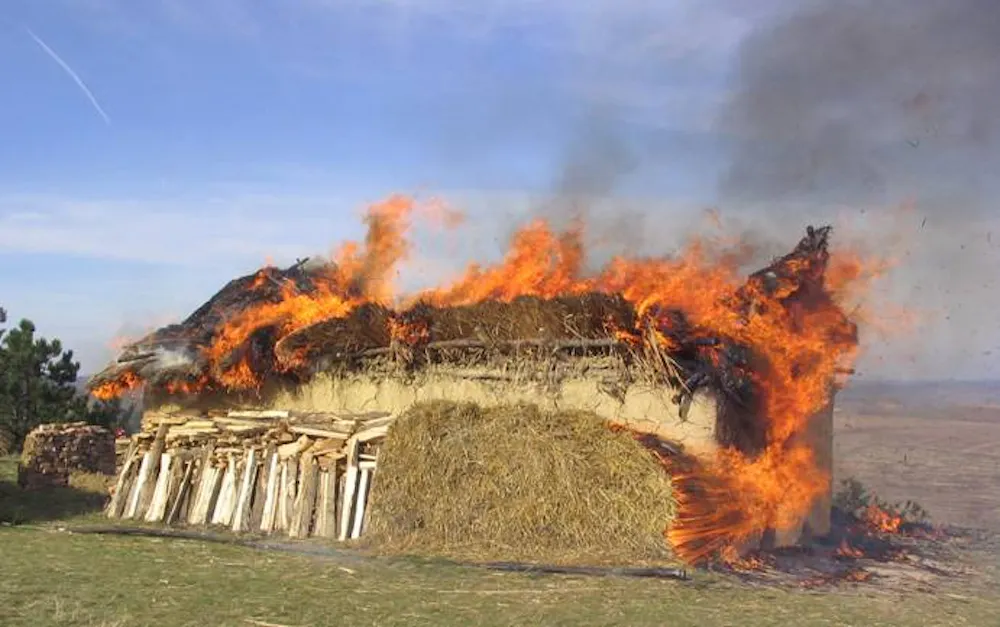
    The residents of Nebilevka didn’t need to have consciously planned for their neighborhood layout to help their population survive. But they may well have, as human instinct is to avoid signs of contagious disease. Like at Çatalhöyük, residents kept their houses clean. And about two-thirds of the houses at Nebelivka were deliberately burned at different times. These intentional periodic burns may have been a pest extermination tactic.

    Re-creation of a Trypillian house-burning, with additional straw and wood necessary to burn hot enough to match archaeological evidence.
    Arheoinvest/Wikimedia Commons, CC BY

    New cities and innovations

    Some of the early diseases eventually evolved to spread by means other than bad foods. Tuberculosis, for instance, became airborne at some point. When the bacterium that causes plague, Yersinia pestis, became adapted to fleas, it could be spread by rats, which would not care about neighborhood boundaries.

    Were new disease vectors too much for these ancient cities? The mega-settlements of Trypillia were abandoned by 3000 BCE. As at Çatalhöyük thousands of years before, people dispersed into smaller settlements. Some geneticists speculate that Trypillia settlements were abandoned due to the origins of plague in the region, about 5,000 years ago.

    The first cities in Mesopotamia developed around 3500 BCE, with others soon developing in Egypt, the Indus Valley and China. These cities of tens of thousands were filled with specialized craftspeople in distinct neighborhoods.

    This time around, people in the city centers weren’t living cheek by jowl with cattle or sheep. Cities were the centers of regional trade. Food was imported into the city and stored in large grain silos like the one at the Hittite capital of Hattusa, which could hold enough cereal grain to feed 20,000 people for a year. Sanitation was helped by public water works, such as canals in Uruk or water wells and a large public bath at the Indus city of Mohenjo Daro.

    These early cities, along with those in China, Africa and the Americas, were the foundations of civilization. Arguably, their form and function were shaped by millennia of diseases and human responses to them, all the way back to the world’s earliest farming villages.

    R. Alexander Bentley does not work for, consult, own shares in or receive funding from any company or organization that would benefit from this article, and has disclosed no relevant affiliations beyond their academic appointment.

    ref. Socially distanced layout of the world’s oldest cities helped early civilization evade diseases – https://theconversation.com/socially-distanced-layout-of-the-worlds-oldest-cities-helped-early-civilization-evade-diseases-239586

    MIL OSI – Global Reports

  • MIL-Evening Report: Why China now wants to put some limits on its ‘no limits’ friendship with Russia

    Source: The Conversation (Au and NZ) – By Guangyi Pan, Teaching fellow, international politics, UNSW Sydney

    Just before Russia’s invasion of Ukraine, China announced to much fanfare a “no-limits friendship” with Russia, suggesting a future of close collaboration in trade, energy and, perhaps most importantly, security.

    Now, more than two years into the war, the meaning and interpretation of this “no-limits” commitment has evolved.

    There has been much debate in Chinese society in recent months about Beijing’s alignment with Moscow. While some have advocated for a more formal alliance with Russia, others have taken a more cautious stance.

    In sharp contrast to 2022, China’s growing wariness is increasingly being discussed in the open, even among those who were previously censored. In early 2022, for instance, a joint letter by six Chinese emeritus historians opposing Russia’s invasion was censored by the government. The scholars were also warned.

    Now, however, it appears the government is seeking to balance its relationships with both Russia and the West. Beijing may not want to be seen as a “decisive enabler” of the war.

    For example, the once-prominent “no-limits” friendship language quietly vanished from a Sino-Russian joint statement in May.

    And Beijing’s response to Russian President Vladimir Putin’s visit that month was notably subdued. Putin ingratiated himself with Xi, saying they were “as close as brothers”. Xi’s response was more perfunctory – he called Putin a “good friend and a good neighbour”.

    Scholars are also articulating their concerns about China’s political and economic investments in Russia, both publicly and privately.

    Shen Dingli, a leading scholar of Chinese security strategy at Fudan University in Shanghai, said China doesn’t want to be seen as collaborating with Russia against Ukraine or any other country.

    He also quoted Fu Cong, China’s former ambassador to the European Union, who said last year the “no-limits” [friendship] is “nothing but rhetoric”.

    And in August, after Putin referred to China as an “ally” during a visit to far-eastern Russia, Chinese scholars promptly sought to clarify this statement to prevent any misunderstanding China wants a formal alliance with Russia.

    These statements carry weight. In many respects, leading Chinese scholars at the government-affiliated universities act as propagandists to convey and justify the government’s stance on issues. As a result, subtle shifts in their commentary provide insights into the strategic mindset in Beijing.

    Why China is rethinking its ‘no-limits’ friendship?

    There are three elements driving this re-evaluation of the Russia-China alignment.

    First, there is growing scepticism of Russia’s state capacities. The mutiny by the Wagner Group last year and Ukraine’s recent incursion into Russia’s Kursk region have prompted critical reassessments in Beijing of Russia’s political stability and military preparedness, as well as the growing anti-war sentiment in Russia.

    As Feng Yujun, director of Fudan University’s Russia and Central Asia Study Centre, argued, the Wagner rebellion was a reflection of Russia’s internal conflicts and domestic security challenges. He noted every time Russia has faced both internal and external crises in history, its regimes have become less stable.

    More recently, Feng has been even bolder, predicting Russian defeat in Ukraine. He argued China should keep its distance from Moscow and resume a policy of “non-alignment, non-confrontation and non-partisanship”.

    Second, China’s sluggish economy and its underwhelming trade with Russia have further exposed how dependent both countries are on the West.

    While Russia-China trade reached a record US$240 billion (A$360 billion) in 2023, it has slowed so far this year, as Chinese financial institutions have sought to limit connections with Russia.

    The relationship still heavily favours Beijing. Russia accounts for only 4% of China’s trade, while China accounts for nearly 22% of Russia’s trade.

    Many Chinese experts are now warning against an over-dependence on Russia, instead calling for more cooperation with neighbouring countries. This echoes a recent concern Russia has been using its natural resources as a bargaining chip to extract greater benefits from China.

    Russia’s value as a military ally

    Finally, there are rising Chinese concerns its international outlook does not align with Russia’s.

    Zhao Long, deputy director of the Shanghai Institute of International Relations, says there is an important difference in how they view the world:

    Russia wants to destroy the current international system to build a new one. China wants to transform the current system by taking a more prominent place in it.

    Shi Yinhong, a strategist at Renmin University in Beijing, has highlighted an unbridgeable gap preventing a stronger China-Russia alliance. He says there’s a deep mutual mistrust on regional security. Russia has never promised support for China in the event of a conflict over Taiwan, just as China has avoided involvement in the war in Ukraine.

    As Russia’s war in Ukraine reaches a stalemate, its value as a military ally is increasingly being questioned in China.

    Recently, Feng Yujun warned China risks being led by the nose by Russia, despite being the stronger economic partner. He says every time China has attempted an alliance with Russia in history, it has had negative consequences for China.

    Consequently, it is crucial for China to maintain its long-term partnership with Russia without undermining its constructive relationship with the West.

    Russia has arguably benefited from the current competition between the US and China, as it has sought to exploit the rivalry for its own benefit. But this has also led to uncertainty in the China-Russia relationship.

    As another analyst, Ji Zhiye, argues, relying too heavily on Russia will leave China isolated and vulnerable. And this is not a position China wants to be in.

    Guangyi Pan does not work for, consult, own shares in or receive funding from any company or organisation that would benefit from this article, and has disclosed no relevant affiliations beyond their academic appointment.

    ref. Why China now wants to put some limits on its ‘no limits’ friendship with Russia – https://theconversation.com/why-china-now-wants-to-put-some-limits-on-its-no-limits-friendship-with-russia-238436

    MIL OSI AnalysisEveningReport.nz

  • MIL-Evening Report: The government has a target for Indigenous digital inclusion. It’s got little hope of meeting it

    Source: The Conversation (Au and NZ) – By Bronwyn Carlson, Professor, Critical Indigenous Studies and Director of The Centre for Global Indigenous Futures, Macquarie University

    Digital inclusion for Indigenous communities is important. It’s so important, in fact, that the government has made it one of the targets under the Closing The Gap plan. The goal is:

    by 2026, Aboriginal and Torres Strait Islander people have equal levels of digital inclusion.

    Digital exclusion is the continuing unequal access and capacity to use digital technology that is essential to participate fully in society.

    It severely stifles Indigenous creativity. It restricts access to essential tools, skills and platforms that are crucial for digital expression and innovation.

    For many Aboriginal and Torres Strait Islander peoples, this exclusion leads to missed opportunities, particularly in areas linked to economic prosperity, such as employment and education. As the government’s policy focus is on economic empowerment, this is a major barrier.

    Measuring progress towards the 2026 deadline is challenging because there are simply no recent data.

    But given how big the gap was to start with, the lack of importance based on gathering relevant data and the insufficient government action since, we know the target is highly unlikely to be met.


    Read more:
    ‘Digital inclusion’ and closing the gap: how First Nations leadership is key to getting remote communities online


    What’s being done?

    To support the goal, the First Nations Digital Inclusion Plan offers a comprehensive strategy focused on three key pillars:

    • access (to telecommunication services, devices, and data)

    • affordability (the cost of services, devices, and data)

    • ability (skills, attitudes, and confidence with technology).

    Focused mostly on remote communities, initiatives such as the Australian Digital Inclusion Index highlight persistent challenges across all three areas.

    Although digital inclusion is an urgent issue in remote areas, research also shows Indigenous populations face widespread digital exclusion across the nation, regardless of remoteness.

    Some 84.6% (832,800) of Indigenous people live in non-remote areas. Many of these people are also excluded.

    Last year, the government established an advisory group to drive progress.

    It has developed a “road map”. This involves travelling to Indigenous communities across Australia to ensure their diverse needs, aspirations and environments are fully considered.

    Despite these ongoing government initiatives and policies, efforts to close the digital divide for Indigenous peoples remain insufficient. As technology continues to advance, Indigenous communities are left in an increasingly precarious situation.

    The rise of artificial intelligence

    The government’s current plans do not explicitly address the role of artificial intelligence (AI). This oversight is particularly concerning given the rapid advancement of AI technologies.

    A recent report on adult media literacy in Australia reveals 48% of Aboriginal and Torres Strait Islander participants do not understand what AI is or the risks and opportunities it presents. This knowledge gap could further exacerbate the digital divide and deepen existing inequalities.

    AI presents both opportunities and challenges. When led by Indigenous people, it holds transformative potential across multiple sectors.

    It could enhance learning tailored to Indigenous knowledge systems, help in the revitalisation and preservation of languages, and improve healthcare delivery. It could also empower Indigenous businesses by optimising operations and market reach.


    Read more:
    AI affects everyone – including Indigenous people. It’s time we have a say in how it’s built


    Indigenous people are already collaborating on research that combines Indigenous knowledge with AI to support land-management practices.

    There are very few Indigenous-led AI projects underway nationally, but there’s great potential. With Indigenous people helping develop AI, these technologies could contribute to meaningful, self-determined growth across Indigenous communities.

    But only if we’re included.

    Avoiding exploitation

    Indigenous digital exclusion, especially in policy development and regulation, can result in AI being used by non-Indigenous people to tell our stories without our permission.

    They can profit from appropriation of our culture, including art and languages.

    The government needs to adopt a more comprehensive and forward-thinking approach. This should involve expanding the scope of digital inclusion initiatives beyond the current limited focus to encompass Indigenous communities across the entire country.

    The development of Indigenous-led digital literacy programs that respect learning styles and culture is also essential.

    The government should incorporate AI and other emerging technologies into planning to ensure Indigenous communities are not left behind.

    Establishing long-term partnerships with technology companies, educational institutions and Indigenous organisations to create sustainable digital inclusion programs is vital.

    The focus should be on creating Indigenous-led opportunities that leverage digital technologies for economic empowerment without exploiting or harming.

    Underrepresented in tech

    One barrier to this is there are very few Indigenous peoples involved in the tech industry, especially in decision-making roles and policy development.

    As of 2022, Aboriginal and Torres Strait Islander people accounted for less than 1.4% of tech workers. There urgently needs to be more support to boost this figure.

    That’s because technology like AI presents potential careers for Indigenous people.

    Currently however, Indigenous peoples are not employed in the industries involved in AI. Of the global study of people working in this specific industry, Indigenous participation was not noted.

    The fact the government recognises digital inclusion as a national priority is a positive step. The current approach, however, is piecemeal and limited. We need a more holistic strategy.

    By developing more inclusive, technologically advanced policies led by Indigenous people, the government can ensure they are not left behind in the digital age. We need to be at the decision-making table.

    Closing the digital divide requires a multifaceted, long-term commitment from government. This means a national strategy recognising the diverse needs and aspirations of Indigenous communities across the country.

    By harnessing the full potential of digital technologies, including AI, and addressing the unique challenges faced by Aboriginal and Torres Strait Islander people, the government can create lasting positive change and truly empower Indigenous communities in the digital era.

    Bronwyn Carlson is a member of the First Nations Digital Inclusion Advisory Council.

    ref. The government has a target for Indigenous digital inclusion. It’s got little hope of meeting it – https://theconversation.com/the-government-has-a-target-for-indigenous-digital-inclusion-its-got-little-hope-of-meeting-it-239733

    MIL OSI AnalysisEveningReport.nz

  • MIL-Evening Report: Should King Charles apologise for the genocide of First Nations people when he visits Australia?

    Source: The Conversation (Au and NZ) – By Rebe Taylor, Associate Professor of History, University of Tasmania

    King Charles and Queen Camilla will visit Australia from Friday on a five-day tour of Canberra and Sydney.

    The king will be the second ruling British monarch to visit Australia, after Queen Elizabeth II’s 16 visits over 57 years.

    These visits showcase Australians’ evolving relationship with the monarchy and our colonial past.

    Changing attitudes

    An estimated 75% of Australians greeted Elizabeth on her first tour in 1954, at events that celebrated Australia’s growth as a prosperous nation.

    Historical milestones remained central to the queen’s subsequent visits.

    In 1970, she attended the re-enactment of Captain Cook’s arrival at Botany Bay. This included depictions of shooting at First Nations actors.

    The queen’s 1986 visit included signing the Australia Act that severed Britain’s formal powers over Australia.

    Her 1988 visit coincided with the Australian bicentenary of the arrival of the First Fleet carrying convicts and officials from Britain. But by this time, many Australians had lost their royal fervour.

    Her final tour, in 2011, came 12 years after Australia had attempted to become a republic by referendum.

    The queen’s death in 2022 not only reignited questions over the future of the monarchy in Australia, it instigated a public discussion over the monarchy’s role in imperial colonialism.

    Genocide in Australia?

    On the eve of Charles’ coronation in 2023, Indigenous leaders from 12 settler states including Australia and New Zealand cosigned a letter calling on the new monarch to apologise for the genocides that British colonisation brought to their territories.

    Australia was settled in the name of the Kingdom of Great Britain. Did that settlement result in genocide?

    Recent research led by Ben Kiernan for The Cambridge World History of Genocide has investigated this question using the 1948 United Nations Convention on the Prevention and Punishment of the Crime of Genocide as a framework.

    The convention defines genocide as “acts committed with intent to destroy, in whole or in part, a national, ethnical, racial or religious group”.

    The term “genocide” itself is modern; coined by Raphael Lemkin in 1944. The colonisation of Tasmania by the British provided Lemkin with one of the clearest examples.

    The prosecution of crimes before 1951 is not permissible under the convention, which provides a definitional framework to evaluate past events as constituent acts of genocide.

    The Cambridge World History of Genocide Volume II and Volume III demonstrate how settlers and government agents committed acts of genocide against First Nations Australians from the beginning of settlement to the late 20th centuries.

    All parts of Australia are considered. Acts conforming to the convention’s clauses include killing, forcibly removing children and inflicting destructive conditions.

    Australian historian Lyndall Ryan’s chapter, Frontier Massacres in Australia, draws on her research for a Massacre Map showing how British troops and settlers committed more than 290 massacres across Australia between 1794 and 1928.

    These massacres killed more than 7,500 Aboriginal people.

    Ryan found the massacres were not sporadic and isolated – they were planned and sanctioned killings, integral to the aims of the Australian colonial project.

    Rebe Taylor’s chapter on genocide in Tasmania details a pattern of government-sanctioned mass killings in a colony where an estimated 6,000 Palawa (Tasmanian Aboriginal) people were reduced to about 120 by 1835.

    Raymond Evans shows how as colonisation moved northward in Australia, massacres increased in size.

    Evans documents killings that persisted into the 1940s, postdating the 1928 Coniston massacre widely regarded as the last frontier slaughter.

    These findings are underscored by Tony Barta’s insight that colonists’ destructive actions constitute a record of genocidal intent “more powerful than any documented plot to destroy a people”.

    Research by Anna Haebich documents the taking of Indigenous children during the 19th century.

    Joanna Cruikshank and Crystal Mckinnon explain how these state-sanctioned removals in the 20th century were intended to eliminate First Nations people from Australia’s national life.

    The 1997 Bringing Them Home report, commissioned by the Human Rights and Equal Opportunity Commission, concluded the “Australian practice of Indigenous child removal involved […] genocide as defined by international law”.

    A significant moment of resistance

    The colonial governor of Tasmania began to exile Palawa people from their land in 1829.

    More than 200 survivors of the “Black War” were removed to Flinders Island and subjected to life-threateningly harsh conditions. High death rates were caused by ill-treatment, disease and insufficient care.

    In 1846, the Palawa petitioned Queen Victoria to honour the agreement made when they were removed: that in exchange for temporarily leaving their country, they would regain their freedom.

    In this bold petition, Tasmanian Aboriginal people initiated a historic appeal to the British monarchy.

    Aware of Queen Victoria’s sovereign authority across the vast British Empire, this action marked a significant moment in their continued resistance to genocide.

    An acknowledgement of wrongs

    British sovereignty over Australia was imposed without the required consent of its First Nations. The result has been continued dispossession and suffering.

    Despite the Crown’s deferral of power to its parliament, the call for an apology from the king has immense symbolic importance.

    It is rooted in the desire for acknowledgement of wrongs. These include genocide and the continuing destructive effects of colonisation across Australia.

    Rebe Taylor receives funding from the Australian Research Council.

    Greg Lehman receives funding from the Australian Research Council and the Australian Institute of Aboriginal and Torres Strait Islander Studies. He is a member of the Board of the Tasmanian Land Conservancy.

    ref. Should King Charles apologise for the genocide of First Nations people when he visits Australia? – https://theconversation.com/should-king-charles-apologise-for-the-genocide-of-first-nations-people-when-he-visits-australia-239092

    MIL OSI AnalysisEveningReport.nz

  • MIL-Evening Report: Mounjaro is more effective for weight loss than Ozempic. So how does it work? And why does it cost so much?

    Source: The Conversation (Au and NZ) – By Paul Joyce, Senior Research Fellow, University of South Australia

    Halfpoint/Shutterstock

    A weight-loss drug more effective than Ozempic and Wegovy has recently been approved in Australia.

    The drug, tirzepatide, is sold under the brand name Mounjaro and affects feelings of hunger and fullness, as well as changing how the body processess food. (In other countries, tirzepatide is also sound under the brand name Zepbound.)

    So how does tirzepatide work and differ from Ozempic? And with a price tage of $315–$645 per month for the starting dose, why is it so expensive?

    How does it work?

    Think of tirzepatide as a master key that unlocks two important doors in your body’s weight control system. It mimics two hormones: GLP-1 (glucagon-like peptide-1) and GIP (glucose-dependent insulinotropic polypeptide).

    When you eat, your body naturally releases GIP and GLP-1 hormones. These hormones play crucial roles in regulating appetite, food intake and blood sugar levels. Tirzepatide mimics and amplifies the effects of these hormones.

    By mimicking the GLP-1 and GIP hormones, tirzepatide makes people feel fuller with smaller meals. This can reduce the overall food intake and lead to weight loss over time.

    It also helps your body process sugar more effectively and slows down how quickly food leaves your stomach. This results in eating less, feel satisfied for longer and having healthier blood sugar levels.

    How does it compare with Wegovy/Ozempic?

    Tirzepatide (Mounjaro) and semaglutide (Wegovy/Ozempic) are similar in many ways. Both are injectable medications used for weight loss and work by mimicking hormones that regulate appetite and blood sugar.

    The key difference is that tirzepatide acts on two hormone receptors (GIP and GLP-1), while semaglutide only acts on one (GLP-1). This dual action is thought to be why tirzepatide shows slightly better results for weight loss in clinical trials.

    Clinical trials have shown participants lost an average of 25% of their body fat in the first year of treatment with tirzepatide. This is when combined with lifestyle counselling from a health-care professional who encouraged a healthy and reduced-calorie diet (500 calories less per day compared to patient’s diet at the beginning of the study) and at least 150 minutes of physical activity per day.

    This compares with an average of 15% weight loss in the first year for semaglutide, also alongside a reduced-calorie diet (a 500 calorie-deficit per day) and increased physical exercise (150 minutes per week).

    For a person weighing 120kg, this might mean the difference between losing 30kg with tirzepatide versus 18kg with semaglutide. But of course, with both drugs, some people will lose less weight than the average, some will lose more, and some may not respond to the drug at all.

    What are the side effects of tirzepatide?

    Like any medication, tirzepatide has side effects. The most common are nausea, vomiting, diarrhoea and constipation. These could feel like a mild tummy bug and are similar to those seen with semaglutide.

    For most people, these side effects are manageable and often improve over time.

    There are also some rarer, more serious risks to consider. These include inflammation of the pancreas and gallbladder problems. There is also a potential increased risk for thyroid cancer, although this has only been seen in lab rats so far, not humans.

    As with Ozempic and Wegovy, when you stop taking tirzepatide, its effects stop. Most people regain some, if not all, of the weight they lost.

    People often regain some or all of the weight they lost after stopping the medication.
    /John Hanson PyeShutterstock

    Who can access tirzepatide?

    In Australia, tirzepatide is approved for use in adults with a body mass index (BMI) of 30 or higher, or a or BMI of 27 or above if you have a weight-related health condition such as diabetes. It can only be prescribed by a doctor, after you have tried other weight-loss methods.

    But it’s not suitable for everyone. It shouldn’t be used in pregnancy and may not be suitable for people with certain medical conditions and those with a history of eating disorders.

    If you’re considering tirzepatide, it’s important to discuss the benefits and risks for your personal health situation with your doctor.

    Why is it so expensive?

    Tirzepatide typically costs around A$345 per month for the starting dose. This can escalate to $645 per month for the ongoing “maintenance” dose if a higher dose is necessary for diabetes and/or weight management. This puts the drug out of reach for most people.

    Tirzepatide, sold as Mounjaro in Australia, is only available on private prescription and is not subsidised by the Pharmaceutical Benefits Scheme (PBS). This means you pay the full cost of the medication without any government support.

    However, the United Kingdom recently announced it would add tirzepatide to the National Health Service in a phased approach over the next three years, so it’s possible we might see it subsidised in Australia in the future.

    Developing new drugs is a costly business. Companies spend billions on research, clinical trials, and getting regulatory approvals. They then set high prices to recoup these costs and make a profit.

    The patent for tirzepatide lasts until 2036. So we won’t have any cheaper generic versions for more than a decade.

    Paul Joyce receives funding from The Hospital Research Foundation, Cancer Council SA, and the Australian Research Council. He is Director of the Australian Controlled Release Society.

    Srinivas Kamath does not work for, consult, own shares in or receive funding from any company or organisation that would benefit from this article, and has disclosed no relevant affiliations beyond their academic appointment.

    ref. Mounjaro is more effective for weight loss than Ozempic. So how does it work? And why does it cost so much? – https://theconversation.com/mounjaro-is-more-effective-for-weight-loss-than-ozempic-so-how-does-it-work-and-why-does-it-cost-so-much-239185

    MIL OSI AnalysisEveningReport.nz

  • MIL-Evening Report: Overtly handmade and so very moving: Adam Elliot’s Memoir of A Snail is a stop motion triumph

    Source: The Conversation (Au and NZ) – By Jack McGrath, Lecturer in Animation at the University of Newcastle, University of Newcastle

    Many iconic Melbourne sights, including Luna Park, feature in Adam Elliot’s new film. Madmad Entertainment

    Stop motion films are by their nature a remarkable feat. When you know a movie has been carefully crafted, over several years and through thousands of photographs of handmade sets and characters, this alone makes it a delight to watch.

    But when the story is also deep, thought-provoking and at times laugh-out-loud funny, this takes the medium to a whole new level. Adam Elliot’s Memoir of a Snail is such a film.

    Told through stop motion animation using clay (otherwise known as claymation), the film is a tactile experience in which everything you see has been made by human hands. This provides a warmth that is exacerbated by Elliot’s very human story of identity.

    The film explores how it can be difficult to find your way in life, particularly when you’re different – and that it is, in fact, OK to be different.

    Grace Pudel, the protagonist, is a snail enthusiast and we follow her as she navigates the many challenges that emerge in her life. Grace’s narration is raw and honest, and we can’t help but feel a deep connection with her.

    The story is so human and so very moving – and to be told through human-made characters perfectly rounds off the experience.

    Grace is a hoarder of ornamental snails, romance novels and guinea pigs.
    Madman Entertainment

    A win at Annecy

    In June, I was fortunate enough to help facilitate an animation study tour in France with students from the University of Newcastle. It was there we saw the world premiere of Memoir of a Snail at the Annecy International Animation Film Festival, the pre-eminent festival for animated film.

    The story clearly resonated with the audience, who sat captivated throughout its 90-minute runtime. They laughed and cried in unison as one engaged mass of humanity – culminating in a long and enthusiastic standing ovation.

    We were even lucky enough to bump into Elliot and his crew, and our students spoke with him about his journey in making Memoir of a Snail. The film went on to win the festival’s prestigious Cristal award for best feature.

    More than 7,000 individual items were handcrafted by various artisans, with most objects made from clay, wire, paper, paint and silicon.
    Madman Entertainment

    While claymation is generally viewed as a medium aimed at young audiences, Memoir of a Snail tells a wholly unique adult story.

    Much of its sophistication lies in its ability to effortlessly touch on many complex topics through a mixture of humour and emotion. Indeed, this approach to storytelling has become Elliot’s calling card.

    The film’s themes include identity, loneliness, alcoholism, cultism, hoarding, suicide, homosexuality, bullying, ageing, family, fat fetishism, grief and death. The story cleverly pulls you into deep thought, before surprising you with a hilarious gag.

    Grace (voiced by Sarah Snook) strikes up friendship with an eccentric elderly woman named Pinky (Jacki Weaver).
    Madman Entertainment

    Elliot’s dark and captivating aesthetic

    When introducing the film at Annecy, Elliot explained how his team’s limited budget led to a heavy reliance on narration, with limited walking and dialogue shots. Yet these constraints seemed to enhance the team’s creativity rather than stifle it.

    Elliot has a history of working around such limitations to bring his unique aesthetic to life. His first film Uncle (1996) was shot on 16mm black-and-white film, while his other short Cousin (1999) was shot on colour – but with a muted palette of grey tones.

    This palette has carried through Elliot’s work and is present in Memoir of a Snail. His version of the Australian landscape isn’t orange and sun-bleached. Rather, it is grey, overcast and drab – a dark world resembling the work of Eastern European animators such as Jan Švankmajer.

    Elliot’s other films include Brother (2000), the Oscar-winning short film Harvie Krumpet (2003) and his first feature film Mary and Max (2009).

    His works present tortured individuals – outsiders, misfits and oddballs – living in dark, suburban worlds. Behind the funny-looking faces and humorous vignettes lie deeper afflictions that become clear as the characters struggle through their lives.

    More than 1,000 plasticine mouths had to be made so the characters could talk.
    Madman Entertainment

    A gentle vulnerability shines through

    Elliot brings a naivety to the narration, where a simple statement of facts couches a deeper meaning. As the audience, we uncover mixed feelings of humour, dread and empathy for the tortured blobs of clay before us.

    The characters stand, blinking, looking back at us while the narrator describes their situation. They feel vulnerable, as though asking for our help as they stand silently, trapped in Elliot’s bleak world.

    Grace falls into dark spiral after she is seperated from her twin brother Gilbert (Kodi Smit-McPhee) at a young age).
    Madman Entertainment

    Memoir of a Snail maintains a strong sense of materiality, as evidenced by fingerprints left on clay and brush strokes on painted backgrounds. Elliot’s self-described “chunky wonky” aesthetic abides by the rule that nothing in the world is straight.

    Almost everything in Elliot’s animated world is overtly handmade, presenting a kind of nostalgic and childlike innocence you’d expect from a school project. This helps add weight and authenticity to the film.

    The 3D work intersects with thoughtfully crafted 2D items such as handwritten title cards and signs.
    Madman Entertainment

    Elliot’s world is created “in-camera”, which means no digital effects were used. Water, for example, was created using cellophane, while droplets were painstakingly animated with blobs of glycerine, one frame at a time.

    Welcome relief in a hyper-digital world

    Lately, Australian animation has found an international audience and this has emboldened Australian animators to tell Australian stories. Bluey, for instance, has struck a chord with viewers globally because of – and not despite – its uniquely Australian voice.

    It took eight years to create Memoir of a Snail, which seems like a lifetime in today’s world. Witnessing such dedication may inspire audiences to think more deeply about animation as an art form and about film-making itself.

    Elliot’s handmade style is a nice counter to the digital and visual effects that seem ever-present in media today.
    Madman Entertainment

    Memoir of a Snail is a testament to stop motion’s power to move people. Elliot himself pointed out how stop motion seems to be experiencing a renaissance, with Guillermo Del Toro’s Pinocchio (2022), Phil Tippett’s Mad God (2021), Henry Selick’s Wendell & Wild (2022) and Chris Butler’s Missing Link (2019) all serving as recent examples of stop motion features.

    I hope Memoir of a Snail helps sustain this interest. In an age of automation and artificial intelligence, the film is a welcome return to the human experience. Thought-provoking, funny and wholly unique in its story and visual style, it’s well worth the watch.

    Other voice actors on the production include Eric Bana, Nick Cave and Tony Armstrong.
    Madman Entertainment

    The author would like to thank Daisy De Windt for her contributions to this article.

    Jack McGrath does not work for, consult, own shares in or receive funding from any company or organisation that would benefit from this article, and has disclosed no relevant affiliations beyond their academic appointment.

    ref. Overtly handmade and so very moving: Adam Elliot’s Memoir of A Snail is a stop motion triumph – https://theconversation.com/overtly-handmade-and-so-very-moving-adam-elliots-memoir-of-a-snail-is-a-stop-motion-triumph-233105

    MIL OSI AnalysisEveningReport.nz

  • MIL-Evening Report: Glucose monitors for diabetes have finally been funded – but a chronic workforce shortage will limit the benefits

    Source: The Conversation (Au and NZ) – By Lynne Chepulis, Associate Professor, Health Sciences, University of Waikato

    Pharmac’s decision to fund continuous glucose monitors and automated insulin delivery systems for the approximately 18,000 people who currently live with type 1 diabetes in Aotearoa New Zealand is good news.

    The decision comes after years of advocacy from patient groups and clinicians.

    But there are problems within the broader system – particularly around workforce shortages – that mean full patient access to training on how to use the insulin pumps will likely take years.

    Failing to address these issues will also perpetuate health inequities for Māori and Pacific people, who are less likely to have used the monitor and pump in the past, and may have to wait longer for training. These delays could mute the positive effect of Pharmac’s funding decision.

    A complex balance

    Type 1 diabetes is an autoimmune disorder that causes a person’s pancreas to stop producing insulin. This all-important hormone is needed to move glucose into every cell in the body.

    Without insulin, the cells (and the person) “starve”. While the current approach to the management of type 1 diabetes – finger pricking to test blood glucose levels and injecting insulin – works, it’s complex.

    Inject too much insulin and you’ll get low blood sugar (hypoglycaemia). This leaves a person with type 1 feeling shaky and weak, or possibly even in a coma. Don’t inject enough and you have ongoing high blood sugar (hyperglycaemia). This leads to long-term health complications.

    Figuring out the right amount of insulin is elusive. Needs constantly vary according to time of day, diet, exercise, illness, caffeine, alcohol, stress and other factors. This can take a toll psychologically and physiologically.

    Modern solutions

    Continuous monitors track blood glucose levels 24 hours a day through a sensor just under your skin, replacing finger-prick testing. They are widely funded and used overseas.

    The monitors alert users to low blood glucose and have significantly reduced hospitalisations for people with type 1 diabetes.

    Combining the monitors with a pump and appropriate algorithm automates the delivery of insulin when glucose levels rise higher than a patient’s target range – significantly reducing the day-to-day burden of treatment.

    But the continuous monitors and insulin pumps are expensive.

    Prior to Pharmac’s decision, the monitors were completely unfunded. Prices ranged between NZ$2,600 and $4,800 per year. Insulin pumps were funded, but only for a small group of people.

    This created an ever-widening equity gap. Māori and Pacific people with type 1 diabetes were less likely to access monitors and pumps. They were also more likely to have recurrent hospitalisations for diabetes-related events.

    A workforce shortage

    When compared with other countries, New Zealand has been slow to fund the monitors.

    Unfortunately, the diabetes workforce is also significantly understaffed when compared to international guidelines.

    There is a shortage of all qualified health care professionals for type 1 diabetes including endocrinologists, nurse practitioners, diabetes nurse specialists, dietitians, psychologists, social workers and podiatrists.

    To meet international recommendations, New Zealand would have to more than double the clinical workforce.

    Most people with type 1 diabetes will be able to rapidly access the monitors because these can be prescribed through GPs as well as by diabetes specialists. However, insulin pumps and automated insulin delivery will only be accessible through specialists.

    While insulin pumps offer advantages for managing glucose levels, learning to use the device takes time and requires support from clinicians. This will likely be a problem, particularly for those who already have challenges accessing healthcare services in this country.

    An equity issue

    Māori and Pacific people with type 1 diabetes are less likely to be current insulin pump users. This means there is a clear risk of workforce shortages causing those who would benefit most from automated insulin delivery to be among the last to have access.

    Increasingly, evidence on continuous glucose monitors and automated insulin delivery shows they improve managing type 1 diabetes for everyone.

    Monitor use has been shown to reduce the differences in the management of glucose levels between Māori and non-Māori children with type 1 diabetes.

    Automated insulin delivery can also be an effective tool for children and adolescents with very high-risk glucose levels.

    So, thank you Pharmac. Funded devices are a game changer. New Zealand has moved from an outdated, inequitable system of technology funding in type 1 diabetes to a progressive and fair system. But so much more needs to be done to support everyone with this disease.

    Lynne Chepulis receives funding from the Health Research Council of New Zealand. She is an executive member of the New Zealand Society for the Study of Diabetes.

    Hamish Crocket receives funding from the Health Research Council of New Zealand. He is an executive member of the New Zealand Society for the Study of Diabetes and is the chairperson of Nightscout New Zealand, a diabetes advocacy group. Hamish has been living with type one diabetes since 2013.

    Martin de Bock receives funding from Novo Nordisk, Medtronic, Ypsomed, Dexcom, and Insulet. Honoraria, travel expenses or speaking fees from Novo Nordisk, Sanofi, Pfizer, Medtronic, Boerhinger Ingelheim, Ypsomed, Dexcom, and Insulet. Advisory Boards for Tandem and Dexcom, Tautoko Tech, Nascence biomedical.

    ref. Glucose monitors for diabetes have finally been funded – but a chronic workforce shortage will limit the benefits – https://theconversation.com/glucose-monitors-for-diabetes-have-finally-been-funded-but-a-chronic-workforce-shortage-will-limit-the-benefits-241113

    MIL OSI AnalysisEveningReport.nz

  • MIL-Evening Report: Social media footage reveals little-known ‘surfing’ whales in Australian waters

    Source: The Conversation (Au and NZ) – By Vanessa Pirotta, Postdoctoral Researcher and Wildlife Scientist, Macquarie University

    Sapphire Coastal Adventures

    As humpback and southern right whales return to Antarctica at the tail end of their annual migration, east coast whale watchers may think the show will soon be over. But some whale species are still here, possibly year-round. And we need to find out more about them.

    My team’s new research concerns one of these little-known species – the Bryde’s whale. You may have seen it feeding, breaching or surfing, without realising what it was.

    My colleagues and I wanted to learn more about where Bryde’s whales can be found in Australian waters. So we tapped into observations shared on social media, including drone footage and photographs from whale-watching tours. We also gathered observations from scientists.

    We discovered a wealth of information. It includes evidence of feeding and “surfing” behaviours possibly never documented before. Findings from this research will directly help inform conservation efforts to protect this species, which we still know so little about in Australian waters.

    A Bryde’s whale rides the surf after feeding in shallow waters.
    Taylor Arnell and Austin Ihle @takethemap

    Observing whales through citizen science

    Scientists can’t always be out in the field, or on the water. That’s why the data gathered by everyday people, known as “citizen scientists”, can be so useful. It captures valuable information about wildlife that can be used later by professional researchers.

    Citizen science projects involving marine life have grown over recent years. They include people documenting humpback whale recovery by counting northward migrating humpback whales off Sydney, and people watching sharks off Bondi Beach via the @DroneSharkApp.

    Hungry hungry whales

    Like humpback whales, these giants are “baleen” whales, meaning they are toothless. But Bryde’s whales have a much pointier mouth and lack that famous hump.

    A preference for warmer waters means Bryde’s whales are also known as tropical whales. They can be found in tropical or subtropical waters.

    Around the world, Bryde’s whales have demonstrated interesting feeding behaviours, from high-speed seafloor chases to “pirouette feeding”.

    Bryde’s whale in shallow waters near baitfish.
    Taylor Arnell and Austin Ihle @takethemap.

    Hanging out in shallow and deep waters

    Our study documented Bryde’s whales feeding in both deep and shallow waters off the east coast of Australia, alone or sometimes with other whales.

    We tapped into more than an hour of drone vision and more than 200 photos of Bryde’s whales shared by citizen scientists on social media platforms such as Facebook, Instagram and YouTube.

    In offshore environments, Bryde’s whales were typically seen “side lunging” – where they propel themselves forward and turn onto their side then open their mouth to engulf their food. They also swam from below and scooped up their prey, much like humpback whales.

    Lunging Bryde’s whale feeding on small baitfish in New South Wales waters.
    Brett Dixon

    In shallow waters, Bryde’s whales were observed feeding directly within or behind the surf break.

    We believe this is a new feeding behaviour for this species. We call it “shallow water surf feeding”.

    Whales may be using the surf to assist with their feeding efforts, or, perhaps they are there because that’s where the bait fish are hanging out.

    Regardless, it’s impressive to see such a large whale in the surf and in shallow waters.

    Spotted: mums with their calves

    We also documented mothers with calves. This indicates some parts of the Australian east coast could possibly serve as an important area for nursing mothers with their young. They could also be using these waters for calving.

    We don’t yet fully understand the species’ movements around Australia, and whether they swim in New Zealand waters. For example, the world-famous white humpback whale Migaloo has been known to swim across the Tasman Sea.

    Bryde’s whale mother with calf in NSW waters escorted by dolphins.
    Brett Dixon

    Could these Bryde’s whales we see here in Australian waters be the same ones seen in New Zealand waters? Are they calving in New Zealand or Australia and moving between the two? If so, what does this mean for their protection?

    Whales don’t recognise international boundaries. They go where they want, when they want. This is why collaborative research like this is important for our growing knowledge of this species.

    The more we know, the better we can protect

    This is the first dedicated paper on both the occurrence and feeding behaviour of Bryde’s whale in Australian waters.

    As humans continue to expand our footprint in the ocean through activities such as offshore wind energy, shipping, fishing and tourism, knowledge of this species and others can help inform future decisions in our blue backyard.

    Findings of this study will directly contribute to Australia’s efforts to protect whales. One immediate action will be contributing information to the federal review of Biological Important Areas for protected marine species. The more we know, the better we can target conservation efforts to provide for a species we know relatively little about in Australian waters.

    And even though the humpbacks and southern rights are headed back south to Antarctica for the summer, it’s still worth keeping your eyes on the water. You might be the next person to spot a Bryde’s whale in Australian waters. Let us know if you do!

    An example of shallow water surf feeding by a Bryde’s whale.
    Taylor Arnell and Austin Ihle @takethemap

    Vanessa Pirotta does not work for, consult, own shares in or receive funding from any company or organisation that would benefit from this article, and has disclosed no relevant affiliations beyond their academic appointment.

    ref. Social media footage reveals little-known ‘surfing’ whales in Australian waters – https://theconversation.com/social-media-footage-reveals-little-known-surfing-whales-in-australian-waters-241347

    MIL OSI AnalysisEveningReport.nz

  • MIL-Evening Report: Mysterious black balls have washed up on Sydney’s Coogee beach. Are they the result of an oil spill, or something else?

    Source: The Conversation (Au and NZ) – By Sharon Hook, Principal Research Scientist, CSIRO

    Sydney’s popular Coogee beach has been closed until further notice after hundreds of strange black balls washed up on the shoreline.

    The black balls were discovered on Tuesday afternoon.
    Randwick City Council

    The balls were discovered on Tuesday afternoon. The local authority, Randwick City Council, says samples have been collected for testing, and the incident has been reported to the Environment Protection Authority and Beachwatch NSW.

    A council spokesperson said the debris may be “tar balls” formed when oil comes into contact with debris and water – typically the result of oil spills or seepage.

    I am a senior research scientist at CSIRO, specialising in environmental toxicity. While the objects could be tar balls, in my view, it is also possible they are something else. But in any case, the debris poses a potential risk to marine life and the public, and authorities were right to close the beach.

    What are tar balls?

    Tar balls are typically dark, sticky blobs found on beaches after an oil spill. They occur when oil comes into contact with the ocean’s surface and becomes weathered by wind and waves. This breaks the oil patches into smaller pieces.

    Tar balls usually form in a variety of shapes and sizes – ranging from big, flat pancakes to tiny spheres. The image below shows a typically irregular tar ball that washed up on an island in the United States.

    Tarballs, such as this one found on Dauphin Island, Alabama, usually form in a variety of shapes and sizes.
    NOAA

    On this basis, I am not certain the pieces of debris found at Coogee are tar balls. They certainly might be. I haven’t seen them in person, but from the publicly available images, the objects appear to be relatively uniform, perfectly round shapes. That would be very unusual for tar balls – but not impossible.

    The balls could be plastic debris washed off a container ship, such as squash balls or plastic used in manufacturing. But obviously, we have to wait until tests have been conducted on the objects before we can determine their origin and composition.

    And finally, the balls appear to have washed up only at Coogee beach. It would be uncommon for oil spill remnants to drift to a single location unless the spill happened very close to shore.

    What are the potential harms?

    Whatever the objects are, they could pose a hazard to marine life.

    If the objects are sticky or oily, they may coat animals that come into contact with them. An animal that ate the objects may also be harmed. The balls would be difficult to digest and might stay in the animal’s stomach for a long time, preventing it from eating other food.

    If the objects are in fact tar balls, this is dangerous to animals because oil can be carcinogenic.

    What should be done?

    Every precaution should be taken until we know exactly what these mysterious objects are.

    Authorities are doing the right thing in keeping people away from the beach as the cleanup and testing continue. The public should heed official advice not to enter the beach and especially, not to touch the spheres.

    At this stage, it appears no other beach is affected, so there are plenty of other nearby options for beach-lovers.

    In the meantime, we should let the forensic scientists and other experts do their job.

    Sharon Hook does not work for, consult, own shares in or receive funding from any company or organisation that would benefit from this article, and has disclosed no relevant affiliations beyond their academic appointment.

    ref. Mysterious black balls have washed up on Sydney’s Coogee beach. Are they the result of an oil spill, or something else? – https://theconversation.com/mysterious-black-balls-have-washed-up-on-sydneys-coogee-beach-are-they-the-result-of-an-oil-spill-or-something-else-241470

    MIL OSI AnalysisEveningReport.nz

  • MIL-Evening Report: Claims that Qantas is greenwashing build a case for carbon assurance: here’s what it is

    Source: The Conversation (Au and NZ) – By Md Safiullah (Safi), Senior Lecturer in Finance, RMIT University

    ChristianChan/Shutterstock

    Qantas is being taken to Australia’s consumer regulator over its claim it is committed to achieving net zero emissions by 2050.

    The Environmental Defenders Office and the advocacy group Climate Integrity say the claim is “not backed up by credible targets or substantiating strategies” making it potentially misleading and in breach of the Australian Consumer Law.

    The Australian Competition and Consumer Commission has yet to decide whether to investigate the complaint, and Qantas has yet to respond.

    The complaint follows a ruling by a Dutch Court earlier this year that the airline KLM had misled consumers by creating the false impression it was sustainable.

    The win has spurred the European Commission to write to 20 airlines identifying potentially misleading claims and inviting them to bring their practices in line.

    Of most concern to the European regulators are claims the carbon emissions caused by flights can be offset by climate projects and the use of sustainable fuels, to which the consumers can contribute by paying additional fees.

    Carbon assurance assesses claims ahead of time

    These kinds of complaints would be much easier for airlines (and other compnies) to deal with if they had submitted themselves to a process known as carbon assurance ahead of time.

    Usually entered into voluntarily, and conducted by an independent assessor in accordance with an international standard, the process verifies the accuracy, transparency, and credibility of an organisation’s carbon emissions claims.

    My own research with Linh Nguyen, just published in Finance Research Letters, finds firms with high carbon assurance scores are more likely to obtain more trade credit from their suppliers.

    Europe and Australia are moving towards making carbon assurance mandatory for large corporations.

    Few firms submit themselves to it

    A survey by KPMG International finds that while nearly all of the world’s 250 largest firms report on the sustainability of their operations, only two-thirds submit themselves to carbon assurance.

    Another survey of 5,183 companies from 42 countries that publish emissions data finds half don’t engage a carbon assuror.

    This could be because they are afraid of what the assuror will find.

    An international survey of 750 companies that sought some level of external assurance found just 14% received a reasonable assurance.

    Many firms aren’t ready

    Assessors are hard to find.
    NattapongPunna/Shutterstock

    Assurors, and the skills within the organisation to handle the process are hard to find. While international standards are in place, there isn’t yet a professional or regulatory body to certify assurors.

    The Australian government intends to make assurance reports for the
    Scope 1 and Scope 2 emissions of large firms mandatory from July 2026.

    Scope 1 and scope 2 emissions are the direct and indirect emissions of the corporation itself.

    The government intends to make Scope 3 emissions (those in other parts of the corporation’s supply and distribution chain) mandatory from July 2030.

    It will be important to get the systems in place.

    While what the firms report will matter a lot, what will matter almost as much is an assurance we can believe what they report.

    Md Safiullah (Safi) does not work for, consult, own shares in or receive funding from any company or organisation that would benefit from this article, and has disclosed no relevant affiliations beyond their academic appointment.

    ref. Claims that Qantas is greenwashing build a case for carbon assurance: here’s what it is – https://theconversation.com/claims-that-qantas-is-greenwashing-build-a-case-for-carbon-assurance-heres-what-it-is-239592

    MIL OSI AnalysisEveningReport.nz

  • MIL-Evening Report: Charles III will be the first king of Australia to visit our shores. He could also be the last

    Source: The Conversation (Au and NZ) – By Jess Carniel, Associate professor in Humanities, University of Southern Queensland

    King Charles III and Queen Camilla’s upcoming visit to Australia is significant for several reasons. It is Charles’ first visit since ascending to the throne – as well as the first time a British male head of state has visited Australia.

    Some observers are also wondering whether it might be one of the last royal tours, as debates about Australia potentially becoming a republic are reignited.

    As the monarchy tries to “modernise” alongside growing support for republicanism, this visit will be one to watch.

    The curse of the Antipodes?

    As Prince of Wales, Charles had a long and successful track record of royal tours to Australia, having visited 16 times. The visits included a term attending Geelong Grammar School in 1966, as well as the 1983 tour with Princess Diana that saw Australians caught up in Di-mania – and Charles reportedly gripped by jealousy.

    But Charles’ royal predecessors weren’t as lucky in their trips down under. His own grandfather, King George VI, planned to visit Australia in the late 1940s with Queen Elizabeth and Princess Margaret, but the tour was postponed due to his poor health. While he had previously visited as the Duke of York, George VI never made it here as king.

    King George VI was born in 1895 and reigned from 1936 until his death in 1952.
    Wikimedia

    The very first royal visit to Australia – Prince Alfred’s 1867 tour – had all appearance of being cursed. One of his crew members drowned during the first stop in South Australia. Several more people died in a major fire accident and a Catholic-Protestant skirmish in Melbourne.

    Most memorably – certainly for Alfred – was an assassination attempt on the prince in Sydney. This, interestingly, is an experience King Charles has also had.


    Read more:
    Royal visits to Australia can be disaster magnets. In the first one, the prince barely made it out alive


    During Charles’ 1994 visit, student protester David Kang fired blanks from a starter pistol in protest of Australia’s treatment of Cambodian refugees. The then Prince of Wales wasn’t harmed and Kang went on to become a barrister.

    For non-British royals, however, Sydney has been a lucky location. King Frederick X’s decidedly modern romance with Tasmania-born Queen Mary famously began when they met at a bar during the Sydney Olympics in 2000.

    Prince or king – does it matter?

    This will be Charles’ seventeenth visit to Australia, but his first as reigning monarch. This means he is visiting not on behalf of the head of state, but as the head of state.

    The royal couple’s planned Australian engagements are as strategic as they are symbolic. They reflect carefully curated and ostensibly “non-political” issues such as environmental sustainability, cancer research and family violence.

    The visit also includes a meeting with Indigenous representatives. Notably, it is the first royal tour to not use the term “walkabout” to describe public meet-and-greets, as this term had been criticised as cultural appropriation.

    It seems Charles’ modernised monarchy is seeking to distance itself from overtly colonial language – as much as a foreign monarchy can, anyway. The king has yet to respond to Indigenous leaders calling for an apology for British colonisers’ genocides of First Nations peoples.


    Read more:
    Should King Charles apologise for the genocide of First Nations people when he visits Australia?


    Although the Australian media has focused on the stops in Canberra and Sydney, the main purpose of the tour is for the king to attend the Commonwealth Heads of Government Meeting in Samoa between October 21 and 26.

    It is the first time the meeting will be hosted by a Pacific Island state. The talks are an important opportunity for the king to highlight issues such as climate change, to which small island states in the Pacific are particularly vulnerable.

    Are people happy about the visit?

    All six state premiers have declined their invitations to meet the king at his welcome reception in Canberra, citing other commitments. Their excuses might be genuine in some cases. For example, Queensland Premier Steven Miles is in the last few weeks of an election campaign.

    However, critics from the monarchist camp have viewed the move as a political response to debates over whether Australia should remain a constitutional monarchy with the king as its head of state.

    A YouGov Australia poll published on the first anniversary of Charles’s ascension showed Australians are divided on republicanism. While 32% want to become a republic “as soon as possible”, 35% preferred to remain a constitutional monarchy and 12% wanted to become a republic after the king’s death. The remaining respondents didn’t know.

    Notably, the poll found republican sentiment had increased since Queen Elizabeth II’s death in September 2022.

    The Albanese government established an assistant minister for the republic upon entering office in 2022 (although the portfolio was abolished with this year’s reshuffle). Upon taking the role, assistant minister Matt Thistlethwaite suggested the “twilight of [Queen Elizabeth’s] reign” presented “a good opportunity for a serious discussion about what comes next for Australia”.

    Charles doesn’t seem to be taking all this too personally. In a letter responding to the Australian Republican Movement in March this year, his private secretary said the king viewed this as “a matter for the Australian public to decide”.

    The royal tour and the meeting in Samoa will be important opportunities for the monarchy to connect with Australia and other Commonwealth nations.

    By presenting itself as a modern institution engaged with contemporary issues such as climate change, the monarchy will also have to engage with the possibility of new political identities for its former colonies.

    Jess Carniel does not work for, consult, own shares in or receive funding from any company or organisation that would benefit from this article, and has disclosed no relevant affiliations beyond their academic appointment.

    ref. Charles III will be the first king of Australia to visit our shores. He could also be the last – https://theconversation.com/charles-iii-will-be-the-first-king-of-australia-to-visit-our-shores-he-could-also-be-the-last-241345

    MIL OSI AnalysisEveningReport.nz

  • MIL-Evening Report: Politics with Michelle Grattan: ‘It’s going to be a bad result for Labor’ – Antony Green and Michael McKenna on the Qld election

    Source: The Conversation (Au and NZ) – By Michelle Grattan, Professorial Fellow, University of Canberra

    Queenslanders vote on October 26 when, according to the polls, the almost decade-long Labor government is expected to be defeated.

    Last year, in a bid to improve its chances, Labor dumped long-time premier Annastacia Palaszczuk in favour of Steven Miles.

    Miles has handed out or promised extensive and expensive cost-of-living support, including $1000 rebates on electricity bills, 50-cent fares, and now promising free school lunches.

    But even all this seems to have failed to drastically change the mood in the electorate.

    To discuss what’s happening on the ground, the potential outcome and what that could mean for the federal Labor government, we’re joined by the ABC’s election specialist, Antony Green and The Australian’s Queensland editor, Michael McKenna.

    Green says:

    The swing has shifted from being catastrophic to just being very bad.[…] the odds are the government’s going to lose.

    All the government’s marginal seats are in the regions, in the regional cities in the north of the state. If it’s a 5 or 6% swing uniform, then all those regional city seats will be knocked out. And once they’ve lost a couple of seats in Brisbane’s belt as well, they’re out of government. So they’re in a very difficult position.

    On what a poor result for the Labor party could mean federally, Green says:

    Labor won the last federal election without doing well in Queensland – [there] was always a view that they couldn’t win an election without doing well in Queensland. They did well in WA instead. Can Labor do worse in Queensland at the next federal election? Well that’s a tough ask, it’s hard to see how. You would have to be back to the level of the defeat of the Whitlam government or the Keating government to do worse in Queensland, and I’m not sure that it’s that level of disaster for the Labor Party. I think there will be a lot of comment on that. But I mean this is a Queensland election and it’s fought on and very much based around sort of Queensland issues.

    Michael McKenna says of the general mood:

    I think for the first time in a few years, I’m seeing a real mood for change in government. Labor is seeking a fourth term on the trot. You can see it in the published polling, which for about the last two years has shown that Labor’s support is sliding and the Liberal National Party has the momentum. I think there’s a real ‘it’s time’ factor.

    What we’ve seen is that Labor’s brand is still seemingly on the nose, particularly in the regions. And Steven Miles, […] he’s given a red hot go, but so far, I’m not seeing much evidence that he’s going to pull out a miracle win.

    McKenna highlights Opposition Leader David Crisafulli’s strategy:

    There’s no doubt that he has adopted a small target strategy to, in one way, focus people’s attention on the failings of a government which has a record of ten years, and there’s always going to be failings and things that are going to make people angry. But I would say that this is arguably the smallest of small target strategies that we’ve ever seen.

    David Crisafulli really only wants to talk […] about the issues that he wants to talk about, and those are crime, particularly youth crime, cost of living, housing and health. But he doesn’t like to be pushed onto any other issues, and he’s done a good job in one sense in that he’s probably the most disciplined conservative party leader I’ve seen in decades in Queensland.

    Michelle Grattan does not work for, consult, own shares in or receive funding from any company or organisation that would benefit from this article, and has disclosed no relevant affiliations beyond their academic appointment.

    ref. Politics with Michelle Grattan: ‘It’s going to be a bad result for Labor’ – Antony Green and Michael McKenna on the Qld election – https://theconversation.com/politics-with-michelle-grattan-its-going-to-be-a-bad-result-for-labor-antony-green-and-michael-mckenna-on-the-qld-election-241478

    MIL OSI AnalysisEveningReport.nz

  • MIL-Evening Report: View from The Hill: Albanese would be better off if the story wasn’t ‘all about him’

    Source: The Conversation (Au and NZ) – By Michelle Grattan, Professorial Fellow, University of Canberra

    Unless the government pulls up its political socks, Anthony Albanese could find himself spending a good deal of time in his  spectacular new home, with its uninterrupted ocean views, sooner than he wishes.

    This week’s Newspoll has the Coalition moving in front on a two-party basis for the first time, with Labor’s primary vote at 31%.

    Albanese would hope for another full term as prime minister. But if Labor fell into minority government at next year’s election, there would likely be pressure before too long to replace him. He would not be seen as a good bet for the 2028 election.

    If Peter Dutton pulled off a miracle win in a few months, Albanese could be regularly whale watching this time next year.

    Since the PM’s purchase of the $4.3 million house at the wonderfully-named Copacabana, was revealed on Tuesday,  two narratives have contended.

    Critics denounce Albanese as “tone deaf” in his timing during a housing affordability crisis.

    It was more than awkward that just hours after the news broke, Albanese was appearing with minister Clare O’Neil in Queensland to make an announcement about  housing.


    from Realestate.com, CC BY

    The Copacabana house is a story made for that renter-in-perpetuity, Greens spokesman Max Chandler-Mather.

    Dutton, who has bought and sold a few properties in his time, is careful with his words, knowing others will stir the outrage.

    The alternative narrative is that Albanese, marrying for a second time next year, is entitled to a private life. This involves reordering his property arrangements ahead of a wedding.

    Moreover, some observe, the criticism of him is the “politics of envy” or the “tall poppy syndrome”.

    But there’s another narrative. Suddenly, Albanese’s story has become “all about him” again, as it regularly does when he reverts to talking about his humble origins.

    Stressed voters could be forgiven for being impatient, or cynical about Albanese’s protestations this week that although he now has a good income, “I also know what it’s like to struggle”.

    My mum lived in the one public housing that she was born in for all of her 65 years. And I know what it’s like, which is why I want to help all Australians into a home, whether it be public homes or private rentals or home ownership.

    Unfairly or not, the house story will be read by some as a prime minister spending time on his own affairs.

    Buying a house is a major and reasonably time-consuming process, unless it was outsourced it to partner, Jodie Haydon. The Central Coast was chosen because her family lives there.

    The narrative can also be cast to look like Albanese is preparing for his post-political life while he is still the most important individual in politics.

    Whether this is accurate becomes beside the point, in this era when perceptions can be paramount.


    from Realestate.com, CC BY

    Unsurprisingly, he was asked whether he planned to retire at the house. “I’m planning to be in my current job for a very long period of time,” he said.

    In mid-1991 Bob Hawke purchased a property overlooking Sydney Harbour with a jetty and “stunning views”, and a price tag of $1.23 million.

    Hawke’s leadership was already on the decline – by year’s end he was replaced by Paul Keating.

    Apart from the bad publicity for Albanese, the house affair has taken a good deal of attention from what the government wanted to talk about, notably, what it’s doing to protect consumers and the like.

    It has meant his ministerial colleagues are forced to defend him when they are confronted with awkward questions.

    Energy Minister Chris Bowen tried to make the best fist of it that he could, when quizzed during an interview.

    “Every Australian is entitled to buy and sell property. Now Anthony cops it when he sells the property. He cops it when he provides a rent holiday to his tenants. He cops it when he buys a property,” he said.

    “I think most average Australians say, fair enough. You know, this is what aspiration is about, most average Australians say, well, you know, we all buy and sell properties.”

    When you are in the public eye it is not, however, such an ordinary story.

    By the way, when Albanese goes to the G20 in Rio de Janeiro next month, he can get to see the real Copacabana.

    Michelle Grattan does not work for, consult, own shares in or receive funding from any company or organisation that would benefit from this article, and has disclosed no relevant affiliations beyond their academic appointment.

    ref. View from The Hill: Albanese would be better off if the story wasn’t ‘all about him’ – https://theconversation.com/view-from-the-hill-albanese-would-be-better-off-if-the-story-wasnt-all-about-him-241479

    MIL OSI AnalysisEveningReport.nz

  • MIL-OSI Global: Somalia and Turkey are becoming firm allies – what’s behind this strategy

    Source: The Conversation – Africa – By Federico Donelli, Assistant Professor of International Relations, University of Trieste

    Turkey has ramped up its partnership with Somalia in recent months. It is helping Somalia defend its waters, and has signed a deal to explore for oil and gas off the east African nation’s coast.

    There have also been reports of advanced discussions to have Turkey set up a missile and rocket testing site in Somalia.

    These agreements underscore Turkey’s strategic and economic aspirations in the broader Horn of Africa region.

    Over the past four years, there has been a steady increase in Turkish partnerships and agreements for the export of defence-related products to the region. This has included the use of Turkish drones in conflict zones, such as Libya and Ethiopia.

    I have studied Turkey’s historical and current involvement in Somalia to understand what’s driving Ankara’s policy in the Horn of Africa. In my view, Turkey’s involvement is driven by multiple factors. These include international status-seeking, regional balance and strategic concerns.

    The opening of a training facility in Mogadishu has increased Turkey’s strategic depth in the Horn of Africa, projecting the country towards both sub-Saharan Africa and the Indian Ocean. And the use of Turkish drones in Ethiopia’s Tigray conflict has shown Turkish defence arrangements have become a factor in local dynamics.

    Somalia’s appeal

    Turkey’s interest in Somalia dates back to 2010-2011. At the time, Somalia was grappling with the devastating effects of 20 years of civil war, failed international interventions and the emergence of the al-Qaeda-linked al-Shabaab terror group. In addition, the country was devastated by a famine that claimed more than 250,000 lives.

    Somalia presented Turkey with several opportunities to establish a footprint in a region of high geostrategic value, and to enhance its image in Africa and globally.

    First, there was a lack of interest in the country from major international players. Apart from anti-piracy initiatives in the Gulf of Aden and the US focus on the war on terror, international players watched Somalia with a certain detachment.

    Turkey saw an opportunity to benefit from taking a leading role in an international crisis scenario.


    Read more:
    Al-Shabaab is just a symptom of Somalia’s tragedy – the causes are still in place


    Second, the world’s attention focused on the Arab world. The region was facing a wave of pro-democracy protests dubbed the Arab Spring. Somalia and the suffering of the Somali people were quickly forgotten by the international community.

    Turkish policymakers saw the country’s isolation as an opportunity to gain international popularity and visibility on the continent.

    Turkey took a multifaceted approach in Somalia. This encompassed humanitarian aid, diplomatic initiatives and economic investment. Turkey also supported state-building efforts and the reconstruction of Somalia’s security apparatus.

    Internal dynamics

    The financial and political resources that Turkey has invested in Somalia are driven by regional and domestic political considerations.

    Regionally, 2016 to 2021 was a period of tension between Turkey, and Saudi Arabia and the United Arab Emirates. Somalia and the competition for influence in its politics became one of the main areas of confrontation.

    Domestically, Turkey has been able to portray its involvement in a way that’s boosted the ruling party’s standing. In addition, engagement in the Horn of Africa meets the demands of various business groups. This includes construction and defence companies that are close to the ruling political elite.

    Intervention in Somalia plays an important role in the narrative of Turkish political elites associated with Turkey’s ruling party, Adalet ve Kalkınma Partisi (Justice and Development Party).

    The party is a conservative but non-confessional party with Islamist roots. A significant proportion of the party’s supporters consider voluntary charity (sadaqa) to be the duty of a good Muslim. As a result, Turkey’s foreign and domestic interests converged with the government’s policy to support crisis-stricken Muslim communities. This includes those in Somalia. Here, Turkey has framed its involvement as a political and humanitarian success story. The Turkish public views it as such.


    Read more:
    Turkey’s foray into Somalia is a huge success, but there are risks


    Turkey has been able to bolster its security and defence ties at a rapid pace. The country’s Savunma Sanayii Başkanlığı (Defence Industry Agency of Turkey) reports directly to the president. Established as a state body in 1985, the agency gained prominence in 2017 when President Recep Tayyip Erdogan had it placed under the direct authority of the presidency.

    This has made concluding defence agreements – a key factor of Ankara’s foreign policy – much faster.

    Turkey has also used the opportunity to increase its involvement in the energy sector. Ankara has long aspired to play a pivotal role as a major energy hub in the wider region. It has considered establishing exploration operations off the coast of Somalia. Like all emerging powers, Turkey has a thirst for energy. This explains its July 2024 oil and gas exploration deal with Somalia.

    Turning point

    Ankara’s February 2024 defence agreement marked a significant turning point in Turkey-Somalia cooperation.

    The agreement deepens defence ties between the two countries. Under the deal, Turkey has agreed to train and equip the Somali navy. It will also help patrol Somalia’s extensive 3,333-kilometre coastline. Turkey’s focus is on maritime activities. This is a strategic choice largely influenced by the unstable conditions in Somalia, where exerting control over territory is difficult.


    Read more:
    Red Sea politics: why Turkey is helping Somalia defend its waters


    The deal is a response to changes in the regional landscape and the ongoing reconfiguration of power dynamics in the Horn of Africa.

    This has included:

    Somalia’s decision to pursue diplomatic ties and defence agreements with Turkey needs to be understood against this backdrop.

    Federico Donelli is a Senior Research Associate at the Istituto di Studi di Politica Internazionale (ISPI) in Milan and a Non-Resident Fellow at the Orion Policy Institute (OPI) in Washington D.C.

    ref. Somalia and Turkey are becoming firm allies – what’s behind this strategy – https://theconversation.com/somalia-and-turkey-are-becoming-firm-allies-whats-behind-this-strategy-240578

    MIL OSI – Global Reports

  • MIL-OSI Global: Ghana’s informal settlements are not all the same – social networks make a difference in community development

    Source: The Conversation – Africa – By Seth Asare Okyere, PhD, Visiting lecturer, University of Pittsburg and Adjunct Associate Professor, Osaka University, University of Pittsburgh

    Informal settlements in Africa are diverse. Across regions and even in the same city, socioeconomic and physical conditions vary. One thing is common though: upgrading them is a challenge.

    Among the challenges are issues of including people, having enough funding and sustaining improvements. That’s why attention is shifting to community driven development. This concept refers to local interventions that are started or led by community groups with support from the local government, private or civil society organisations.

    Community driven development has gained support from international agencies such as the World Bank. The World Bank Group is estimated to have invested about US$30 billion in projects like this across 94 countries.

    These initiatives are considered more affordable, efficient and durable. Communities often contribute local resources and labour, and residents can learn skills from service providers which enable them to manage projects in the long term. When residents work together it can also strengthen bonds and build social capital. Social capital generally refers to the ties, bonds, relationships and trust found in a community. It is an important resource in informal settlements.

    We are a group of urban and development planners who examined the role of social capital in community driven development in urban Ghana.

    We conducted our study in the Abese Quarter (La township) and Old Tulaku communities, in the Greater Accra metropolitan area. These are both informal settlements but have different social characters.

    Our findings highlight the need for local governments to tailor development to the social context of informal settlements. Development planning institutions should use the networks already present in communities, as well as providing external help and resources.

    The research

    Our analysis was based on questionnaire responses from 300 residents of informal settlements in Greater Accra. Abese Quarter is what we call an indigenous settlement. It it composed of residents from the local Ga ethnic group with similar cultural practices. Old Tulaku is a migrant settlement. It includes a mix of residents originally from other regions in Ghana who moved to Accra in search of economic opportunities.

    We observed community water and sanitation projects planned and carried out by local residents.

    In doing so, we considered the role of two types of social capital: bonding and bridging.

    Bonding social capital deals with the personal relationships between individuals based on shared identity. It’s about family, close companionship, culture and ethnicity. Bridging social capital refers to the connection between people and external groups.

    In the indigenous settlement, bonding social capital had a positive influence on community driven development. Bridging social capital showed a negative relationship with it. For example, the public toilet in the community was in a deplorable state. This seemed to be explained by an inability to build wider connections outside the community to get the support needed. We reason that socially homogeneous communities tend to generate inward-looking networks that limit access to resources from beyond the group. Overemphasis on social ties can impede long-term community development.

    In the migrant informal settlement, our research revealed the opposite. Without shared identities (like ethnicity, language and social norms), migrant residents drew on shared challenges and goals. They organised and built connections to get support from businesses and donors for community projects.

    Our research reinforces the argument that the relationship between social capital and community-driven development of informal settlements is not straightforward. The social character of the settlement, be it indigenous or migrant, produces different outcomes.

    Bonding and bridging social capital

    Informal settlements are often neglected by local government and planning authorities. In such poor conditions, social connections influence the local capacity to carry out improvement projects.

    Typically, high levels of bonding social capital are seen to promote collective action in communities that share similar social and cultural norms and practices. However, the long term benefits of such projects may require building partnerships with external support organisations and service providers.

    Bridging social capital goes beyond shared identities. It fosters connection between people and external organisations.

    Generally, community-driven development success is greatest when both forms of social capital are high and used together. For instance, in the Ubungo Darajani informal settlement in Kinondoni Municipality in Dar es Salaam, Tanzania, landholders relied on both to secure land for community development.

    What next?

    Local government and community-based organisations should harness the different forms of social capital for development.

    Policymakers can learn from the creative and innovative ways that informal communities solve problems. This could help improve informal settlements equitably and sustainably.

    Beatrice Eyram Afi Ziorklui, a registered valuer and auditor at the Performance and Special Audit Department of the Ghana Audit Service, was part of the research team and contributed to this article.

    Louis Kusi Frimpong receives funding from Social Science Research Council (SSRC) through the African Peacebuilding Network (APN) Individual Research Fellowship Program.

    Matthew Abunyewah receives funding from the Foundation for Rural and Regional Renewal (FRRR) and Northern Western Australia and Northern Territory Drought Resilience Adoption and Innovation Hub (Northern Hubb)

    Stephen Leonard Mensah receives funding from the Works, Inc. Memphis, Tennessee, USA for his PhD studies.

    Seth Asare Okyere, PhD does not work for, consult, own shares in or receive funding from any company or organisation that would benefit from this article, and has disclosed no relevant affiliations beyond their academic appointment.

    ref. Ghana’s informal settlements are not all the same – social networks make a difference in community development – https://theconversation.com/ghanas-informal-settlements-are-not-all-the-same-social-networks-make-a-difference-in-community-development-239133

    MIL OSI – Global Reports

  • MIL-OSI Global: Trump’s musical interlude is a twist on the long tradition of candidates enlisting musicians’ support, from Al Jolson to Springsteen to Swift

    Source: The Conversation – USA – By Matt Harris, Associate Professor of Political Science, Park University

    Donald Trump dances to the song “Y.M.C.A.” with South Dakota Gov. Kristi Noem, during a town hall event in Pennsylvania on Oct. 14, 2024. Jabin Botsford/The Washington Post via Getty Images

    Donald Trump made liberal use of music in what’s being called a “surreal” or “bizarre” town hall meeting on Oct. 14, 2024, in Oaks, Pennsylvania. After two attendees at the event had medical problems, Trump declared he would stop answering audience questions, and music would be played instead.

    Then, as the Washington Post reported, “For 39 minutes, Trump swayed, bopped — sometimes stopping to speak — as he turned the event into almost a living-room listening session of his favorite songs from his self-curated rally playlist.”

    The music included “YMCA” by the Village People and Sinead O’Connor’s “Nothing Compares 2 U.”

    The use of music in campaigns is a long tradition, although this may be the first time a playlist has substituted for talking points. While Trump is bopping at campaign events, both Democrats and Republicans anticipate what looks to be another coin flip election that could come down to a few hundred thousand votes in a handful of states. Every voter matters – no matter how you reach them. With that in mind, Democrats are communicating not just on matters of policy, but matters of pop culture.

    Specifically, Democrats are embracing football and Taylor Swift. The Harris-Walz campaign trotted out endorsements from 15 Pro Football Hall of Famers and sells Swiftie-style friendship bracelets on its campaign website, among other overtures. Swift herself has endorsed Kamala Harris.

    The Harris-Walz campaign is definitely stressing Walz’s football coach background.
    Bill Clark/CQ-Roll Call, Inc via Getty Images

    Tim Walz cited his experience as a football coach and mentioned Swift in the vice presidential debate.

    Democratic challenger and former NFLer Colin Allred, who is running to unseat GOP Sen. Ted Cruz of Texas, has put out ads in which he appears moments from taking to the gridiron.

    But how much does pop culture campaigning, if you will, matter? Does trying to link a campaign to a sport, or a culture, or a style of music actually influence elections? Looking to five different election campaigns in the past can give a sense of the effects, or lack thereof, of such campaigning.

    An ad for Texas Democrat Rep. Colin Allred, a former NFL player, stresses his football past in his bid to unseat GOP Sen. Ted Cruz.

    Reagan and Springsteen

    Any discussion of the embrace of pop culture by candidates should probably start with Ronald Reagan’s Bruce Springsteen era.

    Reagan, attempting to reach beyond his base, viewed 1984 as a vibes-based election and cited Springsteen as an exemplar of the hope his campaign wished to inspire. Springsteen rejected a request from Reagan’s camp to use his often-misunderstood “Born in the U.S.A.” on the campaign trail. The song’s lyrics describe a down-on-his-luck Vietnam War veteran, but if you don’t listen carefully to the lyrics, the song can sound like a celebration of veterans and being American.

    While Reagan went on to win 49 states in that year’s election, perhaps the biggest long-term impact of his courtship of Springsteen fans was to turn Springsteen from a relatively apolitical performer to a staunch supporter of the Democratic Party.

    In this way, Springsteen’s transformation mirrors that of Taylor Swift, with Marsha Blackburn, the Tennessee Republican senator, serving as her Reagan – the person who pushed the performer into the political arena after years on the sidelines.

    Springsteen and Kerry

    Springsteen’s foray into politics eventually led him to back Democratic presidential nominee John Kerry in 2004 with a series of concerts called the “Vote for Change” tour.

    Democratic presidential candidate John Kerry greets the crowd with musician Bruce Springsteen while campaigning in Columbus, Ohio, on Oct. 28, 2004.
    AP Photo/Laura Rauch

    Kerry, meanwhile, undertook his own efforts at cultural turf claiming. His attempts to demonstrate his bona fides as a sports-loving everyman went awry at times, when he flubbed the name of “Lambeau Field,” home of Wisconsin’s Green Bay Packers, and referred to a nonexistent Boston Red Sox player, “Manny Ortez.” The ill-fated sports references arguably didn’t hurt his campaign – he won Wisconsin and Massachusetts – but he was ridiculed for a photo-op hunting trip late in the campaign and went on to lose rural Midwestern voters decisively – as well as the election.

    Kerry’s dabbling with hunting imagery was perhaps an attempt to dull President George W. Bush’s advantage in perceived strength of leadership, which was in part burnished by his adoption of a cowboy persona.

    Harding, Jolson and the Cubs

    While Reagan’s attempt to woo 1980s rock fans is one of the best-known attempts to campaign on a mantra of popular culture, it was far from the first.

    Sen. Warren Harding’s 1920 front porch campaign for president was given a jolt of enthusiasm by a visit from singer and actor Al Jolson. Harding was also visited in his hometown, Marion, Ohio, by other actors and celebrities and the Chicago Cubs.

    Harding’s strategy probably better serves as a template for things to come than a decisive move in the 1920 election: His victory with over 60% of the popular vote suggests no celebrity could have saved Democrat James Cox.

    Bill Clinton and MTV

    As the Harris-Walz campaign tries to draw votes from Swift’s young fans, parallels can be drawn to Democratic Arkansas Gov. Bill Clinton’s attempts to embrace youth culture in the 1992 presidential election. Among other appearances, Clinton took questions from young voters on MTV and played saxophone on “The Arsenio Hall Show.”

    While the direct effect of Clinton’s forays into youth culture is difficult to measure, he did surge among young voters relative to Democrat Michael Dukakis’ 1988 presidential campaign.

    In his 1992 campaign, Bill Clinton went on MTV to answer young people’s questions, which included ‘If you had it to do over again, would you inhale?’

    Ford and football

    Any discussion of politicians embracing football culture would be incomplete without a discussion of the American president best at playing football, Gerald Ford, the vice president who became the nation’s 38th president in 1974, when Richard Nixon resigned during the Watergate scandal.

    Ford played center on two national championship teams at the University of Michigan. While not using his football player background to the same level as former football coach Walz did at the Democratic National Convention, Ford did make use of his football credentials on the stump during the 1976 presidential campaign and was joined on the campaign trail by Alabama football coach Paul “Bear” Bryant.

    But the votes of football fans were apparently not enough to keep Ford in the White House for long. He lost the 1976 election to Democrat Jimmy Carter.

    Potentially fruitful pickups

    Will the Harris-Walz strategy of recruiting voters through pop culture be successful? Swift’s fans are largely young, suburban women, and NFL fans are strewn across the political spectrum. There are potentially fruitful pickups in both camps. The candidates certainly think it matters: Walz said he “took football back” from Republicans, a claim disputed by Trump.

    Stressing pop culture credentials can also provide attention to a campaign, regardless of persuasion. Clinton’s pop culture appearances generated coverage beyond the appearances themselves and were cost-effective for a campaign short on funds.

    This type of pop culture campaigning generates coverage, then, even if voters aren’t moved by thinking a candidate shares their love of football or pop music.

    This story has been updated to include the Trump town hall in Oaks, Pennsylvania, on Oct. 14.

    Matt Harris does not work for, consult, own shares in or receive funding from any company or organization that would benefit from this article, and has disclosed no relevant affiliations beyond their academic appointment.

    ref. Trump’s musical interlude is a twist on the long tradition of candidates enlisting musicians’ support, from Al Jolson to Springsteen to Swift – https://theconversation.com/trumps-musical-interlude-is-a-twist-on-the-long-tradition-of-candidates-enlisting-musicians-support-from-al-jolson-to-springsteen-to-swift-239381

    MIL OSI – Global Reports

  • MIL-OSI Global: Who really holds the purse strings? Why it matters which partner decides where the money goes

    Source: The Conversation – UK – By Ran Gu, Lecturer in Economics, University of Essex

    Kmpzzz/Shutterstock

    In an era of increasing financial complexity, who really calls the shots when it comes to investing your household’s savings? This question has significant implications for financial health and overall wellbeing.

    As economists, we specifically wanted to understand how “bargaining power” is distributed between men and women in a mixed-sex household when it comes to finances. This bargaining power refers to the ability of one partner to influence decisions that affect the household – the partner with more bargaining power has a greater say.

    To investigate this, my research partners and I analysed household investment decisions in Australia, Germany and the US. Our recent research reveals a persistent gender gap in household investment decisions, with men often wielding greater influence, even when their female partners may be more risk-averse.

    This isn’t just a matter of who manages the online brokerage account – it has real consequences for families. In many households, partners have different levels of risk tolerance.

    In Australia, this was the case for 43% of households, increasing to 57% in Germany and 65% in the US. This suggests that disagreements over investment decisions are common.

    For example, a man might prefer high-risk, high-reward stocks, while his female partner prioritises safer, long-term investments. If the man dominates the decision-making, the family portfolio might be exposed to a level of risk the woman finds uncomfortable, potentially jeopardising their financial security.

    But how do we measure this “bargaining power” within households? We developed an approach that goes beyond simply asking couples who makes the decisions. Instead, we looked at actual investment choices and combined this with data on individual risk tolerances. This allowed us to estimate how much each partner’s preferences influenced the final investment decisions.

    Across all three countries, men tend to have more control over investment decisions than their female partners. In an average Australian household, the man’s bargaining power is 60%, compared to 40% for the woman.

    In the US and Germany, men hold even greater sway, with their bargaining power rising to 61% and 69% respectively. While men’s greater bargaining power could be justified if they were better traders, evidence suggests they tend to trade more frequently and underperform compared to women.

    This power imbalance stems from two main sources.

    The first of these is individual characteristics. In our study, male partners are often older, more likely to be employed, and have higher incomes – factors that tend to increase their influence in financial decision-making. These characteristics can give male partners a sense of authority and control over financial matters, leading to an unequal balance of power in investment decisions.

    Our study found that personality traits also play a part, with individuals who are less agreeable and less extroverted – typically more likely to be men – tending to have more bargaining power.

    And the second is traditional gender norms. Typically, men tend to have extra bargaining power – this can be due to deeply rooted societal expectations about them being the primary breadwinners and financial decision-makers. This effect is amplified when women also adhere to these norms.

    Of the two, we found that gender norms are a far more powerful force than individual characteristics in explaining the gender gap in bargaining power.

    Why this matters

    This gender gap in investment decision-making is closely linked to other household money matters, such as day-to-day spending and large purchases. Household investment and consumption decisions are highly correlated and usually made by the same person, with male partners often appearing to have the upper hand.

    This imbalance can have significant implications for women’s financial wellbeing. Being exposed to higher investment risk than they are comfortable with can leave female partners feeling vulnerable and undermine their sense of financial security.

    The gender patterns spill over into other financial decisions too.
    fizkes/Shutterstock

    Our research provides evidence that supports the idea that gender inequality is not just a public issue but one that exists in private spaces as well. By showing that men often hold more bargaining power in discussions around investments, it underscores the need for policies that address gender disparities at home, not just in the workplace.

    So, what can be done? Promoting gender equality in financial decision-making starts with open communication and recognising that both partners’ perspectives are valuable. Couples should discuss their financial goals, risk tolerance and investment strategies together, ensuring that both partners feel heard and understood.

    Beyond individual households, challenging traditional gender norms is a crucial step towards creating a more equitable financial future for everyone. This isn’t just about fairness; it’s about ensuring that families make sound financial decisions that reflect the needs and preferences of all members. By empowering women to take an active role in investment decisions, we can help to create a more secure and equitable financial future for families everywhere.

    Ran Gu receives funding from the British Academy, award reference RG1920101488, and the Keynes Fund at Cambridge. He is affiliated with the Institute for Fiscal Studies.

    ref. Who really holds the purse strings? Why it matters which partner decides where the money goes – https://theconversation.com/who-really-holds-the-purse-strings-why-it-matters-which-partner-decides-where-the-money-goes-241089

    MIL OSI – Global Reports

  • MIL-OSI Global: A brief history of deadly dolls in horror cinema – from Annabelle to M3gan

    Source: The Conversation – UK – By Sandra Mills, Associate researcher, faculty of arts, cultures and education, University of Hull

    From Longlegs (2024) to M3GAN (2022) to Annabelle Comes Home (2019), creepy dolls are eerily at home on the big screen. Their cinematic history can be traced back to The Doll’s Revenge (1907) in which a young boy witnesses his previously destroyed sister’s doll reassemble itself, before tearing him apart and devouring him.

    Over the course of the 20th century, cinematic dolls became more aggressively homicidal and the 1980s saw a significant shift in the killer toy sub-genre of horror cinema. Previously governed by puppets and ventriloquist dummies, as seen in Dead of Night (1945) and Magic (1978), in the eighties, the horror output spotlighted malevolent dolls, as can be seen in Curtains (1983) and Black Devil Doll from Hell (1984).

    It was the latter part of the decade though, specifically the release of Dolls (1987) and Child’s Play (1988), that really won over horror fans.

    Dolls is a somewhat unique film in that the other-worldly dolls it spotlights play the part of both antagonist and hero. The suggestion that these dolls possess a morality – however erroneous that morality may be – adds an additional dimension to the killer doll archetype presented to genre fans so far.

    Indeed, Dolls actively encourages the viewer to favour these murderous dolls over their human victims. The transgressions these mortals commit, including theft and parental neglect, make them seemingly worthy of this unique form of punishment.

    These dolls are not the glossy, mass-produced figures of Child’s Play. Instead they are humans metamorphosed into dolls as penance for their indiscretions. There is an inherent sentimentality to Dolls, echoes of which can be found in Annabelle (2014), Robert (2015) and The Boy (2016).

    Dolls of the 2000s

    Child’s Play was the first instalment in the “living doll” sub-genre’s most prevalent and durable cinematic franchise – Chucky. Charles Lee Ray, nicknamed “Chucky”, is a serial killer who moves his life-force into a doll, and persistently attempts to transfer his soul from the toy to a mortal body.

    The Chucky films span five decades and six direct cinematic sequels alongside a TV series and film reboot. And a new Chucky film is anticipated in 2026.

    In the 2000s, cinema-goers were gripped by haunted house horror, as seen in The Others (2001) and Paranormal Activity (2007) and exorcism horror, as seen in The Exorcism of Emily Rose (2005) and The Last Exorcism (2010).

    Chucky’s first appeared in Child’s Play (1988).

    The Conjuring (2013) deftly married these two subgenres to produce a purportedly true account of domestic horror that introduced viewers to demonic doll, Annabelle. The doll here exists primarily as a conduit – a haunted object that can manipulate the people and objects around her to do her macabre bidding.

    Annabelle is notable for both her stillness and silence – something of an anomaly in a subgenre that tends to favour a “they walk, they talk, they kill” approach. The doll’s motion is largely limited to occasional subtle movements of the head, and she doesn’t speak throughout the series.

    Instead, Annabelle prefers to occupy others, carrying out her will through unsuspecting hosts and purging the susceptible victims of their own autonomy in the process.

    Annabelle, Chucky and other lesser-known icons of the deadly dolls horror subgenre, typify our enduring cultural fascination with animism (the attribution of life, and on occasion a soul, to an inanimate object) and anthropomorphism (the attribution of human-like characteristics or personality traits to an inanimate object). And more recent films, including M3GAN, are articulating new anxieties surrounding digital surveillance and artificial intelligence.


    Read more:
    M3gan review: an animatronic doll is out to destroy the nuclear family – much to fans’ delight


    The horror of “living” dolls, after all, lies in their uncanny resemblance to something that it is inherently not human. Their faces, whether of porcelain or plastic, mimic our own and so are imbued with an eerily uncanny hue.

    While the fantasy of a treasured toy coming to life may be a bewitching possibility, horror cinema directly threatens that notion as the childhood playthings it portrays become sources of suspicion, trepidation and terror, rather than pleasure.


    Looking for something good? Cut through the noise with a carefully curated selection of the latest releases, live events and exhibitions, straight to your inbox every fortnight, on Fridays. Sign up here.


    Sandra Mills does not work for, consult, own shares in or receive funding from any company or organisation that would benefit from this article, and has disclosed no relevant affiliations beyond their academic appointment.

    ref. A brief history of deadly dolls in horror cinema – from Annabelle to M3gan – https://theconversation.com/a-brief-history-of-deadly-dolls-in-horror-cinema-from-annabelle-to-m3gan-238128

    MIL OSI – Global Reports

  • MIL-OSI Global: Lebanon: assassinating sectarian leaders has always led to instability – this time will be no different

    Source: The Conversation – UK – By Mohamad El Kari, PhD Candidate in the Department of War Studies, King’s College London

    Aleksey Klints / Shutterstock

    The assassination of Hezbollah’s leader, Hassan Nasrallah, in September sent shock waves through the Middle East and beyond. Nasrallah had evolved into the very embodiment of Hezbollah over his 32 years in charge, and had established himself as a key figure in Iran’s so-called axis of resistance.

    At the height of his influence, Nasrallah was so widely admired from North Africa to Iran that shops sold DVDs of his speeches, cars were embellished with his image, and many Lebanese even used his quotes as ringtones.

    He is not the first sectarian leader to have been assassinated in Lebanon. And on each occasion the killings have intensified sectarian tensions in the country and have jeopardised social stability. The impact of Nasrallah’s death will, in my opinion, probably be no different.

    His killing could destabilise the fragile balance of power in the country. And it could also trigger a reshuffling of political alliances within Lebanon’s complex sectarian power-sharing framework that was established in 1990 after the end of the civil war.

    In 1977, the leftist leader of the Druze community, Kamal Jumblatt, was assassinated by two unidentified gunmen in his stronghold in the Shouf mountains of central Lebanon. Many of his followers believed they knew who was responsible, and channelled their anger toward Lebanon’s Christian community.

    Security officials reported that more than 250 Christians were killed in revenge, many brutally, with their throats cut by Druze assailants. At least 7,000 Christians fled their villages after the killings, with around 700 of them travelling to the presidential palace in Baabda, a suburb of Beirut, to request government protection.

    This spell of fighting marked a significant escalation of sectarian violence during the civil war, and resulted in a persistent cycle of retaliation, deepening division and entrenched sectarian identities.


    The world is watching the US election campaign unfolding. Sign up to join us at a special Conversation event on October 17. Expert panellists will discuss with the audience the upcoming election and its possible fallout.


    Then, in June 1982, a powerful bomb explosion killed Lebanon’s Maronite Christian president, Bashir Gemayel. The assassination was carried out by two members of the Syrian Social Nationalist party, reportedly under orders from Syria’s then president, Hafez al-Assad.

    The next day, Israeli troops entered west Beirut in support of the Phalange, a Lebanese Christian militia that blamed the Palestinian Liberation Organisation (PLO) for Gemayel’s death. Israel had earlier that month launched a massive invasion of Lebanon to destroy the PLO, which had been carrying out attacks on Israel from southern Lebanon.

    Knowing that the Phalangists sought revenge for Gemayel’s death, Israeli forces allowed them to enter the Shatila refugee camp and the adjacent Sabra neighbourhood in Beirut and carry out a massacre a few months later. Lebanese Christian militiamen, in coordination with the Israeli army, killed between 2,000 and 3,500 Palestinian refugees and Muslim Lebanese civilians in just two days.

    Scores of witness and survivor accounts say women were routinely raped, and some victims were buried alive or shot in front of their families. Women and children were crammed into trucks and taken to unknown destinations. These people were never seen again.

    Following the end of Lebanon’s civil war, there was a period of relative stability as a delicate balance of power was established between Lebanese sects. But a car bomb in downtown Beirut in 2005 killed the country’s former prime minister, Rafic Hariri, and again altered the dynamics of sectarian rivalry in Lebanon.

    Lebanon lost one of its central figures, while fury over Syria’s alleged involvement in Hariri’s murder raised international pressure on Syria to end its 29-year occupation. The withdrawal diminished Syria’s influence as the primary mediator in the country, and the underlying tension between the two main sectarian groups vying for power, the Sunnis and Shia, surfaced abruptly.

    Lebanon experienced 18 months of political deadlock and protests, with Hezbollah and its allies pushing for a veto power in the government. Hostilities intensified and violence became a constant threat.

    Then, in May 2008, the Lebanese government attempted to remove a Hezbollah-aligned security officer and investigate the organisation’s private communications network. This ignited fierce clashes between supporters of the government and the Hezbollah-led opposition.

    Hezbollah and its allies occupied west Beirut and at least 71 people, including 14 civilians, were killed over the following fortnight.

    Hezbollah steadily expanded and enhanced its military capabilities over the next ten years. And it also emerged as a powerful regional player by joining Iran and Russia in supporting Bashar al-Assad’s regime in the Syrian civil war.

    The organisation assumed an increasingly central role in Lebanese politics, and secured a majority of seats in the 2018 parliamentary elections.

    What happens now?

    Lebanon’s modern history is rife with conflict. The assassination of Nasrallah marks the latest in a series of bloody milestones that have served as sharp turning points – and even transformational moments – in Lebanon’s sectarian politics.

    Christian and Sunni factions in Lebanon have for years viewed Hezbollah as effectively commandeering the state, leveraging its powerful military wing and Iranian backing. With Hezbollah now visibly weakened in the absence of its powerful and charismatic leader, this longstanding power dynamic may be set for a shift.

    There are signs that divisions are already deepening. Videos from Tripoli, a predominantly Sunni city in northern Lebanon, show residents dancing in the streets in celebration of Nasrallah’s death. Other videos show people removing Hezbollah stickers from the vehicles of displaced Shias.

    Meanwhile, Hezbollah supporters have pledged retaliation for Nasrallah’s elimination. Lebanon once again finds itself on the verge of fierce sectarian tension and instability.

    This research is carried out as part of the XCEPT programme, which is funded by UK International Development from the UK government. The views expressed do not necessarily reflect the UK government’s official policies.

    ref. Lebanon: assassinating sectarian leaders has always led to instability – this time will be no different – https://theconversation.com/lebanon-assassinating-sectarian-leaders-has-always-led-to-instability-this-time-will-be-no-different-240717

    MIL OSI – Global Reports

  • MIL-OSI Global: Moldova votes on whether to join EU as Russia intensifies vast disinformation campaign

    Source: The Conversation – UK – By Stefan Wolff, Professor of International Security, University of Birmingham

    Moldova is emerging as a major strategic battleground in a fierce competition between Russia and the west. A Kremlin-backed disinformation campaign has intensified over the last few months, in the run-up to Moldova’s presidential elections.

    One of the key reasons for this is that a referendum on EU membership has been scheduled for the same day, October 20.

    The challenges for this small country, wedged between Ukraine and Romania, are complex. Russia continues to foment instability through its persistent disinformation initiatives, instigation of anti-government protests, and acts of sabotage and vandalism.

    Add to this credible allegations of vote buying, and efforts to call into question the legitimacy of a pro-European election and referendum result, and the situation in Moldova appears highly combustible.

    Moldova gained its independence in 1991 after the fall of the Soviet Union. A brief civil war between the government and separatists in the eastern Transnistria region, supported by remnants of the Soviet army stationed there, ended with the de-facto division of the country.


    Read more:
    Moldova: Russia continues its mischief-making in breakaway Transnistria


    Attempts to settle this conflict have made little progress over the past three decades. And living with an unresolved conflict within its borders has held Moldova back in its development, and contributed to economic problems.

    Voting on EU membership

    Moldova’s incumbent, staunchly pro-western president, Maia Sandu, has tied the EU referendum to her re-election campaign. The referendum could be the country’s best chance to finally break free from its Soviet past.

    If recent polls are accurate, a clear majority of the electorate is likely to vote “yes” on whether they support joining the EU, which would be the first step in a lengthy process.

    Moldova’s president speaks to the European parliament in 2022.

    For many Moldovans, EU membership is associated with better economic development in one of Europe’s poorest countries. The October 10 visit of Ursula von der Leyen, president of the European Commission, suggested that the EU could help.

    Von der Leyen did not merely offer political support for Sandu, she also brought with her a financial support package worth €1.8 billion (£1.5 billion) over the next three years to boost economic growth.

    But this vision that the EU can help Moldova’s economy is fiercely contested by Russia and its proxies in Moldova. They exploit the anxiety among a significant number of Moldovans that a vote to join the EU is one that will force the country towards higher inflation, more immigration, politicised anti-corruption measures, mandatory English-language proficiency, and the sale of Moldovan land to foreigners.


    Shutterstock

    Persistent domestic issues such as the economy have been skilfully targeted in a vast Kremlin-backed influencing campaign.

    For a long time, Moldova has suffered from a lack of social, political, institutional and territorial cohesion. The country has significant social divisions between different ethnic and linguistic groups, as well as urban-rural and rich-poor divides.

    Politically, the party system remains highly fractured and increasingly polarised, and lacking common ground over what Moldovan national identity stands for.

    Moldova’s challenges

    Moldova’s territorial disputes also remain challenging. This is most obvious in the pro-Russian Transnistria region and in Gagauzia, but also in ethnically and culturally distinct regions such as Balti and Taraclia.

    These regions will require careful management to prevent a major political and economic crisis in the aftermath of October 20 and beyond. Some of the reforms in the country as part of the integration process, such as EU regulations on competition, subsidies and market access, will have a short-term cost for Moldova. Moldovans who oppose the country’s westward orientation are likely to exploit this in anti-EU narratives.

    So far, Russian destabilisation operations don’t seem to have eroded most Moldovans’ European aspirations. But the mix of blunt disinformation and skilfully capitalising on the cost of living crisis, which has hit Moldova hard as a result of the war against Ukraine, has given Russia and its allies tools to entrench, and in some cases deepen, divisions here.


    The world is watching the US election campaign unfolding. Sign up to join us at a special Conversation event on October 17. Expert panellists will discuss with the audience the upcoming election and its possible fallout.


    Much of the pro-European campaigning has been framed as anti-Russian. But one of the cleverer moves by the pro-Russian movement is to suggest that Moldovans can be both a friend to Moscow and Brussels, and don’t have to choose.

    If a Sandu government is building a pro-European alliance, she will want to grow support from the Russian-speaking part of the population. This will be essential to both counter Russian destabilisation efforts and to build a broader coalition.

    As countries that have joined the EU – from the Baltic to the Balkans – have demonstrated over the past two decades, the EU accession process can help reshape political and economic institutions, and can ultimately help create a more optimistic vision of the future.

    Crucially, this is not something that Russia’s narrative of fear can credibly offer to the majority of Moldovans.

    Stefan Wolff is a past recipient of grant funding from the Natural Environment Research Council of the UK, the United States Institute of Peace, the Economic and Social Research Council of the UK, the British Academy, the NATO Science for Peace Programme, the EU Framework Programmes 6 and 7 and Horizon 2020, as well as the EU’s Jean Monnet Programme. He is a Trustee and Honorary Treasurer of the Political Studies Association of the UK and a Senior Research Fellow at the Foreign Policy Centre in London.

    ref. Moldova votes on whether to join EU as Russia intensifies vast disinformation campaign – https://theconversation.com/moldova-votes-on-whether-to-join-eu-as-russia-intensifies-vast-disinformation-campaign-240657

    MIL OSI – Global Reports

  • MIL-OSI Global: Songwriters have long revealed the ugly side of ‘love’ – from John Lennon to Mariah Carey

    Source: The Conversation – UK – By Glenn Fosbraey, Associate Dean of Humanities and Social Sciences, University of Winchester

    For as long as pop music has existed, there have been love songs. And as long as there have been love songs, songwriters have been wrestling with what love means to them. We have been told that love is the best, that it can mend our souls, and keep us alive. But we have also been warned that love is a battlefield upon which we will be torn apart, and eventually killed.

    Sitting somewhere between these mixed messages is what I will call the “ugly love songs” category. These are songs that focus on concepts like control, jealousy and emotional blackmail, all presented (to paraphrase U2) in the name of love. It’s unlikely you’ll ever see ugly love songs popping up as a genre search option on Spotify, but here’s what you might find if it did.

    First, songs with themes of control and possession. In 2020, a group of psychology researchers used the phrase “you belong to me” in the title of a piece of research which focused on male control, dominance and manipulation of women. Yet these words have been sung in over 600 songs, by artists as diverse as Boyz II Men and Slipknot and used as a song title for the likes of Brian Adams, Steve Perry, Elvis Costello, Dean Martin, Suede and Sam Cooke.

    Similarly possessive phrases are also commonplace in lyrics such as “never gonna let you go” (Led Zeppelin, Kiss and Jay Sean) “won’t let you leave” (Nas, Trey Songz and Air Supply) and “won’t let you go” (Daniel Bedingfield, Three Dog Night and Elvis Presley).

    The phrase “you’re mine” (or variations thereof) has also been frequently used, showing up in hundreds of songs. And then there are artists that make possessions of themselves, like Little Mix and Selena Gomez singing “I’m yours” on Secret Love Song and Come and Get It respectively, and Destiny’s Child on Cater 2 U with the vomit-inducing lyrics: “What you wanna eat, boo? Let me feed you / Let me run your bathwater / Baby, I’m yours, I wanna cater to you, boy.” Shudder.

    Cater 2 U by Destiny’s Child.

    Songs about jealousy

    A complex emotion which contains varying levels of anger, sadness, irrationality, fear and resentment, jealousy has found its way into several ugly love songs over the years. The most famous example came courtesy of John Lennon with Jealous Guy (1971), which saw him rework the lyrics of White Album-era Beatles demo Child of Nature into a display of chronic insecurity.

    Lines like “I was feeling insecure / You might not love me anymore” make listeners sympathise with him. But perhaps less so “I began to lose control/ I’m sorry that I made you cry”, which show how hurtful and damaging the emotion can be to the other person in the relationship.

    No One Else by Weezer.

    Elsewhere, alt-rock band Weezer’s song No One Else is described by its songwriter Rivers Cuomo as being “about the jealous-obsessive asshole in me freaking out on my girlfriend” and contains the lyrics “I want a girl who will laugh for no one else / When I’m away, she puts her makeup on the shelf / When I’m away, she never leaves the house.”

    Then there’s The Police’s infamously creepy Every Breath You Take which sees our heartsick narrator begging for his former lover’s embrace (“I keep crying, baby, baby please”) before really overstepping the mark and, now in full-on stalker mode, informing them that he’ll be watching their every move, breath and step. And not just occasionally, either, but every single day.

    Emotional blackmail

    Emotional blackmail is the act of using a person’s feelings of kindness, sympathy, or duty in order to persuade them to do something or feel something, and it has cropped up in a number of songs over the years.

    Without You, originally by the group Badfinger, and later covered by both Harry Nilsson and Mariah Carey, suggests that “it’s only fair” to let their departing lover know what they “should know” – which is that they’ll be unable to go on living if they follow through on their desire to leave the relationship.

    If You Buy This Record Your Life Will Be Better by The Tamperer feat. Maya.

    LeAnn Rimes goes down a similar route with her 1997 hit How Do I Live?, where she tells her “baby” that they are “everything good” in her life, and that (I guess logically) their exit would leave her unable to survive.

    To end on a lighter note, a year later, with tongue firmly in cheek, The Tamperer (featuring Maya) took the manipulation angle to the extreme by singing over and over that “if you buy this record your life will be better, your life will be better, your life will be better”. Note: I didn’t buy it, so can’t comment, but maybe if I had, I’d be writing this from my private beach in the Maldives.


    Looking for something good? Cut through the noise with a carefully curated selection of the latest releases, live events and exhibitions, straight to your inbox every fortnight, on Fridays. Sign up here.


    Glenn Fosbraey does not work for, consult, own shares in or receive funding from any company or organisation that would benefit from this article, and has disclosed no relevant affiliations beyond their academic appointment.

    ref. Songwriters have long revealed the ugly side of ‘love’ – from John Lennon to Mariah Carey – https://theconversation.com/songwriters-have-long-revealed-the-ugly-side-of-love-from-john-lennon-to-mariah-carey-240501

    MIL OSI – Global Reports