We’re just a few months into US president Donald Trump’s second term but his rule has already been repeatedlycompared to tyranny.
This may all feel very new to Americans, and to the rest of us watching on from around the world. But the threat of tyranny is an ancient one.
We can learn much from how people in ancient Greece and China dealt with this issue.
Where does tyranny come from?
The peoples of classical Greece were separated into city-states known as the polis.
A few of these, such as Athens and Argos, were democratic.
Others, such as Rhodes or Chios, had had democratic features such as civic participation in public life.
These city-states routinely faced external enemies but also the threat of tyrannical take-over from within.
Things came to a head in 510 BCE under the rule of an oppressive tyrant known as Hippias. He was ultimately expelled, leading eventually to the establishment of democracy through reforms made under an Athenian statesmen called Cleisthenes.
According to Plato, tyranny is the most degenerate political regime and emerges out of democracy’s excesses.
He argued that as democratic citizens become accustomed to living by pleasure rather than reason or duty to the public good, society becomes fragmented.
Demagogues – populist leaders who gain power by appealing to base desires and prejudices of the masses – promise the people more liberties. They turn citizens away from virtue and toward tyranny.
Aristotle, who was Plato’s student, defines tyranny as the corrupted form of monarchy. The tyrant perverts the constitutional order to bring about self-serving rulership – the rule of one. Tyranny, he argued, destroys law and justice, eroding all public trust.
The approach of Plato and Aristotle to combating tyranny was closely tied to their conception of the polis and the importance of citizenship.
For the classical Greeks, citizenship was a binding relationship of reciprocal duties and obligations owed to all other citizens. The law, they believed, was king.
It was these conventions that constrained political power, especially the arbitrary rule of one.
Civic education by participation in daily democratic life promoted virtue, they believed. All citizens and the ruler were subservient to the law – a bond that tyranny destroyed.
Aristotle said a strong middle class that could best prevent tyranny because they indicated a less unequal, and therefore more stable, society.
Plato’s view was more inward looking. He saw tyranny as a political manifestation of a disordered “enslaved soul” governed by appetites rather than reason. For him, philosophical guidance back to harmony was required for the tyrant and for the people.
Only through wisdom, he argued, could the people recognise and reject demagogues and populists.
Protecting democracy from tyranny
Some city-states learned from their institutional failings when tyranny had taken them over.
For example, after a coup of aristocrats overtook Athenian democracy in 411 BCE, Athenians began to swear the Oath of Demophantos. This was among the first attempts at a constitutional safeguard of democracy against tyranny.
It legally and morally obliged citizens to resist any attempt to overthrow democracy by force. The undertaking was a reciprocal duty; as other scholars have argued, each citizen could count on the support of all others to protect the democracy when a tyrant tried again.
This made it far more likely for people to take action against a would-be-tyrant; they knew every other citizen had sworn an oath to have their back.
The Greek historians of the time support these views. For example, Herodotus in the 5th century documented the rise of several tyrants across Asia Minor (modern-day Turkey). He blamed the political vacuum created by the decline of aristocratic rule. Here, the personal ambition and luxury of elites laid the path to tyrannical behaviour.
Another famous historian named Thucydides, writing at the same time, analysed the power and political corruption behind tyranny. He observed how times of crisis exposed vulnerabilities within Athens, leading to factionalism, instability, and the erosion of democracy.
Tyranny in classical China
In classical China we see a complementary, yet unique view of tyranny.
During the Warring States period (475–221 BCE), when the Zhou Dynasty was divided amongst several competing states, preventing tyranny was a central concern.
These states were mostly hereditary monarchies rather than democracies but they still emphasised accountability to the people.
Mencius, a 4th-century BCE Chinese philosopher and Confucian scholar, argued the people’s welfare was the foundation of legitimate rule.
There is, he argued, a responsibility to all under the Mandate of Heaven (天命, tiānmìng). This ancient Chinese doctrine asserted that heaven grants legitimacy to just rulers. If a ruler became despotic or failed to uphold harmony and virtue, the mandate can be withdrawn, justifying rebellion and dynastic change.
Mencius famously said a ruler who oppresses the people is not a ruler but a “mere man” who could be violently overthrown.
Xunzi, another Confucian philosopher writing in the late 4th to 3rd Centuries BCE, believed humans were inherently selfish and chaotic.
To fend off tyranny he emphasised ritual, education, and rule of law. He believed in formal ceremonies and structured practices such as court etiquette, family rites, and daily ethical conduct. These, he believed, helped cultivate virtue, regulate behaviour, and maintain social harmony.
Mozi, writing mostly in the 5th to early 4th centuries BCE, was a Chinese philosopher who opposed Confucianism and founded Mohism, offered a different view.
Opposing all hierarchies, he emphasised jiān ài(兼爱) – universal obligation or care to all others – as a core ethical and political principle.
According to Mozi, tyranny arises when rulers act selfishly – favoring their own families, states, or interests over the common good. He advocated for strong moral conduct and competence of leaders, rather than their lineage, wealth or status.
Tyranny today
Viewed together, these traditions suggest preventing tyranny requires more than just moral leadership.
Rather, it requires a notion of reciprocity – of shared obligations between citizens – and systemic safeguards against the personal ambitions of rulers.
Ethical governance, civic education, legal frameworks, and shared responsibilities are essential.
Shannon Brincat does not work for, consult, own shares in or receive funding from any company or organisation that would benefit from this article, and has disclosed no relevant affiliations beyond their academic appointment.
We’re just a few months into US president Donald Trump’s second term but his rule has already been repeatedlycompared to tyranny.
This may all feel very new to Americans, and to the rest of us watching on from around the world. But the threat of tyranny is an ancient one.
We can learn much from how people in ancient Greece and China dealt with this issue.
Where does tyranny come from?
The peoples of classical Greece were separated into city-states known as the polis.
A few of these, such as Athens and Argos, were democratic.
Others, such as Rhodes or Chios, had had democratic features such as civic participation in public life.
These city-states routinely faced external enemies but also the threat of tyrannical take-over from within.
Things came to a head in 510 BCE under the rule of an oppressive tyrant known as Hippias. He was ultimately expelled, leading eventually to the establishment of democracy through reforms made under an Athenian statesmen called Cleisthenes.
According to Plato, tyranny is the most degenerate political regime and emerges out of democracy’s excesses.
He argued that as democratic citizens become accustomed to living by pleasure rather than reason or duty to the public good, society becomes fragmented.
Demagogues – populist leaders who gain power by appealing to base desires and prejudices of the masses – promise the people more liberties. They turn citizens away from virtue and toward tyranny.
Aristotle, who was Plato’s student, defines tyranny as the corrupted form of monarchy. The tyrant perverts the constitutional order to bring about self-serving rulership – the rule of one. Tyranny, he argued, destroys law and justice, eroding all public trust.
The approach of Plato and Aristotle to combating tyranny was closely tied to their conception of the polis and the importance of citizenship.
For the classical Greeks, citizenship was a binding relationship of reciprocal duties and obligations owed to all other citizens. The law, they believed, was king.
It was these conventions that constrained political power, especially the arbitrary rule of one.
Civic education by participation in daily democratic life promoted virtue, they believed. All citizens and the ruler were subservient to the law – a bond that tyranny destroyed.
Aristotle said a strong middle class that could best prevent tyranny because they indicated a less unequal, and therefore more stable, society.
Plato’s view was more inward looking. He saw tyranny as a political manifestation of a disordered “enslaved soul” governed by appetites rather than reason. For him, philosophical guidance back to harmony was required for the tyrant and for the people.
Only through wisdom, he argued, could the people recognise and reject demagogues and populists.
Protecting democracy from tyranny
Some city-states learned from their institutional failings when tyranny had taken them over.
For example, after a coup of aristocrats overtook Athenian democracy in 411 BCE, Athenians began to swear the Oath of Demophantos. This was among the first attempts at a constitutional safeguard of democracy against tyranny.
It legally and morally obliged citizens to resist any attempt to overthrow democracy by force. The undertaking was a reciprocal duty; as other scholars have argued, each citizen could count on the support of all others to protect the democracy when a tyrant tried again.
This made it far more likely for people to take action against a would-be-tyrant; they knew every other citizen had sworn an oath to have their back.
The Greek historians of the time support these views. For example, Herodotus in the 5th century documented the rise of several tyrants across Asia Minor (modern-day Turkey). He blamed the political vacuum created by the decline of aristocratic rule. Here, the personal ambition and luxury of elites laid the path to tyrannical behaviour.
Another famous historian named Thucydides, writing at the same time, analysed the power and political corruption behind tyranny. He observed how times of crisis exposed vulnerabilities within Athens, leading to factionalism, instability, and the erosion of democracy.
Tyranny in classical China
In classical China we see a complementary, yet unique view of tyranny.
During the Warring States period (475–221 BCE), when the Zhou Dynasty was divided amongst several competing states, preventing tyranny was a central concern.
These states were mostly hereditary monarchies rather than democracies but they still emphasised accountability to the people.
Mencius, a 4th-century BCE Chinese philosopher and Confucian scholar, argued the people’s welfare was the foundation of legitimate rule.
There is, he argued, a responsibility to all under the Mandate of Heaven (天命, tiānmìng). This ancient Chinese doctrine asserted that heaven grants legitimacy to just rulers. If a ruler became despotic or failed to uphold harmony and virtue, the mandate can be withdrawn, justifying rebellion and dynastic change.
Mencius famously said a ruler who oppresses the people is not a ruler but a “mere man” who could be violently overthrown.
Xunzi, another Confucian philosopher writing in the late 4th to 3rd Centuries BCE, believed humans were inherently selfish and chaotic.
To fend off tyranny he emphasised ritual, education, and rule of law. He believed in formal ceremonies and structured practices such as court etiquette, family rites, and daily ethical conduct. These, he believed, helped cultivate virtue, regulate behaviour, and maintain social harmony.
Mozi, writing mostly in the 5th to early 4th centuries BCE, was a Chinese philosopher who opposed Confucianism and founded Mohism, offered a different view.
Opposing all hierarchies, he emphasised jiān ài(兼爱) – universal obligation or care to all others – as a core ethical and political principle.
According to Mozi, tyranny arises when rulers act selfishly – favoring their own families, states, or interests over the common good. He advocated for strong moral conduct and competence of leaders, rather than their lineage, wealth or status.
Tyranny today
Viewed together, these traditions suggest preventing tyranny requires more than just moral leadership.
Rather, it requires a notion of reciprocity – of shared obligations between citizens – and systemic safeguards against the personal ambitions of rulers.
Ethical governance, civic education, legal frameworks, and shared responsibilities are essential.
Shannon Brincat does not work for, consult, own shares in or receive funding from any company or organisation that would benefit from this article, and has disclosed no relevant affiliations beyond their academic appointment.
We’re just a few months into US president Donald Trump’s second term but his rule has already been repeatedlycompared to tyranny.
This may all feel very new to Americans, and to the rest of us watching on from around the world. But the threat of tyranny is an ancient one.
We can learn much from how people in ancient Greece and China dealt with this issue.
Where does tyranny come from?
The peoples of classical Greece were separated into city-states known as the polis.
A few of these, such as Athens and Argos, were democratic.
Others, such as Rhodes or Chios, had had democratic features such as civic participation in public life.
These city-states routinely faced external enemies but also the threat of tyrannical take-over from within.
Things came to a head in 510 BCE under the rule of an oppressive tyrant known as Hippias. He was ultimately expelled, leading eventually to the establishment of democracy through reforms made under an Athenian statesmen called Cleisthenes.
According to Plato, tyranny is the most degenerate political regime and emerges out of democracy’s excesses.
He argued that as democratic citizens become accustomed to living by pleasure rather than reason or duty to the public good, society becomes fragmented.
Demagogues – populist leaders who gain power by appealing to base desires and prejudices of the masses – promise the people more liberties. They turn citizens away from virtue and toward tyranny.
Aristotle, who was Plato’s student, defines tyranny as the corrupted form of monarchy. The tyrant perverts the constitutional order to bring about self-serving rulership – the rule of one. Tyranny, he argued, destroys law and justice, eroding all public trust.
The approach of Plato and Aristotle to combating tyranny was closely tied to their conception of the polis and the importance of citizenship.
For the classical Greeks, citizenship was a binding relationship of reciprocal duties and obligations owed to all other citizens. The law, they believed, was king.
It was these conventions that constrained political power, especially the arbitrary rule of one.
Civic education by participation in daily democratic life promoted virtue, they believed. All citizens and the ruler were subservient to the law – a bond that tyranny destroyed.
Aristotle said a strong middle class that could best prevent tyranny because they indicated a less unequal, and therefore more stable, society.
Plato’s view was more inward looking. He saw tyranny as a political manifestation of a disordered “enslaved soul” governed by appetites rather than reason. For him, philosophical guidance back to harmony was required for the tyrant and for the people.
Only through wisdom, he argued, could the people recognise and reject demagogues and populists.
Protecting democracy from tyranny
Some city-states learned from their institutional failings when tyranny had taken them over.
For example, after a coup of aristocrats overtook Athenian democracy in 411 BCE, Athenians began to swear the Oath of Demophantos. This was among the first attempts at a constitutional safeguard of democracy against tyranny.
It legally and morally obliged citizens to resist any attempt to overthrow democracy by force. The undertaking was a reciprocal duty; as other scholars have argued, each citizen could count on the support of all others to protect the democracy when a tyrant tried again.
This made it far more likely for people to take action against a would-be-tyrant; they knew every other citizen had sworn an oath to have their back.
The Greek historians of the time support these views. For example, Herodotus in the 5th century documented the rise of several tyrants across Asia Minor (modern-day Turkey). He blamed the political vacuum created by the decline of aristocratic rule. Here, the personal ambition and luxury of elites laid the path to tyrannical behaviour.
Another famous historian named Thucydides, writing at the same time, analysed the power and political corruption behind tyranny. He observed how times of crisis exposed vulnerabilities within Athens, leading to factionalism, instability, and the erosion of democracy.
Tyranny in classical China
In classical China we see a complementary, yet unique view of tyranny.
During the Warring States period (475–221 BCE), when the Zhou Dynasty was divided amongst several competing states, preventing tyranny was a central concern.
These states were mostly hereditary monarchies rather than democracies but they still emphasised accountability to the people.
Mencius, a 4th-century BCE Chinese philosopher and Confucian scholar, argued the people’s welfare was the foundation of legitimate rule.
There is, he argued, a responsibility to all under the Mandate of Heaven (天命, tiānmìng). This ancient Chinese doctrine asserted that heaven grants legitimacy to just rulers. If a ruler became despotic or failed to uphold harmony and virtue, the mandate can be withdrawn, justifying rebellion and dynastic change.
Mencius famously said a ruler who oppresses the people is not a ruler but a “mere man” who could be violently overthrown.
Xunzi, another Confucian philosopher writing in the late 4th to 3rd Centuries BCE, believed humans were inherently selfish and chaotic.
To fend off tyranny he emphasised ritual, education, and rule of law. He believed in formal ceremonies and structured practices such as court etiquette, family rites, and daily ethical conduct. These, he believed, helped cultivate virtue, regulate behaviour, and maintain social harmony.
Mozi, writing mostly in the 5th to early 4th centuries BCE, was a Chinese philosopher who opposed Confucianism and founded Mohism, offered a different view.
Opposing all hierarchies, he emphasised jiān ài(兼爱) – universal obligation or care to all others – as a core ethical and political principle.
According to Mozi, tyranny arises when rulers act selfishly – favoring their own families, states, or interests over the common good. He advocated for strong moral conduct and competence of leaders, rather than their lineage, wealth or status.
Tyranny today
Viewed together, these traditions suggest preventing tyranny requires more than just moral leadership.
Rather, it requires a notion of reciprocity – of shared obligations between citizens – and systemic safeguards against the personal ambitions of rulers.
Ethical governance, civic education, legal frameworks, and shared responsibilities are essential.
Shannon Brincat does not work for, consult, own shares in or receive funding from any company or organisation that would benefit from this article, and has disclosed no relevant affiliations beyond their academic appointment.
We’re just a few months into US president Donald Trump’s second term but his rule has already been repeatedlycompared to tyranny.
This may all feel very new to Americans, and to the rest of us watching on from around the world. But the threat of tyranny is an ancient one.
We can learn much from how people in ancient Greece and China dealt with this issue.
Where does tyranny come from?
The peoples of classical Greece were separated into city-states known as the polis.
A few of these, such as Athens and Argos, were democratic.
Others, such as Rhodes or Chios, had had democratic features such as civic participation in public life.
These city-states routinely faced external enemies but also the threat of tyrannical take-over from within.
Things came to a head in 510 BCE under the rule of an oppressive tyrant known as Hippias. He was ultimately expelled, leading eventually to the establishment of democracy through reforms made under an Athenian statesmen called Cleisthenes.
According to Plato, tyranny is the most degenerate political regime and emerges out of democracy’s excesses.
He argued that as democratic citizens become accustomed to living by pleasure rather than reason or duty to the public good, society becomes fragmented.
Demagogues – populist leaders who gain power by appealing to base desires and prejudices of the masses – promise the people more liberties. They turn citizens away from virtue and toward tyranny.
Aristotle, who was Plato’s student, defines tyranny as the corrupted form of monarchy. The tyrant perverts the constitutional order to bring about self-serving rulership – the rule of one. Tyranny, he argued, destroys law and justice, eroding all public trust.
The approach of Plato and Aristotle to combating tyranny was closely tied to their conception of the polis and the importance of citizenship.
For the classical Greeks, citizenship was a binding relationship of reciprocal duties and obligations owed to all other citizens. The law, they believed, was king.
It was these conventions that constrained political power, especially the arbitrary rule of one.
Civic education by participation in daily democratic life promoted virtue, they believed. All citizens and the ruler were subservient to the law – a bond that tyranny destroyed.
Aristotle said a strong middle class that could best prevent tyranny because they indicated a less unequal, and therefore more stable, society.
Plato’s view was more inward looking. He saw tyranny as a political manifestation of a disordered “enslaved soul” governed by appetites rather than reason. For him, philosophical guidance back to harmony was required for the tyrant and for the people.
Only through wisdom, he argued, could the people recognise and reject demagogues and populists.
Protecting democracy from tyranny
Some city-states learned from their institutional failings when tyranny had taken them over.
For example, after a coup of aristocrats overtook Athenian democracy in 411 BCE, Athenians began to swear the Oath of Demophantos. This was among the first attempts at a constitutional safeguard of democracy against tyranny.
It legally and morally obliged citizens to resist any attempt to overthrow democracy by force. The undertaking was a reciprocal duty; as other scholars have argued, each citizen could count on the support of all others to protect the democracy when a tyrant tried again.
This made it far more likely for people to take action against a would-be-tyrant; they knew every other citizen had sworn an oath to have their back.
The Greek historians of the time support these views. For example, Herodotus in the 5th century documented the rise of several tyrants across Asia Minor (modern-day Turkey). He blamed the political vacuum created by the decline of aristocratic rule. Here, the personal ambition and luxury of elites laid the path to tyrannical behaviour.
Another famous historian named Thucydides, writing at the same time, analysed the power and political corruption behind tyranny. He observed how times of crisis exposed vulnerabilities within Athens, leading to factionalism, instability, and the erosion of democracy.
Tyranny in classical China
In classical China we see a complementary, yet unique view of tyranny.
During the Warring States period (475–221 BCE), when the Zhou Dynasty was divided amongst several competing states, preventing tyranny was a central concern.
These states were mostly hereditary monarchies rather than democracies but they still emphasised accountability to the people.
Mencius, a 4th-century BCE Chinese philosopher and Confucian scholar, argued the people’s welfare was the foundation of legitimate rule.
There is, he argued, a responsibility to all under the Mandate of Heaven (天命, tiānmìng). This ancient Chinese doctrine asserted that heaven grants legitimacy to just rulers. If a ruler became despotic or failed to uphold harmony and virtue, the mandate can be withdrawn, justifying rebellion and dynastic change.
Mencius famously said a ruler who oppresses the people is not a ruler but a “mere man” who could be violently overthrown.
Xunzi, another Confucian philosopher writing in the late 4th to 3rd Centuries BCE, believed humans were inherently selfish and chaotic.
To fend off tyranny he emphasised ritual, education, and rule of law. He believed in formal ceremonies and structured practices such as court etiquette, family rites, and daily ethical conduct. These, he believed, helped cultivate virtue, regulate behaviour, and maintain social harmony.
Mozi, writing mostly in the 5th to early 4th centuries BCE, was a Chinese philosopher who opposed Confucianism and founded Mohism, offered a different view.
Opposing all hierarchies, he emphasised jiān ài(兼爱) – universal obligation or care to all others – as a core ethical and political principle.
According to Mozi, tyranny arises when rulers act selfishly – favoring their own families, states, or interests over the common good. He advocated for strong moral conduct and competence of leaders, rather than their lineage, wealth or status.
Tyranny today
Viewed together, these traditions suggest preventing tyranny requires more than just moral leadership.
Rather, it requires a notion of reciprocity – of shared obligations between citizens – and systemic safeguards against the personal ambitions of rulers.
Ethical governance, civic education, legal frameworks, and shared responsibilities are essential.
Shannon Brincat does not work for, consult, own shares in or receive funding from any company or organisation that would benefit from this article, and has disclosed no relevant affiliations beyond their academic appointment.
We’re just a few months into US president Donald Trump’s second term but his rule has already been repeatedlycompared to tyranny.
This may all feel very new to Americans, and to the rest of us watching on from around the world. But the threat of tyranny is an ancient one.
We can learn much from how people in ancient Greece and China dealt with this issue.
Where does tyranny come from?
The peoples of classical Greece were separated into city-states known as the polis.
A few of these, such as Athens and Argos, were democratic.
Others, such as Rhodes or Chios, had had democratic features such as civic participation in public life.
These city-states routinely faced external enemies but also the threat of tyrannical take-over from within.
Things came to a head in 510 BCE under the rule of an oppressive tyrant known as Hippias. He was ultimately expelled, leading eventually to the establishment of democracy through reforms made under an Athenian statesmen called Cleisthenes.
According to Plato, tyranny is the most degenerate political regime and emerges out of democracy’s excesses.
He argued that as democratic citizens become accustomed to living by pleasure rather than reason or duty to the public good, society becomes fragmented.
Demagogues – populist leaders who gain power by appealing to base desires and prejudices of the masses – promise the people more liberties. They turn citizens away from virtue and toward tyranny.
Aristotle, who was Plato’s student, defines tyranny as the corrupted form of monarchy. The tyrant perverts the constitutional order to bring about self-serving rulership – the rule of one. Tyranny, he argued, destroys law and justice, eroding all public trust.
The approach of Plato and Aristotle to combating tyranny was closely tied to their conception of the polis and the importance of citizenship.
For the classical Greeks, citizenship was a binding relationship of reciprocal duties and obligations owed to all other citizens. The law, they believed, was king.
It was these conventions that constrained political power, especially the arbitrary rule of one.
Civic education by participation in daily democratic life promoted virtue, they believed. All citizens and the ruler were subservient to the law – a bond that tyranny destroyed.
Aristotle said a strong middle class that could best prevent tyranny because they indicated a less unequal, and therefore more stable, society.
Plato’s view was more inward looking. He saw tyranny as a political manifestation of a disordered “enslaved soul” governed by appetites rather than reason. For him, philosophical guidance back to harmony was required for the tyrant and for the people.
Only through wisdom, he argued, could the people recognise and reject demagogues and populists.
Protecting democracy from tyranny
Some city-states learned from their institutional failings when tyranny had taken them over.
For example, after a coup of aristocrats overtook Athenian democracy in 411 BCE, Athenians began to swear the Oath of Demophantos. This was among the first attempts at a constitutional safeguard of democracy against tyranny.
It legally and morally obliged citizens to resist any attempt to overthrow democracy by force. The undertaking was a reciprocal duty; as other scholars have argued, each citizen could count on the support of all others to protect the democracy when a tyrant tried again.
This made it far more likely for people to take action against a would-be-tyrant; they knew every other citizen had sworn an oath to have their back.
The Greek historians of the time support these views. For example, Herodotus in the 5th century documented the rise of several tyrants across Asia Minor (modern-day Turkey). He blamed the political vacuum created by the decline of aristocratic rule. Here, the personal ambition and luxury of elites laid the path to tyrannical behaviour.
Another famous historian named Thucydides, writing at the same time, analysed the power and political corruption behind tyranny. He observed how times of crisis exposed vulnerabilities within Athens, leading to factionalism, instability, and the erosion of democracy.
Tyranny in classical China
In classical China we see a complementary, yet unique view of tyranny.
During the Warring States period (475–221 BCE), when the Zhou Dynasty was divided amongst several competing states, preventing tyranny was a central concern.
These states were mostly hereditary monarchies rather than democracies but they still emphasised accountability to the people.
Mencius, a 4th-century BCE Chinese philosopher and Confucian scholar, argued the people’s welfare was the foundation of legitimate rule.
There is, he argued, a responsibility to all under the Mandate of Heaven (天命, tiānmìng). This ancient Chinese doctrine asserted that heaven grants legitimacy to just rulers. If a ruler became despotic or failed to uphold harmony and virtue, the mandate can be withdrawn, justifying rebellion and dynastic change.
Mencius famously said a ruler who oppresses the people is not a ruler but a “mere man” who could be violently overthrown.
Xunzi, another Confucian philosopher writing in the late 4th to 3rd Centuries BCE, believed humans were inherently selfish and chaotic.
To fend off tyranny he emphasised ritual, education, and rule of law. He believed in formal ceremonies and structured practices such as court etiquette, family rites, and daily ethical conduct. These, he believed, helped cultivate virtue, regulate behaviour, and maintain social harmony.
Mozi, writing mostly in the 5th to early 4th centuries BCE, was a Chinese philosopher who opposed Confucianism and founded Mohism, offered a different view.
Opposing all hierarchies, he emphasised jiān ài(兼爱) – universal obligation or care to all others – as a core ethical and political principle.
According to Mozi, tyranny arises when rulers act selfishly – favoring their own families, states, or interests over the common good. He advocated for strong moral conduct and competence of leaders, rather than their lineage, wealth or status.
Tyranny today
Viewed together, these traditions suggest preventing tyranny requires more than just moral leadership.
Rather, it requires a notion of reciprocity – of shared obligations between citizens – and systemic safeguards against the personal ambitions of rulers.
Ethical governance, civic education, legal frameworks, and shared responsibilities are essential.
Shannon Brincat does not work for, consult, own shares in or receive funding from any company or organisation that would benefit from this article, and has disclosed no relevant affiliations beyond their academic appointment.
Source: The Conversation (Au and NZ) – By Katrina Raynor, Director of the Centre for Equitable Housing, Per Capita and Research Associate, The University of Melbourne
When the Albanese government announced the A$10 billion Housing Australia Future Fund in 2023, the news reverberated through the housing sector.
A new funding facility to help build 30,000 social and affordable rental homes in five years. Given we only increased Australia’s social housing stock by 24,000 dwellings in the decade to 2024, this represents a significant uptick.
The future fund is part of the National Housing Accord’s overall commitment to build 1.2 million new homes by the end of the decade. This target is now in serious doubt following advice from Treasury.
Nonetheless, people were genuinely excited and hopeful about the focus on meeting the housing needs of lower income people.
But stakeholders were also sceptical – and they had every right to be.
How it works
The future fund is a dedicated investment vehicle which helps finance new housing builds using the returns on the original $10 billion endowment.
It does this by distributing loans and grants via competitive funding rounds open to not-for-profits, the private sector and other levels of government.
When announcing the scheme, then Housing Minister Julie Collins said it would help address acute housing needs for people who are especially vulnerable:
[…] this will provide housing support to remote Indigenous communities, women and children experiencing domestic and family violence, older women at risk of homelessness, and veterans experiencing or at risk of homelessness.
Two funding rounds have so far been announced – 9,284 social dwellings and 9,366 affordable homes.
State and territory governments are involved in the process by providing access to land, expediting planning approvals and sometimes acting as developers.
Reasons for hope
The future fund is what the housing sector has been begging for for decades. It is a consistent, somewhat protected, pot of funding with a mandate to build social and affordable housing at scale.
It is one of several hopeful changes underway in the housing space. The housing portfolio is now ensconced in cabinet after being elevated in the first Albanese ministry.
Summerhill Village is a social housing project in Melbourne designed for older women to live independently. Author supplied, CC BY
The relocation of housing and homelessness into Treasury is another positive development. Previously, policy areas were fragmented across a variety of departments.
This is particularly welcome given we are yet to see the promised National Housing and Homeless Plan despite consultations beginning in 2023.
Room for improvement
While the future fund is a welcome infusion of money, my discussions with stakeholders have provided mixed feedback.
As with any new program, there have been teething issues. Red tape has slowed contracts, while the May election paused all negotiations.
Housing funding in Australia remains lumpy – characterised by sudden changes in the scale and priorities of funding – and policy is highly politicised.
Survival of the cheapest
Loans and grants are distributed through competitive, oversubscribed funding rounds.
Coupled with a need for quick political wins, bigger players with lower cost projects are far more likely to receive funding to guarantee a larger quantum of housing.
While this may appear to reflect greater value for money, it means the scheme is incentivised to fund affordable housing aimed at moderate income households rather than social housing aimed at more vulnerable people. New homes are not targeted where need is greatest.
Given affordable housing will be delivered at 75% of market rent, there are many people who will still not be able to afford it. While we undoubtedly need both, the need is far greater for social housing.
As the chart above shows, almost all funding in round one went to Tier One Community Housing Providers, who are the biggest developers with the most in-house capacity.
While privileging larger organisations is not necessarily a bad thing, it does mean smaller players with more location or cohort-specific strengths are continuing to miss out.
For example, only one Aboriginal Community Housing Provider was successful in the first round, sparking calls for an Aboriginal-specific funding round.
Program inefficency
Submitting bids is time consuming and uncertain, especially for funding rounds designed to stimulate new partnerships between stakeholders who haven’t worked together before.
Further, establishing partnerships and contracts with government is labour intensive and complex.
One industry insider recently joked the main things being funded by the scheme are new backyard pools for Sydney-based lawyers.
Beyond this, the future fund provides availability payments – which recur quarterly during the operating phase of projects – rather than upfront capital grants.
According to research, this is one of the most inefficient ways to fund social housing. Capital grants paid at the start to support construction are far more cost effective.
Lack of operational funds
Another key barrier is the focus on “bricks and mortar” to the exclusion of ongoing service costs.
Funding to cover tenancy support, building maintenance and operations, and other wrap-around services is essential, especially for social housing aimed at individuals with higher needs.
This is not covered by the fund and is yet to be substantively picked up by state governments either.
Clearly, there are aspects of the housing future fund that need improvement. But this is not a call to abolish the scheme.
The last thing the sector needs is another policy pivot or funding cut. In fact, doubling the fund to $20 billion would be warranted.
The 30,000 new homes fall well short of the estimated 640,000 Australian households whose housing needs are currently unmet.
The Housing Australia Future Fund is just one element – but an important one – in the suite of measures we should be using to address acute housing needs.
Katrina Raynor is the Director of Per Capita’s Centre for Equitable Housing. Per Capita is an independent think tank that receives funding from a range of sources including philanthropy, unions, individuals and government.
Source: The Conversation (Au and NZ) – By Katrina Raynor, Director of the Centre for Equitable Housing, Per Capita and Research Associate, The University of Melbourne
When the Albanese government announced the A$10 billion Housing Australia Future Fund in 2023, the news reverberated through the housing sector.
A new funding facility to help build 30,000 social and affordable rental homes in five years. Given we only increased Australia’s social housing stock by 24,000 dwellings in the decade to 2024, this represents a significant uptick.
The future fund is part of the National Housing Accord’s overall commitment to build 1.2 million new homes by the end of the decade. This target is now in serious doubt following advice from Treasury.
Nonetheless, people were genuinely excited and hopeful about the focus on meeting the housing needs of lower income people.
But stakeholders were also sceptical – and they had every right to be.
How it works
The future fund is a dedicated investment vehicle which helps finance new housing builds using the returns on the original $10 billion endowment.
It does this by distributing loans and grants via competitive funding rounds open to not-for-profits, the private sector and other levels of government.
When announcing the scheme, then Housing Minister Julie Collins said it would help address acute housing needs for people who are especially vulnerable:
[…] this will provide housing support to remote Indigenous communities, women and children experiencing domestic and family violence, older women at risk of homelessness, and veterans experiencing or at risk of homelessness.
Two funding rounds have so far been announced – 9,284 social dwellings and 9,366 affordable homes.
State and territory governments are involved in the process by providing access to land, expediting planning approvals and sometimes acting as developers.
Reasons for hope
The future fund is what the housing sector has been begging for for decades. It is a consistent, somewhat protected, pot of funding with a mandate to build social and affordable housing at scale.
It is one of several hopeful changes underway in the housing space. The housing portfolio is now ensconced in cabinet after being elevated in the first Albanese ministry.
Summerhill Village is a social housing project in Melbourne designed for older women to live independently. Author supplied, CC BY
The relocation of housing and homelessness into Treasury is another positive development. Previously, policy areas were fragmented across a variety of departments.
This is particularly welcome given we are yet to see the promised National Housing and Homeless Plan despite consultations beginning in 2023.
Room for improvement
While the future fund is a welcome infusion of money, my discussions with stakeholders have provided mixed feedback.
As with any new program, there have been teething issues. Red tape has slowed contracts, while the May election paused all negotiations.
Housing funding in Australia remains lumpy – characterised by sudden changes in the scale and priorities of funding – and policy is highly politicised.
Survival of the cheapest
Loans and grants are distributed through competitive, oversubscribed funding rounds.
Coupled with a need for quick political wins, bigger players with lower cost projects are far more likely to receive funding to guarantee a larger quantum of housing.
While this may appear to reflect greater value for money, it means the scheme is incentivised to fund affordable housing aimed at moderate income households rather than social housing aimed at more vulnerable people. New homes are not targeted where need is greatest.
Given affordable housing will be delivered at 75% of market rent, there are many people who will still not be able to afford it. While we undoubtedly need both, the need is far greater for social housing.
As the chart above shows, almost all funding in round one went to Tier One Community Housing Providers, who are the biggest developers with the most in-house capacity.
While privileging larger organisations is not necessarily a bad thing, it does mean smaller players with more location or cohort-specific strengths are continuing to miss out.
For example, only one Aboriginal Community Housing Provider was successful in the first round, sparking calls for an Aboriginal-specific funding round.
Program inefficency
Submitting bids is time consuming and uncertain, especially for funding rounds designed to stimulate new partnerships between stakeholders who haven’t worked together before.
Further, establishing partnerships and contracts with government is labour intensive and complex.
One industry insider recently joked the main things being funded by the scheme are new backyard pools for Sydney-based lawyers.
Beyond this, the future fund provides availability payments – which recur quarterly during the operating phase of projects – rather than upfront capital grants.
According to research, this is one of the most inefficient ways to fund social housing. Capital grants paid at the start to support construction are far more cost effective.
Lack of operational funds
Another key barrier is the focus on “bricks and mortar” to the exclusion of ongoing service costs.
Funding to cover tenancy support, building maintenance and operations, and other wrap-around services is essential, especially for social housing aimed at individuals with higher needs.
This is not covered by the fund and is yet to be substantively picked up by state governments either.
Clearly, there are aspects of the housing future fund that need improvement. But this is not a call to abolish the scheme.
The last thing the sector needs is another policy pivot or funding cut. In fact, doubling the fund to $20 billion would be warranted.
The 30,000 new homes fall well short of the estimated 640,000 Australian households whose housing needs are currently unmet.
The Housing Australia Future Fund is just one element – but an important one – in the suite of measures we should be using to address acute housing needs.
Katrina Raynor is the Director of Per Capita’s Centre for Equitable Housing. Per Capita is an independent think tank that receives funding from a range of sources including philanthropy, unions, individuals and government.
“Imagine her tenderly pressing her soft lips against yours”, writes one incel on Reddit, before concluding, “you will never get to experience this because your skeleton is too small or the bones in your face are not the right shape”.
In his debut book, The Male Complaint, Simon Copland escorts his readers through the manosphere and into the minds of its inhabitants. He illustrates how boys and men who are “terrifyingly normal” become attracted to the manosphere’s grim logic – and the cognitive distortions of anti-feminist influencers like Andrew Tate and Jordan Peterson.
While mainstream debates often cite toxic masculinity as the cause of online misogyny, Copland, a writer and researcher at the Australian National University, shifts the blame to a deeper cultural malaise. It’s caused, he argues, by the cruel optimism of the manosphere, the multiple social and economic crises of late-stage capitalism and a collective nihilistic misery in which complaint becomes futile and destruction “the only way out”.
Review: The Male Complaint – Simon Copland (Polity)
The manosphere is a network of loosely related blogs and forums devoted to “men’s interests” – sites like The Rational Male, Game Global and the subreddits ForeverAlone, TheRedPill and MensRights. These online communities, separate in their specific beliefs, are united by their misogynistic ideas – and anti-women and anti-diversity sentiments.
They’re also united by the growing tendency of the men in these communities towards nihilistic violence: not only against others, but also against themselves.
In The Male Complaint, Copland relays his dismay at discovering “a constant stream” of suicide notes on Reddit, including a subreddit, IncelGraveyard, which catalogues close to 100 suicide notes and letters posted by self-identified incels.
Since I was a kid I was fed up with ‘Don’t worry, it will get better’, ‘You will find someone’ […] it’s not even that I want a SO (significant other) anymore. Women are awful. People are awful. I have no friends.
For Copland, the violence incels inflict on themselves is a form of passive nihilism. Incels “don’t just express disgust and despair at the world, but in themselves – their looks, body, lives, personality, intelligence, and more”.
Who’s in the manosphere?
The manosphere includes men’s rights activists, pick-up artists and “Men Going Their Own Way” (male separatists who avoid contact with women altogether). And of course, incels: men who believe they are unable to find a romantic or sexual partner due to their perceived genetic inferiority and oppression.
Incels also blame their problems on women’s alleged hypergamy: the theory women seek out partners of higher social or economic status and therefore marry “up”. Put another way, hypergamy, a concept rooted in evolutionary psychology, is the belief “women are hard-wired to be gold diggers”.
Rollo Tomassi, the so-called “godfather of the manosphere”, complains on his blog that “women love opportunistically”, while “men believe that love matters for the sake of it”.
According to Tomassi, the “cruel reality” of modern dating is that men are romantics who are “forced to be realists”, while women are realists whose use “romanticisms to effect their imperatives”. Tomassi complains:
Our girlfriends, our wives, daughters and even our mothers are all incapable of idealized love […] By order of degrees, hypergamy will define who a woman loves and who she will not, depending upon her own opportunities and capacity to attract it.
Ten years ago, these communities were largely regarded as fringe groups. Today, their ideology has infiltrated the mainstream.
On Sunday, ABC TV’s Compass reported that misogyny is on the rise in Australian classrooms, with female teachers sharing their experiences of sexual assault and harassment on school grounds – ranging from boys writing stories about gang raping their teachers to masturbating “over them” in the bathrooms. One student even pretended to stab his pregnant teacher as a “joke”.
A 2025 report published by UN Women shows 53% of women have experienced some form of technology-facilitated, gender-based violence. The dark side of digitalisation disproportionately affects young women aged between 18 and 24, LGBTQI+ women, women who are divorced or who live in the city, and women who participate in online gaming.
‘Biologically bad’?
Copland argues that simplified critiques of toxic masculinity minimise the problem of male violence. They fail to consider the context and history of gendered behaviour, assuming toxic traits are somehow innate and unique to men, rather than the product of social expectations and relations.
This, in turn, promotes the idea that male violence derives from something “biologically bad” in the nature of masculinity itself. As Copland explains, “this is embedded in the term ‘toxic’, which makes it sound like men’s bodies have become diseased or infected”.
Blaming toxic masculinity for digital misogyny also embraces a form of smug politics in which disaffected men are dismissed as degenerates who are fundamentally different to “us” (meaning the activist left and leftist elites). They are “cellar dwellers”, “subhuman freaks”, or “virgin losers” who need to be either enlightened or locked up. “We”, on the other hand, are educated, progressive, superior.
This kind of rhetoric, as Copland explains, is unhelpful. It does not create the conditions for changing the opinions, narratives and futures of manosphere men because it does not allow people to understand their complaints and where those concerns come from – even if we do not agree with them.
Belittling attitudes and demeaning discourses alienate men who already feel socially isolated. This pushes those men further to the fringes – into the hands of “manfluencers” who claim to understand.
‘Not having love becomes everything’
The manosphere, Copland observes, is not “an aberration that is different and distinct from the rest of the world”, nor is it a community that exists solely on the “dark corners of the web”.
Rather, the manosphere, as an echo chamber, enables and encourages what Copland calls “the male complaint”: a sense of collective pain or “injury” so intrinsic to the group’s identity, it cannot be redressed.
As injured subjects who believe their problems are caused through no fault of their own, manosphere men cannot mend the “wound” they believe society has inflicted upon them. Their “marginalisation” and injured status are the lens through which they view themselves and the world.
In the Men Going Their Own Way (MGTOW) community, for example, some men talk about the movement as a hospital where “physicians of the male soul” use different “methods of healing” to treat the “illness of gynocentric-induced disease weighing them down”. These methods include “self-improvement” strategies that are designed to build men’s power and wealth: purchasing gym equipment, investing in the stock market, even abstaining from pornography and sex.
Others in the MGTOW community are vocally anti-victim: “You can live an extraordinary life,” one man says to another, “but you’re wasting your time on complaints and negativity”.
Even when they disagree, though, manosphere men frame women and feminism as the enemy. In this way, the machinery of the manosphere capitalises on men’s discontent, reflects that messaging back to them and displaces their anger and hurt onto an easy scapegoat.
As Copland observes, it is easier for men to blame women for their unhappiness than it is to blame the complex systems of capitalism: “if love and sex is everything, then not having love becomes everything as well”.
Blackpilled incels, lookism and anonymity
This preoccupation with intimacy is central to the incel community. It is exemplified by the various artefacts Copland embeds in his book – memes and posts from the manosphere itself.
Blackpilled incels are a subgroup of incels who believe their access to romantic and sexual relationships is doomed because of “lookism”: the belief women choose sexual partners based solely on their physical features.
Blackpilled ideology attributes romantic failure to genetically unalterable aspects of the human body, such as one’s height or skull shape. Some blackpilled incels, who call themselves wristcels, even blame their lack of sexual success on the width of their wrists.
This logic is countered by research that demonstrates men, in fact, show stronger preferences for physical attractiveness than women, with women tending to prioritise education level and earning potential.
On Reddit, incels often imagine and bitterly dismiss the potential for love and intimacy because of their looks. Ohsineon/Pexels
The manosphere, however, amplifies this type of thinking and filters out information that challenges these ideas and opinions, increasing group polarisation. Despite its promise of solidarity, the manosphere isolates boys and men, and ultimately distances them from their wider community. This segregation results in a deep sense of alienation – these boys and men become stuck in a perpetual cycle of ideological reinforcement.
The manosphere thrives on anonymity, writes Copland, which only reinforces the idea it is not designed to foster deep relationships or connections.
No silver bullets
The sense of community the manosphere claims to offer is a sham; its alienating structures do not offer boys and men genuine belonging and connection, or real solutions to their problems.
“From one day to the next, the ability to communicate depends on the whims of hidden engineers,” writes media studies professor Mark Andrejevic of online networks more broadly. The manosphere, like other virtual constructs, is subject to manipulation by those who control the infrastructure and the rules of engagement.
More than this, the manosphere does not provide an alternative to complaint. When complaint is the only option, writes Copland, nihilism and violence are the inevitable result.
When nothing matters, there are no consequences to anything, including violence […] Manosphere men do not look to convince others, but rather seek their destruction. Destruction is the outlet they find to deal with their complaint.
That’s what makes the manosphere so dangerous.
‘Popular boys must be punished’
In 2014, 22-year-old Elliot Rodger, a British-American college student, embarked on an hours-long stabbing and shooting spree in the university town of Isla Vista, California, killing six and injuring 14. On the morning of May 23 – the “Day of Retribution” – Rodger emailed a 140-page “manifesto” to his family, friends and therapists. He also uploaded several YouTube videos in which he lamented his inability to find a girlfriend, the “hedonistic pleasures” of his peers and his painful existence of “loneliness, rejection, and unfilled desires”.
In his memoir-manifesto, Rodger – the supposed “patron saint of inceldom” – explains the motive for his violence:
I had nothing left to live for but revenge. Women must be punished for their crimes of rejecting such a magnificent gentleman as myself. All of those popular boys must be punished for enjoying heavenly lives and having sex with all the girls while I had to suffer in lonely virginity.
Four years later, in April 2018, Alek Minassian, a self-described incel, drove a rented van onto a busy sidewalk in Toronto, killing 11 (nine of them women) and injuring many more. On Facebook, Minassian explained that his actions were part of the “incel rebellion” led by the “Supreme Gentleman Elliot Rodger”. Later, Minassian told police, “I feel like I accomplished my mission”.
Rodger, too, ended his final YouTube video with a similar message: “If I can’t have you girls, I will destroy you”.
In his book, Copland even draws a parallel between the Westfield Bondi Junction attack and the explanation for attacker Joel Cauchi’s violence, put forward by his father just two days after the attack: “To you, he is a monster. To me, he was a very sick boy […] he wanted a girlfriend and he’s got no social skills and he was frustrated out of his brain”.
In fact, Cauchi suffered from treatment-resistant schizophrenia and had been unmedicated at the time of the attack: “after almost two decades of treatment, Cauchi had no regular psychiatrist, was not on any medications to treat his schizophrenia and had no family living nearby”. The multifaceted causes of Cauchi’s crime are more complex than misogynistic violence.
Indeed, the pieces of the manosphere puzzle, when put together, reveal a sobering image of the male complaint. However, they demonstrate misogyny is bad for everyone – not just women and girls.
As Copland concludes:
The manosphere promises men that it can make their lives better […] But it really cannot deliver. The promises it offers are not real, and in many cases make things worse […] This is how cruel optimism works, always offering, but never delivering.
‘It’s the combinations’
Recent evidence suggests there is no single route to radicalisation, and no single cause of violent extremism. Rather, complex interactions between push, pull, and personal factors are the root causes of male violence.
The Netflix sensation Adolescence – the harrowing story of a 13-year-old boy who is arrested and charged with murder – is powered by a single question: why did Jamie kill Katie?
In attempting to answer this question, critics and fans have offered a range of explanations: bullying, low self-esteem, emotional dysregulation, obsession with love and sex, deprivation of love and sex, the manosphere. The real answer is less obvious and infinitely more complex. It can be found in a simple line of dialogue, spoken at the end of the series by Jamie’s sister.
“It’s the combinations,” Lisa says. “Combinations are everything.”
In this moment, Lisa is justifying her outfit to her parents as they await Jamie’s trial. But subtextually, her statement doubles as the most likely explanation for his actions. And it’s the closest explanation for why some boys and men commit extreme acts of violence: the combinations.
If this article has raised issues for you, or if you’re concerned about someone you know, call Lifeline on 13 11 14.
Kate Cantrell does not work for, consult, own shares in or receive funding from any company or organisation that would benefit from this article, and has disclosed no relevant affiliations beyond their academic appointment.
Long before pesticides reach lethal doses, they can disrupt hormones, impair brain function and change fish behaviour. Many of these behaviours are essential for healthy ecosystems.
In a new study, my colleagues and I found that pesticides affect many different behaviours in fish. Overall, the chemical pesticides make fish less sociable and interactive. They spend less time gathering in groups, become less protective of their territory, and make fewer attempts to mate.
Imagine the ocean without the vibrant schools of fish we’ve come to love – only isolated swimmers drifting about. Quietly, ecosystems begin to unravel, long before mass die-offs hit the news.
Australia is a major producer and user of pesticides, with more than 11,000 approved chemical products routinely used in agricultural and domestic settings. Remarkably, some of these chemicals remain approved in Australia despite being banned in other regions such as the European Union due to safety concerns.
When a tractor or plane sprays pesticides onto crops, it creates a mist of chemicals in the air to kill crop pests. After heavy rain, these chemicals can flow into roadside drains, filter through soil, and slowly move into rivers, lakes and oceans.
Fish swim in this diluted chemical mixture. They can absorb pesticides through their gills or eat contaminated prey.
At high concentrations, mass fish deaths can result, such as those repeatedly observed in the Menindee Lakes. However, doses in the wild often aren’t lethal and more subtle effects can occur. Scientists call these “sub-lethal” effects.
One commonly investigated sub-lethal effect is a change in behaviour – in other words, a change in the way a fish interacts with its surrounding environment.
Our previous research has found most experiments have looked at the impacts on fish in isolation, measuring things such as how far or how fast they swim when pesticides are present.
But fish aren’t solitary — they form groups, defend territory and find mates. These behaviours keep aquatic ecosystems stable. So this time we studied how pesticides affect these crucial social behaviours.
Pesticide exposure makes fish less social
Our study extracted and analysed data from 37 experiments conducted around the world. Together, these tested the impacts of 31 different pesticides on the social behaviour of 11 different fish species.
The evidence suggests pesticides make fish less social, and this finding is consistent across species. Courtship was the most severely impacted behaviour – the process fish use to find and attract mates. This is particularly alarming because successful courtship is essential for healthy fish populations and ecosystem stability.
Next, we found pesticides such as the herbicide glyphosate, which can disrupt brain function and hormone levels had the strongest impacts on fish social behaviours. This raises important questions about how brain function and hormones drive fish social behaviour, which could be tested by scientists in the future.
For example, scientists could test how much a change in testosterone relates to a change in territory defence. Looking at these relationships between what’s going on inside the body mechanisms and outward behaviour will help us better understand the complex impacts of pesticides.
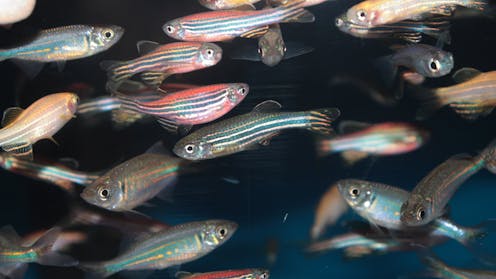
We also identified gaps in the current studies. Most existing studies focus on a limited number of easy-to-study “model species” such as zebrafish, medaka and guppies. They also often use pesticide dosages and durations that may not reflect real-world realities.
Addressing these gaps by including a range of species and environmentally relevant dosages is crucial to understanding how pesticides affect fish in the wild.
One of the experiments in our study involved convict surgeonfish, which gather in large groups or ‘shoals’. Damsea, Shutterstock
Behaviour is a blind spot in regulation
Regulatory authorities should begin to recognise behaviour as a reliable and important indicator of pesticide safety. This can help them catch pesticide pollution early, before mass deaths occur.
Scientists play a crucial role too. By following the same methods, scientists can produce comparable results. A standardised method then provides regulators the evidence needed to confidently assess pesticide risks.
Together, regulatory authorities and scientists can find a way to use behavioural studies to help inform policy decisions. This will help to prevent mass deaths and catch pesticide impacts early on.
Leave no stone unturned in restoring our waters
Rivers, lakes, oceans and reefs are bearing the brunt of an ever-growing human footprint.
So far, much of the spotlight has focused on reducing carbon emissions and managing overfishing — and rightly so. But there’s another, quieter threat drifting beneath the surface: the chemicals we use.
Pesticides used on farms and in gardens are being detected everywhere, even iconic ecosystems such as the Great Barrier Reef. As we have shown, these pesticides can have disturbing effects even at low concentrations.
Now is the time to cut pesticide use and reduce runoff. Through switching to less toxic chemicals and introducing better regulations, we can reduce the damage. If we act with urgency, we can limit the impacts pesticides have on our planet.
Kyle Morrison does not work for, consult, own shares in or receive funding from any company or organisation that would benefit from this article, and has disclosed no relevant affiliations beyond their academic appointment.
A series of atrocity sites of the Khmer Rouge regime in Cambodia have been formally entered onto the World Heritage list, as part of the 47th session of the World Heritage Committee.
This is not only important for Cambodia, but also raises important questions for atrocity sites in Australia.
Before this, the World Heritage list only recognised seven “sites of memory” associated with recent conflicts, which UNESCO defines as “events having occurred from the turn of the 20th century” under its criterion vi. These sat within a broader list of more than 950 cultural sites.
In recent years, experts have intensely debated the question of whether a site associated with recent conflict could, or should, be nominated and evaluated for World Heritage status. Some argue such listings would contradict the objectives of UNESCO and its spirit of peace, which was part of the specialised agency’s mandate after the destruction of two world wars.
Sites associated with recent conflicts can be divisive. For instance, when Japan nominated the Hiroshima Peace Memorial, both China and the United States objected and eventually disassociated from the decision. The US argued the nomination lacked “historical perspective” on the events that led to the bomb’s use. Meanwhile, China argued listing the property would not be conducive for peace as other Asian countries and peoples had suffered at the hands of the Japanese during WWII.
Heritage inscriptions risk reinforcing societal divisions if they conserve a particular memory in a one-sided way.
Nonetheless, the World Heritage Committee decided in 2023 to no longer preclude such sites for inscription. This was done partly in recognition of how these sites may “serve the peace-building mission of UNESCO”.
Shortly after, three listing were added: the ESMA Museum and Site of Memory, a former clandestine centre for detention, torture and extermination in Argentina; memorial sites of the Rwandan genocide at Nyamata, Murambi, Gisozi and Bisesero; and funerary and memory sites of the first world war in Belgium and France.
A number of legacy sites associated with Nelson Mandela’s human rights struggle in South Africa were also added last year.
Atrocities of the Khmer Rouge
The recently inscribed Cambodian Memorial Sites include prisons S-21 (now known as Tuol Sleng Genocide Museum) and M-13, as well as the execution site Choeung Ek.
These sites were nominated for their value in showing the development of extreme mass violence in relation to the security system of the Khmer Rouge in 1975–79. They also have value as places of memorialisation, peace and learning.
The Khmer Rouge developed its methods of disappearance, incarceration and torture of suspected “enemies” during the civil conflict of 1970–75. It established a system of local-level security centres in so-called “liberated” areas.
One of these centres was known as M-13, a small, well-hidden prison in the country’s rural southwest. A man named Kaing Guek Eav – also called Duch – was responsible for prisoners at M-13.
Shortly after the entire country fell to the Khmer Rouge in April 1975, Duch was assigned to lead the headquarters of the regime’s security system: a large detention and torture centre known as S-21.
Under his instruction, tens of thousands of people were detained in inhumane conditions, tortured and interrogated. Many detainees were later taken to the outskirts of the city to be brutally killed and buried in pits at a place called Choeung Ek.
The sites operated until early 1979, when the Khmer Rouge was forced from power.
The S-21 facility and the mass graves at Choeung Ek have long been memorialised as the Tuol Sleng Genocide Museum and the Choeung Ek Genocidal Centre.
However, the former M-13 site shows few visual clues to its prior use, and has only recently been investigated by an international team led by Cambodian archaeologist and museum director Hang Nisay. The site is on an island in a small river that forms the boundary between the Kampong Chhnang and Kampong Speu provinces.
Further research, site protection and memorialisation activities will now be supported, with help from locals.
From repression to reflection
The Cambodian memorial sites have been recognised as holding “outstanding universal value” for the way they evidence one of the 20th century’s worst atrocities, and are now places of memory.
In its nomination dossier for these sites, Cambodia drew on findings from the Khmer Rouge Tribunal to verify and link the conflict and the sites.
In 2010, the tribunal found Duch guilty of crimes against humanity and grave breaches of the Geneva Conventions. Duch was sentenced to 30 years in prison (which eventually turned into life imprisonment). He died in 2020.
While courts such as the International Criminal Court have previously examined the destruction of heritage as an international crime, drawing on legal findings to assert heritage status is an unusual inverse. It raises important questions about the legacies of former UN-supported tribunals and the ongoing implications of their findings.
The recent listings also raise questions for Australia, which has many sites of documented mass killing associated with colonisation and the frontier wars that lasted into the 20th century.
Might Australia nominate any of these atrocity sites in the future? And could other processes such as truth-telling, reparation and redress support (or be supported by) such nominations?
Rachel Hughes has consulted to UNESCO Cambodia.
Maria Elander does not work for, consult, own shares in or receive funding from any company or organisation that would benefit from this article, and has disclosed no relevant affiliations beyond their academic appointment.
“Imagine her tenderly pressing her soft lips against yours”, writes one incel on Reddit, before concluding, “you will never get to experience this because your skeleton is too small or the bones in your face are not the right shape”.
In his debut book, The Male Complaint, Simon Copland escorts his readers through the manosphere and into the minds of its inhabitants. He illustrates how boys and men who are “terrifyingly normal” become attracted to the manosphere’s grim logic – and the cognitive distortions of anti-feminist influencers like Andrew Tate and Jordan Peterson.
While mainstream debates often cite toxic masculinity as the cause of online misogyny, Copland, a writer and researcher at the Australian National University, shifts the blame to a deeper cultural malaise. It’s caused, he argues, by the cruel optimism of the manosphere, the multiple social and economic crises of late-stage capitalism and a collective nihilistic misery in which complaint becomes futile and destruction “the only way out”.
Review: The Male Complaint – Simon Copland (Polity)
The manosphere is a network of loosely related blogs and forums devoted to “men’s interests” – sites like The Rational Male, Game Global and the subreddits ForeverAlone, TheRedPill and MensRights. These online communities, separate in their specific beliefs, are united by their misogynistic ideas – and anti-women and anti-diversity sentiments.
They’re also united by the growing tendency of the men in these communities towards nihilistic violence: not only against others, but also against themselves.
In The Male Complaint, Copland relays his dismay at discovering “a constant stream” of suicide notes on Reddit, including a subreddit, IncelGraveyard, which catalogues close to 100 suicide notes and letters posted by self-identified incels.
Since I was a kid I was fed up with ‘Don’t worry, it will get better’, ‘You will find someone’ […] it’s not even that I want a SO (significant other) anymore. Women are awful. People are awful. I have no friends.
For Copland, the violence incels inflict on themselves is a form of passive nihilism. Incels “don’t just express disgust and despair at the world, but in themselves – their looks, body, lives, personality, intelligence, and more”.
Who’s in the manosphere?
The manosphere includes men’s rights activists, pick-up artists and “Men Going Their Own Way” (male separatists who avoid contact with women altogether). And of course, incels: men who believe they are unable to find a romantic or sexual partner due to their perceived genetic inferiority and oppression.
Incels also blame their problems on women’s alleged hypergamy: the theory women seek out partners of higher social or economic status and therefore marry “up”. Put another way, hypergamy, a concept rooted in evolutionary psychology, is the belief “women are hard-wired to be gold diggers”.
Rollo Tomassi, the so-called “godfather of the manosphere”, complains on his blog that “women love opportunistically”, while “men believe that love matters for the sake of it”.
According to Tomassi, the “cruel reality” of modern dating is that men are romantics who are “forced to be realists”, while women are realists whose use “romanticisms to effect their imperatives”. Tomassi complains:
Our girlfriends, our wives, daughters and even our mothers are all incapable of idealized love […] By order of degrees, hypergamy will define who a woman loves and who she will not, depending upon her own opportunities and capacity to attract it.
Ten years ago, these communities were largely regarded as fringe groups. Today, their ideology has infiltrated the mainstream.
On Sunday, ABC TV’s Compass reported that misogyny is on the rise in Australian classrooms, with female teachers sharing their experiences of sexual assault and harassment on school grounds – ranging from boys writing stories about gang raping their teachers to masturbating “over them” in the bathrooms. One student even pretended to stab his pregnant teacher as a “joke”.
A 2025 report published by UN Women shows 53% of women have experienced some form of technology-facilitated, gender-based violence. The dark side of digitalisation disproportionately affects young women aged between 18 and 24, LGBTQI+ women, women who are divorced or who live in the city, and women who participate in online gaming.
‘Biologically bad’?
Copland argues that simplified critiques of toxic masculinity minimise the problem of male violence. They fail to consider the context and history of gendered behaviour, assuming toxic traits are somehow innate and unique to men, rather than the product of social expectations and relations.
This, in turn, promotes the idea that male violence derives from something “biologically bad” in the nature of masculinity itself. As Copland explains, “this is embedded in the term ‘toxic’, which makes it sound like men’s bodies have become diseased or infected”.
Blaming toxic masculinity for digital misogyny also embraces a form of smug politics in which disaffected men are dismissed as degenerates who are fundamentally different to “us” (meaning the activist left and leftist elites). They are “cellar dwellers”, “subhuman freaks”, or “virgin losers” who need to be either enlightened or locked up. “We”, on the other hand, are educated, progressive, superior.
This kind of rhetoric, as Copland explains, is unhelpful. It does not create the conditions for changing the opinions, narratives and futures of manosphere men because it does not allow people to understand their complaints and where those concerns come from – even if we do not agree with them.
Belittling attitudes and demeaning discourses alienate men who already feel socially isolated. This pushes those men further to the fringes – into the hands of “manfluencers” who claim to understand.
‘Not having love becomes everything’
The manosphere, Copland observes, is not “an aberration that is different and distinct from the rest of the world”, nor is it a community that exists solely on the “dark corners of the web”.
Rather, the manosphere, as an echo chamber, enables and encourages what Copland calls “the male complaint”: a sense of collective pain or “injury” so intrinsic to the group’s identity, it cannot be redressed.
As injured subjects who believe their problems are caused through no fault of their own, manosphere men cannot mend the “wound” they believe society has inflicted upon them. Their “marginalisation” and injured status are the lens through which they view themselves and the world.
In the Men Going Their Own Way (MGTOW) community, for example, some men talk about the movement as a hospital where “physicians of the male soul” use different “methods of healing” to treat the “illness of gynocentric-induced disease weighing them down”. These methods include “self-improvement” strategies that are designed to build men’s power and wealth: purchasing gym equipment, investing in the stock market, even abstaining from pornography and sex.
Others in the MGTOW community are vocally anti-victim: “You can live an extraordinary life,” one man says to another, “but you’re wasting your time on complaints and negativity”.
Even when they disagree, though, manosphere men frame women and feminism as the enemy. In this way, the machinery of the manosphere capitalises on men’s discontent, reflects that messaging back to them and displaces their anger and hurt onto an easy scapegoat.
As Copland observes, it is easier for men to blame women for their unhappiness than it is to blame the complex systems of capitalism: “if love and sex is everything, then not having love becomes everything as well”.
Blackpilled incels, lookism and anonymity
This preoccupation with intimacy is central to the incel community. It is exemplified by the various artefacts Copland embeds in his book – memes and posts from the manosphere itself.
Blackpilled incels are a subgroup of incels who believe their access to romantic and sexual relationships is doomed because of “lookism”: the belief women choose sexual partners based solely on their physical features.
Blackpilled ideology attributes romantic failure to genetically unalterable aspects of the human body, such as one’s height or skull shape. Some blackpilled incels, who call themselves wristcels, even blame their lack of sexual success on the width of their wrists.
This logic is countered by research that demonstrates men, in fact, show stronger preferences for physical attractiveness than women, with women tending to prioritise education level and earning potential.
On Reddit, incels often imagine and bitterly dismiss the potential for love and intimacy because of their looks. Ohsineon/Pexels
The manosphere, however, amplifies this type of thinking and filters out information that challenges these ideas and opinions, increasing group polarisation. Despite its promise of solidarity, the manosphere isolates boys and men, and ultimately distances them from their wider community. This segregation results in a deep sense of alienation – these boys and men become stuck in a perpetual cycle of ideological reinforcement.
The manosphere thrives on anonymity, writes Copland, which only reinforces the idea it is not designed to foster deep relationships or connections.
No silver bullets
The sense of community the manosphere claims to offer is a sham; its alienating structures do not offer boys and men genuine belonging and connection, or real solutions to their problems.
“From one day to the next, the ability to communicate depends on the whims of hidden engineers,” writes media studies professor Mark Andrejevic of online networks more broadly. The manosphere, like other virtual constructs, is subject to manipulation by those who control the infrastructure and the rules of engagement.
More than this, the manosphere does not provide an alternative to complaint. When complaint is the only option, writes Copland, nihilism and violence are the inevitable result.
When nothing matters, there are no consequences to anything, including violence […] Manosphere men do not look to convince others, but rather seek their destruction. Destruction is the outlet they find to deal with their complaint.
That’s what makes the manosphere so dangerous.
‘Popular boys must be punished’
In 2014, 22-year-old Elliot Rodger, a British-American college student, embarked on an hours-long stabbing and shooting spree in the university town of Isla Vista, California, killing six and injuring 14. On the morning of May 23 – the “Day of Retribution” – Rodger emailed a 140-page “manifesto” to his family, friends and therapists. He also uploaded several YouTube videos in which he lamented his inability to find a girlfriend, the “hedonistic pleasures” of his peers and his painful existence of “loneliness, rejection, and unfilled desires”.
In his memoir-manifesto, Rodger – the supposed “patron saint of inceldom” – explains the motive for his violence:
I had nothing left to live for but revenge. Women must be punished for their crimes of rejecting such a magnificent gentleman as myself. All of those popular boys must be punished for enjoying heavenly lives and having sex with all the girls while I had to suffer in lonely virginity.
Four years later, in April 2018, Alek Minassian, a self-described incel, drove a rented van onto a busy sidewalk in Toronto, killing 11 (nine of them women) and injuring many more. On Facebook, Minassian explained that his actions were part of the “incel rebellion” led by the “Supreme Gentleman Elliot Rodger”. Later, Minassian told police, “I feel like I accomplished my mission”.
Rodger, too, ended his final YouTube video with a similar message: “If I can’t have you girls, I will destroy you”.
In his book, Copland even draws a parallel between the Westfield Bondi Junction attack and the explanation for attacker Joel Cauchi’s violence, put forward by his father just two days after the attack: “To you, he is a monster. To me, he was a very sick boy […] he wanted a girlfriend and he’s got no social skills and he was frustrated out of his brain”.
In fact, Cauchi suffered from treatment-resistant schizophrenia and had been unmedicated at the time of the attack: “after almost two decades of treatment, Cauchi had no regular psychiatrist, was not on any medications to treat his schizophrenia and had no family living nearby”. The multifaceted causes of Cauchi’s crime are more complex than misogynistic violence.
Indeed, the pieces of the manosphere puzzle, when put together, reveal a sobering image of the male complaint. However, they demonstrate misogyny is bad for everyone – not just women and girls.
As Copland concludes:
The manosphere promises men that it can make their lives better […] But it really cannot deliver. The promises it offers are not real, and in many cases make things worse […] This is how cruel optimism works, always offering, but never delivering.
‘It’s the combinations’
Recent evidence suggests there is no single route to radicalisation, and no single cause of violent extremism. Rather, complex interactions between push, pull, and personal factors are the root causes of male violence.
The Netflix sensation Adolescence – the harrowing story of a 13-year-old boy who is arrested and charged with murder – is powered by a single question: why did Jamie kill Katie?
In attempting to answer this question, critics and fans have offered a range of explanations: bullying, low self-esteem, emotional dysregulation, obsession with love and sex, deprivation of love and sex, the manosphere. The real answer is less obvious and infinitely more complex. It can be found in a simple line of dialogue, spoken at the end of the series by Jamie’s sister.
“It’s the combinations,” Lisa says. “Combinations are everything.”
In this moment, Lisa is justifying her outfit to her parents as they await Jamie’s trial. But subtextually, her statement doubles as the most likely explanation for his actions. And it’s the closest explanation for why some boys and men commit extreme acts of violence: the combinations.
If this article has raised issues for you, or if you’re concerned about someone you know, call Lifeline on 13 11 14.
Kate Cantrell does not work for, consult, own shares in or receive funding from any company or organisation that would benefit from this article, and has disclosed no relevant affiliations beyond their academic appointment.
Long before pesticides reach lethal doses, they can disrupt hormones, impair brain function and change fish behaviour. Many of these behaviours are essential for healthy ecosystems.
In a new study, my colleagues and I found that pesticides affect many different behaviours in fish. Overall, the chemical pesticides make fish less sociable and interactive. They spend less time gathering in groups, become less protective of their territory, and make fewer attempts to mate.
Imagine the ocean without the vibrant schools of fish we’ve come to love – only isolated swimmers drifting about. Quietly, ecosystems begin to unravel, long before mass die-offs hit the news.
Australia is a major producer and user of pesticides, with more than 11,000 approved chemical products routinely used in agricultural and domestic settings. Remarkably, some of these chemicals remain approved in Australia despite being banned in other regions such as the European Union due to safety concerns.
When a tractor or plane sprays pesticides onto crops, it creates a mist of chemicals in the air to kill crop pests. After heavy rain, these chemicals can flow into roadside drains, filter through soil, and slowly move into rivers, lakes and oceans.
Fish swim in this diluted chemical mixture. They can absorb pesticides through their gills or eat contaminated prey.
At high concentrations, mass fish deaths can result, such as those repeatedly observed in the Menindee Lakes. However, doses in the wild often aren’t lethal and more subtle effects can occur. Scientists call these “sub-lethal” effects.
One commonly investigated sub-lethal effect is a change in behaviour – in other words, a change in the way a fish interacts with its surrounding environment.
Our previous research has found most experiments have looked at the impacts on fish in isolation, measuring things such as how far or how fast they swim when pesticides are present.
But fish aren’t solitary — they form groups, defend territory and find mates. These behaviours keep aquatic ecosystems stable. So this time we studied how pesticides affect these crucial social behaviours.
Pesticide exposure makes fish less social
Our study extracted and analysed data from 37 experiments conducted around the world. Together, these tested the impacts of 31 different pesticides on the social behaviour of 11 different fish species.
The evidence suggests pesticides make fish less social, and this finding is consistent across species. Courtship was the most severely impacted behaviour – the process fish use to find and attract mates. This is particularly alarming because successful courtship is essential for healthy fish populations and ecosystem stability.
Next, we found pesticides such as the herbicide glyphosate, which can disrupt brain function and hormone levels had the strongest impacts on fish social behaviours. This raises important questions about how brain function and hormones drive fish social behaviour, which could be tested by scientists in the future.
For example, scientists could test how much a change in testosterone relates to a change in territory defence. Looking at these relationships between what’s going on inside the body mechanisms and outward behaviour will help us better understand the complex impacts of pesticides.
We also identified gaps in the current studies. Most existing studies focus on a limited number of easy-to-study “model species” such as zebrafish, medaka and guppies. They also often use pesticide dosages and durations that may not reflect real-world realities.
Addressing these gaps by including a range of species and environmentally relevant dosages is crucial to understanding how pesticides affect fish in the wild.
One of the experiments in our study involved convict surgeonfish, which gather in large groups or ‘shoals’. Damsea, Shutterstock
Behaviour is a blind spot in regulation
Regulatory authorities should begin to recognise behaviour as a reliable and important indicator of pesticide safety. This can help them catch pesticide pollution early, before mass deaths occur.
Scientists play a crucial role too. By following the same methods, scientists can produce comparable results. A standardised method then provides regulators the evidence needed to confidently assess pesticide risks.
Together, regulatory authorities and scientists can find a way to use behavioural studies to help inform policy decisions. This will help to prevent mass deaths and catch pesticide impacts early on.
Leave no stone unturned in restoring our waters
Rivers, lakes, oceans and reefs are bearing the brunt of an ever-growing human footprint.
So far, much of the spotlight has focused on reducing carbon emissions and managing overfishing — and rightly so. But there’s another, quieter threat drifting beneath the surface: the chemicals we use.
Pesticides used on farms and in gardens are being detected everywhere, even iconic ecosystems such as the Great Barrier Reef. As we have shown, these pesticides can have disturbing effects even at low concentrations.
Now is the time to cut pesticide use and reduce runoff. Through switching to less toxic chemicals and introducing better regulations, we can reduce the damage. If we act with urgency, we can limit the impacts pesticides have on our planet.
Kyle Morrison does not work for, consult, own shares in or receive funding from any company or organisation that would benefit from this article, and has disclosed no relevant affiliations beyond their academic appointment.
A series of atrocity sites of the Khmer Rouge regime in Cambodia have been formally entered onto the World Heritage list, as part of the 47th session of the World Heritage Committee.
This is not only important for Cambodia, but also raises important questions for atrocity sites in Australia.
Before this, the World Heritage list only recognised seven “sites of memory” associated with recent conflicts, which UNESCO defines as “events having occurred from the turn of the 20th century” under its criterion vi. These sat within a broader list of more than 950 cultural sites.
In recent years, experts have intensely debated the question of whether a site associated with recent conflict could, or should, be nominated and evaluated for World Heritage status. Some argue such listings would contradict the objectives of UNESCO and its spirit of peace, which was part of the specialised agency’s mandate after the destruction of two world wars.
Sites associated with recent conflicts can be divisive. For instance, when Japan nominated the Hiroshima Peace Memorial, both China and the United States objected and eventually disassociated from the decision. The US argued the nomination lacked “historical perspective” on the events that led to the bomb’s use. Meanwhile, China argued listing the property would not be conducive for peace as other Asian countries and peoples had suffered at the hands of the Japanese during WWII.
Heritage inscriptions risk reinforcing societal divisions if they conserve a particular memory in a one-sided way.
Nonetheless, the World Heritage Committee decided in 2023 to no longer preclude such sites for inscription. This was done partly in recognition of how these sites may “serve the peace-building mission of UNESCO”.
Shortly after, three listing were added: the ESMA Museum and Site of Memory, a former clandestine centre for detention, torture and extermination in Argentina; memorial sites of the Rwandan genocide at Nyamata, Murambi, Gisozi and Bisesero; and funerary and memory sites of the first world war in Belgium and France.
A number of legacy sites associated with Nelson Mandela’s human rights struggle in South Africa were also added last year.
Atrocities of the Khmer Rouge
The recently inscribed Cambodian Memorial Sites include prisons S-21 (now known as Tuol Sleng Genocide Museum) and M-13, as well as the execution site Choeung Ek.
These sites were nominated for their value in showing the development of extreme mass violence in relation to the security system of the Khmer Rouge in 1975–79. They also have value as places of memorialisation, peace and learning.
The Khmer Rouge developed its methods of disappearance, incarceration and torture of suspected “enemies” during the civil conflict of 1970–75. It established a system of local-level security centres in so-called “liberated” areas.
One of these centres was known as M-13, a small, well-hidden prison in the country’s rural southwest. A man named Kaing Guek Eav – also called Duch – was responsible for prisoners at M-13.
Shortly after the entire country fell to the Khmer Rouge in April 1975, Duch was assigned to lead the headquarters of the regime’s security system: a large detention and torture centre known as S-21.
Under his instruction, tens of thousands of people were detained in inhumane conditions, tortured and interrogated. Many detainees were later taken to the outskirts of the city to be brutally killed and buried in pits at a place called Choeung Ek.
The sites operated until early 1979, when the Khmer Rouge was forced from power.
The S-21 facility and the mass graves at Choeung Ek have long been memorialised as the Tuol Sleng Genocide Museum and the Choeung Ek Genocidal Centre.
However, the former M-13 site shows few visual clues to its prior use, and has only recently been investigated by an international team led by Cambodian archaeologist and museum director Hang Nisay. The site is on an island in a small river that forms the boundary between the Kampong Chhnang and Kampong Speu provinces.
Further research, site protection and memorialisation activities will now be supported, with help from locals.
From repression to reflection
The Cambodian memorial sites have been recognised as holding “outstanding universal value” for the way they evidence one of the 20th century’s worst atrocities, and are now places of memory.
In its nomination dossier for these sites, Cambodia drew on findings from the Khmer Rouge Tribunal to verify and link the conflict and the sites.
In 2010, the tribunal found Duch guilty of crimes against humanity and grave breaches of the Geneva Conventions. Duch was sentenced to 30 years in prison (which eventually turned into life imprisonment). He died in 2020.
While courts such as the International Criminal Court have previously examined the destruction of heritage as an international crime, drawing on legal findings to assert heritage status is an unusual inverse. It raises important questions about the legacies of former UN-supported tribunals and the ongoing implications of their findings.
The recent listings also raise questions for Australia, which has many sites of documented mass killing associated with colonisation and the frontier wars that lasted into the 20th century.
Might Australia nominate any of these atrocity sites in the future? And could other processes such as truth-telling, reparation and redress support (or be supported by) such nominations?
Rachel Hughes has consulted to UNESCO Cambodia.
Maria Elander does not work for, consult, own shares in or receive funding from any company or organisation that would benefit from this article, and has disclosed no relevant affiliations beyond their academic appointment.
ER Report: Here is a summary of significant articles published on EveningReport.nz on July 15, 2025.
A warning from the future: the risk if NZ gets climate adaptation policy wrong today Source: The Conversation (Au and NZ) – By Tom Logan, Senior Lecturer Above the Bar, Civil and Natural Resources Engineering, University of Canterbury Getty Images New Zealand 2050: On the morning of February 27, the sea surged through the dunes south of the small town of Te Taone, riding on the back of Cyclone Harita’s
ABC’s and CBS’s settlements with Trump are a dangerous step toward the commander in chief becoming the editor-in-chief Source: The Conversation (Au and NZ) – By Michael J. Socolow, Professor of Communication and Journalism, University of Maine Will settlements by news companies with President Donald Trump turn journalists into puppets? MARHARYTA MARKO/iStock Getty Images Plus It was a surrender widely foreseen. For months, rumors abounded that Paramount would eventually settle the seemingly frivolous
Is there any hope for the internet? Source: The Conversation (Au and NZ) – By Aarushi Bhandari, Assistant Professor of Sociology, Davidson College Hate and mental illness fester online because love and healing seem to be incompatible with profits. Ihor Lukianenko/iStock via Getty Images In 2001, social theorist bell hooks warned about the dangers of a loveless zeitgeist. In “All About Love:
Hung parliament still likely outcome of Tasmanian election, with Liberals well ahead of Labor in new poll Source: The Conversation (Au and NZ) – By Adrian Beaumont, Election Analyst (Psephologist) at The Conversation; and Honorary Associate, School of Mathematics and Statistics, The University of Melbourne A new Tasmanian DemosAU poll gives the Liberals a 34.9–24.7 statewide vote lead over Labor, implying the Liberals will win the most seats but be short of
Luxon and Peters to miss Cook Islands’ 60th Constitution Day celebrations By Caleb Fotheringham, RNZ Pacific journalist New Zealand will not send top government representation to the Cook Islands for its 60th Constitution Day celebrations in three weeks’ time. Instead, Governor-General Dame Cindy Kiro will represent Aotearoa in Rarotonga. On August 4, Cook Islands will mark 60 years of self-governance in free association with New Zealand.
Keith Rankin Analysis – Reporting International Migration: Less than the Truth Analysis by Keith Rankin. Yesterday I listened to RNZ’s political commentators. The principal topic was an aspect of the recently released May 2025 international migration. Kathryn Ryan starts by reminding us of the “old saying, would the last person to leave New Zealand please turn out the lights” (a saying which has been used in
Antisemitism plan fails on a number of fronts – a contentious definition of hate is just the start Source: The Conversation (Au and NZ) – By Louise Chappell, Scientia Professor, UNSW Sydney The antisemitism strategy presented to the Albanese government has attracted considerable – and wholly justifed – criticism. Produced by Jillian Segal, the special envoy to combat antisemitism, the blueprint falls short in a range of areas essential to good public policy.
Do I have prostate cancer? Why a simple PSA blood test alone won’t give you the answer Source: The Conversation (Au and NZ) – By Kevin M. Koo, NHMRC Emerging Leadership Fellow, The University of Queensland Prostate cancer is the most common cancer in Australia, with about 26,000 men diagnosed per year. The majority (more than 85%) are aged over 60. Prostate cancer kills around 3,900 Australians a year. Yet most prostate
Many fish are social, but pesticides are pushing them apart Source: The Conversation (Au and NZ) – By Kyle Morrison, PhD Candidate in Ecology and Evolutionary Biology, UNSW Sydney Kazakov Maksim, Shutterstock Scientists have detected pesticides in rivers, lakes and oceans worldwide. So what are these pesticides doing to the fish? Long before pesticides reach lethal doses, they can disrupt hormones, impair brain function and
Almost half of young workers expected to work unpaid overtime, while a quarter aren’t paid compulsory super Source: The Conversation (Au and NZ) – By John Howe, Associate Dean (Research), Melbourne Law School, The University of Melbourne Anna Kraynova/Shutterstock A young person gets a job, excited to earn their first paycheck. Over time, they realise the hours are long and the payslips small. They are told to stay back to clean up
Israeli settlers shoot, beat to death 2 Palestinians in latest lynchings BEARING WITNESS: By Cole Martin in occupied West Bank Two young Palestinians were shot and beaten to death on their land, and 30 injured, by Israeli settlers in the occupied West Bank on Saturday. A large group of settlers attacked the rural Palestinian village of Sinjil, in the Ramallah governorate, beating Sayfollah “Saif” Mussalet, 20,
View from The Hill: Segal’s antisemitism plan gives government controversy, not clarity Source: The Conversation (Au and NZ) – By Michelle Grattan, Professorial Fellow, University of Canberra Prime Minister Anthony Albanese may be rueing what seemed a good idea at the time – the appointment of a special envoy to combat antisemitism (as well as an envoy to combat Islamophobia). Or perhaps Jillian Segal, a former president
David Robie condemns ‘callous’ health legacy of French, US nuclear bomb tests in Pacific Report by Dr David Robie – Café Pacific. – A journalist who was on the Rainbow Warrior voyage to Rongelap last night condemned France for its “callous” attack of an environmental ship, saying “we haven’t forgotten, or forgiven this outrage”. David Robie, the author of Eyes of Fire: The Last Voyage and Legacy of the
Was the Air India crash caused by pilot error or technical fault? None of the theories holds up – yet Source: The Conversation (Au and NZ) – By Guido Carim Junior, Senior Lecturer in Aviation, Griffith University Over the weekend, the Indian Aircraft Accident Investigation Bureau released a preliminary report on last month’s crash of Air India flight 171, which killed 260 people, 19 of them on the ground. The aim of a preliminary report
Confusing for doctors, inequitable for patients: why Australia’s medicinal cannabis system needs urgent reform Source: The Conversation (Au and NZ) – By Christine Mary Hallinan, Senior Research Fellow, Department of General Practice and Primary Care, Faculty of Medicine, Dentistry and Health Sciences, The University of Melbourne Vanessa Nunes/Getty Images In 2024 alone, Australia’s medicines regulator, the Therapeutic Goods Administration (TGA), authorised at least 979,000 prescription applications for medicinal cannabis
Treasury warns the government it may not balance the budget or meet its housing targets Source: The Conversation (Au and NZ) – By John Hawkins, Head, Canberra School of Government, University of Canberra Kokkai Ng/Getty In the runup to each election, federal treasury produces a “blue book” and a “red book”, with advice tailored to the priorities of the two alternative governments. One of these is given to the incoming
How do you stop an AI model turning Nazi? What the Grok drama reveals about AI training Source: The Conversation (Au and NZ) – By Aaron J. Snoswell, Senior Research Fellow in AI Accountability, Queensland University of Technology Anne Fehres and Luke Conroy & AI4Media, CC BY Grok, the artificial intelligence (AI) chatbot embedded in X (formerly Twitter) and built by Elon Musk’s company xAI, is back in the headlines after calling
Author condemns ‘callous’ health legacy of French, US nuclear bomb tests in Pacific Asia Pacific Report A journalist who was on the Rainbow Warrior voyage to Rongelap last night condemned France for its “callous” attack of an environmental ship, saying “we haven’t forgotten, or forgiven this outrage”. David Robie, the author of Eyes of Fire: The Last Voyage and Legacy of the Rainbow Warrior, said at the launch
Washington’s war demands – Australia right to refuse committing to a hypothetical conflict with China over Taiwan Source: The Conversation (Au and NZ) – By John Blaxland, Professor, Strategic and Defence Studies Centre, Australian National University Andy. LIU/Shutterstock The United States can count on Australia as one of its closest allies. Dating back to the shared experiences in the second world war and the ANZUS Treaty signed in 1951, Australia has steadfastly
ER Report: Here is a summary of significant articles published on EveningReport.nz on July 15, 2025.
A warning from the future: the risk if NZ gets climate adaptation policy wrong today Source: The Conversation (Au and NZ) – By Tom Logan, Senior Lecturer Above the Bar, Civil and Natural Resources Engineering, University of Canterbury Getty Images New Zealand 2050: On the morning of February 27, the sea surged through the dunes south of the small town of Te Taone, riding on the back of Cyclone Harita’s
ABC’s and CBS’s settlements with Trump are a dangerous step toward the commander in chief becoming the editor-in-chief Source: The Conversation (Au and NZ) – By Michael J. Socolow, Professor of Communication and Journalism, University of Maine Will settlements by news companies with President Donald Trump turn journalists into puppets? MARHARYTA MARKO/iStock Getty Images Plus It was a surrender widely foreseen. For months, rumors abounded that Paramount would eventually settle the seemingly frivolous
Is there any hope for the internet? Source: The Conversation (Au and NZ) – By Aarushi Bhandari, Assistant Professor of Sociology, Davidson College Hate and mental illness fester online because love and healing seem to be incompatible with profits. Ihor Lukianenko/iStock via Getty Images In 2001, social theorist bell hooks warned about the dangers of a loveless zeitgeist. In “All About Love:
Hung parliament still likely outcome of Tasmanian election, with Liberals well ahead of Labor in new poll Source: The Conversation (Au and NZ) – By Adrian Beaumont, Election Analyst (Psephologist) at The Conversation; and Honorary Associate, School of Mathematics and Statistics, The University of Melbourne A new Tasmanian DemosAU poll gives the Liberals a 34.9–24.7 statewide vote lead over Labor, implying the Liberals will win the most seats but be short of
Luxon and Peters to miss Cook Islands’ 60th Constitution Day celebrations By Caleb Fotheringham, RNZ Pacific journalist New Zealand will not send top government representation to the Cook Islands for its 60th Constitution Day celebrations in three weeks’ time. Instead, Governor-General Dame Cindy Kiro will represent Aotearoa in Rarotonga. On August 4, Cook Islands will mark 60 years of self-governance in free association with New Zealand.
Keith Rankin Analysis – Reporting International Migration: Less than the Truth Analysis by Keith Rankin. Yesterday I listened to RNZ’s political commentators. The principal topic was an aspect of the recently released May 2025 international migration. Kathryn Ryan starts by reminding us of the “old saying, would the last person to leave New Zealand please turn out the lights” (a saying which has been used in
Antisemitism plan fails on a number of fronts – a contentious definition of hate is just the start Source: The Conversation (Au and NZ) – By Louise Chappell, Scientia Professor, UNSW Sydney The antisemitism strategy presented to the Albanese government has attracted considerable – and wholly justifed – criticism. Produced by Jillian Segal, the special envoy to combat antisemitism, the blueprint falls short in a range of areas essential to good public policy.
Do I have prostate cancer? Why a simple PSA blood test alone won’t give you the answer Source: The Conversation (Au and NZ) – By Kevin M. Koo, NHMRC Emerging Leadership Fellow, The University of Queensland Prostate cancer is the most common cancer in Australia, with about 26,000 men diagnosed per year. The majority (more than 85%) are aged over 60. Prostate cancer kills around 3,900 Australians a year. Yet most prostate
Many fish are social, but pesticides are pushing them apart Source: The Conversation (Au and NZ) – By Kyle Morrison, PhD Candidate in Ecology and Evolutionary Biology, UNSW Sydney Kazakov Maksim, Shutterstock Scientists have detected pesticides in rivers, lakes and oceans worldwide. So what are these pesticides doing to the fish? Long before pesticides reach lethal doses, they can disrupt hormones, impair brain function and
Almost half of young workers expected to work unpaid overtime, while a quarter aren’t paid compulsory super Source: The Conversation (Au and NZ) – By John Howe, Associate Dean (Research), Melbourne Law School, The University of Melbourne Anna Kraynova/Shutterstock A young person gets a job, excited to earn their first paycheck. Over time, they realise the hours are long and the payslips small. They are told to stay back to clean up
Israeli settlers shoot, beat to death 2 Palestinians in latest lynchings BEARING WITNESS: By Cole Martin in occupied West Bank Two young Palestinians were shot and beaten to death on their land, and 30 injured, by Israeli settlers in the occupied West Bank on Saturday. A large group of settlers attacked the rural Palestinian village of Sinjil, in the Ramallah governorate, beating Sayfollah “Saif” Mussalet, 20,
View from The Hill: Segal’s antisemitism plan gives government controversy, not clarity Source: The Conversation (Au and NZ) – By Michelle Grattan, Professorial Fellow, University of Canberra Prime Minister Anthony Albanese may be rueing what seemed a good idea at the time – the appointment of a special envoy to combat antisemitism (as well as an envoy to combat Islamophobia). Or perhaps Jillian Segal, a former president
David Robie condemns ‘callous’ health legacy of French, US nuclear bomb tests in Pacific Report by Dr David Robie – Café Pacific. – A journalist who was on the Rainbow Warrior voyage to Rongelap last night condemned France for its “callous” attack of an environmental ship, saying “we haven’t forgotten, or forgiven this outrage”. David Robie, the author of Eyes of Fire: The Last Voyage and Legacy of the
Was the Air India crash caused by pilot error or technical fault? None of the theories holds up – yet Source: The Conversation (Au and NZ) – By Guido Carim Junior, Senior Lecturer in Aviation, Griffith University Over the weekend, the Indian Aircraft Accident Investigation Bureau released a preliminary report on last month’s crash of Air India flight 171, which killed 260 people, 19 of them on the ground. The aim of a preliminary report
Confusing for doctors, inequitable for patients: why Australia’s medicinal cannabis system needs urgent reform Source: The Conversation (Au and NZ) – By Christine Mary Hallinan, Senior Research Fellow, Department of General Practice and Primary Care, Faculty of Medicine, Dentistry and Health Sciences, The University of Melbourne Vanessa Nunes/Getty Images In 2024 alone, Australia’s medicines regulator, the Therapeutic Goods Administration (TGA), authorised at least 979,000 prescription applications for medicinal cannabis
Treasury warns the government it may not balance the budget or meet its housing targets Source: The Conversation (Au and NZ) – By John Hawkins, Head, Canberra School of Government, University of Canberra Kokkai Ng/Getty In the runup to each election, federal treasury produces a “blue book” and a “red book”, with advice tailored to the priorities of the two alternative governments. One of these is given to the incoming
How do you stop an AI model turning Nazi? What the Grok drama reveals about AI training Source: The Conversation (Au and NZ) – By Aaron J. Snoswell, Senior Research Fellow in AI Accountability, Queensland University of Technology Anne Fehres and Luke Conroy & AI4Media, CC BY Grok, the artificial intelligence (AI) chatbot embedded in X (formerly Twitter) and built by Elon Musk’s company xAI, is back in the headlines after calling
Author condemns ‘callous’ health legacy of French, US nuclear bomb tests in Pacific Asia Pacific Report A journalist who was on the Rainbow Warrior voyage to Rongelap last night condemned France for its “callous” attack of an environmental ship, saying “we haven’t forgotten, or forgiven this outrage”. David Robie, the author of Eyes of Fire: The Last Voyage and Legacy of the Rainbow Warrior, said at the launch
Washington’s war demands – Australia right to refuse committing to a hypothetical conflict with China over Taiwan Source: The Conversation (Au and NZ) – By John Blaxland, Professor, Strategic and Defence Studies Centre, Australian National University Andy. LIU/Shutterstock The United States can count on Australia as one of its closest allies. Dating back to the shared experiences in the second world war and the ANZUS Treaty signed in 1951, Australia has steadfastly
The snow petrel, a strikingly white bird with black eyes and a black bill, is one of only three bird species ever observed at the South Pole. In fact, the Antarctic is the only place on Earth where this bird lives.
It isn’t alone in this. Antarctica and the sub-Antarctic harbour a large number of endemic species, which means these species are only found in one or a few locations in the world.
In other words, these regions have a high degree of “endemism” – an important metric that tells us where to focus species conservation efforts.
But our new study shows that the degree of endemism in Antarctica and the sub-Antarctic – and in the southern hemisphere more generally – has been underestimated.
This is important because areas with a high degree of endemism harbour species with restricted ranges, unique evolutionary history or unique ecological functions. This makes them potentially more vulnerable to disturbances such as climate change, fundamental changes in habitat, or invasive introduced species.
If the degree of endemism is underestimated, conservation efforts may overlook the sites that are home to irreplaceable birds.
Biased measurements
There are two reasons why global patterns of species endemism aren’t well defined. First, the most common method used to calculate endemism tends to give higher values to places with more species overall – this is known as species richness.
In addition, global studies of diversity often exclude areas that are comparatively species-poor. These areas are mainly in the southern hemisphere – most notably the Antarctic region. When sites that only contain a few species are left out, this influences the estimates of endemism for all other sites.
An alternative way to calculate endemism takes into account a site’s “complementarity”. This metric considers whether species found at a site are also found elsewhere. With this method, we can find sites that have the highest percentage of species with a restricted range.
At such highly endemic sites, the local ecosystem relies heavily on species with restricted ranges to function, which makes them all the more irreplaceable.
The superb lyrebird, known for its skillful vocal imitations, is endemic to southeast Australia. Matthias Dehling
Global hotspots for endemic species
This is the approach we used in our new study to reassess the endemism of birds worldwide. In our study, we also considered other aspects of bird diversity. We measured endemism with regard to whether sites hold irreplaceable evolutionary history and ecological functions of birds.
We found that southern-hemisphere communities showed higher rates of local endemism than northern-hemisphere communities across all aspects of diversity. The sub-Antarctic islands and the High Andes, as well as several regions in Australia, Aotearoa New Zealand and southern Africa, stand out as global hotspots of endemism.
These regions hold many charismatic birds with unique evolutionary histories or unique ecological functions, and these birds are largely restricted to the southern hemisphere.
Among these are the palaeognaths – the bird lineage that includes kiwis, emus, cassowaries and ostriches. They also include the lyrebirds and the New Zealand wrens, as well as iconic Antarctic species such as penguins and albatrosses.
Tawaki or Fiordland crested penguin is only found in Aotearoa New Zealand. Matthias Dehling
Not much land, a lot of ocean
The higher rates of endemism in the southern hemisphere are likely related to the uneven global distribution of landmass. Put simply, there is much more available landmass in the northern hemisphere. As you go further south, landmasses become increasingly separated by vast expanses of ocean.
Because of the smaller and separated landmasses, species in the southern hemisphere have much smaller ranges than species in the northern hemisphere. Consequently, local species communities share fewer species with each other. This leads to the higher observed endemism in the southern hemisphere.
The black-breasted buttonquail is a secretive rainforest bird whose range is restricted to a tiny area in south-east Queensland, Australia. Matthias Dehling
A heightened vulnerability
Our findings suggest that birds in the northern and southern hemisphere might react differently to environmental pressures. Unfortunately, most studies on the impact of climate change to date are from the northern hemisphere.
In response to climate change in particular, species are expected to shift their ranges towards cooler climates. While northern-hemisphere birds are likely free to shift their ranges across large stretches of uninterrupted landmass, birds in the southern hemisphere are hindered by vast expanses of ocean that separate the different landmasses on which they live.
For species at the southern tips of South America, Africa or Australia, the nearest major landmass towards the south is Antarctica. But it is unsuitable for most bird species.
The potentially heightened vulnerability of southern-hemisphere birds suggests they deserve more protection. In addition to known species diversity hotspots that hold large numbers of species, conservation efforts should consider areas that might hold only a small number of species, but irreplaceable ones that aren’t found anywhere else.
Matthias Dehling receives funding from the Australian Research Council.
The snow petrel, a strikingly white bird with black eyes and a black bill, is one of only three bird species ever observed at the South Pole. In fact, the Antarctic is the only place on Earth where this bird lives.
It isn’t alone in this. Antarctica and the sub-Antarctic harbour a large number of endemic species, which means these species are only found in one or a few locations in the world.
In other words, these regions have a high degree of “endemism” – an important metric that tells us where to focus species conservation efforts.
But our new study shows that the degree of endemism in Antarctica and the sub-Antarctic – and in the southern hemisphere more generally – has been underestimated.
This is important because areas with a high degree of endemism harbour species with restricted ranges, unique evolutionary history or unique ecological functions. This makes them potentially more vulnerable to disturbances such as climate change, fundamental changes in habitat, or invasive introduced species.
If the degree of endemism is underestimated, conservation efforts may overlook the sites that are home to irreplaceable birds.
Biased measurements
There are two reasons why global patterns of species endemism aren’t well defined. First, the most common method used to calculate endemism tends to give higher values to places with more species overall – this is known as species richness.
In addition, global studies of diversity often exclude areas that are comparatively species-poor. These areas are mainly in the southern hemisphere – most notably the Antarctic region. When sites that only contain a few species are left out, this influences the estimates of endemism for all other sites.
An alternative way to calculate endemism takes into account a site’s “complementarity”. This metric considers whether species found at a site are also found elsewhere. With this method, we can find sites that have the highest percentage of species with a restricted range.
At such highly endemic sites, the local ecosystem relies heavily on species with restricted ranges to function, which makes them all the more irreplaceable.
The superb lyrebird, known for its skillful vocal imitations, is endemic to southeast Australia. Matthias Dehling
Global hotspots for endemic species
This is the approach we used in our new study to reassess the endemism of birds worldwide. In our study, we also considered other aspects of bird diversity. We measured endemism with regard to whether sites hold irreplaceable evolutionary history and ecological functions of birds.
We found that southern-hemisphere communities showed higher rates of local endemism than northern-hemisphere communities across all aspects of diversity. The sub-Antarctic islands and the High Andes, as well as several regions in Australia, Aotearoa New Zealand and southern Africa, stand out as global hotspots of endemism.
These regions hold many charismatic birds with unique evolutionary histories or unique ecological functions, and these birds are largely restricted to the southern hemisphere.
Among these are the palaeognaths – the bird lineage that includes kiwis, emus, cassowaries and ostriches. They also include the lyrebirds and the New Zealand wrens, as well as iconic Antarctic species such as penguins and albatrosses.
Tawaki or Fiordland crested penguin is only found in Aotearoa New Zealand. Matthias Dehling
Not much land, a lot of ocean
The higher rates of endemism in the southern hemisphere are likely related to the uneven global distribution of landmass. Put simply, there is much more available landmass in the northern hemisphere. As you go further south, landmasses become increasingly separated by vast expanses of ocean.
Because of the smaller and separated landmasses, species in the southern hemisphere have much smaller ranges than species in the northern hemisphere. Consequently, local species communities share fewer species with each other. This leads to the higher observed endemism in the southern hemisphere.
The black-breasted buttonquail is a secretive rainforest bird whose range is restricted to a tiny area in south-east Queensland, Australia. Matthias Dehling
A heightened vulnerability
Our findings suggest that birds in the northern and southern hemisphere might react differently to environmental pressures. Unfortunately, most studies on the impact of climate change to date are from the northern hemisphere.
In response to climate change in particular, species are expected to shift their ranges towards cooler climates. While northern-hemisphere birds are likely free to shift their ranges across large stretches of uninterrupted landmass, birds in the southern hemisphere are hindered by vast expanses of ocean that separate the different landmasses on which they live.
For species at the southern tips of South America, Africa or Australia, the nearest major landmass towards the south is Antarctica. But it is unsuitable for most bird species.
The potentially heightened vulnerability of southern-hemisphere birds suggests they deserve more protection. In addition to known species diversity hotspots that hold large numbers of species, conservation efforts should consider areas that might hold only a small number of species, but irreplaceable ones that aren’t found anywhere else.
Matthias Dehling receives funding from the Australian Research Council.
In 2001, social theorist bell hooks warned about the dangers of a loveless zeitgeist. In “All About Love: New Visions,” she lamented “the lack of an ongoing public discussion … about the practice of love in our culture and in our lives.”
The doubts were unfounded. In only a few decades, the internet has merged with our bodies as smartphones and mined our personalities via algorithms that know us more intimately than some of our closest friends. It has even constructed a secondary social world.
Is the internet’s place in human history cemented as a harbinger of despair? Or is there still hope for an internet that supports collective flourishing?
In it, I explain how social media companies’ profits depend on users investing their time, creativity and emotions. Whether it’s spending hours filming content for TikTok or a few minutes crafting a thoughtful Reddit comment, participating on these platforms takes work. And it can be exhausting.
Even passive engagement – like scrolling through feeds and “lurking” in forums – consumes time. It might feel like free entertainment – until people recognize they are the product, with their data being harvested and their emotions being manipulated.
Blogger, journalist and science fiction writer Cory Doctorow coined the term “enshittification” to describe how experiences on online platforms gradually deteriorate as companies increasingly exploit users’ data and tweak their algorithms to maximize profits.
This cycle is neither an accident nor a novel insight. Hate and mental illness fester in this culture because love and healing seem to be incompatible with profits.
Care hiding in plain sight
In his 2009 book “Envisioning Real Utopias,” the late sociologist Erik Olin Wright discusses places in the world that prioritize cooperation, care and egalitarianism.
Wright mainly focused on offline systems like worker-owned cooperatives. But one of his examples lived on the internet: Wikipedia. He argued that Wikipedia demonstrates the ethos “from each according to ability, to each according to need” – a utopian ideal popularized by Karl Marx.
Wikipedia still thrives as a nonprofit, volunteer-ran bureaucracy. The website is a form of media that is deeply social, in the literal sense: People voluntarily curate and share knowledge, collectively and democratically, for free. Unlike social media, the rewards are only collective.
There are no visible likes, comments or rage emojis for participants to hoard and chase. Nobody loses and everyone wins, including the vast majority of people who use Wikipedia without contributing work or money to keep it operational.
Building a new digital world
Wikipedia is evidence of care, cooperation and love hiding in plain sight.
In recent years, there have been more efforts to create nonprofit apps and websites that are committed to protecting user data. Popular examples include Signal, a free and open source instant messaging service, and Proton Mail, an encrypted email service.
These are all laudable developments. But how can the internet actively promote collective flourishing?
In “Viral Justice: How We Grow the World We Want,” sociologist Ruha Benjamin points to a way forward. She tells the story of Black TikTok creators who led a successful cultural labor strike in 2021. Many viral TikTok dances had originally been created by Black artists, whose accounts, they claimed, were suppressed by a biased algorithm that favored white influencers.
TikTok responded to the viral #BlackTikTokStrike movement by formally apologizing and making commitments to better represent and compensate the work of Black creators. These creators demonstrated how social media engagement is work – and that workers have the power to demand equitable conditions and fair pay.
This landmark strike showed how anyone who uses social media companies that profit off the work, emotions and personal data of their users – whether it’s TikTok, X, Facebook, Instagram or Reddit – can become organized.
“Digital spaces are increasingly powered by hate and discrimination,” the group writes, adding that it hopes to create an online world where “women and people of diverse sexualities and genders are able to access and enjoy a free and open internet to exercise agency and autonomy, build collective power, strengthen movements, and transform power relations.”
In Los Angeles, there’s Chani, Inc., a technology company that describes itself as “proudly” not funded by venture capitalists. The Chani app blends mindfulness practices and astrology with the goal of simply helping people. The app is not designed for compulsive user engagement, the company never sells user data, and there are no comments sections.
No comments
What would social media look like if Wikipedia were the norm instead of an exception?
To me, a big problem in internet culture is the way people’s humanity is obscured. People are free to speak their minds in text-based public discussion forums, but the words aren’t always attached to someone’s identity. Real people hide behind the anonymity of user names. It isn’t true human interaction.
In “Attention and Alienation,” I argue that the ability to meet and interact with others online as fully realized, three-dimensional human beings would go a long way toward creating a more empathetic, cooperative internet.
When I was 8 years old, my parents lived abroad for work. Sometimes we talked on the phone. Often I would cry late into the night, praying for the ability to “see them through the phone.” It felt like a miraculous possibility – like magic.
I told this story to my students in a moment of shared vulnerability. This was in 2020 during the COVID-19 pandemic, so the class was taking place over videoconferencing. In these online classes, one person talked at a time. Others listened.
It wasn’t perfect, but I think a better internet would promote this form of discussion – people getting together from across the world to share the fullness of their humanity.
What if the next iteration of public social media platforms could build on Clubhouse? What if they brought people together and showcased not just their voices, but also live video feeds of their faces without harvesting their data or promoting conflict and outrage?
Raised eyebrows. Grins. Frowns. They’re what make humans distinct from increasingly sophisticated large language models and artificial intelligence chatbots like ChatGPT.
After all, is anything you can’t say while looking at another human being in the eye worth saying in the first place?
Aarushi Bhandari does not work for, consult, own shares in or receive funding from any company or organization that would benefit from this article, and has disclosed no relevant affiliations beyond their academic appointment.
It was a surrender widely foreseen. For months, rumors abounded that Paramount would eventually settle the seemingly frivolous lawsuit brought by President Donald Trump concerning editorial decisions in the production of a CBS interview with Democratic presidential nominee Kamala Harris in 2024.
On July 2, 2025, those rumors proved true: The settlement between Paramount and Trump’s legal team resulted in CBS’s parent company agreeing to pay $16 million to the future Donald Trump Library – the $16 million included Trump’s legal fees – in exchange for ending the lawsuit. Despite the opinion of many media law scholars and practicing attorneys who considered the lawsuit meritless, Shari Redstone, the largest shareholder of Paramount, yielded to Trump.
Specifically, when the Trump administration assumed power in January 2025, the new Federal Communications Commission had no legal obligation to facilitate, without scrutiny, the transfer of the CBS network’s broadcast licenses for its owned-and-operated TV stations to new ownership.
The FCC, under newly installed Republican Chairman Brendan Carr, was fully aware of the issues in the legal conflict between Trump and CBS at the time Paramount needed FCC approval for the license transfers. Without a settlement, the Paramount-Skydance deal remained in jeopardy.
Until it wasn’t.
At that point, Paramount joined Disney in implicitly apologizing for journalism produced by their TV news divisions.
Earlier in 2025, Disney had settled a different Trump lawsuit with ABC News in exchange for a $15 million donation to the future Trump Library. That lawsuit involved a dispute over the wording of the actions for which Trump was found liable in a civil lawsuit brought by E. Jean Carroll.
GOP presidential nominee Donald Trump said the CBS interview with Democratic nominee Kamala Harris was ‘fraudulent interference with an election.’
It’s not certain what the ABC and CBS settlements portend, but many are predicting they will produce a “chilling effect” within the network news divisions. Such an outcome would arise from fear of new litigation, and it would install a form of internal self-censorship that would influence network journalists when deciding whether the pursuit of investigative stories involving the Trump administration would be worth the risk.
Trump has apparently succeeded where earlier presidents failed.
Presidential pressure
From Jimmy Carter trying to get CBS anchor Walter Cronkite to stop ending his evening newscasts with the number of days American hostages were being held in Iran to Richard Nixon’s administration threatening the broadcast licenses of The Washington Post’s TV stations to weaken Watergate reporting, previous presidents sought to apply editorial pressure on broadcast journalists.
But in the cases of Carter and Nixon, it didn’t work. The broadcast networks’ focus on both Watergate and the Iran hostage crisis remained unrelenting.
Nor were Nixon and Carter the first presidents seeking to influence, and possibly control, network news.
President Lyndon Johnson, who owned local TV and radio stations in Austin, Texas, regularly complained to his old friend, CBS President Frank Stanton, about what he perceived as biased TV coverage. Johnson was so furious with the CBS and NBC reporting from Vietnam, he once argued that their newscasts seemed “controlled by the Vietcong.”
Yet none of these earlier presidents won millions from the corporations that aired ethical news reporting in the public interest.
Before Trump, these conflicts mostly occurred backstage and informally, allowing the broadcasters to sidestep the damage to their credibility should any surrender to White House administrations be made public. In a “Reporter’s Notebook” on the CBS Evening News the night of the Trump settlement, anchor John Dickerson summarized the new dilemma succinctly: “Can you hold power to account when you’ve paid it millions? Can an audience trust you when it thinks you’ve traded away that trust?”
“The audience will decide that,” Dickerson continued, concluding: “Our job is to show up to honor what we witness on behalf of the people we witness it for.”
During the Iran hostage crisis, CBS News anchor Walter Cronkite ended every broadcast with the number of days the hostages had been held captive.
Soon, Skydance Media will assume control over the Paramount properties, and the new CBS will be on the airwaves.
When the licenses for KCBS in Los Angeles, WCBS in New York and the other CBS-owned-and-operated stations are transferred, we’ll learn the long-term legacy of corporate capitulation. But for now, it remains too early to judge tomorrow’s newscasts.
As a scholar of broadcast journalism and a former broadcast journalist, I recommend evaluating programs like “60 Minutes” and the “CBS Evening News” on the record they will compile over the next three years – and the record they compiled over the past 50. The same goes for “ABC World News Tonight” and other ABC News programs.
A major complicating factor for the Paramount-Skydance deal was the fact that “60 Minutes” has, over the past six months, broken major scoops embarrassing to the Trump administration, which led to additional scrutiny by its corporate ownership. Judged by its reporting in the first half of 2025, “60 Minutes” has upheld its record of critical and independent reporting in the public interest.
If audience members want to see ethical, independent and professional broadcast journalism that holds power to account, then it’s the audience’s responsibility to tune it in. The only way to learn the consequences of these settlements is by watching future programming rather than dismissing it beforehand.
The journalists working at ABC News and CBS News understand the legacy of their organizations, and they are also aware of how their owners have cast suspicion on the news divisions’ professionalism and credibility. As Dickerson asserted, they plan to “show up” regardless of the stain, and I’d bet they’re more motivated to redeem their reputations than we expect.
I don’t think reporters, editors and producers plan to let Donald Trump become their editor-in-chief over the next three years. But we’ll only know by watching.
Michael Socolow’s father, Sanford Socolow, worked for CBS News from 1956 to 1988.
New Zealand 2050: On the morning of February 27, the sea surged through the dunes south of the small town of Te Taone, riding on the back of Cyclone Harita’s swollen rivers and 200mm of overnight rainfall.
By mid-morning, floodwaters had engulfed entire streets. Power was out. Roads were underwater. Emergency services responded swiftly, coordinating evacuations and establishing shelters.
But for many residents, the realisation came days later: the help they expected after the water receded – support to rebuild, relocate or recover – wasn’t coming.
“We lost everything,” says Mere Rākete, a solo mother of three, standing outside her home, now uninhabitable. “I rang the council, the government helpline, even the insurance company. They all said I’m not covered.”
Mere lives in a suburb long identified as “high risk” under national climate risk maps. She didn’t stay there because she ignored the risk. She stayed because she had no viable alternative.
“They say we had a choice. But when houses here were $400,000 and anything safer was $700,000, what choice is that?”
No more buyouts
Although this story is fictitious, it describes a plausible future based on how New Zealand’s draft climate adaptation framework could play out. It reflects the likely consequences of policy decisions that focus narrowly on financial exposure.
Last week’s recommendations from the Ministry for the Environment’s Independent Reference Group rightly called for urgent and improved risk information. But they focused narrowly on direct risk to property and infrastructure.
In particular, the group proposed that beyond 2045 the government should not buy out property owners after climate-related disasters (or those at high risk of future events).
Responding to the recommendations last week, climate policy analyst Jonathan Boston wrote that ruling out property buyouts “is philosophically misguided, morally questionable, administratively inept, and politically naïve”.
But it appears the government shares the reference group’s view. Addressing the current flooding disaster in the Tasman district, Prime Minister Christopher Luxon said, “In principle, the government won’t be able to keep bailing out people in this way.”
Beyond the specifics of financial compensation, however, lie the cascading and systemic risks that follow a major weather event. In reality, the impacts do not stop at the property boundary.
When a family is displaced, or even fears displacement, the consequences ripple outward: schooling is disrupted, jobs are lost, mental health declines, community networks fragment and local economies suffer.
Research shows how the after-effects of a disaster domino through interconnected systems, affecting health, housing, labour markets and social cohesion.
A policy decades in the making
Back to the future: our fictional town of Te Taone sits in a floodplain identified decades ago. By the 2040s, insurance had become unaffordable. New development slowed but many families, especially those on lower incomes, remained, with few relocation options.
The adaptation framework proposed in 2025, based on a “beneficiary pays” model, created a 20-year transition period that ended in 2045. After that, residents in high-risk areas became ineligible for buyouts or standard recovery funding.
Future government investment was limited to Crown-owned assets or projects with “national benefit”. Restoration of local infrastructure such as roads and power lines would depend on whether councils or ratepayers could pay.
Today, parts of Te Taone remain cut off. Power is still out in some areas. The school has relocated inland. Local shops have closed. Many homes are damaged, waterlogged, or destroyed, and some families are now living in tents.
“It’s not that we weren’t warned,” says a local community worker. “It’s just that we couldn’t afford to do anything but live with the risk and hope for the best.”
Te Taone’s experience is now raising deeper concerns that Aotearoa New Zealand’s climate adaptation framework may be entrenching a form of “climate redlining”. Those with the means can move to escape risk, while others are left behind to bear it.
Adaptation or abandonment?
Māori communities are especially affected. Parts of the floodplain include ancestral land, some communally owned, some leased by whānau who cannot easily relocate. In many cases, this land was only recently returned from the Crown, after years of land court proceedings or Treaty settlements.
The prospect of abandoning it again, without coordinated support, echoes earlier waves of institutional neglect. Mere Rākete is now considering joining a class action, one of several reportedly forming across the country.
Residents are challenging the government or local councils over a failure in their duty of care by allowing homes to be built, sold or inhabited in known risk zones without clear and enforceable warnings or adequate alternatives.
Meanwhile, adaptation experts are calling for a reset: a national compensation framework with clear eligibility rules, long-term investment in affordable housing beyond hazard-prone areas.
Above all, they argue, government policy based on a climate adaptation framework developed 25 years ago has not reduced exposure to risk. Instead, it has redistributed it from those who could leave to those who couldn’t.
In the meantime, the remaining residents of Te Taone wait for the next cyclone and wonder whether, next time, anyone will help.
Planning with people in mind
Our imagined future scenario can be avoided if governments take a broader view of adaptation. Treating climate risk as an individual responsibility may reduce short-term government liability. But it will not reduce long-term social and fiscal liability.
The risk of failing to act systemically is that the country pays in other ways – in fractured communities, rising inequity and preventable harm.
Adaptation to climate change has to be about more than limiting the upfront costs of buyouts or infrastructure repairs. Ignoring the wider impacts will only shift the burden and increase it over time.
Real economic and community resilience means planning with people in mind, investing early and making sure no one is left behind. That work must begin now.
Tom Logan owns shares in Urban Intelligence. He receives funding from the Ministry for Business, Innovation and Employment and the Royal Society of NZ.
Paula Blackett works part time for Urban Intelligence. She receives research funding from the Ministry for Business, Innovation and Employment and undertakes consulting work regarding climate risk and adaptation.
New Zealand paused $18.2 million in development assistance funding to the Cook Islands in June after its government signed several agreements with China in February.
At the time, a spokesperson for Foreign Minister Winston Peters said the pause was because the Cook Islands did not consult with Aotearoa over the China deals and failed to ensure shared interests were not put at risk.
Peters and New Zealand Prime Minister Christopher Luxon will not attend the celebrations.
Ten years ago, former Prime Minister Sir John Key attended the celebrations that marked 50 years of Cook Islands being in free association with New Zealand.
Officials from the Cook Islands and New Zealand have been meeting to try and restore the relationship.
This article is republished under a community partnership agreement with RNZ.
New Zealand paused $18.2 million in development assistance funding to the Cook Islands in June after its government signed several agreements with China in February.
At the time, a spokesperson for Foreign Minister Winston Peters said the pause was because the Cook Islands did not consult with Aotearoa over the China deals and failed to ensure shared interests were not put at risk.
Peters and New Zealand Prime Minister Christopher Luxon will not attend the celebrations.
Ten years ago, former Prime Minister Sir John Key attended the celebrations that marked 50 years of Cook Islands being in free association with New Zealand.
Officials from the Cook Islands and New Zealand have been meeting to try and restore the relationship.
This article is republished under a community partnership agreement with RNZ.
Source: The Conversation (Au and NZ) – By Adrian Beaumont, Election Analyst (Psephologist) at The Conversation; and Honorary Associate, School of Mathematics and Statistics, The University of Melbourne
A new Tasmanian DemosAU poll gives the Liberals a 34.9–24.7 statewide vote lead over Labor, implying the Liberals will win the most seats but be short of a majority at this Saturday’s election. I also cover the Coalition’s vote was inefficiently distributed at the federal election, as well as US and UK politics.
The Tasmanian state election will be held this Saturday. Tasmania uses the proportional Hare-Clark system for its lower house elections. The five Tasmanian seats used at federal elections each have seven members, for a total of 35 MPs. A quota for election is one-eighth of the vote, or 12.5%.
A DemosAU poll for Pulse Tasmania, conducted July 6–10 from a sample of 3,421, gave the Liberals 34.9% of the vote (up 0.9 since the June 19–26 DemosAU poll), Labor 24.7% (down 2.6), the Greens 15.6% (up 0.5), the Nationals 2.7%, the Shooters 1.8% and independents 20.3% (up 1.0).
The Nationals are only contesting Bass, Braddon and Lyons, and the poll would not have included them in the other two electorates of Clark and Franklin, so the Nationals’ vote in the electorates they are contesting would be higher than their statewide vote.
With a total sample of over 3,400, the sample size per electorate would be over 680. Using the results in individual electorates, this poll has the Liberals on a total of 13–14 seats out of 35, Labor on 9–10, the Greens on 6–7, independents on 4–6 and both the Nationals and Shooters either winning zero or one seat.
If the election results reflect this poll, the Liberals would easily be the largest party, but they would not win the 18 seats needed for a majority. There would probably be a majority for Labor, the Greens and left-wing independents, but Labor did not attempt to form government in a similar situation after the March 2024 election.
It’s been 11 years since Labor last held government in Tasmania, with the Labor/Greens government at that time widely blamed for Labor’s heavy defeat in the March 2014 election. But with the continuing decline of the major parties, Labor may have to reach an agreement with the Greens if they want to form government again in Tasmania.
Labor and the Liberals have both supported construction of a new AFL stadium. I believe this partly explains the drop in Labor’s vote, as many on the left would oppose this stadium. Labor’s refusal to attempt to form government after the March 2024 election probably also contributed to its low vote.
Voters may also be blaming Labor for this early election, just 16 months after the previous Tasmanian election. This election is just over two months after the federal election.
Federal election: Coalition’s vote inefficiently distributed
Analyst Kevin Bonham has a pendulum of House of Representatives seats after the results of the May 3 federal election. There are likely to be federal redistributions from July 2026 in some states, so this won’t be the pendulum used at the next federal election.
Labor won 94 of the 150 seats, the Coalition 43 and all Others 13, from a two-party vote of 55.2–44.8 to Labor. Assuming the Others are unchanged, Labor would need to lose 19 seats to drop below the 76 needed for a majority. On the pendulum, this occurs when the seat of Whitlam falls, but Labor won Whitlam by 56.3–43.7, more than 1% higher than their national vote.
This means that, using a uniform swing on the actual results, Labor would have won a majority even if they had lost the national two-party vote by 51.0–49.0, despite 13 Other seats.
Despite the electoral hammering, the Coalition retained many regional seats by large margins. This contributed to an inefficiently distributed vote. With voters in the cities making up a majority of all Australian voters, the Coalition can’t win by appealing just to voters in the regions.
The Coalition would be the largest party if they won 26 seats from Labor. This happens when the Coalition gains Braddon, which Labor won by 57.2–42.8, so the Coalition would need a 51.9–48.1 national two-party margin. For a Coalition majority, they would need 33 gains, and need a 53.7–46.3 national two-party win.
US and UK politics
I wrote for The Poll Bludger on Saturday that United States President Donald Trump’s net approval was nearly unchanged at -6.7 after the passage of the “big beautiful bill” through Congress. I also covered Elon Musk’s new party and New York City mayoral general election polls.
In the United Kingdom, a Labour MP has defected to a potential Jeremy Corbyn-led party. The far-right Reform has led Labour in UK national polls since the early May local elections. In a House of Commons vote on a welfare reform bill, 49 Labour MPs rebelled.
Two Queensland poll give LNP big leads
A Queensland state DemosAU poll, conducted July 4–9 from a sample of 1,027, gave the Liberal National Party a 55–45 lead (53.8–46.2 to the LNP at the October 2024 election). The Poll Bludger said this was a one-point gain for the LNP since a February DemosAU poll.
Primary votes were 40% LNP (steady), 28% Labor (down two), 13% Greens (up one), 12% One Nation (up two) and 7% for all Others (down one). On the recent Queensland state budget, 24% thought it would be good for the Queensland economy, 19% bad and 57% were unsure. By 43–26, respondents thought Labor would not have delivered a better budget.
A Queensland state Redbridge poll gave the LNP a 56–44 lead. Primary votes were 43% LNP, 29% Labor, 11% Greens and 17% for all Others (there was no One Nation breakdown).
Queensland was the only state the Coalition won at the federal election, though only by 50.6–49.4. The state LNP is still benefiting from a honeymoon after ousting Labor at last year’s election.
Adrian Beaumont does not work for, consult, own shares in or receive funding from any company or organisation that would benefit from this article, and has disclosed no relevant affiliations beyond their academic appointment.
Source: The Conversation (Au and NZ) – By Adrian Beaumont, Election Analyst (Psephologist) at The Conversation; and Honorary Associate, School of Mathematics and Statistics, The University of Melbourne
A new Tasmanian DemosAU poll gives the Liberals a 34.9–24.7 statewide vote lead over Labor, implying the Liberals will win the most seats but be short of a majority at this Saturday’s election. I also cover the Coalition’s vote was inefficiently distributed at the federal election, as well as US and UK politics.
The Tasmanian state election will be held this Saturday. Tasmania uses the proportional Hare-Clark system for its lower house elections. The five Tasmanian seats used at federal elections each have seven members, for a total of 35 MPs. A quota for election is one-eighth of the vote, or 12.5%.
A DemosAU poll for Pulse Tasmania, conducted July 6–10 from a sample of 3,421, gave the Liberals 34.9% of the vote (up 0.9 since the June 19–26 DemosAU poll), Labor 24.7% (down 2.6), the Greens 15.6% (up 0.5), the Nationals 2.7%, the Shooters 1.8% and independents 20.3% (up 1.0).
The Nationals are only contesting Bass, Braddon and Lyons, and the poll would not have included them in the other two electorates of Clark and Franklin, so the Nationals’ vote in the electorates they are contesting would be higher than their statewide vote.
With a total sample of over 3,400, the sample size per electorate would be over 680. Using the results in individual electorates, this poll has the Liberals on a total of 13–14 seats out of 35, Labor on 9–10, the Greens on 6–7, independents on 4–6 and both the Nationals and Shooters either winning zero or one seat.
If the election results reflect this poll, the Liberals would easily be the largest party, but they would not win the 18 seats needed for a majority. There would probably be a majority for Labor, the Greens and left-wing independents, but Labor did not attempt to form government in a similar situation after the March 2024 election.
It’s been 11 years since Labor last held government in Tasmania, with the Labor/Greens government at that time widely blamed for Labor’s heavy defeat in the March 2014 election. But with the continuing decline of the major parties, Labor may have to reach an agreement with the Greens if they want to form government again in Tasmania.
Labor and the Liberals have both supported construction of a new AFL stadium. I believe this partly explains the drop in Labor’s vote, as many on the left would oppose this stadium. Labor’s refusal to attempt to form government after the March 2024 election probably also contributed to its low vote.
Voters may also be blaming Labor for this early election, just 16 months after the previous Tasmanian election. This election is just over two months after the federal election.
Federal election: Coalition’s vote inefficiently distributed
Analyst Kevin Bonham has a pendulum of House of Representatives seats after the results of the May 3 federal election. There are likely to be federal redistributions from July 2026 in some states, so this won’t be the pendulum used at the next federal election.
Labor won 94 of the 150 seats, the Coalition 43 and all Others 13, from a two-party vote of 55.2–44.8 to Labor. Assuming the Others are unchanged, Labor would need to lose 19 seats to drop below the 76 needed for a majority. On the pendulum, this occurs when the seat of Whitlam falls, but Labor won Whitlam by 56.3–43.7, more than 1% higher than their national vote.
This means that, using a uniform swing on the actual results, Labor would have won a majority even if they had lost the national two-party vote by 51.0–49.0, despite 13 Other seats.
Despite the electoral hammering, the Coalition retained many regional seats by large margins. This contributed to an inefficiently distributed vote. With voters in the cities making up a majority of all Australian voters, the Coalition can’t win by appealing just to voters in the regions.
The Coalition would be the largest party if they won 26 seats from Labor. This happens when the Coalition gains Braddon, which Labor won by 57.2–42.8, so the Coalition would need a 51.9–48.1 national two-party margin. For a Coalition majority, they would need 33 gains, and need a 53.7–46.3 national two-party win.
US and UK politics
I wrote for The Poll Bludger on Saturday that United States President Donald Trump’s net approval was nearly unchanged at -6.7 after the passage of the “big beautiful bill” through Congress. I also covered Elon Musk’s new party and New York City mayoral general election polls.
In the United Kingdom, a Labour MP has defected to a potential Jeremy Corbyn-led party. The far-right Reform has led Labour in UK national polls since the early May local elections. In a House of Commons vote on a welfare reform bill, 49 Labour MPs rebelled.
Two Queensland poll give LNP big leads
A Queensland state DemosAU poll, conducted July 4–9 from a sample of 1,027, gave the Liberal National Party a 55–45 lead (53.8–46.2 to the LNP at the October 2024 election). The Poll Bludger said this was a one-point gain for the LNP since a February DemosAU poll.
Primary votes were 40% LNP (steady), 28% Labor (down two), 13% Greens (up one), 12% One Nation (up two) and 7% for all Others (down one). On the recent Queensland state budget, 24% thought it would be good for the Queensland economy, 19% bad and 57% were unsure. By 43–26, respondents thought Labor would not have delivered a better budget.
A Queensland state Redbridge poll gave the LNP a 56–44 lead. Primary votes were 43% LNP, 29% Labor, 11% Greens and 17% for all Others (there was no One Nation breakdown).
Queensland was the only state the Coalition won at the federal election, though only by 50.6–49.4. The state LNP is still benefiting from a honeymoon after ousting Labor at last year’s election.
Adrian Beaumont does not work for, consult, own shares in or receive funding from any company or organisation that would benefit from this article, and has disclosed no relevant affiliations beyond their academic appointment.
Keith Rankin, trained as an economic historian, is a retired lecturer in Economics and Statistics. He lives in Auckland, New Zealand.
Yesterday I listened to RNZ’spolitical commentators. The principal topic was an aspect of the recently released May 2025 international migration. Kathryn Ryan starts by reminding us of the “old saying, would the last person to leave New Zealand please turn out the lights” (a saying which has been used in places other than Godzone).
The latest figure for net immigration was an inflow of 14,800; a net gain. But you wouldn’t have realised this. Ryan went on to say there’s a big migration outflow underway right now. And she’s correct if you only count New Zealand citizens. (Non-NZ citizens are people too; indeed, in that timeframe, 53,400 non-NZ citizens emigrated!)
Kathryn Ryan said there was a net loss of 30,000. There was actually a (provisional) net loss of 46,300 NZ citizens. (Possibly she – or her producer – had subtracted the all-migrant net inflow from the net loss of New Zealand citizens, having interpreted the overall 14,800 net inflow as a net inflow of non-NZ citizens.) In fact, this 46,300 net loss of NZ citizens was offset by a net gain of 61,100 non-NZ citizens.
(We should also note that total arrivals – not just people classified as ‘immigrants’ – in the year to May 2025 exceeded total departures by 3,797; less than the 14,800 ascribed to net international migration. The sum of total net arrivals in the six years to May 2025 was 244,000; an average of 40,000 per year.)
The total number of people who featured (in the period from June 2024 to May 2025) as either immigrants or emigrants was 264,000; that is, a number of people equivalent to five percent of New Zealand’s total population featured as either a permanent arrival or a permanent departure. This 264,000 includes 114,500 “migrant arrivals of non-NZ citizens”. Half of the 114,500 estimated permanent arrivals of non-NZ citizens were citizens of either India, China, Philippines or Sri Lanka.
In addition to getting the numbers wrong, a key problem with the framing of the RNZ migration discussion is that it rendered invisible these citizens of Asian countries; as people of Asian birth have been largely invisible in our intense discussions in recent years on binationalism. This gaze aversion by the political class is a kind of passive or casual racism. It is ethnicism to simply ignore the new New Zealanders who provide so much of our labour, and who generally perform their labour roles with professionalism and competence.
An important aspect of this problem is to ignore the ‘mammoth in the room’, that there is in Aotearoa New Zealand a substantial substitution of New Zealand born residents for non-New Zealand born residents; white citizens are leaving, brown denizens are arriving. In these latest statistics, for the year to May, there were 61,100 more new New Zealanders and 46,300 fewer old New Zealanders; 61,100 minus -46,300 equals 107,400. 100,000 is two percent of five million.
So, if 70% of New Zealand residents were NZ-born in May 2024, then about 68% of New Zealand residents will have been NZ-born in May 2025. (Just under 30 percent of New Zealanders were born overseas in March 2023, according to Statistics New Zealand.) The rate of ‘replacement’ is probably not quite that great, in that some of the citizens leaving permanently will have been naturalised rather than born in Aotearoa New Zealand. Another complicating factor is natural population growth – the excess of births over deaths – which was just over 20,000 in 2024. It would appear that about one-third of births in New Zealand (maybe more) are to mothers not themselves born in New Zealand.
Population ‘Replacement’ is a sensitive subject. The ‘far right’ in much of the Eurocentric world indulges in ‘replacement theory’, a conspiracy theory that there is a liberal “elite” (sometimes “Jewish”) agenda to replace ‘whites’ with ‘non-whites’. (There used to be a comparable case on the ‘far-left’, whereby ‘globalisation’ was interpreted as an agenda rather than a description.) The descriptive reality of today’s world is that there are disproportionately more – and substantially so – ‘brown’ and ‘black’ young people than their proportion among older age cohorts.
White people are diminishing, and non-white people are increasing in numbers. That’s not a problem. But it is perceived as a problem by many white people, especially disadvantaged white people in the economically polarised Euro world. If we tip-toe around this issue of changing global ethnic proportions, we leave the field to ‘replacement theory’ conspiracy theorists. We need to have adult conversations about the implications not just of aging populations, but also the re-culturation of our populations through demographic change.
Applying this last matter to Aotearoa New Zealand, a nation state with rapid population turnover, the overall national ‘personality’ can be largely retained so long as immigrants come from a wide range of other countries. When I was in Sydney last year, I heard a story about the emergence of India’s ‘caste system’ in Australia. This is the kind of cultural change that we do not want in New Zealand; such cultural colonisation can be averted by avoiding too much immigration from a single country. And through a process of cultural fusion, rather than either assimilation or the emergence of cultural silos.
*******
Keith Rankin (keith at rankin dot nz), trained as an economic historian, is a retired lecturer in Economics and Statistics. He lives in Auckland, New Zealand.
Long before pesticides reach lethal doses, they can disrupt hormones, impair brain function and change fish behaviour. Many of these behaviours are essential for healthy ecosystems.
In a new study, my colleagues and I found that pesticides affect many different behaviours in fish. Overall, the chemical pesticides make fish less sociable and interactive. They spend less time gathering in groups, become less protective of their territory, and make fewer attempts to mate.
Imagine the ocean without the vibrant schools of fish we’ve come to love – only isolated swimmers drifting about. Quietly, ecosystems begin to unravel, long before mass die-offs hit the news.
Australia is a major producer and user of pesticides, with more than 11,000 approved chemical products routinely used in agricultural and domestic settings. Remarkably, some of these chemicals remain approved in Australia despite being banned in other regions such as the European Union due to safety concerns.
When a tractor or plane sprays pesticides onto crops, it creates a mist of chemicals in the air to kill crop pests. After heavy rain, these chemicals can flow into roadside drains, filter through soil, and slowly move into rivers, lakes and oceans.
Fish swim in this diluted chemical mixture. They can absorb pesticides through their gills or eat contaminated prey.
At high concentrations, mass fish deaths can result, such as those repeatedly observed in the Menindee Lakes. However, doses in the wild often aren’t lethal and more subtle effects can occur. Scientists call these “sub-lethal” effects.
One commonly investigated sub-lethal effect is a change in behaviour – in other words, a change in the way a fish interacts with its surrounding environment.
Our previous research has found most experiments have looked at the impacts on fish in isolation, measuring things such as how far or how fast they swim when pesticides are present.
But fish aren’t solitary — they form groups, defend territory and find mates. These behaviours keep aquatic ecosystems stable. So this time we studied how pesticides affect these crucial social behaviours.
Pesticide exposure makes fish less social
Our study extracted and analysed data from 37 experiments conducted around the world. Together, these tested the impacts of 31 different pesticides on the social behaviour of 11 different fish species.
The evidence suggests pesticides make fish less social, and this finding is consistent across species. Courtship was the most severely impacted behaviour – the process fish use to find and attract mates. This is particularly alarming because successful courtship is essential for healthy fish populations and ecosystem stability.
Next, we found pesticides such as the herbicide glyphosate, which can disrupt brain function and hormone levels had the strongest impacts on fish social behaviours. This raises important questions about how brain function and hormones drive fish social behaviour, which could be tested by scientists in the future.
For example, scientists could test how much a change in testosterone relates to a change in territory defence. Looking at these relationships between what’s going on inside the body mechanisms and outward behaviour will help us better understand the complex impacts of pesticides.
We also identified gaps in the current studies. Most existing studies focus on a limited number of easy-to-study “model species” such as zebrafish, medaka and guppies. They also often use pesticide dosages and durations that may not reflect real-world realities.
Addressing these gaps by including a range of species and environmentally relevant dosages is crucial to understanding how pesticides affect fish in the wild.
One of the experiments in our study involved convict surgeonfish, which gather in large groups or ‘shoals’. Damsea, Shutterstock
Behaviour is a blind spot in regulation
Regulatory authorities should begin to recognise behaviour as a reliable and important indicator of pesticide safety. This can help them catch pesticide pollution early, before mass deaths occur.
Scientists play a crucial role too. By following the same methods, scientists can produce comparable results. A standardised method then provides regulators the evidence needed to confidently assess pesticide risks.
Together, regulatory authorities and scientists can find a way to use behavioural studies to help inform policy decisions. This will help to prevent mass deaths and catch pesticide impacts early on.
Leave no stone unturned in restoring our waters
Rivers, lakes, oceans and reefs are bearing the brunt of an ever-growing human footprint.
So far, much of the spotlight has focused on reducing carbon emissions and managing overfishing — and rightly so. But there’s another, quieter threat drifting beneath the surface: the chemicals we use.
Pesticides used on farms and in gardens are being detected everywhere, even iconic ecosystems such as the Great Barrier Reef. As we have shown, these pesticides can have disturbing effects even at low concentrations.
Now is the time to cut pesticide use and reduce runoff. Through switching to less toxic chemicals and introducing better regulations, we can reduce the damage. If we act with urgency, we can limit the impacts pesticides have on our planet.
Kyle Morrison does not work for, consult, own shares in or receive funding from any company or organisation that would benefit from this article, and has disclosed no relevant affiliations beyond their academic appointment.
Prostate cancer kills around 3,900 Australians a year. Yet most prostate cancers progress very slowly and many men die “with” and not “from” prostate cancer.
Prostate cancer is currently detected with a blood test. This measures the amounts of prostate specific antigen (PSA) in the blood, a protein produced by the prostate gland.
But while an elevated PSA can indicate prostate cancer, other non-cancerous conditions, such as prostate enlargement or inflammation, can also increase PSA levels.
New draft guidelines aim to provide clearer recommendations about the role PSA tests should play in detecting prostate cancer.
Life-saving treatment vs harmful overdiagnosis
Early detection of prostate cancer by PSA testing is important. It allows for timely treatments such as prostate removal surgery, radiation or hormonal therapy.
But despite their effectiveness, these treatments can cause problems such as erectile dysfunction. Urinary incontinence issues occur in up to 14% of patients.
Therefore, if the prostate cancer is considered low-risk and has not spread outside the prostate, the clinician may recommend “active surveillance” to closely monitor the cancer for signs of progression.
If the low-risk prostate cancer doesn’t progress, treatment and its associated side effects can be delayed or avoided.
The following recommended changes aim to reduce over-treatment and minimise harm.
1. Offer all men a ‘baseline’ PSA test at 40
All men would be offered an initial PSA test at age 40 to provide a baseline PSA measurement to compare against follow-up tests.
A baseline PSA measurement would enable the calculation of PSA doubling time: the number of months taken for PSA level to double from baseline.
Aggressive fast-growing tumors tend to have shorter PSA doubling times, so this would enable early detection of high-risk prostate cancer for prompt treatment.
Such a change could improve prostate cancer risk classification and spare more men from unnecessary harmful treatment side effects.
2. GPs offer men aged 50–69 PSA tests every two years
The draft guidelines recommend GPs offer PSA testing every two years for all men aged 50–69.
For men over 70, PSA testing would be recommended based on clinical assessment by GPs.
Men are more likely to be diagnosed with prostate cancer at an advanced age. So as they get older and have a shorter life expectancy, the harms of treatment are more likely to outweigh the benefits of early detection.
This recommendation could reduce over-diagnosis by considering individual life expectancy, overall health and potential treatment harms.
3. Target populations at greater risk
As with other cancer types, prostate cancer is a disease caused by gene malfunctioning leading to tumour growth. Men with a family history of prostate cancer are around three times more likely to develop and die from prostate cancer due to their genetic susceptibility.
For these men with higher prostate cancer risk, the draft guidelines recommend earlier and more frequent PSA testing, starting at age 40.
This change could prioritise and serve targeted, high-risk populations of men who would benefit most from more regular PSA testing.
Men with a family history of prostate cancer are more likely to develop the disease. Shakirov Albert/Shutterstock
No more ‘finger up the bum’
Previously, men with high PSA levels were referred for needle prostate biopsies which involve invasive insertion of needles into different areas of the prostate to remove tissue samples for lab analyses.
Needle biopsies are painful and come with risks of bleeding or infection. So, it’s helpful to use additional prostate cancer testing approaches to guide who is referred for a biopsy.
The new draft guidelines no longer recommend the use of digital rectal examination, the dreaded “finger up the bum”, to screen for signs of prostate cancer together with PSA testing. Men find this unpleasant and embarrassing.
Instead, clinicians can turn to advanced imaging. Medicare rebates have been available for magnetic resonance imaging to diagnose prostate cancer since 2018.
Medical specialists often order a multiparametric MRI (mpMRI) following elevated PSA levels to determine if biopsies are required. This is a specialised MRI that uses strong magnets and radio waves to construct a detailed three-dimensional image of the prostate from different angles and identify suspicious-looking areas.
The draft guidelines recommend mpMRI to supplement PSA testing to better determine if a biopsy is needed. This saves men from unnecessary invasive procedures and reduces health-system costs.
The information gathered from the public consultations will inform the final draft prostate cancer early detection guidelines. The final recommendations will then be sent to the National Health and Medical Research Council for approval, before becoming clinical practice.
Kevin M. Koo receives funding from the Prostate Cancer Foundation of Australia.
Produced by Jillian Segal, the special envoy to combat antisemitism, the blueprint falls short in a range of areas essential to good public policy. This is due to its biased arguments, weak evidence and recommendation overreach.
There is also the adoption of a contentious definition of antisemitism which has been criticised for conflating disapproval of Israel with anti-Jewish prejudice.
Alternative definition
The strategy uses the International Holocaust Remembrance Alliance’s definition of antisemitism, manifestations of which could include criticising the state of Israel.
However, this definition is contentious – so much so that its original author, Kenneth Stern, has rejected it as a tool for regulating antisemitism due its potential to be weaponised to silence free speech.
Other widely used definitions are unacknowledged in the report. These include the Jerusalem Declaration, which attempts to strike a better balance between antisemitism and freedom of speech, including criticism of Israel and Zionism.
As the declaration notes:
hostility to Israel could be an expression of an antisemitic animus, or it could be a reaction to a human rights violation, or it could be the emotion that a Palestinian person feels on account of their experience at the hands of the state.
Biased Argument
The report presents a clear and consistent argument: antisemitism has been on the rise in Australia, especially since the Hamas attacks in October 2023. It is particularly obvious in universities and cultural institutions.
Antisemitism is an insidious form of prejudice and hatred which is destructive not only to the Jewish community, but to the very fabric of Australian society. It requires a community-wide response to stamp it out.
The report is underpinned by Segal’s principled aspiration to ensure “all Australians, including Jewish Australians, can live with dignity, fairness, safety and mutual respect”.
But there are multiple problems with how this argument is presented.
First, it is sweeping in its application. A good example is the claim antisemitism “has become ingrained and normalised within academia and the cultural space”.
No explanation is given to what these terms mean, or what these practices entail. Without such qualifiers, readers could easily be misguided in thinking the problem is more pronounced than it actually is.
Weak evidence
The report provides alarming statistics about the rise in reported cases of antisemitism in Australia, including a claimed 316% spike in the 12 months to October 2024.
It pays particular attention to antisemitism in the university sector, quoting a survey by the Australasian Union of Jewish Students, which noted more than 60% of Jewish students who experienced antisemitism felt unsupported by their institutions.
No doubt there has been a surge in antisemitic hatred, but there are significant problems with how evidence for it is presented in the report. Segal fails to
produce a single citation, which makes it impossible to access the data and assess its veracity.
Baseline figures, details about who collated the data, the investigation of incidents and their resolution, are all missing.
The report also misquotes an important source.
It states “in February 2025, ASIO Director General Mike Burgess declared antisemitism is Australia’s leading threat to life”.
In terms of threats to life, it’s my agency’s number one priority because of the weight of incidents we’re seeing play out in this country.
There are subtle yet important differences in these two statements, which need to be carefully parsed when dealing with such a serious issue.
Gaza ignored
Also problematic is the singular focus on extremist ideologies as the reason for the rise in antisemitism.
In doing so, the strategy omits a compelling fact: the recent upsurge is likely linked to Israel’s war on Gaza which has resulted in mass Palestinian civilian casualties over the past 20 months.
People did not just inexplicably and without context decide to become more antisemitic in that period. [It was fuelled by] fury at Israel’s profound violations of international law in Gaza.
Furthermore, while Segal claims to be focused on mutual respect, she fails to acknowledge other groups that face similar forms of racism and discrimination, including Australia’s Indigenous peoples and Islamic communities.
In doing so, the report appears to be seeking special treatment for the Australian Jewish community.
Recommendation overreach
Much of the negative reaction to the report has rightly been focused on its far-reaching punitive recommendations, which have been described as Trumpian.
Many are directed towards the education sector, including threatened cuts to school and university funding, and extending the capacity to terminate staff who engage in “antisemitic” behaviours.
Segal envisages creating a “university report card” to adjudicate on universities that are failing the standard, presumably set against her preferred antisemitism definition.
The media and the cultural sector more broadly are also in Segal’s headlights, with recommendations to establish herself as a media monitor to ensure “fair and balanced reporting”. Charitable institutions deemed to be supporting antisemitism would lose their tax-deduction status.
These highly controversial measures are an overreach of the envoy’s terms of reference.
Segal’s mandate specifies her role is as an advisor to government, not a regulator. By taking such a drastic approach, the antisemitism strategy risks stoking further social division.
The government, which is considering the recommendations, must proceed very cautiously.
Louise Chappell receives funding from the Australian Research Council.
A young person gets a job, excited to earn their first paycheck. Over time, they realise the hours are long and the payslips small. They are told to stay back to clean up after closing, but never receive overtime. They feel exploited, but what can they do?
It’s hard to find a job that fits with study commitments, and a reference could go a long way in the future. Besides, it happens to all their co-workers; they’d hate to cause a fuss.
It’s a story as old as time, and it’s still happening today. Our new study has found wage exploitation is rife among employers who hire young people.
Young workers in low-paid jobs were asked about their experiences in the workplace, the challenges they encountered, and how they dealt with exploitation.
How some bosses are treating young workers
We found young Australians are frequently underpaid and that exploitation is multifaceted:
33% were paid $15 per hour or less
43% had been told to complete extra work without additional pay
34% were not paid for work during a trial period
24% had not received compulsory super
35% had their timesheet hours reduced by their employer
17.9% had not been paid for all the work they completed
9% received an hourly rate of $10 or less
8% had been forced to return some, or all, of their pay to their employer.
Further, 60% had had to pay for work-related items, such as uniforms, protective equipment, training or car fuel. Some 36% had been forbidden to take entitled breaks while 35% had their recorded timesheet hours reduced by their employer. Meanwhile 20% were “sometimes” paid “off the books”, and 12% were “always” paid off the books. And 9.5% had been given food or products instead of being paid in money.
The most at risk
We found exploitation is most often experienced by the most vulnerable young people. These include transgender, non-permanent workers (casual employees and private contractors), residents on temporary visas) and non-native English speakers.
The worst-performing industries included electricity, gas, water and waste services; manufacturing; mining; transport, postal and warehousing; public administration and safety; information media and telecommunications; accommodation and food services; retail trade, and education and training.
Workers in small businesses (up to 19 staff) were often not paid overtime or penalty rates, and were being paid “off the books”.
Medium-sized business workers (20–199 employees) were the most likely to be required to pay for work-related items, such as equipment, training and car hire.
And those from large businesses (200-plus) reported the highest rates of variance of weekly hours and requirements to pay for work uniform.
Young people often don’t have much industrial knowledge or experience, so it is easy for employers to take advantage of them. They are also unlikely to challenge an employer, as many of them are in insecure work.
What steps are being taken?
Laws which took effect January 1 this year mean employers may face criminal penalties – including fines, imprisonment or both – if they intentionally underpay an employee in breach of the Fair Work Act 2009.
But identifying underpayments and other forms of exploitation are the biggest barrier to compliance with workplace laws.
Surveyed workers who were underpaid said they were most likely to seek the help of a family member. Only 12.9% of those aged 15 to 19 said they would be willing to complain to the Fair Work Ombudsman.
However, workers who had dealt with the ombudsman mostly saw their experiences as positive: 41% found the regulator to be “very helpful”, while only 16.7% described it as “not helpful at all” or “not very helpful”.
The results suggest the Fair Work Ombudsman needs to be doing more to engage teenage workers.
What’s needed
The Fair Day’s Work project set out to use data science and technology to identify risk of underpayment in relation to young workers, and improve employer compliance with workplace laws.
Our aim was to develop a database on young workers employment conditions, along with a web portal to give young people and employers the information they need.
We hypothesised that a prediction tool could be used to assess which young workers are at greatest risk. However, we found publicly available data was insufficient to do this, so we conducted our own survey of young workers and made this data available through a public web portal to help workers and employers.
We came up six recommendations to help stop young workers being exploited:
regulators need to get tougher with the nine industries we identified as the poorest performers to make them more compliant
the Fair Work Ombudsman should scrutinise the industries where payment was made in food or products and workers were required to return money to employers occurred most frequently
educate mid-sized businesses on the extent to which they can lawfully require workers to pay for work-related items
lawmakers and the Fair Work Commission should consider introducing truly equitable “loaded rates” for junior employees. This would deal with non-payment of penalty rates and other entitlements by some employers
more money to make young workers aware they can get help from the Fair Work Ombudsman, trade unions, community legal centres, the Young Workers’ Centre and similar bodies
more work to develop and use data science and digital tools to help employers fulfil their legal obligations, and to protect young workers’ rights.
Our survey results highlight the extent to which young people continue to be exploited in the workplace and suggest more work needs to be done to bring about change.
John Howe receives funding from the Paul Ramsay Foundation.
Tom Dillon receives funding from the Paul Ramsay Foundation.
A young person gets a job, excited to earn their first paycheck. Over time, they realise the hours are long and the payslips small. They are told to stay back to clean up after closing, but never receive overtime. They feel exploited, but what can they do?
It’s hard to find a job that fits with study commitments, and a reference could go a long way in the future. Besides, it happens to all their co-workers; they’d hate to cause a fuss.
It’s a story as old as time, and it’s still happening today. Our new study has found wage exploitation is rife among employers who hire young people.
Young workers in low-paid jobs were asked about their experiences in the workplace, the challenges they encountered, and how they dealt with exploitation.
How some bosses are treating young workers
We found young Australians are frequently underpaid and that exploitation is multifaceted:
33% were paid $15 per hour or less
43% had been told to complete extra work without additional pay
34% were not paid for work during a trial period
24% had not received compulsory super
35% had their timesheet hours reduced by their employer
17.9% had not been paid for all the work they completed
9% received an hourly rate of $10 or less
8% had been forced to return some, or all, of their pay to their employer.
Further, 60% had had to pay for work-related items, such as uniforms, protective equipment, training or car fuel. Some 36% had been forbidden to take entitled breaks while 35% had their recorded timesheet hours reduced by their employer. Meanwhile 20% were “sometimes” paid “off the books”, and 12% were “always” paid off the books. And 9.5% had been given food or products instead of being paid in money.
The most at risk
We found exploitation is most often experienced by the most vulnerable young people. These include transgender, non-permanent workers (casual employees and private contractors), residents on temporary visas) and non-native English speakers.
The worst-performing industries included electricity, gas, water and waste services; manufacturing; mining; transport, postal and warehousing; public administration and safety; information media and telecommunications; accommodation and food services; retail trade, and education and training.
Workers in small businesses (up to 19 staff) were often not paid overtime or penalty rates, and were being paid “off the books”.
Medium-sized business workers (20–199 employees) were the most likely to be required to pay for work-related items, such as equipment, training and car hire.
And those from large businesses (200-plus) reported the highest rates of variance of weekly hours and requirements to pay for work uniform.
Young people often don’t have much industrial knowledge or experience, so it is easy for employers to take advantage of them. They are also unlikely to challenge an employer, as many of them are in insecure work.
What steps are being taken?
Laws which took effect January 1 this year mean employers may face criminal penalties – including fines, imprisonment or both – if they intentionally underpay an employee in breach of the Fair Work Act 2009.
But identifying underpayments and other forms of exploitation are the biggest barrier to compliance with workplace laws.
Surveyed workers who were underpaid said they were most likely to seek the help of a family member. Only 12.9% of those aged 15 to 19 said they would be willing to complain to the Fair Work Ombudsman.
However, workers who had dealt with the ombudsman mostly saw their experiences as positive: 41% found the regulator to be “very helpful”, while only 16.7% described it as “not helpful at all” or “not very helpful”.
The results suggest the Fair Work Ombudsman needs to be doing more to engage teenage workers.
What’s needed
The Fair Day’s Work project set out to use data science and technology to identify risk of underpayment in relation to young workers, and improve employer compliance with workplace laws.
Our aim was to develop a database on young workers employment conditions, along with a web portal to give young people and employers the information they need.
We hypothesised that a prediction tool could be used to assess which young workers are at greatest risk. However, we found publicly available data was insufficient to do this, so we conducted our own survey of young workers and made this data available through a public web portal to help workers and employers.
We came up six recommendations to help stop young workers being exploited:
regulators need to get tougher with the nine industries we identified as the poorest performers to make them more compliant
the Fair Work Ombudsman should scrutinise the industries where payment was made in food or products and workers were required to return money to employers occurred most frequently
educate mid-sized businesses on the extent to which they can lawfully require workers to pay for work-related items
lawmakers and the Fair Work Commission should consider introducing truly equitable “loaded rates” for junior employees. This would deal with non-payment of penalty rates and other entitlements by some employers
more money to make young workers aware they can get help from the Fair Work Ombudsman, trade unions, community legal centres, the Young Workers’ Centre and similar bodies
more work to develop and use data science and digital tools to help employers fulfil their legal obligations, and to protect young workers’ rights.
Our survey results highlight the extent to which young people continue to be exploited in the workplace and suggest more work needs to be done to bring about change.
John Howe receives funding from the Paul Ramsay Foundation.
Tom Dillon receives funding from the Paul Ramsay Foundation.