Category: Analysis

  • MIL-OSI Submissions: Listening to nonhumans: What music can teach about humanity’s relationships with nature and the divine

    Source: The Conversation – USA (3) – By Jeffers Engelhardt, Professor of Music, Amherst College

    Members of the Alevi Muslim community perform a ritual semah dance during celebrations for Norooz, or the Persian New Year, in Berlin. Adam Berry/Getty Images

    As someone who teaches and researches music and religion, I’ve always been curious about inspiration and how it connects humans to other beings.

    Musicians can be inspired by great artists, living and dead; by technologies that expand their experience, like artist Brian House’s macrophones that capture low-frequency infrasound; by plants and animals; and by the unseen, unheard presence of the supernatural. After all, the word inspiration is rooted in the Latin for “breathing in.” Often, it was associated with spiritual or divine influence – inspiration coming from other realms.

    In my research and teaching, recognizing non-human beings is ethically important and an act of intellectual humility. It ensures that I honor other people’s religious and musical experiences, and it admits that we cannot know precisely what they know. One person’s reality may not translate to our own understanding.

    That’s what led me to design this course: “Music, Sound and Research with Non-Humans.”

    What does the course explore?

    The “with” in the course title is key: I want students to learn about how human knowledge exists in relationship with non-humans. To do this, we read and listen widely.

    In research using Actor-Network Theory, for example, relationships between humans and non-humans are central: musicians, scientists and their instruments; you and your smartphone; humans and gods. In each case, humans and non-humans are both considered actors – beings that make a real difference in the world.

    Music scholar Peter McMurray uses a similar lens in his work on Alevi “semah” ritual, which involves music, movement and poetry. Alevism is a mystical tradition of Islam in Turkey that has long faced discrimination. Some of the sung poetry used for semah is inspired by sacred animals, such as cranes. In semah, participants experience cranelike flight through music and dance, which are central to Alevi ritual.

    Dance is an important part of Alevi semah.

    Or consider traditions of chanting revealed in texts like the Quran, which means “recitation” in Arabic. Spiritually, the purpose is not only to learn the scripture, but to draw closer to its sonic essence. Recitation recalls moments of encounter between humans and the divine, most important being the Prophet Muhammad receiving the Quran through the Angel Gabriel.

    We also look beyond music, to everything from medicine and biology to economics, to study relationships between humans and non-humans. One of our favorite readings, for example, is “The Mushroom at the End of the World” by anthropologist Anna Lowenhaupt Tsing. This is a rich ethnographic account of the relationships between humans and matsutake mushrooms, which are highly prized in Japanese cuisine: the piney forests where matsutake grow, the human activities that make them thrive, the foragers who collect them, and the global markets where they are traded.

    My students Luana Espinoza and Sofia Ahmed Seid describe our course as exploring a kind of symbiosis: the word biologists use to describe close, often mutually beneficial, relationships between species.

    What’s a critical lesson from the course?

    This course readies students to confront serious, challenging forms of intellectual diversity, considering how the possibilities of different truths and paradigms might inform their research.

    Both students this semester are science majors working on senior theses: Espinoza in chemistry and Seid in neuroscience. By reading and listening to others’ accounts of human and non-human relationships, they say they no longer feel required to leave an essential part of themselves at the classroom door.

    Music and sound bridge the physical and metaphysical, the natural and the supernatural. Because of this, they are invaluable for encountering complex truths.

    Amherst College students Sofia Ahmed Seid and Luana Espinoza contributed to the preparation of this article.

    Uncommon Courses is an occasional series from The Conversation U.S. highlighting unconventional approaches to teaching.

    Jeffers Engelhardt does not work for, consult, own shares in or receive funding from any company or organization that would benefit from this article, and has disclosed no relevant affiliations beyond their academic appointment.

    ref. Listening to nonhumans: What music can teach about humanity’s relationships with nature and the divine – https://theconversation.com/listening-to-nonhumans-what-music-can-teach-about-humanitys-relationships-with-nature-and-the-divine-256840

    MIL OSI

  • MIL-OSI Submissions: Is there any hope for the internet?

    Source: The Conversation – USA (2) – By Aarushi Bhandari, Assistant Professor of Sociology, Davidson College

    Hate and mental illness fester online because love and healing seem to be incompatible with profits. Ihor Lukianenko/iStock via Getty Images

    In 2001, social theorist bell hooks warned about the dangers of a loveless zeitgeist. In “All About Love: New Visions,” she lamented “the lack of an ongoing public discussion … about the practice of love in our culture and in our lives.”

    Back then, the internet was at a crossroads. The dot-com crash had bankrupted many early internet companies, and people wondered if the technology was long for this world.

    The doubts were unfounded. In only a few decades, the internet has merged with our bodies as smartphones and mined our personalities via algorithms that know us more intimately than some of our closest friends. It has even constructed a secondary social world.

    Yet as the internet has become more integrated in our daily lives, few would describe it as a place of love, compassion and cooperation. Study after study describe how social media platforms promote alienation and disconnection – in part because many algorithms reward behaviors like trolling, cyberbullying and outrage.

    Is the internet’s place in human history cemented as a harbinger of despair? Or is there still hope for an internet that supports collective flourishing?

    Algorithms and alienation

    I explore these questions in my new book, “Attention and Alienation.”

    In it, I explain how social media companies’ profits depend on users investing their time, creativity and emotions. Whether it’s spending hours filming content for TikTok or a few minutes crafting a thoughtful Reddit comment, participating on these platforms takes work. And it can be exhausting.

    Even passive engagement – like scrolling through feeds and “lurking” in forums – consumes time. It might feel like free entertainment – until people recognize they are the product, with their data being harvested and their emotions being manipulated.

    Blogger, journalist and science fiction writer Cory Doctorow coined the term “enshittification” to describe how experiences on online platforms gradually deteriorate as companies increasingly exploit users’ data and tweak their algorithms to maximize profits.

    For these reasons, much of people’s time spent online involves dealing with toxic interactions or mindlessly doomscrolling, immersed in dopamine-driven feedback loops.

    This cycle is neither an accident nor a novel insight. Hate and mental illness fester in this culture because love and healing seem to be incompatible with profits.

    Care hiding in plain sight

    In his 2009 book “Envisioning Real Utopias,” the late sociologist Erik Olin Wright discusses places in the world that prioritize cooperation, care and egalitarianism.

    Wright mainly focused on offline systems like worker-owned cooperatives. But one of his examples lived on the internet: Wikipedia. He argued that Wikipedia demonstrates the ethos “from each according to ability, to each according to need” – a utopian ideal popularized by Karl Marx.

    Wikipedia still thrives as a nonprofit, volunteer-ran bureaucracy. The website is a form of media that is deeply social, in the literal sense: People voluntarily curate and share knowledge, collectively and democratically, for free. Unlike social media, the rewards are only collective.

    There are no visible likes, comments or rage emojis for participants to hoard and chase. Nobody loses and everyone wins, including the vast majority of people who use Wikipedia without contributing work or money to keep it operational.

    Building a new digital world

    Wikipedia is evidence of care, cooperation and love hiding in plain sight.

    In recent years, there have been more efforts to create nonprofit apps and websites that are committed to protecting user data. Popular examples include Signal, a free and open source instant messaging service, and Proton Mail, an encrypted email service.

    These are all laudable developments. But how can the internet actively promote collective flourishing?

    What if Wikipedia were less the exception, and more the norm?
    Andriy Onufriyenko/Moment via Getty Images

    In “Viral Justice: How We Grow the World We Want,” sociologist Ruha Benjamin points to a way forward. She tells the story of Black TikTok creators who led a successful cultural labor strike in 2021. Many viral TikTok dances had originally been created by Black artists, whose accounts, they claimed, were suppressed by a biased algorithm that favored white influencers.

    TikTok responded to the viral #BlackTikTokStrike movement by formally apologizing and making commitments to better represent and compensate the work of Black creators. These creators demonstrated how social media engagement is work – and that workers have the power to demand equitable conditions and fair pay.

    This landmark strike showed how anyone who uses social media companies that profit off the work, emotions and personal data of their users – whether it’s TikTok, X, Facebook, Instagram or Reddit – can become organized.

    Meanwhile, there are organizations devoted to designing an internet that promotes collective flourishing. Sociologist Firuzeh Shokooh Valle provides examples of worker-owned technology cooperatives in her 2023 book, “In Defense of Solidarity and Pleasure: Feminist Technopolitics in the Global South.” She highlights the Sulá Batsú co-op in Costa Rica, which promotes policies that seek to break the stranglehold that negativity and exploitation have over internet culture.

    “Digital spaces are increasingly powered by hate and discrimination,” the group writes, adding that it hopes to create an online world where “women and people of diverse sexualities and genders are able to access and enjoy a free and open internet to exercise agency and autonomy, build collective power, strengthen movements, and transform power relations.”

    In Los Angeles, there’s Chani, Inc., a technology company that describes itself as “proudly” not funded by venture capitalists. The Chani app blends mindfulness practices and astrology with the goal of simply helping people. The app is not designed for compulsive user engagement, the company never sells user data, and there are no comments sections.

    No comments

    What would social media look like if Wikipedia were the norm instead of an exception?

    To me, a big problem in internet culture is the way people’s humanity is obscured. People are free to speak their minds in text-based public discussion forums, but the words aren’t always attached to someone’s identity. Real people hide behind the anonymity of user names. It isn’t true human interaction.

    In “Attention and Alienation,” I argue that the ability to meet and interact with others online as fully realized, three-dimensional human beings would go a long way toward creating a more empathetic, cooperative internet.

    When I was 8 years old, my parents lived abroad for work. Sometimes we talked on the phone. Often I would cry late into the night, praying for the ability to “see them through the phone.” It felt like a miraculous possibility – like magic.

    I told this story to my students in a moment of shared vulnerability. This was in 2020 during the COVID-19 pandemic, so the class was taking place over videoconferencing. In these online classes, one person talked at a time. Others listened.

    It wasn’t perfect, but I think a better internet would promote this form of discussion – people getting together from across the world to share the fullness of their humanity.

    Efforts like Clubhouse have tapped into this vision by creating voice-based discussion forums. The company, however, has been criticized for predatory data privacy policies.

    What if the next iteration of public social media platforms could build on Clubhouse? What if they brought people together and showcased not just their voices, but also live video feeds of their faces without harvesting their data or promoting conflict and outrage?

    Raised eyebrows. Grins. Frowns. They’re what make humans distinct from increasingly sophisticated large language models and artificial intelligence chatbots like ChatGPT.

    After all, is anything you can’t say while looking at another human being in the eye worth saying in the first place?

    Aarushi Bhandari does not work for, consult, own shares in or receive funding from any company or organization that would benefit from this article, and has disclosed no relevant affiliations beyond their academic appointment.

    ref. Is there any hope for the internet? – https://theconversation.com/is-there-any-hope-for-the-internet-259251

    MIL OSI

  • MIL-OSI Analysis: 2026 FIFA World Cup expansion will have a big climate footprint, with matches from Mexico to Canada – here’s what fans can do

    Source: The Conversation – USA (2) – By Brian P. McCullough, Associate Professor of Sport Management, University of Michigan

    Lionel Messi celebrates with fans after Argentina won the FIFA World Cup championship in 2022 in Qatar. Michael Regan-FIFA/FIFA via Getty Images

    When the FIFA World Cup hits North America in June 2026, 48 teams and millions of sports fans will be traveling among venues spread across Canada, the United States and Mexico.

    It’s a dramatic expansion – 16 more teams will be playing than in recent years, with a jump from 64 to 104 matches. The tournament, whether you call it soccer or football, is projected to bring in over US$10 billion in revenue. But the expansion will also mean a lot more travel and other activities that contribute to climate change.

    The environmental impacts of giant sporting events like the World Cup create a complex paradox for an industry grappling with its future in a warming world.

    A sustainability conundrum

    Sports are undeniably experiencing the effects of climate change. Rising global temperatures are putting athletes’ health at risk during summer heat waves and shortening winter sports seasons. Many of the 2026 World Cup venues often see heat waves in June and early July, when the tournament is scheduled.

    There is a divide over how sports should respond.

    Some athletes are speaking out for more sustainable choices and have called on lawmakers to take steps to limit climate-warming emissions. At the same time, the sport industry is growing and facing a constant push to increase revenue. The NCAA is also considering expanding its March Madness basketball tournaments from 68 teams currently to as many as 76.

    Park Yong-woo of team Al Ain from Abu Dhabi tries to cool off during a Club World Cup match on June 26, 2025, in Washington, D.C., which was in the midst of a heat wave. Some players have raised concerns about likely high temperatures during the 2026 World Cup, with matches scheduled June 11 to July 19.
    AP Photo/Julia Demaree Nikhinson

    Estimates for the 2026 World Cup show what large tournament expansions can mean for the climate. A report from Scientists for Global Responsibility estimates that the expanded World Cup could generate over 9 million metric tons of carbon dioxide equivalent, nearly double the average of the past four World Cups.

    This massive increase – and the increase that would come if the NCAA basketball tournaments also expand – would primarily be driven by air travel as fans and players fly among event cities that are thousands of miles apart.

    A lot of money is at stake, but so is the climate

    Sports are big business, and adding more matches to events like the World Cup and NCAA tournaments will likely lead to larger media rights contracts and greater gate receipts from more fans attending the events, boosting revenues. These are powerful financial incentives.

    In the NCAA’s case, there is another reason to consider a larger tournament: The House v. NCAA settlement opened the door for college athletic departments to share revenue with athletes, which will significantly increase costs for many college programs. More teams would mean more television revenue and, crucially, more revenue to be distributed to member NCAA institutions and their athletic conferences.

    When climate promises become greenwashing

    The inherent conflict between maximizing profit through growth and minimizing environmental footprint presents a dilemma for sports.

    Several sport organizations have promised to reduce their impact on the climate, including signing up for initiatives like the United Nations Sports for Climate Action Framework.

    However, as sports tournaments and exhibition games expand, it can become increasingly hard for sports organizations to meet their climate commitments. In some cases, groups making sustainability commitments have been accused of greenwashing, suggesting the goals are more about public relations than making genuine, measurable changes.

    For example, FIFA’s early claims that it would hold a “fully carbon-neutral” World Cup in Qatar in 2022 were challenged by a group of European countries that accused soccer’s world governing body of underestimating emissions. The Swiss Fairness Commission, which monitors fairness in advertising, considered the complaints and determined that FIFA’s claims could not be substantiated.

    Alessandro Bastoni, of Inter Milan and Italy’s national team, prepares to board a flight from Milan to Rome with his team.
    Mattia Ozbot-Inter/Inter via Getty Images

    Aviation is often the biggest driver of emissions. A study that colleagues and I conducted on the NCAA men’s basketball tournament found about 80% of its emissions were connected to travel. And that was after the NCAA began using the pod system, which is designed to keep teams closer to home for the first and second rounds.

    Finding practical solutions

    Some academics, observing the rising emissions trend, have called for radical solutions like the end of commercialized sports or drastically limiting who can attend sporting events, with a focus on fans from the region.

    These solutions are frankly not practical, in my view, nor do they align with other positive developments. The growing popularity of women’s sports shows the challenge in limiting sports events – more games expands participation but adds to the industry’s overall footprint.

    Further compounding the challenges of reducing environmental impact is the amount of fan travel, which is outside the direct control of the sports organization or event organizers.

    Many fans will follow their teams long distances, especially for mega-events like the World Cup or the NCAA tournament. During the men’s World Cup in Russia in 2018, more than 840,000 fans traveled from other countries. The top countries by number of fans, after Russia, were China, the U.S., Mexico and Argentina.

    There is an argument that distributed sporting events like March Madness or the World Cup can be better in some ways for local environments because they don’t overwhelm a single city. However, merely spreading the impact does not necessarily reduce it, particularly when considering the effects on climate change.

    How fans can cut their environmental footprint

    Sport organizations and event planners can take steps to be more sustainable and also encourage more sustainable choices among fans. Fans can reduce their environmental impact in a variety of ways. For example:

    • Avoid taking airplanes for shorter distances, such as between FIFA venues in Philadelphia, New York and Boston, and carpool or take Amtrak instead. Planes can be more efficient for long distances, but air travel is still a major contributing factor to emissions.

    • While in a host city, use mass transit or rent electric vehicles or bicycles for local travel.

    • Consider sustainable accommodations, such as short-term rentals that might have a smaller environmental footprint than a hotel. Or stay at a certified green hotel that makes an effort to be more efficient in its use of water and energy.

    • Engage in sustainable pregame and postgame activities, such as choosing local, sustainable food options, and minimize waste.

    • You can also pay to offset carbon emissions for attending different sporting events, much like concertgoers do when they attend musical festivals. While critics question offsets’ true environmental benefit, they do represent people’s growing awareness of their environmental footprint.

    Through all these options, it’s clear that sports face a significant challenge in addressing their environmental impacts and encouraging fans to be more sustainable, while simultaneously trying to meet ambitious business and environmental targets.

    In my view, a sustainable path forward will require strategic, yet genuine, commitment by the sports industry and its fans, and a willingness to prioritize long-term planetary health alongside economic gains – balancing the sport and sustainability.

    Brian P. McCullough does not work for, consult, own shares in or receive funding from any company or organization that would benefit from this article, and has disclosed no relevant affiliations beyond their academic appointment.

    ref. 2026 FIFA World Cup expansion will have a big climate footprint, with matches from Mexico to Canada – here’s what fans can do – https://theconversation.com/2026-fifa-world-cup-expansion-will-have-a-big-climate-footprint-with-matches-from-mexico-to-canada-heres-what-fans-can-do-259437

    MIL OSI Analysis

  • MIL-OSI Analysis: 2026 FIFA World Cup expansion will have a big climate footprint, with matches from Mexico to Canada – here’s what fans can do

    Source: The Conversation – USA (2) – By Brian P. McCullough, Associate Professor of Sport Management, University of Michigan

    Lionel Messi celebrates with fans after Argentina won the FIFA World Cup championship in 2022 in Qatar. Michael Regan-FIFA/FIFA via Getty Images

    When the FIFA World Cup hits North America in June 2026, 48 teams and millions of sports fans will be traveling among venues spread across Canada, the United States and Mexico.

    It’s a dramatic expansion – 16 more teams will be playing than in recent years, with a jump from 64 to 104 matches. The tournament, whether you call it soccer or football, is projected to bring in over US$10 billion in revenue. But the expansion will also mean a lot more travel and other activities that contribute to climate change.

    The environmental impacts of giant sporting events like the World Cup create a complex paradox for an industry grappling with its future in a warming world.

    A sustainability conundrum

    Sports are undeniably experiencing the effects of climate change. Rising global temperatures are putting athletes’ health at risk during summer heat waves and shortening winter sports seasons. Many of the 2026 World Cup venues often see heat waves in June and early July, when the tournament is scheduled.

    There is a divide over how sports should respond.

    Some athletes are speaking out for more sustainable choices and have called on lawmakers to take steps to limit climate-warming emissions. At the same time, the sport industry is growing and facing a constant push to increase revenue. The NCAA is also considering expanding its March Madness basketball tournaments from 68 teams currently to as many as 76.

    Park Yong-woo of team Al Ain from Abu Dhabi tries to cool off during a Club World Cup match on June 26, 2025, in Washington, D.C., which was in the midst of a heat wave. Some players have raised concerns about likely high temperatures during the 2026 World Cup, with matches scheduled June 11 to July 19.
    AP Photo/Julia Demaree Nikhinson

    Estimates for the 2026 World Cup show what large tournament expansions can mean for the climate. A report from Scientists for Global Responsibility estimates that the expanded World Cup could generate over 9 million metric tons of carbon dioxide equivalent, nearly double the average of the past four World Cups.

    This massive increase – and the increase that would come if the NCAA basketball tournaments also expand – would primarily be driven by air travel as fans and players fly among event cities that are thousands of miles apart.

    A lot of money is at stake, but so is the climate

    Sports are big business, and adding more matches to events like the World Cup and NCAA tournaments will likely lead to larger media rights contracts and greater gate receipts from more fans attending the events, boosting revenues. These are powerful financial incentives.

    In the NCAA’s case, there is another reason to consider a larger tournament: The House v. NCAA settlement opened the door for college athletic departments to share revenue with athletes, which will significantly increase costs for many college programs. More teams would mean more television revenue and, crucially, more revenue to be distributed to member NCAA institutions and their athletic conferences.

    When climate promises become greenwashing

    The inherent conflict between maximizing profit through growth and minimizing environmental footprint presents a dilemma for sports.

    Several sport organizations have promised to reduce their impact on the climate, including signing up for initiatives like the United Nations Sports for Climate Action Framework.

    However, as sports tournaments and exhibition games expand, it can become increasingly hard for sports organizations to meet their climate commitments. In some cases, groups making sustainability commitments have been accused of greenwashing, suggesting the goals are more about public relations than making genuine, measurable changes.

    For example, FIFA’s early claims that it would hold a “fully carbon-neutral” World Cup in Qatar in 2022 were challenged by a group of European countries that accused soccer’s world governing body of underestimating emissions. The Swiss Fairness Commission, which monitors fairness in advertising, considered the complaints and determined that FIFA’s claims could not be substantiated.

    Alessandro Bastoni, of Inter Milan and Italy’s national team, prepares to board a flight from Milan to Rome with his team.
    Mattia Ozbot-Inter/Inter via Getty Images

    Aviation is often the biggest driver of emissions. A study that colleagues and I conducted on the NCAA men’s basketball tournament found about 80% of its emissions were connected to travel. And that was after the NCAA began using the pod system, which is designed to keep teams closer to home for the first and second rounds.

    Finding practical solutions

    Some academics, observing the rising emissions trend, have called for radical solutions like the end of commercialized sports or drastically limiting who can attend sporting events, with a focus on fans from the region.

    These solutions are frankly not practical, in my view, nor do they align with other positive developments. The growing popularity of women’s sports shows the challenge in limiting sports events – more games expands participation but adds to the industry’s overall footprint.

    Further compounding the challenges of reducing environmental impact is the amount of fan travel, which is outside the direct control of the sports organization or event organizers.

    Many fans will follow their teams long distances, especially for mega-events like the World Cup or the NCAA tournament. During the men’s World Cup in Russia in 2018, more than 840,000 fans traveled from other countries. The top countries by number of fans, after Russia, were China, the U.S., Mexico and Argentina.

    There is an argument that distributed sporting events like March Madness or the World Cup can be better in some ways for local environments because they don’t overwhelm a single city. However, merely spreading the impact does not necessarily reduce it, particularly when considering the effects on climate change.

    How fans can cut their environmental footprint

    Sport organizations and event planners can take steps to be more sustainable and also encourage more sustainable choices among fans. Fans can reduce their environmental impact in a variety of ways. For example:

    • Avoid taking airplanes for shorter distances, such as between FIFA venues in Philadelphia, New York and Boston, and carpool or take Amtrak instead. Planes can be more efficient for long distances, but air travel is still a major contributing factor to emissions.

    • While in a host city, use mass transit or rent electric vehicles or bicycles for local travel.

    • Consider sustainable accommodations, such as short-term rentals that might have a smaller environmental footprint than a hotel. Or stay at a certified green hotel that makes an effort to be more efficient in its use of water and energy.

    • Engage in sustainable pregame and postgame activities, such as choosing local, sustainable food options, and minimize waste.

    • You can also pay to offset carbon emissions for attending different sporting events, much like concertgoers do when they attend musical festivals. While critics question offsets’ true environmental benefit, they do represent people’s growing awareness of their environmental footprint.

    Through all these options, it’s clear that sports face a significant challenge in addressing their environmental impacts and encouraging fans to be more sustainable, while simultaneously trying to meet ambitious business and environmental targets.

    In my view, a sustainable path forward will require strategic, yet genuine, commitment by the sports industry and its fans, and a willingness to prioritize long-term planetary health alongside economic gains – balancing the sport and sustainability.

    Brian P. McCullough does not work for, consult, own shares in or receive funding from any company or organization that would benefit from this article, and has disclosed no relevant affiliations beyond their academic appointment.

    ref. 2026 FIFA World Cup expansion will have a big climate footprint, with matches from Mexico to Canada – here’s what fans can do – https://theconversation.com/2026-fifa-world-cup-expansion-will-have-a-big-climate-footprint-with-matches-from-mexico-to-canada-heres-what-fans-can-do-259437

    MIL OSI Analysis

  • MIL-OSI Analysis: Most Pennsylvania voters ignore judicial elections − a political scientist explains why they matter, especially in a battleground state

    Source: The Conversation – USA – By Daniel J. Mallinson, Associate Professor of Public Policy and Administration, Penn State

    Three of the seven judges on PA’s state supreme court are up for retention votes in November 2025. AP Photo/Matt Rourke

    This November, there will be no candidate for president, governor, senator or even representative on the Pennsylvania ballot.

    Pennsylvanians will vote, however, on three members of their seven-member state Supreme Court.

    These are retention elections, which means that voters will decide whether to keep the current members of the court or remove them.

    The three seats up for grabs are three of the five Democrats that hold the majority on the court. They are Justices Christine Donohue, Kevin Dougherty and David Wecht.

    While the typical voter may not think much about judicial elections, political operatives and political scientists, like me, know they have consequences.

    I think it’s important that voters understand what a retention election is and why state judicial elections are growing in political importance in the U.S.

    Retention elections

    Federal judges are appointed by the U.S. president, confirmed by the U.S. Senate, and can serve for the rest of their lives. State judges, however, are put in place in a variety of ways.

    The most powerful state courts are the so-called “courts of last resort.” These are essentially the supreme courts of each state. The method for selecting judges in these courts has varied over time and across the states. Currently, states use either gubernatorial appointment, legislative appointment, partisan elections, nonpartisan elections, or a merit process for selecting the judges of their highest courts.

    Pennsylvania has partisan elections, meaning judges run for office attached to political parties, just like a candidate would run for governor or president. However, it is only in their first race for office that a judge runs in a competitive partisan election. After they assume the bench, they participate in retention elections every 10 years. These retention elections are considered nonpartisan, since party labels do not appear on the ballot.

    Essentially, a retention election is an up or down vote. If more than 50% of voters cast a vote in opposition to a sitting judge, that judge will be out of the office at the end of their term. The governor, who is currently Democrat Josh Shapiro, then makes a temporary appointment to fill the seat with a special election held in the next odd year – in this case, 2027. But any appointments would need to be confirmed by the Republican-controlled state Senate, which may not confirm his picks.

    Politicization of the state courts

    Judges win retention elections over 90% of the time. So why should people bother to cast their vote?

    Courts, including state courts, have become highly politicized over the past several decades. A marked increase in politicization occurred for the U.S. Supreme Court after the failed nomination of Robert Bork in the 1980s.

    This politicization has since trickled down to lower federal courts and the states.

    State supreme courts have always made big decisions, but the nationalization of American politics – where national partisan politics drive voter behavior in local elections – has elevated the controversy over state supreme court decisions on issues such as reproductive rights, trans rights, COVID-19 restrictions, environmental protection and more.

    This issue became more acute when courts in battleground states were thrust to the center of adjudicating false claims of election fraud during the 2020 U.S. presidential election. And judges have faced increasing threats, particularly when opposing actions of the Trump administration, as President Donald Trump is prone to calling out specific judges in decisions that he does not like.

    The Pennsylvania Supreme Court has received additional attention, in part due to the outsized role it has played in recent redistricting. In 2018, the court threw out the congressional districts drawn by the General Assembly in 2011 and invited a new plan from the governor and General Assembly. The two came to a political loggerhead, so the Supreme Court ended up using its own map as a replacement.

    In 2022, the state Supreme Court once again took control of redistricting after Pennyslvania’s then-Gov. Tom Wolf vetoed the congressional district map approved by the General Assembly.

    Given the importance of state supreme courts, particularly in federal elections cases in battleground states like Pennsylvania, it is little wonder why their elections are gaining attention.

    The April 2025 Wisconsin Supreme Court race was the most expensive state judicial race in U.S. history, with $100 million in spending, including significant contributions from billionaires Elon Musk and George Soros.

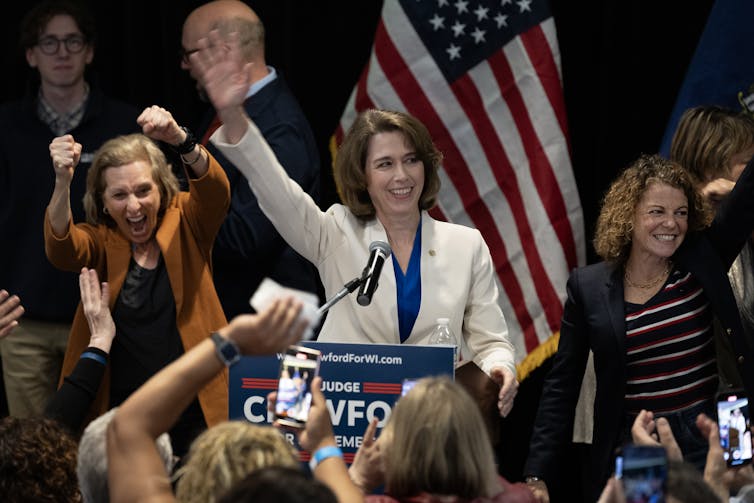
    Former prosecutor Susan Crawford won the highly politicized race for Wisconsin Supreme Court justice in 2025. It was the most expensive state supreme court race in U.S. history.
    Scott Olson via Getty Images

    That was one seat.

    Pennsylvania has three up for grabs in November 2025, with the potential to swing the current Democratic majority.

    And retention elections are politically simple for opponents. As one Republican political consultant told investigative news outlet Spotlight PA: “This is a political consultant’s dream, because your message is just one thing, and that’s ‘No.’”

    This can give some advantage to Republicans in a state that Trump won in 2024 and in a low-turnout election. The question will be whether there is more energy motivating opponents to turn out against the Democratic majority or supporters seeking to maintain the status quo.

    The 2025 retention elections could change the balance of power in the court.
    AP Photo/Aimee Dilger

    The stakes for Pennsylvania in 2025

    Much is at stake for Pennsylvanians in the fall. Republicans see this as their best opportunity to break the firm 5-2 Democratic majority on the court. This would pave the way for very different judicial decisions. Many of the court’s recent election-related rulings were made on narrow 4-3 votes that could swing differently if the composition of the court changes.

    Republicans have had their power in Harrisburg diminished with Shapiro in the governor’s mansion and a one-seat Democratic majority in the state House of Representatives over the past two terms.

    A Republican majority on the court would significantly change the balance of power in Harrisburg.

    But it is important to focus not only on the top court. The state’s two appellate-level courts – one step below the state Supreme Court – also have two important races and two retention votes in November that will decide the judiciary’s relationship with the governor and General Assembly.

    Daniel J. Mallinson does not work for, consult, own shares in or receive funding from any company or organization that would benefit from this article, and has disclosed no relevant affiliations beyond their academic appointment.

    ref. Most Pennsylvania voters ignore judicial elections − a political scientist explains why they matter, especially in a battleground state – https://theconversation.com/most-pennsylvania-voters-ignore-judicial-elections-a-political-scientist-explains-why-they-matter-especially-in-a-battleground-state-259775

    MIL OSI Analysis

  • MIL-OSI Analysis: Most Pennsylvania voters ignore judicial elections − a political scientist explains why they matter, especially in a battleground state

    Source: The Conversation – USA – By Daniel J. Mallinson, Associate Professor of Public Policy and Administration, Penn State

    Three of the seven judges on PA’s state supreme court are up for retention votes in November 2025. AP Photo/Matt Rourke

    This November, there will be no candidate for president, governor, senator or even representative on the Pennsylvania ballot.

    Pennsylvanians will vote, however, on three members of their seven-member state Supreme Court.

    These are retention elections, which means that voters will decide whether to keep the current members of the court or remove them.

    The three seats up for grabs are three of the five Democrats that hold the majority on the court. They are Justices Christine Donohue, Kevin Dougherty and David Wecht.

    While the typical voter may not think much about judicial elections, political operatives and political scientists, like me, know they have consequences.

    I think it’s important that voters understand what a retention election is and why state judicial elections are growing in political importance in the U.S.

    Retention elections

    Federal judges are appointed by the U.S. president, confirmed by the U.S. Senate, and can serve for the rest of their lives. State judges, however, are put in place in a variety of ways.

    The most powerful state courts are the so-called “courts of last resort.” These are essentially the supreme courts of each state. The method for selecting judges in these courts has varied over time and across the states. Currently, states use either gubernatorial appointment, legislative appointment, partisan elections, nonpartisan elections, or a merit process for selecting the judges of their highest courts.

    Pennsylvania has partisan elections, meaning judges run for office attached to political parties, just like a candidate would run for governor or president. However, it is only in their first race for office that a judge runs in a competitive partisan election. After they assume the bench, they participate in retention elections every 10 years. These retention elections are considered nonpartisan, since party labels do not appear on the ballot.

    Essentially, a retention election is an up or down vote. If more than 50% of voters cast a vote in opposition to a sitting judge, that judge will be out of the office at the end of their term. The governor, who is currently Democrat Josh Shapiro, then makes a temporary appointment to fill the seat with a special election held in the next odd year – in this case, 2027. But any appointments would need to be confirmed by the Republican-controlled state Senate, which may not confirm his picks.

    Politicization of the state courts

    Judges win retention elections over 90% of the time. So why should people bother to cast their vote?

    Courts, including state courts, have become highly politicized over the past several decades. A marked increase in politicization occurred for the U.S. Supreme Court after the failed nomination of Robert Bork in the 1980s.

    This politicization has since trickled down to lower federal courts and the states.

    State supreme courts have always made big decisions, but the nationalization of American politics – where national partisan politics drive voter behavior in local elections – has elevated the controversy over state supreme court decisions on issues such as reproductive rights, trans rights, COVID-19 restrictions, environmental protection and more.

    This issue became more acute when courts in battleground states were thrust to the center of adjudicating false claims of election fraud during the 2020 U.S. presidential election. And judges have faced increasing threats, particularly when opposing actions of the Trump administration, as President Donald Trump is prone to calling out specific judges in decisions that he does not like.

    The Pennsylvania Supreme Court has received additional attention, in part due to the outsized role it has played in recent redistricting. In 2018, the court threw out the congressional districts drawn by the General Assembly in 2011 and invited a new plan from the governor and General Assembly. The two came to a political loggerhead, so the Supreme Court ended up using its own map as a replacement.

    In 2022, the state Supreme Court once again took control of redistricting after Pennyslvania’s then-Gov. Tom Wolf vetoed the congressional district map approved by the General Assembly.

    Given the importance of state supreme courts, particularly in federal elections cases in battleground states like Pennsylvania, it is little wonder why their elections are gaining attention.

    The April 2025 Wisconsin Supreme Court race was the most expensive state judicial race in U.S. history, with $100 million in spending, including significant contributions from billionaires Elon Musk and George Soros.

    Former prosecutor Susan Crawford won the highly politicized race for Wisconsin Supreme Court justice in 2025. It was the most expensive state supreme court race in U.S. history.
    Scott Olson via Getty Images

    That was one seat.

    Pennsylvania has three up for grabs in November 2025, with the potential to swing the current Democratic majority.

    And retention elections are politically simple for opponents. As one Republican political consultant told investigative news outlet Spotlight PA: “This is a political consultant’s dream, because your message is just one thing, and that’s ‘No.’”

    This can give some advantage to Republicans in a state that Trump won in 2024 and in a low-turnout election. The question will be whether there is more energy motivating opponents to turn out against the Democratic majority or supporters seeking to maintain the status quo.

    The 2025 retention elections could change the balance of power in the court.
    AP Photo/Aimee Dilger

    The stakes for Pennsylvania in 2025

    Much is at stake for Pennsylvanians in the fall. Republicans see this as their best opportunity to break the firm 5-2 Democratic majority on the court. This would pave the way for very different judicial decisions. Many of the court’s recent election-related rulings were made on narrow 4-3 votes that could swing differently if the composition of the court changes.

    Republicans have had their power in Harrisburg diminished with Shapiro in the governor’s mansion and a one-seat Democratic majority in the state House of Representatives over the past two terms.

    A Republican majority on the court would significantly change the balance of power in Harrisburg.

    But it is important to focus not only on the top court. The state’s two appellate-level courts – one step below the state Supreme Court – also have two important races and two retention votes in November that will decide the judiciary’s relationship with the governor and General Assembly.

    Daniel J. Mallinson does not work for, consult, own shares in or receive funding from any company or organization that would benefit from this article, and has disclosed no relevant affiliations beyond their academic appointment.

    ref. Most Pennsylvania voters ignore judicial elections − a political scientist explains why they matter, especially in a battleground state – https://theconversation.com/most-pennsylvania-voters-ignore-judicial-elections-a-political-scientist-explains-why-they-matter-especially-in-a-battleground-state-259775

    MIL OSI Analysis

  • MIL-OSI Analysis: Most Pennsylvania voters ignore judicial elections − a political scientist explains why they matter, especially in a battleground state

    Source: The Conversation – USA – By Daniel J. Mallinson, Associate Professor of Public Policy and Administration, Penn State

    Three of the seven judges on PA’s state supreme court are up for retention votes in November 2025. AP Photo/Matt Rourke

    This November, there will be no candidate for president, governor, senator or even representative on the Pennsylvania ballot.

    Pennsylvanians will vote, however, on three members of their seven-member state Supreme Court.

    These are retention elections, which means that voters will decide whether to keep the current members of the court or remove them.

    The three seats up for grabs are three of the five Democrats that hold the majority on the court. They are Justices Christine Donohue, Kevin Dougherty and David Wecht.

    While the typical voter may not think much about judicial elections, political operatives and political scientists, like me, know they have consequences.

    I think it’s important that voters understand what a retention election is and why state judicial elections are growing in political importance in the U.S.

    Retention elections

    Federal judges are appointed by the U.S. president, confirmed by the U.S. Senate, and can serve for the rest of their lives. State judges, however, are put in place in a variety of ways.

    The most powerful state courts are the so-called “courts of last resort.” These are essentially the supreme courts of each state. The method for selecting judges in these courts has varied over time and across the states. Currently, states use either gubernatorial appointment, legislative appointment, partisan elections, nonpartisan elections, or a merit process for selecting the judges of their highest courts.

    Pennsylvania has partisan elections, meaning judges run for office attached to political parties, just like a candidate would run for governor or president. However, it is only in their first race for office that a judge runs in a competitive partisan election. After they assume the bench, they participate in retention elections every 10 years. These retention elections are considered nonpartisan, since party labels do not appear on the ballot.

    Essentially, a retention election is an up or down vote. If more than 50% of voters cast a vote in opposition to a sitting judge, that judge will be out of the office at the end of their term. The governor, who is currently Democrat Josh Shapiro, then makes a temporary appointment to fill the seat with a special election held in the next odd year – in this case, 2027. But any appointments would need to be confirmed by the Republican-controlled state Senate, which may not confirm his picks.

    Politicization of the state courts

    Judges win retention elections over 90% of the time. So why should people bother to cast their vote?

    Courts, including state courts, have become highly politicized over the past several decades. A marked increase in politicization occurred for the U.S. Supreme Court after the failed nomination of Robert Bork in the 1980s.

    This politicization has since trickled down to lower federal courts and the states.

    State supreme courts have always made big decisions, but the nationalization of American politics – where national partisan politics drive voter behavior in local elections – has elevated the controversy over state supreme court decisions on issues such as reproductive rights, trans rights, COVID-19 restrictions, environmental protection and more.

    This issue became more acute when courts in battleground states were thrust to the center of adjudicating false claims of election fraud during the 2020 U.S. presidential election. And judges have faced increasing threats, particularly when opposing actions of the Trump administration, as President Donald Trump is prone to calling out specific judges in decisions that he does not like.

    The Pennsylvania Supreme Court has received additional attention, in part due to the outsized role it has played in recent redistricting. In 2018, the court threw out the congressional districts drawn by the General Assembly in 2011 and invited a new plan from the governor and General Assembly. The two came to a political loggerhead, so the Supreme Court ended up using its own map as a replacement.

    In 2022, the state Supreme Court once again took control of redistricting after Pennyslvania’s then-Gov. Tom Wolf vetoed the congressional district map approved by the General Assembly.

    Given the importance of state supreme courts, particularly in federal elections cases in battleground states like Pennsylvania, it is little wonder why their elections are gaining attention.

    The April 2025 Wisconsin Supreme Court race was the most expensive state judicial race in U.S. history, with $100 million in spending, including significant contributions from billionaires Elon Musk and George Soros.

    Former prosecutor Susan Crawford won the highly politicized race for Wisconsin Supreme Court justice in 2025. It was the most expensive state supreme court race in U.S. history.
    Scott Olson via Getty Images

    That was one seat.

    Pennsylvania has three up for grabs in November 2025, with the potential to swing the current Democratic majority.

    And retention elections are politically simple for opponents. As one Republican political consultant told investigative news outlet Spotlight PA: “This is a political consultant’s dream, because your message is just one thing, and that’s ‘No.’”

    This can give some advantage to Republicans in a state that Trump won in 2024 and in a low-turnout election. The question will be whether there is more energy motivating opponents to turn out against the Democratic majority or supporters seeking to maintain the status quo.

    The 2025 retention elections could change the balance of power in the court.
    AP Photo/Aimee Dilger

    The stakes for Pennsylvania in 2025

    Much is at stake for Pennsylvanians in the fall. Republicans see this as their best opportunity to break the firm 5-2 Democratic majority on the court. This would pave the way for very different judicial decisions. Many of the court’s recent election-related rulings were made on narrow 4-3 votes that could swing differently if the composition of the court changes.

    Republicans have had their power in Harrisburg diminished with Shapiro in the governor’s mansion and a one-seat Democratic majority in the state House of Representatives over the past two terms.

    A Republican majority on the court would significantly change the balance of power in Harrisburg.

    But it is important to focus not only on the top court. The state’s two appellate-level courts – one step below the state Supreme Court – also have two important races and two retention votes in November that will decide the judiciary’s relationship with the governor and General Assembly.

    Daniel J. Mallinson does not work for, consult, own shares in or receive funding from any company or organization that would benefit from this article, and has disclosed no relevant affiliations beyond their academic appointment.

    ref. Most Pennsylvania voters ignore judicial elections − a political scientist explains why they matter, especially in a battleground state – https://theconversation.com/most-pennsylvania-voters-ignore-judicial-elections-a-political-scientist-explains-why-they-matter-especially-in-a-battleground-state-259775

    MIL OSI Analysis

  • MIL-OSI Analysis: Most Pennsylvania voters ignore judicial elections − a political scientist explains why they matter, especially in a battleground state

    Source: The Conversation – USA – By Daniel J. Mallinson, Associate Professor of Public Policy and Administration, Penn State

    Three of the seven judges on PA’s state supreme court are up for retention votes in November 2025. AP Photo/Matt Rourke

    This November, there will be no candidate for president, governor, senator or even representative on the Pennsylvania ballot.

    Pennsylvanians will vote, however, on three members of their seven-member state Supreme Court.

    These are retention elections, which means that voters will decide whether to keep the current members of the court or remove them.

    The three seats up for grabs are three of the five Democrats that hold the majority on the court. They are Justices Christine Donohue, Kevin Dougherty and David Wecht.

    While the typical voter may not think much about judicial elections, political operatives and political scientists, like me, know they have consequences.

    I think it’s important that voters understand what a retention election is and why state judicial elections are growing in political importance in the U.S.

    Retention elections

    Federal judges are appointed by the U.S. president, confirmed by the U.S. Senate, and can serve for the rest of their lives. State judges, however, are put in place in a variety of ways.

    The most powerful state courts are the so-called “courts of last resort.” These are essentially the supreme courts of each state. The method for selecting judges in these courts has varied over time and across the states. Currently, states use either gubernatorial appointment, legislative appointment, partisan elections, nonpartisan elections, or a merit process for selecting the judges of their highest courts.

    Pennsylvania has partisan elections, meaning judges run for office attached to political parties, just like a candidate would run for governor or president. However, it is only in their first race for office that a judge runs in a competitive partisan election. After they assume the bench, they participate in retention elections every 10 years. These retention elections are considered nonpartisan, since party labels do not appear on the ballot.

    Essentially, a retention election is an up or down vote. If more than 50% of voters cast a vote in opposition to a sitting judge, that judge will be out of the office at the end of their term. The governor, who is currently Democrat Josh Shapiro, then makes a temporary appointment to fill the seat with a special election held in the next odd year – in this case, 2027. But any appointments would need to be confirmed by the Republican-controlled state Senate, which may not confirm his picks.

    Politicization of the state courts

    Judges win retention elections over 90% of the time. So why should people bother to cast their vote?

    Courts, including state courts, have become highly politicized over the past several decades. A marked increase in politicization occurred for the U.S. Supreme Court after the failed nomination of Robert Bork in the 1980s.

    This politicization has since trickled down to lower federal courts and the states.

    State supreme courts have always made big decisions, but the nationalization of American politics – where national partisan politics drive voter behavior in local elections – has elevated the controversy over state supreme court decisions on issues such as reproductive rights, trans rights, COVID-19 restrictions, environmental protection and more.

    This issue became more acute when courts in battleground states were thrust to the center of adjudicating false claims of election fraud during the 2020 U.S. presidential election. And judges have faced increasing threats, particularly when opposing actions of the Trump administration, as President Donald Trump is prone to calling out specific judges in decisions that he does not like.

    The Pennsylvania Supreme Court has received additional attention, in part due to the outsized role it has played in recent redistricting. In 2018, the court threw out the congressional districts drawn by the General Assembly in 2011 and invited a new plan from the governor and General Assembly. The two came to a political loggerhead, so the Supreme Court ended up using its own map as a replacement.

    In 2022, the state Supreme Court once again took control of redistricting after Pennyslvania’s then-Gov. Tom Wolf vetoed the congressional district map approved by the General Assembly.

    Given the importance of state supreme courts, particularly in federal elections cases in battleground states like Pennsylvania, it is little wonder why their elections are gaining attention.

    The April 2025 Wisconsin Supreme Court race was the most expensive state judicial race in U.S. history, with $100 million in spending, including significant contributions from billionaires Elon Musk and George Soros.

    Former prosecutor Susan Crawford won the highly politicized race for Wisconsin Supreme Court justice in 2025. It was the most expensive state supreme court race in U.S. history.
    Scott Olson via Getty Images

    That was one seat.

    Pennsylvania has three up for grabs in November 2025, with the potential to swing the current Democratic majority.

    And retention elections are politically simple for opponents. As one Republican political consultant told investigative news outlet Spotlight PA: “This is a political consultant’s dream, because your message is just one thing, and that’s ‘No.’”

    This can give some advantage to Republicans in a state that Trump won in 2024 and in a low-turnout election. The question will be whether there is more energy motivating opponents to turn out against the Democratic majority or supporters seeking to maintain the status quo.

    The 2025 retention elections could change the balance of power in the court.
    AP Photo/Aimee Dilger

    The stakes for Pennsylvania in 2025

    Much is at stake for Pennsylvanians in the fall. Republicans see this as their best opportunity to break the firm 5-2 Democratic majority on the court. This would pave the way for very different judicial decisions. Many of the court’s recent election-related rulings were made on narrow 4-3 votes that could swing differently if the composition of the court changes.

    Republicans have had their power in Harrisburg diminished with Shapiro in the governor’s mansion and a one-seat Democratic majority in the state House of Representatives over the past two terms.

    A Republican majority on the court would significantly change the balance of power in Harrisburg.

    But it is important to focus not only on the top court. The state’s two appellate-level courts – one step below the state Supreme Court – also have two important races and two retention votes in November that will decide the judiciary’s relationship with the governor and General Assembly.

    Daniel J. Mallinson does not work for, consult, own shares in or receive funding from any company or organization that would benefit from this article, and has disclosed no relevant affiliations beyond their academic appointment.

    ref. Most Pennsylvania voters ignore judicial elections − a political scientist explains why they matter, especially in a battleground state – https://theconversation.com/most-pennsylvania-voters-ignore-judicial-elections-a-political-scientist-explains-why-they-matter-especially-in-a-battleground-state-259775

    MIL OSI Analysis

  • MIL-OSI Analysis: Zohran Mamdani’s last name reflects centuries of intercontinental trade, migration and cultural exchange

    Source: The Conversation – USA (3) – By Iqbal Akhtar, Associate Professor of Religious Studies, Florida International University

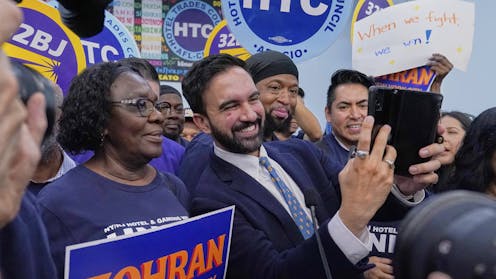
    Zohran Mamdani takes photos with union members during a campaign rally at the Hotel and Gaming Trades Council headquarters in New York on July 2, 2025. AP Photo/Richard Drew

    When Zohran Mamdani announced his candidacy for mayor of New York City, political observers noted his progressive platform and legislative record. But understanding the Democratic candidate’s background requires examining the rich cultural tapestry woven into his very surname: Mamdani.

    He takes the name from his father, Mahmood Mamdani, a prominent academic who was raised in Uganda and whose work focuses on postcolonial Uganda. I studied the history of the Khoja community for my doctoral work and have helped develop Khoja studies as an academic discipline. The Mamdani surname tells a story of migration, resilience and community-building that spans centuries and continents.

    The Khoja history

    Mamdanis in Uganda belong to the Khoja community, a South Asian Muslim merchant caste, that shaped economic development across the western Indian Ocean for centuries.

    The name originates from greater Sindh, a region in South Asia that today includes southeastern Pakistan and Kachchh in western India.

    Its etymology is twofold. Mām is an honorific title in Kachchhi and Gujarati languages, meaning kindness, courage and pride. Māmadō is a local version of the name Muhammad that often appeared in surnames in Hindu castes that converted to Islam, such as the Memons.

    The Khoja were categorized by the British in the early 19th century as “Hindoo Mussalman” because their traditions spanned both religions.

    Over time, the Khoja came to be identified only as Muslim and then primarily as Shiite Muslim. Today, the majority of Khoja are Ismaili: a branch of Shiite Islam that follows the Aga Khan as their living imam.

    The Mamdani family, however, is part of the Twelver community of Khoja, whose Twelfth Imam is believed to be hidden from the world and only emerges in times of crisis. Twelvers believe he will help usher in an age of peace during end times.

    Around the late 18th century, the Khoja helped export textiles, manufactured goods, spices and gems from the Indian subcontinent to Arabia and East Africa. Through this Western Indian Ocean trading network, they imported timber, ivory, minerals and cloves, among other goods.

    Khoja family firms were built on kinship networks and trust. They built networks of shops, communal housing and warehouses, and extended credit for thousands of miles, from Zanzibar in Tanzania to Bombay – now Mumbai – on the western coast of India.

    Cousins and brothers would send money and goods across the ocean with only a letter. The precarious nature of trade in this period meant that families also served as insurance for each other. In times of wealth, it was shared; in times of disaster, help was available.

    Khoja contributions in Africa

    The Khoja became instrumental in building the commercial infrastructure of eastern, central and southern Africa. But the Khoja contribution to the development of Africa extended far beyond trade.

    In the absence of colonial investment in public infrastructure, they helped build institutions that formed the foundation of the modern nation-states that emerged after colonization. The institutions both facilitated trade and established permanent communities.

    For example, the first dispensary and public school in Zanzibar were constructed by a Khoja magnate, Tharia Topan, who made his wealth through the ivory and clove trades. Topan eventually became so prominent that he was knighted by Queen Victoria in 1890 for his service to the British Empire in helping to end slavery in East Africa.

    The Khoja community continues to invest in East Africa. The most famous example is the Aga Khan Development Network, whose hospitals and schools operate in 30 countries. In places such as Kenya, Uganda and Tanzania, they are considered the best.

    Khoja in Uganda

    Like in other parts of Africa, the Khoja settled in Uganda as a liaison business community to develop a market to serve both African and European needs. The linguistic and cultural knowledge, developed over centuries, helped facilitate business despite the challenges of colonization.

    Ugandan President Idi Amin and his wife, Sarah, in Rome on Sept. 10, 1975.
    AP Photo

    However, in 1972, Ugandan dictator Idi Amin expelled all Asians – approximately 80,000 – forcing families like the Mamdanis into exile. These included indentured laborers, who were brought in to help build the railroad and farm during the British colonial period, and free traders, like the Mamdani family.

    Amin saw them all as the same and famously said: “Asians came to Uganda to build the railway. The railway is finished. They must leave now.”

    The experience was a bitter one. Families lost everything, and many left with only the clothes on their backs.

    Mahmood Mamdani, who came from a Khoja merchant family, was 26 when he was exiled. Yet, unlike most Ugandan Asians, he chose to go back. At Makerere University in Kampala, Uganda’s capital, Mamdani set up the Institute for Social Research, which helped to provide rigorous social science training to Ugandan researchers trying to improve their society.

    While the earlier generations of the Khoja tended to choose business or adjacent professions, such as accounting, the subsequent generations – particularly those educated in the West – embraced the knowledge economy as professionals, academics and nonprofit leaders.

    Several of Mahmood Mamdani’s generation of Khoja academics conducted path-breaking work on Afro-Asian solidarity – a way of thinking about the world beyond colonial categories, such as the category of religion as a separate domain from the secular. These scholars, such as Tanzania’s Issa Shivji and Abdul Sheriff, worked on creating solidarity among the newly independent states of the Global South.

    Mahmood Mamdani is known for his influential post-9/11 academic work, “Good Muslim, Bad Muslim,” which examined how Muslim identities are stereotyped. He argued that these identities are complex and varied, shaped by accumulated history and present experiences.

    Interfaith identity

    The Khoja community – known globally as the Khoja Shia Ithnasheri Muslim Community – has developed strong transnational connections. Today, they are concentrated in the United Kingdom, Canada, United States and France. However, Khoja can be found in almost any country in the world. In 2013, I met members of the community in Hong Kong.

    The Khoja community plays an important role in interfaith dialogue and global development initiatives. A prominent Ismaili Khoja, Eboo Patel, the founder of Interfaith America, has dedicated his life to pluralism and mutual understanding through building up civil society.

    Zohran Mamdani’s mother, acclaimed filmmaker Mira Nair, is Hindu by birth. This interfaith marriage exemplifies the flexibility, diversity and tolerance of Khoja Islam, which has historically navigated between Hindu and Islamic traditions.

    Whether Mamdani’s policies prove practical remains to be seen, but his background offers something valuable: a deep understanding of how communities build resilience across generations and geographies.

    Iqbal Akhtar does not work for, consult, own shares in or receive funding from any company or organization that would benefit from this article, and has disclosed no relevant affiliations beyond their academic appointment.

    ref. Zohran Mamdani’s last name reflects centuries of intercontinental trade, migration and cultural exchange – https://theconversation.com/zohran-mamdanis-last-name-reflects-centuries-of-intercontinental-trade-migration-and-cultural-exchange-259967

    MIL OSI Analysis

  • MIL-OSI Analysis: Zohran Mamdani’s last name reflects centuries of intercontinental trade, migration and cultural exchange

    Source: The Conversation – USA (3) – By Iqbal Akhtar, Associate Professor of Religious Studies, Florida International University

    Zohran Mamdani takes photos with union members during a campaign rally at the Hotel and Gaming Trades Council headquarters in New York on July 2, 2025. AP Photo/Richard Drew

    When Zohran Mamdani announced his candidacy for mayor of New York City, political observers noted his progressive platform and legislative record. But understanding the Democratic candidate’s background requires examining the rich cultural tapestry woven into his very surname: Mamdani.

    He takes the name from his father, Mahmood Mamdani, a prominent academic who was raised in Uganda and whose work focuses on postcolonial Uganda. I studied the history of the Khoja community for my doctoral work and have helped develop Khoja studies as an academic discipline. The Mamdani surname tells a story of migration, resilience and community-building that spans centuries and continents.

    The Khoja history

    Mamdanis in Uganda belong to the Khoja community, a South Asian Muslim merchant caste, that shaped economic development across the western Indian Ocean for centuries.

    The name originates from greater Sindh, a region in South Asia that today includes southeastern Pakistan and Kachchh in western India.

    Its etymology is twofold. Mām is an honorific title in Kachchhi and Gujarati languages, meaning kindness, courage and pride. Māmadō is a local version of the name Muhammad that often appeared in surnames in Hindu castes that converted to Islam, such as the Memons.

    The Khoja were categorized by the British in the early 19th century as “Hindoo Mussalman” because their traditions spanned both religions.

    Over time, the Khoja came to be identified only as Muslim and then primarily as Shiite Muslim. Today, the majority of Khoja are Ismaili: a branch of Shiite Islam that follows the Aga Khan as their living imam.

    The Mamdani family, however, is part of the Twelver community of Khoja, whose Twelfth Imam is believed to be hidden from the world and only emerges in times of crisis. Twelvers believe he will help usher in an age of peace during end times.

    Around the late 18th century, the Khoja helped export textiles, manufactured goods, spices and gems from the Indian subcontinent to Arabia and East Africa. Through this Western Indian Ocean trading network, they imported timber, ivory, minerals and cloves, among other goods.

    Khoja family firms were built on kinship networks and trust. They built networks of shops, communal housing and warehouses, and extended credit for thousands of miles, from Zanzibar in Tanzania to Bombay – now Mumbai – on the western coast of India.

    Cousins and brothers would send money and goods across the ocean with only a letter. The precarious nature of trade in this period meant that families also served as insurance for each other. In times of wealth, it was shared; in times of disaster, help was available.

    Khoja contributions in Africa

    The Khoja became instrumental in building the commercial infrastructure of eastern, central and southern Africa. But the Khoja contribution to the development of Africa extended far beyond trade.

    In the absence of colonial investment in public infrastructure, they helped build institutions that formed the foundation of the modern nation-states that emerged after colonization. The institutions both facilitated trade and established permanent communities.

    For example, the first dispensary and public school in Zanzibar were constructed by a Khoja magnate, Tharia Topan, who made his wealth through the ivory and clove trades. Topan eventually became so prominent that he was knighted by Queen Victoria in 1890 for his service to the British Empire in helping to end slavery in East Africa.

    The Khoja community continues to invest in East Africa. The most famous example is the Aga Khan Development Network, whose hospitals and schools operate in 30 countries. In places such as Kenya, Uganda and Tanzania, they are considered the best.

    Khoja in Uganda

    Like in other parts of Africa, the Khoja settled in Uganda as a liaison business community to develop a market to serve both African and European needs. The linguistic and cultural knowledge, developed over centuries, helped facilitate business despite the challenges of colonization.

    Ugandan President Idi Amin and his wife, Sarah, in Rome on Sept. 10, 1975.
    AP Photo

    However, in 1972, Ugandan dictator Idi Amin expelled all Asians – approximately 80,000 – forcing families like the Mamdanis into exile. These included indentured laborers, who were brought in to help build the railroad and farm during the British colonial period, and free traders, like the Mamdani family.

    Amin saw them all as the same and famously said: “Asians came to Uganda to build the railway. The railway is finished. They must leave now.”

    The experience was a bitter one. Families lost everything, and many left with only the clothes on their backs.

    Mahmood Mamdani, who came from a Khoja merchant family, was 26 when he was exiled. Yet, unlike most Ugandan Asians, he chose to go back. At Makerere University in Kampala, Uganda’s capital, Mamdani set up the Institute for Social Research, which helped to provide rigorous social science training to Ugandan researchers trying to improve their society.

    While the earlier generations of the Khoja tended to choose business or adjacent professions, such as accounting, the subsequent generations – particularly those educated in the West – embraced the knowledge economy as professionals, academics and nonprofit leaders.

    Several of Mahmood Mamdani’s generation of Khoja academics conducted path-breaking work on Afro-Asian solidarity – a way of thinking about the world beyond colonial categories, such as the category of religion as a separate domain from the secular. These scholars, such as Tanzania’s Issa Shivji and Abdul Sheriff, worked on creating solidarity among the newly independent states of the Global South.

    Mahmood Mamdani is known for his influential post-9/11 academic work, “Good Muslim, Bad Muslim,” which examined how Muslim identities are stereotyped. He argued that these identities are complex and varied, shaped by accumulated history and present experiences.

    Interfaith identity

    The Khoja community – known globally as the Khoja Shia Ithnasheri Muslim Community – has developed strong transnational connections. Today, they are concentrated in the United Kingdom, Canada, United States and France. However, Khoja can be found in almost any country in the world. In 2013, I met members of the community in Hong Kong.

    The Khoja community plays an important role in interfaith dialogue and global development initiatives. A prominent Ismaili Khoja, Eboo Patel, the founder of Interfaith America, has dedicated his life to pluralism and mutual understanding through building up civil society.

    Zohran Mamdani’s mother, acclaimed filmmaker Mira Nair, is Hindu by birth. This interfaith marriage exemplifies the flexibility, diversity and tolerance of Khoja Islam, which has historically navigated between Hindu and Islamic traditions.

    Whether Mamdani’s policies prove practical remains to be seen, but his background offers something valuable: a deep understanding of how communities build resilience across generations and geographies.

    Iqbal Akhtar does not work for, consult, own shares in or receive funding from any company or organization that would benefit from this article, and has disclosed no relevant affiliations beyond their academic appointment.

    ref. Zohran Mamdani’s last name reflects centuries of intercontinental trade, migration and cultural exchange – https://theconversation.com/zohran-mamdanis-last-name-reflects-centuries-of-intercontinental-trade-migration-and-cultural-exchange-259967

    MIL OSI Analysis

  • MIL-OSI Analysis: Who was the first pirate?

    Source: The Conversation – USA (2) – By Brandon Prins, Professor of Political Science, University of Tennessee

    Curious Kids is a series for children of all ages. If you have a question you’d like an expert to answer, send it to curiouskidsus@theconversation.com.


    Who was the first pirate? – Yandel R., age 11, Lakewood Ranch, Florida


    When most people imagine a pirate, they picture actor Johnny Depp playing the mad but likable swashbuckler Jack Sparrow, captain of the sailing ship the Black Pearl.

    Depp’s pirate portrayal was inspired by seafaring bandits in older make-believe tales, such as Long John Silver in “Treasure Island,” Captain Hook in “Peter Pan,” or sailor Edmond Dantès in “The Count of Monte Cristo.”

    A 1915 edition of ‘Treasure Island’ illustrated Long John Silver with iconic pirate features.
    Louis Rhead/Historica Graphica Collection/Heritage Images via Getty Images

    Pirates in these stories were mischievous but also glamorous, courageous and mostly kindhearted. They wore flashy costumes. They had missing limbs, like Captain Cook’s iron hook for a left hand and Long John Silver’s wooden peg leg. They buried treasure chests of gold and silver, forced enemies to walk the plank and had talking parrots as shipboard companions. They flew the Jolly Roger skull and crossbones flag from the ship’s mast to frighten enemies. The new Netflix series “One Piece,” which is based on a Japanese comic book, continues this popular depiction of pirates.

    While fun, these portrayals of pirates are mostly invented.

    I’m a political scientist who studies modern-day commerce raiding: robbing of private cargo vessels on the high seas. I’m interested in where it happens in the world, who does it and what can be done to stop it. My research finds today’s pirates to be less like swashbuckling Jack Sparrow and more like regular old thieves.

    Pirates in the ancient world

    Since pirates have been around for as long as people have moved things by boat, it is hard to pin down the very first pirate.

    Ancient Egyptians tied bundles of reeds together to form watertight boats.
    Werner Forman/Universal Images Group via Getty Images

    But archaeological evidence shows that boatbuilding goes all the way back to the ancient Egyptians, who used boats made from papyrus reeds as early as 6,000 years ago. These vessels likely carried valuable goods up and down the Nile River, and where valuable goods can be found, you can usually find thieves too. In fact, researchers know that pirates – basically just thieves on the water – targeted these river boats, because Egyptian pharaohs left records grumbling about pirates and their widespread pillaging.

    By 3,500 years ago, thieves were using sailing vessels to raid coastal towns and villages in and around the Nile Delta, as well as the Aegean and Adriatic basins. Attacking ships far from land on the high seas and stealing the cargo was a logical next step in the tactics of seafaring raiders.

    As trade increased across the Mediterranean Sea, boats carrying valuable cargo, such as pottery, silk, glass, spices and metals, became the targets of ancient pirates. Given the worth of these goods, pirate attacks became widespread across the ancient Mediterranean Sea. With money from the Roman senate and strong effort by a military leader named Pompey, the Roman navy worked hard to stop the pirates – and for a while it did.

    The earliest named pirate?

    The first mention of a pirate by name may have been in a Greek history book written in the fifth century BCE by an ancient historian named Herodotus.

    He briefly describes the adventures of a naval commander by the name of Dionysius who was from Ionia, which is in modern-day Turkey. Dionysius set up a pirate base on the island of Sicily that allowed him and his fellow pirates to plunder ships that happened to sail past.

    Pirates of the Caribbean

    While Dionysius may have been the first recorded pirate, the most famous pirates lived during the 17th and 18th centuries, which came to be known as the golden age of sea piracy.

    This was the heyday of pirates such as Blackbeard, also known as Edward Teach; William Kidd; Henry Morgan; Calico Jack; and Anne Bonny. They plundered Spanish treasure ships in the Caribbean, known as the Spanish Main, that were carrying silver from the mines in Bolivia back to the king of Spain.

    Islands such as Jamaica, Tortuga and the Bahamas, as well the North Carolina coast, all became notable pirate havens. Port Royal, on the island of Jamaica, in particular, was a notorious pirate refuge. It was ideally positioned for preying upon Spanish galleons sailing across the Atlantic from ports in Panama and Venezuela. Johnny Depp’s character, Jack Sparrow, swashbuckled around a fictionalized Port Royal in the first “Pirates of the Caribbean” film.

    Each dot represents a maritime pirate attack that happened between 1995 and 2023.
    Brandon Prins

    21st-century pirates

    The 2013 Hollywood movie “Captain Phillips,” starring Tom Hanks, drew attention back to real-world pirates and piracy. The movie was based on a real-life 2009 attack by Somali pirates on a ship named the MV Maersk Alabama, which was carrying food to Kenya. The 500-foot-long vessel and its crew were rescued by the U.S. Navy.

    To better understand 21st-century piracy, my research team compiled data on all pirate attacks from 1995 to the present day. We found three main piracy hot spots: the Gulf of Aden near Somalia, the Strait of Malacca in Southeast Asia and the Gulf of Guinea off the coast of West Africa. All three locations experience the conditions that attract pirates: ship traffic, valuable cargo and weak governments.

    Why become a pirate?

    People become pirates for many reasons, not the least of which is to escape poverty and enslavement. Others just want adventure and to travel the world. These are the same motivations that drove commerce raiding in the ancient world, during the golden age of piracy, and even today.

    While we may never know the first pirate, just like we will never know the very first thief, historical evidence shows that sea-raiding has been around since the very first boats traversed the world’s waterways. Despite efforts to end piracy, my research shows that the conditions that produce ship looting remain and will likely always exist.


    Hello, curious kids! Do you have a question you’d like an expert to answer? Ask an adult to send your question to CuriousKidsUS@theconversation.com. Please tell us your name, age and the city where you live.

    And since curiosity has no age limit – adults, let us know what you’re wondering, too. We won’t be able to answer every question, but we will do our best.

    Brandon Prins received funding from the U.S. Department of Defense, Office of Naval Research, through the Minerva Initiative, awards #N00014-21-1-2030 and #N00014-14-1-0050.

    ref. Who was the first pirate? – https://theconversation.com/who-was-the-first-pirate-256314

    MIL OSI Analysis

  • Zohran Mamdani’s last name reflects centuries of intercontinental trade, migration and cultural exchange

    Source: ForeignAffairs4

    Source: The Conversation – USA (3) – By Iqbal Akhtar, Associate Professor of Religious Studies, Florida International University

    Zohran Mamdani takes photos with union members during a campaign rally at the Hotel and Gaming Trades Council headquarters in New York on July 2, 2025. AP Photo/Richard Drew

    When Zohran Mamdani announced his candidacy for mayor of New York City, political observers noted his progressive platform and legislative record. But understanding the Democratic candidate’s background requires examining the rich cultural tapestry woven into his very surname: Mamdani.

    He takes the name from his father, Mahmood Mamdani, a prominent academic who was raised in Uganda and whose work focuses on postcolonial Uganda. I studied the history of the Khoja community for my doctoral work and have helped develop Khoja studies as an academic discipline. The Mamdani surname tells a story of migration, resilience and community-building that spans centuries and continents.

    The Khoja history

    Mamdanis in Uganda belong to the Khoja community, a South Asian Muslim merchant caste, that shaped economic development across the western Indian Ocean for centuries.

    The name originates from greater Sindh, a region in South Asia that today includes southeastern Pakistan and Kachchh in western India.

    Its etymology is twofold. Mām is an honorific title in Kachchhi and Gujarati languages, meaning kindness, courage and pride. Māmadō is a local version of the name Muhammad that often appeared in surnames in Hindu castes that converted to Islam, such as the Memons.

    The Khoja were categorized by the British in the early 19th century as “Hindoo Mussalman” because their traditions spanned both religions.

    Over time, the Khoja came to be identified only as Muslim and then primarily as Shiite Muslim. Today, the majority of Khoja are Ismaili: a branch of Shiite Islam that follows the Aga Khan as their living imam.

    The Mamdani family, however, is part of the Twelver community of Khoja, whose Twelfth Imam is believed to be hidden from the world and only emerges in times of crisis. Twelvers believe he will help usher in an age of peace during end times.

    Around the late 18th century, the Khoja helped export textiles, manufactured goods, spices and gems from the Indian subcontinent to Arabia and East Africa. Through this Western Indian Ocean trading network, they imported timber, ivory, minerals and cloves, among other goods.

    Khoja family firms were built on kinship networks and trust. They built networks of shops, communal housing and warehouses, and extended credit for thousands of miles, from Zanzibar in Tanzania to Bombay – now Mumbai – on the western coast of India.

    Cousins and brothers would send money and goods across the ocean with only a letter. The precarious nature of trade in this period meant that families also served as insurance for each other. In times of wealth, it was shared; in times of disaster, help was available.

    Khoja contributions in Africa

    The Khoja became instrumental in building the commercial infrastructure of eastern, central and southern Africa. But the Khoja contribution to the development of Africa extended far beyond trade.

    In the absence of colonial investment in public infrastructure, they helped build institutions that formed the foundation of the modern nation-states that emerged after colonization. The institutions both facilitated trade and established permanent communities.

    For example, the first dispensary and public school in Zanzibar were constructed by a Khoja magnate, Tharia Topan, who made his wealth through the ivory and clove trades. Topan eventually became so prominent that he was knighted by Queen Victoria in 1890 for his service to the British Empire in helping to end slavery in East Africa.

    The Khoja community continues to invest in East Africa. The most famous example is the Aga Khan Development Network, whose hospitals and schools operate in 30 countries. In places such as Kenya, Uganda and Tanzania, they are considered the best.

    Khoja in Uganda

    Like in other parts of Africa, the Khoja settled in Uganda as a liaison business community to develop a market to serve both African and European needs. The linguistic and cultural knowledge, developed over centuries, helped facilitate business despite the challenges of colonization.

    A Black man in a suit walking with a woman and another dressed in traditional African attire.
    Ugandan President Idi Amin and his wife, Sarah, in Rome on Sept. 10, 1975.
    AP Photo

    However, in 1972, Ugandan dictator Idi Amin expelled all Asians – approximately 80,000 – forcing families like the Mamdanis into exile. These included indentured laborers, who were brought in to help build the railroad and farm during the British colonial period, and free traders, like the Mamdani family.

    Amin saw them all as the same and famously said: “Asians came to Uganda to build the railway. The railway is finished. They must leave now.”

    The experience was a bitter one. Families lost everything, and many left with only the clothes on their backs.

    Mahmood Mamdani, who came from a Khoja merchant family, was 26 when he was exiled. Yet, unlike most Ugandan Asians, he chose to go back. At Makerere University in Kampala, Uganda’s capital, Mamdani set up the Institute for Social Research, which helped to provide rigorous social science training to Ugandan researchers trying to improve their society.

    While the earlier generations of the Khoja tended to choose business or adjacent professions, such as accounting, the subsequent generations – particularly those educated in the West – embraced the knowledge economy as professionals, academics and nonprofit leaders.

    Several of Mahmood Mamdani’s generation of Khoja academics conducted path-breaking work on Afro-Asian solidarity – a way of thinking about the world beyond colonial categories, such as the category of religion as a separate domain from the secular. These scholars, such as Tanzania’s Issa Shivji and Abdul Sheriff, worked on creating solidarity among the newly independent states of the Global South.

    Mahmood Mamdani is known for his influential post-9/11 academic work, “Good Muslim, Bad Muslim,” which examined how Muslim identities are stereotyped. He argued that these identities are complex and varied, shaped by accumulated history and present experiences.

    Interfaith identity

    The Khoja community – known globally as the Khoja Shia Ithnasheri Muslim Community – has developed strong transnational connections. Today, they are concentrated in the United Kingdom, Canada, United States and France. However, Khoja can be found in almost any country in the world. In 2013, I met members of the community in Hong Kong.

    The Khoja community plays an important role in interfaith dialogue and global development initiatives. A prominent Ismaili Khoja, Eboo Patel, the founder of Interfaith America, has dedicated his life to pluralism and mutual understanding through building up civil society.

    Zohran Mamdani’s mother, acclaimed filmmaker Mira Nair, is Hindu by birth. This interfaith marriage exemplifies the flexibility, diversity and tolerance of Khoja Islam, which has historically navigated between Hindu and Islamic traditions.

    Whether Mamdani’s policies prove practical remains to be seen, but his background offers something valuable: a deep understanding of how communities build resilience across generations and geographies.

    The Conversation

    Iqbal Akhtar does not work for, consult, own shares in or receive funding from any company or organization that would benefit from this article, and has disclosed no relevant affiliations beyond their academic appointment.

    ref. Zohran Mamdani’s last name reflects centuries of intercontinental trade, migration and cultural exchange – https://theconversation.com/zohran-mamdanis-last-name-reflects-centuries-of-intercontinental-trade-migration-and-cultural-exchange-259967

  • Who was the first pirate?

    Source: ForeignAffairs4

    Source: The Conversation – USA (2) – By Brandon Prins, Professor of Political Science, University of Tennessee

    Curious Kids is a series for children of all ages. If you have a question you’d like an expert to answer, send it to curiouskidsus@theconversation.com.


    Who was the first pirate? – Yandel R., age 11, Lakewood Ranch, Florida


    When most people imagine a pirate, they picture actor Johnny Depp playing the mad but likable swashbuckler Jack Sparrow, captain of the sailing ship the Black Pearl.

    Depp’s pirate portrayal was inspired by seafaring bandits in older make-believe tales, such as Long John Silver in “Treasure Island,” Captain Hook in “Peter Pan,” or sailor Edmond Dantès in “The Count of Monte Cristo.”

    painting of one-legged pirate with parrot on shoulder holds a sword
    A 1915 edition of ‘Treasure Island’ illustrated Long John Silver with iconic pirate features.
    Louis Rhead/Historica Graphica Collection/Heritage Images via Getty Images

    Pirates in these stories were mischievous but also glamorous, courageous and mostly kindhearted. They wore flashy costumes. They had missing limbs, like Captain Cook’s iron hook for a left hand and Long John Silver’s wooden peg leg. They buried treasure chests of gold and silver, forced enemies to walk the plank and had talking parrots as shipboard companions. They flew the Jolly Roger skull and crossbones flag from the ship’s mast to frighten enemies. The new Netflix series “One Piece,” which is based on a Japanese comic book, continues this popular depiction of pirates.

    While fun, these portrayals of pirates are mostly invented.

    I’m a political scientist who studies modern-day commerce raiding: robbing of private cargo vessels on the high seas. I’m interested in where it happens in the world, who does it and what can be done to stop it. My research finds today’s pirates to be less like swashbuckling Jack Sparrow and more like regular old thieves.

    Pirates in the ancient world

    Since pirates have been around for as long as people have moved things by boat, it is hard to pin down the very first pirate.

    stone relief carving depicting ancient Egyptians in a low boat carrying birds in a cage
    Ancient Egyptians tied bundles of reeds together to form watertight boats.
    Werner Forman/Universal Images Group via Getty Images

    But archaeological evidence shows that boatbuilding goes all the way back to the ancient Egyptians, who used boats made from papyrus reeds as early as 6,000 years ago. These vessels likely carried valuable goods up and down the Nile River, and where valuable goods can be found, you can usually find thieves too. In fact, researchers know that pirates – basically just thieves on the water – targeted these river boats, because Egyptian pharaohs left records grumbling about pirates and their widespread pillaging.

    By 3,500 years ago, thieves were using sailing vessels to raid coastal towns and villages in and around the Nile Delta, as well as the Aegean and Adriatic basins. Attacking ships far from land on the high seas and stealing the cargo was a logical next step in the tactics of seafaring raiders.

    As trade increased across the Mediterranean Sea, boats carrying valuable cargo, such as pottery, silk, glass, spices and metals, became the targets of ancient pirates. Given the worth of these goods, pirate attacks became widespread across the ancient Mediterranean Sea. With money from the Roman senate and strong effort by a military leader named Pompey, the Roman navy worked hard to stop the pirates – and for a while it did.

    The earliest named pirate?

    The first mention of a pirate by name may have been in a Greek history book written in the fifth century BCE by an ancient historian named Herodotus.

    He briefly describes the adventures of a naval commander by the name of Dionysius who was from Ionia, which is in modern-day Turkey. Dionysius set up a pirate base on the island of Sicily that allowed him and his fellow pirates to plunder ships that happened to sail past.

    Pirates of the Caribbean

    While Dionysius may have been the first recorded pirate, the most famous pirates lived during the 17th and 18th centuries, which came to be known as the golden age of sea piracy.

    This was the heyday of pirates such as Blackbeard, also known as Edward Teach; William Kidd; Henry Morgan; Calico Jack; and Anne Bonny. They plundered Spanish treasure ships in the Caribbean, known as the Spanish Main, that were carrying silver from the mines in Bolivia back to the king of Spain.

    Islands such as Jamaica, Tortuga and the Bahamas, as well the North Carolina coast, all became notable pirate havens. Port Royal, on the island of Jamaica, in particular, was a notorious pirate refuge. It was ideally positioned for preying upon Spanish galleons sailing across the Atlantic from ports in Panama and Venezuela. Johnny Depp’s character, Jack Sparrow, swashbuckled around a fictionalized Port Royal in the first “Pirates of the Caribbean” film.

    map from west coast of Africa to east coast of Asia with red dots denoting pirate attacks along coasts
    Each dot represents a maritime pirate attack that happened between 1995 and 2023.
    Brandon Prins

    21st-century pirates

    The 2013 Hollywood movie “Captain Phillips,” starring Tom Hanks, drew attention back to real-world pirates and piracy. The movie was based on a real-life 2009 attack by Somali pirates on a ship named the MV Maersk Alabama, which was carrying food to Kenya. The 500-foot-long vessel and its crew were rescued by the U.S. Navy.

    To better understand 21st-century piracy, my research team compiled data on all pirate attacks from 1995 to the present day. We found three main piracy hot spots: the Gulf of Aden near Somalia, the Strait of Malacca in Southeast Asia and the Gulf of Guinea off the coast of West Africa. All three locations experience the conditions that attract pirates: ship traffic, valuable cargo and weak governments.

    Why become a pirate?

    People become pirates for many reasons, not the least of which is to escape poverty and enslavement. Others just want adventure and to travel the world. These are the same motivations that drove commerce raiding in the ancient world, during the golden age of piracy, and even today.

    While we may never know the first pirate, just like we will never know the very first thief, historical evidence shows that sea-raiding has been around since the very first boats traversed the world’s waterways. Despite efforts to end piracy, my research shows that the conditions that produce ship looting remain and will likely always exist.


    Hello, curious kids! Do you have a question you’d like an expert to answer? Ask an adult to send your question to CuriousKidsUS@theconversation.com. Please tell us your name, age and the city where you live.

    And since curiosity has no age limit – adults, let us know what you’re wondering, too. We won’t be able to answer every question, but we will do our best.

    The Conversation

    Brandon Prins received funding from the U.S. Department of Defense, Office of Naval Research, through the Minerva Initiative, awards #N00014-21-1-2030 and #N00014-14-1-0050.

    ref. Who was the first pirate? – https://theconversation.com/who-was-the-first-pirate-256314

  • 2026 FIFA World Cup expansion will have a big climate footprint, with matches from Mexico to Canada – here’s what fans can do

    Source: ForeignAffairs4

    Source: The Conversation – USA (2) – By Brian P. McCullough, Associate Professor of Sport Management, University of Michigan

    Lionel Messi celebrates with fans after Argentina won the FIFA World Cup championship in 2022 in Qatar. Michael Regan-FIFA/FIFA via Getty Images

    When the FIFA World Cup hits North America in June 2026, 48 teams and millions of sports fans will be traveling among venues spread across Canada, the United States and Mexico.

    It’s a dramatic expansion – 16 more teams will be playing than in recent years, with a jump from 64 to 104 matches. The tournament, whether you call it soccer or football, is projected to bring in over US$10 billion in revenue. But the expansion will also mean a lot more travel and other activities that contribute to climate change.

    The environmental impacts of giant sporting events like the World Cup create a complex paradox for an industry grappling with its future in a warming world.

    A sustainability conundrum

    Sports are undeniably experiencing the effects of climate change. Rising global temperatures are putting athletes’ health at risk during summer heat waves and shortening winter sports seasons. Many of the 2026 World Cup venues often see heat waves in June and early July, when the tournament is scheduled.

    There is a divide over how sports should respond.

    Some athletes are speaking out for more sustainable choices and have called on lawmakers to take steps to limit climate-warming emissions. At the same time, the sport industry is growing and facing a constant push to increase revenue. The NCAA is also considering expanding its March Madness basketball tournaments from 68 teams currently to as many as 76.

    A sweating soccer player squirts water from a bottle onto his forehead during a match.
    Park Yong-woo of team Al Ain from Abu Dhabi tries to cool off during a Club World Cup match on June 26, 2025, in Washington, D.C., which was in the midst of a heat wave. Some players have raised concerns about likely high temperatures during the 2026 World Cup, with matches scheduled June 11 to July 19.
    AP Photo/Julia Demaree Nikhinson

    Estimates for the 2026 World Cup show what large tournament expansions can mean for the climate. A report from Scientists for Global Responsibility estimates that the expanded World Cup could generate over 9 million metric tons of carbon dioxide equivalent, nearly double the average of the past four World Cups.

    This massive increase – and the increase that would come if the NCAA basketball tournaments also expand – would primarily be driven by air travel as fans and players fly among event cities that are thousands of miles apart.

    A lot of money is at stake, but so is the climate

    Sports are big business, and adding more matches to events like the World Cup and NCAA tournaments will likely lead to larger media rights contracts and greater gate receipts from more fans attending the events, boosting revenues. These are powerful financial incentives.

    In the NCAA’s case, there is another reason to consider a larger tournament: The House v. NCAA settlement opened the door for college athletic departments to share revenue with athletes, which will significantly increase costs for many college programs. More teams would mean more television revenue and, crucially, more revenue to be distributed to member NCAA institutions and their athletic conferences.

    When climate promises become greenwashing

    The inherent conflict between maximizing profit through growth and minimizing environmental footprint presents a dilemma for sports.

    Several sport organizations have promised to reduce their impact on the climate, including signing up for initiatives like the United Nations Sports for Climate Action Framework.

    However, as sports tournaments and exhibition games expand, it can become increasingly hard for sports organizations to meet their climate commitments. In some cases, groups making sustainability commitments have been accused of greenwashing, suggesting the goals are more about public relations than making genuine, measurable changes.

    For example, FIFA’s early claims that it would hold a “fully carbon-neutral” World Cup in Qatar in 2022 were challenged by a group of European countries that accused soccer’s world governing body of underestimating emissions. The Swiss Fairness Commission, which monitors fairness in advertising, considered the complaints and determined that FIFA’s claims could not be substantiated.

    A young man looks up as he prepares to board a plane on the tarmac in Milan, Italy, for a flight to Rome on Dec. 15, 2024.
    Alessandro Bastoni, of Inter Milan and Italy’s national team, prepares to board a flight from Milan to Rome with his team.
    Mattia Ozbot-Inter/Inter via Getty Images

    Aviation is often the biggest driver of emissions. A study that colleagues and I conducted on the NCAA men’s basketball tournament found about 80% of its emissions were connected to travel. And that was after the NCAA began using the pod system, which is designed to keep teams closer to home for the first and second rounds.

    Finding practical solutions

    Some academics, observing the rising emissions trend, have called for radical solutions like the end of commercialized sports or drastically limiting who can attend sporting events, with a focus on fans from the region.

    These solutions are frankly not practical, in my view, nor do they align with other positive developments. The growing popularity of women’s sports shows the challenge in limiting sports events – more games expands participation but adds to the industry’s overall footprint.

    Further compounding the challenges of reducing environmental impact is the amount of fan travel, which is outside the direct control of the sports organization or event organizers.

    Many fans will follow their teams long distances, especially for mega-events like the World Cup or the NCAA tournament. During the men’s World Cup in Russia in 2018, more than 840,000 fans traveled from other countries. The top countries by number of fans, after Russia, were China, the U.S., Mexico and Argentina.

    There is an argument that distributed sporting events like March Madness or the World Cup can be better in some ways for local environments because they don’t overwhelm a single city. However, merely spreading the impact does not necessarily reduce it, particularly when considering the effects on climate change.

    How fans can cut their environmental footprint

    Sport organizations and event planners can take steps to be more sustainable and also encourage more sustainable choices among fans. Fans can reduce their environmental impact in a variety of ways. For example:

    • Avoid taking airplanes for shorter distances, such as between FIFA venues in Philadelphia, New York and Boston, and carpool or take Amtrak instead. Planes can be more efficient for long distances, but air travel is still a major contributing factor to emissions.

    • While in a host city, use mass transit or rent electric vehicles or bicycles for local travel.

    • Consider sustainable accommodations, such as short-term rentals that might have a smaller environmental footprint than a hotel. Or stay at a certified green hotel that makes an effort to be more efficient in its use of water and energy.

    • Engage in sustainable pregame and postgame activities, such as choosing local, sustainable food options, and minimize waste.

    • You can also pay to offset carbon emissions for attending different sporting events, much like concertgoers do when they attend musical festivals. While critics question offsets’ true environmental benefit, they do represent people’s growing awareness of their environmental footprint.

    Through all these options, it’s clear that sports face a significant challenge in addressing their environmental impacts and encouraging fans to be more sustainable, while simultaneously trying to meet ambitious business and environmental targets.

    In my view, a sustainable path forward will require strategic, yet genuine, commitment by the sports industry and its fans, and a willingness to prioritize long-term planetary health alongside economic gains – balancing the sport and sustainability.

    The Conversation

    Brian P. McCullough does not work for, consult, own shares in or receive funding from any company or organization that would benefit from this article, and has disclosed no relevant affiliations beyond their academic appointment.

    ref. 2026 FIFA World Cup expansion will have a big climate footprint, with matches from Mexico to Canada – here’s what fans can do – https://theconversation.com/2026-fifa-world-cup-expansion-will-have-a-big-climate-footprint-with-matches-from-mexico-to-canada-heres-what-fans-can-do-259437

  • Most Pennsylvania voters ignore judicial elections − a political scientist explains why they matter, especially in a battleground state

    Source: ForeignAffairs4

    Source: The Conversation – USA – By Daniel J. Mallinson, Associate Professor of Public Policy and Administration, Penn State

    Three of the seven judges on PA’s state supreme court are up for retention votes in November 2025. AP Photo/Matt Rourke

    This November, there will be no candidate for president, governor, senator or even representative on the Pennsylvania ballot.

    Pennsylvanians will vote, however, on three members of their seven-member state Supreme Court.

    These are retention elections, which means that voters will decide whether to keep the current members of the court or remove them.

    The three seats up for grabs are three of the five Democrats that hold the majority on the court. They are Justices Christine Donohue, Kevin Dougherty and David Wecht.

    While the typical voter may not think much about judicial elections, political operatives and political scientists, like me, know they have consequences.

    I think it’s important that voters understand what a retention election is and why state judicial elections are growing in political importance in the U.S.

    Retention elections

    Federal judges are appointed by the U.S. president, confirmed by the U.S. Senate, and can serve for the rest of their lives. State judges, however, are put in place in a variety of ways.

    The most powerful state courts are the so-called “courts of last resort.” These are essentially the supreme courts of each state. The method for selecting judges in these courts has varied over time and across the states. Currently, states use either gubernatorial appointment, legislative appointment, partisan elections, nonpartisan elections, or a merit process for selecting the judges of their highest courts.

    Pennsylvania has partisan elections, meaning judges run for office attached to political parties, just like a candidate would run for governor or president. However, it is only in their first race for office that a judge runs in a competitive partisan election. After they assume the bench, they participate in retention elections every 10 years. These retention elections are considered nonpartisan, since party labels do not appear on the ballot.

    Essentially, a retention election is an up or down vote. If more than 50% of voters cast a vote in opposition to a sitting judge, that judge will be out of the office at the end of their term. The governor, who is currently Democrat Josh Shapiro, then makes a temporary appointment to fill the seat with a special election held in the next odd year – in this case, 2027. But any appointments would need to be confirmed by the Republican-controlled state Senate, which may not confirm his picks.

    Politicization of the state courts

    Judges win retention elections over 90% of the time. So why should people bother to cast their vote?

    Courts, including state courts, have become highly politicized over the past several decades. A marked increase in politicization occurred for the U.S. Supreme Court after the failed nomination of Robert Bork in the 1980s.

    This politicization has since trickled down to lower federal courts and the states.

    State supreme courts have always made big decisions, but the nationalization of American politics – where national partisan politics drive voter behavior in local elections – has elevated the controversy over state supreme court decisions on issues such as reproductive rights, trans rights, COVID-19 restrictions, environmental protection and more.

    This issue became more acute when courts in battleground states were thrust to the center of adjudicating false claims of election fraud during the 2020 U.S. presidential election. And judges have faced increasing threats, particularly when opposing actions of the Trump administration, as President Donald Trump is prone to calling out specific judges in decisions that he does not like.

    The Pennsylvania Supreme Court has received additional attention, in part due to the outsized role it has played in recent redistricting. In 2018, the court threw out the congressional districts drawn by the General Assembly in 2011 and invited a new plan from the governor and General Assembly. The two came to a political loggerhead, so the Supreme Court ended up using its own map as a replacement.

    In 2022, the state Supreme Court once again took control of redistricting after Pennyslvania’s then-Gov. Tom Wolf vetoed the congressional district map approved by the General Assembly.

    Given the importance of state supreme courts, particularly in federal elections cases in battleground states like Pennsylvania, it is little wonder why their elections are gaining attention.

    The April 2025 Wisconsin Supreme Court race was the most expensive state judicial race in U.S. history, with $100 million in spending, including significant contributions from billionaires Elon Musk and George Soros.

    Woman in white blazer stands at podium and smiles as she waves at the crowd
    Former prosecutor Susan Crawford won the highly politicized race for Wisconsin Supreme Court justice in 2025. It was the most expensive state supreme court race in U.S. history.
    Scott Olson via Getty Images

    That was one seat.

    Pennsylvania has three up for grabs in November 2025, with the potential to swing the current Democratic majority.

    And retention elections are politically simple for opponents. As one Republican political consultant told investigative news outlet Spotlight PA: “This is a political consultant’s dream, because your message is just one thing, and that’s ‘No.’”

    This can give some advantage to Republicans in a state that Trump won in 2024 and in a low-turnout election. The question will be whether there is more energy motivating opponents to turn out against the Democratic majority or supporters seeking to maintain the status quo.

    Interior of stately courtroom with dark wood furnishings and gold trim
    The 2025 retention elections could change the balance of power in the court.
    AP Photo/Aimee Dilger

    The stakes for Pennsylvania in 2025

    Much is at stake for Pennsylvanians in the fall. Republicans see this as their best opportunity to break the firm 5-2 Democratic majority on the court. This would pave the way for very different judicial decisions. Many of the court’s recent election-related rulings were made on narrow 4-3 votes that could swing differently if the composition of the court changes.

    Republicans have had their power in Harrisburg diminished with Shapiro in the governor’s mansion and a one-seat Democratic majority in the state House of Representatives over the past two terms.

    A Republican majority on the court would significantly change the balance of power in Harrisburg.

    But it is important to focus not only on the top court. The state’s two appellate-level courts – one step below the state Supreme Court – also have two important races and two retention votes in November that will decide the judiciary’s relationship with the governor and General Assembly.

    The Conversation

    Daniel J. Mallinson does not work for, consult, own shares in or receive funding from any company or organization that would benefit from this article, and has disclosed no relevant affiliations beyond their academic appointment.

    ref. Most Pennsylvania voters ignore judicial elections − a political scientist explains why they matter, especially in a battleground state – https://theconversation.com/most-pennsylvania-voters-ignore-judicial-elections-a-political-scientist-explains-why-they-matter-especially-in-a-battleground-state-259775

  • MIL-Evening Report: David Robie condemns ‘callous’ health legacy of French, US nuclear bomb tests in Pacific

    Report by Dr David Robie – Café Pacific.

    A journalist who was on the Rainbow Warrior voyage to Rongelap last night condemned France for its “callous” attack of an environmental ship, saying “we haven’t forgotten, or forgiven this outrage”.

    David Robie, the author of Eyes of Fire: The Last Voyage and Legacy of the Rainbow Warrior, said at the launch that the consequences of almost 300 US and French nuclear tests – many of them “dirty bombs” — were still impacting on indigenous Pacific peoples 40 years after the bombing of the ship.

    French saboteurs had killed “our shipmate Fernando Pereira” on 10 July 1985 in what the New Zealand prime minister at the time, David Lange, called a “sordid act of international state-backed terrorism”.

    Although relations with France had perhaps mellowed over time, four decades ago there was a lot of hostility towards the country, Dr Robie said.

    “And that act of mindless sabotage still rankles very deeply in our psyche,” he said at the launch in Auckland Central’s Ellen Melville Centre on the anniversary of July 10.

    About 100 people gathered in the centre’s Pioneer Women’s Hall for the book launch as Dr Robie reflected on the case of state terrorism after Greenpeace earlier in the day held a memorial ceremony on board Rainbow Warrior III.

    “One of the celebrated French newspapers, Le Monde, played a critical role in the investigation into the Rainbow Warrior affair — what I brand as ‘Blundergate’, in view of all the follies of the bumbling DGSE spy team,” he said.

    Plantu cartoon
    “And one of the cartoons in that newspaper, by Plantu, who is a sort of French equivalent to Michael Leunig, caught my eye.

    “You will notice it in the background slide show behind me. It shows François Mitterrand, the president of the French republic at the time, dressed in a frogman’s wetsuit lecturing to school children during a history lesson.

    “President Mitterrand says, in French, ‘At that time, only presidents had the right to carry out terrorism!’

    Tahitian advocate Ena Manurevia . . . the background Plantu cartoon is the one mentioned by the author. Image: Asia Pacific Report

    He noticed that in the Mitterrand cartoon there was a “classmate” sitting in the back of the room with a moustache. This was none other than Edwy Plenel, the police reporter for Le Monde at the time, who scooped the world with hard evidence of Mitterrand and the French government’s role at the highest level in the Rainbow Warrior sabotage.

    Dr Robie said that Plenel now published the investigative website Mediapart, which had played a key role in 2015 revealing the identity of the bomber that night, “the man who had planted the limpet mines on the Rainbow Warrior — sinking a peace and environmental ship, and killing Fernando Pereira.”

    Jean-Luc Kister, a retired French colonel and DGSE secret agent, had confessed to his role and “apologised”, claiming the sabotage operation was “disproportionate and a mistake”.

    “Was he sincere? Was it a genuine attempt to come to terms with his conscience. Who knows?” Dr Robie said, adding that he was unconvinced.

    Hilari Anderson (right on stage), one of the speakers, with Del Abcede and MC Antony Phillips (obscured) . . . the background image shows Helen Clark meeting Fernando Pereira’s daughter Marelle in 2005. Image: Greenpeace

    French perspective
    Dr Robie said he had asked Plenel for his reflections from a French perspective 40 years on. Plenel cited three main take ways.

    “First, the vital necessity of independent journalism. Independent of all powers, whether state, economic or ideological. Journalism that serves the public interest, the right to know, and factual truths.

    “Impactful journalism whose revelations restore confidence in democracy, in the possibility of improving it, and in the usefulness of counterbalancing powers, particularly journalism.”

    Secondly, this attack had been carried out by France in an “allied country”, New Zealand, against a civil society organisation. This demonstrated that “the thirst for power is a downfall that leads nations astray when they succumb to it.

    “Nuclear weapons epitomise this madness, this catastrophe of power.”


    Eyes of Fire 10 years ago . . . same author, same publisher.    Video: Pacific Media Centre

    Finally, Plenel expressed the “infinite sadness” for a French citizen that after his revelations in Le Monde — which led to the resignations of the defence minister and the head of the secret services — nothing else happened.

    “Nothing at all. No parliamentary inquiry, no questioning of François Mitterrand about his responsibility, no institutional reform of the absolute power of the president in a French republic that is, in reality, an elective monarchy.”

    ‘Elective monarchy’ trend
    Dr Robie compared the French outcome with the rapid trend in US today, “a president who thinks he is a monarch, a king – another elective monarchy.”

    He also bemoaned that “catastrophe of power” that “reigns everywhere today – from the horrendous Israeli genocide in Gaza to the Russian invasion of Ukraine, from Trump to Putin to Netanyahu, and so many others.”

    The continuous Gaza massacres were a shameful indictment of the West that had allowed it to happen for more than 21 months.

    Dr Robie thanked many collaborators for their help and support, including drama teacher Hilari Anderson, an original crew member of the Rainbow Warrior, and photographer John Miller, “who have been with me all the way on this waka journey”.

    He thanked his wife, Del, and family members for their unstinting “patience and support”, and also publisher Tony Murrow of Little Island Press.

    Eyes of Fire: The Last Voyage and Legacy of the Rainbow Warrior . . . published 10 July 2025. Image: David Robie/Little Island Press

    Launching the book, Greenpeace Aotearoa programme director Niamh O’Flynn said one thing that had stood out for her was how the legacy of the Rainbow Warrior had continued despite the attempt by the French government to shut it down 40 years ago.

    “We said then that ‘you can’t sink a rainbow’, and we went on to prove it.

    “When the Rainbow Warrior was bombed in Auckland harbour, it was getting ready to set sail to Moruroa Atoll, to enter the test exclusion zone and confront French nuclear testing head-on.”

    So threatened
    The French government had felt so threatened by that action that it had engaged in a state-sanctioned terror attack to prevent the mission from going ahead.

    “But we rebuilt, and the Rainbow Warrior II carried on with that mission, travelling to Moruroa three times before the French finally stopped nuclear testing in the Pacific.

    “That spirit and tenacity is what makes Greenpeace and what makes the Rainbow Warrior so special to everyone who has sailed on her,” she said.

    “It was the final voyage of the Rainbow Warrior to Rongelap before the bombing that is the focus of David Robie’s book, and in many ways, it was an incredibly unique experience for Greenpeace — not just here in Aotearoa, but internationally.

    “And of course David was a key part in that.”

    O’Flynn said that as someone who had not even been born yet when the Rainbow Warrior was bombed, “I am so grateful that the generation of nuclear-free activists took the time to pass on their knowledge and to build our organisation into what it is today.

    “Just as David has by writing down his story and leaving us with such a rich legacy.”

    Greenpeace Aotearoa programme director Niamh O’Flynn . . . “That spirit and tenacity is what makes Greenpeace and what makes the Rainbow Warrior so special to everyone who has sailed on her.” Image: APR

    Other speakers
    Among other speakers at the book launch were teacher Hilari Anderson, publisher Tony Murrow of Little Island Press, Ena Manuireva, a Mangarevian scholar and cultural adviser, and MC Antony Phillips of Heritage New Zealand Pouhere Taonga.

    Anderson spoke of the Warrior’s early campaigns and acknowledged the crews of 1978 and 1985.

    “I have been reflecting what these first and last crews of the original Rainbow Warrior had in common, realising that both gave their collective, mostly youthful energy — to transformation.

    “This has involved the bonding of crews by working hands-on together. Touching surfaces, by hammer and paint, created a physical connection to this beloved boat.”

    She paid special tribute to two powerful women, Denise Bell, who tracked down the marine research vessel in Aberdeen that became the Rainbow Warrior, and the indomitable Susi Newborn, who “contributed to naming the ship and mustering a crew”.

    Manuireva spoke about his nuclear colonial experience and that of his family as natives of Mangareva atoll, about 400 km from Muroroa atoll, where France conducted most of its 30 years of tests ending in 1995.

    He also spoke of Tahitian leader Oscar Temaru’s pioneering role in the Nuclear-Free and Independent Pacific (NFIP) movement, and played haunting Tahitian songs on his guitar.

    This article was first published on Café Pacific.

    MIL OSI AnalysisEveningReport.nz

  • MIL-OSI Analysis: Cleaner air in east Asia has driven recent acceleration in global warming – new study

    Source: The Conversation – UK – By Laura Wilcox, Professor, National Centre for Atmospheric Science, University of Reading

    A traffic jam in Beijing in China, where air pollution has drastically reduced. Hung Chung Chih/Shutterstock

    Global warming has picked up pace since around 2010, leading to the recent string of record warm years. Why this is happening is still unclear, and among the biggest questions in climate science today. Our new study reveals that reductions in air pollution – particularly in China and east Asia – are a key reason for this faster warming.

    Cleanup of sulphur emissions from global shipping has been implicated in past research. But that cleanup only began in 2020, so it’s considered too weak to explain the full extent of this acceleration. Nasa researchers have suggested that changes in clouds could play a role, either through reductions in cloud cover in the tropics or over the North Pacific.

    One factor that has not been well quantified, however, is the effect of monumental efforts by countries in east Asia, notably China, to combat air pollution and improve public health through strict air quality policies. There has already been a 75% reduction in east Asian sulphur dioxide emissions since around 2013, and that cleanup effort picked up pace just as global warming began accelerating.

    Our study addresses the link between east Asian air quality improvements and global temperature, building on the efforts of eight teams of climate modellers across the world.

    We have found that polluted air may have been masking the full effects of global warming. Cleaner air could now be revealing more of the human-induced global warming from greenhouse gases.

    In addition to causing millions of premature deaths, air pollution shields the Earth from sunlight and therefore cools the surface. There has been so much air pollution that it has held human-induced warming in check by up to 0.5°C over the last century.

    With the cleanup of air pollution, something that’s vital for human health, this artificial sunshade is removed. Since greenhouse gas emissions have kept on increasing, the result is that the Earth’s surface is warming faster than ever before.

    Modelling the cleanup

    Our team used 160 computer simulations from eight global climate models. This enabled us to better quantify the effects that east Asian air pollution has on global temperature and rainfall patterns. We simulated a cleanup of pollution similar to what has happened in the real world since 2010. We found an extra global warming of around 0.07°C.

    While this is a small number compared with the full global warming of around 1.3°C since 1850, it is still enough to explain the recent acceleration in global warming when we take away year-to-year swings in temperature from natural cycles such as El Niño, a climate phenomenon in the Pacific that affects weather patterns globally.

    Thick smog influences the effect of greenhouse gases.
    Shaun Robinson/Shutterstock

    Based on long-term trends, we would have expected around 0.23°C of warming since 2010. However, we actually measured around 0.33°C. While the additional 0.1°C can largely be explained by the east Asian air pollution cleanup, other factors include the change in shipping emissions and the recent accelerated increase in methane concentrations in the atmosphere.

    Air pollution causes cooling by reflecting sunlight or by changing the properties of clouds so they reflect more sunlight. The cleanup in east Asian air pollution influences global temperatures because it reduces the shading effect of the pollution over east Asia itself. It also means less pollution is blown across the north Pacific, causing clouds in the east Pacific to reflect less sunlight.

    The pattern of these changes across the North Pacific simulated in our models matches that seen in satellite observations. Our models and temperature observations also show relatively strong warming over the North Pacific, downwind from east Asia.

    The main source of global warming is still greenhouse gas emissions, and a cleanup of air pollution was both necessary and overdue. This did not cause the additional warming but rather, removed an artificial cooling that has for a time helped shield us from some of the extreme weather and other well-established consequences of climate change.

    Global warming will continue for decades. Indeed, our past and future emissions of greenhouse gases will affect the climate for centuries. However, air pollution is quickly removed from the atmosphere, and the recent acceleration in global warming from this particular unmasking may therefore be short-lived.


    Don’t have time to read about climate change as much as you’d like?

    Get a weekly roundup in your inbox instead. Every Wednesday, The Conversation’s environment editor writes Imagine, a short email that goes a little deeper into just one climate issue. Join the 45,000+ readers who’ve subscribed so far.


    Laura Wilcox receives funding from the Natural Environment Research Council (NERC), the Research Council of Norway, the Clean Air Fund, and Horizon Europe.

    Bjørn H. Samset receives funding from the Research Council of Norway, the Clean Air Fund, and Horizon Europe.

    ref. Cleaner air in east Asia has driven recent acceleration in global warming – new study – https://theconversation.com/cleaner-air-in-east-asia-has-driven-recent-acceleration-in-global-warming-new-study-260601

    MIL OSI Analysis

  • Cleaner air in east Asia has driven recent acceleration in global warming – new study

    Source: ForeignAffairs4

    Source: The Conversation – UK – By Laura Wilcox, Professor, National Centre for Atmospheric Science, University of Reading

    A traffic jam in Beijing in China, where air pollution has drastically reduced. Hung Chung Chih/Shutterstock

    Global warming has picked up pace since around 2010, leading to the recent string of record warm years. Why this is happening is still unclear, and among the biggest questions in climate science today. Our new study reveals that reductions in air pollution – particularly in China and east Asia – are a key reason for this faster warming.

    Cleanup of sulphur emissions from global shipping has been implicated in past research. But that cleanup only began in 2020, so it’s considered too weak to explain the full extent of this acceleration. Nasa researchers have suggested that changes in clouds could play a role, either through reductions in cloud cover in the tropics or over the North Pacific.

    One factor that has not been well quantified, however, is the effect of monumental efforts by countries in east Asia, notably China, to combat air pollution and improve public health through strict air quality policies. There has already been a 75% reduction in east Asian sulphur dioxide emissions since around 2013, and that cleanup effort picked up pace just as global warming began accelerating.

    Our study addresses the link between east Asian air quality improvements and global temperature, building on the efforts of eight teams of climate modellers across the world.

    We have found that polluted air may have been masking the full effects of global warming. Cleaner air could now be revealing more of the human-induced global warming from greenhouse gases.

    In addition to causing millions of premature deaths, air pollution shields the Earth from sunlight and therefore cools the surface. There has been so much air pollution that it has held human-induced warming in check by up to 0.5°C over the last century.

    With the cleanup of air pollution, something that’s vital for human health, this artificial sunshade is removed. Since greenhouse gas emissions have kept on increasing, the result is that the Earth’s surface is warming faster than ever before.

    Modelling the cleanup

    Our team used 160 computer simulations from eight global climate models. This enabled us to better quantify the effects that east Asian air pollution has on global temperature and rainfall patterns. We simulated a cleanup of pollution similar to what has happened in the real world since 2010. We found an extra global warming of around 0.07°C.

    While this is a small number compared with the full global warming of around 1.3°C since 1850, it is still enough to explain the recent acceleration in global warming when we take away year-to-year swings in temperature from natural cycles such as El Niño, a climate phenomenon in the Pacific that affects weather patterns globally.

    yellow smoggy sky, yellow sun and building
    Thick smog influences the effect of greenhouse gases.
    Shaun Robinson/Shutterstock

    Based on long-term trends, we would have expected around 0.23°C of warming since 2010. However, we actually measured around 0.33°C. While the additional 0.1°C can largely be explained by the east Asian air pollution cleanup, other factors include the change in shipping emissions and the recent accelerated increase in methane concentrations in the atmosphere.

    Air pollution causes cooling by reflecting sunlight or by changing the properties of clouds so they reflect more sunlight. The cleanup in east Asian air pollution influences global temperatures because it reduces the shading effect of the pollution over east Asia itself. It also means less pollution is blown across the north Pacific, causing clouds in the east Pacific to reflect less sunlight.

    The pattern of these changes across the North Pacific simulated in our models matches that seen in satellite observations. Our models and temperature observations also show relatively strong warming over the North Pacific, downwind from east Asia.

    The main source of global warming is still greenhouse gas emissions, and a cleanup of air pollution was both necessary and overdue. This did not cause the additional warming but rather, removed an artificial cooling that has for a time helped shield us from some of the extreme weather and other well-established consequences of climate change.

    Global warming will continue for decades. Indeed, our past and future emissions of greenhouse gases will affect the climate for centuries. However, air pollution is quickly removed from the atmosphere, and the recent acceleration in global warming from this particular unmasking may therefore be short-lived.


    Don’t have time to read about climate change as much as you’d like?

    Get a weekly roundup in your inbox instead. Every Wednesday, The Conversation’s environment editor writes Imagine, a short email that goes a little deeper into just one climate issue. Join the 45,000+ readers who’ve subscribed so far.


    The Conversation

    Laura Wilcox receives funding from the Natural Environment Research Council (NERC), the Research Council of Norway, the Clean Air Fund, and Horizon Europe.

    Bjørn H. Samset receives funding from the Research Council of Norway, the Clean Air Fund, and Horizon Europe.

    ref. Cleaner air in east Asia has driven recent acceleration in global warming – new study – https://theconversation.com/cleaner-air-in-east-asia-has-driven-recent-acceleration-in-global-warming-new-study-260601

  • Was the Air India crash caused by pilot error or technical fault? None of the theories holds up – yet

    Source: ForeignAffairs4

    Source: The Conversation – Global Perspectives – By Guido Carim Junior, Senior Lecturer in Aviation, Griffith University

    Over the weekend, the Indian Aircraft Accident Investigation Bureau released a preliminary report on last month’s crash of Air India flight 171, which killed 260 people, 19 of them on the ground.

    The aim of a preliminary report is to present factual information gathered so far and to inform further lines of inquiry. However, the 15-page document has also led to unfounded speculation and theories that are currently not supported by the evidence.

    Here’s what the report actually says, why we don’t yet know what caused the crash, and why it’s important not to speculate.

    What the preliminary report does say

    What we know for certain is that the aircraft lost power in both engines just after takeoff.

    According to the report, this is supported by video footage showing the deployment of the ram air turbine (RAT), and the examination of the air inlet door of the auxiliary power unit (APU).

    The RAT is deployed when both engines fail, all hydraulic systems are lost, or there is a total electrical power loss. The APU air inlet door opens when the system attempts to start automatically due to dual engine failure.

    The preliminary investigation suggests both engines shut down because the fuel flow stopped. Attention has now shifted to the fuel control switches, located on the throttle lever panel between the pilots.

    This is what the fuel switches look like, with the throttle lever above them.
    Aircraft Accident Investigation Bureau

    Data from the enhanced airborne flight recorder suggests these switches may have been moved from “run” to “cutoff” three seconds after liftoff. Ten seconds later, the switches were moved back to “run”.

    The report also suggests the pilots were aware the engines had shut down and attempted to restart them. Despite their effort, the engines couldn’t restart in time.

    We don’t know what the pilots did

    Flight data recorders don’t capture pilot actions. They record system responses and sensor data, which can sometimes lead to the belief they’re an accurate representation of the pilot’s actions in the cockpit.

    While this is true most of the time, this is not always the case.

    In my own work investigating safety incidents, I’ve seen cases in which automated systems misinterpreted inputs. In one case, a system recorded a pilot pressing the same button six times in two seconds, something humanly impossible. On further investigation, it turned out to be a faulty system, not a real action.

    We cannot yet rule out the possibility that system damage or sensor error led to false data being recorded. We also don’t know whether the pilots unintentionally flicked the switches to “cutoff”. And we may never know.

    As we also don’t have a camera in the cockpit, any interpretation of pilots’ actions will be made indirectly, usually through the data sensed by the aircraft and the conversation, sound and noise captured by the environmental microphone available in the cockpit.

    We don’t have the full conversation between the pilots

    Perhaps the most confusing clue in the report was an excerpt of a conversation between the pilots. It says:

    In the cockpit voice recording, one of the pilots is heard asking the other why did he cutoff. The other pilot responded that he did not do so.

    This short exchange is entirely without context. First, we don’t know who says what. Second, we don’t know when the question was asked – after takeoff, or after the engine started to lose power? Third, we don’t know the exact words used, because the excerpt in the report is paraphrased.

    Finally, we don’t know whether the exchange referred to the engine status or the switch position. Again, we may never know.

    What’s crucial here is that the current available evidence doesn’t support any theory about intentional fuel cutoff by either of the pilots. To say otherwise is unfounded speculation.

    We don’t know if there was a mechanical failure

    The preliminary report indicates that, for now, there are no actions required by Boeing, General Electric or any company that operates the Boeing 787-8 and/or GEnx-1B engine.

    This has led some to speculate that a mechanical failure has been ruled out. Again, it is far too early to conclude that.

    What the preliminary report shows is that the investigation team has not found any evidence to suggest the aircraft suffered a catastrophic failure that requires immediate attention or suspension of operations around the world.

    This could be because there was no catastrophic failure. It could also be because the physical evidence has been so badly damaged that investigators will need more time and other sources of evidence to learn what happened.

    Why we must resist premature conclusions

    In the aftermath of an accident, there is much at stake for many people: the manufacturer of the aircraft, the airline, the airport, civil aviation authority and others. The families of the victims understandably demand answers.

    It’s also tempting to latch onto a convenient explanation. But the preliminary report is not the full story. It’s based on very limited data, analysed under immense pressure, and without access to every subsystem or mechanical trace.

    The final report is still to come. Until then, the responsible position for regulators, experts and the public is to withhold judgement.

    This tragedy reminds us that aviation safety depends on patient and thorough investigation – not media soundbites or unqualified expert commentary. We owe it to the victims and their families to get the facts right, not just fast.

    The Conversation

    Guido Carim Junior has received funding from Boeing R&D Australia to conduct research projects in the past five years.

    ref. Was the Air India crash caused by pilot error or technical fault? None of the theories holds up – yet – https://theconversation.com/was-the-air-india-crash-caused-by-pilot-error-or-technical-fault-none-of-the-theories-holds-up-yet-261102

  • MIL-Evening Report: Was the Air India crash caused by pilot error or technical fault? None of the theories holds up – yet

    Source: The Conversation (Au and NZ) – By Guido Carim Junior, Senior Lecturer in Aviation, Griffith University

    Over the weekend, the Indian Aircraft Accident Investigation Bureau released a preliminary report on last month’s crash of Air India flight 171, which killed 260 people, 19 of them on the ground.

    The aim of a preliminary report is to present factual information gathered so far and to inform further lines of inquiry. However, the 15-page document has also led to unfounded speculation and theories that are currently not supported by the evidence.

    Here’s what the report actually says, why we don’t yet know what caused the crash, and why it’s important not to speculate.

    What the preliminary report does say

    What we know for certain is that the aircraft lost power in both engines just after takeoff.

    According to the report, this is supported by video footage showing the deployment of the ram air turbine (RAT), and the examination of the air inlet door of the auxiliary power unit (APU).

    The RAT is deployed when both engines fail, all hydraulic systems are lost, or there is a total electrical power loss. The APU air inlet door opens when the system attempts to start automatically due to dual engine failure.

    The preliminary investigation suggests both engines shut down because the fuel flow stopped. Attention has now shifted to the fuel control switches, located on the throttle lever panel between the pilots.

    This is what the fuel switches look like, with the throttle lever above them.
    Aircraft Accident Investigation Bureau

    Data from the enhanced airborne flight recorder suggests these switches may have been moved from “run” to “cutoff” three seconds after liftoff. Ten seconds later, the switches were moved back to “run”.

    The report also suggests the pilots were aware the engines had shut down and attempted to restart them. Despite their effort, the engines couldn’t restart in time.

    We don’t know what the pilots did

    Flight data recorders don’t capture pilot actions. They record system responses and sensor data, which can sometimes lead to the belief they’re an accurate representation of the pilot’s actions in the cockpit.

    While this is true most of the time, this is not always the case.

    In my own work investigating safety incidents, I’ve seen cases in which automated systems misinterpreted inputs. In one case, a system recorded a pilot pressing the same button six times in two seconds, something humanly impossible. On further investigation, it turned out to be a faulty system, not a real action.

    We cannot yet rule out the possibility that system damage or sensor error led to false data being recorded. We also don’t know whether the pilots unintentionally flicked the switches to “cutoff”. And we may never know.

    As we also don’t have a camera in the cockpit, any interpretation of pilots’ actions will be made indirectly, usually through the data sensed by the aircraft and the conversation, sound and noise captured by the environmental microphone available in the cockpit.

    We don’t have the full conversation between the pilots

    Perhaps the most confusing clue in the report was an excerpt of a conversation between the pilots. It says:

    In the cockpit voice recording, one of the pilots is heard asking the other why did he cutoff. The other pilot responded that he did not do so.

    This short exchange is entirely without context. First, we don’t know who says what. Second, we don’t know when the question was asked – after takeoff, or after the engine started to lose power? Third, we don’t know the exact words used, because the excerpt in the report is paraphrased.

    Finally, we don’t know whether the exchange referred to the engine status or the switch position. Again, we may never know.

    What’s crucial here is that the current available evidence doesn’t support any theory about intentional fuel cutoff by either of the pilots. To say otherwise is unfounded speculation.

    We don’t know if there was a mechanical failure

    The preliminary report indicates that, for now, there are no actions required by Boeing, General Electric or any company that operates the Boeing 787-8 and/or GEnx-1B engine.

    This has led some to speculate that a mechanical failure has been ruled out. Again, it is far too early to conclude that.

    What the preliminary report shows is that the investigation team has not found any evidence to suggest the aircraft suffered a catastrophic failure that requires immediate attention or suspension of operations around the world.

    This could be because there was no catastrophic failure. It could also be because the physical evidence has been so badly damaged that investigators will need more time and other sources of evidence to learn what happened.

    Why we must resist premature conclusions

    In the aftermath of an accident, there is much at stake for many people: the manufacturer of the aircraft, the airline, the airport, civil aviation authority and others. The families of the victims understandably demand answers.

    It’s also tempting to latch onto a convenient explanation. But the preliminary report is not the full story. It’s based on very limited data, analysed under immense pressure, and without access to every subsystem or mechanical trace.

    The final report is still to come. Until then, the responsible position for regulators, experts and the public is to withhold judgement.

    This tragedy reminds us that aviation safety depends on patient and thorough investigation – not media soundbites or unqualified expert commentary. We owe it to the victims and their families to get the facts right, not just fast.

    Guido Carim Junior has received funding from Boeing R&D Australia to conduct research projects in the past five years.

    ref. Was the Air India crash caused by pilot error or technical fault? None of the theories holds up – yet – https://theconversation.com/was-the-air-india-crash-caused-by-pilot-error-or-technical-fault-none-of-the-theories-holds-up-yet-261102

    MIL OSI AnalysisEveningReport.nz

  • MIL-OSI Submissions: Was the Air India crash caused by pilot error or technical fault? None of the theories holds up – yet

    Source: The Conversation – Global Perspectives – By Guido Carim Junior, Senior Lecturer in Aviation, Griffith University

    Over the weekend, the Indian Aircraft Accident Investigation Bureau released a preliminary report on last month’s crash of Air India flight 171, which killed 260 people, 19 of them on the ground.

    The aim of a preliminary report is to present factual information gathered so far and to inform further lines of inquiry. However, the 15-page document has also led to unfounded speculation and theories that are currently not supported by the evidence.

    Here’s what the report actually says, why we don’t yet know what caused the crash, and why it’s important not to speculate.

    What the preliminary report does say

    What we know for certain is that the aircraft lost power in both engines just after takeoff.

    According to the report, this is supported by video footage showing the deployment of the ram air turbine (RAT), and the examination of the air inlet door of the auxiliary power unit (APU).

    The RAT is deployed when both engines fail, all hydraulic systems are lost, or there is a total electrical power loss. The APU air inlet door opens when the system attempts to start automatically due to dual engine failure.

    The preliminary investigation suggests both engines shut down because the fuel flow stopped. Attention has now shifted to the fuel control switches, located on the throttle lever panel between the pilots.

    This is what the fuel switches look like, with the throttle lever above them.
    Aircraft Accident Investigation Bureau

    Data from the enhanced airborne flight recorder suggests these switches may have been moved from “run” to “cutoff” three seconds after liftoff. Ten seconds later, the switches were moved back to “run”.

    The report also suggests the pilots were aware the engines had shut down and attempted to restart them. Despite their effort, the engines couldn’t restart in time.

    We don’t know what the pilots did

    Flight data recorders don’t capture pilot actions. They record system responses and sensor data, which can sometimes lead to the belief they’re an accurate representation of the pilot’s actions in the cockpit.

    While this is true most of the time, this is not always the case.

    In my own work investigating safety incidents, I’ve seen cases in which automated systems misinterpreted inputs. In one case, a system recorded a pilot pressing the same button six times in two seconds, something humanly impossible. On further investigation, it turned out to be a faulty system, not a real action.

    We cannot yet rule out the possibility that system damage or sensor error led to false data being recorded. We also don’t know whether the pilots unintentionally flicked the switches to “cutoff”. And we may never know.

    As we also don’t have a camera in the cockpit, any interpretation of pilots’ actions will be made indirectly, usually through the data sensed by the aircraft and the conversation, sound and noise captured by the environmental microphone available in the cockpit.

    We don’t have the full conversation between the pilots

    Perhaps the most confusing clue in the report was an excerpt of a conversation between the pilots. It says:

    In the cockpit voice recording, one of the pilots is heard asking the other why did he cutoff. The other pilot responded that he did not do so.

    This short exchange is entirely without context. First, we don’t know who says what. Second, we don’t know when the question was asked – after takeoff, or after the engine started to lose power? Third, we don’t know the exact words used, because the excerpt in the report is paraphrased.

    Finally, we don’t know whether the exchange referred to the engine status or the switch position. Again, we may never know.

    What’s crucial here is that the current available evidence doesn’t support any theory about intentional fuel cutoff by either of the pilots. To say otherwise is unfounded speculation.

    We don’t know if there was a mechanical failure

    The preliminary report indicates that, for now, there are no actions required by Boeing, General Electric or any company that operates the Boeing 787-8 and/or GEnx-1B engine.

    This has led some to speculate that a mechanical failure has been ruled out. Again, it is far too early to conclude that.

    What the preliminary report shows is that the investigation team has not found any evidence to suggest the aircraft suffered a catastrophic failure that requires immediate attention or suspension of operations around the world.

    This could be because there was no catastrophic failure. It could also be because the physical evidence has been so badly damaged that investigators will need more time and other sources of evidence to learn what happened.

    Why we must resist premature conclusions

    In the aftermath of an accident, there is much at stake for many people: the manufacturer of the aircraft, the airline, the airport, civil aviation authority and others. The families of the victims understandably demand answers.

    It’s also tempting to latch onto a convenient explanation. But the preliminary report is not the full story. It’s based on very limited data, analysed under immense pressure, and without access to every subsystem or mechanical trace.

    The final report is still to come. Until then, the responsible position for regulators, experts and the public is to withhold judgement.

    This tragedy reminds us that aviation safety depends on patient and thorough investigation – not media soundbites or unqualified expert commentary. We owe it to the victims and their families to get the facts right, not just fast.

    Guido Carim Junior has received funding from Boeing R&D Australia to conduct research projects in the past five years.

    ref. Was the Air India crash caused by pilot error or technical fault? None of the theories holds up – yet – https://theconversation.com/was-the-air-india-crash-caused-by-pilot-error-or-technical-fault-none-of-the-theories-holds-up-yet-261102

    MIL OSI

  • MIL-Evening Report: UNESCO grants World Heritage status to Khmer Rouge atrocity sites – paving the way for other sites of conflict

    Source: The Conversation (Au and NZ) – By Rachel Hughes, Associate Professor of Geography, The University of Melbourne

    A series of atrocity sites of the Khmer Rouge regime in Cambodia have been formally entered onto the World Heritage list, as part of the 47th session of the World Heritage Committee.

    This is not only important for Cambodia, but also raises important questions for atrocity sites in Australia.

    Before this, the World Heritage list only recognised seven “sites of memory” associated with recent conflicts, which UNESCO defines as “events having occurred from the turn of the 20th century” under its criterion vi. These sat within a broader list of more than 950 cultural sites.

    In recent years, experts have intensely debated the question of whether a site associated with recent conflict could, or should, be nominated and evaluated for World Heritage status. Some argue such listings would contradict the objectives of UNESCO and its spirit of peace, which was part of the specialised agency’s mandate after the destruction of two world wars.

    Sites associated with recent conflicts can be divisive. For instance, when Japan nominated the Hiroshima Peace Memorial, both China and the United States objected and eventually disassociated from the decision. The US argued the nomination lacked “historical perspective” on the events that led to the bomb’s use. Meanwhile, China argued listing the property would not be conducive for peace as other Asian countries and peoples had suffered at the hands of the Japanese during WWII.

    Heritage inscriptions risk reinforcing societal divisions if they conserve a particular memory in a one-sided way.

    Nonetheless, the World Heritage Committee decided in 2023 to no longer preclude such sites for inscription. This was done partly in recognition of how these sites may “serve the peace-building mission of UNESCO”.

    Shortly after, three listing were added: the ESMA Museum and Site of Memory, a former clandestine centre for detention, torture and extermination in Argentina; memorial sites of the Rwandan genocide at Nyamata, Murambi, Gisozi and Bisesero; and funerary and memory sites of the first world war in Belgium and France.

    A number of legacy sites associated with Nelson Mandela’s human rights struggle in South Africa were also added last year.

    Atrocities of the Khmer Rouge

    The recently inscribed Cambodian Memorial Sites include prisons S-21 (now known as Tuol Sleng Genocide Museum) and M-13, as well as the execution site Choeung Ek.

    These sites were nominated for their value in showing the development of extreme mass violence in relation to the security system of the Khmer Rouge in 1975–79. They also have value as places of memorialisation, peace and learning.

    The Khmer Rouge developed its methods of disappearance, incarceration and torture of suspected “enemies” during the civil conflict of 1970–75. It established a system of local-level security centres in so-called “liberated” areas.

    One of these centres was known as M-13, a small, well-hidden prison in the country’s rural southwest. A man named Kaing Guek Eav – also called Duch – was responsible for prisoners at M-13.

    Shortly after the entire country fell to the Khmer Rouge in April 1975, Duch was assigned to lead the headquarters of the regime’s security system: a large detention and torture centre known as S-21.

    Under his instruction, tens of thousands of people were detained in inhumane conditions, tortured and interrogated. Many detainees were later taken to the outskirts of the city to be brutally killed and buried in pits at a place called Choeung Ek.

    The sites operated until early 1979, when the Khmer Rouge was forced from power.

    The S-21 facility and the mass graves at Choeung Ek have long been memorialised as the Tuol Sleng Genocide Museum and the Choeung Ek Genocidal Centre.

    However, the former M-13 site shows few visual clues to its prior use, and has only recently been investigated by an international team led by Cambodian archaeologist and museum director Hang Nisay. The site is on an island in a small river that forms the boundary between the Kampong Chhnang and Kampong Speu provinces.

    Further research, site protection and memorialisation activities will now be supported, with help from locals.

    From repression to reflection

    The Cambodian memorial sites have been recognised as holding “outstanding universal value” for the way they evidence one of the 20th century’s worst atrocities, and are now places of memory.

    In its nomination dossier for these sites, Cambodia drew on findings from the Khmer Rouge Tribunal to verify and link the conflict and the sites.

    In 2010, the tribunal found Duch guilty of crimes against humanity and grave breaches of the Geneva Conventions. Duch was sentenced to 30 years in prison (which eventually turned into life imprisonment). He died in 2020.

    While courts such as the International Criminal Court have previously examined the destruction of heritage as an international crime, drawing on legal findings to assert heritage status is an unusual inverse. It raises important questions about the legacies of former UN-supported tribunals and the ongoing implications of their findings.

    The recent listings also raise questions for Australia, which has many sites of documented mass killing associated with colonisation and the frontier wars that lasted into the 20th century.

    Might Australia nominate any of these atrocity sites in the future? And could other processes such as truth-telling, reparation and redress support (or be supported by) such nominations?

    The Conversation

    Rachel Hughes has consulted to UNESCO Cambodia.

    Maria Elander does not work for, consult, own shares in or receive funding from any company or organisation that would benefit from this article, and has disclosed no relevant affiliations beyond their academic appointment.

    ref. UNESCO grants World Heritage status to Khmer Rouge atrocity sites – paving the way for other sites of conflict – https://theconversation.com/unesco-grants-world-heritage-status-to-khmer-rouge-atrocity-sites-paving-the-way-for-other-sites-of-conflict-260923

    MIL OSI AnalysisEveningReport.nz

  • MIL-Evening Report: Treasury warns the government it may not balance the budget or meet its housing targets

    Source: The Conversation (Au and NZ) – By John Hawkins, Head, Canberra School of Government, University of Canberra

    Kokkai Ng/Getty

    In the runup to each election, federal treasury produces a “blue book” and a “red book”, with advice tailored to the priorities of the two alternative governments.

    One of these is given to the incoming government and the other is never released. Freedom of Information requests have generally resulted in only heavily redacted versions of the incoming government brief being made public.

    But this week, the table of contents was accidentally released, revealing treasury’s view of how the government should be handling the economy.

    Taxes “need to be raised”

    Treasury suggests more tax should be raised. This is unsurprising – there is bipartisan support for more defence spending, and an ageing population means more spending on health and aged care, only partially offset by less spending on education.


    Read more:
    The 2025 budget has few savings and surprises but it also ignores climate change


    The government is hoping to slow spending on the National Disability Insurance Scheme but it is still projected to grow much faster than government revenue.

    No one wants to default on government debt. So higher bond yields and the deficits incurred during the COVID pandemic, and projected for the next decade, mean governments will be paying more interest.

    There are few areas of government spending expected to contract. So the cruel arithmetic is unless we are happy to keep government debt – already close to a trillion dollars – growing indefinitely, taxes need to rise.

    The challenge is to find the most efficient way to do so. We don’t know whether Treasury made specific suggestions.

    As we will probably hear at next month’s Economic Reform Roundtable, most economists think we should be putting more tax on things we want to discourage (greenhouse gas emissions, consumption of unhealthy products) and less on things we want to encourage (working, saving).

    We want more taxes that do not alter economic activity (such as on land and excess profits from minerals) and less that discourage useful economic activities (such as stamp duties, which discourage mobility). We also want less tax where activity is being driven into black markets (arguably the case with cigarettes).

    There may be some areas where tax concessions are excessive. Superannuation tax concessions are subsidising some rich people to build much larger savings than are needed for a comfortable retirement. (A proposal from the government to trim these will be before the Senate when parliament resumes next week.)

    Capital gains tax concessions, which mainly help the rich, are also hard to justify.

    We also want to consider equity. Most people accept that a tax system should be progressive. This means the rich pay a higher proportion of income in taxes than do the poor. In our current tax system, income and land taxes are progressive but GST and some other excises are regressive. The overall system is roughly proportional.

    Housing target “will not be met”

    Treasury also warned the government that its pledge to build 1.2 million homes over five years will be very difficult to achieve. In the year to June 2024, just 176,000 homes were built.

    Even the relevant ministers have described the target as “ambitious”. Treasurer Jim Chalmers said on Monday “we will need more effort”.

    Treasury has cast doubt on the government’s plans to build 1.2 million new homes over five years. So far only 176,000 have been built.
    Inga Blessas/Shutterstock

    Many commentators have described how difficult it will be to achieve this target.

    A shortage of construction workers, the impact of planning restrictions, and weak productivity are also concerns. A recent study by the Productivity Commission concluded:

    over the past 30 years, the number of dwellings completed per hour worked by housing construction workers has declined by 53%.

    Concerns about the US

    Another unsurprising revelation in the briefing is Treasury is concerned about the economic consequences of Donald Trump as US president.

    One threat comes from the ever-changing array of tariffs Trump is introducing. If other countries retaliate by raising their own tariffs, the adverse impact on the global economy will be even greater.


    Read more:
    What would a second Trump presidency mean for the global economy?


    We can get some idea of the possible impact on Australia from modelling published by the Reserve Bank. In its Statement on Monetary Policy, the bank presented two alternative scenarios.

    Under what it called the “trade war” scenario, global gross domestic product declines by more than it did during the 2007 global financial crisis. Australian unemployment increases to nearly 6%. Under the “trade peace” scenario, unemployment remains around its current 4% level.

    Another concern held by Treasury was the possible loss of independence of the US Federal Reserve Board (or “Fed”), the counterpart to Australia’s Reserve Bank. Trump has vowed to replace Fed chair Jerome Powell with someone more compliant when Powell’s term ends next year.

    Trump wants the Fed to slash short-term interest rates regardless of the economic circumstances. This would raise the risk of a surge in inflation. It could also lead to higher bond yields, which would flow into higher interest rates charged by banks on loans. This could plunge the US economy into recession, with impacts felt around the world.

    John Hawkins was formerly a senior economist in the Australian Treasury.

    ref. Treasury warns the government it may not balance the budget or meet its housing targets – https://theconversation.com/treasury-warns-the-government-it-may-not-balance-the-budget-or-meet-its-housing-targets-261084

    MIL OSI AnalysisEveningReport.nz

  • MIL-Evening Report: Confusing for doctors, inequitable for patients: why Australia’s medicinal cannabis system needs urgent reform

    Source: The Conversation (Au and NZ) – By Christine Mary Hallinan, Senior Research Fellow, Department of General Practice and Primary Care, Faculty of Medicine, Dentistry and Health Sciences, The University of Melbourne

    Vanessa Nunes/Getty Images

    In 2024 alone, Australia’s medicines regulator, the Therapeutic Goods Administration (TGA), authorised at least 979,000 prescription applications for medicinal cannabis through its specialised access pathways.

    These “specialised access” mechanisms were originally designed for occasional, case-by-case use of unapproved drugs. But they have become mainstream.

    As more and more people receive medicinal cannabis prescriptions, we’re left with a system that is misaligned with its original purpose.

    The current prescribing landscape for medicinal cannabis is confusing for doctors, inequitable for patients, and difficult to regulate.

    The Australian Health Practitioner Regulation Agency (Ahpra) recently announced it’s going to crack down on unsafe prescribing. But this doesn’t go far enough. The system needs urgent reform.

    What is medicinal cannabis used for?

    Medicinal cannabis was legalised in Australia in 2016. Products come in different forms including oils, liquids, capsules, gels (which can be applied to the skin), dried flower (which can be inhaled using a vapouriser) and gummies.

    Key ingredients include THC (tetrahydrocannabinol) and CBD (cannabidiol). THC is the main psychoactive compound in cannabis, and is responsible if a “high” is experienced.

    When it was first legalised, medicinal cannabis was intended for patients with complex needs and severe, treatment-resistant conditions.

    The TGA clearly indicated medicinal cannabis should not be considered a first-line treatment for any condition, and should be administered with a “start low, go slow” dosage approach.

    Patients for whom it might be deemed appropriate included those receiving palliative care, or suffering with intractable epilepsy, multiple sclerosis, nausea and vomiting from chemotherapy, or chronic pain unresponsive to standard care.

    But over time, prescribing has expanded well beyond these cases. Today, most medicinal cannabis prescriptions are given for relatively common conditions such as chronic pain, anxiety and sleep disorders.

    What does the evidence say?

    The evidence remains inconsistent. Chronic pain – the most common reason medicinal cannabis is prescribed in Australia – offers a key example.

    According to a recent TGA review, some randomised trials suggest medicinal cannabis may help a subset of patients achieve moderate reductions in pain. However, many studies are small, of variable quality, and don’t account for long-term effects.

    And like all medicines, medicinal cannabis carries risks. Products containing THC have been linked to side-effects such as sedation, dizziness and cognitive impairment.

    While generally better tolerated, CBD is not risk-free. For example, both CBD and THC can interact with certain medications, heightening the likelihood of adverse effects.

    Access over evidence

    In Australia, approved medicines undergo rigorous clinical testing before they’re registered. Drug manufacturers’ applications to the TGA normally include detailed data on efficacy as well as long-term safety monitoring and quality controls.

    But driven by patient advocacy, political responsiveness, and commercial momentum, medicinal cannabis has come to reflect a different model.

    Most medicinal cannabis products – bar two which have TGA approval – lack the evidence demonstrating safety, quality and efficacy required of registered pharmaceuticals.

    In other words, the majority are not subject to the rigorous trials or data standards required for formal registration with the TGA’s Australian Register of Therapeutic Goods.

    For many doctors, whose prescribing has traditionally been guided by strong trial data and rigorous regulatory review, this doesn’t sit well.

    Doctors are often flying blind

    While companies can legally sell cannabis products via access schemes without investing in clinical research, doctors are expected to prescribe without consistent information on what works, for whom, and at what dose.

    The TGA oversees access pathways but is neither resourced nor mandated to provide clinical oversight or direct support to prescribers, leaving many clinicians to navigate the system alone.

    Prescriptions are frequently granted via telehealth and posted to patients.

    Growing concerns have emerged that some care models – particularly high-volume telehealth services – are prioritising patient throughput over clinical judgment, and not spending enough time with patients.

    For example, Ahpra reported eight practitioners issued more than 10,000 medicinal cannabis scripts in a six-month period, while one appeared to have issued in excess of 17,000.

    The surge in prescribing has been further shaped by active marketing from some cannabis companies, outpacing the development of coordinated clinical guidance and safety monitoring infrastructure.

    Many people who get a script for medicinal cannabis do so via telehealth.
    Geber86/Shutterstock

    Access and affordability: a system failing patients

    Some people, including those living in rural and remote areas, can find it difficult to navigate medicinal cannabis prescribing processes. This can be due to limited digital access and fewer opportunities for follow-up with a local GP. These challenges make it harder for people to make informed decisions about their care.

    Cost is also a major issue, particularly where bulk billing is unavailable or multiple consultations are needed. This is on top of the cost of the products.

    One of the two TGA-approved medicinal cannabis products, Sativex, used to treat muscle stiffness in multiple sclerosis, is not currently subsidised by the Pharmaceutical Benefits Scheme. This means patients pay the full cost, which ranges between A$700 and $800 for a 6–8 week supply.


    Read more:
    We looked at 54 medicinal cannabis websites to see if they followed the rules. Here’s what we found


    What needs to change?

    Australia’s medicinal cannabis system is based on a fragmented evidence base and a fast-growing market operating with limited visibility into how products are used or evaluated. Addressing these challenges will require coordinated reform across multiple fronts.

    1. Capture real-world data

    Most urgently, we need robust, real-world data. To deliver safe and equitable care, we must know how medicinal cannabis is being prescribed, for what conditions, under what circumstances, and with what outcomes.

    Without this, we cannot answer the most basic questions about clinical benefits or track adverse events.

    Real-world data, such as de-identified health information from clinics, could help inform better clinical and policy decisions.

    2. Build a national accreditation model

    Australia needs a national prescriber accreditation model for medicinal cannabis, developed in collaboration with clinicians, regulators and professional bodies.

    Such a model would help ensure prescribing is clinically appropriate, evidence-informed, and consistent with evolving standards of care. In practice, this would mean health professionals would need to complete specific training before prescribing medicinal cannabis.

    This approach is not without precedent. For example, some health professionals must undergo immuniser accreditation before they can administer vaccines independently.

    3. Tackle inequity

    Finally, we must confront persistent access inequities. That includes exploring government subsidies for TGA-approved medicinal cannabis products. No one should have to choose between financial hardship and safe access.

    Dr Christine Hallinan, Senior Reseach Fellow, conducted research on the pharmacovigilance of medicinal cannabis at the University of Melbourne as part of the Pharmacovigilance theme within the Australian Centre for Cannabinoid Clinical and Research Excellence (ACRE), which was funded by the National Health and Medical Research Council (NHMRC) through the Centre of Research Excellence (CRE) scheme. She served as an Associate Investigator on ACRE from 2017 to 2023. Christine Hallinan is also a member of an Expert Roundtable on medicinal cannabis, chaired by Ian Freckelton AO KC and facilitated by Montu. The Roundtable brings together experts from medicine, law, research, and policy to contribute recommendations for a more evidence-based and fit-for-purpose regulatory framework. These roles are disclosed in the interest of transparency and do not influence the content or conclusions of this work.

    ref. Confusing for doctors, inequitable for patients: why Australia’s medicinal cannabis system needs urgent reform – https://theconversation.com/confusing-for-doctors-inequitable-for-patients-why-australias-medicinal-cannabis-system-needs-urgent-reform-257249

    MIL OSI AnalysisEveningReport.nz

  • How do you stop an AI model turning Nazi? What the Grok drama reveals about AI training

    Source: ForeignAffairs4

    Source: The Conversation – Global Perspectives – By Aaron J. Snoswell, Senior Research Fellow in AI Accountability, Queensland University of Technology

    Anne Fehres and Luke Conroy & AI4Media, CC BY

    Grok, the artificial intelligence (AI) chatbot embedded in X (formerly Twitter) and built by Elon Musk’s company xAI, is back in the headlines after calling itself “MechaHitler” and producing pro-Nazi remarks.

    The developers have apologised for the “inappropriate posts” and “taken action to ban hate speech” from Grok’s posts on X. Debates about AI bias have been revived too.

    But the latest Grok controversy is revealing not for the extremist outputs, but for how it exposes a fundamental dishonesty in AI development. Musk claims to be building a “truth-seeking” AI free from bias, yet the technical implementation reveals systemic ideological programming.

    This amounts to an accidental case study in how AI systems embed their creators’ values, with Musk’s unfiltered public presence making visible what other companies typically obscure.

    What is Grok?

    Grok is an AI chatbot with “a twist of humor and a dash of rebellion” developed by xAI, which also owns the X social media platform.

    The first version of Grok launched in 2023. Independent evaluations suggest the latest model, Grok 4, outpaces competitors on “intelligence” tests. The chatbot is available standalone and on X.

    xAI states “AI’s knowledge should be all-encompassing and as far-reaching as possible”. Musk has previously positioned Grok as a truth-telling alternative to chatbots accused of being “woke” by right-wing commentators.

    But beyond the latest Nazism scandal, Grok has made headlines for generating threats of sexual violence, bringing up “white genocide” in South Africa, and making insulting statements about politicians. The latter led to its ban in Turkey.

    So how do developers imbue an AI with such values and shape chatbot behaviour? Today’s chatbots are built using large language models (LLMs), which offer several levers developers can lean on.

    What makes an AI ‘behave’ this way?

    Pre-training

    First, developers curate the data used during pre-training – the first step in building a chatbot. This involves not just filtering unwanted content, but also emphasising desired material.

    GPT-3 was shown Wikipedia up to six times more than other datasets as OpenAI considered it higher quality. Grok is trained on various sources, including posts from X, which might explain why Grok has been reported to check Elon Musk’s opinion on controversial topics.

    Musk has shared that xAI curates Grok’s training data, for example to improve legal knowledge and to remove LLM-generated content for quality control. He also appealed to the X community for difficult “galaxy brain” problems and facts that are “politically incorrect, but nonetheless factually true”.

    We don’t know if these data were used, or what quality-control measures were applied.

    Fine-tuning

    The second step, fine-tuning, adjusts LLM behaviour using feedback. Developers create detailed manuals outlining their preferred ethical stances, which either human reviewers or AI systems then use as a rubric to evaluate and improve the chatbot’s responses, effectively coding these values into the machine.

    A Business Insider investigation revealed xAI’s instructions to human
    “AI tutors” instructed them to look for “woke ideology” and “cancel culture”. While the onboarding documents said Grok shouldn’t “impose an opinion that confirms or denies a user’s bias”, they also stated it should avoid responses that claim both sides of a debate have merit when they do not.

    System prompts

    The system prompt – instructions provided before every conversation – guides behaviour once the model is deployed.

    To its credit, xAI publishes Grok’s system prompts. Its instructions to “assume subjective viewpoints sourced from the media are biased” and “not shy away from making claims which are politically incorrect, as long as they are well substantiated” were likely key factors in the latest controversy.

    These prompts are being updated daily at the time of writing, and their evolution is a fascinating case study in itself.

    Guardrails

    Finally, developers can also add guardrails – filters that block certain requests or responses. OpenAI claims it doesn’t permit ChatGPT “to generate hateful, harassing, violent or adult content”. Meanwhile, the Chinese model DeepSeek censors discussion of Tianamen Square.

    Ad-hoc testing when writing this article suggests Grok is much less restrained in this regard than competitor products.

    The transparency paradox

    Grok’s Nazi controversy highlights a deeper ethical issue: would we prefer AI companies to be explicitly ideological and honest about it, or maintain the fiction of neutrality while secretly embedding their values?

    Every major AI system reflects its creator’s worldview – from Microsoft Copilot’s risk-averse corporate perspective to Anthropic Claude’s safety-focused ethos. The difference is transparency.

    Musk’s public statements make it easy to trace Grok’s behaviours back to Musk’s stated beliefs about “woke ideology” and media bias. Meanwhile, when other platforms misfire spectacularly, we’re left guessing whether this reflects leadership views, corporate risk aversion, regulatory pressure, or accident.

    This feels familiar. Grok resembles Microsoft’s 2016 hate-speech-spouting Tay chatbot, also trained on Twitter data and set loose on Twitter before being shut down.

    But there’s a crucial difference. Tay’s racism emerged from user manipulation and poor safeguards – an unintended consequence. Grok’s behaviour appears to stem at least partially from its design.

    The real lesson from Grok is about honesty in AI development. As these systems become more powerful and widespread (Grok support in Tesla vehicles was just announced), the question isn’t whether AI will reflect human values. It’s whether companies will be transparent about whose values they’re encoding and why.

    Musk’s approach is simultaneously more honest (we can see his influence) and more deceptive (claiming objectivity while programming subjectivity) than his competitors.

    In an industry built on the myth of neutral algorithms, Grok reveals what’s been true all along: there’s no such thing as unbiased AI – only AI whose biases we can see with varying degrees of clarity.

    The Conversation

    Aaron J. Snoswell previously received research funding from OpenAI in 2024–2025 to develop new evaluation frameworks for measuring moral competence in AI agents.

    ref. How do you stop an AI model turning Nazi? What the Grok drama reveals about AI training – https://theconversation.com/how-do-you-stop-an-ai-model-turning-nazi-what-the-grok-drama-reveals-about-ai-training-261001

  • MIL-Evening Report: Author condemns ‘callous’ health legacy of French, US nuclear bomb tests in Pacific

    Asia Pacific Report

    A journalist who was on the Rainbow Warrior voyage to Rongelap last night condemned France for its “callous” attack of an environmental ship, saying “we haven’t forgotten, or forgiven this outrage”.

    David Robie, the author of Eyes of Fire: The Last Voyage and Legacy of the Rainbow Warrior, said at the launch that the consequences of almost 300 US and French nuclear tests – many of them “dirty bombs” — were still impacting on indigenous Pacific peoples 40 years after the bombing of the ship.

    French saboteurs had killed “our shipmate Fernando Pereira” on 10 July 1985 in what the New Zealand prime minister at the time, David Lange, called a “sordid act of international state-backed terrorism”.

    Although relations with France had perhaps mellowed over time, four decades ago there was a lot of hostility towards the country, Dr Robie said.

    “And that act of mindless sabotage still rankles very deeply in our psyche,” he said at the launch in Auckland Central’s Ellen Melville Centre on the anniversary of July 10.

    About 100 people gathered in the centre’s Pioneer Women’s Hall for the book launch as Dr Robie reflected on the case of state terrorism after Greenpeace earlier in the day held a memorial ceremony on board Rainbow Warrior III.

    “One of the celebrated French newspapers, Le Monde, played a critical role in the investigation into the Rainbow Warrior affair — what I brand as ‘Blundergate’, in view of all the follies of the bumbling DGSE spy team,” he said.

    Plantu cartoon
    “And one of the cartoons in that newspaper, by Plantu, who is a sort of French equivalent to Michael Leunig, caught my eye.

    “You will notice it in the background slide show behind me. It shows François Mitterrand, the president of the French republic at the time, dressed in a frogman’s wetsuit lecturing to school children during a history lesson.

    “President Mitterrand says, in French, ‘At that time, only presidents had the right to carry out terrorism!’

    Tahitian advocate Ena Manurevia . . . the background Plantu cartoon is the one mentioned by the author. Image: Asia Pacific Report

    He noticed that in the Mitterrand cartoon there was a “classmate” sitting in the back of the room with a moustache. This was none other than Edwy Plenel, the police reporter for Le Monde at the time, who scooped the world with hard evidence of Mitterrand and the French government’s role at the highest level in the Rainbow Warrior sabotage.

    Dr Robie said that Plenel now published the investigative website Mediapart, which had played a key role in 2015 revealing the identity of the bomber that night, “the man who had planted the limpet mines on the Rainbow Warrior — sinking a peace and environmental ship, and killing Fernando Pereira.”

    Jean-Luc Kister, a retired French colonel and DGSE secret agent, had confessed to his role and “apologised”, claiming the sabotage operation was “disproportionate and a mistake”.

    “Was he sincere? Was it a genuine attempt to come to terms with his conscience. Who knows?” Dr Robie said, adding that he was unconvinced.

    Hilari Anderson (right on stage), one of the speakers, with Del Abcede and MC Antony Phillips (obscured) . . . the background image shows Helen Clark meeting Fernando Pereira’s daughter Marelle in 2005. Image: Greenpeace

    French perspective
    Dr Robie said he had asked Plenel for his reflections from a French perspective 40 years on. Plenel cited three main take ways.

    “First, the vital necessity of independent journalism. Independent of all powers, whether state, economic or ideological. Journalism that serves the public interest, the right to know, and factual truths.

    “Impactful journalism whose revelations restore confidence in democracy, in the possibility of improving it, and in the usefulness of counterbalancing powers, particularly journalism.”

    Secondly, this attack had been carried out by France in an “allied country”, New Zealand, against a civil society organisation. This demonstrated that “the thirst for power is a downfall that leads nations astray when they succumb to it.

    “Nuclear weapons epitomise this madness, this catastrophe of power.”

    Finally, Plenel expressed the “infinite sadness” for a French citizen that after his revelations in Le Monde — which led to the resignations of the defence minister and the head of the secret services — nothing else happened.

    “Nothing at all. No parliamentary inquiry, no questioning of François Mitterrand about his responsibility, no institutional reform of the absolute power of the president in a French republic that is, in reality, an elective monarchy.”

    ‘Elective monarchy’ trend
    Dr Robie compared the French outcome with the rapid trend in US today, “a president who thinks he is a monarch, a king – another elective monarchy.”

    He also bemoaned that “catastrophe of power” that “reigns everywhere today – from the horrendous Israeli genocide in Gaza to the Russian invasion of Ukraine, from Trump to Putin to Netanyahu, and so many others.”

    The continuous Gaza massacres were a shameful indictment of the West that had allowed it to happen for more than 21 months.

    Dr Robie thanked many collaborators for their help and support, including drama teacher Hilari Anderson, an original crew member of the Rainbow Warrior, and photographer John Miller, “who have been with me all the way on this waka journey”.

    He thanked his wife, Del, and family members for their unstinting “patience and support”, and also publisher Tony Murrow of Little Island Press.

    Eyes of Fire: The Last Voyage and Legacy of the Rainbow Warrior . . . published 10 July 2025. Image: David Robie/Little Island Press

    Launching the book, Greenpeace Aotearoa programme director Niamh O’Flynn said one thing that had stood out for her was how the legacy of the Rainbow Warrior had continued despite the attempt by the French government to shut it down 40 years ago.

    “We said then that ‘you can’t sink a rainbow’, and we went on to prove it.

    “When the Rainbow Warrior was bombed in Auckland harbour, it was getting ready to set sail to Moruroa Atoll, to enter the test exclusion zone and confront French nuclear testing head-on.”

    So threatened
    The French government had felt so threatened by that action that it had engaged in a state-sanctioned terror attack to prevent the mission from going ahead.

    “But we rebuilt, and the Rainbow Warrior II carried on with that mission, travelling to Moruroa three times before the French finally stopped nuclear testing in the Pacific.

    “That spirit and tenacity is what makes Greenpeace and what makes the Rainbow Warrior so special to everyone who has sailed on her,” she said.

    “It was the final voyage of the Rainbow Warrior to Rongelap before the bombing that is the focus of David Robie’s book, and in many ways, it was an incredibly unique experience for Greenpeace — not just here in Aotearoa, but internationally.

    “And of course David was a key part in that.”

    O’Flynn said that as someone who had not even been born yet when the Rainbow Warrior was bombed, “I am so grateful that the generation of nuclear-free activists took the time to pass on their knowledge and to build our organisation into what it is today.

    “Just as David has by writing down his story and leaving us with such a rich legacy.”

    Greenpeace Aotearoa programme director Niamh O’Flynn . . . “That spirit and tenacity is what makes Greenpeace and what makes the Rainbow Warrior so special to everyone who has sailed on her.” Image: APR

    Other speakers
    Among other speakers at the book launch were teacher Hilari Anderson, publisher Tony Murrow of Little Island Press, Ena Manuireva, a Mangarevian scholar and cultural adviser, and MC Antony Phillips of Heritage New Zealand Pouhere Taonga.

    Anderson spoke of the Warrior’s early campaigns and acknowledged the crews of 1978 and 1985.

    “I have been reflecting what these first and last crews of the original Rainbow Warrior had in common, realising that both gave their collective, mostly youthful energy — to transformation.

    “This has involved the bonding of crews by working hands-on together. Touching surfaces, by hammer and paint, created a physical connection to this beloved boat.”

    She paid special tribute to two powerful women, Denise Bell, who tracked down the marine research vessel in Aberdeen that became the Rainbow Warrior, and the indomitable Susi Newborn, who “contributed to naming the ship and mustering a crew”.

    Manuireva spoke about his nuclear colonial experience and that of his family as natives of Mangareva atoll, about 400 km from Muroroa atoll, where France conducted most of its 30 years of tests ending in 1995.

    He also spoke of Tahitian leader Oscar Temaru’s pioneering role in the Nuclear-Free and Independent Pacific (NFIP) movement, and played haunting Tahitian songs on his guitar.

    MIL OSI AnalysisEveningReport.nz

  • MIL-Evening Report: Author condemns ‘callous’ health legacy of French, US nuclear bomb tests in Pacific

    Asia Pacific Report

    A journalist who was on the Rainbow Warrior voyage to Rongelap last night condemned France for its “callous” attack of an environmental ship, saying “we haven’t forgotten, or forgiven this outrage”.

    David Robie, the author of Eyes of Fire: The Last Voyage and Legacy of the Rainbow Warrior, said at the launch that the consequences of almost 300 US and French nuclear tests – many of them “dirty bombs” — were still impacting on indigenous Pacific peoples 40 years after the bombing of the ship.

    French saboteurs had killed “our shipmate Fernando Pereira” on 10 July 1985 in what the New Zealand prime minister at the time, David Lange, called a “sordid act of international state-backed terrorism”.

    Although relations with France had perhaps mellowed over time, four decades ago there was a lot of hostility towards the country, Dr Robie said.

    “And that act of mindless sabotage still rankles very deeply in our psyche,” he said at the launch in Auckland Central’s Ellen Melville Centre on the anniversary of July 10.

    About 100 people gathered in the centre’s Pioneer Women’s Hall for the book launch as Dr Robie reflected on the case of state terrorism after Greenpeace earlier in the day held a memorial ceremony on board Rainbow Warrior III.

    “One of the celebrated French newspapers, Le Monde, played a critical role in the investigation into the Rainbow Warrior affair — what I brand as ‘Blundergate’, in view of all the follies of the bumbling DGSE spy team,” he said.

    Plantu cartoon
    “And one of the cartoons in that newspaper, by Plantu, who is a sort of French equivalent to Michael Leunig, caught my eye.

    “You will notice it in the background slide show behind me. It shows François Mitterrand, the president of the French republic at the time, dressed in a frogman’s wetsuit lecturing to school children during a history lesson.

    “President Mitterrand says, in French, ‘At that time, only presidents had the right to carry out terrorism!’

    Tahitian advocate Ena Manurevia . . . the background Plantu cartoon is the one mentioned by the author. Image: Asia Pacific Report

    He noticed that in the Mitterrand cartoon there was a “classmate” sitting in the back of the room with a moustache. This was none other than Edwy Plenel, the police reporter for Le Monde at the time, who scooped the world with hard evidence of Mitterrand and the French government’s role at the highest level in the Rainbow Warrior sabotage.

    Dr Robie said that Plenel now published the investigative website Mediapart, which had played a key role in 2015 revealing the identity of the bomber that night, “the man who had planted the limpet mines on the Rainbow Warrior — sinking a peace and environmental ship, and killing Fernando Pereira.”

    Jean-Luc Kister, a retired French colonel and DGSE secret agent, had confessed to his role and “apologised”, claiming the sabotage operation was “disproportionate and a mistake”.

    “Was he sincere? Was it a genuine attempt to come to terms with his conscience. Who knows?” Dr Robie said, adding that he was unconvinced.

    Hilari Anderson (right on stage), one of the speakers, with Del Abcede and MC Antony Phillips (obscured) . . . the background image shows Helen Clark meeting Fernando Pereira’s daughter Marelle in 2005. Image: Greenpeace

    French perspective
    Dr Robie said he had asked Plenel for his reflections from a French perspective 40 years on. Plenel cited three main take ways.

    “First, the vital necessity of independent journalism. Independent of all powers, whether state, economic or ideological. Journalism that serves the public interest, the right to know, and factual truths.

    “Impactful journalism whose revelations restore confidence in democracy, in the possibility of improving it, and in the usefulness of counterbalancing powers, particularly journalism.”

    Secondly, this attack had been carried out by France in an “allied country”, New Zealand, against a civil society organisation. This demonstrated that “the thirst for power is a downfall that leads nations astray when they succumb to it.

    “Nuclear weapons epitomise this madness, this catastrophe of power.”

    Finally, Plenel expressed the “infinite sadness” for a French citizen that after his revelations in Le Monde — which led to the resignations of the defence minister and the head of the secret services — nothing else happened.

    “Nothing at all. No parliamentary inquiry, no questioning of François Mitterrand about his responsibility, no institutional reform of the absolute power of the president in a French republic that is, in reality, an elective monarchy.”

    ‘Elective monarchy’ trend
    Dr Robie compared the French outcome with the rapid trend in US today, “a president who thinks he is a monarch, a king – another elective monarchy.”

    He also bemoaned that “catastrophe of power” that “reigns everywhere today – from the horrendous Israeli genocide in Gaza to the Russian invasion of Ukraine, from Trump to Putin to Netanyahu, and so many others.”

    The continuous Gaza massacres were a shameful indictment of the West that had allowed it to happen for more than 21 months.

    Dr Robie thanked many collaborators for their help and support, including drama teacher Hilari Anderson, an original crew member of the Rainbow Warrior, and photographer John Miller, “who have been with me all the way on this waka journey”.

    He thanked his wife, Del, and family members for their unstinting “patience and support”, and also publisher Tony Murrow of Little Island Press.

    Eyes of Fire: The Last Voyage and Legacy of the Rainbow Warrior . . . published 10 July 2025. Image: David Robie/Little Island Press

    Launching the book, Greenpeace Aotearoa programme director Niamh O’Flynn said one thing that had stood out for her was how the legacy of the Rainbow Warrior had continued despite the attempt by the French government to shut it down 40 years ago.

    “We said then that ‘you can’t sink a rainbow’, and we went on to prove it.

    “When the Rainbow Warrior was bombed in Auckland harbour, it was getting ready to set sail to Moruroa Atoll, to enter the test exclusion zone and confront French nuclear testing head-on.”

    So threatened
    The French government had felt so threatened by that action that it had engaged in a state-sanctioned terror attack to prevent the mission from going ahead.

    “But we rebuilt, and the Rainbow Warrior II carried on with that mission, travelling to Moruroa three times before the French finally stopped nuclear testing in the Pacific.

    “That spirit and tenacity is what makes Greenpeace and what makes the Rainbow Warrior so special to everyone who has sailed on her,” she said.

    “It was the final voyage of the Rainbow Warrior to Rongelap before the bombing that is the focus of David Robie’s book, and in many ways, it was an incredibly unique experience for Greenpeace — not just here in Aotearoa, but internationally.

    “And of course David was a key part in that.”

    O’Flynn said that as someone who had not even been born yet when the Rainbow Warrior was bombed, “I am so grateful that the generation of nuclear-free activists took the time to pass on their knowledge and to build our organisation into what it is today.

    “Just as David has by writing down his story and leaving us with such a rich legacy.”

    Greenpeace Aotearoa programme director Niamh O’Flynn . . . “That spirit and tenacity is what makes Greenpeace and what makes the Rainbow Warrior so special to everyone who has sailed on her.” Image: APR

    Other speakers
    Among other speakers at the book launch were teacher Hilari Anderson, publisher Tony Murrow of Little Island Press, Ena Manuireva, a Mangarevian scholar and cultural adviser, and MC Antony Phillips of Heritage New Zealand Pouhere Taonga.

    Anderson spoke of the Warrior’s early campaigns and acknowledged the crews of 1978 and 1985.

    “I have been reflecting what these first and last crews of the original Rainbow Warrior had in common, realising that both gave their collective, mostly youthful energy — to transformation.

    “This has involved the bonding of crews by working hands-on together. Touching surfaces, by hammer and paint, created a physical connection to this beloved boat.”

    She paid special tribute to two powerful women, Denise Bell, who tracked down the marine research vessel in Aberdeen that became the Rainbow Warrior, and the indomitable Susi Newborn, who “contributed to naming the ship and mustering a crew”.

    Manuireva spoke about his nuclear colonial experience and that of his family as natives of Mangareva atoll, about 400 km from Muroroa atoll, where France conducted most of its 30 years of tests ending in 1995.

    He also spoke of Tahitian leader Oscar Temaru’s pioneering role in the Nuclear-Free and Independent Pacific (NFIP) movement, and played haunting Tahitian songs on his guitar.

    MIL OSI AnalysisEveningReport.nz

  • MIL-Evening Report: How do you stop an AI model turning Nazi? What the Grok drama reveals about AI training

    Source: The Conversation (Au and NZ) – By Aaron J. Snoswell, Senior Research Fellow in AI Accountability, Queensland University of Technology

    Anne Fehres and Luke Conroy & AI4Media, CC BY

    Grok, the artificial intelligence (AI) chatbot embedded in X (formerly Twitter) and built by Elon Musk’s company xAI, is back in the headlines after calling itself “MechaHitler” and producing pro-Nazi remarks.

    The developers have apologised for the “inappropriate posts” and “taken action to ban hate speech” from Grok’s posts on X. Debates about AI bias have been revived too.

    But the latest Grok controversy is revealing not for the extremist outputs, but for how it exposes a fundamental dishonesty in AI development. Musk claims to be building a “truth-seeking” AI free from bias, yet the technical implementation reveals systemic ideological programming.

    This amounts to an accidental case study in how AI systems embed their creators’ values, with Musk’s unfiltered public presence making visible what other companies typically obscure.

    What is Grok?

    Grok is an AI chatbot with “a twist of humor and a dash of rebellion” developed by xAI, which also owns the X social media platform.

    The first version of Grok launched in 2023. Independent evaluations suggest the latest model, Grok 4, outpaces competitors on “intelligence” tests. The chatbot is available standalone and on X.

    xAI states “AI’s knowledge should be all-encompassing and as far-reaching as possible”. Musk has previously positioned Grok as a truth-telling alternative to chatbots accused of being “woke” by right-wing commentators.

    But beyond the latest Nazism scandal, Grok has made headlines for generating threats of sexual violence, bringing up “white genocide” in South Africa, and making insulting statements about politicians. The latter led to its ban in Turkey.

    So how do developers imbue an AI with such values and shape chatbot behaviour? Today’s chatbots are built using large language models (LLMs), which offer several levers developers can lean on.

    What makes an AI ‘behave’ this way?

    Pre-training

    First, developers curate the data used during pre-training – the first step in building a chatbot. This involves not just filtering unwanted content, but also emphasising desired material.

    GPT-3 was shown Wikipedia up to six times more than other datasets as OpenAI considered it higher quality. Grok is trained on various sources, including posts from X, which might explain why Grok has been reported to check Elon Musk’s opinion on controversial topics.

    Musk has shared that xAI curates Grok’s training data, for example to improve legal knowledge and to remove LLM-generated content for quality control. He also appealed to the X community for difficult “galaxy brain” problems and facts that are “politically incorrect, but nonetheless factually true”.

    We don’t know if these data were used, or what quality-control measures were applied.

    Fine-tuning

    The second step, fine-tuning, adjusts LLM behaviour using feedback. Developers create detailed manuals outlining their preferred ethical stances, which either human reviewers or AI systems then use as a rubric to evaluate and improve the chatbot’s responses, effectively coding these values into the machine.

    A Business Insider investigation revealed xAI’s instructions to human
    “AI tutors” instructed them to look for “woke ideology” and “cancel culture”. While the onboarding documents said Grok shouldn’t “impose an opinion that confirms or denies a user’s bias”, they also stated it should avoid responses that claim both sides of a debate have merit when they do not.

    System prompts

    The system prompt – instructions provided before every conversation – guides behaviour once the model is deployed.

    To its credit, xAI publishes Grok’s system prompts. Its instructions to “assume subjective viewpoints sourced from the media are biased” and “not shy away from making claims which are politically incorrect, as long as they are well substantiated” were likely key factors in the latest controversy.

    These prompts are being updated daily at the time of writing, and their evolution is a fascinating case study in itself.

    Guardrails

    Finally, developers can also add guardrails – filters that block certain requests or responses. OpenAI claims it doesn’t permit ChatGPT “to generate hateful, harassing, violent or adult content”. Meanwhile, the Chinese model DeepSeek censors discussion of Tianamen Square.

    Ad-hoc testing when writing this article suggests Grok is much less restrained in this regard than competitor products.

    The transparency paradox

    Grok’s Nazi controversy highlights a deeper ethical issue: would we prefer AI companies to be explicitly ideological and honest about it, or maintain the fiction of neutrality while secretly embedding their values?

    Every major AI system reflects its creator’s worldview – from Microsoft Copilot’s risk-averse corporate perspective to Anthropic Claude’s safety-focused ethos. The difference is transparency.

    Musk’s public statements make it easy to trace Grok’s behaviours back to Musk’s stated beliefs about “woke ideology” and media bias. Meanwhile, when other platforms misfire spectacularly, we’re left guessing whether this reflects leadership views, corporate risk aversion, regulatory pressure, or accident.

    This feels familiar. Grok resembles Microsoft’s 2016 hate-speech-spouting Tay chatbot, also trained on Twitter data and set loose on Twitter before being shut down.

    But there’s a crucial difference. Tay’s racism emerged from user manipulation and poor safeguards – an unintended consequence. Grok’s behaviour appears to stem at least partially from its design.

    The real lesson from Grok is about honesty in AI development. As these systems become more powerful and widespread (Grok support in Tesla vehicles was just announced), the question isn’t whether AI will reflect human values. It’s whether companies will be transparent about whose values they’re encoding and why.

    Musk’s approach is simultaneously more honest (we can see his influence) and more deceptive (claiming objectivity while programming subjectivity) than his competitors.

    In an industry built on the myth of neutral algorithms, Grok reveals what’s been true all along: there’s no such thing as unbiased AI – only AI whose biases we can see with varying degrees of clarity.

    Aaron J. Snoswell previously received research funding from OpenAI in 2024–2025 to develop new evaluation frameworks for measuring moral competence in AI agents.

    ref. How do you stop an AI model turning Nazi? What the Grok drama reveals about AI training – https://theconversation.com/how-do-you-stop-an-ai-model-turning-nazi-what-the-grok-drama-reveals-about-ai-training-261001

    MIL OSI AnalysisEveningReport.nz

  • MIL-Evening Report: How do you stop an AI model turning Nazi? What the Grok drama reveals about AI training

    Source: The Conversation (Au and NZ) – By Aaron J. Snoswell, Senior Research Fellow in AI Accountability, Queensland University of Technology

    Anne Fehres and Luke Conroy & AI4Media, CC BY

    Grok, the artificial intelligence (AI) chatbot embedded in X (formerly Twitter) and built by Elon Musk’s company xAI, is back in the headlines after calling itself “MechaHitler” and producing pro-Nazi remarks.

    The developers have apologised for the “inappropriate posts” and “taken action to ban hate speech” from Grok’s posts on X. Debates about AI bias have been revived too.

    But the latest Grok controversy is revealing not for the extremist outputs, but for how it exposes a fundamental dishonesty in AI development. Musk claims to be building a “truth-seeking” AI free from bias, yet the technical implementation reveals systemic ideological programming.

    This amounts to an accidental case study in how AI systems embed their creators’ values, with Musk’s unfiltered public presence making visible what other companies typically obscure.

    What is Grok?

    Grok is an AI chatbot with “a twist of humor and a dash of rebellion” developed by xAI, which also owns the X social media platform.

    The first version of Grok launched in 2023. Independent evaluations suggest the latest model, Grok 4, outpaces competitors on “intelligence” tests. The chatbot is available standalone and on X.

    xAI states “AI’s knowledge should be all-encompassing and as far-reaching as possible”. Musk has previously positioned Grok as a truth-telling alternative to chatbots accused of being “woke” by right-wing commentators.

    But beyond the latest Nazism scandal, Grok has made headlines for generating threats of sexual violence, bringing up “white genocide” in South Africa, and making insulting statements about politicians. The latter led to its ban in Turkey.

    So how do developers imbue an AI with such values and shape chatbot behaviour? Today’s chatbots are built using large language models (LLMs), which offer several levers developers can lean on.

    What makes an AI ‘behave’ this way?

    Pre-training

    First, developers curate the data used during pre-training – the first step in building a chatbot. This involves not just filtering unwanted content, but also emphasising desired material.

    GPT-3 was shown Wikipedia up to six times more than other datasets as OpenAI considered it higher quality. Grok is trained on various sources, including posts from X, which might explain why Grok has been reported to check Elon Musk’s opinion on controversial topics.

    Musk has shared that xAI curates Grok’s training data, for example to improve legal knowledge and to remove LLM-generated content for quality control. He also appealed to the X community for difficult “galaxy brain” problems and facts that are “politically incorrect, but nonetheless factually true”.

    We don’t know if these data were used, or what quality-control measures were applied.

    Fine-tuning

    The second step, fine-tuning, adjusts LLM behaviour using feedback. Developers create detailed manuals outlining their preferred ethical stances, which either human reviewers or AI systems then use as a rubric to evaluate and improve the chatbot’s responses, effectively coding these values into the machine.

    A Business Insider investigation revealed xAI’s instructions to human
    “AI tutors” instructed them to look for “woke ideology” and “cancel culture”. While the onboarding documents said Grok shouldn’t “impose an opinion that confirms or denies a user’s bias”, they also stated it should avoid responses that claim both sides of a debate have merit when they do not.

    System prompts

    The system prompt – instructions provided before every conversation – guides behaviour once the model is deployed.

    To its credit, xAI publishes Grok’s system prompts. Its instructions to “assume subjective viewpoints sourced from the media are biased” and “not shy away from making claims which are politically incorrect, as long as they are well substantiated” were likely key factors in the latest controversy.

    These prompts are being updated daily at the time of writing, and their evolution is a fascinating case study in itself.

    Guardrails

    Finally, developers can also add guardrails – filters that block certain requests or responses. OpenAI claims it doesn’t permit ChatGPT “to generate hateful, harassing, violent or adult content”. Meanwhile, the Chinese model DeepSeek censors discussion of Tianamen Square.

    Ad-hoc testing when writing this article suggests Grok is much less restrained in this regard than competitor products.

    The transparency paradox

    Grok’s Nazi controversy highlights a deeper ethical issue: would we prefer AI companies to be explicitly ideological and honest about it, or maintain the fiction of neutrality while secretly embedding their values?

    Every major AI system reflects its creator’s worldview – from Microsoft Copilot’s risk-averse corporate perspective to Anthropic Claude’s safety-focused ethos. The difference is transparency.

    Musk’s public statements make it easy to trace Grok’s behaviours back to Musk’s stated beliefs about “woke ideology” and media bias. Meanwhile, when other platforms misfire spectacularly, we’re left guessing whether this reflects leadership views, corporate risk aversion, regulatory pressure, or accident.

    This feels familiar. Grok resembles Microsoft’s 2016 hate-speech-spouting Tay chatbot, also trained on Twitter data and set loose on Twitter before being shut down.

    But there’s a crucial difference. Tay’s racism emerged from user manipulation and poor safeguards – an unintended consequence. Grok’s behaviour appears to stem at least partially from its design.

    The real lesson from Grok is about honesty in AI development. As these systems become more powerful and widespread (Grok support in Tesla vehicles was just announced), the question isn’t whether AI will reflect human values. It’s whether companies will be transparent about whose values they’re encoding and why.

    Musk’s approach is simultaneously more honest (we can see his influence) and more deceptive (claiming objectivity while programming subjectivity) than his competitors.

    In an industry built on the myth of neutral algorithms, Grok reveals what’s been true all along: there’s no such thing as unbiased AI – only AI whose biases we can see with varying degrees of clarity.

    Aaron J. Snoswell previously received research funding from OpenAI in 2024–2025 to develop new evaluation frameworks for measuring moral competence in AI agents.

    ref. How do you stop an AI model turning Nazi? What the Grok drama reveals about AI training – https://theconversation.com/how-do-you-stop-an-ai-model-turning-nazi-what-the-grok-drama-reveals-about-ai-training-261001

    MIL OSI AnalysisEveningReport.nz

  • MIL-OSI Analysis: How do you stop an AI model turning Nazi? What the Grok drama reveals about AI training

    Source: The Conversation – Global Perspectives – By Aaron J. Snoswell, Senior Research Fellow in AI Accountability, Queensland University of Technology

    Anne Fehres and Luke Conroy & AI4Media, CC BY

    Grok, the artificial intelligence (AI) chatbot embedded in X (formerly Twitter) and built by Elon Musk’s company xAI, is back in the headlines after calling itself “MechaHitler” and producing pro-Nazi remarks.

    The developers have apologised for the “inappropriate posts” and “taken action to ban hate speech” from Grok’s posts on X. Debates about AI bias have been revived too.

    But the latest Grok controversy is revealing not for the extremist outputs, but for how it exposes a fundamental dishonesty in AI development. Musk claims to be building a “truth-seeking” AI free from bias, yet the technical implementation reveals systemic ideological programming.

    This amounts to an accidental case study in how AI systems embed their creators’ values, with Musk’s unfiltered public presence making visible what other companies typically obscure.

    What is Grok?

    Grok is an AI chatbot with “a twist of humor and a dash of rebellion” developed by xAI, which also owns the X social media platform.

    The first version of Grok launched in 2023. Independent evaluations suggest the latest model, Grok 4, outpaces competitors on “intelligence” tests. The chatbot is available standalone and on X.

    xAI states “AI’s knowledge should be all-encompassing and as far-reaching as possible”. Musk has previously positioned Grok as a truth-telling alternative to chatbots accused of being “woke” by right-wing commentators.

    But beyond the latest Nazism scandal, Grok has made headlines for generating threats of sexual violence, bringing up “white genocide” in South Africa, and making insulting statements about politicians. The latter led to its ban in Turkey.

    So how do developers imbue an AI with such values and shape chatbot behaviour? Today’s chatbots are built using large language models (LLMs), which offer several levers developers can lean on.

    What makes an AI ‘behave’ this way?

    Pre-training

    First, developers curate the data used during pre-training – the first step in building a chatbot. This involves not just filtering unwanted content, but also emphasising desired material.

    GPT-3 was shown Wikipedia up to six times more than other datasets as OpenAI considered it higher quality. Grok is trained on various sources, including posts from X, which might explain why Grok has been reported to check Elon Musk’s opinion on controversial topics.

    Musk has shared that xAI curates Grok’s training data, for example to improve legal knowledge and to remove LLM-generated content for quality control. He also appealed to the X community for difficult “galaxy brain” problems and facts that are “politically incorrect, but nonetheless factually true”.

    We don’t know if these data were used, or what quality-control measures were applied.

    Fine-tuning

    The second step, fine-tuning, adjusts LLM behaviour using feedback. Developers create detailed manuals outlining their preferred ethical stances, which either human reviewers or AI systems then use as a rubric to evaluate and improve the chatbot’s responses, effectively coding these values into the machine.

    A Business Insider investigation revealed xAI’s instructions to human
    “AI tutors” instructed them to look for “woke ideology” and “cancel culture”. While the onboarding documents said Grok shouldn’t “impose an opinion that confirms or denies a user’s bias”, they also stated it should avoid responses that claim both sides of a debate have merit when they do not.

    System prompts

    The system prompt – instructions provided before every conversation – guides behaviour once the model is deployed.

    To its credit, xAI publishes Grok’s system prompts. Its instructions to “assume subjective viewpoints sourced from the media are biased” and “not shy away from making claims which are politically incorrect, as long as they are well substantiated” were likely key factors in the latest controversy.

    These prompts are being updated daily at the time of writing, and their evolution is a fascinating case study in itself.

    Guardrails

    Finally, developers can also add guardrails – filters that block certain requests or responses. OpenAI claims it doesn’t permit ChatGPT “to generate hateful, harassing, violent or adult content”. Meanwhile, the Chinese model DeepSeek censors discussion of Tianamen Square.

    Ad-hoc testing when writing this article suggests Grok is much less restrained in this regard than competitor products.

    The transparency paradox

    Grok’s Nazi controversy highlights a deeper ethical issue: would we prefer AI companies to be explicitly ideological and honest about it, or maintain the fiction of neutrality while secretly embedding their values?

    Every major AI system reflects its creator’s worldview – from Microsoft Copilot’s risk-averse corporate perspective to Anthropic Claude’s safety-focused ethos. The difference is transparency.

    Musk’s public statements make it easy to trace Grok’s behaviours back to Musk’s stated beliefs about “woke ideology” and media bias. Meanwhile, when other platforms misfire spectacularly, we’re left guessing whether this reflects leadership views, corporate risk aversion, regulatory pressure, or accident.

    This feels familiar. Grok resembles Microsoft’s 2016 hate-speech-spouting Tay chatbot, also trained on Twitter data and set loose on Twitter before being shut down.

    But there’s a crucial difference. Tay’s racism emerged from user manipulation and poor safeguards – an unintended consequence. Grok’s behaviour appears to stem at least partially from its design.

    The real lesson from Grok is about honesty in AI development. As these systems become more powerful and widespread (Grok support in Tesla vehicles was just announced), the question isn’t whether AI will reflect human values. It’s whether companies will be transparent about whose values they’re encoding and why.

    Musk’s approach is simultaneously more honest (we can see his influence) and more deceptive (claiming objectivity while programming subjectivity) than his competitors.

    In an industry built on the myth of neutral algorithms, Grok reveals what’s been true all along: there’s no such thing as unbiased AI – only AI whose biases we can see with varying degrees of clarity.

    Aaron J. Snoswell previously received research funding from OpenAI in 2024–2025 to develop new evaluation frameworks for measuring moral competence in AI agents.

    ref. How do you stop an AI model turning Nazi? What the Grok drama reveals about AI training – https://theconversation.com/how-do-you-stop-an-ai-model-turning-nazi-what-the-grok-drama-reveals-about-ai-training-261001

    MIL OSI Analysis