Category: Artificial Intelligence

  • MIL-OSI Economics: Members discuss role of digital industrialization, technology transfer in enhancing e-commerce

    Source: WTO

    Headline: Members discuss role of digital industrialization, technology transfer in enhancing e-commerce

    Members raised various enablers of digital industrialization, including connectivity, the availability of both digital and physical infrastructure, digital skills development, the regulatory environment and capacity building. Members also presented examples of how regional cooperation and partnerships can promote digital trade and technology transfer to developing economies in key areas such as payment services, cybersecurity, capacity building and bridging the digital divide.
    The WTO’s role in collaborating with development partners and international organizations was also discussed. Members recognized the importance of identifying technologies that can help bridge the digital divide as well as exploring financing opportunities that can help small and medium sized enterprises access digital trade.
    Members noted the need for tailored technical assistance to enhance expertise on e-commerce and related policies- They also underlined the importance of examining the impact of artificial intelligence (AI) on e-commerce, with a particular focus on areas such as data protection and intellectual property issues.
    The Facilitator, Ambassador Richard Brown of Jamaica, informed members that consultations will be held in June to gather members’ views on the way forward for the Work Programme, including actionable recommendations for the upcoming 14th Ministerial Conference (MC14). Additionally, he announced that the next dedicated session in April will address the role and impact of AI and frontier technologies on e-commerce.
    In May, members will have the opportunity to discuss the moratorium on imposing customs duties on electronic transmissions, building on discussions held by members late last year.

    Share

    MIL OSI Economics

  • MIL-OSI Europe: Written question – The EU’s digital transformation programmes and the European funds that have been disbursed to achieve it – E-001032/2025

    Source: European Parliament

    Question for written answer  E-001032/2025
    to the Commission
    Rule 144
    Francesco Torselli (ECR), Carlo Fidanza (ECR), Denis Nesci (ECR), Mariateresa Vivaldini (ECR), Chiara Gemma (ECR), Alberico Gambino (ECR), Sergio Berlato (ECR), Giovanni Crosetto (ECR), Francesco Ventola (ECR), Marco Squarta (ECR), Elena Donazzan (ECR), Michele Picaro (ECR), Lara Magoni (ECR), Antonella Sberna (ECR), Daniele Polato (ECR), Alessandro Ciriani (ECR), Pietro Fiocchi (ECR), Giuseppe Milazzo (ECR)

    Digital technology and infrastructure are an integral part of our daily lives, as they determine how we work and communicate and are also vital to advancing scientific progress and responding to current environmental challenges.

    The COVID-19 pandemic showed just how important it is for Europe to avoid depending on non-EU systems and solutions. Russia’s war of aggression against Ukraine has further highlighted the vulnerabilities of our digital supply chains and the importance of investing in cybersecurity and drastically improving Europe’s digital capabilities.

    The EU has set up a number of programmes to support the digital transformation of industries, SMEs and public administrations. One of them is Digital Europe (DIGITAL), which enables the EU to respond to these challenges by funding projects in key areas such as supercomputing, artificial intelligence, cybersecurity and advanced digital skills as well as initiatives which aim to ensure the widespread use of digital technologies across the economy and society.

    In view of President von der Leyen’s announcement of the launching of InvestAI (an initiative that will mobilise a further EUR 200 billion in funds, of which EUR 20 billion will be set aside for a European fund for AI gigafactories), could the Commission clarify how much has been spent so far to achieve the digital transition for European citizens and businesses?

    Supporter[1]

    Submitted: 10.3.2025

    • [1] This question is supported by a Member other than the authors: Stefano Cavedagna (ECR)

    MIL OSI Europe News

  • MIL-OSI Europe: Written question – Massive brain drain from EU universities is an existential threat to Europe’s future – E-001033/2025

    Source: European Parliament

    Question for written answer  E-001033/2025
    to the Commission
    Rule 144
    Nikos Pappas (The Left)

    The European Union is facing a growing brain drain crisis, with the best young scientists, researchers and academics leaving Europe for countries such as the USA, Canada and China. This exodus undermines the EU’s strategic autonomy and its ability to innovate and compete globally.

    Despite investments through Horizon Europe and Erasmus+, the reality is that funding is not enough to make European universities competitive alongside the world’s top institutions. Low salaries, a lack of cutting-edge research opportunities and cumbersome bureaucratic procedures discourage young scientists from staying or returning to Europe.

    Given that this trend poses a serious threat to the EU’s knowledge economy and its leadership in key areas such as artificial intelligence, biotechnology and climate innovation:

    • 1.Does the Commission recognise brain drain from EU universities as a critical issue for the future of the Union?
    • 2.How does the Commission intend to incorporate into the upcoming review of Horizon Europe mechanisms that will enhance the attraction and retention of scientific talent in Europe, preventing the brain drain of young researchers to third countries?
    • 3.Is the Commission considering the creation of specific funds or targeted programmes to support the European academic community?

    Submitted: 10.3.2025

    Last updated: 19 March 2025

    MIL OSI Europe News

  • MIL-OSI Europe: Written question – EU funding to Elon Musk’s companies – P-000905/2025

    Source: European Parliament

    Priority question for written answer  P-000905/2025
    to the Commission
    Rule 144
    Daniel Freund (Verts/ALE)

    Can the Commission provide a detailed list of EU funding allocated to companies owned or controlled by Elon Musk (SpaceX, Tesla, X (formerly Twitter), Neuralink, The Boring Company, xAI and any other relevant entities linked to Mr Musk) over the past five years? This should include grants, tenders, subsidies and any other payments made in this regard, including funds spent on advertising on social media platforms owned or controlled by him. Please specify the amount, purpose, type of funding and the relevant EU programmes under which the funds were allocated.

    Submitted: 4.3.2025

    Last updated: 19 March 2025

    MIL OSI Europe News

  • MIL-OSI Africa: SA gears up for Water Investment Summit

    Source: South Africa News Agency

    Water and Sanitation Minister Pemmy Majodina is set to host the preparatory meeting for the African Union-Africa Water Investment Programme (AU-AIP) Water Investment Summit 2025.

    The meeting is scheduled to take place on the sidelines of the International Water Association (IWA) Congress, currently underway in Cape Town.

    The department said the preparatory meeting, to take place on Thursday, is a critical step towards the AU-AIP Water Investment Summit, scheduled to take place at Cape Town in August.

    “The summit aims to mobilise at least USD 30 billion annually for climate-resilient water and sanitation initiatives across Africa, aligning with South Africa’s G20 Presidency priorities on economic growth, climate sustainability, and enhanced financing for development,” the Department of Water and Sanitation (DWS) said on Wednesday.

    The preparatory meeting will bring together key stakeholders, including government representatives, international development agencies, private sector investors, and civil society organisations, to refine the objectives, thematic areas, and expected outcomes of the summit scheduled for August.

    “The meeting will also serve as a platform to consolidate bilateral partnerships and secure commitments. Additionally, it will ensure that the summit aligns with South Africa’s G20 Presidency goals and effectively contributes to water security and investment mobilisation in Africa,” the department said.

    Among the delegates expected to participate at the summit, include:
    •    Jakaya Kikwete, former President of the United Republic of Tanzania, chair of the Global Water Partnership Southern Africa (GWPSA), and co-chair of the Africa Water Investment Panel, which includes sitting and former Presidents and eminent leaders (President Cyril Ramaphosa of South Africa is also a member of the AIP Panel).
    •   Arif Alkalali, General Supervisor of the General Directorate for Water Resources in the Ministry of Water, Environment, and Agriculture, Kingdom of Saudi Arabia.
    •    Anxious Jongwe Masuka, Minister of Lands, Agriculture, Water, and Rural Resettlement, Zimbabwe.
    •    Collins Nzovu, Minister of Water Development and Sanitation, Republic of Zambia.
    •    Dr Cheikh Tidiane Dièye, Minister of Water and Sanitation, Republic of Senegal, and President of the African Ministers’ Council on Water (AMCOW). – SAnews.gov.za
     

    MIL OSI Africa

  • MIL-OSI Africa: Motsoaledi urges all to help fight against ’silent killer’ TB

    Source: South Africa News Agency

    Minister of Health, Dr Aaron Motsoaledi, says Tuberculosis (TB) has resulted in more deaths than all other infectious diseases combined but receives less attention. 

    In 2023 alone, TB claimed over 56 000 deaths in South Africa, despite being a preventable and treatable disease. 

    The Minister emphasised the urgent need to tackle this public health crisis and announced that the soon-to-be-launched End TB campaign aims to reduce TB-related deaths by 41% by 2035.

    “TB is one of the oldest and deadliest diseases, yet it continues to be a silent killer,” said Motsoaledi on Wednesday. 

    “TB doesn’t make noise. And that’s the problem that we’re faced with. That’s why I’m saying we are faced with a very difficult job.” 

    The Minister called on everyone to act now to end this epidemic and save lives.

    The Minister’s remarks come as Chairperson of the South African National AIDS Council (SANAC), Deputy President Paul Mashatile, will deliver the keynote address at the national World TB Day commemorative event on Monday, 24 March 2025.

    World TB Day is commemorated annually on the 24th of March to raise public awareness about the global epidemic of TB and highlight efforts to eliminate the disease.

    During the event on Monday, the Deputy President will also launch the national End TB campaign in Gamalakhe Township, Ugu District, KwaZulu-Natal. 

    According to the Minister, the End TB initiative aims to test five million people for the disease, leveraging the success of HIV treatment strategies to control disease and prevent drug resistance.

    “When we say you want to test five million people, if one family member tested positive, we want to test the whole family. That’s what we are going to do.”

    He noted that this infectious disease has killed more people than all other infectious including Ebola, malaria, yellow fever, smallpox, HIV/AIDS, COVID-19, influenza, and mpox. 

    In addition, Motsoaledi emphasised several key elements of the campaign, including the need for those who test positive to receive immediate treatment to prevent further transmission.

    The Minister acknowledged the strong link between TB and HIV/AIDS and announced that the campaign will integrate the management of these two diseases, noting that TB kills 80% of people with HIV. 

    He highlighted the success of SANAC in bringing HIV/AIDS under control, observing the reduction in funerals over the past 15 years.

    He suggested changing the name of SANAC to the South African National AIDS and TB Council to reflect the co-infection.

    Meanwhile, he said the End TB campaign was a critical step in South Africa’s efforts to address the longstanding TB epidemic and improve the health and well-being of its citizens. 

    He also touched on the promising new M72/AS01E TB vaccine, funded by the Gates Foundation and Wellcome, with the trial being conducted by the Bill & Melinda Gates Medical Research Institute (Gates MRI), with preliminary results expected in 2027. 

    The Minister called on the media to be an ally in shaping public perceptions, creating awareness, and influencing action around the TB campaign. 

    He was of the view that by amplifying the message, the media can play a crucial role in mobilising communities to participate in the fight against TB.

    “We cannot succeed in this battle without the support and engagement of the media. 

    “Together, we can raise awareness, dispel misconceptions, and empower people to take action against this preventable disease,” he stressed. – SAnews.go.za

    MIL OSI Africa

  • MIL-Evening Report: The Australian economy has changed dramatically since 2000 – the way we work now is radically different

    Source: The Conversation (Au and NZ) – By John Quiggin, Professor, School of Economics, The University of Queensland

    The most striking feature of the Australian economy in the 21st century has been the exceptionally long period of fairly steady, though not rapid, economic growth.

    The deep recession of 1989–91, and the painfully slow recovery that followed, led most observers to assume another recession was inevitable sooner or later.

    And nearly everywhere in the developed world, the Global Financial Crisis of 2007–08 did lead to recessions comparable in length and severity to the Great Depression of the 1930s.

    Through a combination of good luck and good management, Australia avoided recession, at least as measured by the commonly used criterion of two successive quarters of negative GDP growth.


    Recessions cause unemployment to rise in the short run. Even after recessions end, the economy often remains on a permanently lower growth path.

    Good management – and good luck

    The crucial example of good management was the use of expansionary fiscal policy in response to both the financial crisis and the COVID pandemic. Governments supported households with cash payments as well as increasing their own spending.

    The most important piece of good luck was the rise of China and its appetite for Australian mineral exports, most notably iron ore.


    This demand removed the concerns about trade deficits that had driven policy in the 1990s, and has continued to provide an important source of export income. Mining is also an important source of government revenue, though this is often overstated.

    Still more fortunately, the Chinese response to the Global Financial Crisis, like that in Australia, was one of massive fiscal stimulus. The result was that both domestic demand and export demand were sustained through the crisis.

    The shift to an information economy

    The other big change, shared with other developed countries, has been the replacement of the 20th century industrial economy with an economy dominated by information and information-intensive services.

    The change in the industrial makeup of the economy can be seen in occupational data.

    In the 20th century, professional and managerial workers were a rarefied elite. Now they are the largest single occupational group at nearly 40% of all workers. Clerical, sales and other service workers account for 33% and manual workers (trades, labourers, drivers and so on) for only 28%.

    The results are evident in the labour market. First, the decline in the relative share of the male-dominated manual occupations has been reflected in a gradual convergence in the labour force participation rates of men (declining) and women (increasing).

    Suddenly, work from home was possible

    Much more striking than this gradual trend was the (literally) overnight shift to remote work that took place with the arrival of COVID lockdowns.

    Despite the absence of any preparation, it turned out the great majority of information work could be done anywhere workers could find a desk and an internet connection.

    The result was a massive benefit to workers. They were freed from their daily commute, which has been estimated as equivalent to an 8–10% increase in wages, and better able to juggle work and family commitments.

    Despite strenuous efforts by managers, remote or hybrid work has remained common among information workers.


    CEOs regularly demand a return to full-time office work. But few if any have been prepared to pay the wage premium that would be required to retain their most valuable (and mobile) employees without the flexibility of hybrid or remote work.

    The employment miracle

    The confluence of all these trends has produced an outcome that seemed unimaginable in the year 2000: a sustained period of near-full employment. That is defined by a situation in which almost anyone who wants a job can get one.

    The unemployment rate has dropped from 6.8% in 2000 to around 4%. While this is higher than in the post-war boom of the 1950s and 1960s, this is probably inevitable given the greater diversity of both the workforce and the range of jobs available.

    Matching workers to jobs was relatively easy in an industrial economy where large factories employed thousands of workers. It’s much harder in an information economy where job categories include “Instagram influencer” and “search engine optimiser”.

    As we progress through 2025, it is possible all this may change rapidly, for better or for worse.

    The chaos injected into the global economy by the Trump Administration will radically reshape patterns of trade.

    Meanwhile the rise of artificial intelligence holds out the promise of greatly increased productivity – but also the threat of massive job destruction. Economists, at least, will be busy for quite a while to come.

    John Quiggin does not work for, consult, own shares in or receive funding from any company or organisation that would benefit from this article, and has disclosed no relevant affiliations beyond their academic appointment.

    ref. The Australian economy has changed dramatically since 2000 – the way we work now is radically different – https://theconversation.com/the-australian-economy-has-changed-dramatically-since-2000-the-way-we-work-now-is-radically-different-249942

    MIL OSI AnalysisEveningReport.nz

  • MIL-OSI Europe: Canada and France are “peaceful powers and reliable allies”

    Source: France-Diplomatie – Ministry of Foreign Affairs and International Development

    Statement by M. Emmanuel Macron, President of the Republic, ahead of the working lunch with Mr Mark Carney, Prime Minister of Canada (excerpts) (Paris, March 17, 2025)

    = Check against delivery =

    Prime Minister, thank you for being in Paris today; I’d like to welcome you and say how pleased we are to have you here. Firstly, because it’s your first visit and you chose France for this first visit abroad. It’s a huge honour and it also shows the importance of all the challenges we share. On a more personal note, allow me to wish you a very happy birthday, albeit a day late.

    As you powerfully said on Friday when you took office, France – through its culture, way of life and language – is an irreducible part of Canada’s identity, just like the First Peoples and the British legacy. And we’re proud of this. We’re proud of this shared history, we’re proud of having with us an ally in every battle, a nation determined to champion a fairer world, and a people driven by a humanist ideal. During the 80th anniversary of the Normandy Landings, we paid tribute to the courage and exceptional self-sacrifice of a generation of Canadians who came to fight right here in France, like their ancestors at the Battle of Vimy Ridge, for a certain idea of freedom. That generation continues to inspire us, and Canada is a unique friend to us.

    This has been the case since the war of aggression waged by Russia against Ukraine; your country has unfailingly stood by Europe and France and the Ukrainian people. And on Saturday morning we were together at a video conference with our friend the British Prime Minister and all the other allies and partners, to talk about this. The aim of this shared commitment to standing with the Ukrainians has always been to bring about solid, lasting peace, i.e. peace with robust guarantees that will protect Ukraine against any further Russian aggression and ensure the security of the whole of Europe.

    Canada and France are peaceful powers and reliable allies who will take part in this effort together. It is in this spirit that we’ll carry on our support for Ukraine and continue to demand clear commitments from Russia, and take all necessary initiatives to make progress together with our American, European and [other] international partners. And it’s obviously one of the issues the Prime Minister and I will discuss in a moment.

    In the current international context, we also want to be able to develop our most strategic projects with our closest, most loyal partners, because we’re convinced – I believe this goes for both of us – that we are stronger together, better able to ensure that our interests are respected and to exercise our sovereignty to the full. We must be ambitious in the defence and security sectors, but also beyond, in organizing the ecological transition, developing new technology and tightening our links as much as is needed.

    We’ve already had initial successes, as proven by the recent announcement that a consortium including French businesses had been chosen for the first stage of the planned high-speed train between Quebec and Toronto, which is symbolic in every sense. Further proof is the very strong turnout by your investors and businesses at the artificial intelligence summit, which shows Canada’s strong presence and the partnership we have together in this area. Our businesses are also talking about mutual investments in the critical-metals sector – essential building-blocks for any energy transition.

    I know how much you’re also promoting fresh ambition on nuclear energy, which is the focus of long-standing cooperation between our two countries, and on quantum, where our research centres and businesses have knowledge unique in the world, which is going to be developed as part of a bilateral agreement. And after the recent artificial intelligence summit I mentioned, we’re going to continue making active efforts together, because we’re holding successive G7 presidencies, with challenges which await you in a few weeks’ time and which we’ll continue addressing, as we did from Charlevoix to Biarritz a few years ago.

    We’ll also make sure that our friendship is useful in promoting our values and our shared commitments to defending democracies, international solidarity, development, fair trade and protecting the planet. Indeed, I think we both believe that fair trade which respects international rules is a good thing for everyone’s prosperity, and it’s certainly more effective than tariffs, which create inflation and damage production chains and the integration of our economies. We too believe that the freedom of expression so precious to our countries is not the same as an outpouring of hatred, violence, online harassment and opaque algorithms. That’s why your G7 presidency in 2025 should be an opportunity for us to make progress on each of these points and basically uphold together a fair international order, in other words something that is neither the law of the strongest nor isolationism, and that’s why we’re fighting.

    The most important part of all this is still our people-to-people ties, which are both close and warm. Prime Minister, French people love Canada. The French language unites us. (…)

    In any case, Prime Minister, cher Mark, as you’ve understood, we’re welcoming a friend here, we’re welcoming him very joyfully, creating a lot of ambitions and plans together. And having known you for many years, I also know we’re welcoming here a man who loves his country, is committed to serving its interests, and thinks you can serve your country’s interests by being a good comrade on the international stage and forging effective, respectful partnerships.

    That’s the spirit that drives us too. Welcome!./.

    MIL OSI Europe News

  • MIL-OSI Global: US isn’t first country to dismantle its foreign aid office − here’s what happened after the UK killed its version of USAID

    Source: The Conversation – USA – By Sarah Stroup, Professor of Political Science; Director, Conflict Transformation Collaborative, Middlebury

    The U.S. and U.K. used to be major funders of global immunization programs for children. AP Photo/Sunday Alamba, File

    The Trump administration’s dismantling of the United States Agency for International Development is unconstitutional, a federal judge ruled on March 18, 2025. The court order to pause the agency’s shuttering came days after Secretary of State Marco Rubio said that 83% of its programs had been cut.

    USAID was created in 1961 as the lead agency for U.S. international development. Until recently, it funded health and humanitarian aid programs in more than 130 countries. Despite the administration’s claim of cost-cutting, USAID was a relatively small and economical operation. Its US$40 billion budget accounted for just 0.7% of annual federal spending. Congress also required regular reporting and evaluations on USAID, helping to ensure substantial oversight of how it spent its taxpayer dollars.

    USAID’s swift destruction has sent shock waves across the globe. But as a scholar of the global humanitarian aid sector and donor agencies, I know this assault on foreign aid is not unprecedented.

    In June 2020, Boris Johnson, then the prime minister of the United Kingdom, used similar claims of budget-tightening to effectively close the Department for International Development, Britain’s equivalent of USAID.

    A COVID merger

    Both the U.S. and British foreign aid programs have long prompted heated debates over the proper relationship between development, diplomacy and national security. The U.S. and Britain have long been among the top five providers of development assistance worldwide, and both USAID and DFID have played leading roles in the development community.

    Countries give foreign aid for both altruistic and self-interested reasons. Treating global diseases and addressing civil conflicts is a way for wealthy Western governments to limit threats that could destabilize their countries, as well as the rest of the world. It also burnishes their reputation and encourages cooperation with other governments.

    Scholars from across the political spectrum and around the world have questioned the general efficacy of foreign assistance, arguing that these programs are designed to serve the interests of donors, not the needs or recipients. Other development experts contend that foreign aid programs, while imperfect, have still made meaningful progress in improving health, education and freedoms.

    Britain’s DFID was created in 1997 as an independent, Cabinet-level department deliberately independent of partisan politics. It quickly developed a reputation as a model donor, even among skeptics of international aid.

    British Prime Minister Boris Johnson announced the DFiD merger in June 2020.
    AP Photo/Kirsty Wigglesworth, file

    For example, a staffer at the international medical charity Doctors without Borders told me in a 2006 interview that he had scoffed at the idea of a politics-free aid agency.

    Yet, he said, he had found DFID “relatively easier to work with” than other donors.

    “I have never heard of someone being told, as a result of accepting DFID funds, what to do, either explicitly or behind closed doors,” he told me.

    But its good reputation could not protect DFID. At the height of the COVID-19 pandemic, Johnson announced that DFID would merge with the Foreign Office, Britain’s equivalent of the State Department, to create a new government agency. By uniting aid and diplomacy, Johnson said, the new Foreign, Commonwealth and Development Office would get “maximum value for the British taxpayer,” and he cited the economic impact of COVID to justify his decision.

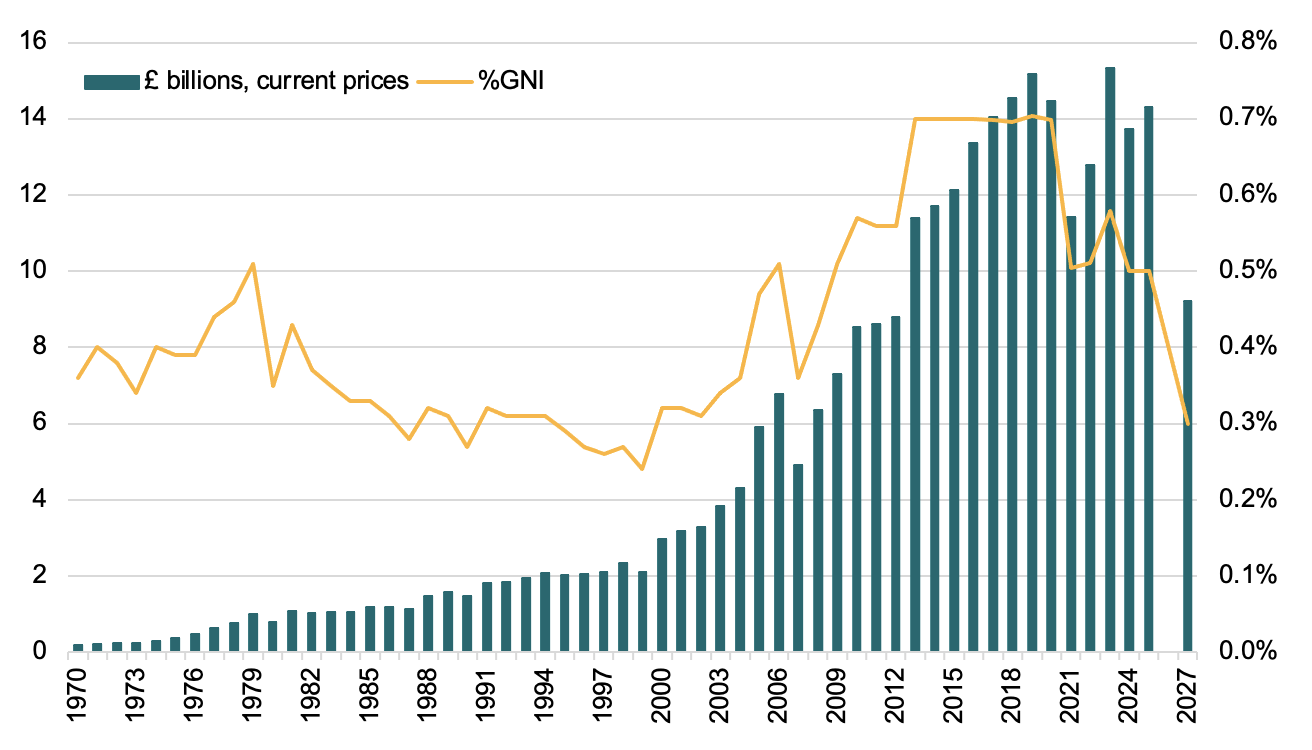
    Foreign aid dropped sharply after the merger, from 0.7% of Britain’s gross national income to 0.5% – a cut of about US$6 billion.

    Development professionals decried Johnson’s merger, arguing it could not have happened at a worse time, with the pandemic heightening the need for global health funding. And coming shortly after Brexit, Britain’s withdrawal from the European Union, DFID’s demise further called into question Britain’s commitment to global cooperation.

    Less money, less impact

    Five years later, it’s not clear that dismantling DFID has made British foreign aid more efficient or effective, as Johnson pledged.

    “We have seen evidence of where a more integrated approach has improved the organisation’s ability to respond to international crises and events, which has led to a better result,” reads one 2025 report by the U.K.’s National Audit Office.

    Two departments in one – but not twice the budget.
    Mike Kemp/In Pictures via Getty Images

    Yet, the auditors add, the British government has spent at least £24.7 million – US$32 million – to merge its aid and diplomacy offices, and it failed to track these costs. Nor did the leaders of the merger set out a clear vision for its new purpose.

    Britain’s slimmer new Foreign, Commonwealth and Development Office has also relinquished the U.K.’s past leadership in research and expertise, largely due to pay reductions and restrictions on hiring non-British nationals.

    From the outset, DFID had invested substantially in building expertise in global development, particularly in conflict-ridden states. In 2001, for example, it spent almost 5% of its budget – an unusually high amount – on research and policy analysis to design and assess its programs.

    DFID produced regular case studies of the projects it funded, which included getting Syrian refugee children back in school, building roads that help Rwandan farmers move their products to market, and providing health care after Pakistan’s 2010 floods.

    Given the “development expertise that was lost with the merger,” the U.K. government can no longer conduct “the kind of rigorous, long-term focus necessary to make a real impact,” said the Center for Global Development in a recent report.

    A 2022 study suggests that DFID’s dismantling was a fundamentally political move, “divorced from substantive analysis of policy or inter-institution relationships.”

    Britain’s new Prime Minister Keir Starmer, of the leftist Labour Party, initially promised to boost British foreign aid. But in early March 2025, he backtracked, announcing instead a further cut to foreign aid.

    By 2027, the U.K. government will spend just 0.3% of its budget on overseas aid. That’s roughly $11 billion less than before the merger in 2019.

    ‘Clear and easy target’

    USAID’s budget was much larger than DFID’s, and the administration apparently wants not to streamline U.S. foreign aid but halt it almost entirely. If this effort succeeds, it will have even more severe effects worldwide, at least in the immediate term.

    The global health programs administered by USAIDm which combat diseases such as HIV, tuberculosis and malaria, have received bipartisan and global praise. The PEPFAR program, which USAID helps administer, distributes antiretroviral drugs worldwide. It alone has saved 25 million lives over the past two decades, including the lives of 5.5 million babies born healthy to mothers with HIV.

    Development professionals tend to see independent government agencies such as USAID and DFID as better able to prioritize the needs of the poor because their programming is run separately from partisan policies.

    Yet standalone agencies are also more visible – and so more vulnerable to political targeting.

    DFID was a clear and easy target when Johnson began his pandemic-era budget-slashing. USAID is now suffering a similar fate.

    Sarah Stroup does not work for, consult, own shares in or receive funding from any company or organization that would benefit from this article, and has disclosed no relevant affiliations beyond their academic appointment.

    ref. US isn’t first country to dismantle its foreign aid office − here’s what happened after the UK killed its version of USAID – https://theconversation.com/us-isnt-first-country-to-dismantle-its-foreign-aid-office-heres-what-happened-after-the-uk-killed-its-version-of-usaid-250868

    MIL OSI – Global Reports

  • MIL-OSI United Kingdom: British start-up wins £1 million AI prize for breakthrough slashing materials development from years to days

    Source: United Kingdom – Executive Government & Departments

    Press release

    British start-up wins £1 million AI prize for breakthrough slashing materials development from years to days

    A British AI-driven innovation that dramatically speeds up the development of materials used in wind turbines and electric vehicle batteries has won the UK government’s £1 million Manchester Prize.

    Manchester Prize winner announced.

    • Polaron awarded £1 million for revolutionary AI technology transforming materials innovation.
    • Breakthrough expected to fast-track new materials for energy, infrastructure, and electric vehicles.
    • Manchester Prize helping to unlock AI innovation to drive growth as part of government’s Plan for Change.

    A British AI-driven innovation that dramatically speeds up the development of materials used in wind turbines and electric vehicle batteries has won the UK government’s £1 million Manchester Prize.

    Advanced materials are essential to modern life, from metal alloys reinforcing bridges and skyscrapers to batteries powering electric vehicles. Yet, developing them has traditionally been slow, costly and unpredictable. 

    Polaron, a spin out from Imperial College London, speeds up the development of these materials from years to days – which could be game-changing for the government’s Plan for Change to get Britain building, deliver economic growth and accelerate net zero through British innovation.

    It will receive £1 million in UK government funding to further develop its groundbreaking AI solution which uses microstructural images – the microscopic features of a material visible under a microscope – to rapidly analyse and predict how materials will perform. This new approach helps manufacturers create stronger, lighter and more efficient materials for clean energy, transport and infrastructure. 

    Secretary of State Peter Kyle said:  

    Polaron exemplifies the promise of AI and shows how, through our Plan for Change, we are putting AI innovation at the forefront.

    AI could generate £400 billion to our economy over the next five years, supporting trailblazing companies like Polaron is essential to achieving that vision.  

    Technologies like these will help us meet our net zero targets while creating new jobs and opportunities for working people. Our commitment is clear – we are fully embracing AI to drive growth, improve public services and position the UK as a global leader in AI innovation. 1

    The Manchester Prize rewards innovative AI solutions addressing major societal challenges, with the first round focused on energy, environment, and infrastructure. Nearly 300 teams from across the UK competed in its first year, with ten finalists each receiving £100,000 and support to further develop their innovations. 

    Polaron’s win comes on the back of the UK government’s new blueprint for AI, which will unleash the technology to help deliver a decade of national renewal. Harnessing innovative AI solutions like this is key to realising the government’s Plan for Change and demonstrates the transformative potential of AI, not only to drive breakthroughs in industry but also to transform public services and improve the lives of citizens across the country. 

    Business Secretary Jonathan Reynolds said:

    Our Plan for Change will deliver economic growth, and for that to succeed we need to support companies such as Polaron across the UK in delivering the cutting-edge materials of the future, supported by our Industrial Strategy.

    This government is determined to embrace each and every opportunity of new technologies like AI, which will not only help British companies develop products we can use at home but also open up access for them to export them overseas.

    The government has already taken steps to accelerate how game changing technologies and innovations can be put into the hands of the British public – announcing the new Regulatory Innovation Office which will reduce burdens for businesses hoping to bring new products and services to market. This will involve supporting regulators to update regulation, speeding up approvals, and ensuring regulators can work seamlessly together – bulldozing barriers to innovation to help grow the economy.

    The Manchester Prize was launched in December 2023 by the Department for Science, Innovation, and Technology (DSIT) and is delivered in partnership with Challenge Works. It supports UK AI innovations which will help to tackle some of society’s biggest shared challenges. 

    The second round of the Manchester Prize was launched in November 2024, focussed on ‘AI for Clean Energy Systems’. The 10 finalists selected to receive £100,000 will be confirmed in Spring, before a panel of judges selects the winner who will secure a £1 million grand prize to further support their innovation.  

    Notes to editors

    1. Public First, ‘Google’s Impact in the UK 2023’, 2024 

    For further information and to follow the Manchester Prize, visit www.challengeworks.org.uk//challenge-prizes/manchester-prize

    Challenge Works is a global leader in designing and delivering high-impact challenge prizes that incentivise cutting-edge innovation for social good.

    DSIT media enquiries

    Email press@dsit.gov.uk

    Monday to Friday, 8:30am to 6pm 020 7215 300

    Updates to this page

    Published 19 March 2025

    MIL OSI United Kingdom

  • MIL-OSI: BSN Finance Outperforms the Competition—Voted Best Australian Trading Company

    Source: GlobeNewswire (MIL-OSI)

    Singapore, March 19, 2025 (GLOBE NEWSWIRE) — In a defining moment for Australia’s financial sector, BSN Finance has been named the Best Australian Trading Company, solidifying its reputation as a market leader in cutting-edge trading solutions. This recognition comes as BSN Finance continues to outperform competitors, providing investors with powerful analytics, seamless execution, and data-driven market insights.

    As the demand for high-performance trading platforms grows, BSN Finance has emerged as the top choice for traders and investors across Australia, thanks to its advanced technology, real-time stock indicators, and institutional-grade execution speeds.

    A Market Leader in Trading Innovation

    Winning the title of Best Australian Trading Company is a testament to BSN Finance’s commitment to delivering cutting-edge solutions for stock market investors. The platform’s award-winning technology integrates:

    • Real-time stock analytics to help investors identify optimal trade opportunities.
    • High-speed execution capabilities, reducing slippage and maximizing returns.
    • Smart risk management tools for greater portfolio stability.
    • Customizable trading dashboards, tailored for Australian market conditions.

    By leveraging machine learning, advanced data analysis, and automated trading insights, BSN Finance ensures investors gain a competitive edge in stock trading.

    Why Australian Investors Prefer BSN Finance

    With a strong focus on the Australian Securities Exchange (ASX), BSN Finance provides localized insights and market-specific trading tools that help traders navigate the Australian stock market with precision.

    Unlike global platforms that cater to multiple regions, BSN Finance is uniquely designed to meet the needs of Australian investors, ensuring optimized trade execution, relevant stock data, and real-time analysis tailored for the ASX.

    This localized approach has driven a surge in user satisfaction, with traders praising the platform’s efficiency, accuracy, and ease of use.

    What Traders Are Saying About BSN Finance

    The impact of BSN Finance is best reflected in the experiences of its growing community of traders:

    Michael T., Sydney – “I’ve used multiple trading platforms, but BSN Finance is by far the best. The real-time stock indicators have helped me make smarter investment decisions, and the execution speed is unmatched!”

    Samantha L., Melbourne – “As a long-term investor, I rely on accurate market insights. BSN Finance gives me the data I need to analyze trends effectively, and their risk management tools have made my portfolio much more secure.”

    Daniel R., Brisbane – “I was skeptical about switching platforms, but BSN Finance has exceeded my expectations. The depth of market data and seamless interface make trading easier and more efficient than ever!”

    Emily K., Perth – “I love how BSN Finance is built for Australian traders. Their ASX-focused analytics are a game-changer, and I finally feel like I have the tools I need to trade with confidence.”

    Setting the Benchmark for Trading Technology

    As trading technology continues to evolve, BSN Finance remains committed to pushing the boundaries of market intelligence and execution performance. By focusing on data-driven trading solutions, the platform ensures that Australian investors have access to world-class tools and real-time insights to stay ahead of the market.

    The recognition as Best Australian Trading Company is a reflection of BSN Finance’s dedication to continuous improvement, innovation, and investor success.

    About BSN Finance

    BSN Finance is a premier financial technology company, providing advanced trading solutions for Australian investors. With a focus on market analytics, portfolio management tools, and cutting-edge execution technology, the platform is designed to help traders maximize their performance in the stock market.

    The MIL Network

  • MIL-OSI USA: SBA Sets Dates for Free National Small Business Week Virtual Summit

    Source: United States Small Business Administration

    WASHINGTON — Today, the U.S. Small Business Administration and SCORE, mentors to America’s small businesses and an SBA resource partner, set the dates for the 2025 National Small Business Week virtual summit. The free two-day online event will take place May 6 and 7 from 10 a.m. to 6 p.m. ET and registration is required.

    The virtual summit will feature educational workshops presented by cosponsors, access to federal resources, and networking and mentorship opportunities. Participants will be able to learn about a wide range of topics including manufacturing, digital marketing, cybersecurity and AI, cryptocurrency and online business resources. A detailed agenda and list of speakers for the virtual summit will be published soon.

    “Fostering small business growth is at the heart of what we do, and the National Small Business Week virtual summit embodies that commitment,” SCORE CEO Bridget Weston said. “SCORE is proud to once again co-host this event with the SBA. We’re looking forward to this opportunity to empower entrepreneurs with the timely, useful resources and information they need to launch and grow their businesses.”

    The National Small Business Week virtual summit is part of SBA’s year-round efforts to leverage technology to reach small business owners in communities across America. An in-person, national award celebration will take place on May 5 in Washington, D.C., and local winners will be recognized at award events across the nation.

    Details on National Small Business Week, the virtual summit and registration are featured on National Small Business Week and will be updated as additional information and activities are confirmed. Local events will be featured on Find upcoming events and identifiable by searching with #SmallBusinessWeek.  

    ###

    About SCORE 

    SCORE, the nation’s largest network of volunteer, expert business mentors, is dedicated to helping small businesses get off the ground, grow and achieve their goals. Since 1964, SCORE has provided education and mentorship to more than 11 million entrepreneurs. SCORE is a 501(c)(3) nonprofit organization and a resource partner of the U.S. Small Business Administration.

    About the U.S. Small Business Administration

    The U.S. Small Business Administration helps power the American dream of entrepreneurship. As the leading voice for small businesses within the federal government, the SBA empowers job creators with the resources and support they need to start, grow, and expand their businesses or recover from a declared disaster. It delivers services through an extensive network of SBA field offices and partnerships with public and private organizations. To learn more, visit www.sba.gov.

    Cosponsorship Authorization #24-44-C. SBA’s participation in this Cosponsored Activity is not an endorsement of the views, opinions, products or services of any Cosponsor or other person or entity. All SBA programs and services are extended to the public on a nondiscriminatory basis.

    MIL OSI USA News

  • MIL-OSI USA: SPC Tornado Watch 57

    Source: US National Oceanic and Atmospheric Administration

    Note:  The expiration time in the watch graphic is amended if the watch is replaced, cancelled or extended.Note: Click for Watch Status Reports.
    SEL7

    URGENT – IMMEDIATE BROADCAST REQUESTED
    Tornado Watch Number 57
    NWS Storm Prediction Center Norman OK
    1215 PM CDT Wed Mar 19 2025

    The NWS Storm Prediction Center has issued a

    * Tornado Watch for portions of
    Far Eastern Iowa
    Northern and Central Illinois
    Western Indiana

    * Effective this Wednesday afternoon and evening from 1215 PM
    until 900 PM CDT.

    * Primary threats include…
    A few tornadoes and a couple intense tornadoes possible
    Scattered damaging wind gusts to 70 mph possible
    Scattered large hail events to 1.5 inches in diameter possible

    SUMMARY…Scattered supercell thunderstorms are expected to develop
    northeast through the early evening. These storms may produce a few
    tornadoes, damaging gusts, and hail.

    The tornado watch area is approximately along and 90 statute miles
    east and west of a line from 25 miles west northwest of Marseilles
    IL to 60 miles east of Salem IL. For a complete depiction of the
    watch see the associated watch outline update (WOUS64 KWNS WOU7).

    PRECAUTIONARY/PREPAREDNESS ACTIONS…

    REMEMBER…A Tornado Watch means conditions are favorable for
    tornadoes and severe thunderstorms in and close to the watch
    area. Persons in these areas should be on the lookout for
    threatening weather conditions and listen for later statements
    and possible warnings.

    &&

    AVIATION…Tornadoes and a few severe thunderstorms with hail
    surface and aloft to 1.5 inches. Extreme turbulence and surface wind
    gusts to 60 knots. A few cumulonimbi with maximum tops to 400. Mean
    storm motion vector 22035.

    …Leitman

    SEL7

    URGENT – IMMEDIATE BROADCAST REQUESTED
    Tornado Watch Number 57
    NWS Storm Prediction Center Norman OK
    1215 PM CDT Wed Mar 19 2025

    The NWS Storm Prediction Center has issued a

    * Tornado Watch for portions of
    Far Eastern Iowa
    Northern and Central Illinois
    Western Indiana

    * Effective this Wednesday afternoon and evening from 1215 PM
    until 900 PM CDT.

    * Primary threats include…
    A few tornadoes and a couple intense tornadoes possible
    Scattered damaging wind gusts to 70 mph possible
    Scattered large hail events to 1.5 inches in diameter possible

    SUMMARY…Scattered supercell thunderstorms are expected to develop
    northeast through the early evening. These storms may produce a few
    tornadoes, damaging gusts, and hail.

    The tornado watch area is approximately along and 90 statute miles
    east and west of a line from 25 miles west northwest of Marseilles
    IL to 60 miles east of Salem IL. For a complete depiction of the
    watch see the associated watch outline update (WOUS64 KWNS WOU7).

    PRECAUTIONARY/PREPAREDNESS ACTIONS…

    REMEMBER…A Tornado Watch means conditions are favorable for
    tornadoes and severe thunderstorms in and close to the watch
    area. Persons in these areas should be on the lookout for
    threatening weather conditions and listen for later statements
    and possible warnings.

    &&

    AVIATION…Tornadoes and a few severe thunderstorms with hail
    surface and aloft to 1.5 inches. Extreme turbulence and surface wind
    gusts to 60 knots. A few cumulonimbi with maximum tops to 400. Mean
    storm motion vector 22035.

    …Leitman

    Note: The Aviation Watch (SAW) product is an approximation to the watch area. The actual watch is depicted by the shaded areas.
    SAW7
    WW 57 TORNADO IA IL IN 191715Z – 200200Z
    AXIS..90 STATUTE MILES EAST AND WEST OF LINE..
    25WNW MMO/MARSEILLES IL/ – 60E SLO/SALEM IL/
    ..AVIATION COORDS.. 80NM E/W /30NE BDF – 43N PXV/
    HAIL SURFACE AND ALOFT..1.5 INCHES. WIND GUSTS..60 KNOTS.
    MAX TOPS TO 400. MEAN STORM MOTION VECTOR 22035.

    LAT…LON 41498739 38638619 38638953 41499087

    THIS IS AN APPROXIMATION TO THE WATCH AREA. FOR A
    COMPLETE DEPICTION OF THE WATCH SEE WOUS64 KWNS
    FOR WOU7.

    Watch 57 Status Report Message has not been issued yet.

    Note:  Click for Complete Product Text.Tornadoes

    Probability of 2 or more tornadoes

    Mod (50%)

    Probability of 1 or more strong (EF2-EF5) tornadoes

    Mod (30%)

    Wind

    Probability of 10 or more severe wind events

    Mod (50%)

    Probability of 1 or more wind events > 65 knots

    Low (20%)

    Hail

    Probability of 10 or more severe hail events

    Mod (40%)

    Probability of 1 or more hailstones > 2 inches

    Low (20%)

    Combined Severe Hail/Wind

    Probability of 6 or more combined severe hail/wind events

    High (80%)

    For each watch, probabilities for particular events inside the watch (listed above in each table) are determined by the issuing forecaster. The “Low” category contains probability values ranging from less than 2% to 20% (EF2-EF5 tornadoes), less than 5% to 20% (all other probabilities), “Moderate” from 30% to 60%, and “High” from 70% to greater than 95%. High values are bolded and lighter in color to provide awareness of an increased threat for a particular event.

    MIL OSI USA News

  • MIL-OSI: EIB submits SEC Form 18-K/A Amendment n. 14 – Entry into force of change to EIB Statute

    Source: GlobeNewswire (MIL-OSI)

    For immediate release

    19 March 2025

    EIB submits SEC Form 18-K/A Amendment No. 14

    The European Investment Bank (EIB) has submitted its SEC Form 18-K/A Amendment No. 14.

    To view the document, please go to EDGAR Filing Documents for 0000950157-25-000239

    The 18-K/A has also been posted on the EIB website:

    Amendment to the Annual Report 2023 (Form 18-K/A Amendment No 14)

    ENDS

    The MIL Network

  • MIL-OSI Global: If we fully engage with how generative AI works, we can still create original art

    Source: The Conversation – UK – By Anthony Downey, Professor of Visual Culture, Birmingham City University

    Even before the recent protest by a group of well-known musicians at the UK government’s plans to allow AI companies to use copyright-protected work for training, disquiet around artists’ rights was already growing.

    In early February, an open letter from artists around the world called on Christie’s auction house to cancel a sale of art created with the assistance of generative AI (GenAI). This is a form of artificial intelligence that creates content – including text, images, or music – based on the patterns learned from colossal data sets.

    Without giving specific examples, the letter suggested that many of the works included in the sale, which was entitled “Augmented Intelligence” were “known to be trained on copyrighted work without a licence” and suggested that such sales further “incentivises AI companies’ mass theft of human artists’ work”.


    This article is part of our State of the Arts series. These articles tackle the challenges of the arts and heritage industry – and celebrate the wins, too.


    If we think about Dall-E, Midjourney, and Stable Diffusion, all of which use text prompts to generate images and are trained on data sets harvested from online sources, the letter raised significant issues about the nature of artistic creativity and how the legal concept of “fair use” and originality is applied in such cases.

    These are complex debates, encompassing perennial misgivings about machine automation, intellectual property (IP), and the cherished ideal that ingenuity and originality remain the sole preserve of humanity.

    How to think from within GenAI

    The impact of AI on the creative industries has become a major issue in the UK and elsewhere, so much so that we are faced with an existential question: how do we understand the evolving impact of AI on human creativity today?

    The scope of this enquiry reveals a simple fact: we need to develop more accessible and inclusive ways to think from within AI image processing models. This is exactly what my latest research, produced in collaboration with the acclaimed artist and photographer Trevor Paglen, proposes.

    How, this research asks, do we better understand the mechanisms behind the collation and labelling of the data sets that are used to train AI? And how, in turn, can we create new ways for understanding the extent to which AI image-production models inform our experience the world?

    It is, I argue, through the development of interdisciplinary research methods that draw upon the arts and humanities that we can critically engage with these concerns.

    Although the open letter addressed to Christie’s alluded to these topics, it did not, perhaps unsurprisingly, observe the degree to which some of the more prominent artists in the Augmented Intelligence sale had actively engaged in providing visual methods and insights into how GenAI functions.

    It is notable that Holly Herndon and Mat Dryhurst’s work xhairymutantx scrutinises how the data sets used in AI models of image production both define and transform images. For example, if you type the word “Holly Herndon” into Midjourney, it will produce images that are based on data sets derived from Herndon’s online presence.

    To draw attention to, and simultaneously disrupt, this process, the artists generated their own data sets of images and labelled them “Holly Herndon”. The images in these data sets had been previously manipulated to emphasise certain qualities associated with Herndon (her red hair, for example). Once fed back into the AI image processing model, the ensuing images of “Holly Herndon” became evermore outlandish and exaggerated.

    This clearly shows that AI image processing is a highly inconsistent and selective procedure that can be manipulated with ease.

    If we consider how models of AI image processing are used in facial recognition and drone technologies – often with fatal consequences – this is an urgent concern.

    Reflecting upon aerial photography in his work Machine Hallucinations – ISS Dreams, artist and data visualisation pioneer Refik Anandol used a data set of 1.2 million images collated by the International Space Station (ISS). Alongside other satellite images of Earth, he produced an AI-generated composition.

    Employing generative adversarial networks (GANs) – an AI model that trains neural networks to recognise, classify and, crucially, generate new images – Anandol effectively produced a unique landscape that changes over time and never seems to repeat itself.

    In both these examples, artists are not simply engaging in either “mass theft” or using AI models that have been trained on large data sets to mechanically produce images. They are explicitly drawing attention to how the data sets used to train AI can be both strategically engineered and actively disrupted.

    In our recent book (to which I contributed as editor and author), Trevor Paglen, whose work was not in the Christie’s sale, reveals how data sets regularly produce disquieting, hallucinatory allegories of our world.

    Given that GANs are trained on specific data sets and do not experience the world as such, they often produce hallucinatory and uncanny versions of it. Although often considered to be a fault or a glitch in the system, the event of hallucination, as Paglen demonstrates, is nevertheless central to GenAI.

    In images such as Rainbow, which was produced using a data set created and labelled by Paglen, we see a ghostly image of our world that discloses the inner, latent mechanics of image production in GANs.

    Paglen’s practice, alongside that of Dryhurst, Herndon and Anandol, defines a clear distinction between those artists who casually use AI to generate yet more images and those who critically investigate the operative logic of AI. The latter approach is precisely what is needed when it comes to thinking through GenAI and rendering it more accountable as a technology that has evolved to define significant aspects of our lives.

    If we allow that the internal workings of AI are opaque to users and programmers alike, it is all the more crucial that we explore how art practices – and the humanities more broadly – can encourage us to think from within these unaccountable systems. In doing so we could significantly improve levels of understanding and engagement with a technology that is defining the future and our relationship to it.

    Anthony Downey does not work for, consult, own shares in or receive funding from any company or organisation that would benefit from this article, and has disclosed no relevant affiliations beyond their academic appointment.

    ref. If we fully engage with how generative AI works, we can still create original art – https://theconversation.com/if-we-fully-engage-with-how-generative-ai-works-we-can-still-create-original-art-251993

    MIL OSI – Global Reports

  • MIL-OSI: Who Can Actually Do Your Digital Transformation? Your Summer Intern.

    Source: GlobeNewswire (MIL-OSI)

    LAS VEGAS, March 19, 2025 (GLOBE NEWSWIRE) — DreamFactory and Adalo have announced a strategic partnership to eliminate data bottlenecks and empower employees to build business applications without IT intervention.

    The problem with making things better in corporate America
    They are called ‘data silos’ for a reason, and the bigger the company, the harder it becomes for any innovative spirit to come to life. Within the basement of many Global 2000 companies lies a farm of mainframes multiple decades old, and custom-enterprise contracts require any actual customization to occur through pre-approved consultants armed with GANTT charts that never measure beneath 12 months in length. Legacy systems even stopped DOGE, eliciting cabinet-level frustration from Elon Musk himself that “these systems are so old, my people cannot even connect to the data to see what’s going on.” No wonder 70% of digital transformation projects fail, according to the Boston Consulting Group (BCG)1.

    Bottleneck buster

    DreamFactory and Adalo have partnered to end this ‘integration madness’–providing instant plumbing to old systems and the canvas for employees to create the applications they need to get stuff done–all without any need for coding.

    DreamFactory, a LLM and Application Data Gateway, automates what what many firms are struggling with–connecting old and new systems together while adhering to strict data compliance and security. Through creating a portfolio of standardized Application Programming Interfaces (APIs) behind the corporation’s firewall (even in an air-gapped environment such as the DoD), DreamFactory creates a Control Layer for all system data. These APIs are then federated by Roles Based Access Control, meaning that central IT can determine who gets access to what type of data, solving the problem of LLMs retrieving sensitive data and giving it to those it shouldn’t (known as the deterministic data problem in AI).

    Adalo then takes the data served through DreamFactory’s APIs and is able to represent it in any type of application that a team needs. Featuring a drag-and-drop visual canvas with intuitive flows, Adalo is a No Code builder optimized for creating full-scale applications, including automatic publishing to Apple and Google Play App Stores.

    Executive Insight
    “We’re seeing summer interns looking to take on eight-figure business problems–solving the pain associated with legacy systems that are just too expensive to replace. A great example is a workforce dependent on an ERP and several other systems. Instead of slaving internal processes to what these systems need, eating up employee and manager time, companies are creating custom apps in-house that are fast and intuitive. The idea is these fast internal apps then feed the relevant information back to the older systems. The employees bypass consultants, central IT resourcing, and often any imposed cost centre thresholds. Then, of course, there is a real win and sense of ownership for the team,” said James Crennan, CEO of Adalo and Chair of DreamFactory.

    Why It Matters:
    Legacy systems are bleeding corporate budgets dry while throttling innovation and security. The numbers are staggering:

    • IT Budget Drain: Companies spend up to 80% of their IT budgets just maintaining outdated systems instead of innovating (McKinsey, 2023). Globally, legacy maintenance costs exceed $1.14 trillion per year (Mechanical Orchard, 2025).
    • Productivity Black Hole: Employees waste up to three hours per day due to slow, fragmented legacy systems, costing businesses $35,000 per employee annually (UK Productivity Report, 2024). IT teams are equally drained—spending up to 25 hours per week patching legacy systems (CIO Dive, 2024).
    • Cybersecurity Risks: Aging infrastructure is a prime target for hackers, with unpatched vulnerabilities being the root cause of major breaches like Equifax (147M records exposed) and WannaCry ($4 billion in damages) (Forbes, 2023).
    • Regulatory & Compliance Headaches: Outdated IT makes it harder to meet data regulations like GDPR and CCPA, leading to over $2 billion in fines in 2023 (Statista, 2024).
    • Development Bottlenecks: Legacy-bound companies take 6-18 months longer to launch new digital products, forfeiting 3-8% in annual revenue due to missed market opportunities (Forrester, 2023).

    Companies that modernize see up to 40% gains in productivity, 50% faster transaction speeds, and IT cost reductions of up to 41% (McKinsey, 2024).

    The message is clear: modernizing outdated systems isn’t just an IT decision—it’s a business survival strategy.

    Call to Action:
    For senior executives ready to accelerate their digital transformation, discover how Adalo and DreamFactory are turning everyday employees into agents of change. Reach out to Adalo today for more information or to schedule a demo.


    About Adalo
    Adalo is a leading no-code platform that empowers businesses to build web and mobile applications with a simple drag-and-drop interface. Serving startups to enterprise teams, Adalo transforms ideas into impactful digital solutions without the need for extensive coding.

    About DreamFactory
    DreamFactory is an API integration platform that automatically generates secure REST APIs for diverse data sources, unifying legacy and modern systems under one secure access control plane. Its innovative approach enables enterprises to integrate and extend critical systems efficiently and securely.

    Contact Information

    James Crennan – CEO Adalo, Chairman DreamFactory – james.crennan@adalo.com, +1 (775) 577-7769

    Glen Little – Director of Operations, Adalo – glen.little@adalo.com

    Terence Bennett – CEO DreamFactory – terence.bennett@dreamfactory.com

    References

    1. Boston Consulting Group (2020) Flipping the Odds on Digital Transformation Success. Available at: https://www.bcg.com/publications/2020/increasing-odds-of-success-in-digital-transformation (Accessed: 12 March 2025).
    2. McKinsey & Company (2023) AI for IT modernization: Faster, cheaper, better. Available at: https://www.mckinsey.com (Accessed: 12 March 2025).
    3. Mechanical Orchard (2025) Legacy’s drag on productivity. Available at: https://www.mechanicalorchard.com (Accessed: 12 March 2025).
    4. UK Productivity Report (2024) The cost of inefficient systems on workforce productivity. Available at: https://www.ukproductivity.gov.uk (Accessed: 12 March 2025).
    5. CIO Dive (2024) The hidden costs of maintaining legacy IT. Available at: https://www.ciodive.com (Accessed: 12 March 2025).
    6. Forbes (2023) How outdated IT led to major cybersecurity breaches. Available at: https://www.forbes.com (Accessed: 12 March 2025).
    7. Statista (2024) Global fines for data compliance failures. Available at: https://www.statista.com (Accessed: 12 March 2025).
    8. Forrester Research (2023) The impact of legacy systems on revenue and digital agility. Available at: https://www.forrester.com (Accessed: 12 March 2025).
    9. McKinsey & Company (2024) The cost of technical debt and modernization ROI. Available at: https://www.mckinsey.com (Accessed: 12 March 2025).

    1 ‘Flipping the Odds of Digital Transformation Success’ – BCG

    The MIL Network

  • MIL-OSI Global: European defence spending: three technical reasons for political cooperation

    Source: The Conversation – UK – By Francesco Grillo, Academic Fellow, Department of Social and Political Sciences, Bocconi University

    How much would it really cost the European Union to defend itself against aggression? In the immediate term, that question, of course makes us think of Russia, but we can no longer exclude multiple other possibilities, including the potential need to defend territory – say, Greenland – from a former ally.

    How much would it cost to defend Europe if we added in the need to defend the UK, Norway, Turkey or even Canada – and any other Nato country willing to pool resources to fill the void left by US disengagement? Is there an intelligent way to avoid painful trade-offs between this and, say, spending on healthcare or education?

    It looks like EU institutions are finally “doing something” (as former Italian prime minister Mario Draghi recently asked them to do). They may even break the taboo of raising common debt in order to increase spending on joint defence procurements.

    Yet, it also seems they are about to launch a plan that could change the very nature of the European Union without even tackling the question of its financial feasibility. The answer to how joint defence can be paid for certainly doesn’t come from the plan that the European Commission has unveiled on “rearming Europe”. At the very last line of that statement, a figure of €800 billion is posited, but it is not clear how the sum was calculated and quite a few critical qualifications are missing.

    The debate over how much it costs to prevent a war (which is a very different notion from fighting one), has been dominated by what I would call “the fallacy of the percentage of GDP”.

    In 2014 (at the time of Russia’s annexation of Crimea), the leaders of Nato countries agreed to spend at least 2% of their GDP on defence (specifying that retirement benefits to veterans should be included). Yet by 2022, the overall ratio for Nato defence spending had, in fact, shrunk from 2.58% of GDP to 2.51% (thanks to the sharp reduction in the percentage of GDP contributed by the US). And, according to the European Defence Agency, the EU is spending around €279 billion, which is 1.6% of its GDP. Most likely, the €800 billion figure that European Commission president Ursula von der Leyen was citing in her communique is simply an estimate of how much it would yield to increase that spending up to 2% of GDP for each of the next ten years.

    Politicians sometimes need to make back-of-the-envelope calculations, but I would argue that here it points to a much broader problem. Europe hasn’t yet bothered to try to develop a strategy for how this additional money would be spent. A proper strategy should, in fact, start from three key technical considerations. To which I would add a no-less important political one.

    1. Spending smart is better than spending big

    Technologies (including AI) are radically changing the equation. The conflicts in Ukraine and Gaza demonstrate that cheap drones are now the key to modern warfare – not super expensive F35 strike fighters. Why spend billions designing, building and maintaining 2,500 F35s when a drone the size of a mobile phone can cross enemy lines unnoticed?

    In a world in which data is a weapon, and a large-scale attack can be mounted by taking remote control of pagers, what generals call “supremacy” doesn’t necessarily belong to the biggest spender.

    Israel’s military budget is one-third that of Saudi Arabia, yet it dominates the Middle East because its perpetual state of conflict forces innovation. Russia spends less than half of the 27 EU member states, but it has much more experience in hacking other countries’ infrastructures. The EU spends as much as China, but China invests more than twice in research and development and is the world’s largest exporter of drones as a result.

    2. Spending together is better value

    The European parliament estimates that merging the 27 member states’ defence budgets would free up €56 billion (which is a third of what the defence bonds proposed by the Commission would raise).

    Yet the trend is to spend more alone than together. According to the European Defence Agency, the bloc has more than doubled its expenditure on new digital technologies; yet the percentage of that going into joint projects between member states fell from 11% before Ukraine’s invasion to 6.5% in 2023.

    Joint tech spending in Europe.
    Vision, CC BY-ND

    3. Homegrown suddenly looks safer

    Any common defence would also have to rely on “buying European” as much as possible. The F35 fighter jet is another good example here. Denmark agreed to buy 27 of them (to the tune of around €3 billion) with an idea to station four of them in Greenland. The problem is that, according to the former president of the Munich security conference Wolfgang Ischinger, they cannot even take off if remotely disabled by the US. Again, Europe is not walking the walk. The share of equipment that European nations import from the US has massively increased in the last five years.

    A new era for the union

    Defence is probably the most important issue when talking about the Europe of the future. It provides a concrete opportunity to fill a technological gap out of the necessity to do so. Spending on defence in the interests of self-protection may have longer-term benefits beyond the military arena. It has been often the case that military research leads to major breakthroughs that can applied in public services. Who knows. Military innovations with drone or AI technology on today’s battlefields could lead to beneficial uses in peace time.

    The historic opportunity to transform the way we protect ourselves may even force a radical rethinking of not just the EU treaties but of the nature of the EU. The idea of the “coalition of the willing” may, indeed, push Europe towards an alliance which does not include some of its members (such as Hungary) but does include non-members like the UK, Norway and even Turkey. New arrangements will need to be pragmatically flexible.

    Europeans need much more strategy, whereas we now largely have rhetorical announcements with little substance. And we need much more democracy. After all, defence is one of the defining dimensions of the state. Having a common defence policy in Europe could make people feel more like European citizens. But that cannot happen without engaging citizens in an intelligent debate.

    Francesco Grillo is affiliated with the think tank Vision.

    ref. European defence spending: three technical reasons for political cooperation – https://theconversation.com/european-defence-spending-three-technical-reasons-for-political-cooperation-252410

    MIL OSI – Global Reports

  • MIL-OSI Global: Microplastics: are they poisoning crops and jeopardising food production?

    Source: The Conversation – UK – By Denis J. Murphy, Emeritus Professor of Biotechnology, University of South Wales

    Dusan Petkovic/Shutterstock

    Microplastics are hindering photosynthesis, the process by which plants convert energy from the sun into the fruit and vegetables we eat. This threatens massive losses in crop and seafood production over the coming decades that could mean food shortages for hundreds of millions of people.

    So concludes an alarming new study. The authors combined more than 3,000 observations of the effects of microplastics on plants from 157 separate scientific reports, and then extrapolated the results using machine learning, a type of computer model that trains AI to spot patterns in data.

    Microplastic exposure, they found, reduces photosynthesis in land plants and marine and freshwater algae by 7% to 12%. The authors calculated that this could eventually reduce yields of staple crops such as rice, wheat and maize by between 4% and 14%.

    How realistic is this scenario? While the new study does not fully support such dramatic conclusions, it does draw attention to the possible future risks from microplastics.

    The complexities of microplastics

    Plastics are useful and versatile products. But they are also difficult to recycle and during 2025 alone, will probably account for 360 million tonnes of solid waste.

    More insidious are the trillions of tiny fragments these plastic products break up into, now found everywhere from the deep sea to your brain. These microplastics are less than 5mm in size and some of them are as small as 1 micron (micro-metre), meaning that 10,000 of them could easily fit inside an average plant or animal cell.

    More microplastics are formed as larger plastic waste breaks down in the environment.
    Chayanuphol/Shutterstock

    Scientists have estimated that about 11 million tonnes of these microplastics, including 51 trillion individual particles, are released into the ocean each year.

    Researchers increasingly use AI models to analyse complex datasets. The results can often be useful. My colleagues and I used similar methods to analyse massive molecular datasets and determine the chemical composition of palm oil in different regions of the tropics.

    In that case, it was difficult to analyse one group of compounds across a relatively small geographic region. The risks of misleading conclusions are many times greater when trying to analyse microplastics and their different effects globally, as in this new study.

    Indeed, the authors of the new study sought to answer questions that are orders of magnitude more complex, involving vast quantities of microplastics in the entirety of the global biosphere. Other scientists have expressed concern about the limited data used by the current model, that could lead to overspeculation about the possible consequences for food supplies.

    Despite these concerns, the new study is useful for highlighting the growing body of scientific data on the deleterious effects of microplastics, found in ecosystems from the Arctic to the Amazon. Over the past 20 years, evidence of the potential risk of microplastics has steadily accumulated.

    More research is needed

    The main conclusions of the new study are based on extrapolations that may not apply on a global scale. The reality is that there are many thousands of types of microplastics, that differ significantly in their chemical composition, size, environmental distribution and biological effects. The new study did not discriminate between them. This means that it is difficult to study their effects on individual processes within human or plant health.

    Larger microplastics accumulate in the soil while much smaller microplastics can be present in the air and can be directly absorbed into plant cells. In some cases, the smaller microplastics can damage the cellular bodies, called chloroplasts, involved in photosynthesis.

    Previous studies have shown that exposing some algae to microplastics can reduce photosynthesis and increase stress, leading to cell damage similar to the effects of ageing in people. Other studies on crop plants such as tobacco have concluded that the effects of microplastics on photosynthesis vary with the type and dose, exposure duration and plant species. In other words, there is no single approach for comparing the effects on plants as different as a lettuce and an apple tree.

    Plants exposed to microplastics respond in various ways.
    Volodymyr_Shtun/Shutterstock

    Given the potential (albeit speculative) risk to global food production, more priority should be given to rigorous scientific research of microplastics and their effects on both crops and the marine life that supports fish and seafood stocks.

    The World Economic Forum has labelled microplastics as a top ten threat and recommends urgent action. In its latest analysis, it also reported that the average person could ingest between 78,000 and 211,000 of these particles each year. It is estimated that the emission of microplastic particles is likely to more than double in the next 15 years, possibly over 40 million tonnes annually.

    Despite growing concern among scientists and civil society, several of the larger public bodies involved in microplastics research in the US and Europe are considering radical cuts to both environmental research funding and regulatory oversight.

    While poorly understood, the threat of microplastics could rival other serious threats, including climate change and biodiversity loss.


    Don’t have time to read about climate change as much as you’d like?

    Get a weekly roundup in your inbox instead. Every Wednesday, The Conversation’s environment editor writes Imagine, a short email that goes a little deeper into just one climate issue. Join the 40,000+ readers who’ve subscribed so far.


    Denis J. Murphy does not work for, consult, own shares in or receive funding from any company or organisation that would benefit from this article, and has disclosed no relevant affiliations beyond their academic appointment.

    ref. Microplastics: are they poisoning crops and jeopardising food production? – https://theconversation.com/microplastics-are-they-poisoning-crops-and-jeopardising-food-production-252060

    MIL OSI – Global Reports

  • MIL-OSI Economics: Podcast: Neuroscientist Anne-Laure Le Cunff on using AI to set and achieve goals

    Source: Microsoft

    Headline: Podcast: Neuroscientist Anne-Laure Le Cunff on using AI to set and achieve goals

    MOLLY WOOD: Today I’m talking to neuroscientist, educator, and writer Anne-Laure Le Cunff, who created the immensely popular Ness Labs newsletter, which she describes as an exploration of how we can learn how to experiment with ideas, explore creative projects, make better decisions, and reflect on your progress. She is also the author of the new book, Tiny Experiments: How to Live Freely in a Goal-Obsessed World. I cannot wait to hear more about this. She joined us to share insights on why goal setting is broken, how we can use experimentation to improve productivity, how our brains process uncertainty, and how AI can help optimize our approach to all of these areas. And now my conversation with Anne-Laure. Welcome.  

    ANNE-LAURE LE CUNFF: Thanks so much for having me.  

    MOLLY WOOD: So, I want to start with your newsletter and your book. You’ve written a lot about applying lessons from neuroscience and just the basic methodologies of scientific research to productivity and processes and decision making. What would you say are some of the key takeaways? 

    ANNE-LAURE LE CUNFF: It took me a long time to formulate it as I am going to give it to you right now. But the main insight that is covered is that we should always default to curiosity, whatever challenge we’re facing, whatever roadblock, whatever area of doubt. If you decide to approach it with curiosity, you’re not only going to find a solution faster, but it’s also probably going to be a lot more fun. 

    MOLLY WOOD: There’s also this phrase that kicks around in your work, mindful productivity. What can you say about that and why it’s so important for business leaders? As opposed to mindless productivity, which I think we can all understand. [Laughter

    ANNE-LAURE LE CUNFF: A lot of people are a bit confused about this term, mindful productivity. You feel like mindfulness, productivity, like, that doesn’t really go together. The way I explain it is to go back to the definition of mindfulness. Being mindful really just means paying attention without judgment. And that’s what mindful productivity is about. It’s about paying more attention to how you feel, to your output, but also to the experience of producing this output. Paying attention to the way you communicate with others, to the way you manage your time, your energy levels. And then without judgment, a little bit like a scientist, just asking yourself, what can I do better? What can I experiment with? What can I tweak? What can I approach differently? And how can I collaborate with others to be more productive without sacrificing my mental health?  

    MOLLY WOOD: I kind of flippantly said, we can all understand what mindless productivity is, but now I kind of want you to define that too. I think we’re going to understand it better in opposition.  

    ANNE-LAURE LE CUNFF: Yes, mindless productivity, I think, is best defined by the outcome. What happens when you do that, right? And it’s simply burnout, overwhelm, for a lot of people. And the reason why they don’t notice those early signs is because they are mindlessly grinding and hustling and going through their to-do lists and never paying attention to how they actually feel. The focus in mindless productivity is really just on the output itself, how efficient you are, how quickly you can produce the work, but not on all of the other factors that are incredibly important if you want your work and your pace to be sustainable.  

    MOLLY WOOD: Okay, so then we have these two frameworks, enter AI and a whole new level of conversation about productivity. How do you think AI will help us, or hinder us, in terms of fostering this idea of mindful productivity?  

    ANNE-LAURE LE CUNFF: That’s what I find fascinating with AI, is that depending on how you use it, it could really support either mindful productivity or mindless productivity. I like ending on a positive note, so let me start with mindless productivity and how, unfortunately, that might be the most tempting approach in terms of using AI. And that’s really just trying to get AI to do your job, whatever it is you’re doing, in a mindless way, trying to use it to replace you. In order to—again, that’s where the focus is, the focus is on output, right? You just want to produce your output, whatever it is, faster. You want to go through your to-do list faster. A mindful way of using AI to be more productive would be to collaborate with AI to figure out which tasks should be the priority, how to do them better, how you could collaborate with others to perform these tasks in ways that might have been difficult for you to imagine because you didn’t have access to all of that information. And so, in a way you can do your work better, not faster necessarily, but better. And I think to me, that’s the mindset shift that people need to have when it comes to AI: not seeing it as a tool to necessarily just be more productive, but just produce better work.  

    MOLLY WOOD: You know, at this moment, we’re talking about this kind of at the individual level. I wonder how this starts to rise up to leadership. How do business leaders foster exactly the kind of work and partnership that you’re talking about?  

    ANNE-LAURE LE CUNFF: To me, that’s only possible if we remove the sense of shame there is around using AI at the moment. In a lot of organizations, a lot of individuals still have to use AI in secret, where they will perform several tasks and they will manage to finish the presentation, do the three reports, code three applications in one weekend, come back on Monday and say that they did it all on their own, because there is, again, a sense of shame around the fact that you’re not able to do all of these things. And using AI kind of, you know, is sometimes perceived by people who haven’t really used it themselves as a way to take shortcuts. So, to me, in order to harness all of those benefits of AI at a team level, leaders need to make it very clear that it is okay to use AI. And even better than that: it’s encouraged to share with others how you’re using AI so everybody can learn together. And I would go as far as creating spaces for conversations where you ask people on your team, okay, how did you use AI this week? And can you share with the team? What did you learn? Did you discover anything new, anything cool that we could use as well? If you create this culture where AI is smart and a mindful use of AI is celebrated, then you are going to harness all of its benefits. Ultimately, this is a tool that can be used in lots of different ways. And if you want your team to learn faster and better how to use this tool, it’s better if everybody’s learning together rather than hiding the fact that they’re using it.  

    MOLLY WOOD: This also raises this question of this whole idea of, I think, a permission structure and support points to the fact that there is so much uncertainty and fear about this at the leadership level, and then certainly at the employee level. So talk about addressing that uncertainty so that we can create this support and permission.  

    ANNE-LAURE LE CUNFF: I think it’s useful first to understand why we fear uncertainty in the first place. It makes sense from an evolutionary perspective. Our brains were designed to help us survive. And so if you go back thousands of years, the more information you had, the more likely you were to survive. You needed to know who were the players, where the resources were, what was that weird noise in the bushes, right? Today in our world, our brains haven’t evolved that much. We also seek the sense of certainty. We want to feel like we know. We almost feel like we want to be able to predict the future, but obviously we can’t. Today’s world is changing so fast. Technology is evolving incredibly fast as well. Even us as individuals, we are exposed to so much information that we probably change faster also compared to our ancestors in terms of our identities, our values, and our desires. So the way our brain works, which was designed for survival, doesn’t work so well when what you want is not just to survive, but to actually thrive. And so just understanding this and saying, okay, thank you, brain. I know you’re trying to protect me, I understand that, but we’re actually not in great danger right now and we can actually explore and we can experiment. So I think that’s the first step, is just being okay with the fact that this is a natural response from your brain. And it’s okay if you’re feeling a little bit of anxiety when you’re in a situation that you don’t fully understand, which is the case right now in today’s world. And then the second stage is to kind of flip the script here, going back to what uncertainty is, which is a state of unknowing, you don’t have all of the information. That can actually be amazing. That can mean that you have a space for experimentation, you have a sense of possibility. Anything is possible. You can try new things and see what happens. What I recommend is to think about uncertainty like a scientist. When a scientist is faced with something they don’t understand, they don’t freeze. It’s the opposite. They look at it and they say, Huh, what can I learn from this? This is interesting. What kind of experiment could we design around this? And at an organizational level for leaders or individuals, just training yourself to approach uncertainty this way and saying, I don’t quite understand what’s going on here. I clearly don’t have all of the information. Things are changing very fast, but what can I learn? And what are some interesting possibilities that arise from the space of uncertainty?  

    MOLLY WOOD: I mean, I think a lot of leaders are realizing they can use AI as a thought partner to help them with their thinking, right? Like, they can use it to help them evaluate their decision making and their strategies and their priorities. Like, this is metacognition, right?  

    ANNE-LAURE LE CUNFF: Yeah, I actually write a lot about metacognition in my work, and I think this is a uniquely human skill that can actually be enhanced with AI. So, metacognition sounds like a fancy word, but all it means is thinking about thinking. And the reason why I say it’s a uniquely human skill is that we know that a lot of other animals are able to think, but we probably are the only ones that are able to observe our own thoughts, which is amazing, right? We can ask ourselves, why did I think that? Is that thought more logical than this other thought? What would happen if I shared that thought with another thinking being, and if we found the intersection of those two thoughts together? Those are the kind of things that only humans can do. And AI is amazing in the sense that instead of running around and trying to grab a colleague every time you have an interesting thought and you want to see what they think about it, you can just type it up or record it, record a voice note, and send it to an AI that will reply to you and help you. Basically, they will become this thinking partner for you and practice metacognition together.  

    MOLLY WOOD: You know, AI is getting good at cognitive work, and people are using AI as a thinking partner around ideation and creation. And there is fear and pushback around that. And I wonder, you know, how do we sort of continue to talk about this as an opportunity? 

    ANNE-LAURE LE CUNFF: To me, it’s actually really exciting what’s going to become possible with AI helping us with those cognitive tasks. And I think a useful parallel is to think about the discourse we had when the calculators were invented. It is absolutely true that a lot of people are not able anymore to make complex calculations just in their mind, right? You have to take a calculator and you type it up in there and you get the result. But now just look at how the world has evolved. Is that really a bad thing? Is that really something— 

    MOLLY WOOD: Not for me. 

    ANNE-LAURE LE CUNFF: Exactly. And I think that’s completely fine. And also, so this has allowed more people to be able to make those calculations because a lot of them would have not been able to make them in the first place. So that has given access to complex calculations to a lot of people who wouldn’t have that access otherwise. And second, it has also allowed us to work on much more complex projects that were enabled by the fact that we had access to those calculators. To me, AI is going to be the same. There are probably a lot of cognitive tasks that we’re not really going to perform anymore. But I think in a few decades, people from the next generations are going to look back on those tasks that we do today and feel like, I can’t believe you were spending all of that time on those tasks. When now we freed up that time and we’re able to actually focus on true human creativity.  

    MOLLY WOOD: I want to go back to the thing that you said about approaching problems like a scientist, because we are so at this stage right now where every day you find out a new thing that you can do—a new option, a new possibility. And that is experimentation and the process of experimentation, which can be anathema sometimes in business because it raises the prospect of failure or wasted time. So talk about the importance of thinking like a scientist at work.  

    ANNE-LAURE LE CUNFF: I want to first debunk an assumption that people may have when it comes to experimenting at work. When you embrace an experimental mindset, it doesn’t mean that you have to experiment with every single thing all at once, right? There might be areas of the business where things are actually working very well, and more of the same is the right approach. Having an experimental mindset is just about being intentional, about where you keep on doing things in the same way, and where you might benefit from reopening that experimental window and questioning your assumptions and just saying, is the way we’ve been doing things really the only way to do this, and is that the best way? And so what I would recommend in general, as part of a team, is to have a couple of experiments running at all time, but that doesn’t mean everything is an experiment. So, picking a few things where you say, actually, you know what, for the next quarter or the next semester, we’re going to approach this particular area of the business or product development in a slightly different way. And at the end, we’re going to look at the data together and decide whether we want to keep going, whether we want to tweak it, or whether that was actually not working really well for us and that’s it, but now we know. So that’s the first thing, just debunking that assumption. The second one is that when you start experimenting, your very definition of success and failure starts changing. Because when you have a very linear approach to work, and you say, this is the outcome, this is the milestone that we need to get to with this—again, the sense of clarity that, this is where we want to go. We have a clear vision, a clear plan, and we’re going to get there. So there is a very binary definition of success and failure. Either you get there or you don’t. When you experiment instead of trying to climb this ladder and get to that destination, instead the mental model is a growth loop. You are going through cycles of experimentation. That means that you don’t start from a specific milestone or destination. You start from a hypothesis or a research question. You notice something interesting where you’re not quite sure. There is some uncertainty around an area of the business, something that you’re curious about, and you say, what if, what if we did things differently? What if we tried that? And the only objective when you experiment is not to get to a specific destination, it’s to learn more, just like a scientist. They collect the data and they don’t try to get a specific result, they just want to learn more. That’s the mindset shift that you want to have here.  

    MOLLY WOOD: Got it. And just to repeat it, you call it a growth loop, like the idea that the more you repeat that process the bigger your loop gets, the bigger your knowledge set gets. 

    ANNE-LAURE LE CUNFF: Exactly. And I compare the mental model really of the ladder and the loop: the ladder with this clear destination where you climb and you try to get there, and the loop that where you keep on growing and you can trust the process. You are going to grow. You are going to expand your expertise and your knowledge, even though you don’t have a clear five-year plan. 

    MOLLY WOOD: Something about the way our brains work that you have talked about is what happens to your brain when you’re learning something new, and this phrase thirst for knowledge that I just want to capture from you because this is fascinating.  

    ANNE-LAURE LE CUNFF: Yeah, absolutely. They’ve conducted some fascinating research that shows that in primates’ brains, when we feel thirst for water, the exact same networks in our brains light up than when we feel thirst for knowledge. So when we say that we’re curious and we have this thirst for knowledge—the word thirst, there couldn’t be a better word to describe that feeling that we have.  

    MOLLY WOOD: What is one question you wish more people would ask you about neuroscience and its application to work and life? Like, why are we not thinking more about our brains?   

    ANNE-LAURE LE CUNFF: Well, you just asked the question I would ask to other people, I think. [Laughter] Why aren’t we thinking more about our brains? I think, actually, this is a great question. I think we should think more about our own thinking. We should spend more time observing our own thoughts, connecting with our emotions, and really turning our attention inwards. 

    MOLLY WOOD: And while we’re talking about our brains, you’ve actually written about this idea that you call the illusion of certainty, which is very compelling and common. What’s going on in our heads that leads to that illusion, and how do we get rid of that?  

    ANNE-LAURE LE CUNFF: Yes, that connects back to what we discussed earlier about why our brains really try to resolve uncertainty as quickly as possible. And because of that, we will try to hoard information. We will try to get as quickly as possible to the most immediate answer, the one that is going to give us that sense of certainty. But unfortunately, that sense of certainty is very often an illusion, because we went for the most obvious answer because we’re basing our sense of certainty of the fact that we spend three days reading nonstop about all of the news about a topic, which is not really how you build certainty. And so just accepting that being a hundred percent certain about what the future looks like is impossible. That’s impossible. All you can do is make predictions, know that these are just predictions, and then adjust your direction based on those predictions.  

    MOLLY WOOD: You have given an example, again, just in terms of interacting and thinking through issues and processing, if you will, this example of how you have conversations with research papers. Can you tell us more about that?  

    ANNE-LAURE LE CUNFF: This is one of my favorite features when it comes to using AI. So, in my academic research, I’m supposed to read dozens of research papers every week—that can take a lot of time. And unfortunately, sometimes you get to the end of the paper and you realize that there was nothing relevant or interesting in there that you can use for your work. So what I’m doing now is that I take the paper, I upload it to AI, and then I ask questions. I have a conversation with the paper and I can ask, okay, tell me what research methods were used here, and because the AI knows what I’m working on also, what are points that you think are relevant based on what I’m working on right now? And another one that I find absolutely amazing is asking, what are the limitations that are mentioned in the paper explicitly, and what are limitations that you notice that are not mentioned in the paper explicitly? And in this way, the AI is really helping me having those conversations. I feel like I’m having a coffee chat with the researchers that tell me all of the juicy stuff that they didn’t include in the paper. Because papers are so short, sometimes you don’t have that much space, and I can use those insights to make decisions as to whether I’m going to use this paper in my own research or not. But it’s not only saving me time, it’s making the entire process of finding that information and reading papers a lot more enjoyable.  

    MOLLY WOOD: What’s sort of one question that you wish more people would ask about the potential of AI at work, right? This is like really a mindset question. What should they be asking about how to use this well?  

    ANNE-LAURE LE CUNFF: If you could focus a hundred percent of your time and energy on the things that are at the intersection of what you’re good at and what the world needs, what would that look like? Because I think that’s what AI can unlock: freeing your time, freeing your energy, freeing your attention from the things that are, that should not be your main area of focus and creating more space for your creativity.  

    MOLLY WOOD: If our listeners could take away one actionable insight from your work, just one, what would you want it to be? 

    ANNE-LAURE LE CUNFF: I would like for them to look at the way they’re doing their work at the moment and, or the way they’re living their life in general, and ask themselves, what’s one area where I could be a little bit more experimental?  

    MOLLY WOOD: So we love to ask our guests how they’re using AI in their work and maybe some use cases and techniques that have really been a game changer. Do you have any examples for us?  

    ANNE-LAURE LE CUNFF: Oh, absolutely. I use AI a lot at work. It’s really a thinking partner. Anytime I’m in doubt, and I would normally grab someone at the coffee machine and just say, hey, can I pick your brain? That’s AI now. I just do that, and I explain I’ve been facing this challenge, I’m feeling a little bit stuck, and do you have any ideas? And usually even when the AI comes back with just a few bullet points, that’s enough sometimes just to give me something to think about and getting unstuck. And very similarly in my personal life as well, I will use it as a tool for brainstorming. I think across the board, really getting unstuck for me is the key phrase in terms of how I use AI at the moment. It makes me think more creatively. It suggests avenues for exploration that I might not have considered in the first place on my own. And it also helps me clarify sometimes my own thoughts, where I can just dump literally anything that’s on my mind and it will come back with a more structured version of what I’ve been thinking about, which is incredibly helpful. 

    MOLLY WOOD: Okay. Fast-forward three to five years. What do you think will be the most profound change in the way we work?  

    ANNE-LAURE LE CUNFF: I think a lot more people will have the beautiful privilege to be able to explore their creativity and to do work that feels meaningful to them, thanks to AI.  

    MOLLY WOOD: And then, what do you think will be hallmarks of organizations that do this well—frontier organizations that will really pull ahead in this new era?  

    ANNE-LAURE LE CUNFF: You probably know what I’m going to say, but I’m going to say it anyway, because I think it’s so important, but creating safe spaces where it’s okay to explore your curiosity, where it’s okay to use AI in experimental ways, and where it’s okay to make mistakes and learn in public. To me, those are going to be the hallmarks of any organization that is at the frontier of what’s possible with this new technology.  

    MOLLY WOOD: I mean, it seems easy, but how do you create those spaces? Like, how do you foster creativity and let people feel safe throwing out what might actually be bad ideas?  

    ANNE-LAURE LE CUNFF: I love that you’re asking this because it’s the same with embracing uncertainty. When you tell people, embrace uncertainty, they tell you, what do you mean? Am I supposed to just relax my shoulders and embrace it? And it’s the same with curiosity, right? How do you actually foster a culture of curiosity and experimentation? And in a very, very practical way, what I would encourage leaders to do is to block some time—you can call it curiosity hour—block some time, put it in your team’s calendar, and say that that’s the hour where every two weeks or three weeks or every month, whatever works for you, everybody is going to share something they experimented with and the results. Did it work? Did it not work? What can we learn together from this? And that’s it. That would be the simplest small steps that they could start taking right now.  

    MOLLY WOOD: And then if I were going to try to tap into my curiosity with an AI thought partner, let’s say I’m stuck. What might I say?   

    ANNE-LAURE LE CUNFF: Well, first you can tell the AI, I’m stuck. I think that’s a great place to start. It’s okay to just type I’m stuck. Here’s the issue. Here are some things that I’ve been thinking about, some options, some ideas. None of them feel quite right. What do you think? I’m stuck. Insert problem. What do you think?  

    MOLLY WOOD: Just building off of curiosity one last time, how do you tap into yours? Do you have a favorite method?  

    ANNE-LAURE LE CUNFF: So I have several methods. The main one for me is to journal. I journal every morning, and sometimes just for five minutes. And part of the prompts that I’m using is, what am I feeling curious about today? And so I always try to have that little connection with my curiosity every day. And then outside of that, I really try to treat my curiosity with a lot of respect, actually. I listen to it. If I feel like I’m curious about a topic, if I’m curious about an idea, a new product, a new technology, even if I feel like right now is not the right time to explore this, that it could distract me from something else, I have a curiosity inbox in my note-taking tool where I will just type that, put it in there, and then I have dedicated time that is a little bit like opening a box of candies where I can pick something and then go and explore. 

    MOLLY WOOD: Thank you so much. Anne-Laure Le Cunff is a neuroscientist, educator, author of the Ness Labs newsletter, which I’m sure you have been convinced to read if you are not already, and also author of the new book, Tiny Experiments. Thank you again so much for the time.  

    ANNE-LAURE LE CUNFF: This was great. I really loved our conversation. Thank you.  

    MOLLY WOOD: Thank you all for joining us, and keep checking your feeds. We have more fascinating guests on the way with actionable insights that can help leaders develop an AI-first mindset, reorient their business for an era of abundant expertise, and maximize the ROI of AI. If you’ve got a question or a comment, please drop us an email at worklab@microsoft.com, and check out Microsoft’s Work Trend Indexes and the WorkLab digital publication, where you’ll find all our episodes along with thoughtful stories that explore how business leaders are thriving in today’s new world of work. You can find all of that at microsoft.com/worklab. As for this podcast, please, if you don’t mind, rate us, review us, and follow us wherever you listen. It helps us out a ton. The WorkLab podcast is a place for experts to share their insights and opinions. As students of the future of work, Microsoft values inputs from a diverse set of voices. That said, the opinions and findings of our guests are their own, and they may not necessarily reflect Microsoft’s own research or positions. WorkLab is produced by Microsoft with Godfrey Dadich Partners and Reasonable Volume. I’m your host, Molly Wood. Sharon Kallander and Matthew Duncan produced this podcast. Jessica Voelker is the WorkLab editor.

    MIL OSI Economics

  • MIL-OSI: Ress Life Investments A/S publishes annual report

    Source: GlobeNewswire (MIL-OSI)

    Ress Life Investments A/S
    Corporate Announcement no. 10/2025
    Annual Report 2024

     http://www.resslifeinvestments.com/

    Corporate Announcement no. 10/2025: Annual Report Ress Life Investments A/S,
    1 January 31 December 2024

    Copenhagen, 19 March 2025

    The Board of Directors and Management have today discussed and approved the Annual Report of Ress
    Life Investments A/S for the period 1 January 2024 – 31 December 2024.

    Key results and highlights:

    • Ress Life Investments A/S realised a net profit before and after tax of USD 20,463,751 for the period 1 January – 31 December 2024.
    • The net asset value per share in the Group increased with 6.5% during the financial year.
    • The profit for the year is mainly a result of fair value adjustments of life insurance policies offset by administrative expenses and staff costs.
    • The fair value of the Group’s investment assets decreased from USD 356,920,259 at 31 December 2023 to USD 284,310,582 at 31 December 2024.
    • The Group’s investments in treasury bills increased from USD 4,936,925 at 31 December 2023 to USD 4,991,360 at 31 December 2024.
    • Equity stands at USD 293,732,907 at 31 December 2024, corresponding to a net asset value of USD 2,595 per share compared with a net asset value of USD 2,437 at 31 December 2023.
    • During the period, 5,701 new ordinary shares were issued and 43,350 shares were bought back from investors and no shares were resold to investors. The Group holds 62,375 treasury shares at 31 December 2024.
    • Management continues to expect that the life insurance policy market will offer attractive returns for the medium term.

    Questions related to this announcement can be made to the Company’s AIF-manager, Resscapital AB.

    Contact person:
    Gustaf Hagerud
    gustaf.hagerud@resscapital.com
    Tel + 46 8 545 282 27

    Yours sincerely,

    Ress Life Investments A/S

    Board of Directors

    Attachments

    The MIL Network

  • MIL-OSI: Beamr Cloud Now Available to Members of NVIDIA’s Startup and ISV Programs at Special Rates

    Source: GlobeNewswire (MIL-OSI)

    Herzliya Israel, March 19, 2025 (GLOBE NEWSWIRE) — Beamr Imaging Ltd. (NASDAQ: BMR), a leader in video optimization technology and solutions, today announced that Beamr Cloud video service is now available to members of NVIDIA’s startup and ISV programs at special rates, helping accelerate their AI development and deployment with high-quality, high-performance, GPU-accelerated video operations. The program members can learn more and request the benefit through the NVIDIA Inception and NVIDIA Connect member portals.

    “Our high-impact engagement with NVIDIA expands with this new offering to over 22,000 startups and ISVs in the NVIDIA Inception and Connect programs,” said  Beamr CEO, Sharon Carmel. “We look forward to delivering our high-quality, high-performance solutions to program members across industries leveraging video at scale – including media and entertainment, user-generated content, machine learning, autonomous vehicles, and more”.

    The NVIDIA Inception program helps startups accelerate innovation and growth with developer resources and training, preferred pricing on NVIDIA products, and opportunities for VC exposure. NVIDIA Connect is a free program that helps ISVs shorten time-to-market through training on the latest accelerated computing technologies, expert guidance, and exclusive pricing on NVIDIA hardware and software.

    Beamr Cloud, available on Amazon Web Services (AWS) and Oracle Cloud Infrastructure (OCI), delivers high-efficiency, scalable video processing, reducing video file size by 30%-50% while lowering CDN, networking and storage costs for VoD and live up to 4K resolution at 60 frames per second (4Kp60). As GPUs are the pixel domain of AI, Beamr enriches videos with AI-powered capabilities, such as visual enhancement and super resolution, in real time during the transcoding process. It supports all major video formats (AVC, HEVC, AV1) and simplifies video modernization to advanced codecs.

    About Beamr

    Beamr (Nasdaq: BMR) is a world leader in content-adaptive video optimization and modernization. The company serves top media companies like Netflix and Paramount. Beamr’s inventive perceptual optimization technology (CABR) is backed by 53 patents and won the Emmy® award for Technology and Engineering. The innovative technology reduces video file size by up to 50% while guaranteeing quality.

    Beamr Cloud is a high-performance, GPU-based video optimization and modernization service designed for businesses and video professionals across diverse industries. It is conveniently available to Amazon Web Services (AWS) and Oracle Cloud Infrastructure (OCI) customers. Beamr Cloud enables video modernization to advanced formats such as AV1 and HEVC, and is ready for video AI workflows. For more details, please visit www.beamr.com

    Forward-Looking Statements

    This press release contains “forward-looking statements” that are subject to substantial risks and uncertainties. Forward-looking statements in this communication may include, among other things, statements about Beamr’s strategic and business plans, technology, relationships, objectives and expectations for its business, the impact of trends on and interest in its business, intellectual property or product and its future results, operations and financial performance and condition. All statements, other than statements of historical fact, contained in this press release are forward-looking statements. Forward-looking statements contained in this press release may be identified by the use of words such as “anticipate,” “believe,” “contemplate,” “could,” “estimate,” “expect,” “intend,” “seek,” “may,” “might,” “plan,” “potential,” “predict,” “project,” “target,” “aim,” “should,” “will” “would,” or the negative of these words or other similar expressions, although not all forward-looking statements contain these words. Forward-looking statements are based on the Company’s current expectations and are subject to inherent uncertainties, risks and assumptions that are difficult to predict. Further, certain forward-looking statements are based on assumptions as to future events that may not prove to be accurate. For a more detailed description of the risks and uncertainties affecting the Company, reference is made to the Company’s reports filed from time to time with the Securities and Exchange Commission (“SEC”), including, but not limited to, the risks detailed in the Company’s annual report filed with the SEC on March 4, 2025 and in subsequent filings with the SEC. Forward-looking statements contained in this announcement are made as of the date hereof and the Company undertakes no duty to update such information except as required under applicable law. investorrelations@beamr.com

    Investor Contact:

    investorrelations@beamr.com

    The MIL Network

  • MIL-OSI: Alaris Equity Partners Income Trust Declares Q1 Distribution

    Source: GlobeNewswire (MIL-OSI)

    NOT FOR DISTRIBUTION IN THE UNITED STATES. 
    FAILURE TO COMPLY WITH THIS RESTRICTION MAY CONSTITUTE A VIOLATION OF UNITED STATES SECURITIES LAW.

    CALGARY, Alberta, March 19, 2025 (GLOBE NEWSWIRE) — Alaris Equity Partners Income Trust (“Alaris” or the “Trust”) (TSX: AD.UN) announces that the Board of Trustees of the Trust (the “Board”) has declared a trust distribution (“Distribution”) of $0.34 per trust unit for the first quarter of 2025, representing $1.36 per unit on an annualized basis. The Distribution is payable on April 15, 2025 to unitholders of record on March 31, 2025.

    About Alaris:

    The Trust, through its subsidiaries, invests in a diversified group of private businesses (“Private Company Partners“) primarily through structured equity. The primary goal of our structured equity investments is to deliver stable and predictable returns to our unitholders through both cash distributions and capital appreciation. This strategy is enhanced by common equity positions, which allow us to generate returns in alignment with the founders of our Private Company Partners.

    For further information please contact:
    Investor Relations
    P: (403) 260-1457
    ir@alarisequity.com

    Alaris Equity Partners Income Trust
    Suite 250, 333 24th Avenue S.W.
    Calgary, Alberta T2S 3E6
    www.alarisequitypartners.com

    The MIL Network

  • MIL-OSI Banking: Satya Nadella’s email on senior leadership update

    Source: Microsoft

    Headline: Satya Nadella’s email on senior leadership update

    Satya Nadella, Chairman and CEO, shared the below communication with Microsoft employees this morning.

    As we’ve seen time and again throughout our 50-year history, times of great change for the world and for our industry require us to have a mindset that enables us to continually adapt and transform ourselves. There’s no question that we are at the forefront of another such moment, with the rapid changes across every industry and business function in this AI era.  

    This means we must have the right product portfolio, the right business models, attract and retain top talent, and optimize our processes to meet changing customer expectations and succeed in the marketplace.  

    With this context, I’ve asked Kathleen Hogan to transition to a new role focused on defining our overarching corporate strategy and structure and leading our continuous transformation as a company. Kathleen will assume a new role as EVP, Office of Strategy and Transformation, reporting to me.  

    It is hard to overstate the impact Kathleen has had on Microsoft as Chief People Officer. Over the past 10+ years, she has led our cultural transformation, as we embraced a growth mindset, positioning us to seize new opportunities with agility and attract and retain world-class talent. She is recognized externally as a consequential HR leader transforming culture and the world of work. Her more than 20-year tenure at Microsoft, including leading our global services business, paired with her prior experience as a McKinsey partner in Silicon Valley, and a development manager at Oracle, makes her uniquely suited to lead this work as we accelerate our pace of change across our people, processes, and portfolio. Kathleen will work across the SLT as we chart this next phase of our transformation, which requires both interpreting the outside and redefining the inside.  

    Kathleen and I have been discussing this transition and succession planning for some time, and we both agree this is the critical juncture to apply new focus and intention to this work. 

    With this transition, I’m very pleased to share that Amy Coleman will assume the role of EVP, Chief People Officer, leading our HR organization. She joins the senior leadership team reporting to me.  

    Amy has led HR for our corporate functions across the company for the past six years, following various HR roles partnering across engineering, sales, marketing, and business development spanning 25 years. In that time, she has been a trusted advisor to both Kathleen and to me as she orchestrated many cross-company workstreams as we evolved our culture, improved our employee engagement model, established our employee relations team, and drove enterprise crisis response for our people. Amy’s commitment to operational excellence and high performance will be key in driving our continued success, and I’m confident in the perspective, expertise, and thoughtful approach she’ll bring as we navigate the next phase of our journey.  

    Please join me in congratulating Kathleen and Amy on their new roles.  

    Satya  

    MIL OSI Global Banks

  • MIL-OSI USA: Generative AI is Making it Easier for Fraudsters to Fool the Public

    Source: US Commodity Futures Trading Commission

    WASHINGTON, D.C. — A new Commodity Futures Trading Commission customer advisory says generative artificial intelligence is making it increasingly easier for fraudsters to create convincing scams. 
    According to the latest Office of Customer Education and Outreach customer advisory, Criminals Increasing Use of Generative AI to Commit Fraud, crooks are using AI to create fake images, voices, videos, live-streaming video chats, social media profiles, and malicious websites designed to look like legitimate financial trading platforms.  
    The OCEO advisory describes how fraudsters use AI to create fraudulent identifications with phony photos and videos that can appear very real if one is not familiar with the advances of AI technology. The fraudsters also are using AI to forge government or financial documents. An FBI public service announcement also warns the public about how criminals are using AI to commit fraud and how the technology is being used in relationship investment scams. 
    “Fraudsters can use new technologies to mask their identities, not only in still photographs, say, in social media profiles, but also in video chats that alter their facial features and voices to match,” said OCEO Director Melanie Devoe. “Identifying real from fake can be difficult. The best defense is to never give money to people you only meet online.” 
    The advisory provides specific actions people should take to protect themselves, including strengthening social media account privacy settings and keeping personal or sensitive information private, especially from people they only know online or callers using phone numbers they don’t recognize. 
    About the Office of Customer Education and Outreach
    OCEO is dedicated to helping customers protect themselves from fraud or violations of the Commodity Exchange Act through the research and development of effective financial education materials and initiatives. OCEO engages in outreach and education to retail investors. The office also frequently partners with federal and state regulators as well as consumer protection groups. The CFTC’s full repository of customer education materials can be found at: cftc.gov/LearnAndProtect.

    MIL OSI USA News

  • MIL-OSI: LambdaTest Introduces WebView Testing with Playwright to Enhance Mobile Application Quality

    Source: GlobeNewswire (MIL-OSI)

    San Francisco, March 19, 2025 (GLOBE NEWSWIRE) — LambdaTest, a leading cloud-based unified testing platform has announced support for WebView testing using Playwright, providing developers and QA engineers with a seamless way to validate the functionality of applications that rely on embedded web browsers. This enhancement ensures a more streamlined testing process, reducing the complexities traditionally associated with WebView testing.

    WebView components play a crucial role in modern mobile applications, often serving as the bridge between native and web-based experiences. However, testing these components has historically been a challenge due to device-specific behaviors and inconsistencies. By integrating WebView testing into Playwright, LambdaTest enables teams to run their test scripts on cloud-based real devices, ensuring accurate and reliable results.

    With this support, users can easily configure their test environments, update dependencies, and execute tests without the need for extensive local setups. The Playwright integration allows for real-time debugging and parallel execution, helping teams accelerate their testing cycles while maintaining high-quality application performance.

    “Testing WebView applications has always been a challenge due to varying device behaviors and configurations,” said Mayank Bhola, Co-Founder and Head of Products. “With this Playwright integration, we are simplifying the process, enabling teams to catch issues early, improve test reliability, and deliver high-quality applications at a faster pace.”

    In addition to WebView testing, LambdaTest continues to expand its cloud testing capabilities, offering a wide range of solutions for cross-browser and mobile testing. This latest release further strengthens LambdaTest’s commitment to providing developers with the tools they need to ensure optimal user experiences across platforms.

    For more information on WebView testing with Playwright, visit https://www.lambdatest.com/support/docs/playwright-webview-test/

    About LambdaTest

    LambdaTest is an AI-native, omnichannel software quality platform that empowers businesses to accelerate time to market through intelligent, cloud-based test authoring, orchestration, and execution. With over 15,000 customers and 2.3 million+ users across 130+ countries, LambdaTest is the trusted choice for modern software testing.

    • Browser & App Testing Cloud: Enables manual and automated testing of web and mobile apps across 10,000+ browsers, real devices, and OS environments, ensuring cross-platform consistency and reliability.
    • HyperExecute: An AI-native test execution and orchestration cloud that runs tests up to 70% faster than traditional grids, offering smart test distribution, automatic retries, real-time logs, and seamless CI/CD integration.
    • KaneAI: The world’s first GenAI-native testing agent, leveraging LLMs for effortless test creation, intelligent automation, and self-evolving test execution. It integrates directly with Jira, Slack, GitHub, and other DevOps tools.

    For more information, please visit, https://lambdatest.com

    The MIL Network

  • MIL-OSI: ThoughtSpot Appoints Micheline Nijmeh as Chief Marketing Officer

    Source: GlobeNewswire (MIL-OSI)

    MOUNTAIN VIEW, Calif., March 19, 2025 (GLOBE NEWSWIRE) — ThoughtSpot, the AI-native Intelligence Platform, has announced the appointment of Micheline Nijmeh as Chief Marketing Officer (CMO). Reporting to CEO Ketan Karkhanis, this strategic appointment to the leadership team underscores ThoughtSpot’s commitment to disrupting the old ways of business intelligence and empowering every decision maker with the power of data.

    Nijmeh is a seasoned marketing executive known for her data-driven approach, with a proven track record of building brands and driving transformation and growth at industry-leading companies, including ZScaler, Salesforce, and Xactly. Most recently she served as CMO at JFrog (Nasdaq: FROG) where she joined the company during its IPO and played a key role in driving its post-IPO growth, market expansion, and brand evolution. Nijmeh has been recognized as Silicon Valley Business Journal’s Women of Influence, a testament to her leadership and dedication to driving impact and diversity in technology.

    “Micheline has helped shape some of the most transformative companies across multiple industries,” said Ketan Karkhanis, Chief Executive Officer at ThoughtSpot. “Her deep expertise in data-driven marketing across both enterprise and product-led-growth motions, combined with her proven track record of crafting impactful go-to-market strategies, make her the ideal CMO to help define the future of the autonomous enterprise and drive the intelligence imperative forward for our customers.”

    In her new role, Nijmeh will spearhead ThoughtSpot’s global marketing strategy and end-to-end customer journey, focusing on increasing brand awareness and driving significant market growth across core markets.

    “I am thrilled to join ThoughtSpot at this pivotal moment. In today’s dynamic market, leveraging data and AI is no longer a luxury, it’s a necessity. Yet, many organizations are still grappling with fragmented data and limited access to actionable insights,” said Micheline Nijmeh, Chief Marketing Officer at ThoughtSpot. “ThoughtSpot’s complete intelligence platform sets it apart as a democratizing force, empowering everyone from the data analyst building models, to the C-Suite executive preparing for board meetings. I look forward to amplifying ThoughtSpot’s impact of bringing this transformative power to every customer.”

    Nijmeh joins ThoughtSpot after the company posted significant fiscal growth in Fiscal Year 2024, closing with 40% year-over-year SaaS growth and more than doubling its monthly active users. ThoughtSpot also unveiled a significant expansion to the company’s artificial intelligence capabilities with the launch of Spotter, an agentic AI analyst, followed by the launch of Analyst Studio, a creator space that empowers data teams to get data ready for AI and analytics.

    In the last year, ThoughtSpot has bolstered its senior leadership, including Ketan Karkhanis as Chief Executive Officer, Brad Roberts as Chief Financial Officer, Ahmed Quadri as Chief Customer Officer, Anthony Lee-Masis as Chief Information Security Officer, and Francois Lopitaux as SVP and General Manager of Emerging Technologies and Products.

    About ThoughtSpot
    ThoughtSpot is the AI-native Intelligence Platform for every enterprise. Our mission is to create a more fact-driven world by empowering everyone to explore any data, ask any question, and uncover actionable insights faster—leading to growth, better business outcomes, and efficiency in their organizations. With ThoughtSpot’s intuitive natural language search, every user can confidently generate answers from their business data at every point of decisioning. The platform’s unified capabilities, along with our agentic AI analyst, Spotter, enable users to create precise, transparent, personalized, and actionable insights with enterprise grade trust, security, and scale. Accessible via the web and mobile app, ThoughtSpot ensures intelligent decision-making happens seamlessly, wherever and whenever needed. For developers, ThoughtSpot Embedded offers a low-code solution to integrate AI-powered analytics directly into products and services, driving data monetization and boosting user engagement for customers. Industry leaders like NVIDIA, Hilton Worldwide, Capital One and Huel rely on ThoughtSpot to transform how their employees and customers take advantage of data to create better business outcomes. Try ThoughtSpot today and experience the new era of analytics.

    PR Contact:
    Lindsay Noonan
    Director of Communications, ThoughtSpot
    press@thoughtspot.com 

    The MIL Network

  • MIL-OSI: SoftServe Wins NVIDIA’s 2025 Americas NPN Service Delivery Partner of the Year

    Source: GlobeNewswire (MIL-OSI)

    AUSTIN, Texas, March 19, 2025 (GLOBE NEWSWIRE) — SoftServe, a premier IT consulting and digital services provider, today announced it has been selected as an NVIDIA Partner Network (NPN) 2025 partner of the year for service delivery in the Americas region. Being named NVIDIA’s 2025 Americas NPN Service Delivery Partner of the Year is a direct reflection of SoftServe’s catalyst work developing and launching a series of Generative AI (Gen AI) solutions built with NVIDIA Blueprints, providing a conduit for rapid enterprise AI adoption.

    SoftServe’s Service Delivery Partner of the Year Award recognize the company’s impact accelerating enterprise deployments with NVIDIA AI Enterprise and NVIDIA Omniverse using custom NVIDIA Blueprints that tap into NVIDIA NIM microservices, including the SoftServe QA Agent, which is the eighth SoftServe Gen AI solution in the series to hit the market.

    “Our teams helped propel NVIDIA Blueprints forward through rapid creation and execution of eight quality solutions that are driving Gen AI proliferation, integration, and innovation across many industries,” said Harry Propper, CEO of SoftServe. “This award is a testament to SoftServe’s mission to make our customers and partners successful. It’s also a well-deserved win underscored by the fact that SoftServe was organically nominated without prompt or application. Our hard work, ingenuity, and close collaboration with the NVIDIA team is what got us here today.”

    The global NPN Program provides partners with the expertise required to develop, deploy, and prioritize energy-efficient accelerated computing solutions designed for today’s most demanding machine learning and AI workloads. Previously, SoftServe was named the 2024 Consulting Partner of the Year for EMEA and the 2023 Outstanding Impact Partner of the Year, demonstrating the company’s strong support in the NVIDIA ecosystem.

    “Businesses racing to adopt AI seek trusted partners with a proven track record of delivering seamless AI experiences,” said Craig Weinstein, Vice President, Americas Partner Organization, NVIDIA. “SoftServe has demonstrated broad expertise in deploying tailored applications built with NVIDIA AI Enterprise, NVIDIA NIM microservices, and NVIDIA Omniverse to help businesses drive results across agentic and physical AI.”

    This year’s awards were announced during NVIDIA’s annual conference, GTC 2025, following the launch of SoftServe QA Agent, which aims to boost quality and assurance (QA) processes with AI test automation. SoftServe is showcasing three immersive demos, including the seventh solution Gen AI Retail Shopping Assistant, at GTC booth #1009.

    Catch the experts in action with presentations on AI content creation, space mission design with NVIDIA Omniverse, and more topics outlined in the GTC 2025 Session Catalog. For those at home to learn more about SoftServe’s collaboration with NVIDIA, please visit this website.

    ABOUT SOFTSERVE
    SoftServe is a premier IT consulting and digital services provider. We expand the horizon of new technologies to solve today’s complex business challenges and achieve meaningful outcomes for our clients. Our boundless curiosity drives us to explore and reimagine the art of the possible. Clients confidently rely on SoftServe to architect and execute mature and innovative capabilities, such as digital engineering, data and analytics, cloud, and AI/ML.

    Our global reputation is gained from more than 30 years of experience delivering superior digital solutions at exceptional speed by top-tier engineering talent to enterprise industries, including high tech, financial services, healthcare, life sciences, retail, energy, and manufacturing. Visit our websiteblogLinkedInFacebook, and X (Twitter) pages for more information.

    The MIL Network

  • MIL-OSI United Kingdom: Joint Statement on UK-Philippines JETCO

    Source: United Kingdom – Executive Government & Departments

    News story

    Joint Statement on UK-Philippines JETCO

    On Monday 17 March, the UK and the Philippines held the inaugural Joint Economic and Trade Committee (JETCO) meeting.

    Joint Statement on UK-Philippines Joint Economic and Trade Committee

    On Monday 17 March, the UK and the Philippines held the inaugural Joint Economic and Trade Committee (JETCO) meeting.

    The Ministerial JETCO reflects a commitment from both governments to upgrade the growing bilateral economic relationship between both countries, including by exploring ways to boost trade and investment, as well as addressing barriers to market access.

    The committee was hosted in London by UK Minister for Trade Policy and Economic Security, Douglas Alexander MP, and co-chaired by Undersecretary Allan B. Gepty of the Philippines Department of Trade and Industry.

    Minister Alexander and Undersecretary Gepty endorsed a programme of work to advance bilateral cooperation over the next 12-18 months, including government-to-government and government-to-business activity in agreed priority areas such as infrastructure, agriculture, energy, economic development, life sciences, and technology.

    Much of this work will be delivered through four Sectoral Working Groups, which will meet annually to facilitate technical policy exchange and project delivery.

    Infrastructure

    The UK and the Philippines committed to progressing a government-to-government Financing Framework Partnership to support the delivery of national priority infrastructure and development programmes and projects in the Philippines.

    The Framework aims to expand access to £5 billion of financing from UK Export Finance (UKEF) and other sources of cooperation, and provide the Philippines with new paths to UK expertise, technology, and comparative advantage.

    Both countries agreed to develop a project pipeline through the Infrastructure Sectoral Working Group in anticipation of the establishment of the Framework.

    Energy

    The UK and the Philippines reflected on the extensive cooperation in the last year between the Department for Business and Trade (DBT), the Philippines Department of Energy, and the UK Offshore Renewable Energy Catapult, supporting the offshore wind development of the Philippines.

    Both countries emphasised the importance of the sector, recognising its contribution to economic growth and an inclusive green transition and committed to continue working closely on policy and regulatory engagement in the coming year, driven by cooperation at the Energy Sectoral Working Group.

    Agriculture

    Minister Alexander and Undersecretary Gepty discussed the benefits of collaboration between the UK Department for Environment, Food and Rural Affairs (DEFRA) and the Philippines Department of Agriculture with a view to safeguarding and expanding market access for agri-food exporters.

    They agreed to continue collaboration across issues such as animal disease detection and antimicrobial resistance as well as new opportunities for collaboration on precision breeding and genetics.

    They endorsed the role of the Agriculture Sectoral Working Group to drive greater trade and investment in our respective agriculture sectors, including by promoting commercial agriculture opportunities in the Philippines and the UK.

    Economic Development

    Minister Alexander and Undersecretary Gepty recognised the important role of bilateral trade in furthering economic development in the Philippines and endorsed efforts to improve utilisation of the Developing Countries Trading Scheme, which offers Philippine exporters tariff-free access on 92% of products.

    They were pleased to note the upcoming launch of an export handbook that details key regulatory compliance requirements, including how to leverage the UK Developing Countries Trading Scheme to benefit from preferential tariff rates.

    They agreed on activities to further strengthen the business landscape in the Philippines and facilitate investment and digitalisation of trade.

    This covers continuing collaboration on regulatory reform initiatives, facilitating business linkages, and capacity building on AI policy frameworks and governance.

    Regional collaboration

    Minister Alexander and Undersecretary Gepty used the JETCO meeting to discuss the importance of cooperation between the UK and the Philippines in support of regional economic integration.

    The UK looks forward to deepening the UK-ASEAN Partnership and working with the Philippines towards its Chairship of ASEAN in 2026.

    Trade promotion and investment

    Minister Alexander and Undersecretary Gepty concluded discussions by acknowledging the potential for future economic growth and shared prosperity through deepening trade links.

    They acknowledged that in 2024, the UK was the largest single investor in the Philippines, driven by investments in renewables.

    The Philippines, being one of the fastest growing economies in Southeast Asia last year with around 6% growth, has the capacity to boost trade in sectors where the UK holds significant commercial expertise.

    Minister Alexander and Undersecretary Gepty emphasised the importance of delivering real impact from strengthened trade and economic discussions.

    They encouraged future trade promotion and investment activities to facilitate more business opportunities in sectors such as technology and infrastructure including energy.

    After the JETCO meeting, UK Trade Envoy to the Philippines, George Freeman MP, and Undersecretary Gepty, co-hosted a business briefing in partnership with the UK-ASEAN Business Council to share insights from discussions and seek industry views on priorities for growing the bilateral trade and investment relationship.

    Bilateral economic relationship

    The Philippines was the UK’s 60th largest trading partner in the end of Q3 2024 accounting for 0.2% of total UK trade.

    Total trade in goods and services between the UK and the Philippines in the same period was £2.8 billion.  

    The new UK-Philippines JETCO adds extra emphasis to the UK’s deepening relationships across the wider Asia Pacific region.

    As an ASEAN Dialogue Partner, the UK is committed to further enhancing engagement with the region, through both multilateral and bilateral forums, including those with the Philippines.

    The JETCO follows the launch of the UK-Philippines Joint Framework for the Enhanced Partnership – an enhancement of our bilateral relations across foreign policy, economic growth, security and defence cooperation amongst other areas.

    Updates to this page

    Published 19 March 2025

    MIL OSI United Kingdom

  • MIL-OSI Global: Why international students could be a critical factor in bolstering Canada’s economic resilience

    Source: The Conversation – Canada – By Isaac Garcia-Sitton, Associate Faculty, School of Education and Technology, Royal Roads University

    In early 2024, the federal government imposed a two-year cap on new study permits. (Shutterstock)

    For decades, international students have contributed to Canada’s research enterprise, workforce development and economic growth.

    Now, as Canada navigates strained relations and an escalating trade war with its largest economic partner, it’s important policymakers stop overlooking international education that could be a critical factor in bolstering Canada’s resilience.

    Unlike volatile trade agreements and fragile supply chains, international education provides a stable, long-term economic and social advantage.


    Read more:
    Canadian supply chains are at the epicentre of Trump’s potential trade war


    Contributions

    In 2018, international students contributed $21.6 billion to Canada’s post-secondary institutions, local communities and gross domestic product (GDP).

    By 2022, that figure had grown to $37.3 billion. This represented just over 23 per cent of Canada’s total service exports and around five per cent of total merchandise exports. The economic contributions from international education outpaced economic contributions from other industries — such as softwood lumber and auto parts.

    But their contributions extend far beyond financial impact. International students drive cutting-edge research in artificial intelligence, clean energy, biotechnology and climate science. This strengthens Canada’s innovation ecosystem and global competitiveness.

    International students also serve as vital ambassadors — diversifying trade connections and expanding Canada’s global reach.

    Despite their undeniable value, recent policy shifts risk undermining Canada’s position as a top destination for global talent. In early 2024, the federal government imposed a two-year cap on new study permits. The cap would mean approximately 360,000 study permits would be approved in 2024 — a decrease of 35 per cent from the previous years.

    However, institutions fell well below the imposed cap. This wasn’t due to a lack of demand but because of the rushed, poorly managed roll-out that amplified disruption beyond expectations. In fall 2024, the number of permits granted was on track to drop by 45 per cent compared to the previous year.

    The government plans a further 10 per cent cut in 2025 and 2026 and will cap approvals at 437,000. They will also, for the first time, restrict master’s and PhD students — limiting access to Canada’s research ecosystem.

    Talent and innovation

    While a cap may have been necessary to moderate the sector’s growth, its rollout created uncertainty for institutions and students. This damaged Canada’s reputation for high-quality education. The impact to our global standing as a top destination for international students will take years to repair.

    The government plans cap student visa approvals at 427,000 by 2026.
    (Shutterstock)

    This policy shift is especially concerning given Canada’s ongoing innovation and productivity challenges. A recent report from U15 research institutions shows Canada lags behind its peers in the Organization for Economic Co-operation and Development (OECD). It’s mainly falling behind in research and development intensity, private sector innovation and technology adoption.

    In 2022, Canada’s research and development spending stood at just under two per cent of GDP. This is well below the OECD average of around three per cent.

    Many small and medium-sized businesses rely on university partnerships for research and development. Cutting international graduate student numbers disrupts these collaborations — hindering innovation at a time when Canada can least afford it.

    Policymakers claim restricting international student permits will ease labour market pressures. But the real problems with the labour market lie in skill mismatches, underemployment and employer hiring biases — not the number of international students.


    Read more:
    Canadian immigrants are overqualified and underemployed — reforms must address this


    With unemployment at around six-and-a-half per cent and youth unemployment at 13.6 per cent, concerns about job competition are valid. Yet newcomers and international students face significant barriers in finding jobs in their fields.

    In 2024, the unemployment rate for recent immigrants reached 11 percent. This is nearly double the unemployment rate for Canadian-born workers. Despite holding advanced degrees, two-thirds of foreign-trained professionals remain underemployed. This may be due to employers undervaluing international credentials and prioritizing “Canadian experience.”

    This trend extends to international student graduates who remain less likely than their Canadian peers to find jobs that match their level of education. In 2023, just over 36 per cent of international graduates with a bachelor’s degree secured roles requiring a university-level qualification, compared to just under 59 per cent of Canadian graduates. International student graduates also earn significantly lower salaries, despite having similar levels of job satisfaction.

    International student graduates face barriers in findings employment.
    (Shutterstock)

    Like many newcomers, I personally faced this Canadian experience barrier when I entered the workforce over 15 years ago as a permanent resident. Despite my education, multilingual abilities and professional skills, I submitted hundreds of applications and secured only a handful of interviews before landing my first opportunity. This frustrating, unnecessary and economically wasteful struggle remains just as prevalent today.

    These barriers not only limit individual potential but also weaken Canada’s ability to harness the talent it attracts.

    Addressing systemic issues

    International students are more than workers — they’re entrepreneurs, innovators and future job creators.

    For instance, as of 2022, nearly 180 of the U.S.’s billion-dollar companies were founded by former international students. Each of these companies created an average of 800 jobs and made up nearly a quarter of all dollar companies.

    Canada risks losing similarly bright minds to more welcoming countries if clear pathways for them to stay, contribute and build businesses aren’t established. This would cost the country both talent and billions in economic potential.

    If Canada is serious about building a stronger, more competitive economy, it must address the systemic issues that stand in the way of international student success.

    This includes modernizing credential recognition so employers can fairly assess international experience and qualifications, expanding co-op programs, internships and mentorships so international students can gain relevant Canadian experience before graduation and protect them from misinformation and questionable recruitment practices.

    Employers need to be educated about immigration pathways to reduce hiring hesitancy. The government also must create a stable and predictable immigration policy framework to give businesses confidence in hiring international graduates.


    Read more:
    International university grads speak about aspirations and barriers


    As Canada continues to face labour shortages and growing economic and political volatility, international education remains a strategic asset. It fuels research, diversifies trading partners, supports innovation and supplies the workforce Canada needs for long-term prosperity.

    The future of Canada’s economy depends on its ability to attract and retain the thinkers, creators, and innovators who will define the next generation of progress. At this critical moment, Canada must decide if it will invest in the talent that fuels innovation, or close the door on opportunity.

    Isaac Garcia-Sitton is affiliated with the Canadian Bureau for International Education (CBIE), the Council of Ontario Universities (COU), and the Council of International Schools (CIS)

    ref. Why international students could be a critical factor in bolstering Canada’s economic resilience – https://theconversation.com/why-international-students-could-be-a-critical-factor-in-bolstering-canadas-economic-resilience-251985

    MIL OSI – Global Reports

  • MIL-OSI United Kingdom: The numbers add up for our economy and air quality

    Source: Scotland – City of Edinburgh

    Council Leader Jane Meagher reflects on the latest edition of Edinburgh by Numbers.

    As those of us who live in the city know, it’s fair to say ‘Auld Reekie’ is no more thanks to our fantastic parks and air quality.

    Edinburgh has almost halved (a 40.9% reduction) greenhouse gas emissions over the last decade or so and people are 1.5x more likely to take up cycling or running in Edinburgh than other parts of Scotland.

    The city benefits from high wages and employment. Plus, we boast some of the highest satisfaction rates in the UK for public transport – testament to the value of keeping services like Lothian Buses publicly owned.

    That’s according to data collated for our latest Edinburgh by Numbers report, an annual snapshot of statistics gathered by the Council’s data team which tells us how our city is performing.

    I’m pleased that this year’s findings paint a picture of a green and thriving city. Most of us (74%) can enjoy local green space within a five-minute walk from home, and in my own ward of Portobello / Craigmillar I’m grateful to see the first signs of spring starting to appear in our fantastic parks.

    Perhaps it is this love for our parks which leads us to be one of the most climate conscious cities in the UK? According to the data, the percentage of people who believe that climate change is an urgent problem continues to increase and has reached nearly 88% in Edinburgh, the highest in Scotland.

    This has been evident during the council’s recent work with young residents to plan for the revitalisation and regeneration of Princes Street, Princes Street Gardens and the area around Waverley Station, with over 100 primary and secondary school pupils sharing their hopes as part of our public consultation on the Waverley Valley. The plans have ignited much debate, with architects choosing to share their own vision for the future of our most famous high street.

    I recognise that Princes Street is a vital and iconic part of our city’s economy and while it experiences the same challenges all high streets face, it is performing better than most with a low vacancy rate. I’m confident that recent changes to non-domestic rates relief on vacant buildings will also encourage landlords to bring long-term empty properties back into operation.

    It’s welcome news that it continues to attract significant investment, with news last week of a Zedwell Hotel replacing the former Debenhams. Cranes along the skyline signal work underway on the former Forsyth’s/Topshop, Next/Zara and Jenners stores, which are also set to become hotels. Eateries Blank Street, Ben & Jerry’s and Popeyes plus retailers MINISO, UNIQLO, and Panerai have all opened in the past year, or have announced plans to do so.

    Plus, as the new St James Quarter fills up, we expect to see demand spill onto Princes Street. Meanwhile, a new approach has been adopted to staging a year-round programme of events at the Ross Bandstand and Princes Street Gardens.

    I have no doubt that this investor confidence is thanks to the resilience of our local economy and our healthy business community. The numbers tell us that Edinburgh has retained its position as the UK’s most economically productive city outside of London, while tourism continues to recover from the pandemic.

    Hotel occupancy rates are at their highest in 6 years (81.4%), 5 million visitors are staying overnight in Edinburgh and it has been a remarkable year for air and rail travel with Edinburgh Airport posting its highest ever passenger numbers in 2024. Edinburgh is well and truly welcoming the world to visit.

    While there is much to celebrate, these findings also speak to the challenges Edinburgh faces. Drawn by good jobs and a good quality of life, migration means our population is growing three times faster than other Scottish cities. We’re living longer, but the birth rate has dropped.

    We know these challenges are on the horizon and that’s why the council budget we set in February prioritises vital services for residents. More affordable housing and infrastructure to help our growing population to move around the city will be key, particularly as we continue to grapple with our housing emergency and work with the Scottish Government to secure the additional resources we need. The ground-breaking visitor levy will also present a unique opportunity, which will invest tens of millions of pounds in preserving and enhancing the features that make our city such a fantastic place to be.

    The latest edition of Edinburgh by Numbers is available to view now.

    MIL OSI United Kingdom