Category: Asia Pacific

  • MIL-OSI Economics: Panasonic’s nanoe(TM) (hydroxyl radicals contained in water) technology achieves 99% inactivation of alcohol- and heat-resistant toxins

    Source: Panasonic

    Headline: Panasonic’s nanoe(TM) (hydroxyl radicals contained in water) technology achieves 99% inactivation of alcohol- and heat-resistant toxins

    Osaka, Japan, March 6, 2025 – Panasonic Corporation (Panasonic) (https://holdings.panasonic/global/) today announced that it has demonstrated the inactivating effect of nanoe (hydroxyl radicals contained in water) technology on endotoxin, which causes aggravation of allergy-like symptoms such as asthma and rhinitis, under the supervision of Masafumi Mukamoto, Professor Emeritus of Osaka Metropolitan University and Visiting Researcher at the University of Hyogo.
    According to the 2023 Patient Survey published by the Ministry of Health, Labour and Welfare, the total number of asthma patients in Japan is approximately 1.85 million.*1 A wide variety of factors are also known to contribute to exacerbation of asthma. Of these, academic studies suggest that endotoxin is one of contributing factors to the aggravation of allergy-like symptoms such as asthma and rhinitis,*2, *3 and its presence in house dust*4 and in air pollutants such as PM 2.5 and Asian sand dust*5, *6 has been confirmed. Endotoxin is also known they derive from gram-negative bacteria such as Escherichia coli and are resistant to alcohol and heat, rendering inactivation by general disinfection methods more difficult.
    Panasonic has demonstrated the inhibitory effect of nanoe (hydroxyl radicals contained in water) technology on 20 types of bacteria, and has also partially identified its inhibitory mechanism on bacteria.*7 In this study, in order to verify its effectiveness against bacterial toxins, Panasonic has newly verified its effects against endotoxin, which is resistant to alcohol and heat. The results demonstrated that exposure to nanoe (hydroxyl radicals contained in water) had an inactivation rate of 99% or higher. Note that this verification was conducted under test conditions and does not attest to effectiveness in actual usage spaces. Also, the test was conducted to verify effectiveness on chemical substances that contribute to the worsening of symptoms, and not on the worsening of the symptoms themselves.
    Panasonic is committed to further advancing nanoe (hydroxyl radicals contained in water) technology and pursuing its possibilities in order to help society by providing safe, secure spaces.

    ■Key points of this test

    According to academic research, endotoxin, which is derived from E. coli and is resistant to alcohol and heat, is a substance that should be carefully monitored because it is contained in Asian sand dust, PM 2.5, and house dust, and is suggested to exacerbate allergy-like symptoms such as asthma and rhinitis.
    The results of irradiating endotoxin with nanoe (hydroxyl radicals contained in water) and comparing it against alcohol and heat treatment confirm that nanoe (hydroxyl radicals contained in water) technology alone is more than 99% effective in inactivating endotoxin. (Test (1))
    The results of endotoxin activity measured by irradiating E. coli with nanoe (hydroxyl radicals contained in water) confirmed an inactivation effect of 99% or higher. (Test (2))

    Test (1)

    Figure 1: Test Overview

    Testing organization: Panasonic Corporation*8
    Test sample: Standard endotoxin
    Test device: nanoe (hydroxyl radicals contained in water) generator
    Test method: A petri dish containing standard endotoxin dissolved in solvent was placed in a 45-liter chamber and exposed to nanoe (hydroxyl radicals contained in water) at a position 5 cm from the petri dish for a predetermined length of time.Endotoxin activity was measured on the samples after exposure.*9Samples with and without exposure to nanoe (hydroxyl radicals contained in water) were compared, and the residual endotoxin activity rate was calculated.*10In order to compare against exposure to nanoe (hydroxyl radicals contained in water), treatment under the conditions in which bacteria are sterilized (heating at 90°C, 10-minute treatment, and ethanol 80 vol%, 5-minute treatment) were performed respectively, and the residual rate of endotoxin activity was calculated.*10

    Test (2)

    Figure 2: Test Overview

    Testing organization: Panasonic Corporation
    Test sample: E. coli
    Test device: nanoe (hydroxyl radicals contained in water) generator
    Test method: A petri dish containing E. coli dissolved in solvent was placed in a 45-liter chamber and exposed to nanoe (hydroxyl radicals contained in water) at a position 5 cm from the petri dish.Endotoxin activity was measured on the samples after exposure.*9Samples with and without exposure to nanoe (hydroxyl radicals contained in water) were compared, and the residual endotoxin activity rate was calculated.*10

    ■Test results

    Test results (1)

    Below are the results of confirming the residual endotoxin activity rate*10 for standard endotoxin exposed to nanoe (hydroxyl radicals contained in water) for 48 hours, treated with alcohol, and treated with heat, respectively. Only nanoe (hydroxyl radicals contained in water) technology showed an inactivation effect of 99% or more.

    Test results (2)

    The results of confirming the residual endotoxin activity rate*10 using E. coli exposed to nanoe (hydroxyl radicals contained in water) for 48 hours are described below. nanoe (hydroxyl radicals contained in water) technology showed an inactivation effect of 99% or more.

    ■Comments from Masafumi Mukamoto, Professor Emeritus, Osaka Metropolitan University and Visiting Researcher, University of Hyogo*

    Endotoxin is a toxin that exists on the surface of gram-negative bacteria such as E. coli. It has various biological activity, and has been suggested to aggravate allergy-like symptoms such as asthma and rhinitis. Endotoxin has been reported as present in air pollutants such as PM 2.5 and Asian sand dust, as well as house dust. Particular attention should be paid to Asian sand dust, as the number of days it is observed increases during spring. In addition, endotoxin is known to be resistant to alcohol and heat, so even if bacterial sterilization is performed, it may not be possible to inactivate endotoxin. Thus, I think it is significant that inactivation of endotoxin by nanoe (hydroxyl radicals contained in water) technology was demonstrated in this test.
    *Edited from comments received at the request of Panasonic.

    ■Principle of nanoe (hydroxyl radicals contained in water) generation

    The atomizing electrode is cooled by a Peltier element, which condenses moisture in the air to create water. Afterwards, a high voltage is applied across the atomizing electrode and the opposite electrode to generate nanoe (hydroxyl radicals contained in water) contained in water that contain hydroxyl radicals of approximately 5 to 20 nanometers in size. (Figure 5)

    Notes:*1: Reference: “2023 Patient Survey” Ministry of Health, Labour and Welfare. https://www.mhlw.go.jp/toukei/saikin/hw/kanja/23/index.html*2: Reference: M. Berger et al. “Lipopolysaccharide amplifies eosinophilic inflammation after segmental challenge with house dust mite in asthmatics,” Allergy, vol. 70, No. 3, pp. 257-264, 2014.*3: Reference: Braga CR et al. “Nasal provocation test (NPT) with isolated and associated dermatophagoides pteronyssinus (Dp) and endotoxin lipopolysaccharide (LPS) in children with allergic rhinitis (AR) and nonallergic controls,” J Investig Allergol Clin Immunol., vol. 14, No. 2, pp. 142-8, 2004.*4: Reference: Peter S. Thorne et al. “Endotoxin Exposure Is a Risk Factor for Asthma The National Survey of Endotoxin in United States Housing,” American Journal of Respiratory and Critical Care Medicine, vol. 172, No. 11, pp. 1371-1377, 2005.*5: Reference: Takamichi Ichinose, “Progress of the research on air pollution (PM 2.5, Asian sand dust, etc.) and allergy,” Japanese Journal of Allergology, vol. 63, No. 8, pp. 1085-1094, 2014.*6: Reference: Yahao Ren et al. “Enhancement of OVA-induced murine lung eosinophilia by co-exposure to contamination levels of LPS in Asian sand dust and heated dust,” Allergy Asthma Clin Immunol., vol. 10, No. 1, pp. 30, 2014.*7: [Press Release] Visual Imaging of Bacterial Inhibition Mechanism by Hydroxyl Radicals Contained in Water in Collaboration with Harvard University (March 29, 2012)*8: Endotoxin testing and data acquisition were conducted in cooperation with FUJIFILM Wako Bio Solutions Corporation.*9: Endotoxin testing was conducted in accordance with the “General Rules” and “General Testing Methods” of the Revised Japanese Pharmacopoeia, 18th Edition.*10: Panasonic’s own calculation of residual endotoxin activity rate = (activity after treatment/untreated activity) x 100

    ◆A summary of this press release can be found here:https://www.panasonic.com/global/consumer/nanoe/ja/topics/250306.html
    ◆Results of research into nanoe (hydroxyl radicals contained in water) technology to date can be found here:https://www.panasonic.com/global/consumer/nanoe/ja.html

    Media Contact:

    Living Appliances and Solutions Company, Panasonic CorporationPublic Relations, Corporate Policy Department, Corporate Planning CenterEmail: las-pr@gg.jp.panasonic.com

    Inquiries:

    Living Appliances and Solutions Company, Panasonic CorporationDevices Products Business Unit, Beauty and Personal Care Business DivisionTelephone: +81-(0)749-27-0485 (available 9:30 a.m. to 5:00 p.m. excluding Saturdays, Sundays, and public holidays)

    About Panasonic Corporation
    Panasonic Corporation offers products and services for a variety of living environments, ranging from homes to stores to offices and cities. There are five businesses at the core of Panasonic Corporation: Living Appliances and Solutions Company, Heating & Ventilation A/C Company, Cold Chain Solutions Company, Electric Works Company and China and Northeast Asia Company. The operating company reported consolidated net sales of 3,494.4 billion yen for the year ended March 31, 2024. Panasonic Corporation is committed to fulfilling the mission of Life Tech & Ideas: For the wellbeing of people, society and the planet, and embraces the vision of becoming the best partner of your life with human-centric technology and innovation. Learn more about Panasonic: https://www.panasonic.com/global/about/
    MIL OSI Economics

  • MIL-Evening Report: How Trump is weaponising the Department of Justice, and the ‘dark’ tactic he’s using to get away with it

    Source: The Conversation (Au and NZ) – By Stephen Harrington, Associate Professor, School of Communication, Queensland University of Technology

    It’s hard to keep track of US President Donald Trump’s many notable acts since returning to the White House. His recent pro-Russia stance on the war in Ukraine has, rightly, received a lot of attention.

    But for every big moment, there are others that fly under the radar. One such issue is the politicisation of the Department of Justice (DoJ).

    Although there is longstanding precedent that the DoJ remains politically neutral in its operations, recent events have indicated a dramatic break from that tradition.

    And, importantly, Trump has been laying the groundwork to justify this for nearly two years, using a propaganda tactic that’s been employed by authoritarian governments throughout history.

    Strategic sidelining

    The current administration has attempted to fire or sideline anyone at the DoJ who was involved with prior investigations and prosecutions of the now-president.

    This includes special counsel Jack Smith’s investigations into several aspects of Trump’s wrongdoing, which have since ended. Several lawyers have been fired, ostensibly because “the Acting Attorney-General does not trust these officials to assist in faithfully implementing the President’s agenda”.

    This action is not only vindictive, but likely designed to intimidate would-be investigators and make them think twice before further examining any wrongdoing by Trump or his associates.

    Equally noteworthy has been the department’s attempts to drop corruption charges against New York mayor Eric Adams.
    The official reason is that pursuing the charges might “interfere” with Adams’ reelection campaign.

    In reality, however, Adams has been accused of cutting a deal with the administration: he agrees to assist with Trump’s immigration crackdown in return for having the charges against him withdrawn (although not dropped entirely).

    Adams denies the existence of a quid pro quo, but he did joke about it on national television with Tom Homan, Trump’s “Border Czar”.

    So deeply problematic was all this that two US attorneys for the Southern District of New York opted to resign in protest, rather than be party to what they saw as a nakedly corrupt act.

    The whole scenario is eerily reminiscent of 1973’s “Saturday Night Massacre”, when President Richard Nixon ordered his Attorney-General Elliot Richardson to fire the special prosecutor investigating the Watergate scandal.

    Nixon eventually had his way, but not before refusals and resignations from both Richardson, and the Deputy Attorney-General William Ruckleshaus.

    But, where Nixon’s move dramatically hastened his own downfall, Trump’s actions have barely raised an eyebrow. Why?

    The propaganda play

    The answer lies in a propaganda technique known as “accusation in a mirror”, which entails accusing one’s opponents of the very wrongdoing one plans to commit.

    As one legal scholar explains, it’s:

    a rhetorical practice in which one falsely accuses one’s enemies of conducting, plotting, or desiring to commit precisely the same transgressions that one plans to commit against them.

    Accusation in a mirror has been used in the past, including in the Rwandan genocide. There, trusted voices claimed the Tutsi wanted to “exterminate” the Hutu. Tragically, it helped bring about the exact opposite circumstance.

    Similarly, in February 2022 Russian President Vladimir Putin accused the Ukrainian government of committing genocide against Russian-speaking populations in the Donbas region. This baseless accusation provided a justification for invading Ukraine, which mirrored Russia’s own indiscriminate shelling of Ukrainian civilians.

    We suggest Trump has been using this technique since he was first criminally indicted, in early 2023, on 34 felony charges related to the falsification of business records. He and his supporters have insisted the department, under President Joe Biden, was “weaponised” against him.

    Trump repeatedly claimed those charges – and subsequent indictments – were a politically motivated “witch hunt”. He reiterated these claims in his first speech to Congress.

    Many elected Republicans have also supported and amplified that narrative.

    These claims of victimhood have helped prime Trump’s base to appraise any subsequent legal scrutiny of him as purely partisan, and therefore invalid.

    In reality, the facts were straightforward. Prosecutors were sure there was enough proof to proceed with the case, including evidence Trump illegally kept classified documents at his Mar-a-Lago residence, and obstructed attempts to retrieve them.

    In a functioning legal system, nobody is “above the law”. This means even former presidents can be prosecuted if there’s enough evidence.

    Yet Trump’s accusations of a partisan DoJ completely reframed legitimate investigations into alleged political vendettas. In doing so, it effectively justified his subsequent decisions.

    A self-fulfilling prophecy

    The idea that “if they did it to me, I’m entitled to do it back” was made explicit by Trump in late 2023.

    When asked if he would use the DoJ to go after his political rivals, Trump argued he would only be levelling the playing field, stating:

    they’ve already done it, but if they want to follow through on this, yeah, it could certainly happen in reverse.

    In short, Trump’s false claim of being victimised by a politicised DoJ served as moral cover for his own politicisation of it.

    This is a textbook example of how accusation in a mirror can help manufacture the reality it pretends to condemn.

    Addressing the problem

    This tactic has long been a play by totalitarian and authoritarian leaders.

    Foundational propaganda scholars such as Hannah Arendt and Jacques Ellul highlighted how authoritarian rulers often repeat falsehoods – flipping the aggressor and victim – until the masses become desensitised, alienated and confused.

    Once enough people believe the system is already corrupt and untrustworthy, they are less likely to be shocked by an actual purge (such as firing DoJ officials).

    The implications of such tactics extend internationally, not just to the US.

    History cries out to us about the risks of this sort of public discourse. It erodes trust in institutions and liberal democratic processes, paving the road for leaders to undermine them further, corrupting the system in the name of rooting out corruption.

    Ultimately, one of the best antidotes is awareness. By exposing these tactics, we can better safeguard against disinformation, protect the rule of law and hold leaders accountable.

    Stephen Harrington receives funding from the Australian Research Council, for the Discovery Project ‘Understanding and Combatting “Dark Political Communication”‘.

    Timothy Graham receives funding from the Australian Research Council (ARC) for his Discovery Early Career Researcher Award, ‘Combatting Coordinated Inauthentic Behaviour on Social Media’. He also receives ARC funding for the Discovery Project, ‘Understanding and Combatting “Dark Political Communication”‘.

    ref. How Trump is weaponising the Department of Justice, and the ‘dark’ tactic he’s using to get away with it – https://theconversation.com/how-trump-is-weaponising-the-department-of-justice-and-the-dark-tactic-hes-using-to-get-away-with-it-250760

    MIL OSI AnalysisEveningReport.nz

  • MIL-OSI Australia: Albanese Government strengthening support for victims and survivors in the justice system

    Source: Ministers for Social Services

    The Albanese Government has tabled the Australian Law Reform Commission’s (ALRC) inquiry into justice responses to sexual violence report and announced a $21.4 million package to strengthen support for victims and survivors.

    Victims of crime don’t always have faith that the justice system will deliver justice – 92% of women chose not to go to the police after they were sexually assaulted, and for those who do, up to 85% of sexual violence reports made to police do not progress to a charge.

    The Albanese Government is working to end gendered violence and help deliver justice for victims of sexual assault. The Government initiated the ALRC inquiry to examine how the experience of victims and survivors of sexual violence in the justice system can be improved, including by examining relevant laws and legal frameworks, justice sector practices, support services and transformative approaches to justice, while maintaining the central right to a fair trial.

    The report: Safe, Informed, Supported: Reforming Justice Responses to Sexual Violence, found there are systemic barriers to reporting sexual violence and engaging with the justice system. When victims and survivors do engage in the justice system it often causes further harm or re-traumatisation.

    The Albanese Government is taking important early actions to build on work already underway, with announcements today focused on piloting specialist, trauma-informed sexual assault legal services in every state and territory.

    The Government will invest $21.4 million over three years from 2025-26 to address barriers to access to justice for victims and survivors of sexual violence, including:

    • $19.6 million over three years to extend the current three specialist trauma-informed sexual assault legal services in Victoria, Western Australia and the Australian Capital Territory, and nationally expand the pilots to include one in each jurisdiction. This will include trialling new non-legal services recommended by the ALRC including culturally safe Justice System Navigators and supporting access to restorative justice pathways.
    • $0.6 million in 2025-26 to engage academic experts to address systemic reasons for the withdrawal of complaints, scope an independent complaints mechanism to seek review of police decisions not to pursue charges, and conduct a review of supports provided during the police investigation phase.
    • $1.2 million over two years from 2025-26 to expand and extend the scope of the ALRC’s Expert Advisory Group to advise on implementation of the ALRC Inquiry report, including advice from victim and survivors to states and territories through the Standing Council of Attorneys-General.

    Justice System Navigators are appropriately trained people who will support victims and survivors of sexual violence to access any chosen justice pathway. For those victims and survivors who choose to pursue a criminal justice pathway, the Justice System Navigator will provide individual advocacy and support in initial and ongoing interactions with police, prosecutors, the court and related systems.

    The ALRC’s report makes clear that reform is complex and will take careful consideration. We need to make sure the system can deliver justice to victims while maintaining the central right to a fair trial. Many of the report’s recommendations are the responsibility of states and territories.

    The Government is carefully considering the report’s recommendations and will work closely with states and territories, experts and people with lived experience through the Expert Advisory Group to consider a longer-term response.

    The report and initial response today is an important part of improving access to justice for victims and survivors of sexual violence, a key objective of the National Plan to End Violence against Women and Children 2022-2032.  

    It complements initiatives under the Standing Council of Attorneys-General Work Plan to Strengthen Criminal Justice Responses to Sexual Assault 2022-2027 and forms part of the Government’s broader commitment to end gender-based violence and achieve gender equality as outlined in Working for Women: a strategy for gender equality

    The final report and further information are available from the ALRC’s website.

    Quotes attributable to the Minister for Women, Senator the Hon Katy Gallagher:

     “Far too many women experience sexual violence in their lifetime, and for many, their experience with the justice system can only add to that trauma.

    “This report from the ALRC is an important step towards ending that cycle of trauma.

    “We will continue to work hand in hand with victim-survivors, advocates, and states and territories on the next steps from this report, but this announcement also increases access to services right now – ensuring women can access the more support when they need it.

    Quotes attributable to the Minister for Social Services, Amanda Rishworth MP:

    “Through the National Plan to End Violence against Women and Children 2022-2032, the Albanese Labor Government is committed to driving reforms to improve justice responses to all forms of gender-based violence.

    “We are working to ensure victim-survivors have better experiences and get better outcomes from their engagement with the justice system – so people impacted by violence can achieve justice and people using violence and abuse are held to account.

    “We welcome the findings and recommendations of the ALRC and will carefully consider how they may help us achieve our goal of better protecting victim-survivors.”

    Quotes attributable to Attorney-General, the Hon Mark Dreyfus KC MP:

    “Seeking justice should not add to the trauma experienced by victims and survivors.

    “Victims and survivors of sexual violence deserve to have confidence that they will be safe and supported to report these crimes. At the same time, it is vital the right to a fair trial be preserved.

    “I thank the ALRC for its hard work conducting this inquiry and to all those who contributed to it, especially the victims and survivors who generously shared their lived experience in order to improve outcomes for others.”

    If you or someone you know is experiencing, or at risk of experiencing, domestic, family or sexual violence, call 1800RESPECT on 1800 737 732, chat online via www.1800RESPECT.org.au, or text 0458 737 732.

    MIL OSI News

  • MIL-OSI Economics: Samsung Electronics and KDDI Research To Advance AI Technologies in Future Wireless Telecommunications

    Source: Samsung

    Samsung Electronics and KDDI Research, Inc., the R&D institute of Japanese telecommunications service provider KDDI, signed a memorandum of understanding (MOU) last month for joint research into the application of AI in next-generation mobile communication networks.


    As 6G standardization gains momentum with AI technology expanding across industries, the two companies aim to enhance overall network performance by applying AI to multiple-input multiple-output (MIMO) technologies. MIMO systems increase transmission speed and expand coverage by utilizing multiple antennas to transmit and receive signals. In contrast to traditional MIMO systems that transfer data in a single-cell network, distributed MIMO (D-MIMO) systems deploy multiple cells to offer advantages such as improved performance in coverage boundary areas and the network overall.
     
    Through this collaboration, the companies will research AI-driven solutions to optimize the design and operation of D-MIMO systems — enabling higher transmission speeds at the user level and increased network-wide capacity.
     
    ▲ D-MIMO systems
     
    “The joint research with KDDI Research will play an integral role in innovating wireless telecommunications through the convergence of telecommunications and AI technologies,” said Paul (Kyungwhoon) Cheun, CTO of Device eXperience (DX) Division at Samsung Electronics and Head of Samsung Research. “We will lead the next-generation communication research that brings improvements to user experience.”
     
    “I anticipate that our research collaboration will highlight the critical role of AI and D-MIMO in developing a user-centric network that delivers exceptional wireless quality across the target area, ultimately creating new value in 6G,” said Hajime Nakamura, President and CEO of KDDI Research, Inc.
     
    Industry alliances, including the AI-RAN Alliance1 and the Next G Alliance (NGA),2 are pivotal to driving Samsung’s research on integrating AI into communication technologies. In November 2024, Samsung hosted the Silicon Valley Future Wireless Summit to encourage greater collaboration in the industry. Beyond these partnerships and initiatives, the company released a 6G white paper last month outlining its vision for AI-native and sustainable communication technologies.
     
     
    1 Collaborative consortium of industry leaders and academic institutions committed to integrating AI into radio access networks (RAN) and propelling the industry toward 6G2 Initiative launched by the Alliance for Telecommunications Industry Solutions (ATIS) to advance North American leadership in wireless technology over the next decade through private-sector-led efforts

    MIL OSI Economics

  • MIL-OSI Economics: Samsung Electronics Named 2025 Advertiser of the Year by Spikes Asia

    Source: Samsung

     
    Samsung Electronics today announced that it has been honored as the 2025 Advertiser of the Year by Spikes Asia, the oldest and most prestigious award for creativity and marketing effectiveness in the APAC region.
     
    This recognition highlights Samsung’s continued dedication to solving challenges for consumers with innovative and impactful technology solutions, which is brought to life through pioneering campaigns and forward-thinking initiatives that connect with audiences in meaningful ways. The win marks Samsung Electronics’ second time receiving Advertiser of the Year at Spikes Asia, with the first awarded in 2017.
     
    “We are extremely honored to receive this prestigious award. As a company with deeply rooted beliefs in openness, we strive to reflect this ethos in everything we do. This recognition is especially meaningful as we continue to expand our openness storytelling through innovative technologies and marketing experiences that make a positive impact on both people and the industry as a whole,” said Stephanie Choi, EVP & Head of Marketing, Mobile eXperience Business, Samsung Electronics. “By blending technology and storytelling to create deeper connections with consumers, we have worked alongside our amazing agency partners to bring our brand values to life in exciting ways – engaging, inspiring and redefining what’s possible in advertising. We’re thrilled our efforts have been recognized and remain committed to delivering even more impactful experiences to our audiences.”
     
    Consistently delivering groundbreaking creative campaigns over the years, Samsung remains one of the most awarded companies at Spikes Asia. Taking home four awards across multiple categories in 2024 at Spikes Asia, the “Try Galaxy Fold” campaign revolutionized the way consumers engage with foldable technology. By allowing users to sync two phones side by side, the campaign provided curious consumers with a hands-on experience of the Galaxy Z Fold’s expansive display and intuitive interface optimized for seamless multitasking. Taking home a Gold Spike and Silver Spike in Brand Experience & Activation, a Digital Craft Silver Spike and a Direct Bronze Spike, this innovative campaign reinforced the brand values of Galaxy and truly resonated with consumers to create stronger consideration of foldable smartphones moving forward.
     
    Samsung’s “Flipvertising” campaign – which garnered the Grand Prix in both the Creative Data and Direct categories in 2023 – emphasized the brand’s ongoing commitment to excellence in creative advertising. The campaign took a unique approach to reach audiences by enabling them to take ownership of their own search experience. By flipping traditional advertising concepts on their head, Samsung empowered its Gen Z audience to discover an organic, rewarding journey with the Galaxy Z Flip4, demonstrating Samsung’s expertise in delivering captivating yet authentic campaigns.
     
    “Samsung’s groundbreaking work in blending technology with creativity continues to push the boundaries of what’s possible in marketing. Its ability to connect with audiences in such a meaningful way reflects the future of the industry, and we are proud to recognise it as the 2025 Advertiser of the Year,” said Simon Cook, CEO, LIONS and Spikes Asia. “Its achievements inspire marketers globally, and this award acknowledges the incredible impact its campaigns have made across APAC and beyond.”
     
    The Advertiser of the Year Award will be presented to Stephanie Choi, EVP & Head of Marketing, Mobile Experience Business, Samsung Electronics at the 2025 Spikes Asia Awards ceremony which will take place at the Swissôtel The Stamford in Singapore on Thursday, April 24, 2025.

    MIL OSI Economics

  • MIL-OSI Economics: The Secretary-General of ASEAN attends the Opening Ceremony of the Cambodia-ASEAN Business Summit 2025

    Source: ASEAN

    Secretary-General of ASEAN, Dr. Kao Kim Hourn, this morning attended the Opening Ceremony of the Cambodia-ASEAN Business Summit 2025, in Phnom Penh, Cambodia, presided over by Samdech Moha Borvor Thipadei Hun Manet, Prime Minister of the Kingdom of Cambodia.

    Convened under the theme “Accelerating ASEAN’s Connectivity: People, Infrastructure, and Trade,” the summit brought together high-ranking government officials, prominent business leaders, and industry experts from across the region. The summit has reflected the commitment and the role of Cambodia as the host country as well as its contribution to ASEAN’s economic agenda, showcasing its leadership in fostering regional cooperation and integration.

    The post The Secretary-General of ASEAN attends the Opening Ceremony of the Cambodia-ASEAN Business Summit 2025 appeared first on ASEAN Main Portal.

    MIL OSI Economics

  • MIL-OSI USA: Padilla, Colleagues to Trump Administration: Ensure Legal Representation for Children in Immigration System

    US Senate News:

    Source: United States Senator Alex Padilla (D-Calif.)

    Padilla, Colleagues to Trump Administration: Ensure Legal Representation for Children in Immigration System

    WASHINGTON, D.C. — U.S. Senator Alex Padilla (D-Calif.), Ranking Member of the Senate Judiciary Immigration Subcommittee, demanded the Trump Administration protect Congressionally mandated legal representation for unaccompanied children in the immigration system. The letter comes in response to the Trump Administration’s stop work order last month to organizations that provide legal services for unaccompanied children. Last week, following public pressure, the order was rescinded, however confusion and uncertainty still remains.

    Padilla joined 31 other Senators in demanding that Health and Human Services (HHS) Secretary Robert F. Kennedy, Jr. and Secretary of the Interior Doug Burgum continue legal services for unaccompanied children involved in immigration proceedings as required by law. The termination of legal services for unaccompanied children violates the Trafficking Victims Protection Reauthorization Act (TVPRA) and risks the safety of 26,000 unaccompanied children to trafficking, exploitation, and other harm.

    “Cutting off access to legal services makes it more likely that the government will lose track of unaccompanied children, given the challenges such children would face in independently appearing for immigration court hearings, submitting address updates, or otherwise communicating with immigration authorities,” wrote the Senators. “Not only will this make children more vulnerable to trafficking, but it will also create further inefficiencies in an already backlogged immigration court system.”

    “Every day without access to counsel is another day in which vulnerable children face grave danger by human traffickers, abusers, or other bad actors, without an advocate at their side,” continued the Senators.

    Access to legal services, including representation, is essential for providing unaccompanied children fairness in the legal process. Without an attorney, many of these children face enormous roadblocks to advocate for themselves in a challenging immigration system because of their age, development, and language barriers.

    The TVPRA was passed by Congress in a bipartisan manner in 2008 and requires the Department of Health and Human Services (HHS) to provide counsel for unaccompanied children as much as possible by representing them in legal proceedings and protecting them from exploitation and abuse.

    Padilla signed the letter, led by Senators Jon Ossoff (D-Ga.) and Mazie Hirono (D-Hawaii), along with Senators Tammy Baldwin (D-Wis.), Michael Bennet (D-Colo.), Richard Blumenthal (D-Conn.), Lisa Blunt Rochester (D-Del.), Cory Booker (D-N.J.), Chris Coons (D-Del.), Catherine Cortez Masto (D-Nev.), Tammy Duckworth (D-Ill.), Dick Durbin (D-Ill.), Martin Heinrich (D-N.M.), John Hickenlooper (D-Colo.), Mark Kelly (D-Ariz.), Andy Kim (D-N.J.), Angus King (I-Maine), Amy Klobuchar (D-Minn.), Edward J. Markey (D-Mass.), Jeff Merkley (D-Ore.), Patty Murray (D-Wash.), Gary Peters (D-Mich.), Jacky Rosen (D-Nev.), Bernie Sanders (I-Vt.), Adam Schiff (D-Calif.), Jeanne Shaheen (D-N.H.), Chris Van Hollen (D-Md.), Reverend Raphael Warnock (D-Ga.), Elizabeth Warren (D-Mass.), Peter Welch (D-Vt.), Sheldon Whitehouse (D-R.I.), and Ron Wyden (D-Ore.).

    Senator Padilla is a leading voice in Congress opposing President Trump’s anti-immigrant actions and rhetoric. He sharply criticized Trump’s harmful executive orders targeting immigrants at the start of his second Administration. Last week, Padilla denounced Trump’s transfer of immigrants from the United States to Guantánamo as unlawful and demanded answers regarding these transfers. He also condemned the Trump Administration’s intended use of Bureau of Prisons (BOP) facilities to detain immigrants as part of President Trump’s mass deportation plan. Additionally, Padilla cosponsored the Born in the USA Act to effectively block the implementation of Trump’s unconstitutional executive order attempting to end birthright citizenship for certain children born in the United States, or a similar subsequent executive order. Last year, Padilla emphasized the dangers and immense economic costs of the Trump Administration’s mass deportation plans during a Senate Judiciary Committee hearing.

    Earlier this year, Senator Padilla introduced the Access to Counsel Act to ensure that U.S. citizens, green card holders, and other individuals with legal status can consult with an attorney, relative, or other interested parties to seek assistance if they are detained by Customs and Border Protection (CBP) for more than an hour at ports of entry, including airports.

    Full text of the letter is available here and below:

    Dear Secretary Kennedy and Secretary Burgum:

    We write to express our strong opposition to the February 18, 2025 stop work order issued regarding your agencies’ contract for the provision of legal services for unaccompanied children. Although the order has now been rescinded, we are concerned about the chaos and confusion it caused for legal services providers and the children they serve. Any disruption to services for unaccompanied children is alarming, particularly in light of recent reports of the administration’s intent to place unaccompanied children into removal proceedings.

    Pausing or terminating the provision of legal services to unaccompanied children under this contract runs directly counter to the requirements of the Trafficking Victims Protection Reauthorization Act (TVPRA) and places 26,000 unaccompanied children at increased risk of trafficking, exploitation, and other harm. The TVPRA, passed by Congress in 2008 on a bipartisan basis, requires the Department of Health and Human Services (HHS) to ensure, to the greatest extent practicable, that all unaccompanied children have counsel to represent them in legal proceedings and protect them from mistreatment, exploitation, and trafficking. Shirking this statutory mandate heightens the risk of harm for these uniquely vulnerable children.

    Access to legal services often provides unaccompanied children their only hope for a fair legal process. Unaccompanied children’s age, developmental stage, and communication and comprehension constraints make it virtually impossible for them to effectively navigate the complex and adversarial immigration system without an attorney at their side. The government-funded legal services provided under this contract are, in many cases, the only thing preventing a two or three-year-old unaccompanied child from facing court proceedings alone against a government attorney seeking their deportation. 

    Attorneys are vital to unaccompanied children’s comprehension of and compliance with immigration requirements and processes. From fiscal year (FY) 2005 through June of FY 2019, 98 percent of juveniles placed in removal proceedings who were represented by a lawyer appeared for their hearings. Cutting off access to legal services makes it more likely that the government will lose track of unaccompanied children, given the challenges such children would face in independently appearing for immigration court hearings, submitting address updates, or otherwise communicating with immigration authorities. Not only will this make children more vulnerable to trafficking, but it will also create further inefficiencies in an already backlogged immigration court system. Moreover, attorneys help children understand their options and are often in a position to facilitate prompt voluntary departures, where appropriate.

    For these reasons, we urge you to publicly commit to maintaining this contract. We further request a briefing about why the contract was paused and your plan for compliance with your statutory mandate to ensure that children have counsel in immigration proceedings.

    Every day without access to counsel is another day in which vulnerable children face grave danger by human traffickers, abusers, or other bad actors, without an advocate at their side. Thank you for your consideration of this critical issue.

    Sincerely,

    MIL OSI USA News

  • MIL-OSI New Zealand: Cyanobacteria health warning placed on Lake Rotokaeo

    Source: Waikato District Health Board

    A health warning has been issued today by National Public Health Service (NPHS), advising people to avoid recreational water activity at Lake Rotokaeo, due to a significant rise in the cyanobacteria (blue green algae) concentration.

    Lakes Rotokauri, Waikare, Whangape and Hakanoa continue to have cyanobacterial health warnings in place, with an ‘extreme risk’ health warning at Lake Ngā Roto.

    “People should avoid any activity in or near these lakes that could lead to skin contact with the affected water, or the water being swallowed,” says Medical Officer of Health Dr Richard Vipond.

    “Toxins released by cyanobacteria can trigger asthma and hayfever symptoms, skin rashes, stomach upsets, and neurological effects such as tingling around the mouth, headaches, breathing difficulties and visual problems.”

    The symptoms may not appear until sometime after contact with affected water.

    “If you do come into contact with water at lakes with health warnings or where there were visible changes in water colour, shower and change your clothing as soon as possible afterwards, even if you do not have symptoms,” adds Dr Vipond.

    “If you feel unwell after coming in contact with the lake you should seek health advice from your doctor or by calling Healthline on 0800 611 116. Please also report it to the NPHS Waikato office on (07) 838 2569.”

    Scums formed by algal blooms are a particular risk because they contain a high level of toxins. If contact with scum does occur, skin should be rinsed clean and clothing changed as soon as possible.

    “It’s particularly important for parents to keep an eye on children if you’re down at the water as these scums can form at the edge of the lake and children will sometimes play with them.”

    Dog owners should prevent their dogs from drinking or swimming in the water, or eating algal bloom scum as dogs are particularly sensitive to cyanobacteria and could become seriously ill.

    To check if recreational water spots near you are safe for swimming and playing in visit https://www.lawa.org.nz/explore-data/waikato-region/. Information is also available from Waikato Regional Council at https://www.waikatoregion.govt.nz/environment/water/algal-blooms/

    MIL OSI New Zealand News

  • MIL-OSI New Zealand: No frills Teaching Council needed

    Source: Post Primary Teachers Association (PPTA)

    The Teaching Council has opened consultation this week on a proposal to increase practising certificate renewal fees from $464 to $501 for the next three years. 


    Chris Abercrombie said the proposal represented an 8% increase which the Council advise is the result of cost inflation as well as increased operating costs. One of those is the processing of thousands of overseas teaching applications.


    Teaching Council explanations for the proposed fee increase include the fact the Government funding of additional staff to process overseas teachers’ applications would end in June. “The Government has deliberately chosen to hire overseas teachers to address teacher shortages, rather than ensuring an adequate supply of New Zealand teachers, so it should continue the funding of staff to process overseas applications for as long as it takes. There is no way the profession should be paying for this.” 


    Chris Abercrombie said it was National Party policy that teachers’ registration fees should be paid for by the government, and teachers supported this. “This will most likely be part of our claim in our collective agreement negotiations later this year. 


    “In the meantime, I would strongly encourage all teachers to have their say on the proposed fee increase.” 

    Last modified on Thursday, 6 March 2025 16:59

    MIL OSI New Zealand News

  • MIL-Evening Report: Cyclone Alfred is slowing down – and that could make it more destructive. Here’s how climate change might have influenced it

    Source: The Conversation (Au and NZ) – By Liz Ritchie-Tyo, Professor of Atmospheric Sciences, Monash University

    Cyclone Alfred has now been delayed, as the slow-moving system stalls in warm seas off southeast Queensland. Unfortunately, the expected slow pace of the cyclone will bring even more rain to affected communities.

    This is because it will linger for longer over the same location, dumping more rain before it moves on. Alfred’s slowing means the huge waves triggered by the cyclone will last longer too, likely making coastal erosion and flooding worse.

    Cyclone Alfred is unusual – the first cyclone in half a century to come this far south and make expected landfall.

    When unusual disasters strike, people naturally want to know what role climate change played – a process known as “climate attribution”. Unfortunately, this process takes time if you want details on a specific event.

    We can’t yet say if Alfred’s unusual path and slow speed are linked to climate change. But climate change is driving very clear trends which can load the dice for more intense cyclones arriving in subtropical regions. These include the warm waters which fuel cyclones spreading further south, and cyclones dumping more rain than they used to.

    So, let’s unpick what’s driving Cyclone Alfred’s behaviour – including the potential role of climate change.

    A Bureau of Meteorology update on Cyclone Alfred dated Thursday, March 6.

    Not necessarily climate linked: Alfred’s southerly path

    Many cyclones make it as far south as Brisbane – but they’re nearly all far out at sea. Weather patterns mean most cyclones heading south are diverted to the east, where remnants can hit New Zealand as large extratropical storms.

    The fact that Alfred is set to make landfall is very unusual. But we can’t yet definitively say this is due to climate change. Cyclones are steered by winds and weather patterns, and the Coral Sea’s complex weather makes cyclone paths here very hard to predict.

    Alfred’s abrupt westward shift is due to a large region of high pressure to its south, which has pushed it directly towards heavily populated areas of southeast Queensland and northern New South Wales. These steering winds are not very strong, which is why Alfred is moving slowly.

    In 2014, researchers showed cyclones are reaching their maximum intensity in areas further south in the southern hemisphere and north in the northern hemisphere than they used to. In 2021, researchers also found cyclones were reaching their maximum intensity closer to coasts, moving about 30 km closer per decade.

    Climate link: Warmer seas

    Cyclones typically need water temperatures of 26.5°C or more to form.

    More than 90% of all extra heat trapped by greenhouse gas emissions is stored in the seas. The oceans are the hottest on record, and records keep falling. But normal seasonal variability and shifting ocean currents are still at work too, and we can get unusually warm waters without climate change as a cause.

    What we do know is that ocean temperatures around much of Australia have been unusually warm.

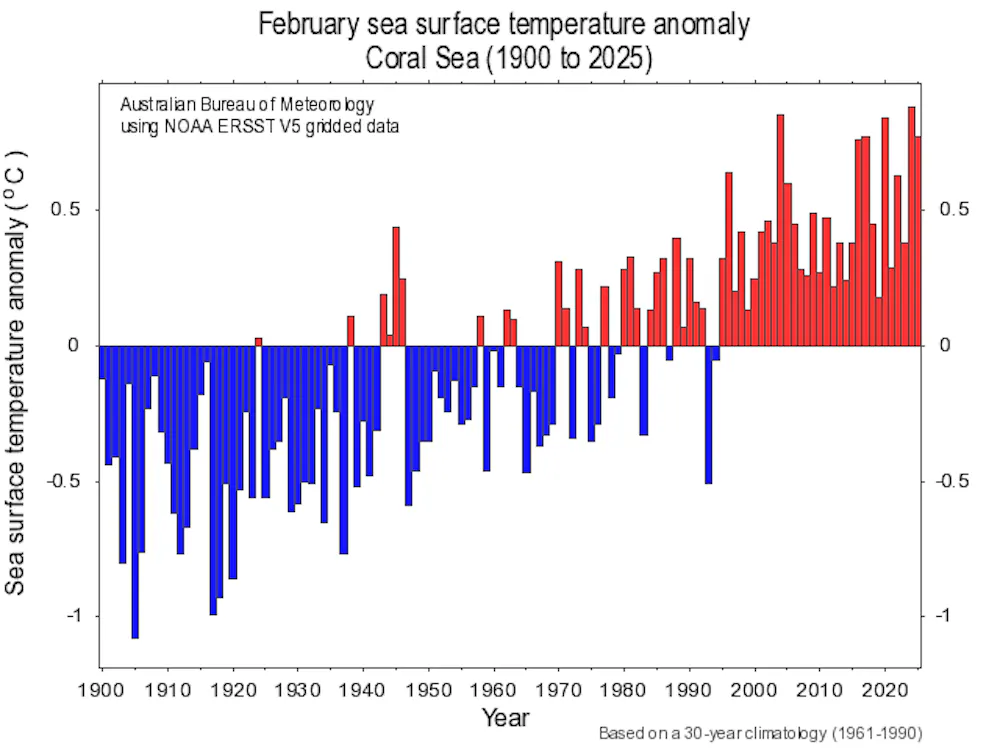
    The northeastern Coral Sea, where Cyclone Alfred formed, experienced the fourth-hottest temperatures on record for February and the hottest on record for January.

    In the Coral Sea, sea surface temperatures were the fourth highest on record in February 2025 and the highest on record in January 2025. This figure shows the trend over time for February.
    Bureau of Meteorology, CC BY-NC-ND

    We also know Australia’s southern waters are warming up too.

    The energy available to power tropical cyclones in subtropical regions has also increased in recent decades, due largely to rising ocean temperatures.

    Average sea surface temperatures in central and southern Queensland on Thursday March 6th. Point Danger is on the Gold Coast.
    Bureau of Meteorology, CC BY-NC-ND

    Climate link: Fewer cyclones but more likely to be intense

    In the northern hemisphere, researchers have found a trend towards fewer cyclones over time. But of those which do form, a higher proportion are more intense.

    It’s not fully clear if the same trend exists in the southern hemisphere, though we are seeing fewer cyclones forming over time.

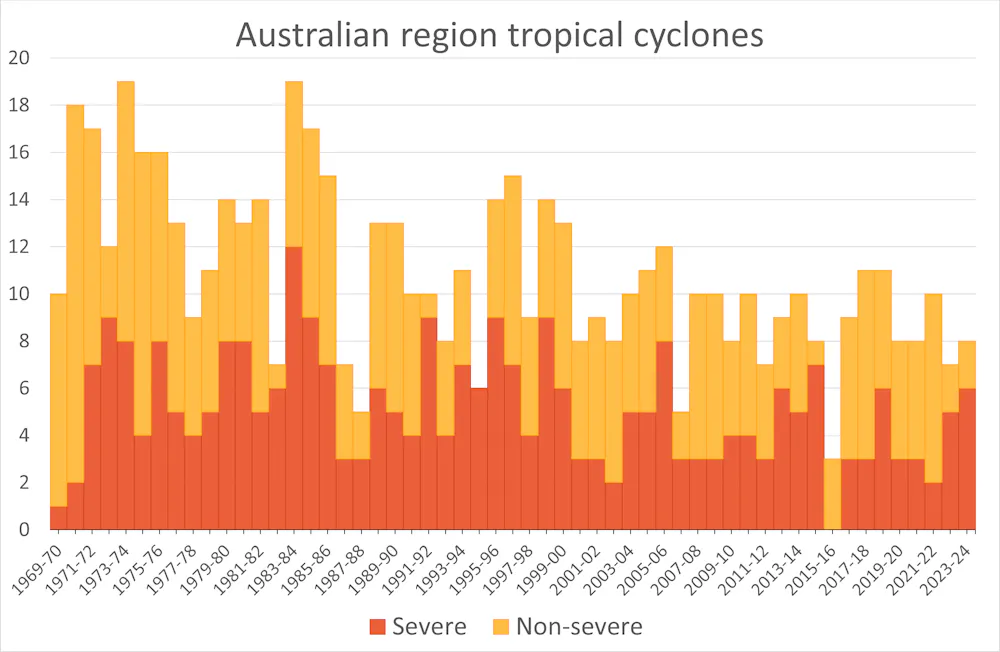
    This summer, eight tropical cyclones have formed in Australian waters. Six were classified as severe (category 3 and up). Historically, Australia has experienced a higher proportion of category 1 and 2 cyclones, which bring weaker wind speeds.

    On average, we see about 11 cyclones form and 4-5 make landfall. There has been a downward trend in the number of cyclones forming in the Australian region in recent decades.

    Fewer cyclones, but more likely to be intense: this figure shows the number of severe (Category 3 and up) and non-severe tropical cyclones (Category 1 and 2) since 1970/71.
    Bureau of Meteorology, CC BY-NC-ND

    Climate link: Cyclones dumping more rain

    The intensity of a cyclone refers to the speed of the wind and size of the wind-affected area.

    But a cyclone’s rain field is also important. This refers to the area of heavy rain produced by storms when they’re at cyclone intensity and afterwards as they decay into tropical lows.

    The rate of rainfall brought by cyclones in Australia isn’t necessarily increasing, but more cyclones are moving slowly, such as Alfred. This means more rain per cyclone, on average.

    Rising ocean temperatures mean more water evaporates off the sea surface, meaning forming cyclones can absorb more moisture and dump more rain when it reaches land.

    Why are cyclones slowing down? This is likely because air current circulation in the tropics has weakened. This has a clear link to climate change. Wind speeds have fallen 5 to 15% in the tropics, depending on where you are in the world. It’s hard to pinpoint the change clearly in our region, because the historic record of cyclone tracks isn’t very long.

    For every degree (°C) of warming, rainfall intensity increases 7%. This is well established. But newer research is showing the rate may actually be double this or even higher, as the process of condensation releases heat which can trigger more rain.

    Clear climate link: Bigger storm surges due to sea level rise

    Sea levels are on average about 20 centimetres higher than they were before 1880.

    When a cyclone is about to make landfall, its intense winds push up a body of seawater ahead of it – the storm surge. In low lying areas, this can spill out and flood streets.

    Because climate change is causing baseline sea levels to rise, storm surges can reach further inland. Sea-level rise will also make coastal erosion more destructive.

    What should we take from this?

    We can’t say definitively that climate change is behind Cyclone Alfred’s unusual track.

    But factors such as rising sea levels, slower cyclones and warmer oceans are changing how cyclones behave and the damage they can do.

    Over time, we can expect to see cyclones arriving in regions not historically affected – and carrying more rain when they arrive.

    Liz Ritchie-Tyo receives funding from The Australian Research Council and the U.S. Office of Naval Research

    Andrew Dowdy receives funding from University of Melbourne as well as supported through the Australian Research Council.

    Hamish Ramsay receives funding from the Australian Climate Service.

    ref. Cyclone Alfred is slowing down – and that could make it more destructive. Here’s how climate change might have influenced it – https://theconversation.com/cyclone-alfred-is-slowing-down-and-that-could-make-it-more-destructive-heres-how-climate-change-might-have-influenced-it-251594

    MIL OSI AnalysisEveningReport.nz

  • MIL-OSI USA: March 5th, 2025 Tribal Water Rights Settlements Legislation Passes Unanimously Out of Senate Committee

    US Senate News:

    Source: United States Senator for New Mexico Martin Heinrich

    WASHINGTON – A slate of Tribal water rights settlement bills introduced by U.S. Senators Martin Heinrich (D-N.M.) and Ben Ray Luján (D-N.M.) and U.S. Representatives Teresa Leger Fernández (D-N.M.), Gabe Vasquez (D-N.M.), and Melanie Stansbury (D-N.M.) passed unanimously out of the Senate Committee on Indian Affairs today. The legislation next heads to the Senate floor for consideration.

    The full slate of Tribal water rights settlements legislation includes:

    • The Rio San José and Rio Jemez Water Rights Settlements Act;
    • The Ohkay Owingeh Rio Chama Water Rights Settlement Act;
    • The Zuni Indian Tribe Water Rights Settlement Act; and
    • The Navajo Nation Rio San José Water Rights Settlement Act.
    • Navajo-Gallup Water Supply Project Amendments;
    • The Technical Corrections to the Northwestern New Mexico Rural Water Projects Act, Taos Pueblo Indian Water Rights Settlement Act, and Aamodt Litigation Settlement Act;

    “I’m proud to fight for these bills to finally unlock critical water infrastructure funding from these water rights settlements and ensure Tribes have the resources to use the water they own,” said Heinrich. “These settlements are supported by all parties involved, including Tribal and non-Tribal communities. Congress should pass these urgently needed bills to help communities manage their precious and limited water resources.”

    “Water rights are part of the federal trust responsibility for our Tribal communities,” said Luján, a member of the Senate Indian Affairs Committee. “I’m proud to have helped advance this critical legislation, allowing our Tribal communities to promote water security and complete much-needed water infrastructure projects. I’m particularly proud that my legislation to amend the Navajo-Gallup Water Supply Project has advanced, ensuring the resources and time needed to deliver clean drinking water to communities in northwestern New Mexico. These pieces of legislation will help fulfill our trust responsibility and promote water security for Tribes and Pueblos, as well as non-Tribal users, in New Mexico.”

    “This legislation upholds our trust responsibility to Tribes and helps bring certainty to disputes about water across the Southwest. The settlements included in these bills secure clean, reliable water for Navajo Nation, Jicarilla Apache Nation, 11 pueblos, and the rural communities that are their neighbors across New Mexico,” said Leger Fernández. “It is with great expectation that I reintroduce this legislation which reflects decades of negotiation and collaboration. We must pass these bills so the scarce water resources our communities need to thrive for generations to come are available to all.”

    “In New Mexico, we know water is life,” said Stansbury. “That’s why these Tribal Water Settlement bills are so important. These pieces of legislation will give water rights back to our Tribes and Pueblos, ensuring the federal government upholds our Trust and Treaty Responsibilities. Indigenous people have been stewards of the land and water since time immemorial, and now is the time for them to lead these efforts.”

    “New Mexicans know the importance of safe and reliable water access, and today’s progress brings us one step closer to securing these fundamental resources for our Tribal communities. I’ll continue to honor my commitment to our Tribes and Pueblos to ensure they have the water infrastructure they need to thrive,” said Vasquez.

    The Rio San José and Rio Jemez Water Rights Settlements Act is led by Heinrich and Leger Fernández. Luján, Stansbury, and Vasquez are original cosponsors. The bill would implement two fund-based water settlements: one between the Pueblos of Jemez and Zia, the United States, the State of New Mexico, and non-Tribal parties; and another between the Pueblos of Acoma and Laguna, the United States, the State of New Mexico, and non-Tribal parties. The settlements are strongly supported by all parties involved.

    Heinrich and Leger Fernández previously introduced this legislation in March 2023. The bill received a hearing and was reported out of the Senate Indian Affairs Committee in December 2023. The House version of this bill received a legislative hearing in the House Water, Wildlife and Fisheries Subcommittee in July 2024.

    Read the full bill text here.

    The Ohkay Owingeh Rio Chama Water Rights Settlement Act is also led by Heinrich and Leger Fernández. Luján and Stansbury are original cosponsors. The bill establishes a trust fund to implement the negotiated settlement between the United States, the State of New Mexico, the City of Española, the Asociación de Acéquias Norteñas de Rio Arriba, El Rito Ditch Asociación, La Asociación de las Acéquias del Rio Tusas, Vallecitos y Ojo Caliente, the Rio de Chama Acéquia Association, and Ohkay Owingeh to settle the Pueblo’s water claims in the Rio Chama Basin. The funding will be used for Ohkay Owingeh’s development of water resources to ensure the Pueblo has appropriate water infrastructure to use the water that they have claim to in the basin.

    Heinrich and Leger Fernández initially introduced the bill in June 2024. The bill then received a key hearing before the Senate Indian Affairs Committee in July 2024.

    Read the full bill text here.

    The Zuni Indian Tribe Water Rights Settlement Act is led by Heinrich and Vasquez. Luján, Stansbury, and Leger Fernández are original cosponsors. The bill authorizes $685 million to support a trust for sustainable water management and infrastructure development that upholds the federal government’s trust responsibility while protecting the sacred Zuni Salt Lake. The bill ratifies the settlement between the federal government, State of New Mexico and Zuni Tribe that affirms their water rights for irrigation, livestock, storage, and domestic and other uses.

    Heinrich and Vasquez initially introduced the bill in July 2024. The bill received a key hearing before the Senate Indian Affairs Committee in September 2024.

    Read the full bill text here.

    The Navajo Nation Rio San José Water Rights Settlement Act is led by Heinrich and Leger Fernández. Luján, Stansbury, and Vasquez are original cosponsors. This bill would approve the water rights settlement for the Navajo Nation as well as participating non-Tribal parties in the Rio San José watershed.

    Heinrich and Leger Fernández initially introduced this bill in September 2024. The bill then received a key hearing before the Senate Indian Affairs Committee that same month.

    Read the full bill text here.

    The Navajo Gallup Water Supply Project Amendments is led by Luján and Leger Fernández. Heinrich and Stansbury are original cosponsors. The bill amends the Navajo Gallup Water Supply Project to ensure it has the resources and time needed to reach completion to deliver drinking water to northwestern New Mexico communities.

    The Navajo Gallup Water Supply Project was first authorized as part of the Omnibus Public Land Management Act of 2009, which settled the Navajo Nation’s water rights in the San Juan Basin of New Mexico and funded the design and construction of the waterline to reach an estimated 250,000 people by the year 2040. Upon completion, the Navajo-Gallup Water Supply Project will provide a long-term, sustainable water supply from the San Juan River to roughly 43 Chapters on the eastern Navajo Nation, the southwestern portion of the Jicarilla Apache Nation, and the City of Gallup, which currently rely on a rapidly depleting groundwater supply of poor quality.

    Luján, Leger Fernández, and Heinrich initially introduced the bill in June 2023. The bill was passed out of the Senate Indian Affairs Committee in November 2023.

    Read the full bill text here.

    The Technical Corrections to the Northwestern New Mexico Rural Water Projects Act, Taos Pueblo Indian Water Rights Settlement Act, and Aamodt Litigation Settlement Act is led by Luján and Leger Fernández. Heinrich and Stansbury are original cosponsors. This bill authorizes the appropriation of $6.3 million for the Navajo Nation Water Resources Development Fund; $7.8 million for the Taos Pueblo Water Development Fund; and $4.3 million for the Aamodt Settlement Pueblos’ Fund, which covers Nambé, Pojoaque, San Ildefonso, and Tesuque Pueblos. It will support water resources development projects for the Tribes.

    Luján and Leger Fernández initially introduced this bill in December 2023.

    Read the full bill text here.

    MIL OSI USA News

  • MIL-OSI United Nations: Press Release 06 March 2025 La Niña event is expected to be short-lived

    Source: World Meteorological Organization

    Infographic on ENSO probabilities for March-May 2025

    “Seasonal forecasts for El Niño and La Niña and the associated impacts on weather and climate patterns globally are an important tool to inform early warnings and early action and are one of a wide suite of services offered by the WMO community to support decision-making,” said WMO Secretary-General Celeste Saulo.

    “These forecasts translate into millions of dollars worth in economic savings for key sectors like agriculture, energy and transport, and saved thousands of lives over the years by enabling disaster risk preparedness,” she said.

    La Niña refers to the large-scale cooling of the ocean surface temperatures in the central and eastern equatorial Pacific Ocean, coupled with changes in the tropical atmospheric circulation, including changes in winds, pressure and rainfall patterns. Typically, La Niña brings climate impacts that are the opposite of El Niño, especially in tropical regions.

    However, the impacts of naturally occurring climate events such as La Nina and El Nino on climate patterns are taking place in the broader context of human-induced climate change, which is increasing global temperatures, exacerbating extreme weather and climate, and impacting seasonal rainfall and temperature patterns.

    Thus, January 2025 was the warmest January on record, despite weak La Niña conditions being present since December 2024, when observed sea surface temperature anomalies in the equatorial Pacific crossed the La Niña threshold.

    While the El Niño-Southern Oscillation (ENSO) is a key driver of global climate patterns, it is not the only factor shaping the Earth’s climate. To provide a more comprehensive climate outlook, WMO also issues regular Global Seasonal Climate Updates (GSCU). These updates  take into account the influence of key climate variability patterns, including the North Atlantic Oscillation, the Arctic Oscillation and the Indian Ocean Dipole. The updates also monitor the status of North Tropical Atlantic (NTA) and South Tropical Atlantic (STA) Sea Surface Temperature index anomalies, as well as the global and regional anomalies of surface temperature and precipitation and their evolution over the upcoming season.

    With above-normal sea surface temperatures expected to persist across all major oceans—except for the near-equatorial eastern Pacific—the latest GSCU forecasts above-average temperatures over nearly all land areas worldwide.

    Probabilistic Multi-Model Ensemble Forecast – 2m Temperature – February 2025

    Probabilistic Multi-Model Ensemble Forecast – Precipitation – February 2025

    The World Meteorological Organization (WMO) is a specialized agency of the United Nations responsible for promoting international cooperation in atmospheric science and meteorology.

    WMO monitors weather, climate, and water resources and provides support to its Members in forecasting and disaster mitigation. The organization is committed to advancing scientific knowledge and improving public safety and well-being through its work.

    MIL OSI United Nations News

  • MIL-OSI New Zealand: Pūtiki pedestrians get safer SH4 crossing

    Source: New Zealand Transport Agency

    Safer road crossing for residents at Pūtiki in Whanganui is now a reality.

    Work has now been completed on State Highway 4 at Pūtiki, with a new pedestrian refuge island installed and a new flush median, kerb extension and pram crossing points (where the footpath dips down to meet the road).

    NZ Transport Agency Waka Kotahi (NZTA) Project Manager Kendra Ludeke says the road is now safer to cross as there is a place for people to stop halfway to check for traffic.

    “We’ve worked closely with the Pūtiki Emergency Response Group (PERG) to finalise this design and work. One of the key recommendations from the group was to make it safer for pedestrians to cross SH4 Pūtiki Drive where the Kaumātua flats and bus stops are.

    “Safe and appropriate crossings are key elements in providing a connected network for pedestrians and we are happy to be working in collaboration with the project partners to achieve this in Pūtiki.

    “This crossing will make it easier for people to cross this at-times busy stretch of highway. It’s important people using the area to cross the road still look both ways and be careful before crossing.

    PERG member Kanui Cooper says these additions help to improve traffic management during a flood event and evacuation of the Kaumatua flats and form part of a range of initiatives driven by the local community that aim to improve safety for everyone – in particular Kaumātua and tamariki.

    “The initiative not only improves safety, but it also strengthens connectedness to the community and to Whanganui as a whole.” 

    NZTA Project Manager Kendra Ludeke (3rd from right) is joined by Kaumātua, residents and local community members, trying out the new crossing. NB: since this photo, yellow tactile indicators have also been installed.

    MIL OSI New Zealand News

  • MIL-Evening Report: HILDA data shows income inequality is at a 20-year high

    Source: The Conversation (Au and NZ) – By Ferdi Botha, Senior Research Fellow, Melbourne Institute: Applied Economic & Social Research, The University of Melbourne

    ArliftAtoz2205/Shutterstock

    The 19th annual report from the Household, Income and Labour Dynamics in Australia (HILDA) Survey was released today.

    The HILDA Survey has been following the same people every year since 2001, which makes it possible to examine how the lives of Australians have changed across several aspects.

    With data from 2001 to 2022, in this year’s report we looked at issues including income inequality, household chores, and the impact of natural disasters on Australian households.

    Income inequality is the highest since 2001

    Funded by the Australian government and managed by the Melbourne Institute, the survey is one of Australia’s most valuable social research tools.

    HILDA examined the lives of 14,000 Australians in 2001 and has kept coming back each year to discover what has changed over the course of their lifetimes. It now covers 17,000 Australians, due to the expansion of participants’ families.

    The survey shows that since COVID-era financial support ended, income inequality has risen substantially.

    The increase in inequality stems from growth in higher incomes as compared to middle incomes, as well as a fall in the growth of lower incomes relative to middle incomes.

    This means, relative to the median earner, Australians already earning a high income have seen the growth in their incomes rise. In contrast, Australians with low incomes have seen a decrease in the rate of growth in their incomes.

    Between 2021 and 2022, 51.2% of respondents reported their real incomes have declined. This is up from about 41% in preceding years, suggesting a decrease in people’s purchasing power.

    A technical measure called the Gini coefficient was 0.32 in 2022, the highest since we started the survey in 2001. The measure ranges from 0 to 1 and is an index that measures overall inequality, with higher scores suggesting greater income inequality.

    Older Australians are getting richer too

    Over the same period, household wealth has continued to grow.

    However, there are large and growing age differences in the growth in household wealth. For young people aged between 18 and 34, net wealth rose by 72.4% to $238,942 over the 20 years to 2022.

    But for older Australians aged 65 to 74, net household wealth jumped by 125% to about $1.26 million.

    These age disparities in household wealth are partly explained by rates of home ownership, which are much higher among older Australians.

    Home ownership is also the most important asset component in terms of total wealth. In 2022, almost 65% of households owned their home, and just over 20% of households held investment properties and holiday homes.

    As a proportion of total wealth, the family home accounts for 44.5% and investment properties account for 14.9%.

    Women are still doing most of the housework

    Australian women still undertake the majority of housework, whereas men’s share of housework has remained constant over 20 years.

    Men’s time spent on housework has not changed in 20 years.
    Diego Cervo/Shutterstock

    Women’s time spent on housework (such as cleaning, cooking, running errands) has fallen slightly from 23.8 hours per week in 2002 to 18.4 hours per week in 2022.

    Men spent 12.8 hours per week on housework, precisely the same amount they did 20 years earlier. Thus, women are still doing close to 50% more housework than men are.

    Men have increased the time they spend on caring responsibilities (such as playing with their children, helping with homework, caring for an elderly relative), from 5 hours per week in 2002 to 5.5 hours per week in 2022. The time women spend on care has risen from 10.1 hours per week to 10.7 hours per week over the same period. In 2022, women spent almost double the time on care duties than men.

    Among couples, men are generally more satisfied than women are with the current division of unpaid work. Most women feel they do more than their fair share at home. Men tend to believe they share the housework and care fairly with their partner.

    Surge in home damage due to weather-related disasters

    Respondents were asked if a weather-related disaster (such as floods, bushfires or cyclone) had damaged or destroyed their home in the past 12 months. In 2022, 4.5% reported experiencing such an event.

    This is a substantial increase from the year before, when only 1.3% of Australians reported weather-related home damage, and exceeding the previous peak of 2.7% in 2011.

    There are also regional differences, closely corresponding with the timing of specific floods or bushfires in the states and territories. In 2022, 9% of New South Wales residents and 6% of Queensland reported home damage, consistent with major floods experienced in these regions in the months prior to the survey.

    Among all Australians who in 2022 reported home damage due to a weather-related disaster, 62.5% were in NSW and 27.3% were in Queensland.

    With the current cyclone Alfred forecast to hit Queensland and northern NSW on Friday, we expect a further significant increase in reported home damage.

    Ferdi Botha is affiliated with the ARC Centre of Excellence for Children and Families over the Life Course.

    ref. HILDA data shows income inequality is at a 20-year high – https://theconversation.com/hilda-data-shows-income-inequality-is-at-a-20-year-high-251596

    MIL OSI AnalysisEveningReport.nz

  • MIL-OSI New Zealand: Arrest made following investigation into injured baby, Dargaville

    Source: New Zealand Police (National News)

    Please attribute to Acting Detective Senior Sergeant Shane Pilmer, Whangārei CIB:

    Police investigating an incident involving an injured five-month-old baby in Dargaville have today made an arrest.

    A 22-year-old man has been charged with wounding with intent to cause grievous bodily harm and will appear in Whangārei District Court tomorrow.

    The arrest come after the baby was presented at Dargaville Hospital with serious head injuries on 28 December.

    The baby was flown to Whangārei Hospital and later transferred to Starship Hospital in Auckland.

    The baby is now recovering well.

    As this matter is now before the Courts, Police don’t have any further comment.

    ENDS.

    Holly McKay/NZ Police 

    MIL OSI New Zealand News

  • MIL-OSI Australia: Payments System Board Update: March 2025 Meeting

    Source: Reserve Bank of Australia

    At its meeting today, the Payments System Board discussed a number of issues, including:

    • CHESS batch failure incident. Members discussed the issues that contributed to the CHESS batch failure incident on 20 December 2024. The Board viewed the disruption this caused to clearing and settlement of cash equities as a major operational incident. As the RBA had highlighted for some time that ASX’s aging assets, including CHESS, were raising the risk of operational disruptions to critical financial infrastructure, members viewed the incident as deeply disappointing and resolved to take regulatory interventions to provide assurance that the ASX addresses related risks as a matter of priority. Further details on the RBA’s regulatory response to the incident will be published by the end of March.
    • Developments in the account-to-account payments system. The Board discussed the risks associated with the Australian payments industry’s intended decommissioning of the Bulk Electronic Clearing System (BECS) by a target date of 2030. BECS is currently Australia’s primary system for account-to-account payments – Australians rely on BECS for a wide range of critical payments including welfare, pension, salary and bill payments. The Board endorsed a set of recommendations designed to address the significant risks and challenges identified by the RBA.
    • Members agreed that the foundational next steps for industry should include: defining a vision for the target future state and strategic objectives for account-to-account payments in Australia, in collaboration with the Government and the RBA; comprehensive consideration of options for achieving that target future state; and establishing appropriate mechanisms for coordination and stakeholder engagement. A report detailing the findings and recommendations of the RBA’s risk assessment will be published later in March. Members requested an update on industry’s progress in implementing the recommendations in a year’s time.

      Members also discussed end-user costs for account-to-account payments in Australia, which highlighted potential impediments that end-users would face if they had to migrate away from BECS. Members agreed that greater pricing transparency was required from providers of these services to end-users. They expressed support for the RBA establishing a robust pricing data collection to support future policy deliberations.

    • Review of Retail Payments Regulation. The Board considered the arguments for and against various policy options on merchant card payment costs and surcharging, informed by a wide range of views from stakeholder submissions. The Board is actively exploring options to promote the public interest by supporting safety, competition and efficiency in the payments system. Members agreed to release a consultation paper in mid-2025 that will outline the Board’s preferred policy options and seek further feedback.
    • International and domestic work on central bank digital currencies. Members discussed the ongoing program of international and domestic research on CBDCs. Domestically, the RBA has a collaborative research project underway, Project Acacia, which is investigating how innovations in wholesale digital money could support tokenised asset settlement. The project team is currently reviewing expressions of interest from industry participants wanting to collaborate in the testing of settlement models as part of the applied research phase taking place this year. An Industry Advisory Group has also recently been launched to support the project. Members also discussed the Bank’s plans to use focus groups to explore whether there are unmet payment needs that could be satisfied with a retail CBDC in Australia. This work is expected to take place in the second half of the year.

    MIL OSI News

  • MIL-Evening Report: Robert F. Kennedy Jr says vitamin A protects you from deadly measles. Here’s what the study he cites actually says

    Source: The Conversation (Au and NZ) – By Evangeline Mantzioris, Program Director of Nutrition and Food Sciences, Accredited Practising Dietitian, University of South Australia

    RobsPhoto/Shutterstock

    Robert F. Kennedy Jr, who oversees the health of more than 340 million Americans, says vitamin A can prevent the worst effects of measles rather than urging more people to get vaccinated.

    In an opinion piece for Fox News, the US health secretary said he was “deeply concerned” about the current measles outbreak in Texas. However, he said the decision to vaccinate was a “personal one” and something for parents to discuss with their health-care provider.

    Kennedy mentioned updated advice from the Centers for Disease Control (CDC) to treat measles with vitamin A. He also cited a study he said shows vitamin A can reduce the risk of dying from measles.

    Here’s what the vitamin A study actually says and why public health officials are so concerned about Kennedy’s latest statement.

    Why is a measles outbreak so worrying?

    Measles is a highly contagious disease caused by a virus. It spreads easily including when an infected person breathes, coughs or sneezes.

    Measles initially infects the respiratory tract and then the virus spreads throughout the body. Symptoms include a high fever, cough, red eyes, runny nose and a rash all over the body.

    Measles can also be severe, can cause complications including blindness and swelling of the brain, and can be fatal. Measles can affect anyone but is most common in children.

    The Texan health department has confirmed 150-plus cases of measles and one death of an unvaccinated child during the current outbreak. While this is by far the largest measles outbreak in the US in 2025, the CDC has reported smaller outbreaks in several other states so far this year.

    Why vitamin A?

    Vitamin A is essential for our overall health. It has many roles in the body, from supporting our growth and reproduction, to making sure we have healthy vision, skin and immune function.

    Foods rich in vitamin A or related molecules include orange, yellow and red coloured fruits and vegetables, green leafy vegetables, as well as dairy, egg, fish and meat. You can take it as a supplement.

    Vitamin A can also be used therapeutically. In other words, doctors may prescribe vitamin A to treat a deficiency. Vitamin A deficiency has long been associated with more severe cases of infectious disease, including measles. Vitamin A boosts immune cells and strengthens the respiratory tract lining, which is the body’s first defence against infections.

    Because of this, the CDC has recently said vitamin A can also be prescribed as part of treatment for children with severe measles – such as those in hospital – under doctor supervision.

    One key message from the CDC’s advice is that people are already sick enough with measles to be in hospital. They’re not taking vitamin A to prevent catching measles in the first place.

    The other key message is vitamin A is taken under medical supervision, under specific circumstances, where patients can be closely monitored to prevent toxicity from high doses.

    Vitamin A toxicity can cause birth defects and increase the risk of fractures in elderly people. Vitamin A and beta-carotene (which the body turns into vitamin A) from supplements may also increase your risk of cancer, especially if you smoke.

    Taking too much vitamin A can lead to toxicity and cause birth defects.
    ChameleonsEye/Shutterstock

    How about the study Kennedy cites?

    Kennedy cites and links to a 2010 study, a type known as a systematic review and meta-analysis. Researchers reviewed and analysed existing studies, which included ones that looked at the effectiveness of vitamin A in preventing measles deaths.

    They found three studies that looked at vitamin A treatment by specific dose. There were different doses depending on the age of the children, measured in IU (international units). Having two doses of vitamin A (200,000IU for children over one year of age or 100,000IU for infants below one year) reduced mortality by 62% compared to children who did not have vitamin A.

    The 2010 study did not show vitamin A reduced your risk of getting measles from another infected person. To my knowledge no study has shown this.

    To be fair, Kennedy did not say that vitamin A stops you from catching measles from another infected person. Instead, he used the following vague statement:

    Studies have found that vitamin A can dramatically reduce measles mortality.

    It’s easy to see how a reader could misinterpret this as “take vitamin A if you want to avoid dying from measles”.

    We know what works – vaccines

    The World Health Organization recommends all children receive two doses of measles vaccine.

    The CDC states two doses of the measles vaccine (measles-mumps-rubella or MMR vaccine) is 97% effective against getting measles. This means out of every 100 people who are vaccinated only three will get it, and this will be a milder form.

    But these facts were missing from Kennedy’s statement. Should we be surprised? Kennedy is well known for his vaccine sceptism and for undermining vaccination efforts, including for the measles vaccine.

    As Sue Kressly, president of the American Academy of Pediatrics, told the Washington Post:

    relying on vitamin A instead of the vaccine is not only dangerous and ineffective […] it puts children at serious risk.

    Evangeline Mantzioris is affiliated with Alliance for Research in Nutrition, Exercise and Activity (ARENA) at the University of South Australia. Evangeline Mantzioris has received funding from the National Health and Medical Research Council, and has been appointed to the National Health and Medical Research Council Dietary Guideline Expert Committee.

    ref. Robert F. Kennedy Jr says vitamin A protects you from deadly measles. Here’s what the study he cites actually says – https://theconversation.com/robert-f-kennedy-jr-says-vitamin-a-protects-you-from-deadly-measles-heres-what-the-study-he-cites-actually-says-251465

    MIL OSI AnalysisEveningReport.nz

  • MIL-Evening Report: Woolly mice are cute and impressive – but they won’t bring back mammoths or save endangered species

    Source: The Conversation (Au and NZ) – By Emily Roycroft, Research Group Leader & ARC DECRA Fellow, Monash University

    Colossal Biosciences

    US company Colossal Biosciences has announced the creation of a “woolly mouse” — a laboratory mouse with a series of genetic modifications that lead to a woolly coat. The company claims this is the first step toward “de-extincting” the woolly mammoth.

    The successful genetic modification of a laboratory mouse is a testament to the progress science has made in understanding gene function, developmental biology and genome editing. But does a woolly mouse really teach us anything about the woolly mammoth?

    What has been genetically modified?

    Woolly mammoths were cold-adapted members of the elephant family, which disappeared from mainland Siberia at the end of the last Ice Age around 10,000 years ago. The last surviving population, on Wrangel Island in the Arctic Ocean, went extinct about 4,000 years ago.

    The house mouse (Mus musculus) is a far more familiar creature, which most of us know as a kitchen pest. It is also one of the most studied organisms in biology and medical research. We know more about this laboratory mouse than perhaps any other mammal besides humans.

    Colossal details its new research in a pre-print paper, which has not yet been peer-reviewed. According to the paper, the researchers disrupted the normal function of seven different genes in laboratory mice via gene editing.

    By tinkering with different genes, researchers produced mice with different kinds of fur.
    Colossal Biosciences

    Six of these genes were targeted because a large body of existing research on the mouse model had already demonstrated their roles in hair-related traits, such as coat colour, texture and thickness.

    The modifications in a seventh gene — FABP2 — was based on evidence from the woolly mammoth genome. The gene is involved in the transport of fats in the body.

    Woolly mammoths had a slightly shorter version of the gene, which the researchers believe may have contributed to its adaptation to life in cold climates. However, the “woolly mice” with the mammoth-style variant of FABP2 did not show significant differences in body mass compared to regular lab mice.

    What would it mean to de-extinct a species?

    This work shows the promise of targeted editing of genes of known function in mice. After further testing, this technology may have a future place in conservation efforts. But it’s a long way from holding promise for de-extinction.

    Colossal Biosciences claims it is on track to produce a genetically modified “mammoth-like” elephant by 2028, but what makes a mammoth unique is more than skin-deep.

    De-extinction would need to go beyond modifying an existing species to show superficial traits from an extinct relative. Many aspects of an extinct species’ biology remain unknown. A woolly coat is one thing. Recreating the entire suite of adaptations, including genetic, epigenetic and behavioural traits that allowed mammoths to thrive in ice age environments, is another.

    Prehistoric drawings of an ibex (left) and a mammoth (right) found at Rouffignac cave in France.
    Cave Painter / Wikimedia

    Unlike the thylacine (or Tasmanian tiger) — another species Colossal aims to resurrect — the mammoth has a close living relative in the modern Asian elephant. The closer connections between the genomes of these two species may make mammoth de-extinction more technically feasible than that of the thylacine.

    But whether or not a woolly mouse brings us any closer to that prospect, this story forces us to consider some important ethical questions. Even if we could bring back the woolly mammoth, should we? Is the motivation behind this effort conservation, or entertainment? Is it ethical to bring a species back into an environment that may no longer sustain it?

    Focus on conserving what remains

    In Australia alone, we’ve lost at least 100 species to extinction since European colonisation in 1788, largely due the introduction of feral predators and land clearing.

    The idea of reversing extinction is understandably appealing. We might like to think we could undo the past.

    According to Colossal’s website,

    Extinction is a colossal problem facing the world. And Colossal is the company that’s going to fix it.

    It’s hard to argue with the first part of that. But focusing on bringing back extinct species distracts from a more urgent reality: species are going extinct right now, and we are not doing enough to save them.

    We should first focus on promises to save surviving species, rather than promises to bring back the dead.

    With more investment in threatened species monitoring, new pest control methods, and conservation genetic management, we can turn the tide of extinction and secure the future for species that remain.

    There’s a long list of threatened species that are still alive now. With the right funding and conservation attention, we can do something to save them before it’s too late.

    Emily Roycroft receives funding from the Australian Research Council, the L’Oréal-UNESCO For Women in Science Programme, and the Australian Academy of Science.

    ref. Woolly mice are cute and impressive – but they won’t bring back mammoths or save endangered species – https://theconversation.com/woolly-mice-are-cute-and-impressive-but-they-wont-bring-back-mammoths-or-save-endangered-species-251595

    MIL OSI AnalysisEveningReport.nz

  • MIL-OSI New Zealand: Release: Labour calls for end to police referrals to Destiny programmes

    Source: New Zealand Labour Party

    Police have referred 20 offenders to Destiny Church-affiliated programmes Man Up and Legacy as ‘wellness providers’ in the last year, raising concerns that those seeking help are being recruited into a harmful organisation.

    “Referrals to Man Up and Legacy need to stop. Members of these groups violently disrupted a Pride Week event at the Te Atatū Peninsula library and are now at the centre of a Police investigation,” Labour MP for Te Atatū Phil Twyford said.

    Police Minister Mark Mitchell has confirmed Police referred 20 offenders to Man Up and Legacy since the two groups were approved as “wellness providers” in April last year, in answers to Twyford’s written parliamentary questions.

    “How does the Minister justify referring offenders to an organisation that openly preaches hate against the Rainbow community and has a track record of violence?”

    “Anti-violence groups have criticised Destiny Church groups’ involvement in offender rehabilitation, saying their approach creates a greater risk of violence against women and children.

    “Does the Minister have any evidence these Destiny programmes have a positive effect on offenders? Has he looked into whether Man Up and Legacy are using the Police referrals to recruit new members? 

    “The West Auckland Police are investigating the conduct of Destiny Church at Te Atatū Peninsula Library last month. Charities Services have confirmed to me they are investigating my call for Destiny charities to be deregistered for serious wrongdoing. It is time the Government now rules out the Police or any other government agency referring people to Destiny Church or their subsidiaries,” Phil Twyford said.

    Labour rainbow community spokesperson Shanan Halbert said, “Mark Mitchell promised that New Zealanders would feel safer under this government, but the Rainbow community has felt under attack. More than 100 incidents of hate against the community are reported monthly under his watch, but he he has declined to declare how many are related to Destiny Church. It’s time for him to take action.”


    Stay in the loop by signing up to our mailing list and following us on FacebookInstagram, and X.

    MIL OSI New Zealand News

  • MIL-OSI New Zealand: Warrant to arrest – Rawiri Cave

    Source: New Zealand Police (District News)

    Police are seeking Rawiri Cave, 25, who has a warrant for his arrest.

    He is wanted in relation to a number of incidents in Counties Manukau, including aggravated robbery and escapes custody.

    Cave has long hair, usually worn in a top knot style, and has two Tā moko style tattoos on the back of his right calf and on his right forearm.

    He is known to frequent Counties Manukau, Point Chevalier and Waterview areas.

    Anyone with information about Cave is urged to contact Police via 105 online or the 105 phone reporting line, referencing file number 250107/1230.

    ENDS.

    Holly McKay/NZ Police

    MIL OSI New Zealand News

  • MIL-OSI Australia: Active transport boost for Western Australia

    Source: Australian Ministers 1

    Cyclists and pedestrians across Western Australia will have more opportunities to walk, cycle and actively move through their communities thanks to support from the Albanese Government.  

    More than $15 million will be invested under the Active Transport Fund in 12 new projects across the state to build or upgrade existing bicycle and walking paths. 

    City of Canning will receive more than $1.1 million, for a new path and another upgraded path to increase active connectivity between METRONET’s Elevated Rail Project and the Canning River Regional Park through the Canning City Centre. 

    The improved facilities will benefit local students at Cannington Community College, Sevenoaks College and St Norbert College as well as people visiting Cannington Leisureplex.

    More than $4.8 million will be provide to the City of Mandurah to build the 3.9km Falcon Coastal Shared Path project stretching along the entire Falcon Coast, linking existing coastal paths in Wannanup to the south and Halls Head to the north.

    The Town of Cottesloe, on Perth’s southern beaches, will receive more than $4.1 million to widen and upgrade four kilometres of the pathway along Marine Parade between Curtin Avenue and North Street.

    Other projects receiving funding include:

    • The Shire of Cunderdin, north east of Perth, which will have more than $852,000 to design and build new footpaths along Togo Avenue, Watts Avenue, Hodgson Street and Yilgarn Avenue, about 3.25 kilometres long and 1.8 metres wide.
    • The City of Karratha, up north in the Pilbara, to receive $774,000 to build 1.3 kilometres of path linking Bathgate and Dampier Road to connect to the shopping centre.
    • The Shire of Nannup, on the south west tip of WA, will have more than $611,000 to build two 2.5-metre-wide shared paths, separated by Vasse Highway, known as the Southern Bridges Shared Path.

    Safe and accessible active transport options promote net zero-emissions travel, social connection and healthy choices, making our cities and regions more vibrant.

    This program supports the government’s commitment to invest in infrastructure planning, design and construction that improves safety outcomes for vulnerable road users under the National Road and Safety Strategy 2021-2030.

    For more information visit Active Transport Fund | Infrastructure Investment Program.  

    Quotes attributable to Minister for Infrastructure, Transport, Regional Development and Local Government Catherine King:

    “Whether you’re on a motor scooter, pushing a pram, walking or cycling, we’re making it easier for people to get to school, work or local services, without having to jump in the car. 

    “This is about so much more than bike lanes and footpaths, it’s about reshaping our cities and regional centres, connecting our everyday places, and making our towns better to live in and easier to visit.”

    Quotes attributable to Member for Perth Patrick Gorman: 

    “I love cycling and my kids love their scooters. I am proud to be part of an Albanese Government that is making our communities healthier and more liveable. 

    “There are so many benefits that come from people traveling by using physical activity.

    “Perth is an active city, and I welcome this national investment in our local our communities.”

    Quotes attributable to Member for Swan Zaneta Mascarenhas: 

    “By linking METRONET’s with the Canning River Regional Park, we’re creating a safe and convenient pathway for walking, cycling, and enjoying our local environment.

    “This $1.1 million investment is about making it easier for our community to stay active and connected. It will be safer for kids getting to school, for commuters, and people accessing Cannington Leisureplex.” 

    MIL OSI News

  • MIL-OSI Security: Nigerian Citizen Admits Guilt in Bank Fraud and Money Laundering Conspiracies Causing More Than $1.7 Million in Losses

    Source: Office of United States Attorneys

    David Daniyan Admits Supervising Conspiracies Led by Nigerian Citizen Oluwaseun Adekoya

    ALBANY, NEW YORK – David Daniyan, a/k/a “Bamikole Laniyan,” a/k/a “David Enfield,” a/k/a “Africa,” age 60, of Brooklyn, New York, pled guilty today in connection with his role in bank fraud and money laundering conspiracies led by Oluwaseun Adekoya, age 39, also a Nigerian citizen, of Cliffside Park, New Jersey.  Acting United States Attorney Daniel Hanlon and Craig L. Tremaroli, Special Agent in Charge of the Albany Field Office of the Federal Bureau of Investigation (FBI), made the announcement.

    Daniyan pled guilty today to conspiracy to commit bank fraud, money laundering conspiracy, and aggravated identity theft. Daniyan admitted that, working with Adekoya, he obtained the personal identifying information of people residing all over the United States and recruited lower-level conspirators to impersonate those people using fake driver’s licenses to fraudulently obtain cash, checks, and loans at their financial institutions and obtain merchandise using credit at retailers including Saks Fifth Avenue.  Daniyan also admitted to conspiring with Adekoya and others to launder the proceeds of their bank fraud by, among other things, using fraudulently obtained funds to purchase additional fake driver’s licenses and depositing fraudulently obtained checks into accounts in the names of identity-theft victims that were controlled by coconspirators.  Daniyan admitted that the bank fraud conspiracy netted over $1.7 million in fraud proceeds, and was perpetrated in the Northern District of New York and all over the country. 

    According to documents previously filed in the case, Daniyan, a citizen of Nigeria, has been living in the United States without authorization under numerous aliases since at least the 1990s when he was first investigated, charged, and convicted in another federal district under the stolen identity of a U.S. citizen. 

    The following defendants are charged as follows in the superseding indictment: 

    • Adekoya is charged with one count of conspiracy to commit bank fraud, one count of money laundering conspiracy, and nine counts of aggravated identity theft;
    • Kani Bassie, age 36, of Brooklyn, is charged with one count of conspiracy to commit bank fraud and two counts of aggravated identity theft;
    • Davon Hunter, age 27, of Richmond, Virginia, is charged with conspiracy to commit bank fraud and one count of aggravated identity theft;
    • Jermon Brooks, age 20, of Richmond, is charged with conspiracy to commit bank fraud and one count of aggravated identity theft;
    • Christian Quivers, age 20, of Richmond, is charged with conspiracy to commit bank fraud and one count of aggravated identity theft; and
    • Crystal Kurschner, age 44, of Brooklyn, is charged with conspiracy to commit bank fraud and one count of aggravated identity theft.

    As to these defendants, the charges in the superseding indictment are merely accusations. These remaining defendants are presumed innocent unless and until proven guilty.

    The prosecution is the result of an ongoing investigation led by the U.S. Attorney’s Office and FBI-Albany, which began after the May 2022 arrest of Daniyan, Gaysha Kennedy, age 46, of Brooklyn, and Victor Barriera, age 64, of the Bronx, New York, by the Cohoes Police Department after the trio traveled to the Capital Region to commit bank fraud. 

    Adekoya, Daniyan, Kennedy, and Barriera were originally indicted, along with coconspirators Jerjuan Joyner, age 50, of Brooklyn, Akeem Balogun, age 56, of Brooklyn, Danielle Cappetti, age 46, of the Bronx, and Lesley Lucchese, age 53, of Brooklyn, in connection with the conspiracy in an indictment returned in December 2023. 

    Sherry Ozmore, Kennedy, Barriera, Joyner, Balogun, Cappetti, and Lucchese have pled guilty to bank fraud conspiracy.

    At sentencing on July 10, 2025, Daniyan faces a maximum term of 30 years in prison for the bank fraud conspiracy, 20 years in prison for the money laundering conspiracy, and a mandatory consecutive term of 2 years in prison for his conviction of aggravated identity theft; as well as an order of restitution of at least $1,776,705.43 and a term of supervised release of up to 5 years.  Daniyan also agreed to forfeit nearly $100,000 in proceeds of the bank fraud conspiracy seized by federal authorities. A defendant’s sentence is imposed by a judge based on the particular statutes the defendant is charged with violating, the U.S. Sentencing Guidelines and other factors.

    Following his term of imprisonment, Daniyan will be placed into immigration removal proceedings.

    FBI Albany is investigating the case, with assistance from the FBI Field Offices in New York, Newark, Richmond and Resident Agencies in Westchester, New York; Brooklyn/Queens, New York; Garrett Mountain, New Jersey; and Fort Walton Beach, Florida.  Additional assistance was provided by other law enforcement agencies, including Immigration and Customs Enforcement – Enforcement & Removal Operations (New York Field Office & Albany sub-office); U.S. Department of State Diplomatic Security Service (Buffalo Field Office & St. Albans Resident Office); U.S. Social Security Administration – Office of the Inspector General; New York law enforcement agencies including the New York State Police; Cohoes PD; Colonie PD; Elmira PD; Corning PD; Plattsburgh PD; Florida law enforcement agencies including the Okaloosa County Sheriff’s Office and Escambia County Sheriff’s Office; the Pennsylvania State Police; Alabama law enforcement agencies including the Calhoun County Sheriff’s Office, Gasden PD, and Rainbow City PD; Georgia law enforcement agencies including the Georgia State Patrol, Bartow County Sheriff’s Office, and Morrow PD; Kansas law enforcement agencies including Lawrence PD and Overland Park PD; New Hampshire law enforcement agencies including Rochester PD, Manchester PD, and Amherst PD; the Delaware State Police; Maryland law enforcement agencies including the Maryland State Police, Harford County Sheriff’s Office and Baltimore County Sheriff’s Office; Wisconsin law enforcement agencies including Onalaska PD and Eau Claire PD; and Indiana law enforcement agencies including the Allen County Sheriff’s Office.

    Assistant United States Attorneys Benjamin S. Clark and Joshua R. Rosenthal are prosecuting this case.

    MIL Security OSI

  • MIL-OSI Economics: Money Market Operations as on March 05, 2025

    Source: Reserve Bank of India


    (Amount in ₹ crore, Rate in Per cent)

      Volume
    (One Leg)
    Weighted
    Average Rate
    Range
    A. Overnight Segment (I+II+III+IV) 5,33,909.03 5.94 5.00-6.87
         I. Call Money 13,251.02 6.23 5.25-6.40
         II. Triparty Repo 3,43,188.10 5.90 5.65-6.87
         III. Market Repo 1,75,708.01 6.00 5.00-6.25
         IV. Repo in Corporate Bond 1,761.90 6.24 6.15-6.35
    B. Term Segment      
         I. Notice Money** 145.75 6.16 5.95-6.25
         II. Term Money@@ 247.00 6.25-7.25
         III. Triparty Repo 1,035.50 6.02 5.90-6.20
         IV. Market Repo 1,055.00 6.60 6.60-6.60
         V. Repo in Corporate Bond 0.00
      Auction Date Tenor (Days) Maturity Date Amount Current Rate /
    Cut off Rate
    C. Liquidity Adjustment Facility (LAF), Marginal Standing Facility (MSF) & Standing Deposit Facility (SDF)
    I. Today’s Operations
    1. Fixed Rate          
    2. Variable Rate&          
      (I) Main Operation          
         (a) Repo          
         (b) Reverse Repo          
      (II) Fine Tuning Operations          
         (a) Repo Wed, 05/03/2025 1 Thu, 06/03/2025 5,089.00 6.26
         (b) Reverse Repo          
      (III) Long Term Operations^          
         (a) Repo          
         (b) Reverse Repo          
    3. MSF# Wed, 05/03/2025 1 Thu, 06/03/2025 189.00 6.50
    4. SDFΔ# Wed, 05/03/2025 1 Thu, 06/03/2025 1,83,358.00 6.00
    5. Net liquidity injected from today’s operations [injection (+)/absorption (-)]*       -1,78,080.00  
    II. Outstanding Operations
    1. Fixed Rate          
    2. Variable Rate&          
      (I) Main Operation          
         (a) Repo Fri, 21/02/2025 14 Fri, 07/03/2025 41,046.00 6.26
         (b) Reverse Repo          
      (II) Fine Tuning Operations          
         (a) Repo          
         (b) Reverse Repo          
      (III) Long Term Operations^          
         (a) Repo Fri, 21/02/2025 45 Mon, 07/04/2025 57,951.00 6.26
      Fri, 14/02/2025 49 Fri, 04/04/2025 75,003.00 6.28
      Fri, 07/02/2025 56 Fri, 04/04/2025 50,010.00 6.31
         (b) Reverse Repo          
    3. MSF#          
    4. SDFΔ#          
    D. Standing Liquidity Facility (SLF) Availed from RBI$       8,546.88  
    E. Net liquidity injected from outstanding operations [injection (+)/absorption (-)]*     2,32,556.88  
    F. Net liquidity injected (outstanding including today’s operations) [injection (+)/absorption (-)]*     54,476.88  
    G. Cash Reserves Position of Scheduled Commercial Banks
         (i) Cash balances with RBI as on March 05, 2025 9,04,929.46  
         (ii) Average daily cash reserve requirement for the fortnight ending March 07, 2025 9,22,740.00  
    H. Government of India Surplus Cash Balance Reckoned for Auction as on¥ March 05, 2025 5,089.00  
    I. Net durable liquidity [surplus (+)/deficit (-)] as on February 07, 2025 -1,973.00  
    @ Based on Reserve Bank of India (RBI) / Clearing Corporation of India Limited (CCIL).
    – Not Applicable / No Transaction.
    ** Relates to uncollateralized transactions of 2 to 14 days tenor.
    @@ Relates to uncollateralized transactions of 15 days to one year tenor.
    $ Includes refinance facilities extended by RBI.
    & As per the Press Release No. 2019-2020/1900 dated February 06, 2020.
    Δ As per the Press Release No. 2022-2023/41 dated April 08, 2022.
    * Net liquidity is calculated as Repo+MSF+SLF-Reverse Repo-SDF.
    ¥ As per the Press Release No. 2014-2015/1971 dated March 19, 2015.
    # As per the Press Release No. 2023-2024/1548 dated December 27, 2023.
    ^ As per the Press Release No. 2024-2025/2013 dated January 27, 2025, Press Release No. 2024-2025/2138 dated February 12, 2025, and Press Release No. 2024-2025/2209 dated February 20, 2025.
    Ajit Prasad          
    Deputy General Manager
    (Communications)    
    Press Release: 2024-2025/2307

    MIL OSI Economics

  • MIL-OSI Economics: Payments System Board Update: March 2025 Meeting

    Source: Reserve Bank of Australia

    At its meeting today, the Payments System Board discussed a number of issues, including:

    • CHESS batch failure incident. Members discussed the issues that contributed to the CHESS batch failure incident on 20 December 2024. The Board viewed the disruption this caused to clearing and settlement of cash equities as a major operational incident. As the RBA had highlighted for some time that ASX’s aging assets, including CHESS, were raising the risk of operational disruptions to critical financial infrastructure, members viewed the incident as deeply disappointing and resolved to take regulatory interventions to provide assurance that the ASX addresses related risks as a matter of priority. Further details on the RBA’s regulatory response to the incident will be published by the end of March.
    • Developments in the account-to-account payments system. The Board discussed the risks associated with the Australian payments industry’s intended decommissioning of the Bulk Electronic Clearing System (BECS) by a target date of 2030. BECS is currently Australia’s primary system for account-to-account payments – Australians rely on BECS for a wide range of critical payments including welfare, pension, salary and bill payments. The Board endorsed a set of recommendations designed to address the significant risks and challenges identified by the RBA.
    • Members agreed that the foundational next steps for industry should include: defining a vision for the target future state and strategic objectives for account-to-account payments in Australia, in collaboration with the Government and the RBA; comprehensive consideration of options for achieving that target future state; and establishing appropriate mechanisms for coordination and stakeholder engagement. A report detailing the findings and recommendations of the RBA’s risk assessment will be published later in March. Members requested an update on industry’s progress in implementing the recommendations in a year’s time.

      Members also discussed end-user costs for account-to-account payments in Australia, which highlighted potential impediments that end-users would face if they had to migrate away from BECS. Members agreed that greater pricing transparency was required from providers of these services to end-users. They expressed support for the RBA establishing a robust pricing data collection to support future policy deliberations.

    • Review of Retail Payments Regulation. The Board considered the arguments for and against various policy options on merchant card payment costs and surcharging, informed by a wide range of views from stakeholder submissions. The Board is actively exploring options to promote the public interest by supporting safety, competition and efficiency in the payments system. Members agreed to release a consultation paper in mid-2025 that will outline the Board’s preferred policy options and seek further feedback.
    • International and domestic work on central bank digital currencies. Members discussed the ongoing program of international and domestic research on CBDCs. Domestically, the RBA has a collaborative research project underway, Project Acacia, which is investigating how innovations in wholesale digital money could support tokenised asset settlement. The project team is currently reviewing expressions of interest from industry participants wanting to collaborate in the testing of settlement models as part of the applied research phase taking place this year. An Industry Advisory Group has also recently been launched to support the project. Members also discussed the Bank’s plans to use focus groups to explore whether there are unmet payment needs that could be satisfied with a retail CBDC in Australia. This work is expected to take place in the second half of the year.

    MIL OSI Economics

  • MIL-OSI Security: USINDOPACOM commander addresses Comprehensive Security Cooperation 25-1 Course participants

    Source: United States INDO PACIFIC COMMAND

    Following an overview of USINDOPACOM strategy, Paparo answered questions from the CSC participants regarding regional security, highlighting allies and partners. 

    CSC is a five-week course attended by more than 80 mid-level military, government and non-government professionals from 33 nations in the Indo-Pacific to enhance security collaboration and strategic dialogue. After providing an overview, participants seek to develop resilient solutions to real organizational and regional security issues.

    DKI APCSS is a DoD institute that addresses regional and global security issues, inviting military and civilian representatives of the U.S. and Asia-Pacific nations to its comprehensive program of executive education and workshops, both in Hawaii and throughout the Indo-Pacific region.

    USINDOPACOM is committed to enhancing stability in the Indo-Pacific region by promoting security cooperation, encouraging peaceful development, responding to contingencies, deterring aggression and, when necessary, prevailing in conflict.

    MIL Security OSI

  • MIL-OSI New Zealand: Bridge inspections planned this month for the Top of the South

    Source: New Zealand Transport Agency

    Ensuring state highway bridges are safe and fit for purpose will see bridge inspections completed on state highways across the top of the South this month.

    The Auckland based Bridge Inspection Unit will be in the region from mid to late March to assess bridges on State Highways 1, 6, 60 and 63.

    Mark Owen, Regional Manager Lower North Island/Top of the South says the technical inspections are essential and have to be carried out every six years.

    “In the same way people get a Warrant of Fitness inspection for their cars, we do the same with our state highway bridges.”

    “They are an essential part of our state highway infrastructure, and with hundreds, and sometimes thousands, of vehicles using them daily, it is critical we make sure they’re in good order and safe to use. These inspections also tell us what maintenance the bridges may need,” Mr Owen says.

    To complete the work, a truck-mounted inspection unit parks on the bridge. This allows structural engineers access to hard-to-reach components underneath the structure to determine their condition.

    Mr Owen says this means traffic will be affected while the inspections are underway.

    “There are two bridges that must be closed while inspections take place – the single-lane, State Highway 63 Wairau River (Wash) Bridge, and the narrow State Highway 60 Motueka River Bridge.”

    There is simply not enough space on these bridges to let traffic past safely while this work is completed,” Mr Owen says.

    He says during the bridge closures traffic will be stopped, with openings on the hour to let queued vehicles through.

    “The good news is all other bridges to be inspected are wide enough to allow a single lane of traffic through while the bridge inspection unit does its work.”

    “Because there will be Stop/Go traffic management and a temporary speed limit of 30km/h in place, drivers can expect some short delays, but it should not be too onerous,” Mr Owen says.

    He recommends people travelling in the top of the South Island during March to keep an eye on the work schedule and the NZTA/Waka Kotahi journey planner to make sure they are not caught out by the work.

    Mr Owen says the work has been planned alongside all other maintenance work to minimise the overall traveller disruption.

    “We’ve also planned this work so that all the assessments of the region’s state highway bridges is completed in March and early April rather than spacing the assessments out during the year.

    “It is a more effective and efficient approach and reduces overall disruption to road users,” Mr Owen says.

    Bridge inspection schedule

    Date

    Bridge location

    Details

    Monday 17 March

    SH63 Wairau River (Wash) Bridge

    Nighttime – closure

    6pm to 6am – Openings at the top of each hour to let traffic through.

    Wednesday 19 March

    SH6 Buller River (Longford) Bridge

    Daytime – Stop/Go

    8am to 5:30pm

    Delays of up to 10 mins

    Thursday 20 March

    SH6 O’Sullivans Bridge

    Daytime – Stop/Go

    8am to 5:30pm

    Delays of up to 10 mins

    Friday 21 March

    SH6 Motueka River (Kohatu) Bridge

    Daytime – Stop/Go

    8am to 5:30pm

    Delays of up to 15 mins

    Monday 24 March

    SH60 Tākaka River (Paines Ford) Bridge

    Daytime – Stop/Go

    8am to 6pm

    Delays of up to 10 mins

    Tuesday 25 March

    SH60 Waitapu Bridge – Tākaka River

    Daytime – Stop/Go

    8am to 6pm

    Delays of up to 10 mins

    Wednesday 26 March

    SH60 Motueka River Bridge

    Nighttime – closure

    8pm to 6am – Openings at the top of each hour to let traffic through

    Thursday 27 March

    SH60 Appleby Bridge

    Nighttime – Stop/Go

    8pm to 6am

    Delays of up to 10 mins

    Monday 31 March

    SH1 Awatere River Bridge

    Nighttime – Stop/Go

    7pm to midnight

    Delays of up to 15 mins

    Tuesday 1 April

    SH6 Wairau River Bridge

    Nighttime – Stop/Go

    Midnight to 6am

    Delays of up to 10 mins

    MIL OSI New Zealand News

  • MIL-OSI New Zealand: Breathing New Life into Takarunga/ Mt Victoria: Revitalising the Summit

    Source: Auckland Council

    The Tūpuna Maunga Authority is pleased to share a major transformation at the tihi (summit)of Takarunga / Mt Victoria in Devonport. This is a significant milestone for the Authority in fulfilling its role of protecting the Maunga and providing for their ongoing manaaki and hauora.

    A key focus of the project has been restoring the tihi as a predominantly pedestrian space. The removal of the carpark has made way for new pathways, native planting, and accessible seating—creating a more welcoming environment that encourages visitors to slow down, take in the views, and connect with the rich history and cultural significance of the Maunga.

    Takarunga tihi restoration showing new upgrades. Photo credit: Cactus Photography

    Tūpuna Maunga Authority Chairperson, Paul Majurey, says, “we are guided by a vision to better acknowledge the wairuatanga, mana aotūroa, takotoranga whenua, mauri pūnaha hauropi, mana hononga tangata, wahi rawa whakauka and mana whai a Rēhia for each individual Maunga.”

    Majurey further states this project is significant in appreciating the vision set out in the Integrated Management Plan. “The Maunga are taonga tuku iho. This project allows people to experience Takarunga in a way that respects cultural significance, and the vision set out by Mana Whenua and the Authority.”

    Mana Whenua artist Arapeta Hākura played a key role in shaping the cultural design elements of the upgrade. Hakura was the first recipient of the Tūpuna Maunga Authority’s research scholarship and was later invited to contribute to this project, bringing Māori histories and stories of Takarunga to life. His work reflects the migration of the Toroa bird, symbolising shared purpose and collective effort, while Hononga a Takarunga represents unity, interconnectedness, and the deep bonds between the land and its people.

    “Being part of this project has been an incredible experience,” says Hakura. “It’s a journey of storytelling through design, weaving our histories into something tangible. The elements we’ve created reflect the deep connection between Mana Whenua and the Maunga, and it’s exciting to see these stories become part of the landscape.”

    The newly restored tihi ready for visitors. The Tūpuna Maunga Authority looks forward to welcoming the public to experience the revitalised space and connect with the rich cultural heritage of Takarunga / Mt Victoria.

    MIL OSI New Zealand News

  • MIL-OSI Australia: ARENA welcomes new board member

    Source: Australian Renewable Energy Agency

    Overview

    • Category

      News

    • Date

      06 March 2025

    • Classification

    The Australian Renewable Energy Agency (ARENA) welcomes the announcement by the Minister for Climate Change and Energy, the Hon Chris Bowen MP, of a new appointment to the ARENA Board and the re-appointment of two existing board members.  

    Marianna O’Gorman and Stephen McIntosh have been re-appointed to the board for their second and third terms respectively. Ms O’Gorman will also step into the newly created Deputy Chair role.  

    Angela Karl is joining the ARENA Board for the first time.  

    The additional board seat and Deputy Chair position were established through amendments to the Australian Renewable Energy Act 2011.   

    Ms Karl has more than two decades of experience in investment and advisory services in the energy transition and more than a decade of merger and acquisition advisory experience at both JP Morgan and UBS, where she was the Australasian Head of Energy and Utilities Advisory.  

    Angela is currently Managing Director, Head of Energy Transition with HMC Capital and prior to that was Partner at QIC Global Infrastructure, where she held several positions, including Founding Director, Powering Australian Renewables Fund/Tilt Renewables.  

    ARENA Board Chair Justin Punch congratulated both Marianna and Stephen and welcomed Angela to the board, saying that her extensive experience in professional services and the clean energy transition will be invaluable as ARENA continues to support the global transition to net zero emissions.  

    “Australia’s shift to renewable energy, and ARENA’s role in facilitating it, requires bold and experienced leadership. Angela’s experience in investment and finance and her commitment to Australia’s net zero future make her an invaluable addition to the board,” said Mr Punch.  

    “The ongoing presence of Marianna and Stephen and new insight from Angela will help us to continue to drive innovation in renewable energy technologies, ensuring we can continue to have an impact and deliver on our investment priorities.”  

    ARENA’s Board has overall responsibility for the operations of the agency. It is a skills-based, decision-making body, responsible for recommending the agency’s annual general funding strategy to the Minister, setting investment priorities, overseeing the running of the organisation and approving project funding. 

    For more information on ARENA’s Board and structure, visit arena.gov.au. 

    ARENA media contact:

    media@arena.gov.au

    Download this media release (PDF 143KB)

    MIL OSI News

  • MIL-OSI Australia: 3BA The Big Show, Ballarat

    Source: Australian Ministers 1

    PAUL TAYLOR [HOST]: Let’s go local, Ballarat, and I was going to speak to Lilly from Not Your Grandma’s Pantry, but unfortunately Lilly’s not answering her phone. We’ll get her on another time, though. I tell you what, her replacement though this morning has a major announcement to make, that is for sure. And the Honourable Catherine King MP, Minister for Infrastructure, Transport, Regional Development and Local Government – good morning to you, Catherine.

    CATHERINE KING [MINISTER]: Good morning, and also the most important title I have and the one I am proudest of is Federal Member of Ballarat. But I’m doing- I’m here in my ministerial capacity today.

    PAUL TAYLOR: Absolutely you are. Could we add any extra duties to your portfolio, do you think?

    CATHERINE KING: [Laughs] No, I’m pretty busy, to be honest. I’ve got some terrific junior ministers who help me out a fair bit, it’s a big portfolio and really busy. But I’m at home today, which is really lovely to actually be able to be in Ballarat. And I can smell the smoke in the air, and I hope everyone’s all right out at Buninyong Surrounds. That would’ve been a pretty scary event [indistinct] …

    PAUL TAYLOR: [Talks over] Our emergency services once again did a wonderful job in protecting our communities out Mount Clear and Mount Buninyong way.

    Speaking of which, Anthony Albanese up- is he still in Queensland at the moment, with the cyclone happening?

    CATHERINE KING: Yeah, as I understand it that’s where he is. He was certainly there yesterday with the Emergency Services Minister Jenny McAllister. She’s sort of basing herself up there at the moment, and we’ve got the National Emergency Management Agency – obviously the state of Queensland takes the lead, but we’ve got all of those national assets in place who’ve had time to prepare. But yeah, it’s pretty scary watching it. It seems unbelievable to imagine how much rain they’ve had right up the top of the state, and then to see this. And I’m sure there’s many people who know I’ve got family there, I’ve got staff there as well. I know there’s people who know- have lots of family, lots of people who- known up there, so I think our thoughts are all with them at the moment.

    PAUL TAYLOR: Catherine, a lot of pundits were saying Sunday was going to be the day that Mr Albanese would head to the GG’s office. But given Cyclone Alfred, that’s not likely to happen, do you think?

    CATHERINE KING: Well, again, the election timing’s a matter for him. But look, I think that he’s pretty focused on- you know, you’ve got such a big emergency up the top of the country. I don’t think it’s- I think we’re focused on how do we help, what do we do, what do we actually need to do to make sure people are safe. And then if there is, in the event of terrible and- you know, the sort of things we think might happen, then how do we help people recover quickly. And so I think he’s pretty focused on that at the moment. The election obviously is going to have to be held before May, but I think when you’ve got something like that happening, we’re all just like, okay what do we need to do, is really the mode we’re in at the moment, and the election sort of takes a bit of a backseat. But again, that’ll be a matter for him.

    PAUL TAYLOR: Catherine King, let’s get to the announcement at hand. If anyone’s travelled the Western Freeway, in particular around Melton and Caroline Springs, those sorts of areas, it’s a very frustrating drive, especially at peak hour. What’s going on where the Western Freeway is concerned? A lot of money to be thrown at this to make it a lot safer, Catherine King.

    CATHERINE KING: Yeah, absolutely. So the Victorian Government and the Albanese Labor Government, we put in money – about 20 million – to do a joint business case that has finished. There’s still some more work to be done on that, but in order to get the ball really rolling on the highway- it just really can’t wait, it’s at capacity or it’s about to be at capacity in the next five years or so, so we’re being told. So we’re putting in $1 billion- $1.1 billion actually, to- particularly from that Melton to Caroline Springs end to try and look at how can we make the road safer, how can we ease some of that congestion, particularly in those peak hours in the morning as people are coming out of Bacchus Marsh, out of Melton, out of Rockbank and trying to get into work- that really from 6am onwards, it’s very difficult to get through there, and the state of the road is not really keeping up with the demands of the population there. And then obviously the return peak hour, that also is really significant problem. We know that once the West Gate Tunnel is done, there’ll be some alleviation of the sort of bottleneck at the end, but really at the moment the road is just not keeping up.

    So that $1.1 billion, there’s also out of that 100 million to try and really resolve the issue that we’ve got down our end around Brewery Tap Road. It’s a really dangerous intersection there. I’ve had lots of people talking to me about really that needs to be fixed. It’s an accident waiting to happen, so we want to try and get ahead of that. It’s really awful when you’re trying to run the gambit crossing there, so we’ll do the work with the Victorian state government about what the solutions are to try and resolve that. But we’re putting 100 million in there.

    And there’s also a smaller amount of money down a bit further, which is to fix some of the bridges heading towards [indistinct], but all of the remaining money, there’s already $1 billion in the highway to do a range of other things down the other end of the highway. So that’s really what we’re announcing today. I use it- at least weekly I’m down that highway. I know lots of people use it to get to and from work, to get to and from family. It’s a really important piece of infrastructure for the whole west of the state. So we’ll be pleased to be making that announcement today.

    PAUL TAYLOR: Catherine, is that money guaranteed, even though we’ve got an election looming? If the Albanese Government is ousted, does that money stay? What’s …

    CATHERINE KING: Yeah. Well, any announcements we’re making before the election is called are obviously decisions of government. So they’re budgeted decisions that will show up in the Pre-Election Financial Outlook. The only risk, of course, is if the Liberals come in and say they want to cut things. And unfortunately, we do know that they’ve got to find money for the cuts that they do want to make, and that is always a risk when elections change. But this obviously is money that we’re making as a decision of government announced as government.

    PAUL TAYLOR: Well, good to see money being thrown at the Brewery Tap Road intersection at Warrenheip. It is a worrisome intersection and needs to be fixed as soon as possible, as does the congestion further down the Freeway towards Melton and Rockbank, Caroline Springs, those sorts of areas.

    The Honourable Catherine King, MP for Ballarat and all the other titles that you hold nowadays, thank you so much for coming on The Big Show. Few and far between nowadays with you jet setting around and looking after a whole heap of other things in your portfolio, but we appreciate your time this morning, Catherine. And take care on the roads, won’t you?

    CATHERINE KING: I will do. It’s always good to be with you, and a privilege that as the Member for Ballarat, I then get to hold these bigger roles. But it’s only because I’m the Member of Ballarat that I get to hold those bigger roles, so always an incredible privilege to be that and to hold that in the community as well. So I’m very, very appreciative for the opportunity afforded to me by the people of Ballarat, really.

    PAUL TAYLOR: Thank you so much, the Honourable Catherine King MP.

    MIL OSI News

  • MIL-OSI Economics: The IMF at Eighty

    Source: International Monetary Fund

    March 5, 2025

    (As Prepared for Delivery)

    A very good morning to you all. Kudo-san: thank you so much for those kind words. It is a great pleasure to be here in Japan.

    Dear colleagues, let me begin by relaying Managing Director Kristalina Georgieva’s regret for not being able to be with us today. She was very much looking forward to her trip to Tokyo, and has asked me to share with you her best wishes.

    I would like to start with a deep note of appreciation for our host country: a pillar of regional and global stability, a tireless advocate of trade, a technology leader and innovator, and a nation proudly on the move. For the IMF, Japan is a true partner, always generous in its support for our work. To the people of Japan the IMF says: arigatō goza‑i‑mas—thank you.

    As this conference reflects on the state of the world 80 years after the end of World War Two, let me also salute the post-war rebirth of Japan. Who in 1945 could have imagined the economic miracle that would come—and the transformation of former foes into friends and allies? Living proof that prosperity and friendship can triumph.

    So much of the global progress of the post-war decades was the result of a grand experiment in economic cooperation whose roots traced back to a conference of forty nations at Bretton Woods, New Hampshire in July 1944. The core idea at Bretton Woods was both bold and simple: a system where interests would be secured not only by geopolitical heft, but by mutually beneficial cooperation. This is the core principle behind the creation of the IMF. It is the principle we still serve today.

    After the war, reconstruction progressed rapidly, giving rise to new structures, new jobs, new trade, and new members. In 1952, Japan and West Germany were welcomed into the IMF’s family of nations.

    The Fund played its designated part not so much by financing global reconstruction and development—that was the World Bank’s job—but by supporting financial stability. A system of regular peer review of national economic prospects and policies was transformed from the black ink of Article IV of our founding Treaty to a familiar and appreciated reality.

    And thus were established the three core functions of the IMF:

    • First, our macroeconomic surveillance, which would bring in many newly independent nations starting in the late 1950s, followed by the Russian Federation and all the nations of the former Soviet bloc in the 1990s, such that today it spans almost all countries—a global perspective unique to the Fund.
    • Second, our support for macroeconomic programs to restore economic and financial stability to countries rich and poor alike when in distress, combining agreed policy actions to remedy underlying economic weaknesses with IMF lending and reserve creation—the latter again being a unique capacity bestowed upon the Fund.
    • And third, our support for capacity development, most generously financed from the start by Japan, alongside others.

    Through the many post-war episodes of mistrust and confrontation, the IMF has always remained a place where governance works; where information and knowledge are freely exchanged; where policy lessons from one country are shared for the benefit of many others; where efficiency meets effectiveness; and where members at odds with each other sit at one table and discuss matters calmly. This is the tangible, everyday reality of the Fund.

    Over the years we have, of course, had both successes and failures, but I would argue that the former outnumber the latter. I think for instance of our programs with the UK in 1977, India in 1991, or Brazil in 2002, and indeed of the examples being set today by the former program countries of East Asia and the euro area. Successes, yet each difficult in its own way when crisis raged.

    As finance minister of Jamaica during difficult times, I had the opportunity to see the Fund in action from the other side of the table. It was obvious to me then—as it is now—that the IMF teams had the knowledge, the experience, and the systems. They knew what they were doing.

    At the Fund, one foundational reality is well understood: countries are not companies, and in hard times the hardships of the people must always be addressed. It is the IMF that provides the closest thing sovereign states have to a framework to secure a fresh start. It is a unique and vital function for the world.

    And rarely does the IMF see a quiet moment. Today, as we confront a world of low growth, high prices, and high debt, we are warning countries that there is no room for complacency on inflation; advising them on how best to rebuild their macroeconomic buffers for the new shocks that will inevitably come; and getting more granular in our engagement on policies to lift productivity and create better jobs.

    Colleagues, we are at a new time of great flux for the world economy, with many countries reassessing their approaches, including in the face of structural transformations related to technology, demographics, and energy. Across the globe, voters have voiced anger at high prices and, in some cases, mistrust for an internationalist system they perceive as elitist and exclusionary. A chasm has opened between aspiration and reality—and that, in part, is fueling a challenge to the old system, with all the attendant uncertainty.

    So let me conclude by sharing a few forward-looking thoughts on how, as the world navigates these choppy waters, the Fund can help steady the ship.

    Four points:

    • First, in a tightly interconnected world, stability matters to everybody. Our mandate to promote international monetary cooperation sits at the heart of what we do, and has never mattered more than now, after 80 years of ever-closer integration. Like a fireman who douses a fire in one house and thus saves the neighborhood, when the IMF helps stabilize one country, it helps all others—we know how easily something small can become something big. The Fund is a seasoned repository of knowledge on how to do this, and so we shall remain. Whether it be crisis prevention through surveillance, crisis management through policy advice and lending, or resilience through capacity development, stability will remain our core mission. This means helping countries to design well phased and well communicated plans for budget consolidation; to maintain effective monetary policies to contain inflation; to safeguard external stability; to ensure financial systems are robust; and much more. This is our bread and butter.
    • Second, growth requires stability and stability requires growth. Ultimately, the way to ensure that economies can create jobs for their people and shoulder debt is through robust trend growth. And here I mean growth built on productivity gains and efficient resource allocation, not temporary stimulus. At the IMF, helped by our new Advisory Council on Entrepreneurship and Growth, we intend to identify positive lessons wheresoever they may be, and share them across our membership—while also helping countries harness technological advancement, notably in AI. Smaller government footprints will help in some cases, as will smarter tax regimes, more efficient public spending and better infrastructure, stronger bankruptcy frameworks, simpler and better regulations, more flexible labor markets with strong social safety nets, and deeper, more liquid capital markets, including venture capital. It is a broad and ambitious agenda.
    • Third, stability requires global macroeconomic balance. The IMF’s purposes include not only facilitating the expansion of international trade to contribute to the promotion and maintenance of high levels of employment and real income, but helping ensure that trade growth is balanced. Yet we live in an imbalanced world, with excessive external surpluses for some countries and excessive deficits for others, potentially sowing the seeds of future instability. At the Fund we understand that external imbalances reflect domestic imbalances, with some countries consuming or investing too much and others too little: a challenge calling out for the concerted deployment of the full macroeconomic policy toolkit. These are deep-seated problems, reflecting policy-induced distortions, exchange rates, institutional depth, reserve currencies, demographics, wealth and income levels, technology, culture, history, and more. We will continue to work with our members to lessen the degree of disequilibrium in their international balances of payments.
    • Fourth and last, as the global system reconfigures, agility will be key. Already in recent years, as geoeconomic fragmentation set in, many countries coalesced into groupings of common interest. Now, the trend continues, with an increasing emphasis on regional trade and regional financing arrangements. In a variable-geometry world, the IMF will respond as needed, flexibly, including to serve regional needs and explore ways to strengthen the global financial safety net for the good of all. For 80 years, from the gold standard to flexible exchange rates, from engaging with advanced economies to rescuing emerging markets to supporting low-income countries, the Fund has responded to changing circumstances and evolved with the times. We will preserve this tradition.

    In these four points I am offering a vision of an IMF that will remain faithful to, and be guided by, its core purposes as laid out in our 191‑nation Articles of Agreement—yet will be nimble, responding to the changing environment as necessary so that we can continue to serve our membership to good effect. So without further ado, let me leave you to reflect, perhaps, on my four themes—stability, growth, balance, and agility—and how they can fit together to shape a Fund for our changing times.

    I look forward to hearing your discussions today—and will be particularly interested in hearing your thoughts on Japan’s role in this new world as a champion of regional and global economic cooperation.

    Thank you

    IMF Communications Department
    MEDIA RELATIONS

    PRESS OFFICER:

    Phone: +1 202 623-7100Email: MEDIA@IMF.org

    MIL OSI Economics