Category: Asia Pacific

  • MIL-OSI: Zoomtopia 2024: Unveiling AI-first work platform innovations

    Source: GlobeNewswire (MIL-OSI)

    • Next generation of Zoom AI Companion to pull in information from across Zoom Workplace, empowering users to get more done
    • New custom add-on for AI Companion to offer advanced customization capabilities, including new Zoom AI Studio
    • Zoom Tasks expands Zoom Workplace capabilities to help users detect, recommend, and complete tasks throughout their workday

    SAN JOSE, Calif., Oct. 09, 2024 (GLOBE NEWSWIRE) — Today Zoom Video Communications, Inc. (NASDAQ: ZM) kicked off Zoomtopia 2024 and unveiled new AI-first work platform innovations for Zoom Workplace and Zoom Business Services that will transform team communication, collaboration, and productivity and help customers get more done.

    Zoomtopia 2024 announcements include Zoom AI Companion 2.0, a new add-on option to customize and personalize AI Companion, Zoom Tasks to help users take action across Zoom Workplace, and enhanced employee and customer experience innovations underpinned by cutting-edge AI.

    “At Zoom, we’re not just reimagining communication—we’re revolutionizing the entire work experience. Our vision is to create an AI-first work platform for human connection that empowers teams to achieve more than ever,” said Eric S. Yuan, founder and CEO of Zoom. “With AI Companion already enhancing productivity, we are helping our customers transform the way they work. This is more than an evolution; it’s a complete overhaul of how we get things done in the digital age.”

    Zoom AI innovations

    Zoom’s mission is to deliver an AI-first work platform for human connection. This AI-first approach to Zoom Workplace and Zoom Business Services allows individuals and teams to free up time and focus on what they do best: engaging, connecting, and delivering creative and insightful work.

    Zoom’s federated approach to AI allows its tech stack to dynamically select from multiple AI models to provide high-quality outputs; is responsible and provides customers with controls; and helps users drive enhanced collaboration, optimize time, and prioritize tasks effectively. Additionally, Zoom AI Companion is included at no additional cost with the paid services in eligible Zoom accounts so that users can harness the benefits of AI across all of their workstreams and get more done.

    Zoom AI Companion 2.0
    Zoom is dedicated to continuously improving AI Companion, giving its customers access to its most up-to-date and high-quality AI tools to make the user experience more seamless and productive. New capabilities of AI Companion 2.0 will include:

    • Persistent: Users can now engage with AI Companion via a convenient, persistent side panel, with seamless availability throughout Zoom Workplace, delivering an AI-first user interface (UI) that seamlessly integrates graphical and conversation UIs to allow for better information flow across Zoom Workplace.
    • Expanded context: AI Companion gains advanced contextual understanding based on what the user is looking at in the Zoom Workplace app and on previous conversations to provide intelligent suggestions and responses that come with citations to help users stay on top of their workday.
    • Advanced synthesis: AI Companion can pull in interactions from across Zoom Workplace, and, when connected, information from Microsoft Outlook, Gmail, Google Calendar, and uploaded files from Microsoft Office and Google Docs to help users summarize content and interactions and get caught up fast.
    • Connected to the web: AI Companion will be able to answer user questions and look up information from the web in real time.
    • Takes action: AI Companion will be able to detect, track, and complete actions across different workloads in Zoom Workplace to help users get more done.

    AI Companion 2.0 will be available in the coming weeks at no additional cost with paid services in Zoom Workplace accounts.

    Custom add-on for AI Companion
    A new optional add-on that allows for a customized and personalized AI Companion experience for individual customers will provide expanded data access to apps beyond Microsoft and Google email and calendar services and additional company data sources to expand its knowledge, allow customization with company glossaries, offer enhanced search capabilities, and be able to take action on the user’s behalf. The personalization capabilities will help improve AI Companion’s performance on the customer’s account and empower them to scale staff development efforts with a personalized coach and help save time and resources with custom avatar clips. Key components of the new add-on include:

    • Customized experience with AI Studio: Organizations can tailor the AI Companion experience to their unique business needs with custom dictionaries, meeting summaries, and knowledge collections, helping improve response accuracy by connecting to company data sources.
    • Connected third-party apps: Get comprehensive insights with the option to connect third-party data sources that integrate with Zoom’s AI capabilities to allow AI Companion to get answers and orchestrate actions across third-party apps like Atlassian (Jira & Confluence), Glean, Workday, Zendesk, ServiceNow, Box, Asana, Hubspot, and more.
    • Personalization: With the custom AI Companion add-on, individuals can also grow their skills with personal coaching capabilities and save time and production costs with custom avatars for Zoom Clips, which help users scale video clip creation and avoid multiple takes by using a personalized AI-generated avatar to create clips with a user-provided script.

    Custom AI Companion add-on will be available for $12 per user per month and is planned to launch in the first half of 2025. Visit the Zoom newsroom for more information on Zoom’s latest AI innovations.

    Zoom Workplace advancements

    Stay on top of the workday
    With Zoom Workplace, employees can easily stay on top of their day and get more done. New innovations include an AI-first product, Zoom Tasks, which will use AI Companion to help detect, recommend, and complete tasks for a user based on conversations from across Zoom Workplace; Zoom Phone AI-first enhancements, including real-time queries, which will provide summaries of Zoom Phone calls as they happen and Zoom Phone voicemail generation that a user can set up so AI Companion can automatically create personalized voicemail greetings from their voiceprint that are tailored to the user’s calendar events, such as travel schedules, to avoid manual voicemail greeting updates.

    Collaborate more effectively
    Zoom Workplace users will be able to have more productive meetings and collaborate more effectively with AI Companion meeting agendas and real-time summaries that help them make sure the most important topics are covered and keep meetings on track; scale their efforts with a library of pre-selected avatars in Zoom Clips to generate professional video content from text; Zoom Docs will offer new organization and permission options for finer control, new Data Table views and columns for collaboration on projects, APIs and workflow automation, and AI Companion skills to help streamline writing by generating content from templates tailored for writing scenarios and additional data sources.

    These Zoom Workplace enhancements are included at no added cost with the paid services in Zoom Workplace accounts.

    In-person experiences
    Zoom announced AI Companion for in-person meetings, which provides meeting summaries and action items via the Zoom Workplace app on a mobile device. For in-office meetings, AI Companion is expanding within Workspace Reservation to recommend what days employees should go into the office based on when their teammates are there, and recommend rooms based on location and size, making it easier to coordinate, collaborate with teammates, and optimize in-office space.

    Employee engagement
    New AI-first employee engagement solutions that help foster connection include AI Companion for Workvivo, which helps keep employees informed, engaged, and connected by creating content faster, and Workvivo Employee Insights, which helps measure employee engagement, happiness, and performance.

    Visit the Zoom newsroom for more information on these Zoom Workplace features and more.

    Business Services enhancements

    Zoom Customer Experience
    Zoom introduced enhancements to self-service solutions and improved agent and management support features to help provide world-class customer experiences.

    • Zoom’s self-service chatbot, Zoom Virtual Agent, now includes multi-intent detection to handle more complex customer issues. It can process several problems within a single engagement and automatically update customer intents based on learnings from active trends or common queries. Zoom is also launching an AI virtual voice agent to bring Zoom Virtual Agent’s capabilities into self-service voice calls.
    • The new Auto Quality Management allows supervisors to gain comprehensive insights into agent performance, automatically scoring customer interactions.
    • New AI Expert Assist capabilities include dynamic agent guides—AI Expert Assist analyzes the conversation context, notices which steps the agent has already taken, and then guides them to the relevant next step.

    Visit the Zoom newsroom for more information about these customer experience announcements and additional innovations for sales and marketing.

    Industry-specific offerings

    Different types of workers, whether it’s based on where they work or their industry, have unique needs, so Zoom announced new tailored solutions enhanced with AI.

    • For frontline workers, Zoom Workplace for Frontline provides a mobile-centric experience to drive employee productivity, engagement, and collaboration. It includes AI Companion-generated shift summaries, on-shift communications, work management, insights, and more.
    • For healthcare, Zoom Workplace for Healthcare will include AI Companion 2.0 to help personnel get more done. Healthcare customers will also be able to purchase a custom AI Companion for Healthcare add-on to provide customization and personalization capabilities with healthcare dictionaries and access to third-party data sources like electronic healthcare records.
    • The new Zoom Workplace for Clinicians offering helps clinicians save time by automating the clinical workflow. A key part of the solution is clinical notes, which will use specialized healthcare AI to help reduce documentation overhead and improve doctor-patient interactions.
    • For education, Zoom Workplace for Education will include AI Companion 2.0, along with education-specific enhancements like lesson planning, lecture summaries, personalized feedback, and in-class student engagement, as well as capabilities for students, such as AI Companion-generated live notes, Zoom Docs, and more. A custom AI Companion for Education add-on will provide additional access to third-party data sources like student information systems, Learning Management Systems, and other institutional content.

    Visit the Zoom newsroom for more information on additional industry enhancements.

    Watch Zoomtopia

    Tune in to Zoomtopia today for the Americas and tomorrow, October 10 for APAC, EMEA, and Japan to learn more about these innovations, and visit the Zoom blog for product updates.

    About Zoom
    Zoom’s mission is to provide an AI-first work platform for human connection. Reimagine teamwork with Zoom Workplace — Zoom’s open collaboration platform with AI Companion empowers teams to be more productive. Together with Zoom Workplace, Zoom’s Business Services for sales, marketing, and customer experience teams, including Zoom Contact Center, strengthen customer relationships throughout the customer lifecycle. Founded in 2011, Zoom is publicly traded (NASDAQ:ZM) and headquartered in San Jose, California. Get more information at zoom.com.

    The statements contained here are for informational purposes only and may not be incorporated into any contract. Any services, products, or functionality referenced that are not currently available are subject to change at Zoom’s sole discretion and may not be delivered as planned or at all. Customers who purchase from Zoom should make their purchase decisions based on currently available pricing, features, and functions.

    Zoom Public Relations
    Lacretia Nichols
    press@zoom.us

    The MIL Network

  • MIL-OSI Economics: Solve puzzle for chance to win console and controller inspired by Indiana Jones and The Great Circle

    Source: Microsoft

    Headline: Solve puzzle for chance to win console and controller inspired by Indiana Jones and The Great Circle

    MIL OSI Economics

  • MIL-OSI Security: Justice Department Obtains Injunction to Prevent California Company from Manufacturing and Distributing Adulterated Food Following Listeria Outbreak

    Source: United States Attorneys General 12

    A federal court yesterday enjoined a California company from manufacturing and distributing adulterated food products following a listeria outbreak linked to multiple hospitalizations and two deaths.

    In a civil complaint filed on Sept. 27 in the U.S. District Court for the Eastern District of California, the United States alleged that Rizo Lopez Foods Inc., along with its president, chief executive officer and co-owner, Edwin Rizo, and its chief financial officer, secretary and co-owner Tomas Rizo, violated the Federal Food, Drug and Cosmetic Act (FDCA) at the company’s facility in Modesto, California, by manufacturing and distributing adulterated food products. Rizo Lopez Foods produced cotija cheese and other cheeses, yogurt, sour cream and other foods sold under the brand names Tio Francisco, Don Francisco, Rizo Bros, Rio Grande, Food City, El Huache, La Ordena, San Carlos, Campesino, Santa Maria, Dos Ranchitos, Casa Cardenas and 365 Whole Foods Market.

    The complaint further alleged that, in January, Hawaiian state health officials detected Listeria monocytogenes (L. mono), the bacterial pathogen that can cause listeriosis, in cheese made by the defendants. The government further alleged that during a subsequent inspection of the defendant’s facility, the Food and Drug Administration (FDA) found L. mono in two locations as well as various insanitary conditions. The complaint alleged that a genetic analysis matched the L. mono strain collected in Hawaii to the strain from defendants’ facility, as well as to L. mono samples from patients sickened as early as 2014 during a years-long listeriosis outbreak. An investigation by the Centers for Disease Control identified 26 cases of listeriosis in 11 states linked to the same L. mono strain. The CDC reported that 23 individuals were hospitalized as a result of the outbreak, including two patients who died. In February, Rizo Lopez recalled all cheese and dairy products produced at their facility.

    “Food manufacturers have an important responsibility to ensure the safety of their products,” said Principal Deputy Assistant Attorney General Brian M. Boynton, head of the Justice Department’s Civil Division. “The Justice Department and FDA will continue to work closely on enforcement actions against food manufacturers who fail to meet their obligations and put the health of their customers at risk.”

    “Food producers in the Eastern District of California feed the nation,” said U.S. Attorney Phillip A. Talbert for the Eastern District of California. “Our office is committed to assuring compliance with the FDCA throughout the District.”

    The defendants agreed to settle the suit and be bound by a consent decree of permanent injunction. The injunction entered by the court permanently enjoins the defendants from violating the FDCA. As part of the settlement, the defendants represented that they have discontinued all operations related to preparing and processing food. Under the permanent injunction, the defendants must notify FDA in advance of resuming such operations, comply with specific remedial measures set forth in the injunction and allow FDA to inspect their facility, including the buildings, sanitation-related systems, equipment, utensils, all articles of food and relevant records.

    Trial Attorney David G. Crockett Jr. and Senior Trial Attorney James Nelson of the Justice Department’s Civil Division prosecuted this case, with assistance from Assistant Chief Counsel for Enforcement Lauren Fash of the FDA’s Office of Chief Counsel.

    Additional information about the Consumer Protection Branch and its enforcement efforts can be found at http://www.justice.gov/civil/consumer-protection-branch.

    The claims resolved by the consent decree announced today are allegations only. There has been no determination of liability.

    Consent Decree

    MIL Security OSI

  • MIL-OSI Security: Former New Castle Police Lieutenant Found Guilty of Excessive Use of Force and Attempted Cover-Up Following Federal Jury Trial

    Source: Federal Bureau of Investigation (FBI) State Crime News

    INDIANAPOLIS—A federal jury has convicted Aaron Strong, 46, of New Castle, of three counts of deprivation of rights under color of law and one count of witness tampering, following a five-day trial.

    According to court documents and evidence introduced at trial, Aaron Strong was employed as a police officer with the New Castle Police Department. At the time the events occurred, Strong was a Lieutenant and served as Commander of the Henry County S.W.A.T. Team. Between 2017 and 2019, Strong engaged in a pattern of excessive use of force against a New Castle resident during the course of an arrest, and two detainees at the Henry County Jail.

    On July 12, 2017, Strong was part of a group of law enforcement and correctional officers that responded to reports that inmates were intoxicated at the Henry County Transition Center, a dormitory-style area of the facility designated for detainees who posed a lower security risk. When officers arrived and directed detainees to get on the ground, detainees proceeded to lay on the ground or get to their knees. Inmate “T.C” was laying on the ground when Lieutenant Strong encountered him. In response to a comment made by the inmate, Strong stomped on T.C.’s head multiple times, causing significant bodily harm.

    During the same incident, inmate “E.S.” initially got to his knees when officers ordered him to get on the ground, before eventually laying on the ground as directed. In response to the inmate’s delay in getting all the way to the ground, Lieutenant Strong shot him in the back with a “bean bag” shotgun round at point-blank range—approximately four feet away. The shot fractured the victim’s spine. All of the events at the Henry County Transition Center that day were captured on video. Other responding officers were so disturbed by Strong’s conduct that they immediately reported the incident to supervisors. As a result of Strong’s actions, the New Castle Police Department removed Strong from its S.W.A.T. Team.

    On August 18, 2019, New Castle Police engaged in a foot pursuit of “J.W.,” the subject of an investigation. After J.W. lowered himself to the ground, put his hands up and said, “I’m done,” officers began the process of putting him under arrest. As J.W. was lying face down and other officers were working to place him in handcuffs, Lieutenant Strong, without provocation, began to strike the arrestee on his arms, neck, and head with an expandable baton, resulting in significant bodily injury. In an attempt to cover up his illegal use of force against J.W., Strong knowingly made false statements to an Indiana State Police Trooper during the investigation of the 2019 incident.

    A second defendant, former Henry County Reserve Deputy Adam Guy, was acquitted by the jury of a single count of witness tampering related to the 2019 incident.

    “Law enforcement officers put their lives on the line every day to serve our communities. Their jobs are difficult, dangerous, and noble,” said Zachary A. Myers, U.S. Attorney for the Southern District of Indiana. “Aaron Strong is not noble. He repeatedly and unlawfully abused his position of authority to inflict violence, injury, and pain—with no lawful justification. He then lied to cover it up. Our community deserves better. Together with our partners at the Department of Justice, the FBI, and Indiana State Police, our federal prosecutors will continue to seek accountability for police who illegally assault those they are sworn to protect.”

    “Aaron Strong is a repeat offender who defied his oath and abused his law enforcement authority to violently and unlawfully assault multiple individuals,” said Assistant Attorney General Kristen Clarke of the Justice Department’s Civil Rights Division. “This defendant put his fellow officers in danger and grievously injured people in his custody, whose wellbeing and rights he had a legal and moral duty to protect. Strong betrayed the law enforcement profession when he told lie after lie in an effort to cover up his crimes and derail an independent investigation. This unanimous jury verdict makes clear a core principle in our country – law enforcement officers are not above the law and will be held accountable for their crimes.”

    The FBI and Indiana State Police investigated this case, with the cooperation and assistance of the New Castle Police Department and Henry County Sheriff’s Office. Chief U.S. District Judge Tanya Walton Pratt presided over the trial. Strong is scheduled to be sentenced on Jan. 7, 2025, and faces a maximum penalty of 50 years in prison.

    U.S. Attorney Myers thanked Assistant U.S. Attorney Peter A. Blackett and the Civil Rights Division’s Criminal Section Trial Attorney Alec Ward, who prosecuted this case.

    ###

    MIL Security OSI

  • MIL-OSI USA: Attorney General James Announces $52 Million Multistate Settlement with Marriott over Data Breach

    Source: US State of New York

    NEW YORK – New York Attorney General Letitia James today announced a $52 million multistate settlement with Marriott International, Inc. (Marriott) over a multi-year data breach of one of its guest reservation databases. A multistate investigation found that one of Marriott’s subsidiaries, Starwood Hotels and Resorts Worldwide (Starwood), had intruders in its system for four years without getting detected, leading to a data breach that affected 131.5 million customers nationwide, including millions of New Yorkers. Today’s settlement with 50 attorneys general requires Marriott to significantly overhaul and strengthen its data security to protect customers’ private information and pay $52 million in penalties, of which New York will receive $2.29 million.

    “When people book a hotel stay for travel or work, they shouldn’t have to worry that their personal data and credit card information will be stolen,” said Attorney General James. “Marriott let cybercriminals live in its database for years and millions of people had their information stolen as a result. Protecting customers’ private information should be a top priority, not a last resort, for all companies. I am proud to stand with my fellow attorneys general to hold Marriott accountable and to protect customers.”

    Starwood operates hundreds of hotels nationwide, including hotels in New York. Marriott acquired Starwood in 2016 and took control of its computer network and databases. A multistate investigation discovered that from July 2014 until September 2018 intruders accessed and stayed on Starwood’s databases undetected for years. This intrusion led to the breach of 131.5 million customers’ personal information. The theft impacted people nationwide and exposed personal information, including contact information, gender, dates of birth, legacy Starwood Preferred Guest information, reservation information, and hotel stay preferences, as well as a limited number of unencrypted passport numbers and unexpired payment card information. 

    Today’s settlement requires Marriott to significantly strengthen and continually improve its cybersecurity practices. Some of the specific measures include:

    • An independent third-party assessment of Marriott’s information security program every two years for a period of 20.
    • Data minimization and disposal requirements, which will lead to less customer data being collected and retained.
    • Implementation of a comprehensive Information Security Program, including regular security reporting to the highest levels within the company, including the Chief Executive Officer, and enhanced employee training on data handling and security.
    • Increased vendor and franchisee oversight, with a special emphasis on risk assessments for “Critical IT Vendors,” and clearly outlined contracts with cloud providers.
    • In the future, if Marriott acquires another entity, it must promptly assess the acquired entity’s information security program and develop plans to address deficiencies as part of the integration into Marriott’s network.

    As part of the settlement, Marriott will allow customers to delete their data that is stored with the hotel if they wish to do so. Marriott must also offer multi-factor authentication to customers for their loyalty rewards accounts, such as Marriott Bonvoy, and conduct reviews of those accounts to ensure there is no suspicious activity. 

    Joining Attorney General James in signing today’s settlement are the attorneys general of Alabama, Alaska, Arizona, Arkansas, Connecticut, Colorado, Delaware, Florida, Georgia, Hawaii, Idaho, Illinois, Indiana, Iowa, Kansas, Kentucky, Louisiana, Maine, Maryland, Massachusetts, Michigan, Minnesota, Mississippi, Missouri, Montana, Nebraska, Nevada, New Hampshire, New Mexico, New Jersey, North Carolina, North Dakota, Ohio, Oregon, Oklahoma, Pennsylvania, Rhode Island, South Carolina, South Dakota, Tennessee, Texas, Utah, Virginia, Washington, West Virginia, Wisconsin, Wyoming, Vermont, and the District of Columbia.

    Attorney General James has taken major actions to hold companies accountable for having poor cybersecurity and to improve data security practices. In August 2024, Attorney General James and a multistate coalition secured $4.5 million from a biotech company for failing to protect patient data. In July 2024, Attorney General James launched two privacy guides, a Business Guide to Website Privacy Controls and a Consumer Guide to Tracking on the Web, to help businesses and customers protect themselves. In July 2024, Attorney General James issued a consumer alert to raise awareness about free credit monitoring and identity theft protection services available for millions of customers impacted by the Change Healthcare data breach. In March 2024, Attorney General James led a bipartisan coalition of 41 attorneys general in sending a letter to Meta Platforms, Inc. (Meta) addressing the recent rise of Facebook and Instagram account takeovers by scammers and frauds. In January 2024, Attorney General James reached an agreement with a Hudson Valley health care provider to invest $1.2 million to protect patient data.

    For New York, this matter was handled by Deputy Bureau Chief Clark Russell of the Bureau of Internet and Technology, under the supervision of Bureau Chief Kim Berger. The Bureau of Internet and Technology is a part of the Division for Economic Justice, which is led by Chief Deputy Attorney General Chris D’Angelo and overseen by First Deputy Attorney General Jennifer Levy.

    MIL OSI USA News

  • MIL-OSI USA: Patagonia’s Ethics Expert to Talk About Building Trust in Business

    Source: US State of Connecticut

    The School of Business’ 2024-25 Equity Now Speaker Series will kickoff this month with a presentation by Lauren Cleary, an ethics and compliance professional at Patagonia, the popular outdoor equipment and apparel brand.

    Cleary’s presentation is titled “Building Trust in Business: The Power of Privacy in Organizations,’’ and it will be livestreamed beginning at 6 p.m. on Oct. 21. To register for the event, please visit our registration page.

    “I believe trust is the most valuable currency in business,’’ Cleary said. “If a company isn’t doing what it says it is or is hiding things, that trust will erode, and that’s really the beginning of the end.’’

    Cleary is particularly invested in safeguarding the personal data of Patagonia’s customers. She will share examples of how privacy challenges are handled in a large and highly regarded organization like Patagonia, which has staked its reputation on quality, sustainability, activism, and a staunch commitment to its values.

    “Understanding the importance of privacy is critical throughout an organization and in every industry,’’ Cleary said. “Whether your expertise is in marketing, legal, or another field, having a strong privacy policy to guide decisions is an invaluable and necessary asset.’’

    That privacy policy should be both intentional transparent and easy to understand, she said.

    “What I hope to impart to those in attendance is that they become inspired to serve as privacy advocates throughout their careers. Whether they are creating a new app or handling customer data, I hope they will always consider the impact of the decisions they make,’’ she said. “I hope they see customer privacy not as a constraint or a burden, but as an opportunity to build stronger trust with their communities.’’

    Cleary is the first of four speakers in Equity Now Speaker Series, which features expert insights on how law and policy can create diversity, equity and fairness in both organizations and society. The series is organized by UConn business law professor Robert Bird and is conducted in affiliation with the Academy of Legal Studies in Business, Virginia Tech, Indiana, Boston and Temple universities.

    MIL OSI USA News

  • MIL-OSI USA: Welch Joins Stop Corrupt Gratuities Act to Crack Down on State, Local Corruption

    US Senate News:

    Source: United States Senator Peter Welch (D-Vermont)

    Bill comes after the Supreme Court decision gutted anti-corruption laws
    WASHINGTON, D.C. – Senator Peter Welch (D-Vt.), member of the Senate Judiciary Committee, joined Senators Jeff Merkley (D-Ore.), Elizabeth Warren (D-Mass.) and Sheldon Whitehouse (D-R.I.) in introducing the Stop Corrupt Gratuities Act to strengthen federal corruption laws after the U.S. Supreme Court made it easier for state and local officials to accept “gratuities” for official actions. The Stop Corrupt Gratuities Act makes it clear that gratuities and other gifts of value outside of official duties, intending to reward or to be a reward, are criminal acts under federal law. The bill strengthens public trust in state and local government officials by clearly banning corrupt payments, veiled gifts, or the exchange of any valuables intended to influence decision-makers. 
    “Let’s call a spade a spade: when money exchanges hands after an official action, that’s a bribe. Leaving corruption unchecked undermines the integrity of our democracy, which is why it needs to be addressed immediately. It’s disappointing that our activist majority on the Supreme Court, already mired in ethical scandals of its own, took a knife to the ethical standards meant to protect other institutions against unethical ‘gratuities,’ and bribes,” said Senator Welch. “This commonsense bill will help protect our democratic institutions from corruption and increase accountability.” 
     “Gratuities that change hands after the completion of an official action are bribes, plain and simple,” said Senator Merkley. “This crooked and corrupt practice is a clear threat to the integrity of our democratic institutions and should be banned. We must put the people ahead of the privileged and powerful—my Stop Corrupt Gratuities Act does just that by providing a simple fix to strengthen federal anti-bribery laws.” 
    “Bribery is bribery, and we need to fight back against Donald Trump’s extremist Supreme Court’s attempts to rig our government for the wealthy and well-connected,” said Senator Warren. “The Stop Corrupt Gratuities Act will help make sure our state and local officials are working for the American people, not the highest bidder.” 
    Decided by the Supreme Court earlier this year, the Snyder v. United States case stems from the corrupt actions of the former mayor of Portage, Indiana, who awarded a $1.1 million contract to purchase garbage trucks and then accepted a $13,000 “gratuity” from the same truck company afterward. The Supreme Court ultimately ruled that state officials may accept “gratuities” from people who wish to reward them for their official actions, weakening federal anti-corruption statute. 
    The Stop Corrupt Gratuities Act is endorsed by Citizens for Responsibility and Ethics in Washington (CREW), Transparency International U.S., Project On Government Oversight (POGO), and Public Citizen. 
    Read the full text of the bill. 

    MIL OSI USA News

  • MIL-OSI Global: Seasonal change can affect people’s moods — and their moral values

    Source: The Conversation – Canada – By Ian Hohm, PhD student, Psychology, University of British Columbia

    Changing seasons aren’t only about changes in the weather, but also many additional changes in the rhythms and patterns of our lives. (Shutterstock)

    Moral values are the principles that guide a person’s perceptions of good and bad, and right and wrong. They shape our prejudices, political ideologies and many other consequential attitudes and actions.

    It’s tempting to assume that a person’s moral values are stable across time and circumstances, and to some extent they are — but not entirely. Moral values are malleable and can sometimes change depending on the specific thoughts, feelings and motivations that arise in different situations.

    Our research examined whether moral values might change with the seasons, too.

    Changing values

    Seasons are characterized not just by changes in the weather, but also by many additional changes in our surroundings and the rhythms of our lives. These may include spring cleaning, spending more time with family in summer, back-to-school shopping in the autumn or preparing for winter holidays.

    Consequently, changes in the seasons lead to changes in the things that people think, feel and do. Most people know that seasonal changes in the weather have effects on people’s moods, but that’s just the tip of the iceberg. Psychological research has revealed seasonal effects on attention and memory, generosity, colour preferences and many other things.

    Research shows that colour preferences can change with the season.
    (Shutterstock)

    And so, in our recent research, we investigated whether there might also be seasonal cycles in the moral values that people endorse.

    We examined five core principles that previous research has identified as fundamental moral values. Two of these principles — don’t hurt other people and treat all people fairly — pertain to individual rights and are referred to as “individualizing” values.

    Three other principles — be loyal to one’s group, respect authority and maintain group traditions — promote group cohesion and are referred to as “binding” values.

    Most people endorse all these values, but people differ in the extent to which they prioritize them, and these priorities have important implications. People who prioritize individualizing values are more politically liberal, whereas people who prioritize binding values are more conservative, more punitive and express stronger prejudices against out-groups.

    Seasonal cycles

    Do the seasons affect the extent to which people endorse these core moral values? To find out, we obtained data from YourMorals, a research website that uses online survey methods to assess people’s self-reported endorsement of all five of these core moral values.

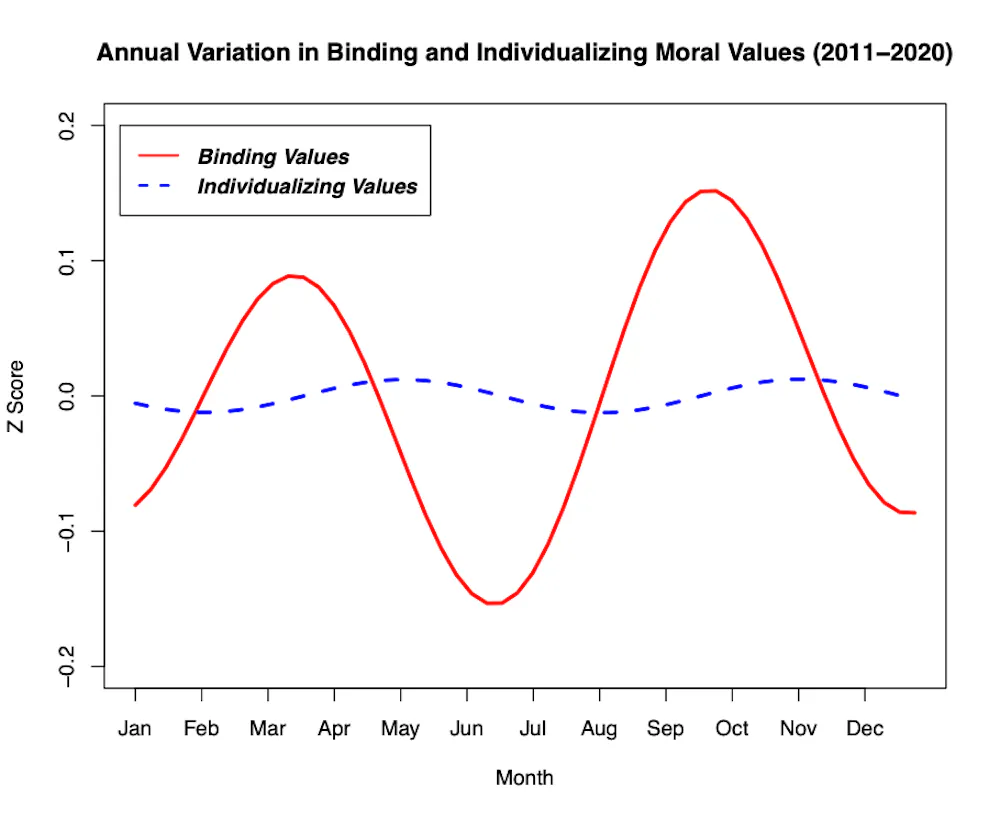
    Our analyses focused on the values reported by 232,975 respondents in the United States across a decade (2011-20) of data. The results revealed no apparent seasonal cycle in Americans’ endorsement of individualizing values, but there was clear and consistent seasonal cycle in Americans’ endorsement of all three binding moral values.

    This seasonal cycle was bimodal, with two peaks and two valleys each year: Americans endorsed binding moral values (valuing loyalty, authority and group traditions) most strongly in the spring and autumn, and least strongly in midsummer and midwinter. This bimodal seasonal cycle in binding moral values showed up again and again in the data, year after year.

    A graph depicting Americans’ endorsement of binding and individualizing moral values.
    (I. Hohm and M. Schaller), CC BY

    This seasonal cycle in binding moral values wasn’t unique to the U.S. either. Additional analyses on data from Canada and Australia revealed similar patterns: Canadians and Australians also endorsed binding moral values most strongly in the spring and autumn, and least strongly in midsummer and midwinter.

    Anxiety patterns

    What might explain this seasonal cycle in people’s endorsement of binding moral values? One possibility is that it has something to do with the perception of threat, which encourages people to close ranks within a group. Previous research has linked this to increased endorsement of binding moral values.

    To test this idea, we analyzed data on an emotion associated with threat perception: anxiety. Results revealed that Americans’ self-reported anxiety showed the same bimodal seasonal cycle, and so did 10 years of data on Americans’ Google searches for anxiety-related words. This seasonal cycle in anxiety helps to explain the seasonal cycle in binding values.

    Anxiety tends to change with the seasons, decreasing in summer and midwinter.
    (Shutterstock)

    This explanation raises a new question: what might explain the seasonal cycle in anxiety? Although we can only speculate, our analyses on moral values revealed an intriguing clue. The summertime dip in Americans’ endorsement of binding moral values was bigger in places with more extreme seasonal changes in the temperature. There was no such effect on the size of the midwinter dip.

    Perhaps something similar might be going on with anxiety: maybe that summertime decrease is the result of pleasant weather, whereas the midwinter decrease is more of a holiday effect.

    Double-edged sword

    Regardless of the cause, seasonal cycles in binding moral values could have consequences that affect people’s lives, for better or worse. Binding moral values promote cohesion, conformity and co-operation within groups, which can be beneficial, especially when coping with crises.

    The implication is that groups might cope better with crises that emerge in the spring and autumn, compared to those that occur in the summer and winter.

    But binding moral values also promote distrust of people who fail to adhere to group norms and traditions. The implication is that there may also be seasonal cycles in prejudices against immigrants, racial minorities, LGBTQ+ individuals and anybody else who is perceived to be different.

    People who more strongly endorse binding moral values are also more punitive, so there could be seasonal effects on judicial decision-making in the millions of legal cases that occur every year.

    And given the link between binding moral values and conservative attitudes, there are potential implications for politics. One intriguing possibility: the timing of political elections (whether they are scheduled for summer or autumn, for instance) might have some subtle effect on some votes — which, for an election that is especially tight, might even influence its outcome.

    Mark Schaller receives funding from the Social Sciences and Humanities Research Council of Canada.

    Ian Hohm does not work for, consult, own shares in or receive funding from any company or organisation that would benefit from this article, and has disclosed no relevant affiliations beyond their academic appointment.

    ref. Seasonal change can affect people’s moods — and their moral values – https://theconversation.com/seasonal-change-can-affect-peoples-moods-and-their-moral-values-236626

    MIL OSI – Global Reports

  • MIL-OSI Economics: Australasia Young Professionals Subcommittee Hosts “Intro to Well Design & DrillPlan” Workshop

    Source: International Association of Drilling Contractors – IADC

    Headline: Australasia Young Professionals Subcommittee Hosts “Intro to Well Design & DrillPlan” Workshop

    On 30 August, the IADC Australasia Young Professionals (YP) Subcommittee (SC) hosted an “Introduction to Well Design and DrillPlan” workshop. The event was co-hosted with the SPE Edith Cowan University Student Chapter WA Australia and sponsored by SLB and the IADC Australasia YP SC. 

    The workshop featured an insightful session led by Farshid Hafezi, Senior Drilling Engineer at SLB. Attendees gained valuable knowledge on well design and DrillPlan, and the event was enriched with networking opportunities and a quiz with exciting prizes.

    The IADC Australasia YP SC expressed its gratitude for all the volunteers and participants for making this a successful workshop, and to Edith Cowan University for providing the venue. 

    MIL OSI Economics

  • MIL-OSI Europe: Iceland elected as member of United Nations Human Rights Council

    Source: Government of Iceland

    Iceland was elected to the United Nations Human Rights Council today at the UN General Assembly in New York. Nineteen countries put forward their candidatures for eighteen available seats on the Council for a three-year term from 2025 to 2027. Iceland’s candidature is supported by all Nordic States. 

    “We are grateful for the broad support we received in today’s election. Serving on the Human Rights Council is a great responsibly that Iceland takes seriously,” says Thórdís Kolbrún Reykfjörd Gylfadóttir, Minister for Foreign Affairs. Iceland received 174 out of 183 votes in the election. 

    Iceland has previously been a Member of the Council for half a term in 2018-2019, filling the seat vacated by the United States.

    “The international community is facing significant challenges with human rights increasingly under threat in too many places. Our main priority for our upcoming term on the Council will be working together with other states to promote and protect human rights for all. We will focus especially on gender equality, children’s rights and LGBTQI+ rights,” said Thórdís Kolbrún.

    The Human Rights Council consists of 47 countries, based in Geneva. Of these, seven represent the group of Western European and other states (WEOG), thirteen are from Africa, thirteen from the Asia-Pacific region, eight from Latin American and Caribbean countries, and six from Eastern European countries. 

    Iceland has published its voluntary pledges and commitments for its tenure on the Council. Iceland’s candidacy brochure can be found here.  

    MIL OSI Europe News

  • MIL-OSI Security: Defense News: India hosts Australia, Japan and U.S. forces in Exercise Malabar 2024

    Source: United States Navy

    VISAKHAPATNAM, INDIA – Australia, Japan, and U.S. forces joined the host Indian Navy for an opening ceremony to celebrate the launch of field-training exercise Malabar 2024 in Vishakhapatnam, India, on Oct. 9.

    The ceremony and associated shore-phase activities will be followed by scheduled at-sea exercises involving in the Bay of Bengal, India.

    “I’m fired up to be here today with my counterparts as our navies train together in the Indian Ocean to strengthen our combat readiness, maritime integration, and interoperability,” said Adm. Steve Koehler, commander, U.S. Pacific Fleet. “Malabar is a great example of a combined team operating together in order to deter conflict and reinforce our shared commitment to a free and open Indo-Pacific.”

    This year marks the 28th iteration of the Malabar exercise, which began in 1992 as a bilateral exercise between the United States and India. The exercise has since evolved in scope and complexity and now includes Japan and Australia. This marks the fifth time that all four nations have participated in Malabar to advance the collective planning, integration and employment of advanced warfare tactics across participating nations.

    “Malabar 2024 reaffirms Indian Navy’s commitment to maritime security and cooperation among like-minded nations in the Indo-Pacific,” said Vice Adm. Rajesh Pendharkar, Flag Officer Commanding-in-Chief, Eastern Naval Command (ENC). “Our joint efforts aim to enhance operational synergy and foster stronger bonds of friendship. Together, we look towards safeguarding our shared values and achieve peace and stability in the region.”

    At-sea exercises are scheduled to include combined training in the surface, sub-surface, air and information domains.

    Eight ships and nearly a dozen aircraft are scheduled to take part in the exercise.

    “It has been 17 years since the JMSDF participated in Malabar for the first time in 2007,” said JMSDF Vice Adm. Katsushi Omachi, commander in chief, Self Defense Fleet. “I believe Malabar will contribute to the peace and stability, as well as the rules-based maritime order, which lead to a free and open Indo-Pacific. Japan-U.S.-India-Australia collaboration is now getting closer than before and I am expecting the multilateral bonds among the navies will deepen.”

    Representing the U.S. in the exercise are a P-8 Poseidon aircraft assigned to Commander, Task Force 72 and the Arleigh Burke-class guided missile destroyer USS Dewey (DDG 105), which operates under Commander, Task Force 70 and Destroyer Squadron (DESRON) 15, the Navy’s largest DESRON and the U.S. 7th Fleet’s principal surface force.

    The Murasame-class destroyer JS Ariake (DD 109) is representing the Japan Maritime Self-Defense Force. Australia is represented by the Royal Australian Navy Anzac-class frigate HMAS Stuart (FFH 153) and a Royal Australian Air Force P-8A Poseidon maritime patrol aircraft. The host contingent from India includes the first-in-class guided-missile destroyer INS Delhi (D 61), as well as at least four other surface combatants and aircraft.

    Australian, Indian, Japanese, and U.S. maritime forces routinely operate together across the Indo-Pacific in support of regional security and stability.

    “Exercise Malabar is a significant Indo-Pacific maritime activity that deepens interoperability and collaboration among key regional partners,” Australia’s Joint Force Maritime Component Commander, Commodore Jonathan Ley, said. “Australia has participated in previous iterations of Exercise Malabar, was honoured to host the exercise in 2023 and is pleased to participate again in 2024 as part of the Australian Defence Force’s ongoing program of regional presence and engagement.”

    The lead of this year’s exercise is India. The Malabar planning and exercise lead rotates each year among participating nations, along with the exercise location to demonstrate the combined ability to exercise across the entire Western Pacific and Indian Ocean.

    U.S. 7th Fleet is the U.S. Navy’s largest forward-deployed numbered fleet, and routinely interacts and operates with allies and partners in preserving a free and open Indo-Pacific region.

    MIL Security OSI

  • MIL-OSI Economics: How AI is poised to transform air travel, from reservations and check-in to baggage handling

    Source: Microsoft

    Headline: How AI is poised to transform air travel, from reservations and check-in to baggage handling

    Introducing a new industry reference architecture for airlines and airports

    The aviation industry is entering a new era: airlines and airports worldwide are on the brink of transformation, driven by the power of generative AI. This powerful technology is creating new value at every stage of the aviation ecosystem, revolutionizing the way we fly and operate. From personalized travel offers to instant responses for customer service requests, AI is enhancing every step of your journey, making travel smoother and more personalized than ever before.

    Generative AI is also transforming the core operations of airlines and airports. Research shows that up to 35% of flight delays can be reduced through AI-powered decision-making—saving time, reducing stress, and increasing safety for both travelers and staff.1

    AI is also reshaping the workforce. With streamlined tasks and smarter tools, staff can dedicate more time to enhancing the passenger experience—both on the ground and in the air. AI-powered personalization can increase revenue per passenger by 10 to 15%. At the same time, intelligent AI chatbots can reduce customer service costs by up to 30%, creating significant value for both airlines and airports.2

    This is the future of aviation. AI is not just a tool—it’s a revolution, creating value across the entire industry. Microsoft has developed a new industry reference architecture enabling AI for a seamless traveler journey, efficient airline operations, and enhanced airport operations. 

    Create connected mobility experiences with AI-powered solutions >

    Seamless traveler journey

    The experience begins the moment a traveler considers a trip. They can interact with an AI-powered mobile app to explore options, book flights, and receive personalized recommendations. Throughout their journey, the app serves as a digital assistant, providing real-time updates on flight status, gate changes, and the weather at the destination. At the airport, travelers can navigate through a touchless experience, from check-in to security, using biometric identification and e-boarding passes on their mobile devices. The app continues to assist by guiding them to their gate, offering lounge access, and updating any travel alerts.

    Once on board, the digital assistant ensures a comfortable experience by allowing travelers to control in-flight entertainment, order food and items from the onboard shop, and adjust seating preferences through their mobile device. The journey concludes with the app facilitating a smooth arrival process, including customs and baggage claim guidance, and arranging for ground transportation. Throughout this journey, AI and machine learning algorithms work behind the scenes to anticipate needs, offer timely assistance, and personalize the travel experience.

    Air India passengers, for example, now get answers to all their questions from planning to arrival at their fingertips. Their AI.g virtual assistant, powered by Microsoft AI services, quickly proposes a travel itinerary for passengers, finds answers about check-in options and flight status, recommends the best food options, finds the next business lounge or helps with lost luggage. Another example is Saudia Airlines. The flag carrier of Saudi Arabia developed an AI-powered travel companion for their passengers using Microsoft technology to enable travel-related services like: planning and booking, refund management, and exploring new destinations.

    Efficient airline operations

    AI working on data platforms enhances efficiency and customer experience across various segments of the airline value chain.

    • In aircraft handling, AI-powered predictive maintenance can forecast potential issues before they occur, minimizing downtime and ensuring timely operations. Ground support equipment can be optimized using AI algorithms to streamline processes and reduce delays.
    • In ground operations, AI can manage complex logistics, from baggage handling to fuel management, by analyzing vast amounts of data to optimize workflows and resource allocation. This leads to smoother operations and can significantly reduce turnaround times for aircraft.
    • Flight operations benefit from AI through advanced analytics that can assist in route planning, weather forecasting, and fuel consumption optimization. By leveraging historical data and real-time inputs, AI can provide pilots and flight planners with insights that lead to safer and more cost-effective flights.
    • For marketing and sales, AI enables personalized customer experiences by analyzing customer data to tailor offerings and promotions. This can lead to increased customer loyalty and revenue as airlines can offer the right product to the right customer at the right time.
    • In customer support, AI-powered chatbots and virtual assistants provide around the clock support, handling inquiries and resolving issues promptly. This not only improves customer satisfaction but also frees up human agents to deal with more complex queries, enhancing overall service quality.

    Lufthansa, for example, developed the one data platform built on Microsoft Azure to provide self-service applications and leverage cognitive AI services like image and speech recognition.

    “Leveraging Microsoft Azure’s robust cloud capabilities, we’ve transformed Lufthansa’s operations with a unified data platform. This innovation empowers us to optimize every aspect of our service, from ground operations to in-flight experiences, ensuring punctuality and safety across our global network—continuing to use AI will help us advance to the level.”

    Ganesh Swaminathan, Head of Platforms, Lufthansa Group Digital Hangar

    American Airlines, the world’s largest airline, is using Azure as its preferred cloud platform. Their team members now use the ConnectMe app for the latest crew information while the airline is using AI to reduce taxi time and turn times at gates.

    Microsoft AI

    Enhanced airport operations

    Generative AI and data platforms also play a pivotal role in enhancing airport operations, catering to the needs of tens of thousands of passengers daily. Airports can optimize their critical infrastructure management, such as energy, water, and climate control. The integration of AI into security and emergency services significantly enhances their capabilities, providing a safer and more secure environment for travelers. Connected transportation systems such as buses and trains benefit from predictive analytics and real-time data processing capabilities, leading to improved scheduling and passenger flow management.

    In the realm of commerce, which encompasses retail stores and restaurants within the airport, generative AI and data platforms offer valuable insights into consumer behavior, enabling businesses to tailor their services and inventory to meet the dynamic needs of passengers.

    The logistics and supply chains for cargo, fuel, and baggage are also transformed by these technologies, with AI-powered systems facilitating better tracking, forecasting, and management of resources. This results in a more streamlined and cost-effective operation, reducing delays and enhancing the overall passenger experience. Fraport has introduced FraportGPT, an example of an employee-facing app powered by Microsoft Azure OpenAI Service to streamline internal processes.

    “Fraport’s company GPT app, powered by Generative AI, has been a resounding success, swiftly adopted by our team. It’s not just streamlined our processes; it’s accelerated skill acquisition, empowering our employees to master new competencies with unprecedented speed.”

    Christian Wrobel, Chief Data Architect, Fraport AG

    Together with Microsoft, Miami International Airport (MIA) has developed a centralized data hub environment, known as the Common Data Environment (CDE), to store, manage, and share business data, apps, and business process flows. This is crucial for breaking down data silos and ensuring data accessibility for analysis and helps unlocking additional value from generative AI.

    “By integrating various data sources, including on-premises, cloud, and edge environments, we provide a unified and scalable platform for data management. This is the basis, and together with our partner Microsoft we will now be able to leverage advanced technologies such as AI, machine learning, and IoT to gain insights, make data-driven decisions, and drive innovation.”

    Maurice Jenkins, Chief Innovation Officer, Miami International Airport

    The overarching reference architecture and partners

    Our common architecture for airports and airlines is built among core elements with the ultimate goal to create AI-enhanced experiences for everyone, from passengers to ground personnel: the creation of user-facing applications, data storage and analytics, and data ingestion and integration of existing data systems.

    The AI-enhanced experiences are tailored to each user group.

    • For passengers, it is all about a smooth journey from origin to destination, with plenty of time to enjoy travel with retail, entertainment, and restaurant offers.
    • Ground staff and customer service focus on making the passenger experience smooth, even when something goes wrong.
    • Pilots and crew members require support for coordination, communication, and the reduction of their management overload.
    • For technicians, it is about knowing where to go next, reducing cognitive workload for maintenance and repair tasks, and automating documentation.
    • Terminal managers require support to manage traffic, ensure security, and provide travel comfort.
    • For airside operators, it is about managing baggage, refueling, and safety.

    Different user groups require different backend applications and data sources. The user-facing applications layer describes some of the common front-end experiences that can be built using Microsoft services.

    • End users require mobile and web applications built using services such as Azure API Management, Azure App Service and Azure Functions. Developers create AI-powered user experiences leveraging services such as Azure OpenAI Service. These applications can be deployed in Azure tenants and can scale to millions of users.
    • Business users leverage Dynamics 365 (Customer Service, Finance, Project Operations, and Customer Insights) to manage business operations, such as claims, promotions, and ticketing. Dynamics 365 has built-in custom agents for many common business use cases such as customer service, sales, finance, field service, and customer insights.
    • Front line workers are fully integrated in the business with customized workflows and automated operations with custom AI, tailored to their needs and the ergonomics of their workplaces—wherever fixed terminals, mobile devices, or augmented reality. Microsoft Copilot Studio facilitates the creation of custom AI agents to support their work. Power Apps enables the creation of custom user interfaces, while Power Automate enables the creation of business workflows.
    • With Microsoft 365 Copilot, employees can collaborate and communicate using Microsoft products such as Microsoft Teams, SharePoint, and Outlook.

    The operation of airports and airlines generates large amounts of data. The data storage and analytics layer describes how to securely store business data to support operations and create insights.

    • Microsoft Dataverse is a scalable data platform that securely stores and manage business data. The data model is a structure framework that organizes data in tables with relationships. It is possible to use industry models to harmonize and integrate business data across multiple applications.
    • Microsoft Fabric is an end-to-end data and analytics platform that includes real-time analytics capabilities. OneLake is a unified logical data lake that centralizes and simplifies data management, with multiple analytical engines and workspaces. Fabric enables organizations to process and analyze data for timely insights and decision making.

    Airports and airlines are established businesses. It is important to integrate existing data systems, such as connected assets as well as existing systems. Messaging services on Azure enables connectivity to assets and devices using standardized communication protocols such as Message Queuing Telemetry Transport (MQTT) with Azure Event Grid, or data streams like Apache Kafka using Azure Event Hubs. Serverless solutions like Azure Functions provide compute to process messages.

    We’re also proud to collaborate with leading partners driving innovation in aviation.

    • Amadeus and Microsoft have formed a global strategic partnership that harnesses cloud technology to innovate and explore new products and solutions and create smoother travel experiences.
    • SAP deployments on Azure provide robust cloud solutions tailored to customer needs.
    • Our partnership with SITA, and their SITA Mission Control solution, helps duty personnel anticipate and respond to real-time changes during flight operations.
    • We also integrate independent software vendors (ISVs), such as SmartKargo, PROS, and Satavia, to contribute to a smarter, more connected aviation ecosystem.

    Creating frontline worker experiences

    Frontline worker experiences are highly customized to the task and require constant adaptation. The power of low-code platforms like Power Apps and Copilot Studio significantly reduce the time to value, allowing for rapid development and deployment of tailored solutions. These platforms enable the integration of multiple data sources, such as location-based services, logistical information from Dynamics 365, and documentation search. Additionally, task support is enhanced through the use of knowledge graphs and manuals, while collaboration and information regarding connected assets are seamlessly incorporated.

    Overcoming the challenges of using AI in aviation

    While the potential of AI in aviation is immense, there are key challenges: defining the most valuable AI use cases, setting up cloud infrastructure, organizing the data estate, and minimizing costs during development, testing, and deployment phases.

    Microsoft addresses the challenges of AI in aviation by working closely with partners, establishing a framework for responsible and trusted AI principles, and leveraging its comprehensive suite of tools and services. It helps define valuable AI use cases through collaborative workshops and industry-specific solutions. Azure provides scalable cloud infrastructure, while Microsoft Dataverse and OneLake streamline data management. Cost efficiency is achieved through optimized development, testing, and deployment processes. Additionally, Microsoft provides extensive training programs to equip employees with necessary AI skills and collaborates with regulatory bodies to ensure compliance with legal frameworks governing AI usage.

    Moving forward with generative AI in aviation

    Taking advantage of generative AI requires a pragmatic approach, where existing solutions are combined with new capabilities and partner solutions. Correctly identifying the use cases with the highest priority and impact is critical for success.

    Visit Microsoft for travel and transportation or contact our team to learn more and take the next step in your AI journey.

    “We’re excited to introduce our new reference architecture for the aviation industry, built on Azure’s cloud capabilities and advanced AI tools. What truly makes this effort stand out is our collaboration with leading aviation partners. Together with our partners, we’re shaping the future of the aviation industry.”

    Julie Shainock, Managing Director Travel & Transportation Industry, Microsoft

    “Microsoft’s Industry Solutions team is ready to help you deliver and implement AI-driven solutions across your organization: From a first [proof of concept] POC to full-scale rollouts, we are dedicated to providing the expertise you need to ensure a smooth and successful deployment.”

    Eric Chaniot, General Manager of AI Industry Solutions, Microsoft

    “At Microsoft Cloud for Industries, we are committed to empowering our partners with proven patterns and comprehensive enablement resources. By leveraging our industry-specific solutions and collaborative approach, we help partners accelerate innovation, streamline operations, and deliver exceptional value so that their customers can achieve more.”

    Monica Ugwi, General Manager Cloud for Industries, Manufacturing & Mobility, Microsoft


    1Worldmetrics: AI in the Airline Industry, 2024.

    2The economic potential of generative AI, McKinsey & Co., 2023.

    MIL OSI Economics

  • MIL-OSI Security: Trio Responsible for Eight Armed Robberies of Indianapolis-Area Cell Phone Stores Sentenced to Combined 65 Years in Federal Prison

    Source: Federal Bureau of Investigation (FBI) State Crime News

    INDIANAPOLIS- Robdarius Williams, 21, D’Maurah Bryant, 21, and Quintez Tucker, 20, all of Indianapolis, have all been sentenced to federal prison for their roles in a series of eight armed robberies of Indianapolis cell phone retailers.

    Defendant Charges Sentence
    Quintez Tucker, 20

    Eight counts of robbery

    Four counts of brandishing a firearm during a crime of violence

    30 years in prison
    3 years of supervised release

    $64,894 in restitution

    D’Maurah Bryant, 21

    Four counts of robbery

    Three counts of brandishing a firearm during a crime of violence

    25 years in prison
    3 years of supervised release

    $24,485 in restitution

    Robdarius Williams, 21

    One count of robbery

    Brandishing a firearm in furtherance of a crime of violence

    9.5 years in prison
    3 years of supervised release

    In April of 2024, Tucker and Bryant each plead guilty. In June of 2024, a federal jury found Williams guilty following a one-and-a-half-day trial.

    According to court documents and evidence introduced at trial, from November 8 through December 3, 2021, Tucker and Bryant worked together to rob eight cell phone retailers around Indianapolis. During each robbery, the men brandished firearms and pointed them at employees, demanded cash, cell phones, and accessories from the store and customers. Williams joined in the eighth and final armed robbery as the getaway driver, stole a license plate for the getaway car and took Tucker to pick up an AR-style rifle used in the robbery.

    In total, the trio robbed eight businesses in twenty-five days:

    Date Location Defendants
    November 8, 2021 Verizon, Olio Rd., Fishers. Tucker & Bryant
    November 18, 2021 T-Mobile, Southport Rd. Tucker & Bryant
    November 23, 2021 Verizon, Kessler Blvd. Tucker & Bryant
    November 26, 2021 T-Mobile, E. 86th St. Tucker & Bryant
    November 29, 2021 T-Mobile, Fox Rd. Tucker & Bryant
    December 1, 2021 T-Mobile, E. Stop 11 Rd. Tucker & Bryant
    December 1, 2021 T-Mobile, W. 38th St. Tucker & Bryant
    December 3, 2021 AT&T, S. Emerson Ave. Tucker & Williams

    “No one should have a gun pointed in their face by heartless criminals simply because they went shopping, or went to work,” said Zachary A. Myers, U.S. Attorney for the Southern District of Indiana. “These armed criminals terrorized their victims with utter disregard for the consequences of their actions—going so far as to point an AR-style firearm at a toddler as their parent shielded the child with their body. These horrific crimes will not be tolerated in our community. The Department of Justice has no higher priority than keeping the public safe from armed, violent crimes. Thanks to the dedicated efforts of the FBI, the Fishers Police Department, IMPD, and our federal prosecutors, our communities will be protected from these criminals for many years to come.”

    “The lengthy sentences handed out should serve as a deterrent to remind potential offenders that the FBI and our law enforcement partners are committed to protecting those who live in the communities we serve,” said FBI Indianapolis Special Agent in Charge Herbert J. Stapleton. “The defendants didn’t just steal items; they instilled a sense of fear in and disrupted the lives of their victims.

    “The sentencing of these three violent felons to a combined 65 years in prison sends a strong message that our community will not tolerate such criminal behavior,” said Ed Gebhart, Fishers Police Chief, “I commend the hard work of our officers, our law enforcement partners and the justice system for ensuring that these dangerous individuals will be off the streets for a significant amount of time.”

    The FBI investigated this case. The Fishers Police Department, the Indianapolis Metropolitan Police Department, and the Marion County Prosecutors Office also provided valuable assistance. The sentences were imposed by U.S District Court Judge Jane Magnus-Stinson.

    U.S. Attorney Zachary A. Myers thanked Assistant U.S. Attorneys Jeremy C. Fugate and Peter A. Blackett, who prosecuted this case.

    This case was part of Project Safe Neighborhoods (PSN), a program bringing together all levels of law enforcement and the communities they serve to reduce violent crime and make our neighborhoods safer for everyone. The Department of Justice reinvigorated PSN in 2017 as part of the Department’s renewed focus on targeting violent criminals, directing all U.S. Attorney’s Offices to work in partnership with federal, state, local, and tribal law enforcement, and the local community to develop effective, locally based strategies to reduce violent crime.

    ###

    MIL Security OSI

  • MIL-OSI Europe: JOINT MOTION FOR A RESOLUTION on the cases of unjustly imprisoned Uyghurs in China, notably Ilham Tohti and Gulshan Abbas – RC-B10-0101/2024

    Source: European Parliament

    pursuant to Rules 150(5) and 136(4) of the Rules of Procedure
    replacing the following motions:
    B10‑0101/2024 (Verts/ALE)
    B10‑0115/2024 (Renew)
    B10‑0116/2024 (S&D)
    B10‑0117/2024 (PPE)
    B10‑0118/2024 (ECR)

    Sebastião Bugalho, Miriam Lexmann, Michael Gahler, David McAllister, Isabel Wiseler‑Lima, Luděk Niedermayer, Ana Miguel Pedro, Mirosława Nykiel, Paulo Cunha, Marta Wcisło, Vangelis Meimarakis, Loránt Vincze, Danuše Nerudová, Rosa Estaràs Ferragut, Tomáš Zdechovský, Jörgen Warborn, Wouter Beke, Nicolás Pascual De La Parte, Željana Zovko, Inese Vaidere
    on behalf of the PPE Group
    Yannis Maniatis, Francisco Assis, Raphaël Glucksmann, Pina Picierno
    on behalf of the S&D Group
    Joachim Stanisław Brudziński, Adam Bielan, Mariusz Kamiński, Jaak Madison, Reinis Pozņaks, Alexandr Vondra, Jadwiga Wiśniewska, Veronika Vrecionová, Ondřej Krutílek, Michał Dworczyk, Assita Kanko, Alberico Gambino, Carlo Fidanza, Charlie Weimers, Beatrice Timgren, Sebastian Tynkkynen, Roberts Zīle, Waldemar Tomaszewski
    on behalf of the ECR Group
    Petras Auštrevičius, Helmut Brandstätter, Benoit Cassart, Olivier Chastel, Engin Eroglu, João Cotrim De Figueiredo, Svenja Hahn, Karin Karlsbro, Moritz Körner, Ilhan Kyuchyuk, Nathalie Loiseau, Urmas Paet, Ana Vasconcelos, Hilde Vautmans, Lucia Yar
    on behalf of the Renew Group
    Erik Marquardt, Markéta Gregorová
    on behalf of the Verts/ALE Group
    Per Clausen, Rima Hassan, Hanna Gedin, Jonas Sjöstedt

    Document selected :  

    RC-B10-0101/2024

    Texts tabled :

    RC-B10-0101/2024

    Texts adopted :

    European Parliament resolution on the cases of unjustly imprisoned Uyghurs in China, notably Ilham Tohti and Gulshan Abbas

    (2024/2857(RSP))

    The European Parliament,

     having regard to Articles 4 and 36 of the Constitution of the People’s Republic of China (PRC),

     having regard to Rules 150(5) and 136(4) of its Rules of Procedure,

    A. whereas in 2014 Ilham Tohti was convicted of politically motivated charges of ‘separatism’ and sentenced to life imprisonment; whereas he worked to foster dialogue between Uyghurs and Han Chinese; whereas he was awarded the 2019 Sakharov Prize;

    B. whereas Gulshan Abbas is serving a 20-year sentence on fallacious terrorism-related charges relating to activities of her sister, a defender of the human rights of persecuted Uyghurs in the PRC;

    C. whereas this reflects the PRC authorities’ systemic repression of Uyghurs in the Xinjiang Uyghur Autonomous Region (XUAR); whereas Uyghurs are arbitrarily detained in internment camps and forced to renounce their ethnic identity and religious beliefs;

    D. whereas the defence of human rights, democracy and the rule of law should be at the centre of EU-PRC relations;

    1. Strongly condemns the PRC’s violations of the human rights of Uyghurs and people in Tibet, Hong Kong, Macau and mainland China;

    2. Urges the PRC to immediately and unconditionally release Ilham Tohti and Gulshan Abbas, as well as those arbitrarily detained in China and those mentioned by the EU during the 57th session of the UN Human Rights Council, guarantee their access to medical care and lawyers, provide information on their whereabouts and ensure family visiting rights; calls for the EU and the Member States to apply pressure in this respect at every high-level contact;

    3. Calls for the EU and the Member States to adopt additional sanctions against high-ranking officials and entities involved in human rights violations in the PRC;

    4. Demands that the PRC authorities halt their repression and targeting of Uyghurs with abusive policies, including intense surveillance, forced labour, sterilisation, birth prevention measures and the destruction of Uyghur identity, which amount to crimes against humanity and a serious risk of genocide; calls for the closure of all internment camps;

    5. Strongly condemns the PRC for not implementing the recommendations of the Office of the High Commissioner for Human Rights (OHCHR); calls on the PRC to allow the OHCHR independent access to XUAR and invites the OHCHR to issue a comprehensive situational update and an action plan for holding the PRC accountable;

    6. Regrets the PRC’s lack of commitment to the Human Rights Dialogue and the absence of results;

    7. Calls on Member States and the international community to suspend extradition treaties with the PRC and Hong Kong, respect the non-refoulement principle and implement the OHCHR report;

    8. Urges Member States to address the transnational repression of Chinese dissidents and Uyghurs on their territory and prosecute individuals responsible;

    9. Welcomes the EU’s forced labour regulation and insists on its full implementation; calls on businesses operating in the PRC, particularly in XUAR, to comply with their HR due diligence obligations;

    10. Instructs its President to forward this resolution to the PRC authorities, the VP/HR, the Commission, the Member States and the United Nations.

    MIL OSI Europe News

  • MIL-OSI Europe: JOINT MOTION FOR A RESOLUTION on the cases of unjustly imprisoned Uyghurs in China, notably Ilham Tohti and Gulshan Abbas – RC-B10-0101/2024/REV1

    Source: European Parliament

    pursuant to Rules 150(5) and 136(4) of the Rules of Procedure
    replacing the following motions:
    B10‑0101/2024 (Verts/ALE)
    B10‑0115/2024 (Renew)
    B10‑0116/2024 (S&D)
    B10‑0117/2024 (PPE)
    B10‑0118/2024 (ECR)

    Sebastião Bugalho, Miriam Lexmann, Michael Gahler, David McAllister, Isabel Wiseler‑Lima, Luděk Niedermayer, Ana Miguel Pedro, Mirosława Nykiel, Paulo Cunha, Marta Wcisło, Vangelis Meimarakis, Loránt Vincze, Danuše Nerudová, Rosa Estaràs Ferragut, Tomáš Zdechovský, Jörgen Warborn, Wouter Beke, Nicolás Pascual De La Parte, Željana Zovko, Inese Vaidere
    on behalf of the PPE Group
    Yannis Maniatis, Francisco Assis, Raphaël Glucksmann, Pina Picierno
    on behalf of the S&D Group
    Joachim Stanisław Brudziński, Adam Bielan, Mariusz Kamiński, Jaak Madison, Reinis Pozņaks, Alexandr Vondra, Jadwiga Wiśniewska, Veronika Vrecionová, Ondřej Krutílek, Michał Dworczyk, Assita Kanko, Alberico Gambino, Carlo Fidanza, Charlie Weimers, Beatrice Timgren, Sebastian Tynkkynen, Roberts Zīle, Waldemar Tomaszewski
    on behalf of the ECR Group
    Petras Auštrevičius, Helmut Brandstätter, Benoit Cassart, Olivier Chastel, Engin Eroglu, João Cotrim De Figueiredo, Svenja Hahn, Karin Karlsbro, Moritz Körner, Ilhan Kyuchyuk, Nathalie Loiseau, Urmas Paet, Ana Vasconcelos, Hilde Vautmans, Lucia Yar
    on behalf of the Renew Group
    Erik Marquardt, Markéta Gregorová
    on behalf of the Verts/ALE Group
    Per Clausen, Rima Hassan, Hanna Gedin, Jonas Sjöstedt, Lukas Sieper

    Document selected :  

    RC-B10-0101/2024

    Texts tabled :

    RC-B10-0101/2024

    Texts adopted :

    European Parliament resolution on the cases of unjustly imprisoned Uyghurs in China, notably Ilham Tohti and Gulshan Abbas

    (2024/2857(RSP))

    The European Parliament,

     having regard to Articles 4 and 36 of the Constitution of the People’s Republic of China (PRC),

     having regard to Rules 150(5) and 136(4) of its Rules of Procedure,

    A. whereas in 2014 Ilham Tohti was convicted of politically motivated charges of ‘separatism’ and sentenced to life imprisonment; whereas he worked to foster dialogue between Uyghurs and Han Chinese; whereas he was awarded the 2019 Sakharov Prize;

    B. whereas Gulshan Abbas is serving a 20-year sentence on fallacious terrorism-related charges relating to activities of her sister, a defender of the human rights of persecuted Uyghurs in the PRC;

    C. whereas this reflects the PRC authorities’ systemic repression of Uyghurs in the Xinjiang Uyghur Autonomous Region (XUAR); whereas Uyghurs are arbitrarily detained in internment camps and forced to renounce their ethnic identity and religious beliefs;

    D. whereas the defence of human rights, democracy and the rule of law should be at the centre of EU-PRC relations;

    1. Strongly condemns the PRC’s violations of the human rights of Uyghurs and people in Tibet, Hong Kong, Macau and mainland China;

    2. Urges the PRC to immediately and unconditionally release Ilham Tohti and Gulshan Abbas, as well as those arbitrarily detained in China and those mentioned by the EU during the 57th session of the UN Human Rights Council, guarantee their access to medical care and lawyers, provide information on their whereabouts and ensure family visiting rights; calls for the EU and the Member States to apply pressure in this respect at every high-level contact;

    3. Calls for the EU and the Member States to adopt additional sanctions against high-ranking officials and entities involved in human rights violations in the PRC;

    4. Demands that the PRC authorities halt their repression and targeting of Uyghurs with abusive policies, including intense surveillance, forced labour, sterilisation, birth prevention measures and the destruction of Uyghur identity, which amount to crimes against humanity and a serious risk of genocide; calls for the closure of all internment camps;

    5. Strongly condemns the PRC for not implementing the recommendations of the Office of the High Commissioner for Human Rights (OHCHR); calls on the PRC to allow the OHCHR independent access to XUAR and invites the OHCHR to issue a comprehensive situational update and an action plan for holding the PRC accountable;

    6. Regrets the PRC’s lack of commitment to the Human Rights Dialogue and the absence of results;

    7. Calls on Member States and the international community to suspend extradition treaties with the PRC and Hong Kong, respect the non-refoulement principle and implement the OHCHR report;

    8. Urges Member States to address the transnational repression of Chinese dissidents and Uyghurs on their territory and prosecute individuals responsible;

    9. Welcomes the EU’s forced labour regulation and insists on its full implementation; calls on businesses operating in the PRC, particularly in XUAR, to comply with their HR due diligence obligations;

    10. Instructs its President to forward this resolution to the PRC authorities, the VP/HR, the Commission, the Member States and the United Nations.

    MIL OSI Europe News

  • MIL-Evening Report: The dangers of voice cloning and how to combat it

    Source: The Conversation (Au and NZ) – By Leo S.F. Lin, Senior Lecturer in Policing Studies, Charles Sturt University

    David Herraez Calzada/Shutterstock

    The rapid development of artificial intelligence (AI) has brought both benefits and risk.

    One concerning trend is the misuse of voice cloning. In seconds, scammers can clone a voice and trick people into thinking a friend or a family member urgently needs money.

    News outlets, including CNN, warn these types of scams have the potential to impact millions of people.

    As technology makes it easier for criminals to invade our personal spaces, staying cautious about its use is more important than ever.

    What is voice cloning?

    The rise of AI has created possibilities for image, text, voice generation and machine learning.

    While AI offers many benefits, it also provides fraudsters new methods to exploit individuals for money.

    You may have heard of “deepfakes,” where AI is used to create fake images, videos and even audio, often involving celebrities or politicians.

    Voice cloning, a type of deepfake technology, creates a digital replica of a person’s voice by capturing their speech patterns, accent and breathing from brief audio samples.

    Once the speech pattern is captured, an AI voice generator can convert text input into highly realistic speech resembling the targeted person’s voice.

    With advancing technology, voice cloning can be accomplished with just a three-second audio sample.

    While a simple phrase like “hello, is anyone there?” can lead to a voice cloning scam, a longer conversation helps scammers capture more vocal details. It is therefore best to keep calls brief until you are sure of the caller’s identity.

    Voice cloning has valuable applications in entertainment and health care – enabling remote voice work for artists (even posthumously) and assisting people with speech disabilities.

    However, it raises serious privacy and security concerns, underscoring the need for safeguards.

    How it’s being exploited by criminals

    Cybercriminals exploit voice cloning technology to impersonate celebrities, authorities or ordinary people for fraud.

    They create urgency, gain the victim’s trust and request money via gift cards, wire transfers or cryptocurrency.

    The process begins by collecting audio samples from sources like YouTube and TikTok.

    Next, the technology analyses the audio to generate new recordings.

    Once the voice is cloned, it can be used in deceptive communications, often accompanied by spoofing Caller ID to appear trustworthy.

    Many voice cloning scam cases have made headlines.

    For example, criminals cloned the voice of a company director in the United Arab Emirates to orchestrate a $A51 million heist.

    A businessman in Mumbai fell victim to a voice cloning scam involving a fake call from the Indian Embassy in Dubai.

    In Australia recently, scammers employed a voice clone of Queensland Premier Steven Miles to attempt to trick people to invest in Bitcoin.

    Teenagers and children are also targeted. In a kidnapping scam in the United States, a teenager’s voice was cloned and her parents manipulated into complying with demands.

    It only takes a few seconds of audio for AI to clone someone’s voice.

    How widespread is it?

    Recent research shows 28% of adults in the United Kingdom faced voice cloning scams last year, with 46% unaware of the existence of this type of scam.

    It highlights a significant knowledge gap, leaving millions at risk of fraud.

    In 2022, almost 240,000 Australians reported being victims of voice cloning scams, leading to a financial loss of $A568 million.

    How people and organisations can safeguard against it

    The risks posed by voice cloning require a multidisciplinary response.

    People and organisations can implement several measures to safeguard against the misuse of voice cloning technology.

    First, public awareness campaigns and education can help protect people and organisations and mitigate these types of fraud.

    Public-private collaboration can provide clear information and consent options for voice cloning.

    Second, people and organisations should look to use biometric security with liveness detection, which is new technology that can recognise and verify a live voice as opposed to a fake. And organisations using voice recognition should consider adopting multi-factor authentication.

    Third, enhancing investigative capability against voice cloning is another crucial measure for law enforcement.

    Finally, accurate and updated regulations for countries are needed for managing associated risks.

    Australian law enforcement recognises the potential benefits of AI.

    Yet, concerns about the “dark side” of this technology have prompted calls for research into the criminal use of “artificial intelligence for victim targeting.”

    There are also calls for possible intervention strategies that law enforcement could use to combat this problem.

    Such efforts should connect with the overall National Plan to Combat Cybercrime, which focuses on proactive, reactive and restorative strategies.

    That national plan stipulates a duty of care for service providers, reflected in the Australian government’s new legislation to safeguard the public and small businesses.

    The legislation aims for new obligations to prevent, detect, report and disrupt scams.

    This will apply to regulated organisations such as telcos, banks and digital platform providers. The goal is to protect customers by preventing, detecting, reporting, and disrupting cyber scams involving deception.

    Reducing the risk

    As cybercrime costs the Australian economy an estimated A$42 billion, public awareness and strong safeguards are essential.

    Countries like Australia are recognising the growing risk. The effectiveness of measures against voice cloning and other frauds depends on their adaptability, cost, feasibility and regulatory compliance.

    All stakeholders — government, citizens, and law enforcement — must stay vigilant and raise public awareness to reduce the risk of victimisation.

    The authors do not work for, consult, own shares in or receive funding from any company or organisation that would benefit from this article, and have disclosed no relevant affiliations beyond their academic appointment.

    ref. The dangers of voice cloning and how to combat it – https://theconversation.com/the-dangers-of-voice-cloning-and-how-to-combat-it-239926

    MIL OSI AnalysisEveningReport.nz

  • MIL-Evening Report: New Zealand’s BMI threshold for publicly funded fertility treatment is outdated and unethical. Here’s why it should go

    Source: The Conversation (Au and NZ) – By Carina Truyts, Associate Research Fellow (Deakin) and Research Officer, Monash University

    Getty Images

    Women seeking publicly funded fertility treatment in New Zealand must have a body mass index (BMI) under 32, according to clinical priority assessment criteria for access to assisted reproductive technology.

    But as our in-depth interviews and a growing body of evidence show, this approach is outdated and unethical.

    One of our study participants described the system as “completely rigged if you’re a fat person”. Nina, a 37-year-old dance teacher, was denied public funding support to help her conceive because her BMI was above 32 – even though the cause of infertility was her husband’s sperm count.

    Nina is not alone. Paratta, who moved to Aotearoa from Sri Lanka in 2009, was also denied because of her BMI. She raced to lose the required weight in spite of a medical condition, but was then denied again because she had reached 40, the age limit for access to public funding.

    Both women’s experiences highlight New Zealand’s obsolete and discriminating BMI limit. The United Kingdom does not include BMI as a criterion for public funding, and international cutoffs are generally between 35 and 45.

    We argue New Zealand’s BMI threshold must be scrapped to reflect impactful research and respond ethically to New Zealand’s diverse population.

    BMI and fertility

    One in six people worldwide are affected by infertility, according to the World Health Organization’s most recent estimate. They suffer severe social and psychological consequences.

    There are numerous factors that can affect fertility, and obesity is certainly one of them, impacting 6% of women who have never been pregnant.

    But the BMI is an outdated method of assessing this risk. It doesn’t measure body fat percentage, distribution or differences across populations.

    Our study participants have raised concerns about the BMI limit. International and local studies concur with them. Research shows Polynesians are much leaner than Europeans at significantly higher BMIs, meaning Māori and Pacific women are disadvantaged before they even step into the clinic.

    Quick weight loss unlikely to help

    In New Zealand, people seeking public support are told that “making lifestyle changes like quitting smoking or losing weight” could help them become eligible. They are given a stand-down period wherein they must lose the requisite weight before referrals.

    As in Paratta’s case, this can lead to a race to lose weight before the inflexible age limit of 40 is reached. Evidence-based research advises that fertility care should balance the risk of age-related fertility decline with weight-loss advice.

    Nina rejected the advice to lose weight. She was concerned that quick weight loss would require unhealthy practices that could affect her success rate during the embryo transfer.

    Lifestyle changes made within a short time before conception don’t improve outcomes.
    Getty Images

    At the Australia and New Zealand Fertility Association’s annual conference last month, US obstetrician Kurt Barnhart confirmed that lifestyle interventions made weeks or months before conception are unlikely to improve outcomes. They may even cause harm.

    He discussed the FIT—PLESE randomised control study, which compared two groups of infertile women. One underwent a targeted weight-loss program and another exercised but did not lose weight. The results showed no statistically significant difference between the groups’ fertility and live-birth rates. These findings suggest the stand-down period should be revised.

    Barnhart also highlighted that weight loss through lifestyle changes can be practically impossible given obesity is often linked to endocrine issues that have nothing to do with choice. He observed signals that the medical community is changing its views on obesity as a “lifestyle” choice – a welcome shift.

    BMI, lifestyle and ethics

    Social science research has long challenged a colonial and biomedical habit of imposing standards on women whose bodies do not conform to Western ideas of a healthy or ideal body.

    Historically, the emphasis on weight as a criterion for reproductive health echoes harmful eugenicist beliefs. As US science historian Arleen Tuchman writes, the discovery of insulin prompted some groups to recommended banning marriages for people with diabetes to prevent the “unfit” from reproducing. New Zealand’s BMI criteria similarly suggest only those who fit specific physical standards deserve access to fertility care.

    The idea that lifestyle and health are straightforward individual choices is also challenged by research in epigenetics and philosophy. Obesity is often linked with poverty, which in turn is linked to broader social and living environments, including access and income.

    The high economic burden of obesity has led biomedical experts to recommended obese people should be considered for particular support, given the prohibitive cost of assisted reproductive technologies.

    Nina exercises more than eight hours a week and Paratta leads an active lifestyle. For both women, behavioural advice – and the stigma and assumptions it underscores – is offensive.

    Weight-loss advice can be particularly culturally offensive for Māori and Pacific peoples, who may be stigmatised in clinic settings for being too “fat” but considered “skinny” in their communities if they lose the required weight.

    New Zealand’s assessment criteria for publicly funded fertility treatment have not been updated in 27 years. While infertility and health risks associated with obesity during pregnancy and at birth should not be ignored, research shows these risks can be managed effectively and with empathy through a transdisciplinary approach.

    The Australian state of Victoria now offers two free cycles of fertility treatment to any Medicare-holding woman, regardless of BMI, up to the age of 42. The program deliberately reaches out to specific groups whose ethnicity, sexuality and environment limit their access. It has been highly successful and should inspire New Zealand to approach fertility funding with fresh perspectives.

    The authors do not work for, consult, own shares in or receive funding from any company or organisation that would benefit from this article, and have disclosed no relevant affiliations beyond their academic appointment.

    ref. New Zealand’s BMI threshold for publicly funded fertility treatment is outdated and unethical. Here’s why it should go – https://theconversation.com/new-zealands-bmi-threshold-for-publicly-funded-fertility-treatment-is-outdated-and-unethical-heres-why-it-should-go-240295

    MIL OSI AnalysisEveningReport.nz

  • MIL-Evening Report: Rebates for buying e-bikes and e-scooters are good but unlikely to greatly boost sustainable transport on their own

    Source: The Conversation (Au and NZ) – By Abraham Leung, Senior Research Fellow, Cities Research Institute, Griffith University

    BikePortland/Flickr, CC BY

    Queensland has joined Tasmania as the second Australian state or territory to offer a A$500 rebate for buyers of new e‑bikes. The pre-election announcement includes a smaller $200 rebate for e‑scooters.

    The Queensland e‑mobility rebate scheme is first come, first served, until its $2 million budget ($1 million was added last week) is used up. The Tasmanian scheme has closed for this reason.

    These schemes follow a trend of government incentives to buy e‑bikes in North America and Europe. The Australian schemes differ from most schemes overseas by including e‑scooters too.

    It’s a welcome move to promote sustainable transport. These personal transport devices have smaller environmental footprints to produce and operate than electric cars. Owning e‑bikes or e‑scooters can enable people to drive less – reducing congestion and emissions – and avoid high fuel costs.

    However, my research and other studies suggest ownership doesn’t guarantee much greater use. Additional measures will be needed to boost use of these sustainable transport modes.

    Why own e-bikes or e-scooters when you can share?

    The rebate is likely to boost retailers’ sales. More than 860 rebate applications were received within three days of the scheme starting on September 23.

    And existing owners now have an incentive to upgrade or replace models. They might then sell their pre-loved e‑bikes or e‑scooters on the second-hand market. This means others could get them more cheaply.

    Queensland was the first Australian state to legalise the use of e‑scooters in 2018, when Brisbane introduced shared e‑scooter operations. Regional cities such as Townsville and Cairns launched similar schemes. Dockless e‑bikes later replaced Brisbane’s initial CityCycle bike-sharing scheme.

    I recently conducted research to understand why South-East Queensland residents want to own e‑scooters. The study methods were comparable to an earlier e‑bike user survey.

    Both sets of owners cite replacing car use as their top reason for ownership. However, their motivations differ.

    E‑scooter owners are mainly driven by the lower price and the fun factor of riding. E‑bike owners focus more on fitness and the health benefits of getting some exercise when riding. Australian regulations require e‑bikes to be pedal-assisted.

    But does this mean people will ride more?

    Since 2022, the Queensland government has offered a rebate of up to $6,000 for buying full-sized electric vehicles (that scheme closed last month). It now appears to have responded to calls to do the same for e‑bikes and e‑scooters.

    Buyers certainly won’t mind freebies and rebates, but rebate-induced ownership might not increase overall use by much.

    An Australia-wide survey in 2023 found 57% of respondents had access to at least one working bicycle at home and this proportion has been increasing. However, only 15% reported riding in the previous week. Only 36.7% had ridden in the past year.

    Overall cycling participation has declined over the past decade, except during the COVID pandemic when work and travel patterns were more local. For all periods, men are significantly more likely to cycle than women.

    The same 2023 survey revealed only about 2.1% own e‑bikes. The rebate will likely increase this rate in Queensland.

    Some preliminary evidence suggests e‑bike users ride more often and further than those riding non-electric bikes. It also helps older people get into cycling. And it has the potential to replace car use even in rural areas.

    Despite e‑bikes offering advantages over traditional bikes, riders of both face obstacles to greater use, such as road safety and poor cycling infrastructure.

    What kinds of incentives do other countries offer?

    Australian policymakers should consider offering incentives to ensure the new purchases are well used, not sitting idle most of the time.

    The United Kingdom has a long-standing cycle-to-work scheme that offers commuters a tax exemption for buying bicycles or e‑bikes.

    In the Netherlands, incentive schemes have used smartphone technology to track their mileage. For example, in the B-Riders scheme, riders earn €0.08–0.15 (A$0.13–0.21) per kilometre. There was a 68% increase in e‑bike use by former car commuters after one month and 73% increase after six months of participation.

    Schemes in North America tend to be aimed at lower-income households. They are more likely to be involuntarily carless, so e‑bikes can improve their access to jobs, goods and services.

    There are alternatives to rebates. North Vancouver, for example, is trialling e‑cargo bike lending to replace car shopping trips, as these bulky bikes are not practical for every household to own.

    In France, residents can claim a bike or e‑bike subsidy of up to €2,000 (A$3,210). Second-hand devices sold by approved repairers are covered too, which is likely to help reduce e‑waste. Australian schemes so far only cover new purchases.

    What more can be done?

    For e‑bike and e‑scooter owners, the main barrier to riding more is the lack of safe and well-connected infrastructure. Numerous studies have connected rates of riding to the quality and quantity of infrastructure. Extensive, high-quality and safe cycling networks can deliver lasting shifts towards sustainable transport.

    When the Spanish city of Seville built such networks, cycling rates surged 11-fold in a few years.

    In the Netherlands, this infrastructure is so well-funded and extensive that it’s no surprise cycling is popular there.

    Riders don’t just need bikeways. They also need end-of-trip facilities with secure parking (and maybe free charging too).

    In Australia, cycling gets only around 2% of transport funding.

    In Brisbane, despite not being anywhere close to the European level of cycling infrastructure, new “green bridges” and bikeways will be expanded to more areas of the city (and other Queensland venues). It’s part of preparations to host “climate-positive” Olympic and Paralympic Games in 2032. This year’s games host, Paris, successfully upgraded infrastructure and boosted cycling rates.

    Another benefit of more riders on the streets is that it creates “safety in numbers”. Greater numbers would also help attract more funding for infrastructure that makes cycling and scooting safer and more attractive.

    Both e‑bikes and e‑scooters are already worthwhile investments. Using them often would free yourself from car dependence – and that’s good for the planet and your wallet.

    Abraham Leung received funding from the Transport Academic Partnership (Queensland Department of Transport and Main Roads (TMR) and the Motor Accident Insurance Commission) and the Transport Innovation and Research Hub (Brisbane City Council, BCC). The data from the Privately Owned Electric Mobility User Survey (POEMUS) used in this article is funded and commissioned by BCC.

    His current Advance Queensland Industry Research Fellowship is funded and/or partnered with TMR, BCC, Townsville City Council, and micromobility operators Neuron and Beam. He is also an active member of PedBikeTrans.

    ref. Rebates for buying e-bikes and e-scooters are good but unlikely to greatly boost sustainable transport on their own – https://theconversation.com/rebates-for-buying-e-bikes-and-e-scooters-are-good-but-unlikely-to-greatly-boost-sustainable-transport-on-their-own-239939

    MIL OSI AnalysisEveningReport.nz

  • MIL-Evening Report: Our new study shows life expectancy is stagnating for Australians under 50

    Source: The Conversation (Au and NZ) – By Sergey Timonin, Research Fellow in Demography, School of Demography, Australian National University

    Global life expectancy has increased dramatically over the past century, with Australia among the best performing countries.

    But during the last two decades, some high-income countries have reported stagnation or even declining life expectancy, particularly the United States and the United Kingdom.

    Could this indicate a broader decline in health advancements in English-speaking countries? Our new study compared life expectancy between English-speaking countries and against other high-income countries.

    We found Australians born between 1930 and 1969 continue to do exceptionally well for life expectancy. But the picture for those under 50 is not so rosy – life expectancy is stagnating for that younger group.

    Why measure life expectancy?

    Life expectancy is a valuable and widely used measure to examine health trends and patterns over time and compare different places or population groups.

    It estimates the average number of years a person would be expected to live. This is calculated using the mortality – or death rates – across different age groups within a specific period. When death rates fall, life expectancy rises, and vice versa.

    Life expectancy can tell a story about a population’s overall health.
    Christian Wiediger/Shutterstock

    Not only does life expectancy tell us about mortality in a population, it is indirectly a measure of overall population health. Most leading causes of death in high-income countries are chronic diseases. These typically affect the health of a person for multiple years before their death.

    Stagnations or reversals in life expectancy can be warning signs of both longstanding and emerging health problems.

    Nobel Prize-winning economist Amartya Sen has also pointed to mortality as a key indicator of economic success and failure. This makes it a powerful tool for researchers and policymakers.

    Thanks to a long and largely standardised tradition of collecting mortality statistics across high-income countries, researchers are able to carry out in-depth, comparative studies. This can help uncover how specific causes of death have contributed to the changes in life expectancy.

    What we did

    In our study, we analysed mortality trends and patterns in a broader group of English-speaking countries and compared them with other high-income countries. English-speaking countries have shown similarities in recent mortality trends and their causes, such as patterns of drug overdose and obesity prevalence.

    Our analysis focuses on six high-income English-speaking countries: Australia, Canada, Ireland, New Zealand, the UK and US. We compared them with the average in 14 other high-income, low-mortality countries from Western Europe (such as France and Norway), plus Japan. This was the “comparison group”.

    We used data from 1970 onwards from well-established, comprehensive sources of high-quality mortality data: the Human Mortality Database and World Health Organization Mortality Database.

    For each English-speaking country and the comparison group, we estimated:

    • life expectancy at birth
    • partial life expectancy between ages 0 and 50 years
    • remaining life expectancy at age 50
    • average length of life.

    Looking at average length of life helps to compare the mortality of the birth cohorts (people born in the same calendar year) as they age. This measure is the closest way to estimate how long people in different populations actually live, and can be used to assess the differences in survival between populations.

    First we looked at how age and causes of death were contributing to a gap between English-speaking countries and the comparison group. Then we compared the average length of life of different birth cohorts.

    What we found

    In the pre-COVID period, both men and women in Australia had a higher life expectancy at birth, compared to the non-English speaking comparison group (the average between those 14 countries). This was also true for men in Ireland, New Zealand and Canada. In the UK and US, however, life expectancy at birth was lower for both men and women, compared to the non-English speaking group.

    But the most striking finding was the difference in mortality for those under 50 in English-speaking versus non-English speaking countries.

    Relatively high death rates for those under 50 dragged the overall life expectancy at birth down for each English-speaking country, including Australia. Suicides and drug or alcohol-related deaths were the main reason for these trends.

    But over age 50, Australia performs exceptionally well in life expectancy for both men and women. Australians born in the 1930s-60s are likely to live longer than those in the non-English speaking comparison group and all other English-speaking countries. But Australians born in the 1970s onwards had lower life expectancy than the comparison group.

    This means overall, life expectancy at birth in Australia is higher than the average for the non-English group. But when you break it down by age, the results show a clear distinction in life expectancy according to when you were born.

    For example, in 2017-19 , male life expectancy between ages 0 and 50 years was 0.3 years lower in Australia compared to the average for the non-English group, while remaining life expectancy at age 50 was 1.45 years higher.

    What this means

    Our study shows a worrying trend for people born from the 1970s onwards. This is true in all English-speaking countries, even before accounting for the negative impacts of the COVID pandemic in places like the UK and US.

    In Australia, the results point to significant generational differences in life expectancy compared to other high-income countries. If the relatively high mortality rates of Australians born from the 1970s onwards continue into the future, then the gains in Australian life expectancy will likely slow. Our status as having one of the highest life expectancies of any country will diminish.

    Our research aimed to examine trends and potential causes of stagnating life expectancy, rather than make policy recommendations.

    But the results suggest real improvement could come through measures that reduce inequality and structural disadvantages that lead to poor health outcomes, such as improving access to education and security of employment and housing, supporting mental health and drug-related safety, and addressing diseases like obesity and diabetes.

    Sergey Timonin receives funding from the Australian Research Council (DP210100401).

    Tim Adair receives funding from the Australian Research Council.

    ref. Our new study shows life expectancy is stagnating for Australians under 50 – https://theconversation.com/our-new-study-shows-life-expectancy-is-stagnating-for-australians-under-50-240790

    MIL OSI AnalysisEveningReport.nz

  • MIL-OSI USA: Justice Department Obtains Injunction to Prevent California Company from Manufacturing and Distributing Adulterated Food Following Listeria Outbreak

    Source: US State of California

    A federal court yesterday enjoined a California company from manufacturing and distributing adulterated food products following a listeria outbreak linked to multiple hospitalizations and two deaths.

    In a civil complaint filed on Sept. 27 in the U.S. District Court for the Eastern District of California, the United States alleged that Rizo Lopez Foods Inc., along with its president, chief executive officer and co-owner, Edwin Rizo, and its chief financial officer, secretary and co-owner Tomas Rizo, violated the Federal Food, Drug and Cosmetic Act (FDCA) at the company’s facility in Modesto, California, by manufacturing and distributing adulterated food products. Rizo Lopez Foods produced cotija cheese and other cheeses, yogurt, sour cream and other foods sold under the brand names Tio Francisco, Don Francisco, Rizo Bros, Rio Grande, Food City, El Huache, La Ordena, San Carlos, Campesino, Santa Maria, Dos Ranchitos, Casa Cardenas and 365 Whole Foods Market.

    The complaint further alleged that, in January, Hawaiian state health officials detected Listeria monocytogenes (L. mono), the bacterial pathogen that can cause listeriosis, in cheese made by the defendants. The government further alleged that during a subsequent inspection of the defendant’s facility, the Food and Drug Administration (FDA) found L. mono in two locations as well as various insanitary conditions. The complaint alleged that a genetic analysis matched the L. mono strain collected in Hawaii to the strain from defendants’ facility, as well as to L. mono samples from patients sickened as early as 2014 during a years-long listeriosis outbreak. An investigation by the Centers for Disease Control identified 26 cases of listeriosis in 11 states linked to the same L. mono strain. The CDC reported that 23 individuals were hospitalized as a result of the outbreak, including two patients who died. In February, Rizo Lopez recalled all cheese and dairy products produced at their facility.

    “Food manufacturers have an important responsibility to ensure the safety of their products,” said Principal Deputy Assistant Attorney General Brian M. Boynton, head of the Justice Department’s Civil Division. “The Justice Department and FDA will continue to work closely on enforcement actions against food manufacturers who fail to meet their obligations and put the health of their customers at risk.”

    “Food producers in the Eastern District of California feed the nation,” said U.S. Attorney Phillip A. Talbert for the Eastern District of California. “Our office is committed to assuring compliance with the FDCA throughout the District.”

    The defendants agreed to settle the suit and be bound by a consent decree of permanent injunction. The injunction entered by the court permanently enjoins the defendants from violating the FDCA. As part of the settlement, the defendants represented that they have discontinued all operations related to preparing and processing food. Under the permanent injunction, the defendants must notify FDA in advance of resuming such operations, comply with specific remedial measures set forth in the injunction and allow FDA to inspect their facility, including the buildings, sanitation-related systems, equipment, utensils, all articles of food and relevant records.

    Trial Attorney David G. Crockett Jr. and Senior Trial Attorney James Nelson of the Justice Department’s Civil Division prosecuted this case, with assistance from Assistant Chief Counsel for Enforcement Lauren Fash of the FDA’s Office of Chief Counsel.

    Additional information about the Consumer Protection Branch and its enforcement efforts can be found at http://www.justice.gov/civil/consumer-protection-branch.

    The claims resolved by the consent decree announced today are allegations only. There has been no determination of liability.

    Consent Decree

    MIL OSI USA News

  • MIL-OSI USA: Attorney General Alan Wilson announces $52 million multistate settlement with Marriott for data breach of Starwood guest reservation databaseRead More

    Source: US State of South Carolina

    (COLUMBIA, S.C.) – Attorney General Alan Wilson announced today that a coalition of 50 attorneys general has reached a settlement with Marriott International, Inc. as the result of an investigation into a large multi-year data breach of one of its guest reservation databases. The Federal Trade Commission, which has been coordinating closely with the states throughout this investigation, has reached a parallel settlement with Marriott. Under the settlement with the attorneys general, Marriott has agreed to strengthen its data security practices using a dynamic risk-based approach, provide certain consumer protections, and make a $52 million payment to states. South Carolina will receive $767,458.00 from the settlement.

    “This case should serve as an important reminder for businesses to take preventive measures to protect the private information of their customers,” Attorney General Wilson said. “Data privacy is one of the most important issues facing consumers right now, and our office will continue to do its part in ensuring the protection of our citizens in this way.”

    Marriott acquired Starwood in 2016 and took control of the Starwood computer network in 2016.  However, from July 2014 until September 2018, intruders in the system went undetected. This led to the breach of 131.5 million guest records pertaining to customers in the United States. The impacted records included contact information, gender, dates of birth, legacy Starwood Preferred Guest information, reservation information, and hotel stay preferences, as well as a limited number of unencrypted passport numbers and unexpired payment card information.

    Shortly after the breach of the Starwood database was announced, a coalition of 50 attorneys general launched a multi-state investigation into the breach. Today’s settlement resolves allegations by the attorneys general that Marriott violated state consumer protection laws, personal information protection laws, and, where applicable, breach notification laws by failing to implement reasonable data security and remediate data security deficiencies, particularly when attempting to use and integrate Starwood into its systems.

    Under the terms of the settlement, Marriott has agreed to strengthen and continually improve its cybersecurity practices. Some of the specific measures include:

    • Implementation of a comprehensive Information Security Program. This includes new overarching security program mandates, such as incorporating zero-trust principles, regular security reporting to the highest levels within the company, including the Chief Executive Officer, and enhanced employee training on data handling and security.
    • Data minimization and disposal requirements, which will lead to less consumer data being collected and retained.
    • Specific security requirements with respect to consumer data, including component hardening, conducting an asset inventory, encryption, segmentation to limit an intruder’s ability to move across a system, patch management to ensure that critical security patches are applied in a timely manner, intrusion detection, user access controls, and logging and monitoring to keep track of movement of files and users within the network.
    • Increased vendor and franchisee oversight, with a special emphasis on risk assessments for “Critical IT Vendors,” and clearly outlined contracts with cloud providers.
    • In the future, if Marriott acquires another entity, it must timely further assess the acquired entity’s information security program and develop plans to address identified gaps or deficiencies in security as part of the integration into Marriott’s network.
    • An independent third-party assessment of Marriott’s information security program every two years for a period of 20 years for additional security oversight.

    These settlement terms are grounded in a well-developed risk-based approach in which Marriott not only needs to conduct an annual enterprise level risk assessment, but it must also perform risk analyses throughout the year for changes to security controls.  Those ongoing risk assessments must address the criteria of “harm to others” – which would include potential harm to consumers. 

    As part of the settlement, Marriott will give consumers specific protections, including a data deletion option, even if consumers do not currently have that right under state law. Marriott must offer multi-factor authentication to consumers for their loyalty rewards accounts, such as Marriott Bonvoy, as well as reviews of those accounts if there is suspicious activity.

    Connecticut, Maryland, and Oregon as well as the District of Columbia, Illinois, Louisiana, Massachusetts, North Carolina, and Texas co-led the multistate investigation, assisted by the Executive Committee of Alabama, Arizona, Arkansas, Florida, Nebraska, New Jersey, New York, Ohio, Pennsylvania, and Vermont, and joined by Alaska, Colorado, Delaware, Georgia, Hawaii, Idaho, Indiana, Iowa, Kansas, Kentucky, Maine, Michigan, Minnesota, Mississippi, Missouri, Montana, Nevada, New Hampshire, New Mexico, North Dakota, Oklahoma, Rhode Island, South Dakota, Tennessee, Utah, Virginia, Washington, West Virginia, Wisconsin, and Wyoming.

    MIL OSI USA News

  • MIL-OSI: FormFactor to Announce Third Quarter 2024 Financial Results on October 30th

    Source: GlobeNewswire (MIL-OSI)

    LIVERMORE, Calif., Oct. 09, 2024 (GLOBE NEWSWIRE) — FormFactor, Inc. (Nasdaq: FORM) will report financial results for its 2024 fiscal third quarter on Wednesday, October 30th, 2024, at 1:25 p.m. Pacific Time. The public is invited to listen to a live webcast of FormFactor’s conference call on the Investors section of the company’s web site at www.formfactor.com.

    To Listen via Telephone: Preregistration is required.  Please preregister by clicking here.

    Upon registering, you will be emailed a dial-in number, direct passcode and unique PIN.

    A replay of the conference call will be available approximately two hours after the conclusion of the call. The replay will be available on the Investors section of our website http://www.formfactor.com.

    About FormFactor:
    FormFactor, Inc. (NASDAQ: FORM), is a leading provider of essential test and measurement technologies along the full IC life cycle – from characterization, modeling, reliability, and design de-bug to qualification and production test. Semiconductor companies rely upon FormFactor’s products and services to accelerate profitability by optimizing device performance and advancing yield knowledge. The Company serves customers through its network of facilities in Asia, Europe, and North America. For more information, visit the Company’s website at http://www.formfactor.com.

    Investor Contact
    Stan Finkelstein
    Investor Relations
    (925) 290-4273
    ir@formfactor.com

    FORM-F

    The MIL Network

  • MIL-OSI: Andrew Cardno, CTO of Quick Custom Intelligence, Receives Prestigious Lifetime Achievement Award from Gaming & Leisure

    Source: GlobeNewswire (MIL-OSI)

    SAN DIEGO, Oct. 09, 2024 (GLOBE NEWSWIRE) — Quick Custom Intelligence (QCI) is proud to announce that its Chief Technology Officer, Andrew Cardno, has been honored with the prestigious Lifetime Achievement Award by Gaming & Leisure, in recognition of his exceptional contributions to the gaming and hospitality industries over the course of his career.

    Andrew Cardno, a seasoned technology leader with over 25 years of experience, has been at the forefront of driving technological advancements in gaming analytics, artificial intelligence, and business intelligence systems. His innovative work has transformed the way gaming operators leverage data to improve decision-making, optimize operations, and enhance the customer experience.

    “It is an incredible honor to receive this recognition from Gaming & Leisure. I have dedicated much of my career to pushing the boundaries of what’s possible with data and technology in the gaming industry, and this award reflects the collective effort of my team at QCI and our partners across the sector,” said Andrew Cardno, CTO of Quick Custom Intelligence.

    Jeannie Caruso, CEO of Gaming & Leisure, praised Cardno’s impact across industries, stating, “Andrew is a rare and amazing human. The terms innovative and disruptive have been incredibly over-used, however, Andrew is the type of genius that actually brings innovative, disruptive and broad solutions to not only our industry, but many industries. He’s often sought after by vendors and properties alike for counsel on complex challenges they face. His passion extends beyond the walls of business to a role he’s devoted many years to as a Science Olympiad Coach to pass his incredible gift on to middle and high schoolers who compete in a broad range of science-related challenges. The world needs more Andrews, and it was my great honor to present him with the Lifetime Achievement Award this year, while still knowing he’ll bring boundless innovation to us far past this award.”

    The Lifetime Achievement Award is awarded annually by Gaming & Leisure to individuals who have made substantial and lasting contributions to the gaming, hospitality, and entertainment industries. Cardno’s career is highlighted by a series of innovations, including the development of cutting-edge solutions that have enabled gaming operators to better understand their customers and optimize business strategies.

    With this award, Andrew Cardno joins an elite group of industry pioneers whose work has had a profound and enduring impact on the gaming industry.

    About Quick Custom Intelligence (QCI)

    Quick Custom Intelligence (QCI) is the pioneer behind the QCI Player, an artificial general intelligence platform that seamlessly integrates player development, marketing, and gaming operations with real-time tools designed for the gaming and hospitality industries. Our advanced, highly configurable software is deployed in over 250 casino resorts across North America, Australia, New Zealand, Canada, Latin America, and The Bahamas. The QCI Player, managing over $35 billion in annual gross gaming revenue, serves as a best-in-class solution for on-premises, hybrid, or cloud-based operations, enabling coordinated activities across all aspects of gaming and hospitality. QCI’s data-driven, AGI-powered software facilitates swift, informed decision-making, vital in the ever-changing casino industry, optimizing resources, crafting effective marketing campaigns, and enhancing customer loyalty. QCI was co-founded by Dr. Ralph Thomas and Mr. Andrew Cardno and is headquartered in San Diego, with additional offices in Las Vegas, St. Louis, Dallas, and Tulsa. For more information, contact us at http://www.quickcustomintelligence.com.

    About Andrew Cardno

    Andrew Cardno is a distinguished figure in the field of artificial intelligence and data plumbing, with over two decades of experience leading private Ph.D. and master’s level research teams. His expertise has made significant contributions to data tooling, including groundbreaking innovations like the deep zoom image format, now a cornerstone in many mapping tools. Andrew’s leadership has earned him two Smithsonian Laureates and garnered 40 industry awards, including three pivotal gaming industry transformation awards. Co-founding Quick Custom Intelligence with Dr. Ralph Thomas, Andrew holds over 150 patent applications and has made a profound impact across various industries, from telecommunications and retail to the medical sector. He is also a prolific author, contributing to over 100 industry publications and co-authoring eleven influential books with Dr. Thomas. Andrew advocates for community and diversity and has made a significant impact on over 100 Native American Tribal Resorts, reflecting his expansive and inclusive professional endeavors.

    About Gaming & Leisure

    Gaming & Leisure® (G&L) is an organization dedicated to the betterment of the gaming and hospitality industry. G&L provides influential insights, best practices and brings together leading operators and the business partners who serve them, to collaborate and shape the landscape of operations each year. For over 20 years the annual G&L Roundtable seeks to initiate meaningful change in our industry by the very people who can foster that change. The G&L Forum is a North American leadership congress on innovation, AI and cybersecurity serving as a guide post for the industry. The G&L Community’s greatest asset continues to be its dedicated leadership representing a vast majority of domestic gaming and hospitality spend, and the new terrain they carve for us all to lead well. Visit http://www.mygamingandleisure.com.

    Contact:
    Laure Kay, Quick Custom Intelligence
    Phone: 858-349-8354

    The MIL Network

  • MIL-OSI Canada: Streaming online and airing on PBS affiliates. Thao Lam and Kjell Boersma’s multi-award-winning National Film Board of Canada animated short Boat People featured on POV Shorts, starting November 12.

    Source: Government of Canada News (2)

    Beginning November 12, 2024, Thao Lam and Kjell Boersma’s acclaimed new National Film Board of Canada (NFB) animated short Boat People will be featured in season seven of POV Shorts—a collection of the best and boldest independent short films streaming free of charge on POV.org and on the PBS App.

    October 8, 2024 – Montreal – National Film Board of Canada (NFB)

    Beginning November 12, 2024, Thao Lam and Kjell Boersma’s acclaimed new National Film Board of Canada (NFB) animated short Boat People will be featured in season seven of POV Shorts—a collection of the best and boldest independent short films streaming free of charge on POV.org and on the PBS App.

    POV Shorts will be airing on PBS affiliate stations—check local listings.

    Canadians can also continue to enjoy Boat People on the NFB’s free online screening platform, nfb.ca.

    About the film

    Boat People by Thao Lam and Kjell Boersma (10 min)
    Produced by Justine Pimlott and Jelena Popović for the NFB
    Press kit: mediaspace.nfb.ca/epk/boat-people-2

    • As a little girl in Vietnam, Thao’s mother would rescue ants from bowls of sugar water. The tiny creatures would later return the favour, leading her desperate family through darkness—and pointing the way to safety.
    • With Boat People, illustrator and author Thao Lam undertakes a creative rescue mission of her own, joining forces with animator Kjell Boersma to recount the experiences of her family, who were among over 1.6 million refugees who fled the chaotic aftermath of the Vietnam War, venturing across the South China Sea in precarious open boats.
    • Boat People employs a hybrid of traditional 2D animation, stop-motion multiplane, and 3D rendering to capture the unique aesthetic of Lam’s handmade paper textures and patterns. The film speaks across time and culture to anyone who’s ever fought to protect their family or community.

    Acclaim for Boat People

    • Boat People has been selected by more than 30 festivals around the world, including the Ottawa International Animation Festival, DOC NYC, the Stuttgart International Festival of Animated Film and the Clermont-Ferrand International Short Film Festival.
    • The film has garnered 10 awards and mentions to date, including the Milos Stehlik Global Impact Award at the Chicago International Children’s Film Festival, a Special Mention at the Oberhausen International Short Film Festival in Germany, and the Audience Award and Helen Hill Award for Animated Short at the New Orleans Film Festival, a short-films qualifying festival for the 97th Academy Awards.

    About the filmmakers

    • Thao Lam is a critically acclaimed Vietnamese-Canadian children’s book author and illustrator who arrived in Canada with her parents at the age of three as a refugee from Vietnam. Her books include the multi-award winning Wallpaper (2018) and Paper Boat (2020).
    • Kjell Boersma is a writer, director and animator whose projects combine traditional and digital animation techniques in novel ways. He directed the short film Monster Slayer (2015) and was commissioned by the Toronto Symphony Orchestra and TIFF Kids to write and direct DAM! The Story of Kit the Beaver (2017).

    About the National Film Board of Canada

    Founded in 1939, the National Film Board of Canada (NFB) is a one-of-a-kind producer, co-producer and distributor of engaging, relevant and innovative documentary and animated films. As a talent incubator, it is one of the world’s leading creative centres. The NFB has enabled Canadians to tell and hear each other’s stories for over eight decades, and its films are a reliable and accessible educational resource. The NFB is also recognized around the world for its expertise in preservation and conservation, and for its rich and vibrant collection of works, which form a pillar of Canada’s cultural heritage. To date, the NFB has produced more than 14,000 works, 7,000 of which can be streamed free of charge at nfb.ca. The NFB and its productions and co-productions have earned over 7,000 awards, including 11 Oscars and an Honorary Academy Award for overall excellence in cinema.

    About American Documentary, Inc.

    American Documentary, Inc. (AmDoc) is a multimedia organization dedicated to creating, identifying and presenting contemporary stories that express opinions and perspectives rarely featured in mainstream media outlets. AmDoc is a catalyst for public culture, developing collaborative strategic engagement activities around socially relevant content on television, online and in community settings. These activities are designed to trigger action, from dialogue and feedback to educational opportunities and community participation.

    Major funding for POV is provided by PBS, the Open Society Foundations, The John D. and Catherine T. MacArthur Foundation, the Wyncote Foundation, Reva & David Logan Foundation, Park Foundation, and Perspective Fund. Additional funding comes from the National Endowment for the Arts, New York State Council on the Arts, public funds from the New York City Department of Cultural Affairs in partnership with the City Council, Chris and Nancy Plaut, Ann Tenenbaum and Thomas H. Lee, Acton Family Giving, and public television viewers. POV is presented by a consortium of public television stations, including KQED San Francisco, WGBH Boston and THIRTEEN in association with WNET.ORG.

    About PBS

    PBS, with more than 330 member stations, offers all Americans the opportunity to explore new ideas and new worlds through television and digital content. Each month, PBS reaches over 120 million people through television and 26 million people online, inviting them to experience the worlds of science, history, nature and public affairs; to hear diverse viewpoints; and to take front row seats to world-class drama and performances. PBS’s broad array of programs has been consistently honored by the industry’s most coveted award competitions. Teachers of children from pre-K through 12th grade turn to PBS for digital content and services that help bring classroom lessons to life. Decades of research confirm that PBS’s premier children’s media service, PBS KIDS, helps children build critical literacy, math and social-emotional skills, enabling them to find success in school and life. Delivered through member stations, PBS KIDS offers high-quality educational content on TV—including a 24/7 channel, online at pbskids.org, via an array of mobile apps and in communities across America. More information about PBS is available at http://www.pbs.org, one of the leading dot-org websites on the internet, or by following PBS on TwitterFacebook or through our apps for mobile and connected devices. Specific program information and updates for press are available at pbs.org/pressroom or by following PBS Communications on Twitter.

    About POV

    Produced by American Documentary, POV is the longest-running independent documentary showcase on American television. Since 1988, POV has presented films on PBS that capture the full spectrum of the human experience, with a long commitment to centering women and people of color in front of, and behind, the camera. The series is known for introducing generations of viewers to groundbreaking works like Tongues Untied (1989), Hearts of Darkness: A Filmmaker’s Apocalypse (1992), Rabbit in the Room (1999), Of Civil Wrongs & Rights: The Fred Korematsu Story (2001), Made in L.A. (2007), American Promise (2013), Not Going Quietly (2021), While We Watched (2022), A House Made of Splinters (2022) and the mini-series And She Could be Next (2020). Throughout its history POV has featured the work of award-winning, innovative filmmakers including Jonathan Demme, Laura Poitras, Nanfu Wang, Frederick Wiseman, Emiko Omori, Janus Metz Pedersen and Ava DuVernay. In 2018, POV Shorts launched as one of the first PBS series dedicated to bold and timely short-form documentaries. In 2024, Indiewire named seven POV films in its roundup of “The 50 Best Documentaries of the 21st Century”: Faya Dayi (2021), The Mole Agent (2020), Minding The Gap (2018), Cameraperson (2016), The Look of Silence (2015), The Act of Killing (2013) and After Tiller (2013). All POV programs are available for streaming concurrent with broadcast on all station-branded PBS platforms, including PBS.org and the PBS App, available on iOS, Android, Roku streaming devices, Apple TV, Android TV, Amazon Fire TV, Samsung Smart TV, Chromecast and VIZIO. For more information about PBS Passport, visit the PBS Passport FAQ website.

    POV goes “beyond the broadcast” to bring powerful nonfiction storytelling to viewers wherever they are. Free educational resources accompany every film and a community network of thousands of partners nationwide work with POV to spark dialogue around today’s most pressing issues. POV continues to explore the future of documentary through innovative productions with partners such as The New York Times and the National Film Board of Canada and on platforms including Snapchat and Instagram.

    POV films and projects have won 48 Emmy Awards, 28 George Foster Peabody Awards, 16 Alfred I. duPont-Columbia University Awards, three Academy Awards® and the first-ever George Polk Documentary Film Award. Learn more at pbs.org/pov and follow @povdocs on social media.

    About POV Shorts

    POV Shorts launched in 2018 as one of the first PBS series dedicated to bold and timely short-form documentaries. The series is known for its curation, and for broadcasting award-winning titles, including: Emmy®-nominated Earthrise, Water Warriors, The Changing Same, Emmy® winner The Love Bugs and the Oscar® shortlisted A Broken House and Aguilas. It won Best Short Form Series at the IDA Documentary Awards in 2023, 2022 and 2020.

    – 30 –

    Stay Connected

    Online Screening Room: NFB.ca
    NFB Facebook | NFB Twitter | NFB Instagram | NFB Blog | NFB YouTube | NFB Vimeo
    Curator’s perspective | Director’s notes

    About the NFB

    Lily Robert
    Director, Communications and Public Affairs, NFB
    C.: 514-296-8261
    l.robert@nfb.ca

    MIL OSI Canada News

  • MIL-OSI USA: State Arts Agency encourages high schools to sign up for 20th Poetry Out Loud Recitation Competition

    Source: US State of Rhode Island

    This school year marks the 20th anniversary of Poetry Out Loud�, the national and local arts education program and dynamic poetry recitation competition for high school students. A partnership of the National Endowment for the Arts (NEA), Poetry Foundation, and Rhode Island State Council on the Arts (RISCA), the competition boasts “lifting poetry off the page” and improving students’ public speaking skills.

    The state’s arts agency, RISCA, a 20-year participant, has opened registration and is calling on high schools to participate in the competition. The deadline to sign up is Nov. 17. This year’s state championship will occur Saturday, March 8, at the Providence Public Library.

    “RISCA is a proud partner with the NEA and the Poetry Foundation for this venerable arts education program, which inspires an appreciation of great classic and contemporary poems. Additionally, students gain public speaking skills and life-long confidence,” said Todd Trebour, Executive Director of RISCA. “Rhode Island is looking forward to celebrating Poetry Out Loud’s incredible milestone. We invite high schools to register and take part in this program that has 20 years of proven success.”

    All 50 states, American Samoa, District of Columbia, Guam, Puerto Rico, and the U.S. Virgin Islands participate in the Poetry Out Loud competitions. Poetry Out Loud provides free poetry education resources nationally, including lesson plans and other educational materials for teachers and organizers, tips on reciting, and an online anthology of more than 1,200 classic and contemporary poems.

    Poetry Out Loud starts at the local level in the classroom where students memorize and recite poems they select from supplied materials. Each school’s winner advances to the state competition. The state champion moves onto the Regional and National Finals.

    The state winner receives $200, and the school receives a $500 stipend for the purchase of poetry materials. The first runner-up will receive $100, with $200 for his or her school library. Other prize money will be given out at the national and regional finals as stipends to winning finalists, schools or organizations.

    R.I. Poetry Out Loud champions for the past 20 years were:

    � 2024: Jennifer Shon, Portsmouth Abbey School

    � 2023: Natasha Connolly, Classical High School

    � 2022: Mariama Hawa Bandabaila, Classical High School

    � 2021: Virginia Keister, Chariho Regional High School

    � 2020: Nayeli Santana Vazquez, Central Falls High School

    � 2019: Haley Long, Classical High School

    � 2018: Steven Rosario, Trinity Academy for the Performing Arts

    � 2017 Simon Rabatin, Moses Brown School

    � 2016: Austin Paulhus, Central Falls High School

    � 2015: Zoe Butler, Portsmouth Abbey School

    � 2014: Yesenia Rego, Barrington Christian Academy

    � 2013: Jenifer Henriquez, Classical High School

    � 2012 & 2011: Daraja Aranda Hinds, Jacqueline M. Walsh School for the Performing and Visual Arts

    � 2010 & 2009: Amber Rose Johnson, Classical High School

    � 2008: Andrew Westlake, Burrillville High School

    � 2007: Jean-Paul D. Lagace, Providence Country Day School

    � 2006: Kris Aponte, William M. Davies Career and Technical Institute

    For the 2024-25 school year, Rhode Island’s coordinators for the Poetry Out Loud R.I. Program are its director, Damont Combs and teaching artists, Marlon Carey and Sarah Ashley, all live in Providence.

    In 2004, the Poetry Foundation and the National Endowment for the Arts began developing and piloting a first-of-its-kind national poetry recitation program for high school students. Poetry Out Loud launched at the start of the following school year in time for the 2005-06 school year. Since then, the program has reached more than 4.4 million students and 81,000 teachers from 20,000 schools across the nation.

    A study completed in 2020 found that participation in Poetry Out Loud can help schools become more vibrant learning spaces and support students in their academic, literary and social-emotional development.

    MIL OSI USA News

  • MIL-OSI Asia-Pac: Digital India has eased the process of getting pension for the senior citizens : PM

    Source: Government of India (2)

    Posted On: 09 OCT 2024 6:17PM by PIB Delhi

    The Prime Minister Shri Narendra Modi today expressed satisfaction that Digital India has made the process of getting pension easier and it is proving to be very useful for senior citizens across the country.

    ***

    MJPS/SR

    (Release ID: 2063594) Visitor Counter : 52

    MIL OSI Asia Pacific News

  • MIL-OSI Asia-Pac: INS TALWAR ARRIVES SOUTH AFRICA TO PARTICIPATE IN IBSAMAR VIII

    Source: Government of India (2)

    Posted On: 09 OCT 2024 5:14PM by PIB Delhi

    Indian Navy’s frontline stealth frigate, INS Talwar, arrived at Simon’s Town, South Africa, on 06 Oct 24 to participate in the eighth edition of IBSAMAR, a joint multinational maritime exercise among Indian, Brazilian, and South African Navy scheduled from 06 to 18 October 2024.

    The exercise aims to enhance interoperability and strengthen cohesion between the three navies. The broad concept is based on Blue Water Naval Warfare, encompassing the dimensions of Surface and Anti-Air Warfare.

    The harbour phase of IBSAMAR VIII will include professional exchanges, Damage Control & Firefighting drills, Visit, Board, Search, and Seizure drills, cross-boarding, aviation safety lectures, joint diving operations, an Ocean Governance seminar, sports interactions, cross-decks visits, and interaction among Special Forces and Junior Officers.

    Multi-lateral interactions are crucial bridges of friendship that increase mutual trust and enhance interoperability among navies of like-minded littoral nations towards the common goal of a peaceful maritime domain and positive maritime environment.

    Defence cooperation between India and South Africa is on an upward trajectory. Operational Sea Training and Submarine Rescue Support have been commenced between both navies since the 12th edition of Navy-to-Navy talks held on 26-28 August 2024 at New Delhi. The visit of INS Talwar aims to further strengthen the ties and reaffirm India’s commitment to constructive collaboration and mutual growth.

    INS Talwar was commissioned on 18 June 2003 and is a part of the Indian Navy’s Western Fleet, based in Mumbai under the Western Naval Command. The ship is commanded by Captain Jithu George.

    *****

    VM/SPS 

    (Release ID: 2063543) Visitor Counter : 37

    MIL OSI Asia Pacific News

  • MIL-OSI Asia-Pac: Union Home Minister and Minister of Cooperation, Shri Amit Shah will address the 119th Annual Session of PHD Chamber of Commerce and Industry as the Chief Guest in New Delhi tomorrow

    Source: Government of India (2)

    Union Home Minister and Minister of Cooperation, Shri Amit Shah will address the 119th Annual Session of PHD Chamber of Commerce and Industry as the Chief Guest in New Delhi tomorrow

    The theme of the annual session is ‘Viksit Bharat @ 2047: Marching towards the peak of progress’

    The entire country is moving rapidly with dedication and devotion towards the resolution of Prime Minister Shri Narendra Modi to make India a developed nation by the year 2047

    Under the leadership of Prime Minister Modi, the country is moving towards becoming the third largest economy of the world

    Posted On: 09 OCT 2024 4:54PM by PIB Delhi

    Union Home Minister and Minister of Cooperation, Shri Amit Shah will address the 119th Annual Session of PHD Chamber of Commerce and Industry as the Chief Guest on Thursday, 10 October 2024 at Vigyan Bhavan, New Delhi. The theme of the annual session is ‘Viksit Bharat @ 2047: Marching towards the peak of progress’.

    Prime Minister Shri Narendra Modi has pledged to make India a developed nation by the year 2047 and the whole country is moving rapidly in that direction with dedication and devotion.

    India has joined the top 5 economies of the world and under the leadership of Prime Minister Shri Narendra Modi it is moving towards becoming the third largest economy of the world.

    Around 1500 business persons, Chartered Accountants, bankers, advocates etc. from the industry will participate in the 119th session.

    *****

    RK/ASH/PR/PS

    (Release ID: 2063524) Visitor Counter : 75

    Read this release in: Hindi

    MIL OSI Asia Pacific News

  • MIL-OSI Asia-Pac: “Indian Telecom Services Performance Indicator Report” for the Quarter April-June, 2024

    Source: Government of India

    Ministry of Communications

    “Indian Telecom Services Performance Indicator Report” for the Quarter April-June, 2024

    Posted On: 09 OCT 2024 5:36PM by PIB Delhi

    TRAI today has released the “Indian Telecom Services Performance Indicator Report” for the Quarter ending 30th June, 2024. This Report provides a broad perspective of the Telecom Services in India and presents the key parameters and growth trends of the Telecom Services as well as Cable TV, DTH & Radio Broadcasting services in India for the period covering 1st April, 2024 to 30th June, 2024 compiled mainly on the basis of information furnished by the Service Providers.

    Executive Summary of the Report is enclosed. The complete Report is available on TRAI’s website (http://www.trai.gov.in and under the link http://www. trai.gov.in/release-publication/reports/performance-indicators-reports). Any suggestion or any clarification pertaining to this report, Shri Amit Sharma, Advisor (F&EA), TRAI may be contacted on Tel. +91-20907772 and e-mail: advfea2@trai.gov.in.

    *****

    SB/DP/ARJ


    The Indian Telecom Services Performance Indicators

    April–June, 2024

    Executive Summary


    1. Total number of Internet subscribers increased from 954.40 million at the end of Mar-24 to 969.60 million at the end of Jun-24, registering a quarterly rate of growth 1.59%. Out of 969.60 million internet subscribers, number of Wired Internet subscribers are 42.04 million and number of Wireless Internet subscribers are 927.56 million.

    Composition of internet subscription

    1. The Internet subscriber base is comprised of Broadband Internet subscriber base of 940.75 million and Narrowband Internet subscriber base of 28.85 million.
    2. The broadband Internet subscriber base increased by 1.81% from 924.07 million at the end of Mar-24 to 940.75 million at the end of Jun-24. The narrowband Internet subscriber base decreased from 30.34 million at the end of Mar-24 to 28.85 million at the end of Jun-24.
    1. Wireline subscribers increased from 33.79 million at the end of Mar-24 to 35.11 million at the end of Jun-24 with a quarterly rate of growth 3.90% and, on Y-O-Y basis, wireline subscriptions also increased by 15.81% at the end of QE Jun-24.
    2. Wireline Tele-density increased from 2.41% at the end of Mar-24 to 2.50% at the end of Jun-24 with quarterly rate of growth 3.67%.
    3. Monthly Average Revenue per User (ARPU) for wireless service increased by 2.55%, from Rs.153.54 in QE Mar-24 to Rs.157.45 in QE Jun-24. On Y-O-Y basis, monthly ARPU for wireless service increased by 8.11% in this quarter.
    1. Prepaid ARPU per month increased from Rs.150.74 in QE Mar-24 to Rs.154.80 in QE Jun-24 and Postpaid ARPU per month also increased from Rs.187.85 in QE Mar-24 to Rs.189.17 in QE Jun-24.                               
    2. On an all-India average, the overall MOU per subscriber per month decreased by 2.16% from 995 in Q.E. Mar-2024 to 974 in Q.E. Jun-2024. 
    1. Prepaid MOU per subscriber is 1010 and Postpaid MOU per subscriber per month is 539 in QE Jun-24.
    1. Gross Revenue (GR), Applicable Gross Revenue (ApGR) and Adjusted Gross Revenue (AGR) of Telecom Service Sector for the Q.E. Jun-24 has been Rs.86,031 Crore, Rs.83,087 crore and Rs.70,555 Crore respectively.  GR decreased by 2.16%, ApGR decreased by 1.02% and AGR increased by 0.13% in Q.E. Jun-24, as compared to previous quarter. 
    1. The Y-O-Y rate of growth in GR, ApGR and AGR in Q.E. Jun-24 over the same quarter in last year has been 6.34%, 6.05% and 7.51% respectively.
    1. Pass Through Charges decreased from Rs.13,482 Crore in QE Mar-24 to Rs.12,561 Crore in QE Jun-24 with quarterly rate of decline 6.84%. The Y-O-Y rate of decline 4.99% has been recorded in pass-through charges for QE Jun-24.
    2. The License Fee increased from Rs.5,637 Crore for the QE Mar-24 to Rs.5,645 Crore for the QE Jun-24. The quarterly and the  Y-O-Y rates of growth in license fees are 0.14% and 7.62% respectively in this quarter.  

    Service-wise composition of Adjusted Gross Revenue

    1. Access services contributed 82.40% of the total Adjusted Gross Revenue of telecom services. In Access services, Gross Revenue (GR), Applicable Gross Revenue (ApGR), Adjusted Gross Revenue (AGR), License Fee, Spectrum Usage Charges (SUC) and Pass Through Charges increased by -0.69%, 1.32%, 2.83%, 2.81%, 0.35% and -6.93% respectively in QE Jun-24.
    2. The number of telephone subscribers in India increased from 1,199.28 million at the end of Mar-24 to 1,205.64 million at the end of Jun-24, registering a rate of growth 0.53% over the previous quarter. This reflects Year-On-Year (Y-O-Y) rate of growth 2.70% over the same quarter of the last year. The overall Tele-density in India increased from 85.69% as in QE Mar-24 to 85.95% as in QE Jun-24.

    Trends in Telephone subscribers and Tele-density in India

    1. Telephone subscribers in Urban areas increased from 665.38 million at the end of Mar-24 to 667.13 million at the end of Jun-24 however Urban Tele-density decreased from 133.72% to 133.46% during the same period.
    2. Rural telephone subscribers increased from 533.90 million at the end of Mar-24 to 538.51 million at the end of Jun-24 and Rural Tele-density also increased from 59.19% to 59.65% during the same period.
    1. Out of the total subscription, the share of Rural subscription increased from 44.52% at the end of Mar-24 to 44.67% at the end of Jun-24.

    Composition of Telephone Subscribers


    1. With a net increase of 5.04 million subscribers during the quarter, the total wireless subscriber base increased from 1,165.49 million at the end of Mar-24 to 1,170.53 million at the end of Jun-24, registering a rate of growth 0.43% over the previous quarter. On Y-O-Y basis, wireless subscriptions also increased at the rate of 2.36% during the year.  
    2. Wireless Tele-density increased from 83.27% at the end of Mar-24 to 83.45% at the end of Jun-24 with quarterly rate of growth  0.21%.
    3. During this quarter, the following parameters in terms of QoS benchmarks have been fully complied by wireline service providers: –
      1. Fault incidences (No. of faults per 100 subs/month) (≤ 7)
      2. % Fault repaired by next working day (for rural and hilly areas) (≥ 75%)
      3. % Fault repaired within 7 days (for rural and hilly areas) (100%)
      4. Point of Interconnection (POI) Congestion (No. of PoIs not meeting benchmark) (≤ 0.5%)
      5. Metering and billing credibility- post-paid (≤ 0.1%)
      6. Metering and billing credibility- pre-paid (≤ 0.1%)
      7. Resolution of billing/charging/credit & validity complaints within 4 weeks (98% within 4 weeks)
      8. Resolution of billing/charging/credit & validity complaints within 6 weeks (100% within 6 weeks)
      9. Period of applying credit/waiver/adjustment to customer’s account from the date of resolution of complaints (100% within 1 week of resolution of complaint)
      10. Accessibility of call centre/ customer care (≥ 95%)
    4. The following parameters have shown improvement, as compared to the previous quarter, in QoS by wireline service providers: –
      1. Accessibility of call centre/ customer care ≥ 95%
      2. %age of calls answered by the operators (voice to voice) within ninety seconds ≥ 95%
    5. During this quarter, list of Parameters which are fully complied, as compared to the previous quarter, by all the Cellular Mobile service providers: –


    1. Call Set-up Success Rate and Session Establishment Success Rate for Circuit Switched Voice or VoLTE as applicable (within licensee’s own network) ≥ 95%
    2. Network QoS DCR Spatial Distribution Measure [Network_ QSD (90,90)] ≤ 2%
    3. Network QoS DCR Temporal Distribution Measure [Network_ QTD (97,90)] ≤ 3%
    4. Connections with good voice quality, Circuit Switched Voice Quality and VoLTE quality ≥ 95%
    5. Down Link (DL) Packet Drop Rate or DL-PDR ≤ 2%
    6. Up Link (UL) Packet Drop Rate or UL-PDR ≤ 2%
    7. Point of Interconnection (POI) Congestion (No. of POIs not meeting the benchmark) ≤ 0.5%
    8. Metering and billing credibility – postpaid ≤ 0.1%
    9. Metering and billing credibility – prepaid ≤ 0.1%
    10. Resolution of billing/charging/validity complaints – 98% within 4 weeks
    11. Resolution of billing/charging/validity complaints – 100% within 6 weeks
    12. Accessibility of call centre/ customer care ≥ 95%
    13. Termination / Closure of service < 7 days
    14. Time taken for refund of deposits after closures (100% within 60 days)


    1. The following parameters have shown deterioration, as compared to the previous quarter, in QoS by Cellular Mobile service providers: –


    1. BS Accumulated downtime (not available for service) (%age) <=2%
    2. Worst affected BSs due to downtime (%age) <=2%
    3. SDCCH/ Paging Channel Congestion/ RRC Congestion (%age) <=1%
    4. TCH, RAB and E-RAB Congestion (%age) <=2%
    5. Period of applying credit/ waiver/ adjustment to customer’s account from the date of resolution of complaints – 100% within 1 week of resolution of complaint
    6. Percentage of calls answered by the operators (voice to voice) within ninety seconds ≥ 95%


    1. A total of approximately 912 private satellite TV channels have been permitted by the Ministry of Information and Broadcasting (MIB) for uplinking only/downlinking only/both uplinking & downlinking.  
    1. As per the reporting done by broadcasters in pursuance of the Tariff Order dated 3rd March 2017, as amended, out of 902 permitted satellite TV channels which are available for downlinking in India, there are 362 satellite pay TV channels as on 30th June, 2024. Out of 362 pay channels, 259 are SD satellite pay TV channels and 103 are HD satellite pay TV channels.  
    2. During the QE 30th June 2024, there were 4 pay DTH service providers in the country.
    1. Pay DTH has attained total active subscriber base of around 62.17 million. This is in addition to the subscribers of the DD Free Dish (free DTH services of Doordarshan). The total active subscriber base has increased from 61.97 million in March 2024 to 62.17 million in June 2024.
    2. Apart from the radio channels operated by All India Radio – the public broadcaster, as per the data reported by FM Radio operators to TRAI, as on 30th June 2024, there are 388 operational private FM Radio channels in 113 cities operated by 36 private FM Radio operators. As compared to the previous quarter, there is no change in the number of operational private FM Radio channels, cities and FM Radio operators.
    1. The advertisement revenue reported by FM Radio operators during the quarter ending 30th June 2024 in respect of 388 private FM Radio channels is Rs.428.45 crore as against Rs.491.98 crore in respect of 388 private FM Radio channels for the previous quarter. 
    1. As on 30th June, 2024, 499 Community Radio stations are operational.

    SNAPSHOT

    (Data as on Q.E. 30th June, 2024)

    Telecom Subscribers (Wireless+Wireline)

    Total Subscribers

    1,205.64 Million

    % change over the previous quarter

    0.53%

    Urban Subscribers

    667.13 Million

    Rural Subscribers

    538.51 Million

    Market share of Private Operators

    91.97%

    Market share of PSU Operators

    8.03%

    Tele-density

    85.95%

    Urban Tele-density

    133.46%

    Rural Tele-density

    59.65%

    Wireless Subscribers

    Total Wireless Subscribers

    1,170.53 Million

    % change over the previous quarter

    0.43%

    Urban Subscribers

    635 Million

    Rural Subscribers

    535.53 Million

    Market share of Private Operators

    92.51%

    Market share of PSU Operators

    7.49%

    Tele-density

    83.45%

    Urban Tele-density

    127.03%

    Rural Tele-density

    59.32%

    Total Wireless Data Usage during the quarter

    56,183 PB

    Number of Public Mobile Radio Trunk Services (PMRTS)

    65,223

    Number of Very Small Aperture Terminals (VSAT)

    2,51,840

    Wireline Subscribers

    Total Wireline Subscribers

    35.11 Million

    % change over the previous quarter

    3.90%

    Urban Subscribers

    32.13 Million

    Rural Subscribers

    2.98 Million

    Market share of PSU Operators

    26.08%

    Market share of Private Operators

    73.92%

    Tele-density

    2.50%

    Rural Tele-density

    0.33%

    Urban Tele-density

    6.43%

    No. of Village Public Telephones (VPT)

                68,606


    No. of Public Call Office (PCO)

             16,958


    Telecom Financial Data

    Gross Revenue (GR) during the quarter

    Rs. 86,031/- crore

    % change in GR over the previous quarter

    -2.16%

    Applicable Gross Revenue (ApGR) during quarter

    Rs. 83,087/- crore

    % change in ApGR over the previous quarter

    -1.02%

    Adjusted Gross Revenue (AGR) during the quarter

    Rs.70,555/- crore

    % change in AGR over the previous quarter

    0.13%

    Share of Public sector undertakings in Access AGR

    3.53%


    Internet/Broadband Subscribers

    Total Internet Subscribers

    969.60 Million

    % change over previous quarter

    1.59%

    Narrowband subscribers

    28.85 Million

    Broadband subscribers

    940.75 Million

    Wired Internet Subscribers

    42.04 Million

    Wireless Internet Subscribers

    927.56 Million

    Urban Internet Subscribers

    562.27 Million

    Rural Internet Subscribers

    407.33 Million


    M

    Total Internet Subscribers per 100 population

    69.12

    Urban Internet Subscribers per 100 population

    112.48

    Rural Internet Subscribers per 100 population

    45.12

    Total Outgoing Minutes of Usage for Internet Telephony

    87.01 Million

    No. of Public Wi-Fi Hotspots

    1,64,909

    Aggregate Data Consumed (TB) for Public Wi-Fi Hotspots during the quarter

    13,094

    Broadcasting & Cable Services

    Number of private satellite TV channels permitted by the Ministry of I&B for uplinking only/downlinking only/both uplinking and downlinking

    902

    Number of Pay TV Channels as reported by broadcasters

    362

    Number of private FM Radio Stations (excluding All India Radio)

    388

    Number of total active subscribers with pay DTH operators

    62.17 Million

    Number of Operational Community Radio Stations

    499

    Number of pay DTH Operators

    4

    Revenue & Usage Parameters

    Monthly ARPU of Wireless Service

    Rs.157.45

    Minutes of Usage (MOU) per subscriber per month – Wireless Service

    974

    Wireless Data Usage

    Average Wireless Data Usage per wireless data subscriber per month

    21.30 GB

    Average revenue realization per GB for wireless data usage during the quarter

    Rs.8.31

    (Release ID: 2063567)

    MIL OSI Asia Pacific News

  • MIL-OSI Asia-Pac: PRESIDENT OF INDIA GRACES 8TH FOUNDATION DAY CELEBRATION OF ALL INDIA INSTITUTE OF AYURVEDA, NEW DELHI TODAY

    Source: Government of India

    PRESIDENT OF INDIA GRACES 8TH FOUNDATION DAY CELEBRATION OF ALL INDIA INSTITUTE OF AYURVEDA, NEW DELHI TODAY

    Ayurveda is one of the oldest holistic medical systems in the world. It focuses on establishing harmony between mind, body and spirit: Smt. Droupadi Murmu

    Ayurveda is a very ancient medical system, it is becoming popular in the world at a very fast pace: Shri Prataprao Jadhav

    Posted On: 09 OCT 2024 5:20PM by PIB Delhi

    The President of India, Smt. Droupadi Murmu graced the 8th Foundation Day celebration of All India Institute of Ayurveda (AIIA) in New Delhi today and also took a visit to the AIIA campus. Shri Vinay Kumar Saxena, Lieutenant Governor of Delhi; Shri Prataprao Jadhav, Union Minister of State (Independent Charge), Ministry of Ayush were among the dignitaries who were present on the occasion along with senior officials from the Ministry of Ayush and senior faculty members of AIIA.


    The launch of the Ayush Aushadhi Pharmacy Programme and the unveiling of the Shashwat Ayush Expo by the President of India marked the inauguration of the Foundation Day celebrations. The pharmacy aims to make quality Ayurvedic medicines accessible to all, enhancing healthcare delivery through Ayurveda.

    Speaking on the occasion the President of India said, “Ayurveda is one of the oldest holistic medical systems in the world. It focuses on establishing harmony between mind, body and spirit. Ayurveda medical system is our heritage and the Ministry of Ayush is doing the work of establishing this heritage as an authentic medical system. As I got to know that in the last 10 years since its establishment in 2014, the Ministry of Ayush has been making continuous efforts to bring traditional medical systems into the mainstream. Many important changes have been brought by the Ministry of Ayush in education, research, quality control of medicines, medicine and public health.

    In a short period of just 5 years of its inauguration, AIIA GOA was established as a remarkable achievement of the institute, which is today becoming a major center of TRADITIONAL Medical Value Travel and Medical Health Tourism.

    Seeing the work being done in this institute today, I am confident that through the joint efforts of all of us, we can take forward our heritage like Ayurveda with the prescriptions of our grandmothers and get it recognized globally through EVIDENCE BASED and SCIENTIFIC APPROACH. I have been told that the theme of this year’s Ayurveda Day is – AYURVEDA INNOVATION FOR GLOBAL HEALTH which is timely and I hope that through this Ayurveda will be able to reach the masses in an easy manner. I wish good luck to the Ministry of Ayush for this.

    Shri Vinay Kumar Saxena, Lieutenant Governor of Delhi said, “If we look back, since its inception in 2014, AIIA has brought new hope to healthcare systems across the world. Reflecting on the journey so far, I am particularly impressed by the impact AIIA has made on the health of the community, where health services have been provided to over 28 lakh beneficiaries across various specialties.

    Shri Prataprao Jadhav, Union Minister of State (Independent Charge), Ministry of Ayush, said, “Prime Minister Shri Narendra Modi has recently announced that 10 new Ayurveda Institutes will be opened in the country in next five years.

    Shri Prataprao added that ‘Today is a historic day for the Ministry of Ayush that the President of India visited our institute All India Institute of Ayurveda. Ayurveda is a very ancient medical system and it is becoming popular in the world at a very fast pace. The Minister said that the Ministry of Ayush has initiated “Ayush Aushadhi Kendra” to provide authentic and affordable Ayurvedic medicines to rural areas.

    In the past seven years, AIIA has marked significant milestones in advancing the integration and promotion of traditional medicine. AIIA has provided treatment to more than 27 lakh patients through its 44 specialty clinics, reinforcing its commitment to delivering high-quality Ayurvedic healthcare across the nation.

    A total of 73 national and international Memorandums of Understanding (MoUs) have been signed, further solidifying AIIA’s global and domestic collaborations in the field of Ayurveda.

    Ayurveda, with its rich heritage and holistic approach to health, offers invaluable insights into achieving physical, mental and emotional well-being. Faced with the challenge of environmental degradation, Ayurveda offers holistic solutions that promote not only individual health but also the well-being of our environment.

    ****

    MV/AKS

    (Release ID: 2063551) Visitor Counter : 82

    MIL OSI Asia Pacific News