Covering period of Monday 16th – Thursday 19th June – A frosty start to the week, but rain is on the horizon.
• Cold, clear nights bring widespread frosts for much of the country • Sunny days for most, foggy mornings for some • Showers linger in the north before clearing • Wet weather returns from the west on Thursday
A stretch of settled winter weather kicks off the week for much of Aotearoa New Zealand, with widespread frosts expected for areas south of the central North Island. Crisp clear days, chilly nights and some foggy mornings will be the dominant theme.
Christchurch is expected to reach lows of -3°C this week, Dunedin not much warmer at -2°C. Further north, Wellington could dip as low as 3°C, while Hamilton starts Wednesday at 1°C. Even Auckland is in for a brisk start, with temperatures forecast to drop to 6°C.
“People will really feel those frosty starts, particularly inland where we’re expecting consistent cold temperatures,” says MetService meteorologist Devlin Lynden. “With clear skies great for early Matariki viewing, much of the South Island is dipping well into the negatives in the mornings, lovely winter temperatures.”
Daytime conditions will be mostly sunny. However, not all areas will be cloud-free. Patchy cloud and the odd shower linger around Northland and the eastern North and South Islands early in the week, as a light southeasterly flow carries moisture into those regions.
Parts of the South Island can expect persistent fog and low cloud to form under these settled conditions, especially in valleys. “Towns like Wanaka, Queenstown, and Alexandra, and those in the Mackenzie Basin may feel a bit grey and gloomy, unless you escape up to the ski fields where the sun will be out in full force” says Lynden.
From midweek, a more active weather pattern moves in from the Tasman Sea. Rain is forecast to reach the West Coast of the South Island late Wednesday, before spreading into the western North Island through Thursday.
“After several days of calm, and mostly dry weather, that midweek shift will bring a noticeable change, especially in the west, where rain is likely to set in,” adds Lynden. “There’s potential for heavier falls and stronger winds in some areas on Thursday”
Stay up to date at metservice.com, and check back this Wednesday for the Matariki long weekend outlook.
Fresh from refusing to condemn Israel for its egregious war crimes of industrial-scale killing and mass starvation of civilians in Gaza, our Foreign Minister has outdone himself with the most craven of tweets on Israel’s massive attack on Iran.
Winston Peters has said he is “gravely concerned by the escalation in tensions between Israel and Iran” and that “all actors” must “prioritise de-escalation”.
There is no mention of Israel as the aggressor and no condemnation of Israel’s attack launched in the middle of negotiations between Iran and the US on Iran’s nuclear programme.
“It’s Mr Peters’ most obsequious tweet yet which leaves a cloud of shame hanging over the country”
“Appeasement of this rogue state, as our government and other western countries have done over 20 months, have led Israel to believe it can attack any country it likes with absolute impunity”
“Israel has conducted mass killing and mass starvation of Palestinians and then attacked any country which has objected to its barbarity – namely Yemen, Lebanon, Syria and now Iran”
Mr Peters’ tweet continues the government’s fact-free and principle free line that Israel has the right to defend (by attacking other countries) but Iran does not”
“Holding Israel to account based on international law and United Nations resolutions is the magic solution to end forever the ongoing crises in the Middle East”
New Zealand’s national average weekly rent is on the decline, leaving tenants better off with a potential saving of $1,400 per year.
Latest data from realestate.co.nz shows the national average rent in May fell to $633 per week, a drop of $27/week or 4.1% compared to the same time last year.
Further insights from realestate.co.nz‘s latest rental data show:
In May, the national average rental price was at the lowest it’s been since December 2023, reflecting a softening in rental prices over the last 12 months.
15 of our 19 regions saw a year-on-year decrease in rental prices. The biggest drops were in Coromandel (down 16.6% to $571) and Wellington (down 13.5% to $624).
Nelson & Bays, Otago, and Southland were the only three regions to buck the trend with year-on-year increases in average weekly rental prices.
New rental listings on realestate.co.nz are at the highest level in almost a decade.
Vanessa Williams, realestate.co.nz spokesperson, says the variation between regions is a reminder that national tr
The Government’s shameful attack on the rights of women workers just got more brazen with its plan to cut back sick leave entitlements for part-time workers.
“Many of our members work in female dominated professions like care and support, and many are part-time workers, so once again we see the Government’s priorities laid bare – it doesn’t care about underpaid and part-time women workers,” said Fleur Fitzsimons, National Secretary for the Public Service Association Te Pūkenga Here Tikanga Mahi.
“This latest attack on women comes just six weeks after the Government ripped up the pay equity rules, depriving 150,000 women of the pay they deserve and making it harder to lodge claims in the future.
“It doesn’t matter if you are full time, or part-time, sick leave is there for a purpose, to ensure you are well enough to go back to work and be productive.
“The Government talks a lot about growing the economy and increasing productivity – cutting back sick leave will do just the opposite, unwell people infect colleagues, make errors and are less productive.”
Studies show even now too many people are pushing through sickness by staying at work when unwell or returning too soon, costing employers billions –see NZ Health Group report.
“Workers need to take sick leave for as long as it takes to get well.
“We know it’s women that tend to take more time off to care for sick children, so these changes just make their life more challenging.
“Every day, in a different way, this government is chipping away at workers’ rights.
“Do Ministers just sit around all day dreaming up new ways to make the life of working women harder? It certainly seems so.
“The cuts to sick leave are yet another sad indictment of a government out of touch with the needs of working people and their families.”
The Public Service Association Te Pūkenga Here Tikanga Mahiis Aotearoa New Zealand’s largest trade union, representing and supporting more than 95,000 workers across central government, state-owned enterprises, local councils, health boards and community groups.
Source: People’s Republic of China – State Council News
Host China lost to Turkey 3-0 at the 2025 FIVB Men’s Volleyball Nations League Xi’an leg on Sunday, wrapping up the opening leg with two wins and two defeats.
After conceding its opener to Japan, China bounced back with back-to-back victories over Serbia and the Netherlands. Turkey, meanwhile, had suffered three consecutive losses before the encounter with China.
Ramazan Efe Mandiraci (L) of Türkiye vies with Jiang Chuan of China during the Pool 3 match between China and Türkiye at the Men’s Volleyball Nations League (VNL) 2025 in Xi’an, northwest China’s Shaanxi Province, June 15, 2025. (Xinhua/Zhang Bowen)
Turkey came out strong in the first set, taking advantage of powerful attacking to win 25-22. China raced to a 5-2 lead in the second set, but Turkey’s superior blocking shut down China’s attack to win the second set 25-21.
China once again started fast in the third set, surging into a 5-2 lead, but Turkey countered with a four-point run to flip the score. In the final stages, Turkey pulled away with a decisive 6-2 run to close out the match 25-20, registering its first win of the season.
China captain Jiang Chuan admitted frustration after the defeat, pointing to execution and endurance issues as key factors. “After the first three matches, we were quite fatigued physically in the fourth match, but that’s not an excuse. We need to learn how to handle such situations,” he said.
Despite the loss, China head coach Vital Heynen expressed satisfaction with his team’s performance, especially with key players like Zhang Jingyin and Wang Jingyi sidelined with injury. “We have to be realistic that we came here without two core players. We made one good step already, winning two matches in the tournament,” he said.
According to the schedule, China will next compete in the Chicago leg in late June, followed by the Gdansk leg in mid-July.
Heynen emphasized that his team will not fear strong opponents, whether at home or abroad. “This year in VNL, a lot of teams are at the same level, so there will be a chance in other matches also. It will be about us. When we get better, we will get more matches,” he added.
In other matches on Sunday, Poland beat Serbia 3-0 (25-21, 25-20, 25-23) to stay undefeated, while Japan swept the Netherlands 3-0 (25-18, 25-23, 25-18).
As part of ACT Government’s ‘One Government, One Voice’ program, we are transitioning this website across to our . You can access everything you need through this website while it’s happening.
Released 14/06/2025 – Joint media release
The ACT Government is investing in more than $15 million over four years in wide-ranging suburban infrastructure projects in central Canberra, including improved access to health services, better community facilities, more travel options, upgrades for local shops, and better services locals rely on every day.
This investment is part of the ACT Government’s commitment to renew our city, with upgrades that support growing neighbourhoods, better connect local communities, and make Canberra more inclusive and vibrant.
2025-26 Budget initiatives in central Canberra include:
Shop and local centre improvements:
Upgrades at the Griffith local shops
Better public amenities:
New toilet facilities at Red Hill and Downer shops.
Sport and recreation upgrades:
Griffith, Ainslie and Reid will benefit from female-friendly changeroom upgrades, part of Territory-wide investment in inclusive sports facilities.
Upgrades to community infrastructure and public spaces:
An inner south dog park feasibility study
Improvements to footpaths including City Walk lighting upgrades to improve safety and visibility.
Stormwater upgrades at Dickson Shops.
Concept design masterplan to renew the City Hill park.
Also in central Canberra we are improving access to local healthcare options with a new Health Centre for the Inner South in Griffith, as part of our Territory-wide investment into local community health
Chief Minister Andrew Barr said the investments will deliver practical improvements in areas residents use and value most.
“Central Canberra is home to some of our most utilised cultural, civic and retail spaces,” the Chief Minister said.
“This Budget invests in safer, more accessible streets, better public spaces and renewed community infrastructure, making it easier to enjoy everything our city centre and nearby neighbourhoods have to offer.”
Treasurer Chris Steel said the 2025–26 ACT Budget reflects Labor’s values and priorities.
“We are investing in infrastructure that supports daily life, better footpaths and lighting, improved shopping precincts and safer crossings, while also planning for the city’s long-term growth,” Minister Steel said.
“These are projects that support local jobs, enhance liveability, and help create a more connected Canberra.”
The ACT Government is also investing in planning and feasibility work to support the delivery of a new Health Centre in Griffith.
“We’re committed to delivering high-quality, accessible health services close to home for all Canberrans,” said Minister for Health Rachel Stephen-Smith.
“The new facility in Griffith will help meet the growing health needs of Inner South residents, and this Budget takes the next step by progressing the planning work needed.”
“We are supporting a progressive, lively, and equitable Canberra, where residents have access to the services they need. As a local Member for Kurrajong, I am looking forward to seeing this work completed.”
Today, the Prime Minister, Mark Carney, met with the Prime Minister of Australia, Anthony Albanese, ahead of the 2025 G7 Leaders’ Summit in Kananaskis, Alberta.
Prime Minister Carney underscored the many areas of close co-operation between Canada and Australia, particularly in trade, defence, and maintaining a free and open Indo-Pacific. As Five Eyes partners, Prime Minister Carney shared his government’s plan to rebuild, rearm, and reinvest in the Canadian Armed Forces, including through co-operation with Australia on projects such as Over-the-Horizon Radar.
The leaders shared opportunities for further partnership, including on critical minerals and wildfire response. To that end, Canadians thank Prime Minister Albanese for the deployment of Australian firefighters to assist with efforts to combat Alberta wildfires and convey their gratitude to all those brave women and men on the ground keeping communities safe.
As the world becomes increasingly dangerous, Canada and Australia will deepen their bilateral relationship and build shared growth. The prime ministers agreed to remain in close contact.
Last updated 16 June 2025 Last updated 16 June 2025
Print
Share
The Ministry of Education (MoE) invites sector feedback on the 2026 fee regulation settings. Consultation closes 7 July 2025. The Ministry of Education (MoE) invites sector feedback on the 2026 fee regulation settings. Consultation closes 7 July 2025.
Source: Hong Kong Government special administrative region
Mui Wo Temporary Public Fill Reception Facility will be reopened Please broadcast the following as soon as possible:
As the Hong Kong Observatory has cancelled all typhoon warning signals, the Civil Engineering and Development Department today (June 16) announced that the Mui Wo Temporary Public Fill Reception Facility will be reopened at 8.30am for public use.
Protesters across the United States have brandished placards declaring “no kings!” in recent days, keen to send a message one-man rule is not acceptable.
The defeat of the forces of King George III in the United States’ revolutionary war of 1775–83 saw the end of royal rule in the US. Touting itself as the world’s leading democracy, kings have not been welcome in America for 250 years. But for many, Donald Trump is increasingly behaving as one and now is the time to stop him.
Having studied ancient Roman politics for years, America’s rejection of kingship reminds me vividly of the strong aversion to it in the Roman republic.
Early Romans too, sought a society with “no kings!” – up until, that is, the period following the assassination of Julius Caesar, when everything changed.
The seven kings of Rome
Seven kings ruled Rome, one after the other, after the city was founded in 753 BCE. The first was Romulus who, according to some legends, gave the city its name.
When the last of the kings of Rome was driven from the city in 509 BCE, his key opponent, Lucius Junius Brutus, vowed:
I will pursue Lucius Tarquinius Superbus and his wicked wife and all his children, with sword, with fire, with whatever violence I may; and I will suffer neither him nor anyone else to be king in Rome!
Tarquinius Superbus (meaning “the proud”) had ruled Rome for 25 years. He began his reign by executing uncooperative Senators.
When Tarquinius’ son raped a noblewoman named Lucretia, the Roman population rebelled against the king’s long-running tyranny. The hubris of the king and his family was finally too much. They were driven from Rome and never allowed to return.
A new system of government was ushered in: the republic.
The rise of the Roman republic
In the new system, power was shared among elected officials – including two consuls, who were elected annually.
The consuls were the most powerful officials in the republic and were given power to wage war.
The Senate, which represented the wealthiest sections of society (initially the patrician class), held power in some key areas, including foreign policy.
Less affluent citizens elected tribunes of the plebs who had various powers, including the right to veto laws.
In the republican system, the term king (rex in Latin) quickly became anathema.
“No kings” would effectively remain the watchword through the Roman republic’s entire history. “Rex” was a word the Romans hated. It was short-hand for “tyranny”.
The rise and fall of Julius Caesar
Over time, powerful figures emerged who threatened the republic’s tight power-sharing rules.
Figures such as the general Pompey (106–48 BCE) broke all the rules and behaved in suspiciously kingly ways. With military success and vast wealth, he was a populist who broke the mould. Pompey even staged a three-day military parade, known as a triumph, to coincide with his birthday in 61 BCE.
But the ultimate populist was Julius Caesar.
Born to a noble family claiming lineage from the goddess Venus, Caesar became fabulously wealthy.
He also scored major military victories, including subduing the Gauls (across modern France and Belgium) from 58–50 BCE.
In the 40s BCE, Caesar began taking offices over extended time frames – much longer periods than the rules technically allowed.
Early in 44 BCE he gave himself the formal title “dictator for life” (Dictator Perpetuo), having been appointed dictator two years earlier. The dictatorship was only meant to be held in times of emergency for a period of six months.
When Caesar was preparing a war against Parthia (in modern day Iran), some tried to hail him as king.
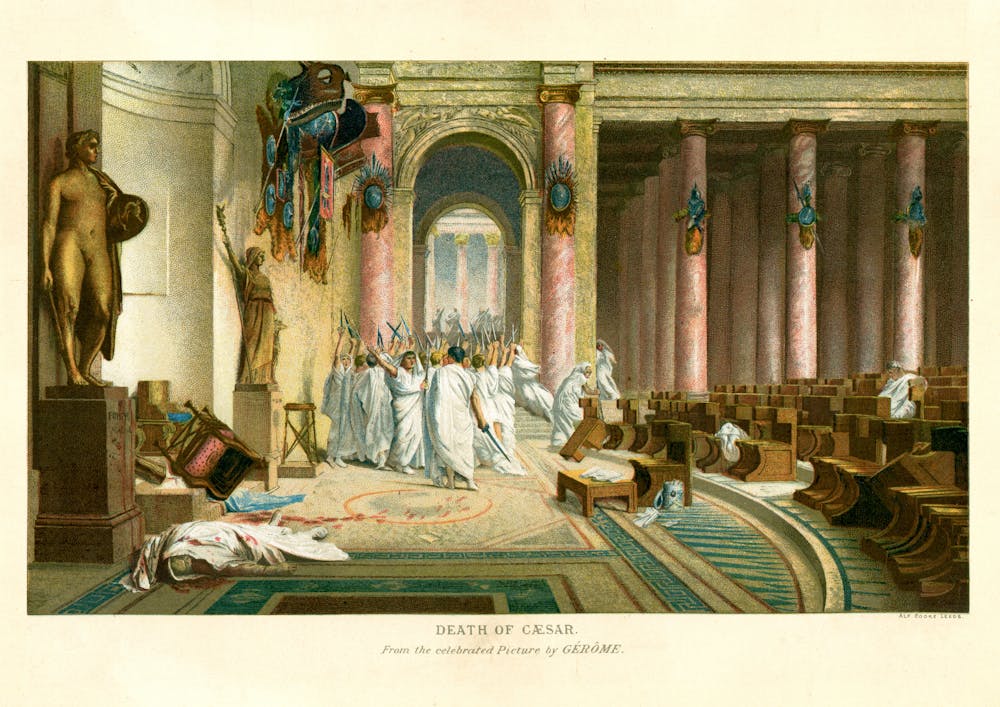
Soon after, an angry group of 23 senators stabbed him to death in a vain attempt to save the republic. They were led by Marcus Junius Brutus, a descendant of the Brutus who killed the last Roman king, Tarquinius Superbus.
However, the Roman republic was beyond saving despite Caesar’s death. His great nephew Octavian eventually emerged as leader and became known as Augustus (27 BCE – 14 CE). With Augustus, an age of emperors was born.
Emperors were kings in all but name. The strong aversion to kingship in Rome ensured their complete avoidance of the term rex.
‘No kings!’
American protesters waving placards shouting “no kings!” are expressing clear concerns that their beloved democracy is under threat.
Donald Trump has already declared eight national emergencies and issued 161 executive orders in his second term.
When asked if he needs to uphold the Constitution, Trump declares “I don’t know.” He has joked about running for a third term as president, in breach of the longstanding limit of two terms.
Like Caesar, is Donald Trump becoming a king in all but name? Is he setting a precedent for his successors to behave increasingly like emperors?
The American aversion to “king” likely ensures the term will never return. But when protesters and others shout “no kings!”, they know the very meaning of the term “president” is changing before their eyes.
Peter Edwell receives funding from the Australian Research Council.
▲ Hedi Mertens’s Gruppo di quadrati sulla base di un quadrato (1966) shown on Neo QLED by Samsung.
Samsung Electronics, the Official Art TV of Art Basel, today announced the launch of the Art Basel in Basel (ABB) Collection, an exclusive curation of digital art available across Samsung TVs with Samsung Art Store.1 Representing the most extensive Art Basel collection to date, the ABB Collection introduces 38 curated works from globally renowned artists and galleries — marking a new milestone in Samsung and Art Basel’s mission to bring world-class art to a wider audience.
The ABB Collection stands apart for its emphasis on diversity, with works that span continents, mediums and voices. For the first time, the collection features representation from an Africa-based gallery, deepening the global reach and cultural richness of the Samsung x Art Basel initiative. Some of this collection will be displayed at the Art Basel, from June 19-22, at Messe Basel in Switzerland.2
A Curated Vision of Global Expression
Handpicked from over 100 submissions, the 38 pieces in the ABB Collection were carefully curated with a focus on artist diversity, medium variety and geographic representation. The collection celebrates both emerging talent and established visionaries, aligning with Art Basel’s dedication to championing contemporary art from all corners of the world.
Highlights include:
Roméo Mivekannin, “Young woman with peonies after Frédéric Bazille” (2023): A compelling reimagining of classical portraiture from a postcolonial perspective.
Basim Magdy, “An Intergalactic Messenger Teleported us to a Cave Settlement Ruled by Shared Compassion and Humility” (2022): A vibrant exploration of utopian futurism.
Zandile Tshabalala, “Pink Blossoms” (2024): A powerful portrait celebrating Black femininity and nature.
Antonia Kuo, “Willo” (diptych) (2024): A striking dual-panel composition that fuses digital manipulation with analog techniques.
The collection also includes works by iconic names such as Jo Baer, Kibong Rhee and Lynn Hershman Leeson, further enriching the visual and thematic depth of this year’s selection.
ArtCube: An Interactive Hands-on Experience at Art Basel
▲ Jo Baer’s Untitled (1961-1962) shown on Neo QLED by Samsung.
To further highlight the intersection of art and technology, Samsung will present an interactive lounge titled ArtCube3 at Art Basel. This immersive showcase will demonstrate how The Frame, MICRO LED and Neo QLED 8K redefine digital art experiences by displaying artwork — including selections from the Art Basel Collection — with breathtaking detail and depth.
ArtCube invites visitors to engage with the Samsung Art Store’s exclusive collections and freely experience the premium picture quality. Visitors can also make customized portraits of moving art pieces only available through ArtCube’s tailored curation. In addition to the ArtCube lounge experience, Samsung will host a series of panel discussions featuring influential voices from the contemporary art scene, sparking conversations around technology’s expanding role in artistic expression and accessibility.
Strengthening a Cultural Partnership
Samsung and Art Basel have partnered to introduce curated digital collections that began with the 2024 Art Basel Miami Beach, 2025 Art Basel Hong Kong, and now includes the 2025 Art Basel in Basel. Artworks from Art Basel Hong Kong, launched in March, have gained global popularity among Art Store users, ranking them in top 10 most-viewed art pieces.4 This ongoing collaboration highlights the shared vision of expanding the role of displays as vibrant platforms for storytelling and artistic dialogue.
“With the launch of a new collection in the Samsung Art Store for Art Basel in Basel 2025, we’re thrilled to offer our global audiences new ways to engage with our show,” said Maike Cruse, Director of Art Basel in Basel. Our global partnership with Samsung extends the visitor experience beyond the Messe and into people’s homes — creating new entry points to discover the exceptional artists and galleries that define our flagship fair in Basel.”
Completing a Unique Art Experience on Samsung Art TVs
▲ Lynn Hershman Leeson’s Seduction (1985) shown on Neo QLED 8K by Samsung.
Samsung Art Store offers the best way to transform your TV and elevate your home decor with the perfect piece of art for every season, holiday and mood. You can choose from 3,500+ works of art spanning over 800 artists, including the ABB Collection.
Spanning the Neo QLED 8K, Neo QLED, QLED, The Frame and The Frame Pro, which are powered by Samsung Vision AI for AI-enhanced picture and sound, Samsung Art Store is newly available across the Samsung 2025 TV lineup. These TV models also come with new personalized features that bring users closer to all the shows, movies and sports they love. Across the lineup, Samsung offers more ways than ever to transform TV screens into personalized art galleries.
The Art Basel in Basel Collection is now available exclusively on the Samsung Art Store to all Samsung Art TV users.
For more information, visit www.samsung.com.
About Art Basel
Founded in 1970 by gallerists from Basel, Art Basel today stages the world’s premier art shows for Modern and contemporary art, sited in Basel, Miami Beach, Hong Kong and Paris. Defined by its host city and region, each show is unique, which is reflected in its participating galleries, artworks presented, and the content of parallel programming produced in collaboration with local institutions for each edition. Art Basel’s engagement has expanded beyond art fairs through new digital platforms including the Art Basel App and initiatives such as the Art Basel and UBS Global Art Market Report and the Art Basel Awards. Art Basel’s Global Lead Partner is UBS. For further information, please visit artbasel.com.
1 Samsung Art TV includes MICRO LED, The Frame, The Frame Pro, Neo QLED 8K, Neo QLED and QLED models starting from Q7F and above.
2 Event is open to the public from June 19-22, after VIP opening from June 16-18.
3 Samsung Lounge ‘ArtCube’ is in Halle 1, the main exhibition floor inside Messe Basel.
4 The information provided is based on the results collected during April 2025.
At the United Nations Ocean Conference 2025 (UNOC)1 in Nice, held to mark World Oceans Day on June 8, Samsung Electronics hosted a premiere event for “Coral in Focus,” a new documentary that brings the global coral crisis into sharp relief. The event, held at Ocean House, featured a screening of the film followed by a panel discussion with leading voices in marine science, conservation and technology.
Directed by award-winning filmmaker Quentin van den Bossche, “Coral in Focus” follows scientists, engineers and local conservationists as they confront the urgent threats facing coral reefs — ecosystems that support up to a billion people and a quarter of all marine life. This work is part of a broader effort announced at Galaxy Unpacked in January 2025, where Samsung unveiled its partnership with Seatrees to support the restoration of coastal ecosystems with communities in Fiji, Indonesia and the United States, leveraging Galaxy camera technology to document and aid in the recovery of marine environments.
The documentary spotlights the urgent threats facing coral reefs and showcases how innovative technology and global collaboration can drive meaningful impact for marine ecosystems.
A Crisis Hidden Beneath the Surface
As ocean temperatures shattered records, more than 80% of the world’s reefs have suffered from mass bleaching. When corals bleach, they lose not just their color but their lifeblood — the algae that feed them. This crisis, largely invisible to the public, threatens biodiversity, food security and coastal resilience. Long-term climate action is crucial to safeguarding coral reefs, while short-term restoration efforts — informed and supported by innovative technology — can help them withstand rising ocean temperatures.
A Galaxy Smartphone That Sees Beneath the Waves
Samsung collaborated with Seatrees, a nonprofit dedicated to restoring marine ecosystems, and the Scripps Institution of Oceanography at the University of California, San Diego, a global leader in reef research, to pioneer a new frontier in coral restoration by exploring new, innovative solutions. Ocean Mode,2 a specialized camera feature created specifically for this partnership, was developed, introduced and validated in real-world conditions in Indonesia and Fiji. This process has created a credible foundation for broader scientific use while improving the overall accessibility of this new technology.
By enabling more scientists, conservationists and even citizen scientists with the ability to photograph, map and monitor reefs, Ocean Mode can help restoration efforts scale, and make it possible for anyone to protect more reefs, in more places, with greater impact.
Innovation With Measurable Impact
Ocean Mode transforms the Galaxy S24 Ultra into a mobile marine research tool, enabling vivid, high-resolution image capture even in challenging underwater conditions. It corrects the excessive blue and green hues typical of underwater photography, allowing for a more accurate representation of coral health and diversity.
The camera adjusts shutter speed and leverages multi-frame image processing to reduce motion blur caused by water movement or diver activity, ensuring sharp, detailed images. With its interval shooting capability, the device can automatically capture thousands of images in a single dive, dramatically improving both efficiency and consistency. These images can then be used to generate 3D models of coral reefs using technology known as photogrammetry, giving researchers a powerful way to visualize and study the drivers of the structure and health of reefs over time.
Over the past year, the project has delivered extraordinary results. With these coral restoration initiatives, 17 3D models of coral reefs have been made with the help of scientists and Samsung to analyze the impact of coral restoration efforts and validate the precision of Galaxy devices for photogrammetry. In total, Seatrees project partners planted more than 14,046 coral fragments to restore 10,705 square meters of coral reef habitat.
A Premiere With Purpose
The “Coral in Focus” premiere at Ocean House, in partnership with Project Everyone, brought together scientists, storytellers and sustainability leaders for a powerful conversation on the role that technology and global collaboration play in the future of coral reefs.
▲ (From left) Alex Heath, Cassie Smith, Dr. Daniel Wangpraseurt, Michael Stewart and Quentin van den Bossche
▲ “Ocean Mode became its own character in the documentary,” said Quentin van den Bossche, director of “Coral in Focus.” “This helped us illustrate some of the complex, specific challenges that reef conservationists encounter. And showing the difference between photos taken with and without Ocean Mode helped ground the technology in something visual and even emotional. This is where the impact of partnerships among companies, research institutes and nonprofits truly comes to life.”
▲ Michael Stewart, co-founder of Seatrees, holds a Galaxy S24 Ultra to show Ocean Mode Year 1 impact metrics — about 14,046 coral fragments planted across three restoration sites.
“A key focus of the coral restoration efforts is being able to monitor what’s working and what’s not. And that starts with capturing high-quality images of our supported reefs,” said Michael Stewart, co-founder of Seatrees. “Our local partners have really appreciated Ocean Mode because it has improved their ability to capture higher-quality images with Galaxy phones to make the 3D models created by the scientists at Scripps more accurate.”
“Mobile technology is a powerful way to connect communities with ecosystems they may never physically encounter but are deeply tied to through climate, biodiversity and cultural heritage,” said Daniel Wangpraseurt, Ph.D., associate research scientist at the Scripps Institution of Oceanography. “Smartphones are now capable of taking high-resolution imagery to help generate more accurate 3D models. They also hold unique potential to increase the pace at which we share this information with people around the world who may never get to experience a coral reef themselves.”
▲ “Through our partnership with Seatrees, we saw how Galaxy technology could play a role not just in responsible sourcing but in supporting coral reef restoration,” said Cassie Smith, Senior Manager, Corporate Sustainability and U.S. Public Affairs at Samsung Electronics America. “The documentary tells that story beautifully — showing what happens when like-minded partners, engineers, scientists and local communities come together with shared purpose and the right tools.”
▲ Attendees of the “Coral in Focus” documentary premiere included Swati Thiyagarajan, award-winning documentary filmmaker, environmental journalist with the Sea Change Project and associate producer and production manager of the Academy Award-winning “My Octopus Teacher”; Titouan Bernicot, founder and CEO of Coral Gardeners and National Geographic Explorer; and Beverly Camhe, writer, producer and entertainment executive.
“It’s essential for the private sector to be involved and help get impactful solutions off the ground,” said Lefteris Arapakis, co-founder of Enaleia. “We need all parties working together to protect and scale ocean conservation efforts. I’m especially excited about Ocean Mode — tools like this make our work more efficient and help us create greater impact.”
“It was a beautiful film, and I love how it left us with a sense of hope and something we could do about the problem,” said Dana Habib, associate at the Institute for Integrated Transitions.
▲ Panelists and attendees discuss the “Coral in Focus” film and project.
The discussion was moderated by Alex Heath, Managing Director, U.S. Head of Social Impact & Sustainability at Edelman. The event also featured 3D reef models generated from photogrammetry data created with Galaxy S24 Ultras used in the field.
Exploring Ocean Conservation at UNOC
In addition to the premiere of “Coral in Focus,” Samsung representatives spoke on two panels hosted by the United Nations Educational, Scientific and Cultural Organization (UNESCO-IOC) at the UNESCO-IOC “Beyond Borders: Ocean Futures” pavilion. First, Generation17 Young Leader José Francisco Ochoa spoke about the importance of digital technology and community partnership during the panel “Showcasing the Diversity of Ocean Literacy Practices Around the World,” where he shared insights on how Generation17 elevates his work to advance ocean literacy.
Samsung also participated in a panel discussion titled “The Role of Corals in Unlocking the Secrets of Biodiversity,” highlighting its commitment to marine conservation. Cassie Smith, Senior Manager of Corporate Sustainability and U.S. Public Affairs at Samsung Electronics, presented how Galaxy technology, including Ocean Mode, serves as a tool to support marine ecosystem protection through environmental monitoring, data collection and community engagement. The panel was part of a full day of programming held during UNOC that promotes ocean literacy and awareness of ocean preservation.
A Continued Commitment to Ocean Health
The collaboration with Seatrees builds on Samsung’s broader commitment to ocean health. Since 2022, the company has incorporated over 150 tonnes of recycled fishing nets into Galaxy devices. Now, with Ocean Mode, Samsung is redefining the role of mobile technology in climate action — expanding research capabilities, raising awareness and making the invisible visible.
To watch the full documentary and access more information about the initiative, visit the Samsung x Seatrees partnership landing page.
1 Held every three to five years, UNOC serves as a global platform uniting governments, scientists, businesses and civil society to promote ocean action and implement Sustainable Development Goal 14: Life Below Water. The 2025 conference in Nice emphasizes scaling science-based solutions to protect marine ecosystems and ensure a sustainable future for the world’s oceans.
2 Ocean Mode was exclusively developed for this project and is only available to participating partners.
The Green Party is calling on the Prime Minister to stand up for workers’ rights for once and rule out reducing sick leave entitlements.
“This Government for the wealthy keeps finding new ways of eviscerating workers’ rights and tilting power to employers,” says the Green Party spokesperson for Workplace Relations and Safety, Teanau Tuiono.
“Our economy is built upon the backs of our workers, so to erode their rights to sick leave is nothing short of an attack on the morale and productivity of our workforce.
“The Government is making a habit of revealing such changes at the start of Winter when seasonal illnesses, flu and Covid are placing many families under strain.
“Women workers in particular will be disproportionately affected by this cruel policy as they tend to take more sick leave because of childcare responsibilities. For the Government to be considering reducing sick leave is another way to attack women workers following its Pay Equity bombshell.
“The fact that the Prime Minister hasn’t ruled out halving the number of sick days for part-time workers speaks to a pattern of decision-making of a Government that doesn’t listen to, nor care about, workers.
“The Coalition has unapologetically pushed its anti-worker agenda this term – gutting the Pay Equity process, scrapping fair pay agreements, reinstating 90-day trials, and changing the law so that Uber and other gig work platforms can keep their workers from getting their entitlements in already precarious job arrangements.
“More must be done to support our workers. The Green Party campaigned on five weeks of annual leave for everyone so that people have more time to connect with their whānau, communities, and things that matter to them.
“The Green Party will keep fighting for everyone in Aotearoa to have access to strong rights, secure work, and decent pay, to ensure workers can thrive,” says Teanau Tuiono.
Auckland Council and NZ Police have signed a memorandum of understanding, cementing and enhancing the two organisations’ commitment to continue working together, now and for years to come, to keep Tāmaki Makaurau safe.
Phil Wilson, chief executive of Auckland Council, says he’s extremely pleased the council and police have formalised their working relationship through the memorandum.
“Auckland Council and NZ Police have had a healthy and effective working relationship for many years, which ultimately benefits Aucklanders.
“The memorandum of understanding cements the relationship and is a touchstone from which the council and police can continue to carry out the important mahi of keeping Aucklanders and visitors safe,” says Mr Wilson.
“The council owns and maintains a significant number of public spaces and public facilities in Auckland such as our streets, community halls, swimming pools and the regional and local parks network.
“Council teams work with police every day to keep these facilities and the community safe, and look after Auckland’s most vulnerable people. I’m especially proud of our efforts in the area of community safety – including our city centre.
Tāmaki Makaurau is a key contributor to New Zealand’s economy – in fact it contributes nearly 40% of GDP.
“Economic growth depends, in part, on law and order,” says Mr Wilson.
“In recent years Auckland has seen a raft of community safety issues such as ram raids, aggravated robberies and retail crime come to the fore with the public. These are complex issues that impact the whole region which no one organisation can effectively deal with alone.
“The newly enhanced council-police relationship will strengthen coordination between the two organisations and together, with Aucklanders’ help, we can continue to address concerns around safety around the region.”
Representatives of Auckland Council and the police met on 13 June, to sign the memorandum, that stipulates its purpose is to “promote a collaborative working relationship between the parties based on good-will and co-operation.”
It’s goes on to read: “It intends to support the parties to work together on areas of common interest to achieve agreed outcomes.”
Acting Deputy Commissioner, Northern Region Jill Rogers says NZ Police look forward to continuing the good work they do in partnership with Auckland Council.
“We have seen a decrease in the offending we experienced a couple of years ago. There has been a concerted and coordinated approach undertaken by Police and Council to address these concerns. Much has been made public about increased visibility and focussing on disorder and theft related crime. This partnership continues under a formal accord in the form of this MOU.”
Auckland Council has a range of regulatory enforcement responsibilities across Auckland under the following legislation and bylaws: Resource Management Act, Building Act, Dog Control Act, Food Act, Health Act, Litter Act, Biosecurity Act, Local Government Act, Public Safety and Nuisance Bylaw and the Animal Management Bylaw.
The police have responsibilities through the Policing Act across New Zealand, including Auckland. Key functions of the police include maintaining public safety, enforcing the law, preventing crime, supporting and reassuring the community and managing emergencies.
The council and police have agreed to review the memorandum of understanding within the next five years.
Source: Hong Kong Government special administrative region – 4
Attention TV/radio announcers:
Please broadcast the following as soon as possible:
Here is an item of interest to swimmers.
The Leisure and Cultural Services Department announced today (June 15) that due to big waves, the red flag has been hoisted at Repulse Bay Beach in Southern District, Hong Kong Island. Beachgoers are advised not to swim at the beach.
Keith Rankin, trained as an economic historian, is a retired lecturer in Economics and Statistics. He lives in Auckland, New Zealand.
Is history binary? A judge of past behaviour with just two available options: thumbs-up, or thumbs-down? If you are not on the ‘right side’ of history, are you therefore on the ‘wrong side’?
Can there be a ‘right side of history’? Given the contexts that we now proclaim to be the right or wrong sides of history, can we presume to evaluate future judgements of our behaviours as ‘history’? And, if we can, is ‘history’ about morals, or momentum; or, prosaically, is she just about facts? Can you (or we) ride history, like a wave? Clio, in Greek mythology, is the muse of history. She is not a straightforward lady.
Are politicians who support, by word or deed, fascists (or racists or any other obviously nasty ‘ists’) in another country ‘on the wrong side of history’ or could they be ‘riding a historical wave’? I am reminded of the Hitler youth singing ‘Tomorrow Belongs to Me’ in the musical cabaret. In Natacha Butler’s report (Al Jazeera 10 June 2025, Europe’s far-right leaders, hosted by Marine Le Pen, rally in France) she notes “the conviction [by ‘far-right’ protesters] that history is on their side”.
History as Momentum
Whoever participates in a social or political movement believes that their movement will become sufficiently consequential for those in the future to believe that the movement affected the course of history. So, the Hitler youth were correct, in the sense that their movement made their tomorrow different to what it would otherwise have been. The Hitler youth, though, were expecting a favourable judgement by ‘us’ in 2025. Clearly, we judge their movement in highly unfavourable terms, while accepting that the world at the end of the twentieth century mighthave been a better world than the world would have been had Adolf Hitler been killed in combat in the Great World War in1918. Problematic, though, is the whole subjective idea of a ‘better world’; better for whom?
An important example of historicism, or alleged historical momentum, is the writings of Karl Marx. He thought he was writing scientific history, of ‘historical materialism’, and many people believed him; a few still do. Marx fused classical Ricardian economics – the intellectual ancestor of today’s neoliberal macroeconomics – with the philosophical historicism of Georg Hegel. Josef Stalin, and others in his intellectually unaccommodating mould, killed people who spun different (or nuanced) stories of past or future history.
History as a Judge
From a judgment perspective, we place much weight on academic historians in the medium-term future to make (for all time) the correct verdict events in the present, immediate past, and immediate future.
Whether or not Clio is qualified to judge as ‘good’ or ‘bad’ past events, people, or movements, we today can evaluate Clio today – or at least her mortal disciples – on her performance so far.
Two of many issues we could look into are, first, Winston Churchill and the World War Two bombing campaigns by the ‘Allies’, and our present understanding of the Great Depression of the 1930s.
Churchill, more than most political leaders, features in many separable stories in history. His role in pursuing the Gallipoli campaign in 1915 has generally been awarded a ‘thumbs-down’. Likewise, his role as Chancellor of the Exchequer in 1925, when he decided to fix the British pound to gold at the overvalued pre-war (1914) exchange rate; this decision was one of the key events that led the world into the Great Depression.
However, most post-war judgement of Churchill has focussed on his role as an opponent of ‘appeasement’ in 1938, and on his role as Great Britain’s leader for the majority of World War Two (though he had been removed as Britain’s leader, in a landslide electoral defeat, by the time the atomic bombs fell on Japan). On the ‘appeasement’ matter, Neville Chamberlain continues to be the epitome of someone ‘on the wrong side of history’, with Churchill on the ‘right side’.
Churchill had his own personal political agenda in 1938; his lifelong pursuit of the glory of the British Empire. Churchill’s principal strategic interest was to maintain the Mediterranean Sea as ‘Britain’s Lake’; substantially but not only because it represented Britain’s sea passage to India. So many of his actions in World War Two can best be understood in terms of what he was fighting for, not what he was fighting against.
In 1938, the alternatives to the ‘appeasement’ of Hitler were to abstain in the face of Nazi Germany’s clear-and immediate-threat to East Europe (a part of the non-Mediterranean world that Churchill was not interested in), or to threaten to declare war against Germany knowing that Britain couldn’t act on its threat and thereby risked revealing its weakness. (In the summer of 1939, Britain did reveal its weakness to Josef Stalin, who then relayed that information onto Hitler at the end of August, allowing Hitler to invade Poland in the sure knowledge that Britain had no military capacity to come to Poland’s aid. Chamberlain’s allowing that ‘information leak’ to happen was surely a bigger mistake than his 1938 Munich Accord with Hitler.) And we note that Churchill said that, rather than ‘peace in our time’, there “would be war”.
Churchill did not claim that any of the alternative choices that Chamberlain faced could or would have prevented war. Unless, that is, Chamberlain had been able to terrify Hitler into not going ahead with his military plans. (Hitler would have been more likely to liken threats by Chamberlain to ‘being mauled by a mouse’; a famous if somewhat forgotten witticism of our own Robert Muldoon, speaking in reference to Opposition leader Bill Rowling.)
Realistically, Hitler was never going to commit to putting his military toys away. I think that, in light of the alternatives, Chamberlain made the right call in 1938; he hoped that he had restricted Hitler’s military ambitions to the acquisition of territory inhabited by German-speaking people.
On the matter of the Allied bombing campaign, being willing to commit unspeakable aerial executions upon tens of millions of ‘enemy’ civilians, history has largely been silent; those (over a million) who were actually barbecued by the Allies fell well short of those who Churchill’s ‘scientific adviser’ and onetime ‘best friend’ Friedrich Lindemann would have liked to have ‘dehoused’. (See my Barbecued Hamburgers and Churchill’s Bestie, 17 Apr 2025.) We cannot rely on academic historians to counter decades of myth; in part because we have too few competent historians, and in part because historians hunt in packs and are as liable to fall under the sway of the zeitgeists of their eras as are the rest of humanity’s intellectual communities.
Despite Churchill’s firebombing efforts, most of which took place in the early months of 1945, it was American bombing specialist Curtis LeMay who became barbecuer-el-supremo. (See my Who Executed 100,000 Civilians in a Single Night?) In 1945, and mainly through his own initiative, he burned more Japanese civilians to death than those who died from the atomic bombs. Was Curtis LeMay on the right side of history? The Japanese ruling class thought so in 1964; LeMay had helped to make the new Japan possible. The Emperor had been saved, as an emperor without an empire. And Japan had been saved from Stalin’s advances, advances that stopped at Korea, Sakhalin, and the Kuril Islands.
We note that the worst of the Allies’ terror campaign took place towards the end of the war, when the ‘evil’ Axis was in no position to reciprocate. Inherently, such crimes – on the scale that ‘we’ perpetrated them – are asymmetric warfare. Killing your enemies’ civilians seemingly grants your enemies a moral right to kill your civilians. I think that no party who commits those kinds of war crimes can ever be on ‘the right side of history’; though some other people may take more convincing. To compound the criminality of the Allied bombing campaign, it was ineffective, because World War Two was already asymmetric; the main turning points were Hitler’s foolish declaration of war against the United States, and the Battle of Stalingrad in the latter part of 1942. World War Two could have been ended much more quickly with carrot than with stick, by finding suitable ways for the retreating powers to ‘save face’. Truth and reconciliation always trump vengeance. Yet so many horrendous “killings of civilians to [allegedly] save ‘our’ soldiers” remain either on the ‘right side of history’ or concealed from view, obviating the popular requirement to cast judgement.
The Great Depression was still much in historical memory in the 1970s and 1980s. In the 1930s, Josef Stalin and his comrades believed this was the beginning of the end of the capitalist world; and he executed any economists (eg Nikolai Kondratiev) who suggested otherwise. At the time, a number of progressive western economists (eg Alvin Hansen) to an extent agreed with Stalin.
However, in the 1970s, a group of extremist ‘Chicago’ economists and economic historians – Milton Friedmanwould lay claim to being both an economist and a historian – successfully committed on the world an intellectual coup-d’etat which would distract the historical community from reality. Friedman’s coupsters scapegoated the United States Federal Reserve Bank (on the basis of a few quite minor ‘mistakes’ in monetary policy in 1929 and 1930). The net result was that the real culprits, the fiscal conservatives, escaped the condemnation of history.
The Friedmanites, and their ‘intellectual’ descendants, have claimed the ‘right side of history’; claiming victories (without convincing counterfactuals) in the alleged titanic battle between the ‘inflation monster’ and the battlers of the ‘lower middle classes’. These faux historians claimed that small “mistakes” in monetary policy in 2003/04 and 2021/22 have been the predominant causes of the 2008/09 ‘global financial crisis’ and the 2022 to 2024 ‘cost of living’ crisis. When it comes to macroeconomics and macroeconomic policy, this writing of consumable history is about as pathetic (as intellectual history) as the claims of the Holocaust-deniers, or of the people (such as Herr Hitler) who claimed that Germany was ‘stabbed-in-the-back’ by international Jewry in 1918.
Clio is a muse to be loved and cultivated. She gives much, but rarely in simplistic right-wrong terms; and she changes her mind, in response to both new information and new zeitgeists. Whereas Hitler’s Nazis burned the books they didn’t like – and many other books besides – Aotearoa’s fiscal conservatives are looking for a whimper – a tearless shredding – rather than a blaze. And our remaining unshredded public collections, our memories – our abilities to evaluate the rights and the wrongs and the waves of our national and international pasts – stand to depreciate, to wither.
*******
Keith Rankin (keith at rankin dot nz), trained as an economic historian, is a retired lecturer in Economics and Statistics. He lives in Auckland, New Zealand.
Keith Rankin, trained as an economic historian, is a retired lecturer in Economics and Statistics. He lives in Auckland, New Zealand.
Is history binary? A judge of past behaviour with just two available options: thumbs-up, or thumbs-down? If you are not on the ‘right side’ of history, are you therefore on the ‘wrong side’?
Can there be a ‘right side of history’? Given the contexts that we now proclaim to be the right or wrong sides of history, can we presume to evaluate future judgements of our behaviours as ‘history’? And, if we can, is ‘history’ about morals, or momentum; or, prosaically, is she just about facts? Can you (or we) ride history, like a wave? Clio, in Greek mythology, is the muse of history. She is not a straightforward lady.
Are politicians who support, by word or deed, fascists (or racists or any other obviously nasty ‘ists’) in another country ‘on the wrong side of history’ or could they be ‘riding a historical wave’? I am reminded of the Hitler youth singing ‘Tomorrow Belongs to Me’ in the musical cabaret. In Natacha Butler’s report (Al Jazeera 10 June 2025, Europe’s far-right leaders, hosted by Marine Le Pen, rally in France) she notes “the conviction [by ‘far-right’ protesters] that history is on their side”.
History as Momentum
Whoever participates in a social or political movement believes that their movement will become sufficiently consequential for those in the future to believe that the movement affected the course of history. So, the Hitler youth were correct, in the sense that their movement made their tomorrow different to what it would otherwise have been. The Hitler youth, though, were expecting a favourable judgement by ‘us’ in 2025. Clearly, we judge their movement in highly unfavourable terms, while accepting that the world at the end of the twentieth century mighthave been a better world than the world would have been had Adolf Hitler been killed in combat in the Great World War in1918. Problematic, though, is the whole subjective idea of a ‘better world’; better for whom?
An important example of historicism, or alleged historical momentum, is the writings of Karl Marx. He thought he was writing scientific history, of ‘historical materialism’, and many people believed him; a few still do. Marx fused classical Ricardian economics – the intellectual ancestor of today’s neoliberal macroeconomics – with the philosophical historicism of Georg Hegel. Josef Stalin, and others in his intellectually unaccommodating mould, killed people who spun different (or nuanced) stories of past or future history.
History as a Judge
From a judgment perspective, we place much weight on academic historians in the medium-term future to make (for all time) the correct verdict events in the present, immediate past, and immediate future.
Whether or not Clio is qualified to judge as ‘good’ or ‘bad’ past events, people, or movements, we today can evaluate Clio today – or at least her mortal disciples – on her performance so far.
Two of many issues we could look into are, first, Winston Churchill and the World War Two bombing campaigns by the ‘Allies’, and our present understanding of the Great Depression of the 1930s.
Churchill, more than most political leaders, features in many separable stories in history. His role in pursuing the Gallipoli campaign in 1915 has generally been awarded a ‘thumbs-down’. Likewise, his role as Chancellor of the Exchequer in 1925, when he decided to fix the British pound to gold at the overvalued pre-war (1914) exchange rate; this decision was one of the key events that led the world into the Great Depression.
However, most post-war judgement of Churchill has focussed on his role as an opponent of ‘appeasement’ in 1938, and on his role as Great Britain’s leader for the majority of World War Two (though he had been removed as Britain’s leader, in a landslide electoral defeat, by the time the atomic bombs fell on Japan). On the ‘appeasement’ matter, Neville Chamberlain continues to be the epitome of someone ‘on the wrong side of history’, with Churchill on the ‘right side’.
Churchill had his own personal political agenda in 1938; his lifelong pursuit of the glory of the British Empire. Churchill’s principal strategic interest was to maintain the Mediterranean Sea as ‘Britain’s Lake’; substantially but not only because it represented Britain’s sea passage to India. So many of his actions in World War Two can best be understood in terms of what he was fighting for, not what he was fighting against.
In 1938, the alternatives to the ‘appeasement’ of Hitler were to abstain in the face of Nazi Germany’s clear-and immediate-threat to East Europe (a part of the non-Mediterranean world that Churchill was not interested in), or to threaten to declare war against Germany knowing that Britain couldn’t act on its threat and thereby risked revealing its weakness. (In the summer of 1939, Britain did reveal its weakness to Josef Stalin, who then relayed that information onto Hitler at the end of August, allowing Hitler to invade Poland in the sure knowledge that Britain had no military capacity to come to Poland’s aid. Chamberlain’s allowing that ‘information leak’ to happen was surely a bigger mistake than his 1938 Munich Accord with Hitler.) And we note that Churchill said that, rather than ‘peace in our time’, there “would be war”.
Churchill did not claim that any of the alternative choices that Chamberlain faced could or would have prevented war. Unless, that is, Chamberlain had been able to terrify Hitler into not going ahead with his military plans. (Hitler would have been more likely to liken threats by Chamberlain to ‘being mauled by a mouse’; a famous if somewhat forgotten witticism of our own Robert Muldoon, speaking in reference to Opposition leader Bill Rowling.)
Realistically, Hitler was never going to commit to putting his military toys away. I think that, in light of the alternatives, Chamberlain made the right call in 1938; he hoped that he had restricted Hitler’s military ambitions to the acquisition of territory inhabited by German-speaking people.
On the matter of the Allied bombing campaign, being willing to commit unspeakable aerial executions upon tens of millions of ‘enemy’ civilians, history has largely been silent; those (over a million) who were actually barbecued by the Allies fell well short of those who Churchill’s ‘scientific adviser’ and onetime ‘best friend’ Friedrich Lindemann would have liked to have ‘dehoused’. (See my Barbecued Hamburgers and Churchill’s Bestie, 17 Apr 2025.) We cannot rely on academic historians to counter decades of myth; in part because we have too few competent historians, and in part because historians hunt in packs and are as liable to fall under the sway of the zeitgeists of their eras as are the rest of humanity’s intellectual communities.
Despite Churchill’s firebombing efforts, most of which took place in the early months of 1945, it was American bombing specialist Curtis LeMay who became barbecuer-el-supremo. (See my Who Executed 100,000 Civilians in a Single Night?) In 1945, and mainly through his own initiative, he burned more Japanese civilians to death than those who died from the atomic bombs. Was Curtis LeMay on the right side of history? The Japanese ruling class thought so in 1964; LeMay had helped to make the new Japan possible. The Emperor had been saved, as an emperor without an empire. And Japan had been saved from Stalin’s advances, advances that stopped at Korea, Sakhalin, and the Kuril Islands.
We note that the worst of the Allies’ terror campaign took place towards the end of the war, when the ‘evil’ Axis was in no position to reciprocate. Inherently, such crimes – on the scale that ‘we’ perpetrated them – are asymmetric warfare. Killing your enemies’ civilians seemingly grants your enemies a moral right to kill your civilians. I think that no party who commits those kinds of war crimes can ever be on ‘the right side of history’; though some other people may take more convincing. To compound the criminality of the Allied bombing campaign, it was ineffective, because World War Two was already asymmetric; the main turning points were Hitler’s foolish declaration of war against the United States, and the Battle of Stalingrad in the latter part of 1942. World War Two could have been ended much more quickly with carrot than with stick, by finding suitable ways for the retreating powers to ‘save face’. Truth and reconciliation always trump vengeance. Yet so many horrendous “killings of civilians to [allegedly] save ‘our’ soldiers” remain either on the ‘right side of history’ or concealed from view, obviating the popular requirement to cast judgement.
The Great Depression was still much in historical memory in the 1970s and 1980s. In the 1930s, Josef Stalin and his comrades believed this was the beginning of the end of the capitalist world; and he executed any economists (eg Nikolai Kondratiev) who suggested otherwise. At the time, a number of progressive western economists (eg Alvin Hansen) to an extent agreed with Stalin.
However, in the 1970s, a group of extremist ‘Chicago’ economists and economic historians – Milton Friedmanwould lay claim to being both an economist and a historian – successfully committed on the world an intellectual coup-d’etat which would distract the historical community from reality. Friedman’s coupsters scapegoated the United States Federal Reserve Bank (on the basis of a few quite minor ‘mistakes’ in monetary policy in 1929 and 1930). The net result was that the real culprits, the fiscal conservatives, escaped the condemnation of history.
The Friedmanites, and their ‘intellectual’ descendants, have claimed the ‘right side of history’; claiming victories (without convincing counterfactuals) in the alleged titanic battle between the ‘inflation monster’ and the battlers of the ‘lower middle classes’. These faux historians claimed that small “mistakes” in monetary policy in 2003/04 and 2021/22 have been the predominant causes of the 2008/09 ‘global financial crisis’ and the 2022 to 2024 ‘cost of living’ crisis. When it comes to macroeconomics and macroeconomic policy, this writing of consumable history is about as pathetic (as intellectual history) as the claims of the Holocaust-deniers, or of the people (such as Herr Hitler) who claimed that Germany was ‘stabbed-in-the-back’ by international Jewry in 1918.
Clio is a muse to be loved and cultivated. She gives much, but rarely in simplistic right-wrong terms; and she changes her mind, in response to both new information and new zeitgeists. Whereas Hitler’s Nazis burned the books they didn’t like – and many other books besides – Aotearoa’s fiscal conservatives are looking for a whimper – a tearless shredding – rather than a blaze. And our remaining unshredded public collections, our memories – our abilities to evaluate the rights and the wrongs and the waves of our national and international pasts – stand to depreciate, to wither.
*******
Keith Rankin (keith at rankin dot nz), trained as an economic historian, is a retired lecturer in Economics and Statistics. He lives in Auckland, New Zealand.
Israeli Prime Minister Benjamin Netanyahu has said Israel’s attack on Iran’s nuclear facilities could last for at least two weeks.
His timing seems precise for a reason. The Israel Defence Forces and the country’s intelligence agencies have clearly devised a methodical, step-by-step campaign.
Israeli forces initially focused on decapitating the Iranian military and scientific leadership and, just as importantly, destroying virtually all of Iran’s air defences.
Israeli aircraft can not only operate freely over Iranian air space now, they can refuel and deposit more special forces at key sites to enable precision bombing of targets and attacks on hidden or well-protected nuclear facilities.
In public statements since the start of the campaign, Netanyahu has highlighted two key aims: to destroy Iran’s nuclear program, and to encourage the Iranian people to overthrow the clerical regime.
With those two objectives in mind, how might the conflict end? Several broad scenarios are possible.
A return to negotiations
US President Donald Trump’s special envoy for the Middle East, Steve Witkoff, was to have attended a sixth round of talks with his Iranian counterparts on Sunday aimed at a deal to replace the Iran nuclear agreement negotiated under the Obama administration in 2015. Trump withdrew from that agreement during his first term in 2018, despite Iran’s apparent compliance to that point.
Netanyahu was opposed to the 2015 agreement and has indicated he does not believe Iran is serious about a replacement.
So, accepting negotiations as an outcome of the Israeli bombing campaign would be a massive climbdown by Netanyahu. He wants to use the defanging of Iran to reestablish his security credentials after the Hamas attacks of October 2023.
Even though Trump continues to press Iran to accept a deal, negotiations are off the table for now. Trump won’t be able to persuade Netanyahu to stop the bombing campaign to restart negotiations.
Complete destruction of Iran’s nuclear program
Destruction of Iran’s nuclear program would involve destroying all known sites, including the Fordow uranium enrichment facility, about 100 kilometres south of Tehran.
According to International Atomic Energy Agency (IAEA) Director General Rafael Grossi, the facility is located about half a mile underground, beneath a mountain. It is probably beyond the reach of even the US’ 2,000-pound deep penetration bombs.
The entrances and ventilation shafts of the facility could be closed by causing landslides. But that would be a temporary solution.
Taking out Fordow entirely would require an Israeli special forces attack. This is certainly possible, given Israel’s success in getting operatives into Iran to date. But questions would remain about how extensively the facility could be damaged and then how quickly it could be rebuilt.
And destruction of Iran’s nuclear centrifuges – used to enrich uranium to create a bomb – would be only one step in dismantling its program.
Israel would also have to secure or eliminate Iran’s stock of uranium already enriched to 60% purity. This is sufficient for up to ten nuclear bombs if enriched to the weapons-grade 90% purity.
But does Israeli intelligence know where that stock is?
Collapse of the Iranian regime
Collapse of the Iranian regime is certainly possible, particularly given Israel’s removal of Iran’s most senior military leaders since its attacks began on Friday, including the heads of the Islamic Revolutionary Guard Corps and the Iranian armed forces.
And anti-regime demonstrations over the years, most recently the “Women, Life, Freedom” protests after the death in police custody of a young Iranian woman, Mahsa Amini, in 2022, have shown how unpopular the regime is.
That said, the regime has survived many challenges since coming to power in 1979, including war with Iraq in the 1980s and massive sanctions. It has developed remarkably efficient security systems that have enabled it to remain in place.
Another uncertainty at this stage is whether Israeli attacks on civilian targets might engender a “rally round the flag” movement among Iranians.
Netanyahu said in recent days that Israel had indications the remaining senior regime figures were packing their bags in preparation for fleeing the country. But he gave no evidence.
A major party joins the fight
Could the US become involved in the fighting?
This can’t be ruled out. Iran’s UN ambassador directly accused the US of assisting Israel with its strikes.
That is almost certainly true, given the close intelligence sharing between the US and Israel. Moreover, senior Republicans, such as Senator Lindsey Graham, have called on Trump to order US forces to help Israel “finish the job”.
Trump would probably be loath to do this, particularly given his criticism of the “forever wars” of previous US administrations. But if Iran or pro-Iranian forces were to strike a US base or military asset in the region, pressure would mount on Trump to retaliate.
Another factor is that Trump probably wants the war to end as quickly as possible. His administration will be aware the longer a conflict drags on, the more likely unforeseen factors will arise.
Could Russia become involved on Iran’s side? At this stage that’s probably unlikely. Russia did not intervene in Syria late last year to try to protect the collapsing Assad regime. And Russia has plenty on its plate with the war in Ukraine.
Russia criticised the Israeli attack when it started, but appears not to have taken any action to help Iran defend itself.
And could regional powers such as Saudi Arabia or the United Arab Emirates become involved?
Though they have a substantial arsenal of US military equipment, the two countries have no interest in becoming caught up in the conflict. The Gulf Arab monarchies have engaged in a rapprochement with Iran in recent years after decades of outright hostility. Nobody would want to put this at risk.
Uncertainties predominate
We don’t know the extent of Iran’s arsenal of missiles and rockets. In its initial retaliation to Israel’s strikes, Iran has been able to partially overwhelm Israel’s Iron Dome air defence system, causing civilian casualties.
If it can continue to do this, causing more civilian casualties, Israelis already unhappy with Netanyahu over the Gaza war might start to question his wisdom in starting another conflict.
But we are nowhere near that point. Though it’s too early for reliable opinion polling, most Israelis almost certainly applaud Netanyahu’s action so far to cripple Iran’s nuclear program. In addition, Netanyahu has threatened to make Tehran “burn” if Iran deliberately targets Israeli civilians.
We can be confident that Iran does not have any surprises in store. Israel has severely weakened its proxies, Hezbollah and Hamas. They are clearly in no position to assist Iran through diversionary attacks.
The big question will be what comes after the war. Iran will almost certainly withdraw from the Nuclear Non-Proliferation Treaty and forbid more inspections by the International Atomic Energy Agency.
Israel will probably be able to destroy Iran’s existing nuclear facilities, but it’s only a question of when – not if – Iran will reconstitute them.
This means the likelihood of Iran trying to secure a nuclear bomb in order to deter future Israeli attacks will be much higher. And the region will remain in a precarious place.
Ian Parmeter does not work for, consult, own shares in or receive funding from any company or organisation that would benefit from this article, and has disclosed no relevant affiliations beyond their academic appointment.
Jetesh Bhula, Regional Manager Infrastructure delivery, says it is one of 12 sites being built on high-volume freight routes around the country and will be critical for improving road safety.
“Crashes involving heavy vehicles can and do have devastating consequences. Ensuring trucks and truckies are complying with heavy vehicle rules is about keeping the public safe, but also about keeping freight operators safe too.”
“Since 2013 there has been a 40 percent increase in fatal and serious injury crashes involving heavy vehicles compared to an increase of 16 percent for all road crashes. CVSCs are a critical tool to help fix this,” Mr Bhula says.
When it opens in mid-2026, the centre will work with Police to target non-compliant heavy vehicles and direct them into the CVSC for inspection.
Mr Bhula says it ensures all operators are following the rules.
“Those that do not follow the rules undercut and disadvantage responsible operators. CVSCs, like the one planned for Mackays Crossing, ensure there is a level playing field for everyone in the freight and trucking industry.
“They also help us measure risk. The data collected from enforcement helps identify problem areas and lets us know where we need to help the industry make improvements,” Mr Bhula says.
The CVSC will use advanced roadside technology to screen passing vehicles. Technology used includes in-road weigh-in-motion scales, automatic number plate recognition cameras, and electronic signs. It will screen and collect truck and operator information to monitor behaviour 24/7.
The CVSC centre is being built by Downer and has an approximate construction cost of $6.5 million.
More Information
From 2012 to 2021, heavy goods vehicles were involved in 20.5 percent of all fatality crashes. CVSCs are an important tool to address this and deliver a safer transport system.
Approximately 30,000 vehicles travel on the adjacent section of SH1 daily. Of these, around five percent are heavy vehicles.
It is estimated that the CVSC will process around 11 vehicles during morning peak traffic (8–9am) and seven during evening peak traffic (5–6pm)
Because the CVSC will be located off the state highway, the bulk of its construction will not affect traffic.
Weigh-in motion systems planned for SH59 and SH1 will require traffic management when they are installed. Details on this work will be shared when its timing is confirmed.
New parents can expect more support to take time away from work to care for their children from 1 July, with an increase to the maximum weekly rate of paid parental leave up from $754.87 to $788.66 per week, Workplace Relations and Safety Minister Brooke van Velden announced today. “It is important to me that families receive the support they need to give their child the best start in life, and having those first weeks together is critical,” says Ms van Velden. The minimum parental leave payment rate for self-employed parents will increase this year from $231.50 to $235 gross per week to reflect the minimum wage increase on 1 April this year. Eligible parents can receive payments for up to 26 weeks. “Congratulations to all the new parents starting an exciting chapter of their lives. This will look different for different families, so whether you have just given birth, adopted, or had a child born through surrogacy, the scheme is there to support you and your family.” “The scheme also applies to Kiwis who have experienced miscarriage or still birth, and to women who have acted as surrogates, which can be difficult both emotionally and physically. Women in those situations can access paid parental leave to take time away from work to recover.” “I acknowledge it continues to be tough for families right now. Paid parental leave is one way the Government can help ease the pressure of cost of living for families when they are away from work caring for children,” says Ms van Velden. The Employment New Zealand website has the most up-to-date information about parental leave, including eligibility, payments and returning to work. Notes for editor: The increase to paid parental leave rates is a legislated annual increase under the Parental Leave and Employment Protection Act 1987. Under the Parental Leave and Employment Protection Act 1987, eligible parents are entitled to payments equal to their normal pay up to the current maximum rate. The maximum rate is adjusted annually to account for any increase in average weekly earnings. The minimum rate for self-employed parents is equivalent to 10 hours worked per week at the adult minimum wage, which is now $23.50 per hour.
Source: Hong Kong Government special administrative region
HKPF launches Traffic Fixed Penalty Notices Digitalisation (with photo)- All SMS tickets are issued under the SMS sender name “#HKPF-eTT”. Therefore, if the purported SMS ticket was not sent under this sender name, it must be fake; – All SMS or email tickets do not contain any hyperlinks. Members of the public should stay vigilant and avoid clicking on any suspicious hyperlinks or providing any personal information; and – The Platform’s thematic portal has a domain ending with “.gov.hk”. Websites that do not end with “.gov.hk” are not government official websites.Issued at HKT 10:53
Source: Hong Kong Government special administrative region
InvestHK promotes Hong Kong’s biotech edge at BIO International Convention 2025 A delegation of 16 Hong Kong life science and health technology companies will be joining InvestHK and the Hong Kong Science and Technology Parks Corporation (HKSTP) to the BIO International Convention 2025, the world’s premier biotechnology event, running June 16 to 19 (Boston time) at the Boston Convention & Exhibition Center. This joint effort underscores the strong partnership between InvestHK and the HKSTP to promote Hong Kong’s vibrant biotech ecosystem on a global stage.
At the Hong Kong pavilion, the delegation will showcase the city’s unrivalled advantages and opportunities for American biotech companies seeking to expand into the Guangdong-Hong Kong-Macao Greater Bay Area (GBA) and Asia Pacific. InvestHK will connect with global industry pioneers, sharing insights and forging partnerships to spotlight Hong Kong’s strategic strengths as a biotech powerhouse. Through dynamic presentations, one-on-one discussions, and interactive showcases, InvestHK will highlight the city’s cutting-edge ecosystem, which is tailored to empower American biotech firms to thrive in Asia’s fast-growing markets.
Associate Director-General of Investment Promotion at InvestHK Mr Charles Ng said, “Amid a climate of global economic uncertainty and unprecedented challenges, businesses are increasingly focused on resilience, diversification, and innovation. Hong Kong, as a global biotech hub and one of the world’s leading fundraising hubs for life science and biotech, offers unique advantages for American biotechnology companies. These include a top-tier academic research and talent pool, world-class research and development infrastructure, financial strength, robust intellectual property protection, high-quality clinical trial data and strong government commitment. All these make Hong Kong an ideal location for establishing a regional headquarters to expand into the GBA and Asia-Pacific region.”
The Chief Executive Officer of the HKSTP, Mr Albert Wong, said, “The United States is the world’s largest healthcare market. For technology companies to succeed in the US market, it is essential to understand how the local healthcare system operates and effectively communicates the unique value of their R&D capabilities to investors. The goal of this visit goes beyond seeking immediate investment – it is also about building long-term bridges between innovation ecosystems; offering a globally connected environment to exchange ideas, collaborate and scale. I expect the delegation will begin to see tangible results within the next 12 to 18 months.”
Hong Kong’s biotech sector is driven by innovations such as smart hospitals and telehealth, addressing rising healthcare demands with sustainable solutions. The Hong Kong Special Administrative Region Government is enhancing the city’s capabilities through the establishment of the InnoLife Healthtech Hub in the Hong Kong-Shenzhen Innovation and Technology Park. The 2024 Policy Address also introduced a HK$10 billion I&T Industry-Oriented Fund to channel investment into strategic industries, including life and health technology.
The GBA presents significant opportunities for American biotech firms. Designated GBA healthcare institutions can utilise Hong Kong-registered drugs and medical devices approved for public hospitals, with 51 drugs and 63 medical devices having been allowed by the Guangdong Provincial Medical Products Administration as of April 30, 2025. Additionally, the Listing Rules reform by the Hong Kong Exchanges and Clearing Limited has positioned it as a leading exchange for biotech initial public offerings, enabling pre-revenue biotech companies to list on the main board and access robust capital markets.
InvestHK has seen strong momentum in attracting innovation and technology (I&T) companies to establish or expand their presence in the city. In 2024, the number of I&T companies assisted by InvestHK rose to 120, up from 82 in 2023, making it the top-performing sector among all sectors supported by the department. This growth reflects both the increasing global confidence in Hong Kong’s innovation ecosystem and the city’s strategic role as a springboard for I&T businesses looking to access Mainland China and Asia-Pacific markets.
The BIO International Convention 2025 unites over 20 000 global industry leaders, representing virtually the entire biotechnology ecosystem. In an era of transformative discovery, biotechnology is revolutionising healthcare, agriculture, and environmental sustainability, offering hope and solutions to global challenges. Issued at HKT 10:00
Source: Hong Kong Government special administrative region
55th round of computer ballot registration for submitting applications for Northbound Travel for Hong Kong Vehicles to be open June 16 to 19 Eligible applicants for the scheme can register for computer balloting through the designated website (www.hzmbqfs.gov.hkIssued at HKT 10:00
Source: Hong Kong Government special administrative region – 3
Associate Director-General of Investment Promotion at Invest Hong Kong (InvestHK) Mr Charles Ng today (June 14) concluded his visit to Canada, deepening economic and business ties with Canadian investors and enterprises.
During his visit June 8 to 14 to Waterloo, Toronto, and Montreal, Mr Ng met with investors, family offices, start-ups, academia, and business leaders, emphasising Hong Kong’s role as a global financial hub and gateway to Mainland China and international markets. He hosted roundtables highlighting Hong Kong’s strengths in wealth management and cross-border investments and discussed how Canadian enterprises can leverage Hong Kong for global expansion. He toured innovation labs and facilities at universities and discussed Asian expansion plans with Canadian founders. The meetings connected researchers and ecosystem builders across life sciences, medtech, cleantech, AI, and more.
Mr Ng also highlighted the upcoming Hong Kong FinTech Week x StartmeupHK Festival 2025, inviting Canadian investors and entrepreneurs to visit Hong Kong from November 3 to 7 and explore Asia’s dynamic markets. The event offers unparalleled access to industry leaders, cutting-edge fintech trends, and high-growth opportunities for positioning companies at the forefront of innovation.
Mr Ng said, “The visit was highly fruitful, underscoring the strong economic relationship and vibrant investment exchanges between Hong Kong and Canada. It highlighted Hong Kong’s distinctive role as a ‘super connector’ linking global markets, offering Canadian businesses valuable pathways for expansion into Asia. This engagement not only reinforced ties between the two markets but also unlocked exciting collaborative opportunities.”
Participants at the events expressed keen interest in Hong Kong’s business environment and connectivity. Investor Relations Officer, Velocity Incubator, University of Waterloo, Mr Andrew Martinko, said, “We learned from Invest Hong Kong about their strong commitment to driving tech innovation through action. They presented a dynamic and expanding start-up ecosystem, clearly focused on welcoming talented Canadian founders and connecting them with high-potential Asian markets and diverse funding opportunities, all within close geographic reach.”
Co-founder and Chief Executive Officer of XSIM AI Canada Inc, Ms Shan Tao, said “Participating in the StartmeUpHK Festival was a pivotal moment for XSIM AI Canada Inc. The support and insights from InvestHK and the Hong Kong-Canada Business Association helped us uncover the unique opportunities within Hong Kong’s ecosystem. It ultimately led to a conditional offer from the Hong Kong Science and Technology Parks Corporation’s Soft Landing Programme, and the establishment of our business there. Hong Kong is where our vision for practical, scalable, purpose-driven industrial AI found both strategic alignment and real momentum – advancing economic value and environmental impact.”
Partner at DS Avocats and Honorary Secretary of the Federation of Hong Kong Business Associations Worldwide, Ms Cindy Ho, facilitated high-level connections during the trip and shared her insights. She said, “Canada and Hong Kong share a robust and time-tested business relationship, driving trade, investment, and innovation. With Hong Kong serving as a vital hub for Canadian businesses expanding into Asia, and Canadian expertise fuelling innovation in Hong Kong, this dynamic exchange is unlocking new opportunities and reinforcing bilateral trade and investment in the global economy. As a legal professional working closely with international businesses, I have seen firsthand how Canada and Hong Kong businesses can benefit namely through the Hong Kong-Canada Income Tax Agreement. Together, we are building a future of shared prosperity and ambition, backed by strong trade and investment agreements and a long-term commitment to sustainable growth.”
strong>LAHAINA, MAUI – As Maui continues to heal from the Aug. 8, 2023, wildfires, FEMA continues to provide support on-island and remains available to survivors. As the demand for FEMA’s in-person services has diminished over time, FEMA will end in-person staffing at the two public-facing recovery centers on June 18 at the Council for Native Hawaiian Advancement Kākoʻo Maui Relief & Aid Services Center in Central Maui and July 3 at the Lahaina Resource Center in West Maui. There are still many other ways to contact FEMA and wildfire survivors are encouraged to stay in touch. Current Recovery Center Locations and Hours
Kākoʻo Maui Relief & Aid Services Center located at 70 E Kaʻahumanu, Unit D-1 in Kahului. Hours are 9 a.m. to 5 p.m. HST Monday to Friday. Lahaina Resource Center at the Lahaina Gateway, Unit 102-B (near Ace Hardware) located at 325 Keawe St. in Lahaina. Hours are 8 a.m. to 4:30 p.m. HST Monday – Tuesday and Thursday – Friday and 8:00 a.m. to 12:30 p.m. & 1:30 p.m. – 4:30 p.m. HST Wednesday.
Both facilities, operated by the Council for Native Hawaiian Advancement, will continue to remain open and offer support with building permits, legal assistance, interim housing, business support and more. In-person FEMA assistance was established August 16, 2023, and has continued for twenty-one months. During this time, survivors could work directly with FEMA and other federal staff to assess their needs, register for assistance, receive in-person case management, and connect with voluntary agencies for additional support. Survivors can still contact FEMA by:
Calling FEMA’s national, toll-free Helpline at 800-621-3362 (7 a.m. to 10 p.m., 7 days a week) for assistance with general inquiries. Contacting their assigned Recertification/Revocations Advisors and/or Disaster Case Managers. Submitting documentation via their online account, mailing letters and supporting files via USPS/mail, or faxing documents to 800-827-8112 (Attn: FEMA).
FEMA’s Long Term Recovery Office will continue to operate on Maui and help Maui wildfire survivors. For those in FEMA temporary housing, it is essential to remain in contact with FEMA to continue receiving assistance while working towards permanent housing. For the latest information on the Maui wildfire recovery efforts, visit mauicounty.gov, mauirecovers.org, fema.gov/disaster/4724 and Hawaii Wildfires – YouTube. Follow FEMA on social media: @FEMARegion9 and facebook.com/fema. You may also get disaster assistance information and download applications at sba.gov/hawaii-wildfires. # # # FEMA’s mission is helping people before, during, and after disasters.
HAWAIʻI EMERGENCY MANAGEMENT AGENCY ISSUES TEST ALERT – NO THREAT TO THE STATE – 2025-007
Posted on Jun 13, 2025 in Latest Department News, Newsroom
STATE OF HAWAIʻI
KA MOKU ʻĀINA O HAWAIʻI
JOSH GREEN, M.D.
GOVERNOR
KE KIAʻĀINA
DEPARTMENT OF DEFENSE
KA ʻOIHANA PILI KAUA
MAJOR GENERAL STEPHEN F. LOGAN
DIRECTOR OF EMERGENCY MANAGEMENT LUNA HOʻOMALU PŌULIA
HAWAIʻI EMERGENCY MANAGEMENT AGENCY
KEʻENA HOʻOMALU PŌULIA O HAWAIʻI
JAMES DS. BARROS
ADMINISTRATOR OF EMERGENCY MANAGEMENT KAHU HOʻOMALU PŌULIA
HAWAIʻI EMERGENCY MANAGEMENT AGENCY ISSUES TEST ALERT – NO THREAT TO THE STATE
For Immediate Release 2025-007
JUNE 13, 2025
HONOLULU — The Hawaiʻi Emergency Management Agency (HIEMA) would like to inform the public that a test alert was issued today around 11:03 a.m. at one of its alternate alert notification sites. This test is a routine procedure designed to ensure that our emergency communication systems are functioning properly and can effectively provide critical information during actual emergencies.
There is no current threat to the state of Hawaiʻi. This test was intended solely to validate our systems.
HIEMA emphasizes the importance of these routine tests, as the agency continues to ensure that our communication systems are reliable and ready to be used in the event of an emergency. We understand that alerts can cause concerns; however, we want to assure the community that this was a planned and harmless test.
“We are committed to keeping our kamaʻāina informed and safe,” said HIEMA Administrator James Barros. “The reliability of our emergency communication systems is critical, especially during times of crisis.”
The public is encouraged to participate in preparedness efforts by staying informed and ready for emergencies. For guidance on how to prepare for disasters and to receive alerts, please visit HIEMA’s website of www.ready.hawaii.gov.
Source: United Kingdom – Executive Government & Departments 2
Press release
Unprecedented boost for clinical trials under 10 Year Health Plan
Millions will take part in clinical trials under the 10 Year Health Plan which will speed up clinical research.
Millions to take part in clinical trials under 10 Year Health Plan, transforming patient care with groundbreaking treatments, while driving growth.
Unparalleled access to trials via NHS App, and public reporting of Trusts to show who is and isn’t delivering on trials, with funding prioritised for best performers
Plan for Change will turbocharge clinical research to regain UK’s clout on world stage and deliver most ambitious reduction in trial set-up times in British history
Patients will receive the most cutting-edge treatments years earlier than planned under the government’s 10 Year Health Plan, which will speed-up clinical trials so the UK becomes a hotbed of innovation.
Millions of people will now be able to search for and sign up to lifechanging clinical trials, via the NIHR Be Part of Research service on the NHS App, allowing patients to browse and find the trials best suited to their interests and needs.
Eventually the plan will see the NHS App automatically match patients with studies based on their own health data and interests, sending push notifications to your phone about relevant new trials to sign up to.
It comes as the NIHR launches a UK-wide recruitment drive for clinical trials – the biggest ever health research campaign – to get as many people involved in research as possible. Adults across the UK are being urged to register, with underrepresented groups including young people, Black people and people of South Asian heritage particularly encouraged to sign up, at bepartofresearch.uk
The 10 Year Health Plan will bring transparency to which Trusts are performing well in clinical trials – and which are not. All NHS Trusts and organisations will need to submit data on the number of trials being conducted and the amount of progress being made – as we rebuild the country’s global status as the epicentre of research.
Public reporting will show the number of trials sponsored by both commercial and non-commercial sponsors at specific Trusts and other organisations, including universities or Primary Care sites. It will reveal to the government, patients, investors, and Trust boards which NHS organisations are performing well and which are falling behind. Government investment will only be prioritised for the Trusts that can prove they can support the NHS to deliver the treatments of tomorrow.
Health and Social Care Secretary Wes Streeting said:
The UK was has been at the forefront of scientific and medical discovery throughout our history. Some country will lead the charge in the emerging revolution in life sciences, and why shouldn’t it be Britain?
The 10 year plan for health will marry the genius of our country’s leading scientific minds, with the care and compassion of our health service, to put NHS patients at the front of the queue for new cutting-edge treatments.
The NHS App will become the digital front door to the NHS, and enable all of us as citizens to play our part in developing the medicines of the future. The British people showed they were willing to be part of finding the vaccine for Covid, so why not do it again to cure cancer and dementia?
By slashing through red tape and making it easier for patients to take part, reforms in our ten year plan will grow our life sciences sector, generate news funds for the NHS to reinvest in frontline care, and benefit patients through better medicines.
In recent years, the UK has fallen behind as a global destination for these trials, with patients and the wider economy missing out. It takes around 100 days to set up a trial in Spain, but around 250 days in the NHS. The plan will see commercial clinical trial set-up times fall to 150 days or less by March 2026 – this will be the most ambitious reduction in trial set-up times in British history.
Currently set up processes for clinical trials take too long as a result of unnecessary bureaucracy and duplication of activities across different agencies and sites.
Government will cut set up times for clinical trials. Currently, trials have to agree separate contracts with each part of the NHS they want to be involved. The plan will introduce a national standardised contract which can save months of wasted time, as well as simplifying paperwork to remove duplication on technical assurances.
This means if any authority asks for evidence from a study, they can provide it once without having to spend time reframing that evidence differently to meet a separate criteria for another authority.
In the coming weeks, the government will publish its 10 Year Health Plan. Through the plan, we will restore our position as a world leader in clinical trials, so we attract the world’s greatest minds and drive vital investment into the UK. This will spur economic growth, improve the standard of care to support a healthier population, and make the NHS more financially sustainable.
Professor Lucy Chappell, Chief Scientific Adviser at the Department of Health and Social Care (DHSC) and Chief Executive Officer of the NIHR said:
We know the benefits of embedding clinical research across the NHS and beyond. It leads to better care for patients, more opportunities for our workforce and provides a huge economic benefit for our health and care system. Integrated into the NHS App, the NIHR Be Part of Research service enables members of the public to be matched to vital trials, ensuring the best and latest treatments and care get to the NHS quicker.
Ensuring all sites are consistently meeting the 150-day or less set-up time will bring us to the starting line, but together we aim to go further, faster to ensure the UK is a global destination for clinical research to improve the health and wealth of the nation.
Dr Vin Diwakar, Clinical Transformation Director at NHS England, said:
The NHS App is transforming how people manage their healthcare, with new features letting them see their test results or check when prescriptions are ready to collect – all at the tap of a screen.
We’re making it easier to sign up for clinical trials through the NHS App so patients can access new treatments and technologies earlier, improving their quality of care.
The Medicines and Healthcare products Regulatory Agency (MHRA) – which makes sure that medicines and healthcare products available in the UK are safe and effective – has already improved its performance.
All clinical trial approval backlogs are cleared, and performance targets are now being met. Building on this, the 10 Year Health Plan will see the MHRA focus its attention on the most complex and potentially transformational new treatments – like individually personalised cancer vaccines, and the regulation of artificial intelligence.
Nicola Perrin, Chief Executive of the Association of Medical Research Charities, said:
Clinical trials are good for patients, the NHS and the economy. But both commercial and non-commercial trials in the UK have closed because of failures to recruit.
Today’s announcements will help to maximise opportunities for everyone to take part in research and speed up access to innovative treatments. We warmly welcome the focus on driving up the participation of diverse and under-served groups – something that is incredibly important to our member charities.
It’s encouraging to see the government recognise that boosting access to clinical trials must be a key part of the 10 Year Health Plan. Transforming clinical trials is an important step in truly embedding research in the NHS, securing the UK’s position as a leader in life sciences and offering a lifeline to patients.
Professor Andrew Morris CBE PMedSci, President of the Academy of Medical Sciences, said:
This announcement marks a significant commitment to strengthening the UK’s leadership in clinical research. The global clinical trials market is estimated to be worth at least $80 billion by 2030 and countries that can demonstrate speed, quality and cost will have a competitive edge.
This commitment is very welcome as streamlined trial set-up times and enhanced public access through the NHS App will accelerate the translation of cutting-edge treatments from laboratory to bedside, directly benefiting patients whilst driving economic growth and ensuring policymakers have the evidence needed for informed healthcare decisions.
The focus on improving participation from under-represented communities is important, though success will depend on earning trust and addressing the broader barriers to diverse participation. By embedding research throughout the NHS and making it accessible to all communities, we can ensure that medical innovation benefits reach every corner of society whilst strengthening the UK’s position as a hub for life sciences investment and discovery.
The trust’s garage has been named after one of its pioneers, Don Fairbrother, who helped set-up the organisation in 1986, alongside Dorothy Mitchell, Mary Sparrow and Wayne Mitchell. All four of “the originals” as they dubbed themselves, were at the opening of the garage in early June.
At the event, Don expressed his gratitude to the many volunteers, trustees, organisations and businesses who helped them get the build across the line.
“We are very proud of our new garage; this has been a huge team effort. We are so grateful for every contribution to the build,” he said.
The grand opening the Community Vehicle Trust’s new garage with Waimakariri Mayor Dan Gordon
For the past almost 40 years, the trust’s vehicles have been parked at local businesses that had offered them the spaces. The garage is 369sqm in size, with nine large garage doors, complete with a reception/office area, small kitchen, storage space and bathroom. A separate garage has been reserved for equipment storage.
Made possible through a generous donation and saving
The Rātā Foundation donated $100,000 towards the building, and the rest of the money was intentionally put aside from the trust’s vehicle upgrade fund over years to cover the cost.
“We don’t have a mortgage on the building—we paid the entire $695,000 for it. It has meant we have sacrificed upgrading our vehicles for quite a while now, so that will be the next focus for the trust as some of them are getting quite old,” Don said.
Over 50 volunteers drive the trust’s vehicles, and the trustees help coordinate and fundraise.
Vehicles parked outside the trust’s new garage
“The trust has done an incredible job getting its garage in place – this will provide a vital space for its work long into the future,” public transport general manager Stewart Gibbon said.
What the Community Vehicle Trust offers
The service runs four types of transport for locals:
a shopper service, which takes locals from their homes to the supermarket every Tuesday and Thursday for $2.00 return
a hospital shuttle which takes patients and a chosen support person from Rangiora into the city for appointments for $45.00 return
a local service which takes people to appointments in surrounding areas which requires booking two days in advance and costs $2.00 return
on-demand vehicle hires.
For bookings, volunteering or other enquiries, visit the
14 June 2025 – Israel’s unprovoked and extensive bombing of Iran yesterday is illegal under international law. There is no allowable claim of self-defence for a pre-emptive attack; such a claim would validate Russia’s aggression in Ukraine, and the US’s attack on Iraq in 2003.
“The New Zealand Government needs to be unequivocal in its condemnation of Israel now,” said Valerie Morse, member of Peace Action Wellington.
“The bombing of Iran has no justification. The Israeli state appears to consider itself beyond reproach in its conduct: in the past six months, it has bombed Lebanon, Syria, Yemen and Iran all while it conducts the most vile genocide against Palestinians in Gaza and daily attacks against civilians in the occupied West Bank.”
“No one believes Israel’s lies anymore. Time after time, Israel’s claims have been shown to be completely fabricated. We didn’t buy US President George W. Bush’s claims about Iraq having ‘weapons of mass destruction’ in 2003 that precipitated the US invasion and murder of 1 million Iraqi people; and we are not about to buy Netanyahu’s claims about an ‘existential threat’ now. ”
“No one is buying Israel’s false victimhood either: it possesses nuclear weapons and continues to be the largest recipient of US aid and weapons. Netanyahu has spent all of Israel’s political capital with his craven determination to remain in power. The international consensus that has funded and facilitated the ongoing occupation of Palestinian lands is crumbling. Now he is trying to drag the entire world into war. He will be the last Israeli prime minister because he will destroy the Israeli state with his self-serving violence and war-making.”
“Aggressive war cannot be tolerated. Genocide cannot be tolerated. New Zealanders want our government to take concrete actions: expel the Israeli Ambassador, sanction the Israeli state and recognise Palestine.”
Source:Association of Salaried Medical Specialists
Senior medical and dental officers who are members of the Association of Salaried Medical Specialists – Toi Mata Hauora (ASMS) and are employed in the Te Tai Tokerau district of Health New Zealand will be on strike for 24 hours from 10.00am Wednesday 18 June until 10.00am Thursday 19 June.
During that time and as required ASMS members will ensure life preserving services are maintained across the region’s four hospital sites in Whangarei, Dargaville, Kaitaia and Bay of Islands.
ASMS has 240 members in the Te Tai Tokerau district.
Members voted 83 per cent in favour of the strike.
On Tuesday 17 June at 6pm in the Calfer Suite of Forum North in Whangārei ASMS and the New Zealand Nurses Organisation are hosting a public meeting “Your Health System in Crisis” to give members of the public a chance to hear from doctors and nurses about what is really happening in their hospital.
At 10am on Wednesday 18 June ASMS members will stage a mass walk out from Whangārei Hospital and picket on the corner of Maunu and Hospital Rds. There will also be a picket outside Kaitaia Hospital on Redan Rd. Both pickets will run for forty-five minutes.
This district strike is part of an ongoing industrial dispute.
The collective employment agreement between ASMS and Health New Zealand expired in August 2024. Health New Zealand’s pay offer is well below CPI . The parties are still far apart and are currently in facilitated bargaining. Facilitated bargaining is a confidential process.
On 1 May ASMS members undertook a 24-hour nationwide strike. And on 28 May ASMS members in Tairāwhiti held a 24-hour district strike.