A cutting-edge trades teaching and training facility which has officially opened at Highbrook is set to unlock educational opportunities across Auckland and fuel growth in the trades industry.
The opening was marked with a symbolic wire-cutting ceremony — a nod to the electrical trade — led by 24-year-old student Georgia Rensen who recently qualified as an electrician. Georgia’s role in the ceremony highlighted the growing presence and importance of women in trades.
The event was also attended by the Hon. Erica Stanford, Minister of Education and Minister of Immigration, who officially opened the new 3,300-square-metre, two-storey campus – a major milestone for Skills Group, New Zealand’s largest private training establishment.
Previously a logistics warehouse, the building has undergone a $4.5 million transformation into a modern learning hub, now dedicated to training students in the electrical trades.
Skills Group Director Trades School, Di Lithgow, says the new campus reflects the organisation’s commitment to delivering contemporary and effective training environments.
“This facility represents a significant boost in our capacity to support the growing demand for skilled tradespeople across Auckland,” she says.
“It’s designed to meet the needs of both students and the wider industry through innovative, hands-on learning.”
The Highbrook facility follows recent expansions by Skills Group in Christchurch and Dunedin, bringing world-class training environments to key regions across the country.
Designed using feedback from tutors and drawing on international best practice, the new campus features state-of-the-art workshop classrooms for pre-trade students.
These spaces combine theory and practice in one cohesive environment.
“Students don’t have to leave the classroom to apply what they’ve learned,” Di says.
“They can immediately work on training boards within the same space, creating a seamless learning experience.”
Workshops are equipped with custom-designed U-shaped benches that allow students to sit or stand while learning about appliances, soldering, and other practical components. This layout also enables tutors to maintain full visibility and engagement with the entire class from a central position.
“We are incredibly proud to offer this world-class facility in Auckland – one that supports not only our apprentices but also their employers and the broader industry,” Di says.
The new campus is located at 18 Business Parade North, Highbrook.
The Broadcasting Standards Authority has ruled that a TVNZ news item on violence in Amsterdam breached BSA rules.
1News described violence in the streets of Amsterdam following a soccer match as ‘disturbing’ and ‘antisemitic’ and stated the graphic video of beatings were Maccabi Tel Aviv fans under attack just for being Jewish.
Videographers who took the footage which 1News had used, complained to their news agencies that this description was quite wrong. The violence was perpetrated by the Israeli Maccabi Tel Aviv fans against those they suspected of being Arab or supporters of Palestine. The visiting Israelis were the attackers – not the victims.
(Before the match these same Maccabi fans had gathered in large groups to chant “Death to Arabs” – a racist genocidal chant which if used with the races reversed (“Arabs” replaced by Jews”) would have been rightly condemned in purple prose by western news media such as TVNZ. But no such sympathy for Palestinians or Arabs)
PSNA immediately requested that TVNZ broadcast a correction. TVNZ refused, though admitting they had got the story wrong.
PSNA then referred a complaint to the BSA who upheld the complaint as failing to meet the accuracy standard.
PSNA Co-Chair John Minto says the BSA decision should be seen as a warning to the news media to be aware that Israel is using fabricated charges of antisemitism, to justify and divert attention from its genocide in Gaza and silence its critics.
“Just because Benjamin Netanyahu and the then US president Joe Biden made statements turning Amsterdam attackers into victims, doesn’t mean TVNZ news should automatically parrot them,” Minto says. “That’s effectively what the BSA concluded.”
Minto also points to what he called a recent fabricated hysteria about antisemitism in Sydney, which the New South Wales police found to be completely based on hoaxes by a criminal gang.
“In the US, Trump is using the same charge as an excuse to close down university courses and expel anyone who protests against the Israeli genocide in Gaza.”
“The Human Rights Commission here has also been guilty of publishing misinformation through the news media, which it refuses to publicly correct, probably because of its own fondness for Israel.”
“Of course, we strongly condemn the real antisemitism of anti-Jewish, Nazi-type Islamophobic groups,” Minto says.
“It should be easy for professional reporters and editors to tell the difference between criticism of Israeli apartheid, ethnic cleansing and violence on one hand, and on the other hand Nazis and their fellow travellers who condemn Jews because they are Jews”
“The BSA is, in effect, demanding the news media educate themselves.”
Consultants and contractors are the winners from the large-scale axing of health workers, pocketing nearly $3 million in precious health dollars since late 2023.
Between October 2023 and February 2025, Health New Zealand Te Whatu Ora paid out $2.8 million to external contractors and consultants to help the organisation manage the restructure of various teams (as revealed byNZ Herald today).
During that time Health NZ Te Whatu Ora axed hundreds of workers across the organisation including IT specialists, those promoting child health, workers in community and mental health services, and in Māori and Pacific health services.
“This is a waste of money as none of these cuts needed to be made and our public health system is the worst for them,” said Fleur Fitzsimons National Secretary for the Public Service Association for Te Pūkenga Here Tikanga Mahi.
“The restructures were all driven by the Government’s blunt approach to finding money down the back of every sofa to fund its tax cuts for landlords, big tobacco and others and not what was good for the health system.”
“Without doubt Health NZ will rely on more consultants in the future as its proposing to slash its People and Culture services (human resources) by 21% or 338 roles.
“The public health system has been starved of money by this government. It should have been expanding the Health NZ workforce and not paying expensive consultants to help lay off so many loyal workers. It’s a slap in the face for those shown the door.”
The 16 consultants used include major companies like KPMG, Robert Walters, PwC, Momentum and Buddle Findlay.
“It’s ironic that this money was spent when National made such big promises to cut down on consultant spending during the election campaign in 2023.”
Today’s revelation comes on top of the $10.8m spent on consultants for restructures by 20 other agencies to December 2024 as revealed byBusinessDesk. This includes $3m by Kāinga Ora alone which has axed hundreds of workers.
“The PSA remains opposed to these cuts and will resist any further downsizing of the public health workforce which ultimately impacts patient care at the frontline.”
The Public Service Association Te Pūkenga Here Tikanga Mahiis Aotearoa New Zealand’s largest trade union, representing and supporting more than 95,000 workers across central government, state-owned enterprises, local councils, health boards and community groups.
A new floodway infrastructure upgrade that provides flood protection and resilience for Edgecumbe was opened today by Associate Regional Development Minister Mark Patterson. “The completion of this multi-stage project is an impressive milestone that has been undertaken over 12 years and is one of the largest flood resilience projects completed in New Zealand in recent times. It will bring much needed flood protection for communities and will enable economic development opportunities in the Eastern Bay of Plenty,” Mr Patterson says. “We only need to think back to the 2017 Edgecumbe floods to realise how critically important this project is to the region. The floods saw water pouring through this area after the Rangitāiki River burst its banks causing millions of dollars in damage, displacing many people, and disrupting the lives of many families for a considerable amount of time.” The Rangitāiki Floodway upgrade was a six-stage project designed to take pressure off the flood prone Rangitāiki River stopbanks by diverting some of its flow during significant weather events. The final stage included increasing the capacity of the floodway and the construction of an additional spillway to manage the water flows entering the floodway from the Rangitāiki River above Edgecumbe. Back in August 2024, this government committed $200m of the Regional Infrastructure Fund to flood resilience across New Zealand. The $50m floodway has been co-funded, with $14m government funding, and the balance of the project funded by the Bay of Plenty Regional Council and local community. Upgrading the spillway and installing new floodgates allows the Bay of Plenty Regional Council to safely manage and control the release of flood waters,” says Mr Patterson. “Projects like the Rangitāiki Floodway upgrade represent core, resilient infrastructure, crucial to the economic, social, cultural, and environmental wellbeing of our country. They help to protect lives and reduce the toll these events can have on communities, businesses, and infrastructure,” says Mr Patterson. “This project has been a testament to the partnership between central and local government, Rangitāiki River communities, and local Iwi and industry to support community resilience and economic growth in the Eastern Bay. I look forward to seeing this newly protected land being utilised for future growth opportunities that benefit the local economy,” Mr Patterson says.
About 400 medicines are in short supply in Australia. Of these, about 30 are categorised as critical. These are ones with a life-threatening or serious impact on patients, and with no readily available substitutes.
However, medicine shortages in Australia are not new. We know from past experience that six classes of medications are the most likely to go short: antibiotics, anaesthesia and pain relief treatments, heart and blood pressure medications, hormonal medications, cancer treatments and epilepsy medications.
Australia has a very small pharmaceutical manufacturing industry. It mainly makes vaccines and some generic medications (ones no longer protected by a patent). In fact, Australia imports 90%of its medications.
Most raw ingredients are also imported, including the active pharmaceutical ingredient. This is the ingredient that has a therapeutic effect, such as salbutamol to manage asthma or atorvastatin to lower cholesterol. Australia also imports the inactive ingredients known as excipients. These include fillers, bulking agents and preservatives.
Then there are medication delivery devices (such as inhalers or syringes) and packaging (which has to be sterile) to source.
A shortage in one ingredient or component – in Australia or internationally – will affect the production and supply of the finished product. This can lead to shortages.
So during a shortage of medications, raw materials or other components, suppliers prioritise larger and therefore more valuable markets.
Australia’s Pharmaceutical Benefits Scheme (PBS) has an underpinning pricing mechanism to provide affordable medicines for Australians. But this also makes the market less attractive to medication manufacturers.
Therefore, countries where markets are bigger, and offer larger profit margins, are more attractive. This restricts the type and range of medications offered to the Australian market, including when supplies are short.
Australia needs medicines, raw ingredients and sterile packaging, all of which can be in short supply. RGtimeline/Shutterstock
So could ramping up local manufacture help?
The answer is maybe.
But developing Australia’s limited pharmaceutical manufacturing would take many years to reach a level and capacity for sustainable supply.
Increasing local manufacturing would address access to some medicines. However, domestic manufacturers also need access to raw ingredients. These could also be made locally.
For pharmaceutical manufacturing to be viable and profitable in Australia there must be “economies of scale”.
Considerations include the availability of raw materials, production costs (including labour), access and availability of infrastructure and specialist facilities. To justify their investments, companies will ultimately need to sell enough product to cover these and other costs.
But Australian manufacturers struggle to achieve economies of scale due to the small domestic market. So they would need to export some of their products to supplement domestic sales.
To boost Australia’s pharmaceutical manufacturing industry, all states and territories would need a coordinated approach to planning and investment. This would also need bipartisan political support and a strategic long-term commitment.
What could we do in the short term?
Health authorities stockpiling medicines is the obvious short-term solution to Australian medication shortages. However, we’d need to carefully manage the stored medicines to ensure supply meets demand. We’d also need to make sure medicines are used before they expire. If not carefully managed, a stockpile risks unnecessary expense and waste.
Currently, state and territories manage the use of medications in their own hospitals. However, we could standardise medication use in hospitals nationally. With co-operation among states and territories this would allow manufacturers and suppliers to better plan production and distribution of medicines. Not only would this provide more certainty for suppliers, it would reduce the states and territories competing with each other for medicines in short supply.
We also need to review the pricing mechanism for medicines to make the Australian market more attractive for pharmaceutical imports. This would also help Australia move higher up the priority list when medicines are in short supply.
Peter Coomber is currently employed by Queensland Health as Senior Director Central Pharmacy, and is a RAAF Reservist Pharmaceutical Officer.
Lisa Nissen receives funding from NHMRC/MRFF and other state and commonwealth research grant schemes. Lisa was previously the state president for the Pharmaceutical Society of Australia (Qld) branch (2008-2015) and a member of the national board. She has previously held positions on the TGA advisory committee for vaccines and advisory committee on scheduling of medicines. Lisa is a current member of AHPRA’s Scheduled Medicines Expert Committee.
Source: The Conversation (Au and NZ) – By Hrvoje Tkalčić, Professor, Head of Geophysics, Director of Warramunga Array, Australian National University
UAESA / MBRSC / Hope Mars Mission / EXI / Andrea Luck, CC BY
Evidence is mounting that a secret lies beneath the dusty red plains of Mars, one that could redefine our view of the Red Planet: a vast reservoir of liquid water, locked deep in the crust.
Mars is covered in traces of ancient bodies of water. But the puzzle of exactly where it all went when the planet turned cold and dry has long intrigued scientists.
Our new study may offer an answer. Using seismic data from NASA’s InSight mission, we uncovered evidence that the seismic waves slow down in a layer between 5.4 and 8 kilometres below the surface, which could be because of the presence of liquid water at these depths.
The mystery of the missing water
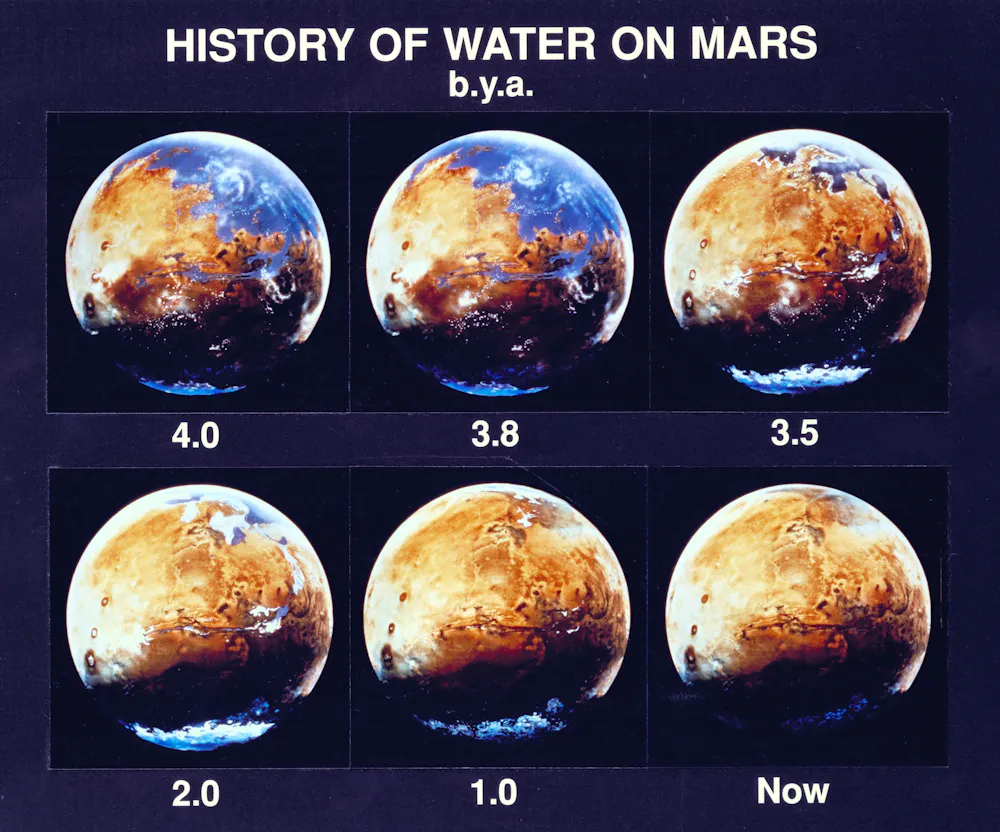
Mars wasn’t always the barren desert we see today. Billions of years ago, during the Noachian and Hesperian periods (4.1 billion to 3 billion years ago), rivers carved valleys and lakes shimmered.
As Mars’ magnetic field faded and its atmosphere thinned, most surface water vanished. Some escaped to space, some froze in polar caps, and some was trapped in minerals, where it remains today.
Four billion years ago (top left), Mars may have hosted a huge ocean. But the surface water has slowly disappeared, leaving only frozen remnants near the poles today. NASA
But evaporation, freezing and rocks can’t quite account for all the water that must have covered Mars in the distant past. Calculations suggest the “missing” water is enough to cover the planet in an ocean at least 700 metres deep, and perhaps up to 900 metres deep.
One hypothesis has been that the missing water seeped into the crust. Mars was heavily bombarded by meteorites during the Noachian period, which may have formed fractures that channelled water underground.
Deep beneath the surface, warmer temperatures would keep the water in a liquid state – unlike the frozen layers nearer the surface.
A seismic snapshot of Mars’ crust
In 2018, NASA’s InSight lander touched down on Mars to listen to the planet’s interior with a super-sensitive seismometer.
By studying a particular kind of vibration called “shear waves”, we found a significant underground anomaly: a layer between 5.4 and 8 kilometres down where these vibrations move more slowly.
This “low-velocity layer” is most likely highly porous rock filled with liquid water, like a saturated sponge. Something like Earth’s aquifers, where groundwater seeps into rock pores.
We calculated the “aquifer layer” on Mars could hold enough water to cover the planet in a global ocean 520–780m deep — several times as much water as is held in Antarctica’s ice sheet.
This volume is compatible with estimates of Mars’ “missing” water (710–920m), after accounting for losses to space, water bound in minerals, and modern ice caps.
Meteorites and marsquakes
We made our discovery thanks to two meteorite impacts in 2021 (named S1000a and S1094b) and a marsquake in 2022 (dubbed S1222a). These events sent seismic waves rippling through the crust, like dropping a stone into a pond and watching the waves spread.
The crater caused by meteorite impact S1094b, as seen from NASA’s Mars Reconnaissance Orbiter. NASA/JPL-Caltech/University of Arizona
InSight’s seismometer captured these vibrations. We used the high-frequency signals from the events — think of tuning into a crisp, high-definition radio station — to map the crust’s hidden layers.
We calculated “receiver functions,” which are signatures of these waves as they bounce and reverberate between layers in the crust, like echoes mapping a cave. These signatures let us pinpoint boundaries where rock changes, revealing the water-soaked layer 5.4 to 8 kilometres deep.
Why it matters
Liquid water is essential for life as we know it. On Earth, microbes thrive in deep, water-filled rock.
Could similar life, perhaps relics of ancient Martian ecosystems, persist in these reservoirs? There’s only one way to find out.
The water may be a lifeline for more complex organisms, too – such as future human explorers. Purified, it could provide drinking water, oxygen, or fuel for rockets.
Of course, drilling kilometres deep on a distant planet is a daunting challenge. However, our data, collected near Mars’ equator, also hints at the possibility of other water-rich zones – such as the icy mud reservoir of Utopia Planitia.
What’s next for Mars exploration?
Our seismic data covers only a slice of Mars. New missions with seismometers are needed to map potential water layers across the rest of the planet.
Future rovers or drills may one day tap these reservoirs, analysing their chemistry for traces of life. These water zones also require protection from Earthly microbes, as they could harbour native Martian biology.
For now, the water invites us to keep listening to Mars’ seismic heartbeat, decoding the secrets of a world perhaps more like Earth than we thought.
Hrvoje Tkalčić receives funding from The Australian Research Council.
Weijia Sun works for Institute of Geology and Geophysics, Chinese Academy of Sciences. He receives funding from National Key R&D Program of China.
The Government is turning up the heat on boy racers and fleeing drivers with a suite of stronger measures to deter anti-social and intimidating driving, Transport Minister Chris Bishop and Police Minister Mark Mitchell say.
“At present, the penalties for anti-social or intimidating driving behaviour aren’t strong enough to deter this appalling behaviour. Police reporting shows that some types of anti-social road events are actually increasing in frequency. We’re saying enough is enough,” Mr Bishop says.
“Kiwis are sick of seeing these idiot drivers putting everyone around them at risk, so we’re taking action through a range of much tougher penalties.
The new offences and penalties will include:
Establishing a presumptive sentence of vehicle destruction or forfeiture for those that flee Police, street racers, intimidating convoys and owners who fail to identify offending drivers
Giving Police more powers to manage illegal vehicle gatherings by closing roads or public areas and issuing infringements
Increasing the infringement fee for making excessive noise from or within a vehicle from $50 to $300
“These changes, to be introduced in new legislation in mid-2025, will mean convicted fleeing drivers, boy racers, and people participating in intimidating convoys have their vehicle destroyed or forfeited,” Mr Bishop says.
“The legislation will establish a presumptive court-ordered sentence of vehicle forfeiture or destruction. This means that, if someone is convicted of these offences, courts must order that vehicle be destroyed or forfeited to the Crown to be sold.
“There will be some limited exceptions where the vehicle is owned by someone other than the offender, or if it would be manifestly unjust or cause extreme or undue hardship to do so.”
Minister Mitchell says the bill will give Police new powers to manage intimidating convoys and illegal dirt bike gatherings, through the ability to close roads and compelling people to leave or face fines.
The bill will also introduce stronger fines for intentionally creating excessive noise from within or on a vehicle. This will take the Police-issued fine from $50 to $300, and the court ordered fine from $1000 to $3000.
“People have had enough of boy racers and their dangerous, obnoxious behaviour. These people drive without regard for the danger and disruption it causes to our communities. They have no consideration for anyone other than themselves.” Minister Mitchell says.
“Anti-social road use and illegal street racing have no place in New Zealand. Our message is clear: if you want drive dangerously, face the consequences”.
Notes to editors:
Anti-social road users are those who fail to stop for Police while speeding or driving dangerously, participate in unauthorised street racing, do burnouts, carry out intimidating convoys and unlawful dirt bike gatherings, or cause excessive noise by taking part in siren battles.
The Government will expand the existing offence for a vehicle owner not immediately providing information about a driver who used that vehicle to flee Police to now:
apply to those participating in street racing, loss of traction (burnouts), and intimidating convoys,
ensure courts order the vehicle destroyed or forfeited unless it would be manifestly unjust, or cause extreme hardship to the offender or undue hardship to any other person, and
allow courts to issue a fine not exceeding $10,000
Additional powers for Police to manage illegal vehicle gatherings are to:
expand the existing road closure power to include all public and private areas accessible to the public by vehicle (e.g. parks and car parks),
establish an offence for a person who, without reasonable excuse, fails to comply with a direction to leave or not enter a closed area, and establish an associated penalty of a $1,000 infringement fee and a maximum $3,000 court fine.
Killing carnivores to protect livestock, wildlife and people is an emotive and controversial issue that can cause community conflict. Difficult decisions about managing predators must be supported by strong scientific evidence.
In Australia, predators such as dingoes and foxes are often shot or poisoned with baits to prevent them from killing sheep and cattle. Feral cats and foxes are also killed to protect native wildlife.
But research elsewhere suggests public perceptions of how predators affect ecosystems and livestock are not always accurate.
Our recent study sought to shed light on these controversies. We examined the scat, or poo, left behind by dingoes, foxes and cats. We focused on the mallee region of Victoria and South Australia where there are calls to resume dingo culling to stop them killing livestock.
A contentious issue
Our study took place in the Big Desert-Wyperfeld-Ngarkat reserve complex in the semi-arid mallee region of Victoria and South Australia. This continuous ecosystem comprises about 10,000 km² of protected native mallee bushland, and is entirely surrounded by crop and livestock farming areas.
Fox-baiting is conducted along the boundaries of Victorian-managed reserve areas. Dingo baiting occurs in the South Australian-managed section of the park.
Prior to the change, Victorian farmers and authorised trappers could control dingoes on private land and within public land up to 3km from farms. Farmers say they have lost livestock since dingoes were protected.
What are predators eating in the mallee region?
We collected and analysed 136 dingo, 200 fox and 25 cat scats to determine what each predator in the area was eating and how their diets differed.
Livestock was not a major part of the diet of dingoes, foxes or cats. Some 7% of fox scats contained sheep or cattle remains. This was more than that of dingoes, at 2% of scats. No feral cat scats contained livestock remains.
The dingo diet was dominated by kangaroos, wallabies and emus, which comprised more than 70% of their diet volume.
Cats and foxes consumed more than 15 times the volume of small native mammals compared with dingoes, including threatened species such as fat-tailed dunnarts.
Our data must be interpreted with caution. Scat analysis cannot differentiate between livestock killed by predators and those that are scavenged. It also can’t tell us about animals that a predator killed but did not eat.
In 2022–23, when we collected the scats, rainfall in the area was high and prey was abundant. So, while we found livestock were not likely to be a substantial part of these predators’ diets at the time of our research, this can change depending on environmental conditions.
For example, fire and extended drought may force predators to move further to find food and water. They may move from conservation areas to private land, where they could prey on livestock.
A taste for certain prey
A predator’s poo doesn’t tell the full story of how it affects prey populations.
To understand this further, we used motion-sensing wildlife cameras to assess which prey were available in the ecosystem. We compared it to the frequency they occurred in predator’s diets. This allowed us to determine if dingoes, foxes or cats target specific prey.
We found foxes and cats both consumed small mammals proportionally more than we expected, given the prey’s availability in the study area. Cats consumed birds at a higher rate than expected, and dingoes consumed echidnas more than expected.
Further intensive monitoring work is needed to determine how these dietary preferences affect the populations of prey species.
Embracing the evidence
The findings build on a substantial previous research suggesting foxes and cats pose a significant threat to native mammals, birds, reptiles and other wildlife, including many threatened species. Our results suggest foxes may cause more harm to sheep than dingoes overall – a finding consistent with research elsewhere in Victoria.
Dingoes were the only predator species that regularly preyed on kangaroos and wallabies. These species are abundant in the region. They can also compete with livestock for grazing pastures, consume crops and degrade native vegetation.
Currently, dingoes are killed on, or fenced out of, large parts of Australia due to their perceived threat to livestock.
Lethal control of invasive species remains important to protect native wildlife and agriculture. But such decisions should be based on evidence, to avoid unforeseen and undesirable results.
Non-lethal and effective alternatives exist to indiscriminately killing predators to protect livestock, such as protection dogs and donkeys. These measures are being embraced by farmers and graziers globally, often with high and sustained success.
In Australia, governments should better embrace and support evidence-based and effective approaches that allow farming, native carnivores and other wildlife to coexist.
Rachel Mason conducted this research with grant funding from the Victorian Department of Energy, Environment and Climate Action. She is a current member of the Australian Mammal Society, the Australasian Wildlife Management Society, and the Ecological Society of Australia.
Euan Ritchie receives funding from the Australian Research Council and the Department of Energy, Environment, and Climate Action. Euan is a Councillor within the Biodiversity Council, a member of the Ecological Society of Australia and the Australian Mammal Society, and President of the Australian Mammal Society.
“Alcohol is the most harmful drug in Aotearoa, but it’s marketed like a harmless treat,” says Karen Wright, Health Coalition Aotearoa. “Our legislation is outdated and is maintaining large inequities in harm. People are saying enough is enough. They back action to protect children, whānau and communities from alcohol harm.”
The majority support making alcohol less available
81% agree online alcohol deliveries should have to follow the same checks as bars and stores
76% agreed with neighbourhood limits on the number of places selling alcohol
58% support returning the alcohol purchase age to 20 years old
The majority support removing industry from policymaking and telling the truth about alcohol harms
71% agree the alcohol industry should stay out of policymaking
66% support cancer warning labels on alcohol products
The majority support safeguards against alcohol advertising
80% back a ban on alcohol ads seen by children
62% support a ban on all alcohol advertising and sponsorship
68% agree sporting organisations should be supported to move away from alcohol sponsorship
Support for making alcohol less affordable
58% agree cheap alcohol should not be sold below a certain price
47% agree the Government should increase the price of alcohol by 10% and use that money for alcohol treatment services and harm prevention. A further 11% were unsure.
The poll shows strong support for the three areas known to reduce alcohol consumption and harm for communities – safeguards for affordability, availability and advertising. Successive New Zealand Governments have not implemented long-standing recommendations to address these issues. Instead they have made disappointing, minor tweaks to the law governing alcohol.
“The people of Aotearoa are ready for change. Now it’s up to the Government to act,” says Steve Randerson, Health Coalition Aotearoa. “As a country we have done this before with tobacco, when the Government brought in sensible safeguards around tobacco marketing. The public supports similar action for alcohol marketing, which would benefit young people and those trying to cut down or stop drinking.”
Alcohol causes a broad range of harms to the consumer, whānau and communities. Alcohol fuels violence and causes at least seven types of cancer. It also causes lifelong brain injury to babies exposed during pregnancy – and many other harms to health and society. It’s also deeply woven into everyday life, from rugby matches to music festivals-thanks to relentless industry marketing.
“Alcohol companies spend millions telling us drinking is fun, sexy and essential. But the ads don’t tell us it causes cancer,” says Steve Randerson. “Our children deserve better. So do we.”
The cost of replacing alcohol sponsorship in sport is relatively low-just $10-12 million per year, or 5-6% of total sponsorship revenue.
“This is a fixable problem,” says Karen Wright. “New Zealanders want politicians to put people before profits. Solutions to reduce harms must not be influenced by an industry motivated by sales and profit. It’s time to overhaul our alcohol laws to protect our children and those most impacted by harm.”
Health Coalition Aotearoa is calling time and urges the Government to act on the clear public mandate and introduce evidence-based reforms to reduce alcohol harm across Aotearoa.
This poll provides the most up to date data on current public opinion on alcohol policies of New Zealand adults.
Results are based upon questions asked in a Talbot Mills Research nationwide online survey of a sample of 1161 nationally representative respondents in NZ 18 years of age and over. The questions were asked in March 2025.
Participants were asked ‘To reduce the problems associated with alcohol use, how strongly do you agree or disagree with the following statements (%)’ followed by a range of alcohol policy measure statements.
The last public opinion survey was the 2023 University of Otago/Cancer Society survey. Our PHCC Briefing includes 2023 results for comparison where relevant, but we caution comparing results too closely as the methodology and question and response options differed between the two surveys.
This poll was funded by Health Coalition Aotearoa and the Cancer Society of New Zealand.
Source: United States House of Representatives – Congressman Michael McCaul (10th District of Texas)
WASHINGTON— Today, U.S. Congressman Michael McCaul (R-Texas) — chairman emeritus of the House Foreign Affairs Committee — and Congressman Bill Huizenga (R-Mich.) announced the introduction of H.R. 3068, the Missile Technology Control Revision Act. The legislation modernizes missile technology export controls by removing unnecessary regulatory barriers — bolstering U.S. national security while ensuring our allies are equipped to address shared security threats in a timely manner.
“The Chinese Communist Party is working at lightning speed to advance its military apparatus — and it does not play fair,” said Rep. McCaul. “The Mission Technology Control Revision Act empowers the United States and its allies to meet that generational challenge head-on by removing burdensome red tape that slows down the transfer of critical military technologies. I urge my colleagues to support this important bill that will strengthen crucial partnerships like the AUKUS defense pact and deter the CCP’s malign activity in the Indo-Pacific and beyond.”
“The threats our nation faces have evolved over time; therefore, our approach to keeping America safe must evolve as well,” said Rep. Bill Huizenga. “We cannot allow bureaucratic red tape to hinder our national security. By modernizing the Missile Technology Control Regime to meet the security challenges of today, we can strengthen our defense capabilities and increase our cooperation with our allies, especially Australia and the United Kingdom. The Missile Technology Control Revision Act can act as a force multiplier that allows the United States and our closest allies to address the security challenges we face today and in the future.”
Background:
The Missile Technology Control Regime (MTCR) was signed in 1987 and is a non-binding political arrangement designed to curtail exports and proliferation of WMD delivery vehicles and the underlying technologies. Unfortunately, the MTCR has no independent means to verify whether states adhere to its guidelines or a mechanism to penalize member states if they violate them.
The MTCR was established to prevent the proliferation of missile systems capable of delivering weapons of mass destruction, but in practice, its strict implementation through the Arms Export Control Act has often limited the United States’ ability to share certain missile-related technologies, such as advanced drones and space launch systems, with close allies. At the same time, countries like China and Russia, which have a history of violating MTCR norms, have continued to export similar technologies with fewer constraints. This disparity has complicated U.S. efforts to deepen defense cooperation and technology sharing through alliances like NATO, Five Eyes, and AUKUS.
Reps. McCaul and Huizenga’s legislation amends the Arms Export Control Act of 1976 to allow for expedited defense trade with countries the president determines to be eligible for a defense trade exemption. Additionally, the bill includes a statement of policy that the US shall no longer apply a “presumption of denial” for MTCR items to NATO, major non-NATO allies, and Five Eyes members.
Chief Executive John Lee met Qatar’s leaders and government officials and learnt about the latest developments of the country’s sovereign wealth fund on the first day of a visit to Qatar.
Leading a business delegation comprising representatives from Hong Kong and Mainland enterprises, Mr Lee in the morning, met respectively the Amir, head of state of Qatar Tamim bin Hamad Al Thani, Qatar Prime Minister & Minister of Foreign Affairs Mohammed bin Abdulrahman Al Thani and Minister of Communications & Information Technology Mohammed bin Ali bin Mohammed Al Mannai to exchange views on strengthening bilateral relations and economic co-operation between Hong Kong and Qatar.
The Chief Executive said that Qatar and Hong Kong are economic powerhouses in the Middle East and the Asia-Pacific region respectively. Noting that Qatar is Hong Kong’s third-largest trading partner in the Middle East with bilateral trade in goods worth US$1.6 billion last year, Mr Lee said that there is plenty of room for further growth in trade and business between the two places.
He also expressed his anticipation that during this visit, multiple memoranda of understanding and agreements will be made between Hong Kong and Qatar, covering various areas including trade and investment promotion, financial services, innovation and technology (I&T), and cultural tourism, with a view to further enhancing co-operation among the governments and institutions of the two places.
Mr Lee noted that Hong Kong, as a functional platform of the Belt & Road Initiative, is committed to deepening international exchanges and co-operation and leveraging its strengths as a “super connector” and “super value-adder” to facilitate and add value to government and business projects along the Belt & Road through the city’s world-class professional services.
He also said that the Qatar National Vision 2030 and the Belt & Road Initiative align in their values and aspirations for achieving high-quality development through all-round co-operation, embracing economic diversification and innovation, as well as fostering friendship and facilitating exchanges.
The Chief Executive supplemented that both Hong Kong and Qatar attach great importance to technological development and regard artificial intelligence as an engine of new economic development, and that he hoped Hong Kong and Qatar would enhance collaboration through joint research and exchanges, joint ventures, and cross-border investments to achieve mutual benefits.
In addition, Mr Lee visited the Qatar Investment Authority to learn about the development of Qatar’s financial sector. Established in 2005, the authority is Qatar’s sovereign wealth fund. It manages and grows Qatar’s financial assets, with an aim to diversify Qatar’s economic development and ensure the country’s long-term financial sustainability. Mr Lee received an in-depth briefing on the operation and investment strategies of the sovereign wealth fund, and explored with the authority the development and co-operation opportunities for both sides in finance and the economy.
In the afternoon, he attended a luncheon hosted by an international financial group, where he gained insights into the group’s analysis of Qatar’s banking and financial services industry, as well as its capital markets.
Pointing out that Hong Kong is an international financial centre now moving towards also becoming an international green finance hub, Mr Lee said that last year the total amount of green and sustainable debt issued in Hong Kong exceeded US$84 billion, with green and sustainable bonds accounting for approximately US$43 billion. It captured around 45% of the total Asian market, ranking first in the region for seven consecutive years. He highlighted that under the principle of “one country, two systems”, Hong Kong and Mainland enterprises complement each other’s strengths, and that Hong Kong would give full play to its bridging role in attracting international investments to China and “going global” with Mainland enterprises. He welcomed Qatari enterprises to leverage Hong Kong’s broad and deep capital markets, professional financial services and seamless connectivity with the Mainland market to raise international funds for their sustainable infrastructure projects.
Afterwards, Mr Lee led the delegation to visit Lusail City, the second-largest city in Qatar, to understand how the city integrates I&T with urban planning and infrastructure development. Lusail City is one of Qatar’s flagship smart cities, focusing on information and communication technology, with the aim of developing into a model for intelligent living, urban evolution and diverse cultural landscapes. He noted that Hong Kong, as the world’s third-largest financial centre, offers world-class professional services that can support Qatar’s investment needs, adding that Hong Kong and Qatar can explore co-operation and exchanges in areas such as sustainable urban development.
Next on the itinerary is a visit to the National Museum of Qatar to learn about the country’s history and cultural heritage as well as a dinner hosted by the Ambassador Extraordinary & Plenipotentiary of the People’s Republic of China to the State of Qatar Cao Xiaolin.
The Chief Executive and his delegation will continue their visit to Qatar tomorrow by meeting local political and business leaders before departing for Kuwait.
Source: People’s Republic of China in Russian – People’s Republic of China in Russian –
Source: People’s Republic of China – State Council News
JAKARTA, May 11 (Xinhua) — A 6.2-magnitude earthquake struck off the coast of Aceh province in western Indonesia on Sunday, but no strong waves were generated, according to the country’s Meteorology, Climatology and Geophysics Agency.
The tremors occurred at 15:57 local time, with the epicenter located 21 km southwest of Aceh Barat Daya County at a depth of 45 km.
The agency did not issue a tsunami warning because the earthquake was not expected to generate high waves.
Local residents felt strong tremors, but there were no preliminary reports of major damage, a senior official at Aceh’s disaster management agency told Xinhua. -0-
Israel is in a weak position and Prime Minister Benjamin Netanyahu’s extremism knows no bounds. The only other way around an eventual regional war is the ousting of the Israeli prime minister.
US President Donald Trump has closed his line of communication with Israeli Prime Minister Benjamin Netanyahu, according to various reports citing officials.
This comes amid alleged growing pressure on Israel regarding Gaza and the abrupt halt to American operations against Ansarallah in Yemen. So, is this all an act or is the US finally pressuring Israel?
On May 1, news broke that President Donald Trump had suddenly ousted his national security advisor Mike Waltz. According to a Washington Post article on the issue, the ouster was in part a response to Waltz’s undermining of the President, for having engaged in intense coordination with Israeli PM Netanyahu regarding the issue of attacking Iran prior to the Israeli Premier’s visit to the Oval Office.
Some analysts, considering that Waltz has been pushing for a war on Iran, argued that his ouster was a signal that the Trump administration’s pro-diplomacy voices were pushing back against the hawks.
This shift also came at a time when Iran-US talks had stalled, largely thanks to a pressure campaign from the Israel Lobby, leading US think tanks and Israeli officials like Ron Dermer.
Then, seemingly out of nowhere, Trump publicly announced the end to a campaign designed to destroy/degrade Yemen’s Ansarallah-led government in Sana’a on May 6.
Israeli leadership shocked According to Israeli media, citing government sources, the leadership in Tel Aviv was shocked by the move to end operations against Yemen, essentially leaving the Israelis to deal with Ansarallah alone.
After this, more information began to leak, originating from the Israeli Hebrew-language media, claiming that the Trump administration was demanding Israel reach an agreement for aid to be delivered to Gaza, in addition to signing a ceasefire agreement.
The other major claim is that President Trump has grown so frustrated with Netanyahu that he has cut communication with him directly.
Although neither side has officially clarified details on the reported rift between the two sides, a few days ago the Israeli prime minister released a social media video claiming that he would act alone to defend Israel.
On Friday morning, another update came in that American Defence Secretary Pete Hegseth would be cancelling his planned visit to Tel Aviv.
Can Trump and Netanyahu remake the Middle East? Video: Palestine Chronicle
Is the US finally standing up to Israel? In order to assess this issue correctly, we have to place all of the above-mentioned developments into their proper context.
The issue must also be prefaced on the fact that every member of the Trump government is pro-Israeli to the hilt and has received significant backing from the Israel Lobby.
Mike Waltz was indeed fired and according to leaked AIPAC audio revealed by The Grayzone, he was somewhat groomed for a role in government by the pro-Israel Lobby for a long time.
Another revelation regarding Waltz, aside from him allegedly coordinating with Netanyahu behind Trump’s back and adding journalist Jeffrey Goldberg to a private Signal group chat, was that he was storing his chats on an Israeli-owned app.
Yet, Waltz was not booted out of the government like John Bolton was during Trump’s first term in office, he has instead been designated as UN ambassador to the United Nations.
The UN ambassador position was supposed to be handed to Elise Stefanik, a radically vocal supporter of Israel who helped lead the charge in cracking down on pro-Palestine free speech on university campuses. Stefanik’s nomination was withdrawn in order to maintain the Republican majority in the Congress.
If Trump was truly seeking to push back against the Israel Lobby’s push to collapse negotiations with Iran, then why did Trump signal around a week ago that new sanctions packages were on the way?
He announced on Friday that a third independent Chinese refiner would be hit with secondary sanctions for receiving Iranian oil.
Israeli demands in Trump’s rhetoric The sanctions, on top of the fact that his negotiating team have continuously attempted to add conditions the the talks, viewed in Tehran as non-starters, indicates that precisely what pro-Israel think tanks like WINEP and FDD have been demanding is working its way into not only the negotiating team, but coming out in Trump’s own rhetoric.
There is certainly an argument to make here, that there is a significant split within the pro-Israel Lobby in the US, which is now working its way into the Trump administration, yet it is important to note that the Trump campaign itself was bankrolled by Zionist billionaires and tech moguls.
Miriam Adelson, Israel’s richest billionaire, was his largest donor. Adelson also happens to own Israel Hayom, the most widely distributed newspaper in Israel that has historically been pro-Netanyahu, it is now also reporting on the Trump-Netanyahu split and feeding into the speculations.
As for the US operations against Yemen, the US has used the attack on Ansarallah as the perfect excuse to move a large number of military assets to the region.
This has included air defence systems to the Gulf States and most importantly to Israel.
After claiming back in March to have already “decimated” Ansarallah, the Trump administration spent way in excess of US$1 billion dollars (more accurately over US$2 billion) and understood that the only way forward was a ground operation.
Meanwhile, the US has also moved military assets to the Mediterranean and is directly involved in intensive reconnaissance over Lebanese airspace, attempting to collect information on Hezbollah.
An Iran attack imminent? While it is almost impossible to know whether the media theatrics regarding the reported Trump-Netanyahu split are entirely true, or if it is simply a good-cop bad-cop strategy, it appears that some kind of assault on Iran could be imminent.
Whether Benjamin Netanyahu is going to order an attack on Iran out of desperation or as part of a carefully choreographed plan, the US will certainly involve itself in any such assault on one level or another.
The Israeli prime minister has painted himself into a corner. In order to save his political coalition, he collapsed the Gaza ceasefire during March and managed to bring back his Security Minister Itamar Ben Gvir to his coalition.
This enabled him to successfully take on his own Shin Bet chief Ronen Bar, in an ongoing purge of his opposition.
However, due to a lack of manpower and inability to launch any major ground operation against Gaza, without severely undermining Israeli security on other fronts, Netanyahu decided to adopt a strategy of starving the people of Gaza instead.
He now threatens a major ground offensive, yet it is hard to see what impact it would have beyond an accelerated mass murder of civilians.
The Israeli prime minister’s mistake was choosing the blocking of all aid into Gaza as the rightwing hill to die on, which has been deeply internalised by his extreme Religious Zionism coalition partners, who now threaten his government’s stability if any aid enters the besieged territory.
Netanyahu in a difficult position This has put Netanyahu in a very difficult position, as the European Union, UK and US are all fearing the backlash that mass famine will bring and are now pushing Tel Aviv to allow in some aid.
Amidst this, Netanyahu made another commitment to the Druze community that he would intervene on their behalf in Syria.
While Syria’s leadership are signaling their intent to normalise ties and according to a recent report by Yedioth Ahronoth, participated in “direct” negotiations with Israel regarding “security issues”, there is no current threat from Damascus.
However, if tensions escalate in Syria with the Druze minority in the south, failure to fulfill pledges could cause major issues with Israeli Druze, who perform crucial roles in the Israeli military.
Internally, Israel is deeply divided, economically under great pressure and the overall instability could quickly translate to a larger range of issues.
Then we have the Lebanon front, where Hezbollah sits poised to pounce on an opportunity to land a blow in order to expel Israel from their country and avenge the killing of its Secretary General Seyyed Hassan Nasrallah.
Trigger a ‘doomsday option’? Meanwhile in Gaza, if Israel is going to try and starve everyone to death, this could easily trigger what can only be called the “doomsday option” from Hamas and other groups there. Nobody is about to sit around and watch their people starve to death.
As for Yemen’s Ansarallah, it is clear that there was no way without a massive ground offensive that the movement was going to stop firing missiles and drones at Israel.
What we have here is a situation in which Israel finds itself incapable of defeating any of its enemies, as all of them have now been radicalised due to the mass murder inflicted upon their populations.
In other words, Israel is not capable of victory on any front and needs a way out.
The leader of the opposition to Israel in the region is perceived to be Iran, as it is the most powerful, which is why a conflict with it is so desired. Yet, Tehran is incredibly powerful and the US is incapable of defeating it with conventional weapons, therefore, a full-scale war is the equivalent to committing regional suicide.
Robert Inlakesh is a journalist, writer, and documentary filmmaker. He focuses on the Middle East, specialising in Palestine. He contributed this article toThe Palestine Chronicleand it is republished with permission.
Source: Hong Kong Government special administrative region
The Chief Executive, Mr John Lee, today (May 11) led a business delegation comprising representatives from Hong Kong and Mainland enterprises to commence its visit programme to Qatar. He met with leaders and government officials of Qatar and leant about the latest development of the country’s sovereign wealth fund. He also exchanged views with representatives of a local financial institution. He inspected Qatar’s town planning and visited local cultural and tourism facilities.
In the morning, Mr Lee met respectively with the Amir of Qatar, Mr Tamim bin Hamad Al Thani, the head of state of Qatar; the Prime Minister and Minister of Foreign Affairs of Qatar, Mr Mohammed bin Abdulrahman Al Thani; and the Minister of Communications and Information Technology, Mr Mohammed bin Ali bin Mohammed Al Mannai, to exchange views on strengthening bilateral relations and economic co-operation between Hong Kong and Qatar.
Mr Lee said that Qatar and Hong Kong are economic powerhouses in the Middle East and the Asia-Pacific region respectively. Noting that Qatar is Hong Kong’s third-largest trading partner in the Middle East with bilateral trade in goods worth US$1.6 billion last year, Mr Lee said that there is plenty of room for further growth in trade and business between the two places. He also expressed his anticipation that during this visit, multiple memoranda of understanding and agreements will be made between Hong Kong and Qatar, covering various areas including trade and investment promotion, financial services, innovation and technology (I&T), and cultural tourism, with a view to further enhancing co-operation among the governments and institutions of the two places.
Mr Lee said that Hong Kong, as a functional platform of the Belt and Road Initiative, is committed to deepening international exchanges and co-operation and leveraging its strengths as a “super connector” and “super value-adder” to facilitate and add value to government and business projects along the Belt and Road through the city’s world-class professional services. He also said that the Qatar National Vision 2030 and the Belt and Road Initiative align in their values and aspirations for achieving high-quality development through all-round co-operation, embracing economic diversification and innovation, as well as fostering friendship and facilitating exchanges.
Mr Lee also highlighted that both Hong Kong and Qatar attach great importance to technological development and regard artificial intelligence as an engine of new economic development. He said he hoped that Hong Kong and Qatar would enhance collaboration through joint research and exchanges, joint ventures, and cross-border investments to achieve mutual benefits.
Mr Lee also visited Qatar Investment Authority this morning to learn about the development of Qatar’s financial sector. Established in 2005, the Qatar Investment Authority is Qatar’s sovereign wealth fund. It manages and grows Qatar’s financial assets, with an aim to diversify Qatar’s economic development and ensure the country’s long-term financial sustainability. Mr Lee received an in-depth briefing on the operation and investment strategies of the sovereign wealth fund, and explored with the Qatar Investment Authority the development and co-operation opportunities for both sides in finance and the economy.
In the afternoon, Mr Lee attended a luncheon hosted by an international financial group, where he gained insights into the group’s analysis of Qatar’s banking and financial services industry, as well as its capital markets.
Noting that Hong Kong, an international financial centre now moving towards also becoming an international green finance hub, Mr Lee said that last year the total amount of green and sustainable debt issued in Hong Kong exceeded US$84 billion, with green and sustainable bonds accounting for approximately US$43 billion. It captured around 45 per cent of the total Asian market, ranking first in the region for seven consecutive years. Mr Lee said that under the principle of “one country, two systems”, Hong Kong and Mainland enterprises complement each other’s strengths, and that Hong Kong would give full play to its bridging role in attracting international investments to China and “going global” with Mainland enterprises. He welcomed Qatari enterprises to leverage Hong Kong’s broad and deep capital markets, professional financial services and seamless connectivity with the Mainland market to raise international funds for their sustainable infrastructure projects.
Afterwards, Mr Lee led the delegation to visit Lusail City, the second-largest city in Qatar, to understand how the city integrates I&T with urban planning and infrastructure development. Lusail City is one of Qatar’s flagship smart cities, focusing on information and communication technology, with the aim of developing into a model for intelligent living, urban evolution and diverse cultural landscapes. Mr Lee said that Hong Kong, as the world’s third-largest financial centre, offers world-class professional services that can support Qatar’s investment needs. He also noted that Hong Kong and Qatar can explore co-operation and exchanges in areas such as sustainable urban development.
Mr Lee will later visit the National Museum of Qatar to learn about the country’s history and rich cultural heritage. The museum, which opened in 2019, is dedicated to vividly presenting the story of Qatar and its people in an innovative and immersive way.
The delegation led by Mr Lee will attend a dinner hosted by the Ambassador Extraordinary and Plenipotentiary of the People’s Republic of China to the State of Qatar, Mr Cao Xiaolin. Mr Lee expressed his gratitude to the Embassy for its strong support to the Hong Kong Special Administrative Region Government and the Hong Kong Economic and Trade Office in Dubai, and for making meticulous arrangements for the visit.
Mr Lee will lead the delegation to continue its visit to Qatar tomorrow (May 12) to meet with local political and business leaders before departing for Kuwait.
If there are few speakers left of a language, how does a community revive it? In our current era, 3,000 languages are at risk of extinction due to the pressures of colonization, globalization, forced cultural assimilation, environmental devastation and other factors.
According to Canada’s Commission for Indigenous Languages, “research shows that no Indigenous language in Canada is safe and that all are in varying stages of endangerment.”
Our society is also being shaped by the rapid rise of artificial intelligence. Can AI be used for the benefit of Indigenous language survival in Canada and elsewhere?
According to the World Economic Forum, most AI chatbots are trained on 100 of the world’s 7,000 languages. English is the main driver of most large language models.
This scenario leaves the bulk of the world’s languages in the dust. In the coming years, will AI contribute to language revitalization, or language oppression?
A language in a box
In a 2023 TEDx talk, Northern Cheyenne computer engineer Michael Running Wolf shared his design of a cedar box that looks both ancient and contemporary. He described the dragonfly-adorned device as a “cedar-enclosed, offline Edge AI that contains the inner workings of a minimal voice-based language curricula — in other words, a language in a box.”
He proposed that conversational AI technology, much like Amazon Alexa or Google Home, could help language learners improve their fluency.
Running Wolf is the technical director of the First Languages AI Reality initiative at the Québec Institute for Artificial Intelligence. The program propels Indigenous scholars and technologists towards creating innovative solutions regarding language loss.
A TEDx Talk by Michael Running Wolf on how AI can assist Indigenous langauge learning.
Voice-controlled tools trained via machine learning could serve as AI assistants for speakers who wish to hear unfamiliar sounds pronounced accurately, and practice their own pronunciation. This technology could establish a new means for facilitating oral transmission, which is crucial when there are few fluent speakers left.
At the heart of Running Wolf’s project is Indigenous data sovereignty, which ensures that Indigenous people retain control over their data.
A place in the digital world
Around the world in the Philippines, AI scholar and politician Anna Mae Yu Lamentillo is on a quest to support the Indigenous languages of her home country. She created NightOwlGPT, a new AI-powered translation app.
In an email to me, Lamentillo wrote:
“In the Philippines alone, we are working on nine languages, many of which are endangered. Our goal is to ensure that these languages — not just the dominant ones — have a place in the digital world.”
NightOwlGPT creator Anna Mae Yu Lamentillo. (Arwin Doloricon)
When it comes to the survival or extinction of languages, it is important to question the power behind AI tools. Who controls them, and who benefits from them?
When I asked about the democratization of AI, Lamentillo noted the need for inclusivity:
“AI’s rapid advancement could parallel historical patterns of colonization. If AI is truly a black swan event — a disruptive moment in history — then what happens when 99 per cent of languages are left behind? This is more than just a linguistic issue; it’s a serious matter of accessibility, representation and digital equity.
If we don’t change who is leading AI development, we risk creating a new form of colonization — one where only a small fraction of the world has the tools to thrive.”
Diversity of voices
Linguistics professor Emmanuel Ngué Um. (Emmanuel Ngué Um)
They are currently using Mozilla’s Common Voice platform to create open-source datasets containing thousands of words and audio recordings in 31 African languages.
The platform aims to make speech recognition and voice-based AI more inclusive by crowd-sourcing a massively multilingual speech corpus. But this process is not without significant challenges in Africa.
Ngué Um noted that building datasets for languages with many dialects is not straightforward. There may not be a standardized spelling or pronunciation that should be used by AI as the accepted norms for the language.
Because of postcolonial changes, many African languages do not have one unified or agreed-upon writing system. This issue can slow the creation of teaching tools, but many local efforts backed by UNESCO are underway to change this.
So, how do automatic speech recognition tools deal with dialectical diversity? And how do text-to-speech models handle competing writing systems?
As Ngué Um wrote in an email to me:
“AI has been instrumental in delivering services that applied linguists have promised but are slow to deliver. This is not due to a lack of will or means on the part of linguists, but rather, because of the linguistic reality in Africa.
Despite the impact of colonization and the imposition of a monolithic ideal on language reality, Africa reflects the plurality, fluidity and resourcefulness that drive human communication…If AI is informed by these intricacies at all phases of its implementation, it will adequately address the diversity of voices…in Africa.”
It is clear that AI engineers and computational linguists need to integrate thoughtful approaches that take into account unique circumstances of languages.
In the not-too-distant future, using AI tools to learn and communicate in under-resourced languages may become the norm. However, that shift depends on financial backing, accurate training data for machine learning, and community desire to embrace AI. Ultimately, data sovereignty and equitable access must be at the core of AI tools.
Anna Luisa Daigneault volunteers for Living Tongues Institute for Endangered Languages, a non-profit organization whose work is not connected to contents of this article.
Source: Northern Territory Police and Fire Services
The new Gungahlin Community Centre will meet the needs of a growing population. (Artist’s impression)
In brief:
Construction has begun on the new Gungahlin Community Centre.
Construction is expected to be complete in early 2026.
In the interim, Gunners Place will continue to service the community.
Construction on the new community centre in Gungahlin has begun.
The new centre will meet the needs of the rapidly growing Gungahlin community.
It will be used for a variety of occasions and functions.
Features will include:
a dedicated work hub
meeting and activity rooms
multiple art workshops and studios
outdoor green spaces
a large multi-purpose community hall
kitchen facilities.
The new facility will also include a dedicated youth centre which will provide tailored training, education and recreational services.
It will be conveniently located in the heart of the Gungahlin Town Centre. There will be accessible public parking on site with secure bike parking and end-of-trip facilities available to use.
Gunners Place – a temporary community centre
In the interim, Gunners Place will continue to service the Gungahlin community.
The temporary community centre – run by Barnardos Australia – has been located on Gribble Street in Gungahlin since December 2023.
Services based there include:
Northside Community Services
Relationships Australia
Multicultural Hub Canberra.
Gunners Place will remain until construction of the new community centre is complete in early 2026.
To view the designs for the Gungahlin Community Centre and stay up to date with construction progress, visit the Built for CBR website.
Read more like this:
Get ACT news and events delivered straight to your inbox, sign up to our email newsletter:
Source: Hong Kong Government special administrative region
Hong Kong Customs seizes suspected cocaine worth over $1.1 million at airport (with photo) A 30-year-old male passenger arrived in Hong Kong from Entebbe, Uganda via Addis Ababa, Ethiopia yesterday. During customs clearance, Customs officers found the batch of suspected cocaine concealed in 7 pieces of cardboard inside his check-in suitcase. The man was subsequently arrested.
After an investigation, the arrested person has been charged with one count of trafficking in a dangerous drug. The case will be brought up at the West Kowloon Magistrates’ Courts tomorrow (May 12).
Following the increasing number of visitors to Hong Kong, Customs will continue to apply a risk assessment approach and focus on selecting passengers from high-risk regions for clearance to combat transnational drug trafficking activities.
Under the Dangerous Drugs Ordinance, trafficking in a dangerous drug is a serious offence. The maximum penalty upon conviction is a fine of $5 million and life imprisonment.
Members of the public may report any suspected drug trafficking activities to Customs’ 24-hour hotline 182 8080 or its dedicated crime-reporting email account (crimereport@customs.gov.hkIssued at HKT 19:42
Source: People’s Republic of China in Russian – People’s Republic of China in Russian –
Source: People’s Republic of China – State Council News
HONG KONG, May 11 (Xinhua) — An earthquake with a magnitude of 6.0 jolted Indonesia’s North Sumatra province at 08:57 GMT on Sunday, the German Research Center for Geosciences (GFZ) said.
The epicenter of the tremors, according to preliminary data, was located at a point with coordinates of 3.73 degrees north latitude and 97.03 degrees east longitude. The hypocenter was located at a depth of 89.4 km. –0–
Source: People’s Republic of China in Russian – People’s Republic of China in Russian –
Source: People’s Republic of China – State Council News
ISLAMABAD, May 11 (Xinhua) — Pakistan has fully opened its airspace for all types of flights, the Pakistan Airports Authority (PAA) said on Saturday.
“Pakistan’s airspace is fully open for all types of flights,” a PAA spokesman told Xinhua, assuring travellers that all airports are currently operating normally.
The resumption of flights follows a ceasefire agreement between Pakistan and India that eased concerns after missile strikes and heightened security measures led to restricted airspace and a temporary suspension of flights earlier in the week.
The representative advised passengers to check with their airlines for the latest information on flight schedules and operational changes.
The full resumption of airport operations is expected to help stabilise air travel both domestically and internationally, bringing relief to airlines, airport staff and passengers affected by flight cancellations and delays during the heightened tensions. –0–
Source: People’s Republic of China in Russian – People’s Republic of China in Russian –
Source: People’s Republic of China – State Council News
CHANGCHUN, May 11 (Xinhua) — The May Day holiday has ended, but the tourism boom in the border city of Hunchun is still going strong. Tourists from all over China come here to taste the freshest seafood imported from Russia.
The city of Hunchun /Jilin Province, Northeast China/ is located at the junction of the state borders of China, Russia and the DPRK. The Hunchun checkpoint is 42 km from the Russian port of Posyet and 71 km from the port of Zarubino.
Every morning, trucks loaded with fresh Russian seafood arrive at the Hunchun checkpoint, bringing seafood from the deep sea to the tables of the city’s restaurants.
The 145-meter-long “Seafood Street” is the place most often visited by tourists. There are more than 20 specialized shops on both sides of this street. It not only sells a variety of seafood, but also provides comprehensive services such as processing, packaging and delivery.
When entering any store, a visitor will be able to see a wide range of seafood of different varieties and characteristics, such as Kamchatka crabs, hairy crabs and Sakhalin spizulas, among which Kamchatka crabs are the most popular.
Various cooking methods such as steaming, pepper-frying and char-grilling make seafood more delicious.
Liu Mengni, a tourist from Beijing, tasted various seafood dishes to write a guidebook for a food tour of Hunchun and posted it on social media. “The seafood here is very fresh, the meat is very tasty. I will definitely come here again!” she said.
Thanks to logistics networks, namely transportation by rail and air, fresh Kamchatka crabs can be delivered from Hunchun to all over the country on the same day.
In the Northeast Asia Cross-Border E-Commerce Industrial Park in Hunchun City, there is a Kamchatka crab shop covering an area of more than 1,000 square meters.
Wang Hai, the person in charge of the store, said that they have established close cooperation with Russian companies and the Kamchatka crabs caught from the depths of the sea are delivered to his store in original packaging.
“Kamchatka crab is delicious and affordable. At peak times, our store can receive over ten thousand customers daily,” said Wang Hai.
In addition, the Chinese businessman also promotes the sale of king crab through live broadcasting on social media. “Now we can sell about 100 king crabs daily in just two hours through live broadcasting. We have regular customers in Guangdong, Yunnan and Guangxi Zhuang Autonomous Region. You can place an order online and the goods will be delivered in about 24 hours,” he added.
In 2016, the Hunchun border crossing received official status as an import point for chilled fresh seafood and edible aquatic animals, becoming the main channel for delivering Russian Kamchatka crab to China.
Hunchun Mayor Zhang Linguo said that more than 1.5 million crabs enter China through the Hunchun checkpoint every year. The Kamchatka crab has already become a tourist brand for Hunchun.
As it became known, this year the local authorities will actively promote the construction of a “smart port” and improve logistics services in order to further reveal the city’s potential in developing the maritime economy. -0-
As scholars of global economic governance, we are sceptical of this claim. Here are our main reasons.
The G20 is insufficiently representative of the 193 member states of the United Nations plus the small number of non-member states.
It is a self-selected group of 19 countries and the European and African Unions.
It has no mandate to act or speak on behalf of the international community.
It has no transparent or formal mechanisms through which it can communicate with actors who do not participate in the G20 but have a stake in its deliberations and their outcomes.
The growing tensions in the world make it more urgent to improve the efficacy of the G20. Firstly, because there is growing evidence of the loss of interest in global cooperation. Secondly, because rich states are cutting their official development assistance and are failing to meet their commitments to help countries deal with loss and damage from climate impacts and make their economies more resilient to shocks.
And thirdly, because rich countries are also reluctant to discuss financing sustainable and inclusive development in forums like the upcoming Fourth Financing for Development Conference or the UN, where all states can participate. They prefer exclusive forums like the G20.
Here, after briefly describing the structure of the G20, we argue that its lack of representation is a major problem. We offer a solution and argue that, as chair of the G20 this year, South Africa is well placed to promote this solution.
What is the G20 and how does it function?
The G20 was established in the late 1990s in the wake of the East Asian financial crisis. Its members were invited by the US and Germany based on a proposal from the Canadian government. Initially only finance ministers and central bank governors of major advanced and emerging economies were involved. After the financial crisis of 2008-2009 it was upgraded to summit level with the same membership.
A summit is held annually, under the leadership of a rotating presidency.
The group accounts for 67% of the world’s population, 85% of global GDP, and 75% of global trade. The membership comprises 19 of the “weightiest” national economies plus the European Union and the African Union. The 19 national economies are the G7 (US, Japan, Germany, UK, France, Italy, Canada), plus Australia, China, India, Indonesia, Republic of Korea, Russia, Turkey, Saudi Arabia, South Africa, Mexico, Brazil, and Argentina. These countries are permanently “in”. The remaining 90% of countries in the world are excluded unless invited as “special guests” on an ad hoc basis.
Representatives of a select group of international organisations including the International Monetary Fund, the World Bank, the Organization for Economic Cooperation and Development (OECD) and the World Trade Organization also participate, together with those from some UN entities.
The G20’s work is managed by a troika consisting of the current president with the assistance of the past president and the incoming president. In 2025 this troika consists of South Africa as the current chair, Brazil as the past chair and the US, which will become the G20 president in 2026. The G20 has no permanent secretariat.
The consistency in G20 membership has proven to be an advantage because it helps foster a sense of familiarity, understanding and trust at the technical level among the permanent members. This is helpful in times of crisis and in dealing with complex problems.
But its exclusivity and informal status have limited its ability to address major challenges such as the global response to the economic and health consequences of the COVID pandemic. This is because an effective response required agreement and coordinated action by all states and not just those in the G20.
The Financial Stability Board was established under the umbrella of the G20 in 2009. Its job is to coordinate international financial regulatory standard-setting, monitor the global financial system for signs of stress, and to make recommendations that can help avert potential financial crises.
It is also an exclusive club. Its membership consists of the financial regulatory authorities in the G20 countries plus those in a few other countries that are considered financially systemically important.
However, unlike the G20, the Financial Stability Board has made a systematic effort to learn the views of non-members. It has established six Regional Consultative Groups, one each for the Americas, Asia, Commonwealth of Independent States, Europe, Middle East and North Africa, and sub-Saharan Africa.
The objective is to expand and formalise the Financial Stability Board’s outreach activities beyond its membership and to better reflect the global character of the financial system.
The regional consultative groups operate in a framework which promotes compliance within each region with the Financial Stability Board’s policy initiatives. The framework enables the group members to share among themselves and with the board their views on common problems and solutions and on the issues on the board’s agenda.
Importantly, each regional group is co-chaired by an official from a Financial Stability Board member and an official from a non-member institution.
Applying this model to the G20 would allow the current G20 membership to continue, while obliging the members to establish a consultation process with regional neighbours. This would create a limited form of representation for all the world’s states.
It would also empower the smaller and weaker members of the G20 because it would enable them to speak with more confidence and credibility about the challenges facing their region.
This arrangement would also establish a limited form of G20 accountability towards the international community.
Next steps
As chair of the G20 chair for 2025, South Africa is well placed to promote this solution to the group’s representation problem. It should work with the African Union to establish an African G20 regional consultative group. South Africa and the African Union could invite each African regional organisation to select one representative to serve on the initial consultative group.
South Africa could also commit to convey the outcomes of G20 regional consultative group meetings to the G20.
South Africa can then use this example to demonstrate to the G20 the value of having a G20 regional consultative group and advocate that other regions should adopt the same approach.
Danny Bradlow, in addition to his position at the University of Pretoria, is the Senior G20 Advisor, South African institute of International Affairs.
Robert Wade does not work for, consult, own shares in or receive funding from any company or organisation that would benefit from this article, and has disclosed no relevant affiliations beyond their academic appointment.
As scholars of global economic governance, we are sceptical of this claim. Here are our main reasons.
The G20 is insufficiently representative of the 193 member states of the United Nations plus the small number of non-member states.
It is a self-selected group of 19 countries and the European and African Unions.
It has no mandate to act or speak on behalf of the international community.
It has no transparent or formal mechanisms through which it can communicate with actors who do not participate in the G20 but have a stake in its deliberations and their outcomes.
The growing tensions in the world make it more urgent to improve the efficacy of the G20. Firstly, because there is growing evidence of the loss of interest in global cooperation. Secondly, because rich states are cutting their official development assistance and are failing to meet their commitments to help countries deal with loss and damage from climate impacts and make their economies more resilient to shocks.
And thirdly, because rich countries are also reluctant to discuss financing sustainable and inclusive development in forums like the upcoming Fourth Financing for Development Conference or the UN, where all states can participate. They prefer exclusive forums like the G20.
Here, after briefly describing the structure of the G20, we argue that its lack of representation is a major problem. We offer a solution and argue that, as chair of the G20 this year, South Africa is well placed to promote this solution.
What is the G20 and how does it function?
The G20 was established in the late 1990s in the wake of the East Asian financial crisis. Its members were invited by the US and Germany based on a proposal from the Canadian government. Initially only finance ministers and central bank governors of major advanced and emerging economies were involved. After the financial crisis of 2008-2009 it was upgraded to summit level with the same membership.
A summit is held annually, under the leadership of a rotating presidency.
The group accounts for 67% of the world’s population, 85% of global GDP, and 75% of global trade. The membership comprises 19 of the “weightiest” national economies plus the European Union and the African Union. The 19 national economies are the G7 (US, Japan, Germany, UK, France, Italy, Canada), plus Australia, China, India, Indonesia, Republic of Korea, Russia, Turkey, Saudi Arabia, South Africa, Mexico, Brazil, and Argentina. These countries are permanently “in”. The remaining 90% of countries in the world are excluded unless invited as “special guests” on an ad hoc basis.
Representatives of a select group of international organisations including the International Monetary Fund, the World Bank, the Organization for Economic Cooperation and Development (OECD) and the World Trade Organization also participate, together with those from some UN entities.
The G20’s work is managed by a troika consisting of the current president with the assistance of the past president and the incoming president. In 2025 this troika consists of South Africa as the current chair, Brazil as the past chair and the US, which will become the G20 president in 2026. The G20 has no permanent secretariat.
The consistency in G20 membership has proven to be an advantage because it helps foster a sense of familiarity, understanding and trust at the technical level among the permanent members. This is helpful in times of crisis and in dealing with complex problems.
But its exclusivity and informal status have limited its ability to address major challenges such as the global response to the economic and health consequences of the COVID pandemic. This is because an effective response required agreement and coordinated action by all states and not just those in the G20.
The Financial Stability Board was established under the umbrella of the G20 in 2009. Its job is to coordinate international financial regulatory standard-setting, monitor the global financial system for signs of stress, and to make recommendations that can help avert potential financial crises.
It is also an exclusive club. Its membership consists of the financial regulatory authorities in the G20 countries plus those in a few other countries that are considered financially systemically important.
However, unlike the G20, the Financial Stability Board has made a systematic effort to learn the views of non-members. It has established six Regional Consultative Groups, one each for the Americas, Asia, Commonwealth of Independent States, Europe, Middle East and North Africa, and sub-Saharan Africa.
The objective is to expand and formalise the Financial Stability Board’s outreach activities beyond its membership and to better reflect the global character of the financial system.
The regional consultative groups operate in a framework which promotes compliance within each region with the Financial Stability Board’s policy initiatives. The framework enables the group members to share among themselves and with the board their views on common problems and solutions and on the issues on the board’s agenda.
Importantly, each regional group is co-chaired by an official from a Financial Stability Board member and an official from a non-member institution.
Applying this model to the G20 would allow the current G20 membership to continue, while obliging the members to establish a consultation process with regional neighbours. This would create a limited form of representation for all the world’s states.
It would also empower the smaller and weaker members of the G20 because it would enable them to speak with more confidence and credibility about the challenges facing their region.
This arrangement would also establish a limited form of G20 accountability towards the international community.
Next steps
As chair of the G20 chair for 2025, South Africa is well placed to promote this solution to the group’s representation problem. It should work with the African Union to establish an African G20 regional consultative group. South Africa and the African Union could invite each African regional organisation to select one representative to serve on the initial consultative group.
South Africa could also commit to convey the outcomes of G20 regional consultative group meetings to the G20.
South Africa can then use this example to demonstrate to the G20 the value of having a G20 regional consultative group and advocate that other regions should adopt the same approach.
– G20 is too elite. There’s a way to fix that though – economists – https://theconversation.com/g20-is-too-elite-theres-a-way-to-fix-that-though-economists-255783
Jacinta Nampijinpa Price’s confirmation she will run for Liberal deputy has put the members of an already shell-shocked party into a new spin.
Tuesday’s leadership contest, where the numbers are said to be tight, is a battle for the direction of the party as much as one between the two personalities.
It’s essentially a contest between the moderates and the conservatives. Sussan Ley, deputy for the past three years, carries the flag for the moderates (although she is aligned to the old Scott Morrison faction, which is led by Alex Hawke, one-time Morrison numbers man).
Her opponent, Angus Taylor, who’s been shadow treasurer, leads the conservatives.
Neither Ley nor Taylor has impressed during the last term, but that’s become beside the point.
Taylor has embraced the ambitious Price, who has defected (amid great bitterness) from the Nationals, to boost his support as part of a joint ticket.
Whether the combination will work for or against Taylor’s chances remains to be seen. There are fears in the Ley camp it may attract some undecideds, but it possibly could frighten off others.
Price was elevated spectacularly to national prominence as the most effective “no” campaigner against the Voice. She is forceful and articulate, and the conservative base of the Coalition loves her.
But, leaving aside the complication that she’s a senator, her performance in the Voice campaign doesn’t automatically translate into qualifications for deputy which, if done properly, is a demanding, multi-faceted job.
The Liberal deputy needs deep roots in the party, not having just arrived in controversial circumstances. They have to do a lot of work with the party organisation, not just the parliamentary party.
In the latter, the deputy is there in part to protect the leader’s back and to keep track of the mood of colleagues, which requires having long-standing relationships of familiarity and trust with them.
Some would argue the ideal deputy is a person who does not have their eyes on the leadership, which Price clearly has.
The deputy needs a broad grasp of policy areas, because they will be a high profile public spokesperson for the party, and will be hit with questions on every issue that’s running.
The deputy also has to be comfortable with media across the spectrum, because that’s part of the job. Price’s natural home has been on Sky News. On Sunday, she appeared on Sky’s highly opinionated program Outsiders.
If the Liberals are to get themselves back into shape, they must seek to regain their appeal in the urban areas that went teal in 2022, and to women. Indeed, they have to tap into professional women in those places. It is unlikely Price, unless she undergoes a major political makeover, would be attractive to that constituency.
In their bid for the support of women, the Liberals need a root-and-branch debate about how to get more women candidates, but Price is already totally against quotas.
If Price becomes deputy it will be a wild ride for the party – and for its leader.
Other names mooted as possible deputies are Dan Tehan, from Victoria, who’s been immigration spokesman, and Queenslander Ted O’Brien, the energy spokesman. Either would be less fraught for the party than Price. O’Brien would have the problem of being welded on to the nuclear policy, which will be at least overhauled and perhaps ditched by the Liberals.
Ley is set to have a running mate, but the name has not yet been disclosed.
Another option would be for the loser out of Ley and Taylor to become deputy. Awkward, but perhaps the cleanest way forward. Ley is used to the role; Taylor would be entitled to stay shadow treasurer and would be at the centre of things (what things are left).
Nationals’ identity battle
In the Nationals, the leadership contest – to be decided Monday – is also a battle over identity.
The Nationals under David Litteproud held almost all their seats at the election but one-time resources minister Matt Canavan – a Barnaby Joyce supporter back in the day – says they need a new direction.
Critical to his pitch are energy and climate issues. The Nationals signed up reluctantly to net zero emissions by 2050 in the Morrison prime ministership, when Joyce was leader (although he indicated he personally didn’t favour doing so). They were dragged to the deal with great reluctance.
Canavan, who is a senator, said in his leadership pitch, “We should scrap the futile and unachievable goal of net-zero emissions by 2050. Net zero makes everything more expensive and it is not helping the environment given that the US, China and India are no longer even paying lip service to it.”
Littleproud, describing the challenge as “healthy for our democracy”, is favoured to see off the Canavan bid. Regardless, it is a reminder the Nationals remain a divided party, as they have been for years.
Michelle Grattan does not work for, consult, own shares in or receive funding from any company or organisation that would benefit from this article, and has disclosed no relevant affiliations beyond their academic appointment.
Source: People’s Republic of China in Russian – People’s Republic of China in Russian –
Source: People’s Republic of China – State Council News
UNITED NATIONS, May 11 (Xinhua) — United Nations Secretary-General Antonio Guterres on Saturday welcomed the ceasefire agreement between India and Pakistan.
“The Secretary-General welcomes the ceasefire agreement between India and Pakistan as a positive step towards ending the current hostilities and easing tensions,” UN chief spokesman Stephane Dujarric said in a statement.
“He hopes that the agreement will help to establish a lasting peace and create an environment conducive to resolving broader, long-standing issues between the two countries,” said S. Dujarric.
The press secretary added that the world organization is ready to support efforts aimed at strengthening peace and stability in the region.
Earlier on Saturday, Pakistan and India announced an immediate ceasefire after days of military strikes against each other. –0–
This year, Mother’s Day comes a day before the 2025 national midterm elections. Before Filipinos vote for future legislators and local officials, Virginia Benosa-Llorin reflects on the intersection of motherhood, climate anxiety, and the hope of having a say in what the future holds.
My son married a wonderful woman last year and they are now expecting their first child. Like many other young parents, they gathered family and friends to celebrate with them as they reveal the gender of their upcoming baby.
The excitement grew as the couple asked us to answer trivia questions and for each correct answer, my son or daughter-in-law’s picture appeared on something like a crossword puzzle displayed on the screen.
After all the questions were answered, the photos of my son formed a straight horizontal line, which means we are going to have a baby boy!
The crowd cheered, and congratulations echoed throughout the room. I had hoped for a girl, only for a selfish reason that I could doll her up. But of course, any gender will be most welcome. I am already super excited to have a baby in the family. This early, I have already mapped out the pampering he will get from me.
It was a joyous moment, a celebration.
But then, it dawned on me: My first grandchild will be born this year during a time when the heat index is already considered dangerous.
Graph from 2019 Lancet Report showing extent to which current and future generations will experience a hotter and different world.
In my day, class suspensions were only due to flooding, but now it is different. Hot temperature prompts class suspensions as a precautionary health measure.
As I looked at my son and daughter-in-law’s proud and happy, hopeful smiles, I couldn’t help but think about their future and how they will raise Amari. His name is going to be Amari, which means Promised by God.
I felt a lump in my chest—the kind that mothers feel when they are worried.
And I have my reasons. According to a 2019 Lancet Report, a child born today will encounter a world that is more than four degrees warmer than the pre-industrial average, with climate change impacting human health from infancy and adolescence to adulthood and old age.
A warmer planet will have serious consequences for people, especially those living in poor conditions—health-wise, economically, and educationally. It is frightening to think about these consequences.
I recently attended a forum on climate change and health, organized by the Institute of Child Health and Development, University of the Philippines Manila. The presentation by Dr. Ronald Law caught my attention the most. Dr. Law clearly and interestingly discussed the intergenerational inequity of climate change, noting that children are considered a particularly disadvantaged population due to their physiological and developmental vulnerabilities, as well as their higher likelihood of experiencing severe effects of climate change in the future.
Dr. Ronald Law, Head of the Climate Change Unit of the Department of Health with Greenpeace Campaigners Virginia Benosa-Llorin and Khevin Yu
Dr. Law, head of the newly established Climate Change Unit at the Department of Health, encourages advocacy and awareness-raising on the intersectionality of climate change and health. He emphasized that the medical and public health communities need to recognize, acknowledge, and speak out about the health burdens of climate change and their disproportionate effects on children.
Sadly, despite the recognized impacts of climate change, many people—including those running for political office—fail to grasp the importance of addressing environmental issues. I’ve attended several electoral forums organized by civil society groups. Candidates for the midterm elections were invited to share their environmental platforms.
Not surprisingly, only a handful, if none, of the candidates that top the surveys attended. Is this a reflection of their commitment to environmental protection? What gives? You decide.
This brings me back to my grandson and to my final point.
Is there still hope? Of course! If we act together, our collective actions can rebuild our society. We can engage in impactful acts that drive meaningful change in the system.
And this change can start on May 12. When you cast your votes, please think about Amari, his generation, and the next ones.
Virginia Benosa-Llorin is a senior climate campaigner at Greenpeace Southeast Asia – Philippines.
You might want to check out Greenpeace Philippines’ petition called Courage for Climate, a drive in support of real policy and legal solutions in the pursuit of climate justice.
Source: People’s Republic of China in Russian – People’s Republic of China in Russian –
Source: People’s Republic of China – State Council News
Moscow, May 11 (Xinhua) — The comprehensive partnership and strategic interaction between China and Russia can serve as an example of modern equal relations between the two countries, Russian President Vladimir Putin said Sunday while speaking to reporters in the Kremlin following talks with foreign leaders who attended celebrations to mark the 80th anniversary of Victory in the Great Patriotic War.
“Our comprehensive partnership and strategic interaction with the People’s Republic of China can serve as a true example of modern equal relations in the 21st century. PRC President Xi Jinping was the main guest at the ceremonial events dedicated to the 80th anniversary of the Great Victory,” he said.
The Russian President called the negotiations with Chinese President Xi Jinping, who was in Moscow on a state visit, “exceptionally fruitful.”
V. Putin also confirmed that in September he will pay a return official visit to China and take part in celebrations dedicated to the 80th anniversary of the Victory over militaristic Japan.
“It is deeply symbolic and logical that the main and, in essence, the most important commemorative events associated with the 80th anniversary of the end of World War II in Europe and Asia will take place in Moscow and Beijing – in the capitals of states whose peoples went through the most difficult trials and paid the highest price in the name of the common Victory,” the leader of the Russian state emphasized. –0–
Source: People’s Republic of China in Russian – People’s Republic of China in Russian –
Source: People’s Republic of China – State Council News
DOHA, May 11 (Xinhua) — Iran will not give up its nuclear rights in talks with the United States, Iranian Foreign Minister Abbas Araghchi said on Saturday, a day before the start of the fourth round of proximity talks in Oman.
Speaking at the fourth Arab-Iranian Dialogue Conference in Doha, A. Araghchi reaffirmed that Iran has always been a committed party to the Treaty on the Non-Proliferation of Nuclear Weapons (NPT) and defends its right to use nuclear energy for peaceful purposes, including uranium enrichment.
“We do not seek to possess nuclear weapons, and weapons of mass destruction have no place in Iran’s military doctrine,” he said. “For this reason, we were among the initiators of the establishment of a nuclear-weapon-free zone in West Asia.”
The Foreign Minister stressed that Iran continues negotiations with the United States and other countries.
If the goal of these talks is to ensure that Iran does not have nuclear weapons, then an agreement is achievable, he said. But if the goal is to strip Iran of its nuclear rights or make other unrealistic demands, then Iran will never back down.
Iranian and US delegations have already held three rounds of indirect talks. The first and third were held on April 12 and 26 in the Omani capital Muscat, and the second was held on April 19 in Rome. –0–