NewzIntel.com

    • Checkout Page
    • Contact Us
    • Default Redirect Page
    • Frontpage
    • Home-2
    • Home-3
    • Lost Password
    • Member Login
    • Member LogOut
    • Member TOS Page
    • My Account
    • NewzIntel Alert Control-Panel
    • NewzIntel Latest Reports
    • Post Views Counter
    • Privacy Policy
    • Public Individual Page
    • Register
    • Subscription Plan
    • Thank You Page

Category: Asia

  • MIL-OSI Global: The gas crisis is not over yet

    Source: The Conversation – UK – By Michael Bradshaw, Professor of Global Energy, Warwick Business School, University of Warwick

    Oleksandr Filatov/Shutterstock

    Policy and luck have bought Europe a reprieve from the heights gas prices reached between the winters of 2022 and 2023, but prices are climbing again and the global gas market remains precariously balanced.

    Rising tensions in the Middle East could upend it. If conflict spills into the Persian Gulf, it could disrupt shipments of liquefied natural gas (LNG) from Qatar that equal 20% of global exports.

    We believe this winter will be the final act of the gas crisis. Here’s what we should expect.

    Dangerously underprepared

    The case for Britain to rapidly phase out natural gas in heating and power generation is overwhelming. It would unburden household bills of expensive gas imports and leave the country less vulnerable to energy supply crunches, while also cutting carbon emissions. Doing so will take time: as of today, the UK relies on gas for 37% of all energy consumption.

    British households in particular are perilously exposed to gas prices. Directly, because four-fifths of households use gas for space heating. Indirectly, because in the UK, electricity prices are set by the price of gas-fired generation. After a decade of failed home insulation and energy-efficiency policies, the UK still has some of the draughtiest homes in Europe. It simply takes more energy to heat British homes, which lose heat three times faster than European neighbours.

    Since the beginning of the recent crisis, the UK government has done little to change these facts. The end of the winter fuel payment to pensioners adds fresh concern. The Energy Crisis Commission recently found that the UK remains “dangerously underprepared” for a repeat of the gas price explosion of 2022-23.

    All told, the UK cannot be oblivious to developments in the global gas market.

    A crisis in the making

    Resurgent gas demand after the lifting of COVID restrictions led to a quadrupling of UK gas prices in 2021. Following Russia’s invasion of Ukraine in February 2022, Vladimir Putin throttled pipeline gas exports to Europe.

    Europe turned to its greatest source of flexible gas supply: seaborne LNG. A price war for cargoes followed. The spending power of European economies pulled shipments away from low-income countries in Asia, such as Pakistan and Bangladesh, which caused crippling blackouts and a pivot to coal-fired generation.

    Energy bills for an average household in the UK hit £4,279 in January 2023. The government protected consumers from the very worst at a cost of £51 billion in 2022-23, but the average household lost 8% of its budget to energy costs in 2022, rising to 18% for the poorest tenth of households. Roughly 2 million households on pre-payment meters were being cut off from their energy supply at least once a month at the height of the crisis.

    Clement winters, moderate gas demand in Asia and successful measures to curb European gas demand saw UK gas prices fall from mid-2023. But they are still relatively high – at 48% above the average in the three years before Russia’s invasion of Ukraine.

    One more winter

    Could things get worse? Back in 2022, experts spoke of a “three-winter crisis” because significant new LNG export capacity (primarily in the US and Qatar) wasn’t expected until 2025. That has held true, and supply and demand in the global LNG market remains taut.

    Several disturbances could destabilise this balance. The International Energy Agency expects that over 2024, global growth in gas demand will exceed the rate of growth in new LNG supply. Attacks on commercial vessels in the Red Sea by the Houthi militia in Yemen, in response to Israel’s invasion of Gaza, have rerouted LNG shipping routes. Cargoes that would have passed through the Suez Canal must now take the longer route around the Cape of Good Hope.

    At the end of 2024, a major five-year agreement governing the transit of Russian gas through Ukraine will expire, and there is no prospect of renewal. Russian gas supplies to Europe will fall by around 5% of the EU’s total gas imports, or 65% of all gas imports into Austria, Hungary and Slovakia.

    While Europe has been saved by mild winters over the last two years, this luck could break in 2024-25 according to some forecasts. Temperature – and the demand it creates for heating – will probably decide winter gas prices in Europe.

    Geopolitical blowback

    How might the worst-case scenario of conflict in the Persian Gulf happen?

    LNG is shipped by sea on large tankers.
    Wojciech Wrzesien/Shutterstock

    Israel’s escalating military assaults on Hezbollah since September 17 have coincided with a 17% rise in UK gas prices. After Iran’s missile and drone strikes against Israel on October 1, European gas prices hit a new high for the year. This saw three LNG tankers destined for Asia change course mid-journey and head for Europe.

    Israel has vowed retribution for the Iranian strike. Having obliterated Gaza and decapitated Hezbollah’s leadership, and with resolute material support from the US, Israel may now see Iran as vulnerable.

    A severe response by Israel, targeting Iran’s nuclear facilities or oil infrastructure, would further up the ante. Wishing to avoid direct conflict, Iran could decide to target not Israel, but the flow of oil and gas through the Strait of Hormuz on which its western backers depend. Qatari LNG shipments through the strait account for 20% of global supply on their own.

    Any interruption would also block Iran’s oil exports, afflict Iran’s friends as much as its foes, and kill Iran’s current reconciliation with the Gulf states. It is unlikely, but one would hope that the warning signs in the global gas market would remind western decision-makers that the conflict in the Middle East can continue to blow back on them.


    Don’t have time to read about climate change as much as you’d like?

    Get our award-winning weekly roundup in your inbox instead. Every Wednesday, The Conversation’s environment editor writes Imagine, a short email that goes a little deeper into just one climate issue. Join the 40,000+ readers who’ve subscribed so far.


    Michael Bradshaw receives funding from the UK Energy Research Centre (UKERC) that is funded by the Engineering and Physical Sciences Research Council (EPSRC) and the Economic and Social Research Council (ESRC), part of UK Research and Innovation (UKRI). He also advises the government, thinktanks and companies on energy matters.

    Louis Fletcher receives funding from the UK Energy Research Centre (UKERC), which is funded by the Engineering and Physical Sciences Research Council (EPSRC) and the Economic and Social Research Council (ESRC), part of UK Research and Innovation (UKRI).

    – ref. The gas crisis is not over yet – https://theconversation.com/the-gas-crisis-is-not-over-yet-241538

    MIL OSI – Global Reports –

    January 24, 2025
  • MIL-OSI United Kingdom: Defence Secretary oral statement on war in Ukraine – 22 October 2024

    Source: United Kingdom – Executive Government & Departments

    Defence Secretary John Healey, provided an update to the House of Commons on the war in Ukraine.

    Location:
    House of Commons
    Delivered on:
    22 October 2024

    Mr Speaker, I have just returned from three days of intense defence diplomacy.

    First, at the NATO Defence Ministers meeting in Brussels where we welcomed President Zelenskyy and then, at the G7 Defence Ministers meeting in Naples where we had important updates from the battlefield, agreed this is a critical point in the conflict and stressed the need to step up and speed up support for Ukraine.

    The G7 joint declaration strongly condemned Putin’s illegal invasion and reinforced our unwavering support for Ukraine. It also rightly stated:

    “Russia’s aggression against Ukraine is posing a threat to international security, the purposes and principles of the United Nations, and the rules-based international order.”

    This is what’s at stake for us all. And if President Putin prevails in Ukraine, he will not stop at Ukraine. And if big nations redraw international boundaries by force, the sovereignty and security of all nations is undermined.

    That’s why the UK support, alongside allies, is so important. Military, economic, industrial, diplomatic.

    But I can tell the House, Mr Speaker, I have returned to the UK knowing that NATO is united for Ukraine. The G7 is united for Ukraine. Just as the UK is united for Ukraine.

    And our job now is to turn these talks into action, which is exactly what we are doing as a government. So, the Chancellor and I are today are announcing that the UK will provide an additional £2.26bn to Ukraine

    This is new money, new money which will be delivered under the Extraordinary Revenue Acceleration Loans to Ukraine scheme. That’s part of the $50 billion loan package from G7 countries to support Ukraine’s military, budget, and reconstruction needs.

    Loans, Mr Speaker, which will be repaid using the profits generated from immobilised Russian sovereign assets. Profits on frozen Russian money, supporting Ukraine’s fight against Putin. Turning the proceeds of Putin’s corrupt regime against that regime and putting it in the hands of Ukrainians.

    And Mr Speaker, I want to be clear: Today’s new money is additional to the £3bn a year of military support this Government has committed to Ukraine each year for as long as it takes.

    In addition to the £3.5bn Defence Industrial Support Treaty which I signed with Defence Minister Umerov in July, money that will be used by Ukraine to procure military equipment from British companies, boosting our British jobs and our British industry. And extra to the additional artillery, air defences, ammunition, and missiles we have announced in the first four months of this new Government.

    Ukraine is a first order priority for me as Defence Secretary, it’s a first order priority for this Government. We will continue to step up support.  We will continue to lead. We will stand with Ukraine as long as it takes.

    Mr Speaker, today is now day 973 since Putin launched his full scale, illegal invasion of Ukraine. 973 days during which Ukrainians have been fighting with great courage – civilians and military alike. And there have been important battlefield developments in recent weeks. When I last updated the House, Ukrainian forces were one month into their remarkable offensive in Kursk.

    Three months on, they continue to hold Russian territory and Ukraine’s strategic surprise has put Putin under pressure, forcing the diversion of some Russian troops and equipment.

    And despite the increase in brutal Russian counter attacks and aerial bombardments, they have so far failed to dislodge that Ukrainian incursion. And it’s not just in Kursk where Ukraine is fighting back.

    Ukrainian forces have launched long range attacks into Russian territory on military targets which are directly supporting Putin’s illegal invasion.

    In September, Ukraine used long range drones to attack four ammunition storage facilities. These strikes successfully destroyed thousands of tonnes of ammunition. 

    Both the defensive thrust into Kursk, and the strategic defensive strikes into Russia, have had an impact on the battlefield.

    Russia’s advance towards Pokrovsk in the East – Putin’s main line of effort – has been slowed. Russian losses continue to rise. Since the start of the conflict, Russia has likely suffered 675,000 casualties.

    In September, the average casualty rate each date of Russians on the battlefield of Ukraine was 1271 – a record high and two and a half times the level this time last year.

    And on equipment, Mr Speaker, they have now lost 3,400 tanks, 8,500 armoured vehicles and 26 Russian vessels in the Black Sea fleet have been destroyed or damaged.

    But despite the incredible resilience Ukrainian forces have shown, they remain under great pressure from Russian forces across multiple fronts, and Russian troops continue to advance and continue to attack Ukraine infrastructure. Targeting the important port of Odessa and striking energy infrastructure.

    So as we head into winter, Mr Speaker, Ukraine’s energy generation capacity has been reduced by up to two thirds of that of pre-war levels. Russian industry remains on a war footing. Russian artillery is outfiring Ukraine by at least 3 to 1, and Russia is also conscripting this year an additional 400,000 troops.

    Defence will now account for 32%, one third of the total government budget in Russia next year.

    And, Mr Speaker, in a concerning new development, it is now highly likely that the transfer and deployment of hundreds of combat troops from North Korea to Russia has begun. North Korean soldiers supporting Russia’s war of aggression on European soil – it is as shocking as it is desperate.

    North Korea already sends significant munitions and arms to Russia in direct violation of multiple UN resolutions. And this developing military cooperation between Russia and DPRK has serious security implications for Europe and the Indo-Pacific.

    It represents a wider growing alliance of aggression which NATO and the G7 nations must confront.

    Mr Speaker, despite this dangerous development, Ukraine remains determined to fight on their frontline in the East and holding the territory in Kursk. President Zelensky will also continue to seek support for his Victory Plan, and we want to see this Plan succeed. We stand ready to work closely with the Ukrainians and with allies to make it succeed.

    Mr Speaker, as we approach 1000 days of this war, this conflict is now at a really critical moment. And that’s why the UK continues to step up support for Ukraine.

    Ukrainians are fighting to regain their sovereign territory, but they are also fighting to protect the peace, the democracy and the security for the rest of us in Europe.

    Updates to this page

    Published 22 October 2024

    Invasion of Ukraine

    • UK visa support for Ukrainian nationals
    • Move to the UK if you’re coming from Ukraine
    • Homes for Ukraine: record your interest
    • Find out about the UK’s response

    MIL OSI United Kingdom –

    January 24, 2025
  • MIL-OSI: Syncfusion Contributes OpenSource .NET MAUI controls

    Source: GlobeNewswire (MIL-OSI)

    RESEARCH TRIANGLE PARK, N.C., Oct. 22, 2024 (GLOBE NEWSWIRE) — Syncfusion, Inc., the enterprise technology partner of choice, announces the release of its first set of open-source .NET MAUI controls. The controls are shipping as NuGet packages and will be included in a new .NET MAUI project template for .NET 9.

    “Microsoft’s .NET MAUI team is thrilled to be collaborating with Syncfusion in the open on GitHub,” said David Ortinau, .NET MAUI Principal Product Manager. “Microsoft welcomes all members of the .NET community to contribute to .NET as it benefits everyone and creates a thriving developer community.”

    Below are the 14 open-source controls to be released:

    1. Charts– – Cartesian, Circular, Pyramid, Funnel and Polar Chart
    2. Carousel
    3. TabView
    4. SegmentedControl
    5. Chips
    6. EffectsView
    7. Shimmer
    8. Pull To Refresh
    9. Text Input Layout
    10. Navigation Drawer

    Source code available at: https://github.com/syncfusion/maui-toolkit

    “Syncfusion believes .NET MAUI represents the future of cross-platform development for .NET developers. We are fully committed to being an active and contributing member within the open-source ecosystem,” said Daniel Jebaraj, CEO of Syncfusion. “Our open-source contributions are just the beginning—we are dedicated to continuous innovation, addressing existing challenges, and enhancing the platform’s capabilities. By collaborating with the broader developer community, we will not only strengthen .NET MAUI but also help shape it into the most powerful tool for cross-platform development.”

    “Syncfusion has already made a significant impact—having resolved over 75 issues within the product.” Daniel added, “We plan to release additional controls in the future and strongly encourage others in the .NET community to contribute to the development of .NET MAUI.”

    To learn more about these open-source controls and Syncfusion’s collaboration on .NET MAUI, be sure to tune into .NET Conf on November 12 (http://www.dotnetconf.net).

    About Syncfusion, Inc.

    Headquartered in the technology hub of Research Triangle Park, N.C., Syncfusion, Inc. delivers an award-winning ecosystem of compatible developer control suites, embeddable BI platforms, and business software. Syncfusion was founded in 2001 with a single software component and a mission to support businesses of all sizes–from individual developers and start-ups to Fortune 500 enterprises. Though its pilot product, the Essential Studio suite, has grown to over 1,800 developer controls, its mission remains the same. With offices in the U.S., India, and East Africa, Syncfusion prioritizes the customer experience by providing feature-rich solutions to help developers and enterprises solve complex problems, save money, and build high-performance, robust applications.

    Contact: Brittany Kearns
    Phone: 919-270-8054
    Email: brittany@crossroadsb2b.com

    The MIL Network –

    January 24, 2025
  • MIL-OSI USA: Kamlager-Dove, Kim, Coons, and Tillis to Introduce Bicameral Legislation to Promote Protection of International Digital Freedom

    Source: United States House of Representatives – Congresswoman Sydney Kamlager California (37th District)

    WASHINGTON, D.C. – Today, Congresswomen Sydney Kamlager-Dove (CA-37) and Young Kim (CA-40), alongside Senators Chris Coons (DE) and Thom Tillis (NC), announced plans to introduce the bicameral Advancing Digital Freedom Act of 2024, which would equip the U.S. State Department with the authorities to elevate digital freedom as a cornerstone of U.S. foreign policy and support its critical role in advancing democratic governance around the world.

    “Digital technology has both benefits and drawbacks when it comes to advancing democracy,” said Congresswoman Kamlager-Dove. “It can enable citizens to access information, share ideas, and organize while simultaneously allowing for authoritarian regimes to spread propaganda, enhance surveillance, and stifle free speech. We must ensure that digital technologies are used to strengthen democracy, not dismantle it. It is crucial for the United States to develop a comprehensive strategy to safeguard digital freedom worldwide and work with partners to implement this plan. Promoting human rights and democracy at home and abroad must remain a bipartisan issue, and I am proud to advance these priorities with a bipartisan, bicameral group of congressional colleagues.”

    “The Unholy Alliance, including the People’s Republic of China, Russia, Iran, and North Korea, relies on abusive surveillance technologies to restrict access to information and the outside world and to maintain their grip on power,” said Congresswoman Young Kim, Chair of the House Foreign Affairs Subcommittee on the Indo-Pacific. “To remain a global human rights leader, the United States cannot stand idly by as these authoritarian regimes use digital technologies and platforms to suppress innocent civilians, religious minorities, and political dissenters. I am proud to join Representative Kamlager-Dove and Senators Coons and Tillis to lead this bipartisan, bicameral effort to protect the right to international digital freedom. I’ll keep fighting to ensure the United States promotes global human rights and protects freedom-loving people around the world.”

    “As a global leader of human rights, the United States must deter authoritarian and illiberal states that are using advanced technologies to threaten human rights alongside our own national security,” said Senator Coons. “Protecting digital freedom abroad is a cornerstone of American foreign policy for the modern age, and that is why we must cooperate with like-minded countries to develop and deploy emerging technology in a manner that respects democracy and rule of law. As Co-Chair of the Senate Human Rights Caucus, I’m confident that this bill will help protect digital freedoms and counter global misinformation and disinformation in partnership with our allies.”

    “With increasing cyber threats and attacks on the horizon than ever before, working with our allies to counter them is all the more important,” said Senator Tillis. “Protecting and promoting digital freedom across the globe must be a priority, which is why I look forward to introducing this bipartisan legislation to ensure the Department of State continues to prioritize this as a cornerstone of U.S. foreign policy.”

    The right to freedom of expression has become a fault line between pro-democracy groups and authoritarian governments. Digital platforms, including social media, have been crucial tools for movements such as the Mahsa Amini protests in Iran or the Umbrella Movement in Hong Kong. However, autocratic governments have attempted to stifle these efforts by cracking down on digital freedom. Russia and China deploy digital tools to identify and silence dissidents, Iran routinely blocks access to thousands of websites conveying political content, and North Korea and Venezuela coordinate disinformation campaigns to undermine citizens’ access to credible information. To address such threats to digital freedom, the Advancing Digital Freedom Act would strengthen the United States’ role in leading efforts to ensure technology is used to uphold human rights, democratic values, and the rule of law.

    Specifically, the bill would:

    • Elevate digital freedom as a foremost foreign policy priority of the United States;
    • Empower the Coordinator for Digital Freedom in the State Department’s Bureau of Cyberspace and Digital Policy to lead global efforts to protect digital freedom, counter disinformation and misinformation, and advance democratic governance in the digital space;
    • Encourage the State Department to engage with foreign governments, nongovernmental organizations, and other actors to coordinate efforts to defend digital freedom against digital authoritarianism; and
    • Require the Bureau of Cyberspace and Digital Policy to submit an annual report to the Senate Foreign Relations Committee and the House Foreign Affairs Committee on the state of global digital freedom, including analysis of emerging and concerning trends impacting digital freedom.                                                                                                              

    The text of the bill is available here.

    ###

    MIL OSI USA News –

    January 24, 2025
  • MIL-OSI: NNIT A/S: NNIT adjusts 2024 financial outlook

    Source: GlobeNewswire (MIL-OSI)

    NNIT adjusts the 2024 financial outlook and now expects organic revenue growth to be around 6-7% (previously around 10%) and the Group operating profit margin to reach 6-7% before special items (previously 8-9%) on the back of unsatisfactory performance in Q3. An uplift in Q4 is expected based on improved transparency and a solid backlog for the remainder of the year following recent important contract wins.

    Based on preliminary and unaudited financial figures, NNIT generated Q3 2024 Group revenue of DKK 445 million (2023: DKK 453 million) and Group operating profit of DKK 17 million before special items (2023: DKK 26 million) corresponding to organic growth of -1.6% (2023: 11.1%) and a Group operating profit margin of 3.9% before special items (2023: 5.8%) in the quarter. For the first nine months of 2024, Group revenue was DKK 1,382 million (2023: DKK 1,290 million) with Group operating profit of DKK 73 million before special items (2023: DKK 72 million) for organic growth of 5.6% (2023: 11.3%) and a Group operating profit margin of 5.3% before special items (2023: 5.6%).

    The outlook adjustment follows an unexpected revenue decline in Region Europe and Region US in Q3, which was impacted by a moderate market slowdown resulting in projects being postponed or put on hold, combined with prolonged challenges in the data migration business. As one of several levers to accelerate profitability in the second half of 2024, NNIT recalibrated capacity in both Europe and the US in Q3, and additional adjustments are made to align internal capacity with market demand. NNIT is executing as planned on the remaining initiatives already taken to accelerate profitability, which include securing important wins in the US and Europe, leveraging the full effect of the turnaround in Asia, completing crucial internal projects and benefiting from a lower cost run-rate after relocation of offices. These key levers are contributing positively to profitability in 2024 and beyond.

    NNIT will publish the Q3 2024 trading statement on November 5, 2024 as planned.

    Contact for further information
    Carsten Ringius
    EVP & CFO
    Tel: +45 3077 8888
    carr@nnit.com

    Media relations
    Tina Joanne Hindsbo
    Media Relations Manager
    Tel: +45 3077 9578
    tnjh@nnit.com

    NNIT is a leading provider of IT solutions to life sciences internationally, and to the public and enterprise sectors in Denmark

    We focus on high complexity industries and thrive in environments where regulatory demands and complexity are high.

    We advise and build sustainable digital solutions that work for the patients, citizens, employees, end users or customers.

    We strive to build unmatched excellence in the industries we serve, and we use our domain expertise to represent a business first approach – strongly supported by a selection of partner technologies, but always driven by business needs rather than technology.

    NNIT consists of group company NNIT A/S and subsidiaries SCALES, Excellis Health Solutions and SL Controls. Together, these companies employ more than 1,700 people in Europe, Asia and USA.

    Read more at http://www.nnit.com

    Attachment

    • 7_2024 Company Announcement 22Oct24

    The MIL Network –

    January 24, 2025
  • MIL-OSI Economics: More new languages supported in Microsoft 365 Copilot

    Source: Microsoft

    Headline: More new languages supported in Microsoft 365 Copilot

    This month we rolled out support for an additional 12 languages in Microsoft 365 Copilot:  Bulgarian, Croatian, Estonia, Greek, Indonesian, Latvian, Lithuanian, Romanian, Serbian (Latin), Slovak, Slovenian, and Vietnamese. Microsoft 365 Copilot now supports a total of 42 languages. 

    There are a few noteworthy items in this latest set of languages we’re releasing. For example, very early in October, we have already introduced support for Welsh and Catalan, and it’s also important to note that the rollout of Indonesian and Serbian, which began in mid-October, will not reach all customers until early November. And finally, users working in Serbian language will see Teams meeting transcripts in Cyrillic, rather than Latin script. This is an issue we’re working to resolve.  We will provide customers with updates on progress towards providing Teams meeting transcripts for Serbian language in Latin script on an as-appropriate basis. Learn more about supported languages for Microsoft Copilot here.  

    We are always improving and refining Copilot’s language capabilities. We are also continuing to expand the list of supported languages, with plans to offer support for even more languages in the coming months.  

    MIL OSI Economics –

    January 24, 2025
  • MIL-OSI: Hata, a dual-licensed digital asset exchange in Asia raises $4.2 million to make digital assets more accessible

    Source: GlobeNewswire (MIL-OSI)

    KUALA LUMPUR, Malaysia, Oct. 22, 2024 (GLOBE NEWSWIRE) — Hata.io, one of the trailblazing digital asset brokerage and exchange in Asia Pacific, has announced $4.2 million in seed fundraise. The company will use the capital to expand into new products and acquire users in the Asia region.

    Hata is regulated by both the Securities Commission Malaysia and the Labuan Financial Services Authority, making it the only dual-licensed digital asset exchange in Malaysia that serves both Malaysians and global digital asset investors. Malaysia is reported to have more than 840,000 digital asset investors with more than RM21 billion of trading volume traded annually on local exchanges.

    Hata is founded by an experienced team of exchange operators and compliance experts, including David Low as CEO (a qualified lawyer and formerly the General Manager of Luno’s Asia Pacific businesses), KK Chong as CTO (a former university lecturer and cofounder of a blockchain solutions company) and Darien Ng as CRO (cofounder of a blockchain solutions company with 15 years of experience in the tech industry). Hata aims to serve the retail and institutional users in Asia who prefer to trade in fiat currencies such as the MYR and USD.

    The seed fundraise is led by prominent US-based institutional investors. Castle Island Ventures and Cadenza Ventures led the fundraise as lead investors, alongside other participating investors such as Bybit, AP Capital, Plug and Play Tech Centre, and Alliance.xyz

    “We are thrilled to have the backing of such esteemed institutional investors,” said David Low, CEO of Hata. “With their support and our innovative offerings, we are committed to creating a robust platform that empowers users in Malaysia and in the Asia region to navigate the digital asset market with confidence.”

    Both lead investors Castle Island Ventures and Cadenza Ventures bring a wealth of expertise to the table and will join Hata’s Board as Directors.

    Castle Island Ventures is a digital asset firm that was founded by Fidelity alums Nic Carter and Matt Walsh. Castle Island Ventures primarily invests in startups in the monetary network, financial services and internet architecture spaces including Web 3. The firm’s portfolio includes a number of infrastructure businesses, including Yellowcard, BlockFi, Matrixport, River Financial, Talos, Bitwise and Casa. Notably, Castle Island Ventures is also an early investor in Pintu, Indonesia’s third largest digital asset exchange.

    Nic Carter, Founding Partner of Castle Island Ventures, expressed enthusiasm about the investment. Nick Carter said: “Malaysia and the broader SE Asia region is the global epicenter of blockchain adoption and we are excited to support the talented team at Hata in their support of this market. We believe Hata is well-positioned to win due to their differentiated product focus and regulatory approach.”

    Meanwhile, Cadenza Ventures is led by managing partners Kumar Dandapani, who was formerly the data science head at Norwest Venture Partners, and Max Shapiro, a veteran of Blue Line Advisors. With a focus on transformative and decentralised technologies, Cadenza has raised a $50 million blockchain and fintech focused venture fund to invest in early-stage digital finance and blockchain technology companies. Van Eck Associates anchored the fund with participation from Solana, Dapper Labs and WorldQuant Ventures, among others. Cadenza has recently launched its third early stage blockchain fund where it has a focus on emerging markets.

    Cadenza has previously invested in seed and Series A funding rounds of fintech companies including CoinDCX (India’s largest digital asset exchange), VALR (South Africa’s leading digital asset exchange), Rain (leading exchange in Middle East), FalconX, and Lemon (leading exchange in Latin America).

    Max Shapiro, Managing Partner at Cadenza Ventures, added, “We believe that Hata’s innovative approach and commitment to user engagement will drive the next wave of growth in Malaysia’s digital asset market. We are looking forward to working closely with the team as they navigate this evolving landscape.”

    Hata previously secured MYR 3 million in pre-seed funding from a group of reputable angel investors in the fintech community, including 1337 Ventures and Raja Hamzah.

    About Hata

    Hata seamlessly connects the traditional financial system with the evolving world of digital assets, enabling anyone to easily buy, sell, and access digital assets using fiat currencies like the US Dollar and Malaysian Ringgit.

    Hata is regulated by both the Securities Commission Malaysia and the Labuan Financial Services Authority, making it the only dual-licensed exchange in Malaysia which ensures the highest standards of safety and oversight. As the exchange with the lowest trading fees and most number of digital assets offerings in Malaysia, Hata aims to make digital assets trading accessible and cost-effective for all users.

    In a move to further enhance user engagement, Hata has introduced a unique affiliate program that rewards users with a 30% share of the trading fees generated from their referrals. This initiative not only incentivizes community participation but also fosters a collaborative trading environment.

    For press inquiries, contact Hata at press@hata.io

    Contact:
    David Low,
    press@hata.io

    Disclaimer: This content is provided by Hata. The statements, views and opinions expressed in this column are solely those of the content provider. The information provided in this press release is not a solicitation for investment, nor is it intended as investment advice, financial advice, or trading advice. It is strongly recommended you practice due diligence, including consultation with a professional financial advisor, before investing in or trading cryptocurrency and securities. Please conduct your own research and invest at your own risk.

    A photo accompanying this announcement is available at https://www.globenewswire.com/NewsRoom/AttachmentNg/9f67c33a-db10-4a02-ad77-ebb86f421bba

    A photo accompanying this announcement is available at https://www.globenewswire.com/NewsRoom/AttachmentNg/7503c9fc-47d6-4d8b-bb4a-b62ade32aa53

    The MIL Network –

    January 24, 2025
  • MIL-OSI: Syncfusion Contributes Open-Source .NET MAUI controls

    Source: GlobeNewswire (MIL-OSI)

    RESEARCH TRIANGLE PARK, N.C., Oct. 22, 2024 (GLOBE NEWSWIRE) — Syncfusion, Inc., the enterprise technology partner of choice, announces the release of its first set of open-source .NET MAUI controls. The controls are shipping as NuGet packages and will be included in a new .NET MAUI project template for .NET 9.

    “Microsoft’s .NET MAUI team is thrilled to be collaborating with Syncfusion in the open on GitHub,” said David Ortinau, .NET MAUI Principal Product Manager. “Microsoft welcomes all members of the .NET community to contribute to .NET as it benefits everyone and creates a thriving developer community.”

    Below are the 14 open-source controls to be released:

    1. Charts– – Cartesian, Circular, Pyramid, Funnel and Polar Chart
    2. Carousel
    3. TabView
    4. SegmentedControl
    5. Chips
    6. EffectsView
    7. Shimmer
    8. Pull To Refresh
    9. Text Input Layout
    10. Navigation Drawer

    Source code available at: https://github.com/syncfusion/maui-toolkit

    “Syncfusion believes .NET MAUI represents the future of cross-platform development for .NET developers. We are fully committed to being an active and contributing member within the open-source ecosystem,” said Daniel Jebaraj, CEO of Syncfusion. “Our open-source contributions are just the beginning—we are dedicated to continuous innovation, addressing existing challenges, and enhancing the platform’s capabilities. By collaborating with the broader developer community, we will not only strengthen .NET MAUI but also help shape it into the most powerful tool for cross-platform development.”

    “Syncfusion has already made a significant impact—having resolved over 75 issues within the product.” Daniel added, “We plan to release additional controls in the future and strongly encourage others in the .NET community to contribute to the development of .NET MAUI.”

    To learn more about these open-source controls and Syncfusion’s collaboration on .NET MAUI, be sure to tune into .NET Conf on November 12 (http://www.dotnetconf.net).

    About Syncfusion, Inc.

    Headquartered in the technology hub of Research Triangle Park, N.C., Syncfusion, Inc. delivers an award-winning ecosystem of compatible developer control suites, embeddable BI platforms, and business software. Syncfusion was founded in 2001 with a single software component and a mission to support businesses of all sizes–from individual developers and start-ups to Fortune 500 enterprises. Though its pilot product, the Essential Studio suite, has grown to over 1,800 developer controls, its mission remains the same. With offices in the U.S., India, and East Africa, Syncfusion prioritizes the customer experience by providing feature-rich solutions to help developers and enterprises solve complex problems, save money, and build high-performance, robust applications.

    Contact: Brittany Kearns
    Phone: 919-270-8054
    Email: brittany@crossroadsb2b.com

    The MIL Network –

    January 24, 2025
  • MIL-OSI USA: Hickenlooper, Bennet, Polis Call on Reclamation to Ensure Colorado Tribes Have Access to Drought, Water Management Funding

    US Senate News:

    Source: United States Senator for Colorado John Hickenlooper
    Leaders push for opportunities for Tribal Nations to apply for drought mitigation dollars following recent Bureau of Reclamation determination on Inflation Reduction Act funds
    WASHINGTON – Today, U.S. Senators John Hickenlooper and Michael Bennet and Governor Jared Polis called on the U.S. Bureau of Reclamation (USBR) to explore new opportunities for the Ute Mountain Ute Tribe and Southern Ute Indian Tribe to access federal funding for drought and water supply management. USBR recently announced that forbearance proposals – paying water users to forgo water use, like the projects the Tribal Nations had planned to submit – will not be considered in the upcoming Inflation Reduction Act (IRA) funding round aimed to increase water conservation and efficiency in the Upper Colorado River Basin.    
    “We write to urge you to ensure that the Southern Ute Indian Tribe and Ute Mountain Ute Tribe (“the Colorado Tribal Nations”) have the opportunity to apply for funding programs that address drought and water supply management in the Colorado River Basin, including through upcoming drought mitigation funding under the Inflation Reduction Act,” wrote the lawmakers.
    “We strongly encourage you to explore other avenues for Colorado’s Tribal Nations to pursue funding related to drought response, recognizing that they are currently forgoing their water use not by choice, but resulting from a history of inequity reflected in their long-term lack of infrastructure.”
    The Ute Mountain Ute Tribe and Southern Ute Indian Tribe hold combined water rights to over 33,000 acre-feet of water in Lake Nighthorse southwest of Durango but lack adequate infrastructure to deliver that water to their reservations. As a result, the Tribal Nations currently cannot use or benefit from their water, and it flows downstream to other users.
    The Tribal Nations planned to apply for IRA funding to receive compensation for forgoing development of their water rights, but recently learned that their planned project would not qualify under the upcoming IRA drought funding announcement. In the letter, the lawmakers urge USBR to explore alternative funding opportunities that could better suit the needs of the Colorado Tribal Nations.
    Hickenlooper and Bennet fought for $8 billion for western water infrastructure, $10 billion for forests, $19 billion for agricultural conservation, and $4 billion for drought in the Inflation Reduction Act (IRA) and Bipartisan Infrastructure Law.
    The text of the letter is available HERE or below.
    Dear Commissioner Touton:
    We write to urge you to ensure that the Southern Ute Indian Tribe and Ute Mountain Ute Tribe (“the Colorado Tribal Nations”) have the opportunity to apply for funding programs that address drought and water supply management in the Colorado River Basin, including through upcoming drought mitigation funding under the Inflation Reduction Act.
    As you know, Colorado’s two federally-recognized Tribal Nations had intended to apply for the U.S. Bureau of Reclamation’s (USBR) Upper Colorado River Basin Inflation Reduction Act funding for water supply purposes, known as “Bucket 2 Water Supply,” or “B2W” funding. The Colorado Tribal Nations had planned to apply in a bid to receive compensation for forgoing use of certain water rights as recognized under the Colorado Ute Indian Water Rights Settlement Act of 1988 (as amended in 2000). For decades since that Act’s passage, the Colorado Tribal Nations have lacked the infrastructure needed to fully develop their allocated water supply. The Colorado Tribal Nations’ intent to develop uses for their legally recognized settlement water reflects their demand for full utilization of their water rights, despite challenges relating to infrastructure and other issues.
    The Colorado Tribal Nations were disheartened to learn that USBR’s forthcoming B2W funding announcement would not be open to projects such as those they originally planned, which would seek compensation for a forbearance of future development of their settlement water. We understand that USBR believes this activity will not qualify as a verifiable reduction in water use that can be compensated under B2W. Still, we must stress that a Tribe’s lack of opportunity to develop those supplies does not equate to a lack of demand – nor should it foreclose other opportunities for that Tribe, including those under the Inflation Reduction Act. 
    We strongly encourage you to explore other avenues for Colorado’s Tribal Nations to pursue funding related to drought response, recognizing that they are currently forgoing their water use not by choice, but resulting from a history of inequity reflected in their long-term lack of infrastructure. We ask that you work with the Colorado Tribal Nations and provide them sufficient time to apply if your agency determines another funding opportunity or source may be better suited to their needs – whether this be USBR’s environmentally-focused funding for the Upper Basin known as “Bucket 2 Environmental” or “B2E”, or another source yet to be identified. 
    We value your leadership and continued willingness to work with us on efforts to promote the health of the Colorado River Basin. We also appreciate your attention to addressing the longstanding inequities that Colorado’s Tribal Nations have faced, and we look forward to working with you to ensure that paths toward a more equitable future remain open for them.
    Sincerely,

    MIL OSI USA News –

    January 24, 2025
  • MIL-OSI Banking: Grandoreiro, the global trojan with grandiose ambitions

    Source: Securelist – Kaspersky

    Headline: Grandoreiro, the global trojan with grandiose ambitions

    Grandoreiro is a well-known Brazilian banking trojan — part of the Tetrade umbrella — that enables threat actors to perform fraudulent banking operations by using the victim’s computer to bypass the security measures of banking institutions. It’s been active since at least 2016 and is now one of the most widespread banking trojans globally.

    INTERPOL and law enforcement agencies across the globe are fighting against Grandoreiro, and Kaspersky is cooperating with them, sharing TTPs and IoCs. However, despite the disruption of some local operators of this trojan in 2021 and 2024, and the arrest of gang members in Spain, Brazil, and Argentina, they’re still active. We now know for sure that only part of this gang was arrested: the remaining operators behind Grandoreiro continue attacking users all over the world, further developing new malware and establishing new infrastructure.

    Every year we observe new Grandoreiro campaigns targeting financial entities, using new tricks in samples with low detection rates by security solutions. The group has evolved over the years, expanding the number of targets in every new campaign we tracked. In 2023, the banking trojan targeted 900 banks in 40 countries — in 2024, the newest versions of the trojan targeted 1,700 banks and 276 crypto wallets in 45 countries and territories, located on all continents of the world. Asia and Africa have finally joined the list of its targets, making it a truly global financial threat. In Spain alone, Grandoreiro has been responsible for fraudulent activities amounting to 3.5 million euros in profits, according to conservative estimates — several failed attempts could have yielded beyond 110 million euros for the criminal organization.

    In this article, we will detail how Grandoreiro operates, its evolution over time, and the new tricks adopted by the malware, such as the usage of 3 DGAs (domain generation algorithm) in its C2 communications, the adoption of ciphertext stealing encryption (CTS), and mouse behavior tracking, aiming to bypass anti-fraud solutions. This evolution culminates with the appearance of lighter, local versions, now focused on Mexico, positioning the group as a challenge for the financial sector, law enforcement agencies and security solutions worldwide.

    Grandoreiro: One malware, many operators, fragmented versions

    Grandoreiro is a banking trojan of Brazilian origin that has been active since at least 2016. Grandoreiro is written in the Delphi programming language, and there are many versions, indicating that different operators are involved in developing the malware.

    Since 2016, we have seen the threat actors behind Grandoreiro operations regularly improving their techniques to stay unmonitored and active for a longer time. In 2020, Grandoreiro started to expand its attacks in Latin America and later in Europe with great success, focusing its efforts on evading detection using modular installers.

    Grandoreiro generally operates as Malware-as-a-Service, although it’s slightly different from other banking trojan families. You won’t find an announcement on underground forums selling the Grandoreiro package — it seems that access to the source-code or builders of the trojan is very limited, only for trusted partners.

    After the arrests of some operators, Grandoreiro split its codebase into lighter versions, with fewer targets. These fragmented versions of the trojan are a reaction to the recent law enforcement operations. This discovery is supported by the existence of two distinct codebases in simultaneous campaigns: newer samples featuring updated code, and older samples which rely on the legacy codebase, now targeting only users in Mexico — customers of around 30 banks.

    2022 and 2023 campaigns

    Grandoreiro campaigns commonly start with a phishing email written in the target country language. For example, the emails distributed in most of Latin America are in Spanish. However, we also saw the use of Google Ads (malvertising) in some Grandoreiro campaigns to drive users to download the initial stage of infection.

    Phishing emails use different lures to make the victim interact with the message and download the malware. Some messages refer to a pending phone bill, others mimic a tax notification, and son. In early 2022 campaigns, the malicious email included an attached PDF. As soon as the PDF is opened, the victim is prompted with a blurred image except for a part containing “Visualizar Documento” (“View Document” in Spanish). When the victim clicks the button, they are redirected to a malicious web page which prompts them to download a ZIP file. Since May 2022, Grandoreiro campaigns include a malicious link inside the email body that redirects the victim to a website that then downloads a malicious ZIP archive on the victim’s machine. These ZIP archives commonly contain two files: a legitimate file and a Grandoreiro loader, which is responsible for downloading, extracting and executing the final Grandoreiro payload.

    The Grandoreiro loader is delivered in the form of a Windows Installer (MSI) file that extracts a dynamic link library (DLL) file and executes a function embedded in the DLL. The function will do nothing if the system language is English, but otherwise the final payload is downloaded. Most likely, this means that the analyzed versions didn’t target English-speaking countries. There have also been other cases where a VBS file is used instead of the DLL to execute the final payload.

    Grandoreiro recent infection flow

    As for the malware itself, in August 2022 campaigns, the final payload was an incredibly big 414 MB portable executable file disguised with a PNG extension (which is later renamed to EXE dynamically by the loader). It masked itself as an ASUS driver using the ASUS icon and was signed with an “ASUSTEK DRIVER ASSISTANTE” digital certificate.

    In 2023 campaigns, Grandoreiro used samples with rather low detection rates. Initially, we identified three samples related to these campaigns, compiled in June 2023. All of them were portable executables, 390 MB big, with the original name “ATISSDDRIVER.EXE” and internal name “ATIECLXX.EXE”. The main purpose of these samples is to monitor the victims’ visits to financial institution websites and steal their credentials. The malware also allows threat actors to remotely control the victim machines and perform fraudulent transactions within them.

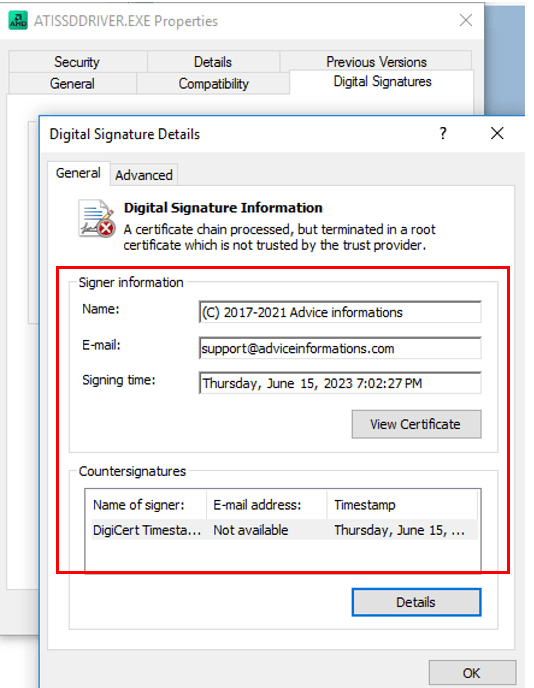
    In the campaign involving the discussed samples, the malware tries to impersonate an AMD External Data SSD driver and is signed with an “Advice informations” digital certificate in order to appear legitimate and evade detection.

    Implant impersonating AMD driver

    Digital certificate used by Grandoreiro malware

    In both cases, the malware is an executable that registers itself to be launched with Windows. However, it is worth noting that in the majority of Grandoreiro attacks, a DLL sideloading technique is employed, using legitimate binaries that are digitally signed to run the malware.

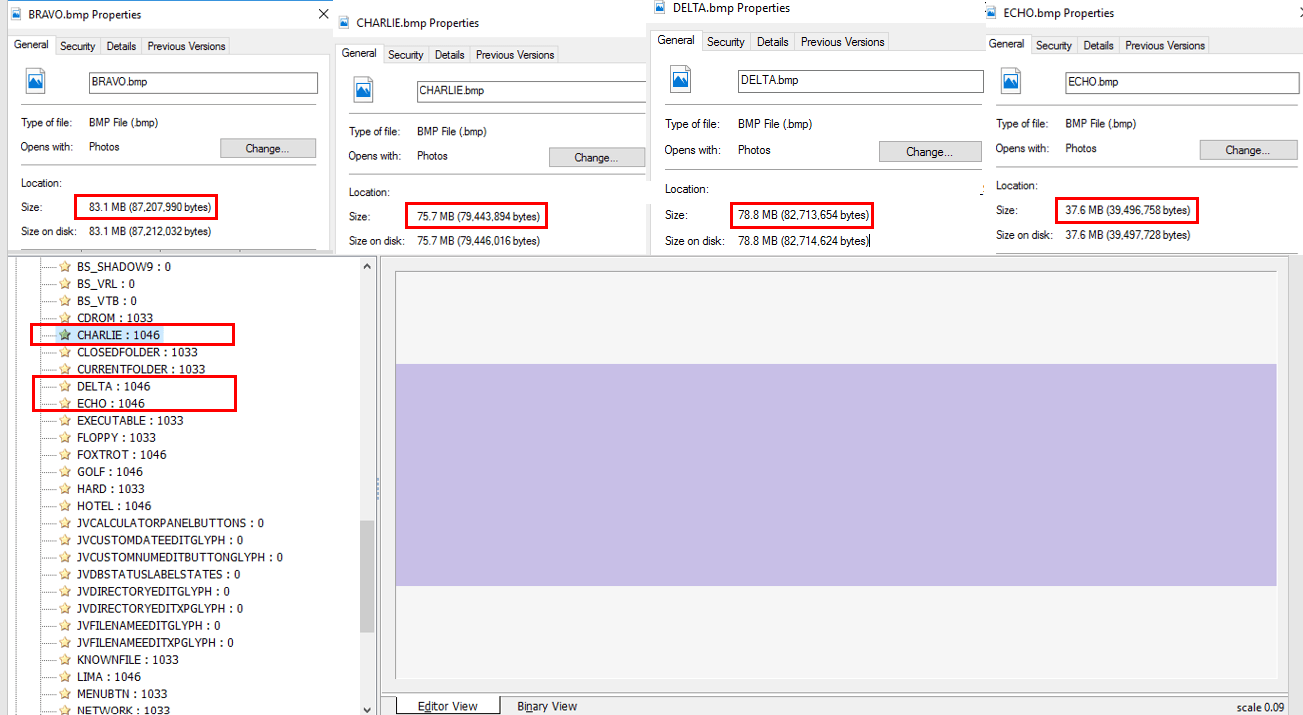
    The considerable size of the executables can be explained by the fact that Grandoreiro utilizes a binary padding technique to inflate the size of the malicious files as a way to evade sandboxes. To achieve this, the attackers add multiple BMP images to the resource section of the binary. In the example below, the sample included several big images. The sizes of the highlighted images are around 83.1 MB, 78.8 MB, 75.7 and 37.6 MB. However, there are more of them in the binary, and together all the images add ~376 MB to the file.

    Binary padding used by Grandoreiro

    In both 2022 and 2023 campaigns, Grandoreiro used a well-known XOR-based string encryption algorithm that is shared with other Brazilian malware families. The difference is the encryption key. For Grandoreiro, some magic values were the following:

    Date Encryption key
    March 2022 F5454DNBVXCCEFD3EFMNBVDCMNXCEVXD3CMBKJHGFM
    March 2022 XD3CMBKJCEFD3EFMF5454NBVDNBVXCCMNXCEVDHGFM
    August 2022 BVCKLMBNUIOJKDOSOKOMOI5M4OKYMKLFODIO
    June 2023 B00X02039AVBJICXNBJOIKCVXMKOMASUJIERNJIQWNLKFMDOPVXCMUIJBNOXCKMVIOKXCJ
    UIHNSDIUJNRHUQWEBGYTVasuydhosgkjopdf

    The various checks and validations aimed at avoiding detection and complicating malware analysis were also changed in the 2022 and 2023 versions. In contrast with the older Grandoreiro campaigns, we found that some of the tasks that were previously executed by the final payload are now implemented in the first stage loader. These tasks include security checks, anti-debugging techniques, and more. This represents a significant change from previous campaigns.

    One of these tasks is the use of the geolocation service http://ip-api.com/json to gather the target’s IP address location data. In a campaign reported in May 2023 by Trustwave, this task is performed by a JScript code embedded in an MSI installer before the delivery of the final payload.

    There are numerous other checks that have been transferred into the loader, although some of them are still present in the banking trojan itself. Grandoreiro gathers host information such as operating system version, hostname, display monitor information, keyboard layout, current time and date, time zone, default language and mouse type. Then the malware retrieves the computer name and compares it against the following strings that correspond to known sandboxes:

    • WIN-VUA6POUV5UP;
    • Win-StephyPC3;
    • difusor;
    • DESTOP2457;
    • JOHN-PC.

    Computer name validation

    It also collects the username and verifies if it matches with the “John” or “WORK” strings. If any of these validations match, the malware stops its execution.

    Grandoreiro includes detection of tools commonly used by security analysts, such as regmon.exe, procmon.exe, Wireshark, and so on. The process list varies across the malware versions, and it was significantly expanded in 2024, so we’ll share the full list later in this post. The malware takes a snapshot of currently executing processes in the system using the CreateToolhelp32Snapshot() Windows API and goes through the process list using Process32FirstW() and Process32NextW(). If any of the analysis tools exists in the system, the malware execution is terminated.

    Grandoreiro also checks the directory in which it is being executed. If the execution paths are D:programming or D:script, it terminates itself.

    Another anti-debugging technique implemented in the trojan involves checking for the presence of a virtual environment by reading data from the I/O Port “0x5658h” (VX) and looking for the VMWare magic number 0x564D5868. The malware also uses the IsDebuggerPresent() function to determine whether the current process is being executed in the context of a debugger.

    Last but not least, Grandoreiro searches for anti-malware solutions such as AVAST, Bitdefender, Nod32, Kaspersky, McAfee, Windows Defender, Sophos, Virus Free, Adaware, Symantec, Tencent, Avira, ActiveScan and CrowdStrike. It also looks for banking security software, such as Topaz OFD and Trusteer.

    In terms of the core functionality, some Grandoreiro samples check whether the following programs are installed:

    • CHROME.EXE;
    • MSEDGE.EXE;
    • FIREFOX.EXE;
    • IEXPLORE.EXE;
    • OUTLOOK.EXE;
    • OPERA.EXE;
    • BRAVE.EXE;
    • CHROMIUM.EXE;
    • AVASTBROWSER.EXE;
    • VeraCrypt;
    • Nortonvpn;
    • Adobe;
    • OneDrive;
    • Dropbox.

    If any of these is present on the system, the malware stores their names to further monitor user activity in them.

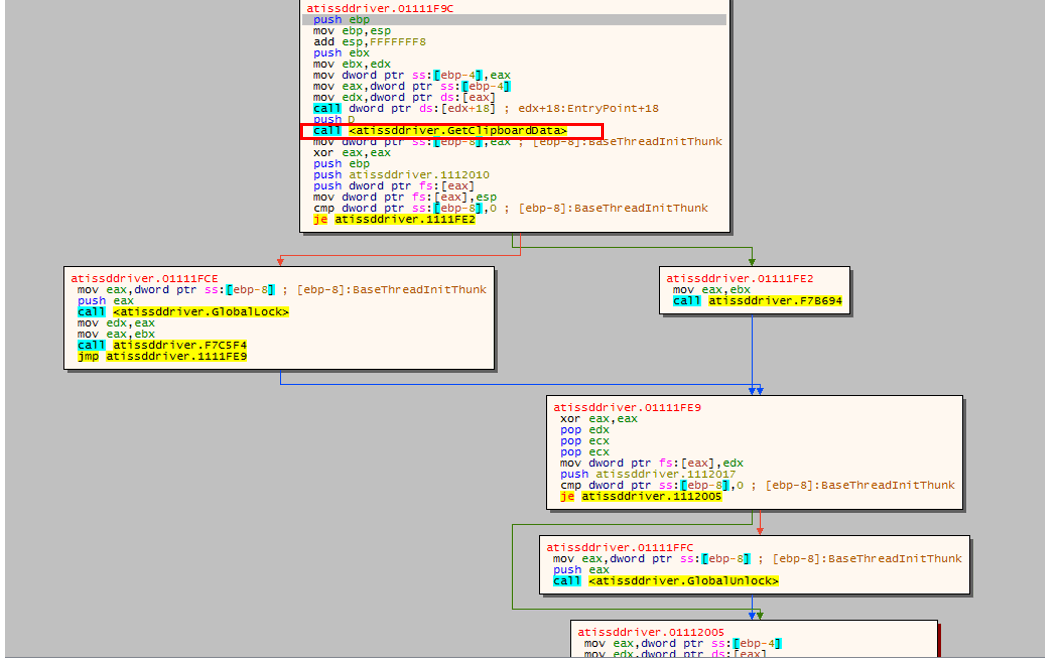
    Grandoreiro also checks for crypto wallets installed on the infected machine. The malware includes a clipboard replacer for crypto wallets, monitoring the user’s clipboard activity and replacing the clipboard data with the threat actor keys.

    Clipboard replacer

    2024 campaigns

    During a certain period of time in February 2024, a few days after the announcement of the arrest of some of the gang’s operators in Brazil, we observed a significant increase in emails detected by spam traps. There was a notable prevalence of Grandoreiro-themed messages masquerading as Mexican CFDI communications. Mexican CFDI, short for “Comprobante Fiscal Digital por Internet” is an electronic invoicing system administered by the Mexican Tax Authority (SAT — Servicio de Administración Tributaria). It facilitates the creation, transmission, and storage of digital tax documents, mandatory for businesses in Mexico to record transactions for tax purposes.

    In our investigation, we have acquired 48 samples associated not only with this instance but also with various other campaigns.

    Notably, this new campaign added a new sandbox detection mechanism, namely a CAPTCHA before the execution of the main payload, as a way to avoid the automatic analysis used by some companies:

    Grandoreiro anti-sandbox CAPTCHA

    It is worth noting that in the 2024 Grandoreiro campaigns, the new sandbox evasion code has been implemented in the downloader. Although the main sample still has anti-sandbox functionality too, if a sandbox is detected, it is simply not downloaded. Besides that, the new version also added detection of many tools to its arsenal, aiming to avoid analysis. Here is whole list of analysis tools detected by the newest versions:

    regmon.exe hopper.exe nessusd.exe OmniPeek.exe
    procmon.exe jd-gui.exe PacketSled.exe netmon.exe
    filemon.exe canvas.exe prtg.exe colasoft.exe
    Wireshark.exe pebrowsepro.exe cain.exe netwitness.exe
    ProcessHacker.exe gdb.exe NetworkAnalyzerPro.exe netscanpro.exe
    PCHunter64.exe scylla.exe OmniPeek.exe packetanalyzer.exe
    PCHunter32.exe volatility.exe netmon.exe packettotal.exe
    JoeTrace.exe cffexplorer.exe colasoft.exe tshark.exe
    ollydbg.exe angr.exe netwitness.exe windump.exe
    ida.exe pestudio.exe netscanpro.exe PRTG Probe.exe
    x64dbg.exe die.exe packetanalyzer.exe NetFlowAnalyzer.exe
    cheatengine.exe ethereal.exe packettotal.exe SWJobEngineWorker2x64.exe
    ollyice.exe Capsa.exe tshark.exe NetPerfMonService.exe
    fiddler.exe tcpdump.exe windump.exe SolarWinds.DataProcessor.exe
    devenv.exe NetworkMiner.exe PRTG Probe.exe ettercap.exe
    radare2.exe smartsniff.exe NetFlowAnalyzer.exe apimonitor.exe
    ghidra.exe snort.exe SWJobEngineWorker2x64.exe apimonitor-x64.exe
    frida.exe pcap.exe NetPerfMonService.exe apimonitor-x32.exe
    binaryninja.exe SolarWinds.NetPerfMon.exe SolarWinds.DataProcessor.exe x32dbg.exe
    cutter.exe nmap.exe ettercap.exe x64dbg.exe
    scylla.exe apimonitor.exe PCHunter64.exe x96dbg.exe
    volatility.exe apimonitor-x64.exe PCHunter32.exe fakenet.exe
    cffexplorer.exe apimonitor-x32.exe JoeTrace.exe hexworkshop.exe
    angr.exe x32dbg.exe ollydbg.exe Dbgview.exe
    pestudio.exe x64dbg.exe ida.exe sysexp.exe
    die.exe x96dbg.exe x64dbg.exe vmtoolsd.exe
    ethereal.exe fakenet.exe cheatengine.exe dotPeek.exe
    Capsa.exe hexworkshop.exe ollyice.exe procexp64.exe
    tcpdump.exe Dbgview.exe fiddler.exe procexp64a.exe
    NetworkMiner.exe sysexp.exe devenv.exe procexp.exe
    smartsniff.exe vmtoolsd.exe radare2.exe cheatengine.exe
    snort.exe dotPeek.exe ghidra.exe ollyice.exe
    pcap.exe procexp64.exe frida.exe pebrowsepro.exe
    cain.exe procexp64a.exe binaryninja.exe gdb.exe
    nmap.exe procexp.exe cutter.exe Wireshark.exe
    nessusd.exe regmon.exe hopper.exe ProcessHacker.exe
    PacketSled.exe procmon.exe jd-gui.exe SolarWinds.NetPerfMon.exe
    prtg.exe filemon.exe canvas.exe NetworkAnalyzerPro.exe

    These are some RAT features that we found in this version:

    • Auto-update feature allows newer versions of the malware to be deployed to the victim’s machine;
    • Sandbox/AV detection, still present in the main module, which includes more tools than previous versions;
    • Keylogger feature;
    • Ability to select country for listing victims;
    • Banking security solutions detection;
    • Checking geolocation information to ensure it runs in the target country;
    • Monitoring Outlook emails for specific keywords;
    • Ability to use Outlook to send spam emails.

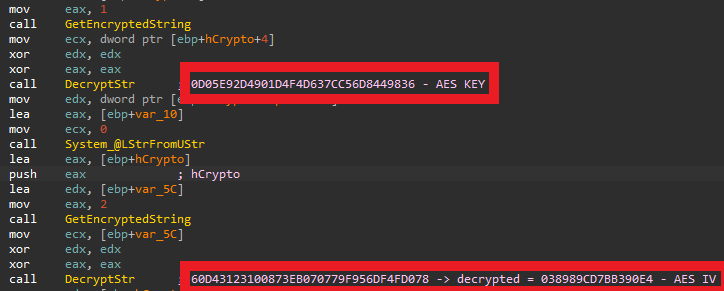
    In terms of static analysis protection, in 2024 versions, Grandoreiro has implemented enhanced encryption measures. Departing from its previous reliance on commonly shared encryption algorithms found in other malware, Grandoreiro has now adopted a multi-layered encryption approach. The decryption process in the newer versions is the following. Initially, the string undergoes deobfuscation through a simple replacement algorithm. Following this, Grandoreiro employs the encryption algorithm based on XOR and conditional subtraction typically utilized by Brazilian malware; however, it differs from them by incorporating a lengthy, 140759-byte string instead of smaller magic strings we saw in 2022 and 2023 samples. Subsequently, the decrypted string undergoes base64 decoding before being subjected to decryption via the AES-256 algorithm. Notably, the AES key and IV are encrypted within Grandoreiro’s code. Upon completion of all these steps, the decrypted string is successfully recovered.

    Grandoreiro AES key and IV

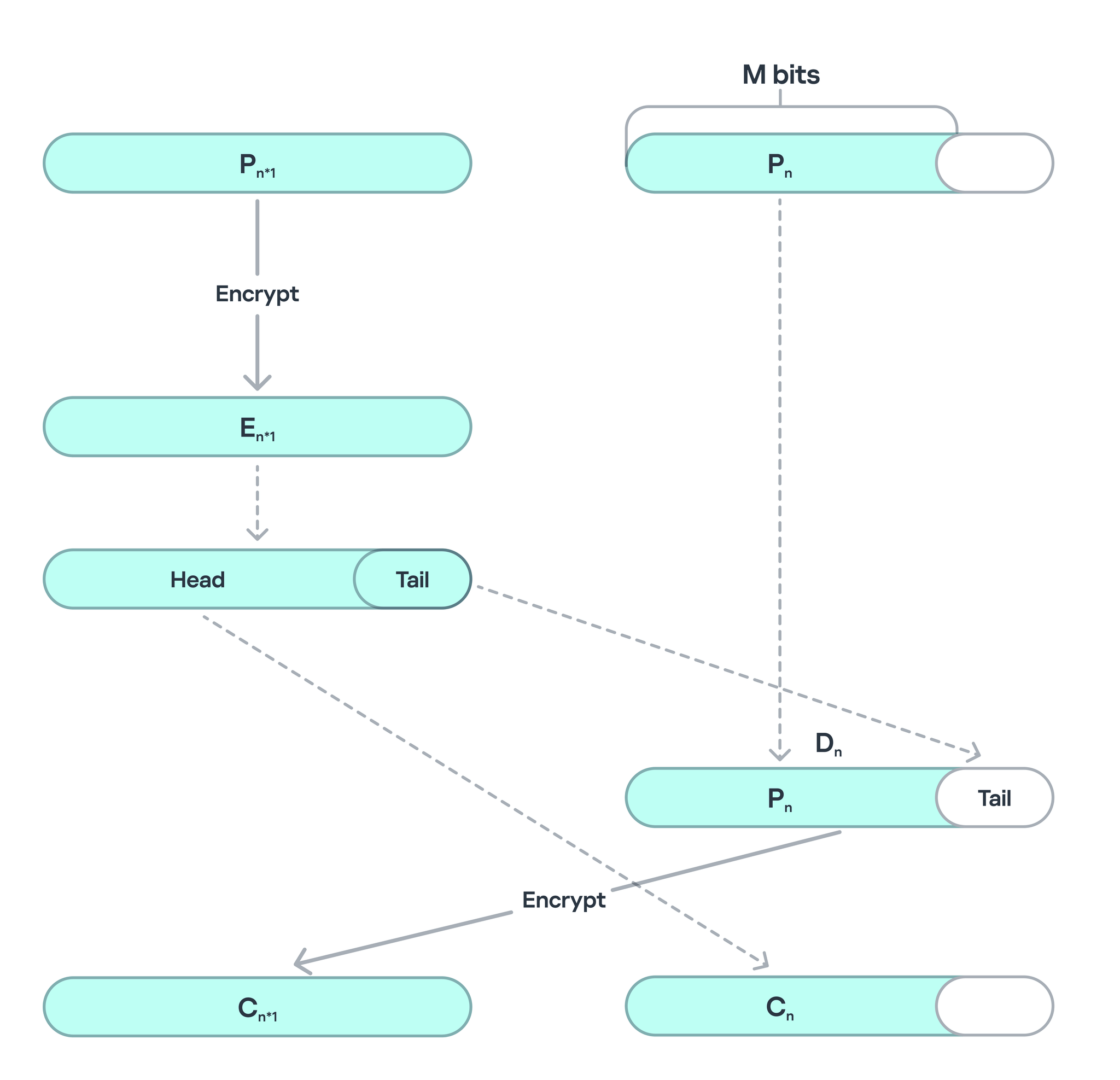
    In newer samples, Grandoreiro upgraded yet again the encryption algorithm using AES with CTS, or Ciphertext Stealing, a specialized encryption mode used when the plaintext is not a multiple of the block size, which in this case is the 128-bit (16-byte) block size used by AES. Unlike more common padding schemes, such as PKCS#7, where the final block is padded with extra bytes to ensure it fits a full block, CTS operates without padding. Instead, it manipulates the final partial block of data by encrypting the last full block and XORing its output with the partial block. This allows encryption of any arbitrary-length input without adding extra padding bytes, preserving the original size of the data.

    ECB Encryption Steps for CTS

    In the case of Grandoreiro, the malware’s encryption routine does not add standard padding to incomplete blocks of data. Their main goal is to complicate analysis: it takes time to figure out that CTS was used, and then more time to implement decryption in this mode, which makes the extraction and obfuscation of strings more complicated. This marks the first time this particular method has been observed in a malware sample.

    As the threat actors continue to evolve their techniques, changing the encryption in every iteration of the malware, the use of CTS in malware may signal a shift toward more advanced encryption practices.

    Local versions: old meets new

    In a recent campaign, our analysis has revealed the existence of an older variant of the malware that utilizes legacy encryption keys, outdated algorithms, and a simplified structure, but which runs in parallel to the campaign using the new code. This variant targets fewer banks — about 30 financial institutions, mainly from Mexico. This analysis clearly indicates that another developer, likely with access to older source code, is conducting new campaigns using the legacy version of the malware.

    How they steal your money

    Operators behind Grandoreiro are equipped with a wide variety of remote commands, including an option to lock the user screen and present a custom image (overlay) to ask the victim for extra information. These are usually OTPs (one-time passwords), transaction passwords or tokens received by SMS, sent by financial institutions.

    A new tactic that we have discovered in the most recent versions found in July 2024 and later suggests that the malware is capturing user input patterns, particularly mouse movements, to bypass machine learning-based security systems. Two specific strings found in the malware — “GRAVAR_POR_5S_VELOCIDADE_MOUSE_CLIENTE_MEDIA” (“Record for 5 seconds the client’s average mouse speed”) and “Medição iniciada, aguarde 5 segundos!” (“Measurement started, please wait 5 seconds!”) — indicate that Grandoreiro is monitoring and recording the user’s mouse activity over a short period. This behavior appears to be an attempt to mimic legitimate user interactions in order to evade detection by anti-fraud systems and security solutions that rely on behavioral analytics. Modern cybersecurity tools, especially those powered by machine learning algorithms, analyze user’s behavior to distinguish between human users and bots or automated malware scripts. By capturing and possibly replaying these natural mouse movement patterns, Grandoreiro could trick these systems into identifying the activity as legitimate, thus bypassing certain security controls.

    This discovery highlights the continuous evolution of malware like Grandoreiro, where attackers are increasingly incorporating tactics designed to counter modern security solutions that rely on behavioral biometrics and machine learning.

    To perform the cash-out in the victim’s account, Grandoreiro operators’ options are to transfer money to the account of local money mules, using transfer apps, buy cryptocurrency or gift cards, or even going to an ATM. Usually, they search for money mules in Telegram channels, paying $200 to $500 USD per day:

    Grandoreiro operator looking for money mules

    Infrastructure

    The newest Grandoreiro version uses 3 Domain Generation Algorithms (DGAs), generating valid domains for command and control (C2) communications. The algorithm uses the current daytime to select strings of predefined lists and concatenates them with a magic key to create the final domain.

    By dynamically generating unique domain names based on various input data, the algorithm complicates traditional domain-based blocking strategies. This adaptability allows the malicious actors to maintain persistent command-and-control communications, even when specific domains are identified and blacklisted, requiring security solutions to base their protection not on a fixed list of domains, but on an algorithm for generating them.

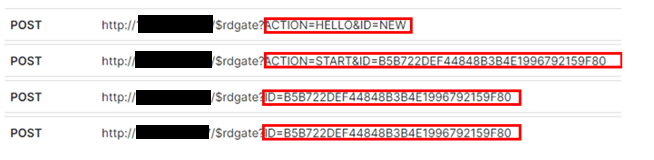
    Since early 2022, Grandoreiro leverages a known Delphi component shared among different malware families named RealThinClient SDK to remotely access victim machines and perform fraudulent actions. This SDK is a flexible and modular framework for building reliable and scalable Windows HTTP/HTTPS applications with Delphi. By using RealThinClient SDK, the program can handle thousands of active connections in an efficient multithreaded manner.

    Grandoreiro C2 Communication

    Operator tool

    Grandoreiro’s Operator is the tool that allows the cybercriminal to remotely access and control the victim’s machine. It’s a Delphi-based software that lists its victims whenever they start browsing a targeted financial institution website.

    Grandoreiro’s Operator tool

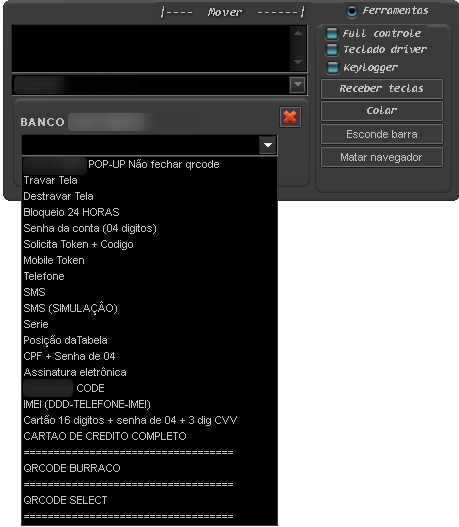
    Once the cybercriminal chooses a victim to operate on, they will be presented with the following screen, seen in the image below, which allows many commands to be executed and visualizes the victim’s desktop.

    Grandoreiro’s Operator commands

    Cloud VPS

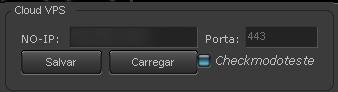
    One overlooked feature of the Grandoreiro malware is what is called “Cloud VPS” by the attackers — it allows cybercriminals to set up a gateway computer between the victim’s machine and the malware operator, thus hiding the cybercriminal’s real IP address.

    This is also used by them to make investigation harder, as the first thing noted is the gateway’s IP address. When requesting a seizure, an investigator just finds the gateway module. Meanwhile, the criminal has already set up a new gateway somewhere else and new victims connect to the new one through its DGA.

    Grandoreiro Cloud VPS

    Victims and targets

    The Grandoreiro banking trojan is primed to steal the credentials accounts for 1,700 financial institutions, located in 45 countries and territories. After decrypting the strings of the malware, we can see the targeted banks listed separated by countries/territories. This doesn’t mean that Grandoreiro will target a specific bank from the list; it means it is ready to steal credentials and act, if there is a local partner or money mule who can operationalize and complete the action. The banks targeted by Grandoreiro are located in Algeria, Angola, Antigua and Barbuda, Argentina, Australia, Bahamas, Barbados, Belgium, Belize, Brazil, Canada, Cayman Islands, Chile, Colombia, Costa Rica, Dominican Republic, Ecuador, Ethiopia, France, Ghana, Haiti, Honduras, India, Ivory Coast, Kenya, Malta, Mexico, Mozambique, New Zealand, Nigeria, Panama, Paraguay, Peru, Philippines, Poland, Portugal, South Africa, Spain, Switzerland, Tanzania, Uganda, United Kingdom, Uruguay, USA, and Venezuela. It’s important to note that the list of targeted banks and institutions tend to slightly change from one version to another.

    From January to October 2024, our solutions blocked more than 150,000 infections impacting more than 30,000 users worldwide, a clear sign the group is still very active. According to our telemetry, the countries most affected by Grandoreiro infections are Mexico, Brazil, Spain, and Argentina, among many others.

    Conclusion

    We understand how difficult it is to eradicate a malware family, but it is possible to impede their operation with the cooperation of law enforcement agencies and the private sector — modern financial cybercrime can and must be fought.

    Brazilian banking trojans are already an international threat; they’re filling the gaps left by Eastern European gangs who have migrated into ransomware. We know that in some countries, internet banking is declining on desktops, forcing Grandoreiro to target companies and government entities who are still using operating in that way.

    The threat actors behind the Grandoreiro banking malware are continuously evolving their tactics and malware to successfully carry out attacks against their targets and evade security solutions. Kaspersky continues to cooperate with INTERPOL and other agencies around the world to fight the Grandoreiro threat among internet banking users.

    This threat is detected by Kaspersky products as HEUR:Trojan-Banker.Win32.Grandoreiro, Trojan-Downloader.OLE2.Grandoreiro, Trojan.PDF.Grandoreiro and Trojan-Downloader.Win32.Grandoreiro.

    For more information, please contact: crimewareintel@kaspersky.com

    Indicators of Compromise

    Host based
    f0243296c6988a3bce24f95035ab4885
    dd2ea25752751c8fb44da2b23daf24a4
    555856076fad10b2c0c155161fb9384b
    49355fd0d152862e9c8e3ca3bbc55eb0
    43eec7f0fecf58c71a9446f56def0240
    150de04cb34fdc5fd131e342fe4df638
    b979d79be32d99824ee31a43deccdb18

    MIL OSI Global Banks –

    January 24, 2025
  • MIL-OSI Russia: Moscow scientists have assessed diagnostic accuracy indicators for Russian and international artificial intelligence services

    Translation. Region: Russian Federation –

    Source: Center for Diagnostics and Telemedicine

    Moscow scientists have assessed the diagnostic accuracy of various artificial intelligence (AI) services for radiology. The recent study evaluated five AI algorithms, including three developed in Russia and two from India and South Korea. The study found that the Russian AI service demonstrated the highest accuracy in detecting pulmonary nodules, outperforming its foreign counterparts. Research results were published in the Chinese Journal of Quantitative Imaging in Medicine and Surgery.

    Yuri Vasiliev, CEO of the Diagnostics and Telemedicine Center of the Moscow City Health Department, noted the importance of this achievement. “In a recent study involving Russian and foreign artificial intelligence (AI) services, our own AI solution demonstrated the highest accuracy in detecting lung nodules, ahead of similar solutions from India and South Korea. This achievement is a significant advance in our efforts to improve the quality of medical care.” Currently, radiologists use more than 50 AI services to interpret medical images, and in Moscow, more than 13 million studies have been analyzed using neural networks. The growing AI services market is constantly evolving with solutions that optimize the workload of medical workers while maintaining high standards of work,” Vasiliev said.

    “We aim to provide doctors with tools that will not only make their work easier, but also improve the overall quality of medical care. To do this, we have developed a maturity matrix – a comprehensive tool designed to evaluate and compare the effectiveness of various artificial intelligence services. Since the end of 2022, our AI service has consistently occupied a leading position in the field of chest X-ray,” said Yuri Vasiliev.

    The AI service, designed for automatic analysis of chest X-rays, currently identifies 14 signs of various pathologies. In addition, it calculates the cardiothoracic ratio and forms a comprehensive X-ray report.

    “We have prepared a unique data set consisting of 100 radiographs, including 50 with confirmed pulmonary nodules and 50 without pulmonary nodules. Of these, 25 cases were found to have nodules that were initially questioned by radiologists, but were confirmed using computed tomography. At the same time, the presence of pulmonary nodules in all 50 studies was confirmed by computed tomography,” explained Kirill Arzamasov, head of the Department of Medical Informatics, Radiomics and Radiogenomics at the Center for Diagnostics and Telemedicine.

    “The evaluation of AI services was carried out in three stages, at each stage the results were compared with the reference standard confirmed by CT studies. The results showed that the Russian AI service outperforms international analogues in all indicators of diagnostic accuracy.” The dataset is open source access on the website, which allows developers to independently assess the quality of AI services,” said Kirill Arzamasov, head of the Department of Medical Informatics, Radiomics and Radiogenomics at the Center for Diagnostics and Telemedicine of the Moscow Department of Healthcare.

    This study is part of a larger experiment to introduce computer vision technologies into the Moscow healthcare system, which will start in 2020. With the support of the Moscow Social Development Complex and the Department of Information Technology, the project aims to promote innovation in the field of artificial intelligence, in particular by supporting developers.

    The Diagnostics and Telemedicine Center, established in 1996, plays a leading role in the implementation of AI technologies in medicine in Russia. Its activities are aimed at the development of AI in medicine, the development of diagnostic images, the management of medical units, research and training of medical workers.

    MIL OSI Russia News –

    January 24, 2025
  • MIL-OSI USA: Congressman Alford Statement on the Passing of Sergeant Sarah Roque

    Source: United States House of Representatives – Representative Mark Alford (Missouri 4th District)

    RAYMORE, Mo. – Today, U.S. Congressman Mark Alford (MO-04) released the following statement on the passing of Sergeant Sarah Roque.

    “We send our deep condolences to the family, friends, and loved ones of Sergeant Sarah Roque and to the entire Fort Leonard Wood community. Sergeant Roque was a dedicated solider whose patriotic service earned her multiple awards and decorations, including the Army Commendation Medal and the National Defense Service Medal. We mourn with all those affected by this tragedy, and we stand alongside them during this horrible time,” said Congressman Alford.

    On Tuesday, Fort Leonard Wood announced that Sergeant Sarah Roque, 23, had been found deceased. Sergeant Roque, of Ligonier, Indiana, was a bridge crewmember, serving as a Mine Dog Handler with the K9 Detachment, Headquarters and Headquarters Company, 5th Engineer Battalion.

    She enlisted in 2020 and attended Basic Combat Training at Fort Leonard Wood. Sergeant Roque’s awards and decorations include the Army Commendation Medal, National Defense Service Medal, Good Conduct Medal, and the Army Service Ribbon.

    MIL OSI USA News –

    January 24, 2025
  • MIL-OSI Economics: How higher education is reimagining student experiences with Azure OpenAI Service

    Source: Microsoft

    Headline: How higher education is reimagining student experiences with Azure OpenAI Service

    Learn how using Azure OpenAI Service in higher education can help leaders reimagine learning models and reduce administrative burdens.

    Imagine a future where every student has a personalized learning path, where faculty can focus on teaching instead of administrative tasks, and where academic research accelerates breakthrough discoveries. This is not a distant vision—generative AI is making it possible today. AI-driven innovations empower higher education leaders to reimagine learning models, reduce administrative burdens, and advance academic research, positioning institutions to not only enhance student success but also lead in educational innovation, securing a competitive edge in an evolving landscape.

    A July 2024 Forrester report commissioned by Microsoft found that education institutions using Azure OpenAI Service saw improved student outcomes, streamlined operations, and increased access to technology. By Year 3, they are expected to boost content generation efficiency by 30% to 60% and improve chatbot resolution rates by 20% to 50%, driving positive impacts on graduation and employment rates.

    As AI adoption accelerates, institutions must also prioritize trust by focusing on scalable security, data privacy, and governance measures. Microsoft supports this transition with AI solutions that integrate built-in protections, addressing risks such as prompt injections and bias, while maintaining data privacy and compliance to safeguard institutions.

    Reimagine student experiences

    With AI-powered, secure, and flexible solutions, Azure enables educational institutions to modernize confidently.

    Join us as we explore five key use cases of generative AI in higher education, along with examples of institutions that have successfully implemented AI to deliver more equitable and personalized student experiences.

    1. Around-the-clock real-time campus support

    As student expectations evolve, meeting their demand for around-the-clock support has become a critical factor in student satisfaction and institutional efficiency. For example, Tecnológico de Monterrey’s TECgpt is an AI platform that offers quick access to information like tuition, scholarships, and campus services, allowing users to retrieve personal details, such as scholarship status, within minutes.

    Similarly, the University of South Florida improved response times and reduced staff workloads by automating IT ticketing with Azure OpenAI, launching an AI-powered Help Desk in just one week. The University of Hong Kong has also deployed several Azure OpenAI-powered chatbots to handle IT queries, administrative tasks, and course selection, freeing staff to focus on more complex issues. Education leaders are automating routine tasks and delivering personalized academic assistance at scale, boosting retention and accelerating graduation rates while streamlining operations.

    I can invest more time in people now that I don’t have to worry about those recurring repetitive tasks because people are what it’s all about. It is revolutionizing all our workflows, our teaching, and our learning spaces quite rapidly. With Copilot, we’re able to do things bigger, better, but also equitably across the university space. It’s changing the way we do everything, and that is a big deal.

    Tim Henkel, Assistant Vice Provost for Teaching and Learning, University of South Florida (USF)

    AI innovations are reshaping how institutions engage with students by offering around-the-clock support for inquiries about housing, student life, and campus services, significantly enhancing the overall student experience. These AI tools also provide personalized academic and career guidance, helping students select courses, optimize degree plans, and receive tailored advising.

    Additionally, AI-powered virtual assistants streamline the financial aid process, guiding students through eligibility requirements, deadlines, and submissions, ensuring timely completion. Through AI integration, institutions can deliver responsive, student-centered services while improving operational efficiency, ultimately enriching the campus experience.

    With Azure OpenAI, USF can rapidly classify and summarize IT tickets, eliminating that first level of eyes on an issue.

    2. Personalize learning experiences at scale

    In an environment where institutional success depends on student engagement and outcomes, personalized learning is becoming a strategic priority. With Data Science in Microsoft Fabric and Azure AI Services, institutions can integrate real-time data analysis from their LMS, leveraging AI to customize lessons, content, and pacing based on student performance.  AI tutors provide personalized, instant feedback, helping students make continuous progress and tackle challenging tasks with confidence. These tools empower institutions to deliver adaptive learning tailored to each student’s needs.

    The Azure OpenAI Service provided remarkably high-quality hints generated by GPT-4 from a robust and scalable API that reliably handled heavy loads from hundreds of students working simultaneously near homework deadlines.

    John DeNero, Faculty Director and Associate Teaching Professor, UC Berkeley

    Universities around the world are leveraging AI to improve student outcomes and streamline administrative tasks. At the University of Sydney, the Cogniti platform utilizes AI teaching assistants to tailor feedback and adjust learning paths, boosting student engagement and academic success. IU International University of Applied Sciences in Germany offers an AI study buddy, Syntea, with always-available multilingual support and enhanced student engagement through personalized feedback. It also reduces course completion times by 27%, all while seamlessly integrating across platforms like myCampus and Microsoft Teams.

    Similarly, UC Berkeley’s 61A-Bot, a specialized AI assistant powered by Azure OpenAI Service, has significantly enhanced student learning by providing real-time support and reducing homework completion times in their computer science courses. As institutions worldwide adopt AI-driven solutions, education leaders are transforming both learning personalization and operational efficiency, driving significant improvements in student success.

    Get started with Azure

    3. Accelerate learning for all with multi-language support

    AI improves educational access by offering multi-language support through real-time translation, note-taking, and content delivery, enabling all students to engage fully in their preferred language. Flexible learning options allow students to review materials at their own pace, while chatbots offer seamless language transitions and targeted support to enhance comprehension and engagement.

    By utilizing the advanced language models in Azure OpenAI Service, Cool English is taking an innovative step for English education in Taiwan, helping students reach their learning goals and overcome the challenges of limited opportunities for real-life conversational and writing practice.

    Dr. Hao-Jan Howard Chen, Professor, Department of English at National Taiwan Normal University

    This potential is already being realized through initiatives like National Taiwan Normal University’s “Cool English” platform, powered by Azure OpenAI, which has helped over 1.4 million students enhance their English skills through adaptive, conversational practice. Similarly, the Korea Advanced Institute of Science and Technology (KAIST) developed a multilingual chatbot to help EFL students write essays in English, offering seamless language switching and personalized guidance outside class hours. Powered by Azure OpenAI’s advanced models, the chatbot provides feedback and answers questions to help students improve their writing without generating essays for them. AI-powered language tools help create inclusive learning environments, enhance student outcomes, and attract a diverse international student body.

    AI can help higher education institutions provide multi-language support to students.

    4. Accelerate academic research

    AI is transforming academic research by accelerating discovery and innovation, and automating tasks like literature reviews, data analysis, and report generation. In April 2023, Microsoft Research launched the Accelerating Foundation Models Research (AFMR) initiative to accelerate the use of large-scale AI models in academia. Through Azure AI Services, AFMR provides universities with access to powerful foundation models, supporting research in fields such as healthcare, scientific discovery, and multicultural empowerment. With over 200 projects in 15 countries, AFMR is building a global AI research community.

    If you have a really good idea, it’s very hard to just search the literature and try to find everything. This is sort of like having a super adviser, a brilliant astronomer with an encyclopedic memory who can say, ‘Well, that could be a very good idea and here’s why,’ or ‘That’s likely a bad idea and here’s why.’

    Alyssa Goodman, Robert Wheeler Wilson Professor of Applied Astronomy, Harvard University

    Universities are harnessing foundation models to accelerate scientific discovery and hypothesis generation. A collaboration between astronomers at Harvard University and The Australian National University has led to the development of an astronomy-focused chat application that utilizes GPT-4. This tool draws from over 300,000 astronomy papers, helping researchers extract key information and analyze data to develop new theories.

    At Georgia Tech, researchers are utilizing Microsoft’s Azure OpenAI Service to analyze global EV charging data, uncovering insights for policy development and improving infrastructure reliability to support sustainable and equitable EV adoption. With AI solutions like Azure OpenAI Service, higher education institutions can automate repetitive tasks, improve collaboration, and scale research efforts, all while ensuring data security and focusing on high-impact academic work.

    5. Trustworthy AI for education

    There is a critical need for organizations to deploy AI responsibly. As AI transforms education, decision makers must ensure these systems are secure, private, and fair. A key strategy is to choose AI platforms with built-in safeguards, like content filtering and bias detection. For example, South Australia’s Department for Education successfully piloted EdChat, an AI chatbot powered by Azure AI, which protects 1,500 students across eight schools from harmful content while empower educators to focus on the benefits.

    Equally important is the protection of sensitive student information. With built-in features to safeguard text content, including moderation and groundedness detection, institutions can ensure responsible AI deployment while protecting student data with enterprise-grade security and robust privacy measures to prevent breaches.

    South Australia’s Department for Education successfully piloted EdChat, an AI chatbot using Azure AI.

    Key principles of trustworthy AI:

    • Security: AI systems must be resilient against threats.
    • Safety: AI must operate reliably in sensitive environments like classrooms.
    • Privacy: Protecting personal data is essential to maintain trust.

    AI is not just a tool—it’s the catalyst for a new era in education. By enhancing student support, personalizing learning, and accelerating academic research, AI empowers institutions to break down barriers, expand access, and create more inclusive and innovative learning environments. Those who embrace AI today will lead the future of education, building adaptable, forward-thinking institutions focused on student success.

    The question is no longer if AI should be integrated, but how quickly it can be implemented to unlock its full potential. The future of education is here—is your institution ready to lead it?

    Get started with Azure

    Ready to transform your institution with AI? Partner with Microsoft to unlock new possibilities and drive educational success:

    MIL OSI Economics –

    January 24, 2025
  • MIL-OSI Security: INDOPACOM and 7th Air Force Commander visits 35th Air Defense Artillery Brigade

    Source: United States INDO PACIFIC COMMAND

    OSAN AIR BASE, Korea  –  

    On October 9th, Adm. Samuel Paparo, commander of the U.S. Indo-Pacific Command, and Lt. Gen. David Iverson, commanding general of the 7th Air Force, visited the 35th Air Defense Artillery Brigade for an important mission and intelligence briefing. The session was led by Maj. Ryan Workman, Military Intelligence Officer, and Capt. April Dybal, commander of the Space Force detachment.

    During the meeting, the leaders discussed current events on the Korean Peninsula and took the opportunity to recognize the outstanding contributions of 1st Lt. Quinn O’Rourke. Serving in the brigade operations shop, Lt. O’Rourke was commended for his exceptional performance in the S3 section, demonstrating a commitment to excellence that impacts the entire brigade

    “Serving in this brigade has been such an incredible experience. I’ve really been able to develop my skills as an air defense officer here. The guidance from my fellow officers senior NCOs, and warrant officers has been invaluable, and they continue to inspire me to grow. Being recognized by ADM Paparo has truly motivated me to keep reaching for greatness within our brigade” said 1LT Quinn O’Rourke, brigade assistance operations officer.

    In conclusion, the meeting served as a critical platform for discussing the evolving security landscape on the Korean Peninsula. Led by Maj. Ryan Workman and Capt. April Dybal, the briefing allowed leaders to align on key intelligence and operational strategies vital to maintaining readiness in the Indo-Pacific region. This engagement not only reinforced the importance of collaboration among military leaders but also highlighted the brigade’s ongoing commitment to addressing contemporary challenges with agility and expertise. As the region continues to evolve, the insights shared during this meeting will play a pivotal role in shaping future missions and ensuring the safety and security of the area.

    MIL Security OSI –

    January 24, 2025
  • MIL-OSI Security: Leader of Anchorage Drug Trafficking Conspiracy Gets 20 Years for Trafficking Fentanyl, Methamphetamine

    Source: Federal Bureau of Investigation (FBI) State Crime Alerts (b)

    ANCHORAGE, Alaska – The leader of an Anchorage drug trafficking conspiracy was sentenced today to 20 years in prison and five years’ supervised release for dealing fentanyl and methamphetamine in Anchorage.

    According to court documents, in 2022, Nigel Ivory, 29, of Anchorage, was released from prison after serving a federal sentence and began selling drugs in and around the Anchorage area.

    During the investigation, officials conducted three controlled purchases of drugs from Ivory between October 2022 and March 2023. During the first controlled purchase in October 2022, Ivory sold over 111 grams of methamphetamine and 98 fentanyl pills for $3,800. In January 2023, Ivory sold 282 fentanyl pills for $1,950. In March 2023, Ivory sold over 276 grams of methamphetamine and 487 fentanyl pills for $5,000.

    In February 2023, officials seized over $55,000 in cash that Ivory attempted to transport from Anchorage to Fort Wayne, Indiana, on a commercial flight. Ivory attempted to smuggle the cash by hiding it inside three tennis shoes in a checked bag. The cash had trace amounts of methamphetamine, cocaine and fentanyl on it. Later that month, officials also seized over 180 fentanyl pills from a co-conspirator during a traffic stop. Investigators uncovered text messages from Ivory directing the co-conspirator to hide the fentanyl pills from police.

    On June 22, 2023, officials simultaneously executed search warrants for two residences associated with Ivory, one of which was Ivory’s primary address. At 6:30 a.m., agents announced their presence outside Ivory’s residence. Ivory and a co-defendant did not come outside and surrender until 7:00 a.m. Upon searching the residence, agents recovered over $18,000 in U.S. currency, a money counter, drug packaging material, over 160 fentanyl pills, some of which were partially dissolved and scattered in a toilet bowl, two firearms and ammunition.

    In April and May 2023, law enforcement seized three additional packages, each containing more than a kilogram of fentanyl pills, from co-conspirators in the case, in which Ivory was involved in trafficking. The following co-conspirators were also charged in this case:

    • Brandon Beltz, 33, pleaded guilty to one count of conspiracy to distribute and possess with intent to distribute fentanyl on Aug. 13, 2024, and is awaiting sentencing.
    • Jack Breitenstein died of an apparent fentanyl overdose after spending nine months on pretrial release and the charges against him were dismissed on April 11, 2024. 
    • Wilanda Jackson, 23, is charged with one count of conspiracy to distribute and possess with intent to distribute fentanyl and one count of possession of a controlled substance with intent to distribute and is awaiting trial.
    • Don’Tia Nikolai, 21, is charged with one count of conspiracy to distribute and possess with intent to distribute fentanyl and one count of possession of a controlled substance with intent to distribute and is awaiting trial. 

    As a result of the investigation, the defendant is accountable for 5.3 kilograms of fentanyl and over 380 grams of methamphetamine. Ivory pleaded guilty to one count of conspiracy to distribute and possess with intent to distribute controlled substances and one count of distribution of methamphetamine and fentanyl in April 2024.

    “Fatal drug overdoses rose over 44% this past year, with the majority involving fentanyl, posing a grave threat to Alaskans,” said U.S. Attorney S. Lane Tucker for the District of Alaska. “Keeping fentanyl out of our communities is a top priority, and we urge the public to report any drug trafficking activities to law enforcement. We will continue to work closely with law enforcement to investigate and prosecute those who conspire to traffic dangerous drugs in our state.”

    “Mr. Ivory callously trafficked massive quantities of deadly fentanyl pills into and throughout Alaska, poisoning our communities and destroying lives in the process,” said Assistant Special Agent in Charge Zachary Pomerantz of the FBI Anchorage Field Office. “This investigation, worked alongside our local, state, and federal law enforcement partners, represents one of highest fentanyl seizures known in Alaska, underscoring the FBI’s commitment to disrupting and dismantling drug trafficking organizations that threaten the safety of our communities.”

    “Your Alaska State Troopers will continue to work with our local, state, and federal law enforcement partners to hold anyone that traffics dangerous drugs such as fentanyl accountable for their actions,” stated Alaska State Troopers Colonel Maurice Hughes. “I hope that this significant prison sentence serves as a deterrent to those that are peddling drugs in our state. To those trafficking dangerous drugs in Alaska, know that law enforcement will catch up to you, arrest you, and prosecute you to the fullest extent of the law.”

    The FBI Anchorage Field Office, Alaska State Troopers, Anchorage Police Department, IRS Criminal Investigation and U.S. Coast Guard Investigative Service investigated the case.

    Assistant U.S. Attorney Chris Schroeder prosecuted the case.

    UPDATE: This release has been updated to include the U.S. Coast Guard Investigative Service.

    ###

    MIL Security OSI –

    January 24, 2025
  • MIL-OSI Asia-Pac: HKETO, Brussels hosts Hong Kong Film Night in Amsterdam (with photos)

    Source: Hong Kong Government special administrative region

         The Hong Kong Economic and Trade Office in Brussels (HKETO, Brussels) held with the Hong Kong Trade Development Council (HKTDC) a Hong Kong Film Night on 21 October in Amsterdam, the Netherlands (Amsterdam time). Participants enjoyed a networking reception and the screening of the Hong Kong movie “Band Four”, directed by young Hong Kong director Lai Yan-chi, in this film event.

         Opening the event, Deputy Representative of HKETO, Brussels, Miss Fiona Li, outlined the vision to provide more exposure and opportunities for emerging filmmakers and other artists from Hong Kong in Europe. She said that this film event with the HKTDC was a targeted attempt “to create our platform to showcase Hong Kong productions, and to arouse more interests in our young filmmakers and accomplished talent among the local arts, cultural and creative sectors in Europe, hence offering both sides more opportunities for possible collaboration”. 

         Miss Li elaborated that through arts and culture, Hong Kong’s advantages and soft power are better seen in Europe. The Government of the Hong Kong Special Administrative Region strives to elevate Hong Kong’s arts and creative industries to the international stage and to present Hong Kong talent globally, fostering the development of Hong Kong into an international cultural exchange centre.    

         For the film industry, the Government provides financial support to help promising Hong Kong filmmakers gain international visibility and to encourage international co-operation. One of the recent measures is the launch of the Hong Kong-Europe-Asian Film Collaboration Funding Scheme under the Film Development Fund, which supports eligible film projects co-produced by filmmakers from European or Asian countries that feature Hong Kong, European and Asian cultures.   

    MIL OSI Asia Pacific News –

    January 24, 2025
  • MIL-OSI Russia: Scientists in Moscow conducted an assessment of the diagnostic accuracy metrics for both Russian and International AI services

    Source: Center of Diagnostics and Telemedicine

    Moscow scientists have assessed the diagnostic accuracy of various artificial intelligence (AI) services for radiology. In a recent study, five AI algorithms were evaluated, including three developed in Russia and two from India and South Korea. The study revealed that the Russian AI service demonstrated the highest accuracy in detecting pulmonary nodules, outperforming its foreign counterparts. The results were published in the Chinese journal “Quantitative Imaging in Medicine and Surgery.”

    Yuri Vasiliev, CEO of the Center for Diagnostics and Telemedicine of the Moscow City Health Department, highlighted the importance of this achievement. “In a recent study involving both Russian and international artificial intelligence (AI) services, our in-house AI solution demonstrated the highest accuracy in identifying lung nodules, outperforming similar solutions from India and South Korea. This achievement marks a significant advancement in our efforts to enhance medical care quality. Radiologists currently utilize over 50 AI services to interpret medical image studies, and more than 13 million studies in Moscow have been analyzed using neural networks. The growing market for AI services is continuously introducing solutions that streamline the workload of healthcare professionals while maintaining high standards of performance.” said Vasiliev.

    “We aim to provide physicians with tools that not only facilitate their work but also enhance the overall quality of medical care. To achieve this, we have developed a maturity matrix—a comprehensive tool designed to assess and benchmark the performance of various AI services. Since the end of 2022, our AI service has consistently ranked as a leader in the field of chest organ radiography,” as stated by Yuri Vasilev.

    The AI service, designed for the automatic analysis of chest X-rays, currently identifies 14 signs of various pathologies. Additionally, it calculates the cardiothoracic ratio and generates a comprehensive radiology report.

    “We prepared a unique dataset consisting of 100 X-ray studies, including 50 with confirmed pulmonary nodules and 50 without pulmonary nodules. Of those, 25 cases involved nodules that were initially doubted by radiologists, but confirmed by CT scans. However, the presence of pulmonary nodules in all 50 studies was confirmed by CT scans,” explained Kirill Arzamasov, Head of the Department of Health Informatics, Radiomics, and Radiogenomics at the Center for Diagnostics and Telemedicine.

    “The evaluation of AI services was conducted in three stages, with results at each stage compared against a reference standard confirmed by CT studies. The findings demonstrated that the Russian AI service outperformed its international counterparts across all diagnostic accuracy metrics. The dataset is publicly accessible on the website, allowing developers to independently assess the quality of AI services,” said Kirill Arzamasov, Head of the Department of Health Informatics, Radiomics, and Radiogenomics at the Center for Diagnostics and Telemedicine, Moscow Healthcare Department.”

    This study is part of a broader experiment launched in 2020 to integrate computer vision technologies into Moscow’s healthcare system. Supported by the Moscow Social Development Complex and the Department of Information Technologies, the project is designed to foster innovation in AI, particularly by supporting developers.

    The Diagnostics and Telemedicine Centre, established in 1996, plays a leading role in introducing AI technology to medicine in Russia. It focuses on advancing AI in medicine, developing diagnostic imaging, management of medical departments, conducting research, and the training of healthcare professionals.

    MIL OSI Russia News –

    January 24, 2025
  • MIL-OSI China: China, Laos always at forefront of building community with shared future, says Xi

    Source: People’s Republic of China – State Council News

    China, Laos always at forefront of building community with shared future, says Xi

    KAZAN, Russia, Oct. 22 — Chinese President Xi Jinping said Tuesday that relations with Laos are of special importance in China’s neighborhood diplomacy, and the two countries have always stayed at the forefront of building a community with a shared future.

    Xi made the remarks when meeting Thongloun Sisoulith, general secretary of the Lao People’s Revolutionary Party Central Committee and Lao president. The Chinese president arrived in Kazan earlier in the day for the 16th BRICS Summit.

    MIL OSI China News –

    January 24, 2025
  • MIL-OSI China: Xi urges China, Laos to forge model for BRI cooperation

    Source: People’s Republic of China – State Council News

    KAZAN, Russia, Oct. 22 — Chinese President Xi Jinping on Tuesday called on China and Laos to forge a model for Belt and Road cooperation.

    The two sides should continue to strengthen the development of the China-Laos Railway and promote the construction of the China-Laos Economic Corridor, Xi said when meeting Thongloun Sisoulith, general secretary of the Lao People’s Revolutionary Party Central Committee and Lao president.

    MIL OSI China News –

    January 24, 2025
  • MIL-OSI USA: Read With NASA: Books, More to Inspire Young Explorers

    Source: NASA

    Stories open up new worlds and spark curiosity in readers of all ages – and NASA is using the power of storytelling to encourage the Artemis Generation to explore STEM (science, technology, engineering, and mathematics). Through the below list of reading resources – books, comics, and graphic novels written and illustrated by NASA experts, and video read-alongs by astronauts – students will find themselves exploring the Moon, piloting a cutting-edge aircraft, searching for life among the stars, and more.
    Come along with NASA on a journey of discovery!
    Story Time With NASA Astronauts (Grades Pre-K to 4)
    Take your reading adventure out of this world! In this video playlist, astronauts read storybooks aloud from aboard the International Space Station and other locations around NASA.
    Kids Club Picture Show (Grades Pre-K to 4)
    View cool pictures from NASA missions and more! This curated collection of fascinating photos introduces young explorers to a variety of topics across NASA. Each photo includes a short description with the option to hear it read aloud.
    Astro-Not-Yet Storybooks (Grades K-4)
    These storybooks follow along as an ambitious classroom of students learn about the International Space Station, NASA’s Commercial Crew Program, and important STEM concepts such as microgravity and sound waves. The books are available in English and Spanish.
    The Adventures of Kennedy and Duke Storybook (Grades K-4)
    This book follows the experiences of Kennedy, a fictional young girl who discovers an amateur radio during a visit to her grandfather’s farm. While learning to use the radio, she communicates with Duke, an astronaut living and working aboard the International Space Station. Also available in Spanish.

    You Are Going (Grades K-4 and 5-8)
    Through “You Are Going,” readers get a glimpse into NASA’s Artemis campaign. Learn about NASA’s powerful megarocket, the SLS (Space Launch System), as well as the Orion spacecraft, the Gateway, and other important elements that will help make these pioneering flights possible. Also available in Spanish and French.
    Hooray For SLS (Grades K-4)
    NASA is working to send humans back to the Moon to live, learn, and explore through the Artemis campaign – and as members of the Artemis Generation, today’s students are invited to be part of the story. “Hooray for SLS!” is the first in a series of children’s books introducing young explorers ages 3 to 8 to the SLS rocket and other components of the Artemis missions.
    The Adventures of Commander Moonikin Campos and Friends Comics (Grades K-4 and 5-8)
    Although no astronauts flew around the Moon on the Artemis I mission, the mission included a crew of manikins – Commander Moonikin Campos and two identical manikin torsos – outfitted with sensors to capture data during the flight. This webcomic explains what the manikins experienced on the Artemis I mission around the Moon. Also available in Spanish.

    Aeronautics Leveled Readers (Grades K-4, 5-8, and 9-12)
    The history of American aviation comes to life through these stories written at elementary, middle school, and high school levels. Students will read about important figures in aviation such as Amelia Earhart and the Tuskegee Airmen, as well as mini biographies of NASA employees Danielle Koch, Maria Cabellero, and Red Jensen.

    First Woman Graphic Novels (Grades 5-8, 9-12, and Higher Education)
    This graphic novel series takes readers into the world of fictional astronaut Callie Rodriguez, the first woman to explore the Moon. Build on the story’s lessons with the accompanying hands-on activities and videos designed for use in K-12 informal education settings. Also available in Spanish.
    Astrobiology Graphic Novels (Grades 5-12)
    Produced within NASA’s Astrobiology Program, “Astrobiology” is a graphic novel series that explores the many facets of astrobiology: the study of the origin, evolution, and distribution of life in the universe. Some novels are also available in Japanese, Korean, or Spanish editions. 
    Explore Further
    There’s more to explore! Check out NASA’s STEM Search for additional resources for each grade level, including hands-on activities, games, educator guides, and more. Visit NASA’s Learning Resources for the latest news and resources from the agency’s Office of STEM Engagement.

    MIL OSI USA News –

    January 24, 2025
  • MIL-OSI Australia: Strengthening education and skills links with India

    Source: Australian Ministers for Education

    Today the Albanese Government welcomes India’s Education Minister Shri Dharmendra Pradhan to Melbourne to further strengthen the education and skills links between our two countries. 

    Minister Pradhan has travelled to Australia for the second Australia-India Education and Skills Council (AIESC) meeting which will be held tomorrow in Sydney. 

    Discussions will focus on Australia’s research strengths and models for industry engagement which support innovation, businesses and economic growth.

    The visit will showcase researchers and research centres who are making a significant contribution to bilateral research collaboration.

    We will also explore further partnerships to deliver Australia’s world-class education in India and how we can bridge skills gaps through education and training. 

    The AIESC meeting coincides with Deakin and Wollongong universities opening in India this year, with more Australian universities expected to follow their lead. 

    Since the first AIESC meeting last November, we have continued to build our bilateral education relationship, completed an agricultural skills program in India, continued to implement the mutual recognition mechanism, and established a new STEM research fellowships program for women.

    A joint communique will be issued after the conclusion of the second AIESC meeting and will be publicly available at South Asia Resources – Department of Education, Australian Government.

    While in Australia, Minister Pradhan will also address the Australian International Education Conference and visit Australian universities, a public school and an early childhood education and care centre.

    Quotes attributable to Minister for Education Jason Clare:

    “It is an honour to welcome Minister Pradhan back to Australia for his second visit since 2022.

    “This is the fourth time we have caught up here or in India in the last two years.  

    “I look forward to showcasing Australia’s education system and working together to further strengthen Australia’s education links with India.”

    Quotes attributable to Minister for Skills and Training, Andrew Giles:

    “Australia and India are close mates and I’m looking forward to discussing how we can collaborate even more effectively to bridge critical skills gaps and strengthen our relationship. 

    “We’ll be exploring how we can work together to build the research workforces we’ll need in the future and better support industries in transition.”

    MIL OSI News –

    January 24, 2025
  • MIL-OSI Security: Fishers Woman Facing Federal Charges for Fraud and Forging Signature of a Federal Judge

    Source: Federal Bureau of Investigation (FBI) State Crime News

    INDIANAPOLIS— A federal grand jury has returned an indictment charging Christi Lee Dodd, 51, of Fishers, Indiana, with wire fraud and forging the signature of a federal judge. 

    According to the court documents, Dodd first filed for Chapter 7 bankruptcy in the Southern District of Indiana in January 2015. In April 2015, a federal bankruptcy judge issued a signed discharge order releasing Dodd from liability for any remaining debts not resolved in the bankruptcy proceedings.

    In December 2019, Dodd again filed for Chapter 13 bankruptcy in the Southern District of Indiana, but later decided not to proceed and moved to have the 2019 case dismissed. In June 2022, the bankruptcy court dismissed Dodd’s 2019 bankruptcy petition. The court did not issue a discharge order in the 2019 case, and none of Dodd’s unpaid debts were resolved.

    In 2023, Dodd allegedly created and forged a discharge order purporting to absolve her of debts related to her 2019 Chapter 13 bankruptcy petition. Dodd emailed the fraudulent document to a financial institution purportedly proving that she had received a discharge in her 2019 bankruptcy case so that she could obtain a line of credit to pay outstanding debts owed by the trucking business she owned.

    The emailed document was purportedly filed in Dodd’s second bankruptcy case with the heading, “DISCHARGE OF DEBTOR IN A CHAPTER 13 CASE.” As alleged in the indictment, the forged document was in fact created by Dodd using the discharge order from her first bankruptcy under Chapter 7 and contained the forged signature of the judge who issued the 2015 discharge order.

    “Protecting the integrity and efficiency of the bankruptcy system is an important priority of the Department of Justice. Our office is committed to working closely with our partners at the U.S. Trustee Program to uphold the law and protect the interests of debtors and creditors,” said Zachary A. Myers, United States Attorney for the Southern District of Indiana.

    “The filing of a fraudulent court order containing the forged signature of a bankruptcy judge strikes at the very core of the integrity of the bankruptcy system and will not be tolerated,” said Nancy J. Gargula, United States Trustee for Indiana and the Central and Southern Districts of Illinois (Region 10).  “We are grateful for U.S. Attorney Myers and our law enforcement partners for their commitment to protect the integrity of the bankruptcy process in the Southern District of Indiana., as demonstrated by this indictment.”

    The FBI and U.S. Trustee’s Office is investigating this case in collaboration with the Southern District of Indiana Bankruptcy Fraud Working Group. The United States Trustee Program is the component of the Department of Justice responsible for overseeing the administration of bankruptcy cases and litigating to enforce the bankruptcy laws. If convicted, Dodd faces up to twenty-five years in federal prison.

    U.S. Attorney Myers thanked Assistant U.S. Attorney Adam Eakman, who is prosecuting this case.

    An indictment is merely an allegation. All defendants are presumed innocent until proven guilty beyond a reasonable doubt in a court of law.

    ###

    MIL Security OSI –

    January 24, 2025
  • MIL-OSI Europe: MOTION FOR A RESOLUTION on the People’s Republic of China’s misinterpretation of UN Resolution 2758 and its continuous military provocations around Taiwan – B10-0134/2024

    Source: European Parliament

    Markéta Gregorová, Ville Niinistö, Maria Ohisalo, Hannah Neumann, Diana Riba i Giner, Nicolae Ştefănuță, Erik Marquardt
    on behalf of the Verts/ALE Group

    B10‑0134/2024

    European Parliament resolution on the People’s Republic of China’s misinterpretation of UN Resolution 2758 and its continuous military provocations around Taiwan

    (2024/2891(RSP))

    The European Parliament,

    – having regard to its recommendation of 21 October 2021 to the Vice-President of the Commission / High Representative of the Union for Foreign Affairs and Security Policy on EU-Taiwan political relations and cooperation[1],

    – having regard to its resolution of 7 June 2022 on the EU and the security challenges in the Indo-Pacific[2],

    – having regard to its resolution of 15 September 2022 on the situation in the Strait of Taiwan[3],

    – having regard to its resolution of 13 December 2023 on EU-Taiwan trade and investment relations[4],

    – having regard to its recommendation of 13 December 2023 to the Council and the Vice-President of the Commission / High Representative of the Union for Foreign Affairs and Security Policy concerning EU-China relations[5],

    – having regard to the joint communication of the Commission and the High Representative of the Union for Foreign Affairs and Security Policy of 16 September 2021 on the EU strategy for cooperation in the Indo-Pacific (JOIN(2021)0024),

    – having regard to the Strategic Compass for Security and Defence – For a European Union that protects its citizens, values and interests and contributes to international peace and security, approved by the Council on 21 March 2022 and endorsed by the European Council on 24 March 2022,

    – having regard to NATO’s 2022 Strategic Concept,

    – having regard to the statement by the spokesperson of the European External Action Service of 14 October 2024 on China’s latest military drills,

    – having regard to the G7 Foreign Ministers’ statement of 3 August 2022 on preserving peace and stability across the Taiwan Strait,

    – having regard to United Nations General Assembly Resolution 2758 (XXVI) of 25 October 1971 on the restoration of the lawful rights of the People’s Republic of China in the United Nations,

    – having regard to Article 7 of the United Nations Framework Convention on Climate Change (UNFCCC) of 9 May 1992,

    – having regard to Rule 5 of the Standing Rules of Procedure of the Assembly of the International Civil Aviation Organization (ICAO),

    – having regard to Article 4 of the Constitution of the International Criminal Police Organization (Interpol),

    – having regard to Article 8 and Article 18, paragraph (h), of the Constitution of the World Health Organization (WHO),

    – having regard to Rule 136(2) of its Rules of Procedure,

    A. whereas the statutes of most international organisations tasked with addressing global issues including climate change, the preservation of human health and the suppression of transnational crime, such as the WHO, the UNFCCC, Interpol and the ICAO, provide opportunities for non-state entities to participate without infringing on the rights of member states;

    B. whereas the People’s Republic of China (PRC) has made instrumental use of UN Resolution 2758 as a legal basis for its position that Taiwan is part of the PRC and a foundational element of its One China principle; whereas UN Resolution 2758 does not include the words ‘Republic of China’ or ‘Taiwan’, but only states that the PRC will represent ‘China’ at the UN, and does not make any determination regarding the status of Taiwan; whereas, however, the PRC continues to misinterpret UN Resolution 2758 to block Taiwan’s meaningful participation in international organisations;

    C. whereas the EU and Taiwan are like-minded partners that share the common values of freedom, democracy, human rights and the rule of law; whereas the EU remains decisively committed to its One China policy;

    D. whereas following the Taiwanese President Lai Ching-te’s annual speech on 10 October 2024, the PRC, on 14 October 2024, conducted a comprehensive military exercise across the Taiwan Strait, amounting to the fourth round of large-scale war games in just over two years;

    E. whereas the median line, which was set up in a decades-old tacit agreement between both sides of the Taiwan Strait, was designed to reduce the risk of conflict by keeping the military aircraft from both sides of the Strait at a safe distance and thus prevent fatal miscalculations; whereas the PRC’s People’s Liberation Army violated the median line only four times between 1954 and 2020, but now routine incursions reflect Beijing’s intent to irreversibly reset long-standing benchmarks;

    F. whereas on 14 October 2024, China also deployed 17 vessels from its coast guard, which was a larger deployment than in a previous exercise held in May this year, when coast guard vessels had been deployed for the first time; whereas four formations of Chinese coast guard ships patrolled the island and briefly entered its restricted waters; whereas the very frequent deployment of coast guard ships by the PRC in the Taiwan Strait, in what they consider ‘law enforcement’ missions, sends a clear message of sovereignty from the PCR, keeps constant pressure on Taiwanese authorities and causes a dangerous increase in the risk of collisions, in what is one of the most concrete indications of China’s intention to erode the status quo;

    G. whereas full-scale military exercises by the PRC have also been coupled with cyberattacks against Taiwanese authorities and other grey-zone activities such as cognitive and legal warfare and disinformation, aimed at discouraging the Taiwanese population, eroding Taiwanese legitimate sovereign rights and, ultimately, instilling the belief that reunification is inevitable;

    H. whereas on 16 October 2024, the authorities of the PRC stated ‘We are willing to strive for the prospect of peaceful reunification with the utmost sincerity and endeavour, but we will never commit ourselves to renouncing the use of force,’ reiterating Xi Jinping’s landmark speech at the opening of the Chinese Communist Party’s 20th Party Congress in October 2022; whereas Xi Jinping also referred to permanent military pressure in the Taiwan Strait as ‘new normality’; whereas Chinese diplomats even threatened ‘re-education’ of Taiwanese people after reunification;

    I. whereas the PRC has been behaving aggressively across a vast area of the Indo-Pacific and exerting varying degrees of military or economic coercion, which has led to disputes with neighbours such as Japan, India, the Philippines and Australia;

    1. Strongly reiterates its commitment to the EU’s One China policy and to maintaining peace and stability across the Taiwan Strait, in the whole Indo-Pacific region and beyond;

    2. Expresses the view that UN Resolution 2758 does not establish the PRC’s sovereignty over Taiwan; underlines how Taiwan has proven to be a very reliable partner in dealing with the many challenges of our time and supports Taiwan’s participation in meetings, mechanisms and activities of relevant international organisations, particularly the WHO, the UNFCCC, Interpol and the ICAO; calls on the Commission and the Member States to promote Taiwan’s inclusion in such international forums in accordance with their statutory rules;

    3. Strongly condemns the PRC’s practice of regularly resorting to comprehensive military exercises in the Taiwan Strait; is very concerned by the increasing, unwarranted mobilisation of the PRC coast guard, which confirms that the PRC considers the waters around Taiwan as its own and increases the risks of accidents; considers this to be yet another worrying confirmation that China is deliberately jeopardising the status quo in the Taiwan Strait;

    4. Is very concerned at the adoption of guidelines for punishing ‘diehard “Taiwan independence” separatists for conducting or inciting secession’ jointly announced by the Supreme People’s Court, the Supreme People’s Procuratorate, the ministries for public security and state security and the justice ministry in June 2024, which could lead to harsh punishments for the crime of secession, up to and including the death penalty; strongly condemns the sentencing of one Taiwanese activist to nine years in prison in September this year, after his arrest while in the PRC in 2022, as well as the constant harassment of Taiwanese people working and living in the PRC;

    5. Expresses concern at the expectation that China will become more aggressive militarily in the Taiwan Strait, as well as in the Indo-Pacific region more broadly;

    6. Urges the PRC authorities to restore full respect for the Taiwan’s Strait median line and to put a stop to all other grey-zone actions against Taiwan;

    7. Remains resolutely opposed to any unilateral change in the Taiwan Strait and against the will of Taiwanese citizens; remains equally strongly opposed to the threat or use of force, and stresses that any attempt by Beijing to subjugate Taiwan would come at an extraordinarily high price for the PRC;

    8. Commends Taiwan for the remarkable democratic journey it has undertaken over the last 30 years, solidly anchored upon freedoms, the rule of law, democratic institutions and free and fair elections; highlights the recognition of same-sex marriage by Taiwan in 2019, the first such recognition in Asia; strongly encourages Taiwan to keep working towards the abolition of the death penalty;

    9. Welcomes the very responsible reactions by the Taiwanese political elite to provocations by the PRC and expresses its great respect for the whole of Taiwanese society for its extraordinary resilience and strength;

    10. Welcomes the latest annual speech by President Lai Ching-te, who also appealed to China to work with him for peace; considers this to be an encouraging sign of movement towards stronger unity within the Taiwanese political spectrum; highlights that Taiwanese sovereignty is supported across the whole political spectrum and finds its best expression in the conducting of free and fair elections and in the maturity of Taiwanese democracy;

    11. Stresses that the EU and Taiwan are like-minded partners and share common values of freedom, democracy, human rights and the rule of law, thereby making Taiwan a strategically important partner for the EU in the Indo-Pacific region;

    12. Acknowledges that the ‘One Country, Two Systems’ principle does not provide any credible prospect for the preservation of the status quo in the Taiwan Strait; stresses the need to further develop EU-Taiwan relations with the preservation of peace and democracy at their core;

    13. Highlights the importance of coupling dialogue with deterrence; stresses the need, hence, to identify a fully-fledged and multidimensional strategy that would ensure that any unilateral change in the status quo in the Taiwan Strait would come at a prohibitively high cost to the PRC;

    14. Welcomes the posting of a liaison officer at the European Economic and Trade Office in Taiwan to coordinate joint efforts to tackle disinformation and interference as a first important step towards deeper EU-Taiwan cooperation, and calls for the EU to further deepen cooperation with Taiwan in this key area;

    15. Stresses the need to strengthen the focus on the PRC’s grey-zone activities against Taiwan and to renew EU support for the resilience of Taiwanese society and democracy as a whole; encourages, with this in mind, increased scientific, cultural and political interaction at the highest level possible, as well as the deepening of parliamentary diplomacy and visits; prioritises the creation of a common civic space with Taiwan by fostering exchanges and common activities with Taiwanese civil society and media organisations; underlines the importance of the people-to-people dimension of this cooperation;

    16. Stresses the crucial role of Taiwan in the global supply chain of key high-tech sectors, notably semiconductors; welcomes the recent investment projects by Taiwanese companies in some Member States and underlines the importance for Taiwan’s security of continuing to deepen its investments in the EU; calls on the Commission and the Member States to start working on a resilient supply chain agreement with Taiwan or other bilateral agreements to deepen the economic relationship; highlights the potential for cooperation on foreign direct investment screening policy and on tackling economic coercion and retaliation;

    17. Reiterates the importance of respecting international law, in particular the UN Convention on the Law of the Sea with its provisions on the obligation to settle disputes by peaceful means, and on maintaining freedom of navigation and overflight;

    18. Instructs its President to forward this resolution to the Council, the Commission, the Vice-President of the Commission / High Representative of the Union for Foreign Affairs and Security Policy, the governments and parliaments of the member states of the United Nations, and the Government and Legislative Yuan of Taiwan.


    MIL OSI Europe News –

    January 24, 2025
  • MIL-OSI Europe: MOTION FOR A RESOLUTION on the situation in Azerbaijan, violation of human rights and international law and relations with Armenia – B10-0142/2024

    Source: European Parliament

    Şerban‑Dimitrie Sturdza, Sebastian Tynkkynen, Aurelijus Veryga, Claudiu‑Richard Târziu, Assita Kanko
    on behalf of the ECR Group

    B10‑0142/2024

    European Parliament resolution on the situation in Azerbaijan, violation of human rights and international law and relations with Armenia

    (2024/2890(RSP))

    The European Parliament,

    – having regard to the European Convention on Human Rights of 1950, ratified by Azerbaijan in 2002,

    – having regard to the UN Charter,

    – having regard to Geneva Conventions of 1949,

    – having regard to the International Covenant on Civil and Political Rights of 1966,

    – having regard to the joint EU-US-Armenia high-level meeting of 5 April 2024 in support of Armenia’s resilience,

    – having regard to its previous resolutions on Armenia and Azerbaijan,

    – having regard to the Comprehensive and Enhanced Partnership Agreement between the European Union and the European Atomic Energy Community and their Member States, of the one part, and the Republic of Armenia, of the other part[1] (CEPA), which fully entered into force on 1 March 2021,

    – having regard to Decision 99/614/EC, ECSC, Euratom of the Council and of the Commission of 31 May 1999 on the conclusion of the Partnership and Cooperation Agreement between the European Communities and their Member States, of the one part, and the Republic of Azerbaijan, of the other part[2] (EU-Azerbaijan Partnership and Cooperation Agreement), which has been in force since 1999,

    – having regard to the launch of the EU Mission in Armenia on 20 February 2023,

    – having regard to the 1954 Hague Convention for the Protection of Cultural Property in the Event of Armed Conflict, to which Armenia and Azerbaijan are parties,

    – having regard to the statement of 24 August 2024 by the Vice-President of the Commission / High Representative of the Union for Foreign Affairs and Security Policy on behalf of the EU on recent post-election developments,

    – having regard to the statement of preliminary findings and conclusions of the International Election Observation Mission of the Organization for Security and Co-operation in Europe (OSCE) on the early parliamentary elections of 1 September 2024 in Azerbaijan,

    – having regard to the statement by the European External Action Service (EEAS) spokesperson of 3 September 2024 on Azerbaijan’s early parliamentary elections,

    – having regard to the statement by the EEAS spokesperson of 29 May 2024 on the human rights situation in Azerbaijan,

    – having regard to the Memorandum of Understanding on a strategic partnership in the field of energy signed between the EU and Azerbaijan on 18 July 2022,

    – having regard to the 2023 Eastern Partnership Index,

    – having regard to Rule 136(2) of its Rules of Procedure,

    A. whereas Azerbaijan has serious shortcomings in the area of fundamental freedoms, including freedom of expression and assembly and media freedom, and engages in repression of political activists, journalists and civil society, all of which distances Azerbaijan from democratic norms and international human rights standards; whereas corruption and a lack of judicial independence further undermine the country’s governance, while government authorities continue to suppress dissent and persecute critics; whereas despite international agreements and calls for reform, including from the European Parliament, Azerbaijan has made limited to no progress on improving its human rights record;

    B. whereas journalists, human rights defenders and activists have been imprisoned in the country, with approximately 30 prominent figures behind bars on politically motivated charges, and a surge in arbitrary arrests and detentions has been reported, their number having tripled as Azerbaijan silences opposition ahead of the upcoming 2024 UN Climate Change Conference (COP29) in Baku, and there are allegations of torture and beatings; whereas notable civil society organisations have called for the EU and international leaders to pressure Azerbaijan to improve its human rights record during COP29, urging the release of political prisoners and an end to arbitrary prosecutions;

    C. whereas according to the US Department of State’s Azerbaijan 2023 Human Rights Report, there were credible allegations that the Azerbaijani Government ‘used violence or threats of violence against individuals in other countries as politically motivated reprisal’; whereas according to this report, the Azerbaijani Government ‘limited freedom of expression and media independence’, and ‘there were reports that dissidents and journalists who lived outside the country suffered digital harassment and intimidation of family members who remained in Azerbaijan’;

    D. whereas early parliamentary elections were held in Azerbaijan on 1 September 2024, and, according to the OSCE’s International Election Observation Mission, took place ‘in a restrictive political and legal environment that does not enable genuine pluralism and resulted in a contest devoid of competition’;

    E. whereas September 2024 was the fourth anniversary of the Second Nagorno-Karabakh War, and marked one year since Azerbaijan forcibly regained control over Nagorno-Karabakh, which is part of its internationally recognised territory; whereas all the state institutions of the so-called Nagorno-Karabakh Republic were dissolved as of 1 January 2024; whereas these events, preceded by Azerbaijan’s blockade of the Lachin corridor, resulted in the mass exodus of almost the entire population of Armenians from Nagorno-Karabakh; whereas, as a result, Nagorno-Karabakh has been entirely ethnically cleansed of its Armenian population, who had been living there for centuries;

    F. whereas over more than three decades, the Nagorno-Karabakh conflict has resulted in tens of thousands of casualties, immense destruction, including of cultural, religious and historical heritage, and the displacement of hundreds of thousands of people on both sides; whereas there are six interstate cases before the European Court of Human Rights between Armenia and Azerbaijan in relation to the Nagorno-Karabakh region, with both countries standing accused of having violated human rights conventions; whereas Azerbaijan has repeatedly been accused of ethnic cleansing, particularly in the Nagorno-Karabakh region, where it is said to have displaced over 100 000 ethnic Armenians;

    G. whereas three decades of diplomacy and peacebuilding efforts by the OSCE, the EU and other international actors have failed to find a peaceful solution to the conflict and, therefore, to deter Azerbaijan from its use of military force;

    H. whereas according to the US Department of State’s Azerbaijan 2023 Human Rights Report, the Azerbaijani Government ‘did not take credible steps to punish the majority of officials who were reported to have committed human rights abuses’; whereas the report also states that there was ‘no reported progress on government investigations of alleged abuses committed by Azerbaijani armed forces or individuals during the 2020 and 2022 hostilities’;

    I. whereas it is necessary to ensure connectivity between Europe and Asia while avoiding crossing Russian territory; whereas the South Caucasus is in a strategic position for promoting Europe-Asia connectivity, which is particularly important for the EU’s energy capacities and for trade with Central Asia;

    J. whereas Armenia has already managed to weaken its ties with Russia in relation to security, as it has frozen its participation in the Russia-led Collective Security Treaty Organization, although it remains a member of the Eurasian Economic Union;

    K. whereas the eighth meeting of the border commissions of Armenia and Azerbaijan, held on 19 April 2024, concluded with a preliminary agreement on the delimitation of four border sections;

    L. whereas the peace talks between Armenia and Azerbaijan appear to be at a standstill and it is unlikely that an agreement will be concluded and signed before COP29; whereas the peace deal should contribute to the long-term stability of bilateral relations and of the wider region as a whole; whereas this goal can only be achieved if the authorities of Armenia and Azerbaijan can guarantee peaceful coexistence and respect for minority rights;

    M. whereas Azerbaijan is a major oil and natural gas producer, particularly through the Azeri-Chirag-Gunashli oil field and the Shah Deniz gas field in the Caspian Sea, and the country primarily uses the Baku-Tbilisi-Ceyhan pipeline to export hydrocarbons to Europe, bypassing Russia and offering the EU an alternative energy source, which is valuable in this geopolitical climate; whereas Azerbaijan’s economy is heavily reliant on oil and gas revenues, which make up more than 90 % of the country’s export revenues and account for a noteworthy portion of the government’s budget;

    N. whereas gas contracts between Gazprom and SOCAR for the delivery of one billion cubic metres of gas from Russia to Azerbaijan between November 2022 and March 2023 have raised significant concerns about the re-export of Russian gas to the European market, particularly in light of the memorandum of understanding signed by Azerbaijani President Ilham Aliyev and Commission President Ursula von der Leyen; whereas the EU aims to reduce European dependence on Russian gas, but this agreement could be seen as undermining that goal, as Russian gas would still be flowing into Azerbaijan, thus potentially freeing up Azerbaijani gas for increased re-export to the EU; whereas there are significant challenges facing European efforts to replace Russian gas shipped via Ukraine with Azerbaijani gas by the end of 2024, and although Ukraine, the EU and Azerbaijan support the injection of Azerbaijani gas into Russian pipelines, Azerbaijan might lack sufficient gas supplies to make up the shortfall; whereas, in this regard, the Trans-Anatolian Natural Gas Pipeline could provide an alternative route to ensure adequate supply, but new infrastructure is required to enhance gas transmission capacity in the interconnections with the EU, particularly through Bulgaria and Romania on one side and the Trans-Adriatic Pipeline on the other, in order to ensure a more efficient and secure flow of gas into the European market;

    1. Expresses its concern about the human rights situation in Azerbaijan; urges Azerbaijan to fulfil its obligations under its own constitution and under international agreements to protect fundamental freedoms and respect the human dignity of its citizens, and to cease the use of criminal prosecution as a tool to suppress government critics and members of civil society;

    2. Calls on Azerbaijan to drop all charges against Gubad Ibadoghlu, Ilhamiz Guliyev and all other people imprisoned for exercising their fundamental rights, to release them and to ensure free and unhindered space for independent journalism and freedom of expression; calls on Azerbaijan to allow Dr Ibadoghlu to travel abroad, unhindered and to the country of his choice, to reunite with his family and to receive the medical care he urgently needs;

    3. Calls on the Commission, UN mechanisms and other international actors to step up their efforts to promote human rights and democratic governance in Azerbaijan ahead of COP29;

    4. Underlines that COP29 could be an opportunity for Azerbaijan to reaffirm its genuine commitment to its obligations under international law, instead of using it to gloss over its human rights record while continuing repressive practices;

    5. Calls on the Commission to work closely with the UN to urgently establish a comprehensive plan for investigating and clarifying the fate of the Armenian military personnel, including women, and the eight unarmed Armenian prisoners of war who were killed or reported missing in connection with the Nagorno-Karabakh conflict, and to conduct impartial inquiries on the ground, facilitate information exchanges, secure unhindered access to detention facilities for international observers through the Council of Europe’s Committee for the Prevention of Torture and Inhuman or Degrading Treatment or Punishment, such observers having previously been denied access, and launch a centralised database for tracing and resolving missing persons cases, while also providing the necessary support and resources to the families affected;

    6. Demands that Azerbaijan release the 23 Armenian hostages who are still being held in Baku, including the former leaders of Nagorno-Karabakh;

    7. Reiterates its condemnation of the Azerbaijani military incursions into the internationally recognised territory of Armenia in recent years; expresses its sympathy with the Nagorno-Karabakh Armenians who had to flee their ancestral lands, and calls on the authorities in Baku to guarantee the safe return of Nagorno-Karabakh Armenians and to uphold their rights to cultivate their culture and traditions; welcomes all efforts by the Government of Armenia to provide shelter and aid to the displaced Armenians;

    8. Expresses deep concern for the preservation of cultural, religious and historical heritage in Nagorno-Karabakh; urges Azerbaijan to refrain from further destroying, neglecting or altering the origins of cultural, religious or historical heritage in the region; demands the protection of the Armenian cultural, historical and religious heritage in Nagorno-Karabakh in line with UNESCO standards and Azerbaijan’s international commitments; insists that Azerbaijan allow a UNESCO mission to Nagorno-Karabakh and grant it the necessary access to heritage;

    9. Strongly condemns Russia’s increasing hybrid attempts to destabilise the political situation inside Armenia and in the region; is concerned that the EU Mission in Armenia is regularly targeted by Russian disinformation attempts and campaigns;

    10. Reiterates the EU’s commitment to peace, stability and prosperity in the Caucasus region; underlines its unequivocal support for the sovereignty, territorial integrity and political independence of Armenia and Azerbaijan; expresses support for the normalisation of relations between Armenia and Azerbaijan, with the goal of achieving lasting peace; encourages both countries to continue to make progress on finalising an agreement and signing a peace deal as soon as possible;

    11. Believes that genuine dialogue between Azerbaijan and Armenia is the only sustainable way forward and calls for the EU and its Member States to support such efforts, which must include the mutual recognition of territorial integrity, guarantees for the rights and security of Nagorno-Karabakh’s Armenian population and the release of the remaining prisoners, including the former leaders of Nagorno-Karabakh, and an end to the sham trials against them;

    12. Stresses that EU involvement in the region should be practical and result-oriented, unlike the role played by Russia, which for decades has fuelled the conflict and used it for its own political gain; welcomes the fact that Armenia has frozen its participation in the Collective Security Treaty Organization; underlines that Azerbaijan’s connectivity issues with its exclave of Nakhchivan should be resolved with full respect for the sovereignty and territorial integrity of Armenia;

    13. Instructs its President to forward this resolution to the Council, the Commission, the Vice-President of the Commission / High Representative of the Union for Foreign Affairs and Security Policy, the President, Government and Parliament of the Republic of Azerbaijan, the President, Government and Parliament of the Republic of Armenia, the Director-General of UNESCO, the Organization for Security and Co-operation in Europe, the UN and the Council of Europe.


    MIL OSI Europe News –

    January 24, 2025
  • MIL-OSI Russia: Transcript of World Economic Outlook October 2024 Press Briefing

    Source: IMF – News in Russian

    October 22, 2024

    Speakers:
    Pierre‑Olivier Gourinchas, Director, Research Department, IMF
    Petya Koeva Brooks, Deputy Director, Research Department, IMF
    Jean‑Marc Natal, Division Chief, Research Department, IMF

    Moderator:
    Jose Luis De Haro, Communications Officer, IMF

    Mr. De Haro: OK. I think we can start. First of all, welcome, everyone. Good morning for those who are joining, as online. I am Jose Luis De Haro with the Communications Department here at the IMF. And once again, we are gathered here today for the release of our new World Economic Outlook, titled Policy Pivot Raising Threats. I hope that by this time, all of you have had access to a copy of the flagship. If not, I would encourage you to go to IMF.org. There, you’re going to find the document, but also, you’re going to find Pierre‑Olivier’s blog, the underlying data for the charts, videos, and other assets that I think are going to be very, very helpful for your reporting. And what’s best, that to discuss all the details of the World Economic Outlook that, to be joined here today by Pierre‑Olivier Gourinchas, the Economic Counsellor Chief Economist and the Director of the Research Department. Next to him are Petya Koeva Brooks. She is the Deputy Director of the Research Department. And also with us, Jean‑Marc Natal, the Division Chief at the Research Department. We are going to start with some opening remarks from Pierre‑Olivier, and then we will proceed to take your questions. I want to remind everyone that this press conference is on the record and that we will also be taking questions online.

    With no further ado, Pierre‑Olivier, the floor is yours.

    Mr. Gourinchas: Thank you, Jose, and good morning, everyone. Let me start with the good news. The battle against inflation is almost won. After peaking at 9.4 percent year on year in the third quarter of 2022, we now project headline inflation will fall to 3.5 percent by the end of next year, and in most countries, inflation is now hovering close to central bank targets.

    Now, inflation came down while the global economy remained resilient. Growth is projected to hold steady at 3.2 percent in 2024 and 2025. The United States is expected to cool down, while other advanced economies will rebound. Performance in emerging Asia remains robust, despite the slight downward revision for China to 4.8 percent in 2024. Low‑income countries have seen their growth revised downwards, some of it because of conflicts and climate shocks.

    Now, the decline in inflation without a global recession is a major achievement. Much of that disinflation can be attributed to the unwinding of the unique combination of supply and demand shocks that caused the inflation in the first place, together with improvements in labor supply due to immigration in many advanced countries. But monetary policy played a decisive role, keeping inflation expectations anchored.

    Now, despite the good news, on inflation, risks are now tilted to the downside. This downside risks include an escalation in regional conflicts, especially in the Middle East, which could cause serious risks for commodity markets. Policy shifts toward undesirable trade and industrial policies could also significantly lower output, a sharp reduction in migration into advanced economies, which can unwind some of the supply gains that helped ease inflation in recent quarters. This could trigger an abrupt tightening of global financial conditions that would further depress output. And together, these represent about a 1.6 percent of global output in 2026.

    Now, to mitigate these downside risks and to strengthen growth, policymakers now need to shift gears and implement a policy triple pivot.

    The first pivot on monetary policy is already underway. The decline in inflation paved the way for monetary easing across major central banks. This will support activity at a time when labor markets are showing signs of cooling, with rising unemployment rates. So far, however, this rise has been gradual and does not point to an imminent slowdown. Lower interest rates in major economies will also ease the pressure on emerging market economies. However, vigilance remains key. Inflation in services remains too elevated, almost double prepandemic levels, and a few emerging market economies are seeing rising price pressures, calling for higher policy rates. Furthermore, we have now entered a world dominated by supply shocks, from climate, health, and geopolitical tensions. And this makes the job of central banks harder.

    The second pivot is on fiscal policy. It is urgent to stabilize debt dynamics and rebuild much‑needed fiscal buffers. For the United States and China, current fiscal plans do not stabilize debt dynamics. For other countries, despite early improvements, there are increasing signs of slippage. The path is narrow. Delaying consolidation increases the risk of disorderly adjustments, while an excessively abrupt turn toward fiscal tightening could hurt economic activity. Success requires implementing, where necessary, and without delay, a sustained and credible multi‑year fiscal adjustment.

    The third pivot and the hardest is toward growth‑enhancing reform. This is the only way we can address many of the challenges we face. Many countries are implementing industrial and trade policy measures to protect domestic workers and industries. These measures can sometimes boost investment and activity in the short run, but they often lead to retaliation and ultimately fail to deliver sustained improvements in standards of living. They should be avoided when not carefully addressing well‑identified market failures or narrowly defined national security concerns.

    Economic growth must come, instead, from ambitious domestic reforms that boost innovation, increase human capital, improve competition and resource allocation. Growth‑enhancing reforms often face significant social resistance. Our report shows that information strategies can help improve support, but they only go so far. Building trust between governments and citizens and inclusion of proper compensation measures are essential features.

    Building trust is an important lesson that should also resonate when thinking about ways to further improve international cooperation to address common challenges in the year that we celebrate the 80th anniversary of the Bretton Woods Institutions. Thank you.

    Mr. De Haro: Thank you, Pierre‑Olivier. Before we open the floor for your questions, let’s remind some ground rules. First of all, if you have any question that it is related to a country program or a country negotiation, I would recommend not to formulate that question here. Basically, those questions can be formulated in the different regional press briefings that are going to happen later this week.

    Also, if you want to ask a question, just raise your hand, wait until I call you. Identify yourself and the outlet that you represent. And let’s try to keep it to just one question. I know that there are going to be many, many questions. We might not be able to take all of you. So please be patient. There are going to be many other opportunities to ask questions throughout the week.

    Let me start—how I am going to start. I am going to start in the center. A couple of questions here. Then I am going to go to my right, and then I am going to go there. I am going to start in the first row, the lady with the white jacket, thank you.

    QUESTION: Thank you, Jose, for taking my question. I am Moaling Xiong from Xinhua News Agency. I want to ask about the geopolitical tensions that was mentioned in the report. It says there are rising geopolitical tensions. So far, the impact has been limited. But further intensification of geopolitical rifts could weigh on trade, investment, and beyond. I wonder whether Pierre‑Olivier, could you talk a little bit about what are the economic impacts of growing geopolitical tensions? Thank you.

    Mr. Gourinchas: Thank you. This is, of course, a very important question. This is something that we are very concerned about, the rising geoeconomic fragmentation, trade tensions between countries, measures that are disrupting trade, disrupting cross‑border investment. This is something that we have looked at in our World Economic Outlook report. In Chapter 1, we have a box that evaluates the impact of various adverse measures, measures that could be taken by policymakers or various of shocks that would impact output. And when we look at the impact that rising trade tensions could have, there are two dimensions of this. One is, of course, you are increasing tariffs, for instance, between different blocs. That would disrupt trade. That will misallocate resources. That will weigh down on economic activity. But there is also an associated layer that comes from the uncertainty that increases related to future trade policy. And that will also depress investment, depress economic activity and consumption. When we put these two together, what we find is, we find an impact on world output that is on the order of about 0.5 percent of output levels in 2026. So it’s a quite sizable effect of both an increase in tariffs between different countries and an increase in trade policy uncertainty.

    Mr. De Haro: OK. I’m going to continue here in the center. We’re going to go to the gentleman on the third row. Yep. There. There, third row, there. Third row. Thank you.

    QUESTION: Hi. Thanks very much for taking my question. I just want to ask about the inflation side of the WEO. You mentioned just now inflation, you know, the battle is almost won. I am just wondering, there’s sort of a divergence between the advanced economies and emerging markets and developing economies. When do you expect inflation to sort of fall toward that 2 percent target in emerging markets and developing economies? Thanks.

    Mr. Gourinchas: Yes. So inflation, the progress on inflation has been more pronounced for advanced economies, and now we expect advanced economies to be back to their target sometime in 2025 for most of them. For emerging markets and developing economies, there is more variation, and we see an increase in dispersion of inflation, so a lot of countries have made a lot of progress. You look, for instance, at emerging Asia. There are inflation levels very similar to advanced economies for a number of them. You look at other regions—in the Middle East, for instance, or sub‑Saharan Africa—and you have countries that still have double‑digital inflation rates and will maybe take more time to converge back. So we see an increased divergence that reflects some of the shocks that are specific to some of these regions. Of course, conflict or climate‑related shocks can have an impact on inflation, and that’s what we’re seeing in these two regions I mentioned.

    Mr. De Haro: OK. Now I’m going to move to my right. The first row here, the lady with the red suit.

    QUESTION: Hello. This is Norah from Asharq Business with Bloomberg from Dubai.

    Pierre, you mentioned that the geopolitical tensions could account for 0.5 percent of output if things kind of get out of hand. To what extent is this a very optimistic number here? Because we’re talking about tensions not only in the Middle East. You have things going down in the Taiwan Strait. We have the Russian‑Ukraine war still ongoing. And there is a very big risk that shipping lines, straits might get disrupted. And this would affect very substantially the price of oil and other commodities. To what extent this would affect output—again, global output and inflation levels? Would inflation be a big risk again if major commodities prices increased substantially?

    Mr. Gourinchas: Yes. So you are absolutely right. The scenario I was referring to earlier is a scenario where we have increased trade disruptions, tariffs, and trade policy uncertainty. But one can think also about geopolitical tensions impacting commodity market or shipping. Now, this is not something that we looked at in this report. That’s something that we had looked at in our April report. And in April, when we looked at the potential for escalation in conflicts in the Middle East, the impact it could have on oil prices or on shipping costs, we found that this would very much be in the nature of adverse supply shock. It would negatively impact output, and it would increase inflation pressures. Now, the numbers we had when we did that exercise back in April, they’re still very relevant for the environment we’re in now. And that was one of the layers I showed today, is that it would reduce output by another about 0.4 percent by 2026 and would increase inflation by something on the order of 0.7 percent higher inflation in 2025. So this is something that is very much on top of the other tensions that I mentioned. This is why we are living in this world where there are multiple layers of risk that could be compounding each other.

    Mr. De Haro: I’m going to stay here. First row, here. Thank you.

    QUESTION: Thank you. My name is Simon Ateba. I am with Today News Africa Washington, D.C. I would like you to talk a little bit more about the situation in Africa. I know two years ago it was about COVID and then Ukraine. What do you see now? And what are some of the recommendations for sub‑Saharan Africa? Thank you.

    Mr. Gourinchas: So sub‑Saharan African region is one that is seeing growth rates that are fairly steady this year, compared to last year, at about 3.6 percent, and then expected to increase to about 4.2 percent next year. So we’re seeing some pickup in growth from this year to next year. But now, this is certainly a region that’s been adversely impacted by weather shocks and, in some cases, conflict. So the growth remains subdued and somewhat uneven, and that’s certainly something that we are concerned about.

    Let me turn it over to my colleague Jean‑Marc Natal to add some color.

    Mr. Natal: I would be happy to. Do you hear me? OK.

    So yes, so there has been over the last year, year and a half, there has been some progress in the region. You saw, you know, inflation stabilizing in some countries going down even. And reaching close—level close to the target. But half of them is still at distance, large distance from the target. And a third of them are still having double‑digital inflation.

    In terms of growth, as Pierre‑Olivier mentioned, it’s quite uneven, but it remains too low. The other issue is debt in the region. Obviously, it is still high. It has not increased. It has stopped increasing, and in some countries already starting to consolidate. But it’s still too high. And the debt service is correspondingly still high in the region. So the challenges are still there. There has been some progress. So in terms of the recommendation, in countries where inflation is very high, you would recommend, you know, tight monetary policy and in some cases, when possible, helped by consolidation on the fiscal side.

    It’s complicated. In many countries, you know, there are trade‑offs, and, you know, consolidating fiscal is difficult when you also have to provide for relief, like in Nigeria, for example, due to the flooding. So targeting the support to the poor and the vulnerable is part of the package when you consolidate. I will stop here.

    Mr. De Haro: OK. I am moving to my left. I am going to go to the gentleman in the first row.

    QUESTION: Thank you very much. Joel Hills from ITV News. We know that the chancellor in the United Kingdom is planning on changing the fiscal rule on debt to allow for—to borrow more for investment. Pierre‑Olivier, do you support this idea? And what, in your view, are the risks? And should the U.K. government continue to target a fall in debt of some description or a rise in public sector net worth?

    Mr. De Haro: Pierre‑Olivier, before you answer, are there any other questions on the U.K. in the room? I am going to take just two more from this group of U.K. reporters on my right that they are very eager. Just two questions more. We do not want to overwhelm—

    QUESTION: Alex Brummer from the Daily Mail in London. Again, around the chancellor’s upcoming budget. In your opening remarks, you referred to the possibility of abrupt changes in fiscal policy, disrupting what might happen to economies. U.K., according to your forecast, is in a quite good place in terms of growth heading upward. Do you fear that too strong a change in direction in fiscal policy in the U.K. could affect future growth?

    Mr. De Haro: Just one more question.

    QUESTION: Mehreen Khan from The Times. You mentioned that there are some countries at risk of fiscal slippage because governments have promised to do their consolidation have struggled to execute. Is the U.K. in that group? Also, the IMF has previously recommended that countries are under fiscal strain should—can keep sort of investment flowing if they do shift to measures like public sector net worth. Is that still a recommendation that you stand by in particular relevance for the U.K.?

    Mr. De Haro: And to give Pierre‑Olivier a little bit of time, I just want to remind everyone that we will have regional press briefings later this week, and some of these questions can be brought to all heads of departments that are going to be talking later on in the week. Pierre‑Olivier?

    Mr. Gourinchas: First, I will make three quick remarks. We are going to wait and see at the end of this month, on October 30, the details of the budget that will be announced by the U.K. government. And at that point, we’ll be able to evaluate and see the detail of the measures and how they will impact the U.K. economy.

    The broader question, I think, is relevant for many countries, not just the U.K. And it goes to the second pivot I mentioned, this narrow path in terms of fiscal consolidation. I think when countries have elevated debt levels, when interest rates are high, when growth is OK but not great, there is a risk that things could escalate or get out of control quickly. And so there is a need to bring debt levels down, stabilize them when they are not stabilized and rebuild fiscal buffers. That is true for many countries around the world. And if you are not doing that—and that is getting to the question that was asked by the gentleman on the right here—if you’re not doing that, that’s when you find yourself potentially later on at the mercy of market pressures that will force an adjustment that is uncontrolled to a large extent. At which point you have very few degrees of freedom, so you do not want to get in that position. And I think the effort to stabilize public debt has to be seen in that context.

    Now, the other side of the narrow path is, of course, if you try to do too much too quickly, you might have an adverse impact on growth. And you have to be careful there because we do have important—most countries have important needs when it comes to spending, whether it’s about central services, what we think about healthcare, or if we think about public investment and climate transition. So we need to protect also the type of spending that can be good for growth. So finding ways—and this is something that our colleagues in the Fiscal Monitor report emphasize, finding ways to consolidate by reducing expenditures where it’s needed. Maybe raising revenues. Often, it’s a combination of both but doing so in a way that is least impactful on growth. It’s country by country. There is no general formula. But that’s kind of the nature of the exercise.

    That pivot, that second pivot is absolutely essential. At the point we’re at again precisely because we’re in a world in which there will be more shocks and countries need to be prepared and need to have some room on the fiscal side to be able to build that.

    Mr. De Haro: OK. Last question on this side. Then I will go online, and then I will go around the room again. The gentleman in the second row.

    QUESTION: Thanks, Jose. Pierre‑Olivier, a question on Argentina. The IMF is maintaining its projections for the country for next year, improving GDP and inflation, 45 percent at the end of the year. Oh, yes. Sorry. Alam Md Hasanul from International.

    A question on Argentina. The IMF is maintaining its projections for next year, but I wanted to see if you could give us a little bit more detail on, where do you see the economy going. And if it’s accurate to say at this point that the worst of the crisis is in the past? Thanks.

    Mr. De Haro: We have received other questions regarding Argentina online from Lilliana Franco. Basically, she wants to know what’s behind our expectations for inflation for 2025. And I think that there are other Argentine reporters in the room. I see them in the back. Please, if somebody can get them the mic and we can get all the questions on Argentina and then move on to other regions. There. There. Those two, please. Try to keep it short.

    QUESTION: Hi. Patricia Valli from El Cronista. You mentioned the need to keep going with the reforms. And the government in Argentina is implementing a series of reforms. What’s the take of the IMF in terms of these? And if they are perhaps hurting the most vulnerable due to the increase of poverty numbers in Argentina in the past report?

    QUESTION: Hello. Juan Manuel Barca from Clarín Newspaper. I want to know if you raised your employment projection compared to the April—compared to the July forecast.

    Mr. Gourinchas: Yes. So let me first state at the outset that our projections for Argentina have not been updated since July, and the reason for this is because there are ongoing program discussions between the authorities and the Fund. And so while that process is going on, we did not update the projections for the October round.

    Now, to come to the question that was asked on the left. There are two things that are relevant for Argentina, two main things. One is what’s happening on the inflation side. Here, I think the progress has been very substantial. We are now seeing month‑on‑month inflation in Argentina close to 3.5 percent, and this is down from about 25 percent month on month back in December of last year. So very, very significant decline in the inflation rate. So that’s something to acknowledge. And the hope is, of course, that the measures in place will continue to improve the situation on that front.

    On the growth front, what we are saying is that activity has contracted substantially in the first half of the year, but there are signs that it’s starting to gradually recover. Now how much again, I cannot give you an update because we do not have it as of now. But there are signs that there is a recovery in real wages and in private credit and activity.

    Now, of course, this has been difficult for the Argentine economy, the decline in growth of that nature. And that’s something that, again, we are engaged in discussions with the authorities on the best way forward. I cannot comment more than that.

    Mr. De Haro: OK. Now I am going to get a question from our colleagues on WebEx. I think that Weier is there.

    QUESTION: I have a question on China. Given China’s recent implementation of various stimulus measures, such as support for the real estate—real sector and interest rate reductions and other economic incentives, we’ve already seen a major boost in its capital market. So how do you assess the potential impact of these developments on China’s economic recovery and growth perspective?

    Also, how the external effects, such as the Federal Reserve’s easing monetary path, will play a role here. Thank you.

    Mr. De Haro: Before you answer on the Federal Reserve, there’s other questions on China of a similar nature. Recent stimulus announced by the Governor and its effects.

    Mr. Gourinchas: OK. So China, as I mentioned in my opening remarks, we have a slight downward revision for its 2024 growth, compared to our July projections to 4.8 percent. And that’s a revision that’s coming largely due to a weaker second quarter of the year. And that weaker second quarter of the year is reflecting continued decline in confidence in the household and corporate sector and also the continued problems in the property sector in China.

    Now, this is something that, of course, is a top priority to address for the Chinese authorities. And we’ve seen a number of measures that have been announced since the end of last month. First measures, monetary and financial measures announced by the People’s Bank of China, and then some fiscal measures that were announced a few weeks ago.

    These measures in general go in the right direction, from our perspective. They are trying to improve the situation in the property sector. They’re trying to, for instance, lowering borrowing rates or trying to improve the balance sheet of the property developers.

    In our view, in our assessment, the measures announced at the end of last month by the PBOC, although they go in the right direction, are not sufficient to lift growth in a substantially material way. And that’s why our forecast is still at about 4.8 percent for 2024 and is unchanged for next year, at 4.5 percent.

    The new, more recent measures announced a few weeks ago by the Ministry of Finance are not incorporated in our forecast. We are waiting to see the details. I should mention, however, that since then, there has also been a release of the Q3 growth for China, and this has also been a little bit on the disappointing side. So I would say that what we’re seeing in terms of where the Chinese economy might be going is a little bit of a downward revision coming from the Q3 forecast and then potentially some measures that will help lift the economy going forward.

    Mr. De Haro: OK. So we have an additional question online. Basically, it comes from a reporter in Israel who wants to know how the current conflict is affecting the region and the global economy. Also, if there’s any other questions regarding the ongoing conflict, we can go here in the first row, please.

    QUESTION: Hi. Amir Goumma from Asharq with Bloomberg. With the GCC countries increasingly focusing and diversifying their economies away from oil now, how the IMF sees the progress and how you assess that with geopolitical tensions that may affect the attraction of the investment?

    Mr. Gourinchas: OK. So on the impact of the conflict in the Middle East on the countries in the region, and more broadly, let me ask my colleague Petya Koeva Brooks to come in.

    Ms. Koeva Brooks: Sure. Indeed, the conflict has inflicted a heavy toll on the region, and our hearts go to all who have been affected by it. We are monitoring the situation very closely. And what we could say at this stage is apart from the enormous uncertainty that we see is that the fallout has been the hardest in the countries in the region, at the epicenter of the conflict. We’ve seen significant declines in output in West Bank, in Gaza. Lebanon has also been hard hit. Now, we’ve also seen impact in the—on the economy in Israel, although there, I think the—so far at least, the impact has been smaller.

    Now, beyond that, there has also been an impact on commodity prices, on oil prices. We’ve seen quite a lot of volatility, though, as other factors have also come in, such as the concerns about global demand kind of have pushed prices in the opposite direction.

    Now, beyond that, when it comes to specific countries in the GCC region, when it comes to, for instance, Saudi Arabia, we’ve seen there, actually the non‑oil output has done very well, and we do have a small downward revision in the overall growth rate, but that is pretty much because of the voluntary oil cuts that have now been extended through November. Let me stop here. Thank you.

    Mr. De Haro: OK. We are coming here to the center of the room. I’m going to go way back. The gentleman in the blue shirt that I think is the third row from the back. Yep. There. He has—there, there, there. A little bit. Can you stand up? Yep. Perfect. And then I will go with you, with the lady.

    QUESTION: Thank you for doing this. Your alternative scenario about the trade war does not seem so far from reality. Indeed, especially if Trump wins the elections. So could you augment about that? Thank you.

    Mr. De Haro: We have a couple of questions similar to that nature.

    Mr. Gourinchas: Yes. So, I mean, of course, I will first preface by saying we are not commenting on elections or potential platforms here at the IMF. What we are seeing and when we’re looking at the world economy goes beyond what might be happening in a single country. This is why the scenario that we are looking at in Box 1.2 of our World Economic Outlook is one that focuses on, if you want, an escalation of trade tensions between different regions—whether the U.S., the European Union, or China. And the numbers I quoted earlier are reflecting our model estimates of the cumulative impact of this increase in tensions. So I think that this is something that we are very concerned about. We’ve seen a very sharp increase in a number of trade‑distorting measures implemented by countries since 2019, roughly. They’ve gone from 1,000 to 3,000, so tripling of trade‑distorting measures implemented by countries, and 2019 was not a low point. That was already something that was above what we were seeing in the 2010s. So there is definitely, you know, a direction of travel here that we are very concerned about because a lot of these trade‑distorting measures could reflect decisions by countries that are self‑centered but could be ultimately harmful not just to the global economy, but this is the benefits of doing a scenario analysis like the one we did. They are also hurtful for the countries that want to implement them, as well, because the impact on global trade also makes the residents of a country poorer.

    Mr. De Haro: OK. I’m going to take a question from WebEx and then I’m going to go to you. I think that we have a question on the U.S. Please go ahead.

    QUESTION: My question would be regarding the U.S. resilience toward inflation shock. I remember talks about this during the April meetings and the April report. And I wanted to ask you whether you’re still committed to this forecast of the U.S. resiliency, and whether we can still see the risk of recession in the U.S. since recent talks about the unemployment data, it has not always come to the expectations of what the bond market or the stock exchange thinks.

    So is the U.S. still as resilient as you saw it in April this year?

    Mr. Gourinchas: Yes. So, I mean, the news on the U.S. is good in a sense. We have had an upgrade in growth forecasts for 2024 and 2025. The historical numbers have also been revised, so even upgraded 2023, that is already sort of behind us. But the numbers came in, and they were stronger than what was realized. And that strong growth performance has been happening in a context of a continued disinflation. There have been some bumps in the road. The disinflation may not have been proceeding, especially earlier in the year, as quickly as was projected, but lately it has been quite substantial.

    So what accounts for this is two things that are really important there. One is, there is strong productivity growth that we see when we look at the U.S. That’s somewhat unlike other advanced economies, in fact. When we look around the world. And the second is also a very significant role that immigration has played, the increase in foreign‑born workers in the U.S. that have been integrated fairly quickly into the labor force. Now, the increase in unemployment that we’ve seen recently—I just showed it in my opening remarks—reflects to a large extent the fact that you have this increase in foreign‑born workers. And it takes—they have been integrated quickly in the labor force, but still there was an influx of them or there was an influx of them, and it’s taken a little bit of time to absorb them. And that’s what is reflected in the increased unemployment rate. So the labor market picture remains one that is fairly, fairly robust, even though it has cooled off but from very, very tight levels. Growth is solid. So I think the answer to the question that was posed, I think a risk of a recession in the U.S. in the absence of a very sharp shock would be somewhat diminished.

    Now, that is really what paved the way when you think about what the Federal Reserve is doing, seeing this inflation coming down a lot but noticing the increase in unemployment, pivoting away from just fighting inflation, that fight is almost done, and now being more concerned about, maybe what might be happening going forward with the labor market and wanting to make sure that that cooling off of the labor market does not turn into something that is more negative.

    Mr. De Haro: OK. The clock here says that I have seven minutes that I can push a little bit, but we go there. Then we will go to this side. And come back here and maybe end around here.

    QUESTION: Thank you very much. My name is Hope Moses‑Ashike from Business Day Nigeria. So I am right here in this room, in April, you projected the Nigeria economy to grow by 3.3 percent, and you cited improved oil sector, security, and then agriculture. So I want to understand, what has changed since then in terms of Nigeria’s growth and the factors you mentioned? Thank you.

    Mr. Gourinchas: Thank you. Jean‑Marc, do you want to comment on Nigeria?

    Mr. Natal: Yes. Rightly so. We revised growth for Nigeria in 2024 by .2 down. And, you know, things are volatile, I suppose, because the reason for the revision is precisely issues in agriculture related to flooding. And also issues in the production of oil related to security issues, and also maintenance issues that have pushed down the production of oil. So these two factors have played a role.

    Mr. De Haro: OK. We go to this side. I’m going to go to the front row, the lady with the white jacket. Thank you.

    QUESTION: Thank you. So this is still a follow‑up question since you just answered on Nigeria. What’s the IMF’s projection for the social impacts on full subsidy removal, especially when you—full subsidy removal and forex unification in terms of poverty, inequality, and food insecurity? And also, can give us your medium‑term projections for Nigeria’s growth? Thank you.

    Mr. Gourinchas: So I am afraid on this one I will have to go back and check because I do not have the number ready on the impact of the removal of the fuel subsidies specifically that you asked about. I do not know if my colleagues—

    Mr. De Haro: And I would encourage you to formulate this question in the press briefing for the regional outlook for the African Department. Probably there, you will get your answer, but reach out to us bilaterally and then we will get you the question.

    We are going to stay—we’re going to go to the gentleman in the back. Yep.

    QUESTION: Thanks very much. Andy Robinson of La Vanguardia, Barcelona, Spain. There seems to be a strange sort of divergence in the euro zone economy in which Spain—you have revised upwards Spain’s GDP growth forecast a whole point, percentage point, whilst Germany is languishing. Could I ask you, is Spain’s performance sustainable? And Germany’s in a recession?

    Also, one other question. You seem in your box on inflation and wage share and profit share, wage share you seem to be suggesting if there’s any danger of increasing inflation in the future, it’s more an excessive profit share than exactly wage? Could you tell me if that’s a correct interpretation? Thanks.

    Mr. Gourinchas: Yes. So just a few words on the euro area in general. And then I will let my colleague Petya come in on Spain. We do see some divergence across the different countries of the euro area. And one of the drivers is how reliant they are on manufacturing, as one of the key sectors in domestic production. And what you are seeing is, there is a general weakness in manufacturing and that’s heating countries like Germany. While countries that are maybe a bit more reliant on services, including tourism—and Spain is one of them—are seeing a better performance.

    Now, on the second part of your question, and I will turn it over to Petya, on the profit share and wages. We’re seeing now wage growth that is in excess of inflation. And sometimes people say, well, that’s a problem because that means, you know, maybe that cannot be sustained and therefore there will be more inflation. Well, not quite. That’s not the view we have here at the Fund. A lot of the increase in wages in excess of inflation right now—so that’s an improvement in real wages in standards of living—is reflecting a catchup phenomenon. It’s after years during which inflation was higher than wage inflation, wage increase. So real wages are catching up. They are covering lost ground.

    Now, during those years when inflation was higher than wages, profit margins somewhere were higher in the economy. And that is the profit margin that is being eroded back. So it’s not that we’re squeezing profits inordinately right now. It’s just they’re coming back more toward their historical level as real wages are catching up, and that’s not necessarily a concern in terms of inflation dynamics going forward. With this, let me turn it over to Petya.

    Ms. Koeva Brooks: Thank you. Indeed Spain does stand out as one of the countries with a substantial upward revision for this year. We’re now projecting growth to be 2.9, after last year, when it was 2.7. So what’s behind this revision is the positive surprises that we’ve already seen, especially in the second quarter, as well as some of the revisions to the back data.

    And then when we look at the composition of these surprises, again, it was net exports and the receipts from tourism that were a substantial contributor. But also, private consumption and investment also played a role, which may imply that some of the impact of the national recovery plan and the EU funds that are being used could—we could already be seeing the impact of that. And then when we move forward, we are expecting a slowdown in growth next year, but, again, if these—if this investment continues, of course, that would be a very positive factor behind the recovery. Thanks.

    Mr. De Haro: OK. I have time for just one question because literally, we have 15 seconds. So I’m going to go with the gentleman here.

    QUESTION: Thank you. Barry Wood, Hong Kong Radio. Mr. Gourinchas, in April you said likely we will see one rate cut in the United States. We’ve seen it. The data, as you just said, is very good. Would further rate cuts be counterproductive?

    Mr. Gourinchas: Well, in our projections, of course, we need to make some assumptions about what central banks, and this round of projection is no exception. So in our projections just released today, we’re assuming that there will be two more rate cuts by the Fed in 2024 and then four additional rate cuts in 2025. And that would bring the policy rate towards the terminal rate that is around 2.75, 3. Why do we see the additional rate cuts? Well, in part it’s the progress on inflation. And then as I mentioned earlier, as an answer to an earlier question, the fact that we’re seeing the labor markets cooling and therefore the concern for the Fed is now to make sure that that last part of the disinflation process is not one that is going to hit activity. In the Chapter 2 of our report, we describe how that last mile could be somewhat more costly because, as the supply constraints have eased and moved away, it becomes harder to bring down inflation in that last mile without hurting economic activity, so it’s important to also adjust the policy rate path in a direction of a little bit more easing, as the economy is smooth landing.

    Mr. De Haro: OK. As in life, all good things have to come to an end. But before that, I want to thank you all, on behalf of Pierre‑Olivier, Petya, and Jean‑Marc. Also, on behalf of the Communications Department and a couple of reminders for all of you, the Global Financial Stability Report press briefing is going to happen in this same room at around 10:15 a.m. Tomorrow morning, you have the press briefing for the Fiscal Monitor, and later on in the week, you will have the Managing Director’s press briefing and all the regional press briefings that we’ve been talking about. I want to encourage you to go to IMF.org, download the flagships, the World Economic Outlook, and if you have any questions, comments, feedback, everything to media at IMF.org. So have a great day.

    IMF Communications Department
    MEDIA RELATIONS

    PRESS OFFICER:

    Phone: +1 202 623-7100Email: MEDIA@IMF.org

    @IMFSpokesperson

    https://www.imf.org/en/News/Articles/2024/10/22/tr102224-weo-transcript

    MIL OSI

    MIL OSI Russia News –

    January 24, 2025
  • MIL-OSI Asia-Pac: Nursing students meet MOS Dr L. Murugan in New Delhi: A call to emphasize their crucial role in shaping the future of healthcare

    Source: Government of India (2)

    Nursing students meet MOS Dr L. Murugan in New Delhi: A call to emphasize their crucial role in shaping the future of healthcare

    Dr. Murugan highlights PM Modi’s vision for a medical college in every district

    MoS Dr. Murugan inspires students to commit to progressive growth and learn new languages for global careers

    Posted On: 22 OCT 2024 7:07PM by PIB Delhi

     91 students and six teachers from the Vellalar College of Nursing in Erode, Tamil Nadu today visited Delh.  During their visit to New Delhi, the Minister of State (MoS) Dr. L. Murugan interacted with the B.Sc. nursing students, emphasizing the nobility of the nursing profession. He highlighted the urgent need for more human resources in this vital field, inspiring the students to recognize their important role in shaping the future of healthcare.


    The event commenced with each student being introduced to the MoS, Dr. Murugan, with great enthusiasm. In his address, Dr. Murugan highlighted the remarkable progress India has made in healthcare under the leadership of Prime Minister Narendra Modi. He mentioned that   number of AIIMS (All India Institute of Medical Sciences) in the country has increased to 23 and Medical seats has increased to more than 1,07,000, as part of Hon’ble PM vision.

    Dr. Murugan further highlighted Prime Minister Modi’s vision of establishing a medical college in every district of India, aiming to position India’s healthcare sector as a global leader.

    He highlighted that the new Parliament building, constructed under Prime Minister Modi’s leadership, showcases the craftsmanship of local artisans from across the country, reflecting the government’s commitment to the “Vocal for Local” initiative. He  further stressed that, young generation  will play leading role in journey towards Vikasit Bharat in 2047.

    During his interaction, Dr. Murugan stressed that the youth are the future of the nation and encouraged the students to pledge for progressive growth. He also emphasized the importance of learning new languages both foreign languages and Indian languages since this would prepare them for job opportunities not only across India but also globally.

    The event concluded on an inspiring note, with Dr. Murugan urging the students to play an active role in shaping the future of India’s healthcare system and contribute to the country’s broader developmental goals.

    ****

    Dharmendra Tewari/Kshitij Singha

    (Release ID: 2067131) Visitor Counter : 49

    MIL OSI Asia Pacific News –

    January 24, 2025
  • MIL-OSI Asia-Pac: Mines Ministry Confers ‘Adarsh Karmayogi Awards’ upon 13 Top Learners on iGOT Karmayogi Portal During National Learning Week under Mission Karmayogi

    Source: Government of India (2)

    Posted On: 22 OCT 2024 7:19PM by PIB Delhi

    Mission Karmayogi National Program is a flagship programme of Government of India for training of civil servants, which intends to transform the Civil Services from ‘Rule Based’ to ‘Role Based’ way of functioning and Citizen Centric. Prime Minister Shri Narendra Modi has recently on 19th October inaugurated the National Learning Week ‘Karmayogi Saptah’(कर्मयोगी सप्ताह) which spans from 19th October, to 25th October, 2024.

    On the 3rd day of National Learning Week, 13 employees who completed over 100 courses on the iGOT Karmayogi portal, were felicitated “Adarsh Karmayogi Awards” by Union Minister of Coal & Mines, Shri G Kishan Reddy and Union Minister of State for Coal and Mines, Shri Satish Chandra Dubey on 21st October, 2024. This recognition aims to encourage Ministry of Mines’ employees to embrace lifelong learning under Mission Karmayogi. This initiative strengthens the Government’s commitment to enhancing citizen-centric services through capacity building.

    All the 13 employees belong to following organizations under the administrative control of Ministry of Mines:

    1. Geological Survey of India, Attached Office (8)
    2. Hindustan Copper Limited, PSU (3)
    3. Indian Bureau of Mines, Subordinate Office (2) 

    iGOT Karmayogi portal has revolutionized the training opportunities of civil servants of India under Mission Karmayogi. Any official, holding any post, can now access wide range of courses beyond their physically allocated training, tailored to their interests and career aspirations from anywhere, anytime. The lower rung officials of the Ministry viz; Ms. Layeeka Sultana, a Multitasking Staff and Shri Manoj Kumar Meena, Driver completing 131 and 109 courses on iGOT portal is a testimony to this fact. 

    Embarking upon the program Mission Karmayogi, Ministry of Mines had onboarded 100% of its employees on IGoT Karmayogi portal in December 2023 itself. Ministry also adopted Capacity Building Program for all its employees with effect from 1st  January 2024 and since then has successfully completed its 3 quarters. Despite being a small ministry, Ministry of Mines achieved 100% course completion in the last three quarters, and has been ranked one of the Top Performers among the Ministry/Department/Organisations (MDOs) by the Capacity Building Commission (CBC). All the organisations under the Ministry of Mines are also performing extremely well. IBM has been ranked as the No. 1 performer amongst the top MDOs (in the 500 to 1000 users category) and GSI has been ranked as the No. 2 amongst the top MDOs (in the 1000 to 10000 users category) in the month of September, 2024.

    Recognizing dedication to excellence!

    13 exceptional employees of Ministry of Mines received Adarsh Karmayogi (आदर्श कर्मयोगी) awards from Hon’ble Minister of Coal & Mines and Minister of State for Coal & Mines on 21.10.2024 for completing 100+ courses on iGOT Karmayogi portal.… pic.twitter.com/eU0bgvosrI

    — Ministry of Mines (@MinesMinIndia) October 21, 2024

    ***

    ST

    (Release ID: 2067134) Visitor Counter : 4

    MIL OSI Asia Pacific News –

    January 24, 2025
  • MIL-OSI Asia-Pac: Union Minister of Coal & Mines Shri G. Kishan Reddy chairs Day-long Half-Yearly Review Meeting on Coal Sector

    Source: Government of India

    Union Minister of Coal & Mines Shri G. Kishan Reddy chairs Day-long Half-Yearly Review Meeting on Coal Sector

    Safety and Welfare of Mineworkers Must be Top Priority: Shri G Kishan Reddy

    Coal Minister Advocates for Enhanced Efficiency and Environmental Responsibility in the Coal Sector

    Posted On: 22 OCT 2024 8:39PM by PIB Delhi

    The Half-Yearly Review Meeting on the coal sector was convened at Sushma Swaraj Bhawan in New Delhi, today. The meeting was chaired by Union Minister of Coal and Mines, Shri G. Kishan Reddy, with Union Minister of State for Coal and Mines, Shri Satish Chandra Dubey, serving as co-chair. Shri Vikram Dev Dutt, Secretary of the Ministry of Coal; Smt. Rupinder Brar; Smt. Vismita Tej; Additional Secretaries, Ministry of Coal; and all senior officers from the Ministry of Coal, along with CMDs of Coal/Lignite PSUs, were also present. The meeting was to assess the progress of ongoing projects, discuss future strategies, and enhance the coal sector’s growth trajectory.

    In a significant step towards sustainability and resource efficiency, Shri G. Kishan Reddy launched the Report of the High-Powered Expert Committee (HPEC) on the Gainful Utilization of Overburden (OB) in the Coal Sector.

    The report outlines a comprehensive framework for using OB as a valuable resource. Historically seen as waste, OB is now being positioned as an asset with the potential to contribute significantly to environmental sustainability, economic development and create employment opportunities for local communities.


    During the Half-Yearly review, Final Mine Closure certificates were awarded to three WCL mines: Pathakhera-I UG Mine, Pathakhera-II UG Mine, and Satapura-II UG Mine. It is for the first time since independence that Coal Mines are officially closed and certificates have been issued. Union Minister Shri G. Kishan Reddy presented these certificates to Shri J.P. Dwivedi, CMD, WCL; Shri Deepak Rewatkar, GM (Safety), WCL; and Shri L.K. Mohapatra, Area General Manager, Pathakhera Area.

    In his keynote address, Union Minister Shri G. Kishan Reddy emphasized the importance of production efficiency and environmental stewardship in the coal sector. He highlighted the need to embrace innovative technologies that enhance coal production while minimizing environmental impact. He expressed deep concern for the environment, urging all stakeholders to prioritize responsible mining practices, including the implementation of accredited compensatory afforestation initiatives and effective reclamation of de-coaled lands. Furthermore, the Minister stressed that mine closures must be managed responsibly, ensuring that affected communities are supported and that rehabilitated areas are returned to productive use.

    The Minister also underscored the critical importance of safety for mineworkers, stating that their health and well-being must be prioritized through rigorous enforcement of safety protocols and ongoing training programs. He expressed concern for the families of mine workers, emphasizing that a safe working environment is essential not only for the workers themselves but also for their communities. Shri Reddy urged stakeholders to foster a culture of safety and social responsibility, reinforcing the need for proactive Corporate Social Responsibility (CSR) initiatives that engage and uplift local communities. By aligning industry practices with community needs, promoting social welfare, and addressing environmental concerns, the coal sector can transform into a model of modernity and responsibility, ultimately ensuring a sustainable future for both the industry and the environment.

    While Reviewing, Union Minister of State for Coal and Mines, Shri Satish Chandra Dubey highlighted the remarkable progress made by the coal sector over the past six months. He commended the efforts of all stakeholders in enhancing production capacity while emphasizing the need for continued focus on safety and environmental sustainability. Minister Shri Dubey stressed the importance of innovative practices and technologies in driving efficiency and moving towards net zero. He called for collaborative efforts to address challenges and ensure the long-term viability of coal as a critical energy resource, reaffirming the government’s commitment to supporting the industry while prioritizing the welfare of workers and local communities.

    Addressing the gathering, Shri Vikram Dev Dutt, Secretary, Ministry of Coal, outlined the agenda of the event and highlighted the key focus areas of the discussion. Secretary Shri Dutt reiterated the Government’s commitment to ensuring that the coal sector can sustainably meet the energy demands of the nation while protecting the environment and the lives of those who work in it.

    Further presentations were made on the Operational Overview of the coal sector, along with the Vision 2030 and Vision 2047 frameworks. Detailed discussions were held on the operationalization of newly allocated coal blocks, the status of exploration activities, and accelerating coal production to secure India’s energy needs and foster self-reliance in the energy sector. The session also highlighted critical areas that need to be addressed to ensure sustained energy security and support the nation’s long-term economic growth.

    Subsequent sessions delved into the financial, technical, and business development of the coal sector. The Minister held in-depth discussions with CMDs and HODs regarding capital expenditures (CAPEX), asset monetization, and market capitalization, offering a comprehensive overview of the current landscape and future prospects. Presentations showcased technological advancements, particularly in underground mining, and strategies to enhance coking coal capacity, with the goal of reducing reliance on imports and boosting domestic production. A significant emphasis was placed on adopting environmentally sustainable practices in the mining sector, including the transition to gas-based technologies and the integration of electric vehicles (EVs). These efforts align with the overarching aim of lowering the carbon footprint in coal mining operations. The progress of First Mile Connectivity (FMC) projects was reviewed, focusing on eco-friendly coal transportation systems designed to minimize environmental impact. Furthermore, discussions highlighted the promotion of Heavy Earth Moving Machinery (HEMM) to improve operational performance and productivity, supporting the Make in India initiative championed by Prime Minister Shri Narendra Modi.

    Shri G. Kishan Reddy led a discussion on Inter-Ministerial Coordination and Sustainable Development, emphasizing the importance of collaboration among ministries. Presentations were made by the Ministries of Power, Railways, and Environment, Forest, and Climate Change (MoEFCC), addressing critical challenges and aligning goals to enhance cooperation. Shri G. Kishan Reddy reiterated the necessity of sustainable development, particularly through accredited compensatory afforestation, environmental initiatives, and the reclamation and proper utilization of de-coaled land. He highlighted that responsible mine closure is not merely an operational requirement but a commitment to environmental stewardship, ensuring long-term sustainability.

    The discussions also extensively covered safety protocols in mining operations and welfare programs for mine workers and their families. Special attention was given to CSR and HR initiatives, recruitment promotion and transfer policies, and labor relations, along with the Employees’ Provident Fund, all aimed at fostering a safe and supportive environment for all stakeholders. An interaction session on CSR, HR, and Labour Relations covered strategies for Corporate Social Responsibility (CSR) planning and execution, ensuring the effective alignment of social initiatives with the needs of communities around coalfields. Discussion also focused on transfer policies, aiming to create a more transparent, merit-based system for employee transfers and promotions, as well as the status of labor relations, emphasizing welfare measures such as the Employees Provident Fund (CMPFO) to ensure the financial security of coal sector employees.

    A significant aspect of the discussions was the observance of Vigilance Awareness Week. The Ministry of Coal reiterated its dedication to upholding transparency and accountability across its operations. Presentations were made on the various vigilance initiatives being undertaken by Coal PSUs, which include strict compliance with ethical standards, ensuring fair practices in tenders and contracts. The Minister interacted with Chief Vigilance Officers (CVOs), reinforcing the Ministry’s anti-corruption stance and its drive toward a corruption-free governance structure.

    The Half-Yearly Review Meeting concluded with a vote of thanks, setting the stage for an action-packed second half of the year, driving the coal sector forward toward the ambitious targets of Vision 2030 and beyond.


    Final Mine Closure certificates were given to Three Mines, namely Pathakhera -I UG Mine, Pathakhera -II UG Mine & Satapura-II UG Mine of WCL, during the Half-Yearly Review of the Coal Sector at Sushma Swaraj Bhawan, New Delhi today. It is for the first time since independence… pic.twitter.com/pqOcoaFJmq

    — G Kishan Reddy (@kishanreddybjp) October 22, 2024

    During the Half-Yearly Review of the Coal Sector, unveiled the Report of the High-Powered Expert Committee (HPEC) on Gainful Utilization of Overburden (OB) in the Coal Sector at Sushma Swaraj Bhawan, New Delhi today.

    HPEC included multi-disciplinary experts from five central… pic.twitter.com/WskNjBQYI8

    — G Kishan Reddy (@kishanreddybjp) October 22, 2024


    ****

    ST

    (Release ID: 2067178) Visitor Counter : 57

    MIL OSI Asia Pacific News –

    January 24, 2025
  • MIL-OSI Asia-Pac: English translation of Prime Minister’s opening remarks during bilateral meeting with President of Russia (October 22, 2024)

    Source: Government of India (2)

    Posted On: 22 OCT 2024 7:24PM by PIB Delhi

    Excellency,

    I sincerely express my gratitude for your friendship, warm welcome, and hospitality. I am delighted to have the opportunity to visit such a beautiful city as Kazan for the BRICS summit. This city shares deep and historical ties with India. The opening of a new Indian consulate in Kazan will further strengthen these ties.

    Excellency,

    My two visits to Russia in the past three months reflect our close coordination and deep friendship. Our cooperation in every field has been strengthened by our Annual Summit held in Moscow in July.

    Excellency,

    I congratulate you on the successful chairmanship of BRICS over the past year. In the last fifteen years, BRICS has established its unique identity, and now severeal countries around the world wish to join it. I look forward to participate in the BRICS Summit.

    Excellency,

    We have remained in regular contact regarding the ongoing conflict between Russia and Ukraine. As I have stated before, we believe that the resolution of issues should be achieved through peaceful means only. We fully support the earliest possible restoration of peace and stability. All our efforts prioritize humanity. India remains ready to provide all possible assistance in the future as well.

    Excellency,

    Today is yet another important opportunity to share our thoughts on all these matters. Once again, many thanks.

    DISCLAIMER – This is the approximate translation of Prime Minister’s remarks. Original remarks were delivered

    MIL OSI Asia Pacific News –

    January 24, 2025
  • MIL-OSI Asia-Pac: Union Minister Sh Jyotiraditya M. Scindia unveils BSNL’s new logo and seven customer centric services

    Source: Government of India (2)

    Posted On: 22 OCT 2024 7:58PM by PIB Delhi

    • With the launch of 7 indigenous services, BSNL from now on will always be at the forefront of technological innovations in India: Minister Scindia.
    • BSNL to soon deploy indigenous 5G services, have successfully conducted trials of 5G RAN and core in both the 3.6 GHz and 700 MHz bands.
    • Under PM Sh Narendra Modi Ji’s leadership, BSNL has transformed itself from being a follower to now becoming a leader: Sh Scindia.


    Union Minister of Communications and Development of North Eastern Region, Sh Jyotiraditya M. Scindia today unveiled Bharat Sanchar Nigam Limited (BSNL)’s new logo and its seven citizen centric services. These services represents BSNL’s renewed focus on delivering secure, affordable, and reliable connectivity to every corner of Bharat. The logo was launched in presence of Hon. MoS for Communications & Rural Development, Dr Pemmasani Chandra Sekhar. The launch ceremony was held at Bharat Sanchar Bhavan and was attended by Secretary Telecom, CMD BSNL& senior Officers from DoT, BSNL, CDoT, ITI & TCIL.

    Alongside the new logo, seven pioneering initiatives were also launched, aimed at revolutionizing how India connects, communicates, and enhances its digital security.

    BSNL from now on will always be at the forefront of technological innovations in India: Minister Scindia

    Union Minister of Communication Sh Jyotiraditya M. Scindia while unveiling the new logo shared that BSNL’s new logo is a symbol of our commitment towards customer service. He added that the bouquet of these 7 citizen centric services, are Made in India, Made for India and Made by India.

    He mentioned that BSNL is the only Telecom Service Provider (TSP) in India to launch these seven indigenous services, which from now on will always keep BSNL at the forefront of technological innovations in India.

    BSNL to soon deploy 5G services, have successfully conducted trials of 5G RAN and core in both the 3.6 GHz and 700 MHz bands.

    Talking about India’s indigenous 5G vision, the Minister shared that BSNL has embarked upon several initiatives to strengthen India’s ambitious 5G roll-out. We have conducted successful trials of Indigenous 5G RAN and Core in both 3.6 GHz and 700 MHz bands and India will soon deploy indigenous 5G services. He added that out of the 1,00,000 BSNL 4G sites planned to be set-up by mid-2025, many will also be graduated to 5G connectivity.

    Under PM Sh Narendra Modi Ji’s leadership, BSNL has transformed itself from being a follower to now becoming a leader: Sh Scindia

    Minister Scindia mentioned that under the leadership of Prime Minister Sh Narendra Modi, BSNL has transformed itself from being a follower to now becoming a Leader. He highlighted that the launch of the new logo and seven citizen centric services is a testament to the same.

    The Minister of State for Communication and Rural Development Dr Pemmasani Chandra Sekhar gracing the occasion, highlighted that time and again, BSNL has stood as the nation’s backbone, providing telecom services in remote, challenging terrains. The Minister emphasized that BSNL has unwavering Govt support and has received two revival packages . BSNL is deploying fully indigenous 4G equipment showing the capability of technological advancement . The Minister mentioned that BSNL has skilled manpower and has nationwide reach. Minister stressed that unveiling of new logo  will bring refreshed identity for BSNL and shows the intent of BSNL for readiness to transform and innovate.

    New Logo – Vibrancy, Trust, and Nationwide Reach

    BSNL’s new logo symbolizes strength, trust, and accessibility. The green and white arrows surrounding India emphasize the company’s expansive nationwide reach, while the vibrant orange backdrop signifies warmth and inclusivity. The bold tagline ‘Connecting Bharat‘ highlights BSNL’s unwavering mission to bridge the digital divide by offering a modern, reliable telecom network that connects both urban and rural India.

    Seven New Initiatives Built on Three Key Pillars

    Security:

    1. Spam! Free Network

    BSNL’s spam-blocking solution automatically filtering out phishing attempts and malicious SMS and creates a safer communication environment for user without the need to issue alerts to customers, ensuring seamless and secure communication for all users.

    Affordability:


    1. BSNL National Wi-Fi Roaming

    BSNL is launching a first-of-its-kind seamless Wi-Fi roaming service for its FTTH customers, enabling high-speed internet access at BSNL hotspots at no extra charge, thus minimizing data costs for users.


    1. BSNL IFTV

    A first for India, BSNL’s fiber-based intranet TV service offers 500+ live channels and Pay TV through its FTTH network. This service will be accessible for all BSNL FTTH subscribers without additional charges. The data used for the TV viewing will not be consuming the FTTH Data pack.


    1. Any Time SIM (ATS) Kiosks

    A first of it kind- Automated SIM kiosks allow users to purchase, upgrade, port or replace SIMs on 24/7basis , leveraging UPI/QR-enabled payments with seamless KYC integration and multi-lingual access.


    Reliability:


    1. Direct-to-Device Service

    India’s first Direct-to-Device (D2D) connectivity solution converges satellite and terrestrial mobile networks to deliver seamless, reliable connectivity. This groundbreaking technology is particularly useful in emergency situations and isolated regions, and can enable UPIpayments in such areas.

    1. ‘Public Protection & Disaster Relief’ – as a solution

    BSNL’s scalable, secure network for disaster response is India’s first guaranteed encrypted communication for government and relief agencies during crises, enhancing national disaster management capabilities. The robust network design guarantees uninterrupted connectivity and also uses innovative drone-based and balloon-based systems to extend coverage during disasters.


    1. First Private 5G in Mines

    BSNL introduces reliable, low-latency, 5G connectivity for mining operations in partnership with C-DAC, leveraging Made-in-India equipment and BSNL’s technological expertise. This service enables advanced AI and IoT applications, in underground mines and large opencast mine which require high speed low latency connectivity, such as safety analytics, real-time remote control of AGVs, AR enabled remote maintenance, fleet tracking & optimization, etc.

    These launches signal BSNL’s continuing commitment in transforming India’s telecom landscape, ensuring that secure, affordable and reliable connectivity remains accessible to all.

    Tweet link of the Minister:

    https://x.com/JM_Scindia/status/1848678264157442304

    Speech of the Minister: https://www.youtube.com/watch?v=qthCVOcNyQk

    ******

    SB/DP/ARJ

    (Release ID: 2067144) Visitor Counter : 40

    MIL OSI Asia Pacific News –

    January 24, 2025
←Previous Page
1 … 1,028 1,029 1,030 1,031 1,032 … 1,154
Next Page→
NewzIntel.com

NewzIntel.com

MIL Open Source Intelligence

  • Blog
  • About
  • FAQs
  • Authors
  • Events
  • Shop
  • Patterns
  • Themes

Twenty Twenty-Five

Designed with WordPress