Category: Asia

  • MIL-Evening Report: Why did Israel defy Trump – and risk a major war – by striking Iran now? And what happens next?

    Source: The Conversation (Au and NZ) – By Amin Saikal, Emeritus Professor of Middle Eastern and Central Asian Studies, Australian National University; and Vice Chancellor’s Strategic Fellow, Victoria University

    Alarmed by an intelligence assessment that Iran will be able to produce nuclear weapons within months if not weeks, Israel has launched a massive air campaign aiming to destroy the country’s nuclear program.

    Israel’s air strikes hit Iran’s main nuclear enrichment facility at Natanz, as well as its air defences and long-range missile facilities.

    Among the dead are Hossein Salami, the chief of Iran’s powerful Revolutionary Guards Corps; Mohammad Bagheri, the commander-in-chief of the military; and two prominent nuclear scientists.

    Iranian Supreme Leader Ayatollah Ali Khamenei has promised “severe punishment” in response. Iran could potentially target Israel’s own nuclear sites and US bases across the Persian Gulf. Israel claimed Iran launched 100 drones towards it just hours after the attack.

    The Middle East is yet again on the precipice of a potentially devastating war with serious regional and global implications.

    Stalled nuclear talks

    The Israeli operations come against the backdrop of a series of inconclusive nuclear talks between the United States and Iran. These negotiations began in mid-April at President Donald Trump’s request and aimed to reach a deal within months.

    Israeli Prime Minister Benjamin Netanyahu opposed the talks, pressing for military action instead as the best option to halt Iran’s nuclear program.

    The diplomatic efforts had stalled in recent weeks over Trump’s demand that Iran agree to a zero-uranium enrichment posture and destroy its stockpile of some 400 kilograms of enriched uranium at a 60% purity level. This could be rapidly enriched further to weapons-grade level.

    Tehran refused to oblige, calling it a “non-negotiable”.

    Netanyahu has long pledged to eliminate what he has called the Iranian “octopus” – the regime’s vast network of regional affiliates, including Hamas in Gaza, Hezbollah in Lebanon, the regime of former Syrian leader Bashar al-Assad, and the Houthi militants in Yemen.

    Following Hamas’ attack on Israel on October 7 2023, Israel’s military has considerably degraded these Iranian affiliates, one by one. Now, Netanyahu has now gone for beheading the octopus.

    Trump keeping his distance

    Netanyahu has in the past urged Washington to join him in a military operation against Iran. However, successive US leaders have not found it desirable to ignite or be involved in another Middle East war, especially after the debacle in Iraq and its failed Afghanistan intervention.

    Despite his strong commitment to Israel’s security and regional supremacy, Trump has been keen to follow this US posture, for two important reasons.

    He has not forgotten Netanyahu’s warm congratulations to Joe Biden when he defeated Trump in the 2020 US presidential election.

    Nor has Trump been keen to be too closely aligned with Netanyahu at the expense of his lucrative relations with oil-rich Arab states. He recently visited Saudi Arabia, Qatar and the United Arab Emirates on a trip to the Middle East, while bypassing Israel.

    Indeed, this week, Trump had warned Netanyahu not to do anything that could undermine the US nuclear talks with Iran. He has been keen to secure a deal to boost his self-declared reputation as a peace broker, despite not having done very well so far on this front.

    But as the nuclear talks seemed to be reaching a dead end, Netanyahu decided now was the moment to act.

    The Trump administration has distanced itself from the attack, saying it had no involvement. It remains to be seen whether the US will now get involved to defend Israel if and when Iran retaliates.

    What a wider war could mean

    Israel has shown it has the capacity to unleash overwhelming firepower, causing serious damage to Iran’s nuclear and military facilities and infrastructure. But the Iranian Islamic regime also has the capability to retaliate, with all the means at its disposal.

    Despite the fact the Iranian leadership faces serious domestic issues on political, social and economic fronts, it still has the ability to target Israeli and US assets in the region with advanced missiles and drones.

    It also has the capability to close the Strait of Hormuz, through which 20–25% of global oil and liquefied natural gas shipments flow. Importantly, Iran has strategic partnerships with both Russia and China, as well.

    Depending on the nature and scope of the Iranian response, the current conflict could easily develop into an uncontrollable regional war, with none of the parties emerging as victor. A major conflict could not only further destabilise what is already a volatile Middle East, but also upend the fragile global geopolitical and economic landscape.

    The Middle East cannot afford another war. Trump had good reasons to restrain Netanyahu’s government while the nuclear negotiations were taking place to see if he could hammer out a deal.

    Whether this deal can be salvaged amid the chaos is unclear. The next round of negotiations was due to be held on Sunday in Oman, but Iran said it would not attend and all talks were off until further notice.

    Iran and the US, under Barack Obama, had agreed a nuclear deal before – the Joint Comprehensive Plan of Action. Although Netanyahu branded it “the worst deal of the century”, it appeared to be holding until Trump, urged by Netanyahu, unilaterally withdrew from it in 2018.

    Now, Netanyahu has taken the military approach to thwart Iran’s nuclear program. And the region – and rest of the world – will have to wait and see if another war can be averted before it’s too late.

    Amin Saikal does not work for, consult, own shares in or receive funding from any company or organisation that would benefit from this article, and has disclosed no relevant affiliations beyond their academic appointment.

    ref. Why did Israel defy Trump – and risk a major war – by striking Iran now? And what happens next? – https://theconversation.com/why-did-israel-defy-trump-and-risk-a-major-war-by-striking-iran-now-and-what-happens-next-258917
    MIL OSI AnalysisEveningReport.nz

  • Delhi Airport, Air India issue travel advisory amid rising Iran-Israel tensions

    Source: Government of India

    Source: Government of India (4)

    The Indira Gandhi International Airport (IGIA) on Friday issued a travel advisory for passengers flying to Iran and Iraq, urging them to check with their respective airlines for the latest flight schedules and operational updates. The advisory comes amid escalating hostilities between Iran and Israel and growing uncertainty over the region’s airspace.

    The IGIA statement said: “Delhi operations are running smoothly. However, due to the evolving airspace conditions over Iran, Iraq, and the neighbouring region, some flight schedules have been impacted.

    Passengers are advised to contact their respective airlines for the latest updates regarding their flights. We strongly urge all passengers to rely only on official sources for accurate and up-to-date information.”

    On Friday, Israel said it had targeted Iran’s nuclear facilities, ballistic missile factories, and senior military commanders in the initial phase of what it described as a prolonged operation to prevent Tehran from acquiring a nuclear weapon.

    Air India aslo announced that it has altered the routes of several flights. In a post on X, the airline said: “Due to the emerging situation in Iran, the subsequent closure of its airspace, and in view of the safety of our passengers, the following 16 Air India flights are either being diverted or returning to their origin.

    We regret the inconvenience caused to our passengers due to this unforeseen disruption and are making every effort to minimize it, including providing accommodation for passengers. Refunds on cancellations or complimentary rescheduling are also being offered to guests who opt for it. Alternative arrangements are being made to fly passengers to their destinations.”

    Meanwhile, the Indian Embassy in Tel Aviv has issued a separate advisory for Indian nationals in Israel, urging them to remain vigilant, avoid non-essential movement, and strictly follow local safety instructions.

    Sharing the message on social media, the Indian mission underscored the importance of caution and preparedness for citizens residing in or travelling through Israel.

    “In view of the prevailing situation in the region, all Indian nationals in Israel are advised to stay vigilant and adhere to the safety protocols as advised by the Israeli authorities and Home Front Command (https://oref.org.il/eng). Please exercise caution, avoid unnecessary travel within the country, and stay close to safety shelters,” the Embassy posted on X.

    The Embassy also urged Indian citizens to stay informed through official sources and to remain in contact with the mission in case of any emergency.

  • India urges Iran and Israel to avoid escalation, emphasises dialogue and diplomacy

    Source: Government of India

    Source: Government of India (4)

    India on Friday expressed deep concern over the escalating tensions between Iran and Israel and called for restraint from both sides. The Ministry of External Affairs (MEA) issued a statement urging diplomatic efforts to de-escalate the situation.

    “We are deeply concerned at the recent developments between Iran and Israel,” the MEA said.

    The ministry added, “We are closely monitoring the evolving situation, including reports related to attacks on nuclear sites.”

    India urged both nations to avoid further escalation and instead engage through established diplomatic channels.
    “India urges both sides to avoid any escalatory steps. Existing channels of dialogue and diplomacy should be utilised to work towards a de-escalation of the situation and resolving underlying issues. India enjoys close and friendly relations with both countries and stands ready to extend all possible support,” the statement read.

    The MEA also confirmed that Indian missions in both Iran and Israel are in touch with the Indian communities there.
    “All Indian nationals in the region are advised to exercise caution, stay safe, and follow local security advisories,” the statement added.

    The Indian government’s statement comes amid reports that Israel launched a preemptive strike against Iran on Friday. According to The Times of Israel, Israeli Defence Minister Yoav Gallant declared a state of emergency following the military action.

    “Following the State of Israel’s preemptive strike against Iran, a missile and drone attack against the State of Israel and its civilian population is expected in the immediate future,” Gallant was quoted as saying.

    He added that he had signed a special order declaring a state of emergency across the country.
    “You must obey the instructions of the Home Front Command and the authorities and remain in the protected areas,” he said.

    Air raid sirens were sounded across Israel as Prime Minister Benjamin Netanyahu convened his security cabinet. According to Tzvika Tessler of the IDF Home Front Command, the sirens were intended to alert the public to an unprecedented threat level, although no attack had occurred at the time.

    “In the coming few hours, Israel could experience a significant attack from the east,” Tessler said, warning that the assault could involve “heavy missiles” capable of reaching targets across the country. “We will issue far-reaching warnings,” he added.

    The Israeli Defence Forces (IDF) confirmed it had launched an aerial campaign targeting Iran’s nuclear infrastructure. According to the Times of Israel, dozens of military and nuclear-related targets across Iran are being struck as part of the operation, codenamed “Nation of Lions.”

    The IDF claimed that Iran possesses enough enriched uranium to build multiple nuclear bombs within days, which it described as an “imminent threat” requiring immediate action.

    -ANI

  • Air India flight makes emergency landing in Thailand after bomb threat

    Source: Government of India

    Source: Government of India (4)

    An Air India flight from Phuket in Thailand to India’s capital New Delhi received an onboard bomb threat on Friday and made an emergency landing on the island, airport authorities said.

    All 156 passengers on flight AI 379 had been escorted from the plane, in line with emergency plans, an Airports of Thailand official said.

    The aircraft took off from Phuket airport bound for the Indian capital at 9.30 a.m. (0230 GMT) on Friday, but made a wide loop around the Andaman Sea and landed back on the southern Thai island, according to flight tracker Flightradar24.

    The incident follows the crash of an Air India flight in Ahmedabad on Thursday shortly after takeoff.

    AOT did not provide details on the bomb threat. Air India did not immediately respond to a request for comment.

    Indian airlines and airports were inundated with hoax bomb threats last year, with nearly 1,000 hoax calls and messages received in the first 10 months, nearly 10 times that of 2023.

    (Reuters)

  • MIL-OSI Russia: China-Kazakhstan International Center for Border Cooperation “Khorgos” received almost 3.9 million people in January-May 2025

    Translation. Region: Russian Federal

    Source: People’s Republic of China in Russian – People’s Republic of China in Russian –

    Source: People’s Republic of China – State Council News

    BEIJING, June 13 (Xinhua) — The flow of visitors to the China-Kazakhstan International Boundary Cooperation Center (ICBC) “Khorgos”, located in the city of the same name in northwest China’s Xinjiang Uygur Autonomous Region, increased by 87.2 percent year on year to 3.893 million people in the first five months of 2025, according to data from the Khorgos border checkpoint.

    The Khorgos ICBC has thousands of types of goods from Central Asia and Europe. Thanks to the preferential policy, tourists can easily make purchases from all over the world here.

    Let us recall that 2024 was the Year of Kazakhstan Tourism in China, and 2025 was declared the Year of China Tourism in Kazakhstan. In the context of the synergistic effect of holding relevant events and mutual visa-free regime, Khorgos has become the main choice for cross-border travel.

    As Xinjiang’s peak tourist season approaches, Khorgos ICBC is expected to welcome a record number of visitors. -0-

    MIL OSI Russia News

  • MIL-OSI Global: Why did Israel defy Trump – and risk a major war – by striking Iran now? And what happens next?

    Source: The Conversation – Global Perspectives – By Amin Saikal, Emeritus Professor of Middle Eastern and Central Asian Studies, Australian National University; and Vice Chancellor’s Strategic Fellow, Victoria University

    Alarmed by an intelligence assessment that Iran will be able to produce nuclear weapons within months if not weeks, Israel has launched a massive air campaign aiming to destroy the country’s nuclear program.

    Israel’s air strikes hit Iran’s main nuclear enrichment facility at Natanz, as well as its air defences and long-range missile facilities.

    Among the dead are Hossein Salami, the chief of Iran’s powerful Revolutionary Guards Corps; Mohammad Bagheri, the commander-in-chief of the military; and two prominent nuclear scientists.

    Iranian Supreme Leader Ayatollah Ali Khamenei has promised “severe punishment” in response. Iran could potentially target Israel’s own nuclear sites and US bases across the Persian Gulf. Israel claimed Iran launched 100 drones towards it just hours after the attack.

    The Middle East is yet again on the precipice of a potentially devastating war with serious regional and global implications.

    Stalled nuclear talks

    The Israeli operations come against the backdrop of a series of inconclusive nuclear talks between the United States and Iran. These negotiations began in mid-April at President Donald Trump’s request and aimed to reach a deal within months.

    Israeli Prime Minister Benjamin Netanyahu opposed the talks, pressing for military action instead as the best option to halt Iran’s nuclear program.

    The diplomatic efforts had stalled in recent weeks over Trump’s demand that Iran agree to a zero-uranium enrichment posture and destroy its stockpile of some 400 kilograms of enriched uranium at a 60% purity level. This could be rapidly enriched further to weapons-grade level.

    Tehran refused to oblige, calling it a “non-negotiable”.

    Netanyahu has long pledged to eliminate what he has called the Iranian “octopus” – the regime’s vast network of regional affiliates, including Hamas in Gaza, Hezbollah in Lebanon, the regime of former Syrian leader Bashar al-Assad, and the Houthi militants in Yemen.

    Following Hamas’ attack on Israel on October 7 2023, Israel’s military has considerably degraded these Iranian affiliates, one by one. Now, Netanyahu has now gone for beheading the octopus.

    Trump keeping his distance

    Netanyahu has in the past urged Washington to join him in a military operation against Iran. However, successive US leaders have not found it desirable to ignite or be involved in another Middle East war, especially after the debacle in Iraq and its failed Afghanistan intervention.

    Despite his strong commitment to Israel’s security and regional supremacy, Trump has been keen to follow this US posture, for two important reasons.

    He has not forgotten Netanyahu’s warm congratulations to Joe Biden when he defeated Trump in the 2020 US presidential election.

    Nor has Trump been keen to be too closely aligned with Netanyahu at the expense of his lucrative relations with oil-rich Arab states. He recently visited Saudi Arabia, Qatar and the United Arab Emirates on a trip to the Middle East, while bypassing Israel.

    Indeed, this week, Trump had warned Netanyahu not to do anything that could undermine the US nuclear talks with Iran. He has been keen to secure a deal to boost his self-declared reputation as a peace broker, despite not having done very well so far on this front.

    But as the nuclear talks seemed to be reaching a dead end, Netanyahu decided now was the moment to act.

    The Trump administration has distanced itself from the attack, saying it had no involvement. It remains to be seen whether the US will now get involved to defend Israel if and when Iran retaliates.

    What a wider war could mean

    Israel has shown it has the capacity to unleash overwhelming firepower, causing serious damage to Iran’s nuclear and military facilities and infrastructure. But the Iranian Islamic regime also has the capability to retaliate, with all the means at its disposal.

    Despite the fact the Iranian leadership faces serious domestic issues on political, social and economic fronts, it still has the ability to target Israeli and US assets in the region with advanced missiles and drones.

    It also has the capability to close the Strait of Hormuz, through which 20–25% of global oil and liquefied natural gas shipments flow. Importantly, Iran has strategic partnerships with both Russia and China, as well.

    Depending on the nature and scope of the Iranian response, the current conflict could easily develop into an uncontrollable regional war, with none of the parties emerging as victor. A major conflict could not only further destabilise what is already a volatile Middle East, but also upend the fragile global geopolitical and economic landscape.

    The Middle East cannot afford another war. Trump had good reasons to restrain Netanyahu’s government while the nuclear negotiations were taking place to see if he could hammer out a deal.

    Whether this deal can be salvaged amid the chaos is unclear. The next round of negotiations was due to be held on Sunday in Oman, but Iran said it would not attend and all talks were off until further notice.

    Iran and the US, under Barack Obama, had agreed a nuclear deal before – the Joint Comprehensive Plan of Action. Although Netanyahu branded it “the worst deal of the century”, it appeared to be holding until Trump, urged by Netanyahu, unilaterally withdrew from it in 2018.

    Now, Netanyahu has taken the military approach to thwart Iran’s nuclear program. And the region – and rest of the world – will have to wait and see if another war can be averted before it’s too late.

    Amin Saikal does not work for, consult, own shares in or receive funding from any company or organisation that would benefit from this article, and has disclosed no relevant affiliations beyond their academic appointment.

    ref. Why did Israel defy Trump – and risk a major war – by striking Iran now? And what happens next? – https://theconversation.com/why-did-israel-defy-trump-and-risk-a-major-war-by-striking-iran-now-and-what-happens-next-258917

    MIL OSI – Global Reports

  • MIL-OSI Africa: Revision of the Implementation Plan for the International Peace Cooperation Assignments in South Sudan


    Download logo

    At cabinet meeting on June 13, 2025, the Government of Japan decided to revise the Implementation Plan for the International Peace Cooperation Assignments in South Sudan to extend its period, in light of the significance of continuing contribution toward the international peace and security.

    1. Japan has dispatched JGSDF personnel as staff officers to the headquarters of the United Nations Mission in the Republic of South Sudan (UNMISS) since November 2011 and 4 staff officers are currently in charge of planning and coordination in areas of logistics, information, engineering, and air operations at UNMISS HQs in Juba.
      Regarding Deputy Chief of Staff (jurisdiction over Personnel, Training, Evaluation) and his Personal Assistant who had been additionally dispatched since May 2024, they recently returned home after completion of their one-year mission tour, based on the United Nations Secretariat’s policy to rotate the dispatching country every year through selection.
      Also, regarding Information Officer who is originally tasked to data collection and database maintenance, we have decided to add information analysis as his duty responsibility based on the request from UNMISS.

      On May 8, 2025, the United Nations Security Council adopted resolution 2779 (2025), which extended the mandate of UNMISS until April 30, 2026, following the adoption of resolution 2778(2025) on April 30 this year which had extended its mandate till May 9.

      UNMISS is the only UN peacekeeping operation to which Japan currently deploys its personnel. And the dispatch of staff officers to UNMISS is intended to support the progress of the peace process in South Sudan together with the international community. From the perspective of maintaining and strengthening close engagement with the United Nations, cooperation with African countries in the vicinity of South Sudan and ensuring opportunities for human resource development, the dispatch is meaningful.

    2. The main point of revision is as follows.
      1. Period of the Implementation Plan
        ・Current: till 30 June 2025
        ・After Revision: till 30 June 2026
      2. Change in number of dispatching officers and modifications to their duties

    Distributed by APO Group on behalf of Ministry of Foreign Affairs of Japan.

    MIL OSI Africa

  • India, China agree to expedite resumption of direct flights, rebuild bilateral ties

    Source: Government of India

    Source: Government of India (4)

    India and China have agreed to expedite the resumption of direct air services and work towards stabilising and rebuilding their bilateral ties, the Ministry of External Affairs said on Friday.

    The announcement followed a meeting between Chinese Vice Foreign Minister Sun Weidong and Foreign Secretary Vikram Misri during his two-day visit to India. The two sides reviewed the progress made since their last talks in Beijing on January 27 and reaffirmed their commitment to strengthening people-centric exchanges.

    Foreign Secretary Misri expressed appreciation for China’s cooperation in restarting the Kailash Manasarovar Yatra this year.

    Both countries agreed to accelerate steps toward restarting direct flights, with India pressing for the early conclusion of an updated Air Services Agreement. Discussions also covered visa facilitation and enhanced engagement between media and think tanks.

    Marking the 75th anniversary of diplomatic ties, both sides reviewed commemorative activities planned for the year and pledged to support their successful execution.

    Additionally, they agreed to hold functional-level dialogues in economic and trade sectors to resolve outstanding concerns and promote mutual interests.

  • Israel Launches Unprecedented Strikes on Iran’s Nuclear Program as Middle East Braces for Escalation

    Source: Government of India

    Source: Government of India (4)

    Israel launched widescale strikes against Iran on Friday, targeting nuclear facilities, ballistic missile factories and military commanders in what officials described as the start of a prolonged operation to prevent Tehran from building an atomic weapon. The attacks represent a dramatic escalation in tensions between the two adversaries and have thrown the Middle East into chaos.

    The Israel Defense Forces said the operation, titled ‘Rising Lion’, involved strikes against dozens of military targets, including the country’s nuclear program. Israeli military officials indicated that more than 200 fighter jets participated in the operation, which targeted locations across Iran in the early hours of Friday morning.

    The attacks killed Major General Hossein Salami, the head of Iran’s Islamic Revolutionary Guard Corps. Israeli forces also claimed to have eliminated other senior Iranian military commanders, dealing a significant blow to Iran’s military leadership structure. As head of the Revolutionary Guard Corps, Salami was one of Iran’s most powerful military figures, overseeing the country’s most potent military arm and reporting directly to Supreme Leader Ayatollah Ali Khamenei.

    The strikes targeted Iran’s main uranium enrichment facility at Natanz, though the International Atomic Energy Agency reported no increase in radiation levels at the site following the attacks. The agency confirmed that the Bushehr nuclear power plant was not targeted during the operation.

    Iran’s armed forces spokesperson Brigadier General Abolfazl Shekarchi warned that Israel and the United States would pay a ‘heavy price’ for the strikes. Iranian state media reported that residential areas in Tehran were hit and that civilians, including children, were among the casualties.

    Israel’s Defense Minister Israel Katz declared a special state of emergency across the country, warning citizens to expect missile and drone retaliation. Sirens sounded across Israel in the hours before dawn as the country braced for potential Iranian counter-attacks. The strikes come at a particularly sensitive time, as the Trump administration has been pursuing diplomatic negotiations with Tehran over Iran’s nuclear program.

    Israeli Prime Minister Benjamin Netanyahu has repeatedly characterized Iran’s nuclear program as an existential threat to Israel’s survival. The White House has reportedly sought to distance itself from the Israeli operation, with Trump administration officials stating that the United States provided no military support for the strikes.

  • Families across India mourn loss of loved ones in Ahmedabad plane crash

    Source: Government of India

    Source: Government of India (4)

    As the nation comes to terms with the devastating crash of Air India Flight AI-171, grief has swept across households, with families mourning the loss of loved ones in what is being counted among India’s worst aviation disasters.

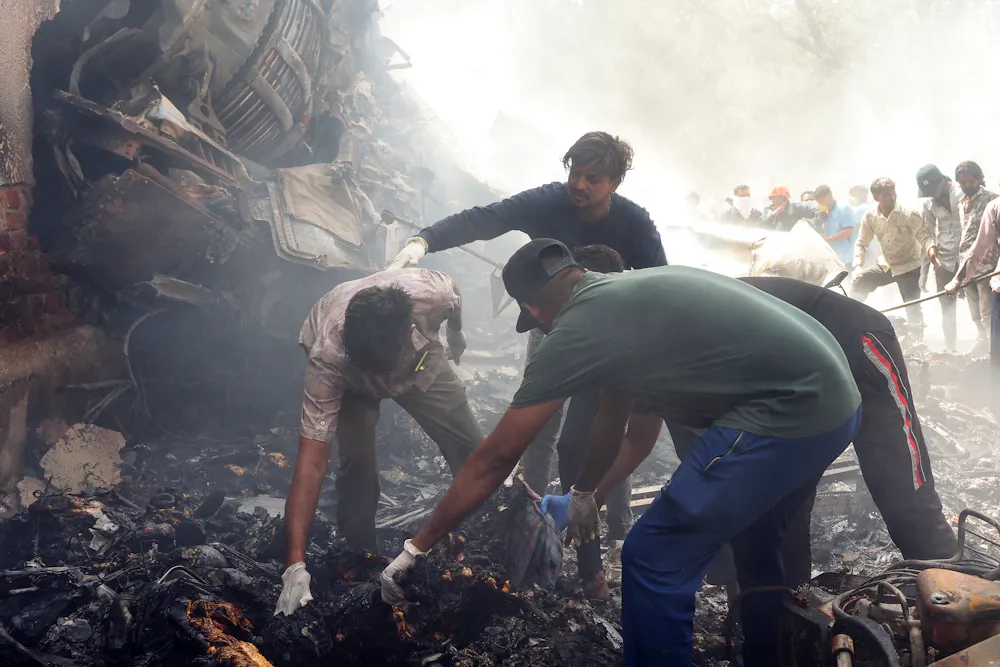
    The Boeing 787-8 Dreamliner, flying from Ahmedabad to London Gatwick, crashed seconds after takeoff from Ahmedabad airport on June 12, ramming into a nearby hostel. Only one passenger survived, while casualties on the ground are also feared.

    Among the victims was Anju Sharma, originally from Kurukshetra and living in Vadodara with her family. She was on her way to London to visit her elder daughter when the crash occurred.

    Her uncle, Balkishan Sharma, said he was deeply shaken. “I rarely watch TV. She was my brother’s eldest daughter. I found out about the tragedy from the news.”

    In Uttarsanda village in Gujarat’s Kheda district, the family of Rupal Patel is mourning her death. A resident of London for 15 years and mother of three, Rupal had returned to India for medical treatment.

    “My sister came for a week for treatment. After her operation, she was feeling well. She was happy to return to her husband and three children in London. I dropped her at the airport, and by the time I got home, I heard the devastating news,” said her brother, Pawan Patel.

    Rupal was seated in 19J on the flight. After being informed of the crash, her husband left London immediately with their children — a 13-year-old and twin 7-year-olds — to travel to Gujarat. “The kids were waiting for their mother to return. They had no idea she would never come back,” her husband said.

    In Ahmedabad, families waited overnight outside BJ Medical College as forensic teams carried out DNA sampling to identify the deceased, many of whom were burned beyond recognition.

    “Smoke suddenly rose high in the sky. There was fire. The flight had crashed, there were many people on board,” said Jairam, an eyewitness who lives around two kilometres from the site.

    The list of passengers on flight AI-171 showed that at least 33 of them were from Gujarat’s Anand district, 19 from Vadodara, and 17 from Kheda.

    The government has promised full support to the victims’ families and a thorough investigation into the cause of the crash.

    IANS

  • Kohli-backed World Bowling League to roll out next year

    Source: Government of India

    Source: Government of India (4)

    The first edition of the World Bowling League (WBL), backed by celebrity cricketer Virat Kohli and baseball star Mookie Betts, will roll out with six franchises competing in iconic locations early next year, league chief Adi K. Mishra told Reuters.

    The WBL is looking to transform a pastime for millions around the world into a cutting edge, made-for-TV experience via a heady mix of celebrity franchise owners, exotic locations and technological innovation.

    “It’s an incredible sport which just hasn’t been structured correctly for the past 50-60 years and everyone just dismisses it as a recreational activity,” Mishra, the founder and CEO of sports tech firm League Sports Co, said in a video call from the United States.

    “We are going to launch with six franchises in the first quarter of next year. It’s going to be a team of four – two male and two female bowlers.”

    Mishra did not go into detail about the format but said professional bowlers would compete in the core sport while celebrities would take part in auxiliary events, with teams collecting points throughout the season.

    With its origins in ancient Egypt, bowling’s heyday in the United States was in the 1960s and 70s when every town and suburb had its own alley.

    Even today, some 200 million people put on flat-soled shoes and take to the lanes every year, including 75 million in the U.S., Mishra said.

    The WBL is by no means the first attempt to create a professional circuit in the Tenpin game, and American Don ‘Mr Bowling’ Carter was the first athlete in any sport to ink a $1 million sponsorship deal back in 1964.

    What separates the WBL from previous attempts, Mishra says, is its global reach – the league is in the advanced stage of finalising franchises in Japan, South Korea, Singapore and India – and the ambitious vision.

    “Our first fundamental premise was – how can we take this and make this an aspirational product?” Mishra added.

    “We want to take two lanes and put them in iconic locations around the world – Hudson Yards in New York, Marina Bay Sands in Singapore, a variety of different locations in Dubai and India.”

    TAILOR-MADE FOR TV

    Los Angeles Dodgers shortstop Betts bought the first announced franchise in May and the WBL pulled off another marketing coup when Kohli came on board as a strategic investor last month.

    Mishra did not provide financial details of Bett’s purchase but said negotiations on the sale of the remaining franchises were in the final stages.

    The league plans to simplify scoring, gather a host of celebrity and corporate backers, and use ball-tracking and other technology to create a product that works on television and digital platforms.

    Weaving complimentary programming featuring celebrity bowlers like Betts and Kohli around the core sport would make it an irresistible proposition for broadcasters, said Mishra.

    “We already have many broadcasters lined up and a lot of them think this sport, the way we’ve designed it, can fit into their ultra-premium segment.

    “A lot of them believe they can bring in other influencers and celebrities, who come in and bowl as well. So there’s a lot of ‘shoulder programming’ that you can create with the sport, which is not possible with a lot of other sports.”

    Mishra and Kohli know each other through their joint ownership of a team in the E1 electric powerboat world championship, and the cricketer’s fondness for bowling came as a pleasant surprise as the WBL was being in the planning stage.

    “Over the years, I’ve met a lot of celebs who happen to be closet bowlers,” Mishra said.

    “We were speaking about various things about the team and it turned out that he has been bowling and watching it since he was 11-12.

    “That was a big surprise for me and we wanted him to be part of this. Hopefully we’ll get him to bowl when he has more time for it.”

    (Reuters)

  • MIL-OSI: Terranet’s rights issue oversubscribed

    Source: GlobeNewswire (MIL-OSI)

    NOT FOR RELEASE, PUBLICATION OR DISTRIBUTION IN WHOLE OR IN PART, DIRECTLY OR INDIRECTLY, IN THE UNITED STATES, AUSTRALIA, CANADA, NEW ZEALAND, HONG KONG, JAPAN, SINGAPORE, SOUTH AFRICA, SOUTH KOREA OR ANY OTHER JURISDICTION WHERE SUCH RELEASE, PUBLICATION OR DISTRIBUTION WOULD BE UNLAWFUL OR WOULD REQUIRE REGISTRATION OR ANY OTHER MEASURES. PLEASE REFER TO IMPORTANT INFORMATION AT THE END OF THE PRESS RELEASE.

    Terranet AB (“Terranet” or the “Company”) has completed the rights issue of units, consisting of shares of series B and warrants of series TO9 B, which the Board of Directors decided on April 16, 2025, and was approved by the Annual General Meeting on May 23, 2025 (the ‘Rights Issue’). The outcome shows that 10,349,896 units were subscribed for with unit rights, corresponding to approximately 74.6 percent of the Rights Issue. In addition, the Company has received subscription applications for 4,704,934 units, corresponding to approximately 33.9 percent of the Rights Issue, for subscription without unit rights. In total, 15,054,830 units were subscribed for with unit rights and subscription applications, corresponding to approximately 108.5 percent of the Rights Issue. The Rights Issue is thus oversubscribed and will raise approximately SEK 15 million before issue costs. No underwriting commitments will be utilised.

    Outcome of the Rights Issue
    The subscription period in the Rights Issue ended on June 11, 2025. The outcome shows that 10,349,896 units were subscribed for with unit rights, corresponding to approximately 74.6 percent of the Rights Issue. Furthermore, the Company has received subscription applications to subscribe for 4,704,934 units without unit rights, corresponding to approximately 33.9 percent of the Rights Issue. Thus, 15,054,830 units were subscribed for with and without unit rights, corresponding to approximately 108.5 percent of the Rights Issue. The Rights Issue is thus oversubscribed, and no underwriting commitments will be utilised.

    Each unit in the Rights Issue consists of twelve (12) B-shares and three (3) warrants of series TO9 B. In total, 13,880,714 units will thus be allocated, corresponding to 166,568,568 newly issued B-shares and 41,642,142 warrants of series TO9 B.

    Through the Rights Issue, the Company will receive approximately SEK 15 million before issue costs. Upon full utilisation of all warrants of series TO9 B within the framework of the offered units, the Company may receive an additional maximum of approximately SEK 15.1 million.

    Comment from Lars Lindell, CEO
    “We are very pleased that so many shareholders have chosen to exercise their subscription rights and thereby shown their confidence in the company and its future development. Through the proceeds we receive from the issues, we will be able to take significant steps in both product and business development and lay the foundation for the commercialization of BlincVision.”

    Allocation of units subscribed without unit rights
    Allotment of units subscribed for without unit rights has been made in accordance with what is stated in the information memorandum published by the Company on May 26, 2025, in connection with the Rights Issue. Notice of such allotment will be announced separately through a settlement note. Nominee-registered shareholders will receive notification of allotment in accordance with instructions from the respective nominee.

    Shares and share capital
    Through the Rights Issue, and after registration of the Second Directed Issue announced by the Company through a press release on April 16, 2025, the number of shares in the Company will increase by 166,568,568 B-shares from 1,471,519,182 shares (1,084,463 A-shares and 1,470,434,719 B-shares) to 1,638,087,750 shares, and the share capital will increase by SEK 1,665,685.68, from SEK 14,715,191.82 to SEK 16,380,877.50. The dilution effect, after registration of the Second Directed Issue, amounts to 10.2 percent in the Rights Issue.

    In the event that all attached warrants of series TO9 B are fully exercised for subscription of new B-shares in the Company, the number of shares in the Company will increase by an additional 83,729,677 B-shares, from 1,638,087,750 shares (1,084,463 A-shares and 1,637,003,287 B-shares) to 1,721,817,427 shares, and the share capital will increase by an additional SEK 837,296.770, from SEK 16,380,877.500 to SEK 17,218,174.270. The dilution effect, if all warrants of series TO9 B are exercised, amounts to 4.9 percent.

    Warrants of series TO9 B
    Each warrant of series TO9 B entitles the holder to subscribe for one (1) new B-share in the Company. One (1) warrant of series TO9 B entitles the holder to subscribe for one (1) B-share in the Company at a subscription price of SEK 0.18 (corresponding to 200 percent of the subscription price per B-share in the Directed Issues and the Rights Issue). Application for subscription of B-shares with the support of warrants of series TO9 B will take place during the period from December 1, 2025, up to and including December 15, 2025. The warrants are intended to be admitted to trading on Nasdaq First North Premier Growth Market.

    Paid subscribed units (“BTU”)
    Trading in BTU (paid subscribed units) will take place on Nasdaq First North Premier Growth Market until June 30, 2025, or until the conversion of BTUs into B shares and warrants of series TO9 B, which will take place after the Rights Issue has been registered with the Swedish Companies Registration Office. Registration with the Swedish Companies Registration Office is expected to take place during week 26, 2025.

    Compensation to underwriters
    In connection with the Rights Issue, two (2) external investors have provided underwriting commitments corresponding to 99.8 per cent of the Rights Issue. For underwriting commitments made, underwriting compensation of 12 percent of the underwritten amount is paid in the form of newly issued units. In total, a maximum of 1,661,774 new units may be issued as underwriting compensation to the underwriters.

    Advisers
    Mangold Fondkommission AB is the financial advisor to Terranet in connection with the Rights Issue. Eversheds Sutherland Advokatbyrå AB is the legal advisor to the Company in connection with the Rights Issue.

    For more information, please contact:
    Dan Wahrenberg, CFO
    E-mail: dan.wahrenberg@terranet.se

    This information is such that Terranet AB is required to make public in accordance with the EU’s Market Abuse Regulation (MAR). The information was made public by the Company’s contact person above on June 13, 2025, at 08:00 CET.

    About Terranet AB (publ) 

    Terranet’s goal is to save lives in urban traffic. The company develops innovative technical solutions for Advanced Driver Assistance Systems (ADAS) and Autonomous Vehicles (AV). Terranet’s anti-collision system BlincVision laser scans and detects road objects up to ten times faster than any other ADAS technology available today.
    The company is headquartered in Lund, with offices in Gothenburg and Stuttgart. Since 2017, Terranet has been listed on Nasdaq First North Premier Growth Market (Nasdaq: TERRNT-B).

    Follow our journey at: www.terranet.se

    Certified Adviser to Terranet is Mangold Fondkommission AB.

    Important information
    The release, announcement or distribution of this press release may, in certain jurisdictions, be subject to restrictions. The recipients of this press release in jurisdictions where this press release has been published or distributed shall inform themselves of and follow such restrictions. The recipient of this press release is responsible for using this press release, and the information contained herein, in accordance with applicable rules in each jurisdiction. This press release does not constitute an offer, or a solicitation of any offer, to buy or subscribe for any securities in Terranet in any jurisdiction, neither from Terranet nor anyone else.

    This press release does not constitute or form part of an offer or solicitation to purchase or subscribe for securities in the United States. The securities referred to herein may not be sold in the United States absent registration or an exemption from registration under the US Securities Act of 1933, as amended (the “Securities Act”), and may not be offered or sold within the United States absent registration or an applicable exemption from, or in a transaction not subject to, the registration requirements of the Securities Act. There is no intention to register any securities referred to herein in the United States or to make a public offering of the securities in the United States. The information in this press release may not be announced, published, copied, reproduced or distributed, directly or indirectly, in whole or in part, within or into Australia, Hong Kong, Japan, Canada, New Zealand, Switzerland, Singapore, South Africa, the United States or in any other jurisdiction where such announcement, publication or distribution of the information would not comply with applicable laws and regulations or where such actions are subject to legal restrictions or would require additional registration or other measures than what is required under Swedish law. Actions taken in violation of this instruction may constitute a crime against applicable securities laws and regulations.

    Attachment

    The MIL Network

  • MIL-OSI China: SCIO briefs media on promoting green development in Zhejiang

    Source: People’s Republic of China – State Council News

    SCIO briefs media on promoting green development in Zhejiang

    China SCIO | June 13, 2025

    The State Council Information Office (SCIO) organized a media trip to eastern China’s Zhejiang province from June 11 to 13, bringing together over 40 journalists – including foreign correspondents from the United States, the United Kingdom, Spain, Singapore, Indonesia, Turkey, South Korea, Japan and Brazil – to observe the progress of green development in the province.

    A press briefing was held Thursday in Zhejiang’s capital city Hangzhou, where Xu Wenguang, executive vice governor of Zhejiang province, briefed the media and answered questions.

    On June 12, 2025, the State Council Information Office (SCIO) holds a press briefing in Hangzhou, Zhejiang province. [Photo by Luan Haijun/China SCIO]

    1   2   3   4   5   6   7   >  

    MIL OSI China News

  • Air India crash: PM Modi visits Ahmedabad crash site, calls it a scene of “devastation”

    Source: Government of India

    Source: Government of India (4)

    Prime Minister Narendra Modi on Friday visited the site of the Air India crash in Ahmedabad, where the London-bound flight carrying 242 people went down a day earlier.

    The aircraft crashed minutes after takeoff from Sardar Vallabhbhai Patel International Airport, killing 241 people. Only one passenger – a British national of Indian origin – survived.

    “The scene of devastation is saddening,” PM Modi said in a post on X after reviewing the wreckage. “Met officials and teams working tirelessly in the aftermath. Our thoughts remain with those who lost their loved ones in this unimaginable tragedy.”

    He was accompanied by Union Civil Aviation Minister Ram Mohan Naidu Kinjarapu, Gujarat State Home Minister Harsh Sanghavi, and other senior officials during the site inspection.

    Flight AI-171, headed to London Gatwick, crashed into the hostel complex of BJ Medical College at 1:38 p.m. IST on Thursday, triggering a massive blaze and a large-scale emergency response.

    Union Home Minister Amit Shah visited the crash site on Thursday and later chaired a high-level meeting with Civil Aviation Minister Naidu, Gujarat Chief Minister Bhupendra Patel, and senior officials to review relief and rescue measures.

    Shah said DNA testing was underway to confirm the identities of the victims and assured that results would be delivered at the earliest by Gujarat’s Forensic Science Laboratory (FSL) and the National Forensic Sciences University (NFSU). DNA samples of family members arriving from abroad would be collected on arrival, he added.

    A formal investigation into the crash has been launched by the Aircraft Accident Investigation Bureau (AAIB) in accordance with international protocols under the International Civil Aviation Organization (ICAO), said Civil Aviation Minister Naidu. A high-level expert committee is also being formed to examine the incident and suggest safety improvements to prevent future tragedies.

    The United States National Transportation Safety Board (NTSB) announced it would send a team of investigators to India to assist the AAIB.

    “The NTSB will be leading a team of US investigators travelling to India to assist the Aircraft Accident Investigation Bureau with its investigation into the crash of an Air India Boeing 787 in Ahmedabad, India, Thursday,” the agency said, noting that all official updates would come from the Indian government under ICAO’s Annex 13 protocols.

    Rescue and Relief Operations Continue

    Rescue operations continued through the night as teams sifted through debris for missing aircraft parts.

    Parts of the plane’s fuselage were scattered around the smouldering building into which it crashed. The tail of the plane was stuck on top of the building.

    Air India CEO Campbell Wilson reached Ahmedabad early Friday. The airline said it had set up Friends & Relatives Assistance Centres at Ahmedabad, Mumbai, Delhi, and Gatwick airports to support the families of those on board.

    “These centres are facilitating the travel of family members to Ahmedabad,” Air India posted on X. Emergency contact numbers were also issued for those seeking information: 1800 5691 444 for calls from within India, and +91 8062779200 for international callers.

    The Tata Group, which took over Air India in 2022, announced a compensation of Rs 1 crore for the family of each deceased passenger.

    “Tata Group will provide Rs 1 crore to the families of each person who has lost their life in this tragedy. We will also cover the medical expenses of those injured and ensure that they receive all necessary care and support. Additionally, we will provide support in the building up of the B J Medical’s hostel,” Tata Sons Chairman N Chandrasekaran said on X.

    Earlier, Air India released a breakdown of the nationalities of those on board: 169 were Indian nationals, 53 British, seven Portuguese, and one Canadian.

    (With inputs from agencies)

  • After Israel strikes Iran, airlines divert flights, airspace closed

    Source: Government of India

    Source: Government of India (4)

    Airlines cleared out of the airspace over Israel, Iran and Iraq and Jordan on Friday after Israel launched attacks on targets in Iran, Flightradar24 data showed, with carriers scrambling to divert and cancel flights to keep passengers and crew safe.

    Proliferating conflict zones around the world are becoming an increasing burden on airline operations and profitability, and more of a safety concern.

    Six commercial aircraft have been shot down unintentionally and three nearly missed since 2001, according to aviation risk consultancy Osprey Flight Solutions.

    Israel on Friday said it targeted Iran’s nuclear facilities, ballistic missile factories and military commanders at the start of what it warned would be a prolonged operation to prevent Tehran from building an atomic weapon.

    Tel Aviv’s Ben Gurion Airport was closed until further notice, and Israel’s air defence units stood at high alert for possible retaliatory strikes from Iran.

    Israeli flag carrier El Al Airlines said it had suspended flights to and from Israel.

    Iranian airspace has been closed until further notice, according to state media and notices to pilots.

    As reports of strikes on Iran emerged, a number of commercial flights by airlines including Dubai’s Emirates, Lufthansa and Air India were flying over Iran.

    Air India, which overflies Iran for its Europe and North American flights, said several flights were being diverted or returned to their origin, including ones from New York, Vancouver, Chicago and London.

    Emirates and Lufthansa did not immediately respond to requests for comment.

    Iraq early on Friday closed its airspace and suspended all traffic at its airports, Iraqi state media reported.

    Eastern Iraq near the border with Iran contains one of the world’s busiest air corridors, with dozens of flights crossing between Europe and the Gulf, many on routes from Asia to Europe, at any one moment.

    Flights steadily diverted over Central Asia or Saudi Arabia, flight tracking data showed.

    Jordan, which sits between Israel and Iraq, closed its airspace several hours after the Israeli campaign began.

    “The situation is still emerging – operators should use a high degree of caution in the region at this time,” according to Safe Airspace, a website run by OPSGROUP, a membership-based organisation that shares flight risk information.

    Several flights due to land in Dubai were diverted early on Friday. An Emirates flight from Manchester to Dubai was diverted to Istanbul and a flydubai flight from Belgrade diverted to Yerevan, Armenia.

    Budget carrier flydubai said it had suspended flights to Amman, Beirut, Damascus, Iran and Israel and a number of other flights had been cancelled, rerouted or returned to their departure airports.

    Qatar Airways cancelled its two scheduled flights to Damascus on Friday, Flightradar24 data shows.

    The Israeli-Palestinian conflict in the Middle East since October 2023 led to commercial aviation sharing the skies with short-notice barrages of drones and missiles across major flight paths – some of which were reportedly close enough to be seen by pilots and passengers.

    Airspace in the Middle East last year was crossed daily by 1,400 flights to and from Europe, Eurocontrol data show.

    Last year, planes were shot down by weaponry in Kazakhstan and in Sudan. These incidents followed the high-profile downing of Malaysia Airlines flight MH17 over eastern Ukraine in 2014 and of Ukraine International Airlines flight PS752 en route from Tehran in 2020.

    (Reuters)

  • MIL-OSI USA: Statement from Congressman Marc Veasey on the Crash of Air India Flight 171

    Source: United States House of Representatives – Congressman Marc Veasey (33rd District of Texas)

    Headline: Statement from Congressman Marc Veasey on the Crash of Air India Flight 171

    WASHINGTON, D.C. — Congressman Marc Veasey (TX-33), a member of the Congressional Caucus on India and Indian Americans, issued the following statement in response to the tragic crash of Air India Flight 171, which departed from Ahmedabad International Airport and claimed the lives of 290 passengers and crew:

    “I am heartbroken by the devastating crash of Air India Flight 171. My deepest prayers are with the families and loved ones of all those affected by this unspeakable tragedy. As we mourn the loss of 290 souls, we stand in solidarity with the people of India during this painful time.

    As a proud member of the Congressional Caucus on India and Indian Americans, I know how deeply connected our communities are. This tragedy is not just India’s loss — it is a shared loss felt across continents and cultures. The United States grieves with India today.” 

    In addition to being a member of the Congressional Caucus on India and Indian Americans, Congressman Veasey co-chairs the Congressional Aviation Safety Caucus. 

    MIL OSI USA News

  • MIL-OSI Asia-Pac: Maritime advisory body formed

    Source: Hong Kong Information Services

    The Government announced today that the Chief Executive has appointed a chairman and members to the Hong Kong Maritime & Port Development Board (HKMPDB) for a term of three years, effective from July 1.

    Moses Cheng has been named chairman, while the board’s other members are Angad Banga, Sabrina Chao, Bjorn Hojgaard, Wellington Koo, Timothy Lee, Edward Liu, Billy Mak, Alan Tung and Frankie Yick.

    The board also includes a number of ex-officio members, namely the Secretary for Transport & Logistics or an assigned representative, the Commissioner for Maritime & Port Development, the Director of Marine, the Director-General of Investment Promotion, and the Executive Director of the Hong Kong Trade Development Council.

    The Chief Executive announced in the 2024 Policy Address that the existing Hong Kong Maritime & Port Board would be reconstituted as the HKMPDB. Chaired by a non-official member and with other members largely coming from the maritime sector, this high-level advisory body is expected to assist the Government in formulating policies and long-term development strategies.

    The HKMPDB will be supported by dedicated staff and provided with additional funding to enhance its research capabilities, strengthen its Mainland and overseas promotional work, and step up manpower training, with a view to supporting the Government in policy implementation and promoting the sustainable development of Hong Kong’s maritime industry.

    Secretary for Transport & Logistics Mable Chan stressed that consolidating and enhancing Hong Kong’s status as an international maritime centre is a top priority for the Government, a strategic objective of the country, and particular importance for the city’s economic development.

    “The establishment of the HKMPDB is a key step in this institutional reform. It is hoped that the new board will adopt an innovative and change-embracing spirit in supporting the Government to lead the maritime and port industry to further leverage Hong Kong’s unique advantages and enhance the industry’s global competitiveness in the midst of geopolitical challenges.

    “Under the leadership of Mr Cheng, I am confident that board members will make valuable contributions to the work of the HKMPDB with their respective expertise and experience, and continue to advance side by side with the industry.”

    The Government added that four committees, namely the Port Development Committee, the Maritime Services Development Committee, the Promotion & External Relations Committee and the Manpower Development Committee will be formed under the HKMPDB to focus on specific areas of work. Appointments to these committees will be announced later this month.

    MIL OSI Asia Pacific News

  • IAEA says no increase in radiation levels at Iran’s Natanz nuclear site

    Source: Government of India

    Source: Government of India (4)

    The International Atomic Energy Agency on Friday said there was no increase in radiation levels at the Natanz nuclear site that was targeted during an Israeli attack, citing information given to them by Iranian authorities.

    The international atomic energy watchdog also added that the Bushehr nuclear power plant was not targeted during the attack.

    More to follow.

    (Reuters)

  • WTC final, Day 3: Australia target bigger lead as Cummins reflects on milestone wicket

    Source: Government of India

    Source: Government of India (4)

    Australia will look to add 20 to 30 more runs to their second innings total when the third day of the World Test Championship final against South Africa resumes at Lord’s on Friday, said captain Pat Cummins.

    Australia will resume on 144-8 in the second innings, a total of 218 runs ahead as they seek to set an imposing target for South Africa to chase to win the match.

    “Initially, we felt anything over 200 was good but you just want to get as many runs as you can,” Cummins told a press conference at the end of Thursday’s play.

    “Hopefully we’ll get another 20 or 30 in the morning. That’d be good. I think that would give us a few more options to bowl at, allow a few more aggressive fields and those kind of things.”

    Mitchell Starc was unbeaten on 16 and Nathan Lyon had one run at stumps on Thursday.

    In test history at Lord’s there have only been three higher targets successfully chased down, so Australia look to be in the driving seat in a match dominated by high-quality bowling.

    The pick of the bunch was Cummins, who produced the best bowling figures by a test captain at Lord’s as his 6-28 gave Australia a 74-run first-innings lead.

    He also brought up 300 test wickets when Kagiso Rabada was the last wicket in South Africa’s first innings to fall.

    “That’s something I always kind of thought about as a pretty good sign of durability, resilience and longevity. So, I feel pretty proud to join that group,” he added.

    The first test wicket for the 32-year-old was against South Africa in Johannesburg in late 2011.

    “I’ve had a really good run the last half a dozen years or so of not missing too many games. You know for the first few years I didn’t know where my second test match was coming.

    “I feel like I’ve got lots of miles in the legs and don’t feel like I’m going to end any anytime soon.

    “I really need to thank the medical staff, the way they looked after me in the early years to get through test matches,” he added.

    (With agency input)

  • MIL-OSI Economics: Result of Underwriting Auction conducted on June 13, 2025

    Source: Reserve Bank of India

    In the underwriting auction conducted on June 13, 2025, for Additional Competitive Underwriting (ACU) of the undernoted Government securities, the Reserve Bank of India has set the cut-off rates for underwriting commission payable to Primary Dealers as given below:

    Nomenclature of the Security Notified Amount
    (₹ crore)
    Minimum Underwriting Commitment (MUC) Amount
    (₹ crore)
    Additional Competitive Underwriting Amount Accepted
    (₹ crore)
    Total Amount underwritten
    (₹ crore)
    ACU Commission Cut-off rate
    (paise per ₹100)
    6.79% GS 2031 11,000 5,502 5,498 11,000 4.80
    6.98% GOI SGrB 2054 5,000 2,520 2,480 5,000 12
    7.09% GS 2074 14,000 7,014 6,986 14,000 9
    Auction for the sale of securities will be held on June 13, 2025.

    Ajit Prasad          
    Deputy General Manager
    (Communications)    

    Press Release: 2025-2026/537

    MIL OSI Economics

  • MIL-OSI Banking: LEXUS Signs Athlete Partnership Agreements with Japanese National Football Team Player Wataru Endo and Professional Surfer Kanoa Igarashi

    Source: Toyota

    Headline: LEXUS Signs Athlete Partnership Agreements with Japanese National Football Team Player Wataru Endo and Professional Surfer Kanoa Igarashi

    LEXUS has signed athlete sponsorship agreements with Wataru Endo, a member of SAMURAI BLUE (the Japan National Football Team), and professional surfer Kanoa Igarashi. This partnership was inspired by the bold ambition and dreams of both athletes as they pursue excellence on the global stage. Looking ahead, LEXUS will continue to support them through a wide range of initiatives.

    MIL OSI Global Banks

  • MIL-OSI China: Shanghai to host FIBA 3×3 Women’s Series Final from 2025-28

    Source: People’s Republic of China – State Council News

    Shanghai will host the FIBA 3×3 Women’s Series Final from 2025 to 2028, the International Basketball Federation (FIBA) announced on Thursday.

    Yang Shuyu (L) of China competes during the women’s 3×3 basketball pool round match between China and Italy at the Aomi Urban Sports Park in Tokyo, Japan, July 25, 2021. (Xinhua/Zhang Xiaoyu)

    “Shanghai will create a festival-like atmosphere for the next four editions of the FIBA 3×3 Women’s Series Final. The city’s energetic atmosphere will provide a perfect backdrop for both players and fans, transforming the event into a true celebration of the world’s most thrilling urban team sport,” FIBA said in a statement.

    The 2025 edition is scheduled for September 13-14, with the exact location to be confirmed. Seven top teams from the regular season will join host nation China in competing for the title.

    “We are very excited that the vibrant metropolis of Shanghai will host the FIBA 3×3 Women’s Series Final for the next four years,” said FIBA 3×3 Managing Director Alex Sanchez. “A modern and innovative city with a fantastic track record in hosting major international sports events, Shanghai will be an amazing host for the world’s best 3×3 women’s basketball players.”

    The FIBA 3×3 Women’s Series was established in 2019 and is recognized as the premier global professional competition for women’s 3×3 basketball.

    MIL OSI China News

  • Indian stock market opens in red as Israel-Iran tensions rise

    Source: Government of India

    Source: Government of India (4)

    Indian benchmark indices opened sharply lower on Friday as escalating tensions between Israel and Iran rattled investor sentiment. Heavy selling pressure was witnessed in auto, IT, financial services, and PSU bank stocks during early trade.

    At around 9:33 a.m., the Sensex was trading 896.50 points, or 1.10 per cent, lower at 80,795.44, while the Nifty fell 278.50 points, or 1.12 per cent, to 24,609.70.

    The Nifty Bank index dropped 633.80 points, or 1.13 per cent, to 55,448.75. The Nifty Midcap 100 declined by 603.90 points, or 1.03 per cent, to trade at 57,836.95, while the Nifty Smallcap 100 was down 192.75 points, or 1.04 per cent, at 18,272.30.

    Analysts warned that the economic fallout from Israel’s military action could be severe if hostilities with Iran persist. Israel has already declared that its operation could last several days.

    “The market impact will depend on the duration of the conflict. In the near term, investors are likely to adopt a risk-off approach. Sectors dependent on oil derivatives—such as aviation, paints, adhesives, and tyres—may face pressure. In contrast, oil producers like ONGC and Oil India could prove more resilient,” said Dr. V.K. Vijayakumar, Chief Investment Strategist at Geojit Financial Services.

    The Nifty had already closed over one per cent lower in the previous session amid signs of rising geopolitical tension in the Middle East. As of this morning, Israel has launched pre-emptive strikes on Iran, prompting a broad-based risk-off sentiment across global markets.

    “Technically, Wednesday’s ‘buyer rejection’ candle, which followed the bearish ‘upside gap two crows’ pattern earlier in the week, was a clear warning of caution building in the market,” noted Akshay Chinchalkar, Head of Research at Axis Securities.

    Among the top laggards in the Sensex pack were Tata Motors, L&T, PowerGrid, Kotak Mahindra Bank, SBI, Titan, and Infosys.

    Across Asian markets, indices in Hong Kong, Bangkok, Jakarta, Japan, Seoul, and China were all trading in the red.

    In the previous U.S. trading session, the Dow Jones closed at 42,967.62, up 101.85 points or 0.24 per cent. The S&P 500 gained 23.02 points or 0.38 per cent to end at 6,045.26, while the Nasdaq rose by 46.61 points or 0.24 per cent to close at 19,662.49.

    On the institutional front, Foreign Institutional Investors (FIIs) extended their selling for the second consecutive day, offloading equities worth ₹3,831.42 crore on June 12. Meanwhile, Domestic Institutional Investors (DIIs) bought equities worth ₹9,393.85 crore on the same day.

    — IANS

  • Israel hits Iran nuclear facilities, missile factories; Tehran vows revenge

    Source: Government of India

    Source: Government of India (4)

    Israel launched widescale strikes against Iran on Friday, saying it targeted nuclear facilities, ballistic missile factories and military commanders and that this was start of a prolonged operation to prevent Tehran from building an atomic weapon.

    Iranian media and witnesses reported explosions including at the country’s main uranium enrichment facility at Natanz, while Israel declared a state of emergency in anticipation of retaliatory missile and drone strikes.

    Iran’s elite Revolutionary Guards corps said its top commander, Hossein Salami, was killed and state media reported the unit’s headquarters in Tehran had been hit. Several children had been killed in a strike on a residential area in the capital, it said.

    “We are at a decisive moment in Israel’s history,” Israeli Prime Minister Benjamin Netanyahu said in a recorded video message.

    “Moments ago Israel launched Operation Rising Lion, a targeted military operation to roll back the Iranian threat to Israel’s very survival. This operation will continue for as many days as it takes to remove this threat.”

    Iran’s Supreme Leader Ayatollah Ali Khamenei said in a statement that Israel had “unleashed its wicked and bloody” hand in a crime against Iran and that it would receive “a bitter fate for itself”.

    An Israeli military official said Israel was striking “dozens” of nuclear and military targets including the facility at Natanz in central Iran. The official said Iran had enough material to make 15 nuclear bombs within days.

    The United States said it had no part in the operation, which raises the risk of a fresh escalation in tensions in the Middle East, a major oil producing region.

    Alongside extensive air strikes, Israel’s Mossad spy agency led a series of covert sabotage operations inside Iran, Axios reported, citing a senior Israeli official. These operations were aimed at damaging Iran’s strategic missile sites and its air defence capabilities.

    Iranian state media reported that at least two nuclear scientists, Fereydoun Abbasi and Mohammad Mehdi Tehranchi were killed in Israeli strikes in Tehran.

    Tel Aviv’s Ben Gurion Airport was closed until further notice, and Israel’s air defence units stood at high alert for possible retaliatory strikes from Iran.

    “Following the pre-emptive strike by the State of Israel against Iran, a missile and UAV (drone) attack against the State of Israel and its civilian population is expected in the immediate time frame,” Defence Minister Israel Katz said in a statement.

    Israeli military Chief of Staff Eyal Zamir said tens of thousands of soldiers had been called up and “prepared across all borders”.

    “We are amidst a historic campaign unlike any other. This is a critical operation to prevent an existential threat, by an enemy who is intent on destroying us,” he said.

    Israeli Minister Gideon Saar was holding “marathon of calls” with counterparts around the world regarding Israel’s attack on Iran, the foreign ministry said in a statement.

    U.S. “NOT INVOLVED”

    U.S. President Donald Trump said that Iran cannot have a nuclear bomb and that the United States was hoping to get back to the negotiating table, in an interview with Fox News after the start of the Israeli air strikes on Iran.

    “We will see,” Fox News reporter Jennifer Griffin quoted Trump as saying in a post on X.

    Trump would convene a meeting of the National Security Council on Friday morning, the White House said. He had said on Thursday an Israeli strike on Iran “could very well happen” but reiterated his hopes for a peaceful resolution.

    The U.S. military is planning for the full range of contingencies in the Middle East, including the possibility that it might have to help evacuate American civilians, a U.S. official told Reuters.

    Iran’s armed forces spokesperson said Israel and its chief ally the United States would pay a “heavy price” for the attack, accusing Washington of providing support for the operation.

    While the U.S. tried to distance itself from Israel’s military operation, an Israeli official told public broadcaster Kan that Israel had coordinated with Washington on Iran.

    U.S. Secretary of State Marco Rubio said the United States was not involved in the strikes and Tel Aviv had acted unilaterally for self-defence.

    “We are not involved in strikes against Iran and our top priority is protecting American forces in the region,” Rubio said in a statement.

    “Let me be clear: Iran should not target U.S. interests or personnel,” he added.

    The State Department issued an advisory saying that all U.S. government employees in Israel and their family members should “shelter in place until further notice”.

    The attacks triggered sharp falls in stock prices in Asian trade on Friday, led by a selloff in U.S. futures, while oil prices jumped as investors scurried to safe havens such as gold and the Swiss franc.

    U.N. Secretary-General Antonio Guterres condemned any military escalation in the Middle East, said deputy U.N. spokesperson Farhan Haq.

    “The Secretary-General asks both sides to show maximum restraint, avoiding at all costs a descent into deeper conflict, a situation that the region can hardly afford,” Haq said.

    NUCLEAR TALKS

    U.S. and Iranian officials were scheduled to hold a sixth round of talks on Tehran’s escalating uranium enrichment programme in Oman on Sunday, according to officials from both countries and their Omani mediators.

    A U.S. official said those talks were still scheduled to proceed despite the Israeli attack.

    The Israeli military said on Friday that it was forced to act based on new intelligence information showing that Iran was “approaching the point of no return” in the development of a nuclear weapon.

    “In recent months, this program has accelerated significantly, bringing the regime significantly closer to obtaining a nuclear weapon,” it said in a statement, without disclosing the purported evidence.

    A source familiar with U.S. intelligence reports said there had been no recent change in the U.S. intelligence assessment that Iran was not building a nuclear weapon and that Khamenei had not authorised the restarting of the nuclear weapons programme that was shuttered in 2003.

    (Reuters)

  • FIFA World Cup: Miami officials play down travel concerns a year from kick-off

    Source: Government of India

    Source: Government of India (4)

    As a gleaming clock began ticking towards the 2026 World Cup, Miami officials launched the city’s one-year countdown seeking to allay fears that America’s stricter immigration stance could deter the overseas fans that it hopes to attract.

    The celebratory unveiling on Wednesday, featuring singer Marc Anthony, came just days after unrest in Los Angeles and amid the implementation of stricter border controls under President Donald Trump’s administration.

    “I don’t think anybody has anything to be afraid of. Miami is an incredibly welcoming place, and we’re very excited to welcome the world,” Alina T. Hudak, president of the 2026 Miami Host Committee, said at the countdown event.

    The digital clock, soon to greet travellers at Miami International Airport, marks 365 days until the start of the biggest World Cup in history — 48 teams playing 104 matches across three North American nations.

    However, security arrangements have drawn particular scrutiny, especially regarding the involvement of immigration enforcement agencies.

    Marcio Carvalho Da Silva Correia, a Brazilian visitor to Miami, told Reuters he had heard people talking about concerns they had about the World Cup.

    “They’re scared they’ll show up and get deported,” he said.

    “But I think, given how beautiful the party is going to be, nothing like that is going to happen.”

    Rodney Barreto, co-chair of the Miami Host Committee, confirmed that Customs and Border Protection (CBP) and Immigration and Customs Enforcement (ICE) agents will be involved in security operations.

    “They will be there to support us with security, but not to capture people,” he said.

    At Fiorito, an Argentine restaurant in Miami’s Little Haiti neighbourhood, fans of the South American nation’s defending champions expressed confidence that their countrymen would travel regardless.

    “Wherever the World Cup is, it’s great … we’re excited about being world champions and we can do much more,” Argentina supporter Nicolas Lomazzi.

    For Miami, a city shaped by successive waves of immigration, hosting the tournament represents a delicate balancing act — showcasing its multicultural identity while navigating an increasingly complex immigration landscape.

    Brazilian-born Miami resident Pedro Lub said the city’s Latino population was really excited about soccer’s biggest tournament coming to town and he hoped the immigration authorities did not use it as an excuse for a crackdown.

    “I have a lot of friends that are in weird situations without status or something like that and yeah, everybody’s worried,” he told Reuters.

    “People are just trying to watch a soccer match. It’d be pretty bad if they got caught just trying to have fun.

    “I think people are expecting it to be a great tournament.”

    -Reuters

  • NASA delays Axiom-4 mission to ISS amid Russian module air leak concerns

    Source: Government of India

    Source: Government of India (4)

    NASA indefinitely delayed a four-person crew’s mission to the International Space Station on Thursday over an escalating probe into air leaks aboard the orbiting laboratory’s Russian segment.

    The U.S. space agency said it was working with Roscosmos, Russia’s space agency, to “understand a new pressure signature” detected by cosmonauts in the Zvezda Service Module, a more than 2-decade-old core compartment that for months has sprung small leaks.

    “Cosmonauts aboard the space station recently performed inspections of the pressurized module’s interior surfaces, sealed some additional areas of interest, and measured the current leak rate,” NASA said in a statement. “Following this effort, the segment now is holding pressure.”

    The agency did not immediately respond to questions on what the leak rate was.

    Small cracks on the ISS in recent years, particularly on the aging Russian segment, have contributed to the international partnership’s decision to retire the ISS by 2030.

    Leaks of air from the cracks have been minor and posed no immediate safety threats to the station‘s astronauts but are increasingly worrisome signs of aging that NASA and Roscosmos have been investigating, while having crew members patch the leaks with tape, glue and other solutions.

    Scheduled to be aboard the Axiom Mission 4 is Shubhanshu Shukla, an Indian Air Force pilot and one of four astronauts-in-training picked by the Indian Space Research Organization to fly on India’s own debut crewed mission, the Gaganyaan mission planned for 2027.

    Shukla, 39, will be the first astronaut to go to the ISS from India’s astronaut corps.

    -Reuters

  • MIL-OSI New Zealand: Foreign Minister visit strengthens ties with Indonesia

    Source: New Zealand Government

    Foreign Minister Winston Peters’ visit to Indonesia today has secured tangible progress in New Zealand’s relationship with Southeast Asia’s most populous nation.

    “Indonesia is an indispensable partner for New Zealand,” Mr Peters says. 

    “Demonstrating our commitment to the relationship, this is our fourth visit to Indonesia in the past 18 months, including for President Prabowo’s inauguration. 

    “We are pleased to have made tangible, concrete progress today across the Indonesia relationship, which will deliver benefits for the New Zealand and Indonesian people.” 

    Mr Peters, alongside Indonesian Foreign Minister Sugiono, announced in Jakarta today: 

    • the conclusion of a cooperation arrangement on halal products, which will facilitate halal food trade between New Zealand and Indonesia;
    • the signing of an enhanced education cooperation arrangement, to facilitate student and research exchanges;
    • an increase from 45 to 70 in the annual number of scholarships for Indonesian students to study in New Zealand; and
    • a port visit by HMNZS Te Kaha to Jakarta later this month.

    “By working more closely together, New Zealand and Indonesia are fostering mutual economic growth, deepening regional cooperation, and strengthening the connections between our people. 

    “The arrangement concluded today on halal is particularly noteworthy. Indonesia is recognising New Zealand’s domestic processes for certification of halal products. This will improve access for New Zealand meat and dairy into the world’s largest Muslim country.

    “We are also pleased that the new arrangement on education will spur closer student and research exchanges.”

    Mr Peters arrives back in New Zealand tomorrow, having completed a three-country tour of France (for the Pacific-France Summit and the UN Ocean Conference), Italy and Indonesia. 

    At the conclusion of their talks, Minister Peters and Sugiono released a joint statement.

    Media contact: John Tulloch +64 21 868 943

    MIL OSI New Zealand News

  • MIL-OSI New Zealand: Indonesia Press Remarks – Remarks to media alongside Indonesian Foreign Minister Sugiono

    Source: New Zealand Government

    Good Morning. It is a pleasure to be in Jakarta again today.
    Indonesia is an absolute priority for the New Zealand government, which is why we have now visited here four times since re-taking office as New Zealand Foreign Minister in late 2023.
    Indonesia is one of New Zealand’s oldest friends in Southeast Asia and our relationship is warm, deep, and broad-based. There is much that we admire about your country. We are ambitious for us to do much more together. 
    Thank you to Minister Sugiono and his officials for hosting us today. We are always honoured by the extremely warm welcome here in Jakarta, and were proud to be here for President Prabowo’s inauguration last year. 
    New Zealand is a partner to Indonesia for the long-term and we have strong ambitions to strengthen our relationship as we head towards 70 years of diplomatic relations in 2028.
    We are pleased, Minister Sugiono, that during this visit we have been able to make tangible, concrete progress on issues of importance to our peoples. 
    On the economic front, we welcome the conclusion of a Cooperation Arrangement on Halal Products. This will facilitate the convenience, security and safety of halal food traded between our countries. 
    New Zealand leads the world in agriculture and dairy productivity, and our high quality, safe and halal food products are a key export to Indonesia. 
    We were pleased to discuss how New Zealand dairy exports can support President Prabowo’s flagship healthy nutrition programme – and to reiterate New Zealand’s commitment to working closely with Indonesia on agricultural cooperation, as Indonesia’s own dairy sector grows. 
    On education, our governments are signing today an amended Cooperation Arrangement to enhance student and research exchange between New Zealand and Indonesia.
    New Zealand is also delighted to announce today a significant increase ­– from 45 to 70 – in the annual number of scholarships offered to Indonesians to do tertiary study in New Zealand. 
    We look forward to welcoming an even greater number of Indonesian students to New Zealand to experience our world class education system and learn more about our respective cultures and countries. 
    On energy, we are proud of our long-standing partnership in Indonesia’s renewable energy sector. Over the next 5 years, New Zealand will invest a further $15 million to support the development of renewable energy in Indonesia. 
    We were pleased to reaffirm with Minister Sugiono our goal to increase two-way trade to NZ$6 billion by 2029 – noting that two-way trade with Indonesia increased by more than 43% in the past 5 years. 
    Our trade is mutually beneficial. To achieve our ambitious trade target, we need to keep working together to unlock new trade opportunities. 
    Indonesia is also a key partner for New Zealand in navigating increasing geostrategic complexities in the region. We discussed our collaboration on defence and regional security issues, including tackling transnational organised crime, the flow of drugs, and human trafficking.  New Zealand also announced a new contribution to the Jakarta Centre for Law Enforcement Cooperation, which reflects New Zealand’s long-standing partnership with this world class facility. 
    We are also pleased to announce the visit by HMNZS Te Kaha this month to Jakarta.
    New Zealand will also participate in Exercise Super Garuda Shield, a major United States-Indonesia exercise aimed at reinforcing security ties across the Indo-Pacific.
    So, this has been a very productive visit. New Zealand and Indonesia are making concrete progress together, in a wide range of areas. This is befitting the high ambition that our two countries have for the relationship. 
    Minister Sugiono, your hospitality has been a reflection of the warmth and respect that underpin our bilateral relationship. We eagerly await the opportunity to host you in New Zealand at your earliest convenience.
    Thank you very much. 

    MIL OSI New Zealand News

  • MIL-OSI Global: What do we know about the Air India crash? How did one man survive? What now? An aviation safety expert explains

    Source: The Conversation – Global Perspectives – By Guido Carim Junior, Senior Lecturer in Aviation, Griffith University

    The back of Air India flight 171 after it crashed into a residential building in Ahmedabad. Sam Panthaky / AFP via Getty Images

    An Air India flight crashed shortly after takeoff from Ahmedabad in northwest India on Thursday afternoon local time, killing more than 260 people.

    The Boeing 787-8 Dreamliner, Flight AI171, was carrying 242 people bound for London. Only one passenger, a British man, survived.

    The plane crashed less than a minute after takeoff, coming down on top of a college hostel around 1.5 kilometres from the runway. Little is known so far about the cause of the incident.

    As an aviation safety expert, it is hard to avoid a sense of disbelief that an event such as this – involving one of the most advanced passenger jets in the world, built on the lessons of many earlier accidents – could happen in the 21st century.

    Trouble after takeoff

    Air crashes such as this one, in which a plane experiences trouble immediately after takeoff, are now extremely rare. They were more common in the past.

    In one infamous 1999 incident, 32 people died when LAPA Flight 3142 crashed during takeoff from Buenos Aires. During the accident investigation, it emerged that the Boeing 737’s wing flaps had not been in the right position for takeoff and the crew had ignored alarms from the plane’s internal warning system.

    The 2009 emergency landing of US Airways Flight 1549 on New York’s Hudson River also occurred shortly after takeoff. In that case, the problem was quite different: a collision with a flock of Canada geese shut down both engines, leading to a powerless aircraft.

    However, the aviation industry puts a lot of resources into learning from accidents so they don’t happen again. LAPA Flight 3142 led to recommended improvements in pilot training and flight procedures. The rules for engine design were changed after the “miracle on the Hudson”.

    So whatever caused the Air India crash, it may not be something we have seen before.

    How did one passenger survive?

    One passenger survived the crash. We don’t know exactly how.

    He was sitting in seat 11A, next to an emergency exit. Reports say the plane “broke in half”, and the passenger found himself in the front half while the rear caught fire. He then walked from the wreckage and was found by rescuers.

    Why did he survive when everybody else died? Research suggests that, in general, the seats at the back of the plane are the safest place to be in a crash – but this man was quite close to the front.

    Based on what we know so far, my expert opinion is that we have no better explanation than to call it luck or a miracle.

    Where to from here?

    We won’t have a clear idea of what happened until a full investigation has been carried out. Air crash investigations follow a protocol laid out by an International Civil Aviation Organization document called Annex 14.

    India’s Aircraft Accident Investigation Bureau will lead this investigation, putting together a team that will be assisted by representatives from the US National Transport Safety Bureau and the UK Air Accidents Investigation Branch, representing the countries of the plane’s manufacturer and passengers aboard.

    Rescuers sift through the wreckage of Flight AI171 in Ahmedabad.
    Sam Panthaky / AFP via Getty Images

    The team will conduct a forensic investigation of the crash site to make sense of what happened. Alongside material evidence found at the site, they will look at the data stored in the plane’s “black box”, which includes data from the flight recorder and cockpit voice recorder, to learn about what happened in the leadup to the crash.

    A slow, steady process

    Air crash investigations can take a long time. Typically a preliminary report will be published 3 to 6 months after the crash, followed by a final report a year or two later.

    The report will provide factual information on the cause of the accident and make recommendations. Depending on the cause, these might be changes to maintenance procedures, pilot and crew procedures, or even the design of parts of the aircraft.

    Indian authorities will then disseminate these recommendations to whoever needs them around the world. The process is slow, but it moves in the direction of safer air travel. Everyone will be waiting to find out and learn.

    In the meantime, it’s best to remember that we still don’t know what happened or why. Everyone wants answers, but speculation can do more harm than good.

    Guido Carim Junior does not work for, consult, own shares in or receive funding from any company or organisation that would benefit from this article, and has disclosed no relevant affiliations beyond their academic appointment.

    ref. What do we know about the Air India crash? How did one man survive? What now? An aviation safety expert explains – https://theconversation.com/what-do-we-know-about-the-air-india-crash-how-did-one-man-survive-what-now-an-aviation-safety-expert-explains-258910

    MIL OSI – Global Reports

  • MIL-OSI Global: Speculation about the cause of Air India crash is rife. An aviation expert explains why it’s a problem

    Source: The Conversation – Global Perspectives – By Natasha Heap, Program Director for the Bachelor of Aviation, University of Southern Queensland

    It has only been a few hours since Air India flight AI171 crashed in Ahmedabad, killing more than 260 people, yet public speculation about the causes of the disaster is already rife.

    Parts of the media seem to be encouraging this. For example, earlier today I was contacted by an international news organisation for an interview about the tragedy. While I agreed, I cautioned that I could only say “it is too early to speculate”. They decided not to proceed with the interview. No reason was given, but perhaps it was my aversion to speculation.

    Of course, I want to know as much as anyone else what caused this disaster. But publicly speculating at such an early stage, when there is so little evidence available, is more than unhelpful. It is also harmful, as many examples throughout history have shown.

    Like an archaeological excavation

    Aviation accident investigations start as soon as first responders have extinguished the fires and completed the search for survivors – the first and foremost driver when responding to such a disaster – and have declared the site safe. The identification of the victims will then commence, completed by a different agency, parallel to the accident investigation.

    State authorities aren’t the only people involved. The aircraft manufacturer (in this case Boeing) will usually send representatives to assist the investigation, as can the home countries of victims. Investigators in the country where the accident occurred may also request assistance from countries with more experience in aviation accident investigation.

    An early step for investigators is finding the black boxes (flight data recorders and cockpit voice recorder) among the debris. These contain data about the flight itself, what the aircraft was doing, and what the pilots were saying.

    But a plane crash investigation involves much more than just finding the black box.

    An aviation accident investigation is akin to an archaeological excavation – methodical and painstaking. If the evidence is not collected and preserved for later analysis at the time, it will be irrevocably lost.

    In the case of Air India Flight 171 the scene is further complicated by the crash location – a building. It will take time for the aeroplane wreckage, victims and personal belongings to be sorted from the building debris. This must occur before the search for answers can commence.

    Investigators will also gather witness statements and any video of the event. Their analysis will be further informed by company documentation, training, and regulatory compliance information.

    Around 80% of aviation accidents are due to “human factors”.

    According to the International Civil Aviation Organisation human factors are:

    what we know about human beings including their abilities, characteristics, and limitations, the design of procedures and equipment people use, and the environment in which they function and the tasks they perform.

    It could take several years for the full forensic investigation into this disaster to run its full course. For example, the final report into the Sea World helicopter crash in Queensland, Australia, back in 2023, which claimed the lives of four people and injured nine others, was only released in April this year.

    A history of speculation – and vilification

    There is a long history of undue and harmful public speculation about the possible causes of a plane crash.

    For example, since the disappearance of Malaysia Airlines flight MH370 on March 8, 2014, speculation has swirled about whether chief pilot Zaharie Ahmad Shah was responsible for the disaster and the deaths of the other 238 people on board. This has deeply upset his sister, Sakinab Shah. In 2016, she told CNN she feels her brother is a “scapegoat” she must defend.

    Similarly, the pilots of the British Midlands accident near Kegworth in 1989, in which 47 people died, were also publicly vilified.

    The pilots, who survived the crash, were experienced but misidentified which engine had failed, and shut down the wrong one. They were widely criticised in the press for the error, tarnishing their reputations, losing their jobs, and no doubt causing more stress to their families. The investigation later revealed the pilots themselves had not received any simulator training as they transitioned to a newer variant of the aircraft they were flying.

    This shows how undue public speculation about an airline disaster can add to the distress of victims and their families.

    Respect the process

    No doubt pilots and aviation experts are speculating in private right now about the causes of this particular disaster. Cafes, pubs and crew rooms will be rife with discussions and opinions. It is human nature to want to know what happened.

    But to speculate in public won’t assist the investigative process. Nor will it help the families of the victims, or the first responders and investigators themselves, get through this horrible time.

    Investigators need to work without external pressures to ensure accurate findings. Respecting this process maintains integrity and supports the many people who are currently experiencing unimaginable grief.

    Natasha Heap does not work for, consult, own shares in or receive funding from any company or organisation that would benefit from this article, and has disclosed no relevant affiliations beyond their academic appointment.

    ref. Speculation about the cause of Air India crash is rife. An aviation expert explains why it’s a problem – https://theconversation.com/speculation-about-the-cause-of-air-india-crash-is-rife-an-aviation-expert-explains-why-its-a-problem-258911

    MIL OSI – Global Reports