Headline: Construction Begins on New Tokyo Head Office in Shinagawa to Open in FY2030
Toyota Motor Corporation (Toyota) will begin construction on the Shinagawa Station West Exit Area District A New Construction Plan (tentative name; hereinafter, the “Plan”), which it is carrying out together with Keikyu Corporation (Keikyu), on May 31, 2025. Toyota will open a new Tokyo Head Office in FY2030 in a planned building located in front of Shinagawa Station, one of the most important transportation hubs in Japan.
Source: People’s Republic of China in Russian – People’s Republic of China in Russian –
Source: People’s Republic of China – State Council News
KUALA LUMPUR, May 26 (Xinhua) — The 46th Association of Southeast Asian Nations (ASEAN) summit and related meetings kicked off in the Malaysian capital on Monday, with enhanced regional integration and resilience to trade and economic shocks on the agenda.
Speaking at the opening ceremony of the plenary session, Malaysian Prime Minister Anwar Ibrahim called on ASEAN members to work together to address the challenges posed by the changing global order and to avoid deviating from the sustainable and equitable development agenda.
“ASEAN’s peace, stability and prosperity often depend on an open, inclusive and rules-based international order that is underpinned by the free movement of trade, capital and people. These foundations are now being eroded by arbitrary action,” he said.
“Indeed, the geopolitical order is currently changing, and the global trading system is under further strain with the recent imposition of unilateral tariffs by the US. Protectionism is resurgent, while we are witnessing multilateral cooperation coming apart at the seams,” he added.
A. Ibrahim also stressed the importance of strengthening cooperation with friendly partners, noting the significance of the first-ever ASEAN-GCC-China summit, which brings together the organization with China, the region’s largest economic partner, and the Gulf Cooperation Council (GCC).
Malaysia holds the ASEAN Chair in 2025 and hosts the ASEAN Summit and related meetings.
Established in 1967, the organization includes Brunei, Cambodia, Indonesia, Laos, Malaysia, Myanmar, the Philippines, Singapore, Thailand and Vietnam. –0–
Source: People’s Republic of China in Russian – People’s Republic of China in Russian –
Source: People’s Republic of China – State Council News
SEOUL, May 26 (Xinhua) — Democratic Party of Korea presidential candidate Lee Jae-myung said Monday he is ready to restore communication channels with the Democratic People’s Republic of Korea (DPRK).
He announced his foreign security policy, saying he would seek to restore inter-Korean communication channels, including military hotlines, mutually suppress actions that cause tensions, and manage situations in a stable manner.
Lee Jae-myung pledged to promote dialogue, exchange and cooperation with the DPRK and strive to achieve two Koreas coexisting on the Korean Peninsula with de-escalated tensions and a denuclearized world.
A presidential by-election, triggered by the ouster of former President Yoon Seok-yeol over his failed attempt to impose martial law, is scheduled for June 3. –0–
Source: People’s Republic of China in Russian – People’s Republic of China in Russian –
Source: People’s Republic of China – State Council News
KUALA LUMPUR, May 26 (Xinhua) — Chinese Premier Li Qiang arrived in Kuala Lumpur on Monday to attend the ASEAN (Association of Southeast Asian Nations)-GCC (Gulf Cooperation Council)-China summit.
Li Qiang was greeted at Kuala Lumpur International Airport by, among others, Malaysian Transport Minister Anthony Loke Siew Fook and Chinese Ambassador to Malaysia Ouyang Yujing.
Before arriving in Malaysia, which holds the ASEAN chair this year, Li Qiang paid an official visit to Indonesia. –0–
NOT FOR RELEASE, PUBLICATION OR DISTRIBUTION IN OR INTO OR TO ANY JURISDICTION WHERE IT IS UNLAWFUL TO RELEASE, PUBLISH OR DISTRIBUTE THIS ANNOUNCEMENT (SEE “DISCLAIMER” BELOW).
Paris, May, 26th, 2025
Notice of Early Redemption
To :
(i) The Noteholders of the below mentioned Notes; (ii) Euronext Paris (iii) Fiscal Agent.
Dear Sirs,
CIC Lyonnaise de Banque “Titres Participatifs” Variable Rate Notes issued on 28 May 1985 (the ‘’Notes”)
(ISIN Code: FR0000047789)
CIC Lyonnaise de Banque is the issuer (the “Issuer’’) of the Notes.
In accordance with the terms and conditions of the Notes (the ‘’Conditions’’), the Issuer hereby gives notice that it is exercising in whole its right to redeem the Notes pursuant to the provision Redemption (‘’Remboursement’’) of the Listing Particulars (“Issuer Call Option”) of the Notes.
We, the Issuer, instruct you as Fiscal Agent, to authorise the French Central Securities Depository to cancel the Notes redeemed on 30 June, 2025 (“Early Redemption Date”).
For the purposes of the Issuer Call:
(i) the Issuer Call Date will be 30 June, 2025; and (ii) the Optional Redemption Amount(s) or Early Redemption Amount excluding accrued interest is: EUR 300.68 per Denomination.
Unless otherwise defined in this notice, capitalised terms used in this notice shall have the meaning given to them in the Listing Particulars (‘’Note d’Information’’) dated 1st June, 1985, as applicable, relating to the Notes.
Yours faithfully,
For and on behalf of
CIC Lyonnaise de Banque
By:
Duly authorised
DISCLAIMER This press release does not constitute an offer to purchase, or the solicitation of an offer to sell, the Instruments in the United States, Canada, Australia, or Japan or in any other jurisdiction, including France. The distribution of this press release in certain jurisdictions may be restricted by law. Persons into whose possession this press release comes are required to inform themselves and observe any such restrictions. No communication may be distributed to the public in any jurisdiction in which registration or approval is required. No action has been or will be taken in any jurisdiction where such action would be required; CIC Lyonnaise de Banque disclaims any liability for any violation by any person of such restrictions.
A leading bank in the South-Eastern quarter of France, CIC Lyonnaise de Banque has a network of nearly 300 branches and 3,000 employees for its 1.3 million customers. To meet the needs of all economic players and to build a constantly performing offer on a daily basis, he combines the professions of finance, insurance, telephony and advanced technological services with a great financial strength reinforced by CIC Group and the Group parent company, Crédit Mutuel Alliance Fédérale. More information on CIC.fr
Source: The Conversation – Africa – By Adwoa Owusuaa Bobie, Research Fellow, Center for Cultural and African Studies, Kwame Nkrumah University of Science and Technology (KNUST)
African fashion has flourished in terms of creativity and innovation in recent years, and is attracting global attention.
Designers and labels are churning out garments that reflect African cities and how they interact with global trends. Think Nigeria’s Ejiro Amos Tafiri and Mai Atafo, Ghana’s Christie Brown and Larry Jay, Kenya’s Ikojn or South Africa’s Boyde.
Cities like Lagos, Accra, Marrakesh, Nairobi and Johannesburg have become global fashion capitals. They’re fashion production hubs that are creating styles that mirror their cosmopolitanism; their vibrant mix of nationalities.
In a recent study I focus on how fashion in Lagos mirrors the bustling Nigerian city’s cosmopolitanism. It reflects a meeting point between global and local influences.
Drawing on interviews with designers, I discuss how cosmopolitanism is produced through clothing – and the gender dynamics that underpin it. African fashion production is drawing from local roots but also responding to global social and cultural developments.
Cosmopolitan Africa
Cosmopolitanism is a global community that transcends national borders. Many cultures inform a big city’s fashions, like they do its cuisines.
But while the conversation on cosmopolitanism has centred mostly on western countries, Africa also has a long history of connection to other parts of the world through trade, migration and the exchange of ideas.
African American philosopher Kwame Anthony Appiah argues that the western idea of cosmopolitanism often assumes a complete embrace of foreign cultures and ideals. But among Africans, cosmopolitanism integrates the local with the global. He calls this rooted cosmopolitanism. It’s seen in various forms in African societies, such as urbanisation or fashion in this case.
Lagos
Lagos is Africa’s most populous city and is home to many migrants. It’s a mix of foreigners and indigenous people with different cultural backgrounds who find meaning in living as Lagosians.
Lagos is an African megacity.Ben Iwara/Pexels, CC BY
I chose Lagos for my study because of its vibrant creative industries. Even a decade ago, Lagos was judged by one magazine as the world’s fourth-largest fashion city. I interviewed 18 fashion designers living and working there.
Local fabric, western designs for women
I found that fashion in Lagos can be separated into two major trends: fabric and design – the materials clothes are made with and the styles in vogue.
Local fabrics and appropriated fabrics (foreign-produced cloths that have been assimilated into Nigerian cultures) are in vogue today for female fashion.
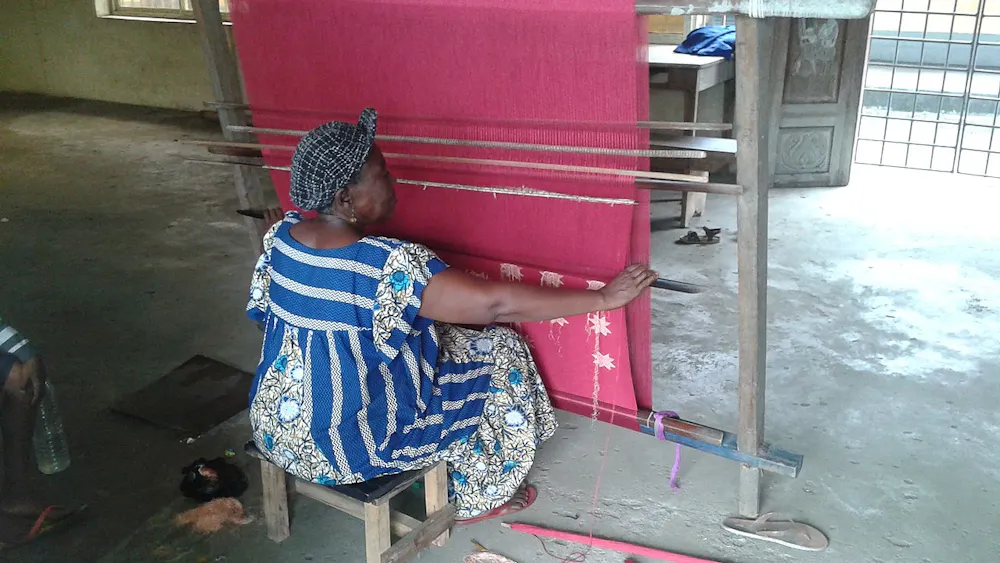
Local fabrics are hand-woven or dyed cloths and stem from various ethnic groups, like Aso oke or Akwete.
A woman handweaving Akwete cloth.Ekekeh Ubadire Obioma/Wikimedia Commons, CC BY-SA
Popular appropriated fabrics are Ankara (wax prints, originally from Indonesia), lace (a delicate, openwork fabric popular on traditional Nigerian attire) and George (a type of Madras cloth popular among Nigeria’s Igbos).
Before the 2000s, the use of these fabrics was at two ends of a spectrum. Indigenous cloth, lace and George were for social and cultural events. Ankara was for everyday functional clothes, iro (a wrap skirt) and buba (a three-piece traditional design for women, mostly the married or elderly), especially among low-income people.
The popularity of local fabrics in today’s fashion didn’t emerge from a vacuum. It was a choice by designers, a social process of acceptance, and government initiative.
Today’s designers are consciously using local fabrics as a way of endorsing their roots and normalising their use. Many faced rejection at first. Zena, a participant in my study, sold only two pieces of her clothing during her first year of business. She spent time convincing people “this is good”:
And, funny enough, they are easy to wear and not expensive. But it took a while for them to appreciate it.
Since the early 1990s the Nigerian government has been committed to promoting local fabrics and locally produced clothes. In 2017, it approved a Monday and Wednesday “Made-in-Nigeria Dress Days” policy.
While local fabrics are today the fabric trend in women’s clothing, the design trend is western. Designers use local fabrics in styles that have global appeal.
Still, they are conscious of maintaining authenticity through either the fabric, a silhouette or a design concept that resonates with their culture.
According to Eji, her western designs still have the African woman in mind:
The African woman is not only situated in Africa, but they are also all over the world. I believe the world is more cosmopolitan now, we have interracial marriages, we can borrow culture from everywhere, we can inter-weave stuff.
Women’s fashion mirrors Lagos society’s complexity and its openness to global trends, as it seeks to globalise its local elements.
It’s the opposite for men
Cosmopolitan men’s fashion in Lagos is the opposite of women’s. The fabric trend is western; the design trend is local.
In Lagos, most men wear the two or three-piece “native”. The buba and sokoto, for example, is for regular wear. (A traditional two-piece top and trouser, normally from the same fabric.) The agbada is for special events. (Trousers, a top and a loose-fitting, wide-sleeved robe over.)
Participants in my study explained that the ethnic background of the president, at any point in time, influences men’s fashion trends. Former president Muhammadu Buhari, for example, hails from the northern part of the country and popularised the wearing of the baba riga (a top, trousers and a big, embroidered over-cover) of the Hausa people.
Current president Bola Ahmed Tinubu extends the dominance of agbada fashion as he is Yoruba. Men’s fashion portrays a unified cultural front, emanating from the ruling president’s ethnic culture and adopted by most men irrespective of their ethnicity. This can allow for the inclusion of groups excluded from dominant national cultures.
This study shows Nigerian fashion’s openness to modernity, consciously implementing styles from different parts of the world. But this isn’t detached from the local. As forms of culture disappear (through cultural exchange) new forms are created, and they are created locally. This is ultimately a celebration of the cosmopolitan in Lagos fashion and society.
– Lagos fashion: how designers make global trends uniquely Nigerian – https://theconversation.com/lagos-fashion-how-designers-make-global-trends-uniquely-nigerian-254227
When India unleashed Operation Sindoor in May 2025, the world watched its advanced missiles, drones, and stealth assets. But one of the most decisive factors in the success of this coordinated military operation was invisible — orbiting silently above the subcontinent. That asset was NavIC, India’s indigenous satellite navigation system.
What is NavIC?
NavIC (Navigation with Indian Constellation), officially known as IRNSS (Indian Regional Navigation Satellite System), is India’s own satellite-based navigation system developed by ISRO. It provides accurate real-time positioning, navigation, and timing (PNT) information over India and up to 1,500 kilometers beyond its borders.
Unlike GPS (U.S.), GLONASS (Russia), Galileo (EU), or BeiDou (China), NavIC is controlled by India, providing full autonomy to armed forces even during global or regional conflicts. This is especially critical when access to foreign systems like GPS can be denied or degraded — as happened during the 1999 Kargil War.
NavIC Satellite Constellation
The NavIC system currently consists of 7 satellites in geostationary and geosynchronous orbits. They include:
• – IRNSS-1A to IRNSS-1G – Launched between 2013–2016
• – NVS-01 – Launched in May 2023, carrying an indigenous Rubidium atomic clock
• – NVS-02 to NVS-05 – Scheduled between 2025–2027 to upgrade and expand coverage
These satellites are equipped with dual-band signals (L5 and S-band). The L5 signal is encrypted for military use and is resistant to jamming and spoofing — critical in active combat zones.
How NavIC Powered Operation Sindoor
During the multi-day Operation Sindoor, India used NavIC across several layers of combat operations:
• – Missile Guidance: BrahMos, Pralay, and loitering munitions like Nagastra-1 used NavIC coordinates for precise targeting.
• – Drone Navigation: Swarm drones and long-range UAVs used NavIC for autonomous operations in jammed airspace.
• – Troop Movement: Army units and special forces tracked each other using encrypted NavIC handhelds for night raids and laser-guided artillery strikes.
• – Battle Damage Assessment: Integrated with RISAT radar satellites and Cartosat imaging, NavIC helped geolocate impact zones in real time.
By relying entirely on its own satellite infrastructure, India ensured that no foreign power could restrict or distort battlefield intelligence or targeting systems.
Strategic Advantages of NavIC
India’s use of NavIC during Operation Sindoor demonstrated several critical advantages:
• – Independence from U.S. GPS: India could strike deep without relying on any foreign-owned navigation signals.
• – Encrypted Military Channel: Prevented Pakistani jamming or spoofing during missile and drone missions.
• – Faster Signal Lock: NavIC provides higher accuracy over the Indian subcontinent than even GPS in some regions.
• – Tactical Depth: With NavIC’s expansion to include NVS-class satellites, India aims to cover the Indian Ocean Region more comprehensively.
Other Countries with Independent Navigation Systems
Only a few nations operate fully autonomous satellite navigation systems:
• – United States – GPS
• – Russia – GLONASS
• – European Union – Galileo
• – China – BeiDou
• – India – NavIC
India is the only country in the developing world to deploy such a system, putting it in an elite club of space-faring nations with independent military-grade navigation capabilities.
Looking Ahead
India plans to expand NavIC’s reach globally in the next phase, with 11 satellites forming a broader IRNSS constellation. This will allow Indian defense systems, aircraft, naval ships, and space platforms to remain connected under an unbreakable, encrypted web of real-time data.
From missile launchers to battlefield soldiers, NavIC ensured synchronization, survivability, and supremacy in Operation Sindoor — setting the tone for India’s future wars to be fought with precision on its own digital terrain.
Futuristic Vision: NavIC as India’s Digital Warfare Backbone
NavIC is more than a navigation system — it is a strategic pillar for India’s future military doctrine. As the Indian Armed Forces transition toward a digitally networked battlefield, NavIC will evolve into a real-time combat enabler across land, sea, air, and space.
India’s vision for NavIC includes:
• – Global Expansion: Upgrading NavIC into a global navigation constellation by 2030, with coverage from Africa to the Pacific.
• – Space Command Network: Serving as the digital backbone for India’s Defense Space Agency, ISR satellites, and kinetic space response units.
• – Manned-Unmanned Coordination: Enabling coordinated strikes using swarms of drones, robotic tanks, and autonomous aerial combat vehicles via a NavIC-based command network.
• – Civil-Military Synergy: Equipping civilian vehicles, aircraft, shipping, and emergency services with NavIC for disaster response, transport safety, and 5G integration.
In essence, NavIC will not just guide missiles — it will guide India’s journey to digital dominance in 21st-century warfare.
A one-off extra allowance, equal to one half of the monthly payment or allowance, will be provided to eligible recipients of social security payments, including recipients of the standard rate of Comprehensive Social Security Assistance, Old Age Allowance, Old Age Living Allowance and Disability Allowance, the Government announced today.
Similar arrangements will apply to households receiving the Working Family Allowance (WFA).
Starting today, the payment will be credited to the designated Hong Kong bank accounts of the eligible recipients/households. No separate application is required.
Recipients who were eligible for social security payments on April 30, 2025, as well as the households for which WFA applications were made within the period from October 1, 2024, to April 30, 2025, and approved, would be eligible for the extra allowance.
It is estimated that about 1.71 million social security recipients and about 56,000 WFA households would benefit, involving a total of about $3,084 million in extra expenditure.
For enquiries, recipients of social security payments may call 2343 2255 or contact the respective Social Security Field Unit.
For enquiries from households in receipt of the WFA, call 2558 3000.
This is a full-time fixed-term position based in either Manila, Bangkok, Jakarta or Kuala Lumpur. Candidates who have the legal right to work and live in the Philippines, Thailand, Indonesia and Malaysia are encouraged to apply.
Greenpeace Southeast Asia (GPSEA) takes bold, non-violent action to challenge power and create a more just, peaceful, and green future. Operating in complex and often high-risk environments, Greenpeace must ensure that our people, projects, and operations are safe, resilient, and empowered to push boundaries.
The Regional Security Manager, will lead the development and implementation of a strong security culture and systems across all GPSEA offices and projects. He/she will provide expert advice, tools, and support to enable safe and smart risk-taking in our campaigning and engagement work ensuring that security is not a barrier to impact, but an enabler of it. This role oversees the organization’s security strategy, policies, and protocols, while also managing critical incident systems and supporting frontline staff, volunteers, and activists. This will work closely with departments across the organization to integrate security into operations, HR, actions, and campaigns, and build regional capacity for resilience and preparedness. The Regional Security Manager will ensure that Greenpeace can operate effectively and ethically in Southeast Asia’s fast-changing political and environmental landscape.
Duties and Responsibilities:
Create an enabling Security Culture that continues to push boundaries, through regular staff updates, familiarization, training and integration.
Design and oversee a fit-for-purpose GPSEA Security System with approval processes.
Provide strategic advice on enhancing acceptance and resilience as a civil society actor, including the liaison with other NGOs
Policy and protocol development as related to safety, security, risk management and Duty of Care (employer responsibilities), including Standard Operating Procedures.
Arranging delivery of periodic and as-required security training.
Support and advice on the resolution of critical incident situations locally and regionally (on call).
Facilitate and strengthen our legal support system to ease smart risk taking, in line with GP Best Practices.
Other duties as directed by the line manager.
Close consultation with campaigns, actions and logistics, communications, fundraising and management staff on Smart Risk taking in projects.
Closely collaborate with all stakeholders to ensure Security integration into organizational processes and the GPSEA project model, from HR to Programmes.
Oversee and facilitate the regional security practitioners and build capacity to meet the need of the organization.
Closely collaborate with HR and Public Engagement and Actions to ensure GP Duty of Care Best Practices are in place for staff, contractors, volunteers and activists.
Manage the regional Security team adequately and ensure appropriate team capacity deployment projects.
Assist in the sign off and approval on campaign & communications materials, tactics and strategies that may influence security risk levels.
Liaise with Human Resources and Legal to ensure Greenpeace compliance with national legislation’s in Security, Health and Safety matters.
Liaison with GPI and other NROs on security management to ensure consistent best-practice across our global organization.
Manage security external contractors, including office security, specific project security and trainers.
Production, review and updating of all offices and projects standard operating procedures (SOPs).
Oversee and ensure the implementation of Security systems through monitoring, project integration and trainings.
Oversee, maintain and improve our Critical Incident Management Systems including a 24/7 hotline.
Coordinate Security and Safety induction process for new joiners across GPSEA with HR.
Responsibly manage the security budget and maintain secure filing system.
Advice and support project risk assessments, security and duty of care plans.
Oversight of incident reporting processes across the organization.
Maintain and further improve the travel security & monitoring system.
Advise on and ensure Site Security at our Greenpeace locations, in coordination with Administration
Provide up-to-date political, societal context analysis for our operating countries.
Overall budgetary responsibility and management of the finances for the Regional Security Unit.
Skills and Experience Requirements:
Bachelor’s Degree in field of Management or with security management background preferred.
Proven professional training in security management or a related field or comparable work experience/certification.
At least 3 years working in a non-profit, campaigning organization.
At least 3 years of supervisory/management experience.
At least 5 years of experience delivering security and emergency plans and risk analysis including: physical security management; crisis; occupational health and safety; field security; and travel.
Functional Skills:
Knowledge and/or experience in understanding of security and cultural issues in GPSEA operating countries.
Knowledge and/or experience in training, mentoring and developing staff on security issues.
Knowledge and/or experience in crisis management.
Knowledge and/or experience in developing and managing security and safety risk assessment.
Demonstrable understanding of security and risk management appropriate to the values and practices of Greenpeace.
Knowledge and/or experience in conducting security threat/risk/impact assessments and reporting.
Knowledge and/or experience in conducting security incident investigation and reporting.
Knowledge and/or experience in training personnel in general security protocols.
Strong skills in written and spoken English (required).
Knowledge and/or experience in planning, facilitating and conducting meetings or workshops.
Knowledge and/or experience in project management and administration.
Knowledge and/or experience in strategic alignment and setting the direction of unit’s project organizational objectives.
Knowledge and/or experience in budgeting and forecasting.
Organizational Competencies:
Professionalism: Knowledge and/or experience in managing conduct and emotions in a way that represents the values and realizes the objectives of the organization.
Strategic Thinking & Global Mindset: Knowledge and/or experience in addressing organizational objectives by developing calculated approaches that integrate an openness to and awareness of diversity across cultures.
Teamwork & Communication: Knowledge and/or experience in working with others and presenting information, ideas, and positions in a clear manner that can easily be understood across diverse and multi-cultural audiences.
Innovation & Change: Knowledge and/or experience in reflecting creative and imaginative thinking, an openness to new ideas, and an ability to take calculated risks in order to meet organizational objectives.
Leadership: Knowledge and/or experience in guiding and directing the efforts of others in pursuit of clear objectives, including delegating responsibilities and providing consistent support.
Specific Work Environment:
Good command in English is required.
Sensitive to the socio-economic cultural environment of Southeast Asia. This position requires the employee to have a flexible approach and the ability to adapt and work in different and challenging work and cultural environments, which may include flexible arrangements in working in challenging fields and work environments.
Greenpeace’s Commitment to Diversity and Inclusion
Greenpeace values diversity as essential to its mission and success. The organisation fosters an inclusive environment that respects varied cultural experiences and perspectives, promoting solutions rooted in social and environmental justice.
Source: People’s Republic of China – State Council News
The China Soong Ching Ling Foundation and Cathay Pacific jointly launched the Aviation Dream Youth Development Fund on May 23, 2025, aiming to support youth aviation education and facilitate cultural exchange between the Chinese mainland and Hong Kong.
Shen Beili, vice chair of the China Soong Ching Ling Foundation, delivers a speech at Soong Ching Ling’s former residence in Beijing, May 23, 2025. [Photo provided to China.org.cn]
Shen Beili, vice chairwoman of the China Soong Ching Ling Foundation (CSCLF), said the CSCLF continues to promote Soong Ching Ling’s legacy by launching numerous public welfare initiatives. The newly established Aviation Dream Youth Development Fund in Beijing aims to provide a new platform for young people in the mainland and Hong Kong, supporting their healthy development and fostering greater exchange and growth.
She added that the fund is designed to bring together young people from the mainland and Hong Kong, giving them opportunities to participate in hands-on projects, learn about China’s development, and build friendships. The goal is to promote cultural exchange, encourage national pride, and strengthen their sense of shared identity.
Zheng Jiaju, Chinese mainland director of Cathay Group, delivers a speech at Soong Ching Ling’s former residence in Beijing, May 23, 2025. [Photo provided to China.org.cn]
Zheng Jiaju, Chinese mainland director of Cathay Group, said Cathay Pacific is committed to corporate social responsibility by investing in youth development and cultural exchange, and by supporting society through civil aviation.
He added that Cathay Pacific will combine its strengths in aviation with the CSCLF’s expertise in youth development to create cross-regional, interdisciplinary platforms for young people from the mainland and Hong Kong, helping them pursue careers in aviation, deepen their cultural roots and reinforce their national identity.
A signing ceremony for the China Soong Ching Ling Foundation Cathay Pacific Aviation Dream Youth Development Fund is held at Soong Ching Ling’s former residence in Beijing, May 23, 2025. [Photo provided to China.org.cn]
Li Anjin, deputy secretary-general of the CSCLF, and Sun Yueyi, Chinese mainland general manager of Cathay Group, signed a donation agreement on behalf of both parties. Children from Beijing’s Haidian District Youth Activity Center and Shichahai Primary School performed songs and dances.
The ceremony was held at the former residence of Soong Ching Ling, a pioneering stateswoman who was named honorary president of the People’s Republic of China for her lifelong contributions to the nation.
The China Soong Ching Ling Foundation Cathay Pacific Aviation Dream Youth Development Fund is the first public welfare fund established by Cathay Pacific in partnership with the CSCLF on the mainland.
Source: People’s Republic of China – State Council News
SCIO briefs media on Yangtze River Economic Belt development in Hubei
China SCIO | May 26, 2025
The State Council Information Office (SCIO) recently organized a media trip for over 40 journalists to visit central China’s Hubei province and observe the progress of high-quality development along the Yangtze River Economic Belt. The group included foreign correspondents from the United States , France, Germany, Australia, Singapore, Indonesia, Iraq, Qatar, and Japan.
A press briefing was held Thursday during the trip, where Cheng Yongwen, vice governor of Hubei province, briefed the media and answered questions.
On May 22, 2025, the State Council Information Office holds a press briefing in Wuhan, Hubei province, about the high-quality development of the Yangtze River Economic Belt. [Photo by Liu Jian/China SCIO]
Prime Minister Narendra Modi on Monday extended heartfelt thanks to the people of Vadodara for the warm welcome he received during a vibrant morning roadshow in the city.
In a post on X, the Prime Minister said, “Thank you, Vadodara! Extremely delighted to be in this great city. It was a splendid roadshow and that too in the morning! Gratitude to all those who showered their blessings.”
The roadshow was held as part of PM Modi’s two-day visit to Gujarat, during which he is scheduled to inaugurate and lay the foundation stone for a series of infrastructure and development projects across the state.
During the roadshow, PM Modi was seen waving to enthusiastic citizens who lined the streets holding Indian flags and chanting patriotic slogans.
Among those present at the event were family members of Indian Army Officer Colonel Sofiya Qureshi, who had participated in media briefings during Operation Sindoor. They greeted the Prime Minister with flower petals as a gesture of appreciation.
In a display of international solidarity, a student from Zimbabwe, who is currently studying in Gujarat, also joined the celebrations. “We stand with India in the fight against terrorism. When terrorists attacked tourists, India targeted terrorist bases and not civilians. We support India,” the student said.
Later in the day, the Prime Minister is scheduled to travel to Dahod, where he will dedicate to the nation a locomotive manufacturing plant set up by Indian Railways. The plant will produce 9,000 HP electric locomotives for both domestic use and export. He will also flag off the first such locomotive built at the facility.
Additionally, PM Modi will inaugurate the Vande Bharat Express between Veraval and Ahmedabad, as well as an express train between Valsad and Dahod. He will also lay the foundation and dedicate various development projects worth approximately ₹24,000 crore in Dahod and address a public gathering.
The Prime Minister’s visit will continue with a stop in Bhuj, where he will launch and inaugurate development works exceeding ₹53,400 crore.
On May 27, PM Modi will travel to Gandhinagar to attend celebrations marking 20 years of Gujarat’s Urban Growth Story and to launch the Urban Development Year 2025. He is also scheduled to address a public gathering in the state capital.
Prime Minister Narendra Modi on Monday inaugurated a state-of-the-art Locomotive Manufacturing Plant of Indian Railways in Dahod, Gujarat, marking a key step in boosting the country’s railway infrastructure and freight capabilities. He also flagged off the first electric locomotive produced at the facility.
The Prime Minister was accompanied by Union Railway Minister Ashwini Vaishnaw and Gujarat Chief Minister Bhupendra Patel.
According to an official release from the Prime Minister’s Office (PMO), the Dahod plant has been established in line with PM Modi’s vision of enhancing connectivity and building world-class travel infrastructure. The facility is equipped to manufacture 9,000 HP electric locomotives for both domestic use and export.
These locomotives are expected to significantly increase Indian Railways’ freight loading capacity. They are also fitted with regenerative braking systems, which reduce energy consumption and contribute to environmental sustainability.
Following the inauguration, the Prime Minister is scheduled to lay the foundation stone and inaugurate various development projects worth over ₹24,000 crore in Dahod. These include key railway infrastructure works and multiple initiatives undertaken by the Government of Gujarat. He will also flag off two new train services—the Veraval–Ahmedabad Vande Bharat Express and the Valsad–Dahod Express.
PM Modi, who is on a two-day visit to Gujarat from May 26 to 27, earlier held a roadshow in Vadodara. He expressed gratitude to the people of the city for the warm welcome, describing the experience as “extremely delightful.”
“Thank you, Vadodara! Extremely delighted to be in this great city. It was a splendid roadshow and that too in the morning! Gratitude to all those who showered their blessings,” the Prime Minister posted on X.
During the roadshow, PM Modi greeted enthusiastic crowds lining the streets, waving back at people who welcomed him with Indian flags and patriotic chants. The atmosphere was festive, with flower petals being showered on the Prime Minister and patriotic songs playing in the background.
Family members of Indian Army Officer Colonel Sofiya Qureshi, who was part of media briefings during Operation Sindoor, were also present at the event and greeted the Prime Minister with flower petals.
Samsung, India’s largest consumer electronics brand, has inaugurated its first retail experience store in City Center on MG Road in Indore, further strengthening its premium retail presence across the country.
The store offers an immersive experience to customers with dedicated zones featuring the latest smartphones, tablets, laptops and SmartThings. Here, they can have a first-hand experience of how Samsung’s connected devices can transform their lifestyle into smarter and more convenient experiences.
Spread across 1000 square feet, the new store is designed to be a one-stop solution for consumers to experience Samsung’s cutting-edge innovation, connected ecosystem, and premium service centre all under one roof.
Strategically located in City Center, a vibrant educational hub in Indore known for its bustling youth demographic and growing tech adoption, the store aims to deliver emerging technologies and immersive technology experiences to next-gen consumers
As part of its commitment to customer satisfaction and digital upskilling, this new store will also witness Samsung’s signature ‘Learn @ Samsung’ initiative, following its success across other stores in India. This initiative will offer a range of workshops aimed at empowering consumers, particularly millennials and Gen Z with knowledge and skills to utilize cutting-edge technology. The sessions will cover themes such as AI-enabled photography, productivity, creativity and doodling, providing hands-on experiences with Galaxy devices to enhance user engagement.
“The launch of our first premium experience store in Indore is yet another significant milestone in Samsung’s journey. This expansion is part of Samsung’s broader mission to democratize access to innovation by bringing premium offerings to all. This new store reflects our larger commitment to expanding our premium retail presence and delivering a truly one-stop solution that unites innovation, engagement, and customer satisfaction under one roof,” said a Samsung India spokesperson.
To celebrate the launch, customers visiting the store can avail:
Free 30+ subscriptions across leading OTT, music, wellness, and infotainment platforms.
Exclusive discounts on 40+ brand gift cards and 25+ top deals from premium brands.
Buy 1 Get 1 Free buffet deals across 100+ premium restaurants across India.
Paytm First membership rewards, special travel savings on flights, and discounts at 14,000+ restaurants nationwide.
In addition, the store features Samsung Store+, an intuitive digital platform that allows in-store shoppers to access detailed product information and opt for home delivery. A dedicated service centre has also been integrated within the store premises to further boost post-purchase support.
Asia Pacific Report editor David Robie was honoured with Member of the New Zealand Order of Merit (MNZM) at the weekend by the Governor-General, Dame Cindy Kiro, in an investiture ceremony at Government House Tāmaki Makaurau.
He was one of eight recipients for various honours, which included Joycelyn Armstrong, who was presented with Companion of the King’s Service Order (KSO) for services to interfaith communities.
Dr Robie’s award, which came in the King’s Birthday Honours in 2024 but was presented on Saturday, was for “services to journalism and Asia-Pacific media education”.
Dr David Robie has contributed to journalism in New Zealand and the Asia-Pacific region for more than 50 years.
Dr Robie began his career with The Dominion in 1965 and worked as an international journalist and correspondent for agencies from Johannesburg to Paris. He has won several journalism awards, including the 1985 Media Peace Prize for his coverage of the Rainbow Warrior bombing.
He was Head of Journalism at the University of Papua New Guinea from 1993 to 1997 and the University of the South Pacific in Suva from 1998 to 2002. He founded the Pacific Media Centre in 2007 while professor of journalism and communications at Auckland University of Technology.
He developed four award-winning community publications as student training outlets. He pioneered special internships for Pacific students in partnership with media and the University of the South Pacific. He has organised scholarships with the Asia New Zealand Foundation for student journalists to China, Indonesia and the Philippines.
He was founding editor of Pacific Journalism Review journal in 1994 and in 1996 he established the Pacific Media Watch, working as convenor with students to campaign for media freedom in the Pacific.
He has authored 10 books on Asia-Pacific media and politics. Dr Robie co-founded and is deputy chair of the Asia Pacific Media Network/Te Koakoa NGO.
The investiture ceremony on 24 May 2025. Video: Office of the Governor-General
In an interview with Global Voices last year, Dr Robie praised the support from colleagues and students and said:
“There should be more international reporting about the “hidden stories” of the Pacific such as the unresolved decolonisation issues — Kanaky New Caledonia, “French” Polynesia (Mā’ohi Nui), both from France; and West Papua from Indonesia.
“West Papua, in particular, is virtually ignored by Western media in spite of the ongoing serious human rights violations. This is unconscionable.”
Headline: Huawei ICT Competition 2024–2025: AI Empowers Education and Talent Growth
[Shenzhen, China, May 26, 2025] On May 24, the Closing & Awards Ceremony of the Huawei ICT Competition 2024–2025 Global Final took place in Shenzhen. In its 9th edition, the event has reached a record-breaking scale, attracting over 210,000 students and instructors from more than 2,000 colleges and universities in over 100 countries and regions. Following national and regional competitions, 179 teams from 48 countries and regions made it to the Global Final.
Through intense competition across three major tracks (Practice, Innovation, and Programming), top honors were awarded to 18 outstanding teams from 9 countries: Algeria, Brazil, China, Morocco, Nigeria, Philippines, Serbia, Singapore, and Tanzania.
To recognize outstanding contributions beyond technical excellence, the competition also presented special honors. The Women in Tech Award was granted to four all-female teams from Brazil, Saudi Arabia, Germany, and Kenya. The Green Development Award went to a team from Ghana. The Most Valuable Instructor Award recognized 18 distinguished instructors from 10 countries – Algeria, Bangladesh, Brazil, China, Egypt, Hungary, Indonesia, Iraq, Nigeria, and Türkiye – for their contributions to ICT education.
Huawei ICT Competition 2024–2025 Global Final Closing & Awards Ceremony
In his opening speech, Ritchie Peng, Director of the ICT Strategy & Business Development Dept at Huawei, said: “To achieve the goal of learning through competition and inspiring innovation through competition, we have continuously evolved the design of competition topics. The Practice Competition aligns with our vision for an Intelligent World 2030 and encourages students to master cloud computing, big data, and AI to drive social progress. The Innovation Competition focuses on green development and digital inclusion, motivating participants to solve real-world challenges in sectors like agriculture, healthcare, and education through ICT.”
Ritchie Peng Delivering the Opening Speech at the Closing & Awards Ceremony
As digital transformation accelerates globally, demand for skilled professionals in fields such as AI, big data, and cybersecurity continues to grow. However, the shortage of talent in these critical areas is becoming increasingly evident. To help tackle this challenge, the Huawei ICT Competition features multiple tracks — notably Practice, Innovation, and Programming — alongside initiatives such as industry-academia collaboration and tailored curriculum development. These efforts aim to equip students with in-demand skills and foster the next-generation tech talent who will stand out in an increasingly intelligent and digital world.
During this year’s competition, Huawei also hosted the AI Accelerating Education Transformation Summit, where experts explored the pivotal role of AI in smart education. In addition, Huawei officially announced the AI Capability of the Huawei ICT Academy Intelligent Platform, making it easier and more efficient for educators and students to use. This marks another step forward in advancing educational digitalization.
For more details about the Huawei ICT Competition, visit us at https://www.huawei.com/minisite/ict-competition-2024-2025-global/en/index.html.
DUBAI, United Arab Emirates, May 26, 2025 (GLOBE NEWSWIRE) — Bitget, the leading cryptocurrency exchange and Web3 company, brought the heat to Token2049 with an exclusive ringside experience at Karate Combat KC54 in Dubai on May 2nd. Think high-octane strikes, VIP treatment, and a night so wild, even the blockchain felt the impact.
This year, Bitget raised the stakes by offering a premium experience that put crypto enthusiasts right at the heart of the action. Bitget’s esteemed VIPs witnessed world-class fighters trade blows while enjoying gourmet food and premium beverages in an exclusive VIP section reserved just for Bitget’s key opinion leaders and special guests.
With a crowd of 4,000-5,000 roaring fight fans, the energy in Dubai’s premier venue was electric. Bitget COO Vugar Usi Zade perfectly captured the spirit of the event: “Crypto trading and combat sports demand the same qualities—quick reflexes, strategic thinking, and nerves of steel. We’re thrilled to give our community this exclusive opportunity to experience world-class competition up close. Whether you’re analyzing charts or analyzing fight techniques, this is where champions are made.”
Robert Bryan, CEO of Karate Combat, remarked, “KC54 marked a significant milestone in our journey, and having Bitget as a sponsor amplified our commitment to innovation in combat sports. Their support helped us deliver an unforgettable experience that blended tradition with cutting-edge technology.
Asim Zaidi, President of Karate Combat, also added, “Partnering with Bitget for KC54 was a game-changer. Their involvement not only elevated the event’s profile but also underscored the synergy between martial arts and the evolving digital landscape.”
The event marked another strategic partnership for Bitget in the combat sports world, following their successful collaborations with professional combat athletes such as Wrestling World Champion, Buse Tosun Çavuşoğlu, and Boxing Gold MedalistSamet Gümüş (Boxing). By creating these exclusive live experiences, Bitget continues to build meaningful connections between the crypto community and high-profile sporting events.
Jyotsna Hirdyani, Bitget’s South Asia head, who orchestrated the event, shared insights. “This is the future. From blockchain to sports, crypto is changing the game forever. This is what happens when sports & entertainment meet blockchain technology. It’s a cultural shift where you will see more & more cross-plays of sports x crypto, the ultimate cross-over.”
This partnership underscores Bitget’s commitment to delivering unique, high-value experiences to its community. Just as in trading, timing is everything, and May 2nd in Dubai was when crypto met combat in what turned out to be an unforgettable showdown. Bitget’s focus remains on creating tangible value for the crypto community beyond digital interfaces.
About Bitget
Established in 2018, Bitget is the world’s leading cryptocurrency exchange and Web3 company. Serving over 100 million users in 150+ countries and regions, the Bitget exchange is committed to helping users trade smarter with its pioneering copy trading feature and other trading solutions, while offering real-time access to Bitcoin price, Ethereum price, and other cryptocurrency prices. Formerly known as BitKeep, Bitget Wallet is a world-class multi-chain crypto wallet that offers an array of comprehensive Web3 solutions and features including wallet functionality, token swap, NFT Marketplace, DApp browser, and more.
Bitget is at the forefront of driving crypto adoption through strategic partnerships, such as its role as the Official Crypto Partner of the World’s Top Football League, LALIGA, in EASTERN, SEA and LATAM markets, as well as a global partner of Turkish National athletes Buse Tosun Çavuşoğlu (Wrestling world champion), Samet Gümüş (Boxing gold medalist) and İlkin Aydın (Volleyball national team), to inspire the global community to embrace the future of cryptocurrency.
Risk Warning:Digital asset prices are subject to fluctuation and may experience significant volatility. Investors are advised to only allocate funds they can afford to lose. The value of any investment may be impacted, and there is a possibility that financial objectives may not be met, nor the principal investment recovered. Independent financial advice should always be sought, and personal financial experience and standing carefully considered. Past performance is not a reliable indicator of future results. Bitget accepts no liability for any potential losses incurred. Nothing contained herein should be construed as financial advice. For further information, please refer to ourTerms of Use.
About Karate
Karate Combat is the world’s premier full-contact karate league, renowned for its innovative approach to combat sports entertainment. Known for its distinctive, fast-paced fighting style – essentially MMA without ground fighting, Karate Combat delivers high-energy bouts, with nearly half ending in knockouts. With over 7 million followers, hundreds of millions of views monthly, and over 100,000 active app users, Karate Combat is at the forefront of blending sports, technology community-driven experiences.
Photos accompanying this announcement are available at
Source: People’s Republic of China – State Council News
Despite a gold-laden campaign at the world championships, China’s once invincible national table tennis team has left the prestigious tournament in Doha, Qatar, with alarm bells ringing for its Olympic ambitions.
Winning four of the five events at the world championships finals, it seemed like business as usual for China’s table tennis squad to have proved its mighty prowess again in the Qatari capital. However, the surging challenge from the rest of the world, underlined by the squad’s early exit in men’s doubles, has triggered a sense of urgency for the celebrated program.
Table tennis ace Wang Chuqin competes in the men’s singles final at the World Table Tennis Championship in Doha, Qatar, on Sunday. Wang beat Brazil’s Hugo Calderano 4-1 to add another gold to his collection. XIAO YIJIU/XINHUA
The men’s doubles final, the first event on Sunday, proceeded without a Chinese pair for the first time in 50 years, with two Chinese teams eliminated in the quarterfinals. Japan’s Hiroto Shinozuka and Shunsuke Togami won the final after beating Chinese Taipei’s Kao Cheng-jui and Lin Yun-ju 3-2 in the best-of-five format.
Women’s World No 1 Sun Yingsha and men’s World No 2 Wang Chuqin, both from China, then held court at the Lusail Sports Arena, delivering in top form to each claim a singles title, adding to their golden harvest after bagging the mixed doubles title together on Saturday.
“It felt like a huge burden relieved in my heart,” Wang said after beating Brazil’s reigning World Cup winner Hugo Calderano 4-1 in the best-of-seven final to win his first world championship singles gold medal.
“It was a tough battle and I am so happy to pull it off, driven by the pride representing my country and the team,” said Wang, who also successfully avenged his semifinal loss to the same opponent at the Macao World Cup last month.
The recent surge of Calderano, dubbed by fans as the “Thrill from Brazil”, saw the world No 3 edge out Chinese players at major events two times in a row after he beat world No 5 Liang Jingkun with a gripping semifinal win on Saturday to set up a clash with Wang. Calderano’s meteoric rise has pushed Team China’s best to dig harder and stay more cautious in future events.
“To face him again, I tried to position myself as a challenger. He’s definitely a big threat for us in future tournaments,” Wang said after helping China collect its 11th consecutive men’s singles title at the worlds.
In the women’s singles final, Sun retained her crown by outplaying teammate and 2021 singles world champion Wang Manyu 4-3 in a seesaw battle.
It was also the 16th consecutive women’s singles final at the world championships to feature two Chinese finalists since 1995, serving as testament to the program’s dominance in this event.
After a break during the men’s singles final, Wang Manyu suited up again in the women’s doubles final with partner Kuai Man and ended her Doha outing with a gold, after the world No 2 Chinese pair routed the Austria-Romania duo of Sofia Polcanova and Bernadette Szocs 3-0 in less than 22 minutes to cap off Team China’s campaign in style.
Team China’s apparent decline of dominance on the men’s side, measured by its own standards, at the world championships has raised concerns over its prospects for the 2028 Olympic Games in Los Angeles, where the two team events have been replaced by men’s and women’s doubles on the Games’ program.
The adjustment is expected to pose a tougher threat for China’s ambition of a clean sweep of all golds at LA 2028, where international contenders are more competitive in doubles than in team events.
“We are definitely facing much more pressure now following the change in the Olympic program. The world is ready to go harder at us, and we should be prepared better as well,” newly elected Chinese Table Tennis Association president Wang Liqin told Xinhua News Agency after taking office last month.
Secretary-General of ASEAN, Dr. Kao Kim Hourn, today participated in the Retreat Session of the 46th ASEAN Summit, at the Kuala Lumpur Convention Centre in Malaysia. In this closed-door session, ASEAN Leaders exchanged views on pressing regional and global developments, reaffirming ASEAN’s unity, Centrality and shared commitment to addressing challenges.
The post Secretary-General of ASEAN joins ASEAN Leaders in the Retreat Session of the 46th ASEAN Summit in Kuala Lumpur, Malaysia appeared first on ASEAN Main Portal.
Secretary-General of ASEAN, Dr. Kao Kim Hourn, participated in the ASEAN Leaders’ Interface with Representatives of the ASEAN Inter-Parliamentary Assembly (AIPA) today, held on the sidelines of the 46th ASEAN Summit in Kuala Lumpur, Malaysia. The Interface, led by the Chair of ASEAN in 2025, Prime Minister Dato’ Seri Anwar Ibrahim of Malaysia, and AIPA President and Speaker of the Parliament of Malaysia YB Tan Sri Dato’ (Dr.) Johari bin Abdul, highlighted the important role of AIPA in supporting ASEAN’s efforts in achieving its Community Vision
The post Secretary-General of ASEAN join ASEAN Leaders in the Interface with Representatives of the ASEAN Inter-Parliamentary Assembly appeared first on ASEAN Main Portal.
Secretary-General of ASEAN, Dr. Kao Kim Hourn, today participated in the Retreat Session of the 46th ASEAN Summit, at the Kuala Lumpur Convention Centre in Malaysia. In this closed-door session, ASEAN Leaders exchanged views on pressing regional and global developments, reaffirming ASEAN’s unity, Centrality and shared commitment to addressing challenges.
The post Secretary-General of ASEAN joins ASEAN Leaders in the Retreat Session of the 46th ASEAN Summit in Kuala Lumpur, Malaysia appeared first on ASEAN Main Portal.
Secretary-General of ASEAN, Dr. Kao Kim Hourn, participated in the ASEAN Leaders’ Interface with Representatives of the ASEAN Inter-Parliamentary Assembly (AIPA) today, held on the sidelines of the 46th ASEAN Summit in Kuala Lumpur, Malaysia. The Interface, led by the Chair of ASEAN in 2025, Prime Minister Dato’ Seri Anwar Ibrahim of Malaysia, and AIPA President and Speaker of the Parliament of Malaysia YB Tan Sri Dato’ (Dr.) Johari bin Abdul, highlighted the important role of AIPA in supporting ASEAN’s efforts in achieving its Community Vision
The post Secretary-General of ASEAN join ASEAN Leaders in the Interface with Representatives of the ASEAN Inter-Parliamentary Assembly appeared first on ASEAN Main Portal.
Guyana’s Prime Minister Mark Anthony Phillips and Vice President Bharrat Jagdeo on Monday extended strong support for India’s stance against terrorism during a meeting with an all-party Indian parliamentary delegation led by Congress MP Shashi Tharoor in Berbice.
The visit comes in the wake of India’s Operation Sindoor and the terror attack in Pahalgam. Both leaders condemned terrorism unequivocally, reaffirming Guyana’s long-standing ties with India.
“There is a very good relationship between India and Guyana. Forty per cent of Guyana’s population is of Indian origin, and we share a relationship that spans over 150 years,” said Phillips. “Guyana condemns all acts of terrorism. We believe in peaceful coexistence and the observance of the rule of law.”
He also welcomed Indian investments and stressed the importance of people-to-people contact in deepening bilateral ties.
Vice President Bharrat Jagdeo echoed Phillips’ sentiments during his meeting with the delegation.
“Guyana stands unequivocally with India. We are against terrorism in all its forms and believe perpetrators must be brought to justice,” Jagdeo said, adding that Guyana is keen to explore development collaborations with India in areas such as infrastructure, fintech, and agriculture.
In a post on X, Shashi Tharoor noted that the delegation’s talks with Jagdeo extended beyond terrorism to encompass Guyana’s economic growth, development plans following the discovery of oil and gas, and the vast opportunities available to Indian companies.
“Our conversation also spanned a range of topics relating to Guyana’s record-breaking 30% annual economic growth and development plans following the discovery of oil and gas. A large number of opportunities for Indian companies were mentioned, in sectors ranging from agriculture to telecoms, banking and highway development. Guyana is also experiencing labour shortages and would welcome Indian labour as well,” Tharoor wrote.
BJP MP Tejasvi Surya, also part of the delegation, highlighted the strengthening economic engagement between India and Guyana, especially in infrastructure and energy sectors.
“Many Indian companies are working in Guyana, employing thousands. We also met with representatives of many spiritual organisations like the Art Of Living, ISKCON and the Bramhakumaris. They serve as the spiritual and cultural anchor for the Indian community here,” Surya wrote on X.
“Our delegation met with the Vice President of Guyana H.E. Bharrat Jagdeo and spoke to him on a wide range of issues, including India’s fight against terrorism. Mr. Jagdeo has served for 12 years as the President of Guyana and is one of the most respected leaders of the country. He was unequivocal in his condemnation of the Pahalgam attack and fully supported Operation Sindoor. VP also conveyed his keen interest in collaboration with India on key development projects in areas of infrastructure, energy, fin tech and agriculture. With Guyana finding new oil reserves and growing at a rapid pace of 30%, the opportunities for Indian businesses are immense,” he added.
The all-party delegation includes MPs from across the political spectrum: Shambhavi Chaudhary (Lok Janshakti Party), Sarfaraz Ahmed (Jharkhand Mukti Morcha), G M Harish Balayogi (Telugu Desam Party), Shashank Mani Tripathi, Bhubaneswar K Lata (BJP), Mallikarjun Devda (Shiv Sena), and Taranjit Singh Sandhu, former Indian Ambassador to the U.S.
The MPs also engaged with the Indian diaspora in Guyana, who voiced strong support for India’s efforts to counter cross-border terrorism and commended the government’s response.
Source: Hong Kong Government special administrative region
External merchandise trade statistics for April 2025 In April 2025, the value of total exports of goods increased by 14.7% over a year earlier to $434.5 billion, after a year-on-year increase by 18.5% in March 2025. Concurrently, the value of imports of goods increased by 15.8% over a year earlier to $450.5 billion in April 2025, after a year-on-year increase by 16.6% in March 2025. A visible trade deficit of $16.0 billion, equivalent to 3.6% of the value of imports of goods, was recorded in April 2025.
For the first four months of 2025 as a whole, the value of total exports of goods increased by 11.9% over the same period in 2024. Concurrently, the value of imports of goods increased by 11.4%. A visible trade deficit of $96.9 billion, equivalent to 5.7% of the value of imports of goods, was recorded in the first four months of 2025.
Comparing the three-month period ending April 2025 with the preceding three months on a seasonally adjusted basis, the value of total exports of goods increased by 13.8%. Meanwhile, the value of imports of goods increased by 12.6%.
Analysis by country/territory
Comparing April 2025 with April 2024, total exports to Asia as a whole grew by 20.8%. In this region, increases were registered in the values of total exports to some major destinations, in particular Malaysia (+61.5%), Vietnam (+48.3%), Taiwan (+24.1%), the mainland of China (the Mainland) (+23.0%) and India (+22.5%). On the other hand, a decrease was recorded in the value of total exports to Korea (-26.7%).
Apart from destinations in Asia, decreases were registered in the values of total exports to some major destinations in other regions, in particular the Netherlands (-38.4%) and the United Kingdom (-24.1%). On the other hand, an increase was recorded in the value of total exports to Germany (+30.8%).
Over the same period of comparison, increases were registered in the values of imports from most major suppliers, in particular Vietnam (+107.3%), the United Kingdom (+59.5%), Taiwan (+50.6%) and the Mainland (+14.8%). On the other hand, a decrease was recorded in the value of imports from Korea (-21.3%).
For the first four months of 2025 as a whole, increases were registered in the values of total exports to some major destinations, in particular Vietnam (+63.7%), Taiwan (+36.3%) and the Mainland (+18.1%). On the other hand, a decrease was recorded in the value of total exports to the United Arab Emirates (-28.6%).
Over the same period of comparison, increases were registered in the values of imports from some major suppliers, in particular Vietnam (+78.9%), the United Kingdom (+57.9%), Taiwan (+53.1%), Malaysia (+35.8%) and the Mainland (+6.9%). On the other hand, a decrease was recorded in the value of imports from Korea (-23.0%).
Analysis by major commodity
Comparing April 2025 with April 2024, increases were registered in the values of total exports of some principal commodity divisions, in particular “electrical machinery, apparatus and appliances, and electrical parts thereof” (by $33.5 billion or +18.7%) and “office machines and automatic data processing machines” (by $19.5 billion or +46.0%).
Over the same period of comparison, increases were registered in the values of imports of some principal commodity divisions, in particular “electrical machinery, apparatus and appliances, and electrical parts thereof” (by $29.9 billion or +16.8%) and “office machines and automatic data processing machines” (by $19.5 billion or +67.1%).
For the first four months of 2025 as a whole, increases were registered in the values of total exports of some principal commodity divisions, in particular “office machines and automatic data processing machines” (by $106.2 billion or +72.1%) and “electrical machinery, apparatus and appliances, and electrical parts thereof” (by $76.4 billion or +11.2%).
Over the same period of comparison, increases were registered in the values of imports of some principal commodity divisions, in particular “office machines and automatic data processing machines” (by $94.2 billion or +84.7%) and “electrical machinery, apparatus and appliances, and electrical parts thereof” (by $82.4 billion or +12.3%).
Commentary
A Government spokesman said that the value of merchandise exports grew visibly by 14.7% in April over a year earlier. Exports to the Mainland and many other Asian markets grew visibly. Exports to the United States rose marginally, while exports to the European Union fell.
Looking ahead, as international trade tensions have eased somewhat of late, the headwinds and uncertainties in the external environment have lessened to some extent. The sustained steady growth in the Mainland economy, together with Hong Kong’s proactive efforts in enhancing economic and trade ties with different markets, should help buttress trade performance. The Government will continue to closely monitor changes in the external environment and stay vigilant to the potential impacts brought about by shifts in trade policies.
Further information
Table 1 presents the analysis of external merchandise trade statistics for April 2025. Table 2 presents the original monthly trade statistics from January 2022 to April 2025, and Table 3 gives the seasonally adjusted series for the same period.
The values of total exports of goods to 10 main destinations for April 2025 are shown in Table 4, whereas the values of imports of goods from 10 main suppliers are given in Table 5.
Tables 6 and 7 show the values of total exports and imports of 10 principal commodity divisions for April 2025.
All the merchandise trade statistics described here are measured at current prices and no account has been taken of changes in prices between the periods of comparison. A separate analysis of the volume and price movements of external merchandise trade for April 2025 will be released in mid-June 2025.
Prime Minister Narendra Modi on Monday inaugurated and laid the foundation stones for a series of development projects in Dahod, Gujarat, collectively valued at ₹24,000 crore.
The projects include critical railway infrastructure and several initiatives under the Gujarat government’s broader development agenda.
Among the key announcements, PM Modi flagged off the Vande Bharat Express connecting Veraval and Ahmedabad, as well as a new express train linking Valsad and Dahod—moves expected to significantly enhance regional rail connectivity.
Reflecting on his journey in office, PM Modi recalled May 26, 2014—the day he first assumed the role of Prime Minister.
“In these years, I have dedicated myself to the nation. Decades-old shackles have been broken. The country has taken decisions that were once unimaginable and unprecedented. We have progressed across every sector,” he said.
Highlighting India’s push toward self-reliance, he said, “Today, 140 crore citizens are working tirelessly to make India a Viksit Bharat. The demand of the times is that everything essential to national progress be manufactured in India.”
He added, “India is rapidly advancing in manufacturing—whether producing goods for domestic needs or exporting ‘Made in India’ products globally, this momentum is strong and consistent.”
The Prime Minister also emphasized India’s technological advancements. “Today, India not only manufactures the necessary technology for rail and metro systems but also exports it. Our Dahod is living proof of this progress.”
Referring to the newly inaugurated electric locomotive manufacturing facility in Dahod, PM Modi said, “Three years ago, I laid the foundation stone. Some mocked it, calling it an election stunt. But today, we see the first electric locomotive manufactured and ready.”
Earlier, he inaugurated the Loco Manufacturing Shop–Rolling Stock Workshop and flagged off the first electric locomotive produced at the facility, marking a major milestone for Indian Railways.
Built at an investment of ₹20,000 crore, the Dahod locomotive manufacturing unit is now operational, just three years after its foundation was laid in 2022. The facility is designed to produce 120 electric locomotives annually, scalable up to 150 units depending on future demand.
Under a Public-Private Partnership (PPP) model, Indian Railways plans to manufacture 1,200 electric locomotives at this facility over the next decade. Each 9,000-HP locomotive, aligned with the ‘Make in India’ and ‘Atmanirbhar Bharat’ initiatives, will bear the tag ‘Manufactured in Dahod’. These high-powered engines can haul up to 4,600 tonnes of cargo and are intended for both domestic use and export.
The Prime Minister will next travel to Bhuj to launch additional development projects worth over ₹53,400 crore. These include initiatives in Kandla Port, solar energy, power transmission, and road infrastructure.
He will also unveil four drinking water supply schemes costing ₹181 crore, aimed at benefiting 4.62 lakh residents across 193 villages and one town in the Mahisagar and Dahod districts.
PM Modi will also distribute cheques worth ₹3,300 crore to urban local bodies under the Swarnim Jayanti Mukhyamantri Shaheri Vikas Yojana.
Source: People’s Republic of China in Russian – People’s Republic of China in Russian –
Source: People’s Republic of China – State Council News
PYONGYANG, May 26 (Xinhua) — Law enforcement agencies in the Democratic People’s Republic of Korea (DPRK) have detained a senior official who is largely responsible for the recent failed launch of a warship, the official Korean Central News Agency (KCNA) reported Monday.
Based on the findings so far from the accident investigation team, law enforcement agencies have summoned and detained Lee Hyun-sung, deputy head of the Military Industry Department of the Workers’ Party of Korea (WPK) Central Committee, who is “largely responsible for the serious accident,” KCNA said in a statement.
The investigation team into the incident informed the WPK Central Military Commission of its progress on Sunday, KCNA reported.
“At the site where the accident occurred during the launch of the destroyer, work is actively underway to fully restore the balance of the warship under the technical guidance of a group of experts in accordance with its schedule,” the statement said.
Authorities have launched a full-scale investigation after the newly built 5,000-ton destroyer lost balance, capsized and lay on its side in the water while being launched at the Chongjin shipyard on Wednesday. Authorities had previously detained three people over the incident, KCNA reported. –0–
Some 2.1 million Gazans are facing critical hunger levels, with many at risk of famine following Israel’s 11-week blockade on aid intended to pressure Hamas.
However, Israel is controversially planning to transfer responsibility for distributing aid in Gaza through a new system that would sideline the UN and other aid agencies that have been working there for decades.
In a joint statement, two dozen countries, including the UK, many European Union member states, Australia, Canada and Japan, have supported the UN’s position on the new model. The signatories said it won’t deliver aid effectively at the scale required, and would link aid to political and military objectives.
The UK, Canada and France have further threatened to take “concrete actions” to pressure Israel to cease its military offence and lift restrictions on aid.
And in another blow to the credibility of the new system, the head of the newly established Gaza Humanitarian Foundation, which will oversee the distribution of aid, resigned on Monday. He cited concerns over a lack of adherence to “humanitarian principles”.
So, how will would this new aid delivery system work, and why is it so problematic?
A military-led system with deep flaws
Israel has relied on unsubstantiated claims of large-scale aid diversion by Hamas to justify taking control over aid delivery in Gaza. The UN and its humanitarian partners continue to refute such claims, publicly sharing details of their end-to-end monitoring systems.
Several reportshave revealed the plan would establish four secure distribution sites for aid under Israeli military control in southern and central Gaza.
Security would be provided by private military contractors, such as Safe Reach Solutions, run by a former CIA officer, while the Gaza Humanitarian Foundation would oversee the distribution of food.
There is little clarity beyond this on who is behind the new system and who is funding it.
The initiative has provoked strong reactions from the UN and the wider humanitarian aid system.
Senior aid officials have underlined the fact the international aid system cannot support a military-led initiative that would breach international law and be incompatible with humanitarian principles of neutrality, impartiality and independence.
There are also concerns the four distribution hubs would require individuals to travel long distances to collect and carry heavy packages. This could leave female-headed households, people with disabilities, those who are ill and the elderly at greater risk of exclusion and exploitation.
In addition, a leaked UN memo reportedly expressed concern over UN involvement in the initiative, saying the organisation could be “implicated in delivering a system that falls short of Israel’s legal responsibilities as an occupying power”.
There are further concerns the UN could be implicated in atrocity crimes, including a risk of genocide through its participation in the system, setting a dangerous precedent for future crises.
Tom Fletcher, the UN relief chief, has called the plan “a deliberate distraction” and “a fig leaf for further violence and displacement”.
And famine expert Alex de Waal claims Israel has “taken a page from the colonial war handbooks” in weaponising food aid in pursuit of military victory.
He argues the planned quantities of food aid will be insufficient and lack the specialised feeding necessary for malnourished children, in addition to clean water and electricity.
What has not been stated but can be implied from the strong resistance to the new system lacking humanitarian expertise: the lack of good faith on Israel’s part. The Israeli government continues to pursue an elusive military victory at the expense of the rules and norms intended to preserve humanity in war.
Wider pattern of behaviour
The UN’s rebuke of the plan should be interpreted through a wider pattern of Israeli government behaviour undermining the international aid system and its role in upholding respect for humanitarian principles.
These fundamental principles include respect for humanity, neutrality, impartiality and operational independence. As the joint statement by 24 nations on aid to Gaza this month said:
Humanitarian principles matter for every conflict around the world and should be applied consistently in every war zone.
International humanitarian law requires member states to respect – and ensure respect – for the rules of war. This includes taking all feasible measures to influence the parties engaged in a conflict to respect humanitarian law.
As Fletcher, the UN relief chief, reminded the UN Security Council earlier this month, this hasn’t been done in past cases of large-scale violations of international human rights, such as in Srebrenica (in the former Yugoslavia) and Rwanda.
He said reviews of the UN’s conduct in cases like these
[…] pointed to our collective failure to speak to the scale of violations while they were committed.
While humanitarians are best placed to deliver aid, greater collective political action is what’s needed. Pressure now falls on all UN member states use their levers of influence to protect civilians and prevent the further weaponisation of aid at this critical time.
Amra Lee does not work for, consult, own shares in or receive funding from any company or organisation that would benefit from this article, and has disclosed no relevant affiliations beyond their academic appointment.
Source: United Nations Economic Commission for Europe
Uzbekistan has taken a significant step toward strengthening its role as a central trade hub in Central Asia with the launch of its National Trade Facilitation Roadmap 2025–2030, developed in collaboration with the United Nations Economic Commission for Europe (UNECE).
The roadmap was officially launched last week in Tashkent during the meeting of the National Trade Facilitation Committee, chaired by Aziz Urunov, Special Representative of the President of Uzbekistan on World Trade Organization (WTO) issues and Chief Negotiator. The UNECE presented the roadmap at the meeting, which brought together representatives from the Ministry of Investment, Industry and Trade, Ministry of Transport, State Customs Committee of Uzbekistan and other relevant officials, as well as the private sector representatives. Donor agencies also came together to coordinate efforts in implementing the measures of the roadmap.
Developed using UNECE’s methodology, using an assessment of the country’s readiness to implement the WTO Trade Facilitation Agreement (TFA) done by UNECE and Uzbekistan experts and a draft study on the regulatory and procedural barriers to trade, the roadmap is aligned with the United Nations Special Programme for the Economies of Central Asia (SPECA), particularly its Trade Facilitation Strategy and Principles for Sustainable Trade. The roadmap distinguishes between two sets of objectives and categorization of the WTO trade facilitation measures: the readiness of Uzbekistan on the binding TFA measures and a broader set of objectives, which reflect the country’s long-term objective for profound trade facilitation reforms, making it one of the most dynamic economies today. The implementation of the binding measures is almost complete and will allow the country to accede to the WTO at the next WTO Ministerial Conference in 2026.
The roadmap sets out clear priorities to achieve this vision:
As a double Landlocked Developing Country (LLDC), Uzbekistan faces inherent challenges such as dependency on transit countries, high trade costs, and infrastructure bottlenecks. These challenges make trade facilitation and regional connectivity critical areas for reform.
UNECE plays a key role in advancing these efforts through its norms, standards and policy recommendations — particularly the UN/CEFACT package of standards and ongoing work on enhancing digital connectivity — which enable the digitalization of trade and improved coordination along international transit corridors.
UNECE remains committed to supporting Uzbekistan and other programme countries in trade modernization through global standards, collaborative frameworks, and innovative policy tools.
Source: Hong Kong Government special administrative region
Speech by SCST at Luxury Symposium 2025 (English only) Mr Alain Li (President of the French Chamber of Commerce and Industry in Hong Kong), distinguished guests, ladies and gentlemen,
Good afternoon. It is truly my pleasure to be here at Luxury Symposium 2025, where leaders, experts and innovators from the global luxury industry gather together in the metropolitan city of Hong Kong to explore the future of luxury. And indeed, my activities today are intertwined. I met with the Hong Kong Retail Management Association just now, then I came to this Symposium, then I will go back for a meeting to prepare for our next peak of visitor arrival. This pretty much shows the importance of tourism and luxury spending and luxury sales on my radar screen.
This year marks the 10th anniversary and this is the ninth edition of the Luxury Symposium series. Since its inception in 2016, the Symposium has established itself as a renowned platform for exploring the evolution of luxury and fostering meaningful dialogue. I’m most pleased to welcome distinguished speakers, world-class brands and passionate participants, many of you would be our old friends while some may have come our way for the first time. For this special milestone, the return of Luxury Symposium 2025 to Hong Kong is a firm testimony of Hong Kong’s unique position as Asia’s Events Capital, an international hub for arts and culture, and a shopper’s paradise.
Hong Kong has a long and rich East-meets-West historical legacy. And with the strong support of the Central People’s Government, Hong Kong is striving to further develop this unique asset for the benefit of fostering deepened international cultural co-operation. Specifically, our role is the “super-connector” between our motherland and the rest of the world. 2025 has been nothing short of remarkable for Hong Kong’s cultural and creative scene. We have successfully hosted iconic international events like Art Basel and Art Central, which were warmly received by over 100 000 participants, including artists, galleries, art collectors and enthusiasts, and about 50 per cent of them were from outside of Hong Kong.
Indeed, in the last couple of years, and indeed even right now, our M+ museum in West Kowloon and our Museum of Art have been staging exquisite exhibitions with modern and unique curation of Yayoi Kusama, I M Pei, Pablo Picasso, Renoir and Cézanne. These exhibitions are primarily in the area of visual arts, and an ability for Hong Kong people and our visitors to appreciate, and an instinct to achieve beauty and awe, is the fundamental driver for the creation and acquisition of sublime art pieces, many of which actually take the form of luxurious goods. Hong Kong has long been aware of the importance of, and actively fosters, the development of arts, culture and creative industries. Last year in November, we have introduced the Blueprint for Arts and Culture and Creative Industries Development. And “Develop Diverse Arts and Culture Industries with International Perspective” was one of the four strategic directions. I’m glad to see that Luxury Symposium 2025, by applying a unique perspective from global leaders of the industry, will generate innovative and inspirational ideas that benefit the long-term development of the luxury and relevant industries here in Hong Kong and globally.
Apart from showcasing brilliant arts talent, we have also brought world-class fashion to our shores. An iconic example was the unforgettable Louis Vuitton’s Men’s Pre-fall fashion show in Hong Kong in end November 2023, which was the first ever runway show to stage against our iconic Victoria Harbour and the spectacular skyline along the Avenue of Stars. With the Government’s full facilitation, the event reached over 560 million views worldwide, showcasing Hong Kong’s unique allure to a global audience. Another one would be Chanel’s Cruise 2024/25 Show which creatively took place in the Hong Kong Design Institute in November 2024. The event not only successfully drew a big crowd of celebrities and fashion icons to Hong Kong, but also connected cinema lovers through film-related talks and happenings at Shaw Studios, taking note of the fact that cinema has always been at the heart of the brand. The event reaffirms the brand’s commitment to the city through celebrating the heritage and spirit of the collection, all the while paying tribute to the culture of Hong Kong.
We certainly welcome more mega events, including luxurious brand events, with open arms and will be most happy to act as a strong facilitator. Of course, apart from government action, it takes joint efforts and collective wisdom from both local and international stakeholders, to cultivate an organic ecosystem for the development of arts, culture and creative industries on Hong Kong’s fertile soil.
Luxury should not just be about expensive art pieces or goods that are beyond the reach of ordinary people. Everyone needs and deserves a bit a luxury, be it peace of the mind, ample me-time, tranquil lifestyle, a super fine culinary experience, or just a bit of glitter once in a while. It is more about things in life that bring a joy so special or satisfying that it cannot be replaced by much else, so that one feels a desire to own it, to touch it and to come to it. It can mean different things to different people. And some of the things might be ultra expensive, but some are simply one of a kind, treasurable, without being overly costly.
The theme of this year’s Symposium is “Hong Kong Zoom in, Zoom out – The Asia edition”. Let us now zoom in a little bit and zoom out a little bit to see what Hong Kong has to offer.
Zooming in, Hong Kong is dedicated to advancing our infrastructure and enriching the content of our offering to drive new experiences and visitor engagement. The newly opened state-of-the-art Kai Tak Sports Park which hosted world-class events like Coldplay concerts and the Hong Kong International Rugby Sevens provide unforgettable excitement while fresh tourism initiatives announced last week like Hong Kong Industrial Brand Tourism, in-depth travel in Kowloon City and Old Town Central, rejuvenation of the Former Yau Ma Tei Police Station etc. There is no shortage of fun and nostalgia of Hong Kong’s cultural legacy.
Zooming out, we are strengthening global connections by actively initiating, supporting or participating in platforms for arts and cultural exchange, to name a few, the Asia Cultural Co-operation Forum where cultural administrators exchange views of cultural policies, and the Hong Kong Performing Arts Expo newly launched in 2024 that brought together global arts institutions and practitioners for business partnerships and promotion of the industry all in one go. The Luxury Symposium is another precious piece in this puzzle – it is a platform for Hong Kong to connect with international peers, exchange ideas, gain experience, and explore opportunities for collaboration and innovation. These initiatives are introduced not only by the Government, but also the industries and various institutions.
Ladies and gentlemen, rapid and vigorous changes have been taking place in our current world, and definitely to the luxury industry. It has come to my attention that a specific part on tackling talent challenges will be presented in our Symposium later today. Apart from talent, shifting market trends and customer preference, as well as technological advancement, all pose challenges to the luxury industry, particularly in this volatile age of geopolitical tension. Faced with evolving challenges of changing spending patterns and tourist behaviours every day, I always advocate an active approach to discover the opportunities that come with the challenges. At this year’s Luxury Symposium, we all have the privilege to learn about insightful thoughts on the future of luxury from leaders of the industry, academia and a wide range of related sectors with diversified backgrounds. When rivers of thought converge, civilisations bloom in shared moonlight, and the potential of the industry can then be fully unleashed. It is through collaboration, creativity, and shared wisdom that we can unlock one another’s potential as a vibrant, global industry.
Before I close, I would like to express my heartfelt gratitude to the French Chamber of Commerce and Industry in Hong Kong for your unwavering dedication in organising the Luxury Symposium year after year. Your effort continues to strengthen the bond between Hong Kong and France while enriching cultural exchange on a global scale. My special thanks also go to the distinguished speakers, participating brands, collaborating organisations and amazing attendants like every one of you here and online. I wish Luxury Symposium 2025 a resounding success and all of you a fruitful journey of discovery, innovation and luxury in Hong Kong.
President Lai Ching-Te led a delegation on April 11 to the Taichung Industrial Park under the Bureau of Industrial Parks(BIP) of the Ministry of Economic Affairs(MOEA) as part of the “Industry Listening Tour.” Accompanied by Secretary-General to the President Pan Men-An, Executive Yuan Secretary-General Kung Ming-Hsin, Minister of Economic Affairs Kuo Jyh-Huei, Export-Import Bank of the Republic of China Chairman Tai Teng-shan, and other MOEA officials, President Lai held in-depth discussions with central Taiwan enterprises leaders to understand firsthand the challenges and needs arising from recent changes to U.S. tariff policy. On April 10, U.S. President Donald Trump announced a 90-day pause and reduction of reciprocal tariffs to 10%. President Lai emphasized that this presents a crucial opportunity for Taiwan to engage in strategic negotiations and adjustments. He reassured the industry that the government would seize this opportunity and work side-by-side with enterprises to secure Taiwan’s best benefits. President Lai noted that Taiwan was among the first countries globally to respond with concrete actions, including launching industry consultations and proposing specific measures. These include pursuing tariff negotiations, increasing procurement and investment in the U.S., removing trade barriers, and combating country-of-origin misrepresentation. Addressing the impact of the reciprocal tariff, President Lai stated, “When the roots of the tree are stable, there’s no fear of the typhoon shaking its branches,” and outlined a new strategy: “rooted in Taiwan, expand global presence, strengthened ties with the U.S., and market worldwide.” He emphasized a dual transformation approach-smart and global-to enhance Taiwan’s industrial competitiveness. The MOEA explained that the government had launched an NT$88 billion support program for export supply chains in response to the U.S. tariff policy. The plan targets nine key areas and includes 20 measures such as enhanced export credit guarantees, enhanced SME financing, transformation R&D subsidies, and overseas market expansion, aimed at strengthening industry resilience and adaptability. During the session, company representatives actively shared insights and suggestions, covering topics such as international trade shows, logistics arrangements for U.S. shipments, financing needs, mechanisms to prevent origin fraud, and tax credit incentives for Taiwan-based operations. The President and officials responded directly and promptly to each concern, underscoring the government’s determination and responsiveness. President Lai concluded by noting that Taiwan is already included in the U.S.’s first list for tariff negotiations. He assured attendees that the government is fully prepared to engage in talks. This “listening tour,” he emphasized, is not only about hearing from the industry-it also marks the start of concrete government action, backed by targeted policies and resources to support businesses amid global change.
Spokesman: Mr. Liu Chi-Chuan (Deputy Director General, BIP) Contact Number: 886-7-3613349, 0911363680 Email: lcc12@bip.gov.tw