Category: Asia

  • Guidelines issued to hospitals as Delhi govt closely monitors Covid cases: CM Rekha Gupta

    Source: Government of India

    Source: Government of India (4)

    With Delhi crossing the 100-mark in daily Covid-19 infections, Chief Minister Rekha Gupta on Monday assured the public that the government is closely monitoring the situation and has issued guidelines to all hospitals.
     
    Urging people not to panic, CM Gupta said, “Guidelines have been issued to all hospitals, and the government is closely monitoring the situation.”
     
    She further added that all state-run hospitals are equipped with the necessary facilities to manage the rise in cases.
     
    According to data from the Ministry of Health and Family Welfare, Delhi has reported 104 active Covid-19 cases.
     
    “We have analysed the scenario, and there is no cause for panic,” Gupta reiterated.
     
    Last week, the Delhi government issued a Covid-19 advisory, directing hospitals to ensure the availability of beds, oxygen, essential medicines, and vaccines.
     
    All health institutions have also been instructed to send positive Covid-19 samples for genome sequencing to Lok Nayak Hospital.
     
    “The hospitals must ensure preparedness in terms of the availability of beds, oxygen, antibiotics, other drugs, and vaccines. All equipment such as ventilators, BiPAP machines, oxygen concentrators, and PSA plants must be in functional condition,” the advisory stated.
     
    Health Minister Pankaj Singh said that the government is also verifying case details to determine whether the patients are Delhi residents or have a recent travel history.
     
    Meanwhile, the Union Health Ministry reported 1,009 Covid-19 cases nationwide, with Kerala (430) and Maharashtra (209) recording the highest numbers. Seven deaths were also reported—four in Maharashtra, two in Kerala, and one in Karnataka.
     
    According to the latest data from the Indian SARS-CoV-2 Genomics Consortium (INSACOG), the recent spike in cases is being driven by NB.1.8.1 and LF.7—sub-lineages of the JN.1 Covid variant.
     
    INSACOG, a network of 64 laboratories under the Ministry of Health and Family Welfare, identified one case of NB.1.8.1 in Tamil Nadu in April and four cases of LF.7 in Gujarat in May.
     
    Both NB.1.8.1 and LF.7 are currently classified as Variants Under Monitoring (VUM) by the World Health Organization (WHO). A VUM indicates a SARS-CoV-2 variant that may require prioritized attention and further observation by public health authorities.
     
    —IANS
  • This engine will give Dahod a new identity in the world: Union Minister Ashwini Vaishnaw

    Source: Government of India

    Source: Government of India (4)

    Union Minister for Railways Ashwini Vaishnaw on Monday lauded the inauguration of a modern locomotive manufacturing plant in Dahod, Gujarat, calling it a transformative step that will redefine the city’s identity on the global stage.
     
    According to Vaishnaw, the facility will manufacture 9,000-horsepower electric locomotives, named “D Nine,” symbolising Dahod’s resurgence as a major railway production hub. The locomotives are expected to serve not only the Indian Railways network but also be exported globally.
     
    “When the world was run by steam engines, Dahod played a key role in railway production. But with the gradual replacement of these engines, Dahod’s economy was significantly impacted. In 2022, our Prime Minister, Shri Narendra Modi, decided that modern electric locomotives would be built in Dahod, and work began in 2023. Today, we have a state-of-the-art factory ready,” the Railway Minister said.
     
    “The 9,000-horsepower locomotives from Dahod will not only operate within India but will also be exported across the globe. This is not just an engine—it’s a running computer centre. It is high in quality, yet low in cost. Named ‘D Nine,’ meaning Dahod 9000, this factory will bring international recognition to Dahod. Prime Minister Modi has truly blessed this sacred land,” he added.
     
    Earlier in the day, Prime Minister Narendra Modi inaugurated the locomotive manufacturing plant of Indian Railways in Dahod, marking a major milestone in boosting the country’s railway infrastructure and freight capabilities.
     
    He also flagged off the first electric locomotive produced at the plant.
     
    According to an official release from the Prime Minister’s Office, the inauguration is part of PM Modi’s ongoing commitment to enhancing connectivity and developing world-class transport infrastructure. The Dahod facility will produce 9,000-horsepower electric locomotives for both domestic use and international export.
     
    The locomotives are expected to significantly increase Indian Railways’ freight loading capacity. They will feature regenerative braking systems and be designed to reduce energy consumption, thereby contributing to environmental sustainability, the statement said. (ANI)
  • MIL-OSI Africa: Why Industry Leaders are Choosing African Mining Week 2025

    Source: Africa Press Organisation – English (2) – Report:

    CAPE TOWN, South Africa, May 26, 2025/APO Group/ —

    As global demand for critical minerals accelerates, Africa’s mineral-rich economies are stepping into a more prominent role – not only as exporters of raw materials, but as strategic partners in global supply chains. African Mining Week (AMW) 2025, taking place in Cape Town on October 1-3, is emerging as a key platform for policymakers, mining companies, financiers and service providers to connect, negotiate and shape the future of the continent’s mining sector.

    AMW 2025’s will prioritize high-level networking, dealmaking and investor matchmaking. At a time when governments are under pressure to present investable projects, this approach ensures that time on the ground translates into meaningful engagement and tangible progress.

    Targeted Engagement Drives Attendance

    AMW’s agenda is designed to support strategic engagement through exclusive country briefings, curated investor meetings and deal rooms that connect government and private sector actors directly. Its co-location with African Energy Week 2025: Invest in African Energies further enhances the event’s appeal, creating opportunities for cross-sector dialogue on infrastructure, energy access and mineral beneficiation.

    This targeted approach is attracting a wide range of public and private sector delegations. Among confirmed participants is the South Africa–DRC Chamber of Commerce, which will be supporting the participation of companies operating across two of Africa’s largest and most influential mining jurisdictions. South Africa’s mining industry continues to play a central role in global platinum group metals production and is seeing new interest in battery minerals and green hydrogen, with institutions like the Industrial Development Corporation set to participate in sessions on financing mining and industrialization projects across the continent. The DRC, meanwhile, remains critical to global cobalt and copper supply chains, with significant interest in expanding downstream processing.

    Government Participation Signals Project Pipelines

    Several African governments are attending with the express purpose of promoting new investment opportunities. Chad’s Ministry of Petroleum and Energy is expected to highlight emerging opportunities in mining and infrastructure development as part of ongoing efforts to attract investment in its extractive sector. From Angola, national oil company Sonangol is participating as part of a broader push to diversify its portfolio beyond oil and gas. The Angolan government is prioritizing the development of its diamond, iron ore and battery mineral resources, and Sonangol’s involvement reflects the country’s intention to drive resource-linked industrial development.

    International participation is also strong. Organizations such as World Mining Investment and delegations from the Gulf, Europe and Asia are attending to assess African markets amid growing interest in diversifying supply chains and securing long-term access to key minerals.

    Aligning Investment with Industrial Development

    With global exploration spending in Africa projected to rise – particularly in copper, lithium and rare earth elements – many countries are not only positioning themselves as resource suppliers, but as hosts for beneficiation and value-added processing. Discussions at AMW will explore policy incentives, infrastructure corridors and cross-border industrial zones that can help support this ambition.

    As African governments seek to coordinate on regional value chains, improve regulatory coherence and share infrastructure, platforms like AMW play an important role in facilitating dialogue and action. By convening stakeholders across government, industry and finance, the event is helping to reshape how mining investment is pursued on the continent – shifting from transactional approaches to more strategic, collaborative models that align with Africa’s broader development goals.

    MIL OSI Africa

  • NCGG launches 9th Capacity Building Programme to boost digital governance for Sri Lankan civil servants

    Source: Government of India

    Source: Government of India (4)

    The National Centre for Good Governance (NCGG) on Monday commenced the 9th Capacity Building Programme for mid-career civil servants from Sri Lanka, aimed at strengthening their skills in digital governance and enhancing the effectiveness of public service delivery.

    Scheduled from May 26 to June 6, the two-week intensive training is hosting 40 officers serving in key administrative roles including Senior Assistants, Divisional Secretaries, and Deputy Directors. These participants represent vital ministries such as Public Administration, Defence, Health and Mass Media, and Education.

    Inaugurating the programme, Dr Surendra Kumar Bagde, IAS, Director General of NCGG, lauded the diverse representation of officers and highlighted its focus on strengthening digital governance capabilities.

    “This initiative is designed to equip participants with practical knowledge of India’s best practices in e-governance and to highlight the transformative role of technology in modern administration,” he said.

    Dr AP Singh, Associate Professor and Course Coordinator at NCGG, provided a detailed overview of the programme during the inaugural session. The training includes focused modules on critical themes such as the changing paradigms of governance, Aadhaar, digital payments in India, the Government e-Marketplace (GeM), the Public Finance Management System (PFMS), cybersecurity and cyber fraud, and the Digital India Land Records Modernisation Programme (DILRMP).

    Participants will also undertake several field visits to gain hands-on exposure. These include visits to the Lal Bahadur Shastri National Academy of Administration (LBSNAA), the Computerised Land Record Centre in Uttarakhand, the Mussoorie Dehradun Development Authority (MDDA), the PM Gati Shakti Anubhuti Kendra, the Election Commission of India, the National E-Governance Division, and the iconic Taj Mahal.

    Dr Bagde encouraged the Sri Lankan officers to actively participate and make the most of their interactions with mentors and subject experts throughout the programme.

  • An ode to the fourth-largest economy of the world

    Source: Government of India

    Source: Government of India (4)

    In May 2025, India stands as the fourth-largest economy in the world, surpassing Japan and trailing only the United States of America, China, and Germany.

    With a Gross Domestic Product of over four trillion dollars, the economic might of the nation is now evident to the world. In the last decade, India’s GDP has more than doubled. To put things in perspective, it took India more than 65 years to reach its first two trillion dollars, and only eleven years to add the next two.

    The economic upliftment of rural India has been integral to this leap. For decades, the countryside was plagued by issues of food, shelter, and clothing. However, in the last eleven years, these challenges have been addressed through precise and people-centric policymaking.

    While an array of welfare programmes tells a compelling story, the simplest policy moves have been most effective. For instance, the Pradhan Mantri Garib Kalyan Anna Yojana has ensured an additional quota of foodgrains for more than 80 crore people. Before the Narendra Modi government took office, surplus foodgrains in government coffers were under contention, yet the previous government was unwilling to distribute them to those in need.

    Beyond welfare, this has had a significant economic impact. People in villages now have more disposable income, which they are using to buy consumer durables, processed foods, and foods with higher nutritional value. Aspirations are changing, and the success of the Mudra Yojana is a testament to this shift. No longer a liability, rural India is now an asset for a rising nation.

    Urban pockets are evolving as well. With every trillion dollars added to the economy, consumer demand is transforming. Earlier this month, Lego, one of the world’s largest toymakers, opened its first store in India in Gurugram, Haryana. Apple, the world’s leading technology company, is now embedded in urban markets, increasing its manufacturing volume and value within India.

    But India’s manufacturing story is not just about Apple; it encompasses millions of young and old entrepreneurs shifting to local production, moving beyond the role of traders. Near the Haryana border, in Delhi’s North-West district, lies Bawana, an example of this significant shift. The Prime Minister’s larger message of ‘Make in India, Make for India, and Make for the World’ has resonated with entrepreneurs here, who are leading the change.

    The greatest supplement to India’s growth over the last decade has been infrastructure. Prime Minister Narendra Modi has shown an unprecedented commitment to infrastructure development, rivaling Franklin D. Roosevelt in the 1930s.

    India’s infrastructure push over the last decade has been the most ambitious in any democracy in the past century. A simple litmus test is that every individual within a 50-kilometer radius can vouch for redevelopment and numerous greenfield infrastructure projects.

    These projects are empowering people in every state, enabling access to greater economic and employment opportunities. Projects like the Dedicated Freight Corridors, dormant under the previous government, are now instrumental in reducing export costs and enhancing the ease of doing business.

    In the northeastern part of the country, projects are opening new avenues for tourism and the regional economy. In the Himalayas, strategic infrastructure initiatives, from Arunachal Pradesh to Ladakh, are strengthening military capabilities.

    The government’s intent toward infrastructure is validated by its annual capital expenditure commitment. In recent years, the Centre has committed over Rs. 50 lakh crore to infrastructure development. This also serves as evidence of the government’s fiscal management, which has navigated the pandemic, the global supply chain crisis, and the Russia-Ukraine war. The focus has been on creating long-term assets to fuel economic growth.

    The dual impact of welfare and infrastructure is fostering a generation of job creators. These are citizens, born in the late 1980s, 1990s, and early 2000s, who are not seeking employment but creating it.

    This new generation is further empowered by the digitisation of the economy and the pan-India market it has opened. These include digital creators as well. Employing anywhere from two to two hundred professionals, these entrepreneurs are transforming the dynamics of the Indian job market.

    This is what makes India the largest free market in the world. Beyond geopolitical dynamics, the economic might of India’s market size cannot be underestimated. India’s market access alone can cripple foreign powers, as seen in 2020 when the government banned TikTok and in 2025 when it sent a stern message to Pakistan through Operation Sindoor. The world needs India more than India needs the world. That is the power of 140 crore people.

    India’s rise to the third-largest economy is certain and will occur before 2029. Then begins a long journey toward becoming one of the world’s most important economic centres, driven by its market and demography. If the last decade was about cementing the size of the economy, the next will witness sharp and steep progress in microeconomic fundamentals, from per capita income to changing expenditure dynamics.

    From being among the ‘Fragile Five’ in 2013, India has come a long way by 2025, ranking among the top five. The comeback has been remarkable, and the country retains the momentum to surge further ahead. In 2015, it was the story of an economy struggling to find its footing. In 2025, it is about an economy ready to rise like an albatross, and by 2035, the story will be of a ten-trillion-dollar economy, reclaiming its civilisational position in a brave new world.

    (Tushar Gupta is a Delhi-based journalist and a political commentator)

  • MIL-OSI Asia-Pac: Housing Bureau awards two operation and management contracts of Light Public Housing projects (with photos)

    Source: Hong Kong Government special administrative region

    Housing Bureau awards two operation and management contracts of Light Public Housing projects  
    The third contract covers the operation and management of the LPH project at Tsing Fuk Lane, Tuen Mun (i.e. Tuen Mun Area 3A), providing about 1 900 units. The fourth contract covers the operation and management of the LPH project at Olympic Avenue, Kai Tak (Phase 1), providing about 3 000 units. Both projects are anticipated to be completed in the fourth quarter of this year. The operating organisations will need to work at full capacity to carry out the pre-management works effectively, so as to ensure the smooth handling of LPH applications and intake arrangements, and to provide various services and ancillary facilities for the residents and local communities immediately upon intake.
     
    The Secretary for Housing, Ms Winnie Ho, said, “Under the steer of the HB, the first LPH project at Yau Pok Road, Yuen Long, is progressing towards full intake, while the project at Choi Hing Road, Ngau Tau Kok, will commence intake in phases by the end of next month. With the appointment of the third and the fourth operating organisations for LPH today, this social project has further taken a significant step forward, and more citizens in need will benefit from the LPH.”
     
         “I look forward to working closely with various operating organisations in the coming years to ensure effective operation and management, thereby allowing the residents and nearby communities to benefit from the projects’ ancillary facilities and community services. We are also inviting tenders for two other operation and management contracts, covering the four school conversion projects and the Sheung On Street project in Chai Wan. I would like to appeal to other organisations that are interested in operating LPH projects to actively participate in the tenders and work together with the Government to improve the living environment of the grassroots and help them in their pursuit of happiness,” she added.
     
    In addition to providing accommodation, the LPH projects will also offer various services and facilities for the residents and the local community. Therefore, unlike general property management contracts, the requirements for LPH’s operation and management services, not only cover occupant management, property management, and daily maintenance, but also a range of social services, as well as the management and operation of ancillary facilities.
     
    To ensure service quality, the HB has, in the assessment process, carried out a technical assessment based on a series of criteria including the management capability and relevant experience of the tenderers, as well as the proposed modes of operation and management, social services to be provided, exit plan and the use of innovation and information technology. The tender price was then comprehensively evaluated to decide on the most suitable operating organisation.
     
    The Chief Executive announced the construction of about 30 000 LPH units by 2027-28. The HB and the Architectural Services Department have been working at full steam to take forward the related works. The LPH Phase 1 and Phase 2 applications, covering about 4 400 and 5 060 units respectively, have received an overwhelming response, with about 21 900 applications received by the end of May this year.
    Issued at HKT 18:30

    NNNN

    MIL OSI Asia Pacific News

  • MIL-OSI China: Chinese director Bi Gan wins Special Prize at Cannes

    Source: People’s Republic of China – State Council News

    Chinese director Bi Gan won the Special Prize on May 25 at the 78th Cannes Film Festival for his epic fiction feature “Resurrection.”

    Director Bi Gan (center) poses with cast members of “Resurrection” on the red carpet at the film’s premiere during the 78th Cannes Film Festival in Cannes, France, May 22, 2025. [Photo courtesy of Lima Media]

    Visionary auteur Bi’s “Resurrection” premiered on Thursday at Cannes to a 10-minute standing ovation and widespread critical acclaim. The art house sensation, starring Yi Yangqianxi, Shu Qi, Mark Chao and Li Gengxi, represents the sole Chinese-language contender in the main competition.

    In his acceptance speech, Bi expressed gratitude to the festival, jurors and all those who contributed to his film’s creation on behalf of the cast and crew. 

    The film has not yet set a release date, but it has sold widely following its world premiere, with companies from Italy, Germany, Spain, Greece, Switzerland, South Korea and others acquiring distribution rights.

    “Resurrection” unfolds through labyrinthine-like six sensory chapters of “visual,” “auditory,” “gustatory,” “olfactory,” “tactile” and “consciousness,” mirroring the Buddhist philosophy of the six senses. Set in a world where humanity has lost the ability to dream, one creature remains entranced by fading illusions — until a woman with the rare gift of perception appears, and she ventures into the monster’s dreams to uncover their hidden truth. The director uses this two-hour-and-forty-minute film to showcase his love for cinema, while framing a century-spanning fever dream through sensory and mental dimensions.

    On May 23, Bi Gan and the creative team took part in a Cannes press conference to discuss the film’s creative process. When addressing his signature long takes, Bi called them his “most familiar technique,” while Yi Yangqianxi revealed their pivotal sequence took 15 consecutive days of midnight-to-sunrise filming, completed with “ideal weather conditions.” Bi elaborated on the leads: “Yi’s character Fantasmer drifts frenziedly through time and space, while Shu Qi’s embodies absolute rationality — yet becomes mesmerized by his character.”

    Within the film’s setting, Yi portrays five distinct roles across the chapters — marking his first multi-character performance. He meticulously crafted their unique voices, postures and movements to embody the director’s vision, creating instantly recognizable traits for these multiple identities.

    Renowned Chinese sci-fi writer Chen Qiufan, who served as script consultant for “Resurrection,” described the film as “sci-fi poetry cinema” at a Cannes event on May 19 and revealed his frequent discussions with the director about consciousness.

    The film is Bi Gan’s first feature since the 2018 festival sensation “Long Day’s Journey into Night,” a groundbreaking 3D experiment. Festival organizers described his work as a showcase of his evolving creativity that maintains the sensory and poetic qualities defining his style. They also noted that at just 35 years old, he has established himself as a major force in shaping China’s new generation of art house cinema since his directorial debut “Kaili Blues” a decade ago.

    At the post-closing ceremony press conference on May 25, jury president Juliette Binoche revealed the jury unanimously created this special award for Bi because of the film’s singular creativity, stating, “‘Resurrection’ is like a UFO — an amazing invention.”

    Binoche also remarked on the film’s uniqueness. “Visually, it really moved me. I found it extraordinary. This film allows for dreams, subtexts that we feel and that are real. It’s full of poetry and allows us to feel something within ourselves,” she said.

    Bi added, explaining his inspiration: “There should be a film about the cinema that can comfort people in this world full of changes.”

    This year’s Cannes Film Festival featured 22 films competing for its top honor — the Palme d’Or. The competition section awards were announced at the festival’s closing ceremony. The Palme d’Or went to Iranian director Jafar Panahi’s “Un Simple Accident.” Joachim Trier’s “Sentimental Value” received the Grand Prix, while the Jury Prize was shared by Oliver Laxe’s “Sirat” and Mascha Schilinski’s “Sound of Falling.” The night’s big winner was Brazil’s “The Secret Agent,” earning best director for Kleber Mendonça Filho and best actor for Wagner Moura. Best actress went to Nadia Melliti for “The Little Sister,” and Belgium’s Dardenne brothers claimed best screenplay for “Young Mothers.”

    MIL OSI China News

  • MIL-OSI Europe: Looking Back on King Willem-Alexander’s Visit to Expo 2025 Osaka

    Source: Government of the Netherlands

    On Wednesday, 21 May, and Thursday, 22 May, King Willem-Alexander of the Netherlands visited the World Expo in Osaka as part of his journey to Japan. Between 13 April and 13 October 2025, Expo 2025 Osaka, Kansai, Japan is expected to welcome no less than 28 million visitors. The Netherlands has its own pavilion at the Expo, which has already received many thousands of guests in its first month. The King’s visit marked the highlight of the Netherlands’ National Day at the Expo. He was accompanied by Minister Klever for Foreign Trade and Development and Minister Beljaarts of Economic Affairs, who are in Japan for an economic working visit and a trade mission focusing on high tech and digitalization.

    Enlarge image
    King Willem-Alexander and Minister Klever arrive at the Netherlands pavilion on 21 May

    National Day Celebrations

    National Day at the Expo is a special occasion hosted by each participating country. On 21 May, it was the Netherlands’ turn, and the King traveled to Osaka for the event. After signing the guestbook and attending an official ceremony—featuring the Dutch national anthem and flag-raising—King Willem-Alexander delivered a welcome address. In his speech, he emphasized the long-standing relationship between Japan and the Netherlands. In addition to Expo, 2025 also marks 425 years of Dutch–Japanese relations.

    Dance and Design on Display

    To mark National Day, the King attended a dance performance in the National Day Hall on the Expo grounds. Dutch ensemble Introdans collaborated with the Japanese group LAND FES for the occasion. Choreographers Adriaan Luteijn and Dai Matsuoka are pioneers in inclusive dance, creating performances where professional dancers share the stage with dancers with disabilities. The King also visited the temporary exhibition Arts & Crafts on Common Ground, where Dutch designers and Japanese artisans collaborated to create works that fuse contemporary and traditional techniques.

    Strengthening Economic Ties

    As part of the economic mission, a roundtable was held at the Netherlands Pavilion with CEOs from Dutch and Japanese companies. The meeting was attended by the King and co-hosted by the Kansai Economic Federation and the Confederation of Netherlands Industry and Employers (VNO-NCW). The goal: to encourage economic cooperation between the Netherlands and the Kansai region in western Japan—particularly in the fields of natural sciences, healthcare, and chemistry.

    Enlarge image
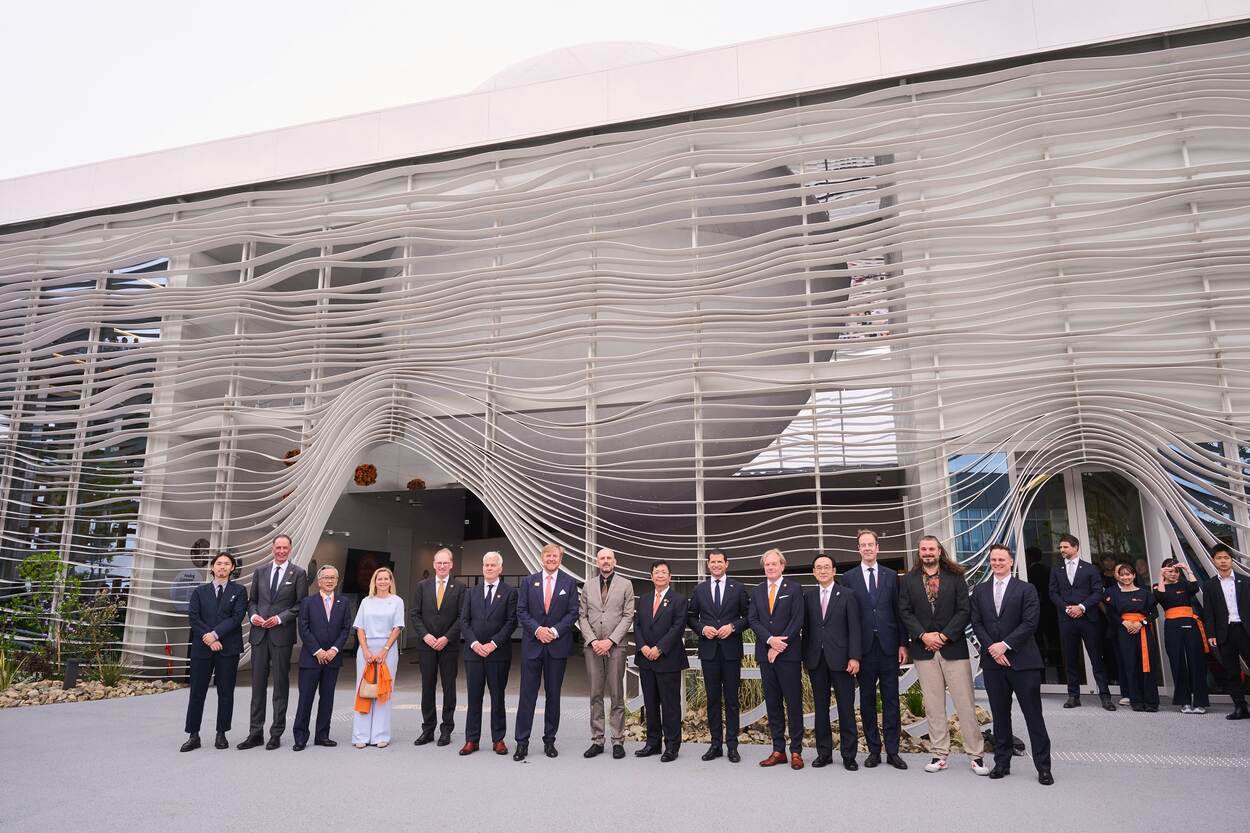
    Architect Thomas Rau, Ries Straver of Tellart design studio and Minister Beljaarts, among others, posing in front of the Netherlands pavilion

    Circular Pavilion

    The King concluded the day with a visit to the rest of the Netherlands Pavilion. A day earlier (20 May), AND BV, the design and construction consortium behind the pavilion, reached an agreement with the Japanese multinational Pasona Group to purchase and repurpose the pavilion after the Expo. This was always the intention: the Dutch pavilion is a model of circular construction—each part is registered and can be dismantled and reused elsewhere without loss. The day also included visits to the Japanese and Czech pavilions.

    Enlarge image
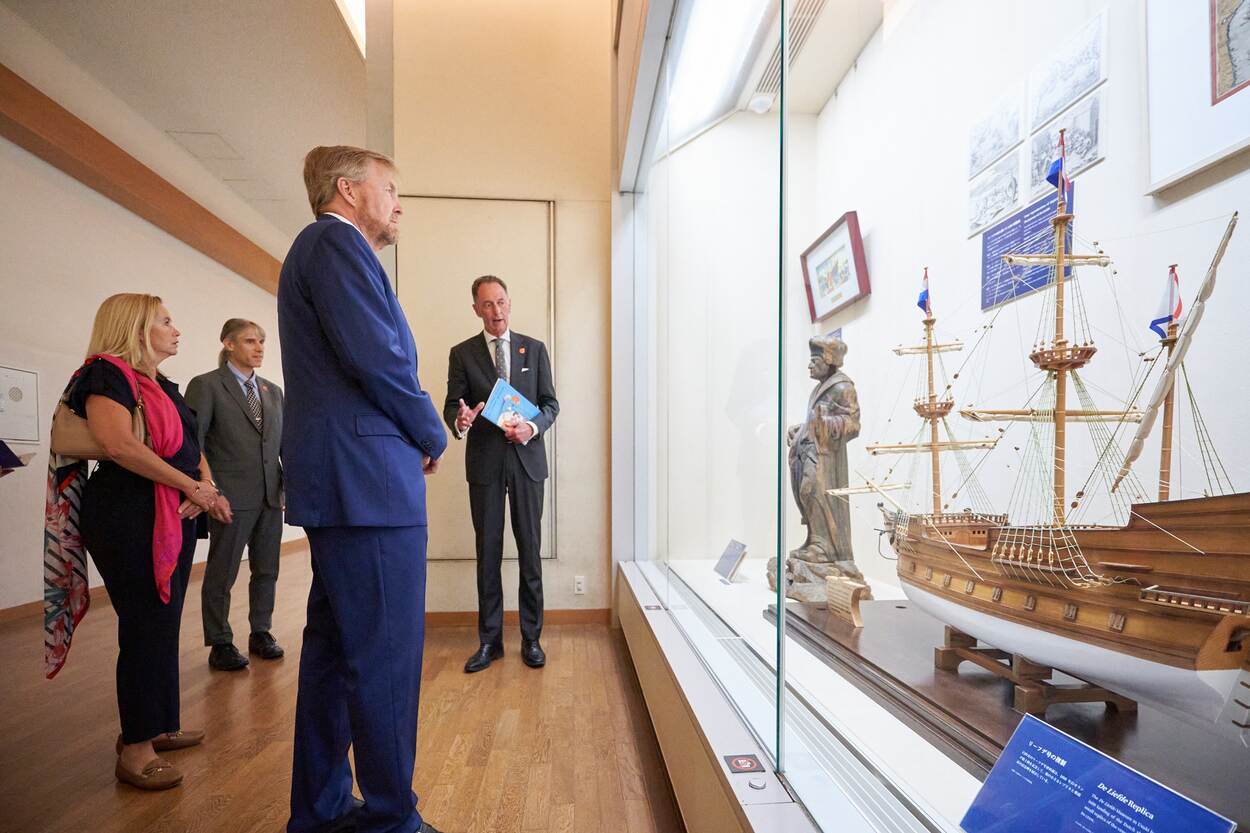
    At the exhibition on 425 years of Japanese-Dutch exchange in Osaka Castle, Consul-General Marc Kuipers tells the King about the earliest history between our two countries

    425 Years of Shared History

    Throughout May, Osaka Castle is spotlighting the long-standing relationship between Japan and the Netherlands. The exhibition A New Dawn on Common Ground: 425 Years of Exchange between Japan and the Netherlands features objects dating back to the year 1600. That year, the Dutch ship De Liefde arrived in Japan, carrying the first Dutchmen to make contact with the country. This meeting eventually led to an exclusive trading relationship that lasted more than 200 years. On the second day of his visit, the King visited this exhibition, which was organized by the Dutch Consulate in Osaka and features items from both Dutch and Japanese collections.

    Enlarge image
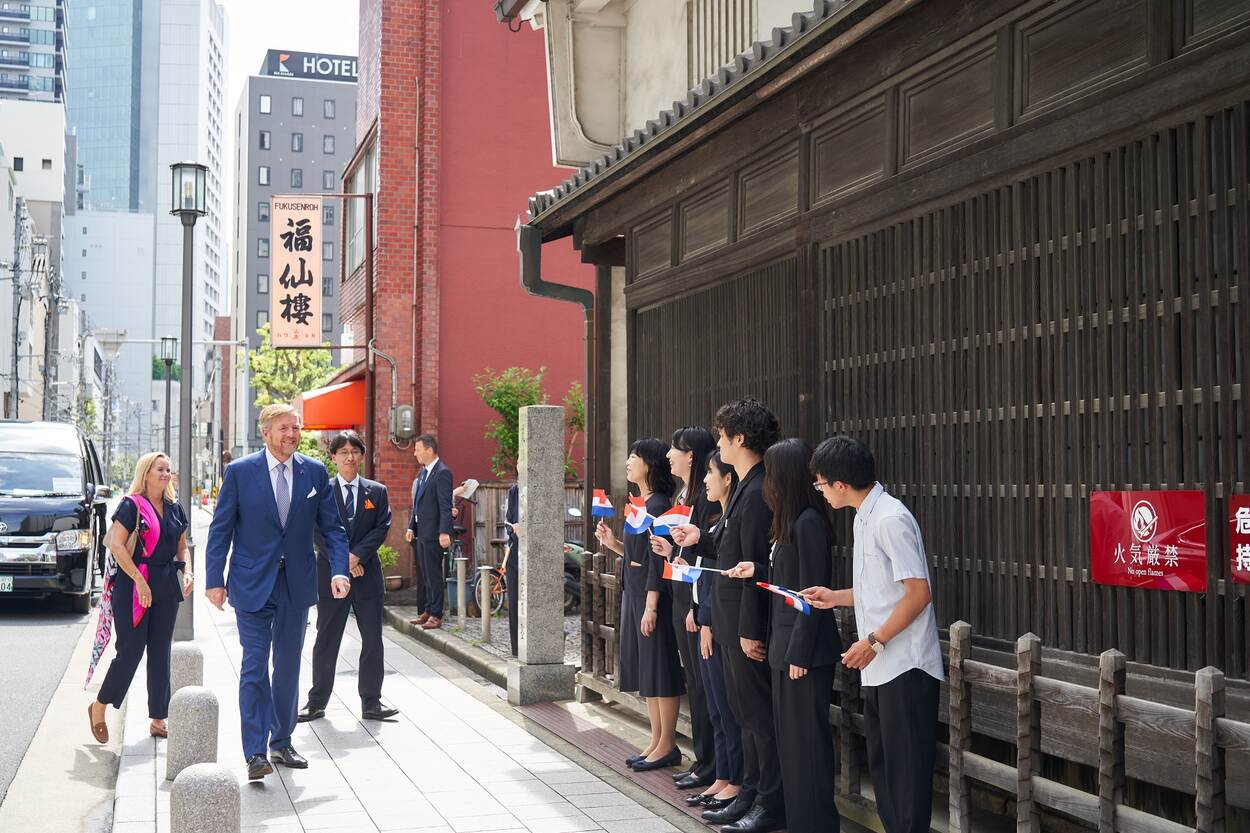
    At Tekijuku, the old Dutch school of Osaka, the King was welcomed by Osaka University students

    The Legacy of Rangaku

    Later that day, 22 May, the royal delegation visited Tekijuku, one of the most important Dutch-language schools in Japan. Until well into the 19th century, Japanese students studied Dutch there to access Western books. The presence of the Dutch in Japan offered a rare window to the rest of the world. Through Rangaku (Dutch Studies), the latest knowledge in fields such as medicine was introduced to Japan. Today, Tekijuku is part of Osaka University, where last year a new medical cooperation agreement was signed between Japan and the Netherlands. The King also visited Nakanoshima Qross, a new hub for research into the future of healthcare.

    Enlarge image
    At the Pasona pavilion, King Willem-Alexander and Minister Klever were introduced to the latest technology is regenerative medicine

    Innovation and Future Collaboration

    In the afternoon, King Willem-Alexander and Minister Klever joined the economic mission on high tech and digitalization, led by Minister Beljaarts. Around 70 Dutch companies were introduced to approximately 170 Japanese guests. Multiple partnership agreements were signed to promote cooperation in areas such as semiconductors, quantum computing, and 6G telecommunications. The day concluded with an Innovation Parade, where 19 Dutch and Japanese organizations presented their work to the King.

    MIL OSI Europe News

  • MIL-OSI Russia: Urgent: China stands ready to join Kuwait in further promoting the sustainable development of bilateral relations – Li Qiang

    Translation. Region: Russian Federal

    Source: People’s Republic of China in Russian –

    Source: People’s Republic of China – State Council News

    KUALA LUMPUR, May 26 (Xinhua) — China is willing to join Kuwait in further promoting the sustainable development of bilateral ties, Chinese Premier Li Qiang said Monday at a meeting with Kuwaiti Crown Prince Sheikh Sabah Khalid Al-Hamad Al-Sabah.

    Li Qiang arrived in Kuala Lumpur on Monday to attend the ASEAN (Association of Southeast Asian Nations)-GCC (Gulf Cooperation Council)-China summit. –0–

    MIL OSI Russia News

  • Operation Sindoor outreach: Indian delegation briefs South Korea’s leaders, think tanks

    Source: Government of India

    Source: Government of India (4)

    The all-party Indian parliamentary delegation led by Janata Dal (United) MP Sanjay Jha on Monday met Yun Ho-jung, Chairperson of the Korea-India Parliamentary Friendship Group of the Korean National Assembly and think tanks and briefed them on Operation Sindoor, reiterating India’s firm zero-tolerance policy against terrorism.

    The delegation asserted India’s position of making no distinction between terrorists and the country supporting them and sought South Korea’s support for bringing terrorist organisations, perpetrators, and financiers of terrorism to justice.

    Yun reaffirmed South Korea’s strong stand against terrorism, saying that any act of terrorism is unacceptable and cannot be justified, and that there should be no loss of innocent lives due to the same.

    Meanwhile, the delegation also interacted with think tanks and lawmakers in Seoul, conveying India’s strong message of zero tolerance against terrorism.

    The Indian Embassy said in a post on X, “The delegation apprised them about the heinous terrorist attack in Pehalgam and the subsequent precise, measured, responsible, and non-escalatory response made by India. They further reiterated India’s firm zero-tolerance policy against terrorism and made no distinction between terrorists and the country supporting them. They also highlighted India’s ‘No First Use Policy’ and rejection of any nuclear blackmail. They conveyed our resolute stance to respond firmly to any act of terrorism”.

    The Embassy added that the participating South Korean think tanks condemned the terrorist attack and extended their solidarity with India, as well as its zero-tolerance policy against terrorism. They also discussed ways in which India, South Korea and the international community can work together to combat terrorism.

    During the interactions, Jha asserted that members from both the ruling and opposition parties from India arrived in South Korea to apprise about the April 22 Pahalgam terrorist attack as part of the Operation Sindoor global outreach campaign.

    “The seven delegations are sent by the Government of India across the world to apprise what happened in Kashmir on April 22, when 26 innocent tourists were gunned down by terrorists in front of their families, segregated on religious lines. All terrorists came from Pakistan, who were trained and financed there, it happened earlier in the 2008 Mumbai attack,” Jha said.

    BJP MP Aparajita Sarangi drew a parallel between South Korea’s tensions with North Korea and the kind of conflict India has experienced with Pakistan, highlighting the terrorist activities.

    “You are having the same kind of war with North Korea that we are having with Pakistan,” she said.

    “What happened should not have happened. I must say, and I don’t believe I’m exaggerating or overstepping, that Pakistan is a habitual offender when it comes to terrorist activities. Since its creation in 1947–48, there has been a continuous series of terrorist actions aimed at destabilising India. They have tried repeatedly, though they have not succeeded. Our Prime Minister has talked about a ‘new normal’ and we solicit your support in this entire war against terrorism,” said Sarangi.

    Additionally, TMC MP Abhishek Banerjee stated that Operation Sindoor on May 7 was carried out in response to the April 22 Pahalgam terror attack by Pak-trained terrorists.

    “Any support extended to Pakistan is effectively support for a terror organisation. Anyone endorsing or defending Pakistan’s actions is, in essence, backing terrorism. Why do I say this? I have compelling reasons. Take the 2008 Mumbai terror attacks, for instance, an incident the world witnessed in horror. A total of 166 innocent people were killed by terrorists, including citizens from 26 different countries, not just India,” he said.

    “The prime accused, who was then arrested by the Indian law enforcement agencies, confessed that he was trained and raised in Pakistan. And when the April 22 Pahalgam terror attack was carried out, we expected Pakistan to do justice and bring the perpetrators to book. India waited patiently and eventually carried out the airstrikes on May 7 after waiting for 14 days. The airstrikes were carried out with such precision that India successfully destroyed nine terror infrastructures without endangering a single civilian life,” Banerjee added.

    The all-party delegation includes MPs from across the political spectrum: BJP MP Brij Lal, CPI(M) Rajya Sabha member John Barittas, and senior Congress leader Salman Khurshid.

    It is a part of India’s global diplomatic outreach campaign to highlight the significance of Operation Sindoor and India’s continued fight against Pak-sponsored cross-border terrorism.

    (IANS)

  • PM Modi calls Operation Sindoor a reflection of India’s cultural values and national resolve

    Source: Government of India

    Source: Government of India (4)

    Prime Minister Narendra Modi, addressing a massive gathering of women in Vadodara, paid tribute to the nation’s armed forces and lauded Operation Sindoor as a powerful reflection of India’s cultural values and emotional resolve in the face of terrorism.
     
    “Operation Sindoor was not just a military action, it was a reflection of India’s values and emotions,” said the Prime Minister, adding that the act of terrorism, where a father was killed in front of his children, had ignited deep anger across the nation.
     
    He emphasized that such attacks are not just assaults on individuals but direct challenges to all 140 crore Indians. In response, PM Modi said he gave full freedom to the Indian armed forces, who executed a historic operation that had not been seen in decades.
     
    “Nine major terror hubs across the border were identified and destroyed in just 22 minutes. Pakistan’s military tried to retaliate but was decisively defeated,” he said.
     
    Saluting the courage and dedication of the armed forces, PM Modi said, “I fulfilled my responsibility as the nation’s leader, and our jawans fulfilled theirs with unmatched bravery. I bow to their valour from this sacred land of Dahod.”
     
    The Prime Minister also underlined that the country born out of the partition has long pursued a hostile approach towards India, seeking to inflict harm through various means. In contrast, India, he said, remains focused on eradicating poverty, boosting the economy, and driving inclusive development.
     
    “A developed India can only be built when both our armed forces and our economy are strong. The government is committed to ensuring national security and economic growth go hand in hand,” he noted.
     
    The Prime Minister said it is a land of sacrifice and dedication. He spoke of Maharishi Dadhichi’s ultimate sacrifice on the banks of the Dudhimati River and how this region supported freedom fighter Tatya Tope in times of crisis. He also highlighted Mangarh Dham as a symbol of the sacrifices made by Govind Guru and hundreds of tribal warriors.
     
    PM Modi praised the people of Dahod for their resilience and commitment to progress. Referring to the newly inaugurated locomotive manufacturing plant, he said this is just a glimpse of the district’s potential.
     
    “I have full confidence in the hardworking people of Dahod. They will make the best use of the new facilities and transform Dahod into one of the most developed districts in India,” the Prime Minister said, concluding his address with heartfelt congratulations to the people of the region.
  • Indian stock market closes in green; auto and IT stocks gain

    Source: Government of India

    Source: Government of India (4)

    The Indian stock market ended Monday’s session in the green, with broad-based buying across sectors, led by gains in auto and IT stocks. Benchmark indices registered gains for the second consecutive session, reflecting improved investor sentiment.
     
    The BSE Sensex closed 455.37 points, or 0.56 per cent higher, at 82,176.45, while the NSE Nifty rose 148 points, or 0.60 per cent, to settle at 25,001.15.
     
    Sectorally, Nifty Auto and Nifty IT indices led the rally with a gain of one per cent each. Positive movement was also seen in metal, realty, media, energy, commodities, and PSE stocks.
     
    Midcap and smallcap indices continued their upward momentum. The Nifty Midcap 100 rose 379.50 points (0.67%) to 57,067.25, while the Nifty Smallcap 100 added 64.45 points (0.37%) to close at 17,707.80.
     
    Global cues also played a role in the positive momentum. Market participants cited the US decision to consider extending the deadline for imposing higher tariffs on the European Union, along with a decline in the dollar index, as factors aiding domestic market recovery.
     
    Vinod Nair, Head of Research at Geojit Financial Services, said, “The early onset of the southwest monsoon and easing bond yields have improved investor appetite for riskier assets. Broader markets outperformed on expectations of improved rural consumption and stronger Q4 GDP, supported by robust corporate earnings.”
     
    On the currency front, the rupee appreciated by 24 paise to close at 85.09 against the US dollar, supported by a weaker dollar index, which fell to 98.93.
     
    Jateen Trivedi of LKP Securities noted, “A series of key US economic data due this week, including Durable Goods Orders, FOMC Meeting Minutes, Q1 GDP, and the Core PCE Price Index, may keep USD-INR volatility elevated. The rupee is expected to trade within a range of 84.50 to 85.25 in the near term.”
     
    -IANS
  • PM Modi: Gujarat emerging as a global hub for high-tech manufacturing and tribal development

    Source: Government of India

    Source: Government of India (4)

    Prime Minister Narendra Modi today underlined Gujarat’s rising stature as a global hub for high-tech engineering and manufacturing, while also reaffirming the government’s deep commitment to tribal welfare and inclusive development.
     
    Addressing a large gathering in Dahod, the Prime Minister said that Gujarat has made remarkable progress in diverse sectors such as education, IT, semiconductors, and tourism. He informed that a major semiconductor plant is being established in the state with an investment of thousands of crores, further strengthening India’s footprint in the global semiconductor industry and creating employment opportunities for lakhs of youth.
     
    The Prime Minister highlighted that Dahod, Vadodara, Godhra, Kalol, and Halol have together formed a robust high-tech engineering and manufacturing corridor. He said, “Vadodara is rapidly advancing in aircraft manufacturing, with the Airbus assembly line inaugurated recently. The city is also home to India’s first Gati Shakti University. Savli has a major rail coach manufacturing facility, and now Dahod is manufacturing India’s most powerful 9,000-horsepower locomotives. These developments mark a proud moment for the nation.”
     
    He added that small and medium-scale industries across Godhra, Kalol, and Halol are also playing a vital role in Gujarat’s industrial growth. Envisioning the future of the region, he said, “From bicycles and motorcycles to railway engines and aircraft, this corridor will produce it all. Such a high-tech corridor is rare even on the global stage.”
     
    Reaffirming his government’s commitment to tribal welfare, the Prime Minister said that the development of tribal regions is essential for building a developed India. He noted that significant work has been carried out in the last 11 years to uplift tribal communities across the country.
     
    PM Modi said, “I have had the privilege of working extensively in Gujarat’s tribal areas, and that experience has shaped many national-level initiatives. There was a time when tribal children couldn’t even dream of studying science. Today, the tribal belt has access to quality education through ITIs, medical colleges, and two dedicated tribal universities.”
     
    He stated that the network of Eklavya Model Schools has been strengthened over the past decade to ensure better educational opportunities for tribal students, including several such schools now operating in Dahod.
     
    Referring to the ‘Dhartii Aaba Janjati Gram Utkarsh Abhiyan’, he said this is a historic initiative launched for the first time in independent India. He informed that the Central Government is investing nearly ₹80,000 crore in the program, aimed at transforming over 60,000 tribal villages by providing electricity, water, roads, schools, hospitals, and pucca houses.
     
    PM Modi said, “Our government is working for those who were long neglected. The PM Janman Yojana has been introduced to support particularly vulnerable tribal groups who have been deprived for decades. New infrastructure and job opportunities are being created to ensure inclusive development.”
     
    The Prime Minister also highlighted the launch of a national mission to eliminate sickle cell anemia in tribal communities, under which millions have already been screened.
     
    Speaking on regional transformation, PM Modi said that Dahod, once classified as a backward district, is now progressing rapidly as an Aspirational District. He remarked, “South Dahod once faced severe water scarcity. Today, thanks to hundreds of kilometers of new pipelines, Narmada water is reaching every home. Over the years, 11 lakh acres of land from Umargam to Ambaji have been brought under irrigation, easing the burden on tribal farmers.”
  • MIL-OSI: PU Prime Drives Coastal Restoration Efforts in Thailand

    Source: GlobeNewswire (MIL-OSI)

    SINGAPORE, May 26, 2025 (GLOBE NEWSWIRE) — PU Prime, a globally recognised financial services provider, has reaffirmed its commitment to Environmental, Social, and Governance (ESG) principles through a Corporate Social Responsibility (CSR) initiative at the Air and Coastal Defense Command of the Royal Thai Navy (RTN) in Sattahip, Thailand. Held on 22 May 2025, this one-day program focused on restoring coastal ecosystems through three key environmental activities: beach cleanup, mangrove seedling planting, and crab release.

    Driving Environmental Impact

    As part of PU Prime’s ESG framework, the initiative was structured around three key environmental activities designed to contribute meaningfully to the restoration and preservation of coastal ecosystems. Each activity was selected for its ecological relevance and alignment with regional sustainability goals.

    1. Beach Cleanup
    The beach cleanup activity targeted the removal of marine debris and non-biodegradable waste, such as plastic bottles, fishing nets, rope, and other litter found along Sattahip’s shoreline. These pollutants are a growing concern due to their detrimental impact on marine life. Sea turtles, fish, and dolphins are often endangered by such waste, risking entanglement or ingestion that can result in injury or death. By removing this waste, the initiative not only improved the local environment but also contributed to the global fight against marine pollution and microplastics.

    This cleanup effort also highlighted the power of community-driven conservation and the responsibility businesses have in safeguarding biodiversity. It sent a strong message about the importance of collective action in preserving marine habitats and preventing further environmental degradation.

    2. Mangrove Seedling Cultivation
    Another significant part of the initiative involved the planting of Avicennia marina, a species of mangrove well-suited to coastal and brackish environments. Mangroves serve as crucial coastal buffers, protecting shorelines from erosion, storm surges, and saltwater intrusion. They also provide shelter and breeding grounds for a wide range of marine and terrestrial species.

    By planting mangrove seedlings, PU Prime not only supported biodiversity but also contributed to climate mitigation. Mangrove forests are known for their exceptional capacity to sequester carbon, helping absorb atmospheric CO₂. The initiative further educated participants on the ecological, social, and economic value of mangroves—essential ecosystems that support local fisheries, sustain coastal livelihoods, and bolster eco-tourism.

    3. Crab Release
    The crab release component involved the careful reintroduction of native crab species into their natural habitat. This effort was aimed at supporting the regeneration of local marine populations, maintaining ecological balance, and strengthening food web dynamics in the area. Crabs play an essential role in benthic ecosystems by recycling nutrients, aerating sediments, and serving as prey for larger species.

    The release was carried out in collaboration with local environmental coordinators to ensure that species selection and handling adhered to best practices in marine conservation. This activity, while symbolic, formed a tangible part of PU Prime’s effort to promote sustainable marine ecosystems and enhance local biodiversity.

    A Broader ESG Vision

    PU Prime ensured the initiative was well-supported with logistical planning, including transportation, facilitators, necessary equipment, and refreshments. Activities were conducted in line with local environmental guidelines, ensuring minimal disruption and lasting positive impact.

    This CSR program illustrates PU Prime’s broader ESG vision—one that prioritises sustainable practices, ethical leadership, and social responsibility. As the company expands its global footprint, it remains dedicated to initiatives that deliver long-term environmental and societal benefits, reinforcing the belief that sustainability is vital to building a better future for all.

    About PU Prime
    Founded in 2015, PU Prime is a leading global fintech company providing innovative online trading solutions. Today, we offer regulated financial products across various asset classes, including forex, commodities, indices, and shares. Committed to providing advanced technology and educational resources, PU Prime supports traders and investors at every stage, from beginner to professional. With a presence in over 200 countries and exceeding 40 million app downloads, PU Prime is dedicated to enabling financial success and fostering a global community of empowered traders. Discover PU Prime’s latest promotions and join us for a fruitful trading journey today.

    Contact
    PU Prime
    esg@puprime.com

    Photos accompanying this announcement are available at

    https://www.globenewswire.com/NewsRoom/AttachmentNg/e123e8ba-eb6f-456c-9028-821ea8fbd863

    https://www.globenewswire.com/NewsRoom/AttachmentNg/c4da0ffb-715b-44aa-bf9d-df8c66c8b0aa

    https://www.globenewswire.com/NewsRoom/AttachmentNg/bb809a99-e642-453b-aaec-decb7fb5f45c

    https://www.globenewswire.com/NewsRoom/AttachmentNg/f43f83f4-27c6-46e4-ae82-820fda40e017

    The MIL Network

  • MIL-OSI Asia-Pac: Extending the Arrangement of “Providing Employment Flexibility for Aided Primary Schools to Promote STEAM Education”

    Source: Hong Kong Government special administrative region

    From the 2022/23 to 2024/25 school years, aided primary schools (including special schools with a primary section) are provided with more flexibility for employment of teachers having expertise in STEAM-related subjects in aided primary schools with a view to promoting school-based STEAM education.  The above arrangement is implemented on a pilot basis for three years.

    EDBCM No. 87/2025  

    New

    EDBCM No. 150/2022

    Frequently Asked Questions (Chinese version only)

    MIL OSI Asia Pacific News

  • MIL-OSI Asia-Pac: First Chest Pain Centre in Hong Kong receives national accreditation (with photos)

    Source: Hong Kong Government special administrative region

    First Chest Pain Centre in Hong Kong receives national accreditation  
         QMH began preparations for establishing the Chest Pain Centre in 2023, aligning with the Policy Address initiative to establish Hong Kong’s first chest pain centre at QMH according to national accreditation standards, aimed at improving the diagnosis process and treatment outcomes for cardiovascular patients. QMH experts subsequently visited various chest pain centres on the Mainland to learn from their experience and processes in managing cardiac patients. Mainland experts were also invited to Hong Kong to exchange insights in preparation for developing operational procedures. Hong Kong’s first chest pain centre at QMH commenced operations in November 2024. Following national accreditation standards, the centre has improved the diagnosis process for acute high-risk cardiac patients, including those with acute myocardial infarction, while promoting national chest pain centre certification as an international standard. These standards encompass standardised management, treatment efficiency improvement, and interdepartmental collaboration.
     
         The Chief Executive of the HA, Dr Tony Ko, said, “QMH’s successful accreditation according to national standards validates its professional expertise in acute cardiac care and strengthens the HA’s ongoing commitment to enhancing cardiac services in public hospitals. The HA maintains a patient-centred approach, continuously improving healthcare service quality through multidisciplinary collaboration, streamlined treatment processes, and innovative technology adoption.”
     
         Dr Ko added that QMH Chest Pain Centre’s successful experience will serve as an important reference for developing similar services across other HA clusters. The HA will continue to invest resources to enhance service efficiency and quality, providing better healthcare services for the public.
     
         The China Chest Pain Centre Accreditation Committee recently sent experts, including the Chairman of the China Chest Pain Centre Expert Committee, Professor Huo Yong, and the Chairman of the China Chest Pain Centre Executive Expert Committee, Professor Xiang Dingchen, to conduct an on-site evaluation at QMH. The experts affirmed QMH Chest Pain Centre’s appropriate timing control for patient examinations and treatments, standardised and efficient overall processes, and reasonable patient care pathways, reflecting that the centre meets all certification requirements for proper handling of acute cardiac patients.
     
         The Hospital Chief Executive of QMH, Dr Theresa Li, thanked the Mainland expert team and the Health Bureau for their support in establishing Hong Kong’s first chest pain centre and obtaining national accreditation. Dr Li said, “Every step in the treatment process is interconnected and affects patient outcomes. The accreditation standards strictly regulate each component, requiring close cooperation between different departments to ensure smooth implementation. With the completion of QMH’s new building, both hardware and software capabilities have been enhanced, which we believe will help patients secure golden treatment time and improve survival rates and post-operative recovery.”
     
         Dr Li also expressed gratitude to the various hospital teams for their efforts in establishing and achieving accreditation for the Chest Pain Centre.
     
         The HA will continue to optimise services and, drawing from QMH’s experience, establish a second chest pain centre at Prince of Wales Hospital according to national accreditation standards. The goal is to build a chest pain treatment network in Hong Kong to improve diagnostic efficiency, enhance treatment effectiveness, and increase patient survival rates.
    Issued at HKT 16:00

    NNNN

    MIL OSI Asia Pacific News

  • MIL-OSI Asia-Pac: Sharing Knowledge on Clinical Advances at Hospital Authority Convention (with photos)

    Source: Hong Kong Government special administrative region

    The following is issued on behalf of the Hospital Authority:

         The Hospital Authority (HA) Convention 2025 begins today for three consecutive days (May 26 to 28) at the Hong Kong Convention and Exhibition Centre, in both in-person and online formats. This marks the first time the convention has been extended to three days, making it the HA’s largest-scale event to date. Approximately 190 overseas, Mainland and local distinguished speakers will exchange expertise on various healthcare topics with over 8,000 participating healthcare professionals and academics, achieving record-high participation levels.
     
         The HA Convention this year is focusing on the HA’s core values, namely People-centred Care, Professional Service, Committed Staff and Teamwork. Topics include healthcare development, smart hospitals, artificial intelligence, organ transplantation, cancer management, and innovation technology in support of staff training. The HA convention aims to promote the sharing of knowledge and experience on clinical advances and approaches to modern healthcare service, and facilitate exploration and discussion of contemporary concepts among healthcare professionals and stakeholders.
     
         The convention was officially opened this morning by Vice-Minister of the National Health Commission of the People’s Republic of China Professor Cao Xuetao; the Chief Secretary for Administration, Mr Chan Kwok-ki; the Secretary for Health, Professor Lo Chung-mau; the HA Chairman, Mr Henry Fan; and the HA Chief Executive, Dr Tony Ko.
     
         In his address, Mr Chan said that the HA has been continuously reforming and enhancing service efficiency and quality through its professional team and robust management system. Notably, the Institute for Medical Advancement and Clinical Excellence (IMACE), which brings together different areas of expertise from Hong Kong’s healthcare sector, was formally established this May.
     
         “The HA will be very much involved in the IMACE’s research work, collaborating with other major public and private healthcare institutions to collect data and cases for detailed deliberations on clinical practices in the screening, diagnosis, treatment and management of various diseases, evaluating the efficacy of various medical options, and devising clinical guidelines and standards for healthcare professionals. This collective effort aims to enhance Hong Kong’s healthcare service standards for the benefit of patients throughout Hong Kong.”
     
         In his welcome address, Mr Fan said that 2025 marks the commencement of an era of reformation at the HA. A key initiative is supporting the Government’s public healthcare fees and charges reform aimed at rationalising public hospital services, reducing wastage and misuse, and enhancing support for patients with financial difficulties.
     
         Mr Fan said, “2025 is a crucial year for the HA’s reform initiatives. Facing challenges such as an ageing population, an increase of chronic diseases, and rising medical costs, the HA needs to undergo fundamental reforms to meet public needs, enhance service efficiency, and maintain the sustainability of the public healthcare system while building a public healthcare system that meets the needs of the community that enhances the well-being of citizens.”
     
         Additionally, the HA established the Review Committee on the Management of the Public Hospital System last year, proposing 31 recommendations to strengthen governance, enhance accountability, and foster a culture of safety. Building on this foundation, in order to advance reform, the HA further established a high-level Governance and Structure Reform Committee (Reform Committee) last year to provide strategic guidance, oversight, and reform advice to promote the sustainable development of healthcare services.
     
         Mr Fan continued, “Among the many topics that the Reform Committee will be looking into, remuneration structure, financial management and clinical management are particularly crucial. This includes introducing the concept of ‘more contribution, more gain’, with remuneration commensurate with performance and contributions to provide motivation for colleagues, reviewing the financial management system to achieve cost savings, and utilising modern technology to optimise clinical outcomes.”
     
         Delivering his keynote address at the opening ceremony, “Advancing Sustainable Excellence”, Dr Ko reviewed the HA’s 35 years of experience and shared his vision for a sustainable, patient-centred public healthcare system.
     
         “With a rapidly ageing population, swift medical technological advancements, and unpredictable threats of global pandemics, we must remain proactive in driving bold reforms. Digital transformation is central to our strategy in addressing rising healthcare demands. The HA is committed to enhancing digital innovation, integrating big data and artificial intelligence (AI) technologies to improve service efficiency and performance while enhancing both patient and healthcare staff experiences,” Dr Ko said. 
        He said that the HA Go mobile application continues to stand as a transformative patient empowerment platform, significantly improving patient experience through technology. “HA Go now has over 3.1 million registered users, empowers patients with easy access to self care and direct interaction with healthcare services. HA Go streamlines the patient journey through offering seamless features such as outpatient appointment management, registration, payments, digital queuing updates, all accessible within a few clicks. The platform also provides patients with options for medication delivery services, which embodies our patient-centred service mission”, Dr Ko said.
     
         He emphasised, “While technology advances, staff remain the irreplaceable core of quality healthcare services. We are committed to providing our staff members with opportunities for personal growth and professional development. The HA sponsored more than 2,600 staff members to participate in training programmes in various places in 2024/25. Through immersive exchange and training initiatives, our healthcare professionals have gained valuable exposure to diverse clinical practices and perspectives. Such experiences foster mutual learning and encourage broader horizons for all staff.”
     
         In addition to retaining and cultivating existing personnel, Dr Ko said that it is equally important to reach out to new talent from outside. The HA actively recruits non-locally trained doctors and nurses. As of mid-March this year, nearly 300 non-locally trained doctors have joined the HA team, nearly double in comparison to last year. Following the Nurses Registration (Amendment) Ordinance 2024, more than 100 non-locally trained nursing candidates have also been employed, further reinforcing Hong Kong’s clinical capabilities. Over 240 individuals have taken part in expanded clinical exchange programmes, while more than 100 Chinese Medicine practitioners in the HA received training from Mainland experts.
     
         Dr Ko stressed that the HA must highlight the deep collaboration with counterparts in the Mainland, which is vital to the growth and evolution of the local healthcare landscape. A key area of collaboration is enhancing services for major diseases such as cardiac illnesses and strokes. To drive integrated and high-quality care, the HA is establishing chest pain centres and national stroke centres, harmonising treatment protocols and elevating outcomes through national accreditation. The first chest pain centre in Hong Kong at Queen Mary Hospital has been established according to national accreditation standards, further optimising treatment options for cardiovascular patients.
     
         “In line with the Chief Executive’s policy direction to enhance Hong Kong’s healthcare standards, the first batch of public hospitals, including Pamela Youde Nethersole Eastern Hospital and Prince of Wales Hospital, have been awarded accreditation status under the China’s International Hospital Accreditation Standards (2021 Version). To ensure consistent quality improvement across hospitals throughout the Guangdong-Hong Kong-Macao Greater Bay Area, three additional acute hospitals will embark on their accreditation journey in 2025-26, further strengthening their international presence and raising the quality and safety of healthcare services.”
     
         In conclusion, Dr Ko said, “We are living in an era of profound transformation. Let us uphold the spirit that ‘reform is an ongoing journey’, embrace technological innovation, sustain healthcare excellence, optimise resource allocation, and enhance service efficiency and quality to swiftly respond to the community’s evolving needs.” He expressed confidence that with the determination of all members of the HA and the support from the community and partners, the HA will collectively shape a brighter, more sustainable future for in public healthcare.

    MIL OSI Asia Pacific News

  • MIL-OSI Asia-Pac: DH’s Community Dental Support Programme provides subsidised dental services for underprivileged over all 18 districts in Hong Kong

    Source: Hong Kong Government special administrative region

    DH’s Community Dental Support Programme provides subsidised dental services for underprivileged over all 18 districts in Hong Kong 
    Service users of the CDSP must be a holder of a Hong Kong identity card, be enrolled in the Electronic Health Record Sharing System (eHealth), and be a current beneficiary or recipient of any of the following measures:
     Under the CDSP, each service user can apply for subsidised dental services once every 180 days. Subject to the assessment by the attending registered dentist, a service user will be provided with specified subsidised dental services, including:
     Each service user is required to pay an administration fee of $50 directly to the NGO for each tooth (teeth filling or teeth extraction services), that is, a maximum fee of $150 is required (treatment for a maximum of three teeth will be provided for every 180 days). If the service user receives IHCS (Frail Cases), EHCCS or HSS (Level 1 fee charge or co-payment category) of the SWD, or is eligible under the Medical Fee Waiver (full waiving) of the HA (including recipients of OALA aged 75 or above), the Government will subsidise the administration fee in full. While current beneficiaries of the Comprehensive Social Security Assistance (CSSA) Scheme under the SWD may apply for the CDSP for the above-mentioned subsidised dental services, they can also make use of the dental grants under the CSSA to receive comprehensive dental services.

    Interested and eligible persons can refer to the list of NGO dental clinics participating in the CDSP on the DH’s thematic webpage 
    Through the eHealth app, service users can check their consultation records, including consultation date and treatment items. Later this year, relevant electronic oral health records will also be available through the e-Health app for service users to better understand and monitor their dental conditions.
     
    The Government formulated the Oral Health Action Plan according to the development strategies and recommendations made by the Working Group on Oral Health and Dental Care in December 2024. The CDSP is an initiative that focuses on providing subsidised dental services to the underprivileged who have difficulties in accessing dental care.
     
    For more information about the CDSP, please visit the DH’s CDSP
    webpageIssued at HKT 16:40

    NNNN

    MIL OSI Asia Pacific News

  • MIL-OSI Asia-Pac: Fraudulent websites and internet banking login screens related to Standard Chartered Bank (Hong Kong) Limited

    Source: Hong Kong Government special administrative region

    Fraudulent websites and internet banking login screens related to Standard Chartered Bank (Hong Kong) LimitedIssued at HKT 17:20

    The following is issued on behalf of the Hong Kong Monetary Authority:

    The Hong Kong Monetary Authority (HKMA) wishes to alert members of the public to a press release issued by Standard Chartered Bank (Hong Kong) Limited relating to fraudulent websites and internet banking login screens, which have been reported to the HKMA. A hyperlink to the press release is available on the HKMA website.

    The HKMA wishes to remind the public that banks will not send SMS or emails with embedded hyperlinks which direct them to the banks’ websites to carry out transactions. They will not ask customers for sensitive personal information, such as login passwords or One-Time Password, by phone, email or SMS (including via embedded hyperlinks).

    Anyone who has provided his or her personal information, or who has conducted any financial transactions, through or in response to the websites or login screens concerned, should contact the bank using the contact information provided in the press release, and report the matter to the Police by contacting the Crime Wing Information Centre of the Hong Kong Police Force at 2860 5012.

    Ends/Monday, May 26, 2025
    Issued at HKT 17:20

    MIL OSI Asia Pacific News

  • MIL-OSI Europe: ASIA/MYANMAR – In the midst of conflict and suffering “the faithful live a deep faith and do not lose hope”

    Source: Agenzia Fides – MIL OSI

    Yangon (Agenzia Fides) – “The country is divided. The situation in Yangon, where I currently live, is quite calm. In the big cities in the central part of the country, people’s lives continue, and even our liturgies and pastoral activities can proceed in churches. Of course, there is always a curfew, we live with a series of restrictions due to the ongoing conflict in the country, but we try to live our faith always, with our hearts turned towards the mission and those who suffer. This is what Father Stephen Chit Thein, National Director of the Pontifical Mission Societies (PMS) in Myanmar, shared with the Fides, providing an overall picture of the situation in the troubled Southeast Asian country.The situation, however – he continues – is very different in the peripheral areas of the country, in the border regions: there is still ongoing fighting, and there is great suffering and displacement. We must remember that, in addition to the conflict, the pain and hardship caused by the earthquake have also been added.”Father Stephen Chit Thein adds: “What strikes me the most is to see so many people suffering, who have been living in extreme precarious conditions for the past four years, yet they continue to live and practice a deep faith: the faithful continue to trust in God and hope, they do not sink into despair, but keep the light of hope alive.” “We are living in a time of great trial, which involves the entire Burmese people, and our hope, as the special theme of this Jubilee Year reminds us, is grounded and rooted in Christ, who never disappoints and never abandons us. This conviction is deeply present in the suffering population of Myanmar,” he notes.While the humanitarian situation has worsened over the past four years, Father Stephen Chit Thein notes: “We continue to hope also thanks to the words and appeals that come from the Holy See, which shows us deep closeness. We remember and thank Pope Francis, who visited and mentioned Myanmar many times and always kept us in his heart. Pope Leo XIV also reminded the international community of Myanmar’s suffering and launched an appeal for peace. We hope that he will continue to speak about us and speak about peace, so that the international community does not forget us.”Meanwhile, at the diplomatic level, a new initiative is underway within the ASEAN (Association of Southeast Asian Nations), of which Myanmar is a member. Malaysia, which currently holds the rotating presidency of ASEAN, has requested an extension of the ceasefire following the earthquake in Myanmar, while also intensifying calls for the implementation of the “Five-Point Peace Plan” that ASEAN proposed in the past. The military junta in power had declared a ceasefire in the ongoing civil war after a violent earthquake in late March, which killed about 3,800 people and left tens of thousands homeless. The agreement, which was previously extended, is set to expire at the end of May, although UN observers state that the junta’s airstrikes have never stopped.In an ASEAN foreign ministers’ meeting on May 25, Malaysian President Mohamad Hasan “officially proposed” the extension and expansion of the ceasefire beyond the currently affected areas, to facilitate the long and difficult path to recovery and alleviate the suffering of the people of Myanmar”. Hasan stated that in June, he will visit the Burmese capital Naypyidaw as a member of ASEAN, “to assess humanitarian needs and the distribution of aid to the people affected by the earthquake.”ASEAN political leaders are meeting in a summit in Kuala Lumpur today, May 26. So far, ASEAN has not been able to implement the Five-Point Peace Plan agreed upon in April 2021. Due to the lack of implementation of that plan, representatives of the Burmese military junta have been banned from participating in ASEAN summits. (PA) (Agenzia Fides, 26/5/2025)
    Share:

    MIL OSI Europe News

  • MIL-Evening Report: Activists call for Pacific nuclear justice, global unity and victim support

    By Te Aniwaniwa Paterson of Te Ao Māori News

    Eighty years after the United States dropped atomic bombs on Hiroshima and Nagasaki to end the Second World War, the threat of nuclear fallout remains.

    Last Monday, the UN Human Rights Council issued a formal communication to the Japanese government regarding serious concerns raised by Pacific communities about the dumping of 1.3 million metric tonnes of treated Fukushima nuclear wastewater into the ocean over 30 years.

    The council warned that the release could pose major environmental and human rights risks.

    A protest against the release of Fukushima treated radioactive water in Tokyo, Japan, in mid-May 2023. Image: TAM News/Getty.

    Te Ao Māori News spoke with Mari Inoue, a NYC-based lawyer originally from Japan and co-founder of the volunteer-led group The Manhattan Project for a Nuclear-Free World.

    Recently, at the UN, they called for global awareness, not only about atomic bomb victims but also of the Fukushima wastewater release, and nuclear energy’s links to environmental destruction and human rights abuses.

    Formed a year after the Fukushima nuclear disaster, the group takes its name from the original Manhattan Project — the secret Second World War  US military programme that raced to develop the first atomic bomb before Nazi Germany.

    A pivotal moment in that project was the Trinity Test on July 16, 1945, in New Mexico — the first successful detonation of an atomic bomb. One month later, nuclear weapons were dropped on Hiroshima and Nagasaki, killing an estimated 110,000 to 210,000 people.

    Seeking recognition and justice
    Although 80 years have passed, victims of these events continue to seek recognition and justice. The disarmament group hopes for stronger global unity around the Non-Proliferation Treaty, and more support for victims of nuclear exposure.

    Mari Inoue attended the UN as a representative of the Manhattan Project for a Nuclear-Free World as an interpreter for an atomic bomb survivor. Image: TAM News/UN WebTV.

    The anti-nuclear activists supported the Non-Proliferation Treaty (NPT), which seeks to prevent the spread of nuclear weapons. Their advocacy took place during the third and final preparatory committee for the 2026 NPT review conference, where a consensus report with recommendations from past sessions will be presented.

    Inoue’s group called on the International Atomic Energy Agency (IAEA) to declare Japan’s dumping policy unsafe, and believes Japan and its G7 and EU allies should be condemned for supporting it.

    Hanford Site is a decommissioned nuclear production complex established in 1943 as part of the Manhattan Project . . . The contaminated site once belonged to several Native American tribes. Image: TAM News/Jeff T. Green/Getty

    Nuclear energy for the green transition?
    Amid calls to move away from fossil fuels, some argue that nuclear power could supply the zero-emission energy needed to combat climate change.

    Inoue rejects this, saying that despite not emitting greenhouse gases like fossil fuels, nuclear energy still harms the environment.

    She said there was environmental harm at all processes in the nuclear supply chain.

    Beginning with uranium mining, predominantly contaminating indigenous lands and water sources, with studies showing those communities face increased cancer rates, sickness, and infant mortality. And other studies have shown increased health issues for residents near nuclear reactors.

    Protests at TEPCO, Tokyo Electric Power Company, in Tokyo in August 2023. Image: bDavid Mareuil/Anadolu Agency

    “Nuclear energy is not peaceful and it‘s not a solution to the climate crisis,” Inoue stressed. “Nuclear energy cannot function without exploiting peoples, their lands, and their resources.”

    She also pointed out thermal pollution, where water heated during the nuclear plant cooling process is discharged into waterways, contributing to rising ocean temperatures.

    Inoue added, “During the regular operation, [nuclear power plants] release radioactive isotopes into the environment — for example tritium.”

    She referenced nuclear expert Dr Arjun Makhijani, who has studied the dangers of tritium in how it crosses the placenta, impacting embryos and foetuses with risks of birth defects, miscarriages, and other problems.

    Increased tensions and world forum uniting global voices
    When asked about the AUKUS security pact, Inoue expressed concern that it would worsen tensions in the Pacific. She criticised the use of a loophole that allowed nuclear-powered submarines in a nuclear-weapon-free zone, even though the nuclear fuel could still be repurposed for weapons.

    In October, Inoue will co-organise the World Nuclear Victims Forum in Hiroshima, with 2024 Nobel Peace Prize winner Nihon Hidankyo as one of the promoting organisations.

    The forum will feature people from Indigenous communities impacted by nuclear testing in the US and the Marshall Islands, uranium mining in Africa, and fisheries affected by nuclear pollution.

    Republished from Te Ao Māori News with permission.

    MIL OSI AnalysisEveningReport.nz

  • MIL-OSI USA: Governor Newsom announces appointments 5.23.25

    Source: US State of California 2

    May 23, 2025

    SACRAMENTO – Governor Gavin Newsom today announced the following appointments:

    Andrew “Tristan” Peery, of Sacramento, has been appointed Senior Product Manager at the Office of Data and Innovation. Peery has been Director of Web and Interactive Communications at University of California, Davis since 2020, where he was previously Web Applications Development/Web Designer from 2014 to 2020. He held multiple positions at Oregon State University from 2006 to 2013, including Researcher/Web Applications Developer and Graduate Research Assistant. Peery was a Staff Scientist at Woods Hole Group from 2001 to 2005. He earned a Master of Science degree in Physical Oceanography from Oregon State University and a Bachelor of Science degree in Marine Science from Texas A&M University at Galveston. This position does not require Senate confirmation, and the compensation is $150,348. Peery is registered without party preference. 

    Ramank Bharti, of Napa, has been appointed Director of Risk Management and Project Controls at the California High Speed Rail Authority. Bharti held multiple positions at ALSTOM Inc from 2004 to 2025, including Project Director, United States West Coast Services, Site Controller, Services North America, Region Controller, Controller, Budgeting and Reporting, and Work Package Controller. He was a Program Director at Transportation and Transit Associates from 2003 to 2004. Bharti was an MBA Intern at the New Orleans Regional Transit Authority from 2002 to 2003. He was a Deputy Chief Mechanical Engineer at the North Eastern Railway from 1996 to 2001. Bharti was a Manager, Industrial Engineering at Diesel Component Works from 1992 to 1996. He was a Mechanical Engineer at Northern Railway from 1990 to 1992. Bharti earned a Master of Business Administration degree in Finance from Tulane University and a Bachelor of Engineering degree in Mechanical Engineering from the Indian Railway Institute of Mechanical and Electrical Engineering. This position does not require Senate confirmation, and the compensation is $225,000. Bharti is a Democrat.

    Kevin Parzych, of San Luis Obispo, has been appointed Chief of Primary Care Services at Atascadero State Hospital. Parzych has been Chief Medical Officer at Wilshire Health and Community Services since 2013 and Owner of Wilshire Connected Care and K Parzych a Medical Corp since 2017. He was Medical Director of Hospice at Good Shepard Homecare and Hospice from 2004 to 2013. Parzych was Owner of Parzych Family Practice from 2002 to 2013. Parzych earned a Doctor of Medicine degree from Albany Medical College and a Bachelor of Arts degree in Psychology from the University of Connecticut. This position does not require Senate confirmation, and the compensation is $374,400. Parzych is registered with no party preference.

    Madelynn McClain, of Sacramento, has been appointed Director of the Division of Administrative Services at the California Department of Corrections and Rehabilitation. McClain has been Assistant Deputy Director of the Division of Adult Institutions at the California Department of Corrections and Rehabilitation since 2024. McClain held several positions at the Department of General Services from 2023 to 2024, including Deputy Director of the Real Estate Services Division and Chief Financial Officer. She held several positions at the California Department of Corrections and Rehabilitation from 2020 to 2023, including Deputy Director at the Office of Fiscal Services and Associate Director of the Budget Management Branch. McClain was a Principal Program Budget Analyst at the California Department of Finance from 2017 to 2020. She was a Judicial Fiscal Supervisor at the Judicial Council of California from 2015 to 2017. McClain was a Finance Budget Analyst at the Department of Finance from 2003 to 2015. This position requires Senate confirmation, and the compensation is $208,440. McClain is a Democrat.

    Raul Morales, of Visalia, has been appointed Warden at Substance Abuse Treatment Facility and State Prison. Morales has been Acting Warden at Substance Treatment Facility and State Prison since 2024. He was Acting Warden at Valley State Prison in 2024. He held several positions at Substance Abuse Treatment Facility and State Prison from 2001 to 2024, including Chief Deputy Warden, Associate Warden, Captain, Correctional Lieutenant, Correctional Sergeant, and Correctional Officer. This position does not require Senate confirmation, and the compensation is $193,524. Morales is registered without party preference. 

    Press releases, Recent news

    Recent news

    News What you need to know: The City of Tustin received a new water treatment system filtering “forever chemicals,” or PFAS, from local drinking water. TUSTIN – As the federal government announces plans to weaken regulation of “forever chemicals” in drinking water,…

    News What you need to know: California is providing $56 million in grants to help counties provide services for young adults at risk of homelessness. SACRAMENTO – Continuing California’s success in reducing homelessness in youth, Governor Gavin Newsom and the…

    News What you need to know: Six canine officers joined the force to fight back against crime and drug trafficking — the first class trained from day one to detect fentanyl. Sacramento, California – After months of specialized and intensive training, six K-9 teams…

    MIL OSI USA News

  • MIL-OSI Video: A Model of UN Peacekeeping: Timor-Leste | United Nations

    Source: United Nations (Video News)

    Human Stories of an UN Peacekeeper: Timor-Leste

    ———————————

    Since 2012, Timor-Leste has demonstrated to the world that a path to peace is possible. In the years prior, the Pacific Island nation hosted six UN missions amid prolonged instability and conflict.

    The legacy of peacekeeping remains strong in Timor-Leste, as the Timorese people are now sharing their peacebuilding experience with other conflict-affected regions.

    ———————————

    Summary
    During the turbulent early years of Timor-Leste’s independence, the UN was a constant presence, helping to maintain peace and stability. Twenty-four years on, the country has made the successful transition from a host nation for UN peacekeeping operations, to one that contributes to supporting missions elsewhere.

    ———————————

    Related links:
    United Nations Peacekeeping Operations:
    https://peacekeeping.un.org/en

    Timor-Leste turns peacemaker – News Website:
    https://news.un.org/en/story/2025/02/1159576

    https://www.youtube.com/watch?v=osfHaCEG-GQ

    MIL OSI Video

  • MIL-OSI Asia-Pac: Hospital Authority and National Conference of University Hospital General Managers of France sign declaration of intent (with photo)

    Source: Hong Kong Government special administrative region

    The following is issued on behalf of the Hospital Authority:

    The Hospital Authority (HA) and the National Conference of University Hospital General Managers of France signed a three-year declaration of intent today (May 26) to strengthen collaboration and exchanges between the two parties in various areas of hospital management and development, including promoting green hospital initiatives and the development of smart hospital, coping with an ageing population, and research and innovation.
     
    The signing ceremony was held during the HA Convention 2025. The Special Envoy of the President of the National Conference of University Hospital General Managers, Mr Frédéric Rimattei, and the HA Chief Executive, Dr Tony Ko, signed the three-year (2025-2028) declaration of intent, witnessed by the Consul General of France in Hong Kong and Macau, Mrs Christile Drulhe; the Counsellor for Health, Social Affairs and Labor from the Embassy of France in China, Mr Romain Jacquet; the Secretary for Health, Professor Lo Chung-mau; and the HA Chairman, Mr Henry Fan.
     
    The National Conference of University Hospital General Managers is composed of 32 university hospital centres in France, covering about 40 per cent of the public healthcare services in the country, and is responsible for promoting the development of medical education and clinical research. Mr Fan said that there is ample room for collaboration between the two parties in various healthcare-related areas. The signing of the declaration of intent has laid the foundation for various collaborative initiatives in the future.
     
    Mr Fan said, “The French public healthcare system is highly acclaimed internationally, and we have much to learn from each other. I look forward to deepening our collaboration in the future, particularly in the areas of sustainable development of the healthcare system, application of smart technologies, talent exchange and training, as well as research and innovation to jointly enhance the quality and standards of healthcare services.”
     
    The President of the National Conference of University Hospital General Managers, Mr Philippe El Saïr, said, “We are delighted to embark on an extensive collaboration with the HA. I believe that both parties will leverage their respective strengths, share experiences and expertise in various aspects of hospital management and development, and promote in-depth exchanges among healthcare professionals in the two places, as well as explore opportunities for clinical research collaboration in different areas.”
     
    Going forward, the HA and the National Conference of University Hospital General Managers will organise regular meetings to plan various collaborative initiatives in detail, and actively arrange reciprocal visits and exchange activities to jointly foster the development of healthcare services in both places.

    MIL OSI Asia Pacific News

  • MIL-OSI Asia-Pac: LegCo Panel on Public Service conducts duty visit to Shenzhen (with photos)

    Source: Hong Kong Government special administrative region

    The following is issued on behalf of the Legislative Council Secretariat:

          The Legislative Council (LegCo) Panel on Public Service conducted a duty visit to Shenzhen today (May 26) to gain insight into the developments in the use of artificial intelligence (AI) for assisting public officers in handling government administrative work. The Secretary for the Civil Service, Mrs Ingrid Yeung, and other government officials also participated in the visit.
     
          Members visited the Government Services and Data Management bureau of the Shenzhen Municipality in Futian District in the morning to learn about how the local government has introduced “AI digital employees” to assist public officers in their work. The system began development in 2023 and utilised DeepSeek to enhance the capability of its large language model for public administration early this year. Members were informed about how public officers make use of the “AI digital employees” installed on computers and mobile phones, including for drafting official documents and handling public cases more efficiently.
     
          Members then visited the Shenzhen Government Service Center and received a briefing by its representatives on how AI is used for providing various public services. During the visit, Members observed the services provided by the Center, and learned about the operation of the platform for addressing public concerns.
     
          Members went to the Shenzhen Intermediate People’s Court in the afternoon to learn about the operation of the nation’s first “Vertical Domain-specific Large Model” dedicated to judicial trials, which was established last year. Members observed the use of the AI-Enhanced Adjudication Assisting System, and exchanged views with representatives of the Court. The system covers the legal processes of civil, criminal and administrative litigation, helping judicial officers analyse case details, summarise facts and clarify points of contention. It also assists judges in accurately citing authoritative precedents in their rulings.
     
          Members also toured an innovative and technology company in Nanshan District to learn how AI is being used to enhance the efficiency of legal services. The company specialises in providing enterprises with large-model services and solutions for legal compliance. Members received a briefing from company representatives on innovations in the legal services sector, followed by an exchange session.
     
          Members who participated in the duty visit were the Chairman of the Panel, Ms Nixie Lam, the Deputy Chairman of the Panel, Mr Benson Luk, Panel members Ms Doreen Kong, Dr Johnny Ng, Mr Lam San-keung, Mr Dennis Leung, Mr Kingsley Wong, and Dr So Cheung-wing; as well as a non-Panel member Ms Maggie Chan. They returned to Hong Kong in the evening.

    MIL OSI Asia Pacific News

  • MIL-OSI China: Chinese premier says China to create more avenues for mutual benefit with Kuwait

    Source: People’s Republic of China – State Council News

    KUALA LUMPUR, May 26 — Chinese Premier Li Qiang on Monday said China stands ready to deepen cooperation with Kuwait in such areas as energy, investment, green economy, digital economy and artificial intelligence, creating more avenues for mutual benefit.

    Li made the remarks during his meeting with Sheikh Sabah Al-Khaled Al-Hamad Al-Sabah, crown prince of Kuwait.

    The Chinese premier arrived in Kuala Lumpur on Monday to attend the ASEAN (the Association of Southeast Asian Nations)-GCC (the Gulf Cooperation Council)-China Summit.

    MIL OSI China News

  • MIL-OSI China: Chinese premier says China eyes stronger cooperation with GCC, ASEAN for interests of Global South

    Source: People’s Republic of China – State Council News

    Chinese premier says China eyes stronger cooperation with GCC, ASEAN for interests of Global South

    KUALA LUMPUR, May 26 — Chinese Premier Li Qiang said on Monday that China looks forward to strengthening communication and cooperation with countries of the Gulf Cooperation Council (GCC) and the Association of Southeast Asian Nations (ASEAN) to promote peace, prosperity and stability in Asia, and make positive contributions to upholding the interests of the Global South.

    To that end, Li said, the ASEAN-GCC-China Summit is an opportunity.

    Li made the remarks during his meeting with Sheikh Sabah Al-Khaled Al-Hamad Al-Sabah, crown prince of Kuwait.

    MIL OSI China News

  • MIL-OSI China: Chinese premier says China pledges closer synergy between BRI, Kuwait’s national vision

    Source: People’s Republic of China – State Council News

    Chinese premier says China pledges closer synergy between BRI, Kuwait’s national vision

    KUALA LUMPUR, May 26 — Chinese Premier Li Qiang said on Monday that China stands ready to work with Kuwait to strengthen the synergy between the Belt and Road Initiative (BRI) and Kuwait Vision 2035.

    Li made the remarks during his meeting with Sheikh Sabah Al-Khaled Al-Hamad Al-Sabah, crown prince of Kuwait.

    The Chinese premier arrived in Kuala Lumpur on Monday to attend the ASEAN (the Association of Southeast Asian Nations)-GCC (the Gulf Cooperation Council)-China Summit.

    MIL OSI China News

  • MIL-OSI New Zealand: Key initiatives funded around the country to help reduce harm on the water

    Source: Maritime New Zealand

    Bay of Plenty Regional Council

    Kia marutau ki te wai

    Continuation of Safer Boating Education to Maori and Pasifika to address harm and reduce fatalities by giving them access to boating education.

    $15,000

    Bay of Plenty Regional Council

    Safety is our Wai

    Continuation of on water and boat ramp education

    $60,000

    Buller District Council


    Understand – Monitor – Inform

    New Programme to deliver a West Coast regional wide safer boating education and interaction programme.

    $7,356

    Canoe Racing New Zealand


    Try-Learn-Explore

    A programme specifically focussed on safe paddling practises, and increasing knowledge and awareness of conditions.

    $15,000

    Coastguard New Zealand Tautiaki Moana Aotearoa

    Old4New Lifejacket Upgrade Campaign

    Continuation of the Old4New Lifejacket Upgrade campaign offering discounted lifejackets and PFD’s to those who upgrade their old or damaged lifejackets across NZ.

    $80,000

    Coastguard NZ


    Ko Tangata Moana

    Continuation of programme to provide education and skills to recreational craft users of Māori, Pasifika and Asian descent.

    $90,000

    Environment Canterbury


    Canterbury Safe Boating Programme

    Continuation of programme to educate safer boating on-water and at boat ramps.

    $45,000

    Environment Southland

    Environment Southland Boating Safety Program

    Continuation of existing programme to deliver consistent boating safety education to recreational boating operators on water and on boat ramps.

    $15,000

    Gisborne District Council

    Tairāwhiti Haumaru Moana

    Continuation of promoting safer boating throughout the region, particularly in more isolated and remote coastal communities in partnership with Māori Wardens.

    $32,000

    Greater Wellington Regional Council

    Be Responsibility (for actions/for safety)

    Continuation of nationally consistent safe boating messages with a strong education push and basic messaging.

    $30,000

    Hawke’s Bay Regional Council

    Hawke’s Bay Safer Boating Programme

    Continuation of education program of delivering Safer Boating Education to high risk communities.

    $10,500

    Kiwi Association of Sea Kayakers (KASK)

    KayakSafe NZ

    Continuation of delivery of key kayaking safety messages through a variety of channels.

    $7,000

    Marlborough District Council

    Marlborough Boating Safety Workshop

    Continuing of educating theory and practical boat safety to recreational craft users. 

    $15,000

    Nelson City Council

    Maritime Safety Internship

    Continuation of increasing safety education and compliance for Nelson waters

    $16,265

    Nelson City Council/Tasman District Council

    Sup Water Safety Course

    Continuation of programme to educate SUP users on safety and help develop skills about informed decision making in dynamic environments.

    $5,920

    New Zealand Stand Up Paddling Inc.  (NZSUP)

    SUP SAFE

    Continuation of campaign targeted at stand up paddle boarders to increase safety behaviours. 

    $16,600

    New Zealand Sport Fishing Council Inc.


    Coasters and Conversations – Introducing water safety to seasoned fishos and the next generation

    New initiative that implements targeted messages that promote water safety.

    $10,000

    New Zealand Underwater Association

    Fly the Flag

    New initiative to enable boaties to access free boat dive flags & float flags.

    $3,613

    Northland Regional Council

    Nobody’s stronger then Tangaroa

    Continuation of engaging with remote communities with specific messaging and face to face engagement, and deliver lifejacket hubs.

    $80,000

    Otago Regional Council


    Otago Recreational Safer Boating Campaign

    New programme to expand community’s understanding of safety in Otago waterways.

    $20,000

    Queenstown Lakes District Council

    QLDC Waterways Skipper Responsibility Campaign

    Increased public messaging to promote skipper responsibility of waterways within region.

    $7,000

    Surfing New Zealand

    Surfers Rescue 24/7

    New programme to encourage and develop water rescue techniques.

    $12,500

    Tasman District Council


    Summer Student 2024/2025

    New programme to employ student to support safer boating messaging across the Tasman region.

    $14,790

    Tasman District Council


    Iwi Launch Warden

    New programme to appoint an Iwi Launch Warden in Golden Bay to increase safety awareness in remote area of the region.

    $6,000

    Waikato Regional Council

    Operation Neptune

    Continuation of on-water education engagement and enforcement while delivering safety messages

    $40,000

    Waka Ama NZ

    Building a culture of water safety for Waka Ama NZ

    Continuation of building a culture of water safety for Waka Ama NZ by CBE Waka Ama Safety Courses and Social Media campaigns. 

    $23,500

    Watersafe Auckland Inc.(Drowning Prevention Auckland)

    WaiWise for Safer Boating for Pacific Peoples, and Asian Communities

    Continuation of programme to provide specific drowning prevention education for the three at-risk communities in Tāmaki Makaurau.

    $19,482

    Watersafe Auckland Inc.(Drowning Prevention Auckland)

    Expansion of Lifejacket Hubs

    Continuation to provide hubs where people can access lifejackets and support the establishment of further hubs.

    $40,000

    Yachting New Zealand

    Yachting New Zealand Coastal Personal Safety Course

    A new programme to deliver a coastal yacht personal safety course.  

    $5,500

    $743,026

    MIL OSI New Zealand News

  • MIL-OSI Europe: OSCE facilitates dialogue on improving gender considerations in climate resilience and energy security in Central Asian mountain regions

    Source: Organization for Security and Co-operation in Europe – OSCE

    Headline: OSCE facilitates dialogue on improving gender considerations in climate resilience and energy security in Central Asian mountain regions

    OSCE facilitates dialogue on improving gender considerations in climate resilience and energy security in Central Asian mountain regions | OSCE

    Skip navigation

    Navigation

    Navigation

    Home Newsroom News and press releases OSCE facilitates dialogue on improving gender considerations in climate resilience and energy security in Central Asian mountain regions

    MIL OSI Europe News