Category: Asia

  • Inclusivity And Freedom Of Expression Are Our Rich Legacy – Vice-President

    Source: Government of India

    Source: Government of India (3)

    Gradient Of Expression And Inclusivity Is Comparably The Highest In Bharat –says VP
    We Must Move From Food Security To Farmer Prosperity – Says VP
    Farmer Must Transform From Producer To Entrepreneur –urges VP
    Citizens Must Be Extremely Mindful That Freedom Of Expression And InclusivityTurn Out To Be National Assets – VP
    Innovation And Research Must Be Farmer-Centric – VP
    Vice-President Addressesthe Gathering At Tamil Nadu Agricultural University In Coimbatore

    The Vice-President of India, Shri Jagdeep Dhankhar today said,“Bharat is the world’s oldest civilisation, a peace-loving nation where inclusivity and freedom of expression and thought are our legacy.”

    Addressing the gathering at Tamil Nadu Agricultural University, Coimbatore, Tamil Nadu on the theme “Fostering Agri-Education, Innovation and Entrepreneurship for Viksit Bharat”, the Vice-Presidentobserved that if one traverses history for thousands of years, one would find that in our civilisation, inclusivity and freedom of expression thrived, blossomed, and were respected. In present times, he said, the quotient and gradient of expression and inclusivity are comparably the highest in the world, “Look around, there is no other country like Bharat which can demonstrate inclusivity and freedom of expression,” he said, adding that as citizens of this great nation—the largest democracy, the oldest democracy, the most vibrant democracy—we need to be extremely watchful, mindful and cognisant that freedom of expression and inclusivity must turn out to be our national assets.


    https://twitter.com/VPIndia/status/1916407879021584676

    Turning to the agriculture sector, the Vice-President underscored that “we must move from food security to farmer prosperity.” The farmer, he said, has to be prosperous, and this evolution must originate from institutions like Tamil Nadu Agricultural University.

    He further elaborated that farmers must step out of the farmland and involve themselves in marketing their produce. “Farmers should not just be a producer and forget about it. That would mean they will painstakingly, tirelessly raise a produce and will sell it at a time when it is right for the market, without holding it. It doesn’t give much financially,” he noted. He called for empowering the farmers by generating awareness and by informing them that the government cooperative system is very robust.

    https://twitter.com/VPIndia/status/1916416299543961794

    “For the first time, we have the Cooperation Minister. Cooperatives find place in our Constitution. Therefore, what we need is farmer traders. We need farmer entrepreneurs. Change that mindset, so that a farmer transforms himself from producer to a value adder, starting some industry which is based on least produce,” he said.

    The Vice-President also emphasized that the farm produce market is gigantic, and when value is added to the farm produce, industry will thrive.

    Shri Dhankhar underlined that it is the duty of every citizen to bear this in mind, particularly at a time when the nation is witnessing unstoppable exponential economic rise, extraordinary growth in infrastructure, technological penetration reaching to the last mile, and the international repute of the nation and its leader, the Prime Minister, is at the highest ever, “We as citizens, therefore, have a great role to contribute to sustain this rise of the nation,” he asserted.

    https://twitter.com/VPIndia/status/1916413469814858028

    Emphasizing citizen participation, the Vice-President said that this is the right time for every citizen to fully become aware and also take advantage of the ecosystem of hope and possibility. He urged everyone to take a firm resolve that nation first will be our motto, our unflinching commitment to nation and ever guiding star. “No interest can be higher than that of the Nation,” he stressed.

    Highlighting the role of research and technology in agriculture, he stressed that the gap between lab and land must not merely be bridged—it must be a seamless connect. “Lab and land must be together and for this, over 730 Krishi Vigyan Kendras must be vibrant centres of interaction with farmers, to educate the farmers,” he said. He also called for connecting Krishi Vigyan Kendras and the Indian Council of Agricultural Research, which in itself has over 150 institutions focusing on every aspect of Agronomy.


    https://twitter.com/VPIndia/status/1916414888076886171

    Applauding the government’s initiatives, the Vice-President noted that innovative schemes like PM Kisan Nidhi Samman are not freebies but are measures of doing justice to a sector that is our life-line. “This is a direct transfer to the farmer,” he emphasized.

    In this context, Shri Dkhankhar said “in our country there is a massive subsidy for fertilisers. Institutions like Tamil Nadu Agricultural University, he said, must think that if the subsidy currently given to the fertiliser sector for the benefit of the farmer goes directly to the farmer, every farmer would be getting around 35,000 rupees every year.”

    On the larger national vision, the Vice-President asserted, “attainment of Viksit Bharat has to be navigated carefully by institutions like Tamil Nadu Agricultural University. He called it a privilege to be at the University which, he said, has made seminal contributions to India’s food security.”

    https://twitter.com/VPIndia/status/1916409605329949029

    He recalled, “India has traversed from food scarcity to food being in plenty, and Tamil Nadu Agricultural University has effected agrarian development and served the broader cause of rural transformation.”

    Paying rich tributes, the Vice-President noted, “one of the towering giants of the agro-sector, one of the proudest sons of Bharat, Dr. M.S. Swaminathan, was an alumnus of Tamil Nadu Agricultural University”. He pointed out that Dr. Swaminathan had the rare distinction of being the recipient of all four civilian awards, including the highest one—the Bharat Ratna.

    Calling for impact-oriented innovation and research, he said that innovation and research initiatives must be evaluated as to what impact they have on the farmer. “Are they having ground impact? Therefore, research has to be applied. Research must be based on need. Research must serve a cause which you identify,” he advised. He added that research must be supported not only by government at the Centre and the State but also by industry, trade, business, and commerce.

    In his concluding remarks, the Vice-President observed that India—our Bharat—has always been a land of agriculture. Its heart pulsates in villages. It is the lifeline of employment and economy, and the spinal strength of the nation in every sense of the term.


    https://twitter.com/VPIndia/status/1916409648074072527

    Recalling the ancient wisdom of the Tamil land, he remembered that in this sacred land, the role of the farmer was taken to a high level by the great poet-saint Thiruvalluvar. Citing him, the Vice-President said, “Farmers are the cornerstone of humanity and agriculture as the foremost craft.”He lauded Thiruvalluvar’s wisdom, calling it timeless, and remarked that “the farmer is the provider of our food. The farmer is the architect of our destiny.”

    Shri R.N. Ravi, Governor of Tamil Nadu, ⁠Smt. N. Kayalvizhi Selvaraj, Minister for Human Resources Management, Govt. of Tamil Nadu, ⁠Shri V. Dakshinamoorthy, Agricultural Production Commissioner and Secretary to Government, Dr. M. Raveendran, Director of Research, Tamil Nadu Agricultural University, ⁠Dr. R. Thamizh Vendan, Registrar and Acting Vice Chancellor Tamil Nadu Agricultural University and other dignitaries were also present on the occasion.

     

  • Governor Ravi Is Vindicating His Oath, Acting In Line With His Constitutional Ordainment: Vice-President At The Conference Of Vice Chancellors of State, Central and Private Universities of Tamil Nadu

    Source: Government of India

    Source: Government of India (3)

    Urge Everyone In Governance To Believe In The Institution Of Vice-Chancellor: VP
    Vice-Chancellors Must Act As Stewards Of India’s Academic Landscape, Urges VP
    Bharat Is The World’s Most Peace-Loving Nation, Says Vice-President
    Terrorism Is A Global Menace, Needs To Be Addressed In Unison, Says VP
    National Education Policy Is Not A Government Policy; It Is A Policy For The Nation, says VP
    Tamil Nadu Is A Land Of Vibrant Learning Centers, Says VP
    VP Addresses the Inaugural Session of the Conference of Vice-Chancellors of State, Central and Private Universities of Tamil Nadu in Udhagamandalam

    The Vice-President of India, Shri Jagdeep Dhankhar today lauded the Governor of Tamil Nadu at Vice-Chancellors conference saying, “The Hon’ble Governor is doing this conference because it is his constitutional ordainment. He has taken oath under the Indian Constitution under Article 159. His oath, as that of the Hon’ble President, is very significant. The oath he has taken as Governor is to preserve, protect, and defend the Constitution and the law. By his oath, he is further enjoined to devote to the service and well-being of people of Tamil Nadu. By organizing such events, which are extremely relevant to the field of education, Governor Ravi is vindicating his oath. I must commend him for this very thoughtful initiative taken by him in 2022 to have conference of Vice-Chancellors. The present one is one in such series.”

    https://x.com/VPIndia/status/1915696803955040490

    Addressing the gathering as Chief Guest at the Inaugural Session of the Conference of Vice-Chancellors of State, Central and Private Universities of Tamil Nadu in Udhagamandalam today, Shri Dhankhar said, “At the heart of India’s great institutions in the past, we had visionary leaders, what we call modern Vice-Chancellors. The Vice-Chancellors of today are enormously talented. They are no less visionaries. They are giving everything which they can. They might face a big task, difficult terrain or air pockets, but I believe in their power to transform. They are worthy academicians who have capacity to bring about result. They represent and epitomize the ‘Kulapatis’ we had once. I urge everyone in governance at the Center and at the state level to believe in the institution of Vice Chancellor and ensure they have played the joints and can perform undeterred by ordinary situations.”

    He further underscored the importance of changing academic landscape saying, “Today, not only Bharat but the entire world is faced with formidable challenges, rapid technological disruption. It is far more severe than industrial revolutions we had. A paradigm shift is taking place every moment. It is difficult to keep pace. The global order, on this count, is becoming increasingly complex. Every facet of life is being affected and it is therefore, in the lap of universities ably led on the front foot by Vice-Chancellors, to act as the stewards of India’s academic landscape. More the challenges, more the formidability of challenges, we must rise as impregnable, not only to overcome them, but to deliver results for the nation and the world. One challenge which the vice-chancellors must be facing is faculty. Faculty availability, faculty retention, and sometimes faculty addition. I would appeal to all of you to engage in sharing with one another. Use technology, don’t be an island in yourselves. It is not a time to be standalone because this challenge has to be fixed. We have no time.”

    https://x.com/VPIndia/status/1915714473232372174

    Shri Dhankhar expressed deep sorrow over the recent terror attack in Pahalgam, saying, “Today I join the Nation in expressing profound grief and outrage at the heinous terrorist attack in Pahalgam that claimed innocent lives. It is a grim reminder that terrorism is a global menace to be addressed by humanity in unison. Bharat is the world’s most peace-loving nation and our civilisational ethos reflects Vasudhaiva Kutumbakam.”

    He further added, “Our visionary leadership in the shape of the Prime Minister who is in his third term is our greatest assurance that the nation’s rise cannot be handicapped by any situation internal or external. But we all have to bear in mind that national interest is supreme. This was echoed by Dr. B.R. Ambedkar while imparting his final address to the Constituent Assembly. We therefore have to take a resolve to always keep nation first, national interests cannot be intertwined with partisan interest, it has to be uppermost. This cannot be subservient to any interest political, personal or for a group.”
    Touching upon the transformative National Education Policy, the Vice-President said, “After three decades, taking into consideration inputs from the widest spectrum of stakeholders, there was the evolution of the National Education Policy. This policy aligns with our civilization ethos. It encourages multidisciplinary learning. It gives priority to Indian languages. It envisions education as the development of the person, not just employability.”

    He further stated, “The most significant aspect of the National Education Policy is that it allows students to learn in their mother tongue. It has got us out of the colonial regime. Even medicine and engineering in local languages, which could not be entertained at one point of time, even in dreams, It is getting shape on the ground.”

    https://x.com/VPIndia/status/1915719166088118685

    Calling upon institutions to study and adopt the policy in full spirit, he urged, “I beseech you all and the faculty and directors wherever they are to please do a thorough study of National Education Policy to realise its real intent and purpose so that we reap the harvest of it. From this platform, I wish to indicate National Education Policy is a government policy. It is a policy for the nation. And therefore I appeal, it is time for us all to adopt it, understand it, execute it, and to reap the fruits.”

    He further emphasized that the future of Indian higher education lies in moving beyond traditional silos, “We are well past the era of standalone institutions. It can’t be just IIMs, IITs etc. Standalone era for institutions is already behind us. There is now need of convergence for various verticals to give institutions cutting edge. Multi-disciplinary approach across academic pursuits is the only answer. Share your faculty talent virtually, technologically and otherwise also. That will have twofold purpose. While giving it, you will be receiving also. The winds of innovation and change must have free passage in educational institutions. Evolve a mechanism. There must be tolerance for varying ideas. Intolerance to a thought defines democracy the wrong way. The nectar of university is that a solo voice that has an opinion different than that of the majority is heard with deference by engaging in dialogue and discourse, not by being judgmental.”

    Highlighting Tamil Nadu’s historical role in India’s academic evolution, the Vice-President said, “Tamil Nadu is a land of vibrant learning centers, those learning centers must be our North Star now. Tamil Nadu has been home to such widely accoladed learning centers like Kanchipuram and Ennayiram. Ennayiram attracted thousands of students from all over Bharat. I see in these conferences emergence of crucibles of ideation that will rekindle the spirit of Kanchipuram and bring back glory of Ennayiram. We must take pride that it was in Tamil Nadu, Madras University was established in 1857. Modern education was exemplified in this land.”

    https://x.com/VPIndia/status/1915698430917185680

    He concluded with a stirring reflection on India’s rich linguistic heritage, especially Tamil’s historic recognition, saying, “Our languages, their richness and depth are our pride and legacy. This aspect amplifies the fullness and uniqueness of our culture. Go to any country, and you will not find what we have here. Our treasure is unfathomable. Sanskrit, Tamil, Telugu, Kannada, Hindi, Bangla, and other languages are a goldmine of literature and knowledge. These have national and global footprints. Educational institutions have to nurture with deep focus this treasure.”

    https://x.com/VPIndia/status/1915720076696711496

    He further said that “What a pride for Tamil Nadu and the entire country. The Tamil had the distinction of being the first language to be accorded the prestige of being a classical language. This well-deserved recognition was imparted in 2004, which means things started changing in regimes. Today, there are 11 languages that are classical languages and Classical languages are those that have rich culture, knowledge, literature, depth. Let me just indicate the 11 languages because I had the occasion, as Chairman, Rajya Sabha, to declare to the Rajya Sabha that Marathi, Pali, Prakrit, Assamese, and Bengali were recently given the status of classical languages, but earlier we had, as I said Tamil, Sanskrit, Kannada, Telugu, Malayalam, and Odia. Go all over the world, we are matchless. We have to realise our power, our potential. We should not be carried away by insignificant aspects.”

    https://x.com/VPIndia/status/1915675941663084559

    Shri R.N. Ravi, Hon’ble Governor of Tamil Nadu, Shri R. Kirlosh Kumar, Principal Secretary to Governor of Tamil Nadu, Dr. N. Chandrasekar, Vice Chancellor, Manonmaniam Sundaranar University, Tamil Nadu

  • Constitutional Offices Are Not Ornamental; Every Citizen Is Supreme In A Democracy, Stresses Vice-President

    Source: Government of India

    Source: Government of India (3)

    There Is No Visualisation in the Constitution of Any Authority above Parliament, Asserts VP
    Is Our Discourse Controlled by Moneybags, Muscle Power, And Foreign Interests? You Must Discern, Urges Vice-President
    The Constitution Is For the People; Elected Representatives Are Its Repository, Affirms VP
    Soul of Democracy Resides In Each Citizen, Says Vice-President
    If You Hesitate To Speak The Right Thing At The Right Time, To The Right Group You’ll Not Only Weaken Yourself, But Also Deeply Wound Positive Forces, says VP
    Vice-President presides over ‘Kartavyam’, an event commemorating 75 years of the Indian Constitution at the University of Delhi

    The Hon’ble Vice-President of India, Shri Jagdeep Dhankhar, today said, “For any democracy, every citizen has a pivotal role. I find it inconceivably intriguing that some have recently reflected that constitutional offices can be ceremonial or ornamental. Nothing can be far distanced from a wrong understanding of the role of everyone in this country, constitutional functionary or a citizen. According to me, a citizen is supreme because a nation and democracy are built by citizens. Every one of them has a role. The soul of democracy resides and pulsates in every citizen. Democracy will blossom. Its values will get heightened. When citizen is alert, citizen contributes and what a citizen contributes, there is no substitution of that.”

    https://twitter.com/VPIndia/status/1914595796030193925

    Addressing the gathering as the Chief Guest over ‘Kartavyam’, an event commemorating 75 years of the Indian Constitution at the University of Delhi today, the Vice-President and ex-officio Chancellor of the University of Delhi, stated, “There is no visualisation in the constitution of any authority above parliament. Parliament is supreme and that being the situation. Let me tell you, it is as supreme as every individual in the country. Part of ‘We the People’ is an atom in democracy and that atom has atomic power. That atomic power is reflected during elections and that is why we are a democratic nation.”

    https://twitter.com/VPIndia/status/1914596920871309323

    He also added that, “The Constitution is encapsulated—its essence, it’s worth, its nectar—in the Preamble of the Constitution. And what does it say? ‘We, the People of India’, the supreme power is with them. No one is above the people of India. And we, the People of India, under the Constitution, have chosen to reflect their aspirations, their desires, and their will through their public representatives. And they hold the representatives accountable—severely accountable, on occasions—through elections. A Prime Minister who imposed ‘Emergency’ was held accountable in 1977. And therefore, let there be no doubt about it: the Constitution is for the people, and its repository of safeguarding is that of the elected representatives. They are the ultimate masters as to what the Constitution’s content will be.”

    Reflecting on the duty of citizens in democracy, the Vice-President said, “Democracy is not only for the government to govern. It is participatory democracy, just not laws, but also culture and ethos. Citizenship demands action, not merely status….Democracy is shaped not by governments, democracy is shaped by individuals. Because individuals bear the responsibility to uphold our symbols, preserve our heritage, defend sovereignty, foster brotherhood….. Government has a role that it [individual] does not become a handicap. Government has a role that it must have affirmative policies but government is like giving me a good stadium, a good football ground. Goals have to be scored by individuals.”

    Underlining the significance of quality of discourse in any healthy democracy, the Vice-President said, “If you want to know the health of democracy, like the health of an individual, if you want to analyse how healthy is our democracy, then you will have to find out discourse quality, the kind of discourse we have. Is our discourse moderated? Is our discourse manipulated? Is our discourse controlled by moneybags, by muscle power, by foreign interests, by people working against the interests of this nation? You will have to discern.”

    https://twitter.com/VPIndia/status/1914598428551610399

    Underlining the significance of freedom of expression, he stated, “We have to understand—democracy thrives through expression and dialogue. Abhivyakti aur samvaad—these are the core mantras of democracy. These are the basic mantras. If your right of expression is throttled or regulated, as was done during the Emergency, democracy nosedives. But if you have the right of expression, and that expression reflects arrogance and ego—where you believe your expression is ultimate, where you refuse to entertain any different point of view, refuse to even look at the other side—that too is not true expression as per our civilization. Because every expression demands respect for dialogue, and respect for the other point of view. You must always be prepared to be challenged. And to challenge is not a physical act—it is a challenge of ideas, a difference in thought: “I disagree with you.” That does not mean “I am disagreeable.” There must always be space for such exchange. Therefore, expression and dialogue are complementary—they together define democracy. If we delve into our civilizational heritage, this was referred to in Vedic times as ‘Anantavad’—the idea of infinite perspectives. There was a tradition of vaad-vivaad—debate and discourse—And this tradition was free of ego. Vaad-vivaad dissolves ego and arrogance. Because if I believe that only I am right and no one else can be right—that arrogance tarnishes not only the individual but also institutions. That is why, for a healthy democracy, expression and dialogue are essential.”

    https://twitter.com/VPIndia/status/1914606039707554013

    “If you hesitate to speak the right thing, at the right time, to the right group and the right person, you will not only weaken yourself but also deeply hurt those positive forces. Therefore, expression and dialogue are of utmost importance. Nations are not built by industrialists, nations are built by individuals. The power of the individual, as I said an atom. The power is atomic, you have that power. You only have to realise it”, he further added.

    https://twitter.com/VPIndia/status/1914595306420777013

    Emphasising the role of youth in nation-building, Shri Dhankhar added, “The quality of discourse defines our democracy and in this, I have no doubt, our youth must elevate beyond partisanship to thoughtful deliberation. Our youth cannot afford this critical juncture when Bharat is rising, the rise is unstoppable. We are destined to be a global power. We will be a developed nation. You cannot be tied down to partisan interests; you have to believe only in national interests.”

    Shri Yogesh Singh, Vice-Chancellor, University of Delhi, Prof. Balaram Pani, Dean Colleges, University of Delhi, Shri Prakash Singh, Director, South Delhi Campus, University of Delhi and other dignitaries were also present on the occasion.

  • MIL-Evening Report: Antarctica has a huge, completely hidden mountain range. New data reveals its birth over 500 million years ago

    Source: The Conversation (Au and NZ) – By Jacqueline Halpin, Associate Professor of Geology, University of Tasmania

    The Gamburtsev Subglacial Mountains are hidden by deep ice. Merkushev Vasiliy/Shutterstock

    Have you ever imagined what Antarctica looks like beneath its thick blanket of ice? Hidden below are rugged mountains, valleys, hills and plains.

    Some peaks, like the towering Transantarctic Mountains, rise above the ice. But others, like the mysterious and ancient Gamburtsev Subglacial Mountains in the middle of East Antarctica, are completely buried.

    The Gamburtsev Mountains are similar in scale and shape to the European Alps. But we can’t see them because the high alpine peaks and deep glacial valleys are entombed beneath kilometres of ice.

    How did they come to be? Typically, a mountain range will rise in places where two tectonic plates clash with each other. But East Antarctica has been tectonically stable for millions of years.

    Our new study, published in Earth and Planetary Science Letters, reveals how this hidden mountain chain emerged more than 500 million years ago when the supercontinent Gondwana formed from colliding tectonic plates.

    Our findings offer fresh insight into how mountains and continents evolve over geological time. They also help explain why Antarctica’s interior has remained remarkably stable for hundreds of millions of years.

    A radar image showing the Gamburtsev mountain range under layers of ice.
    Creyts et al., Geophysical Research Letters (2014), CC BY-SA

    A buried secret

    The Gamburtsev Mountains are buried beneath the highest point of the East Antarctica ice sheet. They were first discovered by a Soviet expedition using seismic techniques in 1958.

    Because the mountain range is completely covered in ice, it’s one of the least understood tectonic features on Earth. For scientists, it’s deeply puzzling. How could such a massive mountain range form and still be preserved in the heart of an ancient, stable continent?

    Most major mountain chains mark the sites of tectonic collisions. For example, the Himalayas are still rising today as the Indian and Eurasian plates continue to converge, a process that began about 50 million years ago.

    Plate tectonic models suggest the crust now forming East Antarctica came from at least two large continents more than 700 million years ago. These continents used to be separated by a vast ocean basin.

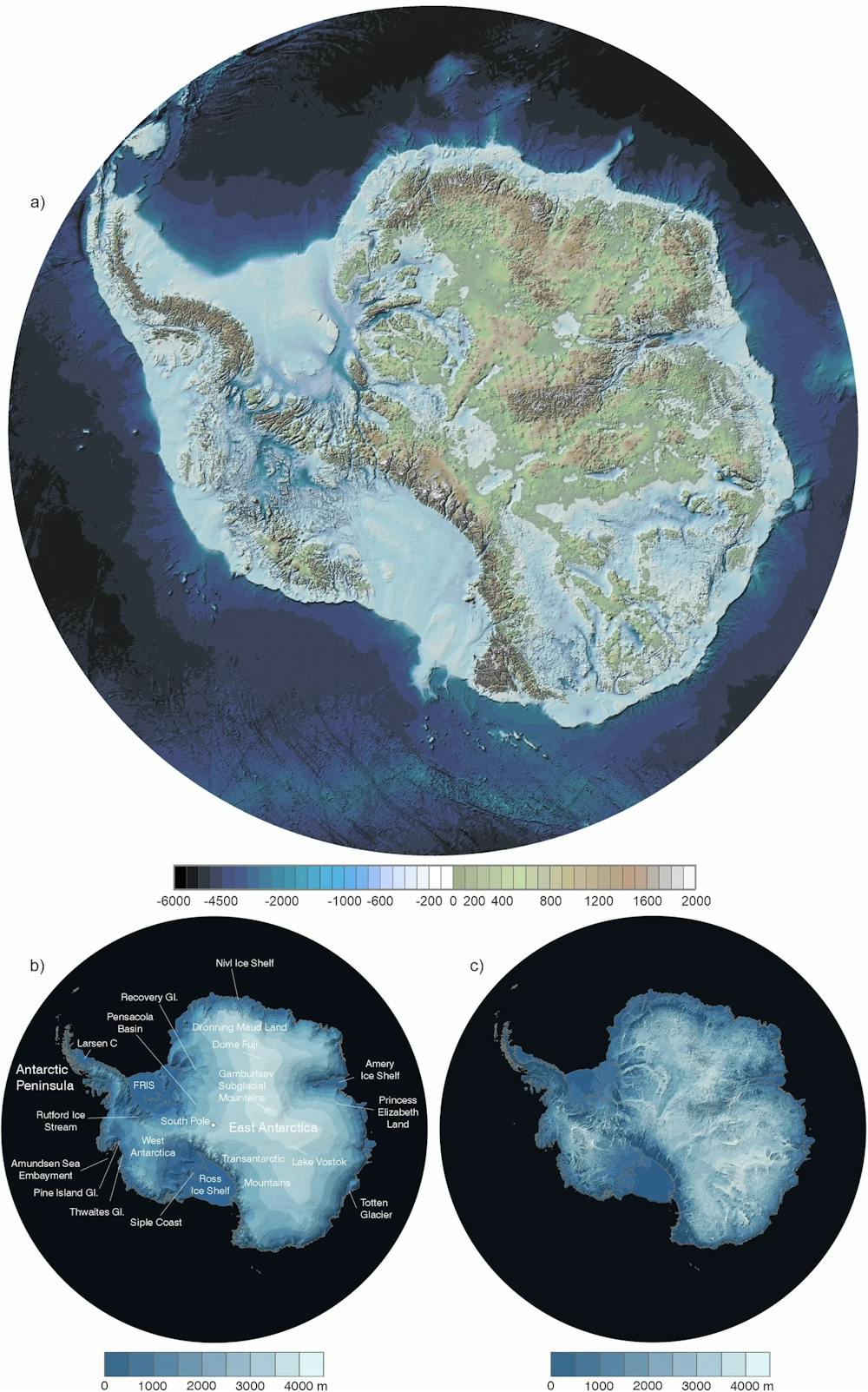
    A map of the topography (a) and surface elevation (b) of Antarctica, measured in metres above sea level; (c) shows ice thickness in metres.
    Pritchard et al., Scientific Data (2025), CC BY

    The collision of these landmasses was key to the birth of Gondwana, a supercontinent that included what is now Africa, South America, Australia, India and Antarctica.

    Our new study supports the idea that the Gamburtsev Mountains first formed during this ancient collision. The colossal clash of continents triggered the flow of hot, partly molten rock deep beneath the mountains.

    As the crust thickened and heated during mountain building, it eventually became unstable and began to collapse under its own weight.

    Deep beneath the surface, hot rocks began to flow sideways, like toothpaste squeezed from a tube, in a process known as gravitational spreading. This caused the mountains to partially collapse, while still preserving a thick crustal “root”, which extends into Earth’s mantle beneath.

    Mountain building causes deep crustal rocks to deform, fold and partially melt.
    Jacqueline Halpin

    Crystal time capsules

    To piece together the timing of this dramatic rise and fall, we analysed tiny zircon grains found in sandstones deposited by rivers flowing from the ancient mountains more than 250 million years ago. These sandstones were recovered from the Prince Charles Mountains, which poke out of the ice hundreds of kilometres away.

    Zircons are often called “time capsules” because they contain minuscule amounts of uranium in their crystal structure, which decays at a known rate and allows scientists to determine their age with great precision.

    These zircon grains preserve a record of the mountain-building timeline: the Gamburtsev Mountains began to rise around 650 million years ago, reached Himalayan heights by 580 million years ago, and experienced deep crustal melting and flow that ended around 500 million years ago.

    Most mountain ranges formed by continental collisions are eventually worn down by erosion or reshaped by later tectonic events. Because they’ve been preserved by a deep layer of ice, the Gamburtsev Subglacial Mountains are one of the best-preserved ancient mountain belts on Earth.

    While it’s currently very challenging and expensive to drill through the thick ice to sample the mountains directly, our model offers new predictions to guide future exploration.

    Geologists Jacqueline Halpin and Jack Mulder stand on the Denman Glacier during recent fieldwork.
    Jacqueline Halpin

    For instance, recent fieldwork near the Denman Glacier on East Antarctica’s coast uncovered rocks that may be related to these ancient mountains. Further analysis of these rock samples will help reconstruct the hidden architecture of East Antarctica.

    Antarctica remains a continent full of geological surprises, and the secrets buried beneath its ice are only beginning to be revealed.

    Jacqueline Halpin receives funding from the Australian Research Council through the ARC Australian Centre for Excellence in Antarctic Science (ACEAS) Special Research Initiative.

    Nathan R. Daczko receives funding from the Australian Research Council.

    ref. Antarctica has a huge, completely hidden mountain range. New data reveals its birth over 500 million years ago – https://theconversation.com/antarctica-has-a-huge-completely-hidden-mountain-range-new-data-reveals-its-birth-over-500-million-years-ago-256231

    MIL OSI AnalysisEveningReport.nz

  • MIL-OSI Asia-Pac: SFST’s speech at HKQAA International Sustainability Forum – Hong Kong 2025 (English only)

    Source: Hong Kong Government special administrative region

         Following is the pre-recorded video speech by the Secretary for Financial Services and the Treasury, Mr Christopher Hui, at the HKQAA International Sustainability Forum – Hong Kong 2025 today (May 12):

    Chairman Ho (Chairman of the Hong Kong Quality Assurance Agency (HKQAA), Mr Ho Chi-shing), Chin-wan (Secretary for Environment and Ecology, Mr Tse Chin-wan), distinguished guests, ladies and gentlemen,
     
         Good morning. It is my great pleasure to address you at the HKQAA’s annual international sustainability forum, a platform gathering relevant stakeholders from both the public and private sectors to discuss important issues of sustainability. This year’s theme, “Seizing Green Finance Opportunities in the Low-Carbon Transition of the Belt and Road Initiative and the Greater Bay Area (GBA)”, is highly relevant and timely amid the global shift and increasing awareness towards sustainability, and the rising importance of green and sustainable finance in supporting green transition and achieving carbon neutrality for the world. Pursuing the vision of a community with a shared future for mankind, both our country and our city look beyond the current geopolitical environment and the instability it brings, and are committed to promoting a low-carbon economy, green finance, and supporting green development in the Belt and Road region.
     
    Hong Kong as a premier international financial centre
     
         Being a premier international financial centre, Hong Kong also plays a part in supporting green development and transition in the region by mobilising cross-border investments to address climate and sustainability challenges. The Government, along with financial regulators and stakeholders, has been making efforts in enhancing the ecosystem of the green and sustainable finance market through a multipronged approach, namely (i) providing diversified green investment products; (ii) aligning with international standards; and (iii) supporting market development.
     
    Providing diversified green investment products
     
         Our capital market provides a wide range of green and sustainable investment products. In 2024, the volume of green and sustainable bonds arranged in Hong Kong amounted to around US$43 billion, ranking first in the Asian market for seven consecutive years since 2018 and capturing around 45 per cent of the regional total. As of March this year, the number of ESG (environmental, social and governance) funds authorised by the Securities and Futures Commission (SFC) was around 220 with assets under management of around HK$1.1 trillion – an increase of 80 per cent over the past three years.
     
         The Government Sustainable Bond Programme, formerly known as the Green Bond Programme, continues to play a leading role in funding local green initiatives. Since 2019, we have issued an equivalent of over HK$220 billion in green bonds across multiple currencies and tenors, including institutional, retail and tokenised tranches. Last year, we expanded the programme to include sustainable projects, reinforcing our commitment to broader environmental and social goals while setting important benchmarks for the market.
     
         We are also building the market infrastructure needed to connect capital with carbon-related products in Hong Kong, the Mainland, Asia and beyond. In 2022, Hong Kong Exchanges and Clearing Limited (HKEX) launched the Core Climate, an international carbon marketplace. It facilitates transparent, efficient trading of high-quality carbon credits from certified projects across Asia, South America, and West Africa. Sectors such as forestry, wind, solar, and biomass are represented, offering opportunities for enterprises in the GBA and Belt and Road economies to support their own Net Zero transitions.
     
    Alignment with international standards
     
    Sustainability reporting
     
         As global awareness of sustainability grows, consistent and reliable information becomes essential for investors and businesses to manage risk and allocate capital effectively. We launched in December last year the Roadmap on Sustainability Disclosure in Hong Kong. This provides a clear path for large publicly accountable entities to adopt the International Financial Reporting Standards (IFRS) – Sustainability Disclosure Standards (ISSB Standards) by 2028. This move places Hong Kong among the first jurisdictions to align local reporting requirements with the global baseline, enhancing transparency and comparability in sustainable finance. The roadmap not only reflects our commitment to the global green transition but also offers clarity and guidance to market participants.
     
    Taxonomy
     
         A shared understanding of what constitutes “green” is vital. In May 2024, the Hong Kong Monetary Authority (HKMA) published the Hong Kong Taxonomy for Sustainable Finance. This important tool supports the market by offering a standardised classification of green activities, aligned with the Common Ground Taxonomy to ensure interoperability with taxonomies in Mainland China and the European Union. The initial phase of the taxonomy covers 12 activities across four key sectors: power generation, transportation, construction, and water and waste management. As a living framework, the taxonomy will continue to evolve. The HKMA has embarked on the next phase development to expand the scope of sectors and economic activities, including transition activities.
     
    Supporting market development
     
         To promote the green financing activity in Hong Kong, we launched the Green and Sustainable Finance Grant Scheme in 2021. The scheme offers subsidies to eligible bond issuers and loan borrowers to help cover issuance and external review costs. Extended to 2027, its scope now also includes transition bonds and loans. This expansion will help encourage industries across the GBA and Belt and Road economies to leverage Hong Kong’s platform to finance their low-carbon transitions and contribute to global sustainability goals.
     
         We are also investing in innovation. Green fintech is an important enabler of scalable sustainability solutions. We launched the Green and Sustainable Fintech Proof-of-Concept Funding Support Scheme in June last year to provide early-stage funding to support technology companies or research institutes conducting green fintech activities to collaborate with local enterprises, and to co-develop new projects in the market addressing industry pain points. So far, 60 projects have been approved, reflecting the vibrant potential of Hong Kong’s green fintech ecosystem.
     
    Hong Kong’s unique position to support countries of the Belt and Road Initiative
     
         Hong Kong continues to serve as a bridge between Mainland China and the wider Belt and Road region. We actively promote regional co-operation through strategic platforms and exchanges. In April this year, the HKEX and the SFC co-hosted the inaugural International Carbon Markets Summit. The event brought together more than 200 global participants, including regulators, carbon trading platforms, corporates, and investors. The Summit marked a step forward in building trusted, effective carbon market ecosystems that support the sustainable development goals of Belt and Road economies.
     
         We also continue to convene the annual Asian Financial Forum (AFF) to foster international dialogue. In January this year, the 18th AFF featured a new milestone: the launch of a dedicated chapter co-hosted with the Gulf Cooperation Council (GCC). This marked an important milestone in fostering collaboration in financial services such as investments in green energy between Hong Kong and GCC member states.
     
         Climate change presents one of the greatest risks to our global economy. The increasing frequency and severity of natural disasters require new financial tools to build resilience. Hong Kong is taking a leading role in this area by developing the insurance-linked securities (ILS) and catastrophe bonds market.
     
         Since the launch of our ILS framework in 2021, seven catastrophe bonds have been issued in Hong Kong, raising over US$800 million in coverage against risks such as typhoons and earthquakes. These instruments provide critical risk mitigation solutions for both corporates and governments. To further support this market, we extended our Pilot ILS Grant Scheme to 2028, providing subsidies to issuers of ILS and supporting the growth of Hong Kong-based service providers. These efforts reinforce Hong Kong’s position as a centre for innovative risk management in the face of climate change.
     
    HKQAA’s contributions
     
         I would also like to take this opportunity to thank the HKQAA for its contributions to the development of green finance in Hong Kong. The HKQAA has been participating in the development of international standards for sustainable finance and launched the Green and Sustainable Finance Certification Scheme (formerly called Green Finance Certification Scheme) in 2018.
     
         I am delighted to know that the HKQAA also supports the development of a roadmap for sustainability disclosure in our country by contributing to the Beijing Municipal Bureau of Finance and Economy’s pilot project for sustainability disclosure and talent development. At home, it has supported Hong Kong’s own disclosure roadmap by establishing industry-specific climate risk tools to help local businesses prepare for future reporting requirements.
     
         The HKQAA has also forged partnerships with the Belt and Road International Green Development Alliance, helping regional partners access global capital markets and implement green financing solutions. Its work exemplifies the kind of cross-sector, cross-border collaboration that is essential for sustainable growth.
     
    Closing
     
         Looking forward, I am confident that the opportunities in green finance – particularly in supporting the low-carbon transition of the Belt and Road region and the GBA – will continue to expand. Today’s forum offers valuable insights into the path toward sustainability, a journey that calls for steadfast commitment, continuous innovation, and deep cross-regional collaboration. As we move forward, the Government remains committed to working hand in hand with the industry and all stakeholders to build a greener, more resilient future for Hong Kong and the wider region. Thank you.

    MIL OSI Asia Pacific News

  • MIL-Evening Report: As Donald Trump cuts funding to Antarctica, will the US be forced off the icy continent?

    Source: The Conversation (Au and NZ) – By Lynda Goldsworthy, Research Associate, Institute for Marine and Antarctic Studies, University of Tasmania

    Mozgova/Shutterstock

    President Donald Trump has begun eroding the United States presence in Antarctica by announcing deep funding cuts to his nation’s science and logistics on the icy continent.

    The Trump administration has significantly reduced funding for both Antarctica’s largest research and logistics station, McMurdo, and the National Science Foundation which funds US research in Antarctica.

    More cuts are foreshadowed. If carried through, US science and overall presence in Antarctica will be seriously diminished – at a time when China is significantly expanding its presence there.

    Since 1958, the US has been a leader in both Antarctic diplomacy and science. Shrinking its Antarctic presence will diminish US capacity to influence the region’s future.

    Why the US matters in Antarctica

    The US has historically focused its Antarctic influence in three key areas:

    1. Keeping Antarctica free from military conflict

    The US has built considerable Antarctic geopolitical influence since the late 1950s. Under President Dwight D. Eisenhower, it initiated (and later hosted) negotiations that led to the development of the 1959 Antarctic Treaty.

    It was also key to establishing the fundamental principles of the treaty, such as using the Antarctic region only for peaceful purposes, and prohibiting military activities and nuclear weapons testing.

    2. Governing Antarctica together

    The US was influential in developing the international legal system that governs human activities in the Antarctic region.

    In the 1970s, expanding unregulated fishing in the Southern Ocean led to serious concerns about the effects on krill-eating species – especially the recovery of severely depleted whale populations.

    The US joined other Antarctic Treaty nations to champion the Convention on the Conservation of Antarctic Marine Living Resources (CAMLR), signed in 1980. It prioritises conservation of Southern Ocean ecosystems and all species, over maximum fish harvesting.

    The US also contributed to the 1991 Protocol on Environmental Protection. Among other measures it prohibits mining and designates Antarctica as “a natural reserve, devoted to peace and science”.

    3. Scientific research and collaboration

    The US operates three year‑round Antarctic research stations: Palmer, Amundsen-Scott and McMurdo.

    McMurdo is Antarctica’s largest research station. Amundsen-Scott is located at the South Pole, the geographic centre of Antarctica, and the point at which all Antarctic territorial claims meet. The South Pole station is thus important symbolically and strategically, as well as for science.

    The US has the largest number of Antarctic scientists of any nation in the continent.

    US scientific work has been at the forefront of understanding Antarctica’s role in the global climate system, and how climate change will shape the future of the planet. It has also played a major role in Southern Ocean ecosystem and fisheries research.

    This research has underpinned important policies. For example, US input into models to predict and manage sustainable krill yields has been pivotal in regulating the krill fishery, and ensuring it doesn’t harm penguin, seal and whale populations.

    The US has also been a staunch supporter of a comprehensive network of marine protected areas in the Southern Ocean. The Ross Sea Region Marine Protected Area proposed by the US and New Zealand is the largest in the world.

    A broad ripple effect

    The US influence in Antarctica extends beyond the list above. For example, the US has a significant Antarctic-based space program. And US citizens make up most Antarctic tourists, and the US plays a significant role in regulating tourism there.

    The full extent of the Trump administration’s cuts is still to play out. But clearly, if they proceed as signalled, the cuts will be a major blow not to just US interests in Antarctica, but those of many other countries.

    The US has the best-resourced logistics network in Antarctica. Its air transport, shipping and scientific field support has traditionally been shared by other countries. New Zealand, for instance, is closely tied with the US in resupply of food and fuel, and uses US air and sea logistics for many operations to the Ross Sea region.

    And joint research programs with the US will be affected by reduced funding in Antarctica directly, and elsewhere.

    For example, reported cuts to the climate programs of NASA and the National Oceanic and Atmospheric Administration (NOAA) may hamper satellite coverage of the Antarctic and Southern Ocean. This would affect Australian scientists collecting data on ocean temperature, sea-ice state and other metrics used in climate research and weather forecasting.

    Worrying times ahead

    China has signalled its intention to be a key geopolitical player in Antarctica and has greatly expanded its Antarctic presence in recent years.

    China has five Antarctic research stations. Its sixth summer station is due for completion in 2027. China also operates two icebreaker ships, helicopters and a fixed-wing aircraft in Antarctica and is building new, large krill trawlers.

    Both China and Russia, are increasingly active in their opposition to environmental initiatives such as marine protected areas.

    A smaller US presence creates greater opportunities for others to shape Antarctica’s geopolitics. This includes pressure to erode decades-long protection of the Antarctic environment, a push for more intensive fish and krill harvesting, and potentially reopening debate on mining in the region.

    Lynda Goldsworthy and Tony Press co-authored the chapter Power at the Bottom of the World in the new book Antarctica and the Earth System.

    A smaller US presence creates opportunities for others to shape Antarctica’s geopolitics.
    Oleksandr Matsibura/Shutterstock

    Lynda Goldsworthy, research associate with IMAS, UTAS, undertakes occasional contract work with the Deep Sea Conservation, is a member of AFMA’s SouthMac advisory group ) and of CSIRO National Benefit Advisory Committee.

    Tony Press receives funding from the Australia-Japan Foundation (Department of .Foreign Affairs and Trade)

    ref. As Donald Trump cuts funding to Antarctica, will the US be forced off the icy continent? – https://theconversation.com/as-donald-trump-cuts-funding-to-antarctica-will-the-us-be-forced-off-the-icy-continent-254786

    MIL OSI AnalysisEveningReport.nz

  • MIL-OSI Asia-Pac: Property owner fined over $120,000 for not complying with removal order

    Source: Hong Kong Government special administrative region

    Property owner fined over $120,000 for not complying with removal order 
         This case involved unauthorised building works (UBWs) with an area of about 60 square metres on the roof of a village house in D.D.109, Yuen Long. Since the Lands Department would not issue a certificate of exemption for the UBWs and the UBWs were carried out without prior approval and consent from the Buildings Department (BD), a removal order was served on the owner under section 24(1) of the BO.
     
         Failing to comply with the removal order, the owner was prosecuted by the BD and was fined $122,940 in total, of which $102,940 was the fine for the number of days that the offence continued, upon conviction at the Tuen Mun Magistrates’ Courts on April 25.
     
         A spokesman for the BD said today (May 12), “UBWs may lead to serious consequences. Owners must comply with removal orders without delay. The BD will continue to take enforcement action against owners who have failed to comply with removal orders, including instigation of prosecution, so as to ensure building safety.”
     
         Failure to comply with a removal order without reasonable excuse is a serious offence under the BO. The maximum penalty upon conviction is a fine of $200,000 and one year’s imprisonment, and a further fine of $20,000 for each day that the offence continues.
    Issued at HKT 11:00

    NNNN

    MIL OSI Asia Pacific News

  • MIL-OSI China: Xi’s call for learning from history echoed by int’l community

    Source: China State Council Information Office

    Chinese President Xi Jinping’s signed article recently published in the Russian Gazette newspaper, which called for learning from history, and especially the hard lessons of the Second World War, has resonated with the international community.

    In the article titled “Learning from History to Build Together a Brighter Future,” Xi urged the international community to draw wisdom and strength from the victory in the World Anti-Fascist War, resolutely resist all forms of hegemonism and power politics, and work together to build a brighter future for humanity.

    Echoing Xi’s view, experts and officials in multiple countries stated that in today’s world — where unilateralism, hegemony and bullying practices pose severe threats — the international community should stand on the right side of history, uphold fairness and justice, resolutely safeguard the post-war international order, and work together to secure a brighter future for humanity.

    UPHOLD HISTORICAL TRUTH

    This year marks the 80th anniversary of the victory of the Chinese People’s War of Resistance Against Japanese Aggression, the Soviet Union’s Great Patriotic War and the World Anti-Fascist War. On this occasion, Xi’s call for upholding a correct historical perspective on World War II (WWII) carries significant contemporary relevance, said Alexey Rodionov, a professor of Chinese studies at St. Petersburg State University.

    As emphasized in Xi’s signed article, historical memory and truth serve as inspirations that mirror the present and illuminate the future, said Wirun Phichaiwongphakdee, director of the Thailand-China Research Center of the Belt and Road Initiative.

    Defending history is not only a way to honor the past but also a means of safeguarding fairness and justice in today’s world, he said.

    Katsuo Nishiyama, a Japanese germ warfare scholar and professor emeritus at Shiga University of Medical Science, said any attempts to distort the historical truth of WWII or deny its victorious outcome will not succeed, and the international community will not tolerate attempts to reverse history’s progress.

    To protect historical truth, efforts are still needed to prevent future tragedies, the expert warned.

    French entrepreneur and commentator Arnaud Bertrand said China has become a major country staunchly supporting multilateral institutions and international law. “Xi’s article is a clear window into current Chinese strategic thinking. China is positioning itself as a defender of the post-WWII international order against ‘hegemonic’ forces,” he said.

    RECOGNIZE PIVOTAL CONTRIBUTION

    In his signed article, President Xi stressed that China and the Soviet Union served as the mainstay of resistance against Japanese militarism and German Nazism, making pivotal contribution to the victory of the World Anti-Fascist War.

    As the main theater in the East of the World Anti-Fascist War, China played a pivotal role in defeating Japanese militarism and achieving broader victory over fascism, an outcome made possible by the immense sacrifices of the Chinese people, said Boris Cheltsov, scientific secretary of the Victory Museum in Moscow.

    “The Chinese people displayed extraordinary resilience and courage under extremely difficult conditions,” he said.

    In the article, Xi emphasized that Taiwan’s restoration to China was a victorious outcome of WWII and an integral part of the postwar international order.

    Taiwan is part of China, and China’s sovereignty over Taiwan is both legal and a recognized fact, said Mohab Nassar, associate professor of international law at Cairo University.

    DEFEND JUSTICE, NOT HEGEMONISM

    Today, the global deficits in peace, development, security and governance continue to widen unabated, Xi wrote in his article. To address these deficits, Xi proposed building a community with a shared future for mankind and put forward the Global Development Initiative, the Global Security Initiative and the Global Civilization Initiative as a way forward to steer the reform of the global governance system toward greater fairness and justice.

    Akkan Suver, president of the Marmara Group Foundation in Türkiye, said the three major global initiatives proposed by Xi are fair, just and truly uphold multilateralism.

    Despite rising unilateralism, China firmly opposes all forms of hegemony and power politics and is committed to maintaining international rules and order, which aligns with the common interests of developing countries, Suver said.

    In the face of various conflicts, the international community needs dialogue and cooperation, not division; global development requires rationality and conscience, not power politics, said Suver.

    President Xi has proposed to build a community with a shared future for mankind, emphasizing dialogue rather than confrontation, partnership rather than alliance, and win-win rather than zero-sum outcomes, said Abdullah Al-Dosari, editor in chief of Kuwait’s Al-Arab Electronic Newspaper.

    The Middle East region has long been in turmoil, with peace deficit growing larger and larger, Al-Dosari said, noting that Xi’s proposal has great significance for regional peace and stability. 

    MIL OSI China News

  • MIL-OSI China: Chinese hospitals bordering Russia see influx of people seeking TCM

    Source: People’s Republic of China – State Council News

    A doctor talks with patients at a hospital in Hunchun, northeast China’s Jilin province, June 28, 2023. Hunchun is located at China’s border with Russia and the Democratic People’s Republic of Korea. Traditional Chinese medicine treatments such as acupuncture and Tuina remedial massage have drawn Russian tourists to the city. [Photo/Xinhua]

    Traditional Chinese medicine is fueling a growing wave of inbound medical tourism in China’s border regions, particularly in cities such as Heihe and Suifenhe in Heilongjiang province.

    At the Traditional Chinese Medicine Hospital in Heihe, the scent of moxa wafts through the outpatient corridors. Consultation rooms feature traditional Chinese decor, with bilingual signage in Chinese and Russian.

    Vladimir Andriushenko, a 56-year-old from Russia’s Amur Oblast, found relief from chronic neck and shoulder pain after undergoing massage therapy at the hospital.

    “I have suffered from neck and shoulder pain for quite a long time,” he said. “When I first experienced traditional Chinese massage, I felt its magical effect.”

    Andriushenko said he discovered TCM through books and online research and has developed a strong interest in it since his first treatment years ago.

    “In many parts of Russia, where it’s cold, people often suffer from bone and joint diseases,” he said. “In Russia, rehabilitation mainly depends on medical equipment, but TCM therapies such as massage, acupuncture, cupping and herbal tea have become popular because they’re gentle and effective.”

    During his two-day trip to Heihe in April, Andriushenko also bought acupuncture needles and herbal cough medicine.

    “Most Russian patients prefer pulse diagnosis and herbal medicine,” said Liu Xuesong, director of the hospital. “The revisit rate for conditions such as rheumatism and neck pain is quite high.

    “As trust in TCM grows, many patients refer their relatives and friends,” he said. “To better serve Russian patients, we established an international medical department last year, trained our staff in Russian and hired professional translators to ensure smooth communication.”

    In 2024, the hospital provided acupuncture, cupping and other TCM therapies to more than 600 Russian patients and prescribed over 300 herbal formulas.

    The hospital has signed a cooperation agreement with a rehabilitation center in Yuzhno-Sakhalinsk, Russia, Liu said.

    “We plan to send four medical staff members there to help set up a TCM experience hall and offer massage therapy,” he said.

    Beyond hospital visits, Heihe has also leveraged its natural volcanic magnetic field and cold mineral springs in the Wudalianchi scenic area to attract older Russian visitors.

    Last year, the scenic area welcomed 210,000 health tourists, 40 percent of whom were from Russia.

    “The cold mineral springs are effective for rheumatism and spinal diseases, which are common among the Russians who visit,” said Yuan Xiaobo, head of the scenic area’s culture and tourism bureau. “We offer seven- to 14-day health packages combining spring water therapy and TCM — a good fit for short-term medical tourists.”

    The scenic area has also attracted investment from major companies like Yiling Hospital Management Group to build high-end therapeutic hospitals, offering personalized care plans and international-standard equipment.

    A similar trend is emerging in Suifenhe, another Heilongjiang city on the Russian border.

    At the People’s Hospital of Suifenhe, signage in Chinese, Russian and English helps guide patients through the facility.

    Last year, the hospital treated over 10,000 foreign patients. Since the start of this year, it has served more than 600, mostly from Russia’s Far East, according to hospital officials.

    “To better serve Russian patients, we’ve set up a dedicated reception room with traditional Chinese health exercises,” said Liu Ximing, director of the national TCM service export base at the hospital. “We’ve also upgraded our salt therapy room to blend treatment with leisure.”

    The hospital has established a remote consultation center and an international emergency dispatch center, using an “internet plus medical” model to efficiently meet the healthcare needs of Russian patients.

    MIL OSI China News

  • MIL-OSI China: Chinese coaches enjoy Premier experience at top English soccer academies

    Source: People’s Republic of China – State Council News

    While hopes are slim for China’s men’s soccer team to reach the next World Cup, the country is already investing in the sport’s future — starting with its coaches. Eight youth coaches from the Chinese Football Association have just returned from a three-week training stint in England, hosted by the Premier League.

    The visit was part of the International Elite Coach Program, a flagship initiative under a Memorandum of Understanding signed between the Premier League and the CFA last October.

    It is designed to support China’s long-term soccer ambitions by equipping local coaches with global expertise.

    Five of the eight coaches selected for the visit are former Chinese national team players.

    Over three weeks, they were hosted at two Premier League Category One Academies — Nottingham Forest and Wolverhampton Wanderers — where they engaged in hands-on training, match preparation and performance analysis alongside experienced club staff.

    The Chinese coaches participated in tactical briefings, reviewed under-18 and under-21 matches and attended competitive fixtures, including three Premier League games. They also joined a Premier League-run Coaching Craft workshop to further hone their technical skills.

    Sean Reed, the Premier League’s Head of Coaching, emphasized that the program mirrors the league’s own youth coach development structure, but was customized to meet the needs of the Chinese coaches.

    “During this trip, the coaches had the opportunity to work with players they had never coached before — many of whom did not speak the same language,” said Reed.

    “This experience challenged them to adapt their approaches to coaching, and strengthened their ability to communicate effectively in unfamiliar environments.

    “One particular task required the coaches to deliver a session without using verbal communication. This encouraged them to find alternative ways to engage and instruct players, reinforcing the idea that football truly is a universal language,” he added.

    Reed praised the coaches’ engagement and growth: “All the coaches have grown in confidence throughout the program. They demonstrated full commitment to every element of this unique experience, building on their football knowledge and bringing energy, curiosity and professionalism to each learning opportunity.”

    Reed said that the visit was just a beginning. To further support the ongoing development of the coaches and maintain engagement, they schedule regular online check-ins, as well as the opportunity to join relevant online sessions and conferences delivered by the Premier League.

    “We also provide tailored digital content designed to support their ongoing development,” he said.

    Among the delegation was Yu Hai, a former left-back who earned 71 caps for China.

    Now transitioning into coaching, currently managing former club Shanghai Port’s Under-19s team, Yu was struck by the intensity of the English training environment.

    “What impressed me most was that every session was run at full match pace,” he said. “Now that I’m a coach, I’ve shifted my attention to tactics and the structure of youth development systems.”

    Li Feiyu, an official of CFA’s technical department, described the visit as “exceptionally rewarding”.

    “The Premier League clubs demonstrated outstanding philosophies in youth development, and impressive professionalism in their academy operations,” said Li. “The experience has provided us with valuable reference points for enhancing our own systems. I believe this collaboration between the CFA and the Premier League holds long-term, constructive significance, and will greatly benefit youth development in Chinese football.”

    Neil Saunders, Director of Football at the Premier League, emphasized the importance of continued cooperation: “This program is part of our long-standing commitment to supporting football development in China.”

    “By working with our clubs to deliver a diverse and enriching itinerary, we’ve enabled the CFA coaching delegation to gain unique insights into elite academy environments. Our support for Chinese football development will continue, even after the delegation has returned to China,” he said.

    This is the second group of Chinese coaches to take part in the initiative, following the first cohort’s visit in September 2024. The program also aligns with the Premier League’s expanding presence in Asia, including the opening of its Beijing office in 2024 — its third international hub after Singapore and the United States.

    The Premier League has been involved in grassroots soccer in China for over 15 years. Since 2009, it has partnered with the British Council to deliver the Premier Skills coaching program in 28 cities across the country, training more than 6,300 grassroots coaches, referees, and physical education teachers.

    MIL OSI China News

  • MIL-Evening Report: ER Report: A Roundup of Significant Articles on EveningReport.nz for May 12, 2025

    ER Report: Here is a summary of significant articles published on EveningReport.nz on May 12, 2025.

    Victoria’s planning reforms could help solve the housing crisis. But they are under threat
    Source: The Conversation (Au and NZ) – By Brendan Coates, Program Director, Housing and Economic Security, Grattan Institute An aerial drone view of northern Melbourne suburbs. Elias Bitar/Shutterstock The federal election campaign was dominated by the housing crisis. But the real power to solve it rests with the states. In Victoria, reforms are underway that

    Footy’s ‘code wars’ are back, but which is actually the No. 1 Australian sport: the NRL or AFL?
    Source: The Conversation (Au and NZ) – By Tim Harcourt, Industry Professor and Chief Economist, University of Technology Sydney NRL Photos, Matt Turner/AAP, Wikimedia, The Conversation, CC BY Every now and then, so-called “code wars” erupt between the major Australia winter football codes: the National Rugby League (NRL) and the Australian Football League (AFL). This

    A prisoner voting ban shows again how few checks there are on parliamentary power
    Source: The Conversation (Au and NZ) – By Stephen Winter, Associate Professor in Political Theory, University of Auckland, Waipapa Taumata Rau Getty Images Justice Minister Paul Goldsmith’s recent announcement that the government would reinstate a total ban on prisoners voting was in keeping with the coalition’s overall tough-on-crime approach. The move was called “ridiculous” and

    ‘We’re just doing our best’ – cultural backlash hits Auckland kava business
    By Coco Lance, RNZ Pacific digital journalist A new Auckland-based kava business has found itself at the heart of a cultural debate, with critics raising concerns about appropriation, authenticity, and the future of kava as a deeply rooted Pacific tradition. Vibes Kava, co-founded by Charles Byram and Derek Hillen, operates out of New Leaf Kombucha

    ‘Fighting more frequent now’ – researcher warns of escalating West Papua conflict
    By Caleb Fotheringham, RNZ Pacific journalist The escalation of violence in West Papua is on par with some of the most intense times of conflict over the past six decades, a human rights researcher says. The United Liberation Movement for West Papua (ULMWP) claims that Indonesia killed at least one civilian and severely injured another

    India-Pakistan ceasefire shouldn’t disguise fact that norms have changed in South Asia, making future de-escalation much harder
    Source: The Conversation (Au and NZ) – By Farah N. Jan, Senior Lecturer in International Relations, University of Pennsylvania A member of the Indian Border Security Force stands guard near the India-Pakistan border. Narinder Nanu/AFP via Getty Images India and Pakistan have seen the scenario play out before: a terror attack in which Indians are

    Homer’s Iliad is a rap battle
    Source: The Conversation (Au and NZ) – By Joshua Forstenzer, Senior Lecturer in Philosophy and Co-Director of the Centre for Engaged Philosophy, University of Sheffield The Anger of Achilles by Jacques-Louis David (1819). Kimbell Art Museum Homer’s Iliad is one of the foundational stories of European civilisation. The Iliad is a long poem – an

    Major brands don’t need to kowtow to Trump: they have the power to bring people together
    Source: The Conversation (Au and NZ) – By Michael Beverland, Professor of Brand Management, University of Sussex Business School, University of Sussex Whatever you think of his personality or politics, it’s impossible to deny the success of Donald Trump as a brand. Supporters and detractors across the world are transfixed by his second term as

    Meteorites and marsquakes hint at an underground ocean of liquid water on the Red Planet
    Source: The Conversation (Au and NZ) – By Hrvoje Tkalčić, Professor, Head of Geophysics, Director of Warramunga Array, Australian National University UAESA / MBRSC / Hope Mars Mission / EXI / Andrea Luck, CC BY Evidence is mounting that a secret lies beneath the dusty red plains of Mars, one that could redefine our view

    Why doesn’t Australia make more medicines? Wouldn’t that fix drug shortages?
    Source: The Conversation (Au and NZ) – By Peter Coomber, PhD Candidate, Pharmaceutical Supply Chains, The University of Queensland IM Imagery/Shutterstock About 400 medicines are in short supply in Australia. Of these, about 30 are categorised as critical. These are ones with a life-threatening or serious impact on patients, and with no readily available substitutes.

    Farmers fear dingoes are eating their livestock – but predator poo tells an unexpected story
    Source: The Conversation (Au and NZ) – By Rachel Mason, PhD candidate in Conservation Biology, Deakin University Kristian Bell/Shutterstock Killing carnivores to protect livestock, wildlife and people is an emotive and controversial issue that can cause community conflict. Difficult decisions about managing predators must be supported by strong scientific evidence. In Australia, predators such as

    ‘Cutting off communications’ – did Trump really just turn his back on Israel?
    ANALYSIS: By Robert Inlakesh Israel is in a weak position and Prime Minister Benjamin Netanyahu’s extremism knows no bounds. The only other way around an eventual regional war is the ousting of the Israeli prime minister. US President Donald Trump has closed his line of communication with Israeli Prime Minister Benjamin Netanyahu, according to various

    View from The Hill: if Jacinta Nampijinpa Price became Liberal deputy it would be a wild ride
    Source: The Conversation (Au and NZ) – By Michelle Grattan, Professorial Fellow, University of Canberra Jacinta Nampijinpa Price’s confirmation she will run for Liberal deputy has put the members of an already shell-shocked party into a new spin. Tuesday’s leadership contest, where the numbers are said to be tight, is a battle for the direction

    Dumped minister Ed Husic labels Deputy Prime Minister Richard Marles ‘factional assassin’
    Source: The Conversation (Au and NZ) – By Michelle Grattan, Professorial Fellow, University of Canberra Industry Minister Ed Husic, dumped from the frontbench ahead of Anthony Albanese’s announcement of his new ministry, has made an excoriating attack on Deputy Prime Minister Richard Marles, describing him as a “factional assassin”. Marles, chief of the Victorian right,

    Philippine advocacy group condemns NZ military pact with Manila, rejects election violence
    Asia Pacific Report The Aotearoa Philippines Solidarity national assembly has condemned the National Party-led Coalition government in New Zealand over signing a “deplorable” visiting forces agreement with the Philippine government “Given the Armed Forces of the Philippines’ appalling human rights record and continuing attacks on activists in the Philippines, it is deplorable for the New

    MIL OSI AnalysisEveningReport.nz

  • MIL-OSI Global: As Donald Trump cuts funding to Antarctica, will the US be forced off the icy continent?

    Source: The Conversation – Global Perspectives – By Lynda Goldsworthy, Research Associate, Institute for Marine and Antarctic Studies, University of Tasmania

    Mozgova/Shutterstock

    President Donald Trump has begun eroding the United States presence in Antarctica by announcing deep funding cuts to his nation’s science and logistics on the icy continent.

    The Trump administration has significantly reduced funding for both Antarctica’s largest research and logistics station, McMurdo, and the National Science Foundation which funds US research in Antarctica.

    More cuts are foreshadowed. If carried through, US science and overall presence in Antarctica will be seriously diminished – at a time when China is significantly expanding its presence there.

    Since 1958, the US has been a leader in both Antarctic diplomacy and science. Shrinking its Antarctic presence will diminish US capacity to influence the region’s future.

    Why the US matters in Antarctica

    The US has historically focused its Antarctic influence in three key areas:

    1. Keeping Antarctica free from military conflict

    The US has built considerable Antarctic geopolitical influence since the late 1950s. Under President Dwight D. Eisenhower, it initiated (and later hosted) negotiations that led to the development of the 1959 Antarctic Treaty.

    It was also key to establishing the fundamental principles of the treaty, such as using the Antarctic region only for peaceful purposes, and prohibiting military activities and nuclear weapons testing.

    2. Governing Antarctica together

    The US was influential in developing the international legal system that governs human activities in the Antarctic region.

    In the 1970s, expanding unregulated fishing in the Southern Ocean led to serious concerns about the effects on krill-eating species – especially the recovery of severely depleted whale populations.

    The US joined other Antarctic Treaty nations to champion the Convention on the Conservation of Antarctic Marine Living Resources (CAMLR), signed in 1980. It prioritises conservation of Southern Ocean ecosystems and all species, over maximum fish harvesting.

    The US also contributed to the 1991 Protocol on Environmental Protection. Among other measures it prohibits mining and designates Antarctica as “a natural reserve, devoted to peace and science”.

    3. Scientific research and collaboration

    The US operates three year‑round Antarctic research stations: Palmer, Amundsen-Scott and McMurdo.

    McMurdo is Antarctica’s largest research station. Amundsen-Scott is located at the South Pole, the geographic centre of Antarctica, and the point at which all Antarctic territorial claims meet. The South Pole station is thus important symbolically and strategically, as well as for science.

    The US has the largest number of Antarctic scientists of any nation in the continent.

    US scientific work has been at the forefront of understanding Antarctica’s role in the global climate system, and how climate change will shape the future of the planet. It has also played a major role in Southern Ocean ecosystem and fisheries research.

    This research has underpinned important policies. For example, US input into models to predict and manage sustainable krill yields has been pivotal in regulating the krill fishery, and ensuring it doesn’t harm penguin, seal and whale populations.

    The US has also been a staunch supporter of a comprehensive network of marine protected areas in the Southern Ocean. The Ross Sea Region Marine Protected Area proposed by the US and New Zealand is the largest in the world.

    A broad ripple effect

    The US influence in Antarctica extends beyond the list above. For example, the US has a significant Antarctic-based space program. And US citizens make up most Antarctic tourists, and the US plays a significant role in regulating tourism there.

    The full extent of the Trump administration’s cuts is still to play out. But clearly, if they proceed as signalled, the cuts will be a major blow not to just US interests in Antarctica, but those of many other countries.

    The US has the best-resourced logistics network in Antarctica. Its air transport, shipping and scientific field support has traditionally been shared by other countries. New Zealand, for instance, is closely tied with the US in resupply of food and fuel, and uses US air and sea logistics for many operations to the Ross Sea region.

    And joint research programs with the US will be affected by reduced funding in Antarctica directly, and elsewhere.

    For example, reported cuts to the climate programs of NASA and the National Oceanic and Atmospheric Administration (NOAA) may hamper satellite coverage of the Antarctic and Southern Ocean. This would affect Australian scientists collecting data on ocean temperature, sea-ice state and other metrics used in climate research and weather forecasting.

    Worrying times ahead

    China has signalled its intention to be a key geopolitical player in Antarctica and has greatly expanded its Antarctic presence in recent years.

    China has five Antarctic research stations. Its sixth summer station is due for completion in 2027. China also operates two icebreaker ships, helicopters and a fixed-wing aircraft in Antarctica and is building new, large krill trawlers.

    Both China and Russia, are increasingly active in their opposition to environmental initiatives such as marine protected areas.

    A smaller US presence creates greater opportunities for others to shape Antarctica’s geopolitics. This includes pressure to erode decades-long protection of the Antarctic environment, a push for more intensive fish and krill harvesting, and potentially reopening debate on mining in the region.

    Lynda Goldsworthy and Tony Press co-authored the chapter Power at the Bottom of the World in the new book Antarctica and the Earth System.

    A smaller US presence creates opportunities for others to shape Antarctica’s geopolitics.
    Oleksandr Matsibura/Shutterstock

    Lynda Goldsworthy, research associate with IMAS, UTAS, undertakes occasional contract work with the Deep Sea Conservation, is a member of AFMA’s SouthMac advisory group ) and of CSIRO National Benefit Advisory Committee.

    Tony Press receives funding from the Australia-Japan Foundation (Department of .Foreign Affairs and Trade)

    ref. As Donald Trump cuts funding to Antarctica, will the US be forced off the icy continent? – https://theconversation.com/as-donald-trump-cuts-funding-to-antarctica-will-the-us-be-forced-off-the-icy-continent-254786

    MIL OSI – Global Reports

  • MIL-OSI: WuBlockchain Interviews BitMart’s New CEO Nenter (Nathan) Chow: Technological Innovation, Global Expansion, and Community Empowerment

    Source: GlobeNewswire (MIL-OSI)

    Mahe, Seychelles, May 11, 2025 (GLOBE NEWSWIRE) — In an exclusive interview conducted by WuBlockchain, one of the cryptocurrency industry’s leading media platforms, BitMart’s newly appointed CEO, Nenter (Nathan) Chow, shares the key factors behind his transition from traditional finance to Web3, and how his background strengthens BitMart’s core competitiveness. He also outlines the platform’s strategic plans in technological innovation, global market expansion, and community building, while offering insights into emerging trends at the intersection of AI and blockchain.

    With over 17 years of experience in traditional finance, Chow was motivated to transition to the Web3 space due to a strong belief in the transformative potential of decentralized technologies to reshape global financial systems. Having spent years in investment banking at institutions like JP Morgan and Mitsubishi UFJ, Chow observed both the strengths and limitations of traditional finance, including inefficiencies in cross-border transactions and barriers to financial inclusion. Web3, with its foundation in blockchain, provided a decentralized, transparent, and accessible alternative that empowered individuals and communities worldwide. His transition was further supported by his experience in leveraged finance, M&A, and debt capital markets, which provided a deep understanding of capital flows and institutional needs, critical for scaling Web3 adoption. Joining Animoca Ventures gave Chow the opportunity to immerse himself in the Web3 space, forge connections with innovators and governments, and now, as BitMart’s CEO, he aims to leverage his expertise to build a platform that acts as a gateway to this new financial frontier.

    Chow’s previous role as a partner at Animoca Ventures also significantly influenced his strategic vision for BitMart’s future development. At Animoca, he led global expansion efforts, built relationships with top project founders and investors, and secured premium deal allocations, such as being one of the only Asian venture funds on Monad’s cap table. This experience underscored the value of bridging regional ecosystems, particularly between Asia and the West, to unlock unique opportunities. For BitMart, Chow envisions a platform that facilitates not only trading but also serves as a cornerstone of the Web3 ecosystem. His investment background guides his strategy of fostering innovation through strategic partnerships, including collaborations with Paxos and Banxa, and supporting emerging projects via the platform’s Launchpad. Furthermore, Chow’s work with Web3 support and accelerator programs in the MENA region reinforced the power of collaborating with governments and accelerators to drive adoption, positioning BitMart as a trusted partner for both institutional and retail users.

    In discussing BitMart’s positioning in today’s highly competitive exchange market, Chow emphasized that BitMart stands out due to its global, user-centric approach. Serving over 10 million users across 200 regions, BitMart’s core competitive advantages lie in its robust security framework, technological innovation, and localized engagement. BitMart’s security, highlighted by its multi-layered defense system and partnerships with firms like Fireblocks and Cobo, is critical in maintaining trust in a market facing heightened scrutiny. BitMart differentiates itself through empowering users, notably with its “Stake to Vote” mechanism, where users can stake BMX tokens to influence token listings, turning them into stakeholders. Additionally, BitMart’s third-generation trading system, capable of processing 80,000 orders per second with a 2-millisecond latency, sets an industry standard for speed and reliability. With support for 90 fiat currencies and 11 languages, BitMart ensures local relevance across diverse regions such as the EU, MENA, and LATAM, combining global reach with tailored experiences.

    Looking toward BitMart’s strategic goals for the next phase, Chow highlighted three key priorities: enhancing technological innovation, expanding global reach, and empowering communities. The platform is prioritizing AI integration and blockchain convergence, planning to roll out smart analytics and automated tools in 2025. BitMart also aims to strengthen its presence in both regulatory-mature markets, such as the EU, and high-growth regions like MENA and LATAM, leveraging localized strategies and partnerships. Additionally, BitMart is committed to transforming users into active stakeholders through initiatives like the decentralized wallet strategy, set to launch in Q3 2025, and the “Stake to Vote” program, aligning with its mission to build a sustainable and inclusive crypto ecosystem.

    In terms of BitMart’s latest global growth strategy, Chow explained that initiatives like the “Slippage Protection Program” and the “Global Community Partner Program” reflect the platform’s commitment to empowering users and promoting community participation. The Slippage Protection Program compensates users within one hour for slippage exceeding 0.05%, reinforcing BitMart’s position as a user-first platform that values transparency and reliability. Meanwhile, the Global Community Partner Program encourages decentralized engagement by empowering local ambassadors to host events and share insights. This initiative strengthens BitMart’s global-local balance and elevates its brand as a trusted, innovative exchange.

    Chow also noted that BitMart’s Slippage Protection Program stands apart from similar mechanisms in the market due to its speed, transparency, and user-centric design. Unlike other programs that may involve delays or complex processes, BitMart’s program compensates users quickly and efficiently, ensuring immediate relief for slippage exceeding 0.05%. The program’s seamless integration with BitMart’s third-generation trading system allows for real-time monitoring and rapid resolution of slippage issues, setting a new standard for trust in the trading environment.

    The launch of the Elite Trader Program was another significant initiative designed to attract top traders. The program offers substantial incentives, including a 50% share of followers’ profits, making it one of the most lucrative in the industry. BitMart attracts top traders by providing advanced tools such as its third-generation trading system, which ensures low-latency, high-throughput trading, as well as exclusive benefits like access to premium market insights and personalized support.

    Chow also discussed the delicate balance BitMart maintains between decentralized community building and a consistent brand image. Through programs like the Global Community Partner Program, BitMart empowers local ambassadors to engage with users while ensuring alignment with core values of security, transparency, and innovation. Regular training and clear communication guidelines help maintain brand consistency across diverse markets, while initiatives like “Stake to Vote” further engage the community and reinforce BitMart’s user-centric approach.

    Drawing from his experience with Web3 support and accelerator programs in the MENA region, Chow offered insights into the differences in Web3 ecosystem development across global regions. In MENA, government-backed initiatives prioritize institutional integration and public-private partnerships, providing fertile ground for Web3 innovation. In contrast, regions like North America and Asia rely more heavily on private sector innovation, with ecosystems built around venture capital and grassroots projects. These regional insights inform BitMart’s global strategy, allowing the platform to engage with governments in MENA, leverage venture capital networks in the West, and tap into Asia’s vibrant community for adoption.

    Chow expressed his strong belief in the convergence of AI and blockchain technology as a transformative force for finance, enhancing efficiency, transparency, and personalization. BitMart is actively exploring this convergence, with plans to roll out AI-powered smart analytics, automated trading tools, and personalized investment strategies in 2025. BitMart’s commitment to these technologies aims to position it as an industry leader in delivering intelligent, user-centric solutions for the Web3 ecosystem.

    Finally, Chow provided his perspective on the current trends in the broader cryptocurrency market. He pointed out the increasing adoption of stablecoins, the tokenization of real-world assets, and the rise of AI-blockchain integration as key developments to watch. BitMart is focused on capitalizing on these trends by advancing its technological capabilities, expanding its global footprint, and fostering community-driven initiatives, ensuring it remains at the forefront of the cryptocurrency industry.

    This interview was conducted by WuBlockchain. Read the full article here: https://www.wublockchain.xyz/index.php?m=content&c=index&a=show&catid=35&id=1320 

    About BitMart

    BitMart is a premier global digital asset trading platform with more than 10 million users worldwide. Consistently ranked among the top crypto exchanges on CoinGecko, BitMart offers over 1,700 trading pairs with competitive fees. Committed to continuous innovation and financial inclusivity, BitMart empowers users globally to trade seamlessly. Learn more about BitMart at Website, follow their X (Twitter), or join their Telegram for updates, news, and promotions. Download BitMart App to trade anytime, anywhere.

    Disclaimer:

    The information provided is for informational purposes only and should not be considered a recommendation to buy, sell, or hold any financial assets. All information is provided in good faith. However, we make no representation or warranty of any kind, express or implied, regarding the accuracy, adequacy, validity, reliability, availability or completeness of such information.

    All crypto investments, including earnings, are highly speculative in nature and involve substantial risk of loss. Past, hypothetical, or simulated performance is not necessarily indicative of future results. The value of digital currencies can go up or down and there can be a substantial risk in buying, selling, holding, or trading digital currencies. You should carefully consider whether trading or holding digital currencies is suitable for you based on your personal investment objectives, financial circumstances, and risk tolerance. BitMart does not provide any investment, legal or tax advice.

    The MIL Network

  • MIL-OSI Security: Mobile Diving and Salvage Unit 1 and the Republic of Korea Navy’s Sea Salvage and Rescue Unit conclude SALVEX Korea 2025 [Image 2 of 3]

    Source: United States Navy (Logistics Group Western Pacific)

    Issued by: on


    JINHAE NAVAL BASE, Republic of Korea (April 11, 2025) U.S. Navy Divers assigned to Mobile Diving and Salvage Unit 1, pose for a photo with the Republic of Korea Sea Salvage and Rescue Unit during a joint dive and salvage exercise at Jinhae Naval Base, Republic of Korea, April 11, 2025. Commander, Logistics Group Western Pacific/Task Force 73 sustains the U.S. Navy’s maritime forces and is responsible for all diving and salvage operations in the Western Pacific in support of a free and open Indo-Pacific. (U.S. Navy photo by Mass Communication Specialist 2nd Class Jordan Jennings)

    Date Taken: 04.11.2025
    Date Posted: 04.18.2025 01:49
    Photo ID: 8981204
    VIRIN: 250411-N-YV347-1145
    Resolution: 5894×4051
    Size: 10.27 MB
    Location: JINHAE, KR

    Web Views: 13
    Downloads: 1

    PUBLIC DOMAIN  

    MIL Security OSI

  • MIL-OSI Security: U.S. Deputy Assistant Secretary of Defense for South and Southeast Asia Visits COMLOG WESTPAC, May 8, 2025 [Image 1 of 5]

    Source: United States Navy (Logistics Group Western Pacific)

    Issued by: on


    SINGAPORE (May 8, 2025) The Hon. Dr. Andrew Byers, center left, Deputy Assistant Secretary of Defense for South and Southeast Asia, is given a tour of the Joint Logistics Operations Center (JLOC) by Rear Adm. Todd Cimicata, Commander, Logistics Group Western Pacific/Task Force 73, during a scheduled visit to Sembawang Naval Installation, May 8, 2025. COMLOG WESTPAC supports deployed maritime forces, along with regional Allies and partners, to sustain Western Pacific operations. (U.S. Navy photo by Mass Communication Specialist 2nd Moises Sandoval/Released)

    Date Taken: 05.07.2025
    Date Posted: 05.11.2025 21:44
    Photo ID: 9028649
    VIRIN: 250508-N-ED646-1028
    Resolution: 6434×3735
    Size: 1.84 MB
    Location: SG

    Web Views: 0
    Downloads: 0

    PUBLIC DOMAIN  

    MIL Security OSI

  • MIL-OSI Security: U.S. Deputy Assistant Secretary of Defense for South and Southeast Asia Visits COMLOG WESTPAC, May 8, 2025 [Image 4 of 5]

    Source: United States Navy (Logistics Group Western Pacific)

    Issued by: on


    SINGAPORE (May 8, 2025) Rear Adm. Todd Cimicata, right, Commander, Logistics Group Western Pacific/Task Force 73, and the Hon. Dr. Andrew Byers, Deputy Assistant Secretary of Defense for South and Southeast Asia, pose for a photo during a scheduled visit to Sembawang Naval Installation, May 8, 2025. COMLOG WESTPAC supports deployed maritime forces, along with regional Allies and partners, to sustain Western Pacific operations. (U.S. Navy photo by Mass Communication Specialist 2nd Class Moises Sandoval/Released)

    Date Taken: 05.07.2025
    Date Posted: 05.11.2025 21:44
    Photo ID: 9028656
    VIRIN: 250508-N-ED646-1021
    Resolution: 7029×5021
    Size: 2.79 MB
    Location: SG

    Web Views: 0
    Downloads: 0

    PUBLIC DOMAIN  

    MIL Security OSI

  • MIL-OSI China: ‘Tech for good, tech for all’ — China’s path to global branding

    Source: People’s Republic of China – State Council News

    This photo taken on May 10, 2025 shows a scene of the main forum of the 2025 World Brand Moganshan Conference, held in Deqing County, east China’s Zhejiang Province. [Photo/Xinhua]

    Across diverse sectors, Chinese companies are turning inclusive and self-driven innovation into a common pursuit: building global brands through accessible technology and self-reliant strength.

    “Technology should be a public good that is accessible to every individual and affordable for every small business,” Wang Jing, general manager of public affairs at Alibaba Group, said on the sidelines of the 2025 World Brand Moganshan Conference.

    Held from May 9 to 11 in east China’s Zhejiang Province, the conference, themed “Brands Bring Better Future for the World,” is aimed at creating a Chinese platform for global cooperation, shared development and mutual benefit.

    On April 29, Alibaba unveiled Qwen3, the latest iteration of its open-source large language model family. All Qwen3 models are freely available to developers worldwide, underscoring the company’s commitment to inclusive innovation in the AI space.

    “As of the end of March, downloads of Qwen models on collaborative AI platform, Hugging Face, had surpassed 200 million, accounting for more than 20 percent of all model downloads,” said Wang. “Behind this surge is the rising global influence of China’s homegrown technology in the AI landscape.”

    Even robotic dogs are stepping up, and not just in terms of speed and agility, but in embodying a vision of technology designed to serve all.

    At DEEP Robotics, the “AI for All” vision is materializing through four-legged machines. Under its “AI+” initiative, the Hangzhou-based company combines software training systems with massive datasets to enable autonomous learning in quadruped robots.

    Enhanced by proprietary algorithms, these robots can now navigate complex environments, adapt to unstructured terrain, and support rescue teams by swiftly entering disaster zones and relaying real-time data for decision-making.

    “AI-powered robots can help humans work more safely and efficiently in diverse scenarios — from power facility inspections to emergency response,” said Meng Yuan, a media manager at DEEP Robotics. “They’re built to take on repetitive and high-risk tasks, and may one day assist with everyday needs in the home.”

    The company’s global footprint now covers Japan, the Republic of Korea, Singapore, the Middle East, Europe and North America — with international demand rising. “In Singapore, a local power company is using our robotic dogs to inspect underground utility tunnels, reducing labor costs and boosting urban efficiency,” said Meng.

    Meanwhile, in Zhejiang’s textile industrial heartland, Hangzhou Hangmin Damei Dyeing and Finishing Co., Ltd., a fabric supplier to global fashion brands including Zara, is grappling with rising green trade barriers.

    Confronted with a maze of carbon policies and mounting compliance costs tied to carbon tariffs and clean energy transition, the company has joined a new alliance that turns compliance into a competitive advantage.

    The “Green Energy To” initiative, led by the Xiaoshan Power Supply Company under the State Grid Corporation of China, in partnership with government agencies, financial institutions and exporters, offers a three-pronged solution — policy guidance, carbon-reduction services, and tailored financial support.

    With the alliance’s support, Hangmin Damei analyzed carbon footprints across eight production lines, built a digital monitoring platform, and now generates monthly energy-efficiency reports. Equipped with real-time carbon data and smart low-carbon solutions, the company is exporting to the European Union under a new label, namely “Green Energy To” — thus symbolizing China’s emerging brand story.

    “As global trade undergoes a green transformation, the ‘Green Energy To’ initiative aims to give Chinese exporters a green passport to navigate mounting carbon-based tariffs,” said Lai Hanbin, deputy director of the marketing department at Xiaoshan Power Supply Company. Lai served as a “zero-carbon engineer” for the 19th Asian Games held in Hangzhou in September 2023.

    “I think the time has now come for Chinese people to start to really appreciate their own brands,” said Michael Levitt, 2013 Nobel laureate in chemistry and vice chairman of the World Laureates Association. “I believe that Chinese brands will spread to the rest of the world.”

    MIL OSI China News

  • MIL-OSI Economics: Secretary-General of ASEAN honours with Traditional Māori Welcome at the University of Auckland

    Source: ASEAN

    In his first official engagement in New Zealand and during his visit to the University of Auckland, Secretary-General of ASEAN, Dr. Kao Kim Hourn, was formally welcomed with a Pōwhiri — a traditional Māori ceremony of hospitality and respect. Dr. Kao expressed his deep appreciation to the University for the warm reception and the opportunity to engage in such a meaningful cultural experience during his visit.

    The post Secretary-General of ASEAN honours with Traditional Māori Welcome at the University of Auckland appeared first on ASEAN Main Portal.

    MIL OSI Economics

  • MIL-OSI Economics: Secretary-General of ASEAN meets with Vice-Chancellor of the University of Auckland

    Source: ASEAN

    Dr. Kao Kim Hourn, Secretary-General of ASEAN, today met with Professor Dawn Freshwater, Vice-Chancellor of the University of Auckland, to explore opportunities for deepening collaboration between universities in ASEAN and in  New Zealand. Their discussion focused on advancing academic and research partnerships to support education and regional development.

    The post Secretary-General of ASEAN meets with Vice-Chancellor of the University of Auckland appeared first on ASEAN Main Portal.

    MIL OSI Economics

  • MIL-Evening Report: Footy’s ‘code wars’ are back, but which is actually the No. 1 Australian sport: the NRL or AFL?

    Source: The Conversation (Au and NZ) – By Tim Harcourt, Industry Professor and Chief Economist, University of Technology Sydney

    NRL Photos, Matt Turner/AAP, Wikimedia, The Conversation, CC BY

    Every now and then, so-called “code wars” erupt between the major Australia winter football codes: the National Rugby League (NRL) and the Australian Football League (AFL).

    This animosity likely stems from a phenomenon known as “the Barassi Line”, a cultural and geographical divide based on football preference which runs from Eden, NSW, through Canberra and up to Arnhem Land.


    Read more:
    The Barassi Line: a globally unique divider splitting Australia’s footy fans


    Recently, NRL chair Peter V’Landys claimed victory over the AFL in a strongly worded salvo:

    Rugby league has reaffirmed its standing as the No. 1 sporting code in Australia and the Pacific after the Australian Rugby League Commission (ARLC) announced record-breaking attendances, TV audiences, participation, revenue and assets.

    But is he right to state the NRL as Australia’s No. 1 sport?

    A uniquely Australian battle

    The battleground in Australia is unique: most nations have only one major football code, soccer. Australia though has four – Australian rules football (AFL), rugby league (NRL), soccer and rugby union.

    More competition is good for the consumer and, in this case, the consumer is the Aussie sports fan.

    The way these fans watch, play and pour money into each sport is closely tracked by each league. And the competition for talent, fans, sponsors and eyeballs via TV, digital media and streaming grows every year.

    Thanks to Australian sports media experts SportsIndustryAU, we can now make a direct comparison between the codes.


    What the numbers say

    It’s important to note the NRL’s recent chest-beating refers to audiences in Australia and the Pacific, explaining the code’s push into Papua New Guinea (PNG) and potentially further expansion in New Zealand.


    Read more:
    Sports diplomacy: why the Australian government is spending $600 million on a new NRL team in PNG


    In terms of revenue, the AFL earned 39% more than the NRL in 2024: $1.04 billion compared to the NRL’s $744.8 million.

    In terms of profit, the NRL’s was 51% higher than the AFL in 2024. This was in large part due to the NRL having only half the operational expenses of the AFL.

    However, if we look at operating profit (gross profit minus operating expenses), the AFL was 13% higher than the NRL before it made its annual distributions to clubs. The AFL distributes its profits among its 18 clubs, with smaller clubs receiving more than the more powerful teams.

    In terms of net assets (the value of an organisation’s assets minus its liabilities), the AFL is also richer: it has net assets of $482.3 million compared to $322.4 million for the NRL. The AFL owns Marvel Stadium and a share in the sports data and analytics company Champion Data. By comparison, the NRL has shares in many hotels.

    In terms of TV audience, the NRL was 10% larger in terms of average aggregated audiences for free-to-air and paid subscription services in 2024: 153.7 million to the AFL’s 140.3 million. However, AFL matches go longer and the season features more games than the NRL. Also, these figures do not include streaming numbers, which will be part of future broadcast deals.

    In terms of attendance and membership, the AFL is a clear winner.

    The AFL welcomed 8.4 million fans through the gate in 2024, compared to 4.3 million for the NRL.

    For membership, the AFL’s clubs boasted 1.32 million collectively in 2024. In the NRL, there are slightly more than 400,000 club members (based on club data – the NRL does not release membership data).

    In terms of participation, Ausplay – a national tracking survey led by the Australian Sports Commission – estimates 641,390 Aussie rules players, compared to 531,323 for rugby league (which includes touch football and Oztag).

    No clear-cut answer

    While more of the numbers point to an AFL advantage, this heavyweight battle will never be completely settled, and both codes’ future expansion plans will further muddy the waters.

    The NRL has just announced the Perth Bears will join in 2027 or 2028. This team revives the old North Sydney Bears with a new Western Australia base. This will bring the number of NRL clubs to 19.

    A possible 20th team is slated for New Zealand, or Ipswich in the western Brisbane corridor.

    Similarly, the AFL is expanding, first to Tasmania, which is set to become its 19th club in 2028.

    Beyond that, it’s possible the league will look to the Northern Territory, Canberra or another team in Western Australia or South Australia to join as the 20th team.

    One key advantage for the NRL is its international appeal.

    For two years, it has hosted games in Las Vegas. And after the NRL’s successful Magic Round in Brisbane, CEO Andrew Abdo floated the possibility of taking the event overseas, with Hong Kong and Dubai reportedly expressing interest.

    Of course, as a domestic game, Australian rules football cannot logically expand beyond our shores.

    But whether beyond our boundaries or within, the NRL vs AFL rivalry will continue, and an unequivocal winner will never really be settled on.

    Tim Harcourt does not work for, consult, own shares in or receive funding from any company or organisation that would benefit from this article, and has disclosed no relevant affiliations beyond their academic appointment.

    ref. Footy’s ‘code wars’ are back, but which is actually the No. 1 Australian sport: the NRL or AFL? – https://theconversation.com/footys-code-wars-are-back-but-which-is-actually-the-no-1-australian-sport-the-nrl-or-afl-256088

    MIL OSI AnalysisEveningReport.nz

  • MIL-OSI USA: ICYMI—Hagerty Joins Sunday Morning Futures on Fox News to Discuss Trade Negotiations, Debt Ceiling, Spending Cuts

    US Senate News:

    Source: United States Senator for Tennessee Bill Hagerty
    NASHVILLE, TN—Today, United States Senator Bill Hagerty (R-TN), a member of the Senate Appropriations, Banking, and Foreign Relations Committees and former U.S. Ambassador to Japan, joined Sunday Morning Futures on Fox News to discuss President Donald Trump’s ongoing trade negotiations, what to do about the debt ceiling, and the efforts to cut spending in the federal government via budget reconciliation.

    *Click the photo above or here to watch*
    Partial Transcript
    Hagerty on the trade negotiations with China: “I worked on trade deals extensively. Not only the two trade deals we did with the U.S. and Japan, but also with the team that negotiated the phase one China trade deal, which China did not abide by. David’s right. I’m so glad he’s going to his post now. He’s going to be a great ambassador representing the America’s interest with China. What’s happening in Switzerland right now, I’m very excited about. I think there’s great potential there. It has to get resolved. And with ambassadors or leaders like David in the field, I think we’re going to have every opportunity then to hold China to account, because that’s going to be a critical aspect of this. They have not followed through on their prior agreements with us. We need to make certain that what we strike with them today, what we strike over the weekend and in the days to come, is something that we can ascertain, we can hold them accountable to, and that we can verify.”
    Hagerty on the debt ceiling: “I have a lot [of] faith in President Trump’s ability to get long-term effect achieved here. You’ve seen the DOGE effort. There’s a massive deregulation thrust underway. Every conversation is about efficiency, cutting costs, getting more for less. It’s going to take President Trump a little bit of time, though. You know how much stimulus was unleased into this economy. We’ve got to give President Trump the headroom to sort this out. And so, President Trump has asked for an extension of the debt ceiling. I’m more than inclined to grant him what he needs to give him the time and the runway to actually get our economy to a far better place, a much more efficient and effective place. At the same time, shoring up some of the problems that have been left to us by this Biden administration. That’s been outgoing.”
    Hagerty on the need to cut wasteful, fraudulent, and abusive spending in the federal government: “From my standpoint, and certainly having been a senator who served on the executive branch in the State Department and have seen the actual dispensation of this foreign aid, there’s a tremendous amount of opportunity to clean this up. And I think if I talk to my constituents here in Tennessee, they’ve been very clear to me. We need to be fixated on and focused on America right now, shoring up what’s wrong here, rather than sending our aid dollars overseas. And when you looked at some of the specifics of where our aid dollars were going, it was absolutely disgraceful. This organization has run amok. I applaud Secretary of State [Marco] Rubio for getting his arms around this, for taking control of it. And we certainly do need to start cutting back. We need to cut back there. We need many other places where President Trump is fixated. Again, he needs a little bit of headroom to get that done. I’m willing to support that. But this is exactly the type of thing that the American public expects to see from us […] I think as more information comes out and more of my colleagues see the abject waste that has gone on in places like USAID, I think it’s going to become easier and easier for them to realize and get their arms around cutting some of these programs. Now granted, these programs have constituencies that are very vocal in Washington. They’ve been lobbying very hard. But again, transparency will make a big difference for my colleagues. I certainly hope to see even more of it. I think that’ll make it a lot easier to get to where we need to be. That takes time.”
    Hagerty on Japan’s opportunity for a trade deal: “Japan certainly has the opportunity to be next. They’re the third largest economy in the world. They have every incentive to step up and take part in what I think will be a transformative situation across the globe. Japan could be a real leader here if you think about their opportunity to join us from an economic standpoint, from a national security standpoint, again, our largest presence in Indo-Pacific region is our partnership with Japan. We have more U.S. Military station there than anywhere else in the region. Again, I can’t put myself in their shoes.”
    Hagerty on the India-Pakistan conflict: “That’s a top shelf issue. When you see two nuclear powers like Pakistan and India going at it, it’s top concern. That’s why President Trump was immediately on it. JD Vance stepped up in a remarkably admirable way to leverage his personal relationship with [Prime Minister] Modi. I’ve seen President Trump and Modi together. They have a great personal relationship, but it’s these relationships and also the gravity of the situation that, I think, has helped bring this to a quick resolve. I only wish [former President] Joe Biden had used his political capital to do the same thing with Ukraine and Russia.”
    Hagerty on the need for major spending cuts in the reconciliation package: “The Senate is actually talking more like two trillion in cuts. We’re very focused on it. The reason the threshold is lower in the Senate is because there’s certain rules there that you can’t exceed or you can’t fall below. Again, we’re leaving ourselves leeway to get it done, but every one of my colleagues that I’ve spoken with wants to see an even greater number of cuts in this package.”

    MIL OSI USA News

  • Karachi was in line of fire during Operation Sindoor: Indian Navy

    Source: Government of India

    Source: Government of India (2)

    he Indian Navy on Sunday revealed its active role in Operation Sindoor, emphasizing that Karachi and other key Pakistani military assets were in the line of fire during India’s coordinated military response to the Pahalgam terror attack.

    Speaking at a joint briefing with senior commanders from the Army and Air Force, Vice Admiral A.N. Pramod, Director General of Naval Operations, said that the Navy’s deployment in the Arabian Sea during the operation effectively forced the Pakistan Navy to remain confined to its harbours or operate only near its coastline.

    He said that the Indian Navy was fully prepared within 96 hours of the April 22 attack to execute strikes on Pakistan’s military infrastructure. He added that naval forces were “ready to target locations at sea and on land, including Karachi Port,” but were awaiting government orders.

    Pramod added the Navy rapidly mobilised warships, submarines, and aircraft into full combat readiness following the Pahalgam attack.

    The deployment, he said, reinforced India’s commitment to national security and its ability to respond decisively to emerging threats. Multiple weapon drills were conducted in the Arabian Sea to validate combat preparedness and enhance strike precision. Pakistan’s naval forces, meanwhile, were restricted to defensive positions near the coast and were under close surveillance.

    “The Indian response throughout the operation was measured and calibrated, with all branches of the military operating in sync to ensure an effective counter-strike,” he added.

    Pramod noted that the Navy’s maritime superiority, along with the coordinated efforts of the Army and Air Force, played a key role in compelling Pakistan to seek a ceasefire. Despite the cessation of hostilities, the Navy remains vigilant and ready to act against any future threats from Pakistan or its proxies.

    Lieutenant General Rajiv Ghai, Director General of Military Operations, reiterated that Pakistan had been warned against any further violations, which would be met with a strong and immediate response.

    Air Marshal A.K. Bharti detailed the precision airstrikes that targeted Pakistani military installations, underlining India’s commitment to avoiding civilian casualties while delivering a strategic response.

    IANS

  • El Clasico: Mbappe’s hat-trick in vain as Barcelona run riot in 5-3 victory

    Source: Government of India

    Source: Government of India (2)

    eal Madrid suffered yet another defeat to their fierce rivals FC Barcelona, falling 3-5 at the Estadi Olímpic Lluís Companys in what was their fourth El Clasico loss of the season. A hat-trick by Kylian Mbappe proved insufficient, as the Catalans firmly claimed bragging rights on Sunday.

    Goals from Eric Garcia, Lamine Yamal, and a brace by Raphinha secured a thrilling comeback win for the hosts, who had trailed by two goals within the opening 15 minutes due to an early blitz by Mbappe.

    With this victory, Barcelona moved seven points clear of Real Madrid in the La Liga standings and now need only one win from their three remaining games to clinch their 28th league title.

    Mbappe looked ready for the occasion from the start. He earned a penalty in the 5th minute after drawing a foul from goalkeeper Wojciech Szczesny, which he converted with ease. Just nine minutes later, he doubled Madrid’s advantage. An assist from Vinicius Jr set up the Frenchman’s 38th goal of the season—surpassing Chilean striker Ivan Zamorano’s record of 37 goals in a debut season for Real Madrid in 1992/93.

    However, the visitors were soon given a rude awakening. In the 19th minute, Ferran Torres flicked a corner toward Eric Garcia, who headed it into the net.

    The floodgates opened as Barcelona chased the deficit with relentless aggression. Lamine Yamal continued his stellar season with a driven low shot that left Courtois with little chance in goal.

    Just two minutes later, Raphinha opened his account for the night. The Brazilian winger was beautifully played in by midfielder Pedri and made no mistake in converting. Raphinha added his second just before the half-time whistle, giving Barcelona a commanding lead.

    Madrid failed to recover from the deficit and ended their 2024–25 campaign winless against their arch-rivals, having previously lost 0-4 at the Bernabéu in the league, 2-5 in the Spanish Super Cup Final in Riyadh, and 2-3 in the Copa del Rey Final at La Cartuja.

    IANS

  • Indian economy has potential to surpass China in near future: Jim Rogers

    Source: Government of India

    Source: Government of India (2)

    ndia is poised to become one of the most exciting investment destinations in the world and may even outperform China in the coming years, according to ace investor Jim Rogers.

    In an interaction with IANS, Rogers said, “I have been around the investment world for decades, and for the first time in my life, I see that the people in Delhi understand economics.”

    “India is rising again. I think the people in Delhi understand what needs to be done and are trying to do it. That would be wonderful for India and for the world. If India can actually open up and engage in trade with the whole world, you cannot believe how exciting the country’s future could be,” said the American investor and financial commentator.

    “I don’t have investments in India right now, but I really, really want to invest more in the fastest-growing economy,” he added. Rogers also noted that if the market declines and stays down for a while, “I want to put more money in India.”

    India is projected to become the world’s fourth-largest economy in 2025, with the country’s nominal GDP expected to rise to $4,187.017 billion—surpassing Japan’s GDP, which is pegged at $4,186.431 billion—according to the IMF’s latest World Economic Outlook report.

    Commenting on Free Trade Agreements (FTAs), Rogers told IANS that increased free trade is beneficial for the world, and particularly for India.

    “It will be extremely exciting for the world, including foreign investors,” he said.

    India has signed 13 FTAs with its trading partners and is currently negotiating several more, including: the India-EU FTA, the India-Australia Comprehensive Economic Cooperation Agreement (CECA), the India-Peru Trade Agreement covering goods, services, and investment, the India-Sri Lanka Economic and Technical Cooperation Agreement (ETCA), and the India-Oman FTA.

    India and the United Kingdom have signed a landmark FTA that is significant not only in terms of scope—covering reductions across 90 per cent of tariff lines—but also in its symbolic value, marking a shift in post-globalisation economic strategy.

    According to an SBI report, the agreement signals a new global trade strategy for India, which includes reducing dependence on China, navigating U.S. tariffs, and recalibrating post-Brexit relations with Britain.

    Moreover, India has also initiated a review of its existing FTAs, including the India-South Korea Comprehensive Economic Partnership Agreement (CEPA) and the ASEAN-India Trade in Goods Agreement (AITIGA).

    IANS

  • Operation Sindoor: Know what India has achieved

    Source: Government of India

    Source: Government of India (2)

    n the early hours of May 7, India launched “Operation Sindoor,” a bold and calculated military response to the April 22 Pahalgam terror attack that claimed the lives of 26 civilians, mostly tourists. The operation, which involved deep strikes inside Pakistan and Pakistan-occupied Jammu and Kashmir (PoJK), marked a significant shift in India’s counterterrorism doctrine.

    Destruction of Terror Launchpads

    India successfully destroyed nine high-value terror launchpads linked to Lashkar-e-Taiba, Jaish-e-Mohammed, and Hizbul Mujahideen. These locations were identified as key training and operational hubs for attacks against India.

    Deep Strikes into Pakistan’s Mainland

    Operation Sindoor broke conventional norms by targeting locations deep within Pakistan’s mainland, including strategic zones like Punjab province and Bahawalpur — areas once considered untouchable. By doing so, India discarded the old distinction between terrorists and their state sponsors, treating both as legitimate targets. This demonstrated that no part of Pakistan would be considered safe if terror emanates from its soil.

    Assertion of a Red Line

    The response signaled a doctrinal shift in India’s strategy, establishing that state-sponsored terrorism would now invite targeted, visible, and proportional retaliation. Operation Sindoor underlined a new red line that Pakistan could no longer ignore.

    Exposing Pakistan’s Air Defence Vulnerabilities

    Indian forces, including Rafale jets equipped with SCALP missiles and HAMMER bombs, executed the strikes with pinpoint accuracy. The 23-minute mission exposed significant gaps in Pakistan’s air defence network, which was either bypassed or neutralised. Not a single Indian asset was lost in the operation.

    Demonstration of Robust Air Defence Capabilities

    India also proved its robust air defence capabilities at home. The Akashteer Air Defence System played a key role in intercepting hundreds of Pakistani drones and missiles, and is now positioned as a serious global export contender.

    Precision Without Escalation

    While India’s actions were assertive, they were not escalatory. No civilian or general military infrastructure was targeted — only identified terror assets. The response followed India’s long-standing doctrine of zero tolerance toward terrorism, coupled with a clear effort to avoid civilian casualties.

    Elimination of Key Terrorist Operatives

    Several high-value terrorist operatives were eliminated, including individuals on India’s most-wanted list. The leadership of multiple terror modules was dismantled in one night.

    Damage to Pakistan’s Military Establishment

    In retaliation to Pakistan’s drone and missile attacks on May 9–10, India carried out strikes on 11 Pakistani air bases, including Nur Khan, Rafiqi, Murid, Sukkur, Sialkot, Pasrur, Chunian, Sargodha, Skardu, Bholari, and Jacobabad. These strikes reportedly destroyed 20 percent of Pakistan’s air force infrastructure. Among the dead was Pakistan’s squadron leader Usman Yousuf.

    Tri-Service Coordination

    The operation showcased seamless tri-service coordination between the Indian Army, Navy, and Air Force. The Indian Navy’s deployment in the Arabian Sea kept Pakistan’s naval assets pinned near the coast, while weapon drills ensured full operational preparedness at sea.

    Global Message Sent

    Globally, the operation sent a strong message. In contrast to previous conflicts where India was urged to show restraint, this time the world’s leading powers largely expressed support for India’s right to defend its citizens and territory.

    Changing the Narrative on Kashmir

    Operation Sindoor also helped shift the narrative around Kashmir. The strikes were viewed not through the prism of the bilateral dispute, but as part of a legitimate response to terrorism. For the first time, the Kashmir issue was effectively de-hyphenated from India’s right to act against terror.

    India’s message was unambiguous: those who shelter terrorists will no longer be safe. The response to Pahalgam was not just retaliation — it was a declaration of resolve.

  • Study finds how obesity is linked to long Covid

    Source: Government of India

    Source: Government of India (2)

    lass=”selectable-text copyable-text x15bjb6t x1n2onr6″ dir=”ltr”>People with excess weight are more likely to experience long-term neurological and mental health symptoms after Covid-19, including headaches, vertigo, smell and taste disorders, sleep disturbances, and depression, according to new research.

    The study was conducted by visiting PhD scholar Debora Barbosa Ronca from the Edith Cowan University (ECU) Centre of Precision Health.

    “We anticipated some level of association between excess weight and post-Covid-19 symptoms based on prior evidence linking obesity with worse long-term Covid-19 outcomes. What stood out was the consistency of findings across a wide range of neurological and neuropsychiatric symptoms—including memory problems, depression, sleep disturbances, and sensory impairments,” said Ronca.

    She noted that while the study did not include subgroup analyses by ethnicity, the inclusion of data from 23 countries suggested the global relevance of the findings.

    Excess weight has been associated with the development of long Covid—or Post-Covid-19 Condition—as defined by the World Health Organization.

    While the mechanisms behind this link are not yet fully understood, Ronca suggested it may be related to an exaggerated inflammatory response caused by excess fatty tissue in the body. Additionally, fat tissue may assist the SARS-CoV-2 virus in entering the body and act as a reservoir, allowing it to spread.

    Some studies have shown that long Covid symptoms can persist for 12 months or longer, highlighting the need for long-term medical support.

    “These symptoms can significantly impact quality of life and may linger for months. As we face overlapping public health challenges in the post-pandemic era—such as long Covid, mental health issues, and rising obesity rates—it’s essential to develop personalised and multidisciplinary care strategies to support affected individuals,” Ronca added.

    She emphasised that healthcare providers should be aware that individuals with excess weight may face a higher risk of experiencing long-term neurological and mental health symptoms after Covid-19.

    “This population may require closer monitoring and integrated care. Combining weight management, mental health support, and rehabilitation into post-Covid care plans could improve patient outcomes,” she said.

    (ANI)

  • Jaishankar speaks to Egyptian FM, reaffirms ‘zero tolerance’ for terrorism

    Source: Government of India

    Source: Government of India (2)

    xternal Affairs Minister S. Jaishankar received a call from Egyptian Foreign Minister Badr Abdelatty on Sunday, during which the two leaders discussed recent developments amid heightened tensions between India and Pakistan.

    Jaishankar underlined the importance of “zero tolerance for terrorism in all its forms and manifestations.” The conversation also covered opportunities for economic cooperation between India and Egypt.

    “Received a call from FM Badr Abdelatty of Egypt. Apprised him of recent developments and emphasized the importance of zero tolerance for terrorism in all forms and manifestations. Discussed economic cooperation prospects between India and Egypt. Look forward to welcoming him in India,” Jaishankar said in a post on X.

    Meanwhile, hours after Pakistan violated the ceasefire agreement between the two nations, Foreign Secretary Vikram Misri said the breach was a serious setback to the understanding reached, and India takes “very serious note of these violations.”

    Misri added that India’s Armed Forces have been instructed to respond firmly to any future violations, whether along the International Border or the Line of Control (LoC).

    Following the violation, Jaishankar reaffirmed India’s unwavering stance on terrorism. “India and Pakistan have today worked out an understanding on the stoppage of firing and military action. India has consistently maintained a firm and uncompromising stance against terrorism in all its forms and manifestations. It will continue to do so,” he said in a post on X.

    ANI

  • No less than war: DGMO Rajiv Ghai on ongoing Indo-Pak tensions

    Source: Government of India

    Source: Government of India (2)

    irector General of Military Operations (DGMO) Lieutenant General Rajiv Ghai on Sunday said that the recent hostilities between India and Pakistan over the past three to four days have been “no less than a war.” He paid tribute to five fallen soldiers and civilians who lost their lives due to Pakistani shelling along the Line of Control (LoC).

    Ghai said that the Pakistan Army may be directly involved in infiltration attempts across the LoC, with the intention of targeting Indian military posts.

    “The activities that have been going on for the last 3–4 days are no less than a war. Under normal circumstances, the air forces of countries do not fly and attack each other. Normally, infiltration across the Line of Control is carried out by terrorists. We have credible information that the Pakistan Army may also be involved in these infiltration attempts, targeting our posts,” Ghai said during a press conference.

    “I pay my solemn homage to my five fallen colleagues and brothers from the armed forces, as well as to the civilians who tragically lost their lives during Operation Sindoor. Our hearts go out to the bereaved families. Their sacrifices shall always be remembered,” he added.

    The DGMO warned that while India had exercised considerable restraint and kept its actions measured and non-escalatory, any threat to national sovereignty would be met with decisive force.

    “We have thus far exercised immense restraint. Our actions have been focused, measured, and non-escalatory. However, any threat to our sovereignty, territorial integrity, or the safety of our citizens will be met with decisive force,” Ghai said.

    Regarding operational measures on the ground, the DGMO said that the armed forces had deployed air defence and electronic warfare assets to integrate operations with the Indian Air Force (IAF), enhancing the ability to counter airspace violations.

    “On land, we undertook measures such as the deployment of air defence and electronic warfare assets to establish an integrated grid with the Indian Air Force. I have seen and heard some of you acknowledge the effectiveness of such an architecture in countering air intrusions,” he noted.

    ANI

  • Pakistan proposed ceasefire, violated it within hours: Indian Army

    Source: Government of India

    Source: Government of India (2)

    irector General of Military Operations (DGMO) Lt Gen Rajeev Ghai on Sunday revealed that it was Pakistan’s DGMO who proposed a ceasefire between the two sides—an understanding that was violated by Pakistan within hours of taking effect.

    Addressing a press briefing in New Delhi, Ghai said the proposal to halt hostilities was made during a direct hotline conversation initiated by Pakistan on May 10.

    “My communication with the Pak DGMO was conducted at 15:35 hours yesterday (Saturday) and resulted in the cessation of cross-border firing and air intrusions by either side with effect from 17:00 hours, 10th of May, after he proposed that we cease hostilities,” Ghai said

    The ceasefire was aimed at de-escalating tensions along the Line of Control and the international border following the April 22 terrorist attack in Jammu and Kashmir’s Pahalgam, which killed 26 tourists. The understanding was reached purely through bilateral means and without preconditions, reflecting India’s commitment to restoring calm after Indian forces destroyed major terror camps in Pakistan and Pakistan-occupied Kashmir (PoK).

    Lt Gen Ghai further added, “We also decided to speak again on the 12th of May at 12:00 hours to discuss the modalities that would ensure the longevity of this understanding.”

    However, he added that the violation of the truce by Pakistan just hours later came as no surprise.

    “Expectedly, it took only a couple of hours for the Pakistan Army to violate these arrangements through cross-border and Line of Control firing, followed by drone intrusions during the night and early hours of today,” said Lt Gen Ghai.

    India responded strongly to the provocations and lodged a formal protest with Pakistan through the hotline channel.

    “We have, earlier today, sent another hotline message to my counterpart highlighting these violations of the understanding between the DGMOs on the 10th of May, and our firm and clear intent to respond fiercely if these are repeated tonight, subsequently, or later,” he said.

    Ghai also confirmed that the Chief of Army Staff had granted full operational authority to the Army Commander to initiate counteraction in the event of any violation by Pakistan.

    IANS

  • We have the capability to target every system at Pakistan’s bases: Air Marshal AK Bharti on measured strikes

    Source: Government of India

    Source: Government of India (2)

    ir Marshal AK Bharti on Sunday emphasised India’s military capabilities, saying that the country has the ability to target every system at Pakistan’s military bases.

    His remarks came amid heightened tensions between the two nations following Operation Sindoor, a recent Indian military operation that targeted terrorist infrastructure in Pakistan and Pakistan-administered Kashmir. The operation involved precision strikes on nine identified sites, including militant camps in Muzaffarabad, Kotli, and Bahawalpur.

    Speaking at a press briefing, Air Marshal Bharti said, “We have the capability to target every system at these bases and more. However, this was a measured response intended to instil wisdom in our adversary and discourage further escalation. The IAF’s response was directed solely at military installations, deliberately avoiding civilian areas and collateral damage”.

    According to Bharti, Pakistan launched a large-scale drone attack targeting Indian cities, including Srinagar and Naliya, on the night of May 8–9. He said Indian air defence forces were well-prepared and successfully countered the drones, preventing any damage to their intended targets.

    “A decision was taken to strike where it would hurt. In a swift, coordinated, and calibrated attack, we struck their air bases, command centres, military infrastructure, and air defence systems across the entire Western Front. The bases we struck include Chaklala, Rafiqi, and Rahim Yar Khan, sending a clear message that aggression will not be tolerated. These were followed by strikes at Sargodha, Bhulari, and Jacobabad,” he added.