Source: ASEAN – Association of SouthEast Asian Nations
The 12th ASEAN Finance Ministers’ and Central Bank Governors’ Meeting (AFMGM) was co-chaired by H.E. Amir Hamzah Azizan, Finance Minister II of Malaysia, and H.E. Abdul Rasheed Ghaffour, Governor of Bank Negara Malaysia. We convened the 12th AFMGM to discuss developments in the region, including the progress of Finance and Central Bank initiatives and reaffirmed our shared commitment to fostering a resilient, inclusive, and sustainable economic future for the region.We express our deepest condolences and solidarity with the people of Myanmar and Thailand in the wake of the devastating earthquake that struck on 28 March 2025. Our thoughts and prayers are with the victims and their loved ones during this difficult time.
Download the full information here.
The post Joint Statement of the 12th ASEAN Finance Ministers’ and Central Bank Governors’ Meeting (AFMGM) appeared first on ASEAN Main Portal.
Source: ASEAN – Association of SouthEast Asian Nations
We, the ASEAN Economic Ministers (AEM), reaffirm the strong and enduring partnership between ASEAN and the United States (U.S.). As a Comprehensive Strategic Partner (CSP) of ASEAN, for more than four decades the U.S. has played a significant role in fostering ASEAN-centered regional architecture that promotes peace, stability, economic growth, investment, and trade in the region which has benefitted both the region and the U.S. In 2024, ASEAN was the U.S. fifth largest trading partner.ASEAN, being the fifth largest economy in the world, is deeply concerned over the recent introduction of unilateral tariffs by the U.S, including the tariffs announced on 2 April 2025 and subsequently the most recent suspension on 9 April 2025. This has caused uncertainty and will bring significant challenges to businesses, especially micro, small, and medium enterprises (MSMEs) as well as to global trade dynamics. The unprecedented imposition of tariffs by the U.S. will disrupt regional and global trade and investment flows, as well as supply chains, affecting businesses and consumers worldwide, including those of the U.S. It will also impact economic security and stability, affect livelihoods of millions of people in the region, and hinder economic progress in ASEAN, particularly less developed economies, and the long-standing ASEAN-US economic and trade relationship. This is particularly given that in 2024, the U.S. is ASEAN’s largest FDI source and second largest trading partner.
Download the full statement here.
The post Joint Statement of The ASEAN Economic Ministers on The Introduction of Unilateral tariffs of The United States appeared first on ASEAN Main Portal.
Warning: this article contains major spoilers for the ending of White Lotus season three.
“Is this a bit ‘You killed my father, prepare to die,’ kind of?” asks Chelsea, the horoscope-obsessed Brit played with charm by Aimee Lou Wood in season three of The White Lotus.
Chelsea may be thinking of The Princess Bride (1987), but we’re firmly in Hamlet territory. Her partner Rick (Walton Goggins) soon sets off to avenge his father’s death and kicks off a chain of violence that ends, inevitably, in blood and tragedy.
Mike White’s luxury-hotel-meets-moral-decline drama, The White Lotus, has always toyed with highbrow references. Season two gave us Madame Butterfly meets commedia dell’arte (a genre of early Italian theatre replete with wealthy lovers, greedy old men, duplicitous servants and glamorous courtesans).
Season three shifts the setting to Thailand. There, the show’s satire of super-wealth is framed through not only the lens of Buddhism, but also through many of Sheakeapre’s great tragedies: Hamlet, Othello, Romeo and Juliet, and King Lear.
Looking for something good? Cut through the noise with a carefully curated selection of the latest releases, live events and exhibitions, straight to your inbox every fortnight, on Fridays. Sign up here.
Enter Rick, our sullen Hamlet. He’s been raised on a tragic fairy tale. As a child, his mother told him that his saintly father was murdered by a corrupt Thailand-based hotel-owner, Jim Hollinger (Scott Glenn). Rick insists this theft of a parent is the root of his suffering. But like Hamlet, he can’t act – not at first.
When he finally does pull the trigger, the results are devastating. Jim’s wife, Sritlana (Lek Patravadi), reveals the twist. Jim was his real father, an oedipal moment that was unsurprising in a season so obsessed with incest.
In the ensuing swirl of gunfire, Chelsea is killed. Rick, cradling her body in a Lear-like pietà, is shot by the noble yet spiritually doomed security guard Gaitok (Tayme Thapthimthong). The two lovers’ bodies float in the lily-strewn waters in an overt modern-day remake of Sir John Everett Millais’s painting, Ophelia (another character from Hamlet).
Yet it’s Timothy Ratliff (Jason Isaacs), not Rick, who most clearly channels Hamlet’s existential torment. Facing exposure for financial fraud, Timothy contemplates suicide and even taking his family with him.
Like Hamlet, though, he hesitates. Not out of pity, but uncertainty. What comes after death? Hamlet asked the same:
But that the dread of something after death,
The undiscover’d country from whose bourn
No traveller returns, puzzles the will
And makes us rather bear those ills we have
Than fly to others that we know not of?
Life is suffering. Hamlet and the Buddha knew that well. So why do we put up with it? To live or die? To act or wait? At a Buddhist monastery, Timothy seeks answers to these questions.
The senior monk tells him: death is not an escape, but a return. Like a droplet returning to the sea, “Death is a happy return, like coming home.” Pain is inescapable; it must be faced. Timothy, and Hamlet, struggle to accept that.
The inevitability of greed
Season three of The White Lotus may have touched on Hamlet’s considerations of suicide, revenge and fate (its finale is named Amor Fati, which translates as love of one’s fate), but its trademark attack on the inevitability of greed was thrown into sharp relief this season thanks to its light engagement with Buddhism.
Timothy speaks with the monk.
The senior monk tells Timothy in his gently broken English, “Everyone run from pain towards the pleasure, but when they get there only to find more pain. You cannot outrun pain.” This season, even our moral compasses, Gaitok, Piper (Sarah Catherine Hook) and Belinda (Natasha Rothwell), run from pain to pleasure – towards power, sex, comfort and money over enlightenment.
Gaitok puts his morals aside to kill Rick so that he might get a promotion and win the heart of Mook (Lalisa Manobal). Piper decides against a year at the monastery after realising she needs the comforts of wealth more than she realised. And Belinda? She could have exposed the killer of Tanya (Jennifer Coolidge’s beloved character from seasons one and two). Instead, she takes a US$5 million payout and sails away smiling.
As she departs, Billy Preston’s buoyant song Nothing from Nothing plays. It’s the same phrase Rick uttered earlier in the season: “Nothing comes from nothing, right?” He’s already empty, he cannot be saved. On the surface, it’s a throwaway line. But it holds weight – philosophical, spiritual and Shakespearean.
Buddhism teaches anatta, the doctrine of no-self. It’s the idea that release comes through relinquishing ego, embracing nothingness. Since we are essentially nothing, all that ever can come from us is nothing: the business and strife and frustration of life is in fact empty froth on the surface of a deep nothingness. And Shakespeare knew the dangers of misunderstanding that “nothing”.
Belinda goes back on her plans to start a business with Pornchai once she receives the money.
“Nothing comes from nothing” is a favoured maxim of King Lear. After asking the first two of his three daughters to express profusely their love for him, he rewards them with land and wealth. Turning to his third daughter, Cordelia, he asks, “What can you say to draw / A third more opulent than your sisters? Speak,” to which she responds:
Cordelia: Nothing, my lord.
Lear: Nothing?
Cordelia: Nothing.
Lear: Nothing will come of nothing. Speak again.
If Cordelia gives Lear “nothing,” he will give her “nothing” in return – no dowry, no inheritance, no kingdom. This exposes how Lear has come to place a transactional value on love. In his mind, affection must be spoken, quantified and rewarded with land and power. He’s unable, or unwilling, to recognise the moral worth of Cordelia’s honest, restrained love because it offers no immediate gratification or political utility.
At this early stage of the play, Lear, like The White Lotus’s spiritually bankrupt denizens, falsely clings to worldly value, not seeing it as mere illusion. Belinda’s spiritual bank, however, was full. Yet in the season’s finale, the repetition of “nothing comes from nothing” after Belinda’s ethical one-eighty hints at how fateful her choice really is.
In one moment, she trades enlightenment and true (if restrained) happiness for the nothingness of wealth. At the start of both The White Lotus and King Lear, “nothing”, whether it means death, poverty, or solitude, is a threat. By the end, it’s all that remains.
Emily Rowe does not work for, consult, own shares in or receive funding from any company or organisation that would benefit from this article, and has disclosed no relevant affiliations beyond their academic appointment.
PM POSHAN Scheme is a centrally sponsored scheme under which one hot cooked meal is served to 11.20 crore students studying in Balvatika and classes I to VIII, in 10.36 lakh Government and Government-aided schools on all school-days. The Scheme aims at providing nutritional support and enhancing school participation of students.
Under the PM POSHAN Scheme, ‘Material Cost’ is provided for procurement of following ingredients required for cooking the meals:
Ingredients
Per student per meal quantity
Bal Vatika & Primary
Upper Primary
Pulses
20 gm
30 gm
Vegetables
50 gm
75 gm
Oil
5 gm
7.5 gm
Spices & Condiments
As per need
As per need
Fuel
As per need
As per need
The Labour Bureau, Ministry of Labour provides data on inflation for these items under the PM POSHAN basket on the basis of Consumer Price Index – Rural Labourers (CPI-RL) in consonance with CPI index for PM POSHAN and accordingly CPI index for PM POSHAN basket has been worked out. The CPI-RL is constructed by Labour Bureau, Chandigarh on the basis of collecting continuous monthly prices from the sample of 600 villages spread over 20 States of the country.
On the basis of inflation index provided by the Labour Bureau, the Ministry of Education, Government of India, has enhanced the ‘Material Cost’ by 9.50 %. The new rates will be applicable across all the States and UTs w.e.f. 01.05.2025. The Central Government will bear the additional cost of Rs 954 crore approximately in FY 2025-26 due to this enhancement. The per student per day Material cost is as under: –
(in Rs.)
Classes
Existing material cost
Enhanced material cost w.e.f. 01.05.2025
Enhancement
Bal Vatika
6.19
6.78
0.59
Primary
6.19
6.78
0.59
Upper Primary
9.29
10.17
0.88
These rates of Material Cost are the minimum mandatory rates, however, States / UTs are free to contribute more than their prescribed share, as some States/UTs have been contributing more than their minimum mandatory share from their own resources for providing meals with augmented nutrition under the PM POSHAN Scheme.
In addition to the Material Cost, the Govt. of India provides about 26 lakh MT foodgrains through Food Corporation of India. The Govt. of India bears 100% cost of foodgrains including subsidy of approx. Rs. 9000 crore per annum and 100% transportation cost of foodgrains from FCI depot to schools. The per meal cost after adding all components including foodgrains cost under the scheme comes to approx. Rs 12.13 for Bal Vatika and Primary classes and Rs 17.62 for upper primary classes.
Source: Hong Kong Government special administrative region
Following is the speech by the Financial Secretary, Mr Paul Chan, at the Citi Hong Kong Macro Investor Conference 2025 today (April 10):
Paul (Head of Markets for Japan, Asia North and Australia of Citi, Mr Paul Smith), Aveline (Chief Executive Officer of Citi Hong Kong and Macau, Ms Aveline San), distinguished guests, ladies and gentlemen,
Good morning.
It is a pleasure to join you today at the Citi Hong Kong Macro Investor Conference 2025. Allow me to first express my gratitude to Citi for bringing such a distinguished group of investors, economists, strategists and senior executives from around the world to Hong Kong.
This forum for dialogue and thought-provoking discussions is particularly timely as we face a trade war marked by ruthless imposition of tariffs. Allow me to share with you our position and response to these challenges.
Impact of unilateral tariff measures
Let me make it clear that the so-called “reciprocal tariffs” imposed by the United States on its trading partners are fundamentally wrong – politically, economically, and historically.
These sweeping tariffs are disrupting global supply chains, inflating costs for both businesses and consumers, and creating significant uncertainty for cross-border investments. While “economic nuclear winter” may be an extreme term, we are certainly witnessing challenges to the global trading system unseen in a century.
Most economists agree that the American public, especially those at the grassroots level, will bear the brunt of rising inflation as tariffs increase costs for groceries and daily necessities. Many financial institutions have revised downward their growth forecasts for the US (United States) and the global economy, with some even predicting a recession for both.
China, as a major economy, has wide policy room and a range of tools to mitigate these impacts. Full details of the measures are yet to be seen, but our country has made its stance clear: we are open to resolving trade conflicts through dialogue based on mutual respect, not intimidation.
Ultimately, these developments will reinforce geo-economic fragmentation. We are likely to see three major regional blocs emerge: first, the Asia-Pacific; second, India, the Middle East, and Europe; and third, the Americas.
Resilience of Hong Kong’s financial markets
Now, turning to Hong Kong, I want to highlight that despite the high volatility in the stock market, our financial system has shown strong resilience.
This Monday, when we experienced a significant drop in the stock market, two key points are worth noting.
First, trading activity was robust, with substantial buying and selling interests. The bid-ask spread stayed very tight, signaling strong underlying liquidity. All margin calls were met on time, with no signs of stress.
Second, the Hong Kong dollar remained strong, indicating there was no capital flight. Our Linked Exchange Rate System continues to function effectively, and the money market is operating smoothly.
The Hang Seng Index has started to recover since Monday, and overall, Hong Kong’s financial market continues to operate effectively. Rest assured that our financial regulators are conducting real-time, round-the-clock surveillance across markets. No systemic irregularities have been detected. We will remain vigilant and agile, and ready to take appropriate measures, if needed.
Responding with composure
In the short term, we will implement a suite of measures to support our businesses. The Hong Kong Monetary Authority is working closely with the banking sector to ensure that SMEs (small and medium-sized enterprises) have the liquidity they need. In fact, banks have set aside over US$50 billion for this purpose. We are also supporting these businesses in opening up new markets in the Mainland, the Middle East, and ASEAN (Association of Southeast Asian Nations) countries, including funding support for marketing and brand building. Additionally, we will help them embrace digital transformation to enhance their competitiveness and e-commerce capabilities.
While these short-term measures are essential, our long-term strategy focuses on economic diversification. Several key strategies will guide us.
First, we will leverage our strengths as an international trade centre. With geo-economic fragmentation, China will likely drive more outbound investments and strengthen trade ties with regions like ASEAN, the Middle East and even Europe. Economy is the top priority of the Central Government, and foreign businesses and investments are welcome. This was evident in President Xi’s recent meetings with both international business leaders and domestic private entrepreneurs.
Hong Kong’s unique connectivity with both the Mainland and the world positions us as an ideal gateway and platform for foreign businesses entering the Mainland market, and for Mainland enterprises going global. Hong Kong will be the hub where Mainland and global companies can establish their regional or international headquarters, corporate treasury centres and supply chain management centres.
Second, there will be new opportunities for Hong Kong as an IFC (international financial centre). Given the current geopolitical landscape, Hong Kong is naturally becoming the preferred fundraising market for Mainland companies. Currently, there are over 100 major companies waiting to list on the Hong Kong Stock Exchange.
And the DeepSeek moment has prompted international investors to reassess China’s technological capabilities and re-evaluate the values of related companies. We believe that more tech companies from the Mainland will list in Hong Kong, and the liquidity of our stock market will be greatly enhanced.
We are also exploring new sources of capital, particularly from the Middle East. Last year marked a milestone with two ETFs (exchange-traded funds) investing in the Hong Kong market listed on the Saudi Exchange. We will encourage quality issuers from the Middle East and Southeast Asia to consider dual primary or secondary listings in Hong Kong.
Finally, at the heart of our long-term economic transformation is innovation and technology, in particular artificial intelligence (AI).
In my Budget this year, I outlined our vision to develop AI as a core industry for Hong Kong. We are pushing forward on five key fronts: supercomputing capabilities, algorithms, data, capital and talent.
To fast-track our innovation and technology ambition, we need innovative enterprises with cutting-edge technologies. We are targeting four key industries: AI and data science, life and health technology, fintech, and advanced manufacturing and new energy. With the support of the Office for Attracting Strategic Enterprises, we have attracted over 80 such enterprises to Hong Kong, which together will invest around US$60 billion in our city, creating about 20,000 jobs.
We recognise the importance of patient capital in this journey. That’s why we established the Hong Kong Investment Corporation Limited (HKIC). Serving as patient capital, the HKIC invests in and guides market capital to support nascent-stage ventures and sectors of tomorrow. It seeks to build a vibrant ecosystem comprising the Government, industry, academia, research and investment sectors. At the same time, it seeks reasonable risk-adjusted financial returns over the medium to long term. To date, it has invested in more than 100 projects, achieving a 1 to 4 co-investment ratio – meaning that for every dollar the HKIC invested, it has attracted four dollars from private investors to follow.
With the development in the Northern Metropolis and collaboration with Shenzhen and nearby cities, we are confident that Hong Kong and the Greater Bay Area will emerge as a global financial and innovation centre.
Conclusion: confidence and opportunity
Ladies and gentlemen, we are navigating truly challenging times. The obstacles posed by trade war and geo-economic fragmentation are daunting. However, I want to reassure you that Hong Kong remains steadfastly committed to the “one country, two systems” principle and all the advantages it entails: we will continue to be a free port, maintain our free trade policy, and guarantee the free flow of capital, goods, information, and people. We provide what investors seek: policy clarity, consistency and credibility.
And Hong Kong offers even more: market access, capital, talent and an unparalleled lifestyle – the Rugby Sevens, Coldplay, Art Basel, along with our stunning hiking trails, coastlines, and a vibrant culinary scene featuring 200 Michelin-recommended restaurants. These elements create a unique international metropolitan fabric, making Hong Kong a great city for global talent to live, work and raise a family.
Thank you once again to Citi for hosting this Conference. I wish you all fruitful discussions and a rewarding time here in Hong Kong.
The 4th Joint Working Group (JWG) Meeting on Tourism Cooperation between India and Japan was held on April 8, 2025, in New Delhi. The meeting was co-chaired by Ms. Mugdha Sinha, Director General, Ministry of Tourism, Government of India and Mr. HARAIKAWA Naoya, Commissioner, Japan Tourism Agency (JTA). Officials and private stakeholders from both countries took part, including representatives from airlines, tourism and travel associations and Government institutions. Key organizations included Japan National Tourism Organization (JNTO), Japan Association of Travel Agents (JATA), JTTRI, Japan Airlines and ANA from the Japanese side. The Indian delegation comprised of Ministry of External Affairs, Civil Aviation, Education, NCHMCT, ICCR and private stakeholders like Indian Association of Tour Operators (IATO), Outbound Tour Operators Association of India (OTOAI), Association of Buddhist Tour Operators (ABTO). The meeting focused on finding new ways to work together and enhance tourism ties between the two nations. Minister of Tourism, Shri Gajendra Singh Sekhawat, hosted a Welcome Dinner for the Japanese delegation.
The Co- Chairs of the two countries exchanged notes on the profile of the visitors and delved into the data insights of the tourists travelling between the two countries, including to Buddhist destinations, in order to undertake suitable policy interventions to make the destinations more attractive for the millennial tourists. H.E. ONO Keiichi, Ambassador of Japan to India, emphasized on the strong cultural ties and mutual benefits of enriched tourism between the two countries.
Key discussion points during the meeting focused on expanding bilateral tourism, with initiatives such as promoting Buddhist sites in India to Japanese tourists, improving air connectivity and encouraging Japanese student visits to the country. The meeting also explored increased private sector involvement and strategies to harness media and influencer engagements for boosting tourist flow.
Delegation from each side shared valuable inputs and discussed new investment opportunities to strengthen co-operation in tourism sector between both nations. The collaborative spirit and commitment demonstrated by both the sides during the meeting is expected to develop a more vibrant tourism ecosystem, contributing significantly to the economic and cultural exchange between India and Japan. India also informed the Japanese delegation about the potential of partnerships with them for creating uniquely curated itineraries for the Japanese tourists in the recently revamped Incredible India digital portal. It was also indicated that the Ministry of Tourism is in the process of launchin g the Incredible India mobile App shortly.
The meeting concluded on a positive note with mutual assurances of ongoing dialogue, further collaborations and a reinforced commitment to leveraging tourism as a bridge for enhancing bilateral relations and mutual prosperity. India also intimated the Japanese delegation about its plans of participation at the World Expo, Osaka, 2025 from 22nd – 28th September 2025 for a broader outreach effort for generating greater footfalls of foreign tourists to the country and wished them good luck for the forthcoming mega event.
Source: Hong Kong Government special administrative region
Following are the opening remarks (English translation) by the Secretary for Housing, Ms Winnie Ho, on housing at the special meeting of the Legislative Council Finance Committee today (April 10):
“The literature of Jainism is the backbone of India’s intellectual grandeur. Preserving this knowledge is our duty”- Prime Minister Shri Narendra Modi
India reverently celebrates Mahavir Jayanti, a day that resonates with deep spiritual significance and profound peace, as it commemorates the birth of Lord Mahavir, the 24th Tirthankara of Jainism. More than a festival, it is a heartfelt tribute to a life devoted to compassion, self-restraint, and truth. In a world often clouded by conflict and chaos, Lord Mahavir’s eternal message of ahimsa (non-violence), satya (truth), and inner awakening shines brighter than ever, guiding countless souls toward a more mindful and harmonious existence.
This year, the spirit of Mahavir Jayanti was powerfully invoked through the inauguration of Navkar Mahamantra Divas by Prime Minister Narendra Modi on April 9.
“Navkar Mantra is not just a mantra but the core of our faith and the essence of life.”
The Navkar Mantra, central to Jain prayer, is more than a collection of sacred syllables, it is a rhythmic flow of energy, stability, and light.
Prime Minister Shri Narendra Modi, reflecting on his own roots in Gujarat, spoke of how Jain Acharyas shaped his understanding from an early age. This personal connection reinforced his message that Jainism is not merely historical but deeply relevant, especially in an India that seeks to grow without losing its roots.
This relevance is embodied in the architectural and cultural fabric of modern India, be it the depiction of Sammed Shikhar at the new Parliament’s entrance or the return of ancient Tirthankara idols from overseas. These are not artifacts of nostalgia; they are living symbols of India’s spiritual continuity.
Prime Minister Narendra Modi described climate change as today’s biggest crisis, saying its solution is a sustainable lifestyle, which the Jain community has practiced for centuries. The Jain community has been living the principles of simplicity, restraint, and sustainability for centuries. Lord Mahavir’s timeless teachings align beautifully with Mission LiFE (Lifestyle for Environment), a national call for sustainable living.
Jainism’s emblem, “Parasparopagraho Jivanam”, meaning the mutual interdependence of all life offers a deeply ecological worldview.
Nine Resolutions for a New India
In a poetic tribute to the power of “nine” in Indian and Jain traditions, the Prime Minister proposed nine resolutions anchored in the Navkar Mantra, each a commitment to knowledge, action, harmony, and rooted progress. He noted how repeating the mantra nine times, or in its multiples like 27, 54, or 108 represents spiritual completeness and intellectual clarity.
First Resolution: Water Conservation– Emphasizing the need to value and save every drop of water.
Second Resolution: Plant a tree in Mother’s Name– Planting of over 100 crore trees in recent months and urging everyone to plant a tree in their mother’s name and nurture it like her blessings.
Third Resolution: Cleanliness Mission – Understanding the importance and contributing to cleanliness in every street, neighbourhood and city.
Fourth Resolution: Vocal for Local– Promotion of locally made products, turning them global and supporting items that carry the essence of Indian soil and the sweat of Indian workers.
Fifth Resolution: Explore India– To explore India’s diverse states, cultures, and regions before traveling abroad, emphasizing the uniqueness and value of every corner of the country.
Sixth Resolution: Adopting Natural Farming– The Jain principle of “One living being should not harm another”, and for freeing Mother Earth from chemicals, supporting farmers, and promoting natural farming.
Seventh Resolution: Healthy Lifestyle– Following Indian dietary traditions, including millets (Shri Anna), reducing oil consumption by 10%, and maintaining health through moderation and restraint.
Eighth Resolution: Incorporating Yoga and Sports– Making yoga and sports a part of daily life, whether at home, work, school, or parks, to ensure physical health and mental peace.
Ninth Resolution: Helping the Poor– Assisting the underprivileged, whether by holding a hand or filling a plate, as the true essence of service.
These resolutions align with the principles of Jainism and the vision of a sustainable and harmonious future.
Jain literature, etched in Prakrit and Pali, holds profound treasures of thought. The government’s initiative to grant these languages classical status and digitize Jain manuscripts under the Gyan Bharatam Mission is a tribute to this ancient wisdom.
In March 2024, the Ministry of Minority Affairs approved projects under Pradhan Mantri Jan Vikas Karyakram (PMJVK) Scheme for the establishment of ‘Centre for Jain Studies’ in Devi Ahilya Vishwavidyalaya (DAVV) in Indore. With financial assistance of ₹25 crore, this centre aims to preserve and promote Jain heritage, foster interdisciplinary research, and enhance global understanding of Jainism as a way of life. It will support digitization of ancient Jain texts, facilitate academic research, and serve as a hub for students and scholars to engage with Jain teachings, traditions, and practices, while also promoting community engagement and awareness.
The Ministry of Minority Affairs in the past also approved a project focused on preserving Jain culture through digitization of manuscripts, knowledge sharing, and promoting interdisciplinary research on Jain traditions.
On Mahavir Jayanti in April 2024, a commemorative stamp and coin on the occasion of 2550th Bhagwan Mahaveer Nirvan Mahotsav.
As India marches on the path of becoming a developed nation, Lord Mahavir’s message of inner conquest, compassion, and truth offers a guiding light. In the harmony of the Navkar Mantra, in the discipline of the Sadhus, and in the interdependence of life itself, not just for individuals, but for the whole world.
Source: Hong Kong Government special administrative region
The following is issued on behalf of the Hong Kong Monetary Authority:
The Hong Kong Monetary Authority (HKMA), the Hong Kong Police Force (HKPF) and The Hong Kong Association of Banks (HKAB) jointly announced today (April 10) a series of new measures to prevent, detect and disrupt financial crime, including fraud and associated mule account networks.
Fraud has been growing in scale and complexity, and the use of technologies has enabled criminals to take advantage of people at speed and scale, amplifying the threat. A total of 44 480 deception cases were reported in 2024, representing an increase of 11.7 per cent compared with 2023. A total of 10 496 persons were arrested for involvement in various types of deception and money laundering offences last year, including about 7 700 persons for selling or allowing their accounts to be used for money laundering, representing an increase of 13.6 per cent compared with 2023.
To keep pace with the evolving nature of fraud as well as international good practices, the HKMA, the HKPF and the banking industry are introducing the following measures:
(1) Expanded use of Scameter data
​To enable banks to identify more suspicious accounts and to alert more potentially at-risk customers so that they can take action to mitigate risks, the HKMA and the HKPF have expanded the use of Scameter data, and expect banks to combine this with network analytics capabilities to identify and share data on additional mule account networks identified in order to increase levels of disruption.
(2) Bank-to-bank information sharing
​To strengthen protection for customers, the HKMA have introduced legislative amendments to enable bank-to-bank information sharing when banks become aware of activity that may indicate possible prohibited conduct (including money laundering and terrorist financing). While 10 banks are already sharing information on the Financial Intelligence Evaluation Sharing Tool (FINEST) platform operated by the HKPF, an updated platform capable of accommodating increased information exchanges is intended to be operational by the end of this year.
(3) Sharing of good anti-fraud practices with banks
To enhance the effectiveness of banks’ systems to prevent, detect and disrupt fraud and scam-related money laundering activities, the HKMA have shared good practices in banks’ anti-fraud and anti-money laundering systems.
(4) Thematic reviews to support banks in building effective anti-fraud controls
​To support banks’ effective implementation of anti-fraud measures, the HKMA will work collaboratively with banks to review system performance through thematic reviews, and establish a regular communication platform with the industry to continuously strengthen the banking sector’s ability to detect mule account networks.
(5) Enhanced publicity and education efforts on “Don’t Lend/Sell Your Account”
The HKMA, the HKPF and the banking industry will strengthen publicity and education efforts to disseminate messages to customers regarding “Don’t Lend/Sell Your Account”, including outreach activities to targeted segments, and enhance industry coordination through the formation of the Anti-fraud Education Taskforce by the HKAB comprising 18 major banks.
The public are reminded not to lend or sell their bank accounts to others as this may carry the risk of prosecution and conviction for criminal offences, including money laundering. In 2024, there was a 2.3-fold increase in the number of persons prosecuted for the offence of money laundering compared with 2023. Given the serious nature of these offences, the HKPF applies to the Court for enhanced sentencing where appropriate. By early April 2025, the sentences of 95 mule account holders had been increased by 13 per cent to 33 per cent, with sentences ranging from 21 to 75 months of imprisonment.
The HKMA and the HKPF will continue to work closely with banks and other stakeholders to strengthen the detection and prevention of financial crime.
Source: Hong Kong Government special administrative region
The Census and Statistics Department (C&SD) released today (April 10) the results of the Monthly Survey on Business Situation of Small and Medium-sized Enterprises (SMEs) for March 2025.
The current diffusion index (DI) on business receipts amongst SMEs increased from 42.1 in February 2025 in the contractionary zone to 43.5 in March 2025, whereas the one-month’s ahead (i.e. April 2025) outlook DI on business receipts was 46.5. Analysed by sector, the current DIs on business receipts for all surveyed sectors rose in March 2025 as compared with previous month, particularly for the business services (from 45.1 to 48.4) and logistics (from 36.3 to 39.0).
The current DI on new orders for the import and export trades increased from 45.9 in February 2025 to 46.6 in March 2025, whereas the outlook DI on new orders in one month’s time (i.e. April 2025) was 46.9.
Commentary
A Government spokesman said that overall business sentiment among SMEs and their expectations on the business situation in one month’s time improved in March compared with the preceding month. The overall employment situation also turned better.
Looking ahead, as the United States increased its import tariffs significantly on almost all its trading partners in April, the downside risk to the global economy and the degree of uncertainty in the external environment have risen notably. This is likely to pose pressure on business sentiment. The Government has been providing support to local enterprises (in particular the SMEs) through various measures, and will continue to monitor the situation closely.
Further information
The Monthly Survey on Business Situation of Small and Medium-sized Enterprises aims to provide a quick reference, with minimum time lag, for assessing the short-term business situation faced by SMEs. SMEs covered in this survey refer to establishments with fewer than 50 persons engaged. Respondents were asked to exclude seasonal fluctuations in reporting their views. Based on the views collected from the survey, a set of diffusion indices (including current and outlook diffusion indices) is compiled. A reading above 50 indicates that the business condition is generally favourable, whereas that below 50 indicates otherwise. As for statistics on the business prospects of prominent establishments in Hong Kong, users may refer to the publication entitled “Report on Quarterly Business Tendency Survey” released by the C&SD.
The results of the survey should be interpreted with care. The survey solicits feedback from a panel sample of about 600 SMEs each month and the survey findings are thus subject to sample size constraint. Views collected from the survey refer only to those of respondents on their own establishments rather than those on the respective sectors they are engaged in. Besides, in this type of opinion survey on expected business situation, the views collected in the survey are affected by the events in the community occurring around the time of enumeration, and it is difficult to establish precisely the extent to which respondents’ perception of the business situation accords with the underlying trends. For this survey, main bulk of the data were collected around the last week of the reference month.
More detailed statistics are given in the “Report on Monthly Survey on the Business Situation of Small and Medium-sized Enterprises”. Users can browse and download the publication at the website of the C&SD (www.censtatd.gov.hk/en/EIndexbySubject.html?pcode=B1080015&scode=300).
Users who have enquiries about the survey results may contact Industrial Production Statistics Section of the C&SD (Tel: 3903 7246; email: sme-survey@censtatd.gov.hk).
Source: Hong Kong Government special administrative region
The Government announced today (April 10) the following senior appointments:
(a) Mr Kevin Choi, Permanent Secretary, Chief Executive’s Office, will take up the post of Permanent Secretary for Transport and Logistics on April 14, 2025;
(b) Ms Hinny Lam Shuk-yee, Deputy Head, Chief Executive’s Policy Unit, will take up the post of Permanent Secretary, Chief Executive’s Office, on April 14, 2025; and
(c) Mr Ho Chun-hung, Deputy Director of Buildings, will take up the post of Director of Buildings on April 13, 2025, succeeding Ms Clarice Yu Po-mei who will proceed on pre-retirement leave on the same day.
Commenting on the appointment of Mr Choi and Ms Lam, the Secretary for the Civil Service, Mrs Ingrid Yeung, said, “The appointees are seasoned Administrative Officers with proven leadership and management skills. I have every confidence that they will continue to serve the community with professionalism in their new capacity.”
Commenting on the appointment of Mr Ho, Mrs Yeung said, “Mr Ho has proven leadership skills, profound professional knowledge in building safety and extensive operational experience. I am confident that he will lead the Buildings Department to meet the challenges ahead and continue to deliver quality service to the community.”
On the retirement of Ms Yu, Mrs Yeung said, “Ms Yu has served with zeal and commitment in the civil service over the past 29 years. As Director of Buildings, Ms Yu has made remarkable contributions and led the department in setting and enforcing safety, health and environmental standards for private buildings. I wish her a most fulfilling and happy retirement.”
Brief biographical notes of the four officers are set out below:
Mr Kevin Choi —————-
Mr Choi joined the Administrative Service in October 1997 and rose to the rank of Administrative Officer Staff Grade A in April 2024. He has served in various bureaux and departments, including the former Planning, Environment and Lands Bureau, the Food and Environmental Hygiene Department, the former Commerce, Industry and Technology Bureau (later reorganised as the Commerce and Economic Development Bureau), the Chief Executive’s Office, the Development Bureau, the Civil Aviation Department and the former Transport and Housing Bureau. He was Deputy Secretary in the former Food and Health Bureau (later reorganised as the Health Bureau) from December 2020 to February 2023, Private Secretary to the Chief Executive from February 2023 to May 2024, and has been serving as Permanent Secretary, Chief Executive’s Office, since May 2024.
Ms Hinny Lam Shuk-yee —————————
Ms Lam joined the Administrative Service in August 1997 and rose to the rank of Administrative Officer Staff Grade B1 in April 2024. She has served in various bureaux and departments, including the former Financial Services Bureau, the former Trade and Industry Bureau, the former Constitutional Affairs Bureau, the former Health, Welfare and Food Bureau, the Labour and Welfare Bureau, the Hong Kong Economic and Trade Office in Brussels and the former Food and Health Bureau. She was Assistant Director (Waste Management Policy) of the Environmental Protection Department from June 2017 to March 2019, Deputy Secretary for Security from March 2019 to January 2023, and has been serving as Deputy Head to the Chief Executive’s Policy Unit since January 2023.
Ms Clarice Yu Po-mei ———————–
Ms Yu joined the Government as Building Surveyor in April 1996. She was promoted to Chief Building Surveyor in September 2011, to Government Building Surveyor in January 2017, and to Deputy Director of Buildings in August 2020 before being appointed as Director of Buildings in November 2021.
Mr Ho Chun-hung ——————–
Mr Ho joined the Government as Assistant Building Surveyor in September 1993. He was promoted to Chief Building Surveyor in January 2013, to Government Building Surveyor in July 2017 and to Deputy Director of Buildings in September 2022.
Source: Hong Kong Government special administrative region
The following is issued on behalf of the Hong Kong Monetary Authority:
The Hong Kong Monetary Authority (HKMA) wishes to alert members of the public to a press release issued by Mox Bank Limited relating to phishing instant messages, which have been reported to the HKMA. A hyperlink to the press release is available on the HKMA website.
The HKMA wishes to remind the public that banks will not send SMS or emails with embedded hyperlinks which direct them to the banks’ websites to carry out transactions. They will not ask customers for sensitive personal information, such as login passwords or one-time password, by phone, email or SMS (including via embedded hyperlinks).
Anyone who has provided his or her personal information, or who has conducted any financial transactions, through or in response to the instant messages concerned, should contact the bank using the contact information provided in the press release, and report the matter to the Police by contacting the Crime Wing Information Centre of the Hong Kong Police Force at 2860 5012.
Armed Forces must operate jointly & remain future-ready in today’s ever-evolving multi-domain environment: Raksha Mantri at DSSC, Wellington “Govt transforming the military into a technologically-advanced combat-ready force”
“Building an indigenous future-ready defence ecosystem is a strategic necessity”
Posted On: 10 APR 2025 12:52PM by PIB Delhi
“Armed Forces must operate jointly and remain future-ready in today’s ever-evolving multi-domain environment where cyber, space & information warfare etc. are as potent as conventional operations,” said Raksha Mantri Shri Rajnath Singh while addressing the Armed Forces officers of India and friendly countries during the Convocation Ceremony of the 80th Staff Course of Defence Services Staff College (DSSC), Wellington, Tamil Nadu on April 10, 2025.
Raksha Mantri pointed out that today’s global geopolitics is being redefined by three key metrics: a major pivot towards prioritising national security, a technological tsunami sweeping the global landscape, and accelerating innovation. He urged the officers to study the nuances of these trends in-depth to stay ahead on strategic-military change curve, adding that Prime Minister Shri Narendra Modi-led Government is leaving no stone unturned to transform the Armed Forces into a technologically-advanced combat-ready force capable of multi-domain integrated operations.
Highlighting that Artificial Intelligence and other emerging technologies are revolutionising deterrence and war-fighting in critical ways, Shri Rajnath Singh termed the power of technological innovation in combat theatres as breathtaking. “In the Ukraine-Russia conflict, drones have virtually emerged as a new arm, if not a transformative science. The majority of losses of soldiers and equipment have been attributed neither to traditional artillery nor to armour but to drones. Similarly, space capacities in the Low Earth Orbit are transforming military intelligence, persistent surveillance, positioning, targeting and communications, thus taking combat to a new high,” he said.
Raksha Mantri stressed that the world is in the age of Grey Zone and Hybrid warfare where cyber-attacks, disinformation campaigns, and economic warfare have become tools that can achieve politico-military aims without a single shot being fired. He added that India faces persistent threats along its borders, which are further compounded by the challenge of proxy war and terrorism emanating from its neighbourhood.
Shri Rajnath Singh also spoke of the impact of the conflict in West Asia and the geopolitical tensions in the Indo-Pacific on the overall security calculus, in addition to non-traditional security threats such as natural disasters and climate change. He stressed on the need to vigorously pursue the transformation of the Armed Forces to remain capable and relevant for future wars, stating that PM Modi’s vision ofViksit Bharatby 2047 rests firmly on two foundational pillars –Surakshit BharatandSashakt Bharat.
Raksha Mantri pitched for the development and modernisation of the Armed Forces through self-reliance. “Lessons of the ongoing conflicts teach us that building a resilient, indigenous, and future-ready defence technological & manufacturing ecosystem is not an option, but a strategic necessity. There is a need to develop low-cost high-tech solutions and enhance the fighting capability of the Armed Forces. Our forces must not only keep pace with technological changes, but also lead it,” he said.
Shri Rajnath Singh also batted for enhanced synergy among all components to ensure national security. Fostering a ‘Whole of Nation’ approach while undertaking actions in the entire spectrum of diplomatic, informational, military, economic and technological domains is key to ensuring success in this endeavour, he said.
Referring to the Prime Minister’s vision of ‘MAHASAGAR’(Mutual and Holistic Advancement for Security and Growth Across Regions)for the Global South, Raksha Mantri stated that achieving a better future and prosperity for the nations will always remain a collective pursuit. “Increasing connectivities and dependencies among countries and people implies that the multitude of challenges are better faced together than individually. Mutual interests and synergies will help us achieve our goal at sub regional, regional and even global levels,” he said.
Shri Rajnath Singh exhorted the officers to focus on five ‘A’s – Awareness, Ability, Adaptability, Agility and Ambassadors – to tackle future challenges. “As warfighters and protectors of national security, you need to remain aware of the environment and its implications. You must acquire the ability and skill set required by future leaders. You must imbibe adaptability and agility as key virtues. The battlefield of tomorrow will require leaders who can adapt to unforeseen circumstances, leverage technology to their advantage and come out with innovative solutions. You must become Ambassadors of your respective Armed Forces. Be an ambassador of change and the perfect role model amongst the society at large,” he added.
Raksha Mantri began his address by expressing solidarity and support of the people of India to Myanmar and Thailand in the wake of the recent massive earthquake. “India has always stood by its friends as a first responder in times of crisis and we consider it as our duty to be able to deliver timely relief to the people of Myanmar,” he said.
The 80thStaff Course comprises 479 student officers, including 38 personnel from 26 friendly countries. Three women officers are also participating in the course.
Ahead of the ceremony, Shri Rajnath Singh laid a wreath at the Madras Regiment War Memorial and paid homage to the bravehearts. He also interacted with the veterans, acknowledging their invaluable contributions to the nation. Chief of Defence Staff General Anil Chauhan was among the dignitaries present on the occasion.
Established in 1948, DSSC is a premier Tri-service training institution that imparts professional education to select middle-level officers of the Indian Armed Forces and friendly countries. It aims to enhance their professional competencies for assuming higher responsibilities. Over the years, more than 19,000 Indian officers and 2,000 international officers have graduated from DSSC, many of whom have risen to become heads of states and military forces worldwide.
Source: Hong Kong Government special administrative region
Hong Kong Immigration Department wins 2025 Skytrax Award for Best Airport Immigration Service On April 9 (Madrid time), the Director of Immigration, Mr Benson Kwok, attended the prize presentation ceremony held in Madrid, Spain. Mr Kwok stated that the department was honoured to receive the prestigious Skytrax Award for Best Airport Immigration Service for the fifth time, which affirms the ImmD’s commitment to delivering the highest quality of immigration clearance services. The ImmD expressed gratitude to Skytrax and international travellers for their recognition, as well as to its frontline staff for their professionalism and dedication. The ImmD will continue striving for excellence by leveraging innovative technologies to introduce more facilitation measures and deliver the best immigration services to passengers, with a view to reinforce Hong Kong’s status as an international aviation hub while actively supporting the city’s overall development.
Skytrax, a world-renowned specialist research agent and advisor of the air transport industry, mainly undertakes qualitative audits and research studies for airports and airlines services across the globe. The survey was conducted between August 2024 and February 2025, covering over 600 airports worldwide, and the survey questionnaires were collected from over 13 million air passengers of more than 100 nationalities on their ratings of airport service.Issued at HKT 15:11
The Prime Minister, Shri Narendra Modi paid tributes to Bhagwan Mahavir on the occasion of Mahavir Jayanti today. Shri Modi said that Bhagwan Mahavir always emphasised on non-violence, truth and compassion, and that his ideals give strength to countless people all around the world. The Prime Minister also noted that last year, the Government conferred the status of Classical Language on Prakrit, a decision which received a lot of appreciation.
In a post on X, the Prime Minister said;
“We all bow to Bhagwan Mahavir, who always emphasised on non-violence, truth and compassion. His ideals give strength to countless people all around the world. His teachings have been beautifully preserved and popularised by the Jain community. Inspired by Bhagwan Mahavir, they have excelled in different walks of life and contributed to societal well-being.
Our Government will always work to fulfil the vision of Bhagwan Mahavir. Last year, we conferred the status of Classical Language on Prakrit, a decision which received a lot of appreciation.”
We all bow to Bhagwan Mahavir, who always emphasised on non-violence, truth and compassion. His ideals give strength to countless people all around the world. His teachings have been beautifully preserved and popularised by the Jain community. Inspired by Bhagwan Mahavir, they… pic.twitter.com/BRXIFNm9PW
Source: Hong Kong Government special administrative region
“Tan Dun WE-Festival” returns to promote innovation and exchanges of Chinese culture with ancient tea-inspired music Brief introductions of the programmes in June are as follows:
“Xiangxi Tujia Women’s Daliuzi & Hong Kong Women’s Percussion Ensemble” (“TEA-liuzi” World Premiere) ——————————————————————————————————- Date and time: June 4 and 5 (Wednesday and Thursday), 8pm Venue: Studio Theatre, Hong Kong Cultural Centre Ticket prices: $380 and $480
Enlightened by an impressionable field trip in Xiangxi (western Hunan), Tan explores the possibility of merging the “daliuzi” (percussion of Tujia) with tea culture. Drawing from tea-making techniques of leaf-whistling, tea-picking and grinding, he creates a world premiere performance of the composition “TEA-liuzi”. The Hong Kong Women’s Percussion Ensemble, comprising local young percussionists, will make its debut with Xiangxi Tujia Women’s Daliuzi to engage in an East-West percussion dialogue that bridges the past and the future.
Lost Tang Dynasty Music and Dance Manuscripts: “The Vanishing Mogao Caves” —————————————————————————————————— Date and time: June 7 (Saturday), 8.45pm Venue: Studio Theatre, Hong Kong Cultural Centre Ticket prices: $380 and $480
Tan has been immersed for years in the ancient music manuscripts of Dunhuang scores located overseas, and has recreated and produced a number of ancient musical instruments of the Tang dynasty from the murals of Dunhuang. In this programme, Tan, together with his self-founded Dunhuang Ancient Music Consort, will present an immersive and time-transcending production that revives last year’s Paris premiere of “The Vanishing Mogao Caves” through ancient music and dance, vocal performances and mini operas. This edition will also feature ancient Tang music pieces.
[PRESS RELEASE – Wednesday 2 April 2025] – His Excellency Mr. George Azer Saleeb Tadros presented his Letter of Credence to the Head of State, Afioga Tuimalealiifano Vaaletoa Sualauvi II at a presentation of credential ceremony held this morning accrediting him as the Ambassador Extraordinary and Plenipotentiary of the Arab Republic of Egypt to Samoa.
Samoa and Egypt have enjoyed cordial relations since the establishment of diplomatic relations in September 1978. During the ceremony, H.E Tadros underscored the partnership between Egypt and Samoa in addressing the common challenge of climate change, noting our collaborative efforts, particularly during the 2022 Conference of Parties to the United Nations Framework Convention on Climate Change (COP27), hosted by Egypt.
In his responding remarks, Afioga Tuimalealiifano Vaaletoa Sualauvi II commends Egypt for its leadership and commitment to climate change action and to working together with global partners to find solutions to assist Small Islands Developing states including Samoa and the Pacific region. The Head of State expressed confidence that the appointment of His Excellency will further strengthen the existing relations between our two nations and will yield productive and beneficial collaborations.
His Excellency Mr. George Azer Saleeb Tadros holds a Master (first part) of Cardiology and Intensive Care, and a Bachelor degree of Medicine and surgery. He also attended the Institute of diplomatic studies of the Egyptian Ministry of Foreign Affairs in 1998. Mr. George is a career diplomat who served in various positions within the Ministry of Foreign Affairs of Egypt. He also served in Egypt’s diplomatic missions including as a Diplomatic attaché in Japan and Korea, as Third Secretary at the Embassy in Maputo, Mozambique, as Second Secretary in Athens, Greece, Counselor in Ankara, Turkey and as Deputy Chief of Mission in Addis Ababa, Ethiopia. . Mr. George Azer Saleeb Tadros was appointed as the Ambassador of the Arab Republic of Egypt to New Zealand in November 2023. Mr. Tadros is married and has one daughter.
END
Photo by the Government of Samoa (Jasmine Netzler-Iose)
Source: Hong Kong Government special administrative region
Following is the speech by the Financial Secretary, Mr Paul Chan, at the Hong Kong Investment and Corporation Limited and WeLab Strategic Partnership Kick-off Ceremony today (April 10):
Deputy Consul-General Ms Ranida Chamchalerm (Deputy Consul-General of Thailand in Hong Kong), Clara (Chief Executive Officer of Hong Kong Investment Corporation, Ms Clara Chan), Simon (Chief Executive Officer of WeLab, Mr Simon Loong), distinguished guests, ladies and gentlemen,
Good morning. It is a pleasure to join you today to witness the strategic partnership between the Hong Kong Investment Corporation Limited (HKIC) and WeLab, a collaboration that embodies the spirit of innovation and aspiration.
As an international financial centre, fintech is a vital component of Hong Kong’s financial landscape. We are home to around 1100 fintech companies and start-ups. The ecosystem has been rapidly growing, particularly in the areas of digital assets, blockchain applications and cybersecurity.
Our progress in fintech has gained international recognition. In the recently released Global Financial Centres Index, Hong Kong has risen five places to become global No. 4 in the category of fintech.
Innovation sits at the heart of this endeavour. And we are guided by a clear mission: to build a fintech ecosystem where cutting-edge solutions thrive and technology serves as a force for good. The objective is to make financial services more efficient and accessible, benefitting not just the local market but also our regional partners like ASEAN (Association of Southeast Asian Nations) through collaboration opportunities.
Strategic partnership
I’m pleased to note that the HKIC plays an important role in advancing these objectives. While pursuing reasonable financial returns, it promotes the development of target sectors that are crucial for Hong Kong’s long-term competitiveness and economic vitality. The HKIC invests and co-invests in start-ups and companies at different stages of development that are conducive to the building of such an ecosystem. Acting as “patient capital”, it also helps channel private capital, including private equity and venture capital, to support the realisation of our vision.
The HKIC is driving forward the vision together with WeLab, whose success in the Indonesian market and its plan to expand to Thailand are closely aligned with our overarching goals and strategies.
On the other hand, globally, AI is rapidly reshaping production, business and consumption models. It empowers the upgrading of traditional industries and creates new ones. It is defining the future of finance by transforming customer experiences, enabling us to overcome traditional barriers and providing us with faster, cheaper and more inclusive financial services.
For instance, AI technologies can uncover correlations between seemingly unrelated factors, enabling the identification of creditworthiness in individuals who might otherwise be regarded as unqualified for lending. This is exactly what WeLab is achieving through its innovative technologies.
This Government is pro-AI. In my Budget this year, I have outlined our vision to develop AI as a core industry for Hong Kong. We are driving this development on five fronts: computing capabilities, algorithms, data, capital and talent. Beyond investing more resources into AI development, we are committed to fostering a pro-innovation environment that facilitates the testing and trial of AI applications.
I’m confident that through this partnership, the HKIC and Welab can assist more local and regional enterprises to leverage AI and fintech, thereby unlocking the potential of finance to support the economic development across Asia.
Synergies for good
Ladies and gentlemen, today’s partnership goes well beyond investments and corporate cooperation. Allow me to emphasise two points.
First, by integrating WeLab, a pioneer in fintech, into its ecosystem of innovative companies, the HKIC is expanding the nexus for co-creation. I’m confident that this partnership will inspire more innovation among the HKIC’s partners and other innovators, with vast potential for cross-sectoral collaboration in areas such as digital transformation and application scenarios for AI.
Second, innovation thrives on talent. We want our young people to become not merely participants but architects of Hong Kong’s digital future. This partnership is committed to supporting acceleration programmes and academic partnerships, thereby equipping our youth with the skills and knowledge necessary to excel in the rapidly evolving fintech space. Together, we can work to nurture the next generation of tech-savvy leaders.
In short, today’s partnership is a catalyst for progress. I wish this collaboration enduring success, and all of you the best of business and health in the time ahead. Thank you very much.
Source: Hong Kong Government special administrative region
The Electrical and Mechanical Services Department (EMSD) today (April 10) announced that the department collected 10 liquefied petroleum gas (LPG) samples from auto-LPG filling stations and LPG terminals on a random basis in March 2025 for laboratory tests. The results show that the LPG quality of all these samples complied with auto-LPG specifications.
In addition, the EMSD has been vetting independent third-party test reports submitted by LPG supply companies for each shipment to ensure that the quality of imported LPG complies with the specified requirements.
[PRESS CONFERENCE Atafu, Tokelau – 28 March 2025] Conservation International, in partnership with New Zealand Geographic and the Samoa Conservation Society, has embarked on an innovative expedition to Tokelau. This collaborative initiative focuses on co-developing culture-based environmental education programs, biodiversity research, and community science training.
After a challenging 44-hour sail from Samoa, the team received a traditional welcome from the Atafu Taupulega (Council of Elders) and government ministers.
Supported by the New Zealand Ministry of Foreign Affairs and Trade (MFAT), the initiative will use cutting-edge techniques and immersive virtual reality to create educational resources for Tokelauan schools, bridging traditional knowledge with modern conservation science.
The expedition represents a critical follow-up to research sites that haven’t been surveyed in 13-20 years, employing cutting-edge techniques including bird and invasive species monitoring, fish surveys, photogrammetry, environmental DNA sampling, and citizen science training. All activities are being documented in immersive virtual reality to create educational resources for Tokelauan schools that bridge traditional knowledge with modern conservation science.
Minister Nofo Iupati, responsible for Economic Development, Natural Resources, and Environment, and Minister Kelihiano Kalolo, Minister of Education and Minister for Climate, Oceans, and Resilience, led the official welcome ceremony. Minister Kalolo captured the essence of the partnership by emphasizing the intrinsic connection between environmental and community wellbeing: “When the environment is healthy, the people are healthy.”
In-depth knowledge exchange sessions, led by Leausalilo Leilani Duffy of Conservation International Samoa, were held with Aumaga (men’s groups) and Fatupaepae (women’s groups), and local youth, to strengthen collaborative environmental conservation efforts.
“Cultural identity is the foundation of how our island communities connect with each other and their environment,” noted Duffy. “These consultations are essential for co-developing environmental education resources that resonate with local values and traditional practices.”
At sea, Conservation International Aotearoa’s Schannel van Dijken, together with New Zealand Geographic’s James Frankham and Richard Robinson, conducted surveys at two dive sites on Atafu’s northern and southwestern points.
The team documented diverse marine ecosystems featuring healthy populations of fish across all trophic levels, including globally endangered species such as humphead wrasse, bumphead parrotfish, and various shark species.
“We could see these sites were instant Key Biodiversity Areas the moment we descended” van Dijken reported. “This assessment is vital for supporting Tokelau’s efforts to map and manage its marine resources effectively. By identifying these high-biodiversity hotspots, we can help Tokelau prioritize areas for management”.
The team is integrating technology into their survey methodology, recording transects with high-resolution 360-degree cameras. New Zealand Geographic is capturing these underwater environments in virtual reality, creating immersive experiential assets that will be shared with Tokelauan schools and communities upon completion.
This expedition represents a crucial milestone of the ‘Securing a Polynesian Promise for Climate and Community Resilience’ —a collaborative effort lead by Conservation International, together with the New Zealand Ministry of Foreign Affairs and Trade, and partners across Samoa and Tokelau.
The project is designed to enhance the capacity of local communities to sustainably manage their marine resources and strengthen their resilience to climate change through a combination of hands-on education, scientific research and traditional knowledge.
Source: Hong Kong Government special administrative region
Attention TV/radio announcers:
Please broadcast the following as soon as possible and repeat it at regular intervals:
Here is an item of interest to swimmers.
The Leisure and Cultural Services Department announced today (April 10) that Jockey Club Yan Oi Tong Swimming Pool in Tuen Mun District, which was closed earlier due to an insufficient number of lifeguards on duty, has been reopened.
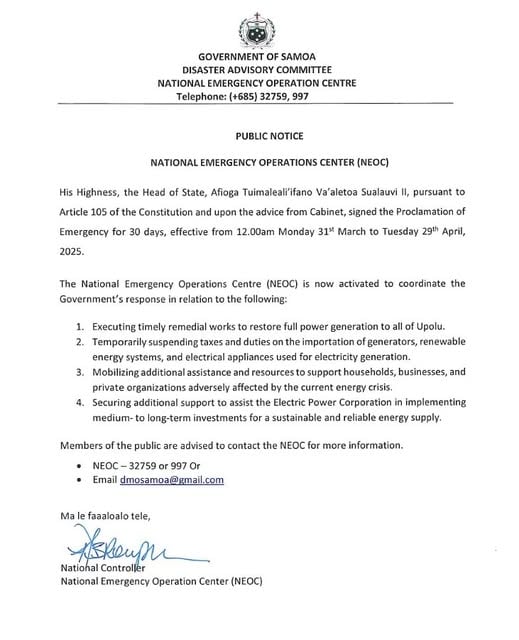
His Highness, the Head of State, Afioga Tuimaleali’ifano Va’aletoa Sualauvi II, pursuant to Article 105 of the Constitution and upon the advice from Cabinet, signed the Proclamation of Emergency for 30 days, effective from 12.00am Monday 31st March to Tuesday 29th April, 2025.
The National Emergency Operations Centre (NEOC) is now activated to coordinate the Government’s response in relation to the following:
1. Executing timely remedial works to restore full power generation to all of Upolu.
2. Temporarily suspending taxes and duties on the importation of generators, renewable energy systems, and electrical appliances used for electricity generation.
3. Mobilizing additional assistance and resources to support households, businesses, and private organizations adversely affected by the current energy crisis.
4. Securing additional support to assist the Electric Power Corporation in implementing medium- to long-term investments for a sustainable and reliable energy supply.
Members of the public are advised to contact the NEOC for more information.
NEOC 32759 or 997 Or Email dmosamoa@gmail.com
Ma le faaaloalo tele,
OFISA TŪTOTONU MO FA’ALAVELAVE MĀTUIĀ
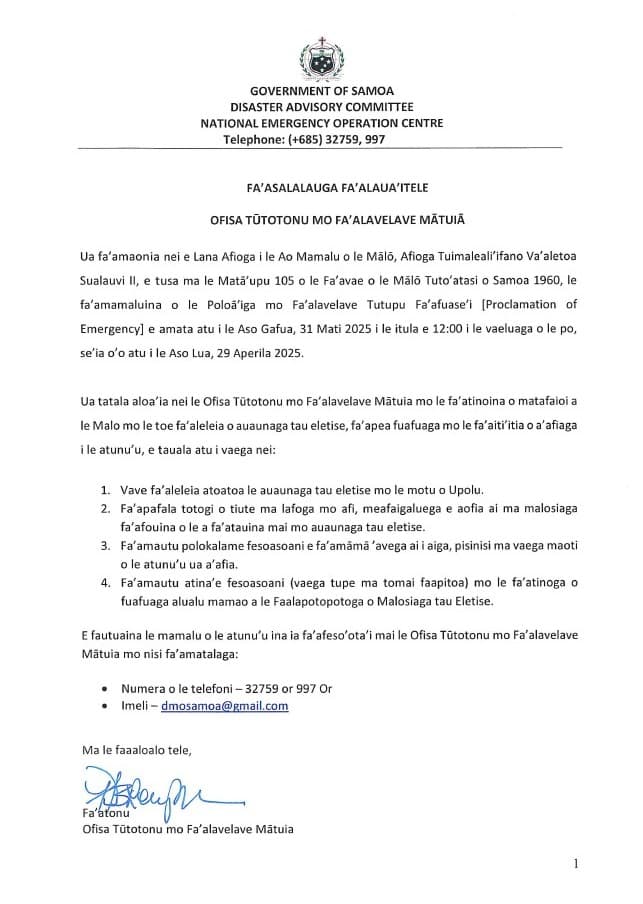
Ua fa’amaonia nei e Lana Afioga i le Ao Mamalu o le Mālō, Afioga Tuimaleali’ifano Va’aletoa Sualauvi II, e tusa ma le Mata’upu 105 o le Fa’avae o le Mālō Tuto’atasi o Samoa 1960, le fa’amamaluina o le Poloa’iga mo Fa’alavelave Tutupu Fa’afuase’i [Proclamation of Emergency] e amata atu i le Aso Gafua, 31 Mati 2025 i le itula e 12:00 i le vaeluaga o le po, se’ia o’o atu i le Aso Lua, 29 Aperila 2025.
Ua tatala aloa’ia nei le Ofisa Tūtotonu mo Fa’alavelave Mātuia mo le fa’atinoina o matafaioi a le Malo mo le toe fa’aleleia o auaunaga tau eletise, fa’apea fuafuaga mo le fa’aiti’itia o a’afiaga i le atunu’u, e tauala atu i vaega nei:
1. Vave fa’aleleia atoatoa le auaunaga tau eletise mo le motu o Upolu.
2. Fa’apafala totogi o tiute ma lafoga mo afi, meafaigaluega e aofia ai ma malosiaga fa’afouina o le a fa’atauina mai mo auaunaga tau eletise.
3. Fa’amautu polokalame fesoasoani e fa’amāmā ‘avega ai i aiga, pisinisi ma vaega maoti
o le atunu’u ua a’afia.
4. Fa’amautu atina’e fesoasoani (vaega tupe ma tomai faapitoa) mo le fa’atinoga o fuafuaga alualu mamao a le Faalapotopotoga o Malosiaga tau Eletise.
E fautuaina le mamalu o le atunu’u ina ia fa’afeso’ota’i mai le Ofisa Tūtotonu mo Fa’alavelave
Mātuia mo nisi fa’amatalaga:
• Numera o le telefoni – 32759 or 997 Or Imeli : dmosamoa@gmail.com
[PRESS RELEASE Apia, SAMOA 01 April 2025] – The Global Environment Facility (GEF) Small Grants Programme (SGP) is once again supporting local communities who are at great risk from climate change due to their fragile ecosystems.
Community-based organizations from six villages have been awarded financial grants from the GEF-SGP, totalling over US$233,652, which will be used to implement environmental projects.
These include wetland restoration, securing of marine protected areas, protection of marine ecosystems, freshwater pools rehabilitation, and increasing the resilience of spring pools to natural disasters.
An inception workshop was held last Friday in Savaii for the successful grantees, to provide an opportunity for the GEF-SGP team to clarify any queries that the project leaders may have, and to help build their capacity in implementing their approved Memorandum of Agreements.
“It’s an honour to collaborate with our local communities to implement these sustainable environmental projects. The work of the GEF-SGP, with the important assistance from Government partners, will continue to ensure the positive impact of civil society interventions at national level, and a continued effort to build the capacity of civil society actors to be transformative agents of change, contributing to Samoa’s efforts to achieve its national plans and the Sustainable Development Goals,” said Lemalu Nynette Sass, Chairwoman of the GEF-SGP National Steering Committee.
These community projects are funded by the Community Development and Knowledge Management for the Satoyama Initiative Programme (COMDEKS), and OP7 core grant allocation, the 7th Operational Phase of the GEF-SGP, a programme implemented by the United Nations Development Programme (UNDP), that provides financial assistance to small-scale environmental projects.
COMDEKS, funded by the Japan Biodiversity Fund at the Secretariat of the Convention on Biological Diversity, provides small-scale finance delivered through the GEF-SGP directly to local communities, Indigenous Peoples, and civil society to implement locally led projects that enhance livelihoods and well-being, conserve biodiversity, address climate change, and support local cultures and traditional practices. This is the first time that Samoa has been selected to be one of the implementing countries for COMDEKS.
The GEF-SGP National Coordinator, Mr. Lilomaiava Taumalaulu Filifilia Iosefa, emphasized the importance of working together with key implementing ministries, the Ministry of Natural Resources and Environment, and the Ministry of Agriculture and Fisheries, to assist the selected grantees and their communities to successfully implement the approved projects.
His Highness, the Head of State, Afioga Tuimaleali’ifano Va’aletoa Sualauvi II, pursuant to Article 105 of the Constitution and acting on the advice of Cabinet, has declared a State of Emergency for Samoa for 30 days, effective from 12:00am Monday 31 March to Tuesday 29 April 2025.
The Proclamation of Emergency enables the Government to implement emergency measures necessary to manage and restore national energy supply, protect public health and safety, and maintain essential services.
As a result of continuous power outages and electricity rationing, the Government acknowledges the significant impact on our people and economy, noting that:
1. The damage to household utilities and the safety of residential buildings.
2. The loss of power has compromised the storage of perishable food items in retail and wholesale outlets, as well as households.
3. The impact on private businesses and corporations affecting operations and livelihoods.
4. The projected economic cost of the crisis is estimated to reach approximately 16% of GDP for the 2025 calendar year, underscoring severe disruptions to national productivity, public services, and economic activity.
The Electric Power Corporation (EPC) has been working tirelessly to monitor the situation, identify solutions, and minimize, as best as possible, the impact on essential services and the daily lives of our people. Multiple factors have contributed to the current energy crisis, namely:
1. Mechanical failures at the Fiaga Power Station resulted in the loss of primary generators that supply a substantial portion of Upolu’s electricity;
2. A faulty underground transmission line disrupted power distribution across key parts of the national grid;
3. Severe weather events, most notably the destructive storm of 9 March 2025, caused widespread damage to energy infrastructure and further hindered restoration efforts; and
4. Rising electricity demand has placed additional strain on EPC’s generation capacity, particularly during peak consumption hours.
The Government is pleased to provide an update on the priority actions implemented to date in response to the ongoing energy crisis:
1. Temporary power generation units are scheduled to arrive on 5 April to provide immediate relief and supplement electricity supply. Full power restoration across Upolu is expected before the end of April, while awaiting the arrival and commissioning of permanent generators in August 2025.
2. Overhaul parts for the Fiaga generators are currently being procured to restore them to full operational capacity.
3. The Government remains committed to accelerating renewable energy and grid reinforcement projects to strengthen and diversify the national energy supply.
The Proclamation of Emergency will enable the Government to implement urgent measures to stabilize the energy supply and mitigate the impacts of the crisis by:
1. Ensuring the timely arrival and operation of temporary generators before the end of April, ahead of the permanent units scheduled for August, along with the necessary overhaul parts for Fiaga;
2. Lifting tax and import duties on generators and other electricity-related equipment, including renewable energy systems, procured by EPC, households, businesses, and organizations for electricity generation;
3. Mobilizing additional assistance and resources to support households, businesses, and private organizations adversely affected by the crisis;
4. Securing additional and targeted financial and technical support to assist EPC in implementing medium to long-term remedial works; and
5. Activating a whole-of-government coordinated response through the National Emergency Operations Centre (NEOC) to coordinate the Government’s response to the energy crisis.
The Government acknowledges the significant hardship this energy crisis has placed on households, businesses, and essential services across the island of Upolu. We want to reassure everyone that restoring a stable electricity supply and supporting those most affected remain our top priorities. Every effort is being made to respond swiftly, minimize further disruptions, and provide relief where it is needed most.
With unity, resilience, and collective action, we will overcome this challenge and move toward a more secure, sustainable, and affordable energy future for all of our people.
Faafetai and God Bless Samoa.
SAUNOAGA FA’APITOA A LE AFIOGA I LE PALEMIA, HON. FIAME NAOMI MATAAFA MO LE FA’AMAMALUINA O LE POLOĀ’IGA O FA’ALAVELAVE TUTUPU FA’AFUASE’I ONA O LE ‘ELETISE. [Aso Gafua, 31 Mati 2025]
Ou te fa’afeiloa’i atu i lenei itula o le aso, i lau fa’afofoga’aga Samoa, mai tafa e fia o le atunu’u. O ou paia ma mamalu o le a lē afea e se fa’amatalaga, auā o Samoa o le fue lavelave, e leai se poto po’o se vave na te autalaina. Ae nu’unu’u atu ia sasaga fa’atini o tausala, i le galuega tausi a le usoga a Tumua ma Pule.
Ole vi’iga o le Atua e lē fa’aitiitia, ona o lona agalelei ma lona alofa tunoa, o lo’o malu tapu ‘ā’aoina ai pea la tatou savaliga i lenei vaitau. Mālō le ta’i, fa’afetai le fai tatalo, mālō le tapua’i.
Ona o a’afiaga ma le tulaga ogaoga ole motusia ai o le ‘eletise i le atunu’u, ua fa’amaonia ai nei e Lana Afioga i le Ao Mamalu o le Mālō, e tusa ma le Matā’upu 105 o le Fa’avae o le Mālō Tuto’atasi o Samoa 1960, le fa’amamaluina o le Poloā’iga mo Fa’alavelave Tutupu Fa’afuase’i [Proclamation of Emergency] e amata atu i le Aso Gafua, 31 Mati 2025 i le itula e 12:00 i le vaeluaga o le po se’ia o’o atu i le Aso Lua, 29 Aperila 2025.
O lenei Poloaiga mo Faalavalave Tutupu Faafuasei o le a mafai ai e le Ma ̅lo ona faatinoina ma faanatinati ai galuega fesoasoani mo le toe faaleleia o auaunaga tau eletise atoa ai ma le faaitiitia o aafiaga ile atunuu.
Ua faia lenei faaiuga e tali fuaitau atu ai ile tulaga ma’ale’ale ua iai nei le tau faasoasoaina ole eletise faapea aafiaga ile atunuu, e aofia ai:
Aafiaga i tagata lautele ma le saogalemu o fale ma meatotino tau eletise ua faaleagaina.
Aafiaga tau soifua maloloina o tagata lautele mai le fa’atamai’aina o oloa taumafa tu’u-aisa e lē gata i faleoloa ma falesiiatoa.
Aafiaga i pisinisi ma atina’e o loo faamoemoe ai le tamaoaiga o tagata lautele.
Le ono o’o atu i le 16 pasene o le tamaoaiga o le atunu’u (GDP) i totonu o le tausaga 2025, ua a’afia ona o le tulaga faaletonu o le eletise.
I le taimi nei, o lo o galulue pea le Fa’alapotopotoga o Malosiata tau Eletise e toe fa’aleleia le auaunaga ma le fa’asoasoaina atu ole eletise i vaega uma ole atunuu ona o mafuaaga e aofia ai:
Fa’aletonu i afi tetele i le Faleafi i Fiaga, ma ua a’afia ai se vaega tele o le motu o Upolu;
Fa’aletonu i uaea malolosi o lo o i lalo o le ele’ele o lo’o fa’asoasoa ai le eletise;
Motusia o laina ma le fa’aleagaina o pou molī i le malolosi o savili lea na tulai mai i le Aso Sā 09 Mati 2025,
Si’itia le maualuga o manaoga tau eletise i totonu o le atunu’u, ma ua atili fa’aopo’opoina ai le eletise moomia pe a faatusa atu i le eletise maua, aemaise lava i taimi o lo o maualuga ai le manaoga tau eletise.
O lo o galulue itutino uma o le Malo ina ia foia faafitauli nei, ma e avea lenei avanoa ou te tuuina atu ai se faamatalaga i le tulaga o lo o taoto ai nei galuega:
O le Aso 05 Aperila 2025 o lo’o fuafua e taunu’u mai ai ni afi tetele mai fafo, ua lisiina mai mo le toe fa’aleleia ole auaunaga mo le motu i Upolu, a o talia ai le taunuu mai o afi tumau ile masina o Aokuso 2025.
Ua mae’a ona fa’atauina totoga moomia mo le faaleleia o afi tetele i Fiaga, ma o lo o talia le taunuu mai mo le toe fa’aleleia atoa ai o auaunaga tau eletise.
Faamautuina i se taimi vave le faatinoga o poloketi mo malosiaga faafouina (renewable energy) e tali atu ai ile siisii pea o manaoga tau eletise.
O lenei Poloaiga, o le a fa’amamaluina mo le 30 aso, ma o le a lagolagoina ai taumafaiga uma a le tatou Malo e le gata mo le toe fa’aleleia o le auaunaga tau eletise mo le atunu’u atoa, ae fa’apea le fa’atinoina o galuega e tali atu ai i a’afiaga ona o le faaletonu o auaunaga tau eletise, ma e aofia ai le:
Vave fa’aolaina o afi ua lisiina fa’avaitaimi i le masina o Aperila, e fa’atali ai le taunu’u mai o afi tetele ia Aokuso, fa’apea ma le toe fa’aleleia atoatoa o le auaunaga a le faleafi i Fiaga;
Fa’apafala totogi o tiute ma lafoga mo afi, meafaigaluega e aofia ai ma malosiaga fa’afouina o le a fa’atauina mai mo le fa’aleleia o vaega ua fa’aletonu a le Fa’alapotopotoga o Malosiaga tau Eletise, fa’apea pisinisi, faalapotopotoga ma aiga taitasi;
Faamautu polokalame fesoasoani e fa’amāmā ’avega mo aiga, pisinisi ma vaega maoti o le atunu’u ua a’afia;
Faamautu atinae fesoasoani (vaega tupe ma tomai faapitoa) mo le faatinoga o fuafuaga alualumamao a le Faalapotopotoga o Malosiaga tau Eletise.
Faatino matafaioi fa’aletulafono a le Komiti mo Fa’alavelave Tutupu Faafuasei, o lo o auai ai itutino uma o le Malo, pisinisi ma faalapotopotoga ina ia galulue faatasi mo le toe faaleleia o auaunaga tau eletise faapea fuafuaga mo le faaitiitia o aafiaga ile atunuu.
Samoa e, e lē mavae le agaga fa’afetai i lo outou sao tāua e ala i le lalago mai i galuega faifaipea a lo tatou Mālō e tauala atu i le auaunaga a le Faalapotopotoga o Malosiaga tau Eletise. O ni taga e fai i vasa, ma ni tonu e le tuā le taumafai atu o le Mālō, pe ana leai lo outou finagalo malamalama e lagolagosua ma onosaia ai lenei galuega fītā. Fa’afetai tele i lo outou onosa’i ma le lava papale, a o fa’agasolo ai galuega fa’aleleia a le tatou Fa’alapotopotoga o Malosiaga tau Eletise.
E momoli foi le fa’afetai ma le fa’amālō a lo tatou Mālō i le aufaigaluega galulue a le Faalapotopotoga o Malosiaga tau Eletise. Mālō le tautua, fa’afetai le galulue lē fa’alogologotigā. Le Atua o manuia, na te tauia lo outou afu sisina. O lo o tatou folau pea ma lu’itau e ui ina tatou folau mālie i le laula’i o Matāmatagi a o vavala mai ata o Tauleleia.
E leai so tatou malosi, po o so tatou poto tatou te malu ai, pe ana le seanoa le Atua o lo’o tatou auauna i ai. Ua na o le Atua lava na te mafaia mea uma, o Ia na te fa’atonu folau ma ta’iala si o tatou atunu’u, e tusa ma le ta’ita’iga a lona Agaga Paia ma lona finagalo alofa iā Samoa. Ia tumau pea lo tatou fa’atuatua ma le mautinoa, pe lutia lava tatou i puava, tatou te mapu i Fagalele. O tua atu fo’i o le loulouā ma le mamafa o timuga, o lo o tumau ai pea le susulu o le la o le amiotonu a lo tatou Atua.
Ia tumau i le alofa tulituliloa ma le finagalo fa’apaolo o lo tatou Atua, le faigāmalaga a Samoa.
KEYNOTE ADDRESS by the Hon. Laumatiamanu Mathew Ringo Purcell, Minister of Sports and Recreation [Aso Toonai 29 Mati 2025]
Lau Susuga Auali’itia Arona – of the Baha’i Faith,
Leota Josh Lutu – Chairman of the Samoa Outrigger Canoe Association & The Executive Committee of SOCA,
Seagles Patrons: Lemalu Nynette Sass, Maiava Collin McCarthy, and
Tauvaga Farani
Seagles President: Auali’itia Leata, Executive Committee and Members of the Seagles Outrigger Canoe Club,
Board member of Samoa Waste Recycling Management Association
Board (SWARMA) – Marina Keil,
CEO of SASNOC – Tuala Mathew Vaea
Esteemed Presidents of Paddling Clubs & Members of the Paddling
Community,
Distinguished guests,
Ladies and Gentlemen.
Talofa lava and warm Pacific greetings,
Before we begin this special occasion, I would like to extend my gratitude to Auali’itia Arona for graciously delivering the opening prayer and blessing of the canoes. Your presence and spiritual guidance set the tone for this meaningful event, reminding us of the deep cultural and spiritual connections that underpin our gathering today. Thank you for leading us in this important tradition.
It is both a pleasure and a privilege to join you all for this special occasion, the blessing of the Seagles Outrigger Canoe Club Samoa. Today’s gathering is more than a ceremonial event; it is a celebration of perseverance, culture, and the shared spirit that binds our paddling community together.
Outrigger canoeing is not just a sport. It is a living expression of our Samoan heritage. For generations, our ancestors mastered the ocean, navigating vast distances with courage, knowledge, and an unbreakable connection to the sea. Canoeing carries that legacy forward. It teaches our people to move with purpose, to work in unity, and to respect the environment that sustains us.
What makes this sport truly special is its inclusivity. Paddling is for everyone, from our energetic juniors to our experienced masters. It brings together communities, families, and people of all backgrounds. Whether you are new to the sport or a seasoned competitor, there is a place for you in a va’a.
I acknowledge the hard work and dedication of the Seagles Club and all paddling clubs across Samoa. Your collective effort ensures the survival of this vital sport. I also recognize the challenges many of you face, particularly around access to equipment, resources, and facilities.
The Ministry of Sports and Recreation (MSR) plays a pivotal role in elevating all sports and recreational activities in Samoa. Our mission is to drive sporting and recreational activities to lift the standards of our athletes as well as the well-being of our people.
The blessing of the canoes resonates deeply with the goals and objectives of the Government of Samoa through the MSR. It symbolizes our commitment to nurturing talent, fostering unity, and promoting a healthy lifestyle for all Samoans. I want to assure you that the Ministry of Sports and Recreation is committed to supporting the growth and sustainability of paddling in Samoa.
I also commend the work of the Samoa Outrigger Canoe Association (SOCA) for your tireless leadership. Despite obstacles, you continue to hold the torch for this important sport, and the Government is here to walk alongside you.
Together with SASNOC and our sports partners, we will work towards strengthening our support systems so that paddling continues to thrive, not only as a sport, but as a pathway to unity, wellness, and cultural pride. Let us paddle forward as one people, honouring our past while charting a bold course for the future.
Fa’afetai tele lava and may God bless you all.
Soifua ma ia Manuia!!!
Photo by the Government of Samoa (Jasmine Netzler-Iose)
Source: Hong Kong Government special administrative region
Attention TV/radio announcers:
Please broadcast the following as soon as possible and repeat it at regular intervals:
Here is an item of interest to swimmers.
The Leisure and Cultural Services Department announced today (April 10) that due to an insufficient number of lifeguards on duty, Jockey Club Yan Oi Tong Swimming Pool in Tuen Mun District has been temporarily closed until further notice to ensure the safety of swimmers.
KEYNOTE ADDRESS by the Minister of Sports and Recreation Hon. Laumatiamanu Matthew Ringo Purcell (Saturday, 22 March 2025)
Susuga Taitai o le Sauniga
Hon Ministers of Cabinet
Members of the Diplomatic Corps
Distinguished Members of the Chinese Communities
Sports Bodies and Organisations
Distinguished Guests
Ladies and Gentlemen
Talofa lava and a warmest good morning to you all.
Today, we gather to celebrate 50 years of collaboration between Samoa and China in the fields of sports, education, agriculture, technology, medical support-a partnership that has strengthened our communities and shaped our shared future.
Sports play a vital role in shaping our communities. It builds discipline, teamwork, and healthy lifestyles, while also providing opportunities for our athletes to excel at the national and international levels. The Ministry of Sports and Recreation (MSR) is committed to elevate sports in all aspects, from development programs to sports facilities that are fit for purpose and comply with international standards. In terms of recreation, MSR is tasked with providing better facilities for public use and enhance the quality of life for all Samoans.
Through our long-standing friendship with China, we have seen remarkable developments; better sports facilities, enhanced coaching programs and increased opportunities for our athletes to compete internationally.
Beyond sports, this collaboration has also advanced education, agricultural innovation, and technological and medical progress, helping Samoa build a more sustainable and prosperous future. We acknowledge and appreciate the commitment of China and our Chinese partners in supporting our national growth and development.
Today’s event is a celebration of this journey; a showcase of talent, teamwork and the spirit of cooperation that defines our two nations. I encourage each of you to take part, enjoy the activities, and continue fostering friendships that will last for generations.
On behalf of the Government of Samoa, fa’afetai tele lava to all our partners, organizers, and participants. May we continue to strengthen our bonds and achieve even greater sporting milestones together.
Soifua ma ia Manuia.
FA’ATĀUAINA O LE FAIGĀ PA’AGA A SAMOA MA SAINA TAUALA I ATINA’E TAU TA’ALOGA LEA UA ATOA LE 50 TAUSAGA O LEA FAIGĀUŌ MĀFANAFANA.
SAUNOAGA AUTŪ a le Afioga i le Minisitā o le Matāgaluega o Ta’aloga Ma Alagā’oa Mo le Soifua Fiafia O Tagata iā Hon. Laumatiamanu Ringo Purcell. [Aso To’ana’i, 22 March 2025.]
Susuga Taitai o le Sauniga
Afioga i Minisita ole Kapeneta,
Sui o Malō ma a tatou paaga mai atunuu mamao,
Sui o Pisinisi ma Faalapotopotoga Tumaoti
Faalapotopotoga o Taaloga eseese i Samoa
Aemaise Samoa ua potopoto
O sa ma faigata o Samoa ua potopoto mai i lenei taeao, o le a tāoto ā faamāene o tai loloto. E le toe tau faamati’eina ou pa’ia e mai le vavau e oo i le faavavau. O pa’ia foi o eleele sa ma fanua tapu o loo tapuvae tasi mai iai le faamoemoe i lenei taeao, o lea ua uma ona saunoa iai le fofoga o le aso. Ae tau lava ina ou faatulou iai.
Ua mae’a foi ona tafili le agavao faa-le-agaga ma faausu lupe o manū i le Tapaau Sili i le Lagi ona o Lana faasoa i le soifua ma le ola e pei ona saunia e le Taitai o le Sauniga. E faaluaina ai le agaga o le faafetai mo upu tima’i ma faamanatu lelei i faamoemoega uma o lenei aso. Tatalo ina ia maua pea le tumu o le Agaga Paia auā le feagai ai ma le valaauina.
O le a avea le leo faatauvaa o la outou Minisita e fai ma fofoga o lo tatou Malō, e faaleo atu ai le agaga o le faafetai i la outou valaaulia faaaloalo e pei ona iai le taeao nei. O se faamoemoe taua ma matagofie a’o tatou iai lea i le faamanatuina o le 50 tausaga o le faiga-paaga a le Malo o Saina ma Samoa, e faaaogaina ai tulaga tau taaloga ma ni isi o auaunaga ma alagaoa mo le fiafia o tagata, e tuufaatasia ai o tatou tagata ma faamalosia ai fesootaiga mo le lumanai. Ua mautinoa, ua o gatasi lenei faamoemoe ma le Vaai Mamao a le Matagaluega o Taaloga ma Alagaoa mo le Fiafia o Tagata-“o le faaleleia ma le siitia o taaloga i soo se itu; e aofia ai malae ma fale taalo faapea a tatou tagata taalo” i totonu o Samoa.
Ou te fiafia tele ai e faailoa atu ma le agaga faaaloalo, e matua’i lagolagoina atoa e le Malo o Samoa, tauala atu i le Matagaluega o Taaloga ma Alagaoa mo le Fiafia o Tagata soo se faamoemoe ma soo se taumafaiga e atina’e ai taaloga i totonu o le atunuu. Ua mautinoa, o taaloga ua avea lea ma se tasi o vaega ua mafai ona tuufaatasia ai tagata e ui lava i sou faasinomaga ma ua mafai foi ona avea ma auala e fesoasoani ai e faatupulaia le soifua lelei ma le maloloina o tagata.
O le faiga-paaga a Samoa ma Saina ua telē sona sao mo le atinaeina o taaloga i si o tatou atunuu – ua faaleleia malae ma fale taaalo, fesoasoani e faaleleia tulaga tau faiaoga o taaloga aemaise ai avanoa mo a tatou tagata taaalo e tauvā ai i atunuu i fafo. O tua atu foi o taaloga, o lo o iai ni isi o auaunaga ma faamoemoega ua faatino ina i lenei faiga-paaga e pei o le faaleleia o aoaoga, auaunaga tau faatoaga ma le soifua maloloina. E avea ai lo’u leo faatauvaa e fai ma sui o le Malo faapea tagata nuu uma o Samoa, e faaleo ai so tatou agaga faafetai ma le faamalō i le malō o Saina ma ana paaga mo le fesoasoani malosi i atinae a si o tatou atunuu.
Momoli foi le faafetai ma le faamalō i a outou uma lava ua mafai ona auai potopoto i lenei taeao e faatino ma molimauina lenei faamoemoe taua. Tau ina ia avea lenei mafutaga e faalauteleina ai ma faamausaliina ai a tatou sootaga faa-le-taaloga aemaise ai o le lagolagosua malosi mai a paaga faa-pisinisi ma faalapotopotoga tau taaloga ua tatou mafuta ai i lenei taeao.
[PRESS RELEASE – Thursday 27 March 2025] – His Excellency Mr. Antonio Albuquerque Moniz presented his Letters of Credence to the Head of State of the Independent State of Samoa, Afioga Tuimaleali’ifano Va’aletoa Sualauvi II, at a Credentials Ceremony held this morning at the Official Residence of the Head of State at Vailele, accrediting His Excellency as the Ambassador Extraordinary and Plenipotentiary of Portugal to Samoa with residence in Canberra, Australia.
Samoa and Portugal have enjoyed cordial relations since the establishment of formal ties on 9 June 1995. The two countries collaborate in multilateral fora, including the United Nations, to address global challenges such as climate change, ocean governance, and sustainable development. Ambassador Moniz reaffirmed Portugal’s commitment to strengthening cooperation with Samoa, highlighting Portugal’s ongoing support for Small Island Developing States (SIDS) and its engagement in the Pacific region through its application to become a Dialogue Partner of the Pacific Islands Forum.
Afioga Tuimaleali’ifano Va’aletoa Sualauvi II welcomed the Ambassador and acknowledged the growing partnership between Samoa and Portugal. He expressed appreciation for Portugal’s advocacy on climate action and ocean conservation, as well as its contributions to international development initiatives that align with Samoa’s priorities. The Head of State conveyed his confidence that Ambassador Moniz’s tenure will further enhance the friendship and cooperation between our two countries.
H.E. Mr. Antonio Albuquerque Moniz holds a Bachelor’s degree in Law from the University of Lisbon. He joined Portugal’s Ministry of Foreign Affairs in 1991 and held various senior positions, including Head of Visa Services and Movement of Persons within the Directorate-General for Consular Affairs. His diplomatic career includes postings at Portugal’s missions in Vienna and Warsaw, as well as serving as Deputy Head of Mission in Berlin. In 2015, he was appointed Consul General at Portugal’s Consulate in Paris. He later served as Portugal’s Ambassador to Cape Verde in 2020 before assuming his current role as Ambassador of Portugal to Australia in 2023. Mr Antonio A. Moniz is married and has one daughter.
END
SOURCE – Ministry of Foreign Affairs and Trade
Photos by the Government of Samoa (Leaosa Faaifo Faaifo)
The Prime Minister, Shri Narendra Modi today remembered timeless teachings of Bhagwan Mahavir on the occasion of Mahavir Jayanti, recalling the deep influence of his teachings on his own life.
Modi Archive, in a post on X, reflected on the Prime Minister’s long-standing spiritual bond with Bhagwan Mahavir’s teachings and the Jain community.
Responding to the X post of Modi Archive, the Prime Minister posted on X;
“The ideals of Bhagwan Mahavir have greatly inspired countless people, including me. His thoughts show the way to build a peaceful and compassionate planet.”
The ideals of Bhagwan Mahavir have greatly inspired countless people, including me. His thoughts show the way to build a peaceful and compassionate planet. https://t.co/1yDhKpoyol