Category: Asia

  • MIL-OSI Asia-Pac: Speech by FS at HKSTP Co-Acceleration Programme Fund Launch and Partnership Signing Ceremony (English only)

    Source: Hong Kong Government special administrative region

         Following is the speech by the Financial Secretary, Mr Paul Chan, at the HKSTP Co-Acceleration Programme Fund Launch and Partnership Signing Ceremony today (April 7):
     
    Sunny (Chairman of Hong Kong Science and Technology Parks Corporation, Dr Sunny Chai), Albert (Chief Executive Officer of Hong Kong Science and Technology Parks Corporation, Mr Albert Wong), distinguished guests, tech ventures, ladies and gentlemen,
     
    Good afternoon. It is a pleasure to join you all today as we celebrate the launch of the Co-Acceleration Fund by the Hong Kong Science and Technology Parks (HKSTP) and witness the signing of partnership agreements between the HKSTP and leading industry players.  
     
    Innovation and technology are a key pillar of Hong Kong’s future prosperity. Over the years, we have invested substantial resources to build a dynamic and vibrant innovation ecosystem. As a result, the number of start-ups in our city has been rapidly increasing. In 2024, we were home to nearly 4 700 start-ups, representing a 40 per cent rise since 2020. We expect this number to continue growing at an impressive pace. 
     
    Just now, I am delighted to learn that I had the privilege of engaging with founders and CEOs of start-ups at the newly established ARENA platform. It is heartening to learn how our start-ups are transforming bold ideas into promising ventures, and how the HKSTP is supporting them to connect with collaborators, corporate partners and investors.
     
    We all understand that access to capital is critical as start-ups grow and develop. Hong Kong offers a full range of funding support, from angel investments, venture capital and private equity to our deep and liquid stock market. This ecosystem effectively supports the ambitions and needs of enterprises at various stages of development.

    Besides, we recognise the unique value of public-private partnerships in driving innovation. Here in Hong Kong, we aim to guide capital into sectors that are strategically important to our future, including AI and data science, life and health technology, fintech and new energy and new materials. We understand that for frontier technologies and sectors, the Government may sometimes need to take the lead to show our vision and demonstrate our commitment to bringing our vision into reality. That’s why we established the Hong Kong Investment Corporation Limited (HKIC). Serving as patient capital, the HKIC invests in nascent-stage ventures and sectors of tomorrow. To date, it has invested in more than 90 projects, achieving a 1 to 4 co-investment ratio – meaning that for every dollar the HKIC invested, it has attracted four dollars from private investors to follow.
     
    The HKSTP’s Acceleration Fund aligns with our vision. By partnering with industry leaders to co-invest in high-potential start-ups, particularly in generative AI, intelligent connected systems and sustainability, the Fund amplifies our collective capacity to turn innovation into impact.
     
    Beyond funding, I applaud the HKSTP for offering start-ups holistic support: mentorship, technical expertise, connections, market access and global platform, equipping entrepreneurs with the tools to accelerate growth and enhance global competitiveness.
     
    Ladies and gentlemen, we live in an era of profound challenges. Now we are confronted with the impact of unilateralism and protectionism unseen in a century. Beyond tariffs and trade barriers, disruptions to global scientific collaboration are also happening. Yet, it is precisely in this very climate of fragmentation that Hong Kong must leverage its unique strengths. With our vision, agility, connectivity and strong backing from our country, we are in the position to become a global convergence point of talent, capital and know-how. We can foster more cross-sectoral and cross-boundary collaboration to advance humanity’s shared progress.
     
    For that mission, every initiative matters. In this regard, allow me to extend my appreciation and gratitude to everyone involved in bringing the Co-Acceleration Fund to life. I wish you all the best of health and success in the time ahead. Thank you very much.

    MIL OSI Asia Pacific News

  • MIL-OSI Asia-Pac: Phishing emails related to DBS Bank (Hong Kong) Limited

    Source: Hong Kong Government special administrative region

    Phishing emails related to DBS Bank (Hong Kong) Limited 
    The HKMA wishes to remind the public that banks will not send SMS or emails with embedded hyperlinks which direct them to the banks’ websites to carry out transactions. They will not ask customers for sensitive personal information, such as login passwords or one-time password, by phone, email or SMS (including via embedded hyperlinks).
     
    Anyone who has provided his or her personal information, or who has conducted any financial transactions, through or in response to the emails concerned, should contact the bank using the contact information provided in the press release, and report the matter to the Police by contacting the Crime Wing Information Centre of the Hong Kong Police Force at 2860 5012.
    Issued at HKT 19:08

    NNNN

    MIL OSI Asia Pacific News

  • MIL-OSI Asia-Pac: Fraudulent website related to Bank Julius Baer & Co. Ltd.

    Source: Hong Kong Government special administrative region

    The following is issued on behalf of the Hong Kong Monetary Authority:

    The Hong Kong Monetary Authority (HKMA) wishes to alert members of the public to a press release issued by Bank Julius Baer & Co. Ltd. relating to a fraudulent website, which has been reported to the HKMA. A hyperlink to the press release is available on the HKMA website.
     
    The HKMA wishes to remind the public that banks will not send SMS or emails with embedded hyperlinks which direct them to the banks’ websites to carry out transactions. They will not ask customers for sensitive personal information, such as login passwords or one-time password, by phone, email or SMS (including via embedded hyperlinks).
     
    Anyone who has provided his or her personal information, or who has conducted any financial transactions, through or in response to the website concerned, should contact the bank using the contact information provided in the press release, and report the matter to the Police by contacting the Crime Wing Information Centre of the Hong Kong Police Force at 2860 5012.

    MIL OSI Asia Pacific News

  • MIL-OSI Asia-Pac: Phishing messages and fraudulent websites related to Octopus Cards Limited

    Source: Hong Kong Government special administrative region

    The following is issued on behalf of the Hong Kong Monetary Authority:

    The Hong Kong Monetary Authority (HKMA) wishes to alert members of the public to a press release issued by Octopus Cards Limited relating to phishing messages and fraudulent websites. The relevant stored value facility (SVF) licensee has reported the case to the HKMA.
     
    The fraudulent websites reported by the SVF licensee known at the time are as follows:
    hxxps[:]//octupos[.]top/hk
    hxxps[:]//octopos[.]top/hk
     
    The HKMA wishes to remind the public that anyone who has provided his or her personal information or account credentials, or who has conducted any financial transactions, through or in response to the messages and the websites concerned, should contact the relevant SVF licensee, and report to the Police or contact the Anti-Deception Coordination Centre of the Police at 18222.

    MIL OSI Asia Pacific News

  • MIL-OSI United Kingdom: PM call with Prime Minister Wong of Singapore: 7 April 2025

    Source: United Kingdom – Government Statements

    Press release

    PM call with Prime Minister Wong of Singapore: 7 April 2025

    Prime Minister Keir Starmer spoke to the Prime Minister of Singapore Lawrence Wong today. 

    The Prime Minister spoke to the Prime Minister of Singapore Lawrence Wong today. 

    The leaders began by discussing the tariffs announced by the US last week and the impact on the global economy. They both agreed that there can be no winners in a trade war. 

    The Prime Minister updated Prime Minister Wong on his calls with other international leaders over the weekend, and they both agreed that it is vital likeminded partners work together to maintain global economic stability. 

    Free and open trade is fundamental, and the leaders agreed to strengthen collaboration between the UK and Singapore through bilateral agreements including the UK-Singapore Strategic Partnership, with ASEAN and through trading blocs such as the Comprehensive and Progressive Trans-Pacific Partnership. 

    On the wider bilateral relationship, the leaders committed to further collaboration on areas including technology, security and defence in the 60th year of bilateral relations. 

    They discussed the upcoming deployment of the UK’s Carrier Strike Group to Singapore, and the Prime Minister underlined his commitment to a free and open Indo-Pacific.

    Updates to this page

    Published 7 April 2025

    MIL OSI United Kingdom

  • MIL-OSI Australia: Canberra’s best coffees (as voted by you)

    Source: Northern Territory Police and Fire Services

    Working in the city and in need of a coffee in between meetings? ARC is a beautiful light-filled shop and focuses on local produce and great coffees.

    Barrio, Braddon

    A small and humble café serving delicious food and superb specialty coffee! If you’re looking for the perfect spot to stop off and enjoy a morning coffee before work, then Barrio is your café. You can even take home their roasted beans or homemade hot sauce!

    Kopiku is an Indonesian style café located at the O’Connor shops. Blending Asian and Australian influences together why not try this unique place and try out the coffee. You can also grab some Nasi Goreng, Mee Goreng and much more.

    Doubleshot, Deakin

    Looking for coffee and a healthy menu? Doubleshot Deakin offer a relaxing experience coupled with a guilt free menu.

    Curio Press, Lake Burley Griffin

    The perfect finish line for those running or walking around the lake. Sit back and enjoy the view, Curio is located next to Blundells Cottage, nestled among the mature, shady trees.

    Early Edition, Kingston

    Want vintage charm meets modern flavour? Try Early Editions range of coffees and organic lattes. Grab a quick coffee or relax and enjoy the weekend with your friends.

    Silo Bakery, Kingston

    Looking for a bakery that offers some of Canberra’s best pastries, artisanal bread, and tarts? You need to check out Silo. Renowned for its high-quality food and excellent service, Silo is a popular choice among locals. Stop by for a coffee and a tart, and don’t forget your loaf of bread for the week!

    East Row Specialty Coffee, Canberra City

    Enjoy Ona coffee and Instagram-worthy food at East Row. Visit their stylish, industrial café for a meal and coffee before work or during lunch. They’re open 7 days and also offer catering.

    The Pialligo Bakesmith, Pialligo

    Looking for a place to sit outdoors with views of lush trees and gardens? The Bakesmith, owned by the former owner of Le Bon Melange, is the ideal spot to enjoy coffee and a delicious French pastry.

    Bedst Coffee, Canberra City

    Coffee with a Nordic twist? Try Bedst light, bright roasted coffees. They specialise in coffees from the Nordic region but also showcase coffee from all over the world. A worthwhile trip to check out this niche and popular offering.

    Need a coffee on the go? Flatheads not only serves up delicious fish and chips, but also a yummy Will & Co coffee.

    Clay Coffee, Turner

    Grab a coffee, bring your dog and hang out with friends in the small but inviting outdoor area. A popular spot for locals on weekends serving Redbrick coffee.

    DOP is a small but mighty coffee shop serving up authentic Italian Street food and artisan coffee. It’s hole in the wall vibe is hard to miss with the lines of people waiting for a cup of their morning brew!

    Superfine Café, Canberra Central

    Start your morning feeling superfine! Grab a coffee and specialty toastie on the way to work. Superfine is a popular morning spot known for its friendly staff and good coffee.

    Café by day, function space by night, Deakin & Me is a local fave and beloved by all. Grab a coffee and choose a sandwich from the selection in the deli cabinet.

    In Canberra’s industrial area and needing a pick-me-up? Pellegrino’s Café is the perfect spot to grab a toastie and takeaway.

    Not only does the Cupping Room roast award winning lattes, but they also have a cookbook! Last year this Canberra local café won the Best Flat White in the Wotif awards, so it’s worth trying out.

    Good Neighbour, Kingston

    Living or working in Kingston and want a great coffee, or an even greater strawberry matcha? Good Neighbour offers delicious baked goods and a huge range of iced matcha’s.

    B-side is home to a mix of European comfort foods, tasty coffees, and wines for the night. Wander down Lonsdale Street with which a cup of this European coffee blend.

    Ona Coffee House, Fyshwick

    Get your award-winning coffee straight from the source. The Ona Coffee House offers those in Fyshwick specialty coffee and a fresh, seasonal menu for breakfast and lunch.

    Sonoma Bakery, Braddon

    Want amazing specialty coffees, artisan sourdough, and pastries crafted to perfection? Sonoma is worth getting in early for. Enjoy their range of baked goods and coffees.

    After a cosy warm pub vibe for your morning coffee? Edgar’s Inn has an awarding winning outdoor beer garden and beautiful scenery to enjoy.

    Super Sweet, Braddon

    Enjoy a coffee and some delicious cake at Super Sweet. Their selection of foods is mouthwatering.

    Want a rainbow salad bagel with your coffee? Nicky’s has you covered! You can also grab a French toast tiramisu which is made with their Redbrick coffee.

    Gungahlin

    Escape to France without leaving Canberra! This French patisserie will serve you up a cup of coffee alongside a French treat.

    Serving up a house cold brew and many more delicious coffee choices this isn’t one to miss.

    This hole in the wall café is proud to deliver local and quality ingredients within their great coffee.

    After a café that loves to experiment with flavours and try out new coffee styles? The Usual is always adding new and exciting things to its specials, think Caramello cold brews, Taro lattes and so much more.

    Woden, Weston Creek and Molonglo

    In Woden for the day and need to grab a coffee? Happy Hub café will serve up great coffee and meals with a smile.

    On the outskirts of Canberra and need a local comfortable café? Check out Pitch Black Café for a great community vibe.

    Village Café, Warramanga

    Village Café offers a good cuppa with a friendly smile. They make in-house jams, and their menu includes produce from their kitchen garden. Come for fresh, good-quality food and coffee.

    Space Kitchen, Phillip

    Looking for the perfect cup of coffee and a sweet treat? Find Space Kitchen in the Woden precinct nestled amongst office buildings. A busy café offering breakfast and lunch and a range of specialty cakes and sweet treats.

    Tuggeranong

    MIL OSI News

  • MIL-OSI Australia: Growing tourism, trade and business

    Source: Northern Territory Police and Fire Services

    Making it cheaper and easier to fly into Canberra is a priority. Photo courtesy VisitCanberra

    Budget funding will help build Canberra’s international business and trade connections and grow the city’s visitor economy.

    This will continue to diversify the economy through the local tourism industry.

    It will create more local jobs and make it easier for international visitors to come to Canberra.

    More affordable air travel

    One priority is making it easier and cheaper to fly into Canberra.

    The Government will continue to invest in the Aviation Stimulus Fund to attract more direct domestic and international flights to and from the city.

    Investments made through this fund in 2023 gave the ACT economy a significant boost.

    Driving growth in international markets

    The Government is committed to bringing more leisure visitors to Canberra.

    Enhanced marketing, trade links and continued representation in Singapore, South-east Asia and India will help facilitate this.

    The United States is currently the ACT’s strongest international visitor market. This makes it a key growth market for many Canberra businesses.

    Building on last year’s trade mission, Budget investment will target in-market activity to provide growth opportunities in the US for the ACT’s tourism, trade and business sectors.

    Funding will also help promote Canberra tourism in China.

    The 2024–25 Budget will support the many Canberra‑based businesses with existing connections to these international markets, as well as those first entering them.

    Quality events in Canberra

    Canberra continues to attract quality international events.

    Budget funding will bring the British and Irish Lions Tour to Canberra on 9 July 2025, to play the ACT Brumbies.

    The British and Irish Lions Tour is the biggest rugby event outside of the Rugby World Cup.

    Improved signage

    Funding will improve signage around Canberra, including:

    • in ACT’s parks and nature reserves – a key drawcard for tourism
    • entrance signage along the Barton Highway – to improve the experience for those arriving in Canberra
    • wayfinding and other signage for major events like Floriade and the Enlighten Festival.

    Recognising Canberra

    The ACT Government will continue to sponsor the Canberra Region Tourism Awards.

    These allow the local tourism sector to be recognised nationally and elevate Canberra as a tourist destination.

    The Brand Canberra program will also be supported to continue promoting the city as a great place to live work and study.

    All these initiatives will continue to build Canberra’s profile as a tourism, trade and business destination.


    Get ACT news and events delivered straight to your inbox, sign up to our email newsletter:


    MIL OSI News

  • MIL-OSI: Forløb af ordinær generalforsamling i Investeringsforeningen Nordea Invest

    Source: GlobeNewswire (MIL-OSI)

    Investeringsforeningen Nordea Invest har i dag den 7. april 2025 afholdt ordinær generalforsamling.

    Bestyrelsens beretning for det forløbne år blev taget til efterretning og årsrapporten for 2024, herunder udbytter, blev godkendt. Endvidere blev bestyrelsesmedlemmernes honorar for 2025 godkendt.

    Forslaget fremsat af bestyrelsen om fusion af afdeling European Small Cap Stars KL (ophørende) ind i afdeling European Stars KL (fortsættende), jf. dagsordenens bilag 4.a blev godkendt.

    Forslaget om fusion af afdeling Japan Enhanced KL og afdeling Global Enhanced KL blev tilbagetrukket af bestyrelsen.

    På generalforsamlingen blev  Per Skovsted, direktør Kim Balle og direktør Astrid Simonsen Joos genvalgt til bestyrelsen.

    Bestyrelsen konstituerede sig efterfølgende med Marianne Philip som formand, Per Skovsted som næstformand og med Claus Schønemann Juhl, Astrid Simonsens Joos og Kim Balle som medlemmer.

    Herudover blev PricewaterhouseCoopers Statsautoriseret Revisionspartnerselskab genvalgt som foreningens revisionsselskab.

    Med venlig hilsen

    Investeringsforeningen Nordea Invest

    The MIL Network

  • MIL-OSI NGOs: Myanmar earthquake: Working to meet the biggest needs News Apr 04, 2025

    Source: Doctors Without Borders –

    We’re getting ready for what seems will be a long and intense emergency.

    The health care system has been severely impacted at multiple levels, with secondary care being particularly affected. Hospitals, including operating theaters, are non-functional—not only for emergency surgeries but also for essential procedures like C-sections. MSF teams are prioritizing efforts to provide immediate relief by strengthening secondary health care services.

    At the same time, primary health care remains crucial in this context, so that the patients with diabetes or hypertension can continue their care. We are also worried about the psychological toll on the affected communities, many of whom are experiencing stress and acute trauma following the earthquake and ongoing aftershocks. To help build resilience, our teams are actively providing psychological first aid training as an integral part of the emergency response.

    A key priority for MSF in Myanmar is community engagement—working closely with local efforts to ensure a meaningful and lasting impact on the health and well-being of those affected. Our goal is to strengthen existing capacities, particularly through the dedication of local communities and our local staff, who have been at the forefront of MSF’s response since day one. 

    MIL OSI NGO

  • MIL-OSI: Banco Santander Chile: First Quarter 2025 Analyst and Investor Webcast / Conference Call

    Source: GlobeNewswire (MIL-OSI)

    SANTIAGO, Chile, April 07, 2025 (GLOBE NEWSWIRE) — You are cordially invited to participate in Banco Santander Chile’s (NYSE: BSAC) conference call-webcast on Thursday, May 8, 2025, at 10.00 AM (EST time) where we will discuss 1Q 2025 financial results. The Bank’s Officers participating in the conference call are: Patricia Pérez, CFO, Cristian Vicuña, Chief Strategy Officer & Head of IR and Andrés Sansone, Chief Economist. A question and answer session will follow the presentation.

    The Management Commentary report will be published on April 30, 2025, before the market opens. The quiet period begins on April 15.

    To participate, the webcast presentation can be viewed at: https://mm.closir.com/slides?id=720987

    Or please dial in using any of the below numbers:
    United Kingdom+44 203 984 9844
    USA +1 718 866 4614
    Austria +43 720 022981
    Brazil +556120171549
    Canada +1 587 855 1318
    Chile +56228401484
    Czech Republic +420 910 880101
    Estonia +372 609 4102
    Finland +35 8753 26 4477
    France +33 1758 50 878
    Germany +49 30 25 555 323
    Hong Kong +852 3001 6551
    Mexico +52 55 1168 9973
    Peru +51 1 7060950
    Poland +48 22 124 49 59
    Russia +7 495 283 98 58
    Singapore +65 3138 6816
    South Africa +27872500455
    South Korea +82 70 4732 5006
    Sweden +46 10 551 30 20
    Turkey +90 850 390 7512
    Ukraine +380 89 324 0624

    Participant Passcode: 720987
    Please dial in approximately 10 minutes prior to the starting time of the conference.

    If you have any questions, please contact Cristian Vicuña at Banco Santander Chile at Cristian.vicuna@santander.cl, Rowena Lambert at Rowena.lambert@santander.cl or Claudia Villalon at Claudia.villalon@santander.cl

    CONTACT INFORMATION

    Cristian Vicuña
    Investor Relations
    Banco Santander Chile
    Bandera 140, Floor 20
    Santiago, Chile
    Email: irelations@santander.cl
    Website: www.santander.cl

    Banco Santander Chile is one of the companies with the highest risk classifications in Latin America with an A2 rating from Moody’s, A- from Standard and Poor’s, A+ from Japan Credit Rating Agency, AA- from HR Ratings and A from KBRA. All our ratings as of the date of this report have a Stable Outlook.

    As of December 31, 2024, the Bank has total assets of $68,458,933 million (US$68,865 million), total gross loans (including loans to banks) at amortized cost of $41,323,844 million (US$41,569 million), total deposits of $31,359,234 million (US$31,545 million) and shareholders’ equity of $4,292,440 million (US$4,318 million). The BIS capital ratio was 17.1%, with a core capital ratio of 10.5%. As of December 31, 2024, Santander Chile employs 8,757 people and has 236 branches throughout Chile.

    The MIL Network

  • MIL-OSI USA: Colorado Disability Opportunity Office to Award 23 Organizations $2 Million in Funding for Disability Application Assistance

    Source: US State of Colorado

    DENVER — The Colorado Disability Funding Committee (CDFC), now housed in the recently established Colorado Disability Opportunity Office (CDOO) within the Colorado Department of Labor and Employment (CDLE), will be awarding $2 million in grant funding for disability application assistance. Grantees across the state were selected for their work in helping individuals and families complete their applications for Supplemental Security Income (SSI), Social Security Disability Insurance (SSDI), long-term Medicaid, appeals, tax filing assistance, property tax rebates, rent and heat assistance, earned income, state tax credits, and other benefit applications. T

    he committee received requests for over $8.4 million in grant funding from a widely diverse group of 61 organizations that specialize in services for individuals with specific disabilities, underserved demographic communities, and diverse geographical areas across Colorado. The Governor-appointed members of the CDFC report that this assessment and award-granting process was the most competitive and difficult one to date. 

    “Every Coloradan deserves access to the resources and opportunities they need to thrive and are eligible to receive, but applying for these benefits can be challenging. The overwhelming response to this grant program shows just how critical these services are for individuals with disabilities across our state,” said Lt. Governor Dianne Primavera. “Through this funding, we are empowering organizations that are helping individuals and families with disabilities navigate complex application processes and access essential benefits. I am grateful for the work of the Colorado Disability Opportunity Office and the Colorado Disability Funding Committee in advancing equity and opportunity for the disability community.” 

    “With more than 61 applications for this round of funding, and requests for well over the available $2 million, the CDFC had difficult decisions to make,” said CDOO Director, Danny Combs. “It’s clear there is a huge need to offer further support to individuals with disabilities, and CDOO is committed to doing all we can to provide more pathways to opportunity for all Colorado’s disability community. ” 

    23 Non-profit organizations and county human services agencies from all corners of the state have been selected to receive funds. The grantees CDOO intends to award are listed below. 

    In the Denver metro area and along the Front Range: 

    • Atlantis Community, Inc.
    • The Denver Indian Center Inc.
    • El Grupo Vida, Inc.
    • Work Options for Women
    • Easter Seals Colorado La Raza Services, Inc.
    • The Center for People with Disabilities
    • The Arc of Larimer County Disabled Resource Services
    • The Mental Health Care Center of Denver
    • Deaf Overcoming Violence through Empowerment (DOVE)
    • The Rocky Mountain MS Center
    • The Aurora Comprehensive Community Mental Health Center, Inc.
    • The Ensight Skills Center, Inc.
    • The Center for Legal Advocacy

     In Colorado Springs, Pueblo, and some of Southeast Colorado: 

    • The Resource Exchange, Inc. 

    In rural and underserved areas: 

    • Community Connections, Inc.
    • The Northwest Colorado Center for Independence Connections for Independent Living
    • The Center for Independence, Inc.
    • Archuleta County Department of Human Services
    • Montrose County Department of Human Services
    • Morgan County Department of Human Services 

    CDOO’s most recent New and Innovative grant application recently closed after receiving 191 applications and more than $15 million in grant requests for ideas that will improve the independence and quality of life for Coloradans experiencing a disability. The CDFC has just begun analysis and hopes to make recommendations and award decisions by the end of April. CDOO expects to open a third round of grant funding later this summer. 

    About The Colorado Disability Funding Committee (CDFC) 

    The Colorado Disability Funding Committee is made up of 13 Governor-appointed members, with the requirement that at least seven members must identify as living with a disability or have first-hand experience working with someone who does. Members oversee the distribution of grant funds which are used to invest in new and innovative initiatives working to increase the quality of life and independence of Coloradans with disabilities, and to assist Coloradans with disabilities apply for programs such as Social Security Disability Insurance and Medicaid. 

    About The Colorado Disability Opportunity Office (CDOO) 

    Established by HB24-1360 in 2024, the Colorado Disability Opportunity Office (CDOO) is the point of contact for state agencies, private sector organizations, and the public to advance the integration and inclusion of the disability community. CDOO sits at the intersection of policy development and implementation, and HB 24-1360 ensures that CDOO leadership continues to advise the Governor and his team on disability policy, ensure cross-agency collaboration, and provide funding through the CDFC to disability organizations and businesses. ###

    MIL OSI USA News

  • MIL-OSI Global: Peru is losing its battle against organised crime

    Source: The Conversation – UK – By Amalendu Misra, Professor of International Politics, Lancaster University

    The president of Peru, Dina Boluarte, declared a state of emergency in the capital city, Lima, on March 18. The decree, which came amid a wave of violence, gives the police and military full control of the security situation there for a period of 30 days.

    Peru is no stranger to emergencies of this kind. Only last year, in September 2024, Boluarte’s government declared a 60-day state of emergency in 12 districts of the capital. The rationale for declaring the emergency now, as in the past, remains the same: to address the threat posed by criminal gangs.

    The latest emergency was prompted by the brazen killing of Paul Flores, the popular 39-year-old lead singer of a Peruvian band called Armonia 10. Flores was shot dead by assailants who attacked a bus he was riding in with bandmates and attempted to extort money from them as they left a concert.

    Peru has seen a spate of killings, violent extortion and attacks on public places in recent months. According to the Peruvian police, there were 459 killings across the country between January 1 and March 16, and over 1,900 reports of extortion in January alone.

    Many Peruvians point to the fact that the extortion and homicide racket may be far more severe than official statistics suggest. Plenty of those affected by criminality do not report their misfortune for fears of reprisal by criminal gangs.

    On March 21, a few days after the state of emergency in Lima was declared, Peru’s Congress voted to remove the interior minister, Juan José Santiváñez, from office. In a post on X, they said Santiváñez must take responsibility for his “inability to address the wave of citizen insecurity the country is facing”.

    Peru serves as a hotspot for sexual slavery, illegal organ trafficking and labour exploitation. In addition, it is also the second-largest producer of cocaine in the world.

    Over 95,000 hectares of land was dedicated to coca cultivation in the country in 2023 – an 18% increase from the figure recorded in 2021. This expansion has been driven primarily by cultivation in Peru’s indigenous territories and protected areas. Indigenous territories now account for 20% of all the coca cultivated in Peru.

    These lucrative operations are led by local crime organisations, often working in collusion with corrupt public officials and foreign partners. According to Organized Crime Index, these criminal networks include police officers and migration officials who work at control points on the borders and facilitate illegal activities.

    The logistics of Peru’s cocaine trade are often also managed by Serbian, Mexican and Colombian mafias. From Peru, cocaine goes through Mexico for the US market and Brazil for the European market. Some shipments are sent directly to Oceania and Japan.

    Criminal governance

    Peru’s perpetual political instability, weak criminal justice system and the poor presence of the state in its outlying territories allow various criminal groups to engage in their nefarious trade.

    Two former Peruvian presidents have faced corruption charges. One of them, Alejandro Toledo, was sentenced to 20 years in jail for corruption in 2024. The authorities accused Toledo of accepting US$35 million (£27 million) in bribes from Brazilian construction giant Odebrecht to allow the company to build a highway in Peru.

    Another controversial former president, Alberto Fujimori, had been in prison for 16 years for human rights abuses and corruption after being extradited from Chile in 2007. He was released in 2023 on humanitarian grounds and died the following year.

    Meanwhile, prosecutors in Peru are seeking a 34-year sentence for ex-president Pedro Castillo, who was removed from office and arrested after his attempt to dissolve Congress in late 2022 and rule by decree. Castillo has described his trial as “politicised” and has refused legal counsel provided by the judicial system.

    So many former Peruvian presidents have been accused of crimes that the country has designated a small jail on the outskirts of Lima specifically to house them. As Colombia-based journalist John Otis put it in a radio interview in 2023, the Barbadillo prison not only serves as a symbol of corruption, but also a testimony to political dysfunction in the country.

    The spread of economic activities operating outside the law, such as illegal gold mining, has emboldened organised crime in Peru. Instances of politicians and criminals working together to line their pockets are not uncommon.

    A good example is César Álvarez, the governor of the resource-rich Áncash region of western Peru. Nicknamed “the beast” by the citizens of the province because of his reputation for political violence, Álvarez allegedly operated with impunity by asserting his control through an elaborate network of government institutions and criminal organisations.

    According to an indictment by Peru’s public prosecutor’s office, Álvarez extorted, threatened and ordered the assassination of political adversaries while in office between 2007 and 2014. Álvarez, who has consistently denied any wrongdoing, was sentenced to eight years and three months in prison in 2019.

    When the government in Lima last declared an emergency in parts of the capital in 2024, the country’s federation of business associations stated: “We live under siege from organised crime which has taken control of the country in the alarming absence of the state”.

    This statement appears prophetic. Peru, it appears, is losing the battle against organised crime.

    Amalendu Misra is a recipient of Nuffield Foundation and British Academy Fellowships.

    ref. Peru is losing its battle against organised crime – https://theconversation.com/peru-is-losing-its-battle-against-organised-crime-252349

    MIL OSI – Global Reports

  • MIL-OSI Global: At a pivotal meeting, the world is set to decide how to cut shipping emissions

    Source: The Conversation – UK – By Simon Bullock, Research Associate, Shipping and Climate Change, University of Manchester

    GreenOak / shutterstock

    You’re probably reading this article on a device assembled in Asia, using materials shipped there from all around the world. After it was made, your phone or laptop most likely travelled to your country on a huge ship powered by one of the world’s largest diesel engines, one of thousands plying the world’s oceans. All this maritime activity adds up: international shipping burns over 200 million tonnes of fossil fuels a year.

    The sector is trying to clean up its act. Its 2023 global climate strategy set a “strive” ambition of 30% cuts in greenhouse gas emissions by 2030, relative to 2008 emissions and 80% by 2040. That’s close to a level of ambition that can deliver on the Paris climate agreement, but this target urgently needs policies to make it happen. This is also urgent: 2030 is only five years away.

    The technology to deliver a rapid transition exists. Wind propulsion technology – yes, sails – can be fitted to existing ships, and much of the sector could soon switch to zero-emission fuels if they were seen as a good investment.

    That said, the transition needs to be fast and will be costly. This raises questions about who is to foot the bill.

    That’s the backdrop for a pivotal meeting this week in London at the International Maritime Organization (IMO). The IMO is the United Nations’ agency, made up of 175 nation states, charged with coordinating a response on shipping’s climate pollution. At this meeting, nations will take a series of decisions which will have a profound impact on whether the sector makes a rapid transition away from fossil fuels, or if it continues to limp along on its current high-carbon course.

    There are two crucial and interlinked decisions to be taken, and at the moment the proposals range from strong to exceptionally weak. Outcomes could go either way.

    Improving efficiency

    The efficiency of shipping hasn’t got much attention, even though it’s an important part of reducing emissions. One key policy is the Carbon Intensity Indicator, which measures how much carbon is emitted per tonne of cargo for every mile travelled. The IMO’s current strategy requires improving this efficiency by 40% by 2030, compared to 2008 levels.

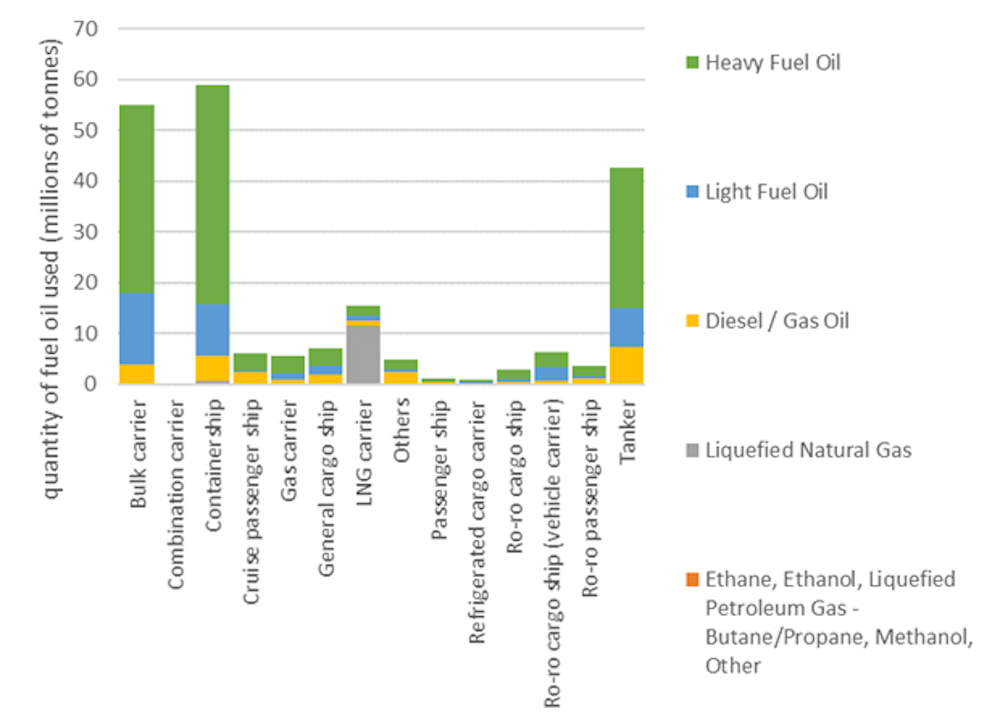
    Annual fuel oil consumption (by ship type):

    How different fuels were used by different ship types (2023 data).
    IMO Future Fuels, CC BY-NC-SA

    But here’s the problem: global demand for shipping is expected to grow by around 60% in that same time. So even with a 40% efficiency boost, total emissions from shipping could stay the same – or even go up – because so much more cargo will be moved.

    Despite this, many countries haven’t updated their policies to reflect this growing demand or to align with the IMO’s updated “30% cuts by 2030” target.

    Some countries, including Palau – a Pacific island nation vulnerable to climate change – and the UK, have pushed for stronger action. But there remains a long way to go before the world agrees on an ambitious path forward.

    Green energy

    The more hotly debated issue is around a fiendishly complicated set of “mid-term measures”. A key part of this is creating a “global fuel standard” – essentially, targets for how much “zero emission” (or “green”) fuel ships must use and by when.

    These rules would come with penalties or costs for using polluting fuels, which would effectively put a price on greenhouse gas emissions. Experts have long agreed that putting a price on shipping pollution is the most effective way to encourage cleaner and more efficient practices. But despite nearly 20 years of discussions, countries still haven’t agreed how to do this.

    Decisions are further complicated by wrangles over how to fairly distribute the revenues from these penalties.

    Who should get the revenues from shipping pollution?
    Uncle_Dave / shutterstock

    The good news is that the world is less than a week away from a decision which will put a price on shipping pollution in some form. The bad news is that proposals on the table could easily deliver a weak, uncertain price signal which doesn’t push the industry to invest in more green solutions. And the fuel standard itself might fall short of the ambitious climate targets set in 2023.

    Until now, talks on improving shipping efficiency and on pricing polluting fuels have happened separately. A big task at the IMO summit in London is to integrate the two into one coordinated plan.

    From a climate perspective, these policies should be judged by whether they will work together to cut shipping emissions by 30% by 2030 (the IMO’s current target).

    As things stand, that outcome is still possible – but is now an uphill battle. Agreement this week is crucial and countries will show their true colours. If they can’t agree to agree more ambitious policies it will undermine the IMO’s ability to regulate shipping emissions.

    Historically, the IMO tends to take its biggest decisions in the last hours of Thursday in week-long negotiations. Both ambitious and more cautious countries have a lot on the line, as the measure adopted will be legally binding for all of them.

    A positive result depends on whether powerful groups such as the European Union line up to support ambitious measures, as as proposed by African, Caribbean, Central American and Pacific countries as well as the UK.

    Although countries have agreed on climate targets for shipping, some still refuse to support the policies needed to actually phase out fossil fuels fast enough. That stance much change. If done right, IMO negotiations this week could be a turning point – not just for shipping, but for renewable energy and climate action worldwide.


    Don’t have time to read about climate change as much as you’d like?

    Get a weekly roundup in your inbox instead. Every Wednesday, The Conversation’s environment editor writes Imagine, a short email that goes a little deeper into just one climate issue. Join the 40,000+ readers who’ve subscribed so far.


    Simon Bullock is a member of the Institute of Marine Engineering, Science and Technology

    Christiaan De Beukelaer receives funding from the ClimateWorks Foundation.

    Tristan Smith owns shares in UMAS International, that working alongside UCL Energy Institute, provides advisory services on the subject of maritime decarbonisation. My research group is recipient of research funding from UKRI, Climateworks Foundation and Quadratue Climate Foundation. I am on the advisory board of the Global Maritime Forum, and the Strategy Board of the Getting to Zero Coalition – not for profit structures that work across governments and industry stakeholders on maritime decarbonisation.

    ref. At a pivotal meeting, the world is set to decide how to cut shipping emissions – https://theconversation.com/at-a-pivotal-meeting-the-world-is-set-to-decide-how-to-cut-shipping-emissions-253462

    MIL OSI – Global Reports

  • MIL-OSI Global: Drinking pee to improve health is an ancient practice – but the risks outweigh the evidence

    Source: The Conversation – UK – By Dipa Kamdar, Senior Lecturer in Pharmacy Practice, Kingston University

    KK_face/Shutterstock

    TV star Ben Grylls says he does it for survival – and teaches his reality show contestants to do the same. Mexican boxer Juan Manuel Márquez practised this therapy to train for his 2009 fight with Floyd Mayweather Jr (he lost). Former Indian prime minister Morarji Desai claimed a daily glass of the stuff was a remedy for many diseases and contributed to his longevity.

    What is the therapy these celebrities practice? Urophagia, also known as urine therapy, is the practice of drinking urine.

    Whether the urine is your own, someone else’s or even obtained from an animal, people have been drinking pee as medicine for thousands of years. Most claims about urine therapy are based on anecdotes or ancient texts with no robust scientific evidence to support the benefits of urine therapy. There is evidence to show that drinking urine has a number of health risks, however,

    In Indian Ayurvedic medicine, urine was used to treat asthma, allergies, indigestion, wrinkles and even cancer. The Roman poet Catullus believed urine helped to whiten teeth – possibly due to its ammonia content.

    As a rudimentary test for diabetes, doctors used to taste urine to check how sweet it was. Now, of course, we have urine test strips to check for glucose in the urine.

    In 1945, British naturopath John W. Armstrong published a book called “The Water of Life: A Treatise on Urine Therapy.” He claimed that drinking one’s own urine and massaging it into the skin could cure major illnesses.

    Historically, drinking pee to treat illnesses may have made sense because of a lack of medical alternatives. But, as the urine-sipping celebrities above show, the practice is still followed today.

    There are reported cases of using urine for home remedies to treat seizures in children in Nigeria. The China Urine Therapy Association claims that drinking and washing with urine can cure constipation and skin sores.

    Waste not, want not?

    Urine is made by the body to get rid of waste. It is mostly made up of water (about 95%) and several waste products, including urea (2%), which is made by the liver after breaking down proteins in the body, creatinine, which is left over from energy-releasing processes in the muscles, and salts. If urine is just waste, how could drinking it be beneficial?

    The kidneys act as regulators – not just to get rid of any toxins but to remove anything that it doesn’t need. For example, excess vitamins that aren’t needed by the body are found in urine.

    Drinking urine means these vitamins and minerals are getting recycled instead of being wasted – this also goes for other hormones, proteins and antibodies that can be found in urine. However, the amounts of these substances in a glass of urine are unlikely to be enough to be beneficial and a vitamin supplement may be more effective.

    Some advocates of urine therapy believe it can help prevent allergic reactions and control autoimmune conditions. The antibodies in the urine are supposed to make the immune system stronger.

    Other modern uses also include cleansing and detoxification – some people have claimed that continually drinking recycled urine leads to cleaner urine and blood by removing toxins and leading to better overall health.

    However, there’s no scientific evidence to support any of these claims.

    Some social media influencers claim that urine has healing properties and drinking or applying it to the skin can help skin conditions such as acne and infections. As mentioned, urine does contain urea, which is often added to skin care products as a moisturiser. But the concentration of urea in urine is unlikely to be high enough to have this effect.

    Urine also contains dehydroepiandrosterone, a steroid hormone produced by the body that declines with age, which has been marketed as an anti-ageing ingredient – but there isn’t enough data to demonstrate its efficacy.

    Risky business

    Some advocates of urine therapy believe that urine is sterile. However, research has found that urine naturally contains low levels of bacteria and research shows that bacteria can further contaminate the urine when it leaves the body. Drinking urine, then, can introduce bacteria and toxins into the gut and potentially cause further illness like stomach infections.

    Urine becomes more concentrated when it comes out again – the kidneys may have to work harder to filter out the excess, putting extra strain on them. The kidneys need water to process these salts.

    Drinking urine means you have to pee out more water than you get from it, which speeds up dehydration – it’s similar to drinking seawater. Some drugs, such as penicillin antibiotics or heart medicines, are also excreted in the urine – by drinking urine, it can cause toxic levels of these drugs to build up in the body.

    Mainstream medical communities do not endorse urine therapy as it lacks scientific evidence. Small amounts of urine drinking are unlikely to be harmful. But for tangible health benefits, other therapies with scientific evidence may be the way to go.

    Dipa Kamdar does not work for, consult, own shares in or receive funding from any company or organisation that would benefit from this article, and has disclosed no relevant affiliations beyond their academic appointment.

    ref. Drinking pee to improve health is an ancient practice – but the risks outweigh the evidence – https://theconversation.com/drinking-pee-to-improve-health-is-an-ancient-practice-but-the-risks-outweigh-the-evidence-253353

    MIL OSI – Global Reports

  • MIL-OSI USA: Governor Stein Announces Council On Student Safety & Well-Being

    Source: US State of North Carolina

    Headline: Governor Stein Announces Council On Student Safety & Well-Being

    Governor Stein Announces Council On Student Safety & Well-Being
    lsaito

    Raleigh, NC

    Today at Moore Square Magnet Middle School, Governor Josh Stein announced his Advisory Council on Student Safety and Well-Being, co-chaired by Senate Democratic Leader Sydney Batch, Deputy Secretary William “Billy” Lassiter of the Department of Public Safety, and 2024 North Carolina Teacher of the Year Heather Smith. 

    “North Carolina’s children are our future, and it is crucial that they grow and learn in a safe environment that sets them on the right trajectory to thrive,” said Governor Josh Stein. “I am proud to establish this council of educators, mental health professionals, and law enforcement to identify ways to better keep our classrooms safe and our children healthy.”

    “Ensuring the safety of our students is not up for debate — it’s a fundamental responsibility of our state government,” said Democratic Leader Sydney Batch. “Every child in North Carolina deserves the freedom to learn in a secure, supportive environment. I’m proud to co-chair this council and committed to advancing real, enforceable policies that keep our kids safe and our schools strong — and I’m ready to work with anyone willing to get that important work done.”

    “Student and school staff security and wellbeing is an essential part of public safety,” said Deputy Secretary of Public Safety William L. Lassiter, who oversees the Division of Juvenile Justice and Delinquency Prevention. “We must use the tools at our disposal to upgrade the physical infrastructure of our schools and train our school staff how to recognize and respond to the early warning signs that can lead to public safety threats. We know our students must feel safe and have a healthy mental well-being to achieve academically. Working together, we can keep our students and our schools safe.” 

    “What I’ve seen in my classroom is that if students don’t feel safe, if they are not supported, it’s so much harder for them to learn,” said Teacher of the Year Heather Smith. “Our commitment to giving students the best starts with looking out for their safety and well-being, and I am eager to jump into this work.”

    Governor Stein’s advisory council will work across state agencies and with both state and local leaders to propose and implement policies and solutions that will improve student safety and wellbeing. It will advance recommendations, provide guidance to state agencies, work with local communities, and share best practices. The council’s first priority will be working with the General Assembly to support school systems in implementing policies that will make classrooms cell phone-free.  

    Click here to read Governor Stein’s executive order establishing the Council on Student Safety & Well-Being.

    The members of the Advisory Council are as follows:

    • Senate Democratic Leader Sydney Batch (co-chair)
    • William L. Lassiter, Deputy Secretary for the Division of Juvenile Justice and Delinquency Prevention, Department of Public Safety (co-chair)
    • Heather Smith, 2024 Burroughs Wellcome Fund North Carolina Teacher of the Year (co-chair)
    • Senator David W. Craven, Jr.
    • Representative Brian Biggs
    • Representative Lindsey Prather
    • Alan Duncan, Vice-Chair of the State Board of Education
    • Bettina Umstead, Board of Education Member, Durham Public Schools
    • Sharon Bell, Deputy Director, Division of Child and Family Wellbeing, North Carolina Department of Health and Human Services
    • Natalia Botella, Director, Public Protection Section, North Carolina Department of Justice
    • Dr. Ellen Essick, Section Chief for NC Healthy Schools, Department of Public Instruction
    • Karen Fairley, Executive Director of Center for Safer Schools, A Division of the State Bureau of Investigation
    • Anne Goldberg, School Counselor, Alamance-Burlington School System
    • Tara Hardy, School Social Worker, Craven County Schools
    • Roger “Chip” Hawley, Director of The North Carolina State Bureau of Investigation
    • Emma Hodson, In-House Counsel, Pitt County Schools
    • Kristie Howell, Chief Court Counselor-District 8, Division of Juvenile Justice and Delinquency Prevention, North Carolina Department of Public Safety
    • Melissa Lassen, BSN, RN, NCSN, Lead School Nurse, Chatham County Schools
    • Mark McHugh, Director of Safety, Charlotte-Mecklenburg Schools
    • Dr. Shaneeka Moore-Brown, President, North Carolina Parent Teacher Association
    • Asia Prince, Director of Court Programs, North Carolina Administrative Offices of the Courts
    • Deputy Rhyne Rankins, School Resource Officer, Iredell County Sheriff’s Office
    • Dr. Paul Smokowski, Executive Director, North Carolina Youth Violence Prevention Center
    • Beckie Spears, Principal, Wilkesboro Elementary School & 2024 Wells Fargo North Carolina Principal of the Year
    • Mary Katherine Stiles, M.A./S.S.P., School Psychologist, Cumberland County Schools
    • Justice Warren, Assistant Legal Counsel, North Carolina School Boards Association
    • Julie Cecelia Werry, Scholar Advisor, Morehead-Cain Foundation
    • Dr. Freddie Williamson, Superintendent of Public Schools of Robeson County 
    Apr 7, 2025

    MIL OSI USA News

  • MIL-OSI United Kingdom: Joint statement at the 58th Session of the UN Commission on Population and Development

    Source: United Kingdom – Executive Government & Departments

    Press release

    Joint statement at the 58th Session of the UN Commission on Population and Development

    Joint statement on the 58th Session of the UN Commission on Population and Development delivered by Sierra Leone on Monday 7 April 2025, on behalf of Albania, Andorra, Armenia, Australia, Austria, Belgium, Bosnia and Herzegovina, Brazil, Bulgaria, Cabo Verde, Cambodia, Chile, Colombia, Costa Rica, Croatia, Cyprus, Czechia, Democratic Republic of the Congo, Denmark, Dominican Republic, Estonia, Eswatini, Finland, France, Georgia, Germany, Greece, Guinea, Honduras, Iceland, Ireland, Israel, Italy, Japan, Latvia, Lebanon, Lesotho, Liberia, Liechtenstein, Lithuania, Luxembourg, Malta, Mexico, Monaco, Mongolia, Montenegro, Morocco, Nepal, Netherlands, New Zealand, North Macedonia, Norway, Panama, Papua New Guinea, Peru, Poland, Portugal, Republic of Korea, Republic of Moldova, Romania, Samoa, San Marino, Serbia, Sierra Leone, Slovakia, Slovenia, South Africa, Spain, Sweden, Switzerland, Thailand, Timor-Leste, Tunisia, Tuvalu, Ukraine, Uruguay, Zambia and the United Kingdom.

    We are making this collective statement to emphasise the urgent need for action to achieve Sustainable Development Goal (SDG) 3. Health is a human right and a foundation of sustainable development, driving economic growth, social cohesion, and individual dignity.

    Over the past decades, significant progress has been made in many areas of health. We have seen a reduction in maternal and child mortality, expanded access to modern contraceptive methods as well as maternal and newborn medicines and commodities, improvements in adolescent health and education, addressing sexually transmitted diseases including HIV, and a decline in child and early forced marriages. These achievements give us hope for a healthier future.

    However, significant challenges persist, and the urgent need for equal access to health services and opportunities for healthy lives remains out of reach for many.

    Health inequalities stemming from complex, interrelated factors such as economic disparities, social exclusion, significant financial hardship, discrimination, and unequal access to resources, has a profound impact on individuals and communities. These inequalities manifest in poor health outcomes, lower life expectancy, reduced household income, and weaker national economic growth potential. Income inequality exacerbates vulnerabilities, limiting access to health services in low-income countries and disadvantaged communities. Social disparities rooted in gender, race, age, class, religion, and ethnicity perpetuate stigma, violence, and adverse health determinants.

    Economic disparities within and among countries remain significant, impacting the lives of many individuals. Far too many people are unable to access essential health services or are forced to forgo care due to unaffordability. Rising out-of-pocket health costs are pushing millions into poverty, hindering the realisation of Universal Health Coverage. Conflicts and climate change are straining health systems and the health workforce, contributing to stagnating maternal mortality rates, growing mental health challenges, and the inability of health systems to cope with the rise of non-communicable diseases.

    Equitable, inclusive, and resilient health systems are essential to ensure healthy lives and promote well-being. It is imperative to prioritize universally accessible, quality, and comprehensive primary healthcare services. Sexual and reproductive health and reproductive rights must enable individuals to make free and informed decisions about their health and their lives. Addressing the social determinants of health – such as poverty, malnutrition, education, water and sanitation, and gender inequality – is critical for achieving inclusive economic growth that strengthens and benefits all of society.

    The health and well-being of adolescents and youth also demands greater attention – they require better access to health services, education, and information that enable them to make informed decisions about their lives.

    Investing in health, particularly sexual and reproductive health, is not just a matter of well-being, but also a powerful driver of economic growth. UNFPA estimates that allocating an additional $79 billion by 2030 to expand maternal health and family planning services could yield $660 billion in economic benefits by 2050—preventing 400 million unplanned pregnancies, 1 million maternal deaths, 6 million stillbirths, and 4 million newborn deaths, while also enhancing workforce participation and economic productivity (UNFPA, 2022). Similarly, closing the women’s health gap more broadly could further accelerate economic progress, with the World Economic Forum projecting a potential boost of at least $1 trillion annually to the global economy by 2040.

    Greater investments in health infrastructure, workforce capacity, and innovative solutions like digital health can improve service delivery and expand access to services. Strengthening and expanding the global health workforce is at the heart of this. We must address health workforce shortages, ensure equitable distribution, enhance training and pay attention to sustainable retention strategies.

    It is vital that we, as policymakers, health organizations, and civil society, address disparities within and among countries, ensuring that people in vulnerable situations, including women, children, older persons, migrants, people with disabilities, and those in extreme poverty, have access to quality, comprehensive health services without financial hardship and discrimination. Our role in promoting responsive health systems that cater to the unique needs of at-risk individuals are key to sustainable and inclusive progress.

    A healthier population is central to achieving the 2030 Agenda for Sustainable Development. The ICPD’s Programme of Action has guided countries toward inclusive, equitable policies advancing health and gender equality. By strengthening health systems and addressing inequalities, we can work toward a world where all people can live healthy, productive and fulfilling lives.

    Updates to this page

    Published 7 April 2025

    MIL OSI United Kingdom

  • MIL-OSI USA: SBA Offers Disaster Relief to Illinois Businesses, Nonprofits and Residents Affected by South Terrace Apartment Fire

    Source: United States Small Business Administration

    WASHINGTON – In response to an Administrative disaster declaration issued April 2, the U.S. Small Business Administration (SBA) announced the availability of low interest federal disaster loans for Illinois businesses, nonprofits and residents affected by the South Terrace Apartment fire occurring on Feb. 22.  

    The disaster declaration covers Cook County, which is eligible for both Physical damage loans and Economic Injury Disaster Loans (EIDLs) from the SBA. EIDLs are also available to eligible small businesses and private nonprofit (PNP) organizations in the adjacent counties of DuPage, Kane, Lake, McHenry and Will in Illinois, as well as Lake County in Indiana. 

    Businesses and nonprofits are eligible to apply for business physical disaster loans and may borrow up to $2 million to repair or replace disaster-damaged or destroyed real estate, machinery and equipment, inventory, and other business assets.    

    Homeowners and renters are eligible to apply for home and personal property loans and may borrow up to $100,000 to replace or repair personal property, such as clothing, furniture, cars, and appliances. Homeowners may apply for up to $500,000 to replace or repair their primary residence.    

    Businesses and homeowners may also be eligible for a loan increase of up to 20% of their physical damages, as verified by the SBA, for mitigation purposes.  

    EIDLs are for working capital needs caused by the disaster and are available even if the small business or PNP did not suffer any physical damage. They may be used to pay fixed debts, payroll, accounts payable, and other bills not paid due to the disaster. 

    Interest rates are as low as 4% for small businesses, 3.625% for PNPs, and 2.750% for homeowners and renters, with terms up to 30 years. Interest does not begin to accrue, and payments are not due, until 12 months from the date of the first loan disbursement. The SBA sets loan amounts and terms based on each applicant’s financial condition. 

    Beginning Monday, April 7, 2025, SBA customer service representatives will be on hand at the Disaster Loan Outreach Center (DLOC) in Cook County to answer questions about SBA’s disaster loan program, explain the application process and help individuals complete their application. Walk-ins are accepted, but you can schedule an in-person appointment in advance at appointment.sba.gov.  

    The DLOC hours of operation are listed below: 

    Disaster Loan Outreach Center (DLOC) 
    Cook County 

    Justice Village Hall 

    7800 S Archer Road 

    Justice, Illinois 60458 

    Opening:  Monday, April 7, 10 a.m. to 5 p.m. 

    Hours: Monday – Friday – 8:00 a.m. to 5 p.m. 

    Saturday – 10 a.m. to 2 p.m. 

    Closed: Sunday  

    Permanently Closing: Saturday, April 19, 2 p.m. 

    “SBA’s Disaster Loan Outreach Centers (DLOCs) have consistently proven their value to business owners and homeowners following a disaster,” said Chris Stallings, associate administrator of the Office of Disaster Recovery and Resilience at the SBA. “Homeowners and Business owners can visit the DLOC to meet face-to-face with specialists who will guide them through the disaster loan application process and connect them with resources to support their recovery.” 

    Disaster survivors should not wait to settle with their insurance company before applying for a disaster loan. If a survivor does not know how much of their loss will be covered by insurance or other sources, SBA can make a low-interest disaster loan for the total loss up to its loan limits, provided the borrower agrees to use insurance proceeds to reduce or repay the loan. 

    To apply online, visit sba.gov/disaster. Applicants may also call SBA’s Customer Service Center at (800) 659-2955 or email disastercustomerservice@sba.gov for more information on SBA disaster assistance. For people who are deaf, hard of hearing, or have a speech disability, please dial 7-1-1 to access telecommunications relay services.  

    The filing deadline to return applications for physical property damage is June 2, 2025. The deadline to return economic injury applications is January 2, 2026. 

    ### 

    About the U.S. Small Business Administration 

    The U.S. Small Business Administration helps power the American dream of business ownership. As the only go-to resource and voice for small businesses backed by the strength of the federal government, the SBA empowers entrepreneurs and small business owners with the resources and support they need to start, grow or expand their businesses, or recover from a declared disaster. It delivers services through an extensive network of SBA field offices and partnerships with public and private organizations. To learn more, visit www.sba.gov. 

    MIL OSI USA News

  • MIL-OSI Asia-Pac: Chinese Culture Festival announced

    Source: Hong Kong Information Services

    The second edition of the Chinese Culture Festival (CCF) will be held from June to September, with various performances and activities being presented for the public to experience traditional Chinese fine culture.


    The festival’s opening show is a dance production. “Dongpo: Life in Poems” is directed by the internationally acclaimed choreographer and visual artist Shen Wei, and blends modern dance with poetry, traditional Chinese painting, calligraphy, seal engraving and guqin music to delicately deconstruct the poetic works of Su Dongpo, a literary master during the Song dynasty.


    A core part of the CCF, this year’s Chinese Opera Festival (COF) features six quality productions covering Peking opera, Yuediao opera, Qinqiang opera, Yue opera, Cantonese opera and Kunqu opera.


    The COF this year features classic plays inspired by the “Romance of the Three Kingdoms”, one of the four great classic novels of Chinese literature. There will also be a dance drama highlighting the resilient spirit and sentiments of the famous Song dynasty poetess, Li Qingzhao, and her contributions to China’s literary inheritance from a contemporary perspective.


    In another production, the Jiangsu Centre for the Performing Arts will present the original Chinese dance drama “A Dream of Red Mansions”, the plot of which concerns a love triangle between Jia Baoyu, Lin Daiyu and Xue Baochai. The production restructures the traditional storylines from the perspective of the 12 Beauties of Jinling.


    This year’s CCF also features a “Tea Culture” series curated by Hong Kong’s Ambassador for Cultural Promotion, the internationally renowned composer and conductor Tan Dun.


    The City in Focus of this year’s CCF is Xi’an. Relevant shows include the classic opera “Zhou Ren on the Way Home”, a exhibition showcasing Xi’an’s invaluable archaeological relics, and a production of the ballet “Swan Lake” by the Xi’an Acrobatic Troupe.


    Call 2268 7321, 2268 7323 or 2268 7325 for enquiries.

    MIL OSI Asia Pacific News

  • MIL-OSI: AI tutoring startup SigIQ.ai emerges from stealth with $9.5M to democratize elite education

    Source: GlobeNewswire (MIL-OSI)

    Berkeley, April 07, 2025 (GLOBE NEWSWIRE) — When SigIQ.ai’s AI tutor took India’s notoriously difficult UPSC civil service exam last June, it didn’t just pass – it achieved the highest score in the exam’s history, beating 1.3 million human candidates in under 7 minutes. Today, the Berkeley-based startup emerges from 18 months of stealth with $9.5 million funding to transform education through personalized AI tutoring that delivers elite-level instruction at the cost of computation, not hundreds of dollars per hour.

    The seed round was co-led by House Fund and GSV Ventures, with participation from Duolingo, General Catalyst India (Venture Highway), Peak XV Partners (formerly Sequoia India), Calibrate Ventures and angel investors, such as Andy Konwinski (Co-founder, Perplexity), Christian Storm (Co-founder & CTO, Turnitin), Prof. Trevor Darrell (Berkeley AI Research, UC Berkeley), Prof. Jitendra Malik (Berkeley AI Research, UC Berkeley), Prof. Srini Devadas (MIT), Prof. Sharad Malik (Princeton) and others. This investment will accelerate hiring top talent, enhancing AI models, and scaling platforms to educational systems worldwide.

    SigIQ.ai founders: Professor Kurt Keutzer and Dr. Karttikeya Mangalam. 

    SigIQ.ai’s technology directly addresses “Bloom’s Two-Sigma Problem” – the research finding that students receiving one-on-one tutoring perform two standard deviations better than those in traditional classrooms. This educational disparity has persisted for decades, with personalized tutoring remaining a luxury reserved for the privileged few. The company’s revolutionary approach shifts the cost of personalization from human labor to AI computation, making world-class instruction accessible at unprecedented scale.

    “We’re at a pivotal moment in education where modern GenAI can provide a personal 1:1 tutor to every student and reduce the cost of one-on-one learning from hundreds of dollars an hour to the cost of computation,” said Dr. Karttikeya Mangalam, CEO and co-founder of SigIQ.ai, a UC Berkeley AI PhD mentored by computer vision pioneer Prof. Jitendra Malik. “We’ve started by first creating a tutor that itself can ace the very exam students are preparing for. This is a necessary step to ensure accuracy and quality in teaching delivered. And will set a new benchmark in personalized education, making the highest-quality education accessible to everyone, regardless of geography or socioeconomic status, at a fraction of the traditional cost.”

    The company was founded in July 2023 by Dr. Karttikeya Mangalam and Professor Kurt Keutzer, a distinguished Professor in the Berkeley AI Research (BAIR) Lab who has published six books, over 250 refereed papers, and helped launch twelve startups. SigIQ.ai’s origin reflects its mission. Growing up in Muzaffarpur, Bihar – a region where educational opportunities are limited – Mangalam experienced firsthand the stark divide between small-town India and elite Western academic institutions. After completing his education at IIT Kanpur and then at UC Berkeley, he founded SigIQ.ai to democratize access to world-class education globally.

    SigIQ.ai latest product is EverTutor.ai, designed for GRE preparation in the US market, has already gained more than 10,000 users in just 3 of launch.

    In just 18 months, SigIQ.ai has launched two products with remarkable traction. PadhAI, focused on UPSC exam preparation in India, has attracted over 200,000 learners in just six months. On June 16, 2024, moments after the actual 2-hour UPSC Prelims exam had finished, PadhAI’s AI tutor solved the entire paper in a live demonstration in under 7 minutes at The Leela in Delhi. It achieved a score of 175/200 – not just the highest score in 2024, but the highest score ever achieved in UPSC prelims history, far exceeding the typical qualifying score of 100/200. This historic achievement was covered by over 70 news outlets across India, including The Hindu and The Times of India.

    The company’s newer offering, EverTutor.ai, designed for GRE preparation in the US market, has already gained more than 10,000 users since launching three months ago.

    Inside SigIQ.ai’s EverTutor product designed to support GRE preparation. 

    “SigIQ.ai isn’t just a regular EdTech startup — they’ve built an AI system that publicly demonstrated its ability to outperform both humans and leading commercial AI models on one of the world’s most challenging exams. This redefines what’s possible in personalized education,” said Jeremy Fiance, Managing Director of The House Fund.

    What differentiates SigIQ.ai from other educational AI tools is its approach to personalization. Unlike basic conversational AI that offers scripted or limited interactivity, SigIQ’s systems are highly interactive, responsive to follow-up questions, and capable of personalized instruction and feedback – not just chat. As a result, this technology replicates the behavior of a real tutor. Students using the platform report a 30-40% increase in effective study hours while improving performance by 18% in the first month, with over 75% feeling more confident tackling difficult topics within just three weeks.

    Looking ahead, SigIQ.ai plans to expand its reach with EverTutor, supporting more GRE takers in the upcoming spring and fall. The company will be present at ASU+GSV to demonstrate the newest developments in both platforms. Beyond standardized tests, SigIQ.ai envisions a future where their technology transforms education broadly, creating a new era where high-quality learning isn’t limited by geography, language, or economic status. Ultimately, the team is set on proving that elite education doesn’t have to be scarce – it can and must be universal.

    Ends 

    Media images can be found here

    About SigIQ.ai
    Founded in 2023 by Dr. Karttikeya Mangalam, SigIQ.ai builds AI-powered learning tools that deliver personalized education at scale. With offices in Berkeley and Gurgaon, the company’s flagship products PadhAI and EverTutor.ai serve hundreds of thousands of students globally. Recognized across India for its feat of achieving the top score on the UPSC 2024 live, SigIQ.ai is poised to transform the future of education.

    The MIL Network

  • MIL-OSI: BexBack Launches 100x Leverage Crypto Futures Trading with Double Deposit Bonus and $50 Welcome Bonus – No KYC Required

    Source: GlobeNewswire (MIL-OSI)

    SINGAPORE, April 07, 2025 (GLOBE NEWSWIRE) — In the past 24 hours, most major cryptocurrencies have plunged more than 10%, with Bitcoin briefly falling below $75,000. The sharp sell-off was triggered by President Trump’s new tariff war, sparking panic across global markets. Analysts are warning: the bear market may have officially arrived.

    In a bear market, smart investors know that simply holding spot assets is not enough. 100x leverage futures trading has become the preferred strategy to profit from both market rises and falls. BexBack Exchange is leading the way, empowering traders with the tools and bonuses needed to succeed.

    To help traders capture these new opportunities, BexBack is offering:

    • 100x Leverage: Trade up or down with maximum flexibility.
    • Double Deposit Bonus: Get 100% bonus on every deposit over 0.001 BTC or 100 USDT.
    • $50 Welcome Bonus: Complete your first trade and receive a $50 USDT bonus — usable for trading and loss protection (not withdrawable).
    • No KYC Required: Start trading immediately with no identity verification.

    Bonus Details

    • 100% Deposit Bonus:
      • The bonus itself cannot be withdrawn directly.
      • However, profits generated using the bonus can be freely withdrawn.
      • The bonus can also serve as extra margin, reducing the risk of liquidation.
    • $50 Welcome Bonus:
      • Acts as loss protection for trading.
      • It is not directly withdrawable but can be fully used for trading activities.

    Why Choose 100x Leverage Futures Trading Now?

    • Profit From Falling Markets: Short and earn even in a bear market.
    • Amplify Profits With Less Capital: Trade large positions with minimal investment.
    • Efficient Capital Management: Free up funds for broader strategies.
    • Flexible Leverage Options: Choose from 25x, 50x, 75x, or 100x.
    • Easy Global Access: Trade anytime via web and mobile.

    About BexBack

    BexBack is a premier cryptocurrency derivatives platform offering 100x leverage on BTC, ETH, XRP, ADA, SOL, and more than 50 other major cryptocurrencies. Headquartered in Singapore with offices in Hong Kong, Japan, the United States, the United Kingdom, and Argentina, BexBack holds a U.S. MSB (Money Services Business) license and has earned the trust of over 500,000 traders worldwide.

    • No deposit fees
    • Cold wallet fund protection
    • 24/7 multilingual customer support
    • Demo account with 10 BTC and 100,000 USDT for practice

    Register Today — Dominate the New Crypto Cycle!

    Don’t just survive the bear market — profit from it. Sign up on BexBack now, double your deposit, claim your $50 welcome bonus for trading protection, and enjoy 100x leverage with no KYC required!

    Website: www.bexback.com

    Contact: business@bexback.com

    Contact:
    Amanda
    business@bexback.com

    Disclaimer: This content is provided by BexBack. The statements, views, and opinions expressed in this content are solely those of the content provider and do not necessarily reflect the views of this media platform or its publisher. We do not endorse, verify, or guarantee the accuracy, completeness, or reliability of any information presented. This content is for informational purposes only and should not be considered financial, investment, or trading advice. Investing in crypto and mining related opportunities involves significant risks, including the potential loss of capital. Readers are strongly encouraged to conduct their own research and consult with a qualified financial advisor before making any investment decisions. However, due to the inherently speculative nature of the blockchain sector–including cryptocurrency, NFTs, and mining–complete accuracy cannot always be guaranteed. Neither the media platform nor the publisher shall be held responsible for any fraudulent activities, misrepresentations, or financial losses arising from the content of this press release.Speculate only with funds that you can afford to lose.Neither the media platform nor the publisher shall be held responsible for any fraudulent activities, misrepresentations, or financial losses arising from the content of this press release. In the event of any legal claims or charges against this article, we accept no liability or responsibility.

    Legal Disclaimer: This media platform provides the content of this article on an “as-is” basis, without any warranties or representations of any kind, express or implied. We do not assume any responsibility or liability for the accuracy, content, images, videos, licenses, completeness, legality, or reliability of the information presented herein. Any concerns, complaints, or copyright issues related to this article should be directed to the content provider mentioned above.

    Photos accompanying this announcement are available at:

    https://www.globenewswire.com/NewsRoom/AttachmentNg/ee0aebfe-90c4-4cd2-a708-74385492ed4d

    https://www.globenewswire.com/NewsRoom/AttachmentNg/8f9d764c-0923-4c8f-86e1-cdae727da08a

    https://www.globenewswire.com/NewsRoom/AttachmentNg/d39264e2-48e9-4d9d-8d59-c689c2149150

    https://www.globenewswire.com/NewsRoom/AttachmentNg/76b552a8-2e93-4fe6-915e-d416a5808878

    The MIL Network

  • MIL-OSI: Varonis Appoints New Country Manager in Japan

    Source: GlobeNewswire (MIL-OSI)

    MIAMI and TOKYO, April 07, 2025 (GLOBE NEWSWIRE) — Varonis Systems, Inc. (Nasdaq: VRNS), the leader in data security, today announced Toshi Namiki’s appointment as Country Manager for Japan.

    With more than 25 years of experience in software and cybersecurity, Toshi has led international high-value sales for Deep Instinct, Forescout Technologies, and global leaders Palo Alto Networks and VeriSign. He brought cutting-edge technology to Japan by working with regional partners, helping companies adopt state-of-the-art solutions, and driving innovation throughout the Japanese tech landscape.

    “I’m thrilled to join Varonis to help our customers stop breaches and protect what matters most — their data,” Toshi said. “Japan’s top industries, including manufacturing, technology, and automotive, possess vast amounts of data and must secure this information in the AI era. Varonis helps organizations ensure security before, during, and after AI deployment.”

    “With data generated at an unprecedented scale across many environments, complying with governance standards and protecting data is crucial,” said Scott Leach, Varonis Vice President of APAC. “Toshi’s proven ability to implement advanced solutions will be instrumental as we increase our local presence.”

    Varonis continues to expand its operations in the APAC region to help customers comply with local regulatory frameworks, including the Act on the Protection of Personal Information. This law requires companies to take security steps to protect personal data from unauthorized access, loss, or damage.

    Additional Resources

    About Varonis
    Varonis (Nasdaq: VRNS) is the leader in data security, fighting a different battle than conventional cybersecurity companies. Our cloud-native Data Security Platform continuously discovers and classifies critical data, removes exposures, and detects advanced threats with AI-powered automation.

    Thousands of organizations worldwide trust Varonis to defend their data wherever it lives — across SaaS, IaaS, and hybrid cloud environments. Customers use Varonis to automate a wide range of security outcomes, including data security posture management (DSPM), data classification, data access governance (DAG), data detection and response (DDR), data loss prevention (DLP), AI security, and insider risk management.

    Varonis protects data first, not last. Learn more at www.varonis.com.

    Investor Relations Contact:
    Tim Perz
    Varonis Systems, Inc.
    646-640-2112
    investors@varonis.com 

    News Media Contact:
    Rachel Hunt
    Varonis Systems, Inc.
    877-292-8767 (ext. 1598)
    pr@varonis.com

    The MIL Network

  • MIL-OSI: Altus Group Releases its 2024 Sustainability Report

    Source: GlobeNewswire (MIL-OSI)

    TORONTO, April 07, 2025 (GLOBE NEWSWIRE) — Altus Group Limited (“Altus” or “the Company”) (TSX: AIF), a leading provider of asset and fund intelligence for commercial real estate (“CRE”), today released its annual Sustainability Report, which highlights the Company’s sustainability initiatives and progress in 2024.

    “As we celebrate our 20th anniversary this year, sustainability continues to guide who we are and how we operate,” said Camilla Bartosiewicz, Chief Communications Officer at Altus Group. “This report brings our values to life – highlighting the tangible progress we made in 2024 in reducing emissions, investing in our people, and upholding strong corporate governance. These efforts are not only core to our identity as a responsible corporate citizen and employer of choice, but are critical to managing enterprise risk and creating long-term value for all stakeholders.”

    Key 2024 highlights:

    • Climate action: reduced Scope 1 and 2 greenhouse gas emissions by approximately 5% in 2024, benefitting from strategic right-sizing of office space, which resulted in a 12% reduction in office footprint.
    • Talent management: expanded people programs to foster career advancement and employee success, earning external recognition for an inclusive, high-trust and high-performance culture.
    • Cybersecurity and data responsibility: continued enhancement of cybersecurity and data standards to uphold data responsibility and maintain stakeholder trust.
    • Governance: welcomed new board members, adding diverse perspectives and skills that enhance board effectiveness.

    To download Altus Group’s 2024 Sustainability Report please visit https://www.altusgroup.com/about-us/sustainability/. More information on Altus Group’s corporate governance program is also detailed in the Company’s 2024 Management Information Circular dated March 26, 2025 which has been filed to SEDAR+ and is posted on Altus Group’s website under the Investors section.

    About Altus Group

    Altus Group is a leading provider of asset and fund intelligence for commercial real estate. We deliver intelligence as a service to our global client base through a connected platform of industry-leading technology, advanced analytics, and advisory services. Trusted by the largest CRE leaders, our capabilities help commercial real estate investors, developers, lenders, and advisors manage risks and improve performance returns throughout the asset and fund lifecycle. Altus Group is a global company headquartered in Toronto with approximately 1,900 employees across North America, EMEA and Asia Pacific. For more information about Altus (TSX: AIF) please visit altusgroup.com.

    FOR FURTHER INFORMATION PLEASE CONTACT:

    Elizabeth Lambe
    Director, Global Communications, Altus Group
    1 (416) 641-9787
    elizabeth.lambe@altusgroup.com

    The MIL Network

  • MIL-OSI Global: What ancient animal fables from India teach about political wisdom

    Source: The Conversation – USA – By John Nemec, Professor of Indian Religions and South Asian Studies, University of Virginia

    An illustration from an Arabic translation of a story in the ‘Pañcatantra,’ a collection of animal fables. Photo12/Universal Images Group via Getty Images

    In today’s volatile world, where wars can be fought over territory, commerce can be abruptly subjected to tariffs, and friendly nations can turn hostile after a single election, political leadership is more consequential than ever. So, one must ask, what makes a leader effective, and how should we choose who should lead?

    Classics such as Aristotle’s “Politics,” Confucius’ “The Analects” and Machiavelli’s “The Prince” offer compelling visions of proper governance. But there is another ancient source of political wisdom – the classical Indian tradition – which is not as well known in the West.

    I am a scholar of Indian religions, and in my 2025 book “Brahmins and Kings,” I examine various narrative works written in Sanskrit – the classical language of India – which deal with political theory. Among them, Viṣṇuśarman’s “Pañcatantra” stands out. It is a striking collection of animal fables from perhaps around 300 C.E. in which birds, lions and others speak and reason as humans do.

    The “Pañcatantra” stories are parables that teach how to negotiate sometimes brave, sometimes cruel, sometimes clever and sometimes naïve friends and enemies alike. These stories weigh three ethical positions and settle on one as best for politics.

    Doing what’s right

    First, one might seek to guide leaders by the “ethic of deontology.” This theory suggests people are duty-bound to act morally, because being good is an end in and of itself.

    Although Indian theorists knew this ethic well, they were also aware that those with power often need inducement for doing the right thing, for – as the saying goes – power tends to corrupt, and absolute power corrupts absolutely. Doing “the right thing,” “for its own sake,” can be naïve in the political arena.

    So goes the story in the third book (of five) in the “Pañcatantra,” titled “War and Peace.” A kingdom of owls was crushing the crows in battle, until a clever crow, a counselor named Ciraṃjīvin, or “Long-life,” cooked up a ruse.

    He smeared the blood of his lost brethren on his body, plucked his own feathers and scarred himself with wounds. Approaching the king of the owls in this sorry state, he claimed the crows had violently thrown him out for suggesting they should sue for peace.

    Now, he lamented, his only wish was revenge – alliance with his former enemies so as to punish his erstwhile companions. The counselors to the king of the owls advise him that it is simply right to harbor those in distress, so the owl king does so on principle.

    Patiently licking his manufactured wounds in the owls’ kingdom, Ciraṃjīvin then spied all its defenses and weaknesses, divined the opportune time for the crows to invade, and led them to conquer the owls.

    A friend in need is a friend, indeed

    If the story of the owls and the crows teaches that naïvely choosing what’s right is unwise, then why not drop morality altogether? Why not ruthlessly pursue whatever produces results? This is the second view of political leadership: double-cross, cheat, bully, cajole, break the conventions and rules – do whatever works!

    An 18th-century ‘Pañcatantra’ manuscript page.
    Philadelphia Museum of Arts via Wikimedia Commons

    Indian political theorists thought of this, too, and their very definition of good political rule is that it produces results for the people. But they also rejected unbridled ruthlessness, because they knew that such Machiavellianism was too blunt an instrument for political affairs.

    Consider the “Pañcatantra’s” second book, titled “On Securing Friends.” Here we meet another crow, this one named Laghupatanaka, or “Light Wing” – a nimble but lonely bird who witnesses friendship in action. He sees a hunter trap a dule of doves in his net. But their leader directs the bevy to pull all together.

    As one they lift up the net and wing it a distance, the fowler chasing all the while on the ground. Soon, they land where they can meet up with their friend, a mouse named Hiraṇyaka, or “Eager for Gold,” who chews through the net as a dove never could, and they escape before the fowler arrives.

    Laghupatanaka knows he, too, might be hunted. So he seeks out Hiraṇyaka, though they are said to be “natural enemies” because crows eat mice. But Laghupatanaka promises loyalty, and he never betrays Hiraṇyaka, even though he is the stronger one.

    Gradually, they add to their company a wise turtle and a beautiful deer and prosper together on a paradise island until a trapper invades their home. Each plays a role in fooling their foe, who captures the turtle, while the deer, heeding the turtle’s good counsel, manages a sly escape.

    To free the turtle, the deer plays dead while the crow mimics pecking at his eye. The trapper leaves the turtle behind, distracted by this bigger prize. Then Hiraṇyaka the mouse cuts the net holding the turtle, who crawls away as the decoy deer and the crow each take flight.

    Deer, crow, turtle and mouse each possess an innate ability, and together they save all from harm.

    The moral of this story is clear: Teamwork is effective, and successful leaders, no matter how powerful, thrive by relying on friends. As the well-known adages go: Two minds are better than one; many hands make for light work; a friend in need is a friend, indeed.

    Business is business, but how?

    A sketch illustrating a ‘Pañcatantra’ story.
    The Earliest English Version Of The Fables Of Bidpai; The Moral Philosophy Of Doni (1888) via Wikimedia Commons

    Nevertheless, it’s a competitive world, and some friends are greedy or false, as the story of the owls and the crows suggests. But if both pure morality and pure Machiavellianism are sometimes unwise, what third option could there be?

    Consider the story of the first book of the “Pañcatantra,” the tale of the foolish lion king who is tricked into fighting a natural ally. The king of the forest was once frightened by the sound of a bull. His advisers, the jackals, rightly judge the bull to be harmless, and they convince the two to meet. In time, the lion and bull became close friends – so much so that the lion stopped hunting, and the animals in his retinue began starving.

    The jackals then went to the king with a ruse: They told him that the bull was plotting to kill him; they manipulated the bull in similar fashion. In the fight that followed, the lion was injured, but the bull was killed. There was enough meat to feed everyone, and the jackals were promoted, because the lion king falsely believed they helped him avert a plot.

    Now, one might wrongly conclude that the moral of this story is power through strength. But the “Pañcatantra” makes clear that there’s more to it: The bull was a true friend who had helpfully counseled the king. It was the jackal advisers who betrayed the lion with their manipulative story, which won them undue power and wealth at the cost of a friend.

    Enter the third, and best, of the trio of political theories: virtue ethics. Leaders should cultivate wisdom. Chasten passions and impulses, the Indian texts counsel, in order to be able to distinguish opportunity from danger, friend from pretender, good advice from folly. Be discerning so as to see the world as it is and can be. Be good in order to do well in the world.

    Wisdom in action

    In Indian political theory, then, the answer is as simple as heeding the wisdom of parable stories: Do what is right, with the right measure, at the right time. Needless to say, this is more easily said than done. And one cannot force a leader to be chastened or wise.

    Voters can, however, favor those who pursue self-restraint. For if leaders must be thoughtful to be wise – and thus open the road to results – then voters should seek those who listen and learn so as to be able to know just what to do and when.

    This is the counsel that the classical Indian tradition offers contemporary voters. But to see who has just this virtuous discretion, voters will need a touch of that wisdom themselves.

    John Nemec does not work for, consult, own shares in or receive funding from any company or organization that would benefit from this article, and has disclosed no relevant affiliations beyond their academic appointment.

    ref. What ancient animal fables from India teach about political wisdom – https://theconversation.com/what-ancient-animal-fables-from-india-teach-about-political-wisdom-249341

    MIL OSI – Global Reports

  • MIL-OSI USA: Schatz To Republicans: Leave Social Security Alone

    US Senate News:

    Source: United States Senator for Hawaii Brian Schatz

    WASHINGTON – Today, U.S. Senator Brian Schatz (D-Hawai‘i) spoke out on the Senate floor against the Trump administration’s cuts to Social Security services which have left seniors and disabled people around the country worried about their ability to get their monthly checks. Schatz spoke during the Senate’s debate on the Republican tax bill which seeks to cut essential services for Americans in order to pay for the biggest tax cuts for billionaires in history.

    “Leave Social Security alone,” said Senator Schatz. “Donald Trump wants to gut the most successful anti-poverty program in American history. Over the past three months, his administration has made sweeping cuts to Social Security in ways that are already being felt across the country. Wait times have doubled to as many as 4 or 5 hours. Local field offices are closing. Websites are crashing. And people are understandably panicked about getting checks or missing payments altogether.”

    Senator Schatz added, “The idea that we are going to balance the budget on the backs of seniors who have paid into an earned benefit is immoral. It is wrong.”

    A transcript of Senator Schatz’s remarks is below. Video is available here.

    Leave Social Security alone. Leave Social Security alone. Donald Trump wants to gut the most successful anti-poverty program in American history. Over the past three months, his administration has made sweeping cuts to Social Security in ways that are already being felt across the country. Wait times have doubled to as many as 4 or 5 hours. Local field offices are closing. Websites are crashing. And people are understandably panicked about getting checks or missing payments altogether.

    But according to Commerce Secretary Lutnick, there is nothing to worry about. “Let’s say Social Security didn’t send out their checks this month. My mother-in-law, who’s 94, she wouldn’t call and complain. She just wouldn’t. She would think something got messed up and she’d get it next month. She wouldn’t complain.”

    Well, when your son in law is a billionaire, a missed check is not a very big deal. But when you’re a senior on the island of Oahu, where the average rent far exceeds the average benefit. I want you to understand that the average benefit is about $1,900. The average rent is more than $2,000. 300,000 people in the state of Hawaii depend on Social Security. And for the vast majority of them, Social Security is either all of their income or most of their income.

    The idea that we are going to balance the budget on the backs of seniors who have paid into an earned benefit is immoral. It is wrong. And I speak on behalf of all of my constituents who depend on it. It’s not just the 300,000. It’s all of the family members. I speak on behalf of my mother- and father-in-law, George and Ping Kwok. George Kwok worked all his life in a kitchen. Sometimes he was an employee. He eventually ended up owning a place called Kwok’s Chop Suey. He sold it and bought a home for his mom and helped to send his daughter to college. Then he started to get blind and he burned his hand in a fryer. And so he was unable to work and he took Social Security Disability. He deserves that money. Leave Social Security alone.

    Social Security cuts were always the third rail in American politics. Anyone on any side of the aisle with any sense of how to get elected knew not to touch that third rail. But they are grabbing this third rail with both hands.

    I want to quote a couple of my constituents. One constituent wrote to me. “We are elderly and we are concerned about the potential of cutting Social Security checks. We paid into the system our entire working lives and fear we can’t afford food, water, bills, and medical care. What will happen with these cuts and the cost of living going up? What will be our safety net? We are afraid of what’s to come.”

    Another wrote, “I worked for 36 years for the federal government, including four years as active duty Air Force in Vietnam. I contributed to Social Security with the explicit understanding that I would get Social Security as a portion of my retirement. Cutting Social Security means I lose about a third of my retirement with no recourse. I am 77 years old with health issues and hadn’t planned on getting another job. My wife was a flight attendant for Hawaiian Airlines for 50 years and also depends on Social Security for her retirement. It is completely unfair when she paid into Social Security for more than 50 years just to be abandoned when she is 70-years-old.”

    Another constituent: “I’m a 73-year-old woman who, unlike billionaire Commerce Secretary Lutnick’s mother-in-law, cannot afford to miss or reduce my Social Security payment. It is my sole income and I need it to pay rent and buy food. I worked hard all my life and contributed my fair share of taxes towards Social Security. I’m not asking for a free ride. I earned my Social Security.”

    I am not asking for a free ride. I earned my Social Security. Leave Social Security alone.

    MIL OSI USA News

  • MIL-OSI USA: Schatz: Donald Trump Is Ruining The Economy On Purpose, Everyone Will Pay More For Everything

    US Senate News:

    Source: United States Senator for Hawaii Brian Schatz

    WASHINGTON – U.S. Senator Brian Schatz (D-Hawai‘i) spoke out on the Senate floor today after President Donald Trump announced a new tariff plan that will levy the largest tax hike on middle-class families in a generation and force families to pay an average of $5,000 more each year.

    “Donald Trump is ruining the economy on purpose,” said Senator Schatz. “Starting tomorrow, we’ll be paying more for everything – groceries, food, cars, homes, toys, electronics, everything that you buy. This is about the ability for people to pay for college. This is about the ability for people to retire with dignity and comfort. Trillions of dollars of wealth are being demolished. These are everyday people panicked about how much more expensive their next trip to Walmart or Costco will be, or when they’ll lose their job.”

    The full text of Senator Schatz’s remarks can be found below. Video is available here.

    Donald Trump is ruining the economy on purpose. He is ruining the economy on purpose. I’m not sure if there’s ever been an American president, let alone a chief executive of any country that has ruined the economy on purpose. The stock market had its worst day in five years yesterday, and I just checked before I delivered these remarks. Just five minutes ago, 1600 down on the Dow Jones, the S&P down 5 percent, Nasdaq 4 percent, the Russell 5 percent. What does that mean as a practical matter? It means if you spent all your life working and saving and investing, and you are on the edge of retirement, and let’s say you’ve got $312,000 plus your Social Security income, you just lost 30 grand in two days because of Donald Trump. You lost 10 percent of what you earned over a lifetime. Now, for Howard Lutnick and Elon Musk and Donald Trump and everybody that surrounds him at Mar-a-Lago, they can ride this out. They can short it, they can buy crypto. They can do all kinds of wonderful things to make sure that they can ride this out. Regular people cannot ride this out.

    The dollar hit a six-month low. Layoffs have already started. Consumers are cutting back on spending. And by the way, the data is there. But also just talk to anybody. Just talk to anybody about how they feel about spending right now. And the likelihood of a recession went up 20 percent in a day. JPMorgan now says it’s more than 60 percent likely.

    So what is this even for? Why are people so freaked out? Why is the entire world, from friends and partners to adversaries and enemies, scrambling to retaliate against the United States, the indispensable nation? It’s so that Donald Trump can raise trillions of dollars in revenue to pay for the biggest tax cuts for billionaires in the history of the planet.

    Starting tomorrow, we’ll be paying more for everything – groceries, food, cars, homes, toys, electronics, everything that you buy. Estimates have home prices ballooning by almost $20,000 per unit. Cars will cost $6,000 more. An iPhone, 250 bucks more. Clothing prices will go up by roughly 20 percent. Also, what we’re going to be a textile manufacturer? That’s our goal as a country is to make t-shirts and socks?

    Workers will be laid off, but I guess it’ll all be worth it in the end because this is paid for. What does that mean? It means that in their big budget plan, they need to cut taxes for billionaires, but they don’t have enough money to finance that. And so they’re using tariff revenue to balance out the money that they’re going to shovel to a bunch of billionaires.

    Trump is very famous for having few firm, fixed political beliefs. He’s changed his mind about just about everything, but not on tariffs. He’s a self-proclaimed “tariff man.” He’s repeatedly said that the word tariff is the most beautiful word in the English language. And for years, he’s lavished praise on the 20th century tariffs, which, by the way, helped to deepen the Great Depression. So he’s very happy about all of this. Like there should be no mistaking this is what he intends to do. And this is one of the differences between Trump 1.0 and Trump 2.0. He’s doing all the things. He’s actually going through with it. This is not mean tweets and like normal behavior. This is all of the crazy stuff he’s saying is now being effectuated as public policy, as economic policy, as fiscal policy. He’s going through with it. You can no longer be dismissive of these resistance types, these Democrats, these shrill, these partisans, these people who can’t keep their head on straight. These people who just want to punish Donald Trump for saying: “man, that guy is kind of crazy. He’s going to crash the economy.” He’s literally crashing the economy on purpose.

    The idea that other countries will just graciously pay the tariffs is a fantasy. Much like Trump’s claim that Mexico would pay for the wall. In reality, it’s American importers who pay the tariffs, and then they pass it on to consumers, which is exactly what happened the last time Trump tried to do this. Economists who studied the tariffs that Trump imposed during the first term on certain goods from China found that it was consumers. It was you that paid the price. So here’s roughly how it worked this time around. There’s going to be math involved here. If these tariffs are expected to raise $6 trillion, as Trump says, that would mean collecting something like $600 billion every year over the next ten years. Broken out by household people are looking at $5,000 a year in added costs.

    I bet you Donald Trump doesn’t know anyone personally. Maybe he’s met people, but like in terms of the people he hangs out with that he spends time with, that he likes that he works with, he probably doesn’t know anyone for whom $5,000 is an unmanageable, increased cost. But I know a lot of people like that. In fact, a lot of people in my home state are like that.

    They cannot absorb a $5,000 increase in the cost of everything. And that is before you consider the hundreds of thousands of lost jobs and the devastation of small businesses and farmers and others. One small business owner in Iowa put it this way, “Trump’s calling it Liberation Day. Maybe something like Liberation Day liberated from reality.” Farmer in Kansas agreed.

    “These tariffs are just absolutely bad news that caused the prices for everything that we buy to go up and the prices for everything that we sell to go down.” Everything that we buy is more expensive. Everything that we sell is cheaper. Does that sound like a smart economic plan?

    It’s bad news any way you cut it. But even worse, more confusing, more idiotic, more infuriating is when you look at how they arrived at these rates. These are not actually reciprocal tariffs. Reciprocal tariffs being like essentially country X assesses tariffs in the amount of 15 percent so we reciprocate. We do 15 percent back. This is how they did it.

    They used a one size fits all formula to remake the global trading system. They took our trade surplus with any given country. So the way you do it to do reciprocal tariffs is country X says 10 percent, we go back at 10 percent. What they did is say let’s take our trade surplus, which means what we export minus what we import divided by total exports. And then cut it in half. Why they didn’t cut it in a third? Why they didn’t, you know, do some coefficient other than 50 percent?  I don’t know, but it’s purely arbitrary. So we have an $18 billion trade deficit with Indonesia. We import $28 billion worth of goods from them. 17.9 divided by 28 is 64. Divide that by two and you get 34, which is surprise, surprise, exactly the rate that Trump set for Indonesia. Half of the differential between export exports and imports literally makes no sense. Like you’ve got a bunch of economists right, left and center going WTF? I cannot believe this is bad policy. But also it’s like childish, childish math.

    The White House formula is so bonkers at the same economist that pointed that it pointed to as the basis for the rationale immediately were critical: “they pulled two numbers out of thin air that perfectly cancel each other out. This type of reductionist analysis is very troubling and scares me,” said economics professor Anson Soderbery, whose paper the White House cited even their sources are saying, don’t use my name to justify this nonsense.

    Another economist said that the White House had misunderstood his research, which specifically cautioned against excessively high tariff rates like Trump’s. “Making rates higher is a bad idea for the United States. We use supercomputers to find the optimal tariffs. The Trump administration seems to have taken a bit of a shortcut here. Also, our results suggest that the EU should not be tariffs and yet they set high tariffs against them. Finally, our range of optimal tariffs are substantially lower than the ones the administration just announced.” So if you can believe it, we’re in a situation where economists are using supercomputers to find optimal tariff rates. While the president of the United States is using a formula. And I’m not exaggerating that a fifth grader could solve. Now, whether it’s the Signal chat or this formula, this administration’s incompetence is on display every day.

    It’s why we now have tariffs in places like Herd Island and McDonald Island, where there are no living human beings, only penguins. Or, as the New York Times noted, “Trump’s decision to put a 32 percent tariff on Switzerland stunned politicians and business leaders in the alpine country. Switzerland has an open trade policy and recently abolished all industrial tariffs.” It’s not reciprocal. If they’re not tariffing us. For countries like Brazil, where we have a trade surplus, they still slap 10 percent. Israel reduced their tariffs to zero, still got the 10 percent. This is not a case of a bunch of Democrats crying wolf just to warn the Republicans. The markets are speaking. They are terrified. And this isn’t about a bunch of billionaire corporations and their profitability.

    This is about the ability for people to pay for college. This is about the ability for people to retire with dignity and comfort. Trillions of dollars of wealth are being demolished. These are everyday people panicked about how much more expensive their next trip to Walmart or Costco will be, or when they’ll lose their job. People are already stockpiling supplies. Shortly after Trump’s announcement, JPMorgan described the impact of the tariffs over the next few months like this. “On a static basis, today’s announcement would raise just under 400 billion in revenue, or about 1.3 percent of GDP, which would be the largest tax increase since 1968. The resulting hit to purchasing power could take real disposable personal income growth in the second and third quarters into negative territory, and with it, the risk that real consumer spending could also contract in these quarters. This impact alone could take the economy perilously close to slipping into a recession.”

    Now countries are already responding. So it’s not like this is a static situation which can’t get worse because the retaliations are going on. And this idea that all this is just a leverage play, look, there’s 200 countries that we have some sort of trading arrangement with and Donald Trump is very unpopular so asking a leader of a country or a parliament of a country to waive their tariffs at the end, at the end of a economic gun because Trump is bullying them. It’s like not good domestic politics for them. The best domestic politics for them is to stand up to Donald Trump’s bullying. And that’s bad for all of us. We’re not going to wave our way through 194 trading partners.

    China just imposed a 34 percent reciprocal tariff for our 54 percent tariff on Chinese goods. And in a truly bizarre turn of events, we forced our allies and adversaries to try to find ways to work together. Earlier this week, for the first time in years, China, Japan and South Korea discuss possible of working together on free trade as a response to Donald John Trump.

    This is the most shocking image. This red line continuing to go down precipitously, but among the other most shocking images, there’s a picture of high leaders from Korea… first of all, Korea and Japan are in a better place now. But they are, you know, there have been some diplomatic challenges over the decades and the generations, but they’re in a reasonably good place.

    So just to see them shaking hands is a big deal. But to see them shaking hands, literally holding hands with a high official from China to indicate they’re in this together against us. So it is true that Donald Trump is uniting the world. The problem is he’s uniting the world against us.

    Look, there is a. Real objective here that we’ve been working on for the last four, eight years. And whether it’s chips or it’s cars or it’s clean energy, we’ve actually increased the amount of domestic manufacturing in the United States of America with good industrial policy and targeted trade policy. But this is mayhem. This is mayhem. John Kennedy, the current senator from Louisiana, said it exactly right. He said tariffs are like whiskey. A little bit can be refreshing, can be useful too much – I’m paraphrasing – very bad things happen. Very bad things are happening.

    In the time I took to deliver these remarks, probably some number of tens of billions of dollars of additional wealth from working people was just wiped out. And I want to make one final point, and this is the most important point Republicans can and should stop this, with an exception of maybe 3 or 4 members, almost every Republican senator hates tariffs.

    The question is whether they will stand up to Donald Trump, who has taken this decidedly protectionist, anti-market, super harmful direction. But all we need Republicans are in charge of the Senate is for them to exert their constitutionally given authority over the assessing of tariffs. There is bipartisan momentum in that space. But we are not there because what I’m reading and what I’m hearing is they’re willing to give this a couple of months and let me give you a bunch of free advice to my Republican friends.

    If you’re going to stand up to him in two months, do it now.

    Your people are suffering. People are being laid off. People are about, by the way, most of people, most of what is happening in terms of Trump’s plummeting popularity is what they are seeing on their screens. But in the next week or so, it’s not what they’re seeing in their screens. It’s what they’re seeing when they try to buy something.

    It’s what they’re seeing amongst their friends who are being laid off. This is about to get very real, and I advise you against my own political interests, but in the country’s interests, if you’re going to stand up to him in June, my God, do it now. I yield the floor.

    MIL OSI USA News

  • MIL-OSI: Notice of Annual General Meeting in Karolinska Development AB (publ)

    Source: GlobeNewswire (MIL-OSI)

    The shareholders of Karolinska Development AB (publ), reg. no. 556707-5048, (“Karolinska Development” or the “Company”) are invited to the Annual General Meeting, on Thursday May 15, 2025, at 3:00 p.m. (CEST), at Nanna Svartz väg 2, 171 65 Solna, Sweden.

    The Board of Directors has resolved that shareholders shall have the right to exercise their voting rights in advance through postal voting pursuant to item 13 in the articles of association. Therefore, shareholders may choose to exercise their voting rights at the AGM by attending in person, by postal voting or through a proxy.

    Participation in person

    A shareholder who would like to participate at the AGM in person must:

    both be entered in the register of the shareholders maintained by Euroclear Sweden AB by Wednesday May 7, 2025,

    and give notice of his or her intention to participate to the Company no later than Friday May 9, 2025, at the address Karolinska Development, “AGM”, Nanna Svartz väg 6A, 171 65, Solna, Sweden, or through email eva.montgomerie@karolinskadevelopment.com. When giving notice to participate, please provide name, personal identity number or company registration number, telephone number and number of represented shares.

    Participation by postal voting

    Shareholders who wish to participate in the AGM by postal voting must:

    both be registered in the register of shareholders maintained by Euroclear Sweden AB as per Wednesday May 7, 2025,

    and notify their intention to participate by submitting their postal vote in accordance with the instructions below, so that the postal vote is received by Karolinska Development no later than Friday May 9, 2025.

    Shareholders may exercise their voting rights at the AGM by voting in advance through postal voting pursuant to item 13 in the articles of association, referring to Chapter 7, Section 4 a of the Swedish Companies Act.

    For advance voting, a special form must be used. Forms in Swedish and English are available for download on the Company’s website, www.karolinskadevelopment.com.The advance voting form is valid as notification of participation at the AGM.

    The completed advance voting form must be received by the Company no later than Friday May 9, 2025. The completed form shall be sent to Karolinska Development by e-mail to eva.montgomerie@karolinskadevelopment.com or by regular mail to Karolinska Development, “AGM”, Nanna Svartz väg 6A, 171 65, Solna, Sweden. The shareholder may not provide special instructions or conditions in the advance voting form. If so, the vote (i.e. the advance vote in its entirety) is invalid. Further instructions and conditions are provided in the form for advance voting.

    Those who wish to withdraw a submitted postal vote and instead exercise their voting rights by participating in the AGM in person or through a proxy must give notice thereof to the AGM’s secretariat prior to the opening of the AGM.

    Participation by proxy

    If the shareholders are represented by proxy, a written proxy must be issued and submitted to the Company at the above address well in advance of the AGM. The proxy is valid during the period set forth in the proxy, however, at most five years from the issuance. If a proxy is issued by a legal entity, a copy of the legal entity’s registration certificate or similar document evidencing signatory powers must be enclosed. Proxy forms in Swedish and English are available for download on the Company’s website, www.karolinskadevelopment.com.

    Nominee registered shares

    For shareholders who have their shares nominee-registered through a bank or other nominee, the following applies in order to be entitled to participate in the meeting. In addition to giving notice of participation, such shareholder must re-register its shares in its own name so that the shareholder is registered in the share register kept by Euroclear Sweden AB as of the record date Wednesday May 7, 2025. Such re-registration may be temporary (so-called voting rights registration). Shareholders who wish to register their shares in their own names must, in accordance with the respective nominee’s routines, request that the nominee make such registration. Voting rights registration that have been requested by the shareholder at such time that the registration has been completed by the nominee no later than Friday May 9, 2025, will be taken into account in the preparation of the share register.

    Proposal for agenda

    1.    Election of chairman of the meeting
    2.    Preparation and approval of the voting list
    3.    Approval of the agenda
    4.    Election of one or two persons to verify the minutes
    5.    Determination of whether the meeting was duly convened
    6.    Presentation of the annual report and the auditor’s report and the group annual report and the auditor’s group report
    7.    Resolutions regarding
    a)   adoption of the profit and loss statement and the balance sheet, and consolidated profit and loss statement and consolidated balance sheet
    b)   appropriation of the Company’s result according to the adopted balance sheet
    c)   discharge from liability for the directors and the CEO
    8.    Resolution regarding the number of directors and auditors and deputy auditors to be appointed
    9.    Resolution in respect of the fees for the Board of Directors and for the auditors
    10.    Election of chairman of the Board of Directors, directors and auditors and deputy auditors
    11.    Principles for appointing members and instruction for the Nomination Committee
    12.    Resolution on approval of the Board of Directors’ Remuneration Report 2024
    13.    The Board of Directors’ proposal regarding authorization for the Board of Directors to resolve on transfer of own shares
    14.    The Board of Directors’ proposal regarding authorization for the Board of Directors to resolve on new issues of shares
    15.    Closing of the meeting

    Items 1 and 8–11: The Nomination Committee’s proposal regarding chairman at the meeting; number of directors, auditors and deputy auditors to be appointed; fees for the Board of Directors and auditors; election of chairman of the Board of Directors, directors, auditors and deputy auditors and principles for appointing members and instruction for the Nomination Committee

    The Nomination Committee has consisted of Yan Cheng (chairman), appointed by Worldwide International Investments Ltd; Jack Li, appointed by invoX Pharma Ltd; Jan Dworsky, appointed by Swedbank Robur Microcap fond; Hans Wigzell, appointed by Insamlingsstiftelsen för främjande och utveckling av medicinsk forskning vid KI; Peter Markborn, appointed by Styviken Invest AS.

    The Nomination Committee proposes that the Annual General Meeting resolves as follows:

    Lawyer Annika Andersson (Cirio Law Firm) is appointed to chair the Annual General Meeting.

    The number of directors will be five and no deputies will be appointed.

    The number of auditors will be one and no deputy auditor will be appointed.

    The chairman will be paid a fixed amount of SEK 400,000 to be paid out in proportion to board meetings attended. All other directors will be paid a fixed amount of SEK 200,000 to be paid out in proportion to board meetings attended. The fees to the directors remain unchanged compared to previous year.

    The auditors will be paid as per invoice.  

    Re-election of the directors Ben Toogood, Anna Lefevre Skjöldebrand, Philip Duong and Will Zeng, and election of Anders Härfstrand as director for the time until the end of the 2026 Annual General Meeting.

    Re-election of Ben Toogood as new Chairman of the Board of Directors.

    Anders Härfstrand was born 1956. He holds a M.D and Ph.D from the Karolinska Institute. His other appointments include work as founder of Härfstrand Consulting AG, Switzerland, co- founder of P4BIOS, USA and consultant to CIS Biopharma, Switzerland. Anders Härfstrand has many years of experience from the pharmaceutical industry with a global track record of success in building commercial operations, marketing and sales management, and product development. His previous assignments include member of the executive management of Pharmacia, Pfizer-Japan and Serono, CEO for various European biotech companies as well as chairman of the board and board member of public and private companies in the USA and Europe. He has also been a former board member of Karolinska Development. Anders Härfstrand holds no shares in Karolinska Development. He is independent in relation to the Company, its executive management and the Company’s major shareholders.

    The composition of the Board of Directors meets the independence requirement of the Swedish Corporate Governance Code.

    The Nomination Committee proposes that voting shall take place individually.

    Re-election of Ernst & Young Aktiebolag as auditor in accordance with the audit committee’s recommendation, currently with Oskar Wall as auditor in charge, for the time until the end of the 2026 Annual General Meeting. The audit committee has prior to the 2025 Annual General Meeting carried out a procurement process as procurement of audit in accordance with applicable legislation shall take place after the same accounting firm has been auditor for a ten-year period.  

    The Nomination Committee shall have five members. Every year, the five largest owners (voting power, as set forth in the share register kept by Euroclear Sweden AB as of the last banking day in August) shall appoint one member each. The chairman of the Board of Directors shall convene the first meeting. If a shareholder does not exercise its right to appoint a member, the shareholder next in order of voting power, who has not already appointed a member or has a right to appoint a member, shall have the right to appoint a member to the Nominating Committee. The members of the Nomination Committee shall be made public as soon as the members have been appointed, and in no case later than six months prior to the Annual General Meeting. The members shall among themselves appoint the chairman of the committee. If a member resigns or is prevented from pursuing his/her assignment, the shareholder that has appointed such member shall appoint a new member. In the event that the shareholding in the Company is materially changed, before the Nomination Committee has completed its assignment, the Nomination Committee may decide to change the composition of the Nomination Committee, as determined by the Nomination Committee (considering the principles applicable for the appointment of the Nomination Committee). Any change in the composition of the Nomination Committee shall be announced as soon as possible. No fees shall be paid to the members of the Nomination Committee. Out of pocket expenses shall be reimbursed by the Company. The mandate of the committee shall be until the members of the succeeding committee have been announced.

    The Nomination Committee is to make proposals to the Annual General Meeting regarding the election of Chair of the Annual General Meeting, number of board members, Chair of the Board and other board members and remuneration to the board members. The Nomination Committee is also to make proposals regarding the Company’s auditor, remuneration to the Company’s auditor and election of members of the Nomination Committee or principles for the selection of a Nomination Committee. The Nomination Committee shall conduct an annual evaluation of this instruction and when necessary propose to amend it to the Annual General Meeting. The Nomination Committee shall otherwise carry out the tasks that, according to the Swedish Corporate Governance Code, are the responsibility of the Nomination Committee.

    Item 7 b: Appropriation of the Company’s result according to the adopted balance sheet

    The Board of Directors and the CEO propose that the amount at disposal of the Annual General Meeting, in total SEK 1,235,972,877, shall be carried forward.

    Item 12: Resolution on approval of the Board of Directors’ Remuneration Report 2024

    The Board of Directors proposes that the AGM approve the Board of Directors’ remuneration report for 2024 in accordance with Chapter 8, Section 53 a of the Swedish Companies Act.

    Item 13: The Board of Directors’ proposal regarding authorization for the Board of Directors to resolve on transfer of own shares

    The Board of Directors proposes that the Annual General Meeting resolves to authorize the Board of Directors, for the period until the next Annual General Meeting, on one or more occasions, with or without deviation from the shareholders’ preferential rights, to resolve on transfer of all shares of series B held by the Company at any given time. The Company holds 244,285 shares of series B at the time of the publication of this notice. Transfer may take place on Nasdaq Stockholm or otherwise. Transfer on Nasdaq Stockholm shall be made at a price per share within the registered price interval at any given time, being the interval between the highest bid and lowest ask price. Otherwise, transfer shall be made on market terms. Payment for shares shall be made in cash, in kind or by set-off.

    The purpose of the authorization for transferring own shares and the reasons for potential deviation from the shareholders’ preferential rights, is to give the Board of Directors the possibility to adjust the Company’s capital structure, to use repurchased shares as payment for, or financing of, acquisitions or investments in order to create increased value for the shareholders.

    A resolution in accordance with the Board of Directors’ proposal requires support from shareholders with not less than 2/3 of votes cast as well as shares represented at the meeting.

    Item 14: The Board of Directors’ proposal regarding authorization for the Board of Directors to resolve on new issues of shares

    The Board of Directors proposes that the Annual General Meeting resolves to authorize the Board of Directors, for the period until the next Annual General Meeting to resolve, on one or more occasions, with or without deviation from the shareholders’ preferential rights, and for payment in cash, by set-off or in kind, to issue new shares of series B up to a number that, at the time of the first resolution under this authorization, corresponds to twenty (20) per cent of the total share capital; provided however that any such issue must not result in the Company’s share capital exceeding the Company’s maximum allowed share capital as set out in the articles of association.

    A resolution in accordance with the Board of Directors’ proposal requires support from shareholders with not less than 2/3 of votes cast as well as shares represented at the meeting.

    Miscellaneous

    The annual report, auditor’s report, remuneration report and other documents that are to be made available in accordance with the Swedish Companies Act, are available at the Company on Nanna Svartz väg 2, 171 65, Solna, Sweden and at the Company’s website, www.karolinskadevelopment.com, no later than three weeks before the AGM, and will be sent to shareholders who so request and provide their postal address.

    The Board of Directors and the CEO shall, if requested by any shareholder and if the Board of Directors is of the opinion that it can be done without causing material harm to the Company, provide disclosures about conditions that may impact assessment of an item of business on the agenda, about conditions that may impact assessment of the Company’s or a subsidiary’s financial situation, and about the Company’s relationship with another group company.

    As per the date of this notice, there are 270,077,594 shares, representing a total of 293,074,943 votes outstanding in the Company, distributed among 2,555,261 shares of series A (with 25,552,610 votes) and 267,522,333 shares of series B (with 267,522,333 votes). As per the date of this notice, the Company holds 244,285 treasury shares of series B.

    Processing of personal data

    For information on how your personal data is processed in connection to the Annual General Meeting see the privacy policy available on Euroclear Sweden AB’s website: https://www.euroclear.com/dam/ESw/Legal/Privacy-notice-bolagsstammor-engelska.pdf

    Solna in April 2025
    Karolinska Development AB (publ)
    The Board of Directors

    Attachment

    The MIL Network

  • MIL-OSI Asia-Pac: Concrete firm fined by court

    Source: Hong Kong Information Services

    China Concrete Company Ltd today was today fined $212,000 after it carried out works at its two concrete batching plants in Yau Tong without a specified process licence and failed to comply with an air pollution abatement notice.

    The two plants, located at 20 and 22 Tung Yuen Street, were found to have contravened the Air Pollution Control Ordinance. The company pleaded guilty to 28 summonses at Kwun Tong Magistrates’ Court and was fined a total of $212,000.

    The Environmental Protection Department said it had made every effort to combat the plants’ illegal operations. To date, it has issued 39 summonses for criminal prosecution against the company.

    Thirty of those charges have now resulted in conviction, while the remaining nine cases of non-compliance are still in progress.

    Under new amendments to the Air Pollution Control Ordinance due to take effect on April 11, the Director of Environmental Protection will be empowered to issue closure notices to premises if the director has reasonable cause to believe that unlicensed SP operations are taking place.

    Stressing that the legal amendments have proved decisive in addressing the Tung Yuen Street plants’ illegal operations, the department said China Concrete Company Ltd had given notice that it would cease all concrete batching and related operations early this month.

    The department said that if the two plants are found to have continued conducting unlicensed operations after the legal amendments take effect, it will take stringent action in accordance with the law.

    MIL OSI Asia Pacific News

  • MIL-Evening Report: Election Diary: Jim Chalmers highlights expectations of May interest rate cut – after the election

    Source: The Conversation (Au and NZ) – By Michelle Grattan, Professorial Fellow, University of Canberra

    Amid the chaos of the tariff crisis and the dark clouds internationally, there is a potential silver lining for Australian mortgage holders.

    Treasurer Jim Chalmers on Monday pointed out that the markets were expecting several cuts in Australia’s interest rates this year, including one next month. There has been one cut so far, in February.

    “Markets are now expecting around four interest rate cuts in Australia this calendar year”, Chalmers told a news conference. There was even a “more than 50% expectation in the markets that the next Reserve Bank interest rate cut in May might be as big as 50 basis points”.

    While saying he didn’t predict or pre-empt Reserve Bank decisions, Chalmers nevertheless highlighted what the markets are expecting.

    The next meeting of the Reserve Bank is on May 19-20, so a cut would be after the May 3 election.

    Chalmers said the “whole world” was trying to get their heads around the impacts of these “bad decisions” on tariffs.

    Releasing updated Treasury modelling of the impact, Chalmers said it expected big hits to American growth and to Chinese growth, as well as a spike in American inflation.

    “We expect more manageable impacts on the Australian economy but we still do expect Australian GDP to take a hit, and we expect there to be an impact on prices here as well”.

    Chalmers stressed the uncertainty around the modelling and about the economic impacts more generally. “Clearly, a series of decisions are still to be taken around the world when it comes to how countries may or may not retaliate to the decisions taken and announced by President Trump”.

    The Treasury modelling says: “The effects on the Australian economy are expected to be modest, however, some parts of the agriculture, energy, mining and durable manufacturing sectors will be more adversely affected than others”.

    “Australia’s real GDP is estimated to decline by 0.1 per cent and inflation to increase by 0.2 percentage points in 2025 relative to a baseline scenario with no tariffs. Over the medium-term Australia’s GDP is permanently lower; while the effect on inflation is temporary.

    “The direct effects of the United States tariff changes (from bilateral trade) are expected to be small.

    “Most of Australia’s exposure to US tariffs comes from reduced demand for Australian exports from major trading partners including China, Japan, South Korea, and India.

    “The indirect effects of US tariffs on Chinese demand accounts for almost 80 per cent of the total impact on Australian GDP.”

    Government to promise $1 billion for mental health, with emphasis on youth

    Returning to Labor’s core issue of health, Prime Minister Anthony Albanese on Tuesday will promise $1 billion for free mental health services that would fill gaps in the system.

    This includes

    • $225 million for 31 new and upgraded Medicare Mental Health Centres

    • More than $200 million for 58 new, upgraded or expanded headspace services

    • $500 million for 20 Youth Specialist Care Centres for young people with complex needs, and

    • $90 million for more than 1,200 training places for mental health professionals and peer workers.

    The government says the new network of Youth Specialist Care Centres would ensure young people in “the missing middle” received needed specialist help. It would mean those with complex mental health needs such as personality disorders, eating disorders and early psychosis would be able to ongoing and intensive care outside hospital.

    Dog day for Dutton

    Saying you got it wrong is never harder than in an election campaign. Peter Dutton bowed to the inevitable in dropping his plan to force Canberra public servants back into the office, but fronting the media for the mea culpa on Monday was painful.

    “I have apologised for the decision we took in relation to work from home,” he said. He added, with false optimism, “Labor’s run this scare campaign and I think we bring an end to that today.”

    It wasn’t the only pain of the day for the opposition leader, who needs – to borrow his own election slogan – to get his campaign “back on track”. The message from Newspoll, the poll many Liberals take most notice of, was bad. Labor had extended its lead in a week, from 51%-49% in two-party terms to 52%-48%. This is close to the result of the 2022 election, and can only alarm the Liberal campaigners.

    Some Liberals, disappointed with the Coalition campaign so far, are recalling John Howard’s mantra: you can’t fatten the pig on market day. “There’s not much evidence the work has been done,” one says.

    As of late Monday, Dutton had still not produced the modelling for his controversial gas reservation scheme, which has made it more difficult for candidates to explain the policy to voters.

    On another front, the Liberals have also failed to do their work properly in vetting candidates. They’ve had to disendorse their candidate for the Sydney Labor seat of Whitlam, Ben Britton.

    Previously Britton had said women should be removed from combat positions in the defence force. “Their hips are being destroyed because they can’t cope with the carrying of the heavy loads and the heavy impacts that’s required for doing combat-related jobs,” he said, among other comments attacking “diversity and equity quotas” for weakening Australia’s defence.

    In previous elections, parties have had to remove candidates after previous embarrassing comments have turned up. Surely the Liberals would have learned to be scrupulous in vetting. But in the New South Wales Liberal organisation, it seems to take a long time for the messages to get through.

    .

    Michelle Grattan does not work for, consult, own shares in or receive funding from any company or organisation that would benefit from this article, and has disclosed no relevant affiliations beyond their academic appointment.

    ref. Election Diary: Jim Chalmers highlights expectations of May interest rate cut – after the election – https://theconversation.com/election-diary-jim-chalmers-highlights-expectations-of-may-interest-rate-cut-after-the-election-253733

    MIL OSI AnalysisEveningReport.nz

  • MIL-OSI United Kingdom: Council helps to deliver social change

    Source: Northern Ireland City of Armagh

    Council was delighted to support cultural diversity and inclusion awareness events across Southern Regional College (SRC). In an increasingly interconnected world, students at the college immersed themselves in the vibrant tapestry of cultures that enrich Northern Ireland.

    The events featured a dynamic mix of workshops, discussions and performances, all designed to showcase the rich diversity within local communities. Students had the opportunity to engage with key stakeholders from the Policing and Community Safety Partnership (PCSP), Armagh Banbridge and Craigavon Community Development and Good Relations Team, Victim Support NI and the Police Service for Northern Ireland (PSNI).

    Artsekta, an award-winning social enterprise dedicated to transforming communities through shared creative experiences, brought the essence of global cultures to life with captivating dance performances from Mexico, China and India. These performances were followed by insightful talks on the traditions and heritage of these countries. Student Celine Maria Corhea also spoke on her Romanian roots and gave fellow students an insight into her heritage.

    Victim Support NI and the PSNI addressed sensitive topics which included discrimination, prejudice and social challenges which continue to remain present within our communities. Discussions centred on how individuals can safely confront negativity and introduced students to various local support services available for those who witness or experience hate crime in their community.

    Lord Mayor of Armagh City, Banbridge and Craigavon Borough, Councillor Sarah Duffy, said; “ABC Council is delighted to work in partnership with SRC to support their cultural diversity and inclusion events. Communities across our borough are passionate about celebrating diversity, fostering inclusivity and working towards a shared and brighter future for all and we as a council are proud to play our part.”

    Speaking on the events, Michael Availa from Victim Support NI commented; “With hate crime rising across NI, the Hate Crime Advocacy Service wants to ensure that SRC students are keenly aware of how to identify, report and seek support for hate incidents and that the community is resilient. Having worked with SRC over the last year, it is very clear that its students are ‘ahead of the curve’ on these issues and readily embrace diversity.”

    The events at SRC’s Armagh and Lurgan campuses were funded by The Executive Office District Council’s Good Relations Action Plan and delivered in partnership with Artsekta, Victim Support, PCSP, the Community Development and Good Relations Team and SRC.

    MIL OSI United Kingdom

  • MIL-OSI: Diamond Equity Research Initiates Coverage on Almonty Industries, Inc. (TSX: AII) (ASX: AII) (FWB: ALI) (OTCQX: ALMTF)

    Source: GlobeNewswire (MIL-OSI)

    New York, NY, April 07, 2025 (GLOBE NEWSWIRE) — Diamond Equity Research, a leading equity research firm with a focus on small capitalization public companies has initiated coverage of Almonty Industries, Inc. (TSX: AII) (ASX: AII) (FWB: ALI) (OTCQX: ALMTF). The in-depth 49-page initiation report includes detailed information on the Almonty Industries’ business model, services, industry overview, financials, valuation, management profile, and risks. 

    The full research report is available below.

    Almonty Industries Inc. Initiation of Coverage

    Highlights from the report include:

    • Sangdong Mine Potentially Set to Become the World’s Largest Non-Chinese Tungsten Source: Almonty’s flagship Sangdong Mine in South Korea is poised to transform the global tungsten landscape, with projected output exceeding 40% of non-China supply and 5% of global supply by 2027. In our view, Sangdong is not just Almonty’s crown jewel, but also a cornerstone asset for rebuilding Western tungsten supply chains, given its expected 90+ year mine life and strong by-product upside potential from molybdenum.
    • High-Grade Molybdenum Asset Adds Material Upside from Late 2026: Located just below Sangdong’s skarn horizons, the AKM Molybdenum Project adds meaningful diversification. The project has a maiden inferred resource of 21.5 Mt @ 0.26% MoS₂ and is fully permitted within the existing Sangdong mining lease. A $19/lb floor-price offtake agreement with SeAH M&S de-risks the development and ensures predictable cash flows. Production is targeted for late 2026/early 2027, with an anticipated 60-year mine life based on historical government data.
    • Strong and Visible Cash Flow Backed by Long-Term Contracts: Almonty has secured a 15-year offtake agreement with a floor price of US$235 per MTU, equating to approximately US$580 million in guaranteed revenue over the contract life. This agreement, with no price cap, provides exceptional cash flow visibility and allows Almonty to benefit fully from market upside. The contract emphasizes the credibility of Sangdong as a reliable source of high-grade tungsten and reflects deep buyer confidence in Almonty’s long-term delivery capabilities and quality of asset.
    • Resilient Tungsten and Molybdenum Outlook Driven by Structural Supply Shortages and Rising Strategic Demand: Tungsten and molybdenum markets are experiencing sustained upward pricing pressure due to structural supply constraints, geopolitical export restrictions, and robust industrial demand. Tungsten prices have rebounded strongly, with APT reaching near-decade highs. Similarly, molybdenum prices surged to historical peaks ($40/lb in early 2023) due to critically low global inventories and supply disruptions. Given limited substitution possibilities, rising applications in defense, aerospace, infrastructure, and clean energy technologies, we believe these market dynamics could support elevated tungsten and molybdenum prices, benefiting producers like Almonty.
    • Critical Material Status, Export Bans, and NATO Mandates Drive Demand Shift: Tungsten has been designated a critical raw material by the U.S., EU, Australia, Canada, and South Korea due to its high economic importance and supply risk. The U.S. Department of Defense will ban Chinese, Russian, North Korean, and Iranian tungsten for military procurement starting in 2027, while the EU has extended anti-dumping tariffs on Chinese tungsten carbide. Almonty’s Portuguese material is already commanding premiums of over 15% as Western buyers prioritize ESG-aligned sources. China’s own export controls on tungsten and molybdenum, effective February 2025, further restrict global access. In our view, these developments create a powerful structural tailwind for Western-aligned producers like Almonty.
    • Proven Operational Track Record and Industry Trust Anchor the Business Model: Almonty has a 128-year history in tungsten mining and previously sold operations for 21x earnings during the 2007 supply squeeze. Its Panasqueira Mine in Portugal has been producing for over a century, while the Los Santos Mine is scheduled to restart in 2026. Management has consistently met all development milestones, raised AUD 18.45 million in 2024, and continues to co-invest alongside shareholders. We view this track record as a major differentiator, supporting the company’s ability to win contracts, secure financing, and execute on scale.
    • Valuation: Almonty Inc. presents a unique investment opportunity, offering exposure to a portfolio of high-grade tungsten and molybdenum assets with clear near-term production visibility. Key upcoming milestones, including the commencement of production at the Sangdong tungsten and molybdenum projects, downstream processing initiatives, and the Panasqueira expansion opportunity, are expected to potentially drive meaningful growth in revenues and profitability. Furthermore, the company operates in a low-risk, transparent jurisdiction and has secured long-term offtake agreements with global partners, providing additional stability and cash flow visibility. We have applied a Net Present Value (NPV) valuation using a Discounted Cash Flow (DCF) approach, incorporating expected production volumes, life-of-mine estimates, throughput capacities, ore grades, recovery rates, and commodity price forecasts. Using an 8% discount rate, we arrive at a valuation of C$4.00 per share, contingent on successful execution by the company.

    About Almonty Industries, Inc.  

    Almonty Industries Inc. is a global leader in tungsten mining, with strategically positioned assets in geopolitically stable regions including South Korea, Portugal, and Spain. The company is set to become the largest tungsten producer outside China upon the commissioning of its flagship Sangdong Mine. 

    About Diamond Equity Research

    Diamond Equity Research is a leading equity research and corporate access firm focused on small capitalization companies. Diamond Equity Research is an approved sell-side provider on major institutional investor platforms.

    For more information, visit https://www.diamondequityresearch.com.

    Disclosures:

    Diamond Equity Research LLC is being compensated by Almonty Industries, Inc. for producing research materials regarding Almonty Industries, Inc. and its securities, which is meant to subsidize the high cost of creating the report and monitoring the security, however the views in the report reflect that of Diamond Equity Research. All payments are received upfront and are billed for research engagement. As of 04/07/25 the issuer had paid us $50,000 for our company sponsored research services, which commenced 03/07/2025 and is billed annually. Diamond Equity Research LLC may be compensated for non-research related services, including presenting at Diamond Equity Research investment conferences, press releases and other additional services. The non-research related service cost is dependent on the company, but usually do not exceed $5,000. The issuer has not paid us for non-research related services as of 04/07/2025. Issuers are not required to engage us for these additional services. Additional fees may have accrued since then. Although Diamond Equity Research company sponsored reports are based on publicly available information and although no investment recommendations are made within our company sponsored research reports, given the small capitalization nature of the companies we cover we have adopted an internal trading procedure around the public companies by whom we are engaged, with investors able to find such policy on our website public disclosures page. This report and press release do not consider individual circumstances and does not take into consideration individual investor preferences. Statements within this report may constitute forward-looking statements, these statements involve many risk factors and general uncertainties around the business, industry, and macroeconomic environment. Investors need to be aware of the high degree of risk in small capitalization equities, including the complete loss of their investment. This report does not explicitly or implicitly affirm that the information contained within this document is accurate and/or comprehensive, and as such should not be relied on in such a capacity. All information contained within this report is subject to change without any formal or other notice provided. Investors can find various risk factors in the initiation report and in the respective financial filings for Almonty Industries, Inc. Please review initiation report attached for full disclosure page.  

    Contact:
    Diamond Equity Research
    research@diamondequityresearch.com

    Attachment

    The MIL Network