Category: Australia

  • MIL-OSI: Complexity stops investors opening SMSFs: moomoo launches one-stop service for them

    Source: GlobeNewswire (MIL-OSI)

    Moomoo Australia and New Zealand chief executive officer Michael McCarthy.

    SYDNEY, June 19, 2025 (GLOBE NEWSWIRE) — Investors want to open self-managed super funds, to invest in cryptocurrency, and make use of artificial intelligence, found investment platform moomoo Australia and New Zealand in its recent survey of share investors.

    But a key finding was that the complexity and cost of opening a SMSF is stopping those interested in opening a fund from doing so.

    SMSF complexity holds investors back

    Moomoo aims to simplify the complex setup of SMSFs, which is why 24% of interested Australians say they haven’t opened a fund. At the same time, moomoo and its partners offer a transparent range of fees to reassure the 21% of people that cite costs as their reason for not opening a SMSF.

    A key third reason interested Australians hold back from opening a SMSF is not knowing what to invest in (24%). So, moomoo is providing a broad range of news and content, including from SMSF experts, to help investors manage their super to deliver for the long term.

    “There are clear, legitimate reasons that even those Australians familiar with share investing and interested in opening a self-managed super fund, haven’t done so. We answer these concerns head on with our trading account service, administration partner services, and sophisticated investing resources,” says moomoo Australia and New Zealand chief executive officer Michael McCarthy.

    Not only can investors use moomoo to set up a SMSF trading account, but also our partners for investment guidance, and other services including fund setup, rollovers, reporting, compliance and ongoing management.

    They want to make use of artificial intelligence

    Most Australian share investors (67%) would use artificial intelligence in their SMSF investing, found moomoo Australia.

    Specifically, survey results show a third would use AI for their SMSF investment strategy, while 37% would use it to analyse individual investments. A third would also use AI to help manage the fund, and almost 30% to meet compliance requirements. Just over a quarter of respondents would use AI tools to meet all four needs.

    “Australians’ recognition of the power of AI to lessen the burden of managing a SMSF is particularly interesting given that they cite the complication of opening a SMSF as a leading reason for not doing so,” explains Mr McCarthy.

    “This need comes at the right time for moomoo, with our AI assistant launching this month. Combined with the platform’s other AI-powered features, including our trend projection and market monitoring automation, we’re using the full power of artificial intelligence to really help investors make easier, smarter, more informed trades.”

    An appetite for cryptocurrency

    Australians interested in opening a SMSF are far more likely to trade Bitcoin than those who already own a self-managed super fund, found moomoo Australia.

    Almost two thirds (60%) of those interested in SMSFs are either trading or want to trade cryptocurrencies, particularly Bitcoin (88%) and Ethereum (56%). Almost a third are interested in stablecoins and altcoins.

    But for the more conservative current SMSF owners, just over half (55%) are trading crypto or would like to. And they’re far more diversified in their interest, with 40% trading or wanting to trade Bitcoin, a third focused on memecoins and a sizeable minority (27%) on stablecoins.

    “There is strong investor interest in cryptocurrency. And the moomoo platform provides for them, with access to more than 26,000 securities across the Australian, US and Hong Kong markets, including a broad range of crypto-based stocks and exchange-traded funds,” says Mr McCarthy.

    About the survey

    Moomoo Australia surveyed 153 sharemarket investors experienced in trading and managing superannuation (independent of the moomoo platform). About one third of respondents held a self-managed super fund, with 22% interested in opening one.

    Characteristics of those that own or would like to own a SMSF are quite similar. Generally, aged over 45, they work full time with a household income between $50,000 and $150,000. Those not yet running a SMSF have less share-trading experience (about one year) and are less confident in their investment knowledge (describing themselves as ‘intermediate’).

    Australians that invest in shares and hold a self-managed super fund, or want to:

    • are either intermediate (41%) or advanced (35%) in their level of investment knowledge
    • believe their retirement balance can be up to $200,000 (23%), $500,000 (32%), $1m (26%)
    • would use AI investing tools (67%), to strategise (33%) and analyse investments (37%)
    • believe AI is great for SMSF reporting (37%), management (37%), but isn’t secure (31%).

    Those that haven’t yet set up a SMSF:

    • haven’t done so because they’re satisfied with their current fund (55%), see the process as too complex (23%) or don’t believe they have enough funds (23%)
    • would want to invest in Australian stocks (76%), property (55%), crypto (39%), ETFs (30%)
    • would not invest in crypto (36%), futures (24%), bonds (18%), non-US global stocks (18%).

    About moomoo

    Through moomoo, investors can access local and international markets, choosing from more than 26,000 shares and ETFs – more securities than most broking platforms in Australia – to shape their own retirement investment strategy. We’ve partnered with four administration service providers – Intello, Superannuation Warehouse, Just Superfund, SMSFai – to provide a one-stop service to clients.

    Moomoo Australia is a next-generation investment platform that integrates investment transactions, up-to-date news, real-time market data, and an active trading community. It offers investors access to securities across the Australian, United States and Hong Kong markets.

    Moomoo is owned by Futu Holdings, a global fintech operation listed on the Nasdaq. It operates in seven world markets including Japan and the United States.

    Media contact (to arrange interviews and photos)

    Moomoo Australia and New Zealand senior content manager Byron Smith, phone 0411 272 701, email pr@au.moomoo.com

    A photo accompanying this announcement is available at https://www.globenewswire.com/NewsRoom/AttachmentNg/96e9e2b9-ad94-4bd6-aa93-c67fc0855d76

    The MIL Network

  • MIL-OSI Analysis: Jaws at 50: how a single movie changed our perception of white sharks forever

    Source: The Conversation – Global Perspectives – By John Long, Strategic Professor in Palaeontology, Flinders University

    Shane Myers Photography/Shutterstock

    It’s been 50 years since Steven Spielberg’s movie Jaws first cast a terrifying shadow across our screens.

    At a low point during production, Spielberg worried he’d only ever be known for “a big fish story”. The film, however, did not tank.

    Jaws broke box office records and became the highest-grossing movie at the time, only surpassed by the first Star Wars released two years later in 1977.

    A combination of mass advertising, familiar “hero” tropes and old-school showmanship launched Jaws as the first modern blockbuster.

    Hollywood, and our relationship to oceans and the sharks within them, would never be the same.

    The novel Jaws was based on was a bestseller in its own right.
    Snap Shot/Shutterstock

    An unrealistic monster

    In Peter Benchley’s 1974 novel that Jaws is based on, the shark is 6 metres long. For added screen excitement, in the movie it grew to a whopping 7.6 metres.

    However, that’s unrealistically large.

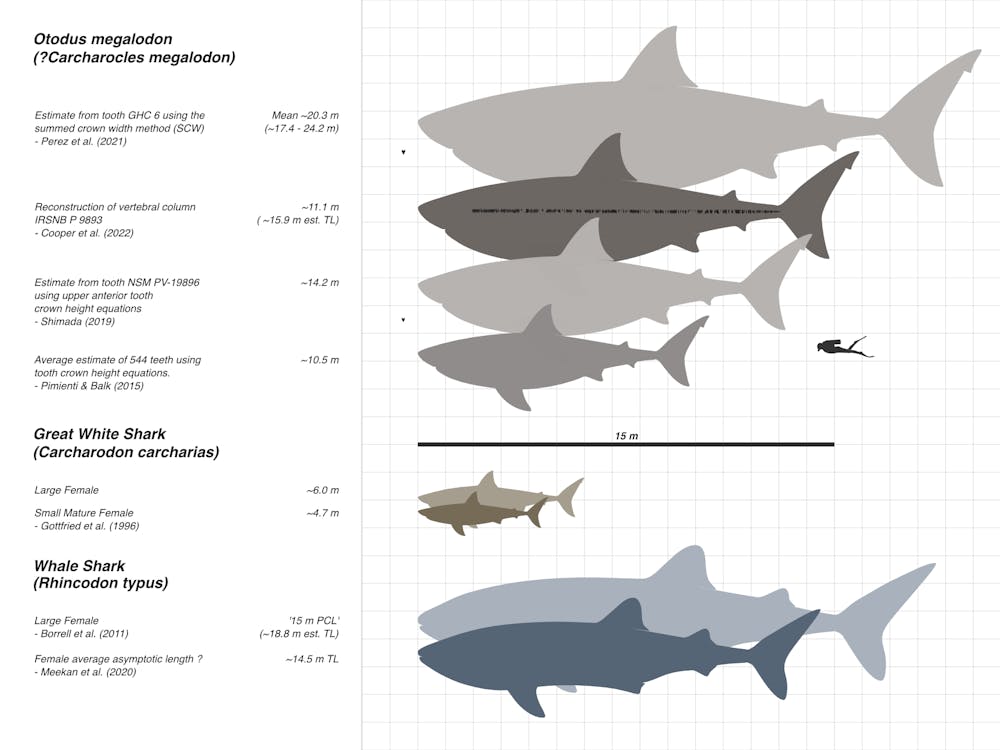
    The average size of a mature great white (Carcharodon carcharias, also known as the white shark) is between 4.6 and 4.9 metres for female sharks and up to 4 metres for male sharks.

    The largest recorded living specimens peak at about 6 metres, with one monster specimen caught in Cuba in 1945 reaching 6.4 metres.

    Earth’s oceans have seen bigger predatory sharks in the past. The biggest one of all time was the megalodon (Otodus megalodon) which lived from 23 to 3 million years ago, and may have been up to 24 metres in length. However, it looked nothing like the modern white shark.

    We don’t know precisely how big the megalodon was, but certainly larger than the great white shark.
    Steveoc 86/Wikimedia Commons, CC BY-SA

    They’re not even directly related – another thing scientists learned quite recently.

    Who was the megalodon, then?

    White sharks first evolved between 6 and 4 million years ago in the shadows of the megalodon. A recent study showed the megalodon’s large serrated teeth show signs of it being a supreme opportunistic super-predator.

    That means it ate just about anything, but especially liked whales and marine mammals.


    Read more:
    Friday essay: Giant shark megalodon was the most powerful superpredator ever. Why did it go extinct?


    But white sharks are not directly related to the megalodon, whose lineage began with a shark called Cretalamna during the age of dinosaurs about 100 million years ago.

    By contrast, the white shark lineage began with an ancient mako shark, Carcharodon hastalis. It was 7 to 8 metres long and had large, similarly shaped teeth to the modern white shark but lacking serrated edges.

    A fossil intermediate species, Carcharodon hubbelli shows the transition over time from weakly serrated to strongly serrated teeth.

    White shark fossil species. Left, the serrated fossil tooth teeth of the extant white shark; right, a similarly shaped unserrated tooth of the extinct giant mako shark which gave rise to white sharks.
    John Long, CC BY

    How did Jaws affect white shark populations?

    Last year, the International Shark Attack File reported 47 unprovoked shark bites to humans worldwide, resulting in seven fatalities. This was well below the previous ten-year average of 70 bites per year; your chances of getting bitten by a shark are extremely rare.

    Following the movies that made up the Jaws franchise, there was an increase in hunting and killing sharks – with a particular focus on great white sharks that were already going into a decline due to overfishing, trophy hunting and lethal control programs.

    Between 80% and 90% of white sharks have disappeared globally since the middle of the 20th century. Recent estimates calculate there are probably less than 500 individual white sharks in Australian waters right now.

    When Jaws first aired, scientists didn’t know how long sharks took to reproduce, or how many offspring a white shark could have each year. We now know it takes about 26 years for a male and 33 years for a female to sexually mature before they can start having pups.

    Data about white shark births is sparse, but recently a 5.6-metre-long female caught on a drum line off the coast of Queensland had just four large pups inside her. This is a very small number. Some large sharks, such as the whale shark, can give birth to up to 300 young.

    Now that we know just how slow they are to breed, it’s clear it will take many decades to reestablish the “pre-Jaws” population of white sharks – important apex predators in the marine ecosystem.

    Charlie Huveneers from Flinders University about to take a tissue sample for research on white sharks. There is still a lot we don’t know about their biology.
    Andrew Fox, Adelaide, CC BY

    Will white sharks survive?

    White sharks are currently listed as vulnerable.

    This classification means if we don’t change the current living conditions for white sharks, including impacts caused by human activities such as commercial fishing, and the impacts of climate change and ocean pollution, they will continue to decline and eventually could go extinct.

    Currently, white sharks are protected in several countries and form the basis for an important tourist industry in Australia, South Africa, western United States and most recently Nova Scotia, Canada.

    These sharks are iconic apex predators that fascinate people. One of us (John) went cage diving with them recently off the Neptune Islands of South Australia and can attest to how breathtaking it is to watch them in their natural environment.

    In terms of economic impact, they are worth far more alive than dead.

    White sharks are a growing tourism draw in several countries.
    Andrew Fox, Adelaide, CC BY

    There’s still much we don’t know about white sharks

    The complete white shark genome was first published only in 2019. It has 4.63 billion base pairs, making it much larger than the human genome (3.2 billion base pairs).

    The genome revealed some surprising things, like how white sharks show strong molecular adaptations for wound-healing processes, and a suite of “genome stability” genes – those used in DNA repair or DNA damage response.

    The transcriptome (or sum total of the messenger RNA) of the white shark showed greater similarity to the human transcriptome than to that of other fishes. This hints that “unexpressed genes” in the shark could one day play a role in uncovering genetic pathways for potential cures in human diseases.

    Jaws and its sequels certainly brought white sharks to the attention (and nightmares) of humans, with devastating impacts on how we treated them as a species.

    Our relationship with white sharks reflects our relationship with nature more broadly – a feared antagonist within the current capitalist paradigm; an enemy to be tamed, contained or consumed.

    As we learn more of the peril and potential of these remarkable creatures, we can learn how to live with them, to see beyond our fears and value their role within our delicate ocean ecosystems.

    John Long receives funding from The Australian Research Council.

    Heather L. Robinson does not work for, consult, own shares in or receive funding from any company or organisation that would benefit from this article, and has disclosed no relevant affiliations beyond their academic appointment.

    ref. Jaws at 50: how a single movie changed our perception of white sharks forever – https://theconversation.com/jaws-at-50-how-a-single-movie-changed-our-perception-of-white-sharks-forever-258306

    MIL OSI Analysis

  • MIL-OSI Australia: Warning issued after ACCC phone numbers spoofed by scammers

    Source: Australian Ministers for Regional Development

    The National Anti-Scam Centre is warning Australians to remain vigilant following reports scammers have been impersonating phone numbers belonging to the ACCC in an attempt to steal personal information.

    The ACCC and the National Anti-Scam Centre, which operates under the ACCC, have become aware of scammers using publicly available ACCC phone numbers, which are listed on the agency’s official website.

    In some reported cases, the scammers claimed to be representatives of the ACCC and requested sensitive information over the phone. In others, they misused the ACCC acronym to impersonate an unrelated organisation and spoke in a language other than English.

    The National Anti-Scam Centre warns that the ACCC phone numbers have been ‘spoofed’. The ACCC does not make calls from its reception numbers.

    “Spoofing is when scammers disguise their phone number to make it look like they’re calling from a trusted organisation — including government agencies like the ACCC — to deceive people into answering and sharing personal information,” ACCC Deputy Chair Catriona Lowe said.

    “This is a tactic that helps scammers hide their true identity while posing as trusted institutions – it’s designed to lower your guard. If a call or message feels off, trust your instincts and hang up. It’s safer to end the call and check in directly with us.”

    The ACCC and the National Anti-Scam Centre will never ‘cold’ call or email consumers and ask for your personal information such as your passwords, bank details or answers to security questions. The ACCC does not charge money for its services and would never threaten or pressure you to stay on the line.

    If you receive a call claiming to be from the ACCC where personal information such as passwords or bank details are requested, do not provide this information and hang up.

    “We encourage all Australians to report scams — every report helps us track patterns and protect others,” Ms Lowe said.

    The National Anti-Scam Centre also reminds the community to be extremely wary of urgent requests asking people to act immediately, and to never provide personal information if unsure. Do not click on any links or download attachments from messages unless you are sure it is someone you can trust.

    How to spot and avoid scams

    STOP – Don’t give money or personal information to anyone if you’re unsure. Scammers will create a sense of urgency. Don’t rush to act. Say ‘no’, hang up, delete.

    CHECK – Ask yourself could the call or text be fake? Scammers pretend to be from organisations you know and trust. Contact the organisation using information you source independently, so that you can verify if the call is real or not.

    PROTECT – Act quickly if something feels wrong. Contact your bank immediately if you lose money. If you have provided personal information call IDCARE on 1800 595 160. The more we talk the less power they have. Report scams to the National Anti-Scam Centre’s Scamwatch service at scamwatch.gov.au when you see them. If you’re contacted on a messaging platform like WhatsApp or iMessage, please also report the scam in the app.

    MIL OSI News

  • MIL-OSI Australia: City to welcome new Director Corporate Performance

    Source: New South Wales Ministerial News

    The City of Greater Bendigo is pleased to announce Angela Hays as its new Director Corporate Performance.

    Ms Hays joins the City following roles as Head of People & Customer at Melton City Council and Director Corporate Services at Mackay Regional Council.

    Chief Executive Officer Andrew Cooney said Ms Hays’ experience in providing high level strategic direction, financial management, and her sound understanding of Local government processes made her a strong candidate.

    “Angela has built a diverse career in government roles, while leading and supporting capable teams across a diverse set of portfolios,” Mr Cooney said.

    “Angela will be leading the Financial Strategy, IT, People and Culture, Governance & Performance and Customer Engagement & Communication units.

    “Having recently relocated to Bendigo with her family; Angela is excited about contributing to the community she now calls home.  We look forward to Angela joining the team and bringing her leadership, skills, and experience to the organisation.”

    Ms Hays said she was excited by the opportunity to contribute to the continued success of the City.

    “Having previously worked in Local Government, I understand the important leadership role a council has in a community,” she said.

    “The City is a highly regarded Local Government and I am delighted to accept this role and get to know the Corporate Performance staff and broader organisation.”

    Ms Hays will start with the City on Monday July 7, 2025. 

    MIL OSI News

  • MIL-OSI Australia: Maldon shed fire triggers lithium-ion battery warning

    Source:

    Image: Maldon Fire Brigade

    A fire that destroyed a shed in Maldon has prompted fresh warnings about the risks posed by lithium-ion battery devices.

    11 CFA units from the local area responded to the incident on Maldon-Newstead Road at 4.05pm on Monday 16 June. On arrival, crews found the shed well alight and quickly began suppression efforts to stop the blaze spreading to a nearby house. 

    Firefighters brought the fire under control in around 40 minutes, preventing it from reaching the residence. 

    The fire is believed to have started in a device containing a lithium-ion battery stored in the shed. 

    Acting Maldon Fire Brigade Captain Bruce Clement was the CFA incident controller and said the fire presented several challenges on the ground. 

    “Our crew was first on scene and found the structure fully alight, with heavy smoke swirling throughout the area. Once suppression started, we identified what appeared to be a lithium-ion battery pack near the front of the building,” Bruce said. 

    “Access was difficult due to trees, other structures and general clutter, and we had to position crews carefully while maintaining a safe distance due to poor visibility.” 

    “There was no mains water available, so we established a relay system using a nearby dam, with Newstead’s big fill pumping water up to our tankers. That setup was key to getting the fire under control.” 

    CFA District 2 Assistant Chief Fire Officer Dean Simmons said Victorians need to be cautious when storing or charging lithium-ion battery-powered devices. 

    “When dealing with lithium-ion batteries, only use the charger that came with your device, or one that’s been certified as compatible,” Dean said. 

    “Only purchase and use devices and equipment from reputable manufacturers and suppliers.” 

    Dean also highlighted the importance of interconnected smoke alarms in the home, particularly in areas where devices are charged. 

    “Interconnected smoke alarms are a must, especially in areas where you regularly charge devices,” he said. 

    “Early detection gives you the best chance to act quickly if something goes wrong.”

    Submitted by CFA Media

    MIL OSI News

  • MIL-OSI Australia: 2025–26 ACT Budget: investing in police and justice

    Source: Northern Territory Police and Fire Services

    The 2025-26 ACT Budget is investing in a safer community.

    The ACT Government is providing more support for community safety through the 2025-26 ACT Budget.

    The investment will support ACT Policing’s workforce and infrastructure.

    This will ensure police can continue responding to the needs of a growing city and keep the community safe.

    The Budget includes funding for the recently agreed Australian Federal Police Enterprise Agreement.

    This investment will support salary increases, leave entitlements and allowances for ACT Policing staff, in addition to enabling services.

    The Budget provides support for:

    • detailed design of critical infrastructure upgrades at Winchester and City Police Stations, including mechanical, electrical, fire and hydraulic systems
    • detailed planning and analysis of future police accommodation in the Woden Patrol Zone and a Molonglo Police Station.

    The Government will also implement the Sexual Assault Advocate Pilot Program. This was a key recommendation of the Sexual Assault (Police) Review.

    The program includes:

    • establishing a fourth Sexual Assault and Child Abuse Team within ACT Policing to manage high investigative caseloads
    • dedicated sexual assault advocates to support victim-survivors during police engagement
    • a new Witness Assistant Scheme officer in the Office of the Director of Public Prosecutions.

    These reforms will improve support and outcomes for victim-survivors of sexual violence in Canberra.

    Strengthening access to justice for vulnerable Canberrans

    The ACT Government is investing in practical, targeted justice initiatives.

    These will ensure vulnerable Canberrans can continue to access the legal services they need, when they need them.

    The 2025–26 ACT Budget is supporting key legal assistance services, justice reform initiatives, and the growing need for responsive support for victims of crime, people on low income, women, First Nations peoples and culturally diverse communities.

    These initiatives will strengthen frontline legal services and improve outcomes for people facing disadvantage, hardship or discrimination.

    Key measures in the 2025–26 ACT Budget include:

    • appointment of a 10th Magistrate to the ACT Magistrates Court, to improve processing times and address growing demand in civil and criminal matters
    • additional funding for the Office of the Director of Public Prosecutions’ Witness Assistance Scheme and to meet the increased demands of an expanded judiciary
    • funding for legal assistance providers, including the Women’s Legal Centre, Canberra Community Law, the Aboriginal Legal Service, and CARE Financial Counselling
    • investment in the ACT Human Rights Commission, to continue the Intermediary Program, which provides targeted services for vulnerable complainants, witnesses and accused persons in the criminal justice system.
    • support for Legal Aid ACT’s services across a number of programs
    • additional funding for the Victims Services Scheme and Financial Assistance Scheme administered by Victims Services ACT
    • implementation of a sexual assault advocate pilot program to support victims’ access to specialist services, and conducting of investigations in a more victim-centric and trauma-informed way
    • support for the ACT Government Solicitor’s Office to meet increased demand for legal advice under the Human Rights Act 2004. A new regulatory prosecution function will also strengthen enforcement and compliance across government
    • funding to enhance the Coroner’s Court with increased resourcing to manage caseloads. It will also support efficient and sensitive handling of matters that often involve vulnerable individuals and families.

    Read more like this:


    Get ACT news and events delivered straight to your inbox, sign up to our email newsletter:


    MIL OSI News

  • MIL-Evening Report: Horse whipping is painful and cruel. The latest incident shows why it should be banned

    Source: The Conversation (Au and NZ) – By Anne Quain, Senior Lecturer, Sydney School of Veterinary Science, University of Sydney

    Doug Pensinger/Getty Images

    Last week, the peak body for equestrian sport in Australia suspended a prominent member after footage allegedly depicted Australian Olympic dressage rider Heath Ryan whipping a horse more than 40 times.

    Ryan confirmed he was the rider in the footage, which was reportedly taken about two years ago.

    He explained the horse, Nico, had belonged to a friend who had been hospitalised for serious injuries inflicted by the animal.

    Ryan wrote Nico had “always been a problem child” and was about to be sent to slaughter.

    However, Ryan, an experienced trainer and instructor, intervened to “salvage” the horse.

    Footage appears to show Heath Ryan whipping a horse repeately.
    DressageHub, CC BY

    But horses, just like humans, feel pain, which is why more needs to be done to minimise the use of whips on horses.

    What happened next?

    The footage depicts Ryan mounted on Nico, forcefully whipping him.

    Both the whoosh of the whip travelling at speed and the sound of it contacting Nico’s flesh are audible.

    Nico kicks out several times in response, yet the whipping continues.

    Nico seems “shut down” – a term used to describe a horse when they appear to have no understanding of what they need to do to make an adverse experience stop.

    Whipping causes horses pain. The skin in the gluteal area of the horse, which Ryan repeatedly struck with the whip, is sensitive to pain just like the skin of humans.

    This is not the first time whipping has been in the spotlight. In July 2024, footage emerged of three-time Olympic dressage gold medallist Charlotte Dujardin repeatedly whipping a horse on the hind legs.

    This led to the International Equestrian Federation fining her CHF 10,000 (A$18,867) and imposing a 12-month suspension.


    Read more:
    The Paris Olympics horse-whipping scandal shows the dangers of ‘Disneyfication’ in horse sports


    More recently in Australia, in May 2025, the RSPCA prosecuted a case against trainer Liandra Gray, who was recorded striking a horse with a padded racing whip more than 40 times. A Tasmanian court found Gray had caused unreasonable and unjustifiable pain and the whip use constituted cruelty.

    Equestrian Australia’s national dressage rules forbid excessive use of whips.

    Despite stating he “hated” whipping Nico, Ryan argued he was acting in the horse’s interests.

    After an undisclosed period, Nico was re-homed, and according to Ryan “is now thriving in a loving and competitive home with an exciting future”.

    Does the end justify the means?

    Ryan’s justification of his treatment of Nico is based on the positive consequences for the horse (avoiding slaughter) and the current owners (Nico can continue to be ridden).

    This justification is a type of consequentialism, where an outcome is judged to be good or not based on the consequences it brings about. This raises an important question: what counts as a “good” outcome and by whose standard are we judging?

    Ryan’s justification points to a culture where horses’ needs and interests are not respected and where they are valued solely for their utility to humans.

    But we know horses are sensitive, sentient beings, capable of suffering.

    The relationship between a rider and horse is often described as a partnership. In reality, horses have little choice.

    The equipment and cues riders rely on to control horses work because they are aversive and even painful. Because horses are motivated to escape from painful stimuli, they rapidly learn to perform in the desired way.

    Because of this reliance on aversive stimuli to control horses, it is essential riders remove it as soon as the horse performs the desired behaviour (for example, releasing tension on the reins).

    Why was Nico a ‘problem child’ in the first place?

    During riding, a horse knows it has responded correctly if the rider removes the aversive stimulus that was used to cue the horse.

    If the rider removes the stimulus at the wrong time or not at all, the horse may become confused, stressed and express unwanted behaviours.

    If this is repeated, the unwanted responses can quickly become a habit and the horse may be labelled a problem.

    Based on the footage, it seems that instead of learning to move forward to escape pressure from the rider’s heels or whip, Nico appears to have developed a habit of stalling (slowing or coming to a stop instead of moving forward).

    Stress and fear can impair animals’ ability to learn and problem solve and horses vary considerably in their personalities and ability to learn what humans require of them.

    The combination of personality, stress, fear and rider inconsistencies can quickly lead to the development of unwanted behaviours.

    It is likely Nico’s behaviour reflects these factors.

    It’s time for a change

    This incident likely taught Nico to fear humans and to expect that being ridden will involve inescapable pain unless he does exactly what his rider wants.

    Training methods like this are considered outdated and unethical.

    This is because there is ample scientific evidence showing the modification of unwanted behaviour in ridden horses can be achieved without resorting to violence to force them into submission.

    International groups such as the International Society for Equitation Science (ISES) and the Federation of Veterinarians of Europe have highlighted the risks of misusing aversive training stimuli.

    They argue training methods that lead to fear and stress are inefficient and pose unacceptable welfare risks.

    ISES has even developed a set of 10 principles for training even the most difficult horses.

    While Ryan has justified his intervention as the only possible solution to Nico’s unwanted behaviour, the scientific evidence shows it is neither necessary nor ethical to violently whip a horse to teach it a lesson.

    Anne Quain has consulted for animal welfare organisations including the RSPCA. She is a member of the Australian Veterinary Association, the Australian and New Zealand College of Veterinary Scientists, and the European College of Animal Welfare and Behaviour Medicine in Animal Welfare Science, Ethics and Law. She has been a recipient of an Australian Companion Animal Health Foundation Grant. She has undertaken two residencies at The Ethics Centre.

    Cathrynne Henshall receives funding from the Hong Kong Jockey Club Welfare Research Funding

    ref. Horse whipping is painful and cruel. The latest incident shows why it should be banned – https://theconversation.com/horse-whipping-is-painful-and-cruel-the-latest-incident-shows-why-it-should-be-banned-259041

    MIL OSI AnalysisEveningReport.nz

  • MIL-OSI Australia: Deloraine Police seize illegal firearms, drugs during targeted searches

    Source: New South Wales Community and Justice

    Deloraine Police seize illegal firearms, drugs during targeted searches

    Thursday, 19 June 2025 – 12:31 pm.

    Two people have been separately charged after police seized multiple firearms and illicit substances during two unrelated searches in the Meander Valley area this week.

    Deloraine Police conducted the first targeted search at a Weegeena residence on Tuesday 17 June.

    During the search, police located and seized a .22 calibre rifle, a 22 Magnum rifle, an air rifle, and a Glock pistol as well as ammunition and quantities of illicit substances.

    A 52-year-old Weegeena man has been charged with multiple drug and firearms offences, and will appear in court at a later date.

    In a second, unrelated search at a Deloraine address on Wednesday 18 June, police located a hydroponic cannabis growing room and seized a large quantity of cannabis.

    A 56 year old Deloraine man has been charged with multiple drug-related offences and will appear in court at a later date.

    Inspector Craig Fox said police continued to target illegal drug and firearm activity throughout Tasmania.

    “We know the impact drugs and firearms have on the community, and these searches are evidence of our continued commitment to community safety and holding offenders to account,” he said.

    Anyone with information about illegal firearms or illicit substances is urged to contact police on 131 444 or Crime Stoppers anonymously at 1800 333 000 or online at crimestopperstas.com.au.

    MIL OSI News

  • MIL-Evening Report: ER Report: A Roundup of Significant Articles on EveningReport.nz for June 19, 2025

    ER Report: Here is a summary of significant articles published on EveningReport.nz on June 19, 2025.

    Australian citizens in Iran and Israel are desperate to leave. Is the government required to help?
    Source: The Conversation (Au and NZ) – By Jane McAdam, Scientia Professor and ARC Laureate Fellow, Kaldor Centre for International Refugee Law, UNSW Sydney As thousands of Australian citizens and permanent residents stuck in Iran and Israel continue to register for repatriation flights, the government is scrambling to find safe ways to evacuate them. With

    Popular period-tracking apps can hold years of personal data – new NZ research finds mixed awareness of risk
    Source: The Conversation (Au and NZ) – By Anna Friedlander, PhD Candidate in Sociology, University of Waikato Shutterstock/Krotnakro Period-tracking apps are popular digital tools for a range of menstrual, reproductive and general health purposes. But the way these apps collect and use data involves risk. Many apps encourage users to log information well beyond their

    Migrating bogong moths use the stars and Earth’s magnetic field to find ancestral summer caves each year
    Source: The Conversation (Au and NZ) – By Eric Warrant, Professor of Zoology at the University of Lund, Visiting Fellow at the Australian National University, and Adjunct Professor, University of South Australia Vik Dunis/iNaturalist, CC BY-NC It’s a warm January summer afternoon, and as I traverse the flower-strewn western slopes of Australia’s highest mountain, Mount

    Jaws at 50: how a single movie changed our perception of white sharks forever
    Source: The Conversation (Au and NZ) – By John Long, Strategic Professor in Palaeontology, Flinders University Shane Myers Photography/Shutterstock It’s been 50 years since Steven Spielberg’s movie Jaws first cast a terrifying shadow across our screens. At a low point during production, Spielberg worried he’d only ever be known for “a big fish story”. The

    Robot eyes are power hungry. What if we gave them tools inspired by the human brain?
    Source: The Conversation (Au and NZ) – By Adam D Hines, Research Fellow, Centre for Robotics, Queensland University of Technology A hexapod robot navigating outdoors. Adam Hines Robots are increasingly becoming a part of our lives – from warehouse automation to robotic vacuum cleaners. And just like humans, robots need to know where they are

    Winter viruses can trigger a heart attack or stroke, our study shows. It’s another good reason to get a flu or COVID shot
    Source: The Conversation (Au and NZ) – By Tu Nguyen, PhD Candidate, Department of Paediatrics, University of Melbourne, Murdoch Children’s Research Institute Irina Shatilova/Shutterstock Winter is here, along with cold days and the inevitable seasonal surge in respiratory viruses. But it’s not only the sniffles we need to worry about. Heart attacks and strokes also

    School playgrounds are one of the main locations for bullying. How can they be set up to stop it?
    Source: The Conversation (Au and NZ) – By Brendon Hyndman, Associate Dean (Academic), Faculty of Arts and Education, Charles Sturt University Dan Kenyon/ Getty Images Children spend thousands of hours in playgrounds at school. A lot of this time does not have the same levels of teacher preparation and supervision as classrooms do. Research shows

    Would you cheat on your tax? It’s a risky move, the tax office knows a lot about you
    Source: The Conversation (Au and NZ) – By Robert B Whait, Senior Lecturer in Taxation Law, University of South Australia Soon, more than 15 million Australians should be lodging a tax return with the Australian Taxation Office in the hope of receiving at least a small refund. About 60% of taxpayers use an accountant to

    Companies are betting on AI to help lift productivity. Workers need to be part of the process
    Source: The Conversation (Au and NZ) – By Llewellyn Spink, AI Corporate Governance Lead, Human Technology Institute, University of Technology Sydney The Conversation, CC BY-NC Australia’s productivity is flatlining, posting the worst vitals we’ve seen in 60 years. Politicians and chief executives are prescribing artificial intelligence (AI) like it’s the new penicillin – a wonder

    Is Sabrina Carpenter’s Man’s Best Friend album cover satire or self-degradation? A psychology expert explores our reactions
    Source: The Conversation (Au and NZ) – By Katrina Muller-Townsend, Lecturer in Psychology, Edith Cowan University Island Records Sabrina Carpenter’s Man’s Best Friend album cover has fans divided. Carpenter poses on all fours, her glossy blond hair grasped by a male figure cropped from the frame. Her wide-eyed expression intensifies an ambiguous performance of subservience,

    Kicked out for coming out: more than half of LGBTIQ+ flatmates face discrimination for their identity
    Source: The Conversation (Au and NZ) – By Brodie Fraser, Senior Research Fellow, He Kāinga Oranga Housing and Health Research Programme, University of Otago Sangar Akreyi/Getty Images People who belong to the LGBTIQ+ community say flatting is fraught with difficulties that go well beyond learning new routines and sharing space with strangers. Our new research

    Tracing the Drax family’s millions – a story of British landed gentry, slavery and sugar plantations
    Source: The Conversation (Au and NZ) – By Paul Lashmar, Reader in Journalism, City St George’s, University of London ‘Planting the sugar-cane’: vast fortunes were made from the trades in both sugar and human slaves in the Americas. Schomburg Center for Research in Black Culture, Photographs and Prints Division, The New York Public Library Rich

    Nineteen Eighty-Four might have been inspired by George Orwell’s fear of drowning
    Source: The Conversation (Au and NZ) – By Nathan Waddell, Associate Professor in Twentieth-Century Literature, University of Birmingham George Orwell had a traumatic relationship with the sea. In August 1947, while he was writing Nineteen Eighty-Four (1949) on the island of Jura in the Scottish Hebrides, he went on a fishing trip with his young

    What happens when aid is cut to a large refugee camp? Kenyan study paints a bleak picture
    Source: The Conversation (Au and NZ) – By Olivier Sterck, Associate professor, University of Oxford Humanitarian needs are rising around the world. At the same time, major donors such as the US and the UK are pulling back support, placing increasing strain on already overstretched aid systems. Global humanitarian needs have quadrupled since 2015, driven

    Grok’s ‘white genocide’ responses show how generative AI can be weaponized
    Source: The Conversation (Au and NZ) – By James Foulds, Associate Professor of Information Systems, University of Maryland, Baltimore County Someone altered the AI chatbot Grok to make it insert text about a debunked conspiracy theory in unrelated responses. Cheng Xin/Getty Images The AI chatbot Grok spent one day in May 2025 spreading debunked conspiracy

    Politics with Michelle Grattan: an ‘impatient’ Jim Chalmers on taking political risks in Labor’s second term
    Source: The Conversation (Au and NZ) – By Michelle Grattan, Professorial Fellow, University of Canberra Asanka Ratnayake/Getty Images While the world’s media is largely focused on conflict in the Middle East, the focus for many Australians remains at home, with the government preparing the long task ahead of trying to lift Australia’s productivity. Last week,

    View from The Hill: Jim Chalmers wants to get on with economic reform and tax is in his sights
    Source: The Conversation (Au and NZ) – By Michelle Grattan, Professorial Fellow, University of Canberra Jim Chalmers speaking to the National Press Club June 18, 2025. Screenshot from the ABC Broadcast, CC BY-NC Jim Chalmers cast his Wednesday National Press Club speech as a second instalment in a two-part presentation that was kicked off by

    Iran’s long history of revolution, defiance and outside interference – and why its future is so uncertain
    Source: The Conversation (Au and NZ) – By Amin Saikal, Emeritus Professor of Middle Eastern and Central Asian Studies, Australian National University; and Vice Chancellor’s Strategic Fellow, Victoria University Israeli Prime Minister Benjamin Netanyahu has gone beyond his initial aim of destroying Iran’s ability to produce nuclear weapons. He has called on the Iranian people

    95 lawyers demand stronger NZ stand over Israel amid Middle East tensions
    Asia Pacific Report Ninety-five New Zealand lawyers — including nine king’s counsel — have signed a letter demanding Prime Minister Christopher Luxon, Foreign Minister Winston Peters and two other ministers urge the government to take a stronger stand against Israel’s “catastrophic” actions in Gaza. The letter has been sent amid rising tensions in the region,

    Gay and bisexual men will soon be able to donate blood and plasma
    Source: The Conversation (Au and NZ) – By Yasmin Mowat, Clinical Project Manager, Kirby Institute, UNSW Sydney AnnaStills/Getty Images Many gay and bisexual men have been excluded from donating blood and plasma (the liquid portion of blood) for decades because of rules developed during the HIV crisis in the 1980s. The Australian Red Cross’ blood

    MIL OSI AnalysisEveningReport.nz

  • MIL-Evening Report: ER Report: A Roundup of Significant Articles on EveningReport.nz for June 19, 2025

    ER Report: Here is a summary of significant articles published on EveningReport.nz on June 19, 2025.

    Australian citizens in Iran and Israel are desperate to leave. Is the government required to help?
    Source: The Conversation (Au and NZ) – By Jane McAdam, Scientia Professor and ARC Laureate Fellow, Kaldor Centre for International Refugee Law, UNSW Sydney As thousands of Australian citizens and permanent residents stuck in Iran and Israel continue to register for repatriation flights, the government is scrambling to find safe ways to evacuate them. With

    Popular period-tracking apps can hold years of personal data – new NZ research finds mixed awareness of risk
    Source: The Conversation (Au and NZ) – By Anna Friedlander, PhD Candidate in Sociology, University of Waikato Shutterstock/Krotnakro Period-tracking apps are popular digital tools for a range of menstrual, reproductive and general health purposes. But the way these apps collect and use data involves risk. Many apps encourage users to log information well beyond their

    Migrating bogong moths use the stars and Earth’s magnetic field to find ancestral summer caves each year
    Source: The Conversation (Au and NZ) – By Eric Warrant, Professor of Zoology at the University of Lund, Visiting Fellow at the Australian National University, and Adjunct Professor, University of South Australia Vik Dunis/iNaturalist, CC BY-NC It’s a warm January summer afternoon, and as I traverse the flower-strewn western slopes of Australia’s highest mountain, Mount

    Jaws at 50: how a single movie changed our perception of white sharks forever
    Source: The Conversation (Au and NZ) – By John Long, Strategic Professor in Palaeontology, Flinders University Shane Myers Photography/Shutterstock It’s been 50 years since Steven Spielberg’s movie Jaws first cast a terrifying shadow across our screens. At a low point during production, Spielberg worried he’d only ever be known for “a big fish story”. The

    Robot eyes are power hungry. What if we gave them tools inspired by the human brain?
    Source: The Conversation (Au and NZ) – By Adam D Hines, Research Fellow, Centre for Robotics, Queensland University of Technology A hexapod robot navigating outdoors. Adam Hines Robots are increasingly becoming a part of our lives – from warehouse automation to robotic vacuum cleaners. And just like humans, robots need to know where they are

    Winter viruses can trigger a heart attack or stroke, our study shows. It’s another good reason to get a flu or COVID shot
    Source: The Conversation (Au and NZ) – By Tu Nguyen, PhD Candidate, Department of Paediatrics, University of Melbourne, Murdoch Children’s Research Institute Irina Shatilova/Shutterstock Winter is here, along with cold days and the inevitable seasonal surge in respiratory viruses. But it’s not only the sniffles we need to worry about. Heart attacks and strokes also

    School playgrounds are one of the main locations for bullying. How can they be set up to stop it?
    Source: The Conversation (Au and NZ) – By Brendon Hyndman, Associate Dean (Academic), Faculty of Arts and Education, Charles Sturt University Dan Kenyon/ Getty Images Children spend thousands of hours in playgrounds at school. A lot of this time does not have the same levels of teacher preparation and supervision as classrooms do. Research shows

    Would you cheat on your tax? It’s a risky move, the tax office knows a lot about you
    Source: The Conversation (Au and NZ) – By Robert B Whait, Senior Lecturer in Taxation Law, University of South Australia Soon, more than 15 million Australians should be lodging a tax return with the Australian Taxation Office in the hope of receiving at least a small refund. About 60% of taxpayers use an accountant to

    Companies are betting on AI to help lift productivity. Workers need to be part of the process
    Source: The Conversation (Au and NZ) – By Llewellyn Spink, AI Corporate Governance Lead, Human Technology Institute, University of Technology Sydney The Conversation, CC BY-NC Australia’s productivity is flatlining, posting the worst vitals we’ve seen in 60 years. Politicians and chief executives are prescribing artificial intelligence (AI) like it’s the new penicillin – a wonder

    Is Sabrina Carpenter’s Man’s Best Friend album cover satire or self-degradation? A psychology expert explores our reactions
    Source: The Conversation (Au and NZ) – By Katrina Muller-Townsend, Lecturer in Psychology, Edith Cowan University Island Records Sabrina Carpenter’s Man’s Best Friend album cover has fans divided. Carpenter poses on all fours, her glossy blond hair grasped by a male figure cropped from the frame. Her wide-eyed expression intensifies an ambiguous performance of subservience,

    Kicked out for coming out: more than half of LGBTIQ+ flatmates face discrimination for their identity
    Source: The Conversation (Au and NZ) – By Brodie Fraser, Senior Research Fellow, He Kāinga Oranga Housing and Health Research Programme, University of Otago Sangar Akreyi/Getty Images People who belong to the LGBTIQ+ community say flatting is fraught with difficulties that go well beyond learning new routines and sharing space with strangers. Our new research

    Tracing the Drax family’s millions – a story of British landed gentry, slavery and sugar plantations
    Source: The Conversation (Au and NZ) – By Paul Lashmar, Reader in Journalism, City St George’s, University of London ‘Planting the sugar-cane’: vast fortunes were made from the trades in both sugar and human slaves in the Americas. Schomburg Center for Research in Black Culture, Photographs and Prints Division, The New York Public Library Rich

    Nineteen Eighty-Four might have been inspired by George Orwell’s fear of drowning
    Source: The Conversation (Au and NZ) – By Nathan Waddell, Associate Professor in Twentieth-Century Literature, University of Birmingham George Orwell had a traumatic relationship with the sea. In August 1947, while he was writing Nineteen Eighty-Four (1949) on the island of Jura in the Scottish Hebrides, he went on a fishing trip with his young

    What happens when aid is cut to a large refugee camp? Kenyan study paints a bleak picture
    Source: The Conversation (Au and NZ) – By Olivier Sterck, Associate professor, University of Oxford Humanitarian needs are rising around the world. At the same time, major donors such as the US and the UK are pulling back support, placing increasing strain on already overstretched aid systems. Global humanitarian needs have quadrupled since 2015, driven

    Grok’s ‘white genocide’ responses show how generative AI can be weaponized
    Source: The Conversation (Au and NZ) – By James Foulds, Associate Professor of Information Systems, University of Maryland, Baltimore County Someone altered the AI chatbot Grok to make it insert text about a debunked conspiracy theory in unrelated responses. Cheng Xin/Getty Images The AI chatbot Grok spent one day in May 2025 spreading debunked conspiracy

    Politics with Michelle Grattan: an ‘impatient’ Jim Chalmers on taking political risks in Labor’s second term
    Source: The Conversation (Au and NZ) – By Michelle Grattan, Professorial Fellow, University of Canberra Asanka Ratnayake/Getty Images While the world’s media is largely focused on conflict in the Middle East, the focus for many Australians remains at home, with the government preparing the long task ahead of trying to lift Australia’s productivity. Last week,

    View from The Hill: Jim Chalmers wants to get on with economic reform and tax is in his sights
    Source: The Conversation (Au and NZ) – By Michelle Grattan, Professorial Fellow, University of Canberra Jim Chalmers speaking to the National Press Club June 18, 2025. Screenshot from the ABC Broadcast, CC BY-NC Jim Chalmers cast his Wednesday National Press Club speech as a second instalment in a two-part presentation that was kicked off by

    Iran’s long history of revolution, defiance and outside interference – and why its future is so uncertain
    Source: The Conversation (Au and NZ) – By Amin Saikal, Emeritus Professor of Middle Eastern and Central Asian Studies, Australian National University; and Vice Chancellor’s Strategic Fellow, Victoria University Israeli Prime Minister Benjamin Netanyahu has gone beyond his initial aim of destroying Iran’s ability to produce nuclear weapons. He has called on the Iranian people

    95 lawyers demand stronger NZ stand over Israel amid Middle East tensions
    Asia Pacific Report Ninety-five New Zealand lawyers — including nine king’s counsel — have signed a letter demanding Prime Minister Christopher Luxon, Foreign Minister Winston Peters and two other ministers urge the government to take a stronger stand against Israel’s “catastrophic” actions in Gaza. The letter has been sent amid rising tensions in the region,

    Gay and bisexual men will soon be able to donate blood and plasma
    Source: The Conversation (Au and NZ) – By Yasmin Mowat, Clinical Project Manager, Kirby Institute, UNSW Sydney AnnaStills/Getty Images Many gay and bisexual men have been excluded from donating blood and plasma (the liquid portion of blood) for decades because of rules developed during the HIV crisis in the 1980s. The Australian Red Cross’ blood

    MIL OSI AnalysisEveningReport.nz

  • MIL-OSI Australia: Interview with Mark Kenny, Democracy Sausage, Australian National University podcast

    Source: Australian Parliamentary Secretary to the Minister for Industry

    Mark Kenny:

    G’day there and welcome to Democracy Sausage from the Australian National University. I’m Mark Kenny director of ANU’s Australian Studies Institute and I’m delighted to welcome back to Democracy Sausage federal Treasurer, Jim Chalmers. G’day there Jim.

    Jim Chalmers:

    It’s nice to see you again, Mark, thanks for having me back on your podcast.

    Kenny:

    It’s a great pleasure. There’s a fair bit happening in the world, it seems like the pace of events is such really, I don’t know. You have spoken about this, written about it a few times as well, the rate of change, the number of events that are happening globally and the significance of them and the combination of them. I think and the way things tend to sort of – we end up with these compound problems, don’t we, or compound challenges. I wonder how tiring that is for you but also how in a sense it makes things feel like they are moving so fast.

    Take the election for example, a big moment in Australia and a huge historic result as you were, I think, at some pains to grapple with as the numbers tumbled out on election night as you were sitting there on the ABC. But the election itself even seems – even though the 48th parliament hasn’t sat yet – the election feels likes it was quite a while ago now.

    Chalmers:

    Old news.

    Kenny:

    It’s extraordinary, isn’t it?

    Chalmers:

    It really is.

    Kenny:

    And not in a good way necessarily because most of these events we’re talking about aren’t things that we would automatically dial‑in if we could. Wars breaking out and various calamities, environmental and so forth. How does it feel to you? Does it feel to you like, in politics now, there’s this sense that governments age more quickly because of, just the sort of cadence of events and exposure, and having to explain it and navigate it all?

    Chalmers:

    It feels almost exactly as you’ve described it, the pace of change and churn is accelerating. And in my part of the shop I think about the fact that even in the last not even 2 decades we’ve had 4 major economic shocks now – a GFC, COVID, an inflation shock and now the shock that comes from these escalating trade and geopolitical tensions. And so the world is moving fast, the global economy is in lots of ways a perilous place because of this cascading change that we’re seeing that we need to respond to.

    And so I do feel like our responsibility really in this environment is, there’s an element of making our economy more resilient in the face of all this uncertainty and volatility but also a sense of working out how do we make our people, our economy, a beneficiary of all this churn and change.

    It would be naive I think to assume that this change is temporary, short term and that we will return to some long period of normalcy like we saw after the end of the Cold War. And so this really dominates our thinking – the international environment, the pace of change, the way that change is accelerating really is the primary influence on the way we think about this second term.

    Kenny:

    Yeah you have written about this in the past. You’ve got a reputation, quite rightly, as a thinker and someone who reads a lot and thinks a lot about the big historical trends and the forces that are happening underneath it. How do you reflect on that period that you talked about – that you just made reference to – the period after the Cold War? Of course we always hear it described as framed by the end of history argument and all of that. Now sort of, I suppose, what are we, quarter of a century after the 90s have ended. How do we look back on that now? How do you look back on it?

    Chalmers:

    Well I look at it in sort of 3 periods. There’s the period from the end of the Second World War to the end of the Cold War.

    Kenny:

    Which we are saying is about sort of ‘89, ‘90 that sort of time.

    Chalmers:

    Yeah, that’s right. And you know momentous change in that period, dominated by the Cold War essentially. Then you had the end of the Cold War until the GFC, and others have described that as the Great Moderation.

    Kenny:

    I suppose you’d say until September 11 though wouldn’t you almost –

    Chalmers:

    Yeah in security terms, you’ll forgive me for having sort of an economic lens –

    Kenny:

    – an economic frame, yeah.

    Chalmers:

    But sure in the first decade of the 2000s, the world changed dramatically and the thing for us as Australians is we were among the primary beneficiaries of that period of moderation between the end of the Cold War and the early 2000s. We, the Australian economy, partly by choice, by intelligent policy choices in the ‘80s and ‘90s but also the way that the world was structured was very beneficial for Australia.

    And now we think about these 4 shocks in 2 decades and also against the backdrop of all of this technological change, demographic change, our industrial base is changing and the world is fragmenting. And so now we have to work out collectively, not just as a government but as Australians, how do we become the primary beneficiaries of all of this churn and change in the same way that we were the primary beneficiaries of that period of calm from the end of the Cold War.

    Kenny:

    Yeah, because during that period I suppose the rules held. There was a thing called the international rules‑based order, there was a sense in which there was at least a predictability about the framing of whatever might happen. Whereas now we don’t have that. We have this sort of sense of, particularly with the US being in a sense the chief architect and enforcer of that international order, having itself begun to walk away from it in quite dramatic ways, economic ways of course with tariffs and everything which we can come to.

    But that really – on top of things like pandemics and financial crises and the like – it really makes it, it means that we basically now have what replaced the predictability of the rules is the unpredictability of what follows, almost as a permanent dynamic.

    Chalmers:

    I think that’s a good way to describe it. Unpredictability is a good way of thinking even about these trade tensions that we’ve got right now because from day‑to‑day, week‑to‑week, the state of the negotiation between the US and China is changing. It’s the unpredictability that is making people wary, making investors wary and decision makers wary. It’s the sense of a lack of stability and predictability, I think as you rightly point out.

    And we’ve got this big fragmentation in the world and we shouldn’t over‑interpret that but we shouldn’t under‑interpret it either. The world is fragmenting, it has a huge influence on how we think about our own economy. And again it’s against these – we’ve got all these short term volatility – we see the gold price, the oil price bouncing around, stock markets have been bouncing around before and since so‑called Liberation Day, but that kind of masks a bigger structural change in the global economy.

    There’s a big change in the way that the world conducts its business now. And the responsibility on us as decision makers in government, but also in the private sector and the community more broadly, is to work out how do we make our people beneficiaries of that rather than victims of it.

    Kenny:

    And as you said in the early 2000s for example we were in a very good position to be beneficiaries. I remember covering budgets during that time and they were constantly framed by revenue upgrades, mostly from resources, and the budget was constantly in better shape than it was predicted to be.

    Now we are talking about a different world, much less predictable one. But I think I’ve heard you say, and I put the question to you I suppose rhetorically but where would you rather be in the circumstance that we’re in now, would it be Australia or somewhere else? We are still pretty well positioned.

    Chalmers:

    For sure. I hope it’s not talking out of school, but when Governor Phil Lowe and I used to go to these G20 conferences and we would sit there and we’d – when we were speaking in between the sessions or having a cup of tea or something we’d say, we’d look around the room and you’d say, who would you rather be in this group than us. And it’s an important bit of perspective and what I try to do in the speech at the National Press Club is to say we shouldn’t choose between these false binaries.

    There’s a bunch of people that will always talk the economy down. There’s a bunch of people – and maybe politicians are sometimes guilty of this – who will only ever talk the place up. Let’s just put it into its proper perspective.

    Australia in lots of ways is outperforming the world. The fact that we’ve got inflation down, while keeping unemployment low, we’ve got real wages growing again, the combination of things that we’ve got in our economy is something that a lot of our peer countries would like to see in their own economies. And we can recognise that at the same time as we can recognise our economy is not productive enough, the budget needs to be more sustainable, we need to be more resilient in the face of all this global uncertainty that you and I are talking about today.

    And so I think it’s not just possible to have those views simultaneously, it’s imperative that we do. That we have the proper perspective about our economy. Our economy in global terms is performing quite well, particularly our labour market, which in lots of ways to me is the most important thing, how people are actually earning and providing for their loved ones –

    Kenny:

    It’s like how the economy works for people.

    Chalmers:

    It’s the people‑facing part of the economy matters the most to me. And in some of those areas it’s been extraordinary, we’ve got the lowest average unemployment of any government in the last 50 years, at the same time as we’ve got inflation down and got real wages up.

    So it’s a long way of saying, let’s have some perspective about the economy. I’m going to try and get better at saying here is all the things that are going really well that we’re really pleased about, here are the things where we need to be doing better if we want to lift living standards for people in our country. Productivity, budget sustainability, resilience in the world, these are the things where we can acknowledge and work together on making things better.

    Kenny:

    Well let’s go to that productivity thing, because the Prime Minister recently at the Press Club and then you in the speech to the Press Club as well talking about productivity. And I think you have made the point before that the first term, how did you put it, the first term was basically –

    Chalmers:

    Primarily.

    Kenny:

    – primarily about fighting inflation but with an eye to productivity and the second term is about lifting productivity with an eye to keeping inflation under control. Is that sort of broadly what you were saying?

    Chalmers:

    Yeah it is, and I said that the morning after the election on the Insiders panel. I’d sat kind of in one corner of the ABC studio for about 6 or 7 hours in the evening and rocked up to the other corner of the studio in the morning. And that is how I see it.

    Kenny:

    Imagine what it’s like for David Speers.

    Chalmers:

    Exactly. I guess the point that I’m trying to make is we already have a productivity agenda. It’s substantial, it’s ambitious. But the bulk of our first term was about fighting inflation. And in the second term I think we still care about inflation, cost of living, real wages, still a huge focus of us but we will focus more on productivity, more on the supply side of the economy.

    When we talk about productivity, I think it’s important to remember it comes back to what we were just saying about the labour market more broadly. Productivity can come across as this kind of cold and soulless concept. It’s about how efficiently we use inputs to create outputs in our economy.

    Kenny:

    Is it widely understood, do you think, in the electorate when politicians and economists talk about productivity? What’s your – you’re an MP right, you represent people, you have your own electorate, you’re dealing with constituents all the time, right. What’s the general understanding of this as a term?

    Chalmers:

    It’s not a word that people use when they bail you up at Coles or Woolies. I acknowledge that. But it’s really the most important thing that will deliver higher living standards for people. And so I try not to think of productivity as that cold and soulless concept. Productivity is about a more dynamic economy, which lifts living standards, and a more dynamic society where we create more opportunities for more of our people.

    And what I’m trying to do is I’m trying to broaden the national policy and political conversation beyond the tired old fights over things like industrial relations. Productivity is about how we adapt and adopt technology, it’s how we transform our energy resources, it’s about making our businesses more competitive, it’s about the care economy, it’s about human capital, how we invest in people.

    Kenny:

    A lot of these things are things that as you say, they’re good, everyone would agree they’re all public goods. They’re things that should happen and so forth. Many of them – particularly if we think about human capital and getting more from people because they can contribute more and that adds to dynamism in the economy and creativity and opportunities all those brilliant things – but in a sense they’re long‑term investments that are required aren’t they?

    We are sitting here in a university. University education and training, obviously been a strong priority of the government. But it needs that’s the – I guess what I’m getting at is these aren’t things that you can just sort of flick a switch and make happen, right. They take long‑term planning and thinking and commitment and funding.

    Chalmers:

    Well 2 things about that. I mean, first of all there are 2 visions for productivity. And this is not the place for partisan reflections but there’s a view that says we’ll only get productivity if we make people work harder and longer for less. That is essentially our political opponent’s view of productivity.

    We think we’ll get productivity if we invest in people, their ability to adapt and adopt technology in a more modern economy. And so the way that our opponents think about productivity, that will never be our jam. That will never be – that’s not what we are on about.

    We are not trying to screw down people’s wages and working conditions. We think there’s a better way to go about it. But I think you’re absolutely bang on when you talk about – I think of it as the delayed gratification when it comes to productivity policy. There are some elements of economic policy where you get a bang for your buck sooner.

    Productivity is one of those things you got to chip away at and I’ve tried to point out, there’s not one thing as you rightly say, you can’t just flick one switch. If there was one switch we could flick somebody would have flicked it already to make our economy more productive. You’ve got to chip away, you’ve got to have a broader idea of productivity and you’ve got to work with people and bring people together. And that’s what we intend to do.

    Kenny:

    Let’s take a quick break and be back in a moment. Welcome back. I’m talking with Treasurer Jim Chalmers, ANU alum, among many things. Dr Chalmers, the productivity matter we were just talking about, there’s going to be this roundtable, the Prime Minister has announced, and you’ve spoken about at the Press Club as well.

    Obviously, the criticism that people will make if they want to will be another talk fest. We see these from time to time. From what I understand you’re girding against this, you’re trying to design it in ways that will mean that it has to deliver something more than kind of rhetoric and disagreement in a sense.

    Chalmers:

    Exactly right. I mean first of all I acknowledge it’s kind of unusual to have the Prime Minister and the Treasurer at the National Press Club 8 days apart but it’s deliberate. Because what we’re trying to do is in the Prime Minister’s great speech that he gave at the Press Club. And what I’m trying to do as well, is to say we’ve got a big agenda, it’s ambitious, our priority is delivering what we took to the election but we’ve got an obligation to work out what comes next.

    And the best way to do that, the tone that Anthony sets in our government is to try and do that together. And I know when you bring people together there will always be an element of people who want to say that it’s failed before it’s even happened. And it might be that people bring the same old talking points and maybe progress is hard to come by. But that’s not a reason not to have a crack at it and see where there might be common ground.

    Kenny:

    There’s an acceptance right across the board that productivity is an issue. That lifting productivity is the ticket to higher living standards and to insulating the economy as well against some of these external shocks. So it’s a good starting place, but then you get as you say, people sort of usually retreating in to certain camps defending their position and looking for gains from others.

    Chalmers:

    There might be a bit of that but let’s see how far we can get if we don’t take that approach. I think broadly people do understand it would be better if our economy was more productive, our budget more sustainable and that we are more resilient in a world that is as uncertain as it is.

    I think that is broadly understood and what I want to try to do at this roundtable is to go beyond problem ID into ideas. I want people to bring specific things and I want them to help build consensus, not just leave it to the government to build consensus.

    Kenny:

    So in other words within the framework of this round table you are looking for people to be talking to each other?

    Chalmers:

    Each other yeah.

    Kenny:

    So that the unions for example talking with employers. And together perhaps agreeing on something they can agree on, which will shift the needle as they say.

    Chalmers:

    And there are so many areas where this is so important. I mean technology, artificial intelligence is going to be a game changer in our economy.

    Kenny:

    It is for everyone right.

    Chalmers:

    Yeah and we need to work together to work out how do we get the best version of that. And so that is our hope and let’s be blunt about it, it remains to be seen how much appetite there is for that. But I think we owe it to ourselves to try to work out where there’s common ground. That’s what the round table is all about.

    People have been terrific about it in the conversations I’ve had with them so far, already there’s a heap of interest. People will be able to feed in, even if they’re not in the Cabinet room that week and so I think it’s set up to succeed, it remains to be seen whether it will.

    Kenny:

    So we’re going to be looking for the productivity of the productivity roundtable.

    Chalmers:

    That’s right, or we’ll get the Productivity Commission to measure it.

    Kenny:

    Yeah because it’s not – you can’t measure it just by butchers paper can you, and annoying‑smelling textas. It’s literally about, I mean the term people often use is concrete, but what’s substantive or concrete comes from it, and can actually result in policy changes. And you’re confident that that can actually achieve something?

    Chalmers:

    I’m confident about that. We’ve got a big agenda on productivity, even this week the Cabinet agreed some next steps. We’ve got the Productivity Commission working on a bunch of stuff. We really have everything we need to succeed except consensus and I hope that seeking consensus is not a naive undertaking. I feel cautiously confident that we can make some progress but it remains to be seen.

    Kenny:

    Consensus of course was the big word in the 1980s with Bob Hawke in particular and the summits that were held and so forth. And we know of course Kevin Rudd had his 2020 – I can’t remember what it was called exactly.

    Chalmers:

    2020 Summit I believe.

    Kenny:

    I think it was summit. This is much more, I suppose surgical in a sense.

    Chalmers:

    Deliberately. We did the Jobs and Skills Summit at the start of our government and I don’t like how that’s been caricatured, the outcomes of that. I actually think we made a lot of progress then.

    But rather than hundreds of people in the room, we will host a small group in the Cabinet room. We won’t do a lot of problem ID, the problem is broadly understood. We want people to bring their ideas. We want them to be responsible and realistic about that. We want them to see the whole chessboard when it comes to our national economy, not just their own kind of specific narrow interests.

    Kenny:

    Yeah because that’s always the frustration for governments isn’t it, it’s all very well for various interests to be pushing their position and perhaps that’s the way our economy and our society has been set up. But our governments have to try to look at the whole – as you say – chessboard, and figure out the implications of each of those moves and what it does to the whole.

    Chalmers:

    And even in budget terms, it’s very easy to call for huge tax cuts. It’s very easy to call for huge new outlays in one area or another. I don’t dismiss people who call for those things but we have to make it all add up at the end of the day. And so hopefully the kind of guidance we give people about how they approach this opportunity in the Cabinet room in the second half of August, hopefully people take that seriously. I think we will make more progress if they do.

    Kenny:

    Yeah. Now I mentioned before how you were there on election night and you were watching the events unfold. Do you think in the frame of what we have just been talking about the fact that it is such a stonking majority that the government has. And whilst it’s not impossible for the government to be turfed out at the next election, it’s not impossible but it doesn’t seem very likely to anyone who has been watching the game for a long time.

    I mean it is just, that would be such a dramatic turnaround from the current situation. I’m not asking you to comment on that particularly but what I am interested in is whether that changes the dynamic in a thing like this productivity roundtable and in the way generally people are looking at things. There’s a sort of a, I think a level of predictability, about who it is that these interests groups will be dealing with for this term and probably the next. Is that an opportunity for everyone?

    Chalmers:

    First of all, I don’t believe that a third term is assured. I don’t think those assurances –

    Kenny:

    I know you have to say it and I agree.

    Chalmers:

    No, no I believe it. There’s no assurances in politics. There’s no assurances in politics. I do think that there is a sense of relief that the election’s resolved and resolved decisively. I do think that there’s an element of that in the broader community and in the stakeholders I deal with. A little bit of an element of predictability in a very unpredictable world to join up where we began this conversation. So there is, I think that.

    For us, you mentioned sitting on the set on election night. The kind of 3 stages I progressed through were firstly surprise, secondly relief. An overwhelming sense of relief. And then thirdly most importantly a sense of gratitude and the reason I mentioned that sense of gratitude is because whether this government has 3 more years to live or 6 more years to live, I am more determined than I’ve ever been to make the most of the opportunity.

    Because when you think about where we were at at the end of 2024, it was conceivable that we could lose the election and the clarifying impact of that when you think about the clock is ticking on all of us. The clarifying impact of what could have been a close run thing but turned out to be a decisive thing. Surprised, relieved and grateful and determined to make the most of this opportunity for however long it lasts.

    Kenny:

    James McGrath, who you were on with, seemed to be moving through those stages slightly more slowly. His weren’t identical stages, they were the opposite I suppose. But he took some time it seemed to me to accept what the numbers were saying. But nonetheless as you say it was a very dramatic night. Just dwelling on that for a moment, how did you feel or how do you feel now reflecting on the sort of brutality of the way your fellow Queenslander Peter Dutton was ejected from politics altogether in that process? There’s a finality about it.

    Chalmers:

    First of all, on James, I genuinely felt for James. We’ve lost our share of national elections too and it’s just, it dawns on you at some point that you’ve got to do opposition for another 3 years and it’s a horrendous –

    Kenny:

    Slog.

    Chalmers:

    So I respect James and I felt for him sitting next to him, and it was a rugged night for him. Yeah, the brutality of 2 leaders of 2 of the 4 biggest parties in the parliament hit the fence on election night. That’s an extraordinary thing. And a brutal thing.

    The thing you will notice, I hope you notice, is I don’t dance on anyone’s political grave. I think politics is tough enough as it is when you’re in it that you shouldn’t dump on people when they’re out of it. And there’s a psychological thing about your own local community telling you they don’t want you anymore, I can only imagine that that is especially rugged for him. But I don’t want to dance on his political grave.

    I hope he doesn’t mind me saying that I’ve been in touch with him since he lost. We had a friendly exchange. He played politics as hard as anyone, if not harder than most. And so we acknowledge that too but I genuinely wish him well and his family. Politics is hard yards for everyone and to be disposed of with that level of brutality I can only imagine is really tough.

    Kenny:

    Yeah. I think it should be said that people who dealt with him, with Peter Dutton at a personal level, his colleagues. And he was popular at a personal level because there was a warmth about him and I’ve certainly said this in things I’ve written in the past as well. He was as you say, a very hard political player but he wasn’t like some other leaders that I won’t mention that weren’t particularly popular with their colleagues. Nonetheless, an extraordinarily badly‑designed campaign, it’s just unbelievable.

    Look in the brief amount of time we’ve got left, can I explore this idea that the Prime Minister has used a bit and you’ve used in your speech as well, made reference to this idea of progressive patriotism. I’m quite fascinated by this. I think the idea that the political right has had a mortgage on patriotism in the past I think is wrong. But it’s an ill‑defined concept at least or it’s a work in progress. How would you frame it?

    Chalmers:

    First of all you’re being characteristically humble, Mark, in not pointing out to all of your listeners that you have been grappling with, publicly, with some of these concepts for some time. I have listened to you and read you with interest in the past about this concept about patriotism. And really what Anthony is talking about when he talks about progressive patriotism is this sense that we can have Australian answers to these very difficult global questions.

    His progressive patriotism is really about Australian exceptionalism. It’s about the fact that we’ve built together, not just governments, but as a country, we’ve built together Medicare and superannuation, and the Pharmaceutical Benefits Scheme and all these sorts of things, which around the world other countries envy.

    And so a sense of patriotism which is progressive, which is exceptional and what I try to say in my contribution to this in tipping my hat to him. And this idea that he has prosecuted, is it’s also very pragmatic, it’s very practical. It’s not especially ideological. It’s progressive in the sense that it’s about being more inclusive, looking to the future not just to the past. But it’s practical, it’s pragmatic, it’s about problem solving. That’s what we intend to bring to this reform task in the second term.

    Kenny:

    Yeah so things like the Pharmaceutical Benefits Scheme, universal health insurance, Medicare, that sort of roped in to this, right. I guess what I’m trying to get at is what’s beyond what we already do and know, what’s the use of the term if it is just to describe in a sense what we already do?

    Chalmers:

    I think it’s about recognising this huge opportunity that Australia has because of the progress we’ve made together, because of the way that we think about ourselves and each other. The responsibilities that we have to each other, we don’t believe in this kind of scorched‑earth view of the world that says when the world economy is going berserk it’s everyone for themselves.

    And so I think that’s central to it, that’s the progressive part of it, this sense that we’re all in it together at the worst times and in the worst crises. And also a sense of confidence and optimism that despite everything that’s coming at us from around the world we have it within us to respond effectively, not just to play defence, not just to play off the back foot, but to make this work for us. And that’s the mindset that we all need to have.

    Four shocks in 2 decades, all of this churn and change in the world, a lot of progress we’ve made as Australians. A lot to be proud of, but a lot that we need to do together and we have everything we need, as I said before, except this sense of consensus about the way forward and if Anthony’s second term is to be anything it’s about the search for that.

    Kenny:

    One of the things that’s really challenged the consensus, this will probably be the last question here, but one of the things that’s challenged that consensus, probably the most dramatic challenge to any sort of political consensus over the last 15 years or so has been the argument over climate change. It has just been so divisive and so unproductive to go back to a theme we have been talking about before. Just the amount of time that’s been wasted and policy reversals and division and so forth.

    You’ve studied, I mean you wrote your PhD about Paul Keating’s period you’ve thought about this a lot, right. The idea of the great reform era of the ‘80s and ‘90s, the things that have been done there. Most of those things of course as is well known can’t be done again, they don’t need to be done again.

    But the big reform question now it seems to me and I’m interested in your thoughts about this is decarbonisation of the economy. It’s the transition. We often hear that you shouldn’t waste a crisis. I guess you could also say you shouldn’t waste a huge majority, right. Is this a mandate to accelerate the process of Australia’s economic transition because that’s about resilience as well isn’t it?

    Chalmers:

    The energy transformation is a big part of our reform agenda, and we come at that with ambition not because we’ve got a big majority but because we’ve got a big responsibility. And we do have a big opportunity to be again as the whole world’s energy sources transform and transition, Australia’s got a really compelling role to play in that. I’m excited about our critical minerals, I’m excited about our human capital base, our renewables sector.

    And so I think one of the reasons why we’ve been, I say we, charitably, why the kind of ideology of the extremes on climate change has dominated the conversation. But in the investor communities I knock around in, this is not seen as an especially ideological thing. This is seen as to be about the future of our economy. The future of our industrial base, how we attract and deploy capital more efficiently. This is a very mainstream idea apart from the ideological extremes of X and social media.

    Kenny:

    We understand that Sussan Ley is reviewing all policies and one of those policies it turns out is apparently, is the commitment to net zero. Or at least that’s what a number of people are urging the Coalition to do, is to walk away from commitment to net zero by 2050. What’s your feeling about that?

    Chalmers:

    I think if they walked away it would show they haven’t learnt anything from the last couple of elections. And it feels like from my distance I’m not an expert on the internals of the Liberal and National parties, but it feels like they are setting themselves up for a big barney on this.

    And that’s not good for the way we think about our economy, the way we think about attracting capital and investment, the way we think about certainty in our economy, that would be a bad thing. First of all, if they spent the next 3 years fighting about this but also if they walked away from something that most sane people see as a sensible way to go for an economy like ours.

    Kenny:

    Jim, thanks so much for coming on Democracy Sausage again, for being back here on your old alma mater, the campus of ANU. It’s been a great pleasure talking to you and we’ll look forward to doing so again at some point.

    Chalmers:

    I really enjoyed being back, Mark, and having another great chat, thanks so much.

    Kenny:

    That’s Democracy Sausage for this week. Until next week bye for now.

    MIL OSI News

  • MIL-OSI Australia: Interview with Isabella Higgins, AM, ABC Radio

    Source: Australian Parliamentary Secretary to the Minister for Industry

    Isabella Higgins:

    Treasurer Jim Chalmers has outlined his ambition to implement bold tax reforms. In a major speech, he declared he didn’t want to engage in a rule‑in‑rule‑out game. He says everything is on the table ahead of a key economic roundtable in August. He joined me a short time ago.

    Treasurer, this conflict has already had some global financial impacts. In your view, what level of economic threat does this conflict pose?

    Jim Chalmers:

    The big risk here is obviously oil prices. We saw a big spike on Friday in the price of oil. That has implications for Australians at the petrol bowser. And there’s a lot of concern about what it might mean not just for inflation, as important as that is, but also global growth. If you look at the US Fed, which met overnight to determine the course of interest rates, they left their interest rates on hold for now. They want to see how that uncertainty plays out. But they did revise down their expectations for growth in the American economy. They did revise up their expectations for inflation and unemployment.

    I think that’s a bit of a hint of the potential consequences of what we’re seeing in the Middle East. As I said before, it’s a really dangerous time on the ground in the Middle East, but also a dangerous time for the global economy. And I think a lot of people, including us, are alive to those risks. So, I get briefed daily on the consequences for our economy and the global economy from what we’re seeing in the Middle East.

    Higgins:

    Well, Treasurer, it’s your job in this uncertain times that you would like to, as you say, have a plan for major tax reform highlighted in a major speech yesterday saying that an economic reform roundtable in August is a key moment to shape what that might look like. You’ve said you don’t want to engage in a game of rule‑in‑rule‑out, but do you expect robust reforms can be implemented in this term of parliament?

    Chalmers:

    I think so. And the point that we’re making, the reason we’re gathering this reform roundtable, is because the best defence against all this global economic uncertainty is a more productive economy, a more sustainable budget and more resilience in the face of what’s happening around the world. It’s the best way to lift living standards and create more opportunities in our economy and in our society. So we’re bringing people together – our belief, the Prime Minister’s belief, and right through the government is the best way to make progress is together. That’s what this reform roundtable is all about. It’s a smaller group, it’s got a targeted agenda. It’s all about how we try and build some consensus around our major economic challenges.

    We expect, we anticipate, we welcome the fact that people will have a whole range of views about the best way to go about that. Our job and the job of the reform roundtable is to see where there might be some common ground. We already have a big economic reform agenda. We’re already making progress in our economy. We’ve made big progress in our Budget. And this is about how we consider next steps in a consultative and a collaborative way.

    Higgins:

    But truly robust change, do they not need electoral mandate, major reforms? If we think, the GST John Howard took that to the election, are you nervous about taking major reform to the public when they haven’t been before the election?

    Chalmers:

    When I was asked about this at the National Press Club my point then, and the point that I would make again today, is that we would decide the sequencing and the timing of any changes depending on what the nature of those changes are. We don’t want to pre‑empt the conversation at the reform roundtable. People will bring big ideas. It will be an opportunity to see if we can build some consensus. And once we know the sorts of directions that people want us to pick up and run with, that would be the appropriate time to work out the sequencing of it.

    It may be that there are some things that come out of the roundtable which could be implemented relatively quickly. We don’t know yet. And so let’s see what people bring to the table. I’ve been so encouraged by the spirit with which people are approaching this opportunity, and I don’t want to artificially limit that or narrow that by ruling things in, ruling things out or thinking about sequencing before we’ve got all the ideas on the table.

    Higgins:

    But Treasurer, just how willing would you be to compromise on some of these plans? For example, the superannuation tax reforms. The Coalition doesn’t look likely to support that. Are you willing to work with the Greens?

    Chalmers:

    We’ve said that we’ll do our best to get it through the Senate. And that necessarily involves conversations with the Greens. I think that’s self‑evident. The opposition is opposed to that change. And the roundtable is about working on the –

    Higgins:

    – on the superannuation, are you willing to meet the Greens on the lowered threshold of $2 million instead of $3 million, and those changes to indexation rules?

    Chalmers:

    I thought you meant am I prepared to meet with the Greens, which I will. But in terms of the proposals they’ve put on the table, our preference and our expectation is that we legislate what we took to the people and what we announced more than 2 years ago. But I will respectfully engage with the Greens and with others in the Senate to pass this legislation. We did announce this policy almost 2 and a half years ago. There has been an election in between, and we’ll have the necessary conversations to try and see it passed.

    Higgins:

    Treasurer Jim Chalmers, thanks very much for joining us on AM.

    Chalmers:

    Thanks, Isabella.

    MIL OSI News

  • MIL-Evening Report: Australian citizens in Iran and Israel are desperate to leave. Is the government required to help?

    Source: The Conversation (Au and NZ) – By Jane McAdam, Scientia Professor and ARC Laureate Fellow, Kaldor Centre for International Refugee Law, UNSW Sydney

    As thousands of Australian citizens and permanent residents stuck in Iran and Israel continue to register for repatriation flights, the government is scrambling to find safe ways to evacuate them.

    With the airspace over both countries closed, the government is considering other ways to bring them home.

    The current plan is to charter buses from private companies to take people from Israel into neighbouring Jordan. As Prime Minister Anthony Albanese stressed: “We want to make sure people are looked after, but they need to be looked after safely as well”.

    This is not the first time Australia has faced challenges in evacuating nationals stranded abroad. When conflict, disasters or other emergencies occur overseas, the government regularly works to bring Australians home.

    In the early days of the COVID pandemic, for instance, the government arranged repatriation flights and established quarantine facilities to assist Australians who were stuck outside the country. Australia has repeatedly assisted its citizens caught in conflict zones to get back home, including from Afghanistan in 2021 and Lebanon in 2024.

    And when an earthquake devasted Vanuatu last December, Australia moved swiftly to get Australians out.

    Is Australia legally required to repatriate people?

    While there is a longstanding and widespread practice of governments repatriating their nationals in emergencies, countries generally do not have a legal responsibility to do so.

    Instead, governments’ decisions are discretionary and made on a case-by-case basis. They are often influenced by diplomatic, logistical and security considerations.

    Governments have a right – but not a duty – to provide consular assistance to their nationals abroad. This includes issuing travel documents, liaising with local authorities and, in exceptional cases, facilitating evacuations.

    The Consular Services Charter outlines what Australians abroad can expect from their government. It makes clear that while the government will do what it can, there are limits. Assistance is not guaranteed, especially in areas where Australia has no diplomatic presence or where security conditions make intervention too dangerous.

    The Department of Foreign Affairs and Trade (DFAT) is the lead agency responsible for coordinating Australians’ evacuation with embassies, airlines and international partners. Decisions to evacuate are ultimately made by the minister for foreign affairs following a recommendation, where possible, by the Inter-Departmental Emergency Task Force (IDETF).

    Repatriation efforts are guided by the Australian Government Plan for the Reception of Australian Citizens and Approved Foreign Nationals Evacuated from Overseas (AUSRECEPLAN). This arrangement that sets out a process for “the safe repatriation of Australians, their immediate dependants, permanent residents and approved foreign nationals (evacuees) following an Australian government-led evacuation in response to an overseas disaster or adverse security situation”. It outlines how federal, state and territory agencies coordinate to receive and support evacuees once they arrive in Australia, ensuring that returns are not only swift, but also safe and orderly.

    Challenges and constraints

    Repatriation during a crisis is a complex undertaking. Quite aside from the emergency conditions, which may close off usual travel options or routes, the Australian government cannot force another country to allow an evacuation. It also cannot guarantee safe passage, especially in conflicts.

    Identifying and communicating with citizens overseas can also be tricky, often requiring people to have self-registered with consular authorities to receive updates. In addition, consular services may be strained when embassies and consular offices have closed, as is the case in Israel and Iran.

    For these reasons, countries sometimes band together to assist each other. For instance, Australia and Canada have agreed that where one has a consular presence but the other does not, they will help to repatriate the other’s citizens.

    Similarly, the United States helped evacuate Australians and other allies’ nationals from Afghanistan after the Taliban takeover in 2021. Countries in the European Union can activate a special regional mechanism to facilitate the repatriation of their citizens caught up in emergencies abroad.

    In exceptional circumstances, countries have sometimes extracted their stranded nationals through military operations, known as “non-combatant evacuation operations” (NEOs). This involves the military temporarily occupying a location on foreign soil to evacuate people. Some recent examples include the large-scale evacuations of foreign nationals from Afghanistan in 2021, Sudan during the civil war that began in 2023 and Lebanon during the 2024 Israeli–Hezbollah conflict.

    NEOs generally require the consent of the country from where the evacuation takes place, but their precise legal basis remains ambiguous under international law.

    In all cases, the evacuation of nationals is operationally complex – as exemplified by the current situation in Iran and Israel. Countries with limited resources may struggle to repatriate their nationals at all. This can mean some foreign nationals are “rescued”, while others are left behind.

    And, of course, local populations generally aren’t eligible for evacuation at all. This can leave people in extremely dangerous circumstances.

    That is why we have proposed the creation of an Australian framework for humanitarian emergencies that, among other things, would facilitate the safe and swift departure of certain non-citizens at particular risk. This would underscore that Australia’s approach to evacuations is, at its heart, about protecting people during crises.

    Jane McAdam receives funding from the Australian Research Council (ARC) and is the Director of the ARC Evacuations Research Hub at the Kaldor Centre for International Refugee Law, UNSW Sydney.

    Regina Jefferies and Thomas Mulder do not work for, consult, own shares in or receive funding from any company or organisation that would benefit from this article, and have disclosed no relevant affiliations beyond their academic appointment.

    ref. Australian citizens in Iran and Israel are desperate to leave. Is the government required to help? – https://theconversation.com/australian-citizens-in-iran-and-israel-are-desperate-to-leave-is-the-government-required-to-help-259272

    MIL OSI AnalysisEveningReport.nz

  • MIL-OSI Submissions: Australia – Gooooal! CommBank and Football Australia sign landmark deal to lift Australia’s biggest game to new heights

    Source: Commonwealth Bank of Australia (CommBank)

    CommBank becomes the largest supporter of football in Australia’s history sponsoring the game at all levels and abilities, and extending its support of Australia’s most played team sport.1

    CommBank and Football Australia today announced a ground-breaking investment in the world game, and Australia’s most played team sport, for the next six years.

    With this agreement, CommBank will become Football Australia’s major sponsor at all levels. In addition to the existing sponsorship of the CommBank Matildas, the 2024 IFCPF Women’s World Cup Champions the ParaMatildas, and the Pararoos, CommBank will become the naming rights partner of the Socceroos, and the Emerging Matildas and Emerging Socceroos Championships.

    CommBank’s investment will place an emphasis on keeping young people engaged in the sport from grassroots to elite levels. The support of the Emerging Socceroos Championships and Emerging Matildas Championships will be a significant boost for Australia’s premier youth tournaments and talent identification pipeline for young players, creating greater professional pathways for the next generation of CommBank Matildas and Socceroos.

    This agreement is an extension of the success achieved during CommBank and Football Australia’s initial partnership, particularly in the Bank’s sponsorship of the CommBank Matildas. Since the beginning of the partnership in 2021, women’s and girls’ football participation has increased by 27 per cent,2 and CommBank Matildas game attendance is up more than 100 per cent, including a run of 17 sold-out matches in a row from 2023 to 2024.3 Through CommBank’s Growing Football Fund, over 230 grassroots clubs and associations have received grants of up to $5000 to support initiatives and programs.

    The expanded CommBank and Football Australia partnership is a commitment to supporting all Australians regardless of age, gender, ability or location participate in the most played team sport in the country.

    CommBank CEO, Matt Comyn, said: “With the Socceroos facing the upcoming FIFA World Cup 2026™, and the CommBank Matildas preparing for the Australian-hosted AFC Women’s Asia Cup™, there has never been a more exciting time to be a fan of football in Australia.

    “When we partnered with Football Australia as naming rights sponsors of the CommBank Matildas, they were about to embark on a history making international campaign, and what an incredible amount they’ve achieved for Australian football and women’s sport since 2021.

    “This six-year extension, combined with our previous four years, will result in a 10-year partnership. We hope this long-term commitment will help drive positive and lasting change for the game, players and communities.

    “CommBank is proud to play our part in extending the incredible growth we’ve seen in the female game over the past few years into all facets of the game, including the men’s, para athletes and youth competitions – we are committed to promoting supporting inclusivity, keeping communities connected, and ensuring a brighter future for all.”

    Interim CEO of Football Australia, Heather Garriock, said: “We are beyond delighted to take this next step in our relationship with CommBank and continue with our joint purpose of creating a game that is accessible to and loved by all Australians.

    “CommBank have been incredible partners since 2021 – in the four years since, we have together taken the women’s and para games from strength to strength, and we cannot wait to extend this success into other programs.

    “This is so much more than a sponsorship agreement, it is a values-aligned business partnership through which we will innovate and support each other in many ways – with a core aim of improving the lives of Australians through the world game right across the country. We look forward to embarking on this next step in our journey together.”

    Commencing from 1 September 2025, the partnership between CBA and Football Australia will include, but is not limited to:

    Official Banking Partner of Football Australia
    Official Naming Rights Partner of the CommBank Matildas
    NEW Official Naming Rights Partner of the CommBank Socceroos (Sep 1, 2025)
    Official Naming Rights Partner of the U23 Matildas
    Official Naming Rights Partner of the CommBank Young Matildas
    Official Naming Rights Partner of the CommBank Junior Matildas
    NEW Official Naming Rights Partner of the CommBank Olyroos
    NEW Official Naming Rights Partner of the CommBank Young Socceroos
    NEW Official Naming Rights Partner of the CommBank Joeys
    Official Naming Rights Partner of the CommBank ParaMatildas
    Official Naming Rights Partner of the CommBank Pararoos
    Official Bank of the Matildas
    Official Bank of the of the U23 Matildas
    Official Bank of the Junior Matildas
    Official Bank of the Young Matildas
    NEW Official Bank of the Socceroos
    NEW Official Bank of the Olyroos
    NEW Official Bank of the Young Socceroos
    NEW Official Bank of the Joeys
    Official Bank of the CommBank ParaMatildas
    Official Bank of the CommBank Pararoos
    Official Partner of Female Football Week
    Presenting Partner of Matildas Fan Days
    NEW Presenting Partner of Socceroos Fan Days
    NEW Presenting Partner of the Socceroos and Matildas Player Mascots
    Financial Wellbeing Partner of Football Australia
    NEW Official Naming Rights Partner of the Emerging Matildas Championships
    NEW Official Naming Rights Partner of the Emerging Socceroos Championships
    Official Partner of the Growing Football Fund
    Official Partner of Coles Miniroos

    MIL OSI – Submitted News

  • MIL-OSI Australia: Serious crash at Direk

    Source: New South Wales – News

    Police and emergency services are at the scene of a serious crash at Direk.
    Just after 10am Thursday 19 June police were called to Heaslip Road after reports of a two-vehicle crash.
    Heaslip road is closed at Direk.
    Please avoid the area.

    MIL OSI News

  • MIL-Evening Report: Popular period-tracking apps can hold years of personal data – new NZ research finds mixed awareness of risk

    Source: The Conversation (Au and NZ) – By Anna Friedlander, PhD Candidate in Sociology, University of Waikato

    Shutterstock/Krotnakro

    Period-tracking apps are popular digital tools for a range of menstrual, reproductive and general health purposes. But the way these apps collect and use data involves risk.

    Many apps encourage users to log information well beyond their menstrual cycle, including sexual activity, medications, sleep quality, exercise, social activity and perimenopause symptoms. As well as this logged data, apps often collect location and other personally identifiable information.

    Period tracking apps may pose a particularly high risk in places where abortion is illegal because user data may be accessed by law enforcement on request.

    Our new research examines how aware app users in Aotearoa New Zealand are of these risks. We found a range of levels of understanding and perspectives on risk, from untroubled to concerned and deeply worried about the implications of digital tracking for reproductive rights.

    Privacy, data and risk

    The first period-tracking app was released in 2013. Since then, hundreds of such apps have been created, with collectively hundreds of millions of downloads worldwide.

    A recent analysis found app downloads are particularly prevalent in North America, Europe, Australia and Aotearoa. The same study found three apps – Flo, Clue and Period Tracker – make up the majority of downloads.

    Some period apps can link to and import information from other apps and wearables. For example, Clue can link to and import information from the Oura smart ring and Apple Health, both of which gather personal health metrics. Flo can similarly import information from other health apps.

    A recent analysis of period app privacy policies found they often collect a range of personally identifiable information.

    Personal health data flows to third parties

    Some participants in our research have used an app for a decade or longer. This means the app holds a comprehensive database of years of intimate health data and other personal information, including some which they may not have chosen to provide.

    This data can be used by a range of third parties in commercial, research or other applications, sometimes without app users’ explicit knowledge or consent. One study found many period apps exported more data than was declared in privacy policies, including to third parties.

    Another study reported that apps changed privacy policies without obtaining user consent. Apps can also infer sensitive information not explicitly logged by users by combining data.

    In 2021, Flo reached a settlement with the US Federal Trade Commission on charges over its sharing of user data with marketing and analytics companies without user consent.

    App privacy policies often state that user data may be accessed by law enforcement on request, which is a major concern in places where abortion is illegal. Users may explicitly log the start and end of pregnancies, but pregnancy can also be inferred or predicted using other data. In some cases, period app data may therefore reveal a user’s miscarriage or abortion.

    Making sense of the risk in New Zealand

    Our exploration of user attitudes about the risk of period-tracking apps has revealed that about half of participants were unconcerned about their data. Some imagined positive uses for their data, such as improving the app or contributing to reproductive healthcare research. These potential uses are often highlighted by period-tracking apps in marketing materials.

    Other participants were concerned about their data. Some had risk minimisation strategies, including limiting what information they logged. Concerned participants were often resigned to uncontrolled uses of their data.

    One said:

    [there’s] no such thing as private data these days.

    Another thought that:

    everyone that does anything online […] is kind of accepting the fact that your data is being potentially accessed and used by third parties. It’s just kind of where it is now.

    About a third of participants in our study contextualised their concerns with respect to reproductive rights and abortion access, especially since the 2022 overturn of Roe v Wade in the US.

    Others wondered if what happened in the US could happen in New Zealand. One participant referenced concepts such as rangatiratanga and mana motuhake (self determination) when thinking about period app data. She said:

    I worry about the politics that happen overseas coming here to Aotearoa […] knowing that I don’t have full control or rangatiratanga over the data I provide .  I worry for all users about what this information can be used for in future, as much as we like to say ‘this is New Zealand, that would never happen here’, we have no idea.

    With gender and reproductive rights at risk around the world, such concerns are reasonable and justified.

    Study participants used period-tracking apps for diverse reasons, including to plan for periods, to track pain and communicate it to doctors, to help get pregnant, and to learn about their bodies. Some participants told us that using period apps was empowering. Some perceived period apps as risky, with limits to how they can mitigate the risk.

    Menstruators shouldn’t have to trade data privacy and security in order to access the benefits of period-tracking apps. Legislators and policy makers should understand the benefits and risks and ensure strong data protections are in place.

    The authors do not work for, consult, own shares in or receive funding from any company or organisation that would benefit from this article, and have disclosed no relevant affiliations beyond their academic appointment.

    ref. Popular period-tracking apps can hold years of personal data – new NZ research finds mixed awareness of risk – https://theconversation.com/popular-period-tracking-apps-can-hold-years-of-personal-data-new-nz-research-finds-mixed-awareness-of-risk-258920

    MIL OSI AnalysisEveningReport.nz

  • MIL-OSI: Willis launches Zest Insurance, a digital revolution for Australian SMEs

    Source: GlobeNewswire (MIL-OSI)

    MELBOURNE, Australia, June 18, 2025 (GLOBE NEWSWIRE) — Willis, a WTW business (NASDAQ: WTW), today launches Zest Insurance, a cutting-edge digital insurance platform tailored specifically for small and medium enterprises (SMEs) in Australia.

    Zest Insurance represents a bold step forward in the digital transformation of SME insurance. It offers a seamless, fast and intuitive online experience backed by expert broker support. Designed to meet the evolving needs of modern business owners, Zest Insurance empowers SMEs to purchase, manage and renew their insurance policies entirely online.

    James Baum, Head of Pacific, WTW says: “The launch of Zest Insurance comes at a pivotal time for the Australian SME market. With 97% of businesses having 20 or fewer employees, the platform is poised to serve a vast and growing segment of the market. Zest Insurance aims to bridge the gap between traditional insurance models and the digital expectations of modern SME owners.”

    Brent Lehmann, Head of Commercial & Affinity, Pacific at Willis, adds: “SMEs are the backbone of the Australian economy, yet many still face outdated, complex processes when it comes to insurance. They increasingly demand convenience, speed and tailored insurance solutions. Zest Insurance is our answer to that challenge, bringing together digital convenience and trusted expertise in one powerful platform. It aims to make purchasing business insurance more straightforward for small business owners.”

    The Australian SME market, valued at over AUD 9 billion in gross written premium, has been slower to adopt digital insurance solutions compared to global counterparts. Zest Insurance aims to close that gap by offering:

    • A fully digital customer journey – from insurance quote to bind, renewal, and policy management, all conducted online.
    • Industry-specific insurance solutions – with one dedicated insurer per industry to ensure tailored coverage to protect businesses.
    • User-friendly design – intuitive forms and interfaces built to enhance and simplify the customer experience.
    • Insurance broker support on demand – expert advice available when needed, ensuring confidence and clarity.

    Zest Insurance will be available initially to businesses in the administration and support services industry, including bookkeepers, payroll services, management and marketing consultants, market research firms and more, with plans to expand industry offerings in future phases. Zest Insurance policies for this first industry will be exclusively underwritten by Chubb, a world leader in insurance.

    James adds: “We’ve built Zest Insurance to be more than just a platform. It’s a new way of thinking about SME insurance. It’s about simplicity, transparency and putting the customer first. Together, we’re setting a new standard for SME insurance, starting in Australia.”

    For more information, visit: www.zestinsurance.com.

    About WTW

    At WTW (NASDAQ: WTW), we provide data-driven, insight-led solutions in the areas of people, risk and capital. Leveraging the global view and local expertise of our colleagues serving 140 countries and markets, we help organizations sharpen their strategy, enhance organizational resilience, motivate their workforce and maximize performance.

    Working shoulder to shoulder with our clients, we uncover opportunities for sustainable success—and provide perspective that moves you. Learn more at wtwco.com.

    Media contact

    Clara Goh: +65 6958 2542
    clara.goh@wtwco.com

    The MIL Network

  • MIL-OSI: Willis launches Zest Insurance, a digital revolution for Australian SMEs

    Source: GlobeNewswire (MIL-OSI)

    MELBOURNE, Australia, June 18, 2025 (GLOBE NEWSWIRE) — Willis, a WTW business (NASDAQ: WTW), today launches Zest Insurance, a cutting-edge digital insurance platform tailored specifically for small and medium enterprises (SMEs) in Australia.

    Zest Insurance represents a bold step forward in the digital transformation of SME insurance. It offers a seamless, fast and intuitive online experience backed by expert broker support. Designed to meet the evolving needs of modern business owners, Zest Insurance empowers SMEs to purchase, manage and renew their insurance policies entirely online.

    James Baum, Head of Pacific, WTW says: “The launch of Zest Insurance comes at a pivotal time for the Australian SME market. With 97% of businesses having 20 or fewer employees, the platform is poised to serve a vast and growing segment of the market. Zest Insurance aims to bridge the gap between traditional insurance models and the digital expectations of modern SME owners.”

    Brent Lehmann, Head of Commercial & Affinity, Pacific at Willis, adds: “SMEs are the backbone of the Australian economy, yet many still face outdated, complex processes when it comes to insurance. They increasingly demand convenience, speed and tailored insurance solutions. Zest Insurance is our answer to that challenge, bringing together digital convenience and trusted expertise in one powerful platform. It aims to make purchasing business insurance more straightforward for small business owners.”

    The Australian SME market, valued at over AUD 9 billion in gross written premium, has been slower to adopt digital insurance solutions compared to global counterparts. Zest Insurance aims to close that gap by offering:

    • A fully digital customer journey – from insurance quote to bind, renewal, and policy management, all conducted online.
    • Industry-specific insurance solutions – with one dedicated insurer per industry to ensure tailored coverage to protect businesses.
    • User-friendly design – intuitive forms and interfaces built to enhance and simplify the customer experience.
    • Insurance broker support on demand – expert advice available when needed, ensuring confidence and clarity.

    Zest Insurance will be available initially to businesses in the administration and support services industry, including bookkeepers, payroll services, management and marketing consultants, market research firms and more, with plans to expand industry offerings in future phases. Zest Insurance policies for this first industry will be exclusively underwritten by Chubb, a world leader in insurance.

    James adds: “We’ve built Zest Insurance to be more than just a platform. It’s a new way of thinking about SME insurance. It’s about simplicity, transparency and putting the customer first. Together, we’re setting a new standard for SME insurance, starting in Australia.”

    For more information, visit: www.zestinsurance.com.

    About WTW

    At WTW (NASDAQ: WTW), we provide data-driven, insight-led solutions in the areas of people, risk and capital. Leveraging the global view and local expertise of our colleagues serving 140 countries and markets, we help organizations sharpen their strategy, enhance organizational resilience, motivate their workforce and maximize performance.

    Working shoulder to shoulder with our clients, we uncover opportunities for sustainable success—and provide perspective that moves you. Learn more at wtwco.com.

    Media contact

    Clara Goh: +65 6958 2542
    clara.goh@wtwco.com

    The MIL Network

  • MIL-OSI Australia: Serious crash at Munno Para Downs

    Source: New South Wales – News

    Police and emergency services are at the scene of a serious crash at Munno Para Downs.

    Just after 9am Thursday 19 June police were called to Coventry Road with the intersection of Dalkeith Road after reports of a two-vehicle crash.

    Coventry Road is closed with Dalkeith Road.

    Please avoid the area.

    MIL OSI News

  • MIL-Evening Report: Migrating bogong moths use the stars and Earth’s magnetic field to find ancestral summer caves each year

    Source: The Conversation (Au and NZ) – By Eric Warrant, Professor of Zoology at the University of Lund, Visiting Fellow at the Australian National University, and Adjunct Professor, University of South Australia

    Vik Dunis/iNaturalist, CC BY-NC

    It’s a warm January summer afternoon, and as I traverse the flower-strewn western slopes of Australia’s highest mountain, Mount Kosciuszko, I am on the lookout for a tell-tale river of boulders that winds its way down into the alpine valleys below.

    Here, hidden in cave-like hollows and crevices formed deep within the river of boulders, is one of the most spectacular natural phenomena in the insect world – the summer mass gathering of an iconic Australian insect, the bogong moth (Agrotis infusa).

    Tightly huddled together in their dim cool cavernous world, with each moth’s head pushed slightly under the wings of the moth just ahead, millions of bogong moths sleep out the summer, slumbering in a state of dormancy known as “aestivation”.

    Their little bodies coat the stone surfaces in an endless soft brown carpet, with 17,000 of them tiling each square metre of cave wall. It’s a sight that never fails to take my breath away.

    Bogong moths sleep through the summer heat clinging to the walls of caves in the Snowy Mountains of New South Wales.
    Eric Warrant

    Marathon migrations

    To get here, these moths have flown from all over southeast Australia through the spring, arriving from as far away as south-eastern Queensland and far-western Victoria. Converted to human body length, these journeys of roughly 1,000 kilometres would be equivalent to a person circumnavigating Earth twice.

    The moths’ marathon voyages to the Alps are likely undertaken to escape the lethal heat of the coming summer in their breeding areas. When the cool of autumn arrives, the moths leave the mountains to produce their own offspring and die.

    Every summer, bogong moths travel up to 1,000 kilometres to sleep through the heat in cool mountain caves.
    Eric Warrant

    But how on Earth do they know how to find these caves? How do they know the direction to travel and how do they know when they’ve arrived?

    These questions have fascinated me and the other members of my research group for many years. It turns out bogong moths possess a most extraordinary ability to navigate, harnessing Earth’s magnetic field and the stars as compasses to follow their inherited migratory direction.

    Moths, magnets and stars

    We made these remarkable discoveries in a specialised lab we built a few years ago near Adaminaby in the Snowy Mountains of New South Wales.

    First we light-trapped bogong moths that were either migrating towards the Alps in spring or away again in autumn. We next placed them in a special flight arena inside the lab, and finely controlled Earth’s magnetic field (with magnetic coils around the arena) and the starry night sky (by projecting a highly realistic starry night sky on the roof of the arena).

    Because we already knew bogong moths have a magnetic sense, we used the coils to completely remove, or null, the magnetic field in the arena. This ensured any orientation using the stars was not confounded by the ability to detect Earth’s magnetic field.

    The orientation of the nighttime sky determines the moths’ direction of movement. When researchers showed moths random star patterns, they flew in random directions.
    Dreyer et al./Nature

    What we found next astounded us. Using only the local Australian starry night sky projected above them, bogong moths flying in our arena were able to discern and follow their inherited migratory direction – both in spring and in autumn.

    If we turned this projected sky by 180°, the moths turned and flew in exactly the opposite direction. If we then took all of the stars in this projected natural sky and randomly distributed them across the roof of the arena, the moths became completely confused and lost their ability to migrate in their inherited migratory direction.

    Navigators with tiny brains

    In the absence of all other possible cues, bogong moths clearly used the stars as a true compass to discern a geographic direction relative to north.

    This is the first invertebrate we so far know of that can do this. Only human beings and some species of night-migratory birds are known to have this ability.

    But in moths this ability is even more remarkable considering their brain is approximately one-tenth the volume of a grain of rice and their eyes only a couple of millimetres wide.

    A magnetic backup system

    We made a final discovery when we moved our flight arena up onto the hill behind the lab under the magnificent dome of the natural starry sky. As expected, the moths were beautifully oriented in their inherited migratory direction.

    But on one of these nights the sky was heavily overcast with cloud. To our great surprise, the moths remained oriented in their migratory direction, even though the stars were obscured.

    The only remaining cue that could have been used was Earth’s magnetic field, which showed very clearly that moths rely on two compasses – a magnetic compass and a stellar compass.

    But of course, two compasses will always be better than one – if one becomes corrupted or drops out, the other can take over. Nature’s perfect solution for robust navigation!

    Bogong moths under threat

    Despite its fantastic abilities, this tiny navigator is under threat. A result of anthropogenic climate change, the recent drought in Australia saw bogong moth numbers fall by a jaw-dropping 99.5%.

    Endless thousands of generations of bogong moths have slept through summer in a few specific caves dotted across these outcrops.
    Eric Warrant

    Endangered alpine marsupials that depend on the moth’s arrival in spring for food – such as the mountain pygmy possum – suffered heavily as a result.

    Droughts in southeast Australia are only predicted to worsen in both frequency and intensity. The future of the bogong moth, as well as the fragile alpine ecosystem that depends on it, does not look very bright.

    Eric Warrant receives funding from the Swedish Research Council, the European Research Council, the Wenner-Gren Foundation and the Carl Tryggers Foundation. He is a Fellow of the Australian Academy of Science, The German National Academy of Science Leopoldina, the Royal Danish Society of Sciences and Letters, the Royal Institute of Navigation and the Royal Physiographic Society.

    ref. Migrating bogong moths use the stars and Earth’s magnetic field to find ancestral summer caves each year – https://theconversation.com/migrating-bogong-moths-use-the-stars-and-earths-magnetic-field-to-find-ancestral-summer-caves-each-year-259361

    MIL OSI AnalysisEveningReport.nz

  • MIL-OSI Australia: Engage with your stakeholders during SFTs

    Source: New places to play in Gungahlin

    Successor fund transfers can have a significant impact on members and their contributing employers. You should engage with your members, employers and gateways early for a smooth transition.

    Unique superannuation identifier (USI) details should be updated 28 days before they become effective so gateways, clearing houses and payroll providers can adjust their systems to reflect the changed details. This ensures rollovers and contributions go to the correct destination.

    At least 10 business days’ notice should be provided when updating non critical details and for best practice, submit critical changes at least 28 days before they become effective. Critical updates include changes to bank accounts, end-point service addresses, or end-dating a USI (product or fund is merging or winding up).

    You must provide an electronic service address for each USI, including both primary and secondary. If you use different gateway intermediary services for contributions and rollovers, we treat the contributions address as the primary service address and the rollover address as the secondary.

    During an SFT:

    • Consider the SuperStream Data and Payment StandardsExternal Link requirements.
    • Plan for availability of a fund Unique superannuation identifier (USI) through the SFT process.
    • Any limited-service period should prioritise minimal impact to employers and members. Black-out periods around quarterly super guarantee dates have adverse impacts for employers.
    • Notify members, employers, administrators, gateway operators, clearing houses and other service providers.
    • Discuss any applicable limitations and have ongoing discussions including solutions such as catch and hold.
    • Ensure all intermediaries have their access updated.

    For further guidance refer to the Successor and Intra-fund transfer reporting protocol.

    Looking for the latest news for Super funds? You can stay up to date by visiting our Super funds newsroom and subscribingExternal Link to our monthly Super funds newsletter and CRT alerts.

    MIL OSI News

  • MIL-OSI Australia: National Australia Bank pays $751,200 in penalties for alleged breaches of Consumer Data Right Rules

    Source: Australian Ministers for Regional Development

    National Australia Bank Limited (NAB) has paid penalties totalling $751,200 after the ACCC issued it with four infringement notices for alleged contraventions of the Consumer Data Right (CDR) Rules.

    The infringement notices relate to alleged failures by NAB to disclose, or accurately disclose, credit limit data in response to four separate requests made by different CDR accredited providers on behalf of consumers.

    The CDR is an economy-wide data sharing program that empowers Australians to leverage the data businesses hold about them for their own benefit.

    For the CDR to be effective it is critical that the data which a consumer has consented to be shared is accurate, up-to-date, complete and in the required format. 

    “Poor data quality prevents consumers from experiencing the full benefits of the CDR. When banks or energy retailers don’t provide accurate data, consumers can’t take advantage of CDR products and services to compare products, find better deals, manage their finances or make informed decisions about product switching,” ACCC Deputy Chair Catriona Lowe said.

    In this case, a failure to provide accurate information in relation to credit card limits impacted the service a number of fintechs provided to consumers, including some fintechs who offer mortgage broking tools using CDR data. These tools are designed to provide consumers with faster, simpler and more secure loan applications which better leverage their own data. 

    NAB’s payment of these penalties is the highest amount paid for alleged contraventions of the CDR Rules to date. NAB cooperated with the ACCC’s investigation and has rectified the data quality issues identified.

    Data holders in the banking sector have had several years to understand and implement their CDR obligations. As the CDR continues to mature, data quality within the CDR remains a priority conduct area for the ACCC. In the second half of 2024, CDR participants reported to the ACCC that over 530,000 consumers successfully used CDR products and services across the banking and energy sectors, representing an increase of 135 per cent from the previous six months. During the same period, approximately 582 million consumer data requests were made. 

    “All CDR participants are reminded that failure to comply with the CDR rules will result in scrutiny by the ACCC and may result in enforcement action,” Ms Lowe said.

    Notes to editors

    The payment of a penalty specified in an infringement notice is not an admission of a contravention of the CDR rules.

    The ACCC can issue an infringement notice when it has reasonable grounds to believe a person or business has contravened certain provisions of the CDR rules.

    More information on the obligations of data holders can be found in the Compliance guide for data holders.

    At the time of the alleged conduct the penalty amount for each infringement notice was fixed at $187,800 for a listed corporation. Since 7 November 2024, the penalty has been increased to $198,000 for each infringement notice.

    Background

    CDR gives consumers the right to safely transfer data about themselves from data holders to accredited persons, potentially to access new products and services, including better deals on everyday products and services.

    CDR is an economy-wide reform that is being rolled out sector by sector. The CDR has been rolled out to banking (from July 2020) and energy (from November 2022), with the non-bank lending sector to follow from mid-2026.

    The transfer of consumer data occurs between data holders and accredited persons, or accredited providers. The Australian Government has designed and oversees the system to ensure it is safe and secure for consumers. Accredited providers must go through a rigorous process to become accredited by the Data Recipient Accreditor (currently the ACCC) to provide services to consumers using CDR data. A list of current providers (along with further information about CDR) is available on the CDR website.

    The ACCC, together with its co-regulator, the Office of the Australian Information Commissioner, is responsible for ensuring CDR participants, including accredited providers and data holders, comply with their CDR obligations.

    The Treasury leads CDR policy, including development of rules and advice to government on which sectors CDR should apply to in the future. Within Treasury, the Data Standards Body develops the standards that prescribe how data is shared under CDR.

    MIL OSI News

  • MIL-OSI: NuVista Receives TSX Approval for the Renewal of its Normal Course Issuer Bid

    Source: GlobeNewswire (MIL-OSI)

    CALGARY, Alberta, June 18, 2025 (GLOBE NEWSWIRE) — NuVista Energy Ltd. (TSX:NVA, “NVA” or the “Corporation”) announces that the Toronto Stock Exchange (the “TSX”) has approved the renewal of the Corporation’s normal course issuer bid (the “2025 NCIB”).

    Normal Course Issuer Bid Renewal

    Pursuant to the 2025 NCIB, NuVista may purchase for cancellation, from time to time, as it considers advisable, up to a maximum of 16,398,617 common shares of the Corporation. The 2025 NCIB will become effective on June 23, 2025 and will terminate on June 22, 2026 or such earlier time as the 2025 NCIB is completed or terminated at the option of NuVista.

    NuVista has completed its minimum $100 million share repurchase target for the year, underscoring its commitment to disciplined growth and returning capital to shareholders. NuVista currently believes that the best method for return of capital to shareholders is through share repurchases. For the remainder of the year, at least 75% of incremental free adjusted funds flow will be allocated to additional share buybacks. We remain focused on our disciplined and value-adding growth strategy, and providing significant shareholder returns.

    The maximum number of common shares to be purchased pursuant to the 2025 NCIB represents 10% of the public float, as of June 12, 2025. Purchases pursuant to the 2025 NCIB will be made on the open market through the facilities of the TSX and/or Canadian alternative trading systems. The number of common shares that can be purchased pursuant to the 2025 NCIB is subject to a daily maximum of 195,945 common shares (which is equal to 25% of the average daily trading volume of 783,783 from December 1, 2024 to May 31, 2025) with the exception that one block purchase in excess of the daily maximum is permitted per calendar week. The price that NuVista will pay for any common shares under the 2025 NCIB will be the prevailing market price on the TSX at the time of such purchase.

    NuVista has entered into an automatic share purchase plan (“ASPP”) with a broker to facilitate repurchases of its common shares. Under the Corporation’s ASPP, the broker may repurchase shares under the normal course issuer bid during the Corporation’s self-imposed blackout periods. Purchases will be made by the broker based upon the parameters prescribed by the TSX and applicable securities laws and the terms of the plan and the parties’ written agreement. Outside of these blackout periods, common shares may be purchased under the 2025 NCIB in accordance with management’s discretion.

    Under the previous normal course issuer bid (the “2024 NCIB”), pursuant to which NuVista was approved to repurchase up to 14,234,451 common shares, NuVista repurchased 11,234,200 common shares at a weighted average price paid per share of $12.76. The term of the 2024 NCIB has expired and no further shares may be purchased thereunder.

    As of the close of business on June 12, 2025, the Corporation had 197,400,294 common shares issued and outstanding and a public float of 163,986,173 common shares. All common shares acquired under the 2025 NCIB will be cancelled.

    This news release does not constitute an offer to sell, or a solicitation of an offer to buy, any security and shall not constitute an offer, solicitation or sale in any jurisdiction in which such an offer, solicitation, or sale would be unlawful.

    About NuVista

    NuVista is an oil and natural gas company actively engaged in the exploration for, and the development and production of, oil and natural gas reserves in the province of Alberta. NuVista’s primary focus is on the scalable and repeatable condensate-rich Montney formation in the Pipestone and Wapiti areas of the Alberta Deep Basin. This play has the potential to create significant shareholder value due to the high-value condensate volumes associated with the natural gas production and the large scope of this resource play. The common shares of NuVista trade on the TSX under the symbol NVA. Learn more at www.nuvistaenergy.com

    Forward-Looking Information

    This news release contains certain forward-looking information and statements within the meaning of applicable securities laws. The use of any of the words “expect”, “anticipate”, “continue”, “estimate”, “may”, “will”, “project”, “should”, “believe”, “plans”, “intends” “forecast” and similar expressions are intended to identify forward-looking information or statements. In particular, and without limiting the foregoing, this news release contains forward-looking statements with respect to NuVista’s intentions with respect to the 2025 NCIB, including the return of capital to shareholders, the timing for beginning purchases of common shares under the 2025 NCIB and the effects of repurchases of common shares under the 2025 NCIB. Forward-looking statements or information are based on a number of material factors, expectations or assumptions of NuVista which have been used to develop such statements and information but which may prove to be incorrect. Although NuVista believes that the expectations reflected in such forward-looking statements or information are reasonable, undue reliance should not be placed on forward-looking statements because NuVista can give no assurance that such expectations will prove to be correct. The forward-looking information and statements contained in this news release speak only as of the date of this news release, and NuVista does not assume any obligation to publicly update or revise any of the included forward-looking statements or information, whether as a result of new information, future events or otherwise, except as may be required by applicable securities laws.

    FOR FURTHER INFORMATION CONTACT:

    Mike J. Lawford Ivan J. Condic
    President and CEO VP, Finance and CFO
    (403) 538-1936  (403) 538-1945

    The MIL Network

  • MIL-OSI: NuVista Receives TSX Approval for the Renewal of its Normal Course Issuer Bid

    Source: GlobeNewswire (MIL-OSI)

    CALGARY, Alberta, June 18, 2025 (GLOBE NEWSWIRE) — NuVista Energy Ltd. (TSX:NVA, “NVA” or the “Corporation”) announces that the Toronto Stock Exchange (the “TSX”) has approved the renewal of the Corporation’s normal course issuer bid (the “2025 NCIB”).

    Normal Course Issuer Bid Renewal

    Pursuant to the 2025 NCIB, NuVista may purchase for cancellation, from time to time, as it considers advisable, up to a maximum of 16,398,617 common shares of the Corporation. The 2025 NCIB will become effective on June 23, 2025 and will terminate on June 22, 2026 or such earlier time as the 2025 NCIB is completed or terminated at the option of NuVista.

    NuVista has completed its minimum $100 million share repurchase target for the year, underscoring its commitment to disciplined growth and returning capital to shareholders. NuVista currently believes that the best method for return of capital to shareholders is through share repurchases. For the remainder of the year, at least 75% of incremental free adjusted funds flow will be allocated to additional share buybacks. We remain focused on our disciplined and value-adding growth strategy, and providing significant shareholder returns.

    The maximum number of common shares to be purchased pursuant to the 2025 NCIB represents 10% of the public float, as of June 12, 2025. Purchases pursuant to the 2025 NCIB will be made on the open market through the facilities of the TSX and/or Canadian alternative trading systems. The number of common shares that can be purchased pursuant to the 2025 NCIB is subject to a daily maximum of 195,945 common shares (which is equal to 25% of the average daily trading volume of 783,783 from December 1, 2024 to May 31, 2025) with the exception that one block purchase in excess of the daily maximum is permitted per calendar week. The price that NuVista will pay for any common shares under the 2025 NCIB will be the prevailing market price on the TSX at the time of such purchase.

    NuVista has entered into an automatic share purchase plan (“ASPP”) with a broker to facilitate repurchases of its common shares. Under the Corporation’s ASPP, the broker may repurchase shares under the normal course issuer bid during the Corporation’s self-imposed blackout periods. Purchases will be made by the broker based upon the parameters prescribed by the TSX and applicable securities laws and the terms of the plan and the parties’ written agreement. Outside of these blackout periods, common shares may be purchased under the 2025 NCIB in accordance with management’s discretion.

    Under the previous normal course issuer bid (the “2024 NCIB”), pursuant to which NuVista was approved to repurchase up to 14,234,451 common shares, NuVista repurchased 11,234,200 common shares at a weighted average price paid per share of $12.76. The term of the 2024 NCIB has expired and no further shares may be purchased thereunder.

    As of the close of business on June 12, 2025, the Corporation had 197,400,294 common shares issued and outstanding and a public float of 163,986,173 common shares. All common shares acquired under the 2025 NCIB will be cancelled.

    This news release does not constitute an offer to sell, or a solicitation of an offer to buy, any security and shall not constitute an offer, solicitation or sale in any jurisdiction in which such an offer, solicitation, or sale would be unlawful.

    About NuVista

    NuVista is an oil and natural gas company actively engaged in the exploration for, and the development and production of, oil and natural gas reserves in the province of Alberta. NuVista’s primary focus is on the scalable and repeatable condensate-rich Montney formation in the Pipestone and Wapiti areas of the Alberta Deep Basin. This play has the potential to create significant shareholder value due to the high-value condensate volumes associated with the natural gas production and the large scope of this resource play. The common shares of NuVista trade on the TSX under the symbol NVA. Learn more at www.nuvistaenergy.com

    Forward-Looking Information

    This news release contains certain forward-looking information and statements within the meaning of applicable securities laws. The use of any of the words “expect”, “anticipate”, “continue”, “estimate”, “may”, “will”, “project”, “should”, “believe”, “plans”, “intends” “forecast” and similar expressions are intended to identify forward-looking information or statements. In particular, and without limiting the foregoing, this news release contains forward-looking statements with respect to NuVista’s intentions with respect to the 2025 NCIB, including the return of capital to shareholders, the timing for beginning purchases of common shares under the 2025 NCIB and the effects of repurchases of common shares under the 2025 NCIB. Forward-looking statements or information are based on a number of material factors, expectations or assumptions of NuVista which have been used to develop such statements and information but which may prove to be incorrect. Although NuVista believes that the expectations reflected in such forward-looking statements or information are reasonable, undue reliance should not be placed on forward-looking statements because NuVista can give no assurance that such expectations will prove to be correct. The forward-looking information and statements contained in this news release speak only as of the date of this news release, and NuVista does not assume any obligation to publicly update or revise any of the included forward-looking statements or information, whether as a result of new information, future events or otherwise, except as may be required by applicable securities laws.

    FOR FURTHER INFORMATION CONTACT:

    Mike J. Lawford Ivan J. Condic
    President and CEO VP, Finance and CFO
    (403) 538-1936  (403) 538-1945

    The MIL Network

  • MIL-OSI: Narda-MITEQ Awarded Prototype to Optimize Power Dividers in Growler Aircrafts for DoN

    Source: GlobeNewswire (MIL-OSI)

    LOS ANGELES, June 18, 2025 (GLOBE NEWSWIRE) — Naval Air Systems Command (NAVAIR) Program Manager Air (PMA)–265 and Naval Surface Warfare Center, Crane Division (NSWC Crane), in partnership with NSTXL through the S²MARTS OTA, have announced a prototype award to optimize Power Dividers for the EA–18G aircraft. NAVAIR is qualifying a new design and source of supply for the Power Dividers, which are utilized in the ALQ-218(V)2 Tactical Jamming Subsystem Receiver (TJSR). The prototyping and qualification will be awarded to Narda-MITEQ.

    Prior to the award, NAVAIR participated in an event in which organizations interested in submitting could engage with NAVAIR and ask questions about the opportunity, as well as clarify government needs. The Strategic & Spectrum Missions Advanced Resilient Trusted Systems (S²MARTS) Other Transaction Authority (OTA), the agreement vehicle for the opportunity, hosted the event as well as an industry networking event to encourage teaming. OTAs are a modern, efficient prototyping vehicle suitable for opportunities like Power Dividers that need to move quickly.

    The S2MARTS OTA is managed by National Security Technology Accelerator (NSTXL). NSTXL is a consortium manager focused on revolutionizing government innovation. With accelerated prototyping processes through OTAs, DoD can make leading technologies like power dividers available to the Warfighter faster than ever.

    About S2MARTS
    The Strategic & Spectrum Missions Advanced Resilient Trusted Systems (S²MARTS), managed by NSTXL, is the premier rapid OT agreement vehicle for the Department of Defense (DoD) in trusted microelectronics, strategic & spectrum mission, and other critical mission areas. The Naval Surface Warfare Center (NSWC), Crane Division created S²MARTS to grow and engage an elite network of innovators, shorten the path to defense prototype development, and advance national security efforts.

    For media inquiries contact:
    NSTXL Press
    press@nstxl.org

    The MIL Network

  • MIL-OSI: Narda-MITEQ Awarded Prototype to Optimize Power Dividers in Growler Aircrafts for DoN

    Source: GlobeNewswire (MIL-OSI)

    LOS ANGELES, June 18, 2025 (GLOBE NEWSWIRE) — Naval Air Systems Command (NAVAIR) Program Manager Air (PMA)–265 and Naval Surface Warfare Center, Crane Division (NSWC Crane), in partnership with NSTXL through the S²MARTS OTA, have announced a prototype award to optimize Power Dividers for the EA–18G aircraft. NAVAIR is qualifying a new design and source of supply for the Power Dividers, which are utilized in the ALQ-218(V)2 Tactical Jamming Subsystem Receiver (TJSR). The prototyping and qualification will be awarded to Narda-MITEQ.

    Prior to the award, NAVAIR participated in an event in which organizations interested in submitting could engage with NAVAIR and ask questions about the opportunity, as well as clarify government needs. The Strategic & Spectrum Missions Advanced Resilient Trusted Systems (S²MARTS) Other Transaction Authority (OTA), the agreement vehicle for the opportunity, hosted the event as well as an industry networking event to encourage teaming. OTAs are a modern, efficient prototyping vehicle suitable for opportunities like Power Dividers that need to move quickly.

    The S2MARTS OTA is managed by National Security Technology Accelerator (NSTXL). NSTXL is a consortium manager focused on revolutionizing government innovation. With accelerated prototyping processes through OTAs, DoD can make leading technologies like power dividers available to the Warfighter faster than ever.

    About S2MARTS
    The Strategic & Spectrum Missions Advanced Resilient Trusted Systems (S²MARTS), managed by NSTXL, is the premier rapid OT agreement vehicle for the Department of Defense (DoD) in trusted microelectronics, strategic & spectrum mission, and other critical mission areas. The Naval Surface Warfare Center (NSWC), Crane Division created S²MARTS to grow and engage an elite network of innovators, shorten the path to defense prototype development, and advance national security efforts.

    For media inquiries contact:
    NSTXL Press
    press@nstxl.org

    The MIL Network

  • MIL-OSI Australia: 2025–26 ACT Budget: what’s in it for Belconnen

    Source: Northern Territory Police and Fire Services

    New public toilet facilities will be installed, funded by the Australian Government.

    There will also be a new all-abilities playground built in Florey.

    Local playground improvements

    The play facilities in the Umbagong District Park will be upgraded.

    There will also be a playground upgrade in McKellar.

    Improved sports and recreation facilities

    The Belconnen Netball Association facility in Charnwood will receive improvements, including:

    • expanded courts
    • upgraded parking
    • upgraded toilet facilities.

    Charnwood skatepark will also be upgraded.

    Female-friendly changeroom upgrades will be carried out at playing fields in:

    • Kaleen (both Turon Street and Ashburton Circuit).

    This work is part of ACT-wide investment in inclusive sports facilities.

    Revitalised local shops and community precincts

    There will be upgrades to Charnwood shops, one of Belconnen’s busiest neighbourhood shopping areas. This work will help improve access and refresh public spaces.

    The ACT Government will keep working with the owners of Kippax Fair to deliver Stage Two of the West Belconnen upgrade. This will help revitalise the area.

    School upgrades in Fraser and Melba

    The Budget will support upgrades to the Fraser Primary School oval. These will improve its condition and safety for school and community use.

    There is also support for the master planning, design and construction of priority upgrades at Melba Copland Secondary School.

    A new medical imaging service

    Belconnen residents will also benefit from a new medical imaging outpatient service. This will be established at the Belconnen Community Health Centre.

    The new service will ensure more people in Belconnen can access diagnostic imaging services closer to home. It will improve care and reduce pressure on hospital-based imaging.

    Belco projects already underway

    These investments build on major investments underway in Belconnen. They include:

    • a new early childhood and primary school in Strathnairn
    • upgrades at Belconnen public schools
    • planning for a new Northside Hospital
    • planning for upgrades at CIT Belconnen upgrade
    • planning for a new Canberra Stadium in the Bruce Health, Education and Sports Precinct.

    Ongoing public transport improvements

    Public transport in the region will also keep improving, with:

    • more frequent R2 services between Belconnen and Fyshwick
    • a new West Belconnen Rapid Service, with a supporting park and ride facility.

    A more liveable, inclusive and connected Belconnen

    These investments have been shaped by community feedback.

    They are designed to make a meaningful difference in the daily lives of Belconnen residents.

    Read more like this:

    MIL OSI News

  • MIL-OSI USA: ICYMI: Shaheen Presses Hegseth on Protecting American Troops in the Middle East and the Importance of International Agreements, Secures Secretary’s Commitment to Investigate Hiring Delays at Portsmouth Naval Shipyard

    US Senate News:

    Source: United States Senator for New Hampshire Jeanne Shaheen

    (Washington, DC) – U.S. Senator Jeanne Shaheen (D-NH), a senior member of the U.S. Senate Armed Services Committee, today questioned U.S. Secretary of Defense Pete Hegseth in his first appearance before the Committee since being confirmed to lead the Pentagon in January. As violence escalates in the Middle East and President Trump weighs U.S. involvement, Secretary Hegseth did nothing to reassure the American public that men and women deployed in the Middle East, as well as Americans living abroad, would be protected if the President decides to enter the United States into active hostilities. Following concerns she heard from partners abroad at the Paris Air Show, Shaheen pressed Hegseth on the importance of international agreements like AUKUS (Australia, United Kingdom and U.S.)—which Secretary Hegseth has placed under review—to efforts key to deterring China. Shaheen additionally secured commitment from Secretary Hegseth to raise hiring delays at the Portsmouth Naval Shipyard to the Director of the Office of Personnel Management (OPM) to quickly get public shipyard workers onboarded into the jobs they’ve been hired to do that are integral to national security. Click here to watch the Shaheen’s full remarks and questions.  

    Key Quotes from Shaheen: 

    • On the escalation of violence in the Middle East, Shaheen said: “I understand that we have 40,000 troops deployed in the region, many of whom are in range of Iranian missiles. And it’s been reported that the president is being asked to consider providing the bunker-buster bomb that is required to be carried only by the B-2 bomber and would require a U.S. pilot. That raises real concerns about what retaliation might mean for the safety and stability of the entire region, and our troops and Americans who are in the region.” 
    • On hiring delays at the Portsmouth Naval Shipyard that have been unaddressed by the Secretary, Shaheen said: “Last week, Mr. Secretary, […] you reaffirmed the need for an exemption for the Portsmouth Naval Shipyard to your hiring freeze. […] I’d like to ask you again, because we have not yet heard anything from you or from the Office of Personnel Management about how they’re responding to this. DoD has told us that the Office of Personnel Management needs to review every single new hire, one by one at a time when we need 550 people every year just to keep up with the Navy’s demand for maintenance and on its nuclear submarines. So will you commit to talking to OPM on this issue?” 
    • On the importance of international agreements, Shaheen said: “Six of us on this committee just returned from the largest air show in the world. […] And one of the concerns that I heard from many of the companies that I talked to was about the potential to partner with our allies and partners for innovation, for co-production, and one concern I heard was about the proposed review of the AUKUS agreement. That’s after the Australian government has already contributed half a $1 billion to our submarine industrial base. And American and UK shipbuilders have made capital investments to support the increased demand. So do you disagree with the position that President Trump has taken about AUKUS, that we should move forward? And what is the review expected to produce?” 

    Shaheen pressed Hegseth during a Defense Appropriations Subcommittee hearing last week on the impacts of the administration’s tariffs on steel and aluminum on the defense industrial base, supply chain lead times and our overall military readiness. In a letter to Secretary Hegseth last month, Shaheen raised concerns about how the President’s trade war harms defense supply chains and ultimately weakens America’s military readiness. The Senator expressed how tariffs on imports will increase prices for the Department of Defense’s defense acquisitions – harming its purchasing power and further raising costs on small businesses.   

    Citing national security concerns and a lack of qualifications on the Senate floor, Shaheen announced in January that Hegseth would be the first nominee for Secretary of Defense that she opposed since joining the U.S. Senate Armed Services Committee in 2011.  

    MIL OSI USA News

  • MIL-OSI USA: SPC Severe Thunderstorm Watch 437

    Source: US National Oceanic and Atmospheric Administration

    Note:  The expiration time in the watch graphic is amended if the watch is replaced, cancelled or extended.Note: Click for Watch Status Reports.
    SEL7

    URGENT – IMMEDIATE BROADCAST REQUESTED
    Severe Thunderstorm Watch Number 437
    NWS Storm Prediction Center Norman OK
    450 PM EDT Wed Jun 18 2025

    The NWS Storm Prediction Center has issued a

    * Severe Thunderstorm Watch for portions of
    Southeast Indiana
    Northern Kentucky
    Southwest Ohio

    * Effective this Wednesday afternoon and evening from 450 PM
    until 1000 PM EDT.

    * Primary threats include…
    Scattered damaging winds likely with isolated significant gusts
    to 75 mph possible
    Isolated large hail events to 1.5 inches in diameter possible
    A tornado or two possible

    SUMMARY…A fast moving line of thunderstorms over Indiana will
    track eastward this afternoon and evening. Damaging winds along the
    leading edge of the storms is the primary risk.

    The severe thunderstorm watch area is approximately along and 70
    statute miles east and west of a line from 55 miles northwest of
    Columbus OH to 45 miles south of Cincinnati OH. For a complete
    depiction of the watch see the associated watch outline update
    (WOUS64 KWNS WOU7).

    PRECAUTIONARY/PREPAREDNESS ACTIONS…

    REMEMBER…A Severe Thunderstorm Watch means conditions are
    favorable for severe thunderstorms in and close to the watch area.
    Persons in these areas should be on the lookout for threatening
    weather conditions and listen for later statements and possible
    warnings. Severe thunderstorms can and occasionally do produce
    tornadoes.

    &&

    OTHER WATCH INFORMATION…CONTINUE…WW 432…WW 433…WW
    434…WW 435…WW 436…

    AVIATION…A few severe thunderstorms with hail surface and aloft to
    1.5 inches. Extreme turbulence and surface wind gusts to 65 knots. A
    few cumulonimbi with maximum tops to 500. Mean storm motion vector
    26035.

    …Hart

    Note: The Aviation Watch (SAW) product is an approximation to the watch area. The actual watch is depicted by the shaded areas.
    SAW7
    WW 437 SEVERE TSTM IN KY OH 182050Z – 190200Z
    AXIS..70 STATUTE MILES EAST AND WEST OF LINE..
    55NW CMH/COLUMBUS OH/ – 45S LUK/CINCINNATI OH/
    ..AVIATION COORDS.. 60NM E/W /25NE ROD – 37SSE CVG/
    HAIL SURFACE AND ALOFT..1.5 INCHES. WIND GUSTS..65 KNOTS.
    MAX TOPS TO 500. MEAN STORM MOTION VECTOR 26035.

    LAT…LON 40558229 38438313 38438571 40558495

    THIS IS AN APPROXIMATION TO THE WATCH AREA. FOR A
    COMPLETE DEPICTION OF THE WATCH SEE WOUS64 KWNS
    FOR WOU7.

    Watch 437 Status Report Message has not been issued yet.

    Note:  Click for Complete Product Text.Tornadoes

    Probability of 2 or more tornadoes

    Low (20%)

    Probability of 1 or more strong (EF2-EF5) tornadoes

    Low (5%)

    Wind

    Probability of 10 or more severe wind events

    High (70%)

    Probability of 1 or more wind events > 65 knots

    Mod (30%)

    Hail

    Probability of 10 or more severe hail events

    Mod (30%)

    Probability of 1 or more hailstones > 2 inches

    Low (20%)

    Combined Severe Hail/Wind

    Probability of 6 or more combined severe hail/wind events

    High (90%)

    For each watch, probabilities for particular events inside the watch (listed above in each table) are determined by the issuing forecaster. The “Low” category contains probability values ranging from less than 2% to 20% (EF2-EF5 tornadoes), less than 5% to 20% (all other probabilities), “Moderate” from 30% to 60%, and “High” from 70% to greater than 95%. High values are bolded and lighter in color to provide awareness of an increased threat for a particular event.

    MIL OSI USA News

  • MIL-Evening Report: Companies are betting on AI to help lift productivity. Workers need to be part of the process

    Source: The Conversation (Au and NZ) – By Llewellyn Spink, AI Corporate Governance Lead, Human Technology Institute, University of Technology Sydney

    The Conversation, CC BY-NC

    Australia’s productivity is flatlining, posting the worst vitals we’ve seen in 60 years.

    Politicians and chief executives are prescribing artificial intelligence (AI) like it’s the new penicillin – a wonder drug with almost magical healing powers. Prime Minister Anthony Albanese, Treasurer Jim Chalmers and the Productivity Commission all see AI as a key part of the plan to cure Australia’s productivity ills, with estimates that automation and AI could add A$600 billion to Australia’s annual economy.

    Unfortunately, AI is no panacea. It’s more like physiotherapy after major surgery: it only delivers if you put in the effort, follow the program and work with experts who know which muscles to strengthen and when.

    AI projects have high fail rates

    AI is a broad suite of tools and techniques, of which generative AI such as ChatGPT is just the latest iteration. When implemented well, AI can undoubtedly lift productivity across a wide variety of applications. Unilever’s legal team reports generative AI tools save its lawyers 30 minutes daily on document review and contract analysis.

    Other AI applications can deliver life-saving results at even greater efficiency. In a German study, AI-supported mammography screening reduced radiologists’ reading time by 43% for examinations tagged as normal, while improving cancer detection rates.


    The federal government is focused on improving productivity. In this five-part series, we’ve asked leading experts what that means for the economy, what’s holding us back and their best ideas for reform.


    But the hard truth is that AI-driven productivity gains like these depend on both smart implementation and trusted adoption. Organisations that skip the tough part – such as staff engagement, training and good governance – often find the promised benefits never materialise.

    The numbers back this up: some 80% of AI projects end up failing, twice the rate of traditional IT projects. Only one in four executives in a global survey report meaningful returns on their AI investments.

    We shouldn’t really be surprised. Other general-purpose technologies, such as electricity and earlier digital technologies followed a similar path. US economist Robert Solow famously said: “You can see the computer age everywhere but in the productivity statistics.”

    Workers don’t trust the technology

    Like the early days of the internet in the 1990s, the success of AI relies on adoption and trust. Without trust, uptake stalls and the benefits evaporate.

    That’s a big challenge in Australia, where public trust and optimism in AI remains comparatively low. Why? Australians also report lower levels of AI use, training and confidence. And people are less likely to trust what they don’t understand.

    Closing that trust gap means involving workers from the start. By listening to worker concerns and identifying existing pain points in processes, companies can deploy AI systems that help, rather than sideline employees.

    Conversely, when workers aren’t meaningfully involved, things don’t go well.

    Take Klarna. The Swedish fintech volunteered to be the generative AI platform OpenAI’s “favourite guinea pig”. It slashed jobs and claimed to have automated the equivalent of 700 employees. But
    CEO Sebastian Siemiatkowski now admits the shift to AI hurt customer service, forcing the company to rehire humans.

    Similarly, Duolingo recently faced a user backlash when it replaced 10% of contractors with AI.

    Workers need to be closely involved in developing AI processes.
    Summit Art Creations/Shutterstock

    Regrets? Bosses have a few

    These aren’t isolated cases. Some 55% of UK executives who replaced workers with AI later regretted it. In the rush to automate, workers are often seen as expendable.

    This attitude to AI leads to what US economists Daron Acemoglu and Pascual Restrepro call “so-so automation”, where technology displaces workers without delivering meaningful productivity gains.

    Rather than trying to replace staff with AI, organisations should be deeply engaging with them. Engaging workers can dramatically boost the AI’s return on investment.

    Like other general-purpose technologies, getting the most out of AI means transforming the way we work. And the data show companies that engage workers in organisational transformations are nine times more likely to succeed.

    The companies that are unlocking the benefit of AI understand it works best when it amplifies human capability, rather than replacing it. Workers still know things that algorithms don’t. They deeply understand the practical realities of their jobs, which is crucial for designing AI systems that actually get things done.

    Designing better solutions

    Our own research confirms this. Australian workers feel AI is being imposed on them without adequate consultation or training. This not only creates resistance to adoption but also means organisations are missing the experience of the people who actually do the work.

    Our most recent report shows worker engagement strengthens competitive advantage and profitability, and leads to better AI solutions rooted in workers’ problems and needs. When workers are involved in deciding how AI is used, the solutions are better designed, more effective and more widely adopted.

    Australia’s new Industry and Innovation Minister, Tim Ayres, recognises this. In a recent speech he emphasised the need to work “cooperatively with workers and their unions” on tech adoption.

    It’s a promising place to start. If AI is going to be an effective treatment for Australia’s productivity challenge, then workers must be an essential part of the recovery team.

    Llewellyn Spink receives funding from the Minderoo Foundation as part of the Human Technology Institute’s AI Corporate Governance Program. HTI is funded by a wide variety of academic, corporate and philanthropic partners.

    Nicholas Davis receives funding from the Minderoo Foundation as part of the Human Technology Institute’s AI Corporate Governance Program. HTI is funded by a wide variety of academic, corporate and philanthropic partners.

    ref. Companies are betting on AI to help lift productivity. Workers need to be part of the process – https://theconversation.com/companies-are-betting-on-ai-to-help-lift-productivity-workers-need-to-be-part-of-the-process-258396

    MIL OSI AnalysisEveningReport.nz