Category: Australia

  • MIL-Evening Report: Companies are betting on AI to help lift productivity. Workers need to be part of the process

    Source: The Conversation (Au and NZ) – By Llewellyn Spink, AI Corporate Governance Lead, Human Technology Institute, University of Technology Sydney

    The Conversation, CC BY-NC

    Australia’s productivity is flatlining, posting the worst vitals we’ve seen in 60 years.

    Politicians and chief executives are prescribing artificial intelligence (AI) like it’s the new penicillin – a wonder drug with almost magical healing powers. Prime Minister Anthony Albanese, Treasurer Jim Chalmers and the Productivity Commission all see AI as a key part of the plan to cure Australia’s productivity ills, with estimates that automation and AI could add A$600 billion to Australia’s annual economy.

    Unfortunately, AI is no panacea. It’s more like physiotherapy after major surgery: it only delivers if you put in the effort, follow the program and work with experts who know which muscles to strengthen and when.

    AI projects have high fail rates

    AI is a broad suite of tools and techniques, of which generative AI such as ChatGPT is just the latest iteration. When implemented well, AI can undoubtedly lift productivity across a wide variety of applications. Unilever’s legal team reports generative AI tools save its lawyers 30 minutes daily on document review and contract analysis.

    Other AI applications can deliver life-saving results at even greater efficiency. In a German study, AI-supported mammography screening reduced radiologists’ reading time by 43% for examinations tagged as normal, while improving cancer detection rates.


    The federal government is focused on improving productivity. In this five-part series, we’ve asked leading experts what that means for the economy, what’s holding us back and their best ideas for reform.


    But the hard truth is that AI-driven productivity gains like these depend on both smart implementation and trusted adoption. Organisations that skip the tough part – such as staff engagement, training and good governance – often find the promised benefits never materialise.

    The numbers back this up: some 80% of AI projects end up failing, twice the rate of traditional IT projects. Only one in four executives in a global survey report meaningful returns on their AI investments.

    We shouldn’t really be surprised. Other general-purpose technologies, such as electricity and earlier digital technologies followed a similar path. US economist Robert Solow famously said: “You can see the computer age everywhere but in the productivity statistics.”

    Workers don’t trust the technology

    Like the early days of the internet in the 1990s, the success of AI relies on adoption and trust. Without trust, uptake stalls and the benefits evaporate.

    That’s a big challenge in Australia, where public trust and optimism in AI remains comparatively low. Why? Australians also report lower levels of AI use, training and confidence. And people are less likely to trust what they don’t understand.

    Closing that trust gap means involving workers from the start. By listening to worker concerns and identifying existing pain points in processes, companies can deploy AI systems that help, rather than sideline employees.

    Conversely, when workers aren’t meaningfully involved, things don’t go well.

    Take Klarna. The Swedish fintech volunteered to be the generative AI platform OpenAI’s “favourite guinea pig”. It slashed jobs and claimed to have automated the equivalent of 700 employees. But
    CEO Sebastian Siemiatkowski now admits the shift to AI hurt customer service, forcing the company to rehire humans.

    Similarly, Duolingo recently faced a user backlash when it replaced 10% of contractors with AI.

    Workers need to be closely involved in developing AI processes.
    Summit Art Creations/Shutterstock

    Regrets? Bosses have a few

    These aren’t isolated cases. Some 55% of UK executives who replaced workers with AI later regretted it. In the rush to automate, workers are often seen as expendable.

    This attitude to AI leads to what US economists Daron Acemoglu and Pascual Restrepro call “so-so automation”, where technology displaces workers without delivering meaningful productivity gains.

    Rather than trying to replace staff with AI, organisations should be deeply engaging with them. Engaging workers can dramatically boost the AI’s return on investment.

    Like other general-purpose technologies, getting the most out of AI means transforming the way we work. And the data show companies that engage workers in organisational transformations are nine times more likely to succeed.

    The companies that are unlocking the benefit of AI understand it works best when it amplifies human capability, rather than replacing it. Workers still know things that algorithms don’t. They deeply understand the practical realities of their jobs, which is crucial for designing AI systems that actually get things done.

    Designing better solutions

    Our own research confirms this. Australian workers feel AI is being imposed on them without adequate consultation or training. This not only creates resistance to adoption but also means organisations are missing the experience of the people who actually do the work.

    Our most recent report shows worker engagement strengthens competitive advantage and profitability, and leads to better AI solutions rooted in workers’ problems and needs. When workers are involved in deciding how AI is used, the solutions are better designed, more effective and more widely adopted.

    Australia’s new Industry and Innovation Minister, Tim Ayres, recognises this. In a recent speech he emphasised the need to work “cooperatively with workers and their unions” on tech adoption.

    It’s a promising place to start. If AI is going to be an effective treatment for Australia’s productivity challenge, then workers must be an essential part of the recovery team.

    Llewellyn Spink receives funding from the Minderoo Foundation as part of the Human Technology Institute’s AI Corporate Governance Program. HTI is funded by a wide variety of academic, corporate and philanthropic partners.

    Nicholas Davis receives funding from the Minderoo Foundation as part of the Human Technology Institute’s AI Corporate Governance Program. HTI is funded by a wide variety of academic, corporate and philanthropic partners.

    ref. Companies are betting on AI to help lift productivity. Workers need to be part of the process – https://theconversation.com/companies-are-betting-on-ai-to-help-lift-productivity-workers-need-to-be-part-of-the-process-258396

    MIL OSI AnalysisEveningReport.nz

  • MIL-Evening Report: Would you cheat on your tax? It’s a risky move, the tax office knows a lot about you

    Source: The Conversation (Au and NZ) – By Robert B Whait, Senior Lecturer in Taxation Law, University of South Australia

    Soon, more than 15 million Australians should be lodging a tax return with the Australian Taxation Office in the hope of receiving at least a small refund.

    About 60% of taxpayers use an accountant to prepare their tax return while the other 40% lodge their returns via their MyGov account. This links them to the tax office, Medicare and other government services.

    The tax office receives about 1000 tip-offs a week from people who know or suspect evasion. Of these, the office deems about 90% warrant further investigation.

    What to remember when preparing your tax return

    These days, the tax office prefills much of your income information. The ATO will let you know through your MyGov account when your income statements from your employer are “tax ready”.

    But other income including bank interest, dividends and managed investment funds distributions may take longer to appear, so don’t rush to complete and lodge your tax return on July 1 if these aren’t there. When these items prefill, check them for accuracy and correct any errors.

    The tax office does not know about all your income so remember to provide details of other sources including capital gains on investments and income from other jobs for which you have an Australian Business Number.

    Some items, such as private health insurance information, are only partially pre-filled so be sure to check that all questions have been answered and all necessary information provided.

    How to claim deductions

    To claim a deduction you must have spent the money yourself and were not reimbursed from another source.

    The expense must be directly related to earning your income from either employment or services provided, from investments such as shares or a rental property, or from a business you operate.

    And you must have a record to prove your expense. This usually needs to be in the form of a receipt or a diary.

    If you don’t know how to record your deductions, an easy option is to use the tax office myDeductions app. You can scan receipts and allocate them to the correct section of your return.

    What the tax office will be looking for in 2025

    Each year the tax office targets particular areas. For 2025, these are:

    Working from home expenses: you can choose between two methods: the fixed rate method or the actual cost method.

    The fixed rate method allows you to claim 70 cents for each hour worked from home during the year. You do not need to keep receipts, but you must keep a record of the hours worked at home.

    The actual cost method allows you to claim the costs of working from home, but taxpayers must have a dedicated room set aside for the office and remove all private use.

    You cannot claim personal items like interest on a home loan or rent expenses unless you are operating a business from home.

    Personal items, such as coffee machines, are not claimable even if you use them while working from home. Mobile phone and internet costs are included in the 70 cents per hour fixed rate. The ATO will be looking for taxpayers who claim these twice – for example, on their return and from their employer.

    The 70 cents per hour rate does not include depreciation of work-related technology and office furniture, cleaning of the home office and repairs to these items. So these amounts can be claimed separately.

    Motor vehicle expenses: there are also two methods to work out this claim. The log book method requires you to have kept a record for 12 weeks. You then need to work out the percentage you used your car for work or business which is applied to your expenses.

    The cents per kilometre method allows you to claim 88 cents for each kilometre up to 5,000 km of work or business travel. No receipts need to be kept for this method, but you must be able to justify the total kilometres that you have claimed.

    If you use the cents per kilometre method, do not double dip by claiming additional motor vehicle expenses.

    Rental properties: make sure the expenses you claim do not include your personal costs. For example, the interest expenses must only be for the rental property and not interest from your personal home.

    Also, if you own 50% of the rental you can only claim 50% of the expenses, even if your taxable income is higher than the other owner. If you have a holiday home you can only claim expenses for when that home was rented out, not the whole year.

    Cryptocurrency: many taxpayers are buying and selling cryptocurrency. These transactions need to be reported in your tax return when they are sold as a capital gain or capital loss.

    Other forms of income: if you earn money through the sharing or gig economies, you must include all income from these activities in your return. If you sell goods online, the tax office may consider it to be a business, and it will expect the income to be declared.

    Don’t be tempted to cheat

    The ATO already knows a lot about your tax situation, which makes it harder than ever to cheat.

    The tax office uses data matching to check information you include in your return against data provided by other parties including share registries and your health insurer. It also gathers information from the internet.

    If the data doesn’t match your return, or your claim is considered excessive, the ATO may contact you. You may be asked to explain why and, if your explanation is unsatisfactory, you might be audited.

    Penalties of 25% to 75% of the tax owed may apply for falsely claiming deductions. The more dishonest the claim, the higher the penalty).

    The link between what you claim and what you earn has to be real. So do not claim the cost of your Armani suit as a work uniform or your pet as a mascot for your business. Even the cost of a massage chair to relieve work stress cannot be claimed.

    Dubious claims received by the tax office in recent years are many and varied. They have included Lego, school uniforms and sporting equipment purchased for kids, $9000 worth of wine bought by a wine expert while on a European holiday, for personal consumption, and a claim using receipts lodged by a doctor for an overseas conference he didn’t attend.

    What if I make a mistake or the ATO finds an error?

    If you make a mistake in your tax return, you can always amend it via MyTax.

    The tax office will not fine you unless you did not take reasonable care, but you will have to pay back the shortfall in tax.

    The due date to lodge your own return is October 31. If you are having trouble meeting this date, contact the tax office and ask for an extension.


    Disclaimer: this is general information only and not to be taken as financial or tax advice.

    Robert B Whait receives funding from the Federal Government as part of the National Tax Clinic Program, Financial Literacy Australia (now Ecstra Foundation), ANZ Bank, and the Consumer Policy Research Centre (CPRC). He is affiliated with the Tax Institute of Australia and Chartered Accountants Australia and New Zealand.

    Connie Vitale receives funding from the Federal Government as part of the National Tax Clinic Program. She is affiliated with the Institute of Public Accountants and Chartered Accountants Australia and New Zealand.

    ref. Would you cheat on your tax? It’s a risky move, the tax office knows a lot about you – https://theconversation.com/would-you-cheat-on-your-tax-its-a-risky-move-the-tax-office-knows-a-lot-about-you-258587

    MIL OSI AnalysisEveningReport.nz

  • MIL-Evening Report: Would you cheat on your tax? It’s a risky move, the tax office knows a lot about you

    Source: The Conversation (Au and NZ) – By Robert B Whait, Senior Lecturer in Taxation Law, University of South Australia

    Soon, more than 15 million Australians should be lodging a tax return with the Australian Taxation Office in the hope of receiving at least a small refund.

    About 60% of taxpayers use an accountant to prepare their tax return while the other 40% lodge their returns via their MyGov account. This links them to the tax office, Medicare and other government services.

    The tax office receives about 1000 tip-offs a week from people who know or suspect evasion. Of these, the office deems about 90% warrant further investigation.

    What to remember when preparing your tax return

    These days, the tax office prefills much of your income information. The ATO will let you know through your MyGov account when your income statements from your employer are “tax ready”.

    But other income including bank interest, dividends and managed investment funds distributions may take longer to appear, so don’t rush to complete and lodge your tax return on July 1 if these aren’t there. When these items prefill, check them for accuracy and correct any errors.

    The tax office does not know about all your income so remember to provide details of other sources including capital gains on investments and income from other jobs for which you have an Australian Business Number.

    Some items, such as private health insurance information, are only partially pre-filled so be sure to check that all questions have been answered and all necessary information provided.

    How to claim deductions

    To claim a deduction you must have spent the money yourself and were not reimbursed from another source.

    The expense must be directly related to earning your income from either employment or services provided, from investments such as shares or a rental property, or from a business you operate.

    And you must have a record to prove your expense. This usually needs to be in the form of a receipt or a diary.

    If you don’t know how to record your deductions, an easy option is to use the tax office myDeductions app. You can scan receipts and allocate them to the correct section of your return.

    What the tax office will be looking for in 2025

    Each year the tax office targets particular areas. For 2025, these are:

    Working from home expenses: you can choose between two methods: the fixed rate method or the actual cost method.

    The fixed rate method allows you to claim 70 cents for each hour worked from home during the year. You do not need to keep receipts, but you must keep a record of the hours worked at home.

    The actual cost method allows you to claim the costs of working from home, but taxpayers must have a dedicated room set aside for the office and remove all private use.

    You cannot claim personal items like interest on a home loan or rent expenses unless you are operating a business from home.

    Personal items, such as coffee machines, are not claimable even if you use them while working from home. Mobile phone and internet costs are included in the 70 cents per hour fixed rate. The ATO will be looking for taxpayers who claim these twice – for example, on their return and from their employer.

    The 70 cents per hour rate does not include depreciation of work-related technology and office furniture, cleaning of the home office and repairs to these items. So these amounts can be claimed separately.

    Motor vehicle expenses: there are also two methods to work out this claim. The log book method requires you to have kept a record for 12 weeks. You then need to work out the percentage you used your car for work or business which is applied to your expenses.

    The cents per kilometre method allows you to claim 88 cents for each kilometre up to 5,000 km of work or business travel. No receipts need to be kept for this method, but you must be able to justify the total kilometres that you have claimed.

    If you use the cents per kilometre method, do not double dip by claiming additional motor vehicle expenses.

    Rental properties: make sure the expenses you claim do not include your personal costs. For example, the interest expenses must only be for the rental property and not interest from your personal home.

    Also, if you own 50% of the rental you can only claim 50% of the expenses, even if your taxable income is higher than the other owner. If you have a holiday home you can only claim expenses for when that home was rented out, not the whole year.

    Cryptocurrency: many taxpayers are buying and selling cryptocurrency. These transactions need to be reported in your tax return when they are sold as a capital gain or capital loss.

    Other forms of income: if you earn money through the sharing or gig economies, you must include all income from these activities in your return. If you sell goods online, the tax office may consider it to be a business, and it will expect the income to be declared.

    Don’t be tempted to cheat

    The ATO already knows a lot about your tax situation, which makes it harder than ever to cheat.

    The tax office uses data matching to check information you include in your return against data provided by other parties including share registries and your health insurer. It also gathers information from the internet.

    If the data doesn’t match your return, or your claim is considered excessive, the ATO may contact you. You may be asked to explain why and, if your explanation is unsatisfactory, you might be audited.

    Penalties of 25% to 75% of the tax owed may apply for falsely claiming deductions. The more dishonest the claim, the higher the penalty).

    The link between what you claim and what you earn has to be real. So do not claim the cost of your Armani suit as a work uniform or your pet as a mascot for your business. Even the cost of a massage chair to relieve work stress cannot be claimed.

    Dubious claims received by the tax office in recent years are many and varied. They have included Lego, school uniforms and sporting equipment purchased for kids, $9000 worth of wine bought by a wine expert while on a European holiday, for personal consumption, and a claim using receipts lodged by a doctor for an overseas conference he didn’t attend.

    What if I make a mistake or the ATO finds an error?

    If you make a mistake in your tax return, you can always amend it via MyTax.

    The tax office will not fine you unless you did not take reasonable care, but you will have to pay back the shortfall in tax.

    The due date to lodge your own return is October 31. If you are having trouble meeting this date, contact the tax office and ask for an extension.


    Disclaimer: this is general information only and not to be taken as financial or tax advice.

    Robert B Whait receives funding from the Federal Government as part of the National Tax Clinic Program, Financial Literacy Australia (now Ecstra Foundation), ANZ Bank, and the Consumer Policy Research Centre (CPRC). He is affiliated with the Tax Institute of Australia and Chartered Accountants Australia and New Zealand.

    Connie Vitale receives funding from the Federal Government as part of the National Tax Clinic Program. She is affiliated with the Institute of Public Accountants and Chartered Accountants Australia and New Zealand.

    ref. Would you cheat on your tax? It’s a risky move, the tax office knows a lot about you – https://theconversation.com/would-you-cheat-on-your-tax-its-a-risky-move-the-tax-office-knows-a-lot-about-you-258587

    MIL OSI AnalysisEveningReport.nz

  • MIL-Evening Report: School playgrounds are one of the main locations for bullying. How can they be set up to stop it?

    Source: The Conversation (Au and NZ) – By Brendon Hyndman, Associate Dean (Academic), Faculty of Arts and Education, Charles Sturt University

    Dan Kenyon/ Getty Images

    Children spend thousands of hours in playgrounds at school. A lot of this time does not have the same levels of teacher preparation and supervision as classrooms do.

    Research shows school playgrounds are one of the main locations where bullying occurs.

    The federal government is doing a rapid review into what works and what else needs to be done to stop bullying in schools. School playgrounds can sometimes be overlooked when considering anti-bullying approaches.

    What is the relationship between playgrounds and bullying? And how can we better set up playgrounds to help prevent this damaging behaviour?

    Why do play spaces matter?

    The reasons for bullying are complex and stem from a range of factors.

    But research suggests bullying is more common in confined or contested spaces – for example, when students are mixing with other year levels.

    This research also suggests some students are more likely to bully other students, lash out and break rules when they are bored and frustrated in school play spaces.

    A new report from not-for-profit group Play Australia estimates just 2% of all Australian schools are using innovative, research-informed strategies that best encourage and support healthy play behaviours.

    An example of ‘loose parts’ play for children. Well established in early childhood, yet innovative in primary schools.

    What happens in Australia?

    School play spaces are not regulated in the way playgrounds are for younger children. For example, there are no minimum space requirements per student in high schools. There are some emerging primary school space guidelines, but these are not always followed.

    The lack of regulation for playground space has also seen classroom buildings taking over play areas and rules stopping students from moving in some areas (for example, no running or ball games).

    Many primary schools still rely on fixed play equipment installed in the 1980s. But primary school students report they get bored of playing on the same equipment over and over again.

    In public high schools, playgrounds tend to be large open spaces with ovals, hard-surfaced courts and picnic tables or benches.

    Not only is this not particularly stimulating or inviting, the design can lead to some (typically male) students dominating the open spaces with games.

    This can exclude other students from the playground. Research suggests if students lack a sense of community and belonging to their school, they are more likely to bully others.

    What should primary schools do?

    A growing body of research based on interviews with teachers and student observations suggests positive behaviours can be encouraged if primary students have more options and fewer restrictions on how they engage in play.

    Resources that can be moved, adapted and selected by students (with varying colours, shapes, sizes, quantities and types) can help develop problem-solving and teamwork skills and reduce bullying because children are busy and engaged.

    Examples of resources include both natural (rocks and twigs), loose sports equipment (small hurdles, bats and frisbees, balls) and other manufactured items (blocks, boxes, pipes, planks and crates).

    Research also suggests teachers’ engagement with students in the playground can help reduce bullying and antisocial behaviour.

    The “active supervision” method is recognised as one of the most effective ways to to do this, as it can improve students’ sense of belonging and safety.

    The method includes adults using positive language, showing an interest in supporting play and modelling positive play behaviours, which increase students’ participation and cooperation.

    What about high schools?

    Research with school architects suggests high school spaces with well maintained, diverse features can help promote a more positive social culture.

    It also suggests multiple spaces for students – as opposed to a single dominant space in a playground – can support students to feel as though there is space for them, and they belong at school.

    It is important for high school students to be consulted about what they want – they are the main users and have evolving needs as they progress through school.

    A 2025 Australian study found high school students want opportunities to retreat and be themselves.

    Examples include maintained gardens and courtyards to help relax after the stresses of classroom rules and routines. Students suggested trees, rocks and gardens could break up open spaces. Providing sufficient shade can also ensure students have more accessible space to engage with each other throughout a school year.

    What next?

    Improving playgrounds to better address student needs will require more resources from governments.

    But addressing bullying is complex and we know physical settings can impact social dynamics. So we need to look more closely at school playgrounds as a key place where bullying occurs and the role they play in this behaviour.

    Brendon Hyndman’s work on school play is mentioned in the Play Australia report referenced in this article.

    ref. School playgrounds are one of the main locations for bullying. How can they be set up to stop it? – https://theconversation.com/school-playgrounds-are-one-of-the-main-locations-for-bullying-how-can-they-be-set-up-to-stop-it-258566

    MIL OSI AnalysisEveningReport.nz

  • MIL-Evening Report: School playgrounds are one of the main locations for bullying. How can they be set up to stop it?

    Source: The Conversation (Au and NZ) – By Brendon Hyndman, Associate Dean (Academic), Faculty of Arts and Education, Charles Sturt University

    Dan Kenyon/ Getty Images

    Children spend thousands of hours in playgrounds at school. A lot of this time does not have the same levels of teacher preparation and supervision as classrooms do.

    Research shows school playgrounds are one of the main locations where bullying occurs.

    The federal government is doing a rapid review into what works and what else needs to be done to stop bullying in schools. School playgrounds can sometimes be overlooked when considering anti-bullying approaches.

    What is the relationship between playgrounds and bullying? And how can we better set up playgrounds to help prevent this damaging behaviour?

    Why do play spaces matter?

    The reasons for bullying are complex and stem from a range of factors.

    But research suggests bullying is more common in confined or contested spaces – for example, when students are mixing with other year levels.

    This research also suggests some students are more likely to bully other students, lash out and break rules when they are bored and frustrated in school play spaces.

    A new report from not-for-profit group Play Australia estimates just 2% of all Australian schools are using innovative, research-informed strategies that best encourage and support healthy play behaviours.

    An example of ‘loose parts’ play for children. Well established in early childhood, yet innovative in primary schools.

    What happens in Australia?

    School play spaces are not regulated in the way playgrounds are for younger children. For example, there are no minimum space requirements per student in high schools. There are some emerging primary school space guidelines, but these are not always followed.

    The lack of regulation for playground space has also seen classroom buildings taking over play areas and rules stopping students from moving in some areas (for example, no running or ball games).

    Many primary schools still rely on fixed play equipment installed in the 1980s. But primary school students report they get bored of playing on the same equipment over and over again.

    In public high schools, playgrounds tend to be large open spaces with ovals, hard-surfaced courts and picnic tables or benches.

    Not only is this not particularly stimulating or inviting, the design can lead to some (typically male) students dominating the open spaces with games.

    This can exclude other students from the playground. Research suggests if students lack a sense of community and belonging to their school, they are more likely to bully others.

    What should primary schools do?

    A growing body of research based on interviews with teachers and student observations suggests positive behaviours can be encouraged if primary students have more options and fewer restrictions on how they engage in play.

    Resources that can be moved, adapted and selected by students (with varying colours, shapes, sizes, quantities and types) can help develop problem-solving and teamwork skills and reduce bullying because children are busy and engaged.

    Examples of resources include both natural (rocks and twigs), loose sports equipment (small hurdles, bats and frisbees, balls) and other manufactured items (blocks, boxes, pipes, planks and crates).

    Research also suggests teachers’ engagement with students in the playground can help reduce bullying and antisocial behaviour.

    The “active supervision” method is recognised as one of the most effective ways to to do this, as it can improve students’ sense of belonging and safety.

    The method includes adults using positive language, showing an interest in supporting play and modelling positive play behaviours, which increase students’ participation and cooperation.

    What about high schools?

    Research with school architects suggests high school spaces with well maintained, diverse features can help promote a more positive social culture.

    It also suggests multiple spaces for students – as opposed to a single dominant space in a playground – can support students to feel as though there is space for them, and they belong at school.

    It is important for high school students to be consulted about what they want – they are the main users and have evolving needs as they progress through school.

    A 2025 Australian study found high school students want opportunities to retreat and be themselves.

    Examples include maintained gardens and courtyards to help relax after the stresses of classroom rules and routines. Students suggested trees, rocks and gardens could break up open spaces. Providing sufficient shade can also ensure students have more accessible space to engage with each other throughout a school year.

    What next?

    Improving playgrounds to better address student needs will require more resources from governments.

    But addressing bullying is complex and we know physical settings can impact social dynamics. So we need to look more closely at school playgrounds as a key place where bullying occurs and the role they play in this behaviour.

    Brendon Hyndman’s work on school play is mentioned in the Play Australia report referenced in this article.

    ref. School playgrounds are one of the main locations for bullying. How can they be set up to stop it? – https://theconversation.com/school-playgrounds-are-one-of-the-main-locations-for-bullying-how-can-they-be-set-up-to-stop-it-258566

    MIL OSI AnalysisEveningReport.nz

  • MIL-Evening Report: Winter viruses can trigger a heart attack or stroke, our study shows. It’s another good reason to get a flu or COVID shot

    Source: The Conversation (Au and NZ) – By Tu Nguyen, PhD Candidate, Department of Paediatrics, University of Melbourne, Murdoch Children’s Research Institute

    Irina Shatilova/Shutterstock

    Winter is here, along with cold days and the inevitable seasonal surge in respiratory viruses.

    But it’s not only the sniffles we need to worry about. Heart attacks and strokes also tend to rise during the winter months.

    In new research out this week we show one reason why.

    Our study shows catching common respiratory viruses raises your short-term risk of a heart attack or stroke. In other words, common viruses, such as those that cause flu and COVID, can trigger them.

    Wait, viruses can trigger heart attacks?

    Traditional risk factors such as smoking, high cholesterol, high blood pressure, diabetes, obesity and lack of exercise are the main reasons for heart attacks and strokes.

    And rates of heart attacks and strokes can rise in winter for a number of reasons. Factors such as low temperature, less physical activity, more time spent indoors – perhaps with indoor air pollutants – can affect blood clotting and worsen the effects of traditional risk factors.

    But our new findings build on those from other researchers to show how respiratory viruses can also be a trigger.

    The theory is respiratory virus infections set off a heart attack or stroke, rather than directly cause them. If traditional risk factors are like dousing a house in petrol, the viral infection is like the matchstick that ignites the flame.

    Think of a viral infection as the matchstick that ignites the flame, leading to a heart attack or stroke.
    anokato/Shutterstock

    For healthy, young people, a newer, well-kept house is unlikely to spontaneously combust. But an older or even abandoned house with faulty electric wiring needs just a spark to lead to a blaze.

    People who are particularly vulnerable to a heart attack or stroke triggered by a respiratory virus are those with more than one of those traditional risk factors, especially older people.

    What we did and what we found

    Our team conducted a meta-analysis (a study of existing studies) to see which respiratory viruses play a role in triggering heart attacks and strokes, and the strength of the link. This meant studying more than 11,000 scientific papers, spanning 40 years of research.

    Overall, the influenza virus and SARS-CoV-2 (the virus that causes COVID) were the main triggers.

    If you catch the flu, we found the risk of a heart attack goes up almost 5.4 times and a stroke by 4.7 times compared with not being infected. The danger zone is short – within the first few days or weeks – and tapers off with time after being infected.

    Catching COVID can also trigger heart attacks and strokes, but there haven’t been enough studies to say exactly what the increased risk is.

    We also found an increased risk of heart attacks or strokes with other viruses, including respiratory syncytial virus (RSV), enterovirus and cytomegalovirus. But the links are not as strong, probably because these viruses are less commonly detected or tested for.

    What’s going on?

    Over a person’s lifetime, our bodies wear and tear and the inside wall of our blood vessels becomes rough. Fatty build-ups (plaques) stick easily to these rough areas, inevitably accumulating and causing tight spaces.

    Generally, blood can still pass through, and these build-ups don’t cause issues. Think of this as dousing the house in petrol, but it’s not yet alight.

    So how does a viral infection act like a matchstick to ignite the flame? Through a cascading process of inflammation.

    High levels of inflammation that follow a viral infection can crack open a plaque. The body activates blood clotting to fix the crack but this clot could inadvertently block a blood vessel completely, causing a heart attack or stroke.

    Some studies have found fragments of the COVID virus inside the blood clots that cause heart attacks – further evidence to back our findings.

    We don’t know whether younger, healthier people are also at increased risk of a heart attack or stroke after infection with a respiratory virus.

    That’s because people in the studies we analysed were almost always older adults with at least one of those traditional risk factors, so were already vulnerable.

    The bad news is we will all be vulnerable eventually, just by getting older.

    What can we do about it?

    The triggers we identified are mostly preventable by vaccination.

    There is good evidence from clinical trials the flu vaccine can reduce the risk of a heart attack or stroke, especially if someone already has heart problems.

    We aren’t clear exactly how this works. But the theory is that avoiding common infections, or having less severe symptoms, reduces the chances of setting off the inflammatory chain reaction.

    COVID vaccination could also indirectly protect against heart attacks and strokes. But the evidence is still emerging.

    Heart attacks and strokes are among Australia’s biggest killers. If vaccinations could help reduce even a small fraction of people having a heart attack or stroke, this could bring substantial benefit to their lives, the community, our stressed health system and the economy.

    What should I do?

    At-risk groups should get vaccinated against flu and COVID. Pregnant women, and people over 60 with medical problems, should receive RSV vaccination to reduce their risk of severe disease.

    So if you are older or have predisposing medical conditions, check Australia’s National Immunisation Program to see if you are eligible for a free vaccine.

    For younger people, a healthy lifestyle with regular exercise and balanced diet will set you up for life. Consider checking your heart age (a measure of your risk of heart disease), getting an annual flu vaccine and discuss COVID boosters with your GP.

    Tu Nguyen is supported by an Australian Government Research Training Program PhD Scholarship and a Murdoch Children’s Research Institute Top-Up Scholarship.

    Christopher Reid receives funding from National Health and Medical Research Council and the Medical Research Future Fund.

    Jim Buttery receives funding from the Medical Research Future Fund, the US Centres for Disease Control, the Coalition for Epidemic Preparedness and Innovation, Department of Foreign Affairs and Trade and the Victorian State Government.

    Diana Vlasenko and Hazel Clothier do not work for, consult, own shares in or receive funding from any company or organisation that would benefit from this article, and have disclosed no relevant affiliations beyond their academic appointment.

    ref. Winter viruses can trigger a heart attack or stroke, our study shows. It’s another good reason to get a flu or COVID shot – https://theconversation.com/winter-viruses-can-trigger-a-heart-attack-or-stroke-our-study-shows-its-another-good-reason-to-get-a-flu-or-covid-shot-256090

    MIL OSI AnalysisEveningReport.nz

  • MIL-Evening Report: Winter viruses can trigger a heart attack or stroke, our study shows. It’s another good reason to get a flu or COVID shot

    Source: The Conversation (Au and NZ) – By Tu Nguyen, PhD Candidate, Department of Paediatrics, University of Melbourne, Murdoch Children’s Research Institute

    Irina Shatilova/Shutterstock

    Winter is here, along with cold days and the inevitable seasonal surge in respiratory viruses.

    But it’s not only the sniffles we need to worry about. Heart attacks and strokes also tend to rise during the winter months.

    In new research out this week we show one reason why.

    Our study shows catching common respiratory viruses raises your short-term risk of a heart attack or stroke. In other words, common viruses, such as those that cause flu and COVID, can trigger them.

    Wait, viruses can trigger heart attacks?

    Traditional risk factors such as smoking, high cholesterol, high blood pressure, diabetes, obesity and lack of exercise are the main reasons for heart attacks and strokes.

    And rates of heart attacks and strokes can rise in winter for a number of reasons. Factors such as low temperature, less physical activity, more time spent indoors – perhaps with indoor air pollutants – can affect blood clotting and worsen the effects of traditional risk factors.

    But our new findings build on those from other researchers to show how respiratory viruses can also be a trigger.

    The theory is respiratory virus infections set off a heart attack or stroke, rather than directly cause them. If traditional risk factors are like dousing a house in petrol, the viral infection is like the matchstick that ignites the flame.

    Think of a viral infection as the matchstick that ignites the flame, leading to a heart attack or stroke.
    anokato/Shutterstock

    For healthy, young people, a newer, well-kept house is unlikely to spontaneously combust. But an older or even abandoned house with faulty electric wiring needs just a spark to lead to a blaze.

    People who are particularly vulnerable to a heart attack or stroke triggered by a respiratory virus are those with more than one of those traditional risk factors, especially older people.

    What we did and what we found

    Our team conducted a meta-analysis (a study of existing studies) to see which respiratory viruses play a role in triggering heart attacks and strokes, and the strength of the link. This meant studying more than 11,000 scientific papers, spanning 40 years of research.

    Overall, the influenza virus and SARS-CoV-2 (the virus that causes COVID) were the main triggers.

    If you catch the flu, we found the risk of a heart attack goes up almost 5.4 times and a stroke by 4.7 times compared with not being infected. The danger zone is short – within the first few days or weeks – and tapers off with time after being infected.

    Catching COVID can also trigger heart attacks and strokes, but there haven’t been enough studies to say exactly what the increased risk is.

    We also found an increased risk of heart attacks or strokes with other viruses, including respiratory syncytial virus (RSV), enterovirus and cytomegalovirus. But the links are not as strong, probably because these viruses are less commonly detected or tested for.

    What’s going on?

    Over a person’s lifetime, our bodies wear and tear and the inside wall of our blood vessels becomes rough. Fatty build-ups (plaques) stick easily to these rough areas, inevitably accumulating and causing tight spaces.

    Generally, blood can still pass through, and these build-ups don’t cause issues. Think of this as dousing the house in petrol, but it’s not yet alight.

    So how does a viral infection act like a matchstick to ignite the flame? Through a cascading process of inflammation.

    High levels of inflammation that follow a viral infection can crack open a plaque. The body activates blood clotting to fix the crack but this clot could inadvertently block a blood vessel completely, causing a heart attack or stroke.

    Some studies have found fragments of the COVID virus inside the blood clots that cause heart attacks – further evidence to back our findings.

    We don’t know whether younger, healthier people are also at increased risk of a heart attack or stroke after infection with a respiratory virus.

    That’s because people in the studies we analysed were almost always older adults with at least one of those traditional risk factors, so were already vulnerable.

    The bad news is we will all be vulnerable eventually, just by getting older.

    What can we do about it?

    The triggers we identified are mostly preventable by vaccination.

    There is good evidence from clinical trials the flu vaccine can reduce the risk of a heart attack or stroke, especially if someone already has heart problems.

    We aren’t clear exactly how this works. But the theory is that avoiding common infections, or having less severe symptoms, reduces the chances of setting off the inflammatory chain reaction.

    COVID vaccination could also indirectly protect against heart attacks and strokes. But the evidence is still emerging.

    Heart attacks and strokes are among Australia’s biggest killers. If vaccinations could help reduce even a small fraction of people having a heart attack or stroke, this could bring substantial benefit to their lives, the community, our stressed health system and the economy.

    What should I do?

    At-risk groups should get vaccinated against flu and COVID. Pregnant women, and people over 60 with medical problems, should receive RSV vaccination to reduce their risk of severe disease.

    So if you are older or have predisposing medical conditions, check Australia’s National Immunisation Program to see if you are eligible for a free vaccine.

    For younger people, a healthy lifestyle with regular exercise and balanced diet will set you up for life. Consider checking your heart age (a measure of your risk of heart disease), getting an annual flu vaccine and discuss COVID boosters with your GP.

    Tu Nguyen is supported by an Australian Government Research Training Program PhD Scholarship and a Murdoch Children’s Research Institute Top-Up Scholarship.

    Christopher Reid receives funding from National Health and Medical Research Council and the Medical Research Future Fund.

    Jim Buttery receives funding from the Medical Research Future Fund, the US Centres for Disease Control, the Coalition for Epidemic Preparedness and Innovation, Department of Foreign Affairs and Trade and the Victorian State Government.

    Diana Vlasenko and Hazel Clothier do not work for, consult, own shares in or receive funding from any company or organisation that would benefit from this article, and have disclosed no relevant affiliations beyond their academic appointment.

    ref. Winter viruses can trigger a heart attack or stroke, our study shows. It’s another good reason to get a flu or COVID shot – https://theconversation.com/winter-viruses-can-trigger-a-heart-attack-or-stroke-our-study-shows-its-another-good-reason-to-get-a-flu-or-covid-shot-256090

    MIL OSI AnalysisEveningReport.nz

  • MIL-Evening Report: Robot eyes are power hungry. What if we gave them tools inspired by the human brain?

    Source: The Conversation (Au and NZ) – By Adam D Hines, Research Fellow, Centre for Robotics, Queensland University of Technology

    A hexapod robot navigating outdoors. Adam Hines

    Robots are increasingly becoming a part of our lives – from warehouse automation to robotic vacuum cleaners. And just like humans, robots need to know where they are to reliably navigate from A to B.

    How far, and for how long, a robot can navigate depends on how much power it consumes over time. Robot navigation systems are especially energy hungry.

    But what if power consumption was no longer a concern?

    Our research on “brain-inspired” computing, published today in Science Robotics, could make navigational robots of the future more energy efficient than previously imagined.

    This could potentially extend and expand what’s possible for battery-powered systems working in challenging environments such as disaster zones, underwater, and even in space.

    How do robots ‘see’ the world?

    The battery going flat on your smartphone is usually just a minor inconvenience. For a robot, running out of power can mean the difference between life and death – including for the people it might be helping.

    Robots such as search and rescue drones, underwater robots monitoring the Great Barrier Reef, and space rovers all need to navigate while running on limited power supplies.

    Robots that navigate challenging environments need a lot of battery power for their cameras and other sensors.
    NASA/JPL-Caltech/MSSS

    Many of these robots can’t rely on GPS for navigation. They keep track of where they are using a process called visual place recognition. Visual place recognition lets a robot estimate where it’s located in the world using just what it “sees” through its camera.

    But this method uses a lot of energy. Robotic vision systems alone can use up to a third of the energy from a typical lithium ion battery found onboard a robot.

    This is because modern robotic vision, including visual place recognition, typically relies on power-hungry machine learning models, similar to the ones used in AI like ChatGPT.

    By comparison, our brains require just enough power to turn on a light bulb, while allowing us to see things and navigate the world with remarkable precision.

    Robotics engineers often look to biology for inspiration. In our new study, we turned to the human brain to help us create a new, energy-efficient visual place recognition system.

    Mimicking the brain

    Our system uses a brain-inspired technology called neuromorphic computing. As the name suggests, neuromorphic computers take principles from neuroscience to design computer chips and software that can learn and process information like human brains do.

    An important feature of neuromorphic computers is that they are highly energy-efficient. A regular computer can use up to 100 times more power than a neuromorphic chip.

    Neuromorphic computing is not limited to just computer chips, however. It can be paired with bio-inspired cameras that capture the world more like the human eye does. These are called dynamic vision sensors, and they work like motion detectors for each pixel. They only “wake up” and send information when something changes in the scene, rather than constantly streaming data like a regular camera.

    What a regular camera sees (left) compared to a bio-inspired camera (right).
    Adam Hines

    These bio-inspired cameras are also highly energy efficient, using less than 1% of the power of normal cameras.

    So if brain-inspired computers and bio-inspired cameras are so wonderful, why aren’t robots using them everywhere? Well, there are a range of challenges to overcome, which was the focus of our recent research.

    A new kind of LENS

    The unique properties of a dynamic vision sensor are, ironically, a limiting factor in many visual place recognition systems.

    Standard visual place recognition models are built on the foundation of static images, like the ones taken by your smartphone. Since a neuromorphic sensor doesn’t produce static images but senses the world in a constantly changing way, we need a brain-inspired computer to process what it “sees”.

    Our research overcomes this challenge by combining neuromorphic chips and sensors for robots that use visual place recognition. We call this system Locational Encoding with Neuromorphic Systems, or LENS for short.

    LENS uses the continuous information stream from a dynamic vision sensor directly on a neuromorphic chip. The system uses a machine learning method known as spiking neural networks. These process information like human brains do.

    By combining all these neuromorphic components, we reduced the power needed for visual place recognition by over 90%. Since nearly a third of the energy needed for a robot is vision related, this is a significant reduction.

    To achieve this, we used an off-the-shelf product called SynSense Speck, which combines a neuromorphic chip and a dynamic vision sensor all in one compact package.

    The entire system only required 180 kilobytes of memory to map an area of Brisbane eight kilometres in length. That’s a tiny fraction of what would be needed in a standard visual place recognition system.

    Hexapod robots have six legs and can walk on different surfaces both indoors and outdoors.

    A robot in the wild

    For testing, we placed our LENS system on a hexapod robot. Hexapods are multi-terrain robots that can navigate both indoors and outdoors.

    In our tests, the LENS performed as well as a typical visual place recognition system, but used much less energy.

    Our work comes at a time when AI development is trending towards creating bigger, more power-hungry solutions for improved performance. The energy needed to train and use systems like OpenAI’s ChatGPT is notoriously demanding, with concerns that modern AI represents unsustainable growth in energy demands.

    For robots that need to navigate, developing more compact, energy-efficient AI using neuromorphic computing could be key for being able to go farther and for longer periods of time. There are still challenges to solve, but we are closer to making it a reality.

    Michael Milford receives funding from the Australian Research Council, the Australian Economic Accelerator, the Queensland Government, Amazon, Ford Motor Company, iMOVE CRC, the DAAD Australia-Germany Co-operation Scheme and DSTG. He is affiliated with the Motor Trades Association of Queensland as a non-executive board member.

    Tobias Fischer receives funding from the Australian Research Council, the DAAD Australia-Germany Co-operation Scheme, the Great Barrier Reef Foundation via the Reef Restoration and Adaptation Program, and the Queensland Department of Environment, Science and Innovation.

    Adam D Hines does not work for, consult, own shares in or receive funding from any company or organisation that would benefit from this article, and has disclosed no relevant affiliations beyond their academic appointment.

    ref. Robot eyes are power hungry. What if we gave them tools inspired by the human brain? – https://theconversation.com/robot-eyes-are-power-hungry-what-if-we-gave-them-tools-inspired-by-the-human-brain-257978

    MIL OSI AnalysisEveningReport.nz

  • MIL-Evening Report: Robot eyes are power hungry. What if we gave them tools inspired by the human brain?

    Source: The Conversation (Au and NZ) – By Adam D Hines, Research Fellow, Centre for Robotics, Queensland University of Technology

    A hexapod robot navigating outdoors. Adam Hines

    Robots are increasingly becoming a part of our lives – from warehouse automation to robotic vacuum cleaners. And just like humans, robots need to know where they are to reliably navigate from A to B.

    How far, and for how long, a robot can navigate depends on how much power it consumes over time. Robot navigation systems are especially energy hungry.

    But what if power consumption was no longer a concern?

    Our research on “brain-inspired” computing, published today in Science Robotics, could make navigational robots of the future more energy efficient than previously imagined.

    This could potentially extend and expand what’s possible for battery-powered systems working in challenging environments such as disaster zones, underwater, and even in space.

    How do robots ‘see’ the world?

    The battery going flat on your smartphone is usually just a minor inconvenience. For a robot, running out of power can mean the difference between life and death – including for the people it might be helping.

    Robots such as search and rescue drones, underwater robots monitoring the Great Barrier Reef, and space rovers all need to navigate while running on limited power supplies.

    Robots that navigate challenging environments need a lot of battery power for their cameras and other sensors.
    NASA/JPL-Caltech/MSSS

    Many of these robots can’t rely on GPS for navigation. They keep track of where they are using a process called visual place recognition. Visual place recognition lets a robot estimate where it’s located in the world using just what it “sees” through its camera.

    But this method uses a lot of energy. Robotic vision systems alone can use up to a third of the energy from a typical lithium ion battery found onboard a robot.

    This is because modern robotic vision, including visual place recognition, typically relies on power-hungry machine learning models, similar to the ones used in AI like ChatGPT.

    By comparison, our brains require just enough power to turn on a light bulb, while allowing us to see things and navigate the world with remarkable precision.

    Robotics engineers often look to biology for inspiration. In our new study, we turned to the human brain to help us create a new, energy-efficient visual place recognition system.

    Mimicking the brain

    Our system uses a brain-inspired technology called neuromorphic computing. As the name suggests, neuromorphic computers take principles from neuroscience to design computer chips and software that can learn and process information like human brains do.

    An important feature of neuromorphic computers is that they are highly energy-efficient. A regular computer can use up to 100 times more power than a neuromorphic chip.

    Neuromorphic computing is not limited to just computer chips, however. It can be paired with bio-inspired cameras that capture the world more like the human eye does. These are called dynamic vision sensors, and they work like motion detectors for each pixel. They only “wake up” and send information when something changes in the scene, rather than constantly streaming data like a regular camera.

    What a regular camera sees (left) compared to a bio-inspired camera (right).
    Adam Hines

    These bio-inspired cameras are also highly energy efficient, using less than 1% of the power of normal cameras.

    So if brain-inspired computers and bio-inspired cameras are so wonderful, why aren’t robots using them everywhere? Well, there are a range of challenges to overcome, which was the focus of our recent research.

    A new kind of LENS

    The unique properties of a dynamic vision sensor are, ironically, a limiting factor in many visual place recognition systems.

    Standard visual place recognition models are built on the foundation of static images, like the ones taken by your smartphone. Since a neuromorphic sensor doesn’t produce static images but senses the world in a constantly changing way, we need a brain-inspired computer to process what it “sees”.

    Our research overcomes this challenge by combining neuromorphic chips and sensors for robots that use visual place recognition. We call this system Locational Encoding with Neuromorphic Systems, or LENS for short.

    LENS uses the continuous information stream from a dynamic vision sensor directly on a neuromorphic chip. The system uses a machine learning method known as spiking neural networks. These process information like human brains do.

    By combining all these neuromorphic components, we reduced the power needed for visual place recognition by over 90%. Since nearly a third of the energy needed for a robot is vision related, this is a significant reduction.

    To achieve this, we used an off-the-shelf product called SynSense Speck, which combines a neuromorphic chip and a dynamic vision sensor all in one compact package.

    The entire system only required 180 kilobytes of memory to map an area of Brisbane eight kilometres in length. That’s a tiny fraction of what would be needed in a standard visual place recognition system.

    Hexapod robots have six legs and can walk on different surfaces both indoors and outdoors.

    A robot in the wild

    For testing, we placed our LENS system on a hexapod robot. Hexapods are multi-terrain robots that can navigate both indoors and outdoors.

    In our tests, the LENS performed as well as a typical visual place recognition system, but used much less energy.

    Our work comes at a time when AI development is trending towards creating bigger, more power-hungry solutions for improved performance. The energy needed to train and use systems like OpenAI’s ChatGPT is notoriously demanding, with concerns that modern AI represents unsustainable growth in energy demands.

    For robots that need to navigate, developing more compact, energy-efficient AI using neuromorphic computing could be key for being able to go farther and for longer periods of time. There are still challenges to solve, but we are closer to making it a reality.

    Michael Milford receives funding from the Australian Research Council, the Australian Economic Accelerator, the Queensland Government, Amazon, Ford Motor Company, iMOVE CRC, the DAAD Australia-Germany Co-operation Scheme and DSTG. He is affiliated with the Motor Trades Association of Queensland as a non-executive board member.

    Tobias Fischer receives funding from the Australian Research Council, the DAAD Australia-Germany Co-operation Scheme, the Great Barrier Reef Foundation via the Reef Restoration and Adaptation Program, and the Queensland Department of Environment, Science and Innovation.

    Adam D Hines does not work for, consult, own shares in or receive funding from any company or organisation that would benefit from this article, and has disclosed no relevant affiliations beyond their academic appointment.

    ref. Robot eyes are power hungry. What if we gave them tools inspired by the human brain? – https://theconversation.com/robot-eyes-are-power-hungry-what-if-we-gave-them-tools-inspired-by-the-human-brain-257978

    MIL OSI AnalysisEveningReport.nz

  • MIL-Evening Report: Jaws at 50: how a single movie changed our perception of white sharks forever

    Source: The Conversation (Au and NZ) – By John Long, Strategic Professor in Palaeontology, Flinders University

    Shane Myers Photography/Shutterstock

    It’s been 50 years since Steven Spielberg’s movie Jaws first cast a terrifying shadow across our screens.

    At a low point during production, Spielberg worried he’d only ever be known for “a big fish story”. The film, however, did not tank.

    Jaws broke box office records and became the highest-grossing movie at the time, only surpassed by the first Star Wars released two years later in 1977.

    A combination of mass advertising, familiar “hero” tropes and old-school showmanship launched Jaws as the first modern blockbuster.

    Hollywood, and our relationship to oceans and the sharks within them, would never be the same.

    The novel Jaws was based on was a bestseller in its own right.
    Snap Shot/Shutterstock

    An unrealistic monster

    In Peter Benchley’s 1974 novel that Jaws is based on, the shark is 6 metres long. For added screen excitement, in the movie it grew to a whopping 7.6 metres.

    However, that’s unrealistically large.

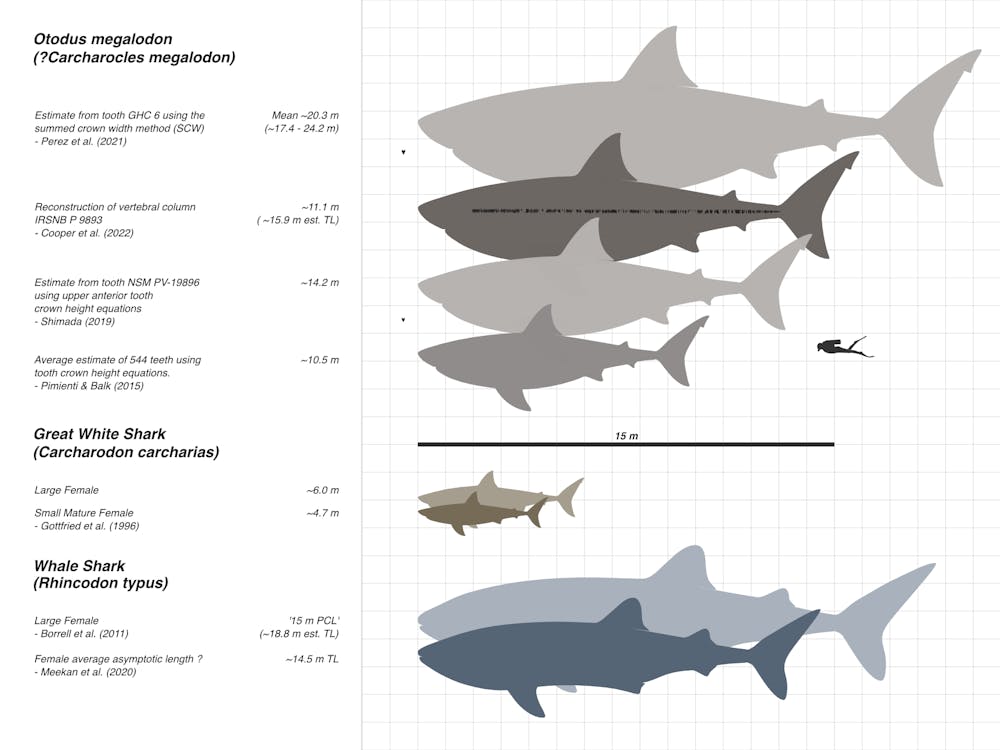
    The average size of a mature great white (Carcharodon carcharias, also known as the white shark) is between 4.6 and 4.9 metres for female sharks and up to 4 metres for male sharks.

    The largest recorded living specimens peak at about 6 metres, with one monster specimen caught in Cuba in 1945 reaching 6.4 metres.

    Earth’s oceans have seen bigger predatory sharks in the past. The biggest one of all time was the megalodon (Otodus megalodon) which lived from 23 to 3 million years ago, and may have been up to 24 metres in length. However, it looked nothing like the modern white shark.

    We don’t know precisely how big the megalodon was, but certainly larger than the great white shark.
    Steveoc 86/Wikimedia Commons, CC BY-SA

    They’re not even directly related – another thing scientists learned quite recently.

    Who was the megalodon, then?

    White sharks first evolved between 6 and 4 million years ago in the shadows of the megalodon. A recent study showed the megalodon’s large serrated teeth show signs of it being a supreme opportunistic super-predator.

    That means it ate just about anything, but especially liked whales and marine mammals.


    Read more:
    Friday essay: Giant shark megalodon was the most powerful superpredator ever. Why did it go extinct?


    But white sharks are not directly related to the megalodon, whose lineage began with a shark called Cretalamna during the age of dinosaurs about 100 million years ago.

    By contrast, the white shark lineage began with an ancient mako shark, Carcharodon hastalis. It was 7 to 8 metres long and had large, similarly shaped teeth to the modern white shark but lacking serrated edges.

    A fossil intermediate species, Carcharodon hubbelli shows the transition over time from weakly serrated to strongly serrated teeth.

    White shark fossil species. Left, the serrated fossil tooth teeth of the extant white shark; right, a similarly shaped unserrated tooth of the extinct giant mako shark which gave rise to white sharks.
    John Long, CC BY

    How did Jaws affect white shark populations?

    Last year, the International Shark Attack File reported 47 unprovoked shark bites to humans worldwide, resulting in seven fatalities. This was well below the previous ten-year average of 70 bites per year; your chances of getting bitten by a shark are extremely rare.

    Following the movies that made up the Jaws franchise, there was an increase in hunting and killing sharks – with a particular focus on great white sharks that were already going into a decline due to overfishing, trophy hunting and lethal control programs.

    Between 80% and 90% of white sharks have disappeared globally since the middle of the 20th century. Recent estimates calculate there are probably less than 500 individual white sharks in Australian waters right now.

    When Jaws first aired, scientists didn’t know how long sharks took to reproduce, or how many offspring a white shark could have each year. We now know it takes about 26 years for a male and 33 years for a female to sexually mature before they can start having pups.

    Data about white shark births is sparse, but recently a 5.6-metre-long female caught on a drum line off the coast of Queensland had just four large pups inside her. This is a very small number. Some large sharks, such as the whale shark, can give birth to up to 300 young.

    Now that we know just how slow they are to breed, it’s clear it will take many decades to reestablish the “pre-Jaws” population of white sharks – important apex predators in the marine ecosystem.

    Charlie Huveneers from Flinders University about to take a tissue sample for research on white sharks. There is still a lot we don’t know about their biology.
    Andrew Fox, Adelaide, CC BY

    Will white sharks survive?

    White sharks are currently listed as vulnerable.

    This classification means if we don’t change the current living conditions for white sharks, including impacts caused by human activities such as commercial fishing, and the impacts of climate change and ocean pollution, they will continue to decline and eventually could go extinct.

    Currently, white sharks are protected in several countries and form the basis for an important tourist industry in Australia, South Africa, western United States and most recently Nova Scotia, Canada.

    These sharks are iconic apex predators that fascinate people. One of us (John) went cage diving with them recently off the Neptune Islands of South Australia and can attest to how breathtaking it is to watch them in their natural environment.

    In terms of economic impact, they are worth far more alive than dead.

    White sharks are a growing tourism draw in several countries.
    Andrew Fox, Adelaide, CC BY

    There’s still much we don’t know about white sharks

    The complete white shark genome was first published only in 2019. It has 4.63 billion base pairs, making it much larger than the human genome (3.2 billion base pairs).

    The genome revealed some surprising things, like how white sharks show strong molecular adaptations for wound-healing processes, and a suite of “genome stability” genes – those used in DNA repair or DNA damage response.

    The transcriptome (or sum total of the messenger RNA) of the white shark showed greater similarity to the human transcriptome than to that of other fishes. This hints that “unexpressed genes” in the shark could one day play a role in uncovering genetic pathways for potential cures in human diseases.

    Jaws and its sequels certainly brought white sharks to the attention (and nightmares) of humans, with devastating impacts on how we treated them as a species.

    Our relationship with white sharks reflects our relationship with nature more broadly – a feared antagonist within the current capitalist paradigm; an enemy to be tamed, contained or consumed.

    As we learn more of the peril and potential of these remarkable creatures, we can learn how to live with them, to see beyond our fears and value their role within our delicate ocean ecosystems.

    John Long receives funding from The Australian Research Council.

    Heather L. Robinson does not work for, consult, own shares in or receive funding from any company or organisation that would benefit from this article, and has disclosed no relevant affiliations beyond their academic appointment.

    ref. Jaws at 50: how a single movie changed our perception of white sharks forever – https://theconversation.com/jaws-at-50-how-a-single-movie-changed-our-perception-of-white-sharks-forever-258306

    MIL OSI AnalysisEveningReport.nz

  • MIL-OSI Australia: ACT Budget 2025–26: supporting primary health care

    Source: Northern Territory Police and Fire Services

    Our CBR is the ACT Government’s key channel to connect with Canberrans and keep you up-to-date with what’s happening in the city. Our CBR includes a monthly print edition, email newsletter and website.

    You can easily opt in or out of the newsletter subscription at any time.

    MIL OSI News

  • MIL-OSI Australia: Stargazing flight: how Bogong moths use the night sky to navigate hundreds of kilometres

    Source:

    19 June 2025

    Bogong moth. Photo credit: Ajay Narendra, Macquarie University.

    In a world-first discovery, researchers have shown that Australia’s iconic Bogong moth uses constellations of stars and the Milky Way to navigate hundreds of kilometres across the country during its annual migration – making it the first known invertebrate to rely on a stellar compass for long-distance travel.

    The landmark study, published today in Nature, reveals how this unassuming nocturnal moth combines celestial navigation with Earth’s magnetic field to pinpoint a specific destination it has never visited before: the cool alpine caves of the Snowy Mountains, where it hibernates for the summer.

    Led by an international team of scientists from Lund University, the Australian National University (ANU), the University of South Australia (UniSA) and other global institutions, the research sheds new light on one of nature’s great migration mysteries, involving approximately four million moths each year.

    “Until now, we knew that some birds and even humans could use the stars to navigate long distances, but this is the first time that it’s been proven in an insect,” says Lund University Professor of Zoology, Eric Warrant, who is also a Visiting Fellow at the ANU and an Adjunct Professor at UniSA.

    “Bogong moths are incredibly precise. They use the stars as a compass to guide them over vast distances, adjusting their bearing based on the season and time of night.”

    Each spring, billions of Bogong moths (Agrotis infusa) emerge from breeding grounds across southeast Australia and fly up to 1000 kilometres to a small number of caves and rocky outcrops in the Australian Alps.

    A wall of Bogong moths, aestivating in a cave in the Australian Alps.

    The moths lie dormant in the cool, dark shelters throughout summer, and in autumn make the return journey to breed and die.

    Using sophisticated flight simulators and brain recordings in controlled, magnetically neutral environments, the researchers tested how moths orient themselves under different sky conditions.

    When presented with natural starry skies and no magnetic field, they consistently flew in the correct migratory direction for the season – southward in spring, northward in autumn.

    When the starry skies were rotated 180 degrees, the moths reversed direction accordingly, but when the stars were scrambled, their orientation vanished.

    “This proves they are not just flying towards the brightest light or following a simple visual cue,” says Prof Warrant. “They’re reading specific patterns in the night sky to determine a geographic direction, just like migratory birds do.”

    Interestingly, when stars were obscured by clouds, the moths maintained their direction using only the Earth’s magnetic field. This dual compass system ensures reliable navigation even in variable conditions.

    The team also delved into the neurological basis of this behaviour, identifying specialised neurons in the moth’s brain that respond to the orientation of the starry sky. These cells, found in brain regions responsible for navigation and steering, fire most strongly when the moth is facing southwards.

    “This kind of directional tuning shows that the Bogong moth brain encodes celestial information in a surprisingly sophisticated way. It’s a remarkable example of complex navigational ability packed into a tiny insect brain.”

    Researchers say the discovery could inform technologies in robotics, drone navigation, and even conservation strategies for species threatened by habitat loss or climate change.

    Bogong moth populations have declined sharply in recent years, promoting their listing as vulnerable.

    The study underscores the importance of protecting migratory pathways and the dark skies these moths rely on.

    “This is not just about a moth  ̶  it’s about how animals read the world around them,” says Prof Warrant. “The night sky has guided human explorers for millennia. Now we know that it guides moths, too.”

    Co-author Professor Javaan Chahl, a remote sensing engineer from the University of South Australia, made headlines in August 2024 using the discoveries from a previous study led by Lund University involving dung beetles, who use the Milky Way as a reference point to roll balls of dung in straight lines.

    Prof Chahl’s team modelled the same technique used by dung beetles to develop an AI sensor for robot navigation in low light.

    The Nature paper “Bogong moths use a stellar compass for long-distance navigation at night” is authored by researchers from Europe, the UK, China, Australia, Canada and Australia. DOI: 10.1038/s41586-025-09135-3

    A video produced by the Australian Academy of Science, explaining Prof Warrant’s research, is available at: www.youtube.com/watch?v=AqiG_xBUFE0.  Prof Warrant was elected a Corresponding Member of the Academy in 2024.

    …………………………………………………………………………………………………………………………

    Media contact: Candy Gibson M: +61 434 605 142 E: candy.gibson@unisa.edu.au

    MIL OSI News

  • MIL-OSI: Greystone Housing Impact Investors LP Extends General Line of Credit Facility

    Source: GlobeNewswire (MIL-OSI)

    OMAHA, Neb., June 18, 2025 (GLOBE NEWSWIRE) — Greystone Housing Impact Investors LP (NYSE: GHI) (the “Partnership”) announced today that on June 12, 2025, it amended its existing $50 million secured revolving Line of Credit facility (“LOC”). The LOC is secured by the Partnership’s joint venture equity investments. BankUnited, N.A. serves as sole arranger and administrative agent.

    The amendment extended the maturity date to June 2027, with two additional one-year extension options, increased the maximum allowable seniors housing joint venture equity investments the Partnership can make to 30% of eligible encumbered assets, and increased the Partnership’s maximum allowable limited guaranties of debt associated with its joint venture equity investments.

    An affiliate of the Partnership’s general partner provides a deficiency guaranty for the facility. The affiliate does not charge the Partnership a fee for the deficiency guaranty.

    “The amendment to our general LOC provides valuable liquidity and enhances our operational flexibility to make additional joint venture equity investments in the seniors housing segment,” said Kenneth C. Rogozinski, Chief Executive Officer of the Partnership.

    About Greystone Housing Impact Investors LP

    Greystone Housing Impact Investors LP was formed in 1998 under the Delaware Revised Uniform Limited Partnership Act for the primary purpose of acquiring, holding, selling and otherwise dealing with a portfolio of mortgage revenue bonds which have been issued to provide construction and/or permanent financing for affordable multifamily, seniors and student housing properties. The Partnership is pursuing a business strategy of acquiring additional mortgage revenue bonds and other investments on a leveraged basis. The Partnership expects and believes the interest earned on these mortgage revenue bonds is excludable from gross income for federal income tax purposes. The Partnership seeks to achieve its investment growth strategy by investing in additional mortgage revenue bonds and other investments as permitted by its Second Amended and Restated Limited Partnership Agreement, dated December 5, 2022, taking advantage of attractive financing structures available in the securities market, and entering into interest rate risk management instruments. Greystone Housing Impact Investors LP press releases are available at www.ghiinvestors.com.

    Safe Harbor Statement

    Information contained in this press release contains “forward-looking statements,” which are based on current expectations, forecasts and assumptions that involve risks and uncertainties that could cause actual outcomes and results to differ materially. These risks and uncertainties include, but are not limited to, risks involving current maturities of our financing arrangements and our ability to renew or refinance such maturities, fluctuations in short-term interest rates, collateral valuations, mortgage revenue bond investment valuations and overall economic and credit market conditions. For a further list and description of such risks, see the reports and other filings made by the Partnership with the Securities and Exchange Commission, including but not limited to, its Annual Report on Form 10-K, Quarterly Reports on Form 10-Q, and Current Reports on Form 8-K. Readers are urged to consider these factors carefully in evaluating the forward-looking statements. The Partnership disclaims any intention or obligation to update or revise any forward-looking statements, whether as a result of new information, future events or otherwise.

    MEDIA CONTACT:
    Karen Marotta
    Greystone
    212-896-9149
    Karen.Marotta@greyco.com

    INVESTOR CONTACT:
    Andy Grier
    Senior Vice President
    402-952-1235

    The MIL Network

  • MIL-OSI USA: Senators Ricketts and Kaine Introduce the AUKUS Improvement Act

    US Senate News:

    Source: United States Senator Pete Ricketts (Nebraska)

    WASHINGTON, D.C. – Today, U.S. Senators Pete Ricketts (R-NE) and Tim Kaine (D-VA) introduced the AUKUS Improvement Act. Building upon the bipartisan, AUKUS-enabling legislation in the FY24 National Defense Authorization Act, the AUKUS Improvement Act will further streamline defense industrial base collaboration and co-production between the United States, Australia, and the United Kingdom.  The legislation was also sponsored by Senators John Cornyn (R-TX), Chris Murphy (D-CT), and Dan Sullivan (R-AK).

    The United States, Australia, and the United Kingdom collectively face our most challenging threat environment since WWII. As we approach the 4th anniversary of AUKUS, it’s clear more should be done to break down bureaucratic obstacles and ensure a more seamless defense innovation and trade environment,” said Ricketts. “By streamlining transfers of critical capabilities to two of our closest allies while also facilitating a more efficient co-production ecosystem, the AUKUS Improvement Act will strengthen our allies’ warfighting edge, improve interoperability, and support our own industrial base.”

    “The AUKUS partnership is critical to countering the threat from China and ensuring the Indo-Pacific remains free and open,” said Kaine. “I’m proud to introduce this bipartisan legislation to strengthen AUKUS and boost defense collaboration among our countries.”

    The AUKUS Improvement Act would:

    • Exempt State Department-vetted entities that have been approved as AUKUS Authorized Users from the requirement to obtain Third Party Transfer approvals under Foreign Military Sales. 
    • Exempt Australia and the United Kingdom from the need for Congressional Notification for overseas manufacturing.

    BACKGROUND:

    In the last five years, Australia has placed $23 billion in Foreign Military Sales (FMS) orders, making it one of the biggest users of the FMS process. FMS ensures Australia is procuring the exact same variant that the U.S. military uses, enabling greater interoperability. It also supports American deployed forces operating in Australia through access to spare parts. Australia is often required to transfer elements of equipment procured through FMS to industry for further development, operation, maintenance, and sustainment. In order to do this, it must obtain written consent from the State Department in the form of a Third Party Transfer (TPT) request. However, the TPT process can be slow, with applications often taking many months before being approved. By making TPTs made under FMS subject to similar export controls to those made under AUKUS for Direct Commercial Sales (DCS), the AUKUS Improvement Act will get capability in the hands of our allies faster.

    In March 2021, Australia established the Guided Weapons and Explosive Ordnance (GWEO) Enterprise to expand its munitions and missile stockpiles, establish domestic manufacturing ofguided weapons, and supplement international partners’ supply chains. As part of this announcement, Australia and the U.S. agreed to collaborate on a flexible guided weapons production capability in Australia, with an initial focus on the potential for co-production of Guided Multiple Launch Rocket Systems (GMLRS) by 2025, and eventual co-production of the Precision Strike Missile (PrSM).

    However, the Arms Export Control Act requires Congressional Notification (CN) 15 days prior to approving a commercial technical assistance or manufacturing license agreement to manufacture significant military equipment abroad, regardless of the value. Currently, State Department excludes any transfer of defense articles, technical data, or services that requires a CN from the license-free environment and expedited processing provisions under AUKUS. Therefore, Australia is required to obtain a Manufacturing License Agreement to receive the technical data and manufacturing know-how for each component of a precision-guided munition. This adds complexity, time, and cost, therebylimiting munitions co-production cooperation that benefits both the U.S. and Australia.

    Bill text can be found here.

    MIL OSI USA News

  • MIL-OSI: Trupanion Announces Winners of the Veterinary Appreciation Day™ Awards

    Source: GlobeNewswire (MIL-OSI)

    SEATTLE, June 18, 2025 (GLOBE NEWSWIRE) — In honor of Veterinary Appreciation Day on June 18, Trupanion, the leading provider of medical insurance for cats and dogs in North America, held its annual awards event to celebrate and recognize the veterinary community for their profound impact on the lives of pets and their families.

    This year, the awards program saw an incredible outpouring of gratitude across North America, receiving more than 47,000 public votes.

    From the thousands of nominees, just 12 winners were chosen based on their significant influence on their veterinary teams, pet parents, and the communities they serve.

    “This year’s record-breaking voter turnout shows how increasingly important veterinary teams throughout the U.S. and Canada are to pet parents, peers, and their broader communities,” said Margi Tooth, President and CEO of Trupanion. “Each of these professionals works tirelessly to keep pets healthy, making picking just twelve honorees from the thousands of talented nominees a truly difficult job. Today, we’re proud to acknowledge and celebrate their achievements.”

    In 2015, Trupanion established June 18 as Veterinary Appreciation Day to celebrate the veterinary community. The annual awards have since become a platform to honor the extraordinary and often unsung efforts of these professionals.

    Here are the 2025 Veterinary Appreciation Day Award Winners.

    United States

    US West

    Veterinarian of the Year

    • Winner: Yafen Zhen, DVM
    • Practice: VCA San Martin Animal Hospital | San Martin, CA


    Veterinary Professional of the Year

    • Winner: Marie Marquez, CSR
    • Practice: VCA Veterinary Care Animal Hospital | Albuquerque, NM


    US Midwest

    Veterinarian of the Year

    • Winner: Jeffrey Baranack, DVM
    • Practice: West Side Animal Hospital | Alliance, OH


    Veterinary Professional of the Year

    • Winner: Ezzy Mercado, CSR
    • Practice: Buffalo Grove Animal Hospital | Buffalo Grove, IL


    US Northeast

    Veterinarian of the Year

    • Winner: Katherine Wheeler, DVM
    • Practice: Back Bay Veterinary Clinic | Boston, MA


    Veterinary Professional of the Year

    • Winner: Maddie LeMarquand, Veterinary Assistant
    • Practice: Heart + Paw – Glen Mills | Glen Mills, PA


    US South

    Veterinarian of the Year

    • Winner: Caitlin Townes, DVM
    • Practice: Paulding Animal Clinic | Dallas, GA


    Veterinary Professional of the Year

    • Winner: Marissa Love, Firefighter, EMT
    • Practice: Country Oaks Animal Hospital | New Port Richey, FL


    Canada

    Canada West

    Veterinarian of the Year

    • Winner: Jody McMurray, DVM, BSc (Ag)
    • Practice: Heartland Veterinary Clinic | Airdrie, AB


    Veterinary Professional of the Year

    • Winner: Leah Penner, RVT, Practice Manager
    • Practice: Pacific Cat Clinic | Victoria, BC


    Canada East

    Veterinarian of the Year

    • Winner: Deirdra Johnson, DVM
    • Practice: CBS Animal Hospital | Conception Bay South, NL


    Veterinary Professional of the Year

    • Winner: Julie Dorney, BSc, RVT, CCRP, CCFT
    • Practice: Gilmour Road Veterinary Services | Puslinch, ON

    “Few professions embody as much compassion, empathy, and dedication as veterinary medicine,” stated Dr. Steve Weinrauch, Chief Veterinary and Product Officer at Trupanion. “While Trupanion celebrates our community daily, the Veterinary Appreciation Day Awards offer a unique platform for fellow professionals and pet parents to express their gratitude. On behalf of Trupanion, I commend these twelve distinguished winners for their unwavering commitment and incredible achievements.”

    Pet lovers everywhere are encouraged to visit vetappreciationday.trupanion.com to learn more about the 2025 winners.

    About Trupanion

    Trupanion is the leader in medical insurance for cats and dogs throughout the United States, Canada, Europe, and Australia with over 1,000,000 pets enrolled. For over two decades, Trupanion has given pet parents peace of mind so they can focus on their pet’s recovery, not financial stress. Trupanion is committed to providing pet parents with the highest value in pet medical insurance with unlimited payouts for the life of their pets. With its patented process, Trupanion is the only North American provider with the technology to pay veterinarians directly in seconds at the time of checkout. Trupanion is listed on NASDAQ under the symbol “TRUP”. The company was founded in 2000 and is headquartered in Seattle, WA. Trupanion policies are issued, in the United States, by its wholly owned insurance entity American Pet Insurance Company and, in Canada, by Accelerant Insurance Company of Canada or GPIC Insurance Company. Trupanion Australia is a partnership between Trupanion and Hollard Insurance Company. Policies are sold and administered in Canada by Canada Pet Health Insurance Services, Inc. dba Trupanion 309-1277 Lynn Valley Road, North Vancouver, BC V7J 0A2 and in the United States by Trupanion Managers USA, Inc. (CA license No. 0G22803, NPN 9588590). Canada Pet Health Insurance Services, Inc. is a registered damage insurance agency and claims adjuster in Quebec #603927. Trupanion Australia is a partnership between Trupanion and Hollard Insurance Company. For more information, please visit trupanion.com

    Contacts:

    Corporate Communications
    Corporate.Communications@trupanion.com

    The MIL Network

  • MIL-OSI: Trupanion Announces Winners of the Veterinary Appreciation Day™ Awards

    Source: GlobeNewswire (MIL-OSI)

    SEATTLE, June 18, 2025 (GLOBE NEWSWIRE) — In honor of Veterinary Appreciation Day on June 18, Trupanion, the leading provider of medical insurance for cats and dogs in North America, held its annual awards event to celebrate and recognize the veterinary community for their profound impact on the lives of pets and their families.

    This year, the awards program saw an incredible outpouring of gratitude across North America, receiving more than 47,000 public votes.

    From the thousands of nominees, just 12 winners were chosen based on their significant influence on their veterinary teams, pet parents, and the communities they serve.

    “This year’s record-breaking voter turnout shows how increasingly important veterinary teams throughout the U.S. and Canada are to pet parents, peers, and their broader communities,” said Margi Tooth, President and CEO of Trupanion. “Each of these professionals works tirelessly to keep pets healthy, making picking just twelve honorees from the thousands of talented nominees a truly difficult job. Today, we’re proud to acknowledge and celebrate their achievements.”

    In 2015, Trupanion established June 18 as Veterinary Appreciation Day to celebrate the veterinary community. The annual awards have since become a platform to honor the extraordinary and often unsung efforts of these professionals.

    Here are the 2025 Veterinary Appreciation Day Award Winners.

    United States

    US West

    Veterinarian of the Year

    • Winner: Yafen Zhen, DVM
    • Practice: VCA San Martin Animal Hospital | San Martin, CA


    Veterinary Professional of the Year

    • Winner: Marie Marquez, CSR
    • Practice: VCA Veterinary Care Animal Hospital | Albuquerque, NM


    US Midwest

    Veterinarian of the Year

    • Winner: Jeffrey Baranack, DVM
    • Practice: West Side Animal Hospital | Alliance, OH


    Veterinary Professional of the Year

    • Winner: Ezzy Mercado, CSR
    • Practice: Buffalo Grove Animal Hospital | Buffalo Grove, IL


    US Northeast

    Veterinarian of the Year

    • Winner: Katherine Wheeler, DVM
    • Practice: Back Bay Veterinary Clinic | Boston, MA


    Veterinary Professional of the Year

    • Winner: Maddie LeMarquand, Veterinary Assistant
    • Practice: Heart + Paw – Glen Mills | Glen Mills, PA


    US South

    Veterinarian of the Year

    • Winner: Caitlin Townes, DVM
    • Practice: Paulding Animal Clinic | Dallas, GA


    Veterinary Professional of the Year

    • Winner: Marissa Love, Firefighter, EMT
    • Practice: Country Oaks Animal Hospital | New Port Richey, FL


    Canada

    Canada West

    Veterinarian of the Year

    • Winner: Jody McMurray, DVM, BSc (Ag)
    • Practice: Heartland Veterinary Clinic | Airdrie, AB


    Veterinary Professional of the Year

    • Winner: Leah Penner, RVT, Practice Manager
    • Practice: Pacific Cat Clinic | Victoria, BC


    Canada East

    Veterinarian of the Year

    • Winner: Deirdra Johnson, DVM
    • Practice: CBS Animal Hospital | Conception Bay South, NL


    Veterinary Professional of the Year

    • Winner: Julie Dorney, BSc, RVT, CCRP, CCFT
    • Practice: Gilmour Road Veterinary Services | Puslinch, ON

    “Few professions embody as much compassion, empathy, and dedication as veterinary medicine,” stated Dr. Steve Weinrauch, Chief Veterinary and Product Officer at Trupanion. “While Trupanion celebrates our community daily, the Veterinary Appreciation Day Awards offer a unique platform for fellow professionals and pet parents to express their gratitude. On behalf of Trupanion, I commend these twelve distinguished winners for their unwavering commitment and incredible achievements.”

    Pet lovers everywhere are encouraged to visit vetappreciationday.trupanion.com to learn more about the 2025 winners.

    About Trupanion

    Trupanion is the leader in medical insurance for cats and dogs throughout the United States, Canada, Europe, and Australia with over 1,000,000 pets enrolled. For over two decades, Trupanion has given pet parents peace of mind so they can focus on their pet’s recovery, not financial stress. Trupanion is committed to providing pet parents with the highest value in pet medical insurance with unlimited payouts for the life of their pets. With its patented process, Trupanion is the only North American provider with the technology to pay veterinarians directly in seconds at the time of checkout. Trupanion is listed on NASDAQ under the symbol “TRUP”. The company was founded in 2000 and is headquartered in Seattle, WA. Trupanion policies are issued, in the United States, by its wholly owned insurance entity American Pet Insurance Company and, in Canada, by Accelerant Insurance Company of Canada or GPIC Insurance Company. Trupanion Australia is a partnership between Trupanion and Hollard Insurance Company. Policies are sold and administered in Canada by Canada Pet Health Insurance Services, Inc. dba Trupanion 309-1277 Lynn Valley Road, North Vancouver, BC V7J 0A2 and in the United States by Trupanion Managers USA, Inc. (CA license No. 0G22803, NPN 9588590). Canada Pet Health Insurance Services, Inc. is a registered damage insurance agency and claims adjuster in Quebec #603927. Trupanion Australia is a partnership between Trupanion and Hollard Insurance Company. For more information, please visit trupanion.com

    Contacts:

    Corporate Communications
    Corporate.Communications@trupanion.com

    The MIL Network

  • MIL-OSI USA: Ahead of Juneteenth, Momentum Grows for H.R. 40, Pressley’s Historic Reparations Legislation

    Source: United States House of Representatives – Congresswoman Ayanna Pressley (MA-07)

    Bill Would Form Commission to Develop Reparations Proposals for African American Descendants of Enslaved People

    Legislation Now Has Support of Over 100 National and Grassroots Organizations

    H.R. 40 Press Conference | H.R. 40 Bill Text | H.R. 40 Briefing Photos | H.R. 40 Briefing One-Pager

    WASHINGTON – Today, ahead of the Juneteenth holiday and a national celebration of Black joy and emancipation, Congresswoman Ayanna Pressley (MA-07) affirmed the strength of the reparations movement and announced growing support for H.R.40, legislation that she is championing to address the harmful legacy of slavery and establish a federal commission to develop reparations proposals for African American descendants of enslaved people. The legislation now has the support of more than 100 national and grassroots organizations and 85 members of Congress.

    In February, during Black History Month, Rep. Pressley and Senator Cory Booker reintroduced H.R. 40, serving as a powerful counterweight to the unprecedented onslaught against diversity, equity, and inclusion (DEI) initiatives from the Trump Administration and a call to action to address the systemic oppression of Black people. Last week, Rep. Pressley hosted a briefing on H.R. 40 to provide congressional staffers and their offices an expanded look into the bill, its 36-year legislative journey – led by Congressman John Conyers and Congresswoman Sheila Jackson Lee – and its vital role in the reparative justice movement.

    “The state of our reparations movement is strong and in this moment of heightened anti-Blackness in America, we are more resolved than ever,” said Congresswoman Pressley, lead House sponsor of H.R. 40. “H.R. 40 is racial justice, economic justice, and a moral imperative, and it is deeply necessary to confront America’s damning history of systemic racism head-on. I’m proud of the growing, broad, and intersectional support behind our bill and I am grateful to our grassroots organizations for their partnership in pushing to get this critical legislation over the finish line.”

    Support for reparations has grown nationwide, with state and local officials taking action, including in Massachusetts, Illinois, Tennessee, North Carolina and Oklahoma. H.R. 40 now has endorsements from over 100 national and grassroots organizations.

    “We are delighted that Congresswoman Ayanna Pressley has picked up the torch from Cong. Sheila Jackson Lee and Cong. John Conyers, Jr. to continue the historic push to achieve long overdue reparations for African Americans.” – National African American Reparations Commission

    “At this pivotal moment in the United States’ existence and identity, we proudly stand with Rep. Ayanna Pressley in the reintroduction of H.R. 40, which if enacted will provide concrete ways to implement reparations,” said Dreisen Heath, Why We Can’t Wait Reparations Coalition. “Providing reparations is a routine practice by the federal government from providing remedy in perpetuity to Holocaust survivors to providing free healthcare to 9/11 victims and veterans exposed to toxic waste waters. By embracing what H.R. 40 legislation will produce, we are not only educating the public on the truth but also energizing a strong movement towards reflection and accountability. While states and cities advance their own reparative efforts, the federal government can no longer neglect and obscure its responsibility to do right by Black Americans, and by extension the rest of the country.

    “The National Urban League, for over a century, has witnessed firsthand the devastating impact of systemic racism on countless lives. We have championed social and economic justice for Black Americans, striving to overcome the enduring legacy of slavery. For too long, we have avoided a full and honest reckoning with this history. A federal commission to study the vestiges of slavery, from the harrowing experiences of enslaved people to the ongoing struggles of their descendants, is not just overdue, it is essential. This examination is not about dwelling on the past but about better understanding the present. By understanding how the lingering effects of slavery continue to shape our society and policies, we can finally create a level playing field and unlock the full potential of our nation,” said the National Urban League. “The National Urban League fully supports H.R. 40, a bill establishing a commission to study and develop reparations proposals for Black Americans, as it represents a crucial step towards reconciliation and redress. We urge Congress to swiftly pass this vital legislation. The time for inaction is over. The time for justice is now.”

    “Eradicating poverty requires understanding its root causes and the economic injustices that plague Black communities today can be directly traced to the legacy of slavery and Jim Crow laws,” said Margaret Huang, President and CEO of the Southern Poverty Law Center. “This commission would be an important step toward grappling with how our country failed to support so many Americans after slavery and segregation ended. We need to take an honest look at the ugly history of racial discrimination that has denied so many Black and Brown families, particularly in the Deep South, economic opportunities to sustain their families.”

    “This legislation is not symbolic, it’s structural,” said Ebonie Riley, Senior Vice President of Policy & Strategic Partnerships at the National Action Network. “In a moment where the very language of equity is under assault, this bill confronts the unfinished business of this nation: the deliberate extraction of wealth, labor, and life from Black Americans. Under the leadership of Rev. Al Sharpton, NAN has consistently called for federal action that reflects the scale of harm inflicted. Reparations are a matter of economic policy, legal obligation, and historical accountability.”

    “The NAACP has supported the creation and passage of HR. 40/S.40 from its introduction by Congressman John Conyers (MI) through its reintroduction by Congresswoman Sheila Jackson Lee (TX) and Senator Cory Booker (NJ) continue to support the passage of this crucial legislation in the 119th Congress,” – NAACP

    “The United Methodist Book of Resolutions and the General Board of Church and Society strongly support HR 40 being reintroduced at a time when truth is under attack,” – United Methodist Church General Board of Church and Society

    “Black people have been the backbone to the growth and wealth of this nation and of the global economy, and justly, should be recipients of its fruits. Black people can’t achieve equity without the United States acknowledging the historical past and materially addressing past and present harms. Reparatory justice is a must,” –Network Lobby for Catholic Social Justice

    “The Council on American-Islamic Relations strongly supports the reintroduction of H.R. 40, recognizing it as a vital measure to confront America’s legacy of slavery and systemic racism head-on. We stand in solidarity with Congresswoman Pressley, Senator Booker, and their colleagues in calling for truth, accountability, and meaningful reparative actions that honor and protect the dignity of Black American communities,” – Council on American-Islamic Relations (CAIR)

    “As a church, we understand that the truth shall set us free. We have committed to and embarked on undertaking the work of truth-telling and reconciliation ourselves. H.R. 40/S. 40 would offer the opportunity for our country to begin a process to understand our own history and would present a path forward for repairing historical harms done to African Americans,” – The Episcopal Church

    “It has been nearly 40 years since Japanese Americans received redress for being incarcerated unjustly during WWII. Many of us in the Japanese American community recognize that our own experience of institutionalized racism at the hands of our government is part of a pattern that began with chattel slavery since our country’s inception as a British colony. Although slavery ended formally with the Civil War, its legacy persisted through Jim Crow policies well into the 20th century. Mere words of regret and apology for our history of slavery and Jim Crow do nothing to repay the unfulfilled promise of 40 acres and a mule.” – Japanese American Citizens League

    “We’re making historic progress advancing reparative justice in local communities nationwide.  We stand together in support of HR40, the most promising and just opportunity to repair the harm of the institution of slavery and its uninterrupted legacies to date. The outcomes of the HR40 Commission can result in a comprehensive and tangible portfolio of remedies that transform this nation,” – First Repair

    The full list of endorsing organizations include: AjabuSpeaks, All Souls Movement, Alliance of Baptists, American Humanist Association, Amnesty International USA, Bend the Arc: Jewish Action, Black Music Action Coalition, Black Veterans Project, Blackroots Alliance, BLIS Collective, California Black Power Network, Center for LGBTQ Economic Advancement & Research (CLEAR), Colombia Acuerdo de Paz NGO, Council on American-Islamic Relations (CAIR), DC Justice Lab, DC Reparations Coalition, Democrats Abroad Reparations Task Force, Disciples Center for Public Witness (Disciples of Christ), Empowerment Temple, Reparation Education Project, Episcopal City Mission, FirstRepair, Freedom Road Consulting, LLC, Friends Committee on National Legislation, Get Free, Human Rights Watch, Humanity2020 Group LLC, Institute for Justice & Democracy in Haiti, Japanese American Citizens League, Johnson & Klein Law, Justice for the 110, KC Reparations Coalition, Loc Community Association, Loyola Law School, Los Angeles Anti Racism Center (LARC), Make It Plain, Marijuana Justice, Maryknoll Office for Global Concerns, Media 2070, Missionary Oblates of Mary Immaculate, Movement for Black Lives, NAACP, National Action Network Education Team, National African American Reparations Commission , National Black Justice Collective, National Council of Churches, National Council of Jewish Women, National LGBTQ+ Bar Association, National Urban League, NETWORK Lobby for Catholic Social Justice, New Yorkers 4 Reparations, Northampton Reparations Study Commission, Not In Our Town, Princeton, NP/NCRR – Nikkei Progressives & Nikkei for Civil Rights & Redress, Pax Christi Metro DC-Baltimore, Pax Christi USA, RebuildingTheCommun7ty, Reparation Generation, Reparations Finance Lab, Reparations Interfaith Coalition of Massachusetts, Reparations United, Reparations4Slavery, San Francisco Bay Area Black & Jewish Unity Coalition, Sanctuary of Hope, SCOPE LA, Showing Up for Racial Justice, Sisters of Mercy of the Americas Justice Team, South Bend Reparations Working Group (SBRWG), State of Loc Nation Global Public Benefit Corp, Terence Crutcher Foundation, The Episcopal Church, The Southern Poverty Law Center, The United Methodist Church General Board of Church and Society, Tsuru for Solidarity, Tulsa African Ancestral Society, Union for Reform Judaism, Unitarian Universalists for Social Justice, United By Equity, United Church of Christ, USTRHT, Virago Strategies, Why We Can’t Wait Reparations Coalition, Women’s International League for Peace and Freedom, Young LLC.

    Co-sponsors of H.R. 40 include: Rep. Adams, Alma S. [D-NC-12], Rep. Balint, Becca [D-VT-At Large], Rep. Barragán, Nanette Diaz [D-CA-44], Rep. Beatty, Joyce [D-OH-3], Rep. Bera, Ami [D-CA-06], Rep. Beyer, Donald S. [D-VA-8], Rep. Bishop, Sanford D. [D-GA-2], Rep. Bonamici, Suzanne [D-OR-1], Rep. Brown, Shontel M. [D-OH-11], Rep. Brownley, Julia [D-CA-26], Rep. Carson, André [D-IN-7], Rep. Carter, Troy A. [D-LA-2], Rep. Casar, Greg [D-TX-35], Rep. Case, Ed [D-HI-1], Rep. Casten, Sean [D-IL-6], Rep. Cherfilus-McCormick, Sheila [D-FL-20], Rep. Chu, Judy [D-CA-28], Rep. Clarke, Yvette D. [D-NY-9], Rep. Cleaver, Emanuel [D-MO-5], Rep. Clyburn, James E. [D-SC-6], Rep. Cohen, Steve [D-TN-9], Rep. Connolly, Gerald E. [D-VA-11], Rep. Alexandria Ocasio-Cortez [D-NY-14], Rep. Jasmine Crockett [D-TX-30], Rep. Davis, Danny K. [D-IL-7], Rep. Dean, Madeleine [D-PA-4], Rep. Doggett, Lloyd [D-TX-37], Rep. Espaillat, Adriano [D-NY-13], Rep. Evans, Dwight [D-PA-3], Rep. Fletcher, Lizzie [D-TX-7], Rep. Foushee, Valerie P. [D-NC-4], Rep. Frost, Maxwell [D-FL-10], Rep. Garcia, Robert [D-CA-42], Rep. Garcia, Sylvia R. [D-TX-29], Rep. Green, Al [D-TX-9], Rep. Hayes, Jahana [D-CT-5], Rep. Himes, James A. [D-CT-4], Rep. Horsford, Steven [D-NV-4], Rep. Jackson, Jonathan L. [D-IL-1], Rep. Jacobs, Sara [D-CA-51], Rep. Jayapal, Pramila [D-WA-7], Rep. Johnson, Henry C. “Hank” [D-GA-4], Rep. Kamlager-Dove, Sydney [D-CA-37], Rep. Kelly, Robin L. [D-IL-2], Rep. Khanna, Ro [D-CA-17], Rep. Landsman, Greg [D-OH-1], Rep. Lee, Summer L. [D-PA-12], Rep. Lieu, Ted [D-CA-36], Rep. McClellan, Jennifer L. [D-VA-4], Rep. McGovern, Jim [D-MA-02], Rep. McIver, LaMonica [D-NJ-10], Rep. Meeks, Gregory W. [D-NY-5], Rep. Meng, Grace [D-NY-6], Rep. Mfume, Kweisi [D-MD-7], Rep. Moore, Gwen [D-WI-4], Rep. Nadler, Jerrold [D-NY-12], Del. Norton, Eleanor Holmes [D-DC-At Large], Rep. Omar, Ilhan [D-MN-5], Rep. Panetta, Jimmy [D-CA-19], Rep. Pingree, Chellie [D-ME-1], Rep. Pocan, Mark [D-WI-2], Rep. Quigley, Mike [D-IL-5], Rep. Ramirez, Delia C. [D-IL-3], Rep. Sánchez, Linda T. [D-CA-38], Rep. Scanlon, Mary Gay [D-PA-5], Rep. Schakowsky, Janice D. [D-IL-9], Rep. David Scott [D-GA-13], Rep. Simon, Lateefah [D-CA-12], Rep. Smith, Adam [D-WA-9], Rep. Stansbury, Melanie A. [D-NM-1], Rep. Stevens, Haley M. [D-MI-11], Rep. Strickland, Marilyn [D-WA-10], Rep. Swalwell, Eric [D-CA-14], Rep. Takano, Mark [D-CA-39], Rep. Thanedar, Shri [D-MI-13], Rep. Thompson, Bennie G. [D-MS-2], Rep. Titus, Dina [D-NV-1], Rep. Tlaib, Rashida [D-MI-12], Rep. Tokuda, Jill N. [D-HI-2], Rep. Torres, Ritchie [D-NY-15], Rep. Trahan, Lori [D-MA-3], Rep. Velázquez, Nydia M. [D-NY-7], Rep. Watson Coleman, Bonnie [D-NJ-12], Rep. Williams, Nikema [D-GA-5], Rep. Wilson, Frederica S. [D-FL-24]

    The full text of the bill is available here.

    Throughout her time in Congress, Rep. Pressley has championed policies to address the harmful legacy of slavery and support the true liberation of Black America, including Baby Bonds, a People’s Justice Guarantee, student debt cancellation, addressing the Black maternal morbidity crisis, supporting Black-owned microbusinesses, promoting anti-racist public health policy, and more.

    In April 2025, Rep. Pressley met with Northeastern University’s Center for Law, Equity, and Race to discuss efforts and further action in a shared push for reparative justice.

    Congresswoman Pressley is the lead sponsor of the People’s Justice Guarantee (PJG) – her comprehensive, decarceration-focused resolution that outlines a framework for a fair, equitable and just legal system. 

    Last year, Rep. Pressley and House Oversight Ranking Member Jamies Raskin introduced the Federal Government Equity Improvement Act and the Equity in Agency Planning Act to codify racial equity across federal agencies and improve government services for underserved communities.

    ###

    MIL OSI USA News

  • MIL-OSI USA: SPC Tornado Watch 435

    Source: US National Oceanic and Atmospheric Administration

    Note:  The expiration time in the watch graphic is amended if the watch is replaced, cancelled or extended.Note: Click for Watch Status Reports.
    SEL5

    URGENT – IMMEDIATE BROADCAST REQUESTED
    Tornado Watch Number 435
    NWS Storm Prediction Center Norman OK
    205 PM CDT Wed Jun 18 2025

    The NWS Storm Prediction Center has issued a

    * Tornado Watch for portions of
    Southern Illinois
    Southern Indiana
    Western Kentucky
    Southeast Missouri

    * Effective this Wednesday afternoon and evening from 205 PM
    until 800 PM CDT.

    * Primary threats include…
    A couple tornadoes possible
    Scattered damaging winds likely with isolated significant gusts
    to 75 mph possible
    Scattered large hail and isolated very large hail events to 2
    inches in diameter possible

    SUMMARY…Thunderstorms will continue to develop along and ahead of
    a boundary over southern Illinois and spread eastward through the
    afternoon. Damaging winds and large hail are possible, along with a
    few tornadoes.

    The tornado watch area is approximately along and 60 statute miles
    east and west of a line from 40 miles west of Fort Campbell KY to 75
    miles northeast of Evansville IN. For a complete depiction of the
    watch see the associated watch outline update (WOUS64 KWNS WOU5).

    PRECAUTIONARY/PREPAREDNESS ACTIONS…

    REMEMBER…A Tornado Watch means conditions are favorable for
    tornadoes and severe thunderstorms in and close to the watch
    area. Persons in these areas should be on the lookout for
    threatening weather conditions and listen for later statements
    and possible warnings.

    &&

    OTHER WATCH INFORMATION…CONTINUE…WW 432…WW 433…WW 434…

    AVIATION…Tornadoes and a few severe thunderstorms with hail
    surface and aloft to 2 inches. Extreme turbulence and surface wind
    gusts to 65 knots. A few cumulonimbi with maximum tops to 500. Mean
    storm motion vector 25035.

    …Hart

    SEL5

    URGENT – IMMEDIATE BROADCAST REQUESTED
    Tornado Watch Number 435
    NWS Storm Prediction Center Norman OK
    205 PM CDT Wed Jun 18 2025

    The NWS Storm Prediction Center has issued a

    * Tornado Watch for portions of
    Southern Illinois
    Southern Indiana
    Western Kentucky
    Southeast Missouri

    * Effective this Wednesday afternoon and evening from 205 PM
    until 800 PM CDT.

    * Primary threats include…
    A couple tornadoes possible
    Scattered damaging winds likely with isolated significant gusts
    to 75 mph possible
    Scattered large hail and isolated very large hail events to 2
    inches in diameter possible

    SUMMARY…Thunderstorms will continue to develop along and ahead of
    a boundary over southern Illinois and spread eastward through the
    afternoon. Damaging winds and large hail are possible, along with a
    few tornadoes.

    The tornado watch area is approximately along and 60 statute miles
    east and west of a line from 40 miles west of Fort Campbell KY to 75
    miles northeast of Evansville IN. For a complete depiction of the
    watch see the associated watch outline update (WOUS64 KWNS WOU5).

    PRECAUTIONARY/PREPAREDNESS ACTIONS…

    REMEMBER…A Tornado Watch means conditions are favorable for
    tornadoes and severe thunderstorms in and close to the watch
    area. Persons in these areas should be on the lookout for
    threatening weather conditions and listen for later statements
    and possible warnings.

    &&

    OTHER WATCH INFORMATION…CONTINUE…WW 432…WW 433…WW 434…

    AVIATION…Tornadoes and a few severe thunderstorms with hail
    surface and aloft to 2 inches. Extreme turbulence and surface wind
    gusts to 65 knots. A few cumulonimbi with maximum tops to 500. Mean
    storm motion vector 25035.

    …Hart

    Note: The Aviation Watch (SAW) product is an approximation to the watch area. The actual watch is depicted by the shaded areas.
    SAW5
    WW 435 TORNADO IL IN KY MO 181905Z – 190100Z
    AXIS..60 STATUTE MILES EAST AND WEST OF LINE..
    40W HOP/FORT CAMPBELL KY/ – 75NE EVV/EVANSVILLE IN/
    ..AVIATION COORDS.. 50NM E/W /67NE DYR – 53SE TTH/
    HAIL SURFACE AND ALOFT..2 INCHES. WIND GUSTS..65 KNOTS.
    MAX TOPS TO 500. MEAN STORM MOTION VECTOR 25035.

    LAT…LON 36668928 38798766 38798543 36668712

    THIS IS AN APPROXIMATION TO THE WATCH AREA. FOR A
    COMPLETE DEPICTION OF THE WATCH SEE WOUS64 KWNS
    FOR WOU5.

    Watch 435 Status Report Message has not been issued yet.

    Note:  Click for Complete Product Text.Tornadoes

    Probability of 2 or more tornadoes

    Mod (40%)

    Probability of 1 or more strong (EF2-EF5) tornadoes

    Low (20%)

    Wind

    Probability of 10 or more severe wind events

    High (70%)

    Probability of 1 or more wind events > 65 knots

    Mod (30%)

    Hail

    Probability of 10 or more severe hail events

    Mod (40%)

    Probability of 1 or more hailstones > 2 inches

    Mod (30%)

    Combined Severe Hail/Wind

    Probability of 6 or more combined severe hail/wind events

    High (90%)

    For each watch, probabilities for particular events inside the watch (listed above in each table) are determined by the issuing forecaster. The “Low” category contains probability values ranging from less than 2% to 20% (EF2-EF5 tornadoes), less than 5% to 20% (all other probabilities), “Moderate” from 30% to 60%, and “High” from 70% to greater than 95%. High values are bolded and lighter in color to provide awareness of an increased threat for a particular event.

    MIL OSI USA News

  • MIL-OSI USA: Reps. Kamlager-Dove, Chu, Sánchez, Takano, and Rivas Successfully Gain Access to Adelanto ICE Facility, Demanding Accountability and Answers

    Source: United States House of Representatives – Congresswoman Sydney Kamlager California (37th District)

    ADELANTO, CA – Today, Rep. Sydney Kamlager-Dove (CA-37), Rep. Judy Chu (CA-28), Rep. Linda Sánchez (CA-38), Rep. Mark Takano (CA-39), and Rep. Luz Rivas (CA-29) were granted entry to the Adelanto ICE Processing Center in order to conduct oversight guaranteed by federal law. The lawmakers demanded answers following reports of unlawful immigration raids, due process violations, and alarming allegations that U.S. citizens may have been wrongfully detained.

    The Members learned that the facility, which held just 300 individuals last month, is now at full capacity with 1,100 detainees. This drastic surge is not about targeting dangerous criminals. It is the direct result of Donald Trump’s policies aimed at rounding up hard-working immigrants who are essential to our communities and economy.

    “Donald Trump’s ICE raids in Los Angeles have terrorized our communities and left families in the dark about the whereabouts of their loved ones,” said Rep. Kamlager-Dove. “Alarming reports of inhumane conditions and lack of access to legal counsel at the Adelanto detention facility compelled my colleagues and I to conduct this oversight visit — and what we witnessed confirmed our worst fears. Detainees forced to wear the same clothes for ten days. Individuals lacking access to drinking water and medical care. Meals every fourteen hours. We will not stop fighting until every constitutional right is upheld and every abuse is brought to light.”

    “While I’m relieved that we were ultimately allowed into the Adelanto facility, as is our legal right as Members of Congress, this visit only reinforced how much work remains,” said Rep. Chu. “The conditions many of these people are facing are inhumane. The detainees told me that they have gone days without changing their clothes, and they have been unable to use the telephone to call their families or a legal representative. The people I met are not criminals, they are hardworking individuals who strengthen our communities and they simply want the opportunity to work for a better life. I will continue to closely monitor conditions at this ICE facility, as I have done before, and work with both local and federal officials to ensure that everyone, regardless of status, is afforded their full right to due process.” 

    “President Trump is indiscriminately targeting the hardworking individuals in our communities who keep our economy running. He is not reducing crime. The immigration raids happening today in places like Pico Rivera are racial profiling. Full stop. What we saw and heard at Adelanto is equally as disturbing as the cruel ICE raids in our neighborhoods. The administration is deliberately hiding the truth: immigrants, some here legally, are being detained in inhumane conditions, without enough food, clean clothing, the ability to call their families or access to a lawyer. This is a betrayal of our values and a violation of our immigration laws. It must end,” said Rep. Sánchez.

    “Just because ICE has opened their doors to a few members of Congress does not excuse their inflammatory tactics to meet deportation quotas,” said Rep. Takano. “Accountability means showing a consistent pattern of accessibility, not just a one-off event. ICE and DHS still must be reined, and stop a bad faith enforcement of immigration law to bring relief to my community.”

    “The conditions we saw inside the Adelanto ICE Detention Center prove that Donald Trump’s policies are putting our most vulnerable in harm’s way,” said Rep. Rivas. “From being detained for lawfully seeking asylum to cutting off communication to family and counsel, no one should be forced to live through what this Administration is forcing immigrants to live through. My colleagues and I will continue to conduct oversight of these facilities to expose the effects of Donald Trump’s cruel policies on our most vulnerable communities.”

    ###

    MIL OSI USA News

  • MIL-OSI USA: ICYMI: Reps. Kamlager-Dove, Chu, Colleagues Conduct Oversight at Adelanto ICE Facility

    Source: United States House of Representatives – Congresswoman Sydney Kamlager California (37th District)

    ADELANTO, CA — Yesterday, Congresswoman Sydney Kamlager-Dove (CA-37) gained entry to the Adelanto ICE Processing Center to fulfill her constitutional oversight responsibilities. Alongside Representatives Judy Chu (CA-28), Linda Sánchez (CA-38), Mark Takano (CA-39), and Luz Rivas (CA-29), she demanded answers following reports of inhumane conditions, due process violations, and alarming allegations that U.S. citizens may have been wrongfully detained.

    Congresswoman Kamlager-Dove explains what the lawmakers learned in a video shared to social media following the oversight visit.

    Following the visit, the lawmakers hosted a press conference to share their experiences at the facility. Congresswoman Kamlager-Dove’s full remarks as-delivered can be found below:

    “We should be here talking to you about the $880 billion cut to Medicaid. The closures of Social Security Administration offices. But instead, we are talking about these indiscriminate and illegitimate ICE raids that have been happening across our community. 

    “I came here today to find my constituents. I have a constituent who is deaf and mute. He was picked up by ICE and transported and we are still looking for him. We had a list of constituents that we are trying to check on. We were conducting oversight and we were also conducting casework. 

    “And let me tell you, we have had laundromats, we have had churches, we have had elementary schools, we have had small stores raided by [the] FBI [and] Homeland Security, in cooperation with ICE, snatching folks, not asking them for identification, not providing identification or judicial warrants themselves. We talked to the agents in the detention facility, and we did not get concrete information about how folks were lawfully being detained if they did have criminal records or not. Some of that is still being decided while folks are being detained. 

    “And something else we learned is that people are being detained and separated and let go by race. Now, I don’t know about you, but if this Administration said that it was looking for folks with criminal records and they have detained U.S. Citizens, legal immigrants, and folks who are legally going through the immigration status process, then tell me why you are also racially profiling folks and then separating them and doing different things to each of these communities. 

    “And let me tell you something else. We are decimating the local economy here because most of the folks were students. They were applying for licenses to do work. They have businesses. They have families. They are workers. This is impacting our economy, our regional and state economy. 

    “And we have an Administration that is interested in manufacturing a violent and traumatizing show called “LA Raids” to distract us from the larger issues that are impacting everyday Americans like the cost of living, the cost of food, the cost of health care. And now we are dealing with an Administration that is racially profiling and detaining folks without giving them the representation that they need. 

    “This is why we came out here to conduct oversight. And this is why we are going to continue to hold this administration accountable because it is illegitimate. You are denying folks their 4th, their 5th, and their 14th Amendment rights when you are not giving them due process, when people do not know why they have been picked up other than the color of their skin. And we must demand more from this Administration. That is what Congress is trying to do.”

    # # #

    MIL OSI USA News

  • MIL-OSI Canada: Living Together, a documentary by Halima Elkhatabi, coming to NFB platforms July 1

    Source: Government of Canada News

    June 18, 2025 – Montreal – National Film Board of Canada (NFB)

    The feature-length documentary Living Together, directed by Halima Elkhatabi, launches on NFB streaming platforms on Tuesday, July 1. It’s an engaging portrait of Gen Y and Gen Z set against the backdrop of the housing crisis. The film had its world premiere at the prestigious Toronto International Film Festival (TIFF) and has since been an official selection at Canadian festivals—including Vancouver, Victoria and the Rendez-vous Québec Cinéma—as well as at festivals in Europe and Morocco. It also had a theatrical release in Quebec in fall 2024.

    About the film

    Living Together by Halima Elkhatabi (2024, NFB, 75 min)
    Press kit: mediaspace.nfb.ca/epk/living-together

    • In a series of inquisitive encounters and captivating conversations, young people looking for a roommate explore the prospect of forging genuine connections. Placing her camera in 15 Montreal apartments advertising a “room for rent,” director Halima Elkhatabi paints a complex and engaging picture of a generation accustomed to playing all their identity cards to find their place in the world.
    • Everyone reveals themselves with candour and vulnerability, hoping for that rare discovery: someone to share their space with who also shares their values. The debut feature-length documentary by a filmmaker with a compassionate and generous eye, Living Togethermaps a mosaic of cultures and ideas, with explorations of community, individualism and the right to housing in constant interplay.

    About the filmmaker

    Born in France, Halima Elkhatabi is a Montreal writer and director of Moroccan descent. A graduate of the Institut national de l’image et du son (INIS), Elkhatabi works in documentary and fiction film as well as audio documentary production. She co-directed the NFB collaborative doc St-Henri, the 26th of August, directed the short fiction films Nina (TIFF’s Canada’s Top Ten 2015) and Fantas (TIFF 2024), and authored the podcasts La route du bled, Chloé et Abdi, Songe d’une nuit d’hiver and La route de l’Eldorado.

    – 30 –

    Stay Connected

    Online Screening Room: nfb.ca
    NFB Facebook | NFB X | NFB Instagram | NFB Blog | NFB YouTube | NFB Vimeo
    Curator’s perspective | Director’s notes

    About the NFB

    MIL OSI Canada News

  • MIL-OSI Global: Misogyny has become a political strategy — here’s how the pandemic helped make it happen

    Source: The Conversation – Canada – By Brianna I. Wiens, Assistant Professor of Digital Media and Rhetoric, University of Waterloo

    Since the COVID-19 pandemic, more overt forms of gendered hate have jumped from obscure internet forums into the mainstream, shaping culture and policy.

    Social media doesn’t just reflect sexist, anti-feminist views; it helps to organize, amplify and normalize them.

    Backlash against women and LGBTQ+ communities has become more overt, co-ordinated and is gaining political traction. As the United States rolls back reproductive rights and passes anti-LGBTQ+ laws, it is important to understand how digital culture fuels this regression.

    While these shifts may seem distant, Canadian politics are not immune. Similar rhetoric has emerged in debates over education, gender identity, health care and so-called “parental rights.”


    Read more:
    ‘Parental rights’ lobby puts trans and queer kids at risk


    Our ongoing research maps how the pandemic accelerated the rise of online misogyny, especially through “manosphere” influencers and far-right rhetoric.

    Drawing from more than 21,000 podcast episodes and digital artifacts, we are investigating how everyday online content works to erode women’s and LGBTQ+ rights. This rhetoric normalizes misogynistic, transphobic and homophobic views and repackages gender inequities as common sense.

    How the pandemic fuelled digital misogyny

    COVID-19 lockdowns set the stage for a surge in online radicalization. Isolated men and boys increasingly turned to social media for connection — spaces where manosphere personalities like English-American social media influencer Andrew Tate and American conservative political commentator Ben Shapiro gained momentum.

    These figures blend anti-feminist messaging with broader pandemic-era anxieties, turning gender roles into moral and political battlegrounds.

    Conservative influencers who once focused on vaccine skepticism began pivoting to anti-gender content. Steve Bannon’s podcast, for example, moved from pedalling public health disinformation to pushing narratives that feminism and LGBTQ+ rights are threats to western civilization.

    Before the internet, radicalization usually required personal contact. Now, people can self-radicalize online, engaging with algorithm-driven content and communities that reinforce extremist beliefs, often without ever interacting with a recruiter. This shift coincided with a marked rise in reported online hate speech and offline hate crimes.

    Misogyny as a mobilizing force

    Meanwhile, women’s experiences during the pandemic — over half of whom are caregivers in Canada — involved increased labour at home and in front-line jobs. This left little time or energy for the organizational work necessary to combat the rising tides of sexism and misogyny.

    Instead, public discourse began to increasingly valourize “tradwife” ideals and homemaking. This ensured traditional gender roles were brought back into the mainstream, not just as personal preferences, but as broader cultural expectations.

    Though this misogyny appears to be fringe, it echoes mainstream policies that threaten reproductive health care, restrict gender expression and paint feminism as a threat to national stability.

    Project 2025, the well-known policy platform from U.S. conservative think tank The Heritage Foundation, lays out an agenda to repeal reproductive rights, undermine LGBTQ+ protections and expand state control over gender and family life.


    Read more:
    How Project 2025 became the blueprint for Donald Trump’s second term


    How misogynist narratives are normalized

    These misogynist ideas are reinforced in popular culture. In May 2024, NFL player Harrison Butker used his commencement address at Benedictine College to tell women graduates that their true calling was to become wives and mothers.

    Such rhetoric serves to re-establish patriarchal hierarchies by narrowing women’s roles to domestic life. But this isn’t about family values, it’s about power. Moves in the U.S. to restrict women’s reproductive autonomy and democratic access to vote make this abundantly clear.

    While feminists pushed back, manosphere podcast influencers rushed to Butker’s defense. American white supremacist Nick Fuentes celebrated the speech as a manifesto, while Shapiro framed it as uncontroversial truth.

    Our analysis of podcast episodes from Shapiro and Fuentes, among others, shows how misogynist and racist narratives are reinforced through repetition and emotional framing. In episodes focused on Butker’s commencement speech, there were significant concentrations of hate speech and misogyny in the episodes.

    Both Shapiro and Fuentes positioned feminism as a threat and framed motherhood as women’s true vocation. Shapiro downplayed the backlash against Butker as liberal outrage through calculatedly mainstream language that used sanitized, “family values” language.

    Fuentes promoted an extreme theocratic vision rooted in white Catholic nationalism. In Episode 1,330 of his America First podcast, he said, “I want women to be veiled. I don’t want them to be seen. I want them to be listening to their husbands.”

    These talking points consistently align with Butker’s original sentiment and reflect broader political efforts to erode gender equity, as seen in political documents like Project 2025.

    Other public figures like Texan megachurch pastor Joel Webbon went even further, advocating for the public execution of women who accuse men of sexual assault — a horrifying example that circulated in manosphere circles.

    From the fringes to the mainstream

    What’s happening online is not just cultural noise; it’s a co-ordinated effort by conservative political organizations, media outlets and right-wing influencers to shape gender norms, undermine equality and roll back decades of feminist progress.

    When misogyny becomes a political strategy, it doesn’t stay confined to podcasts or memes. It seeps into everyday vernacular, court rulings and public policy, and it’s global in scope.

    This isn’t new, either. In 2012, Australia’s then-prime minister, Julia Gillard, called out sexist language in parliament, including being labelled a “witch” and subjected to dismissive catcalls. Her speech highlighted the normalization of misogynistic vernacular in politics, but also triggered public backlash, including having anti-immigration remarks misattributed to her.

    Similarly, in the lead-up to Germany’s 2021 federal election, Greens party candidate Annalena Baerbock faced co-ordinated disinformation and smear campaigns from foreign entities aimed at undermining her credibility and questioning her “maternal suitability” in the public eye. Digitally altered nude photos, fake protest images and disinformation graphics were circulated.

    These campaigns reflect how misogyny is weaponized to influence elections, and how such campaigns can be a threat to national security.

    A 2022 #MeToo litigation analysis showed how, despite increasing awareness around sexual assault and harassment, U.S. courts often use legal language that reinforces victim-blaming by placing victims in the grammatical subject position of sentences. For example, phrases like “the victim failed to resist” or “the victim did not report the incident immediately” shift focus onto the victim’s behaviour rather than the perpetrator’s actions.

    These details continue to affect broader legal narratives and public acceptance.

    Digital platforms are battlegrounds

    Recognizing these connections is crucial. As far-right movements gain ground by repackaging ideas about gender as nostalgic “truth” or “tradition,” we need to recognize that digital platforms are not neutral, nostalgic spaces.

    Rather, they are conversational battlegrounds where power is contested and jokes, tweets and speeches carry real political weight.

    In the fight for gender equity, the internet is not just a mirror that reflects multiple realities. It’s a tool built by the tech industry that was never intended to democratize communication, labour or social roles. Right now, that tool is being weaponized to signal and reassert patriarchal control.

    Brianna I. Wiens receives research funding from the Social Sciences and Humanities Research Council.

    Nick Ruest receives funding from the Social Sciences and Humanities Research Council.

    Shana MacDonald receives funding from the Social Sciences and Humanities Research Council.

    ref. Misogyny has become a political strategy — here’s how the pandemic helped make it happen – https://theconversation.com/misogyny-has-become-a-political-strategy-heres-how-the-pandemic-helped-make-it-happen-256043

    MIL OSI – Global Reports

  • MIL-OSI USA: Weaver Nut Company Inc., Issues Allergy Alert on Undeclared Milk in Chocolate Nonpareils

    Source: US Department of Health and Human Services – 3

    Summary

    Company Announcement Date:
    June 17, 2025
    FDA Publish Date:
    June 18, 2025
    Product Type:
    Food & BeveragesAllergens
    Reason for Announcement:

    Recall Reason Description
    Undeclared milk allergen

    Company Name:
    Weaver Nut Company
    Brand Name:

    Brand Name(s)
    Weaver Nut Company

    Product Description:

    Product Description
    Semi sweet chocolate pareils with white or Christmas colored seeds

    Company Announcement
    Weaver Nut Company, Inc. is recalling the following chocolate products with specific lot codes, due to potential undeclared milk allergens. People who have an allergy or severe sensitivity to milk run the risk of serious or life-threatening allergic reactions if they consume the impacted products and Lot’s listed below.
    Potential affected products include the following:
    Item / Description:

    47518 – Nonpareil, Semi-Sweet Chocolate (Christmas Seeds)

    Lot #(s): 204206, 204207, 204208, 204209, 204212, 224225

    Item / Description:

    D2645 – Nonpareils, Semi-Sweet Chocolate (White Seeds)

    Lot #(s) 204214-RL, 204214, 204215, 224221, 224222, 224223, 135215, 135216, 135217, 135220, 135221, 145204, 145205-1, 145207-1, 145210-1

    Images of the affected products: (see images below)
    No illnesses have been reported to date in connection with this issue.
    Product was distributed to customers throughout the United States. Product was sold at various retail and grocery store outlets.
    The issue was discovered through a wholesale customer complaint upon receipt of shipment misaligned with updated product spec. followed by a lab test to confirm the milk presence.
    Consumers who have purchased the affected product and have a milk allergy are urged not to consume it. If sensitive to milk allergy, the product should be discarded immediately or for a full refund returned to the place of purchase.
    CONTACT FOR CONSUMERS WITH QUESTIONS: Weaver Nut Company, Inc., Chris Westerhoff, Customer Service Manager, 717-738-3781, ext 122, cwesterhoff@weavernut.com. Monday-Friday 9am-4:30pm EST.
    Weaver Nut Company is working with the FDA and is taking all necessary steps to ensure the safety of its products.
    Sincerely,
    Angela NoltFood Safety, Quality Assurance Weaver Nut Company, Inc.

    Company Contact Information

    Consumers:
    Weaver Nut Company, Inc., Chris Westerhoff, Customer Service Manager
    717-738-3781, ext 122
    cwesterhoff@weavernut.com

    Product Photos

    Content current as of:
    06/18/2025

    Regulated Product(s)

    Topic(s)

    Follow FDA

    MIL OSI USA News

  • MIL-OSI USA: SPC Tornado Watch 434

    Source: US National Oceanic and Atmospheric Administration

    Note:  The expiration time in the watch graphic is amended if the watch is replaced, cancelled or extended.Note: Click for Watch Status Reports.
    SEL4

    URGENT – IMMEDIATE BROADCAST REQUESTED
    Tornado Watch Number 434
    NWS Storm Prediction Center Norman OK
    1200 PM CDT Wed Jun 18 2025

    The NWS Storm Prediction Center has issued a

    * Tornado Watch for portions of
    Northeast Illinois
    Northern and Central Indiana
    Southwest Lower Michigan
    Lake Michigan

    * Effective this Wednesday afternoon and evening from NOON until
    700 PM CDT.

    * Primary threats include…
    A few tornadoes likely with a couple intense tornadoes possible
    Scattered damaging winds likely with isolated significant gusts
    to 75 mph possible
    Scattered large hail events to 1.5 inches in diameter possible

    SUMMARY…Intense thunderstorms currently developing over central
    Illinois will spread northeastward through the afternoon. High
    instability and favorable wind fields will promote a risk of
    damaging winds and tornadoes.

    The tornado watch area is approximately along and 85 statute miles
    east and west of a line from 25 miles north northwest of South Bend
    IN to 35 miles south of Bloomington IN. For a complete depiction of
    the watch see the associated watch outline update (WOUS64 KWNS
    WOU4).

    PRECAUTIONARY/PREPAREDNESS ACTIONS…

    REMEMBER…A Tornado Watch means conditions are favorable for
    tornadoes and severe thunderstorms in and close to the watch
    area. Persons in these areas should be on the lookout for
    threatening weather conditions and listen for later statements
    and possible warnings.

    &&

    OTHER WATCH INFORMATION…CONTINUE…WW 432…WW 433…

    AVIATION…Tornadoes and a few severe thunderstorms with hail
    surface and aloft to 1.5 inches. Extreme turbulence and surface wind
    gusts to 65 knots. A few cumulonimbi with maximum tops to 500. Mean
    storm motion vector 24035.

    …Hart

    Note: The Aviation Watch (SAW) product is an approximation to the watch area. The actual watch is depicted by the shaded areas.
    SAW4
    WW 434 TORNADO IL IN MI LM 181700Z – 190000Z
    AXIS..85 STATUTE MILES EAST AND WEST OF LINE..
    25NNW SBN/SOUTH BEND IN/ – 35S BMG/BLOOMINGTON IN/
    ..AVIATION COORDS.. 75NM E/W /18NNW GIJ – 59SSE TTH/
    HAIL SURFACE AND ALOFT..1.5 INCHES. WIND GUSTS..65 KNOTS.
    MAX TOPS TO 500. MEAN STORM MOTION VECTOR 24035.

    LAT…LON 42028485 38638505 38638819 42028816

    THIS IS AN APPROXIMATION TO THE WATCH AREA. FOR A
    COMPLETE DEPICTION OF THE WATCH SEE WOUS64 KWNS
    FOR WOU4.

    Watch 434 Status Report Message has not been issued yet.

    Note:  Click for Complete Product Text.Tornadoes

    Probability of 2 or more tornadoes

    High (70%)

    Probability of 1 or more strong (EF2-EF5) tornadoes

    Mod (30%)

    Wind

    Probability of 10 or more severe wind events

    High (70%)

    Probability of 1 or more wind events > 65 knots

    Mod (30%)

    Hail

    Probability of 10 or more severe hail events

    Mod (40%)

    Probability of 1 or more hailstones > 2 inches

    Low (20%)

    Combined Severe Hail/Wind

    Probability of 6 or more combined severe hail/wind events

    High (90%)

    For each watch, probabilities for particular events inside the watch (listed above in each table) are determined by the issuing forecaster. The “Low” category contains probability values ranging from less than 2% to 20% (EF2-EF5 tornadoes), less than 5% to 20% (all other probabilities), “Moderate” from 30% to 60%, and “High” from 70% to greater than 95%. High values are bolded and lighter in color to provide awareness of an increased threat for a particular event.

    MIL OSI USA News

  • MIL-OSI USA: SPC Severe Thunderstorm Watch 433

    Source: US National Oceanic and Atmospheric Administration

    Note:  The expiration time in the watch graphic is amended if the watch is replaced, cancelled or extended.Note: Click for Watch Status Reports.
    SEL3

    URGENT – IMMEDIATE BROADCAST REQUESTED
    Severe Thunderstorm Watch Number 433
    NWS Storm Prediction Center Norman OK
    1245 PM EDT Wed Jun 18 2025

    The NWS Storm Prediction Center has issued a

    * Severe Thunderstorm Watch for portions of
    District Of Columbia
    Delaware
    Eastern Maryland
    Southern New Jersey
    Southeast Pennsylvania
    Northern Virginia
    Coastal Waters

    * Effective this Wednesday afternoon and evening from 1245 PM
    until 700 PM EDT.

    * Primary threats include…
    Scattered damaging wind gusts to 70 mph possible

    SUMMARY…Scattered thunderstorms will spread eastward across the
    watch area through the afternoon. The strongest cells will be
    capable of localized damaging wind gusts.

    The severe thunderstorm watch area is approximately along and 80
    statute miles east and west of a line from 30 miles northwest of
    Philadelphia PA to 55 miles southeast of Washington DC. For a
    complete depiction of the watch see the associated watch outline
    update (WOUS64 KWNS WOU3).

    PRECAUTIONARY/PREPAREDNESS ACTIONS…

    REMEMBER…A Severe Thunderstorm Watch means conditions are
    favorable for severe thunderstorms in and close to the watch area.
    Persons in these areas should be on the lookout for threatening
    weather conditions and listen for later statements and possible
    warnings. Severe thunderstorms can and occasionally do produce
    tornadoes.

    &&

    OTHER WATCH INFORMATION…CONTINUE…WW 432…

    AVIATION…A few severe thunderstorms with hail surface and aloft to
    1 inch. Extreme turbulence and surface wind gusts to 60 knots. A few
    cumulonimbi with maximum tops to 500. Mean storm motion vector
    27025.

    …Hart

    Note: The Aviation Watch (SAW) product is an approximation to the watch area. The actual watch is depicted by the shaded areas.
    SAW3
    WW 433 SEVERE TSTM DC DE MD NJ PA VA CW 181645Z – 182300Z
    AXIS..80 STATUTE MILES EAST AND WEST OF LINE..
    30NW PHL/PHILADELPHIA PA/ – 55SE DCA/WASHINGTON DC/
    ..AVIATION COORDS.. 70NM E/W /25S ETX – 38W SBY/
    HAIL SURFACE AND ALOFT..1 INCH. WIND GUSTS..60 KNOTS.
    MAX TOPS TO 500. MEAN STORM MOTION VECTOR 27025.

    LAT…LON 40167414 38287483 38287779 40167717

    THIS IS AN APPROXIMATION TO THE WATCH AREA. FOR A
    COMPLETE DEPICTION OF THE WATCH SEE WOUS64 KWNS
    FOR WOU3.

    Watch 433 Status Report Message has not been issued yet.

    Note:  Click for Complete Product Text.Tornadoes

    Probability of 2 or more tornadoes

    Low (

    MIL OSI USA News

  • MIL-OSI Global: Wandering uteruses and far-reaching tubes: the surprising mobility of the female reproductive tract

    Source: The Conversation – UK – By Michelle Spear, Professor of Anatomy, University of Bristol

    The ancient wandering womb theory suggested that many ailments in women were caused by the uterus becoming dislodged and roaming the body in search of moisture.

    According to these theories, the uterus could roam freely around the body, pressing on the liver or lungs and causing symptoms such as breathlessness, fainting and emotional distress – what was later termed “hysteria”, from the Greek hystera (uterus).

    Treatments included fumigating the lower body with sweet-smelling herbs to entice the uterus back downward, exposing the nose to pungent odours to drive it away from the chest and adding weights to the abdomen to prevent the uterus from rising. Marriage and pregnancy were often prescribed as cures, under the belief that a busy uterus was a happy, well-behaved one.


    Get your news from actual experts, straight to your inbox. Sign up to our daily newsletter to receive all The Conversation UK’s latest coverage of news and research, from politics and business to the arts and sciences.


    In the 18th century, advances in anatomy and dissection began to disprove the notion that the uterus could physically roam. However, the legacy of the wandering womb lived on well into the 20th century in the diagnosis of “female hysteria”, an unevidenced catch-all for a multitude of symptoms.

    While the uterus doesn’t float around like a balloon in the chest cavity, it does change position. And this matters. Mobility is essential for fertility, menstruation, pregnancy and pelvic health.

    How much does the uterus move?

    The uterus sits between the bladder and the rectum, suspended by a series of ligaments. These don’t hold it immobile – rather, they allow it to rock and tilt.

    Its position can be anteverted (tilted forward over the bladder), retroverted (angled back toward the rectum and spine), or somewhere in between. These variations are entirely normal and often vary.

    That position matters. The uterine angle can affect where menstrual pain is experienced. For those with a retroverted uterus, discomfort may radiate into the lower back. For others, cramping is felt more in the lower abdomen.

    A forward-tilted uterus may press more directly on the bladder, increasing the urge to urinate, especially in early pregnancy. Conversely, a backward tilt might impinge on the rectum, contributing to constipation or bloating.

    During sexual arousal, the uterus “tents” – lifting slightly and lengthening the vaginal canal. During labour, it contracts powerfully and rhythmically, drawing the cervix upwards and helping to expel the foetus.

    Even the cervix – the narrow opening at the base of the uterus – is not fixed in place. Its height, texture and openness vary across the menstrual cycle in response to hormonal cues. During ovulation, it rises and softens to allow sperm entry. Before menstruation, it lowers and firms up again.

    The uterine tubes: searching, not wandering

    Perhaps the most surprising anatomical revelation is that a uterine (fallopian) tube on one side of the body can capture an egg released from the opposite ovary. If there’s a true seeker in the reproductive tract, it’s the uterine tube.

    Each month, at ovulation, the fimbriae – finger-like projections at the end of the tube – sweep across the surface of the ovary, coaxing the released egg into the tube’s entrance. The tube isn’t anchored directly to the ovary. Instead, it finds it. Like a sea anemone in slow motion, it explores, flexes and moves.

    Once caught, cilia – tiny hair-like structures that line the inner surface of the tube – work in concert with muscular contractions that move the egg towards the uterus. This choreography is vital but also explains the risk of ectopic pregnancy.

    If a fertilised egg implants in the tube instead of travelling to the uterus, it can pose a serious medical emergency. Ironically, it’s the very adaptability and reach of the tube that makes it vulnerable.

    The ovaries are also slightly mobile, suspended by ligaments that allow for some degree of movement within the pelvic cavity. This becomes especially apparent after hysterectomy when the removal of the uterus can cause the ovaries to “drift”, sometimes complicating imaging or surgical planning.

    While their movement is more limited than that of the uterus or tubes, it still plays a role in pelvic dynamics. In rare cases, it can result in ovarian torsion, a painful twisting of the organ that requires emergency care.

    While mobility is normal, excessive movement or weakened support can cause problems. Uterine prolapse – when the uterus descends into or beyond the vaginal canal – can result from weakened pelvic floor muscles, often after multiple childbirths or due to age-related changes. It’s a mechanical failure, not a moral one. Sadly, though, history hasn’t always treated it that way.

    Similarly, adhesions from endometriosis or previous surgeries can limit natural mobility, causing severe pain as organs that should glide against one another become tethered and inflamed.

    While the uterus does indeed move, it does so within anatomical boundaries and under the influence of ligaments and hormones – not whim. The enduring myth of the wandering womb reflected broader anxieties about the female body: that it was unpredictable, unruly and in need of control. Today, with the benefit of imaging, dissection and anatomical research, we can replace that myth with a deeper understanding of purposeful mobility.

    Michelle Spear does not work for, consult, own shares in or receive funding from any company or organisation that would benefit from this article, and has disclosed no relevant affiliations beyond their academic appointment.

    ref. Wandering uteruses and far-reaching tubes: the surprising mobility of the female reproductive tract – https://theconversation.com/wandering-uteruses-and-far-reaching-tubes-the-surprising-mobility-of-the-female-reproductive-tract-258373

    MIL OSI – Global Reports

  • MIL-OSI Global: Blinding lights: the hidden science behind gambling’s glow

    Source: The Conversation – UK – By Glen Dighton, Research Officer at the Centre for Military Gambling Research (MilGAM), Swansea University

    MMPhoto21/Shutterstuck

    There’s a reason casinos rarely have windows or clocks, they’re engineered to make you lose track of time. But what if it’s not just time you’re losing? New research suggests that the lighting used in gambling environments could be quietly altering how we make decisions, making us more prone to take risks.

    The colour of the lights surrounding us can do more than just set the mood. It can shape our behaviour.

    The new study from researchers at Flinders University in Australia found that blue-enriched lighting (the same cold, bright hue used in many modern LED lights and digital screens) can reduce a gambler’s sensitivity to losses. In a controlled experiment, participants exposed to this kind of light took riskier bets and responded less emotionally to losing.

    The researchers believe this change in decision-making is rooted in our biology. The human body is sensitive to different wavelengths of light, not just for vision but also for regulating our internal clocks and emotional states. Blue light in particular has been shown to suppress melatonin production, a hormone which signals to the body it’s time to prepare for sleep.


    Get your news from actual experts, straight to your inbox. Sign up to our daily newsletter to receive all The Conversation UK’s latest coverage of news and research, from politics and business to the arts and sciences.


    Research has also shown blue light can increase alertness and influence brain areas tied to reward and motivation by stimulating the neural circuits involved in anticipation and decision-making. In the case of gambling, this heightened arousal might dampen our natural aversion to loss, even when the odds are stacked against us.

    Light can influence us in many other surprising ways. Studies have shown that cooler, blue-toned lighting can enhance cognitive performance and alertness during the day, which is why it’s often used in offices and classrooms. Warmer lighting is more relaxing and is typically recommended by sleep scientists and health professionals for evenings to promote better sleep.

    Blue light can make you less sensitive to losing.
    Joshua Resnick/Shutterstock

    Retailers, too, have long exploited the psychological effects of lighting, using bright, targeted lighting – often in the form of spotlighting or high-intensity LEDs – to draw attention to products.

    The colour and intensity of lighting can also affect consumers’ perception of value and attractiveness. This encourages spending by increasing visual salience, making a product stand out more and grab your attention, and creating a more engaging sensory experience.

    Specific colours of light seem to have an array of effects in different environments. Red lighting may have effects which increase appetite. This is possibly because it stimulates the sympathetic nervous system, which is associated with arousal and physiological readiness. Meanwhile studies suggest green light may reduce pain and light sensitivity for migraine sufferers.

    But lighting is only one half of the sensory equation in casinos. Sound design plays a major role in immersive gambling environments. Upbeat music can make people less risk-averse by speeding up decision-making and creating a sense of urgency.

    Jingles and celebratory sounds serve as auditory rewards, reinforcing positive feelings even in the absence of a financial win. When players lose, slot machines often produce celebratory sounds and flashing lights, creating what researchers call a “loss disguised as a win”. This sensory mismatch tricks the brain into thinking it’s succeeding, distorting our ability to assess risk or stop playing.

    In gambling environments, red light combined with casino‑style sounds has been shown to eliminate the usual cognitive slowdown after losses during decision-making tasks, leading players to make faster choices without the normal pause for reflection.

    A 2018 study showed that flashing animations and vivid colours can increase arousal and attention, making gambling more stimulating and immersive. This, in turn, delays self-regulation and increases time spent gambling. In effect, your surroundings are constantly nudging you to stay, to play, and to believe the next win is just around the corner.

    As gambling moves increasingly online, these principles are being translated to digital platforms. Online slot games often use flashing animations, vivid colours, and background music that mimic the ambience of a physical casino. The blue light emitted from screens can be just as stimulating – especially late at night – potentially exacerbating the effects seen in the Flinders University study.

    Online and mobile gambling uses these techniques to keep you playing too.
    Marko Aliaksandr/Shutterstock

    If subtle changes to lighting can lead to riskier decisions, then regulating these features might help promote less harmful gambling behaviour. For instance, encouraging warmer lighting in gambling venues or digital settings could help prevent excessive play.

    The lights and sounds that surround us in these environments aren’t just decoration. They’re carefully designed to heighten arousal, dull sensitivity to losses, and encourage riskier decisions.

    Our responses to colour, brightness and sound happen at a subconscious level, meaning even informed players can still be swayed by them. Reducing your device’s screen brightness, using blue light filters at night, or turning off in-game sounds can help counteract some of these psychological effects for online gambling.

    But meaningful change will probably require policy intervention that treats environmental design not as a neutral backdrop, but as a powerful behavioural influence – one that should be shaped with responsibility to the wellbeing of the consumer, not just profit, in mind.

    If you believe your or someone else may benefit from support with gambling behaviour, please access the International Support Contact for your jurisdiction or GamCare for UK specific support.

    In the last three years, Dr Glen Dighton has received funding from Bristol Hub for Gambling Harms Research, and an honorarium from Greo Evidence Insights for grant-proposal review

    ref. Blinding lights: the hidden science behind gambling’s glow – https://theconversation.com/blinding-lights-the-hidden-science-behind-gamblings-glow-258623

    MIL OSI – Global Reports

  • MIL-OSI Global: Why your doctor may not have given you the best advice for your lower back pain

    Source: The Conversation – UK – By Martin Underwood, Chair Professor, Primary Care Research, University of Warwick

    Focus and Blur/Shutterstock.com

    Treating lower back pain is enormously expensive. In the UK it’s estimated to cost the NHS around £3.2 billion a year. So, ensuring patients get the right treatment is critical.

    However, the guidance issued by the UK’s National Institute for Health and Care Excellence (Nice) on how to treat lower back pain was last updated in 2020, meaning many patients may be getting out-of-date advice from their healthcare practitioner.

    Fortunately, most people with lower back pain recover quickly without treatment. But a minority don’t, and they can go on to develop long-term disability.

    People with lower back pain usually see their GP first. The GP may refer the patient to a physiotherapist, or, in some parts of the UK, patients can refer themselves to one.


    Get your news from actual experts, straight to your inbox. Sign up to our daily newsletter to receive all The Conversation UK’s latest coverage of news and research, from politics and business to the arts and sciences.


    However, Nice recommends using a short questionnaire to identify those least likely to recover, so they can be offered more intensive treatment. Those most likely to recover get an initial assessment and advice only.

    This approach was supported by a UK study which found a small benefit compared to offering everyone standard physiotherapy care. But later studies have not confirmed that result. It may not matter if care is targeted at those at highest risk or not.

    Nice also recommends self-management. This means giving patients information and leaving them to handle their own recovery. But recent research found that an online support programme was no better than usual care from their GP.

    For people with at least three months of lower back pain, Nice recommends “radio frequency denervation” as an option. This is a procedure where a probe is inserted into the back next to the nerve carrying pain signals from the back. Heating the probe can disable the nerves that carry pain signals. The problem is that some studies suggest it may help while others show no benefit.

    A more robust study is underway that will hopefully provide us with a more definitive answer. But, for now, we think this treatment should be approached with caution.

    Most Nice recommendations for the use of medications align with the current evidence. Nice recommends against the use of opioids for people with short-term back pain. However, the guidance suggests that weak opioids, such as codeine, can be considered if anti-inflammatory drugs are ineffective or “contraindicated” (should be avoided), for example, for people with previous stomach bleeding.

    This ambiguous approach is confusing and may result in people being given the wrong care. Also, a study published in 2023 showed that a stronger opioid does not help people with short-term back pain. Nice could adopt a clearer stance, explicitly discouraging opioid use for lower back pain.

    The guidance could focus on treatments where there’s strong evidence of benefit. One option is non-steroidal anti-inflammatory drugs, such as ibuprofen, which can be effective for treating people with acute and persistent symptoms. If this medication fails, heat therapy, such as hot packs and heat wraps, can be used for short-term lower back pain.

    Nice suggests that codeine can be used if the patient is unable to take anti-inflammatory medication, such as ibuprofen.
    Matthew Nichols1/Shutterstock.com

    Treating peristant lower back pain

    Exercise programmes can help people with persistent back pain. A recent study found that regular walking can help prevent lower back pain flare-ups.

    Approaches, such as cognitive functional therapy, where physiotherapists address both physical and psychological barriers to recovery, also show great promise. A recent study found that it offers lasting benefits when compared to a sham (placebo) intervention.

    Mindfulness, a type of meditation, also seems a promising approach for persistent pain. A new study, published in The Lancet Rheumatology showed that it can have meaningful and lasting benefits for these patients.

    Guidance from the World Health Organization recommends other treatments, such as manual therapy (spinal manipulation, for instance) and acupuncture, that could help people with persistent symptoms.

    It is clear that the Nice guidelines don’t always reflect what we now know works, and sometimes steer care in the wrong direction.

    Martin Underwood is chief investigator or co-investigator on multiple previous and current research grants from the UK National Institute for Health Research, and is a co-investigator on grants funded by the Australian NHMRC and Norwegian MRC. He is a director and shareholder of Clinvivo Ltd that provides electronic data collection for health services research. He has accepted honoraria for examining theses, and performing peer review. He receives some salary support from University Hospitals Coventry and Warwickshire. He is a co-investigator on two current and one completed NIHR funded studies that have, or have had, additional support from Stryker Ltd. He has accepted travel expenses and accommodation for speaking at academic meetings.

    Gustavo Machado has an investigator grant from the National Health and Medical Research Council. He also holds research grants from the National Health and Medical Research Council, Medical Research Future Fund, and HCF Research Foundation.

    Crystian Bitencourt Soares de Oliveira does not work for, consult, own shares in or receive funding from any company or organisation that would benefit from this article, and has disclosed no relevant affiliations beyond their academic appointment.

    ref. Why your doctor may not have given you the best advice for your lower back pain – https://theconversation.com/why-your-doctor-may-not-have-given-you-the-best-advice-for-your-lower-back-pain-256040

    MIL OSI – Global Reports

  • MIL-OSI New Zealand: Safety of New Zealanders in Middle East paramount

    Source: New Zealand Government

    The safety of New Zealanders in the Middle East is a pressing priority for the Government, Foreign Minister Winston Peters says. 

     “We do not want New Zealanders in harm’s way,” Mr Peters says. 

    “While we face very serious practical constraints of a conflict zone and closed airspace, we will continue to do all we can to help,” Mr Peters says.

     “The New Zealand Government’s long-standing advice for New Zealanders has been ‘do not travel’ to Iran and the events we’re facing there now are exactly why that advice has been in place.

     “We continue to urge New Zealanders in Israel and Iran to leave if they can safely do so, and to shelter in place if they cannot,” Mr Peters says. 

     “The New Zealand Government is exploring options for evacuating New Zealanders once it is safe to do so. But the fact remains, though, that air space reopening could be weeks away and so New Zealanders should be doing everything they can to leave now if they can find a safe route.

     “We know consular partners are considering evacuation flights once air space opens again. As is always the case, we are in close coordination with Australia, and in discussions with them and others about their plans and how we can assist each other. 

     “MFAT has also approached airlines in the region to seek information on possible commercial options once air space reopens. 

     “In the meantime, MFAT has provided advice to registered New Zealanders on overland border exits and will continue to do so in the coming days.”

     Overnight, New Zealand’s Embassy in Tehran was temporarily closed, with two staff and their family members evacuated by land to Azerbaijan.

     “An opportunity arose overnight to get our Embassy staff out of Iran, as part of a convoy alongside government officials from other countries,” Mr Peters says. 

    “The New Zealand Government has a duty of care to its staff posted overseas, so we did the responsible thing to get them out of harm’s way.

     “If and when opportunities arise to assist the departure of other New Zealanders in Iran and Israel, we will pursue them with urgency.

      “Any New Zealanders still in Iran should leave overland as soon as possible if they consider it safe to do so.”

     Those in need of urgent consular assistance should contact MFAT’s 24/7 Consular Emergency Call Centre (+64 99 20 20 20). The Ministry is continuing to provide support through the New Zealand Embassy in Ankara, Türkiye and the temporary deployment of a consular team to Azerbaijan. 

     A decision on the future of the New Zealand Embassy in Iran will be made at a later date. 

    MIL OSI New Zealand News

  • MIL-OSI: Willis Lease Finance Corporation Announces Closing of $596.0 Million in Fixed Rate Notes

    Source: GlobeNewswire (MIL-OSI)

    COCONUT CREEK, Fla., June 18, 2025 (GLOBE NEWSWIRE) — Willis Lease Finance Corporation (NASDAQ: WLFC) (“WLFC” or the “Company”), the leading lessor of commercial aircraft engines and global provider of aviation services, announced today that its wholly-owned subsidiary, Willis Engine Structured Trust VIII (“WEST”), has completed the previously announced offering of $524,000,000 in aggregate principal amount of Series A Fixed Rate Notes (the “Series A Notes”) and $72,000,000 in aggregate principal amount of Series B Fixed Rate Notes (the “Series B Notes” and, together with the Series A Notes, the “Notes”).

    The Notes are secured by, among other things, WEST’s direct and indirect interests in a portfolio of 62 aircraft engines and two airframes, which WEST will acquire from WLFC or its other subsidiaries, pursuant to an asset purchase agreement. The final subscription was 3.60x (gross) and 5.10x (avail) on the Series A Notes and 7.15x (gross) and 13.00x (avail) on the Series B Notes.

    The Series A Notes and Series B Notes have a fixed coupon of 5.582% and 6.070%, respectively, an expected maturity of approximately six years, an expected weighted average life (based on certain modeling assumptions) of 5.1 years and a final maturity of 25 years. The Series A Notes and Series B Notes were issued at a price of 99.99721% and 99.99711% of par, respectively.

    The Notes offered by WEST have not been and will not be registered under the Securities Act of 1933, as amended (the “Securities Act”), or any other securities laws of any jurisdiction, and may not be offered or sold in the United States or to U.S. persons (as defined in Regulation S under the Securities Act) absent registration or an applicable exemption from registration requirements. The Notes were offered only to persons reasonably believed to be “qualified institutional buyers” as defined in, and in reliance on, Rule 144A under the Securities Act and outside the United States to non-U.S. persons in accordance with Regulation S under the Securities Act.

    This news release shall not constitute an offer to sell or a solicitation of an offer to buy, nor shall there be any sale of, the Notes in any jurisdiction in which such offer, solicitation or sale would be unlawful prior to registration or qualification under the Securities Act or the securities laws of any such jurisdiction.

    Willis Lease Finance Corporation

    Willis Lease Finance Corporation (“WLFC”) leases large and regional spare commercial aircraft engines, auxiliary power units and aircraft to airlines, aircraft engine manufacturers and maintenance, repair, and overhaul providers worldwide. These leasing activities are integrated with engine and aircraft trading, engine lease pools and asset management services through Willis Asset Management Limited, as well as various end-of-life solutions for engines and aviation materials provided through Willis Aeronautical Services, Inc. Through Willis Engine Repair Center®, Jet Centre by Willis, and Willis Aviation Services Limited, the Company’s service offerings include Part 145 engine maintenance, aircraft line and base maintenance, aircraft disassembly, parking and storage, airport FBO and ground and cargo handling services. Willis Sustainable Fuels intends to develop, build and operate projects to help decarbonize aviation.

    Except for historical information, the matters discussed in this press release contain forward-looking statements that involve risks and uncertainties. Do not unduly rely on forward-looking statements, which give only expectations about the future and are not guarantees. Forward-looking statements speak only as of the date they are made, and we undertake no obligation to update them to reflect any change in the Company’s expectations or any change in events, conditions or circumstances on which the forward-looking statement is based, except as required by law. Our actual results may differ materially from the results discussed in forward-looking statements. Factors that might cause such a difference include, but are not limited to: the effects on the airline industry and the global economy of events such as war, terrorist activity and the COVID-19 pandemic; changes in oil prices, rising inflation and other disruptions to world markets; trends in the airline industry and our ability to capitalize on those trends, including growth rates of markets and other economic factors; risks associated with owning and leasing jet engines and aircraft; our ability to successfully negotiate equipment purchases, sales and leases, to collect outstanding amounts due and to control costs and expenses; changes in interest rates and availability of capital, both to us and our customers; our ability to continue to meet changing customer demands; regulatory changes affecting airline operations, aircraft maintenance, accounting standards and taxes; the market value of engines and other assets in our portfolio; and risks detailed in the Company’s Annual Report on Form 10-K and other continuing and current reports filed with the Securities and Exchange Commission. It is advisable, however, to consult any further disclosures the Company makes on related subjects in such filings. These statements constitute the Company’s cautionary statements under the Private Securities Litigation Reform Act of 1995.

    CONTACT: Scott B. Flaherty
    Executive Vice President &
    Chief Financial Officer
    sflaherty@willislease.com
    561.413.0112
       

    The MIL Network