Category: Australia

  • MIL-OSI United Nations: Committee on the Elimination of Discrimination against Women Opens Ninety-First Session in Geneva

    Source: United Nations – Geneva

    The Committee on the Elimination of Discrimination against Women this morning opened its ninety-first session, hearing a statement from a representative of the Secretary-General and adopting its agenda and programme of work for the session.  During the session, the Committee will review the reports of Afghanistan, Botswana, Chad, Ireland, Mexico, San Marino and Thailand, and adopt concluding observations on the reports of Fiji, Solomon Islands and Tuvalu, which it reviewed during a technical cooperation session held in Fiji in April.

    Andrea Ori, Chief of the Groups in Focus Section, Human Rights Council and Treaty Mechanisms Division, Office of the High Commissioner for Human Rights, and Representative of the Secretary-General, said he was pleased to announce the opening of the session, after the Office of the High Commissioner for Human Rights was able to confirm it only last month due to the ongoing liquidity crisis affecting the United Nations.

    Mr. Ori said this year marked the twenty-fifth anniversary of Security Council resolution 1325 of 31 October 2000, a landmark document that recognised the disproportionate impact of conflicts on women and girls and the crucial role of women in conflict prevention, conflict management and sustainable peace efforts.

    Noting with concern that some 120 conflicts were currently affecting civilians and communities worldwide, and that women and girls were primarily targeted by gender-based violence as a tactic of war, Mr. Ori commended the Committee on its work to update general recommendation 30, which provided authoritative guidance to States parties on concrete measures to ensure that women’s rights were protected before, during and after conflict.

    Mr. Ori also announced with regret that the global funding crisis was affecting the Committee’s work directly. Due to the lack of funding, the Office of the High Commissioner was planning and operating under the assumption that no Committee would have a third session.

    He concluded by thanking the Committee for its unwavering commitment and dedication to advancing women’s rights and wished it a successful and productive session.

    Nahla Haidar, Committee Chairperson, said that the Committee was meeting in one of the most challenging times for the multilateral system, amidst devastating conflicts, a weakening of the rule of law, and scarce resources.  Human rights mechanisms needed to be protected more than ever for the benefit of all stakeholders.

    During the meeting, the Chair and Committee Experts discussed the activities they had undertaken since the last session.  Bandana Rana, on behalf of Brenda Akia, Committee Rapporteur and Chairperson of the Pre-Sessional Working Group, and Jelena Pia-Comella, Committee Rapporteur on follow-up to concluding observations, also briefed the Committee on their work.

    The Committee’s ninety-first session is being held from 16 June to 4 July.  All documents relating to the Committee’s work, including reports submitted by States parties, can be found on the session’s webpage.  Meeting summary releases can be found here.  The webcast of the Committee’s public meetings can be accessed via the UN Web TV webpage

    The Committee will next meet at 3 p.m. this today, Monday, 16 June, with the representatives of national human rights institutions and non-governmental organizations of Mexico, Thailand and Ireland, whose reports will be reviewed this week. 

    Opening Statement

    ANDREA ORI, Chief of the Groups in Focus Section, Human Rights Council and Treaty Mechanisms Division, Office of the High Commissioner for Human Rights, and Representative of the Secretary-General, said he was pleased to announce the opening of the session, after the Office of the High Commissioner for Human Rights was able to confirm it only last month due to the ongoing liquidity crisis affecting the United Nations.  The Committee’s pre-sessional working group, scheduled to be held after this session, and the sessions of both Optional Protocol Working Groups directly preceding this session were cancelled due to lack of funding.

    This year marked the twenty-fifth anniversary of Security Council resolution 1325 of 31 October 2000, a landmark document that recognised the disproportionate impact of conflicts on women and girls and the crucial role of women in conflict prevention, conflict management and sustainable peace efforts, reflecting international human rights norms.

    Some 120 conflicts were affecting civilians and communities worldwide, and women and girls were primarily targeted by gender-based violence, in particular sexual violence, as a tactic of war to humiliate, dominate, instil fear in, and displace communities.  Situations of insecurity, organised violence and armed conflicts exacerbated pre-existing gender inequalities and placed women and girls at an increased risk of gender-based violence.  Mr. Ori commended the Committee on its work to update general recommendation 30 on women in conflict prevention, conflict and post-conflict situations, which provided authoritative guidance to States parties on concrete measures to ensure that women’s rights were protected before, during and after conflict, and highlighted the importance of women’s meaningful participation in conflict prevention, resolution and peacebuilding.

    Mr. Ori welcomed that the Committee’s Chair would participate in the first panel of the 2025 annual full-day discussion on the human rights of women at the fifty-ninth session of the Human Rights Council, to be held on 24 June 2025 under the theme “Gender-based violence against women and girls in conflict, post-conflict and humanitarian settings”.  The second panel of the Council’s annual full-day discussion would focus on the theme “Commemoration of the International Day of Women in Diplomacy focusing on overcoming barriers to women’s leadership in peace processes”.  

    Mr. Ori said the global funding crisis was affecting the Committee’s work directly.  It was highly likely that, for those treaty bodies with three annual sessions, the Office of the High Commissioner would not be able to secure the funding to hold their third session.  The Office was therefore planning and operating under the assumption that no Committee would have a third session. The Office had received only 73 per cent of its approved regular budget in 2025, and 87 per cent of its approved regular budget in 2024. 

    The United Nations Office at Geneva’s conference services had also adopted cash conservation measures, which would impact the conference support provided to the United Nations human rights treaty bodies, with an overall reduction of 10 per cent.  With further reduction of the allotment, the mandated activities of treaty bodies would be even more affected in 2025 than in 2024. This would impact the treaty bodies’ ability to hold dialogues with States parties and to take decisions on individual communications, resulting in further delays and backlogs, and the Office was obliged to significantly reduce treaty body capacity building activities. 

    All this caused real damage to predictability, which was so important for States, civil society organizations and rights-holders to engage with treaty bodies.  Given the overall reduction in funds and availability of support services, “business as usual” was no longer possible and the treaty bodies needed to plan on “doing less with less”.

    The thirty-seventh annual meeting of Chairpersons of human rights treaty bodies was able to meet in Geneva from 2 to 6 June.  The Chairs dedicated the meeting to the liquidity crisis, which was affecting the very existence of treaty bodies, and to discussing what could be done to increase predictability under the current financial and human constraints. 

    Mr. Ori said he was aware that the Committee had a heavy programme ahead for the next three weeks, including constructive dialogues with eight States parties, the consideration of several individual communications, and the adoption of an addendum to general recommendation 30 on women in conflict prevention, conflict and post-conflict situations.  He concluded by thanking the Committee for its unwavering commitment and dedication to advancing women’s rights and wished it a successful and productive session.

    Questions by Committee Experts

    A Committee Expert said that more than 123 million people were currently displaced worldwide due to conflict situations, the majority of whom were women and children.  What could be the role of the United Nations in the future if it could not prevent these conflicts?

    Another Committee Expert asked why tens of countries were not providing the funds they had promised to provide. Was the United Nations considering reassessing its priorities to ensure that the Committee could hold three sessions each year?

    A Committee Expert said that the members of the Committee did not take the current situation lightly.  It was a grand shame and a disgust.  How could Member States let this happen?

    A Committee Expert said that reducing the activities of the treaty bodies would further silence them at this important moment.  Human rights systems needed to be reenforced, and this required resourcing.  How could this silencing be prevented?

    NAHLA HAIDAR, Committee Chairperson, said that it was unacceptable that the work of the treaty bodies was becoming less and less visible.  The Committee hoped that something would happen that would allow it to hold its third session in September.

    Responses by the Representative of the Secretary-General

    ANDREA ORI, Chief of the Groups in Focus Section, Human Rights Treaties Branch, Office of the High Commissioner for Human Rights, and Representative of the Secretary-General, said the Office of the High Commissioner shared the Committee’s concerns. This was a turning point in multilateralism and in international law.  There were more than 120 conflicts in the world, the primary victims of which were women and children.  Authoritarian regimes were taking advantage of and working to weaken the multilateral system.

    Some 40 per cent of the United Nations’ regular budget depended on two States.  If one of those States decided not to pay its dues, that shook the entire Organization.  This was a major factor in the instability of the United Nations system.  The Secretary-General was working to reform the system through the “UN80” initiative, looking for solutions that kept it functioning with limited resources.

    The UN80 initiative was focused on reform.  This was an opportunity to reform the whole system rationally, to allow it to meet the challenges of today.  As part of the initiative, the Office of the High Commissioner for Human Rights was merging and regionalising its functions.  The Office was thinking optimistically but planning for the worst. It needed to be proactive rather than reactive and consider alternatives to stabilise the human rights system. The Committee also needed to consider alternative ways of carrying out its activities and reviewing States parties. Together, the Office and the Committee could find solutions for the challenges they faced by taking proactive decisions.

    Statements by Committee Experts

    NAHLA HAIDAR, Committee Chairperson, said that the Committee had taken decisions to increase the production of lists of issues prior to reporting.  The United Nations system needed to not be reactive, and UN80 needed to implement thoughtful rather than patchwork reforms.

    The Committee was meeting in one of the most challenging times for the multilateral system, amidst devastating conflicts, a weakening of the rule of law, and scarce resources.  Human rights mechanisms needed to be protected more than ever for the benefit of all stakeholders.

    Since the last session, the number of States parties that had ratified the Convention had remained at 189.  On 15 May 2025, San Marino accepted the amendment to article 20, paragraph one of the Convention concerning the Committee’s meeting time, bringing the total number of States parties having accepted the amendment to 82.  A total of 126 States parties to the Convention were currently required to accept the amendment for it to enter into force.  The number of States parties that had ratified the Optional Protocol remained at 115, but Estonia was in the process of ratification.

    Ms. Haidar said she was pleased to inform that since the last session, Afghanistan, Australia, Cyprus and Guinea-Bissau had submitted their periodic reports to the Committee.  The interim government of Syria had decided to withdraw the combined third and fourth periodic reports that had been submitted by the previous regime and submit a new report under the traditional reporting procedure.  The total number of States parties that had opted out from the simplified reporting procedure since the 2022 decision to make the simplified reporting procedure the default procedure remained at 13. 

    The Committee adopted its agenda and programme of work for the session, and Ms. Haidar and Committee Experts discussed the activities they had undertaken since the last session. 

    BANDANA RANA, on behalf of BRENDA AKIA, Committee Rapporteur and Chair of the Pre-Sessional Working Group, introduced the report of the pre-sessional Working Group for the ninety-first session, which met from 28 October to 1 November 2024 in Geneva.

    The Working Group prepared lists of issues and questions in relation to the reports of Botswana, Cabo Verde, Czech Republic, El Salvador and Lesotho, in addition to lists of issues and questions prior to the submission of the reports of Equatorial Guinea, Libya and Malta under the simplified reporting procedure.  The pre-sessional Working Group had the reports of these States parties, except for those of Equatorial Guinea, Libya and Malta, to be submitted in response to the respective lists of issues prior to reporting.  It further had before it the general recommendations adopted by the Committee; draft lists of issues and questions and lists of issues prior to reporting prepared by the Secretariat; and other pertinent information, including concluding observations of the Committee and other treaty bodies.  In preparing the lists, the Working Group paid particular attention to the States parties’ follow-up to the concluding observations of the Committee on their previous reports.  The Working Group benefited from written and oral information submitted by entities of the United Nations system and non-governmental organizations, as well as by national human rights institutions.  The lists of issues and questions and lists of issues prior to reporting adopted by the Working Group were transmitted to the States parties concerned.

    NAHLA HAIDAR, Committee Chairperson, said that, in light of the backlog of State party reports pending consideration by the Committee accumulated during the COVID-19 pandemic, the Committee had decided to postpone the consideration of the States parties referred to in the report of the pre-sessional Working Group to future sessions, with the exception of Botswana.  The Committee instead decided to, during the present session, consider the reports of Afghanistan, Botswana, Chad, Ireland, Mexico, San Marino and Thailand, and adopt concluding observations on Fiji, Solomon Islands and Tuvalu, following country exchanges held during the Pacific technical cooperation session in Suva, Fiji from 7 to 11 April 2025.

    JELENA PIA-COMELLA, Committee Rapporteur on follow-up to concluding observations, briefed the Committee on the status of the follow-up reports received in response to the Committee’s concluding observations.  She said that at the end of the Committee’s ninetieth session, follow-up letters outlining the outcomes of assessments of follow-up reports were sent to Belgium, Gambia, Portugal, Sweden and Switzerland.  Reminders were sent to Honduras, Saint Kitts and Nevis, and Ukraine, as their follow-up reports were scheduled for consideration at the ninetieth session but had not been received.  Ukraine’s report had since been received and would be scheduled for assessment by the Committee at its ninety-second session in October 2025.

    For the present session, the Committee would consider follow-up reports from Finland and Georgia, both received on time; Bahrain and Norway, received with a one-month delay; Armenia, with more than two months’ delay; and Mongolia, Namibia and the United Arab Emirates with more than five months’ delay.  Reminders regarding the submission of follow-up reports would be sent to Costa Rica, Hungary and Mauritania.

    ___________

    Produced by the United Nations Information Service in Geneva for use of the media; 
    not an official record. English and French versions of our releases are different as they are the product of two separate coverage teams that work independently.


    CEDAW25.011E

    MIL OSI United Nations News

  • MIL-OSI Australia: Coordinated raid of alleged illegal waste activity

    Source: Tasmania Police

    Issued: 16 Jun 2025

    Open larger image

    Queensland officer executing warrant in Forrest Lake

    A compliance operation has seen the successful execution of 10 search warrants simultaneously for alleged illegal waste activity in Forest Lake.

    Public reports to the Pollution Hotline alerted the Department of the Environment, Tourism, Science and Innovation (DETSI) to the suspicious activity.

    Information indicated that several operators were acting illegally by receiving and handling waste without an Environmental Authority (EA), including vehicle wrecking and receiving scrap metal and construction waste including asbestos and end-of-life tyres.

    An EA provides businesses with conditions they must comply with to manage environmental risks associated with their operations.

    Unlicensed waste operators present significant environmental risks, not to mention unfairly undercutting lawful operators who are meeting their environmental obligations to protect our environment.

    After comprehensive planning, on 10 June 2025, DETSI led an operation with the support of the Queensland Police Service, to collect evidence about alleged illegal activity.

    Strong enforcement action will be taken against unlicensed activities, with fines of $16,690 for a company. DETSI also typically orders unlicensed operators to cease or reduce their operation to meet the permissible thresholds.

    Executive Director at the Department of the Environment, Tourism, Science and Innovation Brad Wirth echoed the success of the operation.

    “This is not the first successful compliance operation of its kind, and it certainly won’t be the last.

    “It took a lot of preparation to orchestrate this operation; it is a complex project and the safety of our staff and those operating at the premises is our top priority.

    “Improper waste handling can impact the environment through the release of contaminated water, increased fire risk and dust and noise nuisance impacts, which is why these activities must be licensed.

    “Let this serve as a warning to waste operators who think they are above the law: it is not worth the risk.

    “Enabling illegal activities to occur not only has detriment environmental impacts, but it is also unfair to operators who are complying with their environmental responsibilities – something we do not take lightly.

    “We will continue to take strong compliance action against operators and individuals allegedly engaging in illegal activity.”

    MIL OSI News

  • PM Modi conferred Cyprus’s highest civilian honour, dedicates it to people of India

    Source: Government of India

    Source: Government of India (4)

    Prime Minister Narendra Modi was on Monday conferred with the “Grand Cross of the Order of Makarios III”, the highest civilian honour of the Republic of Cyprus. The award was presented by Cypriot President Nikos Christodoulides during the Prime Minister’s official visit to the country.

    In his acceptance remarks, PM Modi expressed his gratitude to the President, the government, and the people of Cyprus. Accepting the honour on behalf of the 1.4 billion people of India, the Prime Minister said the recognition was a tribute to the enduring friendship between the two nations, founded on shared democratic values, mutual trust, and cooperation across diverse fields.

    “This honour is not just for me, but for 1.4 billion Indians,” he said. “It reflects our civilisational ethos of Vasudhaiva Kutumbakam – the world is one family – which continues to guide India’s approach to global peace, progress and cooperation.”

    PM Modi described the Grand Cross as a symbol of the deepening ties between India and Cyprus and a reaffirmation of the shared commitment to uphold peace, sovereignty, territorial integrity, and prosperity.

    Instituted in 1981 by then President Spyros Kyprianou, the Decoration of the Grand Cross of the Order of Makarios III is one of the most prestigious awards conferred by the Cypriot state. It is granted under the powers of Article 47b of the Constitution of the Republic of Cyprus and is reserved for distinguished personalities who have contributed to strengthening bilateral relations and promoting global goodwill.

    The honour has previously been awarded to several distinguished world leaders, including former Australian Prime Minister Gough Whitlam in March 1983, Italian Prime Minister Giulio Andreotti in April 1990, Austrian Chancellor Karl Nehammer in July 2022, Prime Minister of Luxembourg Xavier Bettel in March 2023, and Queen Máxima of the Netherlands earlier this year.

    PM Modi’s visit to Cyprus comes at a time when both countries are seeking to deepen cooperation across diverse sectors, from economic engagement to cultural ties and innovation.

  • PM Modi conferred Cyprus’s highest civilian honour, dedicates it to people of India

    Source: Government of India

    Source: Government of India (4)

    Prime Minister Narendra Modi was on Monday conferred with the “Grand Cross of the Order of Makarios III”, the highest civilian honour of the Republic of Cyprus. The award was presented by Cypriot President Nikos Christodoulides during the Prime Minister’s official visit to the country.

    In his acceptance remarks, PM Modi expressed his gratitude to the President, the government, and the people of Cyprus. Accepting the honour on behalf of the 1.4 billion people of India, the Prime Minister said the recognition was a tribute to the enduring friendship between the two nations, founded on shared democratic values, mutual trust, and cooperation across diverse fields.

    “This honour is not just for me, but for 1.4 billion Indians,” he said. “It reflects our civilisational ethos of Vasudhaiva Kutumbakam – the world is one family – which continues to guide India’s approach to global peace, progress and cooperation.”

    PM Modi described the Grand Cross as a symbol of the deepening ties between India and Cyprus and a reaffirmation of the shared commitment to uphold peace, sovereignty, territorial integrity, and prosperity.

    Instituted in 1981 by then President Spyros Kyprianou, the Decoration of the Grand Cross of the Order of Makarios III is one of the most prestigious awards conferred by the Cypriot state. It is granted under the powers of Article 47b of the Constitution of the Republic of Cyprus and is reserved for distinguished personalities who have contributed to strengthening bilateral relations and promoting global goodwill.

    The honour has previously been awarded to several distinguished world leaders, including former Australian Prime Minister Gough Whitlam in March 1983, Italian Prime Minister Giulio Andreotti in April 1990, Austrian Chancellor Karl Nehammer in July 2022, Prime Minister of Luxembourg Xavier Bettel in March 2023, and Queen Máxima of the Netherlands earlier this year.

    PM Modi’s visit to Cyprus comes at a time when both countries are seeking to deepen cooperation across diverse sectors, from economic engagement to cultural ties and innovation.

  • MIL-OSI New Zealand: Animal Welfare – Three Greyhounds Dead in Three Days Underscores Need for Racing Ban

    Source: Greyhound Protection League of New Zealand

    Quick facts:

    • Three greyhounds died in three days of racing in New Zealand this week (12–14 June).

    • Fifteen greyhounds have died on racetracks so far in the 2024/25 season, with six weeks still remaining.

    • An alarming spike in lure-collapse deaths: six dogs this season, including three from the McInerney kennels: a family with a long history of serious welfare breaches.

    • Meanwhile GRNZ is facing a rehoming crisis of its own making: 672 dogs were awaiting adoption as of 1 November 2024, 349 of them still with trainers, not yet in the rehoming process. That number rose to 723 by 1 February 2025.

    • Despite this, in October 2024, GRNZ reported plans to increase breeding.

    • The Government has to hold firm, introduce legislation, and enforce the ban before more dogs pay with their lives.

    Three greyhounds have died on New Zealand racetracks in just three days of racing: a brutal illustration of the industry’s ongoing welfare crisis and the urgent need for the forthcoming ban.

    The three deaths occurred across three racetracks this week:

    • Homebush Sydney was euthanised on Wednesday 12 June after suffering a catastrophic spiral fracture of the left femur during a race in Invercargill (source).

    • Homebush Feijoa collapsed and died at the lure in Christchurch on Friday 13 June (source).


    • Midnight Brockie, also racing on Friday, suffered a fractured right hock and tibia with complete displacement at Whanganui and was euthanised trackside (source).

    “This is not reform. This is carnage,” said Emily Robertson, spokesperson for the Greyhound Protection League of New Zealand (GPLNZ). “Three dogs dead in three days of racing – and still this industry has the audacity to challenge the government’s decision to shut it down. It’s beyond belief.”

    Midnight Brockie, just three years old, had raced 49 times and earned $45,470 in prize money before her death. She was the littermate of Brockie’s Rocket, another greyhound who collapsed and died at the lure in Manukau in September 2024 (source).

    Greyhounds collapsing and dying at the end of their race – sometimes even after winning – is a particularly alarming new trend that has emerged over the past two seasons. In the 2023/24 racing season, three dogs died this way. So far in the 2024/25 season, that number has doubled, with six greyhounds collapsing and dying at the lure, including three from the Darfield, Canterbury kennels of trainer Jonathan McInerney.

    The McInerney family has a long and troubling history in the greyhound racing industry. In 2023, John McInerney Sr was banned from the sport for 12 months by the Racing Integrity Board (RIB) after being found guilty of multiple serious animal welfare breaches, including failing to provide veterinary care and pain relief to a dog for three weeks. The dog was later diagnosed with cancer and euthanised (source).

    In the same ruling, two dogs at his Manawatū satellite facility – operated by another son, Stephen McInerney – tested positive for methamphetamine and amphetamine.

    John McInerney Sr has faced a raft of other RIB charges. The most serious in recent years include:

    So far, 15 greyhounds have been killed on New Zealand racetracks since 1 August 2024, with six weeks of the racing season still to go. These figures reflect deaths alone, not the hundreds of serious injuries, including fractures, torn muscles, and other trauma that greyhounds continue to suffer on tracks every single week. GPLNZ warns that further deaths are likely unless urgent action is taken.

    “These aren’t freak accidents. They’re the inevitable result of a system that treats dogs as disposable,” said Robertson. “Despite repeated reviews, recommendations, and reassurances of reform, dogs continue to suffer and die.”

    In December 2024, the Government announced – with support from all political parties – that it would phase out greyhound racing in 20 months, after the industry was formally put on notice in September 2022. The ban decision followed multiple reviews, including the WHK Report (2013), the Hansen Report (2017), and the Robertson Review (2021), all of which raised serious concerns about animal welfare, high euthanasia and injury rates, data, and transparency in the industry.

    GRNZ is now seeking a judicial review to challenge the ban, a move GPLNZ describes as “a desperate attempt that delays the inevitable and prolongs the suffering of greyhounds used and abused by this industry.”

    “GRNZ should be focusing on ensuring no more dogs are harmed, winding down racing, and rehoming the dogs it claims to care about,” said Robertson. “The truth is, GRNZ is in the midst of a rehoming crisis of its own making – one that was already worsening even before the ban was announced.”

    Figures from the Racing Integrity Board, the agency tasked with overseeing all three racing codes in New Zealand, show that as of 1 November 2024, 672 greyhounds were awaiting adoption, with 349 of them still housed with their trainers, not yet in rehoming centres or foster care (source).

    “In their own annual report, GRNZ claimed to have rehomed 673 dogs in the 2023/24 season, meaning a full year’s worth of dogs were already sitting, waiting, and hoping for a home. That number rose to 723 by 1 February 2025 following the Government’s announcement of the ban,” Robertson said.

    “And instead of urgently addressing this backlog, GRNZ is spending its time and resources in court trying to keep this inherently dangerous industry alive — and perversely had actually planned to increase breeding numbers.”

    According to its own Animal Welfare Quarterly Progress Report (31 October 2024, p.12):

    “…an uplift is required to maintain current racing levels and the industry’s overall contribution to the economy. Providing support and incentives to encourage and sustain the breeding industry will be a key focus for GRNZ in 2025 and beyond.”

    GPLNZ is calling on the Government to hold firm, introduce legislation, and enforce the ban before more dogs pay with their lives.

    Notes:

    Greyhounds killed in the 2024/25 racing season on track are:

    1. Midnight Brockie – 13 June – Whanganui – fractured right hock and tibia with complete displacement

    2. Homebush Feijoa – 13 June – Addington – collapsed and died at the lure 

    3. Homebush Sydney – 11 June – Invercargill- spiral fracture left femur – euthanasia post race 

    4. Carrington Magic – 16 May – Whanganui  – open spiral fracture of left tibia fibula 

    5. Big Time Hinda – 10 April – Cambridge – collapsed at lure and dead on arrival 

    6. Know Motor – 8 March – Addington – fractured right radios ulna and died after surgery 

    7. Homebush Honey – 13 March – Addington – collapsed and died at track trial 

    8. Homebush Milo – 7 March – Addington – collapsed at lure and dead on arrival 

    9. Highview Amber – 27 December- Whanganui – complete fractures of left and right radius ulnas

    10. Call the tune – 13 December – Addington – cramp at lure, collapse in wash bay, transported to vet and euthanised due to an unmanageable hemorrhagic shock 

    11. Diamond Roman – 10 December – Invercargill- compound fracture of right tibia fibula which was severely comminuted and displaced 

    12. Homebush Shadow – Wednesday 27 November – Invercargill – complete fracture of the left radius ulna

    13. What’s on – 18 October – Addington – incident at lure, severe neck pain – diagnosed with fractured vertebrae and due to severity of fracture was euthanased 

    14. Brockie’s Rocket – 29 September – Manukau – collapsed and died at the lure (autopsy result – spontaneous tension pneumothorax)

    15. Rocket Queen – 20 September 2024 – Addington – compound fracture to its radius/ulna.

    MIL OSI New Zealand News

  • MIL-Evening Report: What is uranium enrichment and how is it used for nuclear bombs? A scientist explains

    Source: The Conversation (Au and NZ) – By Kaitlin Cook, DECRA Fellow, Department of Nuclear Physics and Accelerator Applications, Australian National University

    Uranium ore. RHJPhtotos/Shutterstock

    Late last week, Israel targeted three of Iran’s key nuclear facilities – Natanz, Isfahan and Fordow, killing several Iranian nuclear scientists. The facilities are heavily fortified and largely underground, and there are conflicting reports of how much damage has been done.

    Natanz and Fordow are Iran’s uranium enrichment sites, and Isfahan provides the raw materials, so any damage to these sites would limit Iran’s ability to produce nuclear weapons.

    But what exactly is uranium enrichment and why does it raise concerns?

    To understand what it means to “enrich” uranium, you need to know a little about uranium isotopes and about splitting the atom in a nuclear fission reaction.

    What is an isotope?

    All matter is made of atoms, which in turn are made up of protons, neutrons and electrons. The number of protons is what gives atoms their chemical properties, setting apart the various chemical elements.

    Atoms have equal numbers of protons and electrons. Uranium has 92 protons, for example, while carbon has six. However, the same element can have different numbers of neutrons, forming versions of the element called isotopes.

    This hardly matters for chemical reactions, but their nuclear reactions can be wildly different.

    The difference between uranium-238 and uranium-235

    When we dig uranium out of the ground, 99.27% of it is uranium-238, which has 92 protons and 146 neutrons. Only 0.72% of it is uranium-235 with 92 protons and 143 neutrons (the remaining 0.01% are other isotopes).

    For nuclear power reactors or weapons, we need to change the isotope proportions. That’s because of the two main uranium isotopes, only uranium-235 can support a fission chain reaction: one neutron causes an atom to fission, which produces energy and some more neutrons, causing more fission, and so on.

    This chain reaction releases a tremendous amount of energy. In a nuclear weapon, the goal is to have this chain reaction occur in a fraction of a second, producing a nuclear explosion.

    In a civilian nuclear power plant, the chain reaction is controlled. Nuclear power plants currently produce 9% of the world’s power. Another vital civilian use of nuclear reactions is for producing isotopes used in nuclear medicine for the diagnosis and treatment of various diseases.

    What is uranium enrichment, then?

    To “enrich” uranium means taking the naturally found element and increasing the proportion of uranium-235 while removing uranium-238.

    There are a few ways to do this (including new inventions from Australia), but commercially, enrichment is currently done with a centrifuge. This is also the case in Iran’s facilities.

    Centrifuges exploit the fact that uranium-238 is about 1% heavier than uranium-235. They take uranium (in gas form) and use rotors to spin it at 50,000 to 70,000 rotations per minute, with the outer walls of the centrifuges moving at 400 to 500 metres per second.

    This works much like a salad spinner that throws water to the sides while the salad leaves stay in the centre. The heavier uranium-238 moves to the edges of the centrifuge, leaving the uranium-235 in the middle.

    This is only so effective, so the spinning process is done over and over again, building up the percentage of the uranium-235.

    Most civilian nuclear reactors use “low enriched uranium” that’s been enriched to between 3% and 5%. This means that 3–5% of the total uranium in the sample is now uranium-235. That’s enough to sustain a chain reaction and make electricity.

    What level of enrichment do nuclear weapons need?

    To get an explosive chain reaction, uranium-235 needs to be concentrated significantly more than the levels we use in nuclear reactors for making power or medicines.

    Technically, a nuclear weapon can be made with as little as 20% uranium-235 (known as “highly enriched uranium”), but the more the uranium is enriched, the smaller and lighter the weapon can be. Countries with nuclear weapons tend to use about 90% enriched, “weapons-grade” uranium.

    According to the International Atomic Energy Agency (IAEA), Iran has enriched large quantities of uranium to 60%. It’s actually easier to go from an enrichment of 60% to 90% than it is to get to that initial 60%. That’s because there’s less and less uranium-238 to get rid of.

    This is why Iran is considered to be at extreme risk of producing nuclear weapons, and why centrifuge technology for enrichment is kept secret.

    Ultimately, the exact same centrifuge technology that produces fuel for civilian reactors can be used to produce nuclear weapons.

    Inspectors from the IAEA monitor nuclear facilities worldwide to ensure countries are abiding by the rules set out in the global nuclear non-proliferation treaty. While Iran maintains it’s only enriching uranium for “peaceful purposes”, late last week the IAEA board ruled Iran was in breach of its obligations under the treaty.

    Kaitlin Cook receives funding from the Australian Research Council.

    ref. What is uranium enrichment and how is it used for nuclear bombs? A scientist explains – https://theconversation.com/what-is-uranium-enrichment-and-how-is-it-used-for-nuclear-bombs-a-scientist-explains-259031

    MIL OSI AnalysisEveningReport.nz

  • MIL-OSI Australia: Woman arrested over Port Adelaide robbery

    Source: New South Wales – News

    A woman has been arrested following a robbery at Port Adelaide.

    Just before 3pm on Monday 16 June, a woman armed with a machete entered the service station on Grand Junction Road and demanded money from staff.

    The woman stole food items and left the store. Thankfully no one was physically injured.

    Police quickly responded and arrested a 31-year-old woman from Munno Para who was still in the area. The machete was safely recovered.

    Officers searched the woman and also found a taser in her bag.

    The woman was arrested and is expected to be charged with aggravated robbery and weapons offences later today.

    Anyone with information that may assist with investigation is asked to contact Crime Stoppers. You can anonymously provide information to Crime Stoppers online at https://crimestopperssa.com.au or free call 1800 333 000

    MIL OSI News

  • Nvidia’s pitch for sovereign AI resonates with EU leaders

    Source: Government of India

    Source: Government of India (4)

    Nvidia NVDA.O CEO Jensen Huang has been pitching the idea of “sovereign AI” since 2023. Europe is now starting to listen and act.

    The concept is based on the idea that the language, knowledge, history and culture of each region are different, and every nation needs to develop and own its AI.

    Last week, the CEO of the artificial-intelligence chipmaker toured Europe’s major capitals – London, Paris and Berlin – announcing a slew of projects and partnerships, while highlighting the lack of AI infrastructure in the region.

    In a place where leaders are increasingly wary of the continent’s dependency on a handful of U.S. tech companies and after drawing ire from the U.S. President Donald Trump, his vision has started to gain traction.

    “We are going to invest billions in here … but Europe needs to move into AI quickly,” Huang said on Wednesday in Paris.

    On Monday of last week, British Prime Minister Keir Starmer announced 1 billion pounds ($1.35 billion) in funding to scale up computing power in a global race “to be an AI maker and not an AI taker.”

    French President Emmanuel Macron called building AI infrastructure “our fight for sovereignty” at VivaTech, one of the largest global tech conferences.

    After Nvidia laid out plans to build an AI cloud platform in Germany with Deutsche Telekom DTEGn.DE, German Chancellor Friedrich Merz called it an “important step” for the digital sovereignty and economic future of Europe’s top economy.

    Europe lags behind both the U.S. and China as its cloud infrastructure is mostly run by Microsoft MSFT.O, Amazon AMZN.O and Alphabet’s GOOGL.O Google, and it has only a few smaller AI companies such as Mistral to rival the U.S. ones.

    “There’s no reason why Europe shouldn’t have tech champions,” said 31-year-old Mistral CEO Arthur Mensch, sitting beside Huang, who has led Nvidia for more than three decades, at a panel at VivaTech.

    “This is a gigantic dream.”

    GIGAFACTORY PLANS UNLEASHED

    In France, Mistral has partnered with Nvidia to build a data centre to power the AI needs of European companies with a homegrown alternative.

    It will use 18,000 of the latest Nvidia AI chips in the first phase, with plans to expand across multiple sites in 2026.

    In February, the European Union announced plans to build four “AI gigafactories” at a cost of $20 billion to lower dependence on U.S. firms.

    The European Commission has been in touch with Huang and he had told the EU executive that he was going to allocate some chip production to Europe for these factories, an EU official told Reuters.

    Nvidia’s chips known as Graphics Processing Units or GPUs are crucial for building AI data centres from the U.S. to Japan and India to the Middle East.

    In Europe, a push for sovereign AI could reshape the tech landscape with domestic cloud providers, AI startups, and chipmakers standing to gain from new government funding and a shift toward in-region data infrastructure.

    Nvidia also wants to cement demand for its AI chips, ensuring that even as countries seek independence, they still rely on its technology to get there.

    POWER COSTS

    The push is not without challenges.

    High electricity costs and rising demand could strain sourcing of electricity for data centres. Data centres account for 3% of EU electricity demand, but their consumption is expected to increase rapidly this decade due to AI.

    Mistral, which has raised just over $1 billion, is trying to become a European homegrown champion with a fraction of the money U.S. hyperscalers or large data-centre operators spend in a month.

    “Hyperscalers are spending $10 billion to $15 billion per quarter in their infrastructure. Who in Europe can afford that exactly?” said Pascal Brier, chief innovation officer at Capgemini CAPP.PA, a partner of both Nvidia and Mistral.

    “It doesn’t mean we shouldn’t do anything, but we have to be cognizant about the fact that there will always be a gap.”

    Mistral has launched several AI models which are used by businesses but companies tend to mix them with models from other companies such as OpenAI, Anthropic and Meta Platforms META.O.

    “Most of the time it’s not Mistral or the rest, it’s Mistral and the rest,” Brier said.

    (Reuters)

  • World Test Championship format needs revamping despite riveting final

    Source: Government of India

    Source: Government of India (4)

    A riveting World Test Championship final between Australia and South Africa went a long way to boost the sagging credentials of the five-day game, but the format of the competition is in need of a revamp, according to many of the game’s top observers.

    South Africa beat Australia by five wickets at lunch on the fourth day of a fluctuating contest at Lord’s in which the bowlers dominated the opening two days. A total of 24 wickets were taken, but the tables were turned as wickets turned benign and the batsmen changed the course of the match.

    It was classic test cricket, as good as the excitement from any limited overs contest, but the overall WTC is a bewildering competition, devoid of uniformity and an unbalanced points system.

    There was much criticism of how South Africa managed to reach the final without playing either Australia and England in the two-year qualifying period.

    “It’s very hard for the average cricket fan to understand who’s the best team in the world and how exactly the top two teams make it to the final,” said former England captain Michael Vaughan, now a television pundit.

    The two finalists are decided by a table of test results, with points awarded for wins and draws. The pair with the highest percentage of points available to them advance to the final, which in 2027 could again be at Lord’s or in India, according to International Cricket Council officials.

    But there was a major discrepancy in South Africa playing only 12 tests compared to 19 for Australia and India, and even more by England (22).

    “I can’t remember if I’ve ever even given any real time to be specifically thinking about the World Test Championship to be honest because it’s utterly confusing,” added England captain Ben Stokes.

    Countries are free to decide how many tests they want to play, and in South Africa’s case, there is much less of an appetite for test cricket because they lose money.

    In the next cycle, which starts on Tuesday when Bangladesh begin a two-test series in Sri Lanka, the new champions will play 14 tests, this time including three test series against each of Australia and England but only two against India.

    Five test series are now only the preserve of contests between Australia, England, and India.
    “The fixture list is uneven; not everyone plays everyone else, and some have an easier ride than others,” wrote Michael Atherton last week.

    “Everyone knows the WTC in its present guise is flawed, and that solutions, with so many competing interests, are fiendishly difficult,” added the former England skipper.

    (Reuters)

  • MIL-OSI: 21Shares Expands Nasdaq Stockholm Offering with Five New Crypto ETP Listings

    Source: GlobeNewswire (MIL-OSI)

    New listings reflect growing demand for regulated crypto investment products in the Nordic region

    Zurich, 16 June 2025 – 21Shares AG, one of the world’s largest issuers of cryptocurrency exchange-traded products (ETPs), today announced the crosslisting of five additional products on Nasdaq Stockholm, further solidifying its presence in the Nordic region and reinforcing its commitment to providing investors with regulated, transparent, and simple access to digital assets.

    The newly listed products include:

    • 21Shares Uniswap ETP (Ticker: AUNI)
    • 21Shares Avalanche ETP (Ticker: AVAX)
    • 21Shares Bitcoin Gold ETP (Ticker: BOLD)
    • 21Shares Solana Core Staking ETP (Ticker: CSOL)
    • 21Shares Ethereum Core ETP (Ticker: ETHC)

    These products join an existing suite of 21Shares products already available on Nasdaq Stockholm: the 21Shares Bitcoin ETP (ABTC), 21Shares Ethereum ETP (AETH), 21Shares Solana ETP (ASOL), 21Shares XRP ETP (AXRP), and 21Shares Bitcoin Core ETP (CBTC).

    “Our continued expansion in the Nordic region reflects the increasing demand from both retail and institutional investors for diversified and cost-effective crypto exposure,” said Mandy Chiu, Head of Financial Product Development at 21Shares. “By offering a broader selection of single-asset and thematic crypto ETPs, we’re empowering investors to build more customised and resilient portfolios through a familiar exchange environment.”

    “We are pleased to welcome the expansion of 21Shares’ product suite on Nasdaq Stockholm. These newly listed ETPs reflect the kind of innovation that is shaping the future of financial markets. As the ETP market continues to grow, we remain committed to modernising access to investment opportunities and supporting greater transparency,” said Helena Wedin, Head of ETF & ETP, Nasdaq European Markets.

    With this expansion, 21Shares now offers 10 ETPs on Nasdaq Stockholm, spanning large-cap cryptocurrencies, innovative index strategies, and staking-enabled products. All products are fully collateralised and traded in a regulated, liquid format, providing an easy gateway to digital assets without the need to manage wallets or custody directly. With annual fees ranging from 0.21% to 2.50%, these products are some of the most cost-efficient in the market.

    With listings across Europe that include Euronext Paris, Euronext Amsterdam, London Stock Exchange, and SIX Swiss Exchange, 21Shares is the largest and most diversified crypto ETP provider in the region.

    For more information on 21Shares’ full product suite, visit www.21shares.com.

    Notes to editors

    About 21Shares

    21Shares is one of the world’s leading cryptocurrency exchange traded product providers and offers the largest suite of crypto ETPs in the market. The company was founded to make cryptocurrency more accessible to investors, and to bridge the gap between traditional finance and decentralized finance. 21Shares listed the world’s first physically-backed crypto ETP in 2018, building a seven-year track record of creating crypto exchange-traded funds that are listed on some of the biggest, most liquid securities exchanges globally. Backed by a specialized research team, proprietary technology, and deep capital markets expertise, 21Shares delivers innovative, simple and cost-efficient investment solutions.

    21Shares is a member of 21.co, a global leader in decentralized finance. For more information, please visit www.21Shares.com.

    Media Contact
    Matteo Valli
    matteo.valli@21shares.com

    DISCLAIMER

    This document is not an offer to sell or a solicitation of an offer to buy or subscribe for securities of 21Shares AG in any jurisdiction. Neither this document nor anything contained herein shall form the basis of, or be relied upon in connection with, any offer or commitment whatsoever or for any other purpose in any jurisdiction. Nothing in this document should be considered investment advice.

    This document and the information contained herein are not for distribution in or into (directly or indirectly) the United States, Canada, Australia or Japan or any other jurisdiction in which the distribution or release would be unlawful.

    This document does not constitute an offer of securities for sale in or into the United States, Canada, Australia or Japan. The securities of 21Shares AG to which these materials relate have not been and will not be registered under the United States Securities Act of 1933, as amended (the “Securities Act”), and may not be offered or sold in the United States absent registration or an applicable exemption from, or in a transaction not subject to, the registration requirements of the Securities Act. There will not be a public offering of securities in the United States. Neither the US Securities and Exchange Commission nor any securities regulatory authority of any state or other jurisdiction of the United States has approved or disapproved of an investment in the securities or passed on the accuracy or adequacy of the contents of this presentation. Any representation to the contrary is a criminal offence in the United States.

    Within the United Kingdom, this document is only being distributed to and is only directed at: (i) to investment professionals falling within Article 19(5) of the Financial Services and Markets Act 2000 (Financial Promotion) Order 2005 (the “Order”); or (ii) high net worth entities, and other persons to whom it may lawfully be communicated, falling within Article 49(2)(a) to (d) of the Order (all such persons together being referred to as “relevant persons”); or (iii) persons who fall within Article 43(2) of the Order, including existing members and creditors of the Company or (iv) any other persons to whom this document can be lawfully distributed in circumstances where section 21(1) of the FSMA does not apply. The securities are only available to, and any invitation, offer or agreement to subscribe, purchase or otherwise acquire such securities will be engaged in only with, relevant persons. Any person who is not a relevant person should not act or rely on this document or any of its contents.

    Exclusively for potential investors in any EEA Member State that has implemented the Prospectus Regulation (EU) 2017/1129 the Issuer’s Base Prospectus (EU) is made available on the Issuer’s website under www.21Shares.com.

    The approval of the Issuer’s Base Prospectus (EU) should not be understood as an endorsement by the SFSA of the securities offered or admitted to trading on a regulated market. Eligible potential investors should read the Issuer’s Base Prospectus (EU) and the relevant Final Terms before making an investment decision in order to understand the potential risks associated with the decision to invest in the securities. You are about to purchase a product that is not simple and may be difficult to understand.

    This document constitutes advertisement within the meaning of the Prospectus Regulation (EU) 2017/1129 and the Swiss Financial Services Act (the “FinSA”) and not a prospectus. The 2024 Base Prospectus of 21Shares AG has been deposited pursuant to article 54(2) FinSA with BX Swiss AG in its function as Swiss prospectus review body within the meaning of article 52 FinSA. The 2024 Base Prospectus and the key information document for any products may be obtained at 21Shares AG’s website (https://21shares.com/ir/prospectus or https://21shares.com/ir/kids).

    ###

    The MIL Network

  • MIL-OSI: 21Shares Expands Nasdaq Stockholm Offering with Five New Crypto ETP Listings

    Source: GlobeNewswire (MIL-OSI)

    New listings reflect growing demand for regulated crypto investment products in the Nordic region

    Zurich, 16 June 2025 – 21Shares AG, one of the world’s largest issuers of cryptocurrency exchange-traded products (ETPs), today announced the crosslisting of five additional products on Nasdaq Stockholm, further solidifying its presence in the Nordic region and reinforcing its commitment to providing investors with regulated, transparent, and simple access to digital assets.

    The newly listed products include:

    • 21Shares Uniswap ETP (Ticker: AUNI)
    • 21Shares Avalanche ETP (Ticker: AVAX)
    • 21Shares Bitcoin Gold ETP (Ticker: BOLD)
    • 21Shares Solana Core Staking ETP (Ticker: CSOL)
    • 21Shares Ethereum Core ETP (Ticker: ETHC)

    These products join an existing suite of 21Shares products already available on Nasdaq Stockholm: the 21Shares Bitcoin ETP (ABTC), 21Shares Ethereum ETP (AETH), 21Shares Solana ETP (ASOL), 21Shares XRP ETP (AXRP), and 21Shares Bitcoin Core ETP (CBTC).

    “Our continued expansion in the Nordic region reflects the increasing demand from both retail and institutional investors for diversified and cost-effective crypto exposure,” said Mandy Chiu, Head of Financial Product Development at 21Shares. “By offering a broader selection of single-asset and thematic crypto ETPs, we’re empowering investors to build more customised and resilient portfolios through a familiar exchange environment.”

    “We are pleased to welcome the expansion of 21Shares’ product suite on Nasdaq Stockholm. These newly listed ETPs reflect the kind of innovation that is shaping the future of financial markets. As the ETP market continues to grow, we remain committed to modernising access to investment opportunities and supporting greater transparency,” said Helena Wedin, Head of ETF & ETP, Nasdaq European Markets.

    With this expansion, 21Shares now offers 10 ETPs on Nasdaq Stockholm, spanning large-cap cryptocurrencies, innovative index strategies, and staking-enabled products. All products are fully collateralised and traded in a regulated, liquid format, providing an easy gateway to digital assets without the need to manage wallets or custody directly. With annual fees ranging from 0.21% to 2.50%, these products are some of the most cost-efficient in the market.

    With listings across Europe that include Euronext Paris, Euronext Amsterdam, London Stock Exchange, and SIX Swiss Exchange, 21Shares is the largest and most diversified crypto ETP provider in the region.

    For more information on 21Shares’ full product suite, visit www.21shares.com.

    Notes to editors

    About 21Shares

    21Shares is one of the world’s leading cryptocurrency exchange traded product providers and offers the largest suite of crypto ETPs in the market. The company was founded to make cryptocurrency more accessible to investors, and to bridge the gap between traditional finance and decentralized finance. 21Shares listed the world’s first physically-backed crypto ETP in 2018, building a seven-year track record of creating crypto exchange-traded funds that are listed on some of the biggest, most liquid securities exchanges globally. Backed by a specialized research team, proprietary technology, and deep capital markets expertise, 21Shares delivers innovative, simple and cost-efficient investment solutions.

    21Shares is a member of 21.co, a global leader in decentralized finance. For more information, please visit www.21Shares.com.

    Media Contact
    Matteo Valli
    matteo.valli@21shares.com

    DISCLAIMER

    This document is not an offer to sell or a solicitation of an offer to buy or subscribe for securities of 21Shares AG in any jurisdiction. Neither this document nor anything contained herein shall form the basis of, or be relied upon in connection with, any offer or commitment whatsoever or for any other purpose in any jurisdiction. Nothing in this document should be considered investment advice.

    This document and the information contained herein are not for distribution in or into (directly or indirectly) the United States, Canada, Australia or Japan or any other jurisdiction in which the distribution or release would be unlawful.

    This document does not constitute an offer of securities for sale in or into the United States, Canada, Australia or Japan. The securities of 21Shares AG to which these materials relate have not been and will not be registered under the United States Securities Act of 1933, as amended (the “Securities Act”), and may not be offered or sold in the United States absent registration or an applicable exemption from, or in a transaction not subject to, the registration requirements of the Securities Act. There will not be a public offering of securities in the United States. Neither the US Securities and Exchange Commission nor any securities regulatory authority of any state or other jurisdiction of the United States has approved or disapproved of an investment in the securities or passed on the accuracy or adequacy of the contents of this presentation. Any representation to the contrary is a criminal offence in the United States.

    Within the United Kingdom, this document is only being distributed to and is only directed at: (i) to investment professionals falling within Article 19(5) of the Financial Services and Markets Act 2000 (Financial Promotion) Order 2005 (the “Order”); or (ii) high net worth entities, and other persons to whom it may lawfully be communicated, falling within Article 49(2)(a) to (d) of the Order (all such persons together being referred to as “relevant persons”); or (iii) persons who fall within Article 43(2) of the Order, including existing members and creditors of the Company or (iv) any other persons to whom this document can be lawfully distributed in circumstances where section 21(1) of the FSMA does not apply. The securities are only available to, and any invitation, offer or agreement to subscribe, purchase or otherwise acquire such securities will be engaged in only with, relevant persons. Any person who is not a relevant person should not act or rely on this document or any of its contents.

    Exclusively for potential investors in any EEA Member State that has implemented the Prospectus Regulation (EU) 2017/1129 the Issuer’s Base Prospectus (EU) is made available on the Issuer’s website under www.21Shares.com.

    The approval of the Issuer’s Base Prospectus (EU) should not be understood as an endorsement by the SFSA of the securities offered or admitted to trading on a regulated market. Eligible potential investors should read the Issuer’s Base Prospectus (EU) and the relevant Final Terms before making an investment decision in order to understand the potential risks associated with the decision to invest in the securities. You are about to purchase a product that is not simple and may be difficult to understand.

    This document constitutes advertisement within the meaning of the Prospectus Regulation (EU) 2017/1129 and the Swiss Financial Services Act (the “FinSA”) and not a prospectus. The 2024 Base Prospectus of 21Shares AG has been deposited pursuant to article 54(2) FinSA with BX Swiss AG in its function as Swiss prospectus review body within the meaning of article 52 FinSA. The 2024 Base Prospectus and the key information document for any products may be obtained at 21Shares AG’s website (https://21shares.com/ir/prospectus or https://21shares.com/ir/kids).

    ###

    The MIL Network

  • Australia coach McDonald backs stuttering Labuschagne

    Source: Government of India

    Source: Government of India (4)

    Batter Marnus Labuschagne is still a key part of Australia’s future in test cricket despite failing to impress in their five-wicket defeat to South Africa in the World Test Championship final, coach Andrew McDonald said.

    Labuschagne opened alongside Khawaja, scoring 17 runs off 56 balls in the first innings and 22 off 64 in the second, with South Africa completing a remarkable turnaround on Saturday after successfully chasing down an imposing 282-run target.

    The 30-year-old has scored one hundred in his last 28 tests and has come away with single-digit tallies in four of his last 11 matches.

    “He’s a big part of the future of the team. Anyone that averages 45, 46 in test cricket at that age is important. We’ve got older players there that are closer to the end than the start,” McDonald told reporters.

    “We’ve got some younger players that are coming in. If he can get his game in good order for the next four or five years, he can underpin that batting order. But at the moment, he’d be disappointed with the returns. He’s missed out on big scores.

    “But we’re confident that he could return to his best and hence why we keep picking him. And at what point do we stop picking him? I think most players across their journey get dropped at some point in time…”

    Khawaja also struggled against South Africa, departing for a duck in the first innings and scoring just six runs in his second, but McDonald said the 38-year-old veteran’s presence in the team was invaluable.

    “He’s on contract, he’s an important player. He gives us stability at his best at the top. And we like to look at our players at their best,” McDonald said.

    “No doubt, a couple of failures here and people then start to talk about maybe it’s the end. I don’t see an end date with the way he’s training, the way he’s preparing, the way he’s moving.”

    Australia next travel to the Caribbean for a three-test series against West Indies beginning on June 25.

    (Reuters)

  • Steve Smith in doubt for Australia’s tour of West Indies

    Source: Government of India

    Source: Government of India (4)

    Steve Smith will miss Australia’s first test against the West Indies in Barbados later this month and could sit out the entire three-test series with a finger injury, captain Pat Cummins said.

    Smith, one of the mainstays of the Australian team, suffered a compound dislocation of his right little finger fielding on the third day of the World Test Championship final against South Africa at Lord’s on Friday, missing the rest of the match.

    He was taken to hospital for x-rays but no surgery was required. However, he faces some time on the sidelines.

    “I’d say first test maybe unlikely, and then go from there, but it’s a bit early to tell,” Cummins said after Australia’s surprise defeat against a South Africa team that wrapped up their five-wicket victory on Saturday.

    The 36-year-old Smith was standing far closer to the stumps than normal when he dropped South Africa captain Temba Bavuma, who had scored two runs but went on to hit 66 in a significant contribution to his team’s success.

    Australia begin their three-test series in the Caribbean in Bridgetown over June 25-29 and play the other two tests in Grenada and Jamaica.

    (Reuters)

  • MIL-OSI Australia: Police officer killed on frontline duties

    Source: New South Wales Community and Justice

    Police officer killed on frontline duties

    Monday, 16 June 2025 – 4:33 pm.

    Tasmania Police is mourning the tragic loss of one of its own following a critical incident in North Motton earlier today.
    Commissioner Donna Adams said a police officer was allegedly shot by a member of the public when attending a private residence on frontline duties.
    “Shortly after 11am, police officers attended a residential property on Allison Road, North Motton to execute a court-issued warrant to repossess the residence,” she said,
    “As police approached the house, our officer was allegedly shot by the resident.”
    “He was critically injured in the incident and died at the scene.”
    “This is absolutely devastating, and we are doing everything we can to support those involved and affected.”
    The fallen officer’s family has asked that he is not yet identified publicly.
    “He was a respected and committed officer who has served the community with dedication for 25 years, and his loss will be deeply felt across our policing family and the wider community.”
    “My heart goes out to his wife and family today. We will be supporting them in every way we can during this incredibly difficult time.”
    A crime scene has been established and Allison Road remains closed between Walkers Road, Preston Road, and Saltmarshs Road while investigations continue.
    There is no ongoing threat to the public, but community members are asked to avoid the area.
    Commissioner Adams confirmed that the incident is being thoroughly investigated.
    “Officer safety is my highest priority, and this incident is a stark reminder of the risks our officers face every day,” she said.
    “We will review every aspect of this response, and if changes need to be made, they will be made.”
    Wellbeing support is being provided to all officers and individuals affected by the incident.
    “We are doing everything we can to support our officer’s colleagues and family, who are understandably devastated.”
    “While no other police were physically injured, the emotional impact is profound.”
    The alleged offender is in custody and has not yet been formally charged. Further updates will be provided when appropriate.
    Tasmania Police urges anyone with information that may assist the investigation to come forward.

    MIL OSI News

  • MIL-Evening Report: Iran war: from the Middle East to America, history shows you cannot assassinate your way to peace

    Source: The Conversation (Au and NZ) – By Matt Fitzpatrick, Professor in International History, Flinders University

    In the late 1960s, the prevailing opinion among Israeli Shin Bet intelligence officers was that the key to defeating the Palestinian Liberation Organisation was to assassinate its then-leader Yasser Arafat.

    The elimination of Arafat, the Shin Bet commander Yehuda Arbel wrote in his diary, was “a precondition to finding a solution to the Palestinian problem.”

    For other, even more radical Israelis – such as the ultra-nationalist assassin Yigal Amir – the answer lay elsewhere. They sought the assassination of Israeli leaders such as Yitzak Rabin who wanted peace with the Palestinians.

    Despite Rabin’s long personal history as a famed and often ruthless military commander in the 1948 and 1967 Arab-Israeli Wars, Amir stalked and shot Rabin dead in 1995. He believed Rabin had betrayed Israel by signing the Oslo Accords peace deal with Arafat.

    It’s been 20 years since Arafat died as possibly the victim of polonium poisoning, and 30 years after the shooting of Rabin. Peace between Israelis and the Palestinians has never been further away.

    What Amnesty International and a United Nations Special Committee have called genocidal attacks on Palestinians in Gaza have spilled over into Israeli attacks on the prominent leaders of its enemies in Lebanon and, most recently, Iran.

    Since its attacks on Iran began on Friday, Israel has killed numerous military and intelligence leaders, including Iran’s intelligence chief, Mohammad Kazemi; the chief of the armed forces, Mohammad Bagheri; and the commander of the Islamic Revolutionary Guard Corps, Hossein Salami. At least nine Iranian nuclear scientists have also been killed.

    Israel’s Prime Minister Benjamin Netanyahu reportedly said:

    We got their chief intelligence officer and his deputy in Tehran.

    Iran, predictably, has responded with deadly missile attacks on Israel.

    Far from having solved the issue of Middle East peace, assassinations continue to pour oil on the flames.

    A long history of extra-judicial killings

    Israeli journalist Ronen Bergman’s book Rise and Kill First argues assassinations have long sat at the heart of Israeli politics.

    In the past 75 years, there have been more than 2,700 assassination operations undertaken by Israel. These have, in Bergman’s words, attempted to “stop history” and bypass “statesmanship and political discourse”.

    This normalisation of assassinations has been codified in the Israeli expression of “mowing the grass”. This is, as historian Nadim Rouhana has shown, a metaphor for a politics of constant assassination. Enemy “leadership and military facilities must regularly be hit in order to keep them weak.”

    The point is not to solve the underlying political questions at issue. Instead, this approach aims to sow fear, dissent and confusion among enemies.

    Thousands of assassination operations have not, however, proved sufficient to resolve the long-running conflict between Israel, its neighbours and the Palestinians. The tactic itself is surely overdue for retirement.

    Targeted assassinations elsewhere

    Israel has been far from alone in this strategy of assassination and killing.

    Former US President Barack Obama oversaw the extra-judicial killing of Osama Bin Laden, for instance.

    After what Amnesty International and Human Rights Watch denounced as a flawed trial, former US President George W. Bush welcomed the hanging of Iraqi leader Saddam Hussein as “an important milestone on Iraq’s course to becoming a democracy”.

    Current US President Donald Trump oversaw the assassination of Iran’s leader of clandestine military operations, Qassem Soleimani, in 2020.

    More recently, however, Trump appears to have baulked at granting Netanyahu permission to kill Iran’s Supreme Leader Ayatollah Ali Khamenei.

    And it’s worth noting the US Department of Justice last year brought charges against an Iranian man who said he’d been tasked with killing Trump.

    Elsewhere, in Vladimir Putin’s Russia, it’s common for senior political and media opponents to be shot in the streets. Frequently they also “fall” out of high windows, are killed in plane crashes or succumb to mystery “illnesses”.

    A poor record

    Extra-judicial killings, however, have a poor record as a mechanism for solving political problems.

    Cutting off the hydra’s head has generally led to its often immediate replacement by another equally or more ideologically committed person, as has already happened in Iran. Perhaps they too await the next round of “mowing the grass”.

    But as the latest Israeli strikes in Iran and elsewhere show, solving the underlying issue is rarely the point.

    In situations where finding a lasting negotiated settlement would mean painful concessions or strategic risks, assassinations prove simply too tempting. They circumvent the difficulties and complexities of diplomacy while avoiding the need to concede power or territory.

    As many have concluded, however, assassinations have never killed resistance. They have never killed the ideas and experiences that give birth to resistance in the first place.

    Nor have they offered lasting security to those who have ordered the lethal strike.

    Enduring security requires that, at some point, someone grasp the nettle and look to the underlying issues.

    The alternative is the continuation of the brutal pattern of strike and counter-strike for generations to come.

    The Conversation

    Matt Fitzpatrick receives funding from the Australian Research Council.

    ref. Iran war: from the Middle East to America, history shows you cannot assassinate your way to peace – https://theconversation.com/iran-war-from-the-middle-east-to-america-history-shows-you-cannot-assassinate-your-way-to-peace-259038

    MIL OSI AnalysisEveningReport.nz

  • MIL-Evening Report: How does Israel’s famous air defence work? It’s not just the ‘Iron Dome’

    Source: The Conversation (Au and NZ) – By James Dwyer, Lecturer, School of Social Sciences, University of Tasmania

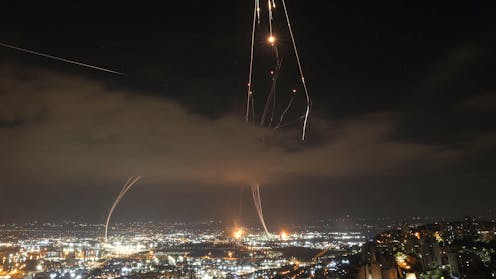
    Israeli defence systems intercept Iranian missiles over the city of Haifa Ahmad Gharabli / AFP via Getty Images

    Late last week, Israel began a wave of attacks on Iran under the banner of Operation Rising Lion, with the stated goal of crippling the Islamic republic’s nuclear program and long-range strike capabilities. At the outset, Israel claimed Iran would soon be able to build nine nuclear weapons, a situation Israel regarded as completely unacceptable.

    Following Israeli strikes against Iranian nuclear facilities, and targeted assassinations of Iranian nuclear scientists and key members of the Iranian armed forces, Iran retaliated with a large barrage of ballistic missiles and drones against Tel Aviv and Jerusalem. The first wave consisted of some 200 ballistic missiles and 200 drones.

    The conflict continues to escalate, with population centres increasingly being targeted. Israel’s missile defence systems (including the vaunted Iron Dome) have so far staved off most of Iran’s attacks, but the future is uncertain.

    Ballistic missiles and how to stop them

    Iran possesses a large arsenal of ballistic missiles and long-range drones, alongside other long-range weapons such as cruise missiles. Ballistic missiles travel on a largely fixed path steered by gravity, while cruise missiles can adjust their course as they fly.

    Iran is approximately 1,000km from Israel, so the current strikes mostly involve what are classified as medium-range ballistic missiles, alongside long-range drones. It is not clear exactly what type of missile Iran has used in its latest strikes, but the country has several including the Fattah-1 and Emad.

    It is very difficult to defend against ballistic missiles. There is not much time between launch and impact, and they come down at very high speed. The longer the missile’s range, the faster and higher it flies.

    An incoming missile presents a small, fast-moving target – and defenders may have little time to react.

    Israel’s missile defence and the Iron Dome

    Israel possesses arguably one of the most effective, battle-tested air defence systems in service today. The system is often described in the media as the “Iron Dome”, but this is not quite correct.

    Israel’s defences have several layers, each designed to address threats coming from different ranges.

    Iron Dome is just one of these layers: a short range, anti-artillery defence system, designed to intercept short-range artillery shells and rockets.

    In essence, Iron Dome consists of a network of radar emitters, command and control facilities, and the interceptors (special surface-to-air missiles). The radar quickly detects incoming threats, the command and control elements decide which are most pressing, and the interceptors are sent to destroy the incoming shells or rockets.

    Ballistic defence systems

    The other layers of Israel’s defence system include David’s Sling, and the Arrow 2 and Arrow 3 interceptors. These are specifically designed to engage longer-range ballistic missiles, both within the atmosphere and at very high altitudes above it (known as exoatmospheric interception).

    Spectacular footage has been captured of what are likely exoatmospheric interceptions taking place during this latest conflict, demonstrating Israel’s capacity to engage longer-range missiles.

    The US military has comparable missile defence systems. The US Army has the Patriot PAC-3 (comparable to David’s Sling) and THAAD (comparable to Arrow 2), while the US Navy has the Aegis and the SM-3 (comparable to Arrow 3) and the SM-6 (comparable again to Arrow 2).

    The US deployed Aegis-equipped warships to support Israel’s defence against missile attacks in 2024, and appears to be preparing to do the same now.

    Iran possesses some air defence systems such as the Russian S300 which has some (very limited) ballistic missile defence capabilities, but only against shorter range (and thus slower) ballistic missiles. Further, Israel has been focusing on degrading Iran’s air defences, so it is not clear how many are still operational.

    Iran has been focusing on developing technology such as maneuverable warheads, which are harder to defend against. However, it is not clear whether these are yet operational and in Iranian service.

    Can missile defences last forever?

    Missile defences are finite. The defender is always limited by the number of interceptors it possesses.

    The attacker is also limited by the number of missiles it possesses. However, the defender must often assign multiple interceptors to each attacking missile, in case the first misses or otherwise fails.

    The attacker will plan for some losses to interceptors (or mechanical failures) and send what it determines to be enough missiles for at least some to penetrate the defences.

    When it comes to ballistic missiles, the advantage lies with the attacker. Ballistic missiles can carry large explosive payloads (or even nuclear warheads), so even a handful of missiles “leaking” past defensive systems can still wreak significant damage.

    What now?

    Israel’s missile defences are unlikely to stop working completely. However, as attacks deplete its stocks of interceptors, the system may become less effective.

    As the conflict continues, it may become a race to see who runs out of weapons first. Will it be Iran’s stocks of ballistic missiles and drones, or the interceptors and anti-air munitions of Israel, the US and any other supporters?

    It is impossible to say who would prevail in such a race of stockpile attrition. Some reports suggest Iran has fired approximately 1,000 ballistic missiles of an estimated 3,000. However, this still leaves it with an enormous stockpile to use, and it is unclear how fast Iran can make new missiles to replenish its resources.

    But we should hope it doesn’t come to that. Beyond the tit-for-tat exchange of missiles, the latest conflict between Israel and Iran risks escalating. If it is not resolved soon, and if the US is drawn into the conflict more directly, we may see broader conflict in the Middle East.

    The Conversation

    James Dwyer does not work for, consult, own shares in or receive funding from any company or organisation that would benefit from this article, and has disclosed no relevant affiliations beyond their academic appointment.

    ref. How does Israel’s famous air defence work? It’s not just the ‘Iron Dome’ – https://theconversation.com/how-does-israels-famous-air-defence-work-its-not-just-the-iron-dome-259029

    MIL OSI AnalysisEveningReport.nz

  • MIL-OSI China: Russell wins F1 Canadian GP as Norris-Piastri clash shakes up title fight

    Source: People’s Republic of China – State Council News

    George Russell claimed Mercedes’ first win of the season with a commanding drive from pole position in Montreal, but the biggest drama came behind as McLaren teammates and title rivals Lando Norris and Oscar Piastri collided late in the race.

    The contact occurred on lap 67 of 70 as Norris attempted to overtake Piastri for fourth. The Briton misjudged a move on the pit straight and ran into the back of the Australian’s car.

    Mercedes’s British driver George Russell competes during the qualifying session of the Formula One Canadian Grand Prix 2025 at the Circuit Gilles Villeneuve in Montreal, Canada, June 14, 2025. (Photo by Song Haiyuan/Xinhua)

    Norris retired on the spot with front suspension damage, while Piastri continued to finish fourth behind Russell, Red Bull’s Max Verstappen and the second Mercedes of Kimi Antonelli. The race ended under the safety car.

    Norris immediately took full responsibility over team radio: “It’s all my bad, all my fault. Unlucky, sorry. Stupid from me.”

    The incident, reminiscent of Lewis Hamilton and Jenson Button’s infamous clash at the same point in 2011, dealt a blow to Norris’ title challenge. Piastri’s points lead over his teammate now stands at 22 points, with Verstappen a further 21 points behind.

    Until the clash, Norris had run a good race from seventh on the grid on an inverted tyre strategy. Having gained on Piastri, the Briton surprised his teammate on lap 66 with a pass into the hairpin, but Piastri regained the position with a cut-back down the straight.

    As Norris aimed to slingshot past on the pit straight, he ran out of room and his front wing broke against the rear of Piastri’s car.

    While McLaren were left to rue the first clash between their two drivers this season, Russell delivered a composed and clinical performance out front.

    Having taken a surprise pole position in Saturday’s qualifying session, he converted it into victory with a strong start and controlled the pace throughout the afternoon. Despite closing the gap in the closing laps, Verstappen never truly threatened.

    Mercedes, however, may face a post-race protest from Red Bull, who allege Russell drove erratically under the safety car.

    Behind them, 18-year-old Antonelli secured his maiden F1 podium in just his tenth Grand Prix. The Italian overtook Piastri for third on the opening lap and showed maturity in defending the final podium place before Norris’ crash neutralized the race.

    Ferrari endured a frustrating day. Charles Leclerc finished a distant fifth after publicly questioning the team’s strategy to make two pit stops instead of just one. Teammate Hamilton finished a low-key sixth, although the Briton’s pace was affected by an early collision with a groundhog, which damaged his floor and cost him some downforce.

    Fernando Alonso continued Aston Martin’s mini-revival with a solid seventh place, followed by Nico Hulkenberg’s Sauber in eighth. Esteban Ocon secured ninth for Haas, and Carlos Sainz took the final point after executing a well-managed one-stop strategy.

    The 11th round of the 2025 Formula 1 season is the Austrian Grand Prix at the Red Bull Ring, where Russell won last year after Norris and Verstappen clashed while battling for the lead. 

    MIL OSI China News

  • MIL-Evening Report: The historic High Seas Treaty is almost reality. Here’s what it would mean for ocean conservation

    Source: The Conversation (Au and NZ) – By Sarah Lothian, Senior Lecturer in Maritime Law and Academic Barrister, University of Wollongong

    J Nel/Shutterstock

    The high seas are set to gain a greater level of protection when a long-sought after treaty finally enters into force.

    For almost 20 years, nations have debated the need for the High Seas Treaty, intended to protect marine life in the high seas and the international seabed. These marine areas together account for nearly two-thirds of the world’s ocean and harbour a rich array of unique species and ecosystems. The treaty is formally known as the Biodiversity Beyond National Jurisdiction Agreement.

    Many hoped last week’s United Nations Oceans Conference would result in enough nations ratifying the treaty to bring it into force. As of today, 50 states of the 60 required have done so, while another 19 have promised to do so by the year’s end. A greater level of protection for our high seas is well and truly in sight.

    By United Nations standards, this is a cracking pace. The treaty-making process itself can take years, particularly as states need to incorporate the treaty into their domestic laws. This speaks to the urgency of the moment. Researchers and authorities have warned that the world’s oceans are now in deep trouble, threatened by climate change effects, overfishing, plastic pollution and other human-caused issues.

    Once the treaty enters into force, nations can begin to propose high seas marine protected areas, which could limit fishing and other activities. The question then will be how to police these marine protected areas.

    How did we get here?

    In June 2023, the High Seas Treaty was adopted by consensus at the UN Headquarters in New York. It was a long time coming.

    For decades, nations argued and negotiated over what this treaty might look like. How could the marine genetic resources of this global commons be shared fairly and equitably? How could protected areas be designated and managed? What was eventually thrashed out was a comprehensive international legal framework able to better protect and safeguard the rich and diverse web of life inhabiting the deep sea.

    Getting to this point was a real achievement.

    But for this treaty to enter into force, 60 countries have to ratify it. This means their governments must consent to be legally bound by the terms of the treaty.

    While Australia has pledged to ratify the treaty, it is still working through the ratification and domestic legal process. On a positive note, Environment Minister Murray Watt has indicated this will happen before the end of the year.

    What will the treaty actually do?

    At present, the high seas are regulated by a patchwork of global, regional and sectoral frameworks, instruments and bodies. However, none of these have a core mandate of protecting the biodiversity of the oceans.

    In 1982, the Law of the Sea Convention was adopted, giving every coastal nation rights over the waters extending to 200 nautical miles (370 kilometres) from their coastline.

    Once you are past this, you’re in the high seas – the swathes of ocean not controlled by any one nation.

    If and when it comes into effect, the High Seas Treaty would give the world a way to set up large marine protected areas in the high seas. It would also apply to the international seabed – the seabed, subsoils and ocean floor lying beyond the continental shelf of a coastal state.

    Any new protected areas would likely have restrictions on activities such as fishing and shipping. But this will need to be done in consultation with relevant international bodies such as the International Maritime Organisation and regional fisheries management organisations.

    The treaty would go a long way to reaching key conservation goals set under the 2022 Kunming-Montreal Biodiversity Pact, which calls for protection of at least 30% of the world’s marine and coastal habitats by 2030.

    The treaty also sets up a mechanism for the sharing of benefits from marine genetic resources, financial and otherwise. Bacteria living in deep-sea ecosystems have attracted much scientific and commercial attention for potential use in medical research or pharmaceutical, cosmetics and food industries. Genetic resources from sea sponges have given rise to antiviral drugs targeting COVID and HIV as well as anti-cancer drugs.

    These resources were a major sticking point during the long negotiations.

    Many coastal countries lack the ability to participate in high seas research. As a result, they can miss out on these and other benefits. The High Seas Treaty recognises this and sets up a strong framework for capacity-building, technology transfer and technical assistance for developing nations.

    As nations fish out their territorial waters, some send fishing boats into the unregulated high seas.
    Richard Whitcombe/Shutterstock

    When will the oceans get a reprieve?

    Once the 60th nation ratifies the High Seas Treaty, it will enter into force 120 days later. This date could be as soon as May 1 next year, if the threshold is reached on January 1.

    Once this happens, this will be the date upon which the treaty gains legal force, meaning nations will have to comply with its obligations.

    That doesn’t mean huge new marine parks will come into being. There’s still much work to do to hash out the mechanics of how the treaty would actually work, how it would be overseen and how it would work with the International Seabed Authority which oversees deep-sea mining and the Antarctic Treaty System, among others. Negotiators face more work ahead to solve these outstanding issues before the real work can begin.

    That’s not to diminish this achievement. The progress on this treaty has been very hard won. Once it’s in effect, it will make a concrete difference.

    Sarah Lothian does not work for, consult, own shares in or receive funding from any company or organisation that would benefit from this article, and has disclosed no relevant affiliations beyond their academic appointment.

    ref. The historic High Seas Treaty is almost reality. Here’s what it would mean for ocean conservation – https://theconversation.com/the-historic-high-seas-treaty-is-almost-reality-heres-what-it-would-mean-for-ocean-conservation-258710

    MIL OSI AnalysisEveningReport.nz

  • MIL-Evening Report: The Australian government has launched a new strategy to boost vaccination rates. Will it work?

    Source: The Conversation (Au and NZ) – By Jessica Kaufman, Research Fellow, Vaccine Uptake Group, Murdoch Children’s Research Institute

    South_agency/Getty Images

    Last week, the Australian government announced a new National Immunisation Strategy for 2025–30. This strategy sets out the government’s priorities for improving vaccine uptake for children, adolescents and adults over the next five years.

    It comes at an important moment. Childhood vaccination coverage has been declining consistently since 2020.

    So what are the key goals of this new strategy, and will it be able to reverse the drop in vaccination rates among Australian children?

    Declining vaccination coverage since the pandemic

    While overall vaccination coverage remains high by global standards – at 92% for one-year-olds – this is down from a high of nearly 95% in 2020. The reasons for the drop include access challenges and concerns among some parents about vaccine safety and effectiveness.

    Many children are missing out on timely vaccines that prevent diseases such as whooping cough and meningitis. Aboriginal and Torres Strait Islander children, who also have lower vaccination coverage rates at one and two years old, bear a disproportionate burden of these diseases.

    And it’s not just children missing out. Among adolescents, HPV coverage at age 15 has dropped by 5% in girls (down to 81%) and 7% in boys (down to 78%) since 2020.

    Influenza vaccination coverage has declined year on year since 2022 and remains at very low levels. Coverage in 2024 was 62% for people aged 65 and older, and under 30% for the rest of the population.

    Across six key priority areas, the new immunisation strategy seeks to reduce vaccine hesitancy and improve access to vaccinations, particularly in priority groups such as Aboriginal and Torres Strait Islander communities. A few key points stood out to us.

    The National Immunisation Strategy has six key priority areas.
    CC BY

    1. Emphasis on trust and community engagement

    We need to strengthen trust in vaccines and the people and systems that deliver them because low levels of trust are associated with vaccine scepticism and refusal. Even though Australians’ trust in childhood vaccines is generally high, there have been some bumps in recent years.

    The pandemic left some people with lingering questions and misperceptions about vaccines, supercharged by misinformation and increasing political polarisation of vaccination.

    The strategy rightly emphasises the need to engage with communities and build trust in vaccination and the health system.

    However, relationships with communities can’t be stood up at a moment’s notice – they take time and effort to sustain. State and federal governments invested in these relationships with diverse communities during the COVID vaccine rollout, but many of these initiatives have since been dissolved due to lack of sustained funding and commitment.

    Recently, there have been positive indications some governments are reinvesting in these efforts. Hopefully this strategy will encourage more to do the same.

    2. Addressing equity and access

    Too often government leaders and media headlines blame individual laziness or hesitancy for our uptake problems, failing to acknowledge the very real problems with service convenience and access that are also present.

    The strategy makes clear that the government and immunisation service providers should make vaccination accessible and equitable. As a part of this commitment, it highlights the importance of ensuring all health-care professionals who are able to deliver vaccines are being utilised to their full potential.

    Pharmacists are specifically mentioned, but there is no reference to the largest group of immunisation providers: nurses. They should be better recognised and we need reform to enable nurses to vaccinate more independently.

    3. Recognising the importance of data

    When vaccination rates are low, it’s essential to know why. This comes from both talking with communities and collecting robust data.

    We are part of the National Vaccination Insights project, which carries out yearly monitoring using surveys and interviews with the public to better understand the drivers of vaccine uptake.

    The strategy proposes a live dashboard of vaccine uptake data, which would be valuable, but we also encourage the addition of social and behavioural data. The dashboard should also report rates of vaccination in pregnancy. This information is newly available, thanks to the recent addition of a field to record pregnancy status in the Australian Immunisation Register.

    4. Commitment to consider vaccine injury compensation

    Maintaining trust in vaccination means being able to acknowledge when vaccines can very occasionally cause harm. People tend to be more confident in vaccines when you tell them what to expect, what the common minor side effects are, as well as the rare serious ones.

    When those rare serious side effects become a reality for a handful of people, they may have to take time off work, incur medical expenses, and very occasionally, manage long-term complications. So it’s essential these people are financially compensated by government.

    We had such a compensation scheme during the pandemic for COVID vaccines, but this ended in September 2024. We welcome the government’s plan to explore whether establishing a compensation scheme is feasible for all vaccines on the national program.

    A comprehensive no-fault vaccine injury compensation scheme is overdue and, with thoughtful and consultative planning, would make our already robust vaccination system more trustworthy.

    Where to from here?

    The new national immunisation strategy is comprehensive and informed by evidence. But its impact will ultimately come down to its funding and implementation, which are not described in this document. Finalising these key plans and putting them into action must happen soon to arrest declining vaccination coverage and keep people well protected from serious diseases.

    Jessica Kaufman receives funding from the NHMRC, MRFF, Australian government, Victorian government, and UNICEF. She is a member of the Collaboration on Social Science and Immunisation (COSSI).

    Julie Leask receives funding from NHMRC, WHO, US CDC, NSW Ministry of Health. She received funding from Sanofi for travel to an overseas meeting in 2024.

    ref. The Australian government has launched a new strategy to boost vaccination rates. Will it work? – https://theconversation.com/the-australian-government-has-launched-a-new-strategy-to-boost-vaccination-rates-will-it-work-258808

    MIL OSI AnalysisEveningReport.nz

  • MIL-OSI Australia: Small business pool calculations

    Source: New places to play in Gungahlin

    Small business depreciation pool

    If you choose to use the simplified depreciation rules, any depreciating assets for which you can’t claim an immediate deduction under instant asset write-off or temporary full expensing, are allocated to a small business depreciation pool.

    This includes assets that:

    • cost the same as, or more than, the instant asset write-off limit amount.
    • you held before you used the simplified depreciation rules (other than excluded assets).

    You claim:

    • a 15% deduction for these assets in the year they are allocated to the pool (regardless of when the asset was purchased during the year).

    For certain new assets of $150,000 or more first held from 12 March 2020 to 7:30 pm AEDT 6 October 2020, you can use an accelerated depreciation rate of 57.5% under Backing business investment – accelerated depreciation when you first add them to the pool.

    Low pool value – instant asset write-off

    If the balance of the small business pool (after applying the following adjustments) is less than the instant asset write-off limit, you can immediately write off the entire pool balance and claim the amount as a deduction. However, for income years ending between 7:30 pm AEDT on 6 October 2020 and 30 June 2023, you deduct the entire balance of the small business pool (there is no limit for that period).

    These steps show what you need to do when using a small business pool:

    1. Start with the opening balance for the current year.
    2. Add the business portion of the adjustable value of assets you acquired and started to use in the current year.
    3. Add the business portion of cost additions to the pool in the current year.
    4. Subtract the business portion of proceeds (including insurance payouts) of any assets disposed of in the current year.

    Example 1: pool balance under the instant asset write-off limit

    Having purchased a car for $18,000 on 2 August 2023, Brendan estimates that it is used 50% for business purposes. As the cost of the car is under the relevant instant asset write-off limit (that is $20,000), Brendan writes it off in the year that it was first used or installed ready for use. His deduction is $9,000 as he only claims for the proportion the asset is used in earning income.

    If the purchase price of the car was $28,000 and Brendan estimated the car would be used 50% in his business, he would place $14,000 for the car in his small business pool and depreciate 15% in the first year. The asset is still placed in the small business pool because the cost of the asset before determining the business portion exceeded the relevant instant asset limit.

    End of example

    Example 2: simplified depreciation – small business pool for 2018–19 income year

    Loretta bought a trailer for her event management business on 1 December 2018 for $15,000 and a second larger trailer on 2 February 2019 for $28,000. She also sold an old trailer that was previously in her small business pool for $8,000. Loretta had an opening pool balance of $100,000 from the previous year.

    Loretta will:

    • immediately write-off the cost of the first $15,000 trailer (as it is under the $20,000 instant asset write-off limit which applied at the time she purchased and started to use the trailer)
    • calculate her depreciation deduction for pool assets by
      • adding the cost of the $28,000 larger trailer to her small business pool (as it is over the $25,000 limit which applied at the time she purchased and started to use the larger trailer).
      • deduct the $8,000 received from the sale of the old trailer from her small business pool.

    Table 1: Calculation of small business pool balance for 2018–19 income year.

    Table 1: Calculation of small business pool balance for 2018–19 income year.

    Calculation item

    Pool balance

    Depreciation claim

    Closing pool balance from previous year

    $100,000

    n/a

    Opening pool balance for current year

    $100,000

    n/a

    Add: New asset purchase

    $28,000

    n/a

    Subtotal

    $128,000

    n/a

    Less: Proceeds of asset sale or disposal

    −$8,000

    n/a

    Subtotal

    $120,000

    n/a

    Pool deduction claim (30% of $100,000)

    −$30,000

    $30,000

    Subtotal

    $90,000

    n/a

    New asset deduction claim (15% of $28,000)

    −$4,200

    $4,200

    Total depreciation for current year

    n/a

    $34,200

    Closing pool balance for current year

    $85,800

    n/a

    Opening pool balance for next year

    $85,800

    n/a

    Loretta’s depreciation claim for the 2018–19 income year is:

    • deduction for instant asset write-off: $15,000
    • deduction for small business pool: $34,200.

    Loretta’s closing pool balance for the year is $85,800. This will be her opening pool balance for next year.

    Figures exclude GST.

    End of example

    Example 3: simplified depreciation – small business pool for 2019–20 income year

    Loretta bought a new car to use for her business on 15 January 2020 for $33,000. The car was delivered on 31 January 2020. Loretta can’t immediately write off the cost of the car as the limit was $30,000 at the time she started to use the car. She needs to allocate the car to her small business pool.

    Loretta’s 2019–20 income year ends 30 June 2020. Calculation of small business pool balance for 2019–20 income year.

    Table 2: Calculation of small business pool balance

    Calculation item

    Pool balance

    Depreciation claim

    Closing pool balance from previous year

    $85,800

    n/a

    Opening pool balance for current year

    $85,800

    n/a

    Add: New asset purchase – car

    $33,000

    n/a

    Subtotal

    $118,800

    n/a

    Before applying the depreciation deductions, the balance of the pool at the end of income year is $118,800. From 12 March 2020, the instant asset write-off limit increased to $150,000. As the balance of the pool is less than the limit at the end of the income year, Loretta will write off the entire pool balance in her 2019–20 income tax return.

    Loretta’s closing pool balance for the year is $0.

    Figures exclude GST.

    End of example

    Calculating pool events

    These steps show what you need to do when using a small business pool.

    Step 1: Work out your opening balance

    If you’ve been using the simplified depreciation rules, the opening balance of your small business pool for the current year is the closing balance from the previous year.

    For the year in which you first start using these rules you need to work out the opening balance of the small business pool. To do this you need to work out:

    • the value of your assets (adjustable value) – that is, the cost of each asset (excluding any GST paid if you’re registered for GST), including improvements, less how much it has depreciated since you first started using it, regardless of whether the use was private or business
    • the proportion used to earn assessable income (taxable purpose proportion) – that is, the estimated percentage of use of the asset in earning assessable income (as against private use).

    For each asset, the amount you include in the small business pool is:

    Adjustable value × taxable purpose proportion

    Example 4: calculating the opening balance

    Before using the simplified depreciation rules, Fiona held the following depreciating assets that she used in her business in 2014. All of these needed to be placed into her small business pool. She calculated the amount to include as follows:

    • a station wagon with an opening adjustable value of $38,000 (which Fiona estimated she uses 70% of the time in her business), for which she calculated the amount to include in the pool as $38,000 × 70% = $26,600
    • a computer with an opening adjustable value of $3,000 (which Fiona estimates she used 70% of the time in her business), for which she calculated the amount to include in the pool as $3,000 × 70% = $2,100
    • a refrigerated cabinet with an opening adjustable value of $1,500 (which Fiona used solely for the business), for which she calculated the amount to include in the pool as $1,500 × 100% = $1,500.

    These assets were allocated to the small business pool, with an opening balance of $30,200.

    As they were depreciating assets used in the business in a previous income year, they were included in the opening pool balance and depreciated at a rate of 30% of the taxable purpose proportion of their adjustable value.

    End of example

    Step 2: New assets and cost additions

    Add any new or second-hand assets you acquired during the current income year at a cost equal to or above the instant asset write-off limit, and any cost addition amounts to existing assets.

    Cost addition amounts are:

    • amounts you’ve spent on improving the assets
      • the improvement amounts added to the pool need to have the same taxable purpose proportion applied as that applied to the asset
      • if you made the improvements to the asset in the same income year that you acquired it, the amount simply becomes part of the original cost of the asset
      • improvement costs that are under the instant asset write-off limit are immediately written-off if they apply to an asset that had been written-off in a previous year, with any further improvements placed into the small business pool
    • costs incurred when disposing of, or permanently ceasing to use, an asset (including advertising and commission costs or the costs of demolishing the asset).

    Note: You don’t add to your small business pool:

    • assets that you purchased and first used, or had installed ready for use, for a taxable purpose between 7:30 pm AEDT 6 October 2020 and 30 June 2023. You can claim an immediate deduction for the business cost of these assets
    • the cost of improvements made from 7:30 pm AEDT on 6 October 2020 to 30 June 2023 to an asset that you have written off under the simplified depreciation rules (including instant asset write-off) in an earlier income year, provided you have not previously claimed improvement costs to the asset. You can claim an immediate deduction for the business portion of the improvement cost and no limit applies. Any later improvements are added to the small business pool.

    Example 5: improving your assets

    You purchased a car for $15,000 that you estimate is used 50% in your business in the last income year and claimed $7,500 as an instant asset write-off deduction.

    This year you added a tow ball to the car for $300 so you can use a trailer to move around stock in your business. You instantly write-off the tow ball as it falls under the instant asset write-off limit, but you can only claim $150 (50%), as the claim is limited to the proportion of the original asset that is used in earning assessable income.

    End of example

    Step 3: Asset sales and disposals

    If you’ve sold or ceased to use an asset in the current income year, you need to reduce your pool balance by the asset’s termination value multiplied by the taxable use proportion.

    The termination value could be money you received from selling an asset (including by way of trade-in), or the insurance payout you received as the result of its loss or destruction.

    If you used the asset 100% for business, reduce the pool balance by the whole termination value.

    If the asset had a portion of private use, reduce the pool balance using the following formula:

    Termination value × Taxable purpose proportion

    If the value of the small business pool is less than the instant asset write-off limit after you’ve made adjustments for any acquisitions, sales or disposals, and before calculating any depreciation deductions for the pool as a whole, the whole small business pool balance must be written-off in that year.

    You deduct the balance of the small business pool at the end of an income year ending between 6 October 2020 and 30 June 2023. The pool’s closing balance for the income year is zero after full expensing.

    If you’re transferring assets to another entity as part of a business restructure, you may be entitled to rollover relief, under which you don’t subtract the termination values of the depreciating assets from the closing balance of the small business pool.

    Assessable income adjustment

    If you’ve sold or disposed of an asset, you may also need to include an amount in your assessable income to allow for any excess between what you receive for the asset over what you’ve claimed as a depreciation deduction – as follows:

    • If you sell or otherwise dispose of an asset that has previously been fully written off, you also need to include its termination value multiplied by its taxable purpose proportion in your assessable income.
    • If you sell or otherwise dispose of an asset that formed part of a low pool value that has been previously written-off, you need to subtract the taxable purpose proportion of the asset’s termination value in calculating the closing pool balance. If the balance (after acquisitions, cost additions and this adjustment) results in a negative amount, this amount must be included in your assessable income, and the pool’s closing balance becomes zero.
    • If you sell or otherwise dispose of an asset that has not been fully written-off, you subtract the taxable purpose proportion of the proceeds of the disposal from the pool balance, and if the result after acquisitions and cost additions is
      • equal to or more than the instant asset write-off limit, the amount is the pool’s closing balance
      • less than the instant asset write-off limit but more than zero, the amount is claimed as a deduction and the closing balance becomes zero
      • negative, the amount less than zero is included in your assessable income.

    Note: You deduct the balance of the small business pool at the end of an income year ending between 6 October 2020 and 30 June 2023. The pool’s closing balance for the income year is zero after full expensing.

    You don’t incur a capital gains liability for the disposal of a depreciating asset that you’ve depreciated under the simplified depreciation rules.

    Example 6: disposing assets

    During the 2023–24 income year, Fiona disposes of the following assets:

    • Her old refrigerated cabinet, sold for $1,000 on 1 April 2024 with the full amount included in her small business pool as this asset was used solely in her business.
    • Her station wagon, traded in for $10,000 on a new delivery van on 1 May 2024 – the station wagon was used 70% for business purposes, so the formula she uses is the termination value by the taxable purpose proportion ($10,000 × 70% = $7,000).

    Fiona must reduce the closing pool balance for the 2023–24 income year by $8,000 as a result of the sale of these assets.

    End of example

    Asset disposal where business use has changed

    If you dispose of an asset and there has been a change in how much it was used in your business during the time it was in your small business pool, you must also adjust the taxable purpose proportion of the asset’s termination value. You work out the average proportion (taxable purpose proportion) you used the asset in your business during the income years in which the asset was in the pool.

    Example 7: adjusting the value of a disposed asset

    Maria added her car to the pool in 2016–17 and used it 60% for business. She increased her business use of her car from 75% to 90% in the 2018–19 income year. She sold her car for $3,000 at the start of the 2019–20 income year.

    Maria must average the estimate of her business use of the car for the year in which it was allocated to the pool and the next 3 years, as follows:

    • 60% (2016–17 original estimate) business use
    • 75% (2017–18 estimate) business use
    • 90% (2018–19 estimate) business use
    • 90% (2019–20, no change from previous year) business use.

    The average for business use is 79% = (60% + 75% + 90% + 90%) ÷ 4.

    The taxable purpose proportion of the car’s termination value is the termination value by the average business use:

    $3,000 × 79% = $2,370.

    Maria reduces the closing pool balance for the disposal of the car by $2,370.

    End of example

    Step 4: Work out your deduction

    If the balance of the pool before calculating your deduction for the year is below the instant asset write-off limit, the pool is written off immediately (see Step 3: Asset sales and disposals).

    If not, your deduction for simplified depreciation may include amounts for the following:

    Existing assets

    After calculating your opening pool balance in step one, work out your pool deduction using the following formula:

    Opening pool balance × 30% (pool rate)

    Newly acquired pooled assets (including second-hand assets)

    Assets that have been acquired during the year and added to the small business pool are depreciated at 15%. This applies regardless of when during the year you acquired the asset.

    Work out the deduction as:

    Taxable purpose proportion × Adjustable value × 15%

    Note: Assets that are immediately written-off don’t form part of your small business pool.

    Example 8: calculating pool deductions

    During the period from 1 December 2014 to 12 May 2015 when the instant asset write-off limit was $1,000 Fiona acquired the following assets:

    • a photocopier/fax, acquired in December 2014, which she estimates was used 90% of the time in her business, so the value is calculated as $7,700 × 90% = $6,930
    • a new refrigerated cabinet to replace the old one, acquired on 1 April 2015 at a cost of $9,000, to be used exclusively in the business, so the value is calculated as $9,000 × 100% = $9,000
    • a delivery van, acquired on 1 May 2015 at a cost of $20,000, which she estimates will be used 70% of the time in her business, so the value is calculated as $20,000 × 70% = $14,000.
    Table 3: Newly acquired assets

    Asset

    Adjustable value ($)

    % used in the business

    Amount added to pool ($)

    Photocopier/fax

    7,700

    90

    6,930

    New refrigerated cabinet

    9,000

    100

    9,000

    Delivery van

    20,000

    70

    14,000

    Total of pooled assets added during the year

    n/a

    n/a

    $29,930

    If Fiona acquired and started to use the above assets in the 2016–17 or 2017–18 income years, or between 1 July 2018 and 28 January 2019 when the instant asset limit increased to $20,000, the business use portion of the:

    • photocopier/fax and refrigerator are immediately written off
    • van is moved to the small business pool.

    If Fiona acquired and started to use the above assets from 29 January 2019, when the instant asset limit increased to $25,000 then all of the business use portion of assets could be immediately written off.

    End of example

    Cost addition amounts

    If you made improvements to an asset allocated to your small business pool in an earlier income year, or you have costs associated with the disposal of an asset (see Step 3: Asset sales and disposals) you:

    • apply the taxable purpose proportion of the existing asset to the improvement or disposal cost
    • deduct the cost of improving the asset in the year the improvement is made, at the rate of 15%.

    Step 5: Work out the closing pool balance

    The closing pool balance takes into account any:

    • pooled assets you installed or first used during the year
    • pooled assets you disposed of during the year
    • improvements you made, or cost addition amounts you incurred, in the current year to assets you held or installed ready to use in an earlier year
    • deductions allowed for pooled assets.

    Use the following worksheet to work out the closing pool balance at the end of each income year. The calculations will also need to consider the taxable purpose proportion of the assets.

    Table 4: Closing pool balance worksheet

    Worksheet item

    Value ($)

    Indicator

    Opening pool balance for the year

    $

    A

    Plus

    Adjustable value of new assets that you first used, or installed ready to use, during the year (not including assets immediately written-off)

    $

    B

    Plus

    Any cost addition amounts including improvements you made to assets in the pool during the year

    $

    C

    Less

    Taxable purpose proportion of the termination value of any pooled assets you disposed of (including assets that were sold) during the year

    $

    D

    Subtotal (A + B + C − D)

    $

    E

    Less

    Deduction allowed for assets you held at the start of the year

    $

    F

    Less

    Deduction allowed for new assets you first used during the year

    $

    G

    Less

    Deduction allowed for cost addition amounts including improvements you made to the pooled assets during the year

    $

    H

    Closing pool balance for the year (E − F − G − H)

    $

    Nil

    Example 9: calculating closing pool balance

    Table 5: Fiona works out her closing pool balance for the year as follows:

    Worksheet item

    Value ($)

    Indicator

    Opening pool balance for the year

    $30,200

    A

    Plus

    Newly acquired pooled assets. This does not include assets immediately written-off

    $29,930

    B

    Plus

    Cost addition amounts

    $350

    C

    Less

    Disposals

    $8,000

    D

    Subtotal (A + B + C − D)

    $52,480

    E

    Less

    Deduction for pooled assets opening balance

    $9,060

    F

    Less

    Deduction allowed for pooled assets you first used during the year

    $4,490

    G

    Less

    Deduction for cost addition amounts

    $53

    H

    Closing pool balance for the year (E – F – G – H)

    $38,877

    Nil

    End of example

    Opening pool balance

    The opening pool balance for an income year is the closing pool balance from the previous income year, except where you either:

    • changed the extent you use a pooled asset in your business
    • have assets that you started to use, or hold ready to use, since last choosing to use these rules.

    Adjusting for these circumstances will ensure that your pool deduction is based on the correct estimate of the value of all your assets and the taxable use proportion.

    MIL OSI News

  • MIL-OSI: Falcon Oil & Gas Ltd. – Another Stellar IP30 Flow Test Result in the Beetaloo

    Source: GlobeNewswire (MIL-OSI)

    Falcon Oil & Gas Ltd (“Falcon”).

    Another Stellar IP30 Flow Test Result in the Beetaloo

    16 June 2025 – Falcon Oil & Gas Ltd. (TSXV: FO, AIM: FOG) is pleased to announce that Shenandoah S2-2H ST1 (“SS-2H ST1”) achieved an average 30-day initial production (“IP30”) flow rate of 7.2 million cubic feet per day (“MMcf/d”) over 1,671-metres (5,483-foot) across a 35 stage stimulated length within the Amungee Member B-Shale in the Beetaloo Sub-basin, Northern Territory, Australia, making it the highest IP30 result in the Beetaloo to date.

    Points to note:

    • The normalized flow rate of 13.2 MMcf/d over an extrapolated 10,000-foot horizontal section is in-line with the average of more than 11,000 wells in the Marcellus Shale dry gas area on production over a 12-month period. The results demonstrate the commercial deliverability of gas from the Amungee Member B-Shale in the Australian East Coast gas market that typically sells at a premium to Henry Hub in the United States and under long term CPI-linked contracts.
    • The exit rate trajectory continues a steady, low-declining curve at 6.7 MMcf/d (normalized at 12.2 MMcf/d per 10,000-feet) with a flowing wellhead pressure of ~910 psi. The steady state decline curve on SS-2H ST1 is consistent with that achieved from the Shenandoah South 1H well (“SS-1H”).
    • For further details on the SS-2H ST1 flow test including a table, and charts please refer to Appendix A.

    Development activity

    • The Shenandoah South drilling campaign is planned to commence in July 2025, targeting up to three 10,000-foot horizontal wells and completed with up to 60 stimulation stages from the SS2 well pad. As previously announced, Falcon Oil & Gas Australia Limited (“Falcon Australia”) has opted to reduce its participating interest in the three wells to 0%.
    • Once completed, the five wells on the SS2 pad are planned to be tied into the Sturt Plateau Compression Facility (“SPCF”) to feed into a 40 MMcf/d take-or-pay Gas Sales Agreement (“GSA”) with the Northern Territory Government. Production remains on track to commence in mid-2026, subject to standard regulatory and stakeholder approvals and favourable weather conditions.
    • The Shenandoah South 4H (“SS-4H”) well is planned to be completed and flow tested by the end of 2025, with the remaining wells drilled in the 2025 campaign to be completed during 1H 2026.
    • Completion of the remaining four wells will incorporate lessons from the SS-1H and SS-2H ST1 wells.
    • The five wells are expected to deliver the required 40 MMcf/d volume under a binding take-or-pay agreement with the Northern Territory Government.

    Philip O’Quigley, CEO of Falcon commented:

    “The IP30 flow rate results announced today of 7.2 MMcf/d, are truly stellar and marks another major data point in the Beetaloo Sub-basin again demonstrating that it compares to the best shale wells in the United States. Not only did the results exceed Falcon’s pre-drill commercial threshold of a normalised flow rate of 3 MMcf/d per 1,000 metres but had similar flow rates and pressures to SS-1H and SS-2H ST1, which all point towards the significant resource potential of the Beetaloo.

    Falcon looks forward to the planned completion and testing of SS-4H by the end of 2025 and also to observing the results from the next three wells of the Shenandoah South drilling program and the additional milestones they will establish.

    As further results become available, we look forward to updating the market further”

    Ends.

    CONTACT DETAILS:

    Falcon Oil & Gas Ltd.          +353 1 676 8702
    Philip O’Quigley, CEO +353 87 814 7042
    Anne Flynn, CFO +353 1 676 9162
     
    Cavendish Capital Markets Limited (NOMAD & Broker)
    Neil McDonald / Adam Rae +44 131 220 9771


    This announcement has been reviewed by Dr. Gábor Bada, Falcon Oil & Gas Ltd’s Technical Advisor. Dr. Bada obtained his geology degree at the Eötvös L. University in Budapest, Hungary and his PhD at the Vrije Universiteit Amsterdam, the Netherlands. He is a member of AAPG.

    About Falcon Oil & Gas Ltd.
    Falcon Oil & Gas Ltd is an international oil & gas company engaged in the exploration and development of unconventional oil and gas assets, with the current portfolio focused in Australia. Falcon Oil & Gas Ltd is incorporated in British Columbia, Canada and headquartered in Dublin, Ireland.

    Falcon Oil & Gas Australia Limited is a c. 98% subsidiary of Falcon Oil & Gas Ltd.

    For further information on Falcon Oil & Gas Ltd. Please visit www.falconoilandgas.com

    About Beetaloo Joint Venture (EP 76, 98 and 117)   

    Company Interest
    Falcon Oil & Gas Australia Limited (Falcon Australia) 22.5%
    Tamboran (B2) Pty Limited (“Tamboran”) 77.5%
    Total 100.0%

    Shenandoah South Pilot Project -2 Drilling Space Units – 46,080 acres1

    Company Interest
    Falcon Oil & Gas Australia Limited (Falcon Australia) 5.0%
    Tamboran (B2) Pty Limited 95.0%
    Total 100.0%

    1Subject to the completion of SS4H wells on the Shenandoah South pad 2.

    About Tamboran (B2) Pty Limited
    Tamboran (B1) Pty Limited (“Tamboran B1”) is the 100% holder of Tamboran (B2) Pty Limited, with Tamboran B1 being a 50:50 joint venture between Tamboran Resources Corporation and Daly Waters Energy, LP.

    Tamboran Resources Corporation is a natural gas company listed on the NYSE (TBN) and ASX (TBN). Tamboran is focused on playing a constructive role in the global energy transition towards a lower carbon future, by developing the significant low CO2 gas resource within the Beetaloo Sub-basin through cutting-edge drilling and completion design technology as well as management’s experience in successfully commercialising unconventional shale in North America.

    Bryan Sheffield of Daly Waters Energy, LP is a highly successful investor and has made significant returns in the US unconventional energy sector in the past. He was Founder of Parsley Energy Inc. (“PE”), an independent unconventional oil and gas producer in the Permian Basin, Texas and previously served as its Chairman and CEO. PE was acquired for over US$7 billion by Pioneer Natural Resources Company.

    Appendix A – SS-2H ST1 Flow Test Details

    Note to reader: Please refer to the PDF attachment included at the end of this press release for further details including a table and charts related to the SS-2H ST1 flow test results

    Advisory regarding forward-looking statements
    Certain information in this press release may constitute forward-looking information. Any statements that are contained in this news release that are not statements of historical fact may be deemed to be forward-looking information. Forward-looking information typically contains statements with words such as “may”, “will”, “should”, “expect”, “intend”, “plan”, “anticipate”, “believe”, “estimate”, “projects”, “dependent”, “consider” “potential”, “scheduled”, “forecast”, “anticipated”, “outlook”, “budget”, “hope”, “suggest”, “support” “planned”, “approximately”, “potential” or the negative of those terms or similar words suggesting future outcomes. In particular, forward-looking information in this press release includes, details on the IP30 flow test results of SS-2H ST1 including assumptions that the results are in line with average of more than 11,000 wells in the Marcellus Shale dry gas area on production over a 12-month period and that they demonstrate the commercial deliverability of gas from the Amungee Member B-Shale in the Australian East Coast gas market that typically sells at a premium to Henry Hub in the United States and under long term CPI-linked contracts; consistency of the results of SS-2H ST1 with SS-1H; details on the planned three well drilling campaign including the plan to commence in July 2025 and to continue into 1H 2026; the plan to tie the wells to the SPCF under a GSA with the Northern Territory Government in mid-2026; the plan that SS-4H will be completed and flow tested by the end of 2025; the five wells drilled are expected to deliver the required 40 MMcf/d under a GSA with the Northern Territory Government;

    This information is based on current expectations that are subject to significant risks and uncertainties that are difficult to predict. The risks, assumptions and other factors that could influence actual results include risks associated with fluctuations in market prices for shale gas; risks related to the exploration, development and production of shale gas reserves; general economic, market and business conditions; substantial capital requirements; uncertainties inherent in estimating quantities of reserves and resources; extent of, and cost of compliance with, government laws and regulations and the effect of changes in such laws and regulations; the need to obtain regulatory approvals before development commences; environmental risks and hazards and the cost of compliance with environmental regulations; aboriginal claims; inherent risks and hazards with operations such as mechanical or pipe failure, cratering and other dangerous conditions; potential cost overruns, drilling wells is speculative, often involving significant costs that may be more than estimated and may not result in any discoveries; variations in foreign exchange rates; competition for capital, equipment, new leases, pipeline capacity and skilled personnel; the failure of the holder of licenses, leases and permits to meet requirements of such; changes in royalty regimes; failure to accurately estimate abandonment and reclamation costs; inaccurate estimates and assumptions by management and/or their joint venture partners; effectiveness of internal controls; the potential lack of available drilling equipment; failure to obtain or keep key personnel; title deficiencies; geo-political risks; and risk of litigation.

    Readers are cautioned that the foregoing list of important factors is not exhaustive and that these factors and risks are difficult to predict. Actual results might differ materially from results suggested in any forward-looking statements. Falcon assumes no obligation to update the forward-looking statements, or to update the reasons why actual results could differ from those reflected in the forward-looking statements unless and until required by securities laws applicable to Falcon. Additional information identifying risks and uncertainties is contained in Falcon’s filings with the Canadian securities regulators, which filings are available at www.sedarplus.com, including under “Risk Factors” in the Annual Information Form.

    Any references in this news release to initial production rates are useful in confirming the presence of hydrocarbons; however, such rates are not determinative of the rates at which such wells will continue production and decline thereafter and are not necessarily indicative of long-term performance or ultimate recovery. While encouraging, readers are cautioned not to place reliance on such rates in calculating the aggregate production for Falcon. Such rates are based on field estimates and may be based on limited data available at this time.

    Neither the TSX Venture Exchange nor its Regulation Services Provider (as that term is defined in the policies of the TSX Venture Exchange) accepts responsibility for the adequacy or accuracy of this release.

    The information communicated within this announcement is deemed to constitute inside information as stipulated under the Market Abuse Regulations (EU) No 596/2014 which is part of UK law by virtue of the European Union (Withdrawal) Act 2018. Upon publication of this announcement, this inside information is now considered to be in the public domain.

    Attachment

    The MIL Network

  • MIL-OSI: Falcon Oil & Gas Ltd. – Another Stellar IP30 Flow Test Result in the Beetaloo

    Source: GlobeNewswire (MIL-OSI)

    Falcon Oil & Gas Ltd (“Falcon”).

    Another Stellar IP30 Flow Test Result in the Beetaloo

    16 June 2025 – Falcon Oil & Gas Ltd. (TSXV: FO, AIM: FOG) is pleased to announce that Shenandoah S2-2H ST1 (“SS-2H ST1”) achieved an average 30-day initial production (“IP30”) flow rate of 7.2 million cubic feet per day (“MMcf/d”) over 1,671-metres (5,483-foot) across a 35 stage stimulated length within the Amungee Member B-Shale in the Beetaloo Sub-basin, Northern Territory, Australia, making it the highest IP30 result in the Beetaloo to date.

    Points to note:

    • The normalized flow rate of 13.2 MMcf/d over an extrapolated 10,000-foot horizontal section is in-line with the average of more than 11,000 wells in the Marcellus Shale dry gas area on production over a 12-month period. The results demonstrate the commercial deliverability of gas from the Amungee Member B-Shale in the Australian East Coast gas market that typically sells at a premium to Henry Hub in the United States and under long term CPI-linked contracts.
    • The exit rate trajectory continues a steady, low-declining curve at 6.7 MMcf/d (normalized at 12.2 MMcf/d per 10,000-feet) with a flowing wellhead pressure of ~910 psi. The steady state decline curve on SS-2H ST1 is consistent with that achieved from the Shenandoah South 1H well (“SS-1H”).
    • For further details on the SS-2H ST1 flow test including a table, and charts please refer to Appendix A.

    Development activity

    • The Shenandoah South drilling campaign is planned to commence in July 2025, targeting up to three 10,000-foot horizontal wells and completed with up to 60 stimulation stages from the SS2 well pad. As previously announced, Falcon Oil & Gas Australia Limited (“Falcon Australia”) has opted to reduce its participating interest in the three wells to 0%.
    • Once completed, the five wells on the SS2 pad are planned to be tied into the Sturt Plateau Compression Facility (“SPCF”) to feed into a 40 MMcf/d take-or-pay Gas Sales Agreement (“GSA”) with the Northern Territory Government. Production remains on track to commence in mid-2026, subject to standard regulatory and stakeholder approvals and favourable weather conditions.
    • The Shenandoah South 4H (“SS-4H”) well is planned to be completed and flow tested by the end of 2025, with the remaining wells drilled in the 2025 campaign to be completed during 1H 2026.
    • Completion of the remaining four wells will incorporate lessons from the SS-1H and SS-2H ST1 wells.
    • The five wells are expected to deliver the required 40 MMcf/d volume under a binding take-or-pay agreement with the Northern Territory Government.

    Philip O’Quigley, CEO of Falcon commented:

    “The IP30 flow rate results announced today of 7.2 MMcf/d, are truly stellar and marks another major data point in the Beetaloo Sub-basin again demonstrating that it compares to the best shale wells in the United States. Not only did the results exceed Falcon’s pre-drill commercial threshold of a normalised flow rate of 3 MMcf/d per 1,000 metres but had similar flow rates and pressures to SS-1H and SS-2H ST1, which all point towards the significant resource potential of the Beetaloo.

    Falcon looks forward to the planned completion and testing of SS-4H by the end of 2025 and also to observing the results from the next three wells of the Shenandoah South drilling program and the additional milestones they will establish.

    As further results become available, we look forward to updating the market further”

    Ends.

    CONTACT DETAILS:

    Falcon Oil & Gas Ltd.          +353 1 676 8702
    Philip O’Quigley, CEO +353 87 814 7042
    Anne Flynn, CFO +353 1 676 9162
     
    Cavendish Capital Markets Limited (NOMAD & Broker)
    Neil McDonald / Adam Rae +44 131 220 9771


    This announcement has been reviewed by Dr. Gábor Bada, Falcon Oil & Gas Ltd’s Technical Advisor. Dr. Bada obtained his geology degree at the Eötvös L. University in Budapest, Hungary and his PhD at the Vrije Universiteit Amsterdam, the Netherlands. He is a member of AAPG.

    About Falcon Oil & Gas Ltd.
    Falcon Oil & Gas Ltd is an international oil & gas company engaged in the exploration and development of unconventional oil and gas assets, with the current portfolio focused in Australia. Falcon Oil & Gas Ltd is incorporated in British Columbia, Canada and headquartered in Dublin, Ireland.

    Falcon Oil & Gas Australia Limited is a c. 98% subsidiary of Falcon Oil & Gas Ltd.

    For further information on Falcon Oil & Gas Ltd. Please visit www.falconoilandgas.com

    About Beetaloo Joint Venture (EP 76, 98 and 117)   

    Company Interest
    Falcon Oil & Gas Australia Limited (Falcon Australia) 22.5%
    Tamboran (B2) Pty Limited (“Tamboran”) 77.5%
    Total 100.0%

    Shenandoah South Pilot Project -2 Drilling Space Units – 46,080 acres1

    Company Interest
    Falcon Oil & Gas Australia Limited (Falcon Australia) 5.0%
    Tamboran (B2) Pty Limited 95.0%
    Total 100.0%

    1Subject to the completion of SS4H wells on the Shenandoah South pad 2.

    About Tamboran (B2) Pty Limited
    Tamboran (B1) Pty Limited (“Tamboran B1”) is the 100% holder of Tamboran (B2) Pty Limited, with Tamboran B1 being a 50:50 joint venture between Tamboran Resources Corporation and Daly Waters Energy, LP.

    Tamboran Resources Corporation is a natural gas company listed on the NYSE (TBN) and ASX (TBN). Tamboran is focused on playing a constructive role in the global energy transition towards a lower carbon future, by developing the significant low CO2 gas resource within the Beetaloo Sub-basin through cutting-edge drilling and completion design technology as well as management’s experience in successfully commercialising unconventional shale in North America.

    Bryan Sheffield of Daly Waters Energy, LP is a highly successful investor and has made significant returns in the US unconventional energy sector in the past. He was Founder of Parsley Energy Inc. (“PE”), an independent unconventional oil and gas producer in the Permian Basin, Texas and previously served as its Chairman and CEO. PE was acquired for over US$7 billion by Pioneer Natural Resources Company.

    Appendix A – SS-2H ST1 Flow Test Details

    Note to reader: Please refer to the PDF attachment included at the end of this press release for further details including a table and charts related to the SS-2H ST1 flow test results

    Advisory regarding forward-looking statements
    Certain information in this press release may constitute forward-looking information. Any statements that are contained in this news release that are not statements of historical fact may be deemed to be forward-looking information. Forward-looking information typically contains statements with words such as “may”, “will”, “should”, “expect”, “intend”, “plan”, “anticipate”, “believe”, “estimate”, “projects”, “dependent”, “consider” “potential”, “scheduled”, “forecast”, “anticipated”, “outlook”, “budget”, “hope”, “suggest”, “support” “planned”, “approximately”, “potential” or the negative of those terms or similar words suggesting future outcomes. In particular, forward-looking information in this press release includes, details on the IP30 flow test results of SS-2H ST1 including assumptions that the results are in line with average of more than 11,000 wells in the Marcellus Shale dry gas area on production over a 12-month period and that they demonstrate the commercial deliverability of gas from the Amungee Member B-Shale in the Australian East Coast gas market that typically sells at a premium to Henry Hub in the United States and under long term CPI-linked contracts; consistency of the results of SS-2H ST1 with SS-1H; details on the planned three well drilling campaign including the plan to commence in July 2025 and to continue into 1H 2026; the plan to tie the wells to the SPCF under a GSA with the Northern Territory Government in mid-2026; the plan that SS-4H will be completed and flow tested by the end of 2025; the five wells drilled are expected to deliver the required 40 MMcf/d under a GSA with the Northern Territory Government;

    This information is based on current expectations that are subject to significant risks and uncertainties that are difficult to predict. The risks, assumptions and other factors that could influence actual results include risks associated with fluctuations in market prices for shale gas; risks related to the exploration, development and production of shale gas reserves; general economic, market and business conditions; substantial capital requirements; uncertainties inherent in estimating quantities of reserves and resources; extent of, and cost of compliance with, government laws and regulations and the effect of changes in such laws and regulations; the need to obtain regulatory approvals before development commences; environmental risks and hazards and the cost of compliance with environmental regulations; aboriginal claims; inherent risks and hazards with operations such as mechanical or pipe failure, cratering and other dangerous conditions; potential cost overruns, drilling wells is speculative, often involving significant costs that may be more than estimated and may not result in any discoveries; variations in foreign exchange rates; competition for capital, equipment, new leases, pipeline capacity and skilled personnel; the failure of the holder of licenses, leases and permits to meet requirements of such; changes in royalty regimes; failure to accurately estimate abandonment and reclamation costs; inaccurate estimates and assumptions by management and/or their joint venture partners; effectiveness of internal controls; the potential lack of available drilling equipment; failure to obtain or keep key personnel; title deficiencies; geo-political risks; and risk of litigation.

    Readers are cautioned that the foregoing list of important factors is not exhaustive and that these factors and risks are difficult to predict. Actual results might differ materially from results suggested in any forward-looking statements. Falcon assumes no obligation to update the forward-looking statements, or to update the reasons why actual results could differ from those reflected in the forward-looking statements unless and until required by securities laws applicable to Falcon. Additional information identifying risks and uncertainties is contained in Falcon’s filings with the Canadian securities regulators, which filings are available at www.sedarplus.com, including under “Risk Factors” in the Annual Information Form.

    Any references in this news release to initial production rates are useful in confirming the presence of hydrocarbons; however, such rates are not determinative of the rates at which such wells will continue production and decline thereafter and are not necessarily indicative of long-term performance or ultimate recovery. While encouraging, readers are cautioned not to place reliance on such rates in calculating the aggregate production for Falcon. Such rates are based on field estimates and may be based on limited data available at this time.

    Neither the TSX Venture Exchange nor its Regulation Services Provider (as that term is defined in the policies of the TSX Venture Exchange) accepts responsibility for the adequacy or accuracy of this release.

    The information communicated within this announcement is deemed to constitute inside information as stipulated under the Market Abuse Regulations (EU) No 596/2014 which is part of UK law by virtue of the European Union (Withdrawal) Act 2018. Upon publication of this announcement, this inside information is now considered to be in the public domain.

    Attachment

    The MIL Network

  • MIL-OSI Australia: Launching Samstag’s 2025 Kudlila season

    Source:

    16 June 2025

    Frank Bauer in his studio, 2025, photography by Sia Duff, courtesy of the Samstag Museum of Art.

    Two striking exhibitions, both featuring new works, will be showcased at the University of South Australia’s Samstag Museum of Art in June.

    Open to the public from 20 June to 26 September, the Kudlila season program (Kudlila meaning winter in Kaurna culture) will premiere designer, jeweller, silversmith and artist Frank Bauer’s major exhibition of metal and light works that consider movement, longevity, repetition and change.

    German-born and Adelaide-based Bauer has a career spanning 45 years and his works are held in major museums around the world including London’s Victoria and Albert Museum, Berlin’s Bauhaus Archive, the National Gallery of Australia, the Art Gallery of South Australia, the National Gallery of Victoria and the Powerhouse Museum in Sydney.

    Focussing on the sculptural nature of his practice, the exhibition celebrates Bauer’s continued innovation by premiering new large-scale works in metal and light.

    ‘On the second level of the Samstag gallery, independent curator Jasmin Stephens presents the familiar yet lesser-known aspects of Adelaide’s cultural boulevard, North Terrace, in a thought-provoking group exhibition: North Terrace: worlds in relief.

    Adelaide’s North Terrace – now home to colonial institutions such as the art gallery, museum, library and other state buildings – holds deep significance for the Kaurna people as it represents a location of dispossession and resilience.

    The North Terrace exhibition begins with Narungga poet/activist Natalie Harkin’s poem Cultural Precinct*, a powerful exploration of Aboriginal resistance and colonialism which laments how “red-kangaroo stories” have been “ripped from the ground”.

    Artists from Adelaide, NSW and Singapore cast a critical eye over the boulevard, invoking histories through sculpture, moving image and design. The exhibition also draws on the collection of UniSA’s Architecture Museum.

    The artists featured in North Terrace: worlds in relief include, Andrew Burrell (Sydney), Allison Chorn (Adelaide), Louise Haselton (Adelaide) and the ArtHitects (Bathurst, NSW, and Singapore).

    Andrew Burrell, Miners Journey, 2025, still from video, courtesy of the artist.

    A season launch event will be held on Thursday 19 June, 5pm to 7pm, with opening remarks delivered by renowned architect Karl Fender OAM, Co-founder AFK Studios. Associate Professor Carolyn Barnes from Swinburne University of Technology will be writing a catalogue essay for Frank Bauer’s artwork that will be available online.

    The Samstag Museum of Art is located at UniSA’s City West campus, an easy 15-minute walk from the city centre. Free city trams operate daily. Samstag is open Tuesday to Saturday 10am to 5pm. Visit the website for more information.

    Editors note: Read Natalie Harkin’s poem Cultural Precinct (2014) in fineprint, Issue 9, November 2016.

    *After its inclusion in Natalie Harkin’s PhD (Flinders University) in 2014, the poem was also published in Unbound Collective’s 2015 exhibition catalogue Bound and Unbound: Sovereign Acts II; in Cordite Poetry Review in 2016; and in Best Australian Poems in 2016. It also appears in the first of Harkin’s three-part publication Colonial Archive (2019).

    The University of South Australia and the University of Adelaide are joining forces to become Australia’s new major university – Adelaide University. Building on the strengths, legacies and resources of two leading universities, Adelaide University will deliver globally relevant research at scale, innovative, industry-informed teaching and an outstanding student experience. Adelaide University will open its doors in January 2026. Find out more on the Adelaide University website.

    …………………………………………………………………………………………………………………………

    Media contact: Erica Green, Director Samstag Museum of Art M: +438 821 239 E: erica.green@unisa.edu.au

    Other articles you may be interested in

    MIL OSI News

  • MIL-OSI Australia: Check your chimneys this winter

    Source:

    On Saturday 14 June CFA responded to a wood heater fire on the Terang – Mortlake Road in Noorat about 1.10pm.

    Upon arrival firefighters from Noorat and district fire brigade found a fire inside the walls of the chimney cavity.  

    The flu had become detached from the wood heater, this combined with a build-up of creosote had caused the fire. 

    Thankfully the family was home and were able to put water on the blaze and safely escape before CFA crews arrived to fully extinguish the fire.  

    Crews worked to completely extinguish the fire and the scene was left with the homeowner to have the rest of the flue pulled apart.  

    The incident was under control by 1.36pm and safe at 2.17pm.   

    Acting Assistant Chief Fire Officer for district six, Peter Lockwood, said this was a good reminder with colder weather upon us.  

    Please don’t neglect your chimney or flue and make sure it is cleaned and well maintained before firing it up this winter,” Peter said.   

    “Spending a few minutes now to check your chimney could be one of the most important fire safety actions you take this season, and you can easily check for creosote build-up or obstructions by simply using a torch before lighting a fire.” 

    Submitted by CFA Media

    MIL OSI News

  • MIL-OSI Australia: Check member contributions for accuracy

    Source: New places to play in Gungahlin

    As we approach the end of the financial year, it is a good time to make sure your member contributions reported through Member Account Transaction Service (MATS)External Link are accurate and complete. Unchecked errors may result in unintended consequences for your members, which we may not be able to reverse.

    When reporting MATS transactions for a member:

    • Report contribution amounts and types accurately, using the correct label for each type of contribution.
    • Confirm the fund’s ABN, Unique Superannuation Identifier (USI) and member account identifiers match the details reported via the Member Account Attribute service (MAAS).
    • Report events within 10 business days of their occurrence.
    • Verify you have successfully lodged the report by checking for a technical receipt and business response.
    • Resolve error responses promptly, including contacting your Digital Service Provider (DSP) when necessary.
    • Report the 30 June account balance no later than 31 October 2025.

    Many of our processes use the type and amount of contributions you report through MATS, and we also display this information in ATO Online. As automated processing increases, we have fewer opportunities to help you fix reporting errors before we use the data to assess members against contribution caps and other measures.

    For assistance with reporting obligations, lodge an enquiry using the Super Enquiry Service.

    Looking for the latest news for Super funds? You can stay up to date by visiting our Super funds newsroom and subscribingExternal Link to our monthly Super funds newsletter and CRT alerts.

    MIL OSI News

  • MIL-Evening Report: At Rising, a dance program delves into dark places – and then finally oozes with joy

    Source: The Conversation (Au and NZ) – By Angela Conquet, PhD Candidate, School of Culture and Communication, The University of Melbourne

    The Butterfly Who Flew Into The Rave. Lucy Parakhina/Rising

    I first came across the work of Argentinian underground enfant terrible Marina Otero in 2022, seeing her work Fuck Me in Paris. Fuck Me starts with shaky videos of Otero speaking from a hospital bed while awaiting spinal surgery, explaining her initial absence from the stage.

    When she did appear, she was frail and could barely move. Six strapping naked dancers helped her demonstrate what the dance would have been, now that she could no longer dance. Propping and carrying her, her petite body seemed even more fragile in their hands.

    We were all commiserating over her misfortune as she was telling us, in random order, about her injury, her loneliness, her sexless life, her grandfather and the military dictatorship in Argentina.

    At the end, when she came to bow, she moved so precariously that a gust of wind would have blown her away. And then, as we were getting ready to leave, she stormed back onto the stage and started running in circles, faster and faster, going and going, finally stopping when the last person left the theatre.

    I was told it went on for almost an hour.

    Never have I felt more emotionally manipulated as an audience member. I appreciated the astuteness of the trickery but was furious at my naivety. For a long time, I thought it was all fiction.

    Later, I learnt it was all true; it was indeed Otero’s life, living with pain, joyless and desireless. This is what pain does.

    At this year’s Rising festival, Otero’s Kill Me – the last in the trilogy which started with Fuck Me – is also about her life. She gives us the story of a painful breakup with a narcissistic man, the resulting revengeful desire to become an invincible Sarah Connor and Otero’s subsequent diagnosis with borderline personality disorder (BPD).

    Kill Me is a dance work about living with borderline personality disorder.
    Mariano Barrientos/Rising

    The rest of the cast have been chosen by Otero because they all live with this condition. Five naked women wear little else than knee-pads, black gloves, white boots and orange wigs, and carry revolvers. They enter the stage majestically and promise to be credible Sarah Connors.

    Instead, they turn out to be self-declared Marilyns and Lady Dis, as they each tell us about their life with mental illness.

    The piece becomes a catalogue of vignettes and vivid illustrations. Their stories are messy and painful to hear. Yet the unsettling always veers into the hilarious, peppered with flamboyant songs and cheesy Lacan quotes.

    And then, there is the great male ballet dancer Vaslav Nijinsky, reborn, performed by the only male dancer, as stoutly robust as Nijinsky was flowingly tall. He is the clown, the cheerful unballetic partner to attempted pirouettes with improbable endings.

    The lone male dancer is the clown, the cheerful unballetic partner.
    Mariano Barrientos/Rising

    As Otero’s final monologue arrives, an account of the plight of living with BPD, and of her intention to end the piece with a gun to her head, I remember Nijinsky’s diary entry:

    The audience came to be amused. They thought that I was dancing to amuse them. I danced frightening things.

    Otero and her dancers dance frightening things, from the artist’s necessity to create to keep sane, to self harming to feel one has a self, to exhibiting one’s life to feel alive.

    This is the story of those too unstable for the “ordered” world, of the many “misfits”, the “insane” and the “hysteric” – all those who need to take a pill to fit into the world, as she says.

    This time, Otero’s staged life is not a manipulation of our emotions, rather a diffraction of our own. These sexy avengers and reborn Nijinskys are us, and their fears, ours: fears of being unloved, abandoned, forgotten. Some of us manage to make it “fit” better. Others take it to the stage as both salvation and redemption.

    The depression of BLKDOG

    BLKDOG, from British choreographer Botis Seva, is also about mental health, suggested by the title, referencing Winston Churchill’s metaphor of the black dogpopularised in referring to depression.

    This is a dark piece, contrasting heavily with Kill Me. Seven hooded, genderless bodies emerge from obscurity, move and morph together, a tenuous presence at first, and then more threatening, as the group gangs up on one of them, suddenly, somehow isolated.

    It does not become any lighter. The dancers don hoodies for a more urban apparel and, later, dragon onesies.

    BLKDOG is a dark and unsettling work.
    Tom Visser/Rising

    This unsettling closing in remains a pattern. A lonely body breaks out from the group, to simulate suicide, or self-harm, or murder. The others approaching to attack, rape, beat or kill. The unnerving dancing reveals the dancers’ skills, all impeccably trained in street dance, as the choreography relies heavily on the virtuosic vocabulary of popping and krumping.

    Everything is dark and rough in this joyless piece. The lighting that plunges the stage into oppressive mists or aggressively isolates bodies with cutting brightness, the relentless pounding of Torben Lars’ soundtrack, the dancers’ faces always in the dark.

    The choreography is a suite of vignettes of simulated violence, but they are so theatricalised it dilutes them into caricature. When tenderness arrives, unexpectedly, with one body consoling another, a gentle movement here and there, a pause softened by children’s voices, it makes us see the depth of the turmoil, the thoughts thumping trapped in one’s head.

    It is inescapable and we are glad when the piece is over.
    Tom Visser/Rising

    It is inescapable and we are glad when the piece is over. Seva created this piece in 2018 after the birth of his first child. He doesn’t want to perform it anymore as it takes him to dark places. Like Otero, he says he had to make the piece. Unlike Otero, he no longer wants his life to be the work.

    Oozing with joy

    In The Butterfly that Flew into the Rave, from New Zealand Aotearoa choreographer Oli Mathiesen, Mathiesen and his two acolytes, Celia Hext and Tayla Gartner, dance non-stop for nearly two hours on the Buxton Contemporary concrete floor.

    There is nothing here of the dancing-till-you-forget-yourself typical of raves; always the same saccadic movements, always the slight sadness, of those who want to keep going in sweaty clubbing rooms when lights go up or, in the early dusty mornings of an ending festival.

    Their joy is infectious as they dance together in sync.
    Mark Gambino/Rising

    There is joy oozing out of this trio’s dancing, facing us, smiling at us, as they swim from one routine into the other, not the tedious spasmodic rave clubbing vocabulary but the more joyful aerobic-whacking-contemporary jazz sort of thing one can learn from YouTube tutorials.

    Their joy is infectious as they dance together in sync. When they are not synced, it is in jest. They smile at us as they dance for us. The joy infects the audience: those standing and pulsing to the beat of the music, those who resist it but not for long, those so taken with the dancers that they forget to breathe because they are so attuned.

    We are implicated as witnesses to their generous joy, palpable and pulsing like a beating heart. We remember we have one: one that can give in to joy.

    In all three works, their protagonists throw their bodies into the fight. They dance with depth and urgency, because they have to, and while the fight may seem different, it may be the same, that of finding (and keeping) the joy.


    If this article has raised issues for you, or if you’re concerned about someone you know, call Lifeline on 13 11 14.

    As a dance professional, Angela Conquet has received funding from Creative Australia. She is the co-chair of the Green Room Awards Dance panel.

    ref. At Rising, a dance program delves into dark places – and then finally oozes with joy – https://theconversation.com/at-rising-a-dance-program-delves-into-dark-places-and-then-finally-oozes-with-joy-257319

    MIL OSI AnalysisEveningReport.nz

  • MIL-OSI New Zealand: Defence News – Anzac delegation rounds off Pacific tour with constructive Timor-Leste visit

    Source: New Zealand Defence Force

    New Zealand’s Chief of Army, Major General Rose King, and Australia’s Chief of Army, Lieutenant General Simon Stuart, combined for a joint visit to Timor-Leste last week.

    The two chiefs met with senior Ministry of Defence and Falintil-Forcas de Defesa de Timor-Leste (F-FDTL) members to discuss shared security priorities and long-standing partnership and cooperation programmes. These included ways to continue to support and strengthen F-FDTL, which in turn provides valuable insight and lessons for both the Australian and New Zealand armies.

    The delegation also met with Australian Defence Cooperation Program (ADCP) and New Zealand Mutual Assistance Programme (MAP) personnel, which have been long-standing commitments in the country.

    “Timor-Leste is an important security partner to both Australia and New Zealand. Our shared history and commitment to a peaceful, stable region is at the core of our growing fri

    MIL OSI New Zealand News

  • MIL-OSI USA: SPC Severe Thunderstorm Watch 422

    Source: US National Oceanic and Atmospheric Administration

    Note:  The expiration time in the watch graphic is amended if the watch is replaced, cancelled or extended.Note: Click for Watch Status Reports.
    SEL2

    URGENT – IMMEDIATE BROADCAST REQUESTED
    Severe Thunderstorm Watch Number 422
    NWS Storm Prediction Center Norman OK
    955 PM MDT Sun Jun 15 2025

    The NWS Storm Prediction Center has issued a

    * Severe Thunderstorm Watch for portions of
    Western into Central North Dakota

    * Effective this Sunday night and Monday morning from 955 PM
    until 400 AM MDT.

    * Primary threats include…
    Scattered damaging winds and isolated significant gusts to 85
    mph likely
    Isolated large hail events to 1.5 inches in diameter possible

    SUMMARY…Clusters of severe thunderstorms are forecast to move east
    into the Watch tonight from eastern Montana. A couple of supercells
    may pose a threat for large hail, but the primary hazard will be
    severe gusts with linear bands and clusters of thunderstorms.
    Severe gusts peaking into the 75-85 mph range are possible with the
    more intense outflow surges and thunderstorm downdrafts.

    The severe thunderstorm watch area is approximately along and 75
    statute miles east and west of a line from 65 miles northwest of
    Minot ND to 10 miles east southeast of Lemmon SD. For a complete
    depiction of the watch see the associated watch outline update
    (WOUS64 KWNS WOU2).

    PRECAUTIONARY/PREPAREDNESS ACTIONS…

    REMEMBER…A Severe Thunderstorm Watch means conditions are
    favorable for severe thunderstorms in and close to the watch area.
    Persons in these areas should be on the lookout for threatening
    weather conditions and listen for later statements and possible
    warnings. Severe thunderstorms can and occasionally do produce
    tornadoes.

    &&

    OTHER WATCH INFORMATION…CONTINUE…WW 418…WW 419…WW
    420…WW 421…

    AVIATION…A few severe thunderstorms with hail surface and aloft to
    1.5 inches. Extreme turbulence and surface wind gusts to 75 knots. A
    few cumulonimbi with maximum tops to 500. Mean storm motion vector
    27045.

    …Smith

    SEL2

    URGENT – IMMEDIATE BROADCAST REQUESTED
    Severe Thunderstorm Watch Number 422
    NWS Storm Prediction Center Norman OK
    955 PM MDT Sun Jun 15 2025

    The NWS Storm Prediction Center has issued a

    * Severe Thunderstorm Watch for portions of
    Western into Central North Dakota

    * Effective this Sunday night and Monday morning from 955 PM
    until 400 AM MDT.

    * Primary threats include…
    Scattered damaging winds and isolated significant gusts to 85
    mph likely
    Isolated large hail events to 1.5 inches in diameter possible

    SUMMARY…Clusters of severe thunderstorms are forecast to move east
    into the Watch tonight from eastern Montana. A couple of supercells
    may pose a threat for large hail, but the primary hazard will be
    severe gusts with linear bands and clusters of thunderstorms.
    Severe gusts peaking into the 75-85 mph range are possible with the
    more intense outflow surges and thunderstorm downdrafts.

    The severe thunderstorm watch area is approximately along and 75
    statute miles east and west of a line from 65 miles northwest of
    Minot ND to 10 miles east southeast of Lemmon SD. For a complete
    depiction of the watch see the associated watch outline update
    (WOUS64 KWNS WOU2).

    PRECAUTIONARY/PREPAREDNESS ACTIONS…

    REMEMBER…A Severe Thunderstorm Watch means conditions are
    favorable for severe thunderstorms in and close to the watch area.
    Persons in these areas should be on the lookout for threatening
    weather conditions and listen for later statements and possible
    warnings. Severe thunderstorms can and occasionally do produce
    tornadoes.

    &&

    OTHER WATCH INFORMATION…CONTINUE…WW 418…WW 419…WW
    420…WW 421…

    AVIATION…A few severe thunderstorms with hail surface and aloft to
    1.5 inches. Extreme turbulence and surface wind gusts to 75 knots. A
    few cumulonimbi with maximum tops to 500. Mean storm motion vector
    27045.

    …Smith

    Note: The Aviation Watch (SAW) product is an approximation to the watch area. The actual watch is depicted by the shaded areas.
    SAW2
    WW 422 SEVERE TSTM ND 160355Z – 161000Z
    AXIS..75 STATUTE MILES EAST AND WEST OF LINE..
    65NW MOT/MINOT ND/ – 10ESE Y22/LEMMON SD/
    ..AVIATION COORDS.. 65NM E/W /57NW MOT – 49NNW DPR/
    HAIL SURFACE AND ALOFT..1.5 INCHES. WIND GUSTS..75 KNOTS.
    MAX TOPS TO 500. MEAN STORM MOTION VECTOR 27045.

    LAT…LON 48920064 45860042 45860354 48920394

    THIS IS AN APPROXIMATION TO THE WATCH AREA. FOR A
    COMPLETE DEPICTION OF THE WATCH SEE WOUS64 KWNS
    FOR WOU2.

    Watch 422 Status Report Message has not been issued yet.

    Note:  Click for Complete Product Text.Tornadoes

    Probability of 2 or more tornadoes

    Low (10%)

    Probability of 1 or more strong (EF2-EF5) tornadoes

    Low ( 65 knots

    Mod (60%)

    Hail

    Probability of 10 or more severe hail events

    Low (20%)

    Probability of 1 or more hailstones > 2 inches

    Low (20%)

    Combined Severe Hail/Wind

    Probability of 6 or more combined severe hail/wind events

    High (90%)

    For each watch, probabilities for particular events inside the watch (listed above in each table) are determined by the issuing forecaster. The “Low” category contains probability values ranging from less than 2% to 20% (EF2-EF5 tornadoes), less than 5% to 20% (all other probabilities), “Moderate” from 30% to 60%, and “High” from 70% to greater than 95%. High values are bolded and lighter in color to provide awareness of an increased threat for a particular event.

    MIL OSI USA News

  • MIL-OSI Global: Israel’s attacks on Iran are already hurting global oil prices, and the impact is set to worsen

    Source: The Conversation – Global Perspectives – By Joaquin Vespignani, Associate Professor of Economics and Finance, University of Tasmania

    The weekend attacks on Iran’s oil facilities – widely seen as part of escalating hostilities between Israel and Iran – represent a dangerous moment for global energy security.

    While the physical damage to Iran’s production facilities is still being assessed, the broader strategic implications are already rippling through global oil markets. There is widespread concern about supply security and the inflationary consequences for both advanced and emerging economies.

    The global impact

    Iran, which holds about 9% of the world’s proven oil reserves, currently exports between 1.5 and 2 million barrels per day, primarily to China, despite long-standing United States sanctions.

    While its oil output is not as globally integrated as that of Saudi Arabia or the United Arab Emirates, any disruption to Iranian production or export routes – especially the Strait of Hormuz, through which about 20% of the world’s oil supply flows – poses a systemic risk.

    Markets have already reacted. Brent crude prices rose more than US 6%, while West Texas Intermediate price increased by over US 5% immediately after the attacks.

    These price movements reflect not only short-term supply concerns but also the addition of a geopolitical risk premium due to fears of broader regional conflict.

    International oil prices may increase further as the conflict continues. Analysts expect that Australian petrol prices will increase in the next few weeks, as domestic fuel costs respond to international benchmarks with a lag.

    Escalation and strategic intentions

    There is growing concern this conflict could escalate further. In particular, Israel may intensify its targeting of Iranian oil facilities, as part of a broader strategy to weaken Iran’s economic capacity and deter further proxy activities.

    Should this occur, it would put even more upward pressure on global oil prices. Unlike isolated sabotage events, a sustained campaign against Iranian energy infrastructure would likely lead to tighter global supply conditions. This would be a near certainty if Iranian retaliatory actions disrupt shipping routes or neighbouring producers.

    Countries most affected

    Countries reliant on oil imports – especially in Asia – are the most exposed to such shocks in the short term.

    India, Pakistan, Indonesia and Bangladesh rely heavily on Middle Eastern oil and are particularly vulnerable to both supply interruptions and price increases. These economies typically have limited strategic petroleum reserves and face external balance pressures when oil prices rise.

    China, despite being Iran’s largest oil customer, has greater insulation due to its diversified suppliers and substantial reserves.

    However, sustained instability in the Persian Gulf would raise freight and insurance costs even for Chinese refiners, especially if the Strait of Hormuz becomes a contested zone. The strait, between the Persian Gulf and the Gulf of Oman, provides the only sea access from the Persian Gulf to the open ocean.

    Australia’s exposure

    Australia does not import oil directly from Iran. Most of its crude and refined products are sourced from countries including South Korea, Malaysia, the United Arab Emirates and Singapore.

    However, because Australian fuel prices are pegged to international benchmarks such as Brent and Singapore Mogas, domestic prices will rise in response to the global increase in oil prices, regardless of whether Australian refineries process Iranian oil.

    These price increases will have flow-on effects, raising transport and freight costs across the economy. Industries such as agriculture, logistics, aviation and construction will feel the pinch, and higher operating costs are likely to be passed on to consumers.

    Broader economic impacts

    The conflict could also disrupt global shipping routes, particularly if Iran retaliates through its proxies by targeting vessels in the Red Sea, Arabian Sea, or Hormuz Strait.

    Any such disruption could drive up shipping insurance, delay delivery times, and compound existing global supply chain vulnerabilities. More broadly, this supply shock could rekindle inflationary pressures in many countries.

    For Australia, it could delay monetary easing by the Reserve Bank of Australia and reduce consumer confidence if household fuel costs rise significantly. Globally, central banks may adopt a more cautious approach to rate cuts if oil-driven inflation proves persistent.

    The attacks on Iran’s oil fields, and the likelihood of further escalation, present a renewed threat to global energy stability. Even though Australia does not import Iranian oil, it remains exposed through price transmission, supply chain effects and inflationary pressures.

    A sustained campaign targeting Iran’s energy infrastructure by Israel could amplify these risks, leading to a broader energy shock that would affect oil-importing economies worldwide.

    Strategic reserve management and diplomatic engagement will be essential to contain the fallout.

    Joaquin Vespignani is affiliated with the Centre for Australian Macroeconomic Analysis, Australian National University.

    ref. Israel’s attacks on Iran are already hurting global oil prices, and the impact is set to worsen – https://theconversation.com/israels-attacks-on-iran-are-already-hurting-global-oil-prices-and-the-impact-is-set-to-worsen-259013

    MIL OSI – Global Reports

  • MIL-OSI Global: ‘No kings!’: like the LA protesters, the early Romans hated kings, too

    Source: The Conversation – Global Perspectives – By Peter Edwell, Associate Professor in Ancient History, Macquarie University

    Protesters across the United States have brandished placards declaring “no kings!” in recent days, keen to send a message one-man rule is not acceptable.

    The defeat of the forces of King George III in the United States’ revolutionary war of 1775–83 saw the end of royal rule in the US. Touting itself as the world’s leading democracy, kings have not been welcome in America for 250 years. But for many, Donald Trump is increasingly behaving as one and now is the time to stop him.

    Having studied ancient Roman politics for years, America’s rejection of kingship reminds me vividly of the strong aversion to it in the Roman republic.

    Early Romans too, sought a society with “no kings!” – up until, that is, the period following the assassination of Julius Caesar, when everything changed.

    The seven kings of Rome

    Seven kings ruled Rome, one after the other, after the city was founded in 753 BCE. The first was Romulus who, according to some legends, gave the city its name.

    When the last of the kings of Rome was driven from the city in 509 BCE, his key opponent, Lucius Junius Brutus, vowed:

    I will pursue Lucius Tarquinius Superbus and his wicked wife and all his children, with sword, with fire, with whatever violence I may; and I will suffer neither him nor anyone else to be king in Rome!

    Tarquinius Superbus (meaning “the proud”) had ruled Rome for 25 years. He began his reign by executing uncooperative Senators.

    When Tarquinius’ son raped a noblewoman named Lucretia, the Roman population rebelled against the king’s long-running tyranny. The hubris of the king and his family was finally too much. They were driven from Rome and never allowed to return.

    A new system of government was ushered in: the republic.

    The rise of the Roman republic

    In the new system, power was shared among elected officials – including two consuls, who were elected annually.

    The consuls were the most powerful officials in the republic and were given power to wage war.

    The Senate, which represented the wealthiest sections of society (initially the patrician class), held power in some key areas, including foreign policy.

    Less affluent citizens elected tribunes of the plebs who had various powers, including the right to veto laws.

    In the republican system, the term king (rex in Latin) quickly became anathema.

    “No kings” would effectively remain the watchword through the Roman republic’s entire history. “Rex” was a word the Romans hated. It was short-hand for “tyranny”.

    The rise and fall of Julius Caesar

    Over time, powerful figures emerged who threatened the republic’s tight power-sharing rules.

    Figures such as the general Pompey (106–48 BCE) broke all the rules and behaved in suspiciously kingly ways. With military success and vast wealth, he was a populist who broke the mould. Pompey even staged a three-day military parade, known as a triumph, to coincide with his birthday in 61 BCE.

    But the ultimate populist was Julius Caesar.

    Born to a noble family claiming lineage from the goddess Venus, Caesar became fabulously wealthy.

    He also scored major military victories, including subduing the Gauls (across modern France and Belgium) from 58–50 BCE.

    In the 40s BCE, Caesar began taking offices over extended time frames – much longer periods than the rules technically allowed.

    Early in 44 BCE he gave himself the formal title “dictator for life” (Dictator Perpetuo), having been appointed dictator two years earlier. The dictatorship was only meant to be held in times of emergency for a period of six months.

    When Caesar was preparing a war against Parthia (in modern day Iran), some tried to hail him as king.

    Soon after, an angry group of 23 senators stabbed him to death in a vain attempt to save the republic. They were led by Marcus Junius Brutus, a descendant of the Brutus who killed the last Roman king, Tarquinius Superbus.

    The Roman republic was beyond saving despite Caesar’s death.
    duncan1890/Getty Images

    However, the Roman republic was beyond saving despite Caesar’s death. His great nephew Octavian eventually emerged as leader and became known as Augustus (27 BCE – 14 CE). With Augustus, an age of emperors was born.

    Emperors were kings in all but name. The strong aversion to kingship in Rome ensured their complete avoidance of the term rex.

    ‘No kings!’

    American protesters waving placards shouting “no kings!” are expressing clear concerns that their beloved democracy is under threat.

    Donald Trump has already declared eight national emergencies and issued 161 executive orders in his second term.

    When asked if he needs to uphold the Constitution, Trump declares “I don’t know.” He has joked about running for a third term as president, in breach of the longstanding limit of two terms.

    Like Caesar, is Donald Trump becoming a king in all but name? Is he setting a precedent for his successors to behave increasingly like emperors?

    The American aversion to “king” likely ensures the term will never return. But when protesters and others shout “no kings!”, they know the very meaning of the term “president” is changing before their eyes.

    Peter Edwell receives funding from the Australian Research Council.

    ref. ‘No kings!’: like the LA protesters, the early Romans hated kings, too – https://theconversation.com/no-kings-like-the-la-protesters-the-early-romans-hated-kings-too-259011

    MIL OSI – Global Reports