The Trump Assassination Attempt, Security Failures, The Politics and What Happens Next? – Firstly, in this episode of A View from Afar, political scientist and former Pentagon analyst, Dr Paul Buchanan, provides us a preliminary assessment of the assassination attempt on former United States president Donald Trump.
Today we will examine:
How could an assassin get inside a security parameter, and in to a position with direct line of sight to his target Donald Trump?
And specifically, while the gunman was outside the immediate venue, it would appear the shooter’s location was within the security parameters, a position obvious to him as a prime area, with direct line of sight to his intended target.
So why wouldn’t that fact be obvious to the US security services who were responsible for ensuring the parameters were safe and clear?
And, importantly too, what are the political implications of this assassination attempt?
For example; does this assassination attempt accentuate Trump’s mythology as an invincible born to rule leader? And as such, draw contrast to the incumbent US President Joe Biden’s frailty?
In this regard, Paul and Selwyn assess what is likely to happen next?
INTERACTION WHILE LIVE:
Paul and Selwyn encourage their live audience to interact while they are live with questions and comments. So, we encourage you to Subscribe and Engage.
To interact during the live recording of this podcast, go to Youtube.com/c/EveningReport/
Remember to subscribe to the channel.
For the on-demand audience, you can also keep the conversation going on this debate by clicking on one of the social media channels below:
A View from Afar with Paul G Buchanan and Selwyn Manning.
Building upon recent episodes of A View from Afar, Political Scientist Paul G Buchanan and journalist Selwyn Manning discuss The Politics of Desperation. This episode flows on from discussions about long transitions and the moment of friction.
As the old status quo begins to crumble (under the weight of fraction), political leaders and elites invested in it get increasingly desperate, leading to more dangerous decisions, more acute moments, and, increased chances of mistake, miscalculation and unanticipated backlash.
The Politics of Desperation accentuates an ongoing downward spiral. And, the Politics of Desperation takes form in differing degrees. For some, the risk of losing is merely a dent in the leader’s ego, reputation, and an awakening that voters have moved on from their style of politics.
But for others, a loss will prove to be devastating, for example; should Donald Trump lose his bid to regain the United States presidency, he will face sentencing as a felon and perhaps even face jail time. For Israel’s Prime Minister Netanyahu, a future loss or a collapse of his right-wing coalition would likely see him facing domestic charges and possibly charges laid by the International Criminal Court for his role in the disproportionate use of military might in Israel’s war on Gaza.
So, Paul and Selwyn discuss the examples of the Politics of Desperation from around the world and assess the risks as the world rests on the cusp of an unknown future.
INTERACTION WHILE LIVE:
Paul and Selwyn encourage their live audience to interact while they are live with questions and comments.
A View from Afar – Dr Paul G. Buchanan and Selwyn Manning deep-dive into the United States November 5, 2024 Elections and consider the ‘what, where, how and why’ questions as they detail the rise and fall and rise of Donald John Trump and Trumpism.
Background Image courtesy of Nick Minto, Copyright 2024 Nick Minto; photographed November 6, 2024, Philadelphia, Pennsylvania, USA.
In this episode Paul and Selwyn discuss:
Why Democrats Lost: Incumbency, Elitism, Class & Alienation, Identity Politics…
Why Trump Won: Anti-Establishment, Populism, Avatar for the Alienated…
What to Expect Next: Trump Appointments, Isolationism, Geopolitical Impact & Response…
INTERACTION WHILE LIVE: Paul and Selwyn encourage interaction while live, and encourage their audience to lodge comments and questions. Please subscribe to our YouTube channel and click on notification-bell for an alert for future programmes.
Here’s the link: https://www.youtube.com/c/EveningReport/
Background image: courtesy of and Copyright Nick Minto 2024. Image taken November 6 2024, Philadelphia, Pennsylvania, USA.
RECOGNITION: The MIL Network’s podcast A View from Afar was Nominated as a Top Defence Security Podcast by Threat.Technology – a London-based cyber security news publication. Threat.Technology placed A View from Afar at 9th in its 20 Best Defence Security Podcasts of 2021 category.
A View from Afar – In this episode of A View From Afar political scientist Paul Buchanan and host Selwyn Manning analyse how the state of Israel has gone rogue, attacking United Nations peacekeepers in southern Lebanon.
At this juncture it is clear this is an intentional attack. Over the past week Israel Defense Force troops have repeatedly attacked UN peacekeepers who were authorised and deployed to the region by the United Nations Security Council.
Also last week; the Government of Israel issued a statement notifying the United Nations Secretary General that he was now banned from Israel and was persona non grata.
Within a day of that statement, IDF troops had fired on UN peacekeeping positions in Southern Lebanon. Since then, the IDF has continued operations that threaten the UN’s presence.
And Israel’s prime minister Benjamin Netanyahu has now issued a directive to the UN peacekeeping force to withdraw from the area north of its borders in Southern Lebanon.
Also, despite the United States Biden Administration cautioning Israel on its attacks on UN personnel, overnight New Zealand time, the United States has deployed 100 US troops on the ground in Israel to operate missile defence systems.
Paul and Selwyn consider:
* Why Israel has begun to attack United Nations peacekeepers in the region?
* Why has the United States deepened its involvement in Israel’s so-called defence?
* What of Hezbollah, Hamas; are their attacks on Israel a defence or an attacking offensive?
* What of Iran, what is its position and will it engage in a full-scale war with Israel and what are the consequences should it do so?
INTERACTION WHILE LIVE:
Paul and Selwyn encourage their live audience to interact while they are live with questions and comments.
To interact during the live recording of this podcast, go to Youtube.com/c/EveningReport/
Remember to subscribe to the channel.
For the on-demand audience, you can also keep the conversation going on this debate by clicking on one of the social media channels below:
Samsung Electronics announced today that it has started rolling out a software update to introduce new features for its Bespoke AI Refrigerators with screens,1 which is launching in 2025. Designed to enhance the user experience, the update includes the Voice ID feature provided by Bixby, which was unveiled at Welcome to Bespoke AI global launch event in March.
“Our primary goal for this year is to realize an AI Home that adapts intuitively to the user,” said Jeong Seung Moon, EVP and Head of the R&D Team for Digital Appliances Business at Samsung Electronics. “We aim to enhance the user experience through continuous software upgrades for existing products, taking us one step closer to a true AI Home experience.”
New Update: Bixby and Samsung TV Plus
The Voice ID feature2 is a new multi-voice recognition function provided by Bixby.3 It identifies users’ voices registered either on the refrigerator or a Galaxy mobile device, enabling personalized features based on the recognized user. This allows consumers to personalize shared home appliances for individual use, offering greater convenience and functionality.
For example, Bixby intelligently switches to each user’s Samsung account based on the recognized user. Users can check their registered schedules on the calendar,4 or their photos5 using simple voice commands. Also, they can trigger an alarm on their phone to check its location, even when the device is set to silent mode.6
The Voice ID feature also enables seamless interactions with the refrigerator screen for users who utilize vision enhancements on their Galaxy mobile phones. Even without a request to switch accounts, Bixby automatically switches accounts with general conversations for these users. It then synchronizes the appliance’s display modes with the settings on the user’s mobile phone, such as color inversion or grayscale.7
Additionally, Samsung has introduced a new way to activate Bixby on the screen. Previously, users could activate Bixby by clicking the Bixby icon on the screen or through voice commands. When the screen is off, an additional option has been added to activate Bixby by double-tapping the display. Users can make the most of this feature by selecting their preferred method in the settings.
The update is being applied to Bespoke AI Refrigerators with AI Family Hub launching in 2025 first,8 with availability coming after the completion of the latest software update on AI Family Hub screens or SmartThings.
Additionally, Samsung plans to gradually apply this update to the Bespoke AI refrigerators with AI Home9 in the second quarter of 2025. For refrigerators with AI Home, the update expands the service area for Samsung TV Plus, as well. Previously available in only South Korea and the United States, the service will extend to Canada, Brazil, Australia, Mexico and India. Thanks to the update, it is expected that consumers will be able to easily enjoy entertainment features right from their kitchen with Samsung TV Plus.
1 Refers to the refrigerators with AI Family Hub, and 9-inch AI Home screens
2 Each user must register for a Samsung Account on screen appliances in advance. Voice ID should be registered either on the refrigerator, or Galaxy mobile devices and then transferred to the refrigerator. (Limited to Galaxy S24 and subsequent models where Voice ID can be registered.)
3 Bixby is Samsung’s brand of Internet of Things (IoT) voice assistant. Bixby service availability may vary depending on the country. Bixby recognizes certain accents/dialects of English (US, UK, Indian), Chinese, Korean, French, German, Italian, Spanish (Spain, Latin America) and Portuguese (Brazil). User interface may change and differ by device. Availability of Bixby features and content providers may vary depending on the country/carrier/language/device model/OS version. A Samsung account log-in and network connection (Wi-Fi or data network) are required.
4 To use calendar feature, users need to either register their schedule directly on the refrigerator or link their mobile phone calendar in advance. Only Google or Microsoft calendars saved under a Google or Microsoft account can be synced with the Bespoke AI Refrigerator with AI Family Hub. (Refrigerators with AI Home support Google Calendar only.)
5 Gallery feature is supported only for users who have saved photos to OneDrive cloud storage via the Samsung Gallery app on a Samsung mobile phone.
6 To enable the service, a preset is required in the SmartThings Find.
7 When a user registers a device through the SmartThings app, a one-time sync notification may appear via a plug-in. If the user signs into their Samsung account on a refrigerator and related settings are stored in the cloud, this data may be transmitted once to the device. Screen settings can be modified at any time, and any changes will be saved and remain in effect unless manually updated.
8 Timeline may vary depending on the service region or model.
9 AI Home refers to the 7’’ or 9’’ LCD screen on the product. Does not mean all services available on the AI Home are AI or generate information or outcome using AI. Certain functions accessible through the AI Home utilize AI-based algorithms, which can be updated periodically to improve accuracy. AI-based algorithms may generate incomplete or incorrect information.
Taieri MP Ingrid Leary reflected on her years in Fiji as a television journalist and media educator at a Fiji Centre function in Auckland celebrating Fourth Estate values and independence at the weekend.
It was a reunion with former journalism professor David Robie — they had worked together as a team at the University of the South Pacific amid media and political controversy leading up to the George Speight coup in May 2000.
Leary, a former British Council executive director and lawyer, was the guest speaker at a gathering of human rights activists, development advocates, academics and journalists hosted at the Whānau Community Centre and Hub, the umbrella base for the Fiji Centre, Auckland Rotuman Fellowship, Asia Pacific Media Network and other groups.
She said she was delighted to meet “special people in David’s life” and to be speaking to a diverse group sharing “similar values of courage, freedom of expression, truth and tino rangatiratanga”.
“I want to start this talanoa on Friday, 19 May 2000 — 13 years almost to the day of the first recognised military coup in Fiji in 1987 — when failed businessman George Speight tore off his balaclava to reveal his identity.
She pointed out that there had actually been another “coup” 100 years earlier by Ratu Cakobau.
“Speight had seized Parliament holding the elected government at gunpoint, including the politician mother, Lavinia Padarath, of one of my best friends — Anna Padarath.
Hostage-taking report “Within minutes, the news of the hostage-taking was flashed on Radio Fiji’s 10 am bulletin by a student journalist on secondment there — Tamani Nair. He was a student of David Robie’s.”
Nair had been dispatched to Parliament to find out what was happening and reported from a cassava patch.
“Fiji TV was trashed . . . and transmission pulled for 48 hours.
“The university shut down — including the student radio facilities, and journalism programme website — to avoid a similar fate, but the journalism school was able to keep broadcasting and publishing via a parallel website set up at the University of Technology Sydney.
“The pictures were harrowing, showing street protests turning violent and the barbaric behaviour of Speight’s henchmen towards dissenters.
“Thus began three months of heroic journalism by David’s student team — including through a period of martial law that began 10 days later and saw some of the most restrictive levels of censorship ever experienced in the South Pacific.”
Leary paid tribute to some of the “brave satire” produced by senior Fiji Times reporters filling the newspaper with “non-news” (such as about haircuts, drinking kava) as an act of defiance.
“My friend Anna Padarath returned from doing her masters in law in Australia on a scholarship to be closer to her Mum, whose hostage days within Parliament Grounds stretched into weeks and then months.
Whanau Community Centre and Hub co-founder Nik Naidu speaking at the Asia Pacific Media Network event at the weekend. Image: Khairiah A. Rahman/APMN
Invisible consequences “Anna would never return to her studies — one of the many invisible consequences of this profoundly destructive era in Fiji’s complex history.
“Happily, she did go on to carve an incredible career as a women’s rights advocate.”
“Meanwhile David’s so-called ‘barefoot student journalists’ — who snuck into Parliament the back way by bushtrack — were having their stories read and broadcast globally.
“And those too shaken to even put their hands to keyboards on Day 1 emerged as journalism leaders who would go on to win prizes for their coverage.”
Speight was sentenced to life in prison, but was pardoned in 2024.
Taieri MP Ingrid Leary speaking at the Whānau Community Centre and Hub. Image: Nik Naidu/APMN
Leary said that was just one chapter in the remarkable career of David Robie who had been an editor, news director, foreign news editor and freelance writer with a number of different agencies and news organisations — including Agence France-Presse, Rand Daily Mail, The Auckland Star, Insight Magazine, and New Outlook Magazine — “a family member to some, friend to many, mentor to most”.
Reflecting on working with Dr Robie at USP, which she joined as television lecturer from Fiji Television, she said:
“At the time, being a younger person, I thought he was a little bit crazy, because he was communicating with people all around the world when digital media was in its infancy in Fiji, always on email, always getting up on online platforms, and I didn’t appreciate the power of online media at the time.
“And it was incredible to watch.”
Ahead of his time She said he was an innovator and ahead of his time.
Dr Robie viewed journalism as a tool for empowerment, aiming to provide communities with the information they needed to make informed decisions.
“We all know that David has been a champion of social justice and for decolonisation, and for the values of an independent Fourth Estate.”
She said she appreciated the freedom to develop independent media as an educator, adding that one of her highlights was producing the groundbreaking 1999 documentary Maire about Maire Bopp Du Pont, who was a Tahitian student journalist at USP and advocate for the Pacific community living with HIV/AIDs.
She became a nuclear-free Pacific campaigner in Pape’ete and was also founding chief executive of the Pacific Islands AIDS Foundation (PIAF).
Leary presented Dr Robie with a “speaking stick” carved from an apricot tree branch by the husband of a Labour stalwart based in Cromwell — the event doubled as his 80th birthday.
In response, Dr Robie said the occasion was a “golden opportunity” to thank many people who had encouraged and supported him over many years.
Massive upheaval “We must have done something right,” he said about USP, “because in 2000, the year of George Speight’s coup, our students covered the massive upheaval which made headlines around the world when Mahendra Chaudhry’s Labour-led coalition government was held at gunpoint for 56 days.
“The students courageously covered the coup with their website Pacific Journalism Online and their newspaper Wansolwara — “One Ocean”. They won six Ossie Awards – unprecedented for a single university — in Australia that year and a standing ovation.”
He said there was a video on YouTube of their exploits called Frontline Reporters and one of the students, Christine Gounder, wrote an article for a Commonwealth Press Union magazine entitled, “From trainees to professionals. And all it took was a coup”.
Dr Robie said this Fiji experience was still one of the most standout experiences he had had as a journalist and educator.
Along with similar coverage of the 1997 Sandline mercenary crisis by his students at the University of Papua New Guinea.
He made some comments about the 1985 Rainbow Warrior voyage to Rongelap in the Marshall islands and the subsequent bombing by French secret agents in Auckland.
But he added “you can read all about this adventure in my new book” being published in a few weeks.
Taieri MP Ingrid Leary (right) with Dr David Robie and his wife Del Abcede at the Fiji Centre function. Image: Camille Nakhid
Biggest 21st century crisis Dr Robie said the profession of journalism, truth telling and holding power to account, was vitally important to a healthy democracy.
Although media did not succeed in telling people what to think, it did play a vital role in what to think about. However, the media world was undergoing massive change and fragmentation.
“And public trust is declining in the face of fake news and disinformation,” he said
“I think we are at a crossroads in society, both locally and globally. Both journalism and democracy are under an unprecedented threat in my lifetime.
“When more than 230 journalists can be killed in 19 months in Gaza and there is barely a bleep from the global community, there is something savagely wrong.
“The Gazan journalists won the UNESCO/Guillermo Cano World Press Freedom Prize collectively last year with the judges saying, “As humanity, we have a huge debt to their courage and commitment to freedom of expression.”
“The carnage and genocide in Gaza is deeply disturbing, especially the failure of the world to act decisively to stop it. The fact that Israel can kill with impunity at least 54,000 people, mostly women and children, destroy hospitals and starve people to death and crush a people’s right to live is deeply shocking.
“This is the biggest crisis of the 21st century. We see this relentless slaughter go on livestreamed day after day and yet our media and politicians behave as if this is just ‘normal’. It is shameful, horrendous. Have we lost our humanity?
“Gaza has been our test. And we have failed.”
Dr Robie praised the support of his wife, social justice activist Del Abcede, and family members.
Other speakers included Whānau Hub co-founder Nik Naidu, one of the anti-coup Coalition for Democracy in Fiji (CDF) stalwarts; the Heritage New Zealand’s Antony Phillips; and Multimedia Investments and Evening Report director Selwyn Manning.
As Australian cities heat up and dry out, street trees are emerging as frontline defenders of urban liveability.
Street trees make city life more bearable during heatwaves. They also improve human health and wellbeing, filter pollutants and support biodiversity.
But as climate change intensifies droughts and dials up more extreme heat, can urban forests survive in a hotter, drier future?
To find out, we studied how ten of Australia’s most common non-native street trees grow and tolerate drought across seven cities. The familiar species we chose are the well-loved jacaranda and widely planted London plane tree as well as box elder, European nettle tree, honey locust, sweetgum, southern magnolia, callery pear, black locust and Chinese elm.
Unexpectedly, our new research shows several species tolerate drought better than predicted, including jacaranda and London plane. Some even put on growth spurts during droughts of unprecedented duration and heat. But others showed greater sensitivity than we had anticipated, including honey locust and black locust.
As cities plan for a hotter future, our research will help urban planners choose the toughest, most resilient street trees.
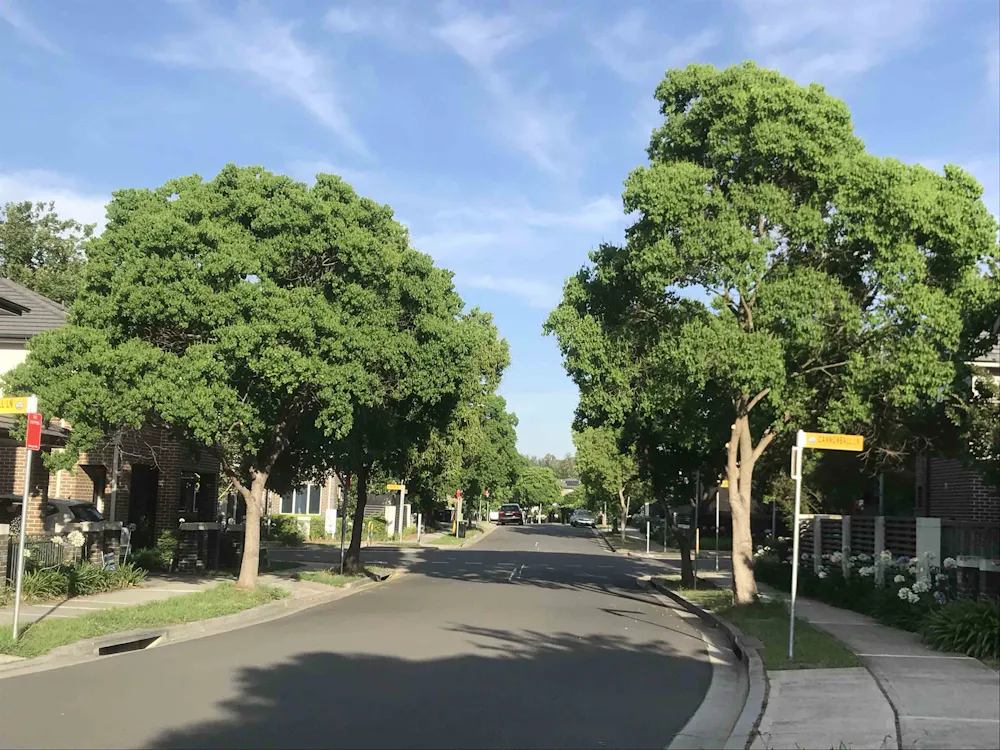
Penrith street trees faced the hottest conditions. Author provided
What did we do?
Street trees cool cities both through their shade and by giving off water through transpiration. These effects can lower local temperatures by several degrees, which helps offset the extra heat trapped by roads, rooftops and hard surfaces.
But the trees we rely on for cooling are vulnerable to mounting pressures from climate change. Drought, heatwaves and limited soil and water availability in cities can all threaten tree health, growth and survival.
To test how these species were coping, we chose over 570 street trees in Adelaide, Melbourne and Sydney, as well as Mildura in regional Victoria, Mandurah south of Perth and Parramatta and Penrith in Western Sydney.
We extracted small cores of wood from the trunk, in a process that leaves the tree alive and largely unaffected. The oldest tree we sampled was a 70-year-old southern magnolia in Sydney.
Growth rings in these cores let us reconstruct their growth histories and assess how they responded both to long-term climate patterns and extreme events such as the Black Summer of 2019–20 and the Millennium Drought from 1997–2009.
How resilient are these trees?
What we found was both reassuring and surprising.
Across all seven cities, the fastest average growth for all species was recorded in Mildura in northern Victoria. Overall, the slowest growth was found in the warmest location – Penrith.
Some species behaved predictably. The black locust grew faster in cooler, wetter cities such as Melbourne, as expected, while honey locust and Chinese elms grew more slowly in hotter cities.
But others defied expectations. Species such as London plane and southern magnolia showed consistent growth trends across cities despite the difference in heat, while others varied depending on local conditions.
Crucially, the growth records showed many street trees responded positively to wetter conditions during the warmest months, most likely due to the longer growing season and increased access to water.
Surprisingly, species such as box elder and Callery pear actually increased their growth during the very hot periods over the Black Summer of 2019–20 as well as during wetter La Niña periods in 2021–22. This suggests these species have adapted to warm urban environments – or that care and watering was provided.
During drought, street trees generally demonstrated strong resistance. This means they maintained their growth during dry periods.
But their resilience – measured by their ability to bounce back to pre-drought growth rates – was often limited, especially in drier cities.
While many street trees can withstand short-term stress, this suggests repeated or prolonged droughts can still take a toll on their long-term health.
Interestingly, species identified as vulnerable in climate models did not always show greater sensitivity to drought or climate extremes in our real-world study.
Why? Local conditions and species-level characteristics such as leaf size, wood density and water use strategy may play a significant role in determining which individual trees will thrive as the climate changes.
We also know care provided by council staff or local residents is extremely useful. When trees are irrigated during stressful conditions, they can help get the tree through tough times.
Why no eucalypts?
During their growing season each year, many northern hemisphere trees produce growth rings. These rings make it possible to reliably reconstruct their growth histories using our methods.
But most eucalypts don’t form clear annual growth rings. This is why we didn’t include spotted gums and other common eucalypts seen on city streets.
Eucalypts tend to grow whenever conditions are favourable rather than being constrained by a strict annual cycle. Only a few native species reliably produce datable annual rings, such as snow gums and alpine ash. This is because they live in cold, high elevation areas, where winter consistently limits growth each year. These conditions aren’t found in any major Australian city.
What does this mean for city planners?
Our research shows that species selection matters a great deal.
Some street trees such as jacarandas, London plane and the European nettle tree can thrive even under extreme heat and drought, while honey locust and Chinese elms are more sensitive to local conditions.
Authorities can maximise the benefits of urban forests and reduce tree decline or loss by choosing resilient species and matching them to the specific climate of each city or neighbourhood.
As climate extremes become more common, even resilient species may face new challenges.
Planting and maintaining diverse, climate-adapted urban forests will help ensure our cities remain liveable, healthy, and green in the decades to come.
Mark G Tjoelker receives funding from The Australian Research Council.
Manuel Esperon-Rodriguez, Matthew Brookhouse, and Sally Power do not work for, consult, own shares in or receive funding from any company or organisation that would benefit from this article, and have disclosed no relevant affiliations beyond their academic appointment.
In recent years, artificial intelligence (AI) has taken centre stage across various industries. From AI-generated art to chatbots in customer service, every sector is seemingly poised for disruption.
It’s not just in your news feed every day – venture capital is pouring in, while CEOs are eager to declare their companies “AI-first”. But for those who remember the lofty promises of other technologies that have since faded from memory, there’s an uncanny sense of déjà vu.
In 2017, it was blockchain that promised to transform every industry. Companies added “blockchain” to their name and watched stock prices skyrocket, regardless of whether the technology was actually used, or how.
Now, a similar trend is emerging with AI. What’s unfolding is not just a wave of innovation, but a textbook example of a tech hype cycle. We’ve been here many times before.
Understanding the hype cycle
The tech hype cycle, first defined by the research firm Gartner, describes how emerging technologies rise on a wave of inflated promises and expectations, crash into disillusionment and, eventually, find a more realistic and useful application.
Recognising the signs of this cycle is crucial. It helps in distinguishing between genuine technological shifts and passing fads driven by speculative investment and good marketing.
It can also mean the difference between making a good business decision and a very costly mistake. Meta, for example, invested more than US$40 billion into the metaverse idea while seemingly chasing their own manufactured tech hype, only to abandon it later.
In 2017, blockchain was everyone’s focus. Presented as a revolutionary technology, blockchain offered a decentralised way to record and verify transactions, unlike traditional systems that rely on central authorities or databases.
US soft drinks company Long Island Iced Tea Corporation became Long Blockchain Corporation and saw its stock rise 400% overnight, despite having no blockchain product. Kodak launched a vague cryptocurrency called KodakCoin, sending its stock price soaring.
These developments were less about innovation and more about speculation, chasing short-term gains driven by hype. Most blockchain projects never delivered real value. Companies rushed in, driven by fear of missing out and the promise of technological transformation.
The results were mostly negative. Klarna soon saw a decline in customer satisfaction and had to walk back its strategy, rehiring humans for customer support this year. BuzzFeed’s AI content push failed to save its struggling business, and its news division later shut down. Tech media company CNET published AI-generated articles riddled with errors, damaging its credibility.
These are not isolated incidents. They’re signals that AI, like blockchain, was being over hyped.
Why do companies chase tech hype?
There are three main forces at play: inflated expectations, short-term view and flawed implementation. Tech companies, under pressure from investors and media narratives, overpromise what AI can do.
Leaders pitch vague and utopian concepts of “transformation” without the infrastructure or planning to back them up. And many rush to implement, riding the hype wave.
They are often hindered by a short-term view of what alignment with the new tech hype can do for their company, ignoring the potential downsides. They roll out untested systems, underestimate complexity or even the necessity, and hope that novelty alone will drive the return on investment.
The result is often disappointment – not because the technology lacks potential, but because it’s applied too broadly, too soon, and with too little planning and oversight.
Where to from here?
Like blockchain, AI is a legitimate technological innovation with real, transformative potential.
Often, these technologies simply need time to find the right application. While the initial blockchain hype has faded, the technology has found a practical niche in areas like “asset tokenization” within financial markets. This allows assets like real estate or company shares to be represented by digital tokens on the blockchain, enabling easier, faster and cheaper trading.
The same pattern can be expected with generative AI. The current AI hype cycle appears to be tapering off, and the consequences of rushed or poorly thought-out implementations will likely become more visible in the coming years.
However, this decline in hype doesn’t signal the end of generative AI’s relevance. Rather, it marks the beginning of a more grounded phase where the technology can find the most suitable applications.
Recognising the patterns of tech hype is essential for making smarter decisions. Instead of rushing to adopt every new innovation based on inflated promises, a measured, problem-driven approach leads to more meaningful outcomes.
Long-term success comes from thoughtful experimentation, implementation, and clear purpose, not from chasing trends or short-term gains. Hype should never dictate strategy; real value lies in solving real problems.
Gediminas Lipnickas does not work for, consult, own shares in or receive funding from any company or organisation that would benefit from this article, and has disclosed no relevant affiliations beyond their academic appointment.
Whenever a high-profile company lists on the Australian stock market it attracts much excitement. Employees and founders enjoy some financial gains and investors get a chance to invest in a potentially exciting stock.
For these reasons, fast-food chain Guzman Y Gomez was one of the biggest financial events of 2024. It undertook an initial public offering which meant for the first time, its
shares were available to the public and started being traded on the stock exchange.
However, such public offerings have become rare with many companies remaining private instead of listing on the market.
Indeed, the number of businesses in Australia listed on the stock exchange is declining. This has been described as the worst public offering drought “since the global financial crisis”.
The number of initial public offerings since 2000
In response, on Monday, the Australian Securities and Investment Commission (ASIC) announced measures to encourage more listings by streamlining the initial public offering process.
How do companies list on the stock exchange?
Firms undertake an initial public offering by filing documents with ASIC. These includes a “prospectus”, which details the information investors might need to evaluate whether to buy shares.
ASIC reviews the documentation and then decides if changes are necessary or whether to let the business list.
Typically, this requires the business to use an investment bank to manage the process and a law firm to prepare the documentation. The business will also engage an underwriter to evaluate the offering and ensure it raises enough capital. All these services cost money.
When they are trading, the business must comply with additional regulations imposed by ASIC and the Australian Securities Exchange. These include meeting corporate governance, continuous disclosure and other operating requirements.
Why should a business lists its shares?
There are many potential gains for a business and the public to list on the stock exchange.
Companies can encourage employees by paying them with shares in the business. This gives workers buy-in to the company they help to build. This is much easier when it is listed because employees can identify the value of that incentive and sell shares when they choose.
Being listed can also help raise capital. Having shares listed helps the business raise money to expand. In a direct sense, initial public offerings do this by enabling the firm to sell shares directly to the public rather than being restricted to the subset of investors who can invest in unlisted stocks.
In an indirect sense, being publicly listed forces businesses to comply with even more stringent disclosure rules. This can give lenders and investors more confidence in the firm.
Further, because the shares are now readily traded in the market, they can now be more easily used to acquire, or merge with, another company.
What does ASIC intend to do?
The commission believes one of the biggest barriers to listing on the market is the initial documentation and administrative requirements. They believe if they can slash red tape there will be more listings.
The goal is to help them get their documents in order from the beginning, to reduce the potential number of changes that may be needed. ASIC believes it will make the process cheaper and quicker, and enable firms to better time the initial public offerings for periods of strong demand.
The fast track process would only be open to businesses with a market capitalisation of at least A$100 million and firms that had no ASX escrow requirement.
An escrow is a financial and legal agreement designed to protect buyers and sellers in a transaction. An independent third party holds payment for a fee, until everyone fulfils their transaction responsibilities.
What else could ASIC do?
ASIC’s plan to reduce red tape will help but there are other barriers to businesses listing on the sharemarket. These include:
share structures and control: founders are often psychologically invested in their companies and prefer to retain control over the business they built after listing.
This is part of the reason “dual-class” share structures exist in the United States. These give some shareholders supernormal voting rights, enabling them to retain control. Singapore and Hong Kong also offer dual class structures.
disclosure and expense: the initial public offering process is expensive. ASIC’s plan does partly address this, but only for larger businesses, which ironically have greater financial resources to pay the service providers.
governance requirements: the ASX imposes corporate governance requirements on businesses that publicly list on the market. These requirements take a one-size-fits-all to factors such as who should be on the board of directors. These requirements appear to cost extra with an unclear financial gain. And the ASX’s rules appear not to be evidence-backed.
escrows: ASIC’s fast track process is only available if the firm does not have to satisfy an escrow requirement. An escrow requirement typically applies when an early investor, or a founder, is involved. This is to stop such people from opportunistically selling shares at an inflated process, which then nosedives. It is not clear why ASIC excluded such businesses from fast track review. Smaller companies are some of the most likely to be subject to escrow. So they are the most likely to benefit from reducing the cost-barriers to listing.
ASIC has tried to reduce red tape for larger businesses, but the changes don’t go far enough and more work is necessary to address the underlying factors that cause firms to stay private for longer.
Mark Humphery-Jenner does not work for, consult, own shares in or receive funding from any company or organisation that would benefit from this article, and has disclosed no relevant affiliations beyond their academic appointment.
Source: The Conversation (Au and NZ) – By Samuel Cornell, PhD Candidate in Public Health & Community Medicine, School of Population Health, UNSW Sydney
To reduce the chances of things going wrong, governments issue official travel advisories: public warnings meant to help people make informed travel decisions.
Sometimes these advisories seem puzzling – why, for example, does the US still have the “safest” rating despite the ongoing volatility in Los Angeles?
How do governments assess where is safe for Australians to travel?
Australia started providing travel advisories in 1996 and now runs its system under the Smart Traveller platform.
To determine the risk level, the Department of Foreign Affairs and Trade (DFAT) draws on diplomatic reporting, assessments from Australian missions overseas about local security conditions, threat assessments from the Australian Security Intelligence Organisation (ASIO) and advice from Five Eyes intelligence sharing partners (Australia, the US, United Kingdom, New Zealand and Canada).
The goal is to create “smart, responsible informed travellers”, not to restrict tourism or damage foreign relationships.
A detailed analysis of US State Department travel warnings from 2009 to 2016 found only a weak correlation between the number of American deaths in a country and the warnings issued.
In some cases, destinations with no record of US fatalities received frequent warnings, while places with high death tolls had none.
In early 2024, Australia issued a string of warnings about rising safety concerns in the US and extremely strict entry conditions even with an appropriate visa.
Until early June 2025, Sweden was also rated Level 2 due to localised gang violence, despite relatively low risks for tourists. Its rating has since been revised down to Level 1.
Travel advisories often apply a blanket rating to an entire country, even when risks vary widely within its borders.
For instance, Australia’s Level 1 rating for the US doesn’t distinguish between different regional threats.
In June 2025, 15 people were injured in Boulder, Colorado after a man attacked a peaceful protest with Molotov cocktails.
Earlier in 2025, a major measles outbreak in West Texas resulted in more than 700 cases reported in a single county.
Despite this, Australia continues to classify the entire country as a low-risk destination.
This can make it harder for travellers to make informed, location-specific decisions.
Recent travel trends
Recent data indicate a significant downturn in international travel to the US: in March 2025, overseas visits to the US fell by 11.6% compared to the previous year, with notable declines from Germany (28%), Spain (25%) and the UK (18%).
Australian visitors to the US decreased by 7.8% compared to the same month in 2024, marking the steepest monthly drop since the COVID pandemic.
This trend suggests travellers are reassessing risk on their own even when official advisories don’t reflect those concerns.
The US case shows how politics can affect travel warnings: the country regularly experiences mass casualty incidents, violent protests and recently has been detaining and deporting people from many countries at the border including Australians, Germans and French nationals.
Yet it remains at Level 1.
What’s really going on has more to do with political alliances than safety: increasing the US travel risk level could create diplomatic friction.
What travellers can do now
If you’re a solo female traveller, identify as LGBTQIA+, are an academic, come from a visible minority or have spoken out online against the country you’re visiting, your experience might be very different from what the advice suggests.
So, here are some tips to stay safe while travelling:
Check multiple sources: don’t rely solely on travel advisories – compare travel advice from other countries
Get on-the-ground updates: check local news for coverage of events. If possible, talk to people who’ve recently visited for their experiences
For broader safety trends, tools like the Global Peace Index offer data on crime, political stability and healthcare quality. If you’re concerned about how locals or police treat certain groups, consult Human Rights Watch, Amnesty International, or country-specific reports from Freedom House
Consider identity-specific resources: there are travel guides and safety indexes for LGBTQIA+ travellers like Equaldex, women travellers (Solo Female Travelers Network) and others. These may highlight risks general advisories miss.
Travel advisories often reflect whom your country trusts, not where you’re actually safe. If you’re relying on them, make sure you understand what they leave out.
Samuel Cornell receives funding from an Australian Government Research Training Program
Scholarship.
Milad Haghani does not work for, consult, own shares in or receive funding from any company or organisation that would benefit from this article, and has disclosed no relevant affiliations beyond their academic appointment.
In recent years, artificial intelligence (AI) has taken centre stage across various industries. From AI-generated art to chatbots in customer service, every sector is seemingly poised for disruption.
It’s not just in your news feed every day – venture capital is pouring in, while CEOs are eager to declare their companies “AI-first”. But for those who remember the lofty promises of other technologies that have since faded from memory, there’s an uncanny sense of déjà vu.
In 2017, it was blockchain that promised to transform every industry. Companies added “blockchain” to their name and watched stock prices skyrocket, regardless of whether the technology was actually used, or how.
Now, a similar trend is emerging with AI. What’s unfolding is not just a wave of innovation, but a textbook example of a tech hype cycle. We’ve been here many times before.
Understanding the hype cycle
The tech hype cycle, first defined by the research firm Gartner, describes how emerging technologies rise on a wave of inflated promises and expectations, crash into disillusionment and, eventually, find a more realistic and useful application.
Recognising the signs of this cycle is crucial. It helps in distinguishing between genuine technological shifts and passing fads driven by speculative investment and good marketing.
It can also mean the difference between making a good business decision and a very costly mistake. Meta, for example, invested more than US$40 billion into the metaverse idea while seemingly chasing their own manufactured tech hype, only to abandon it later.
In 2017, blockchain was everyone’s focus. Presented as a revolutionary technology, blockchain offered a decentralised way to record and verify transactions, unlike traditional systems that rely on central authorities or databases.
US soft drinks company Long Island Iced Tea Corporation became Long Blockchain Corporation and saw its stock rise 400% overnight, despite having no blockchain product. Kodak launched a vague cryptocurrency called KodakCoin, sending its stock price soaring.
These developments were less about innovation and more about speculation, chasing short-term gains driven by hype. Most blockchain projects never delivered real value. Companies rushed in, driven by fear of missing out and the promise of technological transformation.
The results were mostly negative. Klarna soon saw a decline in customer satisfaction and had to walk back its strategy, rehiring humans for customer support this year. BuzzFeed’s AI content push failed to save its struggling business, and its news division later shut down. Tech media company CNET published AI-generated articles riddled with errors, damaging its credibility.
These are not isolated incidents. They’re signals that AI, like blockchain, was being over hyped.
Why do companies chase tech hype?
There are three main forces at play: inflated expectations, short-term view and flawed implementation. Tech companies, under pressure from investors and media narratives, overpromise what AI can do.
Leaders pitch vague and utopian concepts of “transformation” without the infrastructure or planning to back them up. And many rush to implement, riding the hype wave.
They are often hindered by a short-term view of what alignment with the new tech hype can do for their company, ignoring the potential downsides. They roll out untested systems, underestimate complexity or even the necessity, and hope that novelty alone will drive the return on investment.
The result is often disappointment – not because the technology lacks potential, but because it’s applied too broadly, too soon, and with too little planning and oversight.
Where to from here?
Like blockchain, AI is a legitimate technological innovation with real, transformative potential.
Often, these technologies simply need time to find the right application. While the initial blockchain hype has faded, the technology has found a practical niche in areas like “asset tokenization” within financial markets. This allows assets like real estate or company shares to be represented by digital tokens on the blockchain, enabling easier, faster and cheaper trading.
The same pattern can be expected with generative AI. The current AI hype cycle appears to be tapering off, and the consequences of rushed or poorly thought-out implementations will likely become more visible in the coming years.
However, this decline in hype doesn’t signal the end of generative AI’s relevance. Rather, it marks the beginning of a more grounded phase where the technology can find the most suitable applications.
Recognising the patterns of tech hype is essential for making smarter decisions. Instead of rushing to adopt every new innovation based on inflated promises, a measured, problem-driven approach leads to more meaningful outcomes.
Long-term success comes from thoughtful experimentation, implementation, and clear purpose, not from chasing trends or short-term gains. Hype should never dictate strategy; real value lies in solving real problems.
Gediminas Lipnickas does not work for, consult, own shares in or receive funding from any company or organisation that would benefit from this article, and has disclosed no relevant affiliations beyond their academic appointment.
Flash quote from Pascale Coissard, MSF emergency coordinator
“Israeli forces’ displacement orders and bombings in the close vicinity of Nasser hospital, in Khan Younis, have forced MSF to adjust its operations in the hospital and move part of its burn and orthopaedic activities to our field hospital in Deir Al Balah. This minimises the risk to some patients and staff, whose safety is our top priority. Despite the insecurity and movement restrictions, our commitment to Nasser hospital continues through our physical presence and our work in the maternity and paediatric wards, technical expertise, specialist visits, and financial support.
“This facility has the last functioning intensive care units for children and newborns in the south, which cannot be moved. Nasser hospital is the only remaining hope for Palestinians in southern Gaza, especially women and children in need of urgent medical care who are living under constant bombardment and displacement with no access to even basic supplies and services. It is crucial that this medical facility is fully protected, respected and remains able to function.”
MSF is an international, medical, humanitarian organisation that delivers medical care to people in need, regardless of their origin, religion, or political affiliation. MSF has been working in Haiti for over 30 years, offering general healthcare, trauma care, burn wound care, maternity care, and care for survivors of sexual violence. MSF Australia was established in 1995 and is one of 24 international MSF sections committed to delivering medical humanitarian assistance to people in crisis. In 2022, more than 120 project staff from Australia and New Zealand worked with MSF on assignment overseas. MSF delivers medical care based on need alone and operates independently of government, religion or economic influence and irrespective of race, religion or gender. For more information visit msf.org.au
Sydney, 10 June 2025 – In recent years, Frequency Control Ancillary Services (FCAS) have provided a lucrative revenue stream for many I&C energy users. But recent FCAS prices have seen a significant decline. In its latest White Paper, Understanding the decline in FCAS prices, energy technology company GridBeyond explores the reasons why FCAS prices have fallen and what businesses can do to recoup lost revenues.
According to the latest Quarterly Energy Dynamics report (covering Q1 2025), published by AEMO, total FCAS costs reached $13M in Q1 2025, representing approximately 0.3% of the total cost of consumed energy* for the quarter. This marks a $16M decrease compared to the same period last year. This reduction was mainly driven by lower FCAS prices and a smaller number of volatility events during the quarter, relative to last year. In the same time period BESS output increased by 86% year-on-year in the NEM, reaching an average of 98MW . The significant decline in FCAS prices reflects the impact of increased battery storage capacity and evolving market dynamics. But although FCAS prices are decreasing, energy prices will stay high providing an opportunity for businesses to recoup lost revenues, with the right technology.
While falling FCAS prices present a challenge, they also mark a shift in how value is created in the evolving energy ecosystem. There are still strategic pathways for I&C businesses to recoup lost revenue. The key for I&C businesses is to shift from passive participation in legacy markets to proactively stacking value. Businesses that embrace this change can recoup lost value and capture even greater returns in the long run – says the report.
In conclusion, demand side response and process optimisation can allow businesses to identify real flexibility opportunities, enable more informed decision-making in optimising energy and creating a more efficient and cost-effective energy strategy.
About GridBeyond
GridBeyond’s vision is to deliver a global zero carbon future. By leveraging AI, we innovate and collaborate with our customers to create optimal value from energy generation, demand and storage to deliver a zero-carbon future. By bridging the gap between distributed energy resources and electricity markets, GridBeyond’s technology means every connected asset – whether utility-scale renewables generation, battery storage, or industrial load – can be utilized to help maximize opportunities and enhance the grid. By intelligently dispatching flexibility into the right market, at the right time, asset owners and energy consumers unlock new revenues and savings, resilience, and management of price volatility, while supporting the transition to a Net Zero future.
Fred Kober receiving his 60-year medal of service from Captain Michael Scroggie and MC Peter Mildenhall
Christmas Hills Fire Brigade members and their families gathered at Panton Hill Hotel on 4 June to celebrate the end of a long fire season, and to acknowledge a number of members who between them have accumulated 690 years of service.
Sixty members and their guests enjoyed dinner at the Panton Hill Hotel while the presentations were made. A special slide show celebrating the rich history of the brigade also featured throughout the evening.
“This was an important event because one of our still operational members, Fred Kober, celebrated 60 years of service with our brigade,” Captain Michael Scroggie said.
“Fred joined us as a 16-year-old and has undertaken many roles over the years including captain, and has maintained his skills and fitness and still regularly turns out at local incidents,” he said.
Not only did Fred receive a 60-year service medal but also a National Emergency clasp for his role as part of a District 14 strike team during the Black Summer fires of 2019-20. This clasp is in addition to his medal awarded for his service in the Black Saturday fires of 2009 which had a strong impact on the Christmas Hills community.
Acting Commander Matt Baber also presented Pete Rae and John Roberts with National Emergency Medals for their service in the Black Summer fires. He also presented service awards to more than 30 other members of the brigade.
This included four five-year certificates of service, five 10-year medals, nine 15-year medals (these were members who joined in the aftermath of the Black Saturday fires), four 25-year medals, two 30-year medals, one 35-year medal, two 40-year medals, two 45-year medals, a 50-year medal, and Fred’s 60-year medal.
Michael Scroggie paid particular tribute to two active members who received 45-year medals.
“Di Simmons and Robyn Adams have provided outstanding service to the brigade as active firefighters, but more particularly as members of the Brigade Management Team over the past 40 years or so,” he said.
“They have performed nearly all the BMT roles over extended periods of time, from captain in Di’s case to all levels of lieutenant roles, secretary/treasurer, training, OHS and comms. I don’t think there has a been a time in the past 40 years when one or the other or both haven’t been on the BMT.”
Nillumbik Group Officer Matt Knight also paid tribute to Di and Robyn’s leadership and support at the group and district level as well and noted their strong role in the mentoring of women firefighters and leaders across CFA.
Their previous professional lives as lecturers and researchers into fire science and environmental studies at Deakin was also instrumental in the development of the brigade mantra ‘Red truck green heart’ which underlies our approach to fire management and suppression in Christmas Hills.
“While we took this opportunity to thank them for their enormous contribution to the effectiveness of our brigade up until now,” said Michael Scroggie, “we are further grateful that Dianne and Robyn will continue as active firefighters at Christmas Hills and in management roles at Nillumbik Group”.
Di Simmons and Robyn Adams receiving their 45 Year medals
The United States has denounced sanctions by Britain and allies — including New Zealand and Australia — against Israeli far-right ministers, saying they should focus instead on the Palestinian armed group Hamas.
New Zealand has banned two Israeli politicians from travelling to the country because of comments about the war in Gaza that Foreign Minister Winston Peters says “actively undermine peace and security”.
New Zealand joins Australia, Canada, the UK and Norway in imposing the sanctions on Israel’s Finance Minister Bezalel Smotrich and National Security Minister Itamar Ben-Gvir.
Peters said they were targeted towards two individuals, rather than the Israeli government.
“Our action today is not against the Israeli people, who suffered immeasurably on October 7 [2023] and who have continued to suffer through Hamas’ ongoing refusal to release all hostages.
“Nor is it designed to sanction the wider Israeli government.”
The two ministers were “using their leadership positions to actively undermine peace and security and remove prospects for a two-state solution”, Peters said.
‘Severely and deliberately undermined’ peace “Ministers Smotrich and Ben-Gvir have severely and deliberately undermined that by personally advocating for the annexation of Palestinian land and the expansion of illegal settlements, while inciting violence and forced displacement.”
The sanctions were consistent with New Zealand’s approach to other foreign policy issues, he said.
Israel’s National Security Minister Itamar Ben-Gvir (left) and Finance Minister Bezalel Smotrich . . . sanctioned by Australia, Canada, the UK and Norway because they have “incited extremist violence and serious abuses of Palestinian human rights. These actions are not acceptable,” says British Foreign Minister David Lammy. Image: TRT screenshot APR
“New Zealand has also targeted travel bans on politicians and military leaders advocating violence or undermining democracy in other countries in the past, including Russia, Belarus and Myanmar.”
New Zealand had been a long-standing supporter of a two-state solution, Peters said, which the international community was also overwhelmingly in favour of.
“New Zealand’s consistent and historic position has been that Israeli settlements in the occupied Palestinian territories are a violation of international law. Settlements and associated violence undermine the prospects for a viable two-state solution,” he said.
“The crisis in Gaza has made returning to a meaningful political process all the more urgent. New Zealand will continue to advocate for an end to the current conflict and an urgent restart of the Middle East Peace Process.”
‘Outrageous’, says Israel Israel’s Foreign Minister Gideon Saar said the move was “outrageous” and the government would hold a special meeting early next week to decide how to respond to the “unacceptable decision”.
His comments were made while attending the inauguration of a new Israeli settlement on Palestinian land.
Peters is currently in Europe for the sixth Pacific-France Summit hosted by French President Emmanuel Macron in Nice.
US State Department spokeswoman Tammy Bruce told reporters: “We find that extremely unhelpful. It will do nothing to get us closer to a ceasefire in Gaza.”
Britain, Canada, Norway, New Zealand and Australia “should focus on the real culprit, which is Hamas”, she said of the sanctions.
“We remain concerned about any step that would further isolate Israel from the international community.”
This article is republished under a community partnership agreement with RNZ.
COMMENTARY:By Steven Cowan, editor of Against The Current
The New Zealand Foreign Minster’s decision to issue a travel ban against two Israeli far-right politicians is little more than a tokenistic gesture in opposing Israel’s actions.
It is an attempt to appease growing opposition to Israel’s war, but the fact that Israel has killed more than 54,000 innocent people in Gaza, a third under the age of 18, still leaves the New Zealand government unmoved.
Foreign Minister Peters gave the game away when he commented that the sanctions were targeted towards two individuals, rather than the Israeli government.
Issuing travel bans against two Israeli politicians, who are unlikely to visit New Zealand at any stage, is the easy option.
It appears to be doing something to protest against Israel’s actions when actually doing nothing. And it doesn’t contradict the interests of the United States in the Middle East.
Under the government of Prime Minister Christopher Luxon, New Zealand has become a vassal state of American imperialism.
New Zealand has joined four other countries, the United States, Britain, Australia and Norway, in issuing a travel ban. But all four countries continue to supply Israel with arms.
Unions demand stronger action Last week, the New Zealand Council of Trade Unions demanded that the New Zealand government take stronger action against Israel. In a letter to Winston Peters, CTU president Richard Wagstaff wrote:
“For too long, the international community has allowed the state of Israel to act with impunity. It is now very clearly engaged in genocide and ethnic cleansing in Gaza.
“All efforts must be made to put diplomatic and economic pressure on Israel to end this murderous campaign.”
THE CTU has called for a series of sanctions to be imposed on Israel. They include “a ban on all imports of goods made in whole or in part in Israel” and “a rapid review of Crown investments and immediately divest from any financial interests in Israeli companies”.
The CTU is also calling for the expulsion of the Israeli ambassador.
This article was first published on Steven Cowan’s website Against The Current. Republished with permission.
Source: The Conversation (Au and NZ) – By Andrew Dodd, Professor of Journalism, Director of the Centre for Advancing Journalism, The University of Melbourne
The most unsettling thing about the closure of Network Ten’s The Project is that it might come to be seen as the moment commercial network television gave up on young audiences for news programming.
If that’s what’s happening, it’s a worrying thought. Bringing news and current affairs to young audiences is exactly what The Project has done so well over its 16-year lifespan, and it’s hard to imagine how the channel will replace it in ways that work for audiences already disengaged with mainstream media.
The Project will be missed. Perhaps not by those such as a caller to ABC Melbourne’s Drive program yesterday afternoon, who described The Project as Behind the News for grown-ups.
The caller’s tone signalled an insult but that discredits both the long-running ABC program for schoolchildren and the goal of engaging young adult audiences in news and current affairs.
Declining numbers
In 2010, a year after the program launched, it was rating 1.1 million in the country’s capital cities, which made it competitive with other commercial TV news services.
By last weekend, the program was drawing an average national audience of 270,000 across the regions as well as the capital cities, according to media commentator, Tim Burrowes’, Unmade newsletter. Even allowing for the overall decline in the number of people watching television since 2010, those ratings figures are dismal.
Burrowes, the author of Media Unmade: Australian Media’s Most Disruptive Decade, suggests the controversial hiring of former Nine Network star, Lisa Wilkinson, in 2017, to present the program’s Sunday edition may have unsettled The Project’s internal harmony after the Bruce Lehrmann defamation trial she was involved in.
A winning format for younger audiences
The Project’s formula of combining news with comedy emerged from the success of The Panel, the weekly show produced in the late 1990s by Working Dog and featuring the D-Generation team of Rob Sitch, Santo Cilauro and Tom Gleisner, along with Kate Langbroek, Glenn Robbins and, for a while, Jane Kennedy.
The Panel opening theme song, Working Dog Productions.
It was edgy and topical. It bounced off current events with short piss-take scene-setting video grabs, followed by wry observations and silly gags.
It was just as much comedy as it was current affairs, and it was all about appealing to young and disenfranchised viewers.
The Panel anticipated the exodus away from the po-faced solemnity of commercial terrestrial TV news well before streaming had taken hold.
Rove McManus and his production company saw its potential, as did Ten, which knew it needed to try new things. It could not compete with Seven and Nine, who were then – and in many ways still are – locked in a perpetual ratings war while being almost identical to one another.
The Project’s producers knew they had a winning format. They ensured the show was rarely boring and avoided the predictability of worthiness. They weren’t afraid to ask the non-PC question, or laugh at themselves, or debate or discuss or delve.
But that didn’t mean they resorted to meanness or took pleasure in others’ misfortune. Admittedly, Steve Price did need to be reined in from time to time.
The format encouraged audiences to stick with them and in the process they actually learnt stuff. Young, disengaged kids saw politicians discussing matters of substance, with the show challenging assumptions.
News for the social media era
As increasing numbers of young people stopped turning on TVs, The Project became consumable in bite-size chunks on social media.
The show’s producers cottoned on to this earlier than most and began crafting segments that could be easily shared. Waleed Aly became an Instagram star for his impassioned, informed editorialising about racial issues, along the way earning nominations for several Logie awards, and winning the Gold Logie in 2016.
Peter Helliar, Dave Hughes and Charlie Pickering made audiences laugh. And another Gold Logie winner, Carrie Bickmore, made them care, especially in 2013 when she broke the fourth wall of television to talk about the need to improve public awareness of brain cancer following a story about a potential cure for the disease in ten years’ time. A few years previously Bickmore’s husband had died of the disease.
The loss of another media town square
While The Project was on air, the network was at least making an effort to inform a section of the market that had long been under-served by the news media.
With relatively recent entrants, like the Daily Aus, stepping in to that gap, perhaps Ten thought it was becoming too crowded?
We’ll have to assess what the network does next to see if it thinks investing in current affairs is no longer worth the effort.
With the ABC threatening to walk away from Q&A, it looks like commercial and public networks are coming to the same view: that panel-based current affairs programming is a turn-off for audiences, regardless of whether they’re young or old.
This is especially troubling because the closure of each program means the loss of another media town square, where the capacity to listen to, and learn from one another, in civil ways also disappears.
The authors do not work for, consult, own shares in or receive funding from any company or organisation that would benefit from this article, and have disclosed no relevant affiliations beyond their academic appointment.
The search for a Victorian man believed to be in the Cradle Mountain area will resume this morning. Members of the Tasmania Police Search and Rescue unit, State Emergency Service volunteers and Parks and Wildlife Service rangers will be involved in ground patrols, while helicopter resources will conduct aerial searches. Concerns for the welfare of 52-year-old Christopher Inwood were raised on Tuesday morning, after his white Toyota HiAce van was found at the car park of a ranger station on Cradle Mountain Road. A backpack believed to belong to Mr Inwood was found alongside the road about 500m from the station, heading in the direction of Dove Lake. Mr Inwood was last seen at Kindred, in Tasmania’s north, about 8.30pm on Monday and police believe he drove to Cradle Mountain later that night. Preliminary searches of the Cradle Mountain area on Tuesday by PWS rangers, with the assistance of a police drone, did not locate Mr Inwood. Temperatures were below freezing in the Cradle Mountain area overnight. Anyone who has information that could assist police locate Mr Inwood, pictured, is urged to call 131 444.
Source: Australian Ministers for Regional Development
Three major retailers have paid penalties for allegedly making false and misleading representations about their Black Friday sales. Each retailer paid a penalty of $19,800 after the ACCC issued them with one infringement notice each.
This follows an ACCC sweep of dozens of sales advertisements for last year’s Black Friday and post-Christmas sales events which identified concerns that the ads misrepresented the size and scope of discounts being offered to consumers.
The ACCC issued one infringement notice each to Michael Hill Jeweller (Australia) Pty Ltd (Michael Hill), Global Retail Brands Australia Pty Ltd (GRBA) in relation to its homewares business MyHouse, and Hairhouse Warehouse Online Pty Ltd (Hairhouse Online) which operates the Hairhouse hair and beauty website, because the ACCC alleged that the businesses were misrepresenting the nature of their sales, including by falsely describing discounts as applying ‘sitewide’.
“We allege these claims misled consumers that all goods in the physical or online store were discounted, or that the discounts were greater than was actually the case,” ACCC Deputy Chair Catriona Lowe said.
“Advertisements that talk about ‘sitewide’ or ‘storewide’ sales or promise discounts ‘off everything’ should deliver what customers expect, and not be used by retailers to hook consumers under false pretences.”
“Businesses are legally obliged to accurately describe their sale offers and should not use small point disclaimers to terms and conditions to disguise the real extent of their offers,” Ms Lowe said.
“During the EOFY sales, retailers should be aware that we will continue to keep an eye on sales promotions to ensure consumers are not being misled, and retailers may face enforcement action if they make sales representations that contravene the Australian Consumer Law.”
Michael Hill pays penalty for “25% off Sitewide” sale ad
Jewellery business Michael Hill, a subsidiary of Michael Hill International Limited (ASX: MHJ), has paid one infringement notice issued by the ACCC, totalling $19,800 in relation to an alleged misleading representation about its Black Friday sale.
Its online advertisement promoted the sale with the words ‘Member Event 25% off Sitewide’.
“Michael Hill’s statement may have misled consumers, and contravened the Australian Consumer Law, because some of the products in its online store were not part of the sale and were not discounted,” Ms Lowe said.
MyHouse pays penalty amid ACCC concern its ad was misleading
Homewares retailer GRBA paid its $19,800 penalty after the ACCC issued it with one infringement notice in relation to its MyHouse store’s online Black Friday sale ad which the ACCC alleges was misleading.
The ad displayed on the MyHouse website during the sale included:
a ribbon banner stating ‘Black Friday Up to 60% Off Sitewide + EXTRA 20% off’; and
a large headline graphic stating ‘Up to 60% OFF RRP EVERYTHING ON SALE’ followed by the text ‘+EXTRA 20% OFF’
“We say this was misleading because the extra 20 per cent discount was not available on all of its products,” Ms Lowe said.
“Retailers need to ensure that their advertising makes it clear to consumers which products are discounted, and by how much.”
Hairhouse Online allegedly misleads consumers with ‘Save 20% to 50% sitewide’ ads
Hairhouse Online paid one infringement notice of $19,800, in relation to its online ad for its Black Friday sale with the statement: ‘SAVE 20% to 50% SITEWIDE’.
The ACCC considered the statement misled consumers that all items on its website would be discounted by between 20 and 50 per cent for the duration of the Black Friday sale, when in fact more than a quarter of the products on its website were not included in the sale offer.
“Businesses that make false discount claims not only risk misleading consumers, they also compete unfairly against other businesses which correctly state the nature of their sales,” Ms Lowe said.
Notes to editors
The ACCC can issue an infringement notice when it has reasonable grounds to believe a person or business has contravened certain consumer protection provisions in the Australian Consumer Law.
The payment of a penalty specified in an infringement notice is not an admission of a contravention of the Australian Consumer Law. The Australian Consumer Law sets the penalty amount.
Background
Michael Hill Jeweller (Australia) Pty Ltd is a wholly owned subsidiary of Michael Hill International Limited which has its headquarters in Brisbane. The Michael Hill retail group is a specialty retailer of jewellery which operates about 170 bricks-and-mortar stores in Australia and also operates in New Zealand and Canada.
Homewares business MyHouse is operated by homewares and kitchen goods retailer GRBA as an online business and in 28 physical stores in Australia. GRBA also operates a range of similar businesses such as House, Robins Kitchen, House Bed & Bath and Baccarat.
Hairhouse Online is a related entity of The Hairhouse Warehouse Pty Ltd, a private company based in Melbourne with 125 stores across Australia, offering haircuts, hair extensions spray tans, manicures, waxing, make-up and other hair and beauty services.
In December 2024, following a sweep of advertisements, the ACCC raised concerns about a range of concerning practices in Black Friday sales promotions, from ‘sitewide’ discounts that were not in fact sitewide, potentially misleading ‘was/now’ pricing, as well as dubious claims about the value of discounts on offer.
One of the ACCC’s Compliance and Enforcement Priorities for 2025-26 is ‘consumer and fair trading concerns in the supermarket and retail sectors, with a focus on misleading pricing practices’.
Newstead Captain awarded CFA Outstanding Service Medal
On 24 May 2025 Newstead Fire Brigade held its Annual Awards night.
It was a great night attended by about 70 people, including most of the brigade’s operational and support members and their families.
Well known to almost everyone in Newstead, Captain Doug Richardson has been an integral part of the Newstead brigade for more than 45 years and has been the Captain for almost 40 of those years; a feat not matched by many.
He has seen significant change in the brigade not only in membership, but equipment, buildings, vehicles, tactics and techniques during his many years of service. Not only that, but he has also seen his fair share of major fires, road accidents, grass fires, floods and anything else you can think of that CFA attends.
This year, Doug was awarded the CFA Outstanding Service Medal, CFA’s highest award apart from valor awards. It’s a fitting tribute to a man who has dedicated so many years to the protection of life and property in Newstead and surrounding districts.
This year, the brigade also instituted its own awards to recognise the special efforts of some of the members.
Firefighter Scott Chaney was awarded the inaugural Rookie of the Year award in recognition of his enthusiasm and commitment to developing his firefighting skills since joining the brigade.
Firefighter Chris Simmins was awarded the Captain’s Award and was also presented with the Simmins Family Memorial Plaque in honour of his family being the driving force behind the brigade’s support of the Royal Children’s Hospital Good Friday Appeal for more than 10 years.
The ‘Russell Hodges’ Memorial Shield for Brigade Member of the Year, was awarded to Firefighter Ron Archer. This award is in recognition of our late friend Russell Hodges who passed away suddenly two years ago. During his time in the brigade, Russell became a highly valued member who was always around and could always be relied upon for just about anything. Ron is one of our most reliable members, always on hand when the pager goes off and doing sterling work in running the Newstead Community Market.
CFA service awards were presented to 13 brigade members ranging from 10 years, up to 45 years of service, including three CFA Life Members. Notably, four members of the former ladies’ auxiliary – Bev Richardson, Joan Sartori, Lorraine Burgess and Carmel Longmire – were recognised for their unwavering support of the brigade by receiving their 45-year service medals.
Also presented on the night was some long overdue National Medals. The National Medal recognises prolonged exposure to hazardous circumstances in the service of the community. This year 17 members of the brigade were presented with this honour, including Don Hepburn who was recognised for his 45+ years of service to the Newstead community.
All in all, a great night was had by all who attended with some coming from interstate to share in the event.
On behalf of the members of the Newstead Fire Brigade we would like to congratulate Doug Richardson and all the members who received awards and on behalf of the community, thank you for your service to Newstead and surrounding districts.
Source: United States House of Representatives – Congressman Jimmy Gomez (CA-34)
WASHINGTON, DC – Representatives Jimmy Gomez (CA-34), Senator Adam Schiff (D-CA), Representative Nanette Barragán (CA-44), and 39 other California Delegation Representatives are demanding President Doanld Trump immediately withdraw the National Guard and U.S. Marines from Los Angeles, California. In a bicameral letter sent today, the lawmakers condemn the deployments as an unlawful overreach that bypassed state and local authority and urge the immediate withdrawal of the National Guard and Marines.
“We are writing to express grave concern regarding the deployment of the National Guard and the activation of 700 Marines to Los Angeles. These actions were taken without the consent of California Governor Gavin Newsom and over the objections of local law enforcement. It constitutes a clear violation of constitutional principles and law, and a grave overreach of executive authority,” wrote the lawmakers.
“This deployment does not appear to be motivated by any public safety emergency that could not be dealt with successfully by local authorities. Instead, it coincides with a broader federal enforcement escalation involving mass ICE raids, militarized immigration tactics, and the use of tear gas and riot control methods in civilian areas. These actions undermine civil liberties, destabilize communities, erode public trust in government institutions, and violate the law,” continued the lawmakers.
On June 7 and June 9, Rep. Jimmy Gomez was illegally denied access to the Roybal Federal Building, where ICE is reportedly detaining migrant families—including moms and kids—under inhumane conditions. Rep. Gomez called for a formal DHS investigation and submitted a written inquiry demanding answers and accountability from Secretary Kristi Noem. As protests erupted in Los Angeles in response to the raids and detentions, the Trump administration escalated the situation by authorizing the deployment of 2,000 National Guard troops and 700 Marines—without the consent of California Governor Gavin Newsom and over the objections of local elected and community leaders. They argue the legal authority Trump cited doesn’t apply—making the deployment plainly unlawful.
“As federal officials we must prioritize de-escalation and adherence to the constitutional principles that govern the balance of power between federal and state and local governments. For these reasons, we urge you to immediately withdraw the National Guard and U.S. Marines from Los Angeles and to refrain from further deployments of any military personnel in circumstances that violate constitutional boundaries and escalate domestic tensions,” concluded the lawmakers.
In addition to Representative Gomez, Senator Schiff, and Representative Barragán, the bicameral letter was signed by Representatives Nancy Pelosi (CA-11), Zoe Lofgren (CA-18), Pete Aguilar (CA-33), Ami Bera (CA-6), Julia Brownley (CA-26), Salud Carbajal (CA-24), Judy Chu (CA-28), Gilbert Cisneros Jr. (CA-31), Lou Correa (CA-46), Jim Costa (CA-21), Mark DeSaulnier (CA-10), Laura Friedman (CA-30), John Garamendi (CA-8), Robert Garcia (CA-42), Jared Huffman (CA-2), Sara Jacobs (CA-51), Sydney Kamlager-Dove (CA-37), Ro Khanna (CA-17), Sam Liccardo (CA-16), Ted Lieu (CA-36), Doris Matsui (CA-7), Dave Min (CA-47), Kevin Mullin (CA-15), Jimmy Panetta (CA-19), Scott Peters (CA-50), Luz Rivas (CA-29), Raul Ruiz (CA-25), Linda Sánchez (CA-38), Brad Sherman (CA-32), Lateefah Simon (CA-12), Eric Swalwell (CA-14), Mark Takano (CA-39), Mike Thompson (CA-4), Norma Torres (CA-35), Derek Tran (CA-45), Juan Vargas (CA-52), Maxine Waters (CA-43), and George Whitesides (CA-27).
OMAHA, Neb., June 10, 2025 (GLOBE NEWSWIRE) — On June 10, 2025, Greystone Housing Impact Investors LP (NYSE: GHI) (the “Partnership”) announced that investor information on 2024 Schedule K-3 reflecting items of international tax relevance is available online. Unitholders requiring this information may access their Schedules K-3 at www.taxpackagesupport.com/greystone.
A limited number of unitholders (primarily foreign unitholders, unitholders computing a foreign tax credit on their tax return and certain corporate and/or partnership unitholders) may need the detailed information disclosed on Schedule K-3 for their specific tax reporting requirements. To the extent Schedule K-3 is applicable to your federal income tax return filing needs, we encourage you to review the information contained on this form and refer to the appropriate federal laws and guidance or consult with your tax advisor.
To receive an electronic copy of your Schedule K-3 via email, unitholders may call Tax Package Support toll free at (833) 608-3512.
About Greystone Housing Impact Investors LP
Greystone Housing Impact Investors LP was formed in 1998 under the Delaware Revised Uniform Limited Partnership Act for the primary purpose of acquiring, holding, selling and otherwise dealing with a portfolio of mortgage revenue bonds which have been issued to provide construction and/or permanent financing for affordable multifamily, seniors and student housing properties. The Partnership is pursuing a business strategy of acquiring additional mortgage revenue bonds and other investments on a leveraged basis. The Partnership expects and believes the interest earned on these mortgage revenue bonds is excludable from gross income for federal income tax purposes. The Partnership seeks to achieve its investment growth strategy by investing in additional mortgage revenue bonds and other investments as permitted by its Second Amended and Restated Limited Partnership Agreement, dated December 5, 2022, taking advantage of attractive financing structures available in the securities market, and entering into interest rate risk management instruments. Greystone Housing Impact Investors LP press releases are available at www.ghiinvestors.com.
Safe Harbor Statement
Information contained in this press release contains “forward-looking statements,” which are based on current expectations, forecasts and assumptions that involve risks and uncertainties that could cause actual outcomes and results to differ materially. These risks and uncertainties include, but are not limited to, risks involving current maturities of our financing arrangements and our ability to renew or refinance such maturities, fluctuations in short-term interest rates, collateral valuations, mortgage revenue bond investment valuations and overall economic and credit market conditions. For a further list and description of such risks, see the reports and other filings made by the Partnership with the Securities and Exchange Commission, including but not limited to, its Annual Report on Form 10-K, Quarterly Reports on Form 10-Q, and Current Reports on Form 8-K. Readers are urged to consider these factors carefully in evaluating the forward-looking statements. The Partnership disclaims any intention or obligation to update or revise any forward-looking statements, whether as a result of new information, future events or otherwise.
CONTACT: Andrew Grier Senior Vice President 402-952-1232
NEW YORK, June 10, 2025 (GLOBE NEWSWIRE) — Apollo Commercial Real Estate Finance, Inc. (the “Company”) (NYSE:ARI) today announced the Board of Directors declared a dividend of $0.25 per share of common stock, which is payable on July 15, 2025 to common stockholders of record on June 30, 2025.
About Apollo Commercial Real Estate Finance, Inc. Apollo Commercial Real Estate Finance, Inc. (NYSE: ARI) is a real estate investment trust that primarily originates, acquires, invests in and manages performing commercial first mortgage loans, subordinate financings and other commercial real estate-related debt investments. The Company is externally managed and advised by ACREFI Management, LLC, a Delaware limited liability company and an indirect subsidiary of Apollo Global Management, Inc., a high-growth, global alternative asset manager with approximately $785 billion of assets under management as of March 31, 2025.
Additional information can be found on the Company’s website at www.apollocref.com. Please note that our URL address has changed.
Forward-Looking Statements Certain statements contained in this press release constitute forward-looking statements as such term is defined in Section 27A of the Securities Act of 1933, as amended, and Section 21E of the Securities Exchange Act of 1934, as amended, and such statements are intended to be covered by the safe harbor provided by the same. Forward-looking statements are subject to substantial risks and uncertainties, many of which are difficult to predict and are generally beyond the Company’s control. These forward-looking statements include information about possible or assumed future results of the Company’s business, financial condition, liquidity, results of operations, plans and objectives. When used in this release, the words believe, expect, anticipate, estimate, plan, continue, intend, should, may or similar expressions, are intended to identify forward-looking statements. Statements regarding the following subjects, among others, may be forward-looking: higher interest rates and inflation; market trends in the Company’s industry, real estate values, the debt securities markets or the general economy; the timing and amounts of expected future fundings of unfunded commitments; the return on equity; the yield on investments; the ability to borrow to finance assets; the Company’s ability to deploy the proceeds of its capital raises or acquire its target assets; and risks associated with investing in real estate assets, including changes in business conditions and the general economy. For a further list and description of such risks and uncertainties, see the reports filed by the Company with the Securities and Exchange Commission. The forward-looking statements, and other risks, uncertainties and factors are based on the Company’s beliefs, assumptions and expectations of its future performance, taking into account all information currently available to the Company. Forward-looking statements are not predictions of future events. The Company disclaims any intention or obligation to update or revise any forward-looking statements, whether as a result of new information, future events or otherwise, except as required by law.
PM call with Prime Minister Støre of Norway: 10 June 2025
The Prime Minister spoke to Prime Minister Jonas Gahr Støre of Norway this afternoon.
The Prime Minister spoke to Prime Minister Jonas Gahr Støre of Norway this afternoon.
They agreed on the importance of this afternoon’s announcement between Australia, Canada, New Zealand, Norway and the United Kingdom, confirming sanctions on two Israeli Ministers for their repeated incitement of violence against Palestinian civilians.
The Prime Minister reiterated his commitment to a two-state solution, which ensures a safe and secure future for Israelis and Palestinians.
Discussing the publication of last week’s Strategic Defence Review, the leaders agreed that the UK and Norway are key partners, showcased through Norway’s vital contribution to the Carrier Strike Group.
They agreed on the vital importance of all NATO allies stepping up on our collective defence at an increasingly dangerous time for the world.
The Highland Council is proud to be taking part in this year’s Clean Air Day – the UK’s largest air pollution awareness campaign – on 19 June 2025. Supported by Global Action Plan and Health Equals, the initiative is a vital step in helping our communities understand the health risks of air pollution and the simple actions we can all take to make a difference.
One of the contributors to poor air quality is engine idling — when car engines are left running while stationary – which can significantly increase harmful emissions. Changing idling behaviour will be the focus of this year’s events.
Why this campaign matters
Air pollution affects us from before our first breath to our last.
Children are especially vulnerable to the health impacts of polluted air.
Idling engines contribute to unnecessary emissions and fuel waste.
By switching off engines, we can all help reduce pollution and protect our environment.
To celebrate Clean Air Day, Highland Council’s Environmental Health Team will have an information stall at the entrance to the Victorian Market Food Hall, Inverness on Thursday 19 June from 11:00 to 15:00 and will be speaking to drivers around the town centre, providing a great opportunity to engage with the public and raise awareness on air pollution issues.
In the run-up to Clean Air Day, the team will also be revisiting schools who previously took part in an Air Quality Project to monitor air quality around school premises. This project had identified distinct peaks in pollution levels during school drop-off and pick-up times and pupils will be supported to run an Anti-Idling Campaign to raise awareness of the negative impacts of engine idling which will help encourage positive change.
Each participating school will be provided with an ‘Anti-Idling’ sign for their drop-off zone, an information pack and toolkit to help them run their campaign and a banner for installation at their school gate on the campaign launch day.
Participating schools will help raise awareness by:
Teaching pupils about why clean air matters.
Supporting pupils as they lead this important initiative.
Encouraging staff and parents to turn off their car engine when waiting outside the school.
For more information on how to participate in Clean Air Day, visit the Clean Air Day website.
Would you trust a driverless car? A 2024 global survey involving nearly 8000 participants suggests most people are wary of handing over the steering wheel to sensors, cameras and computer algorithms.
However, a new study by Australian and French researchers shows that augmented reality (AR) could increase overall confidence in autonomous vehicles by simulating the experience and allowing drivers to personalise the AR interface.
The University of South Australia (UniSA) and IMT Atlantique created a sophisticated virtual reality driving simulator using headsets, testing seven AR visualisations with 28 participants, where information about driving conditions was added, modified and even removed from the simulation.
The participants were aged 22-50 and included 18 males and 10 females.
AR can deliver real-time, critical information directly onto the windshield or dash, alerting drivers to potential hazards and obstacles, speed limits and navigation directions. The technology uses sensors to deliver the data, ensuring that drivers stay focused on the road while accessing critical information.
Driving-related AR visuals included navigation paths, incoming vehicle alerts and pedestrians; and non-driving visuals ranged from aesthetic modifications to points of interest, such as cafes and dinosaur parks.
The researchers found that participants’ trust in autonomous vehicles was “significantly increased” when AR was used to add or change driving-related information, tailoring visual cues based on a driver’s preference, attention patterns and stress levels.
“Trust is a major barrier to the widespread adoption of autonomous vehicles,” says UniSA and IMT Atlantique PhD candidate Hoa Tran, who led the study.
“Despite autonomous vehicles being generally safer than human drivers in routine conditions, there is a global reluctance to fully embrace them, but augmented reality might be able to change that.
“The AR visuals helped participants understand the autonomous vehicle’s decision-making process, which is especially important in complex traffic scenarios,” Hoa says.
Even non-driving related additions, like landmarks or interior design enhancements in the car, improved trust among users. However, they also carried a greater risk of driver distraction.
Conversely, removing certain types of information – such as unnecessary pedestrian visuals or visual obstructions in the car – was helpful for reducing mental clutter, but it negatively affected user confidence.
“The message is that less isn’t always more,” says co-author UniSA researcher Dr James Walsh.
“The design of AR in autonomous vehicles needs to balance clarity with user comfort and personal preference.”
Researchers suggest future work should involve real-world testing in higher-quality simulators, as well as trials involving a more diverse demographic.
“Our findings support the idea that trust in driverless cars can be built not just through more information, but the right information,” Dr Walsh says.
Source: Northern Territory Police and Fire Services
Our CBR is the ACT Government’s key channel to connect with Canberrans and keep you up-to-date with what’s happening in the city. Our CBR includes a monthly print edition, email newsletter and website.
You can easily opt in or out of the newsletter subscription at any time.
International travel: April 2025 – information release
11 June 2025
International travel covers the number and characteristics of overseas visitors and New Zealand resident travellers (short-term movements) entering or leaving New Zealand.
Key facts
Monthly arrivals – overseas visitors
Overseas visitor arrivals were 267,300 in April 2025, an increase of 42,200 from April 2024. The biggest changes were in arrivals from:
Australia (up 33,800)
United Kingdom (up 4,000)
United States (up 3,300)
Hong Kong (up 1,600)
Indonesia (down 1,100).
The increase in the number of overseas visitors from Australia in April 2025 compared with April 2024 was partly related to the timing of school holidays. Easter and school holidays’ impact has more information.
The total number of overseas visitor arrivals in April 2025 was 87 percent of the 307,400 in April 2019 (before the COVID-19 pandemic).
Visit our website to read this information release:
Source: United States House of Representatives – Congressman Cory Mills Florida (7th District)
FOR IMMEDIATE RELEASE
CLOUD Aviation Act
Washington, D.C. – U.S. Representative Cory Mills along with a group of bi-partisan legislators just introduced theCOLLISION-LIMITING OPERATIONAL UPGRADE FOR DOD (CLOUD) AIRCRAFT ACT.
This bill directs the Secretary of Defense, in coordination with the Federal Aviation Administration, to conduct a feasibility study on equipping all Department of Defense (DoD) fixed and rotary wing aircraft that operate in highly trafficked domestic airspaces with air-to-air and air-to-ground collision detection systems. These systems must be compatible with civilian commercial aircraft.
This initiative comes in response to the tragic accident on January 29, 2025, between American Airlines Flight 5342 and a U.S. Army Black Hawk PAT-25, which resulted in the deaths of 67 passengers. Currently, not all DoD aircraft are required to have the same type of collision detection or avoidance systems that are compatible with civilian commercial aircraft.
Moreover, these systems are not always activated while flying in congested city airspace or the airspace of large commercial airports. This discrepancy has contributed to unsafe flying conditions, putting service members, civilians, and emergency responders at unnecessary risk. The proposed bill aims to address this issue by mandating a comprehensive study to determine the feasibility, costs, associated operational risks, and implementation timelines of equipping military aircraft with the appropriate collision detection and/or avoidance systems. By doing so, the study will help increase safety for all aircraft operating in the same congested airspace as civilian commercial aircraft.
Congressman Cory Millssaid,“As an Army combat veteran, I understand the importance of equipping our servicemen with the tools they need to operate both safely and effectively. After the tragic loss of 67 lives earlier this year in the collision at Reagan National Airport, it is important we enhance safety for our troops, our civilians, and our first responders who share our busy domestic airspaces. This bill strengthens our military’s readiness while ensuring the DoD has the resources to keep our citizens and skies safe. This is a critical first step toward broader aviation safety reforms to prevent future tragedies and improve airspace coordination nationwide.”
“As a 25-year Army veteran and a Virginian, I know how critical it is to my community and our country that we ensure the safety of both military and civilian aircrafts operating in shared airspace. The CLOUD Aircraft Act is a smart, commonsense step to prevent avoidable tragedies and save lives. I’m proud to support this bipartisan effort to modernize our aviation safety standards,”said Congressman Eugene Vindman (VA-07).
“As a Navy veteran and member of the House Armed Services Committee, I know how critical safety is in every phase of military aviation. The CLOUD Aircraft Act is a commonsense step toward enhancing flight safety for our service members and the communities they operate near. By studying the feasibility of equipping military aircraft with modern collision detection systems, we can reduce risk in crowded airspaces, align with FAA best practices, and help prevent tragic accidents before they happen. I’m proud to support this effort to bring greater safety, accountability, and modernization to our skies,”said Congresswoman Jen Kiggans (VA-02).
“As a Marine aviator and a House Armed Services Committee member, I am committed to the safety of our servicemembers and civilians. The tragic collision between American Airlines Flight 5342 and Army Black Hawk PAT-25 highlights the urgent need for action. That’s why I am proud to cosponsor the CLOUD Aircraft Act, directing the Secretary of Defense to study equipping military aircraft with collision detection systems compatible with civilian aircraft. This crucial step will enhance safety in congested domestic airspaces, prevent future tragedies, and protect those who serve alongside the American people. I urge my colleagues to support this vital legislation,”said Congressman Rich McCormick (GA-07).
“My home district leads the way in the aviation industry, so I have a particular interest in exploring any opportunity to improve our outdated systems. Secretary Duffy and Administrator Rocheleau share our focus on the modernization of the National Airspace System, and I believe that this bill is a critical step in the right direction. That is why I am so glad to work with Mr. Mills on such a proactive and prudent piece of legislation,” said Congressman Frank Lucas (OK-03).
Co-Sponsors: Congressman Eugene Vindman (VA-07), Congresswoman Jen Kiggans (VA-02), Congressman Rich McCormick (GA-07), Congressman Frank Lucas (OK-03).
###
For inquires contact julie.singleton@mail.house.govor jillian.anderson@mail.house.gov
About Cory Mills: Congressman Cory Mills represents Florida’s 7th Congressional District and serves on the House Foreign Affairs and Armed Services Committees. A veteran of the U.S. Army, Mills is committed to protecting American sovereignty, strengthening national security, and promoting economic opportunity for a
A diversified uranium supply is important for enhancing security of supply in the nuclear sector. As per EU Treaties, the Commission cannot take a position on national policies for the use of their natural uranium resources when compliant with the applicable Euratom legislation[1].
The global uranium market is diversified, with many suppliers available[2]. However, the EU currently does not mine uranium in its territory. Given the good level of cooperation with our international partners[3] and the characteristics of the global market, we do not consider there is a significant risk as regards the natural uranium supply to the EU.
In line with the recently adopted Roadmap towards ending Russian energy imports[4] and the REPowerEU plan[5], the Commission is holding regular exchanges with uranium producing countries to secure further alternative sources of uranium. The Euratom Supply Agency has recommended that Member States and market actors should increase indigenous sources of supply.
The Commission regularly reviews the list of critical raw materials and assesses any potential gaps. The Commission plans to update the list of critical raw materials by 24 May 2027[6].
The Euratom Supply Agency concludes uranium supply contracts and monitors the nuclear supply market to maintain regular and equitable supply of nuclear materials (ores, source material and special fissile material) for all users in the European Atomic Energy Community[7].
[1] Art.2 let. d) and Chapter 6 of the Euratom Treaty.
[2] In 2023, the majority of uranium supplies to the EU came from Canada (33%), Russia (23%) and Kazakhstan (21%). Euratom Supply Agency — Annual Report 2023, p.13 (https://euratom-supply.ec.europa.eu/document/download/29018562-122c-4818-8774-2424fc029bf6_en?filename=ESA%20Annual%20Report%202023%20-%20Final%20draft.pdf). Australia and Uzbekistan have also become notable suppliers with 2.55% and 1,9% of import share respectively.
[5] Communication from the Commission to the European Parliament, the European Council, the Council, the European Economic and Social Committee and the Committee of the Regions REPowerEU Plan (SWD(2022) 230 final).
[6] Art. 4 of the Critical Raw Materials Act. Available at: Regulation (EU) 2024/1252 of the European Parliament and of the Council of 11 April 2024 establishing a framework for ensuring a secure and sustainable supply of critical raw materials (https://eur-lex.europa.eu/legal-content/EN/TXT/PDF/?uri=OJ:L_202401252).
[7] Ch. 6 of the Euratom Treaty and Council Decision of 12 February 2008 establishing Statutes for the Euratom Supply Agency (2008/114/EC, Euratom).