Category: Australia

  • MIL-OSI Australia: Fine for possessing hatchling crocodile

    Source: Tasmania Police

    Issued: 20 May 2025

    Open larger image

    The hatchling crocodile was found in a fish tank inside the home and has now been placed at a farm or zoo.

    A juvenile estuarine crocodile has been seized, and a man has been fined following a joint investigation in Cairns between the Department of the Environment, Tourism, Science and Innovation (DETSI) and the Queensland Police Service.

    After receiving information from a concerned member of the public, police and DETSI’s Queensland Parks and Wildlife Service (QPWS) searched a home in Manoora on 16 May 2025.

    The hatchling crocodile was found in a fish tank, and a man in his twenties was issued with a $2,419 Penalty Infringement Notice for unlawfully keeping the crocodile.

    Acting Manager Northern Wildlife Operations, Dinouk Perera, said it is unlawful to keep estuarine and freshwater crocodiles in Queensland without a permit, and the animal was confiscated by QPWS officers.

    “We believe the crocodile was captured as a hatchling and is now several months old,” Mr Perera said.

    “The man admitted that he had broken the law by taking the crocodile from the wild and although he was remorseful, we take a zero-tolerance approach to the unlawful possession of wildlife.

    “We have examined the crocodile and although it appears healthy, it cannot be released back into the wild as it may have been exposed to disease. It is destined for a life at a farm or zoo, or at an educational facility.

    “The maximum court-ordered penalty for unlawfully keeping an estuarine crocodile is $36,292.”

    Anyone with information about the deliberate taking, harming or killing of crocodiles, or the illegal trade of wildlife is urged to call 1300 130 372.

    MIL OSI News

  • MIL-OSI Global: Ancient pollen reveals stories about Earth’s history, from the asteroid strike that killed the dinosaurs to the Mayan collapse

    Source: The Conversation – USA – By Francisca Oboh Ikuenobe, Professor of Geology and Geophysics, Missouri University of Science and Technology

    An electron microscope image, colorized, shows different structures of pollen grains, including sunflower, morning glory and primrose. Dartmouth Electron Microscope Facility

    If you are sneezing this spring, you are not alone. Every year, plants release billions of pollen grains into the air, specks of male reproductive material that many of us notice only when we get watery eyes and runny noses.

    However, pollen grains are far more than allergens – they are nature’s time capsules, preserving clues about Earth’s past environments for millions of years.

    Pollen’s tough outer shell enables it to survive long after its parent plants have disappeared. When pollen grains become trapped in sediments at the bottom of lakes, oceans and riverbeds, fossil pollen can provide scientists with a unique history of the environments those pollen-producing plants were born into. They can tell us about the vegetation, climate and even human activity through time.

    Fossil pollen grains of Carya (hickory) have been found in southeastern Missouri that are millions of years old.
    Francisca Oboh Ikuenobe

    The types of pollen and the quantities of pollen grains found at a site help researchers reconstruct ancient forests, track sea-level changes and identify the fingerprints of significant events, such as asteroid impacts or civilizations collapsing.

    As palynologists, we study these ancient pollen fossils around the world. Here are a few examples of what we can learn from these microscopic pollen grains.

    Missouri: Pollen and the asteroid

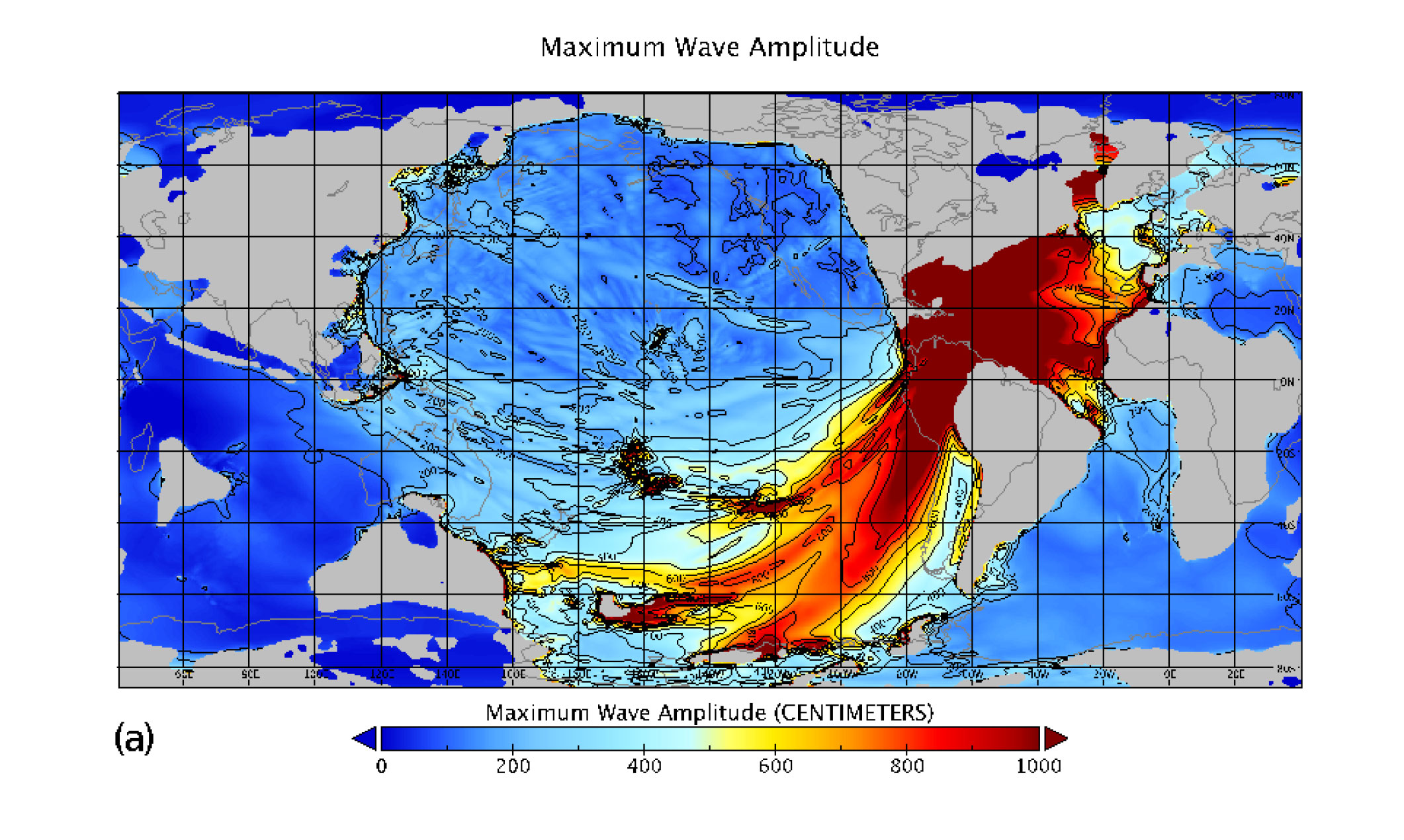
    When an asteroid struck Earth some 66 million years ago, the one blamed for wiping out the dinosaurs, it is believed to have sent a tidal wave crashing onto North America.

    Marine fossils and rock fragments found in southeastern Missouri appear to have been deposited there by a massive wave generated by the asteroid hitting what is now Mexico’s Yucatan Peninsula.

    Among the rocks and marine fossils, scientists have found fossilized pollen from the Late Cretaceous and Early Paleocene periods that reflects changes in the surrounding ecosystems. The pollen reveals how ecosystems were instantly disrupted at the time of the asteroid, before gradually rebounding over hundreds to thousands of years.

    A University of Michigan-led study using data from the Chicxulub asteroid impact crater modeled how far the resulting tsunami likely would have reached. Ancient pollen grains and marine fossils found in southeastern Missouri and analyzed by scientists at the Missouri University of Science and Technology offer hard evidence of the flooding.
    Molly M. Range, et al., 2022, CC BY

    Pollen from gymnosperms, such as pines, as well as ferns and flowering plants, such as grasses, herbs and palm trees, all record a clear pattern: Some forest pollen disappeared after the impact, suggesting that the regions’ vegetation changed. Then the pollen slowly began to reemerge as the environment stabilized.

    US Gulf Coast: Sequoia pollen and sea-level rise

    Fossilized pollen grains have also helped scientists trace slower but equally dramatic changes along the eastern Gulf Coast states of Mississippi and Alabama.

    During the Early Oligocene, around 33.9 to 28 million years ago, sea levels rose and flooded low-lying conifer forests in the region. Researchers identified a distinct change in pollen released by Sequoia-type trees, giant conifers that once dominated the coastal plains.

    Scientists have been able to use those pollen records to reconstruct how far the shoreline moved inland by tracking the proportion of pollen grains in the geologic record to the rise of marine microfossils.

    The evidence shows how the sea flooded land ecosystems hundreds of miles from today’s coast. Pollen is a biological marker and geographic tracer of this ancient change.

    Western Australia: From swamp to salinity

    In Western Australia, sediment cores from the beds of Lake Aerodrome, Gastropod Lake and Prado Lake reveal how long-term drying can change the ecology of a region.

    During the Eocene, a period from about 55.8 million to 33.9 million years ago, lush swamp forests surrounded freshwater lakes there. That’s reflected by abundant pollen from tropical trees and moisture-loving shrubs and fern spores at that time. However, vegetation changed dramatically as the Australian tectonic plate drifted northward and the climate became more arid.

    The upper layers of the sediment cores, which capture more recent times, contain pollen mostly from wind-pollinated, salt- and drought-tolerant plants – evidence of shifting vegetation under growing environmental stress.

    Magnified images of fossil pollen studied in Australia. Clockwise from upper left, they are pollen from acacia, aglaonema and eucalyptus.
    Francisca Oboh-Ikuenobe

    The presence of Dunaliella, a green alga that thrives in very salty water, alongside sparse pollen from plants that could survive dry environments, confirms that lakes that once supported forests became highly saline.

    Guatemala: Maya history and forest recovery

    Closer to the tropics, Lake Izabal in Guatemala offers a more recent archive spanning the past 1,300 years. This sediment record reflects both natural climate variation and the profound impact of human land use, especially during the rise and fall of the Maya civilization.

    Around 1,125 to 1,200 years ago, pollen from crops such as maize and opportunistic herbs surged, at the same time tree pollen dropped, reflecting widespread deforestation. Historical records show political centers in the region collapsed not long afterward.

    Quiriguá was an ancient Mayan city near Lake Izabal, where pollen studies show the rise in deforestation and the recovery. Quiriguá began to decline in the ninth century and was eventually abandoned.
    Daniel Mennerich/Flickr, CC BY-SA

    Only after population pressure eased did the forest begin to recover. Pollen from hardwood tropical trees increased, indicating vegetation rebounded even as rainfall declined during the Little Ice Age between the 14th and mid-19th centuries.

    The fossil pollen shows how ancient societies transformed their landscapes, and how ecosystems responded, providing more evidence and explanations for other historical accounts.

    Modern pollen tells a story, too

    These studies relied on analyzing fossil pollen grains based on their shapes, surface features and wall structures. By counting grains – hundreds to thousands per sample – scientists can statistically build pictures of ancient vegetation, the species present, their abundances, and how the composition of each shifted with the climate, sea-level changes or human activity.

    This is why modern pollen also tells a story. As today’s climate warms, the behavior of pollen-producing plants is changing. In temperate regions such as the U.S., pollen seasons start earlier and last longer due to warming temperatures and rising carbon dioxide in the atmosphere from vehicles, factories and other human activities.

    All of that is being recorded in the fossil pollen record in the sediment layers at the bottoms of lakes around the world.

    So, the next time you suffer from allergies, remember that the tiny grains floating in the air are biological time capsules that may one day tell future inhabitants about Earth’s environmental changes.

    Francisca Oboh Ikuenobe receives funding from the National Science Foundation, American Chemical Society-Petroleum Research Fund, and International Continental Scientific Drilling Program. She is affiliated with the American Association for the Advancement of Science, American Geophysical Union Geological Society of America, American Association of Petroleum Geologists, Association for Women Geoscientists, Geological Society of Nigeria, AASP – The Palynological Society, SEPM – Society for Sedimentary Geology, and The Paleontological Society.

    Linus Victor Anyanna receives research support from the National Science Foundation. He is a member of the Geological Society of America, AASP-The Palynological Society, the American Association of Petroleum Geologists, and the Geological Society of Nigeria.

    ref. Ancient pollen reveals stories about Earth’s history, from the asteroid strike that killed the dinosaurs to the Mayan collapse – https://theconversation.com/ancient-pollen-reveals-stories-about-earths-history-from-the-asteroid-strike-that-killed-the-dinosaurs-to-the-mayan-collapse-254190

    MIL OSI – Global Reports

  • MIL-OSI Asia-Pac: 9 tourist hotspots unveiled

    Source: Hong Kong Information Services

    Deputy Chief Secretary Cheuk Wing-hing announced today that nine projects will be implemented by the Working Group on Developing Tourist Hotspots with the aim of bringing economic benefits, boosting consumption sentiment and stimulating the economy.


    Mr Cheuk explained at a press conference this afternoon that new travel patterns and tourists’ preferences increasingly value hotspots with unique features that are part of the flavour of Hong Kong.


    He pointed out that as there are many treasured tourist attractions in Hong Kong, the Government considers that in addition to creating new hotspots, current tourism resources should be consolidated and enriched to maximise the value of such hotspots and create attractions that tourists cannot miss.


    Hong Kong Industrial Brand Tourism is one of the projects to be implemented. Given that Hong Kong’s industrial story fully embodies the spirit of the Lion Rock, the tourism industry is forming groups to develop “Made in Hong Kong” industrial tourism, creating hotspots for visitors to tour, experience and shop.


    Industrial brands that can be visited include Lee Kum Kee, Kee Wah, Pat Chun and Yakult. A trial launch is expected in the third quarter.


    Meanwhile, a Victoria Park Bazaar will be implemented in the fourth quarter. Some 30 stalls with themed activities will be set up at Victoria Park on Saturdays, Sundays and public holidays.


    Another project calls for creating a Pink Trumpet Tree Garden, with pink trumpet trees and bougainvillea extensively planted near the habourfront of Tamar Park to create a colourful viewing area that brings synergy with the Central harbourfront. The planting work is expected to be completed by the end of this year.


    The working group has also selected two featured communities for in-depth tourism, one in Central and the other in Kowloon City.


    In view of the fact that Hong Kong’s disciplinary services enjoy international acclaim among tourists from the Mainland and overseas, disciplinary services pioneer tours will be launched in the second quarter.


    The Police Museum, the Correctional Services Museum and the Fire & Ambulance Services Education Centre & Museum will, in collaboration with the tourism sector, develop and launch tourism products.


    Moreover, the former Yau Ma Tei Police Station will be partially opened to tourists who can see for themselves the layout and atmosphere of an old police station, which has served as a famous setting for police movies and dramas.


    By the fourth quarter, the ground floor will be opened to the public, featuring a replica report room, cellblocks, additional photo booths employing augmented reality technology and more.


    The projects selected also cover green tourism – “Four Peaks” Tourism. The four peaks for development include the Peak, Lantau Peak, Sai Kung Hoi and Tai Mo Shan. Considering the popularity of hiking trails, touring across the four selected peaks will be characterised by their unique scenery, easy and short routes, convenient transportation and comfort for travellers.


    The remaining project involves revistalising the former Hung Hom Railway Freight Yard Pier. The yard will be developed into a character-filled space for organising different activities so that the public can take pictures and appreciate the panoramic views of Victoria Harbour and Hong Kong Island. The target opening date will be the first quarter of next year.


    Mr Cheuk said that these particular hotspots span across the city, underlining the concept of “tourism is everywhere in Hong Kong”.


    The Government will engage the trade proactively, making good use of various resources for marketing and promotions, creating innovative travelling routes and new products for tourist groups.


    The Deputy Chief Secretary emphasised that he firmly believes Hong Kong’s tourism industry will attain a new level of prosperity.

    MIL OSI Asia Pacific News

  • MIL-OSI: Best Loans for Bad Credit: Upstart’s No Credit Check Loans Guaranteed Approval Direct Lender

    Source: GlobeNewswire (MIL-OSI)

    Looking for the best loan options for bad credit? Upstart offers personal loans with guaranteed approval and fast funding, ideal for urgent needs like debt consolidation or medical bills. Apply today and take control of your finances.

    SAN CARLOS, Calif., May 20, 2025 (GLOBE NEWSWIRE) — When you’re struggling with bad credit, applying for a loan can feel like facing a locked door. Traditional banks often reject applications based solely on credit scores, leaving many people feeling like they’ve run out of options.

    But having a low credit score doesn’t mean you’re out of choices. The lending landscape has evolved, with several companies now using more holistic approaches to evaluate borrowers beyond just their credit scores.

    CHECK YOUR ELIGIBILITY WITH A SIMPLE APPLICATION

    Here, we’ll explore best loans for bad credit, with a particular focus on Upstart’s AI-powered lending platform. We’ll examine what makes certain loans more suitable for bad credit situations, how to apply, and provide honest comparisons to help you make an informed decision.

    Key Takeaways

    • Bad credit (scores below 580) makes traditional loans difficult but not impossible to obtain
    • Several lenders now use alternative approval factors beyond just credit scores, including no credit check payday loans guaranteed approval.
    • Upstart uses AI technology to consider education, employment history, and income alongside credit
    • Interest rates for bad credit loans typically range from 8.99% to 35.99% APR
    • Understanding the full cost of loans, including origination fees, is essential before applying for no credit check payday loans guaranteed approval.
    • Avoiding predatory lenders with extremely high APRs (above 36%) is crucial

    What Is a “Bad Credit” Score and How Does It Affect You?

    Before diving into the best loans for bad credit, it’s important to understand what lenders mean by “bad credit” and how it affects your borrowing potential. Credit scores typically range from 300 to 850, with higher scores indicating better creditworthiness. Here’s how scores are generally categorized:

    Credit Score Range Category Typical Loan Accessibility
    740+ Excellent Easily approved with best rates
    670-739 Good Good approval odds with competitive rates
    580-669 Fair Limited options with higher rates
    Below 580 Poor/Bad Specialized lenders, highest rates

    A score below 580 is typically considered “bad credit” and results from factors such as:

    • Late or missed payments on existing accounts
    • High credit utilization (using most of your available credit)
    • Recent bankruptcies or collections
    • Limited credit history
    • Multiple recent credit applications

    A low score can be a hurdle, but it’s not the end of your options. Many people have successfully rebuilt their credit over time, and some lenders specifically focus on helping borrowers during this rebuilding phase. These include no credit check loans guaranteed approval direct lender options, which help provide access to necessary funds.

    >>> TAKE THE FIRST STEP WITH OUR EASY ELIGIBILITY CHECK <<<

    Upstart: AI-Powered Best Loans For Bad Credit

    After researching multiple lenders that work with bad credit borrowers, Upstart stands out for its innovative approach to loan approvals as the best loan option for bad credit scores.

    How Upstart Differs from Traditional Lenders

    Unlike conventional banks that rely heavily on credit scores, Upstart uses artificial intelligence to evaluate loan applications. Their technology considers over 1,000 data points, including:

    • Education level and field of study
    • Employment history and stability
    • Income and future earning potential
    • Debt-to-income ratio
    • Recent financial behavior

    This means that even if your credit score is below 580, other positive factors in your profile could help you qualify for a loan with more reasonable terms than you might expect.

    FIND YOUR PERFECT MATCH WITH OUR QUICK TOOL

    Upstart Loan Details

    Loan amounts $1,000 to $50,000
    APR range 6.70% to 35.99% (rates vary based on creditworthiness and loan terms)
    Repayment terms 36 or 60 months (fixed)
    Origination fee 0% to 12% (deducted from loan proceeds)
    Minimum credit score Officially none, but realistically 300+ for most approvals
    Funding time As soon as one business day after approval
    Prepayment penalty None

    Real Customer Experience: Michael’s Story

    Michael, a 34-year-old electrician from Ohio, faced a tough financial period after a divorce and a medical emergency. His credit score dropped to 540, and he found himself paying high interest rates on credit cards and other debt.

    “I needed $12,000 to consolidate my high-interest debt and stop the cycle of falling behind,” Michael said. “I applied to my local bank, but they rejected me. Payday loan places wanted to charge me insane interest rates.”

    After applying with Upstart, Michael was approved for a $12,000 loan at a 24.5% APR with a 36-month term. While the rate was higher than prime loans, it was significantly lower than the rates he was paying on credit cards and much better than the 400%+ APR payday loans he had considered.

    “The application took just 10 minutes, and the funds were in my account the next day. After eight months of on-time payments, my credit score has already improved by 45 points.

    CHECK HOW MUCH YOU CAN BORROW WITHOUT AFFECTING YOUR CREDIT

    How Upstart Compares to Alternatives

    To help you understand your options, we’ve compared the best loans for bad credit, highlighting Upstart alongside other common lending sources for borrowers with low credit scores.

    As the comparison shows, Upstart offers a middle ground between traditional banks—which often deny applications—and predatory lenders that charge excessive rates. Upstart’s AI-based approach means many borrowers with sub-580 credit scores can secure better rates than with other lenders.

    In contrast, no credit check payday loans guaranteed approval often come with significantly higher interest rates.

    Upstart:

    • Provides some of the best loans for bad credit by using AI to assess your full financial profile, including education and income—not just your credit score.
    • Offers faster approvals and funding, often within 1-2 business days.
    • Has no prepayment penalties and flexible loan amounts tailored to your needs.
    • Is accessible to borrowers with credit scores as low as 300.

    Traditional Banks:

    • Rely heavily on credit scores, typically requiring 630 or higher for approval.
    • Have slower approval processes, often taking several days or weeks.
    • Offer limited options for those with bad credit.
    • Require extensive documentation and stricter eligibility criteria.

    The Application Process: What to Expect

    If you’re considering applying for best personal loan with bad credit, understanding the process can help reduce anxiety and increase your chances of approval.

    Required Documentation

    For an Upstart application, you’ll need:

    • Valid government-issued ID
    • Social Security Number
    • Personal contact information
    • Proof of regular income (pay stubs, tax returns, or bank statements)
    • Personal bank account details (for deposit of funds)
    • Details about your education and employment

    TAKE THE FIRST STEP TOWARD YOUR LOAN TODAY

    Step-by-Step Application Process

    1. Pre-qualification check: Upstart offers a “soft pull” pre-qualification that won’t impact your credit score but gives you an estimate of your potential loan terms.
    2. Complete the online application: The full application takes about 10-15 minutes and includes questions about your education, employment, and financial situation.
    3. Verification and approval: Upstart may request additional documentation to verify your information. Most decisions come within minutes, though some applications require 1-2 days for review.
    4. Accepting terms and receiving funds: Once approved, you’ll review the final loan offer, including the interest rate, term, and any origination fee. If you accept, funds are typically deposited within one business day.

    “The application process was much less stressful than I expected,” shared Jamie, a teacher from Florida with a 565 credit score who borrowed $8,000 for home repairs. “I thought I’d need to explain my credit mistakes, but the system seemed more interested in my stable job history and education.”

    CHECK IF YOU QUALIFY WITH NO IMPACT TO YOUR CREDIT SCORE

    Warning Signs of Predatory Lenders

    When searching for loans, it’s important to avoid predatory lenders who charge exorbitant rates. Look out for:

    • APR above 36%: These are considered high-risk loans and should be avoided.
    • Hidden fees: Legitimate lenders disclose all fees upfront.
    • Pressure tactics: If a lender is pushing you to make a quick decision, it’s a red flag.
    • Guaranteed approval claims: No reputable lender guarantees approval before reviewing your application.

    Using Loans to Rebuild Your Credit

    A personal loan isn’t just a way to get money—it’s a tool for financial recovery. When looking for the best loans for bad credit, here’s how to make the most of your loan:

    • Debt consolidation: Combine high-interest debts into one manageable payment.
    • Emergency expenses: Use your loan for medical bills, car repairs, or urgent home repairs.
    • Improve credit: On-time payments can help improve your credit score, making it easier to get better loans in the future.

    Is Upstart Right for You?

    Upstart is a great option if:

    • You have a steady income and are looking to rebuild your credit.
    • You need funds quickly (within 1-2 business days).
    • You’re seeking a loan with no prepayment penalties and the ability to build your credit.

    It may not be ideal if:

    • You have no stable income.
    • You need a loan term shorter than 36 months or longer than 60 months.
    • You’re borrowing a small amount, and a high origination fee would make it too costly.

    CHECK YOUR RATES WITH NO RISK TO YOUR CREDIT SCORE.

    Final Thoughts: Finding the Right Path Forward

    Bad credit doesn’t have to be a roadblock to financial freedom. With Upstart, you have a chance to access the best loans for bad credit that consider more than just your credit score—an opportunity to rebuild your credit, consolidate debt, and cover emergency expenses.

    Whether you need funds for medical bills, home repairs, or even debt consolidation, Upstart’s AI-powered platform evaluates your full financial picture, offering loan options with fairer terms than traditional lenders. With fast approval and funding within one business day, you’re never left waiting for a lifeline.

    But it’s more than just getting a loan—it’s about regaining control of your financial future. By making timely payments, you can improve your credit score and open doors to better financial opportunities down the road.

    Frequently Asked Questions

    Q: Is Upstart legit?
    A: Yes, Upstart is a legitimate and reputable online lender. Founded in 2012, Upstart is a fully licensed lender that uses an AI-driven model to evaluate loan applicants based on more than just their credit score, including factors like education, income, and employment history. Upstart is a member of the Better Business Bureau (BBB) and operates with transparency, making it a trustworthy option for borrowers with bad credit looking for personal loans.

    Q: Does applying affect my credit score?
    A: The initial pre-qualification uses a soft credit check that doesn’t impact your score. If you proceed with a full application, a hard inquiry will be placed on your credit report, which typically has a small, temporary impact.

    Q: What if I’m self-employed?
    A: Self-employed individuals can qualify, but you’ll need to provide documentation of steady income, typically through tax returns or bank statements showing consistent deposits.

    Q: Can I pay off my loan early to save on interest?
    A: Yes, Upstart has no prepayment penalties, so you can pay extra or pay off the entire balance early without additional fees.

    Q: How does Upstart determine my interest rate?
    A: Rates are determined by analyzing your credit profile, education, employment history, income, and other factors using their proprietary AI algorithm.

    QUICK AND EASY APPLICATION—GET YOUR LOAN APPROVED FAST

    Email: support@upstart.com

    Disclaimer: The information provided in this article is for educational purposes only and does not constitute financial advice. Interest rates, loan terms, and approval criteria mentioned are approximate and may vary based on individual circumstances and market conditions. Always review the full terms and conditions before applying for any loan and consider consulting with a financial advisor regarding your specific situation. This article may contain affiliate links, meaning we may receive compensation if you apply through these links. This compensation does not affect our editorial opinions or recommendations.

    Photos accompanying this announcement are available at

    https://www.globenewswire.com/NewsRoom/AttachmentNg/dba4f282-d36a-4f65-90a1-9c62b168a010

    https://www.globenewswire.com/NewsRoom/AttachmentNg/f39018e2-3ddc-4056-b1bf-f5573340ac1f

    The MIL Network

  • MIL-OSI: Magnite and Amazon Publisher Services (APS) Collaborate to Enable New Streaming TV Opportunities via APS Transparent Ad Marketplace (TAM)

    Source: GlobeNewswire (MIL-OSI)

    NEW YORK, May 20, 2025 (GLOBE NEWSWIRE) — Amazon Publisher Services (APS) and Magnite (NASDAQ: MGNI), the largest independent sell-side advertising company, have announced a deeper streaming TV collaboration through APS’ Transparent Ad Marketplace (TAM) and Magnite’s SpringServe. The collaboration makes it easier for publishers to access high-quality and incremental demand from Magnite on Amazon devices, and gives Magnite incremental access to streaming TV inventory via APS on Fire TV devices.

    This collaboration builds on Amazon Ads and Magnite’s existing integrations. In 2016, Magnite was a launch partner of the Transparent Ad Marketplace, helping drive demand opportunities for APS publishers, and in 2024 the company was one of the first to join Amazon Ads’ Certified Supply Exchange Program.

    “As a customer and collaborator of both APS and Magnite, we have long wanted to find a way to unify our demand stack with both of these providers. This new opportunity allows us to centralize reporting and garner access to unique, direct demand,” said Rose McGovern, Head of Programmatic & Digital Ad Sales at DIRECTV Advertising.

    “We’re pleased to broaden our work with Amazon Ads to make more streaming content on Fire TV devices available to buyers through Magnite,” said Sean Buckley, President, Revenue at Magnite. “By developing the custom integration, we’re able to more comprehensively connect advertisers to premium streaming inventory across Fire TV devices.”

    “Expanding our work with Magnite was the natural evolution in our dedication to bring incremental demand to publishers through interoperable solutions,” said Scott Siegler, Director of Amazon Publisher Services. “Our shared goal is to maximize streaming TV advertising effectiveness that ultimately improves consumers’ ad experiences.”

    To learn more about activating Magnite demand through APS, visit amazon.com/aps.

    About Magnite
    We’re Magnite (NASDAQ: MGNI), the world’s largest independent sell-side advertising company. Publishers use our technology to monetize their content across all screens and formats including CTV, online video, display, and audio. The world’s leading agencies and brands trust our platform to access brand-safe, high-quality ad inventory and execute billions of advertising transactions each month. Anchored in bustling New York City, sunny Los Angeles, mile high Denver, historic London, colorful Singapore, and down under in Sydney, Magnite has offices across North America, EMEA, LATAM, and APAC.

    The MIL Network

  • MIL-OSI: Sharc Energy’s Wet System Powers Groundbreaking Sen̓áḵw Energy System

    Source: GlobeNewswire (MIL-OSI)

    VANCOUVER, British Columbia, May 20, 2025 (GLOBE NEWSWIRE) — SHARC International Systems Inc. (CSE: SHRC) (FSE: IWIA) (OTCQB: INTWF) (“SHARC Energy” or the “Company”) is proud to announce its Wastewater Energy Transfer (“WET“) system as the core component of Creative Energy’s Sen̓áḵw Energy System, the district energy system, or thermal energy network, that will be supporting the landmark Vancouver based project, Sen̓áḵw—an ambitious undertaking representing the largest real estate development in Canadian First Nations history. The SHARC WET system has been shipped to the project.

    District Energy Systems (“DES”), or Thermal Energy Networks (“TEN”), provide thermal energy to multiple buildings from a central energy plant. Steam or hot water produced at the plant is transmitted 24/7 through highly insulated underground thermal piping networks. Thermal energy is transferred into and from the building’s system through energy transfer stations placed in the building, reducing mechanical room space required for housing equipment and simplifying heating and cooling systems. SHARC Energy enables DES or TENs to leverage wastewater, a forgotten resource, as a low-carbon source of thermal energy to help save energy and reduce carbon emissions on a multiple-building scale.

    “We are extremely pleased to announce our partnership with Creative Energy and the Squamish Nation to participate in the rebirth of the historic village of Senakw located in the heart of Vancouver. We are developing a net- zero district heating and cooling system for Sen̓áḵw, which will contain 11 buildings and over 6,000 rental homes, designed to leverage sewer heat recovery as a low-carbon source of thermal energy by extracting heat from one of Metro Vancouver’s nearby sewer trunk mains. Working with SHARC Energy, we will utilize its WET system as the core component for the Sen̓áḵw Energy System,” says Kieran McConnell, Senior Vice President, Engineering & Innovation, Creative Energy.

    Sen̓áḵw, is being developed by the Squamish Nation’s economic development arm, Nch’ḵay̓ Development Corporation. Once fully completed, it will comprise 11 buildings featuring over 6,000 rental units across more than 3 million square feet of residential floor space. It is set to become Canada’s largest net zero operational carbon purpose-built community.

    Over the next 30 years, the Sen̓áḵw Energy System is projected to reduce carbon emissions by 120,000 tonnes compared to a conventional natural-gas based system. This reduction is equivalent to planting 5.5 Stanley Parks or 165,000 acres of trees. The system will initially provide heating and cooling to each building within the development with the potential for future expansion to accommodate upcoming projects.

    Significantly, this project not only represents the first private development in British Columbia to leverage Metro Vancouver’s Sewage and Waste: Heat Recovery policy, but also marks the first private residential development in Canada to harness an external sewer force main as its primary energy source.

    “District energy systems powered by renewable sources have significant benefits for the community and for the climate,” said Mike Hurley, Chair of the Metro Vancouver Board of Directors. “We’re pleased to provide access to the abundant heat in our sewers for this project and others like it, which will help us achieve regional carbon neutrality by 2050.”

    Currently, there are several WET district energy projects in development in various stages across the lower mainland of British Columbia. Quietly, the Metro Vancouver region is becoming the Wastewater Energy Transfer capital of the world showcasing climate leadership in how other regions globally can leverage a forgotten resource like wastewater to significantly decarbonize heating and gain natural resources like fresh water used in cooling towers. As highlighted in a recent Wall Street Journal article featuring several SHARC WET projects, awareness and education around the untapped reservoir of energy available in the sewers continues to gain momentum.

    “SHARC Energy is excited to be at the forefront of this transformative project,” said Michael Albertson, CEO of SHARC Energy. “The Sen̓áḵw development sets a new standard for sustainable urban living, and our WET system is pivotal in realizing this vision.”

    In North America, recent years have shown the proliferation of legislation supporting DES or TEN systems. Currently, eight states, including Massachusetts, Minnesota, New York, Colorado, Washington, Maryland, Vermont and California, have legislation that either allows or mandates utilities to develop thermal energy network demonstration projects or pilots.

    About SHARC Energy  

    SHARC International Systems Inc. is a world leader in energy transfer with the wastewater we send down the drain every day. SHARC Energy’s systems exchange thermal energy with wastewater, generating one of the most energy-efficient and economical systems for heating, cooling & hot water production for commercial, residential and industrial buildings along with thermal energy networks, commonly referred to as “District Energy”.

    SHARC Energy is publicly traded in Canada (CSE: SHRC), the United States (OTCQB: INTWF) and Germany (Frankfurt: IWIA) and you can find out more on our SEDAR profile.

    Learn more about SHARC Energy: Website | Investor Page | LinkedIn | YouTube | PIRANHA | SHARC

    About Creative Energy

    Recognized as a leader in innovative energy solutions, Creative Energy designs, builds, owns, and operates sustainable district energy systems across North America. Our team has a client-focused, community-vested approach to projects that deliver outstanding quality and service while providing tangible value for continued growth. In addition to owning and operating one of Canada’s largest thermal networks in downtown Vancouver, Canada, we provide value to developers, landowners, end-users and the broader community through flexible thermal neighborhood energy systems. Our projects focus on innovation, resiliency, and sustainability, and span across a broad spectrum of technologies including geo-exchange, ocean exchange, cogeneration, microgrids, solar PVs, and sewer heat recovery.

    Serving customers for over 55 years with a reliability rate of 99.99%, we’re developing more than a dozen new low-carbon district energy systems across North America, including the revitalization and decarbonization of our downtown Vancouver steam plant which will be one of North America’s largest thermal fuel-switch projects and provide downtown Vancouver with renewable energy infrastructure for decades to come.

    Visit our website to learn more https://creative.energy/

    ON BEHALF OF THE BOARD

    Fred Andriano
    Chairman

    The Canadian Securities Exchange does not accept responsibility for the adequacy or accuracy of this release.

    Forward-Looking Statements 

    Certain statements contained in this news release may constitute forward-looking information. Forward-looking information is often, but not always, identified using words such as “anticipate”, “plan”, “estimate”, “expect”, “may”, “will”, “intend”, “should”, and similar expressions. Forward-looking information involves known and unknown risks, uncertainties and other factors that may cause actual results or events to differ materially from those anticipated in such forward-looking information. SHARC Energy’s actual results could differ materially from those anticipated in this forward-looking information as a result of regulatory decisions, competitive factors in the industries in which the Company operates, prevailing economic conditions, and other factors, many of which are beyond the control of the Company. SHARC Energy believes that the expectations reflected in the forward-looking information are reasonable, but no assurance can be given that these expectations will prove to be correct and such forward-looking information should not be unduly relied upon. Any forward-looking information contained in this news release represents the Company’s expectations as of the date hereof and is subject to change after such date. The Company disclaims any intention or obligation to update or revise any forward-looking information whether because of new information, future events or otherwise, except as required by applicable securities legislation. 

    A photo accompanying this announcement is available at https://www.globenewswire.com/NewsRoom/AttachmentNg/cb4c2081-233f-4ac1-b579-6ceb7d7449da

    The MIL Network

  • MIL-OSI: Best Australian Online Casino: Ranked Top Real Money Online Casino with Exclusive Bonuses of 2025 – By Pokie Spins Casino

    Source: GlobeNewswire (MIL-OSI)

    Looking for the best online casino Australia in 2025? Enjoy free spins, welcome rewards, and fast payouts – all from a trusted, secure gaming site built specifically for Australian players.

    SYDNEY, Australia, May 20, 2025 (GLOBE NEWSWIRE) — Pokie Spins Casino has carved a name for itself as a trusted real money online casino Australia, offering players a chance to enjoy online casino real money games with exceptional bonuses. The Australian online casino’s welcome package is a game-changer, letting you explore its massive game library with boosted funds. By simply signing up and verifying your account, you can grab 25 free spins to play popular slots, no deposit required. This makes Pokie Spins a top pick for anyone searching for the best online casino Australia in 2025.

    Claim Your 150% Bonus up to $1,500 + 100 Free Spins + Wheel of luck!

    Best Online Casino Australia

    Beyond the free spins, Pokie Spins online casino Australia offers a generous welcome package: a 200% match bonus up to $2,000 spread across your first four deposits. This blend of no deposit offers and substantial welcome bonuses sets Pokie Spins apart as an online casino Australia real money platform that prioritizes player value. Whether you’re a casual player or a high roller, Pokie Casino’s promotions cater to all Australian players.

    The casino’s commitment to fast payouts also makes it a leading casino online Australia. AUD withdrawals through various payment methods are processed quickly, ensuring you get your winnings without lengthy delays. With proper licensing and regulation, Pokie Spins Casino guarantees fair play and transparency, solidifying its reputation as a safe online casino Australia option.

    POKIE SPINS CASINO

    Pokie Spins Casino stands out as one of the best online casinos Australia, delivering a top-tier gaming experience packed with generous online casino bonuses, exciting promotional offers, and high-stakes tournaments. This Australia-focused platform masterfully combines user-friendly design with cutting-edge features, earning its place as Australia’s player favorite.

    With ongoing promos and competitive events, the excitement never stops. Whether you’re into pokies or classic table games, Pokie Casino offers endless opportunities to win big. Dive into nonstop entertainment and see why it’s a go-to destination for thrill-seeking Australian gamers.

    JOIN POKIE SPINS CASINO TODAY AND CLAIM YOUR FREE SPINS!

    How to Join Pokie Spins Casino and Claim Your Welcome Bonus

    Getting started at Pokie Spins Casino is simple and takes just a few minutes. Follow these steps to join and claim your welcome bonus:

    1. Visit the Pokie Spins Casino Official Site on your desktop or mobile device.
    2. Click the “Sign Up” button in the top-right corner.
    3. Enter your email, create a password, and select AUD as your currency.
    4. Agree to the terms and opt into promotions for extra offers.
    5. Verify your email by clicking the link sent to your inbox for secure access.
    6. Log in, go to the “Promotions” section, and claim your 25 free spins no deposit bonus.
    7. Start playing your free spins on select pokies and explore the platform.

    Once you’re ready to deposit, Pokie Spins’s welcome package offers a 200% match bonus up to $2,000 spread across your first four deposits. Multiple deposit methods ensure quick and secure transactions, making Pokie Spins one of the best Australian online casinos for convenience.

    JOIN POKIE SPINS CASINO NOW AND ENJOY FAST PAYOUTS WITH ONLINE POKIES!

    A Player-Centric Review of Pokie Spins – The Best Online Casino Australia

    To determine why Pokie Spins stands out as the best online casino Australia, a thorough review was conducted, focusing on what matters most to Australian players. The evaluation covered key areas, ensuring Pokie Spins delivers a top-tier experience:

    • Licensing and Regulation: Properly licensed and regulated, Pokie Spins adheres to strict standards for fairness and player protection.
    • Game Fairness: Games use Random Number Generators (RNGs), audited by independent firms for transparency.
    • Game Variety: A diverse selection of games, including pokies, table games, live dealer options, and Australia-specific favorites.
    • Bonuses and Promotions: Generous welcome bonuses, like 25 free spins no deposit, and a robust welcome package with fair wagering requirements.
    • Payment Methods: Supports multiple AUD-friendly options with fast withdrawals.
    • Security: Advanced encryption and secure servers protect player data.
    • Mobile Experience: A seamless HTML5-powered mobile site works flawlessly on iOS and Android.
    • Customer Support: 24/7 live chat and email support ensure quick resolutions for Australian players.
    • Responsible Gambling: Tools like deposit limits, session reminders, and self-exclusion promote safe play.
    • VIP Program: A multi-level program offers cashback, free spins, and exclusive perks.
    • Australian Focus: Games, promotions, and support all tailored specifically for Australian players.
    • Tournaments: Weekly casino pokie tournaments and leaderboards add excitement with cash prizes and free spins.

    This comprehensive review confirms Pokie Spins as the best online casino Australia, excelling in every category and delivering unmatched value to Australian players.

    Unlock 25 Free Spins with No Deposit Welcome Bonus

    One of the best things about Pokie Casino is its welcome bonus. When you sign up and verify your account, you get 25 free spins to try out select pokies without spending any money. This is a great deal for new players who want to explore one of the best online casinos Australia before making a deposit. You can even win real money with the free spins, making Pokie Spins a great choice for online casino real money gaming.

    The welcome bonus comes with reasonable wagering requirements (typically 35x), which are lower than many competitors. This means it’s easier to convert your winnings into cash, reinforcing Pokie Spins’s status as a trusted online casino Australia. Whether you’re spinning the reels on classic pokies or trying new releases, these free spins are a great way to dive into the action.

    CLAIM YOUR 25 FREE SPINS NO DEPOSIT BONUS TODAY!

    Bonus & Promotions Of Pokie Spins Casino

    Beyond the welcome offer, Pokie Spins Casino rolls out a massive bonus package to keep the excitement going. New players can claim a 200% match bonus up to $2,000 spread across their first four deposits. Here’s how it breaks down:

    • First Deposit: 200% match up to $500
    • Second Deposit: 100% match up to $500
    • Third Deposit: 75% match up to $500
    • Fourth Deposit: 60% match up to $500

    All bonuses come with a minimum deposit of A$20 and a wagering requirement of 35x. The maximum withdrawal limit is A$5,000 per bonus.

    This welcome package is one of the most generous in the industry, making this brand a standout among Australian online casinos. The match bonuses give you extra funds to explore table games, live dealer options, or other popular games. With fair wagering requirements, Pokie Spins ensures you can cash out your winnings more easily than at other platforms.

    Ongoing Promotions to Keep the Fun Going

    Pokie Spins Casino doesn’t stop at the welcome offer. As one of the best online casinos Australia, it keeps players engaged with a variety of ongoing promotions:

    • Daily Spin Snack: Up to 40 free spins daily (requires 6+ deposits)
    • Wild Wild Quest: 50 free spins or 50% match up to $500 every Sunday and Monday
    • Weekly Cashback: Get up to 25% cashback on losses through the loyalty program
    • Loyalty Rewards: Earn points for every $10 wagered, redeemable for bonus cash

    These promotions ensure there’s always something to look forward to, whether you’re chasing free spins or competing for cash prizes. Seasonal events, like holiday-themed bonuses, add even more excitement, making Pokie Spins a trusted online casino Australia for year-round rewards.

    JOIN POKIE SPINS CASINO’S TOURNAMENT AND WIN BIG TODAY!

    A Diverse Game Library for Every Australian Player

    With an extensive collection of games from top providers, Pokie Spins Casino offers endless entertainment. This excellent selection is a key reason it’s one of the best online casinos Australia. The game library includes:

    • Pokies: A wide selection of classic and modern pokies, including progressive jackpots with massive prizes.
    • Table Games: Blackjack, roulette, baccarat, and poker variants for strategic players.
    • Live Dealer Games: Enjoy live blackjack, roulette, and more with real dealers.
    • Specialty Games: Keno, bingo, and scratch cards for casual fun.

    Whether you’re using your 25 free spins from the no deposit welcome bonus or exploring with deposited funds, there’s something for everyone. The variety and quality of games make Pokie Spins a real money online casino that caters to all Australian tastes.

    Fast and Secure Payments at Pokie Spins Casino

    As a leading online casino Australia real money platform, Pokie Spins prioritizes speed and security. AUD withdrawals are processed quickly, with multiple payment options available:

    • Cards: Visa and Mastercard
    • E-wallets: Popular digital payment options
    • Cryptocurrencies: Digital currency options
    • Bank Transfers: Direct to Australian bank accounts

    With transparent limits and no hidden fees, Pokie Spins ensures a hassle-free banking experience. The casino’s advanced encryption protects your data, making it one of the safe online casinos Australia players can trust.

    Responsible Gambling: A Priority at Pokie Spins

    Pokie Spins Casino is committed to promoting safe play, a hallmark of trustworthy Australian online casinos. The platform offers tools to help players stay in control:

    • Deposit and Loss Limits: Set caps to manage your spending.
    • Session Reminders: Alerts to track your playtime.
    • Self-Exclusion: Options to take breaks or close your account.
    • Support Resources: Links to Australian responsible gambling organizations.

    These features ensure Pokie Spins remains a trusted online casino Australia that prioritizes player well-being.

    Tournaments and Leaderboards: Compete for Rewards

    For players who love a challenge, Pokie Spins’s weekly pokies tournaments and leaderboards offer cash prizes and free spins. These tournaments add a competitive edge to this best online casino Australia. These tournaments are open to all players, making it easy to join the fun and boost your winnings.

    Australia-Friendly Features for Local Players

    Pokie Spins’s focus on Australian players makes it a top real money online casino Australia for local users. Australia-friendly payment methods, AUD currency support, and local customer service ensure a smooth experience. The casino’s commitment to Australian players is evident in every aspect, from game selection to bonuses, making the brand the best online casino Australia for locals.

    VIP Program: Rewards for Loyal Players

    Loyal players are rewarded through Pokie Spins’s multi-level loyalty program, which offers:

    • Point Accumulation: Earn 1 point for every $10 wagered
    • Point Redemption: Convert 500 points into $5 of bonus money
    • VIP Levels: Climb through various levels for enhanced benefits
    • Exclusive Promotions: Access to special offers and bonuses
    • Cashback: Up to 25% on losses for higher-tier members

    This program makes the brand a trusted online casino Australia for players who stick around, ensuring long-term value.

    JOIN THE LOYALTY PROGRAM AT POKIE SPINS CASINO FOR EXCLUSIVE REWARDS!

    Mobile Gaming: Play Anytime, Anywhere

    Pokie Spins’s HTML5-powered mobile site delivers a seamless experience on iOS and Android. You can access all games, claim bonuses like the 25 free spins no deposit bonus, and manage your account on the go. No app is needed, making Pokie Spins a top best online casino Australia for mobile players.

    Customer Support: Always Ready to Help Australian Players

    Pokie Spins offers 24/7 support via live chat and email. The team is quick to resolve issues, whether you’re troubleshooting a bonus or a withdrawal. This dedication strengthens Pokie Spins’s reputation as a safe online casino Australia.

    Seasonal Promotions: Year-Round Excitement

    The casino keeps the excitement alive with seasonal promotions. These limited-time offers give players extra chances to win, making Pokie Spins one of the best online casinos Australia for ongoing fun.

    Community Engagement: A Welcoming Vibe

    Pokie Spins fosters a sense of community through active social media and player forums. Giveaways, polls, and game discussions create a friendly atmosphere, setting Pokie Spins apart as a trusted online casino Australia that values its players.

    Software Providers: Top-Tier Games

    Pokie Spins partners with leading providers to deliver a constantly updated game library. New releases drop regularly, keeping the experience fresh and reinforcing Pokie Spins as one of the best online casinos Australia.

    Player Testimonials: Real Stories from Pokie Spins Fans

    Players love Pokie Spins’s bonuses and overall experience. Here’s what they’re saying:

    • James L., Sydney: “The 25 free spins no deposit bonus were a great start. I won $45 without depositing! The pokies selection is amazing.”
    • Sarah M., Melbourne: “Pokie Spins’s payouts are super fast. The welcome bonus helped me explore the platform, and now I’m a regular.”
    • David R., Brisbane: “I love the tournaments! The free spins from the welcome bonus got me hooked, and the mobile site is so easy to use.”
    • Emma T., Perth: “Pokie Spins is my go-to casino. The bonuses are generous, and the AUD support makes it a breeze to play.”

    These testimonials highlight why Pokie Spins is a real money online casino Australia players trust.

    Tips to Maximize Your Pokie Spins Experience

    To get the most out of one of the best online casinos Australia, try these tips:

    1. Claim your 25 free spins no deposit bonus to start.
    2. Take advantage of the 200% match up to $2,000 welcome package.
    3. Join the loyalty program to earn redeemable points.
    4. Participate in the “Daily Spin Snack” for up to 40 free spins daily.
    5. Check out the “Wild Wild Quest” promotion every Sunday and Monday.
    6. Set responsible gambling limits to play safely.
    7. Take advantage of special seasonal promotions.

    These steps ensure you enjoy Pokie Spins to the fullest.

    Why Choose an Australian Online Casino?

    Australian online casinos, like Pokie Spins, are designed specifically for local players. They offer AUD support, Australia-friendly payment methods, and games that appeal to Australian tastes. The best online casino Australia, like Pokie Spins, pairs these features with generous bonuses and excellent customer service for a rewarding experience.

    The Rise of Australian Online Casinos

    Online casinos Australia are gaining popularity, and Pokie Spins leads as one of the best options. With fast transactions, local support, and games tailored to Australian players, these platforms appeal to modern players. Pokie Spins’s support for AUD and Australian payment methods, plus its status as a fast-payout casino, makes it a top choice for Australian casino enthusiasts.

    How Pokie Spins Stays Ahead of the Curve

    Pokie Spins’s innovation keeps it at the forefront of the industry. Regular game updates, new payment integrations, and features like tournaments ensure it remains one of the best online casinos Australia. By embracing trends and listening to player feedback, Pokie Spins stays ahead of competitors.

    Will Pokie Spins Remain Among the Best in 2026?

    The online casino industry evolves quickly, with new platforms launching regularly. Pokie Spins’s Australian focus, generous bonuses, and player-first approach make it one of the best online casinos Australia for 2025. Reviewers plan to reassess in 2026 to see if Pokie Spins retains its crown. For now, it’s the ultimate real money online casino Australia for rewards and fun.

    TRY POKIE SPINS CASINO WITH A GENEROUS WELCOME BONUS TODAY!

    Frequently Asked Questions About Best Online Casinos Australia

    Is Pokie Spins Casino one of the best online casinos for Australian players in 2025?

    A: Absolutely. Pokie Spins Casino continues to lead the Australian gaming scene with excellent game selection, bonuses specifically designed for Australian players, and fast AUD withdrawals once your account is verified.

    Can I earn cashback or rewards while enjoying fast payouts at Pokie Spins Casino?

    A: Yes! Pokie Spins Casino offers generous weekly cashback up to 25% through its loyalty program, where you earn 1 point for every $10 wagered – all while maintaining rapid withdrawal processing so your winnings reach you faster.

    Does Pokie Spins Casino support multiple payment methods for Australian players?

    A: Yes, Pokie Spins Casino supports various Australian-friendly payment options including credit cards and bank transfers for both deposits and withdrawals, making it one of the most accessible online casino Australia options.

    Are there tournaments or regular promotions with rewards at Pokie Spins Casino?

    A: Definitely. Pokie Spins offers regular promotions like the “Daily Spin Snack” with up to 40 free spins daily and “Wild Wild Quest” with 50 free spins or a 50% match bonus every Sunday and Monday.

    Is Pokie Spins Casino safe and legit for Australian players?

    A: Yes. Properly licensed and operating under strict security protocols, Pokie Spins Casino is trusted by thousands of Australian players for its fairness, transparency, and fast AUD payouts.

    How does the Pokie Spins loyalty program work?

    A: The loyalty program rewards you with 1 point for every $10 wagered. You can redeem 500 points for $5 in bonus money, and as you accumulate points, you’ll climb through various VIP levels with enhanced benefits including higher cashback rates and exclusive promotions.

    Media Details:

    Project Name: Pokie Spins Casino
    Company Name: Pokie Spins Pty Ltd
    Address: Level 2, 70 Pitt Street, Sydney NSW 2000, Australia
    Contact Person: Mirri Taylor
    Designation: Public Relations Manager
    Phone Number: +61 2 8006 1234
    Email (Direct): M.taylor@pokiespins.com
    Company Email: info@pokiespins.com
    Website: https://pokiespins.com

    Disclaimer & Affiliate Disclosure

    This article is for informational purposes only and does not constitute legal, financial, or professional advice. While efforts have been made to ensure accuracy, no warranties are provided regarding the content’s completeness or timeliness. Readers should verify information independently. The publisher and affiliates are not liable for errors, losses, or damages resulting from this content.

    Affiliate links may be included, potentially earning a commission at no extra cost to readers. These links do not influence editorial integrity, and evaluations are based on independent research.

    Online gambling is for individuals of legal gambling age (typically 19+). Gambling involves financial risks and may lead to addiction. Please gamble responsibly and seek professional help if needed.

    All trademarks belong to their respective owners. This content is not endorsed or sponsored by any brands unless explicitly stated.

    A photo accompanying this announcement is available at https://www.globenewswire.com/NewsRoom/AttachmentNg/cb1780ed-449f-4968-af93-03c1ccaa0d7c

    The MIL Network

  • MIL-OSI Russia: The All-Russian competition and forum “Engineers of Meanings – 2025” was held at the Polytechnic University

    Translation. Region: Russian Federal

    Source: Peter the Great St Petersburg Polytechnic University – Peter the Great St Petersburg Polytechnic University –

    The results of one of theflagship educational projects of SPbPU in the field of PR and advertising for the country’s studying youth. For the first time, not only students but also schoolchildren from 16 Russian cities participated in the all-Russian competition-forum of communication projects “Engineers of Meanings” of the Higher School of Media Communications and Public Relations of the Humanitarian Institute.

    This year the event was held with the support of the Association of Public Relations Teachers, the Foundation for the Support of Innovations and Youth Initiatives of St. Petersburg, the Association of Organizations and Specialists in Innovations in the Sphere of Education and the All-Russian public organization “Russian Creative Union of Cultural Workers”.

    Of the 78 projects submitted for the first correspondence stage of the competition, 19 works in four main nominations reached the final: “Best Theoretical Work”, “Best Practical Work for an Educational Organization”, “Best Practical Work in the Industry” and “Visionary of the Communications Industry”, as well as 18 works in the special nomination “Legacy of the Great Victory”. The finalists were invited to face-to-face defenses at SPbPU, where a two-day forum with an educational program awaited them.

    At the opening, the participants were greeted by the director of the All-Russian competition-forum “Engineers of Meanings”, director of the Higher School of Media Communications and Public Relations of the SPbPU GI Marina Arkannikova and the head of the competition-forum “Engineers of Meanings”, 1st year student of the master’s program in Advertising and Public Relations Irina Frey.

    I am proud of the competition’s organizing team. Just three years ago, we discussed the initiative for this event, and today it is already a practice-oriented project proving its effectiveness in your education. This year, you have expanded its scale and geography – now schoolchildren are with us. Many thanks to you and all the guests of the Polytechnic who are with us today, – noted Marina Arkannikova.

    The business and educational program of the first day was opened by a lecture by representatives of the Foundation for Support of Innovations and Youth Initiatives of St. Petersburg Ekaterina Kholodnova and Tatyana Abramovich, organizers of the project “Mediator: How to Make Everyone Happy” in the competition “Design of the Young/Young Design”. They talked about the formats of the competition and analyzed the role of mediators in the design industry. Editor-in-chief of the industrial publication Sostav.ru Roman Bedretdinov gave a lecture “Artificial Intelligence: an Unlimited Field of Co-Creation”. Founder of the LOUD communications award Ksenia Tikhankina gave a report on the topic “Creative Tools in PR: a Strategic Approach to Coverage, Meaning and Efficiency”.

    On the second day, Alexandra Shushlina, a representative of the press service of the Moscow Department of Labor and Social Protection, gave a lecture on “Professional Care: PR of Social Projects” and talked about the projects of the “School of Kinship Care”. Daniil Rogozin, the founder of Gelios Biscotto, held a master class on “The Magic of Start: How an Idea Becomes a Successful Product Online”. He shared the secrets of building a roadmap for his product and told what needs to be done to get the President of the Russian Federation to try your product. Andrey Chirkov, PR Director of Zarenkov Gallery and Ambassador of Russian Circus Arts, shared ideas for non-standard PR campaigns and creative integrations at the master class “PR in the Circus: and it’s not funny”.

    The forum also included a training session “PR tools for beginners — the whole truth about the work of the press service” from Victoria Grechina, head of the public relations department of the financial corporation “Consortum”, a case championship from Ekaterina Lisovskaya, commercial director of the digital agency AdAurum Group, and a workshop “Creating meanings: a creative approach to special projects” from Galina Filippova, PR Team Lead of the international digital agency Magnetto.pro.

    At the award ceremony, the authors of the best works thanked Polytechnic for the events and exchanged impressions.

    I was once at the origins of this project. I am very glad that the competition is growing and scaling. More and more guys from the regions are participating in it. This year there was a very interesting program from professionals in our industry. Thank you to the jury for the high assessment of my project and for the recommendations, – noted Adelina Borozdina, a second-year student of the Master’s program “Advertising and Public Relations” at the Higher School of Management and Social Sciences.

    The winner in the nomination for schoolchildren was Ksenia Baraeva from Bryansk, a student of grade 10B of Gymnasium No. 6.

    Can a schoolchild feel confident among students? Definitely yes! Thanks to the forum “Engineers of Meanings”. These are not only lectures and master classes from specialists, but also an opportunity to communicate with students and learn everything about studying at the university. I was convinced that I really like the direction “Advertising and Public Relations” at the Polytechnic University. I am sure that for many schoolchildren the forum became an excellent opportunity to get acquainted with the university and their future profession. Next year I will definitely participate in the forum again, this time with new ideas and meanings, – said Ksenia.

    Nomination “Best theoretical work”:

    “Financial Culture — a Conscious Trajectory”, authors — Ksenia Gvozdkova, Ilya Belousov, Anna Krotova, Ksenia Popova, Anastasia Minenkova, scientific supervisor — senior lecturer of the Department of Management of the RANEPA SIU Marina Ivanova; “ECO-Fest | T-Bank 2025”, authors — Varvara Smirnova, Anastasia Soloveichik, Anton Li, Tomasz Adamowicz, scientific supervisor — associate professor of the SPbPU HSMiSO Irina Melnikova; “Creative PR for the T-Bank Vozvrat cash refund service”, authors — Alexandra Lipatova, Yulia Lutfullina, Varvara Nuryaeva, Polina Shtrik, scientific supervisor — head of the Department of Philosophy of Language and Communication of Moscow State University Anna Kostikova; “UGMK Professions”, authors – Arina Senchilo, Victoria Pirogova, Victoria Khizhuk, scientific director – associate professor of the Higher School of Medical and Social Sciences of St. Petersburg Polytechnic University Irina Melnikova.

    Nomination “Best practical work for an educational organization”:

    Communication support of the XXV Anniversary season of the city photo exhibition of young photographers “POLYTECH-PHOTO”, author – Adelina Borozdina, scientific supervisor – associate professor of the Higher School of Music and Social Sciences of SPbPU Elina Avakova; Audio guide to digital culture of UlSTU “Voice of the Ages”, authors – Arina Budaeva, Kristina Grigorieva, Ksenia Moskolonova, Vyacheslav Moiseev, Anastasia Trubacheva, scientific supervisor – UlSTU associate professor Valentina Kamanina; Communications Festival “Kulek”, authors – Ilvina Zaripova, Tatyana Gontar, Vladislav Gubenko, Elizaveta Lysenko, Daria Tarasova, scientific supervisor – director of the Institute of Philology, Journalism and Intercultural Communication of SFedU Anna Dmitrova; PolyUnity: Adaptation of foreign students, authors – Polina Bazarova, Nikolay Bessarabov, Maria Derebenskaya, Sergey Korotkov, Kantemir Kochesokov, scientific supervisor – associate professor of the Higher School of Medical and Social Sciences of SPbPU Elina Avakova.

    Nomination “Best practical work in the industry”:

    Special project “Avitenok”, authors – Marina Berezina, Ksenia Sayakina, Ksenia Serova, Angelina Umarova (“Higher School of Economics”); Creation and promotion of the handmade clothing brand “Pavvuchixa”, author – Yulia Chistyakova, scientific supervisor – Associate Professor of the Department of Journalism, Advertising and Public Relations of NArFU Olga Votintseva.

    Nomination “Visionary of the Communications Industry”:

    Ksenia Chueva, P.A. Stolypin Volga Region Institute of Management – branch of RANEPA; “Special Prize” for a conscious choice of professional path – Lilia Sargsyan, Moscow Financial and Industrial University “Synergy”.

    Nomination “Heritage of the Great Victory” (student projects):

    “Musical Kaleidoscope” dedicated to the 80th anniversary of the Victory in the Great Patriotic War, author – Yuna Fedorova, scientific supervisor – Associate Professor of the Brand Communications Department of the Institute of Business Communications of St. Petersburg State University of Industrial and Technical Design Veronika Smirnova; Video dedicated to the 80th anniversary of the Victory in the Great Patriotic War and the 100th anniversary of the war veteran Vladimir Stepanovich Mikhin, author – Anastasia Sidorenko, scientific supervisor – Head of the Department of Electronic Media and Speech Communication of the Faculty of Journalism of VSU Valeria Kolesnikova; “My great-grandfather is my pride! The contribution of the home front worker Mikhail Prokopyevich Zelenkin to the development of Izhevsk weapons during the Great Patriotic War”, author – Mikhail Lekomtsev, scientific supervisor – Director of the College of the Izhevsk Institute of VSUJ (RPA of the Ministry of Justice of Russia) Stanislav Kalugin; “Two Eras – One Victory” information support for a family festival at a recreation center, author – Anastasia Nazarova, scientific director – professor of the Ulyanovsk State Technical University Olga Shinyaeva; “Special Prize” for contribution to patriotic education of the younger generation: scenario of a quest lesson on the topic “The Great Patriotic War”, author – Vladislava Safonova, Surgut State Pedagogical University.

    Nomination “Heritage of the Great Victory” (school projects):

    Video clip “In Memory of the Victims of Khatsuni”, author – Ksenia Baraeva, 10B grade student, Gymnasium No. 6, Bryansk; “Special Prize” for contribution to patriotic education of the younger generation – “History beyond time”, author – Maria Palchik, Engineering and Technology School No. 777, St. Petersburg.

    Please note: This information is raw content directly from the source of the information. It is exactly what the source states and does not reflect the position of MIL-OSI or its clients.

    MIL OSI Russia News

  • MIL-Evening Report: The band is breaking up: has the Coalition stopped making sense?

    Source: The Conversation (Au and NZ) – By Joshua Black, Visitor, School of History, Australian National University

    I remember seeing footage, several years ago, of a jubilant Malcolm Turnbull, then prime minister and Liberal leader, speaking in Tamworth to loyal members of the National Party. These were the rank and file who had spent weeks stumping for their man in New England, Nationals leader and deputy prime minister Barnaby Joyce, who had resubmitted himself to voters after discovering he was a dual citizen of Australia and New Zealand.

    A lot was riding on the outcome. Turnbull’s government had the slimmest possible majority in the lower house, and the loss of the Nationals leader would have been bad for the government as well as morale. Consequently, Turnbull was overjoyed when he thanked voters in New England “for getting the band back together”. Joyce’s handsome victory was, he explained, a “great demonstration” of the “strength of our Coalition”.

    While it may seem unfair to bands everywhere to lean too heavily on that metaphor, there is something to it. Like The Beatles, the Liberal and National parties have allowed their creative tension to become little more than just tension. Like Simon and Garfunkel, deep-seated resentments have been allowed to fester without resolution for too long. And now, like Fleetwood Mac, the two parties have chosen to go their own way, at least for a time.

    An agreement and an idea

    The Coalition is first and foremost an agreement – or rather, a series of agreements. It is predicated on the pragmatic reality that neither the Liberal Party (and beforehand, its predecessor parties) nor the agrarian National (formerly Country) Party was able to govern alone, or at least not for very long.

    The first of these agreements was struck in February 1923, following an election the previous year that left the Nationalist Party, led by wartime prime minister Billy Hughes, well short of a lower house majority. The new Country Party won 14 seats in the lower house (roughly 18%) on its own, making it a force to be reckoned with.

    Country MPs were willing to form a power-sharing agreement with the Nationalists, but not without cost. The larger party had to jettison its leader in favour of a new prime minister, Stanley Melbourne Bruce. The rural party won a hefty share of the ministries (five out of 11) and Earle Page, Country Party leader, became treasurer and de facto deputy prime minister.

    Though they were not aware of it, Bruce and Page were creating something that has since become a tradition, an idea that can all too easily seem like an immutable part of Australia’s political life.

    For more than 100 years now, some form of that “Coalition” has stood against Labor, and in doing so has helped to constitute a two-party system whose predominance is well and truly waning.

    Discordant notes

    The termination of the Coalition in 2025 is neither shocking nor unprecedented. Indeed, if the band analogy has any meaning here, it is because there have been so many discordant notes over those 102 years.

    When the United Australia Party (UAP) came on to the federal scene in response to the Great Depression, the party of farmers chose to go it alone. The UAP won a majority and governed in its own right from 1931 to 1934, only joining the Country Party in coalition when the 1934 elections robbed it of outright majority.

    The death of UAP founder and prime minister Joe Lyons in April 1939 tore that marriage apart. His successor, Robert Menzies, declared his desire to choose all ministers (even those from the Country Party) himself, thereby alienating that party. Apart from a few dissidents, the Country Party quit the coalition, until the outbreak of war and declining electoral fortunes made a remarriage necessary.

    The Liberals and Country Party/Nationals managed their affairs well enough during their long stints in office from 1949 to 1972, and again under Malcolm Fraser (1975–83) and John Howard (1996–2007). But even in good times, these were not always the happiest of bandmates.

    Country Party leader John McEwen dominated the government in the late 1960s, to the point of brazenly vetoing the leadership candidacy of Harold Holt’s deputy (the unpopular Billy McMahon) when the former went swimming and failed to return.

    Fraser was often criticised by Liberal colleagues for his instinctive closeness to the National Party. Paul Davey explains that in Howard’s day, the Nationals felt “overshadowed” and “undersold”. In fact, the very word “Coalition” bordered on synonymous with “Liberal”.

    Different states of mind

    To be fair, Howard had learned a lot about managing the Coalition relationship by the time he arrived at The Lodge. The agreement had been brutally severed during his first stint as leader, thanks to Queensland premier Joh Bjelke-Petersen’s quest to become prime minister.

    A figure head of New Right populism, Bjelke-Petersen felt that neither the federal Liberal Party (then led by Howard) nor his National Party colleagues were made of tough enough stuff to beat modern Labor.

    The Nationals’ federal leader, Ian Sinclair, later said the vision of Howard, Sinclair and Bjelke-Petersen presenting separate election programs was an “absolute farce”.

    It mattered that the death of the Coalition was spearheaded by a state premier. Such agreements had always been less popular and more controversial within the state branches of both parties.

    South of the Murray, it was quite unspectacular for Country Party MPs in the mid-20th century to change their allegiances and even stand alone in office with the tentative support of the Labor Party.

    In Queensland, the Liberal and National Parties governed together, often with the latter as the senior partner. But Bjelke-Petersen scrapped the Coalition in that state in 1983 and consolidated its parliamentary majority at an election in 1986. By the time of his departure in 1987, both parties had badly fractured.

    In time, the two parties merged in that state to prevent such outbreaks in future. Federal members of the Queensland LNP face some awkward conversations now.

    Principled stances and survival

    In announcing the latest split, Nationals leader David Littleproud said his party was taking a “principled stance”, though what exact principles were involved we have not learned. His deputy, Kevin Hogan, said he hoped the parties would “get back together” later on.

    We know the sticking points were these: a guaranteed $20 billion Regional Australia Fund, divestiture powers to break up businesses with unhealthy market power, obligations for better regional mobile coverage, and an ongoing commitment to the nuclear energy project.

    The latter commitment flies in the face of electoral reason, but the other three policies are clearly informed by the history of telecommunications deregulation and privatisation (which caused many sleepless nights in the National Party during the Howard years) and the ever-present threat of other, more populist parties chasing Nationals MPs’ heels in regional Australia.

    The National Party made a big effort to resist that pressure in the 1990s, when One Nation looked like it might decimate its grip on the regions. A few days ago, Pauline Hanson said the Nationals and One Nation could in fact form their own coalition, so close were their policy offerings. That this was even uttered is a testament to how much the Nationals have changed over the past 30 years in their quest for survival.

    Time apart could provide the parties with the political space they need for self-reflection and strategic reorientation. But they will not have one another to blame for their performance in coming months and years. Breaking up the band is easy to do. Touring alone is hard.

    Joshua Black is a Postdoctoral Research Fellow at The Australia Institute.

    ref. The band is breaking up: has the Coalition stopped making sense? – https://theconversation.com/the-band-is-breaking-up-has-the-coalition-stopped-making-sense-257118

    MIL OSI AnalysisEveningReport.nz

  • MIL-OSI: Nykredit Realkredit A/S has received all regulatory approvals to complete the recommended, voluntary public tender offer for Spar Nord Bank A/S – Nykredit Realkredit A/S

    Source: GlobeNewswire (MIL-OSI)

    NOT FOR RELEASE, PUBLICATION OR DISTRIBUTION, DIRECTLY OR INDIRECTLY, IN OR TO ANY JURISDICTION WHERE DOING SO WOULD CONSTITUTE A VIOLATION OF THE RELEVANT LAWS OR REGULATIONS OF SUCH JURISDICTION

    Nykredit Realkredit A/S has received all regulatory approvals to complete the recommended, voluntary public tender offer for Spar Nord Bank A/S

    20 May 2025

    Nykredit Realkredit A/S has received the Danish Competition and Consumer Authority’s approval, after which all regulatory approvals to complete the recommended, voluntary public tender offer for Spar Nord Bank A/S have been received

    In accordance with section 4(1) of the Danish Takeover Order1, Nykredit Realkredit A/S (“Nykredit”) announced on 10 December 2024 that Nykredit intended to submit a voluntary public tender offer (the “Offer”) to acquire all shares in Spar Nord Bank A/S (“Spar Nord Bank”), with the exception of Spar Nord Bank’s treasury shares, for a cash price of DKK 210 per share, valuing the aggregated issued share capital of Spar Nord Bank at DKK 24.7 billion. As stated in the supplement dated April 2, 2025, the offer price has subsequently been increased to DKK 210.50 per share.

    On 8 January 2025, Nykredit published the offer document regarding the Offer (the “Offer Document”), as approved by the Danish FSA in accordance with section 11 of the Danish Takeover Order. The Offer Document was most recently supplemented in a supplement of 23 April 2025.

    Nykredit today received the Danish Competition and Consumer Authority’s approval of Nykredit’s acquisition of sole control over Spar Nord Bank pursuant to part 4 of the Danish Competition Act. The last of the regulatory approvals which, in accordance with section 6.16 of the Offer Document, constitute the “Regulatory Condition” for the Offer has thus been received.

    Completion of the Offer is subject to the remaining conditions set out in section 6.6 of the Offer Document being satisfied.

    The Offer Period expires on 20 May 2025 at 23:59 (CEST). On 21 May 2025, Nykredit expects to publicly announce a preliminary compilation of the number of acceptances and announce whether the Offer will be finalised.

    Nykredit intends to delist Spar Nord Bank from trading on Nasdaq Copenhagen and complete a compulsory acquisition of the remaining Spar Nord Bank shareholders, provided that Nykredit has obtained the necessary ownership interest, and the Offer has been completed. Spar Nord Bank shareholders who have opted not to accept the Offer, should expect that Nykredit, provided that the Offer is completed, will take steps to combine Nykredit Bank A/S and Spar Nord Bank, which will result in a further increase in Nykredit’s ownership interest in Spar Nord Bank. Not later than in continuation of the combination, Nykredit thus expects to hold a sufficient ownership interest to be able to delist Spar Nord Bank from trading on Nasdaq Copenhagen and complete a compulsory acquisition of the remaining Spar Nord Bank shareholders.

    After Nykredit Realkredit A/S has received all regulatory approvals to complete the voluntary tender offer for Spar Nord Bank A/S, Michael Rasmussen, Group Chief Executive, states:

    “We are pleased to have received the merger control approval from the Danish Competition and Consumer Authority. Spar Nord and Nykredit are both strong banks experiencing growth, customer inflows and high customer satisfaction.I look forward to soon welcoming customers and colleagues from Spar Nord.

    The Nykredit Group’s ‘Winning the Double’ strategy continues, because partnerships are a crucial part of our strategy. Our partners can therefore expect us to further engage and invest in our important communities in Totalkredit, BEC, Sparinvest, nærpension and Privatsikring. Partnerships that ensure that we together stand stronger in the Danish financial market and in our interaction with customers.”

    Questions and further information

    Any questions concerning the Offer may be directed to:

    Nykredit Bank A/S

    Company reg. (CVR) no.: 10 51 96 08

    Sundkrogsgade 25

    2150 Nordhavn
    Denmark

    Telephone: +45 7010 9000

    and

    Carnegie Investment Bank

    Filial af Carnegie Investment Bank AB (publ), Sverige

    Company reg. (CVR) no. 35 52 12 67

    Overgaden Neden Vandet 9B

    1414 Copenhagen K
    Denmark

    E-mail: annette.hansen@carnegie.dk

    For further information about the Offer, please see: https://www.nykredit.com/en-gb/offer-spar-nord/

    This announcement and the Offer Document (with supplements) are not directed at shareholders of Spar Nord Bank A/S whose participation in the Offer would require the issuance of an offer document, registration or activities other than what is required under Danish law (and, in the case of shareholders in the United States of America, Section 14(e) of, and applicable provisions of Regulation 14E promulgated under, the US Securities Exchange Act of 1934, as amended). The Offer is not made and will not be made, directly or indirectly, to shareholders resident in any jurisdiction in which the submission of the Offer or acceptance thereof would be in contravention of the laws of such jurisdiction. Any person coming into possession of this announcement, the Offer Document or any other document containing a reference to the Offer is expected and assumed to independently obtain all necessary information about any applicable restrictions and to observe these.

    This announcement does not constitute an offer or an invitation to purchase securities or a solicitation of an offer to purchase securities in accordance with the Offer or otherwise. The Offer will be submitted only in the form of the Offer Document (with supplements) approved by the FSA, which sets out the full terms and conditions of the Offer, including information on how to accept the Offer. The shareholders of Spar Nord Bank are advised to read the Offer Document and any related documents as they contain important information.

    Restricted jurisdictions

    The Offer is not made, and acceptance of the Offer to tender Spar Nord Bank shares is not accepted, neither directly nor indirectly, in or from any jurisdiction in which the making or acceptance of the Offer would not be in compliance with the laws of such jurisdiction or would require any registration, approval or any other measures with any regulatory authority not expressly contemplated by the Offer Document (the “Restricted Jurisdictions”). Neither the United States nor the United Kingdom is a Restricted Jurisdiction.

    Restricted Jurisdictions include, but are not limited to: Australia, Canada, Hong Kong, Japan, New Zealand and South Africa.

    Persons obtaining documents or information relating to the Offer (including custodians, account holding institutions, nominees, trustees, representatives, fiduciaries or other intermediaries) should not distribute, communicate, transfer or send these in or into a Restricted Jurisdiction or use mail or any other means of communication in or into a Restricted Jurisdiction in connection with the Offer. Persons (including, but not limited to, custodians, custodian banks, nominees, trustees, representatives, fiduciaries or other intermediaries) intending to communicate this announcement, the Offer Document, supplements or any related document to any jurisdiction outside Denmark or the United States should inform themselves about these restrictions before taking any action. Any failure to comply with these restrictions may constitute a violation of the laws of such jurisdiction, including securities laws. It is the responsibility of all Persons obtaining this announcement, the Offer Document, supplements, an acceptance form and/or other documents relating to the Offer, or into whose possession such documents otherwise come, to inform themselves about and observe all such restrictions.

    Nykredit is not responsible for ensuring that the distribution, dissemination or communication of this announcement, the Offer Document or supplements to shareholders outside Denmark, the United States and the United Kingdom is consistent with applicable law in any jurisdiction other than Denmark, the United States and the United Kingdom.

    Important Information for Shareholders in the United States

    The Offer concerns the shares in Spar Nord Bank, a public limited liability company incorporated and admitted to trading on a regulated market in Denmark, and is subject to the disclosure and procedural requirements of Danish law, including the Danish capital markets act and the Danish takeover order.

    The Offer is being made to shareholders in Spar Nord Bank in the United States in compliance with the applicable US tender offer rules under the U.S. Securities Exchange Act of 1934, as amended, (the “U.S. Exchange Act”), including Regulation 14E promulgated thereunder, subject to the relief available for a “Tier II” tender offer, and otherwise in accordance with the requirements of Danish law and practice

    Accordingly, US Spar Nord Bank shareholders should be aware that this announcement and any other documents regarding the Offer have been prepared in accordance with, and will be subject to, the disclosure and other procedural requirements, including with respect to withdrawal rights, the Offer timetable, settlement procedures and timing of payments of Danish law and practice, which may differ materially from those applicable under US domestic tender offer law and practice. In addition, the financial information contained in this announcement or the Offer Document has not been prepared in accordance with generally accepted accounting principles in the United States, or derived therefrom, and may therefore differ from, or not be comparable with, financial information of US companies.

    In accordance with the laws of, and practice in, Denmark and to the extent permitted by applicable law, including Rule 14e-5 under the U.S. Exchange Act, Nykredit, Nykredit’s affiliates or any nominees or brokers of the foregoing (acting as agents, or in a similar capacity, for Nykredit or any of its affiliates, as applicable) may from time to time, and other than pursuant to the Offer, directly or indirectly, purchase, or arrange to purchase, outside of the United States, shares in Spar Nord Bank or any securities that are convertible into, exchangeable for or exercisable for such shares in Spar Nord Bank before or during the period in which the Offer remains open for acceptance. These purchases may occur either in the open market at prevailing prices or in private transactions at negotiated prices. Any information about such purchases will be announced via Nasdaq Copenhagen and relevant electronic media if, and to the extent, such announcement is required under applicable law. To the extent information about such purchases or arrangements to purchase is made public in Denmark, such information will be disclosed by means of a press release or other means reasonably calculated to inform US shareholders of Spar Nord Bank of such information.

    In addition, subject to the applicable laws of Denmark and US securities laws, including Rule 14e-5 under the U.S. Exchange Act, the financial advisers to Nykredit or their respective affiliates may also engage in ordinary course trading activities in securities of Spar Nord Bank, which may include purchases or arrangements to purchase such securities.

    It may not be possible for US shareholders to effect service of process within the United States upon Spar Nord Bank, Nykredit or any of their respective affiliates, or their respective officers or directors, some or all of which may reside outside the United States, or to enforce against any of them judgments of the United States courts predicated upon the civil liability provisions of the federal securities laws of the United States or other US law. It may not be possible to bring an action against Nykredit, Spar Nord Bank and/or their respective officers or directors (as applicable) in a non-US court for violations of US laws. Further, it may not be possible to compel Nykredit and Spar Nord Bank or their respective affiliates, as applicable, to subject themselves to the judgment of a US court. In addition, it may be difficult to enforce in Denmark original actions, or actions for the enforcement of judgments of US courts, based on the civil liability provisions of the US federal securities laws.

    The Offer, if completed, may have consequences under US federal income tax and under applicable US state and local, as well as non-US, tax laws. Each shareholder of Spar Nord Bank is urged to consult its independent professional adviser immediately regarding the tax consequences of the Offer.

    NEITHER THE U.S. SECURITIES AND EXCHANGE COMMISSION NOR ANY SECURITIES COMMISSION OR OTHER REGULATORY AUTHORITY IN ANY STATE OF THE U.S. HAS APPROVED OR DECLINED TO APPROVE THE OFFER OR THIS ANNOUNCEMENT, PASSED UPON THE FAIRNESS OR MERITS OF THE OFFER OR PROVIDED AN OPINION AS TO THE ACCURACY OR COMPLETENESS OF THIS ANNOUNCEMENT OR ANY OFFER DOCUMENT. ANY REPRESENTATION TO THE CONTRARY IS A CRIMINAL OFFENCE IN THE UNITED STATES.


    1 Executive Order no. 636 of 15 May 2020

    Attachment

    The MIL Network

  • MIL-OSI: Jitterbit Appoints Luca Taglioretti as Chief Revenue Officer to Accelerate Global Growth, Drive New Channel Strategy

    Source: GlobeNewswire (MIL-OSI)

    ALAMEDA, Calif., May 20, 2025 (GLOBE NEWSWIRE) — Jitterbit, a global leader in accelerating business transformation for enterprise systems, today announced the appointment of Luca Taglioretti as Chief Revenue Officer (CRO). As part of this strategic move, Taglioretti will oversee global sales while refining the company’s go-to-market strategy to capitalize on the growing demand for AI-infused integration, automation, and application development solutions.

    “Luca’s deep experience in building and scaling high-growth sales organizations, particularly in the channel, makes him the ideal leader to drive Jitterbit’s next phase of expansion,” said Jitterbit President and CEO Bill Conner. “This strategic alignment of our global sales operations under Luca will enable us to more effectively serve our customers and partners worldwide and capitalize on the significant market opportunity in AI-infused integration, automation, and application development.”

    Taglioretti brings more than 25 years of experience to the role, with a track record of building and scaling channel partnerships in the integration and cybersecurity industries. In this new role, he will be responsible for driving Jitterbit’s global revenue growth, with a strong focus on expanding the company’s channel ecosystem.

    “I’m incredibly excited to take on this role and lead Jitterbit’s global sales organization,” said Jitterbit Chief Revenue Officer Luca Taglioretti. “We’re at a transformative point in the industry, and we believe the Jitterbit Harmony platform is uniquely positioned to empower our partners to deliver exceptional value to their customers. By leveraging intelligent automation and integration, our partners can fundamentally change how they enable their customers’ success. I look forward to collaborating with our sales teams and our expanding partner ecosystem to drive significant growth and shape the future of enterprise automation.”

    Previously, Taglioretti held pivotal leadership roles in cybersecurity, where he transformed regional go-to-market strategies, achieving significant revenue growth and operational excellence. With deep expertise in managing carriers, MSP, and MSSPs, Taglioretti has consistently demonstrated the ability to align technical innovation with business strategy. Taglioretti’s passion for fostering collaboration, combined with a results-driven approach, has led to remarkable achievements, including driving year-over-year revenue growth across diverse regions.

    About Jitterbit
    For organizations ready to modernize and innovate, Jitterbit provides a unified AI-infused low code platform for integration, orchestration, automation, and app development that accelerates business transformation, boosts productivity, and unlocks value. The Jitterbit Harmony platform, including iPaaS, API Manager, App Builder and EDI, future-proofs operations, simplifies complexity and drives innovation for organizations globally. Learn more at www.jitterbit.com and follow us on LinkedIn.

    MEDIA CONTACT:
    Geoff Blaine
    Jitterbit
    Email: geoff.blaine@jitterbit.com

    The MIL Network

  • MIL-OSI New Zealand: Gaza – NZ signature on Gaza statement ‘wholly inadequate’ – PSNA

    Source: Palestine Solidarity Network Aotearoa


    PSNA says an end to government silence on Israeli genocide in Gaza is overdue, but says New Zealand’s signature on an international declaration is wholly inadequate and too little too late.


    Palestine Solidarity Network Aotearoa Co-Chair John Minto says a just released joint statement by 22 foreign ministers, including New Zealand’s, breaks New Zealand’s month’s long silence on Israel’s genocide in Gaza, but falls well short of any means of making Israel comply with international law.


    “We don’t need to be told all over again that the resumption of full-scale aid deliveries is vital to avoid wide scale starvation, or that the UN must drive the aid distribution and there is a vital need for a ceasefire.”


    “This is just New Zealand dusting off the rhetoric which it issued a year ago – which was completely ignored by Israel.”


    Minto says the only promising moves with potential teeth are in a joint statement just issued by the UK, France and Canada.


    “At last, some major countries are talking about sanctions,” Minto says.


    The triparted statement threatens sanctions against Israel.


    “If Israel does not cease the renewed military offensive and lift its restrictions on humanitarian aid, we will take further concrete actions in response.”

    They (the three countries) also warned they would be prepared to impose targeted sanctions over attempts to expand settlements in the occupied West Bank.


    Minto says over the past few days Israel has been ramping up its assault on Gaza to even higher levels of ferocity.


    “It’s time for governments’ words to end, and sanctions to be implemented.  A year ago, Canada and New Zealand were issuing joint statements on Gaza, along with Australia.”


    “Canada has raised the stakes.  New Zealand should move past Canada and implement sanctions immediately.”


    https://www.bignewsnetwork.com/news/278229391/joint-donor-statement-on-humanitarian-aid-to-gaza

    UK, France and Canada condemn ‘egregious actions’ by Netanyahu’s Israel


    John Minto

    Co-Chair

    Palestine Solidarity Network Aotearoa

    MIL OSI New Zealand News

  • MIL-OSI Asia-Pac: President Lai interviewed by Nippon Television and Yomiuri TV

    Source: Republic of China Taiwan

    Details
    2025-05-20
    President Lai delivers address on first anniversary of taking office  
    On the morning of May 20, President Lai Ching-te delivered an address on the first anniversary of his taking office. In his address, the president stated that the Taiwan of today is a Taiwan of the world, and whether it is global technological development, divisions of labor within international supply chains, worldwide economic and trade exchanges, or regional security matters, Taiwan plays a pivotal and indispensable role. He said that, looking forward, we will not cower in the face of challenges; rather, we will bravely march forward into the future. We will maintain solidarity, he emphasized, and with our resilience, perseverance, and enthusiasm as Taiwanese, forge ahead with transition, steadily and solidly.  President Lai stated that moving forward, the government will set up a fund to boost Taiwan’s economic momentum. He also stated that he will be instructing the national security team to initiate a major national security briefing for the chairs of opposition parties, in the hope that leaders of all parties can prioritize our nation’s interests and uphold our nation’s security so that we can tackle our nation’s challenges side by side. A translation of President Lai’s address follows: Yesterday, outside of Beida Elementary School in New Taipei City’s Sanxia District, there was a major traffic accident that, sadly, claimed several lives and resulted in multiple injuries. The Executive Yuan immediately formed a task force, and last night I personally visited the victims in hospital. Central government agencies and the local government will cooperate to provide assistance to the victims’ families. They will work as quickly as possible to determine the cause of the accident and assess areas for improvement, so as to prevent reoccurrence of accidents like this. Today, let me express my deepest condolences to the bereaved families for the unfortunate loss of life and my hope for the quick and full recovery of those injured. The purpose of government is to serve the people. I want to thank the people of Taiwan for entrusting me, one year ago today, with the responsibility of leading the nation bravely forward. I want to thank all my fellow citizens for working hand in hand with the government over this past year. Together, we have overcome numerous challenges to ensure that our nation will keep moving forward.  As we face three major challenges that receive international attention and create the largest impact on our citizens: climate change, the promotion of health, and social resilience, I decided to establish three committees at the Presidential Office. In each committee, we have thus far seen incremental progress. We are working to align ourselves with international standards. The voluntary bottom-up plans of different government agencies plus the top-down approach of the Executive Yuan National Council for Sustainable Development’s Net Zero Emissions Transition Taskforce have produced 20 flagship carbon reduction projects for six major sectors. The government is expected to continue to inject over NT$1 trillion in the budget for the net-zero transition by 2030; and we expect to spur at least NT$5 trillion in private green investment and financing as we work toward the new 2035 NDC target for emissions reductions of 38±2 percent. Taiwan’s air quality has been steadily improving. From 2015 to today, the annual average PM2.5 concentration has dropped from 21.82 to 12.8 μg/m3. Taiwan officially began collecting fees for its carbon fee system this year. With firm resolve, a steady pace, and flexible strategies, we will work to realize the vision of net-zero transition by 2050; and together with the world we will pursue sustainable growth and prosperous development. To address the challenges in the post-pandemic world, we are establishing a national center for disease prevention and control, strengthening our central pandemic response. To promote health for all, we are promoting cancer screening, establishing a fund for new cancer drugs, and launching the five-year, NT$48.9 billion Healthy Taiwan Cultivation Plan. This year, we significantly increased the total National Health Insurance budget by NT$71.2 billion to achieve sustainable NHI development. We aim to create a Healthy Taiwan, keeping people healthy and making the nation stronger so that the world embraces Taiwan. We are also hard at work to enhance our whole-of-society defense resilience. In addition to continuing to assess various aspects of preparedness at the national level and conduct field verification, we have concerted the efforts of various ministries to propose 17 major strategies to respond to national security and united front threats, uniting our people to resist division and protecting our cherished free and democratic way of life. Recently, the Executive Yuan made special budget allocations of NT$410 billion, of which NT$150 billion is aimed to enhance national resilience. On this, we look forward to mutual support from the ruling and opposition parties. As our nation continues on the path forward, challenges and obstacles will continue to emerge. Early last month, the United States announced its new tariff policy, and in response I proposed five major strategies. I also launched industry listening tours, with the aim of working alongside industries to overcome challenges and open up new opportunities. The Executive Yuan is also soliciting opinions from all sectors as quickly as possible to put forward a special act to enhance the resilience of Taiwan’s national security. The annual surplus will be utilized in the special budget allocations totaling NT$410 billion to not only support industries and stabilize employment, but also strengthen the economy, protect people’s livelihoods, enhance resilience in homeland security, and ensure that Taiwan’s industries continue to steadily advance amidst changing circumstances. Notably, in our discussions across different industries, all sectors advocated against raising electricity prices and were in support of government subsidies for Taiwan Power Company. These would offset Taipower’s losses from subsidies to support people’s livelihoods and for industrial electricity usage since the COVID-19 pandemic and Russo-Ukrainian War, both strengthening its finances and stabilizing electricity prices. We look forward to cooperation among the ruling and opposition parties to pass the Executive Yuan’s special budget. All sectors hope to maintain a stable power supply. As energy security is national security, ensuring a stable power supply while developing more forms of green energy is, whether now or in the future, one of the government’s most important tasks. Aside from the issue of electricity prices, the Taiwanese people have also been closely following the recent Taiwan-US tariff negotiations. The first round of in-person talks have concluded, and tariff negotiations are currently still going smoothly. The government will uphold the principles of ensuring national interests and safeguarding industry development, under no circumstances sacrificing any one sector. We will stand firm on Taiwan’s position and, from the basis of deepening Taiwan-US economic and trade relations, strive for optimal negotiation results in a well-paced, balanced manner. Taiwan shares democratic values with our democratic partners around the world. When combined with our adherence to free market principles to foster mutual prosperity, those values are our greatest assets. They form a protective umbrella that allows Taiwanese businesses to unleash their vitality and energy. They are also the most significant mark of distinction between us and authoritarian regimes. For many years now, Taiwan, the US, and our democratic partners have actively engaged in exchange and cooperation, spurring mutual growth. Among friends, there is always some friction; but that friction is always resolvable. Just as it says in the Bible, “As iron sharpens iron, so one person sharpens another.” Through mutual exchange, friends can smooth out their shortcomings and further hone their strengths. Even when differences arise, so long as there is a foundation built on trust and honest dialogue, friends can better understand one another and further deepen their bonds. Now, Taiwan’s market is global; its stage is international. Going forward, we will hold firm to our democratic values and expand into diverse markets. First, Taiwan’s economic path is clearly established. Taking a market-oriented approach, we will promote an economic path of staying firmly rooted in Taiwan and expanding the global presence of our enterprises while strengthening ties with the US. In recent years, Taiwan has updated investment protection agreements with such countries as the Philippines, India, Vietnam, and Thailand, and signed a foreign investment promotion and protection arrangement with Canada. Moving forward, we will endeavor to sign investment protection agreements and double taxation avoidance agreements with our friends and allies. Second, Taiwan’s trade strategy is clearly defined. We will extend our market connections with the US and other free, democratic nations, expanding our presence worldwide. To that end, we have completed the signing of the first agreement under the Taiwan-US Initiative on 21st-Century Trade and signed an enhanced trade partnership arrangement with the United Kingdom. We are in active negotiations on trade agreements with other countries, and we continue to seek admission to the Comprehensive and Progressive Agreement for Trans-Pacific Partnership and other mechanisms for regional economic integration. Third, we must ensure that Taiwan’s economy is export-led while expanding domestic demand, concurrently prioritizing strong technological R&D and upgraded traditional industries, and boosting software development, production, and manufacturing. We must also continue tapping into Taiwan’s strengths to attract international firms here to invest and collaborate. In just the past few years, Entegris opened a new manufacturing facility in Kaohsiung, Micron launched a new facility in Taichung, and Google further solidified Taiwan as its biggest R&D hub outside of the US by opening a new office here. AMD, Nvidia, and major cloud computing companies from the US have also been expanding their presence here. And yesterday, Nvidia even announced that it will establish an overseas headquarters in Taiwan. Through such collaboration across borders, we are introducing advanced technology from overseas and engaging in international R&D. We will build Taiwan into an even more resilient economy. Moving forward, the government will set up a fund to boost Taiwan’s economic momentum. With our sights set on the whole globe, we will invest in international markets, while the government will also set up a sovereign wealth fund and build a national-level investment platform. We will make full use of Taiwan’s industrial advantages and, with the government taking the lead and synergizing private-sector enterprises, expand our global presence and link with major target markets of the AI era. Domestically, we will bolster local supply chains and strengthen industries’ ability to adapt to changing circumstances. The government will enhance the functions of the National Development Fund to achieve industrial restructuring and assist domestic industries and small- and medium-sized enterprises with upgrading and transformation, raising international competitiveness and consolidating domestic industry foundations. My fellow citizens, our market and our values are defined by democracy. Democracy is also a display of our national strength. Taiwan was once the country with the world’s longest martial law period, but now, we are a beacon for democracy in Asia. Our past generations, through valiant sacrifice and devotion, bravely resisted authoritarianism and pursued democracy. Today’s younger generations are able to proactively engage in politics, protect the nation, further entrench democracy, and strive for a diverse Taiwan through all manner of constitutional and legal means, without fear of difficulty. This is the democratic Taiwan we take pride in. I am confident that no one Taiwanese would give up their free and democratic way of life. And no president can abandon the values of freedom and democracy. On the path of democracy, Taiwan never relied on the mobilization of hate; rather, it relied on the participation and coming together of citizens. We do not fear differences in opinion because the core of democracy is about finding, within difference, unity. I have always believed that democratic disputes are resolved through greater exercise of democracy. Over the past year, despite the domestic political situation, ruling and opposition parties formed a delegation to attend the inaugural ceremonies of the president and vice president of the US, demonstrating that democratic Taiwan stands united for deepening Taiwan-US ties. I also, in accordance with the powers granted me by the Constitution, convened a national policy meeting with the heads of the five branches of government, with the hope of achieving reconciliation and encouraging cooperation. I have always been willing, with open arms, to work hard for cross-party dialogue and strengthened cooperation among our political parties. That is why I will be instructing our national security team to initiate a major national security briefing for the chairs of opposition parties. It is hoped that leaders of all parties, regardless of political stance, can prioritize our nation’s interests and uphold our nation’s security; and grounded in shared facts, we can openly and honestly exchange views and discuss matters of national importance, so that we can tackle our nation’s challenges side by side. Later today is the opening ceremony of COMPUTEX TAIPEI, an event that will be closely followed in the international community. Taiwan, as the world’s silicon island, is a central pillar in the global economy and the field of AI, and this event will therefore attract important tech industry figures from around the world. Once a small-scale expo initially held near Taipei’s Songshan Airport, COMPUTEX has continued to grow in scale over the past 40-plus years, and now marks an important milestone in the development of global technological innovation. COMPUTEX is a microcosm of the Taiwan story, an achievement that the people of Taiwan share. The Taiwan of today is a Taiwan of the world. Whether it is global technological development, divisions of labor within international supply chains, worldwide economic and trade exchanges, or regional security matters, Taiwan plays a pivotal and indispensable role. My fellow citizens, we do not cower in the face of challenges; rather, we bravely march forward into the future. As the saying goes, success is 30 percent destiny and 70 percent hard work. We will maintain solidarity, and with our resilience, perseverance, and enthusiasm as Taiwanese, forge ahead with transition, steadily and solidly. That is the spirit of us Taiwanese. We will keep working together in solidarity and meet challenges with firm strides, making Taiwan a global beacon, a pilot for world peace, and a force for global prosperity. Thank you.  

    Details
    2025-05-13
    President Lai interviewed by Japan’s Nikkei  
    In a recent interview with Japan’s Nikkei, President Lai Ching-te responded to questions regarding Taiwan-Japan and Taiwan-United States relations, cross-strait relations, the semiconductor industry, and the international economic and trade landscape. The interview was published by Nikkei on May 13. President Lai indicated that Nikkei, Inc. is a global news organization that has received significant recognition both domestically and internationally, and that he is deeply honored to be interviewed by Nikkei and grateful for their invitation. The president said that he would like to take this rare opportunity to thank Japan’s government, National Diet, society, and public for their longstanding support for Taiwan. Noting that current Prime Minister Ishiba Shigeru and former Prime Ministers Abe Shinzo, Suga Yoshihide, and Kishida Fumio have all strongly supported Taiwan, he said that the peoples of Taiwan and Japan also have a deep mutual affection, and that through the interview, he hopes to enhance the bilateral relationship between Taiwan and Japan, deepen the affection between our peoples, and foster more future cooperation to promote prosperity and development in both countries. In response to questions raised on the free trade system and the recent tariff war, President Lai indicated that over the past few decades, the free economy headed by the Western world and led by the US has brought economic prosperity and political stability to Taiwan and Japan. At the same time, he said, we have also learned or followed many Western values. The president said he believes that Taiwan and Japan are exemplary students, but some countries are not. Therefore, he said, the biggest crisis right now is China, which exploits the free trade system to engage in plagiarism and counterfeiting, infringe on intellectual property rights, and even provide massive government subsidies that facilitate the dumping of low-priced goods worldwide, which has a major impact on many countries including Japan and Taiwan. If this kind of unfair trade is not resolved, he said, the stable societies and economic prosperity we have painstakingly built over decades, as well as some of the values we pursue, could be destroyed. Therefore, President Lai said he thinks it is worthwhile for us to observe the recent willingness of the US to address unfair trade, and if necessary, offer assistance. President Lai emphasized that the national strategic plan for Taiwanese industries is for them to be rooted in Taiwan while expanding their global presence and marketing worldwide. Therefore, he said, while the 32 percent tariff increase imposed by the US on Taiwan is indeed a major challenge, we are willing to address it seriously and find opportunities within that challenge, making Taiwan’s strategic plan for industry even more comprehensive. When asked about Taiwan’s trade arrangements, President Lai indicated that in 2010 China accounted for 83.8 percent of Taiwan’s outbound investment, but last year it accounted for only 7.5 percent. In 2020, he went on, 43.9 percent of Taiwan’s exports went to China, but that figure dropped to 31.7 percent in 2024. The president said that we have systematically transferred investments from Taiwanese enterprises to Japan, Southeast Asia, Europe, and the US. Therefore, he said, last year Taiwan’s largest outbound investment was in the US, accounting for roughly 40 percent of the total. Nevertheless, only 23.4 percent of Taiwanese products were sold to the US, with 76.6 percent sold to places other than the US, he said.  The president emphasized that we don’t want to put all our eggs in one basket, and hope to establish a global presence. Under these circumstances, he said, Taiwan is very eager to cooperate with Japan. President Lai stated that at this moment, the Indo-Pacific and international community really need Japan’s leadership, especially to make the Comprehensive and Progressive Agreement for Trans-Pacific Partnership (CPTPP) excel in its functions, and also requested Japan to support Taiwan’s CPTPP accession. The president said that Taiwan hopes to sign an Economic Partnership Agreement (EPA) with Japan to build closer ties in economic trade and promote further investment, and that we also hope to strengthen relations with the European Union, and even other regions. Currently, he said, we are proposing an initiative on global semiconductor supply chain partnerships for democracies, because the semiconductor industry is an ecosystem. The president raised the example that Japan has materials, equipment, and technology; the US has IC design and marketing; Taiwan has production and manufacturing; and the Netherlands excels in equipment, saying we therefore hope to leverage Taiwan’s advantages in production and manufacturing to connect the democratic community and establish a global non-red supply chain for semiconductors, ensuring further world prosperity and development in the future, and ensuring that free trade can continue to function without being affected by dumping, which would undermine future prosperity and development. The president stated that as we want industries to expand their global presence and market internationally while staying rooted here in Taiwan, having industries rooted in Taiwan involves promoting pay raises for employees, tax cuts, and deregulation, as well as promoting enterprise investment tax credits. He said that we have also proposed Three Major Programs for Investing in Taiwan for Taiwanese enterprises and are actively resolving issues regarding access to water, electricity, land, human resources, and professional talent so that the business community can return to Taiwan to invest, or enterprises in Taiwan can increase their investments. He went on to say that we are also actively signing bilateral investment agreements with friends and allies so that when our companies invest and expand their presence abroad, their rights and interests as investors are ensured.  President Lai mentioned that Taiwan hopes to sign an EPA with Japan, similar to the Taiwan-US Initiative on 21st-Century Trade and the Economic Prosperity Partnership Dialogue, or the Enhanced Trade Partnership arrangement with the United Kingdom, or similar agreements or memorandums of understanding with Canada and Australia that allow Taiwanese products to be marketed worldwide, concluding that those are our overall arrangements. Looking at the history of Taiwan’s industrial development, President Lai indicated, of course it began in Taiwan, and then moved west to China and south to Southeast Asia. He said that we hope to take this opportunity to strengthen cooperation with Japan to the north, across the Pacific Ocean to the east, and develop the North American market, making Taiwan’s industries even stronger. In other words, he said, while Taiwan sees the current reciprocal tariffs imposed by the US as a kind of challenge, it also views these changes positively. On the topic of pressure from China affecting Taiwan’s participation in international frameworks such as the CPTPP or its signing of an EPA with Japan, President Lai responded that the key point is what kind of attitude we should adopt in viewing China’s acts of oppression. If we act based on our belief in free trade, he said, or on the universal values we pursue – democracy, freedom, and respect for human rights – and also on the understanding that a bilateral trade agreement between Taiwan and Japan would contribute to the economic prosperity and development of both countries, or that Taiwan’s accession to the CPTPP would benefit progress and prosperity in the Indo-Pacific region, then he hopes that friends and allies will strongly support us. On the Trump administration’s intentions regarding the reciprocal tariff policy and the possibility of taxing semiconductors, as well as how Taiwan plans to respond, President Lai said that since President Trump took office, he has paid close attention to interviews with both him and his staff. The president said that several of President Trump’s main intentions are: First, he wants to address the US fiscal situation. For example, President Lai said, while the US GDP is about US$29 trillion annually, its national debt stands at US$36 trillion, which is roughly 124 percent of GDP. Second, he went on, annual government spending exceeds US$6.5 trillion, but revenues are only around US$4.5 trillion, resulting in a nearly US$2 trillion deficit each year, about 7 percent of GDP. Third, he said, the US pays nearly US$1.2 trillion in interest annually, which exceeds the US$1 trillion defense budget and accounts for more than 3 percent of GDP. Fourth, President Trump still wants to implement tax cuts, aiming to reduce taxes for 85 percent of Americans, he said, noting that this would cost between US$500 billion and US$1 trillion. These points, President Lai said, illustrate his first goal: solving the fiscal problem. President Lai went on to say that second, the US feels the threat of China and believes that reindustrialization is essential; without reindustrialization, the US risks a growing gap in industrial capacity compared to China. Third, he said, in this era of global smart technology, President Trump wants to lead the nation to become a world center of AI. Fourth, he aims to ensure world peace and prevent future wars, President Lai said. In regard to what the US seeks to achieve, he said he believes these four areas form the core of the Trump administration’s intentions, and that is why President Trump has raised tariffs, demanded that trading partners purchase more American goods, and encouraged friendly and allied nations to invest in the US, all in order to achieve these goals. President Lai indicated that the 32 percent reciprocal tariff poses a critical challenge for Taiwan, and we must treat it seriously. He said that our approach is not confrontation, but negotiation to reduce tariffs, and that we have also agreed to measures such as procurement, investment, resolving non-tariff trade barriers, and addressing origin washing in order to effectively reduce the trade deficit between Taiwan and the US. Of course, he said, through this negotiation process, we also hope to turn challenges into opportunities. The president said that first, we aim to start negotiations from the proposal of zero tariffs and seek to establish a bilateral trade agreement with the US. Second, he went on, we hope to support US reindustrialization and its aim to become a world AI hub through investment, while simultaneously upgrading and transforming Taiwan’s industries, which would help further integrate Taiwan’s industries into the US economic structure, ensuring Taiwan’s long-term development.  President Lai emphasized again that Taiwan’s national industrial strategy is for industries to stay firmly rooted in Taiwan while expanding their global presence and marketing worldwide. He repeated that we have gone from moving westward across the Taiwan Strait, to shifting southbound, to working closer northward with Japan, and now the time is ripe for us to expand eastward by investing in North America. In other words, he said, while we take this challenge seriously to protect national interests and ensure that no industry is sacrificed, we also hope these negotiations will lead to deeper Taiwan-US trade relations through Taiwanese investment in the US, concluding that these are our expectations. The president stated that naturally, the reciprocal tariffs imposed by the US will have an impact on Taiwanese industries, so in response, the Taiwanese government has already proposed support measures for affected industries totaling NT$93 billion. In addition, he said, we have outlined broader needs for Taiwan’s long-term development, which will be covered by a special budget proposal of NT$410 billion, noting that this has already been approved by the Executive Yuan and will be submitted to the Legislative Yuan for review. He said that this special budget proposal addresses four main areas: supporting industries, stabilizing employment, protecting people’s livelihoods, and enhancing resilience. As for tariffs on semiconductors, President Lai said, Taiwan Semiconductor Manufacturing Company (TSMC) has committed to investing in the US at the request of its customers. He said he believes that TSMC’s industry chain will follow suit, and that these are concrete actions that are unrelated to tariffs. However, he said, if the US were to invoke Section 232 and impose tariffs on semiconductors or related industries, it would discourage Taiwanese semiconductor and ICT investments in the US, and that we will make this position clear to the US going forward. President Lai indicated that among Taiwan’s exports to the US, there are two main categories: ICT products and electronic components, which together account for 65.4 percent. These are essential to the US, he said, unlike final goods such as cups, tables, or mattresses. He went on to say that what Taiwan sells to the US are the technological products required by AI designers like NVIDIA, AMD, Amazon, Google, and Apple, and that therefore, we will make sure the US understands clearly that we are not exporting end products, but the high-tech components necessary for the US to reindustrialize and become a global AI center. Furthermore, the president said, Taiwan is also willing to increase its defense budget and military procurement. He stated that Taiwan is committed to defending itself and is strongly willing to cooperate with friends and allies to ensure regional peace and stability, and that this is also something President Trump hopes to see. Asked whether TSMC’s fabs overseas could weaken Taiwan’s strategic position as a key hub for semiconductor manufacturing, and whether that could then give other countries fewer incentives to protect Taiwan, President Lai responded by saying that political leaders around the world including Japan’s Prime Minister Ishiba and former Prime Ministers Abe, Suga, and Kishida have emphasized, at the G7 and other major international fora, that peace and stability in the Taiwan Strait are essential for global security and prosperity. In other words, he explained, the international community cares about Taiwan and supports peace and stability in the Taiwan Strait because Taiwan is located in the first island chain in the Indo-Pacific, directly facing China. He pointed out that if Taiwan is not protected, China’s expansionist ambitions will certainly grow, which would impact the current rules-based international order. Thus, he said, the international community willingly cares about Taiwan and supports stability in the Taiwan Strait – that is the reason, and it has no direct connection with TSMC. He noted that after all, TSMC has not made investments in that many countries, stressing that, on that point, it is clear. President Lai said that TSMC’s investments in Japan, Europe, and the US are all natural, normal economic and investment activities. He said that Taiwan is a democratic country whose society is based on the rule of law, so when Taiwanese companies need to invest around the world for business needs, the government will support those investments in principle so long as they do not harm national interests. President Lai said that after TSMC Chairman C.C. Wei (魏哲家) held a press conference with President Trump to announce the investment in the US, Chairman Wei returned to Taiwan to hold a press conference with him at the Presidential Office, where the chairman explained to the Taiwanese public that TSMC’s R&D center will remain in Taiwan and that the facilities it has already committed to investing in here will not change and will not be affected. So, the president explained, to put it another way, TSMC will not be weakened by its investment in the US. He further emphasized that Taiwan has strengths in semiconductor manufacturing and is very willing to work alongside other democratic countries to promote the next stage of global prosperity and development. A question was raised about which side should be chosen between the US and China, under the current perception of a return to the Cold War, with East and West facing off as two opposing blocs. President Lai responded by saying that some experts and scholars describe the current situation as entering a new Cold War era between democratic and authoritarian camps; others assert that the war has already begun, including information warfare, economic and trade wars, and the ongoing wars in Europe – the Russo-Ukrainian War – and the Middle East, and the Israel-Hamas conflict. The president said that these are all matters experts have cautioned about, noting that he is not a historian and so will not attempt to define today’s political situation from an academic standpoint. However, he said, he believes that every country has a choice, which is to say, Taiwan, Japan, or any other nation does not necessarily have to choose between the US and China. What we are deciding, he said, is whether our country will maintain a democratic constitutional system or regress into an authoritarian regime, and this is essentially a choice of values – not merely a choice between two major powers. President Lai said that Taiwan’s situation is different from other countries because we face a direct threat from China. He pointed out that we have experienced military conflicts such as the August 23 Artillery Battle and the Battle of Guningtou – actual wars between the Republic of China and the People’s Republic of China. He said that China’s ambition to annex Taiwan has never wavered, and that today, China’s political and military intimidation, as well as internal united front infiltration, are growing increasingly intense. Therefore, he underlined, to defend democracy and sovereignty, protect our free and democratic system, and ensure the safety of our people’s lives and property, Taiwan’s choice is clear. President Lai said that China’s military exercises are not limited to the Taiwan Strait, and include the East China Sea, South China Sea, and even the Sea of Japan, as well as areas around Korea and Australia. Emphasizing that Taiwan, Japan, Australia, and the Philippines are all democratic nations, the president said that Taiwan’s choice is clear, and that he believes Japan also has no other choice. We are all democratic countries, he said, whose people have long pursued the universal values of democracy, freedom, and respect for human rights, and that is what is most important. Regarding the intensifying tensions between the US and China, the president was asked what roles Taiwan and Japan can play. President Lai responded that in his view, Japan is a powerful nation, and he sincerely hopes that Japan can take a leading role amid these changes in the international landscape. He said he believes that countries in the Indo-Pacific region are also willing to respond. He suggested several areas where we can work together: first, democracy and peace; second, innovation and prosperity; and third, justice and sustainability. President Lai stated that in the face of authoritarian threats, we should let peace be our beacon and democracy our compass as we respond to the challenges posed by authoritarian states. Second, he added, as the world enters an era characterized by the comprehensive adoption of smart technologies, Japan and Taiwan should collaborate in the field of innovation to further drive regional prosperity and development. Third, he continued, is justice and sustainability. He explained that because international society still has many issues that need to be resolved, Taiwan and Japan can cooperate for the public good, helping countries in need around the world, and cooperating to address climate change and achieve net-zero transition by 2050. Asked whether he hopes that the US will continue to be a leader in the liberal democratic system, President Lai responded by saying that although the US severed diplomatic ties with the Republic of China, for the past few decades it has assisted Taiwan in various areas such as national defense, security, and countering threats from China, based on the Taiwan Relations Act and the Six Assurances. He pointed out that Taiwan has also benefited, directly and indirectly, in terms of politics, democracy, and economic prosperity thanks to the US, and so Taiwan naturally hopes that the US remains strong and continues to lead the world. President Lai said that when the US encounters difficulties, whether financial difficulties, reindustrialization issues, or becoming a global center for AI, and hopes to receive support from its friends and allies to jointly safeguard regional peace and stability, Taiwan is willing to stand together for a common cause. If the US remains strong, he said, that helps Taiwan, the Indo-Pacific region, and the world as a whole. Noting that while the vital role of the US on the global stage has not changed, the president said that after decades of shouldering global responsibilities, it has encountered some issues. Now, it has to make adjustments, he said, stating his firm belief that it will do so swiftly, and quickly resume its leadership role in the world. Asked to comment on remarks he made during his election campaign that he would like to invite China’s President Xi Jinping for bubble tea, President Lai responded that Taiwan is a peace-loving country, and Taiwanese society is inherently kind, and therefore we hope to get along peacefully with China, living in peace and mutual prosperity. So, during his term as vice president, he said, he was expressing the goodwill of Taiwanese society. Noting that while he of course understands that China’s President Xi would have certain difficulties in accepting this, he emphasized that the goodwill of Taiwanese society has always existed. If China reflects on the past two or three decades, he said, it will see that its economy was able to develop with Taiwan as its largest foreign investor. The president explained that every year, 1 to 2 million Taiwanese were starting businesses or investing in China, creating numerous job opportunities and stabilizing Chinese society. While many Taiwanese businesses have profited, he said, Chinese society has benefited even more. He added that every time a natural disaster occurs, if China is in need, Taiwanese always offer donations. Therefore, the president said, he hopes that China can face the reality of the Republic of China’s existence and understand that the people of Taiwan hope to continue living free and democratic lives with respect for human rights. He also expressed hope that China can pay attention to the goodwill of Taiwanese society. He underlined that we have not abandoned the notion that as long as there is parity, dignity, exchange, and cooperation, the goodwill of choosing dialogue over confrontation and exchange over containment will always exist. Asked for his view on the national security reforms in response to China’s espionage activities and infiltration attempts, President Lai said that China’s united front infiltration activities in Taiwan are indeed very serious. He said that China’s ambitions to annex Taiwan rely not only on the use of political and military intimidation, but also on its long-term united front and infiltration activities in Taiwanese society. Recently, he pointed out, the Taiwan High Prosecutors Office of the Ministry of Justice prosecuted 64 spies, which is three times the number in 2021, and in addition to active-duty military personnel, many retired military personnel were also indicted. Moreover, he added, Taiwan also has the Chinese Unification Promotion Party, which has a background in organized crime, Rehabilitation Alliance Party, which was established by retired military personnel, and Republic of China Taiwan Military Government, which is also composed of retired generals. He explained that these are all China’s front organizations, and they plan one day to engage in collaboration within Taiwan, which shows the seriousness of China’s infiltration in Taiwan. Therefore, the president said, in the recent past he convened a high-level national security meeting and proposed 17 response strategies across five areas. He then enumerated the five areas: first, to address China’s threat to Taiwan’s sovereignty; second, to respond to the threat of China’s obscuring the Taiwanese people’s sense of national identity; third, to respond to the threat of China’s infiltrating and recruiting members of the ROC Armed Forces as spies; fourth, to respond to the threat of China’s infiltration of Taiwanese society through societal exchanges and united front work; and fifth, to respond to the threat of China using “integration plans” to draw Taiwan’s young people and Taiwanese businesses into its united front activities. In response to these five major threats, he said, he has proposed 17 response strategies, one of which being to restore the military trial system. He explained that if active-duty military personnel commit military crimes, they must be subject to military trials, and said that this expresses the Taiwanese government’s determination to respond to China’s united front infiltration and the subversion of Taiwan. Responding to the question of which actions Taiwan can take to guard against China’s threats to regional security, President Lai said that many people are worried that the increasingly tense situation may lead to accidental conflict and the outbreak of war. He stated his own view that Taiwan is committed to facing China’s various threats with caution. Taiwan is never the source of these problems, he emphasized, and if there is an accidental conflict and it turns into a full-scale war, it will certainly be a deliberate act by China using an accidental conflict as a pretext. He said that when China expanded its military presence in the East China Sea and South China Sea, the international community did not stop it; when China conducted exercises in the Taiwan Strait, the international community did not take strong measures to prevent this from happening. Now, he continued, China is conducting gray-zone exercises, which are aggressions against not only the Taiwan Strait, the South China Sea, and the East China Sea, but also extending to the Sea of Japan and waters near South Korea. He said that at this moment, Taiwan, the Philippines, Japan, and even the US should face these developments candidly and seriously, and we must exhibit unity and cooperation to prevent China’s gray-zone aggression from continuing to expand and prevent China from shifting from a military exercise to combat. If no action is taken now, the president said, the situation may become increasingly serious. Asked about the view of some US analysts who point out that China will have the ability to invade Taiwan around 2027, President Lai responded that Taiwan, as the country on the receiving end of threats and aggression, must plan for the worst and make the best preparations. He recalled a famous saying from the armed forces: “Do not count on the enemy not showing up; count on being ready should it strike.” This is why, he said, he proposed the Four Pillars of Peace action plan. First, he said, we must strengthen our national defense. Second, he added, we must strengthen economic resilience, adding that not only must our economy remain strong, but it must also be resilient, and that we cannot put all our eggs in the same basket, in China, as we have done in the past. Third, he continued, we must stand shoulder to shoulder with friends and allies such as Japan and the US, as well as the democratic community, and we must demonstrate the strength of deterrence to prevent China from making the wrong judgment. Fourth, he emphasized, as long as China treats Taiwan with parity and dignity, Taiwan is willing to conduct exchanges and cooperate with China and seek cross-strait peace and mutual prosperity through exchanges and cooperation. Regarding intensifying US-China confrontation, the president was asked in which areas he thinks Taiwan and Japan should strengthen cooperation; with Japan’s Ishiba administration also being a minority government, the president was asked for his expectations for the Ishiba administration. President Lai said that in the face of rapid and tremendous changes in the political situation, every government faces considerable challenges, especially for minority governments, but the Japanese government led by Prime Minister Ishiba has quite adequately responded with various strategies. Furthermore, he said, Japan is different from Taiwan, explaining that although Japan’s ruling party lacks a majority, political parties in Japan engage in competition domestically while exhibiting unity externally. He said that Taiwan’s situation is more challenging, because the ruling and opposition parties hold different views on the direction of the country, due to differences in national identity. The president expressed his hope that in the future Taiwan and Japan will enjoy even more comprehensive cooperation. He stated that he has always believed that deep historical bonds connect Taiwan and Japan. Over the past several decades, he said, when encountering natural disasters and tragedies, our two nations have assisted each other with mutual care and support. He said that the affection between the people of Taiwan and Japan is like that of a family. Pointing out that both countries face the threat of authoritarianism, he said that we share a mission to safeguard universal values such as democracy, freedom, and respect for human rights. The president said that our two countries should be more open to cooperation in various areas to maintain regional peace and stability as well as to strengthen cooperation in economic and industrial development, such as for semiconductor industry chains and everyday applications of AI, including robots and drones, adding that we can also cooperate on climate change response, such as in hydrogen energy and other strategies. He said our two countries should also continue to strengthen people-to-people exchanges. He then took the opportunity to once again invite our good friends from Japan to visit Taiwan for tourism and learn more about Taiwan, saying that the Taiwanese people wholeheartedly welcome our Japanese friends.  

    Details
    2025-05-09
    President Lai extends congratulations on election of His Holiness Pope Leo XIV  
    Following the successful election of the 267th pope of the Roman Catholic Church, His Holiness Pope Leo XIV, on May 8, President Lai Ching-te extended sincere congratulations on behalf of the people and government of Taiwan, including its Catholic community. The president stated that he looks forward to working with Pope Leo XIV to continue deepening cooperation in the area of humanitarian aid and jointly defend the universal value of religious freedom, expanding and strengthening the alliance between Taiwan and the Vatican. Upon learning of the election results, President Lai directed the Republic of China (Taiwan) Embassy to the Holy See to convey a message of congratulations. In the message, President Lai extended sincere congratulations to Pope Leo XIV on behalf of the people and government of Taiwan, including its Catholic community, expressing confidence that His Holiness will lead the Catholic Church and its 1.4 billion followers worldwide with profound wisdom. President Lai also emphasized that Taiwan looks forward to continuing to work alongside the Holy See in the shared pursuit of peace, justice, religious freedom, solidarity, friendship, and human dignity. This year marks the 83rd anniversary of the establishment of diplomatic ties between Taiwan and the Vatican. Enjoying a strong alliance, Taiwan and the Vatican share such universal values as freedom of religion, respect for human rights, peace, and benevolence, and conduct close exchanges. Taiwan will continue to engage in exchanges and cooperation with the Holy See, further strengthen bilateral relations, and work alongside the Holy See to contribute even more to the world.  

    Details
    2025-05-05
    President Lai meets Japanese Diet Member and former Minister of Economy, Trade, and Industry Nishimura Yasutoshi
    On the afternoon of May 5, President Lai Ching-te met with a delegation from Japan led by House of Representatives Member and former Minister of Economy, Trade, and Industry Nishimura Yasutoshi. President Lai thanked the government of Japan for continuously speaking up for Taiwan at international venues and reiterating the importance of peace and stability in the Taiwan Strait. The president stated that to address China’s gray-zone aggression against neighboring countries, Taiwan and Japan, both located in the first island chain, should strengthen cooperation and respond together. He said he looks forward to bilateral industrial cooperation in fields including semiconductors, hydrogen energy, AI, and drones, jointly strengthening the resilience of non-red supply chains, and promoting mutual prosperity and development.    A translation of President Lai’s remarks follows: I would like to welcome all the members of the Japanese Diet who are using their valuable Golden Week vacation to visit Taiwan, especially House of Representatives Member Nishimura Yasutoshi, whom former Prime Minister Shinzo Abe deeply trusted and relied on, and who for many years held important cabinet positions. This is his first visit after a hiatus of 17 years, so I am sure he will sense Taiwan’s progress and development. House of Representatives Member Tanaka Kazunori has long promoted local exchanges between Taiwan and Japan, and I hope that our visitors will all gain a deeper understanding of Taiwan through this visit.  Yesterday, several of our distinguished guests made a special trip to Kaohsiung to pay their respects at the statue of former Prime Minister Abe, a visionary politician with a broad, international perspective. The former prime minister pioneered the vision of a free and open Indo-Pacific, and once said that “if Taiwan has a problem, then Japan has a problem,” demonstrating strong support for Taiwan and making a deep and lasting impression on the hearts of Taiwanese. Over the past few years, China has continuously conducted military exercises in the Taiwan Strait, East and South China Seas, and carried out acts of gray-zone aggression against neighboring countries, severely undermining regional peace and stability. Taiwan and Japan, both located in the first island chain, should strengthen cooperation and respond together. Especially since Taiwan and Japan are democratic partners who share values such as freedom, democracy, and respect for human rights, if we can strengthen cooperation in areas such as maritime security, social resilience, and addressing gray-zone aggression, I am confident we can demonstrate the strength of deterrence, ensure peace and stability in the Indo-Pacific region, and safeguard our cherished democratic institutions. I would like to take this opportunity to thank the Japanese government for continuously speaking up for Taiwan at international venues, including this year’s US-Japan leaders’ summit, the G7 foreign ministers’ joint statement, and the Japan-NATO bilateral meeting, reiterating the importance of peace and stability in the Taiwan Strait and expressing opposition to unilaterally changing the status quo by force or coercion. In the face of global economic and trade changes, economic security is becoming increasingly important, and Taiwan looks forward to further deepening economic cooperation with Japan. In addition to actively seeking to participate in the Comprehensive and Progressive Agreement for Trans-Pacific Partnership (CPTPP), Taiwan hopes to sign an economic partnership agreement (EPA) with Japan as soon as possible. This will expand our cooperation in industries such as semiconductors, hydrogen energy, AI, and drones, establish a closer economic partnership, jointly strengthen the resilience of non-red supply chains, and promote mutual prosperity and development. Once again, I welcome all of our guests. I am deeply grateful for your taking concrete action to deepen Taiwan-Japan relations and show support for Taiwan. I wish you a successful and rewarding visit.  Representative Nishimura then delivered remarks, first thanking President Lai for taking time out of his busy schedule to meet with the visiting delegation. He also expressed admiration for the performance of President Lai’s government, which has allowed Taiwan to develop smoothly amidst the current complex international situation. Representative Nishimura mentioned that when former Prime Minister Abe unfortunately passed away in 2020, President Lai, who was vice president at the time, personally visited the former prime minister’s residence to offer his condolences. The representative said that including that meeting, today is the second time he and President Lai have met. This delegation’s visit to Taiwan, he said, carries on the legacy of former Prime Minister Abe. He said that Taiwan and Japan are countries that share universal values and have close ties in terms of economic cooperation and mutual visits. Notably, he highlighted, in 2024, business travelers from Taiwan made over six million visits to Japan, and based on population, Taiwan has the highest percentage of visitors to Japan. He also expressed hope that more Japanese people will visit Taiwan for tourism.   Representative Nishimura stated that the delegation visited Kaohsiung yesterday to pay their respects at the statue of former Prime Minister Abe. Then, he said, they traveled to Tainan to sample a wide variety of fruits and local delicacies, during which time they also discussed the Wushantou Reservoir, built by Japanese engineer Hatta Yoichi. Since May 8 is the anniversary of Mr. Hatta’s birth, Representative Nishimura said he hopes to use this opportunity to continue Mr. Hatta’s concern and love for Taiwan, and further deepen the friendship between Taiwan and Japan. Representative Nishimura said that when he served as Japan’s Minister of Economy, Trade, and Industry, he welcomed Taiwan’s application to join the CPTPP on behalf of the Japanese government. He also said that his government has also provided substantial assistance for the establishment of Taiwan Semiconductor Manufacturing Company’s (TSMC) fab in Kumamoto, Japan. He said he believes that mutual cooperation between Taiwan and Japan in the semiconductor sector can further promote semiconductor industry development, and build a more resilient supply chain system. Representative Nishimura pointed out that former Prime Minister Abe once said, “If Taiwan has a problem, then Japan has a problem.” Currently, many European countries are also very concerned about peace and stability in the Asia-Pacific region, because it is crucial to peace and stability in the entire international community. It can therefore be said that “if Taiwan has a problem, the world has a problem.” He said he believes that in order to maintain peace and stability in the Taiwan Strait, like-minded countries and allied nations must all cooperate closely and definitively proclaim that message. He then said he looks forward to exchanging views with President Lai on issues such as strengthening Taiwan-Japan relations and changes in the international situation. The delegation also included Chairman of Kanagawa Prefecture Japan-Taiwan Friendship Association Matsumoto Jun, Japanese House of Representatives members Nishime Kosaburo, Sasaki Hajime, Yana Kazuo, and Katou Ryusho, and Japan-Taiwan Exchange Association Taipei Office Chief Representative Katayama Kazuyuki. 

    Details
    2025-05-02
    President Lai meets Atlantic Council delegation
    On the afternoon of May 2, President Lai Ching-te met with a delegation from the Atlantic Council, a think tank based in Washington, DC. In remarks, President Lai said that we have already proposed a roadmap for deepening Taiwan-US trade ties to achieve a common objective of reducing all bilateral tariffs. At the same time, the president said, we will expand investments across the United States and create win-win outcomes for both sides through the trade and economic strategy of “Taiwan plus the US.” The president also emphasized that Taiwan is not only a bastion of freedom and democracy, but also an indispensable hub for global supply chains. He expressed hope that, given shared economic and security interests, Taiwan and the US will generate even greater synergy and prove to be each other’s strongest support. A translation of President Lai’s remarks follows: I welcome you all to Taiwan. In particular, Vice President Matthew Kroenig visited Taiwan last June and now is making another trip less than a year later. He also contributed an important article supporting Taiwan to a major international publication, highlighting the concern that our international friends have for Taiwan. We are truly moved and thankful. On behalf of the people of Taiwan, I sincerely thank all sectors of the US for their longstanding and steadfast support for Taiwan. Especially, as we face the challenges arising from the regional situation, we hope to continue deepening the Taiwan-US partnership. Holding a key position on the first island chain, Taiwan faces military threats and gray-zone aggression from China. We will continue to show our unwavering determination to defend ourselves. I want to emphasize that Taiwan is accelerating efforts to enhance its overall defense capabilities. The government will also prioritize special budget allocations to increase Taiwan’s defense spending from 2.5 percent of GDP to more than 3 percent. This reflects the efforts we are putting into safeguarding our nation and demonstrates our determination to safeguard regional peace and stability. During President Donald Trump’s first term, Taiwan purchased 66 new F-16V fighter jets. The first of these rolled off the assembly line in South Carolina at the end of this March. This is crucial for Taiwan’s strategy of achieving peace through strength. In the future, we will continue to procure defense equipment from the US that helps ensure peace and stability across the Taiwan Strait. We also look forward to bilateral security collaboration evolving beyond arms sales to a partnership that encompasses joint research and development and joint manufacturing, further strengthening our cooperation and exchanges. Taiwan firmly believes in fair, free, and mutually beneficial trade ties. Indeed, we have already proposed a roadmap for deepening Taiwan-US trade ties. This includes our common objective of reducing all bilateral tariffs as well as narrowing the trade imbalance through the procurement of energy and agricultural and other industrial products from the US. At the same time, we will expand investments across the US. We will promote our “Taiwan plus one” policy, that is, the new trade and economic strategy of “Taiwan plus the US,” to build non-red supply chains and create win-win outcomes for both sides. As the US is moving to reindustrialize its manufacturing industry and may hope to become a global manufacturing center for AI, Taiwan is willing to join in the efforts. Taiwan is not only a bastion of freedom and democracy, but also an indispensable hub for global supply chains. We have every confidence that, given shared Taiwan-US economic and security interests, we can generate even greater synergy and prove to be each other’s strongest support. In closing, I thank Vice President Kroenig once again for leading this delegation, demonstrating support for Taiwan. I look forward to exchanging opinions with you all in just a few moments. I wish you a smooth and successful trip. Vice President Kroenig then delivered remarks, first thanking President Lai for hosting them. He said that it is an honor to be here and to lead a delegation from the Atlanta Council, which consists of a mix of former senior US government officials with responsibility for Taiwan and also rising stars visiting Taiwan for the first time. Vice President Kroenig said that they are here at a critical moment, as there is an ongoing war in Europe, multiple conflicts in the Middle East, and increased Chinese aggression in the Indo-Pacific. Moreover, he pointed out, the regimes of China, Russia, Iran, and North Korea are increasingly working together in a new axis of aggressors. Vice President Kroenig indicated that the challenge facing the US and its allies and partners, including Taiwan, is how to deter these autocracies and maintain global peace, prosperity, and freedom, especially in Taiwan, whose security and stability matter, not only for Taiwan, but also for the US and the world. Vice President Kroenig assured President Lai and the people of Taiwan that the US is a reliable partner for Taiwan. The vice president stated that the administration under President Trump is prioritizing the deterrence of China, and that President Trump has announced an intention to have the largest US defense budget in history, more than US$1 trillion, to resource this priority. Pointing out that an America-first president will not help a country that is not helping itself, Vice President Kroenig said that their delegation has been impressed with the steps President Lai and the administration are taking to strengthen Taiwan’s security, including increasing defense spending, developing a societal resilience strategy, and using cutting edge technologies like unmanned systems to promote indigenous defense production. Vice President Kroenig said that more than money and equipment are necessary to secure a democracy against a powerful and ruthless neighbor, adding that history shows that the human factor is the most important. In the end, he said, it will be the will of the people of Taiwan to resist coercion and to defend their home which will be the most important factor determining the future fate of Taiwan and for the ability of the people of Taiwan to chart their own destiny. Vice President Kroenig emphasized that Americans are willing to support Taiwan in this endeavor, but it will be the people of Taiwan and strong and capable leaders like President Lai at the forefront of this struggle, with the firm support of America. Vice President Kroenig said that as the US and Taiwan work together on these challenges, the Atlantic Council looks forward to offering support behind the scenes. Founded in 1961 to support the Transatlantic Alliance, he said, the Atlantic Council is a global think tank, and part of its DNA is working closely with friends and allies in the Indo-Pacific, including Taiwan. He said they look forward to continuing their close and longstanding cooperation with Taiwan through visiting delegations, research and reports, and public and private events. In closing, Vice President Kroenig thanked President Lai again for hosting them and for the work he is doing to secure the free world. The delegation also included former Deputy Assistant Secretary of Defense for East Asia Heino Klinck and former Director for Taiwan Affairs at the White House National Security Council Marvin Park.

    Details
    2025-05-20
    President Lai interviewed by Nippon Television and Yomiuri TV
    In a recent interview on Nippon Television’s news zero program, President Lai Ching-te responded to questions from host Mr. Sakurai Sho and Yomiuri TV Shanghai Bureau Chief Watanabe Masayo on topics including reflections on his first year in office, cross-strait relations, China’s military threats, Taiwan-United States relations, and Taiwan-Japan relations. The interview was broadcast on the evening of May 19. During the interview, President Lai stated that China intends to change the world’s rules-based international order, and that if Taiwan were invaded, global supply chains would be disrupted. Therefore, he said, Taiwan will strengthen its national defense, prevent war by preparing for war, and achieve the goal of peace. The president also noted that Taiwan’s purpose for developing drones is based on national security and industrial needs, and that Taiwan hopes to collaborate with Japan. He then reiterated that China’s threats are an international problem, and expressed hope to work together with the US, Japan, and others in the global democratic community to prevent China from starting a war. Following is the text of the questions and the president’s responses: Q: How do you feel as you are about to round out your first year in office? President Lai: When I was young, I was determined to practice medicine and save lives. When I left medicine to go into politics, I was determined to transform Taiwan. And when I was sworn in as president on May 20 last year, I was determined to strengthen the nation. Time flies, and it has already been a year. Although the process has been very challenging, I am deeply honored to be a part of it. I am also profoundly grateful to our citizens for allowing me the opportunity to give back to our country. The future will certainly be full of more challenges, but I will do everything I can to unite the people and continue strengthening the nation. That is how I am feeling now. Q: We are now coming up on the 80th anniversary of the end of World War II, and over this period, we have often heard that conflict between Taiwan and the mainland is imminent. Do you personally believe that a cross-strait conflict could happen? President Lai: The international community is very much aware that China intends to replace the US and change the world’s rules-based international order, and annexing Taiwan is just the first step. So, as China’s military power grows stronger, some members of the international community are naturally on edge about whether a cross-strait conflict will break out. The international community must certainly do everything in its power to avoid a conflict in the Taiwan Strait; there is too great a cost. Besides causing direct disasters to both Taiwan and China, the impact on the global economy would be even greater, with estimated losses of US$10 trillion from war alone – that is roughly 10 percent of the global GDP. Additionally, 20 percent of global shipping passes through the Taiwan Strait and surrounding waters, so if a conflict breaks out in the strait, other countries including Japan and Korea would suffer a grave impact. For Japan and Korea, a quarter of external transit passes through the Taiwan Strait and surrounding waters, and a third of the various energy resources and minerals shipped back from other countries pass through said areas. If Taiwan were invaded, global supply chains would be disrupted, and therefore conflict in the Taiwan Strait must be avoided. Such a conflict is indeed avoidable. I am very thankful to Prime Minister of Japan Ishiba Shigeru and former Prime Ministers Abe Shinzo, Suga Yoshihide, and Kishida Fumio, as well as US President Donald Trump and former President Joe Biden, and the other G7 leaders, for continuing to emphasize at international venues that peace and stability across the Taiwan Strait are essential components for global security and prosperity. When everyone in the global democratic community works together, stacking up enough strength to make China’s objectives unattainable or to make the cost of invading Taiwan too high for it to bear, a conflict in the strait can naturally be avoided. Q: As you said, President Lai, maintaining peace and stability across the Taiwan Strait is also very important for other countries. How can war be avoided? What sort of countermeasures is Taiwan prepared to take to prevent war? President Lai: As Mr. Sakurai mentioned earlier, we are coming up on the 80th anniversary of the end of WWII. There are many lessons we can take from that war. First is that peace is priceless, and war has no winners. From the tragedies of WWII, there are lessons that humanity should learn. We must pursue peace, and not start wars blindly, as that would be a major disaster for humanity. In other words, we must be determined to safeguard peace. The second lesson is that we cannot be complacent toward authoritarian powers. If you give them an inch, they will take a mile. They will keep growing, and eventually, not only will peace be unattainable, but war will be inevitable. The third lesson is why WWII ended: It ended because different groups joined together in solidarity. Taiwan, Japan, and the Indo-Pacific region are all directly subjected to China’s threats, so we hope to be able to join together in cooperation. This is why we proposed the Four Pillars of Peace action plan. First, we will strengthen our national defense. Second, we will strengthen economic resilience. Third is standing shoulder to shoulder with the democratic community to demonstrate the strength of deterrence. Fourth is that as long as China treats Taiwan with parity and dignity, Taiwan is willing to conduct exchanges and cooperate with China, and seek peace and mutual prosperity. These four pillars can help us avoid war and achieve peace. That is to say, Taiwan hopes to achieve peace through strength, prevent war by preparing for war, keeping war from happening and pursuing the goal of peace. Q: Regarding drones, everyone knows that recently, Taiwan has been actively researching, developing, and introducing drones. Why do you need to actively research, develop, and introduce new drones at this time? President Lai: This is for two purposes. The first is to meet national security needs. The second is to meet industrial development needs. Because Taiwan, Japan, and the Philippines are all part of the first island chain, and we are all democratic nations, we cannot be like an authoritarian country like China, which has an unlimited national defense budget. In this kind of situation, island nations such as Taiwan, Japan, and the Philippines should leverage their own technologies to develop national defense methods that are asymmetric and utilize unmanned vehicles. In particular, from the Russo-Ukrainian War, we see that Ukraine has successfully utilized unmanned vehicles to protect itself and prevent Russia from unlimited invasion. In other words, the Russo-Ukrainian War has already proven the importance of drones. Therefore, the first purpose of developing drones is based on national security needs. Second, the world has already entered the era of smart technology. Whether generative, agentic, or physical, AI will continue to develop. In the future, cars and ships will also evolve into unmanned vehicles and unmanned boats, and there will be unmanned factories. Drones will even be able to assist with postal deliveries, or services like Uber, Uber Eats, and foodpanda, or agricultural irrigation and pesticide spraying. Therefore, in the future era of comprehensive smart technology, developing unmanned vehicles is a necessity. Taiwan, based on industrial needs, is actively planning the development of drones and unmanned vehicles. I would like to take this opportunity to express Taiwan’s hope to collaborate with Japan in the unmanned vehicle industry. Just as we do in the semiconductor industry, where Japan has raw materials, equipment, and technology, and Taiwan has wafer manufacturing, our two countries can cooperate. Japan is a technological power, and Taiwan also has significant technological strengths. If Taiwan and Japan work together, we will not only be able to safeguard peace and stability in the Taiwan Strait and security in the Indo-Pacific region, but it will also be very helpful for the industrial development of both countries. Q: The drones you just described probably include examples from the Russo-Ukrainian War. Taiwan and China are separated by the Taiwan Strait. Do our drones need to have cross-sea flight capabilities? President Lai: Taiwan does not intend to counterattack the mainland, and does not intend to invade any country. Taiwan’s drones are meant to protect our own nation and territory. Q: Former President Biden previously stated that US forces would assist Taiwan’s defense in the event of an attack. President Trump, however, has yet to clearly state that the US would help defend Taiwan. Do you think that in such an event, the US would help defend Taiwan? Or is Taiwan now trying to persuade the US? President Lai: Former President Biden and President Trump have answered questions from reporters. Although their responses were different, strong cooperation with Taiwan under the Biden administration has continued under the Trump administration; there has been no change. During President Trump’s first term, cooperation with Taiwan was broader and deeper compared to former President Barack Obama’s terms. After former President Biden took office, cooperation with Taiwan increased compared to President Trump’s first term. Now, during President Trump’s second term, cooperation with Taiwan is even greater than under former President Biden. Taiwan-US cooperation continues to grow stronger, and has not changed just because President Trump and former President Biden gave different responses to reporters. Furthermore, the Trump administration publicly stated that in the future, the US will shift its strategic focus from Europe to the Indo-Pacific. The US secretary of defense even publicly stated that the primary mission of the US is to prevent China from invading Taiwan, maintain stability in the Indo-Pacific, and thus maintain world peace. There is a saying in Taiwan that goes, “Help comes most to those who help themselves.” Before asking friends and allies for assistance in facing threats from China, Taiwan must first be determined and prepared to defend itself. This is Taiwan’s principle, and we are working in this direction, making all the necessary preparations to safeguard the nation. Q: I would like to ask you a question about Taiwan-Japan relations. After the Great East Japan Earthquake in 2011, you made an appeal to give Japan a great deal of assistance and care. In particular, you visited Sendai to offer condolences. Later, you also expressed condolences and concern after the earthquakes in Aomori and Kumamoto. What are your expectations for future Taiwan-Japan exchanges and development? President Lai: I come from Tainan, and my constituency is in Tainan. Tainan has very deep ties with Japan, and of course, Taiwan also has deep ties with Japan. However, among Taiwan’s 22 counties and cities, Tainan has the deepest relationship with Japan. I sincerely hope that both of you and your teams will have an opportunity to visit Tainan. I will introduce Tainan’s scenery, including architecture from the era of Japanese rule, Tainan’s cuisine, and unique aspects of Tainan society, and you can also see lifestyles and culture from the Showa era.  The Wushantou Reservoir in Tainan was completed by engineer Mr. Hatta Yoichi from Kanazawa, Japan and the team he led to Tainan after he graduated from then-Tokyo Imperial University. It has nearly a century of history and is still in use today. This reservoir, along with the 16,000-km-long Chianan Canal, transformed the 150,000-hectare Chianan Plain into Taiwan’s premier rice-growing area. It was that foundation in agriculture that enabled Taiwan to develop industry and the technology sector of today. The reservoir continues to supply water to Tainan Science Park. It is used by residents of Tainan, the agricultural sector, and industry, and even the technology sector in Xinshi Industrial Park, as well as Taiwan Semiconductor Manufacturing Company. Because of this, the people of Tainan are deeply grateful for Mr. Hatta and very friendly toward the people of Japan. A major earthquake, the largest in 50 years, struck Tainan on February 6, 2016, resulting in significant casualties. As mayor of Tainan at the time, I was extremely grateful to then-Prime Minister Abe, who sent five Japanese officials to the disaster site in Tainan the day after the earthquake. They were very thoughtful and asked what kind of assistance we needed from the Japanese government. They offered to provide help based on what we needed. I was deeply moved, as former Prime Minister Abe showed such care, going beyond the formality of just sending supplies that we may or may not have actually needed. Instead, the officials asked what we needed and then provided assistance based on those needs, which really moved me. Similarly, when the Great East Japan Earthquake of 2011 or the later Kumamoto earthquakes struck, the people of Tainan, under my leadership, naturally and dutifully expressed their support. Even earlier, when central Taiwan was hit by a major earthquake in 1999, Japan was the first country to deploy a rescue team to the disaster area. On February 6, 2018, after a major earthquake in Hualien, former Prime Minister Abe appeared in a video holding up a message of encouragement he had written in calligraphy saying “Remain strong, Taiwan.” All of Taiwan was deeply moved. Over the years, Taiwan and Japan have supported each other when earthquakes struck, and have forged bonds that are family-like, not just neighborly. This is truly valuable. In the future, I hope Taiwan and Japan can be like brothers, and that the peoples of Taiwan and Japan can treat one another like family. If Taiwan has a problem, then Japan has a problem; if Japan has a problem, then Taiwan has a problem. By caring for and helping each other, we can face various challenges and difficulties, and pursue a brighter future. Q: President Lai, you just used the phrase “If Taiwan has a problem, then Japan has a problem.” In the event that China attempts to invade Taiwan by force, what kind of response measures would you hope the US military and Japan’s Self-Defense Forces take? President Lai: As I just mentioned, annexing Taiwan is only China’s first step. Its ultimate objective is to change the rules-based international order. That being the case, China’s threats are an international problem. So, I would very much hope to work together with the US, Japan, and others in the global democratic community to prevent China from starting a war – prevention, after all, is more important than cure.

    MIL OSI Asia Pacific News

  • MIL-OSI USA: FEMA and the State of Arkansas Are Adding More Sites to Assist Survivors

    Source: US Federal Emergency Management Agency 2

    Residents of those counties can receive help applying for federal assistance starting Tuesday, May 20 and Wednesday, May 21 at these new Survivor Assistance Locations:

    GREENE COUNTYGreene County Courthouse – Meeting space by Room 108320 W. Court StreetParagould, AR 72450
    Hours: Tuesday – Friday from 8 a.m. – 6 p.m.
    HOT SPRING COUNTYLono-Rolla Community Center 11702 AR-222Leola, AR 72084

    Hours: Wednesday – Friday from 8 a.m. – 6 p.m.
    JACKSON COUNTYASU-Newport Center for Fine Arts
    7648 Victory Boulevard Newport, AR 72112
    Hours: Wednesday – Friday from 8 a.m. – 6 p.m.
    STONE COUNTYFifty-Six Municipal Building5431 Mitchell Road Fifty-Six, AR 72533
    Hours: Wednesday – Friday from 8 a.m. – 6 p.m.

    FEMA staff are currently available through Friday, May 23 at the following locations:
    INDEPENDENCE COUNTYCushman Volunteer Fire Department50 Park StreetCushman, AR 72526
    Hours: Monday – Friday from 8 a.m. – 6 p.m.
    IZARD COUNTYOzarka College – John Miller Auditorium218 College DriveMelbourne, AR 72556
    Hours: Monday – Friday from 8 a.m. – 6 p.m.
    RANDOLPH COUNTYBlack River Technical CollegeAcademic Complex Building, Room AC 1001410 Highway 304 EastPocahontas, AR 72455
    Hours: Monday – Friday from 8 a.m. – 6 p.m.
    Additionally, FEMA staff will continue to be available through Saturday, May 24 at:
    SHARP COUNTYCity Hall – Cave CityConference Room201 S. Main StreetCave City, AR 72521*Entrance and parking at back of building
    Hours: Monday – Friday from 9 a.m. – 6 p.m., Sat 9 a.m. – 1 p.m.
    Survivors can apply to FEMA in several ways including going online to DisasterAssistance.gov, downloading the FEMA App for mobile devices or calling the FEMA Helpline at 800-621-3362. Calls are accepted every day from 6 a.m. to 10 p.m. CT. Help is available in most languages. 
    If you use a relay service, such as video relay (VRS), captioned telephone or other service, give FEMA the number for that service. To view an accessible video about how to apply visit: Three Ways to Register for FEMA Disaster Assistance – YouTube.
    For more information, visit fema.gov/disaster/4865. Follow FEMA Region 6 on social media at x.com/FEMARegion6 and at facebook.com/FEMARegion6/

    MIL OSI USA News

  • MIL-OSI NGOs: “A devastating record”: New Greenpeace analysis reveals almost half a million blue sharks caught as bycatch in Central and Western Pacific in 2023

    Source: Greenpeace Statement –

    TASMAN SEA, Tuesday 20, May 2025 – A new analysis of latest fisheries data by Greenpeace Australia Pacific has revealed widespread devastation of near-threatened sharks in the Pacific Ocean by industrial longline fishers. The analysis estimates that almost half a million blue sharks were caught as bycatch in the region in 2023, the highest number in recorded history since 1991.

    Greenpeace Australia Pacific estimates around 438,500 near-threatened blue sharks, almost 50 million kilograms, were caught as bycatch in the region in 2023 from Western and Central Pacific Fisheries Commission (WFCPFC) data. The figure is double 2015 numbers.

    Georgia Whitaker, Senior Campaigner at Greenpeace Australia Pacific, said: 

    “The data is deeply disturbing – it’s a devastating record and a testament to the destructive nature of the industrial fishing industry. Sharks and other animals dying by the hundreds of thousands a year in this one patch of ocean, brutally killed by a legal and indiscriminate fishing practice like longlining. This is an appalling legacy our global leaders are leaving while the blue lungs of our planet are already facing chronic decline. Industrial fishing is sucking our ocean dry, fuelling the biodiveristy crisis, and pushing prehistoric animals like sharks to the brink of extinction. Healthy shark populations are central to a healthy ocean – this is a loss we can’t afford.”

    The blue shark is by far the most common bycatch in the region and the world, making up 80-90% of all shark catches across the WCPFC in the last nine years. Between Australia and New Zealand in the Tasman Sea region, blue sharks made up more than 90% of the shark bycatch from longline fishers.

    Ahead of the United Nations Oceans Conference in Nice, France in June, Greenpeace Australia Pacific is calling on the Albanese government to ratify the Global Ocean Treaty in the first 100 days in government and protect the region. Australia signed the treaty in 2023 but is yet to bring it into force.

    “There is no better time for Australia to be leaders in ocean protection on the world stage. Every day that passes without the treaty in force, animals are being pushed closer to the brink of extinction from industrial fisheries in the high seas. The Global Ocean Treaty was a historic win, but we can’t rest now – we need Australia to ratify the treaty and propose ocean sanctuaries in the high seas between Australia and New Zealand to give our oceans and marine life a chance to rest, recover and thrive,” Whitaker said.

    A recent report by the International Union for Conservation of Nature (IUNC) revealed one-third of sharks worldwide are endangered, and two-thirds of those endangered are at risk of extinction from overfishing. Blue Sharks are listed as Near Threatened and Largely Depleted by the IUCN. 

    The analysis also revealed the biologically significant area of the Lord Howe Rise and South Tasman Sea areas, between Australia and New Zealand, had some of the highest rates of birds as bycatch, with 13% of bycatch from longliners being seabirds like albatross. 

    —ENDS—

    For more information or to arrange an interview, please contact Kimberley Bernard on +61 407 581 404 or [email protected]

    Notes to Editor

    High res images and footage of Australia’s oceans can be found here and here

    Full analysis available at request

    MIL OSI NGO

  • MIL-OSI USA: TAKE IT DOWN Act Officially Signed into Law by President Trump

    Source: United States House of Representatives – Congresswoman María Elvira Salazar’s (FL-27)

    strong>(Washington, D.C.) – Today marks a major victory for victims of online exploitation and a defining moment in digital and child safety: President Donald J. Trump has officially signed the TAKE IT DOWN Act into law. The bipartisan, bicameral legislation—originally introduced in the House by Rep. María Elvira Salazar (FL-27) and in the Senate by Sen. Ted Cruz (TX)—will protect Americans from the non-consensual distribution of intimate images, including AI-generated deepfakes. 

    “Today, through the ‘TAKE IT DOWN’ Act, we affirm that the well-being of our children is central to the future of our families and America. I am proud to say that the values of BE BEST will be reflected in the law of the land,” said First Lady Melania Trump.

    “The signing of my TAKE IT DOWN Act is a historic moment in our fight to protect children online. I’m grateful to President Trump and First Lady Melania Trump for standing with us against the growing threat of online exploitation and AI abuse. For the first time, victims have real legal protection, and parents have a powerful tool to fight back and protect their children from digital threats. Predators will finally face the full force of the law,” said Rep. Maria Salazar.

    “The TAKE IT DOWN ACT is an historic win for victims of revenge porn and deepfake image abuse. Predators who weaponize new technology to post this exploitative filth will now rightfully face criminal consequences, and Big Tech will no longer be allowed to turn a blind eye to the spread of this vile material. This day stands as a powerful testament to the bravery and dedication of Elliston Berry, Francesca Mani, Breeze Liu, and Brandon Guffey, whose relentless advocacy made this law possible. I am deeply grateful to my legislative partners, particularly Sen. Amy Klobuchar and First Lady Melania Trump, for their collaboration in advancing this critical legislation to protect every American’s privacy and dignity online,” said Sen. Ted Cruz.

    “I am overjoyed that our bipartisan TAKE IT DOWN Act is now law — a monumental step in the fight to protect Americans’ privacy, empower victims, and address sexually explicit AI deepfakes. This was made possible by many advocates and partners — including Representatives Salazar and Dingell in the House, Senators Cruz and Klobuchar in the Senate, and the President and First Lady. Today is evidence that when we work together, we can accomplish important work for the American people,” said Rep Madeleine Dean.

    “In an age where personal images can be stolen and weaponized in seconds, the signing of the TAKE IT DOWN Act into law marks a pivotal step forward. Our bipartisan law creates the first federal protections against non-consensual intimate imagery and AI-generated deepfakes—finally giving survivors the right to reclaim control and hold offenders accountable. I’m proud to have championed this legislation alongside Rep. Salazar, whose leadership was instrumental to this achievement,” said Rep. Brian Fitzpatrick.

    “The publication of sexually exploitative images—including AI-generated deepfakes – is a terrifying and destructive part of the digital age. I applaud the First Lady for bringing attention to this issue, and the Problem Solvers Caucus will work with her across party lines to pass the TAKE IT DOWN Act to address these reprehensible acts. Let it be the first of many actions we take in this Congress to get things done,” said Problem Solvers Caucus Co-Chair Rep. Tom Suozzi.

    With the President’s signature, the TAKE IT DOWN law now becomes the strongest federal tool to date for combatting “revenge porn,” digital harassment, and image-based sexual abuse. This new law sends a clear message to both predators and platforms: online exploitation will no longer be tolerated, and accountability will be enforced at every level. It is a major win for families and parents across America who can finally feel more secure knowing their children are better protected in today’s digital world. 

    The law addresses the growing threat of deepfake technology, which allows perpetrators to create explicit, realistic images—usually of women and girls—without consent. Many victims don’t discover these images until after serious harm is done. By setting clear federal standards and requiring swift takedowns, the law closes a dangerous gap that left victims with little recourse.

    Rep. María Elvira Salazar led the charge in the House, reintroducing the bill in January 2025. First Lady Melania Trump played a pivotal role in elevating the issue, hosting a high-profile roundtable on Capitol Hill and mobilizing bipartisan support. The law was passed unanimously in the Senate in February 2025 and received final approval in the House soon after.

    The TAKE IT DOWN Act has earned support from over 120 organizations, including major tech companies like Meta, Snap, Google, TikTok, X (formerly Twitter), and Amazon, as well as advocacy groups. 

    The TAKE IT DOWN Act addresses these issues while protecting lawful speech by:
     

    • Criminalizing the publication of Non-Consensual Intimate Image (NCII) or the threat to publish NCII in interstate commerce;
       
    • Protecting good faith efforts to assist victims by permitting the good faith disclosure of NCII for the purpose of law enforcement or medical treatment;
       
    • Requiring websites to take down NCII upon notice from the victims within 48 hours; and
       
    • Requiring that computer-generated NCII meet a ‘reasonable person’ test for appearing to realistically depict an individual, to conform to current First Amendment jurisprudence.

    A Legislative Milestone for Rep. Salazar

    The TAKE IT DOWN Act is the ninth piece of legislation sponsored by Rep. Salazar to be signed into law, further cementing her role as a national leader in the fight to safeguard Americans—especially women and minors—from digital abuse. Other key policies sponsored by Rep. Salazar that have been enacted into law include:

    • The Forgotten Heroes of the Holocaust Congressional Gold Medal Act – Honors 60 diplomats who risked their lives during World War II to save Jews from Nazi persecution. Signed into law in December 2024.
       
    • The Migratory Birds of the Americas Conservation Enhancements Act – Protects migratory birds and their habitat, critical for the Everglades. Signed into law in April 2024.
       
    • The RECLAIM Taxpayer Funds Act – Recovers billions in fraudulent government loans and restores fiscal responsibility and government accountability. Implemented by the Biden Administration in December 2023.
       
    • The REEF Act – Incentivizes retired Navy ships to be sunk and used as artificial reefs in marine ecosystems across America. Signed into law in December 2023.
       
    • The Summer Barrow Prevention, Treatment, and Recovery Act – Reauthorizes critical funding for programs that address mental health and substance abuse issues. Signed into law in December 2022.
       
    • The PRICE Act – Makes it easier for small businesses to get federal contracts. Signed into law in February 2022.
       
    • The Reinforcing Nicaragua’s Adherence to Conditions for Electoral Reform (RENACER) Act – Sanctions the Ortega Regime in Nicaragua. Signed into law in November 2021.
       
    • The COVID Economic Injury Disaster Loan (EIDL) Relief Act – Provides economic relief for Floridians. Implemented by the Biden Administration in March 2021.

    ###

    MIL OSI USA News

  • MIL-OSI Europe: European agriculture faces growing climate risks that EU can help counter, new study finds

    Source: European Investment Bank

    • EU agriculture sector loses more than €28 billion a year as a result of adverse weather, according to new report
    • Farm insurance in Europe can play key role to keep climate risks in check, says study published by EIB and European Commission
    • EU can do more to expand insurance coverage for European farmers  

    The European Union agricultural sector loses more than €28 billion a year, on average, as a result of adverse weather such as droughts and the EU can do more to reduce such business risks, including by expanding farm insurance, according to a groundbreaking new study.

    The analysis, published jointly today by the European Investment Bank (EIB) and the European Commission, says that worsening climate change threatens to increase EU agricultural average annual losses as much as 66% by 2050, and urges a stronger EU risk-management system for the sector.

    Only 20% to 30% of climate-induced farm losses in the EU are insured through public, private or mutual systems including those supported by Europe’s Common Agricultural Policy (CAP). Insurance coverage backed by public funding is often more effective than government compensation programmes, according to the study.

    “Climate-related risks are an increasing source of uncertainty for food production. Mitigating these risks through insurance and de-risking mechanisms is essential to support the investments of European farmers,” said EIB Vice-President Gelsomina Vigliotti. “The findings of this analysis will guide our future action as we step up support to bolster the resilience of the EU’s agricultural system.”

    The EIB Group to date has supported the EU farm industry in three main ways. One is loans and guarantees to agricultural businesses or equity stakes in them. The second is the financing of rural infrastructure such as irrigation and roads. The third is advice to public authorities and financial institutions on how EU farm grants can be used to attract funding from other sources and to limit risks included those related to climate.

    Commissioner for agriculture and food, Christophe Hansen, said: “Climate change and its consequences could restrict farmers’ access to finance, as banks could become even more reluctant to take risks than they are today. The study we are publishing today with the EIB shows that only 20% to 30% of climate-related losses are insured by public, private or mutual systems. We need to do something to cover the remaining losses. I encourage all Member States to assess and launch new financial instruments under their CAP Strategic Plans, to better prevent climate risks in the agricultural sector. I also welcome the work of the EIB Group, which is playing a key role in mobilising capital to ensure the long-term resilience of the EU’s agri-food sector.”

    The new study is the first-of-its-kind analysis of agriculture-insurance schemes across the EU. It was commissioned by the Commission’s Directorate-General for Agriculture and carried out by EIB Advisory, under the fi-compass platform, with the support of the global insurance intermediary group Howden.

    Publication of the report coincides with an EIB-Commission conference in Brussels on Insurance and access to finance for farm resilience and adaptation in the EU.

    Across the 27-nation EU, climate-induced losses for the agricultural sector average €28.3 billion a year, according to the study. That’s around 6% of annual EU crop and livestock production.

    Global warming threatens to cause greater volatility in EU agricultural yields and more instability in European farm incomes, with projected losses rising between 42% and 66% by mid-century, according to the report.

    It examines the broad impact of weather on agriculture and explores options for expanding farm insurance in Europe and for encouraging the sector to reduce risks through climate adaptation.

    Main recommendations in the report include:

    • To limit economic shocks for farmers, the EU should pursue risk-transfer measures including catastrophe bonds and public-private reinsurance arrangements
    • The EU should provide rapid-response funding when disasters occur
    • The sector as a whole should take more adaptation steps because, even with improved insurance coverage, they are critical for countering future climate risks.

    Background information   

    EIB

    The European Investment Bank (ElB) is the long-term lending institution of the European Union, owned by its Member States. The EIB finances investments in eight core priorities that support EU policy objectives: climate action and the environment, digitalisation and technological innovation, security and defence, cohesion, agriculture and the bioeconomy, social infrastructure, the capital markets union and a stronger Europe in a more peaceful and prosperous world.  

    The EIB Group, which also includes the European Investment Fund (EIF), signed nearly €89 billion in new financing for over 900 high-impact projects in 2024, boosting Europe’s competitiveness and security.    

    All projects financed by the EIB Group are aligned with the Paris Climate Agreement, as set out in our Climate Bank Roadmap. Almost 60% of the EIB Group’s annual financing supports projects that contribute directly to climate change mitigation, adaptation and a healthier environment.    

    In addition to financing, the EIB offers advisory services that help public and private partners develop and implement high-quality, investment-ready projects. In 2024 alone, EIB advisory teams helped mobilise over 200 billion of investment across Europe and beyond.

    High-quality, up-to-date photos of the organisation’s headquarters for media use are available here

    About fi-compass

    Delivered by EIB Advisory, fi-compass is a unique advisory platform established by the European Commission in partnership with the European Investment Bank (EIB). It is designed to support EU Member States and their managing authorities in the implementation of financial instruments under the European Shared Management Funds for Cohesion and Agriculture policy. The platform provides comprehensive guidance, practical know-how, and learning tools on financial instruments, helping to enhance the effectiveness and efficiency of public investments.

    About Howden

    Howden is a global insurance intermediary group with employee ownership at its heart. Founded in 1994, it provides insurance broking, reinsurance broking and underwriting services and solutions to clients ranging from individuals to the largest multinational companies.

    The group operates in 55 countries across Europe, Africa, Asia, the Middle East, Latin America, the USA, Australia and New Zealand, employing 22,000 people and handling $45bn of premium on behalf of clients.

    MIL OSI Europe News

  • MIL-OSI Economics: Secretary-General of ASEAN attends the Special AEM-CER Consultation via videoconference

    Source: ASEAN

    Secretary-General of ASEAN, Dr. Kao Kim Hourn participated in the Special ASEAN Economic Ministers – Closer Economic Relations (Special AEM-CER) Consultation, held via videoconference, on 20 May 2025.
     
    The Meeting exchanged views on the recent global economic developments and reaffirmed commitment to upholding rules-based multilateral trading system as a cornerstone for addressing emerging trade-related challenges concerns. The Meeting welcomed the entry into force of the Second Protocol to Amend the Agreement Establishing the ASEAN-Australia-New Zealand Free Trade Area (AANZFTA), reflecting the collective resolve of ASEAN, Australia, and New Zealand to navigate current regional and global economic challenge.

    The post Secretary-General of ASEAN attends the Special AEM-CER Consultation via videoconference appeared first on ASEAN Main Portal.

    MIL OSI Economics

  • MIL-OSI Banking: Secretary-General of ASEAN attends the Special AEM-CER Consultation via videoconference

    Source: ASEAN

    Secretary-General of ASEAN, Dr. Kao Kim Hourn participated in the Special ASEAN Economic Ministers – Closer Economic Relations (Special AEM-CER) Consultation, held via videoconference, on 20 May 2025.
     
    The Meeting exchanged views on the recent global economic developments and reaffirmed commitment to upholding rules-based multilateral trading system as a cornerstone for addressing emerging trade-related challenges concerns. The Meeting welcomed the entry into force of the Second Protocol to Amend the Agreement Establishing the ASEAN-Australia-New Zealand Free Trade Area (AANZFTA), reflecting the collective resolve of ASEAN, Australia, and New Zealand to navigate current regional and global economic challenge.

    The post Secretary-General of ASEAN attends the Special AEM-CER Consultation via videoconference appeared first on ASEAN Main Portal.

    MIL OSI Global Banks

  • MIL-OSI Asia-Pac: Government announces projects to be implemented by Working Group on Developing Tourist Hotspots

    Source: Hong Kong Government special administrative region

    The Deputy Chief Secretary for Administration, Mr Cheuk Wing-hing, today (May 20) held a press conference to announce nine projects to be implemented by the Working Group on Developing Tourist Hotspots (Working Group). Also attending the press conference were the Secretary for Culture, Sports and Tourism, Miss Rosanna Law; the Under Secretary for Security, Mr Michael Cheuk; the Under Secretary for Home and Youth Affairs, Mr Clarence Leung; the Under Secretary for Environment and Ecology, Miss Diane Wong; the Under Secretary for Development, Mr David Lam; and the Commissioner for Tourism, Mrs Angelina Cheung.
     
    Mr Cheuk said, “New travel patterns and tourists’ preferences increasingly value hotspots with unique features that are part of the flavour of Hong Kong. As there are many treasured tourist attractions in Hong Kong, we consider that in addition to creating new hotspots, current tourism resources should be consolidated and enriched to maximise the value of these hotspots and create attractions that tourists cannot miss.
     
    “The Working Group has gathered opinions from different sectors of the community and considered different proposals. From the many options, we have at this stage selected nine appealing and feasible projects that can be implemented within a short period. Through upgrades of hardware and software, renovations and enhancements, maintenance and renewal of attractions, provision of ancillary services and facilities as well as opening up places that have not been open to the public before, tourists will be offered new experiences that are more in-depth and fascinating.”
     
    The nine projects to be implemented are:
     
    1. Hong Kong Industrial Brand Tourism

    Hong Kong’s industrial story fully embodies the spirit of the Lion Rock. The tourism industry is forming groups to develop “Made in Hong Kong” industrial tourism, creating hotspots for visitors to tour, experience and shop. Industrial brands that can be visited include Lee Kum Kee, Kee Wah, Pat Chun and Yakult. A trial launch is expected in the third quarter of this year.
     
    2. Victoria Park Bazaar 
    3. Creating a Pink Trumpet Tree Garden 
    4. Featured community – In-depth travel in Old Town Central 
    5. Featured community – In-depth travel in Kowloon City 
    6. Disciplinary Services Pioneer Tours 
    7.   Opening of the Former Yau Ma Tei Police Station 
    8.        “Four Peaks” Tourism 
    9. Revistalising the Former Hung Hom Railway Freight Yard Pier 
         “The above hotspots span across the territory, underlining the concept of ‘tourism is everywhere in Hong Kong’. There are indoor and outdoor hotspots, locales for visits and explorations, as well as places for enjoying the ecology and scenery. They cater for travellers’ individual preferences, which can easily fit in different travelling routes for creating pleasant journeys. Hong Kong will gain in popularity and prosperity as the hotspots will bring economic benefits, boost consumption sentiment and stimulate the economy,” Mr Cheuk said.
     
         “The Government will engage the trade proactively, making good use of various resources for marketing and promotions, creating innovative travelling routes and new products for tourist groups. This new initiative will capitalise on the characteristics of different tourist hotspots, to enhance their attractiveness. With concerted efforts, I firmly believe Hong Kong’s tourism industry will attain a new level of prosperity.”
     
         The Chief Executive announced in the 2024 Policy Address that a Working Group on Developing Tourist Hotspots will be set up, and the Deputy Chief Secretary for Administration will be the leader. The Working Group aims to strengthen cross-departmental co-ordination and leverage community efforts, identify and develop tourist hotspots of high popularity and with strong appeal in various districts. Other members of the Working Group include the Secretary for Culture, Sports and Tourism (deputy leader), the Secretary for Commerce and Economic Development, the Secretary for Development, the Secretary for Environment and Ecology, the Secretary for Home and Youth Affairs, the Secretary for Security, the Secretary for Transport and Logistics, the Director of Home Affairs, the Director of Leisure and Cultural Services and the Commissioner for Tourism.

    MIL OSI Asia Pacific News

  • MIL-OSI Security: Second man charged as part of investigation into series of fires in north London

    Source: United Kingdom London Metropolitan Police

    A man has been charged with conspiracy to commit arson with intent to endanger life following a series of fires in north London.

    Stanislav Carpiuc, 26 (15.07.98) of Romford, a Romanian national, [B] has been charged with –

    • conspiring together with Roman Lavrynovych and others unknown to damage by fire property belonging to another,
    • intending to damage the property,
    • intending to endanger the life or another or being reckless as to whether the life of another would thereby be endangered.

    Carpiuc is due to appear at Westminster Magistrates’ Court on Tuesday, 20 May at 10:00hrs.

    The charge, which was authorised by the Crown Prosecution Service, relates to a period from Thursday, 17 April to Tuesday, 13 May this year, in which three incidents took place – a vehicle fire in NW5 on Thursday, 8 May, a fire at the entrance of a property in N7 on Sunday, 11 May and a fire at a residential address in NW5 in the early hours of Monday, 12 May.

    All have connections with a high-profile public figure, and therefore officers from the Met’s Counter Terrorism Command led the investigation into the fires.

    Carpiuc was arrested on Saturday, 17 May at London Luton Airport by counter terrorism officers from the Eastern Region Special Operations Unit.

    He was held in police custody after a warrant of further detention was obtained.

    As part of the same investigation, Roman Lavrynovych 21 (06.02.04), of Sydenham, a Ukrainian national [A] was charged with three counts of arson with intent to endanger life.

    He appeared at Westminster Magistrates’ Court on 16 May and was remanded in custody to appear at the Old Bailey on 6 June

    A 34-year-old [C] was arrested on Monday, 19 May, in the Chelsea area, SW3, on suspicion of conspiracy to commit arson with intent to endanger life.

    He remains in police custody.

    Anyone with information that could assist the investigation should call police on 101 quoting CAD 441/12 May.

    We would ask the public to remain vigilant and if they see or hear anything that doesn’t look or feel right, then to report it to police – either by calling police, in confidence, on 0800 789 321 or via www.gov.uk/ACT

    MIL Security OSI

  • MIL-OSI USA: SPC Tornado Watch 301

    Source: US National Oceanic and Atmospheric Administration

    Note:  The expiration time in the watch graphic is amended if the watch is replaced, cancelled or extended.Note: Click for Watch Status Reports.
    SEL1

    URGENT – IMMEDIATE BROADCAST REQUESTED
    Tornado Watch Number 301
    NWS Storm Prediction Center Norman OK
    215 AM CDT Tue May 20 2025

    The NWS Storm Prediction Center has issued a

    * Tornado Watch for portions of
    Southeast and Southern Illinois
    Southwest Indiana
    Western Kentucky

    * Effective this Tuesday morning from 215 AM until 800 AM CDT.

    * Primary threats include…
    A couple tornadoes possible
    Scattered damaging wind gusts to 70 mph possible
    Isolated large hail events to 1 inch in diameter possible

    SUMMARY…A couple of bands of thunderstorms are forecast to
    gradually move east along a warm frontal zone and across the Watch
    tonight into the early morning. A few brief tornadoes are possible
    with the stronger storms. Scattered damaging gusts and isolated
    large hail are also possible.

    The tornado watch area is approximately along and 60 statute miles
    east and west of a line from 60 miles north of Evansville IN to 45
    miles east southeast of Paducah KY. For a complete depiction of the
    watch see the associated watch outline update (WOUS64 KWNS WOU1).

    PRECAUTIONARY/PREPAREDNESS ACTIONS…

    REMEMBER…A Tornado Watch means conditions are favorable for
    tornadoes and severe thunderstorms in and close to the watch
    area. Persons in these areas should be on the lookout for
    threatening weather conditions and listen for later statements
    and possible warnings.

    &&

    OTHER WATCH INFORMATION…CONTINUE…WW 298…WW 299…WW 300…

    AVIATION…Tornadoes and a few severe thunderstorms with hail
    surface and aloft to 1 inch. Extreme turbulence and surface wind
    gusts to 60 knots. A few cumulonimbi with maximum tops to 450. Mean
    storm motion vector 25035.

    …Smith

    Note: The Aviation Watch (SAW) product is an approximation to the watch area. The actual watch is depicted by the shaded areas.
    SAW1
    WW 301 TORNADO IL IN KY 200715Z – 201300Z
    AXIS..60 STATUTE MILES EAST AND WEST OF LINE..
    60N EVV/EVANSVILLE IN/ – 45ESE PAH/PADUCAH KY/
    ..AVIATION COORDS.. 50NM E/W /38SSW TTH – 68S PXV/
    HAIL SURFACE AND ALOFT..1 INCH. WIND GUSTS..60 KNOTS.
    MAX TOPS TO 450. MEAN STORM MOTION VECTOR 25035.

    LAT…LON 38898641 36818693 36818910 38898865

    THIS IS AN APPROXIMATION TO THE WATCH AREA. FOR A
    COMPLETE DEPICTION OF THE WATCH SEE WOUS64 KWNS
    FOR WOU1.

    Watch 301 Status Report Message has not been issued yet.

    Note:  Click for Complete Product Text.Tornadoes

    Probability of 2 or more tornadoes

    Mod (30%)

    Probability of 1 or more strong (EF2-EF5) tornadoes

    Low (10%)

    Wind

    Probability of 10 or more severe wind events

    Mod (50%)

    Probability of 1 or more wind events > 65 knots

    Low (20%)

    Hail

    Probability of 10 or more severe hail events

    Mod (30%)

    Probability of 1 or more hailstones > 2 inches

    Low (10%)

    Combined Severe Hail/Wind

    Probability of 6 or more combined severe hail/wind events

    High (70%)

    For each watch, probabilities for particular events inside the watch (listed above in each table) are determined by the issuing forecaster. The “Low” category contains probability values ranging from less than 2% to 20% (EF2-EF5 tornadoes), less than 5% to 20% (all other probabilities), “Moderate” from 30% to 60%, and “High” from 70% to greater than 95%. High values are bolded and lighter in color to provide awareness of an increased threat for a particular event.

    MIL OSI USA News

  • MIL-Evening Report: RBA cuts interest rates, ready to respond again if the economy weakens further

    Source: The Conversation (Au and NZ) – By John Hawkins, Senior Lecturer, Canberra School of Politics, Economics and Society, University of Canberra

    Reserve Bank Governor Michele Bullock speaks at a forum during the World Bank/IMF meetings in Washington in April. Jose Luis Magana/AP

    The Reserve Bank of Australia cut the official interest rate for the second time this year, as it lowered forecasts for Australian economic growth and pointed to increasing uncertainty in the world economy.

    The bank lowered the cash rate target by 0.25%, from 4.1% to 3.85%, saying inflation is expected to remain in the target band.

    All the big four banks swiftly passed the cut on to households with mortgages. This will save a household with a $500,000 loan about $80 a month.

    Announcing the cut, the Reserve Bank stressed in its accompanying statement it stands ready to reduce rates again if the economic outlook deteriorates sharply.

    The Board considered a severe downside scenario and noted that monetary policy is well placed to respond decisively to international developments if they were to have material implications for activity and inflation in Australia.

    Inflation is back under control

    The latest Consumer Price Index showed that inflation remained around the middle of the Reserve Bank’s medium-term target band of 2-3% in the March quarter.

    The Reserve Bank was also comforted by the underlying inflation measure called the “trimmed mean”. This measure excludes items with the largest price movements up or down.

    The bank noted that it has returned to the 2–3% target band for the first time since 2021. This suggests inflation is not just temporarily low due to temporary factors such as the electricity price rebates.


    Read more:
    Inflation is easing, boosting the case for another interest rate cut in May


    In February, Reserve Bank Governor Michele Bullock conceded the bank had arguably been “late raising interest rates on the way up”. It did not want to be late on the way down.

    Perhaps Bullock is being unduly modest. The central bank looks to have judged well the extent of monetary tightening. It did not raise interest rates as much as its peers, but still got inflation back to the target.

    Unemployment remains low

    Last week, we got an update on the strength of the labour market. Unemployment stayed at 4.1%. It has now been around 4% since late 2023, a remarkable achievement.

    This is below the 4.5% the Reserve Bank had regarded as the level consistent with steady inflation (in economic jargon, the NAIRU). But neither prices nor wages have accelerated.

    Households and businesses may turn cautious

    In its updated forecasts, the bank sees headline inflation dropping to 2.1% by mid-year but going back to 3.0% by the end of the year, as the electricity subsidies are removed. By mid-2027, it will be back near the middle of the 2-3% target.

    Underlying inflation is forecast to stay around the middle of the target band throughout.

    The Reserve Bank cut its forecast for gross domestic product (GDP) to 2.1% by December, down from its previous forecast of 2.4% made in February. It said:

    Economic policy uncertainty has increased sharply alongside recent global developments, and this is expected to prompt some households to increase their precautionary savings and some businesses to postpone some investment decisions.

    The unemployment rate is expected to increase to 4.3% by the end of the year and remain there through 2026.

    Cost of living pressures look set to ease, as real household disposable income grows faster than population.

    As the Reserve Bank governor told a media conference on Tuesday:

    There’s now a new set of challenges facing the economy, but with inflation declining and the unemployment rate relatively low, we’re well positioned to deal with them. The board remains prepared to take further action if that is required.

    Economic and policy ‘unpredictability’

    The main uncertainty in the global economy is how the trade war instigated by US President Donald Trump will play out. According to one count, he has announced new or revised tariff policies about 50 times.

    “The outlook for the global economy has deteriorated since the February statement. This is due to the adverse impact on global growth from higher tariffs and widespread economic and policy unpredictability,” the bank noted.

    The US tariff pauses on the highest rates on China and most other nations are due to be in place for 90 days. But more measures may be announced before then.

    This uncertainty is likely to be stifling trade, and even more so investment decisions by companies in the face of rapidly changing policies. And it will weaken the global economy.

    In her press conference, Bullock said the board’s judgement was that “global trade developments will overall be disinflationary for Australia”. Not only is the global outlook weaker, but some goods no longer being sold to the US could be diverted to Australia.

    Where will interest rates go from here?

    The Reserve Bank’s updated forecasts assume interest rates will fall further, to 3.4% by the end of the year.

    But this is just a reflection of what financial markets are implying. It is not necessarily what the bank itself expects to do. It is certainty not a promise of what they will do.

    But the Reserve Bank still regards its stance as “restrictive”, or weighing on growth. So if it continues to believe inflation will stay within the target band, or the global outlook deteriorates, it will cut rates further.

    The Conversation

    John Hawkins was formerly a senior economist with the Reserve Bank.

    ref. RBA cuts interest rates, ready to respond again if the economy weakens further – https://theconversation.com/rba-cuts-interest-rates-ready-to-respond-again-if-the-economy-weakens-further-256798

    MIL OSI AnalysisEveningReport.nz

  • MIL-Evening Report: Victorian budget has cash to splash on health, transport but new levies, job cuts, rising debt signal pain ahead

    Source: The Conversation (Au and NZ) – By David Hayward, Emeritus Professor of Public Policy, RMIT University

    There was not a lot of cheer in the media reporting ahead of the 2025/6 Victorian budget released on Wednesday. Debt and deficits dominated the coverage.

    All eyes turned to new treasurer, Jaclyn Symes, to see if in her first budget the Labor government was finally delivering some financial discipline.

    That theme flowed into the press conference during the budget lockup, when journalists got to grill the treasurer about the budget papers. Symes copped a pasting. Journalists were clearly unhappy with what they had read and more unhappy about what they heard.

    Yes, the operating side of the budget is projected to be back to a wafer thin A$600 million surplus. But that is almost $1 billion less than was promised when Symes delivered a budget update last December.

    And all that infrastructure is to paid for by more borrowings, taking net debt to $167 billion, $10 billion more than it was last year.

    And that was despite the government benefiting from a whopping $3.5 billion in GST grants from the Commonwealth, over $1 billion more than the previous year.

    And it was despite a new fire and emergency services levy that is set to deliver an extra $600 million.

    And it was also despite a 22% increase in fees and fines, and a $1.3 billion rise in unspecified government charges. And it is also based on banking $500 million of savings from an efficiency review led by former head of Premier and Cabinet Helen Silver, which won’t be finished until July at the earliest.

    So where did that extra money go? Well, it paid for more than $6 billion of new services ($3 billion net of savings), and an extra $1.6 billion for new infrastructure, across all portfolios. This includes free public transport for seniors on weekends and free public transport for kids.

    The big ticket item was health, which got an extra $2.5 billion. That came as a surprise given health copped a $1.5 billion cut in last year’s budget, after the government claimed the hospitals were still spending at pandemic levels and needed to rediscover efficiency.

    That cut did not last long. Health services workers staged a short but effective campaign that forced the then new premier, Jacinta Allan, to buckle. The money was returned in December’s budget update.

    The budget papers show the Victorian economy has been performing strongly post pandemic, with Victoria leading the nation in employment growth. The budget papers tip that strong performance will continue, despite the continued warnings that all that government debt will eventually force the economy to buckle.

    The government argues rather than be criticised it should be applauded for a job well done.

    It spent up big on infrastructure during the pandemic, which has delivered to the state remarkably strong economic performance. It also spent up big to protect Victorians from COVID.

    It has a budget recovery plan and everything is on schedule. First employment had to grow, then we needed a cash surplus and now we have an operating surplus to add to it. Net debt in real terms will start to fall next year as the last step in a long-term plan.

    It also points to the state’s balance sheet to highlight it has something to show for all that debt in the form of $437 billion in assets.

    Victoria is not alone in running budget operating deficits during the pandemic. NSW and Queensland make happy bedfellows, but they are not as eye-catching because their levels of debt are much lower.

    Victoria is also not alone as a state or provincial government that has a lot of debt. The Canadian provinces are also in that situation, with Quebec and Ontario leading the pack.

    Then there are the German state governments. Their problem is not too much debt, but far too little, leaving them to grapple with not enough as well as crumbling infrastructure caused by a constitutional debt brake that is responsible for the mess, and which has recently been lifted.

    Treasurer Symes delivered a budget that has disappointed those who wanted to see debt fall and for the government to at long last show some fiscal discipline. With the economy still doing quite nicely, and so many new announcements to glow in, Treasurer Symes will be quite happy to disappoint.

    The political calculation here is simple: Victorians want services and aren’t worried if it is paid for by debt.

    Whether that remains the case at next year’s state election due in November is another question. For this will have been Syme’s last real chance to have been more prudent, and just at that moment when the economy could have afforded it.

    The Conversation

    David Hayward chairs the Strategic Advisory Committee for Fire Rescue Victoria.

    ref. Victorian budget has cash to splash on health, transport but new levies, job cuts, rising debt signal pain ahead – https://theconversation.com/victorian-budget-has-cash-to-splash-on-health-transport-but-new-levies-job-cuts-rising-debt-signal-pain-ahead-257013

    MIL OSI AnalysisEveningReport.nz

  • MIL-Evening Report: The Coalition is on a break, but the Nationals risk finding their former partner doesn’t want them back

    Source: The Conversation (Au and NZ) – By Linda Botterill, Visiting Fellow, Crawford School of Public Policy, Australian National University

    In the weeks since the federal election, there’s been much speculation about the future of the Coalition agreement. In their soul-searching, it seemed possible the Liberals might pull the pin, given the degree of their electoral losses and their need to rebuild.

    Instead, the Nationals, the party that has largely benefited from decades in coalition, announced they’d go it alone.

    But it’s more of a Clayton’s break-up than the real thing. As Nationals Leader David Littleproud told the media, “I’m passionate in the belief that we can bring this back together” and the president of the combined LNP in Queensland, Lawrence Springborg, indicated his optimism about a reconciliation.

    So what’s the point of calling it off in the hopes of getting back together by the next election? The Nationals have decided to take a calculated risk to push for what they want, but in doing so, they may have played directly into the Liberals’ hands.

    Why break up?

    When the Nationals (as the Country Party) first appeared in the Commonwealth Parliament more than a century ago, their leader William McWilliams said:

    we intend to support measures of which we approve and hold ourselves absolutely free to criticise or reject proposals with which we do not agree. Having put our hands to the wheel we set the course of our voyage. There has been no collusion; we crave no alliance; we spurn no support; we have no desire to harass the government, nor do we wish to humiliate the opposition.

    Almost immediately, though, the party entered a coalition with a predecessor of the Liberal Party. And the arrangement has suited the agrarian party well.

    Being in coalition, effectively supporting Liberal minority government, gave the Nationals an outsized influence on policy. It also gave them shadow ministries (and increased pay packets as a result), as well as the resulting media attention that comes with being in government.

    But the election saw a shift in the power balance in the Coalition party room. While the Liberals were crushed, the Nationals lost just one lower house seat to a candidate who was one of them before running as an independent.

    At the current count, the Liberals have 18 seats in the House of Representatives, while the Nationals have nine.

    So why would the smaller party leave a coalition arrangement?

    The issue seems to have been largely focused on energy policy, particularly nuclear policy, the party’s brainchild.

    Littleproud also mentioned divestiture laws to combat supermarket power and a $20 billion regional Australia fund as policies on which his party would not compromise. Clearly the Nats felt Opposition Leader Sussan Ley and the Liberals did not provide the appropriate guarantees.

    How does this play out nationally?

    In Queensland, the Liberal and National parties are formally combined as one joint organisation, the Liberal National Party (LNP).

    Under the LNP agreement in the state, federal electorates are divvied up between the parties. Whoever holds the seat of Groome, for instance, has to date taken their seat in the Liberal party room.

    How long these arrangements hold post-split is yet to be seen. It might make life particularly interesting for MPs helping formulate policy in the Liberal party room who might otherwise be more ideologically aligned with the Nats.

    More broadly though, there are ramifications for which candidates can run in each seat.

    Under the federal Coalition agreement, wherever there was an incumbent from either the Liberals or the Nationals, the other coalition partner couldn’t field a candidate to contest the seat. This largely prevented so-called three-cornered contests in which the Liberals and Nationals would split the vote against Labor. It also prevented the coalition partners from seeking to poach each other’s seats.

    But that doesn’t apply if the sitting member retires, and of course it seems unlikely to apply now that there’s no longer a coalition. The Nationals are free to run against the Liberals anywhere in the country and vice versa. This may explain Littleproud’s eagerness to leave a reunion before the next election on the table.

    The Liberals may see this as an opportunity. They already hold a swag of rural seats and when they win a former National Party seat, the Nationals struggle to get the seat back. Ley’s own seat of Farrer, for example, was once held by Nationals Leader Tim Fischer.

    Was it a smart move?

    Breaking up is something of a gamble from the Nationals.

    On the face of it, if the concern was about ensuring nuclear stayed on the agenda, the Nationals have relinquished their political power to keep it there by walking away. There’s little incentive for the Liberals to listen to a party that’s now part of the crossbench.

    There are likely to be two parties sipping champagne today. The first, and most obvious one, is Labor.


    Read more:
    David Littleproud cites nuclear energy disagreement as major factor in Coalition split


    Given the Liberals only have 18 lower house seats, Ley is going to have a hard time assembling an effective shadow cabinet and therefore alternative government. The talent pool, even including the party’s senators, will be spread thinly.

    Ley also spoke in praise of the coalition arrangement, saying the parties were “stronger together”.

    But longer term, there’s also reason for the Liberal Party to be celebrating.

    Much has been made about the need for the Liberals to go back to the drawing board to decide what a modern Liberal party should look like. It will likely be easier to reflect and create sorely-needed transformational change without the more conservative Nationals to consider.

    If Ley wants to rebuild the party to recapture the inner-city seats they’ve lost in the last two elections, this is a golden opportunity.

    And when it comes to forming government, the Nationals are not the Liberals’ only option. It’s possible the Liberals look around at some stage and decide they’d rather make up numbers with the Teals, if that suits them strategically.

    In theory, they could do what other parties around the world do: form a coalition after an election that they have fought on their own policies.

    The Nationals, meanwhile, may look around the parliament and find they don’t have any other friends with which to form government.

    So while both sides of the sort-of break-up have left their doors firmly open to getting back together, the risk the Nationals run is when they decide they want to move back in, their former partner may have moved on.

    Linda Botterill has in the past received funding from the Australian Research Council, the Grains Research and Development Corporation, and Rural Industries Research and Development Corporation (now Agrifutures).

    ref. The Coalition is on a break, but the Nationals risk finding their former partner doesn’t want them back – https://theconversation.com/the-coalition-is-on-a-break-but-the-nationals-risk-finding-their-former-partner-doesnt-want-them-back-257117

    MIL OSI AnalysisEveningReport.nz

  • MIL-Evening Report: The government wants to contain NDIS growth. But ineligible people with disability also need support

    Source: The Conversation (Au and NZ) – By Helen Dickinson, Professor, Public Service Research, UNSW Sydney

    PeopleImages.com – Yuri A/Shutterstock

    Ensuring the provision of high quality disability services will pose a significant challenge for the Albanese government’s second term.

    The National Disability Insurance Scheme (NDIS) cost A$43.9 billion in 2023–24 and is one of the fastest growing pressures on the federal budget.

    As the government seeks to moderate growth of the scheme budget, some NDIS participants are finding they are no longer eligible for the scheme.

    The problem is, the supports they’re supposed to be able to access instead aren’t yet in place – or don’t exist.

    Containing growth

    Concerns have been mounting for some years about the NDIS’s growing budget. In 2024, National Cabinet set a target of moderating annual growth to 8%. If met, the scheme will still grow to $58 billion by 2028.

    The previous government attempted to limit its annual growth through legislative changes and a focus on weeding out fraud.


    Read more:
    The NDIS reform bill has been passed – will it get things ‘back on track’ for people with disability?


    But there have been a number of reports in recent months of the National Disability Insurance Agency (NDIA) reassessing eligibility of NDIS participants to determine whether their supports are most appropriately paid for by the scheme.

    If individuals are unable to provide evidence within 28 days they may lose their funding. This can be a challenge to get if participants need to see a clinical professional to gather evidence.

    One group particularly impacted by eligibility reassessments are children. Some participants report being told they are no longer eligible for NDIS funding and should instead seek supports from other mainstream services such as health or education.

    But all too often, parents find these services don’t fund the necessary supports, leaving them to either fund this themselves or have their child go without.

    If opportunities for early intervention are missed, they may require more intensive and expensive supports in future.

    What are foundational supports?

    The NDIS was never intended to provide services to all people with disability. About 86% of disabled Australians do not have NDIS plans.

    But this doesn’t mean that people with disability who are not on the NDIS don’t also have support needs.

    New research found people with disability who were not NDIS participants had high levels of need for assistance for tasks of daily living including transport, cognitive and emotional tasks, mobility and household chores.

    These supports aren’t usually provided in the health system, but similar supports are provided through aged care.

    The NDIS review argued a lack of accessible and inclusive mainstream services for people with disability meant people were being pushed into the NDIS as their only potential source of support.

    A key recommendation of the NDIS review was states and territories should provide “foundational supports”.

    Foundational supports are split into two categories. General foundational supports includes things such as peer support, improving self-advocacy skills, and information and advice.

    Targeted supports include shopping and cleaning for those not eligible for the NDIS. Supports are aimed at particular groups such as those with psychosocial disability (from a mental disorder), families of children with developmental delay, and transition supports for young people preparing for employment and independent living.

    Foundational supports are supposed to be available from July of this year so people with disability who aren’t eligible for the NDIS can access support without having to join the scheme.

    But people who are reassessed as ineligible for the scheme are having their funding cut before these foundational supports have been established, leaving a worrying gap.


    Read more:
    States agreed to share foundational support costs. So why the backlash against NDIS reforms now?


    There is currently significant confusion in the disability community about what foundational supports will look like and who will be able to access these.

    What is clear is there is significant unmet need for people with disability outside of the scheme and this might lead to a deterioration of functioning among those in this group and potentially burnout of informal carers.

    Getting foundational supports right will be a key point of negotiation between federal and state and territory governments if people with disability are to be supported appropriately and the NDIS is to be sustainable.

    New ministers and ministries

    The new government has moved responsibility for the NDIS from the Department of Social Services into the new Department of Health, Disability and Ageing led by Mark Butler.

    While Butler will sit in Cabinet, Jenny McAllister has been appointed to the outer ministry as Minister for the National Disability Insurance Scheme.

    The shift of the NDIS to this portfolio has raised concerns among the disability community that it might not be a priority in an government department that also deals with health and aged care.

    There are further concerns this move might medicalise how disability is seen. This would go against the human rights basis of the NDIS, where issues of choice and control are crucial.

    The ministerial and departmental restructures do present new opportunities to harmonise services for people with disability.

    Currently health, disability and aged care are competing to attract similar workforces across allied health, aged care and disability support. A cross-sector approach to workforce planning could be streamlined if it is the responsibility of one department.

    Without this, we risk putting more pressure on the NDIS and leaving people with disability not on the NDIS without the supports they need.

    The government’s ministerial and departmental restructure will likely further delay the implementation of foundational supports. Given the breadth of responsibilities of the health, disability and aged care portfolio, other policies – and election promises – might take precedence over work on foundational supports.

    Helen Dickinson receives funding from ARC, NHMRC and Department of Social Services

    Anne Kavanagh receives funding from the ARC, NHMRC, MRFF, MS Australia and the Australian government.

    ref. The government wants to contain NDIS growth. But ineligible people with disability also need support – https://theconversation.com/the-government-wants-to-contain-ndis-growth-but-ineligible-people-with-disability-also-need-support-256236

    MIL OSI AnalysisEveningReport.nz

  • MIL-OSI: Falcon Oil & Gas Ltd. – Filing of Interim Financial Statements

    Source: GlobeNewswire (MIL-OSI)

    FALCON OIL & GAS LTD.

    (“Falcon)

    Filing of Interim Financial Statements

    20 May 2025 – Falcon Oil & Gas Ltd. (TSXV: FO, AIM: FOG) announces that it has filed its interim financial statements for the three months ended 31 March 2025 and the accompanying Management’s Discussion and Analysis (“MD&A”).

    The following should be read in conjunction with the complete unaudited unreviewed interim financial statements and the accompanying MD&A for the three months ended 31 March 2025, which are available on the Canadian System for Electronic Document Analysis and Retrieval (“SEDAR+”) at www.sedarplus.ca and on Falcon’s website at www.falconoilandgas.com.

    Q1 2025 Financial Highlights

    • Debt free with cash of $6.9 million at 31 March 2025 (31 December 2024: $6.8 million).
    • Continued focus on strict cost management and efficient operation of the portfolio.

    Ends.

    For further information, please contact:

    CONTACT DETAILS:

    Falcon Oil & Gas Ltd.          +353 1 676 8702
    Philip O’Quigley, CEO +353 87 814 7042
    Anne Flynn, CFO +353 1 676 9162
     
    Cavendish Capital Markets Limited (NOMAD & Broker)
    Neil McDonald / Adam Rae +44 131 220 9771
       

    Falcon Oil & Gas Ltd.
    Interim Condensed Consolidated Statement of Operations and Comprehensive Loss
    (Unaudited)

          Three months ended
    31 March 2025
    $’000
    Three months ended
    31 March 2024
    $’000
       
                 
    Revenue            
    Oil and natural gas revenue        
             
                 
    Expenses            
    Exploration and evaluation expenses     (40) (44)    
    General and administrative expenses     (491) (528)    
    Foreign exchange gain     77 120    
          (454) (452)    
                 
    Results from operating activities     (454) (452)    
                 
    Finance income     98 8    
    Finance expense     (141) (362)    
    Net finance expense     (43) (354)    
                 
    Loss and comprehensive loss for the period     (497) (806)    
                 
    Loss and comprehensive loss attributable to:            
                 
    Equity holders of the company     (497) (804)    
    Non-controlling interests     (2)    
                 
    Loss and comprehensive loss for the period     (497) (806)    
                 
             
    Loss per share attributable to equity holders of the company:        
                 
    Basic and diluted     ($0.000) ($0.001)    

    Falcon Oil & Gas Ltd.
    Interim Condensed Consolidated Statement of Financial Position
    (Unaudited)

        At 31 March
    2025
    $’000
    At 31 December
    2024
    $’000
           
    Assets      
    Non-current assets      
    Exploration and evaluation assets   53,347 50,291
    Accounts receivable   56 56
    Restricted cash   2,123 2,040
        55,526 52,387
           
    Current assets      
    Cash and cash equivalents   6,896 6,823
    Accounts receivable   139 3,031
        7,035 9,854
           
    Total assets   62,561 62,241
           
    Equity and liabilities      
           
    Equity attributable to owners of the parent      
    Share capital   406,684 406,684
    Contributed surplus   47,446 47,446
    Deficit   (410,652) (410,155)
        43,478 43,975
    Non-controlling interests   690 690
    Total equity   44,168 44,665
           
    Liabilities       
    Non-current liabilities      
    Decommissioning provision   16,751 16,587
        16,751 16,587
           
    Current liabilities      
    Accounts payable and accrued expenses   1,642 989
        1,642 989
           
    Total liabilities   18,393 17,576
           
    Total equity and liabilities   62,561 62,241

    Falcon Oil & Gas Ltd.
    Interim Condensed Consolidated Statement of Cash Flows
    (Unaudited)

        Three months ended 31 March
        2025
    $’000
    2024
    $’000
           
    Cash flows from operating activities      
    Net loss for the period   (497) (806)
    Adjustments for:      
    Share based compensation   36
    Depreciation   1
    Net finance expense   43 354
    Effect of exchange rates on operating activities   (77) (120)
    Change in non-cash working capital:      
    Increase in accounts receivable   (110) (83)
    Increase in accounts payable and accrued expenses   19 7
    Net cash used in operating activities   (622) (611)
           
    Cash flows from investing activities      
    Interest received   8 8
    Exploration and evaluation assets   (2,384) (2,869)
    Legacy exploration permit bonds refund   19
    R&D Tax incentive refund   2,962
    Net cash generated by / (used in) investing activities   605 (2,861)
           
    Change in cash and cash equivalents   (17) (3,472)
    Effect of exchange rates on cash and cash equivalents   90 (231)
           
    Cash and cash equivalents at beginning of period   6,823 7,992
           
    Cash and cash equivalents at end of period   6,896 4,289

    All dollar amounts in this document are in United States dollars “$”, except as otherwise indicated.

    About Falcon Oil & Gas Ltd.

    Falcon Oil & Gas Ltd is an international oil & gas company engaged in the exploration and development of unconventional oil and gas assets, with the current portfolio focused in Australia, South Africa and Hungary. Falcon Oil & Gas Ltd is incorporated in British Columbia, Canada and headquartered in Dublin, Ireland.

    For further information on Falcon Oil & Gas Ltd. please visit www.falconoilandgas.com

    Neither the TSX Venture Exchange nor its Regulation Services Provider (as that term is defined in the policies of the TSX Venture Exchange) accepts responsibility for the adequacy or accuracy of this release.

    Certain information in this press release may constitute forward-looking information. This information is based on current expectations that are subject to significant risks and uncertainties that are difficult to predict. Actual results might differ materially from results suggested in any forward-looking statements. Falcon assumes no obligation to update the forward-looking statements, or to update the reasons why actual results could differ from those reflected in the forward looking-statements unless and until required by securities laws applicable to Falcon. Additional information identifying risks and uncertainties is contained in Falcon’s filings with the Canadian securities regulators, which filings are available at www.sedarplus.ca.

    Attachment

    The MIL Network

  • MIL-OSI: Societe Generale launches a new global employee share ownership programme

    Source: GlobeNewswire (MIL-OSI)

    SOCIETE GENERALE LAUNCHES A NEW GLOBAL EMPLOYEE SHARE OWNERSHIP PROGRAMME

    Press release

    Paris, 20 May 2025

    Societe Generale confirms the launch of a new global employee share ownership programme allowing eligible employees and retired former employees of the Group to subscribe for a capital increase reserved for them on preferential terms. The subscription period for the share offer will take place from 2 to 16 June (inclusive).

    The settlement-delivery of the shares should take place on 24 July 2025.

    The terms of this transaction are described in the information document provided below.

    This transaction implements the 27th resolution of the General Meeting held on 22 May 2024. The principle of this operation, approved by the Board of Directors on 5 February 2025, was made public in page 15 of the Board of Directors’ report on the resolutions submitted to the General Meeting of 20 May 2025 and, before that, in the table of financial authorisations provided in section 3.1.7 of the Universal Registration Document dated 12 March 2025 which has been updated, on pages 58 to 59 of the Convening Brochure, relating to the General Meeting of 20 May 2025, which was published on 14 April 2025.

    Employee share ownership is a long-term collective commitment mechanism regularly implemented within Societe Generale to involve employees in the development of the company and to enable them to benefit from long-term value creation.

    The 2025 programme is the 32nd offered by the Group.

    Press contacts:
    Jean-Baptiste Froville_+33 1 58 98 68 00_ jean-baptiste.froville@socgen.com
    Fanny Rouby_+33 1 57 29 11 12_ fanny.rouby@socgen.com

    20 May 2025

    INFORMATION DOCUMENT

    PROVIDED FOR EMPLOYEES AND RETIRED FORMER EMPLOYEES
    OF THE SOCIETE GENERALE GROUP
    PERTAINING TO A CAPITAL INCREASE IN CASH TARGETING A MAXIMUM OF 12,044,800 SHARES RESERVED FOR ELIGIBLE EMPLOYEES AND RETIRED FORMER EMPLOYEES PARTICIPATING IN SOCIETE GENERALE GROUP COMPANY
    OR GROUP SAVINGS PLANS

    2025 GROUP EMPLOYEE SHARE OWNERSHIP PROGRAMME (2025 GESOP)

    This information document is available at Societe Generale’s administrative office (17 cours Valmy – 92972 Paris-La Défense Cedex), on its website and its intranet site, and was covered by a press release dated 20 May 2025.

    This document is prepared in accordance with the prospectus publication exemptions provided for in Article 1.4°(i) and Article 1.5°(h) of Prospectus Regulation (EU) No. 2017/1129. It constitutes the document required to meet the conditions for exemption from publication of a prospectus as defined by said Prospectus Regulation, directly applicable in the domestic law of each Member State of the European Union.

    MAIN CHARACTERISTICS OF THE CAPITAL INCREASE IN CASH RESERVED FOR ELIGIBLE EMPLOYEES AND RETIRED FORMER EMPLOYEES PARTICIPATING IN SOCIETE GENERALE GROUP COMPANY OR GROUP SAVINGS PLANS

    ISSUER Societe Generale,

    French public limited company (société anonyme),

    Share capital: EUR 1,000,395,971.25

    Registered office: 29, boulevard Haussmann – 75009 PARIS

    Paris Trade and Companies Register No. 552 120 222

    Euronext Paris – Compartment A

    Ordinary share ISIN code: FR0000130809

    Share admitted to Deferred Settlement Service

    Securities offered The maximum overall nominal amount of the capital increase is set at EUR 15,056,000, corresponding to the issue of 12,044,800 shares available for subscription in cash.

    The capital increase is sub-divided into two (2) tranches using separate investment vehicles, respectively accessible to separate entities or groups of entities.

    The Societe Generale shares to be issued will be of the same class and will be equivalent to Societe Generale shares already admitted to trading on Euronext Paris (Compartment A).

    Reasons for the offer The 2025 Group Employee Share Ownership Programme falls within the scope of the Societe Generale Group employee share ownership policy, both in France and internationally, allowing beneficiaries to become involved in the Group’s operations by participating, through this investment, in the development of Societe Generale, by expressing their voting rights and participating in the General Meeting.
    Terms of subscription The shares will be available for subscription through employee mutual fund (“FCPE”) in France and directly via the acquisition of registered shares outside France.

    Method for determining the subscription price

    The subscription price of EUR 35.76 is equal to the arithmetic average of the 20 (twenty) volume-weighted average prices recorded each day on the Euronext Paris regulated stock market at the end of each of the 20 (twenty) trading sessions preceding the morning of 19 May 2025 (date of the decision of the Chief Executive Officer, setting the subscription period and the subscription price and acting on the sub-delegation of the Board of Directors at its meeting of 5 February 2025 using the authorization granted to the Board by the twenty-seven resolution of the Combined General Meeting of 22 May 2024), with the application of a 20% discount.

    Duration of subscription period

    The subscription period will begin on Monday 2nd June 2025 at 10:00 a.m. (Paris time) and will end on Monday 16th June 2025 at 11:59 p.m. (Paris time).

      Terms of subscription for shares

    The first (1st) tranche is subscribed through the Employee Mutual Funds under Company or Group Savings Plans. The second (2nd) tranche is directly subscribed by employees under the International Group Savings Plan.

    Beneficiaries of the offer

    This offer is reserved for employees with seniority of at least three (3) months, holding an employment contract in effect at the end of the subscription period, broken down as follows:

    • for the 1st tranche, the beneficiaries of the Societe Generale Company Savings Plan and the Group Savings Plan;
    • for the 2nd tranche, the beneficiaries of the International Group Savings Plan.
      As regards the first tranche, former employees having left their company after retiring, with this category including pre-retirees, and having retained assets in the Company or Group Savings Plans, may also take part in this reserved capital increase.
      Subscription limit

    In accordance with Article L. 3332-10 of the French Labour Code, the total amount of payments made by Beneficiaries (including payments into other Savings Plans) may not exceed 25% of their gross annual remuneration received during the year of subscription or, for Beneficiaries whose employment contract is suspended and who received no remuneration for the year of subscription, 25% of the annual limit provided for in Article L. 241-3 of the French Social Security Code. At its meeting of 5 February 2025, the Board of Directors decided that the total amount of a given Beneficiary’s individual subscription (which may consist of a voluntary payment, including the transfer of available assets, as well as the net amounts of profit-sharing and employer matching contribution (not applicable to retirees)) may not exceed EUR 20,000.

    Employer matching contribution

    Employer matching contribution rules are specific to each Company or Group Savings Plan and each participating entity.

    Transaction timetable Subscription will be open from Monday 2nd June 2025 at 10:00 a.m. (Paris time) to Monday 16th June 2025 at 11:59 p.m. (Paris time). The capital increase is scheduled for 24 July 2025.
    Listing of new shares Listing market

    Societe Generale shares are listed on Euronext Paris (deferred settlement service, continuous trading group A, ISIN code FR0000130809).

      Listing of new shares

    The listing of the new shares on Euronext Paris will be requested immediately after the completion of the capital increase (the listing should be effective on or around 29 July 2025).

    General information on new shares subject to a request for admission to trading Rights attached to shares issued

    As soon as they are created, the new shares will be subject to all the provisions of the Issuer’s Articles of Association and will bear dividends rights as of 1 January 2025. As a result, they will be fully assimilated with the existing shares and will entitle the shareholders of a public limited company to the associated legal prerogatives. In particular, they will entitle shareholders to ownership of the company’s assets and the liquidation surplus, in a proportion equal to the percentage of share capital they represent. Similarly, the dividend is distributed to shareholders in proportion to their shareholding.

    A double voting right, in proportion to the capital represented, is allocated to all fully paid-up shares registered in the name of the same shareholder, for at least two years, as well as to new registered shares granted free of charge to a shareholder, in the event of a capital increase through the incorporation of reserves, profits or issue premiums, in respect of shares entitled thereto.

    In accordance with Article L. 214-165 II, paragraph 3, of the French Monetary and Financial Code, the voting rights attached to Societe Generale shares subscribed via the FCPE will be exclusively exercised individually by the unitholders of said FCPE and, for fractional units, by the supervisory board of said FCPE.

    In the event of a public purchase or exchange offer, the supervisory board of the FCPE decide, based on the relative majority of the votes cast, whether or not to tender Societe Generale shares to the offer. If there is no relative majority, the decision is put to the vote of the unitholders, who decide based on the relative majority of the votes cast.

    Marketability of shares

    No clauses in the Articles of Association limit the free marketability of the shares comprising Societe Generale’s capital.

    Only the rules below governing the unavailability of shares under a Company or Group Savings Plan will limit the marketability of said shares.

    Unavailability Shares held directly by the Beneficiaries and units of the employee mutual fund, as applicable, will be unavailable for a period of 5 years, barring cases of early release subject to the conditions applicable to the Company or Group Savings Plan in question. As regards the 2nd tranche, in some countries, depending on local legislation, some cases of early release will not be open to employees.
    Specific disclaimer for international subscriptions This document constitutes neither an offer to sell nor a solicitation to subscribe for Societe Generale shares. The Societe Generale share offer reserved for eligible current employees and retired former employees participating in Societe Generale Group Company or Group Savings Plans will only be implemented in countries where such an offer has been registered with the relevant local authorities and/or with the approval of a prospectus by the competent local authorities, or in consideration of an exemption from the obligation to establish a prospectus or register the offer. More generally, the offer will only be made in countries where all required registration procedures and/or notifications have been made and the proper authorisations obtained, except for the exemptions mentioned above. This document is not intended for countries in which such a prospectus would not have been approved or such an exemption would not be available, or in which all required registration and/or notification procedures have not yet been made or the proper authorisations obtained, and copies of this document should not be sent in such countries.

    With respect to the United States of America in particular, the shares referred to in this document have not been and will not be registered under the U.S. Securities Act of 1933 (the “Securities Act”) and may not be offered or sold in the United States without registration or exemption from registration in accordance with the Securities Act. Societe Generale does not intend to register the offer, in part or in whole, in the United States, or to make public share offers in the United States. The shares will be offered only for transactions benefiting from an exemption from registration.

    Due to the sanctions imposed by the European Union, this offer is not open to citizens or residents of Russia who do not have a residence permit in or are not nationals of a European Union country, of a country member of the European Economic Area or of Switzerland, or to citizens or residents or Belarus who do not have a residence permit in or are not nationals of a European Union country. 

       
    Employee contact Beneficiaries may address any questions relating to this offer to the contact indicated in the subscription application provided to them.

    Societe Generale

    Societe Generale is a top tier European Bank with around 119,000 employees serving more than 26 million clients in 62 countries across the world. We have been supporting the development of our economies for 160 years, providing our corporate, institutional, and individual clients with a wide array of value-added advisory and financial solutions. Our long-lasting and trusted relationships with the clients, our cutting-edge expertise, our unique innovation, our ESG capabilities and leading franchises are part of our DNA and serve our most essential objective – to deliver sustainable value creation for all our stakeholders.

    The Group runs three complementary sets of businesses, embedding ESG offerings for all its clients:

    • French Retail, Private Banking and Insurance, with leading retail bank SG and insurance franchise, premium private banking services, and the leading digital bank BoursoBank.
    • Global Banking and Investor Solutions, a top tier wholesale bank offering tailored-made solutions with distinctive global leadership in equity derivatives, structured finance and ESG.
    • Mobility, International Retail Banking and Financial Services, comprising well-established universal banks (in Czech Republic, Romania and several African countries), Ayvens (the new ALD I LeasePlan brand), a global player in sustainable mobility, as well as specialized financing activities.

    Committed to building together with its clients a better and sustainable future, Societe Generale aims to be a leading partner in the environmental transition and sustainability overall. The Group is included in the principal socially responsible investment indices: DJSI (Europe), FTSE4Good (Global and Europe), Bloomberg Gender-Equality Index, Refinitiv Diversity and Inclusion Index, Euronext Vigeo (Europe and Eurozone), STOXX Global ESG Leaders indexes, and the MSCI Low Carbon Leaders Index (World and Europe).

    In case of doubt regarding the authenticity of this press release, please go to the end of the Group News page on societegenerale.com website where official Press Releases sent by Societe Generale can be certified using blockchain technology. A link will allow you to check the document’s legitimacy directly on the web page.

    For more information, you can follow us on Twitter/X @societegenerale or visit our website societegenerale.com.

    Attachment

    The MIL Network

  • MIL-OSI Submissions: Australia Banking Sector – CBA cuts interest rates for business bank customers

    Source: Commonwealth Bank of Australia

    The Commonwealth Bank has responded to the Reserve Bank of Australia’s cash rate decision, reducing rates on eligible business banking products.

    Commonwealth Bank will reduce interest rates by 25 basis points per annum (p.a.) on eligible business lending products, following the Reserve Bank of Australia (RBA) decision to decrease the official cash rate by 0.25% p.a.

    The rate reduction will apply to CBA Business Bank’s Variable Base Rate, Residential Equity Rate, and Overdraft Reference Rate, flowing through to business lending products including BetterBusiness Loans and Business Overdrafts. These rate changes will be effective 30 May 2025.

    CBA Group Executive Business Banking, Mike Vacy-Lyle, said: “Australian businesses have been navigating unexpected challenges in recent months – from global trade tensions and volatile market swings to cyclones, droughts, bushfires and flooding. Businesses have also grappled with unexpected expenses and cashflow pressures from rising input prices and higher labour costs.

    “While elevated uncertainty poses an ongoing risk to both global and domestic growth, Australia remains relatively well positioned to navigate these challenges, and as inflation moderates, the economy is showing signs of improvement.

    “We’ll continue to focus on supporting our customers, allowing them to grow and invest in their operations. We also know that some businesses are finding it tough, and we have a range of measures available for businesses facing difficulty. Any customer needing support should contact our dedicated Business Financial Assistance team.”

    Support for small businesses customers

    A range of support options are available for business customers. These include:

    Reduced payments for a period of time
    Extension of a loan term
    Debt restructure
    Debt refinance
    Concessions for certain fees and charges

    MIL OSI – Submitted News