Category: Australia

  • MIL-OSI: G50 Corp to Present at the Metals & Mining Virtual Investor Conference July 23

    Source: GlobeNewswire (MIL-OSI)

    TUCSON, Ariz., July 21, 2025 (GLOBE NEWSWIRE) — G50 Corp (ASX: G50; OTCQB: GFTYF), based in Sydney, Australia, and focused on its precious and strategic metals discovery at the Golconda Project, Arizona, today announced that Mark Wallace, Managing Director / CEO, will present live at the Metals & Mining Virtual Investor Conference hosted by VirtualInvestorConferences.com on July 23, 2025.

    DATE: July 23
    TIME: 10 am ET
    LINK: REGISTER HERE
    Available for 1×1 meetings: July 23, 24, 25, 28, 29

    This will be a live, interactive online event where investors are invited to ask the company questions in real-time. If attendees are not able to join the event live on the day of the conference, an archived webcast will also be made available after the event.

    It is recommended that online investors pre-register and run the online system check to expedite participation and receive event updates.  

    Learn more about the event at www.virtualinvestorconferences.com.

    Recent Company Highlights

    • New high-grade gold and silver discovery at Golconda in base and precious metals rich quartz-sulphide veins of a mesothermal style
    • Confirmed consistent significant gallium discovery across 1 km of strike from surface to a depth of 200m over 2 phases of drilling
    • Approved for trading on OTCQB under GFTYF

    G50 Corp (https://www.g50corp.com) is an exploration company focused on the southwestern United States. The Company’s flagship Golconda Project comprises both patented and unpatented claims and is ideally positioned near existing mining infrastructure and logistics hubs to meet the country’s growing demand for domestic mineral resources including gold, silver and gallium.

    About Virtual Investor Conferences®
    Virtual Investor Conferences (VIC) is the leading proprietary investor conference series that provides an interactive forum for publicly traded companies to seamlessly present directly to investors.

    Providing a real-time investor engagement solution, VIC is specifically designed to offer companies more efficient investor access.  Replicating the components of an on-site investor conference, VIC offers companies enhanced capabilities to connect with investors, schedule targeted one-on-one meetings and enhance their presentations with dynamic video content. Accelerating the next level of investor engagement, Virtual Investor Conferences delivers leading investor communications to a global network of retail and institutional investors.

    CONTACTS:

    G50 Corp
    Mark Wallace
    Managing Director / CEO
    (775) 993 3737
    queries@g50corp.com

    Viriathus
    Beverly Jedynak
    Beverly.jedynak@viriathus.com
    312-943-1123
    773-350-5793 (cell)

    Virtual Investor Conferences
    John M. Viglotti
    SVP Corporate Services, Investor Access
    OTC Markets Group
    (212) 220-2221
    johnv@otcmarkets.com 

    The MIL Network

  • MIL-OSI Canada: His Majesty’s Canadian Ship Ville de Québec Completes Rearmament in Australia while participating in Exercise TALISMAN SABRE 25 

    Source: Government of Canada News (2)

    July 21, 2025 – Ottawa – National Defence / Canadian Armed Forces

    Today, His Majesty’s Canadian Ship (HMCS) Ville de Québec completed the forward rearmament of Block II Harpoon Missiles while participating in Exercise TALISMAN SABRE 25 in Australia. The rearmament, conducted at the port of Darwin, Australia, was a joint Canadian Armed Forces (CAF) and Australian Defence Force effort, demonstrating the continued military interoperability between Canada and Australia.

    This rearmament follows the forward rearmament of HMCS Vancouver in the port of Broome, Australia, in 2024, which was the first of its kind for a Royal Canadian Navy (RCN) ship outside of North America. The 2025 rearmament builds on important lessons learned from the inaugural iteration in 2024 and further develops an important logistical capability that ensures the CAF can be agile when deploying RCN ships to the Indo-Pacific region.

    The rearmament took place ahead of, and immediately after, a live-fire missile shoot of a Block II Harpoon Missile during Exercise TALISMAN SABRE, where the missile engaged a ground-based target.

    MIL OSI Canada News

  • MIL-OSI United Kingdom: City centre’s first distillery and bar now open in Derby Market Hall

    Source: City of Derby

    A brand-new distillery and bar is now open in Derby Market Hall, bringing locally crafted spirits, cocktails, and a stylish new venue to the heart of the city centre.

    The Spirit Run Distillery and Bar officially opened its doors to the public on Saturday 19 July, with the occasion being marked with a ribbon-cutting ceremony by the leader of Derby City Council, Councillor Nadine Peatfield.

    The new venue will join the list of growing traders at Derby Market Hall, a Grade II-listed Victorian building in the heart of the city. The Spirit Run is the latest venture from Darley Abbey Wines, situated in the newly renovated former Poultry Market space, adjoining Osnabruck Square.

    The distillery offers a truly unique experience to visitors, allowing customers to admire the iconic stills while enjoying a cocktail, refreshing gin, or a glass of wine. It will offer high-quality spirits crafted in bespoke, British-made copper stills, built by Somerset company, BritStill. 

    Innovative gin and cocktail experiences will also be available to customers, guiding them on an immersive journey through the process before tasting. These experiences, and the venue itself, can be booked for mixed groups or private parties.

    The bar will specialise in spirits, featuring a strong cocktail menu and showcasing The Spirit Run’s own creations alongside those from other local distillers and well-known brands. Customers can also choose from a range of draft beers, including selections from Derbyshire’s Thornbridge brewery, and explore a select rotating list of ‘discovery wines’ for an ambitious tasting experience. 

    The Spirit Run is also teaming up with fellow Derby Market Hall traders, including Cheeky Pancakes and Japanese street food trader SHIO, to offer customers some tasty small plates to go with their favourite drink. Keep a look out for IZAKAYA – a new Sunday Japanese Brunch Club featuring sushi and small plates from SHIO, paired with drinks from The Spirit Run. The event will feature on Sundays in September.

    The new addition forms part of Derby Market Hall’s phased reopening, which has seen several new traders joining the historic building in recent months. More traders are expected to be announced in the coming weeks. 

    Nichol Malia-Barlow, owner of The Spirit Run, said:

    I’m absolutely thrilled that The Spirit Run is now open. We’ve had an amazing opportunity to bring something truly unique to the heart of Derby as the city centre’s first distillery. The historic Market Hall is the perfect location for The Spirit Run.

    Not only will customers have a place where they can socialise and catch up with friends over drinks, but they’ll also be able to see their favourite wines, gin, rum, and more, being produced in the distillery. We welcome everyone to come and view the transformed space.

    Councillor Nadine Peatfield, Leader of Derby City Council and Cabinet Member for City Centre, Strategy, Regeneration and Policy, said:

    It was an absolute pleasure to be a part of the opening of The Spirit Run on Saturday 19 July. The Spirit Run is a perfect addition to the iconic Derby Market Hall, offering a truly unique experience to each visitor as the first distillery in Derby’s city centre. 

    I’m really proud that we are showcasing the best of Derby and Derbyshire’s local talent. The Market Hall is thriving and offers something truly unique to each visitor. I’m looking forward to announcing more traders soon.

    I also can’t wait to try a cocktail that’s been made in the Market Hall; gin just happens to be my favourite tipple!

    Darley Abbey Wines, which began as a wine merchant in 2007, has steadily expanded its offerings. They opened a popular wine bar at Darley Abbey Mills, known for its live music and tasting events, and established Darley Abbey Distillery in 2020. Located at the Derwent Valley Mills World Heritage Site, their home is a seventeenth-century cotton mill which once produced the finest cotton thread. Today, Darley Abbey Wines expertly crafts fine spirits in small batches, honouring the building’s rich history. 

    Their first gin, The Uncommon Thread London Dry, launched in November 2022 to great success. The new Derby Market Hall distillery will allow them to increase production, expand existing and new brands, and facilitate exciting small-batch local projects and collaborations.

    The iconic Derby Market Hall reopened in May following a £35.1 million restoration, creating a vibrant venue that brings together the best of the region’s independent shopping, eating, drinking, and entertainment under one beautiful roof. 

    MIL OSI United Kingdom

  • MIL-OSI United Nations: 21 July 2025 Departmental update Partner spotlight: Centre for Pathogen Genomics celebrates two years of partnership with the WHO International Pathogen Surveillance Network

    Source: World Health Organisation

    The Centre for Pathogen Genomics is a leading academic and training hub for infectious diseases genomics in the Asia-Pacific region at the University of Melbourne, based at the Doherty Institute. The Centre’s mission is to build collaborative partnerships to support accessible pathogen genomics globally, through translational research and research training; and also to provide support for genomics-informed infectious disease surveillance and response, through strategy development, capacity building and training.

    As one of the earliest members of the International Pathogen Surveillance Network (IPSN), the Centre has contributed expertise in governance, evaluation, epidemiology, bioinformatics and public health. The ISPN was established in 2023 to help protect people from infectious disease threats through the power of pathogen genomics. By connecting countries and regions, the network will strengthen sample analysis to inform public health decisions and provide a platform for enhanced data sharing.

    The partnership with IPSN has driven new collaborations, linkage with the global genomics community, capacity building and training initiatives, and development of key resources in the IPSN toolkit. Furthermore, the Centre co-hosted the IPSN’s 2024 Global Partners Forum in Bangkok. The event showcased the significant contribution of the ISPN towards improved access to genomics, and promotion of locallyled and globally supported initiatives to enhance genomic surveillance.

    Sustainable Training and Implementation Workshop hosted by the Centre for Pathogen Geonomics and the IPSN in Bangkok, November 2024. More than 70 stakeholders from WHO, donors and funders, regional networks, public health and research institutions across the Asia-Pacific and globally participated in discussions on best practice approaches for harmonized and sustainable public health training and implementation.

    © WHO / Sahawate Suedee, Picturian Production House

    One of the Centre’s key activities with the IPSN has been the development of a Monitoring and Evaluation Tool (M&E) for the IPSN toolkit, Capacity Strengthening Framework for Pathogen Genomics Informed Surveillance Systems. The M&E Tool is aligned with other IPSN tools and resources, and structured to support implementation of WHO’s Global Genomic Surveillance Strategy. It aims to provide countries, funders, and implementers with a standardized approach to systematically assess progress towards implementing the established goals for a public health pathogen genomics surveillance system.

    At the core of the tool is a capacity matrix, which measures progress across different components of pathogen genomics surveillance.  Structured into sections, each contains a series of scored items covering:

    1. genomics-informed surveillance and policy
    2. specimen selection, collection and referral
    3. laboratory workflow
    4. bioinformatics and analysis
    5. reporting and communication
    6. implementation in public health practice.

    The development of this new tool has been a collaborative effort with a number of global leaders in genomics such as the UK Health Security Agency, Robert Koch Institute, The Global Fund to Fight AIDS, Tuberculosis and Malaria, Foundation for Innovative New Diagnostics (FIND), and the Association of Public Health Laboratories (APHL). Each has provided invaluable time, expertise and experience to the M&E Technical Working Group.

    Bacterial genomics sequence training delivered by the Centre at the Medical Research Institute, Sri Lanka as part of the ‘Piloting the application of pathogen genomics for surveillance of food borne and AMR disease’ project awarded in the 1st IPSN Catalytic Grant round (April 2025).

    © Peter Doherty Institute for Infection and Immunity

    “Collaboration is central to everything we do,” said Professor Ben Howden, Co-director of the Centre Pathogen Genomics.  “It drives innovation, fosters meaningful results, and strengthens global impact. Since its inception, the IPSN has been a leading force in expanding outreach, engagement, and partnerships across the genomics community at national, regional, and global levels. We are proud to have supported IPSN in mobilizing global resources, knowledge, and expertise to build more sustainable and resilient global health surveillance systems using pathogen genomics. We extend our congratulations to IPSN on its 2-year Anniversary. The dedication to knowledge sharing, capacity building, and advancing research and public health partnerships have strengthened our collective mission in ensuring equitable and sustainable access to genomic technology, tools, and resources for all. We look forward to another transformative year with the team.”

    Starting mid-2025, the Centre will commence piloting of the M&E Tool with support from the IPSN, and WHO regional and country offices. The purpose of the pilot is to further refine the user experience and improve functionality and applicability of the tool across contexts, through an iterative feedback and improvement process. Importantly, it will demonstrate how the M&E Tool is used across diverse countries, sectors and organizations with varying levels of genomics capacity.

    Sustainable Training and Implementation Workshop: Asia-Pacific held in Bangkok, Thailand and jointly hosted by the Centre for Pathogen Genomics, IPSN and Wellcome Connecting Science (November 2024).

    © WHO / Sahawate Suedee, Picturian Production House

    MIL OSI United Nations News

  • MIL-Evening Report: Why has a bill to relax NZ foreign investment rules had so little scrutiny?

    ANALYSIS: By Jane Kelsey, University of Auckland, Waipapa Taumata Rau

    While public attention has been focused on the domestic fast-track consenting process for infrastructure and mining, Associate Minister of Finance David Seymour has been pushing through another fast-track process — this time for foreign investment in New Zealand.

    But it has had almost no public scrutiny.

    If the Overseas Investment (National Interest Test and Other Matters) Amendment Bill becomes law, it could have far-reaching consequences. Public submissions on the bill close tomorrow.

    A product of the ACT-National coalition agreement, the bill commits to amend the Overseas Investment Act 2005 “to limit ministerial decision making to national security concerns and make such decision making more timely”.

    There are valid concerns that piecemeal reforms to the current act have made it complex and unwieldy. But the new bill is equally convoluted and would significantly reduce effective scrutiny of foreign investments — especially in forestry.

    A three-step test
    Step one of a three-step process set out in the bill gives the regulator — the Overseas Investment Office which sits within Land Information NZ — 15 days to decide whether a proposed investment would be a risk to New Zealand’s “national interest”.

    If they don’t perceive a risk, or that initial assessment is not completed in time, the application is automatically approved.

    Transactions involving fisheries quotas and various land categories, or any other applications the regulator identifies, would require a “national interest” assessment under stage two.

    These would be assessed against a “ministerial letter” that sets out the government’s general policy and preferred approach to conducting the assessment, including any conditions on approvals.

    Other mandatory factors to be considered in the second stage include the act’s new “purpose” to increase economic opportunity through “timely consent” of less sensitive investments. The new test would allow scrutiny of the character and capability of the investor to be omitted altogether.

    If the regulator considers the national interest test is not met, or the transaction is “contrary to the national interest”, the minister of finance then makes a decision based on their assessment of those factors.

    Inadequate regulatory process
    Seymour has blamed the current screening regime for low volumes of foreign investment. But Treasury’s 2024 regulatory impact statement on the proposed changes to international investment screening acknowledges many other factors that influence investor decisions.

    Moreover, the Treasury statement acknowledges public views that foreign investment rules should “manage a wide range of risks” and “that there is inherent non-economic value in retaining domestic ownership of certain assets”.

    Treasury officials also recognised a range of other public concerns, including profits going offshore, loss of jobs, and foreign control of iconic businesses.

    The regulatory impact statement did not cover these factors because it was required to consider only the coalition commitment. The Treasury panel reported “notable limitations” on the bill’s quality assurance process.

    A fuller review was “infeasible” because it could not be completed in the time required, and would be broader than necessary to meet the coalition commitment to amend the act in the prescribed way.

    The requirement to implement the bill in this parliamentary term meant the options officials could consider, even within the scope of the coalition agreement, were further limited.

    Time constraints meant “users and key stakeholders have not been consulted”, according to the Treasury statement. Environmental and other risks would have to be managed through other regulations.

    There is no reference to te Tiriti o Waitangi or mana whenua engagement.

    Forestry ‘slash’ after Cyclone Gabrielle in 2023 . . . no need to consider foreign investors’ track records. Image: Getty/The Conversation

    No ‘benefit to NZ’ test
    While the bill largely retains a version of the current screening regime for residential and farm land, it removes existing forestry activities from that definition (but not new forestry on non-forest land). It also removes extraction of water for bottling, or other bulk extraction for human consumption, from special vetting.

    Where sensitive land (such as islands, coastal areas, conservation and wahi tapu land) is not residential or farm land, it would be removed from special screening rules currently applied for land.

    Repeal of the “special forestry test” — which in practice has seen most applications approved, albeit with conditions — means most forestry investments could be fast-tracked.

    There would no longer be a need to consider investors’ track records or apply a “benefit to New Zealand” test. Regulators may or may not be empowered to impose conditions such as replanting or cleaning up slash.

    The official documents don’t explain the rationale for this. But it looks like a win for Regional Development Minister Shane Jones, and was perhaps the price of NZ First’s support.

    It has potentially serious implications for forestry communities affected by climate-related disasters, however. Further weakening scrutiny and investment conditions risks intensifying the already devastating impacts of international forestry companies. Taxpayers and ratepayers pick up the costs while the companies can minimise their taxes and send profits offshore.

    Locked in forever?
    Finally, these changes could be locked in through New Zealand’s free trade agreements. Several such agreements say New Zealand’s investment regime cannot become more restrictive than the 2005 act and its regulations.

    A “ratchet clause” would lock in any further liberalisation through this bill, from which there is no going back.

    However, another annex in those free trade agreements could be interpreted as allowing some flexibility to alter the screening rules and criteria in the future. None of the official documents address this crucial question.

    As an academic expert in this area I am uncertain about the risk.

    But the lack of clarity underlines the problems exemplified in this bill. It is another example of coalition agreements bypassing democratic scrutiny and informed decision making. More public debate and broad analysis is needed on the bill and its implications.

    Dr Jane Kelsey is emeritus professor of law, University of Auckland, Waipapa Taumata Rau. This article is republished from The Conversation under a Creative Commons licence. Read the original article.

    MIL OSI AnalysisEveningReport.nz

  • MIL-Evening Report: Why has a bill to relax NZ foreign investment rules had so little scrutiny?

    ANALYSIS: By Jane Kelsey, University of Auckland, Waipapa Taumata Rau

    While public attention has been focused on the domestic fast-track consenting process for infrastructure and mining, Associate Minister of Finance David Seymour has been pushing through another fast-track process — this time for foreign investment in New Zealand.

    But it has had almost no public scrutiny.

    If the Overseas Investment (National Interest Test and Other Matters) Amendment Bill becomes law, it could have far-reaching consequences. Public submissions on the bill close tomorrow.

    A product of the ACT-National coalition agreement, the bill commits to amend the Overseas Investment Act 2005 “to limit ministerial decision making to national security concerns and make such decision making more timely”.

    There are valid concerns that piecemeal reforms to the current act have made it complex and unwieldy. But the new bill is equally convoluted and would significantly reduce effective scrutiny of foreign investments — especially in forestry.

    A three-step test
    Step one of a three-step process set out in the bill gives the regulator — the Overseas Investment Office which sits within Land Information NZ — 15 days to decide whether a proposed investment would be a risk to New Zealand’s “national interest”.

    If they don’t perceive a risk, or that initial assessment is not completed in time, the application is automatically approved.

    Transactions involving fisheries quotas and various land categories, or any other applications the regulator identifies, would require a “national interest” assessment under stage two.

    These would be assessed against a “ministerial letter” that sets out the government’s general policy and preferred approach to conducting the assessment, including any conditions on approvals.

    Other mandatory factors to be considered in the second stage include the act’s new “purpose” to increase economic opportunity through “timely consent” of less sensitive investments. The new test would allow scrutiny of the character and capability of the investor to be omitted altogether.

    If the regulator considers the national interest test is not met, or the transaction is “contrary to the national interest”, the minister of finance then makes a decision based on their assessment of those factors.

    Inadequate regulatory process
    Seymour has blamed the current screening regime for low volumes of foreign investment. But Treasury’s 2024 regulatory impact statement on the proposed changes to international investment screening acknowledges many other factors that influence investor decisions.

    Moreover, the Treasury statement acknowledges public views that foreign investment rules should “manage a wide range of risks” and “that there is inherent non-economic value in retaining domestic ownership of certain assets”.

    Treasury officials also recognised a range of other public concerns, including profits going offshore, loss of jobs, and foreign control of iconic businesses.

    The regulatory impact statement did not cover these factors because it was required to consider only the coalition commitment. The Treasury panel reported “notable limitations” on the bill’s quality assurance process.

    A fuller review was “infeasible” because it could not be completed in the time required, and would be broader than necessary to meet the coalition commitment to amend the act in the prescribed way.

    The requirement to implement the bill in this parliamentary term meant the options officials could consider, even within the scope of the coalition agreement, were further limited.

    Time constraints meant “users and key stakeholders have not been consulted”, according to the Treasury statement. Environmental and other risks would have to be managed through other regulations.

    There is no reference to te Tiriti o Waitangi or mana whenua engagement.

    Forestry ‘slash’ after Cyclone Gabrielle in 2023 . . . no need to consider foreign investors’ track records. Image: Getty/The Conversation

    No ‘benefit to NZ’ test
    While the bill largely retains a version of the current screening regime for residential and farm land, it removes existing forestry activities from that definition (but not new forestry on non-forest land). It also removes extraction of water for bottling, or other bulk extraction for human consumption, from special vetting.

    Where sensitive land (such as islands, coastal areas, conservation and wahi tapu land) is not residential or farm land, it would be removed from special screening rules currently applied for land.

    Repeal of the “special forestry test” — which in practice has seen most applications approved, albeit with conditions — means most forestry investments could be fast-tracked.

    There would no longer be a need to consider investors’ track records or apply a “benefit to New Zealand” test. Regulators may or may not be empowered to impose conditions such as replanting or cleaning up slash.

    The official documents don’t explain the rationale for this. But it looks like a win for Regional Development Minister Shane Jones, and was perhaps the price of NZ First’s support.

    It has potentially serious implications for forestry communities affected by climate-related disasters, however. Further weakening scrutiny and investment conditions risks intensifying the already devastating impacts of international forestry companies. Taxpayers and ratepayers pick up the costs while the companies can minimise their taxes and send profits offshore.

    Locked in forever?
    Finally, these changes could be locked in through New Zealand’s free trade agreements. Several such agreements say New Zealand’s investment regime cannot become more restrictive than the 2005 act and its regulations.

    A “ratchet clause” would lock in any further liberalisation through this bill, from which there is no going back.

    However, another annex in those free trade agreements could be interpreted as allowing some flexibility to alter the screening rules and criteria in the future. None of the official documents address this crucial question.

    As an academic expert in this area I am uncertain about the risk.

    But the lack of clarity underlines the problems exemplified in this bill. It is another example of coalition agreements bypassing democratic scrutiny and informed decision making. More public debate and broad analysis is needed on the bill and its implications.

    Dr Jane Kelsey is emeritus professor of law, University of Auckland, Waipapa Taumata Rau. This article is republished from The Conversation under a Creative Commons licence. Read the original article.

    MIL OSI AnalysisEveningReport.nz

  • MIL-OSI Canada: Joint statement on behalf of 26 partners on the Occupied Palestinian Territories

    Source: Government of Canada News

    July 21, 2025 – Ottawa, Ontario – Global Affairs Canada

    The Foreign Ministers of Australia, Austria, Belgium, Canada, Denmark, Estonia, Finland, France, Iceland, Ireland, Italy, Japan, Latvia, Lithuania, Luxembourg, The Netherlands, New Zealand, Norway, Poland, Portugal, Slovenia, Spain, Sweden, Switzerland, the United Kingdom, and the European Union Commissioner for Equality, Preparedness and Crisis Management, today issued the following statement:

    “We, the signatories listed below, come together with a simple, urgent message: the war in Gaza must end now.

    “The suffering of civilians in Gaza has reached new depths. The Israeli government’s aid delivery model is dangerous, fuels instability and deprives Gazans of human dignity. We condemn the drip feeding of aid and the inhumane killing of civilians, including children, seeking to meet their most basic needs of water and food. It is horrifying that over 800 Palestinians have been killed while seeking aid. The Israeli Government’s denial of essential humanitarian assistance to the civilian population is unacceptable. Israel must comply with its obligations under international humanitarian law.

    “The hostages cruelly held captive by Hamas since 7 October 2023 continue to suffer terribly. We condemn their continued detention and call for their immediate and unconditional release. A negotiated ceasefire offers the best hope of bringing them home and ending the agony of their families.

    “We call on the Israeli government to immediately lift restrictions on the flow of aid and to urgently enable the UN and humanitarian NGOs to do their life-saving work safely and effectively.

    “We call on all parties to protect civilians and uphold the obligations of international humanitarian law. Proposals to remove the Palestinian population into a “humanitarian city” are completely unacceptable. Permanent forced displacement is a violation of international humanitarian law.

    “We strongly oppose any steps towards territorial or demographic change in the Occupied Palestinian Territories. The E1 settlement plan announced by Israel’s Civil Administration, if implemented, would divide a future Palestinian state in two, marking a flagrant breach of international law, and critically undermine the two-state solution. Meanwhile, settlement building across the West Bank and East Jerusalem has accelerated while settler violence against Palestinians has soared. This must stop.

    “We urge the parties and the international community to unite in a common effort to bring this terrible conflict to an end, through an immediate, unconditional and permanent ceasefire. Further bloodshed serves no purpose.  We reaffirm our complete support to the efforts of the US, Qatar and Egypt to achieve this.

    “We are prepared to take further action to support an immediate ceasefire and a political pathway to security and peace for Israelis, Palestinians and the entire region.”

    This statement has been signed by:

    • The Foreign Ministers of Australia, Austria, Belgium, Canada, Denmark, Estonia, Finland, France, Iceland, Ireland, Italy, Japan, Latvia, Lithuania, Luxembourg, The Netherlands, New Zealand, Norway, Poland, Portugal, Slovenia, Spain, Sweden, Switzerland and the UK
    • The EU Commissioner for Equality, Preparedness and Crisis Management

    MIL OSI Canada News

  • MIL-OSI Analysis: Johannesburg’s creative hubs are booming: how artists are rejuvenating a failing inner city

    Source: The Conversation – Africa – By Mariapaola McGurk, Lecturer in Innovation & Entrepreneurship, University of Auckland, Waipapa Taumata Rau

    Johannesburg is weathering a storm of crises. Nowhere is its complex tangle of challenges more visible than in the inner city, where crime, overcrowding, and infrastructure collapse – such as roads literally exploding – paint a grim picture. Cultural institutions haven’t been spared either, with long-standing landmarks like the Johannesburg Art Gallery caught in cycles of neglect and crisis.


    Read more:
    South Africa doesn’t need new cities: it needs to focus on fixing what it’s got


    Yet, while many avoid the inner city or speak only of its decline, the creative and cultural practitioners of Johannesburg never left. In fact, artists, architects, fashion designers, animators, musicians and the like have been hard at work. They’re building, dreaming and shaping a new urban reality that could become the beacon of hope this city needs.

    As a researcher and visual artist, I recently completed a PhD study that focused on Johannesburg’s cultural and creative industries. My research revealed that a clear understanding of the existing structures and dynamics within this industry is essential for developing effective strategies to strengthen its role in local economic development.

    Here I explore one such opportunity: creative hubs. I argue that they represent a low-hanging fruit for the inner city’s growth and revitalisation.

    Urban renewal

    Numerous articles have explored strategies for the city’s economic development and urban renewal. One group of scholars recently outlined four critical focus areas: coordinated efforts across government levels; an active civil society; a shift in political culture; and restored leadership in a revitalised administration.

    These are vital interventions, but they still beg a deeper question. What is the new “gold” of the “City of Gold”, the mining town founded in 1886 and on track to become a megacity by 2030?

    What is it that truly sets Johannesburg apart, nationally and globally? What strengths already exist that, if nurtured, could help address the city’s challenges? The answer may not lie in building something entirely new, but in recognising and investing in what already thrives. The city’s people, its culture, and its extraordinary creativity.

    In 2004, Unesco launched the Creative Cities Network. Today it comprises 246 cities in 80 member states. South Africa has three cities in the network: Cape Town (design), Durban (literature) and Overstrand (gastronomy). Johannesburg has never applied to belong.

    Cities are acknowledging the economic and social value of the cultural and creative industries, particularly in addressing challenges such as youth unemployment, micro-enterprise growth, equity and community development.

    Yet cities globally are grappling with how to retain creative professionals. This is the case in cities like Toronto, Sydney, Los Angeles, Cologne or Barcelona. Rising property prices, the redevelopment of industrial areas into commercial or luxury spaces, and short-term rental agreements are displacing these professionals from the urban cores they help energise. Cities are coming up with incentives and programmes to correct this.

    A recent World Cities Cultural Forum report offers a solution in the form of Creative Land Trusts. These permanently hold land and assets at affordable rates for creatives. They take property out of speculative real estate markets. They’re designed to support not galleries or theatres, but the studios and workspaces where creative production actually happens.

    Similar initiatives are happening in London, Helsinki and San Francisco.

    Mapping Johannesburg’s creative hubs

    Unlike cities that are trying to reverse the exodus of creatives, Johannesburg’s inner city has seen a recent surge in creative hub development.

    A creative hub is a physical or digital space (in this case physical) designed to bring together cultural and creative professionals for studio space, collaboration, networking and the exchange of ideas.

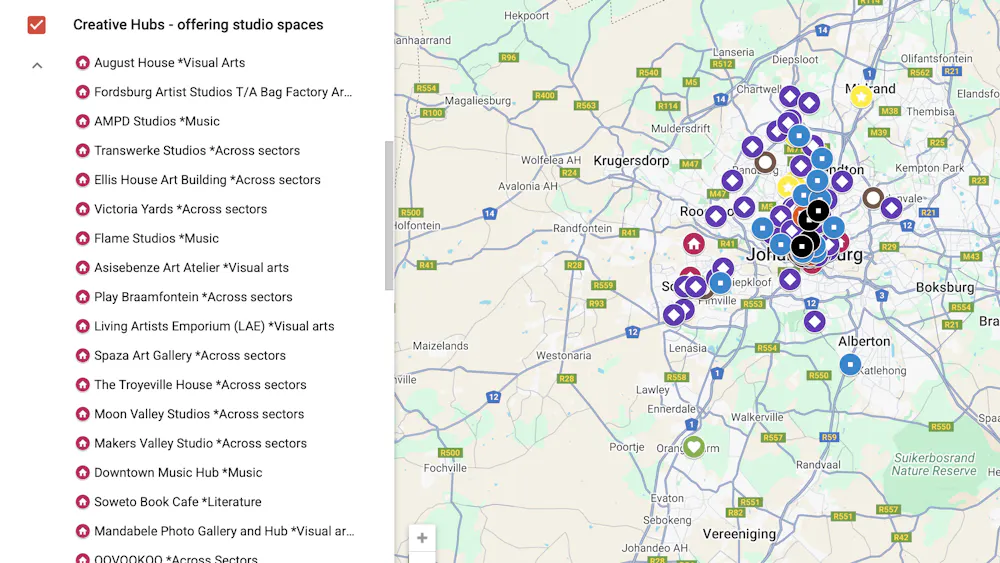
    Over the last year, 21 creative hubs have been mapped in the city, the majority newly established. Notable examples include Transwerke Studios, Asisebenze Art Atelier, Victoria Yards and Oovookoo. Remarkably, 19 of the 21 hubs identified in my open-source mapping process are in the inner city. Only two are government run – Transwerke and Downtown Music Hub.

    Across Johannesburg, creative hubs buzz with independent activity, yet share a common commitment to cultivating talent, business support and community impact. They are evidence of innovative partnerships between creatives and property developers.

    Inside these spaces, artists and creatives get opportunities through gallerist and investor visits (access to markets). They build practical and entrepreneurial skills through tailored workshops. And they collaborate on projects that place social upliftment at their heart.

    Some hubs focus on offering studio spaces, while others extend their reach beyond their walls, blending artistic expression with community development and public engagement.

    By actively building community and opportunity, creative hubs are becoming

    lighthouses for the new urban economy.

    They are small business incubators, urban beautification engines and potential cultural tourism hotspots. An event like Contra Fair opens the doors of art studio hubs once a year. Entrepreneur and social activist Tebogo Moalusi has now taken the lead in the establishment of Creative20. This will become a platform for revitalising Johannesburg’s creative cities campaign.

    Neglected by the city

    And yet the cultural and creative industries remain almost entirely absent from the city’s strategic planning. The Johannesburg 2040: Growth and Development Strategy fails even to mention the sector.

    This is despite Gauteng, the province that houses Johannesburg, being the epicentre of South Africa’s creative economy. It contributes 46.3% of the industry’s gross domestic product and generates the highest employment impact. Johannesburg hosts the majority of creative businesses in the province.


    Read more:
    The real Johannesburg: 6 powerful photos from a gritty new book on the city


    The Gauteng 2030 Strategy highlights three high-growth sectors: agro-processing, cultural and creative industries, and high-tech/knowledge sectors, including digital and gaming. Two of these directly involve the creative economy. Yet there’s been little effort to integrate them into Johannesburg’s urban development agenda.

    If Johannesburg is serious about inclusive economic development and sustainable urban growth, it must recognise and invest in the cultural and creative industries which are already thriving within its borders.

    Mariapaola McGurk consults to Creative20 Organisation

    ref. Johannesburg’s creative hubs are booming: how artists are rejuvenating a failing inner city – https://theconversation.com/johannesburgs-creative-hubs-are-booming-how-artists-are-rejuvenating-a-failing-inner-city-260224

    MIL OSI Analysis

  • MIL-OSI: ETHRANSACTION’s new Cloud Mining contracts makes it easier to yield stablecoins such as BTC, ETH, DOGE, XRP and LTC

    Source: GlobeNewswire (MIL-OSI)

    Kansas City, Missouri, July 21, 2025 (GLOBE NEWSWIRE) —  According to the current financial system of the crypto market, the turbulence continues, and the cloud mining industry is also becoming more and more fierce. Nowadays, using stablecoins to participate in cloud mining is the safest and wisest choice.

    ETHRANSACTION has become an industry leader with safe, reliable, legal, and advanced equipment and artificial intelligence management!

    Follow the ETHRANSACTION platform to help you achieve a daily income of $36,677 (risk-free)

    The ETHRANSACTION platform allows individuals to generate digital currencies remotely for operation and generate substantial and fixed daily income-simplifying cumbersome processes so that users can easily obtain cryptocurrencies without placing expensive equipment or dealing with complex technology.

    Founded in 2017, ETHRANSACTION has obtained all the necessary licenses issued by the British government and has now developed into one of the world’s top and most well-known cloud mining companies. With its advanced facilities, anyone can trade mainstream digital currencies such as Dogecoin, Litecoin, Ripple, and Bitcoin with just a laptop or mobile device.

    ETHRANSACTION prioritizes security and uses industry best practices, including SSL encryption, L&G insurance, and an effective risk prevention system. These security protocols ensure that user data and funds are always safe and confidential.

    Join Now and Enjoy the Welcome Bonus
    ETHRANSACTION offers opportunities for everyone who wants to make money with cryptocurrencies, regardless of their level of expertise. New users can get an instant $19 welcome bonus when they sign up and start mining immediately without any upfront costs or expensive equipment installation.

    High profit potential through first-class plans
    ETHRANSACTION offers contract plans tailored to meet the needs of small and large traders. Participants can start mining for free and get rewards by simply registering as one of ETHRANSACTION users. To make more profits, you need to choose the best contract plan for yourself:

    Buy $100 contract | Earn: $118, total profit $18

    Buy $600 contract | Earn $652.5, total profit $52.5

    Buy $1300 contract | Earn $1536.6, total profit $236.6

    Buy $6300 contract | Earn $8741.25, total profit $2441.25

    Buy $47000 | Earn: $98183, total profit $51183

    All contract plans on the platform are transparent and open, and you can choose the one that suits you when investing.

    ETHRANSACTION has a simple interface and security protection.

    The mining range is wide, and buyers can profit from a variety of altcoins depending on market fluctuations. The currencies that can be mined include: BTC, LTC, BCH and DOGE and other altcoins and obtain.

    The best quality security infrastructure, protected by SSL encryption, insured by L&G, and trusted by large financial institutions

    The sustainable mining process is carried out through 100% renewable energy, ensuring environmental safety and compliance with international standards

    Earn up to 6% permanent commission for each friend referral and exclusive access to a $370,000 reward pool.

    Ethereum 2.0 progress and institutional demand have allowed Ethereum to maintain its position as one of the most popular blockchain technologies. At most, ETH traders can only quadruple their holdings with this modest growth. In contrast, cloud mining with ETHRANSACTION provides a faster and more efficient way to make profits without the risk of keeping ETH savings or market fluctuations.

    ETHRANSACTION Generates Income Even When Traders Are on Vacation
    At a time when passive cash flow is more important than ever, ETHRANSACTION makes it easy and safe for individuals to join the cryptocurrency industry. The network’s legitimacy, security, convenience, and benefits make it an ideal solution for both new and professional investors.

    ETHRANSACTION provides users with the tools they need to mine and create wealth at scale, whether they want to be completely self-reliant or want a flexible income stream.

    Get Started Now!
    You can start receiving daily cryptocurrency rewards without any technical or regional restrictions.
    For more information, please visit the official website: https://ethransaction.vip or contact us via
    email: info@ethransaction.vip

    Attachment

    The MIL Network

  • MIL-OSI: ETHRANSACTION Redefines Digital Wealth Creation with One-Click Cloud Mining Contracts

    Source: GlobeNewswire (MIL-OSI)

    Louisville, Kentucky, July 21, 2025 (GLOBE NEWSWIRE) — ETHRANSACTION, the world’s leading compliant cloud mining platform, is redefining the path to wealth creation in digital assets with disruptive technical strength and ultra-high return model! No mining machine, no technology, one-click to start your stable income engine.

    Why are global investors flocking to ETHRANSACTION?

    “Zero-cost start” benefits of real money
    Sign up and get $19! Log in every day to buy a $19 trial contract to earn $0.9, and get up to $46 in additional rewards for 30 consecutive days. Use the start-up funds given by the platform for free to experience the magic of “lying down to earn” digital assets.

    Ultra-high daily interest contracts, visible income
    The platform provides a ladder-type smart contract, and the daily income is transparently credited. For example:
    Invest $23,000 to purchase S21 intermediate contracts (45 days, daily interest rate 1.85%)
    → Daily income = $23,000 × 1.85% = $425.5
    → Total income in 45 days = $425.5 × 45 = $19,147.5
    → The total principal and interest is as high as $42,147.5!
    (Note: Sample data is for reference only, and multiple plans and contracts are available for free selection)
    Contract price $100, contract period 2 days, daily income $9, total income $100+$18, (interest settled every 24 hours)

    Contract price $600.00, contract period 5 days, daily income $7.5, total income $600.00 + $37.5, (interest settled every 24 hours)

    Contract price $1300, contract period 14 days, daily income $16.9, total income $1300 + $236.6, (interest settled every 24 hours)

    Triple fortress-level security

    Fund insurance: Cooperate with British L&G Insurance Company, asset underwriting without worries

    Technical protection: McAfee® anti-hacker + Cloudflare® anti-DDoS attack, financial-grade SSL encryption

    Compliance endorsement: UK FSA regulatory license, transparent and auditable operation

    Flexible multi-currency, free control of income
    Support BTC, ETH, USDT, DOGE, DOGE and other 10+ mainstream currency settlements, withdrawal threshold is only $100! Income can be reinvested or withdrawn at any time, truly realizing “free deposit and worry-free withdrawal”.

    Three steps to start your “after-sleep income” money printing machine:
     Lightning registration, receive $19 in seconds
    Complete certification in 1 minute, $19 bonus will be credited immediately, and start daily automatic income.

    Smart contract selection, customized wealth plan
    From $100 lightweight to $330,000 professional contracts, matching different amounts of funds and goals. All plans have 0 service fees, 0 management fees, and 100% of the income belongs to you!

    Sit back and enjoy the income, and your wealth will grow automatically
    After purchasing the contract, the income will be automatically credited to your account the next day! When your account reaches $100, you can withdraw the currency to any wallet, or roll over the large income with compound interest.

    Fission Wealth Alliance: Make a crazy profit of $370,000+ by recommending!

    ETHRANSACTION launches the strongest recommendation mechanism in the industry:
    ✅ Direct recommendation reward: Enjoy 2%-4% permanent share of your friends’ income
    ✅ Team size incentive: The commission ratio of a team of 100 people is automatically upgraded
    ✅ Unlimited hierarchical income: The subordinate team continues to contribute additional rewards
     The cumulative referral bonus pool is as high as $370,000——Connections are gold mines!

    Beware of fake platforms! Look for the ETHRANSACTION core logo:
    ✅ UK FSA regulatory number available

    ✅ 100% clean energy mining, zero carbon footprint

    ✅ Enterprise-level IDC room, 99.99% online rate throughout the year

    ✅ 24/7 multilingual real-time customer service, 5-minute response to work orders

    Wealth Revelation: In the era of encryption where computing power is king, ETHRANSACTION has popularized institutional-level mining income by aggregating the world’s top mining resources and AI dynamic optimization system. Whether you are a beginner trying the digital economy or a professional player seeking asset hedging, you only need one choice to take this high-speed “passive income train”.

    Take action now! Scan the QR code to download the official APP (support iOS/Android) or log in to the official website directly through the browser https://ethransaction.vip Automatic Wealth Creation Plan

    Email: info@ethransaction.vip
    Website: https://www.ethransaction.vip

    Attachment

    The MIL Network

  • MIL-OSI Africa: Johannesburg’s creative hubs are booming: how artists are rejuvenating a failing inner city

    Source: The Conversation – Africa – By Mariapaola McGurk, Lecturer in Innovation & Entrepreneurship, University of Auckland, Waipapa Taumata Rau

    Johannesburg is weathering a storm of crises. Nowhere is its complex tangle of challenges more visible than in the inner city, where crime, overcrowding, and infrastructure collapse – such as roads literally exploding – paint a grim picture. Cultural institutions haven’t been spared either, with long-standing landmarks like the Johannesburg Art Gallery caught in cycles of neglect and crisis.


    Read more: South Africa doesn’t need new cities: it needs to focus on fixing what it’s got


    Yet, while many avoid the inner city or speak only of its decline, the creative and cultural practitioners of Johannesburg never left. In fact, artists, architects, fashion designers, animators, musicians and the like have been hard at work. They’re building, dreaming and shaping a new urban reality that could become the beacon of hope this city needs.

    As a researcher and visual artist, I recently completed a PhD study that focused on Johannesburg’s cultural and creative industries. My research revealed that a clear understanding of the existing structures and dynamics within this industry is essential for developing effective strategies to strengthen its role in local economic development.

    Here I explore one such opportunity: creative hubs. I argue that they represent a low-hanging fruit for the inner city’s growth and revitalisation.

    Urban renewal

    Numerous articles have explored strategies for the city’s economic development and urban renewal. One group of scholars recently outlined four critical focus areas: coordinated efforts across government levels; an active civil society; a shift in political culture; and restored leadership in a revitalised administration.

    These are vital interventions, but they still beg a deeper question. What is the new “gold” of the “City of Gold”, the mining town founded in 1886 and on track to become a megacity by 2030?

    Work by artist Candice Kramer at Bag Factory Artists Studios. Mark Straw

    What is it that truly sets Johannesburg apart, nationally and globally? What strengths already exist that, if nurtured, could help address the city’s challenges? The answer may not lie in building something entirely new, but in recognising and investing in what already thrives. The city’s people, its culture, and its extraordinary creativity.

    In 2004, Unesco launched the Creative Cities Network. Today it comprises 246 cities in 80 member states. South Africa has three cities in the network: Cape Town (design), Durban (literature) and Overstrand (gastronomy). Johannesburg has never applied to belong.

    Cities are acknowledging the economic and social value of the cultural and creative industries, particularly in addressing challenges such as youth unemployment, micro-enterprise growth, equity and community development.

    Artist Mankebe Seakoe at Contra Fair. Mark Straw

    Yet cities globally are grappling with how to retain creative professionals. This is the case in cities like Toronto, Sydney, Los Angeles, Cologne or Barcelona. Rising property prices, the redevelopment of industrial areas into commercial or luxury spaces, and short-term rental agreements are displacing these professionals from the urban cores they help energise. Cities are coming up with incentives and programmes to correct this.

    A recent World Cities Cultural Forum report offers a solution in the form of Creative Land Trusts. These permanently hold land and assets at affordable rates for creatives. They take property out of speculative real estate markets. They’re designed to support not galleries or theatres, but the studios and workspaces where creative production actually happens.

    Similar initiatives are happening in London, Helsinki and San Francisco.

    Mapping Johannesburg’s creative hubs

    Unlike cities that are trying to reverse the exodus of creatives, Johannesburg’s inner city has seen a recent surge in creative hub development.

    A creative hub is a physical or digital space (in this case physical) designed to bring together cultural and creative professionals for studio space, collaboration, networking and the exchange of ideas.

    Some creative hubs offer gallery spaces. Mark Straw

    Over the last year, 21 creative hubs have been mapped in the city, the majority newly established. Notable examples include Transwerke Studios, Asisebenze Art Atelier, Victoria Yards and Oovookoo. Remarkably, 19 of the 21 hubs identified in my open-source mapping process are in the inner city. Only two are government run – Transwerke and Downtown Music Hub.

    Across Johannesburg, creative hubs buzz with independent activity, yet share a common commitment to cultivating talent, business support and community impact. They are evidence of innovative partnerships between creatives and property developers.

    Mapping Johannesburg’s creative hubs. Google Maps/Mariapaola McGurk

    Inside these spaces, artists and creatives get opportunities through gallerist and investor visits (access to markets). They build practical and entrepreneurial skills through tailored workshops. And they collaborate on projects that place social upliftment at their heart.

    Some hubs focus on offering studio spaces, while others extend their reach beyond their walls, blending artistic expression with community development and public engagement.

    By actively building community and opportunity, creative hubs are becoming

    lighthouses for the new urban economy.

    They are small business incubators, urban beautification engines and potential cultural tourism hotspots. An event like Contra Fair opens the doors of art studio hubs once a year. Entrepreneur and social activist Tebogo Moalusi has now taken the lead in the establishment of Creative20. This will become a platform for revitalising Johannesburg’s creative cities campaign.

    Neglected by the city

    And yet the cultural and creative industries remain almost entirely absent from the city’s strategic planning. The Johannesburg 2040: Growth and Development Strategy fails even to mention the sector.

    Bag Factory Artists Studios hosting a public event. Mark Straw

    This is despite Gauteng, the province that houses Johannesburg, being the epicentre of South Africa’s creative economy. It contributes 46.3% of the industry’s gross domestic product and generates the highest employment impact. Johannesburg hosts the majority of creative businesses in the province.


    Read more: The real Johannesburg: 6 powerful photos from a gritty new book on the city


    The Gauteng 2030 Strategy highlights three high-growth sectors: agro-processing, cultural and creative industries, and high-tech/knowledge sectors, including digital and gaming. Two of these directly involve the creative economy. Yet there’s been little effort to integrate them into Johannesburg’s urban development agenda.

    If Johannesburg is serious about inclusive economic development and sustainable urban growth, it must recognise and invest in the cultural and creative industries which are already thriving within its borders.

    – Johannesburg’s creative hubs are booming: how artists are rejuvenating a failing inner city
    – https://theconversation.com/johannesburgs-creative-hubs-are-booming-how-artists-are-rejuvenating-a-failing-inner-city-260224

    MIL OSI Africa

  • MIL-OSI: ETHRANSACTION reveals mining contracts using BTC, XRP, USDC and other mainstream currencies for cloud mining

    Source: GlobeNewswire (MIL-OSI)

    Oklahoma City, Oklahoma, July 21, 2025 (GLOBE NEWSWIRE) — ETHRANSACTION, a leading cloud mining platform has a high number of mining contracts that suits every level of investors. It supports BTC< XRP < USDC and many other crypto currencies to start the cloud mining and generate crypto rewards.

    So ETHRANSACTION has launched a plan contract suitable for people in all fields to allow retail investors to have their own crypto savings in advance in the next decade; so that retail investors can get a stable passive income from cloud mining.

    ETHRANSACTION is driven by clean energy: it not only saves a lot of energy consumption, but also generates high profits, allowing investors to see the potential of new energy. ETHRANSACTION
    Has advanced cryptocurrency mining equipment, sites, maintenance facilities, and cheap clean electricity. If you want to participate in mining, ETHRANSACTION is the perfect choice for cryptocurrency enthusiasts.
    You can participate in mining without any equipment and easily earn $9,075 a day.

    How to mine in the ETHRANSACTION cloud:

    1: Sign up now to get a $19 reward (can be used to earn $0.9 for daily sign-in)

    2: Choose a contract: After successfully registering, the next step is to choose a mining contract that meets your goals and budget. ETHRANSACTION offers a variety of contracts to meet different needs, whether you are a beginner or an experienced miner. Take a close look at the available options and consider factors such as contract duration, potential returns, and associated costs.

    3: Unprecedented profit potential
    What makes ETHRANSACTION different is its high profit potential. Users can earn up to more than $9,075 per day, making it one of the most profitable cloud mining platforms. This passive income model allows investors to earn substantial income without a lot of knowledge or involvement in the mining process.

    ETHRANSACTION has 8.73 million users worldwide. Sign up now to join the cloud mining contract for free. Give yourself a chance, which is equivalent to giving yourself a future.

    Click to download the official App and control your financial freedom anytime, anywhere!

    Security and Sustainability: Trustworthy Investments

    Security and transparency are at the core of ETHRANSACTION operations. The platform ensures that user funds are protected while complying with industry regulations. By utilizing clean energy, ETHRANSACTION not only maximizes profits but also minimizes environmental impact, making it a truly sustainable investment opportunity.

    Daily Passive Income Potential for ETHRANSACTION Miners

    Are you tired of the limitations of traditional repetitive work? Are you looking for a way to make money even while you sleep? ETHRANSACTION’s passive income opportunity is not to be missed. With a potential income of $7.5-9075 per day, it is not to be missed. ETHRANSACTION operates using solar energy and cryptocurrency mining. Individuals do not need to actively participate, just invest in purchasing a plan contract to make a huge profit. It’s like having your own money-making machine!

    Choose a contract that suits your investment strategy:

    For more information on the new contracts, visit the official ETHRANSACTION platform website: https://ethransaction.vip

    4: Start earning: Once you have selected and activated your mining contract, you can sit back and wait for the system to work for you. ETHRANSACTION’s advanced technology ensures that your mining operation runs efficiently, maximizing your potential earnings.

    Affiliate Program: Earn money without investing

    For users looking to earn extra income, ETHRANSACTION offers an exclusive affiliate program where users can refer others and earn up to $99,000 in commissions. Unlimited referrals, unlimited profit potential.

    Start earning money today!

    If you are looking for passive income opportunities, ETHRANSACTION is your gateway to financial growth. With a seamless platform, secure infrastructure, and unparalleled profitability, ETHRANSACTION is reinventing the future of cloud mining.

    As your mining activities progress, you will begin to see profits accumulating in your account. Track your performance through the platform’s dashboard and withdraw your earnings when you are ready. ETHRANSACTION Platform Advantages:

    1: Intuitive Interface: The platform’s user-friendly interface ensures that even cryptocurrency novices can easily navigate.

    2: Legitimacy and Global Audience: The platform was legally established in the UK in 2017, protected and issued by the UK government, and has attracted more than 8.73 million real users worldwide with cutting-edge technology.

    3: Cutting-edge equipment: Using mining equipment provided by top mining machine manufacturers such as Bitmain, Shenma Miner and Canaan Creative to ensure the stable operation and efficient production capacity of Bitcoin miners.

    4: Support a variety of popular cryptocurrencies: such as USDT-TRC20, BTC, ETH, LTC, USDC, BNB, BCH, DOGE, XRP, etc. for settlement.

    5: Stable income: The contracts launched by the platform have income every 24 hours, and the principal is automatically returned after the contract expires.

    6: Affiliate Program: You can recommend friends and get a referral bonus of up to $99,000.

    7: Professional team: The platform has an experienced IT team and 24/7 real-time customer service team support to ensure that users can solve problems in a timely manner.

    Summary:

    ETHRANSACTION service platform is a legal, compliant, safe, reliable company that abides by local laws and regulations. The mission is to enable everyone to conduct cloud mining, and any region can remotely monitor their income in real time. Click here to start learning about the ETHRANSACTION platform and start your cloud mining journey.

    Attachment

    The MIL Network

  • MIL-OSI Analysis: Idi Amin made himself out to be the ‘liberator’ of an oppressed majority – a demagogic trick that endures today

    Source: The Conversation – Global Perspectives – By Derek R. Peterson, Ali Mazrui Professor of History & African Studies, University of Michigan

    Idi Amin addresses the United Nations General Assembly in 1975. Bettmann/Getty Images

    Fifty years ago, Ugandan President Idi Amin wrote to the governments of the British Commonwealth with a bold suggestion: Allow him to take over as head of the organization, replacing Queen Elizabeth II.

    After all, Amin reasoned, a collapsing economy had made the U.K. unable to maintain its leadership. Moreover the “British empire does not now exist following the complete decolonization of Britain’s former overseas territories.”

    It wasn’t Amin’s only attempt to reshape the international order. Around the same time, he called for the United Nations headquarters to be moved to Uganda’s capital, Kampala, touting its location at “the heart of the world between the continents of America, Asia, Australia and the North and South Poles.”

    Amin’s diplomacy aimed to place Kampala at the center of a postcolonial world. In my new book, “A Popular History of Idi Amin’s Uganda,” I show that Amin’s government made Uganda – a remote, landlocked nation – look like a frontline state in the global war against racism, apartheid and imperialism.

    Doing so was, for the Amin regime, a way of claiming a morally essential role: liberator of Africa’s hitherto oppressed people. It helped inflate his image both at home and abroad, allowing him to maintain his rule for eight calamitous years, from 1971 to 1979.

    The phony liberator?

    Amin was the creator of a myth that was both manifestly untrue and extraordinarily compelling: that his violent, dysfunctional regime was actually engaged in freeing people from foreign oppressors.

    The question of Scottish independence was one of his enduring concerns. The “people of Scotland are tired of being exploited by the English,” wrote Amin in a 1974 telegram to United Nations Secretary General Kurt Waldheim. “Scotland was once an independent country, happy, well governed and administered with peace and prosperity,” but under the British government, “England has thrived on the energies and brains of the Scottish people.”

    Even his cruelest policies were framed as if they were liberatory. In August 1972, Amin announced the summary expulsion of Uganda’s Asian community. Some 50,000 people, many of whom had lived in Uganda for generations, were given a bare three months to tie up their affairs and leave the country. Amin named this the “Economic War.”

    In the speech that announced the expulsions, Amin argued that “the Ugandan Africans have been enslaved economically since the time of the colonialists.” The Economic War was meant to “emancipate the Uganda Africans of this republic.”

    “This is the day of salvation for the Ugandan Africans,” he said. By the end of 1972, some 5,655 farms, ranches and estates had been vacated by the departed Asian community, and Black African proprietors were queuing up to take over Asian-run businesses.

    Ugandan Asian refugees arrive at an airport in the U.K. after being expelled from Uganda.
    P. Felix/Daily Express/Hulton Archive/Getty Images

    A year later, when Amin attended the Organization of African Unity summit in Addis Ababa, Ethiopia, his “achievements” were reported in a booklet published by the Uganda government. During his speech, Amin was “interrupted by thunderous applauses of acclamation and cheers, almost word for word, by Heads of State and Government and by everybody else who had a chance to hear it,” according to the the report.

    It was, wrote the government propagandist, “very clear that Uganda had emerged as the forefront of a True African State. It was clear that African nationalism had been born again. It was clear that the speech had brought new life to the freedom struggle in Africa.”

    Life at the front

    Amin’s policies were disastrous for all Ugandans, African and Asian alike. Yet his war of economic liberation was, for a time, a source of inspiration for activists around the world. Among the many people gripped by enthusiasm for Amin’s regime was Roy Innis, the Black American leader of the civil rights organization Congress of Racial Equality.

    In March 1973, Innis visited Uganda at Amin’s invitation. Innis and his colleagues had been pressing African governments to grant dual citizenship to Black Americans, just as Jewish Americans could earn citizenship from the state of Israel.

    Over the course of their 18 days in Uganda, the visiting Americans were shuttled around the country in Amin’s helicopter. Everywhere, Innis spoke with enthusiasm about Amin’s accomplishments. In a poem published in the pro-government Voice of Uganda around the time of his visit, Innis wrote:

    “Before, the life of your people was a complete bore,

    And they were poor, oppressed, exploited and economically sore.

    And you then came and opened new, dynamic economic pages.

    And showered progress on your people in realistic stages.

    In such expert moves that baffled even the great sages,

    your electric personality pronounced the imperialists’ doom.

    Your pragmatism has given Ugandans their economic boom.”

    In May 1973, Innis was back in Uganda, promising to recruit a contingent of 500 African American professors and technicians to serve in Uganda. Amin offered them free passage to Uganda, free housing and free hospital care for themselves and their families. The American weekly magazine Jet predicted that Uganda was soon to become an “African Israel,” a model nation upheld by the energies and knowledge of Black Americans.

    Roy Innis, national director of the Congress of Racial Equality, in 1972.
    Bettmann/Getty Images

    As some have observed, Innis was surely naive. But his enthusiasm was shared by a great many people, not least a great many Ugandans. Inspired by Amin’s promises, their energy and commitment kept institutions functioning in a time of great disruption. They built roads and stadiums, constructed national monuments and underwrote the running costs of government ministries.

    Patriotism and demagoguery

    Their ambitions were soon foreclosed by a rising tide of political dysfunction. Amin’s regime came to a violent end in 1979, when he was ousted by the invading army of Tanzania and fled Uganda.

    But his brand of demagoguery lives on. Today a new generation of demagogues claim to be fighting to liberate aggrieved majorities from outsiders’ control.

    In the 1970s, Amin enlisted Black Ugandans to battle against racial minorities who were said to dominate the economy and public life. Today an ascendant right wing encourages aggrieved white Americans to regard themselves as a majority dispossessed of their inheritance by greedy immigrants.

    Amin encouraged Ugandans to regard themselves as frontline soldiers, engaged in a globally consequential war against foreigners. In today’s America, some people similarly feel themselves deputized to take matters of state into their own hands. In January 2021, for instance, a right-wing group called “Stop the Steal” organized a rally in Washington. Vowing to “take our country back,” they stormed the Capitol building.

    The racialized demagoguery that Idi Amin promoted inspired the imagination of a great many people. It also fed violent campaigns to repossess a stolen inheritance, to reclaim properties that ought, in the view of the aggrieved majority, to belong to native sons and daughters. His regime is for us today a warning about the compelling power of demagoguery to shape people’s sense of purpose.

    Derek R. Peterson receives funding from the John D. and Catherine T. MacArthur Foundation and the Andrew Mellon Foundation.

    ref. Idi Amin made himself out to be the ‘liberator’ of an oppressed majority – a demagogic trick that endures today – https://theconversation.com/idi-amin-made-himself-out-to-be-the-liberator-of-an-oppressed-majority-a-demagogic-trick-that-endures-today-256969

    MIL OSI Analysis

  • MIL-OSI United Kingdom: Occupied Palestinian Territories: joint statement, 21 July 2025

    Source: United Kingdom – Executive Government & Departments 3

    News story

    Occupied Palestinian Territories: joint statement, 21 July 2025

    The UK and 25 international partners gave a joint statement on the Occupied Palestinian Territories.

    Joint statement by:

    • foreign ministers of Australia, Austria, Belgium, Canada, Denmark, Estonia, Finland, France, Iceland, Ireland, Italy, Japan, Latvia, Lithuania, Luxembourg, The Netherlands, New Zealand, Norway, Poland, Portugal, Slovenia, Spain, Sweden, Switzerland and the UK
    • EU Commissioner for Equality, Preparedness and Crisis Management

    We, the signatories listed below, come together with a simple, urgent message: the war in Gaza must end now.

    The suffering of civilians in Gaza has reached new depths. The Israeli government’s aid delivery model is dangerous, fuels instability and deprives Gazans of human dignity. We condemn the drip feeding of aid and the inhumane killing of civilians, including children, seeking to meet their most basic needs of water and food. It is horrifying that over 800 Palestinians have been killed while seeking aid. The Israeli Government’s denial of essential humanitarian assistance to the civilian population is unacceptable. Israel must comply with its obligations under international humanitarian law.

    The hostages cruelly held captive by Hamas since 7 October 2023 continue to suffer terribly. We condemn their continued detention and call for their immediate and unconditional release. A negotiated ceasefire offers the best hope of bringing them home and ending the agony of their families.

    We call on the Israeli government to immediately lift restrictions on the flow of aid and to urgently enable the UN and humanitarian NGOs to do their life saving work safely and effectively.

    We call on all parties to protect civilians and uphold the obligations of international humanitarian law. Proposals to remove the Palestinian population into a “humanitarian city” are completely unacceptable. Permanent forced displacement is a violation of international humanitarian law.

    We strongly oppose any steps towards territorial or demographic change in the Occupied Palestinian Territories. The E1 settlement plan announced by Israel’s Civil Administration, if implemented, would divide a Palestinian state in two, marking a flagrant breach of international law and critically undermine the two-state solution. Meanwhile, settlement building across the West Bank including East Jerusalem has accelerated while settler violence against Palestinians has soared. This must stop.

    We urge the parties and the international community to unite in a common effort to bring this terrible conflict to an end, through an immediate, unconditional and permanent ceasefire. Further bloodshed serves no purpose.  We reaffirm our complete support to the efforts of the US, Qatar and Egypt to achieve this.

    We are prepared to take further action to support an immediate ceasefire and a political pathway to security and peace for Israelis, Palestinians and the entire region.

    This statement has been signed by: 

    • The Foreign Ministers of Australia, Austria, Belgium, Canada, Denmark, Estonia, Finland, France, Iceland, Ireland, Italy, Japan, Latvia, Lithuania, Luxembourg, The Netherlands, New Zealand, Norway, Poland, Portugal, Slovenia, Spain, Sweden, Switzerland and the UK 

    • The EU Commissioner for Equality, Preparedness and Crisis Management

    Media enquiries

    Email newsdesk@fcdo.gov.uk

    Telephone 020 7008 3100

    Email the FCDO Newsdesk (monitored 24 hours a day) in the first instance, and we will respond as soon as possible.

    Updates to this page

    Published 21 July 2025

    MIL OSI United Kingdom

  • MIL-OSI Submissions: ‘Democratizing space’ is more than just adding new players – it comes with questions around sustainability and sovereignty

    Source: The Conversation – USA – By Timiebi Aganaba, Assistant Professor of Space and Society, Arizona State University

    A group of people gaze up at the Moon in Germany. AP Photo/Markus Schreiber

    India is on the Moon,” S. Somanath, chairman of the Indian Space Research Organization, announced in August 2023. The announcement meant India had joined the short list of countries to have visited the Moon, and the applause and shouts of joy that followed signified that this achievement wasn’t just a scientific one, but a cultural one.

    India’s successful lunar landing prompted celebrations across the country, like this one in Mumbai.
    AP Photo/Rajanish Kakade

    Over the past decade, many countries have established new space programs, including multiple African nations. India and Israel – nations that were not technical contributors to the space race in the 1960s and ‘70s – have attempted landings on the lunar surface.

    With more countries joining the evolving space economy, many of our colleagues in space strategy, policy ethics and law have celebrated the democratization of space: the hope that space is now more accessible for diverse participants.

    We are a team of researchers based across four countries with expertise in space policy and law, ethics, geography and anthropology who have written about the difficulties and importance of inclusion in space.

    Major players like the U.S., the European Union and China may once have dominated space and seen it as a place to try out new commercial and military ventures. Emerging new players in space, like other countries, commercial interests and nongovernmental organizations, may have other goals and rationales. Unexpected new initiatives from these newcomers could shift perceptions of space from something to dominate and possess to something more inclusive, equitable and democratic.

    We address these emerging and historical tensions in a paper published in May 2025 in the journal Nature, in which we describe the difficulties and importance of including nontraditional actors and Indigenous peoples in the space industry.

    Continuing inequalities among space players

    Not all countries’ space agencies are equal. Newer agencies often don’t have the same resources behind them that large, established players do.

    The U.S. and Chinese programs receive much more funding than those of any other country. Because they are most frequently sending up satellites and proposing new ideas puts them in the position to establish conventions for satellite systems, landing sites and resource extraction that everyone else may have to follow.

    Sometimes, countries may have operated on the assumption that owning a satellite would give them the appearance of soft or hard geopolitical power as a space nation – and ultimately gain relevance.

    Small satellites, called CubeSats, are becoming relatively affordable and easy to develop, allowing more players, from countries and companies to universities and student groups, to have a satellite in space.
    NASA/Butch Wilmore, CC BY-NC

    In reality, student groups of today can develop small satellites, called CubeSats, autonomously, and recent scholarship has concluded that even successful space missions may negatively affect the international relationships between some countries and their partners. The respect a country expects to receive may not materialize, and the costs to keep up can outstrip gains in potential prestige.

    Environmental protection and Indigenous perspectives

    Usually, building the infrastructure necessary to test and launch rockets requires a remote area with established roads. In many cases, companies and space agencies have placed these facilities on lands where Indigenous peoples have strong claims, which can lead to land disputes, like in western Australia.

    Many of these sites have already been subject to human-made changes, through mining and resource extraction in the past. Many sites have been ground zero for tensions with Indigenous peoples over land use. Within these contested spaces, disputes are rife.

    Because of these tensions around land use, it is important to include Indigenous claims and perspectives. Doing so can help make sure that the goal of protecting the environments of outer space and Earth are not cast aside while building space infrastructure here on Earth.

    Some efforts are driving this more inclusive approach to engagement in space, including initiatives like “Dark and Quiet Skies”, a movement that works to ensure that people can stargaze and engage with the stars without noise or sound pollution. This movement and other inclusive approaches operate on the principle of reciprocity: that more players getting involved with space can benefit all.

    Researchers have recognized similar dynamics within the larger space industry. Some scholars have come to the conclusion that even though the space industry is “pay to play,” commitments to reciprocity can help ensure that players in space exploration who may not have the financial or infrastructural means to support individual efforts can still access broader structures of support.

    The downside of more players entering space is that this expansion can make protecting the environment – both on Earth and beyond – even harder.

    The more players there are, at both private and international levels, the more difficult sustainable space exploration could become. Even with good will and the best of intentions, it would be difficult to enforce uniform standards for the exploration and use of space resources that would protect the lunar surface, Mars and beyond.

    It may also grow harder to police the launch of satellites and dedicated constellations. Limiting the number of satellites could prevent space junk, protect the satellites already in orbit and allow everyone to have a clear view of the night sky. However, this would have to compete with efforts to expand internet access to all.

    The amount of space junk in orbit has increased dramatically since the 1960s.

    What is space exploration for?

    Before tackling these issues, we find it useful to think about the larger goal of space exploration, and what the different approaches are. One approach would be the fast and inclusive democratization of space – making it easier for more players to join in. Another would be a more conservative and slower “big player” approach, which would restrict who can go to space.

    The conservative approach is liable to leave developing nations and Indigenous peoples firmly on the outside of a key process shaping humanity’s shared future.

    But a faster and more inclusive approach to space would not be easy to run. More serious players means it would be harder to come to an agreement about regulations, as well as the larger goals for human expansion into space.

    Narratives around emerging technologies, such as those required for space exploration, can change over time, as people begin to see them in action.

    Technology that we take for granted today was once viewed as futuristic or fantastical, and sometimes with suspicion. For example, at the end of the 1940s, George Orwell imagined a world in which totalitarian systems used tele-screens and videoconferencing to control the masses.

    Earlier in the same decade, Thomas J. Watson, then president of IBM, notoriously predicted that there would be a global market for about five computers. We as humans often fear or mistrust future technologies.

    However, not all technological shifts are detrimental, and some technological changes can have clear benefits. In the future, robots may perform tasks too dangerous, too difficult or too dull and repetitive for humans. Biotechnology may make life healthier. Artificial intelligence can sift through vast amounts of data and turn it into reliable guesswork. Researchers can also see genuine downsides to each of these technologies.

    Space exploration is harder to squeeze into one streamlined narrative about the anticipated benefits. The process is just too big and too transformative.

    To return to the question if we should go to space, our team argues that it is not a question of whether or not we should go, but rather a question of why we do it, who benefits from space exploration and how we can democratize access to broader segments of society. Including a diversity of opinions and viewpoints can help find productive ways forward.

    Ultimately, it is not necessary for everyone to land on one single narrative about the value of space exploration. Even our team of four researchers doesn’t share a single set of beliefs about its value. But bringing more nations, tribes and companies into discussions around its potential value can help create collaborative and worthwhile goals at an international scale.

    Tony Milligan receives funding from the European Research Council (ERC) under the European Union’s Horizon 2020 research and innovation programme (Grant agreement No. 856543).

    Adam Fish, Deondre Smiles, and Timiebi Aganaba do not work for, consult, own shares in or receive funding from any company or organization that would benefit from this article, and have disclosed no relevant affiliations beyond their academic appointment.

    ref. ‘Democratizing space’ is more than just adding new players – it comes with questions around sustainability and sovereignty – https://theconversation.com/democratizing-space-is-more-than-just-adding-new-players-it-comes-with-questions-around-sustainability-and-sovereignty-257306

    MIL OSI

  • MIL-OSI Submissions: ‘Democratizing space’ is more than just adding new players – it comes with questions around sustainability and sovereignty

    Source: The Conversation – USA – By Timiebi Aganaba, Assistant Professor of Space and Society, Arizona State University

    A group of people gaze up at the Moon in Germany. AP Photo/Markus Schreiber

    India is on the Moon,” S. Somanath, chairman of the Indian Space Research Organization, announced in August 2023. The announcement meant India had joined the short list of countries to have visited the Moon, and the applause and shouts of joy that followed signified that this achievement wasn’t just a scientific one, but a cultural one.

    India’s successful lunar landing prompted celebrations across the country, like this one in Mumbai.
    AP Photo/Rajanish Kakade

    Over the past decade, many countries have established new space programs, including multiple African nations. India and Israel – nations that were not technical contributors to the space race in the 1960s and ‘70s – have attempted landings on the lunar surface.

    With more countries joining the evolving space economy, many of our colleagues in space strategy, policy ethics and law have celebrated the democratization of space: the hope that space is now more accessible for diverse participants.

    We are a team of researchers based across four countries with expertise in space policy and law, ethics, geography and anthropology who have written about the difficulties and importance of inclusion in space.

    Major players like the U.S., the European Union and China may once have dominated space and seen it as a place to try out new commercial and military ventures. Emerging new players in space, like other countries, commercial interests and nongovernmental organizations, may have other goals and rationales. Unexpected new initiatives from these newcomers could shift perceptions of space from something to dominate and possess to something more inclusive, equitable and democratic.

    We address these emerging and historical tensions in a paper published in May 2025 in the journal Nature, in which we describe the difficulties and importance of including nontraditional actors and Indigenous peoples in the space industry.

    Continuing inequalities among space players

    Not all countries’ space agencies are equal. Newer agencies often don’t have the same resources behind them that large, established players do.

    The U.S. and Chinese programs receive much more funding than those of any other country. Because they are most frequently sending up satellites and proposing new ideas puts them in the position to establish conventions for satellite systems, landing sites and resource extraction that everyone else may have to follow.

    Sometimes, countries may have operated on the assumption that owning a satellite would give them the appearance of soft or hard geopolitical power as a space nation – and ultimately gain relevance.

    Small satellites, called CubeSats, are becoming relatively affordable and easy to develop, allowing more players, from countries and companies to universities and student groups, to have a satellite in space.
    NASA/Butch Wilmore, CC BY-NC

    In reality, student groups of today can develop small satellites, called CubeSats, autonomously, and recent scholarship has concluded that even successful space missions may negatively affect the international relationships between some countries and their partners. The respect a country expects to receive may not materialize, and the costs to keep up can outstrip gains in potential prestige.

    Environmental protection and Indigenous perspectives

    Usually, building the infrastructure necessary to test and launch rockets requires a remote area with established roads. In many cases, companies and space agencies have placed these facilities on lands where Indigenous peoples have strong claims, which can lead to land disputes, like in western Australia.

    Many of these sites have already been subject to human-made changes, through mining and resource extraction in the past. Many sites have been ground zero for tensions with Indigenous peoples over land use. Within these contested spaces, disputes are rife.

    Because of these tensions around land use, it is important to include Indigenous claims and perspectives. Doing so can help make sure that the goal of protecting the environments of outer space and Earth are not cast aside while building space infrastructure here on Earth.

    Some efforts are driving this more inclusive approach to engagement in space, including initiatives like “Dark and Quiet Skies”, a movement that works to ensure that people can stargaze and engage with the stars without noise or sound pollution. This movement and other inclusive approaches operate on the principle of reciprocity: that more players getting involved with space can benefit all.

    Researchers have recognized similar dynamics within the larger space industry. Some scholars have come to the conclusion that even though the space industry is “pay to play,” commitments to reciprocity can help ensure that players in space exploration who may not have the financial or infrastructural means to support individual efforts can still access broader structures of support.

    The downside of more players entering space is that this expansion can make protecting the environment – both on Earth and beyond – even harder.

    The more players there are, at both private and international levels, the more difficult sustainable space exploration could become. Even with good will and the best of intentions, it would be difficult to enforce uniform standards for the exploration and use of space resources that would protect the lunar surface, Mars and beyond.

    It may also grow harder to police the launch of satellites and dedicated constellations. Limiting the number of satellites could prevent space junk, protect the satellites already in orbit and allow everyone to have a clear view of the night sky. However, this would have to compete with efforts to expand internet access to all.

    The amount of space junk in orbit has increased dramatically since the 1960s.

    What is space exploration for?

    Before tackling these issues, we find it useful to think about the larger goal of space exploration, and what the different approaches are. One approach would be the fast and inclusive democratization of space – making it easier for more players to join in. Another would be a more conservative and slower “big player” approach, which would restrict who can go to space.

    The conservative approach is liable to leave developing nations and Indigenous peoples firmly on the outside of a key process shaping humanity’s shared future.

    But a faster and more inclusive approach to space would not be easy to run. More serious players means it would be harder to come to an agreement about regulations, as well as the larger goals for human expansion into space.

    Narratives around emerging technologies, such as those required for space exploration, can change over time, as people begin to see them in action.

    Technology that we take for granted today was once viewed as futuristic or fantastical, and sometimes with suspicion. For example, at the end of the 1940s, George Orwell imagined a world in which totalitarian systems used tele-screens and videoconferencing to control the masses.

    Earlier in the same decade, Thomas J. Watson, then president of IBM, notoriously predicted that there would be a global market for about five computers. We as humans often fear or mistrust future technologies.

    However, not all technological shifts are detrimental, and some technological changes can have clear benefits. In the future, robots may perform tasks too dangerous, too difficult or too dull and repetitive for humans. Biotechnology may make life healthier. Artificial intelligence can sift through vast amounts of data and turn it into reliable guesswork. Researchers can also see genuine downsides to each of these technologies.

    Space exploration is harder to squeeze into one streamlined narrative about the anticipated benefits. The process is just too big and too transformative.

    To return to the question if we should go to space, our team argues that it is not a question of whether or not we should go, but rather a question of why we do it, who benefits from space exploration and how we can democratize access to broader segments of society. Including a diversity of opinions and viewpoints can help find productive ways forward.

    Ultimately, it is not necessary for everyone to land on one single narrative about the value of space exploration. Even our team of four researchers doesn’t share a single set of beliefs about its value. But bringing more nations, tribes and companies into discussions around its potential value can help create collaborative and worthwhile goals at an international scale.

    Tony Milligan receives funding from the European Research Council (ERC) under the European Union’s Horizon 2020 research and innovation programme (Grant agreement No. 856543).

    Adam Fish, Deondre Smiles, and Timiebi Aganaba do not work for, consult, own shares in or receive funding from any company or organization that would benefit from this article, and have disclosed no relevant affiliations beyond their academic appointment.

    ref. ‘Democratizing space’ is more than just adding new players – it comes with questions around sustainability and sovereignty – https://theconversation.com/democratizing-space-is-more-than-just-adding-new-players-it-comes-with-questions-around-sustainability-and-sovereignty-257306

    MIL OSI

  • MIL-OSI: ETHRANSACTION, a leading Cloud mining platform reveals new mining contracts not only for small investors but for Whales as well.

    Source: GlobeNewswire (MIL-OSI)

    New York City, NY, July 21, 2025 (GLOBE NEWSWIRE) — Driven by the wave of digital currency, we are delighted to witness the collision of innovation and opportunity. Recently, Whale Capital has made a heavy investment in Dogecoin (DOGE) and so ETHRANSACTION cloud mining platform has launched many mining contracts to explore the unlimited potential of decentralized finance. This launching not only demonstrates the long-term confidence in the Dogecoin ecosystem, but also brings sustainable wealth growth solutions to global users through the platform’s leading stable yield and income technology.

    Why choose ETHRANSACTION for cooperation?

    ETHRANSACTION is a world-leading integrated mining service provider, providing customers with one-stop solutions such as cloud mining. ETHRANSACTION is committed to building a secure, compliant and transparent blockchain infrastructure, and providing global customers with a variety of stable and intelligent computing power service solutions.

    Efficient and stable: ETHRANSACTION relies on the world’s leading data centers and uses the most advanced mining equipment to ensure that every user’s investment can generate returns efficiently and stably.

    Security: In the field of blockchain, security is one of the most concerned issues for investors. ETHRANSACTION uses multiple levels of security measures, including SSL encryption, L&G insurance, and a 24/7 all-weather monitoring system to ensure the safety of your funds and information.

    Flexible investment options: The platform provides users with flexible investment options. Whether you invest large or small amounts, long-term or short-term, you can find a plan that suits you. At the same time, the platform regularly launches promotions to reward new and old customers.

    Platform advantages:
    Register to get an instant bonus of $19.

    ⦁ High profits and daily dividends.

    ⦁ No other service fees or management fees.

    ⦁ The platform uses more than 10 cryptocurrencies (such as: DOGE, XRP, SOL, BTC, ETH, LTC, USDC, USDT, BNB, BCH) for settlement.

    ⦁ The company’s affiliate program allows you to refer friends and get up to $370,000 in referral bonuses.

    ⦁ McAfee® security protection. Secured by Cloudflare®. 100% uptime guarantee and excellent 24/7 live technical support.

    How to get started
    Step 1: Register an ETHRANSACTION user

    It takes less than a minute to create your free user and get a $19 welcome bonus, which will enable you to earn $0.9 per day for free with your initial deposit.

    Step 2: Choose a plan

    We offer a variety of high-yield mining contract plans to meet your financial goals. Whether you are looking for short-term gains or long-term returns, ETHRANSACTION has you covered.

    Step 3: Start earning

    Easily control your income growth without any management. Daily income will be automatically deposited into your account, and you can also withdraw your income to your cryptocurrency wallet address.

    Participate in the following contracts to earn stable passive income:

    After purchasing a contract, the income will be automatically credited to your account the next day. When the account balance reaches $100, you can choose to withdraw to your digital currency wallet or continue to purchase contracts to earn more.

    Everything is safe and transparent – officially operated, control your financial freedom anytime, anywhere.

    Download the official APP with one click, support Apple and Android mobile APP applications, convenient to monitor your income at any time.

    How to participate in ETHRANSACTION mining and earn more than one million US dollars in a short time

    For example: someone invests $330,000 and can buy 1 ANTSPACE HK3 [Advanced Computing Power Contract] worth $330,000, with a contract period of 35 days and a contract daily interest rate of 2.75%.

    Daily passive income after purchase = $330,000*2.75%=$9,075.

    Principal and income after 35 days = $330,000 + $9,075*35 = $647,625

    Generous affiliate program
    ETHRANSACTION rewards users who help promote its excellent platform. Refer others to get unlimited rewards and commissions to further increase your mining income. Seize the opportunity and open up more lucrative sources of income.

    Summary
    In the strategic agreement reached by both parties, ETHRANSACTION will focus on efficient and transparent cloud mining services, combined with the community momentum of Dogecoin, to create a safe and high-return participation experience. We firmly believe that this cooperation will bring “blessings” to every participant and help you move forward steadily in the crypto field! If you are interested in mining investment, don’t miss this opportunity. I believe that ETHRANSACTION will become your right-hand man on the road to wealth appreciation.

    For more information about ETHRANSACTION, please visit its official website: https://ethransaction.vip
    Email: info@ethransaction.vip

    Attachment

    The MIL Network

  • MIL-OSI: ETHRANSACTION, a leading Cloud mining platform reveals new mining contracts not only for small investors but for Whales as well.

    Source: GlobeNewswire (MIL-OSI)

    New York City, NY, July 21, 2025 (GLOBE NEWSWIRE) — Driven by the wave of digital currency, we are delighted to witness the collision of innovation and opportunity. Recently, Whale Capital has made a heavy investment in Dogecoin (DOGE) and so ETHRANSACTION cloud mining platform has launched many mining contracts to explore the unlimited potential of decentralized finance. This launching not only demonstrates the long-term confidence in the Dogecoin ecosystem, but also brings sustainable wealth growth solutions to global users through the platform’s leading stable yield and income technology.

    Why choose ETHRANSACTION for cooperation?

    ETHRANSACTION is a world-leading integrated mining service provider, providing customers with one-stop solutions such as cloud mining. ETHRANSACTION is committed to building a secure, compliant and transparent blockchain infrastructure, and providing global customers with a variety of stable and intelligent computing power service solutions.

    Efficient and stable: ETHRANSACTION relies on the world’s leading data centers and uses the most advanced mining equipment to ensure that every user’s investment can generate returns efficiently and stably.

    Security: In the field of blockchain, security is one of the most concerned issues for investors. ETHRANSACTION uses multiple levels of security measures, including SSL encryption, L&G insurance, and a 24/7 all-weather monitoring system to ensure the safety of your funds and information.

    Flexible investment options: The platform provides users with flexible investment options. Whether you invest large or small amounts, long-term or short-term, you can find a plan that suits you. At the same time, the platform regularly launches promotions to reward new and old customers.

    Platform advantages:
    Register to get an instant bonus of $19.

    ⦁ High profits and daily dividends.

    ⦁ No other service fees or management fees.

    ⦁ The platform uses more than 10 cryptocurrencies (such as: DOGE, XRP, SOL, BTC, ETH, LTC, USDC, USDT, BNB, BCH) for settlement.

    ⦁ The company’s affiliate program allows you to refer friends and get up to $370,000 in referral bonuses.

    ⦁ McAfee® security protection. Secured by Cloudflare®. 100% uptime guarantee and excellent 24/7 live technical support.

    How to get started
    Step 1: Register an ETHRANSACTION user

    It takes less than a minute to create your free user and get a $19 welcome bonus, which will enable you to earn $0.9 per day for free with your initial deposit.

    Step 2: Choose a plan

    We offer a variety of high-yield mining contract plans to meet your financial goals. Whether you are looking for short-term gains or long-term returns, ETHRANSACTION has you covered.

    Step 3: Start earning

    Easily control your income growth without any management. Daily income will be automatically deposited into your account, and you can also withdraw your income to your cryptocurrency wallet address.

    Participate in the following contracts to earn stable passive income:

    After purchasing a contract, the income will be automatically credited to your account the next day. When the account balance reaches $100, you can choose to withdraw to your digital currency wallet or continue to purchase contracts to earn more.

    Everything is safe and transparent – officially operated, control your financial freedom anytime, anywhere.

    Download the official APP with one click, support Apple and Android mobile APP applications, convenient to monitor your income at any time.

    How to participate in ETHRANSACTION mining and earn more than one million US dollars in a short time

    For example: someone invests $330,000 and can buy 1 ANTSPACE HK3 [Advanced Computing Power Contract] worth $330,000, with a contract period of 35 days and a contract daily interest rate of 2.75%.

    Daily passive income after purchase = $330,000*2.75%=$9,075.

    Principal and income after 35 days = $330,000 + $9,075*35 = $647,625

    Generous affiliate program
    ETHRANSACTION rewards users who help promote its excellent platform. Refer others to get unlimited rewards and commissions to further increase your mining income. Seize the opportunity and open up more lucrative sources of income.

    Summary
    In the strategic agreement reached by both parties, ETHRANSACTION will focus on efficient and transparent cloud mining services, combined with the community momentum of Dogecoin, to create a safe and high-return participation experience. We firmly believe that this cooperation will bring “blessings” to every participant and help you move forward steadily in the crypto field! If you are interested in mining investment, don’t miss this opportunity. I believe that ETHRANSACTION will become your right-hand man on the road to wealth appreciation.

    For more information about ETHRANSACTION, please visit its official website: https://ethransaction.vip
    Email: info@ethransaction.vip

    Attachment

    The MIL Network

  • MIL-OSI: ETHRANSACTION launches new mining contracts to Allow Retail Investors to yield more Dogecoin

    Source: GlobeNewswire (MIL-OSI)

    Denver, Colorado, July 21, 2025 (GLOBE NEWSWIRE) —  ETHRANSACTION’s cloud mining contracts are leading the cloud mining industry due to its ease of use and stable crypto yields, In the recent past ETHRANSACTION has launched a variety of new mining contracts including one where the users can generate Dogecoin as a reward of crypto mining.

    Countdown to policy dividends:
    DOGE mining income is expected to be halved in Q4 2025, and the current network computing power competition has surged by 45%! Now you can enter the market to lock in a 40-day high-yield contract and grab the last dividend before halving.

    Hedging volatility tool:
    When DOGE plummeted 20% in a single day due to the news of ETF extension, ETHRANSACTION users still received a stable DOGE fixed dividend share every day.

    Musk’s ecological expansion:
    DOGE payment scenarios penetrate Twitter rewards and Tesla peripherals, hoarding coins = laying out the next generation of payment infrastructure!

    ETHRANSACTION core advantages: security + high returns + extreme simplicity

    Triple security protection, stable capital protection
    Asset insurance:
    Each contract is underwritten by the British century-old insurance giant Legal & General to ensure the protection of the planned contract.

    Military-grade encryption:
    EV SSL encryption + McAfee® anti-hacking system + cold wallet isolated storage, 0 security incident record.

    Compliance backpack:
    Established in 2017, it holds all necessary licenses issued by the British government and has now developed into a world-renowned cloud mining company. [The company is currently preparing for a stock listing]

    Turn on DOGE automatic money printing mode:

    1. Use your email to register an account on the ETHRANSACTION platform and get a $19 bonus in seconds to experience mining immediately.

    2. Purchase a planned contract: A variety of profitable mining plans are available to meet your personal financial needs, whether you are seeking short-term gains or long-term returns. For example:

    Investment amount Plan period Daily profit Total income at maturity
    $100 2 $9 $118
    $600 6 $7.5 $645
    $1300 13 $16.9 $1518.7
    $3700 20 $51.06 $4721.2

    3. Collect daily DOGE: You can easily view the daily account income growth remotely without any management.

    Take action now to grab the DOGE pre-halving bonus: Click to enter the official website https://ethransaction.vip.

    Why do veterans in the cryptocurrency circle choose ETHRANSACTION?

    Hedge trading risks:
    When you are anxious about the rise and fall of the exchange, the miner’s daily DOGE income has been received.

    Turn connections into money:
    Invite friends to get a lifetime 6% commission reward.

    Green mining pioneer:
    The mine is driven by 100% renewable energy, and each DOGE mined reduces carbon emissions by 0.3kg.

    Millionaire Roadmap in 2025
    Suppose you take action today:

    Invest $33,000 and choose ANTSPACE HK3
    “Premium Contract” (40 days):

    Daily income: $9,075 × 40 days = $363,000

    Compound interest reinvestment: Add multiple contracts on the 40th day, and the return will increase by 4%

    Take action now, miss it = miss out!
    The 2025 wealth window is closing: DOGE halving countdown, SEC policy variables, and fierce computing power competition – those who enter the market at this moment will lock in the highest future returns! Take action and don’t miss out on opportunities. Go directly to ETHRANSACTION mining to unlock the DOGE password.

    Email: info@ethransaction.vip
    Website: https://www.ethransaction.vip

    Attachment

    The MIL Network

  • MIL-OSI: Moomoo And New York Mets Unveil Display at Citi Field: A Bold New Presence at The Ballpark

    Source: GlobeNewswire (MIL-OSI)

    JERSEY CITY, N.J., July 21, 2025 (GLOBE NEWSWIRE) — moomoo, the global investment and trading platform, has unveiled a new, 36-foot high, double-sided display at Citi Field as part of its multi-year collaboration with the New York Mets. First displayed on July 18, the vibrant orange moomoo logo now adds a bright pop of color to the ballpark’s dynamic visual landscape. This prominent signage, complemented by the moomoo mascot, ribbon displays, and immersive billboard advertisements, significantly amplifies moomoo’s brand visibility and recognition among millions of baseball fans at Citi Field.

    Caption: Moomoo’s prominent 36-foot high signage lights up Citi Field

    With an average attendance of over 38,603 fans per game and 80 home games this season, the stadium brings extensive brand exposure to moomoo. Announced in April, the cross-sector collaboration between moomoo and the Mets also gives thousands of baseball fans the opportunity to watch the game in the moomoo Suite throughout the season. With this opportunity, fans have access to premium seats while enjoying best in class in-game entertainment, top tier dining options and exciting on-field performance.

    Since the start of the baseball season, moomoo has seen a significant increase in app downloads, brand visibility in various channels, and welcomes the opportunity to provide advanced tools and features, a global community of over 26 million investors, and free educational resources to beginner and advanced investors alike.

    Mets pitcher Edwin Diaz stars in a new commercial for moomoo, where the All-Star reliever details similarities between closing and stock trading: reading the game, analyzing opportunities, timing the moment, and moving with accuracy.

    “During this exciting season, moomoo is continuing its engagement with New York communities, and we have gained more opportunities to do investor education. We are delighted to see more and more people getting to know moomoo and understand our business philosophy through our collaboration with the Mets,” said Neil McDonald, CEO at Moomoo Financials Inc. “We believe that through learning and practice on the moomoo platform, which offers a variety of investment tools, investors can ultimately invest like professional investors.”

    “This new signage marks an exciting next step in the growth of our partnership with moomoo and will help enhance their brand visibility around the ballpark,” said Brenden Mallette, Senior Vice President of Partnerships at the New York Mets. “We’ve seen great engagement from our fans over the past few months and look forward to bringing more exciting moments to moomoo investors and Mets fans.”

    For every Mets win, $10,000 will be added to a special fund, culminating in a potential $1 million grand prize for one lucky moomoo investor if the team reaches 100 regular season victories*. In addition to organizing special events, moomoo offers various giveaways. These include 500 free game tickets on “moomoo Mondays” throughout the season for moomoo users** and the opportunity to score exclusive Mets x moomoo merch.

    *Terms and conditions apply (https://terms.easypromosapp.com/t/68294).

    ** Limited to Moomoo Financial Inc customers residing in tri-state area (NY, NJ, CT, and PA). Terms and conditions apply (https://www.moomoo.com/us/support/topic4_591?_ftsdk=1747041092307575 ).

    About moomoo

    Moomoo is a leading global investment and trading platform dedicated to empowering investors with user-friendly tools, data, and insights. Our platform is designed to provide essential information and technology, enabling users to make more-informed investment decisions. With advanced charting tools, pro-level analytical features, moomoo evolves alongside our users, fostering a dynamic community where investors can share, learn, and grow together.

    Founded in the US, moomoo operates globally, serving investors in countries such as the US, Singapore, Australia, Japan, Canada and Malaysia. As a subsidiary of a Nasdaq-listed Futu Holdings (FUTU), we take pride in our role as a global strategic partner of the Nasdaq, earning numerous international accolades from renowned industry leaders such as Benzinga and Fintech Breakthrough. Moomoo has also received multiple awards in the US, Singapore, and Australia for its innovative, inclusive approach to investing.

    Contact:

    For more information, please visit moomoo’s official website at www.moomoo.com or contact us at pr@moomoo.com

    For the New York Mets questions, please contact:

    Katie Agostin
    Manager, Communications
    New York Mets
    kagostin@nymets.com

    A photo accompanying this announcement is available at https://www.globenewswire.com/NewsRoom/AttachmentNg/b0159404-1710-4d0e-a6f8-ed195a0a3723

    The MIL Network

  • MIL-OSI: ETHRANSACTION launches a new Cloud Mining contract to yield Dogecoin without effort

    Source: GlobeNewswire (MIL-OSI)

    Seattle, Washington, July 21, 2025 (GLOBE NEWSWIRE) — ETHRANSACTION launches new mining contract for yielding Dogecoin without any effort for it’s users. These mining contracts do not require any hardware installation and any technical knowledge as ETHRANSACTION is leading the wave of “steady gold mining” for Dogecoin with its innovative model.

    1. No hardware and zero threshold required, ETHRANSACTION has become a “safe haven” in a volatile market
    ETHRANSACTION was founded in 2017 and holds a full license for British financial supervision. It is one of the few top cloud mining platforms in the world that integrates compliance, high returns and environmental protection concepts. Its core advantages directly hit the pain points of traditional mining and direct currency holding:

    No hardware investment is required: users only need to register to remotely call the platform mining power, completely saying goodbye to high-cost links such as mining machine procurement, operation and maintenance;

    Daily income is anti-fluctuation: regardless of the rise and fall of DOGE market prices, the contract produces a fixed income every day, up to $9,075 per day (taking the $33,000 advanced contract as an example);

    Flexible mining of multiple currencies: In addition to Dogecoin, it supports mainstream currencies such as BTC, ETH, and XRP, and users can freely configure assets.

    2. Smart contract plan: a wealth engine started from $19
    The platform simplifies the complex mining process into a “choose to profit” contract model. New users will receive a $19 experience bonus upon registration, which can be directly exchanged for basic computing power to start zero-cost trial mining. Its tiered contracts take into account the needs of both retail investors and whales, with a minimum investment of $100, and the income is automatically settled daily, supporting withdrawal or reinvestment:

    Investment amount Contract period (days) Daily income Total income at maturity Total profit
    Investment amount Contract period (days) Daily income Total income at maturity Total profit:
    Contract price $100, contract period 2 days, daily income $9, total income $100+$18.
    Contract price $600.00, contract period 5 days, daily income $7.5, total income $600.00 + $37.5.
    Contract price $1300, contract period 14 days, daily income $16.9, total income $1300 + $236.6. 
    There are many contract plans to choose from, suitable for all individuals or groups.

    3. Triple protection system to create compliant “financial-grade” security
    In terms of security and sustainability, ETHRANSACTION sets industry benchmarks:

    Full coverage of fund insurance: Cooperate with British insurance giant Legal & General (L&G) to insure each contract, and principal loss can be claimed;

    Military-grade data protection: Adopt EV SSL encryption + McAfee® anti-hacking system, user data and currency assets are isolated and stored in cold wallets, and there is no record of safety accidents so far;

    Green mining certification: 100% of global mines use renewable energy such as wind power and photovoltaics, and the carbon emissions of a single DOGE are reduced by 0.3kg.

    4. 2025 Wealth Window: Action means locking in pre-halving dividends
    The current Dogecoin network is facing a critical node-mining income will be halved in 2025, and computing power competition has heated up 45% in advance. At this time, deploying contracts through ETHRANSACTION is equivalent to locking in the high-yield cycle before halving in advance, achieving a perfect hedge against market fluctuations. No matter how Musk’s ecosystem expands, no matter how SEC policies change, your computing power contract always produces real money every day in the cloud.

    Act now, miss out = regret!
    Registration link: https://ethransaction.vip

    As of June 2025, ETHRANSACTION has attracted more than 8 million users worldwide, creating millions of dollars of stable income for miners every day. While others are anxiously chasing ups and downs in the exchange, your cloud computing power is running quietly 24 hours a day, 7 days a week – this is the real art of “lying down to win” in the digital age. Action is wealth, and waiting is missing out!

    Email: info@ethransaction.vip
    Website: https://www.ethransaction.vip

    Attachment

    The MIL Network

  • MIL-OSI: ETHRANSACTION launches a new Cloud Mining contract to yield Dogecoin without effort

    Source: GlobeNewswire (MIL-OSI)

    Seattle, Washington, July 21, 2025 (GLOBE NEWSWIRE) — ETHRANSACTION launches new mining contract for yielding Dogecoin without any effort for it’s users. These mining contracts do not require any hardware installation and any technical knowledge as ETHRANSACTION is leading the wave of “steady gold mining” for Dogecoin with its innovative model.

    1. No hardware and zero threshold required, ETHRANSACTION has become a “safe haven” in a volatile market
    ETHRANSACTION was founded in 2017 and holds a full license for British financial supervision. It is one of the few top cloud mining platforms in the world that integrates compliance, high returns and environmental protection concepts. Its core advantages directly hit the pain points of traditional mining and direct currency holding:

    No hardware investment is required: users only need to register to remotely call the platform mining power, completely saying goodbye to high-cost links such as mining machine procurement, operation and maintenance;

    Daily income is anti-fluctuation: regardless of the rise and fall of DOGE market prices, the contract produces a fixed income every day, up to $9,075 per day (taking the $33,000 advanced contract as an example);

    Flexible mining of multiple currencies: In addition to Dogecoin, it supports mainstream currencies such as BTC, ETH, and XRP, and users can freely configure assets.

    2. Smart contract plan: a wealth engine started from $19
    The platform simplifies the complex mining process into a “choose to profit” contract model. New users will receive a $19 experience bonus upon registration, which can be directly exchanged for basic computing power to start zero-cost trial mining. Its tiered contracts take into account the needs of both retail investors and whales, with a minimum investment of $100, and the income is automatically settled daily, supporting withdrawal or reinvestment:

    Investment amount Contract period (days) Daily income Total income at maturity Total profit
    Investment amount Contract period (days) Daily income Total income at maturity Total profit:
    Contract price $100, contract period 2 days, daily income $9, total income $100+$18.
    Contract price $600.00, contract period 5 days, daily income $7.5, total income $600.00 + $37.5.
    Contract price $1300, contract period 14 days, daily income $16.9, total income $1300 + $236.6. 
    There are many contract plans to choose from, suitable for all individuals or groups.

    3. Triple protection system to create compliant “financial-grade” security
    In terms of security and sustainability, ETHRANSACTION sets industry benchmarks:

    Full coverage of fund insurance: Cooperate with British insurance giant Legal & General (L&G) to insure each contract, and principal loss can be claimed;

    Military-grade data protection: Adopt EV SSL encryption + McAfee® anti-hacking system, user data and currency assets are isolated and stored in cold wallets, and there is no record of safety accidents so far;

    Green mining certification: 100% of global mines use renewable energy such as wind power and photovoltaics, and the carbon emissions of a single DOGE are reduced by 0.3kg.

    4. 2025 Wealth Window: Action means locking in pre-halving dividends
    The current Dogecoin network is facing a critical node-mining income will be halved in 2025, and computing power competition has heated up 45% in advance. At this time, deploying contracts through ETHRANSACTION is equivalent to locking in the high-yield cycle before halving in advance, achieving a perfect hedge against market fluctuations. No matter how Musk’s ecosystem expands, no matter how SEC policies change, your computing power contract always produces real money every day in the cloud.

    Act now, miss out = regret!
    Registration link: https://ethransaction.vip

    As of June 2025, ETHRANSACTION has attracted more than 8 million users worldwide, creating millions of dollars of stable income for miners every day. While others are anxiously chasing ups and downs in the exchange, your cloud computing power is running quietly 24 hours a day, 7 days a week – this is the real art of “lying down to win” in the digital age. Action is wealth, and waiting is missing out!

    Email: info@ethransaction.vip
    Website: https://www.ethransaction.vip

    Attachment

    The MIL Network

  • MIL-OSI: ETHRANSACTION launches a path for XRP holders to secure wealth that is stable and unaffected by market volatility

    Source: GlobeNewswire (MIL-OSI)

    Boston, Massachusetts, July 21, 2025 (GLOBE NEWSWIRE) — ETHRANSACTION has launched a new way for the holders of XRP to gain more rewards on their holding as the XRP is experiencing an unprecedented wave of institutional adoption, more than 50 international banks and payment companies around the world have integrated XRP into cross-border settlement networks.

    In this context, the ETHRANSACTION cloud mining platform has attracted XRP holders seeking stable passive income with its unique advantages. Through the innovative cloud mining model, investors can convert their XRP holdings into digital assets that continue to generate income without having to deal with hardware equipment or technical problems.

    XRP market status and investor dilemma
    In the wave of digitalization of the global financial system, XRP is quietly reshaping the international payment landscape. Behind this change is the increasingly close cooperation between Ripple and Asian and European banks, which has significantly increased the practical application of XRP in cross-border transactions.

    Compared with the traditional SWIFT system, XRP not only significantly reduces processing fees, but also shortens transaction time from days to seconds.

    However, investors’ dilemmas are hidden under the surface prosperity of the market. Data from June 2025 showed that the price of XRP fluctuated by more than 45% within 30 days, and short-term investors faced huge risks.

    At the same time, the regulatory environment remains complex. Although the long-term lawsuit between the US SEC and Ripple has come to an end, the Hong Kong Securities and Futures Commission is considering introducing virtual asset derivatives trading for professional investors and plans to issue a second policy declaration on the development of virtual assets.

    These policy changes have added uncertainty to the market.

    The traditional mining model is even less friendly to XRP holders. The cost of mining machines remains high. An efficient Bitcoin mining machine costs more than $6,000. Coupled with high electricity and maintenance costs, ordinary investors are discouraged.

    Faced with market fluctuations and the limitations of traditional investment channels, XRP holders are in urgent need of a stable income channel. They need a solution that can not only utilize their XRP assets but also avoid drastic market fluctuations.

    ETHRANSACTION cloud mining service platform has become the rational and best choice in this context.

    ETHRANSACTION platform core advantages
    Founded in the UK in 2017, ETHRANSACTION is a global leading cloud mining platform. It has been certified by the UK regulator and has more than 8 million users in more than 180 countries and regions. The platform has designed a safe, stable and efficient income system for XRP holders.

    Security and compliance protection
    Financial institution-level protection: The platform adopts a multi-level security architecture, including SSL encryption, L&G insurance and a 24/7 all-weather monitoring system to ensure the security of user funds and information. All user assets are protected by insurance companies, which is rare in the cloud mining industry.

    Regulatory compliance: ETHRANSACTION holds a UK financial regulatory license and strictly complies with Anti-Money Laundering (AML) and Know Your Customer (KYC) regulations. This compliance allows institutional investors to participate with peace of mind.

    Transparent operation mechanism: The platform’s investment income is settled daily, users can view daily profit details in real time, and all capital flows are transparent and traceable.

    Convenient and stable experience
    Zero technical threshold: Users do not need to purchase expensive mining machines or have professional mining knowledge. Just register an account to get a fully automatic cloud mining experience.

    AI intelligent scheduling: The platform uses artificial intelligence technology to automatically select the best currency and mining pool according to market conditions and network difficulty to maximize high-efficiency returns.

    Multi-currency support: The platform supports more than 10 mainstream cryptocurrencies, including XRP, BTC, ETH, DOGE, etc., to meet the preferences of different users.

    Stable operation guarantee: Globally deployed cloud servers ensure 100% uptime of the platform, and any technical problems are handled immediately by 24/7 online technical support.

    Transparent and stable returns
    Unlike the volatile cryptocurrency market, ETHRANSACTION provides fixed-rate contracts. After users invest XRP to purchase a mining contract, they can obtain the agreed returns regardless of whether the market rises or falls the next day.

    Diversified contract plans and flexible participation methods
    ETHRANSACTION has designed a tiered contract plan for XRP holders of different fund sizes, from a novice experience of $19 to a professional-level investment of $570,000, all of which provide clear and transparent return expectations.

    Each contract on the platform is clearly priced like a financial product, with no hidden fees or complex terms. This transparency is particularly valuable in the cryptocurrency field.

    · Contract investment price $100, contract term 2 days, daily income $9, total income $100+$18.

    · Contract investment price $600.00, contract term 5 days, daily income $7.5, total income $600.00 + $37.5.

    · Contract investment price $1300, contract term 14 days, daily income $16.9, total income $1300 + $236.6.

    The common advantage of all contracts is that profits are automatically settled every 24 hours. When the account balance reaches the threshold of $100, users can choose to withdraw to a crypto wallet or reinvest to purchase more contracts.

    Registration and rewards: New users will receive a $19 bonus upon registration, and can earn $0.9 income by logging in daily to purchase a $19 trial contract.

    XRP top-up: Deposit XRP directly through a supported wallet, and the platform will automatically convert it into mining computing power.

    Contract selection: Choose a suitable plan based on risk preference and fund size, and purchase with one click.

    Sit back and enjoy the benefits: The system runs automatically and starts to generate profits the next day. Users can check the income data at any time.

    Affiliate program: a participation path without investment
    For users who are temporarily unwilling to invest funds, the platform provides an innovative affiliate referral program. By promoting new users, participants can receive commissions of up to $370,000.

    ETHRANSACTION Cloud mining platform that creates new paths to wealth
    In the wave of digital financial transformation, ETHRANSACTION has opened up a stable income channel for XRP holders that is resistant to market fluctuations. This innovative model perfectly combines the stability of traditional finance with the high growth potential of cryptocurrency.

    The core value of the platform lies in that it solves the fundamental dilemma faced by XRP investors – how to achieve asset appreciation without exposing market risks. By converting XRP into mining power, investors no longer need to keep an eye on price charts and can sleep peacefully every night, knowing that their accounts will increase stable income the next day.

    ETHRANSACTION’s compliance and stability will become its long-term competitive advantage.

    Looking forward, choosing a platform like ETHRANSACTION that has a UK regulatory license, insurance company guarantees and a transparent operating mechanism will become a rational choice for XRP holders to avoid market fluctuations and achieve wealth growth.

    ETHRANSACTION cloud mining platform is providing such a path for XRP holders around the world – there is no need to abandon the XRP holdings of faith, just add a layer of armor of stable income.
    For more information, please visit the official website: https://ethransaction.vip
    Send corporate email consultation: info@ethransaction.vip

    Attachment

    The MIL Network

  • MIL-OSI Submissions: A potted history of fermented foods – from pickles to kimchi

    Source: The Conversation – UK – By Serin Quinn, PhD Candidate, Department of History, University of Warwick

    Are you a pro at pickling? How about baking sourdough bread or brewing your own kombucha? If the answer is yes, you’ve probably picked up on one of the recent trends promoting fermented foods, which promise to boost your gut health and save both you and the planet from the scourge of food waste.

    For the uninitiated, fermented foods include anything that uses bacteria to break down organic matter into a new product. Look around an ordinary kitchen and you’ll almost certainly find something fermented: yoghurt (milk), beer and wine (grain/fruit) or vinegar (alcohol). Not all of these will give you the promised health boost, however, which comes from “live” ferments containing probiotic microbes, usually lactic acid bacteria. In alcohol and vinegar the fermenting bacteria die during the process.

    The health benefits of fermented foods are widely promoted. Some advocates, like epidemiologist Tim Spector, suggest the gut microbiome is the key to our health, while others are more cautious: in essence, although kefir is certainly good for your gut, it isn’t a cure-all. Still, the research is ongoing and diversifying: one study has even suggested that probiotics could fight the less pleasant recent phenomenon of microplastics in our stomachs.

    The future of fermented foods is definitely something to keep an eye on, but equally interesting is their long past and the different fermented food fashions we see over time.


    Looking for something good? Cut through the noise with a carefully curated selection of the latest releases, live events and exhibitions, straight to your inbox every fortnight, on Fridays. Sign up here.


    People have been fermenting food since before the written word. Thanks to archaeological discoveries, we know that 13,000 years ago ancient Natufian culture in the Levant was fermenting grain into beer and that around the globe in Jiahu, Northern China, 9,000 years ago, a mixture of rice, honey and fruit was fermented to make early “wines”.

    In fact, most cultures have at some point in their history fermented plants into alcohol, from agave pulque in Mesoamerica to gum-tree way-a-linah in Australia.

    Mosaic depicting a garum jug with a titulus reading ‘from the workshop of the garum importer Aulus Umbricius Scaurus’.
    Claus Ableiter, CC BY-SA

    As to preserving food, archaeologists have found that nearly 10,000 years ago fish was fermented by the Mesolithic inhabitants of Sweden. Today nam pla (fish sauce made from fermented anchovies) is very popular, but fermented fish sauces were a major commodity in the ancient world, including the garum of the Romans. This was made from the blood and guts of mackerel, salt-fermented for two months. Although it might not sound very appealing, garum was an expensive condiment for the Roman nobility and was shipped all the way from Spain to Britain.

    Garum eventually lost its popularity in Europe during the Middle Ages, but fermented fish made a comeback in the 18th century. In Asia fish sauces had continued strong, and colonialism brought the south Asian fish sauce kê-chiap to Europe, alongside soy sauce (fermented soybeans). Salt-fermenting oysters and anchovies in this style became popular in England and North America, and people eventually branched out to preserving tomatoes – giving us modern ketchup.

    Cabbage cultures

    No discussion of fermentation would be complete without pickled vegetables. Today, the most talked-about fermented vegetable is the cabbage, in the form of kimchi and sauerkraut, thanks to its strong probiotic and vitamin C content.

    The historical origins of these dishes are unclear. Online articles might tell you that pickled cabbage was first eaten by the builders of the Great Wall of China 2,000 years ago and brought to Europe in Genghis Khan’s saddlebags. These kinds of apocryphal stories should be taken with more than a grain of salt.

    An illustration of the cultivation of grapes and winemaking in Ming dynasty China (1368–1644).
    Wellcome Collection

    So should the apparent connection to Roman author Pliny the Elder, who made no mention of “salt cabbage” anywhere in his works. While the Greeks and Romans loved cabbage and considered it a cure for many illnesses, they almost always boiled it, which would kill the lactobacillus.

    Still, as Jan Davison, author of Pickles: A Global History, writes, literary evidence suggests that salt pickling in general does have a long precedence. Pickled gourds were eaten in Zhou dynasty China around 3,000 years ago.

    It’s hard to say when sauerkraut became a common dish, but the term was in use by the 16th century and was associated with Germany by the 17th. As to Korean kimchi, research suggests this style of preservation was practised by the 13th century, only using turnips rather than cabbage.

    The popularity of radish and cabbage kimchi only came about in the 16th century, alongside the use of chilli peppers. Now an iconic aspect of this bright-red dish, peppers were not part of “Old World” diets before the Columbian exchange.

    History reveals our long relationship with fermented food. Our pickling ancestors were more interested in food preservation than in their bacterial microbiome – a very modern concept. Looking to past practices might even help us innovate fermentation technologies, as recent research from the Vrije Universiteit Brussels shows. I’m not sure about bringing back fermented fish guts, but more pickled turnips doesn’t sound half bad.


    This article features references to books that have been included for editorial reasons, and may contain links to bookshop.org. If you click on one of the links and go on to buy something from bookshop.org The Conversation UK may earn a commission.

    Serin Quinn does not work for, consult, own shares in or receive funding from any company or organisation that would benefit from this article, and has disclosed no relevant affiliations beyond their academic appointment.

    ref. A potted history of fermented foods – from pickles to kimchi – https://theconversation.com/a-potted-history-of-fermented-foods-from-pickles-to-kimchi-260132

    MIL OSI

  • MIL-OSI United Kingdom: Sir Jon Cunliffe: Speech on the Independent Water Commission final report

    Source: United Kingdom – Government Statements

    Speech

    Sir Jon Cunliffe: Speech on the Independent Water Commission final report

    Chair of the Independent Water Commission spoke at the London Museum of Water & Steam

    Thank you for coming today to this wonderful museum.

    We are at one of the birthplaces of the British water industry, one which predates the Victorian age. The Grand Junction Waterworks Company was actually formed in 1811, while the Napoleonic war was still raging, to supply clean drinking water from the junction of the grand union canal in Paddington to households for Londoners. In need of cleaner sources of water, the company moved its operation to Kew, then outside London in 1838, and built this magnificent pumping station with its huge steam engines to pump the water to London. As London grew and needed more water, the company grew and became more profitable until, in 1905, it was taken over by the Metropolitan Water Board along with several other private water suppliers to provide a unified public water supply system for London.  

    The reliable supply of water that is clean and safe to drink – or to give it the description the Victorians put into law and that we still use today, the supply of water that is “wholesome”, is a prerequisite of modern life and it is something that we have become used to and take for granted. 

    And the same is true of that other prerequisite of modern life, effective sanitation. 20 years after this pumping house opened, London experienced the ‘Great Stink’ of 1858. After years of suffering a cesspit and sewer system that could not cope with London’s growth, with the Thames a “pestiferous and reeking abomination” to quote a newspaper of the time, a decision to close the cesspits followed by a hot dry summer brought matters to a head as the Thames became, to quote Disraeli, “a Stygian pool reeking with ineffable and intolerable horrors”. Parliament, literally disabled by the stench, woke up and finally acted. It gave clear direction to the newly formed London Board of Works which in turn adopted the plan of its chief engineer, Joseph Bazalgette. Over the next 15 years, he oversaw the construction of over 1,100 miles of sewers and massive pumping stations that transformed the health of London.   

    I have more than once thought of the ‘Great Stink’ when leading the Independent Commission on Water over the last 9 months. While today we enjoy safe water and clean sanitation to a level that would have been unimaginable 165 years ago, there are many parallels:  a system under huge pressure from economic and population growth, years of discussion and competing plans as the problem grew, government that did not give clear direction, a level of pollution in our waterways that the public will not tolerate and a point at which it became apparent to all that a fundamental reset was needed. And actually, there is a parallel there – that a bonus for Bazalgette was blocked because it was deemed to too high. 

    Today the Commission publishes its report which I hope will contribute to that ‘reset’ that the Government has committed to and that we sorely need. The report is long and detailed – some 460 pages with 88 recommendations covering everything from strategic direction and planning to regulator reform to the water industry supply chain. In an earlier speech I paraphrased Tolstoy to observe that ‘while all are unhappy with the current situation, everyone is unhappy in his own way’. Now, looking at the length and scope of the final report I wonder if we have written a Russian novel in response!   

    But I would defend that length and scope on two grounds. First, and most obviously, the Terms of Reference set asked the Commission to answer these questions, which we have tried to do. But second, and more importantly, if we are to achieve the water sector we need, we need to look at all the factors that have contributed to our ‘Great Stink’ moment and recognise that those factors, if not addressed, will hamper us going forward. 

    The water industry, of course, is at the heart of this. And the industry, as a whole, has not met public expectations or maintained public trust in recent years. Some companies have manifestly acted in their private interest but against the public interest. That must be prevented in future. But the industry does not exist in a vacuum. It sits within a framework of law and regulation that operates under the strategic direction of government. And it is not the only demand on our water systems, or the only contributor to the current state of our waterways. 

    The Commission’s report is long and detailed with multiple recommendations because – as I have said – there is no one, single reform, no matter how radical, that will deliver what is needed: we need to act on all of the failures that have brought us to the present pass. 

    Now, you will be very relieved to hear that I do not intend here to go through all 460 pages and 88 recommendations. But I will highlight, if you permit me, the main themes of the report and pull out some of key recommendations.   

    First, we need truly strategic direction from government. Barely a week goes by without someone calling for ‘a strategy’ from you, so it is important to set out I mean by this and the challenges it will entail.   

    We need to guide the use and development of our water systems and the restoration of our water environment as a whole and over the longer term. We need to chart a path for the delivery of the environmental improvements that the public want to see: to restore ecosystems and sustain our precious waterways for decades to come. However, there are many competing demands on our water systems. Demands to abstract water, demands to discharge into water and demands to enjoy water for recreation.   

    Only government can set the overall objectives for water and the timescale for achieving them. Only government can set the broad priorities, balance demands when they compete and coordinate the different elements of the system. And only government can decide who should pay and how much the nation can afford. It is relatively easy to set down a list of objectives. Effective strategic governance and guidance is much, much harder. It requires striking difficult balances, making difficult choices, and taking a long-term view.   

    In the report we recommend government in England and government in Wales produce a National Water Strategy. We set out in detail what it should cover, how it should be produced, and how it should be enshrined in statute to ensure consistent direction can be maintained over the long term. I have no illusions that it will be easy to produce: to govern is to choose but to govern is hard. But, as with the ‘Great Stink’ in 1858, without such direction from the very top, we will not achieve the change we need. 

    To connect that high level strategy to action, we need to learn how to manage and plan for water as a system or rather, as a set of regional water systems. Our river basins, aquifers and coasts and the demands upon them constitute complex systems and they need to be managed as such. The water industry, agriculture, transport, local development and land use, and environmental regulation all affect the regional water system and the water catchments that it comprises. 

    As many respondents to the Commission observed, we are very poor at system planning for water. There are huge, confusing and overlapping planning processes for water industry processes – the industry produces at least nine plans in a process that costs hundreds of millions. These plans drive water industry investment. But there are no such processes driving action in the other sectors that have an impact on the water system. And some water industry plans are not connected to local government development plans or to local voices or those sectors that also have an impact.   

    Opportunities for local government, agriculture, and water companies and other actors to work together are missed. Opportunities, for example, to implement sustainable drainage schemes that avoid storm water overloading our sewers and causing sewage spills into rivers, or opportunities to balance the nutrient loads that cause such unsightly and destructive algae to bloom in water bodies. And heavy engineering – concrete – solutions to environmental problems are pursued despite local preference for more natural solutions.   

    Drawing on experience from other countries, the Commission is recommending that regional water system planning bodies are established in England and a national system planner is established in Wales. These would not be advisory bodies or ‘talking shops’.  Rather, they would take over the role played by the Environment Agency and Natural Resources Wales at present with real authority over water industry investment and real influence over other funding streams that can be directed achieving regional water system objectives, such as agricultural grants.   

    To be clear, this would not be the creation of a new level of bureaucracy. Rather it would bring existing functions together on a regional water system basis, in England, and a national basis in Wales. It would streamline existing planning processes (the current water industry processes will be streamlined into two plans – one for drinking water and one for wastewater) and most importantly, it would link local development to water system investment, avoiding the situations we see at present where housing and economic development projects are blocked because the regional water systems cannot cope with them. 

    Alongside strategic direction and regional water system planning, the legislative framework for water is key a part of determining the overall framework for the management of water in England and Wales. The current framework has driven great improvements in certain areas. Drinking water and sanitation standards are now world-leading. Bathing water quality has considerably improved. But the current framework is also complex, inconsistent and out of date and highly prescriptive. The Commission has therefore recommended that it be reviewed to bring the legislation up to date, particularly with regard to the Water Framework Directive which sets the high-level objectives for the environmental quality of water bodies.   

    The Water Framework Directive sets a target to be achieved by 2027 – at a minimum – and the review will need to consider what targets should be set for after that date. We recommend, however, that the government use the opportunity to consider the scope of the legislation. One area in which we see there is a strong case for broadening the scope of the legislation is to include public health, given the increase in the recreational use of water in recent years.  We recommend in England and Wales the Chief Medical Officers are asked to chair task forces to consider how to effectively bring public health into the water quality legislation.    

    Over the last 9 months I have heard consistent criticism not of the ambition of the environmental legislation, which must be preserved in any review,  but about the inflexibility that requires and drives regulators to focus on narrow, engineering solutions rather than being able to take a broader view of  overall environmental and other benefits such as may be found in nature based solutions. We recommend also that the review should aim to make the legislation less prescriptive and provide for ‘constrained discretion’ to enable regulators and local system planning bodies to take decisions in the round on how best to meet environmental objectives. 

    Strategic guidance, systems planning and legislation – they can set the broad framework. But delivering the outcomes we want for water depends most importantly on having not just the right strategy, legislation and plans. It depends crucially on having the right regulators, regulators that command public confidence and industry respect, regulators that have the capacity and the capability to do their job effectively.  And, most important in the Commission’s view, in the same way as strategic guidance, system planning and legislation,  a structure of regulation that can focus on the water system in the round.    

    Our assessment is that the current environmental and economic regulators have not achieved what is needed and will not achieve what is needed. There are many reasons for this. It is clear that the Environment Agency has not had the resources, the people, skills, technology to hold the water industry and other sectors that impact the water environment to account. And it is beginning to change I am pleased to say. We’re calling for reform of Operator Self Monitoring – moving from water company sampling to digitalised, automated systems – ensuring real-time, accurate data. Crucially, this must sit alongside tightened enforcement of abstraction limits, sludge management, and drinking-water standards.  

    And on the economic side, for much of the last 20 years, Ofwat was encouraged to regulate with a lighter touch and to focus on keeping bills down. And it did not have the powers or the capability to supervise the financial structure of much of the industry, which allowed some companies and their owners to take decisions which reflected their private interests but badly damaged both their companies and in the longer term the public interest. We are seeing some of the consequences of that failure to defend the public interest in the news every day. I will return later to this question of how in an industry of private monopoly companies the private interest can be brought into alignment with the public interest and whether the regulator has sufficient powers to ensure that this happens. 

    When the water industry was privatised Ofwat was established to protect consumers from monopoly power by setting the prices that the water companies charge, to incentivise investment, and to create proxies for competition through financial incentives to drive efficiency. In line with other privatised utilities, Ofwat’s approach to regulation was built around econometric modelling of the notionally efficient company to provide the benchmarks for setting prices and financial incentives and sanctions. And the decades immediately following privatisation, investment and efficiency grew. The quality of treated wastewater and bathing water have improved. There has been a 41% decrease in leakage in England since privatisation, driven particularly in the 1990s. 

    But in more recent decades performance of the industry has plateaued as the public goods demanded of the water industry have grown. In response Ofwat has developed and intensified its use of econometric tools and industry wide benchmarks. The Commission recognises the motivation behind this. But our assessment is that this has taken this approach beyond the limits of its effectiveness and, indeed, to a point where it may have become counterproductive in terms of the performance of the industry as a whole and its ability to attract investment.   

    In the Commission’s view, it is important to have an objective framework for setting prices and incentives based on modelled outputs and based on comparability between companies, this approach alone, no matter how aggressively pursued, cannot drive the improvement of the sector to deliver the public goods that are necessary nor to attract the. There needs to be a fundamental rebalancing of the approach to economic regulation and oversight of water companies towards a closer, judgment-based, supervisory engagement with individual water companies. This will require an equally fundamental shift in capability and also in regulatory culture, which in the Commission’s view has become too adversarial on both sides. 

    The Commission’s report sets out how a new ‘duty to supervise’ should be enshrined in statute, how a judgement based supervisory approach might be implemented and the expert capability it would need in financing and engineering that would be necessary. We also make several important recommendations as to how the price review process – which should be retained alongside and informed by supervisory engagement – might be simplified and reformed. These include changes to the framework of delivery incentives, the allocation of bill revenues to infrastructure renewal, operational maintenance and enhancement expenditure, to the calculation of the return on capital and debt and to the appeals process.    

    While changes to economic regulation are necessary, however, they will not address the fragmented regulatory landscape for the water industry. Water companies’ costs, investments, plans and performance are overseen by four regulators at present in England – Ofwat, the Environment Agency, Natural England and the Drinking Water Inspectorate. Each has a different focus, different objectives and different requirements that overlap and are often in tension. The Environment Agency determines much of the industry’s investment needs but the industry’s revenues are determined by Ofwat. Companies can be sanctioned by both Ofwat and the EA for the same pollution incidents. Funding of maintenance and infrastructure renewal are the responsibility of Ofwat but the environmental consequences of ageing infrastructure are the responsibility of the EA, as we saw from the report that was published last week. 

    The regulatory structure at privatisation was set up with separate regulators. As the overlaps have grown and the environmental and other standards have been raised, the need for coordination and resolution of different objectives has grown. 

    The Commission has not approached the option of major structural change lightly. It is never an easy option. I am all too aware, after many years in the public service, of the costs and risks of breaking up and reforming institutional structures. These costs and risks go beyond the financial: they include the human costs of organisational change, the deflection of management time and focus, the risk of dropping the ball on key objectives, and the breaking up of internal synergies and the need to create new interfaces between organisations.   

    The Commission has looked hard at potential for coordination mechanisms to address the tensions and overlaps we have identified.  Our conclusion, however, is that if the primary objective is securing the reset and long-term change that we need in the water sector, we need an integrated regulator for water. 

    The Commission recommends, therefore, that in England, Ofwat, the water related environmental protection functions of the EA, the Drinking Water Inspectorate, and the water related function of Natural England, be brought together into a new integrated Regulator for Water. For Wales, which has a different institutional structure, we recommend that the economic regulatory functions now carried out for Wales by Ofwat be transferred to a Welsh economic regulation function located in Natural Resources Wales.  

    The new regulator for water will become responsible for Ofwat’s current duties and roles to protect consumers. But, in line with its Terms of Reference, the Commission has also looked at the broader arrangements for vulnerable customers and those for consumer redress and consumer advocacy currently carried out by CCW.  

    We have to recognise that the cost of producing water and wastewater services is likely to increase over the medium and longer term as the industry has to replace ageing assets, respond to higher environmental and public health standards and continue to adapt to the challenges of rising population growth and climate change.  Against that likely background of rising costs and rising bills, there is a need for a stronger safety net for the most vulnerable who are exposed to water poverty. Water companies already operate social tariffs, spreading the cost of supporting vulnerable customers across their customer base. But the effects of higher costs of water in different parts of the country have different impacts and there is already significant variation in bills that vulnerable customers pay, even taking into account local social tariffs.   

    It is for government to decide whether and how far to equalise support for the vulnerable in different parts of the country and it is for government to decide to what extent this should be done through water bills as part of a national social tariff, or through other means of support such as the social security system. It is of course for elected government rather than the Commission to decide between those options. The Government has now taken the powers to introduce a national social tariff, and in line with our assessment that stronger support will be needed for the most vulnerable, the Commission recommends that such a tariff be implemented. However, we make no recommendation on the design, the level of support and the degree to which there should be cross subsidy between customers of different water companies. These are highly distributional decisions, and such decisions are not for technocrats but for government to make.  

    We have also made a number of recommendations on consumer redress and consumer advocacy. On redress, unlike other regulated sectors, there is no mandatory dispute mechanism for customers.  The Commission believes that water company customers should have the protection of a statutory ombudsman as exists, for example, in energy. And given the CCW’s expertise in this area, the Commission recommends it be upgraded to become the Ombudsman for Water, with Citizens Advice, which has proved to be a powerful consumer advocate and advisory service for customers in other regulated sectors, taking over the role of consumer advocacy for water customers.  

    In addition, changes we have recommended to the water company Price Review process will also allow appeals against the price determination to be brought by consumers as well as by water companies – again as is possible in other regulated sectors. 

    Taken as a whole, the changes the Commission proposes should lead to more effective, joined-up regulation and stronger protections for consumers. In the Commission’s judgement, if implemented effectively, they will address the shortcomings in regulation that lie at the heart of the poor performance, underinvestment and the failure to protect the public interest that we have seen over recent years. 

    Regulation must be a key line of defence to protect the public interest. A system of private regulated monopoly utilities – as I have said – will only work if private interests of water companies and their owners are aligned with the public interest in the production of public goods.  That is the job of regulation, economic and environmental, to ensure that alignment so that companies are incentivised to produce public goods and avoid public harms.   

    But, taking the sector as a whole, water companies themselves and their owners must bear a large part of the responsibility for the failures we have seen. Water companies are private companies and their owners are entitled to a return on their investment. But those returns must not come at the expense of the public interest. Water companies operate under licence and the public purpose of their operations is inherent in those licences. Sadly, we have over recent decades seen examples in which companies have pursued their short term private interest at the expense of the public interest and of the long term resilience of the company. 

    A large number of the responses to the Commission’s Call for Evidence expressed disquiet and concern at the inclusion of the profit motives in the provision of water. And I do understand the concerns raised by many about profit in the provision of water and wastewater given some of the experiences we’ve heard. Some proposed nationalisation or municipalisation or the transfer of for-profit water companies to not-for-profit or similar models. The Commission considered these in line with our Terms of Reference which focus on a privately owned regulated sector and rule out nationalisation or the purchase of companies with public funds for transfer to other ownership models.  

    But we also examined the performance of different ownership and operational models, public and private, in other jurisdictions. We published our initial analysis in the Call for Evidence, and we invited respondents to submit further analysis and evidence. We have refined our analysis and have published it in full in the final report. I have to say, on the data and comparable metrics available, the truth is that we did not see evidence of a causal link between ownership models and a range of environmental and other performance indicators. 

    We took from this work two conclusions. First, the regulatory model is key to performance and we need to address regulation. Second, where companies are privately owned it is the business model of the owners, the level of return they seek on their investment, their time horizon for that return, their preference for dividends or capital gain and their willingness to invest further in their company for a fair return. Those are the things that make the difference.   

    At privatisation it was envisaged that water companies would be owned by long-term investors looking for relatively low risk, low return investments as might be expected form a regulated monopoly utility.  Investment vehicles have changed markedly since privatisation. Many investors, including institutional investors, now prefer private, whether listed or unlisted, it remains the case that the industry and the public interest is best served by long term, low risk, low return investors. 

    The changes to regulation, particularly to economic regulation, are intended in part to lower regulatory risk and to reduce the variability of returns that deter such investors. The Commission has also recommended that Government make the stability of the regulatory system an objective in the National Water Strategy and that maintaining the investability of the sector becomes one of the duties of new regulator for water.    

    But, just as we need to attract longer term investors to the sector with more predictable regulation, we will need to ensure that owners and managers do not act against the public interest and damage the financial resilience of companies.  

    So the Commission is recommending giving the new regulator the power where necessary to block changes of ownership, to set gearing levels and, in certain circumstances, to give direction to the ultimate controller of the company.  These powers exist in other regulated sectors and they are necessary guardrails in water.  We are also recommending making the public purpose of companies clear in the licence condition, bringing company governance in line with the governance code for listed companies and bringing in a statutory for the very senior management cadre, drawing on the experience of the senior managers regime in the financial sector.   

    I am, you will be pleased to hear, coming to the end.  I hope it will not seem like a Russian novel of a report.  The final area that all these changes have to address – from strategic guidance to planning to regulation to company performance – is the health of our water industry infrastructure and of the resilience of our water and wastewater systems.   

    We simply do not know the overall health of the system.  Ofwat last oversaw a full assessment over 20 years ago.  The asset health measures used in price reviews have been backward-looking, measuring past failure rates to determine and fund the amount and the rate of renewal and other capital maintenance necessary to keep the system operating.  Much of water industry infrastructure is underground and very difficult to assess and different companies have different ways of assessing asset health.  Not all water company assets are mapped. 

    We do not know whether enough replacement and renewal has been funded and carried out over the past.  But there is strong evidence that we may be considerably behind the game.   

    When the Scottish regulator switched from using backward-looking indicators, similar to those Ofwat have used, to a forward-looking in-depth assessment, the conclusion was that there had been material underfunding of capital maintenance. Other countries replace and renew at much faster rates than we have maintained.  And, as we heard last week from the Environment Agency, infrastructure failure is a major reason for the pollution incidents we are seeing.   

    So, the Commission is recommending that a forward-looking assessment of our infrastructure is carried out and that national resilience standards are developed for water. 

    The massive steam pumping engines that filled this engine house operated for over a hundred years and were retired only when steam gave way to diesel and electricity. A couple of weeks ago I visited a much more modern pumping engine hall, just over 50 years old filled with electric pumps that supply drinking water for one third of Londoners.  It is a single point of failure for the water supply of all of Canary Wharf. And it is on its last legs. A £400m project to replace the entire facility has finally been approved and work is about to begin on the replacement.  Given the limited space and need to keep the facility operating, it is a hugely complex project that will take at least 7 years. 

    I raise this example not merely to contrast the standard of Victorian engineering with its more modern successors, absolutely humbling though that is.  It is also an example of the forethought, timescale, planning and funding necessary to ensure that our water infrastructure continues to serve us into the future, and of the dangers of a patch and mend approach. 

    I started this speech with the Great Stink of 1858 and the reset it triggered.  Change did not happen overnight; it took Bazalgette over 15 years to complete his sewer network and for London’s health to be transformed.  I hope, following our own Great Stink moment, that the recommendations in the Commission’s report will launch the reset that is required. Likewise, change will not happen overnight, and trust will take time to come back.  But I very much hope we are now at the beginning of the road. 

    Finally, it has been a real privilege to lead this work, and as I conclude I would like to thank the Commission Advisory Group for their help, their insight and support and, most of all, the amazingly committed and hard-working Commission Secretariat team for all they’ve done.  Any credit for this report goes to them; any criticism resides with me.   

    Thank you.

    Updates to this page

    Published 21 July 2025

    MIL OSI United Kingdom

  • MIL-OSI Asia-Pac: Amb. Douglas Yu-Tien Hsu And Director General David Cheng-Wei Wu Attend the 2025 Australia-Taiwan Business Council Limited (ATBC) Annual General Meeting Business Luncheon

    Source: Republic of China Taiwan

    Taiwan in Australia Amb. Douglas Yu-Tien Hsu and Taiwan in Sydney Director General David Cheng-Wei Wu were pleased to be invited by Australia-Taiwan Business Council Limited (ATBC)President John Toigo and CEO Ching-Mei Maddock to its 2025 Annual General Meeting Business Luncheon, catching up and reconnecting with Australian counterparts, business leaders and think tank experts.
    In his remarks, Amb. Hsu highlighted that Taiwan’s strengths in the semiconductor and AI industries make it a natural partner to support AU’s “Future Made in Australia” policy. This partnership adds new momentum into supply chain integration, not only between TW and AU, but across the broader region. He emphasized that the CPTPP serves as the best platform to facilitate such cooperation.
    Amb. Hsu thanked the ATBC and #ROCABC/CIECA for including TW’s CPTPP application on the agenda for the 38th Joint Conference in Taipei on Aug 21. He expressed the hope that AU would evaluate TW’s bid based on its economic performance and merits, free from external pressure, and that AU, as the current CPTPP chair, would play a constructive role in moving the initiative forward.
    We sincerely thank the Hon. Anoulack Chanthivong MP for his compelling keynote speech. He strongly acknowledged the achievements in TW–AU trade, economic, and scientific collaboration, as well as the great potential for future partnership. He underscored that trade is not a zero-sum game and reaffirmed the NSW Government’s commitment to open and diversified trade principles.
    We look forward to seeing TW and AU work hand in hand to expand markets and grow together.

    MIL OSI Asia Pacific News

  • MIL-OSI: ETHRANSACTION launches Ethereum cloud mining as ETH’s ETF boosts market confidence

    Source: GlobeNewswire (MIL-OSI)

    Chicago, Illinois, July 21, 2025 (GLOBE NEWSWIRE) — ETHRANSACTION launches Ethereum cloud mining as with the passage of the GENIUS Stablecoin Act by the U.S. House of Representatives and the continued inflow of funds from Ethereum spot ETFs, the global market is once again focusing on Ethereum (ETH). As of mid-July 2025, the price of ETH has stabilized at around $3,775, up more than 15% in the past week. This round of increases was mainly driven by institutional entry, clear regulation, and the overall popularity of “Cryptocurrency Week”.

    To help users seize market dividends, ETHRANSACTION launched an Ethereum cloud mining solution, allowing users to easily earn up to $9,141 in passive income per day without trading.

    What is ETHRANSACTION’s Ethereum cloud mining?

    Ethereum cloud mining refers to users remotely renting computing power through the ETHRANSACTION platform, and the platform runs professional mining equipment on their behalf, automatically participating in ETH block verification and receiving rewards. This process seems simple, but it relies on high-performance mining machines and AI scheduling systems.

    Technical highlights include:
    Consensus mechanism: Ethereum adopts PoS proof-of-stake mechanism, which is more energy-saving and environmentally friendly
    Block time: Each block is about 10 seconds, much faster than Bitcoin
    Block rewards: Dynamically allocated by the equity pool, and the income is related to the verification efficiency
    Deflation design: Under the ANTSPACE HK3 mechanism, a portion of each ETH transaction will be destroyed, providing long-term value support
    ETHRANSACTION greatly improves the overall mining efficiency of the platform through intelligent scheduling, green energy support and other methods, allowing users to obtain stable income every day.

    How to use ETHRANSACTION to participate in Ethereum cloud mining?

    Step 1: Visit the ETHRANSACTION official website and complete the registration. New users will automatically receive a $19 trial bonus, which can be used to purchase short-term trial contracts.

    Step 2: Choose the appropriate contract type. ETHRANSACTION recommends the following ETH multi-currency contracts:

    ⦁WhatsMiner M30S [Daily Sign-in Rewards]: Investment amount: $19, total net profit: $19 + $0.9
    ⦁ Avalon Manufacturing A1346 [Experience Contract]: Investment amount: $100, total net profit: $100 + $18.
    ⦁ ElphaPex DG Home1 contract plan: Investment amount: $600, total net profit: $600 + $52.5.
    ⦁ Antminer L7 contract plan: Investment amount: $1,300, total net profit: $1,300 + $236.6.
    ⦁ Antminer T21 contract plan: Investment amount: $3,700, total net profit: $3,700 + $1,021.2.
    → Click here to view more contracts

    All contracts take effect with one click, the system automatically settles profits daily, and supports withdrawal or reinvestment at any time.

    Why should Ethereum users choose ETHRANSACTION?
    No mining machine or technical background is required, and the contract can be started with one click
    Register to get a $19 bonus and experience cloud mining at zero cost
    Intelligent computing power scheduling, green energy driven, 99.9% stable online
    Deploy mining farms around the world, using wind, hydro and solar energy to support carbon neutrality
    The contract is open and transparent, without any hidden fees, and the profit structure is traceable
    McAfee® and Cloudflare® provide double security, and assets are insured by AIG
    Support multi-currency deposits and withdrawals: ETH, BTC, DOGE, XRP, USDT, etc.
    Invitation rebate plan: 4% for direct recommendation, 2% for indirect recommendation, unlimited benefits

    Safety and sustainable development go hand in hand
    ETHRANSACTION is deployed in environmentally friendly energy mines first. All computing power contracts are driven by green energy mines to help achieve global carbon neutrality. The platform has obtained multiple international compliance certifications to ensure the security of user funds, data and privacy. All investment records, income distribution and transaction details are fully traceable and verifiable.

    Conclusion
    As ETH enters the upward channel catalyzed by ETF, ETHRANSACTION provides users with a new channel to automatically make profits every day without trading through a stable cloud mining system.
    Whether you are a cryptocurrency novice or a veteran miner, ETHRANSACTION can provide you with an environmentally friendly, efficient and transparent Ethereum cloud mining solution.
    For more details, please visit the official website: https://ethransaction.vip
    Contact email: info@ethransaction.vip
    APP download: https://ethransaction.vip/app.html

    Attachment

    The MIL Network

  • MIL-OSI: Heliostar Metals to Present at the Metals & Mining Virtual Investor Conference July 24

    Source: GlobeNewswire (MIL-OSI)

    VANCOUVER, British Columbia, July 21, 2025 (GLOBE NEWSWIRE) — Heliostar Metals (TSX.V: HSTR, OTCQX: HSTXF, FRA: RGG1) (“Heliostar” or the “Company”) is pleased to announce that it is participating in the Metals & Mining Virtual Investor Conference hosted by VirtualInvestorConferences.com on July 24, 2025. Vice President Investor Relations & Development Stephen Soock will present live to share how the Company’s combination of immediate cash flow, meaningful exploration upside, and high-grade resource development set the stage for it to become the next mid-tier gold producer.

    DATE: July 24
    TIME: 11:00am EDT
    LINK: REGISTER HERE
    Available for 1×1 meetings: July 24, 28 and 29

    This will be a live, interactive online event where investors are invited to ask the company
    questions in real-time. If attendees are not able to join the event live on the day of the
    conference, an archived webcast will also be made available after the event.

    It is recommended that online investors pre-register and run the online system check to expedite participation and receive event updates.  

    Learn more about the event at www.virtualinvestorconferences.com.

    Recent Company Highlights

    • First quarter production of 9,082 gold equivalent ounces at an all-in sustaining cost of $1,375-$1,475/GEO
    • Strong balance sheet with US$27M in cash as of March 31
    • Successful extension mineralization at the Creston pit including 56.6m of 2.88 g/t gold
    • High grade drill results from the historic Truckshop stockpile at its operating La Colorada mine including 10.7m of 1.81 g/t gold from surface

    About Heliostar Metals Ltd.

    Heliostar is a gold mining and development company with a goal of growing to mid-tier producer status by the end of the decade. The company currently has two producing mines in Mexico – the La Colorada Mine and San Agustin Mine open pit heap leach operations. Heliostar plans to leverage the cash generated by these operations to fund development of its flagship Ana Paula underground project. Ana Paula is a rare combination of bulk tonnage and high grade, with a construction start targeted for 2H 2026 to add 100,000oz/yr to Heliostar’s production profile. The company also has a pipeline of other advanced development assets and exploration opportunities across its portfolio to continue to drive growth.

    About Virtual Investor Conferences®
    Virtual Investor Conferences (VIC) is the leading proprietary investor conference series that provides an interactive forum for publicly traded companies to seamlessly present directly to investors.

    Providing a real-time investor engagement solution, VIC is specifically designed to offer companies more efficient investor access. Replicating the components of an on-site investor conference, VIC offers companies enhanced capabilities to connect with investors, schedule targeted one-on-one meetings and enhance their presentations with dynamic video content. Accelerating the next level of investor engagement, Virtual Investor Conferences delivers leading investor communications to a global network of retail and institutional investors.

    CONTACTS:

    Heliostar Metals Limited
    Rob Grey
    Investor Relations Manager
    (844) 753-0045
    rob.grey@heliostarmetals.com

    Virtual Investor Conferences
    John M. Viglotti
    SVP Corporate Services, Investor Access
    OTC Markets Group
    (212) 220-2221
    johnv@otcmarkets.com

    The MIL Network

  • MIL-OSI: Heliostar Metals to Present at the Metals & Mining Virtual Investor Conference July 24

    Source: GlobeNewswire (MIL-OSI)

    VANCOUVER, British Columbia, July 21, 2025 (GLOBE NEWSWIRE) — Heliostar Metals (TSX.V: HSTR, OTCQX: HSTXF, FRA: RGG1) (“Heliostar” or the “Company”) is pleased to announce that it is participating in the Metals & Mining Virtual Investor Conference hosted by VirtualInvestorConferences.com on July 24, 2025. Vice President Investor Relations & Development Stephen Soock will present live to share how the Company’s combination of immediate cash flow, meaningful exploration upside, and high-grade resource development set the stage for it to become the next mid-tier gold producer.

    DATE: July 24
    TIME: 11:00am EDT
    LINK: REGISTER HERE
    Available for 1×1 meetings: July 24, 28 and 29

    This will be a live, interactive online event where investors are invited to ask the company
    questions in real-time. If attendees are not able to join the event live on the day of the
    conference, an archived webcast will also be made available after the event.

    It is recommended that online investors pre-register and run the online system check to expedite participation and receive event updates.  

    Learn more about the event at www.virtualinvestorconferences.com.

    Recent Company Highlights

    • First quarter production of 9,082 gold equivalent ounces at an all-in sustaining cost of $1,375-$1,475/GEO
    • Strong balance sheet with US$27M in cash as of March 31
    • Successful extension mineralization at the Creston pit including 56.6m of 2.88 g/t gold
    • High grade drill results from the historic Truckshop stockpile at its operating La Colorada mine including 10.7m of 1.81 g/t gold from surface

    About Heliostar Metals Ltd.

    Heliostar is a gold mining and development company with a goal of growing to mid-tier producer status by the end of the decade. The company currently has two producing mines in Mexico – the La Colorada Mine and San Agustin Mine open pit heap leach operations. Heliostar plans to leverage the cash generated by these operations to fund development of its flagship Ana Paula underground project. Ana Paula is a rare combination of bulk tonnage and high grade, with a construction start targeted for 2H 2026 to add 100,000oz/yr to Heliostar’s production profile. The company also has a pipeline of other advanced development assets and exploration opportunities across its portfolio to continue to drive growth.

    About Virtual Investor Conferences®
    Virtual Investor Conferences (VIC) is the leading proprietary investor conference series that provides an interactive forum for publicly traded companies to seamlessly present directly to investors.

    Providing a real-time investor engagement solution, VIC is specifically designed to offer companies more efficient investor access. Replicating the components of an on-site investor conference, VIC offers companies enhanced capabilities to connect with investors, schedule targeted one-on-one meetings and enhance their presentations with dynamic video content. Accelerating the next level of investor engagement, Virtual Investor Conferences delivers leading investor communications to a global network of retail and institutional investors.

    CONTACTS:

    Heliostar Metals Limited
    Rob Grey
    Investor Relations Manager
    (844) 753-0045
    rob.grey@heliostarmetals.com

    Virtual Investor Conferences
    John M. Viglotti
    SVP Corporate Services, Investor Access
    OTC Markets Group
    (212) 220-2221
    johnv@otcmarkets.com

    The MIL Network

  • MIL-OSI: Heliostar Metals to Present at the Metals & Mining Virtual Investor Conference July 24

    Source: GlobeNewswire (MIL-OSI)

    VANCOUVER, British Columbia, July 21, 2025 (GLOBE NEWSWIRE) — Heliostar Metals (TSX.V: HSTR, OTCQX: HSTXF, FRA: RGG1) (“Heliostar” or the “Company”) is pleased to announce that it is participating in the Metals & Mining Virtual Investor Conference hosted by VirtualInvestorConferences.com on July 24, 2025. Vice President Investor Relations & Development Stephen Soock will present live to share how the Company’s combination of immediate cash flow, meaningful exploration upside, and high-grade resource development set the stage for it to become the next mid-tier gold producer.

    DATE: July 24
    TIME: 11:00am EDT
    LINK: REGISTER HERE
    Available for 1×1 meetings: July 24, 28 and 29

    This will be a live, interactive online event where investors are invited to ask the company
    questions in real-time. If attendees are not able to join the event live on the day of the
    conference, an archived webcast will also be made available after the event.

    It is recommended that online investors pre-register and run the online system check to expedite participation and receive event updates.  

    Learn more about the event at www.virtualinvestorconferences.com.

    Recent Company Highlights

    • First quarter production of 9,082 gold equivalent ounces at an all-in sustaining cost of $1,375-$1,475/GEO
    • Strong balance sheet with US$27M in cash as of March 31
    • Successful extension mineralization at the Creston pit including 56.6m of 2.88 g/t gold
    • High grade drill results from the historic Truckshop stockpile at its operating La Colorada mine including 10.7m of 1.81 g/t gold from surface

    About Heliostar Metals Ltd.

    Heliostar is a gold mining and development company with a goal of growing to mid-tier producer status by the end of the decade. The company currently has two producing mines in Mexico – the La Colorada Mine and San Agustin Mine open pit heap leach operations. Heliostar plans to leverage the cash generated by these operations to fund development of its flagship Ana Paula underground project. Ana Paula is a rare combination of bulk tonnage and high grade, with a construction start targeted for 2H 2026 to add 100,000oz/yr to Heliostar’s production profile. The company also has a pipeline of other advanced development assets and exploration opportunities across its portfolio to continue to drive growth.

    About Virtual Investor Conferences®
    Virtual Investor Conferences (VIC) is the leading proprietary investor conference series that provides an interactive forum for publicly traded companies to seamlessly present directly to investors.

    Providing a real-time investor engagement solution, VIC is specifically designed to offer companies more efficient investor access. Replicating the components of an on-site investor conference, VIC offers companies enhanced capabilities to connect with investors, schedule targeted one-on-one meetings and enhance their presentations with dynamic video content. Accelerating the next level of investor engagement, Virtual Investor Conferences delivers leading investor communications to a global network of retail and institutional investors.

    CONTACTS:

    Heliostar Metals Limited
    Rob Grey
    Investor Relations Manager
    (844) 753-0045
    rob.grey@heliostarmetals.com

    Virtual Investor Conferences
    John M. Viglotti
    SVP Corporate Services, Investor Access
    OTC Markets Group
    (212) 220-2221
    johnv@otcmarkets.com

    The MIL Network