Category: Australia

  • MIL-OSI Australia: Opinion piece: Going further together in times of uncertainty

    Source: Australian Parliamentary Secretary to the Minister for Industry

    At times of global uncertainty, resilience doesn’t come from retreating inward – it comes from reaching outward.

    That’s the lesson of past economic shocks, and it’s one we must heed again as we confront the fourth major economic disruption in just 2 decades.

    It’s also the principle guiding Australia and Indonesia’s engagement at this week’s G20 Finance Ministers and Central Bank Governors’ Meeting in South Africa.

    We’re neighbours by geography, but partners by choice – and by the shared actions we take on the world stage.

    Last year, we marked 75 years of diplomatic ties, 50 years since Australia became ASEAN’s first dialogue partner, and 25 years of cooperation in the G20.

    Since then, we’ve modernised the ASEAN‑Australia‑New Zealand Free Trade Agreement and celebrated 5 years since IA‑CEPA was signed – a partnership that’s already seen our 2‑way trade double to $35 billion.

    To build on this momentum, Indonesia and Australia have agreed to review the IA‑CEPA, so we can generate broader and deeper economic integration.

    This review will also help ensure that the agreement remains relevant and continues to deliver value for our 2 economies.

    This is just one example of how we’re deepening our economic relationship even further.

    Subject to market conditions, Indonesia will also issue its first‑ever AUD‑denominated ‘Kangaroo bond’ in August – a vote of confidence and meaningful step forward, reflecting our deep bilateral ties.

    This will open new pathways for Australian investors to find quality investment products, support Indonesia’s growth and strengthen financial integration.

    It’s a practical example of the ambition that underpins our economic partnership – and the shared belief that resilience is built through cooperation, reform, and openness.

    Together, Australia and Indonesia are helping lead this effort within the G20 – just as we have for a quarter of a century, since the Asian Financial Crisis first brought finance ministers and central bankers around the same table.

    This year, our cooperation is more critical than ever.

    Around the world, growth is softening, inflation has been sticky, and global trade is under pressure from fragmentation and rising geopolitical risk.

    These challenges make our partnership – and our collective work in international forums – even more important.

    Both Australia and Indonesia have shown remarkable resilience.

    In Australia, inflation has moderated in a substantial and sustained way. Unemployment remains close to historic lows, real wages are growing again and we’ve delivered the first back‑to‑back budget surpluses in nearly 2 decades – alongside the biggest nominal budget turnaround in our history.

    Indonesia, too, has performed strongly – recording one of the highest growth rates in the G20, with inflation and unemployment consistently at the lowest rates since 1998, supported by a rapid fiscal consolidation after the pandemic and the creation of more than 3.5 million new jobs in the past year alone.

    This strength gives us momentum – but it doesn’t make us immune.

    We need to stay focused on the long‑term foundations of growth: productivity, fiscal sustainability, and resilience.

    Productivity, in particular, sits at the heart of both our national economic agendas – because it’s what drives better wages, better jobs, and stronger, more inclusive growth.

    For Indonesia, lifting productivity will be vital to reaching high‑income status by 2045. In Australia, it’s central to building a more modern, more adaptable, more inclusive economy.

    That means upskilling our workforces, attracting productive capital, and unlocking innovation – individually and together.

    And we both recognise the importance of fiscal sustainability, having pushed down our debt to GDP ratios to pre pandemic levels.

    Strong, responsible public finances are not just a fiscal shield – they’re a platform for long‑term investment, resilience and reform.

    At this week’s G20, Australia and Indonesia are standing together to supports sustainable, inclusive growth and open, fair and transparent trade in the spirit of multilateralism.

    Because in a world of churn and change, the right response is not retreat – it’s resolve.

    You see that in our collaboration on IA‑CEPA. You see it through Australia’s Southeast Asia economic strategy. You see it in Indonesia’s new Kangaroo bond. And you see it in our shared ambition to build a more integrated and more prosperous Indo‑Pacific.

    We’ve been close partners for decades. But in this moment of global challenge, we’re choosing to go further – and faster – together.

    MIL OSI News

  • MIL-Evening Report: ER Report: A Roundup of Significant Articles on EveningReport.nz for July 21, 2025

    ER Report: Here is a summary of significant articles published on EveningReport.nz on July 21, 2025.

    What’s the difference between sperm and semen? And can pre-ejaculate get you pregnant?
    Source: The Conversation (Au and NZ) – By Theresa Larkin, Associate Professor of Medical Sciences, University of Wollongong priya kunkayan/Getty Semen, sperm, spunk, cum, ejaculate, pre-cum, seminal fluid. These are just some of the many words we use to describe what comes out of an erect penis. Some of these terms can be used interchangeably,

    What happens if I go over or under on my NDIS plan? And what do shorter funding periods mean for me?
    Source: The Conversation (Au and NZ) – By Helen Dickinson, Professor, Public Service Research, UNSW Sydney The National Disability Insurance Scheme (NDIS) is undergoing another round of major reforms. One key change relates to the funding periods in which participants are allowed to spend their budgets. While these aim to improve the scheme’s sustainability, they

    Opera Australia gives us a rocking Carmen for the post-#metoo era
    Source: The Conversation (Au and NZ) – By Ruben Perez-Hidalgo, Lecturer in Spanish Studies, University of Sydney Keith Saunders/Opera Australia The story of Carmen, in the 19th century opera by French composer George Bizet, is, at its simplest, the story of a developing tension between Carmen, a stereotypically racialised woman attempting to break free from

    New study peers beneath the skin of iconic lizards to find ‘chainmail’ bone plates – and lots of them
    Source: The Conversation (Au and NZ) – By Roy Ebel, PhD Candidate in Evolutionary Biology, Museums Victoria Research Institute Radiodensity heatmap of emerald tree monitors. Roy Ebel Monitor lizards, also known in Australia as goannas, are some of the most iconic reptiles on the continent. Their lineage not only survived the mass extinction that ended

    Cook Islanders flock from outer islands for 60th anniversary celebrations
    By Caleb Fotheringham, RNZ Pacific journalist The Cook Islands’ outer islands, or Pa Enua, are emptying as people make the pilgrimage to Rarotonga for constitution celebrations. This year is particularly significant, August 4 marks 60 years of the Cook Islands being in free association with New Zealand. Cook Islands Secretary of Culture Emile Kairua said

    Why has a bill to relax foreign investment rules had so little scrutiny?
    Source: The Conversation (Au and NZ) – By Jane Kelsey, Emeritus Professor of Law, University of Auckland, Waipapa Taumata Rau Getty Images While public attention has been focused on the domestic fast-track consenting process for infrastructure and mining, Associate Minister of Finance David Seymour has been pushing through another fast-track process – this time for

    Federal election feel like ages ago? Parliament is now back. Here’s your political refresher
    Source: The Conversation (Au and NZ) – By Jill Sheppard, Senior Lecturer, School of Politics and International Relations, Australian National University Tracey Nearmy/Getty Despite many pre-election predictions, the 48th Australian parliament looks quite similar to the 47th. The Labor Party has greater representation than before: 94 Members of the House of Representatives (up from 77)

    Federal election feel like ages ago? Parliament is now back. Here’s your political refresher
    Source: The Conversation (Au and NZ) – By Jill Sheppard, Senior Lecturer, School of Politics and International Relations, Australian National University Tracey Nearmy/Getty Despite many pre-election predictions, the 48th Australian parliament looks quite similar to the 47th. The Labor Party has greater representation than before: 94 Members of the House of Representatives (up from 77)

    Is spinal cord stimulation safe? Does it work? Here’s what you need to know if you have back pain
    Source: The Conversation (Au and NZ) – By Caitlin Jones, Postdoctoral Research Associate in Musculoskeletal Health, University of Sydney AsiaVision/Getty Spinal cord stimulators are electrical devices that are surgically implanted in the body to treat long-term pain. They have a battery pack and leads that deliver electrical impulses directly to the spinal cord. The devices

    Is spinal cord stimulation safe? Does it work? Here’s what you need to know if you have back pain
    Source: The Conversation (Au and NZ) – By Caitlin Jones, Postdoctoral Research Associate in Musculoskeletal Health, University of Sydney AsiaVision/Getty Spinal cord stimulators are electrical devices that are surgically implanted in the body to treat long-term pain. They have a battery pack and leads that deliver electrical impulses directly to the spinal cord. The devices

    Hold up, humans. Ants figured out medicine, farming and engineering long before we did
    Source: The Conversation (Au and NZ) – By Tanya Latty, Associate Professor in Entomology, University of Sydney Tambon Nong Chaeng/Pexels Think back to a time you helped someone move a heavy object, such as a couch. While at first the task may have appeared simple, it actually required a suite of advanced behaviours. The job

    Hold up, humans. Ants figured out medicine, farming and engineering long before we did
    Source: The Conversation (Au and NZ) – By Tanya Latty, Associate Professor in Entomology, University of Sydney Tambon Nong Chaeng/Pexels Think back to a time you helped someone move a heavy object, such as a couch. While at first the task may have appeared simple, it actually required a suite of advanced behaviours. The job

    Does play belong in primary school? New research suggests teachers are not sure
    Source: The Conversation (Au and NZ) – By Katy Meeuwissen, Lecturer in Early Childhood and Primary Education, University of Canberra Jon Challicom/ Getty Images Play is one of the most important parts of early childhood education in Australia. We know children learn about the world through play and it helps them build creativity and independence.

    Does play belong in primary school? New research suggests teachers are not sure
    Source: The Conversation (Au and NZ) – By Katy Meeuwissen, Lecturer in Early Childhood and Primary Education, University of Canberra Jon Challicom/ Getty Images Play is one of the most important parts of early childhood education in Australia. We know children learn about the world through play and it helps them build creativity and independence.

    The first video of Earth’s surface lurching sideways in an earthquake offers new insights into this force of nature
    Source: The Conversation (Au and NZ) – By Jesse Kearse, Postdoctoral Researcher, Geophysics, Kyoto University Sai Aung MAIN/AFP via Getty Images During the devastating magnitude 7.7 Myanmar earthquake on March 28 this year, a CCTV camera captured the moment the plate boundary moved, providing the first direct visual evidence of plate tectonics in action. Tectonic

    After yet another election, Tasmanians are left wondering what the point of it was
    Source: The Conversation (Au and NZ) – By Robert Hortle, Deputy Director, Tasmanian Policy Exchange, University of Tasmania When the results firmed up a few hours after polling closed on Saturday, many Tasmanians would have been wondering, “what was the point of all that?”. A state election only 16 months after the last one looks

    MIL OSI AnalysisEveningReport.nz

  • MIL-Evening Report: Opera Australia gives us a rocking Carmen for the post-#metoo era

    Source: The Conversation (Au and NZ) – By Ruben Perez-Hidalgo, Lecturer in Spanish Studies, University of Sydney


    Keith Saunders/Opera Australia

    The story of Carmen, in the 19th century opera by French composer George Bizet, is, at its simplest, the story of a developing tension between Carmen, a stereotypically racialised woman attempting to break free from society’s impositions and her already-written fate.

    Anne-Louise Sark’s adaptation takes that conflict much further.

    Carmen (Danielle de Niese at the performance I attended) is a gypsy who works in a cigarette factory. She catches the eye of Don José (Abraham Bretón), who obsessively falls in love with her.

    Don José’s love for Carmen devolves into what today would be succinctly called “toxic”. In a post-#metoo era, where we are all attuned to anti-racism teachings, Sarks gives us a contrast between the antiquated words sung in French, and the conscious effort to make those words exist in our contemporary world.

    This Carmen is defined by many degrees of contrast. This rocking feeling of contradiction keeps on growing until the climax in the very last act.

    A toxic love

    The opening act begins in a square of Seville. Marg Horwell’s design sees the stage strewn with fluorescent confetti spread all over the floor (as if the Sydney Mardi Gras parade had just ended), a chain link fence colourfully crowded with love locks and flashy ribbons, behind which peeks a monumental but austere cross typical of most squares in that part of Spain.

    There, a teenage couple – sporting polyester track suits – alongside a pair of young lovers similarly attired, and a string of children discordantly dressed stay in the background while one of the khaki-wearing guards begins to sing an aria to the protagonist, “La Carmencita”, also known as Carmen.

    The sensation of the contrast between this contemporary setting and Bizet’s original opera is deepened at the beginning of the second act at Lillas Pastia’s Tavern.

    Marg Horwell’s design plays into the contrast between this contemporary setting and Bizet’s original opera.
    Keith Saunders/Opera Australia

    The stage is crowded by a neon-filled atmosphere composed of camp portrayals of the Virgin Our Lady of Guadalupe and pop art images of the Sacred Heart of Jesus.

    The charm of the background is enhanced by the stellar performances of not only the two main protagonists, Carmen and Don José, but by an array of supporting characters that truly elevate this second bout of the action.

    A string of smugglers are at the tavern of Lillas Pastias, plotting how to bring about their criminal deeds with the help of Carmen, her close friends (incredibly played by Helen Sherman and Jane Ede), and critically Don José, who has just joined them.

    Blinded by this “toxic” love, Don José cannot help but to increase the dramatic tension when he realises Carmen is losing interest in him in favour of the famous bullfighter from Granada, Escamillo (Andrii Kymach).

    The production sees stellar performances from an array of supporting characters.
    Keith Saunders/Opera Australia

    The tension is fortified by the visual conflict between the irreverent religious décor and the ongoing action, consisting of an unruly mob drinking and dancing until the early hours of the morning.

    By the end of this second act, there is another turn of the screw in the depiction of Don José’s progressive possessiveness of Carmen, who in parallel begins to assert ever more explicitly the signs of her indomitability.

    Exploding tension

    The plot picks up pace in the third act, set in the smugglers’ hideout.

    There, an Othello-like Don José spirals down, green with jealousy, in the face of an increasingly distant Carmen. The more Don José wants her, the more Carmen is filled with desires of freedom from her possessive lover.

    This tense dynamic explodes in the fourth act.

    Set in a little cottage right outside a bullring in Seville, it is at this point obvious Carmen and the matador Escamillo are lovers – anticipating Don José’s fatal deed.

    Although the audience must have expected Carmen’s death at the hands of the spirited Don José, witnessing the act of her killing on stage comes as more than just an awaited unpleasant surprise.

    It works to anchor the conflict at the core of Sark’s adaptation.

    The more Don José wants her, the more Carmen is filled with desires of freedom from her possessive lover.
    Keith Saunders/Opera Australia

    For a flash moment, we are pushed to peek beyond the fiction. Don José strangles with his bare hands the actress playing Carmen, her arm hopelessly punching her aggressor, her legs writhing in despair. Such an instant from our sad reality shocks through the stage, breaking the fourth wall.

    The theatricalisation of Carmen’s killing is also the realisation that male violence against women is anything but a fiction – least of all one left in the distant past.

    Paradoxically, the quick lowering of the curtain and the much-deserved long applause that follows serves to cut short the impact of the “real” death of Carmen shown on stage.

    Perhaps, for the next version, a new director will find a newer way to make Carmen’s reality last beyond the many pleasures of watching this multi-layered drama unfold.

    Carmen is at the Sydney Opera House for Opera Australia until September 19, then playing in Melbourne.

    Ruben Perez-Hidalgo does not work for, consult, own shares in or receive funding from any company or organisation that would benefit from this article, and has disclosed no relevant affiliations beyond their academic appointment.

    ref. Opera Australia gives us a rocking Carmen for the post-#metoo era – https://theconversation.com/opera-australia-gives-us-a-rocking-carmen-for-the-post-metoo-era-261103

    MIL OSI AnalysisEveningReport.nz

  • MIL-Evening Report: What happens if I go over or under on my NDIS plan? And what do shorter funding periods mean for me?

    Source: The Conversation (Au and NZ) – By Helen Dickinson, Professor, Public Service Research, UNSW Sydney

    The National Disability Insurance Scheme (NDIS) is undergoing another round of major reforms.

    One key change relates to the funding periods in which participants are allowed to spend their budgets.

    While these aim to improve the scheme’s sustainability, they risk making an already complex system even harder to navigate.

    A common question participants ask is: what happens if they overspend or underspend on their NDIS budgets?

    There isn’t a simple answer. But let’s unpack the components of budgets and set out some practical tips for NDIS participants.

    What is driving this round of NDIS reforms?

    Concerns about the growing NDIS budget prompted the government to limit annual growth to a target of 8% a year by mid-2026.

    One cost pressure the government has identified is intra-plan inflation. This happens when NDIS participants spend their budget before the end of their plan, meaning they need to ask for extra funding within their plan timeframe.

    In the 12 months to February 2024, the National Disability Insurance Agency (NDIA) – the body responsible for the NDIS – estimated intra-plan inflation costs more than A$3.3 billion. Around 15% of participants spend their budget before the end of their plan.

    Several changes are now in place to address this.

    What causes plans to be overspent (or underspent)?

    Overspending occurs when a participant runs out of funding before the end of their plan period.

    This can happen when a participant receives a plan that is insufficient to meet their needs, which is more common with first plans.

    It can also occur when a participant has a change in circumstances which means their support needs change, so they increase their spending before their plan can be reviewed.

    In both circumstances, participants must request additional funding so they can keep receiving supports.

    Participants might also find they underspend their budget.

    This can occur because of confusion over what is funded and how funds can be spent.

    But it can also be because of a lack of appropriate services near where the participant lives.

    Research shows Aboriginal and Torres Strait Islander people, people with psychosocial disability (from mental health issues such as schizophrenia or post-traumatic stress disorder) and people living in rural and remote areas are more likely to underspend.

    What an NDIS plan includes

    Each NDIS plan includes a total budget amount, which is the amount of funding allocated for all supports expected to last for the full duration of their plan.

    But this doesn’t mean participants can use this budget in whatever way they want.

    Participant spending needs to meet a set of criteria and can only be spent in the way the NDIA describes.

    NDIS supports are provided in plans using four support categories:

    • core supports – help with everyday activities such as personal care, household tasks and support to join in community activities

    • capacity-building supports – help to build or maintain skills and independence such as behaviour support, employment-related support and therapies

    • capital supports – high-cost assistive technologies, home modifications and specialist disability accommodation

    • recurring supports – regularly paid directly to a participant’s account and typically include costs for transport.

    In each category, supports are labelled either flexible or stated. Flexible supports allow for some discretion in how funds are used.

    “Assistance with daily life” can cover a range of tasks including household cleaning or meal preparation. These core support funds tend to be the most flexible.

    Stated supports, on the other hand, must be used exactly as the plan describes.

    Not all plans have funds in every category.

    Importantly, funds can’t be shifted from one category to another. You can’t, for example, use core funding for capacity building supports.

    New funding periods introduced

    In May, changes were introduced for new plans, meaning funds are released over set time periods.

    While the total value of the plan remains the same, there are now limits on when funds can be accessed and how long they need to last.

    Funding can be allocated over different periods:

    • quarterly – released in three-month blocks so spending is spread over the full length of the plan

    • monthly – for high-cost ongoing supports such as supported independent living

    • up-front – funding for one-off supports such as assistive technology can be released in full at the start of a plan.

    Participants may have different funding periods for different parts of their plan, although most funds will likely be released quarterly.

    If funds aren’t used in an allocated period they roll over into the next time block in the same plan.

    However, any funds left unused at the end of the full plan duration are returned to the NDIS funding pool.

    What’s the government trying to do?

    The change means participants can’t draw on future allocations if funds for a current period run out. Nor can funds be shifted between categories.

    If a plan is exhausted, participants may be left without support or face out-of-pocket costs, particularly if plans are self-managed.

    Service-providers may stop delivering support if they’re notified that a participant’s budget has run out.

    In some cases, the NDIS may consider persistent overspending as a sign the participant cannot effectively manage their plan. This could result in the NDIA taking over management of their plan.

    If a participant consistently finds their funds run out early, or if they need more funds because their circumstances change and they need more support, they can request a review of their plan to seek more funding.

    However, requesting a plan review can sometimes affect other areas of a participant’s plan. So some people may be reluctant to ask for a review and instead try to manage with less supports than they need.

    A number of disability rights organisations have spoken out against these changes, stating they have the potential to impact NDIS participants’ autonomy, safety and wellbeing.

    Tips for NDIS participants to manage their plans

    Ensure you understand your plan and how the funds are split between support categories and funding periods. It might be helpful to discuss this with a family member, friend or support coordinator.

    Remember, not everyone gets everything they ask for in their plan, so make sure you’re clear on the funding you received.

    If your plan seems insufficient for your needs, consider asking for a review.

    A good way to ensure your spending stays on track is to set budget goals for a plan. There are several different apps and software programs that can help with this.

    Finally, a range of websites offer advice and resources to help NDIS participants understand their budgets and spending. You can sometimes claim for these resources within your NDIS funding.

    Helen Dickinson receives funding from Australian Research Council., National Health and Medical Research Council. Medical Research Future Fund and Australian governments.

    Glenda Bishop receives funding from the Medical Research Future Fund.

    ref. What happens if I go over or under on my NDIS plan? And what do shorter funding periods mean for me? – https://theconversation.com/what-happens-if-i-go-over-or-under-on-my-ndis-plan-and-what-do-shorter-funding-periods-mean-for-me-259386

    MIL OSI AnalysisEveningReport.nz

  • MIL-OSI Australia: Insights into the Jobs and Skills Roadmap for Regional Australia

    Source: Jobs and Skills Australia

    Insights into the Jobs and Skills Roadmap for Regional Australia

    Michelle Looi


    Jobs and Skills Australia (JSA) have published the recording of the Jobs and Skills Roadmap for Regional Australia webinar.

    MIL OSI News

  • MIL-OSI China: China cut down to size by Japan’s pacey run-and-gun game

    Source: People’s Republic of China – State Council News

    With its sizeable assets neutralized by Japan’s run-and-gun game, the Chinese women’s team has crashed out of its home Asia Cup earlier than expected, with alarm bells ringing for the future.

    A perennial continental power, proud of its talented supply of towering post players, the Chinese women’s basketball program has learned the hard way how the modern game has evolved into a competition of sheer speed, sharpness and an intensity delivered at a much faster pace.

    China’s towering center Zhang Ziyu seen during the third-place playoff against South Korea at the FIBA Women’s Asia Cup on Sunday. The defending champion took a bronze with a big 101-66 win, one day after its loss to Japan in the semifinals on Saturday. XINHUA

    The lesson was a harsh one after Team China, as defending champion and a higher-ranked favorite, suffered a 90-81 semifinal loss to Japan on Saturday in Shenzhen, Guangdong province, missing out on the final of the FIBA continental showpiece for the first time in eight years.

    After overpowering the same opponent twice in warm-up games last month, Team China soon realized on Saturday that its size advantage wouldn’t help that much on a night when Japan felt a need for speed — and opened the game firing on all cylinders.

    In an incredible display, Japan’s teen star Kokoro Tanaka set the tone by scoring 21 of her 27 total points in the first quarter alone.

    She caught the host off guard by hitting five 3-pointers in a row, tearing China’s slow-rotating zone defense apart, while silencing the crowd at the Shenzhen Sports Center Gymnasium.

    China, though, came back strongly in the second quarter, relying on its towering combo of 6-foot-10 forward Han Xu and 7-foot-5 center Zhang Ziyu, to take a 51-49 lead into halftime.

    However, Japan’s sharp-shooting trio of Yuki Miyazawa, Norika Konno and Stephanie Mawuli all stepped up following the interval, connecting with a barrage of deep 3s and fast counterattacks to rebuild Japan’s early advantage.

    Captain Maki Takada then plunged the dagger in further, hitting one from near the rim with 32.3 seconds left to settle the eventual scoreline and help avenge Japan’s narrow 73-71 defeat to China in the 2023 Asia Cup final in Sydney.

    Leading China on a heartbreaking night for the national side was forward Yang Shuyu, who finished with 19 points.

    Former WNBA star Han contributed 18 points, seven rebounds and seven assists, while teen prodigy Zhang, who is making her senior international debut in Shenzhen, finished with 17 points and nine rebounds in 20 minutes, the longest she’s played across four games.

    China’s head coach Gong Luming hailed his players’ efforts in trying to put up a fight, but admitted his team has a lot of catching-up to do.

    “We learned a tough lesson from today’s loss. We have to figure out how to adapt our game, particularly with our twin towers on court, to the fast-paced, sharp-shooting modern game,” Gong said at the post-match news conference.

    “We didn’t manage to guard them well enough on the perimeter, failing to contain their 3-pointers as well as we planned.

    “We are still in a building process, though. We are not going to make any radical changes in our plans for the future, or give up on our strength altogether. We will learn, adapt and improve to achieve the ultimate goal at the 2028 Olympic Games.”

    Citing the fast-evolving international game, Han suggests more young talent should seek opportunities to ply their trade overseas, despite lower average salaries, even in the WNBA, compared to China’s domestic league.

    “The world has moved far ahead of us, with the game changing in how it is supposed to be played and how to win,” said Han, who played with WNBA’s New York Liberty for two separate seasons in 2019 and 2021.

    “We saw that after a disappointing Olympic campaign last year in Paris, and today was another painful reminder.

    “I will try to make my way back into an overseas league to keep honing my individual game next season, and I hope more will follow me in order to improve in a more competitive environment.”

    Japan’s head coach Corey Gaines attributed the successful revenge mission to his players’ perfect execution of a tailored game plan against the host.

    “That was a game where the players followed the game plan,” Gaines said. We had a strategy going into the game, and they executed it. China countered, we changed to another game plan.”

    “And they really kept their heads during the game, and they executed what we talked about. That win is for the players,” continued Gaines. “The players won that game. They really did their job.”

    MIL OSI China News

  • MIL-OSI Submissions: Australia – CommBank Next Chapter Innovation partners help to address financial abuse in First Nations communities

    Source: Commonwealth Bank of Australia (CBA)

    CommBank releases its FY26-28 Elevate Reconciliation Action Plan (RAP) .

    CommBank has announced its 2025 Next Chapter Innovation partners, maintaining the program’s focus on supporting innovative, community-led programs that address financial abuse in First Nations communities.  

    This announcement coincides with the release of CommBank’s FY26-28 Elevate Reconciliation Action Plan (RAP) and reflects its ambition to be a trusted partner to First Nations peoples as they achieve their social, cultural and economic aspirations.

    Over the next 18 months two First Nations-led organisations, Mudgin-gal Aboriginal Corporation(NSW) and Mookai Rosie-Bi-Bayan (QLD) will each receive access to grants of up to $200,000 plus tailored non-financial assistance, including, executive mentoring, and capability-building support from across CommBank.

    Supporting solutions designed by the community, for the community

    Now in its third year, CommBank’s Next Chapter Innovation program is part of the bank’s broader commitment to help address domestic and family violence (DFC) and financial abuse, to support victim-survivors on their path to long-term financial independence.  

    Recent research by the Indigenous Consumer Assistance Network (ICAN) highlights that financial abuse can affect First Nations peoples in unique ways. The ICAN report explores how financial control within relationships and the exploitation of cultural obligations can create financial stress. It also emphasises the importance of culturally safe, community-led solutions to overcome barriers to seeking support.

    The Next Chapter Innovation program is investing in First Nations-led place-based initiatives that provide culturally informed, practical responses to financial abuse – creating safer pathways to financial security.

    Introducing CommBank’s 2025 Next Chapter Innovation partners

    This year’s partners were nominated by members of CommBank’s First Nations Employee Network and have been selected for their innovative, community-based approaches to supporting recovery in First Nations communities.

    Mudgin-gal Aboriginal Corporation (NSW) – Mudgin-gal – meaning “Women’s Place”, has stood at the heart of Redfern as a sanctuary for Aboriginal women and families. Entirely led by Aboriginal women, the organisation has become a beacon of community strength, cultural healing, and early intervention in the fight against family violence. Mudgin-gal Aboriginal Corporation will deliver Sacred Circles – trauma-informed, healing-led sessions that blend cultural practice with practical financial education, supporting women’s recovery and financial empowerment.  
    Mookai Rosie-Bi-Bayan (QLD) – With more than 35 years of experience providing healthcare and accommodation services to women and children of Queensland’s Cape York, NPA, and Torres Strait regions, Mookai Rosie-Bi-Bayan is continuing the legacy of their Aunties by establishing the ‘Building Futures, Building Communities’ program. The initiative will create a social enterprise that supports victim-survivor recovery and generates income by harnessing traditional knowledge of plants, to make medicinal healing products, empowering women with both cultural and economic strength.

    CommBank will also continue to work with its 2024 Next Chapter Innovation partners, Strong Women Talking and the Council of Aboriginal Services Western Australia (CASWA).

    Mitchell Heritage, CommBank Executive Manager looking after First Nations business banking and a member of CommBank’s Indigenous Leadership Team said: “CommBank’s Next Chapter Innovation program was established to help break the cycle of financial abuse and empower people to rebuild long-term financial independence. This year, we are pleased to support First Nations communities through the program by investing in innovative, culturally informed programs. We are proud to back community-led organisations that are delivering real change on the ground.”

    For further details on CommBank’s Next Chapter support, visit: commbank.com.au/nextchapter

    CommBank launches FY26-28 Elevate RAP

    This announcement aligns with the delivery of the Bank’s eighth Reconciliation Action Plan. Through the FY26-28 RAP, CommBank has reaffirmed its commitment to deliver 12 reconciliation priorities that will strengthen the Bank’s engagement with First Nations people across four key areas – reconciliation and community, education and careers, business success and growth, and financial inclusion.

    In endorsing the Bank’s latest RAP, Karen Mundine, CEO of Reconciliation Australia said: “Commonwealth Bank’s FY26-28 Elevate RAP sets out their priorities in further strengthening their engagement with First Nations peoples. It builds on the Bank’s previous reconciliation commitments; through listening to the voices and expertise of First Nations people and using that knowledge to continually expand their strategies, the Bank demonstrates a sustainable approach to their reconciliation program, now and into the future.”

     For further details on CommBank’s FY26-28 Elevate RAP, including the Bank’s FY26-28 RAP priorities, visit: commbank.com.au/reconciliation.

    Anyone worried about their finances because of domestic or family violence or coercive control can contact the Next Chapter Team on 1800 222 387 for support – no matter who they bank with. 

    If you or someone you know is experiencing domestic or family violence, call 1800RESPECT (1800 737 732) or visit www.1800RESPECT.org.au or 13 YARN (13 92 76 or www.13yarn.org.au).

    In an emergency or if you’re not feeling safe, always call 000.

    Further information: demonstrated impact of the Next Chapter Innovation program through independent evaluation

    An independent evaluation of CommBank’s Next Chapter Innovation program conducted by UNSW found that the first cohort of partners delivered significant outcomes, with broad reach across communities and the sector.  

    Key program results:  

    Engagement with nearly 600 clients and service users.
    Collaboration with more than 150 stakeholders through workshops and consultations.
    The development of two new practice models and guidelines to strengthen responses to financial abuse.

    Unique achievements of the individual partners include:

    • Afghan Women on the Move worked with 500 Afghan and multicultural women to build financial skills, improve digital literacy, recognise financial abuse and explore employment and small business opportunities  
    • YFS Ltd enhanced sector-wide knowledge of technology facilitated abuse, engaging 90 victims-survivors and 133 sector workers to improve safety, wellbeing and response capability. 
    • EACH engaged 35 national stakeholders to co-design a service model addressing financial abuse in small business, intended for future implementation through a National Centre for Financial Abuse in Small Business. 
    • Indian (Sub-Cont) Crisis Support Agency developed a framework for communities and practitioners to better identify and respond to dowry abuse in South Asian communities.

    MIL OSI – Submitted News

  • MIL-Evening Report: New study peers beneath the skin of iconic lizards to find ‘chainmail’ bone plates – and lots of them

    Source: The Conversation (Au and NZ) – By Roy Ebel, PhD Candidate in Evolutionary Biology, Museums Victoria Research Institute

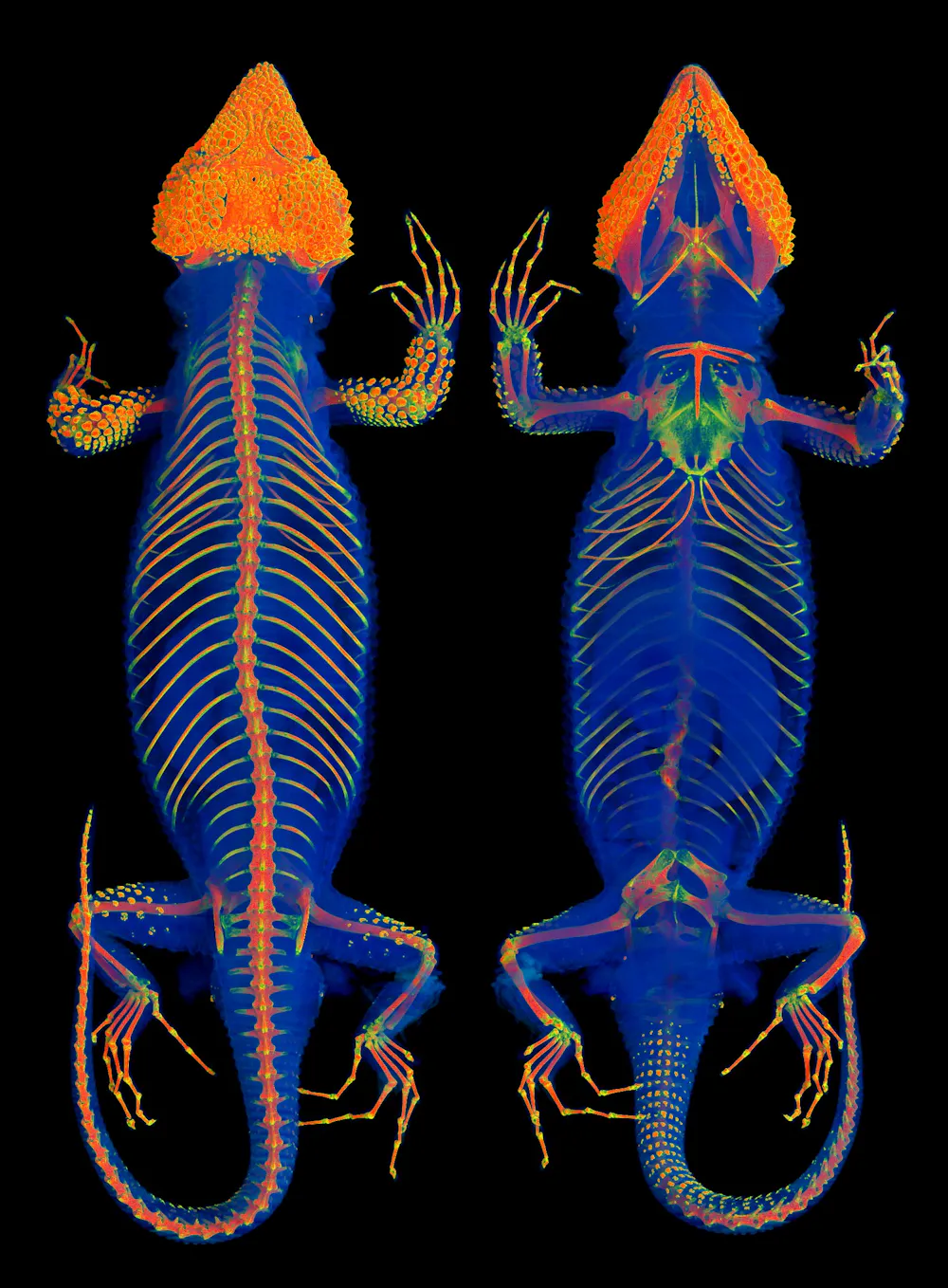
    Radiodensity heatmap of emerald tree monitors. Roy Ebel

    Monitor lizards, also known in Australia as goannas, are some of the most iconic reptiles on the continent. Their lineage not only survived the mass extinction that ended the reign of non-avian dinosaurs, but also gave rise to the largest living lizards on Earth.

    Today, these formidable creatures pace through forests and scrublands, flicking their tongues as they go.

    A new study published in the Zoological Journal of the Linnean Society looks beneath their skin. For the first time, it reveals hidden bone structures that may hold the key to the evolutionary success of goannas in Australia.

    An essential organ

    The skin is an organ essential for survival. In some animals, it includes a layer of bone plates embedded among the skin tissue. Think of the armour-like plates in crocodiles or armadillos: these are osteoderms.

    Their size ranges from microscopic to massive, with the back plates of the stegosaurus as the most impressive example.

    A mounted stegosaurus skeleton at the Natural History Museum, London.
    Jeremy Knight/Wikimedia Commons, CC BY

    We have only just started to understand these enigmatic structures. Osteoderms can be found in animal lineages that diverged up to 380 million years ago. This means these bone plates would have evolved independently, just like active flight did in birds, pterosaurs and bats.

    But what is their purpose? While the advantage of flight is undisputed, the case is not as clear for osteoderms.

    The most obvious potential would be for defence – protecting the animal from injuries. However, osteoderms may serve a far broader purpose.

    In crocodiles, for example, they help with heat regulation, play a part in movement, and even supply calcium during egg-laying. It is the interplay of these poorly understood functions that has long made it difficult to pinpoint how and why osteoderms evolved.

    Sand monitors, also known as sand goannas, are widespread through most of Australia.
    Ken Griffiths/Shutterstock

    A cutting-edge technique

    To help resolve this enigma, we had to go back to the beginning.

    Surprisingly, to date science has not even agreed on which species have osteoderms. Therefore, we assembled an international team of specialists to carry out the first large-scale study of osteoderms in lizards and snakes.

    We studied specimens from scientific collections at institutions such as the Florida Museum of Natural History, the Natural History Museum in Berlin, and Museums Victoria.

    However, we soon learnt that this came with challenges. Firstly, the presence of osteoderms can vary dramatically between individuals of the same species. Secondly, there is no guarantee that osteoderms are sufficiently preserved in all specimens.

    Most importantly, they are buried deep within skin tissue and invisible to the naked eye. Traditionally, finding them meant destroying the specimen.

    Instead, we turned to micro-computed tomography (micro-CT), an imaging technique similar to a medical CT scan, but with much higher resolution. This allowed us to study even the tiniest anatomical structures while keeping our specimens intact.

    Micro-CT-based, computer-generated 3D model of Rosenberg’s goanna (Varanus rosenbergi), with the left half showing osteoderms and endoskeleton.
    Roy Ebel

    Using computer-generated 3D models, we then digitally explored the bodies of lizards and snakes from all parts of the world. Incorporating data from prior literature, we processed almost 2,000 such samples in our search for osteoderms.

    To illustrate our results, we devised a technique called radiodensity heatmapping, which visually highlights the locations of bone structures in the body.

    For the first time, we now have a comprehensive catalogue showing where to find osteoderms in a large and diverse group; this will inform future studies.

    Radiodensity heatmapping shows newly discovered osteoderms (yellow to red) in the limbs and tail of the Mexican knob scaled lizard (Xenosaurus platyceps).
    Roy Ebel

    Not just anatomical curiosity

    What we found was unexpected. It was thought only a small number of lizard families had osteoderms. However, we encountered them nearly twice as often as anticipated.

    In fact, our results show nearly half of all lizards have osteoderms in one form or another.

    Our most astonishing finding concerned goannas. Scientists have been studying monitor lizards for more than 200 years. They were long thought to lack osteoderms, except in rare cases such as the Komodo dragon.

    So we were all the more surprised when we discovered previously undocumented osteoderms in 29 Australo-Papuan species, increasing their overall known prevalence five times.

    Examples of newly discovered osteoderms (magenta) in Australo-Papuan monitor lizards.
    Roy Ebel

    This isn’t just an anatomical curiosity. Now that we know Australian goannas have osteoderms, it opens up an exciting new avenue for further studies. This is because goannas have an interesting biogeographic history: when they first arrived in Australia about 20 million years ago, they had to adapt to a new, harsh environment.

    If osteoderms in goannas showed up around this time – possibly owing to new challenges from their environment – we’d gain crucial insights into the function and evolution of these enigmatic bone structures.

    Not only may we just have found the key to an untold chapter in the goanna story, our findings may also improve our understanding of the forces of evolution that shaped Australia’s unique reptiles as we know them today.

    Roy Ebel receives funding from the Australian Government’s Research Training Program.

    ref. New study peers beneath the skin of iconic lizards to find ‘chainmail’ bone plates – and lots of them – https://theconversation.com/new-study-peers-beneath-the-skin-of-iconic-lizards-to-find-chainmail-bone-plates-and-lots-of-them-260700

    MIL OSI AnalysisEveningReport.nz

  • MIL-OSI Australia: Cutting the fat: Oat oil breakthrough paves way for industry growth

    Source:

    21 July 2025

    New University of South Australia research is providing evidence of biological triggers of oil production in oats, a discovery that will help processing and potentially drive further demand for Australian-grown oats.

    While Australia is the world’s second-largest exporter of oats, high oil content in oat grains creates challenges during milling, reducing processing efficiency and limiting product innovation – particularly in high-demand sectors like oat flour and plant-based proteins.

    Researchers from the University of South Australia, the South Australian Research and Development Institute (SARDI), and the University of Adelaide are collaborating on research designed to better understand the biological processes responsible for oil synthesis in oat grains.

    In this study, two contemporary varieties of oats were examined using spatial imaging techniques to track oil build-up during grain development. Researchers then applied ‘omics’ technologies – lipidomics and proteomics – to analyse lipid and protein expression, which provided key insights into the biological mechanisms involved in the actual formation of the grain, including those relating to oil synthesis.

    The UniSA findings have provided further evidence of the mechanisms that underlie the amount of oil in an oat grain. These findings will help to guide future breeding efforts for naturally lower-oil oat varieties, improving milling yields and creating new value-added opportunities across the oat supply chain.

    UniSA PhD candidate, Darren Lau, says that current oil removal methods are inefficient and that low-oil breeding programs will aid industry growth.

    “While oil can be removed from partially milled oat flakes – using supercritical carbon dioxide prior to further milling – this approach is laborious and expensive,” he says.

    “Breeding low-oil oat varieties is a cost-effective approach but requires further understanding of oil production in oats. This is where our research is critical.

    “Our analysis has identified several key enzymes that are involved in oil synthesis which could be genetically manipulated to lower oil content of oat grains.

    “Reducing oil content could also unlock new opportunities in sectors like oat flour and alternative proteins, which could significantly strengthen Australia’s position in the market.”

    The economic potential of these opportunities is reflected in the quantity of oats exported globally. For example, in 2022 twenty-six million metric tonnes of oats were produced worldwide, ranking them seventh among cereals in production quantity.

    Lowering oil content in oat grains will enhance processing and product versatility, positioning them alongside traditional cereal staples like barley, maize, wheat, and rice, and further driving industry growth.

    The UniSA findings are being used by the Grains Research and Development Corporation (GRDC) oat grain quality consortium to improve suitability for milling and food/beverage ingredient development. Additional research is continuing within the consortium that will build on the study’s findings to further inform breeding efforts aimed at reducing oil content in oats.

    “The consortia are currently working on a larger and more diverse oat cohort to further investigate molecular markers and nutrient partitioning of oil in oats,” Lau says.

    “The consortia are also investigating one of the key enzymes validated in this study to determine whether manipulating or removing it can lower oil content, and how that affects the growth of the plant.”

    SARDI Project Lead Dr Janine Croser, says the study’s findings provide further evidence of key pathways involved in oat oil biosynthesis.

    “This research provides important insights into the biological mechanisms underlying varietal differences of oil production in developing oat grains,” Dr Croser says.

    “We expect that the development of low-oil lines will improve efficiencies in the flour milling process and potentially lead to novel uses for oats.

    “With demand for plant-based foods on the rise, we anticipate the oat grain quality consortium research will help put Australia at the forefront of oat innovation – supporting growers, processors, and exporters alike.”

    The full paper, Proteomic and lipidomic analyses reveal novel molecular insights into oat (Avena sativa L.) lipid regulation and crosstalk with starch synthesis during grain development, is available online.

    …………………………………………………………………………………………………………………………

    Contact for interview:  Darren Lau E: Darren.Lau@unisa.edu.au
    Media contact: Annabel Mansfield M: +61 479 182 489 E: Annabel.Mansfield@unisa.edu.au
    Josh Owen-Thomas E: Josh.Owen-Thomas@unisa.edu.au

    Other articles you may be interested in

    MIL OSI News

  • MIL-OSI China: China rout S. Korea for third-place finish at Women’s Asia Cup

    Source: People’s Republic of China – State Council News

    China wrapped up its 2025 FIBA Women’s Asia Cup campaign in dominant fashion, routing South Korea 101-66 in the third-place game on Sunday.

    Determined to finish on a high note after a semifinal loss to Japan, China came out firing from long range and pushed fast in transition. Luo Xinyu and Yang Shuyu each hit early 3-pointers as the host raced into a 13-2 lead.

    China continued to experiment with various lineups, alternating between a small-ball unit without a center and a twin-tower setup featuring Han Xu and Zhang Ziyu. The adjustments paid off, as China built a 17-point lead by the end of the first quarter.

    Han Xu (R) of China competes during the 3rd place match between China and South Korea at the FIBA Women’s Asia Cup 2025 in Shenzhen, south China’s Guangdong Province, July 20, 2025. (Xinhua/Liang Xu)

    In the second quarter, guard Wang Siyu took over offensively, repeatedly slicing through South Korea’s defense for layups and drawing fouls. Under China’s high-pressure defense, South Korea struggled to score, relying heavily on mid-range jumpers and drives by Kang Yoo-lim. At halftime, China built a comfortable 58-29 lead.

    After the break, South Korea brought in veteran center Park Ji-su. While her presence helped stabilize South Korea’s offense, it was the 226cm-tall Zhang dominated the paint on both ends, and China extended its lead to 42 points, turning the final period into garbage time.

    Wang led all scorers with 19 points, while Zhang contributed 18 points, seven rebounds and three assists, and Luo added 15 points for China.

    For South Korea, Park Ji-su finished with a team-high 14 points and eight rebounds, and Choi I-saem added 10.

    China’s veteran forward Huang Sijing, who was seen in tears during the national anthem before tip-off, had some emotional moments after the game.

    “This might be my last time wearing the national team jersey,” said Huang. “Looking back on my 10 years representing China, there have been both joys and regrets, but as I reach the twilight of my career, what I feel most is pride.”

    Although she expressed disappointment with the team’s result at the Asia Cup, Huang acknowledged the broader context. “The team is undergoing a generational transition, and we’re also adapting to a new coaching philosophy. Given we’ve only had three months to work together, I think we’ve already made good progress.”

    At the post-game press conference, China head coach Gong Luming described the Asia Cup as a “quiz” within the broader preparation cycle for the 2028 Los Angeles Olympics. He also noted that he had picked up some tactical ideas from Japan, Australia and South Korea during the tournament – insights he said would be valuable for the development of China’s younger players.

    Discussing Zhang Ziyu’s debut with the senior national team, Gong noted that there is still much room for improvement. “She needs to get stronger in physical battles inside the paint,” he said. Gong added that he hoped Zhang would expand her range on the court and develop into a more versatile player who can also facilitate and pass the ball effectively.

    MIL OSI China News

  • MIL-OSI Australia: Man charged with drug and fraud offences in Burnie

    Source: New South Wales Community and Justice

    Man charged with drug and fraud offences in Burnie

    Monday, 21 July 2025 – 10:35 am.

    Police have charged a 37-year-old man with significant drug and fraud offences, following a recent operation in Western Tasmania.
    Detective Inspector Michelle Elmer said the operation, which has been running since May 2025, was led by the Western Criminal Investigation Branch and involved a range of specialist police resources.
    “The man was arrested on Friday during a planned search of a Burnie residence, where police located a quantity of methylamphetamine, anabolic steroids and two illegal firearms,” she said.
    “He was charged with a number of offences including trafficking in a controlled substance, selling a controlled drug, fraud, personation, dealing with the proceeds of crime, and several firearm offences.”
    “Police will allege the man committed multiple fraud offences relating to prescription medications and impersonating a general practitioner, through an online business.”
    He was remanded in custody to reappear in the Burnie Magistrates Court this morning.

    MIL OSI News

  • MIL-OSI Australia: UPDATE: Age correction – Death – Tiwi

    Source: Northern Territory Police and Fire Services

    The Northern Territory Police Force can confirm that the age of the child who was struck and killed by a palm on Saturday was 4-years-old, while an 11-year-old male was also struck by the palm tree and suffered non-life-threatening injuries.

    The initial age of 7 was incorrect.

    Investigations into the tragic incident remain ongoing. 

    MIL OSI News

  • MIL-OSI Analysis: Is spinal cord stimulation safe? Does it work? Here’s what you need to know if you have back pain

    Source: The Conversation – Global Perspectives – By Caitlin Jones, Postdoctoral Research Associate in Musculoskeletal Health, University of Sydney

    AsiaVision/Getty

    Spinal cord stimulators are electrical devices that are surgically implanted in the body to treat long-term pain. They have a battery pack and leads that deliver electrical impulses directly to the spinal cord. The devices are thought to work by providing electrical impulses that interfere with how the brain senses pain.

    Spinal cord stimulators are mainly used to treat chronic back pain, especially when other less invasive treatments have not worked. They also aim to reduce people’s reliance on risky pain medicines. These include opioids, which research shows are ineffective and harmful for low-back pain.

    But research, including our own, shows spinal cord stimulators work no better than a placebo. And they can also carry risks.

    Do they work?

    In a 2023 Cochrane review, researchers reviewed data from 13 randomised controlled trials on low-back pain and found no benefits in the short and medium term. These international reviews draw together the most robust evidence to provide a detailed summary of what we know on a particular topic.

    Only one of the trials in the review tested efficacy in the longer term (six months). That trial found no benefits of spinal cord stimulation.

    An earlier Cochrane review looked at the evidence of spinal cord stimulation for chronic pain in general, including for neck pain. Reviewers looked at 15 randomised controlled trials and couldn’t be certain about its benefits, largely due to the quality and reliability of the available trials.

    Are there side effects?

    Aside from disappointing results for pain relief, there are risks and side effects to consider.

    We co-authored an analysis of 520 adverse events reported to Australia’s Therapeutic Goods Administration (TGA). We found 79% of reported events were rated as severe, with 13% life-threatening. The same research found 80% of events required surgery to correct.

    Our recent analysis in the Medical Journal of Australia looked at data from private health insurers. These cover 90% of spinal cord stimulation implants in Australia. Five major insurers, which covered 76% of privately insured people, contributed de-identified data.

    We found about one-quarter of people who had a spinal cord stimulator implanted needed corrective surgery afterwards. These surgeries occurred within a median of about 17 months. This indicates these surgeries are not routine or expected interventions, such as to replace batteries, which are meant to last five to ten years.

    Our previous research shows the sorts of reasons for corrective surgery. These include to replace a malfunctioning device, or the person was in more pain, had an infection, or a puncture of the delicate tissues covering the spinal cord.

    However, even our latest findings are likely to underestimate the risk of these devices.

    Sometimes the lead delivering the electrical current moves away from the spinal cord to elsewhere in the body. This requires surgery to reposition the lead, but does not necessarily require new hardware, such as a brand new lead. So this type of corrective surgery is not counted in the data from the private health insurance companies.

    How much does it cost?

    We found spinal cord stimulators cost about A$55,000 per patient, including the device, its insertion, and managing any associated additional surgeries.

    For people who only had a “trial” – where the leads are implanted temporarily but the battery pack remains outside the body – this cost was about $14,000 per patient.

    These figures do not include any out-of-pocket costs.

    What do regulators say about the devices?

    In 2022 the TGA began a review of spinal cord stimulators on the market because of safety and performance concerns.

    As a result, several devices were removed from the Australian Register of Therapeutic Goods – that is, they were banned from use in Australia, but existing stock could still be used.

    The rest of the devices had conditions imposed, such as the manufacturers being required to collect and report safety data to the TGA at regular time points.

    Should I do my own online research?

    Yes, but be careful. Unfortunately not all online information about spinal cord stimulators is correct.

    Look for sites independent of those who manufacture or implant these devices.

    Government agencies, health departments and universities that have no financial interests in this area may be a better option.

    The Cochrane Library is also a reliable and independent source for trustworthy health information.

    What shall I ask my doctor?

    The Australian health department provides useful advice for consumers about medical implants.

    It says medical implants “are considered higher-risk therapeutic goods, and the decision to get one should not be taken lightly”. It recommends asking your health professional these questions:

    • do I really need this medical implant?

    • what are the risks/benefits?

    • is the medical implant approved?

    • where can I get more information?

    • what happens if I experience an adverse event?

    What else could I do for my back pain?

    There are other treatment options that are effective and have fewer risks than spinal cord stimulation.

    For example, education about how to manage your pain yourself, exercise, cognitive behavioural therapy (a type of psychological therapy), and non-steroidal anti-inflammatory medicines (such as ibuprofen) all have solid evidence to back them. All offer benefits that are not outweighed by their potential risks.

    Australian research has shown other types of therapy – such as sensorimotor retraining and cognitive functional therapy – are also effective. You can discuss these and other options with your health professional.

    Spinal cord stimulation is a good example of a treatment that got ahead of the evidence. Although the devices have been around since the 1960s, we’ve only had reliable trials to test whether they work in recent years.

    Everyone wants to find ways to help people with chronic pain, but we must ensure medical care is grounded in reliable science.

    Christopher Maher holds a research fellowship funded by the National Health and Medical Research Council.

    Caitlin Jones does not work for, consult, own shares in or receive funding from any company or organisation that would benefit from this article, and has disclosed no relevant affiliations beyond their academic appointment.

    ref. Is spinal cord stimulation safe? Does it work? Here’s what you need to know if you have back pain – https://theconversation.com/is-spinal-cord-stimulation-safe-does-it-work-heres-what-you-need-to-know-if-you-have-back-pain-261364

    MIL OSI Analysis

  • MIL-OSI Analysis: Hold up, humans. Ants figured out medicine, farming and engineering long before we did

    Source: The Conversation – Global Perspectives – By Tanya Latty, Associate Professor in Entomology, University of Sydney

    Tambon Nong Chaeng/Pexels

    Think back to a time you helped someone move a heavy object, such as a couch. While at first the task may have appeared simple, it actually required a suite of advanced behaviours.

    The job needed verbal commands for social coordination (“pivot!”) and anticipation of near-future events (moving other furniture out of the way). It also required a clear, shared vision of the final goal (which room to take the couch to).

    It’s a small but satisfying example of human cooperation. But before we all get too pleased with ourselves, consider that ants – creatures with tiny brains and no capacity for speech – routinely pull off feats that rival, and sometimes exceed, our own.

    Ants routinely pull off feats that rival, and sometimes exceed, our own.
    Andre Moura/Pexels

    Understanding ant intelligence

    Earth is literally crawling with ants. Scientists estimate there are at least 20 quadrillion ants on Earth. That’s 20 followed by 15 zeros – more ants than stars in our galaxy!

    These incredible insects are amongst the most successful organisms on the planet. Part of the success comes from an ability to form complex societies, ranging from a few individuals to millions. And those societies, or colonies, are remarkably co-operative.

    Take, for example, ants’ abilities to move large food items. To do it, they mobilise teams of dozens – or even hundreds – of fellow workers. Together, they efficiently work together to transport the load back to the nest.

    Longhorn crazy ants (Paratrechina longicornis) are even known to clear debris from a path before a heavy object arrives – seemingly anticipating its trajectory and preparing the way.

    One experiment pit longhorn crazy ants against humans, all tasked with moving T-shaped objects (scaled to body size) through tight spaces. In some trials, the human teams were not permitted to speak or use gestures.

    And the result? Ants performed better in larger groups compared to smaller ones, showing the clear benefits of collective action. In contrast, human performance did not improve with group size. And when communication was restricted, human performance declined as group size increased.

    All this highlights how ants rely on collective intelligence, without the need for central control or sophisticated cognition.

    Expert farmers

    Humanity’s invention of agriculture 12,000 years ago is understandably hailed as one of our greatest achievements.

    But leaf cutter ants beat us to it. These ants (from the species Atta and Acromyrmex) evolved to undertake large-scale agriculture about 55 million years ago.

    These ants cut and transport fresh leaves not to eat directly, but to feed a fungus that serves as their main food source.

    This evolutionary partnership allows the ants to feed colonies with populations in the millions.

    Remarkably, leaf cutter ants have also evolved a form of biological pest control to protect their crops from bacteria. Some worker ants patrol the gardens, detecting infected sections of the fungus. Then they apply antibiotics produced by bacteria that live on their bodies.

    What’s more, many ant species farm aphids and other sap-sucking insects.

    As these farmed insects feed on plant sap, they excrete a sugary liquid the ants eagerly collect. In return, ants serve as bodyguards, defending their tiny livestock from predators such as ladybirds and lacewings.

    In some species, queen ants gently carry sap-sucking insects in their jaws as they fly off to start new colonies. Fossilised ants preserved in amber suggest this behaviour evolved up to 20 million years ago, long before humans domesticated animals.

    Ant medicine

    Medical care may seem like a distinctly human innovation. But several ant species have evolved sophisticated ways to treat injuries.

    When a Florida carpenter ant (Camponotus floridanus) is injured during a battle between colonies, its nest-mates will amputate a damaged limb to prevent infection from spreading. Ants receiving this battlefield care are more likely to survive than ants left untreated.

    Some ants can also detect infection and treat infected wounds by cleaning them and applying antimicrobial secretions from specialised glands.

    Master builders

    Some ant species are known to literally put their bodies on the line for the colony.

    Army ants (Eciton burchellii) join their bodies together to form structures. These include bridges across gaps on the forest floor, and “scaffolds” across steep terrain to prevent other ants from slipping.

    Even the nest is made of hundreds of thousands of ants joined together, complete with tunnels and chambers housing the larvae and the queen. The entire structure is packed up and rebuilt each day, after the colony emigrates a few hundred metres into the forest.

    Army ants join their bodies together to form structures.
    Smartse/Wikimedia, CC BY

    Weaver ants (Oecophylla smaragdina), meanwhile, self-assemble into rope ladders to span vertical gaps.

    They also form a line of workers that pull leaves together in treetops to form nests. Once the leaves are winched into place, other ants arrive with ant larvae in their jaws. Each larva produces a tiny blob of silk which the ants use to glue the leaves together.

    Fire ants (Solenopsis invicta), a major pest species, owes its invasive success partly to a unique method of dispersal.

    When their underground nests are flooded by rain, the ants join together into a huge raft which floats on a layer of buoyant larvae. These rafts can ride floodwaters in safety for hundreds of kilometres, until the ants reach dry land.

    When their nests are flooded, fire ants join together into a huge raft.
    TheCoz/Wikimedia, CC BY

    Lessons for humanity?

    Humans rightly take pride in our greatest achievements – agriculture, medicine, engineering and building civilisations. But remarkably, ants mastered these innovations millions of years before we did.

    Ants may be tiny – but by working together they can build complex societies and solve many problems. They might even teach humans a thing or two.

    Tanya Latty co-founded and volunteers for conservation organisation Invertebrates Australia, is former president of the Australasian Society for the Study of Animal Behaviour and is on the education committee for the Australian Entomological Society. She receives funding from the Australian Research Council, NSW Saving our Species, and Agrifutures Australia

    Chris R. Reid receives funding from the Australian Research Council and Macquarie University. He is secretary of the Australasian Society for the Study of Animal Behaviour and is on the education committee for the Australasian Entomological Society.

    ref. Hold up, humans. Ants figured out medicine, farming and engineering long before we did – https://theconversation.com/hold-up-humans-ants-figured-out-medicine-farming-and-engineering-long-before-we-did-258922

    MIL OSI Analysis

  • MIL-Evening Report: Cook Islanders flock from outer islands for 60th anniversary celebrations

    By Caleb Fotheringham, RNZ Pacific journalist

    The Cook Islands’ outer islands, or Pa Enua, are emptying as people make the pilgrimage to Rarotonga for constitution celebrations.

    This year is particularly significant, August 4 marks 60 years of the Cook Islands being in free association with New Zealand.

    Cook Islands Secretary of Culture Emile Kairua said this year’s Te Maeva Nui, which is the name for the annual celebrations, is going to be huge.

    “For the first time in a long time, we are able to bring all our people together for a long-awaited reunion, from discussions with the teams that have already arrived, there’s only handful of people that’s been left on each of our outer islands,” Kairua said.

    “Basically, the outer islands have been emptied out.”

    According to the Ministry of Finance and Economic Management, more than 900 people are making the trip to Rarotonga from the Pa Enua which are spread across an area similar to the size of Mexico.

    Cook Islands News reports that the government has allocated $4.1 mllion for event transport.

    Biggest calendar event
    Kairua said Te Maeva Nui is the biggest event on the Cook Islands’ calendar.

    “Te Maeva Nui has become an iconic event for the Cook Islands, for the nation, as well as the diaspora.”

    A comparable event was in 2015 when 50 years was marked.

    Kairua said for many people it will be the first time visiting Rarotonga since the start of the covid-19 pandemic.

    “Sixty years looks like it’s going to be a lot bigger than 50 for a number of reasons, because we’ve had that big gap since covid hit. If we liken it to covid it’s like the borders being lifted, and everyone now has that freedom to come to Raro.”

    Two ships, one from Tonga and the other from Tuvalu, are tasked with transporting people from the Northern Group islands to Rarotonga.

    While, Air Rarotonga has the job of moving people from the Southern Group.

    Tourist season peak
    The airline’s general manager Sarah Moreland said Te Maeva Nui comes during the peak of the tourism season, making July a very busy month.

    “We’ve got about 73 people from Mauke, 76 passengers from Mangaia, 88 from Aitutaki, 77 from Atiu and even 50 coming from the small island of Mitiaro, Nukuroa,” Moreland said.

    She said transporting people for Te Maeva Nui is a highlight for staff.

    “They love it, I think it’s so cool that we get to bring the Pa Enua from the islands, they just come to Rarotonga, they bring a whole different vibe. They’re so energetic, they’re ready for the competition, it just adds to the buzz of the whole Te Maeva Nui, it’s actually awesome.”

    The executive officer of Atiu Taoro Brown said two months of preparation had gone into the performances which represents the growth of the nation over the past 60 years.

    “It’s an exciting time, we come together, we’re meeting all our cousins and all our families from all the other islands, our sister islands, it’s a special moment.”

    Brown said this year the island had given performance slots to people from Atiu living in Rarotonga, Australia and New Zealand.

    “We wanted everybody from around the region to participate in celebrations.”

    Friendly competition
    Food is another big part of the event, an area Brown said there’s a bit of friendly competition in between islands.

    Pigs, taro, and “organic chicken” had all been sent to Rarotonga from Atiu.

    “Everyone likes to think they’ve got this the best dish but the food I feel, it’s all the same, you know, the island foods, it’s about the time that you put in.”

    For Kairua and his team at the Ministry of Culture, he said they needed to mindful to not allow the event to pass in a blur.

    “Otherwise we end up organising the whole thing and not enjoying it.

    “This is not our first big rodeo, or mine. I was responsible for taking away probably the biggest contingency to Hawai’i for the FestPAC and because we got so busy with organising it and worrying about the minor details, many of us at the management desk forgot to enjoy it, but this time, we are aware.”

    Turbulent relationship
    In the backdrop of celebrations, the Cook Islands and New Zealand’s relationship is in turbulent period.

    Last month, New Zealand paused $18.2 million in development assistance funding to the nation, citing a lack of consultation over several controversial deals with China.

    Unlike for the 50th celebrations, New Zealand’s prime minister and foreign minister will not attend the celebrations, with the Governor-General representing New Zealand.

    A statement from the Cook Islands Office of the Prime Minister last week said officials from the country have reconfirmed their commitment to restore mutual trust with New Zealand in a meeting on 10 July.

    This article is republished under a community partnership agreement with RNZ.

    MIL OSI AnalysisEveningReport.nz

  • MIL-Evening Report: Why has a bill to relax foreign investment rules had so little scrutiny?

    Source: The Conversation (Au and NZ) – By Jane Kelsey, Emeritus Professor of Law, University of Auckland, Waipapa Taumata Rau

    Getty Images

    While public attention has been focused on the domestic fast-track consenting process for infrastructure and mining, Associate Minister of Finance David Seymour has been pushing through another fast-track process – this time for foreign investment in New Zealand. But it has had almost no public scrutiny.

    If the Overseas Investment (National Interest Test and Other Matters) Amendment Bill becomes law, it could have far-reaching consequences. Public submissions on the bill close on July 23.

    A product of the ACT-National coalition agreement, the bill commits to amend the Overseas Investment Act 2005 “to limit ministerial decision making to national security concerns and make such decision making more timely”.

    There are valid concerns that piecemeal reforms to the current act have made it complex and unwieldy. But the new bill is equally convoluted and would significantly reduce effective scrutiny of foreign investments – especially in forestry.

    A three-step test

    Step one of a three-step process set out in the bill gives the regulator – the Overseas Investment Office which sits within Land Information NZ – 15 days to decide whether a proposed investment would be a risk to New Zealand’s “national interest”.

    If they don’t perceive a risk, or that initial assessment is not completed in time, the application is automatically approved.

    Transactions involving fisheries quotas and various land categories, or any other applications the regulator identifies, will require a “national interest” assessment under stage two.

    These would be assessed against a “ministerial letter” that sets out the government’s general policy and preferred approach to conducting the assessment, including any conditions on approvals.

    Other mandatory factors to be considered in the second stage include the act’s new “purpose” to increase economic opportunity through “timely consent” of less sensitive investments. The new test would allow scrutiny of the character and capability of the investor to be omitted altogether.

    If the regulator considers the national interest test is not met, or the transaction is “contrary to the national interest”, the minister of finance then makes a decision based on their assessment of those factors.

    Inadequate regulatory process

    Seymour has blamed the current screening regime for low volumes of foreign investment. But Treasury’s 2024 regulatory impact statement on the proposed changes to international investment screening acknowledges many other factors that influence investor decisions.

    Moreover, the Treasury statement acknowledges public views that foreign investment rules should “manage a wide range of risks” and “that there is inherent non-economic value in retaining domestic ownership of certain assets”.

    Treasury officials also recognised a range of other public concerns, including profits going offshore, loss of jobs, and foreign control of iconic businesses.

    The regulatory impact statement did not cover these factors because it was required to consider only the coalition commitment. The Treasury panel reported “notable limitations” on the bill’s quality assurance process.

    A fuller review was “infeasible” because it could not be completed in the time required, and would be broader than necessary to meet the coalition commitment to amend the act in the prescribed way.

    The requirement to implement the bill in this parliamentary term meant the options officials could consider, even within the scope of the coalition agreement, were further limited.

    Time constraints meant “users and key stakeholders have not been consulted”, according to the Treasury statement. Environmental and other risks would have to be managed through other regulations. There is no reference to te Tiriti o Waitangi or mana whenua engagement.

    Forestry ‘slash’ after Cyclone Gabrielle in 2023: no need to consider foreign investors’ track records.
    Getty Images

    No ‘benefit to NZ’ test

    While the bill largely retains a version of the current screening regime for residential and farm land, it removes existing forestry activities from that definition (but not new forestry on non-forest land). It also removes extraction of water for bottling, or other bulk extraction for human consumption, from special vetting.

    Where sensitive land (such as islands, coastal areas, conservation and wahi tapu land) is not residential or farm land, it would be removed from special screening rules currently applied for land.

    Repeal of the “special forestry test” – which in practice has seen most applications approved, albeit with conditions – means most forestry investments could be fast-tracked.

    There would no longer be a need to consider investors’ track records or apply a “benefit to New Zealand” test. Regulators may or may not be empowered to impose conditions such as replanting or cleaning up slash.

    The official documents don’t explain the rationale for this. But it looks like a win for Regional Development Minister Shane Jones, and was perhaps the price of NZ First’s support.

    It has potentially serious implications for forestry communities affected by climate-related disasters, however. Further weakening scrutiny and investment conditions risks intensifying the already devastating impacts of international forestry companies. Taxpayers and ratepayers pick up the costs while the companies can minimise their taxes and send profits offshore.

    Locked in forever?

    Finally, these changes could be locked in through New Zealand’s free trade agreements. Several such agreements say New Zealand’s investment regime cannot become more restrictive than the 2005 act and its regulations.

    A “ratchet clause” would lock in any further liberalisation through this bill, from which there is no going back.

    However, another annex in those free trade agreements could be interpreted as allowing some flexibility to alter the screening rules and criteria in the future. None of the official documents address this crucial question. As an academic expert in this area I am uncertain about the risk.

    But the lack of clarity underlines the problems exemplified in this bill. It is another example of coalition agreements bypassing democratic scrutiny and informed decision making. More public debate and broad analysis is needed on the bill and its implications.

    Jane Kelsey has received funding from the Marsden Fund for research related to New Zealand’s foreign investment regime and international agreements.

    ref. Why has a bill to relax foreign investment rules had so little scrutiny? – https://theconversation.com/why-has-a-bill-to-relax-foreign-investment-rules-had-so-little-scrutiny-261370

    MIL OSI AnalysisEveningReport.nz

  • MIL-OSI Australia: Australian gamemakers level-up with major funding from Screen Australia

    Source: AMP Limited

    21 07 2025 – Media release

    Retopia
    New games capture distinctive stories, landscapes and communities from across the country
    Screen Australia has today announced the latest games and gaming events to be supported through the agency’s industry-leading funding programs – providing $1.4 million for gamemakers to upskill and develop stand-out projects.
    The funding supports 26 games including a hand-drawn puzzle game about a flooded village rebuilding after climate catastrophe, a point-and-click visual novel with small town mysteries to solve, and an action-adventure RPG (Role-Playing Game) about a brave native mouse. It also supports the Freeplay 2025 Events Series, solidifying the agency’s commitment to foster a sector that has both a robust sense of independence and a strong community focus.
    In 2024-25, the agency invested $3 million into the tenacious local industry which included support for 49 games and 200 Australian gamemakers. Initiatives like the Future Leaders Delegation and support for ten Festivals and Events provided Australian independent gamemakers the opportunity to showcase over 270 games for national and international audiences.
    Minister for the Arts Tony Burke said, “Digital Games are a billion dollar global industry and Australia’s sector is growing every year. This funding ensures that we’re backing home-grown talent in order to be at the top of the leader board.”
    Screen Australia Head of Games Joey Egger said, “What struck me about these projects is the depth of talent and the distinctiveness of the content; the diversity of our culture, communities, landscapes and stories really shines through. We’re seeing games being developed all across the country including regional towns such as Wallabadah in New South Wales and Toongabbie in Victoria.”  
    “It’s also incredibly exciting to see another round of projects transitioning from the Emerging Gamemakers Fund through to the Games Production Fund. It reinforces our unique position as an end-to-end avenue for Australian gamemakers to take their projects from concept to prototype, to production and then launch.”
    The past 12 months have seen five games from the Emerging Gamemakers Fund progressing to the Games Production Fund: Monster Snap (WA), Rocketcard Defence (ACT), Wyrmspace Tactics (VIC) and L8R SK8R (QLD), as well as Management in Space (NSW).
    Funded games include:

    Ashes (VIC): For fans of graphic novels and interactive fiction, seasoned players and those new to games, comes adventure game Ashes. The creative team includes producer/developer Clea Frost, lead developer Nick Loki, 2D artists Phoenix Waddell and Jennifer Reuter and composer Trent Francis. It follows 16-year-old skater Azar Warren who, after witnessing a murder, takes refuge in a rural compound with her estranged grandfather.
    Buru and The Old People (NSW): A narrative-driven adventure game set in a vibrant anthropomorphic world rich in Indigenous storytelling. Buru and The Old People is from creative director and recipient of the ‘Rising Star’ award at the 2024 Australian Game Developer Awards Benjamin Armstrong, producer Brooke Collard (Yokai), 2D artist Letoya Muraru, and composer Alexander Tulett.
    Nothing To Do Summer Vacation – Part 1 (NT): A unique point and click visual novel game from lead programmer Adam Prenger and creative director Mel Stringer, an accomplished illustrator and comic artist making her exciting debut in games. In this game, Summer is bored out of her mind in the small town of Driftwood, until fresh mysteries come calling to be uncovered.
    Penguin Colony (VIC): A stylish action-adventure game from producer Megan Faulkner, audio engineer David Mason and creative director Naphtali Faulkner, the developer behind the Independent Games Festival Grand Prize-winning Umurangi Generation. In Penguin Colony, players explore the depths of Antarctica at their own pace as different penguins – unravelling difficult truths along the way.
    Retopia (NSW): From creative lead Jennyfer Ong, lead designer Nicholas King and lead producer James Lockrey, this cosy management game is the latest project from the Australian Game Developer Awards’ 2024 Studio of the Year, Chaos Theory Games. Retopia follows a cast of quirky robot companions as they restore life to a collapsed world by salvaging lost technology, rebuilding community, and nurturing a floating sanctuary in the sky. The game continues Chaos Theory’s tradition of values-driven development after the success of the award-winning Crab God.
    Fern: Seed Guardian (WA): An action-adventure RPG from creative director Sophie Till and technical director Jamie Dougall. In a fantastical Australian bushland, a brave native mouse battles an encroaching, mysterious goo.  She must overcome not only this encroaching danger but also her deep fears, as the Goo uses them to manipulate her perception of reality.
    Slumbering Woods (QLD): An evocative, hand-drawn puzzle adventure game with a unique crafting and building twist from creative director Svitlana Amelina, lead developer Oleg Chernyshenko and sound designer Jane Wei. In a world recovering from a long-past climate catastrophe, players help a flooded village thrive, rebuild and find their way home along the way. Slumbering Woods is financed with support from Screen Queensland’s Games Grants.

    Additional projects supported through the Games Production Fund include Bravest Coconut (QLD), Mission Delta (VIC), Dungeon Breakers (NSW) and Rocketcard Defence (ACT).
    Additional projects supported through the Emerging Gamemakers Fund include SCAV (VIC), Pixellated (VIC), Dead Zone Mycologist (VIC), Dicot (VIC), Ash and Earth: Wilderness Reclaimed (NSW), Spin Spirits (WA), Eclipsia (NSW), Untitled Cube Game (Working Title) (QLD), Stewards of Nu Juno (QLD), Displaced: Oath of Tomes (VIC),Kaiju Critters (QLD)and Trinket (NSW).
    For the full list of funded gamemakers and projects supported throughout the 2024-25FY, please see the Games blocklines here.
    Applications for the Emerging Gamemakers Fund and Games Production Fund are now open. For more information about Games funding at Screen Australia and to apply, click here.
    For accompanying image assets, click here.
    Ashes
    Media enquiries
    Jessica Parry | Senior Publicist (Mon, Tue, Thu)
    + 61 428 767 836  | [email protected]
    All other general/non-media enquiries
    Sydney + 61 2 8113 5800  |  Melbourne + 61 3 8682 1900 | [email protected]

    MIL OSI News

  • MIL-OSI Australia: Remote zone tax offset – determining eligibility

    Source: New places to play in Gungahlin

    Taxpayers may be eligible for tax offsets depending on their individual circumstances. Tax offsets reduce the amount of tax people need to pay.

    We’ve recently updated the remote zone tax offset web content to make it easier for you and your clients to understand the eligibility requirements.

    Determining eligibility

    Taxpayers are generally eligible for the remote zone tax offset when they have resided in a relevant area of Australia for more than 183 days during the financial year in which they are claiming the offset. That is, when their usual place of residence is within a remote zone.

    The 183 days does not have to be a continuous period of residency but must be within one financial year unless certain circumstances apply.

    Where your client hasn’t resided within a remote zone for 183 days during the income year, they may still be able to claim the offset if their usual place of residence was in a remote zone for a continuous period of less than 5 years, and:

    • they were unable to claim in the first year because it was not their residence for 183 days or more
    • the total of the days they resided there in the first year and the current income year is 183 days or more
    • the period they resided in a zone in the current income year includes the first day of the income year.

    Fly-in-fly-out (FIFO) and offshore oil or gas rig workers are generally not eligible to claim the zone tax offset, unless their usual place of residence is within a remote zone for the required number of days.

    Temporarily working in a zone, staying at an employer’s camp or provided accommodation does not mean the worker resided in the zone where the worker’s usual place of residence is outside a zone.

    Australian zone list

    We have a non-exhaustive list of locations that are within a remote zone. There may be other eligible locations that are not included on the list but are geographically within a remote zone.

    If your client resides at a location that is geographically within a remote zone, it does not need to be on the list in order to claim the offset.

    Claiming the offset – address details

    Before lodging your client’s income tax return, confirm if there have been any changes to their residential and postal addresses. It’s important to ensure your clients keep their ATO record up to date with their current phone number, postal, residential and email address details.

    MIL OSI News

  • MIL-OSI USA: SPC Tornado Watch 532

    Source: US National Oceanic and Atmospheric Administration

    Note:  The expiration time in the watch graphic is amended if the watch is replaced, cancelled or extended.Note: Click for Watch Status Reports.
    SEL2

    URGENT – IMMEDIATE BROADCAST REQUESTED
    Tornado Watch Number 532
    NWS Storm Prediction Center Norman OK
    420 PM MDT Sun Jul 20 2025

    The NWS Storm Prediction Center has issued a

    * Tornado Watch for portions of
    North Central Nebraska
    South Central South Dakota

    * Effective this Sunday afternoon and evening from 420 PM until
    1000 PM MDT.

    * Primary threats include…
    A couple tornadoes possible
    Scattered large hail and isolated very large hail events to 2.5
    inches in diameter likely
    Scattered damaging wind gusts to 70 mph possible

    SUMMARY…Isolated supercell thunderstorms are forming in a very
    unstable airmass. Very large hail, damaging winds, and a few
    tornadoes are possible with these storms through the evening.

    The tornado watch area is approximately along and 50 statute miles
    east and west of a line from 85 miles north of Valentine NE to 55
    miles south southwest of Valentine NE. For a complete depiction of
    the watch see the associated watch outline update (WOUS64 KWNS
    WOU2).

    PRECAUTIONARY/PREPAREDNESS ACTIONS…

    REMEMBER…A Tornado Watch means conditions are favorable for
    tornadoes and severe thunderstorms in and close to the watch
    area. Persons in these areas should be on the lookout for
    threatening weather conditions and listen for later statements
    and possible warnings.

    &&

    OTHER WATCH INFORMATION…CONTINUE…WW 530…WW 531…

    AVIATION…Tornadoes and a few severe thunderstorms with hail
    surface and aloft to 2.5 inches. Extreme turbulence and surface wind
    gusts to 60 knots. A few cumulonimbi with maximum tops to 500. Mean
    storm motion vector 27025.

    …Hart

    SEL2

    URGENT – IMMEDIATE BROADCAST REQUESTED
    Tornado Watch Number 532
    NWS Storm Prediction Center Norman OK
    420 PM MDT Sun Jul 20 2025

    The NWS Storm Prediction Center has issued a

    * Tornado Watch for portions of
    North Central Nebraska
    South Central South Dakota

    * Effective this Sunday afternoon and evening from 420 PM until
    1000 PM MDT.

    * Primary threats include…
    A couple tornadoes possible
    Scattered large hail and isolated very large hail events to 2.5
    inches in diameter likely
    Scattered damaging wind gusts to 70 mph possible

    SUMMARY…Isolated supercell thunderstorms are forming in a very
    unstable airmass. Very large hail, damaging winds, and a few
    tornadoes are possible with these storms through the evening.

    The tornado watch area is approximately along and 50 statute miles
    east and west of a line from 85 miles north of Valentine NE to 55
    miles south southwest of Valentine NE. For a complete depiction of
    the watch see the associated watch outline update (WOUS64 KWNS
    WOU2).

    PRECAUTIONARY/PREPAREDNESS ACTIONS…

    REMEMBER…A Tornado Watch means conditions are favorable for
    tornadoes and severe thunderstorms in and close to the watch
    area. Persons in these areas should be on the lookout for
    threatening weather conditions and listen for later statements
    and possible warnings.

    &&

    OTHER WATCH INFORMATION…CONTINUE…WW 530…WW 531…

    AVIATION…Tornadoes and a few severe thunderstorms with hail
    surface and aloft to 2.5 inches. Extreme turbulence and surface wind
    gusts to 60 knots. A few cumulonimbi with maximum tops to 500. Mean
    storm motion vector 27025.

    …Hart

    Note: The Aviation Watch (SAW) product is an approximation to the watch area. The actual watch is depicted by the shaded areas.
    SAW2
    WW 532 TORNADO NE SD 202220Z – 210400Z
    AXIS..50 STATUTE MILES EAST AND WEST OF LINE..
    85N VTN/VALENTINE NE/ – 55SSW VTN/VALENTINE NE/
    ..AVIATION COORDS.. 45NM E/W /25SW PIR – 51WSW ANW/
    HAIL SURFACE AND ALOFT..2.5 INCHES. WIND GUSTS..60 KNOTS.
    MAX TOPS TO 500. MEAN STORM MOTION VECTOR 27025.

    LAT…LON 44089954 42119999 42110194 44080156

    THIS IS AN APPROXIMATION TO THE WATCH AREA. FOR A
    COMPLETE DEPICTION OF THE WATCH SEE WOUS64 KWNS
    FOR WOU2.

    Watch 532 Status Report Message has not been issued yet.

    Note:  Click for Complete Product Text.Tornadoes

    Probability of 2 or more tornadoes

    Mod (40%)

    Probability of 1 or more strong (EF2-EF5) tornadoes

    Low (20%)

    Wind

    Probability of 10 or more severe wind events

    Mod (50%)

    Probability of 1 or more wind events > 65 knots

    Low (20%)

    Hail

    Probability of 10 or more severe hail events

    Mod (60%)

    Probability of 1 or more hailstones > 2 inches

    Mod (60%)

    Combined Severe Hail/Wind

    Probability of 6 or more combined severe hail/wind events

    High (90%)

    For each watch, probabilities for particular events inside the watch (listed above in each table) are determined by the issuing forecaster. The “Low” category contains probability values ranging from less than 2% to 20% (EF2-EF5 tornadoes), less than 5% to 20% (all other probabilities), “Moderate” from 30% to 60%, and “High” from 70% to greater than 95%. High values are bolded and lighter in color to provide awareness of an increased threat for a particular event.

    MIL OSI USA News

  • MIL-OSI Australia: Six youths have been arrested for arson and police pursuit

    Source: New South Wales – News

    Six teenagers have been arrested after a pursuit through metropolitan Adelaide and the arson of an Aldinga Beach house this morning.

    About 12.50 am Monday 21 July Police and emergency services were called to a house at Pebble Court after reports of fire in the garage and house. Fortunately the occupants were not home at the time. MFS were quickly on scene and extinguished the blaze.

    When police arrived, they saw a Subaru station wagon leaving the street. Police recognised the car as a stolen vehicle which had been stolen from a Mitchell Park home last week. Police attempted to stop the car, with the driver refusing to pull over.

    The car was pursued by patrols along with the assistance from PolAir and Dog Operations Unit on South Road, along the Southern Expressway, through to the eastern suburbs before making its way to Two Wells where the tyres were successfully spiked by patrols at Port Wakefield Road and Mallala Road.

    Six youths ran from the car and were arrested on Artisan Road with the assistance of PD Duke without incident.

    The driver, a 17-year-old boy from Ottoway has been arrested for arson, illegal use, dangerous driving to escape pursuit

    Four 15-year-old boys have been arrested for arson and illegal use.

    One 16-year-old boy has been arrested for arson and illegal use.

    All six will appear in the Youth Court later today.

    MIL OSI News

  • MIL-Evening Report: Does play belong in primary school? New research suggests teachers are not sure

    Source: The Conversation (Au and NZ) – By Katy Meeuwissen, Lecturer in Early Childhood and Primary Education, University of Canberra

    Jon Challicom/ Getty Images

    Play is one of the most important parts of early childhood education in Australia.

    We know children learn about the world through play and it helps them build creativity and independence.

    There is also broad agreement among early childhood educators and policymakers about the importance of play from birth to five years.

    But once children start school, there is less certainty. Despite growing research about the importance of play in primary school, play is not often used for learning in these years.

    Our new study with Australian primary teachers highlights significant confusion about the role of play in their schools.

    Play can benefit older kids

    There is nothing to suggest the importance of play suddenly stops when children reach school age.

    Research shows play can support learning well into the primary years, helping students develop critical thinking, problem-solving and social skills.

    Recent studies even show play has learning benefits well beyond childhood. Young adults (aged 19–25) who engage in regular play have shown improved emotional intelligence and resilience.

    What do we mean by play?

    When we are talking about play in primary school, it is more than just playground time during recess and lunch.

    Play is what children do naturally, whereas play-based learning is when teachers use that natural playfulness as a teaching tool. Teachers will deliberately incorporate various types of play with specific learning goals and varying levels of adult guidance.

    For example, children might explore mathematical concepts such as geometry and spatial reasoning through LEGO construction. Teachers would guide discovery of patterns, measurements and problem-solving, and then step back to allow students to be creative.

    There is also evidence play can support literacy, numeracy and other academic goals, because it supports attention, memory and planning skills that underpin academic learning.

    Research shows it can also help maintain students’ enjoyment of and engagement in their studies.

    So when used effectively, it could be used across the school curriculum.

    Our research

    To better understand what teachers think about play and why they hold these views, we surveyed 238 teachers across Australia primary schools. Teachers ranged from those teaching the first year of primary school through to Year 6.

    Most of the teachers were from public schools. We used an online questionnaire and recruited participants through email and social media.

    Teachers’ different views on play

    The results revealed some inconsistencies in teachers’ views.

    Teachers strongly agreed play benefits children’s development. More than three-quarters (77%) strongly agreed students develop social skills through play, with similar numbers supporting play’s role in emotional, physical and language development.

    One teacher described play as “magic” and “where real learning happens”.

    However, only 52% strongly agreed students develop academic skills during play, revealing uncertainty about play’s educational value. As another teacher told us:

    Play is something that children do and it’s fun for them, however, [it] should be out of school. School is for learning.

    Some teachers still viewed play as separate from learning, with 61% agreeing that “play is a necessary break from learning” – suggesting they see play and learning as distinct entities rather than integrated.

    Adding to this confusion, teachers often used the terms “play” and “play-based learning” interchangeably, despite these being different concepts.

    How should play-based learning be structured?

    Even when teachers valued play in principle, they struggled to provide time for it in their classrooms. Teachers reported feeling caught between covering mandated content and providing meaningful play experiences. As one teacher told us:

    Play is fantastic for children but a challenge when there is so much limited time to cover such a huge curriculum.

    Teachers were also divided about their role in children’s play. Should they structure it? Leave kids alone? Supervise but not interfere?

    Our analysis revealed several distinct approaches, from hands-off supervision to active involvement. This reveals confusion about best practice (the research suggests different approaches can work, depending on the context).

    What can we do instead?

    Our research suggest there is missed opportunity when it comes to structuring play as part of learning in primary schools.

    To address this, we need several changes. Teacher education programs should include training in practical ways to use play as a teaching tool. For example, how to teach science concepts through games and experiments that feel like play to children.

    Professional development should also help existing teachers understand how to structure meaningful play that supports the curriculum.

    At a policy level, we also need better alignment between the early education and primary years, to ensure play does not disappear at the school gate.

    Katy Meeuwissen does not work for, consult, own shares in or receive funding from any company or organisation that would benefit from this article, and has disclosed no relevant affiliations beyond their academic appointment.

    ref. Does play belong in primary school? New research suggests teachers are not sure – https://theconversation.com/does-play-belong-in-primary-school-new-research-suggests-teachers-are-not-sure-259800

    MIL OSI AnalysisEveningReport.nz

  • MIL-Evening Report: Hold up, humans. Ants figured out medicine, farming and engineering long before we did

    Source: The Conversation (Au and NZ) – By Tanya Latty, Associate Professor in Entomology, University of Sydney

    Tambon Nong Chaeng/Pexels

    Think back to a time you helped someone move a heavy object, such as a couch. While at first the task may have appeared simple, it actually required a suite of advanced behaviours.

    The job needed verbal commands for social coordination (“pivot!”) and anticipation of near-future events (moving other furniture out of the way). It also required a clear, shared vision of the final goal (which room to take the couch to).

    It’s a small but satisfying example of human cooperation. But before we all get too pleased with ourselves, consider that ants – creatures with tiny brains and no capacity for speech – routinely pull off feats that rival, and sometimes exceed, our own.

    Ants routinely pull off feats that rival, and sometimes exceed, our own.
    Andre Moura/Pexels

    Understanding ant intelligence

    Earth is literally crawling with ants. Scientists estimate there are at least 20 quadrillion ants on Earth. That’s 20 followed by 15 zeros – more ants than stars in our galaxy!

    These incredible insects are amongst the most successful organisms on the planet. Part of the success comes from an ability to form complex societies, ranging from a few individuals to millions. And those societies, or colonies, are remarkably co-operative.

    Take, for example, ants’ abilities to move large food items. To do it, they mobilise teams of dozens – or even hundreds – of fellow workers. Together, they efficiently work together to transport the load back to the nest.

    Longhorn crazy ants (Paratrechina longicornis) are even known to clear debris from a path before a heavy object arrives – seemingly anticipating its trajectory and preparing the way.

    One experiment pit longhorn crazy ants against humans, all tasked with moving T-shaped objects (scaled to body size) through tight spaces. In some trials, the human teams were not permitted to speak or use gestures.

    And the result? Ants performed better in larger groups compared to smaller ones, showing the clear benefits of collective action. In contrast, human performance did not improve with group size. And when communication was restricted, human performance declined as group size increased.

    All this highlights how ants rely on collective intelligence, without the need for central control or sophisticated cognition.

    Expert farmers

    Humanity’s invention of agriculture 12,000 years ago is understandably hailed as one of our greatest achievements.

    But leaf cutter ants beat us to it. These ants (from the species Atta and Acromyrmex) evolved to undertake large-scale agriculture about 55 million years ago.

    These ants cut and transport fresh leaves not to eat directly, but to feed a fungus that serves as their main food source.

    This evolutionary partnership allows the ants to feed colonies with populations in the millions.

    Remarkably, leaf cutter ants have also evolved a form of biological pest control to protect their crops from bacteria. Some worker ants patrol the gardens, detecting infected sections of the fungus. Then they apply antibiotics produced by bacteria that live on their bodies.

    What’s more, many ant species farm aphids and other sap-sucking insects.

    As these farmed insects feed on plant sap, they excrete a sugary liquid the ants eagerly collect. In return, ants serve as bodyguards, defending their tiny livestock from predators such as ladybirds and lacewings.

    In some species, queen ants gently carry sap-sucking insects in their jaws as they fly off to start new colonies. Fossilised ants preserved in amber suggest this behaviour evolved up to 20 million years ago, long before humans domesticated animals.

    Ant medicine

    Medical care may seem like a distinctly human innovation. But several ant species have evolved sophisticated ways to treat injuries.

    When a Florida carpenter ant (Camponotus floridanus) is injured during a battle between colonies, its nest-mates will amputate a damaged limb to prevent infection from spreading. Ants receiving this battlefield care are more likely to survive than ants left untreated.

    Some ants can also detect infection and treat infected wounds by cleaning them and applying antimicrobial secretions from specialised glands.

    Master builders

    Some ant species are known to literally put their bodies on the line for the colony.

    Army ants (Eciton burchellii) join their bodies together to form structures. These include bridges across gaps on the forest floor, and “scaffolds” across steep terrain to prevent other ants from slipping.

    Even the nest is made of hundreds of thousands of ants joined together, complete with tunnels and chambers housing the larvae and the queen. The entire structure is packed up and rebuilt each day, after the colony emigrates a few hundred metres into the forest.

    Army ants join their bodies together to form structures.
    Smartse/Wikimedia, CC BY

    Weaver ants (Oecophylla smaragdina), meanwhile, self-assemble into rope ladders to span vertical gaps.

    They also form a line of workers that pull leaves together in treetops to form nests. Once the leaves are winched into place, other ants arrive with ant larvae in their jaws. Each larva produces a tiny blob of silk which the ants use to glue the leaves together.

    Fire ants (Solenopsis invicta), a major pest species, owes its invasive success partly to a unique method of dispersal.

    When their underground nests are flooded by rain, the ants join together into a huge raft which floats on a layer of buoyant larvae. These rafts can ride floodwaters in safety for hundreds of kilometres, until the ants reach dry land.

    When their nests are flooded, fire ants join together into a huge raft.
    TheCoz/Wikimedia, CC BY

    Lessons for humanity?

    Humans rightly take pride in our greatest achievements – agriculture, medicine, engineering and building civilisations. But remarkably, ants mastered these innovations millions of years before we did.

    Ants may be tiny – but by working together they can build complex societies and solve many problems. They might even teach humans a thing or two.

    Tanya Latty co-founded and volunteers for conservation organisation Invertebrates Australia, is former president of the Australasian Society for the Study of Animal Behaviour and is on the education committee for the Australian Entomological Society. She receives funding from the Australian Research Council, NSW Saving our Species, and Agrifutures Australia

    Chris R. Reid receives funding from the Australian Research Council and Macquarie University. He is secretary of the Australasian Society for the Study of Animal Behaviour and is on the education committee for the Australasian Entomological Society.

    ref. Hold up, humans. Ants figured out medicine, farming and engineering long before we did – https://theconversation.com/hold-up-humans-ants-figured-out-medicine-farming-and-engineering-long-before-we-did-258922

    MIL OSI AnalysisEveningReport.nz

  • MIL-Evening Report: Is spinal cord stimulation safe? Does it work? Here’s what you need to know if you have back pain

    Source: The Conversation (Au and NZ) – By Caitlin Jones, Postdoctoral Research Associate in Musculoskeletal Health, University of Sydney

    AsiaVision/Getty

    Spinal cord stimulators are electrical devices that are surgically implanted in the body to treat long-term pain. They have a battery pack and leads that deliver electrical impulses directly to the spinal cord. The devices are thought to work by providing electrical impulses that interfere with how the brain senses pain.

    Spinal cord stimulators are mainly used to treat chronic back pain, especially when other less invasive treatments have not worked. They also aim to reduce people’s reliance on risky pain medicines. These include opioids, which research shows are ineffective and harmful for low-back pain.

    But research, including our own, shows spinal cord stimulators work no better than a placebo. And they can also carry risks.

    Do they work?

    In a 2023 Cochrane review, researchers reviewed data from 13 randomised controlled trials on low-back pain and found no benefits in the short and medium term. These international reviews draw together the most robust evidence to provide a detailed summary of what we know on a particular topic.

    Only one of the trials in the review tested efficacy in the longer term (six months). That trial found no benefits of spinal cord stimulation.

    An earlier Cochrane review looked at the evidence of spinal cord stimulation for chronic pain in general, including for neck pain. Reviewers looked at 15 randomised controlled trials and couldn’t be certain about its benefits, largely due to the quality and reliability of the available trials.

    Are there side effects?

    Aside from disappointing results for pain relief, there are risks and side effects to consider.

    We co-authored an analysis of 520 adverse events reported to Australia’s Therapeutic Goods Administration (TGA). We found 79% of reported events were rated as severe, with 13% life-threatening. The same research found 80% of events required surgery to correct.

    Our recent analysis in the Medical Journal of Australia looked at data from private health insurers. These cover 90% of spinal cord stimulation implants in Australia. Five major insurers, which covered 76% of privately insured people, contributed de-identified data.

    We found about one-quarter of people who had a spinal cord stimulator implanted needed corrective surgery afterwards. These surgeries occurred within a median of about 17 months. This indicates these surgeries are not routine or expected interventions, such as to replace batteries, which are meant to last five to ten years.

    Our previous research shows the sorts of reasons for corrective surgery. These include to replace a malfunctioning device, or the person was in more pain, had an infection, or a puncture of the delicate tissues covering the spinal cord.

    However, even our latest findings are likely to underestimate the risk of these devices.

    Sometimes the lead delivering the electrical current moves away from the spinal cord to elsewhere in the body. This requires surgery to reposition the lead, but does not necessarily require new hardware, such as a brand new lead. So this type of corrective surgery is not counted in the data from the private health insurance companies.

    How much does it cost?

    We found spinal cord stimulators cost about A$55,000 per patient, including the device, its insertion, and managing any associated additional surgeries.

    For people who only had a “trial” – where the leads are implanted temporarily but the battery pack remains outside the body – this cost was about $14,000 per patient.

    These figures do not include any out-of-pocket costs.

    What do regulators say about the devices?

    In 2022 the TGA began a review of spinal cord stimulators on the market because of safety and performance concerns.

    As a result, several devices were removed from the Australian Register of Therapeutic Goods – that is, they were banned from use in Australia, but existing stock could still be used.

    The rest of the devices had conditions imposed, such as the manufacturers being required to collect and report safety data to the TGA at regular time points.

    Should I do my own online research?

    Yes, but be careful. Unfortunately not all online information about spinal cord stimulators is correct.

    Look for sites independent of those who manufacture or implant these devices.

    Government agencies, health departments and universities that have no financial interests in this area may be a better option.

    The Cochrane Library is also a reliable and independent source for trustworthy health information.

    What shall I ask my doctor?

    The Australian health department provides useful advice for consumers about medical implants.

    It says medical implants “are considered higher-risk therapeutic goods, and the decision to get one should not be taken lightly”. It recommends asking your health professional these questions:

    • do I really need this medical implant?

    • what are the risks/benefits?

    • is the medical implant approved?

    • where can I get more information?

    • what happens if I experience an adverse event?

    What else could I do for my back pain?

    There are other treatment options that are effective and have fewer risks than spinal cord stimulation.

    For example, education about how to manage your pain yourself, exercise, cognitive behavioural therapy (a type of psychological therapy), and non-steroidal anti-inflammatory medicines (such as ibuprofen) all have solid evidence to back them. All offer benefits that are not outweighed by their potential risks.

    Australian research has shown other types of therapy – such as sensorimotor retraining and cognitive functional therapy – are also effective. You can discuss these and other options with your health professional.

    Spinal cord stimulation is a good example of a treatment that got ahead of the evidence. Although the devices have been around since the 1960s, we’ve only had reliable trials to test whether they work in recent years.

    Everyone wants to find ways to help people with chronic pain, but we must ensure medical care is grounded in reliable science.

    Christopher Maher holds a research fellowship funded by the National Health and Medical Research Council.

    Caitlin Jones does not work for, consult, own shares in or receive funding from any company or organisation that would benefit from this article, and has disclosed no relevant affiliations beyond their academic appointment.

    ref. Is spinal cord stimulation safe? Does it work? Here’s what you need to know if you have back pain – https://theconversation.com/is-spinal-cord-stimulation-safe-does-it-work-heres-what-you-need-to-know-if-you-have-back-pain-261364

    MIL OSI AnalysisEveningReport.nz

  • MIL-Evening Report: Federal election feel like ages ago? Parliament is now back. Here’s your political refresher

    Source: The Conversation (Au and NZ) – By Jill Sheppard, Senior Lecturer, School of Politics and International Relations, Australian National University

    Tracey Nearmy/Getty

    Despite many pre-election predictions, the 48th Australian parliament looks quite similar to the 47th. The Labor Party has greater representation than before: 94 Members of the House of Representatives (up from 77) and 29 Senators (up from 26).

    The Coalition’s numbers were famously smashed at the election, and will be represented by 43 Members and 27 Senators.

    Despite the landslide electoral victory, Labor’s parliamentary position is not materially improved. It retains a majority in the House of Representatives, but Prime Minister Anthony Albanese faces the problem of finding jobs to keep such a large backbench occupied. Restless politicians reliably create havoc for their leaders (just ask Keir Starmer).

    In the Senate, Labor has more possible paths to a majority, but none is particularly pretty. Pre-election, the government required 12 additional senators to support its legislation. Often this support came from the Coalition, with the crossbench bypassed entirely, as in the case of political donation reforms.

    Other reforms, including workplace relations, were passed by a combination of Greens and independent senators.

    Labor can achieve a majority (38 votes) in the new Senate by negotiating with either the Greens or the Coalition. If neither is forthcoming, Labor can then turn to a disparate group of crossbenchers: four One Nation Senators, plus Fatima Payman, Jacqui Lambie, Ralph Babet and David Pocock.


    Read more:
    Grattan on Friday: New parliament presents traps for Albanese and Ley


    Clearing the decks

    How the new Senate configuration affects Labor’s legislative agenda depends on what exactly that agenda looks like.

    Labor went into the 47th parliament emphasising the Voice referendum, COVID and rising inflation.

    At the end of that term, ten bills were listed for debate but were “timed out” by the constitutional requirement to hold an election.

    The most controversial of these is the proposal to add a new 15% tax on superannuation balances of more than $3 million. The Greens, under previous leader Adam Bandt, promised to support the bill in 2023 pending the government extending superannuation to paid parental leave (which was legislated in 2024 and came into effect on July 1 2025).


    Read more:
    Actually, Gen Z stand to be the biggest winners from the new $3 million super tax


    The Greens continue to support the tax proposal in principle, but want the threshold lowered to $2 million.

    One Nation is strongly opposed. The Coalition has expressed willingness to negotiate on the condition that unrealised gains are exempt from valuations.

    The government has also proposed cutting the number of overseas students at Australian universities, ostensibly due to concerns over exploitation of the student visa program. The Greens have called the proposal “disastrous for tertiary education”.

    Pocock and the Coalition have both called for key changes to the bill. Their primary concerns are about a ministerial power to decide appropriate student numbers without parliamentary approval.

    Despite opposing the bill for different reasons, the Greens and Coalition were willing to team up against the government – perhaps foreshadowing strategy in the new parliament.

    What’s on the horizon?

    Labor announced just 15 specific policy proposals before the election. Only two costed promises are registered with the Parliamentary Budget Office. This gives Labor a free hand to determine its policy agenda in the 48th parliament.

    Right out of the gate, the government promised to cut HECS debt by 20%. Given the Greens would wipe all current HECS debt, they seem likely to wave this through the Senate.

    Treasurer Jim Chalmers has since declared that while “the first term was primarily inflation without forgetting productivity, the second term will be primarily productivity without forgetting inflation”.

    In search of new thinking, the government has announced an economic reform roundtable comprising government, business and experts, and covering economic resilience, skills, new technologies, healthcare reform and clean energy.

    Productivity is notoriously difficult to measure and improve. Whether policies arising from the roundtable will pass the parliament remains to be seen.

    However, the government’s invitation to Shadow Treasurer Ted O’Brien was accompanied with commentary that Chalmers does not believe O’Brien or his leader Sussan Ley are “by their nature constructive, collaborative types”.

    Other election policies should be legislated with ease. The Coalition has already supported purchasing the Port of Darwin, promised instant asset write-offs for small business, and pledged to match Labor’s Medicare spending dollar for dollar.

    The Coalition is also likely to support new fast-track training for 6,000 tradies.

    The Greens will likely support pro-worker reforms. These include legislated weekend penalty rates and new mental health spending.

    In general, the government’s stated agenda is incremental and should be achievable in this parliament. If the Greens won’t play ball, the Coalition will be waiting in line.

    This will probably lead to quixotic policymaking as Labor bounces between two ideologically opposed partners.

    Elsewhere, as in the case of the government’s post-election approval of new licences for gas extraction, policy can happen without parliamentary approval at all.

    In such cases, meaningful opposition will come from the cross- and backbenches, full of politicians eager to make a name for themselves.

    Jill Sheppard receives funding from the Australian Research Council. She worked as an adviser to Coalition parliamentarians between 2003 and 2007.

    Patrick Leslie receives funding from the Australian Research Council.

    ref. Federal election feel like ages ago? Parliament is now back. Here’s your political refresher – https://theconversation.com/federal-election-feel-like-ages-ago-parliament-is-now-back-heres-your-political-refresher-261360

    MIL OSI AnalysisEveningReport.nz

  • MIL-OSI: ETHRANSACTION launches cloud mining using XRP conversion, which can yield a stable amount of BTC every day

    Source: GlobeNewswire (MIL-OSI)

    Newark, New Jersey, July 20, 2025 (GLOBE NEWSWIRE) —  ETHRANSACTION, a leading cloud mining platform has launched new mining contracts that utilize XRP conversion to yield other crypto currencies like BTC. Bitcoin has always held a special place in the cryptocurrency market. It is more than just a currency; it is a cultural movement, driven by a passionate and growing community.

    This release will provide all the necessary information about how the users of ETHRANSACTION can use XRP for cloud mining and earn $19,494 or more worth of cryptocurrency every day.

    What is cloud mining? And how ETHRANSACTION users can yield BTC
    Cloud mining is the process by which cloud mining service providers are rewarded with new Bitcoins by checking transactions on the Bitcoin blockchain. It seems simple, but it is not easy!
    Cloud mining service providers process the same batch of transactions through multiple computers at the same time, but only one computer can be rewarded with new coins. The way to get new coins is that nodes add new transaction blocks to old blocks. This requires complex mathematical equations to achieve.
    The first node to solve the math problem wins, it can then append the newly confirmed transaction block to the rest of the blockchain.
    Most cryptocurrency mining works like this. However, BTC cloud mining differs from other currencies in some important ways. These aspects include:

    Algorithm: Each cryptocurrency has a set of rules for mining new coins. These rules are called mining algorithms or hashing algorithms.
    Block time: This is the average length of time it takes to check a new block of transactions and add it to the blockchain.
    Difficulty: This number indicates how hard it is to mine each new block of that currency. Mining difficulty fluctuates based on the number of miners. The currency protocol also adjusts the difficulty to ensure that the block time remains constant.
    Reward: This is the amount of new currency awarded to the miner for each new block.

    How to do BTC cloud mining

    Step 1: Choose ETHRANSACTION cloud mining service provider. The platform has a professional analyst and IT team who will analyze the computing power generated by the operation of the mining machine and replace the latest mining machine in time. Ensure that users get higher returns in cloud mining. If you are worried about missing out on investment opportunities, now is the best time to join cloud mining.
    Step 2: Select the Bitcoin or other cryptocurrency contract you want to buy. The new contract is as follows:
    ⦁ Invest in WhatsMiner M30S [Daily Sign-in Rewards]: Investment amount: $19, total net profit: $19 + $0.9.
    ⦁ Invest in Avalon Manufacturing A1346 [Experience Contract]: Investment amount: $100, total net profit: $100 + $18.
    ⦁ Invest in ElphaPex DG Home1 contract plan: Investment amount: $600, total net profit: $600 + $52.5.
    ⦁ Invest in Antminer L7 contract plan: Investment amount: $1,300, total net profit: $1,300 + $236.6.
    ⦁ Invest in Antminer T21 contract plan: Investment amount: $3,700, total net profit: $3,700 + $1,021.2.

    (The platform has launched a variety of stable income contracts, which can be viewed on the ETHRANSACTION official website.)

    You can get income the next day after purchasing the contract. When the account funds reach $100, you can choose to withdraw to your wallet or continue to purchase other contracts.

    About ETHRANSACTION
    Cloud mining is extremely convenient and perfect for novices. The platform’s user-friendly interface ensures that even cryptocurrency novices can easily get started. For ETHRANSACTION, laziness is not a disadvantage, but a path to success. As a pioneer in cloud mining services, ETHRANSACTION has more than 100 mining farms and more than 800,000 mining equipment around the world. All mining equipment is driven by new renewable energy cycles and has won the recognition and support of more than 8.1 million real users with stable returns and security guarantees.

    ETHRANSACTION Advantages:
    Get $19 immediately after registration.
    Users do not need to buy expensive cryptocurrency mining equipment, sign contracts, and receive returns every 24 hours.
    Provide multiple cryptocurrency deposits and withdrawals: DOGE, BTC, ETH, XRP, USDC, LTC, USDT-TRC20, USDT-ERC20 and other cryptocurrencies.
    Intuitive interface designed for beginners and experienced miners.
    The affiliate program allows users to receive up to 4% + 2% referral rewards and up to $1 million in bonuses.
    No extra fees: pricing is transparent, with no hidden service or management fees.
    Fund security: At ETHRANSACTION, users’ funds are securely stored in a first-tier bank, and all users’ personal information is protected by SSL encryption. The platform provides insurance for each investment, underwritten by AIG Insurance Company.

    Security and sustainability
    In the world of mining, trust and security are crucial. ETHRANSACTION knows this and puts user safety first. ETHRANSACTION is committed to transparency and legality, ensuring that your investment is protected and allowing you to focus on profitability. All mine energy consumption is provided by new energy, making cloud mining join the ranks of carbon neutrality. Renewable energy protects the environment from pollution and brings super value returns, allowing every investor to enjoy opportunities and benefits.

    Summary
    For investors who want to explore free cryptocurrency mining, ETHRANSACTION is the first choice because it has cutting-edge technology, environmentally friendly methods and generous free tickets.
    Whether you are a novice or an experienced user, ETHRANSACTION welcomes everyone from all over the world to participate.
    Simply click the corresponding system APP button on ETHRANSACTION to download the ETHRANSACTION application.

    Media Details:
    Email: info@ethransaction.vip
    For more information, please visit the official website: https://ethransaction.vip
    Or contact the platform official email: info@ethransaction.vip

    Attachment

    The MIL Network

  • MIL-OSI: A new era of mobile BTC mining: DRML Miner launches a mobile cloud mining platform exclusively for global users

    Source: GlobeNewswire (MIL-OSI)

    New York City, NY, July 20, 2025 (GLOBE NEWSWIRE) —
    As the Bitcoin ecosystem flourishes around the world, DRML Miner is proud to announce a major breakthrough in cryptocurrency mining: the launch of BTC-centric cloud mining contracts. Available now on web and mobile platforms, these flexible short-term contracts allow users to mine BTC remotely and earn daily BTC rewards — no mining hardware, no complex setup, and no experience required. This is the first time retail investors can participate in the Bitcoin economy through a streamlined, fully integrated platform.
    Visit the DRML Miner website or download the app today.

    BTC Cloud Mining is here – simple, smart, and rewarding:

    Bitcoin has traditionally been hailed as the world’s first and most decentralized digital asset, and now it’s opening a new chapter with DRML Miner’s latest innovation – easy-to-use cloud mining. Users can mine BTC directly or leverage DRML Miner’s smart AI engine to automatically switch between the most profitable assets (including ETH, XRP, DOGE, USDC, and more) to get the best returns. All earnings are paid daily in the cryptocurrency of your choice, providing a reliable income regardless of market fluctuations.
    Designed for everyday users and professional investors, the platform enables users to earn stable cryptocurrency earnings anytime, anywhere.

    Key features of DRML Miner’s BTC cloud mining contracts:
    – Full BTC integration: Deposit, buy, mine, and withdraw BTC directly within the platform.
    – Multi-currency mining support: Mine and earn ETH, XRP, DOGE, USDC, USDT, SOL, LTC, and BCH.
    – AI income optimization: Proprietary algorithms automatically allocate mining power to the best performing assets to maximize returns.
    – 100% remote access: No mining equipment required – fully accessible via theDRML Miner  mobile app or browser.
    – Capital protection: All contracts include a full return of principal at expiration, reducing risk while growing crypto assets.

    Mining contracts to suit every budget and strategy:
    DRML Miner offers a wide variety of mining contracts with BTC-based deposits and withdrawals. Each contract is carefully designed to combine flexibility, predictable income and effective risk management:

    $10 contract – 1 day – earn $0.6 per day
    $100 contract – 2 days – earn $3.50 per day
    $500 contract – 5 days – earn $6.50 per day
    $5,000 contract – 30 days – earn $77.50 per day
    $8,000 contract – 40 days – earn $132 per day
    $10,000 contract – 45 days – earn $175 per day
    $50,000 contract – 50 days – earn $975 per day

    Whether you want to test the waters or build a long-term portfolio, DRML Miner offers low-risk, highly transparent contracts that allow you to earn stable BTC income every day.
    Click here to explore more BTC Cloud contracts.

    Why DRML Miner’s BTC Mining Stands Out?
    – Available to Everyone: No mining equipment, no setup, no complexity – just click to earn.
    – BTC Native Integration: Deposit, mine and withdraw BTC in one seamless ecosystem.
    – Stable Returns, Smart Allocation: The AI engine dynamically adjusts mining strategies to maximize rewards and ensure daily income for all supported coins.
    – Multi-Asset Flexibility: Mine BTC directly or diversify earnings into other top digital assets – all with one contract.
    – Instant Setup, Global Access: Mine from anywhere using your phone or browser – securely and remotely.

    Get started today in 3 easy steps:
    1. Sign up – Create your account and get a $10 welcome bonus
    2. Choose a plan – Choose a short-term or long-term contract (1-55 days available)
    3. Start earning – Track daily profits and withdraw them in the token of your choice

    Start mining BTC now: https://drmlminer.com/ or download the DRML Miner mobile app (available for iOS and Android).

    BTC Mining, Creating a Digital Future:
    Since 2018, DRML Miner has helped millions of users around the world earn passive crypto income through secure, smart cloud mining. With the launch of BTC mining, the platform perfectly combines institutional-grade infrastructure with retail-level accessibility. Now, users can choose to earn BTC directly, or invest in mainstream digital assets – all in a secure, fully remote environment.

    “Bitcoin has always been secure, decentralized, and globally trusted,” said a DRML Miner spokesperson. “Now, it can also be mined securely, remotely, and profitably. We have removed all barriers so that anyone can participate in the future growth of Bitcoin.” The market may change, but daily mining income can remain stable.

    Join the BTC mining revolution now: https://drmlminer.com/

    Attachment

    The MIL Network

  • MIL-OSI Australia: Call for information – Domestic violence – Angurugu

    Source: Northern Territory Police and Fire Services

    Northern Territory Police are calling for information after a domestic violence incident that occurred in Angurugu this afternoon.

    Around 12:05pm, the Joint Emergency Services Communication Centre received a report that an 18-year-old female had allegedly been stabbed in the head with a spear by a male known to her.

    Police and local clinic staff attended and located the victim conscious, with the spear still embedded. The victim has since been conveyed to Royal Darwin Hospital via Care Flight in a serious but stable condition.

    The alleged offender remains outstanding, and investigations are ongoing.

    Anyone with information is urged to contact police on 131 444 and quote reference number P25193995. Anonymous reports can also be made through Crime Stoppers on 1800 333 000 or via https://crimestoppersnt.com.au.

    MIL OSI News

  • MIL-OSI China: Japan, Australia set up title showdown at FIBA Women’s Asia Cup

    Source: People’s Republic of China – State Council News

    Japan upset defending champion China 90-81 in the semifinal at the FIBA Women’s Asia Cup on Saturday.

    Japan will contend for the title with Australia, who held off South Korea 86-73.

    Japan shot an impressive 47.1 percent on 3-pointers. Young point guard Kokoro Tanaka shot 10 of 16 for a game-high 27 points. Yuki Miyazawa added 18 points.

    “That was a game that the players followed the game plan. We had a strategy into this game, they executed it. China countered it, then we changed to another plan. The win was for the players. They really did their job,” said Japan coach Corey Gaines.

    Tanaka, 19, dominated the opening stages, making eight of nine from the floor, including nailing five 3-pointers, for a 21-point first-quarter masterclass, as the score was knotted at 27-27 at the quarter’s end.

    A pair of 3-pointers from Nanako Todo gave Japan an early initiative in the second quarter. China’s twin towers of Han Xu and Zhang Ziyu featured in the game with 4:49 remaining, while Japan set up an eight-point cushion at 49-41 with 2:29 remaining.

    It was where Zhang began to sparkle as the 18-year-old prodigy snatched eight straight points, and Yang Shuyu capped a 10-point run with two free throws that fueled the host to a 51-49 advantage at the break.

    Japan rode on a 10-0 surge midway through the third quarter to gain ground, and carried a 73-65 margin entering the fourth quarter.

    Japan continued its clinical performance from a 3-point range, thwarting China’s every comeback effort to secure the win.

    Three Chinese players cracked double figures in scoring, led by Yang’s 19 points. Han and Zhang chipped in 18 and 17, respectively.

    “The players really wanted to play well, and they tried really hard. Before the game, we set our specific game plan, but when we played the twin towers, we had some mistakes on defense and gave them wide-open 3s, this is what we need to improve,” commented China coach Gong Luming.

    Han echoed Gong, saying, “We made some mistakes on our execution of the game plan. We were asked to guard the 3-point line and not give them open 3s, but we still made some mistakes.”

    Facing South Korea, Isobel Borlase opened with six straight points, sparking a 15-0 run over four minutes that gave Australia a 19-5 lead.

    South Korea responded as Choi I-saem and Heo Ye-eun combined for eight points to keep the game within reach. The first quarter ended with Australia leading 22-13.

    Australia caught fire from beyond the arc as Stephanie Reid and Sara Blicavs hit three consecutive 3-pointers. South Korea, known for its outside shooting, answered with three straight of its own from Choi, Park Ji-hyun and Heo to cut the gap to four.

    South Korea made eight of 15 attempts from long range in the first half, compared to Australia’s 38.5 percent from deep, but Australia still held a narrow 42-38 lead at halftime.

    In the second half, South Korea was limited to just three 3-pointers. Australia broke the game open with a 16-4 run in the third quarter to lead 62-48.

    As South Korea’s shooting cooled down, Australia leaned on its physicality and tempo to push the lead to as many as 15 points with five minutes remaining.

    Heo and Shin Ji-hyun sparked a brief rally with fast-break points, but Australia responded quickly with a series of inside attacks to maintain control.

    Australia dominated the boards with a 45-26 rebounding advantage. Cayla George posted a double-double of 20 points and 13 rebounds.

    New Zealand capped its campaign in Shenzhen in fifth place with a 78-71 victory over the Philippines.

    Down by 16 points early in the second quarter, the Philippines roared back to life, as Kent Jane Pastrana’s 3-pointer helped Gilas Pilipinas pull level at 48-48 at the 6:02 mark in the third.

    The Philippines went ahead 54-53 on Jack Animam’s free throw, its first lead since the first minute of the game.

    Leading 66-61 three minutes going into the final period, the Philippines could not hold on to it, with the Tall Ferns responding with an 11-0 run to turn the game around.

    “The fact that we could hang together for 40 minutes when a lot wasn’t going our way, but we could stay together and grind out a win, just super proud of how the girls did that today,” New Zealand coach Natalie Hurst remarked.

    Esra McGoldrick had a game-high 17 points for New Zealand.

    MIL OSI China News

  • MIL-OSI Australia: Family rescued from Mount Field National Park

    Source: New South Wales Community and Justice

    Family rescued from Mount Field National Park

    Sunday, 20 July 2025 – 1:24 pm.

    Six people, including three children, have been safely retrieved from the Mount Field area this morning after being caught in heavy snow overnight.
    The family raised the alarm with police shortly after 4.30pm on Saturday, after heavy snowfall meant they could no longer access the walking track.
    Search Coordinator Callum Herbert said police were able to speak with the group briefly to provide advice.
    “The walkers were advised to return to the nearby Newdegate Hut and await the rescue crew,” he said.
    “Due to the extreme weather conditions, the helicopter wasn’t able to reach the area, so a search and rescue team of police and Ambulance Tasmania wilderness paramedics was sent in on foot.”
    “The rescue team reached the walkers at the hut shortly before midnight, finding them all safe, but cold and wet.”
    “Given their condition and the hazardous environment, including strong winds and nearly one foot of snow, we determined it was unsafe to walk them out during the night.”
    “Medical assistance, food and sleeping bags were provided overnight to ensure everyone could remain safely sheltered.”
    “The helicopter was sent in once conditions allowed this morning, and the group was safely returned to the visitor centre about 10.30am.”
    “We are thankful the walkers were able to reach emergency services by phone yesterday, or the outcome could easily have been far worse.”
    “The Tasmanian family had set off on a planned day walk, but the turn in weather conditions was significant, and the situation quickly became dangerous.”

    MIL OSI News

  • MIL-Evening Report: After yet another election, Tasmanians are left wondering what the point of it was

    Source: The Conversation (Au and NZ) – By Robert Hortle, Deputy Director, Tasmanian Policy Exchange, University of Tasmania

    When the results firmed up a few hours after polling closed on Saturday, many Tasmanians would have been wondering, “what was the point of all that?”.

    A state election only 16 months after the last one looks to have delivered a parliament with a broadly similar distribution of seats.


    Read more:
    Liberals easily win most seats at Tasmanian election, but Labor may form government


    The results

    By the time counting ceased last night, the ABC had the Liberals on 14 seats, Labor on nine, the Greens on five, and three confirmed independents.

    The ABC’s projections of the Tasmanian election, captured at 11:15am on July 20th.
    ABC News

    With 65.3% of the vote counted, four seats remained in doubt. There was a small positive swing to the Liberals (3.3%), while a swing against Labor of 3.1% has them on track for their worst primary vote in more than a hundred years. The final seats may not be confirmed for a couple of weeks.

    Love, Labor’s lost

    At this stage, it looks like Labor’s gambit – instigating the no confidence motion that led to this election – has utterly failed. The party will now need to engage in some sober self-reflection on two fronts.

    First, there is the one-dimensional strategy that brought on the election and allowed the Liberals to blame Labor – and leader Dean Winter in particular – for dragging Tasmanians to the polls again.

    Labor had hoped that targeting the no confidence motion specifically at Premier Jeremy Rockliff would encourage the conservative-leaning Liberal cabinet to turf out their moderate leader.

    It was a near thing. Rockliff’s rivals apparently had almost enough votes to depose him by the time the Governor called the election.

    But did anyone at Labor HQ plan for what would happen if their gamble failed and the Liberals held firm under Rockliff? As Labor’s woefully under-prepared campaign stumbled into motion, it seemed the answer was “no”.

    Second, there will be questions asked about that lacklustre campaign, just as there were in 2024. An opposition could not ask for more favourable conditions: an 11-year incumbent government suffering a string of high profile policy failures; a looming mountain of debt; and ongoing health, education, housing, cost of living and sustainability challenges.

    And yet, Labor suffered negative swings in every seat, and they are battling to match their 2024 result of 10 seats.

    Liberals and Greens hold firm

    The Liberals will be pleased with the result. In the face of the dire circumstances outlined above, they have secured a positive swing in their primary vote and may pick up one or (at an outside chance) two additional seats.

    It doesn’t seem like their pro-stadium stance lost them votes in the north – where the proposal is unpopular – in part because Labor denied themselves a point of difference by also supporting the stadium.

    Another important factor in the north was the recruitment of two former federal Liberal MPs in Bass and Braddon, who are both polling well so far. However, their success may come at the expense of sitting Liberal members.

    The Greens’ vote held steady, with a projected 0.2% increase in their primary vote. All of their MPs had been returned before the close of counting on Saturday night, and they will be hoping one more can scrape through in Braddon.

    The crossbench zoo

    As expected, ex-Labor MP David O’Byrne, centre-left Kristie Johnston, and maverick Northwester Craig Garland were all returned. Johnston and Garland, in particlar, seem to have strongly increased their vote shares.

    There will be at least one new independent, with anti-salmon farm advocate Peter George securing a very strong primary vote in Franklin off the back of his recent federal campaign.

    There is a chance that this broadly progressive crossbench will be joined by climate change denier and pro-gun rights candidate Carlo di Falco (Lyons) from the Shooters, Fishers and Farmers.

    Where to now?

    So how are the major party leaders approaching the looming period of wheeling and dealing? Who’s forming minority government?

    Rockliff was the first to address the tally room on election night. He boldly claimed that the voters had re-endorsed his Liberal government – based on their increased vote share – and said he will ask the Governor to recommission him as premier.

    However, with only 14 or 15 seats, it will be challenging for the Liberals to implement their agenda in a parliament featuring a crossbench that is, for the most part, solidly progressive and vehemently anti-stadium.

    The Greens’ leader, Rosalie Woodruff, also spoke and again extended an offer of cooperation to Labor.

    Finally, as election night drew to a close, Labor Leader Dean Winter stepped up to speak. His tonally confused speech began with a tribute to murdered Tasmanian Police Constable Keith Smith, then shifted to the need for a more collaborative approach to politics. Winter left things on a cliffhanger, essentially saying “let’s wait and see”.

    Observers in the room noted the speech was strikingly similar to that given by former leader Rebecca White following the 2024 election – shortly before she was replaced by Winter.

    Will Labor have a crack at forming government? There would be a few obstacles to this. First, Winter would have to negotiate support from the diverse crossbench, including the Greens, with whom he has previously vowed not to collaborate.

    He and Labor have ignored previous opportunities to seize government in this way, the most recent being just five weeks ago. A change in tack at this stage could be difficult to sell.

    And if Rockliff forges ahead with his stated plan, Labor and the crossbench would need to vote down a new Liberal minority government on the floor of parliament. Labor would need to be very certain of their ability to govern before doing this – or risk another election.

    So while all of the party leaders spoke of maturity and collaboration in their speeches, until actions match words, Tasmanians will be forced to watch the parliamentary shenanigans continue.

    Robert Hortle does not work for, consult, own shares in or receive funding from any company or organisation that would benefit from this article, and has disclosed no relevant affiliations beyond their academic appointment.

    ref. After yet another election, Tasmanians are left wondering what the point of it was – https://theconversation.com/after-yet-another-election-tasmanians-are-left-wondering-what-the-point-of-it-was-260505

    MIL OSI AnalysisEveningReport.nz