Category: Australia

  • MIL-Evening Report: ‘They’re meant to help and did the complete opposite’: many children feel silenced by family courts

    Source: The Conversation (Au and NZ) – By Georgina Dimopoulos, Associate Professor, Law, Southern Cross University

    Bricolage/AAP

    When parental separation ends up in the family courts, serious risks such as family violence, child abuse, drug, alcohol or substance misuse, and mental health issues are often involved.

    But many children feel shut out of family court processes that decide what is in their “best interests”.

    My new paper, co-authored with Southern Cross University researchers Eliza Hew, Meaghan Vosz and Helen Walsh and published in the journal Child and Family Social Work, looked at how children felt about their experiences in the family courts.

    We interviewed 41 children and young people aged ten to 19 from Queensland, New South Wales, the Australian Capital Territory and Victoria. Four key themes emerged.

    1. Children feel silenced

    Some children we spoke with felt they were heard by family law professionals. Many, however, described feeling silenced. Penny (all names in this article changed to protect identies), aged 14, said:

    [It was like] someone was standing there and putting something over my mouth so I couldn’t speak […] I should have been allowed in the courtroom and been allowed to say what I wanted.

    Chelsea, 15, felt:

    squashed and I just had to do what I was told and be quiet and suck it up, even if it wasn’t what I wanted.

    Family court orders required Paige, 17, and her sister to spend time with their father, contrary to their expressed wishes. Paige blamed herself, saying:

    That was always one of my biggest regrets because I’m like, maybe if I had said something differently, or emphasised it more, they would have understood what I was trying to say and actually listened […] it wouldn’t have made such traumatic memories, which happened afterwards, when we were forced to see him.

    The children in our study wanted to be heard directly. As Troy, 14, put it:

    Talk to us, not about us.

    Children also told us that they wanted their words conveyed accurately by family law professionals to the court. Lisa, 10, said:

    It’s like whispering to another person, and then you keep whispering, whispering, and then eventually, something comes out differently. People get it mixed up.

    Other children felt speaking up was futile. Ari, 11, said:

    I had some ideas that I wanted, that I thought would be fair, but it never really changed […] So I just stopped talking.

    Some children felt speaking up was futile.
    fizkes/Shutterstock

    2. Children feel ‘in the dark’

    Most children we interviewed felt “in the dark” about family court processes. Olive, 11, said she had “no clue what was going on”, while Leo, 13, said:

    I didn’t know anything. I was playing the guessing game.

    Some children got information through their own proactive, even covert efforts. Ava, 13, said:

    I was snooping through Mum’s room and I found some papers.

    Ava then Googled the family court judge who decided her parents’ case, because “she, like, ruined my life. Need to know who.”

    Other children got more information than they wanted.

    Eva, 12, said:

    Mum shared with me lots of the law court stuff and I really wish she didn’t, because I should just be a kid. That was the sort of thing that made me feel […] sort of responsible and it sort of made me look at my mum in a bad way.

    3. Some children will vote with their feet

    Some children said they’d refused to comply with family court parenting orders. As Ava, 13, put it:

    If they can’t listen to me, I’m not going to listen to them.

    Chelsea, 15, explained:

    I wasn’t listened to at all […] in the end, I finally put my foot down, and I was like, “I’m not going to Dad’s”.

    Aaron, 16, and his siblings chose to live with their father, contrary to family court orders. He explained:

    When they said that we had to live with Mum, we just lived with Dad anyway […] They’re meant to help and did the complete opposite.

    4. Children feel less able to trust others

    Children stressed the importance of family law professionals creating space to build trust. But several children felt they were betrayed by law professionals who’d shared what the children had said with their parents.

    Troy, 14, said:

    If I knew what I said was going to get back to Dad, I wouldn’t have said it.

    Jessica, 16, wanted:

    More support on knowing that what I said directly wouldn’t get back to my dad in case I was sent back there, because stuff I said could have really, really, really hurt me if I was sent back.

    Gabrielle, 18, said:

    Adults are meant to be the people that you can trust, particularly when they say that they’re there for your best interest. I lost a lot of trust. I couldn’t trust anyone again.

    Protecting children

    Our study didn’t ask children about details of their family court orders, so it’s possible that, as Aaron, 16, observed, “the people that probably want to do this [research] are probably the people that got messed around”.

    But our findings are important because they expose concerning attitudes about children and their rights in the family courts, and the capacity and skills of professionals to support children to participate meaningfully and safely.

    We’re now working with the children and young people we interviewed to co-create a children’s participation toolkit, which will give children information about their right to participate in family law processes.

    Olive, 11, captures it best:

    You gotta listen to the children, ‘cause it’s their lives. But it’s also like, sometimes they’ve got some pretty great ideas too.

    Georgina Dimopoulos’ research upon which this article is based was partially funded by the Children’s Rights Research Fund (University of Maastricht). She is also a member of the Policy Working Group of the Australian Child Rights Taskforce.

    ref. ‘They’re meant to help and did the complete opposite’: many children feel silenced by family courts – https://theconversation.com/theyre-meant-to-help-and-did-the-complete-opposite-many-children-feel-silenced-by-family-courts-250636

    MIL OSI AnalysisEveningReport.nz

  • MIL-Evening Report: PNG govt’s latest ID plan unlikely to be achieved, says academic

    RNZ Pacific

    The Papua New Guinea government wants to have everyone on their National Identity (NID) card system by the country’s 50th anniversary on 16 September 2025.

    While the government has been struggling to set up the NID programme for more than 10 years, in January the Prime Minister, James Marape, announced they aimed to have 100 percent of Papua New Guineans signed up by September 16.

    However, an academic with the University of PNG, working in conjunction with the Australian National University, Andrew Anton Mako, said there was no chance the government could achieve this goal.

    Anton Mako spoke with RNZ Pacific senior journalist Don Wiseman:

    ANDREW ANTON MAKO: The NID programme was established in November 2014, so it’s 10 years now. I wouldn’t know the mechanics of the delay, why it has taken this long for the project to not deliver on the outcomes, but I can say a lot of money has been invested into the programme.

    By the end of this year, the national government would have spent about 500 million kina (over NZ$211 million). That’s a lot of money to be spent on a particular project, and then it would have only registered about 30 to 40 percent of the total population. So there’s a serious issue there. The project has failed to deliver.

    DON WISEMAN: Come back to that in a moment. But why does the government think that a national ID card is so important?

    AAM: It’s got some usefulness to achieve. If it was well established and well implemented, it would address a number of issues. For example, on doing business and a form of identity that will help people to do business, to apply for jobs in Papua New Guinea or elsewhere, and all that. I believe it has got merit towards it, but I think just that it has not been implemented properly.

    DW: Does the population like the idea?

    AAM: I think generally when it started, people were on board. But when it got delayed, you see a lot of people venting frustration on the NID Facebook page. I think [it’s] popularity has actually fallen over the years.

    DW: It’s money that could go into a whole lot of other, perhaps, more important things?

    AAM: Exactly, there’s pressing issues for the country, in terms of law and order, health and education. Those important sectors have actually fallen over the years. So that 500 million kina would have been better spent.

    DW: So now the government wants the entire country within this system by September 16, and they’re not going to get anywhere near it. They must have realised they wouldn’t get anywhere near it when the Prime Minister made that statement. Surely?

    AAM: It’s not possible. The numbers do not add up. They’ve spent more than 460 million kina over the last 10 years or so, and they’ve only registered 36 percent of the total — 3.3 million people. And then of the 3.3 million people, they’ve only issued an ID card to about 30 to 40 perCent of them . . .

    DW: 30 to 40 percent of those who have already signed up. So it’s what, 10 percent of the country?

    AAM: That’s right, about 1.2 million people have been issued an ID card, including a duplicate card. It is not possible to register the entire country, the rest of the country, in just six, seven or eight months.

    DW: It’s not the first time that the government has come out with what is effectively like a wish list without fully backing it, financially?

    AAM: That’s right. The ambitions that the government and the Prime Minister, their intentions are good, but there is no effective strategy how to get there.

    The resources that are needed to be allocated. It’s just not possible to realise the the end results. For example, the Prime Minister and his government promised that by this year, we would stop importing rice. That was a promise that was made in 2019, so the thing is that the government has not clearly laid out a plan as to how the country will realise that outcome by this year.

    If you are going to promise something, then you have to deliver on it. You have to deliver on the ambitions. Then you have to set up a proper game plan and proper indicators and things like this.

    I think that’s the issue, that you have promised something [and] you must deliver. But you must chart out a proper pathway to deliver that.

    MIL OSI AnalysisEveningReport.nz

  • MIL-OSI: $TOCKHOLDER ALERT: The M&A Class Action Firm Encourages Shareholders of ALVR, IPG, AVAV, WMPN to Act Now

    Source: GlobeNewswire (MIL-OSI)

    NEW YORK, Feb. 25, 2025 (GLOBE NEWSWIRE) — Monteverde & Associates PC (the “M&A Class Action Firm”), has recovered millions of dollars for shareholders and is recognized as a Top 50 Firm by ISS Securities Class Action Services Report. We are headquartered at the Empire State Building in New York City and are investigating:

    • AlloVir, Inc. (Nasdaq: ALVR), relating to its proposed merger with Kalaris Therapeutics. Under the terms of the agreement, AlloVir will acquire 100% of the outstanding equity interest of Kalaris. Upon completion, pre-Merger AlloVir stockholders are expected to own approximately 25.05% of the combined company.

    ACT NOW. The Shareholder Vote is scheduled for March 12, 2025.

    Click here for more information https://monteverdelaw.com/case/allovir-inc-alvr/. It is free and there is no cost or obligation to you.

    • The Interpublic Group of Companies, Inc. (NYSE: IPG), relating to the proposed merger with Omnicom Group Inc. Under the terms of the agreement, Interpublic shareholders will own 39.4% of the combined company.

    ACT NOW. The Shareholder Vote is scheduled for March 18, 2025.

    Click here for more https://monteverdelaw.com/case/interpublic-group-of-companies-inc-ipg/. It is free and there is no cost or obligation to you.

    • AeroVironment, Inc. (Nasdaq: AVAV), relating to the proposed merger with BlueHalo LLC. Under the terms of the agreement, AeroVironment shareholders will own approximately 60.5% of the combined company.

    ACT NOW. The Shareholder Vote is scheduled for April 1, 2025.

    Click here for more information https://monteverdelaw.com/case/aerovironment-inc-avav/. It is free and there is no cost or obligation to you.

    • William Penn Bancorporation (Nasdaq: WMPN), relating to its proposed merger with Mid Penn Bancorp, Inc. Under the terms of the agreement, shareholders of William Penn will receive 0.4260 shares of Mid Penn common stock for each share of William Penn common stock. Additionally, all options of William Penn will be rolled into Mid Penn equivalent options. The implied transaction value is approximately $13.58 per William Penn share.

    ACT NOW. The Shareholder Vote is scheduled for April 2, 2025.

    Click here for more information https://monteverdelaw.com/case/william-penn-bancorporation-wmpn/. It is free and there is no cost or obligation to you.

    NOT ALL LAW FIRMS ARE THE SAME. Before you hire a law firm, you should talk to a lawyer and ask:

    1. Do you file class actions and go to Court?
    2. When was the last time you recovered money for shareholders?
    3. What cases did you recover money in and how much?

    About Monteverde & Associates PC

    Our firm litigates and has recovered money for shareholders…and we do it from our offices in the Empire State Building. We are a national class action securities firm with a successful track record in trial and appellate courts, including the U.S. Supreme Court. 

    No company, director or officer is above the law. If you own common stock in any of the above listed companies and have concerns or wish to obtain additional information free of charge, please visit our website or contact Juan Monteverde, Esq. either via e-mail at jmonteverde@monteverdelaw.com or by telephone at (212) 971-1341.

    Contact:
    Juan Monteverde, Esq.
    MONTEVERDE & ASSOCIATES PC
    The Empire State Building
    350 Fifth Ave. Suite 4740
    New York, NY 10118
    United States of America
    jmonteverde@monteverdelaw.com
    Tel: (212) 971-1341

    Attorney Advertising. (C) 2025 Monteverde & Associates PC. The law firm responsible for this advertisement is Monteverde & Associates PC (www.monteverdelaw.com).  Prior results do not guarantee a similar outcome with respect to any future matter.

    The MIL Network

  • MIL-OSI: $HAREHOLDER ALERT: The M&A Class Action Firm Continues To Investigate The Merger – NVRO, LGTY, AVTE, PLYA

    Source: GlobeNewswire (MIL-OSI)

    NEW YORK, Feb. 25, 2025 (GLOBE NEWSWIRE) — Monteverde & Associates PC (the “M&A Class Action Firm”), has recovered millions of dollars for shareholders and is recognized as a Top 50 Firm by ISS Securities Class Action Services Report. We are headquartered at the Empire State Building in New York City and are investigating:

    • Nevro Corp. (NYSE: NVRO), relating to the proposed merger with Globus Medical. Under the terms of the agreement, Globus Medical will acquire all shares of Nevro for $5.85 per share.

    Click here for more https://monteverdelaw.com/case/nevro-corp-nvro/. It is free and there is no cost or obligation to you.

    • Logility Supply Chain Solutions, Inc. (Nasdaq: LGTY), relating to the proposed merger with Aptean. Under the terms of the agreement, Aptean will acquire all of Logility’s outstanding common stock for $14.30 per share in an all-cash transaction.

    Click here for more https://monteverdelaw.com/case/logility-supply-chain-solutions-inc-lgty/. It is free and there is no cost or obligation to you.

    • Aerovate Therapeutics, Inc. (Nasdaq: AVTE), relating to a proposed merger with Jade Biosciences. Under the terms of the agreement, pre-merger Aerovate stockholders are expected to own approximately 1.6% of the combined company, while pre-merger Jade stockholders are expected to own approximately 98.4% of the combined entity.

    Click here for more information https://monteverdelaw.com/case/aerovate-therapeutics-inc-avte/. It is free and there is no cost or obligation to you.

    • Playa Hotels & Resorts N.V. (Nasdaq: PLYA), relating to the proposed merger with Hyatt Hotels Corporation. Under the terms of the agreement, Hyatt will acquire all outstanding shares of Playa for $13.50 per share in cash.

    ACT NOW. The Tender Offer expires on April 25, 2025.

    Click here for more https://monteverdelaw.com/case/playa-hotels-resorts-n-v-plya/ It is free and there is no cost or obligation to you.

    NOT ALL LAW FIRMS ARE THE SAME. Before you hire a law firm, you should talk to a lawyer and ask:

    1. Do you file class actions and go to Court?
    2. When was the last time you recovered money for shareholders?
    3. What cases did you recover money in and how much?

    About Monteverde & Associates PC

    Our firm litigates and has recovered money for shareholders…and we do it from our offices in the Empire State Building. We are a national class action securities firm with a successful track record in trial and appellate courts, including the U.S. Supreme Court. 

    No company, director or officer is above the law. If you own common stock in any of the above listed companies and have concerns or wish to obtain additional information free of charge, please visit our website or contact Juan Monteverde, Esq. either via e-mail at jmonteverde@monteverdelaw.com or by telephone at (212) 971-1341.

    Contact:
    Juan Monteverde, Esq.
    MONTEVERDE & ASSOCIATES PC
    The Empire State Building
    350 Fifth Ave. Suite 4740
    New York, NY 10118
    United States of America
    jmonteverde@monteverdelaw.com
    Tel: (212) 971-1341

    Attorney Advertising. (C) 2025 Monteverde & Associates PC. The law firm responsible for this advertisement is Monteverde & Associates PC (www.monteverdelaw.com).  Prior results do not guarantee a similar outcome with respect to any future matter.

    The MIL Network

  • MIL-Evening Report: Presumed extinct, this desert rat-kangaroo may still be alive in hiding. New analysis reveals its delicate diet

    Source: The Conversation (Au and NZ) – By Rex Mitchell, Postdoctoral Fellow, Flinders University

    Hedley Herbert Finlayson, The Red Centre, 1935

    When it comes to how hard an animal can bite, size always matters.

    There may be no truer a case of this than the desert rat-kangaroo (Caloprymnus campestris), known as the ngudlukanta to the traditional custodians of its Country of origin, the Wangkangurru Yarluyandi people.

    This small, possibly extinct marsupial from the inhospitable Sturt Stony Desert may have had a solid skull built for hard biting. But not enough to bite through the kinds of foods biologists used to think it ate.

    We discovered the lack of chomping power in the skull of this rat-kangaroo while testing new approaches for analysing skull biomechanics.

    Our results, published today in the Journal of Experimental Biology, may help with ongoing searches for the elusive species.

    Declared extinct 30 years ago, there remains hope the critter might still emerge in some parts of its original home range.

    A difficult desert

    The Sturt Stony Desert in the far north-east of South Australia is one of the world’s most inhospitable places. Few animals can make it their home.

    However, one small marsupial species was known to brave the heat, drought, and scarcity of food: the ngudlukanta.

    The desert rat-kangaroo, known as ngudlukanta to the Wangkangurru Yarluyandi people.
    Hedley Herbert Finlayson, The Red Centre, 1935

    The species was previously thought to be long extinct, until mammal researcher Hedley Herbert Finlayson led the rediscovery of the animal in the 1930s.

    But soon after, it vanished again.

    Sadly, the tiny desert dweller was officially declared extinct in 1994. Weighing just under 1kg, it would have been a perfect snack for introduced predators like foxes and cats. It was further pushed towards extinction by competition with rabbits, overstocking with cattle and sheep, and poor fire management.

    Yet, exciting reports of possible sightings of the ngudlukanta still emerge sporadically. Descriptions of its distinctive compact size, combined with its short face and the hopping gait of a kangaroo, have sparked renewed interest in rediscovering this animal.

    In the quest to find this elusive little battler, information about its diet is key. It can help people to keep a closer eye on areas where its favourite foods would be found.

    From a bite to a diet

    To better understand its diet and feeding behaviour, we turned to the animal’s skull.

    The ngudlukanta had a solidly built skull, with a short and wide face. This led researchers to suggest that it could eat harder desert foods like roots, nuts and seeds.

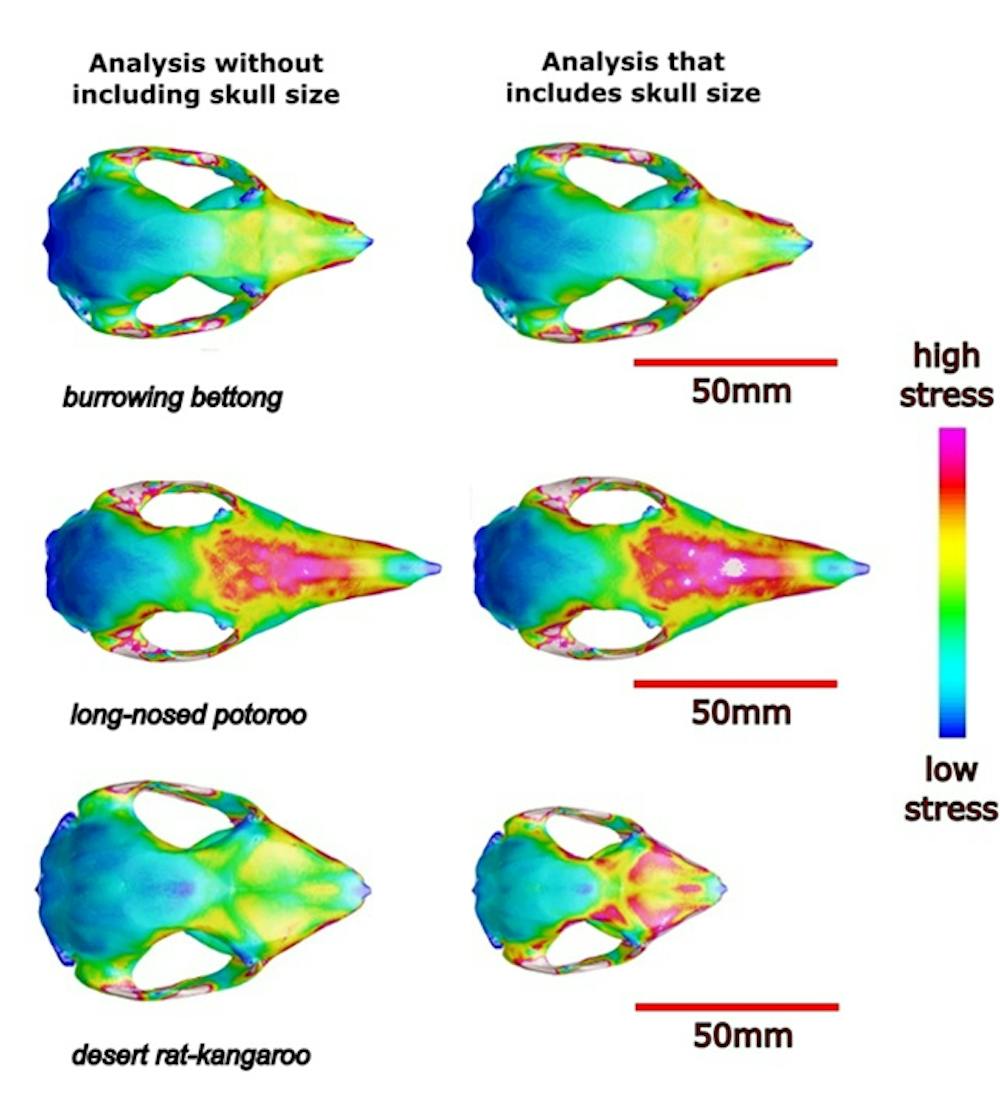
    But in our latest analysis, we showed that these assessments were probably incorrect. Instead, the animal’s diet was more likely restricted to softer materials, rather than the tougher foods eaten by some of its harder-headed relatives like the burrowing bettong.

    The reason for this? It all comes down to its size.

    Previous interpretations of its biting ability had drawn conclusions from comparisons of skull shape between species, but without considering size differences between them.

    Our results form part of a paper that addresses this issue in the methods that researchers use. We used a method called finite element analysis, which helps to predict how a structure – in this case, a skull – would handle the forces it experiences in the real world.

    But what we did differently to other researchers was to keep information about size differences between the skulls in the models.

    What did we find?

    The skull of the ngudlukanta is definitely efficient at biting, but it is also about one quarter smaller than the skull of the next smallest species in our sample, the northern bettong.

    When we included its smaller size in the analysis, the results suggested its relatively short face and robust jaw were unlikely to help it eat harder foods.

    Instead, its solid skull features mostly compensated for its small size, but would only allow it to support bites about as hard as those of the long-nosed potoroo – a larger species with a much less efficient skull at biting.

    Finite element models simulating the stress of each skull during biting with the front teeth. The stress in the desert rat-kangaroo is more similar to the hard food-eating burrowing bettong when not including its small size in the models. But its stress levels are more like the long-nosed potoroo when including its small size.
    Authors

    Early investigations of stomach contents from the 1930s tell us the ngudlukanta fed mostly on leaves and small amounts of insects. But little further detail exists. A more restricted range of softer, fresher plant materials, as suggested by our analysis, would narrow its range of preferred foods in the deserts it lived in.

    Our results therefore paint a picture of a species occupying a delicate position within the desert ecosystem.

    An unsolved mystery in a vast desert

    In recent years, one of us (Karl Vernes) has mounted several expeditions into the ngudlukanta‘s habitat, hoping to find evidence of its continued existence.

    However, finding this tiny marsupial in a vast desert is a challenge – not just because it was probably always rare and elusive, but also because we still know precious little about its ecology.

    Eyewitness accounts, remote camera traps, analysis of predator scat (poo) for mammal remains, genetic testing of scats, and the expert ecological knowledge of Traditional Owners have all been used to investigate the possibility of the survival of the ngudlukanta. No definitive evidence has yet emerged.

    Whether the ngudlukanta is extinct or not, therefore, remains an unsolved mystery.

    But history is replete with examples of rediscovered species believed to be extinct, known as “Lazarus species”. The desert’s vast, inhospitable terrain means it is plausible for a small nocturnal species to be evading detection.

    The distinctive short face of the ngudlukanta, alongside its small size and hopping gait, have led eyewitnesses to argue for its persistence.
    Hedley Herbert Finlayson, The Red Centre, 1935

    In fact, the desert rat-kangaroo was already a Lazarus species after its rediscovery in the 1930s. The story of the ngudlukanta therefore serves as a reminder that extinction declarations are not always the end of the story.

    If the species is still roaming the most inhospitable regions of the continent, the new knowledge gained from our analysis could help pinpoint areas where the ngudlukanta might persist.

    Who knows? The next chapter in the story of this desert-dweller may yet surprise us.

    Rex Mitchell has received funding from the Australian Research Council’s Centre of Excellence for Biodiversity and Heritage (CABAH).

    Karl Vernes has received funding from the Australian Research Council, the Mohamed bin Zayed Species Conservation Fund, Experiment.com, the Hermon Slade Foundation and Parks Australia. He is a member of the Australian Mammal Society.

    Vera Weisbecker receives funding from The Australian Research Council. She is affiliated with The Australian Mammal Society and member of the Australian Greens Party.

    ref. Presumed extinct, this desert rat-kangaroo may still be alive in hiding. New analysis reveals its delicate diet – https://theconversation.com/presumed-extinct-this-desert-rat-kangaroo-may-still-be-alive-in-hiding-new-analysis-reveals-its-delicate-diet-250283

    MIL OSI AnalysisEveningReport.nz

  • MIL-OSI Australia: Trailblazing UniSA programs take out national awards

    Source: University of South Australia

    26 February 2025

    From left: UniSA’s Vice Chancellor Professor David Lloyd, Professor Lan Snell, Associate Professor Stewart Von Itzstein, Dino Rossi and Ryan McClenaghan at the awards event

    The University of South Australia’s two nominations in the 2024 national Shaping Australia Awards have taken out both of the prizes in their category.

    Professor Tom Raimondo, Dr Jo Zucco and Associate Professor Stewart Von Itzstein won the Future Builder Award, as the team behind Australia’s first higher degree apprenticeship program, UniSA’s Bachelor of Software Engineering (Honours).

    Professor Lan Snell, Professor Andrew Beer, Peter Stevens, Stan Astachnowicz, Sam Stengert, Leanne Steele, Ling Ly and Jodie Walsh, the team behind UniSA’s trailblazing Global Executive MBA in Defence and Space (GEMBA), took out the People’s Choice Award in the same category.

    The Future Builder category honours initiatives that go above and beyond to deliver out-of-the-box teaching and industry engagement that bridges critical knowledge gaps. UniSA’s 2024 award wins reflect the University’s strengths in innovation and enterprise, and build on similar success in the inaugural awards last year

    The Shaping Australia Awards are an initiative of Universities Australia, which share the valuable contributions universities make to society.

    Bachelor of Software Engineering (Honours)

    UniSA’s Bachelor of Software Engineering (Honours) enables students to work full time at leading companies like BAE Systems, while studying. This hands-on experience, combined with academic rigor, ensures they graduate as work-ready, experienced software engineers.

    Created in partnership with industry partners including BAE and the AI Group, the success of the Bachelor of Software Engineering (Honours) has prompted the Department of State Development to issue a call for expressions of interest to establish additional degree apprenticeships in SA.

    Global Executive MBA in Defence and Space (GEMBA)

    UniSA’s Global Executive MBA in Defence and Space (GEMBA) is a unique18-month program delivered across three countries, reflecting the trilateral nature of the AUKUS alliance. The program equips leaders with advanced skills in areas like cyber security, space systems and defence procurement, and combines immersive residentials in Australia, the UK and the US with high-quality online learning.

    Through partnerships with Carnegie Mellon University, the University of Exeter and leading industry players, GEMBA empowers future leaders to navigate complex global security challenges and drive Australia’s defence and space industries forward.

    Universities Australia Chief Executive Officer Luke Sheehy congratulated all the winners and finalists.

    “These projects are changing lives, driving economic growth and securing Australia’s future. The overwhelming public response reflects the incredible contributions our universities make to help us all,” Sheehy said.

    The awards were judged by a panel of eminent Australians comprising:

    • Lisa Paul AO PSM, University of Canberra Chancellor and former Secretary of the Department of Education
    • Sir Peter Cosgrove AK AC (Mil) CVO MC (Retd), former Governor-General of Australia
    • Ms Charlene Davison, CEO of the Go Foundation.
    • Ms Michelle Gunn, editor-in-chief of The Australian
    • Mr Nicholas Moore AO, special envoy for Southeast Asia
    • Professor Brian Schmidt AC FAA FRS, former Vice-Chancellor of the Australian National University and Nobel laureate.
    • Ms Annabelle Williams OAM, Paralympic Gold Medallist, business owner and lawyer  

    A full list of the 2024 Shaping Australia Awards winners is available at shapingaustraliaawards.com.au.

    Other articles you may be interested in

    MIL OSI News

  • MIL-OSI Australia: Man charged with aggravated burglary and firearms offences

    Source: Tasmania Police

    Man charged with aggravated burglary and firearms offences

    Wednesday, 26 February 2025 – 9:24 am.

    Detectives from Bridgewater Criminal Investigation Branch have charged a 24-year-old man with a series of offences following a recent planned police operation.
    Police will allege the man was involved in a significant number of firearms burglaries and associated offending in Colebrook and Campania during January and February this year.
    He was arrested by investigators in Rosny on Tuesday, and several search warrants were subsequently executed across Hobart’s eastern shore.
    Electronic exhibits, ammunition and a reportedly stolen motorbike were located in the searches.
    He has been charged with a series of offences including aggravated burglary, motor vehicle stealing, firearms and traffic offences and will appear in the Hobart Magistrates Court today.

    MIL OSI News

  • MIL-OSI Australia: Helping First Nations women and children leave violent relationships in Broome

    Source: Ministers for Social Services

    The Albanese Labor Government is supporting First Nations women and children living in Broome, Western Australia to leave violent intimate partner relationships.

    Broome Regional Aboriginal Medical Service has received $7 million in funding to deliver the West Kimberley Leaving Violence Network, significantly expanding the immediate supports available for Aboriginal and Torres Strait Islander victim-survivors.

    This is one of three regional place-based trials commencing from 1 July – complementing the next stage of the $925 million Leaving Violence Program.

    The Government is investing $22.35 million in trials in Broome, Dubbo in NSW and Darwin in the Northern Territory, to provide tailored, trauma-informed support to Aboriginal and Torres Strait Islander peoples.

    Broome Regional Aboriginal Medical Service will also provide victim-survivors with an option to access the Leaving Violence Program through their service as an Aboriginal and Torres Strait Islander Community Organisation.

    Under the Leaving Violence Program, eligible victim-survivors receive financial support of up to $5,000, including up to $1,500 in cash and the remainder in goods and services. Supports include safety planning, risk assessment and referrals to other essential services for up to 12 weeks. The program is expected to support over 36,000 victim-survivors a year.

    Minister for Social Services, Amanda Rishworth, said the regional trials will provide eligible victim-survivors with greater access to practical and financial support to leave family violence.

    “By providing culturally safe, trauma-informed support, we can empower victim-survivors within our Indigenous communities to regain safety, stability, and control over their lives and wellbeing,” Minister Rishworth said.

    “No person in our country should be forced to live in an environment that compromises their safety or their agency, and this expansion of the program will allow hundreds of vulnerable Australians to take that first step into a brighter future.”

    Senator for Western Australia, Glenn Sterle, said the Government understands no two victim-survivors’ experiences are the same, and neither is the support they need.

    “It is imperative that victim-survivors seeking help are given a range of supports so they can get the help they need depending on their individual situations,” Senator Sterle said.

    “If there are any barriers to an individual looking after their own wellbeing and safety, we must do what we can to remove those barriers before things get any worse.”

    Intimate partner violence is a problem of epidemic proportions in Australia, with a quarter of all Australian women having experienced it in their lifetime.

    The Leaving Violence Program helps support the aims of the National Plan to End Violence against Women and Children 2022-32 to end violence in one generation, and forms part of the Albanese Government’s $4 billion investment in women’s safety since 2022.

    It also makes permanent the Escaping Violence Program trial. More than 78,000 victim-survivors have accessed the EVP payment since 2021. Over 70 per cent of those accessing the support were self-referrals meaning without this program they may have fallen through the cracks of the support system.

    More information on the Leaving Violence Program is available on the Department of Social Services website.

    If you or someone you know is experiencing, or at risk of experiencing, domestic, family or sexual violence, call 1800RESPECT on 1800 737 732, chat online via www.1800RESPECT.org.au, or text 0458 737 732.

    If you are concerned about your behaviour or use of violence, you can contact the Men’s Referral Service on 1300 766 491 or visit  http://www.ntv.org.au

    Feeling worried or no good? No shame, no judgement, safe place to yarn. Speak to a 13YARN Crisis Supporter, call 13 92 76. This service is available 24 hours a day, 7 days a week.

    MIL OSI News

  • MIL-OSI Economics: Media release: Boosting gas supply a priority for Australia’s economic and energy security – Australian Energy Producers

    Source: Australian Petroleum Production & Exploration Association

    Headline: Media release: Boosting gas supply a priority for Australia’s economic and energy security – Australian Energy Producers

    Australian Energy Producers today released its priorities to restore Australia’s competitiveness and ensure reliable and affordable gas for Australians ahead of the federal election. The industry’s plan for Australia’s economic and energy security comes as new polling in key Western Australian seats confirms strong support for the natural gas industry and its role in WA’s long-term energy mix.

    Australian Energy Producers Chief Executive Samantha McCulloch said the industry’s federal election platform outlines key actions for the next Australian Government to unlock the economic, energy security and emissions reduction potential of Australia’s abundant gas resources.

    “Natural gas will play an essential role in Australia’s energy mix to 2050 and beyond, but regulatory uncertainty, approval delays and policy interventions have delayed critical projects and damaged Australia’s reputation as a safe place to invest,” Ms McCulloch said.

    “Australia has abundant gas resources and yet we are facing forecast gas shortfalls on the east coast from 2027 and from 2030 in Western Australia.

    “Without new gas projects, Australian households and businesses face higher energy prices, uncertain energy supply, and increased risk of blackouts that will hit every part of the economy. Addressing these risks should be a national priority.”

    Australian Energy Producers is urging the major parties to commit to working with industry on the following priority actions:

    • Boost Australian gas supply to ease cost of living pressures
    • Restore Australia’s global competitiveness for investment
    • Deliver real emissions reductions with gas and carbon capture, utilisation and storage (CCUS)
    • Remain a reliable energy partner in our region

    “Australia and our region’s economic growth and energy security needs reliable and affordable gas supply, and this requires continued investment in new gas exploration and development,” Ms McCulloch said.

    “The Australian gas industry contributes $105 billion a year to the Australian economy and supports 215,000 jobs. Natural gas provides around 40 per cent of the energy used by Australia’s manufacturing sector, and in WA gas provides more than half the energy used in mining and minerals processing.

    “Polling confirms that Western Australians understand the importance of natural gas to the state’s economy. The next Australian Government should take note and prioritise actions to boost new gas supply, address approval delays, and ensure reliable and affordable energy for Australian households and businesses.”

    Read Australian Energy Producers’ policy platform for the 2025 Federal Election: https://energyproducers.au/2025election    

    Key findings from JWS Research polling in the electorates of Curtin, Tangney and Bullwinkel are summarised below.

    JWS Research polling results relating to the natural gas sector 

    JWS conducted online polling on 11-12 February on behalf of Australian Energy Producers, with around 830 respondents in each electorate. Key results of voters’ views on the role of natural gas in WA’s energy mix and its importance to the WA economy are summarised below. 

    Curtin

    • 73% support WA’s natural gas industry
    • 64% believe natural gas has a long-term role in WA’s energy mix
    • 78% believe the natural gas industry is important to WA’s economy
    • 69% oppose the Greens’ policy to ban all new gas projects
    • 65% oppose Labor forming a minority government with the Greens at the election
    • 69% believe a Labor-Greens minority government would have a negative impact on the WA economy
    • 47% are more likely to vote for a candidate that supports WA’s natural gas industry, while only 15% said they were more likely to vote against a candidate that supported the gas industry (36% said it would not influence their vote).

    Tangney

    • 72% support WA’s natural gas industry
    • 68% believe natural gas has a long-term role in WA’s energy mix, including 54% of Greens voters
    • 80% believe the natural gas industry is important to WA’s economy, including 61% of Greens voters
    • 60% oppose the Greens’ policy to ban all new gas projects, only 12% support it
    • 57% oppose Labor forming a minority government with the Greens at the election
    • 63% believe a Labor-Greens minority government would have a negative impact on the WA economy
    • 48% are more likely to vote for a candidate that supports WA’s natural gas industry, while only 6% said they were more likely to vote against a candidate that supported the gas industry (45% said it would not influence their vote).

    Bullwinkel

    • 77% support WA’s natural gas industry
    • 75% believe natural gas has a long-term role in WA’s energy mix, including 69% of Greens voters
    • 80% believe the natural gas industry is important to WA’s economy, including 85% of Greens voters
    • 74% oppose the Greens’ policy to ban all new gas projects
    • 70% oppose Labor forming a minority government with the Greens at the election
    • 71% believe a Labor-Greens minority government would have a negative impact on the WA economy
    • 46% are more likely to vote for a candidate that supports WA’s natural gas industry, while only 6% said they were more likely to vote against a candidate that supported the gas industry (45% said it would not influence their vote).

    Contact: 0434 631 511

    MIL OSI Economics

  • MIL-OSI Australia: New heights for Queensland’s sustainable aviation fuel industry

    Source: Australian Executive Government Ministers

    A Bundaberg biorefinery that will convert sugar mill waste into sustainable aviation fuel (SAF) and a second project to supply SAF at the Brisbane Airport, are taking off with new funding from the Albanese Labor Government.

    The Australian Renewable Energy Agency (ARENA) is providing $8 million to Australian technology developer Licella to assess the viability of establishing a biorefinery facility in the rum city region.

    It would be co-located with the Isis Central Sugar Mill, which would provide the agricultural residue feedstock.

    If studies prove successful, the biorefinery would be a huge boost for the regional economy and create about 300 construction jobs and 100 ongoing operational roles.

    Meanwhile, Viva Energy will receive $2.4 million to demonstrate the storage and use of SAF within the Brisbane Airport.

    The funding will help recondition a fuel tank at the Pinkenba Terminal to enable blended SAF supply into the airport for commercial use.

    Viva Energy will share its insights with airports across the country, helping ensure airport infrastructure is ready when domestic SAF is available.

    Australia is in a unique position to capitalise on a local industry with readily available biomass feedstock, willing offtake interest and existing expertise with liquid fuels that could combine to address domestic jet fuel demand in the 2020s.

    This renewable fuel could reduce domestic aviation emissions by up to 80% compared to conventional fossil-based fuel, providing a practical and real pathway to net zero for aviation.

    Quotes attributable to Minister for Climate Change and Energy Chris Bowen:

    “This ARENA funding is another demonstration of our government’s commitment for a Future Made in Australia – using our natural resources to build industry, cut emissions from planes, and create real jobs right now.

    “By making more fuel on Australian shores, from Australian renewable energy and feedstock, we can make our fuel supply stronger, cleaner and more secure.”

    Quotes attributable to Minister for Infrastructure, Transport, Regional Development and Local Government Catherine King:

    “The size of our nation means that aviation is often the only option for Australians to get where they need to go.

    “The development of a local sustainable aviation fuel industry is a necessity, but also a huge opportunity for job creation in the regions.” 

    MIL OSI News

  • MIL-OSI USA: King Sounds Alarm on Drastic Cuts to Veterans Services

    US Senate News:

    Source: United States Senator for Maine Angus King
    WASHINGTON, D.C. — In a joint hearing before the Senate Veterans Affairs Committee (SVAC) and the House Veterans Affairs Committee (HVAC), Senator Angus King (I-Maine) raised concerns over how mass layoffs at the Department of Veterans Affairs (VA) that closely resemble provisions in Project 2025 will negatively affect veteran benefits and care with Daniel Contreras, the National Commander of the Disabled American Veterans — who echoed the Senator’s worries. The hearing comes the day after the VA announced plans to cut more than 1,400 probationary federal employees in a second round of layoffs. Earlier this month, the VA dismissed more than 1,000 employees; however, some workers have since been reinstated. In addition, job cuts across all government agencies are disproportionally impacting veterans who make up approximately 30% of the federal workforce.
    “Thank, Mr. Chairman. I would call to the attention of the DAV a very troubling paragraph in something called Project 2025 which I suspect you have heard of, which seems to be the template for this administration’s approach. Here is the sentence that I hope you will attend to, ‘The next administration should explore how veterans’ reviews should be accelerated with clearance from OMB to target significant cost savings from revising disability rating awards for future claimants.’ And listen to this, ‘while preserving them fully or partially for existing claims.’ Mr. Leader, how do you feel about that idea,” asked Senator King.
    “Anything that will take away from veterans’ benefits, we do not support that. We are aware of Project 2025’s initiatives not only to reduce Category 7 and 8, also to tax veterans’ benefits or to look at unemployment benefits as far as social security age. I would say that we would not be in favor of that. One of our critical policy goals outlines that we need to protect those benefits. There will be great opposition to that. We had the Secretary visit at the conference recently and he stated — and we are going to hold him to it — that he is putting veterans first. That would not be putting veterans first,” replied National Commander Contreras.  
    “I appreciate that. We’ve been talking a lot about the layoffs. In fact, combining the hiring freeze with the normal attrition, we are really down about 5000 people at the VA in the last month. Now, the secretary, when he released his statement last night, said that in fact, veterans will notice a change for the better. My question to you and to the veterans is, tell us if that is what you notice. The power is with the veterans, and you need to use your voice,” said Senator King. “It is hard for me to believe that these cuts which have been made in the last 20 days, as near as I can tell, pretty indiscriminately, are going to change things for the better for the veterans. By the way, talking about bureaucracy, in my view, the person who answers the phone can be as important as the person that delivers the care. If a veteran calls for a health care appointment and there was no one there to answer the phone, that is a denial of benefits, just as sure as if they cannot see the doctor. I hope that the people in this room will hold us accountable and thereby the agency, the department, the new secretary to truly putting veterans first. That is an easy phrase to say, but I look at what is actually being done. Thank you, Mr. Chairman, for the work you are doing.”
    Tonight, Senator King will be honored by the Disabled American Veterans as its 2025 Legislator of the Year. Last year, he was recognized by the Wounded Warrior Project as the 2024 Legislator of the Year for his “outstanding legislative effort and achievement to improve the lives of the wounded, ill, and injured veterans.”
    Representing one of the states with the highest rates of military families and veterans per capita, Senator King has been a staunch advocate for America’s servicemembers and veterans. A member of the Senate Veterans’ Affairs Committee (SVAC), he works to ensure American veterans receive their earned benefits and that the VA is properly implementing various programs such as the PACT Act, the State Veterans Homes Domiciliary Care Flexibility Act, and the John Scott Hannon Act.  Earlier this month, in a letter to VA Secretary Doug Collins, Senator King joined his colleagues in urging for immediate action to secure veterans’ personal information provided by VA or other agencies to Elon Musk and his “Department of Government Efficiency” (DOGE), a measure that would protect millions of veterans’ medical records stored in VA’s computer systems. Previously, Senator King introduced the Lethal Means Safe Storage for Veteran Suicide Prevention Act to provide firearm storage to veterans in an effort to reduce suicides among the veteran population. In addition, he helped pass the Veterans COLA Act, which increased benefits for 30,000 Maine veterans and their families. This past week, Senator King introduced bipartisan legislation alongside SVAC Chairman Senator Jerry Moran (R-KS) to improve care coordination for veterans who rely on both VA health care and Medicare.

    MIL OSI USA News

  • MIL-OSI Australia: First Nations peoples high on agenda for crisis accommodation expansion

    Source: Ministers for Social Services

    The Albanese Labor Government is delivering on its goal to end gender-based violence in one generation, with more crisis accommodation services for First Nations communities.

    Last year we invested $17.4 million in the capacity of crisis accommodation services to support Aboriginal and Torres Strait Islander peoples.

    We’re now expanding the program with a further investment of $14.8 million that goes to new organisations and new regions across Australia. It brings the total investment in this program to $32.2 million.

    Organisations in remote and regional communities in Far North Queensland, South Australia, Tasmania and the Australian Capital Territory will be able to apply for a share of the new funding.

    Minister for Social Services, Amanda Rishworth said this additional investment will address outstanding service gaps so no Australian is left behind or forgotten.

    The Minister today visited Warringu Aboriginal and Torres Strait Islander Corporation (Warringu) in Cairns – a recipient of the original funding grant.

    “The amazing support and services that Warringu have provided to their community is a testament to what First Nations-led organisations can provide when properly resourced. This demonstrates that a grant expansion will give much needed access to those in need,” Minister Rishworth said.

    “We have identified possible service gaps in a number of regions around the country, including in the Torres Strait Islands, and will expand the program to those areas to allow for critical services to be provided in these communities.”

    Minister for Indigenous Australians, Senator Malarndirri McCarthy said the Albanese Labor Government is committed to working with First Nations organisations to address the disproportionately high rates of family violence experienced by First Nations women and children.

    “This further investment will mean more First Nations-led and Community-Controlled organisations can deliver culturally safe crisis accommodation to women and children,” Minister McCarthy said.

    “I’m particularly pleased this investment includes services in regional and remote communities, where support can be harder to access.”

    Karen Dini-Paul, Chief Executive Officer for Warringu, emphasised Warringu’s commitment to being a recipient of the Increasing Capacity of Crisis Accommodation Services for Aboriginal and Torres Strait Islander peoples grant to fund their Regional & Remote Women’s Shelters project.

    “This project is critical to addressing the increasing complexity of challenges faced by women, living in Far North Queensland and Torres Strait communities,” Ms Dini-Paul said.

    “Warringu has developed a unique and successful model of care, drawing on years of experience working directly with women and children facing domestic, family, and sexual violence.

    “This grant gives Warringu the opportunity to support 14 sister shelters throughout Far North Queensland to develop models of care tailored to remote and Indigenous communities, ensuring the shelter system is adaptive, culturally relevant, and sustainable.”

    The expansion of the grant will prioritise funding for Aboriginal and Torres Strait Islander Community-Controlled Organisations (ACCOs) and Indigenous-led entities, aligning with the Aboriginal and Torres Strait Islander Action Plan 2023-2025 (Action Plan).

    More information on the Action Plan is available on the Department of Social Services website
    If you or someone you know is experiencing, or at risk of experiencing domestic, family and sexual violence, you can call 1800RESPECT on 1800 737 732, text 0458 737 732 or visit www.1800respect.org.au for online chat and video call services:

    • Available 24/7: Call, text or online chat
    • Mon-Fri, 9am – midnight AEST (except national public holidays): Video call (no appointment needed)

    If you are concerned about your behaviour or use of violence, you can contact the Men’s Referral Service on 1300 766 491 or visit www.ntv.org.au

    Feeling worried or no good? Connect with 13YARN Aboriginal & Torres Strait Islander Crisis Supporters on 13 92 76, available 24/7 from any mobile or pay phone, or visit www.13yarn.org.au No shame, no judgement, safe place to yarn.

    MIL OSI News

  • MIL-OSI: Flywire Reports Fourth Quarter and Fiscal-Year 2024 Financial Results

    Source: GlobeNewswire (MIL-OSI)

    Fourth Quarter Revenue Increased 17.0% Year-over-Year

    Fourth Quarter Revenue Less Ancillary Services Increased 17.4% Year-over-Year

    Company Provides First Quarter and Fiscal-Year 2025 Outlook

    BOSTON, Feb. 25, 2025 (GLOBE NEWSWIRE) — Flywire Corporation (Nasdaq: FLYW) (“Flywire” or the “Company”) a global payments enablement and software company, today reported financial results for its fourth quarter and fiscal-year ended December 31, 2024.

    “Our fourth quarter results capped off another strong year for Flywire as we continued to grow the business while navigating a complex macro environment with significant headwinds,” said Mike Massaro, CEO of Flywire, “We continued to focus on business and bottom line growth and generated 17% revenue growth and 680 bps adjusted EBITDA margin growth in the quarter.”

    “Looking ahead, we’re focused on driving effectiveness and discipline throughout our global business. We will be undertaking an operational and business portfolio review. The operational review will help ensure we are efficient and effective, with a focus on driving productivity and optimizing investments across all areas. Our comprehensive business portfolio review will focus on Flywire’s core strengths – such as complex, large-value payment processing, our global payment network, and verticalized software.”

    “One of the efficiency measures we are undertaking is a restructuring, which impacts approximately 10% of our workforce. It is difficult to say goodbye to so many FlyMates, and I want to thank them for their hard work as we endeavor to support them throughout this transition.”

    “As we refocus our teams on areas that we believe will drive Flywire’s future growth, we are excited to announce the acquisition of Sertifi, which is expected to accelerate the expansion of our fast-growing Travel vertical. Sertifi augments our travel product offering with a leading dedicated hotel property management system integration and expands our footprint across more than 20,000 hotel locations worldwide.”

    Fourth Quarter 2024 Financial Highlights:

    GAAP Results

    • Revenue increased 17.0% to $117.6 million in the fourth quarter of 2024, compared to $100.5 million in the fourth quarter of 2023.
    • Gross Profit increased to $74.3 million, resulting in Gross Margin of 63.2%, for the fourth quarter of 2024, compared to Gross Profit of $61.8 million and Gross Margin of 61.5% in the fourth quarter of 2023.
    • Net loss was ($15.9) million in the fourth quarter of 2024, compared to net income of $1.3 million in the fourth quarter of 2023.

    Key Operating Metrics and Non-GAAP Results

    • Number of clients grew by 16%year-over-year, with over 180 new clients added in the fourth quarter of 2024.
    • Total Payment Volume increased 27.6% to $6.9 billion in the fourth quarter of 2024, compared to $5.4 billion in the fourth quarter of 2023.
    • Revenue Less Ancillary Services increased 17.4% to $112.8 million in the fourth quarter of 2024, compared to $96.1 million in the fourth quarter of 2023.
    • Adjusted Gross Profit increased to $75.6 million, up 19.1% compared to $63.5 million in the fourth quarter of 2023. Adjusted Gross Margin was 67.0% in the fourth quarter of 2024 compared to 66.1% in the fourth quarter of 2023.
    • Adjusted EBITDA increased to $16.7 million in the fourth quarter of 2024, compared to $7.7 million in the fourth quarter of 2023. Our adjusted EBITDA margins increased 680 bps year-over-year to 14.8% in the fourth quarter of 2024.

    2024 Business Highlights:

    • We signed more than 800 new clients in fiscal-year 2024 surpassing the 700 new clients signed in fiscal-year 2023.
    • Our transaction payment volume grew by 23.6% year-over-year to $29.7 billion
    • Our global education vertical, continued to strengthen in a number of core geographies, with U.K. region outperformance driven by new clients and net revenue retention; accompanied by growth in our network of international recruitment agents to further connect our ecosystem of clients, agents and payers
    • Our travel vertical grew into our second largest vertical in terms of revenue less ancillary services, and we generated strong growth most notably with EMEA and APAC based Tour Operators and DMC providers, particularly in our new sub vertical of ocean experiences.
    • Our business-to-business vertical continued its strong organic growth, enhanced by the acquisition of Invoiced.
    • We further optimized our global payment network to enable vertical growth with a focus on new acceptance rails, market localization and expanded network coverage. This included continued support of our strategic payer markets like India and China, enhancing our offerings to digitize the disbursement of student loans from India and strengthening partnerships with India’s three largest banks.
    • We repurchased 2.3 million shares for approximately $44 million, inclusive of commissions, under our share repurchase program announced on August 6th, 2024.

    First Quarter and Fiscal-Year 2025 Outlook:

    “Effective execution drove both revenue growth and margin expansion in 2024, in spite of significant macroeconomic challenges” said Flywire’s CFO, Cosmin Pitigoi. “For our 2025 financial outlook, we project revenue less ancillary services growth of 10-14% on an FX-neutral (constant currency) basis, and a 200-400 basis point increase in adjusted EBITDA margin. We expect approximately 3 percentage points of headwind from FX throughout the year.  This guidance excludes the contributions from the Sertifi acquisition, as well as any potential lessening of the macroeconomic headwinds. We are particularly encouraged by the anticipated performance of our combined travel vertical, as well as the emerging B2B vertical, both of which are expected to exceed our historical growth rate for the applicable vertical”

    Based on information available as of February 25, 2025, Flywire anticipates the following results for the first quarter and fiscal-year 2025 excluding Sertifi.

      Fiscal-Year 2025
    FX-Neutral GAAP Revenue Growth 9-13% YoY
    FX-Neutral Revenue Less Ancillary Services Growth 10-14% YoY
    Adjusted EBITDA* Margin Growth +200-400 bps YoY
       
      First Quarter 2025
    FX-Neutral GAAP Revenue Growth 10-13% YoY
    FX-Neutral Revenue Less Ancillary Services Growth 11-14% YoY
    Adjusted EBITDA* Margin Growth +300-600 bps YoY
       

    “Based on Sertifi’s historical financials, we currently expect the acquisition to provide incremental revenue of $3.0-4.0 million and $30.0-40.0 million in revenue  in the first quarter and fiscal year 2025, respectively.  In addition, we currently expect the Sertifi acquisition to have a flat to slightly positive effect on adjusted EBITDA and positive (low single–digit million) effect on adjusted EBITDA, in the first quarter and fiscal year 2025, respectively, as we plan to invest in the combined solution during 2025.”

    *Flywire has not provided a quantitative reconciliation of forecasted Adjusted EBITDA Margin growth to forecasted GAAP Net Income Margin growth within this earnings release because Flywire is unable, without making unreasonable efforts, to calculate certain reconciling items with confidence. These items include, but are not limited to income taxes which are directly impacted by unpredictable fluctuations in the market price of Flywire’s stock and in foreign currency exchange rates.

    These statements are forward-looking and actual results may differ materially. Refer to the “Safe Harbor Statement” below for information on the factors that could cause Flywire’s actual results to differ materially from these forward-looking statements.

    Conference Call

    The Company will host a conference call to discuss fourth quarter and fiscal-year 2024 financial results today at 5:00 pm ET. Hosting the call will be Mike Massaro, CEO, Rob Orgel, President and COO, and Cosmin Pitigoi, CFO. The conference call can be accessed live via webcast from the Company’s investor relations website at https://ir.flywire.com/. A replay will be available on the investor relations website following the call.

    Note Regarding Share Repurchase Program

    Repurchases under the Company’s share repurchase program (the Repurchase Program) may be made from time to time through open market purchases, in privately negotiated transactions or by other means, including through the use of trading plans intended to qualify under Rule 10b5-1 under the Securities Exchange Act of 1934, as amended, in accordance with applicable securities laws and other restrictions, including Rule 10b-18. The timing, value and number of shares repurchased will be determined by the Company in its discretion and will be based on various factors, including an evaluation of current and future capital needs, current and forecasted cash flows, the Company’s capital structure, cost of capital and prevailing stock prices, general market and economic conditions, applicable legal requirements, and compliance with covenants in the Company’s credit facility that may limit share repurchases based on defined leverage ratios. The Repurchase Program does not obligate the Company to purchase a specific number of, or any, shares.  The Repurchase Program does not expire and may be modified, suspended or terminated at any time without notice at the Company’s discretion.

    Key Operating Metrics and Non-GAAP Financial Measures

    Flywire uses non-GAAP financial measures to supplement financial information presented on a GAAP basis. The Company believes that excluding certain items from its GAAP results allows management to better understand its consolidated financial performance from period to period and better project its future consolidated financial performance as forecasts are developed at a level of detail different from that used to prepare GAAP-based financial measures. Moreover, Flywire believes these non-GAAP financial measures provide its stakeholders with useful information to help them evaluate the Company’s operating results by facilitating an enhanced understanding of the Company’s operating performance and enabling them to make more meaningful period to period comparisons. There are limitations to the use of the non-GAAP financial measures presented here. Flywire’s non-GAAP financial measures may not be comparable to similarly titled measures of other companies. Other companies, including companies in Flywire’s industry, may calculate non-GAAP financial measures differently, limiting the usefulness of those measures for comparative purposes.

    Flywire uses supplemental measures of its performance which are derived from its consolidated financial information, but which are not presented in its consolidated financial statements prepared in accordance with GAAP. These non-GAAP financial measures include the following:

    • Revenue Less Ancillary Services.  Revenue Less Ancillary Services represents the Company’s consolidated revenue in accordance with GAAP after excluding (i) pass-through cost for printing and mailing services and (ii) marketing fees. The Company excludes these amounts to arrive at this supplemental non-GAAP financial measure as it views these services as ancillary to the primary services it provides to its clients.
    • Adjusted Gross Profit and Adjusted Gross Margin.  Adjusted gross profit represents Revenue Less Ancillary Services less cost of revenue adjusted to (i) exclude pass-through cost for printing services, (ii) offset marketing fees against costs incurred and (iii) exclude depreciation and amortization, including accelerated amortization on the impairment of customer set-up costs tied to technology integration. Adjusted Gross Margin represents Adjusted Gross Profit  divided by Revenue Less Ancillary Services. Management believes this presentation supplements the GAAP presentation of Gross Margin with a useful measure of the gross margin of the Company’s payment-related services, which are the primary services it provides to its clients.
    • Adjusted EBITDA.  Adjusted EBITDA represents EBITDA further adjusted by excluding (i) stock-based compensation expense and related payroll taxes, (ii) the impact from the change in fair value measurement for contingent consideration associated with acquisitions,(iii) gain (loss) from the remeasurement of foreign currency, (iv) indirect taxes related to intercompany activity, (v) acquisition related transaction costs, and (vi) employee retention costs, such as incentive compensation, associated with acquisition activities. Management believes that the exclusion of these amounts to calculate Adjusted EBITDA provides useful measures for period-to-period comparisons of the Company’s business. We calculate adjusted EBITDA margin by dividing adjusted EBITDA by Revenue Less Ancillary Services.
    • Revenue Less Ancillary Services at Constant Currency.  Revenue Less Ancillary Services at Constant Currency represents Revenue Less Ancillary Services adjusted to show presentation on a constant currency basis. The constant currency information presented is calculated by translating current period results using prior period weighted average foreign currency exchange rates.  Flywire  analyzes Revenue Less Ancillary Services on a constant currency basis to provide a comparable framework for assessing how the business performed excluding the effect of foreign currency fluctuations.
    • Non-GAAP Operating Expenses – Non-GAAP Operating Expenses represents GAAP Operating Expenses adjusted by excluding (i) stock-based compensation expense and related payroll taxes, (ii) depreciation and amortization, (iii) acquisition related transaction costs, if applicable, (iv) employee retention costs, such as incentive compensation, associated with acquisition activities and (v) the impact from the change in fair value measurement for contingent consideration associated with acquisitions.

    These non-GAAP financial measures are not meant to be considered as indicators of performance in isolation from or as a substitute for the Company’s revenue, gross profit, gross margin or net income (loss), or operating expenses prepared in accordance with GAAP and should be read only in conjunction with financial information presented on a GAAP basis. Reconciliations of Revenue Less Ancillary Services, Revenue Less Ancillary Services at Constant Currency, Adjusted Gross Profit, Adjusted Gross Margin, Adjusted EBITDA and non-GAAP Operating Expenses to the most directly comparable GAAP financial measure are presented below. Flywire encourages you to review these reconciliations in conjunction with the presentation of the non-GAAP financial measures for each of the periods presented. In future fiscal periods, Flywire may exclude such items and may incur income and expenses similar to these excluded items. Flywire has not provided a quantitative reconciliation of forecasted Adjusted EBITDA Margin growth to forecasted GAAP Net Income growth within this earnings release because it is unable, without making unreasonable efforts, to calculate certain reconciling items with confidence. These items include but are not limited to income taxes which are directly impacted by unpredictable fluctuations in the market price of Flywire’s stock and in foreign exchange rates.  For figures in this press release reported on an “FX-Neutral basis,” Flywire calculates the year-over-year impact of foreign currency movements using prior period weighted average foreign currency rates.

    About Flywire

    Flywire is a global payments enablement and software company. We combine our proprietary global payments network, next-gen payments platform and vertical-specific software to deliver the most important and complex payments for our clients and their customers.

    Flywire leverages its vertical-specific software and payments technology to deeply embed within the existing A/R workflows for its clients across the education, healthcare and travel vertical markets, as well as in key B2B industries. Flywire also integrates with leading ERP systems, such as NetSuite, so organizations can optimize the payment experience for their customers while eliminating operational challenges.

    Flywire supports approximately 4,500** clients with diverse payment methods in more than 140 currencies across 240 countries and territories around the world. Flywire is headquartered in Boston, MA, USA with global offices. For more information, visit www.flywire.com. Follow Flywire on X (formerly known as Twitter), LinkedIn and Facebook.

    **Excludes clients from Flywire’s Invoiced and Sertifi acquisitions

    Safe Harbor Statement

    This release contains forward-looking statements within the meaning of the Private Securities Litigation Reform Act of 1995, including, but not limited to, statements regarding Flywire’s future operating results and financial position, Flywire’s business strategy and plans, market growth, and Flywire’s objectives for future operations. Flywire intends such forward-looking statements to be covered by the safe harbor provisions for forward-looking statements contained in Section 21E of the Securities Exchange Act of 1934 and the Private Securities Litigation Reform Act of 1995. In some cases, you can identify forward-looking statements by terms such as, but not limited to, “believe,” “may,” “will,” “potentially,” “estimate,” “continue,” “anticipate,” “intend,” “could,” “would,” “project,” “target,” “plan,” “expect,” or the negative of these terms, and similar expressions intended to identify forward-looking statements. Such forward-looking statements are based upon current expectations that involve risks, changes in circumstances, assumptions, and uncertainties. Important factors that could cause actual results to differ materially from those reflected in Flywire’s forward-looking statements include, among others, Flywire’s future financial performance, including its expectations regarding FX-Neutral GAAP Revenue Growth, FX-Neutral Revenue Less Ancillary Services Growth, and Adjusted EBITDA Margin Growth and foreign exchange rates.  Risks that may cause actual results to differ materially from these forward looking statements include, but are not limited to: Flywire’s  ability to execute its business plan and effectively manage its growth; Flywire’s cross-border expansion plans and ability to expand internationally; anticipated trends, growth rates, and challenges in Flywire’s business and in the markets in which Flywire operates; the  sufficiency of Flywire’s cash and cash equivalents to meet its liquidity needs;  political, economic, foreign currency exchange rate, inflation, legal, social and health risks, that may affect Flywire’s business or the global economy; Flywire’s beliefs and objectives for future operations; Flywire’s ability to develop and protect its brand; Flywire’s ability to maintain and grow the payment volume that it processes; Flywire’s ability to further attract, retain, and expand its client base; Flywire’s ability to develop new solutions and services and bring them to market in a timely manner; Flywire’s expectations concerning relationships with third parties, including financial institutions and strategic partners; the effects of increased competition in Flywire’s markets and its ability to compete effectively; recent and future acquisitions or investments in complementary companies, products, services, or technologies; Flywire’s ability to enter new client verticals, including its relatively new business-to-business  sector; Flywire’s expectations regarding anticipated technology needs and developments and its ability to address those needs and developments with its solutions; Flywire’s expectations regarding its ability to meet existing performance obligations and maintain the operability of its solutions; Flywire’s expectations regarding the effects of existing and developing laws and regulations, including with respect to payments and financial services, taxation, privacy and data protection; economic and industry trends, projected growth, or trend analysis; the effects of global events and geopolitical conflicts, including without limitation the continuing hostilities in Ukraine and involving Israel; Flywire’s ability to adapt to  changes in U.S. federal income or other tax laws or the interpretation of tax laws, including the Inflation Reduction Act of 2022;  Flywire’s ability to attract and retain qualified employees; Flywire’s ability to maintain, protect, and enhance its intellectual property; Flywire’s ability to maintain the security and availability of its solutions; the increased expenses associated with being a public company; the future market price of Flywire’s common stock; and other factors that are described in the “Risk Factors” and “Management’s Discussion and Analysis of Financial Condition and Results of Operations” sections of Flywire’s Annual Report on Form 10-K for the year ended December 31, 2023, and Quarterly Report on Form 10-Q for the quarter ended September 30, 2024, which are on file with the Securities and Exchange Commission (SEC) and available on the SEC’s website at https://www.sec.gov/. Additional factors may be described in those sections of Flywire’s Annual Report on Form 10-K for the year ended December 31, 2024, expected to be filed in the first quarter of 2025. The information in this release is provided only as of the date of this release, and Flywire undertakes no obligation to update any forward-looking statements contained in this release on account of new information, future events, or otherwise, except as required by law.

    Contacts

    Investor Relations:
    Masha Kahn
    ir@Flywire.com

    Media:
    Sarah King
    Media@Flywire.com

    Condensed Consolidated Statements of Operations and Comprehensive Loss
    (Unaudited) (Amounts in thousands, except share and per share amounts)
                   
      Three Months Ended December 31,   Twelve Months Ended December 31,
        2024       2023       2024       2023  
    Revenue $ 117,550     $ 100,545     $ 492,144     $ 403,094  
    Costs and operating expenses:              
    Payment processing services costs   41,384       36,780       177,490       147,339  
    Technology and development   17,370       16,898       66,636       62,028  
    Selling and marketing   33,353       28,830       129,435       107,621  
    General and administrative   31,218       28,065       125,838       107,624  
    Total costs and operating expenses   123,325       110,573       499,399       424,612  
    Loss from operations $ (5,775 )   $ (10,028 )   $ (7,255 )   $ (21,518 )
    Other income (expense):              
    Interest expense   (135 )     (92 )     (538 )     (372 )
    Interest income   4,872       5,638       21,440       13,349  
    Gain (loss) from remeasurement of foreign currency   (13,866 )     7,707       (11,787 )     4,189  
    Total other income (expense), net   (9,129 )     13,253       9,115       17,166  
    Income (loss) before provision for income taxes   (14,904 )     3,225       1,860       (4,352 )
    Provision (benefit) for income taxes   995       1,938       (1,040 )     4,214  
    Net Income (Loss) $ (15,899 )   $ 1,287     $ 2,900     $ (8,566 )
    Foreign currency translation adjustment   (7,330 )     3,731       (3,594 )     3,232  
    Unrealized losses on available-for-sale debt securities, net $ (441 )   $     $ 208     $  
    Total other comprehensive income (loss) $ (7,771 )   $ 3,731     $ (3,386 )   $ 3,232  
    Comprehensive income (loss) $ (23,670 )   $ 5,018     $ (486 )   $ (5,334 )
    Net loss attributable to common stockholders – basic and diluted $ (15,899 )   $ 1,287     $ 2,900     $ (8,566 )
    Net loss per share attributable to common stockholders – basic $ (0.13 )   $ 0.01     $ 0.02     $ (0.07 )
    Net loss per share attributable to common stockholders – diluted $ (0.12 )   $ 0.01     $ 0.02     $ (0.07 )
    Weighted average common shares outstanding – basic   124,463,252       121,690,938       124,269,820       114,828,494  
    Weighted average common shares outstanding – diluted   128,924,166       128,877,877       129,339,462       114,828,494  
                                   
    Condensed Consolidated Balance Sheets
    (Unaudited) (Amounts in thousands, except share amounts)
           
      December 31,   December 31,
        2024       2023  
    Assets      
    Current assets:      
    Cash and cash equivalents $ 495,242     $ 654,608  
    Restricted cash          
    Short-term investments   115,848        
    Accounts receivable, net   23,703       18,215  
    Unbilled receivables, net   15,453       10,689  
    Funds receivable from payment partners   90,110       113,945  
    Prepaid expenses and other current assets   22,528       18,227  
    Total current assets   762,884       815,684  
    Long-term investments   50,125        
    Property and equipment, net   17,160       15,134  
    Intangible assets, net   118,684       108,178  
    Goodwill   149,558       121,646  
    Other assets   24,035       19,089  
    Total assets $ 1,122,446     $ 1,079,731  
           
    Liabilities and Stockholders’ Equity      
    Current liabilities:      
    Accounts payable $ 15,353     $ 12,587  
    Funds payable to clients   217,788       210,922  
    Accrued expenses and other current liabilities   49,297       43,315  
    Deferred revenue   7,337       6,968  
    Total current liabilities   289,775       273,792  
    Deferred tax liabilities   12,643       15,391  
    Other liabilities   5,261       4,431  
    Total liabilities   307,679       293,614  
    Commitments and contingencies (Note 16)      
    Stockholders’ equity:      
    Preferred stock, $0.0001 par value; 10,000,000 shares authorized as of December 31, 2024 and 2023; and no shares issued and outstanding as of December 31, 2024 and 2023          
    Voting common stock, $0.0001 par value; 2,000,000,000 shares authorized as of December 31, 2024 and December 31, 2023; 126,853,852 shares issued and 122,182,878 shares outstanding as of December 31, 2024; 123,010,207 shares issued and 120,695,162 shares outstanding as of December 31, 2023   13       11  
    Non-voting common stock, $0.0001 par value; 10,000,000 shares authorized as of December 31, 2024 and December 31, 2023; 1,873,320 shares issued and outstanding as of December 31, 2024 and December 31, 2023         1  
    Treasury voting common stock, 4,670,974 and 2,315,045 shares as of December 31, 2024 and December 31, 2023, respectively, held at cost   (46,268 )     (747 )
    Additional paid-in capital   1,033,958       959,302  
    Accumulated other comprehensive income   (2,066 )     1,320  
    Accumulated deficit   (170,870 )     (173,770 )
    Total stockholders’ equity   814,767       786,117  
    Total liabilities and stockholders’ equity $ 1,122,446     $ 1,079,731  
                   
    Condensed Consolidated Statement of Cash Flows
    (Unaudited) (Amounts in thousands)
           
      Twelve Months Ended December 31,
        2024       2023  
    Cash flows from operating activities:      
    Net income (loss) $ 2,900     $ (8,566 )
    Adjustments to reconcile net loss to net cash used in operating activities:      
    Depreciation and amortization   17,363       15,764  
    Stock-based compensation expense   64,933       43,726  
    Amortization of deferred contract costs   972       1,789  
    Change in fair value of contingent consideration   (978 )     380  
    Deferred tax provision (benefit)   (8,794 )     72  
    Provision for uncollectible accounts   (83 )     326  
    Non-cash interest expense   230       298  
    Non-cash interest income   (1,435 )      
    Changes in operating assets and liabilities, net of acquisitions:      
    Accounts receivable   (5,292 )     (2,082 )
    Unbilled receivables   (4,764 )     (5,394 )
    Funds receivable from payment partners   23,835       (50,975 )
    Prepaid expenses, other current assets and other assets   (5,322 )     (4,279 )
    Funds payable to clients   6,867       86,616  
    Accounts payable, accrued expenses and other current liabilities   3,302       5,548  
    Contingent consideration   (93 )     (467 )
    Other liabilities   (1,543 )     (1,260 )
    Deferred revenue   (630 )     (871 )
    Net cash provided by operating activities   91,468       80,625  
           
    Cash flows from investing activities:      
    Acquisition of businesses, net of cash acquired   (45,230 )     (32,764 )
    Purchase of debt securities   (193,927 )      
    Sale of debt securities   29,598        
    Capitalization of internally developed software   (5,317 )     (5,004 )
    Purchases of property and equipment   (924 )     (1,009 )
    Net cash (used in) investing activities   (215,800 )     (38,777 )
    Cash flows from financing activities:      
    Proceeds from issuance of common stock under public offering, net of underwriter discounts and commissions         261,119  
    Payments of costs related to public offering         (1,062 )
    Payment of debt issuance costs   (783 )      
    Contingent consideration paid for acquisitions   (1,032 )     (1,207 )
    Payments of tax withholdings for net settled equity awards   (797 )     (8,483 )
    Purchases of treasury stock   (43,740 )      
    Proceeds from the issuance of stock under Employee Stock Purchase Plan   3,108       2,691  
    Proceeds from exercise of stock options   5,613       10,360  
    Net cash provided by (used in) financing activities   (37,631 )     263,418  
    Effect of exchange rates changes on cash and cash equivalents   2,597       (1,835 )
    Net increase (decrease) in cash, cash equivalents and restricted cash   (159,366 )     303,431  
    Cash, cash equivalents and restricted cash, beginning of year $ 654,608     $ 351,177  
    Cash, cash equivalents and restricted cash, end of year $ 495,242     $ 654,608  
                   
    Reconciliation of Non-GAAP Financial Measures
    (Unaudited) (Amounts in millions, except percentages)
                     
        Three Months Ended
    December 31,
      Twelve Months Ended
    December 31,
          2024       2023       2024       2023  
    Revenue   $ 117.6     $ 100.5     $ 492.1     $ 403.1  
    Adjusted to exclude gross up for:                
    Pass-through cost for printing and mailing     (4.5 )     (4.0 )     (15.9 )     (19.4 )
    Marketing fees     (0.3 )     (0.4 )     (2.0 )     (2.2 )
    Revenue Less Ancillary Services   $ 112.8     $ 96.1     $ 474.2     $ 381.5  
    Payment processing services costs     41.4       36.8       177.5       147.3  
    Hosting and amortization costs within technology and development expenses     1.9       1.9       7.7       8.4  
    Cost of Revenue   $ 43.3     $ 38.7     $ 185.2     $ 155.7  
    Adjusted to:                
    Exclude printing and mailing costs     (4.5 )     (4.0 )     (15.9 )     (19.4 )
    Offset marketing fees against related costs     (0.3 )     (0.4 )     (2.0 )     (2.2 )
    Exclude depreciation and amortization     (1.3 )     (1.7 )     (5.9 )     (6.7 )
    Adjusted Cost of Revenue   $ 37.2     $ 32.6     $ 161.4     $ 127.4  
    Gross Profit   $ 74.3     $ 61.8     $ 306.9     $ 247.4  
    Gross Margin     63.2 %     61.5 %     62.4 %     61.4 %
    Adjusted Gross Profit   $ 75.6     $ 63.5     $ 312.8     $ 254.1  
    Adjusted Gross Margin     67.0 %     66.1 %     66.0 %     66.6 %
                                     
        Three Months Ended
    December 31, 2024
      Twelve Months Ended
    December 31, 2024
        Transaction   Platform and
    Other Revenues
      Revenue   Transaction   Platform and
    Other Revenues
      Revenue
    Revenue   $ 95.3     $ 22.3     $ 117.6     $ 410.2     $ 81.9     $ 492.1  
    Adjusted to exclude gross up for:                        
    Pass-through cost for printing and mailing           (4.5 )     (4.5 )           (15.9 )     (15.9 )
    Marketing fees     (0.3 )           (0.3 )     (2.0 )           (2.0 )
    Revenue Less Ancillary Services   $ 95.0     $ 17.8     $ 112.8     $ 408.2     $ 66.0     $ 474.2  
    Percentage of Revenue     81.0 %     19.0 %     100.0 %     83.4 %     16.6 %     100.0 %
    Percentage of Revenue Less Ancillary Services     84.2 %     15.8 %     100.0 %     86.1 %     13.9 %     100.0 %
                             
        Three Months Ended
    December 31, 2023
      Twelve Months Ended
    December 31, 2023
        Transaction   Platform and
    Other Revenues
      Revenue   Transaction   Platform and
    Other Revenues
      Revenue
    Revenue   $ 81.9     $ 18.6     $ 100.5     $ 329.7     $ 73.4     $ 403.1  
    Adjusted to exclude gross up for:                        
    Pass-through cost for printing and mailing           (4.0 )     (4.0 )           (19.4 )     (19.4 )
    Marketing fees     (0.4 )           (0.4 )     (2.2 )           (2.2 )
    Revenue Less Ancillary Services   $ 81.5     $ 14.6     $ 96.1     $ 327.5     $ 54.0     $ 381.5  
    Percentage of Revenue     81.5 %     18.5 %     100.0 %     81.8 %     18.2 %     100.0 %
    Percentage of Revenue Less Ancillary Services     84.8 %     15.2 %     100.0 %     85.8 %     14.2 %     100.0 %
                                                     
    FX Neutral Revenue Less Ancillary Services                      
    (unaudited) (in millions)                            
        Three Months Ended
    December 31,
          Twelve Months Ended
    December 31,
       
          2024       2023     Growth Rate     2024       2023     Growth Rate
    Revenue   $ 117.6     $ 100.5       17 %   $ 492.1     $ 403.1       22 %
    Ancillary services     (4.8 )     (4.4 )         (17.9 )     (21.6 )    
    Revenue Less Ancillary Services     112.8       96.1       17 %     474.2       381.5       24 %
    Effects of foreign currency rate fluctuations     (1.1 )               (2.3 )          
    FX Neutral Revenue Less Ancillary Services   $ 111.7     $ 96.1       16 %   $ 471.9     $ 381.5       24 %
                                                     
    EBITDA and Adjusted EBITDA                
    (Unaudited) (in millions)                
        Three Months Ended
    December 31,
      Twelve Months Ended
    December 31,
          2024       2023       2024       2023  
    Net loss   $ (15.9 )   $ 1.3     $ 2.9     $ (8.6 )
    Interest expense     0.1       0.1       0.5       0.4  
    Interest income     (4.8 )     (5.6 )     (21.4 )     (13.3 )
    Provision for income taxes     1.0       1.9       (1.0 )     4.2  
    Depreciation and amortization     5.0       4.3       18.5       16.4  
    EBITDA     (14.6 )     2.0       (0.5 )     (0.9 )
    Stock-based compensation expense and related taxes     16.8       12.9       65.8       45.2  
    Change in fair value of contingent consideration     0.0             (1.0 )     0.4  
    (Gain) loss from remeasurement of foreign currency     13.9       (7.7 )     11.8       (4.2 )
    Indirect taxes related to intercompany activity     0.5             0.7       0.2  
    Acquisition related transaction costs     0.1       0.4       0.6       0.4  
    Acquisition related employee retention costs           0.1       0.5       0.9  
    Adjusted EBITDA   $ 16.7     $ 7.7     $ 77.9     $ 42.0  
                                     
    Reconciliation of Non-GAAP Operating Expenses            
    (Unaudited) (in millions)            
                             
        Three Months Ended December 31,   Twelve Months Ended December 31,
    (in millions)   2024   2023   2024   2023
    GAAP Technology and development   $ 17.4     $ 16.9     $ 66.6     $ 62.0  
    (-) Stock-based compensation expense and related taxes     (3.1 )     (2.5 )     (11.8 )     (9.2 )
    (-) Depreciation and amortization     (2.1 )     (2.3 )     (7.4 )     (8.4 )
    (-) Acquisition related employee retention costs           0.3             (0.5 )
    Non-GAAP Technology and development   $ 12.2     $ 12.4     $ 47.4     $ 43.9  
                   
    GAAP Selling and marketing   $ 33.4     $ 28.8     $ 129.5     $ 107.6  
    (-) Stock-based compensation expense and related taxes     (4.8 )     (3.2 )     (18.3 )     (12.4 )
    (-) Depreciation and amortization     (2.2 )     (1.3 )     (8.2 )     (5.2 )
    (-) Acquisition related employee retention costs           (0.2 )     (0.5 )     (0.4 )
    Non-GAAP Selling and marketing   $ 26.4     $ 24.1     $ 102.5     $ 89.6  
                   
    GAAP General and administrative   $ 31.2     $ 28.0     $ 125.8     $ 107.6  
    (-) Stock-based compensation expense and related taxes     (8.9 )     (7.2 )     (35.7 )     (23.6 )
    (-) Depreciation and amortization     (0.8 )     (0.7 )     (3.0 )     (2.8 )
    (-) Change in fair value of contingent consideration                 1.0       (0.4 )
    (-) Acquisition related transaction costs     (0.1 )     (0.4 )     (0.6 )     (0.4 )
    Non-GAAP General and administrative   $ 21.4     $ 19.7     $ 87.5     $ 80.4  
                                     
    Net Margin, EBITDA Margin and Adjusted EBITDA Margin
    (Unaudited) (Amounts in millions, except percentages)
                             
        Three Months Ended
    December 31,
          Twelve Months Ended
    December 31,
       
          2024       2023     Change     2024       2023     Change
    Revenue (A)   $ 117.6     $ 100.5     $ 17.1     $ 492.1     $ 403.1     $ 89.0  
    Revenue less ancillary services (B)     112.8       96.1       16.7       474.2       381.5       92.7  
    Net loss (C)     (15.9 )     1.3       (17.2 )     2.9       (8.6 )     11.5  
    EBITDA (D)     (14.6 )     2.0       (16.6 )     (0.5 )     (0.9 )     0.4  
    Adjusted EBITDA (E)     16.7       7.7       9.0       77.9       42.0       35.9  
    Net margin (C/A)     -13.5 %     1.3 %     -14.8 %     0.6 %     -2.1 %     2.7 %
    Net margin using RLAS (C/B)     -14.1 %     1.3 %     -15.4 %     0.6 %     -2.3 %     2.9 %
    EBITDA Margin (D/A)     -12.4 %     2.0 %     -14.4 %     -0.1 %     -0.2 %     0.1 %
    Adjusted EBITDA Margin (E/A)     14.2 %     7.6 %     6.6 %     15.8 %     10.4 %     5.4 %
    EBITDA Margin using RLAS (D/B)     -12.9 %     2.1 %     -15.0 %     -0.1 %     -0.2 %     0.1 %
    Adjusted EBITDA Margin using RLAS (E/B)     14.8 %     8.0 %     6.8 %     16.4 %     11.0 %     5.4 %
                                                     
    Reconciliation of FX Neutral Revenue Growth Guidance to
    FX Neutral Revenue Less Ancillary Services Growth Guidance
                   
      Three Months Ended
    March 31, 2025
      Year Ended
    December 31, 2025
      Low   High   Low   High
                   
    FX Neutral GAAP Revenue Growth   10 %     13 %     9 %     13 %
                   
    Adjustment for Ancillary Services   1 %     1 %     1 %     1 %
                   
    FX Neutral Revenue Less Ancillary Services Growth   11 %     14 %     10 %     14 %
                                   

    The MIL Network

  • MIL-OSI: Range Announces Fourth Quarter 2024 Results and Three-Year Outlook

    Source: GlobeNewswire (MIL-OSI)

    FORT WORTH, Texas, Feb. 25, 2025 (GLOBE NEWSWIRE) — RANGE RESOURCES CORPORATION (NYSE: RRC) today announced its fourth quarter 2024 financial results, plans for 2025, and a three-year outlook through 2027.

    Full-Year 2024 Highlights –

    • Cash flow from operating activities of $945 million
    • Cash flow from operations, before working capital changes, of $1.1 billion
    • Reduced net debt by $172 million, returned $77 million in dividends, and invested $65 million in share repurchases
    • Production averaged 2.18 Bcfe per day, approximately 68% natural gas
    • All-in capital spending of $654 million, or $0.82 per mcfe
    • Pre-hedge NGL realizations of $25.77 per barrel – premium of $2.33 over the Mont Belvieu equivalent
    • Proved reserves of 18.1 Tcfe with positive performance revisions for 17th consecutive year
    • Debt to EBITDAX of 1.2x (Non-GAAP) at year-end 2024
    • Expect to achieve Net Zero for 2024 Scope 1 and 2 GHG emissions
    • Maintenance capital improved by ~$50 million on strong well performance and infrastructure optimization

    Dennis Degner, the Company’s CEO, commented, “Last year demonstrated the resilience of Range’s business as we successfully generated free cash flow, returned capital to shareholders and met our long-term balance sheet target. We did this despite natural gas prices being at cycle lows and while strategically investing in the business. Over the last two years, Range has made countercyclical investments to build in-process well inventory, which supports our targeted, efficient production growth plans through 2027. Importantly, we have contracted natural gas transportation to support our plans and Range will utilize new NGL export capacity towards the same premium markets that have benefited Range shareholders for many years.

    An exciting chapter for U.S. natural gas is materializing as export capacity is commissioned to meet growing global gas demand. As the lowest-cost, lowest-emissions natural gas basin in the country, we expect Appalachia will play a significant role to meet global gas needs over time. We believe Range will see an outsized benefit given our proven, high-quality Marcellus inventory with duration measured in decades, our access to markets with growing demand and our advantaged full-cycle cost structure that provides the foundation for delivering through-cycle returns for shareholders.”

    2025 Capital and Production Guidance

    Range’s 2025 all-in capital budget is expected to be $650 to $690 million, which consists of:

    • Approximately $530 million of all-in maintenance capital including land and facilities
    • $70 – $100 million drilling and completion capital for future growth
    • Up to $30 million on targeted acreage which increases planned lateral lengths and future inventory
    • Approximately $20 – $30 million for pneumatic devices and facility upgrades

    Range’s development plan for 2025 will target annual production of approximately 2.2 Bcfe per day. Consistent with 2024, Range plans to run two drilling rigs and one frac crew resulting in modest production growth in 2025 while building additional in-process well inventory for increased growth capacity in 2026 and 2027. Up to $30 million is planned for investment in non-maintenance acreage to support increased lateral lengths and incremental inventory. Approximately $20 – $30 million is planned for pneumatic devices and production facility upgrades, part of a $50 – $60 million project expected to be completed by year-end 2026 to further reduce emissions, with $10 million of the total project already completed in 2024.

    The table below summarizes 2024 activity and expected 2025 plans regarding the number of wells to sales in each area. To maintain current production levels, Range will turn to sales approximately 600,000 lateral feet in a year.

      Planned Wells
    TIL in 2025
      Wells TIL in
    2024
       
    SW PA Super-Rich 14   9
    SW PA Wet 23   21
    SW PA Dry 5   12
    NE PA Dry 4   2
    Total Appalachia 46   44

    Three-Year Outlook

    Range’s three-year outlook targets a 2027 daily production level of 2.6 Bcfe, an increase of approximately 400 Mmcfe per day compared to 2024, with annual estimated capital expenditures ranging between $650 to $700 million over the next three years. Annual capital spending is expected to represent a reinvestment rate below 50%, assuming $3.75 natural gas. Through 2027, Range expects to have maintained its 30+ years of core Marcellus inventory to support additional growth and meet future demand. Alternatively, at the end of this production profile, Range could maintain 2.6 Bcfe per day of production with approximately $570 million of annual drilling and completion capital, the equivalent of approximately $0.60 per mcfe.

    Marketing and Transportation Update

    Supporting Range’s planned production, the Company has secured the following incremental transportation, processing, and export capacity, all of which are expected to start in 2026:

    • 300 Mmcf per day of processing capacity at the Harmon Creek facility
    • 250 Mmcf per day of gas transportation, accessing expected demand growth in Midwest and Gulf Coast markets
    • 20,000 bbl per day of NGL takeaway and export capacity utilizing a new East Coast terminal

    Financial Discussion

    Except for generally accepted accounting principles (“GAAP”) reported amounts, specific expense categories exclude non-cash impairments, unrealized mark-to-market adjustment on derivatives, non-cash stock compensation and other items shown separately on the attached tables. “Unit costs” as used in this release are composed of direct operating, transportation, gathering, processing and compression, taxes other than income, general and administrative, interest and depletion, depreciation and amortization costs divided by production. See “Non-GAAP Financial Measures” for a definition of non-GAAP financial measures and the accompanying tables that reconcile each non-GAAP measure to its most directly comparable GAAP financial measure.

    Fourth Quarter 2024 Results

    GAAP revenues and other income for fourth quarter 2024 totaled $626 million, GAAP net cash provided from operating activities (including changes in working capital) was $218 million, and GAAP net income was $95 million ($0.39 per diluted share).  Fourth quarter earnings results include a $54 million mark-to-market derivative loss due to increases in commodity prices.

    Cash flow from operations before changes in working capital, a non-GAAP measure, was $312 million.  Adjusted net income comparable to analysts’ estimates, a non-GAAP measure, was $164 million ($0.68 per diluted share) in fourth quarter 2024.

    The following table details Range’s fourth quarter 2024 unit costs per mcfe(a):

    Expenses   4Q 2024 
    (per mcfe)
      4Q 2023 
    (per mcfe)
      Increase
    (Decrease)

                 
    Direct operating (a)   $ 0.12   $ 0.11   9%
    Transportation, gathering, processing and compression (a)   1.48   1.39   6%
    Taxes other than income   0.03   0.02   50%
    General and administrative (a)   0.18   0.17   6%
    Interest expense (a)   0.14   0.14   0%
    Total cash unit costs (b)   1.94   1.83   6%
    Depletion, depreciation and amortization (DD&A)   0.46   0.45   2%
    Total unit costs plus DD&A(b)   $ 2.40   $ 2.28   5%
                 

    (a)   Excludes stock-based compensation, one-time settlements, and amortization of deferred financing costs.
    (b)   Totals may not be exact due to rounding.

    The following table details Range’s average production and realized pricing for fourth quarter 2024(a):

      4Q24 Production & Realized Pricing
      Natural Gas
    (mcf)
      Oil
    (bbl)
      NGLs 
    (bbl)
       Natural Gas 
    Equivalent
    (mcfe)
                 
                     
    Net production per day 1,505,140   5,028   111,199   2,202,500  
                     
    Average NYMEX price $ 2.80   $70.28   $ 24.47      
    Differential, including basis hedging (0.44)   (10.64)   1.96      
    Realized prices before NYMEX hedges 2.36   59.64   26.43   3.08  
    Settled NYMEX hedges 0.54   11.01   0.04   0.40  
    Average realized prices after hedges $ 2.90   $ 70.66   $ 26.47   $ 3.48  
                   

    (a)   Totals may not be exact due to rounding

    Fourth quarter 2024 natural gas, NGLs and oil price realizations (including the impact of cash-settled hedges and derivative settlements) averaged $3.48 per mcfe.

    • The average natural gas price, including the impact of basis hedging, was $2.36 per mcf, or a ($0.44) per mcf differential to NYMEX. In 2025, Range expects its natural gas differential to be ($0.40) to ($0.48) relative to NYMEX.
    • Range’s pre-hedge NGL price during the quarter was $26.43 per barrel, approximately $1.96 above the Mont Belvieu weighted equivalent. Range’s 2025 NGL differential is expected to be +$0.00 to +$1.25 relative to a Mont Belvieu equivalent barrel.
    • Crude oil and condensate price realizations, before realized hedges, averaged $59.64 per barrel, or $10.64 below WTI (West Texas Intermediate). Range’s 2025 condensate differential is expected to be ($10.00) to ($15.00) relative to NYMEX.

    Capital Expenditures

    Fourth quarter 2024 drilling and completion expenditures were $124 million. In addition, during the quarter, approximately $29 million was invested in acreage leasehold, gathering systems and other. Total 2024 capital budget expenditures were $654 million, including $580 million on drilling and completion, and a combined $74 million on acreage, gathering systems, pneumatic upgrades and other.

    Financial Position and Repurchase Activity

    As of December 31, 2024, Range had net debt outstanding of approximately $1.40 billion, consisting of $1.71 billion of senior notes and $304 million in cash. During the fourth quarter, Range repurchased in the open market $9.4 million principal amount of 4.875% senior notes due 2025 at a discount.

    During the fourth quarter, Range repurchased 650,000 shares at an average price of approximately $32.50. As of year-end, the Company had approximately $1.0 billion of availability under the share repurchase program.

    Range’s Board of Directors expects to approve a 12.5% increase to the quarterly cash dividend to $0.09 per share of the Company’s common stock. Details regarding the record and payment dates for quarterly dividends will be announced as each quarterly dividend is formally declared by the Board.

    2024 Proved Reserves

    Year-end 2024 reserves were similar to last year at 18.1 Tcfe, despite natural gas prices of $2.13 per Mmbtu, reflecting the resilience of Range’s low-cost asset base. Range also recorded its 17th consecutive year of positive performance revisions driven by continued strong results from existing Marcellus producing wells. Proved reserves included 6.2 Tcfe of proved undeveloped reserves from approximately 2.9 million lateral feet scheduled to be developed within the next five years at an expected development cost of $0.38 per mcfe. Proved undeveloped reserves represents approximately 10% of Range’s undeveloped core Marcellus inventory.

    Summary of Changes in Proved Reserves
    (in Bcfe)
    Balance at December 31, 2023 18,113
       
    Extensions, discoveries and additions 749
    Performance revisions 77
    Price revisions (1)
    Sales (11)
    Production (796)
       
    Balance at December 31, 2024 18,131
       

    As shown in the table below, the present value (PV10) of reserves under SEC methodology was $5.5 billion. For comparison, the PV10 using December 31, 2024 strip prices equates to $12.2 billion using the same proven reserve volumes.

      2024 SEC 
    Pricing (a)
    Strip Price
    Average 
    (b)
         
    Natural Gas Price ($/MMBtu) $2.13 $3.54
    WTI Oil Price ($/Bbl) $74.88 $63.62
    NGL Price ($/Bbl) $24.40 $25.21
         
    Proved Reserves PV10 ($ billions) $5.5 $12.2
         

    a)   SEC benchmark prices adjusted for energy content, quality and basis differentials were $1.74 per mcf and $63.39 per barrel of crude oil.
    b)   NYMEX 10-year strip prices adjusted for energy content, quality and basis differentials realized an average gas price differential of ($0.47) and an average realized oil differential of ($12.39) per barrel, which equate to $3.07 per mcf and $51.23 per barrel over the life of the reserves.

    Guidance – 2025

    Capital & Production Guidance

    Range’s 2025 all-in capital budget is $650 million – $690 million. Annual production is expected to be approximately 2.2 Bcfe per day for 2025. Liquids are expected to be over 30% of production.

    Full Year 2025 Expense Guidance

    Direct operating expense: $0.12 – $0.14 per mcfe
    Transportation, gathering, processing and compression expense: $1.50 – $1.55 per mcfe
    Taxes other than income: $0.03 – $0.04 per mcfe
    Exploration expense: $24 – $28 million
    G&A expense: $0.17 – $0.19 per mcfe
    Net Interest expense: $0.12 – $0.13 per mcfe
    DD&A expense: $0.45 – $0.46 per mcfe
    Net brokered gas marketing expense: $8 – $12 million
       

    Full Year 2025 Price Guidance

    Based on recent market indications, Range expects to average the following price differentials for its production in 2025.

    FY 2025 Natural Gas:(1) NYMEX minus $0.40 to $0.48
    FY 2025 Natural Gas Liquids:(2) MB plus $0.00 to $1.25 per barrel
    FY 2025 Oil/Condensate: WTI minus $10.00 to $15.00
       

    (1) Including basis hedging
    (2) Mont Belvieu-equivalent pricing based on weighting of 53% ethane, 27% propane, 8% normal butane, 4% iso-butane and 8% natural gasoline.

    Hedging Status

    Range hedges portions of its expected future production volumes to increase the predictability of cash flow and maintain a strong, flexible financial position. Please see the detailed hedging schedule posted on the Range website under Investor Relations – Financial Information.

    Range has also hedged basis across the Company’s numerous natural gas sales points to limit volatility between benchmark and regional prices. The combined fair value of natural gas basis hedges as of December 31, 2024, was a net loss of $29.2 million.    

    Conference Call Information

    A conference call to review the financial results is scheduled on Wednesday, February 26 at 8:00 AM Central Time (9:00 AM Eastern Time). Please click here to pre-register for the conference call and obtain a dial in number with passcode.

    A simultaneous webcast of the call may be accessed at www.rangeresources.com. The webcast will be archived for replay on the Company’s website until March 26th.

    Non-GAAP Financial Measures

    To supplement the presentation of its financial results prepared in accordance with generally accepted accounting principles (GAAP), the Company’s earnings press release contains certain financial measures that are not presented in accordance with GAAP. Management believes certain non-GAAP measures may provide financial statement users with meaningful supplemental information for comparisons within the industry. These non-GAAP financial measures may include, but are not limited to Net Income, excluding certain items, Cash flow from operations before changes in working capital, realized prices, Net debt and Cash margin.

    Adjusted net income comparable to analysts’ estimates as set forth in this release represents income or loss from operations before income taxes adjusted for certain non-cash items (detailed in the accompanying table) less income taxes. We believe adjusted net income comparable to analysts’ estimates is calculated on the same basis as analysts’ estimates and that many investors use this published research in making investment decisions and evaluating operational trends of the Company and its performance relative to other oil and gas producing companies. Diluted earnings per share (adjusted) as set forth in this release represents adjusted net income comparable to analysts’ estimates on a diluted per share basis. A table is included which reconciles income or loss from operations to adjusted net income comparable to analysts’ estimates and diluted earnings per share (adjusted). On its website, the Company provides additional comparative information on prior periods.

    Cash flow from operations before changes in working capital represents net cash provided by operations before changes in working capital and exploration expense adjusted for certain non-cash compensation items. Cash flow from operations before changes in working capital (sometimes referred to as “adjusted cash flow”) is widely accepted by the investment community as a financial indicator of an oil and gas company’s ability to generate cash to internally fund exploration and development activities and to service debt. Cash flow from operations before changes in working capital is also useful because it is widely used by professional research analysts in valuing, comparing, rating and providing investment recommendations of companies in the oil and gas exploration and production industry. In turn, many investors use this published research in making investment decisions. Cash flow from operations before changes in working capital is not a measure of financial performance under GAAP and should not be considered as an alternative to cash flows from operations, investing, or financing activities as an indicator of cash flows, or as a measure of liquidity. A table is included which reconciles net cash provided by operations to cash flow from operations before changes in working capital as used in this release. On its website, the Company provides additional comparative information on prior periods for cash flow, cash margins and non-GAAP earnings as used in this release.

    The cash prices realized for oil and natural gas production, including the amounts realized on cash-settled derivatives and net of transportation, gathering, processing and compression expense, is a critical component in the Company’s performance tracked by investors and professional research analysts in valuing, comparing, rating and providing investment recommendations and forecasts of companies in the oil and gas exploration and production industry. In turn, many investors use this published research in making investment decisions. Due to the GAAP disclosures of various derivative transactions and third-party transportation, gathering, processing and compression expense, such information is now reported in various lines of the income statement. The Company believes that it is important to furnish a table reflecting the details of the various components of each income statement line to better inform the reader of the details of each amount and provide a summary of the realized cash-settled amounts and third-party transportation, gathering, processing and compression expense, which were historically reported as natural gas, NGLs and oil sales. This information is intended to bridge the gap between various readers’ understanding and fully disclose the information needed.

    Net debt is calculated as total debt less cash and cash equivalents. The Company believes this measure is helpful to investors and industry analysts who utilize Net debt for comparative purposes across the industry.

    The Company discloses in this release the detailed components of many of the single line items shown in the GAAP financial statements included in the Company’s Annual or Quarterly Reports on Form 10-K or 10-Q. The Company believes that it is important to furnish this detail of the various components comprising each line of the Statements of Operations to better inform the reader of the details of each amount, the changes between periods and the effect on its financial results.

    We believe that the presentation of PV10 value of our proved reserves is a relevant and useful metric for our investors as supplemental disclosure to the standardized measure, or after-tax amount, because it presents the discounted future net cash flows attributable to our proved reserves before taking into account future corporate income taxes and our current tax structure. While the standardized measure is dependent on the unique tax situation of each company, PV10 is based on prices and discount factors that are consistent for all companies. Because of this, PV10 can be used within the industry and by credit and security analysts to evaluate estimated net cash flows from proved reserves on a more comparable basis.

    RANGE RESOURCES CORPORATION (NYSE: RRC) is a leading U.S. independent natural gas and NGL producer with operations focused in the Appalachian Basin. The Company is headquartered in Fort Worth, Texas.  More information about Range can be found at www.rangeresources.com.

    Included within this release are certain “forward-looking statements” within the meaning of the federal securities laws, including the safe harbor provisions of the Private Securities Litigation Reform Act of 1995, that are not limited to historical facts, but reflect Range’s current beliefs, expectations or intentions regarding future events.  Words such as “may,” “will,” “could,” “should,” “expect,” “plan,” “project,” “intend,” “anticipate,” “believe,” “outlook”, “estimate,” “predict,” “potential,” “pursue,” “target,” “continue,” and similar expressions are intended to identify such forward-looking statements.

    All statements, except for statements of historical fact, made within regarding activities, events or developments the Company expects, believes or anticipates will or may occur in the future, such as those regarding future well costs, expected asset sales, well productivity, future liquidity and financial resilience, anticipated exports and related financial impact, NGL market supply and demand, future commodity fundamentals and pricing, future capital efficiencies, future shareholder value, emerging plays, capital spending, anticipated drilling and completion activity, acreage prospectivity, expected pipeline utilization and future guidance information, are forward-looking statements within the meaning of Section 27A of the Securities Act of 1933, as amended, and Section 21E of the Securities Exchange Act of 1934, as amended. These statements are based on assumptions and estimates that management believes are reasonable based on currently available information; however, management’s assumptions and Range’s future performance are subject to a wide range of business risks and uncertainties and there is no assurance that these goals and projections can or will be met. Any number of factors could cause actual results to differ materially from those in the forward-looking statements. Further information on risks and uncertainties is available in Range’s filings with the Securities and Exchange Commission (SEC), including its most recent Annual Report on Form 10-K. Unless required by law, Range undertakes no obligation to publicly update or revise any forward-looking statements to reflect circumstances or events after the date they are made.

    The SEC permits oil and gas companies, in filings made with the SEC, to disclose proved reserves, which are estimates that geological and engineering data demonstrate with reasonable certainty to be recoverable in future years from known reservoirs under existing economic and operating conditions as well as the option to disclose probable and possible reserves. Range has elected not to disclose its probable and possible reserves in its filings with the SEC. Range uses certain broader terms such as “resource potential,” “unrisked resource potential,” “unproved resource potential” or “upside” or other descriptions of volumes of resources potentially recoverable through additional drilling or recovery techniques that may include probable and possible reserves as defined by the SEC’s guidelines. Range has not attempted to distinguish probable and possible reserves from these broader classifications. The SEC’s rules prohibit us from including in filings with the SEC these broader classifications of reserves. These estimates are by their nature more speculative than estimates of proved, probable and possible reserves and accordingly are subject to substantially greater risk of actually being realized. Unproved resource potential refers to Range’s internal estimates of hydrocarbon quantities that may be potentially discovered through exploratory drilling or recovered with additional drilling or recovery techniques and have not been reviewed by independent engineers. Unproved resource potential does not constitute reserves within the meaning of the Society of Petroleum Engineer’s Petroleum Resource Management System and does not include proved reserves. Area wide unproven resource potential has not been fully risked by Range’s management. “EUR”, or estimated ultimate recovery, refers to our management’s estimates of hydrocarbon quantities that may be recovered from a well completed as a producer in the area. These quantities may not necessarily constitute or represent reserves within the meaning of the Society of Petroleum Engineer’s Petroleum Resource Management System or the SEC’s oil and natural gas disclosure rules. Actual quantities that may be recovered from Range’s interests could differ substantially. Factors affecting ultimate recovery include the scope of Range’s drilling program, which will be directly affected by the availability of capital, drilling and production costs, commodity prices, availability of drilling services and equipment, drilling results, lease expirations, transportation constraints, regulatory approvals, field spacing rules, recoveries of gas in place, length of horizontal laterals, actual drilling results, including geological and mechanical factors affecting recovery rates and other factors. Estimates of resource potential may change significantly as development of our resource plays provides additional data.

    In addition, our production forecasts and expectations for future periods are dependent upon many assumptions, including estimates of production decline rates from existing wells and the undertaking and outcome of future drilling activity, which may be affected by significant commodity price or drilling cost changes. Investors are urged to consider closely the disclosure in our most recent Annual Report on Form 10-K, available from our website at www.rangeresources.com or by written request to 100 Throckmorton Street, Suite 1200, Fort Worth, Texas 76102. You can also obtain this Form 10-K on the SEC’s website at www.sec.gov or by calling the SEC at 1-800-SEC-0330.

    SOURCE: Range Resources Corporation

    Range Investor Contacts:

    Laith Sando
    817-869-4267

    Matt Schmid
    817-869-1538

    Range Media Contact:

    Mark Windle
    724-873-3223

    RANGE RESOURCES CORPORATION
                                       
                                       
    STATEMENTS OF INCOME
    Based on GAAP reported earnings with additional
    details of items included in each line in Form 10-K
    (Unaudited, In thousands, except per share data)
      Three Months Ended December 31,     Twelve Months Ended December 31,  
      2024     2023     %     2024     2023     %  
    Revenues and other income:                                  
    Natural gas, NGLs and oil sales (a) $ 635,122     $ 603,279           $ 2,213,850     $ 2,334,661        
    Derivative fair value (loss) income   (53,804 )     291,059             56,726       821,154        
    Brokered natural gas and marketing   41,535       44,460             133,048       206,552        
    ARO settlement (loss) gain (b)         2             (26 )     1        
    Interest income (b)   3,144       1,921             12,651       5,937        
    Gain on sale of assets (b)   89       101             311       454        
    Other (b)   331       636             524       6,113        
    Total revenues and other income   626,417       941,458     -33 %     2,417,084       3,374,872     -28 %
                                       
    Costs and expenses:                                  
    Direct operating   24,655       22,200             93,399       94,362        
    Direct operating – stock-based compensation (c)   468       443             1,922       1,723        
    Transportation, gathering, processing and compression   299,401       283,061             1,177,925       1,113,941        
    Taxes other than income   6,166       4,083             21,625       23,726        
    Brokered natural gas and marketing   41,655       44,319             138,080       200,789        
    Brokered natural gas and marketing – stock-based compensation (c)   603       491             2,465       2,095        
    Exploration   7,983       7,193             25,489       25,280        
    Exploration – stock-based compensation (c)   349       315             1,354       1,250        
    Abandonment and impairment of unproved properties   (201 )     2,051             8,417       46,359        
    General and administrative   35,485       34,472             133,303       127,838        
    General and administrative – stock-based compensation (c)   10,905       9,389             38,004       35,850        
    General and administrative – lawsuit settlements   91       114             782       1,052        
    General and administrative – bad debt expense   50                   50              
    Exit costs   9,156       28,279             37,214       99,940        
    Deferred compensation plan (d)   3,878       (2,953 )           9,593       26,593        
    Interest expense   27,911       28,734             113,341       118,620        
    Interest expense – amortization of deferred financing costs (e)   1,357       1,352             5,417       5,384        
    (Gain) loss on early extinguishment of debt   (3 )     1             (257 )     (438 )      
    Depletion, depreciation and amortization   92,484       90,968             358,356       350,165        
    Total costs and expenses   562,393       554,512     1 %     2,166,479       2,274,529     -5 %
                                       
    Income before income taxes   64,024       386,946     -83 %     250,605       1,100,343     -77 %
                                       
    Income tax (benefit) expense                                  
    Current   2,902       (1,453 )           8,165       1,547        
    Deferred   (33,720 )     78,365             (23,900 )     227,654        
        (30,818 )     76,912             (15,735 )     229,201        
                                       
    Net income $ 94,842     $ 310,034     -69 %   $ 266,340     $ 871,142     -69 %
                                       
                                       
    Net income Per Common Share                                  
    Basic $ 0.39     $ 1.29           $ 1.10     $ 3.61        
    Diluted $ 0.39     $ 1.27           $ 1.09     $ 3.57        
                                       
    Weighted average common shares outstanding, as reported                                  
    Basic   240,300       238,833     1 %     240,689       236,986     2 %
    Diluted   242,355       241,735     0 %     242,745       239,837     1 %
                                       
                                       
    (a) See separate natural gas, NGLs and oil sales information table.  
    (b) Included in Other income in the 10-K.  
    (c) Costs associated with stock compensation and restricted stock amortization, which have been reflected  
        in the categories associated with the direct personnel costs, which are combined with the cash costs in the 10-K.  
    (d) Reflects the change in market value of the vested Company stock held in the deferred compensation plan.  
    (e) Included in interest expense in the 10-K.  
       
    RANGE RESOURCES CORPORATION
               
               
    BALANCE SHEET     
    (In thousands) December 31,     December 31,  
      2024     2023  
      (Audited)     (Audited)  
    Assets          
    Current assets $ 636,982     $ 528,794  
    Derivative assets   87,098       442,971  
    Natural gas and oil properties, successful efforts method   6,421,700       6,117,681  
    Other property and equipment   2,465       1,696  
    Operating lease right-of-use assets   119,838       23,821  
    Other   79,592       88,922  
      $ 7,347,675     $ 7,203,885  
               
    Liabilities and Stockholders’ Equity          
    Current liabilities $ 1,263,247     $ 580,469  
    Asset retirement obligations   1,189       2,395  
    Derivative liabilities   9,634       222  
    Senior notes $ 1,089,614       1,774,229  
    Deferred tax liabilities   541,378       561,288  
    Derivative liabilities   10,488       107  
    Deferred compensation liabilities   65,233       72,976  
    Operating lease liabilities   35,737       16,064  
    Asset retirement obligations and other liabilities   137,181       119,896  
    Divestiture contract obligation   257,317       310,688  
        3,411,018       3,438,334  
               
    Common stock and retained deficit   4,449,987       4,213,585  
    Other comprehensive income   611       647  
    Common stock held in treasury   (513,941 )     (448,681 )
    Total stockholders’ equity   3,936,657       3,765,551  
      $ 7,347,675     $ 7,203,885  
                   
    RECONCILIATION OF TOTAL DEBT AS REPORTED
    TO NET DEBT, a non-GAAP measure
    (Unaudited, in thousands)
      December 31,     December 31,        
      2024     2023     %  
                     
    Total debt, net of deferred financing costs, as reported $ 1,697,883     $ 1,774,229     -4 %
    Unamortized debt issuance costs, as reported   10,819       14,159        
    Less cash and cash equivalents, as reported   (304,490 )     (211,974 )      
    Net debt, a non-GAAP measure $ 1,404,212     $ 1,576,414     -11 %
                         
    RANGE RESOURCES CORPORATION


    CASH FLOWS FROM OPERATING ACTIVITIES           
    (Unaudited, in thousands)           
                           
      Three Months Ended
    December 31,
        Twelve Months Ended
    December 31,
     
      2024     2023     2024     2023  
                           
    Net income   94,842       310,034       266,340       871,142  
    Adjustments to reconcile net cash provided from continuing operations:                      
    Deferred income tax (benefit) expense   (33,720 )     78,365       (23,900 )     227,654  
    Depletion, depreciation and amortization   92,484       90,968       358,356       350,165  
    Abandonment and impairment of unproved properties   (201 )     2,051       8,417       46,359  
    Derivative fair value loss (income)   53,804       (291,059 )     (56,726 )     (821,154 )
    Cash settlements on derivative financial instruments   69,697       65,018       432,392       253,514  
    Divestiture contract obligation, including accretion   9,155       28,215       37,088       99,595  
    Allowance for bad debts   50             50        
    Amortization of deferred financing costs and other   1,174       1,144       4,526       4,735  
    Deferred and stock-based compensation   16,267       7,683       53,864       67,849  
    Gain on sale of assets   (89 )     (101 )     (311 )     (454 )
    (Gain) loss on early extinguishment of debt   (3 )     1       (257 )     (438 )
                           
    Changes in working capital:                      
    Accounts receivable   (121,116 )     (65,334 )     (19,586 )     223,081  
    Other current assets   5,485       8,235       3,676       (1,285 )
    Accounts payable   26,609       7,234       (443 )     (77,057 )
    Accrued liabilities and other   3,452       (16,359 )     (118,972 )     (265,814 )
    Net changes in working capital   (85,570 )     (66,224 )     (135,325 )     (121,075 )
    Net cash provided from operating activities   217,890       226,095       944,514       977,892  


    RECONCILIATION OF NET CASH PROVIDED FROM OPERATING           
    ACTIVITIES, AS REPORTED, TO CASH FLOW FROM OPERATIONS           
    BEFORE CHANGES IN WORKING CAPITAL, a non-GAAP measure           
    (Unaudited, in thousands)           
      Three Months Ended
    December 31,
        Twelve Months Ended
    December 31,
     
      2024     2023     2024     2023  
    Net cash provided from operating activities, as reported $ 217,890     $ 226,095     $ 944,514     $ 977,892  
    Net changes in working capital   85,570       66,224       135,325       121,075  
    Exploration expense   7,983       7,193       25,489       25,280  
    Lawsuit settlements   91       114       782       1,052  
    Non-cash compensation adjustment and other   120       272       517       655  
    Cash flow from operations before changes in working capital – non-GAAP measure $ 311,654     $ 299,898     $ 1,106,627     $ 1,125,954  


    ADJUSTED WEIGHTED AVERAGE SHARES OUTSTANDING
    (Unaudited, in thousands)
      Three Months Ended
    December 31,
        Twelve Months Ended
    December 31,
     
      2024     2023     2024     2023  
    Basic:                      
    Weighted average shares outstanding   241,112       241,258       241,868       241,130  
    Stock held by deferred compensation plan   (812 )     (2,425 )     (1,179 )     (4,144 )
    Adjusted basic   240,300       238,833       240,689       236,986  
                           
    Dilutive:                      
    Weighted average shares outstanding   241,112       241,258       241,868       241,130  
    Dilutive stock options under treasury method   1,243       477       877       (1,293 )
    Adjusted dilutive   242,355       241,735       242,745       239,837  
                                   
    RANGE RESOURCES CORPORATION
                                       
    RECONCILIATION OF NATURAL GAS, NGLs AND OIL SALES
    AND DERIVATIVE FAIR VALUE INCOME (LOSS) TO
    CALCULATED CASH REALIZED NATURAL GAS, NGLs AND
    OIL PRICES WITH AND WITHOUT THIRD-PARTY
    TRANSPORTATION, GATHERING, PROCESSING AND
    COMPRESSION COSTS, a non-GAAP measure
    (Unaudited, In thousands, except per unit data)
      Three Months Ended December 31,     Twelve Months Ended December 31,  
      2024     2023     %     2024     2023     %  
    Natural gas, NGLs and Oil Sales components:                                  
    Natural gas sales $ 337,176     $ 320,393           $ 1,052,442     $ 1,234,308        
    NGLs sales   270,356       238,423             1,020,903       933,791        
    Oil sales   27,590       44,463             140,505       166,562        
    Total Natural Gas, NGLs and Oil Sales, as reported $ 635,122     $ 603,279     5 %   $ 2,213,850     $ 2,334,661     -5 %
                                       
    Derivative Fair Value (Loss) Income, as reported $ (53,804 )   $ 291,059           $ 56,726     $ 821,154        
    Cash settlements on derivative financial instruments – (gain) loss:                                  
    Natural gas   (64,169 )     (59,846 )           (419,199 )     (256,693 )      
    NGLs   (433 )                 (3,743 )            
    Oil   (5,095 )     2,828             (9,450 )     11,179        
    Contingent consideration – divestiture         (8,000 )                 (8,000 )      
    Total change in fair value related to commodity derivatives prior to                                  
    settlement, a non GAAP measure $ (123,501 )   $ 226,041           $ (375,666 )   $ 567,640        
                                       
    Transportation, gathering, processing and compression components:                                  
    Natural Gas $ 155,483     $ 152,058           $ 611,698     $ 588,970        
    NGLs   143,294       130,833             564,269       524,114        
    Oil   624       170             1,958       857        
    Total transportation, gathering, processing and compression, as reported $ 299,401     $ 283,061           $ 1,177,925     $ 1,113,941        
                                       
    Natural gas, NGL and Oil sales, including cash-settled derivatives: (c)                                  
    Natural gas sales $ 401,345     $ 380,239           $ 1,471,641     $ 1,491,001        
    NGLs sales   270,789       238,423             1,024,646       933,791        
    Oil Sales   32,685       41,635             149,955       155,383        
    Total $ 704,819     $ 660,297     7 %   $ 2,646,242     $ 2,580,175     3 %
                                       
    Production of natural gas, NGLs and oil during the periods (a):                                  
    Natural Gas (mcf)   138,472,888       141,716,744     -2 %     545,415,974       538,084,671     1 %
    NGLs (bbls)   10,230,284       9,571,519     7 %     39,622,576       37,939,700     4 %
    Oil (bbls)   462,570       656,533     -30 %     2,180,528       2,475,306     -12 %
    Gas equivalent (mcfe) (b)   202,630,012       203,085,056     0 %     796,234,598       780,574,707     2 %
                                       
    Production of natural gas, NGLs and oil – average per day (a):                                  
    Natural Gas (mcf)   1,505,140       1,540,399     -2 %     1,490,208       1,474,205     1 %
    NGLs (bbls)   111,199       104,038     7 %     108,258       103,944     4 %
    Oil (bbls)   5,028       7,136     -30 %     5,958       6,782     -12 %
    Gas equivalent (mcfe) (b)   2,202,500       2,207,446     0 %     2,175,504       2,138,561     2 %
                                       
    Average prices, excluding derivative settlements and before third-party                                  
    transportation costs:                                  
    Natural Gas (per mcf) $ 2.43     $ 2.26     8 %   $ 1.93     $ 2.29     -16 %
    NGLs (per bbl) $ 26.43     $ 24.91     6 %   $ 25.77     $ 24.61     5 %
    Oil (per bbl) $ 59.64     $ 67.72     -12 %   $ 64.44     $ 67.29     -4 %
    Gas equivalent (per mcfe) (b) $ 3.13     $ 2.97     5 %   $ 2.78     $ 2.99     -7 %
                                       
    Average prices, including derivative settlements before third-party                                  
    transportation costs: (c)                                  
    Natural Gas (per mcf) $ 2.90     $ 2.68     8 %   $ 2.70     $ 2.77     -3 %
    NGLs (per bbl) $ 26.47     $ 24.91     6 %   $ 25.86     $ 24.61     5 %
    Oil (per bbl) $ 70.66     $ 63.42     11 %   $ 68.77     $ 62.77     10 %
    Gas equivalent (per mcfe) (b) $ 3.48     $ 3.25     7 %   $ 3.32     $ 3.31     0 %
                                       
    Average prices, including derivative settlements and after third-party                                  
    transportation costs: (d)                                  
    Natural Gas (per mcf) $ 1.78     $ 1.61     11 %   $ 1.58     $ 1.68     -6 %
    NGLs (per bbl) $ 12.46     $ 11.24     11 %   $ 11.62     $ 10.80     8 %
    Oil (per bbl) $ 69.31     $ 63.16     10 %   $ 67.87     $ 62.43     9 %
    Gas equivalent (per mcfe) (b) $ 2.00     $ 1.86     8 %   $ 1.84     $ 1.88     -2 %
                                       
    Transportation, gathering and compression expense per mcfe $ 1.48     $ 1.39     6 %   $ 1.48     $ 1.43     3 %
                                       
    (a) Represents volumes sold regardless of when produced. 
    (b) Oil and NGLs are converted at the rate of one barrel equals six mcfe based upon the approximate relative energy content of oil to natural gas, which is not necessarily 
        indicative of the relationship of oil and natural gas prices. 
    (c) Excluding third-party transportation, gathering, processing and compression costs. 
    (d) Net of transportation, gathering, processing and compression costs. 
    RANGE RESOURCES CORPORATION
                                       
    RECONCILIATION OF INCOME BEFORE INCOME
    TAXES AS REPORTED TO INCOME BEFORE INCOME TAXES
    EXCLUDING CERTAIN ITEMS, a non-GAAP measure
    (Unaudited, In thousands, except per share data)
      Three Months Ended
    December 31,
        Twelve Months Ended
    December 31,
     
      2024     2023     %     2024     2023     %  
                                       
    Income from operations before income taxes, as reported   64,024       386,946       -83 %     250,605       1,100,343      -77 %
    Adjustment for certain special items:                                  
    Gain on the sale of assets   (89 )     (101 )           (311 )     (454 )      
    ARO settlement loss (gain)         (2 )           26       (1 )      
    Change in fair value related to derivatives prior to settlement   123,501       (226,041 )           375,666       (567,640 )      
    Abandonment and impairment of unproved properties   (201 )     2,051             8,417       46,359        
    (Gain) loss on early extinguishment of debt   (3 )     1             (257 )     (438 )      
    Lawsuit settlements   91       114             782       1,052        
    Exit costs   9,156       28,279             37,214       99,940        
    Brokered natural gas and marketing – stock-based compensation   603       491             2,465       2,095        
    Direct operating – stock-based compensation   468       443             1,922       1,723        
    Exploration expenses – stock-based compensation   349       315             1,354       1,250        
    General & administrative – stock-based compensation   10,905       9,389             38,004       35,850        
    Deferred compensation plan – non-cash adjustment   3,878       (2,953 )           9,593       26,593        
                                       
    Income before income taxes, as adjusted   212,682       198,932       7 %     725,480       746,672     -3 %
                                       
    Income tax expense (benefit), as adjusted                                  
    Current (a)   2,902       (1,453 )           8,165       1,547        
    Deferred (a)   46,015       47,208             158,696       170,189        
                                       
    Net income, excluding certain items, a non-GAAP measure $ 163,765     $ 153,177       7 %   $ 558,619     $ 574,936     -3 %
                                       
    Non-GAAP income per common share                                  
    Basic $ 0.68     $ 0.64       6 %   $ 2.32     $ 2.43     -5 %
    Diluted $ 0.68     $ 0.63       8 %   $ 2.30     $ 2.40     -4 %
                                       
    Non-GAAP diluted shares outstanding, if dilutive   242,355       241,735             242,745       239,837        


    (a) Taxes are estimated to be approximately 23% for 2023 and 2024  
    RANGE RESOURCES CORPORATION


    RECONCILIATION OF NET INCOME, EXCLUDING           
    CERTAIN ITEMS AND ADJUSTED EARNINGS PER           
    SHARE, non-GAAP measures           
    (In thousands, except per share data)           
      Three Months Ended
    December 31,
        Twelve Months Ended
    December 31,
     
      2024     2023     2024     2023  
                           
    Net income, as reported $ 94,842     $ 310,034     $ 266,340     $ 871,142  
    Adjustments for certain special items:                      
    Gain on the sale of assets   (89 )     (101 )     (311 )     (454 )
    ARO settlement loss (gain)         (2 )     26       (1 )
    (Gain) loss on early extinguishment of debt   (3 )     1       (257 )     (438 )
    Change in fair value related to derivatives prior to settlement   123,501       (226,041 )     375,666       (567,640 )
    Abandonment and impairment of unproved properties   (201 )     2,051       8,417       46,359  
    Lawsuit settlements   91       114       782       1,052  
    Exit costs   9,156       28,279       37,214       99,940  
    Stock-based compensation   12,325       10,638       43,745       40,918  
    Deferred compensation plan   3,878       (2,953 )     9,593       26,593  
    Tax impact   (79,735 )     31,157       (182,596 )     57,465  
                           
    Net income, excluding certain items, a non-GAAP measure $ 163,765     $ 153,177     $ 558,619     $ 574,936  
                           
    Net income per diluted share, as reported $ 0.39     $ 1.27     $ 1.09     $ 3.57  
    Adjustments for certain special items per diluted share:                      
    Gain on the sale of assets                      
    ARO settlement loss (gain)                      
    (Gain) loss on early extinguishment of debt                      
    Change in fair value related to derivatives prior to settlement   0.51       (0.94 )     1.55       (2.37 )
    Abandonment and impairment of unproved properties         0.01       0.03       0.19  
    Lawsuit settlements                      
    Exit costs   0.04       0.12       0.15       0.42  
    Stock-based compensation   0.05       0.04       0.18       0.17  
    Deferred compensation plan   0.02       (0.01 )     0.04       0.11  
    Adjustment for rounding differences               0.01       0.01  
    Tax impact   (0.33 )     0.13       (0.75 )     0.24  
    Dilutive share impact (rabbi trust and other)         0.01             0.06  
                           
    Net income per diluted share, excluding certain items, a non-GAAP measure $ 0.68     $ 0.63     $ 2.30     $ 2.40  
                           
    Adjusted earnings per share, a non-GAAP measure:                      
    Basic $ 0.68     $ 0.64     $ 2.32     $ 2.43  
    Diluted $ 0.68     $ 0.63     $ 2.30     $ 2.40  
                                   
    RANGE RESOURCES CORPORATION
                         
    RECONCILIATION OF CASH MARGIN PER MCFE, a non-
    GAAP measure
    (Unaudited, In thousands, except per unit data)
      Three Months Ended
    December 31,
        Twelve Months Ended
    December 31,
      2024     2023     2024     2023
    Revenues                    
    Natural gas, NGLs and oil sales, as reported $ 635,122     $ 603,279     $ 2,213,850     $ 2,334,661  
    Derivative fair value (loss) income, as reported   (53,804 )     291,059       56,726       821,154  
    Less non-cash fair value loss (gain)   123,501       (226,041 )     375,666       (567,640 )
    Brokered natural gas and marketing, as reported   41,535       44,460       133,048       206,552  
    Other income, as reported   3,564       2,660       13,460       12,505  
    Less gain on sale of assets   (89 )     (101 )     (311 )     (454
    Less ARO settlement         (2 )     26       (1 )
    Cash revenues   749,829       715,314       2,792,465       2,806,777  
                         
    Expenses                    
    Direct operating, as reported   25,123       22,643       95,321       96,085  
    Less direct operating stock-based compensation   (468 )     (443 )     (1,922 )     (1,723 )
    Transportation, gathering and compression, as reported   299,401       283,061       1,177,925       1,113,941  
    Taxes other than income, as reported   6,166       4,083       21,625       23,726  
    Brokered natural gas and marketing, as reported   42,258       44,810       140,545       202,884  
    Less brokered natural gas and marketing stock-based compensation   (603 )     (491 )     (2,465 )     (2,095
    General and administrative, as reported   46,531       43,975       172,139       164,740  
    Less G&A stock-based compensation   (10,905 )     (9,389 )     (38,004 )     (35,850 )
    Less lawsuit settlements   (91 )     (114 )     (782 )     (1,052 )
    Less bad debt expense   (50 )           (50 )      
    Interest expense, as reported   29,268       30,086       118,758       124,004  
    Less amortization of deferred financing costs   (1,357 )     (1,352 )     (5,417 )     (5,384 )
    Cash expenses   435,273       416,869       1,677,673       1,679,276  
                         
    Cash margin, a non-GAAP measure $ 314,556     $ 298,445     $ 1,114,792     $ 1,127,501  
                         
    Mmcfe produced during period   202,630       203,085       796,235       780,575  
                         
    Cash margin per mcfe $ 1.55     $ 1.47     $ 1.40     $ 1.44  
                         
    RECONCILIATION OF INCOME BEFORE INCOME TAXES          
    TO CASH MARGIN, a non-GAAP measure          
    (Unaudited, in thousands, except per unit data)          
      Three Months Ended
    December 31,
        Twelve Months Ended
    December 31,
      2024     2023     2024     2023
                         
    Income before income taxes, as reported $ 64,024     $ 386,946     $ 250,605     $ 1,100,343  
    Adjustments to reconcile income before income taxes                    
    to cash margin:                    
    ARO settlements         (2 )     26       (1 )
    Derivative fair value loss (income)   53,804       (291,059 )     (56,726 )     (821,154 )
    Net cash receipts on derivative settlements   69,697       65,018       432,392       253,514  
    Exploration expense   7,983       7,193       25,489       25,280  
    Lawsuit settlements   91       114       782       1,052  
    Exit costs   9,156       28,279       37,214       99,940  
    Deferred compensation plan   3,878       (2,953 )     9,593       26,593  
    Stock-based compensation (direct operating, brokered natural gas and   12,325       10,638       43,745       40,918  
    marketing and general and administrative)                    
    Bad debt expense   50             50        
    Interest – amortization of deferred financing costs   1,357       1,352       5,417       5,384  
    Depletion, depreciation and amortization   92,484       90,968       358,356       350,165  
    Gain on sale of assets   (89 )     (101 )     (311 )     (454 )
    (Gain) loss on early extinguishment of debt   (3 )     1       (257 )     (438 )
    Abandonment and impairment of unproved properties   (201 )     2,051       8,417       46,359  
    Cash margin, a non-GAAP measure $ 314,556     $ 298,445     $ 1,114,792     $ 1,127,501  

    The MIL Network

  • MIL-OSI New Zealand: Our favourite West Coast huts | Conservation blog

    Source: Department of Conservation

    On the West Coast of the South Island, you’ll find a huge range of tramping opportunities – from simple overnighters suitable for young families to multi-day adventures for those with backcountry skills. We spoke with a few West Coast staff to hear about their favourite huts and adventures. 


    What’s your name? What’s your role?

    Owen Kilgour, West Coast Operations Director, based in Hokitika 

    What is your favourite West Coast hut?  

    Kōhanga Atawhai – Manson Nicholls Hut 

    When did you first visit? 

    In 2022 it was our first overnight hike as a family with three young boys. 

    I have run into this hut frequently over the past eight years when visiting family who live close by. 

    Why do you like it?  

    Kōhanga Atawhai – Manson Nicholls Hut is the ideal first authentic kiwi tramping experience for families.  

    The original hut on this site, Manson-Nicholls Memorial Hut, was constructed in 1976 by members of the Christchurch Tramping Club and The Lake Daniell’s Fishing Club in memory of three young trampers who lost their lives nearby in 1974. The current hut was built by DOC staff especially for families and school groups. Every time I visit, it puts a smile on my face to see lots of kids enjoying their experience in nature. 

    How do you get there and long does it take someone with moderate fitness? 

    The hut is 3 hours walk from nearest road end on the Lake Daniell Track. It’s a great first tramp for families. 


    What’s your name? What’s your role?

    Alex Malcolm, Recreation Ranger, Reefton 

    Favourite Hut?

    Moonlight Tops Hut on the Paparoa Track.  

    When did you first visit? 

    September 2022 I think. I was the hut warden up there for a couple of seasons and it was such an epic place to spend eight days every other week watching the different weather patterns come and go and meeting lots of different people passing through 

    Why do you like it? 

    The highlight was always watching the most epic sunsets with a hot cup of tea above the hut, up a secret “spur”.  

    How do you get there and long does it take someone with moderate fitness? 

    Its 20 kilometres from Smoke-ho carpark. You need a moderate level of fitness as it’s lots of relentless uphill.  You need to be fairly competent on a mountain bike as there are narrow sections, steep drop offs and lots of loose rogue rocks that can kick you off if you are not careful.  


    What’s your name? What’s your role? 

    Benjamin Pigott, Inspector – Checking huts, tracks and structures throughout the WSI backcountry.  

    What is your favourite West Coast hut? 

    I have two! 

    Jacko Flat Hut, located up the Crooked Valley.  

    When did you first visit? 

    March 2024, and then later in May along with a crew  to undertake maintenance work. This took 10 days and we really gave the hut a birthday! New roof, piles, bearers & a paint to name a few of the jobs we did.  

    Why do you like it? 

    It sits in a beautiful remote valley with little tramping traffic. It’s now done up for all to enjoy!  

    How do you get there and long does it take someone with moderate fitness? 

    You’d want a good 8hr day of tramping to get in there. Moderate to difficult, but achievable by most parties with backcountry navigation skills who do their homework about track conditions.  

    What is your other favourite West Coast hut?

    Nolans Hut

    When did you first visit?

    Oct 2024

    Why do you like it?

    It’s a beautiful old hut with lots of heritage, built back in 1949. The Perth Valley has had a lot of Predator control done by ZIP, and the bird life is really on the rise. A spectacular hut to base yourself for adventures into more difficult terrain up the Perth valley.

    How do you get there and long does it take someone with moderate fitness?

    Approx 6 hours or so, moderate fitness and moderate route finding required. The hut is old and has character, it’s certainly not a Hilton so expect to be a bit feral! 


    Our network of tracks and huts

    Owen Kilgour Western South Island Operations Director– says “DOC has a fantastic network of tracks and huts on conservation land on the West Coast, and I’d encourage people to get out and explore. There are tramping opportunities for everyone, from families undertaking their first overnighters with young children, to backcountry wilderness experiences for those experienced in the outdoors. Going tramping requires warm clothes, a pack, a raincoat and a pair of sturdy footwear but you can start out with basic gear, and not spend too much money getting started. It’s a great way to see some of the most beautiful places in New Zealand.” 

    DOC hut network in general

    DOC manages a network of over 950 huts around New Zealand providing shelter and enabling trampers and others to overnight in some of our most picturesque places including in forests, on mountainsides and by lakes, rivers and the sea.   

    DOC huts come in a range of standards from basic bivvies to serviced. Most are available on a first come first served basis but around 55 must be booked in advance. 

    Bookable huts help us manage our very popular or over-subscribed facilities. They provide certainty to families and less experienced visitors,  and support the payment of hut fees so these facilities can continue into the future.   

    It’s important all hut users pay their hut fees, are well-prepared before heading out and assess conditions before deciding whether it’s safe to go, even if people have made a booking. 

    How many huts does the West Coast have?

    In Western South Island Region we have 148 huts and bivvies in total with 147 open.  

    What is the highest (altitude)?   

    Above Mean Sea Level Hut Name
    2360 Pioneer Hut – NZAC Hut, managed by DOC
    2350 Centennial Hut NZAC Hut, managed by DOC
    1680 Almer Hut

    What is the biggest (how many beds)?

    Number of Bunks Hut Name
    32 Heaphy Hut
    31 Welcome Flat Hut
    28 Mackay Hut

    What is the oldest?

    Construction Date Hut Name
    1/01/1930 Douglas Rock Hut
    1/01/1931 Chancellor Hut
    1/04/1938 Locke Stream Hut

    What is the newest?

    Construction Date Hut Name
    1/03/2022 Belltown Manunui Hut
    1/11/2020 Mataketake Hut – Owned by Backcountry Trust
    1/03/2020 Kohanga Atawhai – Manson Nicholls Hut

    What is the most remote?

    Distance Hut Name
    35.1 Km Gorge River Hut
    29.5 km Neave Hut
    Newest Hut: Belltown Manunui Hut

    Who else helps maintain them?

    Permolat, Backcountry Trust, private individuals, groups and volunteers.

    In addition to huts, on the West Coast DOC also manages:

    1283km of track

    2029 structures (eg boardwalks, bridges, jetties, culverts etc)

    19 campsites

    Oldest Hut: Douglas Rock Hut. Photo: Eiji Kitai

    Discover more from Conservation blog

    Subscribe to get the latest posts sent to your email.

    MIL OSI New Zealand News

  • MIL-OSI: MidCap Financial Investment Corporation Reports Financial Results for the Quarter and Fiscal Year Ended December 31, 2024

    Source: GlobeNewswire (MIL-OSI)

    Results for the Quarter and Fiscal Year Ended December 31, 2024 and Other Recent Highlights:

    • Net investment income per share for the quarter was $0.40
    • Net asset value per share as of the end of the quarter was $14.98, compared to $15.10 as of September 30, 2024, a decrease of 0.8%
    • New investment commitments made during the quarter totaled $255 million(1)
    • Gross fundings, excluding revolver fundings(2), totaled $248 million for the quarter
    • Net repayments, including revolvers(2), totaled $6 million for the quarter
    • Net leverage(3) was 1.16x as of December 31, 2024
    • On February 21, 2025, the Board of Directors (the “Board”) declared a dividend of $0.38 per share payable on March 27, 2025 to stockholders of record as of March 11, 2025(4)
    • On February 24, 2025, the Company closed its second Collateralized Loan Obligation (“CLO”) transaction, MFIC Bethesda CLO 2 LLC (the “Bethesda CLO 2 Issuer”), a $529.6 million CLO secured by middle market loans, adding $399.0 million of secured debt capital with a weighted average price of SOFR + 161 basis points(5)

    NEW YORK, Feb. 25, 2025 (GLOBE NEWSWIRE) — MidCap Financial Investment Corporation (NASDAQ: MFIC) or the “Company,” today announced financial results for its quarter and fiscal year ended December 31, 2024. The Company’s net investment income was $0.40 per share for the quarter ended December 31, 2024, compared to $0.44 per share for the quarter ended September 30, 2024. The Company’s net asset value (“NAV”) was $14.98 per share as of December 31, 2024, compared to $15.10 as of September 30, 2024.

    On February 21, 2025, the Board declared a dividend of $0.38 per share payable on March 27, 2025 to stockholders of record as of March 11, 2025.

    Mr. Tanner Powell, the Company’s Chief Executive Officer, stated, “In the December quarter, we generated solid net investment income despite a modest amount of fee income and the impact of lower base rates. The vast majority of our portfolio is performing well and we are observing stability in certain credit metrics.” Mr. Powell continued, “MFIC is fortunate to have access to the significant volume of loans originated by MidCap Financial, a leading middle market lender managed by an affiliate of Apollo, which we believe provides MFIC with a significant deal sourcing advantage. While our market remains competitive, we observed a modest increase in spreads on new commitments compared to the previous quarter, at what we believe to be attractive leverage entry points. We took advantage of strength in the liquid credit markets to continue selling certain assets acquired from our recently completed mergers with Apollo Senior Floating Rate Fund, Inc. and Apollo Tactical Income Fund, Inc. and prudently deployed proceeds from these sales, along with the investment capacity generated from the mergers, into first lien floating rate middle market loans originated by MidCap Financial. We have a clear and straightforward plan to gradually increase leverage over the coming quarters and we believe MFIC’s future results are well-positioned to benefit as we re-lever back to our target level.”

    Mr. Gregory W. Hunt, the Company’s Chief Financial Officer, said, “We are pleased to announce MFIC closed its second on balance sheet CLO transaction earlier this week. This CLO transaction adds attractive term-based financing at what we believe to be among the tightest levels achieved for a middle market CLO, reflecting the high quality of the underlying loans. MFIC significantly benefited from MidCap Financial and Apollo Global’s expertise in CLO management and structuring.”

    ___________________ 

    (1) Commitments made for the direct origination portfolio.
    (2) During the quarter ended December 31, 2024, direct origination revolver fundings totaled $55 million, direct origination revolver repayments totaled $56 million.
    (3) The Company’s net leverage ratio is defined as debt outstanding plus payable for investments purchased, less receivable for investments sold, less cash and cash equivalents, less foreign currencies, divided by net assets.
    (4) There can be no assurances that the Board will continue to declare a base dividend of $0.38 per share.
    (5) The Company retained all Class D Notes and all Subordinated Notes in the CLO transaction.
    FINANCIAL HIGHLIGHTS
     
    ($ in billions, except per share data) December 31,
    2024
        September 30,
    2024
        June 30,
    2024
        March 31,
    2024
        December 31,
    2023
    Total assets $ 3.19     $ 3.22     $ 2.55     $ 2.45     $ 2.50
    Investment portfolio (fair value) $ 3.01     $ 3.03     $ 2.44     $ 2.35     $ 2.33
    Debt outstanding $ 1.75     $ 1.77     $ 1.51     $ 1.41     $ 1.46
    Net assets $ 1.40     $ 1.42     $ 1.00     $ 1.01     $ 1.01
    Net asset value per share $ 14.98     $ 15.10     $ 15.38     $ 15.42     $ 15.41
                                         
    Debt-to-equity ratio   1.25 x       1.25 x       1.51 x       1.40 x       1.45 x
    Net leverage ratio (1)   1.16 x       1.16 x       1.45 x       1.35 x       1.34 x

    ____________________
    (1) The Company’s net leverage ratio is defined as debt outstanding plus payable for investments purchased, less receivable for investments sold, less cash and cash equivalents, less foreign currencies, divided by net assets.

     
    PORTFOLIO AND INVESTMENT ACTIVITY
     
        Three Months Ended
    December 31,
        Year Ended December 31,  
    (in millions)*   2024     2023     2024     2023  
    Investments made in portfolio companies   $ 303.5     $ 134.1     $ 1,613.6     $ 417.1  
    Investments sold     (82.9 )           (271.5 )      
    Net activity before repaid investments     220.6       134.1       1,342.1       417.1  
    Investments repaid     (226.9 )     (180.7 )     (657.5 )     (504.3 )
    Net investment activity   $ (6.4 )   $ (46.5 )   $ 684.6     $ (87.2 )
                                     
    Portfolio companies, at beginning of period     250       149       152       135  
    Number of investments in new portfolio companies     11       10       167       32  
    Number of exited companies     (28 )     (7 )     (86 )     (15 )
    Portfolio companies at end of period     233       152       233       152  
                                     
    Number of investments in existing portfolio companies     83       48       130       84  

    ____________________
    * Totals may not foot due to rounding.

     
    OPERATING RESULTS
     
        Three Months Ended
    December 31,
        Year Ended
    December 31,
     
    (in millions)*   2024     2023     2024     2023  
    Net investment income   $ 37.1     $ 29.8     $ 133.3     $ 116.0  
    Net realized and change in unrealized gains (losses)     (13.0 )     3.5       (34.5 )     2.8  
    Net increase in net assets resulting from operations   $ 24.1     $ 33.3     $ 98.8     $ 118.8  
                                     
    (per share)* (1)                                
    Net investment income on per average share basis   $ 0.40     $ 0.46     $ 1.71     $ 1.78  
    Net realized and change in unrealized gain (loss) per share     (0.14 )     0.05       (0.44 )     0.04  
    Earnings per share — basic   $ 0.26     $ 0.51     $ 1.27     $ 1.82  

    ____________________
    * Totals may not foot due to rounding.

    (1)  Based on the weighted average number of shares outstanding for the period presented.

    SHARE REPURCHASE PROGRAM*

    During the three months ended December 31, 2024, the Company did not repurchase any shares.

    Since the inception of the share repurchase program and through February 24, 2025, the Company repurchased 15,593,120 shares at a weighted average price per share of $15.91, inclusive of commissions, for a total cost of $248.1 million, leaving a maximum of $26.9 million available for future purchases under the current Board authorization of $275 million.

    * Share figures have been adjusted for the 1-for-3 reverse stock split which was completed after market close on November 30, 2018.

    LIQUIDITY

    As of December 31, 2024, the Company’s outstanding debt obligations, excluding deferred financing cost and debt discount of $5.5 million, totaled $1.757 billion which was comprised of $350 million of Senior Unsecured Notes (the “2025 Notes”) which will mature on March 3, 2025, $125 million of Unsecured Notes (the “2026 Notes”) which will mature on July 16, 2026, $80 million of Unsecured Notes (the “2028 Notes”) which will mature on December 15, 2028, $232 million outstanding Class A-1 Notes in MFIC Bethesda CLO 1 LLC and $970.1 million outstanding under the multi-currency revolving credit facility (the “Facility”). As of December 31, 2024, $7.8 million in standby letters of credit were issued through the Facility. The available remaining commitment under the Facility was $682.0 million as of December 31, 2024, which is subject to compliance with a borrowing base that applies different advance rates to different types of assets in the Company’s portfolio.

    On February 24, 2025, the Company completed a $529.6 million CLO transaction, a form of secured financing incurred by Bethesda CLO 2 Issuer, an indirect wholly owned, consolidated subsidiary of the Company. The notes offered by Bethesda CLO 2 Issuer in connection with the CLO transaction consist of $304.5 million of AAA(sf) Class A-1 Senior Secured Floating Rate Notes due 2037, which bear interest at the three-month SOFR plus 1.48%, $21.0 million of AAA(sf) Class A-2 Senior Secured Floating Rate Notes due 2037, which bear interest at three-month SOFR plus 1.70%, $31.5 million of AA(sf) Class B Senior Secured Floating Rate Notes due 2037, which bear interest at three-month SOFR plus 1.85%, $42 million of A(sf) Class C Senior Secured Floating Rate Notes due 2037, which bear interest at three-month SOFR plus 2.30%, $31.5 million of BBB-(sf) Class D Senior Secured Floating Rate Notes due 2037, which bear interest at three-month SOFR plus 3.75% and $99.1 million of Subordinated notes due 2125, which do not bear interest. The notes offered in the CLO transaction are structured as follows: 

    Class   Par Amount
    ($ in millions)
        % of Capital
    Structure
      Coupon   Expected Rating
    (S&P/Fitch)
      Price
    Class A-1 Notes   $ 304.50     57.5 %   3M SOFR + 1.48%   AAA/AAA   100.00 %
    Class A-2 Notes     21.00     4.0 %   3M SOFR + 1.70%   AAA/NR   100.00 %
    Class B Notes     31.50     5.9 %   3M SOFR + 1.85%   AA/NR   100.00 %
    Class C Notes     42.00     7.9 %   3M SOFR + 2.30%   A/NR   100.00 %
    Class D Notes     31.50     5.9 %   3M SOFR + 3.75%   BBB-/NR   100.00 %
    Subordinated Notes     99.10     18.7 %   N/A   NR   100.00 %
    Total   $ 529.60                  
                             

    The CLO transaction is backed by a diversified portfolio of middle-market commercial loans, which Bethesda CLO 2 Issuer purchased from the Company pursuant to a loan sale agreement entered into on February 24, 2025, using the proceeds of the CLO transaction. The Company retained all Class D Notes and all Subordinated Notes and the proceeds from the CLO transaction were used to repay borrowings under the Company’s Facility. The Company serves as collateral manager to Bethesda CLO 2 Issuer, Citigroup Global Markets Inc. acted as initial purchaser and Apollo Global Securities, LLC acted as placement agent.2C

    CONFERENCE CALL / WEBCAST AT 8:30 AM EST ON FEBRUARY 26, 2025

    The Company will also host a conference call on Wednesday, February 26, 2025, at 8:30 a.m. Eastern Time. All interested parties are welcome to participate in the conference call by dialing (800) 225-9448 approximately 5-10 minutes prior to the call; international callers should dial (203) 518-9708. Participants should reference either MidCap Financial Investment Corporation Earnings or Conference ID: MFIC0226 when prompted. A simultaneous webcast of the conference call will be available to the public on a listen-only basis and can be accessed through the Events tab in the Shareholders section of our website at www.midcapfinancialic.com. Following the call, you may access a replay of the event either telephonically or via audio webcast. The telephonic replay will be available approximately two hours after the live call and through March 19, 2025, by dialing (800) 839-5123; international callers should dial (402) 220-2689. A replay of the audio webcast will also be available later that same day. To access the audio webcast please visit the Events Calendar in the Shareholders section of our website at www.midcapfinancialic.com.

    SUPPLEMENTAL INFORMATION

    The Company provides a supplemental information package to offer more transparency into its financial results and make its reporting more informative and easier to follow. The supplemental package is available in the Shareholders section of the Company’s website under Presentations at www.midcapfinancialic.com.

    Our portfolio composition and weighted average yields as of December 31, 2024, September 30, 2024, June 30, 2024, March 31, 2024, and December 31, 2023 were as follows:

      December 31,
    2024
        September 30,
    2024
    June 30,
    2024
      March 31,
    2024
      December 31,
    2023
    Portfolio composition, at fair value:                            
    First lien secured debt   92%     91%     90%     90%     89%
    Second lien secured debt   1%     1%     1%     1%     1%
    Total secured debt   93%     92%     91%     91%     90%
    Unsecured debt   0%     0%     —%     —%     —%
    Structured products and other   1%     2%     1%     1%     2%
    Preferred equity   1%     1%     1%     1%     1%
    Common equity/interests and warrants   5%     5%     7%     7%     7%
    Weighted average yields, at amortized cost (1):                            
    First lien secured debt (2)   10.8%     11.1%     11.9%     12.0%     12.1%
    Second lien secured debt (2)   14.4%     14.0%     14.1%     14.1%     13.7%
    Total secured debt (2)   10.8%     11.1%     11.9%     12.0%     12.1%
    Unsecured debt portfolio (2)   9.5%     9.5%     —%     —%     —%
    Total debt portfolio (2)   10.8%     11.1%     11.9%     12.0%     12.1%
    Total portfolio (3)   9.5%     9.6%     9.9%     10.0%     10.1%
    Interest rate type, at fair value (4):                            
    Fixed rate amount $ 0.0 billion   $ 0.0 billion   $ 0.0 billion   $ 0.0 billion   $ 0.0 billion
    Floating rate amount $ 2.7 billion   $ 2.7 billion   $ 2.1 billion   $ 2.0 billion   $ 2.0 billion
    Fixed rate, as percentage of total   1%     1%     0%     0%     0%
    Floating rate, as percentage of total   99%     99%     100%     100%     100%
    Interest rate type, at amortized cost (4):                            
    Fixed rate amount $ 0.0 billion   $ 0.0 billion   $ 0.0 billion   $ 0.0 billion   $ 0.0 billion
    Floating rate amount $ 2.7 billion   $ 2.7 billion   $ 2.1 billion   $ 2.0 billion   $ 2.0 billion
    Fixed rate, as percentage of total   1%     1%     0%     0%     0%
    Floating rate, as percentage of total   99%     99%     100%     100%     100%
    (1) An investor’s yield may be lower than the portfolio yield due to sales loads and other expenses.
    (2) Exclusive of investments on non-accrual status.
    (3) Inclusive of all income generating investments, non-income generating investments and investments on non-accrual status.
    (4) The interest rate type information is calculated using the Company’s corporate debt portfolio and excludes aviation and investments on non-accrual status.
       
     
    MIDCAP FINANCIAL INVESTMENT CORPORATION
    CONSOLIDATED STATEMENTS OF ASSETS AND LIABILITIES
    (In thousands, except share and per share data)
     
        December 31,
    2024
        December 31,
    2023
     
                   
    Assets                
    Investments at fair value:                
    Non-controlled/non-affiliated investments (cost — $2,700,957 and $2,012,273, respectively)   $ 2,605,329      $ 1,936,327  
    Non-controlled/affiliated investments (cost — $142,686 and $130,648, respectively)     84,334       77,528  
    Controlled investments (cost — $333,754 and $395,221, respectively)     324,753       320,344  
    Cash and cash equivalents     74,357       93,575  
    Foreign currencies (cost — $1,487 and $28,563, respectively)     1,429       28,553  
    Receivable for investments sold     57,195       2,796  
    Interest receivable     19,289       21,441  
    Dividends receivable     709       1,327  
    Deferred financing costs     23,555       19,435  
    Prepaid expenses and other assets           5  
    Total Assets   $ 3,190,950     $ 2,501,331  
                     
    Liabilities                
    Debt   $ 1,751,621     $ 1,462,267  
    Payable for investments purchased     4,190        
    Management fees payable     6,247       4,397  
    Performance-based incentive fees payable     5,336       6,332  
    Interest payable     12,813       14,494  
    Accrued administrative services expense     60       1,657  
    Other liabilities and accrued expenses     6,037       6,874  
    Total Liabilities   $ 1,786,304     $ 1,496,021  
    Commitments and contingencies (Note 9)                
    Net Assets   $ 1,404,646     $ 1,005,310  
                     
    Net Assets                
    Common stock, $0.001 par value (130,000,000 shares authorized; 93,780,278 and 65,253,275 shares issued and outstanding, respectively)   $ 94     $ 65  
    Capital in excess of par value     2,658,090       2,103,718  
    Accumulated under-distributed (over-distributed) earnings     (1,253,538 )     (1,098,473 )
    Net Assets   $ 1,404,646     $ 1,005,310  
                     
    Net Asset Value Per Share   $ 14.98     $ 15.41  
     
    MIDCAP FINANCIAL INVESTMENT CORPORATION
    CONSOLIDATED STATEMENTS OF OPERATIONS
    (In thousands, except per share data)
     
        Year Ended December 31,     Nine Months Ended
    December 31,
     
        2024     2023     2022  
    Investment Income                        
    Non-controlled/non-affiliated investments:                        
    Interest income (excluding Payment-in-kind (“PIK”) interest income)   $ 265,157     $ 249,102     $ 143,564  
    Dividend income     40       409       61  
    PIK interest income     12,011       2,012       1,156  
    Other income     4,147       3,727       2,234  
    Non-controlled/affiliated investments:                        
    Interest income (excluding PIK interest income)     2,685       1,126       363  
    Dividend income     726       1,010       718  
    PIK interest income     140       125       58  
    Controlled investments:                        
    Interest income (excluding PIK interest income)     16,781       17,892       25,530  
    PIK interest income           869       1,448  
    Other income     95       250       477  
    Total Investment Income   $ 301,782     $ 276,522     $ 175,609  
    Expenses                        
    Management fees   $ 19,450     $ 17,369     $ 26,621  
    Performance-based incentive fees     21,548       24,565       5,691  
    Interest and other debt expenses     115,961       104,198       59,363  
    Administrative services expense     4,120       5,840       4,188  
    Other general and administrative expenses     8,176       10,131       6,551  
    Total expenses     169,255       162,103       102,414  
    Performance-based incentive fee offset           (274 )     (178 )
    Expense reimbursements     (769 )     (1,306 )     (770 )
    Net Expenses   $ 168,486     $ 160,523     $ 101,466  
    Net Investment Income   $ 133,296     $ 115,999     $ 74,143  
    Net Realized and Change in Unrealized Gains (Losses)                        
    Net realized gains (losses):                        
    Non-controlled/non-affiliated investments   $ (4,273 )   $ 131     $ 1,977  
    Non-controlled/affiliated investments     (11,668 )           (2,224 )
    Controlled investments     (60,487 )           (69,265 )
    Foreign currency transactions     (592 )     69       273  
    Net realized gains (losses)     (77,020 )     200       (69,239 )
    Net change in unrealized gains (losses):                        
    Non-controlled/non-affiliated investments     (19,626 )     (1,326 )     (35,113 )
    Non-controlled/affiliated investments     (5,232 )     3,799       (5,008 )
    Controlled investments     65,876       2,636       53,726  
    Foreign currency translations     1,525       (2,548 )     4,431  
    Net change in unrealized gains (losses)     42,543       2,561       18,036  
    Net Realized and Change in Unrealized Gains (Losses)   $ (34,477 )   $ 2,761     $ (51,203 )
    Net Increase (Decrease) in Net Assets Resulting from Operations   $ 98,819     $ 118,760     $ 22,940  
    Earnings (Loss) Per Share — Basic     1.27       1.82       0.36  
                             

    Important Information

    Investors are advised to carefully consider the investment objective, risks, charges and expenses of the Company before investing. The prospectus dated April 12, 2023, which has been filed with the Securities and Exchange Commission (“SEC”), contains this and other information about the Company and should be read carefully before investing. An effective shelf registration statement relating to certain securities of the Company is on file with the SEC. Any offering may be made only by means of a prospectus and any accompanying prospectus supplement. Before you invest, you should read the base prospectus in that registration statement, the prospectus and any documents incorporated by reference therein, which the issuer has filed with the SEC, for more complete information about the Company and an offering. You may obtain these documents for free by visiting EDGAR on the SEC website at www.sec.gov.

    The information in the prospectus and in this announcement is not complete and may be changed. This communication shall not constitute an offer to sell or the solicitation of an offer to buy nor shall there be any sale of these securities in any state or other jurisdiction in which such offer, solicitation or sale would be unlawful prior to registration or qualification under the securities laws of any such state or other jurisdiction.

    Past performance is not indicative of, or a guarantee of, future performance. The performance and certain other portfolio information quoted herein represents information as of dates noted herein. Nothing herein shall be relied upon as a representation as to the future performance or portfolio holdings of the Company. Investment return and principal value of an investment will fluctuate, and shares, when sold, may be worth more or less than their original cost. The Company’s performance is subject to change since the end of the period noted in this report and may be lower or higher than the performance data shown herein.

    About MidCap Financial Investment Corporation

    MidCap Financial Investment Corporation (NASDAQ: MFIC) is a closed-end, externally managed, diversified management investment company that has elected to be treated as a business development company (“BDC”) under the 1940 Act. For tax purposes, the Company has elected to be treated as a regulated investment company (“RIC”) under Subchapter M of the Internal Revenue Code of 1986, as amended (the “Code”). The Company is externally managed by the Investment Adviser, an affiliate of Apollo Global Management, Inc. and its consolidated subsidiaries (“Apollo”), a high-growth global alternative asset manager. The Company’s investment objective is to generate current income and, to a lesser extent, long-term capital appreciation. The Company primarily invests in directly originated and privately negotiated first lien senior secured loans to privately held U.S. middle-market companies, which the Company generally defines as companies with less than $75 million in EBITDA, as may be adjusted for market disruptions, mergers and acquisitions-related charges and synergies, and other items. To a lesser extent, the Company may invest in other types of securities including, first lien unitranche, second lien senior secured, unsecured, subordinated, and mezzanine loans, and equities in both private and public middle market companies. For more information, please visit www.midcapfinancialic.com.

    Forward-Looking Statements

    Some of the statements in this press release constitute forward-looking statements because they relate to future events, future performance or financial condition. The forward-looking statements may include statements as to: future operating results of MFIC and distribution projections; business prospects of MFIC, and the prospects of its portfolio companies, if applicable; and the impact of the investments that MFIC expects to make. In addition, words such as “anticipate,” “believe,” “expect,” “seek,” “plan,” “should,” “estimate,” “project” and “intend” indicate forward-looking statements, although not all forward-looking statements include these words. The forward-looking statements contained in this press release involve risks and uncertainties. Certain factors could cause actual results and conditions to differ materially from those projected, including the uncertainties associated with: future changes in laws or regulations (including the interpretation of these laws and regulations by regulatory authorities); changes in general economic conditions, including the impact of supply chain disruptions, or changes in financial markets, and the risk of recession; changes in the interest rate environment and levels of general interest rates and the impact of inflation; the return on equity; the yield on investments; the ability to borrow to finance assets; new strategic initiatives; the ability to reposition the investment portfolio; the market outlook; future investment activity; and risks associated with changes in business conditions and the general economy. MFIC has based the forward-looking statements included in this press release on information available to it on the date hereof, and assumes no obligation to update any such forward-looking statements. Although MFIC undertakes no obligation to revise or update any forward-looking statements, whether as a result of new information, future events or otherwise, you are advised to consult any additional disclosures that they may make directly to you or through reports that MFIC in the future may file with the SEC, including annual reports on Form 10-K, quarterly reports on Form 10-Q and current reports on Form 8-K.

    Contact

    Elizabeth Besen
    Investor Relations Manager
    MidCap Financial Investment Corporation
    212.822.0625
    ebesen@apollo.com

    The MIL Network

  • MIL-OSI: Astera Labs to Participate in the Morgan Stanley Technology, Media & Telecom Conference

    Source: GlobeNewswire (MIL-OSI)

    SANTA CLARA, Calif., Feb. 25, 2025 (GLOBE NEWSWIRE) — Astera Labs (Nasdaq: ALAB), a global leader in semiconductor-based connectivity solutions for AI and cloud infrastructure, today announced that it will participate in the Morgan Stanley Technology, Media & Telecom Conference on March 4, 2025. Astera Labs’ presentation is scheduled for 4:05 pm PT. A webcast of the session will be made available on Astera Labs’ investor relations website at https://ir.asteralabs.com

    About Astera Labs
    Astera Labs is a global leader in purpose-built connectivity solutions that unlock the full potential of AI and cloud infrastructure. Our Intelligent Connectivity Platform integrates PCIe®, CXL®, and Ethernet semiconductor-based solutions and the COSMOS software suite of system management and optimization tools to deliver a software-defined architecture that is both scalable and customizable. Inspired by trusted relationships with hyperscalers and the data center ecosystem, we are an innovation leader delivering products that are flexible and interoperable. Discover how we are transforming modern data-driven applications at www.asteralabs.com.

    IR CONTACT: Leslie Green
    leslie.green@asteralabs.com

    The MIL Network

  • MIL-OSI: Wintrust Financial Corporation to Present at RBC Capital Markets Global Financial Institutions Conference on March 4, 2025

    Source: GlobeNewswire (MIL-OSI)

    ROSEMONT, Ill., Feb. 25, 2025 (GLOBE NEWSWIRE) — Wintrust Financial Corporation (“Wintrust” or the “Company”) (Nasdaq: WTFC) will present at the RBC Capital Markets Global Financial Institutions Conference to be held on March 4-5, 2025. Wintrust management will participate in a question and answer session that is scheduled to begin at approximately 8:40 AM Eastern Time on March 4, 2025.

    This event will be available via an audio webcast and may be accessed at https://kvgo.com/rbc/wintrust-financial-corporation-march-2025 or at Wintrust’s website at www.wintrust.com, Investor Relations, Investor News and Events, Presentations and Conference Calls. Listeners should go to the website at least fifteen minutes before the presentation to download and install any necessary audio software. For those unable to attend the live broadcast, a replay will be available for up to 90 days after the conference. There is no charge to access the event.

    About Wintrust
    Wintrust is a financial holding company with approximately $65 billion in assets whose common stock is traded on the NASDAQ Global Select Market. Guided by its “Different Approach, Better Results” philosophy, Wintrust offers the sophisticated resources of a large bank while providing a community banking experience to each customer. Wintrust operates more than 200 retail banking locations through 16 community bank subsidiaries in the greater Chicago, southern Wisconsin, west Michigan, northwest Indiana, and southwest Florida market areas. In addition, Wintrust operates various non-bank business units, providing residential mortgage origination, wealth management, commercial and life insurance premium financing, short-term accounts receivable financing/outsourced administrative services to the temporary staffing services industry, and qualified intermediary services for tax-deferred exchanges.

    FOR MORE INFORMATION CONTACT:
    Timothy S. Crane, President & Chief Executive Officer
    David A. Dykstra, Vice Chairman & Chief Operating Officer
    (847) 939-9000
    Website address: www.wintrust.com

    The MIL Network

  • MIL-OSI Australia: Man arrested after multiple incidents north of the city

    Source: South Australia Police

    A man has been arrested following a wild rampage in the Northern and Barossa areas overnight.

    About 7.45pm Tuesday 25 February police attended a home on Nottle Road, Gawler, conducting follow up enquiries in relation to a business robbery that occurred on Monday 24 February at the Munno Para Shopping Centre.

    When patrols arrived at the location a grey Nissan Pathfinder sped from the street and a short police pursuit ensued before police lost site of the vehicle on Redbanks Road.

    About 8.15pm police received reports that a Nissan Pathfinder was driving erratically crashing into fences and gates on Ward Belt Road, Ward Belt.

    About 8.25pm police received reports that a Nissan Pathfinder was driving erratically on Dundas Street, Gawler, before it crashed into a parked car and left the scene.

    About 8.30pm police were called to Turnbull Road, Elizabeth Downs, after a Nissan Pathfinder collided with a fence and left the scene.

    About 8.45 police were called to the carpark of a shopping centre on Hamblynn Road, Elizabeth Downs after reports a Nissan Pathfinder had crashed into a parked Volkswagen. Thankfully a woman who had been seated in the Volkswagen at the time was not injured.

    About 9.15pm police were called to the carpark of the Munno Para Shopping Centre after reports a man threatened a woman at knife point before stealing her black Ford Territory. Thankfully the woman was not physically injured. Police located the Nissan Pathfinder abandoned in the carpark nearby.

    PolAir arrived in the location quickly locating the stolen Ford Territory and tracking it to Bandiana Crescent, Elizabeth Downs. Here the driver got out of the vehicle and fled in nearby yards. Patrols swarmed the area quickly locating and arresting the man about 9.30pm.

    The 33-year-old Two Wells man has been charged with a raft of serious offences including driving without due care, failing to stop at a crash scene and aggravated robbery. He did not apply for bail and will appear in the Elizabeth Magistrates Court today.

    The investigation remains on going with police seeking to identify further victims. Anyone with information that may assist is asked to contact Crime Stoppers at www.crimestopperssa.com.au or 1800 333 000 – you can remain anonymous.

    MIL OSI News

  • MIL-OSI Security: Defense News: USS Minnesota (SSN 783) Advances AUKUS with Port Visit to HMAS Stirling

    Source: United States Navy

    “Every time a nuclear-powered submarine ties up in HMAS Stirling, we take a meaningful step closer to establishing Submarine Rotational Force – West and a sovereign conventionally armed, nuclear-powered attack submarine capability for Australia,” said Royal Australian Navy Rear Adm. Tom Phillips, the Australian Submarine Agency’s Head of Submarine Capability. “Each visit is unique with specific goals and objectives designed to ensure we are moving at pace to host the first rotational U.S. attack submarine in late 2027.”

    This year, USS Minnesota (SSN 783) is conducting at-sea operations as part of the Submarine Command Course, a training program for naval officers preparing to take command of a submarine. At HMAS Stirling, the U.S. Navy will have the opportunity to share and compare procedures, such as weapons handling, with their Australian counterparts.

    “U.S. Navy ships have been visiting Australia for long before I was even in the Navy. Our visit, today, is another step that continues progress towards establishing the Royal Australian Navy’s sovereign, conventionally armed, nuclear-powered submarine force,” said Cmdr. Jeffrey “J.” Cornielle, commanding officer, USS Minnesota (SSN 783). “Those of us who serve aboard these highly capable warships understand the power they bring to the fight.”

    Announced in March 2023, the AUKUS Pillar I Optimal Pathway lays out the plan for Australia to acquire a sovereign conventionally armed, nuclear-powered submarine fleet beginning in the 2030s. The Optimal Pathway involves three phases. Phase 1 establishes SRF-West in 2027, which will have up to four U.S. and one U.K. attack submarines conducting operations out of HMAS Stirling. This phase builds the infrastructure, expertise, sustainment and stewardship capability required for Australia to operate and maintain a sovereign fleet of conventionally armed, nuclear-powered submarines.

    Phase 2 delivers in the early 2030s, when Australia receives its first of three Virginia-class attack submarines purchased from the U.S. Phase 3 delivers both the U.K.’s and Australia’s enduring attack submarine capability, SSN-AUKUS, which will be built in both countries and include technologies from the three partner nations. Australia plans to deliver the first domestically built SSN-AUKUS in the early 2040s.

    “AUKUS is a foundational partnership that demonstrates the United States’ confidence in Australia and commitment to allies and partners in the Indo-Pacific region,” said Siriana Nair, the U.S. Consul General in Perth. “These port visits not only advance AUKUS but provide a great opportunity for our sailors to interact with and support the local community, reinforcing the longstanding friendship between the United States and Australia.”    

    Minnesota is the fourth U.S. submarine to execute an AUKUS-specific port visit to HMAS Stirling since the Optimal Pathway announcement. USS North Carolina (SSN 777) conducted the first visit in August 2023, USS Annapolis (SSN 760) visited in March 2024 and, most recently, USS Hawaii (SSN 776) visited HMAS Stirling in August through September 2024.

    “Each port visit provides an opportunity for our personnel to gain hands-on experience in sustaining and supporting nuclear-powered submarines,” said Phillips. “For this visit, Australian personnel will continue to develop the skills necessary to support nuclear-powered submarines and allowed us to exercise our infrastructure improvements.”

    “As the lead maintenance activity for SRF-West, we will ensure the U.S. submarines are maintained to our standards while also training our Australian counterparts in how to keep them fit to fight,” said Capt. Ryan McCrillis, PHNSY & IMF commanding officer. “Right now, we have more than 120 Australians training in Pearl Harbor, actively contributing to our national security mission as they hone their Virginia-class maintenance skills. Ensuring their success and reinforcing this crucial partnership is one of our top priorities.”

    The next port visit to HMAS Stirling, slated for later this year, will be a three-week submarine maintenance period.

    “We have fewer than 1,000 days before we want to establish SRF-W, which means every day matters to the program and every hour an SSN is at HMAS Stirling provides an opportunity to continue to support our Australian counterparts,” said Rear Adm. Lincoln Reifsteck, the U.S. AUKUS Integration and Acquisition (I&A) director. “Port visits are working periods that provide Australians with the ability to learn and gain proficiency maintaining a nuclear-powered warship – something that doesn’t happen too often. This will move Australia closer to the goal of maintaining their own sovereign nuclear-powered submarine fleet.”

    The AUKUS security agreement strengthens the allied nations’ lethality and warfighting capabilities, enhances readiness by adding capacity and resilience to the submarine industrial base, and supports a stable Indo-Pacific region by operating more high-end allied warships in the region to deter aggression and win in combat.

    The AUKUS I&A Program Office is the U.S. Navy office responsible for executing the trilateral partnership to assist Australia in acquiring conventionally armed, nuclear-powered attack submarines at the earliest possible date while setting the highest nuclear stewardship standards and continuing to maintain the highest nonproliferation standard.

    MIL Security OSI

  • MIL-Evening Report: England subsidises drugs like Ozempic for weight loss. Could Australia follow?

    Source: The Conversation (Au and NZ) – By Jonathan Karnon, Professor of Health Economics, Flinders University

    Nomad_Soul/Shutterstock

    People with a high body weight living in England can now access subsidised weight-loss drugs to treat their obesity. This includes Wegovy (the weight-loss dose of Ozempic, or semaglutide) and Mounjaro (one of the brand names for tirzepatide).

    These drugs, known as GLP-1 agonists, can improve the health of people who are overweight or obese and are unable to lose weight and keep it off using other approaches.

    In Australia, the government subsidises the cost of semaglutide (Ozempic) for people with diabetes.

    But it is yet to subsidise semaglutide (Wegovy) on the Pharmaceutical Benefits Scheme (PBS) for weight loss.

    This is despite Australia’s regulator approving GLP-1 agonists for people with obesity, and for overweight people with at least one weight-related condition.

    This leaves Australians who use Wegovy for weight loss paying around A$450–500 out of pocket per month.

    But could Australia follow the England’s lead and list drugs such as Wegovy or Mounjaro on the PBS for weight loss? Doing so could bring the price down to $31.60 ($7.70 concession).

    Australia has already knocked back Wegovy for subsidies

    The Pharmaceutical Benefits Advisory Committee (PBAC) reviews the submissions pharmaceutical companies make for their drug therapies to be subsidised through the PBS.

    For every such recommendation, PBAC publishes a public document that summarises the evidence and the reasons for recommending that the drug should be added to the PBS – or not.

    In November 2023, PBAC reviewed Novo Nordisk’s submission. It proposed including semaglutide on the PBS for adults with an initial BMI of 40 or above and a diagnosis of at least two weight-related conditions. At least one of these related conditions needed to be obstructive sleep apnoea, osteoarthritis of the knee, or pre-diabetes.

    Sleep apnoea was one of the weight-related conditions in the original application.
    JPC-PROD/Shutterstock

    However, PBAC concluded semaglutide should not be subsidised through the PBS because it didn’t consider the drug cost-effective at the price proposed.

    PBAC referred to evidence on the long-term benefits from weight loss for people at increased risk of developing heart disease, diabetes or having a stroke. However, it didn’t factor these effects into its calculations when estimating the cost-effectiveness of semaglutide.

    The committee suggested a future submission could focus on patients with either pre-existing cardiovascular (heart) disease, type 2 diabetes, or at least two markers of “high cardiometabolic risk”. This could include hypertension (high blood pressure), high cholesterol, chronic kidney disease, fatty liver disease or pre-diabetes.

    What did England decide?

    The National Institute for Health and Care Excellence (NICE) has a similar role to the PBAC, informing decisions to subsidise medicines in England.

    As a result of NICE’s recommendation, semaglutide is subsidised in England for adults with at least one weight-related condition and BMI of 30 or above. Patients must be treated by a specialist weight-management service and prescriptions are for a maximum of two years.

    More recently, NICE approved another GLP-1 agonist, tirzepatide, for adults with at least one weight-related condition and a BMI of 35 or above.

    This approval didn’t restrict prescriptions to those treated in a specialist weight-management service. However, only 220,000 of the 3.4 million who meet the eligibility criteria will receive tirzepatide in the next three years. It is not clear how the 220,000 patients will be selected.

    The limits on tirzepatide will reduce the impact of GLP-1 agonists on the health budget. It is also intended to inform the broader roll-out to all eligible patients.

    For both semaglutide and tirzepatide, NICE noted that clinicians should consider stopping the treatment if the patient loses less than 5% of their body weight after six months of use.

    Australians who use Wegovy for weight loss or heart disease pay A$450–$500 out of pocket per month.
    antoniodiazShutterstock

    Why did they reach such different decisions?

    NICE assessed the use of GLP-1 agonists for a broader population than PBAC: people with one weight-related condition and a BMI of 30 or above.

    Another difference was that NICE’s cost-effectiveness analysis included estimates of the longer-term benefits of these drugs in reducing the risk of diabetes, cardiovascular (heart) disease, stroke, knee replacement and bariatric surgery.

    The proposed prices of the GLP-1 agonists in England and Australia are not reported. We can only observe the estimated health benefits. These are represented as the additional number of “quality-adjusted life years” (QALYs) associated with using the drugs. One QALY is the equivalent of one additional year of life in best imaginable health.

    Committees estimate the amount of additional health spending required to gain QALYs, to see if it’s worth the public investment. Looking at the committees’ estimates of weight-loss drugs (without a two-year maximum):

    • NICE reported a gain of 0.7 QALYs per patient receiving semaglutide for a target population with a BMI of 30 or more

    • PBAC reported a gain of 0.3 QALYs, but for a population with a BMI of 40 and above.

    Part of the explanation for the difference in estimated QALY gains is that PBAC did not consider the reduced risk of future weight-related conditions, only the impact on existing conditions.

    In contrast, NICE referred to substantial cost offsets due to reduced weight-related conditions, in particular because some patients would avoid developing diabetes.

    England and Australia’s estimates of the benefits of Wegovy differed.
    Matt Fowler KC/Shutterstock

    Time to rethink PBAC’s focus?

    Both NICE and PBAC are clearly concerned about the impact of GLP-1 agonists on the health budget.

    PBAC is trying to restrict access to a limited pool of people at highest risk. It is also being more conservative than NICE in estimating the expected benefits of GLP-1 agonists. This would require manufacturers to reduce their price in order for PBAC to consider these drugs cost-effective.

    Maybe this approach will work and the Australian government will pay less for these drugs the next time it considers publicly funding them.

    However, GLP-1 agonists are not on the agenda for the forthcoming PBAC meetings, so there is no timeline for when GLP-1 agonists might be funded in Australia for weight loss.


    Read more:
    People on Ozempic may have fewer heart attacks, strokes and addictions – but more nausea, vomiting and stomach pain


    Jonathan Karnon receives funding from the National Health and Medical Research Council and the Medical Research Future Fund.

    ref. England subsidises drugs like Ozempic for weight loss. Could Australia follow? – https://theconversation.com/england-subsidises-drugs-like-ozempic-for-weight-loss-could-australia-follow-245367

    MIL OSI AnalysisEveningReport.nz

  • MIL-OSI Global: How hockey’s politics played out at the 4 Nations Face-Off Tournament

    Source: The Conversation – Canada – By Braeden McKenzie, Postdoctoral Fellow & Equity Data and Research Analyst, University of Victoria

    The National Hockey League’s 4 Nations Face-Off tournament captured attention across North America as hockey’s first best-on-best competition since the 2014 Sochi Winter Olympics.

    The tournament, which featured competitive round-robin games between Canada, the United States, Finland and Sweden, was a massive success for the league. The final game between Canada and the U.S. averaged 9.25 million viewers with Canada defeating the United States 3-2 in overtime.

    The recent rise in political tensions between Canada and the U.S., amid continued threats of a trade war, have made their way onto the ice. Canadian fans in Montréal loudly booed the Star-Spangled Banner before both of Team USA’s round robin games.

    In response, Bill Guerin, Team USA’s general manager, encouraged U.S. President Donald Trump to attend the championship game in Boston. For his part, Trump used the tournament to reiterate his threat to annex Canada in a Truth Social post.

    An apolitical image

    Historically, hockey has been marketed as an apolitical space. The culture celebrates players that demonstrate a willingness to do their talking on the ice, praising their quiet reverence for the game’s traditions above all else.

    Superstar players like Gordie Howe, Bobby Orr, Wayne Gretzky and Sidney Crosby have been admired for being modest, respectful and even bland in their conduct, approach to the game and leadership style.

    Perhaps unsurprisingly, when players and coaches for the American and Canadian teams were asked about the political context the tournament had been thrust into, most reiterated that hockey should not be political and instead should operate as a space for people to escape.

    However, such notions belie a culture of masculinity that is decidedly white, and which ingrains expectations about tradition, professionalism and respect and works to uphold hockey’s political status quo.

    Fans boo American national anthem ahead of a showdown between Canada and the United States at the 4 Nations Face-Off. (The Canadian Press)

    Hockey’s preferred political acts

    In reality, hockey has always been a political space. Acts like playing national anthems, saluting flags or honouring military service are all inherently political. So, too, are displays of gigantic national flags in stadiums or arenas, military jet flyovers and public subsidies for professional sports facilities.

    It is noteworthy that those political acts are seen as acceptable in sports, while others — like booing or kneeling during an anthem — have faced widespread criticism from players, coaches and management.

    Performances of nationalism and militarism are somehow seen as apolitical, while expressions of protest are unpatriotic and too political. Such distinctions are less about preserving hockey as an apolitical space and more about maintaining unity and consensus in support of the brand of politics that is celebrated throughout the culture.

    Because the game’s history is largely based in white masculinities and traditions, political positions which reflect those ideologies (such as Don Cherry’s brand of nostalgic working-class populism and the MAGA movement’s views on nationalism, family structure or race) have been whole-heartedly accepted within hockey culture.

    A false neutrality

    Framing hockey as somehow neutral or apolitical simply reinforces the politics of the status quo, which benefits those in power and is, in itself, a clear expression of politics.

    Wayne Gretzky, perhaps Canada’s best ever player, has become an example of this very political reality. Gretzky recently faced criticism for attending the U.S. election night celebrations at Mar-A-Lago and Trump’s inauguration. Trump himself has suggested that Gretzky could be Canada’s governor if it becomes the 51st state.

    P.K. Subban, a gold medal-winning Canadian defenseman, was also criticized after he tweeted a screenshot of Trump’s Truth Social post, suggesting Trump may make the difference in the final game’s result.

    While many Canadians might disapprove of Gretzky attending the inauguration and Subban’s post, the acts are not likely to receive any major push-back within hockey itself (with the exception of former Canadian NHL player Akim Aliu calling out Subban).

    Having historically developed as a symbol of white masculinity, hockey will continue to represent a haven for ideologies rooted in inequity, division and extreme nationalism. While silence from players and coaches throughout the tournament is not wholly ill-intentioned, it without question represents complicity in the face of growing hatred, extremism and political turmoil.

    In contrast, acts of resistance or dissent are likely to continue to be cast off as too political by management, coaches and players. These individuals seem fine with politics in sport — just not politics that challenge their own.

    The authors do not work for, consult, own shares in or receive funding from any company or organisation that would benefit from this article, and have disclosed no relevant affiliations beyond their academic appointment.

    ref. How hockey’s politics played out at the 4 Nations Face-Off Tournament – https://theconversation.com/how-hockeys-politics-played-out-at-the-4-nations-face-off-tournament-250602

    MIL OSI – Global Reports

  • MIL-OSI Asia-Pac: Regional Dialogue on Social Justice Hosted by India Concludes at Bharat Mandapam in New Delhi

    Source: Government of India

    Regional Dialogue on Social Justice Hosted by India Concludes at Bharat Mandapam in New Delhi

    Over 500 Participants from Asia-Asia Pacific Region and beyond Enriched Regional Dialogue

    Collaborative Approaches Explored for Responsible Business Practices, Promoting Decent Work within Global Value Chains and Harnessing AI for Decent Work & Equity

    Coalition Partners Reaffirmed the Need for Continued Dialogue And Multi-Stakeholder Collaboration to Drive Global Agenda for Social Justice

    Posted On: 25 FEB 2025 7:39PM by PIB Delhi

    Ministry of Labour and Employment and Employees’ State Insurance Corporation (ESIC) in collaboration with Global Coalition for Social Justice and International Labour Organization, with the support Confederation of Industry (CII) – Employers Federation of India (EFI) hosted a two-day Regional Dialogue on Social Justice under the Global Coalition for Social Justice at Bharat Mandapam from 24-25 February 2025 in New Delhi.

    The event brought together more than 500 representatives from Coalition partners, governments, concerned Ministries of Government of India, employers’ and workers’ organizations, academia and enterprises, experts from international organizations bodies and ESIC members and officers.

    Union Minister of Labour & Employment and Youth Affairs & Sports, Dr. Mansukh Mandaviya inaugurated the two-day Regional Dialogue and launched key publications on  Responsible Business Conduct, Transforming India’s Social Protection Landscape, Compendium of Social Protection in India, and Shram Samarth, in the presence of Director General, International Labour Organization (ILO), Mr. Gilbert F. Houngbo, Union Minister of State for Labour & Employment, Ms. Shobha Karandlaje, and Ms. Sumita Dawra, Secretary, Labour & Employment.

    The event also marked the 74th foundation day of ESIC celebrating seven decades of the organisation’s service to workers and their families across the country. The highlight of the occasion was the start of the ESIC Special Services Fortnight, a 15-day initiative aimed at enhancing worker welfare. Running from February 24th to March 10th, 2025, this initiative will involve participation from ESIC Field Offices, Hospitals, and Medical Institutions in a series of activities, including seminars, health talks, awareness camps, hygiene education, health check-ups etc.

    Global experts, policymakers, and industry leaders shared their insights during technical sessions to advance social justice in the region. Experts from international organizations including International Labour Organisation (ILO), United Nations India, UNICEF, UN Women and UNESCAP shared crucial insights and global perspectives.


    Representatives from Australia, Japan, Namibia, Philippines, Germany, Brazil, showcased their respective experiences and learnings, while participants discussed strategies on empowering the youth to drive sustainable growth for enterprises, expanding social security to informal workers, responsible business practices in safeguarding worker well-being, promoting decent work, living wages within global value chains and human centric approach to harnessing AI for decent Work & equity. Emphasizing corporate accountability and compliance with international labour standards, the discussions reinforced the importance of multi-stakeholder partnership in driving sustainable and inclusive economic growth while upholding workers’ rights and well-being.


    Representatives from Ministry of Labour & Employment presented its key initiatives and achievements including NCS and e-Shram, social security coverage and OSH in changing world of work during the technical sessions.

    Ms. Sumita Dawra, Secretary (Labour & Employment) emphasized the need for collaboration among social partners- industry and workers’ organizations for fostering social justice by promoting sustainable business models, driving inclusive growth and advancing quality employment generation. She further highlighted India’s commitment to leading global efforts on social justice in collaboration with the ILO as well as OECD on the development of an International Reference Classification of Skills and Occupations under the G20 framework.

    In her concluding remarks, Secretary, Labour and Employment elaborated on the strides taken by India towards Responsible Business conduct. She appreciated the efforts of Indian businesses who showcased practices for promoting responsible business conduct by ensuring health & safety of workers, living wages, and youth skilling while expanding social protection coverage.

    Ms. Dawra also emphasized India’s demographic dividend, skilling youth for future of work, quality employment generation, and workforce well-being as top priorities.


    Ms. Sana De Courcelles, Director of the Global Coalition for Social Justice, praised India’s pioneering efforts and strong commitment to taking the lead in the coalition as an active partner. She commended India not only for its leadership in the coalition but also for delivering concrete outcomes, fostering tangible actions for job creation, promoting shared prosperity, and encouraging collective efforts for ongoing dialogue.

    Interactive digital kiosks of Ministry of Labour and Employment and its organizations including ESIC, Employees’ Provident Fund Organization, Director General of Employment and Director General of Labour Welfare, received good response from the participants.

    Landmark initiatives of the Ministry including e-Shram, NCS portal, labour reforms Gig & Platform Worker, ELI Schemes, EPFO and ESIC were showcased through digital flipbooks. These engaging kiosks emphasized India’s commitment to leveraging technology to make social security more accessible, transparent, and efficient.


    The seminar concluded as the Joint Secretary, Labour & Employment, Shri Rupesh Kumar Thakur reaffirmed the need for continued dialogue and multi-stakeholder collaboration of Coalition Partners to drive the global agenda for social justice.

    ******

    Himanshu Pathak

    (Release ID: 2106221) Visitor Counter : 53

    MIL OSI Asia Pacific News

  • MIL-Evening Report: Outstanding craftsmanship and international voices: the 5 films up for best documentary at the 2025 Oscars

    Source: The Conversation (Au and NZ) – By Phoebe Hart, Associate Professor, Film Screen & Animation, Queensland University of Technology

    Oscar-nominated best documentary film Sugarcane. Disney+

    The Academy Awards represent the screen industry’s biggest annual global recognition for the very best of moviemaking. And in these troubled times, many recognise the power of documentaries to transform the world for the better.

    Like last year, the 2025 nominations for Best Documentary are international in their scope, continuing an Academy trend of placing more emphasis on voices outside of the United States.

    This year’s nominations feature a few milestones: it’s the first time a Japanese filmmaker has been put forward, and the first time an Indigenous North American filmmaker has been nominated in Oscars history.

    All exhibit outstanding craftsmanship while exploring intense themes. The following roundup will hopefully encourage you to check them out at the cinema or online, and see why the experts also think they deserve the top gong.

    Soundtrack to a Coup d’Etat

    Johan Grimonprez’s experimental essay examines the Cold War politics of the 1950s and 60s. At this time, many African nations were gaining independence from their colonial masters.

    In Soundtrack to a Coup d’Etat, the uranium and mineral rich Democratic Republic of the Congo becomes a poignant case study.

    As the first prime minister Patrice Lumumba breaks the country away from Belgian rule, a murderous plot by global superpowers to destroy the country’s newfound sovereignty unfolds.

    And underneath it all: the frenetic beat of jazz as a revolutionary reaction against racism on both sides of the Atlantic.

    A wealth of archival material featuring former world leaders, the Congolese situation, and the musical stylings of Nina Simone, Duke Ellington, Louis Armstrong and others make this documentary effortlessly cool. The edit and sound design has a wonderful syncopated rhythm, revealing fascinating facets of modern history and the scramble for power.

    Sugarcane

    St. Joseph’s Mission was a residential school for Indigenous children in Canada, which closed in 1981.

    When ground penetrating radar begins looking for unmarked graves at the school, Julian Brave NoiseCat – whose father was born on the site – and co-director Emily Kassie embark on a quest of accountability for a myriad of institutional abuses.

    Editors Nathan Punwar and Maya Daisy Hawke interweave archival reels alongside Emily Kassie and Christopher LaMarca’s stark verité cinematography. The film captures members of the Williams Lake First Nation community reckoning with generations of trauma at the hands of Catholic clergy.

    Together, they present some disturbing facts in the film, which won a directing award at the Sundance Film Festival.

    National Geographic has routinely received a documentary Oscar nomination. This film is a challenging topic for Australian and New Zealand audiences. We also have a troubling history with the placement of Aboriginal children in homes, where many faced hardships and mistreatment.

    Sugarcane gives a platform for truth-telling and healing.

    Porcelain War

    Ceramists Slava Leontyev and Anya Stasenko are inspired by the nature of Ukraine and each other. Their friend, and fellow creator, Andrey Stefanov documents their lives on tape after his wife and children flee at the start of the Russian invasion.

    All become involved in active defiance.

    The film combines nonprofessional video, body cams and drone footage alongside wildlife photography and charming animations of Anya’s delicate paintings on clay.

    There are gripping scenes of armed conflict from the viewpoint of Slava’s squad of reservists. These are everyday folks who have become involved in fighting on the ground.

    Porcelain War benefits from a soundtrack composed and performed by folk music quartet DakhaBrakha. This adds an eerie texture to this portrait of hope.

    The film thoughtfully balances light and shade with grace, demonstrating that art remains a potent way to oppose erasure.

    Black Box Diaries

    When her high-profile #MeToo sexual assault case is dropped on the grounds of insufficient evidence, Japanese journalist, director and producer Shiori Itō commences chronicling her journey to justice.

    Deploying abstract imagery over recorded conversations with investigators and witnesses, Itō builds her argument over several years. The passage of time is interspersed with her unfiltered video diary entries.

    There has been controversy about the director including hotel footage of her drugged and being dragged out of a taxi by her attacker, senior reporter Noriyuki Yamaguchi, without permission. Itō had been given the footage for the legal case, but had agreed it would not be used outside of the courtroom.

    The debate has prevented the film from showing on Japanese screens. However, Itō has argued the public good of using this material outweighs commercial interests – especially considering the pressure of Yamaguchi’s influential connections to quell the case, which include then-Prime Minister Shinzo Abe.

    Itō doesn’t shy away from exposing the raw emotional depths of her remarkably brave undertaking against fierce odds, and she serves as an inspiring change-maker we should all heed.

    No Other Land

    No Other Land takes stock of the West Bank situation from the perspective of Basel Adra, who documents evictions of Palestinians in his home village of Masafer Yatta.

    Basel works with journalist Yuval Abraham to bear witness to the army’s gradual destruction of his village to make way for a military training ground.

    No Other Land features some great observational camerawork with many poetic images of resilience. Things kick up a notch when a villager, Harun, is shot by Israeli soldiers while trying to confiscate his building tools. Basel is targeted for filming the ensuing protests – but Adra and Abraham continue undeterred.

    A friendship develops amid the chaos between the Palestinian activist and Israeli reporter, who co-direct and edit with Hamdan Ballal and Rachel Szor. It’s the touching humanity of their relationship that goes to the core of the film; compassion is key to deescalating tensions in the region.


    In Australia and Aotearoa New Zealand, Soundtrack to a Coup d’Etat, Porcelain War, Black Box Diaries and No Other Land are streaming on DocPlay; Sugarcane is streaming on Disney+.

    Phoebe Hart does not work for, consult, own shares in or receive funding from any company or organisation that would benefit from this article, and has disclosed no relevant affiliations beyond their academic appointment.

    ref. Outstanding craftsmanship and international voices: the 5 films up for best documentary at the 2025 Oscars – https://theconversation.com/outstanding-craftsmanship-and-international-voices-the-5-films-up-for-best-documentary-at-the-2025-oscars-249151

    MIL OSI AnalysisEveningReport.nz

  • MIL-Evening Report: Multiple warnings and huge fines are not stopping super funds, insurers and banks overcharging customers

    Source: The Conversation (Au and NZ) – By Jeannie Marie Paterson, Professor of Law, The University of Melbourne

    Last week the Federal Court fined Australia’s biggest superannuation company, AustralianSuper, A$27 million for overcharging customers.

    The company had breached its legal obligations under the Superannuation Industry (Supervision) Act 1993 by failing to identify and merge the duplicate accounts of customers.

    Given the individual errant fees were about $1.50 per duplicate account, the penalty might sound disproportionate to the wrongdoing.

    But over the nine years the duplicate account and other fees were being charged, they collectively cost customers about $69 million.

    As revealed in court, the double charging continued even though AustralianSuper’s employees and officers were aware that duplicate accounts were widespread.

    Not a precedent

    This court case was not the first. It follows a damning series of cases brought by the Australian Securities and Investments Commission (ASIC) against banks, insurers and super funds for overcharging.

    In 2022, ASIC reported six of Australia’s largest financial services institutions had paid almost $4.4 billion in compensation to customers for overcharging or providing no service.

    Financial penalties were also imposed. Westpac and associated entities were fined $40 million for charging $10.9 million to more than 11,800 dead customers.

    ANZ was also hit with a $25 million penalty for failing to provide promised fee benefits to about 689,000 customer accounts over more than 20 years.

    These cases were highlighted in the Royal Commission into Misconduct in the Banking, Superannuation and Financial Services Industry, which ran from December 2017 to February 2019. But even after that, new instances emerged.

    In 2023, a review by ASIC resulted in general insurers repaying more than $815 million to more than 5.6 million customers for pricing failures since 1 January 2018“.

    After this, ASIC imposed penalties on insurers IAG-subsidiaries and QBE. It was alleged they misled customers by promising them loyalty discounts to renew their home insurance policies. But the customers actually had their premiums raised by an amount similar in size to the discounts.

    In 2024, ASIC announced the findings of an inquiry into excessively high fees for superannuation fund advice. The fees were not proportionate to the advice needs of members or the cost of advice.

    More than 300 members across seven of the funds had advice fees of more than $15,000 deducted from their accounts.

    Despite repeated calls by ASIC and the Australian Prudential Regulation Authority for the industry to improve its operations, a 2024 ASIC review found major banks left at least two million low-income customers in high-fee accounts. Those affected were refunded more than $28 million.

    Why has this litany of pricing misconduct cases occurred?

    Put in the best light, the failures represent a combination of poor legacy payment systems and increasingly complex modern payment structures and products.

    Recognising these constraints, the Federal Court has stated that the obligation under the Corporations Act to ensure financial services are provided “efficiently, honestly and fairly” does not demand “absolute perfection”.

    In other words, some mistakes are inevitable. But this does not relieve banks, insurers and superannuation funds from responsibility for payment errors.

    The buck stops with the institutions

    Charging more money than permitted or failing to pass on discounts will usually be a breach of the financial institution’s contract with its customers, and may also amount to misleading conduct.

    It’s unlawful. Even if the individual amounts in question are small compared with the turnover of the financial institution, they are significant to the customers affected.

    This means, as courts have consistently recognised, that financial institutions have a responsibility to put in place “systems and processes” to identify and correct payment errors. And they need to remediate affected customers promptly.

    The ongoing misconduct suggests banks, insurers and superannuation trustees have ignored this.

    Notably, in 2023, a court found NAB waited more than two years to correct overcharging, despite being aware of it.

    And in 2025, the court was critical of AustralianSuper for taking years to address the problem of duplicate customer accounts even after it was identified.

    The judge in the AustralianSuper case said:

    nobody was responsible for ensuring compliance with legislative requirements and [this] resulted in no resources being dedicated to that task.

    When no one takes responsibility

    After the Royal Commission, ASIC was criticised for not being sufficiently rigorous in enforcing the law. It now appears ASIC is working through the fee practices of banks, insurers and super funds armed with considerable penalties.

    ASIC’s clear aim is to ensure payment misconduct doesn’t pay, and enforcement by the regulator cannot be dismissed as a mere cost of doing business.

    But is this enough? Customers may wait years for payment errors to be identified and redressed through enforcement by ASIC.

    We need to rethink how these institutions understand their obligations to customers. Notably, the United Kingdom has introduced a “consumer duty”, which requires banks to promote customers’ interests and demonstrate how they are doing this.

    Australia doesn’t have this obligation. But it may be worth learning from the UK. Banks, insurers and superannuation funds here should be obligated to show they are using processes that produce good ongoing outcomes for their customers.

    Jeannie Marie Paterson receives funding from the Australian Research Council for a project on treating customers fairly commencing July 2025.

    ref. Multiple warnings and huge fines are not stopping super funds, insurers and banks overcharging customers – https://theconversation.com/multiple-warnings-and-huge-fines-are-not-stopping-super-funds-insurers-and-banks-overcharging-customers-250658

    MIL OSI AnalysisEveningReport.nz

  • MIL-Evening Report: Which type of note-taking is better for learning: laptop or pen and paper?

    Source: The Conversation (Au and NZ) – By Penny Van Bergen, Associate Professor in the Psychology of Education, Macquarie University

    VesnaArt/Shutterstock

    Once upon a time, university lectures were accompanied by the sound of pens scribbling on paper. But if you go into a lecture hall today, you will hear students tapping on laptops.

    Devices are now an accepted and important part of modern learning. But this does not necessarily mean students should forget the old-fashioned ways of taking notes.

    Research shows pen and paper can help students learn and remember more from class.

    The benefits of note-taking

    Studies have long shown students who take notes during a lecture, class, or while reading are able to remember more of that content later.

    One reason is note-taking is more active than listening or reading, which helps us maintain attention.

    And students often go beyond just recording the information being said.

    Note-taking means students are trying to understand their teacher by making assessments about what is important in real time. They might also organise the content into themes and sub-themes or highlight things that stand out.

    These activities are examples of active engagement which strengthens the “encoding process”: the way new knowledge moves into long-term memory and forms memory pathways.

    Strong memory pathways enable knowledge to be more easily accessed later, such as when problem solving in class or doing an exam.

    Taking notes during class can help keep your focus and make it easier to retain information.
    Matej Kastelic/Shutterstock


    Read more:
    Avoid cramming and don’t just highlight bits of text: how to help your memory when preparing for exams


    Note-taking on a laptop

    Research shows the kinds of notes students take when typing on a laptop differ from those taken with traditional pen and paper.

    A 2018 study in the United States found college students took longer lecture notes (both in word count and quantity of ideas) when typing on a laptop than when writing by hand. They also recorded longer sections verbatim from the lecture. This might occur because students typically type faster than they handwrite.

    However, while students are faster on a laptop, they are also likely to become distracted.

    A 2021 study of US college students used tracking software and found the average student was distracted for about half their lecture by social media, assignments, shopping and other off-task internet activities.

    Note-taking with a pen

    So how do pen and paper compare?

    A 2024 meta-analysis of 24 international studies showed taking lecture notes by hand resulted in stronger overall test performance and course grades for undergraduate students.

    This is because handwriting engages the brain in a more active way than typing, which is better for learning.

    Students who take notes by hand use more shorthand, visual signals (for example, bolding, underlining, arrows and stars) and images (diagrams, graphs and tables) than those who type.

    Taking notes by hand is particularly helpful if a lecturer or teacher pauses during a lecture or lesson, so students can revise or add to their notes in real time. In one US study, students using longhand added three times as many new ideas to their notes during lecture pauses as laptop users did.

    Notetaking on pen and paper can help students form strong connections between ideas.
    ABO PHOTOGRAPHY/Shutterstock

    Are there times laptops might be better?

    Despite the benefits of handwriting, there are some situations where laptops may be more appropriate for note-taking.

    Students who struggle with slow handwriting or spelling may find pen and paper note-taking interferes with their learning. This is because they need to focus more on the physical act of writing so it becomes harder to process new knowledge.

    Some neurodivergent students may also find handwriting challenging. For instance, autistic students often experience difficulties with fine motor skills like handwriting. Similarly, students with dyslexia or dysgraphia may struggle with handwriting tasks.

    For these students, typing with features like spell-check and auto-correction can allow them to focus on understanding and fully participating in class.

    But for those who find both handwriting and typing equally comfortable, the research shows using a pen and paper are more effective for learning.

    Penny Van Bergen receives funding from the Australian Research Council, Google and the Marsden Fund.

    Emma Burns receives funding from the Australian Research Council, is an associate editor for the Australian Educational Researcher and is on the board of the Australian Educational Research Organisation.

    Hua-Chen Wang receives funding from Google on a research project regarding vocabulary learning.

    ref. Which type of note-taking is better for learning: laptop or pen and paper? – https://theconversation.com/which-type-of-note-taking-is-better-for-learning-laptop-or-pen-and-paper-250404

    MIL OSI AnalysisEveningReport.nz

  • MIL-Evening Report: I spy with my little eye: 3 unusual Australian plant ecosystems to spot on your next roadtrip

    Source: The Conversation (Au and NZ) – By Gregory Moore, Senior Research Associate, School of Agriculture, Food and Ecosystem Sciences, The University of Melbourne

    A boab tree in the Kimberley. Hideaki Edo Photography/Shutterstock

    When the growing gets tough, the tough trees and shrubs get growing.

    Australia’s environment is brutal. Its ancient, low-nutrient soils and generally low rainfall make it a hard place for plants to grow. Despite this, the continent is filled with wonderfully diverse plant ecosystems.

    If you don’t know what you’re looking for, it can be easy to miss these seemingly unremarkable species. So, here are three little-known Australian plant species and ecosystems to look out for during your next roadtrip.

    1. Cycads and eucalypts

    If you are driving a coastal route along southern New South Wales, keep an eye out for the stunning combination of burrawang cycads (Macrozamia communis) and spotted gum (Corymbia maculata). These species live in harmony along the NSW coastline, from Kempsey to Bega, and inland as far as Mudgee.

    Spotted gum trees with burrawang cycad understorey on the Burrawang walking track, NSW South Coast.
    Destinations Journey/Shutterstock

    If you’re on a road trip, now is the perfect time to talk to children about ancient moving continents, volcanoes and dinosaurs.

    Cycads are ancient gymnosperms (cone-bearing plants) which evolved long before the Gondwanan supercontinent separated. These tough, hardy plants saw the dinosaurs come and go, and their relatives are found all around the world.

    These cycads form a striking understorey to the spotted gum. As their scientific name (Macrozamia communis) suggests, they form a dense community.

    Further north in Queensland, pineapple cycads (Lepidozamia peroffskyana), and Western Australia’s zamia palm (Macrozamia riedlei) are also worth spotting.

    Cycad seeds are poisonous, but First Nations Australians worked out a complex process to prepare them for safe eating. This involved dissolving the plant’s toxins in running water, cooking, working and grinding the seeds into a powder.

    Spotted gums evolved long after dinosaurs went extinct. Early eucalypt fossils date from about 34 million years ago, while current species are often only a few million years old.

    Spotted gums are a great example of how plants that survive tough environments often also do well in difficult urban situations.

    Cycads are similarly found growing in poor soils and arid conditions. They have long, glossy leaves up to about 1.5 metres in length with lots of leaflets.

    There are both male and female plants. The female cone is an impressive, wide-domed structure that can be almost half a metre across. Its bright orange-red seeds are eaten by foraging marsupials, large birds and flying foxes.

    Spotted gums are tall, straight eucalyptus trees with dark green, glossy leaves. Old bark creates dark grey spots against their cream coloured trunk, giving them a mottled look.

    It is interesting to see ancient and modern species in such a close community relationship in cycad-spotted gum forests. Both are also well-adapted to the fires that frequent their habitat.

    2. Ancient acacias

    Travelling inland, the environment gets even tougher. Most large trees disappear and are replaced by woodlands dominated by inland acacia (wattle) species.

    These inland acacias are short but mighty, with deep, extensive root systems.

    Two of these species, mulga (Acacia aneura) and brigalow (A. harpophylla) are part of Australian folklore. A Banjo Paterson character says: “You know how the brigalow grows […] saplings about as thick as a man’s arm”.

    Nutrients and water resources are limited, so mulga and brigalow trees are often evenly spaced across the landscape. This eerie symmetry makes it look like they were planted by humans.

    Acacias grow in arid conditions and are what many Australians think of when they envisage the red inland of our continent.
    Ashley Whitworth/Shutterstock

    Many people are unaware that the twisted, stunted specimens they see are more than 250 years old and occupy vast tracts of the Australian landscape.

    Waddy-wood (Acacia peuce) is a rare species of acacia, found in just three locations on the edge of the Simpson Desert. This tree has very strong wood, and was used by Indigenous Australians for making clubs (waddys) and tools for carrying fire.

    Inland acacias were widely used by Indigenous Australians for their wood, resins and medicinal properties. They have also been used as fodder for livestock, especially during drought.

    These crucial species provide important habitat for other plants and animals. But they are under threat.

    As old trees collapse and die, there are no young trees replacing them. This is because of drought and grazing, compounded by climate change.

    Desertification – where fertile land is degraded until it essentially becomes desert – is becoming a huge problem due to the massive area dominated by acacias.

    3. Boabs

    If you’re driving across the Northern Territory and Western Australia, you might come across the mighty boab (Adansonia gregoryii).

    These close relatives of the African and Madagascan baobabs floated to Australia as seeds or seedlings around 12 million years ago.

    Swollen boab tree trunks (called a caudex) can store thousands of litres of water.
    bmphotographer/Shutterstock

    These deciduous trees live in mostly dry environments that also experience strong monsoonal-type rains. Boabs trap and store water in their trunks, allowing them not only to survive but thrive.

    Their African and Madagascan baobab relatives are sometimes called trees of life, as they support many species.

    Australian boabs are similar. They offer habitat, roosting and nesting sites. Their flowers and fruits are food sources to many species of insects and birds.

    They were – and are – important trees in First Nations cultures. Carvings and symbols on their trunks can last for more than a century, much longer than on other trees. These are called dendroglyphs.

    For example, snake carvings dated to more than 200 years old have been found on boab trees in Northern Australia’s Tanami Desert.

    While these special trees are usually found far from the beaten track, they can be spotted growing around Darwin and other remote towns. If you get the chance to see them, count yourself lucky.

    Tough terrain, tough trees

    Plant communities are remarkably resilient. They also display great creativity when evolving ways to survive tough environments.

    Make sure to keep an eye out as you’re exploring Australia and enjoy the fascinating plants our country has to offer.

    Gregory Moore does not work for, consult, own shares in or receive funding from any company or organisation that would benefit from this article, and has disclosed no relevant affiliations beyond their academic appointment.

    ref. I spy with my little eye: 3 unusual Australian plant ecosystems to spot on your next roadtrip – https://theconversation.com/i-spy-with-my-little-eye-3-unusual-australian-plant-ecosystems-to-spot-on-your-next-roadtrip-246129

    MIL OSI AnalysisEveningReport.nz

  • MIL-Evening Report: England subsidises drugs like Ozepmic for weight loss. Could Australia follow?

    Source: The Conversation (Au and NZ) – By Jonathan Karnon, Professor of Health Economics, Flinders University

    Nomad_Soul/Shutterstock

    People with a high body weight living in England can now access subsidised weight-loss drugs to treat their obesity. This includes Wegovy (the weight-loss dose of Ozempic, or semaglutide) and Mounjaro (one of the brand names for tirzepatide).

    These drugs, known as GLP-1 agonists, can improve the health of people who are overweight or obese and are unable to lose weight and keep it off using other approaches.

    In Australia, the government subsidises the cost of semaglutide (Ozempic) for people with diabetes.

    But it is yet to subsidise semaglutide (Wegovy) on the Pharmaceutical Benefits Scheme (PBS) for weight loss.

    This is despite Australia’s regulator approving GLP-1 agonists for people with obesity, and for overweight people with at least one weight-related condition.

    This leaves Australians who use Wegovy for weight loss paying around A$450–500 out of pocket per month.

    But could Australia follow the England’s lead and list drugs such as Wegovy or Mounjaro on the PBS for weight loss? Doing so could bring the price down to $31.60 ($7.70 concession).

    Australia has already knocked back Wegovy for subsidies

    The Pharmaceutical Benefits Advisory Committee (PBAC) reviews the submissions pharmaceutical companies make for their drug therapies to be subsidised through the PBS.

    For every such recommendation, PBAC publishes a public document that summarises the evidence and the reasons for recommending that the drug should be added to the PBS – or not.

    In November 2023, PBAC reviewed Novo Nordisk’s submission. It proposed including semaglutide on the PBS for adults with an initial BMI of 40 or above and a diagnosis of at least two weight-related conditions. At least one of these related conditions needed to be obstructive sleep apnoea, osteoarthritis of the knee, or pre-diabetes.

    Sleep apnoea was one of the weight-related conditions in the original application.
    JPC-PROD/Shutterstock

    However, PBAC concluded semaglutide should not be subsidised through the PBS because it didn’t consider the drug cost-effective at the price proposed.

    PBAC referred to evidence on the long-term benefits from weight loss for people at increased risk of developing heart disease, diabetes or having a stroke. However, it didn’t factor these effects into its calculations when estimating the cost-effectiveness of semaglutide.

    The committee suggested a future submission could focus on patients with either pre-existing cardiovascular (heart) disease, type 2 diabetes, or at least two markers of “high cardiometabolic risk”. This could include hypertension (high blood pressure), high cholesterol, chronic kidney disease, fatty liver disease or pre-diabetes.

    What did England decide?

    The National Institute for Health and Care Excellence (NICE) has a similar role to the PBAC, informing decisions to subsidise medicines in England.

    As a result of NICE’s recommendation, semaglutide is subsidised in England for adults with at least one weight-related condition and BMI of 30 or above. Patients must be treated by a specialist weight-management service and prescriptions are for a maximum of two years.

    More recently, NICE approved another GLP-1 agonist, tirzepatide, for adults with at least one weight-related condition and a BMI of 35 or above.

    This approval didn’t restrict prescriptions to those treated in a specialist weight-management service. However, only 220,000 of the 3.4 million who meet the eligibility criteria will receive tirzepatide in the next three years. It is not clear how the 220,000 patients will be selected.

    The limits on tirzepatide will reduce the impact of GLP-1 agonists on the health budget. It is also intended to inform the broader roll-out to all eligible patients.

    For both semaglutide and tirzepatide, NICE noted that clinicians should consider stopping the treatment if the patient loses less than 5% of their body weight after six months of use.

    Australians who use Wegovy for weight loss or heart disease pay A$450–$500 out of pocket per month.
    antoniodiazShutterstock

    Why did they reach such different decisions?

    NICE assessed the use of GLP-1 agonists for a broader population than PBAC: people with one weight-related condition and a BMI of 30 or above.

    Another difference was that NICE’s cost-effectiveness analysis included estimates of the longer-term benefits of these drugs in reducing the risk of diabetes, cardiovascular (heart) disease, stroke, knee replacement and bariatric surgery.

    The proposed prices of the GLP-1 agonists in England and Australia are not reported. We can only observe the estimated health benefits. These are represented as the additional number of “quality-adjusted life years” (QALYs) associated with using the drugs. One QALY is the equivalent of one additional year of life in best imaginable health.

    Committees estimate the amount of additional health spending required to gain QALYs, to see if it’s worth the public investment. Looking at the committees’ estimates of weight-loss drugs (without a two-year maximum):

    • NICE reported a gain of 0.7 QALYs per patient receiving semaglutide for a target population with a BMI of 30 or more

    • PBAC reported a gain of 0.3 QALYs, but for a population with a BMI of 40 and above.

    Part of the explanation for the difference in estimated QALY gains is that PBAC did not consider the reduced risk of future weight-related conditions, only the impact on existing conditions.

    In contrast, NICE referred to substantial cost offsets due to reduced weight-related conditions, in particular because some patients would avoid developing diabetes.

    England and Australia’s estimates of the benefits of Wegovy differed.
    Matt Fowler KC/Shutterstock

    Time to rethink PBAC’s focus?

    Both NICE and PBAC are clearly concerned about the impact of GLP-1 agonists on the health budget.

    PBAC is trying to restrict access to a limited pool of people at highest risk. It is also being more conservative than NICE in estimating the expected benefits of GLP-1 agonists. This would require manufacturers to reduce their price in order for PBAC to consider these drugs cost-effective.

    Maybe this approach will work and the Australian government will pay less for these drugs the next time it considers publicly funding them.

    However, GLP-1 agonists are not on the agenda for the forthcoming PBAC meetings, so there is no timeline for when GLP-1 agonists might be funded in Australia for weight loss.


    Read more:
    People on Ozempic may have fewer heart attacks, strokes and addictions – but more nausea, vomiting and stomach pain


    Jonathan Karnon receives funding from the National Health and Medical Research Council and the Medical Research Future Fund.

    ref. England subsidises drugs like Ozepmic for weight loss. Could Australia follow? – https://theconversation.com/england-subsidises-drugs-like-ozepmic-for-weight-loss-could-australia-follow-245367

    MIL OSI AnalysisEveningReport.nz

  • MIL-Evening Report: Labor likely to win WA election, but the campaign is exposing faultlines in the state’s politics

    Source: The Conversation (Au and NZ) – By Narelle Miragliotta, Associate Professor in Politics, Murdoch University

    With Western Australia heading to the polls on March 8, the Cook Labor government will likely prove the exception to the rule that incumbency is a liability for contemporary governments.

    Despite incumbent governments around the world losing office, Labor looks headed for a comfortable re-election.

    The WA contest begins from an unusual position. In 2021, Labor won a historic victory, driven by the popularity of the then premier Mark McGowan. It won 53 of 59 seats in the Legislative Assembly, with the Liberals reduced to two elected members in that chamber.

    Since then, however, Labor’s popularity has slipped.

    In September 2024, the Freshwater Strategy poll reported Labor’s primary vote had declined from 60% to 39%, while the Liberals’ primary vote had increased to 32% from 21% since the 2021 state election.

    A January-February 2025 Newspoll had Labor’s primary vote down from 59.9% to 42%, and its two-party preferred primary vote down from 69.7% to 56%.

    Nevertheless, on a two-party preferred basis, Labor is ahead on 56% to the Liberals’ 44%. While Premier Roger Cook is no McGowan, his approval rating is higher than that of the Liberal leader, Libby Mettam.

    The WA Labor government has several factors working in its favour.

    First is the healthy (two-party preferred) margins that Labor holds in many seats, including traditionally safe Liberal seats. After 2021, the WA Electoral Commission (WAEC) reclassified several former Liberal-held seats as “very safe” or “safe” Labor seats. Labor’s margins in Dawesville, South Perth, Riverton and Darling Range make it far from certain these seats will return to the Liberals in 2025.

    Second, Labor is presiding over a strong local economy. While it has faced criticism for weak responses on housing, equitable access to government concessions, and climate action, Labor’s fiscal record is not in contention.

    Third, Cook is not shy about activating WA’s sensitivities about the east coast. He has railed about “laws which damage Western Australia’s economy”, and complained that the nation’s high “standard of living […] is because of West Australian industry and the West Australian economy”.

    The Cook government can back in its “WA-first” position by pointing to policy wins against federal governments. These include securing increases in WA’s GST share and forcing the shelving of proposed federal nature-positive legislation.

    However, WA Labor cannot take all the credit for its strong position. The WA opposition is doing itself remarkably few favours.

    A challenge for the Liberals is the loss of (people) presence due to their spectacular electoral losses in 2021. In addition to losing the status of the official opposition, the remaining party room lacked star power, featuring a National party defector, an upper house member later sacked for lying to the party leader, and divisive figures such as Nick Goiran and Peter Collier, both key players in the destabilisation that contributed to the party’s 2021 defeat.

    Mettam has also been undermined by forces within her own party.

    Her most serious challenger is the media personality, Lord Mayor of Perth, and Liberal candidate for Churchlands, Basil Zempilas.

    In November 2024, an employee of Zempilas admitted to leaking an internal poll to the media that suggested Mettam’s continued leadership would cause a 3% swing against the party. While Zempilas denied knowledge of the poll, Mettam was forced to hold a party room meeting to defend her leadership five months before the election.

    Then there are some questionable decisions taken by Mettam.

    She flipped on the Voice to parliament referendum and later adopted federal Liberal leader Peter Dutton’s position on refusing to stand in front of the First Nations Flag. Such positions will be popular among some voters, but not the inner metropolitan constituencies that the party hopes to win back.

    The final complication is the Liberals’ tetchy relationship with the Nationals, the official opposition since 2021.

    The WA Liberals and Nationals have always had a tense relationship. Not even the shared experience of a depleted parliamentary presence inspired camaraderie. Despite their alliance, the Labor government exploited policy tensions between them.

    In preparation for even more fraught times ahead, the two parties signed an election code of conduct, agreeing to play nice at elections. However, the Nationals face an existential crisis owing to changes to the state upper house electoral rules. Introducing a single statewide upper house electorate ended the malapportionment that had bolstered the Nationals’ representation in the Legislative Council.

    The Nationals responded by fielding additional lower house candidates, although fewer than the party had foreshadowed. Crucially, the Nationals are competing in the seats of South Perth and Bateman, which are key inner metropolitan seats for the Liberals. Labor, however, is doing the Nationals no favours by preferencing the Liberals.

    There is also an assortment of minor parties and independents. Climate 200 is backing several independents, two of whom are contesting the prized former Liberal seats of Churchlands and Nedlands. Now that McGowan fever has abated, the “Teals” might swoop in as the progressive middle path between Labor and Liberals. Green victories will be likely restricted to the Legislative Council.

    The election might be a foregone conclusion in WA but it would be a mistake to think it is a prelude to the federal election. While WA Labor remains broadly popular among the state’s voters, polling suggests there is less love for the federal Labor party.

    Nothing to disclose.

    Nardine Alnemr and Narelle Miragliotta do not work for, consult, own shares in or receive funding from any company or organisation that would benefit from this article, and have disclosed no relevant affiliations beyond their academic appointment.

    ref. Labor likely to win WA election, but the campaign is exposing faultlines in the state’s politics – https://theconversation.com/labor-likely-to-win-wa-election-but-the-campaign-is-exposing-faultlines-in-the-states-politics-249690

    MIL OSI AnalysisEveningReport.nz

  • MIL-OSI Global: How the Victorians started the modern health obsession with collagen

    Source: The Conversation – UK – By Michelle Spear, Professor of Anatomy, University of Bristol

    Dream79/Shutterstock

    Shimmering, wobbling and painstakingly prepared, jelly was a staple of elite Victorian dining tables. But beneath its elegant presentation lay a deeper significance – one that reveals much about the era’s understanding of bone, health and scientific progress.

    By examining what jelly meant to the Victorians, we gain a fascinating insight into how food, science, and social status were entwined, and why our modern fascination with bone broth and collagen supplements is nothing new.

    To the Victorians, food was not merely sustenance but spectacle, and few dishes displayed culinary prowess as effectively as jelly.

    The ability to produce a flawless, quivering mould showed not only a cook’s technical skill but also a household’s refinement and affluence. A beautifully set table featuring jewel-toned jellies and savoury aspics signified sophistication, wealth and control over one’s domestic sphere.

    Despite its seemingly effortless appearance, jelly was among the most labour-intensive dishes a Victorian cook could prepare. Before the advent of commercially available gelatin, creating the perfect jelly required hours of patient work, beginning with the extraction of gelatin from animal bones.

    Beneath the quivering surface of a Victorian jelly lies a remarkable structural conversion that begins deep within bone.

    The key to jelly is collagen, the most abundant protein in the body and a fundamental component of bone. Collagen provides bone with tensile strength and flexibility, working alongside hydroxyapatite, a crystalline form of calcium phosphate, which lends bone its rigidity.

    In its natural state, collagen exists as a tightly wound triple-helix structure – a molecular arrangement that resists breakdown under normal conditions. However, through prolonged exposure to heat and water, this resilient protein undergoes hydrolysis, breaking apart into gelatin — a substance capable of setting liquids into the delicate, tremulous form so prized by the Victorians.

    The process begins with the slow simmering of bones, a practice familiar to both culinary and medical traditions.

    When bones are boiled in water over extended periods, heat disrupts the hydrogen bonds stabilising the collagen fibrils, causing them to unravel. This process, known as thermal denaturation, leads to the gradual breakdown of collagen’s highly ordered triple helix, transforming it into smaller, soluble protein fragments.

    The longer the bones are boiled, the more collagen dissolves, releasing a rich, proteinaceous broth — the precursor to both gelatin and the contemporary trend of bone broth, a healthy soup made by boiling animal bones.

    As hydrolysis progresses, collagen loses its fibrous structure, forming a loose network of protein chains that remain suspended in the liquid. Unlike intact collagen, which is rigid and insoluble, these denatured fragments possess the unique ability to trap water molecules within a gel matrix when cooled.

    This transformation is the defining characteristic of gelatin: once heated, it dissolves readily into a liquid, but upon cooling, the reformation of weak intermolecular bonds allows it to set into a flexible, semi-solid state.

    The final stages of gelatin extraction involve purification and clarification. Victorian kitchens employed traditional methods of refining the broth, often using egg whites to bind to impurities, which were then skimmed from the surface. Once sufficiently clarified, the liquid was left to cool, allowing the gelatin to set into its characteristic wobbly structure.

    Unlike modern commercial gelatin, which undergoes industrial processing for uniformity and ease of use, Victorian gelatin varied in strength and purity depending on the bones used and the duration of boiling.

    Some bones yielded a stronger gelatin than others, influencing both its setting properties and clarity. Calves’ feet were among the most prized sources, rich in collagen and capable of producing a firm, well-setting jelly.

    In contrast, ox bones, though commonly used for broths, contained less collagen and required prolonged boiling to extract enough gelatin, often resulting in a weaker set.

    Boiling time was critical in determining gelatin strength. A long, slow simmer (12–24 hours) was optimal. Shorter boiling times, often used for poultry or lighter broths (and lighter bones), resulted in weaker gelatin. However, overboiling (beyond 24–36 hours) risked breaking down the protein structure too much, preventing the gelatin from setting properly.

    Collagen and health

    The link between gelatin and bone health was not lost on Victorian society. Medical texts of the period frequently recommended gelatin-rich broths for invalids, children, and the elderly, reinforcing the belief that consuming gelatin could replenish and strengthen the body’s own systems.

    This intuitive logic mirrors contemporary claims that bone broth supports joint health, digestion and skin elasticity. However, while broth provides collagen and minerals, scientific evidence for its direct functional benefits remains limited.

    Collagen from food is broken down during digestion and does not directly restore cartilage or connective tissue. Despite its nutrient content, bone broth is no more beneficial than other protein sources, with its resurgence driven more by slow food and wellness trends than firm scientific backing.

    In many ways, the gelatinous dishes that graced Victorian dining tables were as much a product of scientific curiosity as they were of culinary tradition. The transformation of bone into jelly encapsulated an era fascinated by both anatomy and domestic mastery, offering a rare but not exclusive intersection between the dinner table and the laboratory.

    Michelle Spear does not work for, consult, own shares in or receive funding from any company or organisation that would benefit from this article, and has disclosed no relevant affiliations beyond their academic appointment.

    ref. How the Victorians started the modern health obsession with collagen – https://theconversation.com/how-the-victorians-started-the-modern-health-obsession-with-collagen-249215

    MIL OSI – Global Reports