Category: Australia

  • MIL-Evening Report: Calling 000 for help in an emergency doesn’t work in parts of Australia – but a new plan could change that

    Source: The Conversation (Au and NZ) – By Mark A Gregory, Associate Professor, School of Engineering, RMIT University

    robert paul van beets/Shutterstock

    People could soon make mobile calls and send SMS text messages from the remotest parts of Australia, under a new election promise from the federal Albanese government to overhaul the country’s mobile phone network.

    The proposal would create a new universal outdoor mobile obligation for Australian mobile carriers such as Telstra, Optus and Vodafone. This obligation would require carriers to work with companies operating low Earth orbit satellites to provide access to mobile voice, SMS and the Triple Zero (000) service almost everywhere across Australia.

    This world-first reform would be a major step forward for public safety – especially in regional and remote areas, where mobile coverage is currently poor to nonexistent. The Albanese government says that if it wins the upcoming election, it would implement the reform by late 2027.

    However, implementing it will come with some technical challenges.

    Satellites boost mobile access

    Low Earth orbit satellites operate at an altitude of between 160km and 2,000km above the Earth’s surface. Examples include the roughly 7,000 Starlink satellites owned and operated by tech billionaire Elon Musk’s company, SpaceX, that are currently in orbit.

    The new generation of these satellites incorporates a technology known as “direct to device”. This means they can directly connect with mobile phones. And it is this feature the Labor government’s new proposal seeks to utilise.

    Specifically, the proposal aims to:

    • expand Triple Zero (000) access for Australians across the nation
    • expand outdoor voice and SMS coverage into existing mobile black spots
    • improve the availability of mobile signals during disasters and power outages.

    The proposal adds to carriers’ existing obligations to provide fixed phone and internet services across Australia.

    In a few years, low Earth orbit satellites should also be able to provide data using an enhanced direct to device technology. The government has said it will consider including data in the obligation when the opportunity arises.

    Staying safer and better connected in the bush

    The telecommunications industry has long worked towards a goal of providing universal outdoor mobile coverage in Australia. Labor’s new proposal provides the impetus for the industry to take this major step forward.

    It would also provide the guidance necessary to ensure a consumer safety focus remains the fundamental rationale for telecommunications.

    This policy would ensure everyone can connect to emergency services, friends and family during emergencies or natural disasters.

    The benefits for people living and working in regional and remote areas would be considerable.

    For example, truck drivers experiencing a breakdown in the outback would be able to call for assistance. And farmers working in the remote wheat belt regions of Western Australia could stay connected with other workers and their families.

    Technical problems to solve

    However, there are some technical problems the telecommunications industry will need to overcome to achieve universal outdoor mobile coverage.

    Across the world, nations are rolling out mobile networks that use different radio frequencies. For the universal outdoor mobile obligation to be successful, the mobile carriers will need to work with satellite providers to ensure the spectrum bands used in Australia for the 4G, and in the future 5G, mobile networks will also work with satellites.

    Mobile devices connect with the network when the user makes a phone call, sends an SMS text message or browses the internet.

    When the mobile is connected to a low Earth orbit satellite, it’s important that it can tell apps to “shut up” and stop trying to connect to the network to transmit data. Otherwise the connected mobiles could cause congestion and limit service reliability and resilience.

    There are mobile handsets that have this capability today. But the vast majority of older mobile handsets do not. A list of compatible mobile handsets would need to be compiled and made available, so that consumers can consider this information when purchasing a mobile.

    To connect to a low Earth orbit satellite, it is anticipated a mobile will need to be used in a location where the sky can be seen directly. And initially at least, using a satellite-connected mobile inside a vehicle will require an external antenna.

    The universal outdoor mobile obligation would enable drivers experiencing a breakdown in the outback to call for help.
    DedovStock/Shutterstock

    A timely step forward

    The government says the introduction of a universal outdoor mobile obligation would provide an opportunity to modernise and expand existing service obligations for mobile carriers. For both to be successful, there is also a need for minimum performance standards.

    Providing mobile voice call and SMS text access across Australia is of little value if the service quality is poor, and fails during an emergency or natural disaster.

    That being said, Labor’s proposal should gain bipartisan support. It is a timely step forward that will bring positive outcomes for all Australians, especially those living and working in regional and remote areas.

    Mark A Gregory has received funding from the Australian Research Council, the Australian Communications Consumer Action Network grants program and the auDA Foundation. Life member of the Telecommunications Association.

    ref. Calling 000 for help in an emergency doesn’t work in parts of Australia – but a new plan could change that – https://theconversation.com/calling-000-for-help-in-an-emergency-doesnt-work-in-parts-of-australia-but-a-new-plan-could-change-that-250762

    MIL OSI AnalysisEveningReport.nz

  • MIL-OSI Australia: Transcript – media conference – Eastern Creek Truck Stop

    Source: Australian Ministers for Regional Development

    CHRIS BOWEN [FEDERAL MEMBER FOR MCMAHON]: Well, thanks for coming, everyone. Australia lives on trucking, and western Sydney relies on trucking more than anywhere else because western Sydney is the industrial heartland of Sydney, the home to the biggest industrial estate in the southern hemisphere, the Smithfield Wetherill Park, Erskine Park Industrial Estate. Even more so with the development of the M7, of course, which has made our area a distribution centre for New South Wales. And the M7, M4 is the first freeway to freeway intersection in Australia. And of course, just as we rely on our truckers, our truckers deserve nothing but the best. We rely on them and they rely on us to provide world class facilities.

    So I’m very, very excited for this announcement today here in my community, but one which has implications beyond this community for truckers to ensure they’re getting the very best support so that they can stay on the road safely and can keep our economy moving. So I’m delighted to welcome my friend Catherine King to my community, together with John Graham, for a very significant announcement. Catherine.

    CATHERINE KING [MINISTER]: Thanks, Chris, and it’s terrific to be here in your part of the world, but also here alongside my state colleague John Graham, who’s been doing terrific work. Can I also acknowledge the state MPs who are here with us as well, as well as Senator Glenn Sterle and Senator Tony Sheldon, who know very well how important this is. Well, this is a terrific announcement, not just for western Sydney. You can see just how busy the M4 is. With the amount of freight that is moving on, it is one of the busiest freight networks in the country. But this is actually important for the whole country. We know how important it is for truck drivers to be able to rest. We know that there is no dedicated rest area for truck drivers along this incredibly busy stretch of this freight route. And what we also know is that when truck drivers have access to decent rest areas, decent areas to shower and to toilet and to eat, that they are much safer driving on our roads. So this is very much a win for road safety as well. Our roads, our trucks, are truck drivers’ workplaces and they deserve to have safe, proper places that they can actually rest and safe workplaces in the same way every single other working Australian does.

    This announcement today that an Albanese Labor Government will be partnering with the New South Wales Government, 40 million from us, 40 million from the New South Wales Government here at Eastern Creek, at the intersection of the M4 and M7, building the first dedicated truck rest stop area. Hard stand shade areas, showers, toileting facilities for a substantial number of trucks into this region making sure that we actually provide the safety that truck drivers need. This is very much part of our over $18 billion of investment that is coming from the Albanese Labor Government into infrastructure in western Sydney. We know that our freight task is only going to be increasing and actually investing here, investing in this truck rest stop area is incredibly important.

    I want to particularly acknowledge Senator Glenn Sterle and Senator Tony Sheldon, but also all of the truck drivers in our country. When we came to government, we set up a fund to look at how can we better get rest stops on our great freight networks. And Glenn has been sharing that alongside. He called together truck drivers and trucking companies because they are the people who will use these areas and they know where they need to stop and where the rest areas are best located. This is very much part of the advocacy that we’ve had, trying to bring truck drivers in to make sure that we actually build these where people will stop, and that we make sure that our freight routes are as safe as possible.

    I’m going to hand over to John, and then I think we’re going to hear from TWU, from Glenn and also the representative of the freight truck industry here in New South Wales as well. And then we’ll be happy to take some questions. Thank you.

    JOHN GRAHAM [NSW ROADS MINISTER]: Thanks so much, Catherine. I’m here with Kylie Wilkinson, with Karen McKeown and Stephen Bali from the state parliament. You can see how important this announcement is from the support it’s got today. People turning up backing in this plan for a rest stop here in the heart of Sydney. I want to thank firstly, the Federal Government, Minister Catherine King and the team, Glenn Sterle, Tony Sheldon and Chris Bowen. As soon as we raised this with the federal government, they were instinctively on board. They could see how important this was to Sydney. And there is a big problem. Sydney’s got a reputation as the least friendly city for truckies in the country, and that’s something that we want to change. You can understand why. It’s not just the tolls and the traffic. You expect those, but you also expect to be able to find a toilet. And the truth is, you can’t do that between Wyong and Pheasants Nest. That’s a couple hours’ drive. That’s 180 kilometres between dedicated rest stops for truck drivers moving through Sydney. That’s not safe. It’s not dignified. It needs to change. You can see why Sydney’s got that reputation. It’s the least friendly city for trucks in the country.

    We’re going to change that. This will be a crucial part of that plan to change that. Having this large site with dedicated stopping areas. We’ve talked about 800 members of the freight community to be able to work out what’s required here. And it really is a place to stop and sleep, toilets, a hot shower, maybe a little bit of shade. These are reasonable things to ask for, but they’re things that simply don’t exist in a place that can be used in the Sydney Basin. And that has to change. That’s why I’m so excited to be here with the federal government working hand in hand to really change that.

    I particularly want to give a shout out to Tony Sheldon and to Glenn Sterle. Glenn in particular, during COVID, led the fight to make sure that drivers were able to pull over and get access to restrooms up and down New South Wales, also around the country. It was a real moment to realise just how the basics matter, and we’ll deliver on the basics here. It’ll make a real difference not just to these drivers but also to the community around these areas. This will mean trucks off suburban streets in western Sydney. That’s great news for the residents and the community as well.

    So thanks to the Federal Government, thanks to Richard Olsen and the TWU team who’ve argued the case for this strongly, passionately over a long period. Simon O’Hara from Road Freight New South Wales. This has been a call for a long time. Finally, we’re delivering on it.

    SENATOR GLENN STERLE: Thank you very much, John. Thank you. Catherine, can I just come to- have the opportunity to share this with you as a semi-retired, long distance interstate truck driver, I cannot stress the importance of this announcement. I want to sincerely thank Minister Graham. John, when you were in opposition alongside Premier- now Premier Chris Minns, you had made it very clear in the lead up to the election, not just in the last couple of days, how important it was to progress proper facilities for long distance truckies to get the rest they need. So John, thank you so much and thank you for carrying the can.

    To Minister King, Catherine, my very dear friend and close colleague. I can’t thank you, Catherine, enough. Not only the work that you’ve done, bringing the voice of the Australian truck driver and the voice of the Australian truck operator to the halls of that great place down in Canberra, where you’ve created the opportunity for truckies and trucking operators to share with you, Minister, where we need these rest areas. I do applaud you. Thank you so much.

    I tell you what, I’m so jealous. I’m from Western Australia, but I know in 2025 we still expect men and women in the trucking industry to carry around a roll of toilet paper and to try and just find a bush somewhere here in Sydney or Melbourne in our capital cities. This facility will provide up to 100 truck drivers a safe haven to pull over and manage their fatigue.

    So once again to the New South Wales Government, once again to the Federal Government, and special call out: Simon O’Hara. Simon, the work that you and I did together in the pandemic, mate, yes, it seemed like it was- where are you, Simon? It was you and I against the world where we actually realised just how important our truckies are and our transport operators and our supply chains and our logistics operators to the betterment of this nation. We were shut out of toilets. We were not allowed to even use them to have a shower. And didn’t that highlight in 2022 at the time, Simon, just how disrespected we were as an industry. Well, thank goodness we’ve got the grown-ups in charge. Thank goodness we’ve got magnificent state and federal governments now putting an end to that. I applaud you. And please can we roll you out to Western Australia, South Australia, Queensland, Victoria, the Northern Territory, and heck even Tasmania? Thank you John. Thank you Catherine.

    RICHARD OLSEN [NSW FREIGHT TRANSPORT ADVISORY COUNCIL]:  Thank you so much. And I’ll just answer that question, Glenn, no. We’re here in New South Wales and we are delighted to be a part of this announcement. We’ve been advocating, as has been previously said, and we’ve been working hard behind the scenes for many years and decades to get where we’re at today and today is a remarkable day for the transport industry as a whole. We have been subject to- having to drive as has been previously stated from Pheasants Nest up to Wyong in a truck that is three hours plus on any given bad day on our freeways, expressways, transurban ways if you like, and that needed to stop. That put a whole amount of pressure on the driver in relation to their fatigue and rest in which they are required to have by law, and what they are required to have because they are in charge of 60 to 80 tonne of equipment.

    When you’re driving along that, you want to know that the truck driver has been given a decent rest and is free of fatigue as far as reasonably possible, and that we can do and we can do that now in this great city of Sydney when this establishment opens very shortly. It’s been waiting here for quite a while, a long time for us to get to this base. And we don’t want to waste a minute in getting this established, and get it so that the drivers both coming through this great state or this city, but also local drivers who need to utilise this space as well. It’s for everyone within the transport industry, and I’m very delighted to be a part, and partnering up with both federal and state government, employer organisations. This is the transport community coming together and winning for drivers. Thank you so much.

    SIMON O’HARA [CEO, ROAD FREIGHT NSW]: Good morning all, and thank you Richard Olsen. It’s with such delight that we’re here today. This is a really positive announcement about the announcement relating to the heavy vehicle rest area here in western Sydney. This is a terrific development. For generations, the trucking industry has sought a rest area within metro Sydney, and now we’re looking at an announcement that will make that a reality. This is a terrific announcement today. This means that truckies will be able to rest. We’ve got members who come in from Wagga, come in, go out every day. This allows them to be able to rest, get some food, use the toilet facilities, have a shower. Over the course of the next couple of years, this will lead to greater results in terms of road safety on the roads.

    This means as well that truckies particularly- and Glenn mentioned before the point about dignity and respect. We are absolutely committed to dignity and respect for truckies. This is part and parcel of a key step to being able to make that a reality. During COVID, we had a lot to say, particularly around truckies not having any rest areas, having to keep moving all the time. And what this does today- and I’d like to particularly acknowledge Minister Graham, Minister King, Minister Bowen, Senator Sterle and Senator Tony Sheldon, this makes what we’ve been seeking for some time- we’ve advocated for this for a significant amount of time. This makes it a reality. Thanks very much.

    CATHERINE KING: Happy to take questions, for John or me. No one?

    JOURNALIST: Question for Minister Graham. What were the other sites being considered and why did this one get the nod?

    JOHN GRAHAM: Yeah. So we’ve done a big search across the Sydney basin to look at a range of sites, and we’ve also talked extensively to the freight community, 800 people involved in that consultation. The key really was accessibility. It’s no use having the best site in the world that’s too far from the M4 and the M7. So we’ve looked intensively around this area for the best site. And here we are five minutes from the M7, ten minutes from the M4. That really is the key to be able to allow drivers to get off those freeways, rest, and then get back on their journey as fast as possible. Of course, there’s a limited number of sites- their sites had a premium. That’s why this hasn’t happened before, but that’s why we’re so pleased that we’ve now found the site and this process can unfold.

    JOURNALIST: One more question. Sorry. In ‘22, you came out and said Sydney was the worst city in Australia for truckies. And here we are in ’25, we’ve got an announcement but still no work. Why did it take so long?

    JOHN GRAHAM: Oh look, this has been a tough problem to crack for generations. This has been a call from the industry. Now we’re here, where truckies will be resting as they come off the M4, come off the M7 as they’re delivering to the communities around Sydney. Even better news, they won’t be parked on suburban streets in these communities. So this isn’t an easy problem to solve. We never said it would be, but I’m so pleased to get to this moment today.

    CATHERINE KING: All good. Beautiful. Thank you.

    MIL OSI News

  • MIL-OSI Global: The gold price has surged to record highs. What’s behind the move?

    Source: The Conversation – Global Perspectives – By Dirk Baur, Professor of Finance, The University of Western Australia

    The gold price has surged to a new all-time high above US$2,900 (A$4,544) an ounce this month.

    It has risen by 12% since the start of the year and clearly outperformed US and Australian stock markets. The US stock index S&P500 is up 4% and the ASX 200 has gained just 2% in that time.

    That follows an extraordinary run in 2024, when the precious metal surged 27%, the biggest rise in 14 years.

    The drivers behind this surge include heightened uncertainty and fear of inflation that has been stoked by US President Donald Trump’s threats of tariffs, together with increased demand from central banks.


    What explains gold’s recent rally?

    There are many factors at play.

    The supply of gold through gold mine production and recycling is relatively constant over time. But the demand is more variable, and consists of four major components: jewellery, technology, investment and central banks.

    In 2024, jewellery accounted for about 50% of total demand, technology or industrial demand was 5%, investment demand was 25% and central bank demand was 20%.

    Investment demand refers to investors who buy gold as an asset. Central banks generally buy gold to diversify their reserve holdings.

    As all four demand components vary over time (some more than others), gold price movements are sometimes driven by jewellery demand, sometimes by investor demand, and sometimes – as has happened recently – by central bank demand.

    What adds to the difficulty is that both the gold supply and gold demand are global. The supply comes from gold mines across the globe, from emerging countries in Africa and industrial countries such as Australia and Canada.

    The same is true for demand. While China and India dominate jewellery demand, the demand comes from many countries, as does investment demand. Central bank demand stems from large and small central banks around the world.

    Why is there demand for gold?

    One key reason for the popularity of gold is that it is considered to be a store of value. This means gold rises with inflation and maintains its value in the long run.

    In other words, an ounce of gold buys the same basket of goods (or more) today than 20 years ago. This is not the case for money (or fiat currency) such as the US or Australian dollars.

    Due to inflation, the value of money is not constant but depreciates over time. Because gold holds its value, it is also called an inflation hedge.

    While the store of value property holds in the long run, there is another important property that is more short-lived and particularly relevant during crisis periods.

    Gold is seen as a safe haven in troubled times

    The safe haven property of gold means gold prices increase when investors seek shelter in response to a shock or crisis. For example, investors bought gold in reaction to the September 11 2001 terrorist attacks, the start of the global financial crisis in 2008, and the outbreak of COVID in 2020.

    The safe haven effect of gold is generally short-lived, often resulting in falling gold prices after about 15 days.

    Russia’s invasion of Ukraine in February 2022, and the subsequent sanctions on Russia – especially the freeze of Russia’s foreign government bond holdings abroad – has highlighted the risk to governments of losing access to foreign currency holdings.

    It appears some governments or central banks reacted to this with increased gold purchases. This led to a record high of 1,082 tonnes of central bank gold purchases in 2022.

    2023 saw the second-highest annual purchase in history at 1,051 tonnes, followed by 1,041 tonnes in 2024.

    The potential reaction of central banks to the Russian invasion of Ukraine is akin to investors seeking a safe haven, but is a rather new phenomenon for central banks.


    There is an additional, secondary, effect of such central bank purchases and rebalancing from US dollars to gold.

    Selling US dollars for gold implies a weakening US dollar, which increases the price of gold. (If the US dollar weakens, you need more US dollars to buy gold.) The inverse relationship between gold prices and currencies also makes gold a currency hedge. That means gold can protect investors from potential losses due to fluctuating exchange rates. This effect is particularly strong for rather volatile currencies such as the Australian dollar.

    In contrast to the shock caused by the Russian invasion of Ukraine, the more recent increase in gold prices is harder to associate with a single shock.

    Broader economic worries

    The election of Trump has not only increased the risk of higher inflation due to tariffs and a trade war, it has also increased geopolitical risk as the US government reassesses its alliances with other countries.

    The relative unpredictability of Trump compared with his predecessors and with politicians more generally may have increased uncertainty and gold prices.
    The recent gold price trend highlights that “gold loves bad news”.

    Gold prices may anticipate geopolitical shocks or higher inflation. Gold prices rose well before inflation increased after the pandemic and started to fall when inflation had peaked in 2022.

    It is not clear exactly why gold has risen to all-time highs in 2025, but it’s possibly not good news for the world economy.

    Dirk Baur does not work for, consult, own shares in or receive funding from any company or organisation that would benefit from this article, and has disclosed no relevant affiliations beyond their academic appointment.

    ref. The gold price has surged to record highs. What’s behind the move? – https://theconversation.com/the-gold-price-has-surged-to-record-highs-whats-behind-the-move-250391

    MIL OSI – Global Reports

  • MIL-OSI Australia: Active transport boost for New South Wales

    Source: Australian Ministers 1

    People living in NSW will have more opportunities to walk, cycle and actively move through their communities thanks to support from the Albanese Government. 

    $16 million will be invested in 10 projects across NSW to build new or upgrade existing bicycle and walking paths.

    Lake Macquarie City Council will receive $1.3 million to construct a shared path from Soldiers Road to Lake Macquarie Airport via Pacific Highway. The approximately 280m of shared path will provide the missing link between existing shared user paths and will deliver improved road safety with a designated path for pedestrian  and cyclists separate from traffic on the road.   

    Further north, in Bellingen $3.36 million will be invested to design and construct 2940m of shared paths and footpaths from South Urunga Urban Release Area to Urunga CBD. A favourite location for tourists and locals, the new paths will make the area safer and more accessible.   

    The Brewarrina Shire Council will receive $3 million for the design and construction of four pedestrian and cycle paths to connect the Brewarrina Township to the Barwon River. The project will also include solar-powered lighting, shaded rest areas and seating. 

    Other projects receiving funding include:

    • Over $2 million for Blue Mountains City Council to construct a shared path from White Cross Road, Winmalee to Hawkesbury Heights Lookout.
    • $88,000 for Port Macquarie Hastings Council to construct a footpath at St Agnes Primary School.  
    • $877,000 for Canterbury-Bankstown Council to design and construct a cycleway at Phillips Avenue, Canterbury. 
    • $2.9 million for the Wilson Street West Cycleway in Newtown to be delivered by Transport for NSW. 
    • $781,000 for Lake Macquarie City Council to design and construct a shared path in Cooranbong. 
    • $1 million for the Goodooga Town Centre to Bore Baths Connection Project in Brewarrina. 
    • $596,000 for the design and construction for a footpath and pedestrian crossings along Palace Street, Petersham. 

    The Albanese Government is making our cities and regions even better places to live, building social infrastructure, connecting place and designing healthier, more liveable towns. 

    Our new Active Transport Fund is one part of this, providing safe and accessible transport options that are good for the planet and good for ourselves.  

    This program supports the Government’s commitment to invest in infrastructure planning, design and construction that improves safety outcomes for vulnerable road users under the National Road and Safety Strategy 2021-2030. 

    For more information visit: investment.infrastructure.gov.au/resources-funding-recipients/active-transport-fund-resources

    Quotes attributable to Minister for Infrastructure, Transport, Regional Development and Local Government Catherine King:

    “From the Blue Mountains to Bellingen, we’re investing in active transport options right across New South Wales to shape the way locals and visitors move around our great towns. 

     “Whether you’re on a motor scooter, pushing a pram, walking or cycling, we’re making it easier for people to get to school, work or local services, without having to jump in the car. 

    Quotes attributable to Federal Member for Shortland Pat Conroy: 

    “This is about so much more than bike lanes and footpaths, it’s about increasing mobility for all our citizens. It will also improve safety and accessibility for the residents of Pelican and everyone who visits our beautiful part of the world.”

    MIL OSI News

  • MIL-Evening Report: The gold price has surged to record highs. What’s behind the move?

    Source: The Conversation (Au and NZ) – By Dirk Baur, Professor of Finance, The University of Western Australia

    The gold price has surged to a new all-time high above US$2,900 (A$4,544) an ounce this month.

    It has risen by 12% since the start of the year and clearly outperformed US and Australian stock markets. The US stock index S&P500 is up 4% and the ASX 200 has gained just 2% in that time.

    That follows an extraordinary run in 2024, when the precious metal surged 27%, the biggest rise in 14 years.

    The drivers behind this surge include heightened uncertainty and fear of inflation that has been stoked by US President Donald Trump’s threats of tariffs, together with increased demand from central banks.


    What explains gold’s recent rally?

    There are many factors at play.

    The supply of gold through gold mine production and recycling is relatively constant over time. But the demand is more variable, and consists of four major components: jewellery, technology, investment and central banks.

    In 2024, jewellery accounted for about 50% of total demand, technology or industrial demand was 5%, investment demand was 25% and central bank demand was 20%.

    Investment demand refers to investors who buy gold as an asset. Central banks generally buy gold to diversify their reserve holdings.

    As all four demand components vary over time (some more than others), gold price movements are sometimes driven by jewellery demand, sometimes by investor demand, and sometimes – as has happened recently – by central bank demand.

    What adds to the difficulty is that both the gold supply and gold demand are global. The supply comes from gold mines across the globe, from emerging countries in Africa and industrial countries such as Australia and Canada.

    The same is true for demand. While China and India dominate jewellery demand, the demand comes from many countries, as does investment demand. Central bank demand stems from large and small central banks around the world.

    Why is there demand for gold?

    One key reason for the popularity of gold is that it is considered to be a store of value. This means gold rises with inflation and maintains its value in the long run.

    In other words, an ounce of gold buys the same basket of goods (or more) today than 20 years ago. This is not the case for money (or fiat currency) such as the US or Australian dollars.

    Due to inflation, the value of money is not constant but depreciates over time. Because gold holds its value, it is also called an inflation hedge.

    While the store of value property holds in the long run, there is another important property that is more short-lived and particularly relevant during crisis periods.

    Gold is seen as a safe haven in troubled times

    The safe haven property of gold means gold prices increase when investors seek shelter in response to a shock or crisis. For example, investors bought gold in reaction to the September 11 2001 terrorist attacks, the start of the global financial crisis in 2008, and the outbreak of COVID in 2020.

    The safe haven effect of gold is generally short-lived, often resulting in falling gold prices after about 15 days.

    Russia’s invasion of Ukraine in February 2022, and the subsequent sanctions on Russia – especially the freeze of Russia’s foreign government bond holdings abroad – has highlighted the risk to governments of losing access to foreign currency holdings.

    It appears some governments or central banks reacted to this with increased gold purchases. This led to a record high of 1,082 tonnes of central bank gold purchases in 2022.

    2023 saw the second-highest annual purchase in history at 1,051 tonnes, followed by 1,041 tonnes in 2024.

    The potential reaction of central banks to the Russian invasion of Ukraine is akin to investors seeking a safe haven, but is a rather new phenomenon for central banks.


    There is an additional, secondary, effect of such central bank purchases and rebalancing from US dollars to gold.

    Selling US dollars for gold implies a weakening US dollar, which increases the price of gold. (If the US dollar weakens, you need more US dollars to buy gold.) The inverse relationship between gold prices and currencies also makes gold a currency hedge. That means gold can protect investors from potential losses due to fluctuating exchange rates. This effect is particularly strong for rather volatile currencies such as the Australian dollar.

    In contrast to the shock caused by the Russian invasion of Ukraine, the more recent increase in gold prices is harder to associate with a single shock.

    Broader economic worries

    The election of Trump has not only increased the risk of higher inflation due to tariffs and a trade war, it has also increased geopolitical risk as the US government reassesses its alliances with other countries.

    The relative unpredictability of Trump compared with his predecessors and with politicians more generally may have increased uncertainty and gold prices.
    The recent gold price trend highlights that “gold loves bad news”.

    Gold prices may anticipate geopolitical shocks or higher inflation. Gold prices rose well before inflation increased after the pandemic and started to fall when inflation had peaked in 2022.

    It is not clear exactly why gold has risen to all-time highs in 2025, but it’s possibly not good news for the world economy.

    Dirk Baur does not work for, consult, own shares in or receive funding from any company or organisation that would benefit from this article, and has disclosed no relevant affiliations beyond their academic appointment.

    ref. The gold price has surged to record highs. What’s behind the move? – https://theconversation.com/the-gold-price-has-surged-to-record-highs-whats-behind-the-move-250391

    MIL OSI AnalysisEveningReport.nz

  • MIL-OSI New Zealand: Serious crash, Manners Street, Wellington

    Source: New Zealand Police (District News)

    Police are at the scene of a serious crash on Manners Street, central Wellington, following a collision between a pedestrian and a bus.

    The incident happened about 4.40pm, between Victoria and Cuba streets.

    One person is in a critical condition.

    Part of Manners Street will be closed to traffic and pedestrians while the Serious Crash Unit conducts a scene examination.

    Members of the public are advised to avoid the area.

    ENDS

    Issued by the Police Media Centre

    MIL OSI New Zealand News

  • MIL-OSI Australia: 150 years since one of Australia’s worst maritime disasters

    Source: Government of Queensland

    Issued: 25 Feb 2025

    Underwater photo of the Gothenburg shipwreck

    It has been 150 years since the steam ship Gothenburg tragically sunk off the coast of Queensland in blinding rain.

    At the time, the Northern Territory was an outpost of South Australia, where prominent members of political and legal circles often travelled for business.

    On 24 February 1875, on its usual route from Darwin to Adelaide, Gothenburg ran into the Great Barrier Reef at low tide in monsoonal rain, 16 miles too far east, and sunk over the next 24 hours.

    Sadly, many prominent public figures were swept away or drowned trying to board the four lifeboats during the wrecking – including a former premier of South Australia, a French Vice-Consul, a judge and all women and children – with only 22 recorded survivors.

    As many as 112 people perished, which represented one seventh of the total European population of Darwin.

    The vessel had £43,000 of uninsured gold on board that was salvaged soon after news of its sinking broke.

    The historic shipwreck is situated in a protected zone and managed by the Department of the Environment, Tourism, Science and Innovation (DETSI) under the Commonwealth Underwater Cultural Heritage Act 2018.

    Principal Heritage Officer Celeste Jordan said the shipwreck was discovered in 1971 and is managed by DETSI as it remains in Queensland waters.

    “The ripple effects of this tragedy were widespread and extremely significant.

    “It is etched into Australia’s history as a significant maritime tragedy. Adelaide went into mourning with relief funds set up in Melbourne and Sydney. No family in Darwin or Adelaide was left untouched by Gothenburg’s sinking.

    “We manage the shipwreck to ensure it is preserved and protected for generations to come. It is an offence to interfere with the remains.”

    Department for Environment and Water SA Principal Maritime Heritage Officer, Mark Polzer, said that although Gothenburg did not wreck in South Australian waters, the vessel’s loss had a profound impact on the South Australian community.

    “Among those that perished were residents of Adelaide, Port Adelaide, Woodville, Northfield, Gawler and Angaston,” Mr Polzer said.

    “The South Australian Maritime Museum holds a commemorative turtle-shell plaque carved by South Australian survivor and rescuer James Fitzgerald in 1925 as a private act of remembrance of the tragedy.

    “Immediately after the shipwreck, Fitzgerald, along with John Cleland and Robert Brazil, were presented with gold meals and gold watches for bravery by Governor Musgrave for the South Australian Government.

    “He inscribed the names of the survivors on the shell, which is said to have been taken from a turtle killed for food while he and the other survivors waited on Holborne island for rescue. Fitzgerald gifted the plaque to the museum in 1932.”

    To dive around the Gothenburg you will need a free permit which can be applied for through the Australasian Underwater Cultural Heritage Database.

    MIL OSI News

  • MIL-OSI Australia: Mount Beerwah update

    Source: Government of Queensland

    Issued: 25 Feb 2025

    Let us be categorical: there are no plans for Mount Beerwah to be permanently closed to the public.

    Suggestions that Mount Beerwah could be closed for Indigenous cultural reasons are factually inaccurate, misleading, and disrespectful to the Jinibara and Kabi Kabi peoples.

    Short-term closures are implemented as required during wet weather or rockfall events, when requested by the emergency services, or to allow for repair works.

    We welcome the visitors who attend Glasshouse Mountains National Park and request they adhere to park signage to ensure their visit is safe and enjoyable while looking after these unique landscapes.

    MIL OSI News

  • MIL-OSI Australia: Man charged with drug trafficking

    Source: Tasmania Police

    Man charged with drug trafficking

    Tuesday, 25 February 2025 – 3:02 pm.

    A 33-year-old man has been charged with drug trafficking following a planned search at a Smithton residence today.
    Members of Western Drugs and Firearms Unit executed a search warrant alongside specialist resources, locating a traffickable quantity of Ice (methylamphetamine).
    Police also located drug paraphernalia and cash believed to be proceeds of crime.
    The man has been charged with trafficking in a controlled drug and other offences and was bailed to reappear in the Burnie Magistrates Court on 12 March.
    Anyone with information about this matter, or illicit drugs in the community, should contact police on 131 444 or Crime Stoppers on 1800 333 000 or at crimestopperstas.com.au.
    Information can be provided anonymously.

    MIL OSI News

  • MIL-Evening Report: What do young people want to see in politics? More than 20,000 pieces of their writing hold some answers

    Source: The Conversation (Au and NZ) – By Philippa Collin, Professor, Institute for Culture and Society, Western Sydney University

    Shutterstock

    Ahead of the Australian election, candidates, advisers and political parties might be paying attention to what young people think. And if they’re not, they should be.

    This election will be the first in which Gen Z and Millennial voters (aged 18–40) will outnumber Baby Boomers (aged 60–79). Many of these young people were in high school during the previous two elections.

    While there are concerns about the effectiveness of civics and citizenship education, there is also evidence young people are interested in, and active on, many issues.

    So what do young people care about most? We analysed thousands of pieces of writing by young Australians to find out.

    What matters to young people?

    For the past 20 years, young people have been telling us what matters to them as part of the Whitlam Institute’s What Matters? writing competition. Students in years 5–12 can write about whatever they like. Most are directed by their schools to contribute as a part of their civics curriculum. Some opt to enter the competition out of interest.

    A unique sample, our analysis of 22,500 entries from 2019 to 2024 provides insight into the issues that resonate most with this generation.

    We identified common themes: society and democracy, mental health, environment and climate change, intergenerational justice and (social) media.

    1. Society and democracy

    We found young people were actively grappling with complex and diverse issues in an increasingly fragmented political landscape. They are also concerned about anti-democratic forces.

    They reflect on what makes this moment exceptional – climate change, war and violence, rapid technological change – and consider actions needed from individuals, communities and institutions for them to have a future.

    Our research shows young people prioritise care in local and global futures, valuing peer support, family, intergenerational ties, and connections across communities and borders. The most common topic was family, followed by pollution, racism and poverty.

    An ethics of care shapes their sense of belonging and responsibility –
    and the responsibilities of government. As a senior student wrote in 2022:

    Children are being abused, or watching one of their parents be abused countless times. The Government needs to step up and do their job properly by using more effective ways of helping children and their parents get out of unsafe environments.

    Our sentiment analysis shows that they write with hope – and frequently with anxiety and fear.

    2. Mental health

    Many young people write about “health”, including physical health and the health of communities and natural environments. Most often, though, they write about mental health and the causes of worry, distress and illness.

    Young people want governments and leaders to tackle the causes of the causes of ill-health. In other words, they want action on what creates the drivers of ill-health, including climate change, inequality and loneliness.

    For policymakers and advocates, this means recognising mental health as deeply connected to broader social and political issues – issues young people believe governments must address if they are serious about improving wellbeing.

    3. Environment and climate change

    Environmental issues, particularly climate change, were dominant themes — more so than in previous years. Students write about their relationship to the environment and the benefits of connecting to nature.

    Concerns about climate change were a common theme across the entries.
    Shutterstock

    Some are calling out extractive relationships with the environment, particularly by large corporations. They demand urgent action from individuals and institutions, advocating for policies that prioritise future generations and the planet.

    A senior student wrote in 2019:

    our future is under threat because of climate change […] it is our generation’s future that is on the line, yet we continue to be unheard.

    4. Intergenerational justice

    Young people see intergenerational justice and social justice as interconnected, demanding climate action, economic opportunity and democratic participation. Their concerns reflect a commitment to human rights including refugee rights, gender equality and Indigenous justice.

    Their writing shows awareness of Australia’s role in the world. Many discuss global conflicts and the responsibilities of nations in promoting peace and security. They want to contribute to efforts to address these issues.

    Young people want to trust and have more of a role in Australian democracy. They want those in power, and the institutions and agencies over which they preside, to be more transparent, to communicate regularly and honestly, and to show how they are taking action for a better future for all generations.

    Key areas where young people want greater accountability are in government, the media and business. Twelve-year-old Ivy said in an interview:

    young children should have a direct voice to parliament […] adults would take us more seriously instead of just viewing us as just kids. If issues affect kids right now or this generation, they should have a say about that to parliament.

    Young people want their activism and efforts recognised and supported. They hope for a democracy in which they’re not just heard, but are actively engaged by leaders, with a direct voice in government (at all levels) and institutions.

    5. (Social) media

    Young people highlight social media’s pros and cons, calling for strategies that better engage with them to reduce harm and maximise benefits.

    Young Australians painted a nuanced picture of social media.
    Shutterstock

    They stress the need for digital literacy to navigate online information critically, and they want online environments to be supportive and safe.

    Young people are concerned about how they are represented in the media generally. They argue that inclusive and accurate portrayals are key to having their voices heard and respected – crucial for meaningful civic participation.

    Candidates on notice

    Young people are not just future constituents – they are voting at the next election.

    The young people whose writing we analysed have formed civic and political values during a turbulent time in Australian and world history: catastrophic bushfires and floods, a climate crisis, a pandemic, and digital technologies that are changing our lives.

    They reject the idea they are too young to understand issues, and instead want a participatory democracy in which their voices influence real decisions. Indeed, the public has shown a desire to let young people have more of a say.

    Our analysis tells us many of this year’s 18–24-year-old voters are informed, engaged and ready to hold leaders accountable. They want action on climate, mental health, economic justice and democratic accountability. They’re tired of being ignored and sidelined.


    The authors would like to acknowledge research assistant Ammar Shoukat Randhawa for their work on the research this article reports.

    Philippa Collin receives funding from the Australian Research Council, Telstra Foundation, Google, batyr, Whitlam Institute, Academy Of The Social Sciences In Australia and NSW Health. In recent years she has received funding from the NHMRC, the Federal Department of Education, Centre for Resilient and Inclusive Societies.

    Azadeh Dastyari is the Director, Research and Policy at the Whitlam Institute. She also receives funding from the Australian Communications Consumer Action Network (ACCAN).

    Michael Everitt Hartup has no conflict of interest.

    Sky Hugman receives funding from The Whitlam Institute

    ref. What do young people want to see in politics? More than 20,000 pieces of their writing hold some answers – https://theconversation.com/what-do-young-people-want-to-see-in-politics-more-than-20-000-pieces-of-their-writing-hold-some-answers-250062

    MIL OSI AnalysisEveningReport.nz

  • MIL-OSI Australia: $28 million for life-saving road upgrades in NSW

    Source: Australian Ministers 1

    Local roads across New South Wales will receive important safety upgrades thanks to more than $28 million in new Albanese Government funding.

    The Albanese Government recognises that local governments are crucial to maintaining and upgrading transport infrastructure.

    That’s why we’ve been progressively doubling our Roads to Recovery funding for councils to fix their local roads, and why we’ve lifted and back-dated the freeze on road maintenance indexation instated by the former Coalition Government. 

    Today’s significant investment will help fund 14 new projects under the Safer Local Roads and Infrastructure Program (SLRIP) throughout the state.

    This includes more than $3.7 million for Maitland City Council for upgrades to Haussman Drive in Thornton.

    The project will involve lane duplication between Raymond Terrace Road and Taylor Avenue to provide dual carriageways each direction, shared path and bicycles lanes and improved property accesses.

    These improvements will deliver significant benefits for the residents and visitors of Maitland and its surrounds by alleviating traffic congestion, reducing travel times and increasing road safety. 

    The SLRIP is part of the Albanese Government’s commitment to strengthen investment to support the delivery of safer and more productive roads across Australia. 

    For more information and the list of projects, visit Safer Local Roads and Infrastructure Program.

    Quotes attributable to Infrastructure, Transport, Regional Development and Local Government Minister Catherine King:

    “The Albanese Government recognises that local governments are crucial to maintaining and upgrading transport infrastructure.

    “We have increased funding under the Safer Local Roads and Infrastructure Program to make sure we continue to invest in better, safer local roads across New South Wales and Australia. 

    “We are committed to delivering the funding local councils need to improve road safety and in a way that reduces the burden on them, allowing more money to be spent on projects and less on administration.”

    Quotes attributable to Federal Member for Paterson Meryl Swanson:

    “I welcome this announcement of $3.7million for the duplication of Haussman Drive, Thornton as I have had many community members voice their safety concerns about this road.

    “This significant investment to upgrade Haussman Drive will alleviate congestion, reduce travel times and improve road safety for all who use this transport corridor.

    “As more families move into Thornton, Chisholm, and the broader Maitland area, these road upgrades will enhance connectivity and provide safer travel options across our region.”

    Funded projects:

    Local Council

    Project 

    AG Funding 

    Moree Plains Shire Council

    Terry Hie Hie Road Upgrade

    $ 5,000,000

    Bogan Shire Council

    Remove and replace the existing informal low-level crossing with Box Culvert at Monkey Bridge Bypass at Bogan River, Coolabah

    $ 412,000

    Wentworth Shire Council

    Design and upgrade of Milpara Road, Anabranch South

    $ 559,417

    Goulburn Mulwaree Council

    Glynmar Road Causeway Design and Upgrade Project 

    $ 1,219,092

    Gwydir Shire Council

    Design and Construction to upgrade Buckie Road, Croppa Creek.

    $ 5,000,000

    Lismore City Council

    Chelmsford Rd – Bridge Renewal

    $ 1,676,000

    Waverley Council

    Construction of Continuous Footpath Treatments on Mitchell Street, Bondi Beach 

    $ 121,750

    Lismore City Council

    Channon Rd, Dunoon Upgrade

    $ 2,015,708

    Mid-Coast Council

    Replacement of Mt. Coxcomb Rd Bridge No.1, Upper Lansdowne

    $ 1,433,225

    Waverley Council

    Construction of Raised Pedestrian Crossing on Newland Street at Walter Street, Bondi Junction 

    $ 96,250

    Waverley Council

    Construction of Bourke Street Upgrades, Bondi Junction

    $ 444,299

    Maitland City Council

    Thornton North Road Infrastructure Lane Duplication of Haussman Drive 

    $ 3,745,400

    Goulburn Mulwaree Council

    Lansdowne Street Heavy Vehicle Route Pavement Rehabilitation Project 

    $ 1,909,687

    Shellharbour City Council

    Yellow Rock Road Safety Upgrades, Tullimbar

    $ 5,000,000

    MIL OSI News

  • MIL-OSI Australia: Planning for Wagga Wagga’s bypass

    Source: Australian Ministers 1

    The Albanese Government is planning for Wagga Wagga’s future, investing $30 million to plan for a potential rail bypass of the city. 

    The Wagga Wagga Freight Bypass – Planning project will identify opportunities to enhance freight movement, productivity and the resilience of the rail network in the region. 

    The current Inland Rail route, as designed under the former Coalition Government, will travel through the centre of Wagga. 

    Consistent with the Independent Review of Inland Rail, Inland Rail Pty Ltd is ensuring appropriate modifications to limit noise and enable adequate cross-town access. The independent review also recommended planning for an alternative route once Inland Rail has been operational for some years. 

    We have heard the community feedback about potential disruptions Inland Rail could cause for Wagga, and we understand the importance of starting this work now. This will ensure that if those concerns are realised once Inland Rail is operational, a bypass could be delivered sooner.

    The planning works are expected to begin in 2025 and be completed by mid-2030.

    As at the 2024–25 MYEFO, the Government’s total commitment to NSW under the Infrastructure Investment Program over the next 10 years is $21 billion.

    Quotes attributable to Federal Minister for Infrastructure, Transport, Regional Development and Local Government Catherine King:

    “We’re investing in this critical first step towards a freight rail bypass that will build Wagga Wagga’s future. 

    “We’ve listened to the concerns of the local community here in Wagga Wagga, which is more than I can say for the Coalition Government who signed off on these designs in the first place.”   

    Quotes attributable to Senator for NSW Deborah O’Neill: 

    “Wagga Wagga is a powerhouse of agriculture and innovation, and a freight bypass could capitalise on its location and connection to national and interstate transport links.

    “This project will look at how we can make Wagga safer, and provide it with a better, more efficient freight route – supporting freight operators and businesses in the region.”

    MIL OSI News

  • MIL-Evening Report: Want a side of CO₂ with that? Better food labels help us choose more climate-friendly foods

    Source: The Conversation (Au and NZ) – By Yi Li, Senior Lecturer in Marketing, Macquarie University

    udra11, Shutterstock

    When you’re deciding what to eat for lunch or dinner, do you consider the meal’s greenhouse gas emissions? How do you compare the carbon footprint of a beef sandwich with that of a falafel wrap?

    Most people can’t tell what’s better for the climate. Even those who care deeply about making sustainable food choices can struggle.

    In Australia, meat products are responsible for almost half (49%) the greenhouse gas emissions of products consumed at home. Switching from these high-emission foods to lower-emission foods, such as plant-based meals, can significantly reduce household emissions. But a lack of knowledge may be stopping people doing the right thing.

    The good news is my colleagues and I have a simple solution. Highlighting the source of the food as animal- or plant-based on carbon labels makes a big difference to consumer choices. In our latest research, we show this new carbon label encourages switching from animal-based to plant-based foods.

    Closing the knowledge gap

    Previous research has shown consumers consistently underestimate the vast difference in greenhouse gas emissions between animal- and plant-based foods. For instance, producing one kilogram of beef emits 60kg of greenhouse gases, whereas producing the same quantity of peas emits just 1kg of greenhouse gases. However, most people think the gap between the two is much smaller.

    This matters because collectively, our food choices have a big impact on climate change. Agriculture generates almost a third of global greenhouse gas emissions, with animal products the biggest contributors.

    Making carbon labels more informative

    A “carbon footprint” refers to the greenhouse gas emissions associated with a product.

    Globally, there is increasing interest in carbon food labelling, given its potential to nudge consumers towards more sustainable food choices. In Australia, such labelling is voluntary and not yet widespread.

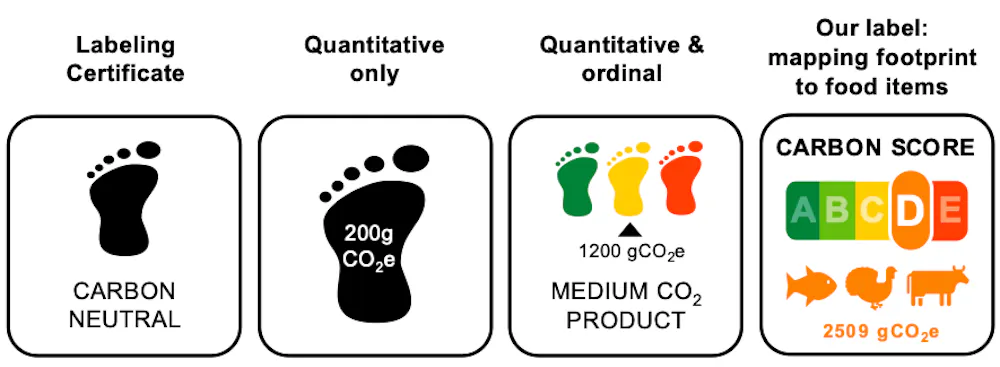
    Most carbon labels follow a similar approach. They typically display a number representing greenhouse gas emissions, and a traffic-light system indicating the level of environmental impact from green (low) to red (high). But such labels do not indicate whether the food is animal- or plant-based. So a high carbon score does not help people identify the source of the emissions.

    Our label maps the carbon footprint to the source of the food, whether plant or animal, along with information about the greenhouse gas emissions.
    Romain Cadario, Yi Li, Anne-Kathrin Klesse, (2025) Appetite., CC BY

    We designed a new type of label. It clearly displays whether the food is sourced mainly from animals or plants, along with the standard emissions score and traffic-light colour code. This approach is especially useful for the growing segment of pre-prepared and packaged foods such as soups and other ready-to-eat meals, which often contain a mix of meat and plant-based food.

    Our label creates a mental link between a food source and its carbon impact. When a consumer sees high carbon scores and red traffic lights appearing more frequently on meat and other animal products, they begin to make the connection between those products and higher emissions. This is key to addressing a lack of knowledge around food carbon emissions.

    We tested our label against the existing labels in a series of experiments with 1,817 everyday consumers from Australia, the United States and the Netherlands.

    One experiment involved soup. Compared with the group exposed to the standard carbon label, the group exposed to our label learned to associate animal-based soups with higher greenhouse gas emissions more effectively. They were more accurate at estimating the greenhouse gas emissions of a second batch of soups without labels.

    This improved knowledge also translates to more climate-friendly food choices. In another experiment with Australian consumers, we encouraged participants to choose five meals from ten options. Five were animal-based and five were plant-based.

    Half the participants saw the meal options with our carbon labels, and the other half did not see the carbon labels. The group exposed to our carbon labels chose fewer animal-based options in their weekly meal plan. In this case, we don’t know whether a third group exposed to the standard label would also make more climate-friendly choices, but our earlier experiments suggested our label was more effective.

    In the final experiment conducted in the Netherlands, displaying our carbon label made university students more likely to choose the plant-based snack option rather than the animal-based option.

    Providing information about the source of the food, whether plant or animal, influenced choices of meal plans.
    Romain Cadario, Yi Li, Anne-Kathrin Klesse, (2025) Appetite., CC BY

    When knowledge isn’t enough

    While people who care most about sustainable eating may think they know better than others, we found that is not the case. These people were not better able than other participants to tell the difference in greenhouse gas emissions between animal- and plant-based foods without seeing our carbon label.

    But they were better learners. When confronted with the facts about the differences between animal and plant-based foods on our labels, they were more likely to change their choices and switch to plant-based foods.

    What this means for consumers and businesses

    A simple change to food labels could help consumers make more informed environmental choices. For businesses and policymakers, it shows displaying only carbon numbers isn’t enough – the food source is crucial.

    Some forward-thinking restaurants and food companies are already experimenting with adding carbon labels to the menu to encourage diners to choose climate-friendly dishes. Our research suggests this approach could be more effective when combined with the new carbon labels we designed.

    Meat products make a significant contribution to climate change.
    Valmedia, Shutterstock

    Implications for climate action

    As Australia grapples with meeting its climate commitments, helping consumers understand the environmental impact of their food choices will become increasingly important.

    The challenge for businesses, policymakers and researchers isn’t convincing people to care about sustainability – they already do. Almost half of Australian shoppers (46%) say sustainability is important to them and influences their purchases, despite cost-of-living pressures.

    But most sustainable actions in retail involve recyclable packaging, products and materials, and local produce. The carbon emission implications of these actions, sadly, are far less than reducing animal-based food consumption.

    Instead, we need to focus on giving people the tools to make their environmental concerns count. Our carbon labels could be the key to helping consumers turn their sustainable intentions into meaningful climate action.

    Yi Li does not work for, consult, own shares in or receive funding from any company or organisation that would benefit from this article, and has disclosed no relevant affiliations beyond their academic appointment.

    ref. Want a side of CO₂ with that? Better food labels help us choose more climate-friendly foods – https://theconversation.com/want-a-side-of-co-with-that-better-food-labels-help-us-choose-more-climate-friendly-foods-250513

    MIL OSI AnalysisEveningReport.nz

  • MIL-OSI Australia: Botswana

    Source: Australia Safe Travel Advisories

    Heavy rains have caused severe flooding across Botswana. Some borders and roads have been temporarily closed due to the flooding. Take caution, seek local advice, monitor local media and check the Botswana Meteorological Services and Botswana Unified Revenue Service social media pages for up-to-date information on weather conditions and border crossing status prior to travel (see ‘Travel’).

    MIL OSI News

  • MIL-OSI Australia: MEDIA RELEASE: Labor shuns business in new round of FWC appointees

    Source: Australian Mines and Metals Association – AMMA

     Statement by AREEA Chief Executive Officer Steve Knott AM 

    On the eve of the federal election, the Albanese Government has continued to stack the Fair Work Commission with Labor’s union and lawyer mates.

    Today’s announcement of four new members means the Albanese Government since taking office has appointed 21 members to the national workplace tribunal who have backgrounds in trade unions or with Labor-aligned law firms.

    The Commission now comprises 31* Labor appointees and 26 Coalition-appointed members.

    All this does is encourage a future Coalition government to perpetuate Labor’s unacceptably partisan nature of appointments in an effort to rebalance the tribunal.

    The Government’s sweeping legislative changes have elevated the FWC’s involvement in setting employment terms and conditions.

    Businesses are being significantly impacted by new intractable bargaining laws – or arbitration under a fancy label – multi-employer bargaining, same job same pay orders and more.

    At a time when the FWC is increasingly required to make decisions on major commercial and contractual matters, the growth of union-linked appointees and the dearth of tribunal members with business experience is alarming.

    You would think that raising the stocks of members with a proven background and record in business practice and analysis would be a good idea.

    By sidelining these candidates, the Albanese Government’s politicisation of the nation’s IR tribunal with union- and Labor-linked members is another kick in the teeth for business confidence and productivity.

    It comes despite only 7.9 per cent of private sector employees who are union members.

    The broader public trust and confidence in courts, tribunals and other institutions is undermined when appointments are so blatantly political in nature.

    *Figure amended

    MIL OSI News

  • MIL-OSI New Zealand: The Most Important Fact Schools Don’t Teach

    Source: ACT Party

    The Haps

    The Chinese navy has made a big mistake. Sending what Defence Minister Judith Collins called a ‘formidable ship’ so close to Sydney, and interrupting Air New Zealand domestic flights, shows the New Zealand public we need to spend more on defence. ACT supporters have been alone in voting for two per cent of GDP on defence, we predict there will now be more.

    We remember the Ukrainians who’ve lost their lives and their homes in the three years since the Russian invasion. Free Press remains resolute. There are basic facts that cannot be changed. Russia is the aggressor. The war is not just or legal. The breach of borders by force is dangerous to free people everywhere. We must never accept might is right, but we must build our strength so the world doesn’t end up that way.

    The Most Important Fact Schools Don’t Teach

    Schools are teaching children all sorts of things, but so far as we are aware they are not teaching the most important fact of human life. The fact they’re not teaching this fact tells us how mindless education has become, and it limits children’s thinking.

    The fact we’re talking about is the astonishing growth of human life expectancy in the last two centuries. For 100,000 years, people lived to thirty on average. Now, the global average is 72 years.

    People have different ideas about what a good life is. But (except for a few terrorists and cults), everyone agrees being alive is better than being dead. Something in the last 200 years gave us a whole extra life.

    If the education system teaches children nothing else, it should teach that something happened in the last 200 years and it doubled life expectancy. Once they know that, they can learn what works.

    We think the answer might be the problem. The education bureaucracy, academics, and teacher unions don’t want to teach that capitalism is a raging success.

    They’d have to teach about the genesis of the free market in the swamps of the Netherlands. People driven to the lowlands by violence decided to make something of themselves. They drained swamps and built dykes, creating usable land that was theirs.

    The result was a society where ordinary people could make a difference in their own lives. They demanded property rights because they’d literally created their own property. If you couldn’t take then you had to trade, and tribalism gave way to the market. It was around this time Abel Tasman discovered New Zealand for Europe.

    William of Orange, a Dutchman who became King of England, helped take the revolution across the sea, where it germinated on an island buffered from invasion. The common law and the market, along with the enlightenment made the industrial revolution possible.

    In turn the British Navy opened up the world’s sea lanes to trade, and spread their system of democracy and capitalism to the new world, ensuring it would endure for centuries even when they themselves came under attack from fascism.

    All the while ordinary people could get enough calories to be healthy, live in cities with sanitation free of disease, and medical care would stop children and their mothers dying in childbirth or shortly after. Violence that was normal for most humans most of the time, and shortened many lives, is now an exceptional event for most people most of the time.

    The revolution spread further after the Cold War, lifting billions from poverty in the East the same way they had thrived in the west. That same prosperity has raised their life expectancy too. Now the whole world lives twice as long on average as it did before the industrial revolution, but your teacher won’t dwell on that basic fact in most of the world’s schools.

    Instead we have an epidemic of anxiety and depression amongst young people. The tremendous gains of the last two centuries are barely understood. Instead the gains are banked and forgotten while children worry about comparatively small problems.

    We spend a lot of time worrying about differences between people living today when, in reality, everyone is doing vastly better than everyone was even a few generations ago. So much division, so little reality, and not enough hope.

    Imagine if the most important thing children learned was that we’ve doubled our lives in 200 years after 100,000 years of misery. That could be springboard for asking what works and building a much more hopeful future. We just need the Left to make peace with capitalism.

    MIL OSI New Zealand News

  • MIL-OSI Australia: NSW records first death of person with Japanese encephalitis since 2022

    Source: New South Wales Health – State Government

    NSW Health continues to urge the public to be vigilant and take precautions against mosquitoes as NSW records its first death of a person with Japanese encephalitis (JE) since May 2022.
    A man aged in his 70s from northern Sydney died on 23 February in a Sydney hospital, where he had been receiving care for JE since early February.
    It is likely the man acquired JE while holidaying in the Murrumbidgee region in January. This is the state’s third confirmed death from JE since the virus was first detected in NSW in 2022.
    NSW Health expresses its sincere condolences to his loved ones.
    Further, an additional case of JE has been identified in a woman in her 60s in northern NSW. She likely acquired the infection on her rural property in Tenterfield Shire and is receiving care in hospital.
    NSW Health’s Executive Director of Health Protection Dr Jeremy McAnulty said these developments are a reminder of the importance for people to take precautions against mosquitoes, including vaccination.
    “These two cases of JE virus, one of which was infected while travelling for a holiday, shows it is very important all people take precautions against mosquitoes, not just those living in affected regions,” Dr McAnulty said.
    “If you plan on travelling west of the Great Dividing Range, whether for work or holiday, and you plan to spend time outdoors, JE is a risk you must consider.
    “Thankfully, there are simple steps you can take to avoid mosquitoes, and there is also a safe and effective vaccine available.”
    JE vaccine is available through local general practitioners, Aboriginal health services and pharmacists to anyone who lives or routinely works in various inland LGAs or high-risk occupations.
    People who meet the eligibility criteria should make an appointment and let the provider know it is for the JE vaccine, as they may require a few days’ notice to order the vaccine.
    JE virus is spread by mosquitoes and can infect animals and humans. The virus cannot be transmitted between humans and it cannot be caught by eating pork or other pig products.
    There is no specific treatment for JE which, in some cases, can cause severe neurological illness with headache, convulsions, reduced consciousness and death.
    The best thing people throughout the state can do to protect themselves and their families is to take steps to avoid mosquitoes.
    Simple actions you can take include:

    Applying repellent to exposed skin. Use repellents that contain DEET, picaridin, or oil of lemon eucalyptus. Check the label for reapplication times
    Re-applying repellent regularly, particularly after swimming. Be sure to apply sunscreen first and then apply repellent
    Wearing light, loose-fitting long-sleeve shirts, long pants and covered footwear. and socks
    Avoiding going outdoors during peak mosquito times, especially dawn and dusk
    Using insecticide sprays, vapour dispensing units and mosquito coils to repel mosquitoes (mosquito coils should only be used outdoors in well-ventilated areas)
    Covering windows and doors with insect screens and checking there are no gaps
    Removing items that may collect water such as old tyres and empty pots from around your home to reduce the places where mosquitoes can breed
    Using repellents that are safe for children. Most skin repellents are safe for use on children aged three months and older. Always check the label for instructions
    Protecting infants aged less than three months by using an infant carrier draped with mosquito netting, secured along the edges
    While camping, use a tent that has fly screens to prevent mosquitoes entering or sleep under a mosquito net.

    Information on eligibility for a free JE vaccine is available on Japanese encephalitis vaccination.
    For further information on JE virus and ways to protect yourself visit Mosquito borne diseases.

    MIL OSI News

  • MIL-OSI Australia: Operation Eclipse raids in the south-east

    Source: South Australia Police

    Police have seized almost $800,000 worth of illegal tobacco and $66,000 in cash in raids on 10 premises in the South-East of the state.

    Serious and Organised Crime Branch, Limestone Coast police and members from Consumer and Business Affairs searched premises at Mount Gambier, Naracoorte and Millicent on 19 and 20 February as part of Operation Eclipse investigations.

    The locations searched included tobacconists, candy and gift shops, a commercial storage facility and residential premises.

    In one search at a Mount Gambier gift shop $245,000 of illicit tobacco was located. Further investigations resulted in the seizure of $540,000 worth of tobacco products at a commercial storage premises in Mount Gambier.

    The searches resulted in the arrest of a man, 23, of Salisbury North for failing to provide his name and address.

    Operation Eclipse commander Detective Chief Inspector Brett Featherby said the regional seizures had significantly disrupted the activities of the syndicates.

    “If organised crime syndicates think they can operate in regional areas and not come to the attention of police they are wrong,’’ he said.

    “The seizures in the South-East have enhanced our knowledge of the operating model of the syndicates and are the subject of further investigations.

    “SAPOL will continue to have a whole of organisation response that targets the syndicates to disrupt their financial operations and criminal activity.

    “We will pursue criminal charges when sufficient evidence exists and that includes those who are supporting and enabling that activity.’’

    Operation Eclipse detectives have also searched another four premises in the metropolitan area since 18 February. Illicit tobacco worth $140,000 was seized in those searches.

    Detective Chief Inspector Featherby also appealed for public information into an arson attack at a tobacconist on Glynburn Road at Hectorville on Friday 21 February.

    In the incident three suspects arrived in a late model white sedan and attempted to set fire to the front of the premises. A witness extinguished the fire.

    “We would like to hear from anyone who knows of any person who may have burn injuries or who may have presented at a medical facility with burns since last Friday,’’ Detective Chief Inspector Featherby said.

    “We are also appealing for dash cam footage from vehicles in the Hectorville area between 4.30am and 5.30am on 21 February or anyone who observed people in a white late model sedan filling a fuel container at a petrol station.”

    Operation Eclipse has so far resulted in 29 arrests for offences including blackmail, arson, money laundering and serious criminal trespass.

    There have been 122 premises searched – 36 residential and 86 businesses – almost $1.25 million in cash, three firearms and almost $10.1 million in tobacco seized. Nine vehicles have also been seized for confiscation.

    Significantly, there have been 230 calls to Crime Stoppers since October 2 that have resulted in information being provided to police.

    Anyone with any information on criminal activities surrounding the sale of illicit tobacco is urged to call Crime Stoppers on 1800 333 000 or visit www.crimestopperssa.com.au – You can remain anonymous.

    MIL OSI News

  • MIL-OSI China: ‘Ne Zha 2’ debut in HK, Macao wins hearts

    Source: China State Council Information Office 3

    People pose for photos in front of the poster of the Chinese animated feature “Ne Zha 2” at a cinema in Hong Kong, Feb. 18, 2025. [Photo/Xinhua]

    Chinese animated blockbuster “Ne Zha 2” grossed more than $845,900 upon its debut in the Hong Kong and Macao special administrative regions on Saturday, achieving the highest first-day box office revenue for an animated film in the SARs.

    Over 92,000 people in the two cities showed up on Saturday to watch the movie, which has raked in over 13.7 billion yuan ($1.89 billion) around the world and ranked eighth in terms of global box office revenue. This prompted distributors in the SARs to increase the number of screenings on day one from 500 to more than 800 in 2D and IMAX formats, also a record in the history of Hong Kong’s and Macao’s film industries.

    In Hong Kong and Macao, the film has traditional Chinese and English subtitles. Cinemas operated by the film’s four local distributors — Mandarin Motion Pictures, Intercontinental Film Distributors, Sil-Metropole Organisation and Emperor Motion Pictures — have arranged around 400 screenings for Monday, with tickets of some screenings sold out.

    On Sunday, China Retold, a local key opinion leader alliance dedicated to promoting the latest developments on the Chinese mainland and Hong Kong on social media platforms, organized a free screening of “Ne Zha 2”. Those attending the screening formed a long line outside a cinema in Causeway Bay early in the morning, and during the screening, audience members frequently erupted in laughter during humorous scenes and exclamations of awe at the spectacular special effects.

    After the screening, Sebastian Lee, a student from the United Kingdom studying at Chinese University of Hong Kong, said he had heard about the movie’s box office success, which piqued his curiosity, so he decided to attend the special screening.

    Although he wasn’t previously familiar with the background of Chinese mythology, the film explained these cultural elements in a simple and understandable way, making it easy for non-Chinese audiences to follow, Lee said.

    He also praised the film’s special effects, particularly those in the final battle scene, saying that the unprecedented level of detail and complexity of the animation provided an excellent viewing experience.

    Laurent Daury, a French lawyer who works in Hong Kong, said that although it was his first time to watch a Chinese animated film, the movie exceeded his expectations and gave him a strong sense of Chinese culture.

    He said the film reaffirmed his understanding of traditional Chinese culture, particularly the importance of respect, including respect for work, family and skills.

    Cultural values

    Daury said that the film, compared with Western-made animated films, conveys more traditional cultural values, which he admired. He added that he would definitely recommend the film to those around him and planned to watch it again with his wife and friends.

    Karolina Gruschka, a kindergarten teacher in Hong Kong, said the film’s elements of ancient Chinese mythology help viewers, especially children, better understand traditional Chinese culture.

    She said she was touched by the friendship between the two main characters, Ne Zha and Ao Bing. Despite coming from entirely different backgrounds, their connection endured all challenges, showing that true friendship can overcome any obstacle, regardless of one’s origins, she added.

    Gruschka also said that a unique aspect of the film is its core concept of the struggle between good and evil, conveying an uplifting belief that people can change their destiny through their choices.

    “Ne Zha 2” reimagines the tale of Ne Zha, a rebellious deity from Chinese mythology, intertwining ancient folklore with modern themes of defiance and self-determination.

    The film was released on the mainland on Jan. 29, the first day of the Year of the Snake, and soon became the highest-grossing film in China.

    The film has been released overseas in markets such as the United States, Australia and New Zealand, and will debut in Singapore and Malaysia in March.

    MIL OSI China News

  • MIL-OSI Australia: Transcript – Radio 2SM Sydney – Breakfast with Ron Wilson

    Source: Australia Government Ministerial Statements

    RON WILSON [HOST]: Truck drivers in western Sydney are set to benefit from the city’s first dedicated heavy vehicle rest stop. It’s considered a crucial infrastructure project aimed at improving safety and reducing fatigue for long haul truckies. It’s located at Eastern Creek and the site is strategically placed near key motorway junctions. It comes with a $40 million investment price tag from both the Albanese and Minns Labor governments. The project was part of an election promise by the New South Wales Labor government, and marks a significant step in enhancing road safety and ensuring truck drivers have the facilities they need to rest and recharge during their long journeys.

    Catherine King is the Minister for Infrastructure, Transport and Regional Development and Local Government in Australia as well. She’s on the line right now. Catherine, good morning.

    CATHERINE KING [MINISTER]: Hi, Ron. It’s great to be with you.

    RON WILSON: Tell us about this truck stop. How important is it in the overall scheme of transport?

    CATHERINE KING: Well, it’s incredibly important. We know just how much- how busy that freight route is between Melbourne right the way through to Brisbane. Truck drivers are required under our law to actually have rest and rest stops. We can’t have fatigued drivers on the road. But in that area, particularly where there is such a high volume of freight going through, there just really isn’t anywhere for truck drivers to safely rest. And this will be the first dedicated area specifically for trucks ever in western Sydney and at Eastern Creek. We often hear, you know, truck drivers are parking on suburban roads. They’re parking on the side of the road, trying to make sure that they comply with their rest hours. And that is not safe for anybody. It’s certainly not safe for them.

    The other thing we know is that we’re seeing increasing numbers of female drivers. They want, as should anyone in their workplace, access to decent toilet facilities, decent shower facilities, safe places to be able to rest and shaded places to be able to rest as well. So this is a really important project. 40 million from the Albanese government, 40 million from the Minns government. They took it to the last state election. We’re saying we’re going to back this in. This is budgeted funding. This is not an election commitment. This is something we want to fund, really as part of the infrastructure program.

    It’s been identified by truck drivers as the area- really a missing spot. So this is a really important announcement both for truck drivers but also for road safety. We want drivers who are on our roads that have had- you know, have got decent workplaces that are well rested and have places where they can rest and actually shower and recover from what is a really gruelling and difficult job.

    RON WILSON: Boy, a total of over $80 million. It must be some truck stop.

    CATHERINE KING: Well, it takes a lot to, you know, build roads to actually get the hard surfacing, but also to get the services out there. You obviously need electricity, you need water, you need sewerage out there as well. Unfortunately, it just does take that amount of money to be able to do that and to build those proper dedicated facilities. Unfortunately, infrastructure is expensive.

    RON WILSON: Well, that’s one truck stop. It’s an awful big country. Have you got more of these planned?

    CATHERINE KING: Yeah. Well, what we’ve done, I’ve had a $180 million fund. And Senator Glenn Sterle, who might be known to all of you, he’s still driving trucks himself. Every now and again, he gets behind the wheel. He’s from over in the west. I asked him to chair- basically to bring trucking companies together and truck drivers together to identify sites to fund that. And we’ve put the first tranche out of that. There’s smaller stops, often in the regional areas, because we wanted truck drivers to identify, well, where are you stopping? Where are the facilities that are needed? How can we actually fund these? So that’s been part of the government- we took that to the last election, and that’s been steadily rolling its way out, as well as as we build big scale infrastructure. So you’d be aware, you know, there’s big projects up in the Hunter. We look at opportunities there to partner with state and local government to also build those facilities in at the same time. But there’s no doubt that we could have more. And we need to continue to look at opportunities to do that, which is why we’ve got the funding program to try and roll them out. But this will be a single biggest one, and it’s a really big missing area. Like there just isn’t anywhere in that area really. And often you’ll see truck drivers just trying to plough- keep going. But they’ve got to, you know, make sure that they’ve stopped within the hours that [indistinct] drive a certain number of hours.

    RON WILSON: [Talks over] Yeah, that’s right.

    CATHERINE KING: So it’s really difficult for them to then, you know, get that push through to get to the next stop where they can. And there’s really just nothing in that area for them to stop at.

    RON WILSON: Yeah. Minister, this is such good news for all road users, not just the trucking industry. So very pleased that you’re able to come on and have a chat to us about it this morning, I appreciate it.

    CATHERINE KING: Really good to be with you.

    RON WILSON: The Minister for Infrastructure, Transport, Regional Development and Local Government in Australia, Catherine King, talking about this new truck stop. It’s located at Eastern Creek. It comes at a cost of over $80 million.

    MIL OSI News

  • MIL-OSI NGOs: ‘Drill Baby, Drill’: Report shows Woodside hell-bent on profit while people and nature pay the price

    Source: Greenpeace Statement –

    SYDNEY/PERTH, Tuesday 25 February 2025 — Greenpeace Australia Pacific has condemned gas corporation Woodside’s annual earnings announcement today, saying its billion dollar profits come at the expense of Australian communities and nature on the frontlines of extreme weather disasters.

    The fossil fuel multinational reported AUD$3.57 billion in net profits after tax for 2024, a 115% year-on-year increase, as output rose to a record high.

    Joe Rafalowicz, Head of Climate and Energy at Greenpeace Australia Pacific, said: “With so many Australians struggling to pay for groceries or rent as the cost of living crisis rages on, it’s not right that fossil fuel corporations are raking in billions from destroying our planet. 

    “Communities across Australia are reeling from the extreme weather disasters unfolding every summer, which the Insurance Council estimates will cost $35.2 billion a year by 2050. It is immoral for fossil fuel corporations like Woodside to toast their profits today, while people on the frontlines are left to pick up the tab when floods or bushfires destroy their homes. 

    “As Ningaloo Reef suffers another mass coral bleaching, Woodside is hell-bent to ‘Drill Baby, Drill’ for even more polluting gas at neighbouring Scott Reef. We must not allow the nature we love to become another victim of the fossil fuel industry’s endless pursuit of profit.

    “The era of rampant corporate greed must end — it’s time for fossil fuel polluters to pay for the climate destruction they are unleashing on communities in Australia, the Pacific and around the world. We must hold polluters like Woodside accountable for their propaganda and for knowingly holding back climate action in this country.

    “Let’s invest in the proven climate solutions we have right now — renewable wind and solar energy backed by storage. Greenpeace will continue to advocate for clean, safe, affordable renewable energy that will reduce global emissions and ensure a livable planet for all.”

    Policies to make polluters pay are gaining momentum around the world, with governments including New York and Vermont introducing legislation forcing fossil fuel companies to pay for the climate destruction caused by their emissions. 

    -ENDS-

    For more information or interviews contact Kate O’Callaghan on 0406 231 892 or [email protected]

    MIL OSI NGO

  • MIL-OSI Australia: How pumped hydro can provide the stability Australia’s energy transition needs

    Source: Allens Insights

    A reliable, durable and large-scale storage solution 10 min read

    Australia’s favourable natural geographical landscape and abundance of retiring mine sites provide a unique opportunity for pumped hydro energy storage (PHES) to play a key role in driving the energy transition in this country. By delivering consistent, long-duration, dispatchable capacity during peak demand, PHES can help stabilise the system when other technologies may struggle.

    The past two years have seen a surge in the uptake of battery energy storage systems (BESS). However, firming assets such as BESS and intermittent generators such as wind and solar are constrained by weather conditions, redundancy and, in the case of BESS, capacity and duration limits. These constraints highlight the need for a more reliable, durable, large-scale storage solution to complement the other technologies.

    In the first part of our pumped hydro Insight series, we explore the drivers behind the growing uptake of PHES in Australia, and highlight key considerations for developers, investors, financiers, contractors and other stakeholders assessing such projects.

    Key takeaways

    • There is growing interest in PHES as a long-term, firm, long-duration dispatchable asset that is unconstrained by weather, technology, asset life or capacity limitations.
    • Approximately 20 PHES projects are actively being developed in Australia, with over 22,000 sites identified as suitable for a PHES.
    • PHES projects are capital intensive and inherently complex in their planning, procurement, delivery and commercialisation. These factors necessitate careful planning, robust risk mitigation strategies and proactive engagement with stakeholders to ensure the success of PHES over the long term.

    What’s driving the uptake of PHES in Australia?

    There is no doubt that interest in PHES as an energy generation and storage solution is growing. There are a number of key drivers behind this.

    While BESS are an important part of the storage solution, they have limitations. Most BESS projects range between 200MW and 500MW, with larger projects, such as Melbourne Renewable Energy Hub’s 1,200MW battery, still only half the size of Snowy Hydro 2.0’s 2,200MW project. BESS typically provide around four hours of dispatchable energy before needing to recharge, while PHES can deliver up to 175 hours.

    BESS also have a shorter asset life of around 20 years, with a steady degradation profile down to 60–70% of the nameplate capacity over time, whereas PHES projects are designed to last over 50 years. While BESS technology is still maturing on a utility scale, PHES has a long-established track record and doesn’t face the same fire risk, making it a more sustainable option for long-term energy storage.

    In 2017, the Australian Renewable Energy Agency and the Australian National University identified 22,000 potential ‘bluefield’ PHES sites across Australia, with an estimated energy storage capacity of 67,000GWh. Many of these sites are in areas with natural elevation differences that facilitate the construction of connected upper and lower reservoirs with minimal excavation. The proximity of these sites to natural water sources, such as rivers and dams, would allow these projects to leverage existing water systems to create the necessary reservoirs.

    PHES can also take a ‘closed-loop’ form, where water is transported to a site away from existing river systems and cycled between the two reservoirs. This type of system can be located where topographical features support it, allowing for new PHES facilities to be co-located with solar and wind generation projects in renewable energy zones, boosting grid reliability in those areas.

    The planned and accelerated closure of mine sites presents a unique opportunity for owners to repurpose aging mines into PHES projects. Sites such as Kidston, Mt Rawdon and Muswellbrook show how former mine sites can be transformed into PHES facilities, capitalising on rehabilitation obligations and the potential for long-term, revenue-generating assets.

    Australia has over 60,000 abandoned mine sites, posing challenges for owners who must manage costly rehabilitation efforts on non-revenue-generating assets. With around 75% of mine closures being unplanned or premature, there is an opportunity to repurpose these sites into valuable operational assets. Many of these sites have existing excavated pits that can be used as reservoirs for closed-loop PHES, reducing excavation risk costs and supporting mining companies’ rehabilitation goals through sustainable energy projects.

    The Federal Government and most state governments are supporting private sector-led PHES projects through grants, concessional debt, revenue underwrites and streamlined approvals processes.

    In NSW, EnergyCo’s Pumped Hydro Recoverable Grants Program, which is part of the Electricity Infrastructure Roadmap, helps developers with the cost of early-stage feasibility studies. Additionally, developers can tender for Long-Term Energy Service Agreements (LTESA) in NSW and the Capacity Investment Scheme (CIS) across Australia. The NSW Energy Security Corporation (which received $1 billion in funding and will act as the state equivalent of the Clean Energy Finance Corporation) has been mandated to investigate co-investment opportunities with the private sector on energy storage projects, including PHES.

    Although no LTESA or CIS have been awarded to a PHES project yet, the NSW Government has shown strong long-term support for long-duration storage with an updated position to the Electricity Infrastructure Investment Act 2020 (NSW). By retaining the minimum dispatch duration definition at eight hours and broadening the long-duration storage LTESA assessment criteria, PHES projects are positioned to benefit from future government support. Similarly, under the proposed South Australian Firm Energy Reliability Mechanism, PHES projects offering dispatchable energy for at least eight hours will be able to bid for contracts to underwrite a portion of their revenue, complementing other state and federal policies.

    After the infrastructure boom of the past decade, the pace of the transport infrastructure sector has slowed, while demand for energy infrastructure has risen. Civil contractors with experience in metro, rail and road projects are now focusing on energy projects to capitalise on the available work.

    The civil infrastructure required for PHES, such as deep excavation, tunnelling and the construction of underground caverns and access routes, is similar to that required for transport infrastructure. Contractors with heavy engineering, excavation and tunnelling experience, and an available workforce, are well positioned to apply their skills to PHES projects.

    What challenges are emerging?

    Despite strong drivers and the promising potential of PHES, the uptake and reaching contract close of PHES transactions has lagged behind short to medium duration BESS, wind and solar projects.

    PHES projects are inherently complex and capital intensive, with several key challenges emerging.

    PHES projects typically require large areas of land, which can lead to complex environmental impacts, particularly biodiversity, water resources and, potentially, cultural heritage, and significant challenges with site access and spoil management. As a result, they require more detailed environmental impact assessments and complex approvals processes compared with BESS projects. In addition to state planning approval and environmental licences, PHES projects often require approval under the Environment Protection and Biodiversity Conservation Act 1999 (Cth), as well as being subject to any remediation obligations under any relevant mining tenements and approvals if located on a mine site.

    Securing land tenure is another significant challenge, especially when land is required within national parks, is over land held by Aboriginal land councils or land where native title is still active.

    Water entitlements and licences, crucial for establishing reservoirs, are also a key consideration, particularly for closed-loop projects. While some states, such as NSW, have introduced a special category of water licences for initial fills, these licences may come with restrictions that limit pumping from nearby water sources to periods of high flow, presenting programming challenges. In addition to securing the necessary approvals and resources, early engagement with traditional owners, landowners and local communities is essential for obtaining a social licence to operate.

    We have seen a continuing shift in risk transfer across energy and infrastructure. For PHES, in particular, this has been driven by a limited pool of experienced civil contractors with PHES experience in Australia, a lack of competition among original equipment manufacturer suppliers, and supply chain impacts and increasing demand for energy projects. A consequence of this shift has been the growing use of disaggregated contract packages, including in PHES procurement.

    By splitting contracts, developers can distribute risk among multiple parties and limit exposure to contractor insolvency, with each contractor focusing on their specialist area. Ideally, this improves quality and efficiency, at a more competitive price. However, this approach can create challenges, particularly for developers and financiers, introducing interface gap risks between the contractors, and resulting in smaller sizing for caps and security packages.

    Transport infrastructure procurement has traditionally been driven by state governments, creating a concentrated and aligned purchasing power that drove well-understood risk profiles. The energy infrastructure market is comparatively more diffused, involving a mix of government and private developers, contractors of all tiers and international entrants. This has meant that ‘market standard’ positions are fluid and highly bespoke contracts are being developed.

    An added complexity is that PHES procurement to date has been led by government-developers who are able to use collaborative commercial models with unfixed, variable cost elements. This is more difficult for private developers with limited funding sources who are required to demonstrate bankability to financiers. A balance will need to be struck between developers’ and financiers’ desire for firm pricing and transferred risk, with the contracting market’s calls for flexible, uncapped, commercial models.

    The contractor-led market has brought with it a rise in collaborative contracting in the infrastructure sector and the market is evolving. As an example, NSW and Victoria have adopted incentivised target cost models in infrastructure procurement projects, and Snowy 2.0 shifted from a traditional engineering, procurement and construction model to an incentivised target cost model. While the rise in collaborative contracting has not involved a full-scale move from wrapped lump sum to alliance models, there is an increased focus on fair risk allocation, considering each party’s ability to manage risks.

    In the PHES space, risk associated with input material costs, labour costs and underground work have been the particular focus of collaborative risk-sharing arrangements.

    • Input material and labour costs: PHES projects rely on significant quantities of materials such as concrete and steel, but supply chain issues and material cost escalation could increase project prices and timeframes. Additionally, the scale and construction duration of PHES projects requires substantial labour compared with other assets, with the remoteness of some projects potentially necessitating relocation packages and project-specific camps to attract skilled workers. Enterprise bargaining agreements can mitigate these challenges. However, the long construction period on PHES projects means that enterprise bargaining agreements are more likely to be renegotiated during delivery, reopening labour costs and creating the risk of industrial disputes. Given market changes, sensible and targeted risk-sharing mechanisms should be considered upfront to optimise value for money.
    • Underground work: PHES projects are complex and involve extensive subterranean work. While owners and developers can undertake geotechnical investigations prior to construction commencing, those have limitations, so a geotechnical risk-sharing mechanism is often needed. Geotechnical Baseline Reports are commonly used to set the agreed baseline conditions for tunnels and reservoirs, which serve as the test for any time or cost adjustments.

    Site selection is crucial for PHES projects, as suitable locations are often farther from existing grid infrastructure, leading to higher and more variable grid connection costs compared with BESS projects. Developers must ensure clarity on connection fees payable by a developer to the relevant network service provider and carefully consider the terms of connection agreements.

    Additionally, developers should be aware of the generator performance standards and how they align with other regulatory approvals for the project.

    A key challenge for developers is monetising storage projects and accessing debt capital markets. In the second part of our pumped hydro Insight series, we will explore the challenges, considerations and opportunities that developers, financiers and stakeholders face in monetising and creating stable revenue streams for PHES projects. Stay tuned.

    Actions that you can take now

    If you are considering entering the PHES space, as either a developer, investor, contractor, or financier, it is important to consider the following:

    • Strategic site selection: Rehabilitating existing assets, such as former mines or cleared agricultural sites with low biodiversity and cultural heritage value, and easy access water supply, may reduce planning delays, simplify environmental approval, and, for mine sites, limit the need for extensive excavation.
    • Early engagement: Engage early with all relevant parties, including local government, the community, traditional owners, landholders, consent authorities, regulators, contractors, geotechnical experts, financiers and government programs. The work done early in the project, and through concept and procurement processes, is crucial to the success of your PHES project.
    • Monitor the market: As more PHES projects emerge, market trends in commercial models, risk profiles and offtake strategies will evolve.
    • Adapting to changing regulations and government policies: We expect the regulatory landscape and government policies will evolve to better support PHES projects. Staying updated on these changes will be key to your project’s success.

    Keep an eye out for future Insights in the pumped hydro series, where we will expand further on the offtake and financing strategies that will underpin the bankability and revenue generation of PHES projects.

    MIL OSI News

  • MIL-OSI Australia: Embedding the right to paid family and domestic violence leave in our workplaces

    Source: Ministers for Social Services

    The Albanese Labor Government is reaffirming its commitment to end violence against women and children in one generation, today releasing the response to the independent review of the paid family and domestic violence leave.

    The independent review, conducted by Flinders University, found the leave was “life changing” for those who accessed it and that there was broad stakeholder support from both employers and unions.

    It found paid family and domestic violence leave is working as intended, supporting the financial security of those escaping or experiencing violence.

    The Government accepts all five recommendations from the review. Work is now underway to address the recommendations, including through:

    • Continued focus on raising awareness to integrate the leave as an ordinary workplace practice across Australian workplaces;
    • Tailored guidance for priority cohorts, such as First Nations, culturally and linguistically diverse and casual employees;
    • Training programs for first responders, health, allied health and community frontline workers who commonly interact with victim-survivors on the entitlement;
    • Additional strategies to improve awareness and access to the entitlement, opportunities to better understand usage of the leave, and further evaluation of the leave through the upcoming statutory review of Closing Loopholes reforms.

    The review also made 12 findings, the most notable, was there should be a focus on increasing awareness and understanding of the leave entitlement through communities and workplaces.

    It also found that ongoing stigma around family and domestic violence was a barrier to workers accessing the leave.

    Resources will be updated and repromoted to incorporate feedback from the review.

    The Government response highlights the important role that workplaces can play in addressing family and domestic violence. There is considerable goodwill from employees and employers alike to make sure anyone who needs the leave can access it, and the workplace is equipped to play its part in supporting people experiencing family and domestic violence.

    The Albanese Government will continue to engage with unions, employer groups, and state and territory governments on strategies to improve awareness and access to the leave.

    Paid family and domestic violence leave is just one of many actions the Albanese Government has taken to improve economic security for women and end gender-based violence.

    You can find the Government response and the review’s findings on the Department of Employment and Workplace Relations website.

    For more information on paid family and domestic violence leave, see the Fair Work Ombudsman’s guidance material and the one-stop shop hub for small business: www.10DayspaidFDVLeave.com

    Quotes attributable to Minister for Women Katy Gallagher:

    “Since coming to government, we have been deeply committed to ending gender-based violence – we were proud to introduce paid domestic and family violence leave as some of our first legislation, and the independent review has demonstrated its life changing impact.

    “The Opposition refused to implement this important change during their years in government, but the Albanese Government listened to the sector, unions and victim-survivors, and we can see the results – more women accessing important and life changing support.”

    Quotes attributable to Minister for Social Services Amanda Rishworth:

    “Paid family and domestic violence leave from work will save lives. This entitlement will allow victim-survivors to take time off to keep themselves and their family safe, without losing their income or their jobs.  

    “Everyone has a role to play to end violence against women and children. It’s vital to that first responders and frontline workers have the right training and education about paid family and domestic leave, so that they can best support victim-survivors of family and domestic violence.”

    Quotes attributable to Minister for Employment and Workplace Relations Murray Watt:    

    “No worker should have to choose between their safety and their pay. We’ve made sure all 12.4 million Australian employees, including casuals, can access 10 days’ paid leave each year when impacted by family and domestic violence.

    “This leave has been life changing for Australians so far, and the Albanese Labor Government is committed to raising awareness, understanding and uptake, so that anyone who would benefit from this leave can access it.

    “But it’s under threat from Peter Dutton and the Coalition – Shadow Minister for Employment and Workplace Relations, Michaelia Cash claimed paid family and domestic violence leave is a “perverse disincentive” to employers hiring women.

    “Peter Dutton and the Coalition need to tell Australians whether this leave will be part of the “targeted set of repeals” of workplace laws they’ve promised to take to the election.”

    MIL OSI News

  • MIL-OSI Australia: Albanese Labor Government building Australia’s mobile future

    Source: Australian Ministers 1

    The Albanese Labor Government has today announced a major world first reform to provide basic universal outdoor mobile coverage across Australia.

    Labor’s Universal Outdoor Mobile Obligation (UOMO) will require mobile carriers to provide access to mobile voice and SMS almost everywhere across Australia.  

    UOMO will ensure up to 5 million square kilometres of new competitive outdoor mobile coverage across Australia, including over 37,000 kilometres on regional roads.

    Whether it’s in national parks, hiking trails or out on the farm, outdoor coverage will be accessible almost anywhere where Australians can see the sky.

    The Albanese Government’s policy objectives are to: 

    • expand Triple Zero access for Australians across the nation; 
    • expand outdoor voice and SMS coverage into existing mobile black spots; and
    • improve the availability of mobile signals during disasters and power outages.

    This reform is only possible due to the transformative global innovations in Low Earth Orbit Satellites (LEOSats), and the arrival of Direct to Device (D2D) technology, which enables signals from space direct to mobile devices.

    The Government will consult and introduce legislation in 2025 to expand the universal service framework to incorporate mobile coverage for the first time.

    Implementation of outdoor SMS and voice will be expected by late 2027, with many Australians likely to obtain access before then.

    Basic mobile data will be considered in the future as technology roadmaps and capacity considerations develop.

    The Government will work with stakeholders and industry to get the legislation right, including flexibility where warranted by supply, spectrum and other factors.

    The Albanese Government will also engage with industry and examine incentives and removal of barriers to support public interest objectives and competition outcomes.

    Only the Albanese Labor Government has a plan to build Australia’s future, including delivering $3 billion to complete the building of the fibre NBN.

    With global industry expected to launch D2D messaging this year, the Government is moving to ensure this technology becomes an addition to a modernised and expanded voice Universal Service Obligation, including maintaining free access to Triple Zero.

    To ensure consumers are informed about device compatibility and experience, the Government will work with industry and the University of Technology Sydney to expand handset testing.

    The policy has been informed by engagement with the LEOSat working group, advice by the Australian Communications and Media Authority on radiocommunications spectrum, the findings of the Regional Telecommunications Review, and extensive feedback from regional and remote stakeholders and consumers about the need for multiple connectivity paths.

    The Government remains committed and will continue to evolve its existing co-investment programs like the Mobile Black Spot Program and Mobile Network Hardening Program to expand terrestrial mobile coverage, resilience and capacity.

    Further reforms to the longstanding universal services framework will be announced as the Government considers recommendations from the 2024 Regional Telecommunications Review.

    Quotes attributable to the Minister for Communications, the Hon Michelle Rowland MP: 

    “Labor governments have a proven record of expanding universal access to essential services, and the Albanese Government is forging another step forward.

    “The Universal Outdoor Mobile Obligation will improve public safety, increase resilience during natural disasters, and provide an extra layer of coverage in areas previously thought too difficult or costly to reach.

    “The experience will be different to land mobile networks, but the benefits transformative, particularly for a large continent such as ours.

    “Building our mobile future with the latest technology is a vital element of Labor’s plan to make Australia the most connected continent by 2030.”

    MIL OSI News

  • MIL-OSI Australia: Minister Rishworth interview on ABC Far North Breakfast with Charlie McKillop

    Source: Ministers for Social Services

    E&OE TRANSCRIPT

    Topics: Creating a more ‘Accessible Australia’ for people with disability; National Disability Insurance Scheme.

    CHARLIE MCKILLOP, HOST: When the temperatures escalate to the point where they have recently, the joys of living in Far North Queensland, being able to head down to one of our many tropical beaches, dip our toes in the water and cool off, well, that is not the reality for many people living in our community with a disability. But the Government is trying to do something about that. It has a new initiative that’s all about trying to increase accessibility of many places that are meant for our enjoyment and relaxation. But for a large section of the community, they remain off limits. The Minister for Social Services and the National Disability Insurance Scheme, Amanda Rishworth, is with us in Cairns today. Minister, good morning.

    AMANDA RISHWORTH, MINISTER FOR SOCIAL SERVICES: Great to be with you.

    CHARLIE MCKILLOP: How important is the initiative that you’re announcing today for people in our community?

    AMANDA RISHWORTH: The initiative we’re announcing is so important. What we’re announcing is funding to go through state governments, to local councils or other organisations to make the natural environment more accessible. People with disability, whether that be in wheelchairs or have other disability, often can’t access, for example, national parks. They can’t get down to the beach. They may not be able to go to a festival or community event because there isn’t an accessible place to go to the toilet, for example. So, the funding that we’re providing is really looking at how we get more of these spaces more accessible. Just as an example, close to 90 per cent of Australians live within 50 kilometres of a beach. But according to the registered charity Accessible Beaches Australia, only 2 per cent of our 12,000 beaches are actually accessible. So, we really want to open up our natural spaces and ensure that people with disability actually get the opportunity. So, this initiative also will look at, for example, funding all terrain wheelchairs, so people that may need a wheelchair could explore our national parks as well as beach wheelchairs, which means they can actually get in the water.

    CHARLIE MCKILLOP: So, up until now, the burden of responsibility for improving this situation on 2 per cent of our public areas accessible to disability, that has fallen on local government, is that right? How much good will $17 million do to reverse that, to open up such a large area that remains off limits?

    AMANDA RISHWORTH: It’s often actually fallen to philanthropic organisations and local councils that have done this work. But we’re hoping with the Federal Government money, that we will be able to open really about 350 new accessible spaces to allow more accessibility. But of course, we want to partner also with state and territory governments to maximise the ability of this program. So, for some of these spaces, what we will be asking for is potentially matched funding from state and territory governments so that we can get more spaces accessible. But we’re hoping this will contribute to about 350 extra spaces in our natural environment open for people with disability.

    CHARLIE MCKILLOP: You are hearing from Social Services Minister Amanda Rishworth in Cairns today to announce some really important funding that will increase accessibility to some of the most, well, some of the most sought-after experiences. We know that people come from around the world to be able to experience our beaches and our national parks across Far North Queensland. Amanda Rishworth, the bigger issue in your portfolio is of course, the National Disability Insurance Scheme. Leading up to a Federal election, when we have had a review of the scheme and so much controversy about whether or not the money, and there has been a lot of money invested in the scheme is getting through to the people who need it most. What are you hearing as you move around communities, regional communities like Far North Queensland?

    AMANDA RISHWORTH: It is a really, really important question and what I’m hearing is a couple of things. Firstly, we want to make sure we stamp out fraud and that’s why the previous Minister set up a taskforce to specifically make sure that service providers, and there’s a lot of good service providers, but others were taking advantage of participants. But we also need to see equal coverage across Australia. We know that rural and regional places, often there are thin markets, people can’t always access services and also participants don’t always have equality when it comes to their plans. So, making the plans more equitable, more fair, and making sure there’s transparency, along with making sure that there’s services in rural and regional areas, is a real focus of mine.

    CHARLIE MCKILLOP: That’s the aspiration. But Minister, is life with a disability getting any easier, any better?

    AMANDA RISHWORTH: The National Disability Insurance Scheme has changed the lives of people. You speak with people and they get perhaps the equipment or the personal care that they just didn’t get before the National Disability Insurance Scheme. So, yes, I would say that when I speak with people, the National Disability Insurance Scheme has absolutely transformed people’s lives. But we can always do better, we can always make it better. And that’s where we’re going through the process in the next 6 months to introduce a new planning framework to clearly identify the needs of people with disability and how do they get that extra support. And that’s particularly important in rural and regional areas where often there may not be as much choice. But certainly, the National Disability Insurance Scheme has changed people’s lives, but we want to make it the best it can be.

    CHARLIE MCKILLOP: Amanda Rishworth, thanks for your time on Breakfast today.

    AMANDA RISHWORTH: Thank you.

    MIL OSI News

  • MIL-OSI Australia: Search and Rescue – Beacon activation – Jabiru

    Source: Northern Territory Police and Fire Services

    The Northern Territory Police Force Search and Rescue Section successfully located and rescued a hiking group in Jabiru on Sunday morning.

    Around 7:45am, an emergency position-indicating radio-beacon (EPIRB) was activated in the vicinity of Motor Car Falls, approximately 97 kilometres south of Jabiru.

    In response, Jabiru members deployed to the area and Search and Rescue (SRS) deployed a helicopter with two members on board.

    Jabiru members located a vehicle parked in Motor Car Falls that was registered to the same individual registered to the EPIRB that was activated.

    A short time later, members located three males and two females in the vicinity of where the EPIRB was activated.

    One of males who was suffering heatstroke, and a support person were conveyed to Jabiru via helicopter where they were met by St John Ambulance. 

    Two SRS members remained on-site with the three hikers until they were also collected by the helicopter and transported to Jabiru.

    Acting Senior Sergeant Zac Winkworth said, “The hikers activating their registered EPIRB was instrumental in the timely rescue of the hiking group.

    “This is a timely reminder for people looking to go hiking or fishing in the Top End to ensure you have a registered EPIRB.

    “Always plan your route, check current conditions, and make sure someone is aware of your itinerary before you head out.” 

    MIL OSI News

  • MIL-OSI Australia: Retail petrol prices lower across all capital cities and almost all regional locations in the December quarter

    Source: Australian Competition and Consumer Commission

    The quarterly average for retail petrol prices decreased in the December quarter 2024, hitting a three-year low in real (inflation adjusted) terms, the ACCC’s latest petrol monitoring report has found.

    Click to enlarge

    Average retail petrol prices across the five largest cities (Sydney, Melbourne, Brisbane, Adelaide and Perth) were 179.8 cents per litre (cpl), a decrease of 3.0 cpl from the previous quarter.

    The decrease was largely due to lower international prices for refined petrol (Mogas 95). Mogas 95 prices are largely driven by international crude oil prices, which declined following slowing global oil demand together with increases in oil supply from Organisation of the Petroleum Exporting Countries (OPEC) members and some non-OPEC countries.

    “A range of international factors which influence the prices of commodities like crude oil have led to prices at the bowser easing from the higher levels that were seen in early 2024,” ACCC Commissioner Anna Brakey said.

    Lower average petrol prices in other capital cities and in regional locations

    Average retail petrol prices in Canberra, Hobart and Darwin also fell in the December quarter 2024. Average prices in Darwin were 168.9 cpl, the lowest of the eight capital cities.

    Average retail petrol prices across regional locations (in aggregate), fell to 179.5 cpl in the December quarter 2024, slightly below the average prices across the five largest cities. The ACCC monitors fuel prices of more than 190 regional locations across Australia.

    “It is pleasing to see that motorists had some relief when filling up at petrol stations across the country,” Ms Brakey said.

    Average petrol gross indicative retail differences increased

    Gross indicative retail differences are a broad indicator of gross retail margins, including retail operating costs and profits. Average gross indicative retail differences across the five largest cities were 17.2 cpl in the December quarter 2024, an increase of 1.6 cpl from the previous quarter.

    Quarterly average gross indicative retail differences can vary between cities, and were lowest in Perth (9.6 cpl) and highest in Brisbane (24.1 cpl).

    In 2024, annual average gross indicative retail differences across the five largest cities were 16.3 cpl, which is slightly higher than pre-pandemic levels in real (inflation-adjusted) terms.

    The following chart shows the changes in the components of average retail petrol prices across the five largest cities.

    Components of quarterly average retail petrol prices across the five largest cities

    Source: ACCC calculations based on data from Informed Sources, Argus Media, Ampol, bp, Mobil, Viva Energy, FuelWatch, the Reserve Bank of Australia and the Australian Taxation Office.

    Notes: cents per litre change from the previous quarter.

    Excise and wholesale goods and services tax (65.4 cpl) excludes a component of retail goods and services tax (1.5 cpl) in the above chart. This is for consistency in reporting gross indicative retail difference figures throughout this report, which include a small component of goods and services tax. Total excise and goods and services tax for both wholesale and retail (66.9 cpl) is shown in the petrol bowser in the ‘December quarter 2024 – Petrol snapshot’.

    Average diesel prices were lower in all capital cities, reflecting international trends

    Quarterly average retail diesel prices across the five largest cities were 177.1 cpl in the December quarter 2024, down 8.4 cpl from the September quarter 2024. Average retail diesel prices were also lower in Canberra, Hobart and Darwin.

    Retail diesel prices generally followed lower international diesel benchmark prices, which accounted for the largest component of retail diesel prices.

    Quarterly average retail diesel prices in capital cities in the December quarter 2024

    Source: ACCC calculations based on data from Informed Sources.

    Note: cents per litre change from the previous quarter.

    In real (inflation adjusted) terms, quarterly average retail diesel prices across the five largest cities were the lowest in over three years, when average diesel prices were 172.4 cpl in the September quarter 2021.

    More consumers are using fuel price apps

    Around two in five consumers (or 41 per cent) reported using fuel price apps to shop around for cheaper fuel in 2024, according to research published by the Australasian Convenience and Petroleum Marketers Association. This was up from 34 per cent in 2022.

    “Taking advantage of the available information through apps and websites can be well worth it to find retailers with lower fuel prices in your area and to save money on fuel,” Ms Brakey said.

    The ACCC also publishes up-to-date price charts, buying tips, and information on movements in the petrol price cycles that occur in Sydney, Melbourne, Brisbane, Adelaide and Perth, which can be helpful for consumers.

    The ACCC has championed greater fuel price transparency for consumers for some time.

    “We are aware that the Victorian Government recently announced a price transparency scheme to be phased in over 2025. Victoria is the only jurisdiction in Australia without a state or territory government fuel price transparency scheme,” Ms Brakey said.

    Note to editors

    Petrol’ means regular unleaded petrol unless otherwise specified.

    Price changes are reported in nominal terms unless otherwise specified.

    Singapore Mogas 95 Unleaded (Mogas 95) is the relevant international benchmark for the wholesale price of petrol in Australia. Singapore Gasoil with 10 parts per million sulphur content (Gasoil 10 ppm) is the international benchmark for the wholesale price of diesel.

    Background

    The ACCC has been monitoring retail prices in all capital cities and over 190 regional locations across Australia since 2007.

    On 14 December 2022, the Treasurer issued a new direction to the ACCC to monitor the prices, costs and profits relating to the supply of petroleum products in the petroleum industry in Australia and produce a report every quarter for a further three years.

    MIL OSI News

  • MIL-OSI Australia: Helping women in Dubbo leave violent relationships

    Source: Ministers for Social Services

    The Albanese Labor Government is supporting women and children living in Dubbo to leave violent intimate partner relationships.

    Bunmabunmarra Service Pty Ltd will receive $6.3 million to deliver culturally safe programs to support victim-survivors of intimate partner violence in the regional NSW area.

    This is one of three place-based trials commencing from 1 July – part of the next stage of the $925 million Leaving Violence Program.

    The Government is investing $22.35 million in trials in Dubbo, Broome in Western Australia and Darwin in the Northern Territory, to provide tailored, trauma-informed support to victim-survivors.

    Bunmabunmarra Service Pty Ltd will also support victim-survivors to access the Leaving Violence Program.

    Under the Leaving Violence Program, eligible victim-survivors receive financial support of up to $5,000, including up to $1,500 in cash and the remainder in goods and services. Supports include safety planning, risk assessment and referrals to other essential services for up to 12 weeks. The national program is expected to support over 36,000 victim-survivors a year.

    Minister for Social Services Amanda Rishworth said financial barriers can be a huge impediment to victim-survivors breaking free of a violent relationship.

    “The Albanese Labor Government is absolutely committed to ending family, domestic and sexual violence in a generation. We want people to know if they need to leave, they can afford to go,” Minster Rishworth said.

    “These regional trials will provide a financial and practical lifeline for people experiencing intimate partner violence in regional Australia, helping them break free from abusive relationships and build a life free from violence.”

    Assistant Minister for Social Security and Women Kate Thwaites said people experiencing violence would have access to culturally safe programs through the trials.

    “It’s important for anyone experiencing intimate partner violence to have a range of options to choose from when seeking support.

    “Increasing the access and choices for this program will help more people experiencing violence, particularly Aboriginal and Torres Strait Islander people, to receive support and to leave violent intimate partner relationships.”

    Intimate partner violence is a problem of epidemic proportions in Australia, with a quarter of all Australian women having experienced it in their lifetime.

    The Leaving Violence Program helps support the aims of the National Plan to End Violence against Women and Children 2022-32 to end violence in one generation, and forms part of the Albanese Government’s $4 billion investment in women’s safety since 2022.

    More than 78,000 victim-survivors have accessed the EVP payment since 2021. Over 70 per cent of those accessing the support were self-referrals meaning without this program they may have fallen through the cracks of the support system.

    More information on the Leaving Violence Program is available on the Department of Social Services website.

    If you or someone you know is experiencing, or at risk of experiencing, domestic, family or sexual violence, call 1800RESPECT on 1800 737 732, chat online via www.1800RESPECT.org.au, or text 0458 737 732.

    If you are concerned about your behaviour or use of violence, you can contact the Men’s Referral Service on 1300 766 491 or visit http://www.ntv.org.au

    Feeling worried or no good? No shame, no judgement, safe place to yarn. Speak to a 13YARN Crisis Supporter, call 13 92 76. This service is available 24 hours a day, 7 days a week.

    MIL OSI News

  • MIL-OSI Submissions: Sudan: MSF forced to halt its activities as violence engulfed Zamzam camp in North Darfur

    Source: Médecins Sans Frontières/Doctors Without Borders (MSF)

    Port Sudan, 25 February 2025 – The current escalation of attacks and fighting in and around Zamzam camp for displaced people near El Fasher in North Darfur, is making it impossible for Médecins Sans Frontières/Doctors Without Borders (MSF) to continue providing medical assistance in such dangerous conditions. Despite widespread starvation and immense humanitarian needs, we have no choice but to take the decision to suspend all our activities in the camp, including the MSF field hospital.

    The area has seen heavy fighting between the Rapid Support Forces and the Joint Forces, a coalition of armed groups allied with Sudanese armed forces, with dreadful consequences on civilians. Besieging and shelling the town of El Fasher for the last 10 months, the Rapid Support Forces have stepped up their offensive in recent weeks and launched attacks against Zamzam camp, in particular on February 11 and 12.

    People who were already struggling to survive now find their access to water and food even more compromised, as the central market has been looted and burnt down.

    “Halting our project in the midst of a worsening disaster in Zamzam is a heartbreaking decision,” says Yahya Kalilah, MSF head of mission in Sudan. “For more than two years, our teams have done their utmost to provide care against all the odds:  despite the siege, supply shortages, and multiple other challenges. We have been calling for and waiting for a scaled up humanitarian response which has never materialised. As the battle for El Fasher rages on and now reaches Zamzam camp, even the most minimal security conditions are not met for us to stay. The sheer proximity of the violence, great difficulties in sending supplies, the impossibility to send experienced staff for adequate support, and uncertainty regarding routes out of the camp for our colleagues and civilians, leave us with little choice but to suspend our activities”

    In the first three weeks of February, our teams in Zamzam received 139 wounded patients in the MSF field hospital, mostly suffering with gunshots and shrapnel injuries. The MSF facility was designed to help tackle the massive malnutrition crisis unfolding in the camp, which was declared as undergoing famine conditions by the Integrated Food Security Phase Classification last year, and cannot provide trauma surgery for people in critical conditions.

    “11 patients died while in the MSF hospital, 5 of them children, because we could neither treat them properly nor refer them to Saudi hospital, the only facility with surgical capacity in nearby El Fasher. In January and December, two of our ambulances carrying patients from the camp to El Fasher were shot at. Now it’s even more dangerous and as a result, many people, including patients requiring trauma surgery or emergency caesarian section, are trapped in Zamzam” says Yahya Kalilah, MSF head of mission in Sudan.

    Hosting about 500,000 people, Zamzam camp saw new arrivals fleeing from Abu Zerega, Shagra and Saluma who are now staying in schools, community buildings, or under the trees in the open. They have told our teams of dwellings set on fire, looting, sexual violence, killings, beatings and other abuses in villages and roads in the El Fasher locality. Some hundred families also reached Tawila, sometimes barefoot, after leaving everything behind and escaping horrific violence on the way.

    MSF is deeply concerned about the safety of its staff and the hundreds of thousands of people in Zamzam camp and urges the Rapid Support Forces, the Joint Forces and all armed actors in the area, to protect civilians and let those willing to flee, be able to do so unharmed.

    In North Darfur, we continue to run emergency activities in Tawila while looking for every possible way to help people in Zamzam and El Fasher without exposing our staff to unacceptable levels of risk. In West, Central and South Darfur and in other parts of the country, our teams keep responding to the catastrophic malnutrition and health crisis driven by a relentless conflict, continued obstructions of the warring parties, and exacerbated by a failing humanitarian response.

    MSF reiterates its call to drastically scale up the provision of assistance in the many places where it remains possible. Warring parties must grant unhindered access for aid delivery and their allies and influential States. must use their leverage to ease the obstacles that are causing death and starvation.

    MSF is an international, medical, humanitarian organisation that delivers medical care to people in need, regardless of their origin, religion, or political affiliation. MSF has been working in Haiti for over 30 years, offering general healthcare, trauma care, burn wound care, maternity care, and care for survivors of sexual violence. MSF Australia was established in 1995 and is one of 24 international MSF sections committed to delivering medical humanitarian assistance to people in crisis. In 2022, more than 120 project staff from Australia and New Zealand worked with MSF on assignment overseas. MSF delivers medical care based on need alone and operates independently of government, religion or economic influence and irrespective of race, religion or gender. For more information visit msf.org.au  

    MIL OSI – Submitted News

  • MIL-OSI USA: Shaheen Joins Colleagues in Demanding VA Secretary Collins Put Veterans First, Reverse Mass Terminations of VA Employees

    US Senate News:

    Source: United States Senator for New Hampshire Jeanne Shaheen
    (Washington, DC) – U.S. Senator Jeanne Shaheen (D-NH) joined 35 of her Senate colleagues, led by U.S. Senate Veterans’ Affairs Committee Ranking Member Richard Blumenthal (D-CT), in sending a letter calling on Department of Veterans Affairs (VA) Secretary Doug Collins to immediately reinstate the more than 1,000 fired VA employees who serve veterans and their families nationwide, including critical employees combatting veteran suicide working at the Veterans Crisis Line. The Trump Administration’s mass terminations of VA employees, which included a substantive number of veterans and military spouses, comes at a time when VA faces critical staffing shortages and increased demand for its services.
    The Senators wrote, in part: “Last week, we were outraged by the Administration’s abrupt and indiscriminate termination of tens of thousands of workers across almost every government agency, including more than 1,000 Department of Veterans Affairs (VA) employees. We were further disturbed by the manner in which you publicly celebrated this reprehensible announcement – a clear departure from the assurances provided throughout your confirmation process to never ‘balance budgets on the back of veterans’ benefits’ and to always ‘put the veteran first.’ Not only will this latest action put veterans’ care and benefits at risk, but it further confuses, demoralizes, and threatens a VA workforce we need to fulfill our nation’s sacred promise to our veterans and their families who have already sacrificed so much.”
    They concluded: “With the best interests of veterans in mind, and to ensure VA is capable of carrying out its sacred obligation of behalf of veterans, we urge you to immediately reinstate all of the employees dismissed in the latest indiscriminate terminations and commit to VA employees and veterans that no additional widespread terminations will occur without advanced notification to Congress, a detailed justification, coordination with service-level leadership, and an appropriate assessment of potential impacts on veterans’ health care and benefits. Congress remains ready to collaborate with you, if you are willing to come to the table and put the needs of our veterans above all else.”
    The full letter can be found here.
    Senator Shaheen has spearheaded efforts in the Senate to support veterans and military families. In the committee-passed (FY) 2025 National Defense Authorization Act (NDAA), Shaheen secured Granite State priorities including expanding access to child care for military families, expanded efforts to research the health impacts of harmful forever chemicals and a 14.5% pay raise for junior enlisted (E1-E4) and a 4.5% pay raise for all other service members and civilians to ensure military families receive the pay and benefits they deserve. Each year, Shaheen leads the bipartisan Senate resolution with Senator Tom Cotton (R-AR) to recognize an annual National Warrior Call Day, which encourages Americans to reach out and build meaningful relationships with both those currently serving and veterans and will take place on November 17, 2024. In 2022, Shaheen worked to include provisions and helped pass the historic PACT Act, which expanded health care for veterans who were exposed to burn pits and other toxic substances.   

    MIL OSI USA News