NewzIntel.com

    • Checkout Page
    • Contact Us
    • Default Redirect Page
    • Frontpage
    • Home-2
    • Home-3
    • Lost Password
    • Member Login
    • Member LogOut
    • Member TOS Page
    • My Account
    • NewzIntel Alert Control-Panel
    • NewzIntel Latest Reports
    • Post Views Counter
    • Privacy Policy
    • Public Individual Page
    • Register
    • Subscription Plan
    • Thank You Page

Category: Australia

  • MIL-Evening Report: 6 simple questions to tell if a ‘finfluencer’ is more flash than cash

    Source: The Conversation (Au and NZ) – By Dimitrios Salampasis, Associate Professor, Emerging Technologies and FinTech | FinTech Capability Lead, Swinburne University of Technology

    Oleg Golovnev/Shutterstock

    Images of flashy sports cars. Lavish lifestyle shots. These are just some of the red flags consumers should watch out for when they turn to social media for financial advice.

    Consumers should not believe everything they see on Instagram, TikTok or YouTube from the growing numbers of “finfluencers” – content creators who build their audience by giving out financial advice.

    The regulator responsible for financial products and advice, the Australian Securities and Investments Commission (ASIC), has issued warning notices to 18 social media finfluencers. ASIC said it suspects they have broken the law by promoting high-risk financial products or providing unlicensed financial advice. ASIC did not name them.

    So, why is regulated financial advice important and what are some of the common practices finfluencers use to attract followers and customers?

    Financial advice rules explained

    Australian Financial Services laws are designed to protect consumers and investors, while promoting the integrity of financial markets. It is both unethical and illegal to promote financial products without proper authorisation.

    In Australia, it is an offence under the Corporations Act to provide financial advice without an Australian Financial Services licence. Penalties include up to five years’ imprisonment or fines of A$1 million or more.

    ASIC issued a similar warning to online finfluencers in 2022. Since then, the number of social media posts by unauthorised finfluencers have substantially reduced.

    Many finfluencers became licensed or authorised representatives of a licensee, along with being more diligent about what they were posting online. Natasha Etschmann, with 300,000 Instagram and TikTok followers at @TashInvests, became licensed immediately after the 2022 warning.

    Some other finfluencers were arrested, issued fines or ordered to take down their websites.

    High-risk products

    However, some finfluencers who style themselves as “trading experts” continue to provide unauthorised financial advice, usually for a fee or commission. They promote high-risk, complex investment products that can cause consumers substantial harm.

    These products include contracts-for-difference
    and over-the-counter derivative products that do not trade on an exchange. ASIC says its current concerns lie with these content creators:

    Their social media content is often accompanied by misleading or deceptive representations about the prospects of success from the products or trading strategies they promote, sharing images of lavish lifestyles, sports cars and other luxury goods.

    What to watch on socials

    About 41% of young Australians aged 18 to 30 look online for financial information or advice.

    While budgeting tips can be helpful, it’s important to be extra careful with online financial advice. Consumers should not believe everything they see on social media.

    Conducting due diligence and checking finfluencers’ credentials on ASIC’s Professional Registers search tool is crucial. Choose expert and licensed finfluencers rather than accounts with large followings and exaggerated or misleading claims. Popularity does not always mean credibility.

    There are certain red flags to watch out for. Some finfluencers use pseudonyms. They promote “exclusive” financial advice content and access to “invitation-only” online communities for a fee. In many cases, they lack credible experience or certified financial planning training to provide financial advice.

    Your finfluencer vetting toolkit

    When choosing to follow or acquire the services of a finfluencer, ask:

    1. is this finfluencer licensed or authorised?

    2. how realistic are the promised financial outcomes? Are they too good to be true?

    3. does the finfluencer disclose their personal financial position or investments when discussing financial products or strategies?

    4. are they transparent about? their track record of accuracy or accountability?

    5. do they address publicly a case when their audience lost money from a strategy they recommended?

    6. does the finfluencer tailor content to different investment risk profiles or financial maturity levels in their audiences?

    Are you being sold a dream?

    Social media finfluencer content can often come with misleading or deceptive representations (such as the sports cars and luxury goods that ASIC has warned about). Content may overstate the prospects of success and potential profits.

    Some – usually unlicensed – finfluencers use social media content as “proof” of their financial expertise. One common practice is to try to lure consumers by creating a hyped world around their own personal lifestyle. Many finfluencers often extend invitations to consumers to join closed forums to “learn” their hidden secrets to success or copy their “famous” trading practices.

    These finfluencers usually try to convince consumers they can achieve a similar lifestyle by following their advice.

    Finfluencers are global

    ASIC issued the warnings as part of a recent global week of action. ASIC and eight regulators from the United Kingdom, United Arab Emirates, Italy, Hong Kong and Canada took coordinated action to disrupt unlawful finfluencer activity.
    The global campaign aims to raise awareness about unlawful finfluencer activity, protect consumers, and prevent them from investing after encountering misleading content.

    Consumers need to distinguish between credible financial advice and self-serving or misleading content before trusting their money to anyone.

    Spotted unlicensed influencer activity? Report this misconduct to ASIC.

    Dimitrios Salampasis is a Fellow of the Financial Services Institute of Australasia (FINSIA), member of the Australian Institute of Company Directors (AICD) and member of the Singapore Institute of Directors (SID).

    – ref. 6 simple questions to tell if a ‘finfluencer’ is more flash than cash – https://theconversation.com/6-simple-questions-to-tell-if-a-finfluencer-is-more-flash-than-cash-259906

    MIL OSI Analysis – EveningReport.nz –

    July 4, 2025
  • MIL-Evening Report: Mauna Loa Observatory captured the reality of climate change. The US plans to shut it down

    Source: The Conversation (Au and NZ) – By Alex Sen Gupta, Associate Professor in Climate Science, UNSW Sydney

    Izabela23/Shutterstock

    The greenhouse effect was discovered more than 150 years ago and the first scientific paper linking carbon dioxide levels in the atmosphere with climate change was published in 1896.

    But it wasn’t until the 1950s that scientists could definitively detect the effect of human activities on the Earth’s atmosphere.

    In 1956, United States scientist Charles Keeling chose Hawaii’s Mauna Loa volcano for the site of a new atmospheric measuring station. It was ideal, located in the middle of the Pacific Ocean and at high altitude away from the confounding influence of population centres.

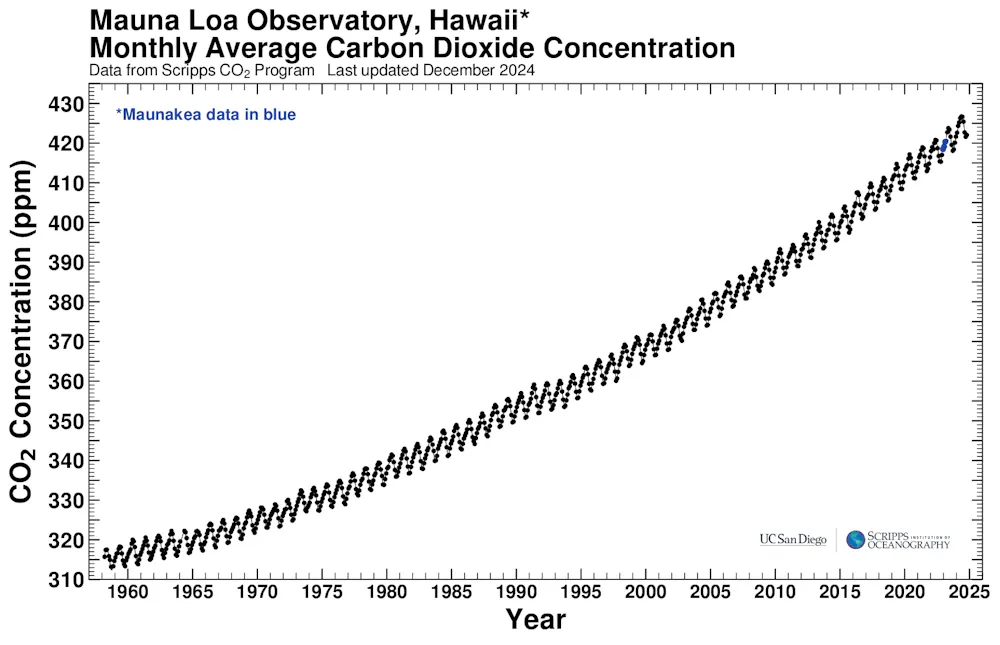
    Data collected by Mauna Loa from 1958 onward let us clearly see the evidence of climate change for the first time. The station samples the air and measures global CO₂ levels. Charles Keeling and his successors used this data to produce the famous Keeling curve – a graph showing carbon dioxide levels increasing year after year.

    But this precious record is in peril. US President Donald Trump has decided to defund the observatory recording the data, as well as the widespread US greenhouse gas monitoring network and other climate measuring sites.

    We can’t solve the existential problem of climate change if we can’t track the changes. Losing Mauna Loa would be a huge loss to climate science. If it shuts, other observatories such as Australia’s Kennaook/Cape Grim will become even more vital.

    The Keeling Curve tracking steadily rising carbon dioxide levels in the atmosphere came from data gathered at Mauna Loa.
    Scripps Institution of Oceanography at UC San Diego, CC BY-NC-ND

    What did Mauna Loa show us?

    The first year of measurements at Mauna Loa revealed something incredible. For the first time, the clear annual cycle in atmospheric CO₂ was visible. As plants grow in summer, they absorb CO₂ and draw it out of the atmosphere. As they die and decay in winter, the CO₂ returns to the atmosphere. It’s like Earth is breathing.

    Most land on Earth is in the Northern Hemisphere, which means this cycle is largely influenced by the northern summer and winter.

    The annual cycle of carbon dioxide is largely due to plant growth and decay in the northern hemisphere.

    It only took a few years of measurements before an even more profound pattern emerged.

    Year on year, CO₂ levels in the atmosphere were relentlessly rising. The natural in-out cycle continued, but against a steady increase.

    Scientists would later figure out that the ocean and land together were absorbing almost half of the CO₂ produced by humans. But the rest was building up in the atmosphere.

    Crucially, isotopic measurements meant scientists could be crystal clear about the origin of the extra carbon dioxide. It was coming from humans, largely through burning fossil fuels.

    Mauna Loa has now been collecting data for more than 65 years. The resulting Keeling curve graph is the most iconic demonstration of how human activities are collectively affecting the planet.

    When the last of the Baby Boomer generation were being born in the 1960s, CO₂ levels were around 320 parts per million. Now they’re over 420 ppm. That’s a level unseen for at least three million years. The rate of increase far exceeds any natural change in the past 50 million years.

    The reason carbon dioxide is so important is that this molecule has special properties. Its ability to trap heat alongside other greenhouse gases means Earth isn’t a frozen rock. If there were no greenhouse gases, Earth would have an average temperature of -18°C, rather than the balmy 14°C under which human civilisation emerged.

    The greenhouse effect is essential to life. But if there are too many gases, the planet becomes dangerously hot. That’s what’s happening now – a very sharp increase in gases exceptionally good at trapping heat even at low concentrations.

    Greenhouse gases are the reason Earth isn’t an icebox. But the rate humans are emitting them is leading to very rapid changes.
    Reid Wiseman/NASA, CC BY-NC-ND

    Keeping our eyes open

    It’s not enough to know CO₂ is climbing. Monitoring is essential. That’s because as the planet warms, both the ocean and the land are expected to take up less and less of humanity’s emissions, letting still more carbon accumulate in the air.

    Continuous, high-precision monitoring is the only way to spot if and when that happens.

    This monitoring provides the vital means to verify whether new climate policies are genuinely influencing the atmospheric CO₂ curve rather than just being touted as effective. Monitoring will also be vital to capture the moment many have been working towards when government policies and new technologies finally slow and eventually stop the increase in CO₂.

    The US administration’s plans to defund key climate monitoring systems and roll back green energy initiatives presents a global challenge.

    Without these systems, it will be harder to forecast the weather and give seasonal updates. It will also be harder to forecast dangerous extreme weather events.

    Scientists in the US and globally have sounded the alarm about what the closure would do to science. This is understandable. Stopping data climate collection is like breaking a thermometer because you don’t like knowing you’ve got a fever.

    If the US follows through, other countries will need to carefully reconsider their commitments to gathering and sharing climate data.

    Australia has a long record of direct atmospheric CO₂ measurement, which began in 1976 at the Kennaook/Cape Grim Baseline Air Pollution Station in north-west Tasmania. This and other climate observations will only become more valuable if Mauna Loa is lost.

    It remains to be seen how Australia’s leaders respond to the US retreat from climate monitoring. Ideally, Australia would not only maintain but strategically expand its monitoring systems of atmosphere, land and oceans.

    Alex Sen Gupta receives funding from the Australian Research Council.

    Katrin Meissner receives funding from the Minderoo Foundation and has received funding from the Australian Research Council in the past.

    Timothy Raupach receives funding from QBE Insurance, Guy Carpenter, and the Australian Research Council.

    – ref. Mauna Loa Observatory captured the reality of climate change. The US plans to shut it down – https://theconversation.com/mauna-loa-observatory-captured-the-reality-of-climate-change-the-us-plans-to-shut-it-down-260403

    MIL OSI Analysis – EveningReport.nz –

    July 4, 2025
  • MIL-Evening Report: Mauna Loa Observatory captured the reality of climate change. The US plans to shut it down

    Source: The Conversation (Au and NZ) – By Alex Sen Gupta, Associate Professor in Climate Science, UNSW Sydney

    Izabela23/Shutterstock

    The greenhouse effect was discovered more than 150 years ago and the first scientific paper linking carbon dioxide levels in the atmosphere with climate change was published in 1896.

    But it wasn’t until the 1950s that scientists could definitively detect the effect of human activities on the Earth’s atmosphere.

    In 1956, United States scientist Charles Keeling chose Hawaii’s Mauna Loa volcano for the site of a new atmospheric measuring station. It was ideal, located in the middle of the Pacific Ocean and at high altitude away from the confounding influence of population centres.

    Data collected by Mauna Loa from 1958 onward let us clearly see the evidence of climate change for the first time. The station samples the air and measures global CO₂ levels. Charles Keeling and his successors used this data to produce the famous Keeling curve – a graph showing carbon dioxide levels increasing year after year.

    But this precious record is in peril. US President Donald Trump has decided to defund the observatory recording the data, as well as the widespread US greenhouse gas monitoring network and other climate measuring sites.

    We can’t solve the existential problem of climate change if we can’t track the changes. Losing Mauna Loa would be a huge loss to climate science. If it shuts, other observatories such as Australia’s Kennaook/Cape Grim will become even more vital.

    The Keeling Curve tracking steadily rising carbon dioxide levels in the atmosphere came from data gathered at Mauna Loa.
    Scripps Institution of Oceanography at UC San Diego, CC BY-NC-ND

    What did Mauna Loa show us?

    The first year of measurements at Mauna Loa revealed something incredible. For the first time, the clear annual cycle in atmospheric CO₂ was visible. As plants grow in summer, they absorb CO₂ and draw it out of the atmosphere. As they die and decay in winter, the CO₂ returns to the atmosphere. It’s like Earth is breathing.

    Most land on Earth is in the Northern Hemisphere, which means this cycle is largely influenced by the northern summer and winter.

    The annual cycle of carbon dioxide is largely due to plant growth and decay in the northern hemisphere.

    It only took a few years of measurements before an even more profound pattern emerged.

    Year on year, CO₂ levels in the atmosphere were relentlessly rising. The natural in-out cycle continued, but against a steady increase.

    Scientists would later figure out that the ocean and land together were absorbing almost half of the CO₂ produced by humans. But the rest was building up in the atmosphere.

    Crucially, isotopic measurements meant scientists could be crystal clear about the origin of the extra carbon dioxide. It was coming from humans, largely through burning fossil fuels.

    Mauna Loa has now been collecting data for more than 65 years. The resulting Keeling curve graph is the most iconic demonstration of how human activities are collectively affecting the planet.

    When the last of the Baby Boomer generation were being born in the 1960s, CO₂ levels were around 320 parts per million. Now they’re over 420 ppm. That’s a level unseen for at least three million years. The rate of increase far exceeds any natural change in the past 50 million years.

    The reason carbon dioxide is so important is that this molecule has special properties. Its ability to trap heat alongside other greenhouse gases means Earth isn’t a frozen rock. If there were no greenhouse gases, Earth would have an average temperature of -18°C, rather than the balmy 14°C under which human civilisation emerged.

    The greenhouse effect is essential to life. But if there are too many gases, the planet becomes dangerously hot. That’s what’s happening now – a very sharp increase in gases exceptionally good at trapping heat even at low concentrations.

    Greenhouse gases are the reason Earth isn’t an icebox. But the rate humans are emitting them is leading to very rapid changes.
    Reid Wiseman/NASA, CC BY-NC-ND

    Keeping our eyes open

    It’s not enough to know CO₂ is climbing. Monitoring is essential. That’s because as the planet warms, both the ocean and the land are expected to take up less and less of humanity’s emissions, letting still more carbon accumulate in the air.

    Continuous, high-precision monitoring is the only way to spot if and when that happens.

    This monitoring provides the vital means to verify whether new climate policies are genuinely influencing the atmospheric CO₂ curve rather than just being touted as effective. Monitoring will also be vital to capture the moment many have been working towards when government policies and new technologies finally slow and eventually stop the increase in CO₂.

    The US administration’s plans to defund key climate monitoring systems and roll back green energy initiatives presents a global challenge.

    Without these systems, it will be harder to forecast the weather and give seasonal updates. It will also be harder to forecast dangerous extreme weather events.

    Scientists in the US and globally have sounded the alarm about what the closure would do to science. This is understandable. Stopping data climate collection is like breaking a thermometer because you don’t like knowing you’ve got a fever.

    If the US follows through, other countries will need to carefully reconsider their commitments to gathering and sharing climate data.

    Australia has a long record of direct atmospheric CO₂ measurement, which began in 1976 at the Kennaook/Cape Grim Baseline Air Pollution Station in north-west Tasmania. This and other climate observations will only become more valuable if Mauna Loa is lost.

    It remains to be seen how Australia’s leaders respond to the US retreat from climate monitoring. Ideally, Australia would not only maintain but strategically expand its monitoring systems of atmosphere, land and oceans.

    Alex Sen Gupta receives funding from the Australian Research Council.

    Katrin Meissner receives funding from the Minderoo Foundation and has received funding from the Australian Research Council in the past.

    Timothy Raupach receives funding from QBE Insurance, Guy Carpenter, and the Australian Research Council.

    – ref. Mauna Loa Observatory captured the reality of climate change. The US plans to shut it down – https://theconversation.com/mauna-loa-observatory-captured-the-reality-of-climate-change-the-us-plans-to-shut-it-down-260403

    MIL OSI Analysis – EveningReport.nz –

    July 4, 2025
  • MIL-Evening Report: NZ will soon have no real interisland rail-ferry link – why are we so bad at infrastructure planning?

    Source: The Conversation (Au and NZ) – By Timothy Welch, Senior Lecturer in Urban Planning, University of Auckland, Waipapa Taumata Rau

    Hagen Hopkins/Getty Images)

    Another week, another Cook Strait ferry breakdown. As the winter maintenance season approaches and the Aratere prepares for its final months of service, New Zealand faces a self-imposed crisis.

    The government has spent NZ$507.3 million on cancelled iReX ferry plans, the country’s fleet has an average age of 28 years, and the earliest New Zealanders can hope for promised replacements is 2029.

    The Marlborough Chamber of Commerce warns unreliable ferries already shake tourist confidence. Several more years of duct-tape solutions won’t help.

    The recent pattern of breakdowns and cancellations has become so routine that New Zealand risks normalising what should be viewed as a national crisis: a serious infrastructure failure.

    It is also a textbook example of how short-term political cycles, coupled with chronic under-investment, create far more expensive problems than the ones they promise to solve.

    Cost blowouts

    While ministers claim to have spared taxpayers a $4 billion blowout on new ferries, Treasury papers show almost 80% of the cost escalation lay in seismic upgrades for wharves, not in the vessels themselves. Those land-side works will be required no matter what ferries the country eventually orders.

    Justifying the original contract cancellation, Finance Minister Nicola Willis quipped that iReX was a Ferrari when a Toyota Corolla would do. But the cost of finding a suitable Corolla is adding up fast.

    Annual maintenance costs are projected to nearly double to $65 million, just to keep the existing ageing ferries running. Additionally, $300 million had to be earmarked to cover fees for breaking the original ferry replacement contract.

    By retiring the Aratere this year – New Zealand’s only rail-capable ferry – the government is also severing the interisland rail link for almost five years.

    KiwiRail will “road-bridge” rail freight, an expensive workaround that involves loading train cars onto trucks, putting those trucks on ferries, then reversing the process at the other end. This will increase truck traffic, produce more emissions and add more wear to already strained infrastructure.

    Forcing more than $14 billion worth of annual freight from rail to road could also negatively affect New Zealand’s climate change commitments. Freight moved by rail generates only about 25% of the CO₂ per tonne-kilometre of the same load produced when hauled by truck.

    The cancelled hybrid ferries would have also cut emissions by 40%. Instead, New Zealand is locking in higher emissions for another half decade or longer.

    Unrealistic timelines

    The ferry saga reflects New Zealand’s infrastructure problem in a nutshell. The country tends to underestimate costs, create unfeasible timelines, then shows dismay when projects blow up or limp home at double the price.

    Auckland exemplifies the pattern. The city has seen decades of cancelled harbour crossing proposals and a scrapped light rail project, with nothing to show but consultancy fees.

    When New Zealand does build –Transmission Gully, for example – the final bill bears little resemblance to initial quotes. The 27 kilometre motorway north of Wellington was nearly 50% over budget and took eight years to build – two years longer than promised.

    The systematic underestimation of costs reflects a flawed approach to infrastructure planning. Politicians need quick wins within three-year electoral cycles, while infrastructure projects take decades to deliver.

    Projects are approved based on lowball estimates, with the outcome inherited by another administration. This has crossed party lines and created a system that rewards short-term thinking and punishes long-term planning.

    Just consider the second crossing for Auckland Harbour. For 35 years, the government has commissioned study after study – from the 1988 tunnel plans to the 2010 business cases – each time backing away when the price tag appeared, or the government changed.

    The iReX cancellation marks the first time the government has actually signed contracts and then walked away. As with the second Auckland Harbour crossing, each delay has only made the inevitable solution more expensive.

    Other countries have, to a degree, addressed this problem. Infrastructure Australia, for example, provides independent cost assessments and long-term planning that transcends political cycles. New Zealand’s Infrastructure Commission, established in 2019, lacks similar teeth and independence.

    Ultimately this isn’t really about ferries. It’s about how New Zealand consistently fails to deliver, on time and at cost, the infrastructure that keeps its economy moving.

    Timothy Welch does not work for, consult, own shares in or receive funding from any company or organisation that would benefit from this article, and has disclosed no relevant affiliations beyond their academic appointment.

    – ref. NZ will soon have no real interisland rail-ferry link – why are we so bad at infrastructure planning? – https://theconversation.com/nz-will-soon-have-no-real-interisland-rail-ferry-link-why-are-we-so-bad-at-infrastructure-planning-260279

    MIL OSI Analysis – EveningReport.nz –

    July 4, 2025
  • MIL-Evening Report: NZ will soon have no real interisland rail-ferry link – why are we so bad at infrastructure planning?

    Source: The Conversation (Au and NZ) – By Timothy Welch, Senior Lecturer in Urban Planning, University of Auckland, Waipapa Taumata Rau

    Hagen Hopkins/Getty Images)

    Another week, another Cook Strait ferry breakdown. As the winter maintenance season approaches and the Aratere prepares for its final months of service, New Zealand faces a self-imposed crisis.

    The government has spent NZ$507.3 million on cancelled iReX ferry plans, the country’s fleet has an average age of 28 years, and the earliest New Zealanders can hope for promised replacements is 2029.

    The Marlborough Chamber of Commerce warns unreliable ferries already shake tourist confidence. Several more years of duct-tape solutions won’t help.

    The recent pattern of breakdowns and cancellations has become so routine that New Zealand risks normalising what should be viewed as a national crisis: a serious infrastructure failure.

    It is also a textbook example of how short-term political cycles, coupled with chronic under-investment, create far more expensive problems than the ones they promise to solve.

    Cost blowouts

    While ministers claim to have spared taxpayers a $4 billion blowout on new ferries, Treasury papers show almost 80% of the cost escalation lay in seismic upgrades for wharves, not in the vessels themselves. Those land-side works will be required no matter what ferries the country eventually orders.

    Justifying the original contract cancellation, Finance Minister Nicola Willis quipped that iReX was a Ferrari when a Toyota Corolla would do. But the cost of finding a suitable Corolla is adding up fast.

    Annual maintenance costs are projected to nearly double to $65 million, just to keep the existing ageing ferries running. Additionally, $300 million had to be earmarked to cover fees for breaking the original ferry replacement contract.

    By retiring the Aratere this year – New Zealand’s only rail-capable ferry – the government is also severing the interisland rail link for almost five years.

    KiwiRail will “road-bridge” rail freight, an expensive workaround that involves loading train cars onto trucks, putting those trucks on ferries, then reversing the process at the other end. This will increase truck traffic, produce more emissions and add more wear to already strained infrastructure.

    Forcing more than $14 billion worth of annual freight from rail to road could also negatively affect New Zealand’s climate change commitments. Freight moved by rail generates only about 25% of the CO₂ per tonne-kilometre of the same load produced when hauled by truck.

    The cancelled hybrid ferries would have also cut emissions by 40%. Instead, New Zealand is locking in higher emissions for another half decade or longer.

    Unrealistic timelines

    The ferry saga reflects New Zealand’s infrastructure problem in a nutshell. The country tends to underestimate costs, create unfeasible timelines, then shows dismay when projects blow up or limp home at double the price.

    Auckland exemplifies the pattern. The city has seen decades of cancelled harbour crossing proposals and a scrapped light rail project, with nothing to show but consultancy fees.

    When New Zealand does build –Transmission Gully, for example – the final bill bears little resemblance to initial quotes. The 27 kilometre motorway north of Wellington was nearly 50% over budget and took eight years to build – two years longer than promised.

    The systematic underestimation of costs reflects a flawed approach to infrastructure planning. Politicians need quick wins within three-year electoral cycles, while infrastructure projects take decades to deliver.

    Projects are approved based on lowball estimates, with the outcome inherited by another administration. This has crossed party lines and created a system that rewards short-term thinking and punishes long-term planning.

    Just consider the second crossing for Auckland Harbour. For 35 years, the government has commissioned study after study – from the 1988 tunnel plans to the 2010 business cases – each time backing away when the price tag appeared, or the government changed.

    The iReX cancellation marks the first time the government has actually signed contracts and then walked away. As with the second Auckland Harbour crossing, each delay has only made the inevitable solution more expensive.

    Other countries have, to a degree, addressed this problem. Infrastructure Australia, for example, provides independent cost assessments and long-term planning that transcends political cycles. New Zealand’s Infrastructure Commission, established in 2019, lacks similar teeth and independence.

    Ultimately this isn’t really about ferries. It’s about how New Zealand consistently fails to deliver, on time and at cost, the infrastructure that keeps its economy moving.

    Timothy Welch does not work for, consult, own shares in or receive funding from any company or organisation that would benefit from this article, and has disclosed no relevant affiliations beyond their academic appointment.

    – ref. NZ will soon have no real interisland rail-ferry link – why are we so bad at infrastructure planning? – https://theconversation.com/nz-will-soon-have-no-real-interisland-rail-ferry-link-why-are-we-so-bad-at-infrastructure-planning-260279

    MIL OSI Analysis – EveningReport.nz –

    July 4, 2025
  • MIL-Evening Report: I’ve seen the brain damage contact sports can cause – we all need to take concussion and CTE more seriously

    Source: The Conversation (Au and NZ) – By Alan Pearce, Professor, Adjunct Research Fellow, School of Health Science, Swinburne University of Technology

    AAP Image/The Conversation, CC BY

    Concussion in sport continues to make headlines, whether it be class actions, young men flocking to the highly violent “RunIt” activity or debate about whether Australian rules football should remove the “bump” once and for all.

    Bringing this weighty issue to greater prominence are the former athletes who bravely share their long-term health struggles after careers in sport – cognitive impairments, mental health issues or concerns about neurodegenerative disease, specifically chronic traumatic encephalopathy (CTE).

    Yet for all the progress made by many sports in recent years, it feels like we still have not fully grasped the understanding of CTE – or maybe we don’t want to.

    Remind me again, what is CTE?

    CTE is a neurodegenerative brain disease, just like dementia, motor neurone disease (MND) and Parkinson’s disease.

    Expert groups agree on the links between traumatic brain injury and increased risk of Alzheimer’s disease (and other dementias), and the growing evidence of links to MND and Parkinson’s.

    People who have never had a traumatic brain injury can still regrettably suffer from these diseases. However, while CTE is rare in the general population, those with a history of repetitive impacts to the brain are more at risk.

    These impacts may not be diagnosed brain injuries or concussions, but rather non-concussive impacts (smaller hits that do not produce signs or symptoms of concussion).

    Contrary to anecdotal opinion, an athlete’s concussion history is not the crucial variable in risk and severity of CTE.

    Emerging international evidence, including my own recently published studies, show the risk of developing CTE (and its severity) is linked to exposure: the age a person starts full contact sport and the length of a playing career.

    The grey area of concussion, CTE and mental health

    Currently, CTE cannot be diagnosed in living people.

    However in understanding the progression of the disease in those who have passed away with CTE, families have described signs and symptoms including cognitive impairments such as:

    • Parkinsonism
    • memory loss
    • trouble with planning and organising tasks
    • impulsive behaviours
    • anger and irritability
    • emotional instability
    • substance misuse
    • suicidal thoughts/behaviour.

    While these signs and symptoms can overlap with those we associate with mental health, this does not necessarily mean the affected person had “mental health concerns”.

    The continued awareness in men’s mental health is a good thing broadly but it has sometimes misappropriated CTE as a mental health issue. For example, some fundraising games in the names of athletes who have died with CTE are being channelled to mental health charities and institutes, confusing the wider community.

    Consequently two recent tragic stories, one from the family of deceased former AFL player Shane Tuck and the other from Amanda Green, the widow of the late NRL player and coach Paul Green, needed to be told.

    Their stories contradicted widely held beliefs in the media and among fans that Tuck or Green were suffering with a psychiatric disease prior to their untimely deaths. In fact, they had CTE.

    An uncomfortable conversation

    So, why aren’t we talking about CTE more?

    The answer is, unfortunately it is an inconvenient truth.

    Considering CTE is entirely preventable if we remove exposure risk of repetitive hits to the head, the solution is to further modify many of our most popular sports to make head impacts much rarer.

    There is sizeable opposition to this idea.

    “Now is not the time to discuss such ‘political’ issues,” is the response I usually get from academics and colleagues involved in these sports, and even football loving friends, when I try to raise awareness.

    This continued hesitation only slows the science of CTE further.

    If an athlete’s family has been courageous in donating their brain to the Australian Sports Brain Bank and CTE has been found, the standard response from sports organisations is:

    the (insert sport here) takes athlete health and wellbeing as its greatest priority […] the (insert sport here) has implemented strict concussion protocols and continues research into athletes’ brain health.

    Even a Senate parliamentary inquiry has done little to change the situation.

    In fact, while most sports have tried to become safer through rule changes, progress more broadly has plateaued or even regressed in recent years.

    Take one recent example in the NRL, when some in the rugby league community made light of the multiple concussions suffered by Victor Radley. After playing his 150th game, he posed smiling with a t-shirt detailing the number of concussions he had suffered during his career. His club, the Sydney Roosters, posted the photo on Instagram before it was later removed.

    Even more worrying is a new controversial activity called “RunIt”, which involves two men running full speed at each other with the intention of knocking over (or more aptly knocking out) the opponent.

    A recent death of a New Zealand teenager playing RunIt has highlighted the dangers.


    Read more:
    Head knocks and ultra-violence: viral games Run It Straight and Power Slap put sports safety back centuries


    What more can be done?

    With the help of the Concussion Legacy Foundation, experts around the world, including myself, have produced a CTE prevention protocol. This does not mean banning any sports but rather modifying components that will reduce exposure risk.

    Here are five ideas I believe would make a difference.

    1. Reducing contact loads in training, particularly in pre-season training.

    2. Modify contact sports for children until the age of 14. This potentially removes six to eight years of incidental and unnecessary hits to kids’ heads. They can still play and learn all the fundamental motor skills and enjoy the psychological benefits of sport before graduating to the full version of the game at 14.

    3. Influential media commentators need to upskill themselves around CTE and to not be afraid to mention CTE rather than deferring to “concussion protocols”.

    4. Medical and allied health practitioners do not regularly screen for concussion or contact sport playing history when assessing a patient who is struggling with movement disorders, chronic headaches/fatigue or cognitive/behavioural impairments. Repetitive head impact history should be screened just like alcohol and drug use history.

    5. When an athlete suddenly and tragically dies, we need to include, along with emergency help lines, information for help and support for those unsure about CTE.

    Unfortunately, if we don’t have the political will to acknowledge CTE and act, more families will be grieving tragic deaths of athletes. These families may not even be aware of CTE.

    This does not make me anti-sport, but pro-athlete. Let’s all become pro-athlete for the sake of our sports and the people who play them.

    Alan Pearce is currently unfunded. Alan is a non-executive director for the Concussion Legacy Foundation (unpaid position) and Adjunct research manager for the Australian Sports Brain Bank (unpaid position). He has previously received funding from Erasmus+ strategic partnerships program (2019-1-IE01-KA202-051555), Sports Health Check Charity (Australia), Australian Football League, Impact Technologies Inc., and Samsung Corporation, and is remunerated for expert advice to medico-legal practices.

    – ref. I’ve seen the brain damage contact sports can cause – we all need to take concussion and CTE more seriously – https://theconversation.com/ive-seen-the-brain-damage-contact-sports-can-cause-we-all-need-to-take-concussion-and-cte-more-seriously-259785

    MIL OSI Analysis – EveningReport.nz –

    July 4, 2025
  • MIL-Evening Report: Rare wooden tools from Stone Age China reveal plant-based lifestyle of ancient lakeside humans

    Source: The Conversation (Au and NZ) – By Bo Li, Professor, Environmental Futures Research Centre, School of Science, University of Wollongong

    Excavation at the Gantangqing site. Liu et al.

    Ancient wooden tools found at a site in Gantangqing in southwestern China are approximately 300,000 years old, new dating has shown. Discovered during excavations carried out in 2014–15 and 2018–19, the tools have now been dated by a team of archaeologists, geologists, chronologists (including me) and paleontologists.

    The rare wooden tools were found alongside an assortment of animal and plant fossils and stone artifacts.

    Taken together, the finds suggest the early humans at Gantangqing were surprisingly sophisticated woodworkers who lived in a rich tropical or subtropical environment where they subsisted by harvesting plants from a nearby lake.

    The location of the Gantangqing site and excavation trenches.
    Liu et al. / Science

    Why ancient wooden tools are so rare

    Wood usually decomposes relatively rapidly due to microbial activity, oxidation, and weathering. Unlike stone or bone, it rarely survives more than a few centuries.

    Wood can only survive for thousands of years or longer if it ends up buried in unusual conditions. Wood can last a long time in oxygen-free environments or extremely dry areas. Charred or fire-hardened wood is also more durable.

    At Gantangqing, the wooden objects were excavated from low-oxygen clay-heavy layers of sediment formed on the ancient shoreline of Fuxian Lake.

    Wooden implements are extremely rare from the Early Palaeolithic period (the first part of the “stone age” from around 3.3 million years ago until 300,000 years ago or so, in which our hominin ancestors first began to use tools). Indeed, wooden tools more than even 50,000 years old are virtually absent outside Africa and western Eurasia.

    As a result, we may have a skewed understanding of Palaeolithic cultures. We may overemphasise the role of stone tools, for example, because they are what has survived.

    What wooden tools were found at Gantangqing?

    The new excavations at Gantangqing found 35 wooden specimens identified as artificially modified tools. These tools were primarily manufactured from pine wood, with a minority crafted from hardwoods.

    Some of the tools had rounded ends, while others had chisel-like thin blades or ridged blades. Of the 35 tools, 32 show marks of intentional modification at their tips, working edges, or bases.

    Two large digging implements were identified as heavy-duty digging sticks designed for two-handed use. These are unique forms of digging implements not documented elsewhere, suggesting localised functional adaptations. There were also four distinct hook-shaped tools — likely used for cutting roots — and a series of smaller tools for one-handed use.

    Nineteen of the tools showed microscopic traces of scraping from shaping or use, while 17 exhibit deliberately polished surfaces. We also identified further evidence of intensive use, including soil residues stuck to tool tips, parallel grooves or streaks along working edges, and characteristic fracture wear patterns.

    The tools from Gantangqing are more complete and show a wider range of functions than those found at contemporary sites such as Clacton in the UK and Florisbad in South Africa.

    The wooden tools from Gantangqing took a variety of forms.
    Liu et al. / Science

    How old are the Gantangqing wooden tools?

    The team used several techniques to figure out the age of the wooden tools. There is no way to determine their age directly, but we can date the sediment in which they were found.

    Using a technique called infrared stimulated luminescence, we analysed more than 10,000 individual grains of minerals from different layers. This showed the sediment was deposited roughly between 350,000 and 200,000 years ago.

    Dating the different layers of sediment excavated at the site produced a detailed timeline.
    Liu et al. / Science

    We also used different techniques to date a mammal tooth found in one of the layers to roughly 288,000 years old. This was consistent with the mineral results.

    Next we used mathematical modelling to bring all the dating results together. Our model indicated that the layers containing stone tools and wooden implements date from 360–300,000 years ago to 290–250,000 years ago.

    What was the environment like?

    Our research indicates the ancient humans at Gantangqing inhabited a warm, humid, tropical or subtropical environment. Pollen extracted from the sediments reveals 40 plant families that confirm this climate.

    Plant fossils further verify the presence of subtropical-to-tropical flora dominated by trees, lianas, shrubs and herbs. Wet-environment plants show the local surroundings were a lakeside or wetlands.

    Animal fossils also fit this picture, including rhinoceros and other mammals, turtles and various birds. The ecosystem was likely a mosaic of grassland, thickets and forests. Evidence of diving ducks confirms the lake must have been at least 2–3 metres deep during human occupation.

    Examples of stone and bone tools found at Gantangqing.
    Liu et al. / Science

    What were the Gantangqing wooden tools used for?

    The site contained evidence of plants such as storable pine nuts and hazelnuts, fruit trees such as kiwi, raspberry-like berries, grapes, edible herbs and fern fronds.

    There were also aquatic plants that would have provided edible leaves, seeds, tubers and rhizomes. These were likely dug up from shallow mud near the shore, using wooden tools.

    These findings suggest the Gantangqing hominins may have made expeditions to the lake shore, carrying purpose-made wooden digging sticks to harvest underground food sources. To do this, they would have had to anticipate seasonal plant distributions, know exactly what parts of different plants were edible, and produce specialised tools for different tasks.

    Why the Gantangqing site is important

    The wooden implements from Gantangqing represent the earliest known evidence for the use of digging sticks and for the exploitation of underground plant storage organs such as tubers within the Oriental biogeographic realm. Our discovery shows the use of sophisticated wood technology in a very different environmental context from what has been seen at sites of similar age in Europe and Africa.

    The find significantly expands our understanding of early hominin woodworking capabilities.

    The hominins who lived at Gantangqing appear to have lived a heavily plant-based subsistence lifestyle. This is in contrast to colder, more northern settings where tools of similar age have been found (such as Schöningen in Germany), where hunting large mammals was the key to survival.

    The site also shows how important wood – and perhaps other organic materials – were to “stone age” hominins. These wooden artifacts show far more sophisticated manufacturing skill than the relative rudimentary stone tools found at sites of similar age across East and Southeast Asia.

    The excavation, curation, and research of the Gantangqing site were supported by
    National Cultural Heritage Administration (China), Yunnan Provincial Institute of
    Cultural Relics and Archaeology, Yuxi Municipal Bureau of Culture and Tourism,
    Chengjiang Municipal Bureau of Culture and Tourism, Australian Research Council
    (ARC) Discovery Projects, Strategic Priority Research Program of the Chinese
    Academy of Sciences, Hong Kong Research Grants Council (RGC), National Natural
    Science Foundation of China (NSFC).

    – ref. Rare wooden tools from Stone Age China reveal plant-based lifestyle of ancient lakeside humans – https://theconversation.com/rare-wooden-tools-from-stone-age-china-reveal-plant-based-lifestyle-of-ancient-lakeside-humans-260204

    MIL OSI Analysis – EveningReport.nz –

    July 4, 2025
  • MIL-OSI: Equasens: Appointment at the head of the Pharmagest Division

    Source: GlobeNewswire (MIL-OSI)

    Villers-lès-Nancy (France), July 03, 2025 – 06 :00pm (CET)

    Press Release

    Equasens announces the departure of Damien VALICON, as Deputy Chief Executive Officer and Director of the Pharmagest Division

    He will be replaced by François-Pierre MARQUIER as Director of the Pharmagest Division.

    ***

    Equasens Group (Euronext Paris™ – Compartment B – FR 0012882389 –$EQS), announces the departure of Damien VALICON, who held the position of Deputy Chief Executive Officer and Director of the Pharmagest Division for 18 months, and the appointment of François-Pierre MARQUIER, who is resuming his operational duties as Director of the Pharmagest Division.

    The appointment of François-Pierre MARQUIER, proposed by Denis SUPPLISSON, Chief Executive Officer of the Equasens Group, will be effective after a transition period. It was approved by the Board of Directors at its meeting on June 25, 2025, chaired by Thierry CHAPUSOT, Chairman of the Board of Directors.

    François-Pierre MARQUIER, who joined Pharmagest in May 2021 as Regional Director for the Ile-de-France region, has headed the Pharmacy France business since January 2023. He will now oversee all the Division’s activities, both in France and the rest of Europe.

    Denis SUPPLISSON, Chief Executive Officer of Equasens Group, states: « François-Pierre has a deep understanding of our business sectors, a precise grasp of our challenges and the sectoral expertise we need to accelerate our European development. »

    Biography François-Pierre MARQUIER – LinkedIn – Graduate of IDRAC Business School and Emlyon Business School (DUA), he began his career in 1996 with DHL as Marketing Manager. In 2000, he joined Cegid Group where he evolved for over 20 years, holding management positions in marketing and sales.
    He joined Equasens Group in May 2021 as Regional Director, before being appointed Director of the Pharmacy France business in January 2023.
    He has represented Pharmagest within FEIMA for over 2 years.

    Upcoming financial communications

    • 31 July 2025:                 Q2 2025 revenue – After the close of trading
    • 26 September 2025:         H1 2025 results

    About Equasens Group – Follow us also on LinkedIn

    Founded over 35 years ago, Equasens Group, a leader in digital healthcare solutions, today employs over 1.400 people across Europe.
    Equasens Group’s specialized business applications facilitate the day-to-day work of healthcare professionals and their teams, working in private practice, collaborative medical structures or healthcare establishments. The Group also provides comprehensive support to healthcare professionals in the transformation of their profession by developing electronic equipment, digital solutions and healthcare robotics, as well as data hosting, financing and training adapted to their specific needs.
    And reflecting the spirit of its tagline “Technology for a More Human Experience”, the Group is a leading provider of interoperability solutions that improve coordination between healthcare professionals, their communications and data exchange resulting in better patient care and a more efficient and secure healthcare system.

    Listed on Euronext Paris™, Equasens Group (Compartment B – FR 0012882389 – $EQS) applies a two-pronged development strategy combining organic growth with targeted acquisitions at a European level.

    CONTACTS

    Analyst and Investor Relations:
    Chief Administrative and Financial Officer: Frédérique Schmidt
    Tel: +33 (0)3 83 15 90 67 – frederique.schmidt@equasens.com

    Financial communications agency:
    FIN’EXTENSO – Isabelle Aprile

    Tel.: +33 (0)6 17 38 61 78 – i.aprile@finextenso.fr

    Attachment

    • EQUASENS_PR_202500703_Appointment-Division-Pharmagest-EN

    The MIL Network –

    July 4, 2025
  • MIL-OSI: Equasens: Appointment at the head of the Pharmagest Division

    Source: GlobeNewswire (MIL-OSI)

    Villers-lès-Nancy (France), July 03, 2025 – 06 :00pm (CET)

    Press Release

    Equasens announces the departure of Damien VALICON, as Deputy Chief Executive Officer and Director of the Pharmagest Division

    He will be replaced by François-Pierre MARQUIER as Director of the Pharmagest Division.

    ***

    Equasens Group (Euronext Paris™ – Compartment B – FR 0012882389 –$EQS), announces the departure of Damien VALICON, who held the position of Deputy Chief Executive Officer and Director of the Pharmagest Division for 18 months, and the appointment of François-Pierre MARQUIER, who is resuming his operational duties as Director of the Pharmagest Division.

    The appointment of François-Pierre MARQUIER, proposed by Denis SUPPLISSON, Chief Executive Officer of the Equasens Group, will be effective after a transition period. It was approved by the Board of Directors at its meeting on June 25, 2025, chaired by Thierry CHAPUSOT, Chairman of the Board of Directors.

    François-Pierre MARQUIER, who joined Pharmagest in May 2021 as Regional Director for the Ile-de-France region, has headed the Pharmacy France business since January 2023. He will now oversee all the Division’s activities, both in France and the rest of Europe.

    Denis SUPPLISSON, Chief Executive Officer of Equasens Group, states: « François-Pierre has a deep understanding of our business sectors, a precise grasp of our challenges and the sectoral expertise we need to accelerate our European development. »

    Biography François-Pierre MARQUIER – LinkedIn – Graduate of IDRAC Business School and Emlyon Business School (DUA), he began his career in 1996 with DHL as Marketing Manager. In 2000, he joined Cegid Group where he evolved for over 20 years, holding management positions in marketing and sales.
    He joined Equasens Group in May 2021 as Regional Director, before being appointed Director of the Pharmacy France business in January 2023.
    He has represented Pharmagest within FEIMA for over 2 years.

    Upcoming financial communications

    • 31 July 2025:                 Q2 2025 revenue – After the close of trading
    • 26 September 2025:         H1 2025 results

    About Equasens Group – Follow us also on LinkedIn

    Founded over 35 years ago, Equasens Group, a leader in digital healthcare solutions, today employs over 1.400 people across Europe.
    Equasens Group’s specialized business applications facilitate the day-to-day work of healthcare professionals and their teams, working in private practice, collaborative medical structures or healthcare establishments. The Group also provides comprehensive support to healthcare professionals in the transformation of their profession by developing electronic equipment, digital solutions and healthcare robotics, as well as data hosting, financing and training adapted to their specific needs.
    And reflecting the spirit of its tagline “Technology for a More Human Experience”, the Group is a leading provider of interoperability solutions that improve coordination between healthcare professionals, their communications and data exchange resulting in better patient care and a more efficient and secure healthcare system.

    Listed on Euronext Paris™, Equasens Group (Compartment B – FR 0012882389 – $EQS) applies a two-pronged development strategy combining organic growth with targeted acquisitions at a European level.

    CONTACTS

    Analyst and Investor Relations:
    Chief Administrative and Financial Officer: Frédérique Schmidt
    Tel: +33 (0)3 83 15 90 67 – frederique.schmidt@equasens.com

    Financial communications agency:
    FIN’EXTENSO – Isabelle Aprile

    Tel.: +33 (0)6 17 38 61 78 – i.aprile@finextenso.fr

    Attachment

    • EQUASENS_PR_202500703_Appointment-Division-Pharmagest-EN

    The MIL Network –

    July 4, 2025
  • MIL-OSI: Equasens: Appointment at the head of the Pharmagest Division

    Source: GlobeNewswire (MIL-OSI)

    Villers-lès-Nancy (France), July 03, 2025 – 06 :00pm (CET)

    Press Release

    Equasens announces the departure of Damien VALICON, as Deputy Chief Executive Officer and Director of the Pharmagest Division

    He will be replaced by François-Pierre MARQUIER as Director of the Pharmagest Division.

    ***

    Equasens Group (Euronext Paris™ – Compartment B – FR 0012882389 –$EQS), announces the departure of Damien VALICON, who held the position of Deputy Chief Executive Officer and Director of the Pharmagest Division for 18 months, and the appointment of François-Pierre MARQUIER, who is resuming his operational duties as Director of the Pharmagest Division.

    The appointment of François-Pierre MARQUIER, proposed by Denis SUPPLISSON, Chief Executive Officer of the Equasens Group, will be effective after a transition period. It was approved by the Board of Directors at its meeting on June 25, 2025, chaired by Thierry CHAPUSOT, Chairman of the Board of Directors.

    François-Pierre MARQUIER, who joined Pharmagest in May 2021 as Regional Director for the Ile-de-France region, has headed the Pharmacy France business since January 2023. He will now oversee all the Division’s activities, both in France and the rest of Europe.

    Denis SUPPLISSON, Chief Executive Officer of Equasens Group, states: « François-Pierre has a deep understanding of our business sectors, a precise grasp of our challenges and the sectoral expertise we need to accelerate our European development. »

    Biography François-Pierre MARQUIER – LinkedIn – Graduate of IDRAC Business School and Emlyon Business School (DUA), he began his career in 1996 with DHL as Marketing Manager. In 2000, he joined Cegid Group where he evolved for over 20 years, holding management positions in marketing and sales.
    He joined Equasens Group in May 2021 as Regional Director, before being appointed Director of the Pharmacy France business in January 2023.
    He has represented Pharmagest within FEIMA for over 2 years.

    Upcoming financial communications

    • 31 July 2025:                 Q2 2025 revenue – After the close of trading
    • 26 September 2025:         H1 2025 results

    About Equasens Group – Follow us also on LinkedIn

    Founded over 35 years ago, Equasens Group, a leader in digital healthcare solutions, today employs over 1.400 people across Europe.
    Equasens Group’s specialized business applications facilitate the day-to-day work of healthcare professionals and their teams, working in private practice, collaborative medical structures or healthcare establishments. The Group also provides comprehensive support to healthcare professionals in the transformation of their profession by developing electronic equipment, digital solutions and healthcare robotics, as well as data hosting, financing and training adapted to their specific needs.
    And reflecting the spirit of its tagline “Technology for a More Human Experience”, the Group is a leading provider of interoperability solutions that improve coordination between healthcare professionals, their communications and data exchange resulting in better patient care and a more efficient and secure healthcare system.

    Listed on Euronext Paris™, Equasens Group (Compartment B – FR 0012882389 – $EQS) applies a two-pronged development strategy combining organic growth with targeted acquisitions at a European level.

    CONTACTS

    Analyst and Investor Relations:
    Chief Administrative and Financial Officer: Frédérique Schmidt
    Tel: +33 (0)3 83 15 90 67 – frederique.schmidt@equasens.com

    Financial communications agency:
    FIN’EXTENSO – Isabelle Aprile

    Tel.: +33 (0)6 17 38 61 78 – i.aprile@finextenso.fr

    Attachment

    • EQUASENS_PR_202500703_Appointment-Division-Pharmagest-EN

    The MIL Network –

    July 4, 2025
  • MIL-OSI United Kingdom: Thousands of items collected in 24-hour litter pick of Aberdeen

    Source: Scotland – City of Aberdeen

    Hundreds of volunteers collected thousands of items in a 24-hour litter pick across dozens of areas in Aberdeen.

    The annual event – with the aim of making the city more sparklingly clean in the summer months – had 37 separate clean-ups from organisations including primary and secondary schools, community groups, and individuals.

    It involves litter picks starting every hour over 24 hours from midnight to midnight and included Tall Ship volunteers doing a session to ensure the city is ship shape in time for next month’s event.

    Aberdeen City Council Co-Leader Councillor Ian Yuill said: “It’s good that so many groups came out to help keep our city looking sparkling clean. 

    “Council staff work hard to keep our city clean and tidy. Unfortunately they cannot be everywhere at the same time so the action taken by these communities, groups, workplaces, and individuals makes a big difference.”

    Aberdeen City Council Net Zero, Environment and Transport Committee convener Councillor Miranda Radley said: “We’d prefer if people didn’t litter in the first place as it is bad for the environment and makes our city look unattractive. We are all responsible for keeping our city beautiful. This effort can be as simple as picking up litter outside our front gates every day, or a bigger effort such as litter picks carried out by dozens of groups throughout the year.

    “These organised litter-pick events really do make a huge difference to local communities and help foster pride in our beautiful city.”

    The 393 participants in the Aberdeen City Council-organised event managed to fill 197 black bin bags across the 37 clean-ups.

    This year’s event was started by ACC’s library services team at midnight on Wednesday followed by ACC’s environmental services staff, countryside rangers, and tree squads doing the early hours and then by the other groups every hour.

    Areas which benefitted included Morningside, Garthdee, Mastrick, Hazlehead, Summerhill, Tillydrone, Kincorth, Bucksburn, West End, Airyhall, city centre, Heathryfold, Garthdee, Cove, Powis, Torry, Seaton, Rosemount, Stockethill, Donmouth, Northfield, Fittie, and the beachfront.

    Other groups taking part this year included Riverbank School, Kirkhill School, Bucksburn Academy, Bright Horizons, Airyhall School, Phoenix Futures, Hazlehead Primary, Keep Middlefield Clean, Tall Ships volunteers, Charleston School, St Machar Academy, Loirston School, Boat Club, Fresh Community Wellness, Friends of Victoria and Westburn Parks, Ashgrove and Stockethill
    Community Council, ACC Green Champions, Northfield Community Centre, Kincorth and Leggart Community Council, Friends of St Fittick’s Park. Members of the public took part in litter picks at Torry Battery, Fittie, and the beachfront.

    The places the groups picked litter up from included school grounds, pitches, car parks, golf course woods, streets, green spaces, parks, along the River Dee, community centre grounds, and near the Tall Ships site.

    The event is part of the year-round Clean Up Aberdeen campaign which encourages people not to litter in the first place, and also provides equipment for groups wanting to organise a litter pick. For more details, or to get help organising an event, go to Clean Up Aberdeen | Aberdeen City Council.

    MIL OSI United Kingdom –

    July 4, 2025
  • MIL-OSI USA: Warren, Neguse, Raskin Lead 170+ Members of Congress in Amicus Brief, Arguing Trump Cannot Dismantle Department of Education

    US Senate News:

    Source: United States Senator for Massachusetts – Elizabeth Warren

    July 03, 2025

    The lawmakers argue that only Congress has authority to create, restructure, and abolish federal departments and agencies by constitutional mandate and through a long-established legal precedent. 

    The Department of Education is statutorily mandated and cannot be unilaterally abolished by the President.

    Text of Brief (PDF)

    Washington, D.C. – U.S. Senator Elizabeth Warren (D-Mass.), along with House Judiciary Committee Ranking Member Jamie Raskin (D-Md.), House Assistant Majority Leader Joe Neguse (D-Colo.), Representatives Robert C. “Bobby” Scott (D-Va.) and Rosa L. DeLauro (D-Conn.), led 174 of their colleagues in submitting an amicus brief in NAACP v. US, arguing to the United States District Court District of Maryland that President Trump’s attempts to dismantle the Department of Education (ED) violate separation of powers and lack constitutional authority.

    On March 20, 2025, President Trump signed an executive order instructing Education Secretary Linda McMahon to “take all necessary steps” to abolish ED. This came after the Trump Administration carried out a series of actions dismantling the Department, including mass firings of ED employees, the termination of contracts for congressionally authorized programs and activities, and the removal of crucial protections for student loan borrowers, while announcing plans to reorganize key ED functions into different departments.

    On March 24, 2025, a coalition of plaintiffs, including the National Association for the Advancement of Colored People (NAACP), the National Education Association (NEA), the American Federation of State, County, and Municipal Employees (AFSCME) Maryland Council 3, and others, filed a lawsuit to halt the Trump Administration’s illegal efforts to dismantle ED. The lawsuit argues that dismantling a Congressionally created federal agency requires Congressional approval. 

    The lawmakers wrote: “Since the Department was created, presidents have taken different views of the Department and the role the federal government should play in education policy, but none has attempted what President Trump is attempting here: to unilaterally shutter the department… In short, the ‘President’s power, if any, to issue an order’ abolishing the Education Department ‘must stem either from an act of Congress or from the Constitution itself.’ Here, President Trump’s effort to unilaterally dismantle the Education Department defies the express will of Congress. Defendants lack the power to do what only Congress can do—restructure the federal government by shuttering a government department.”

    In addition to Leader Schumer (D-N.Y.) and Senator Warren, the brief was signed by U.S. Senators Angela Alsobrooks (D-Md.), Cory Booker (D-N.J.), Richard Blumenthal (D-Conn.), Lisa Blunt Rochester (D-Del.), John Fetterman (D-Pa.), Ruben Gallego (D-Ariz.), Martin Heinrich (D-N.M.), Mazie Hirono (D-Hawaii), Tim Kaine (D-Va.), Andy Kim (D-N.J.), Amy Klobuchar (D-Minn.), Ben Ray Luján (D-N.M.), Ed Markey (D-Mass.), Jeff Merkley (D-Ore.), Patty Murray (D-Wash.), Jacky Rosen (D-Nev.), Adam Schiff (D-Calif.), Jeanne Shaheen (D-N.H.), Chris Van Hollen (D-Md.), Mark Warner (D-Va.), Raphael Warnock (D-Ga.), Peter Welch (D-Vt.), and Ron Wyden (D-Ore.).

    The brief was signed by Speaker Jeffries (D-N.Y.) and Representatives Katherine Clark (D-Mass.), Pete Aguilar (D-Calif.), Gabe Amo (D-R.I.), Becca Balint (D-Vt.), Nanette Barragán (D-Calif.), Joyce Beatty (D-Ohio), Wesley Bell (D-Mo.), Donald S. Beyer Jr. (D-Va.), Sanford D. Bishop, Jr. (D-Ga.), Suzanne Bonamici (D-Or.), Shontel Brown (D-Ohio), Julia Brownley (D-Calif.), Nikki Budzinski (D-Ill.), Salus O. Carbajal (D-Calif.), André Carson (D-Ind.), Troy A. Carter, Sr. (D-La.), Ed Case (D-Haw.), Sean Casten (D-Ill.), Kathy Castor (D-Fla.), Judy Chu (D-Calif.), Yvette Clark (D-N.Y.), Emanuel Cleaver, II (D-Mo.), James E. Clyburn (D-S.C.), Steve Cohen (D-Tenn.), Herbert C. Conaway, Jr. (D-N.J.), J.Luis Correa (D-Calif.), Joe Courtney (D-Conn.), Angie Craig (D-Minn.), Jasmine Crockett (D-Tex.), Danny K. Davis (D-Ill.), Madeline Dean (D-Pa.), Diana DeGette, (D-Colo.), Suzan K. DelBene (D-Wash.), Chris Deluzio (D-Pa.), Mark DeSaulnier (D-Calif.), Maxine Dexter (D-Or.), Debbie Dingell (D-Mich.), Lloyd Doggett (D-Tex.), Sarah Elfreth (D-M.d.), Veronica Escobar (D-Tex.), Adriano Espaillat (D-N.Y.), Dwight Evans (D-Pa.), Cleo Fields (D-La.), Shomari Figures (D-Ala.), Lizzie Fletcher (D-Tex.), Bill Foster (D-Ill.), Lois Frankel (D-Fla.), Laura Friedman (D-Calif.), Maxwell Alejandro Frost (D-Fla.), John Garamendi (D-Calif.), Jesús G. “Chuy” García (D-Ill.), Robert Garcia (D-Calif.), Sylvia Garcia (D-Tex.), Maggie Goodlander (D-N.H.), Josh Gottheimer (D-N.J.), Jahana Hayes (D-Conn.), Pablo José Hernández (D-Puerto Rico), Steven Horsford (D-Nev.), Chrissy Houlahan (D-Pa.), Steny H. Hoyer (D-M.d.), Jared Huffman (D-Calif.), Glenn F. Ivey (D-M.d.), Jonathan L.Jackson (D-Ill.), Sara Jacobs (D-Calif.), Pramila Jayapal (D-Wash.), Henry C. “Hank” Johnson, Jr. (D-Ga.), Julie Johnson (D-Tex.), Sydney Kamlager-Dove (D-Calif), William Keating (D-Mass.), Robin L. Kelly (D-Ill.), Timothy M. Kennedy (D-N.Y.), Ro Khanna (D-Calif.), Greg Landsman (D-Ohio), John B. Larson (D-Colo.), George Latimer (D-N.Y.), Summer L. Lee (D-Pa.), Susie Lee (D-Nev.), Teresa Leger Fernández (N.M.), Mike Levin (D-Calif.), Sam T. Liccardo (D-Calif.), Ted W. Lieu (D-Calif.), Zoe Lofgren (D-Calif.), Stephen F. Lynch (D-Mass.), Seth Magaziner (D-R.I.), John W. Mannion (D-N.Y.), Lucy McBath (D-Ga.), April McClain Delaney (D-M.d.), Jennifer L. McClellan (D-Va.), Betty McCollum (D-Minn.), Kristen McDonald Rivet (D-Mich.), James P. McGovern (D-Mass.), LaMonica McIver (D-N.J.), Gregory W. Meeks (D-N.Y.), Robert J. Menendez (D-N.J.), Grace Meng (D-N.Y.), Dave Min (D-Calif.), Joseph D. Morelle (D-N.Y.), Kelly Morrison (D-Minn.), Seth Moulton (D-Mass.), Frank J. Mrvan (D-Ind.), Jerrold Nadler (D-N.Y.), Richard E. Neal (D-Mass.), Eleanor Holmes Norton (D-D.C.), Johnny Olszewski (D-Md.), Frank Pallone, Jr. (D-N.J.), Jimmy Panetta (D-Calif.), Chris Pappas (D-N.H.), Nancy Pelosi (D-Calif.), Scott H. Peters (D-Calif.), Brittany Petterson (D-Colo.), Chellie Pingree (D-Me.), Nellie Pou (D-N.J.), Mike Quigley (D-Ill.), Delia C.Ramirez (D-Ill.), Emily Randall (D-Wash.), Deborah K. Ross (D-N.C.), Andrea Salinas (D-Or.), Linda T. Sánchez (D-Calif.), Mary Gay Scanlon (D-Pa.), Jan Schakowsky (D-Ill.), Brad Sherman (D-Calif.), Adam Smith (D-Wash.), Eric Sorenson (D-Ill.), Melanie A  Stansbury (D-N.M.), Greg Stanton (D-Ariz.), Haley Stevens (D-Mich.), Marilyn Strickland (D-Wash.), Suhas Subramanyam (D-Va.), Eric Swalwell (D-Calif.), Mark Takano (D-Calif.), Shri Thanedar (D-Mich.), Bennie G.Thompson (D-Miss.), Mike Thompson (D-Cal.), Dina Titus (D-Nev.), Rashida Tlaib (D-Mich.), Norma J. Torres (D-Calif.), Ritchie Torres (D-N.Y.), Lori Trahan (D-Mass.), Derek T. Tran (D-Calif.), Lauren Underwood (D-Ill.), Juan Vargas (D-Calif), Nydia M. Velázquez (D-N.Y.), Eugene Vindman (D-Va.), Debbie Wasserman Schultz (D-Fla.), Maxine Walters (D-Calif.), Bonnie Watson Coleman (D-N.J.), Nikema Williams (D-Ga.), Frederica S.Wilson (D-Fla.).

    Senator Warren launched the Save Our Schools campaign in a coordinated effort to fight back against President Trump’s attempts to abolish the Department of Education:

    • On June 10, 2025, Senator Warren met with Secretary of Education Linda McMahon and delivered over 1,000 letters to McMahon that the senator had received from people in all 50 states who were worried about the Secretary’s efforts to dismantle ED.
    • On June 9, 2025, Senator Warren led her colleagues in pushing the Acting Inspector General of ED to open an investigation into new information obtained by her office revealing that DOGE may have gained access to two FSA internal systems, in addition to sensitive borrower data.
    • On May 20, 2025, Senator Warren and 27 other senators pushed for full funding for the Office of Federal Student Aid.
    • On May 20, 2025, Senator Warren and 27 other senators pushed for full funding to the Office of Federal Student Aid.
    • On May 14, 2025, Senator Warren led a Senate forum entitled “Stealing the American Dream: How Trump and Republicans Are Raising Education Costs for Families,” highlighting the consequences of Secretary Linda McMahon’s reckless dismantling of the Department of Education (ED) and President Trump’s “big, beautiful bill” for working- and middle-class students and borrowers.
    • On May 13, 2025, Senator Warren agreed to meet with Education Secretary Linda McMahon and promised to bring questions and stories from Americans across the country to highlight how the Trump administration’s attacks on education are hurting American families.
    • On May 6, 2025, Senator Elizabeth Warren highlighted the consequences of President Trump and Secretary Linda McMahon’s reckless dismantling of the Department of Education for American families in a Senate forum.
    • On April 24, 2025, Senator Warren launched a new investigation into the harms of President Trump’s attacks on the Department of Education, seeking information on the impact of the Trump administration’s actions from the members of twelve leading organizations representing schools, parents, teachers, students, borrowers, and researchers.
    • On April 10, 2025, following a request led by Senator Warren, the Department of Education’s Acting Inspector General agreed to open an investigation into the Trump administration’s attempts to dismantle the Department of Education.
    • On April 2, 2025, Senators Elizabeth Warren and Mazie Hirono, along with Senate Democratic Leader Chuck Schumer, sent a letter to Secretary of Education Linda McMahon regarding the Department of Government Efficiency’s proposed plan to replace the Department of Education’s federal student aid call centers with generative artificial intelligence chatbots.
    • On April 2, 2025, Senator Elizabeth Warren launched the Save Our Schools campaign to fight back against the Trump administration’s efforts to dismantle the Department of Education (ED) and highlight the consequences for every student and public school in America.
    • On March 27, 2025, Senator Elizabeth Warren (D-Mass.) led a letter to Acting Department of Education Inspector General (IG) René Rocque requesting that the IG conduct an investigation of the Trump Administration’s attempts to dismantle the Department of Education.
    • On March 20, 2025, Senators Elizabeth Warren and Bernie Sanders led a letter to Secretary of Education Linda McMahon regarding the Trump Administration’s decision to slash the capacity of Federal Student Aid to handle student aid complaints.
    • On February 24, 2025, in a response to Senator Warren, Secretary McMahon gave her first public admission that she “wholeheartedly” agreed with Trump’s plans to abolish the Department of Education.
    • On February 11, 2025, Senators Elizabeth Warren and Andy Kim sent Linda McMahon, Secretary-Designate for the U.S. Department of Education, a 12-page letter with 65 questions on McMahon’s policy views in advance of her nomination hearing.

    MIL OSI USA News –

    July 4, 2025
  • MIL-OSI Russia: Under the leadership of Alexander Novak, a comprehensive program for training personnel for foreign economic activity was reviewed

    Translation. Region: Russian Federal

    Source: Government of the Russian Federation – An important disclaimer is at the bottom of this article.

    Under the leadership of Deputy Prime Minister Alexander Novak, a strategic session entitled “Training Personnel in the Sphere of Foreign Economic Activity (FEA) in Order to Ensure National Development Goals” was held at the All-Russian Foreign Trade Academy. The Ministry of Economic Development presented a large-scale program for training specialists in the sphere of foreign economic activity until 2030.

    “The decree of the President of the country sets strategic guidelines for economic development, and one of the national goals is to increase non-resource and energy exports to $250 billion by 2030. This is approximately twice as much as by the end of 2024. The key factor is the integration of our economy into the global economy. In recent years, there have been significant changes in the structure and geography of foreign economic activity. Russia has actively reoriented trade from Europe and the United States to the markets of friendly countries: China, India, Central Asia, Africa, and the Middle East. All this allows us to strengthen economic integration,” said Alexander Novak, opening the session.

    In connection with the reorientation to the markets of support countries, the creation of new supply chains for critical goods, the formation of international payment instruments and the activation of integration processes, businesses need specialists with the relevant competencies. Sanctions have changed the rules of the game. The market needs specialists who know how to build alternative logistics chains in the context of geopolitical changes, know how to work with crypto payments, understand sanctions risks, know the languages and specifics of the markets of friendly countries.

    In order to achieve the target indicators and implement the President’s instructions, the Ministry of Economic Development has developed a program for training personnel for foreign economic activity. “What we are implementing today is a higher education policy applied to a specific area. The number of exporters has increased many times over, including SMEs. This is what we wanted, what we fought for, and what we need to value, because without personnel we will lose this achievement. Today, foreign economic activity is not just a part of business, but a question of economic sustainability,” emphasized the Minister of Economic Development Maxim Reshetnikov.

    The head of the Ministry of Education and Science, Valery Falkov, noted that within the framework of the program for training personnel for the sphere of foreign economic activity until 2030, a list of training areas and specialties has been agreed upon.

    “It is important that this approach is in line with the interests of the main competence center – the All-Russian Academy of Foreign Trade, while it does not limit the opportunities of other educational institutions in developing specialized educational programs,” said Valery Falkov.

    He separately thanked Maxim Reshetnikov for the systematic, comprehensive approach to joint work on training personnel for foreign economic activity.

    The program provides for systemic measures to overcome the personnel shortage and eliminate the gap between the needs of business and the capabilities of the educational system. It is aimed at solving the key challenges faced by Russian exporters, including the need to form new logistics chains, develop alternative financial instruments and deeply understand the markets of partner countries.

    “Large and SME exporters have different requirements for the competencies of specialists in the field of foreign economic activity. Thus, large companies conducting multi-billion dollar business with regular shipments, dozens and hundreds of trade operations, as a rule, need narrow experts with deep knowledge in the subject areas of conducting and developing export activities: marketing, sales, compliance, logistics or payments. SMEs are limited in their ability to maintain a staff specifically for the development of foreign economic activity. As a result, they value generalists who simultaneously perform many functions, and also have a “long notebook” with contacts for using effective solutions in logistics, payments, marketing and others,” emphasized Veronika Nikishina, General Director of the Russian Export Center. In her opinion, special training programs should take into account the needs of both large businesses and SMEs. Moreover, it is important that they become the property of specialized universities in all regions.

    The program provides for a large-scale modernization of the educational process. In the coming years, it is planned to develop 180 educational and methodological complexes and online courses in relevant areas of foreign economic activity, professional retraining of 3 thousand university teachers, holding 20 international events to exchange experience with the participation of universities from the BRICS, EAEU and SCO countries, updating federal educational standards taking into account new requirements for specialists.

    The work will be coordinated by a methodological center created for these purposes at the All-Russian Academy of Foreign Trade, which will ensure interaction between educational institutions, business and regional authorities. “The center is being formed as a platform for cooperation between leading universities, business representatives and government bodies. Its work is built in three areas: events for schoolchildren (Olympiads, career guidance, interaction with parents), the introduction of educational modules in universities, attracting businesses to the training of students and teachers, advanced training and retraining of current specialists in foreign economic activity,” noted Victoria Idrisova, Rector of the Russian Academy of Foreign Trade of the Ministry of Economic Development.

    According to her, as part of the pilot launch during the 2024/2025 academic year, VAVT prepared 10 educational modules and implemented advanced training programs for more than 70 of its teachers on the most pressing issues on the foreign economic activity agenda.

    During the discussion of the program for training specialists in the field of foreign economic activity, the participants identified a number of key issues that require detailed development. One of them is determining the format of personnel training: will it be a separate specialty or a set of competencies integrated into existing professions. “We are currently working on the foundation that will ensure the sustainability of the economy. The value of the program is not in the speed of delivery, but in finding answers to all questions, because training personnel for foreign economic activity is a strategic task for the country,” emphasized Maxim Reshetnikov.

    After revision, the program will be sent to the Government for approval. It is expected that its implementation will allow up to 25 thousand specialists to graduate annually, possessing relevant skills for work in the conditions of new economic realities. This will be a significant step in strengthening Russia’s human resources potential in the sphere of international cooperation and trade.

    Please note: This information is raw content directly from the source of the information. It is exactly what the source states and does not reflect the position of MIL-OSI or its clients.

    MIL OSI Russia News –

    July 4, 2025
  • MIL-OSI: Bitget Wallet Celebrates the Launch of Zero-Fee Crypto Card during EthCC

    Source: GlobeNewswire (MIL-OSI)

    SAN SALVADOR, El Salvador, July 03, 2025 (GLOBE NEWSWIRE) — Bitget Wallet, the leading non-custodial crypto wallet, celebrated their new crypto-linked card, launched in in partnership with Mastercard and infrastructure provider Immersve, during Ethereum Community Conference (EthCC) in Cannes. The product allows users to make payments directly from their digital wallets at more than 150 million merchants that accept Mastercard worldwide.

    The launch was unveiled during a joint keynote followed by an exclusive side event co-hosted by the partners. The keynote, titled “Making Crypto Spendable” featured Jamie Elkaleh, CMO of Bitget Wallet and Christian Rau, SVP of Digital Assets, Blockchain and Fintech Enablement at Mastercard, who outlined how self-custodial crypto assets can now integrate seamlessly with traditional financial infrastructure. Rau emphasized the importance of interoperability, rigorous compliance, and user protection in enabling mass adoption. Elkaleh pointed to wallets becoming full financial interfaces and stressed that real-world usability is key to unlocking the next phase of crypto growth.

    Following the keynote, the companies co-hosted “PayFi Rising: Building the Rails,” a curated networking event spotlighting crypto payments innovation and showcasing the new product. The evening featured a fireside chat with Jerome Faury, CEO of Immersve, the Mastercard-licensed issuer powering the product’s backend infrastructure. Faury emphasized that the collaboration enables users to spend crypto as easily as fiat, while retaining control of their digital assets until the point of settlement.

    The card, available through the Bitget Wallet app, supports real-time funding via onchain swaps and deposits. Leveraging Mastercard Digital First technology, users can apply for the card digitally and within minutes add it to their mobile wallets for use at both physical and online merchants. Transactions are settled onchain through crypto-to-fiat conversion, while adhering to Mastercard’s regulatory framework, including full KYC and AML compliance. The initial rollout covers the United Kingdom and European Union, with plans to expand to Latin America, Australia, and New Zealand in the coming months.

    The launch forms part of Bitget Wallet’s broader PayFi strategy, followed by the company’s recent rebrand and renewed focus on “Crypto for Everyone” vision, which aims to turn self-custodied assets into everyday utility through integrated payment experiences. In addition to the card, Bitget Wallet enables users to pay with crypto via Scan-to-Pay using Solana Pay and national QR payment systems, as well as through the in-app Shop tab, which offers direct purchases of gift cards, mobile credits, and gaming top-ups from thousands of merchants.

    Elkaleh concluded by stating that “crypto adoption hinges on giving people real choice — tools that feel familiar but offer the freedom and composability only crypto enables,” Rau added that true innovation lies in fusing trusted infrastructure with emerging asset models, noting that partnerships like this are critical to moving digital assets into the financial mainstream.

    For more information, visit the Bitget Wallet blog.

    About Bitget Wallet
    Bitget Wallet is a non-custodial crypto wallet designed to make crypto simple, seamless and secure for everyone. With over 80 million users, it brings together a full suite of crypto services, including swaps, market insights, staking, rewards, a DApp browser, and crypto payment solutions. Supporting 130+ blockchains, 20,000+ DApps, and a million tokens, Bitget Wallet enables seamless multi-chain trading across hundreds of DEXs and cross-chain bridges. Backed by a $300+ million user protection fund, it ensures the highest level of security for users’ assets. Its vision is Crypto for Everyone — to make crypto simpler, safer, and part of everyday life for a billion people.

    For more information, visit: X | Telegram | Instagram | YouTube | LinkedIn | TikTok | Discord | Facebook

    For media inquiries, please contact: media@bitget.com

    A photo accompanying this announcement is available at https://www.globenewswire.com/NewsRoom/AttachmentNg/8043d940-8453-486c-8f01-dcd6664a2d5e

    The MIL Network –

    July 4, 2025
  • MIL-OSI United Kingdom: Fit for the Future: Health and Social Care Secretary’s statement

    Source: United Kingdom – Government Statements

    Oral statement to Parliament

    Fit for the Future: Health and Social Care Secretary’s statement

    Wes Streeting, Secretary of State for Health and Social Care, made an oral statement announcing Fit for the Future: 10 Year Health Plan for England.

    Thank you, Madam Deputy Speaker.

    With your permission, I will make a statement to the House on ‘Fit for the Future’ – the Government’s 10 Year Health Plan for England.

    There are moments in our national story when our choices define who we are.

    In 1948, the Attlee Government made a choice founded on fairness: that everyone in our country deserves to receive the care you need, not just the care you can afford. 

    It enshrined in law and in the service itself, our collective conviction that healthcare is not a privilege to be bought and sold, but a right to be cherished and protected.

    And now it falls to our generation to make the same choice: to rebuild our National Health Service, and protect in this century what Attlee’s government built for the last.

    That is the driving mission of our Ten-Year Plan.

    In September, Lord Darzi provided the diagnosis: The NHS was broken [political content redacted].

    In the past year, Labour has put the NHS on the road to recovery.

    • We promised 2 million extra appointments, and we’ve delivered more than 4 million.
    • We promised 1,000 new GPs on the frontline. We’ve recruited 1,900.
    • We’ve taken almost a quarter of a million off waiting lists, cutting waiting lists to their lowest level in two years.

    And we have launched an independent commission, chaired by Baroness Casey, to build a national consensus around a new national care service to meet the needs of older and disabled people into the 21st century.

    Today, the Prime Minister has set out our prescription to get the NHS back on its feet and make it fit for the future.

    Our Plan will deliver three big shifts:

    First, from hospital to community.

    We will turn our National Health Service into a Neighbourhood Health Service. The principle is simple: Care should happen as locally as it can: digitally by default, in a patient’s home if possible, in a neighbourhood health centre when needed, in a hospital if necessary.

    We’ll put Neighbourhood Health Centres in every community, so you can see a GP, nurse, physio, care worker, therapist, get a test, scan, or treatment for minor injuries, all under one roof. The NHS will be organised around patients, rather than patients having to organise their lives around the NHS.

    It will be easier and faster to see a GP. We will train thousands more, end the 8am scramble, provide same-day consultations, and bring back the family doctor.

    If you are someone with multiple conditions and complex needs, the NHS will co-create a personal care plan, so your care is done with you, not to you.

    Pharmacy will play an expanded role in the Neighbourhood Health Service. They will manage long-term conditions; treat conditions like obesity and high blood pressure; screen for disease and vaccinate against it.

    And we will reform the dental contract, to get more dentists doing NHS work, rebuilding NHS dentistry.

    Over the course of this Plan, the majority of the 135 million outpatient appointments done each year will be moved out of hospitals. The funding will follow, so a greater share of NHS investment is spent in primary and community care.

    Second, from analogue to digital.

    No longer will NHS staff have to enter seven passwords to login to their computers, or spend hours writing notes and entering data. Our Plan will liberate frontline staff from the parts of the job they hate, so they can focus on the job they love – caring for patients.

    For the first time ever, patients will be given real control over a single, secure and authoritative account of their data. The single patient record will mean NHS staff can see your medical records and know your medical history, so they can provide you with the best possible care.

    Wearable technology will feed in real-time health data, so patients’ health can be monitored while they stay in the comfort of their own home, with clinicians reaching out at the first signs of deterioration.

    The NHS App will become the front door to the health service, delivering power to the patient. You will be able to:

    • Book and rearrange appointments for you, your children, or a loved one you care for
    • Get instant advice from an AI doctor in your pocket
    • Leave feedback on your care, and see what feedback other patients have left
    • Choose where you’re treated
    • Book appointments in urgent care, so you don’t wait for hours
    • And refer yourself to a specialist where clinically appropriate

    And of course, patients can already do these things, but only if they can afford private healthcare. With Labour’s plan, every patient will receive a first-class service, whatever their background and whatever they earn.

    Third, from sickness to prevention.

    Working with the food industry, we will make the healthy choice the easy choice to cut calories.

    We will rollout obesity jabs on the NHS.

    We’ll get Britain moving, with our new NHS Points scheme.

    We’ll update school food standards so kids are fed healthy, nutritious meals.

    And we will tackle the mental health crisis, with support in every school to catch problems early, 24/7 support with virtual therapists for moderate need, and dedicated emergency departments for patients for when they reach crisis point

    Madam Deputy Speaker, the science is on our side. The revolution in artificial intelligence, machine learning and big data offers a golden opportunity to deliver better care at better value.

    New innovator passports and reform of NICE and the MHRA will see medicines and technology rapidly adopted.

    Robotic surgery will become the norm in certain procedures, so patients recover from surgery at home rather than in hospital beds.

    And the NHS will usher in a new age of medicine, leapfrogging disease so we are predicting and preventing it, rather than just diagnosing and treating. It is therefore the ambition of this plan to provide a genomic test for every newborn baby by 2035.

    Thanks to my Right Honourable Friend, the Chancellor, this plan is backed by an extra £29 billion a year by the end of the Spending Review period, and the biggest capital investment in the history of the NHS.

    Of course, alongside that investment, comes reform. This plan slashes unnecessary bureaucracy, and devolves power and resource to the frontline.

    It abolishes more than 200 bodies, because listening to patients, guaranteeing safety, and protecting whistleblowers is core business for the NHS, and should never have been outsourced.

    It commits to publishing league tables to rank providers.

    We will intervene in failing providers to turn them around, and reinvent the foundation trust model in a new system of earned autonomy.

    Pay will be tied to performance, so excellence is recognised, and failure has consequences.

    Tariffs will be reduced to boost productivity.

    Block contracts will end, with funding tied to outcomes.

    The plan gives power to the patient, so hospitals are financially rewarded for a better service.

    It closes health inequalities by investing more in working class communities.

    And it establishes a National Investigation into maternity and neonatal services – to deliver the truth, justice, and improvement that bereaved families deserve.

    Madam Deputy Speaker, I am sometimes told that NHS staff are resistant to change. On the contrary, they’re crying out for it. They suffer the moral injury of seeing their patients treated in unfit conditions. And they’re the ones driving innovation on the frontline, and so their fingerprints are all over this Plan.

    The public are desperate for change, too. Each of us has our own story about the NHS and the difference it has made to our own lives. And we also know the consequences of failure. That is why we cannot afford to fail.

    To succeed, we need to defeat the cynicism that says that says ‘nothing ever changes’. 

    We know the change in our Plan is possible because it’s already happening. We have toured the length and breadth of the country and scouted the world for the best examples of reform. If Australia can effectively serve communities living in the outback, we can surely meet the needs of rural England. If community health teams can go door to door to prevent illness in Brazil, we can certainly do the same in Bradford.

    We know we can build the Neighbourhood Health Service, because teams in Cornwall, Camden, Northumbria, and Stratford – where I was with the Prime Minister and Chancellor this morning – are already showing us how to do it. 

    So, we will take the best of the NHS to the rest of the NHS. And we will apply the best examples of innovation from around the world, to benefit people here at home.

    Above all else, we will give power to the patient. This Plan fulfils Nye Bevan’s commitment in 1948 to put a megaphone to the mouth of every patient. And it will restore the founding promise of the NHS, to be there for us when we need it.

    [Political content redacted]

    It falls to us to make sure that the NHS not only survives, but thrives. And we will not let our country down.

    And of course, if we succeed, we will be able to say with pride that will echo down the decades of the 21st century, that we were the generation that built an NHS fit for the future and a fairer Britain, where everyone lives well for longer.

    [I commend this statement to the House.]

    Updates to this page

    Published 3 July 2025

    MIL OSI United Kingdom –

    July 4, 2025
  • MIL-OSI USA: U.S. International Trade in Goods and Services, May 2025

    Source: US Bureau of Economic Analysis

    The U.S. Census Bureau and the U.S. Bureau of Economic Analysis announced today that the goods and services deficit was $71.5 billion in May, up $11.3 billion from $60.3 billion in April, revised.

    U.S. International Trade in Goods and Services Deficit
    Deficit:

    $71.5 Billion

    +18.7%°

    Exports:

    $279.0 Billion

    –4.0%°

    Imports:

    $350.5 Billion

    –0.1%°

    Next release: Tuesday, August 5, 2025

    (°) Statistical significance is not applicable or not measurable. Data adjusted for seasonality but not price changes

    Source: U.S. Census Bureau, U.S. Bureau of Economic Analysis; U.S. International Trade in Goods and Services, July 3, 2025

    Exports, Imports, and Balance (exhibit 1)

    May exports were $279.0 billion, $11.6 billion less than April exports. May imports were $350.5 billion, $0.3 billion less than April imports.

    The May increase in the goods and services deficit reflected an increase in the goods deficit of $11.2 billion to $97.5 billion and a decrease in the services surplus of $0.1 billion to $26.0 billion.

    Year-to-date, the goods and services deficit increased $175.0 billion, or 50.4 percent, from the same period in 2024. Exports increased $73.6 billion or 5.5 percent. Imports increased $248.7 billion or 14.8 percent.

    Three-Month Moving Averages (exhibit 2)

    The average goods and services deficit decreased $16.8 billion to $90.0 billion for the three months ending in May.

    • Average exports increased $0.1 billion to $283.5 billion in May.
    • Average imports decreased $16.7 billion to $373.6 billion in May.

    Year-over-year, the average goods and services deficit increased $18.8 billion from the three months ending in May 2024.

    • Average exports increased $17.9 billion from May 2024.
    • Average imports increased $36.6 billion from May 2024.

    Exports (exhibits 3, 6, and 7)

    Exports of goods decreased $11.4 billion to $180.2 billion in May.

      Exports of goods on a Census basis decreased $10.8 billion.

    • Industrial supplies and materials decreased $10.0 billion.
      • Nonmonetary gold decreased $5.5 billion.
      • Natural gas decreased $1.1 billion.
      • Finished metal shapes decreased $1.0 billion.
    • Capital goods decreased $1.9 billion.
      • Semiconductors decreased $0.6 billion.
      • Civilian aircraft engines decreased $0.5 billion.
      • Telecommunications equipment decreased $0.4 billion.
      • Computer accessories increased $0.8 billion.
    • Consumer goods increased $1.5 billion.
      • Pharmaceutical preparations increased $1.1 billion.

      Net balance of payments adjustments decreased $0.6 billion.

    Exports of services decreased $0.2 billion to $98.8 billion in May.

    • Travel decreased $0.3 billion.
    • Transport decreased $0.2 billion.
    • Charges for the use of intellectual property increased $0.1 billion.
    • Other business services increased $0.1 billion.

    Imports (exhibits 4, 6, and 8)

    Imports of goods decreased $0.2 billion to $277.7 billion in May.

      Imports of goods on a Census basis decreased $0.3 billion.

    • Consumer goods decreased $4.0 billion.
      • Other textile apparel and household goods decreased $0.8 billion.
      • Toys, games, and sporting goods decreased $0.7 billion.
      • Pharmaceutical preparations increased $2.5 billion.
    • Industrial supplies and materials decreased $0.9 billion.
      • Finished metal shapes decreased $1.7 billion.
      • Nuclear fuel materials increased $0.6 billion.
    • Automotive vehicles, parts, and engines increased $3.4 billion.
      • Passenger cars increased $3.1 billion.
    • Other goods increased $1.0 billion.
    • Capital goods increased $0.3 billion.
      • Computers increased $4.4 billion.
      • Computer accessories decreased $2.8 billion.

      Net balance of payments adjustments increased $0.1 billion.

    Imports of services decreased $0.1 billion to $72.8 billion in May.

    • Transport decreased $0.4 billion.
    • Travel decreased $0.2 billion.
    • Other business services increased $0.1 billion.
    • Maintenance and repair services increased $0.1 billion.

    Real Goods in 2017 Dollars – Census Basis (exhibit 11)

    The real goods deficit increased $8.1 billion, or 9.6 percent, to $92.5 billion in May, compared to a 12.3 percent increase in the nominal deficit.

    • Real exports of goods decreased $8.2 billion, or 5.3 percent, to $148.3 billion, compared to a 5.7 percent decrease in nominal exports.
    • Real imports of goods decreased $0.1 billion, or 0.1 percent, to $240.8 billion, compared to a 0.1 percent decrease in nominal imports.

    Revisions

    Revisions to April exports

    • Exports of goods were revised up $1.1 billion.
    • Exports of services were revised up $0.1 billion.

    Revisions to April imports

    • Imports of goods were revised down less than $0.1 billion.
    • Imports of services were revised down $0.2 billion.

    Goods by Selected Countries and Areas: Monthly – Census Basis (exhibit 19)

    The May figures show surpluses, in billions of dollars, with Netherlands ($4.8), Hong Kong ($3.6), South and Central America ($3.3), Switzerland ($3.3), United Kingdom ($3.0), Australia ($1.5), Brazil ($0.5), Saudi Arabia ($0.5), Belgium ($0.4), Singapore ($0.3), and Israel ($0.1). Deficits were recorded, in billions of dollars, with European Union ($22.5), Mexico ($17.1), Vietnam ($14.9), China ($14.0), Ireland ($11.8), Taiwan ($11.5), Germany ($6.8), Japan ($5.8), South Korea ($5.4), India ($5.1), Canada ($2.8), Italy ($2.6), Malaysia ($2.4), and France ($0.5).

    • The deficit with Mexico increased $3.6 billion to $17.1 billion in May. Exports decreased $0.3 billion to $27.5 billion and imports increased $3.3 billion to $44.6 billion.
    • The deficit with Ireland increased $2.4 billion to $11.8 billion in May. Exports increased $0.2 billion to $1.6 billion and imports increased $2.5 billion to $13.4 billion.
    • The deficit with China decreased $5.7 billion to $14.0 billion in May. Exports decreased $1.7 billion to $6.9 billion and imports decreased $7.4 billion to $20.9 billion.

    All statistics referenced are seasonally adjusted; statistics are on a balance of payments basis unless otherwise specified. Additional statistics, including not seasonally adjusted statistics and details for goods on a Census basis, are available in exhibits 1-20b of this release. For information on data sources, definitions, and revision procedures, see the explanatory notes in this release. The full release can be found at www.census.gov/foreign-trade/Press-Release/current_press_release/index.html or www.bea.gov/data/intl-trade-investment/international-trade-goods-and-services. The full schedule is available in the Census Bureau’s Economic Briefing Room at www.census.gov/economic-indicators/ or on BEA’s website at www.bea.gov/news/schedule.

    Next release: August 5, 2025, at 8:30 a.m. EDT
    U.S. International Trade in Goods and Services, June 2025

    Notice

    Update to BEA’s Annual International Services Tables

    BEA’s annual international services tables—BEA’s most detailed trade in services statistics by service type and geographic area—are scheduled for release at 10:00 a.m. on July 3, 2025, for statistics through 2024. With this release, BEA is introducing “Table 2.4. U.S. Trade in Services, Expanded Geographic Detail,” which presents total services exports, imports, and balance for 237 countries and areas, 147 more than the 90 presented in tables 2.2 and 2.3, beginning with statistics for 2018.

    If you have questions or need additional information, please contact BEA, Balance of Payments Division, at InternationalAccounts@bea.gov.

    MIL OSI USA News –

    July 4, 2025
  • MIL-OSI USA: U.S. International Trade in Goods and Services, May 2025

    Source: US Bureau of Economic Analysis

    The U.S. Census Bureau and the U.S. Bureau of Economic Analysis announced today that the goods and services deficit was $71.5 billion in May, up $11.3 billion from $60.3 billion in April, revised.

    U.S. International Trade in Goods and Services Deficit
    Deficit:

    $71.5 Billion

    +18.7%°

    Exports:

    $279.0 Billion

    –4.0%°

    Imports:

    $350.5 Billion

    –0.1%°

    Next release: Tuesday, August 5, 2025

    (°) Statistical significance is not applicable or not measurable. Data adjusted for seasonality but not price changes

    Source: U.S. Census Bureau, U.S. Bureau of Economic Analysis; U.S. International Trade in Goods and Services, July 3, 2025

    Exports, Imports, and Balance (exhibit 1)

    May exports were $279.0 billion, $11.6 billion less than April exports. May imports were $350.5 billion, $0.3 billion less than April imports.

    The May increase in the goods and services deficit reflected an increase in the goods deficit of $11.2 billion to $97.5 billion and a decrease in the services surplus of $0.1 billion to $26.0 billion.

    Year-to-date, the goods and services deficit increased $175.0 billion, or 50.4 percent, from the same period in 2024. Exports increased $73.6 billion or 5.5 percent. Imports increased $248.7 billion or 14.8 percent.

    Three-Month Moving Averages (exhibit 2)

    The average goods and services deficit decreased $16.8 billion to $90.0 billion for the three months ending in May.

    • Average exports increased $0.1 billion to $283.5 billion in May.
    • Average imports decreased $16.7 billion to $373.6 billion in May.

    Year-over-year, the average goods and services deficit increased $18.8 billion from the three months ending in May 2024.

    • Average exports increased $17.9 billion from May 2024.
    • Average imports increased $36.6 billion from May 2024.

    Exports (exhibits 3, 6, and 7)

    Exports of goods decreased $11.4 billion to $180.2 billion in May.

      Exports of goods on a Census basis decreased $10.8 billion.

    • Industrial supplies and materials decreased $10.0 billion.
      • Nonmonetary gold decreased $5.5 billion.
      • Natural gas decreased $1.1 billion.
      • Finished metal shapes decreased $1.0 billion.
    • Capital goods decreased $1.9 billion.
      • Semiconductors decreased $0.6 billion.
      • Civilian aircraft engines decreased $0.5 billion.
      • Telecommunications equipment decreased $0.4 billion.
      • Computer accessories increased $0.8 billion.
    • Consumer goods increased $1.5 billion.
      • Pharmaceutical preparations increased $1.1 billion.

      Net balance of payments adjustments decreased $0.6 billion.

    Exports of services decreased $0.2 billion to $98.8 billion in May.

    • Travel decreased $0.3 billion.
    • Transport decreased $0.2 billion.
    • Charges for the use of intellectual property increased $0.1 billion.
    • Other business services increased $0.1 billion.

    Imports (exhibits 4, 6, and 8)

    Imports of goods decreased $0.2 billion to $277.7 billion in May.

      Imports of goods on a Census basis decreased $0.3 billion.

    • Consumer goods decreased $4.0 billion.
      • Other textile apparel and household goods decreased $0.8 billion.
      • Toys, games, and sporting goods decreased $0.7 billion.
      • Pharmaceutical preparations increased $2.5 billion.
    • Industrial supplies and materials decreased $0.9 billion.
      • Finished metal shapes decreased $1.7 billion.
      • Nuclear fuel materials increased $0.6 billion.
    • Automotive vehicles, parts, and engines increased $3.4 billion.
      • Passenger cars increased $3.1 billion.
    • Other goods increased $1.0 billion.
    • Capital goods increased $0.3 billion.
      • Computers increased $4.4 billion.
      • Computer accessories decreased $2.8 billion.

      Net balance of payments adjustments increased $0.1 billion.

    Imports of services decreased $0.1 billion to $72.8 billion in May.

    • Transport decreased $0.4 billion.
    • Travel decreased $0.2 billion.
    • Other business services increased $0.1 billion.
    • Maintenance and repair services increased $0.1 billion.

    Real Goods in 2017 Dollars – Census Basis (exhibit 11)

    The real goods deficit increased $8.1 billion, or 9.6 percent, to $92.5 billion in May, compared to a 12.3 percent increase in the nominal deficit.

    • Real exports of goods decreased $8.2 billion, or 5.3 percent, to $148.3 billion, compared to a 5.7 percent decrease in nominal exports.
    • Real imports of goods decreased $0.1 billion, or 0.1 percent, to $240.8 billion, compared to a 0.1 percent decrease in nominal imports.

    Revisions

    Revisions to April exports

    • Exports of goods were revised up $1.1 billion.
    • Exports of services were revised up $0.1 billion.

    Revisions to April imports

    • Imports of goods were revised down less than $0.1 billion.
    • Imports of services were revised down $0.2 billion.

    Goods by Selected Countries and Areas: Monthly – Census Basis (exhibit 19)

    The May figures show surpluses, in billions of dollars, with Netherlands ($4.8), Hong Kong ($3.6), South and Central America ($3.3), Switzerland ($3.3), United Kingdom ($3.0), Australia ($1.5), Brazil ($0.5), Saudi Arabia ($0.5), Belgium ($0.4), Singapore ($0.3), and Israel ($0.1). Deficits were recorded, in billions of dollars, with European Union ($22.5), Mexico ($17.1), Vietnam ($14.9), China ($14.0), Ireland ($11.8), Taiwan ($11.5), Germany ($6.8), Japan ($5.8), South Korea ($5.4), India ($5.1), Canada ($2.8), Italy ($2.6), Malaysia ($2.4), and France ($0.5).

    • The deficit with Mexico increased $3.6 billion to $17.1 billion in May. Exports decreased $0.3 billion to $27.5 billion and imports increased $3.3 billion to $44.6 billion.
    • The deficit with Ireland increased $2.4 billion to $11.8 billion in May. Exports increased $0.2 billion to $1.6 billion and imports increased $2.5 billion to $13.4 billion.
    • The deficit with China decreased $5.7 billion to $14.0 billion in May. Exports decreased $1.7 billion to $6.9 billion and imports decreased $7.4 billion to $20.9 billion.

    All statistics referenced are seasonally adjusted; statistics are on a balance of payments basis unless otherwise specified. Additional statistics, including not seasonally adjusted statistics and details for goods on a Census basis, are available in exhibits 1-20b of this release. For information on data sources, definitions, and revision procedures, see the explanatory notes in this release. The full release can be found at www.census.gov/foreign-trade/Press-Release/current_press_release/index.html or www.bea.gov/data/intl-trade-investment/international-trade-goods-and-services. The full schedule is available in the Census Bureau’s Economic Briefing Room at www.census.gov/economic-indicators/ or on BEA’s website at www.bea.gov/news/schedule.

    Next release: August 5, 2025, at 8:30 a.m. EDT
    U.S. International Trade in Goods and Services, June 2025

    Notice

    Update to BEA’s Annual International Services Tables

    BEA’s annual international services tables—BEA’s most detailed trade in services statistics by service type and geographic area—are scheduled for release at 10:00 a.m. on July 3, 2025, for statistics through 2024. With this release, BEA is introducing “Table 2.4. U.S. Trade in Services, Expanded Geographic Detail,” which presents total services exports, imports, and balance for 237 countries and areas, 147 more than the 90 presented in tables 2.2 and 2.3, beginning with statistics for 2018.

    If you have questions or need additional information, please contact BEA, Balance of Payments Division, at InternationalAccounts@bea.gov.

    MIL OSI USA News –

    July 4, 2025
  • MIL-OSI USA: U.S. International Trade in Goods and Services, May 2025

    Source: US Bureau of Economic Analysis

    The U.S. Census Bureau and the U.S. Bureau of Economic Analysis announced today that the goods and services deficit was $71.5 billion in May, up $11.3 billion from $60.3 billion in April, revised.

    U.S. International Trade in Goods and Services Deficit
    Deficit:

    $71.5 Billion

    +18.7%°

    Exports:

    $279.0 Billion

    –4.0%°

    Imports:

    $350.5 Billion

    –0.1%°

    Next release: Tuesday, August 5, 2025

    (°) Statistical significance is not applicable or not measurable. Data adjusted for seasonality but not price changes

    Source: U.S. Census Bureau, U.S. Bureau of Economic Analysis; U.S. International Trade in Goods and Services, July 3, 2025

    Exports, Imports, and Balance (exhibit 1)

    May exports were $279.0 billion, $11.6 billion less than April exports. May imports were $350.5 billion, $0.3 billion less than April imports.

    The May increase in the goods and services deficit reflected an increase in the goods deficit of $11.2 billion to $97.5 billion and a decrease in the services surplus of $0.1 billion to $26.0 billion.

    Year-to-date, the goods and services deficit increased $175.0 billion, or 50.4 percent, from the same period in 2024. Exports increased $73.6 billion or 5.5 percent. Imports increased $248.7 billion or 14.8 percent.

    Three-Month Moving Averages (exhibit 2)

    The average goods and services deficit decreased $16.8 billion to $90.0 billion for the three months ending in May.

    • Average exports increased $0.1 billion to $283.5 billion in May.
    • Average imports decreased $16.7 billion to $373.6 billion in May.

    Year-over-year, the average goods and services deficit increased $18.8 billion from the three months ending in May 2024.

    • Average exports increased $17.9 billion from May 2024.
    • Average imports increased $36.6 billion from May 2024.

    Exports (exhibits 3, 6, and 7)

    Exports of goods decreased $11.4 billion to $180.2 billion in May.

      Exports of goods on a Census basis decreased $10.8 billion.

    • Industrial supplies and materials decreased $10.0 billion.
      • Nonmonetary gold decreased $5.5 billion.
      • Natural gas decreased $1.1 billion.
      • Finished metal shapes decreased $1.0 billion.
    • Capital goods decreased $1.9 billion.
      • Semiconductors decreased $0.6 billion.
      • Civilian aircraft engines decreased $0.5 billion.
      • Telecommunications equipment decreased $0.4 billion.
      • Computer accessories increased $0.8 billion.
    • Consumer goods increased $1.5 billion.
      • Pharmaceutical preparations increased $1.1 billion.

      Net balance of payments adjustments decreased $0.6 billion.

    Exports of services decreased $0.2 billion to $98.8 billion in May.

    • Travel decreased $0.3 billion.
    • Transport decreased $0.2 billion.
    • Charges for the use of intellectual property increased $0.1 billion.
    • Other business services increased $0.1 billion.

    Imports (exhibits 4, 6, and 8)

    Imports of goods decreased $0.2 billion to $277.7 billion in May.

      Imports of goods on a Census basis decreased $0.3 billion.

    • Consumer goods decreased $4.0 billion.
      • Other textile apparel and household goods decreased $0.8 billion.
      • Toys, games, and sporting goods decreased $0.7 billion.
      • Pharmaceutical preparations increased $2.5 billion.
    • Industrial supplies and materials decreased $0.9 billion.
      • Finished metal shapes decreased $1.7 billion.
      • Nuclear fuel materials increased $0.6 billion.
    • Automotive vehicles, parts, and engines increased $3.4 billion.
      • Passenger cars increased $3.1 billion.
    • Other goods increased $1.0 billion.
    • Capital goods increased $0.3 billion.
      • Computers increased $4.4 billion.
      • Computer accessories decreased $2.8 billion.

      Net balance of payments adjustments increased $0.1 billion.

    Imports of services decreased $0.1 billion to $72.8 billion in May.

    • Transport decreased $0.4 billion.
    • Travel decreased $0.2 billion.
    • Other business services increased $0.1 billion.
    • Maintenance and repair services increased $0.1 billion.

    Real Goods in 2017 Dollars – Census Basis (exhibit 11)

    The real goods deficit increased $8.1 billion, or 9.6 percent, to $92.5 billion in May, compared to a 12.3 percent increase in the nominal deficit.

    • Real exports of goods decreased $8.2 billion, or 5.3 percent, to $148.3 billion, compared to a 5.7 percent decrease in nominal exports.
    • Real imports of goods decreased $0.1 billion, or 0.1 percent, to $240.8 billion, compared to a 0.1 percent decrease in nominal imports.

    Revisions

    Revisions to April exports

    • Exports of goods were revised up $1.1 billion.
    • Exports of services were revised up $0.1 billion.

    Revisions to April imports

    • Imports of goods were revised down less than $0.1 billion.
    • Imports of services were revised down $0.2 billion.

    Goods by Selected Countries and Areas: Monthly – Census Basis (exhibit 19)

    The May figures show surpluses, in billions of dollars, with Netherlands ($4.8), Hong Kong ($3.6), South and Central America ($3.3), Switzerland ($3.3), United Kingdom ($3.0), Australia ($1.5), Brazil ($0.5), Saudi Arabia ($0.5), Belgium ($0.4), Singapore ($0.3), and Israel ($0.1). Deficits were recorded, in billions of dollars, with European Union ($22.5), Mexico ($17.1), Vietnam ($14.9), China ($14.0), Ireland ($11.8), Taiwan ($11.5), Germany ($6.8), Japan ($5.8), South Korea ($5.4), India ($5.1), Canada ($2.8), Italy ($2.6), Malaysia ($2.4), and France ($0.5).

    • The deficit with Mexico increased $3.6 billion to $17.1 billion in May. Exports decreased $0.3 billion to $27.5 billion and imports increased $3.3 billion to $44.6 billion.
    • The deficit with Ireland increased $2.4 billion to $11.8 billion in May. Exports increased $0.2 billion to $1.6 billion and imports increased $2.5 billion to $13.4 billion.
    • The deficit with China decreased $5.7 billion to $14.0 billion in May. Exports decreased $1.7 billion to $6.9 billion and imports decreased $7.4 billion to $20.9 billion.

    All statistics referenced are seasonally adjusted; statistics are on a balance of payments basis unless otherwise specified. Additional statistics, including not seasonally adjusted statistics and details for goods on a Census basis, are available in exhibits 1-20b of this release. For information on data sources, definitions, and revision procedures, see the explanatory notes in this release. The full release can be found at www.census.gov/foreign-trade/Press-Release/current_press_release/index.html or www.bea.gov/data/intl-trade-investment/international-trade-goods-and-services. The full schedule is available in the Census Bureau’s Economic Briefing Room at www.census.gov/economic-indicators/ or on BEA’s website at www.bea.gov/news/schedule.

    Next release: August 5, 2025, at 8:30 a.m. EDT
    U.S. International Trade in Goods and Services, June 2025

    Notice

    Update to BEA’s Annual International Services Tables

    BEA’s annual international services tables—BEA’s most detailed trade in services statistics by service type and geographic area—are scheduled for release at 10:00 a.m. on July 3, 2025, for statistics through 2024. With this release, BEA is introducing “Table 2.4. U.S. Trade in Services, Expanded Geographic Detail,” which presents total services exports, imports, and balance for 237 countries and areas, 147 more than the 90 presented in tables 2.2 and 2.3, beginning with statistics for 2018.

    If you have questions or need additional information, please contact BEA, Balance of Payments Division, at InternationalAccounts@bea.gov.

    MIL OSI USA News –

    July 4, 2025
  • MIL-OSI: Locafy Receives Nasdaq Notification Regarding Delayed Filing of Interim Financials

    Source: GlobeNewswire (MIL-OSI)

    PERTH, Australia, July 03, 2025 (GLOBE NEWSWIRE) — Locafy Limited (NASDAQ: LCFY, “Locafy” or the “Company”), a globally recognized leader in location-based digital marketing, today announced that on July 1, 2025, it received a notice from the Nasdaq Stock Market LLC (“Nasdaq”) indicating that the Company is not in compliance with Nasdaq Listing Rule 5250(c)(2) (the “Rule”), as the Company has not yet filed a Form 6-K containing an interim balance sheet and income statement as of the end of its second quarter ended December 31, 2024 (the “Filing”).

    The Nasdaq notice has no immediate effect on the listing or trading of the Company’s securities. Under Nasdaq’s listing rules, the Company has 60 calendar days, or until September 1, 2025, to submit a plan to regain compliance. If Nasdaq accepts the Company’s plan, it may grant an extension of up to 180 calendar days from the Filing’s original due date, or until December 29, 2025, for the Company to regain compliance.

    Locafy is working diligently to complete the required filing and intends to submit a compliance plan within the required timeframe. There can be no assurance that the Company’s plan will be accepted or the Company will be able to regain compliance with the Rule.

    About Locafy
     Locafy (Nasdaq: LCFY, LCFYW) is a globally recognized software-as-a-service (SaaS) technology company specializing in local search engine marketing. Founded in 2009, Locafy’s mission is to revolutionize the US$700 billion SEO sector. The Company helps businesses and brands improve search engine relevance and visibility in proximity-based search through a fast, easy, and automated platform. For more information, please visit www.locafy.com.

    Forward-Looking Statements
    This press release contains “forward-looking statements” that are subject to substantial risks and uncertainties. All statements, other than statements of historical fact, contained in this press release are forward-looking statements. Forward-looking statements contained in this press release may be identified by the use of words such as “subject to”, “believe,” “anticipate,” “plan,” “expect,” “intend,” “estimate,” “project,” “may,” “will,” “should,” “would,” “could,” “can,” the negatives thereof, variations thereon and similar expressions, or by discussions of strategy, although not all forward-looking statements contain these words and include, but are not limited to, the Company’s ability to regain and maintain compliance with the Nasdaq Capital Market’s continued listing requirements. Although the Company believes that the expectations reflected in such forward-looking statements are reasonable, they do involve assumptions, risks, and uncertainties, and these expectations may prove to be incorrect. You should not place undue reliance on these forward-looking statements, which speak only as of the date of this press release. The Company’s actual results could differ materially from those anticipated in these forward-looking statements as a result of a variety of factors, including those discussed in the Company’s filings with the Securities and Exchange Commission (the “SEC”), including the Company’s Annual Report on Form 20-F, filed with the SEC on November 12, 2024, as amended, and available on its website (www.sec.gov). All forward-looking statements attributable to the Company or persons acting on its behalf are expressly qualified in their entirety by these factors. Other than as required under the securities laws, the Company does not assume a duty to update these forward-looking statements

    Investor Relations Contact:
    Matt Glover
    Gateway Group, Inc.
    (949) 574-3860
    LCFY@gateway-grp.com 

    The MIL Network –

    July 4, 2025
  • MIL-OSI United Kingdom: New independent chair of MAPPA oversight group

    Source: Scotland – City of Dundee

    A FORMER senior police officer has been appointed as the Independent Chair of the Tayside MAPPA Strategic Oversight Group.

    Graham Binnie was confirmed in the position following a tender process supported by Dundee City, Angus and Perth & Kinross councils, Police Scotland and NHS Tayside.

    He has considerable experience of successful collaboration across law enforcement, public health, public protection, community planning and resilience partnerships, having worked in various roles with Police Scotland over almost 30 years. This has included public protection specific roles as well as serving as the Superintendent, Performance and Partnerships for Tayside Division.

    Since retiring from Police Scotland Graham has also taken on leadership roles within rugby and as a volunteer in wider community groups and charitable organisations.

    He said: “I am delighted to be given the opportunity to act as independent chair and am committed to working with partners to prioritise people and safety, supporting the hard work of those across our public protection agencies”.

    MAPPA aims to protect the public by requiring the police, NHS, prison service and local authorities (known as responsible authorities) to work together to assess and manage the risk posed by certain categories of offender. 

    MIL OSI United Kingdom –

    July 4, 2025
  • OPCW hosts 23rd Asia Regional Meeting to boost Chemical Weapons Convention implementation

    Source: Government of India

    Source: Government of India (4)

    The Organisation for the Prohibition of Chemical Weapons (OPCW), in collaboration with India’s National Authority Chemical Weapons Convention (NACWC), convened the 23rd Regional Meeting of National Authorities of States Parties in Asia from July 1 to 3, at Vanijya Bhawan, New Delhi. The meeting brought together senior officials from OPCW, international delegates from across Asia, and representatives from India’s Ministry of External Affairs and Cabinet Secretariat.

    This regional meeting is part of the OPCW’s ongoing efforts to support the effective implementation of the Chemical Weapons Convention (CWC), which came into force in 1997. With 193 member states, the OPCW is the global authority overseeing the verifiable and permanent elimination of chemical weapons. The organisation was awarded the Nobel Peace Prize in 2013 for its commitment to global chemical disarmament.

    India, an original signatory to the Convention, has played a significant role in furthering its objectives. The NACWC, the national body responsible for implementing the CWC in India, recently mentored Kenya’s National Authority under the OPCW’s Mentorship/Partnership Programme, aimed at enhancing implementation capacities worldwide.

    The Indian Chemical Council (ICC), the country’s oldest chemical industry association, also received international recognition for its work in promoting chemical safety and compliance. In 2024, ICC was awarded the OPCW-The Hague Award, marking the first time a chemical industry body anywhere in the world received this honour. The award acknowledged ICC’s contributions to advancing the goals of the Convention and improving industry-wide safety and security practices in India.

    This year’s regional meeting in New Delhi served as a platform for 38 delegates from 24 Asian countries — including Australia, Bangladesh, Bhutan, China, Japan, the Republic of Korea, Singapore, and the United Arab Emirates, among others — to share experiences, discuss national implementation challenges, and exchange best practices. The discussions addressed key topics such as legislative frameworks, chemical safety and security, the role of industry stakeholders, and the emerging use of Artificial Intelligence in chemical monitoring and compliance.


    July 4, 2025
  • MIL-OSI Australia: Canberra’s best pizzas, as voted by you

    Source: Northern Territory Police and Fire Services

    Bronx is serving up a variety of delicious thin crust pizzas that fold into your mouth perfectly – just like they do it in the USA.

    This pizza spot is serving up Neapolitan-style woodfired slices.

    All pizzas are homemade on a sourdough crust. There’s a menu change quarterly, dependent on seasonal produce.

    On the current menu, you’ll find salami, mushroom and olive, potato and prosciutto, and more.

    Located on the foreshore, this pizzeria has an extensive menu with all the classics and more.

    They currently have a list of limited-edition pizzas which includes barbecue chicken and prosciutto, peri peri chicken and garlic prawn and chorizo.

    This restaurant offers traditional and modern Italian dishes, updated each season.

    Pizzas currently on the menu include prosciutto, calabrese and vegetarian options such as funghi and eggplant.

    Pizza with lake views – does it get better?

    This Italian restaurant offers an extensive list of pizzas to choose from.

    Choose from a variety of meat and vegetarian options in a medium or large size.

    Located at Deakin shops, this pizzeria is very popular among locals.

    Choose from a variety of flavours with a Pizza Bianca or Pizza Rosso base – one made with tomato sauce base and one without.

    Find this pizzeria next door to Edgar’s Inn at the Ainslie shops.

    Mama Dough is serving up freshly made wood-fired pizzas including delicious flavours like sausage and potato, caramelised onion, mushroom, ham and pineapple and more.

    Make sure to check out some of the great meal deals available.

    This southside pizzeria offers Neapolitan-style pizzas.

    On their website, they say the pizzas ‘rise slowly over 30 hours producing a naturally low gluten base, that is hand shaped and fired at 360 degrees’.

    The menu includes tropical, supreme, barbecue chicken, Mexican and more. They also offer calzones (a folded pizza).

    This pizzeria was founded by Chef Hemm, who is ranked in the top 100 pizza chefs worldwide.

    Enjoy authentic, artisanal pizzas inspired by Tuscany. Pizzas on the menu include margherita, capricciosa and prosciutto and crudo.

    You can also buy Chef Hemm’s pizzas at The Jetty from Hem & Co’s pizza van.

    These woodfired pizzas came highly recommended by locals.

    Their signature ‘Gusto’ is a must-try, featuring bocconcini cheese, shaved prosciutto, rocket and a drizzle of olive oil.

    Pizza Gusto only does takeaway or outdoor seating and doesn’t take bookings.

    Pop to Fraser for authentic, homemade woodfired pizzas.

    Their ‘traditional’ range includes prosciutto and vegetarian pizzas. The ‘Aussie way’ range features a chicken and bacon pizza, and the ‘signature’ range includes a hot and sweet pizza with salami, olives and pineapple.

    This spot is perfect for your next catch up with mates or birthday party.

    Located at The Lawns of the National Triangle, this garden bar does takeaway or outdoor deck seating.

    Pizza toppings include sausage, prawn, olive, pepperoni, margherita, and more.

    If you’re feeling adventurous, you can also order a ‘Panuozzo’ – a combo of a pizza and a sandwich.

    Find this pizza and pasta restaurant on London Circuit in the city.

    Enjoy a variety of delicious woodfired pizzas including prawn and chorizo, funghi, meat lovers, pork belly and apple, and more.

    You can also customise a pizza by choosing your own base, sauces and toppings.

    Hot tip: takeaway orders receive 10% off.

    Stuffed is located at Casey Marketplace and offers burgers, pizzas and more.

    All pizzas are homemade on a crispy thin 13-inch base. Flavours include barbecue pesto chicken, prawn pizza, pulled pork and veggie.

    This pub at Cook shops serves up big, bar-style pizzas.

    On the menu find classic meat, veggie and vegan pizzas. You can pick a base of garlic, tomato or barbecue.

    We recommend going for a slice on ‘Cheap Tuesday’ where most pizzas are over 35% off, with some close to 50%.

    This modern pub’s pizza menu is a blend of classic Italian recipes and innovative flavours.

    They have all the pizza classics like margherita and capricciosa, plus other exciting flavours such as garlic, zucchini and eggplant, potato and rosemary and an elevated ham and pineapple – made with smoked ham.

    Dine in on Tuesdays and get two pizzas for $40.

    Local takeaways

    Canberrans told us that some of the best pizzas are found at these local takeaway joints:

    • Regal Charcoal Chicken, Charnwood

    Read more like this:

    MIL OSI News –

    July 3, 2025
  • MIL-Evening Report: Grattan on Friday: how two once hot-button issues this week barely sparked media and political interest

    Source: The Conversation (Au and NZ) – By Michelle Grattan, Professorial Fellow, University of Canberra

    Political and news cycles often work in a certain and predictable way. Issues flare like bushfires, then rage for weeks or even months, until they are finally extinguished by action or fade by being overtaken by the next big thing.

    On two very different fronts this week, we’re reminded how these cycles work.

    During the last term, the opposition constantly hammered the government over its handling of the former immigration detainees released after the High Court found they couldn’t be held indefinitely. These included people who had committed murder, child sex offences and violent assaults.

    On Sunday, Home Affairs Minister Tony Burke admitted in a television interview that the legislation the government passed to re-detain some of these people was, in effect, impossible to use. Burke’s comments attracted only limited attention.

    The other reminder of an old story came when the Federal Court ordered a militant Muslim preacher to remove inflammatory lectures from the internet. He had lost a case brought by the Executive Council of Australian Jewry under Section 18C for the Racial Discrimination Act. More than a decade ago, political passions ran high in conservative circles about the alleged evils of 18C.

    First to the Burke admission. Burke told Sky he had “a lot of resources” dedicated to trying to get applications to court for preventative detention orders. But “no one has come close to reaching the threshold that is in that legislation”. Burke insisted he was “not giving up”, but there is little reason to believe things will change. The opposition has suggested amending the preventative detention legislation, but Burke says that would hit a constitutional obstacle.

    For a long time, the government had kept saying it was working up cases to put to the court (and given the impression action was close). But, realising the difficulty, it also passed legislation facilitating the deportation of these people to third countries. There are now three former detainees due to be deported to Nauru, following a financial agreement with that country. But there’s a hitch: their deportations are tied up in court appeals. (They are, however, able to be held in detention while the cases proceed.)

    The challenge still presented by the former detainees in the community is no small matter, despite the political storm having calmed and the media interest dissipating.

    In evidence in Senate estimates in March, the Department of Home Affairs said 300 people had been released from immigration detention as at the end of February. Of these, 104 had offended since release, and 30 were incarcerated (including on remand). Some 83 had only a state or territory criminal charge; seven only a Migration Act charge; 14 people had both a Migration Act charge and a state or territory charge. In recent weeks, one former detainee is alleged to have murdered a photographer in Melbourne.

    The political context can be very relevant to whether the embers of an old issue re-spark into something major.

    Prime Minister Anthony Albanese’s decision last year to put Burke into home affairs was something of a political masterstroke. If Clare O’Neil and Andrew Giles had still been in their former respective portfolios of home affairs and immigration, the present failure to deal more successfully with the former detainees would have been a much bigger issue. Burke is skilled at throwing a blanket over contentious areas.

    On the other side of politics, James Paterson was moved out of home affairs to become shadow finance minister in Sussan Ley’s reshuffle. Paterson pursued the former immigration detainees relentlessly. The new spokesmen, Andrew Hastie (home affairs) and Paul Scarr (immigration) haven’t hit their strides yet, and what they have said on the issue hasn’t grabbed much attention.

    The government would have been under more pressure on the issue if parliament were sitting. But the new parliament doesn’t meet until July 22.

    When it does, one of the new arrivals will be a former face, Liberal MP Tim Wilson. Way back when, Wilson was a player in the story of 18C. For him, the way 18C resurfaced this week contains more than a little irony.

    In February 2014, Wilson took up his post of Human Rights Commissioner, appointed by the Abbott government with the special brief of promoting freedom of speech. (He was even dubbed the “freedom commissioner”.)

    The Abbott government was strongly opposed to section 18C of the Racial Discrimination Act, which made it unlawful to “offend, insult, humiliate or intimidate” a person or group because of their race or ethnicity.

    The assault on 18C ran into vigorous opposition from ethnic and other groups, including the Executive Council of Australian Jewry. In the end, then prime minister Tony Abbott retreated. Wilson was disappointed, tweeting: “Disturbed to hear the government has backed down on 18c and will keep offensive speech illegal. Very disturbed.”

    In his 2025 bid for election, Wilson – who had been member for Goldstein from 2016-2022 – was helped by the Jewish vote, after the rise of antisemitism.

    The debate about free speech has moved on a great deal since the days of the Abbott government, when conservatives were particularly agitated about 18C following a court judgement against journalist Andrew Bolt relating what he has written about some fair-skinned Indigenous people.

    Today’s debate is in the context of “hate speech” associated with the Middle East conflict. Hate-crime laws have provoked another fierce round of controversy about the appropriate limits to put on “free speech”.

    The Executive Council of Australian Jewry brought its case under the 18C civil law against preacher William Haddad, from Western Sydney, after no action was taken by the authorities under the criminal law.

    Haddad described Jews as “a treacherous people, a vile people”, among other offensive remarks, that included saying: “The majority of banks are owned by the Jews, who are happy to give people loans, knowing that it’s almost impossible to pay it back”. Haddad argued in his defence his lectures drew on religious writings, relating them to contemporary events, and were delivered for educational purposes.

    Finding against Haddad, Judge Angus Stewart said the lectures conveyed “disparaging imputations about Jewish people and that in all the circumstances were reasonably likely to offend, insult, humiliate and intimidate Jews in Australia”.

    Reflecting on this week’s decision, George Brandis – who was attorney-general during the 18C furore – says, “My view hasn’t changed. It should not in a free country be either criminally or civilly actionable to say something that merely offends. However, in this case the conduct went far beyond mere offence, to intimidation. It did not require 18C to get the redress that was sought in the case.”

    Wilson does not wish to re-enter the debate. The new opposition industrial relations spokesman says his focus is “my portfolio responsibilities”.

    It’s likely many of those who fought 18C years ago hold to their original view, while having to applaud the judgement made under it this week. That’s another irony.

    Michelle Grattan does not work for, consult, own shares in or receive funding from any company or organisation that would benefit from this article, and has disclosed no relevant affiliations beyond their academic appointment.

    – ref. Grattan on Friday: how two once hot-button issues this week barely sparked media and political interest – https://theconversation.com/grattan-on-friday-how-two-once-hot-button-issues-this-week-barely-sparked-media-and-political-interest-259686

    MIL OSI Analysis – EveningReport.nz –

    July 3, 2025
  • MIL-OSI China: PLA Navy’s aircraft carrier Shandong task force visits Hong Kong 2025-07-03 16:54:50 The Chinese PLA’s naval task force composed of #aircraftcarrier Shandong, destroyers Yan’an and Zhanjiang, and frigate Yuncheng, arrived in Hong Kong for a 5-day visit on Thursday. The warships will be open to Hong Kong residents, students, and other groups.

    Source: People’s Republic of China – Ministry of National Defense

      BEIJING, July 3 — On Thursday, a Chinese People’s Liberation Army (PLA) naval task force composed of aircraft carrier Shandong (Hull 17), guided-missile destroyers Yan’an (Hull 106) and Zhanjiang (Hull 165), and guided-missile frigate Yuncheng (Hull 571) arrived in Hong Kong, with carrier-borne fighter jets and marines aboard, starting a five-day visit. The task force was welcomed with a grand ceremony held by the Hong Kong Special Administrative Region (SAR) government at the Ngong Shuen Chau Barracks.

      This marks the Chinese PLA Navy’s advanced main combat vessels’ third visit to Hong Kong, following the visit of aircraft carrier Liaoning (Hull 16) task force in 2017 and the visit of warships Hainan (Hull 31) and Changsha (Hull 173) in last November. It is also the first visit to Hong Kong by China’s first domestically-built aircraft carrier the Shandong and the Type 055 10,000-ton-class destroyer.

      From July 4 to 6, the Shandong (Hull 17) will be anchored at the Western Anchorage in Victoria Harbor , while the Zhanjiang (Hull 165) and the Yuncheng (Hull 571) will be docked at the Ngong Shuen Chau Barracks port. The warships will be open to Hong Kong residents, students, and other groups, featuring military experience activities, training demonstrations, and interactive lectures.

    loading…

    MIL OSI China News –

    July 3, 2025
  • MIL-OSI: MEXC Ventures Champions India Blockchain Tour 2025, Ignites Web3 Innovation Across 8 Cities

    Source: GlobeNewswire (MIL-OSI)

    VICTORIA, Seychelles, July 03, 2025 (GLOBE NEWSWIRE) — MEXC Ventures, the investment arm of the global cryptocurrency exchange MEXC, as the title sponsor of the 4th edition India Blockchain Tour (IBT) 2025, has partnered with organizer Octaloop (one of India’s earliest and most active crypto-native communities) to launch a six-month Web3 innovation roadshow spanning eight cities. The tour’s inaugural event took place successfully on June 28 in Hyderabad, drawing over 1,000 developers, founders, investors, and policy experts to engage in discussions focused on real-world applications of blockchain technology in governance, AI, and inclusive finance.

    As a key supporter of this tour, MEXC Ventures is committed to collaborating with industry stakeholders to accelerate the growth of India’s Web3 ecosystem.

    At the Hyderabad stop, Jayesh Ranjan, Special Chief Secretary of Telangana, attended the event and shared the government’s open attitude and policy direction toward blockchain technology, citing its applications in agriculture traceability and vehicle registration. He noted that platforms like IBT create valuable opportunities for collaboration between public systems and emerging technologies, further highlighting the importance that Indian local governments place on decentralized technologies.

    IBT 2025 is not just an eight-city tour, but a platform dedicated to building deep connections between India’s local Web3 innovators and the global Web3 community, fostering substantive exchanges and long-term collaboration. MEXC Ventures will leverage its global investment and project incubation expertise at each stop to empower high-potential teams to accelerate their growth.

    Octaloop Founder Anupam Varshney emphasized that India is poised to lead Web3 innovation on the global stage. He stated:

    “India doesn’t need to catch up – it’s ready to lead.IBT 2025 will amplify India’s Web3 voice, connect global projects with local innovators, and showcase our rapidly growing ecosystem to the world.”

    MEXC Ventures expressed strong confidence in India’s Web3 ecosystem. Petra Zhu, Head of South Asia Markets, stated:

    “We’re proud to kick off IBT 2025 in Hyderabad with MEXC Ventures as the title sponsor. India stands at the forefront of South Asia’s Web3 momentum, and MEXC Ventures is fully committed to supporting its long-term development.”

    She added:

    “We are actively looking to identify and empower the next generation of standout projects from India—visionary teams building real impact. We believe this region has the potential to shape the next wave of global crypto innovation, and MEXC Ventures is here to help turn that potential into reality.”

    The tour will next cover seven additional major innovation hubs across India, including Ahmedabad (July 26), Kolkata (August 16), and more. For the full schedule and participation details, please visit here.

    About Octaloop
    Founded in 2020, Octaloop began as grassroots crypto meet-ups in Delhi cafés in 2026 and has grown into India’s leading Web3 events and community-building platform. With initiatives like the India Blockchain Tour and Metamorphosis, Octaloop bridges global blockchain innovation with India’s home-grown talent.

    About MEXC Ventures
    MEXC Ventures is a comprehensive fund under MEXC dedicated to driving innovation in the cryptocurrency sector through investments in L1/L2 ecosystems, strategic investments, M&A and incubation. Upholding the principle of “Empowering Growth Through Synergy,” MEXC Ventures is committed to supporting innovative ideas and active builders in crypto. MEXC Ventures is an investor and supporter of TON and Aptos, looking forward to staying at the forefront of TON and Aptos’ innovations and actively engaging with builders to drive ecosystem growth.

    For more information, visit: MEXC Ventures Website

    A photo accompanying this announcement is available at https://www.globenewswire.com/NewsRoom/AttachmentNg/6a190510-7a13-429e-80b7-6ac21c1153ab

    CONTACT: For media inquiries, please contact MEXC PR team: media@mexc.com

    The MIL Network –

    July 3, 2025
  • MIL-OSI: MEXC Ventures Champions India Blockchain Tour 2025, Ignites Web3 Innovation Across 8 Cities

    Source: GlobeNewswire (MIL-OSI)

    VICTORIA, Seychelles, July 03, 2025 (GLOBE NEWSWIRE) — MEXC Ventures, the investment arm of the global cryptocurrency exchange MEXC, as the title sponsor of the 4th edition India Blockchain Tour (IBT) 2025, has partnered with organizer Octaloop (one of India’s earliest and most active crypto-native communities) to launch a six-month Web3 innovation roadshow spanning eight cities. The tour’s inaugural event took place successfully on June 28 in Hyderabad, drawing over 1,000 developers, founders, investors, and policy experts to engage in discussions focused on real-world applications of blockchain technology in governance, AI, and inclusive finance.

    As a key supporter of this tour, MEXC Ventures is committed to collaborating with industry stakeholders to accelerate the growth of India’s Web3 ecosystem.

    At the Hyderabad stop, Jayesh Ranjan, Special Chief Secretary of Telangana, attended the event and shared the government’s open attitude and policy direction toward blockchain technology, citing its applications in agriculture traceability and vehicle registration. He noted that platforms like IBT create valuable opportunities for collaboration between public systems and emerging technologies, further highlighting the importance that Indian local governments place on decentralized technologies.

    IBT 2025 is not just an eight-city tour, but a platform dedicated to building deep connections between India’s local Web3 innovators and the global Web3 community, fostering substantive exchanges and long-term collaboration. MEXC Ventures will leverage its global investment and project incubation expertise at each stop to empower high-potential teams to accelerate their growth.

    Octaloop Founder Anupam Varshney emphasized that India is poised to lead Web3 innovation on the global stage. He stated:

    “India doesn’t need to catch up – it’s ready to lead.IBT 2025 will amplify India’s Web3 voice, connect global projects with local innovators, and showcase our rapidly growing ecosystem to the world.”

    MEXC Ventures expressed strong confidence in India’s Web3 ecosystem. Petra Zhu, Head of South Asia Markets, stated:

    “We’re proud to kick off IBT 2025 in Hyderabad with MEXC Ventures as the title sponsor. India stands at the forefront of South Asia’s Web3 momentum, and MEXC Ventures is fully committed to supporting its long-term development.”

    She added:

    “We are actively looking to identify and empower the next generation of standout projects from India—visionary teams building real impact. We believe this region has the potential to shape the next wave of global crypto innovation, and MEXC Ventures is here to help turn that potential into reality.”

    The tour will next cover seven additional major innovation hubs across India, including Ahmedabad (July 26), Kolkata (August 16), and more. For the full schedule and participation details, please visit here.

    About Octaloop
    Founded in 2020, Octaloop began as grassroots crypto meet-ups in Delhi cafés in 2026 and has grown into India’s leading Web3 events and community-building platform. With initiatives like the India Blockchain Tour and Metamorphosis, Octaloop bridges global blockchain innovation with India’s home-grown talent.

    About MEXC Ventures
    MEXC Ventures is a comprehensive fund under MEXC dedicated to driving innovation in the cryptocurrency sector through investments in L1/L2 ecosystems, strategic investments, M&A and incubation. Upholding the principle of “Empowering Growth Through Synergy,” MEXC Ventures is committed to supporting innovative ideas and active builders in crypto. MEXC Ventures is an investor and supporter of TON and Aptos, looking forward to staying at the forefront of TON and Aptos’ innovations and actively engaging with builders to drive ecosystem growth.

    For more information, visit: MEXC Ventures Website

    A photo accompanying this announcement is available at https://www.globenewswire.com/NewsRoom/AttachmentNg/6a190510-7a13-429e-80b7-6ac21c1153ab

    CONTACT: For media inquiries, please contact MEXC PR team: media@mexc.com

    The MIL Network –

    July 3, 2025
  • MIL-OSI: MEXC Amplifies Bitcoin Reserves by 10% While Maintaining 100%+ Coverage Across All Assets

    Source: GlobeNewswire (MIL-OSI)

    VICTORIA, Seychelles, July 03, 2025 (GLOBE NEWSWIRE) — MEXC, a leading global cryptocurrency exchange, continues to demonstrate exceptional financial strength with its latest bi-monthly Proof of Reserve (POR) audit showing sustained growth and improved reserve coverage across all major cryptocurrencies. The June 2025 report reveals enhanced security ratios and continued expansion of the platform’s asset holdings, reinforcing MEXC’s position as a trusted and financially robust trading platform.

    Strengthened Reserve Coverage Across All Major Assets

    The latest audit confirms that MEXC maintains comprehensive over-collateralization across all major cryptocurrencies, with notable improvements in reserve ratios compared to the April 2025 report:

    MEXC Reserve Ratio Comparison (June 2025 vs April 2025)

    The most significant enhancement comes from Bitcoin reserves, which increased by over 10 percentage points to 127.59%, representing the highest reserve ratio among all tracked assets and demonstrating MEXC’s strengthened position in the leading cryptocurrency.

    Current Published Wallet Assets (June 2025)

    Major Cryptocurrency Holdings:

    • BTC: 4,083.89 Bitcoin
    • ETH: 69,234.39 Ethereum
    • USDT: 2,320,959,680.22 Tether
    • USDC: 72,357,584.50 USD Coin

    These holdings represent substantial reserves that exceed 100% coverage across all major cryptocurrencies, ensuring complete backing of user deposits with additional security buffers.

    Strategic Portfolio Optimization and Enhanced Stablecoin Liquidity

    The period from April to June 2025 demonstrates MEXC’s strategic approach to portfolio optimization and risk management. While maintaining robust Bitcoin reserve coverage at 127.59%, the platform has significantly strengthened its stablecoin position:

    Stablecoin Reserve Enhancement:

    • USDT Holdings: Increased from 2,242,291,463.26 to 2,320,959,680.22 (+78,668,216.96 USDT)
    • USDC Holdings: Grew from 72,265,212.89 to 72,357,584.50 (+92,371.61 USDC)
    • Combined Stablecoin Growth: $78.8 million in additional stablecoin reserves

    This strategic rebalancing toward increased stablecoin holdings provides enhanced liquidity and stability for user operations, ensuring MEXC can meet withdrawal demands efficiently even during periods of market volatility.

    Maintaining Industry-Leading Transparency Standards

    MEXC’s bi-monthly Proof of Reserve audits continue to set industry standards for transparency and accountability. The consistent publication of these comprehensive reports allows users to independently verify asset backing through publicly available blockchain data, ensuring complete transparency in the platform’s financial operations.

    Key Transparency Features:

    • Bi-monthly audits ensuring regular verification of reserves
    • Public blockchain verification allowing independent confirmation of holdings
    • Complete asset coverage with reserves exceeding 100% across all major cryptocurrencies
    • Real-time accessibility of reserve data for user verification

    Comprehensive Security Architecture Protecting User Assets

    MEXC’s multi-layered security framework continues to evolve, providing robust protection for user funds:
    Enhanced Security Measures:

    1. Over-Collateralization: All major assets maintain reserves exceeding 100%, with Bitcoin leading at 127.59%
    2. Insurance Fund Protection: Additional safeguards against extreme market volatility
    3. Regular Third-Party Audits: Bi-monthly verification ensuring continued compliance and accuracy
    4. Advanced Cold Storage: Majority of user funds secured in offline wallets with institutional-grade protection
    5. Real-Time Monitoring: Continuous surveillance of reserve levels and security protocols

    Platform Growth and User-Centric Innovation

    Beyond financial security, MEXC continues to enhance its platform offerings that have attracted over 40 million users worldwide:
    M – Most Trending Tokens: Over 3,000 listed tokens providing diverse investment opportunities
    E – Everyday Airdrops: Simplified participation in daily airdrop events with substantial rewards
    X – Xtremely Low Fees: Competitive trading fees maximizing user returns
    C – Comprehensive Liquidity: Deep market liquidity ensuring efficient trade execution

    These features, combined with MEXC’s proven financial stability, continue to position the platform as the preferred choice for traders seeking both security and opportunity in the cryptocurrency market. As the cryptocurrency market continues to evolve, MEXC remains dedicated to maintaining the highest standards of financial transparency and security. The consistent over-collateralization demonstrated in this latest report reinforces the platform’s commitment to user protection and sets the foundation for continued growth.

    About MEXC

    Founded in 2018, MEXC is committed to being “Your Easiest Way to Crypto”. Serving over 40 million users across 170+ countries, MEXC is known for its broad selection of trending tokens, frequent airdrop opportunities, and low trading fees. Our user-friendly platform is designed to support both new traders and experienced investors, offering secure and efficient access to digital assets. MEXC prioritizes simplicity and innovation, making crypto trading more accessible and rewarding.
    MEXC Official Website| X | Telegram |How to Sign Up on MEXC

    Risk Disclaimer:
    The information provided in this article about cryptocurrencies does not represent MEXC’s official stance or investment advice. Given the highly volatile nature of the cryptocurrency market, investors are encouraged to carefully evaluate market fluctuations, project fundamentals, and potential financial risks before making any trading decisions.

    Photos accompanying this announcement are available at :

    https://www.globenewswire.com/NewsRoom/AttachmentNg/f97f5695-3ca4-4c7d-bafe-f8c34d5f18de

    https://www.globenewswire.com/NewsRoom/AttachmentNg/4632bd46-221c-4220-91e0-9731d8bbceb2

    CONTACT: For media inquiries, please contact MEXC Media Centre media@mexc.com

    The MIL Network –

    July 3, 2025
  • MIL-OSI Submissions: How do we define Canadian content? Debates will shape how creatives make a living

    Source: The Conversation – Canada – By Daphne Rena Idiz, Postdoctoral fellow, Department of Arts, Culture and Media, University of Toronto

    What should count as Canadian content (CanCon) in the era of streaming and generative AI (GenAI)?

    That’s the biggest unknown at the heart of the Canadian Radio-television and Telecommunications Commission’s recent (CRTC) public hearing, held in Gatineau, Que., from May 14 to 27.

    The debate is about how Canada’s current points-based CanCon system remains effective in the context of global streaming giants and generative AI. Shows qualify as CanCon by assigning value to roles like director, screenwriter and lead actors being Canadian.

    The outcome will shape who gets to tell Canadian stories and what those stories are, and also which ones count as Canadian under the law. This, in turn, will determine who in the film and television industries can access funding, tax credits and visibility on streaming services.

    It will also determine which Canadian productions big streamers like Netflix will invest in under their Online Streaming Act obligations.

    The federal government’s recent announcement that it’s rescinding the Digital Services Tax reveals the limits of Canada’s leverage over Big Tech, underscoring the significance of CanCon rules as parameters around how streaming giants contribute meaningfully to the country’s creative industries.

    CanCon: Who gets to decide?

    The CRTC’s existing approach to defining CanCon relies on the citizenship of key creative personnel.

    The National Film Board argued that this misses the “cultural elements” of Canadian storytelling. These include cultural expression, narrative themes and connection to Canadian audiences. That is, a production might technically count as CanCon by hiring Canadians, without feeling particularly “Canadian.”

    It’s worth noting there are varied global regulatory frameworks for defining film nationality. The Writers Guild of Canada supports the CRTC’s view that cultural elements shouldn’t be part of CanCon certification, and argues that attempting to further codify cultural criteria risks reducing Canadian identity to superficial symbols like maple leaves or hockey sticks, and could exclude entire genres like sci-fi or fantasy.

    ‘Canadianness’ too broad to regulate?

    The Writers Guild of Canada argues that while Canadians should expect to see cultural elements in programming, the concept of “Canadianness” is too broad and subjective to be effectively regulated.

    Cultural elements are regulated by the 1991 Broadcasting Act as amended by the 2023 Online Streaming Act. Broadcasters and streamers must reflect Canadian stories, identities and cultural expressions.


    Read more:
    How the Online Streaming Act will support Canadian content


    The acts empower broadcasters and streamers to decide which Canadian stories and content will be developed, produced and distributed through commissioning and licensing powers. This implicitly limits the CRTC’s role to setting rules about which creatives are at the table.

    The Writer’s Guild advocates broadening the pool of Canadian key creatives to modernize the CanCon system. It trusts the combined perspectives of a broader pool to make creative decisions about Canadian identity in meaningful ways. Accordingly, it supports the CRTC’s intent to add the showrunner role to the point system since showrunners are the “the chief custodian of the creative vision of a series.”

    Battle over Canadian IP

    Streaming introduces more players with financial stakes, complicating who controls content and who profits from it. A seismic shift is happening in how intellectual property (IP) is handled.

    CRTC has proposed that the updated CanCon definition include Canadian IP ownership as a mandatory element to enable Canadian companies and workers to retain some control over their own IP, and thereby earn sustainable income. For example, in a streaming drama, Canadian screenwriters who retain ownership of the IP could earn ongoing revenue through licensing deals, international sales and royalties each time the series is distributed.

    However, the Motion Picture Association-Canada (MPA-Canada), representing industry titans like Netflix, Amazon and Disney, is pushing back against requirements that mandate the sharing of territory or IP.

    Without IP rights, Canadian talent and the industry as a whole may be reduced to becoming service providers for global companies.

    Fair remuneration, IP rights needed

    Our own research highlights how this type of contractual arrangement increases the power asymmetries between producers, distributors and streaming services. We emphasize the critical importance of fair remuneration and IP rights for creators.

    Intervenors shared a range of preferences from 100 per cent Canadian IP ownership to none at all. One hundred per cent Canadian IP ownership means Canadian creators like a producer of a streaming series would control the rights to the content. They would receive the majority of profits from licensing, distribution and future adaptations.

    Even 51 per cent ownership could give them a controlling stake, but would likely require sharing revenue and decision-making with the streaming service.

    AI and CanCon

    And then, of course, there’s the question of how generative AI should be considered within the updated CanCon definition. The Writers Guild of Canada has drawn a firm line in the sand: AI-generated material should not qualify as Canadian content.

    The guild argues that since current AI tools don’t possess identity, nationality or cultural context, their output cannot advance the goals of the Broadcasting Act, centred on promoting Canadian voices and stories.

    The Alliance of Canadian Cinema, Television and Radio Artists (ACTRA) raised a different concern around AI. AI, ACTRA argued, “should not take over the jobs of the creators in the ecosystem that we’re in and we should not treat AI-generated performers as if they are a Canadian actor.”

    Depending on how the CRTC addresses AI, this could mean that streaming content featuring AI-generated scripts, characters, or performances — even if developed by a Canadian creator or set in Canada — would not qualify as CanCon.

    The WGC notes that it has already negotiated restrictions on AI use in screenwriting through its agreement with the Canadian Media Producers Association. These guardrails are being held up as the “emerging industry standard.”

    Follow the money

    Another contested point is how streamers should pay into CanCon: through direct investment or through more traditional modes of financing. Under the Online Streaming Act, streamers are required to pay five per cent of their annual revenues to certain Canadian funds.

    This model echoes previous requirements used to manage decision-making at media broadcasters, some at the much more substantial level of 30 per cent.

    But no payments have been made yet, and streamers are appealing this requirement. Streamers prefer investing directly into Canadian content, taking a risk on its commercial potential to benefit from resulting successes.

    Research in the European Union and Canada highlight how different stakeholders benefit from different forms of financial obligations, suggesting the industry may be best served by a policy mix.

    As Canada rewrites its broadcasting rules, defining Canadian content is a courtroom drama unfolding in real time — and the verdict will have serious ramifications.

    MaryElizabeth Luka receives research project funding from peer-adjudicated grants from the Social Sciences and Humanities Research Council and internal grants at University of Toronto, such as the Creative Labour Critical Futures Cluster of Scholarly Prominence.

    Daphne Rena Idiz does not work for, consult, own shares in or receive funding from any company or organisation that would benefit from this article, and has disclosed no relevant affiliations beyond their academic appointment.

    – ref. How do we define Canadian content? Debates will shape how creatives make a living – https://theconversation.com/how-do-we-define-canadian-content-debates-will-shape-how-creatives-make-a-living-258013

    MIL OSI –

    July 3, 2025
  • MIL-OSI Submissions: Experiencing extreme weather and disasters is not enough to change views on climate action, study shows

    Source: The Conversation – Global Perspectives – By Omid Ghasemi, Research Associate in Behavioural Science at the Institute for Climate Risk & Response, UNSW Sydney

    STR / AFP via Getty Images

    Climate change has made extreme weather events such as bushfires and floods more frequent and more likely in recent years, and the trend is expected to continue. These events have led to human and animal deaths, harmed physical and mental health, and damaged properties and infrastructure.

    Will firsthand experience of these events change how people think and act about climate change, making it seem immediate and local rather than a distant or future problem?

    Research so far has offered a mixed picture. Some studies suggest going through extreme weather can make people more likely to believe in climate change, worry about it, support climate policies, and vote for Green parties. But other studies have found no such effects on people’s beliefs, concern, or behaviour.

    New research led by Viktoria Cologna at ETH Zurich in Switzerland may help to explain what’s going on. Using data from around the world, the study suggests simple exposure to extreme weather events does not affect people’s view of climate action – but linking those events to climate change can make a big difference.

    Global opinion, global weather

    The new study, published in Nature Climate Change, looked at the question of extreme weather and climate opinion using two global datasets.

    The first is the Trust in Science and Science-related Populism (TISP) survey, which includes responses from more than 70,000 people in 68 countries. It measures public support for climate policies and the extent that people think climate change is behind increases in extreme weather.

    The second dataset estimates how much of each country’s population has been affected each year by events such as droughts, floods, heatwaves and storms. These estimates are based on detailed models and historical climate records.

    Public support for climate policies

    The survey measured public support for climate policy by asking people how much they supported five specific actions to cut carbon emissions. These included raising carbon taxes, improving public transport, using more renewable energy, protecting forests and land, and taxing carbon-heavy foods.

    Responses ranged from 1 (not at all) to 3 (very much). On average, support was fairly strong, with an average rating of 2.37 across the five policies. Support was especially high in parts of South Asia, Africa, the Americas and Oceania, but lower in countries such as Russia, Czechia and Ethiopia.

    Exposure to extreme weather events

    The study found most people around the world have experienced heatwaves and heavy rainfall in recent decades. Wildfires affected fewer people in many European and North American countries, but were more common in parts of Asia, Africa and Latin America.

    Cyclones mostly impacted North America and Asia, while droughts affected large populations in Asia, Latin America and Africa. River flooding was widespread across most regions, except Oceania.

    Do people in countries with higher exposure to extreme weather events show greater support for climate policies? This study found they don’t.

    In most cases, living in a country where more people are exposed to disasters was not reflected in stronger support for climate action.

    Wildfires were the only exception. Countries with more wildfire exposure showed slightly higher support, but this link disappeared once factors such as land size and overall climate belief were considered.

    In short, just experiencing more disasters does not seem to translate into increased support for mitigation efforts.

    Seeing the link between weather and climate change

    In the global survey, people were asked how much they think climate change has increased the impact of extreme weather over recent decades. On average, responses were moderately high (3.8 out of 5) suggesting that many people do link recent weather events to climate change.

    Such an attribution was especially strong in Latin America, but lower in parts of Africa (such as Congo and Ethiopia) and Northern Europe (such as Finland and Norway).

    Crucially, people who more strongly believed climate change had worsened these events were also more likely to support climate policies. In fact, this belief mattered more for policy support than whether they had actually experienced the events firsthand.

    What does this study tell us?

    While public support for climate policies is relatively high around the world, even more support is needed to introduce stronger, more ambitious measures. It might seem reasonable to expect that feeling the effects of climate change would push people to act, but this study suggests that doesn’t always happen.

    Prior research shows less dramatic and chronic events like rainfall or temperature anomalies have less influence on public views than more acute hazards like floods or bushfires. Even then, the influence on beliefs and behaviour tends to be slow and limited.

    This study shows climate impacts alone may not change minds. However, it also highlights what may affect public thinking: helping people recognise the link between climate change and extreme weather events.

    In countries such as Australia, climate change makes up only about 1% of media coverage. What’s more, most of the coverage focuses on social or political aspects rather than scientific, ecological, or economic impacts.

    Many stories about disasters linked to climate change also fail to mention the link, or indeed mention climate change at all. Making these connections clearer may encourage stronger public support for climate action.

    Omid Ghasemi receives funding from the Australian Academy of Science. He was a member of the TISP consortium and a co-author of the dataset used in this study.

    – ref. Experiencing extreme weather and disasters is not enough to change views on climate action, study shows – https://theconversation.com/experiencing-extreme-weather-and-disasters-is-not-enough-to-change-views-on-climate-action-study-shows-260308

    MIL OSI –

    July 3, 2025
  • MIL-OSI Submissions: Does eating cheese before bed really give you nightmares? Here’s what the science says

    Source: The Conversation – Global Perspectives – By Charlotte Gupta, Senior Postdoctoral Research Fellow, Appleton Institute, HealthWise Research Group, CQUniversity Australia

    Phoenixns/Shutterstock, The Conversation, CC BY

    Have you heard people say eating cheese before bed will cause you to have vivid dreams or nightmares?

    It’s a relatively common idea. And this week, a new study has landed this suggestion back in the spotlight.

    But is it true? Let’s unpack the evidence.

    A gouda night’s sleep?

    Canadian researchers recently investigated this idea in a sample of 1,082 undergraduate psychology students. The students completed a survey, which included questions about how they perceived their diet influenced their sleep and dreams.

    Some 40% of participants reported certain foods impacted their sleep, with 25% of the whole sample claiming certain foods worsened their sleep, and 20% reporting certain foods improved their sleep.

    Only 5.5% of respondents believed what they ate affected the nature of their dreams. But many of these people thought sweets or dairy products (such as cheese) made their dreams more strange or disturbing and worsened their sleep.

    In contrast, participants reported fruits, vegetables and herbal teas led to better sleep.

    This study used self-reporting, meaning the results rely on the participants recalling and reporting information about their sleep and dreams accurately. This could have affected the results.

    It’s also possible participants were already familiar with the notion that cheese causes nightmares, especially given they were psychology students, many of whom may have studied sleep and dreaming.

    This awareness could have made them more likely to notice or perceive their sleep was disrupted after eating dairy. In other words, the idea cheese leads to nightmares may have acted like a self-fulfilling prophecy and results may overestimate the actual likelihood of strange dreams.

    Nonetheless, these findings show some people perceive a connection between what they eat and how they dream.

    While there’s no evidence to prove cheese causes nightmares, there is evidence that does explain a link.

    The science behind cheese and nightmares

    Humans are diurnal creatures, meaning our body is primed to be asleep at night and awake during the day. Eating cheese before bed means we’re challenging the body with food at a time when it really doesn’t want to be eating.

    At night, our physiological systems are not primed to digest food. For example, it takes longer for food to move through our digestive tract at night compared with during the day.

    If we eat close to going to sleep, our body has to process and digest the food while we’re sleeping. This is a bit like running through mud – we can do it, but it’s slow and inefficient.

    Cheese can be particularly challenging to digest at night because of high concentrations of fat and protein, which slows down our digestion.

    If your body is processing and digesting food instead of focusing all its resources on sleep, this can affect your shut-eye. Research has shown eating close to bedtime reduces our sleep quality, particularly our time spent in rapid eye movement (REM) sleep, which is the stage of sleep associated with vivid dreams.

    People will have an even harder time digesting cheese at night if they’re lactose intolerant, which might mean they experience even greater impacts on their sleep. This follows what the Canadian researchers found in their study, with lactose intolerant participants reporting poorer sleep quality and more nightmares.

    It’s important to note we might actually have vivid dreams or nightmares every night – what could change is whether we’re aware of the dreams and can remember them when we wake up.

    Poor sleep quality often means we wake up more during the night. If we wake up during REM sleep, research shows we’re more likely to report vivid dreams or nightmares that we mightn’t even remember if we hadn’t woken up during them.

    This is very relevant for the cheese and nightmares question. Put simply, eating before bed impacts our sleep quality, so we’re more likely to wake up during our nightmares and remember them.

    What we eat, particularly just before bed, can affect our sleep.
    Ivan Oboleninov/Pexels

    Can I still have brie before bedtime?

    Don’t panic – I’m not here to tell you to give up your cheesy evenings. But what we eat before bed can make a real difference to how well we sleep, so timing matters.

    General sleep hygiene guidelines suggest avoiding meals at least two hours before bed. So even if you’re eating a very cheese-heavy meal, you have a window of time before bed to digest the meal and drift off to a nice peaceful sleep.

    How about other dairy products?

    Cheese isn’t the only dairy product which may influence our sleep. Most of us have heard about the benefits of having a warm glass of milk before bed.

    Milk can be easier to digest than cheese. In fact, milk is a good choice in the evening, as it contains tryptophan, an amino acid that helps promote sleep.

    Nonetheless, we still don’t want to be challenging our body with too much dairy before bed. Participants in the Canadian study did report nightmares after dairy, and milk close to bed might have contributed to this.

    While it’s wise to steer clear of food (especially cheese) in the two hours before lights out, there’s no need to avoid cheese altogether. Enjoy that cheesy pasta or cheese board, just give your body time to digest before heading off to sleep. If you’re having a late night cheese craving, opt for something small. Your sleep (and your dreams) will thank you.

    Charlotte Gupta does not work for, consult, own shares in or receive funding from any company or organisation that would benefit from this article, and has disclosed no relevant affiliations beyond their academic appointment.

    – ref. Does eating cheese before bed really give you nightmares? Here’s what the science says – https://theconversation.com/does-eating-cheese-before-bed-really-give-you-nightmares-heres-what-the-science-says-260205

    MIL OSI –

    July 3, 2025
←Previous Page
1 … 63 64 65 66 67 … 546
Next Page→
NewzIntel.com

NewzIntel.com

MIL Open Source Intelligence

  • Blog
  • About
  • FAQs
  • Authors
  • Events
  • Shop
  • Patterns
  • Themes

Twenty Twenty-Five

Designed with WordPress