Category: Australia

  • MIL-OSI: Equasens: acquisition of DIS and RESURGENCES BUSINESSES

    Source: GlobeNewswire (MIL-OSI)

    Villers-lès-Nancy (France), 30 June 2025 – 06:00 PM (CET)

    PRESS RELEASE

    EQUASENS ACQUIRES DIS AND RESURGENCES BUSINESSES, STRENGTHENING ITS POSITION IN THE MARKET OF SOFTWARE SOLUTIONS FOR HEALTHCARE ESTABLISHMENTS.

    Strengthening the position of a leading provider of software solutions for hospitals and the medical-social sector

    • Transaction finalised: acquisition of Novaprove, publisher of ResUrgences software and the DIS business assets, (GESDIS, FACDIS, ARCADIS ranges)
    • Acquisition scope: more than 300 customers in the public healthcare sector, with annual revenue of around €5 million
    • The AXIGATE LINK Division strengthens its position in the market of software solutions for public healthcare establishments
    • Industrial synergies: The AXIGATE LINK Division expands its range of digital products and services for health and medico-social establishments.

    ***

    Equasens Group (Euronext Paris™ – Compartment B – FR 0012882389 -$EQS), announces the completion of the acquisition on July 1, 2025, by its AXIGATE LINK Division through its subsidiary Axigate, of two businesses specialising in solutions for the public healthcare sector from a French software solutions editor.

    This strategic acquisition which is a product of the exclusive negotiations announced on 30 April will contribute to Equasens’ goal to significantly strengthen its position in the hospital and medico-social software market, by creating a complete technology ecosystem to support the digital transformation of public and private establishments.

    Scope and impact of the acquisition
    The acquired business assets cover more than 300 customers in the public healthcare sector and generate annual sales of around €5m. They include:

    • ResUrgences (Novaprove): a cloud-based software platform specialising in the management of hospital emergency services, equipping 8 university hospitals (CHU) and a total of 75 customers. This functionally reliable and robust technological solution optimises the management of emergency department patient flows and care delivery processes.
    • DIS range: digital solutions for public healthcare establishments. 215 sites are equipped with the DIS range, including 125 healthcare establishments (hospitals) and 90 medico-social establishments (mainly nursing homes). This range integrates the management of EPR (Electronic Patient Records), billing, accounting, business and financial management and HR management, including payroll management solutions. The suite also includes inventory and purchasing management, providing solutions for in-house pharmacies.

    These two activities have been integrated into the AXIGATE LINK Division, and will strengthen the HOSPILINK solution for Hospitals, Regional Hospital Groups (GHT) and specialised after-care and rehabilitation facilities and psychiatric facilities in France.

    Growth strategy in action
    This acquisition is fully in line with Equasens’ strategy for:

    • developing software solutions for public health establishments, a market with numerous renewal and equipment opportunities,
    • and strengthening the Group’s offering for both the private practice and hospital segments over the entire patient care pathway.

    The resulting technical and commercial synergies with the AXIGATE LINK Division’s existing solutions will be a major growth driver by optimising resources and accelerating innovation.

    This acquisition significantly reinforces the Group’s position as a key force in the transformation of the digital healthcare ecosystem, providing an even more precise and comprehensive solution for management and EPR (Electronic Patient Records) needs of healthcare establishments and their practitioners.

    An industrial growth model and future prospects
    The integration of these activities within the AXIGATE LINK Division reflects a clear industrial vision: to expand and complete its software offering for healthcare establishments by adding new technology building blocks to the AXIGATE LINK Division’s EPR solutions in various areas (accounting, billing, stock management and payroll).

    The short-term objective is to develop the new building blocks originating from the acquisition to be integrated into the existing AXIGATE LINK Division ranges: HOSPILINK (hospital), TITANLINK (nursing homes) and DOMILINK (home care). For ResUrgences, the aim is to strengthen this specialized range while integrating it into the HOSPILINK range as a full-fledged module.

    The medium-term objective is to create smooth, secure patient care pathways, by improving interoperability between the various services and users, based on our different solutions for institutions (emergency services, nursing homes, hospitals, hospital-at-home programmes, in-home nursing care services) and private healthcare practitioners (physicians, allied health professionals, pharmacies), by developing new functionalities based on artificial intelligence and data analysis, making it possible to retrieve information from patient records throughout the patient’s care pathway.

    Denis Supplisson, Chief Executive Officer of Equasens, commented: “This acquisition illustrates our determination to expand and diversify within our core business – software for both private practice and hospital healthcare professionals – by targeting opportunities that make industrial and economic sense. By integrating the ResUrgences and DIS ranges, we are combining the added value of our medico-social and healthcare offerings to meet the growing digital needs of healthcare establishments. Our goal is to become the technology partner of choice to support the transformation of the French healthcare system, by harnessing the potential of innovation to benefit people: improving the handling of administrative and medical tasks to save time for users.

    Grégoire de Rotalier, Deputy CEO of Equasens and Manager of the AXIGATE LINK Division, added: “For Equasens and the AXIGATE LINK Division, this quality acquisition significantly strengthens our presence in the public health sector, in terms of market share, expertise and product range. This acquisition further reinforces AXIGATE LINK’s strong position in the hospital, medico-social and home care sectors, and strengthens a team of 270 employees fully focused on serving 5,000 healthcare and medico-social establishment customers. ”

    Timetable and integration
    Operational integration of the teams and solutions will begin in Q3 2025, with a phased migration plan for customers to Equasens’ new technology platforms. Continuity of service is guaranteed throughout the transition period.

    Upcoming financial communications

    • 31 July 2025: Q2 2025 revenue – After the close of trading
    • 26 September 2025: H1 2025 results: 26 September 2025

    About Equasens Group Follow us also on LinkedIn

    Founded over 35 years ago, Equasens Group, a leader in digital healthcare solutions, today employs over 1.400 people across Europe.
    Equasens Group’s specialised business applications facilitate the day-to-day work of healthcare professionals and their teams, working in private practice, collaborative medical structures or healthcare establishments. The Group also provides comprehensive support to healthcare professionals in the transformation of their profession by developing electronic equipment, digital solutions and healthcare robotics, as well as data hosting, financing and training adapted to their specific needs.
    And reflecting the spirit of its tagline “Technology for a More Human Experience”, the Group is a leading provider of interoperability solutions that improve coordination between healthcare professionals, their communications and data exchange resulting in better patient care and a more efficient and secure healthcare system.

    Listed on Euronext Paris, Equasens Group (Compartment B – FR 0012882389 – $EQS) applies a two-pronged development strategy combining organic growth with targeted acquisitions at a European level.

    CONTACTS

    Analyst and Investor Relations:
    Chief Administrative and Financial Officer: Frédérique Schmidt
    Tel: +33 (0)3 83 15 90 67 – frederique.schmidt@equasens.com

    Financial communications agency:
    FIN’EXTENSO – Isabelle Aprile

    Tel.: +33 (0)6 17 38 61 78 – i.aprile@finextenso.fr

    Forward-looking statements
    This press release contains forward-looking statements that are not guarantees of future performance and are based on current opinions, forecasts and assumptions, including, but not limited to, assumptions about Equasens’ current and future strategy and the environment in which Equasens operates. These involve known and unknown risks, uncertainties and other factors, which may cause actual results, performance or achievements, or industry results or other events, to materially differ from those expressed in or implied by such forward-looking statements. These risks and uncertainties include those detailed in Chapter 3 “Risk factors” of the Universal Registration Document filed with the French financial market authority (Autorité des Marchés Financiers or AMF) on April 29, 2025 under number D.25-0334. These forward-looking statements are valid only as of the date of this press release.

    Attachment

    The MIL Network

  • MIL-OSI: Equasens: acquisition of DIS and RESURGENCES BUSINESSES

    Source: GlobeNewswire (MIL-OSI)

    Villers-lès-Nancy (France), 30 June 2025 – 06:00 PM (CET)

    PRESS RELEASE

    EQUASENS ACQUIRES DIS AND RESURGENCES BUSINESSES, STRENGTHENING ITS POSITION IN THE MARKET OF SOFTWARE SOLUTIONS FOR HEALTHCARE ESTABLISHMENTS.

    Strengthening the position of a leading provider of software solutions for hospitals and the medical-social sector

    • Transaction finalised: acquisition of Novaprove, publisher of ResUrgences software and the DIS business assets, (GESDIS, FACDIS, ARCADIS ranges)
    • Acquisition scope: more than 300 customers in the public healthcare sector, with annual revenue of around €5 million
    • The AXIGATE LINK Division strengthens its position in the market of software solutions for public healthcare establishments
    • Industrial synergies: The AXIGATE LINK Division expands its range of digital products and services for health and medico-social establishments.

    ***

    Equasens Group (Euronext Paris™ – Compartment B – FR 0012882389 -$EQS), announces the completion of the acquisition on July 1, 2025, by its AXIGATE LINK Division through its subsidiary Axigate, of two businesses specialising in solutions for the public healthcare sector from a French software solutions editor.

    This strategic acquisition which is a product of the exclusive negotiations announced on 30 April will contribute to Equasens’ goal to significantly strengthen its position in the hospital and medico-social software market, by creating a complete technology ecosystem to support the digital transformation of public and private establishments.

    Scope and impact of the acquisition
    The acquired business assets cover more than 300 customers in the public healthcare sector and generate annual sales of around €5m. They include:

    • ResUrgences (Novaprove): a cloud-based software platform specialising in the management of hospital emergency services, equipping 8 university hospitals (CHU) and a total of 75 customers. This functionally reliable and robust technological solution optimises the management of emergency department patient flows and care delivery processes.
    • DIS range: digital solutions for public healthcare establishments. 215 sites are equipped with the DIS range, including 125 healthcare establishments (hospitals) and 90 medico-social establishments (mainly nursing homes). This range integrates the management of EPR (Electronic Patient Records), billing, accounting, business and financial management and HR management, including payroll management solutions. The suite also includes inventory and purchasing management, providing solutions for in-house pharmacies.

    These two activities have been integrated into the AXIGATE LINK Division, and will strengthen the HOSPILINK solution for Hospitals, Regional Hospital Groups (GHT) and specialised after-care and rehabilitation facilities and psychiatric facilities in France.

    Growth strategy in action
    This acquisition is fully in line with Equasens’ strategy for:

    • developing software solutions for public health establishments, a market with numerous renewal and equipment opportunities,
    • and strengthening the Group’s offering for both the private practice and hospital segments over the entire patient care pathway.

    The resulting technical and commercial synergies with the AXIGATE LINK Division’s existing solutions will be a major growth driver by optimising resources and accelerating innovation.

    This acquisition significantly reinforces the Group’s position as a key force in the transformation of the digital healthcare ecosystem, providing an even more precise and comprehensive solution for management and EPR (Electronic Patient Records) needs of healthcare establishments and their practitioners.

    An industrial growth model and future prospects
    The integration of these activities within the AXIGATE LINK Division reflects a clear industrial vision: to expand and complete its software offering for healthcare establishments by adding new technology building blocks to the AXIGATE LINK Division’s EPR solutions in various areas (accounting, billing, stock management and payroll).

    The short-term objective is to develop the new building blocks originating from the acquisition to be integrated into the existing AXIGATE LINK Division ranges: HOSPILINK (hospital), TITANLINK (nursing homes) and DOMILINK (home care). For ResUrgences, the aim is to strengthen this specialized range while integrating it into the HOSPILINK range as a full-fledged module.

    The medium-term objective is to create smooth, secure patient care pathways, by improving interoperability between the various services and users, based on our different solutions for institutions (emergency services, nursing homes, hospitals, hospital-at-home programmes, in-home nursing care services) and private healthcare practitioners (physicians, allied health professionals, pharmacies), by developing new functionalities based on artificial intelligence and data analysis, making it possible to retrieve information from patient records throughout the patient’s care pathway.

    Denis Supplisson, Chief Executive Officer of Equasens, commented: “This acquisition illustrates our determination to expand and diversify within our core business – software for both private practice and hospital healthcare professionals – by targeting opportunities that make industrial and economic sense. By integrating the ResUrgences and DIS ranges, we are combining the added value of our medico-social and healthcare offerings to meet the growing digital needs of healthcare establishments. Our goal is to become the technology partner of choice to support the transformation of the French healthcare system, by harnessing the potential of innovation to benefit people: improving the handling of administrative and medical tasks to save time for users.

    Grégoire de Rotalier, Deputy CEO of Equasens and Manager of the AXIGATE LINK Division, added: “For Equasens and the AXIGATE LINK Division, this quality acquisition significantly strengthens our presence in the public health sector, in terms of market share, expertise and product range. This acquisition further reinforces AXIGATE LINK’s strong position in the hospital, medico-social and home care sectors, and strengthens a team of 270 employees fully focused on serving 5,000 healthcare and medico-social establishment customers. ”

    Timetable and integration
    Operational integration of the teams and solutions will begin in Q3 2025, with a phased migration plan for customers to Equasens’ new technology platforms. Continuity of service is guaranteed throughout the transition period.

    Upcoming financial communications

    • 31 July 2025: Q2 2025 revenue – After the close of trading
    • 26 September 2025: H1 2025 results: 26 September 2025

    About Equasens Group Follow us also on LinkedIn

    Founded over 35 years ago, Equasens Group, a leader in digital healthcare solutions, today employs over 1.400 people across Europe.
    Equasens Group’s specialised business applications facilitate the day-to-day work of healthcare professionals and their teams, working in private practice, collaborative medical structures or healthcare establishments. The Group also provides comprehensive support to healthcare professionals in the transformation of their profession by developing electronic equipment, digital solutions and healthcare robotics, as well as data hosting, financing and training adapted to their specific needs.
    And reflecting the spirit of its tagline “Technology for a More Human Experience”, the Group is a leading provider of interoperability solutions that improve coordination between healthcare professionals, their communications and data exchange resulting in better patient care and a more efficient and secure healthcare system.

    Listed on Euronext Paris, Equasens Group (Compartment B – FR 0012882389 – $EQS) applies a two-pronged development strategy combining organic growth with targeted acquisitions at a European level.

    CONTACTS

    Analyst and Investor Relations:
    Chief Administrative and Financial Officer: Frédérique Schmidt
    Tel: +33 (0)3 83 15 90 67 – frederique.schmidt@equasens.com

    Financial communications agency:
    FIN’EXTENSO – Isabelle Aprile

    Tel.: +33 (0)6 17 38 61 78 – i.aprile@finextenso.fr

    Forward-looking statements
    This press release contains forward-looking statements that are not guarantees of future performance and are based on current opinions, forecasts and assumptions, including, but not limited to, assumptions about Equasens’ current and future strategy and the environment in which Equasens operates. These involve known and unknown risks, uncertainties and other factors, which may cause actual results, performance or achievements, or industry results or other events, to materially differ from those expressed in or implied by such forward-looking statements. These risks and uncertainties include those detailed in Chapter 3 “Risk factors” of the Universal Registration Document filed with the French financial market authority (Autorité des Marchés Financiers or AMF) on April 29, 2025 under number D.25-0334. These forward-looking statements are valid only as of the date of this press release.

    Attachment
    The MIL Network

  • MIL-OSI: Credit Agricole Sa: REDUCTION OF RESOURCES TO THE LIQUIDITY CONTRACT WITH KEPLER CHEUVREUX

    Source: GlobeNewswire (MIL-OSI)

    Montrouge, June 30, 2025

    PRESS RELEASE

    REDUCTION OF RESOURCES TO THE LIQUIDITY CONTRACT
    WITH KEPLER CHEUVREUX

    Today, Crédit Agricole S.A. is pleased to announce the launch of its annual capital increase reserved for employees of the Crédit Agricole Group around the world.

    In accordance with the agreement signed as of 25 October 2006, updated on 18 January 2019, and amended by Amendment No. 1 dated 6 July 2020 and by Amendment No. 2 dated 18 March 2022, Crédit Agricole SA (ISIN: FR0000045072) entrusted Kepler Cheuvreux with the implementation of a liquidity contract (the “Contract”). This Contract, with an initial amount of €50 million, is intended to create an active market for the shares of Crédit Agricole S.A on the regulated market of Euronext Paris.
    In order to readjust the amount made available for this contract, a redemption of €5 million was made to the Liquidity account on June 27, 2025 (the “Redemption”).
    The Redemption was carried out in accordance with the MAR Regulation (EU No. 596/2014 on market abuse ), the Commission Delegated Regulation (EU) 2016/908 of 26 February 2016 supplementing Regulation (EU) n° 596/2014 of the European Parliament and of the Council with regulatory technical standards on the criteria, the procedure and the requirements for establishing an accepted market practice and the requirements for maintaining it, terminating it or modifying the conditions for its acceptance, articles L. 225-209 and following ones of the French Commercial Code (Code de commerce) and French Financial Market Authority (AMF) Decision No. 2021-01 of June 22, 2021, applicable as of July 1, 2021.
    The position after Redemption, as of June 27, 2025, amounts to:

    – 30 394 424.67 € 
    – 1 133 877 shares

    Detailed information can be found on Crédit Agricole S.A.’s website at the following address:
    https://www.credit-agricole.com/en/finance/regulated-information

    PRESS CONTACTS CRÉDIT AGRICOLE S.A.

       Alexandre Barat          + 33 1 57 72 12 19                         alexandre.barat@credit-agricole-sa.fr
       Olivier Tassain        + 33 1 43 23 25 41                        olivier.tassain@credit-agricole-sa.fr

    INVESTOR RELATIONS CONTACTS CRÉDIT AGRICOLE S.A.

    Institutional Investors + 33 1 43 23 04 31 investor.relations@credit-agricole-sa.fr
         

    Attachment

    The MIL Network

  • MIL-OSI USA: Wyoming Kicks Off America’s 250th withStatehood Day Celebration at the Wyoming Capitol Square

    Source: US State of Wyoming

    June 13, 2025—Cheyenne, Wyo. – On July 10, from Noon to 8 p.m. the Capitol Square will kick off a year of celebration in advance of commemorating America’s 250th anniversary next July. The July 10 celebration coincides with Wyoming statehood day and launches monthly events at the Capitol leading up to the grand celebration of America’s semi-quincentennial on July 4, 2026.

    The July 10 festivities will include guided tours of the Capitol, Wyoming history talks, live entertainment, military vehicle displays, food trucks, and activities for children.  All events are free and open to the public.

    Bring your own picnic blanket or lawn chair to relax and enjoy the entertainment on the north side of the Capitol grounds. This special day offers a meaningful and memorable experience for all ages, celebrating Wyoming’s statehood and its role in our nation’s 250-year history. More details and a full schedule are available at Wyoming’s Kickoff to America’s 250th | Wyoming 250.

    Event Program (Subject to change)

     July 10, 2025: Noon to 8 p.m.

    Food Trucks Open at Noon

    Location: 26th Street

    Enjoy a variety of local food trucks and vendors throughout the day, featuring Mad Flavors, Queso’s Kitchen, Ranch Eats, The Florista (coffee), Fritzzeria (pizza), and Paul Paul’s, serving Asian, Cajun, and soul food, and Sprosty’s Frostys (popsicles).

    Interactive History and Educational Discovery for Kids

    Location: Capitol Extension Rooms W53 and 54 and Capitol Classroom

    Presented by the Wyoming State Museum and the Wyoming Veterans Commission, these interactive exhibits feature military uniforms and a collection of touchable historical artifacts for children and families to explore.

    Military Vehicle Display

    Location: 26th Street

    Presented by the Wyoming Air National Guard and Wyoming Veterans Commission, a variety of historic and modern military vehicles will be on display.

    Wyoming History & Military Talks: Stories of Strength & Legacy

    Discover Wyoming’s rich history through engaging talks throughout the day on the following topics: Wyoming’s Suffrage Story from 1869-1920, The Wyoming State Flag and the Women Who Made it Fly, Buffalo Soldiers, The Johnson County War, Wyoming Girl Guards, 148th Field Artillery & George Ostrom, Camp Douglas POW Camp, Cheyenne B-17 Modification Center and Mountain Men. Presented in partnership with the Wyoming Veterans Commission, Wyoming State Museum, and WyoHistory. See Wyoming’s Kickoff to America’s 250th | Wyoming 250 for specific times.

    Guided Capitol Tours

    Explore the rich history and architecture of the Wyoming Capitol. Reserve your spot for a guided tour here: wyoming250.com/guided-capitol-tour-signup.

    Ribbon Cutting of Exhibits | 2 p.m.

    Join us as we unveil new exhibits detailing Wyoming’s early history and statehood. Visit Suffrage Hall in the west wing on the first level of the Capitol to learn about the citizens who fought for women’s right to vote and hold office.

    Afternoon with Esther | 3 p.m.

    A League of Her Own, sponsored by the Cheyenne League of Women Voters, presents a captivating short performance featuring Wyoming’s suffragists in conversation with Esther Hobart Morris.

     Liberty Bell Rededication | Wyoming State Museum | 4 p.m.

    The Wyoming Liberty Bell has been newly refurbished and is now on display. Come see this iconic replica of American history.

     University of Wyoming Brass Quintet | 5:30 p.m. to 6:30 p.m. | North Capitol Grounds

    Experience the energy and brilliance of these talented musicians as they deliver a selection of bold and captivating brass performances.

     Music by Jason Buchanan | 7 p.m. to 8 p.m. | North Capitol Grounds

    Come and listen as this talented Wyoming artist showcases a remarkable collection of original music, seamlessly blending soulful vocals with authentic folk elements and deeply reflective lyrics.

    MIL OSI USA News

  • MIL-OSI USA: Rep. Young Kim, Colleagues Lead Bipartisan ARMOR Act to Strengthen AUKUS

    Source: United States House of Representatives – Representative Young Kim (CA-39)

    Washington, DC – On Friday, House Foreign Affairs East Asia and Pacific Subcommittee Chairwoman Young Kim (CA-40), Arms Sales Task Force Chairman Ryan Zinke (MT-01), and Rep. Madeleine Dean (PA-04) introduced the AUKUS Reform for Military Optimization and Review Act (ARMOR) Act, a bipartisan bill that would streamline and strengthen the Australia, United Kingdom, and United States (AUKUS) trilateral security partnership.  

    POLITICO National Security Daily first covered the bill HERE.  

    The ARMOR Act strengthens the expedited review process for AUKUS transfers, exports, and other activities involving advanced technologies and defense articles and services.  

    “The AUKUS trilateral security partnership protects our national security and projects shared strength,” said Congresswoman Kim. “The ARMOR Act will improve and streamline the expedited review process for AUKUS activities involving   advanced technologies and defense articles and services. This will ensure that AUKUS Pillar II works as intended and with speed to deter pressing security threats.  I thank Reps. Zinke and Dean for joining me in this bipartisan effort.”  

    “Since it’s creation in 2021, AUKUS has played a transformative role in allowing the United States to counter the rising threat China poses and shape a free and open Indo-Pacific for years to come,” said Congresswoman Dean. “This legislation will strengthen the historic AUKUS partnership by streamlining arms sales to some of our closest allies — Australia, the United Kingdom, and Canada — while preserving Congress’s oversight authority and protecting the most sensitive U.S. technologies that underpin our security. I am grateful to work with Representative Kim to champion this critical, bipartisan effort to support our allies and bolster our shared defense.”  

    “The United States shares a special relationship with the UK and Australia that goes far beyond a mutual language; our countries are the closest of allies and we collaborate on economic and global security to make the world a safer and more prosperous place. Expediting the sale of defense items and services to these close allies will strengthen our partnership and enhance America’s strength worldwide. I am proud to support this important piece of bipartisan legislation from Congresswoman Kim, and I look forward to continuing our work on the Foreign Military Sales Task Force,” said Congressman Zinke. 

    AUKUS is a trilateral security pact between Australia, the United Kingdom, and the United States formed in 2021. There are two pillars of AUKUS: 

    • Pillar I is focused on helping Australia acquire nuclear-powered submarines.  
    • Pillar II focuses on joint development and sharing of advanced technologies to boost military and defense capabilities. The ARMOR Act specifically relates to Pillar II. 

    Read more about the bill HERE and read the bill HERE. 

    MIL OSI USA News

  • MIL-OSI United Kingdom: Laser Focus: DASA and Dstl funding accelerates novel laser detection tech

    Source: United Kingdom – Government Statements

    Case study

    Laser Focus: DASA and Dstl funding accelerates novel laser detection tech

    A novel laser detection system developed by Sentinel Photonics has evolved from a promising concept to commercial technology through DASA and Dstl support.

    • Sentinel Photonics was founded in 2019 by former Dstl scientists who developed innovative laser detection technology. The scientists spun out their own company in 2020, licencing the technology from Dstl.
    • Another DASA-funded innovation which protects users’ eyesight from lasers has been adopted on the Army’s KS1 rifles.
    • Sentinel Photonics also secured a DASA Defence Innovation Loan to help grow the size of their team and further develop the technology.
    • The company has grown at a remarkable pace, from one full-time employee to a team of 20, with products being deployed across NATO nations.

    The Innovation Journey

    For military personnel operating in hostile environments, detecting adversaries’ lasers is a vital capability. From artillery targeting systems to drones, sniper range finders and precision strike guided munitions, lasers pose an increasing threat on the modern battlefield.

    This challenge inspired Sean Tipper and Chris Burgess, while working as scientists at the Defence Science and Technology Laboratory (Dstl), to develop a new approach to laser detection. Their innovation showed great promise during development at Dstl, where the core technology was conceived and initially tested.

    “We worked on the core technology at Dstl for a number of years, developing the fundamental concepts,” explains Sean Tipper, now Chief Technology Officer at Sentinel Photonics. “We saw the potential for this technology to help protect our forces and founded Sentinel Photonics to take it to the next level of development and productisation.”

    In 2019 the scientists and Ploughshare Innovations founded Sentinel Photonics to commercialise their invention, licencing the IP from Dstl and the Ministry of Defence (MOD). The company formally began operations in late 2020 with the critical support of early Dstl funding through the Defence and Security Accelerator (DASA).

    A new way of detecting lasers

    Traditional laser warning systems rely on photodiodes that convert light to voltage, looking for rapid temporal changes. They look for quick, sharp changes, similar to how you can notice someone flicking a torch on and off in a dark room.

    While effective for detecting laser pulses, they struggle with continuous wave lasers and can generate false alarms.

    Sentinel’s breakthrough product, LASERD MAX (Laser Signal and Event Recording Device), uses a unique camera-based method that detects the spectral and spatial features of lasers. What sets LASERD MAX apart from conventional systems is its portability and comprehensive coverage. It doesn’t just monitor a narrow field of view but provides complete awareness.

    Sentinel Photonics’ LASERD MAX system in action

    “It’s more of an all-encompassing system,” explains Tipper.  “It’s easy to detect one laser in one direction, but what makes our system unique is the ability to detect many different types of lasers simultaneously in a clustered background, even in challenging daylight conditions.”

    The system can detect everything from drone LIDAR systems and artillery rangefinders to anti-tank guided missiles. It can also spot battlefield scanning systems that use invisible lasers to find hidden optics like sniper scopes.

    “Our system can detect a broad range of laser threats,” says Tipper. “It’s novel because it’s portable and standalone, targeted for dismounted use and also at forward operating bases.”

    The DASA and Dstl Impact

    DASA and Dstl support proved instrumental at multiple points in Sentinel Photonics’ development journey. Their first DASA projects in late 2020 provided critical funding that allowed Tipper to work full-time on developing the technology.

    “Those early DASA projects were really critical because that’s where I experimented with different sensors and camera systems and picked the exact sensors and optics we’re still using today,” says Tipper.

    As Sentinel Photonics progressed with their innovation journey, they reached a critical point where they needed to grow their team to meet increasing demand and develop their technology further.

    In 2022, DASA’s Defence Innovation Loans provided the perfect opportunity to take this next step.

    The loan helped transform the organisation from a founder-led startup into a growing enterprise with the capabilities to deliver advanced defence technology.

    “Without the Defence Innovation Loan, we wouldn’t have been able to deliver for Dstl, and we wouldn’t have had the resources to increase the size of our team,” Tipper notes.

    Commercial Success

    Sentinel Photonics’ progress has been remarkable. From just one person working part-time in 2020, the company has grown to 20 people by 2025. Their product line has expanded to include not just the LASERD MAX detection system but also products such as FROST (Filters for Reduction of Optical Signature Thresholds).

    The FROST system, also developed with DASA funding and Dstl technical support, protects eyes from laser damage and prevents detection by scanning systems. This technology has achieved significant commercial success and has been integrated into the KS1 rifles that have entered service with UK Armed Forces through a partnership with Edgar Brothers, Sentinels UK partner, as part of the Hunter programme.

    Sentinel Photonics’ FROST system installed on a KS1 scope

    The company has also expanded its reach beyond the UK. “We’re expanding across Europe and NATO nations in general, finding partners to bring our products into those markets,” says Tipper. “There’s a direct link from DASA-funded work to us making sales and getting partners into markets.”

    The SME has now established strategic collaborations with Glomex in Poland, TBM in the Netherlands, StarC4SIS in Romania and Precision Technic Defence Group in Denmark to add to its already established partnerships with Danger Solutions in Australia and Outervision in France.

    The Collaborative Ecosystem

    Sentinel’s story highlights the powerful collaboration between Dstl, DASA, and innovative small businesses. Dstl provided the foundation for the core technology and continues to work with Sentinel Photonics by providing technical support. DASA helped bridge the critical gap between concept and the commercially viable product.

    For Sentinel, DASA’s involvement has offered more than just funding. “DASA has been a very useful mechanism to test ideas and feasibility within defence,” explains Tipper. “It gives us a way to understand how important what we’re developing is to potential users and get early sight of that as well.”

    Looking ahead, Sentinel aims to shift from an R&D focused in its early years to a balanced commercial approach to increase their foothold in defence.

    As threats continue to evolve on the modern battlefield, innovations like Sentinel’s laser detection systems and FROST system can play an increasingly vital role in protecting UK and coalition forces. Their journey from laboratory concept to battlefield protection demonstrates the importance of supporting promising defence technologies through the challenging path of commercialisation.

    Updates to this page

    Published 30 June 2025

    MIL OSI United Kingdom

  • MIL-OSI: BTCMiner Enhances The Value of Cloud Mining With Certified Platform and Principal and Interest Guarantee

    Source: GlobeNewswire (MIL-OSI)

    London, UK, June 30, 2025 (GLOBE NEWSWIRE) — BTCMiner, a pioneering smart cloud mining platform founded in 2009, today highlights its robust framework designed to provide secure and stable cryptocurrency mining opportunities. In an era of rapidly changing global economic landscape, BTCMiner highlights the key role of convenient cloud mining in promoting economic participation, a view shared by industry leaders.

    BTCMiner is certified by the UK Financial Conduct Authority (FCA) and guaranteed by smart resource management, we provide users with a transparent and reliable path to passive income that is not affected by market fluctuations.

    BTCMiner’s key advantages and innovations:

    Principal and interest guarantee: The cornerstone of BTCMiner’s product lies in its innovative contract design, which is designed to provide stability by returning the original principal and specified interest at the end of the contract, thereby significantly mitigating the impact of cryptocurrency market volatility on investors.

    Certification and Audit: As a certified platform, BTCMiner is subject to regular audits and strict supervision to ensure adherence to high standards of financial management and compliance.

    Joining BTCMiner is very simple. Users only need to register on the official website to get a trial contract worth $500 immediately. Official website: https://btcminer.net

    The platform supports multiple cryptocurrencies, provides one-click ordering function, and automatically settles profits every 24 hours, and can be viewed in real time.

    Generous invitation rewards: BTCMiner encourages community development through an exclusive referral program. Users can get real-time rewards by sharing personal invitation links on social media, with first-level referrals receiving 7% and second-level referrals receiving 2%.

    BTCMiner continues to optimize the allocation of mining machine resources and improve overall efficiency, which fully demonstrates its confidence in the broad prospects of cloud mining as a low-threshold, low-cost, and automated cryptocurrency investment method.

    Contact information:
    Name: Victoria Langford
    Position: Public Relations Manager
    Email: info@btcminer.net
    Website: https://btcminer.net
    Download the BTCMiner platform APP here

    Attachment

    The MIL Network

  • MIL-OSI: BTCMiner Enhances The Value of Cloud Mining With Certified Platform and Principal and Interest Guarantee

    Source: GlobeNewswire (MIL-OSI)

    London, UK, June 30, 2025 (GLOBE NEWSWIRE) — BTCMiner, a pioneering smart cloud mining platform founded in 2009, today highlights its robust framework designed to provide secure and stable cryptocurrency mining opportunities. In an era of rapidly changing global economic landscape, BTCMiner highlights the key role of convenient cloud mining in promoting economic participation, a view shared by industry leaders.

    BTCMiner is certified by the UK Financial Conduct Authority (FCA) and guaranteed by smart resource management, we provide users with a transparent and reliable path to passive income that is not affected by market fluctuations.

    BTCMiner’s key advantages and innovations:

    Principal and interest guarantee: The cornerstone of BTCMiner’s product lies in its innovative contract design, which is designed to provide stability by returning the original principal and specified interest at the end of the contract, thereby significantly mitigating the impact of cryptocurrency market volatility on investors.

    Certification and Audit: As a certified platform, BTCMiner is subject to regular audits and strict supervision to ensure adherence to high standards of financial management and compliance.

    Joining BTCMiner is very simple. Users only need to register on the official website to get a trial contract worth $500 immediately. Official website: https://btcminer.net

    The platform supports multiple cryptocurrencies, provides one-click ordering function, and automatically settles profits every 24 hours, and can be viewed in real time.

    Generous invitation rewards: BTCMiner encourages community development through an exclusive referral program. Users can get real-time rewards by sharing personal invitation links on social media, with first-level referrals receiving 7% and second-level referrals receiving 2%.

    BTCMiner continues to optimize the allocation of mining machine resources and improve overall efficiency, which fully demonstrates its confidence in the broad prospects of cloud mining as a low-threshold, low-cost, and automated cryptocurrency investment method.

    Contact information:
    Name: Victoria Langford
    Position: Public Relations Manager
    Email: info@btcminer.net
    Website: https://btcminer.net
    Download the BTCMiner platform APP here

    Attachment

    The MIL Network

  • MIL-OSI: Aimfinity Investment Corp. I Announces New Monthly Extension for Business Combination

    Source: GlobeNewswire (MIL-OSI)

    Wilmington, DE, June 30, 2025 (GLOBE NEWSWIRE) — Aimfinity Investment Corp. I (the “AIMA”) (Nasdaq: AIMTF), a special purpose acquisition company incorporated as a Cayman Islands exempted company, today announced that, in order to extend the date by which the Company mush complete its initial business combination from June 28, 2025 to July 28, 2025, on JUne 28, 2025, I-Fa Chang, manager of the sponsor of the Company, has deposited into its trust account (the “Trust Account”) an aggregate of $55,823.8, or for $0.05 per Class A ordinary share held by public shareholders (the “Monthly Extension Payment”).

    Pursuant to the Company’s fourth amended & restated memorandum and articles of association (“Current Charter”), effectively January 9, 2025, the Company may extend on a monthly basis from January 28, 2025 until October 28, 2025 or such an earlier date as may be determined by its board to complete a business combination by depositing the Monthly Extension Payment for each month into the Trust Account. This is the sixth of nine monthly extensions sought under the Current Charter of the Company.  

    About Aimfinity Investment Corp. I

    Aimfinity Investment Corp. I is a special purpose acquisition company (SPAC) focused on merging with high-growth potential businesses and facilitating their entry into the capital markets.

    Additional Information and Where to Find It

    As previously disclosed, on October 13, 2023, AIMA entered into that certain Agreement and Plan of Merger (as may be amended, supplemented or otherwise modified from time to time, the “Merger Agreement”), by and between AIMA, Docter, Aimfinity Investment Merger Sub I, a Cayman Islands exempted company and wholly-owned subsidiary of AIMA (“Purchaser”), and Aimfinity Investment Merger Sub II, Inc., a Delaware corporation and wholly-owned subsidiary of Purchaser (“Merger Sub”), pursuant to which AIMA is proposing to enter into a business combination with Docter involving an reincorporation merger and an acquisition merger. This press release does not contain all the information that should be considered concerning the proposed business combination and is not intended to form the basis of any investment decision or any other decision in respect of the business combination. AIMA’s shareholders and other interested persons are advised to read, when available, the proxy statement/prospectus and the amendments thereto and other documents filed in connection with the proposed business combination, as these materials will contain important information about AIMA, Purchaser or Docter, and the proposed business combination. The proxy statement/prospectus and other relevant materials for the proposed business combination have been mailed to shareholders of AIMA as of the record date of February 25, 2025, established for voting on the proposed business combination. Such shareholders will also be able to obtain copies of the proxy statement/prospectus and other documents filed with the SEC, without charge, once available, at the SEC’s website at www.sec.gov, or by directing a request to AIMA’s principal office at 221 W 9th St, PMB 235 Wilmington, Delaware 19801.

    Forward-Looking Statements

    This press release contains certain “forward-looking statements” within the meaning of the Securities Act of 1933, as amended (the “Securities Act”) and the Securities Exchange Act of 1934, as amended. Statements that are not historical facts, including statements about the proposed transactions described herein, and the parties’ perspectives and expectations, are forward-looking statements. Such statements include, but are not limited to, statements regarding the proposed transaction, including the anticipated initial enterprise value and post-closing equity value, the benefits of the proposed transaction, integration plans, expected synergies and revenue opportunities, anticipated future financial and operating performance and results, including estimates for growth, the expected management and governance of the combined company, and the expected timing of the proposed transactions. The words “expect,” “believe,” “estimate,” “intend,” “plan” and similar expressions indicate forward-looking statements. These forward-looking statements are not guarantees of future performance and are subject to various risks and uncertainties, assumptions (including assumptions about general economic, market, industry and operational factors), known or unknown, which could cause the actual results to vary materially from those indicated or anticipated.

    Such risks and uncertainties include, but are not limited to: (i) risks related to the expected timing and likelihood of completion of the proposed business combination, including the risk that the transaction may not close due to one or more closing conditions to the transaction not being satisfied or waived, such as regulatory approvals not being obtained, on a timely basis or otherwise, or that a governmental entity prohibited, delayed or refused to grant approval for the consummation of the transaction or required certain conditions, limitations or restrictions in connection with such approvals; (ii) risks related to the ability of AIMA and Docter to successfully integrate the businesses; (iii) the occurrence of any event, change or other circumstances that could give rise to the termination of the applicable transaction agreements; (iv) the risk that there may be a material adverse change with respect to the financial position, performance, operations or prospects of AIMA or Docter; (v) risks related to disruption of management time from ongoing business operations due to the proposed transaction; (vi) the risk that any announcements relating to the proposed transaction could have adverse effects on the market price of AIMA’s securities; (vii) the risk that the proposed transaction and its announcement could have an adverse effect on the ability of Docter to retain customers and retain and hire key personnel and maintain relationships with their suppliers and customers and on their operating results and businesses generally; (viii) risks relating to the medical device industry, including but not limited to governmental regulatory and enforcement changes, market competitions, competitive product and pricing activity; and (ix) risks relating to the combined company’s ability to enhance its products and services, execute its business strategy, expand its customer base and maintain stable relationship with its business partners.

    A further list and description of risks and uncertainties can be found in the prospectus filed with the Securities and Exchange Commission (the “SEC”) on April 26, 2022 relating to AIMA’s initial public offering (File No. 333-263874), the annual report of AIMA on Form 10-K for the fiscal year ended on December 31, 2024, filed with the SEC on April 15, 2025, and in the final prospectus/proxy statement filed with the SEC on March 6, 2025 relating to the proposed transactions (File No. 333-284658) (the “Final Prospectus”), and other documents that the parties may file or furnish with the SEC, which you are encouraged to read. Should one or more of these risks or uncertainties materialize, or should underlying assumptions prove incorrect, actual results may vary materially from those indicated or anticipated by such forward-looking statements. Accordingly, you are cautioned not to place undue reliance on these forward-looking statements. Forward-looking statements relate only to the date they were made, and AIMA, Docter, and their subsidiaries or affiliates undertake no obligation to update forward-looking statements to reflect events or circumstances after the date they were made except as required by law or applicable regulation.

    Additional Information and Where to Find It

    In connection with the proposed transactions described herein, Purchaser filed the Final Prospectus with the SEC on March 6, 2025. The proxy statement and a proxy card has been mailed to AIMA’s shareholders of record as of February 25, 2025. Shareholders of AIMA will also be able to obtain a copy of the Final Prospectus without charge from AIMA. The Final Prospectus may also be obtained without charge at the SEC’s website at www.sec.gov. INVESTORS AND SECURITY HOLDERS OF AIMA ARE URGED TO READ THESE MATERIALS (INCLUDING ANY AMENDMENTS OR SUPPLEMENTS THERETO) AND ANY OTHER RELEVANT DOCUMENTS IN CONNECTION WITH THE PROPOSED TRANSACTIONS THAT AIMA WILL FILE WITH THE SEC WHEN THEY BECOME AVAILABLE BECAUSE THEY WILL CONTAIN IMPORTANT INFORMATION ABOUT AIMA, DOCTER AND THE PROPOSED TRANSACTIONS. 

    Participants in the Solicitation

    AIMA, Docter, and their respective directors, executive officers, other members of management, and employees, under SEC rules, may be deemed to be participants in the solicitation of proxies of AIMA’s shareholders in connection with the proposed transactions described herein. Information regarding the persons who may, under SEC rules, be deemed participants in the solicitation of AIMA’s shareholders in connection with the proposed business combination is set forth in the Final Prospectus.

    No Offer or Solicitation

    This press release is not a proxy statement or solicitation of a proxy, consent or authorization with respect to any securities or in respect of any potential transaction and does not constitute an offer to sell or a solicitation of an offer to buy any securities of AIMA, Purchaser or Docter, nor shall there be any sale of any such securities in any state or jurisdiction in which such offer, solicitation or sale would be unlawful prior to registration or qualification under the securities laws of such state or jurisdiction. No offer of securities shall be made except by means of a prospectus meeting the requirements of Section 10 of the Securities Act or an exemption therefrom.

    I-Fa Chang
    425-365-2933
    ivan@inkstonecapital.com

    The MIL Network

  • MIL-OSI Submissions: Ancient fossils show how the last mass extinction forever scrambled the ocean’s biodiversity

    Source: The Conversation – USA (2) – By Stewart Edie, Research Geologist and Curator of Paleobiology, Smithsonian Institution

    Even bivalves looked different during the time of the dinosaurs, as these fossils of an ultra-fortified oyster, left, and armored cockle show. Smithsonian Institution

    About 66 million years ago – perhaps on a downright unlucky day in May – an asteroid smashed into our planet.

    The fallout was immediate and severe. Evidence shows that about 70% of species went extinct in a geological instant, and not just those famous dinosaurs that once stalked the land. Masters of the Mesozoic oceans were also wiped out, from mosasaurs – a group of aquatic reptiles topping the food chain – to exquisitely shelled squid relatives known as ammonites.

    Even groups that weathered the catastrophe, such as mammals, fishes and flowering plants, suffered severe population declines and species loss. Invertebrate life in the oceans didn’t fare much better.

    But bubbling away on the seafloor was a stolid group of animals that has left a fantastic fossil record and continues to thrive today: bivalves – clams, cockles, mussels, oysters and more.

    What happened to these creatures during the extinction event and how they rebounded tells an important story, both about the past and the future of biodiversity.

    Surprising discoveries on the seafloor

    Marine bivalves lost around three-quarters of their species during this mass extinction, which marked the end of the Cretaceous Period. My colleagues and I – each of us paleobiologists studying biodiversity – expected that losing so many species would have severely cut down the variety of roles that bivalves play within their environments, what we call their “modes of life.”

    But, as we explain in a study published in the journal Sciences Advances, that wasn’t the case. In assessing the fossils of thousands of bivalve species, we found that at least one species from nearly all their modes of life, no matter how rare or specialized, squeaked through the extinction event.

    Statistically, that shouldn’t have happened. Kill 70% of bivalve species, even at random, and some modes of life should disappear.

    Bivalves had an amazing array of life modes just before the end-Cretaceous mass extinction 66 million years ago. Incredibly, despite the loss of 70% of their species, all but two modes of life survived – Nos. 2 and 10.
    Adapted from Edie et al. 2025, Science Advances

    Most bivalves happily burrow into the sand and mud, feeding on phytoplankton they strain from the water. But others have adopted chemosymbionts and photosymbionts – bacteria and algae that produce nutrients for the bivalves from chemicals or sunlight in exchange for housing. A few have even become carnivorous. Some groups, including the oysters, can lay down a tough cement that hardens underwater, and mussels hold onto rocks by spinning silken threads.

    We thought surely these more specialized modes of life would have been snuffed out by the effects of the asteroid’s impact, including dust and debris likely blocking sunlight and disrupting a huge part of the bivalves’ food chain: photosynthetic algae and bacteria. Instead, most persisted, although biodiversity was forever scrambled as a new ecological landscape emerged. Species that were once dominant struggled, while evolutionary newcomers rose in their place.

    The reasons some species survived and others didn’t leave many questions to explore. Those that filtered phytoplankton from the water column suffered some of the highest species losses, but so did species that fed on organic scraps and didn’t rely as much on the Sun’s energy. Narrow geographic distributions and different metabolisms may have contributed to these extinction patterns.

    Biodiversity bounces back

    Life rebounded from each of the Big Five mass extinctions throughout Earth’s history, eventually punching through past diversity highs. The rich fossil record and spectacular ecological diversity of bivalves gives us a terrific opportunity to study these rebounds to understand how ecosystems and global biodiversity rebuild in the wake of extinctions.

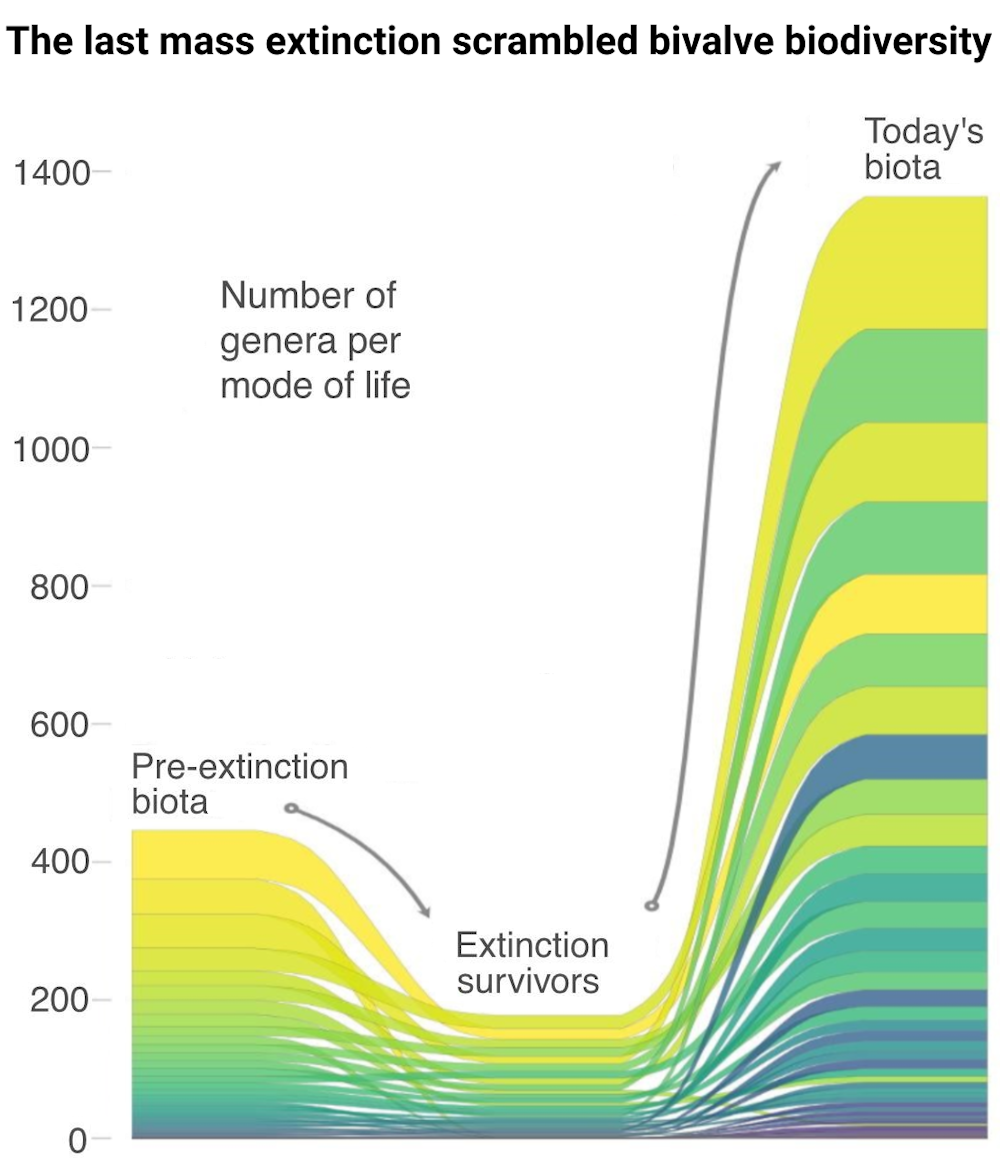
    The extinction caused by the asteroid strike knocked down some thriving modes of life and opened the door for others to dominate the new landscape.

    The rebound from the extinction wasn’t so straightforward. Some modes of life lost nearly all their species, never to recover their past diversity. Others rose to take the top ranks. Genera is the plural of genus.
    Adapted from Edie et al. 2025, Science Advances

    While many people lament the loss of the dinosaurs, we malacologists miss the rudists.

    These bizarrely shaped bivalves resembled giant ice cream cones, sometimes reaching more than 3 feet (1 meter) in size, and they dominated the shallow, tropical Mesozoic seas as massive aggregations of contorted individuals, similar to today’s coral reefs. At least a few harbored photosymbiotic algae, which provided them with nutrients and spurred their growth, much like modern corals.

    An ancient fossil of a rudist from before the last mass extinction. These bivalves could grow to a meter high.
    Smithsonian Institution

    Today, giant clams (Tridacna) and their relatives fill parts of these unique photosymbiotic lifestyles once occupied by the rudists, but they lack the rudists’ astonishing species diversity.

    Mass extinctions clearly upend the status quo. Now, our ocean floors are dominated by clams burrowed into sand and mud, the quahogs, cockles and their relatives – a scene far different from that of the seafloor 66 million years ago.

    New winners in a scrambled ecosystem

    Ecological traits alone didn’t fully predict extinction patterns, nor do they entirely explain the rebound. We also see that simply surviving a mass extinction didn’t necessarily provide a leg up as species diversified within their old and sometimes new modes of life – and few of those new modes dominate the ecological landscape today.

    Like the rudists, trigoniid bivalves had lots of different species prior to the extinction event. These highly ornamented clams built parts of their shells with a super strong biomaterial called nacre – think iridescent pearls – and had fractally interlocking hinges holding their two valves together.

    An ancient fossil of a pearly but tough trigoniid bivalve from the last mass extinction. The two matching shells show their elaborate hinge.
    Smithsonian Institution

    But despite surviving the extinction, which should have placed them in a prime position to accumulate species again, their diversification sputtered. Other types of bivalves that made a living in the same way proliferated instead, relegating this once mighty and global group to a handful of species now found only off the coast of Australia.

    Lessons for today’s oceans

    These unexpected patterns of extinction and survival may offer lessons for the future.

    The fossil record shows us that biodiversity has definite breaking points, usually during a perfect storm of climatic and environmental upheaval. It’s not just that species are lost, but the ecological landscape is overturned.

    Many scientists believe the current biodiversity crisis may cascade into a sixth mass extinction, this one driven by human activities that are changing ecosystems and the global climate. Corals, whose reefs are home to nearly a quarter of known marine species, have faced mass bleaching events as warming ocean water puts their future at risk. Acidification as the oceans absorb more carbon dioxide can also weaken the shells of organisms crucial to the ocean food web.

    Findings like ours suggest that, in the future, the rebound from extinction events will likely result in very different mixes of species and their modes of life in the oceans. And the result may not align with human needs if species providing the bulk of ecosystem services are driven genetically or functionally extinct.

    The global oceans and their inhabitants are complex, and, as our team’s latest research shows, it is difficult to predict the trajectory of biodiversity as it rebounds – even when extinction pressures are reduced.

    Billions of people depend on the ocean for food. As the history recorded by the world’s bivalves shows, the upending of the pecking order – the number of species in each mode of life – won’t necessarily settle into an arrangement that can feed as many people the next time around.

    Stewart Edie receives funding from the Smithsonian Institution.

    ref. Ancient fossils show how the last mass extinction forever scrambled the ocean’s biodiversity – https://theconversation.com/ancient-fossils-show-how-the-last-mass-extinction-forever-scrambled-the-oceans-biodiversity-258389

    MIL OSI

  • MIL-OSI Submissions: Ancient fossils show how the last mass extinction forever scrambled the ocean’s biodiversity

    Source: The Conversation – USA (2) – By Stewart Edie, Research Geologist and Curator of Paleobiology, Smithsonian Institution

    Even bivalves looked different during the time of the dinosaurs, as these fossils of an ultra-fortified oyster, left, and armored cockle show. Smithsonian Institution

    About 66 million years ago – perhaps on a downright unlucky day in May – an asteroid smashed into our planet.

    The fallout was immediate and severe. Evidence shows that about 70% of species went extinct in a geological instant, and not just those famous dinosaurs that once stalked the land. Masters of the Mesozoic oceans were also wiped out, from mosasaurs – a group of aquatic reptiles topping the food chain – to exquisitely shelled squid relatives known as ammonites.

    Even groups that weathered the catastrophe, such as mammals, fishes and flowering plants, suffered severe population declines and species loss. Invertebrate life in the oceans didn’t fare much better.

    But bubbling away on the seafloor was a stolid group of animals that has left a fantastic fossil record and continues to thrive today: bivalves – clams, cockles, mussels, oysters and more.

    What happened to these creatures during the extinction event and how they rebounded tells an important story, both about the past and the future of biodiversity.

    Surprising discoveries on the seafloor

    Marine bivalves lost around three-quarters of their species during this mass extinction, which marked the end of the Cretaceous Period. My colleagues and I – each of us paleobiologists studying biodiversity – expected that losing so many species would have severely cut down the variety of roles that bivalves play within their environments, what we call their “modes of life.”

    But, as we explain in a study published in the journal Sciences Advances, that wasn’t the case. In assessing the fossils of thousands of bivalve species, we found that at least one species from nearly all their modes of life, no matter how rare or specialized, squeaked through the extinction event.

    Statistically, that shouldn’t have happened. Kill 70% of bivalve species, even at random, and some modes of life should disappear.

    Bivalves had an amazing array of life modes just before the end-Cretaceous mass extinction 66 million years ago. Incredibly, despite the loss of 70% of their species, all but two modes of life survived – Nos. 2 and 10.
    Adapted from Edie et al. 2025, Science Advances

    Most bivalves happily burrow into the sand and mud, feeding on phytoplankton they strain from the water. But others have adopted chemosymbionts and photosymbionts – bacteria and algae that produce nutrients for the bivalves from chemicals or sunlight in exchange for housing. A few have even become carnivorous. Some groups, including the oysters, can lay down a tough cement that hardens underwater, and mussels hold onto rocks by spinning silken threads.

    We thought surely these more specialized modes of life would have been snuffed out by the effects of the asteroid’s impact, including dust and debris likely blocking sunlight and disrupting a huge part of the bivalves’ food chain: photosynthetic algae and bacteria. Instead, most persisted, although biodiversity was forever scrambled as a new ecological landscape emerged. Species that were once dominant struggled, while evolutionary newcomers rose in their place.

    The reasons some species survived and others didn’t leave many questions to explore. Those that filtered phytoplankton from the water column suffered some of the highest species losses, but so did species that fed on organic scraps and didn’t rely as much on the Sun’s energy. Narrow geographic distributions and different metabolisms may have contributed to these extinction patterns.

    Biodiversity bounces back

    Life rebounded from each of the Big Five mass extinctions throughout Earth’s history, eventually punching through past diversity highs. The rich fossil record and spectacular ecological diversity of bivalves gives us a terrific opportunity to study these rebounds to understand how ecosystems and global biodiversity rebuild in the wake of extinctions.

    The extinction caused by the asteroid strike knocked down some thriving modes of life and opened the door for others to dominate the new landscape.

    The rebound from the extinction wasn’t so straightforward. Some modes of life lost nearly all their species, never to recover their past diversity. Others rose to take the top ranks. Genera is the plural of genus.
    Adapted from Edie et al. 2025, Science Advances

    While many people lament the loss of the dinosaurs, we malacologists miss the rudists.

    These bizarrely shaped bivalves resembled giant ice cream cones, sometimes reaching more than 3 feet (1 meter) in size, and they dominated the shallow, tropical Mesozoic seas as massive aggregations of contorted individuals, similar to today’s coral reefs. At least a few harbored photosymbiotic algae, which provided them with nutrients and spurred their growth, much like modern corals.

    An ancient fossil of a rudist from before the last mass extinction. These bivalves could grow to a meter high.
    Smithsonian Institution

    Today, giant clams (Tridacna) and their relatives fill parts of these unique photosymbiotic lifestyles once occupied by the rudists, but they lack the rudists’ astonishing species diversity.

    Mass extinctions clearly upend the status quo. Now, our ocean floors are dominated by clams burrowed into sand and mud, the quahogs, cockles and their relatives – a scene far different from that of the seafloor 66 million years ago.

    New winners in a scrambled ecosystem

    Ecological traits alone didn’t fully predict extinction patterns, nor do they entirely explain the rebound. We also see that simply surviving a mass extinction didn’t necessarily provide a leg up as species diversified within their old and sometimes new modes of life – and few of those new modes dominate the ecological landscape today.

    Like the rudists, trigoniid bivalves had lots of different species prior to the extinction event. These highly ornamented clams built parts of their shells with a super strong biomaterial called nacre – think iridescent pearls – and had fractally interlocking hinges holding their two valves together.

    An ancient fossil of a pearly but tough trigoniid bivalve from the last mass extinction. The two matching shells show their elaborate hinge.
    Smithsonian Institution

    But despite surviving the extinction, which should have placed them in a prime position to accumulate species again, their diversification sputtered. Other types of bivalves that made a living in the same way proliferated instead, relegating this once mighty and global group to a handful of species now found only off the coast of Australia.

    Lessons for today’s oceans

    These unexpected patterns of extinction and survival may offer lessons for the future.

    The fossil record shows us that biodiversity has definite breaking points, usually during a perfect storm of climatic and environmental upheaval. It’s not just that species are lost, but the ecological landscape is overturned.

    Many scientists believe the current biodiversity crisis may cascade into a sixth mass extinction, this one driven by human activities that are changing ecosystems and the global climate. Corals, whose reefs are home to nearly a quarter of known marine species, have faced mass bleaching events as warming ocean water puts their future at risk. Acidification as the oceans absorb more carbon dioxide can also weaken the shells of organisms crucial to the ocean food web.

    Findings like ours suggest that, in the future, the rebound from extinction events will likely result in very different mixes of species and their modes of life in the oceans. And the result may not align with human needs if species providing the bulk of ecosystem services are driven genetically or functionally extinct.

    The global oceans and their inhabitants are complex, and, as our team’s latest research shows, it is difficult to predict the trajectory of biodiversity as it rebounds – even when extinction pressures are reduced.

    Billions of people depend on the ocean for food. As the history recorded by the world’s bivalves shows, the upending of the pecking order – the number of species in each mode of life – won’t necessarily settle into an arrangement that can feed as many people the next time around.

    Stewart Edie receives funding from the Smithsonian Institution.

    ref. Ancient fossils show how the last mass extinction forever scrambled the ocean’s biodiversity – https://theconversation.com/ancient-fossils-show-how-the-last-mass-extinction-forever-scrambled-the-oceans-biodiversity-258389

    MIL OSI

  • MIL-OSI Submissions: Ancient fossils show how the last mass extinction forever scrambled the ocean’s biodiversity

    Source: The Conversation – USA (2) – By Stewart Edie, Research Geologist and Curator of Paleobiology, Smithsonian Institution

    Even bivalves looked different during the time of the dinosaurs, as these fossils of an ultra-fortified oyster, left, and armored cockle show. Smithsonian Institution

    About 66 million years ago – perhaps on a downright unlucky day in May – an asteroid smashed into our planet.

    The fallout was immediate and severe. Evidence shows that about 70% of species went extinct in a geological instant, and not just those famous dinosaurs that once stalked the land. Masters of the Mesozoic oceans were also wiped out, from mosasaurs – a group of aquatic reptiles topping the food chain – to exquisitely shelled squid relatives known as ammonites.

    Even groups that weathered the catastrophe, such as mammals, fishes and flowering plants, suffered severe population declines and species loss. Invertebrate life in the oceans didn’t fare much better.

    But bubbling away on the seafloor was a stolid group of animals that has left a fantastic fossil record and continues to thrive today: bivalves – clams, cockles, mussels, oysters and more.

    What happened to these creatures during the extinction event and how they rebounded tells an important story, both about the past and the future of biodiversity.

    Surprising discoveries on the seafloor

    Marine bivalves lost around three-quarters of their species during this mass extinction, which marked the end of the Cretaceous Period. My colleagues and I – each of us paleobiologists studying biodiversity – expected that losing so many species would have severely cut down the variety of roles that bivalves play within their environments, what we call their “modes of life.”

    But, as we explain in a study published in the journal Sciences Advances, that wasn’t the case. In assessing the fossils of thousands of bivalve species, we found that at least one species from nearly all their modes of life, no matter how rare or specialized, squeaked through the extinction event.

    Statistically, that shouldn’t have happened. Kill 70% of bivalve species, even at random, and some modes of life should disappear.

    Bivalves had an amazing array of life modes just before the end-Cretaceous mass extinction 66 million years ago. Incredibly, despite the loss of 70% of their species, all but two modes of life survived – Nos. 2 and 10.
    Adapted from Edie et al. 2025, Science Advances

    Most bivalves happily burrow into the sand and mud, feeding on phytoplankton they strain from the water. But others have adopted chemosymbionts and photosymbionts – bacteria and algae that produce nutrients for the bivalves from chemicals or sunlight in exchange for housing. A few have even become carnivorous. Some groups, including the oysters, can lay down a tough cement that hardens underwater, and mussels hold onto rocks by spinning silken threads.

    We thought surely these more specialized modes of life would have been snuffed out by the effects of the asteroid’s impact, including dust and debris likely blocking sunlight and disrupting a huge part of the bivalves’ food chain: photosynthetic algae and bacteria. Instead, most persisted, although biodiversity was forever scrambled as a new ecological landscape emerged. Species that were once dominant struggled, while evolutionary newcomers rose in their place.

    The reasons some species survived and others didn’t leave many questions to explore. Those that filtered phytoplankton from the water column suffered some of the highest species losses, but so did species that fed on organic scraps and didn’t rely as much on the Sun’s energy. Narrow geographic distributions and different metabolisms may have contributed to these extinction patterns.

    Biodiversity bounces back

    Life rebounded from each of the Big Five mass extinctions throughout Earth’s history, eventually punching through past diversity highs. The rich fossil record and spectacular ecological diversity of bivalves gives us a terrific opportunity to study these rebounds to understand how ecosystems and global biodiversity rebuild in the wake of extinctions.

    The extinction caused by the asteroid strike knocked down some thriving modes of life and opened the door for others to dominate the new landscape.

    The rebound from the extinction wasn’t so straightforward. Some modes of life lost nearly all their species, never to recover their past diversity. Others rose to take the top ranks. Genera is the plural of genus.
    Adapted from Edie et al. 2025, Science Advances

    While many people lament the loss of the dinosaurs, we malacologists miss the rudists.

    These bizarrely shaped bivalves resembled giant ice cream cones, sometimes reaching more than 3 feet (1 meter) in size, and they dominated the shallow, tropical Mesozoic seas as massive aggregations of contorted individuals, similar to today’s coral reefs. At least a few harbored photosymbiotic algae, which provided them with nutrients and spurred their growth, much like modern corals.

    An ancient fossil of a rudist from before the last mass extinction. These bivalves could grow to a meter high.
    Smithsonian Institution

    Today, giant clams (Tridacna) and their relatives fill parts of these unique photosymbiotic lifestyles once occupied by the rudists, but they lack the rudists’ astonishing species diversity.

    Mass extinctions clearly upend the status quo. Now, our ocean floors are dominated by clams burrowed into sand and mud, the quahogs, cockles and their relatives – a scene far different from that of the seafloor 66 million years ago.

    New winners in a scrambled ecosystem

    Ecological traits alone didn’t fully predict extinction patterns, nor do they entirely explain the rebound. We also see that simply surviving a mass extinction didn’t necessarily provide a leg up as species diversified within their old and sometimes new modes of life – and few of those new modes dominate the ecological landscape today.

    Like the rudists, trigoniid bivalves had lots of different species prior to the extinction event. These highly ornamented clams built parts of their shells with a super strong biomaterial called nacre – think iridescent pearls – and had fractally interlocking hinges holding their two valves together.

    An ancient fossil of a pearly but tough trigoniid bivalve from the last mass extinction. The two matching shells show their elaborate hinge.
    Smithsonian Institution

    But despite surviving the extinction, which should have placed them in a prime position to accumulate species again, their diversification sputtered. Other types of bivalves that made a living in the same way proliferated instead, relegating this once mighty and global group to a handful of species now found only off the coast of Australia.

    Lessons for today’s oceans

    These unexpected patterns of extinction and survival may offer lessons for the future.

    The fossil record shows us that biodiversity has definite breaking points, usually during a perfect storm of climatic and environmental upheaval. It’s not just that species are lost, but the ecological landscape is overturned.

    Many scientists believe the current biodiversity crisis may cascade into a sixth mass extinction, this one driven by human activities that are changing ecosystems and the global climate. Corals, whose reefs are home to nearly a quarter of known marine species, have faced mass bleaching events as warming ocean water puts their future at risk. Acidification as the oceans absorb more carbon dioxide can also weaken the shells of organisms crucial to the ocean food web.

    Findings like ours suggest that, in the future, the rebound from extinction events will likely result in very different mixes of species and their modes of life in the oceans. And the result may not align with human needs if species providing the bulk of ecosystem services are driven genetically or functionally extinct.

    The global oceans and their inhabitants are complex, and, as our team’s latest research shows, it is difficult to predict the trajectory of biodiversity as it rebounds – even when extinction pressures are reduced.

    Billions of people depend on the ocean for food. As the history recorded by the world’s bivalves shows, the upending of the pecking order – the number of species in each mode of life – won’t necessarily settle into an arrangement that can feed as many people the next time around.

    Stewart Edie receives funding from the Smithsonian Institution.

    ref. Ancient fossils show how the last mass extinction forever scrambled the ocean’s biodiversity – https://theconversation.com/ancient-fossils-show-how-the-last-mass-extinction-forever-scrambled-the-oceans-biodiversity-258389

    MIL OSI

  • MIL-OSI Submissions: Ancient fossils show how the last mass extinction forever scrambled the ocean’s biodiversity

    Source: The Conversation – USA (2) – By Stewart Edie, Research Geologist and Curator of Paleobiology, Smithsonian Institution

    Even bivalves looked different during the time of the dinosaurs, as these fossils of an ultra-fortified oyster, left, and armored cockle show. Smithsonian Institution

    About 66 million years ago – perhaps on a downright unlucky day in May – an asteroid smashed into our planet.

    The fallout was immediate and severe. Evidence shows that about 70% of species went extinct in a geological instant, and not just those famous dinosaurs that once stalked the land. Masters of the Mesozoic oceans were also wiped out, from mosasaurs – a group of aquatic reptiles topping the food chain – to exquisitely shelled squid relatives known as ammonites.

    Even groups that weathered the catastrophe, such as mammals, fishes and flowering plants, suffered severe population declines and species loss. Invertebrate life in the oceans didn’t fare much better.

    But bubbling away on the seafloor was a stolid group of animals that has left a fantastic fossil record and continues to thrive today: bivalves – clams, cockles, mussels, oysters and more.

    What happened to these creatures during the extinction event and how they rebounded tells an important story, both about the past and the future of biodiversity.

    Surprising discoveries on the seafloor

    Marine bivalves lost around three-quarters of their species during this mass extinction, which marked the end of the Cretaceous Period. My colleagues and I – each of us paleobiologists studying biodiversity – expected that losing so many species would have severely cut down the variety of roles that bivalves play within their environments, what we call their “modes of life.”

    But, as we explain in a study published in the journal Sciences Advances, that wasn’t the case. In assessing the fossils of thousands of bivalve species, we found that at least one species from nearly all their modes of life, no matter how rare or specialized, squeaked through the extinction event.

    Statistically, that shouldn’t have happened. Kill 70% of bivalve species, even at random, and some modes of life should disappear.

    Bivalves had an amazing array of life modes just before the end-Cretaceous mass extinction 66 million years ago. Incredibly, despite the loss of 70% of their species, all but two modes of life survived – Nos. 2 and 10.
    Adapted from Edie et al. 2025, Science Advances

    Most bivalves happily burrow into the sand and mud, feeding on phytoplankton they strain from the water. But others have adopted chemosymbionts and photosymbionts – bacteria and algae that produce nutrients for the bivalves from chemicals or sunlight in exchange for housing. A few have even become carnivorous. Some groups, including the oysters, can lay down a tough cement that hardens underwater, and mussels hold onto rocks by spinning silken threads.

    We thought surely these more specialized modes of life would have been snuffed out by the effects of the asteroid’s impact, including dust and debris likely blocking sunlight and disrupting a huge part of the bivalves’ food chain: photosynthetic algae and bacteria. Instead, most persisted, although biodiversity was forever scrambled as a new ecological landscape emerged. Species that were once dominant struggled, while evolutionary newcomers rose in their place.

    The reasons some species survived and others didn’t leave many questions to explore. Those that filtered phytoplankton from the water column suffered some of the highest species losses, but so did species that fed on organic scraps and didn’t rely as much on the Sun’s energy. Narrow geographic distributions and different metabolisms may have contributed to these extinction patterns.

    Biodiversity bounces back

    Life rebounded from each of the Big Five mass extinctions throughout Earth’s history, eventually punching through past diversity highs. The rich fossil record and spectacular ecological diversity of bivalves gives us a terrific opportunity to study these rebounds to understand how ecosystems and global biodiversity rebuild in the wake of extinctions.

    The extinction caused by the asteroid strike knocked down some thriving modes of life and opened the door for others to dominate the new landscape.

    The rebound from the extinction wasn’t so straightforward. Some modes of life lost nearly all their species, never to recover their past diversity. Others rose to take the top ranks. Genera is the plural of genus.
    Adapted from Edie et al. 2025, Science Advances

    While many people lament the loss of the dinosaurs, we malacologists miss the rudists.

    These bizarrely shaped bivalves resembled giant ice cream cones, sometimes reaching more than 3 feet (1 meter) in size, and they dominated the shallow, tropical Mesozoic seas as massive aggregations of contorted individuals, similar to today’s coral reefs. At least a few harbored photosymbiotic algae, which provided them with nutrients and spurred their growth, much like modern corals.

    An ancient fossil of a rudist from before the last mass extinction. These bivalves could grow to a meter high.
    Smithsonian Institution

    Today, giant clams (Tridacna) and their relatives fill parts of these unique photosymbiotic lifestyles once occupied by the rudists, but they lack the rudists’ astonishing species diversity.

    Mass extinctions clearly upend the status quo. Now, our ocean floors are dominated by clams burrowed into sand and mud, the quahogs, cockles and their relatives – a scene far different from that of the seafloor 66 million years ago.

    New winners in a scrambled ecosystem

    Ecological traits alone didn’t fully predict extinction patterns, nor do they entirely explain the rebound. We also see that simply surviving a mass extinction didn’t necessarily provide a leg up as species diversified within their old and sometimes new modes of life – and few of those new modes dominate the ecological landscape today.

    Like the rudists, trigoniid bivalves had lots of different species prior to the extinction event. These highly ornamented clams built parts of their shells with a super strong biomaterial called nacre – think iridescent pearls – and had fractally interlocking hinges holding their two valves together.

    An ancient fossil of a pearly but tough trigoniid bivalve from the last mass extinction. The two matching shells show their elaborate hinge.
    Smithsonian Institution

    But despite surviving the extinction, which should have placed them in a prime position to accumulate species again, their diversification sputtered. Other types of bivalves that made a living in the same way proliferated instead, relegating this once mighty and global group to a handful of species now found only off the coast of Australia.

    Lessons for today’s oceans

    These unexpected patterns of extinction and survival may offer lessons for the future.

    The fossil record shows us that biodiversity has definite breaking points, usually during a perfect storm of climatic and environmental upheaval. It’s not just that species are lost, but the ecological landscape is overturned.

    Many scientists believe the current biodiversity crisis may cascade into a sixth mass extinction, this one driven by human activities that are changing ecosystems and the global climate. Corals, whose reefs are home to nearly a quarter of known marine species, have faced mass bleaching events as warming ocean water puts their future at risk. Acidification as the oceans absorb more carbon dioxide can also weaken the shells of organisms crucial to the ocean food web.

    Findings like ours suggest that, in the future, the rebound from extinction events will likely result in very different mixes of species and their modes of life in the oceans. And the result may not align with human needs if species providing the bulk of ecosystem services are driven genetically or functionally extinct.

    The global oceans and their inhabitants are complex, and, as our team’s latest research shows, it is difficult to predict the trajectory of biodiversity as it rebounds – even when extinction pressures are reduced.

    Billions of people depend on the ocean for food. As the history recorded by the world’s bivalves shows, the upending of the pecking order – the number of species in each mode of life – won’t necessarily settle into an arrangement that can feed as many people the next time around.

    Stewart Edie receives funding from the Smithsonian Institution.

    ref. Ancient fossils show how the last mass extinction forever scrambled the ocean’s biodiversity – https://theconversation.com/ancient-fossils-show-how-the-last-mass-extinction-forever-scrambled-the-oceans-biodiversity-258389

    MIL OSI

  • MIL-OSI Submissions: Killer dolls and Brexit zombies – what to watch and do this week

    Source: The Conversation – UK – By Anna Walker, Senior Arts + Culture Editor

    Part of the appeal of the 2023 horror flick, M3gan, was that its titular antagonist managed to be two of the scariest villains of the genre in one – a killer robot, and a child’s doll come to life.

    After nine-year-old Cady (Violet McGraw) tragically lost her parents, her roboticist aunt Gemma (Allison Williams of Get Out fame) brought M3gan home to help her niece with the traumatic transition. M3gan was to be Cady’s teacher, playmate and above all, protector. In classic horror style, she soon embarked on a murderous rampage in the name of “protecting” her ward.

    The film was an instant cult hit, dubbed a “camp classic” thanks to M3gan’s TikTok dance moves and determination to destroy the nuclear family.

    In M3gan 2, in cinemas from today, the filmmakers have leaned into that campiness even more. But, as horror expert Adam Daniel explains that doesn’t completely neutralise the terror. Instead, it reformulates it, offering a cathartic release that makes the subject matter more digestible.


    Read more:
    From HAL 9000 to M3GAN: what film’s evil robots tell us about contemporary tech fears


    The trailer for M3gan 2.0.

    If you’re looking for more traditional jump scares, 28 Years Later has you covered. Danny Boyle has returned to the franchise with this instant-classic of the zombie genre, which muses on both post-Brexit Britain and our collective experiences of the COVID pandemic. In this film, Europe has contained a “rage virus” to Britain. There are French boats on quarantine patrols, Swedish soldiers mocking remaining mainlanders and St George’s flags burning.

    For COVID storytelling expert Lucyl Harrison: “The film ushers in a new age of ‘Vi-Fi’” (that’s virus fiction) “without succumbing to pulpy pandemic storytelling”. Ralph Fiennes offers a typically strong performance as the “mad” Dr Kelson, the only person determined to commemorate the virus’s ever-mounting dead.


    Read more:
    The spectacular frenzy of 28 Years Later offers a new breed of pandemic storytelling


    The trailer for 28 Years Later.

    I confess, I’m a bit of a baby when it comes to horror. So, I’ll need to follow up any zombie fare with something a little more comforting. My choice for this week is The Ballad of Wallis Island, which romcom giant Richard Curtis has dubbed “one of the great British films of all time”.

    It takes place on the fictional Wallis Island, home to millionaire Charles (Tim Key), an almost obsessive fan of former folk-rock duo played by Tom Basden and Carey Mulligan. Invited to the island to play a private gig, they must face their musical and romantic past, all under the gaze of an ecstatic Charles.

    The film was made in just 18 days on a tight budget in a typical Welsh summer – a doctor was on hand to stop the actors getting hypothermia when they filmed in the sea. It reminded our reviewer of another British comedy classic, Victoria Wood’s sitcom Dinnerladies, with its breadcrumb trail of slipped in details that provide laughter in the moment but which return to make the audience think twice.


    Read more:
    The Ballad of Wallis Island is a masterpiece of the extraordinary made ordinary


    The trailer for The Ballad of Wallis Island.

    When Poor Things won the Golden Globe for best picture last year, director Yorgos Lanthimos thanked everybody, from the cast and crew to his hero Bruce Springsteen. But one person who didn’t get a mention was Alasdair Gray, the Scottish artist and writer who wrote the novel the film was based on.

    Now Gray is rightly being celebrated at Glasgow’s Kelvingrove Art Gallery and Museum. The unseen paintings in the new show Alasdair Gray: Works from the Morag McAlpine Bequest come from a donation of works he made after the death of his wife in 2014.

    Highlights of the show include his original artwork for his novel Poor Things and the streetscape Gray called “my best big oil painting”, depicting Cowcaddens in Glasgow.


    Read more:
    Alasdair Gray: unseen artworks offer insight into a profoundly creative and original artist


    Pride month is coming to an end, but you can enjoy the movies in our Hidden Gems of Queer Cinema series year round. These articles highlight brilliant films that should be more widely known and firmly part of the canon of queer cinema. I’d particularly recommend Saving Face (2004), complicated romcom that tenderly depicts the experiences of queer Asian people.


    Read more:
    Hidden gems of LGBTQ+ cinema: Saving Face is a complicated romcom that tenderly depicts the experiences of queer Asians


    Looking for something good? Cut through the noise with a carefully curated selection of the latest releases, live events and exhibitions, straight to your inbox every fortnight, on Fridays. Sign up here.


    ref. Killer dolls and Brexit zombies – what to watch and do this week – https://theconversation.com/killer-dolls-and-brexit-zombies-what-to-watch-and-do-this-week-259923

    MIL OSI

  • MIL-OSI Submissions: Lake Victoria is turning green – the deadly bacteria behind it

    Source: The Conversation – Africa – By Lauren Hart, PhD candidate, Michigan Geomicrobiology Lab, University of Michigan

    Lakes, natural and man-made, provide water, food and habitats for wildlife, as well as supporting local economies. Around the world, though, there’s a growing threat to lakes: toxic bacteria which turn the water green.

    This is the same green as you see on stagnant ponds. It’s caused by tiny organisms called cyanobacteria and can be deadly.

    Cyanobacteria thrive in warm, sunny lakes and ponds that contain excess nitrogen and phosphorus nutrients derived from fertiliser, manure and sewage. When conditions are right, cyanobacteria multiply rapidly and form smelly green scums on the water’s surface.

    Known to science as cyanoHABs (cyanobacterial harmful algal blooms), the scums are harmful to livestock, wildlife, pets, people and aquatic organisms like fish. Toxins make untreated water unsafe to drink, swim in, or even touch. Sometimes they can become suspended in air and be inhaled. The cyanoHABs also harm ecosystems by depleting oxygen, killing off whatever lives in the water, and disrupting food webs and fisheries.

    CyanoHABs are a global threat and receive considerable scientific attention in North America and Europe. Blooms are becoming more widespread worldwide because rising temperatures promote cyanobacterial growth and more intense rainfall delivers nutrients from the landscape. Only effective management of nutrients can reverse this trend.

    The problem is understudied in Africa’s main lakes, including its largest – Lake Victoria. Past research on cyanoHABs has mostly used microscopy to study the kinds found there, but microscopy cannot differentiate between toxic and non-toxic cyanobacterial cells.

    We are on a large project team of scientists who have been studying the socioeconomic and environmental effects of cyanoHABs in the Winam Gulf region of Lake Victoria in south-western Kenya.

    Our latest study identified which cyanobacteria were the most abundant in the gulf and which ones were producing the main toxin of concern.

    These findings can improve public safety:

    • local authorities can monitor for specific cyanobacteria and warn residents to stay away when blooms are present

    • cyanoHAB prevention practices (nutrient reduction, land-use practices) can target the cyanobacteria that cause the problem.

    Greening of lakes

    Lake Victoria now receives large influxes of nutrients because of growing lakeside populations and land-use changes. Nutrients from agriculture, industry and urbanisation fuel the growth of cyanoHABs.

    CyanoHABs occur in many basins in Lake Victoria but are highly concentrated in Kenya’s shallow Winam/Nyanza Gulf. Changing nutrient and temperature conditions can also alter which types of cyanobacteria dominate the gulf and the types and levels of toxins in the water. Lakeside communities that rely on the gulf for drinking water and domestic tasks are at risk of exposure to cyanoHAB toxins.

    Past research on cyanoHABs has mostly used the oldest of microbiological techniques — microscopy — to classify the types of cyanobacteria in the gulf. This cannot differentiate between toxic and non-toxic cyanobacterial cells.

    Modern genome sequencing technologies can identify genes encoding the production of known and novel toxins and other molecules of interest, such as those with medicinal properties. Genomic data from African Great Lakes is scarce, so the chemical capabilities of bacteria in this region are largely unexplored. But this is beginning to change.

    Our latest study adds to a growing number of recent studies our team has carried out in and around Lake Victoria. In this study, our research vessel stopped at over 31 sites to collect scientific samples and data. The samples were later analysed for DNA, the biological “instruction manual” inside every living thing. DNA tells an organism how to grow, function, reproduce, and – in the case of cyanobacteria – make deadly toxins. This analysis produced near-complete genome sequences – that is, the set of all genes in the DNA – for organisms at each sampling site.

    Past reports identified Microcystis as the dominant cyanobacteria in the Winam Gulf. Our research, however, found Dolichospermum was the most abundant type in major cyanoHAB events there. This finding might be due to recent environmental changes in the region.

    But we linked Microcystis to microcystin. This is a liver-damaging toxin that can kill livestock, wildlife and humans, especially those whose immune system isn’t working well. In Winam Gulf, it’s often more abundant than the health limits set by the WHO.

    Our study also found that Microcystis occurs mainly in murkier river mouths where green scums are not visible, making scientific monitoring and public alerts even more important.

    Local authorities can now monitor for these cyanobacteria and warn residents to stay away when blooms are present.

    The findings also mean that authorities know which cyanobacteria to target in prevention efforts like reducing the amount of phosphorus and other nutrients entering the gulf.

    Lastly, our genomic study uncovered over 300 uncharacterised genes that may produce novel cyanobacterial molecules. These molecules could have toxic or therapeutic effects, and provide an opportunity for future investigators to explore.

    A model for what is to come

    Rapid human population growth and settlement around lakes and their watersheds is leading to high levels nutrients in lakes around the world. This results in excessive growth of algae and aquatic plants. This danger is likely to increase with global warming because warm temperatures promote algal blooms.

    Our data provides a foundation for remedying this in Lake Victoria – and possibly discovering beneficial properties in cyanoHABs.

    Lauren Hart receives funding from National Institute of Health.

    George S Bullerjahn receives funding from the National Science Foundation.

    Gregory J. Dick receives funding from the National Science Foundation, the National Oceanic and Atmospheric Administration, the National Institutes for Health, and the US Geological Survey.

    Kefa M. Otiso receives funding from the US National Science Foundation.

    ref. Lake Victoria is turning green – the deadly bacteria behind it – https://theconversation.com/lake-victoria-is-turning-green-the-deadly-bacteria-behind-it-249298

    MIL OSI

  • Wildfires burn in Turkey and France as early heatwave hits

    Source: Government of India

    Source: Government of India (4)

    Firefighters battled wildfires in Turkey and France on Monday as an early heatwave hit the region.

    In Turkey, the wildfires raged for a second day in the western province of Izmir, fanned by strong winds, Forestry Minister Ibrahim Yumakli said, forcing the evacuation of four villages and two neighbourhoods.

    Media footage showed teams using tractors with water trailers and helicopters carrying water, as smoke billowed over hills marked with charred trees.

    Turkey’s coastal regions have in recent years been ravaged by wildfires, as summers have become hotter and drier, which scientists say is a result of human-induced climate change.

    In France, where temperatures are expected to peak on Tuesday and Wednesday, wildfires broke out on Sunday in the southwestern Aude department, where temperatures topped 40 degrees Celsius (104 degrees Fahrenheit), burning 400 hectares and forcing the evacuation of a campsite and an abbey, authorities and local media said.

    The fires were under control but not yet extinguished, authorities said on Monday.

    Weather service Meteo France put a record 84 of the country’s 101 departments on an orange heatwave alert from Monday until midweek. About 200 schools will be at least partially shut over the next three days because of the heat, the Education Ministry said.

    HEATWAVE IMPACTS RHINE SHIPPING

    The heatwave has lowered water levels on Germany’s Rhine River, hampering shipping and raising freight costs for cargo owners, commodity traders said.

    The Rhine is an important shipping route for commodities such as grains, minerals and oil products. Forecasters said temperatures as high as 40 C are possible in Cologne.

    In Seville, southern Spain, where global leaders were gathering for a United Nations conference, temperatures were expected to hit 42 C.

    Tourists were trying to deal with the heat. “Really hard currently,” Mehrzad Joussefi, from the Netherlands, said.

    Spain is on course for its hottest June on record, the national meteorological service AEMET said.

    Most of the country remains under alert for heat, with AEMET forecasting the peak of the heatwave on Monday.

    “Over the next few days, at least until Thursday, intense heat will continue in much of Spain,” said Ruben del Campo, a spokesperson for the weather agency.

    Italy’s Health Ministry issued heatwave red alerts for 21 cities, including Rome and Milan. Weather forecast website IlMeteo.it said temperatures on Monday would go as high as 41 C in Florence, 38 C in Bologna and 37 C in Perugia.

    The Lombardy region, part of Italy’s northern industrial heartland, is planning to ban open-air work in the hottest times of the day, heeding a request from trade unions, its president said on Monday.

    Heat can affect health in various ways, and experts are most concerned about older people and babies, as well as outdoor labourers and people struggling economically.

    Globally, extreme heat kills up to 480,000 people annually, surpassing the combined toll from floods, earthquakes and hurricanes, and poses growing risks to infrastructure, the economy and healthcare systems, Swiss Re said earlier this month.

    Global surface temperatures last month averaged 1.4 C higher than in the 1850-1900 pre-industrial period, when humans began burning fossil fuels on an industrial scale, the EU’s Copernicus Climate Change Service (C3S) said earlier this month.

    Scientists say the main cause of climate change is greenhouse gas emissions from burning fossil fuels. Last year was the planet’s hottest on record.

    (Reuters)

  • Wildfires burn in Turkey and France as early heatwave hits

    Source: Government of India

    Source: Government of India (4)

    Firefighters battled wildfires in Turkey and France on Monday as an early heatwave hit the region.

    In Turkey, the wildfires raged for a second day in the western province of Izmir, fanned by strong winds, Forestry Minister Ibrahim Yumakli said, forcing the evacuation of four villages and two neighbourhoods.

    Media footage showed teams using tractors with water trailers and helicopters carrying water, as smoke billowed over hills marked with charred trees.

    Turkey’s coastal regions have in recent years been ravaged by wildfires, as summers have become hotter and drier, which scientists say is a result of human-induced climate change.

    In France, where temperatures are expected to peak on Tuesday and Wednesday, wildfires broke out on Sunday in the southwestern Aude department, where temperatures topped 40 degrees Celsius (104 degrees Fahrenheit), burning 400 hectares and forcing the evacuation of a campsite and an abbey, authorities and local media said.

    The fires were under control but not yet extinguished, authorities said on Monday.

    Weather service Meteo France put a record 84 of the country’s 101 departments on an orange heatwave alert from Monday until midweek. About 200 schools will be at least partially shut over the next three days because of the heat, the Education Ministry said.

    HEATWAVE IMPACTS RHINE SHIPPING

    The heatwave has lowered water levels on Germany’s Rhine River, hampering shipping and raising freight costs for cargo owners, commodity traders said.

    The Rhine is an important shipping route for commodities such as grains, minerals and oil products. Forecasters said temperatures as high as 40 C are possible in Cologne.

    In Seville, southern Spain, where global leaders were gathering for a United Nations conference, temperatures were expected to hit 42 C.

    Tourists were trying to deal with the heat. “Really hard currently,” Mehrzad Joussefi, from the Netherlands, said.

    Spain is on course for its hottest June on record, the national meteorological service AEMET said.

    Most of the country remains under alert for heat, with AEMET forecasting the peak of the heatwave on Monday.

    “Over the next few days, at least until Thursday, intense heat will continue in much of Spain,” said Ruben del Campo, a spokesperson for the weather agency.

    Italy’s Health Ministry issued heatwave red alerts for 21 cities, including Rome and Milan. Weather forecast website IlMeteo.it said temperatures on Monday would go as high as 41 C in Florence, 38 C in Bologna and 37 C in Perugia.

    The Lombardy region, part of Italy’s northern industrial heartland, is planning to ban open-air work in the hottest times of the day, heeding a request from trade unions, its president said on Monday.

    Heat can affect health in various ways, and experts are most concerned about older people and babies, as well as outdoor labourers and people struggling economically.

    Globally, extreme heat kills up to 480,000 people annually, surpassing the combined toll from floods, earthquakes and hurricanes, and poses growing risks to infrastructure, the economy and healthcare systems, Swiss Re said earlier this month.

    Global surface temperatures last month averaged 1.4 C higher than in the 1850-1900 pre-industrial period, when humans began burning fossil fuels on an industrial scale, the EU’s Copernicus Climate Change Service (C3S) said earlier this month.

    Scientists say the main cause of climate change is greenhouse gas emissions from burning fossil fuels. Last year was the planet’s hottest on record.

    (Reuters)

  • MIL-OSI Economics: W&T Announces Positive Court Finding Regarding Remaining Surety Provider Claims

    Source: W & T Offshore Inc

    Headline: W&T Announces Positive Court Finding Regarding Remaining Surety Provider Claims

    HOUSTON, June 30, 2025 (GLOBE NEWSWIRE) — W&T Offshore, Inc. (NYSE: WTI) (“W&T” or the “Company”) today announced that U.S. Magistrate Judge Dena Palermo recommended denying two surety companies motions for preliminary injunction, through which they collectively asked for full monetization of over $100 million dollars. The Court found, in relevant part, the sureties failed to demonstrate they would suffer irreparable harm if their cash collateral demands were not granted.

    Key highlights relating to the ruling include:

    • Sureties’ motion for preliminary injunction, which would have required W&T to immediately post collateral, was categorically recommended to be denied;
    • Sureties failed to carry a clear burden of proof to establish irreparable harm necessary to obtain a preliminary injunction;
    • Ruling results in all current collateral requests by sureties being effectively nullified;
    • The Company will not be required to post collateral (if at all) until a determination on the merits of the pending lawsuit with the remaining surety providers;
    • The previously-announced settlement agreement, together with this favorable Court ruling, represent significant positive outcomes for W&T.

    Tracy W. Krohn, W&T’s Chairman and Chief Executive Officer stated, “We are very pleased with the Magistrate Judge’s recommendation that the Sureties’ preliminary injunction motions be denied. This vindicates W&T’s decision to aggressively defend against unlawful predatory business practices. W&T looks forward to a day when independent operators can once again operate in the Gulf of America unhampered by collusion and unlawful pressures exerted by sureties’ unfettered market power. We could not be more pleased with the Court’s decision preventing unnecessary and unjustified collateral demands by abusive surety providers.”  

    Mr. Krohn added, “surety providers have, for far too long, abused the ability to demand collateral. The Magistrate Judge’s recommendation, assuming it is upheld by the District Court, helps put an end to these blackmail business practices. Never again should any oil and gas producer have to cave to unjustified collateral demands. It admittedly takes courage and calculated risk to resist collective ultimatums from surety providers, but we hope the Court’s decision inspires others to follow suit in standing up to bullying tactics. The sureties’ collusive behavior has caused W&T’s (and other independent operators’) stockholders incalculable harm and it is about time that sureties are held accountable.”

    W&T Offshore’s legal team is led by its General Counsel, George J. Hittner, as well as Deputy General Counsels, Steven Lackey and Ted Imperato. W&T’s trial team is led by Yasser A. Madriz, the Managing Partner of the Houston Office of McGuireWoods, LLP along with members of the firm’s Commercial Litigation Section, Jason Huebinger, Megan Lewis, and Miles Indest.

    About W&T Offshore

    W&T Offshore, Inc. is an independent oil and natural gas producer with operations offshore in the Gulf of America and has grown through acquisitions, exploration and development. As of March 31, 2025, the Company had working interests in 52 fields in federal and state waters (which include 45 fields in federal waters and seven in state waters). The Company has under lease approximately 634,700 gross acres (496,900 net acres) spanning across the outer continental shelf off the coasts of Louisiana, Texas, Mississippi and Alabama, with approximately 487,200 gross acres on the conventional shelf, approximately 141,900 gross acres in the deepwater and 5,600 gross acres in Alabama state waters. A majority of the Company’s daily production is derived from wells it operates. For more information on W&T, please visit the Company’s website at www.wtoffshore.com.

    Forward-Looking and Cautionary Statements

    This press release contains forward-looking statements within the meaning of Section 27A of the Securities Act of 1933, as amended, and Section 21E of the Securities Exchange Act of 1934, as amended. All statements other than statements of historical facts included in this release, including those regarding the potential outcome of the litigation, the impact of the litigation on the Company or the industry more broadly, and the Company’s future operations are forward-looking statements. When used in this release, forward-looking statements are generally accompanied by terms or phrases such as “estimate,” “project,” “predict,” “believe,” “expect,” “continue,” “anticipate,” “target,” “could,” “plan,” “intend,” “seek,” “goal,” “will,” “should,” “may” or other words and similar expressions that convey the uncertainty of future events or outcomes, although not all forward-looking statements contain such identifying words. Items contemplating or making assumptions about actual or potential future production and sales, prices, market size, and trends or operating results also constitute such forward-looking statements.

    These forward-looking statements are based on the Company’s current expectations and assumptions about future events and speak only as of the date of this release. While management considers these expectations and assumptions to be reasonable, they are inherently subject to significant business, economic, competitive, regulatory and other risks, contingencies and uncertainties, most of which are difficult to predict and many of which are beyond the Company’s control. Accordingly, you are cautioned not to place undue reliance on these forward-looking statements, as results actually achieved may differ materially from expected results described in these statements. The Company does not undertake, and specifically disclaims, any obligation to update any forward-looking statements to reflect events or circumstances occurring after the date of such statements, unless required by law.

    Forward-looking statements are subject to risks and uncertainties that could cause actual results to differ including, among other things, the regulatory environment, including availability or timing of, and conditions imposed on, obtaining and/or maintaining permits and approvals, including those necessary for drilling and/or development projects; the impact of current, pending and/or future laws and regulations, and of legislative and regulatory changes and other government activities, including those related to permitting, drilling, completion, well stimulation, operation, maintenance or abandonment of wells or facilities, managing energy, water, land, greenhouse gases or other emissions, protection of health, safety and the environment, or transportation, marketing and sale of the Company’s products; inflation levels; global economic trends, geopolitical risks and general economic and industry conditions, such as the global supply chain disruptions and the government interventions into the financial markets and economy in response to inflation levels and world health events; volatility of oil, NGL and natural gas prices; the global energy future, including the factors and trends that are expected to shape it, such as concerns about climate change and other air quality issues, the transition to a low-emission economy and the expected role of different energy sources; supply of and demand for oil, NGLs and natural gas, including due to the actions of foreign producers, importantly including OPEC and other major oil producing companies (“OPEC+”) and change in OPEC+’s production levels; disruptions to, capacity constraints in, or other limitations on the pipeline systems that deliver the Company’s oil and natural gas and other processing and transportation considerations; inability to generate sufficient cash flow from operations or to obtain adequate financing to fund capital expenditures, meet the Company’s working capital requirements or fund planned investments; price fluctuations and availability of natural gas and electricity; the Company’s ability to use derivative instruments to manage commodity price risk; the Company’s ability to meet the Company’s planned drilling schedule, including due to the Company’s ability to obtain permits on a timely basis or at all, and to successfully drill wells that produce oil and natural gas in commercially viable quantities; uncertainties associated with estimating proved reserves and related future cash flows; the Company’s ability to replace the Company’s reserves through exploration and development activities; drilling and production results, lower–than–expected production, reserves or resources from development projects or higher–than–expected decline rates; the Company’s ability to obtain timely and available drilling and completion equipment and crew availability and access to necessary resources for drilling, completing and operating wells; changes in tax laws; effects of competition; uncertainties and liabilities associated with acquired and divested assets; the Company’s ability to make acquisitions and successfully integrate any acquired businesses; asset impairments from commodity price declines; large or multiple customer defaults on contractual obligations, including defaults resulting from actual or potential insolvencies; geographical concentration of the Company’s operations; the creditworthiness and performance of the Company’s counterparties with respect to its hedges; impact of derivatives legislation affecting the Company’s ability to hedge; failure of risk management and ineffectiveness of internal controls; catastrophic events, including tropical storms, hurricanes, earthquakes, pandemics and other world health events; environmental risks and liabilities under U.S. federal, state, tribal and local laws and regulations (including remedial actions); potential liability resulting from pending or future litigation; the Company’s ability to recruit and/or retain key members of the Company’s senior management and key technical employees; information technology failures or cyberattacks; and governmental actions and political conditions, as well as the actions by other third parties that are beyond the Company’s control, and other factors discussed in W&T Offshore’s most recent Annual Report on Form 10-K and subsequent Quarterly Reports on Form 10-Q found at www.sec.gov or at the Company’s website at www.wtoffshore.com under the Investor Relations section.

         
    CONTACT: Al Petrie Sameer Parasnis
      Investor Relations Coordinator Executive VP and CFO
      investorrelations@wtoffshore.com sparasnis@wtoffshore.com
      713-297-8024 713-513-8654

    Source: W&T Offshore, Inc.

    MIL OSI Economics

  • MIL-OSI Economics: W&T Announces Positive Court Finding Regarding Remaining Surety Provider Claims

    Source: W & T Offshore Inc

    Headline: W&T Announces Positive Court Finding Regarding Remaining Surety Provider Claims

    HOUSTON, June 30, 2025 (GLOBE NEWSWIRE) — W&T Offshore, Inc. (NYSE: WTI) (“W&T” or the “Company”) today announced that U.S. Magistrate Judge Dena Palermo recommended denying two surety companies motions for preliminary injunction, through which they collectively asked for full monetization of over $100 million dollars. The Court found, in relevant part, the sureties failed to demonstrate they would suffer irreparable harm if their cash collateral demands were not granted.

    Key highlights relating to the ruling include:

    • Sureties’ motion for preliminary injunction, which would have required W&T to immediately post collateral, was categorically recommended to be denied;
    • Sureties failed to carry a clear burden of proof to establish irreparable harm necessary to obtain a preliminary injunction;
    • Ruling results in all current collateral requests by sureties being effectively nullified;
    • The Company will not be required to post collateral (if at all) until a determination on the merits of the pending lawsuit with the remaining surety providers;
    • The previously-announced settlement agreement, together with this favorable Court ruling, represent significant positive outcomes for W&T.

    Tracy W. Krohn, W&T’s Chairman and Chief Executive Officer stated, “We are very pleased with the Magistrate Judge’s recommendation that the Sureties’ preliminary injunction motions be denied. This vindicates W&T’s decision to aggressively defend against unlawful predatory business practices. W&T looks forward to a day when independent operators can once again operate in the Gulf of America unhampered by collusion and unlawful pressures exerted by sureties’ unfettered market power. We could not be more pleased with the Court’s decision preventing unnecessary and unjustified collateral demands by abusive surety providers.”  

    Mr. Krohn added, “surety providers have, for far too long, abused the ability to demand collateral. The Magistrate Judge’s recommendation, assuming it is upheld by the District Court, helps put an end to these blackmail business practices. Never again should any oil and gas producer have to cave to unjustified collateral demands. It admittedly takes courage and calculated risk to resist collective ultimatums from surety providers, but we hope the Court’s decision inspires others to follow suit in standing up to bullying tactics. The sureties’ collusive behavior has caused W&T’s (and other independent operators’) stockholders incalculable harm and it is about time that sureties are held accountable.”

    W&T Offshore’s legal team is led by its General Counsel, George J. Hittner, as well as Deputy General Counsels, Steven Lackey and Ted Imperato. W&T’s trial team is led by Yasser A. Madriz, the Managing Partner of the Houston Office of McGuireWoods, LLP along with members of the firm’s Commercial Litigation Section, Jason Huebinger, Megan Lewis, and Miles Indest.

    About W&T Offshore

    W&T Offshore, Inc. is an independent oil and natural gas producer with operations offshore in the Gulf of America and has grown through acquisitions, exploration and development. As of March 31, 2025, the Company had working interests in 52 fields in federal and state waters (which include 45 fields in federal waters and seven in state waters). The Company has under lease approximately 634,700 gross acres (496,900 net acres) spanning across the outer continental shelf off the coasts of Louisiana, Texas, Mississippi and Alabama, with approximately 487,200 gross acres on the conventional shelf, approximately 141,900 gross acres in the deepwater and 5,600 gross acres in Alabama state waters. A majority of the Company’s daily production is derived from wells it operates. For more information on W&T, please visit the Company’s website at www.wtoffshore.com.

    Forward-Looking and Cautionary Statements

    This press release contains forward-looking statements within the meaning of Section 27A of the Securities Act of 1933, as amended, and Section 21E of the Securities Exchange Act of 1934, as amended. All statements other than statements of historical facts included in this release, including those regarding the potential outcome of the litigation, the impact of the litigation on the Company or the industry more broadly, and the Company’s future operations are forward-looking statements. When used in this release, forward-looking statements are generally accompanied by terms or phrases such as “estimate,” “project,” “predict,” “believe,” “expect,” “continue,” “anticipate,” “target,” “could,” “plan,” “intend,” “seek,” “goal,” “will,” “should,” “may” or other words and similar expressions that convey the uncertainty of future events or outcomes, although not all forward-looking statements contain such identifying words. Items contemplating or making assumptions about actual or potential future production and sales, prices, market size, and trends or operating results also constitute such forward-looking statements.

    These forward-looking statements are based on the Company’s current expectations and assumptions about future events and speak only as of the date of this release. While management considers these expectations and assumptions to be reasonable, they are inherently subject to significant business, economic, competitive, regulatory and other risks, contingencies and uncertainties, most of which are difficult to predict and many of which are beyond the Company’s control. Accordingly, you are cautioned not to place undue reliance on these forward-looking statements, as results actually achieved may differ materially from expected results described in these statements. The Company does not undertake, and specifically disclaims, any obligation to update any forward-looking statements to reflect events or circumstances occurring after the date of such statements, unless required by law.

    Forward-looking statements are subject to risks and uncertainties that could cause actual results to differ including, among other things, the regulatory environment, including availability or timing of, and conditions imposed on, obtaining and/or maintaining permits and approvals, including those necessary for drilling and/or development projects; the impact of current, pending and/or future laws and regulations, and of legislative and regulatory changes and other government activities, including those related to permitting, drilling, completion, well stimulation, operation, maintenance or abandonment of wells or facilities, managing energy, water, land, greenhouse gases or other emissions, protection of health, safety and the environment, or transportation, marketing and sale of the Company’s products; inflation levels; global economic trends, geopolitical risks and general economic and industry conditions, such as the global supply chain disruptions and the government interventions into the financial markets and economy in response to inflation levels and world health events; volatility of oil, NGL and natural gas prices; the global energy future, including the factors and trends that are expected to shape it, such as concerns about climate change and other air quality issues, the transition to a low-emission economy and the expected role of different energy sources; supply of and demand for oil, NGLs and natural gas, including due to the actions of foreign producers, importantly including OPEC and other major oil producing companies (“OPEC+”) and change in OPEC+’s production levels; disruptions to, capacity constraints in, or other limitations on the pipeline systems that deliver the Company’s oil and natural gas and other processing and transportation considerations; inability to generate sufficient cash flow from operations or to obtain adequate financing to fund capital expenditures, meet the Company’s working capital requirements or fund planned investments; price fluctuations and availability of natural gas and electricity; the Company’s ability to use derivative instruments to manage commodity price risk; the Company’s ability to meet the Company’s planned drilling schedule, including due to the Company’s ability to obtain permits on a timely basis or at all, and to successfully drill wells that produce oil and natural gas in commercially viable quantities; uncertainties associated with estimating proved reserves and related future cash flows; the Company’s ability to replace the Company’s reserves through exploration and development activities; drilling and production results, lower–than–expected production, reserves or resources from development projects or higher–than–expected decline rates; the Company’s ability to obtain timely and available drilling and completion equipment and crew availability and access to necessary resources for drilling, completing and operating wells; changes in tax laws; effects of competition; uncertainties and liabilities associated with acquired and divested assets; the Company’s ability to make acquisitions and successfully integrate any acquired businesses; asset impairments from commodity price declines; large or multiple customer defaults on contractual obligations, including defaults resulting from actual or potential insolvencies; geographical concentration of the Company’s operations; the creditworthiness and performance of the Company’s counterparties with respect to its hedges; impact of derivatives legislation affecting the Company’s ability to hedge; failure of risk management and ineffectiveness of internal controls; catastrophic events, including tropical storms, hurricanes, earthquakes, pandemics and other world health events; environmental risks and liabilities under U.S. federal, state, tribal and local laws and regulations (including remedial actions); potential liability resulting from pending or future litigation; the Company’s ability to recruit and/or retain key members of the Company’s senior management and key technical employees; information technology failures or cyberattacks; and governmental actions and political conditions, as well as the actions by other third parties that are beyond the Company’s control, and other factors discussed in W&T Offshore’s most recent Annual Report on Form 10-K and subsequent Quarterly Reports on Form 10-Q found at www.sec.gov or at the Company’s website at www.wtoffshore.com under the Investor Relations section.

         
    CONTACT: Al Petrie Sameer Parasnis
      Investor Relations Coordinator Executive VP and CFO
      investorrelations@wtoffshore.com sparasnis@wtoffshore.com
      713-297-8024 713-513-8654

    Source: W&T Offshore, Inc.

    MIL OSI Economics

  • MIL-OSI USA: Governor Green Enacts Legislation to Uphold Agricultural and Biosecurity Resilience and Support Local Innovation

    Source: US State of Hawaii

    Governor Green Enacts Legislation to Uphold Agricultural and Biosecurity Resilience and Support Local Innovation

    Posted on Jun 27, 2025 in Main

    From the Office of the Governor

    June 27, 2025

    HONOLULU – Governor Josh Green, M.D., signed five bills into law today, affirming the commitment to strengthening Hawai‘i’s agricultural and economic sectors for the benefit of the ‘āina, its people, and local businesses.

    “The health and resiliency of our agricultural lands and producers are not just vital — they are the very foundation of Hawai‘i’s well-being and future,” said Governor Green. “It is our kuleana to protect the ‘āina that nourishes our people and to uplift those who represent Hawai‘i through their unwavering dedication and hard work. The bills signed today mark our state’s continual support of those responsibilities.”

    “These are all about striving toward food, self-reliance and food security. Our state legislature is taking a firm stance to support agriculture and our local industries and food production,” said Senator Tim Richards, vice chair of the Senate Committee on Agriculture and Environment.

    SB 1249: RELATING TO AGRICULTURE
    Agricultural crimes undermine the stability of our state’s agricultural industry and infringe upon the rights of landowners. Senate Bill 1249 (Act 235) seeks to protect farmers and ranchers by establishing a temporary Agricultural Enforcement Pilot Program within the Department of Law Enforcement operating on the islands of O‘ahu and Hawai‘i. This pilot program will allow for swift and effective responses to agricultural crimes and provide critical data to the state to better understand this nuanced crisis. The data gathered and the report provided will aid in the possible expansion of the program in the future.

    To further deter agricultural crimes, SB 1249 clarifies existing laws, creates new offenses, and strengthens penalties against violators. These enhancements include administrative enforcements and stricter consequences for habitual agricultural offenders, as well as increased penalty classes and fines. Additional deterrents address cattle branding violations, the illegal transportation of livestock, unauthorized hunting, theft, and trespassing on private property.

    By establishing clear enforcement measures, this bill emphasizes Hawai‘i’s commitment to protecting and respecting agricultural lands and communities.

    “SB 1249 is about protecting our farmers and ranchers while honoring the memory of Duke Pia,” said Senator Richards (Senate District 4 – North Hilo, Hāmākua, Kohala, Waimea, Waikoloa, North Kona). “Duke was a young rancher who was tragically shot and killed while confronting trespassers on his land. This law strengthens enforcement, increases penalties, and gives us the tools to fight rural crime. It’s about justice, safety, and preserving the future of agriculture in Hawai‘i.”

    HB 427: RELATING TO BIOSECURITY
    House Bill 427 (Act 236) institutes the renaming of the Department of Agriculture to the Department of Agriculture and Biosecurity and the Board of Agriculture as the Board of Agriculture and Biosecurity. The renaming, in addition to the amendments to the duties within the department, better strengthens the state’s resilience against biosecurity threats by reinforcing the need to protect against invasive species, pests, and diseases.

    The measure establishes a position of Deputy Chairperson for biosecurity to oversee all biosecurity initiatives within the department who will serve under the chairperson of the Board of Agriculture and Biosecurity. Under HB 427, the Department of Agriculture and Biosecurity, in conjunction with the Governor’s approval, may declare a biosecurity emergency in response to the outbreak of a pest or resistant organism that poses an economic or environmental threat.

    Hawai‘i’s unique geographical characteristics underscore the importance of closely monitoring biosecurity risks entering the state. While isolation presents challenges, it also affords a strategic advantage by limiting the modes of transportation through which goods are received. To mitigate the spread of infections, pests, and outbreaks of harmful organisms, HB 427 establishes regulations for the creation of the state’s first transitional facilities. The transitional facilities require items entering through piers, airports, or other ports to be assessed and certified by a trained Biosecurity Compliance Auditor.

    Due to the fragility of our ecosystem, HB 427 increases penalties for illegally transporting plants, animals, and microorganisms to safeguard our state’s economy, native landscape, and people.

    To keep the public informed, a pest dashboard is to be established with regularly updated treatment data with which departments, agencies, political subdivisions, or contracted parties that fail to provide information to the dashboard will be subject to the withholding of funds or denial of fund expenditures.

    Lastly, HB 427 transfers the Hawaiʻi Invasive Species Council from the Department of Land and Natural Resources to the Department of Agriculture and Biosecurity.

    The administration remains dedicated to providing strong, ongoing support for biosecurity initiatives. The state budget reflects this commitment by allocating the highest level of funding ever for biosecurity — $26.6 million appropriated for the fiscal biennium to support positions and related expenses.

    “With the increasing frequency of natural disasters and growing biosecurity threats, safeguarding our resources and environment is a top priority for my administration,” said Governor Green. “Prevention and forethought will fortify our state, and by signing HB 427, we are keeping top of mind the ways in which we can stay in the driver’s seat — actively leading the effort to protect our agriculture and our islands.”

    HB 774: RELATING TO VALUE-ADDED PRODUCTS
    To further expand and support to Hawai‘i’s local businesses, House Bill 774 (Act 237) establishes a food and product innovation network within the Agribusiness Development Corporation. The network will provide small businesses and entrepreneurs with access to facilities, equipment, expertise, and certification resources.

    The development of this network will facilitate the responsible use of labels such as “Hawai‘i made,” “Made in Hawai‘i,” “Produced in Hawai‘i” and “Processed in Hawai‘i,” aiding businesses scale and promote their products locally and internationally.

    HB 774 strengthens the state’s economic resiliency in sectors such as agriculture, sustainability, and culinary innovation, and promotes growth with the spirit of aloha at its core.

    “HB 774 is transformative for Hawaiʻi’s farmers and food entrepreneurs — empowering them to innovate, grow and proudly share their unique products with the world,” said Representative Kirstin Kahaloa, introducer of the legislation. “By establishing a Food and Product Innovation Network, we not only support local agriculture but also boost food security, fuel our state’s economic growth, and build a more resilient and sustainable Hawaiʻi. This initiative supports a stronger, thriving future for our communities and ʻāina,” she said.

    The complete list of bills signed includes the following. Click the link to see full details of the bill enacted into law.

    HB 534 (ACT 238) RELATING TO LABELING REQUIREMENTS
    HB 496 (ACT 242) RELATING TO MĀMAKI TEA

    Video of the bill signing can be seen here.
    Photos of the bill signing ceremony, courtesy Office of the Governor, will be uploaded here.
    The slide deck presented at today’s bill signing can be found here.

     # # #

    MIL OSI USA News

  • MIL-OSI USA: HAWAI‘I GREEN BUSINESS AWARDS PROGRAM HONORS LOCAL BUSINESSES AND EVENTS FOR SUSTAINABILITY PRACTICES

    Source: US State of Hawaii

    HAWAI‘I GREEN BUSINESS AWARDS PROGRAM HONORS LOCAL BUSINESSES AND EVENTS FOR SUSTAINABILITY PRACTICES

    Posted on Jun 27, 2025 in Latest Department News, Newsroom

    STATE OF HAWAIʻI
    KA MOKU ʻĀINA O HAWAIʻI

    JOSH GREEN, M.D.
    GOVERNOR
    KE KIAʻĀINA


    DEPARTMENT OF BUSINESS, ECONOMIC DEVELOPMENT AND TOURISM

    KA ʻOIHANA HOʻOMOHALA PĀʻOIHANA, ʻIMI WAIWAI A HOʻOMĀKAʻIKAʻI


    JAMES KUNANE TOKIOKA

    DIRECTOR

    KA LUNA HOʻOKELE


    HAWAIʻI STATE ENERGY OFFICE

    KE‘ENA HANA UILA MOKU‘ĀINA

    MARK B. GLICK

    CHIEF ENERGY OFFICER

    LUNA IKEHU


    2024/2025 HAWAI‘I GREEN BUSINESS AWARDS PROGRAM HONORS LOCAL BUSINESSES AND EVENTS FOR SUSTAINABILITY PRACTICES  


    FOR IMMEDIATE RELEASE

    June 27, 2025


    HONOLULU —The Hawai‘i Green Business Program (HGBP) recognized 45 Hawai‘i businesses and events today for their commitment to energy and water efficiency, waste reduction, pollution prevention and community involvement, as well as cultural and natural resource preservation.

    The 45 awardees representing six islands were recognized during the annual HGBP awards ceremony at historical Washington Place. Hosted by the Hawai‘i State Energy Office, the Honolulu Board of Water Supply and Hawaiʻi Energy, the awards program

    showcases the businesses advancing Hawaiʻi’s clean energy and sustainability goals, emphasizing energy efficiency as a key solution in accelerating Hawaiʻi’s move to renewable energy.

    Governor Josh Green, M.D., praised awardees for their commitment to sustain the ecological, cultural and economic health of Hawaiʻi, heralding lawmakers for the 2025 passage of the nation’s first climate impact fee to fund environmental stewardship and address the impacts of climate change.

    Governor Green said, “At a time when environmental protections are being repealed at the federal level, Hawaiʻi will not forfeit its commitment to a more resilient, clean economy. The businesses and organizations we recognize today honor a statewide commitment to malama ʻāina — to steward our precious natural resources for future generations.”

    “Simply put,” said Hawai’i Chief Energy Officer Mark Glick, “using less energy means we need to generate less. These 45 businesses are among the best applying efficiency to our commercial building stock and energy efficient business practices make a profound difference.”

    Newly appointed state director of energy efficiency and renewable energy Monique Zanfes concluded, “Many of the businesses in this room rely on Hawai‘i’s natural resources not just for operations, but as the foundation of what draws people here. Protecting these resources isn’t just the right thing to do — it’s essential to the long-term viability and health of Hawai‘i. I thank them for leading by example.”

    The honorees of this year’s Hawai‘i Green Business Program Awards are:

      Green Hotels, Resorts, Venue and Office Awardees:

    • Ala Moana Hotel by Mantra
    • Halekulani
    • Halepuna Waikiki
    • Hokulani, a Hilton Grand Vacations Club
    • The Kahala Hotel & Resort
    • Marriott’s Ko Olina Beach Club
    • Prince Waikiki
    • Kings’ Land, a Hilton Grand Vacations Club
    • Maui Bay Villas, a Hilton Grand Vacations Club
    • The Cliffs at Princeville
    • Four Seasons Resort O‘ahu at Ko Olina
    • Four Seasons Resort Maui at Wailea
    • Four Seasons Resort Lānaʻi
    • Sensei Lānaʻi, A Four Seasons Resort
    • Hawai‘i Convention Center
    • Waialae Country Club
    • Honeywell International/Smart Energy
    • Coradorables Sustainable Corporation

    Green Event Awardees:

    • 2024 Hawai‘i Library Association/HASL HLA Conference
    • 2025 Sony Open
    • Artist Waltz
    • Green Business Engagement National Network 7th National GBENN Summit
    • Sentry 2024 Golf Tournament

    Entry Level Program Awardees:

    • Coconut Ave
    • Drip Studio
    • The Fresh Shave
    • Hoku Foods Natural Market
    • Kilauea Bakery
    • Lady Elaine
    • Leong’s Road House
    • Little Plum
    • Uncle Paul’s Corner Store
    • Maui Juice Co.
    • Morning Glass Coffee
    • Pele’s Kitchen
    • Pu‘u O Hōkū Ranch
    • Sweet Cane Café
    • The Locavore Store
    • Oko‘a Farms Produce
    • Hanalei Spirits Distillery
    • Kaua‘i Island Brewing Co.
    • Kona Brewing Company
    • Lanikai Brewing Co.
    • Maui Brewing Company
    • Waikulu Distillery

    In one year, the energy efficiency measures of the above businesses resulted in 38.8 million gallons of water saved, 6.5 million kWh of electricity saved, 22.7 tons of green waste diverted, 12,372 tons of waste recycled,119,110 therms (1 therm = 100,000 BTUs) of gas saved, 6,725 metric tons of CO2 equivalent for electricity kWh reduced and 945 metric tons of CO2 equivalent for gas reduced.


     # # #  


    Media Contacts:   


    Yvonne Hunter

    Strategy and Marketing Officer

    Hawaiʻi State Energy Office

    Cell: 808-497-0080

    Laci Goshi

    Communications Officer

    Department of Business, Economic Development and Tourism

    Cell: 808-518-5480

    Erika Engle

    Press Secretary

    Office of the Governor, State of Hawai‘i

    Phone: 808-586-0120

    Makana McClellan

    Director of Communications

    Office of the Governor, State of Hawaiʻi

    Cell: 808-265-0083


    MIL OSI USA News

  • MIL-OSI USA: DLNR News Release – LAND BOARD VOTES NOT TO ACCEPT ENVIRONMENTAL IMPACT STATEMENT FOR ARMY LEASES ON OʻAHU, June 27, 2025

    Source: US State of Hawaii

    DLNR News Release – LAND BOARD VOTES NOT TO ACCEPT ENVIRONMENTAL IMPACT STATEMENT FOR ARMY LEASES ON OʻAHU, June 27, 2025

    Posted on Jun 27, 2025 in Latest Department News, Newsroom


    STATE OF HAWAIʻI

    KA MOKU ʻĀINA O HAWAIʻI


         JOSH GREEN, M.D.
    GOVERNOR

    KE KIAʻĀINA


    DEPARTMENT OF LAND AND NATURAL RESOURCES

    KA ‘OIHANA KUMUWAIWAI ‘ĀINA


    DAWN N.S. CHANG
    CHAIRPERSON


    LAND BOARD VOTES NOT TO ACCEPT ENVIRONMENTAL IMPACT STATEMENT FOR ARMY LEASES ON OʻAHU


    FOR IMMEDIATE RELEASE

    June 27, 2025


    HONOLULU — Citing significant gaps in environmental analysis as presented by DLNR staff, the Board of Land and Natural Resources (BLNR) voted not to accept the U.S. Army’s final Environmental Impact Statement (FEIS) for the retention of state lands on Oʻahu. The BLNR’s decision was after hours of impassioned public testimony, primarily against the Army’s FEIS.

    Three Oʻahu sites were under consideration for this FEIS: state-leased portions of the Kahuku Training Area (KTA), the Kawailoa-Poamoho Training Area (Poamoho) and the Mākua Military Reservation (MMR).

    The decision follows last month’s BLNR vote to not accept the Army’s FEIS for Pōhakuloa Training Area on Hawaiʻi Island. “The action before the BLNR was whether to accept or non-acceptance of the FEIS based upon specific legal criteria set forth in Hawaii Revised Statutes Chapter 343 and relevant administrative rules. Applying the legal criteria to the FEIS, reviewing hundreds of written and oral testimonies, as well as comments from DLNR’s own divisions, the BLNR members voted to not accept the FEIS,” said DLNR Chair Dawn Chang. “The FEIS did not meet that bar.

    DLNRʻs Land Division (LD) consulted with multiple other divisions within the department, including the Commission on Water Resources Management (CWRM), the Division of Aquatic Resources (DAR), the Division of Forestry and Wildlife (DOFAW), the Office of Conservation and Coastal Lands (OCCL) and the State Historic Preservation Division (SHPD) to review the FEIS. LD staff provided the BLNR a recommendation of non-acceptance based on a clear lack of baseline data to enable the DLNR and the BLNR to determine and understand the extent of any impacts to natural, historical and cultural resources. In the board submittal, the LD indicated this was a consensus among all the Divisions.

    Areas where staff felt the FEIS fell short included adequately accounting for known and likely archaeological sites, lack of recent data for biological resources and absence of stream aquatic surveys. Each of these concerns was raised in the draft EIS phase, but went unaddressed in the final report. 

    An FEIS is intended to support informed decision-making and does not, by itself, authorize any land use. A separate review and determination would be required should such a request be brought before the BLNR in the future.

    The Army’s current lease for more than 6,000 acres of state-owned land at the three sites on Oʻahu is set to expire in 2029.


    # # # 


    RESOURCES 

    (All images/video courtesy: DLNR) 


    Video and Photgraphs – Board of Land and Natural Resources Meeting and Chair Dawn Chang News Conference (June 27, 2025): https://www.dropbox.com/scl/fo/hbpd2qs28jjdfx72t4o52/ANnFfqfJLCgr1KbqsdJQu78?rlkey=iuj5ju0b77u3az4bnw7aq2jab&st=rzvn426n&dl=0


    (Note: video will be uploaded to folder as available)


    Media Contacts: 

    Patti Jette                                                                                          Dan Dennison

    Communications Specialist                                                           Communications Director

    Hawai‘i Dept. of Land and Natural Resources                            Hawai‘i DLNR

    808-587-0396                                                                                   808-587-0396

    [email protected]                                                            [email protected]

    MIL OSI USA News

  • MIL-OSI USA: Office of the Governor – News Release – Gov. Green Enacts Legislation to Uphold Agricultural and Biosecurity Resilience and Support Local Innovation

    Source: US State of Hawaii

    HONOLULU – Governor Josh Green, M.D., signed five bills into law today, affirming the commitment to strengthening Hawai‘i’s agricultural and economic sectors for the benefit of the ‘āina, its people, and local businesses.

    “The health and resiliency of our agricultural lands and producers are not just vital — they are the very foundation of Hawai‘i’s well-being and future,” said Governor Green. “It is our kuleana to protect the ‘āina that nourishes our people and to uplift those who represent Hawai‘i through their unwavering dedication and hard work. The bills signed today mark our state’s continual support of those responsibilities.”

    “These are all about striving toward food, self-reliance and food security. Our state legislature is taking a firm stance to support agriculture and our local industries and food production,” said Senator Tim Richards, vice chair of the Senate Committee on Agriculture and Environment.

    SB 1249: RELATING TO AGRICULTURE
    Agricultural crimes undermine the stability of our state’s agricultural industry and infringe upon the rights of landowners. Senate Bill 1249 (Act 235) seeks to protect farmers and ranchers by establishing a temporary Agricultural Enforcement Pilot Program within the Department of Law Enforcement operating on the islands of O‘ahu and Hawai‘i. This pilot program will allow for swift and effective responses to agricultural crimes and provide critical data to the state to better understand this nuanced crisis. The data gathered and the report provided will aid in the possible expansion of the program in the future.

    To further deter agricultural crimes, SB 1249 clarifies existing laws, creates new offenses, and strengthens penalties against violators. These enhancements include administrative enforcements and stricter consequences for habitual agricultural offenders, as well as increased penalty classes and fines. Additional deterrents address cattle branding violations, the illegal transportation of livestock, unauthorized hunting, theft, and trespassing on private property.

    By establishing clear enforcement measures, this bill emphasizes Hawai‘i’s commitment to protecting and respecting agricultural lands and communities.

    “SB 1249 is about protecting our farmers and ranchers while honoring the memory of Duke Pia,” said Senator Richards (Senate District 4 – North Hilo, Hāmākua, Kohala, Waimea, Waikoloa, North Kona). “Duke was a young rancher who was tragically shot and killed while confronting trespassers on his land. This law strengthens enforcement, increases penalties, and gives us the tools to fight rural crime. It’s about justice, safety, and preserving the future of agriculture in Hawai‘i.”

    HB 427: RELATING TO BIOSECURITY
    House Bill 427 (Act 236) institutes the renaming of the Department of Agriculture to the Department of Agriculture and Biosecurity and the Board of Agriculture as the Board of Agriculture and Biosecurity. The renaming, in addition to the amendments to the duties within the department, better strengthens the state’s resilience against biosecurity threats by reinforcing the need to protect against invasive species, pests, and diseases.

    The measure establishes a position of Deputy Chairperson for biosecurity to oversee all biosecurity initiatives within the department who will serve under the chairperson of the Board of Agriculture and Biosecurity. Under HB 427, the Department of Agriculture and Biosecurity, in conjunction with the Governor’s approval, may declare a biosecurity emergency in response to the outbreak of a pest or resistant organism that poses an economic or environmental threat.

    Hawai‘i’s unique geographical characteristics underscore the importance of closely monitoring biosecurity risks entering the state. While isolation presents challenges, it also affords a strategic advantage by limiting the modes of transportation through which goods are received. To mitigate the spread of infections, pests, and outbreaks of harmful organisms, HB 427 establishes regulations for the creation of the state’s first transitional facilities. The transitional facilities require items entering through piers, airports, or other ports to be assessed and certified by a trained Biosecurity Compliance Auditor.

    Due to the fragility of our ecosystem, HB 427 increases penalties for illegally transporting plants, animals, and microorganisms to safeguard our state’s economy, native landscape, and people.

    To keep the public informed, a pest dashboard is to be established with regularly updated treatment data with which departments, agencies, political subdivisions, or contracted parties that fail to provide information to the dashboard will be subject to the withholding of funds or denial of fund expenditures.

    Lastly, HB 427 transfers the Hawaiʻi Invasive Species Council from the Department of Land and Natural Resources to the Department of Agriculture and Biosecurity.

    The administration remains dedicated to providing strong, ongoing support for biosecurity initiatives. The state budget reflects this commitment by allocating the highest level of funding ever for biosecurity — $26.6 million appropriated for the fiscal biennium to support positions and related expenses.

    “With the increasing frequency of natural disasters and growing biosecurity threats, safeguarding our resources and environment is a top priority for my administration,” said Governor Green. “Prevention and forethought will fortify our state, and by signing HB 427, we are keeping top of mind the ways in which we can stay in the driver’s seat — actively leading the effort to protect our agriculture and our islands.”

    HB 774: RELATING TO VALUE-ADDED PRODUCTS
    To further expand and support to Hawai‘i’s local businesses, House Bill 774 (Act 237) establishes a food and product innovation network within the Agribusiness Development Corporation. The network will provide small businesses and entrepreneurs with access to facilities, equipment, expertise, and certification resources.

    The development of this network will facilitate the responsible use of labels such as “Hawai‘i made,” “Made in Hawai‘i,” “Produced in Hawai‘i” and “Processed in Hawai‘i,” aiding businesses scale and promote their products locally and internationally.

    HB 774 strengthens the state’s economic resiliency in sectors such as agriculture, sustainability, and culinary innovation, and promotes growth with the spirit of aloha at its core.

    “HB 774 is transformative for Hawaiʻi’s farmers and food entrepreneurs — empowering them to innovate, grow and proudly share their unique products with the world,” said Representative Kirstin Kahaloa, introducer of the legislation. “By establishing a Food and Product Innovation Network, we not only support local agriculture but also boost food security, fuel our state’s economic growth, and build a more resilient and sustainable Hawaiʻi. This initiative supports a stronger, thriving future for our communities and ʻāina,” she said.

    The complete list of bills signed includes the following. Click the link to see full details of the bill enacted into law.

    HB 534 (ACT 238) RELATING TO LABELING REQUIREMENTS
    HB 496 (ACT 242) RELATING TO MĀMAKI TEA

    Video of the bill signing can be seen here.
    Photos of the bill signing ceremony, courtesy Office of the Governor, will be uploaded here.
    The slide deck presented at today’s bill signing can be found here.

    MIL OSI USA News

  • MIL-OSI Asia-Pac: Sea patrol staff to use body cameras

    Source: Hong Kong Information Services

    The Marine Department today said its frontline officers in the Harbour Patrol Section will make full use of body-worn video cameras from tomorrow when performing duties in Hong Kong waters.


    The measure aims to assist in investigations, enhance officers’ ability to collect evidence when performing their duties, and allow recording of situations during major events at sea to ensure marine safety.


    The department conducted a field trial in the waters around Victoria Harbour between January and June to evaluate the effectiveness of using body-worn video cameras.


    Results showed that frontline officers’ use of the cameras in discharging their duties can help enhance evidence collection, providing practical information for future investigations.


    It can also enable frontline officers to discharge their duties in a more effective manner, the department said.


    The department has formulated guidelines to optimise use of the cameras.


    When carrying out their duties, frontline officers are required to mount the body-worn video cameras in a conspicuous position on their uniforms.


    As far as is practicable, they should also give any person concerned reasonable and public advance notice before commencing recording.


    The department stressed that it will take all necessary steps to comply with the requirements of the Personal Data (Privacy) Ordinance when handling collected personal data.


    Any video footage that carries no investigative or evidential value, or that constitutes no other legitimate purpose, will be deleted 31 days after the date on which it was recorded, to ensure that no excessive personal data are kept.

    MIL OSI Asia Pacific News

  • MIL-OSI Asia-Pac: Marine Department officers to use body-worn video cameras in discharging duties in Hong Kong waters (with photo)

    Source: Hong Kong Government special administrative region

    Marine Department officers to use body-worn video cameras in discharging duties in Hong Kong waters.

    This follows a successful six-month trial around Victoria Harbour, which demonstrated the cameras’ effectiveness in assisting investigations and recording on-site situations during major events at sea. The cameras are intended to improve the accuracy and efficiency of evidence gathering and help officers perform their duties more effectively. 

    MIL OSI Asia Pacific News

  • MIL-OSI United Kingdom: UK-Australia Strategic Dialogue on Gender Equality: joint statement, May 2025

    Source: United Kingdom – Executive Government & Departments

    News story

    UK-Australia Strategic Dialogue on Gender Equality: joint statement, May 2025

    The governments of Australia and the United Kingdom gave a joint statement following the second UK-Australia Strategic Dialogue on Gender Equality on 22 May 2025.

    Joint statement:

    In the face of increasing contestation and the rollback of hard-won progress, we reaffirm our commitment to gender equality and the empowerment of all women and girls.

    We are deeply concerned about escalating attempts to reverse global progress on gender equality, including sexual and reproductive health and rights. We are at a critical moment, where we must coordinate with partners across the globe to continue progress on gender equality. Such efforts are vital to protect the fundamental human rights of all women and girls, everywhere.

    The erosion of gender equality and human rights undermines peace and security, and sustainable development. To accelerate progress, we need a strong multilateral system. The UN80 process is crucial to this, and we encourage ambitious, coordinated and transparent reform to ensure the UN system can deliver a progressive vision for all women and girls. Furthermore, enhanced collaboration is needed at the nexus between gender equality, humanitarian action, and climate change.

    We are jointly committed to continued collaboration on gender equality in the Indo-Pacific. We will continue to prioritise, protect and promote sexual and reproductive health and rights and the elimination of gender-based violence, including through the implementation of our joint Memorandum of Understanding on Gender-Based Violence. We will continue pursuing effective strategies for ending gender-based violence, including technology-facilitated gender-based violence, and countering rollback, including through joint learning and regional dialogues. We will also continue integrating violence prevention into our work to address climate change.

    We remain committed to the Women, Peace and Security (WPS) agenda. Core to the effective implementation of the WPS agenda are national and regional action plans and promoting women’s leadership to address contemporary challenges. We acknowledged this when discussing joint opportunities to mark the WPS agenda’s 25th anniversary at Ministerial level in 2025.

    Women’s rights organisations play a vital role in protecting and promoting gender equality. We reaffirmed our commitment to exploring innovative ways to bolster and support grassroots movements, including through increased advocacy in regional and multilateral fora and joint events.

    In this challenging environment, continued collaboration between the UK and Australia is vital. We urge everyone to stand with us to uphold gender equality, human rights, and democracy; all essential for a stronger, safer world.

    Updates to this page

    Published 30 June 2025

    MIL OSI United Kingdom

  • MIL-OSI United Kingdom: Proposed merger of School Nursery Classes at Caol Primary and St. Columba’s Roman Catholic Primary.

    Source: Scotland – Highland Council

    On 26 June, The Highland Council took the decision to merge the school nurseries at Caol Primary School and St. Columba’s Roman Catholic Primary School.

    All such decisions must be ratified by Scottish Ministers. The Council has notified Scottish Ministers of its decision. They have an 8-week period from the date of the Council’s decision to decide if they will intervene by issuing a call-in notice. Within the first 3 weeks of that 8-week period, they will take account of any relevant representations made to them by any person on whether the decision should be called in, or not called in, for review by a School Closure Review Panel. 

    Anyone wishing to make a representation to the Scottish Ministers is asked to email schoolclosure@gov.scot or write to the School Infrastructure Unit, Scottish Government, 2-D (S) Victoria Quay, Edinburgh EH6 6QQ, by midnight on Wednesday 16 July 2025 at the latest.

    Full details of the reasons for the recommendation are contained within the final report and associated papers, which can be accessed on the Council’s website.

    30 Jun 2025

    MIL OSI United Kingdom

  • MIL-OSI Asia-Pac: CAD reminds public of establishment of temporary restricted flying zones

    Source: Hong Kong Government special administrative region

    The Civil Aviation Department (CAD) today (June 30) reminded the public that temporary restricted flying zones (RFZs) will be established in the areas around East Lamma Channel, Western Anchorage, Victoria Harbour and Tathong Channel from July 3 to 7. All aircraft, including planes, helicopters and small unmanned aircraft (SUA), will be restricted from entering the areas concerned. Other flying activities will also be restricted within the temporary RFZs.

    “To facilitate arrangements for special operations, the CAD will establish temporary RFZs in the areas around East Lamma Channel, Western Anchorage, Victoria Harbour and Tathong Channel (see the respective areas indicated by red dotted lines in Annex I to IV) with effect during respective periods between July 3 and 7. No aircraft will be permitted to enter the zones, except for Government Flying Service flights.

         “Other flying activities, such as the flying of model aircraft, kites and captive balloons, and mass release of small balloons, will also be restricted within the temporary RFZs,” a spokesman for the CAD said.
    ​
    Airlines and pilots have been informed of the establishment of the temporary RFZs via the Notice to Airmen. The CAD has also announced the details of the temporary RFZs on the electronic portal for small unmanned aircraft “eSUA”.   

    MIL OSI Asia Pacific News

  • MIL-OSI Analysis: Killer dolls and Brexit zombies – what to watch and do this week

    Source: The Conversation – UK – By Anna Walker, Senior Arts + Culture Editor

    Part of the appeal of the 2023 horror flick, M3gan, was that its titular antagonist managed to be two of the scariest villains of the genre in one – a killer robot, and a child’s doll come to life.

    After nine-year-old Cady (Violet McGraw) tragically lost her parents, her roboticist aunt Gemma (Allison Williams of Get Out fame) brought M3gan home to help her niece with the traumatic transition. M3gan was to be Cady’s teacher, playmate and above all, protector. In classic horror style, she soon embarked on a murderous rampage in the name of “protecting” her ward.

    The film was an instant cult hit, dubbed a “camp classic” thanks to M3gan’s TikTok dance moves and determination to destroy the nuclear family.

    In M3gan 2, in cinemas from today, the filmmakers have leaned into that campiness even more. But, as horror expert Adam Daniel explains that doesn’t completely neutralise the terror. Instead, it reformulates it, offering a cathartic release that makes the subject matter more digestible.


    Read more:
    From HAL 9000 to M3GAN: what film’s evil robots tell us about contemporary tech fears


    The trailer for M3gan 2.0.

    If you’re looking for more traditional jump scares, 28 Years Later has you covered. Danny Boyle has returned to the franchise with this instant-classic of the zombie genre, which muses on both post-Brexit Britain and our collective experiences of the COVID pandemic. In this film, Europe has contained a “rage virus” to Britain. There are French boats on quarantine patrols, Swedish soldiers mocking remaining mainlanders and St George’s flags burning.

    For COVID storytelling expert Lucyl Harrison: “The film ushers in a new age of ‘Vi-Fi’” (that’s virus fiction) “without succumbing to pulpy pandemic storytelling”. Ralph Fiennes offers a typically strong performance as the “mad” Dr Kelson, the only person determined to commemorate the virus’s ever-mounting dead.


    Read more:
    The spectacular frenzy of 28 Years Later offers a new breed of pandemic storytelling


    The trailer for 28 Years Later.

    I confess, I’m a bit of a baby when it comes to horror. So, I’ll need to follow up any zombie fare with something a little more comforting. My choice for this week is The Ballad of Wallis Island, which romcom giant Richard Curtis has dubbed “one of the great British films of all time”.

    It takes place on the fictional Wallis Island, home to millionaire Charles (Tim Key), an almost obsessive fan of former folk-rock duo played by Tom Basden and Carey Mulligan. Invited to the island to play a private gig, they must face their musical and romantic past, all under the gaze of an ecstatic Charles.

    The film was made in just 18 days on a tight budget in a typical Welsh summer – a doctor was on hand to stop the actors getting hypothermia when they filmed in the sea. It reminded our reviewer of another British comedy classic, Victoria Wood’s sitcom Dinnerladies, with its breadcrumb trail of slipped in details that provide laughter in the moment but which return to make the audience think twice.


    Read more:
    The Ballad of Wallis Island is a masterpiece of the extraordinary made ordinary


    The trailer for The Ballad of Wallis Island.

    When Poor Things won the Golden Globe for best picture last year, director Yorgos Lanthimos thanked everybody, from the cast and crew to his hero Bruce Springsteen. But one person who didn’t get a mention was Alasdair Gray, the Scottish artist and writer who wrote the novel the film was based on.

    Now Gray is rightly being celebrated at Glasgow’s Kelvingrove Art Gallery and Museum. The unseen paintings in the new show Alasdair Gray: Works from the Morag McAlpine Bequest come from a donation of works he made after the death of his wife in 2014.

    Highlights of the show include his original artwork for his novel Poor Things and the streetscape Gray called “my best big oil painting”, depicting Cowcaddens in Glasgow.


    Read more:
    Alasdair Gray: unseen artworks offer insight into a profoundly creative and original artist


    Pride month is coming to an end, but you can enjoy the movies in our Hidden Gems of Queer Cinema series year round. These articles highlight brilliant films that should be more widely known and firmly part of the canon of queer cinema. I’d particularly recommend Saving Face (2004), complicated romcom that tenderly depicts the experiences of queer Asian people.


    Read more:
    Hidden gems of LGBTQ+ cinema: Saving Face is a complicated romcom that tenderly depicts the experiences of queer Asians


    Looking for something good? Cut through the noise with a carefully curated selection of the latest releases, live events and exhibitions, straight to your inbox every fortnight, on Fridays. Sign up here.


    ref. Killer dolls and Brexit zombies – what to watch and do this week – https://theconversation.com/killer-dolls-and-brexit-zombies-what-to-watch-and-do-this-week-259923

    MIL OSI Analysis

  • MIL-OSI Analysis: Killer dolls and Brexit zombies – what to watch and do this week

    Source: The Conversation – UK – By Anna Walker, Senior Arts + Culture Editor

    Part of the appeal of the 2023 horror flick, M3gan, was that its titular antagonist managed to be two of the scariest villains of the genre in one – a killer robot, and a child’s doll come to life.

    After nine-year-old Cady (Violet McGraw) tragically lost her parents, her roboticist aunt Gemma (Allison Williams of Get Out fame) brought M3gan home to help her niece with the traumatic transition. M3gan was to be Cady’s teacher, playmate and above all, protector. In classic horror style, she soon embarked on a murderous rampage in the name of “protecting” her ward.

    The film was an instant cult hit, dubbed a “camp classic” thanks to M3gan’s TikTok dance moves and determination to destroy the nuclear family.

    In M3gan 2, in cinemas from today, the filmmakers have leaned into that campiness even more. But, as horror expert Adam Daniel explains that doesn’t completely neutralise the terror. Instead, it reformulates it, offering a cathartic release that makes the subject matter more digestible.


    Read more:
    From HAL 9000 to M3GAN: what film’s evil robots tell us about contemporary tech fears


    The trailer for M3gan 2.0.

    If you’re looking for more traditional jump scares, 28 Years Later has you covered. Danny Boyle has returned to the franchise with this instant-classic of the zombie genre, which muses on both post-Brexit Britain and our collective experiences of the COVID pandemic. In this film, Europe has contained a “rage virus” to Britain. There are French boats on quarantine patrols, Swedish soldiers mocking remaining mainlanders and St George’s flags burning.

    For COVID storytelling expert Lucyl Harrison: “The film ushers in a new age of ‘Vi-Fi’” (that’s virus fiction) “without succumbing to pulpy pandemic storytelling”. Ralph Fiennes offers a typically strong performance as the “mad” Dr Kelson, the only person determined to commemorate the virus’s ever-mounting dead.


    Read more:
    The spectacular frenzy of 28 Years Later offers a new breed of pandemic storytelling


    The trailer for 28 Years Later.

    I confess, I’m a bit of a baby when it comes to horror. So, I’ll need to follow up any zombie fare with something a little more comforting. My choice for this week is The Ballad of Wallis Island, which romcom giant Richard Curtis has dubbed “one of the great British films of all time”.

    It takes place on the fictional Wallis Island, home to millionaire Charles (Tim Key), an almost obsessive fan of former folk-rock duo played by Tom Basden and Carey Mulligan. Invited to the island to play a private gig, they must face their musical and romantic past, all under the gaze of an ecstatic Charles.

    The film was made in just 18 days on a tight budget in a typical Welsh summer – a doctor was on hand to stop the actors getting hypothermia when they filmed in the sea. It reminded our reviewer of another British comedy classic, Victoria Wood’s sitcom Dinnerladies, with its breadcrumb trail of slipped in details that provide laughter in the moment but which return to make the audience think twice.


    Read more:
    The Ballad of Wallis Island is a masterpiece of the extraordinary made ordinary


    The trailer for The Ballad of Wallis Island.

    When Poor Things won the Golden Globe for best picture last year, director Yorgos Lanthimos thanked everybody, from the cast and crew to his hero Bruce Springsteen. But one person who didn’t get a mention was Alasdair Gray, the Scottish artist and writer who wrote the novel the film was based on.

    Now Gray is rightly being celebrated at Glasgow’s Kelvingrove Art Gallery and Museum. The unseen paintings in the new show Alasdair Gray: Works from the Morag McAlpine Bequest come from a donation of works he made after the death of his wife in 2014.

    Highlights of the show include his original artwork for his novel Poor Things and the streetscape Gray called “my best big oil painting”, depicting Cowcaddens in Glasgow.


    Read more:
    Alasdair Gray: unseen artworks offer insight into a profoundly creative and original artist


    Pride month is coming to an end, but you can enjoy the movies in our Hidden Gems of Queer Cinema series year round. These articles highlight brilliant films that should be more widely known and firmly part of the canon of queer cinema. I’d particularly recommend Saving Face (2004), complicated romcom that tenderly depicts the experiences of queer Asian people.


    Read more:
    Hidden gems of LGBTQ+ cinema: Saving Face is a complicated romcom that tenderly depicts the experiences of queer Asians


    Looking for something good? Cut through the noise with a carefully curated selection of the latest releases, live events and exhibitions, straight to your inbox every fortnight, on Fridays. Sign up here.


    ref. Killer dolls and Brexit zombies – what to watch and do this week – https://theconversation.com/killer-dolls-and-brexit-zombies-what-to-watch-and-do-this-week-259923

    MIL OSI Analysis