Category: Aviation

  • MIL-OSI Russia: Direct flight connects Shenyang with Vladivostok

    Translation. Region: Russian Federal

    Source: People’s Republic of China in Russian –

    Source: People’s Republic of China – State Council News

    SHENYANG, July 5 (Xinhua) — A ceremony to launch the first flight on the Shenyang-Vladivostok air route was held at Taoxian International Airport in Shenyang, capital of northeast China’s Liaoning Province, on Friday.

    The roundtrip flights on this route will be operated by Chengdu Airlines’ Airbus A320 aircraft. The aircraft will depart from Shenyang to Vladivostok at 20:25 and 21:20 Beijing time on Tuesdays and Fridays, respectively. Their passenger capacity is 180 people.

    The flight between the two cities will take about 1.5 hours.

    Let us recall that this event marked the restoration of this international air route seven years after its suspension, which compensated for the lack of direct flights between Shenyang and the Russian Far East. -0-

    MIL OSI Russia News

  • PM Modi arrives in Argentina, first bilateral visit by an Indian PM in 57 years

    Source: Government of India

    Source: Government of India (4)

    Prime Minister Narendra Modi arrived in Buenos Aires, Argentina, on Friday evening, on a two-day visit of his five-nation tour, that aims to reinforce India’s engagements with the Global South and focus on strengthening ties with the South American country. He was accorded a ceremonial welcome upon his arrival at the Ezeiza International Airport.

    This is the first bilateral visit to the South American country by an Indian Prime Minister in 57 years, and is thus historic.

    “Landed in Buenos Aires for a bilateral visit which will focus on augmenting relations with Argentina. I’m eager to be meeting President Javier Milei and holding detailed talks with him,” PM Modi wrote in a post on his official X account.

    “Celebrating the enduring friendship between our nations. PM @narendramodi has landed in the vibrant city of Buenos Aires, Argentina, on an Official Visit. He was accorded a ceremonial welcome on arrival at the airport. This is the first bilateral visit by an Indian PM to Argentina in 57 years, marking a new chapter in India-Argentina ties,” Ministry of External Affairs Spokesperson Randhir Jaiswal said in a post on social media platform X.

    He has already visited Ghana and Trinidad & Tobago –- both highly successful visits.

    Prime Minister Modi will be in Argentina on July 4 and 5, on the invitation of President Javier Milei.

    The last meeting between the two leaders was in November 2024, on the sidelines of the G20 Summit in Rio de Janeiro, Brazil.

    While Prime Minister Modi has previously been to Argentina in 2018 to attend the G20 Summit.

    In his departure statement before embarking on the ongoing five-nation visit, the Prime Minister had called Argentina – a key economic partner in Latin America and a close collaborator in G20.

    The two countries share cohesive and strong relations spread across a wide spectrum of sectors and deepened over decades.

    The ties were elevated to the level of Strategic Partnership in 2019 and the two countries celebrated 75 years of diplomatic relations in 2024.

    The people-to-people connect between the two nations is also strong with Yoga, Ayurveda and Indian philosophy being fairly popular.

    As per the programme, Prime Minister Modi will be paying respects at the statue of General Jose de San Martin, Argentina’s revered freedom fighter and national hero.

    The Prime Minister will be accorded a ceremonial welcome; he will hold the delegation talks, followed by a lunch hosted by President Milei for him.

    The visit is expected to further strengthen the strategic partnership and open new avenues of cooperation. These include trade and investment, health and pharmaceuticals, defence and security infrastructure, mining and mineral resources, agriculture and food security, green energy, ICT, digital innovation, disaster management, science and technology, education and people-to-people linkages.

    The Prime Minister’s visit at a particularly significant time as Argentina is undertaking major economic reforms — somewhat similar to those undertaken in India in the past.

    India’s advancements in sectors like defence manufacturing, space, information technology and Digital Public Infrastructure (DPI) can benefit Argentina.

    India’s expertise in Telemedicine and Digital healthcare solutions can also offer Argentina a way to deliver affordable and quality healthcare access.

    Argentina holds the world’s second largest shale gas reserves and the fourth largest shale oil reserves along with of course substantial conventional oil and gas deposits, making it a potentially important energy partner for India in the future.

    Argentina’s rich reserves of critical minerals such as lithium, copper and other rare earth elements complement India’s growing need for secure and sustainable supplies to these elements for its clean energy transition and industrial growth. Along with Bolivia and Chile, Argentina forms the Lithium Triangle.

    Lithium is crucial for modern technology, primarily due to its role in rechargeable batteries. It’s a key component in powering electric vehicles, portable electronics like phones and laptops, and energy storage systems for renewable energy sources. Towards this, Indian companies like public sector players Khanij Bidesh India Ltd and Coal India Ltd. have obtained certain concessions–in the Catamarca province of Argentina.

    The two leaders will be discussing the partnership in this sector when they meet.

    Prime Minister Narendra Modi has already made successful visits to Ghana and Trinidad and Tobago as part of the ongoing programme and after Argentina, he will head to Brazil where he will participate in the BRICS Summit in Rio de Janeiro before undertaking a bilateral visit to Brasilia. He will then proceed to Namibia — the last stop in this visit.

    (IANS)

  • MIL-OSI China: National identity, pride grow as naval fleet led by China’s first homegrown aircraft carrier visits Hong Kong

    Source: People’s Republic of China – State Council News

    An aerial drone photo taken on July 4, 2025 shows visitors on-board the aircraft carrier Shandong anchored in Victoria Harbor in Hong Kong, south China. [Photo/Xinhua]

    The Hong Kong Special Administrative Region (HKSAR) celebrated the 28th anniversary of the city’s return to the motherland with a significant visit from a fleet of the Chinese People’s Liberation Army Navy, led by China’s first homegrown aircraft carrier Shandong.

    Since November 2024, the Chinese People’s Liberation Army Navy has made three visits to Hong Kong, deploying a range of vessels, including aircraft carriers, amphibious assault ships, and missile destroyers.

    Experts and academics underscore the multifaceted significance of this naval visit. “Only with the support of national strength can there be security and prosperity at home,” said Zheng Hong, a researcher at the Naval Research Academy.

    Recognized as a leading free trade port, Hong Kong has consistently ranked as the world’s freest economy for several years; The navy serves as the backbone of China’s maritime strength, playing a vital role in safeguarding national sovereignty, security, and development interests, said Zheng, noting that “the connection between the two is fundamentally intertwined.”

    China’s naval formations of two aircraft carriers, Liaoning and Shandong, have just completed their far-sea combat-oriented training. After several days of replenishment at the port, the Shandong made its first visit to Hong Kong, accompanied by other vessels.

    Zheng believed this visit showcases new achievements in China’s national defense and military development, demonstrating the country’s commitment and capability to maintain global and regional peace and security.

    Students pose for a group photo while visiting the aircraft carrier Shandong in Hong Kong, south China, July 4, 2025. [Photo/Xinhua]

    The Shandong, China’s first domestically built aircraft carrier, opened for public visits during this trip. “Choosing Hong Kong for this inaugural public event reflects the Chinese central government’s commitment and care for the region,” the expert noted, adding that this is the largest naval contingent visiting Hong Kong, impressing residents with a sense of warmth and connection.

    During their stay, naval officers and soldiers will engage in various cultural exchanges with local institutions and schools. Public open events will allow citizens to board the vessels, experience advanced weaponry up close, enhancing their sense of national pride and identity.

    In recent years, alongside naval fleets, astronauts, manned space program scientists, and lunar exploration researchers have also visited Hong Kong multiple times, conducting activities focused on national defense, military, aerospace technology, and maritime rights.

    Yang Yan, an associate professor at the Space Engineering University, believed that the naval fleet’s visit to Hong Kong opens a window for patriotic education in a more direct and vivid manner, fostering a favorable atmosphere of love for the country and national defense among the public, especially Hong Kong youth.

    “Hong Kong has a deep historical connection with the Navy. Some members of the Hong Kong-Kowloon Independent Brigade of the East River Column and maritime guerrilla units later participated in the founding of the Navy,” said Yung Chan, a member of the HKSAR Legislative Council.

    “The fleet’s visit to Hong Kong carries profound significance, showcasing the century-long transformation of our nation from weakness to strength, highlighting the national dignity and military might in defending our homeland, and reflecting Hong Kong’s important position in the national strategic framework,” said Chan.

    Particularly following the implementation of the Hong Kong national security law, which has established institutional guarantees for national security and long-term stability in the city, such naval visits further bolster confidence, Chan emphasized.

    MIL OSI China News

  • MIL-OSI United Nations: UN aviation council finds Russia responsible for downing of Malaysia Airlines flight

    Source: United Nations 2-b

    The council of the International Civil Aviation Organization (ICAO) voted on Monday that Russia failed to uphold its obligations under international air law which requires that States “refrain from resorting to the use of weapons against civil aircraft in flight.”

    The case was brought by the Netherlands and Australia.

    “This represents the first time in ICAO’s history that its Council has made a determination on the merits of a dispute between Member States under the Organization’s dispute settlement mechanism,” the UN agency said.

    Caught in conflict

    Flight MH17 was heading from Amsterdam to Kuala Lumpur when it was shot down over eastern Ukraine amid the armed conflict between pro-Russian rebels and Ukrainian military forces.

    All 283 passengers and 15 crew members were killed.  They represented some 17 nationalities and included 196 Dutch citizens, 43 Malaysians and 38 Australian citizens or residents.

    ICAO develops and implements global aviation strategies and technical standards and the council is its governing body.  The UN agency created a special task force on risks to civil aviation arising from conflict zones in the weeks following the crash.

    The Netherlands established a Joint Investigation Team (JIT) in August 2014 together with Australia, Malaysia and Belgium, as well as Ukraine.

    The JIT determined that flight MH17 was shot down by a missile launched from a Buk TELAR installation that was transported from Russia to a farm field in eastern Ukraine in an area controlled by separatists.

    In November 2022, a Dutch court convicted three men – two Russians and a Ukrainian – for murder.  They were tried in absentia and sentenced to life in prison. Another Russian man was acquitted.

    Breach of civilian aviation treaty

    That same year, the Netherlands and Australia launched the case with ICAO.

    It centered on allegations that Russia’s conduct in the downing of the aircraft by a surface-to-air missile over eastern Ukraine constituted a breach of the Convention on International Civil Aviation.

    War in Ukraine has escalated since the crash following the start of Russia’s full-scale invasion of the country in February 2022.  

    More than 13,000 civilians have been killed to date, and over 31,000 injured, according to the UN human rights office, OHCHR

    MIL OSI United Nations News

  • MIL-OSI United Nations: UN chief ‘deeply saddened’ as Air India crash claims lives of over 200 on board

    Source: United Nations 2-b

    The plane – a Boeing 787-8 Dreamliner – crashed into a medical college about a mile from the city’s main airport reportedly killing five students and injuring around 50 who have been hospitalised.

    The full extent of deaths and injuries on the ground has yet to be established but one British-Indian passenger on the plane miraculously survived the crash, reportedly telling journalists that there had been a loud noise around 30 seconds after take-off.

    Heartfelt condolences

    In a statement issued by his Spokesperson, Secretary-General António Guterres extended his heartfelt condolences to the families of the victims and to the people and Government of India, and to other countries who have lost citizens during the disaster.

    He wished a swift and full recovery to all those injured as a result of the tragedy.

    According to news reports, there were 169 Indian nationals, 53 Britons, seven from Portugal and one Canadian on the flight.

    Officials at the crash site reported that the jet had continued to skid after crash-landing, dragging along the ground before bursting into flames. Hundreds of police and emergency workers remain at the scene, combing through the wreckage for survivors. 

    President of the UN General Assembly Philémon Yang said in a social media post that his thoughts were with all the victims and those impacted by the disaster, adding, “may they find strength and solace during this difficult time.”

    MIL OSI United Nations News

  • MIL-OSI Analysis: From glass and steel to rare earth metals, new materials have changed society throughout history

    Source: The Conversation – USA – By Peter Mullner, Distinguished Professor in Materials Science and Engineering, Boise State University

    Steel played a large role in the Industrial Revolution. Monty Rakusen/DigitalVision via Getty Images

    Many modern devices – from cellphones and computers to electric vehicles and wind turbines – rely on strong magnets made from a type of minerals called rare earths. As the systems and infrastructure used in daily life have turned digital and the United States has moved toward renewable energy, accessing these minerals has become critical – and the markets for these elements have grown rapidly.

    Modern society now uses rare earth magnets in everything from national defense, where magnet-based systems are integral to missile guidance and aircraft, to the clean energy transition, which depends on wind turbines and electric vehicles.

    The rapid growth of the rare earth metal trade and its effects on society isn’t the only case study of its kind. Throughout history, materials have quietly shaped the trajectory of human civilization. They form the tools people use, the buildings they inhabit, the devices that mediate their relationships and the systems that structure economies. Newly discovered materials can set off ripple effects that shape industries, shift geopolitical balances and transform people’s daily habits.

    Materials science is the study of the atomic structure, properties, processing and performance of materials. In many ways, materials science is a discipline of immense social consequence.

    As a materials scientist, I’m interested in what can happen when new materials become available. Glass, steel and rare earth magnets are all examples of how innovation in materials science has driven technological change and, as a result, shaped global economies, politics and the environment.

    How innovation shapes society: Pressures from societal and political interests (orange arrows) drive the creation of new materials and the technologies that such materials enable (center). The ripple effects resulting from people using these technologies change the entire fabric of society (blue arrows).
    Peter Mullner

    Glass lenses and the scientific revolution

    In the early 13th century, after the sacking of Constantinople, some excellent Byzantine glassmakers left their homes to settle in Venice – at the time a powerful economic and political center. The local nobility welcomed the glassmakers’ beautiful wares. However, to prevent the glass furnaces from causing fires, the nobles exiled the glassmakers – under penalty of death – to the island of Murano.

    Murano became a center for glass craftsmanship. In the 15th century, the glassmaker Angelo Barovier experimented with adding the ash from burned plants, which contained a chemical substance called potash, to the glass.

    The potash reduced the melting temperature and made liquid glass more fluid. It also eliminated bubbles in the glass and improved optical clarity. This transparent glass was later used in magnifying lenses and spectacles.

    Johannes Gutenberg’s printing press, completed in 1455, made reading more accessible to people across Europe. With it came a need for reading glasses, which grew popular among scholars, merchants and clergy – enough that spectacle-making became an established profession.

    By the early 17th century, glass lenses evolved into compound optical devices. Galileo Galilei pointed a telescope toward celestial bodies, while Antonie van Leeuwenhoek discovered microbial life with a microscope.

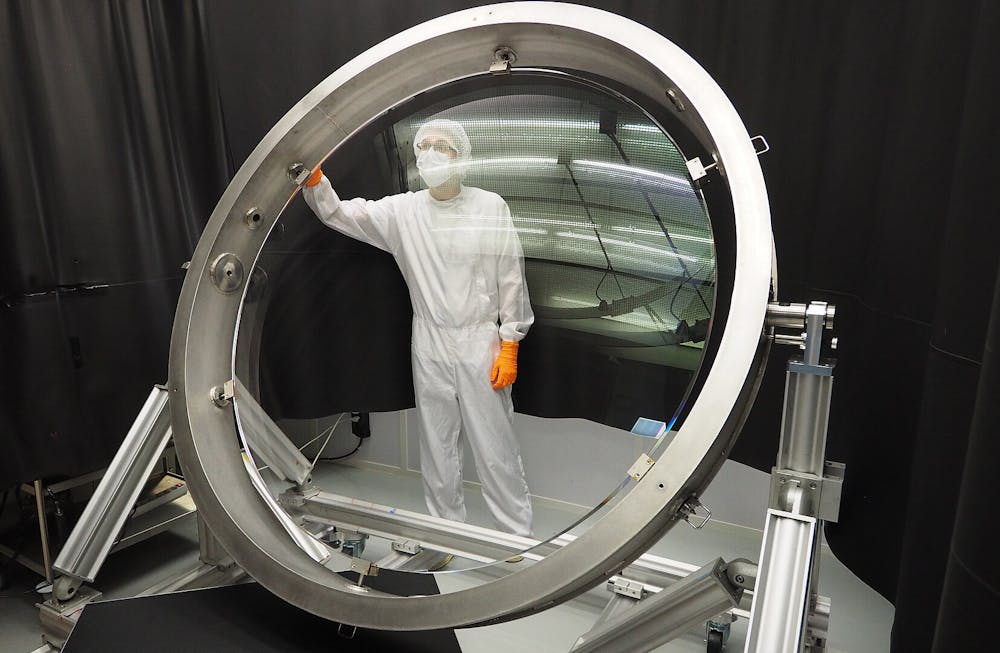
    The glass lens of the Vera Rubin Observatory, which surveys the night sky.
    Large Synoptic Survey Telescope/Vera Rubin Observatory, CC BY

    Lens-based instruments have been transformative. Telescopes have redefined long-standing cosmological views. Microscopes have opened entirely new fields in biology and medicine.

    These changes marked the dawn of empirical science, where observation and measurement drove the creation of knowledge. Today, the James Webb Space Telescope and the Vera C. Rubin Observatory continue those early telescopes’ legacies of knowledge creation.

    Steel and empires

    In the late 18th and 19th centuries, the Industrial Revolution created demand for stronger, more reliable materials for machines, railroads, ships and infrastructure. The material that emerged was steel, which is strong, durable and cheap. Steel is a mixture of mostly iron, with small amounts of carbon and other elements added.

    Countries with large-scale steel manufacturing once had outsized economic and political power and influence over geopolitical decisions. For example, the British Parliament intended to prevent the colonies from exporting finished steel with the iron act of 1750. They wanted the colonies’ raw iron as supply for their steel industry in England.

    Benjamin Huntsman invented a smelting process using 3-foot tall ceramic vessels, called crucibles, in 18th-century Sheffield. Huntsman’s crucible process produced higher-quality steel for tools and weapons.

    One hundred years later, Henry Bessemer developed the oxygen-blowing steelmaking process, which drastically increased production speed and lowered costs. In the United States, figures such as Andrew Carnegie created a vast industry based on Bessemer’s process.

    The widespread availability of steel transformed how societies built, traveled and defended themselves. Skyscrapers and transit systems made of steel allowed cities to grow, steel-built battleships and tanks empowered militaries, and cars containing steel became staples in consumer life.

    White-hot steel pouring out of an electric arc furnace in Brackenridge, Penn.
    Alfred T. Palmer/U.S. Library of Congress

    Control over steel resources and infrastructure made steel a foundation of national power. China’s 21st-century rise to steel dominance is a continuation of this pattern. From 1995 to 2015, China’s contribution to the world steel production increased from about 10% to more than 50%. The White House responded in 2018 with massive tariffs on Chinese steel.

    Rare earth metals and global trade

    Early in the 21st century, the advance of digital technologies and the transition to an economy based on renewable energies created a demand for rare earth elements.

    Offshore turbines use several tons of rare earth magnets to transform wind into electricity.
    Hans Hillewaert/Wikimedia Commons, CC BY-SA

    Rare earth elements are 17 chemically very similar elements, including neodymium, dysprosium, samarium and others. They occur in nature in bundles and are the ingredients that make magnets super strong and useful. They are necessary for highly efficient electric motors, wind turbines and electronic devices.

    Because of their chemical similarity, separating and purifying rare earth elements involves complex and expensive processes.

    China controls the majority of global rare earth processing capacity. Political tensions between countries, especially around trade tariffs and strategic competition, can risk shortages or disruptions in the supply chain.

    The rare earth metals case illustrates how a single category of materials can shape trade policy, industrial planning and even diplomatic alliances.

    Mining rare earth elements has allowed for the widespread adoption of many modern technologies.
    Peggy Greb, USDA

    Technological transformation begins with societal pressure. New materials create opportunities for scientific and engineering breakthroughs. Once a material proves useful, it quickly becomes woven into the fabric of daily life and broader systems. With each innovation, the material world subtly reorganizes the social world — redefining what is possible, desirable and normal.

    Understanding how societies respond to new innovations in materials science can help today’s engineers and scientists solve crises in sustainability and security. Every technical decision is, in some ways, a cultural one, and every material has a story that extends far beyond its molecular structure.

    The National Science Foundation, the Department of Energy, NASA, and other national and regional agencies have funded former research of Peter Mullner.

    ref. From glass and steel to rare earth metals, new materials have changed society throughout history – https://theconversation.com/from-glass-and-steel-to-rare-earth-metals-new-materials-have-changed-society-throughout-history-258244

    MIL OSI Analysis

  • MIL-OSI Security: Secretary Noem Commends President Trump and One Big Beautiful Bill Signing into Law: Historic Win for the American People and the Rule of Law

    Source: US Department of Homeland Security

    This historic legislation will help deliver on President’s Trump’s mandate to arrest and deport criminal illegal aliens

    WASHINGTON – Department of Homeland Security (DHS) Secretary Kristi Noem today released the following statement on President Donald J. Trump’s historic signing of the One Big Beautiful Bill (BBB) Act into law. The BBB secures a historic $165 billion in appropriations for DHS, which will help deliver on the President’s mandate to arrest and deport criminal illegal aliens and make America safe again.  

    “President Trump’s signing the One Big Beautiful Bill is a win for law and order and the safety and security of the American people,” said Secretary Kristi Noem. “This $165 billion in funding will help the Department of Homeland Security and our brave law enforcement further deliver on President Trump’s mandate to arrest and deport criminal illegal aliens and MAKE AMERICA SAFE AGAIN!”  

    In June, Secretary Noem laid out the national security wins that the BBB secures for the American people. The highlights include:  

    • $46.5 billion to complete construction of the border wall.
    • $14.4 billion for removal transportation.
    • $12 billion in state reimbursements for states that fought against the Biden administration’s open border.
    • $4.1 billion to hire additional CBP personnel, including 3,000 more customs officers and 3,000 new Border Patrol agents.
    • $3.2 billion for new technology and $2.7 billion for new cutting-edge border surveillance.
    • $855 million to expand Customs and Border Protection’s vehicle fleet.
    • The law will also provide ICE with the funding to hire 10,000 new agents, which would allow the rate of deportations to reach as high as 1 million per year. ICE currently has 20,000 law enforcement and support personnel across 400 offices.
    • The BBB provides ICE with enough detention capacity to maintain an average daily population of 100,000 illegal aliens and secures 80,000 new ICE beds.
    • The Big Beautiful Bill will also fully fund ICE’s 287(g) program, which empowers state and local law enforcement to assist federal immigration officers.
    • Under the law, ICE and Border Patrol agents will also receive a $10,000 bonus for the next four years.  

    The BBB also bolsters the U.S. Coast Guard (USCG) with the following:  

    • $14.1 billion for USCG cutters.
    • $3.7 billion for USCG aircraft.
    • $6 billion for USCG infrastructure. 

    ###

    MIL Security OSI

  • MIL-OSI Security: Secretary Noem Commends President Trump and One Big Beautiful Bill Signing into Law: Historic Win for the American People and the Rule of Law

    Source: US Department of Homeland Security

    This historic legislation will help deliver on President’s Trump’s mandate to arrest and deport criminal illegal aliens

    WASHINGTON – Department of Homeland Security (DHS) Secretary Kristi Noem today released the following statement on President Donald J. Trump’s historic signing of the One Big Beautiful Bill (BBB) Act into law. The BBB secures a historic $165 billion in appropriations for DHS, which will help deliver on the President’s mandate to arrest and deport criminal illegal aliens and make America safe again.  

    “President Trump’s signing the One Big Beautiful Bill is a win for law and order and the safety and security of the American people,” said Secretary Kristi Noem. “This $165 billion in funding will help the Department of Homeland Security and our brave law enforcement further deliver on President Trump’s mandate to arrest and deport criminal illegal aliens and MAKE AMERICA SAFE AGAIN!”  

    In June, Secretary Noem laid out the national security wins that the BBB secures for the American people. The highlights include:  

    • $46.5 billion to complete construction of the border wall.
    • $14.4 billion for removal transportation.
    • $12 billion in state reimbursements for states that fought against the Biden administration’s open border.
    • $4.1 billion to hire additional CBP personnel, including 3,000 more customs officers and 3,000 new Border Patrol agents.
    • $3.2 billion for new technology and $2.7 billion for new cutting-edge border surveillance.
    • $855 million to expand Customs and Border Protection’s vehicle fleet.
    • The law will also provide ICE with the funding to hire 10,000 new agents, which would allow the rate of deportations to reach as high as 1 million per year. ICE currently has 20,000 law enforcement and support personnel across 400 offices.
    • The BBB provides ICE with enough detention capacity to maintain an average daily population of 100,000 illegal aliens and secures 80,000 new ICE beds.
    • The Big Beautiful Bill will also fully fund ICE’s 287(g) program, which empowers state and local law enforcement to assist federal immigration officers.
    • Under the law, ICE and Border Patrol agents will also receive a $10,000 bonus for the next four years.  

    The BBB also bolsters the U.S. Coast Guard (USCG) with the following:  

    • $14.1 billion for USCG cutters.
    • $3.7 billion for USCG aircraft.
    • $6 billion for USCG infrastructure. 

    ###

    MIL Security OSI

  • MIL-OSI Security: Secretary Noem Commends President Trump and One Big Beautiful Bill Signing into Law: Historic Win for the American People and the Rule of Law

    Source: US Department of Homeland Security

    This historic legislation will help deliver on President’s Trump’s mandate to arrest and deport criminal illegal aliens

    WASHINGTON – Department of Homeland Security (DHS) Secretary Kristi Noem today released the following statement on President Donald J. Trump’s historic signing of the One Big Beautiful Bill (BBB) Act into law. The BBB secures a historic $165 billion in appropriations for DHS, which will help deliver on the President’s mandate to arrest and deport criminal illegal aliens and make America safe again.  

    “President Trump’s signing the One Big Beautiful Bill is a win for law and order and the safety and security of the American people,” said Secretary Kristi Noem. “This $165 billion in funding will help the Department of Homeland Security and our brave law enforcement further deliver on President Trump’s mandate to arrest and deport criminal illegal aliens and MAKE AMERICA SAFE AGAIN!”  

    In June, Secretary Noem laid out the national security wins that the BBB secures for the American people. The highlights include:  

    • $46.5 billion to complete construction of the border wall.
    • $14.4 billion for removal transportation.
    • $12 billion in state reimbursements for states that fought against the Biden administration’s open border.
    • $4.1 billion to hire additional CBP personnel, including 3,000 more customs officers and 3,000 new Border Patrol agents.
    • $3.2 billion for new technology and $2.7 billion for new cutting-edge border surveillance.
    • $855 million to expand Customs and Border Protection’s vehicle fleet.
    • The law will also provide ICE with the funding to hire 10,000 new agents, which would allow the rate of deportations to reach as high as 1 million per year. ICE currently has 20,000 law enforcement and support personnel across 400 offices.
    • The BBB provides ICE with enough detention capacity to maintain an average daily population of 100,000 illegal aliens and secures 80,000 new ICE beds.
    • The Big Beautiful Bill will also fully fund ICE’s 287(g) program, which empowers state and local law enforcement to assist federal immigration officers.
    • Under the law, ICE and Border Patrol agents will also receive a $10,000 bonus for the next four years.  

    The BBB also bolsters the U.S. Coast Guard (USCG) with the following:  

    • $14.1 billion for USCG cutters.
    • $3.7 billion for USCG aircraft.
    • $6 billion for USCG infrastructure. 

    ###

    MIL Security OSI

  • MIL-OSI Security: Secretary Noem Commends President Trump and One Big Beautiful Bill Signing into Law: Historic Win for the American People and the Rule of Law

    Source: US Department of Homeland Security

    This historic legislation will help deliver on President’s Trump’s mandate to arrest and deport criminal illegal aliens

    WASHINGTON – Department of Homeland Security (DHS) Secretary Kristi Noem today released the following statement on President Donald J. Trump’s historic signing of the One Big Beautiful Bill (BBB) Act into law. The BBB secures a historic $165 billion in appropriations for DHS, which will help deliver on the President’s mandate to arrest and deport criminal illegal aliens and make America safe again.  

    “President Trump’s signing the One Big Beautiful Bill is a win for law and order and the safety and security of the American people,” said Secretary Kristi Noem. “This $165 billion in funding will help the Department of Homeland Security and our brave law enforcement further deliver on President Trump’s mandate to arrest and deport criminal illegal aliens and MAKE AMERICA SAFE AGAIN!”  

    In June, Secretary Noem laid out the national security wins that the BBB secures for the American people. The highlights include:  

    • $46.5 billion to complete construction of the border wall.
    • $14.4 billion for removal transportation.
    • $12 billion in state reimbursements for states that fought against the Biden administration’s open border.
    • $4.1 billion to hire additional CBP personnel, including 3,000 more customs officers and 3,000 new Border Patrol agents.
    • $3.2 billion for new technology and $2.7 billion for new cutting-edge border surveillance.
    • $855 million to expand Customs and Border Protection’s vehicle fleet.
    • The law will also provide ICE with the funding to hire 10,000 new agents, which would allow the rate of deportations to reach as high as 1 million per year. ICE currently has 20,000 law enforcement and support personnel across 400 offices.
    • The BBB provides ICE with enough detention capacity to maintain an average daily population of 100,000 illegal aliens and secures 80,000 new ICE beds.
    • The Big Beautiful Bill will also fully fund ICE’s 287(g) program, which empowers state and local law enforcement to assist federal immigration officers.
    • Under the law, ICE and Border Patrol agents will also receive a $10,000 bonus for the next four years.  

    The BBB also bolsters the U.S. Coast Guard (USCG) with the following:  

    • $14.1 billion for USCG cutters.
    • $3.7 billion for USCG aircraft.
    • $6 billion for USCG infrastructure. 

    ###

    MIL Security OSI

  • MIL-OSI Security: Secretary Noem Commends President Trump and One Big Beautiful Bill Signing into Law: Historic Win for the American People and the Rule of Law

    Source: US Department of Homeland Security

    This historic legislation will help deliver on President’s Trump’s mandate to arrest and deport criminal illegal aliens

    WASHINGTON – Department of Homeland Security (DHS) Secretary Kristi Noem today released the following statement on President Donald J. Trump’s historic signing of the One Big Beautiful Bill (BBB) Act into law. The BBB secures a historic $165 billion in appropriations for DHS, which will help deliver on the President’s mandate to arrest and deport criminal illegal aliens and make America safe again.  

    “President Trump’s signing the One Big Beautiful Bill is a win for law and order and the safety and security of the American people,” said Secretary Kristi Noem. “This $165 billion in funding will help the Department of Homeland Security and our brave law enforcement further deliver on President Trump’s mandate to arrest and deport criminal illegal aliens and MAKE AMERICA SAFE AGAIN!”  

    In June, Secretary Noem laid out the national security wins that the BBB secures for the American people. The highlights include:  

    • $46.5 billion to complete construction of the border wall.
    • $14.4 billion for removal transportation.
    • $12 billion in state reimbursements for states that fought against the Biden administration’s open border.
    • $4.1 billion to hire additional CBP personnel, including 3,000 more customs officers and 3,000 new Border Patrol agents.
    • $3.2 billion for new technology and $2.7 billion for new cutting-edge border surveillance.
    • $855 million to expand Customs and Border Protection’s vehicle fleet.
    • The law will also provide ICE with the funding to hire 10,000 new agents, which would allow the rate of deportations to reach as high as 1 million per year. ICE currently has 20,000 law enforcement and support personnel across 400 offices.
    • The BBB provides ICE with enough detention capacity to maintain an average daily population of 100,000 illegal aliens and secures 80,000 new ICE beds.
    • The Big Beautiful Bill will also fully fund ICE’s 287(g) program, which empowers state and local law enforcement to assist federal immigration officers.
    • Under the law, ICE and Border Patrol agents will also receive a $10,000 bonus for the next four years.  

    The BBB also bolsters the U.S. Coast Guard (USCG) with the following:  

    • $14.1 billion for USCG cutters.
    • $3.7 billion for USCG aircraft.
    • $6 billion for USCG infrastructure. 

    ###

    MIL Security OSI

  • MIL-OSI Submissions: From glass and steel to rare earth metals, new materials have changed society throughout history

    Source: The Conversation – USA – By Peter Mullner, Distinguished Professor in Materials Science and Engineering, Boise State University

    Steel played a large role in the Industrial Revolution. Monty Rakusen/DigitalVision via Getty Images

    Many modern devices – from cellphones and computers to electric vehicles and wind turbines – rely on strong magnets made from a type of minerals called rare earths. As the systems and infrastructure used in daily life have turned digital and the United States has moved toward renewable energy, accessing these minerals has become critical – and the markets for these elements have grown rapidly.

    Modern society now uses rare earth magnets in everything from national defense, where magnet-based systems are integral to missile guidance and aircraft, to the clean energy transition, which depends on wind turbines and electric vehicles.

    The rapid growth of the rare earth metal trade and its effects on society isn’t the only case study of its kind. Throughout history, materials have quietly shaped the trajectory of human civilization. They form the tools people use, the buildings they inhabit, the devices that mediate their relationships and the systems that structure economies. Newly discovered materials can set off ripple effects that shape industries, shift geopolitical balances and transform people’s daily habits.

    Materials science is the study of the atomic structure, properties, processing and performance of materials. In many ways, materials science is a discipline of immense social consequence.

    As a materials scientist, I’m interested in what can happen when new materials become available. Glass, steel and rare earth magnets are all examples of how innovation in materials science has driven technological change and, as a result, shaped global economies, politics and the environment.

    How innovation shapes society: Pressures from societal and political interests (orange arrows) drive the creation of new materials and the technologies that such materials enable (center). The ripple effects resulting from people using these technologies change the entire fabric of society (blue arrows).
    Peter Mullner

    Glass lenses and the scientific revolution

    In the early 13th century, after the sacking of Constantinople, some excellent Byzantine glassmakers left their homes to settle in Venice – at the time a powerful economic and political center. The local nobility welcomed the glassmakers’ beautiful wares. However, to prevent the glass furnaces from causing fires, the nobles exiled the glassmakers – under penalty of death – to the island of Murano.

    Murano became a center for glass craftsmanship. In the 15th century, the glassmaker Angelo Barovier experimented with adding the ash from burned plants, which contained a chemical substance called potash, to the glass.

    The potash reduced the melting temperature and made liquid glass more fluid. It also eliminated bubbles in the glass and improved optical clarity. This transparent glass was later used in magnifying lenses and spectacles.

    Johannes Gutenberg’s printing press, completed in 1455, made reading more accessible to people across Europe. With it came a need for reading glasses, which grew popular among scholars, merchants and clergy – enough that spectacle-making became an established profession.

    By the early 17th century, glass lenses evolved into compound optical devices. Galileo Galilei pointed a telescope toward celestial bodies, while Antonie van Leeuwenhoek discovered microbial life with a microscope.

    The glass lens of the Vera Rubin Observatory, which surveys the night sky.
    Large Synoptic Survey Telescope/Vera Rubin Observatory, CC BY

    Lens-based instruments have been transformative. Telescopes have redefined long-standing cosmological views. Microscopes have opened entirely new fields in biology and medicine.

    These changes marked the dawn of empirical science, where observation and measurement drove the creation of knowledge. Today, the James Webb Space Telescope and the Vera C. Rubin Observatory continue those early telescopes’ legacies of knowledge creation.

    Steel and empires

    In the late 18th and 19th centuries, the Industrial Revolution created demand for stronger, more reliable materials for machines, railroads, ships and infrastructure. The material that emerged was steel, which is strong, durable and cheap. Steel is a mixture of mostly iron, with small amounts of carbon and other elements added.

    Countries with large-scale steel manufacturing once had outsized economic and political power and influence over geopolitical decisions. For example, the British Parliament intended to prevent the colonies from exporting finished steel with the iron act of 1750. They wanted the colonies’ raw iron as supply for their steel industry in England.

    Benjamin Huntsman invented a smelting process using 3-foot tall ceramic vessels, called crucibles, in 18th-century Sheffield. Huntsman’s crucible process produced higher-quality steel for tools and weapons.

    One hundred years later, Henry Bessemer developed the oxygen-blowing steelmaking process, which drastically increased production speed and lowered costs. In the United States, figures such as Andrew Carnegie created a vast industry based on Bessemer’s process.

    The widespread availability of steel transformed how societies built, traveled and defended themselves. Skyscrapers and transit systems made of steel allowed cities to grow, steel-built battleships and tanks empowered militaries, and cars containing steel became staples in consumer life.

    White-hot steel pouring out of an electric arc furnace in Brackenridge, Penn.
    Alfred T. Palmer/U.S. Library of Congress

    Control over steel resources and infrastructure made steel a foundation of national power. China’s 21st-century rise to steel dominance is a continuation of this pattern. From 1995 to 2015, China’s contribution to the world steel production increased from about 10% to more than 50%. The White House responded in 2018 with massive tariffs on Chinese steel.

    Rare earth metals and global trade

    Early in the 21st century, the advance of digital technologies and the transition to an economy based on renewable energies created a demand for rare earth elements.

    Offshore turbines use several tons of rare earth magnets to transform wind into electricity.
    Hans Hillewaert/Wikimedia Commons, CC BY-SA

    Rare earth elements are 17 chemically very similar elements, including neodymium, dysprosium, samarium and others. They occur in nature in bundles and are the ingredients that make magnets super strong and useful. They are necessary for highly efficient electric motors, wind turbines and electronic devices.

    Because of their chemical similarity, separating and purifying rare earth elements involves complex and expensive processes.

    China controls the majority of global rare earth processing capacity. Political tensions between countries, especially around trade tariffs and strategic competition, can risk shortages or disruptions in the supply chain.

    The rare earth metals case illustrates how a single category of materials can shape trade policy, industrial planning and even diplomatic alliances.

    Mining rare earth elements has allowed for the widespread adoption of many modern technologies.
    Peggy Greb, USDA

    Technological transformation begins with societal pressure. New materials create opportunities for scientific and engineering breakthroughs. Once a material proves useful, it quickly becomes woven into the fabric of daily life and broader systems. With each innovation, the material world subtly reorganizes the social world — redefining what is possible, desirable and normal.

    Understanding how societies respond to new innovations in materials science can help today’s engineers and scientists solve crises in sustainability and security. Every technical decision is, in some ways, a cultural one, and every material has a story that extends far beyond its molecular structure.

    The National Science Foundation, the Department of Energy, NASA, and other national and regional agencies have funded former research of Peter Mullner.

    ref. From glass and steel to rare earth metals, new materials have changed society throughout history – https://theconversation.com/from-glass-and-steel-to-rare-earth-metals-new-materials-have-changed-society-throughout-history-258244

    MIL OSI

  • MIL-OSI United Nations: In Dialogue with Haiti, Experts of the Human Rights Committee Welcome Efforts to Establish a New Constitution, Raise Questions on Measures to Combat Gang-Related Gender-Based Violence and Lynchings

    Source: United Nations – Geneva

    The Human Rights Committee today concluded its consideration of the second periodic report of Haiti on how it implements the provisions of the International Covenant on Civil and Political Rights . Committee Experts appreciated the referendum to establish a new national Constitution, while raising questions as to how the State was tackling the high level of violence against women and girls perpetuated by gang members and lynchings carried out by citizens, against a backdrop of distrust in the police.

    One Committee Expert said they saw the referendum to establish a new Constitution in a positive light, as an attempt to reestablish the institutionality of the country.

    Another Expert said that the scale of violence against women and girls was reportedly considerable, with sexual violence, including rape of children as young as five years old, gang rape, and forced prostitution, used as a weapon of control by gangs. According to reports, the judiciary were not sensitive to cases of gender-based violence and victims were hesitant to report cases. What measures were taken to encourage women to file complaints? Was there a fund to help survivors of violence? How were they supported by State services?

    Lynchings continued to be regular and numerous, another Expert said, citing reports of more than 500 cases in 2023. These were often the work of self-defence groups in or around Port-au-Prince, who did not trust the police, mainly due to corruption. Was this violence investigated, including when the police were accused of supporting or encouraging it? Had the perpetrators of lynchings, stonings and mutilations been prosecuted and punished proportionately? How could trust be restored between the police and the civilian population?

    Pedrica Saint Jean, Minister for the Status of Women and Women’s Rights and head of the delegation, introducing the report, said from 2020 to 2025, Haiti was confronted with repeated political crises, marked by lockdown operations and successive protests. The COVID-19 pandemic, frequent floods and the earthquake of 14 August 2021, which devastated part of the Great South region, were additional challenges faced by the country. This complex situation was further aggravated by the assassination of the Haitian President on 6 July 2021.

    Ms. Saint Jean said an agreement for a peaceful transition was reached on 3 April 2024, establishing a transition period with a nine-member Transitional Presidential Council and a Prime Minister, with the aim of restoring security, continuing constitutional reform, and organising democratic elections.

    The delegation said several strategies had been undertaken to combat gender-based violence, including a national strategy that spanned from 2017 to 2024. An assessment of the strategy was almost completed. A gender-based violence cell had been established to train police officers to take the needs of female victims of violence into account. The Office to Combat Gender-Based Violence streamlined services for victims, enabling them to receive legal, psychosocial and medical assistance in one place. In areas with armed gangs, women were typically the primary victims. Violence was used as a weapon of repression.

    The delegation also said the Government had always condemned lynchings, which were not part of the country’s culture. Incidents needed to be reported at a police station so perpetrators could be incarcerated and tried for their crimes. The community police were carrying out an awareness raising campaign to progressively build trust with the general population. Training sessions were being organised for police officers, with a view to protecting the population. When complaints were made against the police force, the national inspector for the police carried out investigations and measures were taken as necessary.

    In concluding remarks, Ms. Saint Jean thanked the Committee for the kindness it had shown to the Haitian delegation, and the Experts for their insights. Haiti had taken due note of all recommendations and was determined to take further steps to develop effective, concrete responses to the Committee’s concerns relating to the implementation of the Covenant. Everybody was working to see the day when Haiti could leave the crisis behind.

    Changrok Soh, Committee Chairperson, in concluding remarks, said the Committee acknowledged the profound political, economic and humanitarian challenges facing Haiti, which had hampered efforts to protect human rights. Haiti was encouraged to take this opportunity to advance necessary reforms to ensure that the rights enshrined in the Covenant were fully recognised for all Haitians.

    The delegation of Haiti was made up of representatives of the Ministry for the Status of Women and Women’s Rights; the Ministry of Justice and Public Security; the Ministry of Foreign Affairs; the Ministry of Social Affairs and Work; the Cabinet; the Government of Port-au-Prince; the Prime Minister’s Office; the Haitian National Police; the Anti-Violence Unit; and the Permanent Mission of Haiti to the United Nations Office at Geneva. Some members of the delegation were unable to attend the meeting in person due to travel restrictions.

    The Human Rights Committee’s one hundred and forty-fourth session is being held from 23 June to 17 July 2025. All the documents relating to the Committee’s work, including reports submitted by States parties, can be found on the session’s webpage . Meeting summary releases can be found here . The webcast of the Committee’s public meetings can be accessed via the UN Web TV webpage .

    The Committee will next meet in public at 3 p.m., Monday 7 July to begin its consideration of the fourth periodic report of Viet Nam (CCPR/C/VNM/4). 

    Report

    The Committee has before it the second periodic report of Haiti (CCPR/C/HTI/2).

    Presentation of Report

    PEDRICA SAINT JEAN, Minister for the Status of Women and Women’s Rights and head of the delegation , said between 2020 to 2025, Haiti had experienced both positive and negative developments. From a positive perspective, the Government had multiplied efforts in many areas to improve the rule of law and respect for human rights. However, the country had been plagued by unprecedent insecurity that required the intervention of a foreign force, through the deployment of the Multinational Security Support Mission on October 2, 2024. This force intervened in the context of an agreement signed between Haiti and Kenya on police and security cooperation in March 2024, following the adoption of the United Nations Security Council Resolution 2699.

    From 2020 to 2025, Haiti was confronted with repeated political crises, marked by lockdown operations and successive protests which accompanied them. The COVID-19 pandemic, frequent floods and the earthquake of 14 August 2021, which devastated part of the Great South region, were additional challenges faced by the country. This complex situation was further aggravated by the assassination of the Haitian President on 6 July 2021.

    An agreement for a peaceful transition was reached on 3 April 2024, establishing a transition period with a nine-member Transitional Presidential Council and a Prime Minister, with the aim of restoring security, continuing constitutional reform, and organising democratic presidential elections. The Council was also tasked with economic and judicial reforms and combating corruption. The agreement provided for the establishment of three key bodies, including the Body for the Control of Government Action, in charge of controlling the acts of the Executive, since Parliament was currently non-existent; the National Security Council, to respond to the various aspects of the country’s security crisis; and the National Conference, accompanied by a steering committee. The Government had already established the National Security Council and the National Conference and its steering committee. The referendum decree, resulting from the work of the National Conference and the steering committee, would allow Haiti to have a new Constitution. Currently, efforts were underway to strengthen the capacities of the Haitian National Police and the Armed Forces of Haiti, which had a budget increase of 11 per cent in 2024-2025. An agreement was concluded with Colombia to monitor the Haitian coast, to curb the illicit trafficking of firearms.

    The Government had attached great importance to the judicial reform already initiated by its predecessors. Six new Courts of First Instance and the corresponding Public Prosecutor’s Offices were created between September 2024 and April 2025. The law of 10 September 2018 created the National Council for Legal Assistance and established legal aid offices in 18 jurisdictions in Haiti, aiming to provide free legal assistance to those who were financially struggling. The Penal Code and the Code of Criminal Procedure had previously been criticised by civil society in 2020. Following the revision of the two texts by a special commission, they were adopted on 24 June 2025. This marked an important step in the fight against insecurity, corruption and impunity.

    Two other important decrees had been adopted in the context of judicial reform. The first, adopted on 16 April 2025, which created two specialised judicial poles: one for the repression of complex financial crimes and offences and the other for the repression of mass crimes and sexual violence. The second decree of 4 May 2023 sanctioned money laundering, terrorist financing and the financing of the proliferation of weapons of mass destruction in Haiti.

    Despite Government efforts, due to the deteriorating security situation, the majority of prisons in Port-au-Prince had been vandalised, leading to the uncontrolled release of a number of detainees. The Government had been forced to relocate several jurisdictions to allow the resumption of judicial activities in minimum security conditions and the normal application of appropriate sentences and sanctions.

    The Haitian State aimed to follow up on complaints against police officers for excessive use of force, and it organised human rights training sessions for police personnel. However, it was regrettable that, despite the Government’s efforts, some citizens, driven by anger at the atrocities committed by criminal groups, resorted to extreme methods, including the lynching of captured gang members, instead of handing them over to the authorities. The Government recognised the severity of these acts and strongly condemned all forms of mob justice.

    The crisis in the country led to an increase in gender-based violence, particularly for displaced persons in camps. The Haitian State was working to protect and facilitate access to justice for survivors of violence, including through the creation of the Office for Combatting Gender-Based Violence as well as the organization of training adapted to the needs of survivors for police officers and judges. Medical, legal and psychosocial assistance were also offered to women and girls at internal displacement camps.

    Article 262 of the Penal Code, adopted by decree on 23 June 2025, punished the perpetrators of acts of torture and barbarism, with sentences ranging from 15 to 20 years in prison. Prison overcrowding remained a major problem, especially with the destruction of the main prisons in March 2024. Instructions had been issued to the Public Prosecutor’s Offices and Courts of First Instance to carry out regular criminal hearings, with the aim of relieving overcrowding in the prisons in provincial cities.

    The Transitional Presidential Council was making every effort to organise general elections in 2025 and to install a President elected on 7 February 2026. Despite its efforts, the Haitian State was aware that the implementation of the provisions of the Covenant had not yet reached a satisfactory level. However, Haiti pledged to do everything in its power to implement the provisions on the Covenant.

    Questions by Committee Experts

    A Committee Expert acknowledged how difficult it was for the State party to participate in person in the dialogue and expressed gratitude to the delegation in Geneva. The Committee was aware of the grave humanitarian crisis suffered by Haiti for decades, compounded with the assassination of the President in 2021. In that context, the Committee noted an increase in widespread human rights violations and growing control of armed gangs in significant parts of Port-au-Prince, leaving the population more vulnerable to violence and human rights abuses, and leading to the displacement of more than one million people.

    Were courts in Haiti directly applying the Covenant? Could examples be provided? Were courses on international human rights law and the Covenant provided in training to judges? The Committee had been informed of situations where civil servants had opposed the execution of orders handed down by judges to free individuals. Could this be explained? What role did these civil servants play in the judicial system? Had steps been taken to ratify the Optional Protocol of the Covenant on individual communications? In May 2025, a bill of law was presented on the development of a new constitution, with a decree adopted to hold a referendum on the issue. Was this bill in line with the rights enshrined in the Covenant? Was it realistic to carry out a referendum in the context of violence? When was the state of emergency ordered? Was it still in force? Which articles of the Covenant were suspended?

    Did the current budget of the Office for Citizen Protection allow it to carry out its functions and extend its activities to the most remote parts of the country? Were there plans to expand the powers of the Office to allow it to consider human rights violations that had their origin in the acts of private entities?

    What steps had been taken to end discrimination against lesbian, gay, bisexual and transgender persons? Were there laws in place to punish acts of discrimination against these groups? Had the State taken actions been to allow these people to carry out public demonstrations and to protect them? Had it adopted measures to change discriminatory cultural attitudes in Haitian society, to end stigmatisation of lesbian, gay, bisexual and transgender persons? 

    Another Expert said despite the crisis in the country, Haiti remained bound by its international obligations. The dialogue would address problems such as insecurity, the deep humanitarian crisis that the population was experiencing, the endemic violence of gangs, the forced displacement of the population, the dysfunction of the justice system, chronic impunity and serious challenges to the rule of law. All these problems were linked to corruption. The report published in 2023 by the United Nations Expert on Human Rights in Haiti stated that corruption in Haiti was “public enemy number one” and found that more than 90 per cent of Haitian civil servants did not comply with the national anti-corruption law. The Anti-Corruption Unit and the Central Financial Intelligence Unit, which were suspected of lacking independence, had brought nearly 100 major cases of corruption to justice, but these had not led to any convictions.

    Did the State plan to set up a financial prosecutor’s office or judges specialised in the fight against corruption? Could more information be provided on the decree adopted on the creation of financial judicial units? What measures were being taken to support the work of the Anti-Corruption Unit and the Central Financial Intelligence Unit and to ensure that the cases referred were followed up independently?

    Haiti had expressed its commitment to ensuring accountability for the serious violations committed during Jean-Claude Duvalier’s presidency. However, a case assessing these violations had been in the courts of cassation since 2014, and there had not been any progress. What explained the delay? Could the delegation enlighten the Committee on the situation of Jean Gabriel Robert, who was convicted in absentia in the case of the “Raboteau massacre”?

    Information showed that the scale of violence against women and girls was considerable, with sexual violence, including rape, which was sometimes perpetrated against children as young as five years old; gang rape; and forced prostitution, used as a weapon of control by gangs. According to reports, the judiciary were not sensitive to cases of gender-based violence and victims were hesitant to report cases. What measures were taken to encourage women to file complaints? Was there a fund to help survivors of violence? How were they supported by State services?

    According to information received by the Committee, lynchings continued to be regular and numerous, with more than 500 in 2023. These were often the work of self-defence groups in or around Port-au-Prince, who did not trust the police, mainly due to corruption. In addition, the 2024 report of the United Nations Expert on Human Rights in Haiti noted that police were passive, and it appeared that some murders were encouraged, supported or facilitated by the police forces. Was this violence investigated, including when the police were accused of supporting or encouraging it? Had the perpetrators of lynchings, stonings and mutilations been prosecuted and punished proportionately? How could trust be restored between the police and the civilian population?

    Another Expert said specific steps had not been taken to combat impunity. What hope existed, looking forward to the immediate and long-term future, regarding a reversal of the situation? There were several cases in which there had been impunity for human rights violations. Attacks against the population in the La Saline suburb in 2018 had not been condemned by the Government and no steps had been taken to provide support to victims. What measures had been taken against the involvement of political agents in these cases? Why was the La Saline case withdrawn from the original judge?

    Data showed that 28 percent of civil servants in Haiti were women. In 2019 a strategy was presented to ensure equality for women by 2030. What progress had been made? How would the State party solve the problem of the low rate of political representation of women in Haiti?

    What actions were being taken to guaranteed women’s access to health care, in situations where criminal groups took control of health centres? How was access to medicines ensured?

    Another Expert asked what Haiti’s prospects were looking forward? What urgent measures were envisaged to protect women and girls in areas under gang control? What mechanisms had been established to guarantee security and safety for survivors of sexual violence, and to encourage the reporting of cases? Could Haiti provide updated information on the draft law preventing violence against women and girls? Was there a timeline for its adoption? What had been done to bolster the amount of medical, legal and psychosocial services for survivors, particularly in areas under gang control? What measures were envisaged to protect the right to life of those in extreme poverty? Was there an intersectional strategy to prevent avoidable deaths linked to poverty?

    What measures were taken to protect civilians living in areas under the control of armed gangs? What had been the result of the assistance from Kenya? Was it meeting the challenges? What guarantees existed when it came to the investigation of its own officers by the Haitian police? How was it ensured that the police did not carry out disproportionate use of force during protests? How was action being bolstered in areas under gang control?

    Was there a road map regarding ratification of the Covenant’s Second Optional Protocol concerning the death penalty? How did the State party intend to ensure that those who had served their sentence were properly released? Had the system for monitoring judicial cases been reactivated? What efforts were underway to improve detention conditions? Were construction projects for new prisons still planned? How many women had access to shelters in the last three years? What measures were envisaged to guarantee all police stations should have trained personnel, particularly in areas most affected by police insecurity?

    Responses by the Delegation

    PEDRICA SAINT JEAN, Minister for the Status of Women and Women’s Rights and head of the delegation , said the Government had priorities outlined in the April 2024 agreement on the peaceful transition, including combatting insecurity, conducting the referendum and bringing the country to elections to appoint a robust Government. To combat insecurity, the budget allocated to the police and armed forces had been increased, allowing them to better contain the problems they were confronting. The police, the Haitian armed forces, and the security mission needed to work together to combat insecurity to allow for the milestone referendum to be held. Nine electoral commissioners were currently out in the field assessing the requirements. Haiti was not waiting for the security issues to subside before moving to the referendum.

    Haiti was doing its utmost to implement its commitments under the Covenant through a raft of measures. Six new courtrooms had been established in the country, allowing proximity between those needing to access the justice system and the infrastructure in place. Bureaus had been established to work on specific criminal areas, including mass crimes which had remained unpunished. For some time, courts had not been operational because they were in the hands of gangs. Two bureaus would be responsible for crimes of sexual violence, and another was responsible for financial crimes. Some 34 new judges and prosecutors had been appointed to support the justice system.

    The method of choosing judges for the Anti-Corruption Unit had not hindered its independence. Cases were currently going ahead at the Court of First Instance. Three prisons had been built to international standards, with one dedicated to female inmates. Institutional measures had been put in place to freeze the funds of certain agencies which were found to be corrupt but had impunity from the Anti-Corruption Unit, and those responsible were being brought before the court.

    The Government of Haiti had always condemned lynchings, which were not part of the country’s culture. Incidents needed to be reported at a police station so perpetrators could be incarcerated and tried for their crimes.

    The delegation said several assessment missions had been established to gain an understanding of the situation of detention centres and propose tangible solutions. One of the main challenges was the provision of food, due to lack of access to main roads. To address this situation, the Justice Ministry sought to ensure that providers of food should be placed directly in situ. In the last few months, prisons had greater autonomy and managed their needs themselves, providing a better and tailored approach to local realities.

    Haiti had done a lot to combat gender-based violence. This phenomenon was topical in Haiti, particularly when it came to displaced women. Several strategies had been undertaken to combat gender-based violence, including a national strategy that spanned from 2017 to 2024. An assessment of the strategy was almost completed. A gender-based violence cell had been established within the police, to train police officers to take the needs of female victims of violence into account. The Office to Combat Gender-Based Violence streamlined services for victims, enabling them to receive legal, psychosocial and medical assistance in one place. Psychosocial support services had been set up for women victims in internal displacement camps. Several initiatives had been adopted to bolster protections for minors, including host families and prevention and readaptation programmes for children recruited by armed games. Training and awareness raising sessions were organised for judges.

    In areas with armed gangs, women were typically the primary victims. The number of victims was increasing, particularly against younger women, but violence by armed gangs was also affecting children and the elderly. Violence was used as a weapon of repression. There were still people in Haiti who did not want to report. During times of political turbulence, the phenomenon of violence against women was heightened. There was a need for awareness raising to eradicate the phenomenon. Women should not be used as an instrument to place pressure on the Government.

    Incest had never been part of Haitian culture, but it did not mean this phenomenon did not exist. When incest occurred, people usually preferred to solve the issue in the family. Attention needed to be paid to the phenomenon of incest involving displaced people. The State sanctioned based on the relevant 2006 decree and used case law when dealing with these offences. It was important to continue legislating to bring tangible solutions to this phenomenon.

    For 15 years, judges had been receiving training on the Covenant from the Government and the Haitian police.

    Lesbian, gay, bisexual, transgender and intersex persons had been looked down on in Haiti; they were formerly not given the right to complain. While progress was not significant, these people were now considered to be fully fledged citizens who needed to be protected by the State and to enjoy their full human rights.

    Quotas had been implemented calling for at least 30 per cent of decision-making posts to be held by women. This issue had been poorly addressed. In the new Constitution, the State was advocating for parity. Until there was a critical mass of women in decision-making posts, the problems they faced would persist. A series of consultations had been launched with officials to create incentive measures to promote equality regarding candidate lists.

    The law on the organization of the Ministry on the Status of Women had not properly been reformed, which was why the Ministry had difficulties in playing its primary role. The Ministry submitted a law on its reorganization to ensure it could achieve its goals. By the start of next year, the State would launch its first national action plan covering the participation of women in restoring peace and security in Haiti. Work was being done with survivors in internal displacement camps to transform them into fully-fledged actors. Women, including young girls and survivors of violence in these camps, had been appointed as peace ambassadors, to sensitise the message of peace throughout Haiti.

    Haiti was relying on the work of the Multinational Security Support Mission and the international community to help the police and armed forces overcome the corruption and security issues in the country.

    Follow-up Questions by Committee Experts

    A Committee Expert asked follow-up questions, including on the functions to be undertaken by the bureaus on mass crimes, sexual crimes and financial crimes. This was a fantastic idea, but the bureaus needed to have the resources to operate properly. Other questions were asked on measures planned to restore the trust between the police and the justice system; lynchings committed by the police force; steps to tackle the circulation of weapons; and the mandate of the Office for Citizens’ Protection.

    An Expert said they saw the referendum to establish a new Constitution in a positive light, as an attempt to reestablish the institutionality of the country. Who drafted this bill? Did it go through various sectors, with participation from civil society? What did the “green and red zones” mean? Were green zones under Government control? Did red zones mean there was no State control? What happened if there was a referendum in the red zones?

    More questions were asked on how the long tradition of impunity could be alleviated; alternative measures to detention; detention beyond the lengths of sentences; efforts to prevent discrimination against women; and access to voluntary interruption of pregnancy. What was the Government’s perception of the processes involving the participation of the international community that aimed to improve the situation for the population of Haiti?

    According to information received by the Committee, around 40 per cent of births enjoyed the proper medical support. How did midwives treat risky pregnancies? Did the State intend to include the ratification of the Second Optional Protocol in the planned reform of the draft Constitution?

    Responses by the Delegation

    The delegation said the death penalty was abolished in Haiti through a decree adopted in 1987.

    Regarding the red and green zones, there were currently zones under gang control, where the State was doing everything possible to convert them to green zones. Green zones were placed where the State could provide appropriate services to the population. The police were trying to gain access to the red zones to bring about peace and security. Progress had been made in penetrating many of the red zones; it was expected that there would be further progress in this area.

    The referendum was a compulsory, milestone measure to lay the groundwork for national elections and allow the population to get their new Constitution. All different sectors of society had been consulted in the drafting of the new Constitution.

    Haiti had implemented measures that aimed to provide a structure to prevent the free circulation of weapons, including weapons of mass destruction.

    The delegation said there was a legal bureau on mass crimes and sexual violence in Port-au-Prince and another on financial crimes. The bureaus were comprised of 10 judges who worked with the police and financial oversight and regulatory bodies. Their operations were ensured by donors from the international community and the State.

    The community police were carrying out an awareness raising campaign to progressively build trust with the general population. Training sessions were being organised for police officers, with a view to protecting the population. When complaints were made against the police force, the national inspector for the police carried out investigations and measures were taken as necessary.

    Haiti had a plan to set up scanners at customs to prevent the flow of illegal weapons into the country. Controls at the border with the Dominican Republic and checks of containers coming from the United Staes had been strengthened, and strict checks were being conducted on private vehicles, including motorbikes. Authorities had also suspended land imports from the Dominican Republic, ensuring seizures of illegal imports. Despite this, Haiti was facing increased criminal activity and corruption, with the need for increased international support to reduce the weapons flow into Haiti.

    Green zones were safe zones while red zones were ones where there was a heightened risk.

    A draft of the new Constitution had been shared across different sectors to receive their inputs, which had been sent to the Committee responsible for the drafting of the new Constitution.

    Haitian midwives played a key role in early detection of illnesses and in responding to complications during birth. They carried out post monitoring operatives in rural areas, while caesarean procedures were performed by obstetric doctors.

    Questions by Committee Experts

    A Committee Expert asked if there were obstacles preventing Haiti from ratifying the Covenant’s Second Optional Protocol? Murderous attacks by gangs against ambulances had been reported, and health staff had fled the country. Did the Government have any plans to confront these problems? Haiti had an astonishing overcrowding rate in its prisons, at allegedly over 300 per cent. There was a lack of access to the appellate procedure for all inmates and for persons with disabilities. How did Haiti plan to resolve this problem?

    Another Expert appreciated Haiti’s delegation comprised of high-level women. It was reported that police agents or persons acting with their complicity tortured inmates on a daily basis in prisons and police custody facilities. Why had the perpetrators of cases of torture not been prosecuted and brought to justice? Had there been capacity building of law enforcement in the area of torture? Why had the State not ratified the Convention against Torture?

    Reports received by the Committee stated that forced evictions had become widespread since the earthquake in 2010, but this was denied by the State. It was alleged that these evictions affected a wide number of families and were not addressed by the State. What information was available about three resident families who had not taken up possession of reconstructed homes? Which Government civil servants were responsible for these families’ forced evictions? How had the Government taken steps to prosecute those involved?

    Hurricane Matthew had affected more than 2.6 million people, including 600,000 children; what measures had been taken to protect them? Could information be provided on the distribution of financial aid and the resources used to reconstruct infrastructure following this natural disaster? During the imposed state of emergency, was it only economic rights which were affected? What solutions were available for those still awaiting assistance from the damage 10 years ago? What resources had been allocated to address housing issues?

    A Committee Expert asked about the implementation of the National Plan to Combat Child Labour, adopted in 2019; what was the duration of the plan? Was it still in force or had a new plan been adopted? Could data on the number of children exploited and those in situations of begging be provided? What work had been done specifically on the exploitation of children by the Committee to Combat Human Trafficking?

    Various reports had documented violence against children, who were recruited and used by the gangs and injured or killed as a result. An even more severe impact was felt by children with disabilities. The Secretary-General’s report had outlined 383 grave violations against children in 2024. In December 2024, the gangs had committed a high number of abductions, including of 17 girls and 10 boys. What measures had been taken by the State to combat these grave violations? To help minors, child soldiers and victims of armed groups, a Commission had been created to support the creation of a national network of shelters and rehabilitation centres. How did the State ensure that the Commission had the human and financial resources necessary to support its functions? What did its work consist of? Was the National Committee for Combatting Human Trafficking able to carry out its functions? What measures had been adopted along the Dominican-Haitian border to prevent trafficking of children who were then sold in the Dominican Republic?

    It was understood that a commission to implement criminal reform was created in July 2024. What were the main reforms being carried out? What measures had been adopted to deal with the firebomb attacks on judges? How was the safety and security of judges being ensured? What was the current situation of the National Council for Legal Assistance? Regarding the appointment of judges in the Cassation Council, how was it ensured that the involvement of the Senate did not affect the Council’s independence? What role did the Council play in combatting corruption in the judicial sphere?

    Another Committee Expert said people who were displaced often lost their identification documents. What was the State party doing to resolve this issue? Two journalists reporting on insecurity in Haiti had been executed in 2022. The Committee had also received information that five journalists were murdered in 2024, with no investigations carried out. Gang violence had also led to the closure and restriction of media, including the suspension of popular programmes on suspicion of serving as platforms for gangs. Journalists had also been threatened by gangs. How could elections take place if the State could not facilitate the free circulation of ideas? How did Haiti intend to combat impunity surrounding executions or ill-treatment of journalists? What was done to protect human rights defenders? How was it ensured that social media platforms were regulated?

    In March 2025, anti-Government protests were held to decry the security context and inaction by the State. What measures had been taken to establish the responsibility of police directly involved in the use of force in suppressing peaceful demonstrations? What had been done to guarantee the work of non-governmental organizations in full security and free from harassment?

    Responses by the Delegation

    The delegation said overcrowding in prisons remained a major issue for the Government which it was working to address. Instructions had been issued to the prosecution offices and tribunals of the Courts of First Instance to encourage the holding of more criminal sessions, including sessions in which a jury was not present, with a view to relieving overcrowding in provincial prisons. In 2023 and2024, this occurred in 14 jurisdictions, leading to 159 convictions. In 2024, the total number of people detained in the country was around 12,000. The State had managed to capture around 12 prisoners who had escaped. The drop in the number of detainees in 2025 was explained primarily due to the escapes that followed the armed attacks carried out against certain penitentiary infrastructure. Courts had been actively engaged to implement non-custodial measures when appropriate, as a means of alleviating prison overcrowding. The Government recognised the need to prevent arbitrary arrests. Men, women and children were placed in different prisons. Despite the State’s efforts, there was only one police officer per every 14 detainees.

    The Government remained committed to improving prison conditions, despite security constraints. The mortality rate had dropped between 2024 and 2025 thanks to coordinated action to provide medical care and humanitarian aid. Healthcare services had been established in several penitentiaries. In 2017, a Presidential Commission was established to shed light on deaths in the Port-au-Prince prison. It highlighted aggravating factors including severe overcrowding, insufficient hygiene and a lack of medical support, among others. Measures were implemented to improve nutrition, detention conditions and investigate causes of deaths.

    The internal regulations of the penitentiary administration outlawed all forms of torture and inhumane treatment. Finances had been provided to the National Anti-Trafficking Committee to support the implementation of its national action plan. A protocol had been signed to guarantee legal aid to victims of trafficking. Some 100 students from the University of Haiti had received training on the issue of human trafficking. Several human traffickers had been prosecuted, however following the mass escapes in March 2024, a number of these traffickers were unfortunately able to escape.

    The Constitution guaranteed that judges could not be dismissed. In the judicial hierarchy in Haiti, the Constitution had the highest ranking, followed by international conventions. In Haiti, the Constitution outlawed the death penalty in all areas, meaning there was no need to fear its reinstation. The ratification of the Second Optional Protocol could be discussed when the legislature was functional.

    Families who were forcibly evicted due to the development of road infrastructure or for airport security purposes had a right to fixed compensation, as well as the right to appeal decisions blocking their access to redress.

    A State project had been launched to combat domestic labour by children, in line with the Convention on the Rights of the Child. The project had been launched in 16 regions in the country and included a concrete list of jobs banned for children. Twenty-three surveys of young people had been conducted, allowing them to express themselves on themes including domestic labour, birth registration, violence against children, and education. A social protection project ensured monetary transfers for children under the age of five, pregnant women and persons with disabilities. The project was financed by the World Bank and allowed vulnerable families to provide care to their children. Around 25,000 homes received regular monetary transfers to the value of 40 United States dollars per month.

    A professional training programme had been launched in conjunction with the International Labour Organization, allowing for the training of more than 800 vulnerable teenagers in various technical and farming activities. Some 9,200 children had received support for school re-enrolment. Four thousand vulnerable homes at risk of family separation received monetary transfers to support income-generating activities, as well as financial education. A pilot programme had been launched in targeted communes with the United Nations Children’s Fund, which had developed a foster programme for children taken out of situations of domesticity to support their reintegration.

    Legal assistance officers had been established in 12 jurisdictions and the rollout was ongoing. A decision would be made on the draft Constitution based on a participatory process. A Commission had been established to follow up on gender-based violence cases in the country.

    Steps had been taken to prevent the phenomenon of forced evictions, but results were still limited. The Government had not been encouraging forced evictions and had taken new steps to support victims. Demolished homes had been rebuilt and several previous owners had already taken ownership of their new homes. Authorities ensured that no one living in camps or informal housing was evicted without a humane alternative provided.

    The Haitian State reiterated its commitment to freedom of the press and its respect for the work of human rights defenders. Efforts were made to ensure journalists could freely conduct their work, including by strengthening protection mechanisms. Haitian authorities reaffirmed their desire to shed light on the murders of several journalists, which were currently at being investigated by the Public Prosecutor.

    The courts did not all apply the Covenant in the same way, but it was often evoked in individual cases. Alternative measures to prison were allowed for in the new Criminal Code, which had been adopted in June 2025. Judges were equipped with armed vehicles and would have security details at their disposal for their personal safety. The police force was taking steps to bolster security in zones with a heightened level of insecurity and ensure that the referendum could take place. The Government was engaged in an intense campaign to fight the armed violence being perpetrated by gangs.

    Follow-up Questions by Committee Experts

    Committee Experts asked follow-up questions regarding identification papers, which more than 70 per cent of the population did not have, as well as the role of the Government Commissioners within the courts of justice.

    A Committee Expert expressed hope that the programme being laid out by the State for elections would bring about the enjoyment of rights by the population. It seemed impossible to bring this about given the current insecurity in Haiti. Was the State in a position to achieve peace given the current context? The context in Haiti required international, shared responsibility, with involvement from all States parties.

    Closing Statements

    PEDRICA SAINT JEAN, Minister for the Status of Women and Women’s Rights and head of the delegation , thanked the Committee for the kindness it had shown to the Haitian delegation, and the Experts for their insights. Haiti had taken due note of all recommendations and was determined to take further steps to develop effective, concrete responses to the Committee’s concerns relating to the implementation of the Covenant. One day, in the not-too-distant future, the country would exit the crisis. Everybody was working to see the day when Haiti could leave the crisis behind. Despite the efforts it had made, the Haitian State was aware that the implementation of the Covenant and progress in bolstering of the rule of law had not yet reached a satisfactory level. Haiti had a massive raft of problems to resolve, including travel restrictions, which had prevented some members of the delegation from traveling to Geneva. The State of Haiti was committed to doing its utmost to implement the provisions of the Covenant.

    CHANGROK SOH, Committee Chairperson, expressed sincere gratitude to all who had contributed to the dialogue. The Committee acknowledged the profound political, economic and humanitarian challenges facing Haiti, which had hampered efforts to protect human rights. The Committee underscored the importance of continued diligence and commitment to the rights enshrined in the Covenant, especially in times of crisis. During the dialogue, the Committee had raised serious issues regarding the right to life, gang violence, lynchings, protection of vulnerable populations, corruption, protection of journalists and the need to combat impunity, among other concerns. Despite these challenges, the Committee appreciated the State party’s willingness to engage in dialogue. Haiti was encouraged to take this opportunity to advance necessary reforms to ensure that the rights enshrined in the Covenant were fully recognised for all Haitians.

    ___________

    Produced by the United Nations Information Service in Geneva for use of the media; 
    not an official record. English and French versions of our releases are different as they are the product of two separate coverage teams that work independently. 

    CCPR25.015E

    MIL OSI United Nations News

  • MIL-OSI Canada: Update 10: Alberta wildfire update (July 4, 3 p.m.)

    Source: Government of Canada regional news (2)

    MIL OSI Canada News

  • MIL-OSI Europe: Answer to a written question – Aviation safety and implementation of EU rules – E-001606/2025(ASW)

    Source: European Parliament

    1. No official complaint to the Commission has been registered, however the Hellenic Civil Aviation Authority (HCAA) has been subject to standardisation inspections by the European Union Aviation Safety Agency (EASA) monitoring the application by the competent authorities of the Member States of Regulation (EU) 2018/1139[1] and of its delegated and implementing rules, and to report to the Commission about the results. No particular findings have been raised regarding the air collision avoidance system.

    2. The latest standardisation inspection of HCAA as the authority responsible for the safety oversight of Air Traffic Management/Air Navigation Services has been performed at the end of 2023 The implementation of the subsequent Corrective Action Plan by HCAA is progressing.

    3. The Commission has opened infringement cases INFR(2024)2237[2] and INFR(2024)2014[3] regarding the established shortcomings. Finally, as a result of lack of implementation of the requirements related to data link services, the Commission has opened infringement case INFR(2020)2050[4]. The Commission is closely following up on implementation of the related rules.

    • [1] Regulation (EU) 2018/1139 of the European Parliament and of the Council of 4 July 2018 on common rules in the field of civil aviation and establishing a European Union Aviation Safety Agency, and amending Regulations (EC) No 2111/2005, (EC) No 1008/2008, (EU) No 996/2010, (EU) No 376/2014 and Directives 2014/30/EU and 2014/53/EU of the European Parliament and of the Council, and repealing Regulations (EC) No 552/2004 and (EC) No 216/2008 of the European Parliament and of the Council and Council Regulation (EEC) No 3922/91 (Text with EEA relevance.) OJ L 212, 22.8.2018, p. 1-122, http://data.europa.eu/eli/reg/2018/1139/oj.
    • [2] https://ec.europa.eu/implementing-eu-law/search-infringement-decisions/?langCode=EN&version=v1&typeOfSearch=byDecision&refId=INFR(2024)2237&page=1&size=10&order=desc&sortColumns=decisionDate.
    • [3] https://ec.europa.eu/implementing-eu-law/search-infringement-decisions/?langCode=EN&version=v1&typeOfSearch=byDecision&refId=INFR(2024)2014&page=1&size=10&order=desc&sortColumns=decisionDate.
    • [4] https://ec.europa.eu/implementing-eu-law/search-infringement-decisions/?lang_code=EN&typeOfSearch=true&active_only=0&noncom=0&r_dossier=2020%2F2050&decision_date_from=&decision_date_to=&title=&submit=Search&langCode=EN.
    Last updated: 4 July 2025

    MIL OSI Europe News

  • MIL-OSI Europe: Answer to a written question – Turkish airlines must respect the ICAO or otherwise be banned from operating in EU airspace – E-000823/2025(ASW)

    Source: European Parliament

    The Commission is aware of flights by Turkish air carriers between Ercan Airport and Türkiye even though the airport has not been designated by the Republic of Cyprus, in accordance with Article 68 of the Chicago Convention, for use for international air services.

    Moreover, in the absence of an air services agreement in force between the Republic of Cyprus and Türkiye, such operations are not permitted, in accordance with Article 6 of the same Convention.

    The Commission considers that in line with the 2024 Türkiye Report[1] which sets out Türkiye’s obligations on the normalisation of relations with Cyprus, Türkiye is expected to actively support negotiations on a fair, comprehensive and viable settlement of the Cyprus issue, in accordance with relevant United Nations Security Council Resolutions and the EU’s founding principles and acquis.

    As for potential sanctions by the Commission, it should be noted that there is no agreement on air services between the EU and Türkiye. Such an agreement might allow the Commission to directly address the situation and adopt measures on such air carriers.

    Air services between the Member States and Türkiye (including those operated by Turkish air carriers) are currently governed by the respective air services agreements in force between Member States and Türkiye.

    Any decision on adopting restrictive measures (sanctions) under the EU’s Common Foreign and Security Policy is for the Council to make under Article 31 Treaty on European Union[2].

    • [1] https://enlargement.ec.europa.eu/document/download/8010c4db-6ef8-4c85-aa06-814408921c89_en?filename=T%C3%BCrkiye%20Report%202024.pdf.
    • [2] https://eur-lex.europa.eu/eli/treaty/teu_2016/art_31/oj/eng.
    Last updated: 4 July 2025

    MIL OSI Europe News

  • Glad to bestow our highest honour: Trinidad & Tobago President praises PM Modi’s longstanding support

    Source: Government of India

    Source: Government of India (4)

    Trinidad and Tobago President Christine Kangaloo on Friday showered praise on Prime Minister Narendra Modi while conferring the nation’s highest honour upon him.

    She lauded PM Modi for his longstanding contributions, kindness, and unwavering support to the country and the wider Caribbean region.

    “Your kindness and generosity to the people of Trinidad and Tobago are legendary. They have been demonstrated time and again,” she noted, recalling several acts of bilateral goodwill.

    “Trinidad and Tobago is immensely glad to have been able to bestow upon you our nation’s highest honour in recognition of the tremendous work you have done with our nation over the years and for the kindness and generosity you have always shown to our country and indeed our region,” President Kangaloo said during the ceremony at the President’s House in Port of Spain.

    Prime Minister Modi was conferred with ‘The Order of the Republic of Trinidad and Tobago (ORTT)’ on Friday, the highest civilian award of the nation, becoming the first foreign leader ever to receive the honour. This marks the 25th international award conferred on PM Modi by a foreign country.

    Praising the Indian Prime Minister’s continued support and goodwill, President Kangaloo emphasized that his efforts have become “legendary” among the people of Trinidad and Tobago.

    She particularly highlighted India’s assistance during the COVID-19 crisis, underscoring a key example of personal intervention by PM Modi.

    “During the COVID-19 pandemic, 40,000 doses of vaccines arrived in Trinidad as a result of your personal intervention and action. That act of kindness only further strengthened the longstanding relationship between our two countries,” she added.

    PM Modi began his first official visit to Trinidad and Tobago on Thursday (local time) with a ceremonial Guard of Honour at Piarco International Airport, where he was received by Prime Minister Kamla Persad-Bissessar, along with 38 ministers and four Members of Parliament of the Caribbean nation.

    The Prime Minister shared a video of the warm welcome on the social media platform X, writing: *”May the friendship between India and Trinidad & Tobago flourish in the times to come! Highlights from a special welcome in Port of Spain.”* The footage showed cultural performances, traditional music, and a vibrant welcome from the local Indian diaspora.

    PM Modi also interacted with members of the Indian community who had gathered at the airport, expressing his gratitude for their heartfelt reception.

    His visit to Trinidad and Tobago is the second leg of a five-nation tour from July 2 to July 9, aimed at strengthening bilateral cooperation in areas such as digital finance, renewable energy, healthcare, and information technology.

    This visit marks the first bilateral visit by an Indian Prime Minister to Trinidad and Tobago since 1999 and PM Modi’s first visit to the country in his current role.

    Following his engagements in Trinidad and Tobago, PM Modi is scheduled to travel to Argentina, Brazil, and Namibia. He will attend the 17th BRICS Summit 2025 in Brazil from July 5 to July 8, before concluding his tour with a state visit to Namibia.

    (ANI)

  • Glad to bestow our highest honour: Trinidad & Tobago President praises PM Modi’s longstanding support

    Source: Government of India

    Source: Government of India (4)

    Trinidad and Tobago President Christine Kangaloo on Friday showered praise on Prime Minister Narendra Modi while conferring the nation’s highest honour upon him.

    She lauded PM Modi for his longstanding contributions, kindness, and unwavering support to the country and the wider Caribbean region.

    “Your kindness and generosity to the people of Trinidad and Tobago are legendary. They have been demonstrated time and again,” she noted, recalling several acts of bilateral goodwill.

    “Trinidad and Tobago is immensely glad to have been able to bestow upon you our nation’s highest honour in recognition of the tremendous work you have done with our nation over the years and for the kindness and generosity you have always shown to our country and indeed our region,” President Kangaloo said during the ceremony at the President’s House in Port of Spain.

    Prime Minister Modi was conferred with ‘The Order of the Republic of Trinidad and Tobago (ORTT)’ on Friday, the highest civilian award of the nation, becoming the first foreign leader ever to receive the honour. This marks the 25th international award conferred on PM Modi by a foreign country.

    Praising the Indian Prime Minister’s continued support and goodwill, President Kangaloo emphasized that his efforts have become “legendary” among the people of Trinidad and Tobago.

    She particularly highlighted India’s assistance during the COVID-19 crisis, underscoring a key example of personal intervention by PM Modi.

    “During the COVID-19 pandemic, 40,000 doses of vaccines arrived in Trinidad as a result of your personal intervention and action. That act of kindness only further strengthened the longstanding relationship between our two countries,” she added.

    PM Modi began his first official visit to Trinidad and Tobago on Thursday (local time) with a ceremonial Guard of Honour at Piarco International Airport, where he was received by Prime Minister Kamla Persad-Bissessar, along with 38 ministers and four Members of Parliament of the Caribbean nation.

    The Prime Minister shared a video of the warm welcome on the social media platform X, writing: *”May the friendship between India and Trinidad & Tobago flourish in the times to come! Highlights from a special welcome in Port of Spain.”* The footage showed cultural performances, traditional music, and a vibrant welcome from the local Indian diaspora.

    PM Modi also interacted with members of the Indian community who had gathered at the airport, expressing his gratitude for their heartfelt reception.

    His visit to Trinidad and Tobago is the second leg of a five-nation tour from July 2 to July 9, aimed at strengthening bilateral cooperation in areas such as digital finance, renewable energy, healthcare, and information technology.

    This visit marks the first bilateral visit by an Indian Prime Minister to Trinidad and Tobago since 1999 and PM Modi’s first visit to the country in his current role.

    Following his engagements in Trinidad and Tobago, PM Modi is scheduled to travel to Argentina, Brazil, and Namibia. He will attend the 17th BRICS Summit 2025 in Brazil from July 5 to July 8, before concluding his tour with a state visit to Namibia.

    (ANI)

  • Glad to bestow our highest honour: Trinidad & Tobago President praises PM Modi’s longstanding support

    Source: Government of India

    Source: Government of India (4)

    Trinidad and Tobago President Christine Kangaloo on Friday showered praise on Prime Minister Narendra Modi while conferring the nation’s highest honour upon him.

    She lauded PM Modi for his longstanding contributions, kindness, and unwavering support to the country and the wider Caribbean region.

    “Your kindness and generosity to the people of Trinidad and Tobago are legendary. They have been demonstrated time and again,” she noted, recalling several acts of bilateral goodwill.

    “Trinidad and Tobago is immensely glad to have been able to bestow upon you our nation’s highest honour in recognition of the tremendous work you have done with our nation over the years and for the kindness and generosity you have always shown to our country and indeed our region,” President Kangaloo said during the ceremony at the President’s House in Port of Spain.

    Prime Minister Modi was conferred with ‘The Order of the Republic of Trinidad and Tobago (ORTT)’ on Friday, the highest civilian award of the nation, becoming the first foreign leader ever to receive the honour. This marks the 25th international award conferred on PM Modi by a foreign country.

    Praising the Indian Prime Minister’s continued support and goodwill, President Kangaloo emphasized that his efforts have become “legendary” among the people of Trinidad and Tobago.

    She particularly highlighted India’s assistance during the COVID-19 crisis, underscoring a key example of personal intervention by PM Modi.

    “During the COVID-19 pandemic, 40,000 doses of vaccines arrived in Trinidad as a result of your personal intervention and action. That act of kindness only further strengthened the longstanding relationship between our two countries,” she added.

    PM Modi began his first official visit to Trinidad and Tobago on Thursday (local time) with a ceremonial Guard of Honour at Piarco International Airport, where he was received by Prime Minister Kamla Persad-Bissessar, along with 38 ministers and four Members of Parliament of the Caribbean nation.

    The Prime Minister shared a video of the warm welcome on the social media platform X, writing: *”May the friendship between India and Trinidad & Tobago flourish in the times to come! Highlights from a special welcome in Port of Spain.”* The footage showed cultural performances, traditional music, and a vibrant welcome from the local Indian diaspora.

    PM Modi also interacted with members of the Indian community who had gathered at the airport, expressing his gratitude for their heartfelt reception.

    His visit to Trinidad and Tobago is the second leg of a five-nation tour from July 2 to July 9, aimed at strengthening bilateral cooperation in areas such as digital finance, renewable energy, healthcare, and information technology.

    This visit marks the first bilateral visit by an Indian Prime Minister to Trinidad and Tobago since 1999 and PM Modi’s first visit to the country in his current role.

    Following his engagements in Trinidad and Tobago, PM Modi is scheduled to travel to Argentina, Brazil, and Namibia. He will attend the 17th BRICS Summit 2025 in Brazil from July 5 to July 8, before concluding his tour with a state visit to Namibia.

    (ANI)

  • MIL-OSI USA: Proclamation Issued for Independence Day

    Source: US State of New York

    Official websites use ny.gov

    A ny.gov website belongs to an official New York State government organization.

    Secure ny.gov websites use HTTPS

    A lock icon or https:// means you’ve safely connected to a ny.gov website. Share sensitive information only on official, secure websites.

    July 4, 2025

    Albany, NY

    State Landmarks to be Illuminated Red, White and Blue

    Read Proclamation Here

    Governor Kathy Hochul today issued a proclamation declaring July 4 as Independence Day in the State of New York. The Governor also announced that on Friday, July 4, State landmarks will be illuminated red, white and blue.

    “Today we remember the principles that this great country was founded on — justice for all, equality and freedom,” Governor Hochul said. “As families and loved ones gather together to celebrate the July 4th holiday, we should also recognize the leaders who fought for those principles.”

    The landmarks to be lit in celebration of Independence Day include:

    • 1WTC
    • Governor Mario M. Cuomo Bridge
    • Kosciuszko Bridge
    • The H. Carl McCall SUNY Building
    • State Education Building
    • Alfred E. Smith State Office Building
    • Empire State Plaza
    • State Fairgrounds – Main Gate & Expo Center
    • Niagara Falls
    • The “Franklin D. Roosevelt” Mid-Hudson Bridge
    • Grand Central Terminal – Pershing Square Viaduct
    • Albany International Airport Gateway
    • Lake Placid Olympic Center
    • MTA LIRR – East End Gateway at Penn Station
    • Fairport Lift Bridge over the Erie Canal
    • Moynihan Train Hall

    You are leaving the official State of New York website.

    The State of New York does not imply approval of the listed destinations, warrant the accuracy of any information set out in those destinations, or endorse any opinions expressed therein. External web sites operate at the direction of their respective owners who should be contacted directly with questions regarding the content of these sites.

    Visit Site

    MIL OSI USA News

  • MIL-OSI Russia: Dialogue and cooperation are the right path – Ministry of Commerce of the People’s Republic of China /detailed version-1/

    Translation. Region: Russian Federal

    Source: People’s Republic of China in Russian – People’s Republic of China in Russian –

    Source: People’s Republic of China – State Council News

    BEIJING, July 4 (Xinhua) — Dialogue and cooperation are the right path, a Chinese Ministry of Commerce spokesperson said Friday, commenting on the US lifting some trade and economic restrictions on China.

    The Chinese Ministry of Commerce spokesperson made the comments at the request of journalists on recent reports that relevant Chinese enterprises have received notifications from the US Department of Commerce to resume exports to China of products such as electronic design automation software, ethane and aircraft engines.

    The department’s representative said that following the Chinese-American trade and economic talks in London, the parties recently confirmed specific details of the implementation of the important agreements reached by the heads of the two states during their telephone conversation on June 5, as well as details of securing the results of the trade and economic talks in Geneva.

    As part of this process, China is considering export license applications for relevant controlled goods in accordance with laws and regulations, while the United States has taken corresponding steps by lifting a series of restrictive measures against China, which has already been informed to the Chinese side.

    Describing the framework reached during the trade and economic talks in London as “hard-won”, the official stressed that dialogue and cooperation were the right way forward, while threats and coercion “lead nowhere”.

    The Commerce Ministry representative called on the US to deeply understand the mutually beneficial nature of China-US economic and trade relations, continue to work with China to meet each other halfway, correct mistakes, and take practical actions to protect and implement the important consensus reached during the telephone conversation between the leaders of the two countries, so as to jointly promote the sustainable and long-term development of bilateral economic and trade relations. -0-

    MIL OSI Russia News

  • MIL-OSI Russia: Dialogue and cooperation are the right path – Ministry of Commerce of the People’s Republic of China /detailed version-1/

    Translation. Region: Russian Federal

    Source: People’s Republic of China in Russian – People’s Republic of China in Russian –

    Source: People’s Republic of China – State Council News

    BEIJING, July 4 (Xinhua) — Dialogue and cooperation are the right path, a Chinese Ministry of Commerce spokesperson said Friday, commenting on the US lifting some trade and economic restrictions on China.

    The Chinese Ministry of Commerce spokesperson made the comments at the request of journalists on recent reports that relevant Chinese enterprises have received notifications from the US Department of Commerce to resume exports to China of products such as electronic design automation software, ethane and aircraft engines.

    The department’s representative said that following the Chinese-American trade and economic talks in London, the parties recently confirmed specific details of the implementation of the important agreements reached by the heads of the two states during their telephone conversation on June 5, as well as details of securing the results of the trade and economic talks in Geneva.

    As part of this process, China is considering export license applications for relevant controlled goods in accordance with laws and regulations, while the United States has taken corresponding steps by lifting a series of restrictive measures against China, which has already been informed to the Chinese side.

    Describing the framework reached during the trade and economic talks in London as “hard-won”, the official stressed that dialogue and cooperation were the right way forward, while threats and coercion “lead nowhere”.

    The Commerce Ministry representative called on the US to deeply understand the mutually beneficial nature of China-US economic and trade relations, continue to work with China to meet each other halfway, correct mistakes, and take practical actions to protect and implement the important consensus reached during the telephone conversation between the leaders of the two countries, so as to jointly promote the sustainable and long-term development of bilateral economic and trade relations. -0-

    MIL OSI Russia News

  • MIL-OSI USA: Office of the Governor – News Release – Gov. Green Finalizes Veto Decisions

    Source: US State of Hawaii

    HONOLULU – Governor Josh Green, M.D., today finalized veto decisions and issued eight vetoes of the 20 bills on the Intent-to-Veto list. As of today, Governor Green has taken action on 304 of the 320 bills passed by the Legislature in the 2025 Session. Other bills signed into law today include the remaining bills on the Intent-to-Veto list, as well as five bills relating to stormwater management and kūpuna care. The remaining 16 of 320 bills passed by the Legislature will become law by July 9. These include bills relating to condominium insurance, Maui wildfire settlement, construction liability reform and support for local nonprofit organizations impacted by changes to federal funding.

    “I want to thank the Legislature for its work this past legislative session to bring forward these important bills signed into law,” said Governor Green. “So far, we have covered critical topics such as the climate impact fee, women’s court, biosecurity, free school meals, fireworks and public safety. Lieutenant Governor Sylvia Luke spearheaded efforts for broadband access and expanded Preschool Open Doors. These wins reflect what can be achieved when we work together for the good of our state,” said Governor Green.

    Regarding the late inclusion of SB 935 on the Intent-to-Veto list, Governor Green stated, “I want to thank the Legislature and Chief Justice for the thoughtful discussion on SB 935. The bill appropriates funds to analyze vesting changes and we are committed to working with the Legislature and the Judiciary to find meaningful recruitment and retention policies for public service.”

    Chief Justice Mark E. Recktenwald shared the following comments, “We had a very productive session this year, where a great deal was accomplished, including the establishment of several new courts and judicial initiatives. We are grateful that as part of the process, all sides have been able to express their views on SB 935 and we respect the Governor’s decision. I thank the Governor and legislative leadership for their openness to considering issues relating to recruitment of judges and other important matters going forward.”

    Bills Signed into law:

    Governor Green signed 12 bills into law from the Intent-to-Veto list:

    HB 302 (ACT 241): RELATING TO CANNABIS

    HB 496 (ACT 242): RELATING TO MĀMAKI TEA

    HB 300 (ACT 250): RELATING TO THE STATE BUDGET

    SB 589 (ACT 266): RELATING TO RENEWABLE ENERGY

    HB 126 (ACT 288): RELATING TO PROPERTY FORFEITURE

    HB 800 (ACT 289): RELATING TO GOVERNMENT

    SB 935 (ACT 290): RELATING TO GOVERNMENT

    SB 447 (ACT 291): RELATING TO A DEPARTMENT OF HEALTH PILOT PROGRAM

    SB 104 (ACT 292): RELATING TO CORRECTIONS

    SB 15 (ACT 293): RELATING TO HISTORIC PRESERVATION

    SB 38 (ACT 294): RELATING TO HOUSING

    SB 66 (ACT 295): RELATING TO HOUSING

    Vetoes:

    Governor Green issued the following eight vetoes today:

    HB 235: RELATING TO TRAFFIC SAFETY
    Veto rational: The Department of Transportation has developed specific criteria for the selection of communities within which to implement traffic safety systems. This criteria incorporates data-driven crash, citation and traffic volume metrics, which ensure communities are chosen based on need and potential for greatest impact. Ignoring this criteria in favor of legislatively mandated location selection threatens the integrity of the photo red light imaging detector system and automated speed enforcement system programs.

    HB 796: RELATING TO TAX CREDITS
    Veto rational: This bill would have a significant long-term impact on income tax credits across a variety of industries, including film and television, research, and renewable energy. These tax credits are critical to supporting economic development and diversification, particularly within growing and emerging sectors. Categorically sunsetting income tax credits will not only disincentivize future investors from doing business in Hawai‘i, but will destabilize existing businesses that currently rely upon these tax credits.

    HB 958: RELATING TO TRANSPORTATION
    Veto rational: While mopeds and motorcycles are exempt from the prohibition established within this bill, on “high-speed electric devices” driving on public roadways, electric cars are not exempt in the definition. Such a prohibition would likely violate the Commerce Clause and Equal Protection Clause of the United States Constitution and conflict with the administration’s commitment to reducing greenhouse gas emissions.

    HB 1296: RELATING TO THE MAJOR DISASTER FUND
    Veto rational: The administration is committed to the transparent, efficient management of state funds. During times of emergency, flexibility and the quick release of funds is necessary to respond to rapidly changing situations. This bill disrupts the delicate balance between reporting requirements facilitating government transparency and fiscal flexibility for efficient emergency response and recovery efforts. Placing additional administrative oversight over funds expended for emergencies jeopardizes public safety.

    HB 1369: RELATING TO TAXATION
    Veto rational: The amendments to the general excise tax and use tax contained in this bill would impact sugarcane producers, commercial fishing vessels and securities exchanges. Removing the specific tax exemptions afforded to these entities would provide little financial benefit to the state while harming, in particular, sugarcane producers.

    SB 31: RELATING TO PROPERTY
    Veto rational: By enabling any person, including those without any interest in the specified real property, to record a statement that a real property’s title includes a discriminatory restrictive covenant, this bill provides a statutorily authorized mechanism for the circulation of disinformation. This disinformation has the potential to negatively affect the marketability of a property. Because the person who recorded the statement claiming a discriminatory restrictive covenant exists is waived of any liability, no recourse is available to those who suffer financial loss due to inaccurate claims concerning their property’s title.

    SB 583: RELATING TO NAMING RIGHTS
    Veto rational: Pursuant to section 14, article III, of the Hawai‘i State Constitution, each bill may only contain one subject, which must pertain to the bill’s title. The exemption of concessions in the stadium facility and Convention Center from typical concession procurement procedures may violate section 14, article III, of the Hawai‘i State Constitution since the exemption appears to fall outside the titular scope of the bill, naming rights.

    SB 1102: RELATING TO THE AIRCRAFT RESCUE FIRE FIGHTING UNIT
    Veto rational: The appointment process proposed in the bill is inconsistent with the selection process for other department leadership positions. Further, due to the need to obtain legislative approval for the appointment of the Fire Chief, following the appointment process contained in this bill may delay the appointment of this critical leadership position, impacting airport operations, safety and readiness.

    Bills signed by the Governor are tracked on the Legislature’s website, here.
    The Governor’s Messages relating to actions on legislation can be found here.
    Bills vetoed by the Governor will be uploaded here.

    MIL OSI USA News

  • MIL-OSI United Kingdom: New plan to kickstart onshore wind revolution

    Source: United Kingdom – Executive Government & Departments 2

    Press release

    New plan to kickstart onshore wind revolution

    Onshore wind strategy published as part of mission to become a clean energy superpower.

    • Government launches major onshore wind plan to reverse near decade of sector stagnation in England
    • Boost for mission to become a clean energy superpower and protect households from global gas price spikes
    • Measures to revitalise industry unlocking up to 45,000 jobs in onshore wind by 2030, through Plan for Change

    The amount of clean, homegrown energy from onshore wind is set to accelerate over the second half of the decade as the government launches the first ever onshore wind strategy.

    Thousands of new jobs for British people in onshore wind, such as engineering, construction, and operations maintenance, could be created by 2030 to build the onshore wind needed to deliver clean power for families and businesses.

    After facing a de-facto 9-year ban in England, today’s strategy sets out over 40 radical actions to get onshore wind building again across the UK. This includes:

    • unlocking up to 10 GW of onshore wind by resolving issues with how onshore wind turbines and aerospace civil and defence infrastructure co-exist
    • repowering of old turbines across the country, so we can maintain our current fleet and keep powering the country with clean, secure, homegrown power
    • equipping planners and developers with the tools needed for the first English projects since we lifted the de facto ban last year. This includes making sure planning decisions are based on up-to-date information and ensuring site surveying and assessments for projects are more efficient to speed up decision-making
    • exploring plans to expand the clean industry bonus for onshore wind, encouraging developers to invest in supply chains in the UK’s industrial heartlands, or in cleaner supply chains

    Today’s strategy bolsters the strong foundations the government has built since taking office to get the industry moving again, such as lifting the ban in England and reintroducing onshore wind into the Nationally Significant Infrastructure Projects regime. These measures mean that onshore wind will be put on an equal footing to offshore wind and nuclear, meaning projects can get built quicker in the years to come.

    Delivering this strategy could more than double the current onshore wind workforce, supporting up to 45,000 skilled jobs across the country by 2030, as the government pursues its clean power ambition of 27-29 GW of onshore wind by 2030.

    Clean energy is the economic opportunity of the twenty-first century, and thanks to the government’s clean energy mission, investment is booming in the UK, with over £40 billion of private investment in clean energy announced since July.

    Onshore wind is one of the easiest and cheapest technologies to build and will supply British homes and businesses with clean, secure homegrown power that ends a reliance on unstable global gas markets – all part of the mission to get bills down for good.

    Energy Minister Michael Shanks said: 

    Rolling out more onshore wind is a no-brainer – it’s one of our cheapest technologies, quick to build, supports thousands of skilled jobs and can provide clean energy directly to the communities hosting it. 

    After years of decline, we’re giving industry the tools to get building again, backing industrial renewal and secure, clean, homegrown energy through our Plan for Change.

    Matthieu Hue, co-chair of the Onshore Wind Taskforce and CEO of EDF Power Solutions UK and Ireland, said:

    This strategy is focusing on overcoming barriers and challenges we face across the industry in the deployment of onshore wind while capturing the major socio-economic benefits it can bring to the environment and to local economies.

    Together we are forging a path forward for onshore wind in Great Britain, and we are committed to ensuring a successful implementation through a new Onshore Wind Council, which will oversee the execution of the strategy. This is a critical part of making Britain a clean energy superpower and delivering energy security.

    Communities are set to benefit too with the voluntary community benefits guidance for onshore wind for England being updated to provide communities with £5,000 per megawatt per year for community initiatives, such as new football pitches or libraries, or even bill discount schemes. 

    By delivering the upper Clean Power 2030 ambition of 29 GW of onshore wind, it’s estimated that an additional £70 million of community funding will be unlocked for rural towns and villages every year. 

    Today’s measures come as the government has completed a process to de-risk offshore wind developments, led by the Marine Spatial Prioritisation Programme, thus unleashing the potential for offshore wind development in the English sea in the future. 

    This will help guide The Crown Estate’s Marine Delivery Routemap on strategic use of the seabed to unlock offshore wind in a way that considers all marine sectors including fisheries and protects the marine environment.  

    This should also reduce the planning consent risk for developers on future offshore wind sites before seabed rights are tendered – speeding up and de-risking future offshore wind projects.

    Stakeholders

    Sue Ferns, Senior Deputy General Secretary of Prospect, said:

    Onshore wind has an important role to play in a secure and decarbonised energy mix so it is welcome that the government is taking steps to support its rollout.

    However, the lost years resulting from the last government’s inexplicable ban have resulted in significant workforce and skills related challenges that urgently need to be addressed, which hopefully they will be in the forthcoming Clean Energy Workforce Plan.

    It is also important that renewables such as onshore wind generate good, unionised jobs – if the government wants the clean energy transition to be fair and to deliver the full economic potential, it must insist on this as a condition for the support it provides.

    James Robottom, Head of Onshore Wind Delivery, RenewableUK, said:

    Overturning the unpopular onshore wind ban, which deprived us of one of the quickest and cheapest technologies to build for a decade, was just the start. The hard work to make the most of this great opportunity to grow our economy and strengthen the UK’s energy security is now in full swing.

    This strategy sets an ambitious target to almost double the UK’s onshore wind capacity by the end of the decade as a key part of the government’s Clean Power by 2030 mission.

    The measures outlined will increase confidence among investors and developers, so that we can attract billions in private investment and create thousands of highly-skilled jobs and new supply chains all over the country. The strategy also sets out how people living near onshore wind farms will continue to see tailor-made community benefits through an updated Community Benefit Protocol for England, deciding for themselves the form that these benefits should take, to support and improve the lives of those in areas hosting onshore wind.

    Duncan Wilson, Chief Executive, Historic England said:

    Historic England constructively engages with major infrastructure delivery in a way that secures good outcomes for the heritage that people care about. We therefore welcome recognition of our role and the contribution of our advice in the Onshore Wind Taskforce strategy to delivery of the renewables agenda. In line with the strategy we will be updating our commercial renewables guidance.

    Claire Mack OBE, Chief Executive of Scottish Renewables, said:

    Scotland has a proud history in onshore wind and the bold strategy published today reaffirms how central the Scottish onshore wind sector will be to the UK’s clean power journey.

    Onshore wind is a cost-effective source of clean energy that can be deployed at pace, supporting skilled jobs and tangible community benefit. Making the most of our onshore wind resource will also strengthen our energy security in the years ahead.

    Scottish Renewables secured the landmark Scottish Onshore Wind Sector Deal in 2023 and the clear actions published today will build on this effort by tackling the issues that demand close working across the UK.

    Renewed commitments on planning efficiency, grid connections, radar and aviation in the strategy are all strong signals of intent by the UK and Scottish governments to boost onshore wind deployment. We will work closely with all stakeholders to deliver the strategy and determine the pathway beyond 2030 for the Scottish onshore wind sector.

    Lisa Christie, Head of UK Regulatory Affairs, Vattenfall, said:

    This government’s renewed focus on unlocking the potential of onshore wind is essential for the UK’s energy security, reducing bills, and economic growth. Proposals to resolve challenges around aviation infrastructure and to give local planning teams the tools and information they need to make faster, evidence-based decisions are especially important.

    The socio-economic contribution made by renewables developers means communities also benefit from significant benefit packages that reflect local priorities. This flexibility should be maintained for future developments. Further investment can also be encouraged by ruling out zonal pricing, which risks creating further imbalances in consumer bills.

    Christine McGregor, Managing Director at BayWa r.e. UK Ltd, said:

    We are delighted with the UK government’s leadership in convening the industry to develop the first ever onshore wind strategy. This marks a significant and timely step towards strengthening the onshore wind sector in Great Britain and advancing the ambitions of the Clean Power 2030 initiative.

    Eleri Davies, Head of Onshore Wind Development (England & Wales), RWE, said:

    The Clean Power Action plan sets an ambitious target to double onshore wind capacity by 2030, and today’s Strategy firmly establishes the clear actions required to achieve this. We look forward to the newly established Onshore Wind Council driving these actions forward.

    With over 2 decades of experience in developing and operating onshore wind in the UK, RWE knows firsthand the benefits that it can bring to host communities, with over £3.5 million awarded to local communities from onshore wind funds in the UK last year alone. Onshore wind is also one of the cheapest sources of electricity, therefore breaking down barriers to accelerate its deployment will help reduce bills for all consumers.

    Laura Fleming, Country Managing Director, Hitachi Energy UK & Ireland, said:

    We strongly welcome moves to grow the onshore wind industry and welcome with open arms the fast deployment of affordable renewable energy. Rapid deployment is critical to delivering Clean Power 2030 and we stand ready to work with government to deliver a grid that enables the growth of the onshore wind and wider renewables sector. As a member of the Onshore Wind Taskforce, we are fully committed to capturing this opportunity to deliver clean power and industrial growth in UK.

    Lucy Whitford, Managing Director UK&I Development & Construction, RES, said:

    The onshore wind strategy will unleash the true potential of this vital technology for the nation.

    The policy direction and practical support outlined, will strengthen our energy security and support £70 million per year of extra investment in local economies across length and breadth of the country.

    We’re prepared and ready to work alongside government, local authorities, industry partners and communities to implement this strategy.

    Gillian Noble, Managing Director, Onshore Origination & Development at ScottishPower Renewables said:

    The intent, direction, and focus of this strategy is exactly what’s needed to revitalise the onshore wind industry in England, whilst also aiming to resolve key blockers to onshore wind projects already in development in other areas of the UK.

    It’s been fantastic to be part of such a collaborative working group and we welcome the government’s approach in mobilising industry experts to advise and support to help push things forward. We’re excited about the potential to unlock gigawatts of onshore projects and thousands of new jobs as we contribute to the government’s Clean Power 2030 mission and beyond.

    Notes to editors

    See the full ‘Onshore wind strategy’.

    The methodology underpinning our estimate that onshore wind could support up to 45,000 direct and indirect jobs in Great Britain by 2030 is published here: Job estimates for wind generation by 2030: methodology note. It is based on achieving the upper end of the capacity range published in the Clean Power 2030 Action Plan. 

    The additional £70 million of community funding has been derived as the difference between the upper 29 GW ambition in 2030 and operational capacity in Great Britain as of December 2024 (15 GW), multiplied by £5,000 per MW.   

    The claim that onshore wind is amongst our cheapest technologies is based on a combination of sources, including the results of last year’s CfD auction (Allocation Round 6, where onshore wind cleared at a similar price to solar PV, the lowest price technology in the auction), and published evidence on electricity generation costs.  

    The ‘up to 10 GW impacted by aviation/radar’ is taken from the RenewableUK 2023 Survey of Onshore Wind Impacts on Aviation and Defence. This indicated that up to circa 10 GW of the future onshore wind pipeline is either currently or anticipated to be affected by objections on the grounds of interference with aviation and defence infrastructure. This figure has been rounded, and incorporates military and civil radar, and Eskdalemuir Seismic Array. 

    More detail on the over £40 billion of private investment in clean energy announced since July 2024 is available here: ‘Clean energy industries sector plan’.

    Updates to this page

    Published 4 July 2025

    MIL OSI United Kingdom

  • MIL-OSI Russia: 34 International Cargo Air Routes Link China’s Xinjiang to the Outside World

    Translation. Region: Russian Federal

    Source: People’s Republic of China in Russian – People’s Republic of China in Russian –

    Source: People’s Republic of China – State Council News

    BEIJING, July 4 (Xinhua) — A cargo air route was launched on Thursday between Urumqi, capital of northwest China’s Xinjiang Uygur Autonomous Region, and the Serbian city of Nis, served by Uzbekistan’s Centrum Air.

    Its Boeing 767-300F aircraft delivered 52.71 tons of goods to Serbia as part of cross-border e-commerce.

    According to the Zhongxinshe News Agency, citing a source in the Xinjiang Airport Group, eight new international cargo airlines were opened in January-June this year, linking Xinjiang with the outside world. The total number of international cargo air routes in Xinjiang has now reached 34. Thanks to this, Urumqi Tianshan International Airport has become a key aviation logistics hub connecting Xinjiang with Central Asia and Europe. -0-

    MIL OSI Russia News

  • Sub Lieutenant Aastha Poonia becomes Indian Navy’s first woman fighter pilot

    Source: Government of India

    Source: Government of India (4)

    In a landmark moment for gender equality in the armed forces, Sub Lieutenant Aastha Poonia became the first woman fighter pilot of the Indian Navy. She was awarded the prestigious ‘Wings of Gold’ alongside Lieutenant Atul Kumar Dhull during the graduation ceremony of the Second Basic Hawk Conversion Course held at INS Dega, Visakhapatnam on Thursday.

    The ceremony was presided over by Rear Admiral Janak Bevli, Assistant Chief of Naval Staff (Air), who conferred the honours. The Indian Navy described the milestone as “A new chapter in Naval aviation,” celebrating Poonia’s entry into the elite Fighter stream—a domain previously dominated by men.

    “Streaming of SLt Aastha Poonia into the Fighter Stream highlights the Indian Navy’s commitment towards gender inclusivity in Naval Aviation and promoting Nari Shakti, fostering a culture of equality and opportunity,” said the Defence Ministry in a statement.

    The achievement comes amid increasing representation of women in the Indian Armed Forces. During recent press briefings on Operation Sindoor, officers like Colonel Sofiya Qureshi and Wing Commander Vyomika Singh stood as powerful symbols of women’s growing role in India’s defence landscape.

    (With inputs from IANS)

  • MIL-OSI China: Commerce ministry says dialogue, cooperation are right way as US lifts trade restrictions

    Source: People’s Republic of China – State Council News

    China’s Ministry of Commerce said Friday that dialogue and cooperation are the right path forward, in response to the U.S. lifting of a series of economic and trade restrictions on China.

    A spokesperson for the ministry made the remarks in response to a media query about recent reports that certain Chinese companies have received notices from the U.S. Department of Commerce regarding the resumption of exports to China of products such as electronic design automation software, ethane, and aircraft engines.

    The spokesperson confirmed that following the recent China-U.S. economic and trade talks in London, both sides had finalized implementation details to carry out the important consensus reached by the two heads of state during their phone talks on June 5, and to consolidate the outcomes of the economic and trade talks in Geneva.

    As part of this process, China is reviewing applications for export licenses for eligible controlled items in accordance with laws and regulations, while the United States has taken corresponding steps to remove certain restrictive measures and has informed the Chinese side, the spokesperson said.

    Describing the framework reached during the economic and trade talks in London as “hard-won,” the spokesperson stressed that dialogue and cooperation are the right path forward, while threats and coercion “lead nowhere.”

    The spokesperson urged the United States to fully recognize the mutually beneficial nature of China-U.S. economic and trade ties, continue to meet China halfway, and further correct its erroneous practices to jointly implement the important consensus reached by the two heads of state and jointly promote the steady and long-term development of bilateral economic and trade relations.

    MIL OSI China News

  • Trump eyes simple tariff rates over complex talks, says letters going out Friday

    Source: Government of India

    Source: Government of India (4)

    President Donald Trump said Washington will start sending letters to countries on Friday specifying what tariff rates they will face on imports to the United States, a clear shift from earlier pledges to strike scores of individual deals.

    Acknowledging the complexity of negotiating with over 170 nations, Trump told reporters before departing for Iowa on Thursday that the letters will be sent to 10 countries at a time, laying out tariff rates such as 20% to 30%.

    “We have more than 170 countries, and how many deals can you make?” Trump said. “They’re very much more complicated.”

    The Republican president said he expected “a couple” more detailed agreements with other countries after Wednesday’s announcement of a trade deal with Vietnam.

    However, he said he preferred to notify most other countries of a specific tariff rate, skipping detailed negotiations.

    Trump’s comments underscored the challenges of completing trade agreements on everything from tariffs to non-tariff barriers such as bans on agricultural imports.

    Top Trump aides said in April they would work on 90 deals in 90 days, an ambitious goal that was met with skepticism from trade experts familiar with arduous and time-consuming trade deals of the past.

    Treasury Secretary Scott Bessent told Bloomberg Television that about 100 countries are likely to see a reciprocal tariff rate of 10% and predicted a “flurry” of trade deals announced before a July 9 deadline when tariffs could rise sharply.

    If 10% tariffs were given to 100 countries, that would be fewer than originally envisioned by the Trump administration.

    Its original reciprocal tariff list showed 123 jurisdictions that would be given a 10% tariff rate – mostly small countries, along with some territories such as Australia’s uninhabited Heard and McDonald Islands.

    Trump sent markets into a tailspin on April 2 with sweeping reciprocal tariff rates ranging from 10% to 50%, although he temporarily reduced the tariff rate for most countries to 10% to allow time for negotiations through July 9.

    Many countries with an initial 10% duty rate have not had any negotiations with the Trump administration, with the exception of Britain, which reached a deal in May to keep a 10% rate and won preferential treatment for some sectors including autos and aircraft engines.

    Major trading partners now involved in negotiations were hit with much higher tariff rates, including 20% for the European Union, 26% for India and 24% for Japan. Other countries that have not engaged in trade talks with the Trump administration face even higher reciprocal tariffs, including 50% for the tiny mountain kingdom of Lesotho, 47% for Madagascar and 36% for Thailand.

    Trump on Wednesday announced an agreement with Vietnam that he said cuts U.S. tariffs on many Vietnamese goods to 20% from his previously threatened 46%. Many U.S. products would be allowed to enter Vietnam duty free.

    (Reuters)

  • MIL-OSI Russia: Three new flights connect Shanghai with cities in Mongolia, Uzbekistan and Kazakhstan

    Translation. Region: Russian Federal

    Source: People’s Republic of China in Russian – People’s Republic of China in Russian –

    Source: People’s Republic of China – State Council News

    BEIJING, July 4 (Xinhua) — Three new passenger flights linked Shanghai with Mongolia, Uzbekistan and Kazakhstan on Thursday and Friday, Shanghai-based Pengpai news portal reported, citing a source at Shanghai Airport.

    The Boeing 737 aircraft of the Mongolian airline MIAT Mongolia Airlines, operating flight OM265, arrived in Shanghai at 00:12 on Thursday, which marked the opening of the flight on the Ulaanbaatar-Shanghai route.

    Flights on this route are operated twice a week. The aircraft leaves Ulaanbaatar at 20:40 local time on Wednesdays and Saturdays and arrives in Shanghai at 00:10 the following day Beijing time, on the return flight it departs Shanghai at 01:10 Beijing time on Thursdays and Sundays and lands at Ulaanbaatar airport at 05:00 local time.

    On Friday, the Uzbek airline Qanot Sharq launched a flight on the Tashkent-Shanghai route. Flights on this route are carried out twice a week. The company’s A-321 aircraft departs from Tashkent at 19:00 on Monday and 18:50 local time on Thursday and lands at Shanghai Pudong International Airport at 05:00 the next day Beijing time, on the return flight it leaves Shanghai at 06:40 Beijing time on Tuesdays and Fridays and arrives in Tashkent at 11:50 local time.

    Chinese airline China Eastern Airlines will launch a flight on the Shanghai-Almaty route on Friday. Flights on this route will be operated three times a week – on Mondays, Wednesdays and Fridays.

    According to the schedule, the A-321 aircraft departs from Shanghai at 16:05 local time and arrives in Almaty at 19:35 local time, on the return flight it departs from Almaty at 20:50 and lands at Pudong Airport at 05:45 /on Tuesdays and Thursdays/ and 06:05 /on Saturdays/. -0-

    MIL OSI Russia News

  • MIL-OSI Russia: “We love life and each other – simple, clear, understandable”

    Translation. Region: Russian Federal

    Source: Novosibirsk State University – Novosibirsk State University –

    July 8 is Family, Love and Fidelity Day in Russia. Despite the fact that Novosibirsk State University is quite young, many family dynasties have formed within its walls. In anticipation of the holiday, we interviewed Irina Georgievna and Evgeny Ivanovich Palchikov, professors of the Department of General Physics Physics Department of NSU, they recently celebrated their golden anniversary together. The couple told us a touching and heartfelt story about how they met, what path they have taken together, what life principles helped them overcome all difficulties and what they think about the future.

    — How did you meet?


    — Irina Georgievna: It’s quite banal. I was a first-year student at the Physics Department of NSU, and some of my friends were in the Mathematics Department, and we lived in the 6th dormitory. Sometimes we would drop in on each other to chat and have some tea. The girls were neat and thrifty in the German way, pleasant conversationalists, you could always relax with them, trying buns or cookies that they baked themselves. It was at one of these tea parties that I saw a physicist who was selflessly adjusting the antenna of an old TV (which was, indeed, not easy). My friend said that it was Zheka and that he would join us when the TV started working. But this did not happen during my presence. Most likely, he did not even notice me.

    — Evgeny Ivanovich: I didn’t notice much at the time. I was in my fifth year. Radiative recombinations in Gunn diodes, lasers that Zhores Alferov and his colleagues brought and that needed to be tested in liquid nitrogen, heading the laboratories of the physics workshop at the Physics and Mathematics School, a special course at the Physics and Mathematics School, and even a diploma.

    — What attracted you to each other?


    — Irina Georgievna: We noticed each other much later, four years later, when, as they say, the time had come for a change. Summer school of the Physics and Mathematics School, my friend from the Faculty of Mathematics and I work as teachers and live in the same room. It is August outside, warm days alternate with warm rains, after lunch we go to the beach with the schoolchildren, and in the evening you can walk along the cool forest paths. The atmosphere is conducive to acquaintances and conversations. Evgeny Ivanovich graduated from the Physics and Mathematics School at NSU and, of course, understood very well the meaning and process of solving the problems that we analyzed with the schoolchildren. I graduated from Secondary School 176 in Novosibirsk and began teaching at the age of 12. The thing is that at that time it was customary to “pull up” the poor students, of whom there were plenty in our class, and I, a future gold medalist, was assigned to conduct additional classes with them. So Evgeny Ivanovich and I had a lot to talk about.

    We got married in the spring of 1975. Our friends turned this event into a real Komsomol wedding, where everyone had fun and felt comfortable. Pleasant music, congratulations from relatives, funny pranks for the youth and, of course, delicious food.


    — What is the basis of your relationship?

    — Irina Georgievna: This is a very correct formulation of the question. The basis is always and in everything innate, and not acquired or nurtured qualities and forms of behavior. Evgeny Ivanovich and I had and have the same innate ideas about the relationship of genders in the family, which were supported by the family relationships of our parents and all the generations of our genealogy. That is, for us, the family is the only possible organization of life. We can say that our family is a typical example of an East Slavic family, we love life and each other – simple, clear, understandable.

    Fate was not particularly kind to us. Our only beloved daughter was born. And one can say that our life is a road of changes. We walked through life along the path we chose at the beginning. Each of us worked hard and persistently in our chosen specialty, despite social storms and collapses in the country. We remained faithful to our ancestors, fatherland and calling. And not all of our friends managed to do this, who flew to different cities, countries and continents…

    — Which of your spouse’s professional achievements do you consider the most significant?

    — Evgeny Ivanovich: There are many achievements. Let’s start with the queen of the physics department J. At work — candidate, then doctor of technical sciences. Head of the laboratory at KTI NP SB RAS. At NSU — deputy dean of the physics department. In the family — she raised not only a daughter, but seriously participated in the upbringing and education of four grandchildren. And also household chores are a serious burden.

    — Irina Georgievna: Evgeny Ivanovich is a famous Russian scientist. Here are just some of his achievements: research into the first Gunn diodes in the USSR, created at the ISP SB RAS in 1970-1972. The average person doesn’t know about them, but now they are the main device in every speedometer in the State Traffic Safety Inspectorate and in road cameras, as well as in satellite dishes. Participation in the creation of the first CMOS photomatrix in the USSR in 1977, manufactured at NEVI (NPO Vostok) and in Novosibirsk. Then not for cameras, but for reading the information matrix in the holographic memory of a computer. Such memory was created at the IAP SB RAS. Development and creation in the 1970s-1980s of the first molecular beam epitaxy (MBE) installation in the USSR by the IAP jointly with NPO Vostok. Before the creation of MBE installations at the ISP SB RAS. Development and subsequent factory production of a series of pulsed X-ray devices of the PIR-600 series for the study of fast-flowing and explosive processes. All testing grounds and explosive laboratories of the USSR were provided with these devices.

    Evgeny Ivanovich: A lot was done at the Physics and Mathematics School and NSU as well. In 1970-1974, he devised and constructed a number of original laboratory works for the physics practical course of the Physics and Mathematics School at NSU. He taught physics at the Physics and Mathematics School at NSU for 20 years — from 1974 to 1994. He created the Department of Natural Sciences of the Higher College of Informatics at NSU when it was organized and then headed it from 1992 to 1999. From 1985 to the present (40 years), I have been teaching at NSU. Since 2014, I have been the head of the Department of Continuous Media Physics at the Physics and Mathematics School of NSU. But I consider the following two to be my main achievements at NSU. Firstly, from 1975 to the present, I have been giving lectures with physical experiments at the summer physics and mathematics schools (SPMS) at NSU. 50 years every year — without a single absence. Secondly, from 1989 to the present time, I have been giving lectures on “Introduction to the Technique of Physical Experiments” at the Department of General Physics for first-year students of the Physics Department of NSU. Over 35 years, more than 5.5 thousand students have passed through me – future physicists and not only physicists. I hope that what I told, and most importantly – showed in experiments, left something in their heads and influenced their further understanding of the surrounding reality.

    — How do you manage to find a balance between family life, teaching and research activities?


    — Irina Georgievna: It’s easy, we don’t look for balance, we just live.


    — What are you most grateful to your parents for?


    — Irina Georgievna: I will not describe the fate of my parents, which is the same as the fate of millions of Siberians. The main lesson I learned in early childhood concerns interethnic relations. My native Novosibirsk is a city of four winds, a crossroads of all roads: railways, highways, nomadic roads, and river roads. The post-war 1950s were very difficult and challenging for residents. Our family lived on 1-aya Shkolnaya Street (which no longer exists), two-story timber houses were surrounded by fences, so that a small closed world was formed in each yard. And in our yard there was its own international: Russians, exiled Germans, gypsies, Mordvins, Tatars, Ukrainians — they lived very cramped, without loud quarrels or scandals. And we — children — played as a single crowd. And the main thing was not to offend anyone, so that everything was fair. I remember how in the common hallway my grandmother made an agreement with her neighbor: “Come on, you won’t do the laundry on Saturday, and I won’t wash the floor on Friday…”

    Evgeny Ivanovich. Since childhood, I was surrounded by technology of all kinds. My father, a pilot and aircraft mechanic, was demobilized in the city of Leovo, then in the Moldavian SSR, where I was born in 1949. My mother was born in the village of Bely Kolodez. When I was 2 years old, the family moved to the Altai Territory, where my father was from. In Biysk, my father worked as an engineer at a boiler plant, managed the construction of facilities at a huge plant in Biysk for the production of missiles (RSM-52) for Typhoon submarines, and a brick factory. My mother worked in the laboratories of a boiler plant. We lived in Biysk in the private sector in a house that my father and his relatives built. On the street, all the children were like brothers.

    — What talents do you see in your children and grandchildren, what are you proud of?

    — Irina Georgievna: Our descendants are an extension of ourselves. And we always understood what exactly we needed to help them with, what to teach them, where to direct them. We have four beloved grandchildren, whom we taught a lot, helped them choose their specialization. And one of the moments that pleasantly surprised me was the following. In the second year of MIPT, where our eldest granddaughter (a gold medalist) studies, the teacher announced: “And you will study this material based on I. G. Palchikova’s publication.” “What!? That’s my grandmother!” — the granddaughter’s reaction was immediate.

    — What is the difference between raising children and raising grandchildren? Is it true for you that grandchildren are loved more than children?

    — Irina Georgievna: I don’t see any difference. We cared equally for our daughter and grandchildren. We didn’t lecture them, we just found a place in our hearts for all of them.

    — What is the secret of a happy family life? How to work on your relationship so that it is harmonious and brings happiness to both?

    — Irina Georgievna: It seems that I have already answered these questions. I can only clarify. All the secrets have been revealed many times in ancient fairy tales: “there is no happiness beyond the sea, look for it nearby.” Happiness is not eternal or continuous: “prepare the sleigh in the summer,” “if you like to ride down the hill, love to pull the sleigh.” And the main thing is that life does not end tomorrow.

    We would like to thank the Palchikov family and Zhanna Yakovlevna Ermola, Deputy Dean of the NSU Physics Faculty for extracurricular and educational work, and Head of the NSU Social Department, for their help in preparing the interview.

    Please note: This information is raw content directly from the source of the information. It is exactly what the source states and does not reflect the position of MIL-OSI or its clients.

    MIL OSI Russia News