Category: Aviation

  • Indian stock market opens in red as Israel-Iran tensions rise

    Source: Government of India

    Source: Government of India (4)

    Indian benchmark indices opened sharply lower on Friday as escalating tensions between Israel and Iran rattled investor sentiment. Heavy selling pressure was witnessed in auto, IT, financial services, and PSU bank stocks during early trade.

    At around 9:33 a.m., the Sensex was trading 896.50 points, or 1.10 per cent, lower at 80,795.44, while the Nifty fell 278.50 points, or 1.12 per cent, to 24,609.70.

    The Nifty Bank index dropped 633.80 points, or 1.13 per cent, to 55,448.75. The Nifty Midcap 100 declined by 603.90 points, or 1.03 per cent, to trade at 57,836.95, while the Nifty Smallcap 100 was down 192.75 points, or 1.04 per cent, at 18,272.30.

    Analysts warned that the economic fallout from Israel’s military action could be severe if hostilities with Iran persist. Israel has already declared that its operation could last several days.

    “The market impact will depend on the duration of the conflict. In the near term, investors are likely to adopt a risk-off approach. Sectors dependent on oil derivatives—such as aviation, paints, adhesives, and tyres—may face pressure. In contrast, oil producers like ONGC and Oil India could prove more resilient,” said Dr. V.K. Vijayakumar, Chief Investment Strategist at Geojit Financial Services.

    The Nifty had already closed over one per cent lower in the previous session amid signs of rising geopolitical tension in the Middle East. As of this morning, Israel has launched pre-emptive strikes on Iran, prompting a broad-based risk-off sentiment across global markets.

    “Technically, Wednesday’s ‘buyer rejection’ candle, which followed the bearish ‘upside gap two crows’ pattern earlier in the week, was a clear warning of caution building in the market,” noted Akshay Chinchalkar, Head of Research at Axis Securities.

    Among the top laggards in the Sensex pack were Tata Motors, L&T, PowerGrid, Kotak Mahindra Bank, SBI, Titan, and Infosys.

    Across Asian markets, indices in Hong Kong, Bangkok, Jakarta, Japan, Seoul, and China were all trading in the red.

    In the previous U.S. trading session, the Dow Jones closed at 42,967.62, up 101.85 points or 0.24 per cent. The S&P 500 gained 23.02 points or 0.38 per cent to end at 6,045.26, while the Nasdaq rose by 46.61 points or 0.24 per cent to close at 19,662.49.

    On the institutional front, Foreign Institutional Investors (FIIs) extended their selling for the second consecutive day, offloading equities worth ₹3,831.42 crore on June 12. Meanwhile, Domestic Institutional Investors (DIIs) bought equities worth ₹9,393.85 crore on the same day.

    — IANS

  • MIL-OSI Global: What do we know about the Air India crash? How did one man survive? What now? An aviation safety expert explains

    Source: The Conversation – Global Perspectives – By Guido Carim Junior, Senior Lecturer in Aviation, Griffith University

    The back of Air India flight 171 after it crashed into a residential building in Ahmedabad. Sam Panthaky / AFP via Getty Images

    An Air India flight crashed shortly after takeoff from Ahmedabad in northwest India on Thursday afternoon local time, killing more than 260 people.

    The Boeing 787-8 Dreamliner, Flight AI171, was carrying 242 people bound for London. Only one passenger, a British man, survived.

    The plane crashed less than a minute after takeoff, coming down on top of a college hostel around 1.5 kilometres from the runway. Little is known so far about the cause of the incident.

    As an aviation safety expert, it is hard to avoid a sense of disbelief that an event such as this – involving one of the most advanced passenger jets in the world, built on the lessons of many earlier accidents – could happen in the 21st century.

    Trouble after takeoff

    Air crashes such as this one, in which a plane experiences trouble immediately after takeoff, are now extremely rare. They were more common in the past.

    In one infamous 1999 incident, 32 people died when LAPA Flight 3142 crashed during takeoff from Buenos Aires. During the accident investigation, it emerged that the Boeing 737’s wing flaps had not been in the right position for takeoff and the crew had ignored alarms from the plane’s internal warning system.

    The 2009 emergency landing of US Airways Flight 1549 on New York’s Hudson River also occurred shortly after takeoff. In that case, the problem was quite different: a collision with a flock of Canada geese shut down both engines, leading to a powerless aircraft.

    However, the aviation industry puts a lot of resources into learning from accidents so they don’t happen again. LAPA Flight 3142 led to recommended improvements in pilot training and flight procedures. The rules for engine design were changed after the “miracle on the Hudson”.

    So whatever caused the Air India crash, it may not be something we have seen before.

    How did one passenger survive?

    One passenger survived the crash. We don’t know exactly how.

    He was sitting in seat 11A, next to an emergency exit. Reports say the plane “broke in half”, and the passenger found himself in the front half while the rear caught fire. He then walked from the wreckage and was found by rescuers.

    Why did he survive when everybody else died? Research suggests that, in general, the seats at the back of the plane are the safest place to be in a crash – but this man was quite close to the front.

    Based on what we know so far, my expert opinion is that we have no better explanation than to call it luck or a miracle.

    Where to from here?

    We won’t have a clear idea of what happened until a full investigation has been carried out. Air crash investigations follow a protocol laid out by an International Civil Aviation Organization document called Annex 14.

    India’s Aircraft Accident Investigation Bureau will lead this investigation, putting together a team that will be assisted by representatives from the US National Transport Safety Bureau and the UK Air Accidents Investigation Branch, representing the countries of the plane’s manufacturer and passengers aboard.

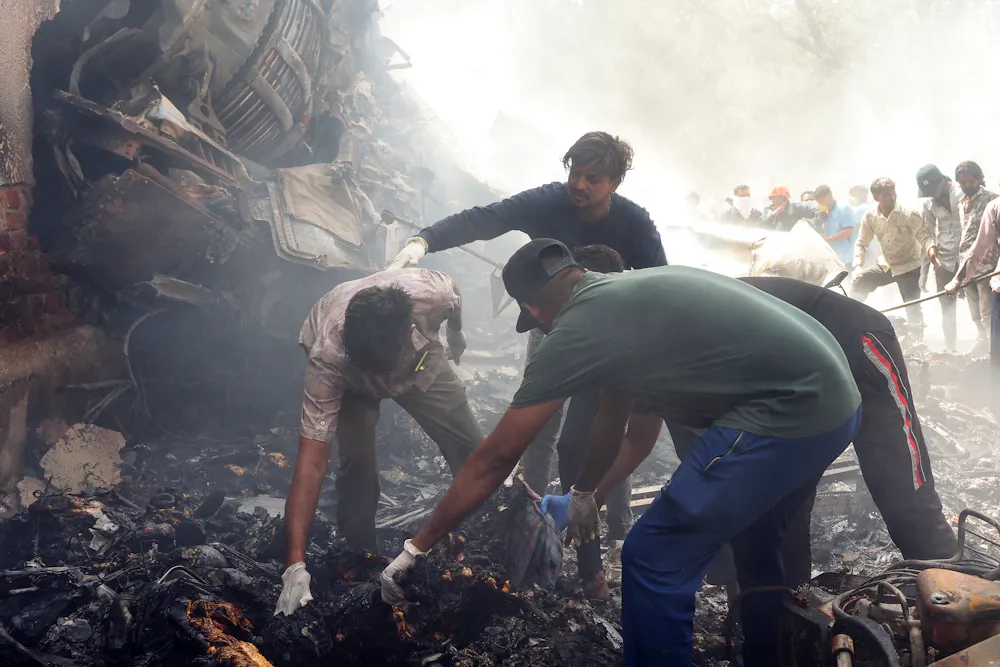
    Rescuers sift through the wreckage of Flight AI171 in Ahmedabad.
    Sam Panthaky / AFP via Getty Images

    The team will conduct a forensic investigation of the crash site to make sense of what happened. Alongside material evidence found at the site, they will look at the data stored in the plane’s “black box”, which includes data from the flight recorder and cockpit voice recorder, to learn about what happened in the leadup to the crash.

    A slow, steady process

    Air crash investigations can take a long time. Typically a preliminary report will be published 3 to 6 months after the crash, followed by a final report a year or two later.

    The report will provide factual information on the cause of the accident and make recommendations. Depending on the cause, these might be changes to maintenance procedures, pilot and crew procedures, or even the design of parts of the aircraft.

    Indian authorities will then disseminate these recommendations to whoever needs them around the world. The process is slow, but it moves in the direction of safer air travel. Everyone will be waiting to find out and learn.

    In the meantime, it’s best to remember that we still don’t know what happened or why. Everyone wants answers, but speculation can do more harm than good.

    Guido Carim Junior does not work for, consult, own shares in or receive funding from any company or organisation that would benefit from this article, and has disclosed no relevant affiliations beyond their academic appointment.

    ref. What do we know about the Air India crash? How did one man survive? What now? An aviation safety expert explains – https://theconversation.com/what-do-we-know-about-the-air-india-crash-how-did-one-man-survive-what-now-an-aviation-safety-expert-explains-258910

    MIL OSI – Global Reports

  • MIL-OSI Global: Speculation about the cause of Air India crash is rife. An aviation expert explains why it’s a problem

    Source: The Conversation – Global Perspectives – By Natasha Heap, Program Director for the Bachelor of Aviation, University of Southern Queensland

    It has only been a few hours since Air India flight AI171 crashed in Ahmedabad, killing more than 260 people, yet public speculation about the causes of the disaster is already rife.

    Parts of the media seem to be encouraging this. For example, earlier today I was contacted by an international news organisation for an interview about the tragedy. While I agreed, I cautioned that I could only say “it is too early to speculate”. They decided not to proceed with the interview. No reason was given, but perhaps it was my aversion to speculation.

    Of course, I want to know as much as anyone else what caused this disaster. But publicly speculating at such an early stage, when there is so little evidence available, is more than unhelpful. It is also harmful, as many examples throughout history have shown.

    Like an archaeological excavation

    Aviation accident investigations start as soon as first responders have extinguished the fires and completed the search for survivors – the first and foremost driver when responding to such a disaster – and have declared the site safe. The identification of the victims will then commence, completed by a different agency, parallel to the accident investigation.

    State authorities aren’t the only people involved. The aircraft manufacturer (in this case Boeing) will usually send representatives to assist the investigation, as can the home countries of victims. Investigators in the country where the accident occurred may also request assistance from countries with more experience in aviation accident investigation.

    An early step for investigators is finding the black boxes (flight data recorders and cockpit voice recorder) among the debris. These contain data about the flight itself, what the aircraft was doing, and what the pilots were saying.

    But a plane crash investigation involves much more than just finding the black box.

    An aviation accident investigation is akin to an archaeological excavation – methodical and painstaking. If the evidence is not collected and preserved for later analysis at the time, it will be irrevocably lost.

    In the case of Air India Flight 171 the scene is further complicated by the crash location – a building. It will take time for the aeroplane wreckage, victims and personal belongings to be sorted from the building debris. This must occur before the search for answers can commence.

    Investigators will also gather witness statements and any video of the event. Their analysis will be further informed by company documentation, training, and regulatory compliance information.

    Around 80% of aviation accidents are due to “human factors”.

    According to the International Civil Aviation Organisation human factors are:

    what we know about human beings including their abilities, characteristics, and limitations, the design of procedures and equipment people use, and the environment in which they function and the tasks they perform.

    It could take several years for the full forensic investigation into this disaster to run its full course. For example, the final report into the Sea World helicopter crash in Queensland, Australia, back in 2023, which claimed the lives of four people and injured nine others, was only released in April this year.

    A history of speculation – and vilification

    There is a long history of undue and harmful public speculation about the possible causes of a plane crash.

    For example, since the disappearance of Malaysia Airlines flight MH370 on March 8, 2014, speculation has swirled about whether chief pilot Zaharie Ahmad Shah was responsible for the disaster and the deaths of the other 238 people on board. This has deeply upset his sister, Sakinab Shah. In 2016, she told CNN she feels her brother is a “scapegoat” she must defend.

    Similarly, the pilots of the British Midlands accident near Kegworth in 1989, in which 47 people died, were also publicly vilified.

    The pilots, who survived the crash, were experienced but misidentified which engine had failed, and shut down the wrong one. They were widely criticised in the press for the error, tarnishing their reputations, losing their jobs, and no doubt causing more stress to their families. The investigation later revealed the pilots themselves had not received any simulator training as they transitioned to a newer variant of the aircraft they were flying.

    This shows how undue public speculation about an airline disaster can add to the distress of victims and their families.

    Respect the process

    No doubt pilots and aviation experts are speculating in private right now about the causes of this particular disaster. Cafes, pubs and crew rooms will be rife with discussions and opinions. It is human nature to want to know what happened.

    But to speculate in public won’t assist the investigative process. Nor will it help the families of the victims, or the first responders and investigators themselves, get through this horrible time.

    Investigators need to work without external pressures to ensure accurate findings. Respecting this process maintains integrity and supports the many people who are currently experiencing unimaginable grief.

    Natasha Heap does not work for, consult, own shares in or receive funding from any company or organisation that would benefit from this article, and has disclosed no relevant affiliations beyond their academic appointment.

    ref. Speculation about the cause of Air India crash is rife. An aviation expert explains why it’s a problem – https://theconversation.com/speculation-about-the-cause-of-air-india-crash-is-rife-an-aviation-expert-explains-why-its-a-problem-258911

    MIL OSI – Global Reports

  • Air India crash in Ahmedabad: 241 dead, only one survivor among 242 on board

    Source: Government of India

    Source: Government of India (2)

    nly one passenger survived after an Air India flight carrying 242 people crashed shortly after take-off in Ahmedabad on Thursday, the airline said in a statement.

    “We regret to inform that, of the 242 aboard, there are 241 confirmed fatalities. The sole survivor is being treated in a hospital,” Air India said.

    “The survivor is a British national of Indian origin,” it added.

    Air India also released a breakdown of the nationalities of those on board: 169 were Indian nationals, 53 British, seven Portuguese, and one Canadian.

    Flight AI-171, bound for London Gatwick, went down minutes after departing Sardar Vallabhbhai Patel International Airport at 1:38 p.m. IST. The aircraft crashed into a residential complex near BJ Medical College, sparking a massive fire and triggering a large-scale emergency response.

    In a separate post on X, the airline said it has established support centers at multiple airports to assist the families of the victims.

    “Air India has set up Friends & Relatives Assistance Centres at Ahmedabad, Mumbai, Delhi and Gatwick airports to provide support and take care of the needs of the families and loved ones of those on flight AI171. These centres are facilitating the travel of family members to Ahmedabad,” the airline said.

    Emergency contact numbers have also been shared for those seeking information: 1800 5691 444 for calls from within India, and +91 8062779200 for international callers.

  • MIL-Evening Report: What do we know about the Air India crash? How did one man survive? What now? An aviation safety expert explains

    Source: The Conversation (Au and NZ) – By Guido Carim Junior, Senior Lecturer in Aviation, Griffith University

    The back of Air India flight 171 after it crashed into a residential building in Ahmedabad. Sam Panthaky / AFP via Getty Images

    An Air India flight crashed shortly after takeoff from Ahmedabad in northwest India on Thursday afternoon local time, killing more than 260 people.

    The Boeing 787-8 Dreamliner, Flight AI171, was carrying 242 people bound for London. Only one passenger, a British man, survived.

    The plane crashed less than a minute after takeoff, coming down on top of a college hostel around 1.5 kilometres from the runway. Little is known so far about the cause of the incident.

    As an aviation safety expert, it is hard to avoid a sense of disbelief that an event such as this – involving one of the most advanced passenger jets in the world, built on the lessons of many earlier accidents – could happen in the 21st century.

    Trouble after takeoff

    Air crashes such as this one, in which a plane experiences trouble immediately after takeoff, are now extremely rare. They were more common in the past.

    In one infamous 1999 incident, 32 people died when LAPA Flight 3142 crashed during takeoff from Buenos Aires. During the accident investigation, it emerged that the Boeing 737’s wing flaps had not been in the right position for takeoff and the crew had ignored alarms from the plane’s internal warning system.

    The 2009 emergency landing of US Airways Flight 1549 on New York’s Hudson River also occurred shortly after takeoff. In that case, the problem was quite different: a collision with a flock of Canada geese shut down both engines, leading to a powerless aircraft.

    However, the aviation industry puts a lot of resources into learning from accidents so they don’t happen again. LAPA Flight 3142 led to recommended improvements in pilot training and flight procedures. The rules for engine design were changed after the “miracle on the Hudson”.

    So whatever caused the Air India crash, it may not be something we have seen before.

    How did one passenger survive?

    One passenger survived the crash. We don’t know exactly how.

    He was sitting in seat 11A, next to an emergency exit. Reports say the plane “broke in half”, and the passenger found himself in the front half while the rear caught fire. He then walked from the wreckage and was found by rescuers.

    Why did he survive when everybody else died? Research suggests that, in general, the seats at the back of the plane are the safest place to be in a crash – but this man was quite close to the front.

    Based on what we know so far, my expert opinion is that we have no better explanation than to call it luck or a miracle.

    Where to from here?

    We won’t have a clear idea of what happened until a full investigation has been carried out. Air crash investigations follow a protocol laid out by an International Civil Aviation Organization document called Annex 14.

    India’s Aircraft Accident Investigation Bureau will lead this investigation, putting together a team that will be assisted by representatives from the US National Transport Safety Bureau and the UK Air Accidents Investigation Branch, representing the countries of the plane’s manufacturer and passengers aboard.

    Rescuers sift through the wreckage of Flight AI171 in Ahmedabad.
    Sam Panthaky / AFP via Getty Images

    The team will conduct a forensic investigation of the crash site to make sense of what happened. Alongside material evidence found at the site, they will look at the data stored in the plane’s “black box”, which includes data from the flight recorder and cockpit voice recorder, to learn about what happened in the leadup to the crash.

    A slow, steady process

    Air crash investigations can take a long time. Typically a preliminary report will be published 3 to 6 months after the crash, followed by a final report a year or two later.

    The report will provide factual information on the cause of the accident and make recommendations. Depending on the cause, these might be changes to maintenance procedures, pilot and crew procedures, or even the design of parts of the aircraft.

    Indian authorities will then disseminate these recommendations to whoever needs them around the world. The process is slow, but it moves in the direction of safer air travel. Everyone will be waiting to find out and learn.

    In the meantime, it’s best to remember that we still don’t know what happened or why. Everyone wants answers, but speculation can do more harm than good.

    Guido Carim Junior does not work for, consult, own shares in or receive funding from any company or organisation that would benefit from this article, and has disclosed no relevant affiliations beyond their academic appointment.

    ref. What do we know about the Air India crash? How did one man survive? What now? An aviation safety expert explains – https://theconversation.com/what-do-we-know-about-the-air-india-crash-how-did-one-man-survive-what-now-an-aviation-safety-expert-explains-258910

    MIL OSI AnalysisEveningReport.nz

  • MIL-Evening Report: Speculation about the cause of Air India crash is rife. An aviation expert explains why it’s a problem

    Source: The Conversation (Au and NZ) – By Natasha Heap, Program Director for the Bachelor of Aviation, University of Southern Queensland

    It has only been a few hours since Air India flight AI171 crashed in Ahmedabad, killing more than 260 people, yet public speculation about the causes of the disaster is already rife.

    Parts of the media seem to be encouraging this. For example, earlier today I was contacted by an international news organisation for an interview about the tragedy. While I agreed, I cautioned that I could only say “it is too early to speculate”. They decided not to proceed with the interview. No reason was given, but perhaps it was my aversion to speculation.

    Of course, I want to know as much as anyone else what caused this disaster. But publicly speculating at such an early stage, when there is so little evidence available, is more than unhelpful. It is also harmful, as many examples throughout history have shown.

    Like an archaeological excavation

    Aviation accident investigations start as soon as first responders have extinguished the fires and completed the search for survivors – the first and foremost driver when responding to such a disaster – and have declared the site safe. The identification of the victims will then commence, completed by a different agency, parallel to the accident investigation.

    State authorities aren’t the only people involved. The aircraft manufacturer (in this case Boeing) will usually send representatives to assist the investigation, as can the home countries of victims. Investigators in the country where the accident occurred may also request assistance from countries with more experience in aviation accident investigation.

    An early step for investigators is finding the black boxes (flight data recorders and cockpit voice recorder) among the debris. These contain data about the flight itself, what the aircraft was doing, and what the pilots were saying.

    But a plane crash investigation involves much more than just finding the black box.

    An aviation accident investigation is akin to an archaeological excavation – methodical and painstaking. If the evidence is not collected and preserved for later analysis at the time, it will be irrevocably lost.

    In the case of Air India Flight 171 the scene is further complicated by the crash location – a building. It will take time for the aeroplane wreckage, victims and personal belongings to be sorted from the building debris. This must occur before the search for answers can commence.

    Investigators will also gather witness statements and any video of the event. Their analysis will be further informed by company documentation, training, and regulatory compliance information.

    Around 80% of aviation accidents are due to “human factors”.

    According to the International Civil Aviation Organisation human factors are:

    what we know about human beings including their abilities, characteristics, and limitations, the design of procedures and equipment people use, and the environment in which they function and the tasks they perform.

    It could take several years for the full forensic investigation into this disaster to run its full course. For example, the final report into the Sea World helicopter crash in Queensland, Australia, back in 2023, which claimed the lives of four people and injured nine others, was only released in April this year.

    A history of speculation – and vilification

    There is a long history of undue and harmful public speculation about the possible causes of a plane crash.

    For example, since the disappearance of Malaysia Airlines flight MH370 on March 8, 2014, speculation has swirled about whether chief pilot Zaharie Ahmad Shah was responsible for the disaster and the deaths of the other 238 people on board. This has deeply upset his sister, Sakinab Shah. In 2016, she told CNN she feels her brother is a “scapegoat” she must defend.

    Similarly, the pilots of the British Midlands accident near Kegworth in 1989, in which 47 people died, were also publicly vilified.

    The pilots, who survived the crash, were experienced but misidentified which engine had failed, and shut down the wrong one. They were widely criticised in the press for the error, tarnishing their reputations, losing their jobs, and no doubt causing more stress to their families. The investigation later revealed the pilots themselves had not received any simulator training as they transitioned to a newer variant of the aircraft they were flying.

    This shows how undue public speculation about an airline disaster can add to the distress of victims and their families.

    Respect the process

    No doubt pilots and aviation experts are speculating in private right now about the causes of this particular disaster. Cafes, pubs and crew rooms will be rife with discussions and opinions. It is human nature to want to know what happened.

    But to speculate in public won’t assist the investigative process. Nor will it help the families of the victims, or the first responders and investigators themselves, get through this horrible time.

    Investigators need to work without external pressures to ensure accurate findings. Respecting this process maintains integrity and supports the many people who are currently experiencing unimaginable grief.

    Natasha Heap does not work for, consult, own shares in or receive funding from any company or organisation that would benefit from this article, and has disclosed no relevant affiliations beyond their academic appointment.

    ref. Speculation about the cause of Air India crash is rife. An aviation expert explains why it’s a problem – https://theconversation.com/speculation-about-the-cause-of-air-india-crash-is-rife-an-aviation-expert-explains-why-its-a-problem-258911

    MIL OSI AnalysisEveningReport.nz

  • Air India Dreamliner crashes after takeoff from Ahmedabad, 241 dead, one survivor: Air India

    Source: Government of India

    Source: Government of India (4)

    An Air India Boeing 787-8 Dreamliner crashed shortly after takeoff from Ahmedabad on Thursday afternoon, killing 241 people in what is being described as one of the worst aviation disasters in India’s history. Only one passenger survived.

    Flight AI-171, en route from Ahmedabad to London Gatwick, went down minutes after departing from Sardar Vallabhbhai Patel International Airport at 1:38 p.m. IST. The aircraft plunged into a residential complex near BJ Medical College, triggering a massive fire and a large-scale emergency response across the city.

    According to Air India, the flight was carrying 242 people — 230 passengers and 12 crew members, including two pilots. The sole survivor, a British national of Indian origin seated in 11A, is currently undergoing treatment at a local hospital.

    The airline confirmed the tragedy in an official statement on X, saying, “UPDATE: Air India confirms that flight AI171, operating from Ahmedabad to London Gatwick on 12 June 2025, was involved in an accident. The 12-year-old Boeing 787-8 aircraft departed from Ahmedabad at 1338 hrs, carrying 230 passengers and 12 crew. The aircraft crashed shortly after take-off. We regret to inform that, of the 242 aboard, there are 241 confirmed fatalities. The sole survivor is being treated in a hospital.”

    Air India also released a breakdown of the passengers’ nationalities: 169 were Indian, 53 British, seven Portuguese, and one Canadian.

    The airline extended its condolences to the families of the deceased and said a dedicated team has been deployed in Ahmedabad to provide support.
    “Our efforts now are focused entirely on the needs of all those affected, their families and loved ones,” the statement read.

    Air India has pledged full cooperation with the authorities investigating the cause of the crash. Dedicated helplines have been set up for families seeking information. Domestic callers can reach 1800 5691 444, while international callers can dial +91 8062779200.

    -IANS

  • MIL-OSI China: Local media report says 1 black box of crashed Air India plane found

    Source: People’s Republic of China – State Council News

    Aviation authorities have found one of the two black boxes of the Air India flight that crashed in the western Indian state of Gujarat, killing 241 on board, local newspaper Hindustan Times said.

    The London-bound flight crashed on Thursday afternoon shortly after takeoff from the Sardar Vallabhbhai Patel International Airport in Ahmedabad, about 17 km south of Gandhinagar, the capital city of Gujarat.

    “Of the two black boxes, the one in the rear of the aircraft has been located and safely guarded. The Directorate General of Civil Aviation will collect the equipment to analyse the recordings. The second black box, in the aircraft’s front portion, is yet to be found,” the newspaper quoting a source said.

    Black boxes are electronic data recorders in the aircraft. The bright orange or yellow rectangular boxes are designed to withstand high-speed crashes, explosions, fire and water pressure.

    Experts said the answer to what went wrong for Air India Flight 171 may lie in these small machines. It contains flight and cockpit recordings, and flight data, which can help investigators to understand the reason behind the plane crash. However, it takes days to analyse the data.

    The Boeing 787-8 Dreamliner had 169 Indian nationals, 53 British nationals, seven Portuguese nationals and one Canadian, apart from two pilots and 10 cabin crew members on board when it crashed at the premises of a medical college.

    Air India on Friday confirmed the crash killed 241 passengers on board, and the only survivor in the incident is being treated in a hospital.

    The Indian government’s Aircraft Accident Investigation Bureau has initiated a formal investigation into the crash.

    Boeing President and Chief Executive Officer Kelly Ortberg said he has spoken with Air India Chairman N Chandrasekaran following the crash and expressed readiness to support the investigation by Indian authorities.

    The 12-year-old Boeing 787-8 aircraft bearing number AI171 went down after takeoff at an altitude of 825 feet and crashed on the premises of B J Medical College, causing severe damage to the buildings.

    According to the Federation of All India Medical Associations Doctors Association, one person was killed, while at least five medical students and four relatives of resident doctors were reported missing, and 50 others were injured at the premises of B J Medical College. 

    MIL OSI China News

  • MIL-OSI USA: Schatz Presses Secretary Hegseth, Defense Leaders On Use Of Military Against Protesters, Demands Transparency On Foreign Gift Of Luxury Plane

    US Senate News:

    Source: United States Senator for Hawaii Brian Schatz

    WASHINGTON – At a Senate Appropriations Subcommittee on Defense hearing today, U.S. Senator Brian Schatz (D-Hawai‘i) challenged Secretary of Defense Pete Hegseth and Chairman of the Joint Chiefs General Dan Caine on President Trump’s deployment of the National Guard to respond to protests in Los Angeles. He also questioned the administration’s acceptance of a luxury aircraft from the government of Qatar to be used as Air Force One.

    “Is the United States being invaded by a foreign nation?” Schatz asked General Caine. “Is there a rebellion somewhere in the United States?”

    General Caine responded, “I do not see any state-sponsored folks invading,” adding, “There’s definitely some frustrated folks out there.”

    Senator Schatz asked Secretary Hegseth, “Did you just potentially mobilize every Guard everywhere and every service member everywhere? I mean, create the framework for that?”

    Hegseth replied that the order was intended in part to help the administration “get ahead of a problem” if protests expanded to other areas.

    Schatz also raised questions about the Defense Department’s recent acceptance of a luxury airplane from the Qatari government to replace Air Force One, asking, “Did the Department of Defense initiate the conversation with the Qataris? How did that go?”

    Hegseth said, “I would have to go back and review it, but we’ve been a part of the ongoing conversation.”

    “I think it kind of matters who is asking, doesn’t it?… If we’re going to disagree, let’s disagree with the same set of facts,” said Senator Schatz. “Let’s have the documentation on the Qatari aircraft.”

    A video of the exchange is available here.

    MIL OSI USA News

  • MIL-OSI China: India’s foreign ministry says lot of people lost their lives in plane crash in Gujarat

    Source: People’s Republic of China – State Council News

    Debris of an Air India plane is seen at the crash site in Ahmedabad of India’s Gujarat state, June 12, 2025. India’s foreign ministry said a lot of people have lost their lives in the plane crash with 242 people on board the flight to London in the western state of Gujarat. [Photo/Xinhua]

    India’s foreign ministry said a lot of people have lost their lives in Thursday’s plane crash with 242 people on board an Air India flight to London in the western state of Gujarat.

    The Air India flight had 169 Indian nationals, 53 British nationals, seven Portuguese nationals and one Canadian on board when it crashed shortly after takeoff from the Sardar Vallabhbhai Patel International Airport in Ahmedabad, about 17 km south of Gandhinagar, the capital city of Gujarat.

    There were also 12 cabin crew members on board.

    The ministry, however, has not put out an exact figure on the death toll in the plane crash.

    “What has happened in Ahmedabad is a very tragic accident. We have lost a lot of people. We extend our deepest condolences to all those who have lost their loved ones. There are several foreigners. You will receive the updates from the relevant departments — Ministry of Civil Aviation, Air India, and others. That is the latest I can share. It is an evolving situation. The rescue operations are on. We need to wait a little more time for exact details to be put out,” India’s foreign ministry spokesperson Randhir Jaiswal said during a press briefing.

    Local media reports said that there are no survivors from the ill-fated plane.

    A video of the aircraft flying low and struggling to gain altitude shows the plane going down and exploding in a massive ball of fire.

    Other videos from the site show thick columns of black smoke rising from the ground.

    According to police, the plane crashed directly on the B J Medical College undergraduate hostel mess in Meghani Nagar. The crash caused severe damage to buildings on the premises and several people were reported to be injured.

    A part of the crashed plane landed atop a student hostel, eyewitnesses said.

    Immediately after the crash, authorities rushed fire engines and over two dozen ambulances to the spot to carry out rescue work.

    Police have diverted traffic from the area, and a green corridor has also been established to ferry the injured quickly to the hospital.

    Air India has expressed condolences to the families of all those affected by this devastating event. The airline has changed its logo on social media handles to black after the deadly plane crash.

    The British government has issued a travel advisory, saying they were aware of the plane crash in Ahmedabad.

    “We are aware of a plane crash in Ahmedabad. The UK is working with local authorities in India to urgently establish the facts and provide support to those involved,” reads the advisory.

    Reports said former Gujarat chief minister Vijay Rupani was onboard the crashed flight. Web check-in documents obtained by local media said Rupani had completed his check-in in business class on the ill-fated flight.

    Indian Prime Minister Narendra Modi described the plane crash incident as a tragedy and heartbreaking beyond words.

    “The tragedy in Ahmedabad has stunned and saddened us. It is heartbreaking beyond words. In this sad hour, my thoughts are with everyone affected by it. Have been in touch with ministers and authorities who are working to assist those affected,” Modi wrote on social media.

    Meanwhile, world leaders have expressed condolences to the families of the Air India plane crash in Ahmedabad. 

    People conduct rescue work at the site of an Air India plane crash in Ahmedabad of India’s Gujarat state, June 12, 2025. India’s foreign ministry said a lot of people have lost their lives in the plane crash with 242 people on board the flight to London in the western state of Gujarat. (Str/Xinhua)

    MIL OSI China News

  • MIL-OSI China: China’s top diplomat calls for enhanced ties with Africa

    Source: People’s Republic of China – State Council News

    Chinese Foreign Minister Wang Yi on Thursday held meetings with several African dignitaries who are in China for the opening ceremony of the fourth China-Africa Economic and Trade Expo, as well as the Ministerial Meeting of Coordinators on the Implementation of the Follow-up Actions of the Forum on China-Africa Cooperation (FOCAC) in Changsha, the capital of central China’s Hunan Province.

    The African dignitaries Wang met with include Ugandan Prime Minister Robinah Nabbanja, Liberian Vice President Jeremiah Kpan Koung, Rwandan Foreign Minister Olivier Nduhungirehe, Somali Foreign Minister Abdisalam Abdi Ali, Mozambican Foreign Minister Maria Manuela dos Santos Lucas, and Togolese Foreign Minister Robert Dussey.

    When meeting with Nabbanja, Wang said that the heads of state of China and Uganda have established mutual trust and friendship, providing impetus and a guarantee for the development of bilateral relations. In the first quarter of this year, Uganda’s exports to China increased nearly 90 percent year on year, and China is willing to deepen practical cooperation in various fields with the country, he added.

    Nabbanja expressed her gratitude to China for its valuable support for Uganda’s infrastructure construction and economic and social development over a long period of time. She noted her expectation that cooperation with China would be deepened in key areas such as airport expansion, digital transformation and agricultural modernization.

    When meeting with Koung, Wang noted that the presidents of China and Liberia had met on the sidelines of the FOCAC Beijing Summit to announce the establishment of a strategic partnership between the two countries. He said that China stands ready to work with Liberia to continue implementing the consensus reached between the two heads of state, as well as the key outcomes of the summit, to deliver benefits to both peoples.

    Koung expressed gratitude for China’s long-term, selfless support for Liberia, expressing willingness to work with China to implement the consensus reached between the two heads of state and advance cooperation across sectors such as maritime affairs, green energy, health care and agriculture.

    When meeting with Nduhungirehe, Wang said that the heads of state of China and Rwanda had elevated bilateral relations to a comprehensive strategic partnership, providing strong strategic guidance for the development of bilateral relations. China is willing to deepen its exchange and mutual learning with Rwanda in the area of state governance, and to enhance practical cooperation across various fields, Wang said.

    Nduhungirehe said Rwanda is committed to implementing the outcomes of the FOCAC Beijing Summit, particularly the ten partnership actions for modernization, so as to work collaboratively to advance toward an independent, self-reliant modernization.

    When meeting with Abdisalam, Wang said that the heads of state of China and Somalia had elevated bilateral relations to a strategic partnership during the FOCAC Beijing Summit. He noted that China is willing to work with Somalia to implement the summit’s outcomes, deliver more tangible benefits to the Somali people, and assist Somalia in restoring peace and stability and accelerating its reconstruction and development.

    Abdisalam thanked China for its strong support during Somalia’s most difficult times, noting that China holds a highly important position in the hearts of the Somali people, and that Somalia greatly appreciates and is willing to actively participate in the series of global initiatives proposed by China.

    When meeting with Lucas, Wang said that China is willing to deepen its comprehensive strategic partnership with Mozambique, and is ready to assist the country in accelerating its industrialization and modernization processes. He expressed appreciation for Mozambique’s adherence to the one-China principle.

    Lucas said that Mozambique appreciates China’s new measures to support African development, as well as China’s countermeasures against the imposition of unilateral tariffs.

    When meeting with Dussey, Wang congratulated Togo on its smooth transition of its political system, expressing support for Togo in actively exploring a governance path that suits its national conditions. He added that China is willing to support Togo in safeguarding its independence, sovereignty and national dignity.

    Dussey said the series of global initiatives proposed by China uphold the spirit of solidarity and cooperation, and have made vital contributions to promoting world stability and prosperity.

    MIL OSI China News

  • MIL-OSI USA News: Congressional Bill S.160 Signed into Law

    Source: US Whitehouse

    On Thursday, June 12, 2025, the President signed into law:
     
    S. 160, which amends the Wildfire Suppression Aircraft Transfer Act of 1996 to reauthorize the sale by the Department of Defense of aircraft and parts for wildfire suppression purposes, and for other purpose

    MIL OSI USA News

  • MIL-OSI USA News: Fact Sheet: President Donald J. Trump Empowers Commonsense Wildfire Prevention and Response

    Source: US Whitehouse

    STRENGTHENING WILDFIRE PREVENTION AND RESPONSE: Today, President Donald J. Trump signed an Executive Order returning common sense to wildfire prevention and response.

    • The Order directs the Secretary of the Interior and Secretary of Agriculture to consolidate their wildland fire programs.
    •  The Order supports local wildfire preparedness and response by improving Federal partnerships, as well as driving responsible land management and prevention at the State and local level.
    • The Order directs the use of available technology, including AI, data sharing, innovative mapping, and weather forecasting, to enhance State and local wildfire identification and response capabilities.
    • The Order directs Federal agencies to modify rules to facilitate preventive prescribed fires and appropriate fire-retardant use, promote innovative use of woody biomass and other forest products to reduce fuel loads that strengthen fires, and minimize wildfire ignition risks from the bulk-power system.
    • The Order modernizes wildfire prevention and response by instructing Federal agencies to declassify historical satellite data to improve wildfire prediction and revise or eliminate rules that impede wildfire detection, prevention, and response.
    • The Order directs the Secretary of Defense to prioritize the sale of excess aircraft and aircraft parts to support wildfire mitigation and response.

    EMPOWERING STATE AND LOCAL LEADERS: President Trump is empowering State and local leaders to combat wildfires effectively.

    • For too long, State and local wildfire responses have been slow and inadequate due to reckless mismanagement and lack of preparedness.
    • Wildfires threaten every region, yet many local government entities continue to disregard commonsense preventative measures.
    • Firefighters are forced to rely on outdated technology and face challenges in quickly responding to wildfires because of unnecessary regulation and bureaucracy.
    • Immediate action is essential to ensure the devastation of the Los Angeles wildfires never occurs again.
    • By streamlining Federal wildfire capabilities, States can leverage an efficient and straightforward approach concerning wildfire response and mitigation.

    RESTORING COMMON SENSE TO THE FEDERAL GOVERNMENT: President Trump has consistently demonstrated a commonsense approach to safeguard and protect the environment and American communities.

    • On Day One, President Trump signed a Memorandum to prioritize routing water to Southern California in the wake of the destructive wildfires.
    • In President Trump’s first week back in office, he and First Lady Melania Trump visited Los Angeles to inspect wildfire damage, promising immediate Federal support and relief.
    • Upon visiting Los Angeles, President Trump immediately issued measures to provide increased water resources in California and promote expedited recovery procedures for Californians after their State government’s disastrous mishandling and misuse of resources and lack of preparation for the January 2025 wildfires.
    • In March 2025, President Trump issued an Executive Order to enhance forest management, promoting responsible use of American timber to reduce wildfire risks.  

    MIL OSI USA News

  • MIL-OSI USA News: Empowering Commonsense Wildfire Prevention and Response

    Source: US Whitehouse

    class=”has-text-align-left”>By the authority vested in me as President by the Constitution and the laws of the United States of America, it is hereby ordered:
    Section 1. Purpose. The devastation of the January 2025 Los Angeles wildfires shocked the American people and highlighted the catastrophic consequences when State and local governments are unable to quickly respond to such disasters.  In too many cases, including in California, a slow and inadequate response to wildfires is a direct result of reckless mismanagement and lack of preparedness. Wildfires threaten every region, yet many local government entities continue to disregard commonsense preventative measures. Firefighters across the country are forced to rely on outdated technology and face challenges in quickly responding to wildfires because of unnecessary regulation and bureaucracy. 
    The Federal Government can empower State and local leaders by streamlining Federal wildfire capabilities to improve their effectiveness and promoting commonsense, technology-enabled local strategies for land management and wildfire response and mitigation.  

    Sec. 2.  Streamlining Federal Wildland Fire Governance.  Within 90 days of the date of this order, the Secretary of the Interior and the Secretary of Agriculture shall, to the maximum degree practicable and consistent with applicable law, consolidate their wildland fire programs to achieve the most efficient and effective use of wildland fire offices, coordinating bodies, programs, budgets, procurement processes, and research and, as necessary, recommend additional measures to advance this objective.

    Sec. 3.  Encouraging Local Wildfire Preparedness and Response.  (a)  Within 90 days of the date of this order, the Secretary of the Interior and the Secretary of Agriculture, in consultation with the Secretary of Homeland Security, shall:
            (i)   expand and strengthen the use of partnerships, agreements, compacts, and mutual aid capabilities that empower Federal, State, local, tribal, and community-driven land management that reduces wildfire risk and improves wildfire response, including on public lands; and
            (ii)  develop and expand the use of other measures to incentivize responsible land management and wildfire prevention, mitigation, and response measures at the State and local levels.
    (b)  Within 180 days of the date of this order, the Secretary of the Interior and the Secretary of Agriculture, in consultation with the Secretary of Commerce and the heads of executive departments and agencies (agencies) represented at the National Interagency Fire Center, shall:
            (i)   develop a comprehensive technology roadmap, in consultation with the Director of the Office of Science and Technology Policy (OSTP), to increase wildfire firefighting capabilities at the State and local levels, including through artificial intelligence, data sharing, innovative modeling and mapping capabilities, and technology to identify wildland fire ignitions and weather forecasts to inform response and evacuation; and
            (ii)  promote the use of a risk-informed approach, as consistent with Executive Order 14239 of March 18, 2025 (Achieving Efficiency Through State and Local Preparedness), to develop new policies that remove barriers to preventing and responding to wildfires, including through year-round response readiness, better forest health, and activities outlined in Executive Order 14225 of March 1, 2025 (Immediate Expansion of American Timber Production).

    Sec. 4.  Strengthening Wildfire Mitigation.  Within 90 days of the date of this order:
    (a)  The Administrator of the Environmental Protection Agency shall consider modifying or rescinding, as consistent with applicable law, Federal rules or policies that impede the use of appropriate, preventative prescribed fires.
    (b)  The Secretary of Agriculture and the Administrator of the Environmental Protection Agency, in consultation with the Secretary of the Interior, shall consider modifying or rescinding, as consistent with applicable law, Federal rules or policies hindering the appropriate use of fire retardant to fight wildfires.
    (c)  The Secretary of Agriculture, in consultation with the Secretary of the Interior, shall consider promoting, assisting, and facilitating, as consistent with applicable law, innovative uses of woody biomass and forest products to reduce fuel loads in areas at risk of wildfires.
    (d)  The Secretary of the Interior, the Secretary of Agriculture, the Secretary of Energy, and the Federal Energy Regulatory Commission shall consider initiating rulemaking proceedings to establish, as consistent with applicable law, best practices to reduce the risk of wildfire ignition from the bulk-power system without increasing costs for electric-power end users, including through methods such as vegetation management, the removal of forest-hazardous fuels along transmission lines, improved engineering approaches, and safer operational practices.  
    (e)  The Attorney General, in consultation with the Secretary of Agriculture and the Secretary of the Interior, shall review pending and proposed wildfire-related litigation involving electrical utility companies to ensure the Department’s positions and proposed resolutions in such matters advance the wildfire prevention and mitigation efforts identified in this order.

    Sec. 5.  Modernizing Wildfire Prevention and Response
    (a)  Within 120 days of the date of this order, the Secretary of Defense, in consultation with the Director of OSTP, the Assistant to the President for National Security Affairs, and the heads of relevant agencies, shall, as appropriate, identify, declassify, and make publicly available historical satellite datasets that will advance wildfire prevention and response and improve wildfire prediction and evaluation models.
    (b)  Within 180 days of the date of this order, the Secretary of the Interior and the Secretary of Agriculture, in consultation with the Secretary of Commerce and the heads of agencies represented at the National Interagency Fire Center, shall:
            (i)   Identify rules that impede wildfire prevention, detection, or response and consider eliminating or revising those rules, as consistent with applicable law.  This consideration and any resulting rulemaking proceedings shall be reflected in the Fall 2025 Unified Regulatory Agenda. 
            (ii)  Develop performance metrics for wildfire response, including metrics related to average response times, annual fuels treatments, safety and cost effectiveness, and other subjects, as appropriate for inclusion in strategic and annual performance plans.
    (c)  Within 210 days of the date of this order, the Secretary of Defense shall evaluate and, as appropriate and consistent with applicable law, prioritize the sale of excess aircraft and aircraft parts to support wildfire mitigation and response.

    Sec. 6.  General Provisions.  (a)  Nothing in this order shall be construed to impair or otherwise affect:
            (i)   the authority granted by law to an executive department or agency, or the head thereof; or
            (ii)  the functions of the Director of the Office of Management and Budget relating to budgetary, administrative, or legislative proposals.
    (b)  This order shall be implemented consistent with applicable law and subject to the availability of appropriations.
    (c)  This order is not intended to, and does not, create any right or benefit, substantive or procedural, enforceable at law or in equity by any party against the United States, its departments, agencies, or entities, its officers, employees, or agents, or any other person.
    (d)  The costs for publication of this order shall be borne by the Department of Agriculture and the Department of the Interior in equal shares.

                                  DONALD J. TRUMP

    THE WHITE HOUSE,
        June 12, 2025.

    MIL OSI USA News

  • MIL-OSI USA: DMV Lawmakers Call on Department of Transportation, Army To Investigate Deadly January 29th Plane Crash

    Source: United States House of Representatives – Congresswoman Jennifer McClellan (Virginia 4th District)

    Lawmakers urge DOT and Army Inspectors General to investigate actions leading up to and after the tragic crash

    Washington, D.C. – Today, Congresswoman Jennifer McClellan (D-VA-04) joined U.S. Sens. Mark R. Warner (D-VA), Tim Kaine (D-VA), Chris Van Hollen (D-MD), and Angela Alsobrooks (D-MD) and U.S. Reps. Don Beyer (D-VA-08), Sarah Elfreth (D-MD-03), Glenn Ivey (D-MD-04), Suhas Subramanyam (D-VA-10), and Del. Eleanor Holmes Norton (D-DC) to write to the Inspectors General (IGs) of the U.S. Department of Transportation (DOT) and the U.S. Army pushing for respective investigations into Federal Aviation Administration (FAA) and Army policies and procedures that may have contributed to the January 29, 2025 mid-air collision at Ronald Reagan National Airport that took 67 lives.

    In their letters the lawmakers highlighted the need for a deeper investigation into potential organizational failures that may have contributed to the tragedy.
     
    To the Department of Transportation, the lawmakers wrote, “Any lapses in internal accountability, interagency coordination, and safety oversight must be uncovered and addressed swiftly for the families of those lost that day, for the safety of the flying public and residents of the National Capital Region, and for the integrity of the National Airspace System.”

    In their letter to the DOT, the lawmakers requested an investigation into:

    1. FAA training and operations in the National Capital Region;
    2. The concurrent use of helicopter routes and runways at DCA;
    3. Pre-January 29, 2025 safety incidents at DCA between airplanes and helicopters, and FAA risk pattern identification, escalation and sufficiency of policy responses;
    4. Post-January 29, 2025 safety incidents at DCA between airplanes and helicopters, and FAA risk identification, escalation, and sufficiency of responses to those incidents and the January 29 crash;
    5. FAA Air Traffic Controller staffing, training, and real-time responses at DCA, including on January 29; and
    6. U.S. Army, federal law enforcement, and FAA interagency communication, including effectiveness of established working groups, and FAA follow-through.

    To the U.S. Army, they wrote, “While the National Transportation Safety Board is investigating the immediate actual and proximate causes of the January 29, 2025 DCA aviation incident, the Department of the Army Inspector General has the authority to uncover the deeper institutional failures that enabled this tragedy. Emerging evidence points to longstanding lapses in internal accountability, safety oversight, safety culture, and interagency coordination.”

    Additionally, the lawmakers requested that the Army investigate the following:

    1. TAAB training activities and operations in the National Capital Region, including whether training standards, operational planning decisions, risk identification, or compliance with routes or equipment contributed to operational risk;
    2. Army and TAAB policy and practice on aircraft collision-avoidance systems, including the rationale for and coordination around the August 2024 ADS-B Out directive, and whether longstanding near-miss patterns were adequately identified, escalated, and addressed;
    3. Army, federal law enforcement, and Federal Aviation Administration interagency communication; and
    4. Army actions taken in response to the January 29, 2025 crash, including any policy changes, coordination efforts, transparency with oversight bodies, and measures to prevent further incidents.
       
      Sens. Warner and Kaine have been closely involved with the in the investigation of the January 29th collision, meeting with first responders and offering condolences to the families and loved ones of the 67 lives lost immediately following the tragedy. Last week, Sens. Warner and Kaine introduced comprehensive aviation safety legislation in response to the tragic mid-air collision. The senators also saw through passage of a legislation to remember the victims of the crash. Sens. Warner and Kaine also requested answers from FAA on its plans to protect the flying public in the wake of the January 29 collision. In March of this year, the senators responded to the preliminary National Transportation Safety Board (NTSB) report on the crash. The senators have also sounded the alarm for years about the need for increased safety for the flying public, including fighting against additional flights out of DCA that contribute to overcrowding. 
       
      A copy of the letter to the DOT is available here. A copy of the letter to the Army is available here.

    ###

    MIL OSI USA News

  • MIL-OSI Russia: Chinese Foreign Minister Calls for Strengthening Ties with African Countries

    Translation. Region: Russian Federal

    Source: People’s Republic of China in Russian – People’s Republic of China in Russian –

    Source: People’s Republic of China – State Council News

    CHANGSHA, June 12 (Xinhua) — Chinese Foreign Minister Wang Yi on Thursday held separate meetings with a number of high-ranking African officials who arrived in China to attend the opening ceremony of the 4th China-Africa Economic and Trade Expo and the ministerial meeting of the coordinators of the implementation of the Forum on China-Africa Cooperation (FCAC) in Changsha, capital of central China’s Hunan Province.

    Among the African dignitaries Wang met were Ugandan Prime Minister Robin Nabbanja, Liberian Vice President Jeremiah Kun, Rwandan Foreign Minister Olivier Nduhungirehe, Somali Foreign Minister Abdisalam Abdi Ali, Mozambican Foreign Minister Maria Manuela dos Santos Lucas and Togolese Foreign Minister Robert Dusset.

    At the meeting with Robina Nabbanja, Wang Yi, also a member of the Politburo of the CPC Central Committee, said that the leaders of China and Uganda have established mutual trust and friendship, providing impetus and guarantees for the development of bilateral relations. According to him, in the first quarter of this year, Ugandan exports to China increased by nearly 90 percent year-on-year, and the Chinese side hopes to deepen practical cooperation with Uganda in various fields.

    The Ugandan leader thanked China for its valuable support in Uganda’s infrastructure construction and socio-economic development over a long period of time. She expressed hope to deepen cooperation with China in key areas such as airport expansion, digital transformation and agricultural modernization.

    Speaking with Jeremiah Kuhn, Wang Yi recalled that the leaders of China and Liberia held a meeting on the sidelines of the FCAC Beijing Summit, during which they announced a new positioning of the strategic partnership between the two countries. The Chinese diplomat said that China is willing to continue to implement the agreements reached by the heads of state and the important results of the FCAC Beijing Summit with Liberia, so as to continuously bring benefits to the peoples of the two countries.

    The Vice President of Liberia expressed gratitude to China for his country’s long-term and selfless support and assistance. He stressed his willingness to continue to work with China to implement the consensus of the leaders of the two countries and advance cooperation in such sectors as maritime affairs, green energy, health care and agriculture.

    Meeting with Olivier Nduhungirehe, Wang Yi stressed that the leaders of China and Rwanda have jointly elevated China-Rwanda relations to a comprehensive strategic partnership and provided strong strategic guidance for the development of bilateral ties. Wang Yi noted that China is willing to deepen exchanges and mutual learning with Rwanda in public administration, and strengthen practical cooperation in various fields.

    The Rwandan Foreign Minister, for his part, stated that Rwanda expects to implement the results of the Beijing summit of the FCAS, especially the ten partnership action programs for the joint promotion of modernization, in order to jointly move towards independent and self-sufficient modernization.

    During the meeting with Abdisalam Abdi Ali, Wang Yi said that during the FCAS summit in Beijing, the leaders of China and Somalia elevated bilateral relations to a strategic partnership. He noted that China is willing to work with Somalia to implement the outcomes of the summit, bring more tangible benefits to the Somali people, and help the country restore peace and stability, as well as accelerate the process of reconstruction and development.

    The Somali Foreign Minister, for his part, thanked China for its strong support during the most difficult times for his country. He stressed that China holds a particularly important place in the hearts of Somalis and that Somalia highly values and expects to actively participate in a number of global initiatives put forward by China.

    At the meeting with Maria Manuela dos Santos, Lucas Wang Yi said that China is willing to deepen the China-Mozambique comprehensive strategic partnership of cooperation and is willing to help Mozambique accelerate its industrialization and modernization. The Chinese diplomat highly appreciates Mozambique’s firm commitment to the one-China principle.

    The Mozambican Foreign Minister, for her part, said that her country is sincerely grateful to China for its new measures to support Africa’s development, as well as its countermeasures to counter the introduction of additional unilateral customs duties.

    During the conversation with Robert Dusset, Wang Yi congratulated Togo on its smooth transition to a new political system and expressed support for Togo in actively seeking a governance path that suits its national conditions. The Chinese Foreign Minister added that China will continue to support Togo in safeguarding its independence, sovereignty and national dignity.

    R. Dusset, for his part, said that a number of global initiatives put forward by China are imbued with the spirit of unity and cooperation and have made a decisive contribution to promoting stability and prosperity in the world. –0–

    MIL OSI Russia News

  • MIL-OSI Economics: Thales invests €55 million euros to anchor next-generation resilient navigation in France

    Source: Thales Group

    Headline: Thales invests €55 million euros to anchor next-generation resilient navigation in France

    • Thales strengthens its European leadership in resilient navigation, for air, land and sea, by enhancing its Châtellerault and Valence industrial sites in France.
    • The Group will invest €55 million in order to meet growing demand for secure navigation solutions for both the civil and military sectors.
    • This industrial ramp-up will quadruple the production capacity of the Châtellerault site, while in Valence, the serial production of TopStar-M GNSS receivers and the TopShield anti-jamming solution will be launched, and a new sovereign production line for inertial micro-electromechanical systems (MEMS) will be established.

    Thales, the European leader in resilient navigation, today announces a major €55 million investment to strengthen its industrial sites in Châtellerault and Valence, France. This investment, which will be made between 2025 and 2028, will meet the growing demand for high-performance navigation solutions, both civilian and military, and will strengthen its sovereign and cutting-edge industrial base.

    A comprehensive range of solutions for resilient navigation

    In a context of increasing jamming and spoofing of GNSS (Global Navigation Satellite System) signals, Thales is deploying a complete range of resilient navigation solutions that combine precision, autonomy, and security. These technologies are essential to ensure operational continuity, whether for critical military missions or civil aviation safety.

    By integrating two technological pillars combining inertial systems and GNSS signal reception, Thales enables reliable navigation even in contested environments. Autonomous navigation capability is maintained at all times due to the high performance of the TopAxyz inertial navigation systems. Signal reception integrity is ensured by combining the encrypted, multi-constellation TopStar-M receiver with the TopShield anti-jamming solution. These innovations are supported by France’s Directorate General of Armaments (DGA) under the OMEGA (Operation for the Modernization of GNSS Equipment of the Armed Forces) programme. The performance and unique combination of these solutions make Thales the European leader in resilient navigation.

    A strengthened, sustainable, and sovereign industrial base

    At Châtellerault, the production capacity of inertial navigation systems will be increased fourfold, with a gradual ramp-up through 2028. This site, with sixty years of expertise in laser gyroscopes, and as the only European supplier equipping civil aircraft, will thus be able to meet growing demand and to provide solutions for aircraft, land vehicles, ships, and munitions.

    In Valence, mass production of TopStar-M receivers and TopShield systems will begin in 2026. A new production line dedicated to inertial MEMS sensors—a breakthrough technology combining compactness and high performance—will be created, establishing the site as the spearhead of France’s sovereign MEMS technology sector for defense. The launch of this new production line will be accelerated with the support of Tronics Microsystems for certain industrial expertise.

    A strong human and regional commitment

    More than 800 employees are currently working at the two sites, and 150 new hires are planned by 2028. These investments strengthen Thales’ regional footprint and actively contribute to positioning France at the forefront of the navigation industry.

    “Thales, a leader in resilient navigation, is reinforcing its industrial base in France, and thanks to this investment, it will have a sovereign and sustainable industrial capability, delivering the most advanced and competitive solutions to meet growing needs across both civil and military customers” said Yannick Assouad, Executive Vice-President, Avionics, Thales.

    MIL OSI Economics

  • MIL-OSI Russia: Boeing says it is in contact with Air India regarding the Boeing 787 crash in India

    Translation. Region: Russian Federal

    Source: People’s Republic of China in Russian – People’s Republic of China in Russian –

    Source: People’s Republic of China – State Council News

    SAN FRANCISCO, June 12 (Xinhua) — Boeing on Thursday said it is in contact with Air India over the crash of Flight 171 in India.

    “We are in contact with Air India regarding Flight 171 and stand ready to support them. Our thoughts are with the passengers, crew, rescuers and all those affected,” the company said in a statement.

    According to the Aviation Safety Network, the crash was the first involving a Boeing 787.

    An Air India plane bound for London with 242 people on board, including two pilots and 10 crew, crashed shortly after takeoff from an airport in the western Indian state of Gujarat on Thursday.

    According to Air India, the aircraft took off from Ahmedabad at 13:38 local time /07:38 GMT/. –0–

    MIL OSI Russia News

  • MIL-OSI USA: Governor Stein Announces JetZero Selects North Carolina for $4 Billion Airplane Manufacturing Hub, Creating 14,500 Jobs in Guilford County in Largest Job Commitment in State History

    Source: US State of North Carolina

    Headline: Governor Stein Announces JetZero Selects North Carolina for $4 Billion Airplane Manufacturing Hub, Creating 14,500 Jobs in Guilford County in Largest Job Commitment in State History

    Governor Stein Announces JetZero Selects North Carolina for $4 Billion Airplane Manufacturing Hub, Creating 14,500 Jobs in Guilford County in Largest Job Commitment in State History
    lsaito

    Raleigh, NC

    Today Governor Josh Stein announced JetZero, Inc., a breakthrough aviation company, will invest more than $4.7 billion in Greensboro to build its first commercial airplane manufacturing facility at the Piedmont Triad International Airport. The project will create more than 14,560 jobs for Guilford County by 2063, the largest economic development project in North Carolina history based on job commitment.


    “I am thrilled to welcome JetZero and its 14,000 good-paying jobs and unprecedented innovation to Guilford County,” said Governor Josh Stein. “From first in flight to now the future of flight, North Carolina and our skilled workforce is soaring.”


    JetZero is a start-up airplane designer and manufacturer of the Z4, a blended-wing body jet, which blends the wings and fuselage, enabling the entire wingspan to produce lift. Founded in 2020, the California-based company has partnerships with NASA, Siemens, United Airlines, Alaska Airlines, and suppliers including RTX and BAE Systems. JetZero will build an advanced manufacturing facility for a first-of-its-kind commercial all-wing jet, as well as a state-of-the-art research and development center for composite structures. Its unique design uses technological advancements to help lower carbon emissions, burn less fuel, and enhance the experience of its travelers. 


    “North Carolina offers the ideal combination of talent, infrastructure, and forward-thinking leadership to support our mission to reshape aviation,” said Tom O’Leary, CEO and co-Founder of JetZero. “This facility is a critical milestone in bringing our all-wing Z4 to market. I applaud the leadership of Governor Josh Stein and his team as well as the leadership of the North Carolina General Assembly, and whole host of local leaders and organizations for working with us to bring JetZero to North Carolina, the birthplace of aviation.”


    “With an internationally recognized aerospace cluster of more than 400 companies and major aviation hubs across the state, North Carolina is a top choice for manufacturers and suppliers,” said N.C. Commerce Secretary Lee Lilley. “JetZero will benefit from our Tier 1 research institutions and community colleges, ecosystem of industry partnerships, and strong infrastructure, helping them soar in North Carolina and beyond.”


    New jobs for the company include engineers, manufacturing specialists, and technicians. While salaries for the positions will vary, the average annual salary is expected to be $89,340, which exceeds the Guilford County average of $60,195. These new jobs could create a potential annual payroll impact of more than $1.3 billion for the region.


    JetZero’s operation in North Carolina will be facilitated, in part, by a Transformative-class Job Development Investment Grant (JDIG) awarded to JetZero, Inc., which was approved by the state’s Economic Investment Committee earlier today. Over the course of the 37-year term of this grant, the project is estimated to grow the state’s economy by $259.4 billion. Using a formula that takes into account the new tax revenues generated by the 14,564 new jobs and capital investment, the JDIG agreement authorizes the potential reimbursement to the company of up to $1,017,775,800, spread over 37 years. 


    Should JetZero create and maintain at least 10,000 jobs, the threshold for the JDIG’s transformative qualities will be reached, which allows for grant payments to be made for up to 29 years as long as performance targets are maintained.


    Like all grants from the JDIG program, any state payments only occur following performance verification each year by the departments of Commerce and Revenue that the company has met its incremental job creation and investment targets.


    The project’s projected return on investment of public dollars is 274 percent, meaning for every dollar of potential cost to the state, the state receives $3.74 in state revenue. JDIG projects result in positive net tax revenue to the state treasury, even after taking into consideration the grant’s reimbursement payments to a given company.


    Because JetZero chose a site in Guilford County, classified by the state’s economic tier system as Tier 2, the company’s JDIG agreement also calls for moving as much as $113 million into the state’s Industrial Development Fund – Utility Account.  The Utility Account helps rural communities anywhere in the state finance necessary infrastructure upgrades to attract future business.


    The state also anticipates providing additional support of publicly owned infrastructure to the project by means of a state appropriation of as much as $450 million, to cover site preparations; road, water, and wastewater improvements, as well as the construction of the manufacturing and research and development facility. The funding will be administered by the N.C. Department of Commerce and provided to Piedmont Triad International Airport, the N.C. Department of Transportation, and the City of Greensboro.


    “JetZero’s decision to come to the Triad solidifies North Carolina’s status as a leader in aerospace innovation,” said Senator Phil Berger, President Pro Tempore of the North Carolina Senate. “Our state’s high-tech manufacturing renaissance wouldn’t be possible without the General Assembly’s commitment to creating a business-friendly environment by lowering taxes, cutting red tape, and supporting world-class educational opportunities.”  


    “With 14,000 new jobs and nearly $5 billion dollars in investment, this project represents a transformational step forward for Guilford County and North Carolina,” said Senator Sydney Batch, Senate Democratic Leader. “Projects like this create a ripple effect that strengthens our entire state by supporting families, growing local economies, and creating more promising futures for everyone. I’m so grateful for the hard work Governor Stein, Secretary Lilley, and the Commerce Department put in to bring this across the finish line.”


    “Today’s announcement is a huge win for Greensboro, Guilford County, and our entire state,” said Speaker of the House Destin Hall. “JetZero’s decision to build its cutting-edge aerospace facility here proves what we’ve long known — North Carolina’s strong business environment makes our state ripe for innovation. This $4.7 billion investment and the creation of over 14,000 high-paying jobs will be a generational boost for our workforce and our future.”  


    “I am proud to see JetZero choose the Triad as the site of their new facility,” said Representative Robert Reives, House Democratic Leader. “Our state has some of the brightest talent in the world who are up to this challenge. We will continue to attract these investments and cement our state’s status as the place for aerospace manufacturing in the nation and world.”


    “This announcement is a transformative win for Guilford County and the entire state of North Carolina,” said Senator Michael Garrett. “The magnitude of this investment is a vote of confidence in our world-class workforce to fill these great-paying jobs, and proof that our community is an ideal place for new companies and ideas to launch into a bright future.”  


    “Today is a celebration of the intentional efforts that we’re making to transition the Triad to an innovation economy,” said Representative John Blust. “This is an historic day for all of us, and we applaud the collaboration of elected officials, economic developers, and workforce professionals throughout the state that helped JetZero make their decision to call Greensboro and PTI home.”

    In addition to the North Carolina Department of Commerce and the Economic Development Partnership of North Carolina, other key partners in this project include the North Carolina General Assembly, the North Carolina Department of Transportation, the North Carolina Community College System, Guilford Tech Community College, Forsyth Tech Community College, the University of North Carolina System, North Carolina A&T State University, North Carolina State University, University of North Carolina at Charlotte, Golden LEAF Foundation, Duke Energy, Piedmont Natural Gas, Piedmont Triad Airport Authority, Piedmont Triad Partnership, Guilford County Economic Development Alliance, Guilford County, GuilfordWorks, Forsyth County, the Greensboro Chamber, High Point Economic Development Corporation, Greater Winston-Salem, Inc., City of Greensboro, City of High Point, and City of Winston-Salem.

    When career opportunities at JetZero become available, they will be posted to NCworks.gov, the state’s leader in connecting employers with skilled talent

    Jun 12, 2025

    MIL OSI USA News

  • MIL-OSI Security: Georgia Student Pilot Pleads Guilty to Stealing Aircraft, Flying to North Carolina

    Source: Office of United States Attorneys

    MACON, Ga. – A student pilot who admitted to stealing a private plane from a Perry, Georgia, hanger and flying it to North Carolina and back—at one point flying in foggy weather conditions requiring specialized instrument training for safety—is facing up to ten years in prison for his crime.

    Rufus Crane, 27, of Coconut Creek, Florida, pleaded guilty to one count of interstate transportation of stolen aircraft on June 11. Crane faces a maximum of ten years imprisonment to be followed by three years of supervised release and a maximum fine of $250,000. U.S. District Judge Marc Treadwell is presiding over the case. Sentencing is scheduled for Sept. 17. There is no parole in the federal system.

    “By choosing to steal a single-engine aircraft and fly to North Carolina—making landings at several regional airports along the way—the defendant put his own life and the lives of others at risk, despite not being fully trained or holding a pilot’s license,” stated Acting U.S. Attorney C. Shanelle Booker. “The regulations governing our nation’s airspace are designed to ensure the safety of everyone. Those who disregard federal law will be held accountable. I want to thank the Perry Police Department investigators for their diligent work alongside our federal partners in this case.”

    “The theft and unauthorized operation of an aircraft is not just a property crime—it’s a serious threat to public safety,” said Captain James Jones of the Perry Police Department. “Mr. Crane’s reckless actions placed countless lives at risk across multiple states. I’m proud of the investigative work done by Perry Police Detective Ike Wilcox and thankful for the strong collaboration with our federal partners to bring this case to justice.”

    “A situation like this can escalate quickly when critical aviation safety laws and regulations are brazenly disregarded,” said Joseph Harris, Special Agent in Charge of the U.S. Department of Transportation Office of Inspector General, Southern Region. “We’re committed to working closely with our law enforcement, agency and prosecutorial partners to pursue those whose actions endanger lives and jeopardize the safety of our nation’s airspace.”

    According to court documents and statements referenced in court, Crane stole a Bonanza A-36 aircraft stored at the Perry Airport in Perry, Georgia, on May 4, 2024. Without having the required lawful flying credentials, Crane took the single-engine aircraft and flew it to the JAARS-Townsend Airport in Waxhaw, North Carolina, landing at approximately 12:42 a.m. on May 4. Crane departed from Waxhaw on May 5 at approximately 3:14 a.m. After stopping in South Carolina to attempt to refuel, Crane began a return flight in the stolen aircraft to Perry. When Crane arrived in Perry at approximately 5:47 a.m., he could not land safely because the area was too foggy for him to see the runway. Crane operated the aircraft under Instrument Flight Rules (IFR), meaning he used the aircraft’s instruments and navigation aids instead of visual cues to fly the plane. Because of the fog, Crane flew to Cochran Municipal Airport in Cochran, Georgia, where he refueled before landing the stolen aircraft back in Perry at around 11:01 a.m. on May 5, and returned the plane to the hangar.

    At the time of these flights, in addition to not having permission to fly the stolen aircraft, he only held a Student Pilot Certificate. Crane had not received the proper endorsements required to fly alone or to fly the make and model of the plane. During these flights, which took place in the middle of the night, he also kept the transponder of the Bonanza turned off, which meant the plane did not send signals to air traffic control to provide information on the plane’s location, altitude and speed.

    This case was investigated by the U.S. Department of Transportation and the Perry Police Department with assistance from the Federal Aviation Administration (FAA).

    Assistant U.S. Attorney Elizabeth Howard is prosecuting the case for the Government.

    MIL Security OSI

  • MIL-OSI USA: Ricketts Issues Statement Following Air India Plane Crash

    US Senate News:

    Source: United States Senator Pete Ricketts (Nebraska)

    June 12, 2025

    WASHINGTON, D.C. – Today, U.S. Senator Pete Ricketts (R-NE), issued the following statement after the Air India plane crash that occurred in Ahmedabad, India:

    “I want to extend my prayers and condolences to the families of the many victims who perished in the Air India plane crash that occurred last night. I hope that Nebraskans will join me in prayer for those who lost their lives and their loved ones. As a member of the Senate Foreign Relations Committee, I also stand ready to support efforts to assist our Indian partners in responding to this tragedy and to ensure the safety of international air travel.”

    Print 

    Share 

    Like 

    Tweet 

    MIL OSI USA News

  • MIL-OSI: DarkPulse, Inc. Contracts Kraken International Security Solutions LLC as Part of its Border and Perimeter Security Initiatives

    Source: GlobeNewswire (MIL-OSI)

    NEW YORK, June 12, 2025 (GLOBE NEWSWIRE) — DarkPulse, Inc. (OTC Pink: DPLS) (“DarkPulse”, “DPLS”, or “the Company”) today announced the signing of a contract for services with Kraken International Security Solutions and its founder Boone Smith, a former Executive Director at U.S. Customs and Border Protection. Boone’s more than 24 years of dedicated service with the Department of Homeland Security, Customs and Border Protection, and the U.S. Border Patrol—where he held numerous leadership roles across national and border security efforts—adds to the Company’s team of local, state and federal border experts focused on national border and perimeter security technology deployment opportunities.

    “Kraken’s team, including Boone Smith, the company’s founder, brings a wealth of border security expertise that will assist DarkPulse with its endeavor to deploy its sensor systems along national borders,” said Dennis O’Leary, DarkPulse founder and CEO. He continued, “I personally look forward to working with Boone and the rest of his team.”

    Mr. Smith stated, “As the founder of Kraken International Security Solutions LLC, I am excited to partner with DarkPulse Inc. in this important effort to enhance our nation’s border security. DarkPulse’s innovative sensing technology will play a crucial role in providing real-time surveillance and threat detection and helping to secure America’s borders more effectively. We look forward to working together to create a safer future for all Americans.”

    About DarkPulse, Inc.

    DarkPulse, Inc. uses advanced laser-based monitoring systems to provide rapid and accurate monitoring of temperatures, strains, and stresses. The Company’s technology excels when applied to live, dynamic critical infrastructure and structural monitoring, including pipeline monitoring, perimeter and structural surveillance, aircraft structural components and mining safety. The Company’s fiber-based monitoring systems can assist markets that are not currently served, and its unique technology covers extended areas and any event that is translated into the detection of a change in strain or temperature. In addition to the Company’s ongoing efforts with respect to the marketing and sales of its technology products and services to its customers, the Company also continues to explore potential strategic alliances through joint venture and licensing opportunities to further expand its global market position. For more information, visit www.DarkPulse.com

    About Kraken International Security Solutions LLC.

    Founded in 2024 by Mr. Boone Smith, Kraken International Security Solutions LLC draws on decades of expertise in homeland security, border enforcement, and strategic security initiatives. Boone’s more than 24 years of dedicated service with the Department of Homeland Security, Customs and Border Protection, and the U.S. Border Patrol—where he held numerous leadership roles across national and border security arenas—guides the company’s commitment to delivering innovative, effective security solutions and operational excellence. His comprehensive experience at various levels of government service enables Kraken to understand and address complex security challenges leveraging a proven combination of skilled personnel, established relationships, advanced technology, and infrastructure positioning Kraken to focus on strengthening security at domestic borders and beyond. Boone’s deep government background allows the firm to develop collaborative, beneficial solutions across all sectors of homeland security, improving response and resilience. With a focus on operational effectiveness, Kraken is dedicated to safeguarding critical assets and enhancing national security through innovative strategies and proven expertise.

    Safe Harbor Statement

    This press release contains “forward-looking statements” within the meaning of Section 27A of the Securities Act of 1933, as amended, and Section 21E of the Securities Exchange Act of 1934, as amended, that are intended to be covered by the “safe harbor” created by those sections. Forward-looking statements, which are based on certain assumptions and describe our future plans, strategies and expectations, can generally be identified by the use of forward-looking terms such as “believe,” “expect,” “may,” “should,” “could,” “seek,” “intend,” “plan,” “goal,” “estimate,” “anticipate” or other comparable terms. All statements other than statements of historical facts included in this news release regarding our strategies, prospects, financial condition, operations, costs, plans, and objectives are forward-looking statements. Forward-looking statements are neither historical facts nor assurances of future performance. Instead, they are based only on our current beliefs, expectations, and assumptions regarding the future of our business, future plans and strategies, projections, anticipated events and trends, the economy and other future conditions. Because forward-looking statements relate to the future, they are subject to inherent uncertainties, risks and changes in circumstances that are difficult to predict and many of which are outside of our control. Our actual results and financial condition may differ materially from those indicated in the forward-looking statements. Therefore, you should not rely on any of these forward-looking statements. Important factors that could cause our actual results and financial condition to differ materially from those indicated in the forward-looking statements include, among others, the following: our ability to successfully market our products and services; the acceptance of our products and services by customers; our continued ability to pay operating costs and ability to meet demand for our products and services; the amount and nature of competition from other security and telecom products and services; the effects of changes in the cybersecurity and telecom markets; our ability to successfully develop new products and services; our success establishing and maintaining collaborative, strategic alliance agreements, licensing and supplier arrangements; our ability to comply with applicable regulations; and the other risks and uncertainties described in our prior filings with the Securities and Exchange Commission. We undertake no obligation to publicly update any forward-looking statement, whether written or oral, that may be made from time to time, whether because of new information, future developments or otherwise.

    Contact info:
    PR@Darkpulse.com
    800-436-1436

    The MIL Network

  • ‘National Tragedy’: Amit Shah meets Air India flight crash sole survivor, reviews emergency response

    Source: Government of India

    Source: Government of India (4)

    Union Home Minister Amit Shah on Thursday described the crash of Air India Flight AI171 as a “national tragedy that has plunged the entire country into mourning” and expressing grief over the immense loss of life, assured families of the victims that the government will provide unwavering support during this time of sorrow.

    Amit Shah visited the Civil Hospital in Asarwa, Ahmedabad, to meet the sole survivor, other victims’ families, and assess the medical response. He also chaired a high-level review meeting with officials from the Civil Aviation Ministry, the Ministry of Home Affairs, and the Gujarat government to oversee rescue operations and coordinate investigations.

    “This heartbreaking incident has shaken us all,” he said at a press briefing. “The Hon’ble Prime Minister reached out immediately, and all relevant departments of the Government of India, along with the Gujarat Government, are working together on relief and rescue operations.”

    Providing an update on the casualties, he noted: “The aircraft was carrying 230 passengers, including both Indian nationals and foreign citizens, as well as 12 crew members. Amidst this tragedy, I have received some hopeful news -one passenger has survived. I have personally met him.”

    In a post on social media platform X earlier, Amit Shah expressed his anguish: “Pained beyond words by the tragic plane crash in Ahmedabad. Disaster response forces were swiftly mobilised. I have spoken with Gujarat CM Shri Bhupendra Patel, State Home Minister Shri Harsh Sanghavi, and the Police Commissioner to take full stock of the situation.”

    Shah emphasised the scale and severity of the disaster, revealing that DNA identification is currently underway to formally confirm the identities of the deceased.

    “Only after the DNA process is completed will we be able to release the names,” he said.

    The minister also highlighted the catastrophic nature of the incident, noting that the blaze erupted with such intensity after the plane went down that “there was no opportunity to save anything.”

    The wreckage was quickly engulfed, making immediate rescue efforts extremely difficult.

    The Boeing 787-8 Dreamliner, bound for London Gatwick, crashed minutes after takeoff from Sardar Vallabhbhai Patel International Airport, striking a doctors’ hostel near a medical college.

    The impact triggered a devastating explosion, resulting in the deaths of over 200 individuals, including passengers, crew, and people on the ground. Authorities are continuing recovery and identification operations.

    (IANS)

  • MIL-OSI Global: Air India crash: what do we know about the Boeing 787 Dreamliner involved? Expert Q&A

    Source: The Conversation – Global Perspectives – By Ali Elham, Professor of Design Optimisation, Department of Aeronautics and Astronautics, University of Southampton

    Motive56 / Shutterstock

    An Air India plane bound for London Gatwick airport crashed shortly after take-off on 12 January in Ahmedabad, western India. Flight AI171 was carrying 242 people, including 169 Indian nationals, 53 Britons, seven Portuguese and one Canadian.

    Here, Professor Ali Elham, from the University of Southampton’s Department of Aeronautics and Astronautics, speaks to The Conversation’s Paul Rincon about the plane involved in the crash, Boeing’s 787 Dreamliner.

    How does Boeing’s 787 Dreamliner differ from other passenger planes?

    The Dreamliner was a huge breakthrough in aircraft design. For example, it was the first Boeing aircraft with more than 50% composite material in its structure. In this case, composite material refers mainly to carbon fibre. This carbon fibre was replacing parts of the structure that would have been made from aluminium in previous types of aircraft. This contributed to a huge reduction in aircraft weight.

    There were many innovations in the 787, making it very different from previous iterations of Boeing aircraft, such as the 747 and 767.

    The combination of new engines, improved aerodynamics, and significant weight reduction – largely due to the use of composite materials – resulted in notable reductions in both fuel consumption and carbon emissions compared to previous-generation aircraft. Another feature was the greatly increased electrification of the plane, with more use of batteries for onboard power systems.

    What is the Dreamliner’s safety record like?

    The Dreamliner has a very good safety record and has been flying for many years without significant problems. But when the plane was new, in 2013 or so, there were a few incidents in which the aircraft’s lithium-ion batteries overheated, in some cases resulting in smoke or even catching fire, both on the ground and during flight. There were no casualties and the aircraft were all able to land safely. But Boeing grounded all Dreamliners for a few months.

    Boeing intensively investigated the problem. They redesigned the batteries, they redesigned the battery containers and then they ran tests and an extensive certification process that allowed them to return the Dreamliners to flight. Since then, there have been no incidents with batteries as far as I am aware.

    Batteries were used instead of getting power from the gas turbines in the engines. The power is used for instruments, for electronics and many other aircraft systems. Increased electrification – getting more of the aircraft’s power from batteries – contributes to reducing carbon emissions, because the gas turbines run on kerosene.

    Do any details currently known about the crash narrow down the search for the cause?

    It’s too early to say anything about the cause of the crash, and as far as I’m aware no official details have been released about the cause.

    Generally speaking, however, when you investigate air crashes, they often involve a chain of problems. One thing happens, then a number of events follow from that. So it might not be one cause here.

    This crash occurred shortly after takeoff. While flying is statistically the safest form of transport, the takeoff and landing phases are generally considered the most critical. This is because aircraft operate closer to the ground, with less time and altitude to respond to technical issues or sudden changes. Although not inherently dangerous, these phases carry a higher risk of incidents compared to cruising at altitude.

    What will the crash investigation focus on?

    They will investigate everything. They will search for the data recorders (black boxes), which are designed to survive a crash. If these are recovered, investigators will be able to view all the flight data, hear all the cockpit conversations. They will take all the information from the control tower. Sometimes clues can be found from all this data. They will also examine the wreckage of the aircraft in detail.

    It’s a different situation from the Boeing 737 Max groundings, which followed two crashes linked to a specific and repeatable software flaw. Similarly, when the Dreamliner first entered service, a series of battery overheating incidents revealed a systemic issue that led regulators to temporarily ground the fleet.

    In the current case, unless investigators identify a recurring technical problem that poses an immediate risk to other 787s, a fleet-wide grounding would be unlikely. Safety is always the top priority, but regulatory responses typically depend on whether an issue appears to be isolated or part of a broader pattern.

    It must be said that the 787 Dreamliner has a very good safety record. It had a very long certification period with the Federal Aviation Administration (FAA) in the US.

    Ali Elham does not work for, consult, own shares in or receive funding from any company or organisation that would benefit from this article, and has disclosed no relevant affiliations beyond their academic appointment.

    ref. Air India crash: what do we know about the Boeing 787 Dreamliner involved? Expert Q&A – https://theconversation.com/air-india-crash-what-do-we-know-about-the-boeing-787-dreamliner-involved-expert-qanda-258853

    MIL OSI – Global Reports

  • MIL-OSI USA: Duckworth Presses FAA Administrator Nominee to Uphold 1,500-Hour Pilot Training Standards, Trump’s Nominee Refuses

    US Senate News:

    Source: United States Senator for Illinois Tammy Duckworth

    June 11, 2025

    Senator also pushes nominee Bryan Bedford to strengthen, not weaken, FAA’s oversight of Boeing

    [WASHINGTON, D.C.] – Today, U.S. Senator Tammy Duckworth (D-IL)—a member of the U.S. Senate Committee on Commerce, Science and Transportation (CST) and Ranking Member of the CST Aviation Subcommittee—pressed Federal Aviation Administrator nominee Bryan Bedford to commit to upholding the strong 1,500-hour certification standard for our nation’s pilots and strengthening the FAA’s oversight of Boeing at his confirmation hearing. In light of Mr. Bedford’s previous comments against the 1,500-hour rule, Duckworth raised concerns that Mr. Bedford would unilaterally attempt to weaken this standard and produce less-prepared pilots in the immediate aftermath of our nation experiencing the first major deadly commercial crash in more than a decade, amid a surge in near-misses with an air traffic controller shortage and aging controller equipment. When Duckworth asked Mr. Bedford for his commitment to not reduce the 1,500-hour rule if confirmed, Mr. Bedford refused to commit. Duckworth’s remarks can be found on the Senator’s YouTube.

    “Now is not the time for less flight training for our pilots,” said Duckworth. “Not only is it deeply disappointing that Mr. Bedford refused to commit to upholding the 1,500-hour rule, it’s also dangerous. Incident after incident, it has been pilots who have made last second decisions to avert disaster. Well-trained pilots are our last line of defense. Without a firmer commitment, I remain deeply skeptical about his nomination.”

    Additionally, Duckworth warned against any future attempt by the FAA to delegate airworthiness inspection authority back to Boeing—an authority that would allow the company to self-inspect its own aircraft for commercial use. Duckworth’s warning comes after the Department of Transportation (DOT) Inspector General’s issued an October report that found FAA’s oversight of Boeing production was not only “not effective,” but so ineffective that it issued 16 separate recommendations for the FAA to fix its oversight process. To help ensure Boeing’s aircraft designs meet certification safety standards, Duckworth urged Mr. Bedford to refrain from delegating this inspection authority back to Boeing until the FAA completes all 16 recommendations. Mr. Bedford refused to commit.

    “I’ve long been troubled by FAA’s ineffective oversight of Boeing,” said Duckworth. “I believe strongly that FAA must not delegate inspection authority back to Boeing until—at a minimum—FAA fixes its ineffective oversight of Boeing’s production. After Boeing’s CEO refused to rule out accepting this authority when I questioned him back in April, it’s deeply disappointing that Mr. Bedford also wouldn’t rule out offering this authority back to Boeing today. That’s two red flags about the future of FAA and Boeing’s relationship that our nation should not ignore.”

    One of the most shocking findings in the DOT Inspector General’s October report was that that shortly before the Boeing door plug blowout, individuals within FAA wanted to delegate airplane airworthiness inspection authority back to Boeing without any criteria by which to assess whether Boeing could be trusted to properly carry out these inspections. This is particularly concerning because, prior to the 737 MAX crashes and production problems with the 787, the FAA allowed Boeing to self-inspect their aircraft to ensure they conformed with their FAA-approved type design. However, in the wake of the MAX crashes, it was found that Boeing had a pattern of abusing this authority and producing 737 MAX aircraft with nonfunctioning Angle of Attack Disagree alerts.

    Duckworth has long pushed for improved federal oversight of Boeing. Last year, she urged then-FAA Administrator Mike Whitaker to make sure the FAA requires transparency and accountability as it oversees Boeing’s Safety and Quality Plan. Duckworth also implored FAA to scrutinize Boeing’s bad behavior and use its civil enforcement authority more often, when appropriate, and also called on the agency to review Boeing’s disturbing pattern of failing to disclose critical safety information about 737 MAX planes to pilots.

    Last year, Duckworth also called on FAA to reject a petition by Boeing for a safety exemption to allow the 737 MAX 7 to be certified to fly despite having another known safety defect that has not yet been fixed. The Senator subsequently met with then-Boeing CEO David Calhoun and urged him to withdraw the company’s petition, which the company did just days later, crediting Duckworth’s reasoning for the decision.

    For years before the deadly DCA crash, Duckworth was sounding the alarm that we must make these critical aviation safety investments immediately to prevent all-too-often near-misses from becoming catastrophic tragedies. Last Congress, Duckworth chaired two CST Aviation Subcommittee hearings—one last December and the other a year prior—to address our aviation industry’s chilling surge in near-deadly close calls and underscore the urgent need to improve air traffic control systems to protect the flying public.

    Duckworth helped author the landmark bipartisan FAA Reauthorization Act of 2024 that was signed into law last year and included several of her provisions to safeguard the 1,500-hour rule, improve safety, expand the aviation workforce and enhance protections for travelers with disabilities. Duckworth has noted that while it was a tremendous victory for the flying public, more needs to be done to address the recent issues that have come to light with Boeing since a door plug blew out of an Alaska Airlines flight mid-flight.

    -30-

    MIL OSI USA News

  • MIL-OSI USA: Amid Trump’s Threats to Critical Agriculture Support Programs, Duckworth Discusses Agricultural Priorities with Illinois Farm Bureau

    US Senate News:

    Source: United States Senator for Illinois Tammy Duckworth

    June 11, 2025

    [WASHINGTON, D.C.] – U.S. Senator Tammy Duckworth (D-IL)—founding co-chair of the Senate Sustainable Aviation Fuel (SAF) Caucus—met with Illinois Farm Bureau (IFB) President Brian Duncan and IFB members to discuss shared priorities to grow Illinois’s agriculture industry and support our farmers. Duckworth and the members discussed the importance of supporting our family farmers by expanding the biofuels market, increasing agricultural exports and improving farm safety net programs as Donald Trump continues to threaten critical federal agricultural programs. Photos from today’s meeting can be found on the Senator’s website.

    “America has always depended on our nation’s farmers to grow the food and fuel we need, and I’m proud to advocate for them on both the national and international stage,” Duckworth said. “The work of Illinois’s farmers is so important to the strength of our state and our nation, and I will continue to do everything I can to support the Illinois Farm Bureau and farmers across the state at the federal level.”

    In the Senate, Duckworth has been a leader in supporting biofuels, including expansion of sustainable aviation fuel (SAF) and permanent authority to use E15 fuel year-round. To help increase the availability of E15 biofuels, Duckworth helped introduce the bipartisan Consumer and Fuel Retailer Choice Act and the bipartisan Next Generations Fuel Act to allow the year-round, nationwide sale of ethanol blends higher than 10 percent. Duckworth additionally helped introduce the bipartisan Home Front Energy Independence Act to ban Russian oil and expand use and production of biofuel that’s grown in the American heartland, while providing American families with a less expensive option to fuel their vehicles. Earlier this year she helped introduced the Farm to Fly Act to help accelerate the production and development of SAF.

    As a member of the U.S. Senate Foreign Relations Committee, Duckworth has been an advocate for Illinois agriculture across the globe and helped secure significant wins for Illinois and American agriculture. After Duckworth’s visit in 2023, Japan announced a regulatory change that will lead to an increase in imports from U.S. biofuel producers, supporting our farmers and growing Illinois’s economy, and following a prior trip to Taiwan in 2022, she helped secure a commitment from Taiwan to purchase an estimated $2.6 billion of our Illinois’s corn and soybeans.

    -30-


    MIL OSI USA News

  • MIL-OSI Africa: Third Strategic Dialogue between the State of Qatar and the French Republic

    Source: Government of Qatar

    Paris,  June 12, 2025

    The Prime Minister and Minister of Foreign Affairs of the State of Qatar, His Excellency Sheikh Mohammed bin Abdulrahman bin Jassim Al Thani, and the Minister for Europe and Foreign Affairs of the French Republic, Mr Jean-Noël Barrot, co-chaired the third annual Qatar-France Strategic Dialogue in Paris on June 12 2025. 

    Qatar and France welcomed the holding of their third Annual Strategic Dialogue and reviewed the important progress made since the State Visit of His Highness the Amir Tamim bin Hamad Al Thani to France in February 2024 which resulted in new cooperation initiatives within the fields of security, defence, economy, trade, investment and education. Both countries affirmed the strength of their bilateral relationship and pledged to further develop it by expanding strategic partnership on key files.

    POLITICAL AND DIPLOMATIC COOPERATION

    Both Ministers reaffirmed the commitment of Qatar and France to upholding a rules-based international order and international law, the promotion of peace, stability and prosperity in the Middle East, and to close cooperation in relation to regional and global crises.

    Palestine-Israel: Both Ministers called for a ceasefire, the release of all remaining hostages and a long-term political solution that will offer the best hope for the victims of this conflict on all sides and achieving a pathway to a two-state solution. The Minister for Europe and Foreign Affairs expressed France’s deep appreciation for all Qatar’s mediation efforts, including those to secure an immediate ceasefire in Gaza.

    Both Ministers called for full, unhindered humanitarian access allowing aid for the Palestinian population to enter Gaza. The Ministers further stated that politicising of humanitarian assistance, threats of forced displacement, or Israel’s plans to remain in Gaza after the war are unacceptable. The two Ministers stated that the Israeli government’s restrictions of essential humanitarian assistance to the Palestinian population of Gaza are totally deplorable and breach International Humanitarian Law.  They further highlighted that Israel is duty-bound to meet all its obligations to ensure immediately a massive and unhindered flow of aid to Gaza – this includes engaging with the UN to ensure aid delivery is in line with humanitarian principles. 

    Both ministers reiterated their opposition to any forced displacement of Gaza’s Palestinian population, which would be a serious violation of international law and a major destabilizing factor for the entire region.

    Qatar welcomes the endorsement by France of the Gaza Reconstruction plan formulated by the League of Arab States in March as a serious, credible basis for immediately meeting reconstruction, governance and security needs in the aftermath of the war in Gaza. It guarantees the respect of international law and maintains Gaza’s future within the framework of a future Palestinian State.

    HE Prime Minister Al Thani welcomed the French-Saudi jointly chaired international meeting on June 18 for the implementation of a two-state solution. Both Ministers declared such efforts as the only way to bring durable peace and security to Israelis and Palestinians while ensuring the stability of the wider region.   

    They stressed that the High-Level International Conference on the peaceful resolution of the question of Palestine and the implementation of the two-State solution, decided by UNGA resolution A/RES/79/81, would contribute to this goal by designing a credible roadmap for the implementation of this solution in which the two countries would be able to live side-by-side in peace within their internationally recognized borders. Both ministers stressed that the future Palestinian state would have sole responsibility for rule of law, including policing primacy. 

    Syria: Both Ministers acknowledged the historic transition process underway in Syria. They emphasised the importance of an inclusive political dispensation that protects the rights of all irrespective of ethnicity, sect, religion or gender. They reiterated their support for the reconstruction of a new Syria – free, stable, sovereign, that respects all components of society. They agreed that stability and security in Syria is paramount for all its citizens as well as the surrounding region. To that end both Ministers committed to work together wherever possible to provide humanitarian assistance, as well as support economic development, and long-term reconstruction. They welcomed the lifting of international sanctions on Syria’s economy and encouraged foreign investments in the country. Qatar welcomed French support for the recent EU decision to lift economic sanctions on Syria and the recent meeting between President Macron and Syria’s interim President Ahmad al-Sharaa. Such support and initiatives enable Syria and the Syrian people to undertake a transition to stability, peace and prosperity. The Ministers condemned violations of Syria’s territorial integrity and warned of escalation tactics designed to de-stabilize the region.  

    Lebanon: Qatar welcomed the hosting by France of the International Conference in Support of Lebanon’s People and Sovereignty in October 2024. Progress to political and economic reform in Lebanon is welcomed by both countries. 

    Qatar and France support the territorial integrity and sovereign rights of the Lebanese people, both Ministers called on all parties to honour the commitments made under the ceasefire reached in November 2024. To this end they called for a full withdrawal of Israeli forces from Lebanon, the complete deployment of the Lebanese Armed Forces and their ongoing support to ensure security and achieve State monopoly on arms, assisted by UNIFIL and the supervision mechanism of the November 2024 ceasefire agreement, of which France alongside the U.S. participates in. 

    They emphasized their support to the process of change that has begun under the new Lebanese government, aimed at putting Lebanon back on the path of reconstruction, recovery and stability. They expressed their continuing support to the Lebanese Armed Forces and to the UN interim force in Lebanon (UNIFIL) whose action is essential to guarantee the stability of South Lebanon.

    Iran: Both Ministers reaffirmed Qatar and France’s support for a diplomatic solution leading to an agreement that addresses and resolves all international concerns related to Iran’s nuclear activities in exchange for sanctions relief, in order to preserve the non-proliferation global architecture as well as stability and de-escalation in the Gulf region. They reiterated their support to the ongoing talks between the Islamic Republic of Iran and the United States of America.  They also called on Iran to fully and effectively cooperate with the legitimate requests and work of the International Atomic Energy Agency.   

    Rwanda and eastern DRC: Both ministers emphasised their shared commitment to peace, stability and security in the Great Lakes region. France commended Qatar’s mediation efforts between Rwanda and the Democratic Republic of the Congo and between Congolese authorities and AFC/M23. They stressed the need for parties to continue working towards the conclusion of a ceasefire, as called upon by United Nations Security Council Resolution 2773 (2025). Following its participation, along with the U.S., DRC, Rwanda and Togo, to the Doha meeting on April 30, France recalled its continued support to Qatar’s peace efforts.

    Sudan: Both Ministers resolved to further work together to address the devastating conflict in Sudan. Qatar and France recalled the United Nations Security Council Resolution 2736 (2024) demanding that the Rapid Support Forces halt the siege of El Fasher and calling for an immediate de-escalation. They reaffirmed their support to the unity of the country and called on the warring parties to immediately cease hostilities, abide by their obligations under international humanitarian law, protect civilians, and guarantee full, safe and unhindered humanitarian access. 

    UNOC: Both ministers welcomed the organization of the United Nations Ocean Conference in Nice, France, from 9 to 13 June 2025, inter alia to support a blue carbon economy and the fight against illicit fishing. They praised the treaty on marine biodiversity beyond areas of national jurisdiction on the high seas (BBNJ) as a milestone in the collective protection of the high seas.

    ECONOMY, TRADE AND INVESTMENTS

    Qatar and France emphasized the importance of their growing economic, trade and investment partnership, with a total trade of more than €1.3 billion in 2024. The Ministers highlighted that bilateral trade makes a significant contribution to supporting jobs, innovation, and economic development in both countries.

    The two Ministers reviewed progress on Qatar’s 2024 landmark engagement to invest 10 billion euros into key sectors of the French economy. Qatar’s investment will cover mutually beneficial sectors ranging from food security, digital economy, AI and IT, semiconductors, energy transition, space, Intellectual Property, health, tourism and hospitality and culture. They also welcomed the forthcoming Qatar-France Business Forum as an opportunity for mutual trade growth and investment. They discussed ways to further strengthen their investment partnership and underlined their willingness to facilitate cooperation between the Qatari and French private sectors. They also explored areas of common interest, such as fiscal policy, sustainable finance and public-private partnerships (PPPs).

    Qatar’s innovative investment in France’s semiconductor industry highlights its role in key technology subsectors, including supply chain developments that are also propelling digital and green transformations across vital industries such as AI, mobility, and consumer technology. 

    Both sides discussed ways to further develop their trade and investment partnership, through a Roadmap focused on strategic areas in alignment with the framework of the economic diversification goals stated by Qatar’s National Vision 2030 and in accordance with the economic plan “France 2030.” 

    The French Minister praised Qatar’s ongoing commitment to ensure continued and reliable supplies of energy to Europe, including France and thus contributing to the country’s energy security. 

    DEFENSE, SECURITY AND COUNTERTERRORISM 

    Qatar and France reaffirmed the importance of the defence and security as a foundation stone of their partnership.  This was illustrated by the increase in official-level visits in the last 12 months, and the deepening coordination on an operational level.  

    The Ministers welcomed the implementation of joint defence operational partnership including joint planning, training and military exercises, most recently the Pegase, Al Salam, Al Koot exercises, as well as joint projects in defence industries and innovation and ongoing defence acquisitions including cooperation through both nations’ air forces, facilitated by the common possession of Rafale combat aircrafts. 

    They praised the strategic convergences between Qatar and France, which contribute to enhancing bilateral interactions between the two military institutions. Qatar and France are keen to explore ways to develop new synergies between their armed forces for future defence capabilities. 

    They also explored ways to build on existing links and expand activities on common strategic interests particularly as they contribute to de-escalation and security in the Gulf and the Red Sea.  

    Both Ministers welcomed the robust and long-lasting partnership between their respective security forces, including cooperation and important knowledge-sharing on Mega Sports Events, Crisis Management and Major Event Management, Air and Aviation Security, Cybersecurity and Digital Investigations, and mutual professionalization and capacity-building. 

    They commended the friendship and trust between the French Gendarmerie and the Qatari Lekhwiya celebrating in 2025 the 20th anniversary of their cooperation. They also welcomed the development of a strategic partnership between the French and Qatari national police forces and the establishment of a High Police Committee. They also emphasised building on this cooperation. 

    Both Ministers emphasised that the fight against terrorism remains a key bilateral realm for cooperation. They said that such cooperation is crucial in prevention and countering terrorism and ensuring the safety of their citizens. These efforts reflect the need for a coordinated approach to deal with an ever-evolving set of terrorist threats that transcend national borders. They also agreed to continue their strong partnership in cybersecurity and in combating terrorism, countering violent extremism and illicit financial flows. 

    HUMANITARIAN AND DEVELOPMENT COOPERATION

    On humanitarian and international development cooperation, both Ministers affirmed the continuing success of programmatic bilateral cooperation and coordination between their respective implementing agencies including QFFD, EAA, Silatech and AFD.

    Regarding development, both Ministers welcomed the renewal of their bilateral cooperation in this field, building on the signing of two major agreements between the French Development Agency (AFD) and the Qatar Fund for Development, the Education Above All (EAA) foundation and Silatech in February 2024. They expressed their appreciation concerning the first cooperation between AFD and QFFD for an ambitious project to renovate and expand Saint Joseph’s Hospital in East Jerusalem. They welcomed that QFFD and the AFD Group (AFD, Proparco and Expertise France) renewed their commitment to cofinance development projects and agreed to raise the cofinancing target from $50 million to $100 million for the duration of the MoU. In the short term, QFFD and the AFD Group commit to operationalizing the partnership in the following countries where there are pressing needs and discussions have already started on joint priorities: Lebanon, Palestine and Syria. They welcomed that QFFD and AFD Group will also, in the medium term, work on joint global advocacy activities and expand the partnership to innovative finance.

    Both Ministers praised the ongoing discussions between the Crisis and Support Centre of the French ministry for Europe and Foreign Affairs and the Qatar Fund for Development to explore possible new areas of dialogue and joint funding, including in the Middle East, Africa and Asia as well as in the field of humanitarian logistics. 

    Following the joint commitment by the Emir of Qatar and the President of the French Republic to dedicate 200 million dollars in 2024 to humanitarian relief in Gaza both Ministers expressed the necessity of answering without delay the urgent needs for aid there. The Ministers also commended the humanitarian impact of joint health relief efforts in Gaza, including medical evacuations, delivery and flow of humanitarian aid, medicines and ambulances. Additionally, they highlighted joint relief efforts in Lebanon to support conflict-affected populations. Recalling these recent successful joint humanitarian operations, both Ministers support a new joint emergency operation to supply medical equipment and medicine to Afghanistan.

    Such cooperation is the embodiment of the longstanding strategic partnership as well as the commitment of Qatar and France to stand by conflict-affected populations.  

    EDUCATION, HEALTH AND SPORTS 

    Both Ministers lauded the strong cooperation in the fields of education, health and sports. On education the Ministers addressed the growing partnership in the field of education, in particular knowledge sharing and research agreements between Qatari and French Institutions of Higher Education (HEI), including Sciences Po and Doha Institute. 

    Cooperation on research and innovation has been boosted by the strong collaboration between Qatar Research Development and Innovation Council (QRDI) and French HEI’s including Centre national de la recherche scientifique (CNRS), Commissariat à l’énergie atomique et aux energies alternatives (CEA), Institut national de la santé et de la recherche médicale (INSERM) and HEC Paris. Under the Qatar Open Innovation Scheme French companies have also received QRDI awards and are working in collaboration with Qatar-based SME’s and institutions to make strides in Agricultural Sciences and Medical Healthcare.  

    Qatar and France are looking forward to the signing of the 8th executive program enhancing bilateral cooperation particularly in French language learning, technical, professional and higher education, and mobility of students and teachers. This agreement aims at establishing a steering committee dedicated to learning French from the 9th (third French) class in Qatari public institutions, as well as a steering committee related to the development of university cooperation. Both sides expressed their mutual intention to strengthen their cooperation in higher education and research, promoting exchanges of students and researchers, as well as further exploring joint training and programmes that enable students to achieve their personal and professional goals.

    Qatar and France also expressed their wish to strengthen the sharing of expertise between the medical communities of the two countries, through the rapprochement or exchange of researchers. The minister for Europe and Foreign Affairs expressed his appreciation for the help of Qatar for the recent opening of the World Health Organization Academy in Lyon.The Prime Minister and Minister of Foreign Affairs Al Thani congratulated the Republic of France on its hugely successful hosting of the Paris 2024 Summer Olympic and Paralympic Games.  Both sides expressed their willingness to share expertise and knowledge and to continue their cooperation on the positive impact and the legacy of hosting mega sporting events.  In particular, they addressed the ways in which strong commitments in terms of social and environmental issues, including on emissions reduction and carbon absorption, opportunities to promote inclusion and diversity, and combat hate speech, racism and other forms of prejudice and discrimination, is offered by sport. 

    CULTURE, ART, HERITAGE COOPERATION

    Both Ministers welcomed the deep institutional and people-to-people connections forged through shared ties on culture, art and heritage. They recalled the visit in April, at the invitation of the Qatari authorities and HE Sheikha Al Mayassa bint Hamad bin Khalifa Al Thani, Chairperson of Qatar Museums, of HE Rachida Dati, Minister of Culture of the French Republic. 

    The visit came as part of framework commitments made in the MoU signed in June 2024 between HE Rachida Dati, on behalf of the Ministry of Culture, and HE Sheikha Al Mayassa, Chairperson of Qatar Museums. Both Ministers welcomed the signing of 6 partnership agreements in April 2025 between the French Ministry of Culture, Qatar Museums and the cultural institutions of both countries, and pertaining to a broad range of areas of cooperation, in particular training, exhibitions, loans, research, artist residencies, development of image education workshops for young audiences, development of co-productions, support in the creation of a cinematheque. Qatari and French cultural institutions are currently working on the implementation of these agreements.

    The accords include a framework agreement between the French Ministry of Culture and Qatar Museums for professional training in the cultural sector; an agreement between Qatar Museums and the Etablissement public du musée d’Orsay et du musée de l’Orangerie – Valérie Giscard d’Estaing, including research projects, joint exhibition projects, and academic and educational projects. Qatar Museums and the Musée Guimet will proceed on collaboration that includes research, conservation and educational projects dedicated to Asian arts. Qatar Museums also proceeded with a partnership agreement with Manufactures nationales – Sèvres and Mobilier national dedicated to the design and crafts sectors, aiming to strengthen links between French and Qatari designers and craftspeople. Under the framework further Qatar-France agreements include a Memorandum of Understanding between the Doha Film Institute and the Centre national du cinéma et de l’image animée as well as a Memorandum of understanding between the National Library of Qatar and the Bibliothèque Nationale de France. 

    They also welcomed the increased cooperation between the Qatari and French Ministries of Culture, in particular through the forthcoming renewal of the cooperation agreement between the two ministries of Culture.

    Both Ministers reiterated the commitment of their nations to heritage protection, especially in conflict areas, and respect for all relevant international agreements of the United Nations Educational, Scientific and Cultural Organization (UNESCO).

    A SHARED AND RESPONSIBLE FUTURE 

    The State of Qatar and France emphasize the importance of their continued partnership which benefits the interests of both countries and consolidates coordination towards a shared and responsible future.

    Qatar and France look forward to reviewing progress in these areas at the fourth Strategic Dialogue to be held in Doha in 2026.

    MIL OSI Africa

  • Air India plane crash: Tata Group announces Rs 1 crore support for families of victims

    Source: Government of India

    Source: Government of India (4)

    Tata Group Chairman N. Chandrasekaran on Thursday announced that the company will provide Rs 1 crore to the families of each person who lost their life in the tragic crash of Air India Flight 171 in Ahmedabad.

    He also said that the Tata Group will cover the medical expenses of those who were injured and ensure they receive full care and support.

    In a statement, Chandrasekaran said: “No words can adequately express the grief we feel at this moment. Our thoughts and prayers are with the families who have lost their loved ones, and with those who have been injured.”

    He added that the Tata Group would also help build a new hostel at B.J. Medical College as part of its support efforts.

    “We remain steadfast in standing with the affected families and communities during this unimaginable time,” he mentioned.

    Expressing his grief, Tata Trusts Chairman Noel Tata said the tragedy has brought “immense grief to countless families”.

    “This heart-wrenching incident has brought immense grief to countless families, and our thoughts are with all those who have lost their loved ones today,” he said.

    “We extend our heartfelt condolences to the bereaved families and stand in solidarity with them during this unimaginable time.”

    The crash involved Air India Flight 171, which was flying from Ahmedabad to London. According to the Directorate General of Civil Aviation (DGCA), the plane had 242 people onboard, including ten cabin crew members.

    The DGCA reported that the aircraft took off from Runway 23 at 1.39 p.m. Shortly after, it sent out a MAYDAY distress signal to the Air Traffic Control (ATC), but no further communication was received after that.

    The aircraft crashed just outside the airport boundary and was seen emitting thick black smoke.

    The flight was being commanded by Captain Sumeet Sabharwal, with First Officer Clive Kundar as the co-pilot.

    (IANS)

  • MIL-OSI USA: Ranking Member Lauren Underwood Delivers Remarks at Homeland Security Subcommittee Markup to Highlight How Republican Funding Bill Weakens National Security and Makes Americans More Vulnerable to Terrorism

    Source: United States House of Representatives – Congresswoman Lauren Underwood (IL-14)

    WASHINGTON — During today’s House Appropriations subcommittee markup of the 2026 Homeland Security funding bill, Ranking Member Lauren Underwood (IL-14) delivered the following remarks: 

    “Good evening, and thank you, Mr. Chairman. 

    I think we can all agree that whether it is at the border, the airport, our country’s shorelines, or in cyberspace, the Department of Homeland Security cannot fail.  

    But I also believe the Department cannot fail the ideals and values that make America the greatest nation in the world. Under the Trump Administration, DHS is out of control: illegally spending hundreds of millions of our taxpayer dollars and flagrantly violating the rights and civil liberties of Americans. 

    Under this administration, due process and the limitations that the Constitution puts on our government are being ignored, and this bill does nothing to protect Americans from being targeted.  

    It fails to protect American citizens from deportation.  

    It does nothing to protect American citizens from being confronted in their homes and offices, or having their property seized, as this Administration’s deportation policies ignore legal safeguards.  

    It allows ICE agents to continue to grab people in places of worship and in our schools without a warrant, and it punishes legal immigrants who speak their minds all while rewarding for-profit detention centers with billions of taxpayer dollars.  

    As Members of Congress, we have a constitutional responsibility to keep this Administration accountable in both how it spends taxpayer dollars and how it operates.  

    We saw this year after our FEMA hearing what this Department does when anyone speaks truth to power. I am deeply concerned that if this bill passes and the Trump-Noem DHS goes unchecked, the United States of America will become a country that our own citizens will seek refuge from because of the repeated attacks on our basic freedoms and rights.  

    Giving unchecked power to this Administration is bad enough, but unfortunately, the bill makes things worse, by leaving Americans more vulnerable to catastrophic cyber threats and burdening state and local governments. The bill adopts DOGE staffing cuts to CISA and FEMA personnel by roughly $130 million and $93 million, respectively.   

    The burden to respond to the next ransomware attack on your local hospital or deadly hurricane in your district – will increasingly fall to state and local leaders who lack the resources to protect your sensitive health care information from hackers. States don’t have the ability to rebuild after disasters on their own. This bill abandons our neighbors after a crisis.  

    Both the Acting Administrator and the recently named Acting Deputy Administrator of FEMA have little to no emergency management experience.  

    Let me say that again: the two most senior people running FEMA are severely-under qualified at a time when an above-average hurricane season is forecasted, and when the disaster relief fund is already expected to end fiscal year 2025 with an $8 billion deficit.  

    Listen, as recently as last week, the White House had to clean up after the brand new FEMA Administrator was caught supposedly joking about the upcoming hurricane season. We are also heading into wildfire season in the West, and friends, the funding level provided in this bill is insufficient to help us dig out of this hole, and it all but guarantees that FEMA’s Disaster Relief Fund will be at a dangerously low level again by next summer. 

    Meanwhile, the White House requested zero dollars to supplement this critical fund that all Americans rely on to recover from major disasters, and fails to acknowledge an urgent $8 billion dollar deficit in the Disaster Relief Fund.  

    The bill fails to address the catastrophic cybersecurity threats facing our critical infrastructure: our hospitals, banks, schools, and secure government systems.  

    And it does nothing to protect Americans from growing attacks on their privacy. The only people who benefit from this bill’s failure to invest here are cybercriminals in China, Russia, and around the world who will now find it easier to attack Americans.  

    Finally, the bill does not include funding for the Citizenship and Integration Program that has been running for more than a decade by U.S. Citizenship and Immigration Services.   

    This initiative funds faith-based organizations and community-focused organizations that help legal immigrants prepare to become citizens by preparing them for the citizenship exam and helping them learn English.  

    Mr. Chairman, we make America stronger and more secure when we make investments in our communities stronger, and when we uphold our values. But this bill does neither, and I cannot support it.   

    Finally, Mr. Chairman, I would like to note for the Record that Ms. Escobar is not able to attend today’s markup due to a canceled flight from Texas. I know she would join me in opposing this bill if she were here and I would like that to be reflected.” 

    MIL OSI USA News

  • MIL-OSI USA: Murphy to Defense Secretary Hegseth: You Are Not Willing to Defend Our Democracy

    US Senate News:

    Source: United States Senator for Connecticut – Chris Murphy

    [embedded content]

    WASHINGTONU.S. Senator Chris Murphy, a member of the U.S. Senate Committee on Appropriations, on Wednesday questioned U.S. Secretary of Defense Pete Hegseth during a Defense Subcommittee hearing on President Trump’s proposed Fiscal Year 2026 budget. Murphy challenged Hegseth on his readiness to deploy the military for President Trump’s political benefit but not to defend the Capitol during January 6th. He also pushed Hegseth to explain why taxpayers are being asked to foot the bill to modify and upgrade the luxury jet the Qatari government gifted Trump for his personal use after his term ends. 

    Murphy pressed Hegseth for refusing to say whether he supported calling in the National Guard to quell the January 6th Capitol riot: “I think that speaks to the worry that many Americans have, that there is a double standard. That you are not willing to defend against attacks made on our democracy by supporters of the president, but you are willing to deploy the National Guard to protect against protesters who are criticizing the president. 

    Murphy continued: “That’s not how our taxpayer dollars are supposed to work. They’re supposed to be used to defend the United States, no matter the nature of the political affiliation of the protesters.” 

    Murphy highlighted the brazen corruption of using taxpayer dollars to upgrade the luxury jet from Qatar after Hegseth confirmed it would be transferred to Trump after his presidency ended:  “Why would we ask the American taxpayer to spend upwards of a billion dollars on a plane that would then only be used for a handful of months and then transferred directly to the president? … I think this is extraordinary, Mr. Chairman. We’re talking about a pretty massive investment of appropriations dollars into a plane that, the Secretary is saying, is currently planned to be transferred personally to the president. There’s a lot of other pending needs that we need to fund. This would seem to be low on the list.” 

    A full transcript of Murphy’s exchange with Hegseth can be found below:

    MURPHY: “Thank you very much Mr. Chairman. Thank you Mr. Secretary for being here today.

    “I wanted to build on some of the questions that Senator Schatz was asking, just to try to build a fact predicate for some of the tough spending decisions we’re going to have to make here. Just to confirm, I heard you say, with respect to the gift of the plane from Qatar, that we do not yet have a signed MOU with the government of Qatar, is that right?”

    HEGSETH: “Correct. We’re in the process of working through that.”

    MURPHY: “And did you also say we don’t have a signed contract with the company that is going to do the work, or did you say that we have a contract, you’re just not willing to disclose the terms?”

    HEGSETH: “The terms should not be disclosed of anything related to an aircraft of this type.”

    MURPHY: “So, in 2018, when the contract was signed with Boeing to do the upgrades, or the new contracts for Air Force One, the terms of that contract were disclosed. They were made public. In fact, it was the Trump administration that issued a press release giving the total as $3.9 billion. Are you saying this time around, even after you signed the contract, you’re not going to make public any of the terms of the contract?”

    HEGSETH: “I wasn’t involved in that previous administration decision, but we’re happy to take a look.”

    MURPHY: “The Air Force testified before the House that that contract would likely deliver the new Air Force Ones by the 2028 timeframe. It doesn’t stand to reason that you will be able to retrofit the plane from Qatar much sooner than 2028. I’m trying to understand what the gap is that we’re trying to fill. If this contract ends up being a half a billion dollars and the gap only ends up being six months, that doesn’t sound like a wise investment for this committee to make.”

    HEGSETH: “Senator, I would defer to the expertise of the Air Force as far as timing of modifications and when that would happen, but there’s also been delay after delay after delay on the Boeing side, so I don’t know that a firm fixed date yet, unfortunately, can be counted on.”

    MURPHY: “So, obviously the underlying question here is ‘what is going to happen to the plane at the end of Trump’s presidency?’ The president said on May 12 that this plane would be transferred to his presidential library at the end of his term. Is that your understanding of what is going to happen with this plane?”

    HEGSETH: “The president said that. That’s my understanding, although I would look at what comes out in the MOU.”

    MURPHY: “Why would we ask the American taxpayer to spend upwards of a billion dollars on a plane that would then only be used for a handful of months and then transferred directly to the president? That doesn’t sound like a wise use of taxpayer dollars.”

    HEGSETH: “A lot of the capabilities, as you know, Senator, of that particular platform are and should remain classified. So there are reasons why you might modify, even for a short period of time, an aircraft to ensure the safety and security of the president of the United States.”

    MURPHY: “When do you believe that those upgrades would be made? How long would the president have it before it got transferred to his personal possession?”

    HEGSETH: “That would be a determination of the Air Force, that would take hold of it and make those modifications within whatever time window they believe gets it to the place where it needed to be.”

    MURPHY: “Yeah, I think this is extraordinary, Mr. Chairman. We’re talking about a pretty massive investment of appropriations dollars into a plane that, the secretary is saying, is currently planned to be transferred personally to the president. There’s a lot of other pending needs that we need to fund. This would seem to be low on the list. 

    “Mr. Secretary, one final question. Obviously you know that there is a concern in the public about a double standard that is applied to protests – sometimes protest that turns violent. The president, when he came into office, issued pardons to the individuals that attacked the United States Capitol, including those individuals who beat, savagely, police officers. You have deployed the National Guard and readied Marines in a way that many people think is unnecessary given the state and the local resources. So maybe let me ask the question this way so that you can assuage people’s concerns that there is a double standard: the National Guard was deployed here on January 6, and that was a decision made by the Department of Defense. Do you support that decision? Do you believe that that was the right decision, to deploy the National Guard to defend the Capitol on January 6?”

    HEGSETH: “All I know is it’s the right decision to be deploying the National Guard in Los Angeles to defend ICE agents, who deserve to be defended in the execution of their jobs.”

    MURPHY: “But I think it’s important to know whether you think it was also important to have the National Guard defending the United States Capitol, when there were violent protesters here on the president’s behalf, to make sure that folks know that you care about protest, whether it’s against the president or on behalf of the president.”

    HEGSETH: “Senator, I was in the Washington D.C. National Guard when that happened, and was initially ordered to go guard the inauguration of Joe Biden. But because of the politicization of the Biden administration, my orders were revoked, and ultimately, because of the politics that were being played inside the Defense Department by the previous administration.”

    MURPHY: “But do you support the decision made on January 6 to send the National Guard here to defend the Capitol?”

    HEGSETH: “I support the decision that President Trump made, in requesting the National Guard, that was denied. President Trump requested support for the National Guard in advance and was denied.”

    MURPHY: “You do not support the decision to send the National Guard here to defend the Capitol.  I think that speaks to the worry that many Americans have, that there is a double standard. That you are not willing to defend against attacks made on our democracy by supporters of the president, but you are willing to deploy the National Guard to protect against protesters who are criticizing the president. That’s not how our taxpayer dollars are supposed to work. They’re supposed to be used to defend the United States, no matter the nature of the political affiliation of the protesters. 

    “Thank you, Mr. Chairman.”

    MIL OSI USA News