DENVER, June 06, 2025 (GLOBE NEWSWIRE) — SHF Holdings, Inc., d/b/a Safe Harbor Financial (Safe Harbor or the “Company”) (Nasdaq: SHFS), a fintech leader in facilitating financial services and credit facilities to the cannabis industry, announced that Terry Mendez, Safe Harbor’s Chief Executive Officer, Jeffrey Kay, Senior Vice President of Marketing, Dominic Marella, Vice President of Business Development, and Michael Regan, Head of Investor Relations & Data Science will participate in the Benzinga Cannabis Capital Conference being held on June 8–10, 2025, at the Marriott Magnificent Mile in Chicago, Illinois.
Terry Mendez, will join a panel discussion titled “The CFO, The CPA & The CEO: How To Make Your Business Financially Resilient” on Monday, June 9, 2025, at 1:00 p.m. CT on the Main Stage on Floor 5 (Chicago Ballroom ABCD). The panel will explore the critical role of financial leadership, tax strategy, and capital structure in navigating the volatile cannabis market.
Safe Harbor will host one-on-one meetings throughout the conference. For more information or to schedule a meeting, please contact ir@SHFinancial.org.
About Safe Harbor: Safe Harbor is among the first service providers to offer compliance, monitoring and validation services to financial institutions that provide traditional banking services to cannabis, hemp, CBD and ancillary operators, making communities safer, driving growth in local economies and fostering long-term partnerships. Safe Harbor, through its financial institution clients, implements high standards of accountability, transparency, monitoring, reporting and risk mitigation measures while meeting Bank Secrecy Act obligations in line with FinCEN guidance on cannabis-related businesses. Over the past decade, Safe Harbor has facilitated more than $25 billion in deposit transactions for businesses with operations spanning more than 41 states and US territories with regulated cannabis markets.
Cautionary Statement Regarding Forward-Looking Statements: Certain information contained in this press release may contain “forward-looking statements” within the meaning of the Private Securities Litigation Reform Act of 1995. Statements other than statements of historical facts included herein may constitute forward-looking statements and are not guarantees of future performance or results and involve a number of risks and uncertainties. Forward-looking statements may include, but are not limited to, statements with respect to trends in the cannabis industry, including proposed changes in U.S and state laws, rules, regulations and guidance relating to Safe Harbor’s services; Safe Harbor’s growth prospects and Safe Harbor’s market size; Safe Harbor’s projected financial and operational performance, including relative to its competitors and historical performance; success or viability of new product and service offerings Safe Harbor may introduce in the future; the impact volatility in the capital markets, which may adversely affect the price of Safe Harbor’s securities; the outcome of any legal proceedings that have been or may be brought by or against Safe Harbor; and other statements regarding Safe Harbor’s expectations, hopes, beliefs, intentions or strategies regarding the future. In addition, any statements that refer to projections, forecasts or other characterizations of future events or circumstances, including any underlying assumptions, are forward-looking statements. The words “anticipate,” “believe,” “continue,” “could,” “estimate,” “expect,” “intends,” “outlook,” “may,” “might,” “plan,” “possible,” “potential,” “predict,” “project,” “should,” “would,” and similar expressions may identify forward-looking statements, but the absence of these words does not mean that a statement is not forward-looking. Forward-looking statements are predictions, projections and other statements about future events that are based on current expectations and assumptions and, as a result, are subject to risks and uncertainties. Actual results may differ materially from those in the forward-looking statements as a result of a number of factors, including those described from time to time in Safe Harbor’s filings with the U.S. Securities and Exchange Commission. Safe Harbor undertakes no duty to update any forward-looking statement made herein. All forward-looking statements speak only as of the date of this press release.
Safe Harbor Investor Relations Contact: Mike Regan, Head of Safe Harbor Investor Relations ir@SHFinancial.org
Safe Harbor Media Relations Contact: Ellen Mellody 570-209-2947 safeharbor@kcsa.com
Source: ASEAN – Association of SouthEast Asian Nations
While in Paris, France, Secretary-General of ASEAN, Dr. Kao Kim Hourn, today met with Mr. Remy Rioux, Chief Executive Officer (CEO) of the Agence Française De Développement, (AFD), the French development agency, on 6 June 2025. SG Dr. Kao expressed his appreciation for AFD’s role in supporting the implementation of various projects under the ASEAN-France Development Partnership. Both sides also exchanged views on ways to further advance ASEAN-France cooperation.
The post Secretary-General of ASEAN meets with CEO of the Agence Française De Développement (AFD), in Paris appeared first on ASEAN Main Portal.
The All-Russian Society of the Blind (VOS) today unites more than 185 thousand people and helps them overcome difficulties, protect their rights and live interesting, fulfilling lives.
On June 9, 2025, the Bank of Russia will issue into circulation a commemorative silver coin of 3 rubles denomination “100th Anniversary of the All-Russian Society of the Blind” from the “Historical Events” series (catalog No. 5111-0520).
The silver coin with a face value of 3 rubles (pure precious metal weight – 31.1 g, alloy fineness – 925) has the shape of a circle with a diameter of 39.0 mm.
There is a raised edge around the circumference of both the front and back sides of the coin.
On the obverse of the coin there is a relief image of the State Emblem of the Russian Federation, the inscriptions “RUSSIAN FEDERATION”, “BANK OF RUSSIA”, the coin denomination “3 RUBLES”, the date “2025”, the designation of the metal according to the Periodic Table of Elements of D.I. Mendeleyev, the alloy fineness, the trademark of the St. Petersburg Mint and the pure mass of the precious metal.
On the reverse side of the coin there is a colored relief logo of the All-Russian Society of the Blind; a relief inscription “100 years” in Braille; at the bottom there is a relief inscription in two lines “100 YEARS”. Above the VOS logo there is a QR code made using the laser matting technique. When you point the smartphone camera at it, the official VOS website opens, where you can get information about the coin using audio description.
The side surface of the coin is ribbed.
The coin is made in proof quality.
The mintage of the coin is 5.0 thousand pieces.
The issued coin is a legal tender in the territory of the Russian Federation and must be accepted at face value for all types of payments without restrictions.
Please note: This information is raw content directly from the source of the information. It is exactly what the source states and does not reflect the position of MIL-OSI or its clients.
Please Note; This Information is Raw Content Directly from the Information Source. It is access to What the Source Is Stating and Does Not Reflect
The Reserve Bank of India, in exercise of the powers conferred under sub-section (4) of Section 44A read with Section 56 of the Banking Regulation Act, 1949, has sanctioned the Scheme of Amalgamation of The Adinath Co-operative Bank Ltd., Surat, Gujarat with Shri Vinayak Sahakari Bank Ltd., Ahmedabad, Gujarat. The Scheme will come into force with effect from June 09, 2025 (Monday). All the branches of The Adinath Co-operative Bank Ltd., Surat, Gujarat will function as branches of Shri Vinayak Sahakari Bank Ltd., Ahmedabad, Gujarat with effect from June 09, 2025.
Source: People’s Republic of China in Russian – People’s Republic of China in Russian –
Source: People’s Republic of China – State Council News
Beijing, June 6 (Xinhua) — Belarusbank was approved as a full member of the Interbank Association of the Shanghai Cooperation Organization (IBA) following the 21st meeting of the Council.
Speaking at the meeting held at the China Development Bank headquarters in Beijing on Thursday, participants expressed their willingness to provide high-quality financial services to jointly build a more beautiful SCO common home.
As an important platform for regional financial cooperation, the SCO IBC should further intensify cooperation between its member banks in the areas of infrastructure connectivity, scientific and technological innovation, industrial modernization, green and low-carbon development, and digital economy, continuously deepen humanitarian exchanges, and strengthen mutual trust and understanding, the meeting participants said.
The SCO Interbank Association was established in October 2005. Its activities are aimed at supporting economic cooperation in the SCO region. -0-
India’s benchmark indices surged on Friday after the Reserve Bank of India (RBI) reduced the repo rate by 50 basis points to 5.50 per cent and the cash reserve ratio (CRR) by 100 basis points, in four tranches.
The Sensex gained 746.95 points, or 0.92 per cent, to close at 82,188.99, while the Nifty rose 252.15 points, or 1.02 per cent, to end at 25,003.05.
The rally was led by banking stocks. The Nifty Bank index closed at 56,578.40, up 817.55 points or 1.47 per cent. During the session, Bank Nifty touched 56,695 – its highest level to date.
In addition to large-cap stocks, mid-cap and small-cap segments also saw gains. The Nifty Midcap 100 index rose by 707.30 points, or 1.21 per cent, to 59,010.30, while the Nifty Smallcap 100 index climbed 149.85 points, or 0.81 per cent, to 18,582.45.
Rupak De of LKP Securities said the sharp rise in the index followed what he described as a “bazooka policy move” by the RBI.
The significant rate cut and the liquidity boost via the CRR reduction are expected to facilitate a swift transmission of lower rates, reinforcing the RBI’s strong commitment to fostering economic growth, boosting investment, and stimulating consumption.
Rate-sensitive sectors such as banking, real estate, automobiles, and consumer durables are leading the rally, according to experts.
Going forward, the impact of the rate cut is expected to continue influencing market sentiment.
VANCOUVER, BC, June 06, 2025 (GLOBE NEWSWIRE) — Eat & Beyond Global Holdings Inc. (CSE: EATS) (OTCPK: EATBF) (FSE: 988) (“Eat & Beyond” or the “Company”), is pleased to announce that that globally recognized entrepreneur, investor, and citizen journalist Mario Nawfal has joined the Company as a Strategic Advisor.
Mr. Nawfal is a force in modern media and Web3 innovation. As the founder of The Roundtable, X/Twitter’s most influential audio show, he has hosted global icons including Elon Musk, Marc Andreessen, Mark Cuban, CZ, Alexander Lukashenko, Sergei Lavrov, Sam Bankman-Fried, Andrew Tate, Hunter Biden, Bill Ackman, Matt Walsh, Michael Saylor, Michael Bay, Vinod Khosla, and Imran Khan.
Mario is also a seasoned entrepreneur with multiple successful exits, and a respected venture capitalist who has backed breakout companies in AI, gaming, blockchain, and digital media.
He is the founder of Citizen Journalism Network, its subsidiary, IBC Group, and its accelerator, CJNA, which is building Web3’s first fully integrated ecosystem, combining a media empire and venture capital firm with a startup accelerator and launchpad for Web3 projects. The company is building an AI-powered centralized exchange (CEX), deal desk, and fund, targeting both institutional and retail investors across Web2 and Web3.
As part of his advisory role, CJN Accelerator Ltd. (“CJNA”) has been granted 1,000,000 options at a strike price of $0.15, expiring five years from the grant date.
This announcement comes as the Company prepares for its name change to Digital Asset Technologies Inc. (proposed ticker: DATT) and updated investment policy to build a diversified portfolio of companies operating at the forefront of emerging technologies. This strategy reflects a sharpened focus on the AI, Blockchain, Web3, Fintech, and broader ICT (Information and Communication Technology) sectors, including tokenized infrastructure and digital assets.
The Company also recently acquired LiquidLink AI Corp., a cutting-edge platform that enables scalable and cost-efficient issuance and trading of digital assets, including real-world assets (RWAs) on the XRP Ledger.
Bringing Mario Nawfal onboard is a power move. His experience at the intersection of media, Web3, and venture capital is unmatched. As we focus on the digital asset space, we’re excited to have him advising our journey,” said Young Bann, CEO of Eat & Beyond.
About Eat & Beyond
Eat & Beyond (CSE: EATS) is a publicly traded investment issuer that identifies and makes equity investments in global companies that are developing and commercializing innovative food tech, sustainability and technology. Led by a team of industry experts, Eat & Beyond provides retail investors with the unique opportunity to participate in the growth of a broad cross-section of opportunities in the alternative food, sustainability and technology sectors. Through its wholly owned subsidiary, Liquidlink AI Corp., the Company has entered the blockchain technology sector with a focus on real-world asset tokenization, decentralized infrastructure, and advanced trading analytics.
The Canadian Securities Exchange does not accept responsibility for the adequacy or accuracy of this release and has neither approved nor disapproved the contents of this press release.
For further information: For further information, please contact Young Bann, CEO, young@purposeesg.com.
This press release contains forward-looking statements. Forward-looking statements can be identified by the use of words such as, “subject to”, or variations of such words and phrases or state that certain actions, events or results “may” or “will” be taken, occur or be achieved. Forward-looking statements in this news release include, but are not limited to, statements regarding the Company’s business strategy, current and future investments, the proposed name change, the updated Investment Policy, and the Company’s ability to obtain the necessary shareholder and regulatory approvals in connection with the proposed name change and updated Investment Policy. Forward-looking statements are based on assumptions, but the actual results may be materially different from any future expectations expressed or implied by the forward-looking statements. The forward-looking statements can be affected by known and unknown risks, uncertainties and other factors, including, but not limited to, the equity markets generally and a failure to obtain the necessary approvals from the Canadian Securities Exchange. Accordingly, readers should not place undue reliance on forward-looking statements.
2. As announced in the Governor’s Statement dated June 06, 2025, it has been decided to reduce the Cash Reserve Ratio (CRR) of all banks by 100 basis points in four equal tranches of 25 basis points each to 3.0 per cent of net demand and time Liabilities (NDTL). Accordingly, banks are required to maintain the CRR at 3.75 per cent, 3.5 per cent, 3.25 per cent and 3.0 per cent of their NDTL effective from the reporting fortnight beginning September 6, October 4, November 1 and November 29, 2025, respectively.
3. A copy of the relative notification DoR.RET.REC.24/12.01.001/2025-26 dated June 6, 2025 is enclosed.
Yours faithfully,
(Manoranjan Padhy) Chief General Manager
Encl.: As above
DoR.RET.REC.24/12.01.001/2025-26
June 06, 2025
NOTIFICATION
In exercise of the powers conferred under the sub-section (1) of Section 42 of the Reserve Bank of India Act, 1934 and sub-section (1) of Section 18 of the Banking Regulation Act, 1949 (10 of 1949), read with Section 56 thereof, and in partial modification of the earlier notification DoR.RET.REC.53/12.01.001/2024-25 dated December 06, 2024, the Reserve Bank of India hereby notifies that the average Cash Reserve Ratio (CRR) required to be maintained by every bank shall be 3.75 per cent, 3.5 per cent, 3.25 per cent and 3.0 per cent of its net demand and time liabilities effective from the reporting fortnight beginning September 6, October 4, November 1 and November 29, 2025, respectively.
This report is provided by Earth Negotiations Bulletin/International Institute for Sustainable Development. View the original reporthere.
Finance is critical to implementation of the Sendai Framework on Disaster Risk Reduction (DRR), but investments have not kept pace with rising demands, and aid budgets are shrinking worldwide. In many sessions through the day, delegates focused attention on financing a wide range of needs, including school safety, measures to deal with extreme heat, and nature-based solutions (NbS).
High-level dialogue
What will it take to scale DRR financing solutions at the national and local level?
Journalist Mayowa Adegoke moderated the session.
Stine Renate Håheim, State Secretary to Minister of International Development, Norway, emphasized DRR financing as a high priority, saying, “it is better to prevent than repair afterwards.” She noted that one in three people globally-most in cities or highly vulnerable areas-are not covered by Early Warning Systems (EWS).
Hans Sy, CEO, SM Prime Holdings, explained his company’s investment in resilient building construction, such as building on concrete pillars to allow free flow of floodwaters. He stressed that risk-informed decisions based on science and technology “makes good business sense.”
Fatima Yasmin, Asian Development Bank (ADB), said the Bank regards DRR as a critical priority investment, particularly through supporting policy making, planning, advising on innovative investments, and incentivizing preparedness. On scaling DRR investments, she said financing should be fast, flexible and forward-looking.
Rob Wesseling, CEO, Co-operators Group, said no path to net zero emissions is possible without investment in both prevention and recovery. He encouraged governments to utilize the risk information gathered by insurance companies over decades to assist with decision making.
On mobilizing private sector investment, Velenkosini Fiki Hlabisa, Minister of Cooperative Governance and Traditional Affairs, South Africa, stressed that every cent invested in resilience and preparedness saves lives and livelihoods.
View of the panel during the Multi-Stakeholder Plenary. Source: IISD/ENB | Anastasia Rodopoulou.
Ministerial roundtable
Inclusive comprehensive school safety-strengthening resilience for children and youth in all hazards
The event, which convened 36 ministries, was co-chaired by Kamal Kishore, Special Representative of the UN Secretary General for Disaster Risk Reduction and Head, UNDRR, and Paul Steffen, Deputy Director, Federal Office for the Environment, Switzerland.
In opening remarks, Kishore encouraged delegates to endorse the Comprehensive School Safety Framework 2017 (CSSF), noting only 80 countries have done so, and for countries to make schools heat-resilient.
On school safety policies, Tunisia, Zimbabwe, Mongolia, Pakistan, and Saint Lucia recognized the CSSF. Portugal highlighted its DRR working group on children and youth. Brunei Darussalam, Kenya, and Portugal recognized the fundamental rights of children to safe school environments. Colombia highlighted its Law on Teaching for Sustainability, Climate Change, and Disaster Risk Management. Republic of Korea described its 2020 Child Safety Management Act.
Many countries identified education programming as fundamental to reducing risk and developing children as agents of change in their homes and communities. Malaysia, Uganda, Russia, Algeria and others described homegrown examples of such programmes, for example, student leadership groups and First Aid skills training.
Leaders from around the globe express their shared commitment to making schools safer and more resilient to disasters. Source: IISD/ENB | Anastasia Rodopoulou.
Several countries, including Greece, Kenya and Cuba, recognized the importance of social support to children experiencing disaster and loss, and the ensuing mental and emotional health impacts. The Holy See flagged the need for spiritual care of those “who have seen whole lives swept away.”
Most countries discussed sustainable and resilient school infrastructure, including standards for new or retrofitted buildings. Belgium, Republic of Moldova, and Singapore highlighted energy efficiency and climate resilience. On heat stress in schools, Singapore flagged cooling strategies and energy-efficient fans. Tunisia described its sustainable school network that integrates climate change, disaster risk, and biodiversity objectives. Spain said new schools need to be “climate shelters.” Bangladesh noted the construction of more than 5,000 cyclone-resistant schools.
Multistakeholder plenary
Investments in reducing risk and building resilience to accelerate investments in sustainable development
Kishore introduced the session, which was co-chaired by Paul Steffen, Federal Office for the Environment, Switzerland, and Paola Albrito, UNDRR. Kishore noted less than 1% of national budgets is allocated to DRR.
Countries presented their national commitments, such as Australia’s Disaster-Ready Fund, which is providing up to AUD 1 billion (USD 648 million) over five years for locally-identified needs, and Switzerland’s DRR commitment of more than CHF 2 billion (USD 2.5 billion) annually. Many expressed appreciation for international support, including for Moldova’s local adaptation plans in 38 communities, and Samoa’s community-based disaster risk management activities. Peru highlighted its introduction of budget flexibility for regional and local authorities, enabling rapid response to imminent hazards.
The Food and Agriculture Organization of the UN (FAO) reported that only 3% of all development assistance is allocated to agricultural DRR measures, even while these deliver significant returns in ensuring food security. Swiss Re highlighted the role of insurance in informing risk and mitigation measures, noting the availaility of parametric insurance, for example, against extreme heat events and flooding. The Resilience Action Fund showcased the work of the International Finance Corporation in developing the Building Resilience Index as a world-first metric for assessing the safety and risk of buildings for insurers and construction developers. The Latin America and the Caribbean Development Bank (CAF), India, and the UK welcomed innovative initiatives, such as a new center on extreme events, establishment of risk pools, and the use of AI to identify flood threats.
Delegates affirmed regional solidarity, demonstrated in Tunisia’s hosting of the Africa-Arab Platform for DRR in 2023, and Iran’s hosting of three regional organizations, including a Regional Center for Urban Water Management. Albania welcomed its responsibilities under the EU Civil Protection Code for cooperation among EU countries and other partners, which, he noted, enables access to advanced DRR solutions.
The International Organization for Migration highlighted its 2024 launch of Climate Mobility Innovation Labs for the Africa and Asia regions to develop solutions to climate-related mobility.
Steffen urged all present to accelerate investment in DRR, and to engage the private sector as key partners.
Moderator, Juli Trtanj, Co-Chair, Gobal Heat Health Information Network, opened the session. Celeste Saulo, Secretary-General, World Meteorological Organization (WMO), called heat a “silent killer” because it is the least managed of all climate hazards. She said 50% of countries have heat warning systems in place but only 26 have dedicated Heat Health EWS. She identified three priorities: integrating heat risk into climate and DRR governance, heat EWS, and implementation using risk information and data.
In his keynote, Pramod Kumar Mishra, Principal Secretary to the Prime Minister, India, said heat threatened public health, economic stability, and the ecological resilience of cities and communities. He underscored UNDRR’s Common Framework on Extreme Heat Risk Governance and drew attention to India’s national guidelines on heat wave management, which decentralized more than 250 heat action plans in 23 states. He called for scaling hospital and primary health care preparedness and resilience and noted India is adopting a long-term heat wave mitigation strategy, including roof-cooling technologies, passive cooling centers, revival of traditional water bodies, and improved thermal comfort and livability of informal settlements.
In a panel discussion, Benoît Faraco, Ambassador, Climate Negotiations for Decarbonized Energies and for the Prevention of Climate Risks, France, urged being modest since we are still discovering impacts and avoiding maladaptation. Ousmane Ndiaye, Director General, African Center for Meteorological Application for Development, stressed the links between heat waves, energy crises, and health care demand. Rosa Galvez, Senator, Canada, spoke about lived experience saying, “We cannot adapt forever – we must work on the causes.” Jagan Chapagain, Secretary-General, International Federation of the Red Cross and Red Crescent Societies (IFRC), said extreme heat is a humanitarian crisis. On involving the financial sector, Mia Seppo, Assistant Director General, International Labour Organization, discussed climate risk insurance, just transition principles, and access to essential services. Mishra advised that industry protect labor from heat risk.
Source: IISD/ENB | Anastasia Rodopoulou.
Special session
Comprehensive approaches to reduce loss and damage-bridging climate action and DRR
Fatou Jeng, Former Climate Advisor to the UN Secretary-General and Member of the Early Warnings for All Advisory Panel, moderated the session.
Ralph Regenvanu, Minister for Climate Change, Adaptation, Meteorology and Geo Hazards, Energy, Environment and Disaster Management, Vanuatu, appreciated the support from the Fund for responding to Loss and Damage (FRLD) and the Santiago Network, which combined forces to launch the inaugural integrated loss and damage and DRR initiative in Vanuatu.
Kishore noted that, while many DRR practices are now in place, these need to be updated to deal with climate system changes and the associated risks, uncertainty, and volatility.
Benoît Faraco, argued that the distinction between loss and damage, and DRR, is theoretical, and remains irrelevant to people on the ground who want response, prevention, action, and solidarity to alleviate their situation.
Ibrahima Cheikh Diong, Executive Director, FRLD, emphasized the need to look at how interventions can be most impactful, stressing that solutions must be country-led, and recognize Indigenous groups and civil society participants. He expressed awareness that the FRLD must be “nimble, accessible, flexible and built on partnerships, always ensuring no one is left behind.”
Carolina Fuentes Castellanos, Director, Santiago Network Secretariat, elaborated on how the network is supporting countries to accelerate loss and damage, using Vanuatu’s experience to demonstrate how the Network can accelerate fund distribution and support with bold and transformative support.
Jagan Chapagain, Secretary-General, IFRC, cautioned that the terms loss and damage represent different meanings to communities, but the bottom line is to ensure the funds really reach the local level.
Thematic Sessions
Catalyzing governance solutions for disaster and climate-related displacement
Irwin Loy, The New Humanitarian, moderated this session.
John Mussington, activist and displaced person, Antigua & Barbuda, described his work of founding the community network, Stronger Caribbean Together, with others displaced by “disaster capitalism”, as storm-damaged sites are cleared for tourism development.
Sakiasi Ditoka, Minister of Rural and Maritime Development and Disaster Management, Fiji, highlighted the 2023 Pacific Regional Mobility Framework and Fiji’s own planned relocation guidelines.
Zahra Abdi Mohamed, Director-General, National Center for Rural Development and Durable Solutions, Somalia, described Somalia’s National Transformation Plan that prioritizes anticipatory action and climate-smart livelihoods, responding to the needs of long-term displaced communities.
Fatimah Zannah Mustapha, community representative, Nigeria, called for centering the voices of local women in decision making by removing barriers, “whether digital, linguistic, or cultural.” Claudinne Ogaldes Cruz, Executive Secretary, National Coordinator for Disaster Reduction (CONRED), Guatemala, noted that many Guatemalan households are women-led and have the knowledge to inform decision making.
Robert Piper, former UN Secretary-General’s Advisor on Solutions to Internal Displacement, said line ministries responsible for decisions on land use and building codes-“those who are responsible for dealing with the failure to prevent”-must become deeply involved in the governance of disaster displacement.
Leveraging Values of Nature for Resilience: Moderated by Cecilia Aipira, United Nations Environment Programme (UNEP), the session addressed the role of nature-based solutions (NbS) in DRR.
In his keynote, Mohammed-Yahya Lafdal, General Director, National Environment and Coastline Observatory, Mauritania, highlighted the increase in tree cover through reforestation and restoration, taking into account Indigenous knowledge and solutions, and the development of barrier systems for water distribution and management in desert areas. He emphasized how addressing land degradation and rehabilitation has been Mauritania’s best solution for increasing resilience.
Rodrigo Hernández Escobar, Representative of the Latin American and Caribbean Indigenous Knowledge & DRR Network, highlighted political will and respect for Indigenous cosmovision and territories as key elements for leveraging traditional knowledge into programmes supporting NbS. Isaac Luwaga Mugumbule, Head of Landscaping, Kampala Capital City Authority, Uganda, stated that NbS are context-specific and require community involvement to be sustained.
Professor Satoru Nishikawa, Japan International Cooperation Agency (JICA), stressed the need for scientific numerical quantification, analysis, and testing on the strengths and durability of NbS. Swenja Surminski, London School of Economics, noting that NbS “are not silver bullets,” stressed the need to work with nature, drawing attention to NbS co-benefits. Oliver Schelske, Swiss Re Institute, noting the absence of standardized values for nature, emphasized that even if “not everything is insurable,” investing in nature makes sense from an insurance perspective, as it reduces risks to the asset being insured.
On the prerequisites for NbS to be viable, speakers mentioned common sense, co-benefit considerations, identifying the number of protected lives, and conducting independent auditing.
Thematic Sessions as visual summaries capturing key messages and insights. Source: IISD/ENB | Anastasia Rodopoulou.
Side event
Inclusive comprehensive school safety—Strengthening resilience for children and youth in all hazards
This side event, organized and facilitated by the Global Alliance for Disaster Risk Reduction and Resilience in the Education Sector (GADRRRES), showcased school safety and resilience programmes from Central Asia, the Pacific region and the Caribbean.
Anja Nielsen, Co-Chair, GADRRRES, gave an overview of CSSF, noting the all-hazards, all-risks approach that includes environmental, climate change, and biological health risks, technical threats, and other everyday risks. She elaborated on the global school safety survey, representing 350 million school-aged children, and highlighted, among other concerns, that significant infrastructure investment is needed to better protect children and teachers from natural hazards, with most suffering from funding constraints.
Education administrators from Saint Lucia, Tonga, and Kyrgyzstan described CSSF activities and outcomes from their regions, and emphasized: involving the children actively in school safety is a game changer; collaboration is the essence of resilience, requiring whole-of-government and whole-of-society approaches; and building capacity at all levels, particularly teachers, for comprehensive school safety is key.
IISD’s summary
The summary report of the meeting will be available on Monday, 9 June 2025, here.
The impacts of disasters are woven into all aspects of life.
Impacts send shockwaves across all systems – essential services, infrastructure, health, education and economic. They interact with climate change, conflict, economic fragility, and inequality – amplifying risks across systems.
However, even though disaster costs are rising, financing for disaster risk reduction (DRR) is largely fragmented, short-term, and reactive.
“Let us be clear: financing disaster risk reduction is not a cost – it is an investment, with benefits across different agendas: from protecting development, to reducing humanitarian needs, and achieving climate and environmental goals.”
Kamal Kishore, Special Representative of the UN Secretary-General for Disaster Risk Reduction
To protect development gains from being eroded by a spiral of deepening crises, countries must systematically embed risk reduction in national budget processes – across all levels of government. This will require a raft of innovative financing mechanisms, public-private partnerships and novel inclusive approaches to ensure that investments provide benefits to those who need them most.
At a ministerial roundtable session at the Global Platform for Disaster Risk Reduction, Accelerating Financing for Resilience: Tailored Solutions for Disaster Risk Reduction, ministers from 43 countries, together with the World Bank and UNDP, discussed the challenges and opportunities they face when financing resilience building; their experiences, successes and solutions; and concrete proposal for inclusive and equitable financing strategies.
The ministers acknowledged that there is a deficit in global financing for disaster preparedness. The Philippines, South Sudan, Fiji, Barbados, and members of the African Union, amongst others, drew connections between financial planning for disaster risk and broader climate financing, noting the important role of resources like the Green Climate Fund, the Adaptation Fund, and the Loss and Damage Fund.
Financing resilience is public investment
Too often, public budgets only respond after disaster strikes. The consequence is mounting human and economic losses, especially in vulnerable countries.
“The root causes of disaster risk – inequality, misaligned financial incentives, insufficient risk governance – remain unaddressed in many development models.”
– UNDRR’s 2025 Global Assessment Report on Disaster Risk Reduction (GAR 2025)
To address this will require a fundamental rethink, positioning disaster risk reduction firmly in development finance.
“We must support developing countries in establishing national disaster risk reduction financing systems that are tailored to their development priorities.”
– Kamal Kishore at the ministerial roundtable.
These systems must be pro-active, not reactive, and aligned with each country’s unique development goals, while integrating a firm understanding of systemic and cascading risks.
India, for example, is taking a rule-based approach with pre-determined allocations that flow from national to district levels. Japan and Norway noted that they are both mainstreaming DRR into private sector practice, with Norway advocating for legal requirements for DRR in corporate strategies.
The GAR 2025 findings reinforce this more holistic approach, recommending that countries reconfigure their financial and economic governance to create more favourable conditions for DRR investments, especially by shifting public spending “away from short-term consumption and toward resilience-building.”
Integrating disaster risk financing into budgets
Resilient budgets require more than a single DRR line item.
Mr. Kishore highlighted the need to embed risk considerations throughout public financial planning: “This includes exploring ways of embedding resilience into budget planning at every level.”
That means sectoral ministries, infrastructure agencies, local governments, and fiscal authorities must all adopt risk-informed budget planning. This shift is not just about earmarking funds, but about transforming how development priorities are selected, financed, and measured.
Countries including Brazil are calling for a global task force on effective DRR financing, while the Philippines proposed a global financing mechanism to support disaster resilience efforts, recognising the need to anchor DRR in fiscal systems.
In a conversation with Deputy Secretary-General Amina J. Mohammed, Mr Kishore noted that we need a coordinated, global system making the appropriate mechanisms accessible to those who need them most:
“We have the tools to assess risk and see how much investment will lead to what kind of reduction in risk. We really need to make it a comprehensive system – where national budgets, whether countries have high income or low income – take into account the kind of disaster risk they face and systematically invest in it.”
Ms. Mohammed noted the need to develop more innovative financing mechanisms as a key priority during the Global Platform.
“We need to get to a space where we have more tools accessible to us to do it, and that again is a big challenge for this week.”
Tackling systemic challenges
For many countries, even those with the political will to invest in reducing disaster risk, systemic barriers stand in their way. These include:
Weak institutional frameworks for DRR investment planning.
Limited understanding of how DRR links to fiscal risk.
Inadequate incentives to prioritise risk reduction in capital budgeting.
DRR financing also needs to penetrate to local levels, enabling resources to reach the communities that need them most. Without fiscal devolution, even the most risk-informed national strategies will fall short in implementation.
Incentives for private sector investment
Initiatives to finance resilience must move away from reliance on public coffers.
This involves building stronger partnerships with the private sector, and cultivating greater awareness of the benefits of such investments and the dangers of neglecting them.
“We must enhance partnerships with the private sector, as it is a major source of financing that is often not guided by an understanding of disaster risks,” Kamal Kishore said.
The financial sector can play a catalytic role by developing innovative instruments, such as resilience bonds, blended finance structures, and a broad spectrum of insurance solutions. Several countries are already putting such innovations into practice:
China described its rollout of agricultural insurance, and its investment of $154 billion in property insurance.
Kiribati described its community-based insurance for drought programme providing payouts to farmers and fishers.
Norway highlighted parametric insurance schemes.
The Bahamas explained how they use their disaster-related expenditures tracking tool to map pre-disaster investments and post-disaster costs.
To mainstream such approaches, updated regulatory frameworks, disclosure standards, and fiscal incentives are needed to guide private capital toward risk reduction and embed DRR into national financial systems.
Risk-aware international finance
The global community must step up to encourage investors, both public and private, to prioritize DRR financing.
“We must rally the international community to prioritize investment in disaster risk reduction. This includes dedicating a larger portion of assistance funding to disaster risk reduction and ensuring all development funding is risk informed.”
– Kamal Kishore
Official development assistance (ODA) and climate finance must be structured and delivered accordingly. Risk-blind development projects, even when well-intentioned, can inadvertently amplify vulnerability.
Several countries at the roundtable – including Cambodia, Paraguay, and Montenegro – highlighted the importance of integrating DRR into social investment strategies, including gender-responsive financing, elderly-focused social protection, and health system resilience. Czechia called for embedding DRR funding across the humanitarian-development nexus.
“The upcoming Fourth International Conference on Financing for Development presents a critical opportunity to advance all these priorities to ensure all development is safe from disasters.”
– Kamal Kishore
The shift toward DRR financing within national budgets is technically feasible, economically wise, and morally urgent. As extreme weather events, pandemics, and conflict interact in increasingly complex ways, the costs of inaction grow exponentially.
By embedding DRR in national budgets, governments protect long-term development investments, and communities gain tools and funding for local resilience.
Additionally, the private sector becomes a co-architect of safety, increasing its stake in resilience building efforts, and international aid transitions from offering band-aids to repeated crises to providing a backbone for lasting stability.
“We must acknowledge that resilience is a long-term economic necessity, and it does have the best return on investment.”
24 new banks to be added to the euro short-term rate (€STR) reporting population as of 2 July 2025
Increase in reporting population will further support the benchmark’s robustness and representativeness
The European Central Bank (ECB), as administrator of the euro short-term rate (€STR), will expand the number of banks included in the €STR reporting population as of 2 July 2025 (reference to 1 July) by adding 24 banks to the 45 currently included in the rate’s daily calculation. The new banks were already added to the reporting population for Money Market Statistics Reporting (MMSR) on 1 July 2024, but were not included in the €STR calculation until it could be ensured that the newly reported data are of sufficiently good quality.
The expansion of the €STR sample size will improve both the robustness and the representativeness of the benchmark, which will now be supported by higher transactions volumes from a wider range of reporting institutions.
The impact on the level of the rate is expected to be limited, as the average difference observed during the testing period since July 2024 was only approximately -0.2 basis points.
The list of the new MMSR reporting banks that will be added to the €STR calculation is available on the ECB’s money market statistical reporting page.
For media queries, please contactBenoit Deeg, tel.: +49 172 1683704.
Source: United States House of Representatives – Representative Dwight Evans (2nd District of Pennsylvania)
WASHINGTON (June 4, 2025) – Congressman Dwight Evans (D-PA-3) issued this statement today:
“I’m deeply concerned by recent violence at aid distribution centers in Gaza and continue to call for a negotiated ceasefire to end the violence in Gaza, including the immediate return of all hostages and the safe, immediate delivery of much-needed humanitarian aid. I’m co-sponsoring anew resolutioncalling on this administration to use all diplomatic tools at its disposal to ensure humanitarian aid reaches civilians in Gaza and to bring about the release of the hostages.
“And I continue to join with congressional colleagues in calling on this administration and the Israeli government to protect Palestinian lives; opposing the forcible transfer of Palestinians out of Gaza; and advocating for providing economic security in the West Bank as Palestinian unemployment rates continue to rise. Recently I signed on to a congressional letter to the Israeli ambassador expressing opposition to their blocking humanitarian aid from entering Gaza, as well as a congressional letter to President Trump opposing his remarks about taking over Gaza.”
REYKJAVIK, Iceland, June 06, 2025 (GLOBE NEWSWIRE) — Lucinity has expanded its Advisory Council with the appointment of industry leaders Micheal Sheehy, Chief Compliance Officer at Payoneer, and Konstantinos Rizakos, Managing Director of Compliance Engineering at Goldman Sachs. Both bring deep expertise to Lucinity from their experience in managing large compliance and technology programs across global financial institutions.
Lucinity helps financial institutions detect and investigate financial crime faster and smarter using AI-powered tools. Its Advisory Council brings together industry leaders to guide the company’s international expansion, go-to-market strategy, and customer-driven product innovation.
Micheal brings over a decade of leadership across AML/CTF, payments compliance, and regulatory risk management. He has extensive experience leading global FCC/compliance operations in the U.S., Europe, and APAC. At Payoneer and throughout his career, he has built and scaled compliance programs, managed regulatory obligations across highly regulated markets, and implemented advanced RegTech solutions. His hands-on expertise with the U.S. Bank Secrecy Act, various EU AML directives, and multiple APAC regulatory frameworks will be instrumental in guiding Lucinity’s strategy to serve clients operating globally.
Konstantinos has been a leading figure in compliance technology for over twenty years, having run the Compliance application portfolios at Goldman Sachs, Citigroup, and Morgan Stanley. He has been an advocate of machine learning, workflow automation, and large-scale data platforms, and has driven their adoption in the industry as a whole. In the (new) age of AI, he plays an active role in AI product governance and in steering enterprise platforms, both through committee memberships and by launching an AI product management course at NYU Stern School of Business.
Micheal and Konstantinos both bring a rare combination of regulatory expertise and technical depth that will help shape Lucinity’s global strategy and platform evolution. Their expertise will help Lucinity deepen its impact: improving investigation efficiency, enhancing team productivity, and reducing the cost and complexity of compliance for financial institutions.
“We brought in Micheal and Konstantinos because they’ve built and run compliance programs at the highest levels. They know what works, what breaks, and what it takes to scale. They understand where compliance is headed, and with their guidance, our product will be moving faster, getting better, and raising the bar for the industry,” said Guðmundur Kristjánsson (GK), CEO and Founder of Lucinity.
Ed Wilson – Former Partner at Venable LLP with legal expertise in cross-border financial law
Tanya Ziv – Former CCO at Visa Cross-Border Solutions and Former COO at Yapily
Frank Lawrence – VP and Head of Global Operations, Legal and Chief Compliance Officer at Facebook Payments
John McCarthy – Former AML/Sanctions Officer at Airbnb with law enforcement expertise
Micheal Sheehy – Chief Compliance Officer at Payoneer
Konstantinos Rizakos – Managing Director of Compliance Engineering at Goldman Sachs
As Lucinity continues to scale globally, the addition of Micheal and Konstantinos brings vital real-world insight to further align Lucinity’s platform with the goals of global compliance leaders.
Banks and credit institutions, like other economic operators, have in principle the freedom to decide with whom they want to enter into a contract or maintain a business relationship.
To ensure the right of consumers to have access to financial services, Article 16 of the Payment Accounts Directive (PAD)[1] gives all consumers legally resident in the EU the right to open and use a payment account with basic features (PABF), subject to certain derogations, including in view of anti-money laundering rules. Article 19 of PAD also lays down the specific circumstances under which a PABF can be unilaterally terminated[2].
The Commission is also committed to safeguarding non-discrimination of citizens with regards to their access to a payment account. Article 15 of PAD requires Member States to ensure that credit institutions do not discriminate against consumers legally resident in the EU by reason of their nationality or place of residence or of any other ground as referred to in Article 21 of the Charter of Fundamental Rights (including political opinion) when consumers apply for or access a payment account.
The responsibility for the enforcement of these provisions in individual cases lies with the national authorities and courts. The Commission, in case of suspicion of a breach of EU law by the national authorities, may decide to investigate the matter further and contact the national authorities to obtain further information.
[1] Directive 2014/92/EU of the European Parliament and of the Council of 23 July 2014 on the comparability of fees related to payment accounts, payment account switching and access to payment accounts with basic features Text with EEA relevance, OJ L 257, 28.8.2014, p. 214-246.
[2] Including the deliberate use of the account for illegal purposes, no transaction for more than 24 consecutive months, incorrect information provided where the correct information would have resulted in the absence of such a right, the consumer is no longer legally resident in the EU, the consumer has subsequently opened a second payment account.
EIB to advise Burgas on plan to create top scientific centre that will serve city’s four universities.
Due to open in 2027, new campus will feature research and data facilities as well as student housing and sports premises.
EIB to help develop economic model for site as Burgas seeks to attract researchers and students from around world.
The Bulgarian city of Burgas will develop a state-of-the-art scientific campus and seek to attract Bulgarian and international researchers and students with guidance from the European Investment Bank (EIB). The new campus is due to open its doors in 2027 and serve four universities in Burgas, Bulgaria’s fourth-largest city and a major industrial and tourist hub on the Back Sea.
The agreement involves the EIB’s advisory services. EIB Advisory Head of Public & Infrastructure Finance Division Julien Chebbo and Burgas Mayor Dimitar Nikolov signed the accord today in the city.
Burgas has a population of more than 200,000 and is one of the fastest growing metropolitan areas in Bulgaria. The new campus will feature centres for research and development and data as well as housing and sporting facilities.
“Creating a quality space for studying, working and living is key to attract young people and retain talent in cohesion regions,” said EIB Vice-PresidentKyriacos Kakouris. “We are pleased to support Burgas in structuring a viable economic model for the new campus, which will enhance the city’s position in the higher-education landscape, promoting innovation and economic growth.”
The municipality of Burgas has completed a design for the campus and designated land plots for it. EIB Advisory will propose and evaluate financing options and help devise an appropriate management and governance structure for the campus. The expertise is being mobilised under the European Commission’s InvestEU Advisory mandate.
“This is an extremely important project to attract young people by providing opportunities for broad-spectrum education and development,” said BurgasMayor Dimitar Nikolov. “This requires a modern environment that seamlessly combines opportunities for education and science with quality living quarters. This setting will inspire and nurture the development of specialists in various academic fields and the attainment of top scientific achievements.”
The new agreement follows other EIB Advisory support for Burgas including a comprehensive feasibility study in 2022-2023 for a new children’s hospital. In September 2023, the EIB then approved a €12.8 million loan for Burgas to co-fund the hospital.
Background information
About the EIB
The European Investment Bank (ElB) is the long-term lending institution of the European Union, owned by its Member States. The EIB finances investments in eight core priorities that support EU policy objectives: climate action and the environment, digitalisation and technological innovation, security and defence, cohesion, agriculture and the bioeconomy, social infrastructure, the capital markets union and a stronger Europe in a more peaceful and prosperous world.
The EIB Group, which also includes the European Investment Fund (EIF), signed nearly €89 billion in new financing for over 900 high-impact projects in 2024, boosting Europe’s competitiveness and security.
In addition to financing, the EIB offers advisory services that help public and private partners develop and implement high-quality, investment-ready projects. In 2024 alone, EIB advisory teams helped mobilise over €200 billion of investments across Europe and beyond.
About the InvestEU Advisory Hub
The InvestEU programmeprovides the EU with long-term funding by leveraging substantial private and public funds in support of a sustainable recovery and growth. It helps mobilise private investments for the EU’s policy priorities, such as the European Green Deal and the digital transition. InvestEU brings together under one roof the multitude of EU financial instruments, making funding for investment projects in Europe simpler, more efficient and more flexible.
The InvestEU Advisory Hub is the central entry point for project promoters and intermediaries seeking advisory support and technical assistance related to centrally managed EU investment funds. Managed by the European Commission and financed by the EU budget, the InvestEU Advisory Hub connects project promoters and intermediaries with advisory partners, who work directly together to help projects reach the financing stage.
EIB Advisory provides technical and financial expertise to support the development of sustainable and bankable projects in various sectors. In Bulgaria, EIB experts are assisting public authorities and businesses in preparing infrastructure investments in energy, energy efficiency, healthcare, transport and the environment, improving project planning and enhancing access to funding through tailored services and capacity building.
About the Municipality of Burgas
The Municipality of Burgas is the fourth-largest municipality in Bulgaria and the city of Burgas is the biggest city in south-eastern Bulgaria. Surrounded by three lakes and the Black Sea, the fast-developing city serves as a commercial and transport hub in the country. Burgas is an important centre for sea tourism with facilities and transport connections to the resorts on the South Black Sea coast.
NEW YORK, June 06, 2025 (GLOBE NEWSWIRE) — Leading online expatriate tax services provider Online Taxman has received the Highly Commended award in the Best Banking, Tax or Financial Services Provider of the Year category at the prestigious 2025 FEM EMMA Awards.
The EMMA awards celebrate the best and most innovative firms in the global mobility industry. The results were announced at a gala dinner at the Warwick Melrose Hotel in Dallas, TX on Thursday May 15th, an evening dedicated to celebrating success, best practice and outstanding contributions by firms serving expats.
FEM EMMA awards recognize significant innovation and thought-leadership in the field of global mobility, and firms that go the distance to make a positive impact on their clients.
All Americans have to file US taxes, even if they reside overseas. Vincenzo Villamena, CPA founded Online Taxman in 2010 to make the process of filing from abroad easier for the estimated 9 million overseas-resident Americans. The firm now has clients in almost every country in the world.
The judges were impressed by how Online Taxman establishes and maintains personal a client/CPA relationship despite its global footprint, as well as its utilizing technical innovation and establishing local partnerships to make filing taxes easier from abroad.
Online Taxman has also expanded to provide a holistic suite of services for its American expat clients and American international business owners, including financial advisory services, and setting up tax-efficient corporate structures for expat entrepreneurs.
Villamena said: “We’re deeply honored to receive recognition for our ongoing commitment to excellence serving our American expat clients around the world. While having to file US taxes from abroad is burdensome and complex, we’re dedicated to making the experience as smooth and hassle-free as possible for our expat clients. We believe we’ve set new benchmarks in service standards and remote accounting quality, and we’re excited to be publicly acknowledged at the 2025 FEM EMMA Awards.”
With clients in almost every country on earth, Online Taxman is a leading provider of US expat accounting services for the estimated 9 million Americans living abroad. For further information visit https://onlinetaxman.com/
Headline: Analysis of the latest Mirai wave exploiting TBK DVR devices with CVE-2024-3721
The abuse of known security flaws to deploy bots on vulnerable systems is a widely recognized problem. Many automated bots constantly search the web for known vulnerabilities in servers and devices connected to the internet, especially those running popular services. These bots often carry Remote Code Execution (RCE) exploits targeting HTTP services, allowing attackers to embed Linux commands within GET or POST requests.
We recently observed the use of CVE-2024-3721 in attempts to deploy a bot in one of our honeypot services. This bot variant turned out to be part of the infamous Mirai botnet, targeting DVR-based monitoring systems. DVR devices are designed to record data from cameras, widely used by many manufacturers and can be managed remotely. In this article, we describe the new Mirai bot features and its revamped infection vector.
Exploitation
During a review of the logs in our Linux honeypot system, we noticed an unusual request line linked to a CVE-2024-3721. This vulnerability allows for the execution of system commands on TBK DVR devices without proper authorization as an entry point, using a specific POST request:
The POST request contains a malicious command that is a single-line shell script which downloads and executes an ARM32 binary on the compromised machine.
Typically, bot infections involve shell scripts that initially survey the target machine to determine its architecture and select the corresponding binary. However, in this case, since the attack is specifically targeted at devices that only support ARM32 binaries, the reconnaissance stage is unnecessary.
Malware implant – Mirai variant
The source code of the Mirai botnet was published on the internet nearly a decade ago, and since then, it has been adapted and modified by various cybercriminal groups to create large-scale botnets mostly focused on DDoS and resource hijacking.
The DVR bot is also based on the Mirai source code but it includes different features as well, such as string encryption using RC4, anti-VM checks, and anti-emulation techniques. We’ve already covered Mirai in many posts, so we’ll focus on the new features of this specific variant.
Data decryption
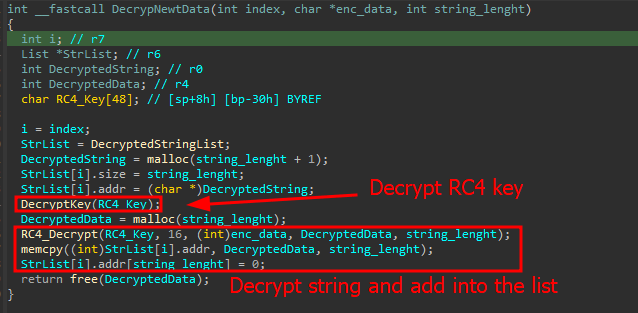
The data decryption routine in this variant is implemented as a simple RC4 algorithm.
The RC4 key is encrypted with XOR. After the key decryption, we were able to obtain its value: 6e7976666525a97639777d2d7f303177.
The decrypted RC4 key is used to decrypt the strings. After each piece of data is decrypted, it is inserted into a vector of a custom DataDecrypted structure, which is a simple string list:
Data decryption routine
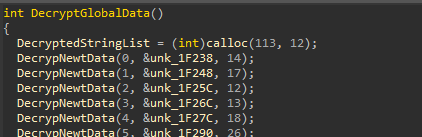
The global linked list with decrypted data is accessed whenever the malware needs particular strings.
Adding decrypted strings to the global list
Anti-VM and anti-emulation
To detect if it is currently running inside a virtual machine or QEMU, the malware lists all processes until it finds any mention of VMware or QEMU-arm. Listing running processes is simply a matter of opening the /proc directory, which is the proc filesystem on Linux.
Each process ID (PID) has its own folder containing useful information, such as cmdline, which describes the command used to start the process. Using this information, the malware verifies if there are any processes with VMware or QEMU-arm in their command line.
Process check
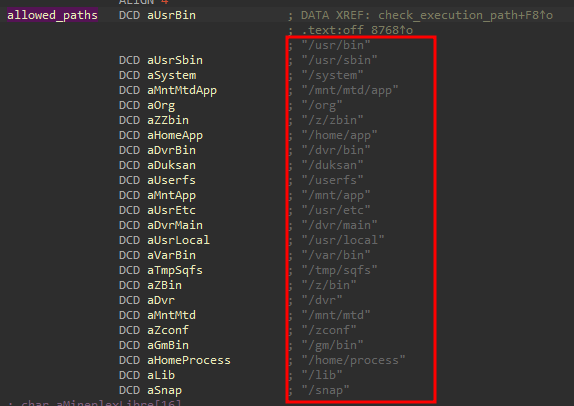
The implant also verifies if the bot process is running outside an expected directory, based on a hardcoded list of allowed ones:
Allowed directories
Once those checks are successfully completed, Mirai will continue normal execution, preparing the vulnerable device for receiving commands from the operator.
Infection statistics
According to our telemetry data, the majority of infected victims are located in countries such as China, India, Egypt, Ukraine, Russia, Turkey, and Brazil. It’s challenging to ascertain the exact number of vulnerable and infected devices globally. However, by analyzing public sources, we’ve identified over 50,000 exposed DVR devices online, indicating that attackers have numerous opportunities to target unpatched, vulnerable devices.
Conclusion
Exploiting known security flaws in IoT devices and servers that haven’t been patched, along with the widespread use of malware targeting Linux-based systems, leads to a significant number of bots constantly searching the internet for devices to infect.
The main goal of such bots is to carry out attacks that overwhelm websites and services (DDoS attacks). Most of these bots don’t stay active after the device restarts because some device firmware doesn’t allow changes to the file system. To protect against infections like these, we recommend updating vulnerable devices as soon as security patches become available. Another thing to consider is a factory reset if your device is indeed vulnerable and exposed.
All Kaspersky products detect the threat as HEUR:Backdoor.Linux.Mirai and HEUR:Backdoor.Linux.Gafgyt.
Source: United Kingdom – Executive Government & Departments
Press release
Rooftop solar for new builds to save people money
New homeowners stand to benefit from rooftop solar and cheaper bills, with the Future Homes Standard being published this Autumn.
Families will have lower energy bills in new homes as part of the Plan for Change, as government confirms new build homes will have solar panels by default
Proposed changes in the Future Homes Standard, being published in Autumn, will ensure new homes will be modern and energy efficient, cutting bills and boosting the nation’s energy security with clean, homegrown power
Working people stand to save hundreds of pounds off their energy bills as the government confirms new build homes will have solar panels by default, unleashing a rooftop revolution.
Ministers are publishing the Future Homes Standard this autumn and have confirmed today (Friday 6 June) that solar panels will be included, leading to installation on the vast majority of new build homes.
Illustrating the benefits of solar panels, a typical existing UK home could save around £530 a year from installing rooftop solar, based on the current energy price cap.
This means today’s new proposals could significantly cut energy bills for the recipients of new build homes, tackling the cost of living for aspirational young families and new house buyers.
Under proposed changes, new homes will also have low-carbon heating, such as heat pumps and high levels of energy efficiency, cutting people’s energy bills and boosting the nation’s energy security with clean, homegrown power, in line with the Prime Minister’s Plan for Change.
To deliver these aims, the proposed Future Homes Standard would see building regulations amended to explicitly promote solar for the first time, subject to practical limits with flexibility in place for new homes surrounded by trees or with lots of shade overhead.
From switching on the kettle to cooking dinner and doing the weekly wash, families will now be able to seize the benefits of powering their lives with clean, renewable energy from the very first day in their new home, with cheaper energy bills that put more money back in their pockets.
Energy Secretary Ed Miliband said:
Solar panels can save people hundreds of pounds off their energy bills, so it is just common sense for new homes to have them fitted as standard.
So many people just don’t understand why this doesn’t already happen. With our plans, it will.
Today marks a monumental step in unleashing this rooftop revolution as part of our Plan for Change, and means new homeowners will get lower bills with clean home-grown power.
Housing and Planning Minister, Matthew Pennycook said:
As part of the government’s Plan for Change to build 1.5 million homes, we are maximising the use of renewable energy to cut people’s bills and power their homes.
The Future Homes Standard will ensure new homes are modern and efficient with low-carbon heating, while our common-sense planning changes will now make it easier and cheaper for people to use heat pumps and switch to EVs so they can play their part in bolstering our nation’s energy security.
After legislation came into force last week, more homeowners will now be able to install a heat pump within one metre of their property’s boundary without having to submit a planning application, unlocking even more savings and cutting unnecessary paperwork for working people.
With figures from Octopus showing that 34% of those who order a heat pump are discouraged or drop out for reasons attributed to the need to submit a planning application, this change will help families who may have less space outside their home make the upgrade to clean power.
The first quarter of 2025 saw a record number of applications to the Boiler Upgrade Scheme, up 73% from the same quarter in 2024.
The scheme provides households with up to £7,500 off the cost of a heat pump, which can save families around £100 a year by using a smart tariff effectively.
Chris Hewett, Chief Executive, Solar Energy UK, said:
The solar industry is very glad to hear that almost all new homes will be fitted with solar power from under the Future Homes Standard. Making solar panels a functional requirement of the Building Regulations will cut energy bills, lower carbon emissions, help drive polluting natural gas off the grid and improve our nation’s energy security, too.
Aadil Qureshi, Co-Founder and CEO, Heat Geek, said:
Installing a heat pump, particularly alongside solar panels is an amazing way for homeowners to save hundreds of pounds on their energy bills and create a more comfortable home. The simplification of planning rules will help millions of homeowners, particularly in normal family homes in towns and cities, take advantage of this technology.
Charles Wood, Deputy Director of Policy (Systems) at Energy UK, said:
The addition of rooftop solar to the Future Homes Standard is welcome and necessary in ensuring that homes built today are fit for the future. Building homes to the right standards now will deliver immediate benefits of warmer, more comfortable, and more cost-efficient homes, preventing the need to retrofit these properties later at higher costs to the customer.
This change, alongside wider reforms to planning processes and network connections, will reduce bills for people in new build properties while also giving the industry confidence to invest in increased manufacturing and installer training as demand increases, creating jobs and bringing down technology costs for everyone.
Ensuring our future energy security relies on producing more British power, the electrification of our economy and cutting waste. The energy sector continues to deliver energy efficiency improvements and install low-carbon heating, generation, and transport technologies for households and businesses across the country.
Chris O’Shea CEO of Centrica, said:
The age of solar is well and truly upon us, with millions of households up and down the country already benefiting from generating their own free electricity from the sun. Our research shows that customers can shrink their energy bills by 90% when they combine solar and battery with the right energy tariff, and this announcement means even more households can soak up the savings—and the sunshine—by generating their own clean, free electricity. And with the Future Home Standard expected in the Autumn, momentum is building behind Great Britain’s rooftop revolution.
Ed Lockhart, Chief Executive, Future Homes Hub, said:
The Future Homes Standard represents a major opportunity to build a generation of higher performing new homes. Moving to all electric homes, with photovoltaics, a better fabric system, better ventilation and smart technologies to optimise the way new homes use energy means that new homes will not only be better for the planet but also more comfortable, healthier to live in and cheaper to run for customers.
The Future Homes Hub is ready to support this mission, bringing homebuilders, social housing providers, suppliers, financial institutions and other experts together to work with government departments to find the best solutions to secure the benefits of the Future Homes Standard whilst accelerating housing delivery, crucially helping smaller developers to get the right support at the right time.
Nigel Banks, Zero Bills Director at Octopus Energy, said:
People deserve lower energy bills, and adding solar panels to a house as it’s built is an incredibly effective way to slash costs from day one.
With the right smart tech and storage added to the mix, some households won’t have to pay a penny for energy.
We’re delighted to see the Future Homes Standard enable house builders to now build the homes of the future.
Matthew Hart, Director of Residential New Build at E.ON Next, said:
Ensuring that every new home comes equipped with solar panels is a vital step forward for the UK. Our vision at E.ON has always been to make clean, affordable energy the standard, not the exception, and this move will empower homeowners to take control of their energy use and keep bills low from day one. It’s exactly the kind of bold, practical action we need to build a more secure, low-carbon future for everyone.
Mark Wakeford, National Chairman, National Federation of Builders, said:
Solar panels on new homes make sense because they lower bills and progress the clean energy revolution we so desperately need. Credit must also be given for recent announcements on grid investment and connection reforms, as these were important challenges to recognise and solve for a rooftop revolution to happen in practice.
Charlotte Lee, CEO, Heat Pump Association, said:
The HPA welcomes clarity on the publication timeline for the Future Homes Standard and confirmation that all new homes will be required to have low-carbon heating, such as heat pumps. Coupled with solar PV, highly efficient heat pump installations will result in low consumer energy bills and increase the UK’s energy security. This announcement provides a clear signal to the heat pump sector to scale up delivery in terms of workforce and manufacturing to meet the anticipated growth in the market and demonstrates the government’s commitment to decarbonise buildings.
Garry Felgate, Chief Executive of The MCS Foundation, said:
These plans by the government are a huge boost to the UK renewables sector, to our efforts to meet net zero, and in reducing energy costs for households.
This announcement clearly shows that clean energy in the UK is the future. Maximising renewable energy technologies can benefit households by reducing bills as well as enhancing our national energy security.
Trevor Hutchings, Chief Executive of the Renewable Energy Association (REA) said:
The growth of solar power has been one of the UK’s biggest renewable energy success stories, demonstrating without a doubt that we don’t have to choose between lowering our emissions and lowering household energy bills.
Today’s announcement – which the REA has long campaigned for – takes this one step further – not only enabling thousands of future homeowners to experience the benefits of affordable and clean power, but supercharging growth in the British renewable energy industry and driving forward our energy transition.
Notes to editors
Future Homes Standard
The changes outlined today will maximise the use of solar energy through the Future Homes Standard.
In 2023, the previous government proposed that new build homes would either need solar panel coverage equivalent to 40% of the building’s floor area or none at all.
This approach would have allowed for too many exemptions and no solar being installed on these developments.
The government is intending to bring forward rigorous proposals, that if developers cannot meet 40% coverage, they would still be required to install a reasonable amount of solar coverage.
Under this proposal, it would be a functional requirement of the Building Regulations that new homes, with rare exceptions, are built with renewable electricity generation. In the vast majority of cases, we expect this would be solar panels.
We are working with industry to set the technical detail ahead of publishing the final Future Homes Standard this Autumn.
The Future Homes Standard will also see homes built with low carbon heating such as heat pumps and heat networks.
Solar
The £530 a year saving is based on government’s published Home Energy Assessment tool, which allows the user to produce an estimate of the bill savings they could expect from solar given the characteristics of their home.
The figure is the potential savings for a home and is included to illustrate the benefits of solar panels. An estimate of the bill savings for a Future Homes Standard home will be included in the final impact assessment published in Autumn.
The figures are based on a typical 3.5 kW south-facing installation using the Standard Assessment Procedure (SAP) methodology.
The costs and savings individuals experience will be affected by factors such as how often they heat their home, the precise technical details of their installations, and future energy prices.
The savings displayed are based on the April 2025 price cap. As energy prices change, so will the estimates of savings.
Domestic heat pumps
The changes to permitted development rights, which came into force on Thursday 29 May in England, cover:
removing the 1m boundary rule, enabling air source heat pumps to be installed within 1m of the property boundary
increasing the size limit of the heat pump for dwellinghouses from 0.6m3 to 1.5m3
doubling the number of heat pumps permitted per detached dwellinghouse, from 1 to 2
allowing for air source heat pumps that can be used for cooling as well as heating – facilitating the role out of air-to-air models – and providing consumers more choice
Modern heat pumps are generally perceived as quiet and typically no louder than a fridge. When installed under a permitted development right, they must also comply with a noise assessment methodology which includes an upper noise limit assessed at the nearest neighbouring habitable room window or door, as part of the Microgeneration Certification Scheme Planning Standard.
There were a total of 11,256 applications to the Boiler Upgrade Scheme between January and March 2025, which was up 73% from the first quarter of 2024.
Headline: RN-Uvatneftegaz Achieves Economic Effect of over 3.6 Billion Roubles from Implementation of Innovations
In 2024, RN-Uvatneftegaz (part of Rosneft’s oil production complex) achieved economic benefits of more than 3.6 billion roubles thanks to projects developed to improve production efficiency, with new projects accounting for 47% of this effect.
In 2024, RN-Uvatneftegaz specialists developed and implemented 29 innovative solutions. The greatest impact has been achieved through the installation of mobile modular substations in remote fields, reducing the time required to connect cluster sites to the grid and the capital expenditure required to build energy facilities. The economic effect of the project was 181 million roubles.
Significant economic benefits were also achieved by reducing well completion time through improvements in drill string design. The solution optimised the drilling of the directional section of the well and increased the drilling speed of long horizontal sidetracks. At the same time, the well recovery period was reduced by almost half to 59 hours. The economic effect of the project was 91 million roubles.
Over the six years that the production efficiency improvement system has been in operation, RN-Uvatneftegaz specialists have developed 140 projects to improve production efficiency. The total economic effect of the implemented solutions exceeded 18.6 billion roubles.
Systematic work to improve the operating efficiency at facilities is one of the key elements of the Rosneft-2030 Strategy. The Company is undertaking extensive work to reduce the operating costs of its production facilities and optimise capital investments, including the introduction of advanced technological solutions.
For reference:
N-Uvatneftegaz, a Rosneft subsidiary, is engaged in the exploration and development of the Uvat group of fields located in Tyumen Region and Khanty-Mansi Autonomous District—Yugra. The Uvat project comprises 19 licence areas. The total area of the project exceeds 25 square kilometres. At the beginning of 2025, the cumulative production of RN-Uvatneftegaz reached 145 million tonnes of oil.
Department of Information and Advertising Rosneft April 8, 2025
A Concluding Statement describes the preliminary findings of IMF staff at the end of an official staff visit (or ‘mission’), in most cases to a member country. Missions are undertaken as part of regular (usually annual) consultations under Article IV of the IMF’s Articles of Agreement, in the context of a request to use IMF resources (borrow from the IMF), as part of discussions of staff monitored programs, or as part of other staff monitoring of economic developments.
The authorities have consented to the publication of this statement. The views expressed in this statement are those of the IMF staff and do not necessarily represent the views of the IMF’s Executive Board. Based on the preliminary findings of this mission, staff will prepare a report that, subject to management approval, will be presented to the IMF Executive Board for discussion and decision.
Washington, DC – June 6, 2025:Lithuania has proved resilient to multiple shocks in recent years.However, new challenges are emerging—including further increases in defense expenditure adding to the existing long-term spending pressures—while long-standing structural issues still require attention. Lithuania needs to reignite its reform momentum to boost productivity while addressing these challenges. A comprehensive strategy is needed to preserve fiscal space through revenue mobilization, enhanced spending efficiency, and limiting further spending pressures by strengthening the multi-pillar pension system. Structural reforms should focus on facilitating investments and accelerating the adoption of new technologies to boost productivity growth, supplemented by labor market policies, including reducing skills mismatches. Financial sector policies should continue to safeguard financial stability and integrity.
Recent Developments, Outlook, and Risks
The economy grew strongly in 2024. Growth accelerated to 2.7 percent—well above peers—driven by private consumption supported by significant real income gains. The recovery was broad-based across sectors, including manufacturing and high value-added services, despite sluggish productivity growth. While inflation remained low for the most part of the year, it has risen since late 2024, driven by higher energy prices and excise duties.
While fiscal performance exceeded expectations, the deficit widened, and the debt ratio is increasing. The deficit almost doubled from 0.7 percent of GDP in 2023 to 1.3 percent of GDP in 2024, reflecting increased public wages and pensions. Higher revenues supported by robust aggregate wage growth and lower-than-anticipated expenditure, mainly from the accrual correction in defense spending, prevented the deficit from increasing further. However, pre-payments for additional orders of defense equipment and the continued buildup of the general government cash buffer contributed to an increase in the debt-to-GDP ratio from 37.3 percent in 2023 to 38.2 percent in 2024, for the first time since 2020.
The banking sector remains financially sound, with high capitalization, ample liquidity buffers, and low non-performing loan (NPL) ratios. Banks continue to be highly profitable, although profitability eased in 2024 compared to the record high levels seen in the previous year, against lower interest rates driven by ECB monetary policy easing.
There are signs of gradual financial expansion. Reflecting decreasing lending rates and recovering credit demand, loan growth to both non-financial corporations and households recovered in 2024 and early 2025, and credit-to-GDP ratios have increased moderately. House price growth stabilized in 2024, down from the 2022 peak. Nevertheless, house prices are likely not significantly above levels justified by fundamentals, given the recent robust demand while housing supply is increasing, and affordability has improved.
The economy is expected to grow at 2.8 percent in 2025 while inflation will increase to 3.1 percent. Growth will be supported by private consumption and rising investment related to EU funds. External demand will remain subdued reflecting uncertainty regarding trade policies, despite the positive outlook of information and communication technologies (ICT) and professional activities. Increased excise duties and persistently high wage growth will keep headline and core inflation above pre-pandemic averages in the coming years. The labor market will tighten reflecting negative labor force dynamics affected by the normalization of migration flows.
Risks to the outlook are tilted to the downside. As a small open economy, Lithuania is exposed to high uncertainty around trade policies and geopolitical risks. A severe downturn in its main trade partners would worsen the external performance and domestic activity. In the medium term, weaker demographics pose risks to labor supply which could add pressures on wages and competitiveness if productivity growth fails to accelerate. In the absence of sufficient measures, the fiscal position is subject to considerable medium-term risk with higher defense spending needs adding to the already high existing long-term pressures.
Fiscal Policy
A moderately less expansionary fiscal stance than currently expected would be helpful in 2025, and the strategy should shift to preserving fiscal space. The deficit is projected to rise to 2.8 percent of GDP in 2025, due to significant increases in pension spending and higher public sector wages. However, with a small and decreasing negative output gap under staff projections and considering mounting spending pressures in the medium term, going forward, a moderately tighter fiscal stance to reduce deficits and stabilize the debt-to-GDP ratio would be appropriate. With a view to safeguarding fiscal buffers and minimize the need for larger adjustments in later years, any unused spending or revenue overperformance this year should be saved to limit the deficit increase.
A stronger fiscal adjustment will be required if defense spending rises notably from current levels. The envisaged increase in defense spending to 5-6 percent of GDP in 2026-30 from the current level of 3 percent would raise financing needs significantly. In the absence of additional fiscal measures, debt could reach 60 percent of GDP by 2030. The proposed tax policy changes to accommodate these spending needs are welcome, but the revenue yield is estimated to be modest. Greater efforts will therefore be needed to maintain debt dynamics on a sustainable path in the medium term to preserve fiscal space to absorb possible future shocks. An average annual adjustment of about 0.5 percentage points of GDP in the general government balance over 2026-30, with the majority of additional defense spending financed by front-loaded increases in tax revenues, would help stabilize debt at around 50 percent of GDP by 2030.
Financing options for additional defense spending should be anchored by revenue mobilization. While temporary measures and productivity-enhancing capital expenditure could be deficit-financed, a sizable part of the additional defense spending is likely to be permanent, warranting higher revenues or lower spending in other areas. The tax policy change proposal appropriately targets a mix of taxes, but there is further scope to raise additional revenues while improving the system, including increasing progressivity and efficiency. This could include raising revenues through making the personal income tax (PIT) system more progressive and streamlining the tax schedules to prevent higher marginal tax rates for lower income earners, limiting exemptions in corporate income taxes (CIT) and property taxes, and reducing the value added tax (VAT) compliance gap while improving VAT efficiency.
Revenue mobilization should be complemented by spending measures. Fiscal savings could be generated by improving spending efficiency, including in healthcare and education. Hospital network rationalization could enhance the quality of service while reducing costs. The teacher-student ratio is relatively high for secondary education and there is room to rationalize the school network while improving quality.
Strengthening the multi-pillar pension system will limit some of the additional spending pressures in the medium-term. The current pension system implies significant increases in public pension expenditure over the next two decades, driven by adverse demographics, while replacement ratios will remain low. The Pillar II reform proposal under discussion, entailing participation to become voluntary and increased options to opt out and suspend participation, is likely to further reduce the replacement rate. These changes could have a material impact on the entire pension system and the public finances. Staff urges the authorities to allow sufficient time to carefully consider all potential ramifications, including through further thorough analysis of the social and fiscal sustainability of the broader pension system.
Financial Sector Policies
Financial sector policies should continue to focus on safeguarding financial stability. Bank profitability is expected to moderate further but to remain high in 2025. Financial conditions are likely to ease in 2025 due to declining ECB policy rates and increased competition in financial sector, such as from the increasing footprint of fintech companies. Solvency and liquidity stress tests conducted by the Bank of Lithuania suggest that banks can withstand adverse macroeconomic scenarios and unexpected liquidity shocks. While some smaller banks require enhancing capitalization and closer oversight, all in all, financial stability risks arising from the banking system are broadly contained. With an increased frequency of cyberattacks on banks in recent years, cyber resilience should continue to be strengthened, including the full implementation of the Digital Operational Resilience Act (DORA) regulation.
The current macroprudential stance is broadly appropriate, but continued vigilance is warranted. Financial cycles including residential real estate and private sector credit so far have exhibited no major signs of overheating, but the sustained pace of expansion requires close monitoring and readiness to act in case early signs of an excessive financial expansion emerge. Despite the low exposure of banks, the commercial real estate market continues to require attention as risks of price corrections remain due to the persistent imbalance between supply and demand. In the event of a significant adverse financial shock with the potential to trigger widespread losses in the banking sector, the relaxation of capital-based measures would be appropriate to minimize credit supply disruptions and support lending to the economy.
The AML/CFT framework has been strengthened significantly, but continued effective implementation is essential. The third national risk assessment identified virtual asset service providers (VASPs), and electronic money institutions (EMI), and payment institutions (PI) as posing significant ML/TF risks. The authorities should continue AML/CFT efforts to mitigate cross-border risks, including Bank of Lithuania’s oversight and market controls for newly licensed VASPs under MiCAR regime, supervision of payment service institutions, and AML/CFT measures for CENTROlink members.
Structural Reforms
Lithuania faces structural headwinds limiting productivity and long-term growth. The recent recovery has been largely driven by higher labor accumulation enabled by temporary net migration, while the contributions from capital and total factor productivity (TFP) growth remained smaller than those observed during earlier periods of faster income convergence. Given expected population declines in the coming years, structural reforms to facilitate greater capital deepening and higher productivity growth are essential.
Higher investment is needed to support potential growth. Low capital intensity remains a key barrier to productivity growth and the transition towards a higher value-added oriented economy. Development of risk capital, co-financing and mechanisms for risk sharing tailored to enhance the flow of credit to small and medium sized enterprises (SMEs), targeted credit guarantee schemes and integrating digital solutions can help alleviate constraints related to the lack of access to finance experienced by some firms. In this context, the expanded role of the state-owned institution ILTE—previously INVEGA—can play a role, complementing the private banking sector in supporting investment in areas such as high value-added sectors, innovation, energy efficiency, and strategic infrastructures. To consolidate the institution’s role as a national development bank, it is essential to ensure effective monitoring and transparency of ILTE operations. More fundamentally, deepening the EU’s single market—combined with stronger incentives to develop domestic capital markets—would help support access to finance of corporates and further productive investments in the country.
Inefficiencies in the education system contribute significantly to the persistent skills mismatches in Lithuania’s labor market. As one of the countries with the highest skills mismatches in Europe, Lithuania faces ongoing challenges despite measures including the government’ active labor market policies and their evaluation and the smart specialization multi-year program aimed at enhancing workforce skills. Critical shortages persist in essential sectors, including nursing, engineering, and scientific fields, highlighting the urgent need for strategic reforms in education and training to better align with market demands.
Ensuring effective integration of migrants into the labor market is crucial to sustain the labor force. Recent immigrants have been successfully absorbed into the Lithuanian labor market and legislative amendments have enabled easier migration for high-skilled workers despite the reduction of the non-EU workers quota in 2025. Policies should focus on integrating migrants in the most productivity-enhancing way possible while facilitating the participation of foreign professionals in those sectors with the largest shortages.
Further investment in digitalization and AI preparedness has the potential to boost productivity growth. Lithuania has invested significantly in digitalizing its economy in recent years, becoming one of the main fintech hubs in Europe. However, despite progress in digitalization and in AI preparedness, its digital infrastructure remains close to the EU average. To unlock possibly substantial productivity gains, policies should aim to facilitate technological diffusion, job transition and AI adoption among firms, while introducing measures to mitigate associated risks in terms of possible job replacements and inequality deepening. In this respect, the recent initiatives included in the START plan aimed at promoting digitalization and the deployment of AI both in the private sector and in public administration will support these efforts.
Energy security has been reinforced in the last years. The Baltic countries joined the European electricity grid in 2025, completely disconnecting from the Russian electricity system. Moreover, Lithuania has diversified its energy sources and import dependency has been lowered through the intensification of domestic electricity production from renewable sources in the recent years. Still, being susceptible to risks associated with climate change, Lithuania needs to accelerate the green transition, particularly for adaptation. In this respect, future investment in new technologies and defense initiatives should not thwart efforts to reduce economy-wide emissions, such as the recently adopted policies in the context of the updated National Energy and Climate Action Plan (NECP) for the period 2021–2030.
The IMF team is grateful for the warm hospitality of the Lithuanian authorities and would like to thank all its interlocutors in government, the Bank of Lithuania, the European Central Bank, the private sector, unions, and business associations for constructive and fruitful discussions.
In October 2021, 136 countries agreed to establish new tax rules requiring large multinational companies to pay at least 15% in corporate tax. Nearly four years later, this ambitious agreement is finally being implemented around the world, but its success faces big challenges.
The Organisation for Economic Cooperation and Development (OECD) tax framework aims to end the so-called race to the bottom, where corporations pit countries against each other to pay less tax and shift profits to jurisdictions with lower tax rates.
In the second part of The 15% solution from The Conversation Weekly podcast, we examine progress towards implementing the global tax deal.
The OECD’s two-pillar system fundamentally changes how multinationals are taxed. Pillar One determines where companies pay taxes. Pillar Two establishes how much they must pay: a minimum of 15% for any multinational with yearly revenues above US$850 million. The innovative aspect of the system is that it is self-enforcing. If a company pays less than 15% in any country, other nations where it operates can charge a supplementary tax to meet that minimum.
However, implementation faces significant obstacles. So far around 140 countries have signed up. President Donald Trump withdrew the US from the negotiations in February 2025. China supports the framework in theory but is slow to fully implement it. And some low- and middle-income countries have also not signed up, citing technical complexity or bias toward higher-income countries.
Martin Hearson, a research fellow at the Institute of Development Studies in the UK, explains that for countries with fewer legal and administrative resources, even good rules can be counterproductive due to their complexity. This has led some countries to look for alternatives, including a new UN Framework Convention on International Tax Cooperation, for which negotiations began in February 2025.
Despite these challenges, the OECD expects that approximately 80% of profits previously taxed at low rates will now be appropriately taxed.
This episode of The Conversation Weekly was written and produced by Mend Mariwany. Gemma Ware is the executive producer. Mixing and sound design by Eloise Stevens and theme music by Neeta Sarl.
Listen to The Conversation Weekly via any of the apps listed above, download it directly via our RSS feed or find out how else to listen here. A transcript of this episode is available on Apple Podcasts.
Martin Hearson’s research has been supported by the UK Foreign, Commonwealth and Development Office, the Norwegian Agency for Development Cooperation, the Gates Foundation, the Intergovernmental Group of 24, the World Bank, the UN Department for Economic and Social Affairs, and ActionAid International.
Summary of a joint statement following the second meeting of the Australia-United Kingdom Free Trade Agreement Joint Committee on 3 June 2025
Alongside the OECD 2025 Ministerial Council Meeting held in Paris, Australian Minister for Trade and Tourism, Senator the Honourable Don Farrell and UK Secretary of State for Business and Trade, the Rt Hon Jonathan Reynolds MP, met on 3 June 2025, for the second meeting of the Australia-United Kingdom Free Trade Agreement Joint Committee.
The Ministers celebrated the strong trade and investment relationship between the UK and Australia. Two-way trade between our economies reached AUD36bn or GBP23bn in 2024.
As of 2024, the stock of UK Foreign Direct Investment in Australia reached AUD156bn or GBP77bn, and Australian Foreign Direct Investment in the UK rose to AUD210bn or GBP104bn – an increase of 6.5% and 11.5% respectively on the previous year.
The strong uptake of the Agreement’s benefits is resulting in real savings for businesses, workers and consumers.
Since entry into force on 31 May 2023, AUD4.7 bn or GBP2.4bn worth of traded goods benefited from preferential tariff access, i.e. around 70% of goods traded between the UK and Australia made use of available preferences.
Between June 2023 and December 2024:
AUD3.4bn or GBP1.8bn (65%) of eligible goods imports into Australia from the UK made use of an FTA tariff preference.
Had this trade occurred at standard Most Favoured Nation (MFN) tariff rates, up to an additional GBP89m or AUD172m in duties would have been collected.
GBP662m or AUD1277m (77%) of eligible goods imports into the UK from Australia made use of FTA tariff preferences.
Had these occurred at standard Most Favoured Nation (MFN) tariff rates, up to an additional GBP139m or AUD269m in duties would have been paid.
The Ministers noted that free and inclusive trade is a cornerstone of prosperity in both countries.
Recognising that open markets, and reliable legal and regulatory frameworks are essential for trade, the Ministers committed to strengthening the rules-based trading system.
Ministers also noted progress on recognition of professional qualifications in key sectors through the FTA’s Professional Services Working Group, and the ongoing work under the FTA’s Innovation Chapter to explore the potential for a ‘biobridge’ between our countries to expedite new and innovative medicines, diagnostics, and therapeutics to market.
The Ministers agreed to continue working together to strengthen the role that free trade plays in increasing prosperity and reinforcing resilience against economic turbulence and share the benefits of trade to all including through the World Trade Organization, OECD and Comprehensive and Progressive Agreement for Trans-Pacific Partnership (CPTPP).
Note to editors:
Figures reported are from UK Official Statistics and Australian official sources.
Trade asymmetries exist between the UK and Australia official trade statistics, but this does not mean that either country is inaccurate in their estimation. Differences can be caused by a range of conceptual and measurement variations between the estimation practices of different countries.
Estimated duty savings are based on exchanged country tariff schedules and preference utilisation data. For UK imports, these are all calculated using the Ad Valorem, Specific, or Compound tariffs applied at the CN8 level. Where appropriate, Ad Valorem Equivalent tariffs were used (source: MacMap). The Bank of England spot exchange rates (June 2023-December 2024) was used to convert from GBP to AUD.
Estimates of Australia’s preference utilisation and duty savings for the June 2023 to December 2024 period are drawn from Department of Foreign Affairs and Trade calculations using ABS trade data and DFAT tariff schedule data.
Investment data is sourced from the Australian Bureau of Statistics.
UK-AUS total goods trade values may not equal the sum of UK goods imports and AUS goods imports due to rounding and methodological differences in calculating preference eligible imports.
Source: United Kingdom – Executive Government & Departments
Press release
PM meeting with King Abdullah II of Jordan: 5 June 2025
The Prime Minister hosted His Majesty the King of Jordan Abdullah II at Downing Street this afternoon.
The Prime Minister hosted His Majesty the King of Jordan Abdullah II at Downing Street this afternoon.
The leaders discussed the gravity of the intolerable situation in Gaza, and the concerning developments in the West Bank.
The Prime Minister reiterated that if Israel did not cease the renewed military offensive and lift its restrictions on humanitarian aid, the UK and its partners would take further concrete actions in response.
It was vital a sustainable ceasefire and the release of all hostages was secured, and humanitarian aid was delivered at speed and volume, the Prime Minister added.
Both leaders agreed on the importance of the Palestinian Authority’s reform agenda as part of the path to a two-state solution and lasting peace and security for both Israelis and Palestinians.
The leaders also discussed the wider bilateral relationship between the UK and Jordan, and the opportunity to deepen business and investment links between the two countries.
The journey to provide sustainable transport corridors along major Dundee routes is moving forward thanks to a £745,000 grant from the Scottish Government.
Engineering consultancy SWARCO has been appointed to develop detailed construction-ready designs for theLocheeRoad and Arbroath Road corridors. These designs will integrate active travel and bus priority measures, building on initial concept work.Fully funded by Transport Scotland, the design work will include various elements including surveys, traffic modelling, design development and community consultation and engagement.
These corridors are central to Dundee City Council’s Sustainable Transport Delivery Plan, which outlines ambitious plans to enhance and expand the city’s sustainable transport infrastructure.
With around 20,000 vehicle movements daily on these routes, the improvements aim to make walking, cycling, and bus travel more attractive alternatives to car use. This will help to reduce congestion, improve air quality, and connect communities with affordable, low-carbon transport options.
The award of the tender will be discussed by the council’s Fair Work, Economic Growth and Infrastructure Committee at its meeting on Monday June 9.
Depute Convener Cllr Siobhan Tolland said: “As we look to the future and work to meet our climate and net zero commitments, active and sustainable travel will play an increasingly important role in that journey.
“These transport methods will make a substantial positive contribution to the city’s health and wellbeingand alsofurther improve air quality.
“The new corridor designs will help us bring forward practical solutions to encourage more people to walk, wheel, cycle, and use public transport along these key routes.”
Meanwhile, the committee will also be asked to approve a £112, 255 tender for a pocket park inLochee.
The project is being supported by funding from Scottish Government’sVacant and Derelict Land Investment Programme, as well as Transport Scotland’s Active Travel Infrastructure Fund.
Works, which would be carried out by TaysideContracts, wouldsee the construction of a pocket park and raingarden in vacant land near theLocheeHigh Street/Bank Steet road junction.
The raingarden element will contribute to wider drainage improvements for the area to provide a surface water connection point for new development inLochee.
Councillor Tolland added: “Pocket parks have been delivered successfully across other areas in Dundee and help in efforts to encourage people to get out, be active and enjoy their local community.”
24 new banks to be added to the euro short-term rate (€STR) reporting population as of 2 July 2025
Increase in reporting population will further support the benchmark’s robustness and representativeness
The European Central Bank (ECB), as administrator of the euro short-term rate (€STR), will expand the number of banks included in the €STR reporting population as of 2 July 2025 (reference to 1 July) by adding 24 banks to the 45 currently included in the rate’s daily calculation. The new banks were already added to the reporting population for Money Market Statistics Reporting (MMSR) on 1 July 2024, but were not included in the €STR calculation until it could be ensured that the newly reported data are of sufficiently good quality.
The expansion of the €STR sample size will improve both the robustness and the representativeness of the benchmark, which will now be supported by higher transactions volumes from a wider range of reporting institutions.
The impact on the level of the rate is expected to be limited, as the average difference observed during the testing period since July 2024 was only approximately -0.2 basis points.
The New Development Bank (NDB), Bank of China and Haitong Unitrust International Financial Leasing (HUIFL) have signed a syndicated loan agreement totalling RMB 1.2 billion to finance green leasing sub-projects that support China’s environmental goals and climate commitments.
The signed loan agreement supports China’s transition toward a new growth model centred on low-carbon development, climate resilience, and environmental protection. Despite progress in recent years, environmental protection and climate change mitigation continue to be considered national priorities, and this Project aligns directly with that policy direction.
Under the loan agreement, NDB will provide RMB 713.32 million, Bank of China will contribute RMB 500 million, and HUIFL will use the funds to acquire and lease equipment to lessees implementing sub-projects related to wastewater treatment, solid waste management, and metallurgical waste gas utilization for power generation. To promote balanced development, eligible sub-projects will be located outside China’s four Tier I cities, channelling investment into less-developed regions.
This is the first time NDB mobilizes private capital in a syndicated operation, marking a significant evolution in the Bank’s development financing approach. Since the adoption of the Addis Ababa Action Agenda in 2015, multilateral development banks have increasingly prioritized the mobilisation of private capital to help bridge the significant financing gap required to achieve the 2030 Agenda. In line with this collective commitment, NDB is scaling up private capital mobilization, and this transaction represents a concrete step in implementing that strategy, positioning NDB as a project orchestrator within its member countries.
Aligned with NDB’s General Strategy for 2022–2026, this operation reinforces New Development Bank’s commitment to financing sustainable development projects using local currency instruments, while strengthening domestic financial markets and fostering private sector participation.
“NDB is proud to partner with Bank of China and Haitong Unitrust Financial Leasing to finance green sub-projects that promote sustainable development and support China’s environmental goals and climate commitments. This initiative addresses the need for climate resilience and environmental protection and contributes to increasing investment in less-developed regions in China,” said Mr. Vladimir Kazbekov, NDB Vice-President and Chief Operating Officer. “In helping to address the infrastructure financing gap, New Development Bank is playing a catalytic role in mobilizing resources from diversified funding sources, particularly from the private sector, in line with its General Strategy.”
“The successful launch of this environmental protection syndicated loan represents not only a concrete initiative by Bank of China Shanghai Branch, NDB, and HUIFL to actively implement national strategies, but also an innovative collaboration among the three parties. Taking this opportunity, Bank of China Shanghai Branch will further leverage its global advantages and comprehensive strengths to provide more professional services to NDB and HUIFL, jointly injecting green and sustainable momentum into high-quality economic and social development,” said Mr. Xiao Wang, General Manager of Bank of China, Shanghai Branch.
“Taking this cooperation as a starting point, Guotai Haitong Securities and HUIFL will leverage the group’s global resources and partner with NDB and Bank of China to proactively serve the national strategies, actively increase support to areas of environmental protection and energy efficiency and jointly address issues in green development,” said Mr. Yuxing Mao, Vice-President of Guotai Haitong Securities Company.
Background Information
New Development Bank
NDB was established by Brazil, Russia, India, China and South Africa to mobilize resources for infrastructure and sustainable development projects in BRICS and other emerging market economies and developing countries, complementing the existing efforts of multilateral and regional financial institutions for global growth and development.
For more information on NDB, please visit www.ndb.int
Haitong Unitrust International Financial Leasing
Established in 2004 and headquartered in Shanghai, HUIFL is a leading financial leasing company in China, with operations across sectors including advanced manufacturing, energy and environmental protection, construction, urban utilities and transportation & logistics. HUIFL is listed on the Hong Kong Stock Exchange and has a strong track record in green leasing. In March 2025, the indirect controlling shareholder of HUIFL was changed to Guotai Haitong Securities Company, and the actual controller was Shanghai International Group.
Bank of China was established in 1912 and is the oldest continuously operating state-owned commercial bank in China. In 2011, it became the first global systemically important bank from an emerging economy, with its international standing, competitiveness, and comprehensive strength ranking among the top tier of global banks. It operates branches across the Chinese mainland as well as in 64 countries and regions overseas.
The Reserve Bank of India has revised its inflation outlook for 2025-26 downwards from the earlier forecast of 4 per cent to 3.7 per cent, RBI Governor Sanjay Malhotra said on Friday.
Taking all these factors into consideration, and assuming a normal monsoon, CPI inflation for the financial year 2025-26 is now projected at 3.7 per cent, with Q1 at 2.9 per cent, Q2 at 3.4 per cent, Q3 at 3.9 per cent, and Q4 at 4.4 per cent.
He pointed out that inflation has softened significantly over the last six months from above the tolerance band in October 2024 to well below the target, with signs of a broad-based moderation. The near-term and medium-term outlook now gives us the confidence of not only a durable alignment of headline inflation with the target of 4 per cent, as exuded in the last meeting, but also the belief that during the year, it is likely to undershoot the target at the margin.
While food inflation outlook remains soft, core inflation is expected to remain benign with easing of international commodity prices in line with the anticipated global growth slowdown, Malhotra explained.
He pointed out that CPI headline inflation continued its declining trajectory in March-April, with headline CPI inflation moderating to a nearly six-year low of 3.2 per cent (y-o-y) in April 2025. This was led mainly by food inflation, which recorded the sixth consecutive monthly decline.
Fuel group witnessed a reversal of deflationary conditions and recorded positive inflation prints during March and April, partly reflecting the hike in LPG prices. Core inflation remained largely steady and contained during March-April, despite the increase in gold prices exerting upward pressure, Malhotra said.
The outlook for inflation points towards benign prices across major constituents. The record wheat production and higher production of key pulses in the Rabi crop season should ensure an adequate supply of key food items. Going forward, the likely above normal monsoon along with its early onset augurs well for Kharif crop prospects.
Reflecting this, inflation expectations are showing a moderating trend, more so for the rural households. Most projections point towards continued moderation in the prices of key commodities, including crude oil, the RBI Governor said.
However, at the same time, Malhotra had a word of caution. “Notwithstanding these favourable prognoses, we need to remain watchful of weather-related uncertainties and still evolving tariff-related concerns with their attendant impact on global commodity prices,” he added.
Japanese company ispace said it has not been able to establish communication with its uncrewed moon lander following its lunar touchdown attempt on Friday, two years after its failed inaugural mission.
Tokyo-based ispace has hoped to join U.S. firms Intuitive Machines and Firefly Aerospace, which have accomplished commercial landings amid an intensifying global race for the moon that includes state-run missions from China and India.
Resilience, ispace’s second lunar lander, targeted Mare Frigoris, a basaltic plain about 900 km (560 miles) from the moon’s north pole.
The company’s live-streamed flight data showed Resilience’s altitude suddenly falling to zero shortly before the planned touchdown time of 4:17 a.m. on Friday, Japanese time (1917 GMT on Thursday) following an hour-long descent from lunar orbit.
“We haven’t been able to confirm” communication, and control centre members will “continuously attempt to communicate with the lander,” the company said in the broadcast. Footage from the control room showed nervous faces of ispace engineers.
A room of more than 500 ispace employees, shareholders, sponsors and government officials abruptly grew silent during a public viewing event at mission partner Sumitomo Mitsui Banking Corp in the wee hours in Tokyo.
The status of Resilience remains unclear, and ispace CEO Takeshi Hakamada will hold a press conference about the outcome of the mission at 9 a.m. (0000 GMT), the company said.
In 2023, ispace’s first lander crashed into the moon’s surface due to inaccurate recognition of its altitude. Software remedies have been implemented, while the hardware design is mostly unchanged in Resilience, the company has said.
Resilience carried a four-wheeled rover built by ispace’s Luxembourg subsidiary and five external payloads worth a total of $16 million, including scientific instruments from Japanese firms and a Taiwanese university.
Following the landing, the 2.3-metre-high lander and the microwave-sized rover were scheduled to begin 14-day exploration activities until the arrival of a freezing-cold lunar night, including capturing images of regolith, the moon’s fine-grained surface material, on a contract with U.S. space agency NASA.
Shares of ispace more than doubled earlier this year on growing investor hopes for the second mission, before calming in recent days. As of Thursday, ispace had a market capitalisation of more than 110 billion yen ($766 million).
Resilience in January shared a SpaceX rocket launch with Firefly’s Blue Ghost lander, which took a faster trajectory to the moon and touched down successfully in March.
Intuitive Machines, which last year marked the world’s first touchdown of a commercial lunar lander, made its second attempt in March but the lander Athena ended on its side on the lunar surface just as in the first mission.
Japan last year became the world’s fifth country to achieve a soft lunar landing after the former Soviet Union, the U.S., China and India, when the national Japan Aerospace Exploration Agency achieved the touchdown of its SLIM lander, yet also in a toppled position.
Despite President Donald Trump’s proposed changes to the U.S. space policy, Japan remains committed to the American-led Artemis moon program, pledging the involvement of Japanese astronauts and technologies for future lunar missions.
Including one in 2027 as part of NASA’s Commercial Lunar Payload Services for the Artemis program, ispace plans seven more missions in the U.S. and Japan through 2029 to capture increasing demands for lunar transportation.