Category: Banking

  • MIL-OSI Banking: Podcast: Data scientist Cassie Kozyrkov on how AI can be a leadership partner

    Source: Microsoft

    Headline: Podcast: Data scientist Cassie Kozyrkov on how AI can be a leadership partner

    MOLLY WOOD: Today I’m talking with statistician and decision-making expert Cassie Kozyrkov. She advises companies on how to approach decision making and AI strategy. She is also the founder of a discipline called decision intelligence, which is the name of her popular newsletter. Cassie joins us to share her insights on decision making, how people often get it wrong, and how to understand the value AI can bring to an organization. And now my conversation with Cassie. Thanks so much for being here.  

    CASSIE KOZYRKOV: I’m so excited to be here, Molly.  

    MOLLY WOOD: Cassie, you’re credited with founding a field, which all by itself is amazing, and that field is called decision intelligence. Could you give us, broadly, a definition of what that means?   

    CASSIE KOZYRKOV: Decision intelligence is the discipline of turning information to better action—any scale, any setting. So what it does is it annihilates the silos between the decision disciplines, and perspectives on decision making come from the classic ones like psychology and other social sciences, managerial sciences, and, of course, the data and mathematical sciences. Decision intelligence is a kind of end-to-end approach, and if we think about why we might need it—if you have technology that makes the actual execution of something relatively effortless, you might say, hey, machine, do this thing for me, and you get an answer like that. Two questions for you. Did you ask the right thing? And do you know what you’re looking at when you get an answer? We are beginning to speak more and more powerful words to machines. Are we aware of the consequences of what we’re saying, and are we aware of what we’re actually saying? That’s the decision intelligence approach.  

    MOLLY WOOD: So, one of the things that you’ve written that I found completely compelling is this Harvard Business Review article saying many decision makers think they’re being data-driven. You brought up this idea of the gap sometimes between data and intelligence: they think they’re being data-driven when they look at a number, when they form an opinion and execute their decision. Unfortunately, such a decision will be data-inspired, at best. What do you mean by that?   

    CASSIE KOZYRKOV: You can look at that as data-decorated—data as a decoration or as something that makes us feel better about what we’re going to do anyway. We don’t always realize when we’re doing this. We can be completely convinced that we’re integrating information from the real world, but all we’re doing is using it so much more like a mood board and less as a recipe plan or blueprint for decision making. And this really jumps into the concept of confirmation bias. The way that we see information changes based on what we would like to be true or what we believe already. If you have already made a decision, the way that you’re going to look at a number, a fact, is going to be very, very different from, if you haven’t made the decision yet and you intend to use that number to actually drive your decision. When it comes to confirmation bias, there’s a very simple antidote to it—the discipline of pre-committing to how you’re going to use information to drive your decision. In other words, the structure for your decision has to be there before the data. That’s kind of like saying, I’m going to set my goalposts before I actually kick the ball and see where it lands. Not afterwards, where I could just put the goalposts around the ball and say, yay, I scored. And that pre-commitment process that happens way before the data, that is something that leaders, decision makers have to be responsible for. So it’s really about that gap bridging and fluently speaking both languages: the language of engineering and data, and the language of leadership and decision making.  

    MOLLY WOOD: So then we introduce this big, endless opportunity for data, and I believe you have referred to it as endless right answers. How do we think about decision intelligence in the age of generative AI?   

    CASSIE KOZYRKOV: Right. So—   

    MOLLY WOOD: Now things get really messy… [laughter]  

    CASSIE KOZYRKOV: Yeah. Now things do get very messy. So there’s a lot of work done by psychologists where they would show things like, people find it a lot easier to choose between two options. Would you like to have this flavor of gem or that flavor of gem than, say, 16 options? Having more choice doesn’t necessarily make things better and easier. Sometimes having a structure that limits your options can be healthier because we just can’t deal with optimization as humans on that scale. And if 16 is too many for us, what do we do when it’s 16,000 or 16 million? So the thing about generative AI is that it will generate as many as you like, as many as you can afford, compute-wise. What does it mean to have a good customer service interaction where a chatbot is interacting with your customer? What does it mean to draft a good email? What is good in this situation? If you haven’t really thought about that and you start, maybe, going down a rabbit hole, you have to learn how to cut it off and limit your own options and get to where you’re trying to go faster, because if you don’t, here you are looking at potentially infinite good-ish possibilities. How do you choose in those situations? One of the hardest types of choices that you can face is the—good problem to have—situations where the distance between two options is actually quite small. So, a classic example here is going on vacation. And if I asked you whether you would prefer to go to vacation in, let’s say, your local landfill or Paris, right. [laughter] I mean, that’s a fairly easy vacation choice. But let’s say it’s Paris versus another place that you feel quite similarly about—let’s say Paris and Madrid. They’re both great. So how do I then choose between these two if they are so similar, and how do I find what would break that tie? I may find myself overspending effort on that minuscule distance between these two pretty good options. With generative AI as well, you now start to get this proliferation of fairly good answers, and the distance between them might be really small. And then how do you figure out how to inform a choice between all those options? How you would do that would be similar to how you would break a tie between Madrid and Paris. There’s not one right answer.   

    MOLLY WOOD: But it is interesting because it points to what you were saying, which is that you sort of have to go to the end. You have to go to, even if it’s individual, what you value the most. So for example, I might prefer croissants to tapas, and therefore I can optimize backwards. But, and what I like about what you’re saying is that, there’s really still a human, there’s really still goal setting. There’s not this sort of blind following of whatever generative AI is telling you.  

    CASSIE KOZYRKOV: Hundred percent. Hundred percent. Connecting with your personal reason, your why, is how you break these ties. What AI can help you with is generating a bunch of options for you. There’s this tendency to maybe skip a step when we see something that calls itself AI, or it’s computer-y, there’s math somewhere around it, there’s data somewhere around it, that people think that now what we get is access to objectivity, access to the only possible answer. It still comes back down to who is driving, what is important to them, and how they create the criteria for what happens next. So how do we set everything up so that at the end, the technology, the tools, the outputs really do serve the people who are behind all of it? A piece of advice that I have for absolutely everybody is, find the practice, the discipline, of seeing the humans in any technological system. There are so many trade-offs and choices that happen before we get to the mathematical stuff, and understanding that there are people making those trade-offs—we hope that they’re doing it wisely—is maybe the best skill that we can have as decision makers in an increasingly complex and technological world.  

    MOLLY WOOD: This sort of leads us naturally, then, into what you have called the generative AI value gap—the difference between individuals finding enormous value in generative AI and organizations struggling to measure that value. How do they get across that gap?   

    CASSIE KOZYRKOV: When you get a new tool or a new toy, it is enough that it feels useful to you, quite often. I feel like I go faster at writing email if I have generative AI do some pre-drafts for me. That feels good. But if we were actually to dig in and say, well, how do you measure, do you actually know how much of a speed-up you’re getting? And now you want to implement this tool at some kind of scale in an organization. Scale demands to be measured. The first question is, okay, what’s the ROI here? And it’s going to be fairly straightforward to figure out what it costs to put it in, this much headcount, this much processing power, this much technical debt. Then what do we get out of it? These technologies don’t come with that concept built into them. The leader has to take responsibilities down and say, This is why we’re doing it. This is what it means for the system as a whole to succeed. This is the cutoff where the answers are good or better. I want to create a system that generates social media copy automatically, let’s say. Well, then, how do I determine whether one piece of copy is better than another piece? How much better? And that articulation is something that a lot of people find very difficult.   

    MOLLY WOOD: What this is raising for me is the other kind of interesting question about making decisions with AI, being able to use this potential thought partner to break out of some of those patterns, to say, I know that I could be working toward a better outcome that I have not yet determined, because I’m still only human—even if I’m a really good leader and I know I need one. Imagine, then, how could we engage with AI thought partners to help us think differently, get to a different end goal before we start putting in all the data?   

    CASSIE KOZYRKOV: One of your procedures that you would want to do as you’re structuring a decision is to think about what you haven’t thought of. One approach to doing that is analytics. You can also go to an AI brainstorming partner and say, What haven’t I thought of? This is how I’m structuring my decision. What am I ignoring? What hasn’t occurred to me? What assumptions might I be making that I don’t even realize I’m making? AI will keep pushing you. You say, give me 50 more. It will try. A lot of them will be garbage, but you might go, huh, that 47th one, I really didn’t think of that. Maybe that’s much more important than what I’m focusing on.   

    MOLLY WOOD: And that feels magical because it takes a little bit of that pressure off. Like, yes, you still have to lead, but you maybe have a partner in getting you to the leadership part.  

    CASSIE KOZYRKOV: Right, right.   

    MOLLY WOOD: With that in mind, are there problems that come to mind for you that we might be able to solve that we would’ve had a hard time solving before?   

    CASSIE KOZYRKOV: Drug discovery is a great one, right? That timeline is shortening because you now have this ability of a machine that really supplements two things that we used to think of as very uniquely human. One of these was memory, and the kind of memory that can hold abstract concepts and layer Lego blocks of abstractions in a way that we haven’t really found evidence of animals doing. So, what a fantastic property. Data is really good for memory, data is really good for attention. Machines, they’re pretty cool memory prosthesis. The other thing that’s quite special about us is language, and that we are able to transmit information with language. AI is really participating in both of these topics, suddenly giving us access to vast amounts of shared memories. And then with language, the reason that generative AI, I think, is really wowing people is that, before, if you wanted to talk to a computer, you would have to learn a language—your C++, your Python, whatever it is. Whereas now, you have this democratization where you can speak your own language and have a shot at the machine being able to do things for you. The trouble with our own language, though, is that it is not precise. Mathematics is a great way to say very little, very precisely. So that gives you a lot of control. Poetry is a great way to say a lot, very imprecisely. Now we can express ourselves poetically and be a little bit surprised by what we get. Now think about that element of being surprised by what we get, and put it in the context of generating ideas, of brainstorming. How wonderful. And then put it in the context of something mission-critical, where the system has to work. How do you put guardrails and safety nets on what is essentially a kind of proto-genie, and the prompt is a kind of proto-wish. And are we sure that we are able to express ourselves properly, particularly when we’re going to scale that wish up? How do we think about what we actually mean? How do we do it well? That prompt is more like a wish. You might make a terrible prompt and get something that, you know, you definitely don’t deserve, based on the effort you put in—  

    MOLLY WOOD: Your poor construction. [laughter

    CASSIE KOZYRKOV: Yeah, right, exactly. Your poor construction. You didn’t know what you were asking for, and somehow you got something good back. That’s possible. You might also have done a really great job of asking, gotten something garbage back, this surprise factor. As we put in this surprise factor and we start to scale it up beyond the individual user, we start to take it into the organization. What does it mean to have a system that has this greater propensity for surprise, uncertainty, for complexity, for chaos?   

    MOLLY WOOD: If you wouldn’t mind sharing, how are you using AI in your work and, ideally, your personal life?   

    CASSIE KOZYRKOV: What AI needs to do for me is make me more effective. Does it make me better? Does it augment me, does it help me do something faster, smarter, or in a more inspired way than before? So of course, I look at things I work on and find all the drudgery—a lot of it is translation. So language translation is what we’re actually talking about quite often when we’re thinking about these generative AI systems. Language is the interface to human collaboration. Naturally attempting to express myself is more convenient, and so I can get my wishes translated. I can get them translated into code, I can get them translated into action. So if I am really dreading writing a particular kind of email, I might ask for a draft—edit the email a bit and put it into my voice. If you think translation is like English to Spanish and back, that’s too narrow. Translation also includes taking bullet points and translating them into a fleshed-out email, and taking a fleshed-out email and translating it back into bullet points, which was a use case that I found that a lot of people were doing with generative AI, which tells you a lot about the human condition. What I don’t use AI for is thinking on my behalf. A classic thing—so my dad absolutely does this, or at least pretends to do this. So he will be looking at a menu, he will be stuck between two fairly good options. Maybe it’s the Caesar salad that he likes. Maybe it’s the steak. Those to him are quite similar, as it turns out. And then he will take out a coin. He will flip that coin and that will tie-break for him. He knows there that he’s fairly indifferent. He’s thought about it, and that’s why I say it’s like something he pretends to do, to say the coin makes the decision. It is very possible to use AI in this way. And in the same way that I don’t recommend letting a coin run your life, I also don’t recommend having what is also a very similar process. An AI system is composed of much smaller Lego blocks, which if you take them down to their atoms will look a lot like coin tosses. It’s a probability engine. You don’t want that running your life either. So you, the human, you have to stay in control. You have to say, this is how I’m setting things up. This is what’s important to me. This is what I’m choosing not to pay attention to. This is what I’m choosing to pay attention to. You are the author of meaning as a human. You choose what’s important, and then you use AI afterwards.   

    MOLLY WOOD: Knowing that this is how you’re going to approach this question, I feel like it’s going to be an extra interesting answer to the question we always ask, which is, if you’re fast-forwarding three to five years, what do you—not necessarily think—what do you predict may be some of the most important changes in the way we work, or the biggest changes.  

    CASSIE KOZYRKOV: So I have this concept of thunking versus thinking. Thinking is exactly what it sounds like. Thunking is where, it’s like the sound of a dull brick—thunk, thunk, thunk. It’s where, if we’re honest with ourselves, we are executing on something that we’ve already decided how we’re going to approach, and now we’re a little bit checked out. It’s the difference between a conversation where you are engaged and a conversation where you’ve already pre-planned what you’re going to say, you’re not listening anymore. The thing with AI and other kinds of machine automations is that they will automate more and more and more of the thunking, and every job has a thunking component, where you’ve figured out what to do. What’s going to be interesting, challenging, is how we approach managing thinking as we take out a lot of the thunking, because I’ll tell you what not to do. What not to do is to say, great, I had this employee and I have automated out so much thunking that I’ve taken out seven hours out of a nine-hour workday. Great. Let me compress that and make them do thinking for two hours. And now they come to work at 9 a.m., they leave at 11 a.m., and they’re just going to do pure thinking. If anything’s wishful thinking it’s that. That is not how we optimize for the creative and engaged moments. I’m not sure that we know how to optimize for them. What we’ve been measuring this entire time is the most repetitive, the most digitized, and the least creative aspects of work. That’s what we know how to measure, because they’re easy to measure. How do you define creativity so you can measure it? That’s hard. But you can measure the amount of time someone sat in their chair, words per minute that they typed, the number of customers that they served. These are all the things that AI sees. What AI doesn’t see is the creative bit. So then if you’re going to take away the thunking, what are you going to do to make sure that the thinking still happens well? Okay, I am in charge of myself as my own boss and CEO of my company. So no one tells me how to spend my thinking, thunking, creative, not creative time. Every time that I find a way to automate some of the thunking, which I do quite aggressively, I try to remove as much of it as possible, I find that I still need to put something like that back into my schedule so that I have the creative thoughts. Now, it’s nice that I can choose between, you know, I find data entry quite soothing, so sometimes I’ll enter data into a spreadsheet that I don’t even need to enter, just for the soothing relaxation that I think a lot of people seek when they play games on their phone. That when you distract yourself from pure thinking, you may be more likely to be creative, you may find that you actually need those things. What we’ll see is that work is trying to push those things out, because that’s what we used to optimize for. We used to optimize for those things. Now we will find how to really optimize for those things, and then we’ll have empty space. Workers will have empty space. How will leadership deal with that empty space, and will they deal with it in a way that really optimizes for creative ideas, healthy cultures, and productive work environments? That’s going to be a massive challenge, and in three to five years we will have to solve this challenge. And so that’s something we’d better start with today. 

    MOLLY WOOD: Thank you again to Cassie Kozyrkov, AI and decision intelligence expert. You can find her Substack at decision.substack.com. Thank you so much for the time.  

    CASSIE KOZYRKOV: Thank you so much for having me.   

    MOLLY WOOD: Thank you all for joining us, and keep checking your feeds. We have more fascinating guests on the way with actionable insights that can help leaders develop an AI-first mindset, reimagine their business for a new era of work, and maximize the ROI of AI. If you’ve got a question or a comment, please drop us an email at worklab@microsoft.com, and check out Microsoft’s Work Trend Indexes and the WorkLab digital publication, where you’ll find all our episodes, along with thoughtful stories that explore how business leaders are thriving in today’s new world of work. You can find all of that at microsoft.com/worklab. As for this podcast, please, if you don’t mind, rate us, review us, and follow us wherever you listen. It helps us out a ton. The WorkLab podcast is a place for experts to share their insights and opinions. As students of the future of work, Microsoft values inputs from a diverse set of voices. That said, the opinions and findings of our guests are their own, and they may not necessarily reflect Microsoft’s own research or positions. WorkLab is produced by Microsoft with Godfrey Dadich Partners and Reasonable Volume. I’m your host, Molly Wood. Sharon Kallander and Matthew Duncan produced this podcast. Jessica Voelker is the WorkLab editor. 
    MIL OSI Global Banks

  • MIL-OSI USA: Ricketts Leads Letter Backing President Trump’s Call for Full Dismantlement of Iran’s Nuclear Program

    US Senate News:

    Source: United States Senator Pete Ricketts (Nebraska)
    WASHINGTON, D.C. – Today, U.S. Senator Pete Ricketts (R-NE) led a letter to President Donald Trump regarding the administration’s ongoing negotiations with Iran. The letter calls on the Trump administration to secure a deal that results in the full dismantlement of the Iranian nuclear program, including permanently ending the regime’s capacity to enrich uranium. The letter was signed by 52 Senate Republicans. The letter states:
    “We write to express our strong support for your efforts to secure a deal with Iran that dismantles its nuclear program, and to reinforce the explicit warnings that you and officials in your administration have issued that the regime must permanently give up any capacity for enrichment.
    “We cannot afford another agreement that enables Iran to play for time, as the JCPOA did. The Iranian regime should know that the administration has Congressional backing to ensure their ability to enrich uranium is permanently eliminated,” the letter continues. “As always we stand ready to provide you and your administration whatever resources you need to advance American national security interests.”
    The letter was also signed by Senators Ted Cruz (TX), Tom Cotton (AR), Leader John Thune (SD), Jim Risch (ID), Mike Crapo (ID), Jim Justice (WV), Steve Daines (MT), John Curtis (UT), John Cornyn (TX), Kevin Cramer (ND), Chuck Grassley (IA), Dave McCormick (PA), James Lankford (OK), Tim Scott (SC), Susan Collins (ME), Markwayne Mullin (OK), Tim Sheehy (MT), Rick Scott (FL), Cynthia Lummis (WY), Jim Banks (IN), John Hoeven (ND), John Boozman (AR), Jon Husted (OH), John Barrasso (WY), Roger Wicker (MS), Thom Tillis (NC), Shelly Moore Capito (WV), Mike Lee (UT), Katie Britt (AL), Marsha Blackburn (TN), Ashley Moody (FL), Ted Budd (NC), Mitch McConnell (KY), Dan Sullivan (AK), Joni Ernst (IA), Cindy Hyde-Smith (MS), Mike Rounds (SD), Deb Fischer (NE), Bill Cassidy (LA), Todd Young (IN), John Kennedy (LA), Tommy Tuberville (AL), Bernie Moreno (OH), Jerry Moran (KS), Lisa Murkowski (AK), Bill Hagerty (TN), Eric Schmitt (MO), Roger Marshall (KS), Josh Hawley (MO), Ron Johnson (WI), and Lindsey Graham (SC).
    Read the full letter here or below:
    Dear Mr. Trump:
    We write to express our strong support for your efforts to secure a deal with Iran that dismantles its nuclear program, and to reinforce the explicit warnings that you and officials in your administration have issued that the regime must permanently give up any capacity for enrichment.
    During your first term you withdrew the United States from the deeply broken Joint Comprehensive Plan of Action (JCPOA) and imposed maximum pressure on the regime. As you said then, a fatal flaw of the deal was that it “allowed Iran to continue enriching uranium and, over time, reach the brink of a nuclear breakout.”  The JCPOA allowed Iran to sell oil, provided waivers allowing third countries to help Iran build out its nuclear program, and included the termination of United Nations sanctions on the regime. Despite critics claiming your withdrawal from the deal would allow Iran to advance its nuclear ambitions, the Iranian regime remained deterred from making substantial nuclear progress throughout your term because of your maximum pressure campaign.
    Tragically, the Biden administration systematically undid that pressure, functionally re-implementing the nuclear deal. They immediately rescinded your decision to reimpose U.N. sanctions, allowed Iran to sell oil at JCPOA-levels, and even re-issued waivers allowing Iran to build out its nuclear program. As you predicted, those policies indeed allowed Iran to reach the brink of nuclear breakout, which is where they are today. The Biden administration made those concessions without any reciprocal concessions from Iran, and Iran even ceased providing international inspectors access to significant parts of its nuclear program in the early days of the Biden administration.
    The scope and breadth of Iran’s nuclear buildout have made it impossible to verify any new deal that allows Iran to continue enriching uranium. In its most recent report, published on February 26, the International Atomic Energy Agency confirmed that because of Iran’s activities over the last four years, “the Agency has lost continuity of knowledge in relation to the production and current inventory of centrifuges, rotors and bellows, heavy water and UOC, which it will not be possible to restore.”
    You and your administration have therefore correctly drawn a redline against any deal that allows Iran to retain any enrichment capability. Your National Security Presidential Memorandum on Iran stated that “Iran’s nuclear program, including its enrichment- and reprocessing-related capabilities and nuclear-capable missiles, poses an existential danger to the United States and the entire civilized world,” and you recently said that only “full dismantlement” of those capabilities would be acceptable. Special Presidential Envoy Steve Witkoff has made it clear in that context of negotiation that for any final arrangement to work, “Iran must stop and eliminate its nuclear enrichment and weaponization program.” 
    We cannot afford another agreement that enables Iran to play for time, as the JCPOA did. The Iranian regime should know that the administration has Congressional backing to ensure their ability to enrich uranium is permanently eliminated. 
    As always we stand ready to provide you and your administration whatever resources you need to advance American national security interests.

    MIL OSI USA News

  • MIL-OSI: Two Dallas/Fort Worth Area Environmental Businesses Complete Sale of Assets to Publicly Traded Company

    Source: GlobeNewswire (MIL-OSI)

    NASHVILLE, May 14, 2025 (GLOBE NEWSWIRE) — Truxton Capital Advisors (TCA) announced today the sale of two commonly owned environmental businesses to a publicly traded company in a combined asset purchase. The acquisition positions the acquirer to garner a significant market share in the provision of environmental testing products and services in North America.

    TCA advised on deal terms and provided significant financial, accounting, tax and general due diligence support.

    “We were proud to be involved in the transaction of these two businesses, which marked a significant event in the lives of the families who owned them,” remarked Peter Deming, Managing Director of TCA. “We’re very pleased with how the succession of these two businesses were handled, the consideration given to hardworking employees, the achievement of management’s goals, and the solidification of the owners’ legacies. Our Firm’s ability to serve these families extends well beyond this transaction, bringing to bear the significant planning and financial resources of Truxton Wealth and Truxton Banking to provide world-class service.”

    Maynard Nexsen served as legal counsel for the sellers, led by Robert Waller and Brian Howaniec.

    “Truxton Capital Advisors provided exceptional guidance throughout the entire process,” stated the longtime family business owner. “Their expertise, professionalism, and unwavering support were integral to the successful execution of the transaction.”

    Truxton Capital Advisors (TCA) provides family-owned businesses with thoughtful, consultative services and investment banking strategies to meet their capital needs. Through a comprehensive, relationship-focused approach, TCA delivers highly sophisticated, tax-sensitive solutions to maximize desired outcomes both for the business today and for the family long-term.

    About Truxton
    Truxton is a premier provider of wealth, banking, and family office services for wealthy individuals, their families, and their business interests. Serving clients across the world, Truxton’s vastly experienced team of professionals provides customized solutions to its clients’ complex financial needs. Founded in 2004 in Nashville, Tennessee, Truxton upholds its original guiding principle: do the right thing. Truxton Trust Company is a subsidiary of financial holding company, Truxton Corporation (OTCPK: TRUX). For more information, visit truxtontrust.com.

    The MIL Network

  • MIL-OSI Banking: IPAA Congratulates Katharine MacGregor on Deputy Secretary of Interior Confirmation

    Source: Independent Petroleum Association of America

    Headline: IPAA Congratulates Katharine MacGregor on Deputy Secretary of Interior Confirmation

    IPAA Congratulates Katharine MacGregor on Deputy Secretary of Interior Confirmation

    Independent Petroleum Association of America (IPAA) President & CEO Jeff Eshelman issued the following statement congratulating Katharine MacGregor for her Senate confirmation to be the Deputy Secretary of the Department of Interior by a vote of 54-40:

    “The Trump Administration continues to fill important positions within the federal government with outstanding professionals who are committed to increasing American energy dominance.  Kate MacGregor is a valuable addition to Secretary Burgum’s team at the Department of the Interior and IPAA looks forward to working with her on various issues facing our members that operate on onshore and offshore federal lands.”

    MIL OSI Global Banks

  • MIL-OSI Russia: The 7th Central Asian Conference on Climate Change was held in Ashgabat

    Translation. Region: Russian Federal

    Source: People’s Republic of China in Russian – People’s Republic of China in Russian –

    Source: People’s Republic of China – State Council News

    ALMATY, May 14 (Xinhua) — The 7th Central Asian Conference on Climate Change was held in Ashgabat, the capital of Turkmenistan, from Tuesday to Wednesday. The main theme of the event was stated as “Achieving the global goal of climate finance through regional and national actions in Central Asia,” the International Information Center of Turkmenistan reported on Wednesday.

    The conference was organized by the Regional Environmental Center for Central Asia and the Government of Turkmenistan, and was held with the support of the World Bank and the German Society for International Cooperation (GIZ).

    Over the course of two days, representatives of countries in the region and international organizations discussed common approaches to combating climate challenges.

    The opening ceremony featured welcoming speeches from the Minister of Environmental Protection of Turkmenistan, as well as high-ranking representatives of the World Bank, GIZ, the EU and the UN Development Programme. During a special session, representatives of the World Bank, the UK, the EU and Italy outlined their approaches and spoke about climate finance opportunities for Central Asian countries. Particular attention was paid to mechanisms for the effective use of funds raised.

    The key topics of the second day of the event were transboundary landscape restoration and combating land degradation.

    Conference participants confirmed their understanding of common climate challenges and the readiness of Central Asian countries to work together, naming the transition from discussions to practical actions as a priority goal and promising to continue work on forming a regional climate agenda and preparing for future summits. –0–

    MIL OSI Russia News

  • MIL-OSI Russia: The Quest for Public Debt Transparency in EMDEs

    Source: IMF – News in Russian

    Keynote Speech by IMF Financial Counsellor and Director of the Monetary and Capital Markets Department
    IMF Conference: Public Debt Transparency—Aligning the Law with Good Practices

    May 14, 2025

    Opening – Scope of the Speech

    Good afternoon, everyone. It is a privilege to be here with you. Behind many sovereign debt crises there is often a simple, but difficult truth: the full picture of public debt and contingent liabilities which migrated to sovereign balance sheets was not visible to the public until it was too late. Transparency, therefore, is not just ideal—it is essential.

    This Conference demonstrates the Fund’s shared commitment to turning transparency from a goal into a reality in our member countries. I want to thank our IMF Legal Department for this timely initiative and inviting me to speak today.

    I would like to address the importance of transparency from the vantage point of the markets and the sovereign borrowers—specifically, the debt managers. I’ll first address why transparency matters, and why now more than ever. I’ll then delve into where countries stand today, the obstacles we face, and some possible solutions. I’ll give you a brief tour of how the Fund works to improve transparency in our three core activities of surveillance, lending, and capacity development—and finally, offer some thoughts on the path forward.

    The Difficult Backdrop Calls for Greater Transparency

    As you have already heard from our IMF Managing Director this morning, ensuring public debt transparency remains critical to monitor debt vulnerabilities, at a time of historically high public debt in emerging market (EM) and developing economies.

    The current global environment presents challenges for many countries to access capital markets. EMs are already facing the highest real financing costs in a decade and will have to continue issuing government debt, including meeting new fiscal spending needs. Small middle-income countries and frontier economies face a more difficult situation. Several frontier economies would find it difficult to issue a Eurobond at current levels. Meeting external financing needs will be challenging for many frontier borrowers if official development assistance is reduced. Domestic market funding may not be sufficient to substitute for external borrowing. So, the stakes are high.

    Why Transparency Matters

    Transparency is foundational—in periods of both calm and stress.

    In normal times, it builds credibility and fosters trust. It helps countries reduce borrowing costs and reinforces accountability to a country’s citizens. Transparent debt management operations, backed by clear strategies, predictable borrowing plans, and regular reporting pays off in improved market confidence and lower credit risk. Transparency also pays off by providing better access to sovereign debt markets.

    Even under sovereign stress, transparency acts as a stabilizing force. Opacity might offer short-term breathing space, but it raises long-term borrowing costs. “Debt surprises” damage trust, increase the cost of borrowing and increase the severity of crises. Conversely, sovereigns that disclose the full picture early—and align this with credible fiscal plans—can stabilize expectations. And at the extreme, for countries facing default, when public debt becomes too high and the government cannot borrow at sustainable terms, transparency also has a role to play in negotiations with creditors by enabling a faster resolution of debt problems during debt restructuring

    To ensure adequate public debt transparency, stakeholders should be able to count on the availability of timely, accurate, and comprehensive information on public debt stock and flows. You can think of this as the outcome of a country’s debt management. But from the perspective of Fund work, the concept of public debt management transparency is broader—it also encompasses the availability of key procedures and policies on public debt and of sound legal frameworks to support them. This should cover both the central and the general government.

    The Current State of Public Debt Transparency in EMDEs

    Evaluated against these metrics, sovereigns in advanced economies generally abide to high standards of debt transparency. Advanced economies typically finance themselves in markets, which impose market discipline. The process for sharing information on their borrowings is well established and institutionalized, and as a result, data on public debt is readily accessible. Some emerging markets are as transparent as advanced economies on their general government debt. However, governments in many emerging markets and developing economies rely significantly on external loans as well as on non-marketable domestic debt which can make their debt less transparent.

    Many factors explain the opaqueness of government borrowings in emerging markets and developing economies. These include lenders’ preferences, persistently large borrowing needs, low accountability, aversion to transparency, shallow bond markets, and lack of capacity. While inadequate public debt transparency is often the result of an interplay between several factors, analyzing them separately allows identifying potential solutions that are most urgently needed. Allow me to highlight a few key factors and what can be done to address them.

    First, lender preferences. Some resource-exporting countries use collateralized debt structures at the behest of creditors, involving special purpose vehicles that conceal the nature and seniority of these debt structures. Importantly, collateralized debt is often undertaken with confidentiality and non-disclosure agreements that impede reporting and disclosure.

    Solutions to address this type of opacity require establishing a legal and policy framework that discourages such borrowing structures. Legal frameworks can also help tackle this problem by limiting the scope of confidentiality agreements the executive can enter into and mandating a minimum level of disclosure regarding the financial terms of these debt liabilities.

    Second, the reticence of sovereign borrowers to disclose their borrowings. This can be an intentional under-reporting of public debt liabilities. However, it is often more subtle: some sovereigns rely on financing by state-owned enterprises (SOEs) or other entities that are effectively backed by the government, but whose debt liabilities are kept off-budget.

    Finding solutions to this problem is a difficult challenge. The solution is stronger governance, supported by stronger legal frameworks around the entire public financial management ecosystem. Such frameworks would warrant disclosure of all public debt liabilities and new borrowings, including by SOEs, and extra-budgetary entities supplemented with full fiscal transparency of the government and the SOEs balance sheets.

    Third, there can be gaps in the framework for public debt transparency. Such gaps mostly reflect shortcomings in the governance, reporting, and the institutional and policy framework of public debt. In many countries, this is a function of fragmented debt management responsibilities even within the central government. Inadequate transparency in such countries does not imply a lack of willingness by the sovereign to disclose its debt liabilities, but rather a deficiency in its ability to be adequately transparent. We see many such cases in our work.

    Addressing these gaps requires a broad-based approach, starting from the legal and governance framework, and weaving through institutional arrangements and the policy framework for public debt management. We have seen some countries make tangible progress that we have supported with capacity development, although more needs to be done across our membership.

    Leveraging Marketable Debt for Transparency and Sound Financing

    While much of the global discussion related to transparency has focused on external debt. I will take this opportunity to speak about debt issued in the local market and how greater reliance on marketable debt could drive better transparency and sound financing. Domestic debt transparency is an overlooked issue in the debt discussions on low-income countries (LICs).

    Large emerging markets typically have well-developed domestic government securities markets characterized by strong transparency practices. As in advanced economies, the cost of borrowing in large EMs reflect market forces. In the last decade or so, sovereigns from smaller emerging markets and LICs have relied more heavily on domestic debt. However, in these countries, transparency practices in domestic debt markets are often weak. And since in some cases the development of local debt markets is still evolving, many borrowers rely on non-marketable debt to fill part of their domestic financing needs. Non-marketable borrowing tends to be more insulated from price signals and inherently less transparent.

    There is a solution: accepting market prices. Transparency is a prerequisite for markets to operate well. Transparency on primary market issuances is crucial for price discovery and predictability for investors. And transparency in secondary market pricing and transactions is important for market liquidity. Such steps could create a self-reinforcing dynamic to improve transparency.    

    IMF Work on Debt Transparency

    Against this background, let me now give you a brief account of what we do in the Fund to promote debt transparency by sovereign borrowers. These efforts span the three key areas of Fund activity: bilateral surveillance, lending, and capacity development.

    Within bilateral surveillance, the IMF last year decided to expand the scope of mandatory reporting on debt by member countries. Members will be required to report on general government debt stock from this year (2025) and to report its detailed composition from 2027.

    In the context of our lending programs, the IMF Debt Limits Policy has raised the bar on debt disclosure. Where countries have critical debt data disclosure gaps, these should be addressed upfront in IMF-supported programs. And every IMF program staff report is now required to provide granular information on debt holders and debt service by creditor for a period of three years as well as information on the stock of collateralized debt.

    Our work on Capacity Development (CD), supports efforts to enhance transparency by sovereign borrowers. Over the years, debt transparency has increasingly been mainstreamed across many areas including support on public debt management, fiscal transparency assessments, debt sustainability assessments, the domestic legal framework on public debt management, and statistical dissemination of public debt. Further, debt transparency has now been added as an explicit outcome in our Results-based Management framework, which we use to monitor the effectiveness of our CD delivery.

    The Fund has stepped up its CD work on public debt reporting and monitoring, publication of medium-term debt management strategies and annual borrowing plans, and fiscal risk assessments—all of which will contribute to enhance transparency by our member countries. For this purpose, staff from different departments—including staff from MCM, as well as the IMF’s Fiscal Affairs, Statistics and Legal Departments—work closely with officials across our membership from the Ministries of Finance, Debt Management Offices, Central Banks, and Audit Institutions.

    Our policy and analytical work—including papers like Making Public Debt Public, and those on Sovereign Investor Relations and Legal Foundations of Public Debt Transparency—shape global thinking and inform Fund policy. At the same time, our longstanding guidance—like the IMF-World Bank Guidelines on Public Debt Management and the Fund’s Fiscal Transparency Codeas well as statistical standards—continues to provide an anchor for sound debt transparency practices across our membership.

    Conclusion

    As you carry forward your discussion today and tomorrow on the legal reforms needed to promote transparency of sovereign debt, I would like to leave you with four key messages.

    First, public debt transparency helps a sovereign, both in good and bad times.

    Second, enhancing debt transparency is all the more critical under the current global environment.

    Third, debt transparency must be designed and not assumed as a default setting.

    Fourth, it must be embedded in law, institutions, and incentives—across the full spectrum of public borrowing.

    To achieve this, countries should develop a strong governance mechanism on public debt supported by robust legal and institutional frameworks. Such frameworks should not only cover central government debt but also extend across the general government and state-owned enterprises. The goal is clear. However, we must acknowledge that this would be a big ask and long-term project, especially given the capacity constraints in many emerging and developing economies.

    A well-sequenced approach to upgrade the transparency framework will be crucial. For many countries, starting with central government debt and expanding outward in a phased, realistic way could be the right approach. Enhancing transparency on general government debt and the wider public sector would be the next priority.

    The Fund remains a committed partner in this journey—helping countries move from fragmented systems and hidden risks to integrated frameworks and informed policy choices.

    Thank you—and I wish you a productive remainder of the conference.

    IMF Communications Department
    MEDIA RELATIONS

    PRESS OFFICER:

    Phone: +1 202 623-7100Email: MEDIA@IMF.org

    https://www.imf.org/en/News/Articles/2025/05/14/sp051425-the-quest-for-public-debt-transparency-in-emdes

    MIL OSI

    MIL OSI Russia News

  • MIL-OSI Canada: Minister of Finance to Co-Host G7 Finance Ministers and Central Bank Governors’ Meeting in Banff

    Source: Government of Canada News

    May 14, 2025

    As part of Canada’s G7 Presidency, the Minister of Finance and National Revenue, the Honourable François-Philippe Champagne, and Bank of Canada Governor Tiff Macklem, will co-host the G7 Finance Ministers and Central Bank Governors’ Meeting in Banff, Alberta, from May 20 to 22. They will be joined by Finance Ministers and Central Bank Governors from the G7 countries (France, Germany, Italy, Japan, United Kingdom, United States) and the European Union.

    G7 Finance Ministers and Central Bank Governors will be joined by the heads of the International Monetary Fund, the Organisation for Economic Co-operation and Development, the World Bank and the Financial Stability Board. The Ukraine Finance Minister and the President of the Financial Action Task Force will join for parts of the meeting. Ministers and Governors will discuss and share views on current global economic and financial challenges, with a focus on how the G7 can work together on issues.   

    The details of the media events and core programming are described below.

    Please note that media events are restricted to accredited media, and the accreditation portal is now closed. Additional logistical details for each media event will be provided directly to accredited media, closer to the events. Please contact mediag7@fin.gc.ca with any questions.   

    Core Program (All Times Local, MT)

    Tuesday, May 20

    4:00 p.m.

    The Minister and the Ukraine Minister of Finance, Sergii Marchenko, will answer questions from the media.

    Wednesday, May 21

    8:15 a.m. – 8:45 a.m.

    The Minister will join fellow G7 Finance Ministers and Central Bank Governors for a group photograph and hold a welcoming ceremony.

    Open to media. Photo opportunity only.

    9:00 a.m. – 9:15 a.m.

    The Minister and Governor will officially open the G7 Finance Ministers and Central Bank Governors’ Meeting.

    Pooled B-roll media opportunity.

    9:30 a.m. – 4:30 p.m.

    The Minister and Governor will co-chair sessions on the global economy, economic resilience and security, and the situation in Ukraine, among others.

    Closed to media.

    Thursday, May 22

    8:30 a.m. – 12:30 p.m.

    The Minister and Governor will co-chair sessions on financial crime and artificial intelligence, among others.

    Closed to media.

    12:30 p.m. – 1:00 p.m.

    The Minister and Governor will hold a joint press conference to close the G7 Finance Ministers and Central Bank Governors’ Meeting.

    Open to media. A media availability will follow. Watch live on X at https://x.com/G7 or on Facebook at https://www.facebook.com/G7.

    MIL OSI Canada News

  • MIL-OSI USA: Senate Unanimously Passes Cassidy, Grassley Resolution Recognizing National Police Week

    US Senate News:

    Source: United States Senator for Louisiana Bill Cassidy

    WASHINGTON – U.S. Senators Bill Cassidy, M.D. (R-LA), Chuck Grassley (R-IA), and 79 senators applaudedthe Senate’s unanimous passage of their resolution designating May 12 through 17 as National Police Week to reiterate the Senate’s unwavering support for law enforcement officers across the United States. 
    “As hostility toward police officers grows, threats to their safety increase. We must support those who risk their lives daily to protect our communities,” said Dr. Cassidy.
    “Law enforcement officers in Iowa and across the nation work tirelessly to protect and serve our communities. This week, and every week, we should give our thanks to the brave men and women in blue, who have sacrificed so much to ensure our safety,” said Senator Grassley. “As always, I’m proud to back the blue and will continue my efforts in Congress to protect and support our courageous officers.” 
    Cassidy and Grassley were joined by U.S. Senators Lindsey Graham (R-SC), Dick Durbin (D-IL), Angus King (I-ME), Ashley Moody (R-FL), Catherine Cortez Masto (D-NV), Susan Collins (R-ME), Ben Ray Lujan (D-NM), Tim Sheehy (R-MT), Richard Blumenthal (D-CT), John Kennedy (R-LA), Christopher Coons (D-DE), Tim Scott (R-SC), Ruben Gallego (D-AZ), Jim Risch (R-ID), Peter Welch (D-VT), Mitch McConnell (R-KY), Tim Kaine (D-VA), Tommy Tuberville (R-AL), Amy Klobuchar (D-MN), Rand Paul (R-KY), Raphael Warnock (D-GA), Mike Crapo (R-ID), Brian Schatz (D-HI), Cynthia Lummis (R-WY), Alex Padilla (D-CA), Jim Justice (R-WV), John Fetterman (D-PA), Katie Britt (R-AL), Jacky Rosen (D-NV), Jerry Moran (R-KS), Sheldon Whitehouse (D-RI), John Barrasso (R-WY), Jeanne Shaheen (D-NH), Shelley Moore Capito (R-WV), Kirsten Gillibrand (D-NY), Rick Scott (R-FL), Jon Ossoff (D-GA), Pete Ricketts (R-NE), Tammy Duckworth (D-IL), Jim Banks (R-IN), Mark Kelly (D-AZ), Kevin Cramer (R-ND), Andy Kim (D-NJ), Joni Ernst (R-IA), Tammy Baldwin (D-WI), Ted Budd (R-NC), Gary Peters (D-MI), Thomas Tillis (R-NC), Maria Cantwell (D-WA), Cindy Hyde-Smith (R-MS), Mark Warner (D-VA), Roger Marshall (R-KS), Elissa Slotkin (D-MI), Steve Daines (R-MT), Margaret Hassan (D-NH), Marsha Blackburn (R-TN), Adam Schiff (D-CA), Deb Fischer (R-NE), Michael Bennet (D-CO), Lisa Murkowski (R-AK), Bill Hagerty (R-TN), John Hoeven (R-ND), John Cornyn (R-TX), Mike Lee (R-UT), Mike Rounds (R-SD), John Thune (R-SD), Bernie Moreno (R-OH), Ted Cruz (R-TX), Tom Cotton (R-AR), Jon Husted (R-OH), James Lankford (R-OK), Roger Wicker (R-MS), Eric Schmitt (R-MO), Markwayne Mullin (R-OK), Todd Young (R-IN), Josh Hawley (R-MO), Dan Sullivan (R-AK), Dave McCormick (R-PA), Cory Booker (D-NJ), and John Boozman (R-AR) in introducing the resolution.
    Background
    Every year, for more than six decades, Congress has passed a resolution in honor of law enforcement officers. During National Police Week, Americans pay special tribute to the service and sacrifice of courageous officers and their families, especially our nation’s fallen heroes. Cassidy is a consistent supporter of law enforcement. This month, he introduced legislation recognizing law enforcement officers for their diligence in protecting and serving our communities and calling for increased health and safety measures for law enforcement professionals.

    MIL OSI USA News

  • MIL-OSI: Pinnacle Bankshares Corporation Announces Increased Dividend

    Source: GlobeNewswire (MIL-OSI)

    ALTAVISTA, Va., May 14, 2025 (GLOBE NEWSWIRE) — Pinnacle Bankshares Corporation (“Pinnacle” or the “Company”) (OTCQX: PPBN), the one-bank holding company for First National Bank (the “Bank”), announced today that its Board of Directors declared a cash dividend of $0.26 per share on May 13, 2025, payable June 6, 2025, to shareholders of record as of May 23, 2025.

    The $0.26 per share cash dividend is an increase of $0.01, or 4%, as compared to the $0.25 paid last quarter and marks the fifty-first consecutive quarter that a dividend has been declared.

    “Pinnacle is pleased to provide an increased cash dividend of $0.26 per share to our shareholders this quarter,” stated Aubrey H. Hall, III, President and Chief Executive Officer for both the Company and the Bank. Mr. Hall further commented, “This return on investment is based on our continued solid performance, including first quarter 2025 net income of $2.26 million, which is an 8.5% increase as compared to the same period of last year.”

    Pinnacle Bankshares Corporation is a locally managed community banking organization serving Central and Southern Virginia. The one-bank holding company of First National Bank serves market areas consisting primarily of all or portions of the Counties of Amherst, Bedford, Campbell, Halifax, and Pittsylvania, and the Cities of Charlottesville, Danville, and Lynchburg. The Company has a total of nineteen branches with one branch in Amherst County within the Town of Amherst, two branches in Bedford County; five branches in Campbell County, including two within the Town of Altavista, where the Bank was founded; one branch in the City of Charlottesville, three branches in the City of Danville; three branches in the City of Lynchburg; and three branches in Pittsylvania County, including one within the Town of Chatham. A loan production office and a full-service branch have recently been opened in the South Boston area of Halifax County. First National Bank is in its 117th year of operation.         

    This press release may contain “forward-looking statements” within the meaning of federal securities laws that involve significant risks and uncertainties. Any statements contained herein that are not historical facts are forward-looking and are based on current assumptions and analysis by the Company. These forward-looking statements, including statements made in Mr. Hall’s quotes may include, but are not limited to, statements regarding the credit quality of our asset portfolio in future periods, the expected losses of nonperforming loans in future periods, returns and capital accretion during future periods, our cost of funds, the maintenance of our net interest margin, future operating results and business performance and our growth initiatives. Although we believe our plans and expectations reflected in these forward-looking statements are reasonable, our ability to predict results or the actual effect of future plans or strategies is inherently uncertain, and we can give no assurance that these plans or expectations will be achieved. Factors that could cause actual results to differ materially from management’s expectations include, but are not limited to: changes in consumer spending and saving habits that may occur, including increased inflation; changes in general business, economic and market conditions; attracting, hiring, training, motivating and retaining qualified employees; changes in fiscal and monetary policies, and laws and regulations; changes in interest rates, inflation rates, deposit flows, loan demand and real estate values; changes in the quality or composition of the Company’s loan portfolio and the value of the collateral securing loans; changes in macroeconomic trends and uncertainty, including liquidity concerns at other financial institutions, and the potential for local and/or global economic recession; changes in demand for financial services in Pinnacle’s market areas; increased competition from both banks and non-banks in Pinnacle’s market areas; a deterioration in credit quality and/or a reduced demand for, or supply of, credit; increased information security risk, including cyber security risk, which may lead to potential business disruptions or financial losses; volatility in the securities markets generally, including in the value of securities in the Company’s securities portfolio or in the market price of Pinnacle common stock specifically; and other factors, which could cause actual results to differ materially from future results expressed or implied by such forward-looking statements. These risks and uncertainties should be considered in evaluating the forward-looking statements contained herein, and you should not place undue reliance on such statements, which reflect our views as of the date of this release.

    CONTACT: Pinnacle Bankshares Corporation, Bryan M. Lemley, 434-477-5882 or bryanlemley@1stnatbk.com

    The MIL Network

  • MIL-OSI: Oak Valley Community Bank Named One of Central Valley’s Best Places to Work

    Source: GlobeNewswire (MIL-OSI)

    OAKDALE, Calif., May 14, 2025 (GLOBE NEWSWIRE) — Oak Valley Community Bank, a wholly-owned subsidiary of Oak Valley Bancorp (NASDAQ: OVLY) is pleased to announce that it was named by Best Companies Group as one of 2025 Best Places to Work: Central Valley. At the same time, OVCB was recognized by Opportunity Stanislaus for “Growing the Economy” by increasing their workforce by 10% or more throughout 2024.

    “Being named one of the Best Places to Work in the Central Valley for the second time is a true honor and a meaningful reflection of who we are as an organization. This recognition speaks to the environment we’ve worked hard to create: one that prioritizes growth, values each individual, and fosters a culture of excellence from the inside out. What truly sets us apart is our deep-rooted service culture. Our team consistently goes beyond expectations, creating experiences that build trust, strengthen relationships, and turn customers into lifelong advocates. That level of care doesn’t just happen – it’s driven by a team that believes in our mission and takes pride in their work every day. I want to express my heartfelt gratitude to our employees. Your commitment to our customers, our communities, and to one another is the reason we continue to grow and succeed. This award belongs to each of you,” stated Chris Courtney, CEO.

    Best Places to Work: Central Valley is a survey and recognition program dedicated to celebrating those employers locally who excel at creating quality jobs and environments where employees are happy to work. As a research-driven program from Best Companies Group, Best Places to Work examines a company’s practices, programs, and benefits and surveys employees for their perspective. All companies that participated in the 2025 Best Places to Work: Central Valley program receive an in-depth evaluation identifying strengths and weaknesses according to their employees. In turn, this report can be used in developing or enhancing employee retention and recruitment programs.

    We are honored to be recognized with this year’s Best Places to Work recipients; Black Water Consulting Engineers, DeHart Plumbing, Heating & Air, E- Technologies Group, Grimbleby Coleman, Haggerty Construction, IT Solutions/Currie, One Digital, Reed Family Companies, Stanislaus County Office of Education, The Wonderful Company, and Westwood Professional Services.

    Best Places to Work: Central Valley is brought to you by Opportunity Stanislaus. For more information on Best Places to Work: Central Valley visit www.bestplacestoworkcentralvalley.com.

    About Opportunity Stanislaus
    Opportunity Stanislaus is a local economic development organization focused on improving the economic vitality of Stanislaus County. To do so, they help local entrepreneurs start and grow businesses and work to attract innovative companies to the county. For more information visit www.opportunitystanislaus.com.

    About Oak Valley Community Bank
    Oak Valley Bancorp operates Oak Valley Community Bank & their Eastern Sierra Community Bank division, through which it offers a variety of loan and deposit products to individuals and small businesses. They currently operate through 18 conveniently located branches: Oakdale, Turlock, Stockton, Patterson, Ripon, Escalon, Manteca, Tracy, Sacramento, Roseville, two branches in Sonora, three branches in Modesto, and three branches in their Eastern Sierra division, which includes Bridgeport, Mammoth Lakes, and Bishop. The company will open its 19th branch location in Lodi later this year. For more information visit www.ovcb.com.

    Contact: Chris Courtney/Rick McCarty
    Phone: (209) 848-BANK (2265)
    Toll Free (866) 844-7500
    www.ovcb.com

    The MIL Network

  • MIL-OSI USA: Putting Money Back in New Yorkers’ Pockets

    Source: US State of New York

    Senate Majority Leader Andrea Stewart-Cousins said, “A budget is a statement of values and priorities. While Washington advocates tax cuts for the ultra-wealthy and mega-corporations at the expense of millions of working Americans, we in New York continue to champion the well-being of the middle class. The Senate Democratic Majority has worked with Governor Hochul and the Assembly to deliver a budget that invests in people and addresses the challenges facing New Yorkers. With this enacted budget that includes inflation rebate checks, we have prioritized our state’s working families and individuals, putting money back into the pockets of millions of New Yorkers.”

    Assembly Speaker Carl Heastie said, “These checks will put money back into the pockets of New Yorkers, allowing them to save or spend in a way that makes sense for them. This announcement is another step forward in the Assembly Majority’s mission to make the everyday lives of hardworking families easier and we will continue fighting for a future where no hardworking family has to worry about putting food on the table or keeping a roof over their heads.”

    Queens Borough President Donovan Richards Jr. said, “For the families here in New York City and across New York State living on the sharp edge of poverty, having a little extra cash to help keep a roof over their heads and food on their tables couldn’t be more critical, especially in an economy thrown into chaos by Donald Trump and his tariffs. Queens appreciates the leadership of Governor Hochul, as well as the state Legislature, in making these inflation refund checks possible, and my office will continue to be a proud partner alongside our state leaders in making our borough a more affordable place to call home.”

    Bronx Borough President Vanessa L. Gibson said, “I want to thank Governor Kathy Hochul for her continued commitment to easing the financial burdens facing New Yorkers. The inflation refund checks will provide much-needed support to millions of households across our state, where many families are struggling to make ends meet amid rising costs. This initiative is a clear example of what responsive, people-centered leadership looks like, and I applaud the Governor for putting money back into the pockets of those who need it most.”

    New York City Council Member Carmen De La Rosa said, “I applaud Governor Hochul and the State Legislature for prioritizing fully funded transit improvements in the FY 2026 budget. For Northern Manhattan, this means more accessible stations, cleaner infrastructure, and good union jobs for our communities. In the face of ongoing attacks from the Trump administration on climate action and public transit, this kind of leadership is more important than ever. These investments are critical to building a more equitable, sustainable, and inclusive transit system for all New Yorkers.”

    New York City Council Member Chris Banks said, “New Yorkers have been suffering at the hands of inflation for far too long. Inflation has driven prices up far beyond livable for many low-income communities. I support Governor Hochul, in making the decision to put money back in tax payers pockets. These checks may be the difference between a family eating or being able to pay rent. It’s time to give hard working New Yorkers their money back, and let them spend it how they choose.”

    New York City Council Member Simcha Felder said, “More money in people’s pockets is always a good thing!”

    Over 8 million New Yorkers will get an inflation refund because it’s simple — this is your money and we’re putting it back in your pockets.”

    Governor Kathy Hochul

    Inflation has driven the costs of everyday necessities higher and as a result, the State’s revenue from the collection of sales tax has also increased. Governor Hochul believes that money belongs to hardworking New York families and should be put back in their pockets as an inflation refund — and that’s why 8.2 million households statewide will receive a check this fall.

    Starting today, New Yorkers can visit ny.gov/inflationrefund for more information on eligibility and other details.

    Who’s Eligible for an Inflation Refund Check?

    You are eligible for an inflation refund check if, for tax year 2023, you:

    • Filed Form IT-201, New York State Resident Income Tax Return;
    • Reported income within the qualifying thresholds below; and
    • Were not claimed as a dependent on another taxpayer’s return.

    Joint tax filers with income up to $150,000 will receive a $400 check.

    Joint tax filers with income over $150,000 but no greater than $300,000 will receive a $300 check.

    Single tax filers with income up to $75,000 will receive a $200 check.

    Single tax filers with incomes over $75,000 but no greater than $150,000 will receive a $150 check.

    There are no age restrictions. Filers do not need to do anything to receive an inflation refund check. If you filed a tax return, are below the income thresholds, and no one else claimed you as a dependent, you will receive a check.

    When Will Checks Be Delivered?

    Checks will be mailed across the state starting in October, and deliveries will continue through November.

    Your check may arrive earlier or later than your neighbors, as mailings will not be based on zip code or region.

    Additional information from the New York State Tax Department can be seen at ny.gov/inflationrefund.

    Embedded Flickr Album

    Regional Breakdown

    Inflation refund checks will be sent this fall to 8.2 million households throughout all corners of New York State. A breakdown of the number of checks going to each region can be seen below.

    Region

    Number of Recipients

    New York City

    3.53 million

    Long Island

    1.25 million

    Mid-Hudson

    924,000

    Western New York

    585,000

    Finger Lakes

    513,000

    Capital Region

    475,000

    Central New York

    321,000

    Southern Tier

    251,000

    Mohawk Valley

    198,000

    North Country

    156,000

    TOTAL

    8.2 million

    MIL OSI USA News

  • MIL-OSI: Credit Agricole Sa: GENERAL MEETING OF CRÉDIT AGRICOLE S.A.

    Source: GlobeNewswire (MIL-OSI)

    Press release

    Montrouge, 14 May 2025

    GENERAL MEETING OF CRÉDIT AGRICOLE S.A.

    The General Meeting of Shareholders of Crédit Agricole S.A. was held in Paris on Wednesday, 14 May 2025, in the presence of Chairman, Dominique Lefebvre, and Chief Executive Officer, Philippe Brassac.

    Over 1 700 people attended the General Meeting, either physically or remotely.

    With a quorum of 80,37%, the General Meeting approved all the resolutions put forward by the Board of Directors. All resolutions received a score of over 84% except for resolution A, which was rejected by more than 95%.

    Nearly 15 500 shareholders voted prior to the General Meeting, 78% of which voted online.

    Following the approval of the financial statements for the year ended 31 December 2024, the Crédit Agricole S.A. Ordinary General Meeting confirmed a dividend payout of €1.10 per share.

    In addition, the General Meeting appointed Olivier Desportes, Chairman of the Regional Bank of Côtes d’Armor, as a Director to replace Louis Tercinier, who has reached the statutory age limit.

    The General Meeting ratified the co-optation of Gaëlle Regnard, Chief Executive Officer of the Loire Haute-Loire Regional Bank, as Director to replace Hugues Brasseur as of 26 March 2025.
    The General Meeting also renewed the terms of Dominique Lefebvre, Pierre Cambefort, Jean-Pierre Gaillard and Christine Gandon.

    The Board of Directors, which met following the General Meeting, re-appointed Dominique Lefebvre as Chairman. On the proposal of Olivier Gavalda, the new Chief Executive Officer of Crédit Agricole S.A. since may 14, Jérôme Grivet has been appointed as sole Deputy Chief Executive Officer and second executive director.

    The Board of Directors, chaired by Dominique Lefebvre, warmly thanked Philippe Brassac and Xavier Musca for their commitment to the development of the Crédit Agricole Group in recent years.

    Crédit Agricole S.A. press contacts
    Alexandre Barat: 06 19 73 60 28 – alexandre.barat@credit-agricole-sa.fr
    Olivier Tassain: 06 75 90 26 66 – olivier.tassain@credit-agricole-sa.fr
    All our press releases can be found at: https://www.credit-agricole.com/en

            @Credit_Agricole            Groupe Crédit Agricole

    Customer Relations contacts – individual shareholders
    Freephone: +33 (0) 800 000 777 – relation@actionnaires.credit-agricole.com

    Customer Relations contacts – registered shareholders
    +33 1 57 78 34 31 – ct-contactcasa@uptevia.com

    Customer Relations contacts – institutional investors
    +33 1 43 23 04 31 – investor.relations@credit-agricole-sa.fr

    Attachment

    The MIL Network

  • MIL-OSI Global: M&S cyberattacks used a little-known but dangerous technique – and anyone could be vulnerable

    Source: The Conversation – UK – By Hossein Abroshan, Senior Lecturer, School of Computing and Information Science, Anglia Ruskin University

    The cyberattack that has targeted Marks & Spencer’s (M&S) is the latest in a growing wave of cases involving something called sim-swap fraud. While the full technical details remain under investigation, a report in the Times suggests that cyber attackers used this method to access M&S internal systems, possibly by taking control of an employee’s mobile number and convincing IT staff to reset critical login credentials.

    Sim-swap fraud is not a new phenomenon, but it is becoming increasingly dangerous
    and more prevalent. According to CIFAS, the UK’s national fraud prevention service, Sim-swap incidents have surged from under 300 in 2022 to almost 3,000 in 2023. What had been mainly a risk to cryptocurrency investors or online influencers is now much more prevalent.

    This form of cyberattack shows how major companies and ordinary people can be compromised through a tactic that exploits human factors, such as trust and how we have built our digital identities around mobile phones.

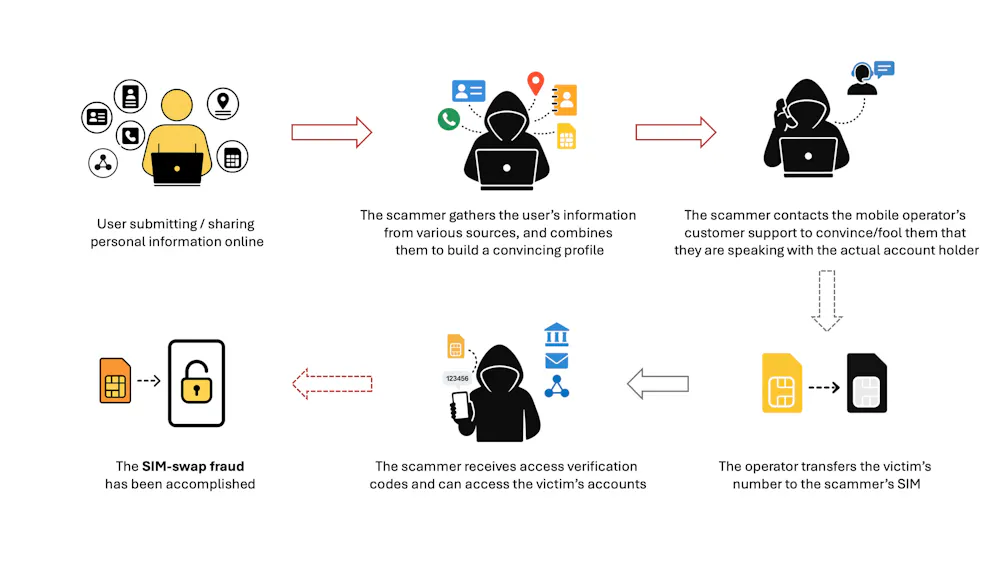
    Sim-swap fraud begins when a scammer convinces a mobile operator to transfer a victim’s number to a new sim card, or even an esim (one that’s embedded in the device), under the scammer’s control.

    This can be done over the phone, through an online chat, or even with the help of a
    bribed insider. Once the number is transferred, all calls and texts intended for the victim are redirected to the scammer. This includes those crucial verification codes used for logging into email, banking, messaging apps such as WhatsApp, and government services such as HMRC.

    This alone would be dangerous. But what makes sim-swap fraud so influential is
    that the cyber scammer often already has access to a patchwork of personal data
    about their target. That information may have been collected from data breaches,
    phishing attacks, low-reputation websites, or even the victim’s social media.

    People often underestimate the extent to which they reveal themselves online: a birthday posted on Instagram, a phone number included in a job posting, or a home address used in an online giveaway. Scammers combine this data to build a convincing profile, enough to fool a mobile operator’s customer service staff into believing they’re talking to the real account holder.

    How the sim-swap fraud works

    Once the scammer gains control of a number, the consequences are extensive.
    Attackers can access sensitive information, including personal documents and
    request and receive password reset links for the user’s other accounts. They can log in to WhatsApp or Telegram accounts, read private messages, impersonate the user, and even contact friends or family members to conduct further scams.

    The victims might see false messages posted in their names or fraudulent transactions made from their accounts. This can lead to financial loss, reputation damage, as well as emotional and mental health issues on the part of the victims.

    In the case of M&S, attackers apparently used this access to manipulate internal
    processes and gain access to sensitive systems. This highlights a broader risk:
    many companies still rely on phone numbers as a secondary verification method for
    staff, making their systems vulnerable to the same cyberattack used against
    individuals.

    How sim-Swap fraud works.
    Hossein Abroshan

    Reducing the risk

    While real-time detection of mobile number hijacking remains difficult, taking specific steps can significantly reduce the likelihood of being targeted and victimised. People should avoid sharing personal data unnecessarily, especially across multiple platforms and, very importantly, on unknown or untrusted websites.

    Many attackers don’t obtain all the necessary information from a single source. Instead, they collect it incrementally, using public profiles, marketing databases and past leaks to form a comprehensive picture.

    Being mindful of where you share your phone number, birthday or other identifiers can make it harder for others to impersonate you. It is also crucial to learn how phishing works and how to recognise it, so you will not submit your sensitive information to phishing or fake websites.

    Avoiding SMS-based authentication, where possible, is another key step. Many
    services now support authenticator apps, such as Google Authenticator, Microsoft Authenticator, Due or Authy, which are not tied to your mobile number. For mobile
    accounts themselves, setting up a unique pin or password to your account, which
    must be provided to authorise any changes, can add an extra layer of protection. This makes it harder for someone to initiate a sim swap without that code. However, users alone cannot fulfil this duty.

    Mobile network operators must strengthen identity verification practices, moving beyond basic questions about names and addresses that can be easily gathered or guessed. Banks and other financial institutions should reconsider using SMS or, at the very least, SMS-only as the default method for sensitive authentication. And companies, particularly those handling personal data or financial assets, need to train their IT and customer service teams to recognise the signs of identity based attacks.

    Sim-swap fraud is effective not because it’s highly technical, but because it exploits our trust in phone numbers for identity verification. The M&S case and similar examples show how fragile that trust can be – and why securing our mobile identities is no longer optional.

    Hossein Abroshan does not work for, consult, own shares in or receive funding from any company or organisation that would benefit from this article, and has disclosed no relevant affiliations beyond their academic appointment.

    ref. M&S cyberattacks used a little-known but dangerous technique – and anyone could be vulnerable – https://theconversation.com/mands-cyberattacks-used-a-little-known-but-dangerous-technique-and-anyone-could-be-vulnerable-256739

    MIL OSI – Global Reports

  • MIL-OSI USA: Senate Unanimously Passes Grassley-Durbin Resolution Recognizing National Police Week

    US Senate News:

    Source: United States Senator for Iowa Chuck Grassley

    WASHINGTON – Senate Judiciary Committee Chairman Chuck Grassley (R-Iowa), Ranking Member Dick Durbin (D-Ill.) and 79 bipartisan senators welcomed the Senate’s unanimous passage of their resolution designating May 12 through 17 as National Police Week. The National Police Week resolution reiterates the Senate’s unwavering support for law enforcement officers across the United States. 

    “Law enforcement officers in Iowa and across the nation work tirelessly to protect and serve our communities. This week, and every week, we should give our thanks to the brave men and women in blue, who have sacrificed so much to ensure our safety,” Grassley said. “As always, I’m proud to back the blue and will continue my efforts in Congress to protect and support our courageous officers.” 

    “Every day, our country’s law enforcement officers put their lives at risk to keep us safe. Officers and their families make great sacrifices in the name of service, including the tragic cases of those who have lost their lives in the line of duty. We’re grateful for their heroism, and we must make sure that officers serving with dignity and integrity have the support and resources they need to do their jobs,” Durbin said

    Grassley and Durbin are joined by Sens. Lindsey Graham (R-S.C.), Angus King (I-Maine), Ashley Moody (R-Fla.), Catherine Cortez Masto (D-Nev.), Susan Collins (R-Maine), Ben Ray Lujan (D-N.M.), Tim Sheehy (R-Mont.), Richard Blumenthal (D-Conn.), John Kennedy (R-La.), Christopher Coons (D-Del.), Tim Scott (R-S.C.), Ruben Gallego (D-Ariz.), Jim Risch (R-Idaho), Peter Welch (D-Vt.), Mitch McConnell (R-Ky.), Tim Kaine (D-Va.), Tommy Tuberville (R-Ala.), Amy Klobuchar (D-Minn.), Rand Paul (R-Ky.), Raphael Warnock (D-Ga.), Mike Crapo (R-Idaho), Brian Schatz (D-Hawaii), Cynthia Lummis (R-Wyo.), Alex Padilla (D-Calif.), Jim Justice (R-W.Va.), John Fetterman (D-Pa.), Katie Britt (R-Ala.), Jacky Rosen (D-Nev.), Jerry Moran (R-Kan.), Sheldon Whitehouse (D-R.I.), John Barrasso (R-Wyo.), Jeanne Shaheen (D-N.H.), Shelley Moore Capito (R-W.Va.), Kirsten Gillibrand (D-N.Y.), Rick Scott (R-Fla.), Jon Ossoff (D-Ga.), Pete Ricketts (R-Neb.), Tammy Duckworth (D-Ill.), Jim Banks (R-Ind.), Mark Kelly (D-Ariz.), Kevin Cramer (R-N.D.), Andy Kim (D-N.J.), Joni Ernst (R-Iowa), Tammy Baldwin (D-Wis.), Ted Budd (R-N.C.), Gary Peters (D-Mich.), Thomas Tillis (R-N.C.), Maria Cantwell (D-Wash.), Cindy Hyde-Smith (R-Miss.), Mark Warner (D-Va.), Roger Marshall (R-Kan.), Elissa Slotkin (D-Mich.), Steve Daines (R-Mont.), Margaret Hassan (D-N.H.), Marsha Blackburn (R-Tenn.), Adam Schiff (D-Calif.), Deb Fischer (R-Neb.), Michael Bennet (D-Colo.), Lisa Murkowski (R-Alaska), Bill Hagerty (R-Tenn.), John Hoeven (R-N.D.), John Cornyn (R-Texas), Mike Lee (R-Utah), Mike Rounds (R-S.D.), John Thune (R-S.D.), Bernie Moreno (R-Ohio), Ted Cruz (R-Texas), Tom Cotton (R-Ark.), Jon Husted (R-Ohio), James Lankford (R-Okla.), Roger Wicker (R-Miss.), Eric Schmitt (R-Mo.), Markwayne Mullin (R-Okla.), Todd Young (R-Ind.), Josh Hawley (R-Mo.), Dan Sullivan (R-Alaska), Dave McCormick (R-Pa.), Cory Booker (D-N.J.), Bill Cassidy (R-La.) and John Boozman (R-Ark.). 

    Read the resolution HERE. 

    Background:

    Every year, for more than six decades, Congress has passed a resolution in honor of law enforcement officers. During National Police Week, Americans pay special tribute to the service and sacrifice of courageous officers and their families, especially our nation’s fallen heroes. 

    Grassley is a long-time law enforcement advocate. This Congress, he’s introduced legislation to boost investment in local police departments, combat retail theft and violent crime, safeguard first responders from narcotics exposure and protect officers from ambush-style attacks. 

    On Thursday, May 15, at 10:15 a.m. ET, Grassley will chair a Senate Judiciary Committee executive business meeting to consider eight bills to support law enforcement. 

    -30-

    MIL OSI USA News

  • MIL-OSI Banking: APEC Education Ministers Issue Joint Statement Jeju, Republic of Korea | 14 May 2025 Issued by the 7th APEC Education Ministerial Meeting APEC Education Ministers have issued a joint statement reaffirming the central role of education in promoting sustainable economic growth and regional prosperity amid accelerating digital transformation.

    Source: APEC – Asia Pacific Economic Cooperation

    APEC Education Ministers have issued a joint statement reaffirming the central role of education in promoting sustainable economic growth and regional prosperity amid accelerating digital transformation.

    Gathering in Jeju under the theme “Bridging Educational Gaps and Promoting Sustainable Growth in the Era of Digital Transformation: Innovate, Connect, Prosper,” ministers emphasized the importance of regional cooperation to strengthen digital learning infrastructure, enhance education quality and equip learners with the skills needed to navigate a rapidly evolving technological landscape.

    The joint statement highlights the potential of artificial intelligence and emerging technologies to improve learning outcomes through personalized education. Ministers acknowledged that AI-powered tools—such as adaptive learning platforms—can help students address knowledge gaps and build strong academic foundations. To support this shift, they stressed the need to build teachers’ digital competencies through professional development and peer learning.

    Ministers encouraged greater collaboration across APEC economies to expand access to digital resources, share best practices, and develop policies that promote educational innovation. They reaffirmed support for initiatives under the APEC Education Strategy (2016–2030), the Arequipa Goals and the La Serena Roadmap to advance educational opportunities for all.

    The joint statement also further recognized the role of Technical and Vocational Education and Training (TVET) and lifelong learning in helping learners build future-ready skills and adapt to the changing demands of the digital economy.

    Read the Joint Statement of the 7th APEC Education Ministerial Meeting “Bridging Educational Gaps and Promoting Sustainable Growth in the Era of Digital Transformation: Innovate, Connect, Prosper

    Read the Chair’s Statement on the 7th APEC Human Resources Development Ministerial Meeting APEC Korea 2025


    For more information or media inquiries, please contact:
    [email protected]

    MIL OSI Global Banks

  • MIL-OSI: Alaris Equity Partners Announces Upsizing of Previously Announced Convertible Unsecured Senior Debentures

    Source: GlobeNewswire (MIL-OSI)

    NOT FOR DISTRIBUTION IN THE UNITED STATES.
    FAILURE TO COMPLY WITH THIS RESTRICTION MAY CONSTITUTE A VIOLATION OF UNITED STATES SECURITIES LAW

    CALGARY, Alberta, May 14, 2025 (GLOBE NEWSWIRE) — Alaris Equity Partners Income Trust (“Alaris” or the “Trust”) (TSX: AD.UN) is pleased to announce that as a result of excess demand, it has agreed with the syndicate of underwriters led by National Bank Financial Inc., CIBC Capital Markets, and Desjardins Capital Markets to increase the size of its previously announced bought deal financing. Alaris will now issue 80,000 convertible unsecured senior debentures due June 30, 2030 (the “Debentures”) at a price of $1,000 per Debenture (the “Offering”) for aggregate gross proceeds of $80,000,000 (the “Offering”). The Trust has also granted the Underwriters an option to purchase up to an additional $12,000,000 aggregate principal amount of Debentures, on the same terms and conditions, exercisable in whole or in part, from time to time, up to 30 days following the closing of the Offering. Unless otherwise stated, all numbers in this press release are presented in Canadian dollars.

    In all other respects, the terms of the Offering and use of proceeds therefrom will remain as previously disclosed in the original press release dated May 13, 2025. The Offering is expected to close on or about June 2, 2025 (the “Closing Date”), and is subject to certain conditions including, but not limited to, the receipt of all necessary corporate and regulatory approvals, including the approval of the Toronto Stock Exchange. A preliminary short form prospectus will be filed with securities regulatory authorities in all provinces of Canada, other than the province of Québec.

    This news release is not an offer of securities of Alaris for sale in the United States. The Debentures have not been and will not be registered under the U.S. Securities Act of 1933, as amended, and the Debentures may not be offered or sold in the United States except pursuant to an applicable exemption from such registration. No public offering of securities is being made in the United States. This news release shall not constitute an offer to sell or the solicitation of an offer to buy nor shall there be any sale of the securities in any jurisdiction in which such offer, solicitation or sale would be unlawful.

    ABOUT ALARIS

    The Trust, through its subsidiaries, invests in a diversified group of private businesses (“Partners”) primarily through structured equity. The primary goal of our structured equity investments is to deliver stable and predictable returns to our unitholders through both cash distributions and capital appreciation. This strategy is enhanced by common equity positions, which allow us to generate returns in alignment with the founders of our Partners.

    FORWARD LOOKING STATEMENTS

    This news release contains forward-looking statements, including forward-looking statements within the meaning of “safe harbor” provisions under applicable securities laws (“forward-looking statements“). Statements other than statements of historical fact contained in this news release may be forward-looking statements including, without limitation, management’s expectations, intentions and beliefs concerning: the anticipated Closing Date; the intended use of proceeds of the Offering; the anticipated terms and timing of conversion, redemption and maturity of the Debentures; expectations regarding the filing of a preliminary prospectus and the anticipated jurisdictions for the Offering. Many of these statements can be identified by words such as “believe”, “expects”, “will”, “intends”, “projects”, “anticipates”, “estimates”, “continues” or similar words or the negative thereof. There can be no assurance that the plans, intentions or expectations on which these forward-looking statements are based will occur.

    By their nature, forward-looking statements require Alaris to make assumptions and are subject to inherent risks and uncertainties. Key assumptions include, but are not limited to, assumptions that: the required regulatory approvals for the Offering will be obtained in a timely fashion; the Debentures and trust units issued upon the conversion of the Debentures will be listed for trading on the TSX; interest rates will not rise in a matter materially different from the prevailing market expectations over the next 12 to 24 months; no widespread global health crisis will impact the economy or any Partners’ operations in a material way in the next 12 months; the businesses of the majority of our Partners will continue to grow; the businesses of new Partners and those of existing Partners will perform in line with Alaris’ expectations and diligence; more private companies will require access to alternative sources of capital and that Alaris will have the ability to raise required equity and/or debt financing on acceptable terms.

    Forward-looking statements are subject to risks, uncertainties and assumptions and should not be read as guarantees or assurances of future performance. The actual results of the Trust and the Partners could materially differ from those anticipated in the forward-looking statements contained herein as a result of certain risk factors, including, but not limited to: the ability of the Trust to obtain the required regulatory approvals for the Offering; the ability of our Partners and, correspondingly, Alaris to meet performance expectations for 2025 and beyond; any change in the senior lenders’ outlook for Alaris’ business; management’s ability to assess and mitigate the impacts of any local, regional, national or international health crises like COVID-19 or its variants; the dependence of Alaris on the Partners; reliance on key personnel; general economic conditions in Canada, North America and globally; failure to complete or realize the anticipated benefit of Alaris’ financing arrangements with the Partners; a failure of the Trust or any Partners to obtain required regulatory approvals on a timely basis or at all; changes in legislation and regulations and the interpretations thereof; risks relating to the Partners and their businesses, including, without limitation, a material change in the operations of a Partner or the industries they operate in; inability to close additional Partner contributions in a timely fashion, or at all; a change in the ability of the Partners to continue to pay Alaris’ distributions; a material change in the unaudited information provided to Alaris by the Partners; a failure of a Partner (or Partners) to realize on their anticipated growth strategies; a failure to achieve the expected benefits of the third-party asset management strategy or similar new investment structures and strategies; conflicts of interest that may arise under the asset management strategy or otherwise; a failure to achieve resolutions for outstanding issues with Partners on terms materially in line with management’s expectations or at all; and a failure to realize the benefits of any concessions or relief measures provided by Alaris to any Partner or to successfully execute an exit strategy for a Partner where desired. Additional risks that may cause actual results to vary from those indicated are discussed under the heading “Risk Factors” and “Forward Looking Statements” in the Trust’s Management Discussion and Analysis for the year ended December 31, 2024, which is filed under the Trust’s profile at www.sedarplus.ca and on its website at www.alarisequitypartners.com.

    Readers are cautioned not to place undue reliance on any forward-looking information contained in this news release as a number of factors could cause actual future results, conditions, actions or events to differ materially from the targets, expectations, estimates or intentions expressed in the forward-looking statements. Statements containing forward-looking information reflect management’s current beliefs and assumptions based on information in its possession on the date of this news release. Although management believes that the assumptions reflected in the forward-looking statements contained herein are reasonable, there can be no assurance that such expectations will prove to be correct.

    The forward-looking statements contained herein are expressly qualified in their entirety by this cautionary statement. The forward-looking statements included in this news release are made as of the date of this news release and Alaris does not undertake or assume any obligation to update or revise such statements to reflect new events or circumstances except as expressly required by applicable securities legislation.

    Neither the TSX nor its Regulation Services Provider (as that term is defined in the policies of the TSX) accepts responsibility for the adequacy or accuracy of this release.

    For further information please contact:

    ir@alarisequity.com
    P: (403) 260-1457
    Alaris Equity Partners Income Trust
    Suite 250, 333 24th Avenue S.W.
    Calgary, Alberta T2S 3E6
    www.alarisequitypartners.com

    The MIL Network

  • MIL-OSI United Kingdom: Leeds welcomes the announcement that more Civil Service roles will be moved to the city

    Source: City of Leeds

    Councillor James Lewis, leader of Leeds City Council, said:

    “We welcome the Government’s continued recognition of Leeds as a key hub for Civil Service roles. With over 14,000 civil servants already based in Leeds, this announcement builds on our role as a major centre for government outside London.

    “Relocating more roles will bring decision-making closer to the communities it serves, support the creation of good jobs, and provide long-term whole career opportunities including for our talented apprentices, graduates and professionals.

    “The Leeds Health and Social Care Hub, which brings together the Department of Health and Social Care, NHS, local government, universities and other partners exemplifies how central government can work hand-in-hand with local delivery organisations to improve outcomes for patients and residents.

    “This move adds to the momentum we’re already seeing in Leeds as a leading financial centre, with major organisations like the Financial Conduct Authority, the Bank of England and the National Wealth Fund choosing to locate roles here – reinforcing the city’s growing national importance as a centre for public service and economic opportunity.”

    MIL OSI United Kingdom

  • MIL-OSI Africa: African Development Bank and Islamic Development Bank Forge Strategic Partnership to Address Fragility and Build Resilience in Africa

    Source: Africa Press Organisation – English (2) – Report:

    ABIDJAN, Ivory Coast, May 14, 2025/APO Group/ —

    The African Development Bank (www.AfDB.org) and the Islamic Development Bank (IsDB) have reinforced their strategic partnership to enhance collective efforts in addressing fragility and building resilience across Africa. This commitment follows a high-level technical exchange held from 22-23 April at the Bank headquarters in Abidjan.

    The two-day mission brought together senior officials from both institutions to align approaches, share best practices, and strengthen collaboration to address complex challenges– particularly in transition states or experiencing fragility. This meeting builds on previous engagements between the two development institutions, including a 2019 Civil Society deep dive facilitated by the African Development Bank’s Civil Society Division, where key areas for joint action were initially identified.

    “This strategic alliance with IsDB reinforces our shared vision of addressing complex challenges in transition states through tailored, context-specific approaches,” said Yero Baldeh, Director of the Transition States Coordination Office at the African Development Bank. “By aligning our methodologies and leveraging our complementary strengths, we can deliver more sustainable solutions in places where development needs are most acute.”

    The IsDB delegation was led by Ahmed Berthe, Lead NGO and Civil Society Specialist, and included Esra Sayhi and Abass Kassim, both Senior Fragility and Resilience Specialists.

    “Our institutions serve many of the same member countries facing similar challenges,” noted Berthe. “What has impressed us most is the African Development Bank’s shift toward anticipatory action and prevention rather than simply responding to crises. This partnership creates a framework for maximizing our collective impact through coordinated investments, shared knowledge, and aligned strategic priorities.”

    The exchange spotlighted the African Development Bank’s Transition Support Facility (TSF), which committed more than $610 million to projects in fragile contexts in 2024. Discussions explored how the TSF’s approach could complement IsDB’s financing tools and create stronger synergies in countries where both institutions operate.

    Climate security emerged as a key theme, with both partners recognizing the role of environmental challenges exacerbating fragility, particularly in vulnerable regions such as the Sahel and the Horn of Africa. The partnership will help develop integrated approaches that address immediate needs and build long-term resilience for both institutions.  

    The exchange also explored ways to harmonize assessment methodologies, coordinate financial instruments, and implement integrated approaches to climate security, with both institutions agreeing to establish a joint technical working group to operationalize the partnership.

    “In line with our 2022-2026 Strategy for Addressing Fragility and Building Resilience in Africa, this partnership reflects the Bank’s strategic emphasis on building alliances that amplify our development impact,” said Ozong Agborsangaya-Fiteu, Chief Operations Officer at RDTS. “By combining our institutional strengths with IsDB, we’re creating a more powerful platform for advancing resilience where it’s needed most.”

    The partnership includes a structured implementation framework scheduled for 2025-2026, in line with the duration of both institutions’ strategies for fragility and resilience. A joint technical working group will operationalize the partnership, ensuring that concrete actions follow this strategic alignment.

    This strategic collaboration advances the African Development Bank’s approach to staying engaged in fragile contexts, focusing on prevention rather than crisis response, and building strategic partnerships across the humanitarian-development-peace nexus—all key principles of its fragility and resilience strategy.

    MIL OSI Africa

  • MIL-OSI Russia: IMF Reaches Staff-Level Agreement on the Combined Third and Fourth Reviews of Bangladesh’s Extended Credit Facility, Extended Fund Facility, and Resilience and Sustainability Facility Arrangements

    Source: IMF – News in Russian

    May 14, 2025

    End-of-Mission press releases include statements of IMF staff teams that convey preliminary findings after a visit to a country. The views expressed in this statement are those of the IMF staff and do not necessarily represent the views of the IMF’s Executive Board. Based on the preliminary findings of this mission, staff will prepare a report that, subject to management approval, will be presented to the IMF’s Executive Board for discussion and decision.

    • IMF staff and the Bangladesh authorities have reached staff-level agreement on the policies needed to complete the combined third and fourth reviews of the authorities’ reform program supported by the IMF’s Extended Credit Facility, Extended Fund Facility, and Resilience and Sustainability Facility. The staff-level agreement is subject to approval by the IMF Executive Board, contingent on the completion of prior actions.
    • The Bangladeshi economy remains under pressure from ongoing challenges and rising external financing requirements. As announced in December 2024, the authorities have requested an augmentation of IMF support of about US$760 million to help preserve macroeconomic stability and enhance the country’s resilience to external shocks.
    • The authorities reiterated their commitment to the objectives of the reform program including fiscal reforms to address the emerging external financing gap, calibrating monetary policy to bring down inflation, and fully implementing exchange rate reforms to enhance flexibility. They have also pledged to foster a sound and competitive financial sector and are advancing their climate agenda to support sustainable, inclusive, and green growth.

    Washington, D.C.:  Following constructive discussions with Bangladesh authorities in Dhaka, continued engagement during the International Monetary Fund (IMF) and World Bank Spring Meetings in Washington, D.C., and subsequent virtual follow-up discussions, Mr. Papageorgiou, the IMF Mission Chief for Bangladesh, issued the following statement:

    “IMF staff and the Bangladesh authorities have reached a staff-level agreement on the policies needed to complete the combined third and fourth reviews under the Extended Credit Facility (ECF), Extended Fund Facility (EFF), and Resilience and Sustainability Facility (RSF). The staff-level agreement is subject to approval by the IMF Executive Board and is contingent on the completion of prior actions related to tax revenue mobilization and full implementation of exchange rate reforms.

    “Amid significant macroeconomic challenges, the authorities requested an augmentation of SDR 567.2 million (approximately US$762 million) in IMF financial support to Bangladesh under the ECF and EFF arrangements. This increase would bring the total financial assistance under the ECF and EFF arrangements to SDR 3,035.65 million (about US$4.1 billion), alongside concurrent RSF arrangements of SDR 1 billion (about US$1.3 billion). Upon completion of the combined third and fourth reviews, SDR 983.8 million (about US$1.3 billion) will be made available, comprising SDR 650.5 million (about US$874 million) under the ECF and EFF and SDR 333.3 million (about US$448 million) under the RSF.

    “Impacted by disruptions from the popular uprising, real GDP growth slowed to 3.3 percent year-on-year (y-o-y) in the first half of FY25; however, it is projected to rebound in the second half reaching 3.8 percent for the full fiscal year. Inflation, which has approached double digits, has begun to decline and is projected to be around 8 ½ percent (y-o-y) by end of FY25. Nonetheless, domestic factors such as stress in the banking sector and elevated global uncertainty tilt risks to the downside.

    To address the emerging external financing gap and support a continued decline in inflation, near-term policy tightening is essential. Fiscal consolidation should focus on the prompt implementation of additional revenue measures—such as streamlining of tax exemptions—while containing non-essential expenditures. Alongside monetary tightening, enhanced exchange rate flexibility and reinforced foreign exchange reserve buffers will bolster the economy’s resilience to external shocks. In this regard, steadfast implementation of the new exchange rate regime will remain critical.

    “Bangladesh’s low tax-to-GDP ratio underscores the urgent need for tax reforms to build a fairer, more transparent, and simpler system while sustainably boosting revenues. Key priorities include streamlining exemptions, enhancing compliance, and delineating tax policy from administration. In parallel, a comprehensive approach is required to rein in subsidy expenditures in the electricity sector. Increased revenues will also provide more fiscal resources to support the most vulnerable. 

    “A carefully designed strategy for dealing with weak banks is essential to ensuring stability. Swift action is needed to operationalize new legal frameworks that facilitate orderly bank restructuring while safeguarding small depositors. Robust asset quality reviews for all large and systemic banks, bank restructuring aimed at forward-looking viability, strengthened risk-based supervision, and enhanced governance and transparency will be key to rebuilding trust and supporting the sector’s soundness. At the same time, institutional reforms to bolster the independence and governance of Bangladesh Bank will be essential for ensuring long-term macroeconomic and financial stability and for the effective implementation of broader financial sector reforms.

    Strengthening governance and promoting greater transparency are essential to improving the business environment, attracting foreign direct investment, and broadening the export base beyond the ready-made garment sector.

    “Enhancing resilience to climate change is crucial for mitigating macroeconomic and fiscal risks. Investing in institutional capacity and improving the efficiency of public spending will support progress toward climate objectives. The government should prioritize climate-responsive fiscal reforms and channel investments into sustainable, climate-resilient infrastructure. In addition, effective management of climate-related risks will help safeguard financial sector stability.

    “The team thanks the authorities for the productive discussions and excellent collaboration.”

    IMF Communications Department
    MEDIA RELATIONS

    PRESS OFFICER: Randa Elnagar

    Phone: +1 202 623-7100Email: MEDIA@IMF.org

    https://www.imf.org/en/News/Articles/2025/05/14/pr25145-bangladesh-imf-reaches-sla-on-combined-3rd-and-4th-reviews-ecf-eff-and-rsf-arrangements

    MIL OSI

    MIL OSI Russia News

  • MIL-OSI Russia: IMF Executive Board Concludes 2025 Discussions on Common Policies of Member Countries of the West African Economic and Monetary Union

    Source: IMF – News in Russian

    May 6, 2025

    • Economic growth continues to be strong in the WAEMU. Inflation has fallen back to its target range, and recent improvements in regional external imbalances are supporting a strong recovery in reserves.
    • The Council of Ministers has agreed to submit for approval by Heads of State a proposal by the WAEMU Commission for a revised Convergence Pact maintaining the previous fiscal deficit and public debt ceilings of 3 and 70 percent of GDP, respectively.
    • Rapid adoption of this pact would signal a stronger commitment to debt sustainability and help guide sound fiscal policies. The WAEMU’s institutions should also continue to promote regional integration.

    Washington, DC: The Executive Board of the International Monetary Fund (IMF) concluded the annual discussions on common policies of member countries of the West African Economic and Monetary Union (WAEMU)[1]. The authorities have consented to the publication of the Staff Report prepared for this consultation.[2]

    Economic growth continues to be strong in the WAEMU, with heterogeneity across countries, while inflation has fallen. Economic growth rose above 6 percent in 2024, near the average of the past decade, although gaps in per capita income among member countries have continued to widen due to significant variations in economic growth. After rising above target for much 2024, inflation has also fallen back within its target range since November 2024, due to easing regional food price inflation and an appropriately tight monetary policy. The banking system remains resilient, although it maintains large exposures to regional sovereigns.

    Recent progress in reducing the WAEMU’s external imbalances, albeit with notable divergence among members, is supporting a strong recovery in reserves. After widening in 2021-2023, the WAEMU’s current account deficit narrowed significantly in 2024. The Central Bank of West African States’ (BCEAO) response to external reserves pressures has also been broadly appropriate, by tightening monetary policy via raising rates and containing the quantities of liquidity injected into the regional banking system. Reserves rebounded in late 2024 and early 2025, and are back above minimum adequate levels due mainly to windfall revenues from the annual cocoa harvest, high commodity prices, several IMF disbursements, and exports of new hydrocarbon resources in Niger and Senegal. The WAEMU’s external position is assessed to have been moderately weaker than fundamentals and desirable policy settings in 2024.

    Public debt ratios have increased significantly and heterogeneously in recent years due to large fiscal deficits and stock-flow adjustments. Ongoing progress in union-wide fiscal consolidation is welcome, although it is proceeding at a slower pace than anticipated mainly because of large data revisions in Senegal. Public debt continued to increase in 2024 beyond the level projected during the previous discussions on common policies, with considerable variation across the WAEMU (and particularly high debt in Senegal). Higher debt issuances are leading to heavier reliance on financing on the regional market, which has limited absorptive capacity and relatively high costs, and could pose a risk to external reserves.


    Executive Board Assessment[3]

    Executive Directors agreed with the thrust of the staff appraisal. They welcomed that the WAEMU is benefitting from strong growth, inflation within the target range, and progress in reducing fiscal and external imbalances, while also noting the significant divergence within the region. Highlighting that the region remains vulnerable to a wide range of shocks, Directors stressed the importance of prudent policies to ensure macroeconomic and financial stability and structural reforms to foster inclusive growth. They looked forward to the Fund’s continued support through tailored policy advice and financial and capacity development assistance.

    Directors stressed the importance of a commitment to debt sustainability, grounded in progress towards fiscal consolidation, measures to contain debt‑creating stock‑flow adjustments, and close monitoring of regional financing capacity. In that context, they commended the proposed reintroduction of the WAEMU Convergence Pact with the previous fiscal deficit and debt ceilings and called for its rapid adoption with a well‑designed escape clause, a correction mechanism, and credible enforcement. Fiscal adjustment should be driven by revenue mobilization to protect priority spending. Directors also stressed the importance of transparent and accurate reporting of fiscal data and enhanced debt transparency.

    Directors welcomed BCEAO’s tight monetary stance which helped bring inflation back to the target range and support reserves. Directors agreed that monetary policy should continue to be closely calibrated to external buffers and inflation developments, and that a cautious stance remains appropriate until there is a sustained recovery in reserve adequacy.

    Directors welcomed the resilience of the financial system but noted that the sovereign‑bank nexus continues to pose risks to financial stability. They encouraged the introduction of macroprudential regulatory measures to help restrain sovereign exposures, and capital surcharges to manage concentration risk. Directors stressed the importance of closely monitoring bank soundness indicators, addressing the remaining FSAP recommendations to strengthen financial stability and deepening, and taking the necessary additional steps to facilitate the removal of WAEMU members currently on the FATF grey list.

    Directors agreed that prosperity in the WAEMU will depend on progress on political cohesion, economic integration, and strengthening the regional institutional framework and infrastructure. A planned stabilization fund to support members impacted by idiosyncratic shocks could demonstrate regional solidarity, but contingent liability risks through leveraging should be avoided. Directors welcomed progress on the new fast payment system, which would promote efficiency, inclusion, and regional integration. Policies to diversify the economy and strengthen resilience would also be important.

    The views expressed by Executive Directors today will form part of the Article IV consultations with individual member‑countries that take place until the next Board discussion of WAEMU common policies. It is expected that the next regional discussions with the WAEMU authorities will be held on the standard 12‑month cycle.

    Table 1. WAEMU: Selected Economic and Social Indicators, 2021–29


    Social Indicators


    GDP


    Poverty (2021, latest available)


    Nominal GDP (2024, millions of US Dollars)

    219,784


    Headcount ratio at $1.90 a day (2011 PPP, percent of population)

    23.1


    GDP per capita (2024, US Dollars)

    1,447


    Undernourishment (percent of population)


    12.5


    Population characteristics


    Inequality (2021, latest available)


    Total (2023, millions)

    145.3


    Income share held by highest 10 percent of population


    28.4


    Urban population (2023, percent of total)

    40.6


    Income share held by lowest 20 percent of population


    7.7


    Life expectancy at birth (2022, years)

    61.1


    Gini index


    35.4


    Economic Indicators


    2021

    2022


    2023

    2024

    2025

    2026

    2027

    2028

    2029


    Act.

    SM/24/90. 1

    Est.

    Projected


    (Annual Percentage Change)


    National income and prices


      GDP at constant prices 2

    6.2

    5.9


    5.3

    6.8

    6.3

    6.4

    5.8

    5.9

    6.0

    5.9


      GDP per capita at constant prices

    3.2

    2.9


    2.4

    3.8

    3.3

    3.4

    2.8

    2.9

    3.0

    2.9


      Consumer prices (average)

    3.6

    7.6

    3.7

    3.2

    3.5

    2.9

    2.3

    2.0

    2.0

    2.0


      Terms of trade

    -6.3

    -12.3

    7.9

    4.2

    12.4

    9.3

    3.6

    -1.3

    -1.0

    -0.7


      Nominal effective exchange rate

    1.2

    -2.3


    6.3

    3.5


      Real effective exchange rate

    1.5

    -3.6


    3.9

    3.0


    (Percent of GDP)


    National accounts


      Gross national savings

    20.4

    18.8


    18.8

    22.4

    20.8

    21.7

    23.1

    23.2

    23.4

    23.8


      Gross domestic investment

    26.5

    28.8


    28.7

    27.5

    26.9

    26.2

    26.3

    26.7

    27.3

    27.7


          Of which: public investment

    6.8

    7.8


    7.7

    8.8

    6.8

    6.7

    7.2

    7.5

    7.8

    8.2


    (Annual changes in percent of beginning-of-period broad money)

    Money and credit


       Net foreign assets

    1.7

    -7.9


    -7.2

    0.5

    6.1

    2.7

    2.1

    3.2

    3.2

    2.2

       Net domestic assets

    16.9

    20.7


    10.0

    12.6

    3.4

    9.9

    10.3

    9.9

    9.7

    10.2

       Broad money

    18.0

    11.4


    3.5

    12.4

    8.9

    11.4

    12.4

    12.8

    12.6

    12.1

    Credit to the economy

    8.1

    9.0


    6.8

    6.7

    2.7

    7.2

    7.0

    6.6

    6.5

    6.3


    (Percent of GDP, unless otherwise indicated)

    Government financial operations


      Government total revenue, excl. grants

    16.1

    15.8


    16.5

    17.3

    16.6

    17.3

    17.7

    18.2

    18.5

    18.8

      Government expenditure

    23.9

    24.7


    23.8

    22.6

    22.4

    22.0

    21.8

    21.9

    22.2

    22.5

      Overall fiscal balance, excl. grants

    -7.8

    -9.0


    -7.3

    -5.3

    -5.8

    -4.6

    -4.1

    -3.7

    -3.7

    -3.7

      Overall fiscal balance, incl. grants

    -6.3

    -7.8


    -6.3

    -4.2

    -5.2

    -3.8

    -3.3

    -3.0

    -3.0

    -3.0


    External sector


      Exports of goods and services 3

    20.0

    19.6


    17.7

    21.4

    18.8

    21.3

    21.8

    21.4

    20.9

    20.7

      Imports of goods and services 3

    25.9

    29.7


    27.5

    26.5

    24.6

    24.4

    23.8

    23.4

    23.3

    23.2

      Current account, excl. grants

    -6.6

    -10.7


    -10.2

    -5.4

    -6.5

    -4.9

    -3.5

    -3.7

    -4.1

    -4.1

      Current account, incl. grants

    -5.9

    -9.8


    -9.5

    -4.8

    -6.1

    -4.5

    -3.3

    -3.5

    -3.9

    -3.8

      External public debt

    36.3

    37.0


    38.9

    36.1

    39.9

    37.8

    36.6

    35.5

    33.8

    32.6

      Total public debt

    58.5

    61.5


    64.0

    59.6

    65.0

    63.4

    61.9

    60.4

    58.8

    57.5


    Broad money

    40.7

    40.8


    39.1

    40.6

    38.8

    39.4

    41.0

    42.8

    44.6

    46.3


    Memorandum items:


       Nominal GDP (billions of CFA francs)

        100,963

    112,343


    121,414

    131,429

    133,227

    145,965

    157,833

    170,313

    183,993

    198,973


       Nominal GDP per capita (US dollars)

    1,308

    1,259


    1,356

    1,436

    1,446

    1,508

    1,588

    1,663

    1,744

    1,831


       CFA franc per US dollars, average

    554.2

    622.4


    606.5

    606.2


    Gross international reserves


     In months of next year’s imports (of goods and services)

    5.0

    4.1


    3.5

    3.5

    4.6

    4.7

    4.8

    4.9

    5.1

    5.2


     In percent of current GDP

    13.9

    10.1


    7.8

    8.2

    10.1

    10.0

    10.1

    10.3

    10.6

    10.7


     In percent of the BCEAO’s sight liabilities

    79.7

    63.8


    56.9

    58.1

    66.9

    67.1

    66.5

    66.0

    66.2

    66.0


     In millions of US dollars

    24,172

    18,398


    15,764

    17,872

    21,593

    24,165

    26,254

    28,967

    32,156

    35,185


      Sources:  IMF, African Department database; World Economic Outlook; World Bank World Development Indicators; IMF staff

    estimates and projections.


      All projections presented were prepared in April 2025.


    1 Shows data from the IMF Country Report 24/90 issued on March 1, 2024.


    2 The acceleration in GDP growth in 2024 is due to the start of production of large hydrocarbon projects in Niger and Senegal.


    3 Excluding intraregional trade.

                                             
    IMF Communications Department
    MEDIA RELATIONS

    PRESS OFFICER: Julie Ziegler

    Phone: +1 202 623-7100Email: MEDIA@IMF.org

    https://www.imf.org/en/News/Articles/2025/05/06/pr25130-imf-executive-board-concludes-2025-discussions-common-policies-member-countries-waemu

    MIL OSI

    MIL OSI Russia News

  • MIL-OSI Economics: Joint study explores feasibility of central bank operations using tokenisation and smart contracts

    Source: Bank for International Settlements

    The Federal Reserve Bank of New York and the Bank for International Settlements (BIS) today published a joint research study that explored if and how central banks could continue to implement monetary policy operations in hypothetical tokenised wholesale financial markets.    

    Project Pine, from the New York Innovation Center at the New York Fed and the Swiss Centre of the BIS Innovation Hub found that central banks could customise and deploy policy implementation tools using programmable smart contracts in a potential future state where commercial banks and other private sector financial institutions have widely adopted tokenisation for wholesale payments and securities settlement.

    The project generated the prototype of a generic monetary policy implementation tokenised toolkit for potential further research and development by central banks across jurisdictions and currencies. The prototype was designed to be technically modifiable for different central banks’ monetary policy frameworks and calibrated to conduct standard or emergency market operations.

    The toolkit prototype was created in consultation with central banks’ financial markets advisors from multiple jurisdictions, who helped outline the project scope and specific design requirements. It is not particular to any currency or jurisdiction. It can fulfil a common set of central bank implementation requirements, including paying interest on reserves, open market operations, and collateral management.

    The toolkit was tested against ten hypothetical scenarios simulating normal market dynamics and stress events. Each scenario was designed using historical data inputs on past market events, such as interest rate tightening and easing cycles, quantitative easing and tightening cycles, and periods of strained market liquidity or broader market disruptions. 

    The prototype successfully responded and instantaneously carried out the intended operation under the varying market conditions, consistent with the central bank’s desired liquidity environment. Project Pine’s findings highlighted areas for further research and analysis related to interoperability and data standardisation. Project Pine aims to contribute to a broad and transparent public dialogue regarding potential applications of new technologies in the financial sector.

    BIS Innovation Hub projects are experimental in nature and aim to explore and deliver public goods to the global central banking community. Project Pine was limited to research and experimentation and should not be interpreted to reflect any policies, directives, or views of the Federal Reserve Bank of New York or the Federal Reserve System.

    About the New York Innovation Center

    The New York Innovation Center (NYIC) at the Federal Reserve Bank of New York bridges the worlds of finance, technology, and innovation. Established in 2021 in partnership with the Bank for International Settlements Innovation Hub, the NYIC generates insights into high-value central bank-related opportunities through research, analysis, and technical experimentation to drive advancements in central banking and enhance the functioning of the global financial system.

    About the BIS Innovation Hub

    The BIS Innovation Hub aims to foster international collaboration on innovative financial technology within the central banking community. It identifies and develops in-depth insights into critical trends in technology affecting central banking, develops public goods for improving the functioning of the global financial system, and serves as a focal point for a network of central bank innovation experts. 

    MIL OSI Economics

  • MIL-OSI Global: M&S cyberattacks used a little-known but dangerous technique

    Source: The Conversation – UK – By Paul Rincon, Commissioning Editor, Science, Technology and Business

    Richard OD / Shutterstock

    The cyberattack that has targeted Marks & Spencer’s (M&S) is the latest in a growing wave of cases involving something called sim-swap fraud. While the full technical details remain under investigation, a report in the Times suggests that cyber attackers used this method to access M&S internal systems, possibly by taking control of an employee’s mobile number and convincing IT staff to reset critical login credentials.

    Sim-swap fraud is not a new phenomenon, but it is becoming increasingly dangerous
    and more prevalent. According to CIFAS, the UK’s national fraud prevention service, Sim-swap incidents have surged from under 300 in 2022 to almost 3,000 in 2023. What had been mainly a risk to cryptocurrency investors or online influencers is now much more prevalent.

    This form of cyberattack shows how major companies and ordinary people can be compromised through a tactic that exploits human factors, such as trust and how we have built our digital identities around mobile phones.

    Sim-swap fraud begins when a scammer convinces a mobile operator to transfer a victim’s number to a new sim card, or even an esim (one that’s embedded in the device), under the scammer’s control.

    This can be done over the phone, through an online chat, or even with the help of a
    bribed insider. Once the number is transferred, all calls and texts intended for the victim are redirected to the scammer. This includes those crucial verification codes used for logging into email, banking, messaging apps such as WhatsApp, and government services such as HMRC.

    This alone would be dangerous. But what makes sim-swap fraud so influential is
    that the cyber scammer often already has access to a patchwork of personal data
    about their target. That information may have been collected from data breaches,
    phishing attacks, low-reputation websites, or even the victim’s social media.

    People often underestimate the extent to which they reveal themselves online: a birthday posted on Instagram, a phone number included in a job posting, or a home address used in an online giveaway. Scammers combine this data to build a convincing profile, enough to fool a mobile operator’s customer service staff into believing they’re talking to the real account holder.

    How the sim-swap fraud works

    Once the scammer gains control of a number, the consequences are extensive.
    Attackers can access sensitive information, including personal documents and
    request and receive password reset links for the user’s other accounts. They can log in to WhatsApp or Telegram accounts, read private messages, impersonate the user, and even contact friends or family members to conduct further scams.

    The victims might see false messages posted in their names or fraudulent transactions made from their accounts. This can lead to financial loss, reputation damage, as well as emotional and mental health issues on the part of the victims.

    In the case of M&S, attackers apparently used this access to manipulate internal
    processes and gain access to sensitive systems. This highlights a broader risk:
    many companies still rely on phone numbers as a secondary verification method for
    staff, making their systems vulnerable to the same cyberattack used against
    individuals.

    How sim-Swap fraud works.
    Hossein Abroshan

    Reducing the risk

    While real-time detection of mobile number hijacking remains difficult, taking specific steps can significantly reduce the likelihood of being targeted and victimised. People should avoid sharing personal data unnecessarily, especially across multiple platforms and, very importantly, on unknown or untrusted websites.

    Many attackers don’t obtain all the necessary information from a single source. Instead, they collect it incrementally, using public profiles, marketing databases and past leaks to form a comprehensive picture.

    Being mindful of where you share your phone number, birthday or other identifiers can make it harder for others to impersonate you. It is also crucial to learn how phishing works and how to recognise it, so you will not submit your sensitive information to phishing or fake websites.

    Avoiding SMS-based authentication, where possible, is another key step. Many
    services now support authenticator apps, such as Google Authenticator, Microsoft Authenticator, Due or Authy, which are not tied to your mobile number. For mobile
    accounts themselves, setting up a unique pin or password to your account, which
    must be provided to authorise any changes, can add an extra layer of protection. This makes it harder for someone to initiate a sim swap without that code. However, users alone cannot fulfil this duty.

    Mobile network operators must strengthen identity verification practices, moving beyond basic questions about names and addresses that can be easily gathered or guessed. Banks and other financial institutions should reconsider using SMS or, at the very least, SMS-only as the default method for sensitive authentication. And companies, particularly those handling personal data or financial assets, need to train their IT and customer service teams to recognise the signs of identity based attacks.

    Sim-swap fraud is effective not because it’s highly technical, but because it exploits our trust in phone numbers for identity verification. The M&S case and similar examples show how fragile that trust can be – and why securing our mobile identities is no longer optional.

    ref. M&S cyberattacks used a little-known but dangerous technique – https://theconversation.com/mands-cyberattacks-used-a-little-known-but-dangerous-technique-256601

    MIL OSI – Global Reports

  • MIL-OSI USA: Jefferson, Economic Outlook

    Source: US State of New York Federal Reserve

    Thank you, President Williams. It is wonderful to be back in New York, and it is an honor to speak to you, the directors and advisers to the Second District. You all play an extremely important role for the Federal Reserve Bank of New York and, indeed, for the entirety of the Federal Reserve System. You, and your peers around the country, inform President Williams and the other Bank presidents about how you see the economy unfolding in your communities and in your industries. The presidents, in turn, share that vital information with all the members of the Federal Open Market Committee (FOMC) so that we can make the best monetary policy decisions to benefit all Americans. Thank you for the important contributions.1

    In the spirit of sharing information, I thought it would be helpful to share with you my economic outlook. First, I will discuss how I see recent economic activity. Next, I will talk about developments pertaining to both sides of our dual mandate, maximum employment and price stability. Finally, I will offer my current view of monetary policy.
    Economic ActivityWhile the economy entered a period of heightened uncertainty this year, the underlying data through the first quarter showed resilience. As you can see in figure 1, gross domestic product (GDP) contracted slightly by 0.3 percent in the first quarter, on an annualized basis, after expanding at a 2.4 percent rate in the fourth quarter of 2024. That change, however, overstates the deceleration in activity. A surge in imports apparently ahead of anticipated changes to trade policy did not seem to be reflected fully in inventory or spending data. That misalignment complicated the interpretation of measured GDP data. Private domestic final purchases, which exclude government spending, inventory investment, and net exports, usually gives a better read than GDP on the underlying momentum in the economy. That came in at a 3 percent rate in the first quarter, consistent with readings from last year.
    Looking at figure 2, you can see that inflation-adjusted consumer spending was strong much of last year. Spending eased at the start of 2025, which could in part reflect poor weather and seasonal adjustment challenges. Spending bounced back in March, perhaps reflecting some purchases ahead of expected trade policy changes.
    Of course, those observations of first-quarter economic activity are now in the rearview mirror. Tariff announcements and heightened uncertainty about government policies in general are the dominant economic developments of more recent weeks and have caused me to look carefully at my forecasts. It is not my role to express views on policies coming from the Administration or Congress, but I do study the implications of those policies on economic activity and inflation.
    Various surveys show a decline in business sentiment related to trade policy. The Beige Book reported that some retailers are expecting to raise prices in response to tariffs, which could then limit spending, especially by the most price-sensitive consumers. Manufacturers saw risks of supply chain disruptions related to trade policy changes. Moreover, uncertainty is quite high. As a result, I have adjusted down my expectations for economic growth this year, but I see the U.S. economy as continuing to expand. Of course, trade policy is still evolving, so its ultimate economic implications are not known, and I will be following developments carefully.
    Labor MarketTurning to the labor market, conditions continue to be solid. As you can see in figure 3, the unemployment rate was 4.2 percent in April. It has fluctuated within a narrow and historically low range between 4 and 4.2 percent since the middle of last year. U.S. employers added 177,000 jobs to payrolls last month, effectively matching the average growth over the past six months. Payrolls have been rising at a pace consistent with a stable unemployment rate and a flat labor force participation rate. Hiring has slowed from the rapid pace recorded earlier in the current expansion, but layoffs remain historically low. That can be seen in figure 4. New applications for unemployment benefits this year remain in the same low range recorded over the previous three years.
    Looking at figure 5, you can see the ratio of job vacancies to unemployed workers was at 1 in March, well down from a peak of 2 in 2022. The measure is consistent with a labor market that looks to be in balance and is not a source of inflationary pressure. Looking ahead, I am watching for signs that the labor market could cool as tariff increases begin to weigh on economic activity.
    InflationRegarding inflation, recent data are consistent with further progress toward our 2 percent inflation target; however, that goal has not yet been reached. Looking at figure 6, the blue line shows inflation as measured by the price index for personal consumption expenditures (PCE) has trended down from a peak above 7 percent in mid-2022. In March, PCE prices advanced 2.3 percent from a year earlier. Core PCE inflation, which excludes volatile consumer energy and food prices and is usually a better indicator of future inflation, the dashed red line, was at 2.6 percent. Figure 7 shows the components of core PCE inflation, which can provide insight into sources of inflationary pressures. Housing services inflation, the purple dotted line, has fallen notably since early 2023 and could continue to provide support to the disinflation process. Core services inflation, the dashed red line, has largely moved sideways since the early part of last year, contributing little to further disinflation, and I largely expect that pattern to continue as well. In contrast, goods inflation, outside of food and energy, the blue line, has picked up a bit this year.
    There is much uncertainty, however, around the future path of inflation. If the increases in tariffs announced so far are sustained, they are likely to interrupt progress on disinflation and generate at least a temporary rise in inflation. Whether tariffs create persistent upward pressure on inflation will depend on how trade policy is implemented, the pass-through to consumer prices, the reaction of supply chains, and the performance of the economy. Short-term inflation expectations have increased in both survey- and market-based measures, but I think it is notable that most measures of longer-run inflation expectations have been largely stable, suggesting that the American people understand the Federal Reserve’s commitment to return inflation to our 2 percent target.
    While trade policy has received the bulk of recent attention, I remain focused on the aggregate effect from the totality of different government policy changes, including trade, immigration, regulatory, and fiscal policies, as well as their net effects on the economy. This net effect will likely remain uncertain for some time.
    Monetary PolicyLast week I supported the FOMC’s decision to hold the federal funds rate at current levels as the best policy to achieve our dual mandate of maximum employment and price stability. As you can see in figure 8, the FOMC acted last year to reduce the policy rate by a full percentage point. Over the past several meetings, the rate has been held at what I view as a moderately restrictive level. I view the current stance of policy as well positioned to respond to developments that may arise.
    With respect to the path of the policy rate going forward, I will carefully assess incoming data, the evolving outlook, and the balance of risks. Various measures of consumer and business sentiment have declined sharply this year, and I will be watching very carefully for signs of weakening economic activity in hard data. At the same time, higher tariffs could lead to higher inflation this year. It is uncertain whether inflationary pressures would be temporary or persistent. Our monetary policy actions are guided by our dual mandate to promote maximum employment and stable prices for the American people. With the increased risks to both sides of our mandate, I believe that the current stance of monetary policy is well positioned to respond in a timely way to potential economic developments.
    ConclusionThe uncertain economic outlook presents a challenge for monetary policymakers. It is critical that we have the best available information from a broad cross section of sources, which is again why your efforts to keep President Williams and other monetary policymakers informed are so critical. Effective policymaking starts with hearing from people in every corner of this country—including New York, New Jersey, Connecticut, Puerto Rico, and the U.S. Virgin Islands. Directors and advisers like you make that possible. Thank you again.

    1. The views expressed here are my own and not necessarily those of my colleagues on the Federal Open Market Committee. Return to text

    MIL OSI USA News

  • MIL-OSI United Kingdom: Council welcomes extra £2 million potholes cash as highways improvements ramp up

    Source: City of Wolverhampton

    The council had already committed to a £9.7 million highways capital programme, including a raft of road repairs across the city.

    Now an extra £2 million has been secured from the City Region Sustainable Transport Settlement (CRSTS) via West Midlands Combined Authority, meaning even more potholes can be filled and surface works carried out.

    As part of council work that was already planned, crews will be in action around the city this spring and summer – including resurfacing Cannock Road at the end of July.

    Other roads to be resurfaced in the coming weeks include: Merridale Road, Wellington Road, Millfields Road, Wood End Road, Lichfield Street, Hall Lane, Wrottesely Road, Ruskin Avenue, Whitgreave Avenue, Prestwood Road and Neachells Lane.

    The full list of roads in line for repairs to date can be seen below. More roads will be added to the programme and people will be kept updated on progress.

    With more than 460 miles of road and over 800 miles of footway to maintain, the City of Wolverhampton Council, like all other authorities in the country, must prioritise where to focus.

    It does this through examining data from condition surveys and road inspections, determining where resurfacing or other surface treatments can make the most difference.

    The programme follows a preventative approach aimed at reducing the need for thousands of pothole repairs the council carries out every year.

    Councillor Qaiser Azeem, Cabinet Member for Transport and Green City at City of Wolverhampton Council, said: “We know how important keeping our roads in a good condition is to people.

    “That is why we are investing in more highways improvements and people will see even more work taking place across the city over the coming weeks and months.

    “We welcome this additional funding, and we will make sure it’s put to use tackling more potholes on our city’s roads.

    “We take responsibility of maintaining our highways network very seriously and understand how an efficient, safe and smooth flowing highway network for all modes of transport is important for economic productivity and social connection.”

    As well as road resurfacing and pothole repairs the council’s highways capital programme for 2025/26 also includes resurfacing footpaths, car park and streetlighting upgrades, road safety schemes and more.

    This budget includes an additional £500,000 investment from the council as part of its commitment to addressing the issue of potholes.

    People can report potholes in Wolverhampton by visiting Report a pothole
    https://www.wolverhampton.gov.uk/parking-and-roads/roads/report-pothole here Report a pothole | City Of Wolverhampton Council

    From graffiti, fly posting and flytipping to potholes and faulty streetlights, people can also report issues, details and locations quickly and easily via Love Clean Streets App
    https://www.wolverhampton.gov.uk/contact-us/love-clean-streets-app Love Clean Streets App | City Of Wolverhampton Council Photographs can also be submitted.

    Planned road resurfacing
    Cannock Road from Stafford Steet to Springfield Road
    Merridale Road from Chapel Ash to Oaks Crescent Park/Graiseley
    Lichfield Street from Bow Street to Mount Pleasant
    A41 Wellington Road from Prouds Lane to Mount Pleasant
    Neachells Lane, including Planetary Road to Wednesfield Way, Wednesfield Way to Alfred Squire Road and Alfred Squire Road to High Street
    Wrottesley Road from Wergs Road to Chilgrove Gardens
    Wood End Road – Roundabout to Amos Lane
    A4039 Millfields Road
    Whitgreave Avenue to the roundabout at Leacroft Avenue
    Ruskin Avenue – Entire length
    Hall Lane from Hurst Road to Robert Wynd
    Prestwood Road from Bushbury Road to Thorneycroft Lane
    Planned surface treatment
    Fairview Road
    Blackhalve Lane from Cannock Road to City boundary
    A449 Penn Road from southbound roundabout Penn Road to the end of the dual carriageway near Lonsdale Road
    Birches Barn Road from Bradmore Road to roundabout Stubbs Road
    Rookery Street from roundabout at Well Lane to Rookery Bridge
    Springhill Lane from Warstones Road to city boundary (Wynne Crescent)
    Bhylls Lane from Langley Road to Castlecroft Road
    B4484 – Pear Tree Lane from roundabout Blackhalve Lane to Cannock Road
    Birchfield Avenue and Nethy Drive
    Cockshutts Lane
    Downing Close
    Bilston Road from Moseley Road to Keyway
    Elston Hall Lane from Short Road to Three Tuns Lane
    Millfields Road from Manor Road to Tarmac Road
    Wellington Road from no.121 to Stowheath Lane East Park
    Moseley Road from Willenhall Road to Waite Road
    A41 Bilston Road from eastbound roundabout Ring Road to Commercial Road
    A459 Dudley Road from Goldthorn Hill to Bromley Street
    A4123 Birmingham Road from Cockshutts Lane to Grove Street
    Darlaston Lane from city boundary to Bilston Road
    Warstones Road from Coalway Road to the roundabout at Stourbridge Road
    Earl Croft Road and Enville Road and back of footway Warstones Drive
    Codsall Road from city boundary to roundabout at Pendeford Avenue
    Kirby Close to King Street 
    B4161 – Henwood Road and Tettenhall Road
    B4163 – Salop Street – Oxford Street – Bank Street
    A41 – Wellington Road to Prouds Lane
    Cumberland Road – Cumberland Road – Prouds Lane and back of footway Central Avenue

    MIL OSI United Kingdom

  • MIL-OSI Russia: China’s loan volume reaches 10.06 trillion yuan in first four months of 2025

    Translation. Region: Russian Federal

    Source: People’s Republic of China in Russian – People’s Republic of China in Russian –

    Source: People’s Republic of China – State Council News

    BEIJING, May 14 (Xinhua) — China’s new renminbi (yuan) loans totaled 10.06 trillion yuan (1.39 trillion U.S. dollars) in the first four months of 2025, data from the People’s Bank of China (PBOC) showed Wednesday.

    The balance of M2 money supply, which covers cash in circulation and all deposits, rose 8 percent year-on-year to 325.17 trillion yuan by the end of April this year, according to the PBOC. -0-

    MIL OSI Russia News

  • MIL-OSI: First Busey Corporation Prices Depositary Share Offering

    Source: GlobeNewswire (MIL-OSI)

    LEAWOOD, Kan., May 14, 2025 (GLOBE NEWSWIRE) — First Busey Corporation (“Busey”) (Nasdaq: BUSE), the holding company for Busey Bank and CrossFirst Bank, announced the pricing of an underwritten public offering of 8,000,000 depositary shares, each representing a 1/40th ownership interest in a share of its 8.25% Fixed Rate Series B Non-Cumulative Perpetual Preferred Stock (the “Series B preferred stock”), with a liquidation preference of $1,000 per share (equivalent to $25.00 per depositary share).

    When, as, and if declared by the board of directors of Busey, dividends will be payable on the Series B preferred stock from the date of issuance at a rate of 8.25% per annum, payable quarterly in arrears, on March 1, June 1, September 1 and December 1 of each year, beginning on September 1, 2025. Busey may redeem the Series B preferred stock at its option at a redemption price equal to $25.00 per depositary share, as described in the prospectus supplement and accompanying prospectus relating to the offering.

    Net proceeds from the offering are expected to be used to redeem Busey’s 5.25% Fixed-to-Floating Rate Subordinated Notes due 2030, and for general corporate purposes including to support balance sheet growth of Busey Bank.

    Busey intends to apply to list the depositary shares on the Nasdaq Global Select Market under the symbol “BUSEP.”

    Piper Sandler & Co., Morgan Stanley & Co. LLC and Keefe, Bruyette & Woods, Inc. are serving as joint bookrunning managers for the offering, and Janney Montgomery Scott LLC is acting as the co-manager.

    The Company expects to close the offering, subject to customary conditions, on or about May 20, 2025.

    The Company filed a “shelf” registration statement (File No. 333-274620) (including a base prospectus (the “Base Prospectus”)) on September 21, 2023 and the related preliminary prospectus supplement on May 13, 2025 (the “Preliminary Prospectus Supplement”) with the Securities and Exchange Commission (“SEC”) for the offering to which this communication relates. You may obtain these documents for free by visiting EDGAR on the SEC’s website at www.sec.gov. Alternatively, Busey, any underwriter or any dealer participating in the offering will arrange to send you the Base Prospectus and the Preliminary Prospectus Supplement if you request it by emailing Piper Sandler & Co. at fsg-dcm@psc.com or calling Morgan Stanley & Co. LLC toll-free at 1-866-718-1649 or Keefe, Bruyette & Woods, A Stifel Company at 1-800-966-1559.

    This news release shall not constitute an offer to sell, or the solicitation of an offer to buy any securities, nor shall there be any offer or sale of these securities in any jurisdiction in which such offer, solicitation, or sale would be unlawful prior to registration or qualification under the securities laws of any such jurisdiction.

    Corporate Profile
    As of March 31, 2025, First Busey Corporation (Nasdaq: BUSE) was a $19.46 billion financial holding company headquartered in Leawood, Kansas.

    Busey Bank, a wholly-owned bank subsidiary of First Busey Corporation headquartered in Champaign, Illinois, had total assets of $11.98 billion as of March 31, 2025. Busey Bank currently has 62 banking centers, with 21 in Central Illinois markets, 17 in suburban Chicago markets, 20 in the St. Louis Metropolitan Statistical Area, three in Southwest Florida, and one in Indianapolis. More information about Busey Bank can be found at busey.com.

    CrossFirst Bank, a wholly-owned bank subsidiary of First Busey Corporation headquartered in Leawood, Kansas, had total assets of $7.45 billion as of March 31, 2025. CrossFirst Bank currently has 16 banking centers located across Arizona, Colorado, Kansas, Missouri, New Mexico, Oklahoma, and Texas. More information about CrossFirst Bank can be found at crossfirstbank.com. It is anticipated that CrossFirst Bank will be merged with and into Busey Bank on June 20, 2025.

    Through Busey’s Wealth Management division, the Company provides a full range of asset management, investment, brokerage, fiduciary, philanthropic advisory, tax preparation, and farm management services to individuals, businesses, and foundations. Assets under care totaled $13.68 billion as of March 31, 2025. More information about Busey’s Wealth Management services can be found at busey.com/wealth-management.

    Busey Bank’s wholly-owned subsidiary, FirsTech, specializes in the evolving financial technology needs of small and medium-sized businesses, highly regulated enterprise industries, and financial institutions. FirsTech provides comprehensive and innovative payment technology solutions, including online, mobile, and voice-recognition bill payments; money and data movement; merchant services; direct debit services; lockbox remittance processing for payments made by mail; and walk-in payments at retail agents. Additionally, FirsTech simplifies client workflows through integrations enabling support with billing, reconciliation, bill reminders, and treasury services. More information about FirsTech can be found at firstechpayments.com.

    For the fourth consecutive year, Busey was named among 2025’s America’s Best Banks by Forbes. Ranked 88th overall, Busey was one of seven banks headquartered in Illinois included on this year’s list. Busey was also named among the 2024 Best Banks to Work For by American Banker, the 2024 Best Places to Work in Money Management by Pensions and Investments, the 2024 Best Places to Work in Illinois by Daily Herald Business Ledger, the 2025 Best Places to Work in Indiana by the Indiana Chamber of Commerce, and the 2024 Best Companies to Work For in Florida by Florida Trend magazine. We are honored to be consistently recognized globally, nationally and locally for our engaged culture of integrity and commitment to community development.

    First Busey Corporation Contacts
    For Financials:  For Media:
    Scott Phillips, Interim CFO Amy L. Randolph, EVP & COO
    First Busey Corporation  First Busey Corporation
    (239) 689-7167 (217) 365-4049
    scott.phillips@busey.com amy.randolph@busey.com
       

    Forward-Looking Statements
    This press release may contain “forward-looking statements” within the meaning of the Private Securities Litigation Reform Act of 1995 with respect to Busey’s financial condition, results of operations, plans, objectives, future performance, and business. Forward-looking statements, which may be based upon beliefs, expectations, and assumptions of Busey’s management and on information currently available to management, are generally identifiable by the use of words such as “believe,” “expect,” “anticipate,” “plan,” “intend,” “estimate,” “may,” “will,” “would,” “could,” “should,” “position,” or other similar expressions. Additionally, all statements in this document, including forward-looking statements, speak only as of the date they are made, and Busey undertakes no obligation to update any statement in light of new information or future events.

    A number of factors, many of which are beyond Busey’s ability to control or predict, could cause actual results to differ materially from those in any forward-looking statements. These factors include, among others, the following: (1) the strength of the local, state, national, and international economies and financial markets (including effects of inflationary pressures, the threat or implementation of tariffs, trade wars, and changes to immigration policy); (2) changes in, and the interpretation and prioritization of, local, state, and federal laws, regulations, and governmental policies (including those concerning Busey’s general business); (3) the economic impact of any future terrorist threats or attacks, widespread disease or pandemics, or other adverse external events that could cause economic deterioration or instability in credit markets (including Russia’s invasion of Ukraine and the conflict in the Middle East); (4) unexpected results of acquisitions, including the acquisition of CrossFirst Bankshares, Inc., which may include the failure to realize the anticipated benefits of the acquisitions and the possibility that the transaction and integration costs may be greater than anticipated; (5) the imposition of tariffs or other governmental policies impacting the value of products produced by Busey’s commercial borrowers; (6) new or revised accounting policies and practices as may be adopted by state and federal regulatory banking agencies, the Financial Accounting Standards Board, the Securities and Exchange Commission, or the Public Company Accounting Oversight Board; (7) changes in interest rates and prepayment rates of Busey’s assets (including the impact of sustained elevated interest rates); (8) increased competition in the financial services sector (including from non-bank competitors such as credit unions and fintech companies) and the inability to attract new customers; (9) changes in technology and the ability to develop and maintain secure and reliable electronic systems; (10) the loss of key executives or associates, talent shortages, and employee turnover; (11) unexpected outcomes and costs of existing or new litigation, investigations, or other legal proceedings, inquiries, and regulatory actions involving Busey (including with respect to Busey’s Illinois franchise taxes); (12) fluctuations in the value of securities held in Busey’s securities portfolio, including as a result of changes in interest rates; (13) credit risk and risk from concentrations (by type of borrower, geographic area, collateral, and industry), within Busey’s loan portfolio and large loans to certain borrowers (including commercial real estate loans); (14) the concentration of large deposits from certain clients who have balances above current Federal Deposit Insurance Corporation insurance limits and may withdraw deposits to diversify their exposure; (15) the level of non-performing assets on Busey’s balance sheets; (16) interruptions involving information technology and communications systems or third-party servicers; (17) breaches or failures of information security controls or cybersecurity-related incidents; (18) the economic impact on Busey and its customers of climate change, natural disasters, and exceptional weather occurrences such as tornadoes, hurricanes, floods, blizzards, and droughts; (19) the ability to successfully manage liquidity risk, which may increase dependence on non-core funding sources such as brokered deposits, and may negatively impact Busey’s cost of funds; (20) the ability to maintain an adequate level of allowance for credit losses on loans; (21) the effectiveness of Busey’s risk management framework; and (22) the ability of Busey to manage the risks associated with the foregoing. These risks and uncertainties should be considered in evaluating forward-looking statements and undue reliance should not be placed on such statements.

    The MIL Network

  • MIL-OSI: Texas Capital Foundation Awards $250,000 to Texas Nonprofits

    Source: GlobeNewswire (MIL-OSI)

    DALLAS, May 14, 2025 (GLOBE NEWSWIRE) — Texas Capital Bancshares, Inc. (NASDAQ: TCBI), the parent company of Texas Capital, today announced the recipients of its 2025 Honors Awards. Launched in 2022, the Honors Awards are a signature initiative of the Texas Capital Foundation, awarding $250,000 in total annually to four organizations dedicated to addressing community needs across the state.

    “We are proud to honor four nonprofits as the recipients of this year’s Honors Awards for their dedication to improving the lives of Texans,” said Rob C. Holmes, Chairman, President & CEO of Texas Capital. “Through the Texas Capital Foundation, we are able to shine a light on organizations that are shaping a better future for all of Texas.”

    The Texas Capital Foundation’s approach to grantmaking focuses on nonprofit organizations that operate in areas within the firm’s footprint. Through the Honors Awards, the Texas Capital Foundation aims to fund small to mid-sized organizations that serve the greatest needs of communities through a competitive grant application process.

    The third annual Honors Awards recipients are:

    • The Art Station, a Fort Worth-based nonprofit focused on improving mental health through art therapy. The Art Station is using its grant to hire additional art therapists and expand services by offering a second location to increase accessibility to mental health services for individuals and families across Tarrant County.
    • Center for Applied Science and Technology (CAST) Schools, a San Antonio-based nonprofit network of schools that prepare students for the future through hands-on, project-based learning rooted in science, technology, engineering, arts and math. The grant will be used to bolster the drone program across the CAST STEM High School and CAST Imagine Middle School.
    • ScholarShot, a Dallas-based nonprofit focused on increasing college graduation rates for first-generation students will use the grant to hire an additional Academic Manager to expand support for students through academic support, mentorship and career guidance – increasing the number of Scholars served from 160 to 200.
    • STAR Award (Supporting our Troops Active and Remembered): Folds of Honor is a national nonprofit, with a strong presence in Central Texas and Houston, dedicated to providing educational scholarships to the spouses and children of America’s fallen or disabled military service members and first responders. The organization plans to use the STAR Award to expand its operations and provide college scholarships for 20 Texas families in Houston and Austin, covering tuition, fees, housing, meal plans and textbooks.

    For more information about the Honors Awards, visit the Texas Capital Foundation website.

    About Texas Capital
    Texas Capital Bancshares, Inc. (NASDAQ®: TCBI), a member of the Russell 2000® Index and the S&P MidCap 400®, is the parent company of Texas Capital Bank (“TCB”). Texas Capital is the collective brand name for TCB and its separate, non-bank affiliates and wholly owned subsidiaries. Texas Capital is a full-service financial services firm that delivers customized solutions to businesses, entrepreneurs and individual customers. Founded in 1998, the institution is headquartered in Dallas with offices in Austin, Houston, San Antonio and Fort Worth, and has built a network of clients across the country. With the ability to service clients through their entire lifecycles, Texas Capital has established commercial banking, consumer banking, investment banking and wealth management capabilities. All services are subject to applicable laws, regulations, and service terms. Deposit and lending products and services are offered by TCB. For deposit products, member FDIC. For more information, please visit www.texascapital.com.

    The MIL Network

  • MIL-OSI: Farmers & Merchants Bancorp (FMCB) Increases Cash Dividend for the 60th Consecutive Year

    Source: GlobeNewswire (MIL-OSI)

    LODI, Calif., May 14, 2025 (GLOBE NEWSWIRE) — Farmers & Merchants Bancorp (OTCQX: FMCB) (the “Company” or “FMCB”), the parent company of Farmers & Merchants Bank of Central California (the “Bank” or “F&M Bank”), the Board of Directors declared a mid-year cash dividend of $9.30 per share, an increase of 5.7% over the $8.80 per share paid in July of 2024. The cash dividend is payable on July 1, 2025, to shareholders of record on June 10, 2025. Net income over the trailing twelve months was $88.7 million compared with $87.5 million for the same trailing period a year earlier. Diluted earnings per share over the trailing twelve months totaled $123.32, up 5.97% compared with $116.37 for the same trailing period a year ago.

    For the quarter ended March 31, 2025, Farmers & Merchants Bancorp reported net income of $23.0 million, or $32.86 per diluted common share, compared with $22.7 million, or $30.56 per diluted common share for the first quarter of 2024. Annualized return on average assets for the first quarter of 2025 was 1.70% and return on average equity was 15.65%. Total assets at quarter-end were $5.7 billion. The Company’s credit quality remained solid with only $193,000 in non-accrual loans and leases as of March 31, 2025 and a negligible delinquency ratio of 0.01% of total loans and leases. At quarter-end, the Company’s allowance for credit losses was $75.4 million, or 2.10% of total loans and leases. The Company’s common equity tier 1 ratio was 13.75% at March 31, 2025, and the total risk-based capital ratio was 15.23%. All F&M Bank capital ratios exceeded the regulatory requirements to be classified as “well-capitalized”. For further details on our first quarter results please see our press release dated April 16, 2025.

    Kent A. Steinwert, Chairman, President and CEO noted, “The Board is very pleased with the Company’s strong first quarter 2025 and record full-year 2024 financial results and unanimously approved the cash dividend. This year marks the 90th consecutive year that Farmers & Merchants Bancorp has paid cash dividends and the 60th consecutive year we have increased dividends. As a result of the reliability of our cash dividends over many decades, we remain a member of a select group of only 55 publicly traded companies designated as “Dividend Kings” by Sure Dividend where Farmers & Merchants Bancorp is currently ranked 17th.”

    About Farmers & Merchants Bancorp

    Farmers & Merchants Bancorp, trades on the OTCQX under the symbol FMCB, and is the parent company of Farmers & Merchants Bank of Central California, also known as F&M Bank. Founded in 1916, F&M Bank is a locally owned and operated community bank, which proudly serves California through 33 convenient locations. F&M Bank is financially strong, with $5.7 billion in assets, and is consistently recognized as one of the nation’s safest banks by national bank rating firms. The Bank has maintained a 5-Star rating from BauerFinancial for 35 consecutive years, longer than any other commercial bank in the State of California.

    Farmers & Merchants Bancorp has paid dividends for 90 consecutive years and has increased dividends for 60 consecutive years. As a result, Farmers & Merchants Bancorp is a member of a select group of only 55 publicly traded companies referred to as “Dividend Kings,” and is ranked 17th in that group based on consecutive years of dividend increases. A “Dividend King” is a stock with 50 or more consecutive years of dividend increase.

    In August 2024, Farmers & Merchants Bancorp was named by Bank Director’s Magazine as the #2 best performing bank in the nation across all asset categories in their annual “Ranking Banking” study of the top performing banks for 2023. In August 2023, the Bank was named by Bank Director’s Magazine as the #1 best performing bank in the nation across all asset categories in their annual “Ranking Banking” study of the top performing banks for 2022.

    In April 2024, F&M Bank was ranked 6th on Forbes Magazine’s list of “America’s Best Banks” in 2023. Forbes’ annual “America’s Best Banks” list looks at ten metrics measuring growth, credit quality, profitability, and capital for the 2023 calendar year, as well as stock performance in the 12 months through March 18, 2024.

    In December 2023, F&M Bank was ranked 4th on S&P Global Market Intelligence’s “Top 50 List of Best-Performing Community Banks” in the US with assets between $3.0 billion and $10.0 billion for 2023. S&P Global Market Intelligence ranks financial institutions based on several key factors including financial returns, growth, and balance sheet risk profile.

    In October 2021, F&M Bank was named the “Best Community Bank in California” by Newsweek magazine. Newsweek’s ranking recognizes those financial institutions that best serve their customers’ needs in each state. This recognition speaks to the superior customer service the F&M Bank team members provide to its clients.

    F&M Bank is the 15th largest bank lender to agriculture in the United States. F&M Bank operates in the mid-Central Valley of California, including Sacramento, San Joaquin, Solano, Stanislaus, and Merced counties and the east region of the San Francisco Bay Area, including Napa, Alameda and Contra Costa counties.

    F&M Bank was inducted into the National Agriculture Science Center’s “Ag Hall of Fame” at the end of 2021 for providing resources, financial advice, guidance, and support to the agribusiness communities as well as to students in the next generation of agribusiness workforce. F&M Bank is dedicated to helping California remain the premier agricultural region in the world and will continue to work with the next generation of farmers, ranchers, and processors. F&M Bank remains committed to servicing the needs of agribusiness in California as has been the case since its founding over 109 years ago.

    F&M Bank offers a full complement of loan, deposit, equipment leasing and treasury management products to businesses, as well as a full suite of consumer banking products. The FDIC awarded F&M Bank the highest possible rating of “Outstanding” in their last Community Reinvestment Act (“CRA”) evaluation.

    Forward-Looking Statements

    This press release may contain certain forward-looking statements that are based on management’s current expectations regarding the Company’s financial performance. Forward-looking statements can be identified by the fact that they do not relate strictly to historical or current facts. They often include words such as “believe,” “expect,” “intend,” “estimate” or words of similar meaning, or future or conditional verbs such as “will,” “would,” “should,” “could” or “may.” Forward-looking statements in this press release include, without limitation, statements regarding loan and deposit production levels of net interest margin, the ability to control costs and expenses, the competitive environment, financial and regulatory policies of the United States government, general economic conditions, inflation, recessions, tariffs, economic uncertainty in the United States, and changes in interest rates. Forward-looking statements in this press release include matters that involve known and unknown risks, uncertainties and other factors that may cause actual results to differ materially from results expressed or implied by such forward-looking statements. Such risk factors include, among others: the effects of and changes in monetary and fiscal policies, including the interest rate policies of the Federal Reserve Board and their effects on inflation risk; political and economic uncertainty, including any decline in global, domestic or local economic conditions or the stability of credit and financial markets; and other relevant risks detailed in the Company’s Form 10-K, Form 10-Qs, and various other securities law filings made periodically by the Company, copies of which are available from the Company’s website. All such factors are difficult to predict and are beyond the Company’s ability to control or predict. There also may be additional risks that the Company does not presently know, or that the Company currently believes to be immaterial, that could also cause actual results to differ materially and adversely from those contained in these forward-looking statements. The Company undertakes no obligation to publicly update or revise any forward-looking statements, whether as a result of new information, future events or circumstances after the date of this press release or otherwise, except as may be required by applicable law.

    For more information about Farmers & Merchants Bancorp and F&M Bank, visit fmbonline.com.

    Investor Relations Contact

    Farmers & Merchants Bancorp
    Bart R. Olson
    Executive Vice President and Chief Financial Officer

    Phone: 209-367-2485
    bolson@fmbonline.com

    The MIL Network

  • MIL-OSI: Euronet’s Money Transfer Segment Adds Visa Direct to Expand Its Industry-Leading Dandelion Real-Time Payments Network

    Source: GlobeNewswire (MIL-OSI)

    BUENA PARK, Calif., May 14, 2025 (GLOBE NEWSWIRE) — Euronet (NASDAQ: EEFT), a global leader in payments processing and cross-border transactions, and its Money Transfer segment (Ria Money Transfer, Xe and Dandelion) announced today a collaboration with Visa, a world leader in digital payments, to make Visa Direct available to its customers. Through this partnership, Dandelion extends its network as an industry leader, expanding its digital payout capabilities, which includes more than 3.2 billion mobile wallet accounts, 4 billion bank accounts, and 624,000 locations across nearly 200 countries and territories, to include 4 billion Visa debit cards.

    According to the World Bank, 52.8% of people aged 15 and above have a debit card. As such, debit card usage has become increasingly prevalent, with expansion being led by financial inclusion initiatives and the adoption of contactless payments.

    The Nilson Report estimates that debit and prepaid card transactions to purchase goods and services will reach USD$1.1 trillion worldwide by 2029. With this service expansion, Euronet’s Money Transfer segment continues to embrace evolving consumer trends by providing customers with an unmatched digital payout offering.

    With the partnership, Euronet’s Money Transfer customers can send funds within minutes to 4 billion Visa debit cards by simply providing the recipient’s name and debit card number. In addition, payment and account data information is dually safeguarded by Visa’s payment security infrastructure and Euronet’s robust compliance framework, offering both convenience and peace of mind for senders and receivers.

    “The shared mission of Euronet’s Money Transfer segment is to enable customers to manage their money movement however they prefer through straight-forward and convenient cross-border payment solutions,” said Juan Bianchi, Euronet’s EVP & CEO Money Transfer segment. “Thanks to this new relationship with Visa, we are now able to expand and enhance our digital offering while upholding the high security standards and impeccable delivery promise our cross-border, real-time payments network is known for.”

    “Visa supports our clients with innovative solutions for simple and secure money transfers. By integrating Visa Direct, Euronet’s Money Transfer segment is poised to further digitize its remittance offering with fast, secure and transparent push-to-card payments,” said Vera Platonova, Chief Revenue Officer and Global Head of Sales and Solutioning Teams, Visa Direct. “This partnership underscores our mutual commitment to delivering exceptional cross-border remittance services for end users around the globe.”

    This is the first step in Euronet and Visa’s collaboration, as both companies remain committed to fostering growth and driving innovation worldwide.

    About Euronet

    Starting in Central Europe in 1994 and growing to a global real-time digital and cash payments network with millions of touchpoints today, Euronet now moves money in all the ways consumers and businesses depend upon. This includes money transfers, credit/debit card processing, ATMs, point-of-sale (POS) services, branded payments, foreign currency exchange and more. With products and services in more than 200 countries and territories provided through its own brand and branded business segments, Euronet and its financial technologies and networks make participation in the global economy easier, faster and more secure for everyone. 

    A leading global financial technology solutions and payments provider, Euronet has developed an extensive global payments network that includes 55,512 installed ATMs, approximately 1,214,000 EFT POS terminals and a growing portfolio of outsourced debit and credit card services which are under management in 69 countries; card software solutions; a prepaid processing network of approximately 735,000 POS terminals at approximately 358,000 retailer locations in 64 countries; and a global money transfer network of approximately 624,000 locations serving 199 countries and territories with digital connections to 4 billion bank accounts, 3.2 billion digital wallet accounts and 4 billion Visa debit cards through Visa Direct. Euronet serves clients from its corporate headquarters in Leawood, Kansas, USA, and 67 offices worldwide. For more information, please visit the Company’s website at www.euronetworldwide.com.

    The MIL Network

  • MIL-OSI: Dan Starr and Mindy Creighton Truex Appointed to Lakeland Financial Corporation and Lake City Bank Boards of Directors

    Source: GlobeNewswire (MIL-OSI)

    WARSAW, Ind., May 14, 2025 (GLOBE NEWSWIRE) — Lakeland Financial Corporation (Nasdaq Global Select/LKFN) and Lake City Bank announced today that Dan Starr and Mindy Creighton Truex have been appointed to their respective Boards of Directors.

    “Our boards represent the foundational building blocks of stable corporate governance, leadership and engagement in our Indiana communities and provide balanced and thoughtful feedback to our leadership team. The addition of Dan and Mindy brings two proven business and community leaders to the table,” said David M. Findlay, Chairman and CEO. “Our boards are an extension of the bank in our Indiana markets and are active partners in the focus to drive long-term shareholder value. Both Dan and Mindy share a strong commitment to building long-term relationships within their industries and communities, which fits perfectly with Lake City Bank’s community banking philosophy.”

    Starr is CEO of Do it Best Corp., a Fort Wayne-based member-owned hardware, lumber and building materials buying cooperative in the home improvement industry with thousands of member-owned locations across the United States and in more than 60 countries. He has been with Do it Best Corp. for two decades and held several leadership roles prior to becoming President and CEO in 2016. Before joining Do it Best Corp., Starr was a partner with Barnes & Thornburg LLP and served as the firm’s Business, Tax & Real Estate departmental administrator in Fort Wayne.

    “Lake City Bank plays a vital role in many communities across our state and joining the board is an exciting opportunity,” said Starr. “I look forward to contributing to the continued growth and momentum of the bank.”

    Starr has a juris doctor degree magna cum laude from the Indiana University School of Law. He has served in numerous board leadership roles within the greater Fort Wayne community, including the Northeast Indiana Innovation Center, St. Francis Family Business Center and Fort Wayne Ballet. He currently serves as chairman of the Parkview Health Board of Directors, as well as on the Manchester University Board of Trustees Outreach Committee and the Do it Best Foundation.

    Mindy Creighton Truex is President of Creighton Brothers Farms LLC, a Warsaw-based family-owned farm founded in 1925. With extensive experience in the agricultural sector, she has been instrumental in developing innovative initiatives with Creighton Brothers Farms, including educational and farm-to-table experiences. She has served in leadership roles with national and local agricultural advocacy organizations, including the American Egg Board, United Egg Producers, Indiana State Poultry Association and Purdue University Animal Science Department Dean’s Advisory Committee.

    “As a sixth generation Kosciusko County farmer, I’m honored to join the Lake City Bank and Lakeland Financial Corporation boards,” said Creighton Truex. “Lake City Bank has been a part of the fabric of our community since 1872 and I’m excited to help the bank continue to grow.”

    Creighton Truex has a bachelor’s degree in agribusiness management from Purdue University. She has served on the boards of many nonprofit organizations that impact her local community, including the Kosciusko County Visitor’s Bureau, Kosciusko County Community Foundation, Kosciusko County Leadership Academy, Purdue University’s Kosciusko County Agricultural Extension, Kosciusko County Farm Bureau, and United Way of Kosciusko County.

    Lakeland Financial Corporation (Nasdaq Global Select/LKFN) is a $6.9 billion bank holding company headquartered in Warsaw, Indiana. Lake City Bank, its single bank subsidiary, was founded in 1872 and serves Central and Northern Indiana communities with 54 branch offices and a robust digital banking platform. Lake City Bank’s community banking model prioritizes building in‐market long‐term customer relationships while delivering technology‐forward solutions for retail and commercial clients. For more information visit www.lakecitybank.com.

    Contact
    Luke Weick
    Marketing Manager
    574 267-9198, x47279 office
    260 431-7061 mobile
    luke.weick@lakecitybank.com

    The MIL Network