Category: Banking

  • MIL-OSI: Notice on the Decisions Adopted at the Ordinary General Meeting of Shareholders for 2025

    Source: GlobeNewswire (MIL-OSI)

    We hereby inform you about the decisions adopted at the Ordinary General Meeting of Shareholders of Urbo Bankas UAB for 2025 (office address: Konstitucijos pr. 18B, Vilnius, company registration number 112027077, VAT number LT120270716) which was held on 21 March 2025 (please see the attached documents).

    For more information please contact: Julius Ivaška, Head of Business Division, tel. +370 601 04 453, e-mail media@urbo.lt

    Attachments

    The MIL Network

  • MIL-OSI Video: Financial literacy in Europe – Peter Kažimír, Governor, Národná banka Slovenska

    Source: European Central Bank (video statements)

    Financial literacy is crucial for Europeans to successfully navigate the complexities of today’s financial landscape.

    Financial literacy in Europe
    https://www.ecb.europa.eu/ecb-and-you/financial_literacy_europe/html/index.en.html

    ECB International Women’s Day 2025
    https://www.ecb.europa.eu/press/conferences/html/20250307_intl_womens_day.en.html

    https://www.youtube.com/watch?v=2x3uXSRXDRc

    MIL OSI Video

  • MIL-OSI Video: Financial literacy in Europe – Klaas Knot, President, de Nederlandsche bank

    Source: European Central Bank (video statements)

    Financial literacy is crucial for Europeans to successfully navigate the complexities of today’s financial landscape.

    Financial literacy in Europe
    https://www.ecb.europa.eu/ecb-and-you/financial_literacy_europe/html/index.en.html

    ECB International Women’s Day 2025
    https://www.ecb.europa.eu/press/conferences/html/20250307_intl_womens_day.en.html

    https://www.youtube.com/watch?v=yW7jXssxUwk

    MIL OSI Video

  • MIL-OSI Video: Financial literacy in Europe – Gabriel Makhlouf, Governor, Central Bank of Ireland

    Source: European Central Bank (video statements)

    Financial literacy is crucial for Europeans to successfully navigate the complexities of today’s financial landscape.

    Financial literacy in Europe
    https://www.ecb.europa.eu/ecb-and-you/financial_literacy_europe/html/index.en.html

    ECB International Women’s Day 2025
    https://www.ecb.europa.eu/press/conferences/html/20250307_intl_womens_day.en.html

    https://www.youtube.com/watch?v=u7L7I3cnaFg

    MIL OSI Video

  • MIL-OSI China: Global South contributing to more equitable, inclusive int’l financial order

    Source: China State Council Information Office

    At a time when rising unilateralism and protectionism are combining to disrupt global economic governance, ever-closer ties among the Global South financial community are expected to inject fresh impetus into the forging of a new international financial order.

    This is the latest consensus reached by representatives of the Global South financial community at the 2025 Global South Financiers Forum in Beijing, which was hosted by Xinhua News Agency from March 19 to 21.

    Attendees of the forum included representatives from government departments, financial institutions, international organizations and scholars from more than 30 countries and regions.

    They called for the financial community of the Global South to make joint efforts to bridge the North-South financial gap and foster a new financial order that is more just, equitable and inclusive.

    Rising against headwinds

    As a bloc of developing countries, emerging economies and the least-developed nations, the Global South, as a whole, faces common development tasks and missions as it is home to about 85 percent of the world’s population, according to Jiao Jie, dean of Tsinghua University’s PBC School of Finance.

    Over the past few decades, Global South countries have posted remarkable economic growth, injecting stability and vitality into the world economy, said Jiao, who estimated that the share of the Global South in the world’s real GDP had surged from 26 percent in 2006 to 42 percent in 2024 — driven notably by emerging economies, including China and India.

    However, the forum’s attendees warned, the external environment has become more complex for the Global South, as the world economy is grappling with slowing growth, geopolitical tensions and resurgent protectionism.

    In 2023 alone, nearly 3,000 new trade-distorting measures had stifled cross-border flows of technology, capital and labor, Jiao told Xinhua, underlining that the latest round of protectionism, represented by additional tariff hikes, is posing even more challenges.

    Yamile Berra Cires, first vice president of the Central Bank of Cuba, said that a technological and economic blockade from certain developed countries, coupled with geopolitical tensions, climate change and accelerated digital transformation in the financial sector, have exposed greater vulnerabilities in Global South economies, such as that of Cuba.

    Despite accounting for more than 40 percent of the global economy and contributing 80 percent to world economic growth, Global South nations still face a disparity between their economic contribution and their influence in the current international financial system, according to Gu Shu, chairman of Agricultural Bank of China, one of the country’s major lenders.

    Vision for new financial order

    In releasing the Beijing Consensus document, representatives of the Global South financiers are calling for Global South countries to join hands to address common challenges, including sizable financing gaps, mis-allocation of resources and widening technological divides.

    “As we navigate a rapidly changing global economic landscape, nations in the Global South find themselves at a pivotal moment, gifted with unprecedented opportunities and facing notable challenges,” said Andre du Plessis, CEO of Standard Advisory (China) Ltd, who hailed the consensus as a milestone move.

    For Africa, as a major member of the Global South, a multilateral and inclusive approach is essential for economic development, Du Plessis said, while calling for greater collaboration in terms of inclusive financial cooperation.

    “When the Global South acts, its future development prospects appear even more promising,” he added.

    Notably, many countries in the Global South are struggling with unsustainable debt levels — which are significantly limiting their ability to invest in key areas such as health, education, social equity and other national priorities, said Shyam Prasad Bhandari, joint secretary of Nepal’s finance ministry.

    Bhandari suggested that Global South countries enhance coordination concerning green finance, as it’s a strategy that shapes resilience, drives innovation and ensures future prosperity.

    “The investment needs of the Global South are even larger if we consider challenges such as global warming, which would require countries to invest in new infrastructure, renewable energy and agricultural technology to improve their readiness,” said David Sumual, chief economist of Indonesia’s Bank Central Asia, who called for enhanced South-South cooperation.

    “While the road ahead is undoubtedly challenging, it is also full of opportunities,” said Jonathan Titus-Williams, deputy minister of planning and economic development of Sierra Leone.

    Through diverse and creative financing options, Global South countries can create a more equitable, sustainable and resilient financial governance order, Titus-Williams added. 

    MIL OSI China News

  • MIL-OSI Global: Why the words in your job posting may attract rule-bending narcissists

    Source: The Conversation – USA – By Jonathan Gay, Assistant Professor of Accountancy, University of Mississippi

    Posting a job opening? Take a close look at the language. Ronnie Kaufman/The Image Bank via Getty Images

    When companies advertise job openings, they often use buzzwords like “ambitious” and “self-reliant” to describe their ideal candidate. These traits sound appealing — what hiring manager wouldn’t want a driven employee?

    But there’s a catch. In my latest study, published in the journal Management Science with co-authors Scott Jackson and Nick Seybert, I found that these terms may attract job applicants with more narcissistic tendencies.

    As behavioral researchers in accounting, we are interested in executives who bend the rules. We decided to study job postings after noticing that the language used to describe an “ideal candidate” often included traits linked to narcissism. For example, narcissists tend to see themselves as highly creative and persuasive. Prior research also shows that narcissistic employees are more innovative and willing to take risks to get the success and admiration they crave, even if it means bending the rules.

    Based on these observations, we compiled two sets of terms commonly used in job postings. We call the two sets “rule-follower” and “rule-bender” language.

    Some examples of rule-bender language include “develops creative and innovative solutions to problems,” “communicates in a tactical and persuasive manner” and “thinks outside the box.” In contrast, the rule-follower language includes terms like “relies on time-tested solutions to problems,” “communicates in a straightforward and accurate manner” and “thinks methodically.”

    Through a series of experiments, we found that rule-bender language attracts individuals with higher levels of narcissism for accounting-specific jobs, as well as other industries. To measure narcissism, we used a personality assessment that asks people to choose whether they identify more with more narcissistic statements like, “I always know what I am doing,” or less narcissistic statements like “Sometimes I am not sure of what I am doing.”

    We also found that recruiters are more likely to use rule-bender terms when hiring for highly innovative, high-growth companies. For accounting positions, recruiters are more likely to use such terms when aggressive financial reporting could benefit the firm.

    Why it matters

    Companies write job postings carefully in hopes of attracting the ideal candidate. However, they may unknowingly attract and select narcissistic candidates whose goals and ethics might not align with a company’s values or long-term success. Research shows that narcissistic employees are more likely to behave unethically, potentially leading to legal consequences.

    While narcissistic traits can lead to negative outcomes, we aren’t saying that companies should avoid attracting narcissistic applicants altogether. Consider a company hiring a salesperson. A firm can benefit from a salesperson who is persuasive, who “thinks outside the box” and who is “results-oriented.” In contrast, a company hiring an accountant or compliance officer would likely benefit from someone who “thinks methodically” and “communicates in a straightforward and accurate manner.”

    Bending the rules is of particular concern in accounting. A significant amount of research examines how accounting managers sometimes bend rules or massage the numbers to achieve earnings targets. This “earnings management” can misrepresent the company’s true financial position.

    In fact, my co-author Nick Seybert is currently working on a paper whose data suggests rule-bender language in accounting job postings predicts rule-bending in financial reporting.

    Our current findings shed light on the importance of carefully crafting job posting language. Recruiting professionals may instinctively use rule-bender language to try to attract someone who seems like a good fit. If companies are concerned about hiring narcissists, they may want to clearly communicate their ethical values and needs while crafting a job posting, or avoid rule-bender language entirely.

    What still isn’t known

    While we find that professional recruiters are using language that attracts narcissists, it is unclear whether this is intentional.

    Additionally, we are unsure what really drives rule-bending in a company. Rule-bending could happen due to attracting and hiring more narcissistic candidates, or it could be because of a company’s culture – or a combination of both.

    The Research Brief is a short take on interesting academic work.

    Jonathan Gay does not work for, consult, own shares in or receive funding from any company or organization that would benefit from this article, and has disclosed no relevant affiliations beyond their academic appointment.

    ref. Why the words in your job posting may attract rule-bending narcissists – https://theconversation.com/why-the-words-in-your-job-posting-may-attract-rule-bending-narcissists-249933

    MIL OSI – Global Reports

  • MIL-OSI Economics: NDB Board of Directors 46th Meeting Concluded in Shanghai

    Source: New Development Bank

    On March 20, 2025, the Board of Directors (Board) of the New Development Bank (NDB) convened for its 46th Meeting at the Bank’s Headquarters in Shanghai, China.

    Pará Sanitation Development Project

    The Board of Directors approved a loan of up to USD 50.0 million to Brazil’s State of Pará, guaranteed by the Federative Republic of Brazil, for the Pará Sanitation Development Project (Projeto de Desenvolvimento de Saneamento do Pará – Etapa Lagos – PRODESAN LAGOS). By implementing a sewage collection and treatment network in neighbourhoods surrounding the water bodies serving as the main water source in Belém Metropolitan Region (BMR) and carrying out preventive and corrective environmental control actions, the Project aims to restore the water sources providing supply to the BMR. The Project will be co-financed by the NDB and FONPLATA Development Bank (FONPLATA), strengthening ongoing collaboration between the two institutions. The Project contributes to achievement of UN Sustainable Development Goal 6 – Ensure availability and sustainable management of water and sanitation for all.

    Operations

    The Board of Directors received a comprehensive update on the Bank’s robust and dynamic project pipeline. The Board was also briefed on project implementation, disbursement, ESG portfolio and project procurement in non-member countries.

    Treasury and Finance

    The Board of Directors was updated on the Bank’s funding activities, took note of the Annual Treasury Investment Portfolio Report for 2024, received a comprehensive analysis on the Bank’s loan book, and approved listing the Bank’s Euro Medium-Term Note Programme on the Nasdaq Dubai in the United Arab Emirates and the Bank’s Fourth RMB Bond Programme.

    Membership Expansion

    The Board of Directors took note of the progress of membership expansion and provided its guidance for the next steps.

    Tenth Annual Meeting of the NDB Board of Governors

    The Board of Directors recommended that the Tenth Annual Meeting of the NDB Board of Governors be held in Rio de Janeiro, Brazil on July 4-5, 2025.

    Committee Meetings

    The 34th Meeting of the Audit, Risk and Compliance Committee and the 30th Meeting of the Budget, Human Resources and Compensation Committee were held on March 18, 2025, and March 19, 2025, respectively.

    MIL OSI Economics

  • MIL-OSI Africa: Secretary-General’s remarks at the Ceremony marking the 600th Anniversary of the University of Leuven [as delivered]

    Source: United Nations – English

    ear Rector Magnificus, Chère Madame la Rectrice,
     
    Allow me to address you with the expression that in my country is reserved for the rectors of the university of the Coimbra, your sister university: Magnificus rectorus, magnificent rectors.
     
    Thank you for your warm welcome, your very kind words and this significant honour.
     
    I am proud to accept it on behalf of the United Nations and remembering the women and men of the UN all over the world.
     
    You will find them working everywhere and around the clock. 
     
    Building and keeping peace.
     
    Delivering lifesaving relief in the most desperate places on earth.
     
    Fighting poverty and standing up for the marginalized.
     
    Advancing human rights and the rule of law.
     
    And striving to realize the universal values that express the very best of the human spirit.
     
    By bestowing this honour at this consequential time, you are sending a clear message.
     
    A message of support for the noble mission of the United Nations —a message of solidarity to all those working to make it real – and a message of inspiration for us to keep up the fight.
     
    On behalf of the United Nations — thank you.
     
    Distinguished Guests, Dear Students, Ladies and Gentlemen,
     
    You honour the United Nations as we celebrate a remarkable milestone:
     
    The 600th anniversary of the University of Leuven, one of the world’s oldest and most prestigious institutions of higher learning, today represented by the two universities that are together in this beautiful ceremony.
     
    Six centuries ago, scholars lit a flame of knowledge.
     
    Generation after generation have kept this flame alive.
     
    Through times of turmoil and triumph.
     
    In war and in peace.
     
    From the Renaissance to the information age.
     
    It is here at Leuven that Erasmus refined his humanist thought, teaching the world to see learning as a path to compassion and understanding.
     
    It was here that Mercator mastered cartography, revolutionizing navigation and the way we see our world — opening new horizons across continents.
     
    It was here that future Prime Minister and statesman August Beernaert began his intellectual journey that led to his bold vision of peace through arbitration, which was recognized with the Nobel Peace Prize in 1909.
     
    It was here that a young Georges Lemaître gazed at the stars and proposed what became the Big Bang theory — forever reshaping humanity’s understanding of the universe itself.
     
    And it was here that Dominique Pire, a humble Dominican friar, developed humanitarian principles that would earn him the Nobel Peace Prize for working with refugees and bringing hope to the forgotten.
     
    All of you are keeping this flame alive in the 21st century.
     
    Your scholars have helped lead the work of the Intergovernmental Panel on Climate Change — and the need for urgent climate action.
     
    Your universities played a pivotal role in launching the Global University Academy — supporting higher education for refugees worldwide.
     
    The Leuven Institute for Artificial Intelligence fosters knowledge-sharing and international partnerships on AI.
     
    Your startup incubators and technology transfer efforts transform innovative research into tangible benefits for humanity.
     
    And you are opening new doors to equality and justice through your Gender Equality Plan, and by actively participating in initiatives like the Belgian Women in Science Network to increase the number of female students and staff in science, technology, engineering and math.  
     
    This joint celebration — bringing together KU Leuven and UC Louvain — is yet another example of your spirit of common purpose and renewed partnership…
     
    One that shines a light towards a better, more equal future for all.
     
    Excellencies, dear friends,
     
    We need that light more than ever. 
     
    I am here today to deliver a simple and stark message:
     
    Multilateralism matters.
     
    But it is under attack like never before.
     
    We can and must overcome this threat together. 
     
    Now is the time.
     
    Your 600th anniversary coincides with a moment of reflection for the United Nations.
     
    2025 marks our 80th anniversary as an organization and as the epicenter of multilateralism.
     
    Our founding Charter embodies the world’s conviction that by working together and adhering to shared principles and values, we can solve global problems.   
     
    Standing here in Europe, we know this same commitment to multilateralism is the beating heart of your own European union.
     
    At home and around the world, Belgium and the European Union champion international cooperation, democracy, human rights and global solidarity.
     
    Over the decades, Belgium has brought to life its motto of “unity makes strength” — contributing troops to UN peacekeeping missions, advancing peacebuilding and supporting lifesaving relief around the world.
     
    Today, the European ideal stands as a powerful reminder of our shared responsibility to the world’s most vulnerable people, and proof that isolationism is an illusion, never a solution.
     
    A strong and united Europe is not just essential for the continent.
     
    It is a fundamental pillar of a strong and effective United Nations.
     
    Around the globe, the European Union and the United Nations work hand-in-hand:
     
    Providing humanitarian aid to those in desperate need.
     
    Building peace in fragile states and strengthening democratic institutions.
     
    Defending human rights and dignity.
     
    Supporting sustainable development and climate action.
     
    And putting the spotlight on ending the scourge of domestic violence.
     
    But these and other investments in international cooperation are under threat.    
     
    Deadly conflicts are multiplying and deepening, exacting a devastating human toll.
     
    And a contagion of impunity is taking hold.
     
    Poverty, hunger and inequalities are growing — while the wealth of a handful of men eclipses that of half of humanity.
     
    The climate crisis is raging.
     
    Vulnerable countries are often locked out of decision-making rooms.
     
    Technology is outpacing our ability to protect people’s safety, rights and dignity.
     
    We see a dangerous rollback of fundamental freedoms.
     
    Women’s rights are under attack.
     
    Minorities, refugees and migrants are demonized.
     
    The voices of nationalism and isolationism are growing louder with a dangerous resurgence of strongarm politics.
     
    And donors are dramatically scaling-back humanitarian and development support — while defense budgets soar. 
     
    It would be the cruelest of ironies for the poor to be made to pay for the weapons of the rich. 
     
    Last week, I was in Cox’s Bazar in Bangladesh during the holy month of Ramadan on a mission of solidarity with Rohingya refugees, and with the Bangladeshi communities that so generously host them.
     
    The entire refugee population depends on humanitarian aid.
     
    But with looming cuts, Cox’s Bazar is fast-becoming ground zero of the funding crisis, with money for basic essentials like food, running out.
     
    And I am hopeful that what we are doing now with several donor countries will help us overcome this tragic situation, because without a reversal of these cuts in Cox’s Bazar and beyond — people will suffer and people will die.
     
    Dear friends,
     
    As the darkness spreads, we risk losing sight of Europe’s greatest gift to civilization — the Enlightenment.
     
    Everywhere we look, the fruits of the Enlightenment are being challenged by the voices of irrationality, ignorance and isolationism.
     
    Truth, science and knowledge are being questioned.
     
    Expertise and experience have somehow become liabilities. 
     
    And the multilateral values that the United Nations embodies — collaboration, solidarity, united action and human rights — are being undone by mistrust and geopolitical divisions.
     
    Excellencies, dear friends,
     
    Anniversaries are about more than looking to the past.
     
     At their best, they are about renewing for the future.
     
    And renewal sometimes means asking hard questions.
     
    Let’s be clear: The UN was never meant to be stuck in time. 
     
    The world has changed in fundamental ways — most notably the rise in economic influence and political power across the Global South.
     
    How, can we justify, today, a Security Council without permanent representation for Africa — home to one-quarter of humanity?
     
    How can we accept an unfair and dysfunctional global financial architecture that inadequately supports developing countries in their hour of need?
     
    How can we passively accept that the great promise of Artificial Intelligence might be won at the expense of handing over our humanity to algorithms?
     
    Renewal is the driving force of the Pact for the Future, agreed at the United Nations in September.
     
    And multilateralism must be the engine of this renewal.
     
    We need all countries working together — in solidarity — as we tackle the challenges facing our world. 
     
    In this spirit of renewal through multilateralism, I want to outline four areas where we can overcome today’s threats by standing as one and forging common solutions. 
     
    First — we must find common solutions for peace in our fragmented world.
     
    Around the world, peace is in short supply.
     
    Look no further than Russia’s invasion of Ukraine — an open wound in Europe.  
     
    This brutal war is now in its fourth year and has claimed thousands of lives, displaced millions — including many who have found shelter here in Belgium — and challenged the very foundations of European security and international order.
     
    It is time for a just and lasting peace. But a just peace means that it must be based on the UN Charter, international law and UN resolutions, including the respect for territorial integrity. 
     
    In Gaza, since the horrific terror attacks by Hamas on October 7, the ensuing Israeli military operations have unleashed an unprecedented level of death and destruction.
     
    I am outraged at this week’s Israeli attacks in Gaza, which killed hundreds of people.
     
    I was deeply saddened and shocked to learn of the death of one of our UN staff members — and the wounding of five other UN personnel — when two UN guesthouses in Deir al Balah were hit in strikes. 
     
    And appallingly another 5 UNRWA humanitarians were also killed this week, bringing the death toll to 284.
     
    The ceasefire had finally allowed some measure of relief to ease the horrendous suffering of Palestinians in Gaza — and relief to Israeli families finally welcoming home hostages after over a year of anguish and desperation.
     
    All of that has now been shattered.  
     
    Escalation is not the answer. 
     
    There is no military solution to this conflict.
     
    I strongly appeal for the ceasefire to be restored, for unimpeded humanitarian assistance to be reestablished and for the remaining hostages to be released immediately and unconditionally.
     
    Beyond ending this terrible war, we must lay the foundations for lasting peace — through immediate and irreversible steps towards a two-State solution — with Israel and Palestine living side-by-side in peace and security, in line with international law and relevant UN resolutions, with Jerusalem as the capital of both states.
     
    In the Democratic Republic of the Congo — a country whose tragic history resonates so strongly here in Belgium — renewed fighting, fueled by external interference and armed militias, has devastated communities and plunged the region into a deeper crisis, naturally aggravated by the presence of Rwandan troops, violating the territorial integrity of the Democratic Republic of the Congo.
     
    In Sudan, bloodshed, displacement and famine are engulfing the country. 
     
    The warring parties must take immediate action to protect civilians, uphold human rights, cease hostilities and forge peace.
     
    And domestic and international human rights monitoring and investigation mechanisms must be permitted to document what is happening on the ground.
     
    Beyond these and other conflicts, we need to reform the global security architecture.
     
    Drawing from proposals included in the New Agenda for Peace that we developed, the Pact for the Future calls for strengthening the machinery of peace by prioritizing the tools of prevention, mediation and peacebuilding.
     
    The changing nature of conflict calls for a review of our global peace operations; 
     
    Enhancing coordination with regional organizations;
     
    And the Pact includes also the first multilateral agreement on nuclear disarmament in more than a decade, even if we are still very far from a world free of nuclear weapons.
     
    Dear friends,
     
    Second — we can overcome threats to multilateralism by finding common solutions to reduce inequalities and ensure financial justice for all.
     
    The Pact includes a call for a massive Stimulus to help countries invest in the Sustainable Development Goals.
     
    It also urges bold reforms of the international financial architecture, including expanding the voice and representation of developing countries in institutions.  
     
    We must also substantially increase the lending capacity of Multilateral Development Banks to make them bigger, bolder and better.
     
    And we must review the debt architecture to stop debt from bleeding countries dry.
     
    No country should have to choose between servicing their debt and serving their people.
     
    Our global economy also needs open, predictable and inclusive trade to spur broad-based prosperity and help developing countries to better link to global markets and supply chains.
     
    The Pact also reminds us of a basic truth: societies can only thrive when all women and girls enjoy their full rights.
     
    Investing in their education, economic empowerment, and social protection is not only fair — it is essential for a better future for all.
     
    Third — we can strengthen multilateralism for the future by finding common solutions for climate action before it is too late.
     
    The climate crisis is costing lives, livelihoods, and billions in damages.
     
    Record heatwaves scorch continents.
     
    2024 was the hottest year — in the hottest decade in history.
     
    Relentless storms ravage communities.
     
    Rising seas threaten coastlines — including here.
     
    And those least responsible are bearing the heaviest burden.
     
    If we are to limit temperature rise to 1.5 degrees — essential to avoid the worst of climate catastrophe — the science is clear:
     
    Global emissions must peak this year and rapidly decline afterwards.
     
    And we must recognize this challenge for what it is: a moment of enormous opportunity.
     
    The benefits of the clean energy transition are clear.
     
    Renewables renew economies. 
     
    They boost growth, lower energy bills, and help us all breathe easier with cleaner air.
     
    This year — in advance of the UN Climate Conference, or COP30, in Brazil — every country must submit new economy-wide national climate plans that align with the 1.5 degree limit and seize the benefits of clean energy.
     
    I am working closely with President Lula of Brazil to drive action by the biggest emitters.
     
    The United Nations is also helping nearly 100 developing countries to prepare their national climate action plans.
     
    And we will convene a special event to take stock of the plans of all countries, push for action to keep 1.5 within reach, and deliver climate justice.
     
    I urge Europe to keep leading the way.
     
    To set strong and ambitious emission reduction targets.
     
    And to put an end to the myth that fossil fuels are the future. 
     
    We must accelerate the renewables revolution which can lower emissions, boost energy security, create good jobs, and provide cheap and accessible power.
     
    Throughout, we must continue supporting developing and vulnerable nations, by making good on long-standing promises and delivering on climate finance across the board.
     
    Climate solidarity is a moral obligation — and a matter of survival for us all.
     
    Fourth and finally — we can overcome threats to multilateralism by making sure technology upholds human rights and dignity for all.
     
    The information age is unfolding at a dizzying scale and speed.
     
    Artificial Intelligence holds great promise.
     
    But today, those benefits remain concentrated in the hands of a privileged few. 
     
    And while some are racing ahead with record investments, most developing countries are left in the dark.
     
    Without guardrails, AI risks deepening geopolitical divides and inequalities;
     
    Enabling surveillance, amplifying disinformation, facilitating cyberattacks;
     
    And even making life-and-death decisions.
     
    Humans must always retain control — guided by international law, human rights and ethical principles.  
     
    Technology must serve humanity, not the other way around.
     
    That is the spirit of the Global Digital Compact also adopted at the United Nations last year.
     
    It calls for closing the digital divide, so all countries can benefit.
     
    It includes the first universal agreement on AI governance to bring every country to the table.
     
    It calls for an Independent International Scientific Panel on AI that promotes a common understanding of AI risks, benefits and capabilities.
     
    It proposes initiating a Global Dialogue on AI Governance — within the United Nations — to ensure that all countries have a voice in shaping common governance standards that help uphold human rights and prevent misuse.
     
    And it urges support for helping grow AI tools and skills in developing countries.
     
    I will soon present a report on innovative voluntary financing models and capacity-building initiatives to help all countries harness AI as a force for good.
     
    Excellencies, dear students,
     
    These are all ways that we can overcome the clear and present dangers to multilateralism in our time. 
     
    I am convinced that we can do it.
     
    Every generation faces moments of decisive choice.
     
    Yet none has possessed our tools, knowledge, and global awareness.
     
    Today, we are celebrating history.
     
    But history is also unfolding before our eyes — and I urge you to be on the frontlines for human dignity.
     
    Refuse indifference. Choose hope. Confront injustice. Defend truth.
     
    And for that you can draw, being inspired by the values these universities represent.
     
    Dear students, I ask you today to draw strength and inspiration from your universities’ history.
     
    Dear Rector Sels and Rector Smets,
     
    I wish to conclude by reinforcing your opening words.
     
    You recounted the powerful story of the University’s library — destroyed in 1914, and again in 1940.
     
    In the midst of two world wars — and the rubble of this very city — the global shock and outrage that followed the destruction of a library sent a clear and powerful message.
     
    These were not only attacks on books and manuscripts.
     
    These were attacks on history, science, reason, knowledge and art.
     
    These were attacks on the very hallmarks of humanity.
     
    These were attacks on our common soul.
     
    Twice the forces of ignorance tried to extinguish Leuven’s light of knowledge.
     
    And twice the world answered Leuven’s call — and helped you restore that light brighter than ever.
     
    Because in the aftermath of these attacks, we saw other aspects of humanity’s soul revealed and shining brightly. 
     
    We saw generosity, in countries providing funding to rebuild, and books to re-stock the library.
     
    We saw the power of collaboration, in countries standing with Belgium and with Leuven to resurrect this library not once, but twice.
     
    And yes, we saw humanity’s hunger for the eternal values that have guided your universities for 600 years — and the United Nations for 80 years.
     
    Generosity, solidarity, renewal.
     
    This is more than just your story — it is humanity’s story.
     
    It shows that no matter the challenge, we can face down threats.
     
    We can overcome obstacles.
     
    We can build stronger than before.
     
    And so, let us carry this legacy forward.
     
    And let’s keep building  — together.
     
    Happy 600th anniversary.
     
    And I thank you. Dank u. Merci.

    MIL OSI Africa

  • MIL-OSI Asia-Pac: Appointments to Securities and Futures Appeals Tribunal

    Source: Hong Kong Government special administrative region

    Appointments to Securities and Futures Appeals Tribunal 
    The membership of the SFAT for the new term is as follows:
     
    Chairmen
    ————
    Mr Michael John Hartmann
    Mr Michael Victor Lunn
    Mr Ian Charles McWalters
     
    New appointees
    ——————-
    Mr Johnny Chan Kok-chung
    Mr Arthur Chan Sung-lai
    Ms Annie Chen Poonis
    Professor Terence Chong Tai-leung
    Professor Fong Yuk-fai
    Dr Jia Hongrui
    Mr Ernest Lee Chun-ho
    Dr Leung Chuen-yan
    Mr Wiley Pun Wang-fung
     
    Reappointed members
    —————————-
    Dr Chordio Chan Siu-ping
    Ms Florence Chan Yuen-shan
    Ms Lorna Chen Xin
    Mr Gary Cheung Wai-kwok
    Ms Ivy Chua Suk-lin
    Mr Stephen Hung Wan-shun
    Ms Sammy Koo Chi-sum
    Dr Bankee Kwan Pak-hoo
    Mr Lau Pak-wai
    Ms Carol Lui Kit-fong
    Mr Webster Ng Kam-wah
    Mr Hamilton Ty Tang
    Professor Tang Hei-wai
    Dr Christopher To Wing
    Mr Yip Chai-tuck
    Mr Edward Yuen Siu-bun
     
    The Government also expressed gratitude to the outgoing members. They are Professor Chan Ka-lok, Professor Chan Koon-hung, Ms Dilys Chau Suet-fung, Mr Kent Ho Ching-tak, Mr Peter Leung Ming-hym, Mrs Natalia Seng Sze Ka-mee and Ms Amelia Yau Yu-xin.
     
    “The SFAT provides an effective safeguard to ensure that the relevant regulatory decisions are reasonable and fair, thus enhancing the accountability of the regulatory bodies concerned. We are thankful to the outgoing members for their service, which has effectively conserved the proper regulation of the securities and futures industry in Hong Kong,” a Government spokesman said.
     
    The SFAT is a statutory tribunal established under the Securities and Futures Ordinance (Cap. 571) (SFO). According to the law, the SFAT is chaired by a judge or former judge for hearing appeals against specified decisions made under the SFO by the Securities and Futures Commission (SFC), the Hong Kong Monetary Authority, and the investor compensation company recognised by the SFC.
    Issued at HKT 17:00

    NNNN

    MIL OSI Asia Pacific News

  • MIL-OSI Asia-Pac: PARLIAMENT QUESTION: ACHIEVEMENTS UNDER NHDP

    Source: Government of India (2)

    Ministry of Textiles

    PARLIAMENT QUESTION: ACHIEVEMENTS UNDER NHDP

    Posted On: 21 MAR 2025 12:56PM by PIB Delhi

    The details of the targets set & achievements under the National Handicraft Development Programme (NHDP) and the Comprehensive Handicrafts Cluster Development Scheme (CHCDS) during the last five years, including the number of toolkits distributed, infrastructure projects sanctioned and completed, artisans provided with interest rate subvention, and mega clusters established, year-wise are enclosed at below.

    The details of fund sanctiond and released, under NHDP and CHCDS during the last five years, state-wise and year-wise are enclosed at below.  Under the various components of the scheme, the funds are released ranging between 50-75% of the sanctioned amount, therefore the released amount every year is less than the sanctioned amount.

    The office of DC (handicrafts) has sanctioned one project namely Strengthening of Urban Haat under NHDP scheme at Tirupati, Andhra Pradesh during last five year and its current status is completed.  Further, this office has also sanctioned projects to the state of Andhra Pradesh under CHCDS scheme and the details including current status are as given below:

    Sl. No

    Name of Infrastructure component

    Year of sanction

    District

    Current Status

    1

    Common Facility Centre

    2022-23

    Eluru

    Ongoing project

    2

    Common Facility Centre

    2022-23

    Palnadu

    Ongoing project

    3

    Common Facility Centre

    2022-23

    NTR

    To be started

    4

    Common Facility Centre

    2022-23

    Eluru

    To be started

    5

    Common Facility Centre

    2022-23

    Parvathipuram Manyam

    To be started

    6

    Raw Material Bank

    2022-23

    NTR

    To be started

    The number of artisans who have benefited from skill development programme, training, and financial assistance under NHDP in Andhra Pradesh, district-wise, during the last three years are given in below.

    The office of the Development Commissioner (Handicrafts) under the aegis of Ministry of Textiles plans for need based programmes & interventions for the sector based on the requirement projected by the artisans, non-profit organizations & state Government agencies as per the financial target approved in EFC for NHDP and SFC for CHCDS scheme respectively. 

    Statement referred to in reply to part (a) of the Lok Sabha unstarred Question No. 2978 for answer on 18.03.2025.

    The details of the targets set and achievements under the National Handicraft Development Programme (NHDP) and the Comprehensive Handicrafts Cluster Development Scheme (CHCDS) during the last five years are as under:

    S. No

    Name of the Scheme

    FY 2019-20

    FY 2020-21

    Target

     Achievements

    Target

     Achievements

    1

    National Handicrafts Development Programme (NHDP)

    382 Domestic & International  Marketing event

    213 Domestic & International  Marketing event

    433  Domestic & International  Marketing event

    91  Domestic & International  Marketing event

    404 Skill & Design Development Training

    527 Skill & Design Development Training

    574 Skill & Design Development Training

    331  Skill & Design Development Training

    3,750 toolkits distributions

    2,935 toolkits distributions

    3,750 toolkits distributions

    4,250 toolkits distributions

    65  Clusters Formation

    65  Clusters Formation

    Formation of 40 Producer Companies

    Formation of 45 Producer Companies

    05 Infrastructure projects

    08  Infrastructure projects

    13 Infrastructure projects

    08  Infrastructure projects

    Financial Support to 300 artisans under indigent circumstances

    Financial Support to 302 artisans under indigent circumstances

    Financial Support to 300 artisans under indigent circumstances

    Financial Support to 302 artisans under indigent circumstances

     Interest Subvention to 50,000 artisans

    0

     Interest Subvention to 50,000 artisans

    0

    Coverage of 2.00 lakhs artisans under Bima Yojanas

    Coverage of 2,346 artisans under Bima Yojanas

    Coverage of 2.00 lakhs artisans under Bima Yojanas

    0

     Issuance of 3.50 Lakhs artisans Identity card

     Issuance of 2.50 Lakhs artisans Identity card

    Margin Money to 3000 artisans

    Margin Money to 3,000 artisans

     Issuance of 3.50 Lakhs artisans Identity card

     Issuance of 2.50 Lakhs artisans Identity card

    15 Survey/ Studies

    15 Survey/ Studies

    13 Survey/ Studies

    13 Survey/ Studies

    44 Seminar/ Workshops

    45 Seminar/ Workshops

    40 Seminar/ Workshops

    40 Seminar/ Workshops

    2

    Comprehensive Handicrafts Cluster Development Scheme (CHCDS)

    Completion of 09 Mega Cluster projects, 10 IDPH Projects

    Completion of projects at advanced level

    Completion of 09 Mega Cluster projects, 10 IDPH Projects and setting up of 2 new IDPH projects

    Completion of all projects at final stage and sanctioned of 2 new IDPH projects

    S. No

    Name of the Scheme

    FY 2021-22

    FY 2022-23

    Target

     Achievements

    Target

    Achievements

    1

    National Handicrafts Development Programme (NHDP)

    149 Domestic & International  Marketing event

    286  Domestic & International  Marketing event

    165 Domestic & International  Marketing event

    338 Domestic & International  Marketing event

    366 Skill & Design Development Training

    584 Skill & Design Development Training

    375 Skill & Design Development Training

    315  Skill & Design Development Training

    8,000 toolkits distributions

    13,267 toolkits distributions

    10,000 toolkits distributions

    9,750 toolkits distributions

    Identification of 60 Adopted & Export Oriented Clusters

    Identification of 73 Adopted & Export Oriented Clusters

    Identification of 60 Adopted & Export Oriented Clusters

    0

    Formation of 40 Producer Companies

    Formation of 16  Producer Companies

    Formation of 40 Producer Companies

    Formation of 90 Producer Companies

    08 Infrastructure projects

    10 Infrastructure projects

    07 Infrastructure projects

    28 Infrastructure projects

    Financial Support to 365 artisans under indigent circumstances

    Financial Support to 365 artisans under indigent circumstances

    Financial Support to 410 artisans under indigent circumstances

    Financial Support to 339 artisans under indigent circumstances

     Interest Subvention to 4,000 artisans

     Interest Subvention to 25 artisans

     Interest Subvention to 4,000 artisans

     Interest Subvention to 130 artisans

    Margin Money to 1,500 artisans

    Margin Money to 25 artisans

    Margin Money to 1,500 artisans

    Margin Money to 212 artisans

     Issuance of 2.0 Lakhs artisans Identity card

     Issuance of 1.70 Lakhs artisans Identity card

     Issuance of 1.5 Lakhs artisans Identity card

    Issuance of 1.82 Lakhs artisans Identity card

    80 Awareness Programme

    06 Craft Awareness Programme, 08 Workshops and 670 Chaupal conducted

    125 Awareness Programme

    14 Workshops and 670 Chaupal

    17 Survey/ Studies

    20 Survey/ Studies

    20 Survey/ Studies

    04 Survey/ Studies

    55 Seminar/ Workshops

    212 Seminar/ Workshops

    55 Seminar/ Workshops

    231 Seminar/ Workshops

    2

    Comprehensive Handicrafts Cluster Development Scheme (CHCDS)

    Setting up of 3 Mega Clusters

    Setting up of 4 Mega Clusters

    Setting up of 7 Mega Clusters

    Setting up of 8 Mega Clusters

    S. No

    Name of the Scheme

    2023-24

    Target

     Achievements

    1

    National Handicrafts Development Programme (NHDP)

    181 Domestic & International  Marketing event

    208 Domestic & International  Marketing event

    378 Skill & Design Development Training

    452 Skill & Design Development Training

    10,000 toolkits distributions

    9,050 toolkits distributions

    Identification of 60 Adopted & Export Oriented Clusters

    Identification of 22 Adopted & Export Oriented Clusters

    Formation of 40 Producer Companies

    Formation of 49 Producer Companies

    08 Infrastructure projects

    21 Infrastructure projects

    Financial Support to 465 artisans under indigent circumstances

    Financial Support to 538 artisans under indigent circumstances

     Interest Subvention to 4,000 artisans

     Interest Subvention to 1,144 artisans

    Margin Money to 1,500 artisans

    Margin Money to 299 artisans

     Issuance of 1.5 Lakhs artisans Identity card

     Issuance of 1.53 Lakhs artisans Identity card

    125 Awareness Programme

    670 Awareness Programme

    22 Survey/ Studies

    10 Survey/ Studies

    60 Seminar/ Workshops

    137 Seminar/ Workshops

    2

    Comprehensive Handicrafts Cluster Development Scheme (CHCDS)

    Setting up of 5 Mega Clusters/ IDPH

    Setting up of 1 Mega Clusters

    Statement referred to in reply to part (b) of the Lok Sabha unstarred Question No. 2978 for answer on 18.03.2025.

    The details of fund sanctioned & released, under National Handicraft Development Programme (NHDP) during the FY 2019-20 to 2023-24 are as under :

    (Rs. In Lakhs)

    Sl.
    No

    States/UTs

    2019-20

    2020-21

    2021-22

    2022-23

    2023-24

    Funds sanctioned

    Funds released

    Funds sanctioned

    Funds released

    Funds sanctioned

    Funds released

    Funds sanctioned

    Funds released

    Funds sanctioned

    Funds released

    1.  

    A & N Islands

    93.37

    46.68

    53.84

    29.41

    31.19

    26.73

    20.28

    20.28

    17.45

    17.45

    1.  

    Andhra Pradesh

    353.13

    183.57

    526.02

    312.55

    1,528.20

    807.19

    548.52

    323.49

    391.57

    321.18

    1.  

    Arunachal Pradesh

    38.97

    31.37

    23.89

    17.01

    149.64

    124.19

    23.44

    23.44

    59.77

    44.74

    1.  

    Assam

    315.78

    195.64

    691.64

    396.73

    717.84

    494.30

    728.57

    536.59

    326.11

    247.76

    1.  

    Bihar

    495.81

    223.41

    397.38

    193.42

    220.77

    128.12

    717.73

    481.05

    451.44

    248.84

    1.  

    Chandigarh

    98.68

    53.81

    0.00

    0.00

    50.25

    20.25

    72.91

    44.18

    27.84

    20.88

    1.  

    Chhattisgarh

    203.94

    131.19

    146.81

    110.47

    139.44

    99.49

    118.93

    94.98

    56.34

    47.03

    1.  

    Daman & Dew

    0.00

    0.00

    0.00

    0.00

    0.00

    0.00

    8.94

    6.71

    0.00

    0.00

    1.  

    Delhi

    2,234.11

    2,105.66

    2,965.05

    2,901.15

    3,011.61

    2,759.39

    947.53

    785.52

    1,332.61

    816.59

    1.  

    Goa

    25.50

    12.75

    0.00

    0.00

    49.35

    43.39

    53.09

    44.92

    45.28

    31.36

    1.  

    Gujarat

    310.57

    165.79

    503.50

    265.76

    1,654.40

    1,018.29

    1,430.52

    840.22

    999.29

    592.58

    1.  

    Haryana

    286.53

    149.32

    163.88

    81.94

    287.71

    164.84

    291.30

    210.47

    291.17

    195.46

    1.  

    Himachal Pradesh

    513.15

    292.86

    289.63

    192.62

    300.70

    198.05

    121.32

    91.51

    106.64

    79.68

    1.  

    Jammu and Kashmir

    51.95

    25.98

    373.07

    170.22

    584.62

    431.71

    1,172.36

    796.56

    1,076.91

    686.72

    1.  

    Jharkhand

    290.81

    190.00

    443.68

    266.64

    191.40

    133.37

    256.22

    190.83

    251.51

    156.83

    1.  

    Karnataka

    195.74

    123.54

    149.70

    86.63

    433.44

    273.18

    441.08

    333.41

    361.34

    282.69

    1.  

    Kerala

    209.84

    130.92

    241.80

    121.18

    307.67

    184.76

    275.81

    234.46

    202.80

    168.35

    1.  

    Ladakh

    29.70

    23.76

    5.94

    3.97

    45.44

    31.29

    35.55

    29.84

    112.04

    24.40

    1.  

    Madhya Pradesh

    726.01

    429.62

    680.29

    390.84

    531.76

    331.13

    588.77

    437.32

    452.77

    311.09

    1.  

    Maharashtra

    337.99

    204.88

    278.36

    150.34

    390.35

    266.95

    326.58

    265.78

    919.61

    423.06

    1.  

    Manipur

    76.68

    59.63

    249.81

    140.03

    1,198.22

    768.81

    1,169.90

    656.12

    266.11

    194.89

    1.  

    Meghalaya

    86.52

    56.73

    15.50

    15.50

    242.99

    184.01

    89.71

    76.92

    100.84

    53.93

    1.  

    Mizoram

    19.97

    19.97

    11.50

    11.48

    131.55

    98.93

    48.89

    45.09

    38.59

    22.60

    1.  

    Nagaland

    226.85

    131.78

    70.61

    41.56

    238.20

    144.66

    408.72

    239.08

    279.36

    220.03

    1.  

    Odisha

    155.32

    83.62

    194.87

    112.91

    888.00

    687.15

    462.47

    358.49

    475.47

    341.27

    1.  

    Puducherry

    33.25

    16.62

    124.74

    76.16

    234.97

    153.61

    142.42

    100.62

    71.77

    42.96

    1.  

    Punjab

    483.47

    281.05

    402.06

    236.66

    565.55

    345.88

    413.11

    318.18

    96.13

    74.53

    1.  

    Rajasthan

    412.33

    293.46

    622.25

    337.29

    1,127.93

    698.82

    1,715.64

    997.32

    2,163.86

    611.77

    1.  

    Sikkim

    181.00

    114.39

    12.50

    12.50

    43.48

    34.49

    89.97

    77.11

    38.92

    30.07

    1.  

    Tamil Nadu

    109.94

    68.34

    652.90

    130.08

    417.52

    242.89

    333.62

    264.64

    401.68

    282.88

    1.  

    Telangana

    261.21

    152.09

    287.26

    172.52

    219.63

    152.25

    299.31

    226.03

    339.06

    223.04

    1.  

    Tripura

    75.51

    53.73

    136.63

    86.42

    94.22

    58.80

    103.57

    86.10

    97.61

    66.32

    1.  

    Uttar Pradesh

    1,283.77

    663.25

    2,141.73

    1,179.84

    3,241.81

    2,506.53

    5,524.95

    3,120.76

    3,251.86

    1,990.44

    1.  

    Uttarakhand

    230.70

    116.04

    313.78

    203.30

    333.68

    199.95

    222.59

    176.29

    91.12

    76.71

    1.  

    West Bengal

    208.79

    121.86

    242.13

    132.13

    416.66

    250.92

    741.98

    527.28

    571.09

    391.84

    1.  

    All India (non state Specific)

    0.00

    0.00

    0.00

    0.00

    0.00

    0.00

    211.14

    67.67

    1,083.01

    1,079.26

    International Marketing

    1,195.13

    0.00

    371.29

    0.00

    737.02

    0.00

    2,136.10

    0.00

    674.12

    500.03

    Total

    11,852.02

    6,953.29

    13,866.02

    8,600.75

    20,757.22

    14,064.34

    22,293.52

    13,129.25

    17,523.09

    10,919.25

    Fund allocated and released under Comprehensive Handicrafts Cluster Development Scheme (CHCDS) during 2019-20 to 2023-24

    (Rs. In Lakhs)

    Sl.
    No.

    States/UTs

    2019-20

    2020-21

    2021-22

    2022-23

    2023-24

    FUNDS SANCTIONED

    FUNDS RELEASED

    FUNDS SANCTIONED

    FUNDS RELEASED

    FUNDS SANCTIONED

    FUNDS RELEASED

    FUNDS SANCTIONED

    FUNDS RELEASED

    FUNDS SANCTIONED

    FUNDS RELEASED

    1.  

    Andhra Pradesh

    0.00

    0.00

    0.00

    0.00

    129.09

    129.09

    0.00

    0.00

    328.00

    328.00

    1.  

    Bihar

    0.00

    0.00

    0.00

    0.00

    0.00

    0.00

    2,927.57

    0.00

    99.17

    99.17

    1.  

    Goa

    0.00

    0.00

    0.00

    0.00

    0.00

    0.00

    2.00

    0.00

    0.00

    0.00

    1.  

    Gujarat

    0.00

    0.00

    0.00

    0.00

    687.01

    0.00

    244.52

    196.00

    0.00

    0.00

    1.  

    Himachal Pradesh

    0.00

    0.00

    632.82

    316.41

    253.13

    253.13

    0.00

    0.00

    0.00

    196.90

    1.  

    Jammu and Kashmir

    593.61

    593.61

    2.84

    2.84

    0.00

    0.00

    0.00

    0.00

    0.00

    0.00

    1.  

    Ladakh

    0.00

    0.00

    0.00

    0.00

    1,754.55

    60.75

    0.00

    0.00

    0.00

    0.00

    1.  

    Madhya Pradesh

    1,000.58

    1,000.58

    0.00

    0.00

    51.80

    0.00

    0.00

    0.00

    612.17

    612.17

    1.  

    Odisha

    0.00

    0.00

    0.00

    0.00

    2,728.72

    545.98

    0.00

    0.00

    0.00

    0.00

    1.  

    Rajasthan

    1,183.35

    1,167.60

    1,469.38

    1,469.38

    0.00

    0.00

    0.00

    0.00

    0.00

    0.00

    1.  

    Telangana

    0.00

    0.00

    0.00

    0.00

    171.80

    163.67

    8.13

    8.13

    150.00

    150.00

    1.  

    Tripura


    0.00

    0.00

    464.00

    464.00

    1.  

    Uttar Pradesh

    450.15

    450.15

    281.78

    141.88

    13.33

    13.33

    1,852.24

    89.02

    0.00

    0.00

    Total

    3,227.69

    3,211.94

    2,386.824

    1,930.517

    5,789.434

    1,165.95

    5,034.46

    293.1478

    1,653.34

    1,850.24


    Statement referred to in reply to part (D) of the Lok Sabha unstarred Question No. 2978 for answer on 18.03.2025.

    The number of artisans who have benefited from skill development, training, and financial assistance

    under NHDP in Andhra Pradesh, district-wise, during the last three years are as under:

    Sl.
    No.

    2022-23

    2023-24

    2024-25


    District

    Number of artisans

    District

    Number of artisans

    District

    Number of artisans

    1.  

    Krishna

    120

    Guntur

    159

    Krishna

    44

    1.  

    Annakapalli

    128

    Annakapalli

    232

    Annakapalli

    66

    1.  

    Vishakhapatnam

    101

    Vishakhapatnam

    5

    Alluri Seetharamaraju

    30

    1.  

    East Godavari

    80

    East Godavari

    40

    Bapatla

    30

    1.  

    Eluru

    385

    Eluru

    114

    East Godavari

    50

    1.  

    Guntur

    40

    Konaseema

    124

    Eluru

    34

    1.  

    Kakinada

    50

    Krishna

    109

    Konaseema

    35

    1.  

    NTR

    457

    NTR

    325

    Krishna

    44

    1.  

    Palnadu

    280

    Palnadu

    34

    NTR

    76

    1.  

    Srikakulam

    95

    Parvathi puram manyam

    144

    Palnadu

    4

    1.  

    West Godavari

    545

    Srikakulam

    85

    Parvathi puram manyam

    34

    1.  

    Sri Sathya Sai

    150

    Vijayanagaram

    5

    Srikakulam

    4

    1.  

    Tirupati

    30

    West Godavari

    161

    Vijayanagaram

    5

    1.  

    Chittoor

    30

    Sri Sathya Sai

    100

    West Godavari

    75

    1.  

    Nellore

    1

    Chittoor

    50

    Annamayya

    30

    1.  

    Vijayanagaram

    1

    Tirupati

    30

    Kurnool

    31

    1.  

    Kurnool

    01

    Tirupati

    3

    1.  

    Srisathya sai

    3

    1.  

    Vishakhapatnam

    1

    Total

    2,493


    1,718


    599


    This information was provided by THE MINISTER OF STATE FOR TEXTILES SHRI PABITRA MARGHERITA in a written reply to a question in Lok Sabha today.

    *******

    DHANYA SANAL K

    DIRECTOR

    (Lok Sabha US Q2978)

    (Release ID: 2113554)

    MIL OSI Asia Pacific News

  • MIL-OSI Europe: Croatian businesses to get financing support with €100 million EIB loan to PBZ

    Source: European Investment Bank

    EIB

    • EIB lends €100 million to Croatian bank PBZ to boost financing for range of businesses
    • Credit aimed at bolstering small enterprises and climate action in Croatia
    • Focus on company projects that promote clean energy

    The European Investment Bank (EIB) is lending the Croatian bank Privredna Banka Zagreb (PBZ), part of the Intesa Sanpaolo Group, €100 million to expand financing for a range of businesses in the country. The EIB lending to PBZ will enable it to increase loans to Croatian small and medium-sized enterprises (SMEs) and Mid-Caps.

    The goal of the operation is to strengthen business competitiveness and green investments in Croatia. At least 70% of the loan will be allocated to SMEs and a minimum 20% will be dedicated to projects that advance climate action and environmental sustainability, with a focus on energy efficiency and renewable-energy production.

    The EIB loan will be disbursed in stages over the coming three years, beginning with a first tranche of €50 million signed today. The entire operation will be implemented in Croatia, fully contributing to the European Union’s aim to foster regional cohesion.

    “This new financing operation will further strengthen our cooperation with PBZ and Intesa Sanpaolo Group and help Croatian businesses access funding they need to grow,” said EIB Vice-President Teresa Czerwińska. “By dedicating a significant portion of the loan to climate-friendly investments and women entrepreneurs, we are supporting companies’ sustainability efforts and strengthening economic resilience in Croatia.”

    An allocation of 10% of the loan to support women-owned and women-run businesses is included on a best-effort basis, reflecting the EIB’s commitment to fostering gender equality in company finance.

    “We are very pleased to continue to further strengthen our long-standing successful cooperation with the EIB with the aim of bolstering competitiveness and resilience of the Croatian economy. Specifically, through this cooperation we will actively support our clients and sustainable projects, particularly those with a green component that are focused on energy efficiency and renewable energy production, placing strong emphasis on ESG aspects, which is also our strategic commitment,” said Dinko Lucić, President of the Management Board of PBZ.

    The new loan resumes EIB lending activity to PBZ totalling around €200 million over the past 10 years. In November 2024, PBZ also signed a €100 million guarantee agreement with the EIB to support the financing and investment needs of Croatian Mid-Caps.

    Background information  

    EIB 

    The European Investment Bank (ElB) is the long-term lending institution of the European Union, owned by its Member States. Built around eight core priorities, we finance investments that contribute to EU policy objectives by bolstering climate action and the environment, digitalisation and technological innovation, security and defence, cohesion, agriculture and bioeconomy, social infrastructure, high-impact investments outside the European Union, and the capital markets union.  

    The EIB Group, which also includes the European Investment Fund (EIF), signed nearly €89 billion in new financing for over 900 high-impact projects in 2024, boosting Europe’s competitiveness and security.  

    All projects financed by the EIB Group are in line with the Paris Climate Agreement, as pledged in our Climate Bank Roadmap. Almost 60% of the EIB Group’s annual financing supports projects directly contributing to climate change mitigation, adaptation, and a healthier environment. Fostering market integration and mobilising investment, the Group supported a record of over €100 billion in new investment for Europe’s energy security in 2024 and mobilised €110 billion in growth capital for startups, scale-ups and European pioneers. Approximately half of the EIB’s financing within the European Union is directed towards cohesion regions, where per capita income is lower than the EU average.

    High-quality, up-to-date photos of our headquarters for media use are available here.

    Privredna Banka Zagreb (PBZ) is part of the Intesa Sanpaolo Group, one of the largest banking groups in Europe. PBZ is the second-largest bank and financial group in Croatia by assets, with a market share of around 20 per cent in various operating segments, continuously developing innovative products and services for retail, corporate and SME clients.  PBZ is also a centre of excellence for many areas of banking within the International Banks Division of Intesa Sanpaolo. It, therefore, became a regional banking hub following the acquisition of the majority stakes of Intesa Sanpaolo banks in Bosnia and Herzegovina and Slovenia.

    MIL OSI Europe News

  • MIL-OSI Europe: Euro area monthly balance of payments: January 2025

    Source: European Central Bank

    21 March 2025

    • Current account recorded €35 billion surplus in January 2025, down from €38 billion in previous month
    • Current account surplus amounted to €408 billion (2.7% of euro area GDP) in the 12 months to January 2025, up from €280 billion (1.9%) one year earlier
    • In financial account, euro area residents’ net acquisitions of non-euro area portfolio investment securities totalled €677 billion and non-residents’ net acquisitions of euro area portfolio investment securities totalled €784 billion in the 12 months to January 2025

    Chart 1

    Euro area current account balance

    (EUR billions unless otherwise indicated; working day and seasonally adjusted data)

    Source: ECB.

    The current account of the euro area recorded a surplus of €35 billion in January 2025, a decrease of €3 billion from the previous month (Chart 1 and Table 1). Surpluses were recorded for goods (€35 billion), services (€12 billion) and primary income (€ 2 billion). These were partly offset by a deficit for secondary income (€14 billion).

    Table 1

    Current account of the euro area

    Source: ECB.

    Note: Discrepancies between totals and their components may be due to rounding.

    Data for the current account of the euro area

    In the 12 months to January 2025, the current account surplus widened to €408 billion (2.7% of euro area GDP), up from €280 billion (1.9% of euro area GDP) one year earlier. This increase was mainly driven by larger surpluses for goods (up from €296 billion to €380 billion) and for services (up from €122 billion to €163 billion). The primary income surplus (€33 billion) and the secondary income deficit (€168 billion) remained broadly unchanged.

    Chart 2

    Selected items of the euro area financial account

    (EUR billions; 12-month cumulated data)

    Source: ECB.

    Notes: For assets, a positive (negative) number indicates net purchases (sales) of non-euro area instruments by euro area investors. For liabilities, a positive (negative) number indicates net sales (purchases) of euro area instruments by non-euro area investors.

    In direct investment, euro area residents made net investments of €90 billion in non-euro area assets in the 12 months to January 2025, following net disinvestments of €333 billion one year earlier (Chart 2 and Table 2). Non-residents disinvested €107 billion in net terms from euro area assets in the 12 months to January 2025, following net disinvestments of €397 billion one year earlier.

    In portfolio investment, euro area residents’ net purchases of non-euro area equity increased to €134 billion and debt securities to €544 billion in the 12 months to January 2025, up from €74 billion and €406 billion, respectively, one year earlier. Non-residents’ net purchases of euro area equity increased to €334 billion and debt securities to €450 billion in the 12 months to January 2025, up from €201 billion and €419 billion, respectively, one year earlier.

    Table 2

    Financial account of the euro area

    Source: ECB.

    Notes: Decreases in assets and liabilities are shown with a minus sign. Net financial derivatives are reported under assets. “MFIs” stands for monetary financial institutions. Discrepancies between totals and their components may be due to rounding.

    Data for the financial account of the euro area

    In other investment, euro area residents recorded net acquisitions of non-euro area assets amounting to €465 billion in the 12 months to January 2025 (up from €131 billion one year earlier), while they recorded net incurrences of liabilities of €128 billion (following net disposals of €272 billion one year earlier).

    Chart 3

    Monetary presentation of the balance of payments

    (EUR billions; 12-month cumulated data)

    Source: ECB.

    Notes: “MFI net external assets (enhanced)” incorporates an adjustment to the MFI net external assets (as reported in the consolidated MFI balance sheet items statistics) based on information on MFI long-term liabilities held by non-residents, available in b.o.p. statistics. B.o.p. transactions refer only to transactions of non-MFI residents of the euro area. Financial transactions are shown as liabilities net of assets. “Other” includes financial derivatives and statistical discrepancies.

    The monetary presentation of the balance of payments (Chart 3) shows that the net external assets (enhanced) of euro area MFIs increased by €425 billion in the 12 months to January 2025. This increase was driven by the current and capital accounts surplus and, to a lesser extent, by euro area non-MFIs’ net inflows in portfolio investment equity and debt. These developments were partly offset by euro area non-MFIs’ net outflows in direct investment and other investment.

    In January 2025 the Eurosystem’s stock of reserve assets increased to €1,457.5 billion up from €1,394.0 billion in the previous month (Table 3). This increase was mainly driven by positive price changes (€65.6 billion) which were partly offset by net sales of assets (€1.5 billion) and negative exchange rate changes (€0.6 billion).

    Table 3

    Reserve assets of the euro area

    Source: ECB.

    Notes: “Other reserve assets” comprises currency and deposits, securities, financial derivatives (net) and other claims. Discrepancies between totals and their components may be due to rounding.

    Data for the reserve assets of the euro area

    Data revisions

    This press release does not incorporate revisions to previous periods.

    MIL OSI Europe News

  • MIL-OSI Economics: Euro area monthly balance of payments: January 2025

    Source: European Central Bank

    21 March 2025

    • Current account recorded €35 billion surplus in January 2025, down from €38 billion in previous month
    • Current account surplus amounted to €408 billion (2.7% of euro area GDP) in the 12 months to January 2025, up from €280 billion (1.9%) one year earlier
    • In financial account, euro area residents’ net acquisitions of non-euro area portfolio investment securities totalled €677 billion and non-residents’ net acquisitions of euro area portfolio investment securities totalled €784 billion in the 12 months to January 2025

    Chart 1

    Euro area current account balance

    (EUR billions unless otherwise indicated; working day and seasonally adjusted data)

    Source: ECB.

    The current account of the euro area recorded a surplus of €35 billion in January 2025, a decrease of €3 billion from the previous month (Chart 1 and Table 1). Surpluses were recorded for goods (€35 billion), services (€12 billion) and primary income (€ 2 billion). These were partly offset by a deficit for secondary income (€14 billion).

    Table 1

    Current account of the euro area

    Source: ECB.

    Note: Discrepancies between totals and their components may be due to rounding.

    Data for the current account of the euro area

    In the 12 months to January 2025, the current account surplus widened to €408 billion (2.7% of euro area GDP), up from €280 billion (1.9% of euro area GDP) one year earlier. This increase was mainly driven by larger surpluses for goods (up from €296 billion to €380 billion) and for services (up from €122 billion to €163 billion). The primary income surplus (€33 billion) and the secondary income deficit (€168 billion) remained broadly unchanged.

    Chart 2

    Selected items of the euro area financial account

    (EUR billions; 12-month cumulated data)

    Source: ECB.

    Notes: For assets, a positive (negative) number indicates net purchases (sales) of non-euro area instruments by euro area investors. For liabilities, a positive (negative) number indicates net sales (purchases) of euro area instruments by non-euro area investors.

    In direct investment, euro area residents made net investments of €90 billion in non-euro area assets in the 12 months to January 2025, following net disinvestments of €333 billion one year earlier (Chart 2 and Table 2). Non-residents disinvested €107 billion in net terms from euro area assets in the 12 months to January 2025, following net disinvestments of €397 billion one year earlier.

    In portfolio investment, euro area residents’ net purchases of non-euro area equity increased to €134 billion and debt securities to €544 billion in the 12 months to January 2025, up from €74 billion and €406 billion, respectively, one year earlier. Non-residents’ net purchases of euro area equity increased to €334 billion and debt securities to €450 billion in the 12 months to January 2025, up from €201 billion and €419 billion, respectively, one year earlier.

    Table 2

    Financial account of the euro area

    Source: ECB.

    Notes: Decreases in assets and liabilities are shown with a minus sign. Net financial derivatives are reported under assets. “MFIs” stands for monetary financial institutions. Discrepancies between totals and their components may be due to rounding.

    Data for the financial account of the euro area

    In other investment, euro area residents recorded net acquisitions of non-euro area assets amounting to €465 billion in the 12 months to January 2025 (up from €131 billion one year earlier), while they recorded net incurrences of liabilities of €128 billion (following net disposals of €272 billion one year earlier).

    Chart 3

    Monetary presentation of the balance of payments

    (EUR billions; 12-month cumulated data)

    Source: ECB.

    Notes: “MFI net external assets (enhanced)” incorporates an adjustment to the MFI net external assets (as reported in the consolidated MFI balance sheet items statistics) based on information on MFI long-term liabilities held by non-residents, available in b.o.p. statistics. B.o.p. transactions refer only to transactions of non-MFI residents of the euro area. Financial transactions are shown as liabilities net of assets. “Other” includes financial derivatives and statistical discrepancies.

    The monetary presentation of the balance of payments (Chart 3) shows that the net external assets (enhanced) of euro area MFIs increased by €425 billion in the 12 months to January 2025. This increase was driven by the current and capital accounts surplus and, to a lesser extent, by euro area non-MFIs’ net inflows in portfolio investment equity and debt. These developments were partly offset by euro area non-MFIs’ net outflows in direct investment and other investment.

    In January 2025 the Eurosystem’s stock of reserve assets increased to €1,457.5 billion up from €1,394.0 billion in the previous month (Table 3). This increase was mainly driven by positive price changes (€65.6 billion) which were partly offset by net sales of assets (€1.5 billion) and negative exchange rate changes (€0.6 billion).

    Table 3

    Reserve assets of the euro area

    Source: ECB.

    Notes: “Other reserve assets” comprises currency and deposits, securities, financial derivatives (net) and other claims. Discrepancies between totals and their components may be due to rounding.

    Data for the reserve assets of the euro area

    Data revisions

    This press release does not incorporate revisions to previous periods.

    Next releases:

    • Quarterly balance of payments: 04 April 2025 (reference data up to the fourth quarter of 2024)
    • Monthly balance of payments: 16 April 2025 (reference data up to February 2025)

    For media queries, please contact Philippe Rispal, tel.: +49 69 1344 5482.

    Notes

    • Current account data are always seasonally and working day-adjusted, unless otherwise indicated, whereas capital and financial account data are neither seasonally nor working day-adjusted.
    • Hyperlinks in this press release lead to data that may change with subsequent releases as a result of revisions.

    MIL OSI Economics

  • MIL-OSI Banking: Threat landscape for industrial automation systems in Q4 2024

    Source: Securelist – Kaspersky

    Headline: Threat landscape for industrial automation systems in Q4 2024

    Statistics across all threats

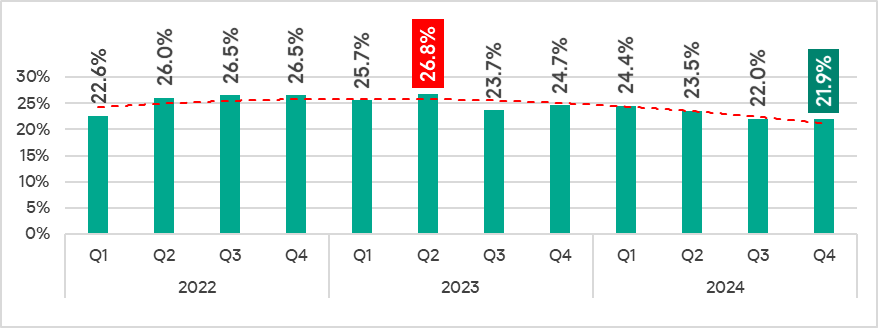
    In Q4 2024, the percentage of ICS computers on which malicious objects were blocked decreased by 0.1 pp from the previous quarter to 21.9%.

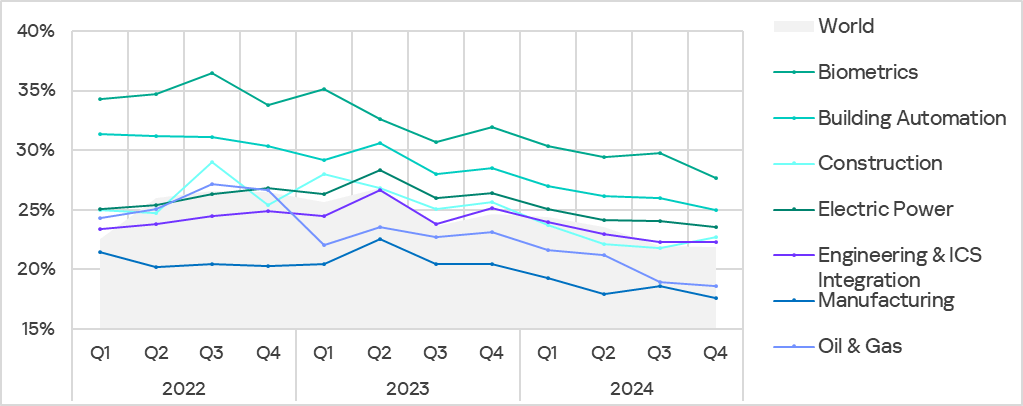
    Percentage of ICS computers on which malicious objects were blocked, by quarter, 2022–2024

    Compared to Q4 2023, the percentage decreased by 2.8 pp.

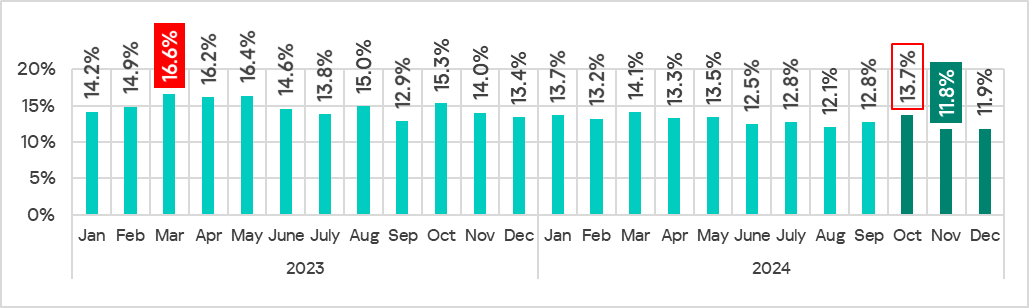
    The percentage of ICS computers on which malicious objects were blocked during Q4 2024 was highest in October and lowest in November. In fact, the percentage in November 2024 was the lowest of any month in two years.

    Percentage of ICS computers on which malicious objects were blocked, Jan 2023–Dec 2024

    Region rankings

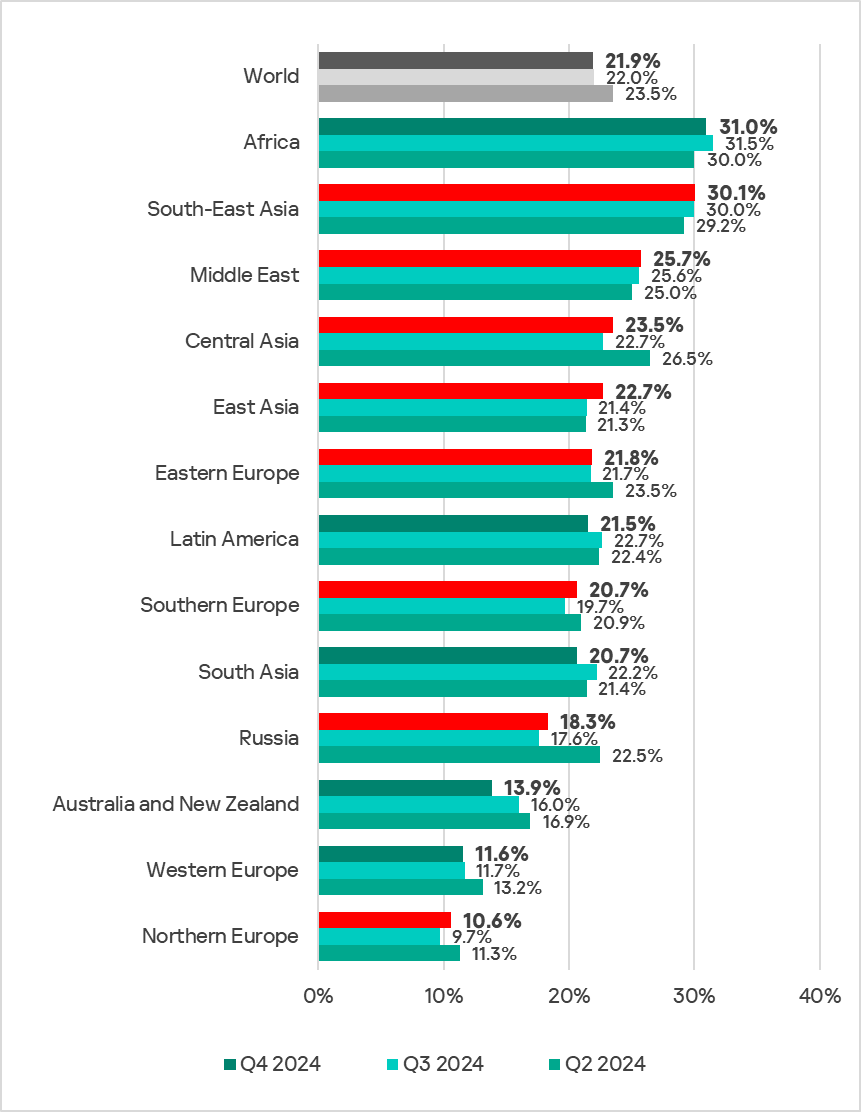
    Regionally, the percentage of ICS computers that blocked malicious objects during the quarter ranged from 10.6% in Northern Europe to 31% in Africa.

    Regions ranked by percentage of ICS computers where malicious objects were blocked, Q3 2024

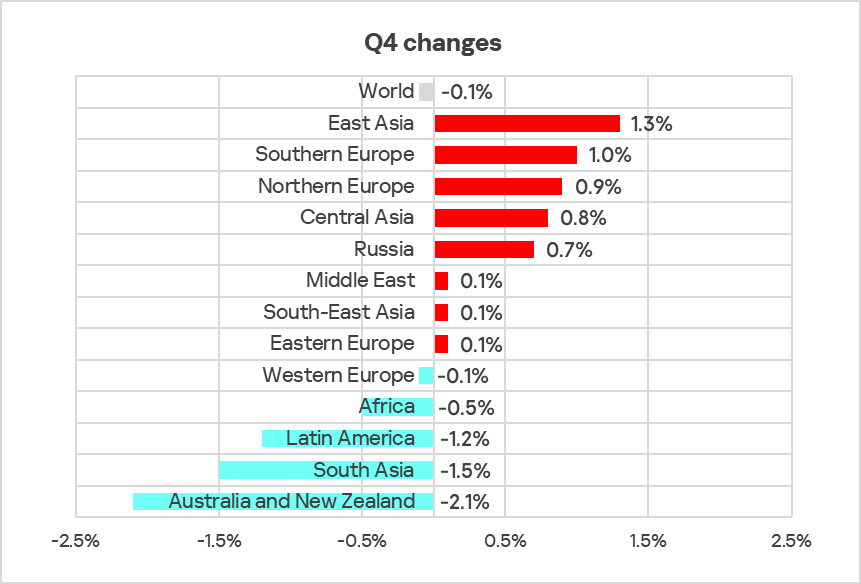
    Eight of 13 regions saw their percentages increase from the previous quarter.

    Regions and world. Changes in the percentage of attacked ICS computers in Q4 2024

    Selected industries

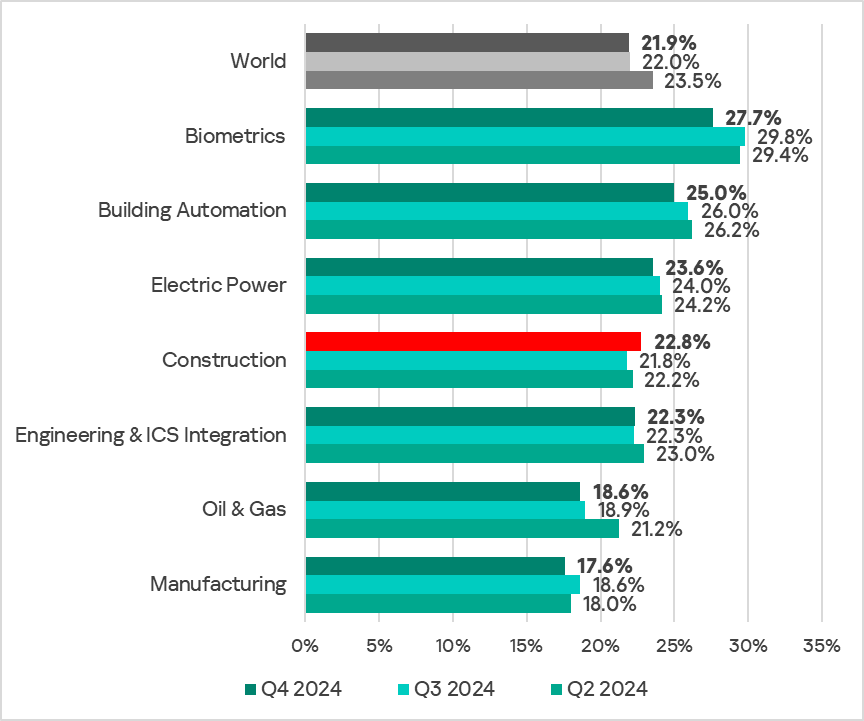
    The biometrics sector led the surveyed industries in terms of the percentage of ICS computers on which malicious objects were blocked.

    Percentage of ICS computers on which malicious objects were blocked in selected industries

    In Q4 2024, the percentage of ICS computers on which malicious objects were blocked decreased across most industries, with the exception of the construction sector.

    Changes in the percentage of ICS computers on which malicious objects were blocked in selected industries

    Diversity of detected malicious objects

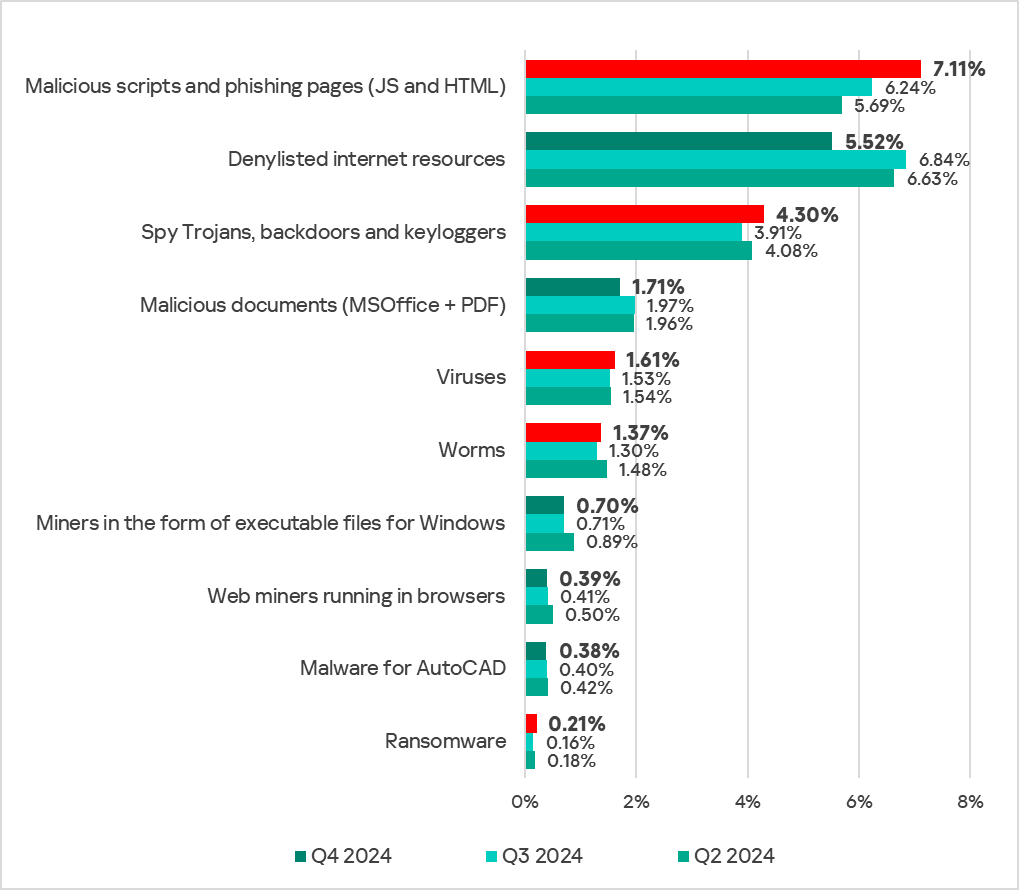
    In Q4 2024, Kaspersky’s protection solutions blocked malware from 11,065 different malware families of various categories on industrial automation systems.

    Percentage of ICS computers on which the activity of malicious objects from various categories was blocked

    Main threat sources

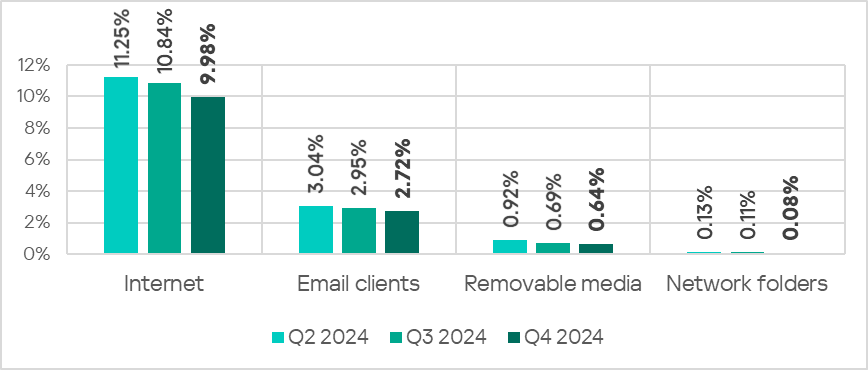
    The internet, email clients and removable storage devices remain the primary sources of threats to computers in an organization’s technology infrastructure. Note that the sources of blocked threats cannot be reliably identified in all cases.

    In Q4 2024, the percentage of ICS computers on which threats from various sources were blocked decreased for all threat sources described in this report. Moreover, all indicators recorded their lowest values for the observed period.

    Percentage of ICS computers on which malicious objects from various sources were blocked

    Threat categories

    Malicious objects used for initial infection

    Malicious objects used for initial infection of ICS computers include dangerous internet resources that are added to denylists, malicious scripts and phishing pages, and malicious documents.

    In the fourth quarter of 2024, the percentage of ICS computers on which malicious documents and denylisted internet resources were blocked decreased to 1.71% (by 0.26 pp) and 5.52% (by 1.32 pp), respectively and reached its lowest level since the beginning of 2022.

    As noted in the Q3 2024 report, the increase in blocked denylisted internet resources was primarily driven by an increase in the number of newly created domain names and IP addresses used by cybercriminals as command-and-control (C2) infrastructure for distributing malware and phishing attacks.

    The decline in the percentage of denylisted internet resources in November–December 2024 was likely influenced not only by proactive threat mitigation measures at various levels – from resource owners and hosting providers to ISPs and law enforcement agencies. Another contributing factor was the tendency of attackers to frequently change domains and IP addresses to evade detection in the initial stages, based on lists of known malicious resources.

    In practice, this means that until a malicious web resource is identified and added to a denylist, it may not immediately appear in threat statistics, leading to an apparent decrease in the percentage of ICS computers on which such resources were blocked.

    However, in Q4, we also saw a rise in the percentage of the next steps in the attack chain – malicious scripts and phishing pages (7.11%), spyware (4.30%), and ransomware (0.21%).

    A significant increase in the percentage of malicious scripts and phishing pages in October was driven by a series of widespread phishing attacks in late summer and early fall 2024, as mentioned in the Q3 2024 report. Threat actors used malicious scripts that executed in the browser, mimicking various windows with CAPTCHA-like interfaces, browser error messages and similar pop-ups to trigger the download of next-stage malware: either the Lumma stealer or the Amadey Trojan.

    Next-stage malware

    Malicious objects used to initially infect computers deliver next-stage malware – spyware, ransomware, and miners – to victims’ computers. As a rule, the higher the percentage of ICS computers on which the initial infection malware is blocked, the higher the percentage for next-stage malware.

    The percentage of ICS computers on which spyware (spy Trojans, backdoors and keyloggers) was blocked increased by 0.39 pp from the previous quarter to 4.30%.

    The percentage of ICS computers on which ransomware was blocked increased by a factor of 1.3 compared to the previous quarter, reaching 0.21%, its highest value in two years.

    The percentage of ICS computers on which miners in the form of executable files for Windows were blocked decreased by 0.01 pp to 0.70%.

    And, the percentage of ICS computers on which web miners were blocked decreased by 0.02 pp to 0.39%, reaching its lowest value in the observed period.

    Self-propagating malware

    Self-propagating malware (worms and viruses) is a category unto itself. Worms and virus-infected files were originally used for initial infection, but as botnet functionality evolved, they took on next-stage characteristics. To spread across ICS networks, viruses and worms rely on removable media, network folders, infected files including backups, and network attacks on outdated software.

    In Q4 2024, the percentage of ICS computers on which worms were blocked increased by 0.07 pp and reached 1,37%. The rate of viruses increased by 0.08 pp to 1.61%.

    AutoCAD malware

    AutoCAD malware is typically a low-level threat, coming last in the malware category rankings in terms of the percentage of ICS computers on which it was blocked.

    In Q4 2024, the percentage of ICS computers on which AutoCAD malware was blocked continued to decrease by losing 0.02 pp and reached 0.38%.

    You can find the full Q3 2024 report on the Kaspersky ICS CERT website.

    MIL OSI Global Banks

  • MIL-OSI China: China Development Bank boosts financial support for foreign trade

    Source: China State Council Information Office

    China Development Bank has rolled out a robust set of measures to provide strong financial support for businesses in the country’s foreign trade sector this year.

    The bank has been leveraging a wide array of financing instruments, including project loans, syndicated loans, working capital loans, corporate financing, on-lending and trade financing, to channel more credit resources into the foreign trade domain, CDB said in a news release on Friday.

    In particular, the bank has formulated specific measures to utilize on-lending loans and work closely with city commercial banks, to provide targeted financial support to small and medium-sized foreign trade firms.

    As of March 19, CDB has disbursed 14.25 billion yuan ($1.97 billion) in on-lending loans for foreign trade stabilization to provinces such as Jiangsu, Guangdong and Shandong, helping foreign trade enterprises reduce their financing costs and reinvigorate their development momentum, the bank said.

    Meanwhile, CDB has set up a dedicated 35-billion-yuan quota to provide direct lending support for the stabilization of foreign trade, according to the bank.

    MIL OSI China News

  • MIL-OSI Economics: Development Asia: The Basilica Cistern: A Timeless Water Marvel Beneath Istanbul

    Source: Asia Development Bank

    Transporting water through gravity

    Water from the Belgrade Forest reached the Basilica Cistern through a gravity-fed system. The aqueducts were precisely engineered with gravity slopes to maintain a continuous flow. These water conduits also incorporated bridges and siphons to go through valleys and uneven terrain, ensuring efficient water delivery over long distances.

    Beyond the Basilica Cistern, the water was distributed to public fountains, baths, and palaces using clay and lead pipes and underground channels, all operating by gravity. Some elevated cisterns created additional water pressure for better distribution, making the system both sustainable and efficient. This gravity system ensured a continuous flow of water from its source to the city.

    Harvesting rainwater

    Although the primary source of water for the Basilica Cistern came from the forest, it also collected rainwater. The large underground space allowed rainwater to seep through the ground and be stored, supplementing the aqueduct supply. The vaulted ceilings and brick arches helped channel water efficiently, and the waterproof mortar reduced the water loss. This method provided extra supply during water shortages.

    The Belgrade Forest remains an essential part of Istanbul’s water supply system. While modern reservoirs and dams have been built to meet the city’s growing water needs, parts of the forest continue to feed Istanbul’s water network. The forest also plays a crucial role in climate regulation, groundwater recharge, and flood prevention.

    Screening for clean water

    Ensuring clean water was a priority for the Byzantine engineers. The Basilica Cistern used a natural sedimentation process where impurities settled at the bottom. Additionally, grated inlets at the aqueduct entry points helped filter out debris. Over time, new technologies as sand and charcoal filtration techniques were employed in Byzantine and Ottoman water systems to further purify the water before distribution.

    Storing water without leakage

    The Basilica Cistern’s construction is a marvel of engineering. Spanning 9,800 square meters, it features 336 marble columns, each about 9 meters tall, arranged in 12 rows of 28 lines. These columns, many repurposed from earlier Roman structures, support the vaulted brick ceiling.

    A key challenge in any water reservoir is leak prevention. The Byzantine engineers solved this by

    • lining the walls with thick waterproof mortar (opus signinum), a blend of brick dust and lime;
    • using hydraulic cement to harden parts in contact with water; and
    • employing brick-built arches and vaults to evenly distribute the weight and prevent structural failures.

    Despite centuries of use and neglect, the cistern still retains water today—a testament to the effectiveness of its design.

    MIL OSI Economics

  • MIL-OSI: Temenos named Technology Provider of the Year in FStech Awards

    Source: GlobeNewswire (MIL-OSI)

    GRAND-LANCY, Switzerland, March 21, 2025 (GLOBE NEWSWIRE) — Temenos (SIX: TEMN) today announced it has been named Technology Provider of the Year at the FStech Awards 2025, recognizing its leadership in modernizing financial institutions with banking solutions powered by GenAI, cloud, and SaaS.

    Now in their 25th year, the FStech Awards celebrate companies that have demonstrated excellence and innovation within the UK and EMEA financial services sector. In the Technology Provider of the Year category, judges evaluated vendors based on their exceptional performance, product innovations, and customer success.

    Mark Yamin-Ali, Managing Director – Europe, Temenos, commented: “This FStech award underscores Temenos’ leadership in core banking modernization and our reputation as a trusted industry partner. With proven expertise and reliable innovation, including in game-changing technologies such as Generative AI, Temenos enables banks to evolve with confidence, fostering growth and elevating customer experiences.”

    Sairam Rangachari, Chief Product Officer, Temenos, said: “We’re delighted to receive this prestigious award, which recognizes the rich functionality of Temenos’ mission-critical technology. With our relentless focus on innovation, as well as our leading SaaS solutions and Responsible AI capabilities embedded throughout the Temenos platform, we are thrilled to be leading the way in the banking industry.”

    Banks of all sizes utilize Temenos’ adaptable technology – on-premises, in the cloud, or as a SaaS solution – to deliver next-generation services and AI-powered experiences. Its clients benefit from the power of deep functionality, the convenience of best-of-suite software and the synergy of modular solutions.

    Recent customer announcements include the UK’s Aldermore Bank, which selected Temenos SaaS to modernize its savings operations, beginning with the swift launch of new savings notice accounts for small businesses. Additionally, Romania’s CEC Bank selected Temenos to modernize its retail and corporate core banking systems.

    About Temenos
    Temenos (SIX: TEMN) is the world’s leading platform for banking, serving clients in 150 countries by helping them build new banking services and state-of-the-art customer experiences. Top performing banks using Temenos software achieve cost-income ratios almost half the industry average and returns on equity 2x the industry average. Their IT spend on growth and innovation is also 2x the industry average.

    For more information, please visit www.temenos.com.

    Media Contacts  
       
    Scott Rowe & Michael Anderson
    Temenos Global Public Relations
    Tel: +44 20 7423 3857
    Email: press@temenos.com
    Gabriel Goonetillake
    Temenos Team at Edelman Smithfield
    Tel: +44 7813 407710
    Temenos@EdelmanSmithfield.com

    The MIL Network

  • MIL-OSI Banking: Publication of financial reports: Federal Office of Justice imposes disciplinary fine on DEMIRE Deutsche Mittelstand Real Estate AG

    Source: Bundesanstalt für Finanzdienstleistungsaufsicht – In English

    The disciplinary fine order related to a breach of section 325 of the German Commercial Code (Handelsgesetzbuch – HGB). DEMIRE Deutsche Mittelstand Real Estate AG failed to submit its consolidated accounting documents for the financial year 2023 for the purpose of disclosure to the operator of the German Federal Gazette (Bundesanzeiger) in electronic form within the prescribed period. The legal basis for the sanction is section 335 of the HGB.

    The company did not lodge an appeal against the Federal Office of Justice’s decision to impose a disciplinary fine.

    MIL OSI Global Banks

  • MIL-OSI Banking: Publication of financial reports: Federal Office of Justice imposes disciplinary fine on IHS Nr. 2 GS GmbH

    Source: Bundesanstalt für Finanzdienstleistungsaufsicht – In English

    The disciplinary fine order related to a breach of section 325 of the German Commercial Code (Handelsgesetzbuch – HGB). IHS Nr. 2 GS GmbH failed to submit its accounting documents for the financial year 2022 for the purpose of disclosure to the operator of the German Federal Gazette (Bundesanzeiger) in electronic form within the prescribed period. The legal basis for the sanction is section 335 of the HGB.

    The company did not lodge an appeal against the Federal Office of Justice’s decision to impose a disciplinary fine.

    MIL OSI Global Banks

  • MIL-OSI: Notification on AB Šiaulių Bankas executive transactions

    Source: GlobeNewswire (MIL-OSI)

    AB Šiaulių Bankas, company code 112025254, address of the head office Tilžės str. 149, Šiauliai, Lithuania.

    AB Šiaulių Bankas has received a notification from its executive – a member of the Supervisory Board and long-time shareholder Gintaras Kateiva – regarding transactions for the acquisition of the Bank’s shares (attached).

    Through these transactions, Gintaras Kateiva acquired 318,510 bank shares and currently, together with his spouse, holds a total of 32,869,209 AB Šiaulių Bankas shares (4.96% of the total number of issued shares).

    Additional information: 
    Tomas Varenbergas 
    Head of Investment Management Division
    tomas.varenbergas@sb.lt

    Attachment

    The MIL Network

  • MIL-OSI China: Announcement on Open Market Operations No.55 [2025]

    Source: Peoples Bank of China

    Announcement on Open Market Operations No.55 [2025]

    (Open Market Operations Office, March 21, 2025)

    In order to keep the liquidity adequate in the banking system, the People’s Bank of China conducted reverse repo operations in the amount of RMB93 billion through quantity bidding at a fixed interest rate on March 21, 2025.

    Details of the Reverse Repo Operations

    Maturity

    Volume

    Rate

    7 days

    RMB93 billion

    1.50%

    Date of last update Nov. 29 2018

    2025年03月21日

    MIL OSI China News

  • MIL-OSI: WECANGROUP AND SEALCOIN INTEGRATE THEIR TECHNOLOGY TO SECURE DEVICE-TO-DEVICE TRANSACTIONS WITH STATE-OF-THE-ART KYO (KNOW YOUR OBJECT) SOLUTION BASED IN SWITZERLAND

    Source: GlobeNewswire (MIL-OSI)

    WECANGROUP AND SEALCOIN INTEGRATE THEIR TECHNOLOGY TO SECURE DEVICE-TO-DEVICE TRANSACTIONS WITH STATE-OF-THE-ART KYO (KNOW YOUR OBJECT) SOLUTION BASED IN SWITZERLAND

    Geneva, Switzerland – March 21, 2025 –WISeKey International Holding Ltd (“WISeKey”) (SIX: WIHN, NASDAQ: WKEY), a leading global cybersecurity, blockchain, and IoT company, today announces that its subsidiary SEALCOIN and WeCanGroup are joining forces to enable secure transactions and advanced identity verification within the WeCanGroup ecosystem. This partnership will bring together SEALCOIN’s blockchain-based IoT and digital asset ecosystem with WeCanGroup’s trusted compliance and data security framework, enhancing the way banking, government and defense sectors onboard and interact with connected devices.

    SEALCOIN is designed to securely authenticate and facilitate transactions between IoT devices, making them fully trusted and autonomous actors within a decentralized economy. By integrating SEALCOIN’s cybersecurity and blockchain capabilities into the WeCanGroup ecosystem, IoT devices will be able to perform secure, verifiable transactions while ensuring compliance with industry regulations.

    WeCanGroup, a leader in secure digital identity and compliance solutions, is dedicated to enhancing data security and trust across industries. Through this collaboration, WeCanGroup’s Know Your Client (KYC) and Know Your Business (KYB) solutions will be expanded with Know Your Object (KYO), a revolutionary approach to verifying and managing IoT devices in highly regulated environments.

    Unlocking New Use Cases in Regulated Sectors

    The integration of SEALCOIN and WeCanGroup’s digital identity solutions will foster advanced onboarding processes for IoT ecosystems, enabling high-trust, high-security transactions in:

    Banking & Finance – Enabling trusted digital asset transactions, compliance-driven IoT payments, and regulatory oversight for financial services.

    Government & Public Services – Secure authentication of connected devices used in critical infrastructure, identity management, and smart city applications.

    Defense & Aerospace – Ensuring tamper-proof identity verification and transactional integrity for defense IoT systems and secure communication networks.

    Strengthening Cybersecurity & Compliance for the IoT Economy

    “This partnership marks a significant step toward making IoT truly transactional, while ensuring compliance and data security,” said Carlos Moreira, Founder and CEO at WISeKey. “With SEALCOIN’s advanced PKI-based IoT security and WeCanGroup’s trusted compliance solutions, we are creating a new standard for identity and transaction verification in highly regulated environments.”

    “WeCanGroup has always been committed to enhancing data integrity and regulatory compliance, and this collaboration will allow us to extend our expertise beyond individuals and enterprises to include connected devices,” added Vincent Pignon, Founder and Chairman at WeCanGroup. “By combining KYC, KYB and KYO, we are enabling a future where IoT transactions are as secure, compliant, and trusted as any financial transaction today.”

    Next Steps

    The partnership will initially focus on pilot programs with key partners in finance, government and defense, before expanding to broader industrial and smart infrastructure use cases.

    About WeCanGroup

    Founded in 2015 in Switzerland, WeCanGroup is a leading provider of blockchain-based solutions for secure data management, serving individuals, enterprises, and financial institutions. The company is dedicated to improving data handling efficiency in response to the increasing volume of sensitive information being generated globally. By leveraging blockchain technology, WeCanGroup promotes the tokenization of data as a solution to common issues related to data completeness, redundancy, and security.

    One of WeCanGroup’s flagship platforms, Wecan Comply, is a leading platform for orchestrating KYC & KYB compliance data. From onboarding to periodic reviews and audits, the platform seamlessly connects financial institutions through a secure and standardized data exchange protocol.

    WeCanGroup has established itself as a market leader in Switzerland, recognized and adopted by major wealth management firms, banks, financial intermediaries, and large global enterprises. The platform enables the storage, request, sharing, and management of various types of data, such as KYB and KYC, leveraging the most advanced data exchange and storage infrastructure on the market.

    About SEALCOIN

    SEALCOIN, powered by WISeKey, is a secure digital transaction platform designed to enhance safety and compliance in blockchain-based payments and device-to-device transactions. With a strong focus on identity verification and cryptographic security, SEALCOIN is shaping the future of trusted digital ecosystems.

    For more information, please visit www.sealcoin.ai and www.wecangroup.ch.

    About WISeKey

    WISeKey International Holding Ltd (“WISeKey”, SIX: WIHN; Nasdaq: WKEY) is a global leader in cybersecurity, digital identity, and IoT solutions platform. It operates as a Swiss-based holding company through several operational subsidiaries, each dedicated to specific aspects of its technology portfolio. The subsidiaries include (i) SEALSQ Corp (Nasdaq: LAES), which focuses on semiconductors, PKI, and post-quantum technology products, (ii) WISeKey SA which specializes in RoT and PKI solutions for secure authentication and identification in IoT, Blockchain, and AI, (iii) WISeSat AG which focuses on space technology for secure satellite communication, specifically for IoT applications, (iv) WISe.ART Corp which focuses on trusted blockchain NFTs and operates the WISe.ART marketplace for secure NFT transactions, and (v) SEALCOIN AG which focuses on decentralized physical internet with DePIN technology and house the development of the SEALCOIN platform.

    Each subsidiary contributes to WISeKey’s mission of securing the internet while focusing on their respective areas of research and expertise. Their technologies seamlessly integrate into the comprehensive WISeKey platform. WISeKey secures digital identity ecosystems for individuals and objects using Blockchain, AI, and IoT technologies. With over 1.6 billion microchips deployed across various IoT sectors, WISeKey plays a vital role in securing the Internet of Everything. The company’s semiconductors generate valuable Big Data that, when analyzed with AI, enable predictive equipment failure prevention. Trusted by the OISTE/WISeKey cryptographic Root of Trust, WISeKey provides secure authentication and identification for IoT, Blockchain, and AI applications. The WISeKey Root of Trust ensures the integrity of online transactions between objects and people. For more information on WISeKey’s strategic direction and its subsidiary companies, please visit www.wisekey.com.

    Disclaimer
    This communication expressly or implicitly contains certain forward-looking statements concerning WISeKey International Holding Ltd and its business. Such statements involve certain known and unknown risks, uncertainties and other factors, which could cause the actual results, financial condition, performance or achievements of WISeKey International Holding Ltd to be materially different from any future results, performance or achievements expressed or implied by such forward-looking statements. WISeKey International Holding Ltd is providing this communication as of this date and does not undertake to update any forward-looking statements contained herein as a result of new information, future events or otherwise.

    This press release does not constitute an offer to sell, or a solicitation of an offer to buy, any securities, and it does not constitute an offering prospectus within the meaning of the Swiss Financial Services Act (“FinSA”), the FinSa’s predecessor legislation or advertising within the meaning of the FinSA. Investors must rely on their own evaluation of WISeKey and its securities, including the merits and risks involved. Nothing contained herein is, or shall be relied on as, a promise or representation as to the future performance of WISeKey.

    Press and Investor Contacts

    WISeKey International Holding Ltd
    Company Contact: Carlos Moreira
    Chairman & CEO
    Tel: +41 22 594 3000
    info@wisekey.com 
    WISeKey Investor Relations (US) 
    The Equity Group Inc.
    Lena Cati
    Tel: +1 212 836-9611
    lcati@equityny.com

    The MIL Network

  • MIL-OSI New Zealand: Awards – Workplace wellbeing champions from across Aotearoa are celebrated at the 2025 Southern Cross Health Insurance Wayfinder Awards

    Source: Southern Cross Health Insurance Wayfinder Awards


    The winners of the 2025 Southern Cross Health Insurance Wayfinder Awards were announced Thursday, March 20, at a ceremony in Tāmaki Makaurau/Auckland.


    Taking home gold across the six categories in recognition of achievements by individuals and organisations, were Waikato-Tainui, ASB, ORIX New Zealand, Netsafe, Jen Southan (ORIX NZ) and Dominic Quin (Foodstuffs). 


    The Southern Cross Health Insurance Wayfinder Awards encourage businesses to innovate in workplace wellbeing, driving employee engagement and business success, and to celebrate those who have made wellbeing central to their strategy and part of their organisation’s culture.


    Nick Astwick, CEO Southern Cross Health Insurance says, “Our 2024 Healthy Futures report confirmed that 89% of people agree they, and the businesses they work for, would flourish if employers made workplace health and wellbeing a priority. The Wayfinder Awards acknowledge those organisations which have made the concerted decision to put their people’s wellbeing front and centre and are therefore reaping the benefits of their innovation and commitment.


    “To hear their stories and see the increased productivity, reduced turnover and high levels of engagement, particularly against a tough operating environment, was truly inspiring for me and the panel of expert judges who helped determine our winners for 2025.”


    Three of the awards – Small Business, Medium Business and Large Business – celebrate companies which have woven workplace wellbeing into their core strategy.


    Netsafe won gold in the Small Business Award category. Dr Ellen Joan Ford said, “One of the things that really stood out was where businesses offered flexibility as part of their wellbeing initiatives. I am a firm believer in flexibility and think this is the way of the future – we should be focusing on outputs not hours. (Netsafe) has Super impressive employee engagement scores and I love their ‘Flexible First’ work policy.


    The gold Medium Business Award went to ORIX NZ, with judge Rob Holmes from PaperKite saying, “ORIX balances fiscal priorities with holistic wellbeing, and has created a workplace where employees feel valued and can thrive.”


    ASB was awarded gold for the Large Business Award, with Dr Quinlan noting, “ASB is leading the way for other large organisations in New Zealand, setting new standards for employee care and benefits. Aligning benefits with their people promise, they have listened and designed the benefits that meet their people’s needs. It’s a carefully considered approach that employees are already appreciating.


    Waikato-Tainui is the recipient of the gold New Horizon award which focuses on innovation in workplace wellbeing. The iwi is committed to addressing the unique health challenges faced by kaumaatua, who are disproportionately affected by health issues and struggle to access healthcare.


    Judge Melanie Beirne (Ngāi Tahu) said, “This initiative (from Waikato-Tainui) taps into the powerful influence and potential of iwi, creating a direct pathway to connect with hard-to-reach, under-served communities. By removing cost barriers, it opens up access to health, well-being, and financial stability. Its innovative approach is not just transforming lives of kaumaatua — it’s setting a new way of working and standard that has the potential to inspire other iwi to follow suit. If adopted, the ripple effect of this change has the potential to uplift communities across Aotearoa.”


    The first of the individual awards was won by Jen Southan of ORIX NZ. The Star Wayfarer Award recognises someone who has made a tangible difference and impact to wellbeing within the workplace. Rob Holmes said, “Jen’s relentless passion for wellbeing has inspired transformative change at ORIX, creating an inclusive culture where employees feel supported and valued.”


    The True North Award acknowledges a people-leader who has made an outstanding contribution to the wellbeing of their team. Recipient Dominic (Dom) Quin of Foodstuffs was acknowledged as exceptional by his team and the judges, in fact Dr Denise Quinlan said, “can we clone this leader?”.


    Nick Astwick concurred, saying “Dom deeply believes “anyone can be a leader” and he coaches and inspires his team to engage in courageous conversations. He shifted the team from an outcomes-led business to a human led business with stunning results. A truly high performing leader.”


    Reflecting on the Southern Cross Health Insurance Wayfinder Awards, Astwick was struck by one key theme which stood out for most successful entries.


    “The health and wellbeing needs of people change with age, stage, and personal situations. One of the innovations this year was a focus on personalising health and wellbeing programmes to ensure they are relevant for all.


    “Our purpose at Southern Cross Health Insurance is to empower our members to live well for longer. More than half of our members are with us through group schemes offered by organisations which understand that good health is good for business. It is so heartening, even as many businesses, even ours, have faced so many economic headwinds that leading New Zealand companies of all shapes and sizes are investing in their people’s wellbeing and taking people’s circumstances into account,” said Astwick.


    He added, “We’d like to acknowledge all the entries we received from across New Zealand and whakamihi/congratulate our gold, silver, and bronze winners. You are leading the way for business in Aotearoa.” 


    The strong line-up of health industry and business leaders who joined Nick Astwick, on the Wayfinder Awards judging panel, included:


    • Dr Denise Quinlan, MAPP, PhD – Director of the NZ Institute of Wellbeing & Resilience 
    • Dr Ellen Joan Ford, MBA, PhD – Award winning Leader, Military Veteran,
      International Speaker and Facilitator
    • Melanie Beirne (Ngāi Tahu) – Gallup certified coach, Entrepreneur, Leader, Facilitator, and Māmā of two
    • Rob Holmes, Discovery Director, PaperKite and an inaugural winner of the 2023 Wayfinder True North Award


    The 2025 Southern Cross Health Insurance Wayfinder Awards winners are:


    Star Wayfarer Award

    Gold – Jen Southan, ORIX NZ

    Silver – Tracey Chaplin, Ceres New Zealand LLC

    Bronze – Corrina McIndoe, Spectrum Consulting Limited and Caley Staveley, Outerdawn


    True North Award*

    Gold – Dominic Quin, Foodstuffs NZ

    Silver – Lorraine Bryant, Spectrum Consulting Ltd


    Small Business Award

    Gold – Netsafe NZ

    Silver – Ceres New Zealand LLC

    Bronze – Content & Co NZ Ltd


    Medium Business Award

    Gold – ORIX NZ

    Silver – SBS Bank

    Bronze – StraitNZ


    Large Business Award

    Gold – ASB

    Silver – Foodstuffs North Island / NZ

    Bronze – Douglas


    New Horizon Award

    Gold – Waikato-Tainui

    Silver – Te Wānanga o Aotearoa – Tau Ora

    Bronze – Eliot Sinclair


    For more information on the 2025 Southern Cross Health Insurance Wayfinder Awardshttps://www.southerncross.co.nz/society/business/wayfinder-awards


    For a copy of the Healthy Futures Reporthttps://www.southerncross.co.nz/society/business/healthy-futures


    *Bronze was not awarded for this category in 2025


    About Southern Cross Health Insurance

    Southern Cross Health Insurance has been supporting New Zealanders on their health journeys since 1961. Today, we provide cover for nearly one in five New Zealanders every year.

    As a Friendly Society, Southern Cross Health Insurance operates solely for the benefit of members, rather than shareholders or overseas owners.


    We pay more claims than any other New Zealand health insurer and are proud of our industry-leading rate of return[1]. In FY24 we returned $1.498 billion in claims from $1.605 billion received in premiums, representing more than 93 per cent of premiums returned to members by way of claims.

    MIL OSI New Zealand News

  • MIL-OSI Submissions: Energy and Business – Equinor presents 2024 Annual report

    Source: Equinor

    20 MARCH 2025 – “2024 was marked by continued unpredictability in energy markets, with growing energy demand, political uncertainty and uneven progress in the energy transition. Our focus is on producing the energy the world needs today, and at the same time developing the energy systems needed for the future,” says Anders Opedal, President and CEO of Equinor ASA.

    Safety

    “A systematic approach to safety over time is paying off with the best safety results to date in 2024. However, the year was marked by the fatal search and rescue (SAR) helicopter accident where we lost a dear colleague. We believe close collaboration with suppliers and shared learning in the industry is important for our continued safety improvement effort”, says Opedal.

    The twelve-month average Serious Incident Frequency (SIF) for 2024 was 0.3, down from 0.4 in 2023.

    Strong operational and financial performance

    Equinor delivered adjusted operating income* of USD 29.8 billion, and adjusted net income* of USD 9.18. Net operating income was reported at USD 30.9 billion and net income at USD 8.83 billion.

    “Our operational performance was strong, built on the dedicated efforts from employees across the company. Our role as a major supplier of energy to Europe is important and I am proud of the work we have done to provide energy security”, says Opedal.

    Strong operational performance across the portfolio contributed to an equity production of liquids and gas of 2,067 mboe per day in 2024, on par with the year before. Equity production of renewable power increased by 51% to 2,935 GWh.

    Strong financial result contributed to a return on average capital employed (RoACE)* at 21% for 2024. Capital discipline remained firm with organic capital expenditures* ending at USD 12.1 billion for the year. Equinor maintained a strong balance sheet with net debt to capital employed adjusted* of 11.9% at the end of 2024.

    The strong financial results of 2024 also led to strong contributions to society through taxes. In 2024, Equinor paid USD 20.6 billion in corporate income taxes of which USD 19.7 billion was paid in Norway, where Equinor has the largest share of its operations and earnings.

    Firm strategy and progressing industrial development

    “We have a consistent growth strategy, and our strategic direction remains firm. By adapting to market situation and opportunities, we are positioned for stronger free cash flow and growth, and set to create shareholder value for decades to come”, Opedal continues.

    Through progressing projects and portfolio shaping transactions Equinor spent 2024 high-grading the portfolio and positioning for stronger growth and cash flow.

    On the Norwegian continental shelf, the development of the portfolio continued with 39 new licences and approvals of the PDOs of Eirin, Irpa, Verdande and Andvare projects. The Johan Castberg FPSO arrived at the field and started preparations for startup.

    The international upstream portfolio was focused with the exits from our long-standing positions in Nigeria and Azerbaijan and deepened in core areas with the acquisitions of US Onshore gas assets close to premium markets. In the UK an agreement was signed to establish an incorporated joint venture with Shell UK Ltd., which will become the largest independent oil and gas company on the UK continental shelf.

    Through 2024 Equinor high-graded the renewables portfolio to ensure profitable growth, in a market challenged by cost inflation and regulatory delays. In the UK the world’s largest offshore wind farm, Dogger Bank, continued to progress towards commercial start-up. Production was commenced at the Mendubim solar plants in Brazil.

    The long-term view on the importance of offshore wind remains firm. Through an acquisition of a 10% stake in Ørsted, Equinor got exposure to a premium portfolio of offshore wind projects and assets in operation.

    Value chains for carbon transport and storage progressed notably. In Norway, Northern Lights, the first commercial CO2 transport and storage infrastructure was completed and is expected to receive and store CO2 in 2025. In the UK, execution started for two of UK’s first carbon capture and storage infrastructure projects where Equinor is a partner.

    Progress on the Energy transition plan

    In 2024, Equinor achieved a year-on-year reduction of 5% in operated scope 1+2 greenhouse gas emissions, bringing the total down to 11.0 million tonnes CO2 equivalents. This is a 34% reduction from 2015, which is the reference year for Equinor’s ambition to reduce group-wide operated emissions by 50% on a net basis by 2030. Throughout 2024, actions were taken for further emission reductions with the partial electrification of the Sleipner field center, the Gudrun platform, as well as the Troll B and C fields.

    The average upstream CO2 intensity of Equinor’s operated portfolio was 6.2 kg of CO2 per boe in 2024 (100% basis), an improvement from 6.7kg of CO2/boe in 2023 and well below the industry average. The scope 3 GHG emissions from use of our products were 251 million tonnes in 2024, on par with the level in 2023.

    Equinor improved in the net carbon intensity of energy produced (including scope 1, 2 and 3 emissions) in 2024, which is now 2% below the 2019 baseline. The reduction was mainly driven by increased renewable energy production and lower scope 1+2 emissions.

    Equinor ambition is to to be a leading company in the energy transition. The updated Energy Transition Plan, published on March 20 2025, outlines the approach to deliver on Equinor’s strategy of creating value in the transition, while adjusting to changing external context and market realities.

    ***

    The previously announced decision of the French Energy Regulatory Commission (CRE), includes a requirement for Equinor to publish the following summary language:

    “Les sociétés Danske Commodities A/S et Equinor ASA ont été condamnées, par une décision n° 08-40-23 de la Commission de régulation de l’énergie (CRE) du 20 janvier 2025, au titre de la méconnaissance de l’article 5 du règlement REMIT qui prohibe les manipulations de marché, au paiement de sanctions pécuniaires, dont les montants s’élèvent à huit millions d’euros (8.000.000 €) pour la société Danske Commodities A/S et quatre millions d’euros (4.000.000 €) pour la société Equinor ASA, pour des manipulations commises sur le marché de gros en 2019 et en 2020, en ce qui concerne les capacités de transport de gaz naturel entre la France et l’Espagne.

    Danske Commodities A/S and Equinor ASA were ordered by decision no. 08-40-23 of Commission de régulation de l’énergie (CRE) of 20 January 2025 to pay – for infringement of Article 5 of REMIT Regulation prohibiting market manipulations – financial penalties in the amount of eight million euros (€8,000,000) as regards Danske Commodities A/S and four million euros (€4,000,000) as regards Equinor ASA, for manipulations committed on the wholesale market in 2019 and 2020, with regard to natural gas transmission capacity between France and Spain.”

    The full decision is included in the attached appendix “Full decision text”. Equinor does not agree with the decision from CRE and will appeal the case to the Higher Administrative Court in France.

    Our annual report and the subsidiary reports published separately can be downloaded from equinor.com/reports.

    In accordance with Section 203.01 of the New York Stock Exchange Listed Company Manual, Equinor ASA announces that on 20 March 2025 it filed with the Securities and Exchange Commission its 2024 Annual Report on Form 20-F that includes audited financial statements for the year ended December 31, 2024.

    The Equinor 2024 Annual Report on Form 20-F may be downloaded from Equinor’s website at www.equinor.com. References to this document or other documents on Equinor’s website are included as an aid to their location and are not incorporated by reference into this document. All SEC filings made available electronically by Equinor may be obtained from the SEC’s website at www.sec.gov.

    Shareholders may also request a hard copy of the annual report free of charge at www.equinor.com.

    (*) These are non-GAAP figures. See Use and reconciliation of non-GAAP financial measures in the annual report for more details.

    MIL OSI – Submitted News

  • MIL-OSI New Zealand: Release: Govt’s continued lack of action on Gaza condemned

    Source: New Zealand Labour Party

    Hundreds more Palestinians have died in recent days as Israel’s assault on Gaza continues and humanitarian aid, including food and medicine, is blocked.

    “How many more people, how many more children must die before the New Zealand Government acts rather than talks?” Labour foreign affairs spokesperson David Parker said.

    “Beyond words, Christopher Luxon’s Government has taken no action. It is just about a year since the Minister of Foreign Affairs said it was a question of ‘when, not if’ New Zealand would recognise Palestine. Neither that nor any other substantial response has ensued.

    “Labour has been calling for stronger action from the Government on Israel’s invasion of Gaza, including intervening in South Africa’s case against Israel in the International Court of Justice, and the creation of a special visa for family members of New Zealanders fleeing Gaza. We have also called for an end to all government procurement from companies operating in the Occupied Territories, and for sanctioning individuals acting in breach of international law.

    “New Zealand has long supported the UN view that Israel’s occupation of the West Bank and East Jerusalem is illegal. Back in 2016 the then-National Government co-sponsored a successful Security Council resolution that Israel’s settlements in the Occupied Territories were illegal. This makes the inaction by the current National Government even harder to understand.

    “The inconsistent application of international law undermines compliance with it. It is time this National-led Government to some positive action beyond mere words to stand up for what is right,” David Parker said.


    Stay in the loop by signing up to our mailing list and following us on FacebookInstagram, and X.

    MIL OSI New Zealand News

  • MIL-OSI New Zealand: ACT welcomes investigation of banking cabal

    Source: ACT Party

    Welcoming news that the Commerce Commission is launching an investigation into the influence of the Net-Zero Banking Alliance on New Zealand’s banking sector, ACT Rural Communities spokesperson Mark Cameron says:

    “The banking alliance is a woke cabal. It co-ordinates banks into aligning lending practices with net-zero emissions goals, and this affects local lending practices, especially in the rural sector.

    “I’ve been banging on about this for a while now through the rural banking inquiry, and it’s a concern regularly raised with me by farmers. Kiwi farmers are some of the most emissions-efficient in the world, and it makes no environmental sense for banks to kneecap them and send food production offshore.

    “Of course it’s tempting to just whack the international cabal, but we need to keep our own house in order too. Red tape here at home is also pushing banks to impose higher costs on rural borrowers. That includes the Financial Markets Authority’s climate reporting rules, and the Reserve Bank’s banking capital requirements.

    “ACT will keep kicking the tyres until cockies have affordable access to the financial services they need.”

    MIL OSI New Zealand News

  • MIL-OSI Banking: Samsung Electronics’ Water Conservation Efforts for World Water Day

    Source: Samsung

    March 22 marks World Water Day, designated by the United Nations (UN) to underscore the vital importance of water and promote global collaboration in addressing water-related challenges. In observance of this day, Samsung Electronics carried out a variety of water conservation initiatives across 26 domestic and international worksites, engaging approximately 36,200 participants, including employees, local governments, NGOs and members of the community. Beyond these activities, Samsung Electronics remains dedicated to responsible water stewardship by enhancing its initiatives focused on water reuse and replenishment, strengthening worksite management systems, and deepening partnerships with key stakeholders.
     
     
    Global Participation by Samsung Electronics Employees in Water Conservation Efforts
    Each year, Samsung Electronics collaborates with employees and local communities on a variety of initiatives, including stream clean-ups near its facilities and water-saving campaigns across its operations. This year, the company aligned these activities with its environmental strategies, including water replenishment projects. These efforts included upgrading reservoirs and pumping facilities in drought-affected regions near its worksites, as well as supporting clean drinking water initiatives for neighboring villages.
     
    ▲ Employees at Samsung Electronics Vietnam participated in a cleanup at Cau River
     
    To raise awareness about the importance of clean water, Samsung Electronics employees around the world participated in a variety of initiatives. Here are some highlights of their efforts, captured in photos.
     
     
    ① River Cleanup Activities With Employees, Local Governments, NGOs and Community Members
    * Regions of participation: Korea, Vietnam, U.S, Mexico, Brazil, Hungary, Indonesia, South Africa
    ▲ Employees at Samsung Electronics Home Appliances America took part in cleanup activities along nearby rivers and streams.
     
    ▲ At the Cheonan and Onyang worksites in Korea, employees visited streams such as Jangjaecheon, Cheonancheon and Gokgyocheon as part of the One Company, One Stream initiative, contributing to local ecological preservation efforts. In addition, the Hwaseong worksite in Korea is planning stream cleanup activities along Woncheonricheon stream in collaboration with local civic groups and residents, in celebration of World Water Day.
     
     
    ② Returning Clean Water – Water Replenishment Projects
    * Regions of participation: Samsung Electronics is currently implementing water replenishment projects in Korea, Vietnam, India, Mexico, the United States and Indonesia. The company also plans to launch water replenishment projects in Malaysia, Brazil, China, Thailand, Hungary, Türkiye, Slovakia, Poland and Egypt, starting this year.
    ▲ Samsung Electronics Malaysia held an opening ceremony to launch its water replenishment project.
     
     
    ③ ‘Join Us in Saving Water!’ – Water Conservation Campaign
    * Regions of participation: Korea, Vietnam, Mexico, Thailand
    ▲ Samsung Electronics Thailand aired a water-saving campaign video in the company cafeteria.
     
     
    ④ Protecting Aquatic Ecosystems Near Worksites
    * Regions of participation: Korea and Vietnam
    ▲ As part of efforts to protect aquatic ecosystems, employees at Samsung Electronics Vietnam monitored water quality in nearby streams and carried out environmental awareness surveys in collaboration with local government offices, residents and NGOs.
     
     
    Partnering With Stakeholders To Drive Water Conservation and Reduce Usage
    Samsung Electronics recognizes water as a vital resource for a sustainable future and is committed to reducing water intake and promoting water reuse across its operations.
     
    The DX Division has set a goal of achieving 100% water replenishment by 2030, returning to local communities an amount of water equivalent to what is used in its production processes, thereby helping to prevent the depletion of water resources. To achieve this, Samsung is actively implementing water replenishment projects across multiple regions worldwide.
     
    In 2023, Samsung Electronics partnered with the Korea Rural Community Corporation (KRC) to support the construction of water redistribution facilities, enabling the reuse of agricultural water by channeling it from downstream to upstream areas in farmland regions. In collaboration with the Korea Ecological & Environmental Institute (KEEI), Samsung also carried out reservoir dredging in the Haman region in Korea to expand aquatic ecosystems and secure agricultural water supplies, contributing to water reuse and mitigating the risks of drought and water scarcity.
    * Regions where agricultural water reuse facilities have been established (Five locations in Korea): Wando, Shinan, Pyeongtaek, Andong, Changnyeong
     
    ▲ Samsung Electronics, in collaboration with the KRC Andong held a completion ceremony in July 2024 to mark the construction of an agricultural water redistribution facility in Andong, Korea. In April 2024, Samsung Electronics Vietnam signed an agreement with the local People’s Committee to support water replenishment projects.
     
    Building on these efforts, Samsung implemented 23 water replenishment projects across six countries in 2024, returning a total of 1.35 million tonnes of water annually to local communities and achieving 100% water replenishment by Korean facilities’ water usage standards. The company is committed to expanding this achievement globally by 2030, helping to mitigate local water risks and advance water resource conservation across all its international operations.
     
    Meanwhile, the DS Division is promoting various initiatives to protect water resources through partnerships with public, private and governmental organizations.
     
    In March 2024, Samsung signed a public-private-governmental memorandum of understanding (MOU) with the Ministry of Environment, K-water and other stakeholders to advance water-related initiatives. This collaboration was further strengthened in November 2024 through an additional MOU for the Jangheung Dam Artificial Wetland Creation Project, jointly developed with the Ministry of Environment and K-water. This marks the first project in Korea jointly led by public, private and governmental partners. The project aims to enhance riparian ecological belts and artificial wetlands through forest restoration, planting and waterway rehabilitation. In addition, it will create cultural and recreational spaces, including an ecological art museum and walking trails, contributing to the well-being of local communities.
     
    The DS Division has also set a target to keep water intake to 2021 levels by 2030. To that end, Samsung signed another MOU in December 2024 with the Ministry of Environment, Gyeonggi Province, the cities of Hwaseong and Osan, K-water and the Korea Environment Corporation for the Gyeonggido Region Semiconductor Site Reclaimed Water Project (Phase 1). This project will recycle treated wastewater from Hwaseong and Osan to supply 120,000 tonnes of reclaimed water per day to Samsung’s Giheung and Hwaseong semiconductor facilities. The project will proceed with feasibility studies for private investment, basic and detailed phases, and then installation and operation of reuse facilities, with water supply to the DS Division’s Giheung and Hwaseong worksites scheduled to begin in 2029.
     
     
    Expanding Platinum Certifications From the Alliance for Water Stewardship (AWS)
    In March 2023, Samsung Electronics’ Hwaseong worksite became the first facility in Korea to achieve the Platinum certification, the highest level from the Alliance for Water Stewardship (AWS).* Since then, Samsung has continued to expand the number of AWS-certified worksites across its global operations. AWS is a global water stewardship initiative jointly established by international organizations to assess companies’ comprehensive water management systems.
    * The Alliance for Water Stewardship (AWS) is a global water management initiative jointly established by organizations such as the UN Global Compact (UNGC) and Carbon Disclosure Project (CDP). AWS evaluates a company’s water stewardship performance across 100 criteria, including ▲ sustainable water management, ▲ pollution control, ▲ water sanitation, ▲impact on aquatic ecosystems within the watershed, and ▲ governance. Based on these assessments, certifications are awarded at three levels, including ‘Platinum,’ ‘Gold,’ and ‘Core.’
     
    The DS Division has achieved Platinum certification for its Giheung/Hwaseong and Pyeongtaek worksites in Korea, followed by its Xi’an worksite in China and most recently its Cheonan/Onyang worksites in Korea in November 2024. The DX Division has also expanded its certifications, securing Platinum certifications for its Suwon, Gumi and Gwangju worksites in 2023, as well as for its Vietnam worksites in 2024. Samsung Electronics also plans to extend AWS certifications to its India operations by 2025.
     
    Water is a vital resource, and ensuring the availability of clean and safe water for future generations is a critical responsibility. Samsung Electronics is fully committed to this mission and will continue to promote water stewardship and the importance of sustainable water management among its employees. The company will also actively collaborate with stakeholders to advance water-related initiatives and take a leading role in the conservation of global water resources.

    MIL OSI Global Banks

  • MIL-OSI Banking: Survey: Global Consumers Prioritize Personalization and Security in AI Home Appliances

    Source: Samsung

    What do people expect from their home appliances?
     
    According to an online survey by Samsung Electronics, consumers worldwide seek personalized AI-powered home solutions that streamline household chores with minimal time and effort.
     
    From May 23 to 28, 2024, Samsung conducted an independent online survey with 1,880 participants aged 20 to 59 across South Korea, the United Kingdom and the United States. The multiple-response survey targeted primary home appliance users and key purchasing decision-makers, gathering insights into perceptions of AI and the outlook for AI home appliances.
     
    When asked about the expected role of AI in the home, respondents frequently mentioned “help / helpful / assist” (379 responses), “cleaning” (259), “cooking” (181), “automatic” (178) and “easy / easier” (144).
     
    Expectations for AI within Households

     
    Moreover, some respondents highlighted security and safety as key expectations — anticipating that AI home appliances will not only reduce household burdens based on individual needs but also manage home safety.
     
    Samsung Newsroom examines how the company continues to refine its AI Home experience by leveraging AI and connectivity to help consumers effortlessly manage daily tasks while ensuring robust security.
     
     
    An Intuitive and Connected AI Home Experience
    The survey revealed a strong demand for simple, intuitive controls in home appliances.
     
    When asked about AI interaction preferences, respondents most frequently mentioned “voice / tell / talk” (203 responses) — followed by “help / helpful / assist” (175), “convenient / comfort” (155) and “control” (128).
     
    Expectations for AI Interactions in Home Appliances

     
    Samsung’s AI home appliances maximize ease of use through the advanced AI-powered Bixby voice assistant and seamless device connectivity via built-in screens. With Bixby’s ability to analyze context, understand intent and remember conversations, users can easily control their appliances.
     
    This year, Bixby has been integrated into the Bespoke AI Dishwasher1 for the first time. Additionally, the 2025 Bespoke AI Hybrid Refrigerator with AI Family Hub+ and the latest washers and dryers will feature voice recognition to provide personalized information tailored to each family member.2
     
    These innovative screen-equipped appliances offer effortless control and seamless access to information.
     
    ▲ Samsung Electronics is bringing AI to life through its ‘Screens Everywhere’ vision.
     
    The Bespoke AI Hybrid Refrigerator with Kitchen Fit,3 featuring a 9-inch AI Home screen, displays a Daily Board that summarizes personalized information such as weather forecasts, daily schedules and meal recommendations.
     
    Meanwhile, the 7-inch AI Home screen on the 2025 Bespoke AI Laundry Combo4 serves as a built-in hub — allowing users to manage SmartThings-connected home appliances and IoT devices without a separate hub.5


    AI Home Appliances Must Do More With Less
    Many respondents expressed strong interest in conserving resources. When asked about the most relevant AI-driven experiences, “minimizing resource usage” ranked highly among respondents in the U.S. (67%), U.K. (59%) and South Korea (49%).6
     
    Samsung’s latest AI home appliances enhance performance and energy efficiency by combining advanced hardware, AI and SmartThings.
     
    The new Bespoke AI Laundry Combo reduces drying time by approximately 20 minutes compared to its predecessor, completing a wash and dry cycle in just 79 minutes7 using Super Speed cycle. Meanwhile, the Bespoke AI Hybrid Refrigerator optimizes cooling efficiency and energy savings by using a compressor and Peltier module8 to deliver rapid cooling while maximizing energy efficiency.


    Enhancing Home Security and Safety With AI
    Respondents expect AI-driven security features to protect their homes and ensure their families’ safety. “Security / safe” was frequently mentioned as a key factor in interactions with AI home appliances.
     
    To address these concerns, Samsung equips all its smart appliances with the proprietary Samsung Knox9 security solution to safeguard user data from external threats such as malware.
     
    ▲ Jong-Hee (JH) Han, Vice Chairman, CEO and Head of Device eXperience (DX) Division at Samsung Electronics, describes Samsung Knox.
     
    This year, the company is expanding Knox Matrix10 — its blockchain-based security system that enables connected appliances to monitor each other’s security status — to appliances with 7- and 9-inch screens as well as the latest robot vacuum cleaner.
     
    The Knox Matrix Dashboard will be introduced to Samsung’s 2025 home appliance lineup,11 allowing users to monitor the security status of all connected devices and receive alerts for potential security issues.
     
    Furthermore, Samsung is integrating Knox Vault into its screen-equipped home appliances and robot vacuum cleaners this year.12 This system securely stores sensitive user data — such as passwords and biometric information — on a dedicated hardware security chip, protecting against data breaches and hacking attempts while reinforcing security.
     
    Passkey will be introduced to screen-equipped home appliances that support browsers, helping users replace traditional passwords with biometric authentication — such as fingerprint or facial recognition — via their smartphones for more secure and convenient logins.13
     
    “As global interest in AI continues to grow, more consumers expect enhanced experiences through AI-powered home appliances,” said Bona Lee, Vice President and Head of Customer eXperience (CX) Insight Group of Digital Appliances (DA) Business at Samsung Electronics. “We will continue researching consumer needs and delivering innovative Bespoke AI experiences so that consumers can enjoy convenient and safe daily lives.”
     
    Samsung will unveil its 2025 Bespoke AI product lineup at the “Welcome to Bespoke AI” event on March 26.


    1 The launch timeline, model, available features may vary by country.2 Scheduled for release in the first half of 2025 via Smart Forward. With Bixby voice recognition, Family Hub syncs with the linked Samsung account to provide access to schedules, phone location services, photos and more. The Calendar app supports integration with Google and Microsoft. Bixby’s voice recognition feature will be available on screen-equipped appliances running Tizen OS but will not be supported on the washer and dryer models with 4.3-inch screen running Tizen Lite OS.3 The launch timeline, model, available features may vary by country.4 The launch timeline, model, available features may vary by country.5 Supports Wi-Fi, Zigbee, Matter and Thread.6 The personal relevance metric is divided into seven categories, with the top two aggregated for analysis.7 According to the DOE standard test fabric with a composition of 50% cotton and 50% polyester, the quick course may vary depending on the type of clothing, moisture content, characteristics, and washing volume in real use environments.8 The Peltier module operates under one of the following conditions:
    – When the temperature in the fridge rises above the normal range.
    – When AI analyzes the user’s refrigerator usage patterns, predicts the temperature after a certain period and detects situations like large-scale stocking or cleaning.9 Samsung Knox has been integrated into Samsung smart appliances released since 2018.10 As of February 2025, Knox Matrix Credential Sync has been implemented into the 2024 Bespoke AI Hybrid Refrigerator with AI Family Hub+.11 2025 Bespoke AI Hybrid Refrigerator with AI Family Hub+ and appliances equipped with 7- and 9-inch screens.12 2025 Bespoke AI Hybrid Refrigerator with AI Family Hub+ and appliances equipped with 7- and 9-inch screens.13 Supports Passkey authentication for websites using the FIDO (Fast Identity Online) international standard.

    MIL OSI Global Banks

  • MIL-OSI Banking: [Interview] Fostering Creativity: How Samsung Helps Advance the Vision of Collaboration at Art Basel Hong Kong

    Source: Samsung

    “Technology has transformed the way people engage with art, making it more accessible through platforms like Samsung Art Store.”
     
    Angelle Siyang-Le, Director of Art Basel Hong Kong, is a seasoned art professional with a deep understanding of the Asian and global art markets. For over a decade, she has been instrumental in shaping and defining the fair’s vision by fostering connections with galleries, collectors, institutions and the broader arts ecosystem.
     
    Since her appointment as director in 2022, Art Basel Hong Kong has continued to evolve and grow — reflecting the vibrant art scene in Hong Kong and the Asia-Pacific region at large. Her passion for building community has been a driving force throughout her career in the arts, aligning perfectly with Art Basel’s mission to bring people together through meaningful and inspiring art experiences.
     
    Samsung Newsroom sat down with Siyang-Le to explore how Art Basel Hong Kong fosters creativity and collaboration through technology.
     
    ▲ Angelle Siyang-Le, Director of Art Basel Hong Kong (Image courtesy of Art Basel)
     
     
    Vision and Future of Art Basel Hong Kong
    Q: What is the vision behind Art Basel Hong Kong?
     
    Art Basel is dedicated to connecting and nurturing the global art ecosystem. Art Basel Hong Kong places a strong emphasis on the Asia-Pacific region, with over 50% of participating galleries coming from this area. We actively support the local art scene through collaborations with various institutions and cultural organizations.
     
    Each of our shows — in Hong Kong, Basel, Paris and Miami Beach — is uniquely shaped by its host city, an influence reflected in the gallery lineup, artwork and parallel programming developed in collaboration with local institutions.
     
     
    Q: What role does Hong Kong play in the Asian art market?
     
    Hong Kong serves as a pivotal gateway to the broader Asian art market. With its established auction houses, vibrant gallery scene and international collector base, the city remains a key hub for both Western and Asian art. As Asia’s leading art hub, Hong Kong continues to bridge art communities across the region and beyond.
     
     
    Q: How has Art Basel Hong Kong evolved over the years?
     
    Our fair has evolved alongside Hong Kong’s vibrant art scene, with both continuously inspiring and impacting each other. The city’s cultural landscape has expanded significantly during my time here — invigorated by a new generation of collectors, the opening of world-class institutions like M+ and the Hong Kong Palace Museum and a dynamic surge of commercial, non-profit and artist-run spaces. Internally, we have introduced numerous initiatives and programs as well. I am proud that Art Basel Hong Kong has become a cornerstone of the city’s arts community, with widespread recognition of the fair’s presence this month.
     
    ▲ Art Basel Hong Kong 2024 (Image courtesy of Art Basel)
     
     
    Samsung x Art Basel: Redefining Art Appreciation
    Q: As the official visual display partner for Art Basel, how is Samsung Electronics driving the integration of art into everyday life through Samsung Art Store?
     
    The global collaboration between Art Basel and Samsung presents an exciting opportunity to merge world-class art exhibitions with cutting-edge innovations. Technology has transformed the way people engage with art, making it more accessible through platforms like Samsung Art Store. Advancements in display technology enable viewers to experience art in new and immersive ways — bringing it into their daily lives and fostering deeper connections.
     
    ▲ The Samsung Art Store is home to 3,000+ works from world-renowned museums, galleries and artists. Subscribers can explore expertly curated masterpieces in stunning 4K resolution. While previously exclusive to The Frame and MICRO LED, the Samsung Art Store will soon be available on 2025 Samsung AI-powered Neo QLED and QLED TVs.
     
     
    Q: How do you see this partnership impacting the way people perceive and appreciate art?
     
    Technology-driven initiatives have the power to expand cultural exchange and inspire audiences worldwide. With The Frame, Samsung has already built strong partnerships with leading museums, institutions and artists — bridging diverse artistic practices and mediums. I believe that growing these collaborations will be crucial to further integrating technology into the art world and redefining how people experience and appreciate art in their homes.
     
     
    Q: What has your experience been like using The Frame in Art Mode?
     
    I had the opportunity to explore The Frame during Samsung’s activation at our Basel and Miami Beach shows last year, and I was truly impressed by how artwork is presented on the screen. I encourage visitors to experience The Frame in Art Mode and observe how various artistic techniques and textures are rendered digitally. While The Frame offers a stunning way to enjoy classic masterpieces, what excites me most is how Samsung Art Store enhances the experience by showcasing emerging artists and fresh artistic perspectives.
     
    ▲ A comparison of The Frame Pro’s TV Mode and Art Mode
     
     
    The Role of Technology in the Evolving Art World
    Q: How is technology influencing the presentation and consumption of contemporary art?
     
    Technology plays a crucial role in expanding the global reach of contemporary art and transforming how we experience and connect with it. Digital platforms have redefined accessibility, while AI and blockchain are revolutionizing how art is created, traded and authenticated. Last year at Art Basel Miami Beach, we introduced an AI-powered mobile app to make exploring the fair more intuitive and engaging. Our use of technology is all about enhancing the visitor experience — offering audiences fresh, innovative ways to discover new artwork, navigate the fair seamlessly and connect with galleries.
     
     
    Q: What changes have you noticed in the art world?
     
    Collector interests are shifting. There is a growing demand for emerging artists and increased recognition of local artists, whose presence in private collections is rising. Additionally, a generational shift is underway as younger collectors take on a more active role in shaping the market.
     
    ▲ “Enduring as the universe (天長地久, 2024)” by Ticko Liu displayed on The Frame Pro
     
     
    Q: What opportunities excite you most about Art Basel Hong Kong’s future?
     
    I’m excited to continue deepening collaborations within Hong Kong’s dynamic arts community and contributing to Asia’s art ecosystem. Strengthening regional and global connections not only enriches the fair but also fosters a broader dialogue around contemporary art. Through meaningful partnerships such as Art Basel’s collaboration with Samsung, we can continue to progress while staying true to our core mission — delivering world-class art fairs for our global community of galleries, artists, partners and collectors.
     
    This year, Art Basel Hong Kong will take place from March 28 to 30 at the Hong Kong Convention and Exhibition Centre. Visitors are invited to explore premier galleries from around the world and discover diverse artistic perspectives through modern and contemporary artwork.

    MIL OSI Global Banks

  • MIL-OSI: $HAREHOLDER ALERT: The M&A Class Action Firm Urges Stockholders of EBTC, LGTY, TGI, PLYA to Act Now

    Source: GlobeNewswire (MIL-OSI)

    NEW YORK, March 20, 2025 (GLOBE NEWSWIRE) —

    Monteverde & Associates PC (the “M&A Class Action Firm”), has recovered millions of dollars for shareholders and is recognized as a Top 50 Firm in the 2024 ISS Securities Class Action Services Report. We are headquartered at the Empire State Building in New York City and are investigating:

    • Enterprise Bancorp, Inc. (NASDAQ: EBTC), relating to the proposed merger with Independent Bank Corp. Under the terms of the agreement, shareholders of Enterprise will receive 0.60 shares of Independent, and $2.00 in cash, per share held.

    ACT NOW. The Shareholder Vote is scheduled for April 3, 2025.

    Click here for more https://monteverdelaw.com/case/enterprise-bancorp-inc-ebtc/. It is free and there is no cost or obligation to you.

    • Logility Supply Chain Solutions, Inc. (NASDAQ: LGTY), relating to the proposed merger with Aptean. Under the terms of the agreement, Aptean will acquire all of Logility’s outstanding common stock for $14.30 per share in an all-cash transaction.

    ACT NOW. The Shareholder Vote is scheduled for April 3, 2025.

    Click here for more https://monteverdelaw.com/case/logility-supply-chain-solutions-inc-lgty/. It is free and there is no cost or obligation to you.

    • Triumph Group, Inc. (NYSE: TGI), relating to the proposed merger with Warburg Pincus and Berkshire Partners. Under the terms of the agreement, shareholders of Triumph will receive $26.00 per share in cash.

    ACT NOW. The Shareholder Vote is scheduled for April 16, 2025.

    Click here for more https://monteverdelaw.com/case/triumph-group-inc-tgi/. It is free and there is no cost or obligation to you.

    • Playa Hotels & Resorts N.V. (NASDAQ: PLYA), relating to the proposed merger with Hyatt Hotels Corporation. Under the terms of the agreement, Hyatt will acquire all outstanding shares of Playa for $13.50 per share in cash.

    ACT NOW. The Tender Offer expires on April 25, 2025.

    Click here for more https://monteverdelaw.com/case/playa-hotels-resorts-n-v-plya/ It is free and there is no cost or obligation to you.

    NOT ALL LAW FIRMS ARE THE SAME. Before you hire a law firm, you should talk to a lawyer and ask:

    1. Do you file class actions and go to Court?
    2. When was the last time you recovered money for shareholders?
    3. What cases did you recover money in and how much?

    About Monteverde & Associates PC

    Our firm litigates and has recovered money for shareholders…and we do it from our offices in the Empire State Building. We are a national class action securities firm with a successful track record in trial and appellate courts, including the U.S. Supreme Court. 

    No company, director or officer is above the law. If you own common stock in any of the above listed companies and have concerns or wish to obtain additional information free of charge, please visit our website or contact Juan Monteverde, Esq. either via e-mail at jmonteverde@monteverdelaw.com or by telephone at (212) 971-1341.

    Contact:
    Juan Monteverde, Esq.
    MONTEVERDE & ASSOCIATES PC
    The Empire State Building
    350 Fifth Ave. Suite 4740
    New York, NY 10118
    United States of America
    jmonteverde@monteverdelaw.com
    Tel: (212) 971-1341

    Attorney Advertising. (C) 2025 Monteverde & Associates PC. The law firm responsible for this advertisement is Monteverde & Associates PC (www.monteverdelaw.com). Prior results do not guarantee a similar outcome with respect to any future matter.

    The MIL Network