NewzIntel.com

    • Checkout Page
    • Contact Us
    • Default Redirect Page
    • Frontpage
    • Home-2
    • Home-3
    • Lost Password
    • Member Login
    • Member LogOut
    • Member TOS Page
    • My Account
    • NewzIntel Alert Control-Panel
    • NewzIntel Latest Reports
    • Post Views Counter
    • Privacy Policy
    • Public Individual Page
    • Register
    • Subscription Plan
    • Thank You Page

Category: Banking

  • MIL-OSI: US Online Payday Loans Guaranteed Approval No Credit Check – RadCred’s Instant Loan Solutions for U.S. Borrowers

    Source: GlobeNewswire (MIL-OSI)

    Glendale, California, July 04, 2025 (GLOBE NEWSWIRE) — RadCred, a leading innovator in financial technology, introduces a platform offering online payday loans guaranteed approval for U.S. borrowers. By utilizing real-time income data and bank-deposit stability instead of traditional credit checks, RadCred delivers Online payday loans for those who have been turned away by traditional financial institutions.

    Borrowers can request loans between $300 and $5,000, choosing installment plans or same day payday loans to fit their needs. RadCred guarantees full transparency in APR, fees, and terms, ensuring compliance with Truth-in-Lending and GlobeNewswire disclosure guidelines.

    What Are Online Payday Loans?

    Payday loans online are quick, short-term credit solutions designed for emergency expenses. These loans can be approved and funded within hours, ideal for covering urgent financial needs like medical bills, car repairs, or rent payments. RadCred’s no credit check loans guaranteed approval model ensures that even individuals with bad credit can qualify by focusing on income verification rather than relying on a FICO score.

    These loans are unsecured and typically have a shorter repayment term, making them a practical solution for those needing immediate access to funds. RadCred’s platform allows borrowers to access up to $5,000 with same day payday loans and other personal loans no credit check options, ensuring quick financial relief without affecting their credit score.

    What Makes Online Payday Loans Different from Other Loans?

    Online payday loans differ from traditional loans in several key aspects:

    • Quick Processing: The application-to-funding process is much faster, with funds typically available within hours.
    • Flexible Approval Criteria: Approval is based on income and repayment ability, not credit history, making them accessible even for borrowers with bad credit.
    • Short-Term Loans: These loans are designed to be paid off in a short period, typically by the borrower’s next payday, unlike long-term loans that span several months.

    RadCred’s platform specializes in providing instant payday loans for urgent financial needs, typically ranging from $255 to $500, offering borrowers a quick, short-term solution with no long-term commitments. TThis makes payday loans online same day an excellent solution for urgent financial needs that can’t wait for traditional bank approval processes.

    Common Uses for Online Payday Loans

    Borrowers often use instant payday loans online guaranteed approval for quick, urgent financial needs, including:

    • Medical Expenses: Covering unexpected medical bills when funds aren’t immediately available.
    • Car Repairs: Fixing essential vehicle issues that could prevent daily activities.
    • Rent Payments: Ensuring rent is paid on time to avoid late fees or eviction.
    • Utility Bills: Paying essential bills such as electricity, gas, and water to prevent service disconnections.

    These loans provide an immediate, practical solution to financial problems without long approval processes.

    Why U.S. Borrowers Are Turning to Same-Day Payday Loans for Quick Relief

    Recent surveys indicate that nearly 38% of U.S. adults cannot cover an unexpected $400 expense. With inflation pushing emergency expenses above $1,000, online payday loans have become a necessary financial tool for many Americans. In addition, bank branch closures and stricter underwriting make it difficult for borrowers with poor credit to qualify for traditional loans.

    RadCred’s urgent loans for bad credit provide fast relief, ensuring that those who are rejected by banks can still access same day payday loans. These loans are particularly appealing due to their guaranteed approval payday loans structure, allowing for faster access to funds with minimal barriers to entry.

    How Online Lending Platforms Are Fueling the Growth of Online Payday Loans

    With the rise of online lending platforms, online payday loans have become more accessible and faster to obtain. Online platforms like RadCred enable quick approval and disbursement, ensuring funds reach the borrower within hours. The automation of income verification processes and secure platforms for uploading documents have made it easier for borrowers to access no credit check loans guaranteed approval in a way that traditional lenders cannot.

    These platforms allow for greater inclusion, especially for those with poor credit histories, by focusing on income and repayment ability rather than hard credit checks.

    How Same-Day Payday Loans Help Borrowers with Bad Credit: RadCred’s Guaranteed Approval Solution

    RadCred’s guaranteed approval payday loans ensure that even individuals with bad credit can access the financial help they need quickly. Unlike traditional lenders who rely heavily on FICO scores, RadCred evaluates borrowers based on their income and bank deposits, making it easier for people with credit issues to qualify for bad credit personal loans guaranteed approval.

    The process is streamlined:

    • Soft Credit Pull: No hard credit inquiries are made, ensuring no impact on your credit score.
    • Quick Funding: Funds are often deposited the same day, making them ideal for urgent needs.
    • Flexible Terms: Choose between payday loans online same day or installment loans that fit your financial situation.

    Why Online Payday Loans Are More Popular Than Ever: Key Trends and Insights

    Several trends contribute to the increasing popularity of online payday loans:

    • Increased Demand for Instant Money: As the cost of living rises, more individuals need immediate access to funds, which online payday loans provide.
    • Accessibility for All Credit Types: No credit check loans guaranteed approval open up opportunities for borrowers who may not qualify for traditional loans due to bad credit.
    • Technology and Speed: Online platforms, such as RadCred, make it possible to receive same-day payday loans by using real-time income verification and ACH transfers for fast funding.
    • Transparency and Fairness: More borrowers prefer clear, upfront loan terms and low fees, which RadCred’s platform ensures for all customers.

    These trends have shaped the online payday loan market, making these loans a popular option for those in need of fast financial relief.

    Key Features of RadCred’s Online Payday Loans

    RadCred’s same day payday loans come with several features that make them an ideal choice for urgent financial needs:

    • Soft Inquiry: Only a soft pull is made to verify eligibility, ensuring no impact on your credit score.
    • Same-Day Funding: Borrowers can receive funds on the same day in many cases, ensuring immediate relief.
    • Flexible Loan Amounts: Borrowers can choose from $300 to $5,000, with loans designed to meet both small and larger needs.
    • Clear Terms: Fixed APR and repayment terms ensure that borrowers know exactly what they will pay and when.
    • Zero Pre-Payment Penalties: Borrowers can pay off their loan early without incurring additional fees, saving on interest.
    • Bank-Grade Security: AES-256 encryption ensures that your personal and financial information is secure.

    How to Get Same-Day Payday Loans Guaranteed Approval from RadCred

    Getting online payday loans from RadCred is simple:

    1. Apply Online: Fill out a short application form on RadCred’s website.
    2. Provide Income Proof: Upload a pay stub or bank deposit screenshot to verify your income.
    3. Choose Your Offer: Review the loan offers and choose the one that best fits your needs.
    4. E-Sign the Loan Agreement: Accept the offer electronically, and RadCred will initiate the loan.
    5. Receive Funds: Funds are transferred directly to your bank account, typically within hours.

    Eligibility for Same-Day Payday Loans

    To qualify for online payday loans from RadCred, applicants must meet the following criteria:

    • U.S. Residency: Must be a U.S. resident with a valid address.
    • Age: Applicants must be 18 years or older.
    • Income: Must have verifiable income of at least $1,000 per month.
    • Bank Account: An active checking account is required for loan disbursement.
    • Credit Score: No minimum credit score is required for guaranteed approval payday loans.

    Conclusion

    RadCred’s online payday loans guaranteed approval offer a fast and reliable solution for individuals who need quick financial relief. Whether it’s for medical bills, rent, or car repairs, RadCred’s online payday loans are designed to provide immediate funding with minimal hassle. With flexible terms, transparent pricing, and a focus on income over credit history, RadCred ensures that everyone, including those with bad credit, can access the funds they need when emergencies arise.

    Disclaimer

    Loan offers originate from independent, state-licensed lenders in RadCred’s network. Approval depends on meeting age, residency, income, banking, and regulatory criteria; “guaranteed” indicates a high approval likelihood, not certainty. Applications trigger only soft credit inquiries, but late or missed payments may still be reported to bureaus. Loan amounts, APRs, fees, and funding times vary by state and lender. Funds usually deposit the same day; bank processing may affect availability. Borrow responsibly only what you can comfortably repay.

    FAQ

    How fast are funds deposited?
    Funds are typically deposited the same day if applications are submitted before 11 a.m. ET. Later submissions will usually fund the next business day.

    What’s the maximum loan amount?
    RadCred’s network offers up to $5,000 for bad credit personal loans guaranteed approval.

    Will applying hurt my credit?
    No. RadCred uses a soft pull for pre-approval. However, on-time payments can help improve credit, while missed payments can hurt it.

    Are there hidden fees?
     No. Each loan offer includes clear APR, fees, and repayment costs before you accept, ensuring full transparency.

    About RadCred

    Founded in 2018, RadCred is a U.S.-based fintech marketplace that connects consumers to licensed lenders offering fast, flexible credit solutions. By focusing on real-time income data instead of legacy credit scores, RadCred expands access to responsible financing for underserved borrowers nationwide.

    The MIL Network –

    July 5, 2025
  • MIL-OSI Analysis: From glass and steel to rare earth metals, new materials have changed society throughout history

    Source: The Conversation – USA – By Peter Mullner, Distinguished Professor in Materials Science and Engineering, Boise State University

    Steel played a large role in the Industrial Revolution. Monty Rakusen/DigitalVision via Getty Images

    Many modern devices – from cellphones and computers to electric vehicles and wind turbines – rely on strong magnets made from a type of minerals called rare earths. As the systems and infrastructure used in daily life have turned digital and the United States has moved toward renewable energy, accessing these minerals has become critical – and the markets for these elements have grown rapidly.

    Modern society now uses rare earth magnets in everything from national defense, where magnet-based systems are integral to missile guidance and aircraft, to the clean energy transition, which depends on wind turbines and electric vehicles.

    The rapid growth of the rare earth metal trade and its effects on society isn’t the only case study of its kind. Throughout history, materials have quietly shaped the trajectory of human civilization. They form the tools people use, the buildings they inhabit, the devices that mediate their relationships and the systems that structure economies. Newly discovered materials can set off ripple effects that shape industries, shift geopolitical balances and transform people’s daily habits.

    Materials science is the study of the atomic structure, properties, processing and performance of materials. In many ways, materials science is a discipline of immense social consequence.

    As a materials scientist, I’m interested in what can happen when new materials become available. Glass, steel and rare earth magnets are all examples of how innovation in materials science has driven technological change and, as a result, shaped global economies, politics and the environment.

    How innovation shapes society: Pressures from societal and political interests (orange arrows) drive the creation of new materials and the technologies that such materials enable (center). The ripple effects resulting from people using these technologies change the entire fabric of society (blue arrows).
    Peter Mullner

    Glass lenses and the scientific revolution

    In the early 13th century, after the sacking of Constantinople, some excellent Byzantine glassmakers left their homes to settle in Venice – at the time a powerful economic and political center. The local nobility welcomed the glassmakers’ beautiful wares. However, to prevent the glass furnaces from causing fires, the nobles exiled the glassmakers – under penalty of death – to the island of Murano.

    Murano became a center for glass craftsmanship. In the 15th century, the glassmaker Angelo Barovier experimented with adding the ash from burned plants, which contained a chemical substance called potash, to the glass.

    The potash reduced the melting temperature and made liquid glass more fluid. It also eliminated bubbles in the glass and improved optical clarity. This transparent glass was later used in magnifying lenses and spectacles.

    Johannes Gutenberg’s printing press, completed in 1455, made reading more accessible to people across Europe. With it came a need for reading glasses, which grew popular among scholars, merchants and clergy – enough that spectacle-making became an established profession.

    By the early 17th century, glass lenses evolved into compound optical devices. Galileo Galilei pointed a telescope toward celestial bodies, while Antonie van Leeuwenhoek discovered microbial life with a microscope.

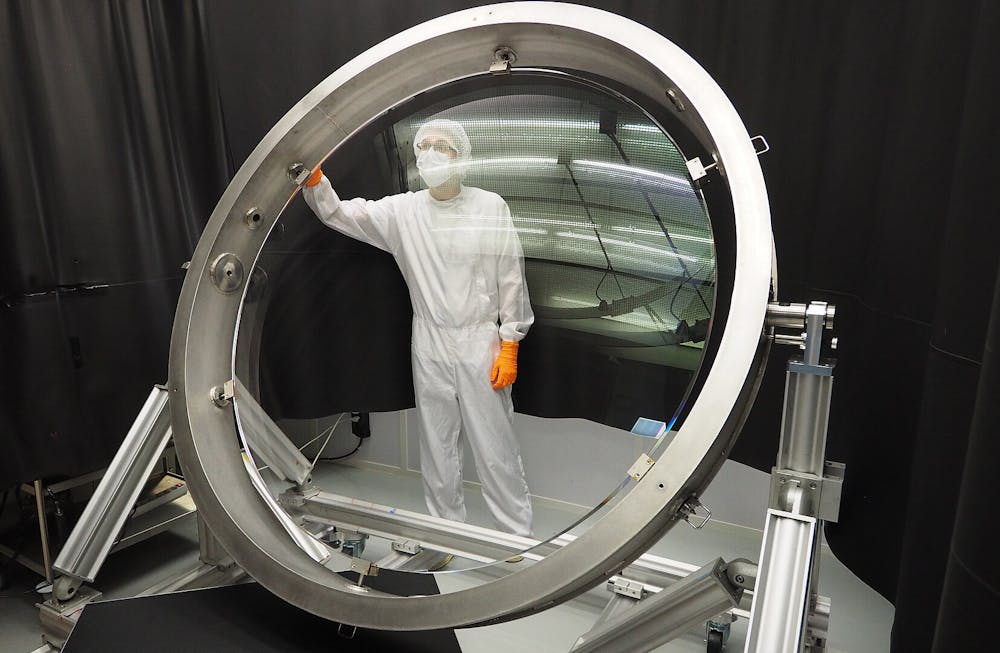
    The glass lens of the Vera Rubin Observatory, which surveys the night sky.
    Large Synoptic Survey Telescope/Vera Rubin Observatory, CC BY

    Lens-based instruments have been transformative. Telescopes have redefined long-standing cosmological views. Microscopes have opened entirely new fields in biology and medicine.

    These changes marked the dawn of empirical science, where observation and measurement drove the creation of knowledge. Today, the James Webb Space Telescope and the Vera C. Rubin Observatory continue those early telescopes’ legacies of knowledge creation.

    Steel and empires

    In the late 18th and 19th centuries, the Industrial Revolution created demand for stronger, more reliable materials for machines, railroads, ships and infrastructure. The material that emerged was steel, which is strong, durable and cheap. Steel is a mixture of mostly iron, with small amounts of carbon and other elements added.

    Countries with large-scale steel manufacturing once had outsized economic and political power and influence over geopolitical decisions. For example, the British Parliament intended to prevent the colonies from exporting finished steel with the iron act of 1750. They wanted the colonies’ raw iron as supply for their steel industry in England.

    Benjamin Huntsman invented a smelting process using 3-foot tall ceramic vessels, called crucibles, in 18th-century Sheffield. Huntsman’s crucible process produced higher-quality steel for tools and weapons.

    One hundred years later, Henry Bessemer developed the oxygen-blowing steelmaking process, which drastically increased production speed and lowered costs. In the United States, figures such as Andrew Carnegie created a vast industry based on Bessemer’s process.

    The widespread availability of steel transformed how societies built, traveled and defended themselves. Skyscrapers and transit systems made of steel allowed cities to grow, steel-built battleships and tanks empowered militaries, and cars containing steel became staples in consumer life.

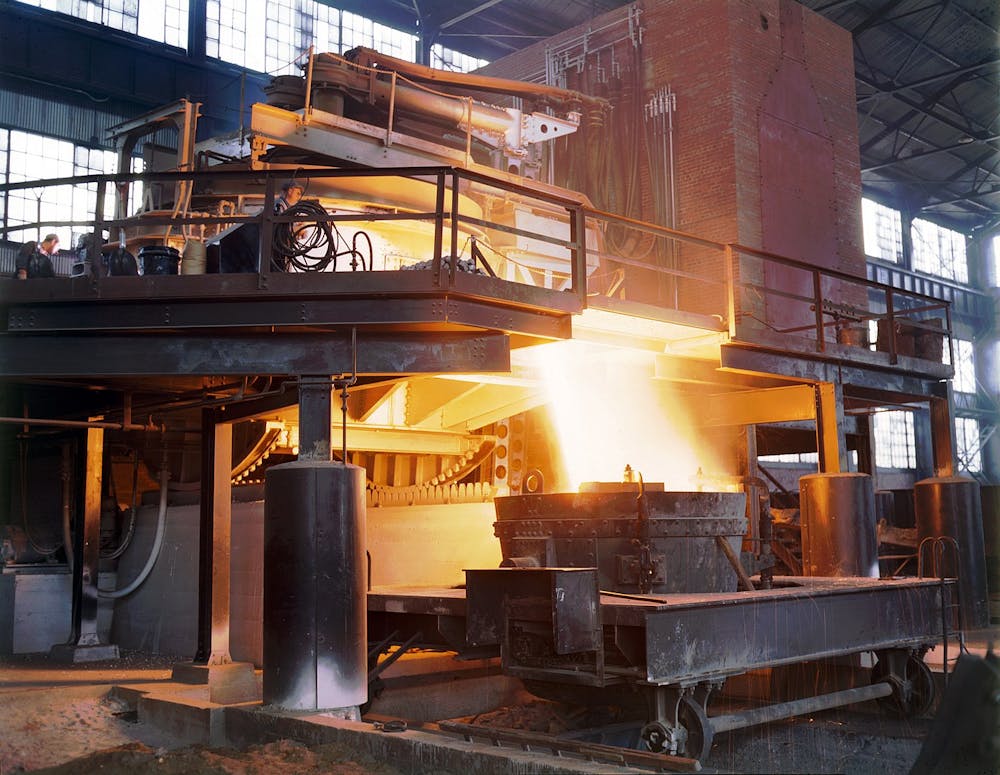
    White-hot steel pouring out of an electric arc furnace in Brackenridge, Penn.
    Alfred T. Palmer/U.S. Library of Congress

    Control over steel resources and infrastructure made steel a foundation of national power. China’s 21st-century rise to steel dominance is a continuation of this pattern. From 1995 to 2015, China’s contribution to the world steel production increased from about 10% to more than 50%. The White House responded in 2018 with massive tariffs on Chinese steel.

    Rare earth metals and global trade

    Early in the 21st century, the advance of digital technologies and the transition to an economy based on renewable energies created a demand for rare earth elements.

    Offshore turbines use several tons of rare earth magnets to transform wind into electricity.
    Hans Hillewaert/Wikimedia Commons, CC BY-SA

    Rare earth elements are 17 chemically very similar elements, including neodymium, dysprosium, samarium and others. They occur in nature in bundles and are the ingredients that make magnets super strong and useful. They are necessary for highly efficient electric motors, wind turbines and electronic devices.

    Because of their chemical similarity, separating and purifying rare earth elements involves complex and expensive processes.

    China controls the majority of global rare earth processing capacity. Political tensions between countries, especially around trade tariffs and strategic competition, can risk shortages or disruptions in the supply chain.

    The rare earth metals case illustrates how a single category of materials can shape trade policy, industrial planning and even diplomatic alliances.

    Mining rare earth elements has allowed for the widespread adoption of many modern technologies.
    Peggy Greb, USDA

    Technological transformation begins with societal pressure. New materials create opportunities for scientific and engineering breakthroughs. Once a material proves useful, it quickly becomes woven into the fabric of daily life and broader systems. With each innovation, the material world subtly reorganizes the social world — redefining what is possible, desirable and normal.

    Understanding how societies respond to new innovations in materials science can help today’s engineers and scientists solve crises in sustainability and security. Every technical decision is, in some ways, a cultural one, and every material has a story that extends far beyond its molecular structure.

    The National Science Foundation, the Department of Energy, NASA, and other national and regional agencies have funded former research of Peter Mullner.

    – ref. From glass and steel to rare earth metals, new materials have changed society throughout history – https://theconversation.com/from-glass-and-steel-to-rare-earth-metals-new-materials-have-changed-society-throughout-history-258244

    MIL OSI Analysis –

    July 5, 2025
  • MIL-OSI United Nations: Deputy Secretary-General’s remarks at the Closing Ceremony of the Finance for Development 4 Conference [as delivered]

    Source: United Nations secretary general

    Your Excellency, President Pedro Sanchez, Excellencies, Distinguished guests,Dear colleagues,

    At the opening of this conference, the Secretary-General remarked that, for decades, the mission of sustainable development has united countries.

    Yet today, development and its great enabler — international cooperation — are facing massive headwinds.

    Over the last four days – through formal sessions, 6 multistakeholder roundtables, 400 side-meetings and special sessions, and countless bilateral discussions – we have reckoned with this challenge.

    The human consequences of rising debt burdens, escalating trade tensions, and steep cuts to official development assistance have been brought into sharp relief.

    Likewise, we understand all too well the collateral damage that competing government priorities can have on development finance, and that global support for sustainable development can no longer be taken for granted.

    Nevertheless, amid this sobering backdrop, the Sevilla conference has delivered a powerful response.

    We have agreed an outcome document – the Compromiso de Sevilla – that upholds the commitments from Addis Ababa ten years ago, and seeks to rekindle the sense of hope embodied in the Sustainable Development Goals.

    The outcome document contains three major areas of commitments.

    First, an investment push to close the financing gap.

    This incorporates steps to grow the full capital stack: domestic, international and private capital.

    Second, at last, a serious attempt to confront the debt crisis.

    The actions agreed here seek to reset how debt is used, managed, and treated, to make it work in service of sustainable development.    

    Third, the elevation of developing countries throughout the international financial architecture.

    Developing countries need to be heard in global policymaking – just as they have been at this conference.

    In addition to the outcome document, the conference has witnessed the unveiling of more than 130 initiatives to turn the outcome document into action: through the Sevilla Platform for Action.

    The Platform includes:

    A debt pause alliance to relieve countries of fiscal stress in times of crisis.

    A new tool for Multilateral Development Banks to manage currency risks.

    A commission to explore the future of development cooperation.

    And the introduction of the world’s first solidarity levy on premium-class flights and private jets to generate new resources for sustainable development including climate action.

    In addition, I’m delighted to report today that the Spanish Government will support the UN Secretary-General, in consultation with Member States and stakeholders, to operationalize the Sevilla Forum on Debt, to help countries learn from one another and coordinate their approaches in debt management negotiations and restructuring.

    As I think back over the past four days, I’ve been struck by three aspects about this conference.

    First is the remarkable sense of resolve on display.

    Attendees here are under no illusion of the difficulty of our current context.

    But they have approached this moment with a sense of unity and solidarity, and demonstrated that inter-governmental processes still matter and still work.

    I hope this spirit will be taken forward into the World Summit for Social Development, the G20 and COP30 later this year.

    Second, the conference has been deeply practical.

    In today’s constrained financial environment, our community is working to stretch the resources we have, and to focus them where they’re most needed, to confront the largest problems, and search for
    innovative solutions.

    Third, everyone is focused on implementation.

    The commitments agreed in the outcome document come with specifics, and member states, financial institutions, businesses and civil society are already looking ahead at how these commitments will be
    delivered, with a can-do attitude.

    Taken together – resolve, practicality and implementation – this provides a basis for rebuilding trust and solidarity.  

    Let me conclude by sincerely thanking the people and the Government of Spain, who have proven not only to be gracious hosts, but have demonstrated outstanding leadership on sustainable development.

    Excellencies,

    The journey ahead will not be easy. The global challenges we face will not be overcome overnight.

    But I leave Sevilla confident that we can walk that path together with clarity, with courage, a sense of purpose and commitment.

    Let FFD4 be remembered as a conference where the world chose cooperation over fragmentation, unity over division, and action over inertia.

    Let us leave here inspired and ready to finance the future that we want.

    Thank you.

    [END]

    MIL OSI United Nations News –

    July 5, 2025
  • MIL-OSI United Kingdom: Minister Smith Keynote Speech at SKOPE Skills Summit, Oxford

    Source: United Kingdom – Executive Government & Departments

    Speech

    Minister Smith Keynote Speech at SKOPE Skills Summit, Oxford

    Speech delivered by Skills Minister Jacqui Smith at the University of Oxford on higher education reform, access and participation and working with the FE sector

    Introduction

    Good morning.

    Thank you for inviting me today.

    I am delighted to see the exciting work on skills education being led by SKOPE’s research on joined-up tertiary education systems.  It is being discussed across the sector.

    And I include government in that, as part of our commitment to evidence-based policymaking.

    It’s a pleasure to be back in Oxford, where I studied all those years ago.

    I was at Hertford, 5 minutes down the road, a college with a proud tradition of inclusion. I was a beneficiary of the Hertford Scheme to encourage state school pupils to apply.

    I hardly dared hope on a snowy December day in 1980 that I could be the first person from my Worcestershire comprehensive to study here.

    It was Hertford, with its pioneering approach to outreach, that gave me the confidence to apply.

    Starting in 1965, it dramatically raised the college’s academic standards and performance.

    In fact, at one point, the university threatened to disassociate Hertford for unfairly ‘poaching’ the best students!

    But many colleges set up similar schemes to emulate its success, before admissions were finally standardised in 1984.

    Why am I telling you this?

    Because it shows that breaking down barriers to opportunity is the key to success.

    For Oxford to succeed, it must welcome-in the best talent, from across the whole population.

    Challenging Oxford

    Oxford recently released their state school admissions data for 2024.

    And the results were poor.

    66.2% – the lowest entry rate since 2019.

    I want to be clear, speaking at an Oxford college today, that this is unacceptable.

    The university must do better.

    The independent sector educates around 6% of school children in the UK.

    But they make-up 33.8% of Oxford entrants.

    Do you really think you’re finding the cream of the crop, if a third of your students come from 6% of the population?

    It’s absurd.

    Arcane, even.

    And it can’t continue.

    It’s because I care about Oxford and I understand the difference that it can make to people’s lives that I’m challenging you to do better.  But it certainly isn’t only Oxford that has much further to go in ensuring access. 

    For example, it is shocking how few care leavers attend university, let alone this one!

    Just 14% enter higher education, and they are more than twice as likely to drop-out.

    University entry is supposed to be a meritocracy.

    But there’s still an awful lot of untapped talent out there.

    People with the potential to soar in higher education.

    Universities have got to go further.

    Play a stronger role in expanding access, and improve outcomes for disadvantaged students.

    And this must include more support for care leavers, some of the most vulnerable people in our society.

    I welcome Oxford’s recent commitment, along with other Russell Group universities, to do more for students who grew-up in care.

    And to increase your admissions transparency, and use of contextual admissions.

    I look forward to seeing some tangible outcomes from this pledge.

    I’m not looking for tinkering at the edges. A leg-up here, a bursary there.

    As a Labour government, we want Big Picture change.

    This is about individual opportunity, but it matters across government,

    from education, to health, to the economy. Just yesterday, Wes and Bridget have set out how we’re asking universities to do more to support our mission to break down the barriers to opportunity.  We’re looking at better transparency over university admissions, starting with publishing data on medical schools’ admission of those from lower socio-economic backgrounds.

    We must strive to ensure, from early years all the way through to higher education, that background never equals destiny.

    And that’s where our Post-16 Education and Skills Strategy comes in.

    The Post-16 Education and Skills Strategy

    We will publish the strategy soon.  

    It will include our vision for a world-leading skills system.

    One that takes a whole-system, mission-driven approach to breaking down barriers to opportunity to unleash growth.

    This means:

    • A more focused skills system, underpinned by Skills England’s national view of skills needs.

    • Clear, high-quality qualifications that ensure every learner has a clear route to further study or work.

    • Firm foundations, putting the system on a financially stable footing that supports strategic specialisation.

    And finally,

    • A new culture of ‘skills first’ where it is everyone’s responsibility – individuals, employers, and the state – to ensure workers reskill and upskill throughout their lives.

    This will boost personal and national prosperity, and reduce reliance on migration to fill skills gaps.

    What do we need to do to achieve this?

    First, there needs to be a renewed partnership between government and business.

    This means both local and central government working with business to identify skills gaps and develop solutions.

    We’ve heard the calls for more flexibility in the skills offer by introducing foundation and short apprenticeships.

    Now we’re going further with new short courses from April 2026, funded through the Growth and Skills Levy, in areas such as digital, artificial intelligence and engineering.

    These support priority sectors named in our Industrial Strategy, like the Creative Industries and Advanced Manufacturing.

    Because we recognise the importance of key sectors to delivering our Industrial Strategy and our Plan for Change.

    That’s why we’ve adopted a sector-based approach to address key skills needs.

    We started with our construction skills package, worth £625 million.

    To train up to 60,000 extra construction workers – crucial for delivering on our pledge to build 1.5 million new homes.

    We announced a further three further packages in the Industrial Strategy:

    • An Engineering package worth over £100 million, to support the pipeline of engineers into priority sectors like Advanced Manufacturing,

    • Clean Energy Industries, and Digital Technology.

    • A Defence package that is foundational for national security and economic growth,
      including establishing Defence Technical Excellence Colleges.

    • And a Digital package, including £187 million investment for digital and AI skills,
      and a commitment to train 7.5 million UK workers in essential AI skills
      by 2030, through a new industry partnership with major tech players.

    Raising the prestige of Further Education

    We understand that the economy needs both technical skills and academic disciplines in order to grow.

    It’s not a zero sum game – because both have so much to offer our people and our economy.

    And, dare I say it, much to learn from each other!

    Further education needs to emerge from the shadow of Higher Education as an equal partner.

    That means positive prominence in careers advice.

    And public recognition that’s long overdue.

    Technical education needs to be a respected alternative to academic pathways.

    And Technical Excellence Colleges will be at the heart of this.

    Only when there is parity, will we secure high-quality post-16 routes for all learners, rather than the lucky few.

    For learners from 16-19, we will be guided by the independent  Curriculum and Assessment Review, set to publish this autumn.

    High esteem follows high-quality teaching and student outcomes.

    We will provide funding to recruit and retain high-quality Further Education teachers, especially for courses delivering scarce skills to priority sectors.

    And this is backed by funding secured at the recent Spending Review.

    We are investing £1.2 billion a year more in skills by 2028-29, alongside over £2 billion of capital investment in skills to support the condition and capacity of the estate.

    Strengthening Higher Education’s role within the skills system I said earlier that Further Education needs to be an equal partner of Higher Education. Since we came into Government in July, we’ve ended the culture of talking down universities, and dismissing the opportunities higher education provides.

    We’re doing quite the opposite, working with you to:

    • drive up standards;
    • maintain our position as a world-class beacon of excellence;
    • build on a proud history of innovation and brilliance in higher education.

    But as the world changes, so must our higher education system.

    We cannot allow the town and gown divide to widen, and for universities and their communities to drift.

    We need collaboration, partnership, and mutual respect.

    Higher Education needs to reach out and play a bigger role in the skills system.

    Because ‘high-quality post-16 routes for all learners’ doesn’t necessarily mean they must choose between HE and FE.

    Our analysis shows the majority of the future skills we’ll need will be at higher levels.

    This means technical students will need access to cutting-edge facilities and courses, as they build their qualifications.

    So the artificial barriers between Further and Higher Education must come down – in a coordinated, effective way.

    And this will be facilitated by the Lifelong Learning Entitlement.

    The Lifelong Learning Entitlement

    The ability to learn across our working lives is no longer just admirable, or valuable. It’s essential.

    People aren’t just working for longer.

    They are changing roles and careers more frequently.

    And the skills needed for those roles are also evolving rapidly.

    Yet despite all this change, the student finance system still largely operates on the assumption that learning only happens early in life.

    To break down the barriers to opportunity, we must support learning at every stage of life.

    This is exactly what the Lifelong Learning Entitlement – or LLE – will do, offering choice, flexibility and opportunity to adults across their working lives.

    From January 2027, the LLE will replace the student finance system.

    It will continue to fund students entering higher education to take traditional degrees.

    But it will also fund new, flexible modular pathways, widening student finance to a broader range of courses and learners.

    That includes those returning to education later in life, who may be working whilst studying. Providing flexibility around personal commitments like caring responsibilities.

    What does means in practice?

    I want you to imagine Sarah, a full-time receptionist and mother who decides she wants a career change. However, Sarah is concerned about committing to studying full-time, as her family is still growing, and she is struggling to take out time to pursue retraining in computer science.

    Through the LLE and the funding of individual modules, Sarah will be able to study one module at a time, to build up her credits over time, alongside her work and family commitments.

    The LLE will not just change the type of provision on offer.

    It also has the potential to transform how employers work with providers to train and recruit staff, allowing modular top-up to build or update their skills.

    We’re already seeing this play out through our modular acceleration programme.

    We want education providers to innovate in how they respond to the new model, so that lifelong upskilling becomes accessible and unremarkable.

    At the same time, employers must be active partners in LLE provision, co-designing flexible courses that create accessible pathways into the workforce.

    We will shortly set-out the final policy design of the LLE, so FE and HE providers can plan for this transformational change.

    Improving local join-up

    The final thing we must do to widen opportunity and build growth is better local join-up. This means strategic collaboration between local education providers, employers, research hubs and health services.

    We set the scene at the end of last year with our ‘Get Britain Working’ and ‘English Devolution’ White Papers.

    These described how mayors and Local Growth Plans will play a key role in shaping their regional skills systems. Local Get Britain Working plans will drive joined-up action to reduce economic inactivity, and take forward our Youth Guarantee.

    This is key for ensuring young people in difficult circumstances are supported to achieve good qualifications and good employment.

    The skills system is at its most effective when detailed local understanding is matched with insight from local employers and training providers.

    Many young adults face complex barriers to engaging with skills courses; an estimated 1 in 8 young people are NEET – not in education, employment or training.

    Improving the accessibility of training will be crucial to reducing the number of NEETs,.

    But to bring them into the fold, you have to understand local barriers as well as national, systemic issues.

    Further Education colleges often do this well by working with many local partners. They are big participants in Local Skills Improvement Plans (or LSIPs).

    These collaborations identify and respond to gaps in skills provision, giving employers a more strategic role in the system.

    I believe in LSIPs because they facilitate partnership  

    Early evidence shows Plans are already having an impact, raising the number of learners training in priority sectors – with more employers telling us that local skills provision meets their needs.

    But we must go further to join-up local systems to drive opportunity and growth.

    Which bring me back to universities.

    Discussions on LSIPs should involve all local providers, and all levels of education – including up to Doctorate level! 

    If your university offers a course that relates to your local skills offer, or local employers, you have something to contribute to these discussions.

    And to the outcomes of local students studying beyond your campus, in neighbouring colleges.

    And let’s not forget the role of research and innovation.

    Universities are renowned for delivering solutions to global challenges.

    But this also happens at a local level, as seen with the Oxford Local Policy Lab.

    HE also brings new ideas to market, through start-ups and partnerships with industry.

    Whichever way you look at it, Higher Education has a huge role in driving local growth and opportunity.

    You need to be part of this conversation.

    Universities involved in local growth

    And this is not just some government aspiration!

    There are plenty of examples of institutions stepping-up to play their part.

    The London South Bank University group acts as an anchor institution within the local education community. It brings together FE colleges, sixth form colleges and employers – particularly the NHS – to ensure a truly collaborative approach to education, training and skills provision.

    You’ll hear later from Professor Kathryn Mitchell, Vice Chancellor of Derby University.

    They work closely with FE colleges and local employers, particularly Rolls Royce to ensure clear links between education and the labour market.

    And in the North East, organisations like Sunderland Software City are leading the tech industry to match local education and training provision with regional requirements.

    It’s great to see – and shows just what university participation in inclusive growth can do for the local economy and community.

    Conclusion

    I know I’m not alone here in admiring this, and wanting change.

    Many people in this room who are working to make Further and Higher Education better – to better serve our people and our nation.

    I’d like to thank you for your innovation and dedication to this – which can sometimes be uphill work!

    I’m grateful to SKOPE, who’ve worked with my officials to share their expertise in developing our Post-16 Education and Skills Strategy.

    And to the Nuffield Foundation for helping to fund SKOPE’s research.

    The strategy is just the beginning, by the way!

    The different parts of the system will need to work together to meet its vision.

    To bring about a fairer society, where everyone has the chance to gain good qualifications, get a good job, support their family, and contribute to their community and our economy.

    Let’s make it happen!

    Thank you.

    Updates to this page

    Published 5 July 2025

    MIL OSI United Kingdom –

    July 5, 2025
  • MIL-OSI United Nations: Deputy Secretary-General’s remarks at the Closing Press Conference of the Fourth International Conference on Financing for Development [as delivered]

    Source: United Nations secretary general

    Good afternoon colleagues, Ladies and gentlemen, Members of the media,

    Over the last four days, over 10,000 people, over 50 heads of government and state, leaders of international financial institutions and businesses, have rushed through these corridors – pausing only occasionally for a cold drink – in pursuit of solutions to finance sustainable development.

    Through formal sessions, 6 multistakeholder roundtables, 400 side-meetings and special sessions, and countless bilateral discussions – we have grappled with the challenge of how to close a widening SDG financing gap, in a moment of heightened global tension and uncertainty.

    Now is a moment to take stock of what we achieved.     

    We have agreed an outcome document – the Compromiso de Sevilla – that upholds the commitments made in Addis Ababa ten years ago, and seeks to rekindle the sense of hope embodied in the Sustainable Development Goals.

    The outcome document contains three major areas of action.

    First, an investment push to close the financing gap.

    Second, a serious, and long-overdue attempt to confront the debt crisis.

    And third, the elevation of developing countries across the international financial architecture.

    In addition to the outcome document, the conference has witnessed the unveiling of more than 100 initiatives to turn the outcome document into action, through the Sevilla Platform for Action.

    From a global hub for debt swaps to a debt pause alliance; a new tool for Multilateral Development Banks to manage currency risks, and the introduction of the world’s first solidarity levy on premium-class flights and private jets to generate new resources for sustainable development including climate action.

    This platform has sparked new partnerships and innovative solutions that will deliver real change in people’s lives.

    In that spirit, I’m delighted to report today that the Spanish Government will support the UN Secretary-General, in consultation with Member States and stakeholders, to operationalize the Sevilla Forum on Debt.

    This commitment, which was supported by Member States in the outcome document, will help countries to learn from one another and coordinate their approaches in debt management and restructuring.

    As I think back over the past four days, I’ve been struck by three aspects about this conference.

    First is the remarkable sense of resolve on display.

    Second, the conference has been deeply practical.

    And third, everyone is focused on implementation.

    Taken together – resolve, practicality and implementation – this provides a basis for rebuilding trust. 

    This trust needs to be earned.

    On that note, I want to acknowledge the frustrations expressed by civil society, who have contributed greatly to this conference but have not had the degree of access they expected.

    We hear you and will endeavor to do better at future events.

    The journey ahead will not be easy. The global challenges we face will not be overcome overnight.

    But I leave Sevilla confident that we can walk that path together with clarity, courage, and commitment.

    Let me conclude by expressing my deep gratitude to the people and Government of Spain, who have proven not only to be wonderful hosts, but have demonstrated outstanding leadership on sustainable
    development.

    Thank you.
     

    MIL OSI United Nations News –

    July 5, 2025
  • MIL-OSI: Kvika banki hf.: Updated proposals regarding merger discussions with Kvika banki hf.

    Source: GlobeNewswire (MIL-OSI)

    After market close today, the Chairman of the Board and the CEO of Kvika banki hf. received updated letters from Arion Bank hf. and Íslandsbanki hf., in which both companies renewed their request to initiate merger discussions.

    The Board of Directors of Kvika banki hf. will review both proposals and determine the bank’s next steps.

    Further information will be disclosed as appropriate and in accordance with the bank’s legal disclosure obligations.

    Please note that this notice is a disclosure of inside information per article 7 of regulation (EU) No 596/2014 on market abuse (“MAR”), which is implemented into Icelandic law with the act on measures against market abuse No 60/2021.

    The MIL Network –

    July 5, 2025
  • MIL-OSI: Kvika banki hf.: Updated proposals regarding merger discussions with Kvika banki hf.

    Source: GlobeNewswire (MIL-OSI)

    After market close today, the Chairman of the Board and the CEO of Kvika banki hf. received updated letters from Arion Bank hf. and Íslandsbanki hf., in which both companies renewed their request to initiate merger discussions.

    The Board of Directors of Kvika banki hf. will review both proposals and determine the bank’s next steps.

    Further information will be disclosed as appropriate and in accordance with the bank’s legal disclosure obligations.

    Please note that this notice is a disclosure of inside information per article 7 of regulation (EU) No 596/2014 on market abuse (“MAR”), which is implemented into Icelandic law with the act on measures against market abuse No 60/2021.

    The MIL Network –

    July 5, 2025
  • MIL-OSI Submissions: From glass and steel to rare earth metals, new materials have changed society throughout history

    Source: The Conversation – USA – By Peter Mullner, Distinguished Professor in Materials Science and Engineering, Boise State University

    Steel played a large role in the Industrial Revolution. Monty Rakusen/DigitalVision via Getty Images

    Many modern devices – from cellphones and computers to electric vehicles and wind turbines – rely on strong magnets made from a type of minerals called rare earths. As the systems and infrastructure used in daily life have turned digital and the United States has moved toward renewable energy, accessing these minerals has become critical – and the markets for these elements have grown rapidly.

    Modern society now uses rare earth magnets in everything from national defense, where magnet-based systems are integral to missile guidance and aircraft, to the clean energy transition, which depends on wind turbines and electric vehicles.

    The rapid growth of the rare earth metal trade and its effects on society isn’t the only case study of its kind. Throughout history, materials have quietly shaped the trajectory of human civilization. They form the tools people use, the buildings they inhabit, the devices that mediate their relationships and the systems that structure economies. Newly discovered materials can set off ripple effects that shape industries, shift geopolitical balances and transform people’s daily habits.

    Materials science is the study of the atomic structure, properties, processing and performance of materials. In many ways, materials science is a discipline of immense social consequence.

    As a materials scientist, I’m interested in what can happen when new materials become available. Glass, steel and rare earth magnets are all examples of how innovation in materials science has driven technological change and, as a result, shaped global economies, politics and the environment.

    How innovation shapes society: Pressures from societal and political interests (orange arrows) drive the creation of new materials and the technologies that such materials enable (center). The ripple effects resulting from people using these technologies change the entire fabric of society (blue arrows).
    Peter Mullner

    Glass lenses and the scientific revolution

    In the early 13th century, after the sacking of Constantinople, some excellent Byzantine glassmakers left their homes to settle in Venice – at the time a powerful economic and political center. The local nobility welcomed the glassmakers’ beautiful wares. However, to prevent the glass furnaces from causing fires, the nobles exiled the glassmakers – under penalty of death – to the island of Murano.

    Murano became a center for glass craftsmanship. In the 15th century, the glassmaker Angelo Barovier experimented with adding the ash from burned plants, which contained a chemical substance called potash, to the glass.

    The potash reduced the melting temperature and made liquid glass more fluid. It also eliminated bubbles in the glass and improved optical clarity. This transparent glass was later used in magnifying lenses and spectacles.

    Johannes Gutenberg’s printing press, completed in 1455, made reading more accessible to people across Europe. With it came a need for reading glasses, which grew popular among scholars, merchants and clergy – enough that spectacle-making became an established profession.

    By the early 17th century, glass lenses evolved into compound optical devices. Galileo Galilei pointed a telescope toward celestial bodies, while Antonie van Leeuwenhoek discovered microbial life with a microscope.

    The glass lens of the Vera Rubin Observatory, which surveys the night sky.
    Large Synoptic Survey Telescope/Vera Rubin Observatory, CC BY

    Lens-based instruments have been transformative. Telescopes have redefined long-standing cosmological views. Microscopes have opened entirely new fields in biology and medicine.

    These changes marked the dawn of empirical science, where observation and measurement drove the creation of knowledge. Today, the James Webb Space Telescope and the Vera C. Rubin Observatory continue those early telescopes’ legacies of knowledge creation.

    Steel and empires

    In the late 18th and 19th centuries, the Industrial Revolution created demand for stronger, more reliable materials for machines, railroads, ships and infrastructure. The material that emerged was steel, which is strong, durable and cheap. Steel is a mixture of mostly iron, with small amounts of carbon and other elements added.

    Countries with large-scale steel manufacturing once had outsized economic and political power and influence over geopolitical decisions. For example, the British Parliament intended to prevent the colonies from exporting finished steel with the iron act of 1750. They wanted the colonies’ raw iron as supply for their steel industry in England.

    Benjamin Huntsman invented a smelting process using 3-foot tall ceramic vessels, called crucibles, in 18th-century Sheffield. Huntsman’s crucible process produced higher-quality steel for tools and weapons.

    One hundred years later, Henry Bessemer developed the oxygen-blowing steelmaking process, which drastically increased production speed and lowered costs. In the United States, figures such as Andrew Carnegie created a vast industry based on Bessemer’s process.

    The widespread availability of steel transformed how societies built, traveled and defended themselves. Skyscrapers and transit systems made of steel allowed cities to grow, steel-built battleships and tanks empowered militaries, and cars containing steel became staples in consumer life.

    White-hot steel pouring out of an electric arc furnace in Brackenridge, Penn.
    Alfred T. Palmer/U.S. Library of Congress

    Control over steel resources and infrastructure made steel a foundation of national power. China’s 21st-century rise to steel dominance is a continuation of this pattern. From 1995 to 2015, China’s contribution to the world steel production increased from about 10% to more than 50%. The White House responded in 2018 with massive tariffs on Chinese steel.

    Rare earth metals and global trade

    Early in the 21st century, the advance of digital technologies and the transition to an economy based on renewable energies created a demand for rare earth elements.

    Offshore turbines use several tons of rare earth magnets to transform wind into electricity.
    Hans Hillewaert/Wikimedia Commons, CC BY-SA

    Rare earth elements are 17 chemically very similar elements, including neodymium, dysprosium, samarium and others. They occur in nature in bundles and are the ingredients that make magnets super strong and useful. They are necessary for highly efficient electric motors, wind turbines and electronic devices.

    Because of their chemical similarity, separating and purifying rare earth elements involves complex and expensive processes.

    China controls the majority of global rare earth processing capacity. Political tensions between countries, especially around trade tariffs and strategic competition, can risk shortages or disruptions in the supply chain.

    The rare earth metals case illustrates how a single category of materials can shape trade policy, industrial planning and even diplomatic alliances.

    Mining rare earth elements has allowed for the widespread adoption of many modern technologies.
    Peggy Greb, USDA

    Technological transformation begins with societal pressure. New materials create opportunities for scientific and engineering breakthroughs. Once a material proves useful, it quickly becomes woven into the fabric of daily life and broader systems. With each innovation, the material world subtly reorganizes the social world — redefining what is possible, desirable and normal.

    Understanding how societies respond to new innovations in materials science can help today’s engineers and scientists solve crises in sustainability and security. Every technical decision is, in some ways, a cultural one, and every material has a story that extends far beyond its molecular structure.

    The National Science Foundation, the Department of Energy, NASA, and other national and regional agencies have funded former research of Peter Mullner.

    – ref. From glass and steel to rare earth metals, new materials have changed society throughout history – https://theconversation.com/from-glass-and-steel-to-rare-earth-metals-new-materials-have-changed-society-throughout-history-258244

    MIL OSI –

    July 5, 2025
  • MIL-OSI Russia: Financial news: At the confluence of three rivers: 800 years of Yuryevets (04.07.2025)

    Translation. Region: Russian Federal

    Source: Central Bank of Russia –

    The oldest city in the Ivanovo region was founded by the Grand Duke of Vladimir Yuri Vsevolodovich to protect the eastern borders of North-Eastern Rus’. According to legend, an icon of St. George the Victorious appeared to him here. That is where the name of the city comes from.

    The picturesque views of Yuryevets, spread out on the hills at the confluence of the Volga, Nemda and Unzha, inspired I. Levitan, A. Savrasov, B. Kustodiev and other famous artists. Yuryevets is inextricably linked with the name of Andrei Tarkovsky – he studied here in elementary school and called the city “the birthplace of childhood”.

    On July 7, 2025, the Bank of Russia will issue into circulation a commemorative silver coin of 3 rubles denomination “800th Anniversary of the Founding of the City of Yuryevets” of the “Cities” series (catalog No. 5111-0522).

    The silver coin with a face value of 3 rubles (pure precious metal weight – 31.1 g, alloy fineness – 925) has the shape of a circle with a diameter of 39.0 mm.

    There is a raised edge around the circumference of both the front and back sides of the coin.

    On the obverse of the coin there is a relief image of the State Emblem of the Russian Federation, the inscriptions “RUSSIAN FEDERATION”, “BANK OF RUSSIA”, the coin denomination “3 RUBLES”, the date “2025”, the designation of the metal according to the Periodic Table of Elements of D.I. Mendeleyev, the alloy standard, the trademark of the St. Petersburg Mint and the mass of the precious metal in purity.

    On the reverse side of the coin there are relief images of the coat of arms of the city of Yuryevets and a view of Georgievskaya Square with a temple complex against the background of an image of the Volga, made using the laser matting technique; there are relief inscriptions: at the top left along the circumference – “YURYEVETS”, at the bottom in two lines – “800 YEARS”.

    The side surface of the coin is ribbed.

    The coin is made in proof quality.

    The mintage of the coin is 3.0 thousand pieces.

    The issued coin is a legal tender in the territory of the Russian Federation and must be accepted at face value for all types of payments without restrictions.

    When using the material, a link to the Press Service of the Bank of Russia is required.

    Please note: This information is raw content directly from the source of the information. It is exactly what the source states and does not reflect the position of MIL-OSI or its clients.

    Please Note; This Information is Raw Content Directly from the Information Source. It is access to What the Source Is Stating and Does Not Reflect

    HTTPS: //VVV.KBR.ru/Press/PR/? File = 638872182851877961 CHTM

    MIL OSI Russia News –

    July 5, 2025
  • MIL-OSI Russia: Financial news: Average monthly actual rates on loans provided by Moscow banks (MIACR, MIACR-IG, MIACR-B)

    Translation. Region: Russian Federal

    Source: Central Bank of Russia (2) –

    Average monthly actual rates on loans provided by Moscow banks (MIACR, MIACR-IG and MIACR-B) are calculated as the arithmetic mean for the month of the daily values of the MIACR, MIACR-IG and MIACR-B rates for the corresponding term.

    The MIACR, MIACR-IG and MIACR-B interbank lending market rates are calculated based on information on transactions concluded in the interbank lending market by credit institutions of Moscow and the Moscow Region that submit reports on form 0409701 “Report on transactions in the currency and money markets” to the Bank of Russia in accordance with Bank of Russia Instruction No. 4927-U of October 8, 2018 “On the list, forms and procedure for compiling and submitting reporting forms of credit institutions to the Central Bank of the Russian Federation”.

    Please note: This information is raw content directly from the source of the information. It is exactly what the source states and does not reflect the position of MIL-OSI or its clients.

    MIL OSI Russia News –

    July 5, 2025
  • MIL-OSI United Nations: 4 July 2025 Departmental update WHO welcomes IMF support to Jordan for pandemic preparedness and response

    Source: World Health Organisation

    WHO welcomes the approval by the Executive Board of the International Monetary Fund (IMF) of the first ever Resilience and Sustainability Facility (RSF) agreement focused on Pandemic Preparedness and Response.

    On 25 June 2025, the Executive Board approved a new 30-month RSF arrangement to support Jordan’s efforts to address long-term vulnerabilities including strengthening capacity to respond to health emergencies and future pandemics. This support—amounting to up to US$ 700 million—will help enhance financial and policy capacity to mitigate those risks. In the context of declining external aid and a worldwide health financing crisis, this support represents a significant opportunity to boost domestic funding and invest in building resilient, sustainable health systems.

    “The COVID-19 pandemic highlighted the need for new sources of financing to bolster health systems to make them more able to prevent and detect epidemics and pandemics, and to respond and withstand them when they strike,” said Dr Tedros Adhanom Ghebreyesus, WHO Director-General. “WHO is proud to be working with the IMF and the World Bank to unlock financing from the Resilience and Sustainability Trust, and support countries to put it to work for a safer world.”

    In the aftermath of the COVID-19 crisis, the Resilience and Sustainability Trust (RST) was established by the IMF in 2022 as a new loan-based funding mechanism. It aims to provide affordable, long-term financing to low- and lower-middle-income countries to address climate change and challenges preparing and responding to pandemics. The RST leverages Special Drawing Rights (SDRs) contributed by higher-income countries and offers financing with a 20-year maturity and a 10½-year grace period. While several RSF agreements have already been approved for climate-related purposes, this marks the first RSF arrangement approved by the IMF Executive Board specifically for pandemic preparedness and response and health-related objectives.

    In 2024 WHO signed an agreement with the IMF and the World Bank Group to provide technical support for the definition and implementation of country-level RSF arrangements. In Jordan, WHO collaborated closely with the Ministry of Health to identify relevant policy measures aimed at strengthening the financing and operational preparedness system. This includes efforts to consolidate the budgetary and overall governance framework that will serve as the foundation for future health emergency response. Moving forward, WHO teams across the Organization are committed to supporting the implementation of these reform measures in collaboration with the IMF, national authorities, and local partners as part of the RSF arrangement.

    MIL OSI United Nations News –

    July 5, 2025
  • MIL-OSI United Nations: In Dialogue with Haiti, Experts of the Human Rights Committee Welcome Efforts to Establish a New Constitution, Raise Questions on Measures to Combat Gang-Related Gender-Based Violence and Lynchings

    Source: United Nations – Geneva

    The Human Rights Committee today concluded its consideration of the second periodic report of Haiti on how it implements the provisions of the International Covenant on Civil and Political Rights . Committee Experts appreciated the referendum to establish a new national Constitution, while raising questions as to how the State was tackling the high level of violence against women and girls perpetuated by gang members and lynchings carried out by citizens, against a backdrop of distrust in the police.

    One Committee Expert said they saw the referendum to establish a new Constitution in a positive light, as an attempt to reestablish the institutionality of the country.

    Another Expert said that the scale of violence against women and girls was reportedly considerable, with sexual violence, including rape of children as young as five years old, gang rape, and forced prostitution, used as a weapon of control by gangs. According to reports, the judiciary were not sensitive to cases of gender-based violence and victims were hesitant to report cases. What measures were taken to encourage women to file complaints? Was there a fund to help survivors of violence? How were they supported by State services?

    Lynchings continued to be regular and numerous, another Expert said, citing reports of more than 500 cases in 2023. These were often the work of self-defence groups in or around Port-au-Prince, who did not trust the police, mainly due to corruption. Was this violence investigated, including when the police were accused of supporting or encouraging it? Had the perpetrators of lynchings, stonings and mutilations been prosecuted and punished proportionately? How could trust be restored between the police and the civilian population?

    Pedrica Saint Jean, Minister for the Status of Women and Women’s Rights and head of the delegation, introducing the report, said from 2020 to 2025, Haiti was confronted with repeated political crises, marked by lockdown operations and successive protests. The COVID-19 pandemic, frequent floods and the earthquake of 14 August 2021, which devastated part of the Great South region, were additional challenges faced by the country. This complex situation was further aggravated by the assassination of the Haitian President on 6 July 2021.

    Ms. Saint Jean said an agreement for a peaceful transition was reached on 3 April 2024, establishing a transition period with a nine-member Transitional Presidential Council and a Prime Minister, with the aim of restoring security, continuing constitutional reform, and organising democratic elections.

    The delegation said several strategies had been undertaken to combat gender-based violence, including a national strategy that spanned from 2017 to 2024. An assessment of the strategy was almost completed. A gender-based violence cell had been established to train police officers to take the needs of female victims of violence into account. The Office to Combat Gender-Based Violence streamlined services for victims, enabling them to receive legal, psychosocial and medical assistance in one place. In areas with armed gangs, women were typically the primary victims. Violence was used as a weapon of repression.

    The delegation also said the Government had always condemned lynchings, which were not part of the country’s culture. Incidents needed to be reported at a police station so perpetrators could be incarcerated and tried for their crimes. The community police were carrying out an awareness raising campaign to progressively build trust with the general population. Training sessions were being organised for police officers, with a view to protecting the population. When complaints were made against the police force, the national inspector for the police carried out investigations and measures were taken as necessary.

    In concluding remarks, Ms. Saint Jean thanked the Committee for the kindness it had shown to the Haitian delegation, and the Experts for their insights. Haiti had taken due note of all recommendations and was determined to take further steps to develop effective, concrete responses to the Committee’s concerns relating to the implementation of the Covenant. Everybody was working to see the day when Haiti could leave the crisis behind.

    Changrok Soh, Committee Chairperson, in concluding remarks, said the Committee acknowledged the profound political, economic and humanitarian challenges facing Haiti, which had hampered efforts to protect human rights. Haiti was encouraged to take this opportunity to advance necessary reforms to ensure that the rights enshrined in the Covenant were fully recognised for all Haitians.

    The delegation of Haiti was made up of representatives of the Ministry for the Status of Women and Women’s Rights; the Ministry of Justice and Public Security; the Ministry of Foreign Affairs; the Ministry of Social Affairs and Work; the Cabinet; the Government of Port-au-Prince; the Prime Minister’s Office; the Haitian National Police; the Anti-Violence Unit; and the Permanent Mission of Haiti to the United Nations Office at Geneva. Some members of the delegation were unable to attend the meeting in person due to travel restrictions.

    The Human Rights Committee’s one hundred and forty-fourth session is being held from 23 June to 17 July 2025. All the documents relating to the Committee’s work, including reports submitted by States parties, can be found on the session’s webpage . Meeting summary releases can be found here . The webcast of the Committee’s public meetings can be accessed via the UN Web TV webpage .

    The Committee will next meet in public at 3 p.m., Monday 7 July to begin its consideration of the fourth periodic report of Viet Nam (CCPR/C/VNM/4). 

    Report

    The Committee has before it the second periodic report of Haiti (CCPR/C/HTI/2).

    Presentation of Report

    PEDRICA SAINT JEAN, Minister for the Status of Women and Women’s Rights and head of the delegation , said between 2020 to 2025, Haiti had experienced both positive and negative developments. From a positive perspective, the Government had multiplied efforts in many areas to improve the rule of law and respect for human rights. However, the country had been plagued by unprecedent insecurity that required the intervention of a foreign force, through the deployment of the Multinational Security Support Mission on October 2, 2024. This force intervened in the context of an agreement signed between Haiti and Kenya on police and security cooperation in March 2024, following the adoption of the United Nations Security Council Resolution 2699.

    From 2020 to 2025, Haiti was confronted with repeated political crises, marked by lockdown operations and successive protests which accompanied them. The COVID-19 pandemic, frequent floods and the earthquake of 14 August 2021, which devastated part of the Great South region, were additional challenges faced by the country. This complex situation was further aggravated by the assassination of the Haitian President on 6 July 2021.

    An agreement for a peaceful transition was reached on 3 April 2024, establishing a transition period with a nine-member Transitional Presidential Council and a Prime Minister, with the aim of restoring security, continuing constitutional reform, and organising democratic presidential elections. The Council was also tasked with economic and judicial reforms and combating corruption. The agreement provided for the establishment of three key bodies, including the Body for the Control of Government Action, in charge of controlling the acts of the Executive, since Parliament was currently non-existent; the National Security Council, to respond to the various aspects of the country’s security crisis; and the National Conference, accompanied by a steering committee. The Government had already established the National Security Council and the National Conference and its steering committee. The referendum decree, resulting from the work of the National Conference and the steering committee, would allow Haiti to have a new Constitution. Currently, efforts were underway to strengthen the capacities of the Haitian National Police and the Armed Forces of Haiti, which had a budget increase of 11 per cent in 2024-2025. An agreement was concluded with Colombia to monitor the Haitian coast, to curb the illicit trafficking of firearms.

    The Government had attached great importance to the judicial reform already initiated by its predecessors. Six new Courts of First Instance and the corresponding Public Prosecutor’s Offices were created between September 2024 and April 2025. The law of 10 September 2018 created the National Council for Legal Assistance and established legal aid offices in 18 jurisdictions in Haiti, aiming to provide free legal assistance to those who were financially struggling. The Penal Code and the Code of Criminal Procedure had previously been criticised by civil society in 2020. Following the revision of the two texts by a special commission, they were adopted on 24 June 2025. This marked an important step in the fight against insecurity, corruption and impunity.

    Two other important decrees had been adopted in the context of judicial reform. The first, adopted on 16 April 2025, which created two specialised judicial poles: one for the repression of complex financial crimes and offences and the other for the repression of mass crimes and sexual violence. The second decree of 4 May 2023 sanctioned money laundering, terrorist financing and the financing of the proliferation of weapons of mass destruction in Haiti.

    Despite Government efforts, due to the deteriorating security situation, the majority of prisons in Port-au-Prince had been vandalised, leading to the uncontrolled release of a number of detainees. The Government had been forced to relocate several jurisdictions to allow the resumption of judicial activities in minimum security conditions and the normal application of appropriate sentences and sanctions.

    The Haitian State aimed to follow up on complaints against police officers for excessive use of force, and it organised human rights training sessions for police personnel. However, it was regrettable that, despite the Government’s efforts, some citizens, driven by anger at the atrocities committed by criminal groups, resorted to extreme methods, including the lynching of captured gang members, instead of handing them over to the authorities. The Government recognised the severity of these acts and strongly condemned all forms of mob justice.

    The crisis in the country led to an increase in gender-based violence, particularly for displaced persons in camps. The Haitian State was working to protect and facilitate access to justice for survivors of violence, including through the creation of the Office for Combatting Gender-Based Violence as well as the organization of training adapted to the needs of survivors for police officers and judges. Medical, legal and psychosocial assistance were also offered to women and girls at internal displacement camps.

    Article 262 of the Penal Code, adopted by decree on 23 June 2025, punished the perpetrators of acts of torture and barbarism, with sentences ranging from 15 to 20 years in prison. Prison overcrowding remained a major problem, especially with the destruction of the main prisons in March 2024. Instructions had been issued to the Public Prosecutor’s Offices and Courts of First Instance to carry out regular criminal hearings, with the aim of relieving overcrowding in the prisons in provincial cities.

    The Transitional Presidential Council was making every effort to organise general elections in 2025 and to install a President elected on 7 February 2026. Despite its efforts, the Haitian State was aware that the implementation of the provisions of the Covenant had not yet reached a satisfactory level. However, Haiti pledged to do everything in its power to implement the provisions on the Covenant.

    Questions by Committee Experts

    A Committee Expert acknowledged how difficult it was for the State party to participate in person in the dialogue and expressed gratitude to the delegation in Geneva. The Committee was aware of the grave humanitarian crisis suffered by Haiti for decades, compounded with the assassination of the President in 2021. In that context, the Committee noted an increase in widespread human rights violations and growing control of armed gangs in significant parts of Port-au-Prince, leaving the population more vulnerable to violence and human rights abuses, and leading to the displacement of more than one million people.

    Were courts in Haiti directly applying the Covenant? Could examples be provided? Were courses on international human rights law and the Covenant provided in training to judges? The Committee had been informed of situations where civil servants had opposed the execution of orders handed down by judges to free individuals. Could this be explained? What role did these civil servants play in the judicial system? Had steps been taken to ratify the Optional Protocol of the Covenant on individual communications? In May 2025, a bill of law was presented on the development of a new constitution, with a decree adopted to hold a referendum on the issue. Was this bill in line with the rights enshrined in the Covenant? Was it realistic to carry out a referendum in the context of violence? When was the state of emergency ordered? Was it still in force? Which articles of the Covenant were suspended?

    Did the current budget of the Office for Citizen Protection allow it to carry out its functions and extend its activities to the most remote parts of the country? Were there plans to expand the powers of the Office to allow it to consider human rights violations that had their origin in the acts of private entities?

    What steps had been taken to end discrimination against lesbian, gay, bisexual and transgender persons? Were there laws in place to punish acts of discrimination against these groups? Had the State taken actions been to allow these people to carry out public demonstrations and to protect them? Had it adopted measures to change discriminatory cultural attitudes in Haitian society, to end stigmatisation of lesbian, gay, bisexual and transgender persons? 

    Another Expert said despite the crisis in the country, Haiti remained bound by its international obligations. The dialogue would address problems such as insecurity, the deep humanitarian crisis that the population was experiencing, the endemic violence of gangs, the forced displacement of the population, the dysfunction of the justice system, chronic impunity and serious challenges to the rule of law. All these problems were linked to corruption. The report published in 2023 by the United Nations Expert on Human Rights in Haiti stated that corruption in Haiti was “public enemy number one” and found that more than 90 per cent of Haitian civil servants did not comply with the national anti-corruption law. The Anti-Corruption Unit and the Central Financial Intelligence Unit, which were suspected of lacking independence, had brought nearly 100 major cases of corruption to justice, but these had not led to any convictions.

    Did the State plan to set up a financial prosecutor’s office or judges specialised in the fight against corruption? Could more information be provided on the decree adopted on the creation of financial judicial units? What measures were being taken to support the work of the Anti-Corruption Unit and the Central Financial Intelligence Unit and to ensure that the cases referred were followed up independently?

    Haiti had expressed its commitment to ensuring accountability for the serious violations committed during Jean-Claude Duvalier’s presidency. However, a case assessing these violations had been in the courts of cassation since 2014, and there had not been any progress. What explained the delay? Could the delegation enlighten the Committee on the situation of Jean Gabriel Robert, who was convicted in absentia in the case of the “Raboteau massacre”?

    Information showed that the scale of violence against women and girls was considerable, with sexual violence, including rape, which was sometimes perpetrated against children as young as five years old; gang rape; and forced prostitution, used as a weapon of control by gangs. According to reports, the judiciary were not sensitive to cases of gender-based violence and victims were hesitant to report cases. What measures were taken to encourage women to file complaints? Was there a fund to help survivors of violence? How were they supported by State services?

    According to information received by the Committee, lynchings continued to be regular and numerous, with more than 500 in 2023. These were often the work of self-defence groups in or around Port-au-Prince, who did not trust the police, mainly due to corruption. In addition, the 2024 report of the United Nations Expert on Human Rights in Haiti noted that police were passive, and it appeared that some murders were encouraged, supported or facilitated by the police forces. Was this violence investigated, including when the police were accused of supporting or encouraging it? Had the perpetrators of lynchings, stonings and mutilations been prosecuted and punished proportionately? How could trust be restored between the police and the civilian population?

    Another Expert said specific steps had not been taken to combat impunity. What hope existed, looking forward to the immediate and long-term future, regarding a reversal of the situation? There were several cases in which there had been impunity for human rights violations. Attacks against the population in the La Saline suburb in 2018 had not been condemned by the Government and no steps had been taken to provide support to victims. What measures had been taken against the involvement of political agents in these cases? Why was the La Saline case withdrawn from the original judge?

    Data showed that 28 percent of civil servants in Haiti were women. In 2019 a strategy was presented to ensure equality for women by 2030. What progress had been made? How would the State party solve the problem of the low rate of political representation of women in Haiti?

    What actions were being taken to guaranteed women’s access to health care, in situations where criminal groups took control of health centres? How was access to medicines ensured?

    Another Expert asked what Haiti’s prospects were looking forward? What urgent measures were envisaged to protect women and girls in areas under gang control? What mechanisms had been established to guarantee security and safety for survivors of sexual violence, and to encourage the reporting of cases? Could Haiti provide updated information on the draft law preventing violence against women and girls? Was there a timeline for its adoption? What had been done to bolster the amount of medical, legal and psychosocial services for survivors, particularly in areas under gang control? What measures were envisaged to protect the right to life of those in extreme poverty? Was there an intersectional strategy to prevent avoidable deaths linked to poverty?

    What measures were taken to protect civilians living in areas under the control of armed gangs? What had been the result of the assistance from Kenya? Was it meeting the challenges? What guarantees existed when it came to the investigation of its own officers by the Haitian police? How was it ensured that the police did not carry out disproportionate use of force during protests? How was action being bolstered in areas under gang control?

    Was there a road map regarding ratification of the Covenant’s Second Optional Protocol concerning the death penalty? How did the State party intend to ensure that those who had served their sentence were properly released? Had the system for monitoring judicial cases been reactivated? What efforts were underway to improve detention conditions? Were construction projects for new prisons still planned? How many women had access to shelters in the last three years? What measures were envisaged to guarantee all police stations should have trained personnel, particularly in areas most affected by police insecurity?

    Responses by the Delegation

    PEDRICA SAINT JEAN, Minister for the Status of Women and Women’s Rights and head of the delegation , said the Government had priorities outlined in the April 2024 agreement on the peaceful transition, including combatting insecurity, conducting the referendum and bringing the country to elections to appoint a robust Government. To combat insecurity, the budget allocated to the police and armed forces had been increased, allowing them to better contain the problems they were confronting. The police, the Haitian armed forces, and the security mission needed to work together to combat insecurity to allow for the milestone referendum to be held. Nine electoral commissioners were currently out in the field assessing the requirements. Haiti was not waiting for the security issues to subside before moving to the referendum.

    Haiti was doing its utmost to implement its commitments under the Covenant through a raft of measures. Six new courtrooms had been established in the country, allowing proximity between those needing to access the justice system and the infrastructure in place. Bureaus had been established to work on specific criminal areas, including mass crimes which had remained unpunished. For some time, courts had not been operational because they were in the hands of gangs. Two bureaus would be responsible for crimes of sexual violence, and another was responsible for financial crimes. Some 34 new judges and prosecutors had been appointed to support the justice system.

    The method of choosing judges for the Anti-Corruption Unit had not hindered its independence. Cases were currently going ahead at the Court of First Instance. Three prisons had been built to international standards, with one dedicated to female inmates. Institutional measures had been put in place to freeze the funds of certain agencies which were found to be corrupt but had impunity from the Anti-Corruption Unit, and those responsible were being brought before the court.

    The Government of Haiti had always condemned lynchings, which were not part of the country’s culture. Incidents needed to be reported at a police station so perpetrators could be incarcerated and tried for their crimes.

    The delegation said several assessment missions had been established to gain an understanding of the situation of detention centres and propose tangible solutions. One of the main challenges was the provision of food, due to lack of access to main roads. To address this situation, the Justice Ministry sought to ensure that providers of food should be placed directly in situ. In the last few months, prisons had greater autonomy and managed their needs themselves, providing a better and tailored approach to local realities.

    Haiti had done a lot to combat gender-based violence. This phenomenon was topical in Haiti, particularly when it came to displaced women. Several strategies had been undertaken to combat gender-based violence, including a national strategy that spanned from 2017 to 2024. An assessment of the strategy was almost completed. A gender-based violence cell had been established within the police, to train police officers to take the needs of female victims of violence into account. The Office to Combat Gender-Based Violence streamlined services for victims, enabling them to receive legal, psychosocial and medical assistance in one place. Psychosocial support services had been set up for women victims in internal displacement camps. Several initiatives had been adopted to bolster protections for minors, including host families and prevention and readaptation programmes for children recruited by armed games. Training and awareness raising sessions were organised for judges.

    In areas with armed gangs, women were typically the primary victims. The number of victims was increasing, particularly against younger women, but violence by armed gangs was also affecting children and the elderly. Violence was used as a weapon of repression. There were still people in Haiti who did not want to report. During times of political turbulence, the phenomenon of violence against women was heightened. There was a need for awareness raising to eradicate the phenomenon. Women should not be used as an instrument to place pressure on the Government.

    Incest had never been part of Haitian culture, but it did not mean this phenomenon did not exist. When incest occurred, people usually preferred to solve the issue in the family. Attention needed to be paid to the phenomenon of incest involving displaced people. The State sanctioned based on the relevant 2006 decree and used case law when dealing with these offences. It was important to continue legislating to bring tangible solutions to this phenomenon.

    For 15 years, judges had been receiving training on the Covenant from the Government and the Haitian police.

    Lesbian, gay, bisexual, transgender and intersex persons had been looked down on in Haiti; they were formerly not given the right to complain. While progress was not significant, these people were now considered to be fully fledged citizens who needed to be protected by the State and to enjoy their full human rights.

    Quotas had been implemented calling for at least 30 per cent of decision-making posts to be held by women. This issue had been poorly addressed. In the new Constitution, the State was advocating for parity. Until there was a critical mass of women in decision-making posts, the problems they faced would persist. A series of consultations had been launched with officials to create incentive measures to promote equality regarding candidate lists.

    The law on the organization of the Ministry on the Status of Women had not properly been reformed, which was why the Ministry had difficulties in playing its primary role. The Ministry submitted a law on its reorganization to ensure it could achieve its goals. By the start of next year, the State would launch its first national action plan covering the participation of women in restoring peace and security in Haiti. Work was being done with survivors in internal displacement camps to transform them into fully-fledged actors. Women, including young girls and survivors of violence in these camps, had been appointed as peace ambassadors, to sensitise the message of peace throughout Haiti.

    Haiti was relying on the work of the Multinational Security Support Mission and the international community to help the police and armed forces overcome the corruption and security issues in the country.

    Follow-up Questions by Committee Experts

    A Committee Expert asked follow-up questions, including on the functions to be undertaken by the bureaus on mass crimes, sexual crimes and financial crimes. This was a fantastic idea, but the bureaus needed to have the resources to operate properly. Other questions were asked on measures planned to restore the trust between the police and the justice system; lynchings committed by the police force; steps to tackle the circulation of weapons; and the mandate of the Office for Citizens’ Protection.

    An Expert said they saw the referendum to establish a new Constitution in a positive light, as an attempt to reestablish the institutionality of the country. Who drafted this bill? Did it go through various sectors, with participation from civil society? What did the “green and red zones” mean? Were green zones under Government control? Did red zones mean there was no State control? What happened if there was a referendum in the red zones?

    More questions were asked on how the long tradition of impunity could be alleviated; alternative measures to detention; detention beyond the lengths of sentences; efforts to prevent discrimination against women; and access to voluntary interruption of pregnancy. What was the Government’s perception of the processes involving the participation of the international community that aimed to improve the situation for the population of Haiti?

    According to information received by the Committee, around 40 per cent of births enjoyed the proper medical support. How did midwives treat risky pregnancies? Did the State intend to include the ratification of the Second Optional Protocol in the planned reform of the draft Constitution?

    Responses by the Delegation

    The delegation said the death penalty was abolished in Haiti through a decree adopted in 1987.

    Regarding the red and green zones, there were currently zones under gang control, where the State was doing everything possible to convert them to green zones. Green zones were placed where the State could provide appropriate services to the population. The police were trying to gain access to the red zones to bring about peace and security. Progress had been made in penetrating many of the red zones; it was expected that there would be further progress in this area.

    The referendum was a compulsory, milestone measure to lay the groundwork for national elections and allow the population to get their new Constitution. All different sectors of society had been consulted in the drafting of the new Constitution.

    Haiti had implemented measures that aimed to provide a structure to prevent the free circulation of weapons, including weapons of mass destruction.

    The delegation said there was a legal bureau on mass crimes and sexual violence in Port-au-Prince and another on financial crimes. The bureaus were comprised of 10 judges who worked with the police and financial oversight and regulatory bodies. Their operations were ensured by donors from the international community and the State.

    The community police were carrying out an awareness raising campaign to progressively build trust with the general population. Training sessions were being organised for police officers, with a view to protecting the population. When complaints were made against the police force, the national inspector for the police carried out investigations and measures were taken as necessary.

    Haiti had a plan to set up scanners at customs to prevent the flow of illegal weapons into the country. Controls at the border with the Dominican Republic and checks of containers coming from the United Staes had been strengthened, and strict checks were being conducted on private vehicles, including motorbikes. Authorities had also suspended land imports from the Dominican Republic, ensuring seizures of illegal imports. Despite this, Haiti was facing increased criminal activity and corruption, with the need for increased international support to reduce the weapons flow into Haiti.

    Green zones were safe zones while red zones were ones where there was a heightened risk.

    A draft of the new Constitution had been shared across different sectors to receive their inputs, which had been sent to the Committee responsible for the drafting of the new Constitution.

    Haitian midwives played a key role in early detection of illnesses and in responding to complications during birth. They carried out post monitoring operatives in rural areas, while caesarean procedures were performed by obstetric doctors.

    Questions by Committee Experts

    A Committee Expert asked if there were obstacles preventing Haiti from ratifying the Covenant’s Second Optional Protocol? Murderous attacks by gangs against ambulances had been reported, and health staff had fled the country. Did the Government have any plans to confront these problems? Haiti had an astonishing overcrowding rate in its prisons, at allegedly over 300 per cent. There was a lack of access to the appellate procedure for all inmates and for persons with disabilities. How did Haiti plan to resolve this problem?

    Another Expert appreciated Haiti’s delegation comprised of high-level women. It was reported that police agents or persons acting with their complicity tortured inmates on a daily basis in prisons and police custody facilities. Why had the perpetrators of cases of torture not been prosecuted and brought to justice? Had there been capacity building of law enforcement in the area of torture? Why had the State not ratified the Convention against Torture?

    Reports received by the Committee stated that forced evictions had become widespread since the earthquake in 2010, but this was denied by the State. It was alleged that these evictions affected a wide number of families and were not addressed by the State. What information was available about three resident families who had not taken up possession of reconstructed homes? Which Government civil servants were responsible for these families’ forced evictions? How had the Government taken steps to prosecute those involved?

    Hurricane Matthew had affected more than 2.6 million people, including 600,000 children; what measures had been taken to protect them? Could information be provided on the distribution of financial aid and the resources used to reconstruct infrastructure following this natural disaster? During the imposed state of emergency, was it only economic rights which were affected? What solutions were available for those still awaiting assistance from the damage 10 years ago? What resources had been allocated to address housing issues?

    A Committee Expert asked about the implementation of the National Plan to Combat Child Labour, adopted in 2019; what was the duration of the plan? Was it still in force or had a new plan been adopted? Could data on the number of children exploited and those in situations of begging be provided? What work had been done specifically on the exploitation of children by the Committee to Combat Human Trafficking?

    Various reports had documented violence against children, who were recruited and used by the gangs and injured or killed as a result. An even more severe impact was felt by children with disabilities. The Secretary-General’s report had outlined 383 grave violations against children in 2024. In December 2024, the gangs had committed a high number of abductions, including of 17 girls and 10 boys. What measures had been taken by the State to combat these grave violations? To help minors, child soldiers and victims of armed groups, a Commission had been created to support the creation of a national network of shelters and rehabilitation centres. How did the State ensure that the Commission had the human and financial resources necessary to support its functions? What did its work consist of? Was the National Committee for Combatting Human Trafficking able to carry out its functions? What measures had been adopted along the Dominican-Haitian border to prevent trafficking of children who were then sold in the Dominican Republic?

    It was understood that a commission to implement criminal reform was created in July 2024. What were the main reforms being carried out? What measures had been adopted to deal with the firebomb attacks on judges? How was the safety and security of judges being ensured? What was the current situation of the National Council for Legal Assistance? Regarding the appointment of judges in the Cassation Council, how was it ensured that the involvement of the Senate did not affect the Council’s independence? What role did the Council play in combatting corruption in the judicial sphere?

    Another Committee Expert said people who were displaced often lost their identification documents. What was the State party doing to resolve this issue? Two journalists reporting on insecurity in Haiti had been executed in 2022. The Committee had also received information that five journalists were murdered in 2024, with no investigations carried out. Gang violence had also led to the closure and restriction of media, including the suspension of popular programmes on suspicion of serving as platforms for gangs. Journalists had also been threatened by gangs. How could elections take place if the State could not facilitate the free circulation of ideas? How did Haiti intend to combat impunity surrounding executions or ill-treatment of journalists? What was done to protect human rights defenders? How was it ensured that social media platforms were regulated?

    In March 2025, anti-Government protests were held to decry the security context and inaction by the State. What measures had been taken to establish the responsibility of police directly involved in the use of force in suppressing peaceful demonstrations? What had been done to guarantee the work of non-governmental organizations in full security and free from harassment?

    Responses by the Delegation

    The delegation said overcrowding in prisons remained a major issue for the Government which it was working to address. Instructions had been issued to the prosecution offices and tribunals of the Courts of First Instance to encourage the holding of more criminal sessions, including sessions in which a jury was not present, with a view to relieving overcrowding in provincial prisons. In 2023 and2024, this occurred in 14 jurisdictions, leading to 159 convictions. In 2024, the total number of people detained in the country was around 12,000. The State had managed to capture around 12 prisoners who had escaped. The drop in the number of detainees in 2025 was explained primarily due to the escapes that followed the armed attacks carried out against certain penitentiary infrastructure. Courts had been actively engaged to implement non-custodial measures when appropriate, as a means of alleviating prison overcrowding. The Government recognised the need to prevent arbitrary arrests. Men, women and children were placed in different prisons. Despite the State’s efforts, there was only one police officer per every 14 detainees.

    The Government remained committed to improving prison conditions, despite security constraints. The mortality rate had dropped between 2024 and 2025 thanks to coordinated action to provide medical care and humanitarian aid. Healthcare services had been established in several penitentiaries. In 2017, a Presidential Commission was established to shed light on deaths in the Port-au-Prince prison. It highlighted aggravating factors including severe overcrowding, insufficient hygiene and a lack of medical support, among others. Measures were implemented to improve nutrition, detention conditions and investigate causes of deaths.

    The internal regulations of the penitentiary administration outlawed all forms of torture and inhumane treatment. Finances had been provided to the National Anti-Trafficking Committee to support the implementation of its national action plan. A protocol had been signed to guarantee legal aid to victims of trafficking. Some 100 students from the University of Haiti had received training on the issue of human trafficking. Several human traffickers had been prosecuted, however following the mass escapes in March 2024, a number of these traffickers were unfortunately able to escape.

    The Constitution guaranteed that judges could not be dismissed. In the judicial hierarchy in Haiti, the Constitution had the highest ranking, followed by international conventions. In Haiti, the Constitution outlawed the death penalty in all areas, meaning there was no need to fear its reinstation. The ratification of the Second Optional Protocol could be discussed when the legislature was functional.

    Families who were forcibly evicted due to the development of road infrastructure or for airport security purposes had a right to fixed compensation, as well as the right to appeal decisions blocking their access to redress.

    A State project had been launched to combat domestic labour by children, in line with the Convention on the Rights of the Child. The project had been launched in 16 regions in the country and included a concrete list of jobs banned for children. Twenty-three surveys of young people had been conducted, allowing them to express themselves on themes including domestic labour, birth registration, violence against children, and education. A social protection project ensured monetary transfers for children under the age of five, pregnant women and persons with disabilities. The project was financed by the World Bank and allowed vulnerable families to provide care to their children. Around 25,000 homes received regular monetary transfers to the value of 40 United States dollars per month.

    A professional training programme had been launched in conjunction with the International Labour Organization, allowing for the training of more than 800 vulnerable teenagers in various technical and farming activities. Some 9,200 children had received support for school re-enrolment. Four thousand vulnerable homes at risk of family separation received monetary transfers to support income-generating activities, as well as financial education. A pilot programme had been launched in targeted communes with the United Nations Children’s Fund, which had developed a foster programme for children taken out of situations of domesticity to support their reintegration.

    Legal assistance officers had been established in 12 jurisdictions and the rollout was ongoing. A decision would be made on the draft Constitution based on a participatory process. A Commission had been established to follow up on gender-based violence cases in the country.

    Steps had been taken to prevent the phenomenon of forced evictions, but results were still limited. The Government had not been encouraging forced evictions and had taken new steps to support victims. Demolished homes had been rebuilt and several previous owners had already taken ownership of their new homes. Authorities ensured that no one living in camps or informal housing was evicted without a humane alternative provided.

    The Haitian State reiterated its commitment to freedom of the press and its respect for the work of human rights defenders. Efforts were made to ensure journalists could freely conduct their work, including by strengthening protection mechanisms. Haitian authorities reaffirmed their desire to shed light on the murders of several journalists, which were currently at being investigated by the Public Prosecutor.

    The courts did not all apply the Covenant in the same way, but it was often evoked in individual cases. Alternative measures to prison were allowed for in the new Criminal Code, which had been adopted in June 2025. Judges were equipped with armed vehicles and would have security details at their disposal for their personal safety. The police force was taking steps to bolster security in zones with a heightened level of insecurity and ensure that the referendum could take place. The Government was engaged in an intense campaign to fight the armed violence being perpetrated by gangs.

    Follow-up Questions by Committee Experts

    Committee Experts asked follow-up questions regarding identification papers, which more than 70 per cent of the population did not have, as well as the role of the Government Commissioners within the courts of justice.

    A Committee Expert expressed hope that the programme being laid out by the State for elections would bring about the enjoyment of rights by the population. It seemed impossible to bring this about given the current insecurity in Haiti. Was the State in a position to achieve peace given the current context? The context in Haiti required international, shared responsibility, with involvement from all States parties.

    Closing Statements

    PEDRICA SAINT JEAN, Minister for the Status of Women and Women’s Rights and head of the delegation , thanked the Committee for the kindness it had shown to the Haitian delegation, and the Experts for their insights. Haiti had taken due note of all recommendations and was determined to take further steps to develop effective, concrete responses to the Committee’s concerns relating to the implementation of the Covenant. One day, in the not-too-distant future, the country would exit the crisis. Everybody was working to see the day when Haiti could leave the crisis behind. Despite the efforts it had made, the Haitian State was aware that the implementation of the Covenant and progress in bolstering of the rule of law had not yet reached a satisfactory level. Haiti had a massive raft of problems to resolve, including travel restrictions, which had prevented some members of the delegation from traveling to Geneva. The State of Haiti was committed to doing its utmost to implement the provisions of the Covenant.

    CHANGROK SOH, Committee Chairperson, expressed sincere gratitude to all who had contributed to the dialogue. The Committee acknowledged the profound political, economic and humanitarian challenges facing Haiti, which had hampered efforts to protect human rights. The Committee underscored the importance of continued diligence and commitment to the rights enshrined in the Covenant, especially in times of crisis. During the dialogue, the Committee had raised serious issues regarding the right to life, gang violence, lynchings, protection of vulnerable populations, corruption, protection of journalists and the need to combat impunity, among other concerns. Despite these challenges, the Committee appreciated the State party’s willingness to engage in dialogue. Haiti was encouraged to take this opportunity to advance necessary reforms to ensure that the rights enshrined in the Covenant were fully recognised for all Haitians.

    ___________

    Produced by the United Nations Information Service in Geneva for use of the media; 
    not an official record. English and French versions of our releases are different as they are the product of two separate coverage teams that work independently. 

    CCPR25.015E

    MIL OSI United Nations News –

    July 5, 2025
  • MIL-OSI Russia: Financial news: 50 years of Novy Urengoy (04.07.2025)

    Translation. Region: Russian Federal

    Source: Central Bank of Russia –

    Novy Urengoy is one of the young cities of the country and the industrial center of the Yamalo-Nenets Autonomous Okrug. Its construction began simultaneously with the development of the Urengoy gas field, which was the largest in the world at the time of its discovery.

    On July 7, 2025, the Bank of Russia will issue into circulation a commemorative silver coin of 3 rubles denomination “50th Anniversary of the Founding of Novy Urengoy” of the “Cities” series (catalog No. 5111-0523).

    The silver coin with a face value of 3 rubles (pure precious metal weight – 31.1 g, alloy fineness – 925) has the shape of a circle with a diameter of 39.0 mm.

    There is a raised edge around the circumference of both the front and back sides of the coin.

    On the obverse of the coin there is a relief image of the State Emblem of the Russian Federation, the inscriptions “RUSSIAN FEDERATION”, “BANK OF RUSSIA”, the coin denomination “3 RUBLES”, the date “2025”, the designation of the metal according to the Periodic Table of Elements of D.I. Mendeleyev, the alloy standard, the trademark of the St. Petersburg Mint and the mass of the precious metal in purity.

    On the reverse side of the coin there is a relief image of a stele against a background of a laser-matted image of drilling operations against a drilling rig; at the top left is a relief inscription in two lines “50 YEARS”; along the circumference is a national ornament made using the laser-matted technique.

    The side surface of the coin is ribbed.

    The coin is made in proof quality.

    The mintage of the coin is 3.0 thousand pieces.

    The issued coin is a legal tender in the territory of the Russian Federation and must be accepted at face value for all types of payments without restrictions.

    When using the material, a link to the Press Service of the Bank of Russia is required.

    Please note: This information is raw content directly from the source of the information. It is exactly what the source states and does not reflect the position of MIL-OSI or its clients.

    Please Note; This Information is Raw Content Directly from the Information Source. It is access to What the Source Is Stating and Does Not Reflect

    HTTPS: //VVV.KBR.ru/Press/PR/? File = 638872180094114710KOins.HTM

    MIL OSI Russia News –

    July 5, 2025
  • MIL-OSI Economics: South Africa: African Development Bank Country Focus Report highlights urgent need for economic transformation as GDP growth remains subdued

    Source: African Development Bank Group
    South Africa’s GDP growth declined to 0.6% in 2024 from 0.7% in 2023, underscoring the need for critical action and strategic reforms to unlock the country’s vast capital resources and accelerate economic growth, the African Development Bank emphasized in its Country Focus report launched on Wednesday.

    MIL OSI Economics –

    July 5, 2025
  • MIL-OSI Europe: Spain: EIB and Castilla y León regional government sign €74 million loan to finance projects related to agriculture, forestry, and climate change adaptation and mitigation in rural areas

    Source: European Investment Bank

    EIB

    • This is the first tranche of a total approved loan of €245 million to co-finance projects under the European Agricultural Fund for Rural Development.
    • The financing will enable the Castilla y León regional government to co-finance projects to modernise farms, recover forest land and facilitate climate change mitigation and adaptation in rural areas.
    • The agreement stands out for its contribution to climate action and environmental sustainability, support for agriculture and the bioeconomy, and promotion of cohesion, all of which are EIB Group strategic priorities.

    The European Investment Bank (EIB) has signed a €74 million loan with the government of the Spanish region of Castilla y León (Junta de Castilla y León) to co-finance rural and agricultural and forestry sector investment under the European Agricultural Fund for Rural Development (EAFRD) operational plan for 2023-2027. This is the first tranche of total approved EIB financing of €245 million.

    The EIB loan and Junta de Castilla y León co-financing will provide support for projects to modernise farms across the region, as well as for climate change adaptation and natural resource management. They will also make it easier to access financing for forest land planting and recovery projects and agroforestry land conversions. In addition, the loan will back climate change mitigation and adaptation investment in rural areas and the LEADER local development programme.

    The agreement highlights the commitment of the European Investment Bank Group (EIB Group) to climate action and environmental sustainability, economic, social and territorial cohesion, and support for agriculture and the bioeconomy, three of the eight priorities set out in the Group’s Strategic Roadmap for 2024-2027. All of the operations will take place within the Castilla y León region.

    This co-financing agreement under the European Agricultural Fund for Rural Development comes in addition to the agreement to support the dual green and digital transition, education and innovation in the region signed by the Junta de Castilla y León and the EIB in June 2024. The 2024 agreement was signed under the 2021-2027 operational plan of the European Regional Development Fund (ERDF) and other EU funds.

    Background information

    EIB

    The European Investment Bank (ElB) is the long-term lending institution of the European Union, owned by its Member States. Built around eight core priorities, we finance investments that contribute to EU policy objectives by bolstering climate action and the environment, digitalisation and technological innovation, security and defence, cohesion, agriculture and bioeconomy, social infrastructure, the capital markets union, and a stronger Europe in a more peaceful and prosperous world.

    The EIB Group, which also includes the European Investment Fund (EIF), signed nearly €89 billion in new financing for over 900 high-impact projects in 2024, boosting Europe’s competitiveness and security.

    All projects financed by the EIB Group are in line with the Paris Agreement, as pledged in its Climate Bank Roadmap. Almost 60% of the EIB Group’s annual financing supports projects directly contributing to climate change mitigation, adaptation, and a healthier environment.

    In Spain, the EIB Group signed €12.3 billion of new financing for more than 100 high-impact projects in 2024. This financing is contributing to the country’s green and digital transition, economic growth, competitiveness and improved services for residents.

    High-quality, up-to-date photos of the organisation’s headquarters for media use are available here.

    MIL OSI Europe News –

    July 5, 2025
  • MIL-OSI Europe: EIB Global steps up support for Montenegro’s economic development

    Source: European Investment Bank

    EIB

    • EIB has signed a Host Country Agreement with the government of Montenegro  
    • EIB will provide a loan of €18 million loan and a grant of €2.3 million for the Montenegro’s education system  
    • Montenegro will use the loan for nationwide school renovations, while UNOPS will deploy the grant to provide technical assistance

    Today at the European Investment Bank (EIB Global)’s Headquarters in Luxembourg, EIB Vice-President Robert de Groot and Montenegro’s Minister of Finance Novica Vukovic signed a Host Country Agreement between the EIB and Montenegro. This milestone reaffirms EIB Global’s commitment to supporting Montenegro on its path towards convergence with the EU, while paving the way for an EIB Representative to be based in the country for closer collaboration in the future.

    In the presence of Montenegro’s Minister of Education Andjela Jaksic-Stojanovic and UNOPS Assistant Secretary-General and Deputy Executive Director for Delivery and Partnerships Kirstine Damkjaer, EIB Global signed a €20.3 million for the Montenegrin education sector. These funds comprise of an €18 million loan to the Montenegrin government and a grant to the United Nations Office for Project Services (UNOPS) for €2.3 million for technical assistance ensuring that the funds are used a strategically and impactfully.

    The loan will go towards the renovation and digitalisation of pre-primary, primary and secondary schools in Montenegro, as well as to energy-efficiency improvements and the installation of new equipment for vocational training. Provided under the EIB’s Economic Resilience Initiative, the grant will be used by UNOPS to deliver technical support to the Montenegrin Ministry of Education in assessing existing school infrastructure and preparing key investment projects, while ensuring a strategic and impactful deployment of funds

    “The Host Country Agreement signed today formalises the strong EIB support to Montenegro and marks a new chapter in our longstanding cooperation. This, alongside today’s new financing for Montenegro’s education sector, is set to bolster the country’s economic resilience. By creating a cutting-edge learning environment, we will deliver immediate and lasting benefits for students and teachers across Montenegro, while fostering youth employability and economic sustainability in response to evolving market demands.,” EIB Vice-President Robert de Groot said.

    “Today’s signing of the loan agreement to improve education infrastructure, along with a Host Country Agreement establishing the EIB’s presence in Montenegro, strongly reaffirms the strategic partnership and mutual trust we have built over the years. These investments are not just about renovating schools – they are about investing in people, in knowledge, and in Montenegro’s future. The EIB’s physical presence in our country will further strengthen cooperation and ensure more effective implementation of development projects that serve our citizens and accelerate our path toward EU integration.”, said Finance Minister Novica Vuković.

    The new accords bring total EIB Global support for education in Montenegro to €55 million since 2019, including an EU grant for €11 million provided under the Western Balkans Investment Framework. One result of previous financing in this area is the opening of Vladimir Nazor primary school in Podgorica

    “The project entitled “Enhancing the Montenegrin Education System,” implemented by the Ministry of Education, Science and Innovation in cooperation with the Ministry of Finance and the European Investment Bank, is already producing tangible results. We are building new schools, renovating existing facilities, modernizing vocational schools, and investing in advanced equipment and infrastructure. This represents the most comprehensive investment in education infrastructure in the history of our country. My special thanks go to the EIB and UNOPS for their continued trust, support, and commitment to our shared vision for the future of education in Montenegro,” said Education Minister Andjela Jakšić-Stojanović.

    UNOPS has years of experience working with the Montenegrin government to advance a range of areas including education.        

    “This agreement marks a milestone in UNOPS’ partnership with the EIB and the Government of Montenegro. UNOPS is proud to play a role in driving a transformative shift in Montenegro’s education system to ensure that appropriate infrastructure addresses the needs of people and becomes the enabler of key reforms in the country,” said Kirstine Damkjaer, UNOPS Deputy Executive Director for Delivery and Partnerships Kirstine Damkjaer.

    “With this new investment, the European Union is helping Montenegro improve everyday conditions of pupils and teachers across the country. Renovated classrooms, energy-efficient buildings, and modern equipment are not only vital for quality education — they also support long-term economic development and social cohesion. This is a strategic investment in Montenegro’s future, and a clear sign of our continued partnership on the path to EU membership.”, said EU Ambassador to Montenegro Johan Sattler.

    Background information

    About the EIB and EIB Global

    The EIB is the long-term financing institution of the European Union, owned by its Member States. It makes long-term finance available for sound investment in order to contribute towards EU policy goals. The EIB supports projects in four priority areas: infrastructure, innovation, climate and environment, and small and medium-sized enterprises (SMEs). EIB Global is the EIB Group’s specialised arm devoted to increasing the impact of international partnerships and development finance, and a key partner of Global Gateway. It aims to support €100 billion of investment by the end of 2027 – around one-third of the overall target of this EU initiative. Within Team Europe, EIB Global fosters strong, focused partnerships alongside fellow development finance institutions and civil society. EIB Global brings the EIB Group closer to local people, companies and institutions through its offices around the world.

    About the EIB in Montenegro

    The EU bank has been an active partner of Montenegro, providing almost €1.1 billion in loans to the country, mostly in support of SMEs, education and transport infrastructure. For more information on EIB projects in Montenegro, visit https://www.eib.org/en/projects/regions/enlargement/the-western-balkans/montenegro/index.htm. 

    About the Economic Resilience Initiative (ERI)

    The Economic Resilience Initiative, which backs the grant awareded, was established by the EIB in 2016 to channel donors’ resources to impactful projects in the Southern Neighbourhood and Western Balkans to help meet the challenges posed by forced displacement and migration. ERI has measurable economic, social and environmental outcomes that contribute to sustainable development goals relating to clean water and sanitation, affordable and clean energy, decent work and economic growth, industry, innovation and infrastructure, and sustainable cities and communities.

    About UNOPS

    UNOPS offers practical solutions across peace and security, humanitarian and development operations. We help the United Nations, governments and other partners, such as the European Union, its Member States and financial institutions like the European Investment Bank, to manage projects, and deliver sustainable infrastructure and procurement across the world.

    MIL OSI Europe News –

    July 5, 2025
  • MIL-OSI Africa: Mauritius: South West Indian Ocean Fisheries Commission (SWIOFC) Member States strengthened regional cooperation for sustainable Tuna fisheries management

    Source: APO – Report:

    The Working Party on Collaboration and Cooperation in Tuna Fisheries (WPCCTF) from the South West Indian Ocean Fisheries Commission (SWIOFC), met in Mauritius to continue its work on strengthening regional cooperation for the effective management of tuna fisheries and other highly migratory fish in the region.

    The 13th Session of the WPCCTF brought together during two days (17-18 June 2025) 11 from the 12 SWIOFC countries – Comoros, France, Kenya, Madagascar, Maldives, Mauritius, Mozambique, Seychelles, Somalia, South Africa and Tanzania. Partner organizations, namely the World Bank, the Indian Ocean Commission (IOC), the World Wide Fund for Nature (WWF), the Nairobi Convention – UNEP, the Southern African Development Community (SADC), and the South West Indian Ocean Tuna Forum (SWIOTUNA) attended the meeting as SWIOFC Observers. Other Regional Fishery Bodies – the Southern Indian Ocean Fisheries Agreement (SIOFA) and the Indian Ocean Tuna Commission (IOTC)- actively participated in the discussion with members, specifically regarding SWIOFC compliance and reporting requirements.

    Patrice Talla, FAO Subregional Coordinator for Southern Africa, welcomed the participants and emphasized the importance of the WPCCTF as a platform for dialogue and collective action, underscoring the need for coastal states to manage tuna stocks responsibly within their Exclusive Economic Zones (EEZs) and to collaborate regionally to rebuild overexploited stocks, particularly yellowfin tuna. Talla stressed the importance of strengthening national capacities to comply with Conservation and Management Measures (CMMs) and to implement effective Monitoring, Control and Surveillance (MCS) systems.

    Mbuli Charles Boliko, FAO Representative in Madagascar, Comoros, Mauritius and Seychelles, highlighted the significance of the Indian Ocean as the second-largest tuna-producing region globally, playing a vital role in supporting national economies and livelihoods. Boliko stressed that challenges such as Illegal, Unreported and Unregulated (IUU) fishing, climate-induced migratory shifts, and external competition require a unified regional response grounded in science, cooperation, and shared commitment.

    The Working Party members acknowledged the progress made in the region, including the adoption and progressive implementation of the SWIOFC-led instrument, the MTC Guidelines, and the regional effort for jointly regulating and managing foreign fishing access for the best interest of the region. The MTC Guidelines (the Guidelines for Minimum Terms and Conditions for foreign fishing access) were officially adopted by all SWIOFC member countries in February 2019. WWF, a long-standing partner of the WPCCTF, presented recent work conducted on this subject, which was led by the Minimum Terms and Conditions Task Force (MTCTF) of the SWIOFC. This work received technical support from NFDS and focused on the joint and concerted actions required for the implementation of the priority provisions of the SWIOFC instrument, such as the provisions regulating licensing requirements, the use of Vessel Monitoring Systems (VMS), transshipments and compensations and access fees.

    Other subject thoroughly discussed was the cooperation between SWIOFC, SADC and IOC on regional Monitoring, Control and Surveillance (MCS) initiatives. The new workplan for 2025–2026 was adopted, and the WP formulated joint recommendations for the upcoming plenary session of the SWIOFC, scheduled to take place in November 2025.

    The event was supported by the SWIOFish5 TRANSFORM project, funded by the World Bank and implemented by IOC with technical assistance from FAO. The project, ending in 2030, has the objective of strengthening regional, evidence-based fisheries management in the region.

    – on behalf of Food and Agriculture Organization of the United Nations (FAO): Regional Office for Africa.

    Media files

    .

    MIL OSI Africa –

    July 5, 2025
  • MIL-OSI Africa: Guaranty Trust Holding Company Plc (GTCO Plc) Becomes the 1st Financial Services Institution in West Africa to Achieve Listing and Trading of its Ordinary Shares on the London Stock Exchange

    Source: APO – Report:

    Guaranty Trust Holding Company Plc (GTCO Plc) (www.GTCOPlc.com), Africa’s leading and most profitable Financial Services Group, has recorded a significant milestone in its growth and expansion journey with the successful admission of its Ordinary Shares to the Equity Shares (International Commercial Companies Secondary Listing) category of the Official List of the Financial Conduct Authority (FCA) and to trading on the main market for listed securities of the London Stock Exchange.

    This historic achievement makes GTCO Plc, the 1st Financial Services Institution in West Africa to dual list its Ordinary Shares on both the Nigerian and London stock exchanges, and subject to certain criteria, it is expected that the Shares will be transferrable between the two exchanges.

    The admission follows the successful pricing of its fully marketed offering (The Offering) on the London Stock Exchange to raise gross proceeds of $105million in exchange for 2.29 billion of new ordinary shares in the company, which was supported by a strong book of high-quality, long-term institutional investors.

    Concurrent with the Offering, the Company also gave notice of its intention to cancel the listing of its existing GDRs on the certificates representing certain securities (depositary receipts) category of the Official List of the United Kingdom Financial Conduct Authority (“FCA”) and the admission to trading of GDRs on the London Stock Exchange’s main market for listed securities.

    Building on the momentum of the successful first tranche of its equity capital raise programme in July 2024, which secured ₦209 billion, GTCO will deploy the proceeds from the Offering to strengthen its capital base, meet its recapitalization target, and fund strategic expansion across high-growth markets and priority sectors within and outside Nigeria.

    It is expected that Admission and unconditional dealing in the Shares will become effective on or before 8.00 a.m. (UK time) on 9 July 2025 under the ticker “GTHC”. Following the cancellation of the GDRs listing, the Company intends to change the ticker symbol for the Shares from “GTHC” to “GTCO” and will issue a separate announcement in due course to that effect.

    Commenting on the LSE Listing, the Group Chief Executive Officer of Guaranty Trust Holding Company Plc, Mr. Segun Agbaje, said: “Today marks a major milestone—not just for GTCO, but for the future we see for African financial institutions on the global stage. We are incredibly proud to be the 1st Financial Services Institution in West Africa to list our ordinary shares on London Stock Exchange’s main market for listed securities, and even more honored by the trust placed in us by the investing community. For us, this was not just about raising capital. It was about validating the strength of our franchise, the clarity of our strategy, and the discipline with which we execute.”

    He further said; “I would like to thank everyone who made this possible—our advisors and legal teams, our longstanding shareholders, the regulators both in Nigeria and in the UK, as well as the Nigerian government for creating an environment that supports our bold ambition and vision to be Africa’s leading financial services institution.”

    GTCO’s fully marketed offering attracted long-term institutional capital, reflecting investor confidence in the Group’s fundamentals, governance, and strategic outlook. It also signals improving market sentiment, buoyed by ongoing economic reforms by the Federal Government and a return to traditional orthodox monetary policy by the Central Bank of Nigeria, which have gone a long way to stabilising the macroeconomic environment and gradually restoring investor confidence in Nigeria’s long-term prospects.

    – on behalf of Guaranty Trust Holding Company Plc.

    About GTCO Plc:
    GTCO Plc is one of Africa’s leading financial services institutions with a longstanding track record of strong growth, service excellence, and shareholder returns. The Group operates across banking, payments, asset management, and pension administration in eleven countries, including Nigeria, the UK, and key African markets.

    Media files

    .

    MIL OSI Africa –

    July 5, 2025
  • MIL-OSI Africa: The Government of the Federal Democratic Republic of Ethiopia and the World Bank Sign USD 1 Billion Financing Agreement to Support Economic Reform and Inclusive Growth

    Source: APO – Report:

    The Government of Ethiopia and the World Bank have signed a Financing Agreement amounting to USD 1 billion under the Second Sustainable and Inclusive Growth Development Policy Operation (DPO) in a grant and concessional loan.

    This critical operation reflects the World Bank’s continued commitment to supporting Ethiopia’s bold and far-reaching reform agenda. The program aims to bolster recent government efforts to ensure financial sector stability, enhance trade competitiveness, strengthen domestic resource mobilization, promote transparent and effective public sector governance, and ensure the sustainability of social services, all of which are integral pillars of Ethiopia’s macroeconomic and structural transformation.

    The Government of Ethiopia expresses its profound appreciation to the World Bank for its steadfast and constructive partnership in supporting reform priorities under the Homegrown Economic Reform Program. The support under this agreement underscores the strong and enduring collaboration between Ethiopia and the World Bank in pursuit of shared goals of inclusive and sustainable development.

    The Agreement was formally signed by H.E. Ato. Ahmed Shide, Minister of Finance, on behalf of the Federal Democratic Republic of Ethiopia, and Ms. Maryam Salim, World Bank Division Director for Ethiopia, Eritrea, Sudan, and South Sudan, on behalf of the World Bank Group.

    – on behalf of Ministry of Finance, Ethiopia.

    Media files

    .

    MIL OSI Africa –

    July 5, 2025
  • MIL-OSI Russia: Financial news: Registration of the European accident report.

    Translation. Region: Russian Federal

    Source: Central Bank of Russia (2) –

    Updated: 04.07.2025

    A special mobile application – “Gosuslugi Avto”, “OSAGO Assistant” or the insurer’s own application with the ability to issue an electronic Europrotocol – allows you to fill out a notification of an accident without calling the traffic police to the scene of the accident, as well as take photographs of the damage.

    The law provides for two options for registering an accident — with or without photo recording. In the case of photo recording without disagreement on the circumstances of the accident, the maximum limit of compensation under OSAGO is 400 thousand rubles, if photo recording is performed and there is disagreement — 200 thousand rubles, and when there is no photo recording and no disagreement — 100 thousand rubles (Article 11.1 of the Law on OSAGO). It is worth considering that if there is disagreement between drivers on the circumstances of the accident or the nature of the damage to vehicles, photo recording is mandatory for registering an accident without traffic police officers, without it, the insurance payment is not guaranteed. Make sure that the photos have been successfully uploaded through the application — wait for a confirmation notification.

    Mobile applications are available for download in application stores (App Store, Google Play), as well as onPublic servicesor websites of insurance companies.

    Please note: This information is raw content directly from the source of the information. It is exactly what the source states and does not reflect the position of MIL-OSI or its clients.

    MIL OSI Russia News –

    July 5, 2025
  • MIL-OSI Africa: VAALCO Energy Scales Up African Operations, Joins African Energy Week (AEW) 2025 as Platinum Partner

    Source: APO – Report:

    U.S. oil and gas company VAALCO Energy has begun refurbishing its FPSO facility at the Baobab field in Block CI-40, offshore Ivory Coast. The modernization is set to increase production beyond the current 2,891 barrels of oil equivalent per day and extend the field’s economic life. A new drilling campaign is planned for 2026 to further develop both the Baobab field and the nearby Kossipo discovery. In addition, VAALCO farmed into Block CI-705 as operator in March 2025, reinforcing its long-term commitment to Ivory Coast’s energy sector.

    In line with the African Energy Week: Invest in African Energies agenda – which centers on maximizing resource development to end energy poverty and drive industrial growth – VAALCO Energy is participating in the 2025 edition as a Platinum Partner. Held under the theme, Invest in African Energy: Positioning Africa as the Global Energy Champion, this year’s event will spotlight the contributions of companies like VAALCO in unlocking the continent’s estimated 125 billion barrels of crude oil and 620 trillion cubic feet of natural gas. With over 600 million people in Africa lacking access to reliable electricity and 900 million without clean cooking solutions, Africa’s hydrocarbon resources remain critical to closing the energy access gap.

    Recognizing this, VAALCO is expanding its investments and footprint across key African markets. In Gabon, the company operates the Etame Marin block with a 58.8% working interest and is preparing to launch a new drilling campaign in Q3 2025. To support its efforts in both Gabon and Ivory Coast, VAALCO secured a $300 million revolving credit facility from Standard Bank of South Africa in March 2025.

    In Egypt, VAALCO brought five new wells online in 2025, boosting daily output and enhancing regional energy stability. The company also identified new reserves and a production zone during a Q4 2024 exploration campaign. Its Egyptian portfolio spans the Eastern Desert – including the West Gharib, West Bakr and North West Gharib concessions – as well as the South Ghazalat concession in the Western Desert.

    Meanwhile, in Equatorial Guinea, VAALCO is progressing toward FID for the Venus field development in Block P, with front-end engineering and design currently underway. Drilling is set to commence following FID, with first oil targeted for 2026. As the company scales up its operations across the continent, AEW: Invest in African Energies offers a strategic platform for VAALCO to engage with partners, investors, buyers and regulators and to solidify its role in advancing Africa’s industrialization.

    “VAALCO Energy’s growing footprint across Africa speaks to the vast opportunities available on the continent. Their commitment to investing in infrastructure, boosting production and supporting local economies aligns perfectly with our mission to position Africa as a global energy frontier,” states Tomás Gerbasio, VP of Commercial and Strategic Engagement, African Energy Chamber.

    – on behalf of African Energy Chamber.

    About African Energy Week:
    AEW: Invest in African Energies is the platform of choice for project operators, financiers, technology providers and government, and has emerged as the official place to sign deals in African energy. Visit www.AECWeek.com for more information about this exciting event.

    Media files

    .

    MIL OSI Africa –

    July 5, 2025
  • MIL-OSI: Siili Solutions Plc: Share Repurchase 4.7.2025

    Source: GlobeNewswire (MIL-OSI)

    Siili Solutions Plc       Announcement  4.7.2025
         
         
    Siili Solutions Plc: Share Repurchase 4.7.2025  
         
    In the Helsinki Stock Exchange    
         
    Trade date           4.7.2025  
    Bourse trade         Buy  
    Share                  SIILI  
    Amount             810 Shares
    Average price/ share    6,3200 EUR
    Total cost            5 119,20 EUR
         
         
    Siili Solutions Plc now holds a total of 24 028 shares
    including the shares repurchased on 4.7.2025  
         
    The share buybacks are executed in compliance with Regulation 
    No. 596/2014 of the European Parliament and Council (MAR) Article 5
    and the Commission Delegated Regulation (EU) 2016/1052.
         
    On behalf of Siili Solutions Plc    
         
    Nordea Bank Oyj    
         
    Sami Huttunen Ilari Isomäki  
         
    Further information:    
    CFO Aleksi Kankainen    
    Email: aleksi.kankainen@siili.com    
    Tel. +358 50 584 2029    
         
    www.siili.com    


    Attachment

    • SIILI 4.7.2025 Trades

    The MIL Network –

    July 5, 2025
  • MIL-OSI: Siili Solutions Plc: Share Repurchase 4.7.2025

    Source: GlobeNewswire (MIL-OSI)

    Siili Solutions Plc       Announcement  4.7.2025
         
         
    Siili Solutions Plc: Share Repurchase 4.7.2025  
         
    In the Helsinki Stock Exchange    
         
    Trade date           4.7.2025  
    Bourse trade         Buy  
    Share                  SIILI  
    Amount             810 Shares
    Average price/ share    6,3200 EUR
    Total cost            5 119,20 EUR
         
         
    Siili Solutions Plc now holds a total of 24 028 shares
    including the shares repurchased on 4.7.2025  
         
    The share buybacks are executed in compliance with Regulation 
    No. 596/2014 of the European Parliament and Council (MAR) Article 5
    and the Commission Delegated Regulation (EU) 2016/1052.
         
    On behalf of Siili Solutions Plc    
         
    Nordea Bank Oyj    
         
    Sami Huttunen Ilari Isomäki  
         
    Further information:    
    CFO Aleksi Kankainen    
    Email: aleksi.kankainen@siili.com    
    Tel. +358 50 584 2029    
         
    www.siili.com    


    Attachment

    • SIILI 4.7.2025 Trades

    The MIL Network –

    July 5, 2025
  • MIL-OSI Canada: Trade, jobs and inflation

    Source: Bank of Canada

    Tariffs influence inflation

    Tariffs that slow growth and lead to job cuts push inflation down. But tariffs also add to costs, which typically lead to higher prices for consumers. Right now, it’s hard to see the direct impact of tariffs because temporary factors are making inflation bounce around. For example, the removal of the consumer carbon tax knocked 0.6 percentage points off inflation in April, pushing inflation below the 2% target. This temporary tax effect will lower year-over-year inflation for the next 11 months, but then it will disappear.

    If we look beyond temporary factors and volatility, inflation appears to be a bit stronger than the Bank expected. Canadian businesses also report higher costs tied to finding new suppliers and markets, which could affect inflation if these costs are passed on to consumers in the form of higher prices. At the same time, more job losses would lead to lower inflation.

    The trade situation continues to evolve and there is still a lot of uncertainty. The Bank is assessing how the effects of tariffs are spreading through the economy, while focusing on keeping inflation near the 2% target.

    MIL OSI Canada News –

    July 5, 2025
  • MIL-OSI Africa: Carbon Markets Africa Summit reveals packed programme featuring continent’s entire carbon markets value chain

    Source: APO

    The upcoming Carbon Markets Africa Summit (CMAS) programme features the continent’s entire carbon markets value chain in what is a compelling combination of successful early carbon market movers, climate-finance-ready projects, regulatory bodies as well as global institutional development organisations and investors. The event is taking place in Johannesburg from 22 to 23 October, with pre-conference sessions on 21 October.

    CMAS is dedicated to unlocking Africa’s carbon market potential, incorporating integrity, investment and impact. The United Nations Development Programme (UNDP) and the German Agency for International Cooperation (GIZ) are official supporters of the event.

    Shifting global landscape
    Day 1’s opening session will focus on the continent’s pivotal opportunity to define its own carbon trajectory, attract meaningful investment and align carbon market growth with the priorities of climate resilience, equity and sustainable development. Speakers already confirmed include:
    – Iain Banner, Chairman, South Africa
    – Fenella Aouane, Global Green Growth Institute, Luxembourg
    – Maxwell Gomera, UNDP
    – Javier Manzanares, Allen Manza, Panama
    – Caroline Tixier, EU Delegation to South Africa
    – Angela Churie Kallhauge, Impact, Environmental Defence Fund, USA

    Aligning strategy with global agendas
    The session on the “Road to COP30: Aligning Africa’s Carbon Strategy with Global Agendas” will look compare Africa’s carbon strategy with global frameworks such as Article 6. High-level representatives from the GMEX Group, AfDBm Verra and ACMI will be part of this panel discussion.

    Carbon market frameworks
    As African countries move from climate ambition to implementation, regulatory clarity is becoming the cornerstone of carbon market development. A session titled “Turning Policy into Action,” will explore how national frameworks are evolving post-COP29, what integration of Article 6 looks like on the ground and how public-private collaboration can drive effective execution. Strong representation from across the continent and value chain bodes for an enlightening discussion, including the UNDP, Government of Nigeria, the South African Department of Fisheries, Forestry and the Environment, Zambia’s Ministry of Green Economy and Environment and Uganda Climate Change Department.

    The challenges with regards to integrity that carbon markets have faced will be tackled head-on during CMAS. Promethium’s Principal Climate Change Advisor Olivia Tuchten will lead the panel discussion around standards, verification and market oversight with experts from Verra, Gold Standard and Anthesis.

    Financing Africa’s carbon pipeline
    Day 2 of the packed CMAS programme features investor roundtables in a more intimate setting, aimed at “Connecting Climate Capital with Scalable Carbon Solutions,” during which a select group of carbon market investors and financiers can present their funds, strategies and investment opportunities to both potential capital partners and carbon project developers.

    Keynote on investment
    Day 2’s keynote session on “Financing Africa’s Carbon Pipeline: Derisking, Scaling and Innovating” will address both sides of the investment equation with participants from Shell Nature Based Solutions, Standard Bank, MIGA, AfDB and South Pole.

    Jonathan First, Senior Advisor at Climate Policy Initiative will also unpack the question of how to mobilise private capital for Africa’s carbon markets with several financiers from TransEnergy Global, FSD Africa, the JSE and JP Morgan.

    Pre-conference day
    The CARBON 101 masterclass will provide investors, policymakers and developers with the necessary insights into the burgeoning business of carbon markets. The expert facilitators in this relatively new field will cover everything from international frameworks, African policy landscapes, credit integrity and investment fundamentals.

    “Trust plays a key role”
    As part of CMAS 2025’s mission to catalyse high-integrity, African-led carbon markets, Dominic Wilhelm, Executive Director of the Global Trust Project, will also lead a high-impact dialogue working session.

    “While the current value of carbon markets as of 2023 is about $950 billion, within the next 10 years, it’s going to be worth $16 trillion,” says Wilhelm. “However, the full value chain of carbon markets is very fragmented, and it’s not transparent. Therefore, the full value chain needs to rapidly come together in a high-level dialogue, in which trust plays a key role to solve some of these challenges.”

    VUKA Group 
    Carbon Markets Africa Summit
    is organised by VUKA Group, which has more than 20 years’ experience in serving the business community across Africa.

    Event dates and location:
    Dates:
    21 October: Pre-summit day
    22–23 October: Summit
    Location: Johannesburg, South Africa
     

    Distributed by APO Group on behalf of VUKA Group.

    Additional Information:
    Download the Carbon Markets Africa Summit Programme Brochure here:
    https://apo-opa.co/44xg9Dg

    Contact details for Carbon Markets Africa Summit:
    Tailor-made partnerships: Natalie Kruger
    Cell: +66 (0) 65 614 8605
    Email: natalie.kruger@wearevuka.com

    Project Lead: Emmanuelle Nicholls 
    Cell: +27 83 447 8410  
    Email: emmanuelle.nicholls@wearevuka.com  

    Event website: 
    www.CarbonMarketsAfrica.com

    Media files

    .

    MIL OSI Africa –

    July 5, 2025
  • MIL-OSI Canada: Speech: St. John’s Board of Trade

    Source: Bank of Canada

    The Canadian economy ended 2024 in a strong position. However, the trade conflict and tariffs are expected to slow growth and add to price pressures. The outlook is very uncertain because of the unpredictability of US trade policy and the magnitude of its impact on the Canadian economy.

    MIL OSI Canada News –

    July 5, 2025
  • MIL-OSI Canada: The impact of US trade policy on jobs and inflation in Canada

    Source: Bank of Canada

    To summarize, Canada’s dependence on the US market underscores the importance of a new Canada-US trade deal that rolls back tariffs. The resilience of the economy and the labour market will also depend on the ability of businesses to expand to new markets within Canada and overseas, as well as on Canadian investment in infrastructure to get our goods to new markets.

    Inflation is . . . complicated

    At the Bank, we are focused on where inflation is going—the underlying trend. That’s why it is so important to understand the forces at work on inflation—which ones are temporary and which ones may last. That’s easier said than done—and right now, it’s complicated.

    Once again, I’ll start with where we were before tariffs. Headline inflation was back down to the 2% target last summer. Core inflation, which strips out volatile components like energy, was still a bit higher than headline. But by the end of 2024, there were no signs of broad-based price pressures, and inflation expectations had largely returned to normal. Monetary policy had worked to restore low inflation.

    But then US tariffs arrived. Assessing the inflationary impact of tariffs has been a moving target because the United States has repeatedly changed the size and scope of tariffs. The prospect of a new Canada-US trade deal offers hope that tariffs will be removed. But until we have a deal, inflation will be affected by both US tariffs and Canadian counter-tariffs. So let’s consider what each of these could mean for inflation.

    I’ll start with US tariffs. As we’ve seen, tariffs have lowered our exports and weighed on employment. That puts downward pressure on inflation in Canada. However, the increase in US tariffs raises prices in the United States, and that can spill over into Canada when we import those higher-priced US goods, putting upward pressure on inflation here.

    Then there are the Canadian counter-tariffs. These also make US imports more expensive and put upward pressure on inflation.

    The net effect of tariffs on inflation is difficult to gauge. It’s not as easy as saying a 10% tariff will increase the price of a product by 10%.

    The pass-through of higher costs from tariffs will depend importantly on demand and on inflation expectations. If the economy slows and employment continues to weaken, the drop in demand will make it harder for businesses to raise prices to reflect the full cost of tariffs. On the other hand, tariffs give companies something to blame for higher prices. That may make it easier for them to pass on the cost of tariffs. And higher inflation expectations could also make it easier because people won’t be surprised to see higher prices.

    History offers some guidance on the impact tariffs could have on inflation. During the 2018 tariff conflict with the United States, the retaliatory tariff on final goods was 10% and remained in place for just under a year. During that conflict, the pass-through from price increases to consumer goods was high but incomplete. If the current tariffs and counter-tariffs remain in place, past experience suggests pass-through of about 75% of the costs of tariffs over roughly a year and a half.

    So what tariff effects are we seeing in inflation so far? It’s still too early to see the direct effects of counter-tariffs in the inflation data, but we may be seeing some indirect effects related to trade disruption. Many businesses report they are already facing higher costs related to finding alternative suppliers and developing new markets.

    Inflation is also being affected by other factors. In particular, the elimination of the consumer carbon tax knocked 0.6 percentage points off inflation, mostly due to lower gasoline prices, and pulled headline inflation down to 1.7% in April. This tax effect will remain in the year-over-year change in the consumer price index for the next 11 months before falling away.

    Excluding taxes, inflation was 2.3% in April, slightly stronger than the Bank had expected and up from 2.1% in March. The Bank’s preferred measures of core inflation, as well as other measures of underlying inflation, moved up in April. There is some unusual volatility in inflation, but these measures suggest underlying inflation could be firmer than we thought. Higher core inflation can be partly attributed to higher goods prices, including food, and may be starting to reflect new costs related to US tariffs.

    The Bank will be watching measures of underlying inflation closely to gauge how inflationary pressures are evolving.

    The role of monetary policy

    At the Bank, we’re keeping a close eye on the job market and inflation. Further weakening in the job market will put more downward pressure on inflation. But if tariffs were to continue, they’ll add costs. As I have said before, we can’t let a tariff problem become an inflation problem.

    Two weeks ago, the Bank’s Governing Council maintained the policy interest rate at 2.75%. This was our second hold after seven straight cuts. This included the cuts in January and March in the face of US tariff threats and increased uncertainty.

    Yesterday, we published the summary of Governing Council’s deliberations leading to the June 4 interest rate decision. As reported, three factors particularly weighed on our decision. Uncertainty was still high. The Canadian economy was softer, but not sharply weaker. And there has been some additional firmness in recent inflation data.

    We also noted that the weaker the economy and the more downward pressure on inflation, the more there would be a need to lower the policy interest rate further. However, if the recent firmness in underlying inflation were to persist, it would be more difficult to cut the policy rate. Overall, my colleagues on Governing Council and I agreed there could be a need for a further reduction in the policy interest rate if the effects of US tariffs and uncertainty continued to spread through the economy and cost pressures on inflation were contained.

    The recent progress toward a new trade deal is encouraging, and we are following developments closely. We are all invested in the future of the trade relationship between Canada and the United States.

    Conclusion

    It’s time to wrap up.

    I came to St. John’s to talk about the global trade war and its impact on Canada’s economy.

    Canadian exports have fallen sharply owing to US tariffs. This is slowing the economy and weakening the labour market. That will put additional downward pressure on inflation. But if tariffs are not removed, we expect they will be passed through to higher consumer prices. These economic impacts underline the importance of a new trade deal with the United States.

    They also underscore the need to learn from this experience. Newfoundland and Labrador’s success in diversifying its markets and products shows us the way. The United States will always be our single biggest trading partner, but we can improve our resilience and grow our prosperity by expanding both our internal trade and overseas markets for our products.

    At the Bank of Canada, our focus is on supporting economic activity and jobs, while ensuring inflation remains well controlled. We will maintain price stability over time for Canadians.

    Thank you.

    I would like to thank Fares Bounajm, Erik Ens and Olena Senyuta for their help in preparing this speech.

    MIL OSI Canada News –

    July 5, 2025
  • MIL-OSI Canada: Bank of Canada Media Interview – VOCM

    Source: Bank of Canada

    The Canadian economy ended 2024 in a strong position. However, the trade conflict and tariffs are expected to slow growth and add to price pressures. The outlook is very uncertain because of the unpredictability of US trade policy and the magnitude of its impact on the Canadian economy.

    MIL OSI Canada News –

    July 5, 2025
  • MIL-OSI Canada: Media Availability: St. John’s Board of Trade

    Source: Bank of Canada

    The Canadian economy ended 2024 in a strong position. However, the trade conflict and tariffs are expected to slow growth and add to price pressures. The outlook is very uncertain because of the unpredictability of US trade policy and the magnitude of its impact on the Canadian economy.

    MIL OSI Canada News –

    July 5, 2025
  • MIL-OSI Banking: Samsung UK Launches Standalone Trade In, Giving Old Devices New Value

    Source: Samsung


    Samsung Electronics Co.Ltd has announced the launch of Trade In For Samsung Credits, a new initiative that rewards customers with Samsung Credits when they trade in an eligible mobile device[1]. The credits can be used on future purchases at Samsung.com, from the latest Galaxy devices to tablets, smart TVs, monitors, wearables, smart home appliances and more[2].
     
    Samsung Credits can be redeemed on your next purchase, whether upgrading to a new device or investing in a new piece of home tech, or saved in your Samsung Account to use anytime within five years. The programme offers competitive trade-in values, even for damaged devices[1], with the convenience of free, pre-paid returns.
     
    Giving customers a new way to unlock value from old devices, the programme is currently available for Samsung’s flagship Galaxy S series and Z series devices and is set to expand to a wider range of products later this year.
     
    Annika Bizon, Mobile Experience VP of Product and Marketing, Samsung UK & Ireland, says: “Trade In for Samsung Credits is all about giving our customers more ways to get the most value. By trading in old devices, customers can save on a wide range of Samsung technology from smartphones and tablets to TVs and smart appliances. It’s a simple, rewarding way to shop smarter and experience all the best that Samsung has to offer.”
     
    To find out more or trade-in your device, visit: https://www.samsung.com/uk/trade-in/.
     
    [1]To be eligible for trade in, your device must meet the following criteria:
    • Powers on and holds a charge without unexpected shutdowns.
    • No liquid damage or defects.
    • Reset to factory settings with all personal information and software locks removed. (Samsung account, Google account etc)
    Samsung Credits cannot be used to pay for subscriptions or third-party products through Samsung Marketplace

    [2]Excludes Samsung Marketplace products, Subscription Products and Samsung Finance purchases.

    MIL OSI Global Banks –

    July 5, 2025
←Previous Page
1 … 57 58 59 60 61 … 457
Next Page→
NewzIntel.com

NewzIntel.com

MIL Open Source Intelligence

  • Blog
  • About
  • FAQs
  • Authors
  • Events
  • Shop
  • Patterns
  • Themes

Twenty Twenty-Five

Designed with WordPress