Category: Business

  • MIL-OSI Global: Fighting fake news: how media in Kenya and Senegal check facts

    Source: The Conversation – Africa – By Layiré Diop, Professseur de communication, Francis Marion University

    Misinformation has accelerated in recent years, in speed and volume. Studies show that Africans are exposed to misinformation and disinformation on a regular basis.

    Disinformation refers to false information deliberately created to cause harm. Misinformation consists of false information that wasn’t created with the intention of harming individuals or groups. Either way, it’s often difficult to know whether something is true and accurate.

    Media fact-checking and media literacy have become more important than ever.

    As specialists in media and mass communication, we conducted a study of strategies to combat misinformation and disinformation. We also examined the role and impact of fact-checking practices. This research is based on 42 interviews conducted in 2021 with media professionals in Kenya and Senegal.

    The participants fell into three main categories. Some were journalists, while others specialised in fact-checking. The rest were individuals who influenced media policies, including government officials, thinktank employees and academics.

    Findings indicate that media professionals in Senegal and Kenya employ reactive fact-checking strategies such as cross-checking information from sources and verifying images and videos. They also promote media literacy as a proactive strategy to help media consumers critically engage with media content.

    The combination of the two methods is described as a shield and an antidote against the spread of misinformation and disinformation.

    Fact-checking: practices and perception

    In Kenya and Senegal, though information verification was already a daily routine for news organisations, fact-checking is gaining ground. It is emerging as an important approach to counter disinformation.

    Fact-checkers and journalists are at the forefront of verifying and determining the accuracy of information shared in public (for example, posts made by social media users) or content created by the media company. The most popular fact-checking services used by participants are PesaCheck, Piga Firimbi and AfricaCheck.

    In both countries, verification methods involve cross-checking multiple sources and analysing visual content. Findings of this study reveal that misinformation is most commonly found in political and health-related topics.

    Once verified, the information is shared in different formats. It is disseminated through news reports, social media posts, and short videos that debunk fake news.

    Cross-checking information

    This process involves consulting primary sources and seeking input from experts to clarify information and put it in context. Participants defined experts as specialists in a specific field, and individuals who regularly contribute to the subject through the media.

    In addition to asking sources and experts, media companies are setting up fact-checking services to verify information before publication. Participants from both countries revealed that media organisations trained their employees to use verification tools.

    Verifying images and videos

    Images and videos on social media often mix truths and manipulations. To debunk them, professionals use verification techniques. One common method is reverse image search: an online search for the image. This technique is made possible by geolocation and the large number of online images. Fact-checkers compare these images to verify content. Google’s reverse image search tool is the most widely used.

    Geolocation through Google Maps helps pinpoint the exact location where an image was taken, for comparison with the location claimed in the content being verified. For videos, professionals use a tool called InVID. This tool generates images from a video, which are then geolocated using reverse image search techniques.

    Perceptions of the effectiveness of fact-checking

    Media professionals in both countries saw fact-checking as an effective strategy to combat misinformation and disinformation and an essential tool for verifying content.

    However, they emphasised the importance of respecting freedom of expression. For them, it was essential to prevent the government or private sector from becoming the sole authority on the accuracy of information shared on media platforms.

    The recent decision by Meta (the technology conglomerate that owns Facebook, WhatsApp, Instagram and other services) to end its fact-checking programme and replace it with community ratings could lead to a new spread of false information.

    Media literacy: practice and perceptions

    Study participants concur that training the public in how to verify content is a proactive measure to curb misinformation. By doing this, professionals share their fact-checking processes as a form of media literacy.

    In Kenya, the press produces videos and tutorials to teach the public how to verify information online. Africa Check also produces materials on methods of verifying information.

    Fact-checking organisations and media outlets play a crucial role in verifying content. They also educate content consumers on how to verify information before sharing it on social media or messaging apps. To make these educational videos more accessible, they are translated into local languages. This helps content creators and consumers who do not understand French or English to better engage with the information.

    In Senegal, Africa Check partnered with a community radio station to provide media literacy training in a local language. The initiative involves fact-checking, translating articles into the Wolof language, and then sharing the information on WhatsApp.

    Perception of the effectiveness of media literacy

    Respondents saw media literacy as a proactive strategy that empowers the public to think critically and verify facts independently. Journalists and fact-checkers in Kenya and Senegal emphasised the importance of media education in curbing the spread of false information.

    In addition, they emphasised that media literacy is not only important for the public. Media professionals also need training to stay updated on technological changes and the strategies and techniques used by misinformation propagandists.

    Challenges to overcome

    These approaches face several obstacles. One is the reluctance of government officials to respond to information requests, often out of fear of critical fact-checking of their own statements. Cultural and linguistic diversity in Africa also presents a challenge for media professionals. Translating verified content into local languages is not easy and requires time and financial resources.

    In Senegal and Kenya, as in many other African countries, media literacy is not yet included in the school curriculum. Investing in media literacy programmes in schools would require expertise, money and time.

    In addition to the creation of fact-checking desks in newsrooms and raising public awareness of the dangers of misinformation, promoting media literacy at all levels (media, mosques, churches, businesses, schools, universities) should be a priority. Organising media weeks at school, as France does, could be a step towards that goal.

    Layiré Diop does not work for, consult, own shares in or receive funding from any company or organisation that would benefit from this article, and has disclosed no relevant affiliations beyond their academic appointment.

    ref. Fighting fake news: how media in Kenya and Senegal check facts – https://theconversation.com/fighting-fake-news-how-media-in-kenya-and-senegal-check-facts-251123


    MIL OSI – Global Reports

  • MIL-OSI Global: Uganda’s lions in decline, hyenas thriving – new findings from country’s biggest ever carnivore count

    Source: The Conversation – Africa – By Alexander Richard Braczkowski, Research Fellow at the Centre for Planetary Health and Resilient Conservation Group, Griffith University

    For nearly 15 years almost no information was available on the population status of Uganda’s large carnivores, including those in its largest national park, Murchison Falls. These species represent a critical part of Uganda’s growing tourism economy. The country is home to the famed tree-climbing lions, which are much sought after for this unique behaviour. Together, lions and leopards generate tens of thousands of dollars annually from safari viewing and allied activities.

    Keeping an eye on the proverbial prize could not be more critical for the country. When wildlife isn’t monitored rigorously, populations can disappear within just a few years, as tigers did in India’s Sariska tiger reserve.

    But many people working in conservation discourage monitoring. They argue that a “bean counter” approach to conservation overlooks the funds and actions that save animals. Others simply say that it is a hard thing to do at scale and particularly for animals that are naturally shy, have big home ranges (sometimes over multiple countries), and occur in very low numbers.

    Even in a comparatively small African country – Uganda ranks 32nd in size out of 54 countries – how does one cover enough ground to see how populations of carnivores are faring? This has been the challenge of our work in Uganda for nearly a decade now, monitoring African lions, leopards and spotted hyenas.

    Our two recent studies in Murchison Falls and six protected areas across the country sought to address the problem by drawing on a wide range of local and international experts who live and work in Uganda. Working with the Ugandan government’s Uganda Wildlife Authority research and monitoring team, we set out to identify and bring together independent scientists, government rangers, university students, lodge owners and conservation managers in the country’s major savanna parks.

    We hoped to cover more ground with people and organisations that wouldn’t traditionally work together. Doing so exposed many of these individuals for the first time to the science and field skills needed to build robust, long term monitoring programmes for threatened wildlife.

    The result is the largest, most comprehensive count of African lions, leopards and spotted hyenas. We found spotted hyenas to be doing far better than we expected. But lions are in worrying decline, indicating where conservation efforts need to be focused. Beyond that, our count proved the value of collaborating when it comes to generating data that could help save animals.

    Our unique approach

    Inspired by Kenya’s first nationwide, science-based survey of lions and other carnivores in key reserves, the first important step of this study was to secure the collaboration of the Uganda Wildlife Authority’s office of research and monitoring. Together, we identified the critical conservation stakeholders in and around six protected areas. These are Pian Upe Wildlife Reserve, Kidepo Valley, Toro Semliki, Lake Mburo, Queen Elizabeth and Murchison Falls. Leopards and hyenas occur in some other parks (such as Mount Elgon and Rwenzori National Park) but resource constraints prevented us from surveying these sites.

    We had no predisposed notions of who could or would participate in our carnivore surveys, only that we wanted people living closest to these species in the room.

    We shortlisted lodge owners, government rangers, independent scientists, university students from Kampala, NGO staff and even trophy hunters. All came together for a few days to learn about how to find carnivores in each landscape, build detection histories and analyse data. We delivered five technical workshops showing participants how to search for African lions in the landscapes together with mapping exactly where they drove.

    We also taught participants:

    • how to identify lions by their whisker spots in high-definition photographs – these are the small spots where a cat’s whiskers originate on their cheeks

    • how to determine identity in camera trap images of leopard and spotted hyena body flanks

    • post data collection analysis techniques

    • a technique to estimate population densities and abundance.

    More than 100 Ugandan and international collaborators joined in the “all hands on deck” survey, driving over 26,000km and recording 7,516 camera trap nights from 232 locations spanning a year from January 2022 to January 2023.


    Read more:
    Counting Uganda’s lions: we found that wildlife rangers do a better job than machines


    Our scientific approach focused on how to achieve the best possible counts of carnivores. In the process we identified some of the biggest shortcomings of previous surveys. These included double counting individual animals and failing to incorporate detection probability. Even worse was simply adding all individual sighted animals and not generating any local-level estimates.

    What our results tell us

    As expected, our results painted a grim picture in some areas, but marked hope for others.

    • In the majestic Murchison Falls national park, through which the River Nile runs east-west, we estimated that approximately 240 lions still remained across some 3,200km² of sampled area. This is the highest number in Uganda and at least five to 10 times higher than in the Kidepo and Queen Elizabeth parks.

    • In Queen Elizabeth national park, home to the tree-climbing lions, we found a marked decline of over 40% (just 39 individuals left in 2,400km²) since our last survey in 2018.

    • In the country’s north, Kidepo Valley, the best estimate is just 12 individual lions across 1,430km², in stark contrast with the previous estimate of 132 lions implemented nearly 15 years ago.

    In contrast, leopards appeared to continue to occur at high densities in select areas, with Lake Mburo and Murchison Falls exhibiting strong populations. Pian Upe and Queen Elizabeth’s Ishasha sector recorded the lowest densities.

    Spotted hyenas have proven far more resilient. They occur at densities ranging from 6.15 to 45.31 individuals/100km² across surveyed sites. In Queen Elizabeth, their numbers could be rising as lion populations decline, likely due to reduced competition and ongoing poaching pressure targeting lions.

    These findings underscore the urgent need for targeted conservation interventions, particularly for lions in Uganda’s struggling populations.

    Value beyond numbers

    Our approach shared the load of data collection, and gave people an opportunity and skills to engage in wildlife science. For many emerging conservationists in the country, this was their first chance to be authors on a scientific paper (an increasingly important component of postgraduate degree applications). Even if many of the people we worked with disagree on how to save large carnivores in Uganda, they could at least agree on how many there are as they had a hand in collecting the data and scrutinising it. Since we have embraced a fully science-based approach, we recognise that our surveys too should improve over time.

    Aggrey Rwetsiba, senior manager, research and monitoring at Uganda Wildlife Authority, contributed to the research on which this article is based.

    Duan Biggs receives funding from Northern Arizona University and is a member of the IUCN (World Conservation Union).

    Alexander Richard Braczkowski and Arjun M. Gopalaswamy do not work for, consult, own shares in or receive funding from any company or organisation that would benefit from this article, and have disclosed no relevant affiliations beyond their academic appointment.

    ref. Uganda’s lions in decline, hyenas thriving – new findings from country’s biggest ever carnivore count – https://theconversation.com/ugandas-lions-in-decline-hyenas-thriving-new-findings-from-countrys-biggest-ever-carnivore-count-249724

    MIL OSI – Global Reports

  • MIL-OSI Global: Ten years of A Little Life – what’s behind the enduring popularity of Hanya Yanagihara’s ‘trauma porn’ novel?

    Source: The Conversation – UK – By Natalie Wall, PhD in English Literature, University of Liverpool

    Hanya Yanagihara’s second novel A Little Life, released ten years ago, has become a contemporary classic – with notoriety and acclaim boosting its profile in equal measure.

    The novel begins by following four friends – Jude, Willem, JB and Malcolm – as they navigate careers, relationships and friendship in New York. However, it quickly comes to focus on the story of Jude, gradually revealing his deeply traumatic childhood and the ways it is affecting his adult life.

    In 2022, UK publisher Picador re-released the novel as part of its new Picador Collection – a range of “era-defining modern classics”. But how has a novel with such harrowing content become one of the most popular books of the last decade?


    Looking for something good? Cut through the noise with a carefully curated selection of the latest releases, live events and exhibitions, straight to your inbox every fortnight, on Fridays. Sign up here.


    This is one of the clearest examples of the “trauma plot”, which literary critic Parul Sehgal has identified as a defining feature of our contemporary cultural landscape. The trauma plot refers to stories fixated on the traumatic events experienced by their characters, perhaps neglecting other aspects of characterisation or plotting in favour of detailed explorations of trauma.

    American essayist Daniel Mendelsohn’s early critique in the New York Review of Books countered the novel’s extensive praise elsewhere. He claimed the relentless trauma and abuse suffered by Jude turns it into “a machine designed to produce negative emotions for the reader to wallow in”.

    This matches Sehgal’s criticism of the way the trauma plot flattens characters and narratives into explorations of the backstory, “evacuating personality” and reducing “character to symptom”. Sehgal asks: “In a world infatuated with victimhood, has trauma emerged as a passport to status – our red badge of courage?”

    This question could well be aimed at A Little Life. The trauma plot, and its exploration of the depths of victimhood and suffering, has been the novel’s passport to notoriety.

    The power of fomo

    It’s not only critics that take issue with the novel’s depiction of trauma. Readers have also commented on the seemingly gratuitous nature of the novel’s content and the extreme emotions and reactions it produces. Search “A Little Life” on any social media platform and you will find countless reader reviews ranging from delight to disgust.

    Much of this discourse is rooted in the novel’s notoriety and graphic content, or how much readers cried when reading it. It exists in the cultural consciousness more as an experience than a literary work – a challenge to undertake rather than a story to read.

    The West End theatre adaptation, which ran in 2023, added to this. Reviews and audience anecdotes foregrounded the graphic content and fainting audience members, rather than the performances or story.

    As a result, there is a culture of fomo (fear of missing out) around the novel, as readers fear they haven’t taken part in one of the big literary experiences of the last decade. This has seen its popularity become self-propagating: more readers, more extreme reactions, more exposure, more fomo.

    The novel’s consistent readership has been in large part due to online reading communities like BookTok, Bookstagram and BookTube.


    Read more:
    How BookTok trends are influencing what you read – whether you use TikTok or not


    The content they produce is often highly emotional, with creators blending reviews with outpourings of feelings and presenting polarised opinions. Social media platforms and their algorithms reward such extremes by encouraging interaction with and sharing of posts, pushing them – and therefore the novel – out to wider audiences.

    The novel also has its own social media presence. The Instagram account @alittlelifebook has 65.2k followers at the time of writing and still makes multiple posts a week, ten years after the novel’s release. The account frequently reposts fans’ novel-related artwork, photography, playlists and tattoos. This has established a norm of how people interact with the novel – in highly personal ways that foreground emotion and intimacy with the story.

    This enables a connection and community among readers through their reaction to the depiction of extreme suffering. Just as the play was a sell-out success despite its mixed reviews, there is this desire for the connecting and cathartic experience of reading and enduring suffering.

    Queer canon or queer controversy?

    A Little Life has become one of the one of the most widely read and loved queer novels of the last decade. That’s despite considerable controversy over the depiction of its gay characters and Yanagihara’s position as a woman writing about gay male trauma.

    This controversy has not stopped the actor Matt Bomer, who is gay, from narrating a 10th-anniversary audio book. The actor has also voiced audiobook versions of Giovanni’s Room by James Baldwin (1956) and Little and Often by Trent Preszler (2021) – both of which explore the alienation of queer people.

    The West End theatre production starred James Norton as Jude.

    A Little Life is continually placed within a queer canon, as academics and journalists frequently discuss and praise its representation. Readers often place it on lists of the best LGBTQ+ fiction despite its controversial handling of this material – again suggesting the controversy is fuelling readers’ curiosity rather than quelling it.

    In a 2020 study of the novel’s reception on social media platform Goodreads, researcher Joseph Worthen suggested it is somewhat unique in producing a “reluctant five-star phenomenon” – where readers do not want to rate the book so highly but feel compelled to, because of the strong emotional impact it had on them.

    The way emotions trump aesthetics and enjoyment in readers’ judgment of the novel, acting as “a passport to status”, demonstrates why A Little Life remains so popular. It offers a seemingly endless supply of emotion, and possibilities for connection, at a cultural moment when virality rules.

    Natalie Wall does not work for, consult, own shares in or receive funding from any company or organisation that would benefit from this article, and has disclosed no relevant affiliations beyond their academic appointment.

    ref. Ten years of A Little Life – what’s behind the enduring popularity of Hanya Yanagihara’s ‘trauma porn’ novel? – https://theconversation.com/ten-years-of-a-little-life-whats-behind-the-enduring-popularity-of-hanya-yanagiharas-trauma-porn-novel-252833

    MIL OSI – Global Reports

  • MIL-OSI Global: Women are south Asia’s ‘silent contributors’ – changing that could transform economies

    Source: The Conversation – UK – By Nirma Sadamali Jayawardena, Assistant Professor in Marketing, University of Bradford

    Whether it’s selling at a market or working in the home or in the field, south Asian women are contributing to their economies. Florian Augustin/Shutterstock

    As a child, I lived with my grandmother in a rural village in Sri Lanka where women often played an active economic role – working in sectors like farming, technology, sewing, household work or some other area. These days across South Asia, businesses led by women are on the rise, with online platforms making it easier for entrepreneurs to start with minimal investment.

    If more women could be encouraged into employment in the region, it would, of course, bring wider benefits. For instance, it’s estimated that if women’s participation in India’s workforce reached 50% from its current level of 31%, the country’s annual growth rate could increase by 1.5 percentage points.

    Female entrepreneurs in South Asia have been described as “silent contributors”, as their input to the economy and society is still not properly understood. And when their contributions go unrecognised, women can be denied access to education and career development.

    Not only that, but it can lead to women having fewer opportunities for leadership roles, financial security, and professional growth. It may discourage the participation of other women, or limit their progress in industries and societies that could benefit from greater female representation.

    Research often points to factors such as a lack of education, technical expertise, gender discrimination and low self-esteem as reasons female entrepreneurs may be demotivated.

    But after reviewing several studies, I realised there’s a deeper, more complex issue. I identified a three-pillar effect that discourages women from entrepreneurship.

    These are socio-cultural barriers, which include traditional gender roles and societal expectations; economic and financial constraints such as limited access to funding; and regulatory and institutional challenges like legal obstacles and a lack of support systems.

    These three pillars create significant hurdles for women who are trying to build their businesses.

    A study looking at Mumbai, India, found that limited affordable transport can significantly reduce women’s chances of entering the workforce or starting a business.

    For example, some Indian and Sri Lankan women are expected to stay close to home to take care of children or elderly relatives. This limits their ability to travel to markets or participate in other work. There is also the issue of poor access to education and technical skills that can hold women back in terms of development and building a business.

    These barriers are starting to receive more recognition and were depicted in the award-winning film The Great Indian Kitchen. This 2021 film in the Malayalam language tells the story of a young woman who is expected to follow traditional gender roles after her marriage. The film highlights the social norms that often deter women from working or seeking education.

    The Great Indian Kitchen trailer.

    Most women entrepreneurs in South Asia work in the informal sector. This includes street vending, agriculture, retail and home-based industries like sewing. But these sectors and enterprises often remain unregistered and are not captured in official economic data.

    For example, women in cities like Delhi in India and Colombo in Sri Lanka sell products like vegetables or handmade jewellery on the streets. Often, these women do not have legal businesses or commercial registration numbers. This limits their access to loans, social security and more formal markets. Across South Asia, only 25% of women have a bank account, compared with 41% of men – the biggest gender gap in the world.

    Nepal, however, has made strides in financial inclusion, particularly in closing the gender gap. According to Nepal’s financial inclusion report in 2023, women’s access to formal financial services the previous year was at 89% while men’s stood at 90% – showing that change is possible.

    The barriers for women

    The lack of education and technical training often restricts women’s ability to develop skills and entrepreneurial nous. But it can also expose them to exploitation by officials who can prey on their lack of legal knowledge, forcing them to face bureaucratic hurdles and corruption.

    Another thorny issue is that in some cultures it is unacceptable for women to hold seniority or authority over men. Often, government policies and programmes focus on male entrepreneurs, overlooking women’s issues. These include childcare needs or safety concerns.

    In Sri Lanka, female-owned businesses face significant challenges in accessing key government incentives simply because of limited awareness. A big issue is that women in rural areas often do not hear about funding programmes, grants and financial schemes.

    South Asian women’s economic contributions continue to be damaged by social, cultural and institutional limitations. It is vital to recognise these contributions and bring them into the formal economic system. This should ensure that female entrepreneurs get their rightful place in the broader economic arena.

    Nirma Sadamali Jayawardena does not work for, consult, own shares in or receive funding from any company or organisation that would benefit from this article, and has disclosed no relevant affiliations beyond their academic appointment.

    ref. Women are south Asia’s ‘silent contributors’ – changing that could transform economies – https://theconversation.com/women-are-south-asias-silent-contributors-changing-that-could-transform-economies-251881

    MIL OSI – Global Reports

  • MIL-OSI Africa: Fighting fake news: how media in Kenya and Senegal check facts

    Source: The Conversation – Africa – By Layiré Diop, Professseur de communication, Francis Marion University

    Misinformation has accelerated in recent years, in speed and volume. Studies show that Africans are exposed to misinformation and disinformation on a regular basis.

    Disinformation refers to false information deliberately created to cause harm. Misinformation consists of false information that wasn’t created with the intention of harming individuals or groups. Either way, it’s often difficult to know whether something is true and accurate.

    Media fact-checking and media literacy have become more important than ever.

    As specialists in media and mass communication, we conducted a study of strategies to combat misinformation and disinformation. We also examined the role and impact of fact-checking practices. This research is based on 42 interviews conducted in 2021 with media professionals in Kenya and Senegal.

    The participants fell into three main categories. Some were journalists, while others specialised in fact-checking. The rest were individuals who influenced media policies, including government officials, thinktank employees and academics.

    Findings indicate that media professionals in Senegal and Kenya employ reactive fact-checking strategies such as cross-checking information from sources and verifying images and videos. They also promote media literacy as a proactive strategy to help media consumers critically engage with media content.

    The combination of the two methods is described as a shield and an antidote against the spread of misinformation and disinformation.

    Fact-checking: practices and perception

    In Kenya and Senegal, though information verification was already a daily routine for news organisations, fact-checking is gaining ground. It is emerging as an important approach to counter disinformation.

    Fact-checkers and journalists are at the forefront of verifying and determining the accuracy of information shared in public (for example, posts made by social media users) or content created by the media company. The most popular fact-checking services used by participants are PesaCheck, Piga Firimbi and AfricaCheck.

    In both countries, verification methods involve cross-checking multiple sources and analysing visual content. Findings of this study reveal that misinformation is most commonly found in political and health-related topics.

    Once verified, the information is shared in different formats. It is disseminated through news reports, social media posts, and short videos that debunk fake news.

    Cross-checking information

    This process involves consulting primary sources and seeking input from experts to clarify information and put it in context. Participants defined experts as specialists in a specific field, and individuals who regularly contribute to the subject through the media.

    In addition to asking sources and experts, media companies are setting up fact-checking services to verify information before publication. Participants from both countries revealed that media organisations trained their employees to use verification tools.

    Verifying images and videos

    Images and videos on social media often mix truths and manipulations. To debunk them, professionals use verification techniques. One common method is reverse image search: an online search for the image. This technique is made possible by geolocation and the large number of online images. Fact-checkers compare these images to verify content. Google’s reverse image search tool is the most widely used.

    Geolocation through Google Maps helps pinpoint the exact location where an image was taken, for comparison with the location claimed in the content being verified. For videos, professionals use a tool called InVID. This tool generates images from a video, which are then geolocated using reverse image search techniques.

    Perceptions of the effectiveness of fact-checking

    Media professionals in both countries saw fact-checking as an effective strategy to combat misinformation and disinformation and an essential tool for verifying content.

    However, they emphasised the importance of respecting freedom of expression. For them, it was essential to prevent the government or private sector from becoming the sole authority on the accuracy of information shared on media platforms.

    The recent decision by Meta (the technology conglomerate that owns Facebook, WhatsApp, Instagram and other services) to end its fact-checking programme and replace it with community ratings could lead to a new spread of false information.

    Media literacy: practice and perceptions

    Study participants concur that training the public in how to verify content is a proactive measure to curb misinformation. By doing this, professionals share their fact-checking processes as a form of media literacy.

    In Kenya, the press produces videos and tutorials to teach the public how to verify information online. Africa Check also produces materials on methods of verifying information.

    Fact-checking organisations and media outlets play a crucial role in verifying content. They also educate content consumers on how to verify information before sharing it on social media or messaging apps. To make these educational videos more accessible, they are translated into local languages. This helps content creators and consumers who do not understand French or English to better engage with the information.

    In Senegal, Africa Check partnered with a community radio station to provide media literacy training in a local language. The initiative involves fact-checking, translating articles into the Wolof language, and then sharing the information on WhatsApp.

    Perception of the effectiveness of media literacy

    Respondents saw media literacy as a proactive strategy that empowers the public to think critically and verify facts independently. Journalists and fact-checkers in Kenya and Senegal emphasised the importance of media education in curbing the spread of false information.

    In addition, they emphasised that media literacy is not only important for the public. Media professionals also need training to stay updated on technological changes and the strategies and techniques used by misinformation propagandists.

    Challenges to overcome

    These approaches face several obstacles. One is the reluctance of government officials to respond to information requests, often out of fear of critical fact-checking of their own statements. Cultural and linguistic diversity in Africa also presents a challenge for media professionals. Translating verified content into local languages is not easy and requires time and financial resources.

    In Senegal and Kenya, as in many other African countries, media literacy is not yet included in the school curriculum. Investing in media literacy programmes in schools would require expertise, money and time.

    In addition to the creation of fact-checking desks in newsrooms and raising public awareness of the dangers of misinformation, promoting media literacy at all levels (media, mosques, churches, businesses, schools, universities) should be a priority. Organising media weeks at school, as France does, could be a step towards that goal.

    – Fighting fake news: how media in Kenya and Senegal check facts
    – https://theconversation.com/fighting-fake-news-how-media-in-kenya-and-senegal-check-facts-251123

    MIL OSI Africa

  • MIL-OSI Europe: New deal struck on EU driving licence rules

    Source: European Union 2

    Parliament and Council negotiators agreed new driving licence rules, introducing a mobile licence, a probation period for new drivers, and “accompanied” driving.

    The agreement on an update of EU driving licence directive reached on early Tuesday morning is intended to improve road safety in Europe, with almost 20,000 lives lost on EU roads annually.

    Training on phone usage and driving in dangerous conditions

    MEPs managed to insert new requirements so that drivers are better prepared for real driving situations and develop sufficient risk awareness of pedestrians, children, cyclists and other vulnerable road users. To qualify for a licence, a driver will have to learn about safe phone usage while driving, blind spot risks, driver-assistance systems, the safe opening of doors, and driving in snow and slippery conditions.

    Mobile driving licence

    A digital driving licence, available on a smartphone with EU-wide digital wallet technology, will become the main format in the EU, under the new rules. Member states will have five years and six month following the entry into force of the new rules to implement this. However, MEPs made sure drivers will continue to have the right to request a physical driver’s licence.

    Two-year probation for new drivers, alcohol limit

    For the first time, EU rules will set a probationary period of at least two years for new drivers. Novice drivers will be subject to stricter rules and sanctions for driving under the influence of alcohol and driving while not using safety belts or child-restraint systems. MEPs secured an encouragement in the text for EU countries to pursue a zero tolerance policy on alcohol and drugs, that would ban consumption for all drivers.

    Lowering the eligibility age for professional licences, introduction of accompanying drivers

    To mitigate a shortage of professional drivers, the minimum age whereby a driver can obtain a truck licence will be lowered from 21 to 18, and for a bus driving licence from 24 to 21, provided the applicant holds a certificate of professional competence. EU countries may allow 17-years-old to drive a truck or van on their territory only, if accompanied by an experienced driver. This system of accompanied drivers will apply more widely across the EU for car drivers.

    Validity and health checks

    Negotiators agreed that driving licences should be valid for 15 years for motorcycles and cars. EU countries may reduce this period to 10 years if the licence can be used as a national ID, while truck and bus licences will have to be renewed every five years. EU countries can shorten the validity of driving licences of older drivers (65 years and older).

    Before they are issued with first licence, a driver should pass a medical check, including of their eyesight and cardiovascular condition. However, for car drivers or motorcycle riders EU countries may opt to substitute the medical check by self-assessment forms or, in case of driving licence renewal, other alternative measures. At the initiative of MEPs, national authorities will be encouraged to enhance the public awareness of minimum standards of physical and mental fitness for driving.

    Quote

    EP rapporteur Jutta Paulus (Greens, DE) said: The new driving license directive makes people’s lives easier – more digital, more flexible, and with less bureaucracy. At the same time, we are sending a clear signal for greater road safety in line with Vision Zero: fewer accidents, fewer injuries, and fewer fatalities on our roads.

    Additionally, we introduce uniform standards across Europe and make it easier for young people to enter the driving profession. On top, we strengthen our volunteer civil protection services and tackle the shortage of skilled workers in the transport sector. Finally, we ensure that no one’s right to drive is restricted due to long processing times.”

    Next steps

    The preliminary deal still needs to be approved by Council and Parliament. EU countries will have four years to transpose new provisions into national law and prepare for its implementation.

    Background

    Revised EU driving licence rules are part of a road safety package presented by the Commission in March 2023, which aims to improve safety for all road users and to move as close as possible to zero fatalities in EU road transport by 2050 (“Vision Zero“). The same package also contains driving disqualification rules on which Parliament and Council negotiators are working to find an agreement.

    MIL OSI Europe News

  • MIL-OSI Banking: Airbus lance une étude sur les émissions non-CO2 des avions avec des partenaires canadiens de l’aérospatiale

    Source: Airbus

    Headline: Airbus lance une étude sur les émissions non-CO2 des avions avec des partenaires canadiens de l’aérospatiale

    Airbus et d’importants organismes universitaires et de recherche canadiens du secteur aérospatial ont lancé un projet visant à mesurer les émissions non-CO2 produites par différents carburants d’aviation, y compris le carburant d’aviation durable (CAD ou SAF) 100 % .

    MIL OSI Global Banks

  • MIL-OSI: Hivello’s first Airdrop activates 32,000 Solana Wallets

    Source: GlobeNewswire (MIL-OSI)

    TORONTO, March 25, 2025 (GLOBE NEWSWIRE) — Blockmate Ventures Inc (TSX.V: MATE) (OTCQB: MATEF) (FSE: 8MH1) (“Blockmate” or the “Company”) is pleased to announce that its investee, Hivello Holdings, and the HVLO Token have activated 32,000 Solana Wallets with HVLO’s first Airdrop.

    Due to Hivello’s newly created “in-app wallet”, whether users have a wallet or not, they can receive Hivello’s airdrops. The 32,000 new users can now utilize the Hivello platform to earn passive income by integrating their idle computing resources to the Hivello ecosystem – a decentralized physical infrastructure network (DePIN). This first airdrop is part of Hivello’s growth strategy to drive participation in the network by demonstrating to users how simple the Hivello platform is to use and earn. Hivello will also gain valuable data insights into the most engaged networks and reward preferences.

    Justin Rosenberg, CEO of Blockmate Ventures, commented, “Hivello has done a revolutionary job to simplify the process of Download, Mine, Earn, Withdraw/Stake such that anyone with an internet connection can do it. One of the most effective ways to rapidly expand the Hivello user base is to reward early HVLO adopters. This airdrop is an excellent way to introduce blockchain enthusiasts to Hivello so they can see how simple it is to start earning passive income.”

    Below is the press release from Hivello:

    Hivello Onboards 32,000 Users with Solana Wallets in First HVLO Airdrop

    London & Amsterdam, March 20, 2025 – Hivello, a DePIN aggregator that enables users to earn by monetizing idle (computing) resources across multiple decentralized networks, has achieved a major milestone with the successful launch of in-app Solana wallets and the completion of its first HVLO token airdrop.

    Over 32,000 user wallets have now received HVLO tokens, kicking off a long-term incentive program aimed at rewarding early adopters and expanding the Hivello ecosystem. As part of a 4-year plan, Hivello has allocated 2.5 billion HVLO tokens to drive participation, strengthen community engagement, and accelerate the adoption of DePIN mining with Hivello.

    This airdrop reflects Hivello’s commitment to empowering its users while also gathering valuable insights into the most effective DePIN networks. By incentivizing participation and contributions, Hivello is fostering a collaborative, accessible, and user-driven decentralized ecosystem.

    The HVLO token, which powers Hivello’s ecosystem, enables rewards, staking, and active participation in DePIN networks. With the in-app wallet integration, users can now seamlessly manage their HVLO tokens and participate in the decentralized economy directly within the Hivello app.

    This milestone is part of a larger roadmap to expand Hivello’s ecosystem and simplify DePIN mining for users worldwide. Hivello remains focused on fostering a decentralized future where individuals can earn passive income by connecting idle computer resources to DePIN projects.

    “This is a pivotal moment for Hivello and our growing community,” said Domenic Carosa, Chairman & Co-founder of Hivello. “The launch of in-app Solana wallets and our 1st $HVLO airdrop are just the beginning of our efforts to incentivize early adopters and make decentralized technology more accessible. We’re excited to see our users actively engaging with DePIN networks and helping us refine our platform to optimize earnings for everyone.”

    (ENDS)

    About Hivello
    Hivello is an aggregator of DePIN projects that allows any user to participate in a variety of DePIN networks with just a few clicks. This eliminates the technical hurdles that many users face when trying to join these networks, and allows users to earn passive income by mobilizing their idle computers. We aim to create a simple app that allows users to contribute their computer resources and earn passive income, with no technical knowledge required. It’s as easy as downloading, installing, and running nodes, making complex technologies accessible and beneficial to all.

    For more information about Hivello and to stay updated on its developments, visit www.hivello.com

    Website | X | Discord | LinkedIn | Telegram

    About Blockmate Ventures Inc.
    Blockmate Ventures is a venture creator focussing on building fast-growing technology businesses relating to cutting-edge sectors such as blockchain, AI and renewable energy. Working with prospective founders, projects in incubation can benefit from the Blockmate ecosystem that offers tech, services, integrations and advice to accelerate the incubation of projects towards monetization. Recent projects include Hivello (download the free passive income app at www.hivello.com) and Sunified, digitising solar energy.

    The leadership team at Blockmate Ventures have successfully founded successful tech companies from the Dotcom era through to the social media era. Learn more about being a Blockmate at: www.blockmate.com.

    Blockmate welcomes investors to join the Company’s mailing list for the latest updates and industry research by subscribing at https://www.blockmate.com/subscribe.

    ON BEHALF OF THE BOARD OF DIRECTORS

    Justin Rosenberg, CEO
    Blockmate Ventures Inc
    justin@blockmate.com
    (+1-580-262-6130)

    Neither the TSX Venture Exchange nor its Regulation Services Provider (as that term is defined in policies of the TSX Venture Exchange) accepts responsibility for the adequacy or accuracy of this release.

    Forward-Looking Information
    This news release contains “forward-looking statements” or “forward-looking information” (collectively, “forward-looking statements”) within the meaning of applicable securities legislation. All statements, other than statements of historical fact, are forward-looking statements and are based on the assumptions, expectations, estimates and projections as of the date of this news release. Forward-looking statements are subject to a variety of known and unknown risks, uncertainties and other factors that could cause actual events or results to differ from those expressed or implied by forward-looking statements contained herein. There can be no assurance that such statements will prove to be accurate, as actual results and future events could differ materially from those anticipated in such statements. Raindrop disclaims any obligation to update any forward-looking statements, whether because of new information, future events or otherwise, except as may be required by applicable securities laws. Readers should not place undue reliance on forward-looking statements.

    The MIL Network

  • MIL-OSI: After $250M Metaco exit, serial founders unveil Supervised to redefine the role of managers in the era of AI

    Source: GlobeNewswire (MIL-OSI)

    Zurich, March 25, 2025 (GLOBE NEWSWIRE) — Modern organizations face a crippling design flaw: each new management layer adds weeks to decision cycles and millions in costs, while trapping critical knowledge in bureaucratic silos.The root cause is not technology or strategy, but a biological limitation. With a natural ‘span of control ceiling’ of typically 10 direct reports, growing organizations are forced to add layers that create friction, dilute strategic intent, and slow decision velocity.

    Today, Supervised is emerging from stealth to tackle this problem by reengineering how management functions. Founded by Adrien Treccani and Seamus Donoghue, the serial entrepreneurs behind the $250M Metaco acquisition, Supervised has already been quietly deployed by Fortune 500 companies across financial services, manufacturing, and technology.

    Supervised founders: Seamus Donoghue and Adrien Treccani,

    Supervised’s breakthrough platform uses advanced voice AI to automatically capture, structure, and route critical operational insights – eliminating the need for managers to act as information bottlenecks. Traditionally, managers spend 30% of their time in status meetings, manually gathering and relaying updates. With Supervised, that intelligence is surfaced in real time, freeing leaders to focus on high-value strategic decisions. Early adopters have achieved the previously impossible: expanding manager span of control from 10 to 30 direct reports while reducing decision cycles from weeks to days.

    Fresh from their $250M exit to Ripple, Treccani and Donoghue built Supervised from first hand experience. “After scaling Metaco from 10 people to post-acquisition integration with 1,000 employees, we discovered management structures become the biggest obstacle to success for growing organizations,” said Adrien Treccani, CEO of Supervised. “When a manager hits their biological limit of 7-10 direct reports, companies add layers that slow down everything. Our platform breaks this fundamental constraint, enabling radically flatter organizations that maintain startup speed at enterprise scale.”

    Rapid adoption by major enterprises – including leading companies across financial services, manufacturing, and technology sectors – signals strong market validation for the platform. Early customers have reported dramatic improvements in decision velocity, reduced overhead costs, and better operational clarity. Companies can now scale horizontally rather than vertically, recapturing the agility of a startup while maintaining enterprise-level operational discipline.

    Supervised’s impact extends beyond just efficiency gains. Its platform acts as a real-time intelligence layer, helping enterprises maintain business continuity during organizational changes, preserve critical institutional knowledge, and reduce the risk of key-person dependency. For regulated industries, Supervised also enhances governance and compliance by ensuring operational knowledge is properly documented and surfaced at the right moment.

    “We’re building the foundation for next-generation enterprise operations,” said Seamus Donoghue, CCO of Supervised. “By creating a unified intelligence layer that connects human insight with automation capabilities, we’re enabling organizations to scale their operations while maintaining proper governance and control. The strong early adoption we’re seeing validates our vision of transforming how enterprises capture and leverage their operational intelligence.”

    Supervised’s timing couldn’t be more critical. With forty million baby boomers retiring in the next decade and the rise of remote work disrupting real-time knowledge sharing, enterprises face an unprecedented risk of losing institutional intelligence. It’s estimated that Fortune 500 companies lose $31.5B* annually due to critical knowledge exiting their organizations. Meanwhile, companies are increasingly reliant on independent contractors and freelancers, creating additional knowledge retention challenges as contracts end and expertise walks out the door.

    The market opportunity here is substantial. Global AI Knowledge Management Market is projected to reach $60B by 2033**, growing at 25% annually. Supervised’s platform represents the convergence of AI, organizational science, and the growing recognition that legacy management structures are the biggest barrier to enterprise agility.

    “Every organization above 100 people faces this constraint – you either transform how management functions or watch nimbler competitors run circles around you,” added Adrien Treccani. “With our experienced team that has successfully built and scaled enterprise software, we’re giving organizations the power to finally break free from the management structures that are holding them back.”

    Looking ahead, with strong early customer traction and a proven founding team, Supervised is positioned to fundamentally redefine the management model. By transforming management from an evolutionary dead end into a strategic advantage, Supervised is helping enterprises break free from the bureaucratic structures that have constrained their ability to move fast, make better decisions, and operate at their full potential.

    Ends 

    * Knowledge loss is a $30 billion problem – Fast Company
    ** AI in Knowledge Management Market to hit USD 62 bn by 2033

    Media images can be found here 

    About Supervised
    Supervised is an AI-powered Enterprise Intelligence Platform transforms how organizations capture and leverage their operational intelligence. Through sophisticated voice AI agents, we eliminate the 30% of management time typically spent on status meetings while building the essential foundation for enterprise AI transformation. For more information about Supervised, visit https://www.supervised.com/ or follow via LinkedIn.

    The MIL Network

  • MIL-OSI: Historic Shift: Passkeys Set to Become Leading Authentication Method by 2027, New Survey Reveals

    Source: GlobeNewswire (MIL-OSI)

    • 49% of firms breached last year, 87% due to identity vulnerabilities, leading to an average loss of $2.5M per incident
    • 40% experienced a GenAI related security incident in the last year, 95% encountered a deepfake attack
    • Phishing-resistant authentication to surpass passwords and standard MFA within two years. Passkeys set to overtake legacy methods
    • IDV tools are the most widely deployed IAM tool (63%) and a top choice for post-breach implementation (68%)

    NEW YORK, March 25, 2025 (GLOBE NEWSWIRE) — HYPR, the Identity Assurance Company, today released the fifth edition of its State of Passwordless Identity Assurance Report, revealing an increasing misalignment between real-world security risks and outdated authentication methods. The report highlights the growing risks associated with outdated authentication methods and the rise of new generative AI-related attacks. However, it also signals a potential turning point in the fight against identity-based attacks, with phishing-resistant authentication methods like FIDO passkeys poised to become the dominant solution within the next two years – a first in the report’s five-year history.

    Leveraging insights from 750 IT security decision-makers across various industries and regions, the report, commissioned by HYPR, and conducted by S&P Global Market Intelligence 451 Research, revealed:

    Organizations Under Siege from Exploited Weaknesses: Nearly half (49%) of organizations suffered a breach in 2024, with 87% attributed to identity vulnerabilities. These were primarily driven by credential misuse (47%), privilege access abuse (41%), social engineering (36%), and MFA bypass (35%).

    Breaches are Taking a Toll Beyond the Bottom Line: These attacks caused substantial financial losses (an average of $2.5 million per incident) and legal ramifications (20%), forcing many organizations to reduce headcount, demote executives (34%) and downsize their frontline workforce (38%) [1].

    Deepfakes Emerge as a Modern Identity Threat: In 2024, IT decision-makers named GenAI a major concern (60%), with deepfake identity fraud taking the top spot. Today, nearly 40% of organizations have suffered a GenAI-related security incident in the past year, and a staggering 95% were hit by some form of deepfake attack – including altered static imagery (50%) and manipulated live (44%) and recorded (41%) audio/video.

    A New Era of Secure Authentication is Here: For the first time in the report’s history, passwordless and FIDO-based authentication methods are gaining significant traction, with 46% of respondents now utilizing these secure solutions. This adoption of phishing-resistant authentication marks a paradigm shift in cybersecurity, with FIDO passkeys and hardware keys poised to become the gold standard in authentication by 2027. This trend is further validated by the FIDO Alliance’s recent survey results, which revealed that 87% of organizations have successfully deployed or are deploying passkeys.

    “We are in the midst of The Identity Renaissance, a period of profound transformation,” says Bojan Simic, CEO of HYPR. “Our report serves as a clarion call, exposing the vulnerabilities of outdated authentication methods and the urgent need for change. But amidst this challenge, there’s a powerful wave of innovation. Phishing-resistant authentication, led by FIDO passkeys, is poised to redefine how we secure digital identities, not just by replacing passwords, but by fundamentally shifting our approach to managing and verifying identities.”

    The Reactive Approach to Identity Security is Insufficient: It is evident that organizations are acting post breach – whether it’s increasing their investment in cybersecurity tools (61%), changing their authentication methods (50%) or implementing new identity management tools (68%). Yet, despite a shift in mindset and action, organizations are still embracing outdated practices such as standard MFA (52%) and passwords (40%). While in terms of general identity verification (IDV), organizations continue to use “traditional” methods such as in-person office visits and document-based authentication during hiring processes (72%).

    “This report highlights a key moment in identity security,” says Garrett Bekker, Principal Research Analyst at S&P Global Market Intelligence 451 Research. “While the surge in GenAI-fueled attacks and the persistence of traditional vulnerabilities underscore the need for change, the anticipated dominance of phishing-resistant authentication by 2027 offers a clear, strategic path forward. Organizations must now prioritize the deployment of phishing-resistant authentication such as FIDO passkeys and other modern identity verification tools, not as a future aspiration, but as a core component of their immediate risk mitigation strategy. Failure to do so will leave them exposed to escalating threats and undermine their ability to compete in an increasingly digital-first economy.”

    WEBINAR: The Identity Renaissance: Key Insights from The State of Passwordless Identity Assurance 2025
    Join HYPR and S&P Global Market Intelligence 451 Research
    Date: Thursday, April 17, 2025 at 1pm ET
    Join: Here
    Speakers: Bojan Simic, CEO & Co-founder, HYPR and Garrett Bekker, Principal Research Analyst at 451 Research                      

    About HYPR
    HYPR, the leader in passwordless identity assurance, delivers the industry’s most comprehensive end-to-end identity security for your workforce and customers. By unifying phishing-resistant passwordless authentication, adaptive risk mitigation, and automated identity verification, HYPR ensures secure and seamless user experiences for everyone.

    Trusted by organizations worldwide, including two of the four largest US banks, leading manufacturers, and critical infrastructure companies, HYPR secures some of the most complex and demanding environments globally.

    Media:
    Fabienne Dawson
    fabienne@hypr.com
    917.374.6860

    A photo accompanying this announcement is available at https://www.globenewswire.com/NewsRoom/AttachmentNg/b792cf93-9d5e-4e2b-985d-44290b5429ca

    _____________________

    [1] In the United States

    The MIL Network

  • MIL-OSI: MEXC DEX+ Becomes the First to Integrate with PumpSwap, the New Native DEX from pump.fun

    Source: GlobeNewswire (MIL-OSI)

    VICTORIA, Seychelles, March 25, 2025 (GLOBE NEWSWIRE) — MEXC, a leading global cryptocurrency exchange, has announced that MEXC DEX+ has become the first DEX aggregator to integrate with PumpSwap, the new native DEX from pump.fun. This integration marks an important step in the strategic partnership between MEXC and pump.fun, as well as the integration of centralized finance (CeFi) and decentralized finance (DeFi).

    MEXC has recently launched its innovative hybrid product, DEX+, which enables users to trade directly on DEXs through the MEXC App and website, giving users the ability to trade over 10,000 tokens available on Raydium and pump.fun. In addition, MEXC has kicked off a strategic partnership with pump.fun. With the integration of PumpSwap, DEX+ will support more assets in the Solana ecosystem, offering higher liquidity and earlier access to potential on-chain assets.

    pump.fun is the world’s leading crypto token launchpad where anyone can create their own token for free. Recently, pump.fun launched PumpSwap, its new native DEX, and MEXC DEX+ has become the first DEX aggregator to integrate with PumpSwap through this partnership. MEXC aims to provide a streamlined, accessible experience for the growing memecoin community, further solidifying its commitment to innovative solutions within the crypto space. Additionally, MEXC DEX+ will feature a trending assets leaderboard on pump.fun, showcasing top-performing assets from both its P2P market and external markets. Through DEX+, users will gain early access to a variety of trending assets.

    “With the launch of DEX+ and integration with PumpSwap, MEXC is not only meeting the growing demand for decentralized trading solutions but also paving the way for the future of trading by providing users with access to a broader array of assets and more opportunities in the ever-evolving cryptocurrency landscape. DEX+ is positioning itself as the go-to platform for users seeking both security and cutting-edge access to on-chain assets,” said Tracy Jin, COO of MEXC.

    Looking ahead, MEXC DEX+ will expand to include additional DEXs and blockchain networks and is set to play a pivotal role in the continued expansion of the DeFi and DEX ecosystems. As more users embrace decentralized trading, the convergence of CeFi and DeFi models will become increasingly crucial. Through DEX+, MEXC is at the forefront of this shift, offering users a seamless bridge between centralized and decentralized finance while enhancing the overall trading experience.

    To bring this vision to life and strengthen our commitment to innovative ecosystems, MEXC proudly introduces the “Rising Star” program, a new initiative designed to spotlight outstanding projects emerging from the DEX+ platform. Centered on community feedback, the program offers high-performing projects the unique opportunity to list on MEXC’s centralized exchange at no cost—bridging the gap between decentralized and centralized trading environments. For more details, please visit: https://www.mexc.com/rising-star

    About MEXC

    Founded in 2018, MEXC is committed to being “Your Easiest Way to Crypto”. Serving over 34 million users across 170+ countries and regions, MEXC is known for its broad selection of trending tokens, frequent airdrop opportunities, and low trading fees. Our user-friendly platform is designed to support both new traders and experienced investors, offering secure and efficient access to digital assets. MEXC prioritizes simplicity and innovation, making crypto trading more accessible and rewarding.

    For more information, visit: MEXC WebsiteXTelegramHow to Sign Up on MEXC
    For media inquiries, please contact MEXC PR Manager Lucia Hu: lucia.hu@mexc.com

    Source

    Contact:
    Lucia Hu
    PR Manager
    lucia.hu@mexc.com

    Disclaimer: This press release is provided by MEXC. The statements, views, and opinions expressed in this content are solely those of the content provider and do not necessarily reflect the views of this media platform or its publisher. We do not endorse, verify, or guarantee the accuracy, completeness, or reliability of any information presented. This content is for informational purposes only and should not be considered financial, investment, or trading advice. Investing in crypto and mining related opportunities involves significant risks, including the potential loss of capital. Readers are strongly encouraged to conduct their own research and consult with a qualified financial advisor before making any investment decisions. However, due to the inherently speculative nature of the blockchain sector–including cryptocurrency, NFTs, and mining–complete accuracy cannot always be guaranteed. Neither the media platform nor the publisher shall be held responsible for any fraudulent activities, misrepresentations, or financial losses arising from the content of this press release. Speculate only with funds that you can afford to lose. Neither the media platform nor the publisher shall be held responsible for any fraudulent activities, misrepresentations, or financial losses arising from the content of this press release. In the event of any legal claims or charges against this article, we accept no liability or responsibility.

    Legal Disclaimer: This media platform provides the content of this article on an “as-is” basis, without any warranties or representations of any kind, express or implied. We do not assume any responsibility or liability for the accuracy, content, images, videos, licenses, completeness, legality, or reliability of the information presented herein. Any concerns, complaints, or copyright issues related to this article should be directed to the content provider mentioned above.

    A photo accompanying this announcement is available at https://www.globenewswire.com/NewsRoom/AttachmentNg/b860f61d-4182-47dd-9412-2f0880d3bfbd

    The MIL Network

  • MIL-OSI Economics: BOBC Auction Results – 25 March 2025

    Source: Bank of Botswana

    The Monetary Policy Rate (MoPR) was unchanged at 1.9 percent of the previous week, for a paper maturing on 2 April 2025. The summarised results of the auction held on 25 March 2025, are attached below:

    BOBC Auction Results – 25 March 2025.pdf

    MIL OSI Economics

  • MIL-OSI Global: Amid a tropical paradise known as ‘Lizard Island,’ researchers are cracking open evolution’s black box – scientist at work

    Source: The Conversation – USA – By James T. Stroud, Assistant Professor of Ecology and Evolution, Georgia Institute of Technology

    After gathering data on the captured anole, the team releases it back to the wild. Neil Losin/Day’s Edge Prods.

    Every morning in Miami, our fieldwork begins the same way. Fresh Cuban coffee and pastelitos – delicious Latin American pastries – fuel our team for another day of evolutionary detective work. Here we’re tracking evolution in real time, measuring natural selection as it happens in a community of Caribbean lizards.

    As an assistant professor of ecology and evolution at Georgia Tech, my journey with these remarkable reptiles has taken me far from my London roots. The warm, humid air of Miami feels natural now, a far cry from the gray, drizzly and lizard-free streets of my British upbringing.

    Our research takes place on a South Florida island roughly the size of an American football field – assuming we’re successful in sidestepping the American crocodiles that bask in the surrounding lake. We call it Lizard Island, and it’s a special place.

    Here, since 2015, we’ve been conducting evolutionary research on five species of remarkable lizards called anoles. By studying the anoles, our team is working to understand one of biology’s most fundamental questions: How does natural selection drive evolution in real time?

    Each May, coinciding with the start of the breeding season, we visit Lizard Island to capture, study and release all adult anoles – a population that fluctuates between 600 to 1,000. For the entire summer, female anoles lay a single egg every seven to 10 days. By October, a whole new generation has emerged.

    The anoles of Lizard Island, clockwise from top left: Cuban knight anole, Hispaniolan bark anole, American green anole, Cuban brown anole, Puerto Rican crested anole.
    Neil Losin/Day’s Edge Prods.

    The secret lives of lizards

    Anoles aren’t early risers, so we don’t expect much activity until the Sun strengthens around 9:30 a.m.; this gives us time to prepare our equipment. Our team catches anoles with telescopic fishing poles fitted with little lassos, which we use to gently pluck the lizards off branches and tree trunks. Ask any lizard biologist about their preferred lasso material and you’ll spark the age-old debate: fishing line or dental floss? For what it’s worth, we recently converted – we’re now on Team Fishing Line.

    Picture yourself as an anole on Lizard Island. Your life is short – typically just one year – and filled with daily challenges. You need to warm up in the Sun, find enough food to survive, search for a mate, guard your favorite branch from other lizards and avoid being eaten by a predator.

    Like human beings, each lizard is unique. Some have longer legs, others stronger jaws, and all behave slightly differently. These differences could determine who survives and who doesn’t; who has the most babies and who doesn’t.

    These outcomes drive evolution by natural selection, the process where organisms with traits better suited to their environment tend to survive and reproduce more. These advantageous traits are then passed on to future generations, gradually changing the species over time. However, scientists still have an incomplete understanding of exactly how each of these features predicts life’s winners and losers in the wild.

    To understand how species evolve, researchers need to crack open this black box of evolution and investigate natural selection in wild populations. My colleagues and I are doing this by studying the anoles in exquisite detail. Last year was especially exciting: We ran what we called the Lizard Olympics.

    Catching an anole with a lizard lasso. Look closely – the anole blends in quite well with the tree.
    Neil Losin/Day’s Edge Prods.

    Tiny fishing poles

    As the morning heat builds, we spot our first lizards: Cuban brown anoles near to the ground, and the mottled scales of Hispaniolan bark anoles just above them. Further up, in the leafy tree canopies, are American green anoles, and the largest species, the Cuban knight anole, about the size of a newborn kitten.

    In 2018, a new challenger entered the arena – the Puerto Rican crested anole, a species already present in Miami but one that hadn’t yet made it to Lizard Island. Its arrival provided us with an unexpected opportunity to study how species may evolve in real time in response to a new neighbor.

    Catching these agile athletes requires patience and precision. With our modified fishing poles, we carefully loop the dental floss over their heads. Each capture site is marked with bright pink tape and a unique ID number; all lizards are then transported to our field laboratory just a short walk away.

    In the laboratory, Stroud weighs a green anole.
    Neil Losin/Day’s Edge Prods.

    The Lizard Olympics

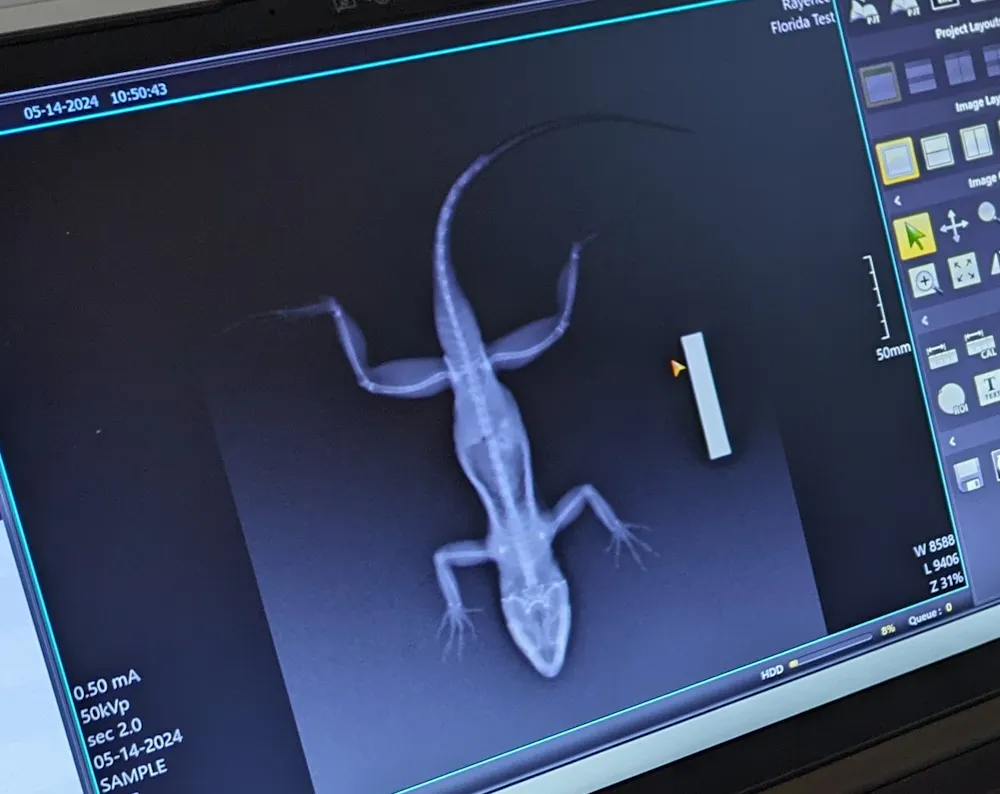
    Here, the real Olympic trials begin. Every athlete goes through a comprehensive evaluation. Our portable X-ray machine reveals their skeletal structure, and high-resolution scans capture the intricate details of their feet. This is particularly critical: Like their gecko cousins, anoles possess remarkable sticky toes that allow them to cling to smooth surfaces such as leaves and maybe even survive hurricanes.

    We also measure the shape and sharpness of their claws, as both features are crucial for these tree climbers. DNA samples provide a genetic fingerprint for each individual, allowing us to map family relationships across the island and see which is the most reproductively successful.

    A portable X-ray machine takes detailed measurements of a lizard’s skeleton.
    James Stroud

    The performance trials are where things get interesting. Imagine a tiny track meet for lizards. Using high-speed video cameras, we precisely test how fast each lizard runs, and using specialist equipment we measure how hard it bites and how strong it grips rough branches and smooth leaves.

    These aren’t arbitrary measurements – each represents a potential evolutionary advantage. Fast lizards might better escape predators. Strong bites might determine winners in territorial disputes. Excellent grip is crucial for tree canopy acrobatics.

    Each measurement helps us answer fundamental questions about evolution: Do faster lizards live longer? Do stronger biters produce more offspring? These are the essential metrics of evolution by natural selection.

    The identification code lets researchers track the lizard’s growth and survival.
    Neil Losin/Day’s Edge Prods.

    As afternoon approaches, the team relocates each piece of bright pink tape and returns the corresponding lizard to the exact branch it was caught on. The anoles now sport two tiny 3-millimeter tags with a unique code that lets us identify it when we recapture it in future research trips, along with a small dot of white nail polish so we know not to catch it immediately after we let it go.

    At 8:30 p.m., with the Lizard Olympics done for the day, we return to the island donning headlamps. Night brings a different perspective. Some of the most wily lizards are difficult to catch when fully charged by the midday Sun, so our nocturnal jaunts allow us to find them while they sleep. However, it’s often a race against time. Hungry lizard-eating corn snakes are also out hunting, trying to find the anoles before we do. As we wrap up another 16-hour day around 11:30 p.m., the team shares stories of the night.

    Should a snake climb along a branch where a baby anole sleeps, the lizard will wake up and drop to the ground to escape.
    James Stroud

    Evolution on the island

    Now spanning 10 years, 10 generations and five species, our Lizard Island dataset represents one of the longest-running active studies of its kind in evolutionary biology. By tracking which individuals survive and reproduce, and linking their success to specific physical traits and performance abilities, we’re documenting natural selection with unprecedented detail.

    So far we have uncovered two fascinating patterns. Initially, it didn’t pay to be different on Lizard Island. Anoles with very average shapes and sizes lived longer compared with those that are slightly different. But when the crested anoles arrived, everything changed: Suddenly, brown anoles with longer legs had a survival advantage.

    Anoles communicate with their dewlap, an expandable throat fan that signals other lizards.
    Jon Suh

    The Lizard Olympics is helping us understand why. The larger, more aggressive crested anoles are forcing brown anoles to spend more time on the ground, where those with longer legs might run faster to escape predators – allowing them to better survive and pass on their long-leg genes, while shorter-legged anoles might be eaten before they can reproduce.

    By watching natural selection unfold in response to environmental changes, rather than inferring it from fossil records, we’re providing cutting-edge evidence for evolutionary processes that Charles Darwin could only theorize about.

    These long days of observation are slowly revealing one of biology’s most fundamental processes. Every lizard we catch, every measurement we take adds another piece to our understanding of how species adapt and evolve in an ever-changing world.

    James T. Stroud does not work for, consult, own shares in or receive funding from any company or organization that would benefit from this article, and has disclosed no relevant affiliations beyond their academic appointment.

    ref. Amid a tropical paradise known as ‘Lizard Island,’ researchers are cracking open evolution’s black box – scientist at work – https://theconversation.com/amid-a-tropical-paradise-known-as-lizard-island-researchers-are-cracking-open-evolutions-black-box-scientist-at-work-246474

    MIL OSI – Global Reports

  • MIL-OSI USA: An Interview with Eva Schnitzler, Foreign Law Intern

    Source: US Global Legal Monitor

    Today’s interview is with Eva Schnitzler, a foreign law intern working with Foreign Law Specialist Jenny Gesley in the Global Legal Research Directorate of the Law Library of Congress. 

    Describe your background.

    I grew up in a small town in North Rhine-Westphalia, Germany, close to the border of the Netherlands. During my school days, I had the opportunity to attend high school in North Vancouver in Canada, and gained my first experiences living abroad.

    What is your academic/professional history?

    After graduating from high school, I started studying law and economics at the University of Bonn. The bachelor’s program focused on the economic analysis of law, which examines the effect of legal regulations on human behavior. During my studies, I spent a semester abroad at the Université de Fribourg in Switzerland, and worked as a research assistant at the Center for Advanced Studies in Law and Economics at the University of Bonn. After completing my Bachelor of Laws, I studied law at the University of Bonn and specialized in corporate and capital markets law. I passed the first German state exam in 2023, and started my two-year legal traineeship program at the Higher Regional Court of Cologne to qualify as a lawyer in Germany. During the previous parts of my legal traineeship, I worked at the Regional Court of Cologne, at the Public Prosecutor’s Office, at the German Federal Ministry of Finance in Berlin, and at a U.S. law firm in Cologne.

    How would you describe your job to other people?

    As a foreign law intern at the Global Legal Research Directorate of the Law Library of Congress, I assist my supervisor, Jenny Gesley, with providing legal expertise on German-speaking jurisdictions and the European Union in response to requests from Congress, executive agencies, or the courts. Additionally, I prepare articles for the Global Legal Monitor.

    Why did you want to work at the Law Library of Congress?

    Working in the Law Library of Congress is an amazing opportunity to get an insight into the work of the U.S. government. My internship at the Law Library of Congress is also a great opportunity to work at the interface of politics and law, and meet experts of different legal systems from all over the world.

    What is the most interesting fact you have learned about the Law Library of Congress?

    The underground tunnel system connecting the federal buildings including the Library of Congress is impressive. Formerly, the tunnel system in the Library of Congress was used to transfer books. Nowadays, the tunnels are used as pedestrian walks, and you can find a coffee shop or even a gym there.

    What’s something most of your co-workers do not know about you?

    I really enjoy skiing! At the age of three, I started skiing and have never missed a skiing season so far.


    Subscribe to In Custodia Legis – it’s free! – to receive interesting posts drawn from the Law Library of Congress’s vast collections and our staff’s expertise in U.S., foreign, and international law.

    MIL OSI USA News

  • MIL-OSI: CYREBRO Recognized in Gartner Emerging Tech Report for Detection and Response Startups

    Source: GlobeNewswire (MIL-OSI)

    RAMAT GAN, Israel, March 25, 2025 (GLOBE NEWSWIRE) — CYREBRO, the AI-native Managed Detection and Response (MDR), today announced its recognition as a leading detection and response startup in the Gartner report, Emerging Tech: Techscape for Detection and Response Startups. This acknowledgment highlights CYREBRO’s innovative approach to cybersecurity, leveraging advanced technology and expert analysis to combat evolving cyber threats.

    Among the key findings in the report:

    • Startups are experimenting with generative AI (GenAI) technologies. The use of AI agents/AI security operations center (SOC) analysts and GenAI remediation recommendations has become crucial for staying ahead of evolving threats.
    • The preemptive cybersecurity approach to detection and response has gained momentum, with startups working across complex threat intelligence, adopting purple team cultures, and improving their strategic industry offerings.

    CYREBRO has been identified as a key startup in the preemptive cybersecurity category, which highlights companies with a proactive strategy designed to prevent, disrupt, or deter cyberattacks before they can achieve their goals. CYREBRO’s inclusion validates its commitment to delivering comprehensive future-proof security solutions, providing organizations with a robust defense against diverse risks and cyberattacks.

    “We are honored to be recognized by Gartner for our emerging technology in the detection and response space,” said Ori Arbel, CTO of CYREBRO. “The report highlights the growing need for innovative detection and response solutions that can effectively address the increasing sophistication of cyberattacks. CYREBRO is committed to empower its partners and customers with cutting-edge solutions.”

    CYREBRO’s platform leverages advanced proprietary technology, including AI and machine learning, to precisely detect and respond to threats. By automating the correlation and prioritization of security events, CYREBRO ensures that businesses can focus on critical threats, minimizing disruption and maintaining operational continuity.

    Gartner, Emerging Tech: Techscape for Detection and Response Startups, 19 March 2025. Gartner is a registered trademark and service mark of Gartner, Inc. and/or its affiliates in the U.S. and internationally and is used herein with permission. All rights reserved.

    Gartner members can access the full report here. (For Gartner subscribers only).

    Gartner Disclaimer
    GARTNER is the registered trademark and service mark of Gartner Inc., and/or its affiliates in the U.S. and/or internationally and has been used herein with permission. All rights reserved. Gartner does not endorse any vendor, product, or service depicted in its research publications, and does not advise technology users to select only those vendors with the highest ratings or other designation. Gartner’s research publications consist of the opinions of Gartner’s research organization and should not be construed as statements of fact. Gartner disclaims all warranties, expressed or implied, with respect to this research, including any warranties of merchantability or fitness for a particular purpose.

    About CYREBRO
    CYREBRO is an AI-native, end-to-end Managed Detection and Response (MDR) solution, designed for hands-off or hands-on control through its future-proof SOC platform.

    With its advanced Security Data Lake revolutionizing SIEM and SOAR capabilities, CYREBRO includes 24/7 SOC monitoring and threat intelligence, augmented with exceptionally swift incident response and forensic investigations. CYREBRO delivers precision-guided threat detection and response across any tech stack, providing clear, actionable insights to ensure world-class security and compliance.

    With comprehensive visibility and expert guidance, CYREBRO empowers over 900 businesses of all sizes to manage threats proactively, enhancing their security posture and delivering full and complete protection.  

    Contact

    CMO
    Gil Harel
    CYREBRO
    media@cyrebro.io

    A photo accompanying this announcement is available at https://www.globenewswire.com/NewsRoom/AttachmentNg/b4610018-d64e-4d54-aec3-b74a8dfd8c81

    The MIL Network

  • MIL-OSI Video: Youth Policy Dialogues: Giving young people a voice for a better EU

    Source: European Commission (video statements)

    In the first 100 days of the mandate, one of the priorities of the Commission, was to give a voice to young people. Well, mission accomplished! The Commissioners each held their own Youth Policy Dialogues, discussing EU policies with European youth. After this first round of dialogues, they will be held annually.

    Watch on the Audiovisual Portal of the European Commission:
    Follow us on:
    -X: https://twitter.com/EU_Commission
    -Instagram: https://www.instagram.com/europeancommission/
    -Facebook: https://www.facebook.com/EuropeanCommission
    -LinkedIn: https://www.linkedin.com/company/european-commission/
    -Medium: https://medium.com/@EuropeanCommission

    Check our website: http://ec.europa.eu/

    https://www.youtube.com/watch?v=_LSe96Cmqs8

    MIL OSI Video

  • MIL-OSI Africa: Société Nationale des Pétroles du Congo (SNPC) Outlines Congo’s Gas Master Plan

    Source: Africa Press Organisation – English (2) – Report:

    BRAZZAVILLE, Congo (Republic of the), March 25, 2025/APO Group/ —

    In a bid to optimize the country’s gas potential and revitalize its hydrocarbons sector, the Republic of Congo’s National Oil Company Société Nationale des Pétroles du Congo (SNPC) has outlined its forthcoming Gas Master Plan (GMP). The plan is designed to promote gas utilization and attract foreign investment while reducing dependency on oil revenues and expanding the country’s power grid.

    The GMP was outlined by Dr. Bi-Dia-Ayo Ibata, Head of Associations Division and Supervisory Relations, SNPC during a Vision Congo & Gas Master Plan Technical Session on Day 0 of the inaugural Congo Energy & Investment Forum in Brazzaville.

    “The main objective of the Gas Master Plan is to develop an exploration strategy in the short- and long-term to contribute to the development of natural resources and contribute to economic diversification,” Ibata stated, adding, “The five main objectives are resource maximization, economic growth and diversification, social benefits, government revenue and attracting investment.”

    According to the GMP, gas-to-power should remain a priority for the country, with low gas prices to support sustainable growth. New industrial projects and LPG supply solutions are also recommended. A natural gas aggregator – potentially the SNPC – could balance the domestic market and prioritize strategic sectors. The plan also stresses the importance of the development of a natural gas policy, which will be essential for guiding sector growth.

    During the session, a presentation by the country’s Ministry of Hydrocarbons explored the gas potential of Congo and how a national strategy will help boost production, realize project development and drive electrification in the country.

    “The strategic objective of this strategy is to increase production of liquid and gas hydrocarbons. We aim to valorize hydrocarbons by taking profit from exports and local processing,” stated Hippolyte Tchininanga, Director General of Gaz Valorization, Ministry of Hydrocarbons.

    Meanwhile, the Ministry also presented its vision for a new Gas Code, which is expected to be released soon. The code aims to create an enabling, attractive environment for foreign investment to contribute to the development of natural gas. The Gas Code will also govern the legal and regulatory terms of natural gas exploration and development in Congo.

    “The scope of the upcoming Gas Code includes exploration activities, development, exploitation, aggregation, collection, transport and storage of natural gas,” stated Faida Ebenga, Administrative and Legal Advisor at the Ministry of Hydrocarbons, adding, “Approval of the Gas Code is imminent. We consider the Gas Code ready to be transmitted to the Secretary General of the government for approval.”

    One of Congo’s flagship natural gas projects is energy supermajor Eni’s Congo LNG project. With a planned capacity of 2.4 million tons per annum, the project provides 70% of the country’s electricity through natural gas. Phase 2 of the Congo LNG project is currently under construction.

    “Phase 2 is being executed right now. As part of the project, we aim to have 38 new wells in development. We want to install six new wellhead platforms, one new separation and boosting hub, a new onshore gas pre-treatment plant, two FLNG facilities and finally have a liquefaction capacity of 3 million tons per annum,” stated Alberto Nocerino, Technical Director, Eni Congo.

    MIL OSI Africa

  • MIL-OSI China: Asia remains key growth engine for global economy

    Source: China State Council Information Office

    Despite increasing global economic uncertainty, Asia has remained a key growth engine for global economy, according to a report released at the Boao Forum for Asia (BFA) on Tuesday.

    The weighted real GDP growth rate of Asia is projected to reach 4.5 percent in 2025, an increase from 4.4 percent in 2024, according to the annual report titled “Asian Economic Outlook and Integration Progress.”

    Addressing a press conference on Tuesday, BFA Secretary General Zhang Jun said that the region is nurturing new potential and opportunities and has become an important force and cornerstone stabilizing and underpinning the global economy.

    Asian economies, particularly China and the ASEAN, continue to demonstrate strong resilience despite numerous challenges, leading the world in areas including economic growth, trade in goods and services, and regional integration, Zhang said.

    Asia’s economic performance last year beat the projections made by institutions such as the World Bank, the International Monetary Fund and the United Nations, said Zhang Yuyan, a professor on international politics and economics with the University of Chinese Academy of Social Sciences.

    Founded in 2001, the BFA is a non-governmental and non-profit international organization committed to promoting regional economic integration and bringing Asian countries closer to their development goals.

    Themed “Asia in the Changing World: Towards a Shared Future,” this year’s forum bears great practical and long-term significance as global development is clouded with increased uncertainties due to rising unilateralism, trade protectionism and geopolitical tensions, according to analysts.

    At purchasing power parity, the ratio of Asia’s GDP among the global total will rise to 48.6 percent in 2025, up from 48.1 percent in 2024, the report estimated.

    It noted that global foreign investments have increased their reliance on Asian economies amid fluctuations, and China and the ASEAN are the most appealing economies in Asia.

    As the world’s most economically dynamic region, Asia has become an increasingly vital player in global cross-border direct investment, with the inward and outward foreign direct investment dependence of Asian economies on the region itself reaching 49.15 percent in 2023, according to the report.

    It also noted that China continues to be the center of global manufacturing value chains.

    Since 2017, global trade in intermediate goods has been more reliant on China than on North America. Global dependence on China for intermediate goods stood at 16 percent in 2023, compared with 15 percent for North America.

    The trade frictions initiated by the United States in 2018 have not strengthened its position in the global manufacturing value chains, the report noted.

    China and Asia have become the center of free trade, said Temir Porras, managing director of Global Sovereign Advisory, stressing that it is always positive to see that China is committed to promoting free trade and sharing development opportunities with the world.

    As a major achievement of Asian economic integration, the Regional Comprehensive Economic Partnership (RCEP) has injected new vitality into the member economies, bringing certainty into the uncertain global economy and trade landscape, the report said.

    In 2024, the total trade value within the region rose about 3 percent from a year ago, with trade among most member economies achieving year-on-year growth, data showed.

    A report on Asia’s sustainable development was also unveiled on Tuesday, highlighting the region’s rapid progress in emerging green technologies, positioning it as a potential leader in advanced battery materials and biodegradable plastics, among others.

    China now sources 85 percent of its new energy capacity from renewables, while Indonesia and Singapore are leading efforts in carbon capture and storage, according to this report.

    MIL OSI China News

  • MIL-OSI China: Shanghai home to 4 industrial clusters at the trillion-yuan level

    Source: People’s Republic of China – State Council News

    SHANGHAI, March 25 — China’s Shanghai Municipality has nurtured four industrial clusters at the trillion-yuan level in the fields of electronics and information technology, automobiles, high-end equipment, and software and information services, according to the Shanghai Global Investment Promotion Conference, which opened on Tuesday.

    In 2024, the scale of the city’s electronics and information technology sector reached 1.2 trillion yuan (about 167 billion U.S. dollars). Shanghai’s automotive cluster reported a scale of 1.1 trillion yuan last year, with nearly 280,000 local plates issued for NEVs during the period.

    The city has also been engaged in the development of other key industrial chains, including integrated circuits, biopharmaceuticals, artificial intelligence, fashion consumer goods, advanced materials, and new energy and green low-carbon solutions.

    The conference offered 15.42 million square meters of space, supported by 50.9 billion yuan in industrial ecosystem funding, for investment projects. Through policy incentives, resource matching and favorable services, the city is providing global innovators and enterprises with first-mover scenarios and project opportunities.

    “Shanghai is not only home to Otis China’s headquarters but also our global R&D center,” said Judy Marks, chair, CEO and president of Otis, an elevator industry leader. “We have full confidence in our development in the Chinese market and are committed to long-term growth here.”

    MIL OSI China News

  • MIL-OSI: February 2025: New Business Volumes Rebound

    Source: GlobeNewswire (MIL-OSI)

    • FORECAST: Our forecast framework, which uses past values of CFI and durable goods orders to predict future changes in topline durable goods orders, expects a 0.47% contraction in new orders in February.
    • Total new business volume (NBV) rose by $9.7 billion seasonally adjusted among surveyed ELFA member companies, an increase of 3.7% from the prior month.
    • NBV year-to-date contracted by 3.7% relative to the same period in 2024.
    • The year-over-year change declined by 7.4% on a non-seasonally adjusted basis.
    • Charge-offs (losses) rose to 0.55%, near the two-year high seen last November.

    WASHINGTON, March 25, 2025 (GLOBE NEWSWIRE) — “The latest CFI release showed a return to normalcy in February. Demand for equipment returned to healthy levels after whipsawing the last few months due to a historic swing in financing activity at banks,” said Leigh Lytle, President and CEO at ELFA. “Financial conditions weakened a little as losses rose, but accounts past 30 days remained low, and new applications remained strong. 2025 is shaping up to be bumpy, but so far, the data indicates that demand for investment equipment has weathered the storm. We’re closely watching financial conditions for signs of erosion, but we expect the industry to have a solid year as long as the economy avoids a recession.”

    New business volumes rebounded. Volumes increased on a seasonally adjusted basis, posting a similar level of new business activity as the previous two February reports. Activity grew at banks and captives, with new business volumes expanding month-over-month by 0.9% and 15.0%, respectively. Financing at independents dropped by 6.4% after growing by 8.6% in the previous month. Despite the cooling, financing activity at independents has gained ground over the last five years. From 2017 to 2019, independents comprised roughly 16% of all new business activity. That number jumped to 20% of all activity from January 2024 through February 2025. The share of activity at captives also increased by around 2.25 percentage points, while bank activity fell by almost 7.5 percentage points.

    The pace of job losses slowed. After picking up speed for three months, the pace of job losses slowed in February. The sector was still down 2.4% over the last 12 months, mainly driven by a 6.4% contraction in employment at captives. Banks also experienced a 1.6% loss in headcount over the last year, while independents saw employment rise by 1.0%.

    Credit approvals continue to hover around 75%. The average credit approval rate dropped to 75.4%, a decline of roughly half a percentage point. However, the rate remains well above the levels seen at the end of 2024.

    Financial conditions somewhat weakened. Aging receivables over 30 days dropped back down to 2.0%, a decline of 0.2 percentage points. However, charge-offs (losses) rose to 0.55%, the second-highest level in the last two years. The increase in losses was driven by a rise in charge-offs at independents and banks. While the average loss rate rose, the loss rate for small ticket activity dropped after a notable jump in the prior month.

    “KeyBank remains optimistic as credit quality continues well within historical norms, capital is abundant and the desire for earning assets is strong,” said Peter Bullen, Executive Vice President & Group Head, Key Equipment Finance. “We are also encouraged to see a significant rebound from Key Equipment Finance clients in equipment financing demand compared to last year at this time. At the same time, we remain vigilant of the potential impact of new tariffs and general economic uncertainty on capital spending.”

    Industry Confidence
    The Monthly Confidence Index from ELFA’s affiliate, the Equipment Leasing & Finance Foundation, dropped to 58.1 in March, as respondents grew slightly more pessimistic about conditions over the next four months.

    About ELFA’s CFI
    The CapEx Finance Index (CFI) is the only near-real-time index that reflects capex, or the volume of commercial equipment financed in the U.S. It is released monthly from Washington, D.C., one day before the U.S. Department of Commerce’s durable goods report. This financial indicator complements reports like the Institute for Supply Management Index, providing a comprehensive view of productive assets in the U.S. economy—equipment produced, acquired and financed. The CFI consists of two years of business activity data from a survey of industry leaders. For more details, including methodology and participants, visit www.elfaonline.org/CFI.

    About ELFA
    The Equipment Leasing and Finance Association (ELFA) represents financial services companies and manufacturers in the $1 trillion U.S. equipment finance sector. ELFA’s over 600 member companies provide essential financing that helps businesses acquire the equipment they need to operate and grow. Learn how equipment finance contributes to businesses’ success, U.S. economic growth, manufacturing and jobs at www.elfaonline.org.

    Follow ELFA:
    X: @ELFAonline
    LinkedIn: https://www.linkedin.com/company/115191

    Media/Press Contact: Krishna Magalona, PR Manager, ELFA, Krishna@360livemedia.com

    PDF available: http://ml.globenewswire.com/Resource/Download/2c9bc990-d3e7-41bd-b8ba-30e898f165dd

    The MIL Network

  • MIL-OSI: LPO MSA Announces Release of Specification for Linear Pluggable Optical Modules

    Source: GlobeNewswire (MIL-OSI)

    SAN FRANCISCO, March 25, 2025 (GLOBE NEWSWIRE) — OFC2025 — The LPO MSA (Linear Pluggable Optics Multi-Source Agreement) Group announced today the completion and availability of the 100 Gb/s per lane Linear Pluggable Optics Single-Mode Optical Data Transmission specification, targeting up to 800 Gigabit Ethernet connectivity. The LPO MSA is composed of 50 industry-leading networking, semiconductor, and optics companies.

    This specification is a significant milestone for both the LPO MSA and networking industry. The 100G-DR-LPO specification has been validated by extensive member interoperability testing to confirm that it meets the LPO MSA’s goal of enabling broad market adoption of linear pluggable fiber optic links. The specification defines the necessary optical and electrical requirements for a robust ecosystem of LPO-compatible switch, NIC and module products. The specification covers 100 Gb/s, 200 Gb/s, 400 Gb/s and 800 Gb/s Ethernet parallel single-mode links, addressing the industry-wide challenge of reducing power, cost, and latency while ensuring the reliability of high-speed optical interconnects used in AI/ML applications. With participants representing system, module, and IC manufacturers, the February 2025 interoperability event demonstrated margins above the required link performance while successfully interfacing with a diverse ecosystem of link partners.

    LPO MSA Specification Update
    Building upon other industry standards such as IEEE 802.3 and OIF, the LPO MSA specification includes component, module, and system-level interoperability requirements that span both the electrical and optical interfaces operating at 100 Gb/s per lane. This specification can be found on the LPO MSA website: Specifications and White Papers

    LPO MSA 200G per Lane Plans
    With the completion of the 100 Gb/s per lane specification, the LPO MSA has set its sights on 200 Gb/s per lane linear implementations. It plans to work with standards development organizations such as OIF and IEEE to achieve a similar value proposition of lowering power, cost, and latency at this next speed.

    “We are very impressed with the active multi-company collaboration on the LPO MSA specification,” said Mark Nowell, LPO MSA Chair, “which enabled a rapid response to the market needs for an interoperable LPO ecosystem.”

    “The hard work of the MSA member companies has resulted in a very solid specification,” said Andreas Bechtolsheim, LPO MSA Co-Chair, “This allows large datacenter operators to deploy 800G LPO modules in volume with confidence.”

    “It has been exciting to see the growth of the LPO MSA and the broad participation from all parts of the networking ecosystem,” said Ryan Latchman, LPO MSA Marketing Chair. “This clearly demonstrates the benefits of using open standards to drive optimal interconnect solutions.”

    Please visit https://www.lpo-msa.org/ for more information.

    About the LPO MSA
    The LPO MSA has 50 industry-leading networking, semiconductor, and fiber optics companies and develops specifications for networking equipment and optical modules required to enable a broad ecosystem of interoperable LPO solutions. These specifications target the industry-wide challenge of reducing power, cost, and latency, while improving the reliability of high-speed optical interconnects.

    Caution Concerning Forward-Looking Statements
    We are disclosing forward-looking information so that investors, potential investors, and other owners can better understand the mentioned Companies’ prospects and make informed investment decisions. The information in this press release contains “forward-looking statements” within the meaning of the Private Securities Litigation Reform Act of 1995. These statements can be identified by the fact that they do not relate strictly to historical or current facts. Any forward-looking statement made by the Companies speak only as of the date on which it is made. The Companies are under no obligation to, and expressly disclaim any obligation to, update or alter their forward-looking statements, whether because of new information, subsequent events or otherwise.

    Contact: contact@lpo-msa.org
    Info: LPO MSA Marketing

    A photo accompanying this announcement is available at https://www.globenewswire.com/NewsRoom/AttachmentNg/818e8098-7345-4aa7-8a15-a4559102d32b

    The MIL Network

  • MIL-OSI: Jamf Earns 5-Star Rating in the 2025 CRN® Partner Program Guide

    Source: GlobeNewswire (MIL-OSI)

    MINNEAPOLIS, March 25, 2025 (GLOBE NEWSWIRE) — Jamf (NASDAQ: JAMF), the standard in managing and securing Apple at work, has been honored by CRN®, a brand of The Channel Company, with a 5-Star Award in the 2025 CRN Partner Program Guide. This annual guide is an essential resource for solution providers seeking vendor partner programs that match their business goals and deliver high partner value.

    The extensive support and resources technology vendors offer through their partner programs are a critical consideration for managed service providers and resellers when selecting vendors to partner with. Program elements such as financial incentives, sales and marketing assistance, training and certification, technical support and more can set vendors apart and play a key role in boosting their partners’ long-term growth and profitability.

    The 5-Star Award is an elite recognition given to companies that have built their partner programs on the key elements needed to nurture lasting, profitable, and successful channel partnerships.

    For the 2025 Partner Program Guide, the CRN research team evaluated vendors based on program requirements and offerings such as partner training and education, pre- and post-sales support, marketing programs and resources, technical support, and communication.

    In 2024, Jamf launched its new Global Partner Program, leveraging a new points-based system to offer the right benefits to partners at the right time, based on their unique value propositions and business models. The Jamf Global Partner Program reaches partners in over 70 countries worldwide to help organizations of all industries and sizes succeed with Apple.

    With clear tier definitions and access to Jamf’s wide range of tools, the new partner portal, the “Jamf Partner Hub,” offers a “one stop shop” for Jamf’s partner community, offering them the ability to monitor deal registration status, check on upcoming customer renewals, complete training certifications and a host of other co-selling functionality.

    “We are honored to receive the 5-star award in the 2025 CRN Partner Program Guide,” said Marc Botham, Global Vice President of Channel and Alliances at Jamf. “Jamf is a channel-first company, and we are proud of our Global Partner Program which is only six months old and already delivering substantial benefits to our partner ecosystem. We remain committed to improving the way we work with partners so that they can better serve Jamf customers while growing their business.”

    “Being featured on the 2025 CRN Partner Program Guide highlights the dedication these technology vendors have to evolving with solution providers, driving innovation, and supporting mutual success,” said Jennifer Follett, VP, U.S. Content and Executive Editor, CRN, at The Channel Company. “This critical annual project empowers solution providers to identify vendors that are committed to enhancing their partner programs and meeting the always-changing business needs of the channel and end customers. The guide provides deep insight into the distinctive value of each partner program so solution providers can make strategic partnership decisions with confidence.”

    The 2025 Partner Program Guide will be featured in the April 2025 issue of CRN and published online at www.CRN.com/PPG beginning March 24, 2025.

    About Jamf

    Jamf’s purpose is to simplify work by helping organizations manage and secure an Apple experience that end users love and organizations trust. Jamf is the only company in the world that provides a complete management and security solution for an Apple-first environment that is enterprise secure, consumer simple and protects personal privacy. To learn more, visit www.jamf.com

    About The Channel Company:

    The Channel Company (TCC) is the global leader in channel growth for the world’s top technology brands. We accelerate success across strategic channels for tech vendors, solution providers, and end users with premier media brands, integrated marketing and event services, strategic consulting, and exclusive market and audience insights. TCC is a portfolio company of investment funds managed by EagleTree Capital, a New York City-based private equity firm. For more information, visit thechannelco.com.

    Media Contact:

    Liarna La Porta | media@jamf.com

    Investor Contact:

    Jennifer Gaumond | ir@jamf.com

    The MIL Network

  • MIL-OSI: EquityZen Partners with Yahoo Finance to Broaden Access to Private Market Data

    Source: GlobeNewswire (MIL-OSI)

    NEW YORK, March 25, 2025 (GLOBE NEWSWIRE) — EquityZen, the leading pre-IPO marketplace for individual accredited investors, is excited to partner with Yahoo Finance to empower individual investors with the information they need to invest in private markets. Through the partnership, EquityZen will be Yahoo Finance’s exclusive provider of proprietary firm data and private market insights, enabling their users to delve into leading companies, opportunities, and trends in private markets.

    Investors seeking information on private companies can now find EquityZen’s key summaries and facts about individual private companies on Yahoo Finance’s platform. In addition, Yahoo Finance will show EquityZen’s ticker symbols, private market comparables, sector data, and more across Yahoo Finance’s individual private company pages, index pages, and Private Markets Hub.

    “We’re proud to partner with Yahoo Finance as an industry leader in informing and empowering the millions of individual investors who find data and insights on their platform. This partnership represents a leap forward in our mission to make private markets more accessible to the wider public,” said Atish Davda, CEO at EquityZen.

    “At EquityZen over the last 10 plus years, we’ve seen the private markets become the proven home of innovation. Our goal has always been to arm both investors and shareholders with the information, data, and tools needed to make smart investment decisions in private companies,” Mr. Davda added. “Through our partnership with Yahoo Finance, an even broader set of investors will now have access to EquityZen’s proprietary private market data, derived from over 45,000 private market transactions that we’ve enabled in nearly 500 pre-IPO companies since 2013.”

    “We’re thrilled to partner with EquityZen, a longtime leader in the private markets space,” says Tapan Bhat, President and General Manager of Yahoo Finance. “Through this new partnership, investors can now track both public and private markets in one place, gaining access to historically hard-to-find private company information in a place they already know and trust. As companies stay private longer, this is undoubtedly an emerging sector that shouldn’t be ignored and, together with EquityZen, we look forward to unlocking even more opportunities for investors moving forward.”

    With the abundance of capital available to growing private companies, many companies are delaying their IPO plans and staying private longer. This means that public market investors are missing out on the growth opportunities happening in the private markets, in industries ranging from AI to fintech, cybersecurity, and green energy.1 EquityZen continues its pursuit to solve this by offering investments in leading pre-IPO companies for accredited investors. EquityZen’s platform offers investment minimums as low as $5,000 for qualified individuals while also supporting trades for institutional investors as large as over $20 million.

    Knowledge is crucial to level the playing field and allow individual accredited investors to participate in the investments that are core to most institutional and ultra high net worth portfolios. EquityZen is dedicated to surfacing data and insights to empower individuals within the private markets – from the Private Market Map, a visual representation of the private market ecosystem2, to bespoke capitalization table analysis and exclusive EquityZen Insights.

    To learn more about EquityZen and private market investing, join today.

    About EquityZen
    Since 2013, the EquityZen marketplace has enabled the buying and selling of shares in private companies. EquityZen brings together over 700,000 investors and shareholders, providing liquidity to early shareholders and private market access to accredited investors for as little as $5,000 up to well over $5 million. Having completed more than 45,000 private placements in more than 450 private companies, EquityZen leads the way in delivering “Private Markets for the Public”.

    Media Contact
    Deborah Kostroun, Zito Partners
    deborah@zitopartners.com
    +1 (201) 403-8185

    1 Not all pre-IPO companies will go public or be acquired, and not all IPOs or acquisitions are or will become successful investments. There are inherent risks in pre-IPO investments, including the risk of loss of the entire investment, illiquidity, and fluctuations in value and returns. Investors must be able to afford the loss of their entire investment.

    2 The Private Market Map is intended for reference only and does not constitute a recommendation or personal financial advice. Use of this information is at the user’s discretion and risk.

    The MIL Network

  • MIL-OSI Russia: HSE University Presents Results of Rating Study of Creative Industries in Russian Regions

    Translartion. Region: Russians Fedetion –

    Source: State University Higher School of Economics – State University Higher School of Economics –

    Institute for the Development of Creative Industries Faculty of Creative Industries The National Research University Higher School of Economics conducted a study, within the framework of which a rating of the development of creative industries in the regions was compiled. This study assessed both the state of creative industries in the region as a whole and the efforts of local authorities to develop the potential of territories.

    The study developed and tested a new approach to ranking the subjects of the Russian Federation by the level of development of creative industries. This approach allows us to identify groups of territories, each of which is characterized by its own level of development of both the creative industries themselves and their infrastructure.

    The developers divided the regions into 3 rating groups:

    Group A – regions with high rates of development of creative industries; in this group, regions are distinguished mainly by a comprehensive system of measures to support creative entrepreneurship.

    Group B — regions with lower assessments of creative industries development indicators. With the exception of several regions in this group, at least two elements of the system of measures to support creative industries have been implemented in the regulatory field.

    Group C — regions where creative industries development indicators have significant growth potential, but are currently at a low level. With rare exceptions, in the regions of this group the system of measures to support creative entrepreneurship is in the process of formation.

    In all of the creative industries considered and studied, the leaders of Group A were Moscow, the Moscow Region, and St. Petersburg. Moscow, the Moscow Region, St. Petersburg, Krasnodar Krai, and the Sverdlovsk Region occupy leading positions in the development of IT, architecture, design, photo industry, event and advertising industries.

    Tyumen Oblast and Krasnodar Krai are among the top 5 in terms of gastronomy development; Voronezh Oblast and Krasnodar Krai are among the top 5 in terms of game design and computer graphics development; Novosibirsk Oblast, Krasnodar Krai, the Republics of Tatarstan and Bashkortostan are among the top 5 in terms of animation and film industries; Krasnodar Krai and Tatarstan are among the top 5 in terms of media and publishing industry development. Chelyabinsk Oblast, Crimea and Tatarstan are among the top 5 in terms of folk crafts and trades industry development; Sverdlovsk Oblast and the Republic of Tatarstan are among the top 5 in terms of television and radio, as well as theatre and performing arts.

    Ivanovo and Novosibirsk regions entered the top five leaders of Group A in the development of the fashion industry, Yaroslavl region and the Republic of Tatarstan – museums and galleries, Arkhangelsk region, Krasnodar region and the Republic of Sakha – the music industry.

    The leading regions contain 44.3% of organizations implementing specialized activities in the field of design, 76.3% of companies implementing activities in the field of architecture, and up to 69.8% of the number of organizations engaged in the production of folk arts and crafts.

    The distribution of companies from various creative industries across regions is uneven. For example, game design is one of the industries with a pronounced geographical concentration – according to statistics, this industry is practically not represented in a number of regions. And in 35 regions of Russia, commercial art galleries and organizations for the retail sale of works of art in commercial art galleries were not registered.

    The results of the study confirmed the uneven development of creative industries in the subjects of the Russian Federation, as well as the direct influence of the systemic efforts of regional administrations on the level of development of creative industries. Also important factors in the development of creative industries in the regions are specialized education, tourism and a number of other related industries and areas of activity, in addition, there is a connection between the infrastructure at the regional level and the results of the development of the creative industries themselves.

    Please note: This information is raw content directly from the source of the information. It is exactly what the source states and does not reflect the position of MIL-OSI or its clients.

    MIL OSI Russia News

  • MIL-OSI Security: Ames Nurse Practitioner and Business Owner Sentenced to Life in Prison for Sexually Abusing and Trafficking Dozens of Children and Adults

    Source: United States Department of Justice (Human Trafficking)

    DES MOINES, Iowa – An Ames man was sentenced today to life in federal prison on each of fifteen counts of sex trafficking by fraud and coercion.

    According to public court documents and evidence presented at sentencing, Carl Dale Markley, 45, from at least 2001 to April 2023, used fraud and coercion to cause dozens of teenage boys and young men, and a few young women, to engage in sex acts in exchange for money or some other benefit. Markley was a nurse practitioner in Ames and owned several businesses. Over a course of years, Markley used his professions and position in the community to befriend and gain the trust of victims, and then groom and repeatedly sexually abuse them. For a number of victims, Markley placed hidden cameras in locations to record this abuse.

    Markley exploited the trust his victims placed in him. He lied to victims that sex acts and sexual contact were needed because, among other things, he was conducting research for various research institutions or sexual-health companies, his insurance company required victims to undergo physicals which he could perform, or he was obtaining advanced degrees. None of Markley’s justifications were true.

    The criminal investigation into Markley’s activities began in December 2022, when the Ames Police Department received a complaint that Markley had been conducting physicals on minor male children without parental consent. Ultimately, the Ames Police Department, Federal Bureau of Investigation, and the Iowa Department of Public Safety’s Division of Criminal Investigation interviewed hundreds of victims and witnesses, completed roughly thirty-five search warrants, and obtained documents and other materials from various research institutions and sexual-health-related entities. They also seized and searched dozens of electronic devices, including seven cellphones and ten computers determined to be Markley’s and on which they located the hidden-camera materials Markley had created, internet-based child pornography, including images depicting children under the age of twelve, and other evidence of Markley’s crimes.

    At sentencing, Markley continued to provide false justifications for his behavior. Chief District Judge Stephanie M. Rose described Markley’s claims as “delusional.”

    In November 2023, Markley was charged with 17 federal crimes, including 15 counts of sex trafficking by fraud and coercion, one count of sexual exploitation and attempted sexual exploitation of a child, and one count of possession of child pornography. In November 2024, Markley pleaded guilty to the 15 sex-trafficking counts.

    “This case is a stark reminder that those who abuse positions of trust for personal gain will be held accountable,” said Ames Police Department Police Chief Geoff Huff. “We commend the bravery of the victims who came forward and the relentlessness of our officers and partner agencies in bringing this perpetrator to justice.”

    FBI Omaha Special Agent in Charge Eugene Kowel said, “Carl Markley used trust and manipulation to exert control over his victims and fulfill his criminal sexual fantasies. His young victims suffered reprehensible abuse. The FBI and our local, state, and federal partners are committed to bringing sexual predators to justice, holding them accountable for their crimes and helping to provide a path towards healing for survivors.”

    DCI Assistant Director Don Schnitker said, “Today marks a significant victory in Iowa’s ongoing fight against human trafficking.  The survivors in this case showed immense bravery in coming forward, and today’s outcome ensures that Markley will never harm another person again.”

    “Markley’s life sentence was absolutely warranted and necessary to permanently prevent anyone from being victimized by him again,” said United States Attorney Richard Westphal. “His defiance and failure to accept responsibility only exemplifies what a monstrous sexual predator he is. Our gratitude to the courage of the victims in this investigation and the dedication of the law enforcement personnel who identified and proved Markley’s horrendous acts of sex trafficking and abuse.”

    United States Attorney Richard D. Westphal of the Southern District of Iowa made the announcement. This criminal case was investigated jointly by the Ames Police Department and the Federal Bureau of Investigation, with assistance from the Iowa Department of Public Safety’s Division of Criminal Investigation. Assistant United States Attorneys Kyle J. Essley and Amy L. Jennings prosecuted the case with the assistance of Victim Witness Specialist Charlotte Kovacs.

    Human trafficking is a crime involving the exploitation of youth under the age of 18 for commercial sex; the exploitation of adults for commercial sex through the use of force, fraud, or coercion; and the exploitation of any individual for compelled labor. Human trafficking does not require the transportation of individuals across state lines, or that someone is physically restrained. Signs that a person is being trafficked can include working excessively long hours, unexplained gifts, physical injury, substance abuse issues, running away from home, isolation from others, or having a person in their life controlling them or monitoring them closely. Victims particularly susceptible to being trafficked include those with criminal histories, a history of physical or sexual abuse, uncertain legal status, and dependency on controlled substances.

    Anyone who suspects human trafficking is occurring, be it a minor engaging in paid sex acts, or anyone being coerced into prostitution or labor, is urged to call the National Human Trafficking Hotline at 1-888-373-7888. If anyone has information about this case, they are urged to call the Ames Police Department, FBI, or Iowa’s Division of Criminal Investigation, or call the National Human Trafficking Hotline.

    MIL Security OSI

  • MIL-OSI: FloQast Launches Auditable AI Agents to Bridge the Talent Gap and Elevate Accountants from Preparers to Strategic Reviewers

    Source: GlobeNewswire (MIL-OSI)

    LOS ANGELES, March 25, 2025 (GLOBE NEWSWIRE) — FloQast, an Accounting Transformation Platform created by accountants for accountants, today announced the launch of FloQast™ AI Agents, a groundbreaking, auditable AI capability that, for the first time ever, enables accountants to automate complex, recurring workflows across close management, compliance, and reporting functions using natural language, not extensive code. FloQast’s new technology brings all-new capabilities to the accounting and finance space, giving accountants the ability to use out-of-the-box agents, leverage templated agents, or custom-create their own AI Agents, ensuring workflows are purpose-built and tailored to accountants’ unique ways of working and organizational goals. As the talent gap in the accounting and finance industry continues to increase, this first-to-market capability empowers teams to do more with less and evolve from preparers into reviewers, able to focus on strategic initiatives while AI handles repetitive, time-consuming tasks.

    FloQast AI Agents Drive Accounting Innovation
    According to Gartner® in the 2024 Gartner Current State of AI Use Within Finance report, “Finance leaders are increasingly optimistic about AI’s potential for their organization. In fact, 66% of finance leaders report being more optimistic about AI’s impact compared to the last year.”* As organizations prepare to allocate more resources to AI deployment, FloQast is proud to introduce one of the most significant product innovations in the company’s history—one that is already delivering measurable impact for customers leveraging it today. FloQast is launching three AI Agents to start:

    1. Journal Entry Agent: Automates the creation of journal entries, such as Coupa Accruals, which automates the complex process of creating and posting accrual entries from Coupa data.
    2. Data Transformation Agent: Standardizes unstructured data using natural language, not extensive code, allowing accounting teams to automate the preparation of work related to key tasks, reconciliations, compliance, or reporting activities.
    3. Custom Agent: Enables customers to create their own Agents to automate workflows of their choice.

    FloQast’s custom AI agent capabilities will soon expand, allowing users to create their own agents key categories that include Data Transformation, Journal Entry, Tasks, Reconciliations, Financial Insights, and Compliance. This comprehensive approach ensures that accounting teams can automate workflows across every aspect of their operations, from routine tasks to complex, organization-specific processes.

    “The accounting profession is under more pressure than ever, with shrinking talent pools, heavier workloads, and growing demands for strategic insights,” said Mike Whitmire, CEO of FloQast, CPA. “FloQast AI Agents put accountants in the driver’s seat, shifting them from preparers to reviewers with AI automation built for their processes—fully auditable and designed for trust. And, as CFOs struggle to fill open roles on their teams, FloQast AI agents are poised to be an invaluable resource to help plug that gap and help teams work smarter, stay in control, and deliver the insights that move businesses forward.”

    FloQast is taking a deliberate approach to AI, ensuring each new AI Agent meets the highest standards of reliability and trust. With auditable AI at its core, FloQast is one of few organizations in the world to have obtained ISO 42001 certification, setting industry-best standards for AI management and reinforcing security, accuracy, and governance across all AI-powered workflows. As a leader in accounting automation, FloQast brings unique credibility to AI, prioritizing ethical and transparent practices. To support adoption, FloQast offers certification courses through FloQademy, equipping users to maximize AI-powered automation with confidence.

    FloQast Transform Puts Accountants in Control 
    At the heart of this advancement is FloQast Transform, an all-new, powerful product within FloQast’s Accounting Transformation Platform that serves as a centralized hub where customers can easily create, test, deploy, and manage FloQast AI Agents. While FloQast will continue to develop AI Agents for all customers to use, even more power lies in the ability of customers to create their own Agents using FloQast Transform. This capability recognizes that accounting processes are complex, ever-changing, and often unique to each enterprise. With FloQast Transform, accounting teams can create bespoke automation for their specific needs without waiting for vendor-built solutions or an extensive demand from IT.

    “Today’s accountants have an opportunity to focus on higher-level, strategic work, driving more value and increasing their presence within their organizations,” said Edwine Alphonse, Senior Controller at Ramp. “Accountants who embrace AI will be more effective and impactful, while those who don’t risk being left behind. FloQast is built to align with the way accountants and auditors work, empowering them to leverage AI for better outcomes.”

    The release of FloQast AI Agents and FloQast Transform builds upon FloQast’s Accounting Transformation Platform launched in September 2024, which encompasses four key solutions: Close Optimization, Close Automation, Connected Compliance, and Integrated Record-to-Report.

    For more information about FloQast AI Agents and FloQast Transform:

    *Gartner, The Current State of AI Use Within Finance, Rajat PandeyMarco Steecker, 23 August 2024

    GARTNER is a registered trademark and service mark of Gartner, Inc. and/or its affiliates in the U.S. and internationally and is used herein with permission. All rights reserved.

    About FloQast
    FloQast, an Accounting Transformation Platform created by accountants for accountants, enables organizations to automate a variety of accounting operations. Trusted by more than 3,000 global accounting teams – including Twilio, Los Angeles Lakers, and Zoom – FloQast enhances the way accounting teams work, enabling customers to automate close management, account reconciliations, accounting operations, and compliance activities. With FloQast, teams can utilize the latest advancements in AI technology to manage aspects of the close, reduce their compliance burden, stay audit-ready, and improve accuracy, visibility, and collaboration overall. FloQast is consistently rated #1 across all user review sites. Learn more at FloQast.com.

    Contact:
    Kyle Cabodi
    FloQast Director of Corporate Communications
    kyle.cabodi@floqast.com

    The MIL Network

  • MIL-OSI: iManage uses Microsoft Co-Authoring to unlock smarter, more efficient collaboration

    Source: GlobeNewswire (MIL-OSI)

    CHICAGO, March 25, 2025 (GLOBE NEWSWIRE) — iManage, the company dedicated to Making Knowledge Work™, today announced that the Microsoft Co-authoring capability within the iManage knowledge Work platform is now generally available, enhancing collaboration for customers of all sizes, providing an easy way for knowledge workers to work on Microsoft Word, Excel, and PowerPoint documents simultaneously across teams.

    Professionals can effortlessly collaborate on documents in real-time or at their own pace, with no need to wait for colleagues to finish before making forward progress. The ability to access and edit content on the iManage platform from anywhere, and co-author documents in real time, reduces friction around collaboration and boosts efficiency, security, and productivity.

    “Next Generation co-authoring will serve as a powerful productivity driver for the iManage knowledge work platform,” said Neil Araujo, CEO, iManage. “Benefiting from our deep partnership with Microsoft allows us to give customers a new way to achieve seamless, secure, and efficient document collaboration, without disrupting their workflows or compromising security or compliance. We are pleased to see so many of our customers taking advantage of iManage and Microsoft Co-authoring to optimize their overall productivity and their ability to deliver the best tools to their workforce to collaborate safely and efficiently.”

    Additional key benefits of Microsoft Co-authoring include the ability to maintain full control and transparency while co-authoring, creating a worry-free user experience. Document revisions made in real time appear in the iManage timeline view, allowing document owners to instantly see who edited the file and when. Additionally, users can roll back to earlier revisions and catch in-between changes, correct errors, and refine content before locking in a new version. Most importantly, co-authoring is built natively into the iManage platform, so users can collaborate on content while retaining the industry-leading security and governance protections they expect from iManage.

    “The Microsoft Co-authoring capability within iManage streamlines collaboration and provides a single source of truth,” said Rob Howard, VP of Product Management, Microsoft 365. “Whether teams work in real-time or asynchronously, Co-authoring offers multiple ways to identify and remove roadblocks on the way to a final version. Professionals can ask questions, request clarifications, and leave comments directly in the document, ensuring important context is in one place within the work product while reducing versioning challenges.”

    Previously offered as part of the iManage Early Access Program, Microsoft Co-authoring was used by more than 90 iManage customers, gathering valuable feedback that has helped refine and optimize the experience beginning on July 15, 2024. Now, with its general availability, even more organizations can leverage this powerful capability to enhance collaboration and productivity.

    About iManage
    iManage is dedicated to Making Knowledge Work™. Our cloud-native platform is at the center of the knowledge economy, enabling every organization to work more productively, collaboratively, and securely. Built on more than 20 years of industry experience, iManage helps leading organizations manage documents and emails more efficiently, protect vital information assets, and leverage knowledge to drive better business outcomes. As your strategic business partner, we employ our award-winning AI-enabled technology, an extensive partner ecosystem, and a customer-centric approach to provide support and guidance you can trust to make knowledge work for you. iManage is relied on by more than one million professionals at 4,000 organizations around the world. Visit www.imanage.com to learn more.

    Follow iManage via:
    LinkedIn: https://www.linkedin.com/company/imanage
    X: https://x.com/imanageinc
    YouTube: https://www.youtube.com/@iManage 

    Press contact:
    Alicia Saragosa, iManage
    press@imanage.com

    The MIL Network

  • MIL-OSI: Tenable Earns Elite 5-Star Rating in 2025 CRN Partner Program Guide

    Source: GlobeNewswire (MIL-OSI)

    COLUMBIA, Md., March 25, 2025 (GLOBE NEWSWIRE) — Tenable®, the exposure management company, today announced it has been recognized by CRN, a brand of The Channel Company, with a prestigious 5-Star Award in the 2025 Partner Program Guide.

    The 5-Star Award is an elite recognition given to companies that have built their partner programs on the key elements needed to nurture lasting, profitable and successful channel partnerships. For the 2025 Partner Program Guide, the CRN research team evaluated vendors based on program requirements and offerings such as partner training and education, pre- and post-sales support, marketing programs and resources, technical support and communication.

    As a partner-first company, Tenable is hyper-focused on investing in and supporting channel partners, promoting collective success. In addition to providing partners, distributors, resellers and systems integrators with innovative exposure management solutions, the Tenable Assure Partner Program arms partners with sales and marketing assistance, training and certification opportunities, services-delivery certification and technical support to grow their business and deliver exceptional exposure management and risk mitigation.

    “Together with our partners, we’re laser-focused on closing priority exposures that put businesses at risk,” said Jeff Brooks, senior vice president of global channels and alliances, Tenable. “We built the Tenable Assure Partner Program brick by brick to provide channel partners with both the advanced cybersecurity capabilities and top-notch resources that create strong exposure management programs and drive a profitable Tenable business for the partners. It’s an honor to be recognized for our world-class partner program.”

    Watch the video for more information on the Tenable Assure Partner Program: https://www.youtube.com/watch?v=UpevKSM-OI4.

    About Tenable
    Tenable® is the exposure management company, exposing and closing the cybersecurity gaps that erode business value, reputation and trust. The company’s AI-powered exposure management platform radically unifies security visibility, insight and action across the attack surface, equipping modern organizations to protect against attacks from IT infrastructure to cloud environments to critical infrastructure and everywhere in between. By protecting enterprises from security exposure, Tenable reduces business risk for approximately 44,000 customers around the globe. Learn more at tenable.com.

    Media Contact:
    Tenable
    tenablepr@tenable.com

    The MIL Network

  • MIL-OSI: Point Predictive Releases 2025 Auto Lending Fraud Trends Report Revealing $9.2 Billion Industry Risk

    Source: GlobeNewswire (MIL-OSI)

    SAN DIEGO, March 25, 2025 (GLOBE NEWSWIRE) — Point Predictive, the leader in artificial intelligence solutions for consumer lending, today released its comprehensive 2025 Auto Lending Fraud Trends Report. Drawing from an unprecedented dataset of over 250 million historical applications and billions in reported fraud and defaults, the report reveals that auto lenders face an estimated $9.2 billion in fraud loss exposure for 2025 – the highest ever measured.

    The comprehensive report analyzing fraud patterns on $4 trillion of submitted loan applications reveals that first-party fraud—where borrowers or dealerships misrepresent information to lenders—accounts for 69% of the $9.2 billion fraud risk exposure that the auto lending industry faced in 2024.

    “While dramatic cases of organized crime ring stealing identities make headlines, our data reveals that the true story behind most auto lending fraud is an array of misrepresentations,” said Frank McKenna, Chief Innovation Officer of Point Predictive. “Borrowers using their own names who inflate their income, misrepresent their employment, utilize credit washing techniques, or create new credit profiles with Credit Profile Numbers (CPNs) account for the overwhelming majority of fraud risk, yet these patterns often go undetected.”

    Some of the revealing statistics include the following:

    • First-party fraud and misrepresentations dominate the landscape, with income and employment misrepresentation accounting for 43% of total fraud risk ($3.9 billion).
    • Rising Default Risk: Point Predictive’s Early Payment Default Risk Index has increased 25% in the last 24 months.
    • Bust-out fraud has grown by over 26% in the last 24 months as the economy softens and more people resort to monetizing cars.
    • Systematic Dealer Risk, such as repeatedly inflating car values and using fake employment for borrowers, increases lenders’ default risk for those dealers by as much as 500%.

    The report also explores emerging threats, including the explosive growth of AI-powered fraud tools and their potential impact on lenders in 2025 and beyond. An analysis of criminal Telegram channels revealed a 644% increase in conversations about AI and deepfakes used for fraud between 2023 and 2024, featuring sophisticated schemes such as synthetic identity generators, deepfake videos aimed at bypassing identity verification, and AI-generated counterfeit identification documents.

    “This year’s report represents our largest analysis of auto lending loan data to date,” said Tim Grace, CEO of Point Predictive. “The extensive scale of our consortium and proprietary risk data provides us unparalleled visibility into fraud patterns that lenders’ own data simply cannot reveal. This data enables us to provide solutions that assist lenders in funding loans that do not contain fraud and misrepresentation while avoiding the losses associated with the array of hidden schemes that can lead to defaulted loans.”

    Point Predictive actively assists lenders and dealers in combating these evolving fraud threats with its comprehensive suite of solutions. The company’s AutoPass™ product uncovers hidden default patterns using sophisticated fraud and early payment default scores complemented with more than 120 risk alerts. It allows lenders to securely automate up to 80% of lending decisions while preventing 40-60% of early payment defaults.

    For dealerships, BorrowerCheck™ protects against both first and third-party fraud, helping prevent costly buybacks from lenders and providing faster and easier responses from lenders. This allows dealers to sell more cars faster and safely.

    Additionally, IEValidate™ is helping lenders and dealers safely validate income and employment to avoid fake employers, forged paystubs, and document fraud. Compared to other solutions, IEValidate is much more affordable and provides higher response rates and better accuracy.

    The 2025 Auto Lending Fraud Trends Report is available now via the link https://landing.pointpredictive.com/auto-lending-fraud-report-2025

    For more information, contact info@pointpredictive.com.

    About Point Predictive

    Point Predictive powers a new level of lending confidence and speed through the unique combination of artificial and natural intelligence using decades of risk management expertise. The company’s data and technology solutions quickly and accurately identify truthful and untruthful disclosures on loan applications. As a result, lenders can fund most loans without requiring onerous documentation such as paystubs, utility bills, or bank statements, improving funding rates by up to 50% while reducing overall early payment default losses by more than 30%. Subsequently, borrowers get loans faster, and lenders realize a more profitable bottom line.

    Media Contact: Jill Robb jrobb@pointpredictive.com

    The MIL Network

  • MIL-OSI: Nokia to showcase latest optical innovations to network the cloud for the AI era at OFC50

    Source: GlobeNewswire (MIL-OSI)

    Press Release
    Nokia to showcase latest optical innovations to network the cloud for the AI era at OFC50

    • New optical networking powerhouse to demonstrate bolstered product portfolio and pioneering innovations.
    • Nokia offers solutions and industry firsts to help network operators more efficiently address capacity demands driven by rapid growth in data center builds and AI workloads.
    • Nokia to hold executive briefing at OFC50 to provide optical insights in the era of AI.

    25 March 2025
    Espoo, Finland – Nokia announced today that it will be showcasing its comprehensive set of networking solutions designed to help operators network the cloud and meet the connectivity challenges of the artificial intelligence (AI) era at the OFC50 conference in San Francisco to be held March 30 to April 3, 2025.

    The increasing prevalence of cloud-based services and applications, notably AI workloads, is driving significant increases in data center capacity. New AI services delivered by cloud service providers, including hyperscale and webscale operators, internet exchange and colocation providers, and CSPs who are building dedicated managed optical fiber networks and data centers in support of AI initiatives, all require optimized solutions that can enable simple network scaling while minimizing power consumption.

    “The solution to challenges posed by AI and cloud-based connectivity demands starts with scale, but it certainly doesn’t end there. Nokia’s expanded portfolio of optical network solutions and technology capabilities delivers tangible network value that supports our customers’ long-term business success. At OFC50, it’s our pleasure to show these off publicly for the first time. Visitors to this iconic show will find Nokia occupying two booths; because there’s simply too much innovation to fit into just one,” said James Watt, Senior Vice President and General Manager of Optical Networks at Nokia.

    The Nokia solutions portfolio, which includes several new pioneering innovations, will help network operators more efficiently address capacity demands driven by rapid growth in data center builds and AI workloads, while driving down power per bit, simplifying network architectures, and increasing automation and security.

    Nokia will showcase its latest optical networking innovations and industry-firsts at this year’s OFC, including:

    • New Wavelength Division Multiplexing (WDM) Optical Line System: optimized for high-capacity data center interconnection (DCI). A new highly integrated C+L and feature rich WDM optical line system with enhanced optical client optical management facilitating seamless support of a wide variety of input wavelengths including lower power coherent pluggables – ideal for providing maximum scalability for DCI with cost-effective, and operationally efficient connectivity.
    • Pluggable Optimized Muxponder and Transponder (X-Ponder) Line Cards: A new series of line cards for Nokia’s compact modular transport platforms utilizing high-performance 400Gb/s and 800Gb/s pluggable coherent optics supporting efficient transponder and muxponder aggregation capabilities.
    • Multi-Haul 800Gb/s Coherent Pluggables: Live demonstration of the industry’s first multi-vendor interoperable multi-haul 800Gb/s pluggable coherent optics in industry standard form-factors including QSFP-DD800 and OSFP. Supporting a wide variety of deployment configurations including transponders and coherent routing, these solutions offer network operators a low-cost and power efficient solution for applications up to 2000km.
    • Intra-Data Center Connectivity Solutions: Live demonstration of Nokia’s ultra-low power 1.6Tb/s intra-datacenter optical connectivity solutions that can drive down the power required for high-speed connectivity by as much as 70%. This innovative technology can be seamlessly integrated into fully retimed, half-retimed, and linear drive pluggable solutions to support any intra-data center connectivity requirements.

    In addition, Nokia will demonstrate its comprehensive multi-layer networking solutions, featuring industry-leading solutions, including:

    • Embedded Optical Solutions: The industry’s leading and record-setting 1.2Tb/s embedded coherent optics operating over C+L line systems, enabling operators to scale fiber capacity up to 76.8Tb/s in the C+L bands.
    • Enhanced Network Security Solutions: Innovative Quantum-Safe Networking solutions for optical and IP networks, to provide the highest level of network protection against existing and future hacking threats.
    • AI Powered Network Automation: Enabling automated management, coordination and service activation with unified network visualization across IP, optical and cross-domain layers to simplify network operations, increase resiliency, and monetize networks with new and faster service deployment.
      • Routing & Switching: High-performance data center switching and flexible Coherent Routing interconnectivity solutions delivering automated operations with un-matched reliability, scalability, and flexibility.
        • Broadband Fiber Access Solutions: For 25G and 50G passive optical networks (PON) and coherent solution overlays for PON networks to deliver 100G business services.

    Nokia will hold an executive investor, analyst and media briefing at OFC50 on April 2 from 8:30 – 9:30am PDT in the Moscone Center, Level 3, Room #314. The Optical leadership team will be on stage to discuss evolving industry trends and how Nokia’s expanded portfolio of optimized optical networking solutions is solving critical network operator challenges in the era of AI and hyperscale cloud-based connectivity. The event will be publicly available via live webcast and replay on the Investor Relations section of Nokia’s website, under Events.

    For more information on Nokia’s participation at OFC, visit us at OFC50 | Nokia.com.

    Multimedia, technical information and related news 
    Web Page: Optical Network Solutions
    Web Page: Nokia at OFC50

    About Nokia
    At Nokia, we create technology that helps the world act together.

    As a B2B technology innovation leader, we are pioneering networks that sense, think and act by leveraging our work across mobile, fixed and cloud networks. In addition, we create value with intellectual property and long-term research, led by the award-winning Nokia Bell Labs, which is celebrating 100 years of innovation.

    With truly open architectures that seamlessly integrate into any ecosystem, our high-performance networks create new opportunities for monetization and scale. Service providers, enterprises and partners worldwide trust Nokia to deliver secure, reliable and sustainable networks today – and work with us to create the digital services and applications of the future.

    Media inquiries
    Nokia Press Office
    Email: Press.Services@nokia.com

    Follow us on social media
    LinkedIn X Instagram Facebook YouTube

    The MIL Network