Category: Business

  • MIL-Evening Report: The butterfly effect: this obscure mathematical concept has become an everyday idea, but do we have it all wrong?

    Source: The Conversation (Au and NZ) – By Milad Haghani, Associate Professor & Principal Fellow in Urban Risk & Resilience, The University of Melbourne

    Edward Lorenz’s mathematical weather model showed solutions with a butterfly-like shape. Wikimol

    In 1972, the US meteorologist Edward Lorenz asked a now-famous question:

    Does the flap of a butterfly’s wings in Brazil set off a tornado in Texas?

    Over the next 50 years, the so-called “butterfly effect” captivated the public imagination. It has appeared in movies, books, motivational and inspirational speeches, and even casual conversation.

    The image of the tiny flapping butterfly has come to stand for the outsized impact of small actions, or even the inherent unpredictability of life itself. But what was Lorenz – who is now remembered as the founder of the branch of mathematics called chaos theory – really getting at?

    A simulation goes wrong

    Our story begins in the 1960s, when Lorenz was trying to use early computers to predict the weather. He had built a basic weather simulation that used a simplified model, designed to calculate future weather patterns.

    One day, while re-running a simulation, Lorenz decided to save time by restarting the calculations from partway through. He manually inputted the numbers from halfway through a previous printout.

    But instead of inputting, let’s say, 0.506127, he entered 0.506 as the starting point of the calculations. He thought the small difference would be insignificant.

    He was wrong. As he later told the story:

    I started the computer again and went out for a cup of coffee. When I returned about an hour later, after the computer had generated about two months of data, I found that the new solution did not agree with the original one. […] I realized that if the real atmosphere behaved in the same manner as the model, long-range weather prediction would be impossible, since most real weather elements were certainly not measured accurately to three decimal places.

    There was no randomness in Lorenz’s equations. The different outcome was caused by the tiny change in the input numbers.

    Lorenz realised his weather model – and by extension, the real atmosphere – was extremely sensitive to initial conditions. Even the smallest difference at the start – even something as small as the flap of a butterfly’s wings – could amplify over time and make accurate long-term predictions impossible.
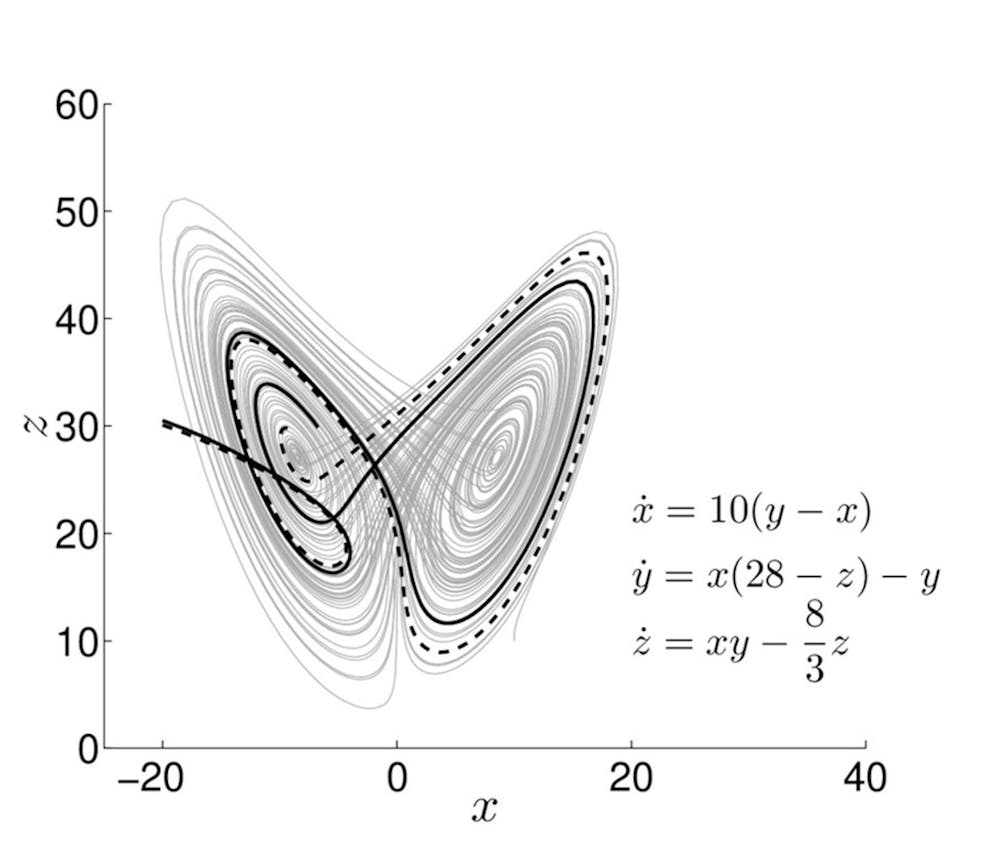
    The ‘Lorenz Attractor’ found in models of a chaotic weather system has a characteristic butterfly shape.
    Milad Haghani, CC BY

    Lorenz initially used “the flap of a seagull’s wings” to describe his findings, but switched to “butterfly” after noticing a remarkable feature of the solutions to his equations.

    In his weather model, when he plotted the solutions, they formed a swirling, three-dimensional shape that never repeated itself. This shape — called the Lorenz attractor — looked strikingly like a butterfly with two looping wings.

    Welcome to chaos

    Lorenz’s efforts to understand weather led him to develop chaos theory, which deals with systems that follow fixed rules but behave in ways that seem unpredictable.

    These systems are deterministic, which means the outcome is entirely governed by initial conditions. If you know the starting point and the rules of the system, you should be able to predict the future outcome.

    There is no randomness involved. For example, a pendulum swinging back and forth is deterministic — it operates based on the laws of physics.

    Systems governed by the laws of nature, where human actions don’t play a central role, are often deterministic. In contrast, systems involving humans, such as financial markets, are not typically considered deterministic due to the unpredictable nature of human behaviour.

    A chaotic system is a system that is deterministic but nevertheless behaves unpredictably. The unpredictability happens because chaotic systems are extremely sensitive to initial conditions. Even the tiniest differences at the start can grow over time and lead to wildly different outcomes.

    Chaos is not the same as randomness. In a random system, outcomes have no definitive underlying order. In a chaotic system, however, there is order, but it’s so complex it appears disordered.

    A misunderstood meme

    Like many scientific ideas in popular culture, the butterfly effect has often been misunderstood and oversimplified.

    One common misconception is that the butterfly effect implies every small action leads to massive consequences. In reality, not all systems are chaotic, and for systems that aren’t, small changes usually result in small effects.

    Another is that the butterfly effect carries a sense of inevitability, as though every butterfly in the Amazon is triggering tornadoes in Texas with each flap of its wings.

    This is not at all correct. It’s simply a metaphor pointing out that small changes in chaotic systems can amplify over time, making long-term outcomes impossible to predict with precision.

    Taming butterflies

    Systems that are very sensitive to initial conditions are very hard to predict. Weather systems are still tricky, for example.

    Forecasts have improved a lot since Lorenz’s early efforts, but they are still only reliable for a week or so. After that, small errors or imprecisions in the starting data grow larger and larger, eventually making the forecast inaccurate.

    To deal with the butterfly effect, meteorologists use a method called ensemble forecasting. They run many simulations, each starting with slightly different initial conditions.

    By comparing the results, they can estimate the range of possible outcomes and their likelihoods. For example, if most simulations predict rain but a few predict sunshine, forecasters can report a high probability of rain.

    However, even this approach works only up to a point. As time goes on, the predictions from the models diverge rapidly. Eventually, the differences between the simulations become so large that even their average no longer provides useful information about what will happen on a given day at a given location.

    A butterfly effect for the butterfly effect?

    The journey of the butterfly effect from a rigorous scientific concept to a widely popular metaphor highlights how ideas can evolve as they move beyond their academic roots.

    While this has helped bring attention to a complex scientific concept, it has also led to oversimplifications and misconceptions about what it really means.

    Attaching a metaphor to a scientific phenomenon and releasing it into popular culture can lead to its gradual distortion.

    Any tiny inaccuracies or imprecision in the initial description can be amplified over time, until the final outcome is a long way from reality. Sound familiar?

    Milad Haghani does not work for, consult, own shares in or receive funding from any company or organisation that would benefit from this article, and has disclosed no relevant affiliations beyond their academic appointment.

    ref. The butterfly effect: this obscure mathematical concept has become an everyday idea, but do we have it all wrong? – https://theconversation.com/the-butterfly-effect-this-obscure-mathematical-concept-has-become-an-everyday-idea-but-do-we-have-it-all-wrong-246577

    MIL OSI AnalysisEveningReport.nz

  • MIL-OSI Global: Trump’s reversal of climate policies risks undermining U.S. manufacturing — and could cost people jobs

    Source: The Conversation – Canada – By Thomas Stuart, Lecturer in Communications, Gustavson School of Business, University of Victoria

    United States President Donald Trump’s early executive actions have set American manufacturing on a collision course with his administration’s fossil-fuel-driven agenda. It’s clear that climate change policies run counter to his vision of American primacy.

    Trump wasted no time reversing the green initiatives of his predecessor, former president Joe Biden. He withdrew the U.S. from the Paris Climate Agreement for a second time, rolled back environmental regulations and froze green energy funding.


    Read more:
    The impact of Donald Trump’s anti-climate measures on our heating planet


    However, these reversals have exposed complications in Trump’s economic platform. For all his promises to revive American industry and reduce reliance on foreign production, Trump’s opposition to clean energy threatens green technology investments and other incentives that drive U.S. manufacturing development.

    Trump’s Strategic National Manufacturing Initiative promised to “stop outsourcing” and turn the U.S. into a “manufacturing superpower.” Yet his plans to cancel the electric vehicle mandate and reduce regulations promoting clean energy undermine the manufacturing sector’s shift toward green technology.

    In the long run, Trump’s own actions may undermine his vision of an American manufacturing renaissance by cutting crucial investments, putting the U.S. at odds with a global economy increasingly focused on clean technologies.

    The green manufacturing boom

    Republican congressman John James recently applauded Trump’s reversal of green policies during a congressional hearing. Yet, in the same breath, James called for the administration to continue “onshoring the future of automotive jobs and manufacturing,” a policy he linked to Biden’s Inflation Reduction Act (IRA).

    Other Republican representatives from Michigan, Georgia and North Carolina increasingly find themselves walking along the same rhetorical tight-rope.

    While Biden’s IRA has been widely criticized by the Trump administration, the act has brought Republican districts significant green investments and manufacturing jobs.

    As James acknowledged:

    “While the bulk of the IRA is damaging policy, we must not neglect the sector-wide energy tax provisions that manufacturers and job creators rely on in my district and around the country.”

    The green manufacturing boom is not an abstract concept, but a tangible economic engine, particularly in districts with established fossil fuel industries like Chatham County, N.C. Here, manufacturer Wolfspeed’s new US$5 billion dollar semiconductor plant sits in the heart of traditional coal country.

    Since 2022, the private sector has invested US$133 billion in clean energy and electric vehicle (EV) technology. Manufacturing investments alone have jumped by three times over the previous two years, totalling US$89 billion.

    The impact of the IRA on ‘red states’

    Biden-era policy has largely driven the America’s green energy economic development. The IRA provided a staggering US$312 billion in planned investments in EV and battery manufacturing.

    Eighty-five per cent of this funding flows into Republican-voting districts — areas that have historically voted against climate-focused legislation like the IRA. Yet the rewards of these green tech policies have been a boon for local economies.

    Georgia, for instance, has become a model for the American green energy transformation. In the first two years of the IRA, about US$15 billion dollars flowed into the state. Since then, Georgia has added a projected 43,000 new green jobs.

    Meanwhile, North Carolina’s Randolph County has seen the largest investment in green technology in U.S. history. Under the previous administration, it received about US$14 billion in funding, allowing Toyota to build a manufacturing megasite.

    By 2030, the site is expected to create 5,000 jobs in the area, with wages averaging 80 per cent more than the county median salary. Once fully operational, the site will manufacture enough batteries annually to power and maintain up to 500,000 EVs.

    What comes next?

    As Trump continues to roll back environmental protections and withdraw from climate agreements, whether he can still deliver the manufacturing revival he promised remains to be seen.

    In one respect, his policies may lead to a consolidation in the green technology sector. Despite his administration’s retreat from broader green energy policies, Trump says he will continue securing the U.S. supply of critical minerals for EV batteries.

    This could reflect the influence of Tesla CEO Elon Musk, who is serving under Trump as a “special government employee.” Tesla, which relies on these critical minerals for its EV production, would benefit from a stable supply.

    Musk resents regulatory interventions, particularly those that encourage competition. On a call with investors, Musk said Tesla might feel a slight impact from lost subsidies. However, he suggested the real damage would be to competitors who are scrambling to catch up in an industry where raw materials are king. Musk predicted that “long term, it probably actually helps Tesla.”

    In another respect, Trump’s policy reversal could also weaken Republican unity. Republican politicians like Georgia’s Buddy Carter, Tennessee’s Chuck Fleischmann and Georgia Gov. Brian Kemp have highlighted the short-sighted nature of Trump’s economic plan.

    Trump’s decision to turn his back on climate change policy is more than a blow to environmentalists; it’s a direct challenge to his own economic agenda. He risks not just the environment, but also the green investments essential to American industry’s competitive revival.

    Thomas Stuart does not work for, consult, own shares in or receive funding from any company or organisation that would benefit from this article, and has disclosed no relevant affiliations beyond their academic appointment.

    ref. Trump’s reversal of climate policies risks undermining U.S. manufacturing — and could cost people jobs – https://theconversation.com/trumps-reversal-of-climate-policies-risks-undermining-u-s-manufacturing-and-could-cost-people-jobs-248399

    MIL OSI – Global Reports

  • MIL-OSI USA: Sens. Markey, Cruz Statement on Commerce Committee Vote to Advance AM Radio for Every Vehicle Act

    US Senate News:

    Source: United States Senator for Massachusetts Ed Markey

    Washington (February 5, 2025) – Senator Edward J. Markey (D-Mass.) member of the Science, Commerce, and Transportation Committee, and Ted Cruz (R-Texas), Chairman of the Science, Commerce, and Transportation Committee today released the following statement on the committee’s vote to advance the AM Radio for Every Vehicle Act, bipartisan and bicameral legislation that would direct federal regulators to require automakers to include AM broadcast radio in their new vehicles at no additional charge.

    “Today’s vote to advance the AM Radio for Every Vehicle Act broadcasts a clear message to car manufacturers that AM radio is an essential communication tool for millions of Americans across the country. From emergency response to sports, entertainment, and news, AM radio is a lifeline that must be protected. Our bill ensures that no one is cut off from their communities and that AM radio stays a part of our constituents’ daily lives.”

    In May 2023, Senators Markey and Cruz led their colleagues in introducing the AM Radio for Every Vehicle Act.  The AM Radio for Every Vehicle Act passed through the Senate Commerce Committee in July 2023 and passed through the House Energy and Commerce Committee in September 2024.

    MIL OSI USA News

  • MIL-OSI USA: Lankford Applauds POTUS’ Push to Hold FEMA Accountable, Advocates for Reform

    US Senate News:

    Source: United States Senator for Oklahoma James Lankford

    WASHINGTON, DC – Senator James Lankford (R-OK) sent a letter to President Donald J. Trump to applaud his recent Executive Order to hold the Federal Emergency Management Agency (FEMA) accountable for their failed responses to disasters and to advocate for robust reforms.

    “I write to commend your recent Executive Order establishing the Federal Emergency Management Agency (FEMA) Review Council. The current federal framework for responding to disasters is insufficient, and major reforms are necessary to ensure Americans are best supported in times of need,” Lankford wrote in the letter.

    Lankford also introduced four bills to continue to build on President Trump’s work to address FEMA’s failures and inadequacies. The Expediting Hazard Mitigation Assistance Projects Act gives the FEMA Administrator the authority to cut red tape on unnecessary environmental and historic preservation review requirements. The Direct Property Acquisitions Act creates a pilot program for communities to avoid lengthy delays by applying directly for property acquisitions. The Investing in Community Resilience Act with Senator Peter Welch (D-VT) incentivizes communities to create readiness and resilience measures before a disaster. The Stopping Political Discrimination in Disaster Assistance Act will prohibit discrimination based on political affiliation in federal disaster relief. This bill is cosponsored by Senators Roger Marshall, MD (R-KS), Rick Scott (R-FL), Ted Budd (R-NC), Josh Hawley (R-MO), Marsha Blackburn (R-TN), and Thom Tillis (R-NC).

    View the letter here or below. 

    Dear President Trump:

    I write to commend your recent Executive Order establishing the Federal Emergency Management Agency (FEMA) Review Council. The current federal framework for responding to disasters is insufficient, and major reforms are necessary to ensure Americans are best supported in times of need. As the Council engages with leaders to discuss potential reforms, I respectfully request that the Council consider the following:

    1. Reforming FEMA’s responsibilities and/or consolidating the federal disaster framework more generally. FEMA has two core responsibilities: managing security grants and serving as the leading agency for federal disaster relief. While both roles can be vested in a single agency, I am concerned that FEMA’s dual responsibilities are hampering its emergency response capabilities. At the same time, the current federal disaster framework involves too many agencies with a variety of other, non-emergency response duties, including the US Department of Commerce, US Department of Housing and Urban Development, US Department of Health and Human Services, US Department of Agriculture, the Small Business Administration, and the Environmental Protection Agency, among several others. I ask that your Council consider whether more federal emergency response capabilities should be consolidated under FEMA, which would reduce the number of agencies constituents need to work through when seeking federal disaster assistance, and whether other, current responsibilities should be placed elsewhere.
    1. Reassessing the federal government’s role in disasters. Under current law, the default federal assistance for major disasters is 75%, with opportunities to increase the federal cost share. The federal cost share is often increased to 100%. It is paramount that all levels of government involved in emergency response and recovery have skin in the game. I urge the Council to consider the benefits and drawbacks of a sliding cost share that begins at a lower percentage for federal support but can be increased based on the needs and capacity of the community in question. I also urge the Council to consider recommending how to limit ad hoc federal cost share increases and eliminate the possibility of a 100% federal cost share as it relates to FEMA’s disaster aid.
    1. Conducting an in-depth review of all federally funded disaster activities conducted by FEMA. The federal government’s labyrinthine disaster response and recovery programs have not been subject to the scrutiny needed to assess whether it is achieving its goals or whether its funding would be better spent with limited strings attached at the state and local levels. I ask that the Council provide a comprehensive analysis of these programs and make a formal, performance-based recommendation on how the funding for these programs should be spent.
    1. Exploring ways to speed up FEMA-led disaster projects. Federal funding for disaster relief comes with countless conditions, many of which unnecessarily prolong the duration of projects. I urge the Council to assess whether conditions on federal disaster aid, including conditions such as Environmental and Historic Preservation (EHP) reviews, harm the disaster recovery process for communities. 

    Lastly, it is essential that the Council solicit feedback from leaders with substantial knowledge of disaster recovery efforts. Oklahoma is no stranger to natural disasters, and we are often forced to grapple with the ensuing wreckage and trauma. Despite these challenges, Oklahomans have consistently risen above the fray to help one another in recovery. Given our experience with natural disasters, I respectfully request that the Council solicit feedback from emergency management leaders in Oklahoma.

    In God We Trust,

    MIL OSI USA News

  • MIL-OSI Russia: Financial news: Capital adequacy ratio for professional participants: new calculation rules

    Translartion. Region: Russians Fedetion –

    Source: Central Bank of Russia –

    Bank of Russia updated the calculation procedure capital adequacy ratio (CAD) for professional participants in the securities market in order to minimize risks to their financial stability.

    The new version specifies the procedure for calculating the broker’s credit risk in relation to clients for whom the risk coverage standard has been violated when making margin transactions. It is prohibited to accept securities issued by the debtor itself and assets of companies affiliated with it as collateral. It is also permitted to use the broker’s ratings to reduce the credit risk rates in relation to the debt of companies associated with the broker, but on the condition that the debtor’s assessment of its own (independent) creditworthiness indicates its financial stability.

    In addition, the document provides for the calculation of the risk on digital rights acquired and issued by a professional participant. An alternative calculation of the amount of market risk on option agreements has appeared (similar to the regulation of credit institutions). Measures are being introduced to discourage large open currency positions among professional participants. The rules for determining the values of credit risk rates in relation to counterparties and clients are also simplified.

    The regulation comes into force on October 1, 2025.

    Preview photo: Jsnow my wolrd / Shutterstock / Fotodom

    Please note: This information is raw content directly from the source of the information. It is exactly what the source states and does not reflect the position of MIL-OSI or its clients.

    Please Note; This Information is Raw Content Directly from the Information Source. It is account to What the Source Is Stating and Does Not Reflect the Position of Mil-Sosi or Its Clients.

    HTTPS: //VVV.KBR.ru/Press/Event/? ID = 23346

    MIL OSI Russia News

  • MIL-OSI USA: Legislation considered under suspension of the Rules of the House of Representatives during the week of February 10, 2025

    Source: US Congressional Budget Office

    The Majority Leader of the House of Representatives announces bills that will be considered under suspension of the rules in that chamber. Under suspension, floor debate is limited, all floor amendments are prohibited, points of order against the bill are waived, and final passage requires a two-thirds majority vote.

    At the request of the Majority Leader and the House Committee on the Budget, CBO estimates the effects of those bills on direct spending and revenues. CBO has limited time to review the legislation before consideration. Although it is possible in most cases to determine whether the legislation would affect direct spending or revenues, time may be insufficient to estimate the magnitude of those effects. If CBO has prepared estimates for similar or identical legislation, a more detailed assessment of budgetary effects, including effects on spending subject to appropriation, may be included.

    CBO’s estimates of the bills that have been posted for possible consideration under suspension of the rules during the week of February 10, 2025, include

    • H.R. 224, Disabled Veterans Housing Support Act 
    • H.R. 225, HUD Transparency Act of 2025
    • H.R. 386, Chinese Currency Accountability Act of 2025
    • H.R. 692, China Exchange Rate Transparency Act, as amended 
    • H.R. 736, Protect Small Business from Excessive Paperwork Act of 2025
    • H.R. __, Housing Unhoused Disabled Veterans Act 
    • H.R. __, Credit Union Board Modernization Act

    MIL OSI USA News

  • MIL-OSI Security: Madison Carrig Imprisoned For Employer Embezzlements

    Source: Office of United States Attorneys

    Burlington, Vermont – The United States Attorney’s Office announced that Madison Carrig, 30, of Whitehall, New York, was sentenced yesterday in United States District Court in Burlington to four months of imprisonment following her guilty plea to charges of access device fraud. Chief U.S. District Judge Christina Reiss ordered that Carrig pay restitution in the amount of $141,000 and serve three years of supervised release following completion of her prison term. The court ordered Carrig to surrender to the Bureau of Prisons on March 18 to begin serving her sentence.

    Last July, the United States Attorney filed an information charging Carrig with two counts of access device fraud. Carrig pleaded guilty to the information this past August. According to the information, beginning in September 2022 and continuing until February 2023, Carrig was employed as the office manager of two automobile dealerships located in central Vermont. In that capacity, Carrig supervised all accounting activities at both dealerships. Among other things, she had authority to sign checks, initiate wire transfers and make deposits to the dealerships’ bank account. She also possessed a company credit card and was authorized to use the credit card to make business-related purchases. Between February 2023 and November 27, 2023, Carrig was employed as the controller of a third Vermont automobile dealership, in Rutland. She had authority to sign checks, initiate wire transfers and make deposits to the dealership’s bank account. She also possessed a company credit card and was authorized to use the credit card to make business-related purchases.

    In the course of her employment, Carrig defrauded the three dealerships of approximately $140,000. She did this by embezzling cash receipts received from customers of the dealerships. She also misused company credit cards to purchase goods and services for her own use and benefit.

    This case was investigated by the Vermont State Police.

    Carrig is represented by Natasha Sen, Esq. The prosecutor is Assistant U.S. Attorney Gregory Waples.

    MIL Security OSI

  • MIL-OSI: Blockmate subsidiary Hivello enters strategic partnership with Neova to advance decentralised storage

    Source: GlobeNewswire (MIL-OSI)

    TORONTO, Feb. 05, 2025 (GLOBE NEWSWIRE) — Blockmate Ventures Inc (TSX.V: MATE) (OTCQB: MATEF) (FSE: 8MH1) (“Blockmate” or the “Company”) is pleased to announce that its subsidiary, Hivello Holdings Ltd has partnered with Neova, a decentralised storage platform, to expand Hivello’s decentralised storage capability, making storage more accessible and profitable for all.

    Below is the press release from Hivello:

    Hivello + Neova: a Strategic Partnership to Advance Decentralized Infrastructure

    LONDON and AMSTERDAM, Feb. 03, 2025 (GLOBE NEWSWIRE) — Hivello, the all-in-one decentralized infrastructure manager, and Neova, a leader in decentralized data storage protocols, are excited to announce a strategic partnership to accelerate the adoption and innovation of decentralized physical infrastructure networks (DePIN).

    Hivello and Neova are coming together to explore how their unique strengths can advance decentralized infrastructure and expand the adoption of Web3 technologies. Hivello simplifies running decentralized nodes by aggregating and managing them across multiple protocols, making it easy for non-technical users to contribute to DePIN networks. Neova, on the other hand, is a decentralized storage protocol built on IPFS, offering secure and privacy-first data storage & management through a network of peer-to-peer and master nodes.

    Hivello and Neova are exploring several areas of collaboration. These include the possibility of Hivello becoming a node distributor for Neova’s decentralized storage network, as well as integrating Neova’s protocol into Hivello’s platform to enhance user accessibility. Hivello also plans to test Neova’s nodes on its testnet in preparation for the mainnet launch. Additionally, both companies collaborate on co-marketing efforts to promote decentralized infrastructure solutions.

    “Neova is pioneering decentralized storage solutions that align with our mission to simplify decentralized infrastructure for everyone,” said Domenic Carosa, Co-Founder & Chairman of Hivello. “Together, we can bridge the gap between innovative protocols and everyday users, opening up new opportunities for collaboration, scalability, and growth in the Web3 space.”

    Quentin Clement, CEO of Neova, added: “Hivello’s user-centric approach to decentralized node management is the kind of innovation needed to grow the DePIN ecosystem. This partnership allows us to explore new ways to expand our decentralized storage network while bringing greater accessibility and efficiency to our users. The possibilities here are exciting.”

    About Neova

    Neova is a decentralized storage protocol that prioritizes privacy, security, and scalability. By leveraging Avail’s Data Availability (DA) Layer, Neova ensures robust on-chain verification and seamless data integrity. Unlike conventional storage solutions, Neova enhances data persistence and censorship resistance with a custom IPFS through a hybrid architecture of peer-to-peer networks and master nodes. Its ecosystem includes solutions such as Neova Drive and electronic signature tools, designed to empower users with true data ownership and frictionless accessibility.

    About Hivello

    Hivello is an aggregator of DePIN projects that allows any user to participate in a variety of DePIN networks with just a few clicks. This eliminates the technical hurdles that many users face when trying to join these networks, and allows users to generate an extra source of income by mobilizing their idle computers. We aim to create a simple app that allows users to contribute their computer resources with no technical knowledge required.

    About Blockmate Ventures Inc.

    Blockmate Ventures is a venture creator focussing on building fast growing technology businesses relating to cutting edge sectors such as blockchain, AI and renewable energy. Working with prospective founders, projects in incubation can benefit from the Blockmate ecosystem that offers tech, services, integrations and advice to accelerate the incubation of projects towards monetization. Recent projects include Hivello (download the free passive income app at www.hivello.com) and Sunified, digitising solar energy.

    The leadership team at Blockmate Ventures have successfully founded successful tech companies from the Dotcom era through to the social media era. Learn more about being a Blockmate at: www.blockmate.com.

    Blockmate welcomes investors to join the Company’s mailing list for the latest updates and industry research by subscribing at https://www.blockmate.com/subscribe.

    ON BEHALF OF THE BOARD OF DIRECTORS

    Justin Rosenberg, CEO
    Blockmate Ventures Inc
    justin@blockmate.com
    (+1-580-262-6130)

    Neither the TSX Venture Exchange nor its Regulation Services Provider (as that term is defined in policies of the TSX Venture Exchange) accepts responsibility for the adequacy or accuracy of this release

    Forward-Looking Information
    This news release contains “forward-looking statements” or “forward-looking information” (collectively, “forward-looking statements”) within the meaning of applicable securities legislation. All statements, other than statements of historical fact, are forward-looking statements and are based on the assumptions, expectations, estimates and projections as of the date of this news release. Forward-looking statements are subject to a variety of known and unknown risks, uncertainties and other factors that could cause actual events or results to differ from those expressed or implied by forward-looking statements contained herein. There can be no assurance that such statements will prove to be accurate, as actual results and future events could differ materially from those anticipated in such statements. Raindrop disclaims any obligation to update any forward-looking statements, whether because of new information, future events or otherwise, except as may be required by applicable securities laws. Readers should not place undue reliance on forward-looking statements.

    The MIL Network

  • MIL-OSI: ESFI Releases Updated Workplace Safety Statistics

    Source: GlobeNewswire (MIL-OSI)

    ARLINGTON, Va., Feb. 05, 2025 (GLOBE NEWSWIRE) — In 2025, the Electrical Safety Foundation International (ESFI) collected information on fatal and non-fatal occupational electrical injuries from every available source. The U.S. Bureau of Labor Statistics (BLS) and the Occupational Safety and Health Association (OSHA) provide raw data that ESFI reviews and analyzes as it is released to identify electrical safety trends. ESFI quantifies, synthesizes, and publishes the information from these reports in visual form to its website. The most recent data set covers the 13 years from 2011 through 2023.

    “As the leading authority on electrical safety, ESFI’s compilation and analysis of this data illustrates the occupations most at-risk from electrical injury and death as well as identifies the main causes,” said ESFI Executive Director, Jennifer LeFevre. “Our attention to the qualitative data, including detailed incident narratives for over one thousand workplace fatalities, helps guide ESFI’s work in targeting those who would most benefit from electrical safety education. Using this research to shape our programs allows us to create messaging that assists employees in making safe choices and provide guidance for creating a safer work environment. We encourage everyone to utilize ESFI’s free-to-share resources to elevate the safety of your workplace and prevent avoidable workplace injuries and fatalities.”

    Contact with or exposure to electricity continues to be one of the leading causes of workplace fatalities and injuries in the United States. Between 2011 and 2023, there was a total of 1,940 workplace fatalities involving electricity, according to the BLS. During this period, 74% of fatalities occurred in non-electrically related occupations. The key data points are as follows:

    Workplace Fatalities and Injuries: 2011 – 2023 (OSHA)

    • 74% of workplace electrical fatalities occurred in non-electrical occupations.
    • 26% percent of workplace electrical fatalities occurred in electrical occupations.
    • 5.6% of all fatalities were caused by contact with electricity.
    • Electrical fatalities continue to stay consistent year over year, with a slight downward trend since 2011.
    • The construction industry had the highest number of electrical fatalities.

    Occupations with the Most Electrical Fatalities (OSHA)

    • Electricians: 212 fatalities
    • Laborers, except construction: 142 fatalities
    • Construction laborers: 131 fatalities
    • Electrical power installers and repairers: 122 fatalities
    • Tree trimming occupations: 64 fatalities
    • Electricians’ apprentices: 45 fatalities
    • HVAC and refrigeration mechanics: 43 fatalities
    • Roofers: 38 fatalities
    • Truck drivers, heavy: 35 fatalities
    • Painters, construction and maintenance: 32 fatalities

    Electrical Fatality Rates per 100,000 Workers (BLS)

    • Electrical fatality rates per 100,000 workers have remained consistent while overall fatality rates have increased.
    • Hispanic or Latino workers have a disproportionately high rate of electrical fatalities, and that rate is increasing.
    • Construction and extraction occupations, installation, maintenance, and repair occupations, and building and grounds cleaning and maintenance occupations have the highest rate of electrical fatalities.

    ESFI partners with industry leaders, including those comprising its Board of Directors, to develop key resources and consistent electrical safety messages. By addressing evolving and emerging electrical safety needs in the workplace and then deploying effective electrical safety materials and programs based on those needs, electrical injuries and fatalities can decrease through proper education of the workforce.

    “Most of the electrical fatalities that occurred in the workplace were from accidental contact with electricity,” said Daniel Majano, ESFI Program Director who compiled the data. “It is important to always be aware of your surroundings when at a job site. Whether it’s to always look up to spot overhead power lines or knowing what might be energized around your job site, it is imperative to know all the possible contact points of electricity around you.” Majano added, “Also always know when to say when and make sure you’re trained and aware of any electrical hazards. Over 74% of the workplace electrical fatalities that occurred between 2011 and 2023 were in non-electrical occupations that may have not received electrical safety training.”

    ABOUT ESFI
    The Electrical Safety Foundation International (ESFI) is the trusted voice for electrical safety. The mission of ESFI is to prevent electrically related injuries, deaths, and fires. ESFI’s work saves lives and property through public education and outreach. For free safety materials that you can share throughout your community, visit esfi.org.

    Contact:
    Evan Jones
    Electrical Safety Foundation International
    703.841.3247
    evan.jones@esfi.org

    A photo accompanying this announcement is available at https://www.globenewswire.com/NewsRoom/AttachmentNg/0abbc325-661e-4266-869b-fa5a79ef428a

    The MIL Network

  • MIL-OSI: Citizens Business Bank Recognized on Forbes List of Best Banks in America

    Source: GlobeNewswire (MIL-OSI)

    ONTARIO, Calif., Feb. 05, 2025 (GLOBE NEWSWIRE) — CVB Financial Corp. (NASDAQ: CVBF), the holding company for Citizens Business Bank (the “Bank”), has been recognized by Forbes in their 16thannual America’s Best Banks list. This recognition marks the ninth time in the past decade that the Bank has earned a place on Forbes’ prestigious list of the best banks in the nation.

    “We are honored to receive recognition once again for our strong financial performance,” said David Brager, President and Chief Executive Officer of CVB Financial Corp. and Citizens Business Bank. “This achievement is a testament to the dedication and talent of our associates, as well as the enduring relationships we have developed with our customers.”

    As one of the top performing financial services companies in the nation, CVBF and the Bank regularly receive industry accolades for their financial strength and community outreach efforts. In 2024, CVBF was ranked by S&P Global Market Intelligence as one of the Top 50 Public Banks, and also named as one of America’s Greatest Workplaces for Women by Newsweek. The Bank maintained its Five-Star Superior rating from BauerFinancial, its designation as a “Super Premier” Performing Bank by The Findley Reports and CVBF’s BBB+ rating from Fitch Ratings. The Bank previously received top honors from Forbes as the overall number one “Best Bank in America” for four of the past ten years, namely, in 2023, 2021, 2020 and 2016.

    In establishing its rankings, Forbes looked at ten metrics related to credit quality, growth, and profitability for all 100 of the largest publicly traded banks and thrifts in asset size in the nation.

    Corporate Overview

    CVB Financial Corp. (“CVBF”) is the holding company for Citizens Business Bank. CVBF is one of the 10 largest bank holding companies headquartered in California with greater than $15 billion in total assets. Citizens Business Bank is consistently recognized as one of the top performing banks in the nation and offers a wide array of banking, lending and investing services with more than 60 banking centers and three trust office locations serving California.

    Shares of CVB Financial Corp. common stock are listed on the NASDAQ under the ticker symbol “CVBF”. For investor information on CVB Financial Corp., visit our Citizens Business Bank website at www.cbbank.com and click on the “Investors” tab.

    Contact: 
    David A. Brager
    President and Chief
    Executive Officer
    (909) 980-4030

    The MIL Network

  • MIL-OSI USA: Top Appropriators: Trump Administration’s “Deferred Resignation” Scheme is Deceptive, Legally Questionable, & Puts Vital Taxpayer Services At Risk

    US Senate News:

    Source: United States Senator for Washington State Patty Murray

    WASHINGTON, D.C. — Today, in an effort to protect taxpayers and federal workers and uphold the law, U.S. Senator Patty Murray (D-WA), Vice Chair of the Senate Appropriations Committee, and U.S. Representative Rosa DeLauro (D-CT), the House Appropriations Committee Ranking Member, along with U.S. Senator Jack Reed (D-RI) and U.S. Representative Steny Hoyer (D-MD), the Ranking Members of both the Senate and House Financial Services and General Government Subcommittees, sent a letter to the U.S. Office of Personnel Management (OPM) pointing out that the Trump Administration’s so-called buyout program is “deceptive,” “legally dubious,” would “undermine” a host of vital government services people rely on, and “should be rescinded immediately.”

    “Federal workers take an oath to defend the Constitution and to work on behalf of the American people. OPM’s legally dubious and intentionally misleading offer is a disservice to these dedicated men and women, and it should be retracted immediately,” the four lawmakers wrote to the acting head of OPM.

    The Trump Administration’s proposal, which gave federal workers just a few days to consider the offer before a February 6 deadline to accept the terms alleging to pay them through September of 2025, incurs a multi-billion dollar cost on behalf of the federal government that has not been authorized or appropriated by Congress. If implemented, it would negatively impact taxpayers, who would be paying workers not to provide the public with critical services.

    “If federal workers are enticed or coerced to accept this ‘offer,’ the services that average Americans rely on will be undermined,”the lawmakers wrote.“Federal employees inspect nursing homes to give families and caregivers peace of mind. They stem the supply of fentanyl and illegal contraband at our nation’s ports of entry. They approve patent applications to bolster American innovation. They ensure that seniors can access Social Security benefits that they have worked their entire lives to earn, and they work to provide health care service to our nation’s veterans.”

    The appropriators asked a series of specific questions about OPM’s compliance with the Privacy Act, OPM’s legal authority to extend this offer, and whether paying people not to work through September 30 violates the Anti-Deficiency Act, a law that prevents the federal government from promising or spending money in excess of what Congress has made available. Congress has funded the government only through mid-March, not through the end of the fiscal year, which runs through September.

    Specifically, the letter asks OPM:

    1. Please provide documentation detailing OPM’s compliance with the Privacy Act, section 552a of title 5, United States Code, section 522.224 of title 48 of the Code of Federal Regulations, and the E-Government Act of 2002.  In addition, please provide a copy of all contract agreements associated with the development of this distribution list.
    2. Please provide a reference for the specific statutory authorities OPM is relying upon to make its deferred resignation offer, given that this widespread communication seems to violate 5 U.S.C. 301-302, which places authority for excusing employees from duty with pay under each individual agency.
    3. Please explain how the deferred resignation offer complies with the Administrative Leave Act of 2016 (P.L.114-315), which places clear limits on the number of days that an employee may be placed on administrative leave to protect taxpayer dollars.
    4.  OPM’s FAQ document regarding deferred resignation explicitly encourages employees to “find a job in the private sector as soon as you would like to do so.” However, federal employees are prohibited by law (5 CFR Part 2635) from engaging in outside employment or activities that conflict with official Government duties and responsibilities. Further, federal employees are required to notify their supervisor of any additional employment in order to further protect from conflicts of interest or ethical violations. Please explain how OPM intends to uphold the law to prevent widespread conflicts of interest and ethical violations.
    5. The Anti-Deficiency Act (31 U.S.C. 1341 and FAR 32.702) prohibits federal agencies from creating or authorizing funds in advance or in excess of a Congressionally-provided appropriation. OPM has, in writing, suggested to employees that they will receive pay and benefits after the end of the current continuing resolution, which expires on March 14, 2025. Please explain how this complies with the Anti-Deficiency Act.

    Full text of the letter is available HERE and below:

    February 5, 2025

    Mr. Charles Ezell

    Acting Director

    U.S. Office of Personnel Management

    1900 E St NW

    Washington, DC 20415

    Dear Mr. Ezell,

    On January 28, 2025, the U.S. Office of Personnel Management (OPM) sent a so-called “Fork in the Road” email to more than two million federal employees offering the opportunity to take “deferred resignation” by February 6, 2025.[1]  Additional documents published by the agency, including a “Frequently Asked Questions” webpage that is updated on an almost daily basis, as well as further communications regarding collective bargaining agreements, have caused confusion and concern among the federal workforce.  There is at best, questionable legal authority for the Administration to offer this type of program to federal workers, and it is not contemplated in appropriations law.  It should be rescinded immediately.

    OPM’s deceptive “offer” has been orchestrated by Elon Musk, a billionaire with significant business interests with the federal government who has used his influence to force out federal officials – including the former FAA Administrator – who have worked to ensure that his companies follow the law.   

    If federal workers are enticed or coerced to accept this “offer”, the services that average Americans rely on will be undermined.  Federal employees inspect nursing homes to give families and caregivers peace of mind.  They stem the supply of fentanyl and illegal contraband at our nation’s ports of entry.  They approve patent applications to bolster American innovation.  They ensure that seniors can access Social Security benefits that they have worked their entire lives to earn, and they work to provide health care service to our nation’s veterans.

    All of these services and more are at risk.  In light of OPM’s recent communications to federal employees, we write to request answers no later than February 7th to the following questions:

    1. Please provide documentation detailing OPM’s compliance with the Privacy Act, section 552a of title 5, United States Code, section 522.224 of title 48 of the Code of Federal Regulations, and the E-Government Act of 2002.  In addition, please provide a copy of all contract agreements associated with the development of this distribution list.
    2. Please provide a reference for the specific statutory authorities OPM is relying upon to make its deferred resignation offer, given that this widespread communication seems to violate 5 U.S.C. 301-302, which places authority for excusing employees from duty with pay under each individual agency.
    3. Please explain how the deferred resignation offer complies with the Administrative Leave Act of 2016 (P.L.114-315), which places clear limits on the number of days that an employee may be placed on administrative leave to protect taxpayer dollars.
    4. OPM’s FAQ document regarding deferred resignation explicitly encourages employees to “find a job in the private sector as soon as you would like to do so.” However, federal employees are prohibited by law (5 CFR Part 2635) from engaging in outside employment or activities that conflict with official Government duties and responsibilities. Further, federal employees are required to notify their supervisor of any additional employment in order to further protect from conflicts of interest or ethical violations. Please explain how OPM intends to uphold the law to prevent widespread conflicts of interest and ethical violations.
    5. The Anti-Deficiency Act (31 U.S.C. 1341 and FAR 32.702) prohibits federal agencies from creating or authorizing funds in advance or in excess of a Congressionally-provided appropriation. OPM has, in writing, suggested to employees that they will receive pay and benefits after the end of the current continuing resolution, which expires on March 14, 2025. Please explain how this complies with the Anti-Deficiency Act.
    6.  How will OPM implement the Executive Order “Reforming the Federal Hiring Process and Restoring Merit to Government Service”?
      1. How does the federal hiring plan outlined in Sec. 2 interact with existing government hiring preferences, including for veterans? Is the Administration aware of the existing hiring preferences for veterans?
      2. How will you be assessing an individual’s commitment to “improving the efficiency of the Federal Government, passion for the ideals of the American republic, and commitment to the Constitution”? Please provide any relevant questionnaires for federal employees, beyond any existing competencies or job assessments that agencies already require.  
    7. How will OPM implement the EO “Restoring Accountability to Policy-Influencing Positions within the Federal Workforce”?
      1. Please clarify your intended timeline for formal rulemaking under Sec. 4. As of February 3, 2025, no documents have been published in the Federal Register. 
      2. Approximately how many employees per agency do you anticipate will be rescheduled based on the guidance shared on January 27, 2025?

    Federal workers take an oath to defend the Constitution and to work on behalf of the American people. OPM’s legally dubious and intentionally misleading offer is a disservice to these dedicated men and women, and it should be retracted immediately. Pending that, we ask for a response to these questions by Friday, February 7, 2025.

    Sincerely,

    MIL OSI USA News

  • MIL-OSI: Truxton Continues to Add Talent and Depth to the Team

    Source: GlobeNewswire (MIL-OSI)

    NASHVILLE, Tenn., Feb. 05, 2025 (GLOBE NEWSWIRE) — Truxton is pleased to announce the addition of several new colleagues over the last two months. Truxton continues to attract some of the nation’s top talent in the finance industry.

    “Truxton is always looking for talented professionals who can enhance the way we serve our clients,” said Tom Stumb, CEO and Chairman. “Over the past twenty years, we have been fortunate to build a team of dedicated individuals who are committed to doing the right thing for our clients. We truly believe we have the finest team in the industry.”

    Steve Pelmore Jr., CPA joins the Wealth team as Vice President, Tax Strategist and Wealth Advisor. Mr. Pelmore has nearly 20 years of experience in public accounting. Prior to Truxton, he served as a Senior Tax Manager for Blankenship CPA Group and has held various roles with the Internal Revenue Service. Steve is a graduate of the University of Illinois Urbana with a MS in Taxation, a graduate of Tennessee State University with a BBA in Economics and Finance and is a Certified Public Accountant (CPA) and an Enrolled Agent (EA). Prior to his career as a CPA, Steve served as a Captain in the US Army & US Army Reserve, participated in various overseas tours of duty and earned numerous service awards.

    “Steve is an accomplished tax professional that brings considerable capabilities to Truxton which will meaningfully benefit our clients,” said Drew Mallory, Senior Managing Director and Chief Fiduciary Officer. “His strong command of income and transfer taxation immediately strengthens our team’s ability to provide strategic tax advice to Ultra High Net Worth families and business owners.”

    “We are thrilled that Steve has joined our team.  His decades of experience and knowledge and commitment to excellence will serve our clients, colleagues and shareholders well,” remarks Peter Deming, CPA, Senior Wealth and Tax Strategist.

    The Truxton Banking team adds Carson Walter as a Credit Analyst. Mr. Walter is a graduate of The Citadel with Master’s of Business Administration and a graduate of Birmingham-Southern College, earning his BS in Business Administration.

    Nathan Johnson joins the Finance team as an Accountant after five years working as a finance associate for the Middle Tennessee School of Anesthesia. He earned his Master’s of Business Administration from Regis University and his BBA in Accounting from Southern Adventist University.

    Also, Truxton adds Keegan Fornoff as an Office Coordinator. Prior to Truxton, Ms. Fornoff worked in communications and served as an assistant volleyball coach. She is a graduate of Southeast Missouri State University, earning her BS in Psychology, and was a 4-year member of the Division I Women’s Volleyball Team, and later earning her Master’s of Science in Exercise and Sport Psychology at Southern Illinois University Edwardsville.

    “We are excited to welcome this exceptional group of professionals,” said Derrick Jones, President of Truxton. “They bring a wealth of talent, experience, and energy, as well as an unwavering dedication to serving sophisticated clients at the highest level. We look forward to the impact they will have on improving client outcomes and driving our business forward.”

    About Truxton
    Truxton is a premier provider of wealth, banking, and family office services for wealthy individuals, their families, and their business interests. Serving clients across the world, Truxton’s vastly experienced team of professionals provides customized solutions to its clients’ complex financial needs. Founded in 2004 in Nashville, Tennessee, Truxton upholds its original guiding principle: do the right thing. Truxton Trust Company is a subsidiary of financial holding company, Truxton Corporation (OTCPK: TRUX). For more information, visit truxtontrust.com.

    The MIL Network

  • MIL-OSI USA: 02.05.2025 Cruz, Fetterman, Slotkin Introduce Bipartisan Bill to Prohibit Strategic Petroleum Reserve Sales to Foreign Adversaries

    US Senate News:

    Source: United States Senator for Texas Ted Cruz

    WASHINGTON, D.C. – U.S. Sens. Ted Cruz (R-Texas), John Fetterman (D-Penn.) and Elissa Slotkin (D-Mich.) introduced theBanning SPR Oil Exports to Foreign Adversaries Act. The bipartisan bill prohibits the sale or export of oil from the U.S. Strategic Petroleum Reserve (SPR) to China, Russia, Iran, North Korea, or any entity owned or controlled by those nations.
    Upon introduction, Sen. Cruz said, “The Strategic Petroleum Reserve is meant to protect the U.S. during crises, not supply our adversaries. Under President Biden, part of this reserve was sold, benefiting China’s strategic interests. There is strong bipartisan consensus around preventing such a sale from being repeated. I’m proud to work with Senator Fetterman and Senator Slotkin on this legislation, which will prevent U.S. oil reserves from being sold to adversarial nations.”
    Sen. Fetterman said, “The Strategic Petroleum Reserve protects America’s energy, economic, and national security. We must prioritize the safety of America and our allies – we cannot allow our adversaries to purchase oil from our critical energy reserves. This is a commonsense bill with strong bipartisan support. I’m proud to introduce it with Senator Cruz, Senator Slotkin, and my colleagues in the House. I look forward to getting it signed into law this congress.”
    Sen. Slotkin said, “Our Strategic Petroleum Reserve is meant to bolster our national security, and it should never be sold to hostile nations like Russia, Iran or China. This bipartisan bill prevents hostile nations from buying oil from our Strategic Petroleum Reserve. Energy security shouldn’t ever be a partisan issue, and I look forward to working with my colleagues to pass this bill and fortify our energy security as a nation.” 
    The companion legislation was introduced in the House by U.S. Rep. Chrissy Houlahan (D-Penn.-6).
    Rep. Houlahan said, “When I heard there was a loophole enabling our foreign adversaries to purchase oil from our strategic reserves, I was shocked and outraged. When gas prices rise, releases from the strategic reserve are meant to ease the financial burden for working families—not potentially end up in the hands of those who wish our service members, country, and NATO Allies harm. Closing this loophole requires a Congressional fix, and I’m proud to partner with Reps. Don Bacon and Jay Obernolte to do just that. We’ve seen support for it in the past; it’s time to get this bill across the finish line and signed into law.”
    Read the bill text here.
    BACKGROUND
    Sen. Cruz previously led a bipartisan effort to have an amendment similar to the bill included in the FY24 National Defense Authorization Act (NDAA). The amendment was agreed to by the Senate with overwhelming bipartisan support. The House companion bill, introduced by Representatives Houlahan (D-PA) and Don Bacon (R-NE), also passed the House unanimously as a part of the FY24 NDAA.
    The SPR, which was established by Congress in 1975 in response to OPEC’s oil embargo against the United States, exists to minimize the impacts of oil supply shocks on the United States. Today, as the world’s largest supply of emergency crude oil, it continues to protect and strengthen U.S. national, economic, and energy security. The U.S. Department of Energy manages the SPR and regularly conducts public sales of excess crude oil to the highest bidders through competitive public auction. During both the Biden and Trump Administrations, foreign companies with direct ties to our adversaries have won these auctions, giving anti-democratic regimes access to critical energy reserves.

    MIL OSI USA News

  • MIL-OSI Security: Counterfeiting cash group disrupted: 12 arrests

    Source: Eurojust

    During an action day on 2 February, actions took place simultaneously in North Macedonia and Serbia. Authorities searched multiple locations and found machines used to make moulds and stamps for counterfeit money, hot rollers, presses, a counterfeit banknote detector and holograms. Over 180 000 counterfeit euro banknotes were seized during searches in Serbia, and over 500 000 in North Macedonia.

    Authorities also seized cash in different currencies, phones and laptops. Evidence collected during the searches will be further analysed to serve the ongoing investigations. Twelve members of the forgers group were arrested in North Macedonia and Serbia.

    The JIT between North Macedonian and Serbian authorities is supported by Eurojust through the Western Balkans Criminal Justice Project. This project strengthens cooperation within the Western Balkans and between the region and the European Union, using modern tools and methods to combat organised crime and terrorism. The JIT allowed the authorities to work together efficiently and effective, exchanging information in real time. The Western Balkans Criminal Justice Project purchased equipment for the North Macedonian and Serbian authorities, which was instrumental in executing the operation.

    Europol played a key role in the operation, supporting law enforcement with expertise on counterfeit banknotes, analytical and financial assistance, and coordination of operational activities. Europol’s analysis identified the country where the counterfeit banknotes were distributed. On the action day, Europol deployed staff to North Macedonia and Serbia to provide technical support and cross-check operational data against Europol’s databases and the European Central Bank’s systems.

    The following authorities carried out the operations:

    North Macedonia: Basic Public Prosecution Office for Prosecuting Organized Crime and Corruption; Investigative Centre from the Prosecution Office and Ministry of Interior

    Serbia: Public Prosecutor’s Office for organized crime, Service for combating organized Crime, Department for combating counterfeiting of money

    MIL Security OSI

  • MIL-OSI: Neofin Secures $7M Seed Round to Revolutionize Accounts Receivable in Brazil with AI-Powered Solutions

    Source: GlobeNewswire (MIL-OSI)

    SAO PAULO, Feb. 05, 2025 (GLOBE NEWSWIRE) — Cash is king and no business can survive without it. Quoting Warren Buffet: “Cash, though, is to a business as oxygen is to an individual: never thought about when it is present, the only thing in mind when it is absent”. With this principle in mind, Neofin’s mission is to transform the embarrassing process of Accounts Receivable (getting paid) into an efficient flow through technology and Artificial Intelligence.

    The company announced a US$7MM seed round, led by Quona and Upload Ventures. Founded in 2023 by Laura Camargo, Arthur Cunha, and Leandro Sarmento, the funding marks one of the largest seed investments directed toward a female-led startup in Brazil. Other Neofin backers include 17-Sigma (led by Bianca Sassoon), 1616, Far Out Ventures, BFF, Norte, and Canaan, alongside the notable angel investors Cesar Carvalho (Wellhub/Gympass) and Patrick Sigrist (iFood and Nomad).

    Neofin is currently in the first chapter of its existence (and forecasts at least 2 more going forward), which is focused on the Accounts Receivable and Collection cycles. The main feature today is a cutting-edge, customizable, and automated Accounts Receivable Workflow, integrated to the clients’ ERP and bank, that enables tailored segmentation of debtors, ensuring each receives the most appropriate communication and action based on their profile. For example, a faithful client does not need to be bothered with several messages, while an unfaithful client with no intent to pay should be subject to more drastic measures such as credit bureau reporting or legal actions, besides a different voice tone.

    “Technology has the power to transform a very awkward process into an efficient workflow, that understands the uniqueness of each debtor and negotiates accordingly” Laura said, adding that the workflow actually starts before an AR is late. “Our workflow actually begins before bills are overdue by including preventive measures to ensure proper communication before accounts are due.”

    That is strongly related to Laura’s background, she added. “After working for more than 14 years in the finance universe, I witnessed many finance teams having to perform miracles to get paid, and wasting a huge amount of time doing useless tasks. This round is an important milestone for Neofin, allowing us to accelerate growth and invest in the foundational AI to take our product to the next level.”

    For some more context, Laura has a strong private equity and finance background: she worked for more than 8 years in PE firms such as Pátria (Blackstone partner) and General Atlantic, was Global VP of Finance for Wellhub (Gympass) in NY and was a cofounder and CFO at Inventa, a B2B marketplace that raised more than $80 million since 2021. Neofin cofounders Arthur Cunha and Leandro Sarmento share extensive and complementary backgrounds in Finance and Technology.

    The resources will be used in the development of new features of the platform, especially the renegotiation portal 100% touchless, the advanced CRM for Accounts Receivable and the integration of an AI-based LLM with whatsapp for communication with debtors (both companies and people). On top of that, the funds will also be directed to expand the data, machine learning and AI departments to take the customization of each communication to the next level, as well as the segmentation of client profile.

    “More than 40% of invoices issued in the U.S. are paid late, and this trend is mirrored in Brazil and globally,” said Jonathan Whittle, Co-Founder and Partner at Quona Capital “We are pleased to back the team at Neofin. We were compelled by the strength of the team and by their vision to build a next-gen platform to address a massive pain point for SMEs in Brazil, who spend an inordinate time managing their payments and cash flows. We believe the potential in this space is enormous, and we’re excited about the market validation Neofin has achieved in a short time frame.”

    Neofin is a pioneering AI-powered SaaS platform for accounts receivable workflows, transforming the AR process into a data-driven, efficient workflow. With integrations across major ERPs and banks in Brazil, Neofin delivers a flawless experience for clients, enabling finance teams to save time and recover cash effectively.

    Neofin has also partnered with Serasa, offering seamless access to critical credit analysis data and bureau reporting within the platform.

    Contact:

    Laura Camargo
    +5511993295555
    laura@neofin.com.br

    A photo accompanying this announcement is available at https://www.globenewswire.com/NewsRoom/AttachmentNg/4effd8ec-5a54-4bcd-9062-58ec59438721

    The MIL Network

  • MIL-OSI Economics: [Galaxy Unpacked 2025] Galaxy Tech Forum: Galaxy AI: Redefining the Mobile Experience Paradigm

    Source: Samsung

    Samsung Electronics unveiled the Galaxy S25 series at Galaxy Unpacked 2025, marking the beginning of the next era of mobile AI to explore the latest flagship smartphones and the transformative potential of AI agents, Samsung Newsroom joined the third Galaxy Tech Forum session, titled “True AI Companion: Impact on Life and What’s Next.” 
     
    (From left to right) Bob O’Donnell, Sameer Samat, Jay Kim, Christopher Patrick and Dr. Chris Brauer
     
    More Natural, Intuitive and User-Friendly Mobile AI 
    The session kicked off with welcome remarks from Jay Kim, Executive Vice President and Head of Customer Experience Office, Mobile eXperience Business at Samsung Electronics.  “Yesterday was a very exciting day for us as we launched the Galaxy S25. It’s another big step forward in the AI era,” Kim said. “We’re very excited to be here with our partners today, especially (excited) to talk about everything we did together to launch the Galaxy S25 series.” 
     
    Jay Kim from Samsung Electronics
     
    Moderator Bob O’Donnell, President and Founder of TECHnalysis Research, posed questions to the panelists about the benefits the Galaxy S25 series will bring to users, as well as the barriers blocking certain consumers from using mobile AI.  “AI should make users’ lives better. We study consumer habits, constantly trying to gain a better understanding of our customers,” Kim said. “Ultimately, what we’re trying to do is minimise how much effort it takes to input while maximising the output. To do that, we look at what consumers do on their phones, define the potential use cases alongside our partners, and put it all together in our devices for the best possible consumer experience.” 
     
    The Galaxy Tech Forum discussion on Galaxy AI
     
    “Multimodality can help people become more efficient while AI agents can help people become more productive,” Kim continued. He also highlighted Samsung’s commitment to openly collaborating with its partners to drive progress forward and expressed his excitement for the possibilities AI innovations will bring as part of a new chapter in mobile technology.  
     
    Expanding the Galaxy AI Ecosystem Through Open Collaboration 
    During the session, Samsung offered an inside look at the work done in partnership with Google and Qualcomm to perfect the Galaxy S25 series’ AI innovations.  “Even though the benefit value of mobile AI is really high, it’s of no use if you can’t access it. We had to look at what was already part of the consumer experience and contemplate how we could enhance those experiences in a way that would bring real benefits, but still be easy enough to access,” Kim explained. He noted that close collaboration was essential, particularly in integrating Google’s Gemini intelligence and Qualcomm’s on-device processing capabilities. 
     
    Sameer Samat from Google
     
    “Truly helpful AI must fit naturally into our daily lives. AI is a tool and not an end in itself, and what matters to consumers the most is how helpful AI can be for them,” said Sameer Samat, President of Android Ecosystem at Google. “LLMs represent a massive leap in how computers understand human language. Now, you can speak in completely natural language, removing any friction from the overall experience.” “With Galaxy S25, I’m optimistic that people will quickly adapt to using an AI agent to help them get things done in very natural ways.” 
     
    Christopher Patrick from Qualcomm
     
    Key drivers of multimodal AI capabilities, like Qualcomm’s Snapdragon 8 Elite chipset, were also highlighted, showcasing technology that simultaneously processes multiple forms of information, including voice, images and text.  “The Galaxy S25 series is going to be a completely new experience. You’ll be able to engage with your personalised AI assistant like never before; it doesn’t just feel like interacting with a real person, it perceives your environment and can interact with content shown on your camera,” said Christopher Patrick, Senior Vice President and General Manager for Mobile Handsets at Qualcomm. “Our collaboration with Samsung to customise the chipset to make these new capabilities feel seamless is something I’m really proud of.” 
     
    Breaking Barriers: Mobile AI’s Role in Enhancing Quality of Life 
    During the session, Samsung also presented the findings of a global study conducted in partnership with London-based research firm, Symmetry, that examined the link between mobile AI use and quality of life. The speakers delved into the study’s key implications and offered valuable insights. 
     
    Dr. Chris Brauer from Goldsmiths, University of London, and Symmetry
     
    “The rate of AI innovation is astounding, but what struck me about the research we did with Samsung was that the rate of mobile AI adoption is also rising at a rapid rate,” said Dr. Chris Brauer, Director of Innovation in the Institute of Management Studies at Goldsmiths, University of London, and Chief Innovation Officer at Symmetry. “Frequent consumer use of mobile AI globally has nearly doubled in just six months, jumping from 16% in July to 27% in January.” Dr. Brauer also outlined key findings concerning certain barriers to entry the research found around mobile AI. “We found a really interesting theme among those less willing to adopt the technology: doubt,” Dr. Brauer said.
    “Doubt in AI’s ability to bring meaningful benefits to everyday life (56%), doubt and a lack of high confidence to use AI to its full potential (85%) and doubt around privacy and whether AI can be trusted (90%). There’s immense potential with this technology, but what’s also clear are the very real barriers that must be addressed responsibly for wider adoption to take place.” 
     
    The Galaxy AI discussion session at the Galaxy Tech Forums
     
    The Galaxy AI session concluded with the panelists agreeing that mobile AI innovation is set to revolutionise every aspect of modern life. As representatives of the fast-moving industry, they also vowed to develop related technologies in a responsible manner beneficial to all of humanity.  


    MIL OSI Economics

  • MIL-OSI Global: First new non-opioid painkiller approved in the US for decades – here’s how it works

    Source: The Conversation – UK – By Alistair Mathie, Professor of Pharmacology and Head of Life Sciences, University of Westminster

    S L/Shutterstock

    A new non-opioid painkiller, suzetrigine, has just been approved by the US drug regulator, the FDA. It is the first non-opioid painkiller the agency has approved in over two decades.

    Because of their addictive nature, medical professionals have done a lot in recent years to minimise the use of opioids, especially the length of time they are taken for following surgery. Patients receiving opioids for longer than a week post-surgery were found to double their risk of using these drugs for more than a year.

    In the US, a study showed that around 6% of all patients who underwent surgery became persistent opioid users, even if they had never taken opioids before. So the arrival of a relatively safe and effective non-opioid drug to treat acute pain without the risk of addiction is a huge deal.

    Suzetrigine works by blocking the activity of proteins called sodium channels in nerve cells that send pain signals. This stops the pain signal in its tracks, before it reaches your brain and therefore before you experience it.

    This is exactly how existing local anaesthetic drugs, such as lidocaine, work. Unfortunately, these drugs block all sodium channels throughout your body, including those that control the activity of your heart, your brain and your breathing. This is why, as their name implies, they can only be applied locally.

    In dentistry, this is usually done using a syringe and accompanied by another drug (called a “vasoconstrictor”) to stop the anaesthetic from escaping into the bloodstream.

    Targeting sodium channels to alleviate pain is a wonderful idea in principle. However, it is hampered by the widespread presence of these proteins – which initiate electrical signalling in almost all the cells of your body – and the consequent risks associated with blocking them. Not least the very real risk of sudden death.

    In Japan, fugu, a dish made from puffer fish, is an exotic delicacy. At least part of its attraction is the slight tingle in the tongue that can be experienced when eating it. This tingling is caused by a poison, tetrodotoxin, that is a potent blocker of sodium channels. Too much tetrodotoxin is fatal. In Japanese restaurants, only qualified fugu handlers are permitted to prepare the dish.

    So why is the discovery and development of suzetrigine so important? We have nine different genes that code for sodium channels (they run from Nav1.1 to Nav1.9). Each of these channels is present at different levels in the different cells and organs of your body. But only one of these channels, Nav1.8, is present in peripheral pain-sensing neurons and not in other parts of the body.

    There is no evidence of Nav1.8 expression in either your heart or your brain. This selective expression suggests that this particular sodium channel might be a good target to alleviate pain.

    This idea received further credence following the discovery that people with genetic mutations that increase the activity of this channel suffered nerve pain despite there being no obvious cause of the pain.

    Highly selective

    Over several years, Vertex Pharmaceuticals, the company that makes suzetrigine (brand name Journavx), screened many potential drugs to try to identify a safe, selective blocker of these channels that could be taken orally. Suzetrigine was found to be both a potent and very selective blocker of these channels. It is, staggeringly, at least 30,000 times more potent at blocking Nav1.8 channels than all the other types of sodium channels that we have.

    In two clinical trials with over 1,000 patients in each, suzetrigine was found to be equally as effective as opioids at blocking acute pain following moderately painful surgery – either removal of bunions or a tummy-tuck.

    Suzetrigine also produced far fewer side-effects than opioid treatment and had no risk of addiction. So far, however, there is no convincing evidence that suzetrigine is effective in chronic, long-term pain relief.

    The discovery and approval for the use of suzetrigine opens up the possibility of treating acute pain by selectively blocking specific sodium channels, without the risk of addiction. More generally, selective targeting of the many different ion channels that underlie pain signalling may pave the way for new, non-addictive treatments for all forms of acute and chronic pain.

    Alistair Mathie has previously received funding from the Royal Society, BBSRC and LifeArc to study the role of ion channels in pain

    Emma Veale has previous received funding from BBSRC and LifeArc to study the role of ion channels in pain. Also from NIHR to deliver a feasibility study in primary care aimed at managing post-surgical opioid use.

    ref. First new non-opioid painkiller approved in the US for decades – here’s how it works – https://theconversation.com/first-new-non-opioid-painkiller-approved-in-the-us-for-decades-heres-how-it-works-248858

    MIL OSI – Global Reports

  • MIL-OSI Global: Belarus election: how ‘Europe’s last dictator’ held onto power as his opponents were jailed or exiled

    Source: The Conversation – UK – By Stephen Hall, Lecturer (Assistant Professor) in Russian and Post-Soviet Politics, University of Bath

    The acclamation of Alexander Lukashenko as Belarus president for a seventh straight term was confirmed on January 26. The electoral authorities announced that the man known as “Europe’s last dictator” – the only president the country has had since it held its first “democratic” election in 1994 – had won 87% of the vote.

    Most western leaders have dismissed the result as a “sham”. Germany’s foreign minister, Annalena Baerbock, posted on X that “the people of Belarus had no choice”, while the Polish foreign minister, Radosław Sikorski, commented that he was surprised “only” 87.6% of the electorate had voted for Lukashenko: “Will the rest fit inside the prisons?” he asked.

    But the result was never really in doubt. Sikorski’s barb about jailing opponent figures is right on the money. Many of Belarus’s main opposition figures are already behind bars and the rest are in exile. And, just to make sure of things, well before the campaign started – in January 2024 – Lukashenko changed the law so that only those people who were had lived permanently in Belarus for 20 years could stand for the presidency. This meant that the most prominent opposition leader not now in prison in Belarus, Sviatlana Tsikhanouskaya, was ineligible.

    Tsikhanouskaya fled after the election to avoid the fate of her husband, Sergei Tsikhanouski, who was arrested in 2020, two days after declaring his candidacy for the election. He has since been jailed for 18 years on charges of “preparation of mass disorder” and “incitement to hatred”. Tsikhanouskaya was herself tried in absentia and sentenced to 15 years for high treason, inciting social hatred, attempts to seize power, forming an “extremist” group and harming national security.

    So with no real opposition allowed to stand, Lukashenko’s reelection was pretty much a foregone conclusion. A survey conducted by the think tank Chatham House at the end of 2024 found that about one-third of Belarusians said they supported Lukashenko – and most of these people also commented they thought the country was going in the right direction.

    Keeping Belarus out of the war was a major factor for these voters. A further 41% professed to be neutral. When it came to electoral integrity, 36% agreed or somewhat agreed that the result was predetermined. Among pro-democracy voters that number rose to 77%.

    Government in exile

    Tsikhanouskaya leads a government in exile from Lithuania, heading what her team has called a “united transitional cabinet”, tasked with “ensuring the transition of power from dictatorship to democracy, and promoting fair and free elections”. The cabinet is supported by a national coordinating council of 70 members which is elected on a two-yearly basis and who main function is to establish the ground rules for a “ democratic and rule-of-law-based state”.

    Tsikhanouskaya’s efforts have been supported by a range of countries, including the US which, in August 2020, urged the Lukashanko regime to “actively engage Belarusian society, including through the newly established National Coordination Council, in a way that reflects what the Belarusian people are demanding, for the sake of Belarus’ future, and for a successful Belarus”.

    But being a leader in exile means it is difficult to bridge the barrier to Belarusians at home.

    Political prisoners

    Other opposition figures are mainly still in prison. Sergei Tsikhanouski was recently was charged with violating prison rules, which will increase his existing 18-year sentence.

    His fellow opposition leader, Viktar Babaryka – who was also arrested in the run-up to the 2020 election – was given 14 years on trumped-up up charges. His assistant Maria Kolesnikova, who took over from him as a protest leader, was jailed after publicly destroying her passport so she could not be forcibly exiled by the authorities.

    Although not part of the political opposition another prominent figure, Ales Bialiatski, a human rights activist who won the Nobel peace prize in 2022 was sentenced to ten years in jail in 2023 for smuggling and allegedly financing the 2020 protests.

    Overtures to the west

    Since the summer of 2024, 200 political prisoners have been released, a possible sign that Lukashenko wants to reset relations with the west. He did something similar in 2015, the year after Russia annexed Crimea.

    At the time his release of six opposition activists was seen as a possible sign the Belarus leader was concerned his country could be at risk from Russian aggression and he was looking to keep with the EU and the US.

    Kolesnikova was recently allowed a prison visit from her father for the first time in nearly two years. Meanwhile a journalist was given access to Babaryka in jail and allowed to record a video of the jailed dissident for his daughter.

    If the release of prisoners and reappearance of the two jailed dissidents are indeed an attempt to reset relations with the west, the fact he still has more than 1,000 political prisoners behind bars will give Lukashenko plenty of diplomatic leeway.

    But given Lukashenko’s close alignment with Russian president Vladimir Putin and the fact that he allowed Belarus to be used as a launch pad for Russia’s invasion of Ukraine, it is unlikely that many western countries will be won over.

    Lukashenko has shown himself to be an irritant many times over the years. In 2021, the year before Russia’s invasion of Ukraine, the Belarus leader was roundly criticised for trying to spark a migrant crisis in neighbouring Poland, Lithuania and Latvia. Belarus was reportedly flying Iraqi and Afghan migrants from the Middle East and bussing them to the border where Belarusian troops were trying to push them across.

    As far as armed resistance to Lukashenko is concerned, the Kastuś Kalinoŭski Regiment, a group of Belarusian volunteers has been fighting as part of Ukraine’s armed forces since March 2022. The regiment’s stated aim is to help Ukraine fight off Russia and become part of the EU and Nato and to strive for Belarus to do the same.

    The next election is due to be held in 2030. Alexander Lukashenko will be 75.

    Stephen Hall does not work for, consult, own shares in or receive funding from any company or organisation that would benefit from this article, and has disclosed no relevant affiliations beyond their academic appointment.

    ref. Belarus election: how ‘Europe’s last dictator’ held onto power as his opponents were jailed or exiled – https://theconversation.com/belarus-election-how-europes-last-dictator-held-onto-power-as-his-opponents-were-jailed-or-exiled-248962

    MIL OSI – Global Reports

  • MIL-OSI Global: Companion review: this sleek but violent film asks interesting ethical questions about our relationship with AI

    Source: The Conversation – UK – By Sarah Artt, Lecturer in English and Film, Edinburgh Napier University

    Science fiction film and television has long been fascinated by robots. But stories that show us uncannily human cyborgs have often tended to veer towards either comedy or horror. Fritz Lang’s Metropolis (1927) and Ridley Scott’s Blade Runner (1982) both imagine a world where beautiful female cyborgs threaten to overstep their original programming. Rarer are stories that suggest it might be possible to love a cyborg, such as Susan Seidelman’s underseen romantic comedy, Making Mr. Right (1987).

    Companion picks up where Alex Garland’s Ex Machina (2014) leaves off. Ex Machina was about a young man tasked with testing the artificial intelligence (AI) of a female robot. Companion, however, posits a world where synthetic humans have become common.

    Companion’s plot also owes much to the themes of rivalry and revenge present in Karyn Kusama’s horror films Jennifer’s Body (2009) and The Invitation (2022), as well as the TV show Battlestar Galactica’s (2004 to 2009) imagining of full cyborg autonomy.

    Companion is a particularly post-Black Mirror (2011) example of science fiction. With its glossy aesthetics, and ubiquitously friction-less technology, it’s a vision of a future where AI and advanced robotics have made our lives easier. But, in typical Black Mirror fashion, this parable offers a warning.


    Looking for something good? Cut through the noise with a carefully curated selection of the latest releases, live events and exhibitions, straight to your inbox every fortnight, on Fridays. Sign up here.


    We meet Iris (Sophie Thatcher) and Josh (Jack Quaid) as they head to a chic, modern lake house for a weekend with friends. At this point, our only real indication that this is science fiction is the fact that the GPS in Josh’s car is a bit better than usual.

    At first, Iris seems like yet another incarnation of the Manic Pixie Dream Girl – quirky and kittenish, but too bland to really be a protagonist. It is only Thatcher’s subtle physical performance that lets us question whether Iris is entirely human. Besotted with Josh and anxious to please, Iris seems like just another girl who has wished for her prince to come and been rewarded with a supermarket meet cute.

    What makes Companion unsettling is not so much its depiction of cyborgs but rather its portrayal of misogyny.

    Survivors of intimate partner violence will recognise Josh. Particularly his ironclad belief that he is a “a nice guy” who is entitled to an attractive partner who places his needs above all else.

    For some audiences, Companion may not feel firmly rooted enough in either science fiction or horror. But then, it’s really only a horror film if you too are kept awake at night by the thought that some people really want a sex robot with customisable intelligence levels (Josh keeps Iris’s at 40%).

    Thatcher’s performance as Iris is fascinatingly glitchy. There is something about her walk – a precision that isn’t quite human. She stands with a stillness that reminds us she is more object than woman. There is a grimace she makes that conveys how she finds it troubling to process veiled commands from a man who isn’t her partner. It represents a feeling female viewers may have had before, when the social programming that tells women to be nice smacks up against their fight or flight response.

    Iris is a sex robot designed with charming slightly buck teeth – a flaw to offset her pore-less skin. The goal is to prevent her from falling into to the uncanny valley (that discomfited feeling when you encounter an object that is a little too life-like) and make her seem more real.

    Some people argue that you should only have sex with a robot if you think that robot would want to have sex with you. But most science fiction doesn’t really go that way – from Bride of Frankenstein (1935) to Black Mirror, most cyborg figures are programmed to consent without question.

    Companion shows us Iris’s point of view as Josh looms over her during sex. Afterwards, her romance-trope laden chatter is shut down by his command that she go to sleep.

    Companion contains aspects of both comedy and horror. But like the best science fiction, it’s central warning is against those who believe that technology can offer them absolute control.

    Sarah Artt does not work for, consult, own shares in or receive funding from any company or organisation that would benefit from this article, and has disclosed no relevant affiliations beyond their academic appointment.

    ref. Companion review: this sleek but violent film asks interesting ethical questions about our relationship with AI – https://theconversation.com/companion-review-this-sleek-but-violent-film-asks-interesting-ethical-questions-about-our-relationship-with-ai-249062

    MIL OSI – Global Reports

  • MIL-OSI Global: Three pop beefs that were more cutting than Matty Healy and Taylor Swift’s

    Source: The Conversation – UK – By Glenn Fosbraey, Associate Dean of Humanities and Social Sciences, University of Winchester

    There has been a sharp intake of breath among Taylor Swift fans following reports that 1975 frontman and songwriter Matty Healy is soon to release a song addressing their public romance from 2023.

    The song in question, God Has Entered My Body, is reportedly the title track of an upcoming 1975 album. According to a report in the Sun, the song includes the lyric “Keep your head up princess, your tiara is falling”. It is reported to be Healy’s response to Swift’s 2024 song The Smallest Man Who Ever Lived, which many fans believe was about their relationship.

    The 1975 frontman has responded to the rumours in typical Healy style, commenting “huge if true” under a post about the story on social media site Reddit.

    This lyrical back and forth is just the latest entry in a rich history of public beefs between pop stars that have been committed to record. Here are some of the most notable examples.


    Looking for something good? Cut through the noise with a carefully curated selection of the latest releases, live events and exhibitions, straight to your inbox every fortnight, on Fridays. Sign up here.


    1. Lennon v McCartney (1971)

    The first mainstream pop “diss track” exchange took place long before the term was even coined. It occurred in 1971 through Paul and Linda McCartney’s Too Many People and John Lennon’s How Do You Sleep?

    Lennon was incensed by the McCartney lyrics “too many people going underground” and “too many people preaching practices”, which he took as attacks on his and Yoko Ono’s avant garde albums and bed-in escapades. In response, he launched a stinging tirade that accused (Paul) McCartney of creating “Muzak”, being only a “pretty face”, and hanging around with sycophants who fed his ego.

    How Do You Sleep? by John Lennon & The Plastic Ono Band.

    The on-record beef ended there, perhaps because McCartney was too busy to focus on his new band Wings, or simply because he didn’t want to risk another lashing from Lennon’s famously sharp tongue.

    Either way, to the relief of Beatles fans everywhere, the two made amends before Lennon’s death in 1980, and Paul finally concluded their lyrical back and forth two years later with the touching Here Today.

    2. Buckingham v Nicks (1977)

    Recorded amid a backdrop of romantic tension and heavy drug use, it’s a wonder that Fleetwood Mac were even able to complete their 12th studio album Rumours, let alone create something that would go on to sell 40 million copies and spend more than a 1,000 weeks in the UK album charts.

    It’d be unfair to say the massive success of the album is due to the lyrical exchanges between the by then estranged couple Lindsey Buckingham and Stevie Nicks, but it certainly didn’t hurt.

    Dreams by Fleetwood Mac.

    Buckingham lit the fuse with Go Your Own Way, which accused Nicks of “packing up and shacking up” with different men. It caused Nicks to write Dreams, where she encouraged him to “listen carefully to the sound of your loneliness, like a heartbeat, drives you mad, in the stillness of remembering what you had”.

    Decades later, one of the bitterest feuds in pop music continues to rumble on, with Buckingham currently sidelined from the group after being fired in 2018. It won’t come as a surprise that their version of events differs, with Buckingham claiming Nicks was behind his sacking, and Nicks accusing him of revisionism. No Lennon and McCartney thawing of the ice here, then. Yet.

    3. Perry v Swift (2014-18)

    Swift was involved in another public spat back in the 2010s. If reports are to be believed, the two pop icons Katy Perry and Swift became close friends in 2009, but by 2013, things seemed to have soured.

    A rift over some backup dancers, some thinly veiled interview comments and a mutual ex-boyfriend have all been the subject of fan theories about the shift in mood.

    Bad Blood by Taylor Swift ft. Kendrick Lamar.

    In terms of diss tracks, Swift struck first, and relatively mildly, with Bad Blood in 2014, stating in an interview shortly after its release that it was about “a female musical artist”. Although she refused to name names, internet sleuths soon believed they’d figured out it was Perry.

    A Twitter spat between Swift and rapper Nicki Minaj then broke out. Minaj complained that her song Anaconda wasn’t nominated for the video-of-the-year award when Swift’s Bad Blood was (stay with me – this will become relevant soon).

    If the near-journalistic speed of those Lennon and McCartney tracks were indicative of the music industry in the early 1970s, Perry’s delayed response to Swift’s (perceived) barb is indicative of modern times, where her releases were kept to a strict three- or four-year cycle.

    Three years on, then, comes Swish Swish, which included lyrics like “you’re a joke / And I’m a court-side killer queen” and “Your game is tired / You should retire”. It featured Nicki Minaj in the music video to further fan the flames (told you it’d become relevant).

    Swish Swish by Katy Perry ft. Nicki Minaj.

    The only problem was that, in the years between their falling out, Swift had transitioned from mere pop musician to word-dominating superstar, so Perry’s insults carried little weight.

    When it comes to diss tracks, then, the old adage of striking while the iron is hot is definitely applicable. The pair have since made up, with Perry sending Swift an actual olive branch in 2018.

    The pair are pictured embracing during the closing scene of Swift’s 2019 music video for You Need To Calm down. Even the Bad Blood controversy seems to be water under the proverbial bridge now, with Perry videoed singing along to the track by fans earlier this year during one of Swift’s Eras tour concerts.

    Glenn Fosbraey does not work for, consult, own shares in or receive funding from any company or organisation that would benefit from this article, and has disclosed no relevant affiliations beyond their academic appointment.

    ref. Three pop beefs that were more cutting than Matty Healy and Taylor Swift’s – https://theconversation.com/three-pop-beefs-that-were-more-cutting-than-matty-healy-and-taylor-swifts-248076

    MIL OSI – Global Reports

  • MIL-OSI United Kingdom: Mayor announces £20m investment for Wolverhampton Canalside South regeneration scheme

    Source: City of Wolverhampton

    The West Midlands Combined Authority (WMCA) has provided the loan facility to Wavensmere Homes to bring about the £150m redevelopment and provide hundreds of new homes, including 109 affordable plots.

    Canalside South is one of the biggest regeneration projects of its kind in the region with more than 530 new energy-efficient homes to be delivered across the former British Steel and Crane Foundry site and land off Qualcast Road, which has lain derelict for 15 years.

    The 17.5-acre former industrial site established by City of Wolverhampton Council and Canal & River Trust is located within the city centre – moments from the transport interchange – and benefits from frontage onto the Wyrley & Essington Canal and the Wolverhampton Branch of the Birmingham Main Line Canal.

    The Mayor said: “It’s exciting to think that this huge derelict site – the size of ten football pitches – will soon become a place where people can live, raise families and thrive.

    “And schemes like Canalside South are not just about building homes, they rebuild communities – giving people places they can feel connected to and proud of. 

    “The investment announced today is significant because this scheme has a vital role to play in the on-going regeneration of Wolverhampton, providing hundreds of badly needed new homes, more than 100 of them affordable, within a stone’s throw of the city centre.”

    Wavensmere Homes received planning approval from City of Wolverhampton Council for the landmark Canalside South project at the end of September 2024. Ground preparation works will commence on site imminently, followed by the four-year construction programme. 

    The overall vision for the Wolverhampton Canalside masterplan is the delivery of around 1,000 homes to meet both the city and wider region’s housing needs, with sustainability and place-making at its heart.

    Designed by Glancy Nicholls Architects, the low-rise development will emulate the surrounding conservation area and maximise the canalside setting.

    The scheme will include seven acres of vibrant green space and a range of commercial amenities. It will also open up a new pedestrian route to the city core – reducing the previous walk time by 20 minutes – and ignite new investment into a commercial corridor. 

    Wavensmere Homes will be constructing 378 two-and three-bedroom townhouses, designed to target an EPC-A rated specification, together with 145 one-and two-bedroom apartments.

    A building of 10 co-living units – each containing six bedrooms – will deliver affordable living typologies to young professionals. 54 houses, together with 80 apartment and co-living bedrooms will benefit from waterside views.

    The multi-award-winning urban regeneration specialist will also be reanimating the disused railway arches on the site into 1,338sqm (14,400 sq ft) of lettable commercial space.

    Access to the WMCA funding was provided by the Property Team at Frontier Development Capital Ltd (FDC) which works closely with property developers to arrange investments from the WMCA’s regeneration funds.

    James Dickens, Managing Director of Wavensmere Homes, said: “The agreement of this loan facility FDC will enable us to start on site at Canalside South only nine months after we first unveiled the plans at UKREiiF. As a Birmingham-based developer, it’s great to be working with a leading local finance house that knows us so well.

    “Our in-house team has a strong history of regenerating vacant land in the Black Country and we can’t wait to begin transforming this site into a landmark development the whole region can be immensely proud of.”

    Wavensmere Homes will future-proof the new homes by installing electric only heating systems. A range of technologies will be utilised across the development, consisting of air source heat pumps, solar panels and mechanical ventilation with heat recovery (MVHR). There will also be EV charging to each house or parking space, alongside an array of EV chargers for visitors.

    Cllr Stephen Simkins, City of Wolverhampton Council Leader, said: “This project is fundamental to our brownfield first strategy, driving investment into the Green Innovation Corridor, and it will also fulfil a key objective of our Canalside Delivery Partnership with the Canal & River Trust. We are looking forward to work starting on site. Bringing life back to the redundant sites along our canal network is critical to boosting footfall into our city centre.

    “As one of the largest new housing developments in the Midlands, Wavensmere’s £150m investment plans, supported by the council, Canal & River Trust and WMCA, will enable Wolverhampton residents to benefit from superb connectivity, amenities, and health and wellbeing opportunities at this wonderful heritage location.”

    The funding agreement marks the second time Frontier Development Capital – part of Mercia Asset Management PLC – and Wavensmere Homes have teamed up to deliver brownfield regeneration within the West Midlands.

    The Birmingham-based lender provided a £4m loan in 2019 to facilitate the redevelopment of The Forge on Bradford Street in Digbeth. 142 apartments were built by Wavensmere at the former factory site.

    Kieren Turner-Owen, Associate Director of Property Finance for Frontier Development Capital, said: “Our focus is proudly on investing in the West Midlands, so we are thrilled to be selected as the debt funding partner for one of the region’s most high-profile regeneration schemes. With well over 500 mixed-tenure homes and complementary amenities, Wolverhampton Canalside South is an integral development for the revitalisation of this West Midlands city.

    “Since agreeing our first deal with Wavensmere Homes five years ago, the company has accrued a reputation as one of the UK’s most prominent and impressive SME housebuilders. This new loan facility sits sweetly within our funding parameters and we could not be more excited to be involved with bringing about the transformation of such a key waterside development. Our focuses are aligned in regenerating complex brownfield sites, with Canalside South allowing our excellent relationship with the Wavensmere team to continue.”

    Birmingham-headquartered Wavensmere Homes has 3,500 homes on site, or currently in planning. The firm is in the final phase of the £175m Nightingale Quarter, which is the redevelopment of the former Derbyshire Royal Infirmary into 925 energy-efficient houses, apartments, and community amenities. The company is constructing five other major brownfield regeneration schemes, located in central Birmingham, Derby, Cheltenham, and Ipswich, and has further projects in the immediate pipeline.

    To view the plans, visit canalsideWV1.co.uk

    MIL OSI United Kingdom

  • MIL-OSI: c/side Achieves SOC 2 Type II Compliance

    Source: GlobeNewswire (MIL-OSI)

    SAN FRANCISCO, Feb. 05, 2025 (GLOBE NEWSWIRE) — c/side, a cybersecurity company with tools for monitoring, optimizing, and securing vulnerable browser-side third-party scripts, today announced that the company has successfully completed its Service Organization Control (SOC) Type II audit, earning SOC 2 Type II certification.

    To learn more about c/side’s security controls and processes, visit: https://trust.cside.dev/.

    SOC 2 Type II certification demonstrates c/side’s adherence to rigorous security standards and validates its enterprise-ready infrastructure for protecting customer data. Developed by the American Institute of Certified Public Accountants (AICPA), the certification confirms that c/side’s systems meet comprehensive requirements for security, availability, processing integrity, and data confidentiality through an extensive audit of security controls and their operational effectiveness.

    To achieve SOC 2 Type II certification, c/side demonstrated thorough security governance built upon foundational principles that include least privilege access (limiting users to only the access they require), defense-in-depth (layering security controls), consistency (applying security controls consistently across all areas), and continuous improvement. c/side protects all datastores containing customer data using encryption at rest, and uses TLS 1.2 or higher and HSTS (HTTP Strict Transport Security) to secure data in transit over potentially insecure networks. c/side’s success in earning SOC 2 Type II certification validates these robust data protections.

    “We’re proud to have earned SOC 2 Type II certification, and to provide customers with complete assurance that their data is handled with the level of privacy and confidentiality they should expect,” said Simon Wijckmans, CEO and founder, c/side. “Our customers can be fully confident that c/side will not only optimize detection and prevention of targeted browser-side script-based attacks on their sites, but will also secure their data with that same depth of expertise.”

    About c/side

    c/side is a forward-thinking cybersecurity startup focused on browser-side detection and protection. Led by industry expert Simon Wijckmans, c/side is pioneering technologies to shield against sophisticated cyber threats, ensuring unparalleled security standards for users across the web.

    Contact
    Kyle Peterson
    kyle@clementpeterson.com

    The MIL Network

  • MIL-OSI Economics: Now Available: ISP Summary of Occupational Incidents for 4th Quarter 2024

    Source: International Association of Drilling Contractors – IADC

    Headline: Now Available: ISP Summary of Occupational Incidents for 4th Quarter 2024

    IADC’s Incident Statistics Program (ISP) recently released the Q4 2024 Summary Report of occupational incidents for drilling contractors operating worldwide. The information for this report is gathered from participants in the ISP. Safety data is compiled separately for both onshore and offshore operations within 9 geographic regions. Through Q4 2024, ISP participants recorded a total of 418,375,348 hours worked, along with the following information:

    • Total Recordable Incidents = 956
    • Total Lost Time Incidents = 271
    • Total Fatalities = 8

    More About the Incident Statistics Program

    IADC’s Incident Statistics Program was initially created to track safety and accident information across the drilling industry. To achieve this goal, it has a three-prong mandate:

    • To record data reflecting accident experience, which can be compared to other industries
    • To identify causes and trends of drilling industry injuries
    • To provide a means of recognizing rig crews for outstanding safety performance

    This data is collected and published in ISP Quarterly Summary Reports, which include a year-to-date summary. ISP data is also published on an annual basis and is available on our website.

    Since 1962, participation in the ISP has been voluntary and open to all drilling contractors. However, a company must participate in the ISP and be a Member of IADC in order to qualify for rig/unit recognition.

    The IADC Incident Statistics Program provides for the recognition of drilling rigs that achieve a one-year period without a lost time incident or illness. The ISP also provides for recognition of drilling rigs that achieve the accomplishment of operation for a one-year period without a recordable incident or illness, with IADC ISP plaques available to order on an annual basis.

    MIL OSI Economics

  • MIL-OSI USA: English/Español: Griffith, Latta, and McClain Publish Joint Op-Ed on Republican-Led HALT Fentanyl Act to Fight Crisis

    Source: US House of Representatives Republicans

    The following text contains opinion that is not, or not necessarily, that of MIL-OSI –

    WASHINGTON – Congressman Morgan Griffith (R-Va.), Congressman Bob Latta (R-Ohio), and House Republican Conference Chairwoman Lisa McClain (R-Mich.) published a joint op-ed in the Washington Examiner ahead of the U.S. House vote on the Halt All Lethal Trafficking (HALT) of Fentanyl Act. 

    This bill would permanently classify fentanyl analogues as Schedule I substances, closing a dangerous loophole traffickers are exploiting. The lawmakers note that the temporary fentanyl analogue designation is set to expire in March

    In the op-ed, Griffith, Latta, and McClain also tell the story of Zach, a 23-year-old college student with dreams of starting a tech company, who tragically died from fentanyl poisoning. His parents testified before Congress, calling for action to stop fentanyl trafficking and prevent more families from heartbreak. 

    Read the full op-ed here.

    Griffith, Latta y McClain Publican Artículo de Opinión sobre Medida Liderada por los Republicanos para Combatir la Crisis de Fentanilo  

    WASHINGTON – Los congresistas Morgan Griffith (R-Va.) y Bob Latta (R-Ohio) y la presidenta de la Conferencia Republicana de la Cámara de Representantes, Lisa McClain (R-Mich.), publicaron un artículo de opinión en el Washington Examiner ante la votación hoy sobre el Halt All Lethal Trafficking (HALT) of Fentanyl Act en la Cámara.

    Esta medida incluiría de manera permanenet los análogos del fentanilo bajo la Clasificación I de la Ley de Sustancias Controladas, cerrando una peligrosa brecha que los traficantes están explotando. Los congresistas señalan que la designación temporal de los análogos de fentanilo expirará en marzo.  

    En el artículo de opinión, Griffith, Latta y McClain también cuentan la historia de Zach, un estudiante universitario de 23 años con aspiraciones de iniciar una empresa tecnológica, que tristemente murió por intoxicación de fentanilo. Sus padres testificaron ante el Congreso, pidiendo acción para frenar el tráfico de fentanilo y evitar más tragedias.

    Lea el artículo completo aquí (INGLÉS).

    MIL OSI USA News

  • MIL-OSI Global: Psychotherapy may change memories of childhood – here’s why practitioners should warn clients

    Source: The Conversation – UK – By Lawrence Patihis, Senior Lecturer in Psychology, University of Portsmouth

    Yuri A/Shutterstock

    One of the unfortunate legacies that my generation, gen X, has passed on to the millennials and gen Z, is the idea that therapy has no side effects. However, just like many other medical treatments, there can be negative effects. For example, in some cases psychotherapy can be linked with a worsening of psychiatric symptoms, increased anxiety and false memories.

    My team’s recent paper investigated the effect of evaluating a parent on the basis of their emotions and memories of those emotions in childhood. Our findings, which show these kinds of reappraisals can distort memories, may have implications for talking therapies that explore clients’ childhoods.

    Previous research has shown that as people’s thoughts change, their memory of emotions seems to do so too. In 1997 psychology professor Linda Levine found that people misremembered how they had felt when Ross Perot withdrew from the 1992 US presidential race, when they were asked to recall their emotions after the election. Psychologist Martin Safer found in his 2010 study that some people misremembered how much grief they felt when their spouse died, and this bias was related to their current evaluation of the death.

    In my team’s study, published in Psychological Reports, we found that writing out recent examples of participants’ mothers’ behaviour could lead them to reappraise their mother. It also seemed to change the participants’ current emotions towards their mother. And most surprisingly, it seemed to subtly affect the participants’ memories of emotions from childhood.

    Our participants were split into four groups and given different writing prompts. The first group were asked to give recent examples of their mother showing a positive attribute. For example: “Please write three to four sentences giving the most recent examples of when your mother showed competence (effectiveness) in her life.”

    The second group were asked to give examples of their mother showing a lack of those same attributes. A third group were asked to give examples of a former teacher showing a lack of positive attributes and the last group were given no writing tasks.

    The participants were then given questionnaires asking them to evaluate their mothers and about their memories of their emotions toward their mothers.

    We found that these reappraisals affected participants’ current happiness and interest towards their mother. Reappraisal also affected their memories of happiness from childhood.

    Counselling isn’t free of risks.
    Prostock-studio/Shutterstock

    In these experiments, we slightly nudged people’s appraisals of their mothers. But this may happen in a bigger way in the real world. Talking to a therapist for years in a way that reconstructs a client’s childhood, and then linking this to their problems, could cause more significant reappraisals of their parents. What therapy clients may not realise, nor perhaps even their therapist, is that these reevaluations could be changing their memories of childhood.

    Warning signs

    I believe that clients should be aware of the side effects of therapy, and there should be a line or two on the malleability of memory on the forms people sign before therapy begins.

    It would also help if all therapists were taught in their training about the ways memory can be distorted. Indeed, research on infantile and childhood amnesia suggests that humans seem to remember little of early childhood, leaving us all vulnerable to reappraising that period.

    We might debate whether therapists should be making negative comments about parents. Perhaps in cases of abuse, some might argue it could help. But in many other types of clients, therapists making negative comments could have a powerful effect that far exceeds our experimental nudges. For example: “Wow, your mother sounds like a controlling type,” if repeated enough by therapists, might cause reappraisals and family rifts over time.

    In some cases, reevaluating your parents in a positive direction can lead to better relationships over time. This may result in the real joy of childhood being better remembered and appreciated. Positive reevaluations may actually be fair and moving towards accuracy. For example in cases where previous negative reappraisals in adolescence and early adulthood were unfair and forgetful of the sacrifice and love the parents had given in early childhood.

    Nevertheless, there is a potential negative side effect if parents are positively reappraised too much. If your parents had set up conditions to illicit a lot of negative emotions in childhood, glossing over that might increase the risk of repeating the same mistakes as you raise your own children.

    I am a strong believer in living an examined life. People should be free to practice psychotherapy, and clients should be welcome to seek out therapies that dig deep into parental and childhood themes. In the same way that people who need X-rays should get them despite the small risks, people who need therapy should take it.

    Better to be as accurate as you can be, as we live fully examined and rich lives.

    Lawrence Patihis does not work for, consult, own shares in or receive funding from any company or organisation that would benefit from this article, and has disclosed no relevant affiliations beyond their academic appointment.

    ref. Psychotherapy may change memories of childhood – here’s why practitioners should warn clients – https://theconversation.com/psychotherapy-may-change-memories-of-childhood-heres-why-practitioners-should-warn-clients-243060

    MIL OSI – Global Reports

  • MIL-OSI Global: Limerence: why some people experience intense infatuation that feels like love, and how it affects them

    Source: The Conversation – UK – By Rebecca Ellis, Assistant Researcher in Public Health, Swansea University

    LightField Studios/Shutterstock

    Limerence is a term you may not be familiar with. It describes an involuntary, uncontrollable and obsessive desire for another person. This fixation can lead to significant distress, disrupting daily life, and may have negative impacts on other people too.

    Limerence can affect anyone, but is more likely to occur in people with anxiety or depression. It is thought to affect 4%-5% of the general population, although this is very hard to measure.

    The term was coined by behavioural psychologist Dorothy Tennov in her 1979 book, Love and Limerence: The Experience of Being in Love. She described it as a unique psychological phenomenon, different from falling in love, which is driven by an uncontrollable desire for another person – the “limerent object”.

    Anyone can become a limerent object to someone with the condition – whether they are a friend, colleague or total stranger. These feelings are almost always unrequited because a core feature of limerence is the uncertainty of another’s feelings.

    The time in which a person is experiencing these feelings is referred to as a “limerent episode”. The length of a limerent episode differs from person to person.

    For some people, such as those with attention deficit hyperactivity disorder (ADHD), it can be particularly intense as infatuation combines with traits such as hyperfocus – an intense fixation on an interest or activity for an extended period of time, which will be familiar to many neurodiverse people.

    There is still some academic discussion as to whether limerence is “natural”, as originally suggested by Tennov in her book. Others scholars point to its negative impact on daily life, including a person’s mental health, and potentially to the other person. It’s also important to note that limerence is not a formal diagnosis.

    How is limerence characterised?

    A person in a state of limerence idolises their limerent object, fixating on their positive traits while denying any flaws. Their emotions become dependent on perceived signs of interest or rejection, leading to extreme highs and lows.

    They will think about their limerent object continually – which can feel exciting and fun, especially if their feelings are reciprocated. In such cases, it may be difficult to recognise the limerent attachment type in a relationship, mistaking these feelings for the early stages of romantic love.

    However, the intensity of limerence has negative consequences. A person in a state of limerence can experience intrusive thoughts, physical discomfort, intense and one-sided feelings, as well as obsessive-compulsive thoughts in relation to their limerent object. These characteristics distinguish limerence from crushes and similar conventional romantic feelings.

    There are typically three stages of limerence. First, infatuation involving the initial attraction in which the person starts idealising someone.

    Second, crystallisation, which is the fully limerent phase, where obsessive thoughts, emotional dependency and euphoria, or despair, dominate. And third, deterioration, when the attachment eventually fades.


    AnnGaysorn/Shutterstock

    Though limerence remains an under-researched topic, some studies suggest links with anxious attachment styles, when a person fears rejection and craves constant reassurance.

    People with this attachment style often experience heightened emotional sensitivity and intense preoccupation with their partner’s responses. These traits can make them more vulnerable to experiencing limerence, as they struggle to regulate emotions and detach from the object of their infatuation.

    It may also affect a person’s ability to develop and maintain healthy relationships, whether these are loving or platonic.

    What kind of help is available?

    There is little psychological literature on how people experiencing limerence can regulate their emotions or break the cycle. In terms of external support, therapies such as cognitive behavioural therapy (CBT) and acceptance and commitment therapy (ACT) may help.

    ACT works by changing a person’s relationship with their thoughts and feelings. Using a process known as “cognitive diffusion”, a person learns to notice their intrusive thoughts and detach from them. For those who experience limerence, this can make it easier for them to develop and maintain healthy relationships.

    But while limerence can be overwhelming, recognising it for what it is, and not judging oneself for feeling this way, can be an important first step.

    Second, practicing self-awareness is vital: understanding the triggers and patterns of limerent behaviour, and using this knowledge to build healthier foundations for future relationships.

    Third, setting boundaries such as limiting exposure to the limerent object can help break the cycle of reinforcement. And fourth, practising self-compassion and patience, accepting these emotions without judgment while focusing on personal growth, may help to ease distress.

    The internet has allowed more people to share their experiences of limerence, find community support and better understand themselves. But greater awareness and more research are needed to support people struggling with its effects – and to offer healthier ways of navigating attraction and attachment.

    Rebecca Ellis does not work for, consult, own shares in or receive funding from any company or organisation that would benefit from this article, and has disclosed no relevant affiliations beyond their academic appointment.

    ref. Limerence: why some people experience intense infatuation that feels like love, and how it affects them – https://theconversation.com/limerence-why-some-people-experience-intense-infatuation-that-feels-like-love-and-how-it-affects-them-248204

    MIL OSI – Global Reports

  • MIL-OSI Global: Why personal climate action matters – according to experts

    Source: The Conversation – UK – By Jack Marley, Environment + Energy Editor, UK edition

    EL_Images/Shutterstock

    Do you feel powerless?

    You probably aren’t responsible for the investment decisions of an energy company, nor do you have a hand in government policy. But still, you are reading about climate change – a problem that can easily seem intractable to most people.

    The Veganuary campaign reported record participation this year: 25.8 million people worldwide tried a lighter lifestyle without meat and dairy in January, knowing that enormous emission sources sit beyond their immediate control. If such resolve to fix our planet exists, how can people exercise it?


    This roundup of The Conversation’s climate coverage comes from our award-winning weekly climate action newsletter. Every Wednesday, The Conversation’s environment editor writes Imagine, a short email that goes a little deeper into just one climate issue. Join the 40,000+ readers who’ve subscribed.


    You might be used to thinking of climate change in terms of your carbon footprint. That’s no accident, says science communicator Sam Illingworth (Edinburgh Napier). A public relations firm, hired by oil giant BP, invented the concept in 2004 as part of a deliberate effort to shift attention from corporate culpability, he says.

    “In my research into climate communication, I see how stories of guilt resonate with communities already facing misplaced blame,” Illingworth adds.

    You’re not alone

    “Net zero heroes” are set up to fail, Illingworth says. But realising this only makes collective action more important, and shows the futility of trying to bear the weight of the problem on your own.


    Read more:
    You don’t have to be a net zero hero – how focus on personal climate action can distract from systemic problems


    Your choices do not exist in a vacuum. Earth is an interconnected community of living and non-living things says ethicist Patrick Effiong Ben of the University of Manchester. African philosophers like Jonathan Chimakonam and Aïda Terblanché-Greeff have a helpful concept for thinking through the weightiness of your decisions: complementarity.

    Life on Earth is connected in often subtle and unpredictable ways.
    Lois GoBe/Shutterstock

    “Complementarity holds that the relationships that unite individual things can extend to prove the value of every contribution, no matter its size,” Ben says.


    Read more:
    Think your efforts to help the climate don’t matter? African philosophers disagree


    You can test this notion by choosing to eat a plant-based diet or forgo flying and observing your influence on others. If you’re sceptical, just think how many of your habits or turns of phrase are borrowed from loved ones. Steve Westlake, a behavioural psychologist at Cardiff University, says that your pro-environment choices can ultimately alter what other people consider “normal”.

    “In a survey I conducted, half of the respondents who knew someone who has given up flying because of climate change said they fly less because of this example. That alone seemed pretty impressive to me,” he says.


    Read more:
    Climate change: yes, your individual action does make a difference


    “They explained that the bold and unusual position to give up flying had: conveyed the seriousness of climate change and flying’s contribution to it; crystallised the link between values and actions; and even reduced feelings of isolation that flying less was a valid and sensible response to climate change.”

    What’s stopping us?

    Often, is is not apathy that holds us back, but a seeming lack of options. In the UK, where I live, a train is by far the better travel choice emissions-wise but it is usually much more expensive than a flight that covers the same distance.

    Environmental psychologists Christina Demski (University of Bath) and Stuart Capstick (Cardiff University) criticise the laissez-faire approach of successive governments that have “[gone] with the grain of consumer choice” while failing to recognise that many people would gladly choose the green option if they could afford or access it.


    Read more:
    To address climate change, lifestyles must change – but the government’s reluctance to help is holding us back


    This desire to do something meaningful is continually frustrated, they say, but it will not vanish as the crisis worsens. Everyone alive and yet to live needs a liveable climate. Securing it is within our technical and material means.

    The human species has no home but this one.
    Canities/Shutterstock

    Just listen to this from sustainability researcher Joel Millward-Hopkins (Université de Lausanne, previously University of Leeds):

    “Fortunately, in new research we found that using 60% less energy than today, decent living standards could be provided to a global population of 10 billion by 2050. That’s 75% less energy than the world is currently forecast to consume by 2050 on our present trajectory – or as much energy as the world used in the 1960s.”


    Read more:
    How 10 billion people could live well by 2050 – using as much energy as we did 60 years ago


    Instead of seeing your new vegan diet as a personal choice, think of it as a political act taken in solidarity with people and other species bearing the brunt of climate change say political philosophers Alasdair Cochrane (University of Sheffield) and Mara-Daria Cojocaru (Munich School of Philosophy).


    Read more:
    Veganism: why we should see it as a political movement rather than a dietary choice


    And remember that it isn’t all sacrifice. The joy that is possible with more expensive and more energy-hungry lifestyles is fleeting says Capstick, but contentment, he argues, is low-carbon.


    Read more:
    Climate change: greener lifestyles linked to greater happiness – in both rich and poor countries


    ref. Why personal climate action matters – according to experts – https://theconversation.com/why-personal-climate-action-matters-according-to-experts-248960

    MIL OSI – Global Reports

  • MIL-OSI USA: Cramer Reintroduces Fair Access to Banking Act to Protect Legal Industries from Debanking

    US Senate News:

    Source: United States Senator Kevin Cramer (R-ND)

    ***Click here for audio.***

    WASHINGTON, D.C. – In recent years, prominent American banks have engaged in a discriminatory practice, referred to as debanking. Banks and financial institutions use their economic standing to categorically exclude law-abiding, legal industries by refusing to lend or provide services to them. This includes industries such as firearms, ammunition, crypto, federal prison contractors, as well as energy producers. 

    U.S. Senator Kevin Cramer (R-ND), a member of the Senate Banking, Housing, and Urban Affairs Committee, reintroduced his Fair Access to Banking Act, which protects fair access to financial services and ensures banks operate in a safe and sound manner. The legislation requires that lending and services decisions must be based on impartial, risk-based analysis, not political or reputational favoritism. U.S. Representative Andy Barr (R-KY-6) introduced similar legislation in the House of Representatives. 

    “When progressives failed at banning these entire industries, what they did instead is they turned to weaponizing banks as sort of a backdoor to carry out their activist goals,” said Cramer.Financial institutions are backed by taxpayers, for crying out loud! They should be obligated to provide services in an unbiased, risk-based manner. The Fair Access to Banking Act ensures that banks provide fair access to services and enacts strict penalties for categorically discriminating against legal industries and individuals.”

    Specifically, this legislation penalizes banks and credit unions with over $10 billion in total consolidated assets, or their subsidiaries, if they refuse to do business with any legally compliant, credit-worthy person. It also prevents payment card networks from discriminating against any qualified person because of political or reputational considerations. The bill requires qualified banks to provide written justification for why they are denying a person financial services. Further, the Fair Access to Banking Act would penalize providers who fail to comply with the law by disqualifying institutions from using discount window lending programs, terminating status as an insured depository institution or credit union, or imposing a civil penalty of up to $10,000 per violation. 

    The bill is based on President Trump’s Fair Access Rule, which was introduced during his first administration and required financial institutions to make individual risk assessments rather than broad decisions regarding entire industries or categories of customers. Cramer helped craft the rule, and his legislation codifies these protections. The Biden administration paused the rule’s implementation in early 2021.

    Cramer’s legislation is a response to United States banks and financial institutions increasingly using their economic standing to categorically discriminate against legal industries and conservatives. For example, Citigroup instituted a policy in 2018 to withhold project-related financing for coal plants, and in 2020, five of the country’s largest banks announced they would not provide loans or credit to support oil and gas drilling in the Arctic National Wildlife Refuge, despite explicit congressional authorization. Such exclusionary practices also extend to industries protected by the Second Amendment, with Capital One, among other banks, previously including “ammunitions, firearms, or firearm parts” in the prohibited payments section of its corporate policy manual, and payment services like Apple Pay and PayPal denying their services for transactions involving firearms or ammunition. First Lady Melania Trump and technology companies alike allege banks have debanked them or refused to do business. During his address to the World Economic Forum in January, President Trump highlighted big banks and their discriminatory practices of targeting conservatives.  

    In the years since Cramer first introduced the Fair Access to Banking Act, support has grown every Congress. At the state level, Florida and Tennessee passed Fair Access laws and similar legislation was introduced in Arizona, Georgia, Idaho, Indiana, Iowa, Kentucky, Louisiana, and South Dakota. Banks have dropped membership in discriminatory groups which were aimed at starving specific industries.

    The Fair Access to Banking Act is endorsed by several organizations, including the National Shooting Sports Foundation, National Rifle Association, North Dakota Petroleum Council, National Cattlemen’s Beef Association, The Digital Chamber, Blockchain Association, Independent Petroleum Association of America, Online Lenders Alliance, Day 1 Alliance, GEO Group, Lignite Energy Council, National Association of Wholesaler-Distributors, and National Mining Association.

    The bill is cosponsored by U.S. Senators Jim Banks (R-IN), John Barrasso (R-WY), Marsha Blackburn (R-TN), John Boozman (R-AR), Katie Britt (R-AL), Ted Budd (R-NC), Shelley Moore Capito (R-WV), Bill Cassidy (R-LA), John Cornyn (R-TX), Tom Cotton (R-AR), Mike Crapo (R-ID), Ted Cruz (R-TX), John Curtis (R-UT), Steve Daines (R-MT), Joni Ernst (R-IA), Deb Fischer (R-NE), Lindsey Graham (R-SC), Bill Hagerty (R-TN), John Hoeven (R-ND), Cindy Hyde-Smith (R-MS), Ron Johnson (R-WI), Jim Justice (R-WV), John Kennedy (R-LA), James Lankford (R-OK), Cynthia Lummis (R-WY), Roger Marshall (R-KS), Dave McCormick (R-PA), Jerry Moran (R-KS), Bernie Moreno (R-OH), Markwayne Mullin (R-OK), Pete Ricketts (R-NE), Jim Risch (R-ID), Eric Schmitt (R-MO), Rick Scott (R-FL), Tim Scott (R-SC), Tim Sheehy (R-MT), Dan Sullivan (R-AK), Thom Tillis (R-NC), Tommy Tuberville (R-AL), and Roger Wicker (R-MS).

    Click here for bill text. 

    MIL OSI USA News

  • MIL-OSI USA: Cantwell Takes to Senate Floor to Oppose Trump’s Trade Philosophy: No to Tariffs, Yes to Innovation, Collaboration & Growth

    US Senate News:

    Source: United States Senator for Washington Maria Cantwell

    02.05.25

    Cantwell Takes to Senate Floor to Oppose Trump’s Trade Philosophy: No to Tariffs, Yes to Innovation, Collaboration & Growth

    In speech on Senate floor, Cantwell advocates for new U.S. trade agreements with Southeast Asia, the Middle East, & the Americas to strengthen ties with allies & grow the economy at home; Cantwell slams proposed Trump tariffs: “The payers in this dispute are never the government leaders … it’s the workers who lose their job.”

    WASHINGTON, D.C. – Today, U.S. Senator Maria Cantwell (D-WA), the ranking member of the Senate Committee on Commerce, Science, and Transportation, delivered a speech on the Senate floor calling for the United States to establish new trade agreements with Southeast Asia, the Middle East, and Latin America – and to repudiate the trade philosophy of President Donald Trump, whose proposed tariffs on goods from Canada, Mexico, and China would spark a trade war, drive up costs for American consumers, harm domestic businesses across hundreds of industries, and compromise the United States’ global leadership in the free trade ecosystem.

    It’s better to have a job than be attracted to join a terrorist organization. It’s better to create economic stability than fueling poverty and migration […] Last week, I spoke about additional investments the United States needs to make in Panama, Latin America, and others, to link and modernize bilateral agreements that help us counter China,” Sen. Cantwell said. “Free trade agreements are a way for us — not tariffs — to gain the leverage we want. South Asia could play an important role in this coalition building, particularly in the Indo-Pacific region. But I want us to go further. I want us to understand that U.S.-led negotiations in a Middle East free trade agreement to build on the momentum of a ceasefire in Gaza could further stabilize that region.”

    In her speech, Sen. Cantwell railed against President Donald Trump’s tariff’s proposal, likening his isolationist trade policies to an attempt to make time stand still – a futile goal at any point, but especially during the modern information age, when countries are more interconnected than ever and the United States is locked in an innovation race in artificial intelligence and quantum technology. She also called on the United States to invest in its workforce, research & development, science, and capital investment to modernize its manufacturing and stay competitive.

    “To outcompete our adversaries, we need coalitions, not go-it-alone strategies. Why do we fear this if we think our principles are correct? But somehow the current administration thinks that we’ve been hurt more than we’ve been helped in this global equation, and they want us to believe that somehow there is a win-win situation on tariffs that they can deliver on,” Sen. Cantwell said.

    “Tariffs are a distortion of markets. Tariffs mean we disagree. It very rarely means the disagreement will be resolved quickly. It usually means people will retaliate, and the escalation of that retaliation will hurt consumers so much so that eventually someone will blink,” she continued. “The payers in this dispute, though, are never the government leaders. No, it’s the workers who lose their job. It’s the family that pays higher cost. It’s the community that loses their economic activity and tax revenue.”

    In Washington state: Two out of every five jobs are tied to trade and related industries. In 2023, the state imported $19.9 billion of goods from Canada – primarily oil, gas, lumber, and electrical power — making our northern neighbors Washington state’s largest trade partner. Also in 2023, the state imported $1.7 billion in goods from Mexico, including motor vehicles, vehicle parts, and household appliances. More information about how President Trump’s proposed tariffs will impact businesses and consumers in the State of Washington is HERE.

    Sen. Cantwell has remained a steadfast supporter of free trade to grow the economy in the State of Washington and nationwide. Sen. Cantwell was the leading voice in negotiations to end India’s 20% retaliatory tariff on American apples, which devastated Washington state’s apple exports.  India had once been the second-largest export market for American apples, but after then-President Trump imposed tariffs on steel and aluminum in his first term, India imposed retaliatory tariffs in response and U.S. apple exports plummeted.  The impact on Washington apple growers was severe:  apple exports from the state dropped from $120 million in 2017 to less than $1 million by 2023.  In September 2023, India ended its retaliatory tariffs on apples and pulse crops following several years of Sen. Cantwell’s advocacy, which was welcome news to the state’s more than 1,400 apple growers and the 68,000-plus workers they support.

    In May 2023, Sen. Cantwell sent a letter urging the Biden Administration to help U.S. potato growers finally get approval to sell fresh potatoes in Japan. In June 2023, Sen. Cantwell hosted U.S. Sen. Debbie Stabenow (D-MI), then-chair of the Committee on Agriculture, Nutrition, and Forestry, in Washington state for a forum with 30 local agricultural leaders in Wenatchee to discuss the Farm Bill.

    In 2022, Sen. Cantwell spearheaded passage of the Ocean Shipping Reform Act, a law to crack down on skyrocketing international ocean shipping costs and ease supply chain backlogs that raise prices for consumers and make it harder for U.S. farmers and exporters to get their goods to the global market.

    In August 2020, during the height of the COVID-19 pandemic, Sen. Cantwell sent a letter to then-Secretary of Agriculture Sonny Perdue requesting aid funds be distributed to wheat growers. In December 2018, Sen. Cantwell celebrated the passage of the Farm Bill, which included $500 million of assistance for farmers, including those who grow wheat.

    In 2019, Sen. Cantwell helped secure a provision in the $16 billion USDA relief package, ensuring sweet cherry growers could access emergency funding to offset the impacts of tariffs and other market disruptions.

    Video of today’s speech is available HERE; and a transcript of Sen. Cantwell’s remarks is available HERE.

    MIL OSI USA News

  • MIL-OSI USA: RELEASE: Mullin, Cramer, Colleagues Reintroduce Fair Access to Banking Act to Protect Legal Industries from Debanking

    US Senate News:

    Source: United States Senator MarkWayne Mullin (R-Oklahoma)

    RELEASE: Mullin, Cramer, Colleagues Reintroduce Fair Access to Banking Act to Protect Legal Industries from Debanking

    Washington, D.C. – In recent years, prominent American banks have engaged in a discriminatory practice, referred to as debanking. Banks and financial institutions use their economic standing to categorically exclude law-abiding, legal industries by refusing to lend or provide services to them. This includes industries such as firearms, ammunition, crypto, federal prison contractors, as well as energy producers. 

    U.S. Senators Markwayne Mullin (R-OK), Kevin Cramer (R-ND), a member of the Senate Banking, Housing, and Urban Affairs Committee, and 39 of their Senate GOP colleagues reintroduced the Fair Access to Banking Act, which protects fair access to financial services and ensures banks operate in a safe and sound manner. The legislation requires that lending and services decisions must be based on impartial, risk-based analysis, not political or reputational favoritism. U.S. Representative Andy Barr (R-KY-6) introduced similar legislation in the House of Representatives. 

    Specifically, this legislation penalizes banks and credit unions with over $10 billion in total consolidated assets, or their subsidiaries, if they refuse to do business with any legally compliant, credit-worthy person. It also prevents payment card networks from discriminating against any qualified person because of political or reputational considerations. The bill requires qualified banks to provide written justification for why they are denying a person financial services. Further, the Fair Access to Banking Act would penalize providers who fail to comply with the law by disqualifying institutions from using discount window lending programs, terminating status as an insured depository institution or credit union, or imposing a civil penalty of up to $10,000 per violation. 

    The bill is based on President Trump’s Fair Access Rule, which was introduced during his first administration and required financial institutions to make individual risk assessments rather than broad decisions regarding entire industries or categories of customers. The Biden administration paused the rule’s implementation in early 2021.

    The senators’ legislation is a response to United States banks and financial institutions increasingly using their economic standing to categorically discriminate against legal industries and conservatives. For example, Citigroup instituted a policy in 2018 to withhold project-related financing for coal plants, and in 2020, five of the country’s largest banks announced they would not provide loans or credit to support oil and gas drilling in the Arctic National Wildlife Refuge, despite explicit congressional authorization. Such exclusionary practices also extend to industries protected by the Second Amendment, with Capital One, among other banks, previously including “ammunitions, firearms, or firearm parts” in the prohibited payments section of its corporate policy manual, and payment services like Apple Pay and PayPal denying their services for transactions involving firearms or ammunition. First Lady Melania Trump and technology companies alike allege banks have debanked them or refused to do business. During his address to the World Economic Forum in January, President Trump highlighted big banks and their discriminatory practices of targeting conservatives.  

    In the years since the first introduction of the Fair Access to Banking Act, support has grown every Congress. At the state level, Florida and Tennessee passed Fair Access laws and similar legislation was introduced in Arizona, Georgia, Idaho, Indiana, Iowa, Kentucky, Louisiana, and South Dakota. Banks have dropped membership in discriminatory groups which were aimed at starving specific industries.

    The Fair Access to Banking Act is endorsed by several organizations, including the National Shooting Sports Foundation, National Rifle Association, North Dakota Petroleum Council, National Cattlemen’s Beef Association, The Digital Chamber, Blockchain Association, Independent Petroleum Association of America, Online Lenders Alliance, Day 1 Alliance, GEO Group, the Lignite Energy Council, and National Association of Wholesaler-Distributors.

    Joining Sens. Mullin and Cramer on this legislation are Senators Jim Banks (R-IN), John Barrasso (R-WY), Marsha Blackburn (R-TN), John Boozman (R-AR), Katie Britt (R-AL), Ted Budd (R-NC), Shelley Moore Capito (R-WV), Bill Cassidy (R-LA), John Cornyn (R-TX), Tom Cotton (R-AR), Mike Crapo (R-ID), Ted Cruz (R-TX), John Curtis (R-UT), Steve Daines (R-MT), Joni Ernst (R-IA), Deb Fischer (R-NE), Lindsey Graham (R-SC), Bill Hagerty (R-TN), John Hoeven (R-ND), Cindy Hyde-Smith (R-MS), Ron Johnson (R-WI), Jim Justice (R-WV), John Kennedy (R-LA), James Lankford (R-OK), Cynthia Lummis (R-WY), Roger Marshall (R-KS), Dave McCormick (R-PA), Jerry Moran (R-KS), Bernie Moreno (R-OH), Pete Ricketts (R-NE), Jim Risch (R-ID), Eric Schmitt (R-MO), Rick Scott (R-FL), Tim Scott (R-SC), Tim Sheehy (R-MT), Dan Sullivan (R-AK), Thom Tillis (R-NC), Tommy Tuberville (R-AL), and Roger Wicker (R-MS).

    Read exclusively about the Fair Access to Banking Act in the Daily Wire.

    Click here for bill text. 

    MIL OSI USA News