Category: Business

  • MIL-OSI USA: Governor Murphy Highlights More Than $1 Billion Investment in Child Care Sector Since Start of Administration

    Source: US State of New Jersey

    Governor Announces Additional $17 Million in American Rescue Plan Funding to Upgrade and Expand Child Care Facilities

    Murphy Administration Will Invest More Than $140 Million Upgrading Child Care Infrastructure Statewide – Representing One of the Largest Investments of Any State in the Country

    WEST ORANGE – Governor Phil Murphy today highlighted that his Administration has invested more than $1 billion in expanding access to high-quality, affordable child care across New Jersey. The Governor also announced an additional $17 million in funding for the New Jersey Economic Development Authority (NJEDA) Child Care Facilities Improvement Program. With these new resources, New Jersey is dedicating more than $140 million to improve child care infrastructure, representing one of the largest investments of any state in the country. The announcement was made at a child care center in West Orange that is expanding access to services thanks to funding from the NJEDA. 

    Building on the Murphy Administration’s comprehensive strategy to support the state’s vital child care sector, the NJEDA’s Child Care Facilities Improvement Program provides grants to eligible child care providers for improvements that contribute to high quality early childhood learning environments. Through the program, which awards grants of up to $200,000, the NJEDA has approved $85 million in grants to over 400 child care centers that collectively enroll over 34,000 children and employ over 8,500 staff. With the inclusion of new funding announced today, the NJEDA now anticipates another 200 centers will receive awards, bringing the total to more than 600 child care centers across all 21 New Jersey counties. Nearly a third of all awards are to centers located in Opportunity Zones.

    “Affordable, exceptional child care is a vital part of a stronger and fairer New Jersey economy, and the increased funding announced today will strengthen our state’s economic security and provide equitable opportunities to working parents,” said Governor Phil Murphy. “Increased access to high-quality child care allows more parents to return to the workforce, bolstering New Jersey’s economic growth and competitiveness. Thank you to the Biden-Harris Administration, who have provided record-high federal funding to expand access to child care, health care, and other critical resources for families in the Garden State.” 

    “Access to high-quality child care is a critical piece of our Nurture NJ initiative, and the NJEDA’s Child Care Facilities Improvement Program supports the equitable expansion of early childhood environments that will have lifelong impacts on future generations,” said First Lady Tammy Murphy. “Improvements to facilities in our crucially important child care sector move us closer to our goal of becoming the best state in the nation to raise a family and unlock economic opportunities for working parents.”

    With the additional $17 million in Federal American Rescue Plan State Fiscal Recovery Fund funding announced today, the NJEDA anticipates being able to approve all eligible child care centers that applied to Phase One of the program, which is no longer accepting new applications. A significant focus of the program is expanding or unlocking capacity within child care centers, especially for infants and toddlers. All construction work is delivered by New Jersey Department of Labor Registered Public Works Contractors and subject to prevailing wage and affirmative action monitoring.

    The Child Care Facilities Improvement Program is already making an impact on child care centers across the state. The center visited today, The Kids Palace II in West Orange, was approved for a grant award of $189,300 to install sprinkler and alarm systems, allowing it to expand its state licensure to be able to accept infants. In addition, the Kids Palace II has received the NJEDA’s Phase 4 Small Business Emergency grant, the NJEDA’s Henri/Ida Business Assistance grant, and New Jersey Department of Human Services’ Retention and Stabilization grants.

    “Reliable and high-quality child care services are critical to the growth and success of New Jersey’s economy; however, too often financially stretched child care providers forgo making necessary investments in facility upgrades,” said NJEDA Chief Executive Officer Tim Sullivan. “The Child Care Facilities Improvement Program is an essential part of Governor Murphy’s goal to support working families and to build a more inclusive economy.”

    “Governor Murphy’s historic investment in childcare is smart economic policy. By making high-quality childcare more accessible, we empower more parents, particularly moms, to fully engage in the workforce, advance their careers, and pursue further education. At the same time, we provide our youngest children with essential early learning experiences that set them up for school and academic success. This all leads to a stronger, more resilient economy where every family has the opportunity to thrive,” said Congresswoman LaMonica McIver.

    “Governor Murphy’s visit highlights the significance of the support we have received through this grant, which has been so important in helping us create a dedicated infant-toddler space in our center. We are deeply grateful for this opportunity to expand our services and positively impact more families in our community,” said Jorroys Reyes-Moton, Director and Owner of the Kids Palace II.

    “This investment continues the Murphy Administration’s commitment to support quality child care providers that are vital to New Jersey’s working families and the state economy. Today’s announcement complements $3.6 million in Fiscal Year 2025 child care provider wage increases and Human Services’ Child Care Assistance Program subsidies for tens of thousands of New Jersey families,” said Human Services Commissioner Sarah Adelman. “With a focus on improving learning environments, these NJEDA grants will empower child care providers to make necessary enhancements to their facilities, expand access to high-quality child care services, and strengthen our early childhood education system.”

    “A thriving, modern and robust child care industry is a key component in supporting working families in New Jersey,” said Department of Children and Families Commissioner Christine Norbut Beyer. “It gives young learners a foundation for academic success later in life, and gives parents options for world class child care and the peace of mind in knowing their child is being cared for in an updated and safe center. I applaud the Governor and my colleagues in NJ government for their ongoing investment in the stability and success of families throughout New Jersey — particularly those with young children.”

    “We thank the State of New Jersey for its substantial investment in child care facilities, recognizing that these environments are more than buildings—they are the ‘third teacher,’ fostering curiosity, social connection, and lifelong learning,” said Mary E. Coogan, President & CEO, Advocates for Children of New Jersey. “As we continue to shape spaces that empower children, educators, and families, we look forward to future investments in the child care workforce—another critical component of the child care infrastructure that is essential to the health of our economy and the well-being of our communities.”

    “SPAN appreciates the opportunity to celebrate New Jersey’s investments for and progress towards ensuring access to high-quality child care for families, allowing our children to thrive in enriching early learning environments,” said Peg Kinsell, Policy Director, SPAN Parent Advocacy Network.

    “NJPTA salutes Governor Murphy for his commitment to improve New Jersey’s child care sector. Our organization, the nation’s oldest child advocacy association, prioritizes quality child care which leads to an optimal educational experience. It is essential to provide affordable childcare services in all of our communities. This effort underscores Governor Murphy’s dedication to ensuring the educational success of our NJ children, and we’re thrilled that the grant will have a progressive impact in the child care sector,” said Sharon Roseboro, President, NJPTA.

    “New Jersey applauds Gov. Murphy’s administration for its investment in early childhood education. The $140 million will reap a 400 percent return, or $560 million, according to the Advocates for Children of New Jersey’s research. AFTNJ members know that such a substantial financial investment in preschool has long-lasting effects on academic achievement for the students enrolled in quality programs,” said AFT New Jersey President Jennifer S. Higgins.
    MIL OSI USA News

  • MIL-OSI USA: Media Advisory: Governor Murphy to Lead Economic Mission to the United Kingdom

    Source: US State of New Jersey

    Trip Aims to Promote New Jersey’s Technology and Life Sciences Sectors and Economic Interests Abroad

    TRENTON – Governor Phil Murphy will lead a delegation of industry and government leaders on a five-day, two-city economic mission trip to the United Kingdom in November. Organized by Choose New Jersey, the delegation will visit London and Cambridge. The mission will focus on strengthening New Jersey’s ties with the United Kingdom while cultivating partnerships and international investment opportunities in sectors such as life sciences and technology.

    “We are excited to lead this economic mission to the United Kingdom to bolster New Jersey’s relationships with our friends and partners across the pond,” said Governor Murphy. “I look forward to meeting with United Kingdom officials and industry leaders to address our mutual goals. As we build up New Jersey’s innovation economy, international investments are key to attracting more jobs and opportunity for the people of the Garden State.”

    “The United Kingdom is one of New Jersey’s top markets for business attraction and economic cooperation, offering unparalleled opportunities to strengthen our partnership. This is an exciting opportunity to showcase our state’s leadership in technology, life sciences, renewable energy, and innovation,” said Wesley Mathews, President and CEO of Choose New Jersey. “By strengthening our international ties and fostering new partnerships, we aim to drive investment and increased trade that will benefit our state and the global economy.”

    The economic mission will include meetings with elected government officials and regional leaders, as well as various engagements with prominent companies, trade associations, leading academic institutions, and major investors. There will also be opportunities to network with industry leaders across key sectors, including technology, life sciences, renewable energy, artificial intelligence, and fintech. Veterans Day will be observed by members of the delegation on November 11 before their return to New Jersey.

    Governor Murphy will lead the delegation, which will include First Lady Tammy Murphy, Choose New Jersey President & CEO Wesley Mathews, and New Jersey Economic Development Authority Chief Executive Officer Tim Sullivan. The delegation will depart New Jersey on Wednesday, November 6, 2024 and return on Tuesday, November 12, 2024.

    Due to limited space, media interested in accompanying the Governor to the United Kingdom should contact Ingrid Austin at iaustin@choosenj.com as soon as possible.

    MIL OSI USA News

  • MIL-OSI: Transom Capital-backed Artivo Surfaces Acquires Tom Duffy Company

    Source: GlobeNewswire (MIL-OSI)

    LIVONIA, Mich. and LOS ANGELES, Oct. 23, 2024 (GLOBE NEWSWIRE) — Artivo Surfaces, the Transom Capital-backed parent company of Virginia Tile, Galleher, and Trinity Hardwood, is acquiring Tom Duffy Company, a strategic move that significantly strengthens Artivo’s position as a market leader in the tile and flooring industry. With its extensive portfolio of installation materials, hardwood, luxury vinyl tile (LVT), and tile solutions, Tom Duffy brings valuable expertise and a diverse product offering to Artivo’s growing family of products and capabilities.

    “For over 70 years, Tom Duffy has earned its place as a trusted partner in the flooring industry,” said Sunil Palakodati, CEO of Artivo Surfaces. “This acquisition expands Artivo’s platform and strengthens our core capabilities. By bringing together Tom Duffy’s exceptional team, strong industry relationships, and loyal customer base, we’re enhancing our ability to serve residential and commercial markets across the country with a broader range of flooring solutions.”

    Anne Funsten, President, and CEO of Tom Duffy Company expressed her enthusiasm about joining Artivo Surfaces: “We are thrilled to become part of Artivo Surfaces. This partnership not only enables us to scale our business but also preserves the legacy we have built in an ever-changing market. Artivo’s forward-thinking vision and robust resources create the perfect foundation for our continued growth while allowing us to strengthen the trusted relationships we have nurtured over the decades.”

    “This acquisition marks an exciting milestone as Artivo continues to expand its reach and capabilities,” said Steve Kim, Principal at Transom Capital Group. “Tom Duffy has been well known in the West Coast for decades, and their inclusion in the Artivo family strengthens its ability to provide customers with even more comprehensive and innovative solutions. Tom Duffy is Transom Capital’s third acquisition in less than twelve months in this vertical, and we are proud to support Sunil and his leadership team in building a premier surfaces platform.”

    Kirkland & Ellis LLP served as legal advisor to Transom Capital and PNC Bank, N.A. and Blue Torch Capital provided debt financing for the transaction. Wood Warren served as the exclusive financial advisor and Sheppard, Mullin, Richter & Hampton LLP served as legal advisor to Tom Duffy.

    About Artivo Surfaces
    Artivo Surfaces is a multi-regional flooring company and parent company to the Virginia Tile, Galleher LLC, Trinity Hardwood Flooring and Tom Duffy brands. The company’s network covers 48 locations in over 18 states, and they provide a comprehensive range of flooring solutions from coast to coast. Its extensive portfolio features a diverse selection of ceramic, porcelain, natural stone, hardwood, luxury vinyl, and all necessary installation materials. Combining a century of expertise with innovative design and premium products, serving both residential and commercial markets. Artivo’s scale enables it to deliver industry-leading products and solutions while preserving the personalized, high-touch service its customers depend on. 

    About Transom Capital Group
    Transom Capital Group is an operations-focused private equity firm focused on investing in the middle market. The firm strives to create long-term value by partnering with established businesses and helping them navigate transformative growth. Transom’s functional pattern recognition, access to capital, and ARMORSM Value Creation Process, combined with management’s industry expertise, drive improved operational efficiency, top-line growth, cultural transformation, and distinctive outcomes. Transom is headquartered in Los Angeles, California.

    Media Contact
    Sam Butler for Transom Capital
    sam@35thAvenuePartners.com

    The MIL Network

  • MIL-OSI: Canadian Net REIT Announces the Acquisition of a Grocery Store Property in Nova Scotia

    Source: GlobeNewswire (MIL-OSI)

    MONTRÉAL, Oct. 23, 2024 (GLOBE NEWSWIRE) — Canadian Net Real Estate Investment Trust (“Canadian Net” or the “Trust”) (TSX-V: NET.UN) is pleased to announce the acquisition of a grocery store property operated under the Sobeys banner in Truro, Nova Scotia. The total consideration paid was $9,000,000 (excluding transaction costs) and was settled in cash.

    “We are excited to announce the acquisition of a single-tenant grocery store, a strategic fit within our business model focused on high-quality, triple net and management-free assets,” said Kevin Henley, President and CEO. “This acquisition comes shortly after our announcement of recent dispositions, highlighting our ability to act swiftly in a dynamic market environment. We are seeing more opportunities emerge within our highly fragmented niche, alongside the advantages of lower interest rates. As a result, we remain focused on executing our disciplined growth strategy.”

    About Canadian Net – Canadian Net Real Estate Investment Trust is an open-ended trust that acquires and owns high-quality triple net and management-free commercial real estate properties.

    Forward-Looking Statements – This press release contains forward-looking statements and information as defined by applicable securities laws. Canadian Net warns the reader that actual events may differ materially from current expectations due to known and unknown risks, uncertainties and other factors that could cause actual results to differ materially from the results anticipated in such statements. Among these include the risks related to economic conditions, the risks associated with the local real estate market, the dependence to the financial condition of tenants, the uncertainties related to real estate activities, the changes in interest rates, the availability of financing in the form of debt or equity, the effects related to the adoption of new standards, as well as other risks and factors described from time to time in the documents filed by Canadian Net with securities regulators, including the management report. Canadian Net does not intend or undertake to update or modify its forward-looking statements even if future events occur or for any other reason, unless required by law or any regulatory authority.

    Neither the TSX Venture Exchange Inc. nor its Regulation Services Provider (as that term is defined in the Policy of the TSX Venture Exchange) accepts any responsibility for the adequacy or accuracy of this release.

    For further information please contact Kevin Henley at (450) 536-5328.

    The MIL Network

  • MIL-OSI USA: Beatty & Waters Lead Call for Stronger, More Accountable IFIs

    Source: United States House of Representatives – Congresswoman Joyce Beatty (3rd District of Ohio)

    WASHINGTON, DC  Today, Congresswoman Joyce Beatty (D-OH), the Ranking Member of the Subcommittee on National Security, Illicit Finance, and International Financial Institutions, and Congresswoman Maxine Waters (D-CA), the top Democrat on the House Financial Services Committee announced plans this week to introduce a legislative package aimed at strengthening and reforming the International Financial Institutions. With the Annual Meetings of the International Monetary Fund (IMF) and the World Bank Group underway, this bill will help initiate reforms related to transparency, accountability, and institutional management. Specifically, this bill seeks to hold accountable the persons involved in the child sexual abuse scandal at the Bridge Academies project in Kenya, eliminate onerous loan conditions on developing or distressed countries, improve the debt forgiveness efforts of the IFIs, reduce reliance on Russian agriculture, combat corruption, and more.

    “Countries around the world continue to face significant social and economic challenges, from corruption and human rights abuses to debt sustainability crises and the disastrous effects of climate change,” said Congresswoman Beatty. “International Financial Institutions (IFIs) have done substantial work to promote financial stability, poverty reduction, and economic development, but they can do more to address systemic inequities and facilitate debt relief for distressed countries. I am proud to join Ranking Member Waters in introducing this package of meaningful reforms to increase transparency and accountability at the IFIs, strengthen support for low-income countries, and establish robust human rights protections.”

    “Over the years, our International Financial Institutions (IFI) have played a crucial role in establishing international order and addressing some of the most pressing economic challenges across the globe,” said Congresswoman Waters. “Despite this success, there have been troubling instances of child abuse, corruption, discrimination, and mismanagement that has hindered IFIs from reaching their full potential. I am eager to advance this bill to the President’s desk and look forward to working across the aisle on ways to strengthen the IMF, World Bank and other Development Banks so that they can create a more equitable and prosperous global economy.”

    Key provisions in the legislative package include:

    • Treasury Report on Accountability of the World Bank in Child Sexual Abuse – This provision would mandate that Treasury report to Congress on a quarterly basis on actions completed by the World Bank to compensate survivors of child sexual abuse, including with financial compensation and other relief, and to hold accountable those involved in the Bridge Academies project. The quarterly report to Congress must also include details of reforms adopted by the International Finance Corporation (IFC) to prevent such failures in the future, as well as any steps taken by the IFC to impede Treasury from sharing any information around this report or the Bridge Academies case with Congress.
    • Anti-corruption measures in lending agreements – This provision states that the US press for the incorporation of anti-corruption measures in lending agreements at the IMF to build sustainable economies. Such measures must include ensuring that governments receiving loans make specific, measurable, and time-bound commitments as part of the loan agreements, with consequences for noncompliance. 
    • Protections for human rights, including LGBTQ+ persons – This provision would mandate that Treasury oppose the World Bank providing financial assistance to countries that engage in the human rights abuses as reported in the State Department’s Annual Country Reports on Human Rights Practices, including those of people who identify as LGBTQ+.
    • Loan Conditions – This provision states that the U.S. encourage the reduction or elimination of loan conditions that: limit spending on key social needs such as health, education, or climate action; weaken environmental, labor, public health regulations; or increase taxes or reduce subsidies in such a way that falls regressively on recipient country populations.
    • Reporting on Human Rights Abuses in For-Profit Healthcare – This provision mandates that Treasury report to Congress on a biannual basis on any known accusations made by community groups, CSOs, media, or other credible actors, of human rights abuses at MDB-funded, for-profit hospitals, included those funded by the IFC, and on actions completed by the MDB private sector arms to investigate and address or respond to these accusations. This provision also mandates that the U.S. advocate for the MDBs to examine their investments in healthcare to determine contribution to universal health coverage, the strengthening of national health systems, and the reduction of health inequities.
    • Resilience and Sustainability Trust (RST) Financing – This provision would amend the most recent appropriations law so that U.S. money could be used to finance loans to the RST in addition to the Poverty Reduction and Growth Trust. This is important because the Republicans cut the RST out from potentially receiving loans. 
    • Quota Increase – This provision would authorize an equiproportional increase in quota at the IMF consistent with the increase Treasury negotiated with the IMF Member countries. If Congress passes this provision the US would retain its veto power and percent of shareholding at the IMF and China’s share would not increase (even though it probably should based on its growth). At the IMF, Member countries’ maximum financial commitments to the Fund are called “quota.” Quota is broadly matched to a Member country’s relative position in the world’s economy, and voting shares at the IMF are in line with how much quota a country pays. This was in President Biden’s most recent budget request.

    Read the full bill here.
    Read the Section by Section here.

    For media inquiries, please contact Cassandra.Johnson@mail.house.gov.


    ###


    MIL OSI USA News

  • MIL-OSI China: China becomes largest online retail market for 12 years

    Source: China State Council Information Office

    A press conference on ensuring market supply and promoting consumption during the Spring Festival is held by the State Council Information Office in Beijing, capital of China, Jan. 24, 2025. (Xinhua/Pan Xu)

    China has become the world’s largest online retail market for 12 consecutive years, with online retail sales reaching 15.5 trillion yuan (about 2.16 trillion U.S. dollars) in 2024, the Ministry of Commerce said Friday.

    China’s wholesale and retail industries have made steady progress driven by various policies, providing strong support for expanding domestic demand and forging a new development paradigm, Vice Commerce Minister Sheng Qiuping told a press conference.

    Sheng said that the added value of the wholesale and retail industries reached 13.8 trillion yuan in 2024, accounting for 10.2 percent of the GDP and playing a vital role in smoothing circulation, creating jobs and reducing logistics costs.

    The ministry will work with relevant departments to further enrich supporting policies, implement detailed measures and accelerate the promotion of high-quality development of wholesale and retail industries, so as to further smooth the circulation of the national economy, Sheng added. 

    MIL OSI China News

  • MIL-OSI Canada: Deputy Prime Minister to attend G7 and G20 Finance Ministers’ Meetings and Annual Meetings of the IMF and World Bank

    Source: Government of Canada News

    News release

    October 23, 2024 – Ottawa, Canada – Department of Finance Canada

    This week, from October 23 to 25, the Deputy Prime Minister and Minister of Finance, the Honourable Chrystia Freeland, will attend the Fall Meetings of G7 and G20 Finance Ministers and the Annual Meetings of the International Monetary Fund (IMF) and World Bank in Washington D.C.

    At these meetings, the Deputy Prime Minister will advance work with Canada’s allies to strengthen supply chains with trusted trading partners to create jobs and economic growth that is shared by all Canadians.

    While in Washington, the Deputy Prime Minister will discuss with allies further efforts to support Ukraine through to victory and into reconstruction. Canada was an early champion of G7 efforts to make full use of frozen Russian sovereign assets, and provided a CA$5 billion (US$3.7 billion) contribution to the G7’s CA$68 billion (US$50 billion) Extraordinary Revenue Acceleration Loans for Ukraine. 

    The Deputy Prime Minister will further Canada’s work to build resilient economies and reduce economic inequalities—as demonstrated by the government’s historic investments in early learning and child care, national dental care coverage, and free contraception and diabetes medication. The Deputy Prime Minister will also advance Canada’s work on international tax cooperation.

    An itinerary of events will be released in advance of the meetings.

    Quotes

    “Canada is leading the G7 in cutting interest rates four times this year and reducing inflation to target for all of this year. The wages of Canadian workers have outpaced inflation for 20 months. And, the IMF expects Canada’s economic growth to be the best in the G7 next year. Together, Canada and our allies are working to ensure recent economic gains are not unwound, but rather built upon, so we can create more good-paying jobs, help people get ahead, and build a fairer future for every generation.”

    – The Honourable Chrystia Freeland, Deputy Prime Minister and Minister of Finance

    Quick facts

    • Canada is leading the G7 in:

      • Cutting interest rates; the first to cut rates twice, the first to cut rates a third time, and now the first to cut rates a fourth time;
      • Economic growth expectations, with the IMF predicting that Canada’s GDP will be the fastest growing in 2025;
      • Maintaining the lowest net debt-to-GDP ratio—by a significant margin—in the G7; and,
      • Securing AAA credit ratings from at least two of the world’s three major credit rating agencies, along with only Germany.
    • Inflation has been within the target range of 1 per cent to 3 per cent for all of 2024, with inflation in Canada falling to 1.6 per cent in September—a 43 month low. 

    • Wages in Canada have outpaced inflation for 20 months in a row, which means Canadian workers today on average have larger pay cheques, even accounting for inflation, than they did before the pandemic.

    • The Annual Meetings of the IMF and World Bank, which generally take place in October, have customarily been held in Washington for two consecutive years and in another member country in the third year.

    Contacts

    Media may contact:

    Katherine Cuplinskas
    Deputy Director of Communications
    Office of the Deputy Prime Minister and Minister of Finance
    Katherine.Cuplinskas@fin.gc.ca

    Media Relations
    Department of Finance Canada
    mediare@fin.gc.ca
    613-369-4000

    General enquiries

    Phone: 1-833-712-2292
    TTY: 613-369-3230
    E-mail: financepublic-financepublique@fin.gc.ca

    Stay Connected

    MIL OSI Canada News

  • MIL-OSI USA: CONGRESSMAN BOYLE STATEMENT ON $39 MILLION FUNDING AWARD TO REPLACE AGING CAST IRON GAS PIPES IN PHILADELPHIA

    Source: United States House of Representatives – Congressman Brendan Boyle (13th District of Pennsylvania)

    WASHINGTON, D.C. — Congressman Brendan F. Boyle (PA-02) released the statement below following Philadelphia Gas Works (PGW) announcement of a $39.9 million dollar funding award from the U.S. Department of Transportation. The funding will support the replacement of more than 20 miles of aging cast iron gas delivery pipes within the city of Philadelphia.

    “I am proud to help deliver this funding for my district. Working with Sen Casey and others, we were able to pass the historic Infrastructure Investment and Jobs Act. Now, funding from this law is making a significant improvement to the aging infrastructure of Philadelphia and the region beyond. The replacement of these gas pipes will ensure a more secure transportation of hazardous materials that are essential to our daily lives. In addition to creating hundreds of jobs, this project will be the first of many in the future to bring Philadelphia’s aging infrastructure into the 21st century.”

    MIL OSI USA News

  • MIL-OSI USA: BOYLE, CASEY, FETTERMAN, EVANS, SCANLON AND PARKER ANNOUNCE $27.5 MILLION INFRASTRUCTURE FUNDING FOR PHILADELPHIA INTERNATIONAL AIRPORT

    Source: United States House of Representatives – Congressman Brendan Boyle (13th District of Pennsylvania)

    Funding will be used to upgrade terminals, including modernizing HVAC and electrical systems. With this funding, PHL has received more than $347 million in federal funding since the start of 2021

    WASHINGTON, DC – Today, Congressman Brendan F. Boyle (D-PA-02), along with U.S. Senators Bob Casey (D-PA) and John Fetterman (D-PA), U.S. Congresswoman Mary Gay Scanlon (D-PA-5), Congressman Dwight Evans (D-PA-3), and Philadelphia Mayor Cherelle L. Parker announced that Philadelphia International Airport is receiving $27,500,000 in new federal infrastructure funding from the U.S. Department of Transportation (DOT). This funding comes from the Airport Terminal Program (ATP), which was created by the bipartisan Infrastructure Investment and Jobs Act (IIJA) to revitalize the Nation’s aging airports. 

    “The IIJA funding award, which I supported, is more than just an investment in infrastructure”, said Congressman Boyle. “It strengthens one of our region’s key economic drivers. By improving the efficiency of the internal infrastructures of the airport facility, we create smoother operations, draw more visitors, and deliver a top-tier experience for global travelers. This funding reaffirms my dedication to keeping Philadelphia International Airport a vital hub, fueling growth and prosperity for our community and beyond.”

    “Philadelphia International Airport serves as a vital transportation and economic gateway to the rest of the Commonwealth and the world,” said Senator Casey. “This investment from the infrastructure law will help modernize the airport by upgrading HVAC and electrical systems in Terminals D and E. I will always fight for investments that boost Southeastern Pennsylvania’s economy and keep the region moving.”

    “It’s investments like this that help keep Philadelphia a world-class city with world-class infrastructure. This $27.5 million for terminal energy upgrades guarantees that the commonwealth’s largest airport stays efficient, resilient, and ready for the future. That’s how we keep Philly competitive and connected,” said Senator Fetterman.

    “I’m pleased to see another $27.5 million in federal funding that I voted for coming to Philadelphia! The airport has also received other federal funding for improvements through the Biden-Harris administration’s Infrastructure Investment and Jobs Act, and this will all benefit people traveling from and to our area, along with our local economy,” said Congressman Evans.

    “I’m proud to see PHL earning the competitive grants we authorized in the Bipartisan Infrastructure Law, bringing good jobs to our region as PHL upgrades its terminals.” said Congresswoman Scanlon. “Modernizing our region’s airport infrastructure will improve air travel for passengers and position our local economy for success in an increasingly competitive global economy.”

    “It is tremendous news that our Philadelphia International Airport will be receiving $27.5 million from the Federal Aviation Administration to help with important HVAC and energy efficiency projects,” said Philadelphia Mayor Cherelle L. Parker. “Every single federal grant or funding allocation coming into Philadelphia is because of the hard work of all our federal partners, including Senator Casey and every member of our delegation, along with the support of the Biden-Harris administration.  It’s another step forward for Philadelphia, and we are profoundly grateful.”

    The funding for Philadelphia International Airport will support improvements to the existing upper levels of portions of Terminals D & E that have reached the end of their useful lives, including HVAC and electrical efficiency upgrades and improvements. PHL has received a total of $374,545,577 in federal investments since the start of 2021. 
    ###

    MIL OSI USA News

  • MIL-OSI USA: Wyden, Colleagues Slam McDonald’s for Squeezing Customers with Excessive Price Increases

    US Senate News:

    Source: United States Senator Ron Wyden (D-Ore)
    October 23, 2024
    “Corporate profits must not come at the expense of people’s ability to put food on the table.”
    Washington, D.C. – U.S. Senator Ron Wyden, D-Ore., said today he has joined with Senators Elizabeth Warren, D-Mass., and Bob Casey, D-Pa. to press McDonald’s for more information on the company’s pricing decisions as fast food prices continue to increase, outpacing inflation and squeezing customers. 
    “While McDonald’s is not the only fast food restaurant that has increased prices significantly in recent years, its dominant market position as the largest fast food chain in the United States has an outsize impact on American consumers. While working families are trying to make ends meet, McDonald’s and its corporate counterparts have continued to grow their profits,” the senators wrote to McDonald’s President and Chief Executive Officer Chris Kempczinski .
    Earlier this year, McDonald’s USA President Joe Erlinger tried to blame the company’s menu price increases on inflationary pressures and input costs, but the data tells another story. Since the COVID-19 pandemic, fast food prices have consistently outpaced inflation, and since 2020, overall inflation has increased by 20 percent, while McDonald’s has increased its menu prices for several items substantially more. McDonald’s net annual income rose by over 79 percent – nearly $8.5 billion, from 2020 to 2023.
    While McDonald’s raised prices, the company also spent nearly $4 billion on stock buybacks in 2022 and $3 billion in 2023. The company also benefits from a tax loophole that favors buybacks. This prioritizes Wall Street shareholders over investments in McDonald’s own business and workers. 
    “Corporate profits must not come at the expense of people’s ability to put food on the table,” concluded the senators. “As we seek to investigate and understand the increased consumer costs in the economy, we hope McDonald’s will help us to understand why its prices have risen so high.”
    The text of the letter is here.

    MIL OSI USA News

  • MIL-OSI USA: News 10/22/2024 ICYMI in The Hill: Blackburn Pushes Back Against KOSA Lies

    US Senate News:

    Source: United States Senator Marsha Blackburn (R-Tenn)
    NASHVILLE, Tenn. – U.S. Senator Marsha Blackburn (R-Tenn.) released a memo rebutting Big Tech’s lies about the Kids Online Safety Act, which passed the Senate 91-3. Read more about this memo in the article here and below. 
    Republican senator pushes back against KOSA ‘lies’
    Miranda NazzaroThe Hill
    Sen. Marsha Blackburn (R-Tenn.) pushed back against tech companies’ criticism of the Kids Online Safety Act (KOSA), responding in a memo Monday to what she described as “lies” about the privacy legislation.
    The memo, released Monday morning by her office, rebuked a series of arguments made by some leading tech companies and lawmakers opposed to the bill’s current form. It comes as the legislation faces an uncertain future in the House after passing in the Senate earlier this year.
    Blackburn, the co-author of the Senate-passed version, wrote KOSA does not censor speech nor affect the First Amendment — concerns raised by some House Republicans.
    “KOSA would not censor, limit, or remove any content from the internet and it does not give the FTC or state AGs the power to bring lawsuits over content or speech, no matter who it is from,” the memo stated. “The bill passes First Amendment scrutiny because it is content neutral.
    The bill would not give any new “rulemaking power” to the Federal Trade Commission (FTC), Blackburn wrote in response to some Republicans’ concerns it would give the FTC too much authority to regulate social media platforms.
    KOSA, which overwhelmingly passed the Senate in a 91-3 vote in late July, is aimed at boosting online privacy and safety for children. The bill would create regulations for the kinds of features tech and social media companies offer kids online and intends to reduce the addictive nature and mental health impact of these platforms.
    Some House Republicans suggested last month the bill could specifically censor conservative voices or anti-abortion views. Blackburn disagreed with this, writing online platforms will not be held liable for hosting or boosting users with these views, and emphasized the bill does not grant enforcement powers related to speech or content.
    “Claims that KOSA allows the FTC to decide what kids see online are blatant falsehoods circulated by tech companies trying to stop the bill from becoming law,” Blackburn wrote. “The bill gives the FTC the ability to hold social media accountable for their product designs — their own predatory business practices and deadly apps.”
    While the bill advanced out of the House Energy and Commerce Committee last month, members in both parties expressed concerns with its language, for different reasons. 
    Some lawmakers took issue with the language of KOSA’s “duty of care” provision. As written in the Senate version, the provision would require platforms to design and implement features for minors to prevent and reduce harms, such as those caused by content promoting suicide and eating disorders.
    Blackburn offered her definition of the provision, writing it “simply states that online platforms cannot put products on the market that will cause specific harms to kids, such as suicide and sexual predation. These harms are specified and defined by Congress, not the FTC.”
    The House version that advanced out of committee last month includes amendments changing this provision.
    The Tennessee Republican further emphasized that KOSA applies to commercial and online platforms like social media, online video games and video streaming services, but it does not apply to nonprofit organizations, blogs, news outlets, churches or broadband companies.
    “It would not impact the ability of kids to watch online sports, news or a church sermon,” Blackburn wrote.
    The bill would “give parents a seat at the table” and a place to voice their concerns with leading tech companies, she added.
    The push comes nearly a week after House Speaker Mike Johnson (R-La.) revealed he likes the concept of KOSA, though he claims the details of the Senate-passed version are “very problematic.”
    “I love the principle, but the details of that are very problematic,” Johnson told Punchbowl News in an interview in Pennsylvania.
    The Speaker said the Senate bill, as written, would have “unintended consequences,” Punchbowl reported. Johnson’s office confirmed his comments to The Hill. 
    Punchbowl reported Johnson did not appear open to persuasion on the Senate version, a potential blow to KOSA advocates who previously told the outlet the House leader might be flexible. 
    Monday’s memo follows a series of other efforts led by Blackburn and tech advocacy groups to pass the legislation on the full House floor.

    RELATED:  

    MIL OSI USA News

  • MIL-OSI USA: Money to Advance Zero-Emission Homes in New York

    Source: US State of New York

    Governor Kathy Hochul today announced $10 million is now available to advance new zero-emission homes in New York State. The Building Better Homes – Zero Emission Homes for Healthier Communities program incentivizes the design, construction and marketing of new clean and resilient single-family homes and townhomes and provides training and technical support to builders and developers. Advancing zero-emission new construction across the state will reduce emissions, improve indoor air quality, and create healthy, comfortable and resilient living environments for all New Yorkers.

    “New homes built to the latest clean energy and efficiency standards will ensure greener, healthier housing is available to all New Yorkers while helping pave the way toward a more sustainable future,” Governor Hochul said. “This investment is another part of the State’s comprehensive strategy to transform the new construction market, curb emissions, and ensure fewer homes and buildings rely on fossil fuels.”

    The Building Better Homes – Zero Emission Homes for Healthier Communities Program, administered by the New York State Energy Research and Development Authority (NYSERDA), provides funding on a first come, first served basis to builders and developers that commit to designing, constructing and growing market awareness and demand for new zero emission single-family homes and townhomes. Projects must meet performance requirements and third-party certification criteria that address clean energy, above code energy efficiency, and resiliency, including heating, ventilation, and air conditioning (HVAC) systems that remain operable during power outages or include backup power sources that can be used in the event of a power outage.

    New York State Energy Research and Development Authority President and CEO Doreen M. Harris said, “Bringing builders and developers resources to advance zero-emission new construction is at the heart of Governor Hochul’s commitment to build homes that are healthy, comfortable, and maximize consumer control over energy use. This program continues NYSERDA’s long history of working with the market to bring the latest in energy and efficiency measures to more New Yorkers.”

    The base incentive per home is up to $7,000 and up to $4,000 for townhomes. Homes located in disadvantaged communities, as defined by the Climate Justice Working Group, will be eligible for the higher incentive amount with an additional $1,000 offered per project in these areas. Funding is also available for Passive House training of staff and contractors to help develop the expertise needed to effectively incorporate these standards into new homes.

    Applications for a single home, townhome or multiple homes and townhomes within a housing subdivision will be accepted through December 31, 2025, by 3 p.m. ET or until funds have been exhausted. For more information on this opportunity, including eligibility requirements, please visit NYSERDA’s website.

    This program is part of the Building Better Homes Initiative, which is designed to advance market awareness of zero-emission building practices and provide resources that can be distributed to consumers about the benefits of them. Benefits to consumers include improved indoor air quality, reducing the potential for asthma and allergies, and more comfortable living, all resulting from modern, high-performance appliances, such as induction cooktops, convection ovens, and clothes washers with integrated heat pump dryers.

    Zero-emission homes are also more likely to operate seamlessly during power outages due to incorporating passive resiliency and survivability measures. With more than 10,000 new homes being built per year in New York State, working with the home building market to reduce emissions is critical to making progress toward the State’s climate and energy goals, including the Governor’s goal to achieve two million climate-friendly homes by 2030.

    Buildings are one of the most significant sources of greenhouse gas emissions in New York State, and through NYSERDA and utility programs, more than $6.8 billion is being invested to decarbonize buildings. By improving energy efficiency in buildings and advancing statewide installations of onsite storage, renewables, and electric vehicle charging equipment, the State will reduce its carbon emissions and advance toward the ambitious target of reducing on-site energy consumption by 185 TBtu by 2025, the equivalent of powering 1.8 million homes.

    This program is funded through the State’s Clean Energy Fund (CEF).

    New York State’s Nation-Leading Climate Plan

    New York State’s climate agenda calls for an orderly and just transition that creates family-sustaining jobs, continues to foster a green economy across all sectors and ensures that at least 35 percent, with a goal of 40 percent of the benefits of clean energy investments, are directed to disadvantaged communities. Guided by some of the nation’s most aggressive climate and clean energy initiatives, New York is advancing a suite of efforts – including the New York Cap-and-Invest program (NYCI) and other complementary policies – to reduce greenhouse gas emissions 40 percent by 2030 and 85 percent by 2050 from 1990 levels. New York is also on a path to achieving a zero-emission electricity sector by 2040, including 70 percent renewable energy generation by 2030, and economy-wide carbon neutrality by mid-century. A cornerstone of this transition is New York’s unprecedented clean energy investments, including more than $28 billion in 61 large-scale renewable and transmission projects across the State, $6.8 billion to reduce building emissions, $3.3 billion to scale up solar, nearly $3 billion for clean transportation initiatives and over $2 billion in NY Green Bank commitments. These and other investments are supporting more than 170,000 jobs in New York’s clean energy sector as of 2022 and over 3,000 percent growth in the distributed solar sector since 2011. To reduce greenhouse gas emissions and improve air quality, New York also adopted zero-emission vehicle regulations, including requiring all new passenger cars and light-duty trucks sold in the State be zero emission by 2035. Partnerships are continuing to advance New York’s climate action with more than 400 registered and more than 130 certified Climate Smart Communities, nearly 500 Clean Energy Communities, and the State’s largest community air monitoring initiative in 10 disadvantaged communities across the State to help target air pollution and combat climate change.

    MIL OSI USA News

  • MIL-OSI Global: Bank of Canada’s latest interest rate cut: Monetary policy is not enough to address economic issues on its own

    Source: The Conversation – Canada – By Sorin Rizeanu, Assistant Professor, Gustavson School of Business, University of Victoria

    The Canadian and American economies are deeply intertwined. With the United States Federal Reserve cautious amid mixed signals from the labour market and rising inflation worries, the Bank of Canada has just lowered its key interest rate to 3.75 per cent – cutting it by half a percentage point.

    Strong U.S. job growth and cooling inflation could result in a smaller Fed rate cut compared to its previous cut and to Canada’s recent cut. It could also pause the rate entirely, which may change economic conditions in the U.S. and Canada in the months to come. Upcoming U.S. elections complicate the problem further.

    In Canada, cooling inflation, slowing manufacturing sales and more cautious consumer spending opens the door to another half percentage point rate cut by the end of the year.

    But does the Bank of Canada have the ability to offset shifts in U.S. monetary policies through its own monetary instruments? In fact, how much room does it have to diverge from U.S. policy at all?

    Monetary conditions are transmitted from the world’s biggest financial centres to the rest of the world through gross credit flows and leverage. Any policy differences between Canada and the U.S. immediately impact Canada, including spillover effects on the loonie exchange rates and other widespread economical and social effects.

    Canada’s double trilemmas

    Canada’s key challenges include economic growth as a potential recession looms, taming inflation, housing, managing interest rates while private and public debt is sky-high and stabilizing Canada’s commodity-linked currency in an increasingly volatile geopolitical environment. Failing to address these challenges could lead to severe systemic imbalances.

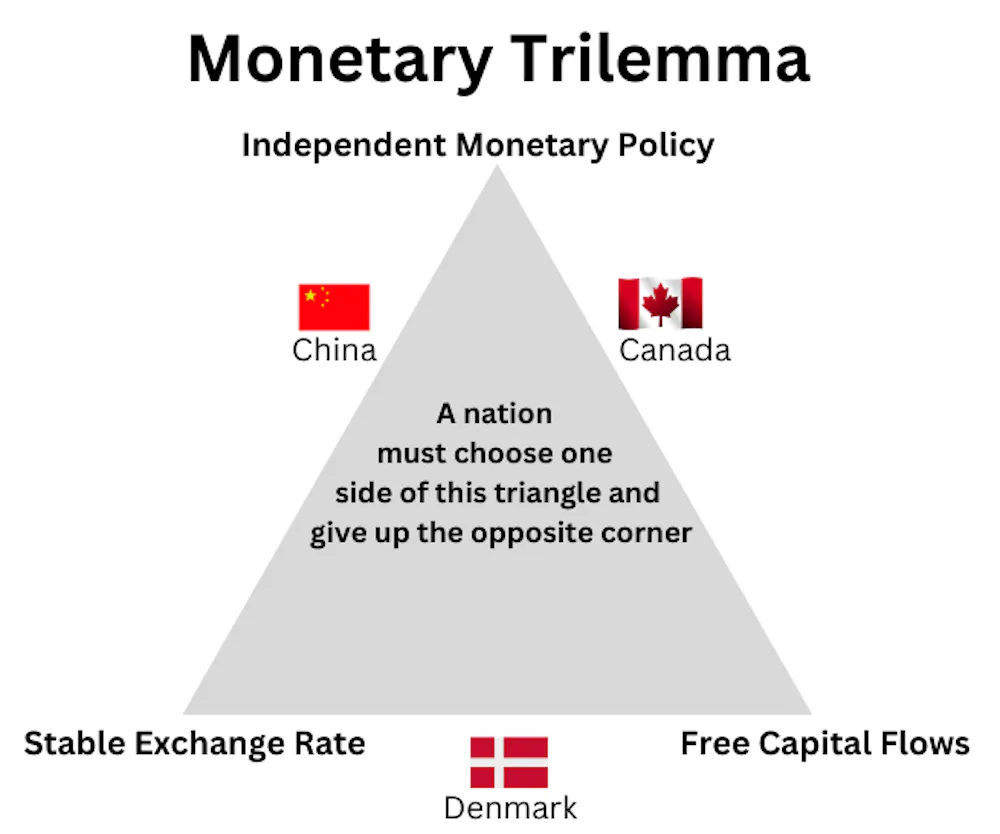
    A country cannot have an independent monetary policy, stable exchange rate and free capital flows simultaneously. It must choose one side of this triangle and give up the opposite corner.
    (Sorin Rizeanu), CC BY-ND

    The Bank of Canada has good reasons to cut the interest rate back to 2.5 to 3.5 per cent, but this could have a significant impact on the loonie.

    Canada is facing two sets of trilemmas: a monetary one for the central bank and a fiscal one for the government. On the monetary side, stable exchange rates, independent monetary policy and financial market openness are three objectives that cannot all be achieved simultaneously. European countries have sacrificed monetary independence in exchange for a strong euro and financial openness.

    It’s impossible for policymakers to pursue all three choices at the same time. For instance, a country spending more without raising taxes has to increase public debt and deficit.
    (Sorin Rizeanu), CC BY-ND

    Canada, in contrast, has opted for free capital mobility and independent monetary policy at the expense of exchange rate stability. This allows the loonie to be determined by market forces, giving the central bank the ability to adjust interest rates while capital moves freely across the border.

    On the fiscal side, the government is grappling with climate change, immigration and wealth inequality. However, there is also strong public resistance to higher taxes, and public debt and deficits are currently at alarming levels.

    If the central banks are at odds

    If the Bank of Canada were to cut interest rates while the Fed doesn’t, the loonie would likely depreciate sharply, forcing a response. Such a divergence happened in June 2024, with the Fed following with a 0.5 per cent cut only in September.

    On such short-term deviations, sterilization is typically implemented to dampen the depreciation of the loonie by acquiring Canadian dollars and selling reserves.

    If the central banks were to remain at odds in the longer term, a decrease in money supply as investors flee would likely cause a decrease in domestic bank lending, which is already under pressure from public and private debt and increased default rates.

    This could decrease longer term interest rates and put additional pressure on the economy through the capital account. If investors believe the central bank is merely delaying the inevitable depreciation of its currency, it could also reinforce carry trade dynamics — an investment strategy where money is borrowed at a low cost in one currency to earn higher returns from investments in another currency.

    The bond market would also react, with notable effects in key economic sectors and asset valuation. Long-term interest rates tend to align more across countries than short-term rates, especially if global factors are influencing real rates or if investors are seeking safer assets.

    While the Bank of Canada can set its policy rate independently of the Fed’s rate, it has less control over the long-term. Long-term rates are tied to exchange rates and reflect expectations for future short-term rates and risk factors. Mortgage rates and corporate borrowing rates would be affected as well.

    Monetary policy can’t be the only answer

    The Bank of Canada’s mandate is to “keep inflation low, stable and predictable.” While this can be fulfilled through rate cuts, diverging from U.S. policy will have widespread effects on the Canadian economy. These impacts will be uneven, with indebted investors and banks likely benefiting while the working class may bear the brunt.

    The Bank of Canada focuses on providing liquidity to the financial sector, often with little regulation or oversight. However, this approach tends to overlook challenges faced by the working class. In 2022, for instance, Bank of Canada Governor Tiff Macklem advised against employers increasing wages to match inflation over concern that a wage-price spiral would occur.

    Even if the central bank wanted to address these issues, it’s limited by the ability to manage multiple outputs with just one instrument. As a result, the central bank should report not only on inflation, but also on the overall trade-offs of rate cuts.

    The Bank of Canada has a vested interest in tampering the effects of a new rate cut, especially since it could trigger a “capital famine” in the long-term and weaken the Canadian dollar. In the short-term, divergences from the U.S. will likely be manageable, but in the longer term, currency depreciation may be unavoidable to keep the economy afloat.

    Monetary policy is vital, but it’s merely the first line of defence against inflation. To truly address Canada’s economic issues, both monetary and fiscal policies need to work together in harmony, with a broader public discussion that goes beyond inflation.

    Sorin Rizeanu does not work for, consult, own shares in or receive funding from any company or organisation that would benefit from this article, and has disclosed no relevant affiliations beyond their academic appointment.

    ref. Bank of Canada’s latest interest rate cut: Monetary policy is not enough to address economic issues on its own – https://theconversation.com/bank-of-canadas-latest-interest-rate-cut-monetary-policy-is-not-enough-to-address-economic-issues-on-its-own-238396

    MIL OSI – Global Reports

  • MIL-OSI USA: DOD Kicks Off Groundbreaking Applied Research Project in Hypersonic Infrared Targeting Sensing

    Source: United States Department of Defense

    The Department of Defense (DoD) today announced the Hypersonic Infrared Target Sensing (HITS) joint-service proposal as the winner of the fiscal year 2025 Applied Research for the Advancement of S&T Priorities (ARAP) Program award competition. The HITS team includes the Naval Research Laboratory, Air Force Research Laboratory, and Missile Defense Agency, led by the Combat Capabilities Development Command Army Research Laboratory (DEVCOM ARL).

    This three-year, $45-million project will involve the collaboration of more than 50 federal scientists and engineers across the military service labs.

    “Investments into our military labs and facilities are imperative for the DoD to invest in technological solutions that attract and retain the future workforce,” said Dr. Aprille Ericsson, the assistant secretary of defense for science and technology and S&T Executive Committee chair, during a check-presentation ceremony at the Pentagon with the HITS team. “The project will also support up to 50 new graduate and postdoctoral researchers on-site or through the labs and their academic partners, growing the DoD’s depth in multiple emerging research areas.”

    The HITS research program will address the challenges of developing infrared seekers for hypersonic weapons. This includes locating targets throughout hypersonic flight, advancing gimbal-free target discrimination in extreme hypersonic turbulence, developing high-temperature infrared materials, and addressing thermal distortion through the seeker window.

    With additional participation from the Defense Advanced Research Projects Agency, the DEVCOM ARL-led team will build in-house capabilities while partnering with academia, university-affiliated research centers, and industry to execute the multidisciplinary effort, leveraging early laboratory demonstrations from basic research investments.

    “Our approach encompasses innovative multi-physics modeling, meta-optical design, advanced fabrication techniques, and infrared optical characterization, with the ultimate goal of improving the precision of these weapons at longer ranges in more agile, lower cost platforms,” said Dr. Henry Everitt, senior technologist for optical sciences at DEVCOM ARL and the HITS team lead.

    To participate in the annual ARAP award competition, DoD laboratories and centers must submit applied research (BA-2) funding proposals addressing specific technology or capability gaps while enhancing collaboration across the military services and DoD agencies. A proposal must demonstrate a clear pathway from research to product fielding. “The S&T Executive Committee received nine high-quality white paper submissions for this year’s competition and narrowed it down to three finalists,” said Ericsson.

    Each finalist team briefed its full proposal to the executive committee, a defense multi-service, multi-agency group coordinated by the Office of the Under Secretary of Defense for Research and Engineering, under which Ericsson’s office operates.

    “Every team demonstrated tremendous initiative, professionalism, and vision in developing its proposal, proving once again that the dedication and excellence of our defense scientists and engineers are the key ingredients for the ARAP program’s success, as it solves challenging problems for the joint collaborative fight,” said Ericsson.

    The call for ARAP white papers for fiscal year 2026 is now open with submissions due on Friday, November 13, 2024. For questions or assistance accessing the DoDTechipedia OUSD(R&E) ARAP Webpage, please contact the R21 Team at osd.pentagon.ousd-atl.mbx.communities-of-interest@mail.mil.

    About USD(R&E)

    The Office of the Under Secretary of Defense for Research and Engineering OUSD(R&E) champions research, science, technology, engineering, and innovation to maintain the U.S. military’s technological advantage. Learn more at www.cto.mil or visit us on LinkedIn at https://www.linkedin.com/company/ousdre.

    MIL OSI USA News

  • MIL-OSI: UPDATE – Talen Energy to Report Third Quarter 2024 Financial Results on November 14, 2024

    Source: GlobeNewswire (MIL-OSI)

    Reflects Update to Previously Announced Date to Accommodate Schedules in the Investor Community, New Event Links Included

    HOUSTON, Oct. 23, 2024 (GLOBE NEWSWIRE) — Talen Energy Corporation (“Talen”) (NASDAQ: TLN) plans to release its third quarter 2024 financial results on Thursday, November 14, 2024, before market open. President and Chief Executive Officer Mac McFarland and Chief Financial Officer Terry Nutt will discuss the financial and operating results during an earnings call at 10:00 a.m. EST (9:00 a.m. CST) on November 14, 2024.

    To listen to the earnings call, please register in advance for the webcast here. For participants joining the call via phone, please register here prior to the start time to receive dial-in information. For those unable to participate in the live event, a digital replay of the earnings call will be archived for approximately one year and available on Talen’s Investor Relations website at https://ir.talenenergy.com/news-events/events.

    About Talen
    Talen Energy (NASDAQ: TLN) is a leading independent power producer and energy infrastructure company dedicated to powering the future. We own and operate approximately 10.7 gigawatts of power infrastructure in the United States, including 2.2 gigawatts of nuclear power and a significant dispatchable fossil fleet. We produce and sell electricity, capacity, and ancillary services into wholesale U.S. power markets, with our generation fleet principally located in the Mid-Atlantic and Montana. Our team is committed to generating power safely and reliably, delivering the most value per megawatt produced and driving the energy transition. Talen is also powering the digital infrastructure revolution. We are well-positioned to capture this significant growth opportunity, as data centers serving artificial intelligence increasingly demand more reliable, clean power. Talen is headquartered in Houston, Texas. For more information, visit https://www.talenenergy.com/.

    Investor Relations:
    Ellen Liu
    Senior Director, Investor Relations
    InvestorRelations@talenenergy.com

    Media:
    Taryne Williams
    Director, Corporate Communications
    Taryne.Williams@talenenergy.com

    Forward-Looking Statements
    This communication contains forward-looking statements within the meaning of the federal securities laws, which statements are subject to substantial risks and uncertainties. These forward-looking statements are intended to qualify for the safe harbor from liability established by the Private Securities Litigation Reform Act of 1995. All statements other than statements of historical fact included in this communication, or incorporated by reference into this communication, are forward-looking statements. Throughout this communication, we have attempted to identify forward-looking statements by using words such as “anticipate,” “believe,” “continue,” “could,” “estimate,” “expect,” “forecasts,” “goal,” “intend,” “may,” “plan,” “potential,” “predict,” “project,” “seek,” “should,” “will,” or other forms of these words or similar words or expressions or the negative thereof, although not all forward-looking statements contain these terms. Forward-looking statements address future events and conditions concerning, among other things capital expenditures, earnings, litigation, regulatory matters, hedging, liquidity and capital resources and accounting matters. Forward-looking statements are subject to substantial risks and uncertainties that could cause our future business, financial condition, results of operations or performance to differ materially from our historical results or those expressed or implied in any forward-looking statement contained in this communication. All of our forward-looking statements include assumptions underlying or relating to such statements that may cause actual results to differ materially from expectations, and are subject to numerous factors that present considerable risks and uncertainties.

    The MIL Network

  • MIL-OSI Economics: Global Sovereign Debt Roundtable — 3rd Cochairs Progress Report

    Source: International Monetary Fund

    October 23, 2024

    Washington, DC: The Global Sovereign Debt Roundtable (GSDR) met today and reviewed progress on the work to improve debt restructuring processes and timelines, and to help address debt vulnerabilities. Participants also discussed priority areas for the work going forward. At the end of the meeting, the International Monetary Fund Managing Director Kristalina Georgieva, World Bank Group President Ajay Banga, and Finance Minister of Brazil Fernando Haddad, co-chairs of the GSDR, issued the attached GSDR 3rd Cochairs Report as well as the compilation of technical issues discussed by the GSDR so far.

    The GSDR brings together debtor countries and official and private creditors with the objective to build common understanding among key stakeholders on debt sustainability and debt restructuring challenges, and ways to address them.

    IMF Communications Department
    MEDIA RELATIONS

    PRESS OFFICER: Randa Elnagar

    Phone: +1 202 623-7100Email: MEDIA@IMF.org

    @IMFSpokesperson

    MIL OSI Economics

  • MIL-OSI Africa: Ninth Africa Energy Market Place (AEMP) held in Dar es Salaam ahead of key Africa Heads of State Energy Summit scheduled for 28 January in Tanzania

    Source: Africa Press Organisation – English (2) – Report:

    DAR ES SALAAM, Tanzania, October 23, 2024/APO Group/ —

    Further to an April 2024 pledge by the Presidents of the African Development Bank (www.AfDB.org) and the World Bank to bring electricity access to 300 million people in Africa by 2030, the Tanzanian port city of Dar es Salaam has been selected to host an Africa Heads of State Energy Summit on 28 January 2025.

    The summit will convene heads of state and government, ministers, international and regional organisations, and other partners, including the private sector, to agree on a common set of reforms required to support Africa’s overall objective of “achieving universal access to affordable, reliable, sustainable and modern energy by 2030.” This objective aligns with United Nations Sustainable Development Goal 7 and the African Union’s Agenda 2063.

    This announcement was made by Dr Kevin Kariuki, Africa Development Bank Vice President for Power, Energy, Climate and Green Growth during the opening of the 9th Africa Energy Market Place (AEMP).

    AEMP is a policy dialogue and investment delivery platform created by the African Development Bank as part of the New Deal on Energy for Africa, the transformative partnership to light up and power Africa by 2025. By bringing together governments, the private sector, and development partners, it works to scale up investments in the African energy sector

    In his remarks, Dr Kariuki praised President Samia Suluhu Hassan’s leadership and personal commitment to Tanzania’s, and Africa’s, universal access to modern energy. He observed that increased and accelerated access to modern energy will hasten Tanzania’s economic development. “Accelerated universal access to energy will catalyse Tanzania’s economic development and guarantee an expedited well-lit, powered, prosperous and sustainable energy future for all Tanzanians,” he said.

    Jointly organised by the African Development Bank Group and Tanzania’s Ministry of Energy, the AEMP took place in Dar es Salaam, Tanzania on the 16th and 17th  of October 2024, under the theme Delivering the Clean Cooking Initiatives and National Energy Access Goals.  It was officiated by Dr Doto Mashaka Biteko, Tanzania’s deputy prime minister and minister of energy.

    Deputy Prime Minister Biteko expressed optimism regarding the AEMP’s potential for policy dialogue, noting that, “Hosting the 9th Africa Energy Market Place is timely as we prepare for the Africa Heads of State summit which aims to bring together African presidents, the private sector and development partners to facilitate investments to provide electricity access to 300 million people in Africa.”

    He said he hoped the discussions at AEMP would shape the executive sessions of the upcoming January summit.

    MIL OSI Africa

  • MIL-OSI USA: Senator Collins Speaks at Global Secure Shipping Facility Grand Opening in Old Town

    US Senate News:

    Source: United States Senator for Maine Susan Collins

    Click HERE, HERE, and HERE for individual photos
    Old Town, ME – Today, U.S. Senator Susan Collins delivered remarks at the grand opening of Global Secure Shipping’s (GSS) second manufacturing facility in Old Town.  With the opening of today’s facility, GSS now has 32,500ft in total manufacturing space to produce its state-of-the-art secure cargo containers using patented technology first developed at the University of Maine (UMaine).
    Today’s event also celebrated the company’s selection for a $4.1 million Department of Homeland Security (DHS) contract to produce and test the next generation of secure cargo containers. 
    Joining Senator Collins at the grand opening were U.S. Assistant Secretary of Defense for Industrial Base Policy Dr. Laura Taylor-Kale, UMaine President Joan Ferrini-Mundy, GSS CEO Robert Lindyberg, Ph.D., and Executive Director of GSS and UMaine engineering professor Dr. Habib Dagher.
    “This is a great day for our State, for our nation, and for the security of cargo shipping around the world,” said Senator Collins during her remarks.  “The project we celebrate today is about seaport security.  But it also is about transitioning from research and development to manufacturing to create new industries, with new opportunities and good jobs.  GSS is in the vanguard of that transition.”
    “Most of all, this is about the innovative spirit of Maine and our maritime heritage, with our University, GSS, and a skilled local workforce joining together to achieve something truly remarkable.  Congratulations on this great accomplishment,” Senator Collins concluded.
    GSS was founded in 2018 to commercialize the hybrid composite secure shipping container technology developed at UMaine. As a senior member of the Appropriations Committee and now Vice Chair, Senator Collins helped secure funding for UMaine to research this technology, as well as funding for DHS that led to GSS’s $4.1 million contract.
    Senator Collins attended the groundbreaking for this facility in September 2023. 

    MIL OSI USA News

  • MIL-OSI Global: Harris and Trump differ widely on gun rights, death penalty and other civil liberties questions

    Source: The Conversation – USA – By Donovan A. Watts, Assistant Professor of Political Science, Auburn University

    The Bill of Rights secures key liberties for U.S. citizens against the government’s power. U.S. Congress via Wikimedia Commons

    As the election nears, voters are considering the two leading presidential candidates’ records on a wide range of issues, including civil liberties – a broad term used to describe the constitutionally protected freedoms that protect citizens from excessive government power. These key freedoms are contained in the Bill of Rights, the first 10 amendments to the U.S. Constitution. For example, the protection for free speech under the First Amendment and the right to bear arms under the Second Amendment define people’s abilities to criticize the government and own weapons for private use.

    In turn, as a scholar of American politics, I have seen that Kamala Harris and Donald Trump have very different records on these crucial American rights.

    First Amendment freedoms of speech and press

    As California’s attorney general, Harris indirectly found herself in a battle with the First Amendment. For many years, state law required nonprofit organizations registered in California to report names and addresses of donors of amounts over US$5,000 in a single year. In 2010, the year before Harris became attorney general, her predecessor began actually enforcing that law, which Harris continued when she took office in 2011. In 2014, several conservative groups sued Harris, saying her office’s enforcement of the law was violating their First Amendment right to give money anonymously.

    Part of Harris’ job was to oversee the defense of the law in court, arguing that soliciting donor names did not bar donor disclosure requirements like California’s. The case lasted beyond her term as California’s top law enforcement officer: The U.S. Supreme Court declared parts of the law unconstitutional in 2021, after Harris had become vice president.

    While he was president, Trump’s First Amendment record was more about the media than free speech. He repeatedly declared the press “the enemy of the people.” He has suggested that media outlets who provide coverage he dislikes lose their broadcasting licenses and has pressed to change laws about libel in ways that would make it easier for public figures to file suit against unfavorable coverage.

    As California’s attorney general, Kamala Harris worked to reduce gun violence in the state.
    Kevork Djansezian/Getty Images

    Second Amendment right to bear arms

    Dating back to her tenure as a district attorney in San Francisco and as California’s attorney general, Harris has been an advocate for stricter gun control laws. However, she is not seeking to take away Americans’ guns – and recently revealed that she herself is a gun owner.

    When serving as district attorney in San Francisco, Harris worked with the city’s mayor at the time, Gavin Newsom, to develop some of the strictest local gun regulations in the country. In December 2004, Proposition H was placed on the ballot and passed by majority vote in November 2005. Proposition H banned possessing a handgun within San Francisco, with a few exceptions, and banned purchasing, possession, distribution and manufacturing of all firearms in the city. However, the proposition was overruled by the San Francisco Superior Court, which said gun ownership should be regulated at the state level.

    And in 2008, as the U.S. Supreme Court was preparing to hear a key gun control case, Harris led 18 elected prosecutors who urged the justices that a broad right to gun ownership could endanger local and state firearm laws. In a 5-4 decision, the Supreme Court held that the Second Amendment guarantees an individual the right to possess firearms.

    However, the Supreme Court’s ruling did not stop Harris in her continued fight for gun regulation. She pushed for additional funding to confiscate guns from thousands of people whom California law said were banned from having them. Later as a U.S. senator from 2017 to 2021, Harris continued to advocate for gun regulation by sponsoring bills that would have enacted universal background checks and ban assault rifles.

    During Harris’ term as vice president, she oversaw the White House Office of Gun Violence Prevention, which seeks to focus government attention on a wide range of policies to reduce gun violence, including restrictions on firearms, increased mental health services and new powers for prosecutors to use against people who use firearms when committing a crime.

    In 2019, while he was president, Donald Trump spoke to a National Rifle Association meeting and expressed support for the organization.
    AP Photo/Michael Conroy

    Trump’s record on firearms, meanwhile, has been mixed. As president, he signed legislation in 2017 that softened background check requirements for gun buyers with particular mental illness diagnoses. And during the COVID-19 pandemic, he objected to the fact that many local orders to close businesses to protect public health included shutting gun shops.

    Yet in 2018, he also moved to ban bump stocks – a device attached to a semiautomatic firearm that enables it to fire more rapidly. His ban was overturned by the Supreme Court in June 2024.

    Trump also supported and signed the Fix NICS Act, a bipartisan law that strengthened reporting to the federal gun background checks system by requiring federal agencies to submit semiannual certification reports to the attorney general on their compliance with recordkeeping and transmission requirements.

    Eighth Amendment protections against ‘cruel and unusual punishments’

    The Eighth Amendment’s protection against “cruel and unusual punishments” has often been used by the Supreme Court to evaluate uses of the death penalty.

    Harris has consistently pledged to refuse to seek the death penalty in criminal cases, noting a multitude of systemic flaws that result in its disproportional application based on defendants’ race and income. She also noted the cost to taxpayers of keeping prisoners on death row. Harris’ position was tested just months into her service as district attorney when a police officer was shot and killed in the line of duty in 2004. Harris declined to seek the death penalty for the shooter, who was convicted of murder and is serving a life sentence without the possibility of parole.

    While attorney general of California, however, she defended in court the state’s power to impose the death penalty. But when, in March 2024, the state’s governor – Newsom – declared a halt to executions, sparing all 737 people on California’s death row, Harris praised the action.

    Trump’s record on capital punishment dates back long before his political career. In 1989, he took out full-page newspaper ads calling for the return of the death penalty in New York. He specifically wanted it to be applied to the Central Park Five, five young Black and Hispanic men who were wrongly accused of raping and beating a woman. They pleaded not guilty but served years in prison before being exonerated by DNA evidence and the actual criminal’s confession.

    During his term as president, Trump resumed federal executions after a 17-year hiatus, executing 13 people in the last six months of his presidency, the last of which was just four days before his term ended.

    All in all, as voters decide who to vote for in the upcoming election, analyzing both candidates’ record on civil liberties is a good step in making an informed decision.

    Donovan A. Watts does not work for, consult, own shares in or receive funding from any company or organization that would benefit from this article, and has disclosed no relevant affiliations beyond their academic appointment.

    ref. Harris and Trump differ widely on gun rights, death penalty and other civil liberties questions – https://theconversation.com/harris-and-trump-differ-widely-on-gun-rights-death-penalty-and-other-civil-liberties-questions-240762

    MIL OSI – Global Reports

  • MIL-OSI USA: Disaster Recovery Center Now Open in Chatham County

    Source: US Federal Emergency Management Agency

    Headline: Disaster Recovery Center Now Open in Chatham County

    Disaster Recovery Center Now Open in Chatham County

    ATLANTA — FEMA opened an additional Disaster Recovery Center in Chatham County to provide one-on-one help for Georgians affected by Hurricane Helene. The center is open Monday to Saturday from 8 a.m. to 7 p.m. and Sundays from 1 p.m. to 6 p.m. Chatham CountySavannah Technical CollegeStudent Enrichment Center Building5717 White Bluff RoadSavannah, GA 31405Additional centers are open in Appling, Coffee, Liberty, Lowndes, McDuffie, Richmond, Toombs and Washington counties: Appling CountyAppling County Agricultural Center2761 Blackshear Highway, Baxley, GA 31513Coffee CountyThe Atrium 114 N. Peterson Avenue, Douglas, GA 31533Liberty CountyMiller Park/HQ Fire Station 6944 E. Oglethorpe Highway, Midway, GA 31320Lowndes CountyCity of Valdosta4434 North Forrest Street Extension, Valdosta, GA 31605McDuffie CountyThompson Depot111 Railroad Street, Thomson, GA 30824Richmond CountyHub for Community Innovation631 Chafee Avenue Augusta, GA 30904Toombs CountyGeorgia Department of Human Services 162 Oxley Drive, Lyons, GA 30436 Washington CountySandersville School Building Authority514 North Harris Street, Sandersville, GA 31082To find center locations in Georgia, visit FEMA’s Hurricane Helene Georgia Page, FEMA’s DRC Locator or text “DRC” and your Zip Code to 43362. All centers are accessible to people with disabilities or access and functional needs and are equipped with assistive technology. Homeowners and renters in Appling, Atkinson, Bacon, Ben Hill, Berrien, Brantley, Brooks, Bryan, Bulloch, Burke, Butts, Camden, Candler, Charlton, Chatham, Clinch, Coffee, Colquitt, Columbia, Cook, Dodge, Echols, Effingham, Elbert, Emanuel, Evans, Fulton, Glascock, Glynn, Hancock, Irwin, Jeff Davis, Jefferson, Jenkins, Johnson, Lanier, Laurens, Liberty, Lincoln, Long, Lowndes, McDuffie, McIntosh, Montgomery, Newton, Pierce, Rabun, Richmond, Screven, Taliaferro, Tattnall, Telfair, Thomas, Tift, Toombs, Treutlen, Ware, Warren, Washington, Wayne and Wheeler counties can visit any open center to meet with representatives of FEMA, the State of Georgia and the U.S. Small Business Administration. No appointment is needed.If you are in an affected county, you are encouraged to apply for FEMA disaster assistance. The quickest way to apply is online at DisasterAssistance.gov. You can also apply using the FEMA App for mobile devices or calling toll-free 800-621-3362. The telephone line is open every day and help is available in most languages.Disaster Assistance Teams are also on the ground in affected counties going door-to-door to help survivors register for assistance.For the latest information about Georgia’s recovery, visit fema.gov/disaster/4830. Follow FEMA on X at x.com/femaregion4 or on Facebook at facebook.com/fema.
    larissa.hale
    Wed, 10/23/2024 – 18:49

    MIL OSI USA News

  • MIL-OSI USA: Governor Cooper Proposes $3.9 Billion in State Funding to Spur Hurricane Helene Relief and Recovery

    Source: US State of North Carolina

    Headline: Governor Cooper Proposes $3.9 Billion in State Funding to Spur Hurricane Helene Relief and Recovery

    Governor Cooper Proposes $3.9 Billion in State Funding to Spur Hurricane Helene Relief and Recovery
    mseets

    Less than a month after Hurricane Helene hit Western North Carolina, Governor Roy Cooper today shared a state budget recommendation to help rebuild stronger to withstand future storms. Governor Cooper recommends an initial $3.9 billion package to begin rebuilding critical infrastructure, homes, businesses, schools, and farms damaged during the storm.

    “Helene is the deadliest and most damaging storm ever to hit North Carolina,“ said Governor Cooper. “This storm left a trail of destruction in our beautiful mountains that we will not soon forget, but I know the people of Western North Carolina are determined to build back better than ever. These initial funds are a good start, but the staggering amount of damage shows we are very much on the front end of this recovery effort.”

    Initial damage estimates are $53 billion, roughly three times Hurricane Florence estimates in 2018 and the largest in state history. A strong recovery will require significant investments by private insurers as well as the federal, state and local governments. Large scale disasters fueled by climate change in recent years have shown the challenges and enormous costs of recovery as well as the need to ensure structures are hardened are they are rebuilt to withstand future storms. Successful recoveries require significant early investments to ensure communities have the tools to fully rebuild.

    Economy

    The economic devastation from Hurricane Helene is unparalleled. Thousands of businesses in the region suffered damages leaving business owners and workers suffering. The Governor’s funding package includes $650 million to address economic losses and physical damage for non-agricultural businesses and non-profit organizations. This would include a revival of the pandemic-era Business Recovery Grant Program, which helped North Carolina’s economy recover faster than the national average. Governor Cooper has already increased unemployment insurance benefits through an executive order with a bipartisan and unanimous vote of the Council of State.

    Housing

    The Governor’s budget recommendation includes $650 million to address physical damage to residential structures and cost of housing assistance. These investments would jumpstart permanent housing construction in advance of potential federal funds, which can take months or years to be approved.

    Utilities and Natural Resources

    Critical and high-risk infrastructure was damaged across the region, including water and sewer systems in multiple communities and power generation facilities. Much of this infrastructure is in geographically isolated locations and challenging to reach, slowing restoration of services to communities. The Governor’s funding package includes $578 million to address the physical damage and cleanup of energy, water, waste clean-up, telecommunications, dams and other infrastructure.

    Transportation

    Hurricane Helene severely impacted approximately 5,000 miles of state-maintained roads across the affected area in Western North Carolina, including several major national interstates and critical transportation corridors. The proposed funding package includes $55 million to address physical damage and state revenue implications of the transportation infrastructure damage.

    Agriculture

    The funding package includes $422 million to address physical damage and business disruption for agricultural enterprises. This storm caused significant damage to hundreds of thousands of acres of agricultural land and hundreds of structures.

    Recovering From Additional Recent Disasters

    As North Carolina is still recovering from other recent natural disasters, Governor Cooper’s proposed budget includes $420 million for needs related to PTC-8, Tropical Storm Debby, and funds to complete homeowner assistance for Hurricanes Florence and Matthew.

    The full Budget Recommendation can be found here.

    ###

    Oct 23, 2024

    MIL OSI USA News

  • MIL-OSI USA: Governor Ron DeSantis Announces Investment in Marine Infrastructure to Support Recovery Through the Florida Disaster Fund

    Source: US State of Florida

    Governor DeSantis also announced discounts on fishing licenses and progress on Florida’s efforts to take over management of Red Snapper in the Atlantic.

    STEINHATCHEE, Fla.—Today, Governor Ron DeSantis announced the award of $1,000,000 in funding from the Florida Disaster Fund to the Fish and Wildlife Foundation of Florida to support the rebuilding of fishing and aquaculture infrastructure damaged by Hurricanes Helene and Milton. The funding will go toward the rebuilding of boat slips and docks, the repair of fish houses, impacted aquaculture businesses, and other important infrastructure repairs for Florida’s fishing economy across the Big Bend region.

    “The Big Bend’s fishing industry took a direct hit from hurricanes Debby and Helene, and so did the hardworking Floridians who make their living on the water,” said Governor Ron DeSantis. “Today’s investments will help to rebuild critical waterside infrastructure and help get Floridians in the fishing and aquaculture industries back to full operations.”

    To unlock additional resources from the federal government, Governor DeSantis’ administration also initiated the process of submitting a federal fisheries disaster declaration to the U.S. Secretary of Commerce. This declaration request would provide access to federal funding, subject to appropriation, for offshore, nearshore, and inshore fisheries to rebuild. Governor DeSantis requested a similar federal fisheries disaster declaration following Hurricane Ian and Hurricane Idalia.

    Governor DeSantis has also directed the Florida Department of Environmental Protection (DEP) to expedite any permits or approvals for businesses impacted on uplands or on the water to ensure the rebuilding of damaged structures is not delayed by bureaucracy.

    “Governor DeSantis has a proven track record of helping communities recover quickly and rebuild fully after storms,” said Florida Fish and Wildlife Conservation Commission Executive Director Roger Young. “We are grateful for his leadership and support in assisting the fishing industry as it recovers from hurricanes Debby, Helene, and Milton.”

    Additionally, the Governor announced several discounts on fishing and hunting licenses, including lifetime licenses, to get anglers back on the water and provide a boon to the industry that serves them. This includes:

    • Half-off short-term licenses for Floridians from October 25, 2024, to January 3, 2025, for the annual and five-year multisport licenses for fishing and hunting; and
    • A 50% discount on lifetime sportsman licenses for children up to 17 years of age.
      • Age 4 or younger – $200 (normally $400)
      • Ages 5 to 12 – $350 (normally $700)
      • Ages 13 to 17 – $500 (normally $1,000)

    Additionally, FWC is offering annual salt water and freshwater combo licenses for just $5.

    Fishing and Florida are inseparable. Florida leads the nation in the number of saltwater fishing anglers, generating a $9.2 billion impact on the State of Florida’s economy. Additionally, the annual dockside value of commercial fisheries was estimated at $244 million. Today’s announcement will help Florida residents regenerate lost income and rebuild their businesses and infrastructure.

    ###

    MIL OSI USA News

  • MIL-OSI Security: Postal Employee Arrested For COVID Relief Fraud

    Source: United States Department of Justice (National Center for Disaster Fraud)

     Ocala, Florida – United States Attorney Roger B. Handberg announces the arrest of Marina Tusca Brooks Stewart (61, Groveland) on an indictment charging her with one count of wire fraud related to COVID relief. If convicted, Brooks Stewart faces up to 20 years in federal prison. In addition, she faces a forfeiture order of $10,000, which represents the alleged proceeds she obtained through this offense. 

    According to court documents, during the COVID pandemic, the United States Small Business Administration (SBA) offered Targeted Economic Injury Disaster Loan (EIDL) Advances that did not need to be repaid. The advances were for small businesses that were in low-income communities and received a reduction in revenue of more than 30% during an eight-week period. Between June 28 and 30, 2020, Brooks Stewart devised a scheme to defraud the SBA by electronically applying for an EIDL advance and providing false representations in her application. Afterwards, she fraudulently received a $10,000 EIDL advance.

    An indictment is merely an allegation that a defendant has committed a federal criminal offense. Every defendant is presumed innocent unless, and until, proven guilty. 

    This case is being investigated by the United States Postal Service – Office of Inspector General. It is being prosecuted by Assistant United States Attorney Hannah Nowalk.

    MIL Security OSI

  • MIL-OSI USA: Rep. Panetta Announces New Federal Investment to Further Modernize Monterey Regional Airport

    Source: United States House of Representatives – Congressman Jimmy Panetta (D-Calif)

    Monterey, CA – United States Representative Jimmy Panetta (CA-19) announced a new federal investment to support Monterey Regional Airport’s initial phase of terminal construction.  Rep. Panetta secured $14.2 million through the Airport Terminal Program (ATP) to fund the construction and replacement of a 70-year-old terminal, including the relocation of a LEED Platinum-certified terminal, improved internal airport access, and enhanced landside road access.  This includes a multimodal bus connection for the Monterey-Salinas Transit Company.  This funding was made possible by the Bipartisan Infrastructure Investment and Jobs Act.

    “Residents and visitors alike deserve a Monterey Regional Airport that is safe, reliable, and comfortable,” said Rep. Panetta. “I’m proud to ensure that the federal government is investing in local airports like ours to meet the demands of modern travelers with updated amenities and enhanced safety features.  With this federal support, we will continue to improve the mobility, economy, and quality of life in California’s 19th Congressional District.”

    “This new grant will be the first federal funding dedicated directly to the construction of the replacement terminal building,” said Monterey Regional Airport Executive Director Michael La Pier.  “With the design completed, we will be ready to move forward with the start of the construction in the spring with a completion some time in late 2026.  We’d like to thank Representative Panetta for his help and guidance in this process. It means a great deal to the airport to have such strong support in the District and in Washington.”

    Rep. Panetta continues working alongside local partners to ensure the federal government plays its role in modernizing the Monterey Regional Airport.  Previously, Rep. Panetta secured more than $64 million in federal funding to support new terminal design, tarmac improvements, and other modernization and safety initiatives.

    The Bipartisan Infrastructure Investment and Jobs Act provided $15 billion in airport infrastructure funding.  For more information on projects nationwide, visit: here.

    ###

    MIL OSI USA News

  • MIL-OSI: Real Estate Split Corp. Announces Overnight Offering

    Source: GlobeNewswire (MIL-OSI)

    Not for distribution to U.S. Newswire Services or for dissemination in the United States.

    TORONTO, Oct. 23, 2024 (GLOBE NEWSWIRE) — Real Estate Split Corp. (TSX: RS and RS.PR.A) (the “Company”), is pleased to announce that the Company is undertaking an overnight treasury offering of class A and preferred shares (the “Class A Shares” and “Preferred Shares”, respectively).

    The sales period for this overnight offering will end at 9:00 a.m. (ET) on Thursday, October 24, 2024. The offering is expected to close on or about October 31, 2024 and is subject to certain closing conditions including approval by the Toronto Stock Exchange (“TSX”).

    The Class A Shares will be offered at a price of $12.90 per Class A Share to yield 12.1% and the Preferred Shares will be offered at a price of $10.10 per Preferred Share to yield 4.4% to maturity. The closing price on the TSX for each of the Class A Shares and Preferred Shares on October 22, 2024 was $13.21 and $10.16, respectively. The Class A Share and Preferred Share offering prices were determined so as to be non-dilutive to the most recently calculated net asset value per unit of the Company (calculated as at October 22, 2024), as adjusted for dividends and certain expenses to be accrued prior to or upon settlement of the offering.

    The Company has been designed to provide investors with a diversified, actively managed, high conviction portfolio comprised of securities of leading North American real estate companies.

    The Company’s investment objectives for the:

    Class A Shares are to provide holders with:

    (i) non-cumulative monthly cash distributions; and
    (ii) the opportunity for capital appreciation through exposure to the portfolio

    Preferred Shares are to:

    (i) provide holders with fixed cumulative preferential quarterly cash distributions; and
    (ii) return the original issue price of $10.00 to holders upon maturity.

    Middlefield Capital Corporation provides investment management advice to the Company.

    The syndicate of agents for the offering is being co-led by CIBC Capital Markets, RBC Capital Markets, and Scotiabank.

    For further information, please visit our website at www.middlefield.com or contact Nancy Tham in our Sales and Marketing Department at 1.888.890.1868.

    A short form base shelf prospectus containing important detailed information about the securities being offered has been filed with securities commissions or similar authorities in each of the provinces and territories of Canada. Copies of the short form base shelf prospectus may be obtained from a member of the syndicate. The Company intends to file a supplement to the short form base shelf prospectus, and investors should read the short form base shelf prospectus and the prospectus supplement before making an investment decision. There will not be any sale or any acceptance of an offer to buy the securities being offered until the prospectus supplement has been filed with the securities commissions or similar authorities in each of the provinces and territories of Canada.

    The MIL Network

  • MIL-Evening Report: Netflix’s Territory is a Succession-like drama packed with family rivalry and betrayal, set in Australia’s outback

    Source: The Conversation (Au and NZ) – By Alexa Scarlata, Research Fellow, Media & Communication, RMIT University

    Netflix

    The Australian commissioning team at Netflix has had a pretty good run over the past 12 months. In January, the adaptation of Trent Dalton’s novel Boy Swallows Universe proved to be the most successful Australian-made show to that point, scoring 7.6 million views globally in its first two weeks.

    A few months later, the second season of the streamer’s Heartbreak High reboot debuted at number one in Australia, and stayed on the Global Top 10 English TV Series list for three consecutive weeks.

    Will Netflix’s latest Australian series – one without any ties to a familiar book or TV show – be as well received? Luckily for the streamer, its new six-part outback western, Territory, has already been described as “epic”, “unforgettable” and “rollicking TV”.

    Robert Taylor plays patriarch Colin Lawson.
    Netflix

    Premium bush family drama

    The series takes place in the Northern Territory, on the “world’s largest cattle station”. The fictional Marianne Station is about the size of Belgium.

    The once-great dynasty of its owners, the Lawson family, is thrown into doubt when their heir apparent dies in the first episode. The Top End’s most powerful players – billionaire miners, rival cattle barons, desert gangsters and Indigenous elders – immediately start circling.

    While this is an original concept by creators Timothy Lee and Ben Davies, you’d be forgiven for feeling a sense of déjà vu, as Territory has been described as equal parts Succession and Yellowstone. I can imagine Netflix executives running the numbers on the returns from those two hits and saying, “let’s throw some money into this”. And boy, did they.

    The show could double as a sophisticated Tourism Australia ad.
    Netflix

    No expenses spared on hats and helicopters

    Territory was directed by Wolf Creek heavyweight Greg McLean. According to him, it’s the

    biggest South Australian TV production ever. Possibly one of the biggest TV productions in Australia just in terms of the amount of crew (and) the incredible support that we had to put in place to go to the locations we went to.

    As Netflix put it, Bondi Beach this is not. While the interiors were filmed in South Australia, half of the series was filmed in stunning remote locations across the NT.

    As a result, the show looks like the most ambitious and sophisticated Tourism Australia ad you’ve ever seen. The wildlife! The panoramic drone shots! The hat budget! The rest of the world could go from thinking we ride kangaroos to work, to assuming we’ve all got our own helicopters.

    Overseas viewers watching would be forgiven for thinking the lot of us have our own helicopters.
    Netflix

    The show looks as expensive as it sounds, but is still kind of soapy. The irony in this story is that everyone’s dirty, but no one ever sweats.

    Territory was originally announced as “Desert King”. Changing the name was wise. The landscape is, for the most part, pretty lush – and not in a “look at this oasis we’ve stumbled upon” kind of way. I counted one fly.

    Desert queens

    What’s more, while the male characters are brilliant sources of humour and violence, it’s the ladies in Territory that bring the heart.

    Anna Torv leads the series as Emily Lawson. Emily is the wife to the next-in-line but perpetually drunk Graham (Michael Dorman). She’s also the girl from the property next door, belonging to the rival Hodge family – a slightly shifty bunch who’ve been known to steal the Lawson’s cattle.

    Anna Torv plays Emily Lawson with a keen sense of cunning.
    Netflix

    Torv was the perfect choice to embody Emily as the long-suffering wife, disdained daughter-in-law, loving sister and exasperated mother. Her poker face kept me guessing. She may not be a Lawson by blood, but her cunning makes her a great fit in this powerful family.

    Kylah Day plays Sharnie Kennedy, a young kid kicking (and fooling) around with a couple of Top End bandits. It was fun – if a little frustrating – to watch her figure out her loyalties and her limits.

    Finally, Sara Wiseman plays Sandra Kirby, a disgustingly wealthy and ruthless land developer who doubles as the quintessential villain. Sandra plays everyone – even her own son. Her merciless manipulation of aspiring Indigenous cattle baron Nolan Brannock (Clarence Ryan) stings, even as it feels quite heavy-handed.

    Clarence Ryan is impressive in his role as Indigenous station owner Nolan Brannock (left), who gets caught up in the drama.
    Netflix

    Whose land and whose legacy?

    Territory does a great job of establishing a simmering tension between the traditional owners of the land and the families and businesses that have taken possession of it.

    But for a show that’s so centred on the battle for power in the Top End, the plotlines that deal with the issue of dispossession move at a frustratingly slow pace.

    Perhaps this is to cater to a global audience, which will likely lack the context that local viewers have. And maybe, for Australian viewers, the enduring subordination and struggle of the original landowners is the intended takeaway.

    Ultimately, Territory is an ambitious and attractive series. It was wonderful to see so many resources poured into a new concept, filmed and set in a part of Australia that rarely sees the kind of spotlight it deserves.

    Sam Delich and Kylah Day play petty thieves Rich Petrakis and Sharnie Kennedy.
    Netflix

    Territory is streaming on Netflix from today.

    Alexa Scarlata does not work for, consult, own shares in or receive funding from any company or organisation that would benefit from this article, and has disclosed no relevant affiliations beyond their academic appointment.

    ref. Netflix’s Territory is a Succession-like drama packed with family rivalry and betrayal, set in Australia’s outback – https://theconversation.com/netflixs-territory-is-a-succession-like-drama-packed-with-family-rivalry-and-betrayal-set-in-australias-outback-241896

    MIL OSI AnalysisEveningReport.nz

  • MIL-Evening Report: Unemployment’s up, house prices are stagnating. But is the Victorian economy doing as badly as it seems?

    Source: The Conversation (Au and NZ) – By David Hayward, Emeritus Professor of Public Policy, RMIT University

    The early 1990s in Victoria were tough. The economy was contracting severely, the population was shrinking, employment was collapsing and the unemployment rate skyrocketed to the highest in the land.

    A long-term Labor government got the blame for allowing state debt to spiral out of control. Victoria, reckoned a popular joke at the time, was “Australia’s Mexico without the sunshine”.

    Is it happening all over again?

    Some reporting in national media would suggest it is.

    The Australian Financial Review has recently run a series on the state, including a piece last week quoting business leaders saying the Victorian economy was in trouble.

    Reference was made to the latest unemployment figures as supporting evidence. Victoria’s unemployment rate has risen over the last year, and at 4.4% is now the highest in the country. Rising numbers of company failures and stagnant house prices were also cited.

    Earlier in the month, data showing a falling rate of Victorian business start-ups was highlighted, while another Financial Review article examined the decline in the number of conferences. All this was referred to as evidence of a state struggling under the weight of

    $8.6 billion in levies [imposed] in [Labor’s] 2023 budget to curb a mountain of state debt that is forecast to reach $188 billion by 2028.

    The Australian also ran a feature on Victoria echoing the same themes.

    Readers were asked, “What the hell has gone wrong with Victoria?”. Public debt and taxation figured as prominent causes of an economic catastrophe in the making. The Australian deemed the state to be

    at best, trapped in stagnation, forcing it to cover falling private investment and expenditure with ever greater public largesse. And at worst […] as the spending and debt build-up sets off the alarms, a vicious spiral is triggered […] until the whole Ponzi scheme collapses.

    But are things that bad? What does the economic data actually show?

    Some positive signs

    It is true that unemployment in Victoria is rising, and is also high compared to the rest of the country. But it has been stable for the last four months, reflecting the impact of interest rate increases over the previous couple of years.

    Also, looking back over the last 40 years, the increase has been from a very low base, and remains at an historically low level – and a long way off the highs of the 1990s.


    The number of people in the labour force is continuing to grow at a healthy clip. The participation rate is now the highest on record.

    Last month, the labour force increased in seasonally adjusted terms by 20,000, and almost all of these additional people ended up in employment.

    The growth in employment since the end of the pandemic is notable.

    Since January 2023, employment has increased by 268,000, or 8% in seasonally adjusted terms. That’s 37% of the jobs added in the whole of Australia during that time.

    Yes, the share of job growth is falling, but it is still higher than the state’s population share, and it is from an unbelievably high base (55% of all jobs created nationally in July were in Victoria).

    The Australian Financial Review acknowledged that the latest jobs data were indeed “unexpectedly strong”.

    What about business insolvencies?

    Victorian insolvencies are on the rise (up 61% in September compared to the same month last year). But so too are they across Australia, with the national number rising at a higher clip (up 70%).

    What about the number of conferences in Victoria? We simply cannot be sure whether they are up or down, because there is no consistent data base to settle the matter.

    And while Victoria may have fallen behind other states in the number of new startups per 1,000 businesses, the actual number of businesses has increased by more than 31,000, or 3%, since the beginning of the year.

    How are house prices and rents holding up?

    Yes, house prices are tumbling. In real terms, they are around 20% below their pandemic peak, at least partly caused by a bundle of new property taxes introduced in the 2023/24 state budget to help pay for pandemic-related debt.

    But with housing affordability at an all-time low courtesy of high interest rates, that is no bad thing, especially for those keen to buy their first home.

    That fall in house prices stands in contrast to a boom in rents over the same time period.

    Over the last 12 months, median rents in Victoria have increased by 13.3%, and by 4.3% over the last quarter. In the March quarter, the rental stock fell for the first time on record, perhaps supporting those who see an economy in trouble.

    But that fall amounted to barely 10,000 dwellings, or only 2.7% of the stock. Those properties had to be sold to someone, and it is likely many were sold to first time buyers who, in changing tenure, had no net effect on the rental market. A redistribution of wealth like that may be no bad thing.

    Debt is high – but so is infrastructure spending

    There is no doubt the Victorian economy has been slowing, as has the rest of the country. That is exactly the outcome sought by the Reserve Bank when it pushed up interest rates last year.

    But there is little evidence to show Victoria is following the disastrous path of the early 1990s.

    Back then, state debt grew alarmingly because of a savage recession. This time round, state debt has grown strongly, but largely to fund a construction pipeline on a scale the state has not seen before.

    Infrastructure spending is now running close to $25 billion a year, almost five times what it was a decade ago. There’s a lot of jobs in those numbers, and shortly a lot of that infrastructure will come on line, boosting the state’s economic potential.


    There is one other factor driving Victoria’s surprisingly resilient economy. Net international migration increased by 152,000 in the year to March 2024 – almost 30% of the Australian total – driven partly by the return of international students.


    Very fast, migration-driven population growth is not being matched by increased output, and the state’s household income per person is continuing its long-term decline, leading some to argue it has become a “poor state”.

    Treasurer Tim Pallas will hope that the increase stock of debt-funded infrastructure provides the productivity boost sorely needed to turn that around.

    While on several indicators Victoria’s economy is slowing, this largely reflects a national trend. Drilling down into the data shows there are signs of growth, which suggest alarm at this stage is not justified.

    David Hayward does not work for, consult, own shares in or receive funding from any company or organisation that would benefit from this article, and has disclosed no relevant affiliations beyond their academic appointment.

    ref. Unemployment’s up, house prices are stagnating. But is the Victorian economy doing as badly as it seems? – https://theconversation.com/unemployments-up-house-prices-are-stagnating-but-is-the-victorian-economy-doing-as-badly-as-it-seems-241762

    MIL OSI AnalysisEveningReport.nz

  • MIL-Evening Report: If a Year 12 student gets an early offer for uni, does it mean they stop trying?

    Source: The Conversation (Au and NZ) – By Andrew J. Martin, Scientia Professor and Professor of Educational Psychology, UNSW Sydney

    Ground Picture/Shutterstock

    Early entry schemes for university – where students get an offer before their final exams – are increasingly popular.

    For example, more than 27,000 students applied to the Universities Admissions Centre (which mostly deals with New South Wales and Australian Capital Territory unis) for an early offer in 2024. This was a record number and an almost 19% increase on 2023.

    On the one hand, early offers are seen as a way to reduce pressure on Year 12 students. But they are also increasingly criticised, with concerns students may stop trying once they receive an offer.

    Our new research shows applying for an early offer does not make a significant difference to how hard a student tries leading up to their final exams or their final results.

    What are early offers?

    The main round of university offers is in December-January, after students have done their final exams in the previous October and November and have their final results or ATAR.

    With early entry offer schemes, universities assess students using criteria other than (or on top of) final results.

    Amid concerns about students reducing their efforts, in February this year, federal and state education ministers agreed there would be no university offers until September. Federal Education Minister Jason Clare is pushing for a new, national approach to early entry by 2027.

    Year 12 students around Australia sit their final exams in October and November.
    Monkey Business Images/ Shutterstock


    Read more:
    ‘I don’t believe I would have gotten into university’: how early entry schemes help Year 12 students experiencing disadvantage


    Our research

    Our new study investigated the role of early entry offers on Year 12 students’ academic and personal wellbeing.

    We looked at three types of students: students applying for and receiving an early offer, students applying for but not receiving an early offer, and students who did not apply for an early offer.

    We then looked at multiple forms of academic and personal wellbeing, including:

    • the ATAR

    • motivation at school (their interest, energy, and drive to learn) and enjoyment of school

    • how students dealt with academic challenges (also called “academic buoyancy”)

    • study burnout

    • overall life satisfaction, mental health and self-esteem.

    Who did we study?

    The study involved Year 12 students in 2022 from schools in New South Wales.

    The average age for participants was 17, most (68%) were female, the majority (69%) lived in an urban area, just under a quarter (23%) were from a non-English speaking background, and just over half were from government schools (52%).

    We tracked the ATARs of 1,512 students for whom we had early offer data.

    We also surveyed a subset of 525 students from this group. We surveyed them in term 2 of Year 12 and then followed up with a second survey in term 4, about 2 weeks before their final exams.

    The surveys included questions about their academic and personal wellbeing. Both surveys were done online.

    What we found

    In terms of early entry status, 16% did not apply for an early offer, 21% applied but were unsuccessful, and 63% received an early offer.

    Using statistical modelling to control for prior differences in achievement and motivation between the groups, as well as age, gender, school type and learning difficulties, we found an early offer did not appear to have an impact on a student’s ATAR.

    We also found no impact on their motivation, effort, burnout or mental health.

    In fact, the best predictors of students’ final results were their previous results and their efforts earlier in Year 12.

    As our research showed, the findings for these predictors were statistically significant, meaning we can have confidence the results were not due to chance.

    This mirrors other research that suggests you can predict a student’s ATAR from their Year 11 results.

    Students in our study did not stop trying if they had an early offer to uni.
    Jacob Lund/ Shutterstock

    One important difference

    We did find one statistically significant effect. Those receiving an early offer scored about 10% higher in academic buoyancy than the other two groups.

    This means these students reported they were better able to overcome academic challenges, such as difficult assessment tasks and competing deadlines, as they approached their final exams.

    We found this difference even after controlling for any prior group differences in academic buoyancy.

    But we note it was only a relatively small effect.

    Why was there so little difference?

    Some possible explanations about why early offers did not appear to make much difference include:

    • Year 12 is a busy year full of activities (from formals and other events, to plans for life after school). It could be early entry status is quickly absorbed in all the demands of the final year and becomes normalised

    • the joy or relief of an early offer is short-lived and students return to their emotional equilibrium or their typical “set point” in terms of outlook on life

    • the ATAR looms large in students’ lives, so they may still want to do as well as they can – regardless of whether they get an early offer or not.

    What does this mean?

    Our study suggests receiving an early offer for university does not make much of a difference to final outcomes.

    So this suggests students can apply for an early entry offer if they want to.

    But once the application is submitted, they need to return their focus to factors that are influential in final outcomes — such as their learning, motivation, and engagement through Year 12.


    Helen Tam, Kim Paino, Anthony Manny, Mitch Smith and Nicole Swanson from the Universities Admissions Centre helped with the research on which this article is based.

    Andrew J. Martin has received funding from the Australian Research Council, International Boys’ Schools Coalition, NSW Department of Education, and Commonwealth Department of Education.

    ref. If a Year 12 student gets an early offer for uni, does it mean they stop trying? – https://theconversation.com/if-a-year-12-student-gets-an-early-offer-for-uni-does-it-mean-they-stop-trying-241787

    MIL OSI AnalysisEveningReport.nz

  • MIL-OSI: TAG Oil Announces Pricing of Public Offering of Units

    Source: GlobeNewswire (MIL-OSI)

    NOT FOR DISSEMINATION IN THE UNITED STATES

    VANCOUVER, British Columbia, Oct. 23, 2024 (GLOBE NEWSWIRE) — TAG Oil Ltd. (TSXV:TAO, OTCQX:TAOIF, and FSE:T0P) (“TAG Oil” or the “Company”) announces pricing of its previously announced $10 million marketed public offering of units of the Company (the “Units”) at a price of $0.17 per Unit (the “Offering”).

    Certain members of management and directors of the Company intend to participate alongside investors in the Offering.

    The Offering is being led by Research Capital Corporation, as lead agent and sole bookrunner, on behalf of a syndicate of agents, including Beacon Securities Limited, Canaccord Genuity Corp., Haywood Securities Inc., Ventum Financial Corp. and Tennyson Securities (collectively, the “Agents”).

    Each Unit will consist of one common share of the Company (“Common Share”) and one Common Share purchase warrant (a “Warrant”). Each Warrant entitles the holder thereof to purchase one Common Share (a “Warrant Share”) at an exercise price equal to $0.25 per Warrant Share at any time up to 24 months following the closing of the Offering.

    The Company intends to use the net proceeds of the Offering to advance appraisal and development activities in the Western Desert, Egypt, at both the Badr Oil Field and strategic new 512,000-acre concession and for working capital and general corporate purposes. Activities to be advanced with the proceeds include executing re-entry work on multiple existing wells to recomplete and/or drill a sidetrack into existing conventional oil reservoirs, the drilling of new vertical delineation wells in the unconventional Abu Roash “F” (ARF) resource play targeting high intensity natural fractured areas, and the planning of the next horizontal well with multi-stage frac.

    In addition, the Company plans to also complete a third-party resource report on the new strategic 512,000-acre concession that is in the process of being acquired and conduct a potential strategic joint venture partnership process.

    The Company has granted the Agents an option, exercisable in whole or in part, at the sole discretion of the Agents, at any time, from time to time, for a period of 30 days from and including the closing of the Offering, to purchase from the Company up to an additional 15% of the Units sold under the Offering, and/or the components thereof, on the same terms and conditions of the Offering to cover over-allotments, if any, and for market stabilization purposes.

    The Offering is expected to close on or about the week of November 13, 2024, or such other date as the Company and the Agents may agree. Closing of the Offering is subject to customary closing conditions, including, but not limited to, the receipt of all necessary regulatory approvals, including the approval of the securities regulatory authorities and the TSX Venture Exchange.

    The Company will file an amended and restated preliminary short form prospectus for up to 58,823,529 Units at the price of $0.17 per Unit for aggregate gross proceeds of up to $10 million (the “Amended and Restated Preliminary Prospectus”) with the securities regulatory authorities in each of the provinces of Canada (other than Québec) amending and restating the preliminary short form prospectus filed on October 21, 2024 setting out the terms of the Offering. The Amended and Restated Preliminary Prospectus will be available on SEDAR+ at www.sedarplus.com. The Units are being offered in each of the provinces of Canada (except Québec) and may be offered in the United States on a private placement basis pursuant to an appropriate exemption from the registration requirements under applicable U.S. law, and outside of Canada and the United States on a private placement or equivalent basis. Prospective investors should read the Amended and Restated Preliminary Prospectus and other documents the Company has filed before making an investment decision.

    This news release does not constitute an offer to sell or a solicitation of an offer to buy any of securities in the United States. The securities have not been and will not be registered under the U.S. Securities Act or any state securities laws and may not be offered or sold within the United States or to U.S. Persons unless registered under the U.S. Securities Act and applicable state securities laws or an exemption from such registration is available.

    About TAG Oil Ltd.

    TAG Oil (http://www.tagoil.com/) is a Canadian based international oil and gas exploration company with a focus on operations and opportunities in the Middle East and North Africa.

    For further information:

    Toby Pierce, Chief Executive Officer
    Phone: 1 604 609 3355

    Email: info@tagoil.com
    Website: http://www.tagoil.com/
    LinkedIn: https://www.linkedin.com/company/tag-oil-ltd
    X: https://twitter.com/tagoilltd

    Neither the TSX-V nor its Regulation Services Provider (as that term is defined in the policies of the TSX-V) accepts responsibility for the adequacy or accuracy of this release.

    Forward-Looking Statements

    This news release includes certain statements and information that constitute forward-looking information within the meaning of applicable Canadian securities laws. All statements in this news release, other than statements of historical facts are forward-looking statements. Such forward-looking statements and forward-looking information specifically include, but are not limited to, statements that relate to the completion of the Offering and the timing in respect thereof, participation by management of the Company in the Offering, the use of proceeds of the Offering, timely receipt of all necessary approvals, including the approval of the Exchange, the filing of the Amended and Restated Preliminary Prospectus and the proposed completion of a third party resource report.

    Statements contained in this release that are not historical facts are forward-looking statements that involve various risks and uncertainty affecting the business of TAG Oil. Such statements can generally, but not always, be identified by words such as “expects”, “plans”, “anticipates”, “intends”, “estimates”, “forecasts”, “schedules”, “prepares”, “potential” and similar expressions, or that events or conditions “will”, “would”, “may”, “could” or “should” occur. All statements that describe the Company’s plans relating to operations and potential strategic opportunities are forward-looking statements under applicable securities laws. These statements address future events and conditions and are reliant on assumptions made by the Company’s management, and so involve inherent risks and uncertainties, as disclosed in the Company’s periodic filings with Canadian securities regulators. As a result of these risks and uncertainties, and the assumptions underlying the forward-looking information, actual results could materially differ from those currently projected, and there is no representation by TAG Oil that the actual results realized in the future will be the same in whole or in part as those presented herein. TAG Oil disclaims any intent or obligation to update forward-looking statements or information except as required by law. Readers are referred to the additional information regarding TAG Oil’s business contained in TAG Oil’s reports filed with the securities regulatory authorities in Canada. Although the Company has attempted to identify important factors that could cause actual actions, events, or results to differ materially from those described in forward-looking statements, there may be other factors that could cause actions, events or results not to be as anticipated, estimated or intended. For more information on TAG Oil and the risks and challenges of its business, investors should review TAG Oil’s filings that are available at www.sedarplus.ca.

    TAG Oil provides no assurance that forward-looking statements and information will prove to be accurate, as actual results and future events could differ materially from those anticipated in such statements or information. Accordingly, readers should not place undue reliance on forward-looking statements or information.

    Exploration for hydrocarbons is a speculative venture necessarily involving substantial risk. The Company’s future success in exploiting and increasing its current reserve base will depend on its ability to develop its current properties and on its ability to discover and acquire properties or prospects that are capable of commercial production. However, there is no assurance that the Company’s future exploration and development efforts will result in the discovery or development of additional commercial accumulations of oil and natural gas.

    The MIL Network

  • MIL-OSI: Nokia Corporation: Repurchase of own shares on 23.10.2024

    Source: GlobeNewswire (MIL-OSI)

    Nokia Corporation
    Stock Exchange Release
    23 October 2024 at 22:30 EET

    Nokia Corporation: Repurchase of own shares on 23.10.2024

    Espoo, Finland – On 23 October 2024 Nokia Corporation (LEI: 549300A0JPRWG1KI7U06) has acquired its own shares (ISIN FI0009000681) as follows:

    Trading venue (MIC Code) Number of shares Weighted average price / share, EUR*
    XHEL 1,334,469 4.34
    CEUX 394,178 4.34
    BATE
    AQEU
    TQEX
    Total 1,728,647 4.34

    * Rounded to two decimals

    On 25 January 2024, Nokia announced that its Board of Directors is initiating a share buyback program to return up to EUR 600 million of cash to shareholders in tranches over a period of two years. The first phase of the share buyback program started on 20 March 2024. On 19 July 2024, Nokia decided to accelerate the share buybacks by increasing the number of shares to be repurchased during the year 2024. The post-increase repurchases in compliance with the Market Abuse Regulation (EU) 596/2014 (MAR), the Commission Delegated Regulation (EU) 2016/1052 and under the authorization granted by Nokia’s Annual General Meeting on 3 April 2024 started on 22 July 2024 and end by 31 December 2024 with a maximum aggregate purchase price of EUR 600 million for all purchases during 2024.

    Total cost of transactions executed on 23 October 2024 was EUR 7,504,921. After the disclosed transactions, Nokia Corporation holds 181,887,229 treasury shares.

    Details of transactions are included as an appendix to this announcement.

    On behalf of Nokia Corporation

    BofA Securities Europe SA

    About Nokia
    At Nokia, we create technology that helps the world act together.

    As a B2B technology innovation leader, we are pioneering networks that sense, think and act by leveraging our work across mobile, fixed and cloud networks. In addition, we create value with intellectual property and long-term research, led by the award-winning Nokia Bell Labs.

    Service providers, enterprises and partners worldwide trust Nokia to deliver secure, reliable and sustainable networks today – and work with us to create the digital services and applications of the future.

    Inquiries:

    Nokia Communications
    Phone: +358 10 448 4900
    Email: press.services@nokia.com
    Maria Vaismaa, Global Head of External Communications

    Nokia Investor Relations
    Phone: +358 40 803 4080
    Email: investor.relations@nokia.com

    Attachment

    The MIL Network